The last cited instance of the practical operation of measures
for the abatement of the nuisances attendant on common lodging-houses
may also be submitted as an instance of the advantages
derivable from the extension of such fields of inquiries as the present.
On each of the chief points included in it there would have
been a loss of what I hope will be deemed valuable corroborative
information, had the inquiry been confined either to England or
to Scotland. The observation of the important productive use of
the refuse of the city of Edinburgh would have been of comparatively
little value as evidence leading to practical applications,
apart from the observation of what is accomplished by the practical
application of science to sewerage and drainage for the immediate
and cheapest removal of all the refuse of towns by water
through closed drains afforded by the operation in the Holborn
and Finsbury division of the metropolis. It may be stated confidently
that, if the inquiry could conveniently have had still further
extension as to time and place, the information would have been
strengthened and rendered more complete. From incidental
facts I have met with, I am led to believe that the whole of the
369effects which are the subject of the present report would have
been still more strikingly displayed in many parts of Ireland.
After as careful an examination of the evidence collected as I
have been enabled to make, I beg leave to recapitulate the chief
conclusions which that evidence appears to me to establish.
That the various forms of epidemic, endemic, and other disease
caused, or aggravated, or propagated chiefly amongst the labouring
classes by atmospheric impurities produced by decomposing
animal and vegetable substances, by damp and filth, and close
and overcrowded dwellings prevail amongst the population in
every part of the kingdom, whether dwelling in separate houses,
in rural villages, in small towns, in the larger towns—as they
have been found to prevail in the lowest, districts of the metropolis.
That such disease, wherever its attacks are frequent, is always
found in connexion with the physical circumstances above specified,
and that where those circumstances are removed by drainage, proper
cleansing, better ventilation, and other means of diminishing atmospheric
impurity, the frequency and intensity of such disease is
abated; and where the removal of the noxious agencies appears
to be complete, such disease almost entirely disappears.
That high prosperity in respect to employment and wages, and
various and abundant food, have afforded to the labouring classes
no exemptions from attacks of epidemic disease, which have been
as frequent and as fatal in periods of commercial and manufacturing
prosperity as in any others.
That the formation of all habits of cleanliness is obstructed by
defective supplies of water.
That the annual loss of life from filth and bad ventilation are
greater than the loss from death or wounds in any wars in which
the country has been engaged in modern times.
That of the 43,000 cases of widowhood, and 112,000 cases of
destitute orphanage relieved from the poor’s rates in England and
Wales alone, it appears that the greatest proportion of deaths of
the heads of families occurred from the above specified and other
removable causes; that their ages were under 45 years; that is
to say, 13 years below the natural probabilities of life as shown by
the experience of the whole population of Sweden.
That the public loss from the premature deaths of the heads of
families is greater than can be represented by any enumeration of
the pecuniary burdens consequent upon their sickness and death.
That, measuring the loss of working ability amongst large
classes by the instances of gain, even from incomplete arrangements
for the removal of noxious influences from places of work
or from abodes, that this loss cannot be less than eight or ten years.
That the ravages of epidemics and other diseases do not
diminish but tend to increase the pressure of population.
That the younger population, bred up under noxious physical
agencies, is inferior in physical organization and general health to
a population preserved from the presence of such agencies.
That the population so exposed is less susceptible of moral
influences, and the effects of education are more transient than
with a healthy population.
That these adverse circumstances tend to produce an adult
population short-lived, improvident, reckless, and intemperate,
and with habitual avidity for sensual gratifications.
That these habits lead to the abandonment of all the conveniences
and decencies of life, and especially lead to the overcrowding
of their homes, which is destructive to the morality as well as
the health of large classes of both sexes.
That defective town cleansing fosters habits of the most abject
degradation and tends to the demoralization of large numbers of
human beings, who subsist by means of what they find amidst the
noxious filth accumulated in neglected streets and bye-places.
That the expenses of local public works are in general unequally
and unfairly assessed, oppressively and uneconomically collected,
by separate collections, wastefully expended in separate and inefficient
operations by unskilled and practically irresponsible officers.
That the existing law for the protection of the public health
and the constitutional machinery for reclaiming its execution, such
as the Courts Leet, have fallen into desuetude, and are in the state
indicated by the prevalence of the evils they were intended to
prevent.
The primary and most important measures, and at the same
time the most practicable, and within the recognized province of
public administration, are drainage, the removal of all refuse of
habitations, streets, and roads, and the improvement of the supplies
of water.
That the chief obstacles to the immediate removal of decomposing
refuse of towns and habitations have been the expense and
annoyance of the hand labour and cartage requisite for the purpose.
That this expense may be reduced to one-twentieth or to one-thirtieth,
or rendered inconsiderable, by the use of water and
self-acting means of removal by improved and cheaper sewers and
drains.
That refuse when thus held in suspension in water may be most
cheaply and innoxiously conveyed to any distance out of towns,
and also in the best form for productive use, and that the loss
and injury by the pollution of natural streams may be avoided.
That for all these purposes, as well as for domestic use, better
supplies of water are absolutely necessary.
That appropriate scientific arrangements for public drainage
would afford important facilities for private land-drainage, which
is important for the health as well as sustenance of the labouring
classes.
That the expense of public drainage, of supplies of water laid
on in houses, and of means of improved cleansing would be a
pecuniary gain, by diminishing the existing charges attendant on
sickness and premature mortality.
That for the protection of the labouring classes and of the
ratepayers against inefficiency and waste in all new structural
arrangements for the protection of the public health, and to
ensure public confidence that the expenditure will be beneficial,
securities should be taken that all new local public works are
devised and conducted by responsible officers qualified by the possession
of the science and skill of civil engineers.
That the oppressiveness and injustice of levies for the whole immediate
outlay on such works upon persons who have only short
interests in the benefits may be avoided by care in spreading the
expense over periods coincident with the benefits.
That by appropriate arrangements, 10 or 15 per cent. on the
ordinary outlay for drainage might be saved, which on an estimate
of the expense of the necessary structural alterations of one-third
only of the existing tenements would be a saving of one
million and a half sterling, besides the reduction of the future
expenses of management.
That for the prevention of the disease occasioned by defective
ventilation, and other causes of impurity in places of work and
other places where large numbers are assembled, and for the
general promotion of the means necessary to prevent disease, that it
would be good economy to appoint a district medical officer independent
of private practice, and with the securities of special qualifications
and responsibilities to initiate sanitary measures and
reclaim the execution of the law.
That by the combinations of all these arrangements, it is probable
that the full ensurable period of life indicated by the Swedish
tables; that is, an increase of 13 years at least, may be extended
to the whole of the labouring classes.
That the attainment of these and the other collateral advantages
of reducing existing charges and expenditure are within the
power of the legislature, and are dependent mainly on the securities
taken for the application of practical science, skill, and
economy in the direction of local public works.
And that the removal of noxious physical circumstances, and
the promotion of civic, household, and personal cleanliness, are
necessary to the improvement of the moral condition of the population;
for that sound morality and refinement in manners and
372health are not long found co-existant with filthy habits amongst
any class of the community.
I beg leave further to suggest, that the principles of amendment
deduced from the inquiry will be found as applicable to Scotland
as to England; and if so, it may be submitted for attention whether
it might not be represented that the structural arrangements
for drainage would be most conveniently carried out in the same
form as in England, that is by commissions, of the nature of commissions
of sewers adapted, as regards jurisdiction to natural or
geological areas, and including in them the chief elected officers
of municipalities, and other authorities now charged with the care
of the streets and roads or connected with local public works.
The advantages of uniformity in legislation and in the executive
machinery, and of doing the same things in the same way (choosing
the best), and calling the same officers, proceedings, and things
by the same names, will only be appreciated by those who have
observed the extensive public loss occasioned by the legislation
for towns which makes them independent of beneficent, as
of what perhaps might have been deemed formerly aggressive
legislation. There are various sanitary regulations, and especially
those for cleansing, directed to be observed in “every
town except Berwick and Carlisle;” a course of legislation
which, had it been efficient for England, would have left Berwick
and Carlisle distinguished by the oppression of common evils
intended to be remedied. It was the subject, of public complaint,
at Glasgow and in other parts of Scotland, that independence and
separation in the form of general legislation separated the people
from their share of the greatest amount of legislative attention,
or excluded them from common interest and from the common advantages
of protective measures. It was, for example, the subject
of particular complaint, that whilst the labouring population of
England and Ireland had received the advantages of public legislative
provision for a general vaccination, the labouring classes in
Scotland were still left exposed to the ravages of the small-pox.
It was also complained by Dr. Cowan and other members of the
medical profession, that Scotland had not been included in the
provisions for the registration of the causes of death which they
considered might, with improvements, be made highly conducive
to the advancement of medical science and the means of protecting
the public health.
APPENDIX. — 1.— Evidence of Mr. John Roe , Civil Engineer, on the Practical Improvement in Sewerage and Drainage tried in the Holborn and Finsbury Divisions of the Metropolis . — 2.— Evidence of Mr. John Darke , Contractor for Cleansing, as to the Obstacles to Cleansing, and the Conversion of the Refuse of the Metropolis to Productive Use . — 3.— Evidence of Mr. John Treble , Contractor for Cleansing, as to the Obstacles to Cleansing, and the Conversion of the Refuse of the Metropolis to Productive Uses . — 4.— Extract from the Report of Fourcroy and others, showing the Calculation of the Extent of Pollution of the Seine from the Discharge of the Refuse of the Streets of Paris . — 5.— Communication from Captain Vetch , of the Royal Engineers, on the Structural Arrangements of New Buildings, and Protection of the Public Health . — 6.— Evidence of George Gutch , Esq., District Surveyor, on Shifting and Building of Inferior Tenements in the Suburbs to avoid the Provisions of the Metropolis Building Act . — 7.— Estimate by Mr. Howell , of the Cost of Structural Arrangements of Sewerage, Drainage, Water-tank, and means of House Cleansing for Labourers’ Tenements in the Metropolis . — 8.— Description or Specification of Mr. Loudon ’s Agriculturist Model Cottage . — 9.— Statement of the Requisites of Cottage Architecture, by J. C. Loudon , Esq. — 10.— Specification of the Cost of Erection, Weekly Rents, Interest on the Capital invested, and, the Numbers of Tenements and Cottages occupied by the Poor and Labourers; taken from Returns made by the Relieving Officers of their respective Districts, in 24 Unions in the Counties of Cheshire, Stafford, Derby, and Lancaster. — 11.— Tables of the Expense of building Cottages, and Repairs, in England and Scotland. — 11.— Tables of the Expense of building Cottages, and Repairs, in England and Scotland - continued. — 12.— Examination of the Rev. Thomas Whateley , Cookham, Berks, on Cottage Allotments, and the keeping of Pigs by Cottagers . — 13.— Arrangement of Public Walks in Towns; Plan of the Arboretum at Derby, laid out by J. C. Loudon , Esq. — 14.— Boards of Health:—Report on the labours of the “Conseil de Salubrité” of Paris, from 1829 to 1839. By M. Trebuchet . — 16.— Qualifications of Officers of Public Health: Statement by M. Duchâtelet . — 17.— Instance by MM. Duchâtelet and D’Arcet of the erroneous Medical Inferences as to the insalubrity of particular Trades . — 18.— On the Habitations of the Lower Orders of Paris. No. 1. — 19.— On the Habitations and Lodgings of the Lower Orders of Paris. No. 2. — 20.- Extract from the Report of the Commission appointed by the Central Board of Public Health to ascertain the Condition of the Dwellings of the Working Classes in Brussels, and to suggest Means for their Improvement. — 21. Principles of Sanitary Police in Germany. Extracts from Professor Mohl . — 22.— A Report on the Statements of Dr. Mauthner regarding the Cotton Manufactures, given at the Monthly Meeting on the 2nd of November, 1841. By Herr L. M. Von Pacher . — Remarks on the Cotton Manufactory in Schwadorf. — Remarks on the Factories in Neunkirchen. — 23.— Typhus Fever, the vast amount of, produced among the Poor of Liverpool from want of Ventilation and Cleanliness. — 24.— Extract from Dr. Ferriar’s Advice to the Labouring Classes in Manchester; given in 1800. — 25.— Principles of Jurisprudence and Responsibility for Accidents. — 26. Extract from the Report of John L. Kennedy, Esq., Barrister at Law, to the Commissioners for Inquiring into the Labour of Young Persons in Mines and Manufactories. — 27.— Tables of Sickness in Prisons. — 28.— Experience of Sickness in the Wynds of Edinburgh. — 29.— Suggested Form of Notification to Owners or Occupiers for the distribution of the Expense of permanent Alterations, and the avoidance of Overcharges on persons enjoying only portions of the benefit. — 30.— Extracts from Evidence on the Moral and Physical Evils which may be created by the mode of Hiring and Paying Workmen. — Mr. Claydon , Master of the Limehouse Workhouse, belonging to the Stepney Union .
373
You are the surveyor to the Holborn and Finsbury Commission of Sewers?—Yes,
I am.
By profession you are an engineer?—Yes; I have been engaged as an engineer
in the formation of canals and railways, and in the drainage incident to
such works.
How long have you acted as surveyor to this branch of sewerage in the
metropolis?—Nearly four years.
Have you observed the general state of the sewerage of the metropolis?—I
have only seen some of the sewers of other divisions, but I am generally
acquainted with the principle of their construction.
Is it generally the same as that in which you found the sewers in the Holborn
and Finsbury divisions?—Yes, except that the forms differ in a degree;
some are flat-bottomed sewers, others segment-bottomed. For a long time
the Holborn and Finsbury divisions have used bottoms of a semicircular form.
The effect of a flat-bottomed sewer, it is to be presumed, when the water is
shallow and the flow slow, is to leave a larger quantity of deposit?—Yes; it
flows sometimes in a channel, leaving a deposit on each side; sometimes the
water flows on one side, leaving a deposit on the other; but in all cases the
flat-bottomed sewers occasion a larger amount of deposit with the same flow
of water: it is more than one-half difference of the deposit which is left.
What proportion of the sewerage of the metropolis do you believe to be flat-bottomed?—I
have not examined the other divisions, but I believe the greater
proportion of the sewerage to be flat-bottomed. In the City they have built
some of their sewers in a form nearly similar to those adopted in the Holborn
and Finsbury divisions; that is, approaching to semicircular. In the Westminster
division the invert is a segment of a circle, whose chord being three
feet the versed sine is six inches. Most new sewers are making an approach
to the better form by having segments.
Is it not the fact that in proportion as the bottom approaches a plane it
approaches to the inconvenience of the flat-bottomed sewers, and weakens
the force of the current?—Yes, in a degree, it does.
Are there any practical inconveniences, or is there any material increase of
expense in building semicircular bottoms?—None; and if the sides are curved
also it forms the stronger sewer for the same expense.
How are the sides of the sewers generally built?—As far as I am informed,
they are built with upright walls. I know none but the new sewers in the
Holborn and Finsbury divisions that are built with curved sides, though I
have no doubt that if any new sewers are built under the superintendence
of Mr. Walker, who is president of the Engineers’ Society, he would build
them with curved sides.
What are the disadvantages of the flat-sided sewers?—They are not calculated
374to afford the greatest strength. In clayey or slippery ground, where
there is a pressure on the sides, they are more easily forced in. I have myself
seen instances where expensive sewers have been forced in at the sides. The
curved side gives the strength of an arch in resisting such pressure.
Is there any addition of expense in the construction of such forms of sewers
as you describe?—Less expense; there is less brick-work required. As compared
with some upright sewers with footings, the difference will be two shillings
in first size sewers, and four shillings per foot lineal in sewers of the
second size, in favour of the curved sewers.
In respect to the levels, how have you found the sewers?—They appear to
have been entirely constructed with reference to the locality, to drain to the
nearest outlet, and not on an extended view for the whole district, or with any
view to sewerage on a large scale. In the Holborn and Finsbury divisions
the Commissioners now adopt a series of levels suited from the lowest outlets
to the surrounding districts.
Have you heard of any alterations made in the surrounding districts on the
same principle?—I have heard of none as adopted generally. The City have
lowered several of their outlets; and Mr. Donaldson, on the Westminster,
has had the subject under consideration for some time.
What are the chief effects of the piecemeal town drainage without reference
to extended levels?—Chiefly that when new lines of houses are built and
require new sewers, either the old sewers must be taken up and re-constructed
at a great expense, to adjust them to a new and effective sewerage, or the new
sewers, if they are adjusted to the old ones, are deficient in fall, and they have
greater deposits.
Does the existing form or system of sewerage answer fully and at the least
expense the chief objects of sewerage in house and street cleansing, and the
removal of noxious substances?—No, it does not, except where the outlets
have been lowered, and the sewers continued at a proper level; great accumulations
of deposit are occasioned in the sewers, and from their containing the
refuse that was at one time deposited in the cesspools, the deposit is more
noxious than formerly; the gas is more considerable, it escapes more extensively
into streets and into the houses, where the drains are not well trapped.
My opinion is that the general health of the men who work and have been
accustomed to the sewers, has become still worse; they are more pale and
thin, and lower in general health than formerly. The effect of the noxious
gases upon men working in these places is to lower the general health. Since
I have had the superintendence of the sewers, the men have encountered about
half a dozen accidents by explosions of gas.
But is the health of these men who work in the sewers to be taken as a criterion
of the health of persons who are not accustomed to such places?—I
have had no means of forming a comparison, though I am of opinion that
gases which they encounter without any immediate injury would be very injurious
to the health of susceptible persons, or of any persons not habituated
to it.
The first prejudicial effect of the defective system, then, is to occasion these
noxious accumulations; how are they removed?—Formerly, in the Holborn
and Finsbury sewers, and at present, I believe, in all other sewers, the streets
were opened at a great expense and obstruction (they are so now, I believe,
elsewhere); men descend, scoop up the deposit into pails, which are raised by
a windlass to the surface, and laid there until the carts come; it is laid there
until it is carted away, sometimes for several hours, to the public annoyance
and prejudice. The contract price for removal from the old sewers without
man-holes was 11s. per cubic yard of slop removed; where they have man-holes
it was 6s. 10d. per cubic yard. This practice also involves injury and
expense as respects the pavement; a street may be well paved when it is
broken up for the cleansing of the sewers, but the portions of pavements so
disturbed are never so well put down again; neither can accidents be effectually
guarded against.
375By what means may these effects be obviated?—In the Holborn and Finsbury
divisions I suggested a plan of flushing the sewers, and of carrying off
all the refuse by water. This plan has been adopted, and it is now in operation.
The breaking up of the streets is avoided by the formation of side
entrances; cast-iron flushing gates are fixed in the sewers; the ordinary flow
of water in the sewers accumulates at these gates; the gates are opened, and
the force of the water is sufficient to sweep off the deposit; and the system
may be further extended.
What is the comparative difference in the expense of construction?—The
cost of side entrances and flood-gates, as compared with the cost of man-holes,
is from 6d. to 1s. less per foot lineal of the length of new sewers.
What other expense is attendant on this improved practice?—The main
expense is the attendance of a man to shut and open the flood-gates.
The structural expense being lower, is the ultimate expense of cleansing
lower also?—Yes; the expense of cleansing the sewers is about 50 per cent.
less than the prevalent mode. Our expense of cleansing the sewers was about
1200l. per annum; we save 600l. of that, and expect to save more; but to
this must be added the saving to the public of the cleansing of the private
drains, formerly choked by the accumulations in the sewers. This saving, on
a moderate calculation, is found to be upwards of 300l. per annum. There is
also the diminution of the escapes of gas from the old and continued accumulations.
During what intervals are deposits allowed to remain on the old mode?—The
average is in one set of sewers about five years, and in another about ten
years.
During which time the public are subjected to all the escapes of gas from
the decomposing accumulation?—Exactly so. It could not, however, go on so
long but for heavy falls of rain or snow, which occasion partial clearances.
What is the effect of these accumulations upon the private drainage?—That
the drains to the private houses are stopped: the first intimation of the
foul state of the main sewer arises from complaints of individuals whose drains
are affected; the accumulations in the private drains also occasion an expense
to the individuals and much annoyance. By flushing the sewers this
expense might be, and in the Holborn and Finsbury division it is, avoided.
Might not the price of sewers be reduced even below those you have now in
use, the egg-shaped sewers?—With the radiated bricks, I think that the same
capacity of sewerage may be secured with less thickness of brick-work. I have
given in an estimate of second-class sewers at 10s. 6d. per foot lineal; which
is 7s. 6d. per foot less than the common flat-bottomed sewer with footing.
In these main drains a man may go up to examine them. Admitting them
to be necessary for the large towns, might not a smaller and less expensive
drainage suffice for small towns and villages?—There are situations in courts,
alleys, and small streets, where a less expensive form of drainage would
suffice. In fact 18–inch drains for short lengths, costing, if made of radiated
bricks, 4s. 6d. per foot, would suffice; they would act well in proportion to
the goodness of the falls.
Have you found the system of cleansing the large drains by flushing with
proper supplies of water equally applicable to small drains?—Yes, equally
applicable. A gentleman has tried it on a private drain of 18–inch capacity,
and 1200 feet length, and it answers equally well. It is cleansed by the
collection of refuse water from 30 or 40 houses.
Might not the drains from private houses be also cleansed in the same
mode?—Yes, they might have a small and cheap apparatus for carrying away
all ordinary refuse. If in the small drain a brick fell in, it could not be removed
by the force of the small quantity of water which could be obtained in
such a situation. In our large sewers the heads of water are in some cases
strong enough to sweep away loose bricks.
Would it not be of advantage to the occupier, if the private drains were
under the same general superintendence?—I conceive it would in management.
376They are frequently put to great expense by getting persons to attend
to them who really do not understand them. They are often now obliged to
have recourse to the contractor’s men. Private property is often drained
through other private property, and when the drains are choked, if the parties
are not on good terms they will not allow each other facilities for cleansing.
Under the Finsbury local Act there is a power to enforce the cleansing of
private drains, and by way of appeal that power is sometimes resorted to by
private individuals.
May we not presume that the same principles of hydraulics, as to the advantages
of a flow over a semi circular bottom, are as applicable to small
drains as to large ones?—More so from the flow of water being smaller; the
greater necessity for keeping it in a body to enable it to carry away the
common deposit.
Then there is a proportionate loss in having the private drainage made with
flat-bottomed bricks or boards?—Yes, there is proportionate loss from the
extra cost of cleansing. Semicircular drains of tiles would be better, and
cheaper than brick, for private houses.
Are there any other defects you have, as an engineer, noticed in the prevalent
mode of constructing the sewers?—Yes, the prevalent practice is to join
sewers at angles, frequently at right angles; this occasions eddies and deposits
of sediment that would otherwise pass off with the water; it injures the
capacity of the main sewers by obstructing the current of water along them:
I ascertained by experiment that the time occupied in the passage of an equal
quantity of water, along similar lengths of sewer with equal falls, was—
|
Seconds. |
| Along a straight line |
90 |
| With a true curve |
100 |
| With a turn at right angles |
140 |
The Commissioners of the Holborn and Finsbury divisions agreed to require
that the curves in sewers, passing from one street to another, shall be formed
with a radius of not less than 20 feet; it is also required that the inclination or
fall shall be increased at the junction, in order to preserve an equal capacity
for the passage of water, and of effect in sweeping away the deposit.
When by heavy falls of snow or otherwise the refuse of the streets is carried
into such sewers, is there any difficulty in sweeping it away?—None whatsoever.
How are the gully-holes or entrances to the drains affected by such deposits?—Under
the prevalent system the gullies and shoots are formed so as
to retain deposit, on the principle that it is cheaper to get the deposit out of
those than out of the sewers. The Commissioners in Holborn and Finsbury,
having adopted the flushing principle, have also adopted a new description of
gully and shoot, which I proposed to them for the purpose of conveying the
whole of the deposit into the sewers; it is then washed away by the flushing.
In what number of years would the saving in cleansing sewers by flushing
repay the expense of applying the apparatus to the existing sewers in the Holborn
and Finsbury divisions?—In seven years.
What would be the expense of the construction of chimneys to remove the
foul air from sewers?—The expense would depend upon the sort and form of
chimney that might be used. A suggestion of Mr. Stable, one of the chief
clerks of the Holborn and Finsbury commission, appears to meet the case at
the least expense. He suggests that the pipes used to carry off the rain-water
from the roofs of houses should be connected with the crown of the sewers;
thus forming a chimney for carrying off the effluvia from the sewers, and also
a conveyance for the rain-water into the sewers. The cost of connecting one
such pipe with a sewer would, on an average, be about 3l. 16s. 2d.
Have you any doubt of the practicability of carrying all the surface
cleansing of the streets into the sewers, and removing it by conveyance in
water, as was proposed at Paris, instead of by hand labour and cartage?—I
entertain no doubt whatever that it might be done, where there is a good
377sewer and proper gully-holes and shoots; with a good supply of water these
would carry away rapidly all the surface refuse; the experience of the sewerage
in the Holborn and Finsbury divisions prove it.
How does it prove it?—At every opportunity the street-sweepers sweep all
they can into the gully-holes, and it is swept away without inconvenience.
One practical witness states that the expense of the cartage alone of the
refuse from a Macadamised street of half a mile, in the winter time in the
metropolis, is 5l. weekly. What would be the comparative expense of carrying
it away by the sewers?—It would save the whole expense of the cartage;
it would be less than the present expense of sweeping and filling into the
carts, and if there were a sufficient supply of water on the surface, the work
might be conducted with great rapidity.
You are aware that one inconvenience of the existing mode of street
cleansing, independently of the great expense, is the length of time during
which the wet refuse remains to the public annoyance on the surface, until
removed by the slow process of sweeping and cartage?—Yes; and the men
would appear to delay for the purpose of the dirt being removed, by being
washed by rain into the sewers.
Do you conceive that all the business of street cleansing and house draining
might be consolidated advantageously to the public?—Yes, clearly so, and
with great economy.
Have you, as an engineer, had experience in road construction?—Yes, I
have, having taken the levels and surveys preparatory to an Act of Parliament
being obtained for lowering the Long Compton Hills in Warwickshire; I
afterwards constructed the new line of road on Mr. Telford’s principle.
Considering the drainage of a new district: the under-drainage of the roads
and houses and the surface cleansing, would not the public gain by putting
the drainage, the road-construction, repair and maintenance of the roads,
under the same management?—Yes, the public would get it done much better
by one surveyor and one Board than by two. In the old districts, besides the
double expense of officers, inconveniences arise from the want of unity between
the contractors for the paving and the contractors for the drainage; there is
always conflicting interests between the two, and the work is not in many
cases done with the economy and expedition which would be practicable.
If the public, who may be ignorant of the science of sewerage and of what
it may accomplish, make no complaints, and do not agitate for the adoption of
any improved system, in how long a time do you think the improvements demonstrated
in the Holborn and Finsbury divisions would reach the other end
of the metropolis by the force of imitation and voluntary adoption?—From
the apathy shown and prejudice against anything new, however valuable it
may be as an improvement, and the various interests affected, such as the
contractors for cleansing, I do not expect that they would become general in
the metropolis during my life-time. The public are passive, and the adverse
interests are active.
You know the description of persons engaged as surveyors of various
descriptions in the rural districts and in the smaller towns?—Yes, I do.
Unless care be taken, is it to be apprehended that any new expenditure will
be made on imperfect and unwholesome drains with flat bottoms and on false
principles at a disproportionate expense?—Undoubtedly, except they have to
act on rule, it will certainly be so throughout the country. The drainage that
I have seen in the country districts is worse than in the metropolis.
Have you found the sewerage produce any effect in the drainage of the
surrounding land?—Yes, we have found it lower the water in the wells, often
at great distances. For instance, in forming a sewer in the City Road we
found that it lowered by four feet a well nearly a quarter of a mile distance.
The only remedy we could advise to the parties was to lower the well: they
did so. We afterwards had occasion to lower the same sewer three feet, when
the well was lowered again in proportion; so that the construction of the
sewer, in this instance, drained an area of 40 or 50 acres on that side, and
perhaps further. The water is sometimes in such quantities and so strong in
378the land springs as to require openings to be left in the side of the sewer for its
passage.
Are there any fees taken in the Holborn and Finsbury divisions?—None.
Do you think the system of the payment of officers by fees objectionable?—Yes,
highly so.
“Have you met with instances where the drains have not acted, owing to the
inadequacy of the supplies of water?—I have not had my attention called particularly
to any private drain, so as to notice whether it did not act owing to
an inadequate supply of water, but taking the question on the broad principle
of the effect of a sufficient supply of water to drains or sewers as beneficial in
keeping them free from deposit, I beg to state that I have noticed the effect
on sewers of the same form and having the same fall or inclination, and I have
found that where there has been an adequate supply of water no deposit has
remained in them, whereas where the supply of water was inadequate, deposit
has accumulated so much as to render cleansing necessary in a few years: the
effect must be the same in private drains.”
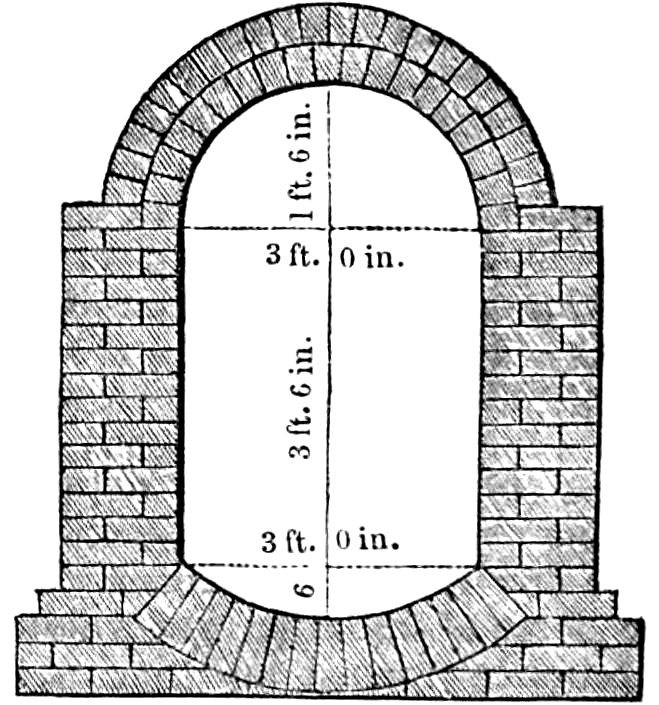
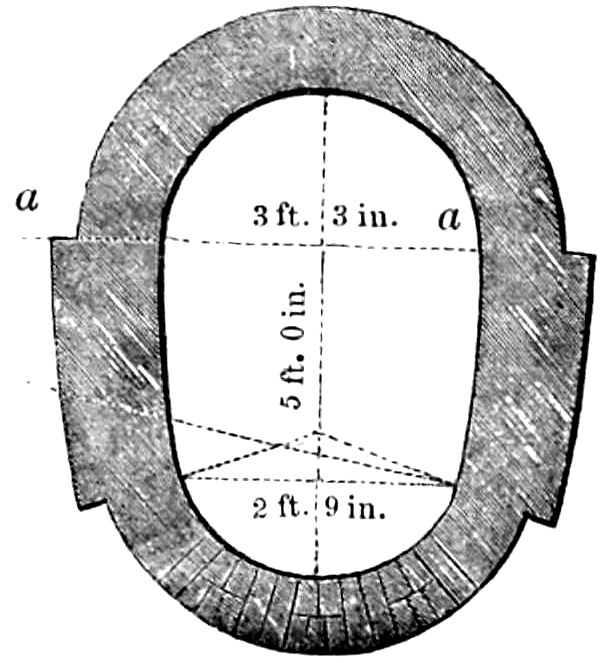
[Figure 1 is a representation of the form of the common sewers built in the
Westminster division. It is a transverse section, representing, on a scale
of a quarter of an inch to a foot, a sewer of the larger sort, the greatest height
being five feet six inches and the width three feet. The smaller sewers are
made of the same form, but only five feet high and two feet six inches wide.
It chiefly differs from the more common form of sewers in not having a perfectly
flat bottom.
The following figures, 1, 2, are representations of the sewers in the Holborn
and Finsbury division of the metropolis, on the same scale as the above. The
part in which the joints are marked in the cut is, according to the directions,
to be worked in blocks with cement.
379The sides of these sewers form the curves of large radii struck from the
centres on the lines a a, the radius for the larger size being about 13 feet,
and that for the smaller size in proportion.
The spaciousness of the sewerage in the Westminster division of the
metropolis has been an object of pride; and it is stated that the commissioners
have walked in procession down one main sewer prepared for the purpose.
It was the glory of Rome that some of its cloacæ were so large that boats and
chariots might pass through them. All this, however, appears to have been
mistaken in principle, and in ignorance of the mischiefs of the generation of
gases and of the principles of hydraulics, and their application for the attainment
of the objects in question. Mr. Smith, of Deanston, who has introduced
the greatest improvements in land drainage, advances the general principle,
that the size of sewers should be so adjusted as to have them always as full as
possible, with a quick flow; and he contends that the drainage of a city might
and should be so constructed as to give rise to as little occasion for men to go
through the main drains as there is for men to go through the main pipes for
conveying supplies of water. He would make the drains narrow. “Their
transverse section should exhibit an oval or egg-shape, having the vertical
diameter at least double the length of the horizontal. The bricks used should
be made on purpose, with radiating sides.” “Care should be taken to make
the building water-tight and air-tight, and to prevent the foul water and
effluvia passing into the contiguous soil. Where land drainage is to be
received, special openings can be made at intervals to receive it. All private
drainage should pass into the sewers under ground by well-secured channels
or pipes. Strong clay pipes, of an oval section, hard burned, and with a good
arrangement for secure jointing, might be cheaply procured for the purpose.”
It may be said that there is scarcely any drainage, even in the opulent districts,
that at present meets these conditions. E. C.]
What are the practical difficulties you find in the way of the cheap cleansing
of the streets and houses of the metropolis?—The great difficulty of the cleansing
of the metropolis arises from the want of proper receptacles for the filth.
There is no filth in the metropolis that now, as a general rule, will pay the
expense of collection and removal by cart, except the ashes from the houses
and the soap lees from the soap-boilers; and some of the night-soil from the
east end of the town, where there happen to be in the immediate vicinity some
market-gardens, where it can be used at once, without distant or expensive
cartage. The charge for removing night-soil from the poorest tenements may
be about 1l. per tenement. One house with another, the expense may be said
to be in London about 10s. per year, as the cesspools may be emptied once in
two years. One house with another they will not produce more than a load of
refuse from the cesspools, which, not being composed, there is great absorption
of the liquid refuse. I have given away thousands of loads of night-soil; as
we have no means of disposing of it, we know not what to do with it.
What is the distance from the metropolis at which refuse is used?—The
expense of cartage of course increases with the distance. The average extent
of use of it as deposit does not exceed three miles from the Post-office
district in the city of London. Some night-soil has been dried, packed up in
the returned sugar hogsheads, and sent to the West Indies for use as manure.
Is it not conveyed away from London by canal?—We do not at present,
but it might be. There is a penalty in the local Act of 5l., for depositing it
on the wharf.
Cannot you convey such manure by railway?—No, there is no mode of conveyance
provided. The charge, I believe, is a halfpenny per mile, but that is
380for the use of the rails only; and the company do not favour the transit of
manure, and the farmer or contractor who would convey it must provide engines
for himself, which again would not pay. Night soil has not yet been
used systematically, and there are no places provided for its reception.
Might not the refuse be disposed of to better advantage than it now is?—The
refuse of a great portion of the metropolis might be disposed of to immense
advantage, but it must be by operations on a scale beyond the power of private
capitalists. The sweepings of the paved streets is good as manure: on grassland
it is nearly equal to horse-dung; but it contains so much seed that it scarcely
does on ploughed land for immediate use. It produces great quantities of
herbage; every year, however, it improves, because the weed is lost from it
and the manure is left. When the streets are dry, and it will pay for transit,
we sell a few loads. The sweepings from the Macadamized roads consist so
much of granite that it is of very little use indeed; and in general the street-sweepings
are mixed up with other manure for sale.
You have been engaged in the cleansing of the metropolis, have you not?—Yes;
I have been engaged, and my father before me, in the general cartage
of materials, and also in extensive business as a nightman, but I have now
retired from business.
What is the usual expense of emptying cesspools?—The full price to
respectable private houses is 15s. per load, but the contract price is about 10s.
per load. The period of emptying is dependent on whether there is any
drainage from the cesspool, or whether there are any land-springs. Some
would require to be emptied twice or three times a-year, whilst others would
go two or three years without being filled. About 1l. per annum per tenement
would perhaps be the expense one with another.
Where the cesspools are relieved, is not the ground about saturated?—Yes,
it is; in digging the foundations of old houses for new buildings, the earth is
found to be saturated. We have frequently to empty one person’s place
because it is found that the soil has penetrated through to the neighbours’
houses.
Does not this moisture affect the condition of the house?—Yes, and it
would be good economy for the sake of the house, and keeping a dry foundation,
to have water-closets and good drainage from the house to the sewers.
By having the water-closets, the expense of the removal of the soil, annually
or otherwise, would be saved?—Yes; and the expense of the dearest
water-closets bears no proportion to the annual expense of cleansing, though
water-closets I think might be constructed at a less expense, on a more simple
plan, than they now are. They might be constructed on a principle to receive
the rain-water and all the liquid refuse from the houses, which would increase
the cleansing.
To effect cleansing on this principle, it will of course be necessary to have
the water laid on in the house?—Of course it will. It would greatly assist the
cleansing, if the water-companies were required to draw their plugs once at
least in the fortnight. It would cleanse their own pipes, and assist in the
cleansing of the sewers. The company would say that that would be a great
waste of water, but a sufficient body of water might be obtained for the purpose
in a quarter of an hour.
Does not the soil bear any value as a manure?—In general it bears no
value to the nightman as a manure. One hinderance to any removal to a
distance is, that, by the police regulations, cesspools can only be emptied in the
night within certain hours. This prevents cartage to any great distance, and
cartage is very dear. Some nightmen have paid 6d. per load for the liberty of
381depositing it. The object of the nightmen is to get rid of the soil early,
and return with the cart to complete the emptying in one night. Formerly,
before the new police were so much about, the men would empty the cart
in any bye street or place where they could; they would, when it was in
a liquid state, empty it down the sewers; they do so now when they have
an opportunity, and return to complete the job. Formerly the site of the
New London University was a place in which the refuse was deposited;
so was the site of the new row of grand houses in Hyde Park Gardens.
I think the site of Belgrave Square was another place of deposit; but
those places being built over, there is now much difficulty in getting rid of
the refuse.
What is the expense of cartage in London?—As a contractor, for the
use of a cart, a man, and horse a-day, I used to charge 9s. the day for carting
stone and rubbish. My successor did it for 7s., but I saw his name yesterday
in the Gazette. The cost of the man’s work and the horse will
amount to 6s. or 7s. in London.
What distance do your carts in full work travel in London?—A good
day’s work to send a load out and return empty would be about ten
miles; over hilly parts not so far.
Is the street refuse of the paved streets valuable as manure?—Yes it
is; but it is only worth removal when it can be easily carted, that is, when
it is in a dry state. The contractor being obliged to cleanse the streets in
a given time, it would not pay to have such a number of carts as to complete
the cleansing within the time and carry the refuse to a distance.
They get rid of the refuse at the nearest place of deposit. In dry weather
they have less to do and can turn their carts to account. The refuse is
then dry, and it rides well, and may be sold to an advantage, and it sometimes
fetches half-a-crown a load.
At what distance from the place of work would it be delivered at that
price?—At about three miles distance; not exceeding that.
Is none of the refuse of the metropolis carried further as manure?—Yes;
some of the farmers who bring produce to market return with their
carts loaded with dung to greater distances.
Is not canal conveyance used?—Much of the street cleansing is taken
down the canals.
Do the contractors in general pay for the deposit of the refuse of streets?—They
would pay if they could get places of deposit near their work;
but all the places out to the outskirts, where any refuse whatever could be
deposited, are built upon.
Do not the men sometimes get rid of the surface sweepings into the
sewers?—Yes; they do when it is in a liquid state, and when they are not
watched.
Do you happen to know what is the expense of cleansing a street of a
given length?—I once contracted to remove the stuff from Bond-street
away; each cleansing took four teams and two stands, as it is called; or
two teams and one stand, that is, two two horse carts, and one single horse
cart standing to be loaded two days in the winter time. The cost of
cartage in the winter season for cleansing that street was about 5l. for
each cleansing. It was cleansed less frequently than weekly: that street
is Macadamised. In the summer-time the expense would be less than
one-half. The expense of cleansing the whole of Marylebone, that is, the
expense of cartage, is about 2,200l. per annum, the parish finding the
sweepers.
“Not to neglect the details into which the Ministry desire us to enter,
382we observe that the maximum of daily street-sweepings is, in winter, 684
cubic metres; the minimum is 410; the average is 547.
“On the other hand, the velocity of the waters of the Seine, measured
at their lowest level, being 6 decimetres 5 centimetres a second, and the
profile of the Seine, measured also at low water, at the bridge of the
Revolution, being 118 metres, we observe that there results, supposing an
uniform velocity in the whole mass, a flow of water of 76 cubic metres a
second; and in one day a flow of water 9,600 times greater at low water
than the most considerable volume of the street-sweepings of Paris for the
same space of time. This volume of water would be 16,015 times greater
than that of the street-sweepings, if compared with the minimum of these
last; that is to say, with the sweepings in summer, or the time at which
the waters of the Seine are lowest. Any error in the calculation, arising
from the inequality of the velocity in the different parts of the column
formed by the current, is too amply compensated by other circumstances
to need our consideration.
“To this is to be added, that the season when the street-sweepings are
greatest, necessarily accords, all other things being equal, with the period
when the water is highest and most rapid, as the period of low water
answers to that when the refuse is least; and admitting the preceding calculations,
the volume of water would be more than 16,000 times greater
than the street-sweepings; and this proportion would increase considerably
when the water is highest, by reason of the double proportion of height
and velocity.
“It is to be further considered, that a great portion of these sweepings
being insoluble in the water, would become precipitated, and unite with
the mud; that a larger portion still, deposited unequally on the two banks,
would never reach the bleaching-grounds, or the places where the water is
drawn, and that consequently their possible relation to the water used in
the city, reduces itself to a quantity excessively small, and absolutely
inappreciable.”
Dear Sir,—Agreeable to promise, I forward the following observations on
the improvement of large towns, as affecting the health, economy, and
comfort of the inhabitants, and so far as these depend on structural arrangement.
The points requiring the attention of the engineer and architect may be
stated as follows:—complete ventilation, complete drainage, ample sewerage,
ample supply of water, and lastly, a ready and good communication
between the various portions of the town.
I should have commenced my observations with the subject of drainage as
the first in point of order were a new district or town to be built, but as both
drainage, and ventilation, and communication, &c., depend so much on the
arrangement of the streets, it may not be superfluous to premise something
on that head. It will be sufficiently obvious that where towns are constructed
on a regular plan with straight streets, the communication, ventilation,
and drainage is comparatively easy, and far more effectual than
under contrary circumstances; but it unfortunately happens that our large
towns contain many narrow, crooked streets, with little or no arrangement,
and though it may not be practicable materially to mend what we now
find so bad, we cannot fail to perceive that a little timeous system and
arrangement would have avoided many evils we now complain of, with a
less structural expense and a much improved value of property to the
owners.
Many or most of the towns, both in British and Spanish America, are
383formed on regular plans, commencing with a square as a nucleus, to the
faces of which the streets (as they rise) are made parallel, so that whatever
may be the extent of the town the increments take place in regular
order, until stopped by some natural obstruction; and though it may be
true we cannot now enjoy the good effect of any such original precaution,
yet as respects the extension or future increments of our cities and towns,
much benefit may still be derived by resorting to system; and though we
cannot now remodel what has been built by proceeding regularly from a
central point to the circumference, yet we may adopt an external line or
periphery as a basis of operation for the construction of the future extension
of the town on a regular plan or system.
It is fortunate for the metropolis that there existed some large landowners
in its vicinity, as the families of Bedford, Grosvenor, and Portman,
whose taste and spirit corresponded with their means, and that large portions
of the increments of London consequently possess all the advantages that
a well-considered system of utility could require; and the benefit of such
a circumstance will be best felt by contemplating what effects a contrary
proceeding would have produced; and further, the plans pursued by the
above-named families have not only been highly beneficial in themselves,
but they have served to stimulate the small proprietors in their vicinity
to the same useful ends; and what seems to be wanted from the authority
of the state is the means of ensuring such beneficial measures in all cases,
or at least protection against antagonist or vicious proceedings in the
owners of land adjoining towns.
It will not fail to be remarked that the increments of London just alluded
to have been constructed chiefly for the abodes of the wealthy, who can
generally protect themselves, and remove from any noxious neighbourhood.
But the state, as the natural guardian of the poor, is the more called upon
to interfere with its authority to see that the streets and houses intended
for the labouring classes are constructed on comfortable and sanitary
principles.
Most of our large towns have increased upon small, irregular nuclei, and
received their increments chiefly from buildings erected along the roads
branching into the country, presenting so many main streets radiating
from a centre, but leaving the intervening spaces to be irregularly and imperfectly
filled up at subsequent periods as chance or necessity directed,
and in this manner has arisen the great defect (to be generally observed)
of a good lateral connexion between the great radiating streets.
So great indeed is the above defect that it is often difficult to pass from
one site in the skirts of a town to an adjacent one without passing towards
the centre of the town by one radiating street and returning by another;
this defective construction of towns is the natural result when they extend
without any reference to a general plan or public convenience, and the mode
which, in my opinion, would best restore the condition of a town so constructed
to a commodious and useful state would be as follows:
I would propose, in the first instance, to connect all the radiating streets
of the town by straight lines drawn as near to the mass of buildings in the
town as the vacant or unbuilt ground would admit of; this operation would
have the effect of inclosing the town in an irregular polygon, upon each
side of which, as a normal line, I would propose to lay out the future streets,
one series of which would be parallel to the normal lines, and another
series would be perpendicular to them, and in this manner the future
increments of the town would proceed on a fixed and uniform system, and
would render the lateral lines of communication as effective as the others,
and would afford at the same time increased facilities for ventilation and
sewerage, and for the supplies of water, gas, &c.; and proceeding on this
system, it may fully be anticipated that the building sites would become
much more valuable to their owners than if they remained to be laid out by
individual caprice on a disjointed plan. It would be valuable in most
384cases that the normal polygon should be formed into a series of streets of
ample dimensions, fit for the reception of public buildings, particularly
schools; and occurring (as it would do) as the nearest great lateral line of
communication to the irregular mass of the town, it would serve to do
much of the duty in way of communication and ventilation which the interior
mass had left undone, and was unable to effect, and might answer as
the great respiratory of the town, and would be well adapted to serve, if
wide enough, and planted, for alamedas, or public walks.
In London, the line of the New Road and City Road furnishes almost
the only sample the metropolis possesses of polygon lines of communication,
and the utility of the sample is duly felt and appreciated. In Paris the
line of the Boulevards presents a favourable specimen of the convenience
and comfort of such a construction of streets.
The advantage of adhering to system in laying out new towns, or additions
to old towns, will be much enhanced when we take into consideration
the means of supplying water, gas, &c. to the houses; and as the application
of science and machinery becomes more extended in administering
to the comforts of towns, it is manifest the more regular the field of their
action the more efficacious and economical will be the results. On the
score of ventilation, as well as for other conveniences, it is important the
streets should intersect and not abut on each other, that the currents of air
may have free escape.[49]
One of the greatest evils arising from towns extending at caprice, without
reference to any general plan, is the vast expense that subsequently
arises when necessity demands communications to be made through
crowded masses of buildings; such events are of frequent occurrence in
the metropolis and other large towns, and so great is the outlay to remedy
what might have been avoided, that no measures proposed for the improvement
of towns merit such deep attention as these; and it has sometimes
occurred to me, that instead of applying the funds to enlarging the leading
thoroughfares, the object would in many cases be better served by forming
entirely new communications through the worst constructed and less costly
sites. In this manner we should have two good communications instead
of one; we should open the means of communication, ventilation, and
sewerage to places where at present they exist most imperfectly, and we
should expunge from the map of the town a number of noxious, ill-ventilated
ruinous buildings, the seats of dirt, disease, and demoralization.
Annexed is a plan of the town of Birmingham, on which is traced a
study or design for the future increments of that town on the principles
above proposed, which will serve to illustrate the views of the writer. The
figure P P P P represents the normal polygon.
Increments.—It is hardly to be expected that any very uniform plan of
building can be rigidly adhered to; moral as well as physical difficulties
may demand departure from regularity in the construction of the future
increments of a town, particularly where the field to be occupied is extensive;
but so long as the general principles are adhered to, and the new
streets proceeded with, upon a general preconceived and authorized plan,
all the needful objects may be attained; and it has occurred to me that the
mode most likely to give satisfaction to the inhabitants would be for the
municipal authorities to offer a premium for the best design for the extension
of the town, and of leaving the selection to the majority of the ratepayers.
TOWN OF BIRMINGHAM,
To illustrate the mode proposed for constructing the future increments of an irregular Town, upon principles of general convenience and utility.
385Proprietors of large spaces of ground, or a combination of small ones,
might also claim and be authorized to form and execute their own plans,
provided always that they were previously submitted to examination and
approval by properly constituted authorities.
It has been omitted to mention, that towns built on a regular plan, and
upon sanitary and commodious principles, are much less liable to the
accidents of fire, and the consequent loss of life and property; and when
such do occur, the facility of extinguishing them is much greater; and one
might also venture to predict that it will be found that the new town of
Edinburgh has suffered less from fire than any other town in Great Britain.
Prevention against fire is a subject well meriting consideration when
treating of the improvement of towns. It would seem that fires more
particularly occur in large public and private buildings, as for instance,
the Albion Mills, the theatres of Drury-lane and Covent-garden, the
Houses of Parliament, the Great Armoury in the Tower, Royal Exchange,
&c.; and it would be well to provide that all such buildings should be
detached, as well as manufactories and all buildings containing steam-engines:
but previous to legislating on the subject it would be desirable to
collect the statistics of conflagration, which might readily be obtained from
the fire-insurance offices.
Ventilation.—In new towns, or the increments of old towns, good ventilation
will be best secured by attending to the principles laid down for the
construction of such.
The noxious ingredients which must exist more or less in the atmospheres
of all large towns may be dissipated by currents of air, or diluted by access
to large open spaces, while the origin of the evil may be much reduced by
a good system of sewerage.
For the removal of noxious vapours existing in crowded towns the following
points deserve attention:—
1. The conversion of blind alleys into thoroughfares.
2. The continuation of leading streets through blocks of houses on which
at present they abut.
3. The opening of wide and straight streets through the meanest, most
complex, and crowded parts of cities; this will prove the most important
measure for meeting the object in view; and what merits the next consideration
is the preservation of such good and healthy avenues as already
exist free from encroachments: for it has happened in the metropolis
while exertions were making in some districts to open wide streets, in other
districts a contrary system was at work. The New and City Roads, the
most commodious avenue in the vicinity of London for length, width, useful
and healthy communication, is in a constant process of invasion, as may
be noted more particularly in the vicinities of Tottenham-court Road and
King’s-cross; and unless some measures are taken to preserve this noble
respiratory of the metropolis, it is to be feared in a short time its character
will be entirely changed.
4. Another mode of improving the air of towns is to open squares, or
public walks, or gardens, by the removal of some of the buildings, by which
means a reservoir of pure air is created, and in this manner the city of
Seville was essentially benefited; the streets are there numerous, narrow,
and dirty, but the city, abounding in large convents, the removal of some
of them, and the conversion of their ample sites into piazzas or squares,
afforded the air and space so much required for the public health.
In London there are some institutions that might be advantageously
removed to the suburbs or skirts of the town, such as the Charter-house
School and the Fleet Prison, and their sites converted into open squares;
but if such operations are too costly and difficult, we may at least guard
against the converse operation, viz., the covering of open sites with masses
of buildings. Thus we have seen in recent times the gardens of Lincoln’s-inn
and Gray’s-inn invaded; and we had lately a proposition to convert
Lincoln’s-inn-square into piles of buildings, and to demolish what no art
can supply, the finest reservoir of air which the metropolis offers to a
crowded neighbourhood.
3865. The circulation of pure air would be much increased by pulling down
all dead walls, and by substituting iron railings in their stead; and too
much credit cannot be given for what has already been effected in this
respect in the neighbourhood of Knightsbridge, &c.
6. The prohibition of all burials in the metropolis and other large towns,
and the consequent diffusion of unwholesome effluvia.
Drainage and Sewerage.—As towns become more crowded, the value of
good drainage and sewerage as a sanitary measure becomes the more apparent;
and as the means of draining the site of a town above and below
the surface is to be effected in part by the same means as the sewerage or
removal of the liquid filth, the subject becomes of great importance, and
second only to the choice of the site of the town and distribution of its
streets; and if a due regard to system has been shown to be so desirable
in the one case, it is no less so in the other, and before any buildings are
commenced the plan of drainage should be matured.
In order to arrive at a good system of drainage for a piece of ground
intended to be built upon, or in a town where the sewerage requires improvement,
a necessary step in the process would be to add to the plan of
the town lines of equal altitudes, drawn at every two or three feet of elevation,
which would present at one view the means of comparing the levels
over the whole extent of the town; they would show the deepest valleys
where the main sewers would most conveniently run, and the most efficient
mode of combining the several classes of drains, so that the declivities
might be turned to the best account; in addition, the plan should be so
far geological as to show the boundaries of the strata, as a body of marl or
clay often upholds a quantity of water which might prove injurious as a
building site if not previously tapped.
A notorious instance of this nature occurred at the village of Moseley,
near Birmingham. Preliminary to carrying the Gloucester Railway
through the village, in deep cutting, it had been ascertained by trial shafts
that the bottom consisted of quicksand, which rendered it difficult either to
construct a tunnel or to support the slopes in open cutting until the water
was removed; and for this object a drift or level was brought up from a
distance of a quarter of a mile through a bed of marl; the miners proceeded
for some distance perfectly dry until they reached the quicksand, when the
water flowed into the drift at the rate of 253 cubic feet per hour, or 77½
gallons per minute, and the wells in the village in a short time were laid
dry, and had to be deepened at the expense of the Railway company. It
so happened in this instance that the level of the quicksand was so deep
that the surface of the land had not been affected by the pending up of the
water below; but if it had been otherwise, the measure resorted to would
have proved as useful to the land as it was to the Railway.
In laying out a plan of drainage and sewerage when a river or brook
passes through or alongside of a town, it will naturally become the main
drain of the place, and be the normal line from whence the second-class
sewers would diverge; but it not unfrequently happens when such a brook
is small and becomes the cloaca maxima, that, being left open, and insufficiently
supplied with water in the summer season, it constitutes,
instead of a benefit, a serious nuisance to the inhabitants; instances of
this kind may be observed at Edinburgh, Birmingham, Coventry, Camberwell,
&c., &c. It also happens at many towns that a stream passing
through or by them is dammed up to turn a mill just above or below the
town, or even in the middle of it, by which means the current useful to clear
away the filth is diverted, the water in the bed of the stream into which
sewers are discharged is left stagnant, while the vicinity of the town is
rendered wet and unwholesome from the pent up water.
At Birmingham the Rea Brook is dammed up in its course through the
town to supply a mill. In the very excellent sanitary report of the town
by Dr. Hodgson and other medical gentlemen, it is stated that “the
river Rea may be considered the cloaca or main sewer of the town, but
387that its condition is very bad;” the report also states, “that the stream is
sluggish, and the quantity of water which it supplies is not sufficient to
dilute and wash away the refuse which it receives in passing through the
town, and that in hot weather it is consequently very offensive; and in
some situations in these seasons is covered with a thick scum of decomposing
matters; and this filthy condition of the river near the railway
stations is a subject of constant and merited animadversions, and that it
requires especial attention lest it should become a source of disease, &c.”
The cloaca maxima of Birmingham differs from that of ancient Rome;
that whereas in the latter art was employed to effect what nature had left
undone, here art has been employed to obstruct the useful course of nature.
I quite agree with the sanitary report as to the present noxious state of the
brook; and even those who travel on the railway may at times be very
sensible of the effluvia when crossing it.
I am inclined to differ from the sanitary report as to insufficiency of the
water of the Rea for cleansing its own bed; but that report has not
adverted to the fact of the abstraction and diversion of the water of the
Rea from its natural bed to turn a mill, a fact which will amply account
for the deficiency and sluggishness of the current in the very places where
the contrary condition is most wanted.
From my inspection of the locality, I am inclined to believe that the
descent of the Rea and its quantity of water in passing through the town
of Birmingham is sufficient under good arrangements for the efficient and
wholesome sewerage of its bed.
If we take a distance of half a mile above the weir and half a mile below
it, that is, nearly from Morley-street to Lawley-street, I consider I shall be
justified in saying there is a descent of about 14 feet, for I find a slight
weir in Floodgate-street; at the dam itself the fall is about eight feet, and
from thence for a considerable distance downwards the fall is considerable.
Above the weir the stream for a short distance is sluggish from want of
declivity, and the water being pent up, keeps the houses there wet or
damp, while below the weir the bed of the Rea being left nearly dry, the
filth from the sewers which discharge there must stagnate, while at the
same time the water of the Rea passing through the mill-race with a good
body and current, applies to no act of cleansing.
The mill-pool is extensive but shallow, and there the filth from above
accumulates. When the pool is filled with water it is worked off by the
mill, but the gratings prevent dead dogs and such like matter from passing,
and are there left to fester at low water.
The remedy is as easy as the evil is great; all obstruction being removed
from the course of the brook and the water restored to its original
bed, the object would be effected; as to the value of the mill-power which
would thus be subverted, it cannot be a matter of much amount in a place
where coals and steam-engines are so cheap, and where the constant and
regular work of the mill must be an object of some importance.
In applying a remedy to the great evil under notice, the engineer should
not be content by merely restoring matters to their original and natural
state, but in so populous a town should apply all the aid which art can
bestow to assist natural circumstances. The bed of the Rea should be
formed with an uniform descent through the town and for some distance
below it, by dredging in some places and filling it in others with coarse
gravel or broken stones; or, better still, if funds will afford it, by forming
an inverted arch of stone or blue bricks to give full effect to the scour of
the stream; further, the engineer would render the course of the brook
through the town as straight as circumstances would permit by cutting off
loops and sinuosities. In this manner, and by reserving the whole body of
the water of the Rea for cleansing its own bed, I have no doubt that this
main sewer of Birmingham would become as conspicuous for its wholesome
and efficient action as it is now for the contrary.
388About a mile above the town of Birmingham, there is another mill which
I am disposed to think would act rather beneficially than otherwise, in
removing the filth from the bed of the brook in its course through the town;
for in summer weather when the stream is scanty, by pooling it up and
letting the water down with force at intervals, the effect is much increased.
Whether the stream of the Rea be so deficient in summer as to require
this process, I would not now give a positive opinion, but there are many
somewhat analogous cases where the stream in summer is not sufficient
and where the pooling up and flushing off at intervals could not but prove
of great utility; and if I have now brought the case of Birmingham into
considerable detail, it is owing to the circumstance of its exemplifying
certain conditions that are common to a great number of towns, and which,
in a sanitary point of view, and more especially in regard to the poorer
classes of the community, are the most urgent for remedy of any that have
fallen under my observation.
In the town of Haddington, a mill-dam crosses the river Tyne in its passage
through the place and into the mill-pool; the main sewer is discharged
with a diminished and sluggish descent; and on occasion of floods in the
river, the water passes up the sewers and occasionally lays the lowest part
of the town under water. It would not be difficult to direct the main
sewer into the bed of the river below the dam or weir, and by the additional
declivity give some current to the water of the sewer, which from the
pending up of the river at its present outlet has rendered it almost stagnant,
so much so, that in hot weather, and where it is not covered over, the exhalations
are very offensive; but was the sewer improved by the alteration
mentioned, still the pooling up of the river for the mill keeps the lower part
of the town damp, and even subjects it to partial inundations.
One of the medical officers reports, that when “fever has been at any
time prevalent in the town, it has been most so in a portion of it called the
Nungate,[50] lying close by the river, when during the summer and autumn
it is occasionally almost stagnant, and where there is a considerable decomposition
of vegetable matter.”
Another medical gentleman, speaking of the main sewer, says, “this
small burn is a receptacle of the privies and refuse of vegetable matters
from the houses near which it passes; and in those parts where it is uncovered,
it forms an excellent index of the weather; previous to rain the
smell is intolerable.”
The same gentleman proposes as a remedy that another small burn,
having a parallel course at a short distance, should be turned into the
sewer to aid the sewerage. From my knowledge of the locality, the
recommendation, I should say, is judicious, but in this manner, though the
supply of water would be increased, the declivity or rather want of declivity
of the sewer would remain the same, and could only be improved by
removing the mill-dam, or directing the sewer into the bed of the river
below it, as already mentioned. Unquestionably from the pending up of
the river, the lower part of the town is at present very ill drained, and it is
somewhat remarkable that it was the first site in Scotland visited by the
Asiatic cholera.
In reference to the two cases cited and to others of a similar nature, it
should be remarked, that the vicinities of the nuisances are chiefly inhabited
by the poorer classes, and who from want of influence in their own parts are
the more necessarily thrown under the protection of state regulations.
The sewers of a city or town may be conveniently divided into four
classes:—First, the main drain or sewer, and this, whether natural or
artificial, being fixed, becomes the basis of the system, and upon it the
second drains or district class will be directed: these again will receive the
third class or street drains; and lastly, the house or fourth class drains,
will be discharged into the street drains. In small towns, only the third
and fourth class drains will be required; in large towns, three classes of
drains may be necessary; and in great cities, all the four classes will be
required.
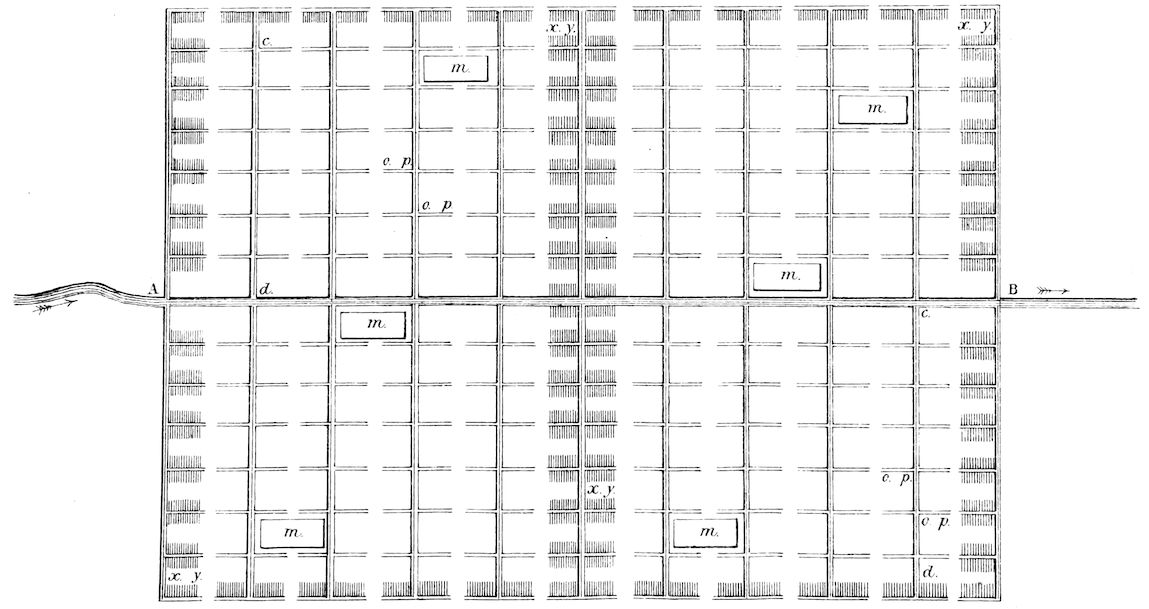



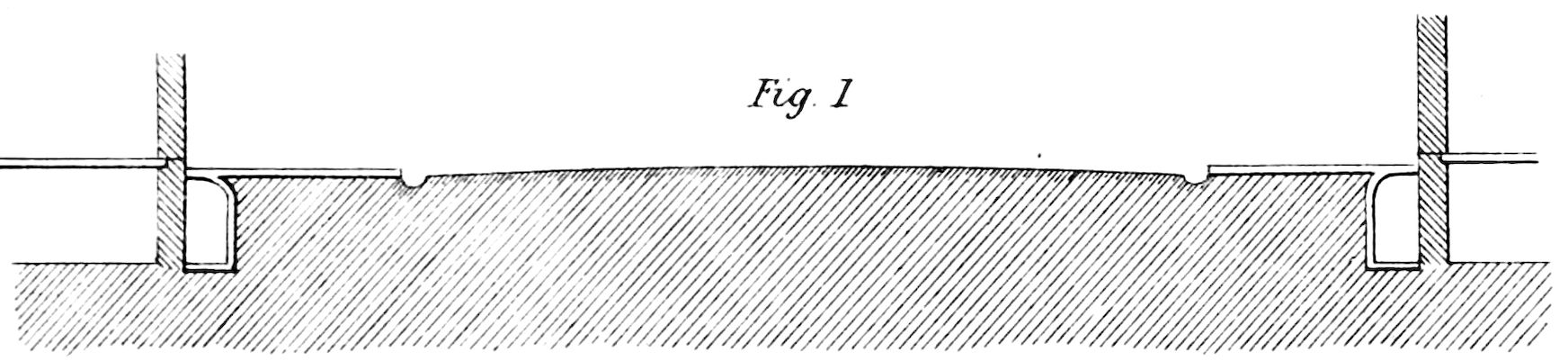
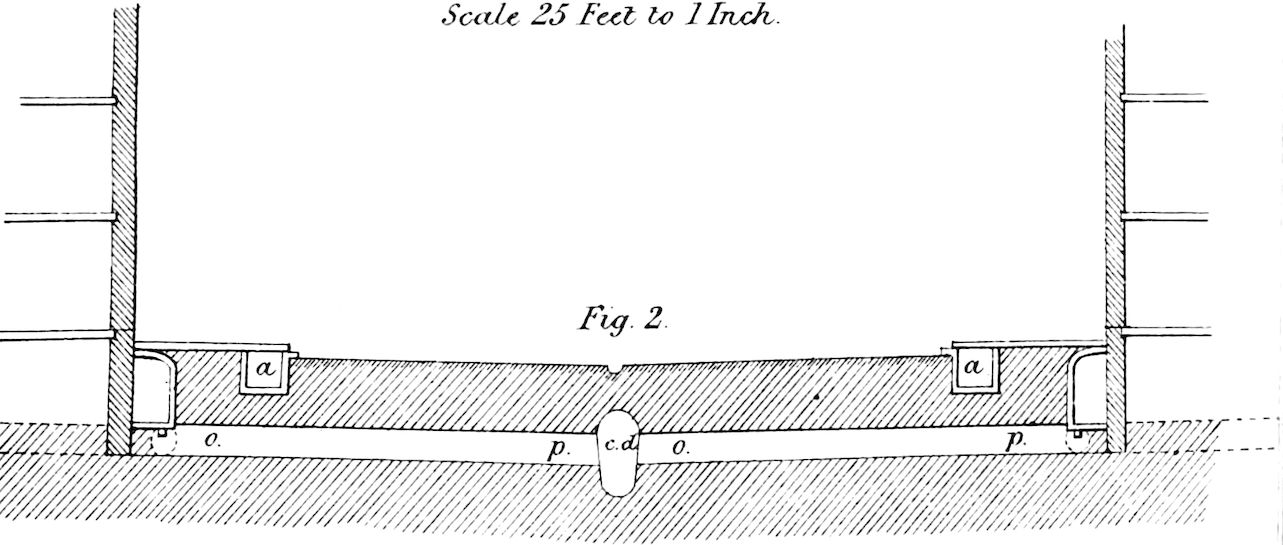
389With respect to the form of the drains, when bricks are used as building
materials, the bottoms of the drains will be best formed of inverted arches
of blue bricks, as forming a cheap, hard, and durable surface, and giving
every facility from the form, for the scouring force of the water to remove
the filth brought into the drain; but whether the curve of the bottom shall
be a semicircle or a segment will, I apprehend, depend on the size of the
drain. For very small drains a circular form would be the cheapest and
best; the next size would be more advantageously constructed of an oval
or egg shape, but still of bricks. Drains of a still larger size, viz. the
second class, may be conveniently made either of brick or stone, arched and
counter-arched at top and bottom with battered sides, either straight or
curved; the counter-arches or curved bottoms will conveniently become
flatter as the drains increase in capacity to afford greater room for the accumulated
water to pass without rising and flooding back into the feeders.
The first and second-class sewers must be deep seated to receive their
respective tributaries or feeders, with some overfall; and though a sufficient
width for large drains may generally be procured, it is difficult in
many cases to command enough of depth, another circumstance that can
best be obviated by flattening the arches both at top and bottom; but in
large drains, where there is a body of water, the scourage will be sufficient,
without resorting to deeply curved bottoms.
When bricks abound as a building material, they are particularly convenient
for the construction of deep sewers and drains, from the facility of
handling in confined spaces; but it is important their quality should be of
the best, since if they scale and decay, great expense must be involved in
the repair of the drain. The Tipton, or blue brick, is the best for the facework
of drains.
In parts of the country where stone abounds, bricks are often little known,
and the resources of the district must be made use of; where the blue lias
limestone occurs, I have found it a cheap and excellent material for forming
culverts and drains of all sizes; and it was used largely for that purpose on
the Birmingham and Gloucester Railway.
Annexed is a sketch of the sections of drains varying in form according
to their size. The batter which I found most useful and convenient for
wall-sided drains was 1 in 9, either curved or straight; the first is the best
form in theory, but in small works I found the bricklayers’ and masons’
work more accurately to the straight batter; and the last is, from its simplicity,
better adapted to receive any sluices or flush-gates that may be
necessary.
Annexed is also a sketch to show the distribution of drains in a town
supposed to be built on a regular plan, with a pretty uniform descent towards
an axis, which constitutes the site of the main drain; each class
of drains consisting of several sizes, it would be most useful as well as
economical that the drain of a particular class (if large) should commence
with the smaller size, and discharge or terminate with the greater size, a
plan that would aid the sewerage of the water.
In a system of drainage, it is necessary to consider that the greater the
body of water, or in other words, the class of the drain, the less declivity
is sufficient; and the converse, the less the body of water, or class of drain,
the greater declivity is required; in the first case, the hydraulic depth
compensates for the want of declivity; and in the second case, the declivity
compensates for the want of hydraulic depth; the multiplication of these
qualities being a function of the velocity or force of the current, due attention
to the above is important in economizing or turning to the best
account the declivity for the drainage of a large town.
Having arranged the system of sewerage for a town, the next object will
390be to render it as extensively useful as practice will admit of; and from the
experiments and practice of Mr. Roe, the surveyor to the Holborn and
Finsbury Commission of Sewers, we are warranted in the belief that a good
system of sewerage, aided by a sufficient supply of water, will, in most
localities, be sufficient to remove all the dirt which arises in the streets,
without the necessity of cartage, and also all the filth of private dwellings
which is at present led through drains or pipes, or which by the aid of
water may be practised more extensively in future.
We have first to consider the conveyance or discharge of the street dirt
into the main sewers, and the discontinuance of the present expense, and
annoyance of using carts for that purpose, at least with some few exceptions.
It is pretty obvious, that if the mud of London, like water, could be
made to flow through the drains much trouble and expense of cartage
would be saved; and it does happen that the street-dirt of London is so
diffusible with water, that with a little arrangement such a mode of cleansing
maybe followed; indeed it is highly probable that at present more
than one-half of the whole mud is carried off by the rains in that manner.
The mud of London, and other great towns in England, may be assumed
in wet weather[51] to arise, in three-fourths of its amount, from the grinding
or abrasion of the paving-stones, the remaining one-fourth part consisting
of soot, shop-sweepings, and cattle dung.
The dirt arising from the detritus of the stones may be obviated in two
ways; 1st, by substituting for the green-stone forming the carriage-way,
quartz-rock, or quartzose stones. The green-stones contain hornblende
and felspar, which grind, like all argillaceous stones, into fine mud or powder
mixable in water, whereas quartz rock retains when ground the form of
clean sand, neither soiling nor capable of forming mud in itself. The
Lickey Hills in Worcestershire are composed of quartz rock, and the roads
in their vicinity show its excellence as a material for road making. The
quartz rock, however, of the island of Jura is much purer, and that island
contains an inexhaustible supply already broken by nature into sizes nearly
fit for laying on the roads; and Small’s Bay in the island of Jura would
form a convenient loading place, and by means of a jetty and tram-way
vessels might be laden at a small expense, and much of the country supplied
with the best of all materials for road-making. The substance of the
stone is hard and durable, and consequently suffering little by abrasion;
and it would be well worth while to try the experiment of Macadamizing
one of the leading streets of London with this material, as the means of
forming a good road, and at the same avoiding the creating of a great
quantity of street dirt.
The other mode of avoiding the formation of mud is the substitution of
wooden pavements; of the success of these I have little doubt, though for
the present many failures have occurred, either from The foundation not
having been truly and firmly laid, or from the blocks of wood not being
massive enough. The greatest objection to wood pavements at present is
the slipping of the horses, but this I believe might be obviated.
The question, however, at present is to get rid of the street dirt, such as
it is; and for that purpose I apprehend it would only be necessary in wet
weather during rains that the street-cleaner should sweep the dirt into the
kennels, and aid the water by stirring the mud, to carry off the material
in a state of diffusion; in dry weather, the opening of pipes with hose
attached would serve the same purpose as the rains, and at the same time
aid the sewerage at the time most required. After a short but heavy fall
of rain, the cleansing effect of the water is fully perceived: and if any
means could be devised of saving the rain-water that falls on the houses
and in the streets, so as to apply it in considerable quantities at intervals, it
is probable that the rain-water would be amply sufficient for all the purposes
in question.
391I have heard of the plan pursued by the West Middlesex Water Company
for cleansing their reservoir at Kensington, at little expense, by diffusing
the muddy deposit in water, and allowing it to run off in pipes.
In the city of Guanaxuato in Mexico, a similar mode of cleansing has
been long practised; a splendid tank of ample dimensions contains the
water used by the inhabitants; the tank is supplied by mountain torrents,
which bring down a considerable quantity of mud or silt, and which makes
a deposit in the bottom of the tank, which is formed by a fine dam of
masonry crossing a narrow valley, and provided with sluices. The rainy
season commences in the latter part of June, and a short time previous
the ceremony of emptying and cleansing the tank is gone through; a kind
of fair and holiday is held on the ground, to which most of the inhabitants
resort; the sluices are opened, and as the water recedes, the watermen,
boys, and all those who relish the fun, get into the tank and keep stirring
up the silt with sticks and spades, &c., and in this manner the mud is
annually carried off by the remaining water of the past season, a subsidiary
tank serving for use until the principal one is replenished.
By some sort of a similar process it is alleged that much of the mud-banks
of the Thames above the bridges have been removed, viz., by the
action of the paddle-wheels of the numerous steam-boats running there.
Some of the effect observed must be owing to the greater scour of the
tides since the removal of Old London-bridge, though some part may also
be due to the steam-boats.
For the purpose of giving more aid to the surface-water in cleansing the
streets, and at the same time for keeping the footways and houses drier
and more free from mud, I should propose (at least as an experiment) a
different structure of the carriage-way, viz., to make it incline to a centre
kennel, instead of to two side ones. At present, in many places, the centre
of the carriage-way is elevated above the level of the shop doors, and at the
same time we often find the footway but three inches higher than the
kennel; and it is pretty obvious from this arrangement, in dry weather,
the dust will blow from the more elevated carriage-way on to the footways,
and into the shops and areas; and in wet weather the water and mud
being chiefly accumulated in the side gutters, the carriage wheels and
horses’ feet will distribute it plentifully on the footways, and not unfrequently
on the passengers, and all tending to keep the houses damp and
dirty, whereas it is obvious that, was the descent constant from the houses[52]
on either side to the centre of the street, these evils would be avoided, and
it will be no less evident that all the surface-water flowing to one common
channel would possess more force and convenience for running the street
dirt into the sewers. I am inclined to believe that the carriage-ways
are getting gradually elevated above their proper level, from the contractors
for paving not excavating deep enough for the foundation of the
pavement.
Annexed is a sketch, showing in juxta-position the form of the street-ways
as at present, and as proposed to be; the street is supposed to be a
shop-street, 90 feet wide, having two areas of three feet each, two footways
of 12 feet, and 60 feet of carriage-way; on the section of the proposed plan
a fall of six inches, or 1 in 30, is given from the shop door to the edge of
the pavement; there is then a descent by two steps of six inches each to
the carriage way; and lastly, a descent of 1 in 30, or of one foot to the
kennel in the centre of the carriage-way. The kennel may either be open
or covered; if the latter, it must have many gratings. In the city of
Mexico the kennel is chiefly in the centre of the street, and covered by
large flat stones.
On the proposed plan, if we suppose a step from the foot pavement to
392the floor of the shop or house, the latter will be elevated about 3 feet above
the gutter, whereas at present we often find it not more than six inches,
and it will readily be admitted that such a difference in the disposal of the
surface-water cannot but keep the houses much drier and more cleanly.
By having one gutter in the centre of the streets instead of two, (one at
each side,) we remove two sluggish and inefficient kennels, which are the
source of damp to the pavement and to the houses, and we create one
which is at a distance and doubly effective.
The subject of street pavements having been introduced as the means of
surface-drainage, it may be remarked how difficult it must ever be to keep
them in good order so long as they are liable to be broken up whenever
water or gas-pipes require altering or repairing, besides the extreme annoyance
occasioned during that operation; and though it may not be possible
to obviate the inconvenience in all cases, yet I conceive the evil may
be reduced to very narrow limits by resorting to system, and I would
suggest that under the foot pavements passages should be formed, lined
with brick-work or masonry, as a common receptacle for all the water and
gas-pipes, having the flagging over the passage so laid as to be easily lifted
in case of need, and being provided at intervals with side entrances for
inspection and all such repairs as could be effected without raising the
flagging. The position of the gas-pipes under the foot-pavement would be
convenient for the street and shop lights, and the water-pipes would be
then equally so for the use of the houses. But in respect to the sewer of
the street, I should propose to place it near the centre of the carriage-way,
as more distant from the dwellings, but as equally convenient to both sides
of the street. (See the section for new form of carriage-way.)
Having noticed the subject of diminishing the amount of street mud, and
of conveying the same into the sewers, as well as that portion of the house
filth which it may be practicable to discharge into them, we have next to
notice the mode of further disposing of the matter thus lodged in the
sewers. The practice has hitherto been (in a great degree) to accumulate
the filth in cesspools, and at intervals of five to ten years to open the
sewers by breaking into them, or to get access by man-holes left for that
purpose, and then drawing out the semiliquid contents of the cesspool by
means of a windlass and buckets; but in the Finsbury division the surveyor,
Mr. Roe, has had the merit of introducing a very superior, less
expensive, and less offensive mode of operation. Finding that the surface-water
did not generally enter the sewer in sufficient quantity and with
sufficient force to carry off the more solid contents, he contrived, by sluices
or flush-gates, to dam up the water to a certain height, and then, by opening
the same, to obtain a force of water sufficient for the purpose; and the
working of this new plan is said to be highly satisfactory, the filth being
prevented accumulating in the sewers, and, as a necessary consequence,
then choaking their feeders, the house drains; and in this manner also the
filth is removed at less expense, and without any annoyance and noxious
effluvia which attend the old practice.
Mr. Roe has adopted also side entrances to the sewers instead of man-holes,
for the inspection and repair of the flushing apparatus. The chief
expense beyond the first cost of Mr. Roe’s plan is the attendance of a
person to open the flush-gates; but it is probable that some contrivance
may be found by which the pent-up water on reaching a certain point may
be able to open its own gate. It has, however, occurred to me, in respect
to this mode of flushing off the filth, that, instead of damming up the
water in the sewers, and forming them into reservoirs, the purpose
might be more easily and more effectually performed by accumulating the
surface-water from the gutters into reservoirs before entering the street or
district drains; a greater head, or force of water, might thus be obtained,
while the sewers themselves would always be open and free from the obstruction
of the sluices and pent-up water.
393In respect to the final deposit of the filth of London and other great
towns, it does seem a pity that so much valuable manure should be lost to
the land, and be discharged into rivers to their contamination and obstruction,
if any practicable and innocuous plan can be hit upon to avoid the
alternative.
One plan has been suggested of receiving the contents of the sewers into
pits, and then by means of steam-power and a sufficient supply of water,
forcing the matter of the sewers in a diluted state through iron pipes
into the country, and then applying it to irrigate the land in the same
liquid state. It would require much calculation to form an accurate estimate
of the cost and profit of such an undertaking; but there can be no
doubt if the matter was so applied it would prove exceedingly valuable
in enriching the land to which it was applied, as we may judge from
what has occurred in the vicinity of Edinburgh from a similar kind of
irrigation.
At Edinburgh, however, the liquid manure being conveyed from the
town for a distance in open ditches or sewers exposed to the sun and atmosphere,
it undergoes such a fœtid decomposition as to render the operation
no common nuisance to the public. But such effects would not occur
(at least, to the same extent) if the matter was conveyed in close pipes with
a plentiful effusion of water; and it is known that animal carcases, when kept
constantly exposed to fresh supplies of water, do not suffer corrupt decomposition,
but are changed into a fatty matter. It seems necessary also that a certain
degree of heat and exposure of surface should be present to originate and
promote fœtid decomposition, as it is well known that in the pits in Paris,
where so many dead bodies were thrown, the result was not a fœtid decomposition,
but a change of the animal matter into adipocire, a comparatively
inoffensive substance; we may therefore expect that the discharge of the
contents of the sewers in pipes, excluded (as they would be) from heat, and
copiously charged with water, would be comparatively free from noxious
exhalations.
Another plan of reserving the contents of sewers for the purpose of manure
would be to continue the sewers to some distance from the town, and
then to discharge them into a series of covered catch-pits, allowing the
water to filter off after depositing the solid particles; when the first series
of pits were deemed sufficiently charged, the sewers might then be discharged
into a subsidiary series, until the matter in the first had become
sufficiently consistent for cartage. Upon the first plan of proceeding, the
liquid manure could only be applied to land quite near at hand, and fit for
irrigation; on the second plan the manure might be conveyed to a distance
and applied to arable land.
It will be evident the great importance of applying such quantities of
manure as the sewers supply to useful purposes, but it is no less evident
that no system can be introduced to effect the object until preceded by
satisfactory experiments of cost, profit, and efficiency. Some localities
might offer facilities for one mode of action, and some for another; and it
is much to be desired that parties may be induced to make experiments on
both plans; and it is to be noted that though the expense of raising the
liquid manure from pits or tanks would be necessary in some cases, yet in
many situations no such operation would be necessary.
On the subject of purifying the air of sewers, and of preventing the
escape of foul air by any crevices or chinks, I have heard of the ingenious
contrivance of erecting a tall chimney and connecting it by a pipe with the
crown of a sewer, for the purpose of creating such a draft up the chimney
as would occasion an indraft at any leak that might occur in the ramified
mass of drains of the district to which the chimney belonged. It appears
to me that there are some objections to this plan; but not being acquainted
with all the details, I shall avoid entering into any controversy on the
subject, further than stating that I should rather propose an opposite
394process for purifying the air of sewers. I would recommend that they
should be kept excluded as much as possible from external heat and
ascending columns of air; but at the same time I would endeavour by all
means to send down as copious a flow of water as practicable; and in
London, though the Thames water may not be proper for domestic purposes,
it would be sufficiently pure for watering the streets and cleansing the
drains; and the supply being inexhaustible, its application would only be
limited by the cost, of steam power and iron pipes.
In conclusion, I have to express my obligations to yourself for the useful
hints you have afforded me on several of the subjects above treated of, and
to say I shall be happy if any of the observations I have submitted should
prove conducive to the ends in view.
I remain, dear Sir,
Yours truly,
James Vetch.
Edwin Chadwick, Esq.,
&c. &c. &c.
London, 1st March, 1842.
Is there any distinction in the character of the buildings built out of
the limits of the Metropolitan Building Act, or out of the limits of your
own district as surveyor?—Yes; there is a less expensive description of
buildings built out of these limits. In the adjoining parish of Kensington,
there are tenements run up four stories in height with only a nine-inch
wall from the top to the bottom, whereas in any parish under the Building
Act the walls of the same description of houses would be required to be
18 inches thick in the basement and 14 inches upwards: this, however,
is not a sized house for the occupation of the poorer classes. At the
Potteries, Notting Dale, Kensington, however, there is a nest of houses
huddled together without party-walls and without drainage; many of them
are built of wood and four-inch work, and of such materials as would not
be permitted where the Building Act is in force. This is with reference
to houses which are contiguous to each other.
Have you not seen instances where sewers are made and drains in
action where the state of the premises is nevertheless dangerous?—Yes;
only recently the parochial officers of Paddington inspected the workhouses
and buildings belonging to the Kensington union, when we found the drains
formed but not trapped, and the inmates exposed to the foul air from the
drains themselves. I have read Mr. Oldfield’s statement, and I think it
very true and very important.
| FEET |
|
£ |
s. |
d. |
| |
| 55. |
Drain and digging, with pantile bottom, three courses high, arched over and cemented |
4 |
2 |
6 |
| 10. |
Small drain from water pipe |
0 |
10 |
0 |
| 46. |
Sup. slate slab cistern, 4 ft. by 3 ft. 9, and 2 ft. deep, holding 150 gallons |
4 |
12 |
0 |
| 62. |
Three-quarter pipe to serve cistern, including joints and fixing |
3 |
2 |
0 |
| 12. |
Three-quarter pipe to serve yard, including joints and fixing |
0 |
12 |
0 |
| |
Two three-quarter cocks—10s.; one cock-ball and boss—8s. |
0 |
18 |
0 |
| 3957. |
Inch standing and under waste |
0 |
10 |
6 |
| |
1¾ washer and waste |
0 |
2 |
6 |
| |
Pan closet, with basin, &c., complete |
3 |
10 |
0 |
| |
Strong D. trap—20s., service box—10s. 6d. |
1 |
10 |
6 |
| |
Cover to cistern |
0 |
15 |
0 |
| |
|
|
|
|
| |
|
20 |
5 |
0 |
| |
Deduct 7½ per cent. if done at contract prices. |
1 |
10 |
0 |
| |
|
|
|
|
| |
|
18 |
15 |
0 |
From the above estimate the following items should
be deducted, as appertaining to the present objectionable
system:—
| |
|
£. |
s. |
d. |
| |
Cesspool |
1 |
0 |
0 |
| |
Root of privy and ceiling |
0 |
15 |
0 |
| |
Drain, say 65 ft. |
3 |
5 |
0 |
| |
Water butt and stand |
1 |
5 |
0 |
| |
Service pipe, 40 ft. |
2 |
0 |
0 |
| |
Cock and ball—8s.; waste pipe—7s. |
0 |
15 |
0 |
| |
|
|
|
|
| |
|
9 |
0 |
0 |
| |
Less 7½ per cent. |
0 |
13 |
6 |
| |
|
|
|
|
| |
|
8 |
6 |
6 |
| |
|
|
|
|
| |
|
13 |
8 |
6 |
| |
|
|
|
|
The plan and elevation which I have given are intended for an Agricultural
labourer in the north of England or in Scotland, where it is
customary to have the sleeping room on the ground floor. The walls are
supposed to be 18 inches thick, and the roof thatched, as being the warmest
covering in a cold bleak country. The front entrance is by a porch, which
contains a step-ladder to the garrets, which, being lighted by windows in
the gable ends, may be used as sleeping places for grown-up children,
while the younger children may sleep below in the same room with their
parents. a, is the kitchen; b, the sleeping room; c, the back kitchen; d,
the pantry; e, the dairy, if the occupant should have a cow, which is
generally the case with agricultural labourers in Scotland; and f, a place
for fuel, for poultry, or for a furnace to heat a flue passing under the floors
of the two rooms in the direction of the dotted line g, the smoke escaping by
the upright flue h. The highest point of the sleeping-room floor is at g,
and of the kitchen floor at i; the highest point of the pantry floor is at d,
and of the dairy floor at e, and from these four points the floors gradually
slope at the rate of 1 inch to 7 feet to the sill of the back kitchen door at m,
so that no water can stand in any part of these floors; and hence, when
they are being washed with a mop in the direction of the slope the water
will readily flow towards the back door.
A place for wood or other fuel, or for a pig or rabbits, according to the
taste or circumstances of the occupant, is shown at n; a privy at o; a tank
for liquid manure, communicating with the privy, at p; and a pit for ashes
and solid manure at q. Both these pits may have movable roofs.
The surface of the yard slopes from the entrance door r, to the liquid
396manure tank s. The back kitchen is entered by one step; the terrace in
front at t is entered by three steps, and the door of the porch by a half-step.
The garden is only partially shown, the portion omitted being a parallelogram
of sufficient length to constitute the contents of the whole ground
allotted to the cottage, one-sixth of an acre. It is surrounded by a hedge,
which may be shown architecturally to give an appearance of design and
taste on the part of the occupant.
The slope of the terrace may be covered with grass or flowers, strawberries
or ivy. The narrow border next the hedge may be planted with
flowers, and the larger compartments in front of the porch with gooseberries,
raspberries, currants, and dwarf apples. The culinary crops are supposed to
be grown in the back compartment, only a portion of which is shown at w.
A B, is the elevation of the front hedge.
C D, a part of the side hedge.
E F, a section on the dotted line E F, to a double scale.
G H, a section on the dotted line G H.
The upper part of the drawing is an isometrical view.
The essential requisites of a comfortable labourer’s cottage may be thus
summed up:—
1. The cottage should be placed alongside a public road, as being more
cheerful than a solitary situation; and in order that the cottager may
enjoy the applause of the public when he has his garden in good order and
keeping.
2. The cottage should be so placed that the sun may shine on every side
of it every day throughout the year, when he is visible. For this reason,
the front of the cottage can only be parallel to the public road in the case
of roads in the direction of north-east, south-west, north-west, and south-east;
in all other cases the front must be placed obliquely to the road,
which, as we have previously shown, is greatly preferable to having the
front parallel to the road.
3. Every cottage ought to have the floor elevated, that it may be dry;
the walls double or hollow, or battened, or not less than eighteen inches
thick, that they may retain heat; with a course of slate or flagstone, or
tiles bedded in cement, six inches above the surface, to prevent the rising
of damp; the roof thick, or double, for the sake of warmth; and projecting
eighteen inches or two feet at the eaves, in order to keep the walls dry, and
to check the radiation of heat from their exterior surface.
4. In general, every cottage ought to be two stories high, so that the
sleeping-rooms may not be on the ground floor; and the ground floor ought
to be from six inches to one foot above the outer surface.
5. The minimum of accommodation ought to be a kitchen or living-room,
a back kitchen or wash-house, and a pantry, on the ground floor, with three
bed-rooms over; or two rooms and a wash-house on the ground floor, and
two bed-rooms over.
6. Every cottage, including its garden, yard, &c., ought to occupy not
less than one-sixth of an acre; and the garden ought to surround the cottage,
or at all events to extend both before and behind. In general, there
ought to be a front garden and a back yard, the latter being entered from
the back kitchen, and containing a privy, liquid-manure tank, place for
dust and ashes, and place for fuel.

3977. If practicable, every cottage ought to stand singly, and surrounded
by its garden, or, at all events, not more than two cottages ought to be
joined together. Among other important arguments in favour of this
arrangement, it may be mentioned, that it is the only one by which the sun
can shine every day on every side of the cottage. When cottages are joined
together in a row, unless that row is in a diagonal direction, with reference
to a south and north line, the sun will shine chiefly on one side. By having
cottages singly or in pairs, they may always be placed along any road in
such a manner that the sun may shine on every side of them, provided the
point be given up of having the front parallel to the road; a point which,
in our opinion, ought not for a moment to be put in competition with the
advantages of an equal diffusion of sunshine.
8. Every cottage ought to have an entrance-porch for containing the
labourer’s tools, and into which, if possible, the stairs ought to open, in
order that the bed-rooms may be communicated with without passing
through the front or back kitchen. This, in the case of sickness, is very
desirable, and also in the case of deaths, as the remains may be carried
down stairs while the family are in the front room.
9. The door to the front kitchen or best room should open from the porch,
and not from the back kitchen, which, as it contains the cooking utensils
and washing apparatus, can never be fit for being passed through by a
stranger, or even the master of the family, where proper regard is had by
the mistress to cleanliness and delicacy.
10. When there is not a supply of clear water from a spring adjoining
the cottage, or from some other efficient source, then there ought to be a
well or tank, partly under the floor of the back kitchen, supplied from the
roof, with a pump in the back kitchen for drawing it up for use, as hereafter
described in detail. The advantages of having the tank or well under
the back kitchen are, that it will secure from frost, and that the labour of
carrying water will be avoided.
11. The privy should always be separated from the dwelling, unless it is
a proper water-closet, with a soil-pipe communicating with a distant
liquid-manure tank or cesspool. When detached, the privy should be
over or adjoining a liquid-manure tank, in which a straight tube from the
bottom of the basin ought to terminate; by which means the soil basin may
always be kept clean by pouring down the common slops of the house.
No surface being left from which smell can arise, except that of the area
of the pipe, the double flap, to be hereafter described, will prevent the
escape of the evaporation from this small surface, and also ensure a dry and
clean seat.
12. The situation of the liquid-manure tank should be, as far as possible,
from that of the filtered-water tank or clear-water well. It should be
covered by an air-tight cover of flagstone, and have a narrow well adjoining,
into which the liquid should filter through a grating, so as to be
pumped up or taken away without grosser impurities, and in this state
applied to the soil about growing crops.
13. In general, proprietors ought not to entrust the erection of labourers’
cottages on their estates to the farmers, as it is chiefly owing to this practice
that so many wretched hovels exist in the best-cultivated districts of Scotland
and in Northumberland.
14. No landed proprietor, as we think, ought to charge more for the land
on which cottages are built than he would receive for it from a farmer, if
let as part of a farm; and no more rent ought to be charged for the cost of
building the cottage and enclosing the garden than the same sum would
yield if invested in land, or, at all events, not more than can be obtained by
government securities.
15. “Most of these conditions are laid down on the supposition that the
intended builder of the cottage is actuated more by feelings of human sympathy
than by a desire to make money; and hence they are addressed to
the wealthy, and especially to the proprietors of land and extensive manufactories
or mines.”
The following is the view of a double mechanic’s cottage, from Mr.
398Loudon’s collection, similar to the agricultural labourer’s model cottage, of
which a view has already been given.
Besides the details of construction, such as are exemplified in the report,
that appear deserving of attention, there are details in the furniture of cottages,
and particular descriptions of furniture by which it appears that
much improvement may be effected. For example, an important improvement
in the box bedsteads used in Scotch cottages has been suggested by
Dr. Wilson, of Kelso. It consists of a curtain-rod and curtains, which
may be drawn out about three feet from the front of the bed, so as to form
sufficient space between the curtain and the bed to serve as a dressing-room.
It is observed by Mr. Loudon, that some of the Leith and London
steamers had the berths in the ladies’ cabins fitted up in this mode some
years ago; and it is a principle applicable, and, it is unnecessary to say.
necessary for the preservation of decency in double-bedded rooms, as well
as in those cottages where the box bedstead is used. The following is a
copy of the plan of the improvement given by Mr. Loudon.
Another part of Dr. Wilson’s improvements in these beds consists of
the hinging a part of the roof of the bed, so that it may be opened like a
trap-door at pleasure for ventilation, and the hinging of the boards at the
foot and at the back for the same object, and for giving access to a medical
attendant. Mr. Loudon expresses a hope that these improvements form
one step to getting rid of box bedsteads altogether. They are noticed here
as exemplifications of the moral ends which may be gained in structural
arrangements, which incur inconsiderable expense, and only a little care at
399the outset. Other detailed improvements may be made subservient to
structural economy. The following is an exemplification thus described
by Mr. Loudon:—“It is a matter of some difficulty, in small cottages, to
place the shutters to the windows on the ground floor in such a manner as
to answer the purpose, and yet be out of the way. The following plan has
been adopted in some buildings of that description, which have been lately
erected. The shutters are hung on hinges in such a manner as to fall down
into a recess below the window during the day-time; and consequently
they are quite out of the way when not wanted for shutting up the house,
or for temporary purposes. The idea suggested itself that shutters be
occasionally used as a table or ironing-board; and to effect this end, two
movable bars as supports were let into mortices in the floor, and made to
abut against similar mortices made in the ledges on the under side of the
shutters. The two cornices were slightly rounded, and the upper surface
was left plain without paint. Two swing iron or wooden brackets might
be used instead of the wooden bars, as they could be folded back into the
recess also.”
400
|
No. 1. Lowest Class of Cottages, average 1s. 3d. per Week, or £3. 5s. per Year, allowing for Repairs, &c. |
No. 2. Second Class of Cottages, average 2s. 3d. per Week, or £5. 15s. per Year, allowing for Repairs, &c. |
No. 3. Third Class of Cottages, average 3s. 6d. per Week, or £9. 2s. per Year, allowing for Repairs, &c. |
Population. |
| Number of Tenements or Cottages. |
Average Cost of erecting each Cottage. |
Interest on the Outlay or Capital invested. |
Number of Tenements or Cottages. |
Average Cost of erecting each Cottage. |
Interest on the Outlay or Capital invested. |
Number of Tenements or Cottages. |
Average Cost of erecting each Cottage. |
Interest on the Outlay or Capital invested. |
| |
|
£. |
Per Cent. |
|
£. |
Per Cent. |
|
£. |
Per Cent. |
|
| Congleton |
1,168 |
47 |
7 |
2,035 |
66 |
811
20 |
395 |
94 |
914
20 |
26,377 |
| Macclesfield |
2,481 |
38 |
8½ |
3,864 |
60 |
911
20 |
2,657 |
84 |
1017
20 |
50,639 |
| Stockport |
3,457 |
28 |
1112
20 |
5,032 |
53 |
1017
20 |
6,436 |
98 |
96
20 |
68,906 |
| Altrincham |
1,200 |
49 |
613
20 |
1,352 |
79 |
76
20 |
540 |
101 |
9 |
30,139 |
| Northwich |
1,615 |
52 |
6¼ |
2,121 |
75 |
711
20 |
212 |
89 |
104
20 |
26,906 |
| Nantwich |
1,994 |
47 |
7 |
1,158 |
74 |
7¾ |
471 |
108 |
89
20 |
30,992 |
| Lichfield |
1,281 |
34 |
911
20 |
1,227 |
68 |
89
20 |
320 |
148 |
61
20 |
22,749 |
| Newcastle |
1,502 |
57 |
514
20 |
1,135 |
78 |
77
20 |
251 |
136 |
614
20 |
16,476 |
| Stoke-upon-Trent |
2,181 |
45 |
74
20 |
5,610 |
60 |
911
20 |
946 |
90 |
102
20 |
37,220 |
| Woolstanton and Burslem |
2,292 |
50 |
6½ |
2,993 |
90 |
68
20 |
295 |
150 |
61
20 |
23,567 |
| Tamworth |
1,278 |
47 |
7 |
376 |
69 |
87
20 |
134 |
117 |
716
20 |
12,175 |
| Cheadle |
1,438 |
40 |
83
20 |
805 |
67 |
812
20 |
169 |
101 |
9 |
14,473 |
| Uttoxeter |
672 |
29 |
114
20 |
471 |
40 |
148
20 |
|
|
|
12,837 |
| Burton-upon-Trent |
2,100 |
40 |
83
20 |
1,270 |
90 |
68
20 |
125 |
115 |
717
20 |
24,667 |
| Leek |
1,281 |
47 |
7 |
650 |
63 |
91
20 |
104 |
86 |
1012
20 |
18,387 |
| Chapel-en-le-Frith |
713 |
60 |
58
20 |
215 |
79 |
76
20 |
95 |
123 |
78
20 |
10,448 |
| Hayfield |
270 |
50 |
6½ |
534 |
80 |
74
20 |
627 |
140 |
6½ |
9,493 |
| Glossop |
142 |
60 |
58
20 |
559 |
80 |
74
20 |
1,050 |
90 |
102
20 |
9,631 |
| Bakewell |
2,519 |
58 |
512
20 |
424 |
87 |
612
20 |
74 |
146 |
6¼ |
25,879 |
| Chesterfield |
1,969 |
45 |
74
20 |
2,618 |
70 |
84
20 |
128 |
105 |
811
20 |
34,246 |
| Belper |
3,324 |
40 |
81
20 |
2,542 |
67 |
812
20 |
661 |
107 |
8½ |
33,388 |
| Derby |
1,035 |
45 |
74
20 |
2,855 |
75 |
711
20 |
1,026 |
155 |
517
20 |
25,484 |
| Salford |
680 |
53 |
61
20 |
3,741 |
46 |
12½ |
5,445 |
75 |
121
20 |
52,366 |
| Chorlton-upon-Medlock |
527 |
44 |
78
20 |
2,463 |
54 |
1011
20 |
4,261 |
83 |
1010
20 |
46,465 |
| |
37,119 |
40[53] |
8 |
46,050 |
65 |
8¾ |
26,322 |
92 |
9¾ |
663,890 |
401
| ENGLAND. |
Cost of Erection of Cottages. |
Cost of Repairs. |
Rent of Cottages. |
| Two-roomed. |
Four-roomed. |
1.
Cottages with only one Room. |
2.
Cottages with one Room on or Bed-room the Ground Floor, and a above. Chamber |
3.
Cottages of the same Description or Wash-house as No. 2, with a Back-house annexed. |
4.
Cottages with four Rooms, two below, and two above. |
| Norfolk, 22 Unions |
40l. to 80l. |
60l. to 150l. |
4 to 40 per cent. |
10s. to 100s. |
1l. 10s. to 5l. 5s. |
2l. to 6l. 6s. |
3l. 5s. to 9l. |
| Suffolk, 15 Unions |
30l. to 125l. |
60l. to 180l. |
2 to 20 per cent. |
20s. to 2l. 15s. |
2l. to 6l. |
3l. to 6l. |
3l. to 8l. |
| Chester, 5 Unions |
20l. to 80l. |
25l. to 120l. |
10 to 30 per cent. |
1s. 6d. |
1s. 6d. to 2s. 6d. |
2s. 6d. to 4s. |
|
| Derby, 7 Unions |
20l. to 100l. |
40l. to 120l. |
2½ to 20 per cent. |
|
|
|
|
| Lancashire, 2 Unions |
30l. to 50l. |
30l. to 55l. |
10s. to 40s. |
|
|
|
|
| Stafford, 9 Unions |
20l. to 80l. |
40l. to 100l. |
4s. to 40s. |
|
|
|
|
| Gloucester, 3 Unions |
About 62l. |
|
10s. |
|
|
5l. 10s. to 6l. |
|
| Hereford, 1 Union |
About 62l. |
|
|
|
|
|
|
| Monmouth, 5 Unions |
About 62l. |
|
|
|
|
|
|
| Worcester, 4 Unions |
About 65l. |
|
|
|
|
|
|
| Gloucester, 3 Unions |
About 70l. |
|
|
|
|
4l. |
|
| Hereford, 8 Unions |
About 45l. |
|
|
|
|
3l. 10s. |
|
| Brecknock, 1 Union |
About 45l. |
|
|
|
|
3l. 10s. |
|
| Radnor, 2 Unions |
About 45l. |
|
|
|
|
3l. 10s. |
|
| Salop, 2 Unions |
50l. to 55l. |
|
10s. to 12s. |
|
|
3l. 13s. 6d. |
|
| Worcester, 6 Unions |
50l. to 55l. |
|
10s. to 12s. |
|
|
3l. 13s. 6d. |
|
| Northumberland, |
|
|
|
|
|
|
|
| 7 Unions |
30l. to 50l. |
|
3s. to 5s. |
2l. 5s. to 4l. |
|
|
|
| Durham, 8 Unions |
50l. to 70l. |
|
10s. to 15s. |
4l. |
2l. 10s. to 6l. |
|
|
| Cumberland, 1 Union. |
50l. |
|
3s. |
|
3l. 5s. |
|
|
| Durham, 2 Unions |
45l. |
60l. |
|
|
|
4l. |
|
| Cumberland, 4 Unions |
30l. to 45l. |
|
7s. |
|
2l. 12s. to 3l. |
|
|
| Bedford, 5 Unions |
15l. to 60l. |
20l. to 120l. |
5s. to 20s. |
|
|
|
2l. 10s. to 4l. |
| Bucks, 1 Union |
40l. to 60l. |
|
9s. to 10s. |
|
|
|
2l. 12s. |
| Hertford, 4 Unions |
40l. to 70l. |
50l. to 120l. |
20s. to 30s. |
|
|
|
2s. 6d. per week. |
| Northampton, 6 Unions |
30l. to 100l. |
50l. to 150l. |
5s. to 20s. |
|
|
|
|
| Stafford, 5 Unions |
20l. to 60l. |
35l. to 100l. |
7s. to 45s. |
|
|
|
2l. to 4l. |
| Warwick, 7 Unions |
20l. to 70l. |
50l. to 140l. |
6s. to 40s. |
|
|
|
|
| Worcester, 2 Unions |
10l. to 50l. |
45l. to 150l. |
10s. to 12s. |
|
|
|
|
402
| SCOTLAND. |
Cost of Erection Cottages, &c. |
Cost of Repairs. |
Rent of Cottages. &c. per Annum. |
Proportion of Rent paid by Labourer to his total Expenditure. |
| Aberdeen |
Houses for 6 families, 250l. to 300l. |
1l. per year |
Garret or cellar, 25s. to 30s.; room and closet 50s. to 80s.; two rooms, 5l.; ditto and closet, 6l.; cottages, &c., 4l. to 6l. |
From 8 to 14 per cent. |
| Aberdour |
|
|
One or two rooms. 1l. to 2l.; cottage, 2l. to 3l. |
About 4½ per cent. |
| Arbroath |
60l. to 80l. |
2 per cent. |
3l. to 6l.; garrets, 20s. to 30s. |
From 11 to 16½ per cent. |
| Alloa |
Houses for 3 families, 200l. to 300l.; Cottage, 20l. to 30l. |
|
One apartment, 1l. to 3l.; two ditto, 3l. to 5l.; 1l. 10s. to 3l. cottage. |
From 10 to 12½ per cent. |
| Andrews, St. |
|
|
1l. to 1l. 15s. each room. |
About 8¼ per cent. |
| Ayr |
About 30l. |
|
1l. 10s. to 4l. |
About 8¼ per cent. |
| Carluke |
Tenement for 2 families, 60l. to 70l. |
½ per cent. |
One room and closet, 50s.; one room and kitchen, 70s. to 80s. |
From 5 to 12½ per cent. |
| Coldstream |
40l. |
|
2l. 10s. to 3l. |
About 10 per cent. |
| Cupar, Fife, &c. |
30l. |
|
1l. 10s. to 2l. 10s. |
About 10 per cent. |
| Douglas |
|
|
1l. 10s. to 2l. |
|
| Dundee |
60l. to 80l. |
5 per cent. |
One room, 2l. to 2l. 10s.; two rooms, 3l. 10s. to 5l. |
From 6¼ to 21¼ per cent. |
| Dunfermline |
80l. to 90l. |
|
1l. 10s. to 6l. |
From 10 to 11 per cent. |
| Earls Ferry |
15l. to 30l. |
|
1l. to 2l. |
About 5 per cent. |
| Elgin |
|
|
1l. to 5l. |
From 12½ to 14 per cent. |
| Cowgate |
|
|
2l. to 4l. |
|
| Edinburgh |
|
|
1l. to 5l. 4s.; 2l. to 4l. for one apartment; one room and kitchen, 3l. to 5l. |
From 6 to 25 per cent. |
| Forfar |
70l. to 110l. |
1 per cent. |
Two rooms, 2l. 10s.; ditto and closet, 3l. 15s. |
From 12½ to 14 per cent. |
| Forres |
|
|
1l. 10s. to 5l. |
About 12½ per cent. |
| Fraizerburgh |
|
|
2l. to 3l. |
From 16½ to 20 per cent. |
| Glasgow |
Tenements for 16 families, 800l. to 1200l., room and kitchen for each. |
|
One room, 2l.; room and kitchen, 3l. to 7l. two rooms and kitchen, 6l. to 9l. |
From 7½ to 33 per cent. |
| Haddington |
|
|
1l. to 4l. 10s. |
About 5 per cent. |
| Hoddon |
10l. to 25l. |
2½ to 6 per cent. |
About 2l. |
From 8 to 10 per cent. |
| Inverary |
|
|
10s. to 5l. |
From 10 to 20 per cent. |
| Inverkeithing |
|
|
2l. to 3l. |
From 6½ to 14 per cent. |
| Inverness |
30l. to 80l. |
|
From 1l. to 3l. a room. |
About 10 per cent. |
| Irvine |
30l. to 40l. |
|
2l. to 3l. |
About 10 per cent. |
| Kirkcaldy |
Two rooms, 40l. |
|
One room, 30s. to 40s.; two rooms, 3l. |
From 6 to 10 per cent. |
| Kirkwall |
50l. to 60l. |
|
1l. to 2l. for one room. |
From 6 to 16 per cent. |
| Lanark |
40l. to 50l., for two families. |
|
2l. each apartment. |
About 10 per cent. |
| Leith |
|
|
2l. 10s. to 6l. |
|
| Lesmahagow |
50l. to 60l. |
1 per cent. |
2l. to 3l.; attics, from 26s. to 32s. 6d. |
From 14 to 16½ per cent. |
| Lillisheaf |
|
|
1l. to 3l. |
About 10 per cent. |
| Lochmaben |
20l. to 50l. |
|
1l. 10s. to 3l. |
From 8 to 16½ per cent. |
| Melrose |
60l. to 80l. |
|
4l. |
About 16½ per cent. |
| Montrose |
30l. to 40l. |
|
1l. 10s. to 2l. |
About 10 per cent. |
| Portobello |
|
|
2l. 12s. for a room. |
About 10 per cent. |
| Queensferry |
30l. |
1¾ per cent. |
1l. to 1l. 10s. |
From 4 to 5 per cent. |
| Renfrew |
Tenement of four houses, 300l. |
per cent. |
6l.; 2l. to 3l. 10s. |
About 14 per cent. |
| Selkirk |
60l. to 70l., two apartments. |
|
2l. 10s. |
From 10 to 12½ per cent. |
| Stewarton |
House for two or three labourers, 100l. to 120l. |
|
2l. to 3l. |
From 6½ to 7½ per cent. |
| Tain |
10l. to 20l. |
|
10s. to 3l. |
About 5 per cent. |
| Wigtown |
15l. |
|
1l. 10s. to 2l. |
About 7½ per cent. |
403
PLANS OF COTTAGES ERECTED AT EGERTON FOR H. & E. ASHWORTH.
ELEVATION AND PLANS OF HOUSES IN GREAT RUSSELL STREET,
BIRMINGHAM
GROUND PLAN OF TWO NEW COURTS OF HOUSES IN BRADFORD STREET, BIRMINGHAM
404
ELEVATIONS OF HOUSES, IN BRADFORD STREET, BIRMINGHAM.
405
It appears that a great part of the land of your parish is common, and
that a portion of the population borders upon the common. What is the
state of that population as compared with that which is too far removed
from the commons to enjoy any of their privileges?—The persons who live
in the immediate neighbourhood of the commons are evidently much poorer
than those who live at a distance.
To what do you attribute this?—I attribute it to their depending upon
a precarious and uncertain income; and I am sure, from all the observation
I have been able to make, that a poor man’s best subsistence will always
depend upon constant work and good wages, and that he never works for
so bad a master as when he works for himself. And all employments,
such as attending sheep, geese, &c., besides the precarious nature of the
return made by them, usually impair his habits of steady and patient industry,
and frequently give him a turn for poaching and pilfering, and
engender other irregular and demoralizing habits.
But may not the children of the cottager, while he is engaged in steady
and patient industry, be usefully and profitably employed in taking care
of a pig or geese on the common?—No. The reason which applies against
the father doing so, namely, the bad desultory habits engendered, applies
with greater force against the children doing so. If they are old enough
to be able to attend to these things, they are usually old enough to be
employed in some rural occupation for which wages would be earned.
Many mistakes are prevalent with respect to the profits from keeping
cows, sheep, geese, pigs, &c., for I do not believe that any of these are
really profitable; and though I am glad to see a pig as an appendage to a
cottage (if the cottager’s employer has no reason to be sorry), because the
pig serves as a sort of savings bank to the labourer; for if the labourer
had not the animal, he would not put by, and out of his reach, from day
to day, the money which the pig costs him in fatting; yet it is notorious
that a labouring man pays more dearly for his bacon than he would do if
he purchased it ready prepared to his hand.[54] Nor would he be the better
406clothed or cheaper shod if he took the operation of the Manchester weaver
or the Nottingham shoemaker into his own hands.
But may not a labourer attend to the management of pigs or cows after
the hours of work?—I think not, because a good labourer usually works
by the great, and has done as much as his strength will allow when he returns
home; and because nothing is gained by feeding cattle upon commons,
where the cattle have nothing else to depend upon. The very worst
master a poor man can work for is himself.
You say that the reason which applies against the father attending to
pigs, geese, &c., on commons, applies equally against the children being
so, i. e., the idle habits engendered; and that if they are old enough to be
able to attend to these things, they are usually old enough to be employed
in some rural occupation, for which wages would be earned. Now would
not the children be employed by farmers in the same sort of labour, namely,
in looking after cattle; and if so, why is it that the care of cattle on the
common for the other is worse or more demoralizing than the care of the
same sort of things for the farmer?—I conceive that I have answered this
question before. If a farmer sends his pigs or other cattle into open fields
or commons, and requires the assistance of a child to watch them, they are
turned out only for a change, but are never in this part of the country kept
upon the commons.
Do you think allotments of land to the labourer beneficial; and if so,
what quantity may be usefully occupied by him?—I do not think allotments
of land to the poor beneficial. I had rather see the allotments
gathered into one large one, a farm, and the labouring man employed at
good wages, by a superintendent managing the whole at his own risk and
for his own interest, in the share to which his undivided and greater attention
and anxiety justly entitle him, that is, by a thriving farmer. The poor
man must be a poor master, and he had better serve a rich one.
What do you believe would be the consequence of too large allotments
of land being made to the labourers?—That the poor man could not cultivate
it. The wealth of his employer is the poor man’s safeguard against
want. I approve of the practice of a benevolent farmer in my parish, who
is accustomed to give to his labourers a headland of his field as a bonus to
industry. He says he will make it worth the while of his labourers to be
honest and diligent towards him, by letting them feel that they will have a
suitable return from him. If what are called “ample allotments” are
given, it appears to me to be a sort of wholesale almsgiving, attended with
more than the usual mischiefs attendant upon most almsgiving. The orchard
and garden before me might, if cut up into allotments, serve for six
407families of young labourers. It may be all very well to say, “Take these,
my good men, and be happy;” but when, in the progress of population,
there arises four times six families to be fed from the same soil, where will
then be the happiness of the allotments? What, I submit, are small farms
but ample allotments, and what, when stripped of romance, is found by
experience to be the superior condition and power of production of the
small farmers? Are they not, even where they farm their own lands,
almost universally failing (like the small manufacturers against the large
ones) in competition before the more scientific management, economy of
labour, and more powerful application of capital of the large farmer. What
is all Ireland but a country of cottage allotments; and what is there in
that theatre of disorder and wretchedness that should induce the benevolent
(or those who may have in their eyes the immediate temptation of Irish
rents) to make trial of any such system in England? Are the cottiers who
possess the fee-simple, the small freeholders of Ireland, in a superior
condition by virtue of their allotments?—Many of the promoters of allotments
doubtless intend well, and act upon the evidence of immediate
benefits and satisfaction derived from them; so, probably, did the original
promoters of the bread-money, scales, and the allowance system, labour
rates, and the train of corrupting palliatives?
Have you had an opportunity of observing experiments in what is
termed spade husbandry?—I have never seen spade husbandry; but I
should wish to see it universally adopted, if the adoption of it would
add wealth to the farmer, for in that case it could not fail to benefit the
labourer.
It is said that farmers ought to take the single agricultural labourers
into their houses, and preside at the labourers’ tables as formerly; what
is your opinion as to the practicability of recurring to the old system?—Those
who say so are very ill formed upon the subject. Farmers, who
were (in manners, wealth, and education) but very little better than their
own labourers, might formerly, with comfort to themselves and advantage
to their men, receive their carters into their family, and dine at their table
with them; but the habits of those times are gone for ever.
Do you think the enclosures of such parishes as Cookham beneficial to
the poor?—Yes I do, inasmuch as they extend the demand for the poor
man’s only marketable commodity—his labour.
[Every position stated in this examination with relation to the practical
operation of the theory of small farm allotments, and of the pig and
cow theories, was corroborated by a large mass of evidence from every
part of the country, where they had been, for any length of time, in
operation.—E. C.]
When it appeared that a general botanic garden would be too expensive,
both to create and to keep up; that a mere composition of trees and shrubs
with turf, in the manner of a common pleasure-ground, would become insipid
after being seen two or three times; and, in short, that the most suitable
kind of public garden, for all the circumstances included in the above data,
was an arboretum, or collection of trees and shrubs, foreign and indigenous,
which would endure the open air in the climate of Derby, with the names
placed to each. Such a collection will have all the ordinary beauties of a
pleasure-ground viewed as a whole; and yet, from no tree or shrub occurring
twice in the whole collection, and from the name of every tree and shrub
being placed against it, an inducement is held out for those who walk in
the garden to take an interest in the name and history of each species, its
uses in this country or in other countries, its appearance at different seasons
of the year, and the various associations connected with it.


408A similar interest might no doubt have been created by a collection of
herbaceous plants; but this collection, to be effective in such a space of
ground, must have amounted to at least 5000 species; and to form such a
collection, and keep it up, would have been much more expensive than
forming the most complete collection of trees and shrubs that can at present
be made in Britain. It is further to be observed respecting a collection of
herbaceous plants, that it would have presented no beauty or interest whatever
during the winter season; whereas, among trees and shrubs, there are
all the evergreen kinds, which are more beautiful in winter than in summer;
while the deciduous kinds, at that season, show an endless variety in the
ramification of their branches and spray, the colour of their bark, and the
colour and form of their buds. Add also, that trees and shrubs, and
especially evergreens, give shelter and encouragement to singing-birds, to
which herbaceous plants offer little or no shelter or food.
There are yet other arguments in favour of trees and shrubs for a garden
of recreation, which are worth notice. Herbaceous plants are low, small,
and to have any effect must be numerous; while to acquire their names,
and look into their beauties, persons walking in the garden must stand still,
and stoop down, which, when repeated several times, would soon, instead of
a recreation, become very fatiguing. Now trees and shrubs are large
objects, and there is scarcely one of them the beauty of which may not be
seen and enjoyed by the spectator while he is walking past it, and without
standing still at all.
A glance at the plan, fig. 2, in p. 6, will show that I have provided as
great an extent of gravel-walk as the space would admit of; the total length,
including the walk round the flower-garden, exceeding a mile. There is a
straight broad walk in the centre, as a main feature from the principal
entrance; an intersecting broad and straight walk to form a centre to the
garden, and to constitute a point of radiation to all the other walks; and
there is a winding walk surrounding the whole. As a straight walk without
a terminating object is felt to be deficient in meaning, a statute on a pedestal
is proposed for the radiating centre i. in fig. 2; a pedestal with a vase,
urn, or other object, for the second circle in the straight walk, fig. 2, k;
while the pavilions fig. 3, form terminating objects to the broad cross walk.
As a terminal object gives meaning to a straight walk leading to it, so it
is only by creating artificial obstructions that meaning can be given to a
winding walk over a flat surface. These obstructions may either be inequalities
in the ground, or the occurrence of trees or shrubs in the line which the
walk would otherwise have taken, so as to force it to bend out of that line.
Both these resources have been employed in laying down the direction of
the surrounding walk, though its deviation from a straight line has chiefly
been made in conformity with the varying position of the trees in the belt
already existing. This belt, and also the trees in the flower-garden, and in
other parts of the plan, which were there previously to commencing operations,
and which are left conformably to Mr. Strutt’s instructions, are shown
in the plan, fig. 4, p. 75. The point of junction of one walk with another is
always noticeable in an artistical point of view, and affords an excuse for
putting down sculptural or other ornamental objects at these points.
409
Before the revolution of 1789, M. Lenoir, one of the last lieutenants of
police of that period, and one of those who most particularly occupied
themselves with the health of the city of Paris, consulted on questions of
health and salubrity two men, Pia and Cadet de Vaux, both of them
apothecaries; the last had the title of inspector-general: it was to him that
all matters of health were habitually referred. Later, on the institution of
the prefect of police, in whose hands was vested all that related to salubrity
and the public health, this magistrate consulted sometimes a physician,
sometimes a chemist, sometimes a veterinary surgeon, according to the
nature of the case upon which he had to determine.
This state of things presented inconveniences so much the more serious
that the number of affairs increasing every day, demanded more unity in
the reports, and more activity in the labours. It was then that the necessity
was felt of establishing a permanent council. Such was the origin of the
“Conseil de Salubrité,” instituted by the prefect of police, Dubois, the 6th of
July, 1802. It was composed of four members,—Deyeux, Parmentier,
Huzard, senior, and Cadet-Gassicourt. In 1803, M. Thouret was called to
the council; afterwards, in 1807, Leroux and Dupuytren; in 1810, M.
Pariset replaced M. Thouret, and it was at the same period that the nomination
of Doctor Petit took place. From that time the men of the greatest
consideration sought to have a part in the labours of the “Conseil de
Salubrité.” Thus we see enter successively M. d’Arcet in 1813; M. Marc
in 1815; M. Berard in 1817; the engineer Girard, and Huzard, junior, in
1819; Pelletier and Juge in 1821; M. Gautier de Claubry and M. Parent
Duchâtelet in 1825; MM. Adelon, Andral, junior, Barruel, and Labarraque,
in 1828; Doctor Esquirol in 1829. The greater part of these men no longer
exist. Deyeux, Parmentier, Huzard, senior, Cadet-Gassicourt, Thouret.
Leroux, Dupuytren, Marc, Girard, Parent-Duchâtelet, Barruel, Esquirol,
are no longer there to direct the labours of the council, to contribute their
long experience and indefatigable activity; but their labours remain to us,
and we can at least draw from them useful instructions, and still enlighten
ourselves by their valuable opinions.
Thus, and with the view to preserve these precious traditions, which
maintain in the council an unity of design so remarkable, the administration
decided from the commencement that their general reports should be
printed.
This publication, which stopped in 1828, and of which the continuance
was greatly desired, has just been resumed by the orders of M. Gabriel
Delessert, prefect of police.
This collection, which is of such general interest, embraces therefore a
period of nearly forty years.
Perhaps we are to congratulate ourselves on the delay which has taken
place in the publication of these reports. In going over these ten years it
becomes more easy to follow the council in the progressive march of their
labours, to perceive that they were all based upon a uniform and constant
jurisprudence; that they had no other end than the preservation of the
public health, the well-devised interest of property and industry. On this
account we have always thought that besides the annual reports, extremely
useful in other respects, but confined within too narrow a circle,
it would be well to publish every ten years a summary, which, retracing
what had been done in that long period, should offer a wide field of study
both to governors and governed.
Since 1829 the reports addressed to the administration, on the numerous
questions which it submitted to the council, amount to 4431. But that of
which there remains no trace are the experiments, often even the preliminary
reports, the trips, and sometimes the journeys, which each of these
410reports rendered necessary; labours of which the report is only a summary,
and which impart such great authority to the decisions of the
council.
These decisions relate to three great divisions,—health, salubrity, and
industry. Under health are classed, among other things, the researches
on the adulteration of food, on the vessels used in its preparation, on the
precautions to be taken with respect to the vessels and utensils of copper,
regard being had to the uses for which they are employed; the experiments
on the adulteration of salts, on the adulteration of bread and of
flour by different substances, on the poisonous substances employed to
colour bonbons, liqueurs, &c.; the examination of the methods employed in
preparing pork; the examination of the water used for drink; the adulteration
of the flours of linseed and mustard; the use of meat of animals
who had died of disease; the researches into the salubrity of dwellings.
The head of salubrity comprises the anatomical theatres, their construction,
the means of remedying the causes of the unhealthiness which these
establishments present; the discharge of sulphurous waters from the public
baths, the utility of street fountains, the inspection of barracks, and the
sanitary measures to which they should be subject; the improvements to
be made in the fires of the establishments which employ coals; the arrangements
to be made for the deposit of filth in the rural districts; the
purification of sewers; the supply of water for domestic and industrial
purposes; the steps to be taken in exhumations; the examination of different
contrivances to empty privies, the ameliorations to be introduced into
this portion of service; the wholesomeness of the markets, the inspection
of prisons. The reports which relate to industry principally treat of the
construction of slaughter-houses; the condensation of the gas and vapours
resulting from the refining of metals; the fabrication, preservation, and
sale of fulminating and lucifer matches; the precautions to be taken in
the construction of fulminating powder-mills, and in the manipulation of
the substances employed there; the measures to be taken for the conveyance
of the fulminate of mercury; the researches into the employment of
bitumens, and the conditions to be prescribed to the makers; the making
wax-candles; the conditions to be imposed on cat-gut factories; the researches
on the fires of wash-houses, and on the necessity of decomposing
the soapy water to prevent putrefaction; the sanitary measures applicable
to white lead manufactories, and the researches on the diseases of the
workmen; the propositions of classification for different trades, such as
the silk-hat factories, the forges, the places for making and keeping ether;
and the beating of carpets.
Thus health, salubrity, industry, offer to the “Conseil de Salubrité” a
vast field of researches and investigations, and we may affirm that there is
no question relating to these three great departments of the administration
which they have not profoundly meditated, and in part resolved. If now
we turn to other subjects we still find important labours which touch in
several points on the different matters of which we have just spoken, but
which have not, like them, a special and clearly-defined character: such
are the reports on epidemics and small-pox; the measures to be taken to
prevent or combat them; the epizooties that have prevailed at different
epochs among several species of animals, and particularly among milking-cows;
the sale of horses with glanders, and the regulations to which they
should be subject, as well as other animals seized with contagious diseases;
the measures to be taken against mad dogs, and the precautions in case of
bites from these animals; the modelling, examination, and embalming of
corpses; the aids to be afforded to the drowned and suffocated; the measures
to be taken to ascertain the number of these accidents as well as of
suicides; the compilation of a new nosographic table of the diseases which
cause death; the measures to be taken to prevent fires in theatres, &c. &c.
Such is a general view of the subjects upon which the council has been
411called to give their opinions. It now remains to describe the circumstances
which demanded them, and the results they have produced.
One of the objects which more especially engaged the care of the
council was that of bread. It is the thing, it is true, which most directly
interests the people. The quality of bread may be deteriorated by various
ingredients, but no one could have foreseen that noxious substances would
be employed with the view, ostensibly at least, of improving it. Nevertheless
the correctional tribunal of Brussels was called upon some years
since to try some bakers brought before it under a charge of selling bread
adulterated with noxious substances. On the occasion of this trial the
prefect of police inquired of the council if, as these bakers alleged in their
defence, a small quantity of a substance which they called blue alum, put
into the yeast, had the property of rendering the bread whiter and less
heavy.
In order to give their opinion, the council first examined what was the
substance called by the name of blue alum. Some designate by this name
the sulphate of copper, but most people mean by blue alum the rock alum,
(sulphate of alumina and potass,) because this salt in the lump has a
bluish tinge, and, as with all the sulphates, the sulphate of which the
base is alumina is the only one which bears the name of alum, it is to be
presumed that it is this salt, or rock alum, which goes under the name of
blue alum, and not the sulphate of copper which is known in commerce
by the name of blue vitriol.
It had been long known that alum, by the action of heat equal to that of
a baker’s oven, swells, increases in volume, and becomes a porous mass,
light and very white, which is no longer alum, but a mixture of a great
deal of insoluble sub-sulphate with a small quantity of alum, a substance
astringent, and not poisonous. It is probable that this property, known to
some bakers, determined them to add to bread made of certain flour a
little of this alum, which, without being injurious to the health, really
made the bread whiter, at the same time that the crust became brown at a
less heat.
As to the employment of sulphate of copper (blue vitriol), it is only by
a gross error that it could be supposed capable of making bread white.
Nevertheless a baker of the town of Gand was prosecuted for putting this
poisonous salt into his bread. The commission appointed to examine the
bread not having been able to discover any trace of copper, mixed a
kilogram of flour, to which was added twenty-four grains of sulphate of
copper, and they affirmed that it was impossible to detect in the bread the
least trace of the salt they had introduced.
After such an assertion it became interesting to make some researches
on the subject. In consequence, the delegates of the council who were
entrusted with the inquiry, had four loaves of a kilogram of flour made
under their eyes: in one of these loaves was put twelve grains of sulphate
of copper, in another eight grains, in a third four grains, and but two
grains in the fourth. These loaves rose ill, and although the flour with
which they were made produced bread very beautiful and white, the four
loaves were so heavy as scarcely to present any cavities. The loaf No. 1
had a green disagreeable colour; the loaf No. 2 was in like manner green,
but of a less deep colour than the preceding; No. 3 was also greenish; and
No. 4, though colourless, could not support a comparison with the bread
made from the same flour pure.
All these loaves were burnt separately in porcelain crucibles to complete
ashes. Those of the loaf No. 1 were a beautiful azure blue; those of No.
2 a clearer sky-blue; those of No. 3 had a blue tint of a lighter hue;
and those of No. 4 were so slightly coloured that it would have been impossible
to infer that they contained copper. But all these ashes, when
submitted to the action of sulphuric acid diluted with water, were dissolved,
and when tested separately by hydrosulphuric acid, produced black
412precipitates of sulphuret of copper, which precipitates, tested separately in
their turn by concentrated nitric acid, furnished each a quantity of nitrate
of copper, equal, within a few fractions, to the sulphate added to each of
the four loaves.
It results, therefore, from the preceding experiments which have been
made with the greatest care,
1. That the sulphate of copper (blue vitriol) cannot be used in making
bread for the purpose of rendering it lighter or whiter, because it prevents
its rising, and gives it a disagreeable colour;
2. That by reducing it to ashes, and employing suitable means, almost
all the salt of copper added to the bread may be collected again.
We should exceed the bounds of this Article if we were to re-produce
the numerous reports on the bread or flour submitted to the analysis of the
council, and especially on the bread and flour destined for the use of prisons,
on mixed flour, and on the quality of bread prepared from flour mixed
with starch. The council after examining this bread remarked, that it was
not disagreeable to the taste, nor liable to injure the health. However,
they were not able to pronounce on its nutritive qualities. It has therefore
been recommended that if bread made of flour so mixed was offered for
sale, it should have a peculiar form, in order that the public should know
what is the nature of the food which is sold to them. The same conclusions
have been come to with respect to the sale of bread made of flour
mixed with a seventh of the flour of rice. This bread is, according to the
council, savoury and it keeps well, and does not become hard so soon
as the bread prepared in the ordinary way. As to its nutritive qualities,
the council cannot determine on this particular, the question being
one of those which, in the actual state of science, is the most difficult, and
which can only be solved by a prolonged use of the bread. To complete
the series of reports on all that concerns this species of food, we must
speak of the leaden reservoirs made use of by bakers. It was of moment
to know whether the employment by the bakers of Paris of leaden reservoirs
to keep the water used in making bread could give rise to accidents;
whether these reservoirs should be prohibited, or whether they might be
allowed with certain modifications?
The council have studied this important question, which is become
among chemists an object of controversy. Some have affirmed that the
water gets charged with oxide of lead by remaining in reservoirs formed
of this metal. Other chemists, of no less repute, and among others
Guyton de Morveaux, have established, on the contrary, that the presence
of a neutral salt, like sulphate, nitrate or muriate, in whatever quantity,
as 000·2, suffices to prevent the water from dissolving the lead; and they
explain in this way the use that is made, without any ill effects, of the
water of the Seine, and of wells, preserved in leaden vessels, with or without
exposure to the air.
This diversity of opinion rendered necessary numerous experiments,
which have been made with the greatest exactness by a commission of the
council. It results from these experiments:—
1. That distilled water put into a reservoir gives rise at the end of some
minutes to the formation of a salt of white-lead, but that this salt does not
dissolve in the water, and is precipitated, on the contrary, to the bottom of
the reservoir.
2. That the waters of the Seine, and of wells, placed in leaden reservoirs,
have given rise, at the point of contact of the water and air, to the
formation of a white saline matter, which does not dissolve in water but is
precipitated to the bottom of the vessel.
3. That the gaseous Seltz water acts the same on the leaden reservoirs
as the water of the Seine, and of wells. Before affirming what precedes,
the commission left some water for several weeks in four leaden reservoirs.
The liquid was almost entirely evaporated, and the remainder of the
413water, when filtered, showed no trace of lead on the application of the most
delicate tests, such as the chromate of potash, hydrosulphuric acid, and
hydriodate of potash.
Water which had remained in a bucket, spread over at the moment,
and throughout its whole extent, with a saline matter composed of carbonate
of lead and of lime, of sulphate of lime and organic substances,
did not leave the slightest trace of lead by the action on the water of the
most powerful tests.
In consequence of these experiments, the council pronounced a formal
opinion, that the bakers might be permitted the use of leaden reservoirs on
condition that they put a cock three inches from the bottom of the reservoir,
in order that if the insoluble carbonate formed it might be deposited
in the water below the cock, and with the further condition that the reservoir
should be cleaned once a-month. For greater security, the council
thought that it should be required of bakers to cover over the lead which
lines these reservoirs with a thin coat of wax, which would prevent the
contact of the water with the metal, and stop the formation of the insoluble
carbonate of lead. To apply this wax it is only necessary to heat slightly
the lead, and rub it rapidly and several times with a piece of wool done
over with wax.
Besides these questions which relate to the quality of the bread, the
council examined what mischief could arise from the use of copper scales
to weigh the dough of which the bread is made. It is known that the
dishes of these scales are copper, and that instead of being cleaned with
cloths they are cleaned with the chains by which they are suspended, and
which, for this purpose, are heaped together and act like a brush. This
state of things seriously engaged the attention of the council with respect to
the danger it presents. The dough, composed of water and flour, and
containing in addition a certain quantity of marine salt, sticks to the dishes
of the scales, and exercises on the metal a chemical action, of which the
result is the oxide of copper. The oxide, or salts of copper, which is formed,
next penetrates into the portion of the dough which is afterwards detached
by the friction of the chains.
We may suppose that in this case some of the oxide of copper would be
introduced into the bread, and that it is important for the public health to
take measures to prevent, from negligence or imprudence, bread which
contained even very small quantities of salts of copper, from being
offered for consumption. The council thought that all danger would be
prevented.
1. By compelling the bakers to use no scales but those of which the
dishes were of tinned iron.
2. In prescribing to them to clean the dishes of the scales by means of
chains of tinned iron, which should only be used for this purpose.
3. By obliging them to wash the chains, and the pan in which they are
kept, with warm water.
4. By prohibiting the bakers to employ in their bakehouses utensils of
zinc, or red and yellow copper.
5. By ordering the bakers, if it is not found expedient to impose the
execution of the measures indicated in the first and third articles, to tin substantially
the chains and dishes of their scales, and any utensils of zinc, or
red and yellow copper.
The council have been occupied at different periods with the adulterations
of salt, and they have not ceased to lend active assistance to the
measures of surveillance prescribed by the Government. Unhappily its
efforts were long unsuccessful. Even now the analysis which has been
made of more than 6000 samples of salt, proves that fraud always exists,
although of a kind less detrimental to the public health. In 1829 the
council proposed to forbid the sale of salt which contained from five to six
per cent. of salts with a potash base, and to oppose, in addition, the sale of
414salt mixed with sea-weed, even in small quantities. The council has since
renewed their investigations. More than 3000 samples of salt, taken from
the shops, were analysed by M. Chevalier, who discovered that 309 samples
were adulterated by ground plaster, or salts of potash, or sulphate of soda,
or by the iodines. These adulterations were found chiefly in the grey salts.
The later experiments of the council have confirmed these results. They
have, moreover, shown that the salt derived from the mines of the south is
more pure than the salt of the west. It contains less water, and less of the
insoluble matter foreign to sea-salt.
We wish we could follow the council in their numerous observations on
the filtering of water—on the use of vessels and utensils of copper—on the
dangers they present according to the circumstances in which they are
employed—and on the regulations of which they ought to be the object;
but there still remains much to be extracted, to show their solicitude for
everything which concerns the well-being of the people, and the preservation
of the public health.
The council, in an article entitled, “Necessity to submit the Construction
of Houses to Sanitary Rules,” inserted in its General Report for 1827 (p. 39),
expressed the wish to see established in the centre of every quarter of the
town a spacious square, railed in, and planted with trees, in which the
children of all classes might, without, apprehension, and without the special
superintendence of their parents, give themselves up to the exercise suitable
to their years, and in which the inhabitants of all ages might enjoy the
solar influence, and breathe a purer air than in their dwellings. It is, they
said, so much the more needful to come to this determination, that nearly
all the gardens have given place to houses, to streets, or to passages, and
that the greater part of those which have been preserved are surrounded
by houses so lofty that vegetation languishes for want of air and light,
which renders their existence more hurtful than beneficial to health. To
these reasons, which have lost nothing of their force, we will add that which
results from the advantages the quarter would receive from the presence of
such squares in respect to the healthiness produced by favouring the
ventilation of the streets; because a square is to all the streets which open
into it a true fourneau d’appel with a double current, acting by night as well
as by day, at the same time that it is a powerful means by which to facilitate
the action of the winds in the interior of the town.
By placing the charity schools in the vicinity of these squares an advantage
would be offered to the children of the poor which can rarely be procured
for them, that of experiencing the salutary action of the sun,
breathing a pure air, and taking their exercise safe from all danger during
vacations and play-hours.
These powerful considerations naturally lead the council to speak of the
construction of houses under the double relation of public and private
health.
“There are,” they say, “in the march of civilization, as in that of
sciences, epochs of progress which should be marked by the creation of new
laws. With all nations the monuments which attest their pride have preceded
the monuments which testify to their true glory; the first, sterile, so to
speak, in their existence, fix the attention by the beauty of their form, by
the elegance and grandeur of their proportions; the second, created for the
wealth or happiness of nations, attract our notice to the utility or wisdom
of their establishment. This epoch of true glory has arrived for France.
Enough of sterile monuments cover her soil, still unfruitful in so many
respects. Works of public utility, laws which conduce to the common
happiness, these are the monuments that it is proposed to raise at the
present day.
“It is a monument of this last kind of which the council ventures to
suggest the erection, in demanding a law to regulate the construction of
towns, villages, and houses, under the double relation of public and private
415health; a monumental law, if ever there was one, since it will embrace
France in its conceptions; all the citizens will enjoy its benefits with a
perfect equality; and the poor man, even more than the rich, will find
himself protected by it in his health, in his life, in his happiness; because
health is life—it is more, it is happiness.
“A similar law has never existed among any ancient people, although we
find among several of them no equivocal proofs of the solicitude of their
legislators to introduce into the laws some precepts of health, applicable to
the people they governed.
“We certainly find among the greater part of modern nations some
ordinances, and regulations, relative to the salubrity of towns and houses;
but their operation does not extend beyond the localities for which they
were made, and little, or not at all, known out of these localities, they
are still very imperfect, and altogether insufficient for the localities
themselves.
“Nevertheless, can any one doubt the immense influence which the
salubrity of towns, of villages, and of the dwelling, even when it is isolated
in the midst of fields, exercises on the health and life of the people. All
statistics, general and individual, attest this extreme influence; and there
is no physician, a little observing, who has not had frequent occasions to
verify it at the bed-side of his patients.
“We must be like the men, so well painted by the Psalmist, to reject
such evidence—eyes have they and see not. How shall we explain, or
rather, to what shall we attribute the difference that is remarked between
the mortality of one quarter and that of another quarter of the same town;
of one street and that of another street of the same quarter or of the same
village; or, lastly, the difference that is observed in this respect between
the houses of the same street, and those houses which are completely
isolated. Misery, it is replied to us, is the cause. Yes, without doubt,
misery is a powerful cause; but it is so especially when it is driven back
into the most insalubrious quarters, streets, and houses; when it lives
habitually in the midst of filth and dirt, that is to say, in the midst of an
infected atmosphere; and when there is no misery, or when it exists in the
same degree in the quarters, in the villages, in the streets, and in the
houses with which the comparison is made, and, stronger still, when poverty
is met with precisely there where there is the least mortality, in what is
to be found the cause of this difference, if it is not in the insalubrity of the
dwelling-places?
“If you had not seen yourself, Monsieur le Prefet, in one of the most
beautiful streets of Paris, and in the vicinity of the most frequented promenade
of the capital, the influence which the construction of the houses
we inhabit has on the health, we would seek by some facts to convince you
of this truth; but we are happy to need only to refer you to your own
experience. This great fact, which naturally results from the comparison
you have drawn, in a report addressed to the Minister of Commerce,
the 31st of June, 1832, between the mortality of the quarter of the
Hôtel-de-Ville, and that of the quarter of the Chaussée-d’Antin, has not
escaped you. Yet, in the striking difference which is found between the
mortality of these two quarters, you have not taken into account the poor
who died in the hospitals, and who were, undeniably, more numerous from
the quarter of the Hôtel-de-Ville than from that of the Chaussée-d’Antin.
What calculation has demonstrated to you for one quarter of Paris exists
in all in different degrees; and the same calculation applied to other
localities, very distant from the capital, in which the condition, the habits,
the mode of living, and the nature of the labour which the inhabitants
perform are nearly the same, has given analogous results, presenting the
same extremes, without the possibility of assigning any other cause than
the insalubrity of the dwellings understood in its widest acceptation.
“The council might accumulate facts, calculations, and quotations, to
416support the opinion they have formed of the necessity of a law to regulate
the construction of towns, villages, and houses, under the double relation of
public and private health; but they have no need to be at this pains to
induce you to share their conviction, and they are fully persuaded that, in
proposing to you to promote a law so important, they are only anticipating
your desire to co-operate for the well-being: of your fellow-citizens, and to
aid the enlightened zeal of the Minister of the Interior for all that is great
and useful.”
Under certain points of view, salubrity confounds itself with health; on
another side, it governs health; because, without it no good rules of health
can be established. Thus it has engaged the special attention of the
council. We see them to shrink from no difficulty, from no mission,
however painful, however dangerous even, it may be. Nothing escapes their
vigilant attention, and the administration is always sure to have their aid
in all the amendments that it wishes to introduce into this important
branch of public service. It is thus that they pass in review all which
appertains to the wholesomeness of sewers, to the improvement of the
paving, to the establishment of street-fountains, to the flow of water for
domestic or manufacturing purposes, to the cleansing of wells, and of waste-water
wells. The construction of the receptacles of privies, those incessant
causes of insalubrity and inconvenience, occupies them above all. Here is
what they say upon this point:—
“The emptying of the privies in the city of Paris has become a very
heavy expense to the proprietors, and the expense is always on the increase,
in consequence of the modifications in the construction of the receptacles,
and the more abundant use of water; a use rendered necessary by the
actual form of the seats, and still more by the introduction of private baths.
“It is evident that the first condition for obtaining a result at once
economical and salubrious, is to separate, on the spot, the solid matter from
the liquid, to preserve what has an intrinsic value, and to reject what is
only cumbersome.
“For more than half a century some men, animated by love for the
public good, and several speculators, have directed their researches to
discover a method of making this separation. At the head of these are
Girard and Gourlier, Casaneuve, Sanson, Derosne, Chaumet, the authors
of the article in the Mémorial de l’Officier du Génie, and, lastly, the architects
Payen and Dalmont.
“The system of Gourlier is seducing: if it has not yet been submitted
to all the trials it requires, we are able to predict before hand that it will
succeed, and that it will be productive of advantage.
“The benefits of the project of Gourlier are found in a higher degree in
that which has been adopted in barracks.[55]
417“The system of movable receptacles has the sanction of time, is applicable
everywhere, facilitates the removal of the contents, and enables it to
be done without smell or dirt: it preserves the workmen from the dangers
of asphyxy, prevents the decay of our houses, and contributes to augment
the disposable mass of manure.
“To prevent the gravest consequences, it is essential not to conduct the
liquid from the privies into waste-water wells, and put them in communication
with the upper layer of the soil in which our wells are sunk. Prudence
requires that the liquid should not be directed into the second layer, which
in many parts of Paris furnishes very good water. If it is possible, without
great inconvenience, to conduct it into channels altogether lower, it is still
the opinion of many experienced persons that it ought not to be done under
Paris for any very considerable quantities of water, and that it is necessary
to reserve this resource for localities badly situated, and which are rarely
met with.
“All the proofs show that the liquid of the privies may be discharged
into the Seine without inconvenience. An investigation conducted formerly
by Hallé and Fourcroy, on the sweepings of Paris, adds great weight to this
opinion. The ancient and recent gaugings, as well as the daily observation
of facts, demonstrate that the quantity of dirty water sent into the Seine
would be so small compared to the water of the river, that it would always
remain unperceived, and could in no way be injurious to health.
“To convey these waters to the Seine, the first idea which presents itself
is to cast them into one of the three great sewers which surround Paris on
the north.
“A mass of facts and observations prove that the discharge into the
sewers of the liquid from the privies will not infect the sewers, nor cause
danger to those who work in them; that this infection will be so much the
less to be apprehended with the apparatus of Gourlier, with that which has
been adopted in barracks, and with the movable receptacles, that, by these
different methods, the separation taking place slowly and successively, the
liquid carries along with it but very little of solid matter.
“Everything seems to show that by mixing the liquid from the privies
with a sufficient quantity of water it might, without inconvenience, be thrown
upon the public way, and got rid of in this manner; but prudence requires
that before any innovations of this kind the project should be submitted to
minute and multiplied experiments. These experiments are the more
important, that the result would be to increase the revenues of the city by
the sale of a considerable quantity of water which it has for disposal.
“If the drying of the solid contents of the privies has hitherto been considered
as one of the most infectious and inconvenient trades, it may be
affirmed that it can now be made one of the less disagreeable, a circumstance
which we owe to the means of disinfection recently discovered, or
which, formerly known, have not been put in practice till lately on a
large scale.[56]
“To favour the employment of these means, and to arrive thereby at
results of high importance, it is not sufficient for the administration to be
animated by praiseworthy intentions. It must obtain, by its interposition
with the supreme authority, a modification in the classification of the establishments
in which the fecal substances are prepared, and, above all, must
use the means at its disposal to disabuse the public of the prejudices it
entertains against these sort of places. The administration will meet at
418first with very great obstacles, but, with time and perseverance, may rest
confident of success.
“The changes proposed are of such importance, they will be attended by
consequences so useful, and extensive, that they will be sufficient to render
illustrious to future generations, and to recommend to their gratitude, the
name of the ministers who shall effect them.”
Since their institution, the “Conseil de Salubrité” have been charged to
visit all the parts of France in which epidemic sicknesses have appeared.
Thus we find them in 1807 investigating the autumnal disorders which
broke out at Créteil, at Maisons, at Charenton, &c., and proposing the
creation of a travelling hospital to render aid to the country districts during
the prevalence of epidemics. Some years later, in 1810, they went to
Montreuil, to Montmartre, and other communes in which the small-pox
had assumed an epidemic character; to Pantin where there reigned an
epidemic fever; to Fontenay-sur-Bois, Rosny, &c., where some ravages had
been made by the dysentery. In 1812 they set forth the causes of the
epidemic maladies which had declared themselves in the communes of
Charonne, and Clicky, and by this means prevented their recurrence. In
1818 they stopped the progress of an endemic fever in the commune of
Chevilly, and of the croup in the commune of Montreuil. In 1825 the
small-pox committed great ravages among the inhabitants of Paris, and of
the rural communes of the department of the Seine. Brought by a mass
of workmen who flocked from the country to partake of the high wages
produced by a glut of employment, it was rapidly propagated among a
population who, through carelessness, or prejudice, had rejected the blessing
of vaccination. The small-pox, favoured in its development by the high
temperature of the atmosphere, gave rise for a moment to a doubt of the
preservative property of the vaccine. An eruptive malady, the varioloïde,
confounded with the small-pox by people in general, and by inattentive
and inexperienced medical men, originated this idea, which some cases—rare
certainly, but distinctly marked—of small-pox in persons who had had
the true cow-pox, appeared to confirm. It was then feared that the vaccine
had lost with time the advantages which rendered it so precious; that,
weakened in its nature, by passing from one individual to another through
a long course of years, it was no more susceptible of modifying the
organization in a manner to render it inaccessible to the small-pox. It
became therefore important to examine with care this interesting point of
practice. The difficult task was performed by the council, and the
administration, enlightened by their reports, was able both to re-assure the
people justly alarmed, and to take the proper measures to arrest an evil of
which no one could foresee the consequences.
It is by such labours that the council prepared themselves for the noble
and grand mission which was reserved for them by the appearance in the
capital of the cholera morbus,—a mission which they fulfilled with so much
courage and devotion. In the midst of this public calamity, the “Conseil
de Salubrité,” we do not hesitate to say, surpassed all expectation. This
same zeal was manifested in 1837, when the epidemic catarrh made some
ravages in the capital. Since then, with the exception of local maladies
of little importance, the “Conseil de Salubrité” have not been called upon
to occupy themselves with epidemics.
The épizooties are in many respects less serious than the epidemics.
Nevertheless, as they often affect the animals which serve for the nutriment
of man, and that, apart from this consideration, they may have grave
consequences for the public health, they have constantly engaged the care
of the council. In 1834 an épizootie was reported to the administration,
which prevailed among the cows of the communes round Paris, and which
caused a great mortality. The researches of the council established that
this épizootie was only a chronic disease, a true pulmonary phthisis to
which has been given the name of pommeliere, and by which the greater
419part of the cows had been attacked which fill the stables of the milkmen
of Paris and its environs. According to the council, the principal cause of
the evil was to be attributed to the vicious regimen to which this species
of animal is subjected. “It is known that they pass a part of the year in
stables perfectly closed, in which the space is not proportioned to the
number of inmates, in which the vitiated air renews itself with extreme
difficulty, and in which the heat is sometimes suffocating. It is known
also that they pass suddenly from the food of the stable to pasture, and
that in this change they go from the hot and humid atmosphere of the
stable, to a sudden exposure to the continual variations of the external air.
This alternation of food, and of heat and cold, operates as a powerful cause
of disease. But as the evil does not announce itself in a violent manner,
as its progress is not very rapid, as there is even a period in the disease in
which the animal is disposed to get flesh, the cow-feeder, who knows to
what point to keep her, sells her when she is ready to calve. It is in a
radius of thirty leagues from the capital that cows of this kind are purchased
by the jobbers who supply the milkmen of Paris. With these last
they still hold out a certain number of years, if they are properly cared
for; but in general they are kept in stables which are neither sufficiently
large, nor sufficiently airy, where they are exposed to the same causes
which gave birth to the malady. The phthisis arrives insensibly at its last
stage, and carries off every year from Paris, and its neighbourhood, a great
number of these cows.
“As to the question, whether the sale of the flesh of oxen that have died
from the diseases just described should be allowed, the council have
already shown that, from time immemorial, the meat of cows attacked by
pulmonary phthisis in a slight degree, has been consumed at Paris as good
cow-beef. Often even cows which have reached the last stage of this
disease are consigned to the butcher, who offers their flesh for sale as
meat of the second quality, after taking the precaution to cut away the
lungs, the pericardium, the mediastin, and those parts of the sides and
diaphragm, which present a state of disorganization more or less advanced.
This commerce has always taken place in the environs of Paris, and in
Paris itself before the establishment of the abattoirs; and if we are not
able to affirm that food of this nature is not bad, there is at least no
example of its use having given rise to accidents. It is to be presumed
that in this case, as in many others, the cooking destroys the vicious
properties of the flesh, and deprives it of all the qualities injurious to the
health of the consumer.
“The council have, however, been far from drawing from all these facts
the conclusion that it is unnecessary to watch over the sale of butchers’
meat. They think, on the contrary, that this superintendence cannot be
too active, in order that the low price of such meat may not lead poor
families to make it habitually their principal sustenance. It is known that
a bad diet which is not injurious when used casually, may become, by its
continual employment, a source of disease. Numerous observations
have equally taught us, that the flesh of animals in which putrefaction
had commenced, has produced in persons who touched it the most serious
consequences. The council, building upon such data, believe that it is indispensable
to watch with the greatest care the sale of meat, to have
destroyed all the bad meat which is exposed in the shops, and to forbid the
butchers to sell the flesh of any animal that has died from disease, or been
killed in consequence of disease, unless a veterinary surgeon and physician,
appointed by authority, have decided that the meat could be eaten without
inconvenience.”
Some considerations of a kind still more general are developed in the
important report made by the commission, charged in 1839 with the investigation
of the disease called cocotte, which attacked the milking-cows, and
deeply occupied the public attention.
420We stated at the commencement of this article, that the number of reports
made by the “Conseil de Salubrité,” during the years comprised in
this account, amounts to 4431. This number greatly surpasses in its proportions
that of the preceding years, that is to say, of the twenty years
which form the first period of their labours, dating from their institution,
and which only presents a total of 5008 reports. This arises from the fact
that Paris for a long time has been only a city of produce, and that the
labours of the council have necessarily increased with the progress of
trade, and the character, altogether manufacturing, assumed by the department
of the Seine since 1815. It is necessary, moreover, to remark
that the provisions of the decree of 1810 on insalubrious establishments,
by submitting certain classes of manufactories to special authorizations,
rendered more frequent the intervention of the council, who were the first
to demonstrate the necessity of these new measures. “It is a great satisfaction
to the council,” say the reporters of their labours for the year 1810,
“that every year the observations and reports lead to general measures
which simplify your administration, by giving certain rules of which the
application becomes every day more easy. The public health was long
since compromised by the existence of certain manufactures, and in the
general accounts we have rendered we have never ceased to demand the
removal of insalubrious establishments. The National Institute, consulted
on this important point, shared our opinion, and a regulatory law has just
designated the manufactures which may be established in the interior of
towns, and those which are not to be tolerated there.”
In the year 1811 we find 118 reports on classed establishments. This
number increased in 1812, and so from year to year, till in 1813, 313
reports were made on establishments of this kind. The use of steam-engines
increased the labours of the council. In 1813, for instance, there
was but one report on these engines; in 1822, the number had risen
already to fifteen. The examination of these machines led the council to
examine their different systems, the dangers and inconveniences they presented
to the public health or safety, and we foresee, in reading their important
observations on this subject, all the improvements which experience
introduced in the sequel into this new branch of industry. If we pass from
the year 1822 to the year 1839, we find there has been read ninety-six reports
on engines of this description: but they are no longer simple considerations
on machines of which the use is not well understood; they are
views of an elevated order, both on the application of these engines, and
on their dangers and inconveniences. We see that the council have profoundly
studied these important questions.
“We have united under one head,” says M. Busy, the reporter, “all
the establishments on which reports have been made relative to steam-engines.
Each of these establishments doubtless offers by itself some
inconveniences inherent in the kind of trade carried on; but in general
these inconveniences are trifling. The greater part of the manufactories
about which there is a question are for the construction of engines, and
other analogous things, which can only affect the neighbourhood by the
noise and activity which reign there. Out of sixty-three reports made to
the council on steam-engines, eleven were on sawing-machines, nine on
shops for the construction of engines, six on fulminating powder-mills,
four on factories for printing and preparing stuffs, three on mechanical
printing presses. The other reports are divided in the following manner:
“On machines for flattening metal, for bruising colours, for pulverizing,
for mixing mortar, for extracting stone, seven; for sugar refining, for the
making of sugar of starch, three; for spinning, two; for turning, two; for
optical glasses, two; for polishing steel, one; for cleaning grain, for the
preservation of provisions, three; for perfumery, two: for soap-making,
two; for bleaching, for making candles, hats, and delf-ware, for ironfounding,
for scouring ashes, six; total 63.
421“There has been made besides on simple steam-boilers 33 reports,
divided among different trades in the following manner, viz:—
| For printing and preparing of stuffs and woollens |
12 |
| Hat manufactories |
7 |
| Wax and tallow candle manufactories |
3 |
| The shops of mechanicians |
2 |
| Refining |
2 |
| Soap-making |
2 |
| Extraction of the colouring matter from dye-woods |
2 |
| Baths |
2 |
| Dyeing |
1 |
“If we add these 33 reports to the 63 preceding, we have a total of 96
reports on steam-engines, or simple boilers. We join them together in
consequence of the identity of the inconveniences to which these machines
give rise. These inconveniences can only proceed from the chance of
explosion of compressed steam, or from the chance of fire, and from the
presence of smoke, which accompany the establishment of every furnace,
whatever may be its use. It is true, however, that among the complaints
or objections which have reached the council, several have turned upon
the noise and shaking occasioned by the steam-engines, a shaking which
is particularly felt in houses a little shut in, and connected with the neighbouring
houses. This occurred with the printing presses, and some other
mechanical applications of steam.
“But these results are altogether independent of the steam itself, are
inherent in the imperfection of the mechanism employed, and would be
produced with much greater intensity by substituting for steam a horse,
a fall of water, the action of the wind, or any other mechanical motor.
“If we consider the steam-engines and boilers with respect to the explosions
to which they may give birth, we see that no accident has happened
during the current year from a total or partial explosion of an engine, and
yet there is no complaint or opposition which is not swelled by the fear
of these dangers. If the accidents of this nature may with justice, by their
seriousness and sphere of action, provoke the fears of the neighbours, the
wise measures prescribed by the rules are of a nature to render them
impossible, when they are faithfully executed. Thus, Monsieur le Prefect,
the council have always vigorously insisted on the maintenance of the precautions
with which the law surrounds the steam-engines, not only to
shield the responsibility of your administration, but also because they are
persuaded that it is impossible in the actual state of things to neglect these
prescriptions without exposing those who make use of steam-engines to
eminent dangers.
“The true and the most serious inconvenience of steam-engines is the
smoke. It is against this that most of the well-founded complaints are
raised.
“This inconvenience is not only felt at the present moment, but it excites,
above all, apprehensions for the future.
“When we consider that in the single year 1839, there have been
granted 82 authorizations for steam-engines, and that we are yet but at
the beginning of the applications of this mechanical agent,—when we follow
the increasing progression of petitions addressed to the administration,
we are not able to suppress a certain fear against the ulterior
invasions of the smoke from these establishments.
“The council have applied themselves for a long time to the solution
of this difficulty, which is met at every turn in the petitions addressed to
you, not only for steam-engines, but for all the trades in which furnaces
are employed.
“Various systems have been proposed: that which first presents itself
is the use of smoke-consuming furnaces, which appears in fact the most
422rational and appropriate. Nevertheless, although it is very easy to assign
the theoretical conditions for complete combustion of coal, the difficulties
of application have not permitted this kind of furnace to become general.
Hitherto the smoke-consuming furnaces require great precision in the execution,
great regularity in the distribution of the fuel,—things difficult to realize
in ordinary labour. On the other hand, the great excess of air necessary
to obtain complete combustion often diminishes the efficacy of the coal,
and renders these furnaces more expensive, in certain cases, than the
ordinary furnaces, in spite of the loss of fuel which the latter involve.
“The mechanical distributors to regulate the supply of fuel, and the
activity of the combustion, have been also proposed and employed with
success; but they are a considerable expense at the outset, and can be
but little adopted except in great concerns, and where there is a very constant
application of steam.
“It remains to modify the nature of the fuel; and it is this which the
council have generally done. They commonly prescribe the use of coke,
or some variety of prepared coal, which gives no smoke—leaving it however
to the proprietors to make use of whichever method suits them best,
whether smoke-consuming furnaces, mechanical distributors, or fuel which
yields no smoke.
“These regulations, Monsieur le Prefect, have been adopted in principle
by the “Conseil de Salubrité,” and are, in the majority of cases, the condition
to which they think it their duty to submit the authorizations they
have the honour to propose to you.
“Doubtless their rigorous application may cramp certain establishments.
The council are not ignorant that for some particular purposes
the use of coke presents great obstacles, considering the construction of
the furnaces; but the absence of smoke in the combustion of coal is not so
very difficult to obtain, as to shake the intimate conviction of the council
that this constriction will be but momentary, and that it will end by
turning to the profit of the manufacturer.
“The problem of which the council seek the solution, is able to be
resolved; it is so already in great part, but there yet remains one step to
arrive at the goal, and they will reach it by persevering in the course they
have adopted. In their efforts they have been sustained, we repeat, by
the conviction that they labour not only for the advantage of the health
and cleanliness of the capital, by seeking to guarantee its inhabitants from
the nuisance of smoke, but also for the advantage of the manufacturer
himself, by forcing him to a better employment of his fuel, and by putting
him into such a condition that he may be able to select the localities which
suit him, without being exposed to those continual complaints, to those
recriminations, often well-founded, which have not always been foreseen,
and which sometimes become the cause of the greatest embarrassments to
the manufacturing establishments.
“An important progress in the path we indicate was made in 1839,
by the contrivance of M. Beslay, a mechanician, for steam-boilers—a contrivance
which has been pointed out in several reports on this subject,
and which proposes to prevent explosions and avoid smoke by means of
a general use of coke. It is only to be regretted that it has not yet been
able to be applied to all the purposes for which steam-boilers are employed.”
The improvements introduced by the council into the different branches
of industry with which they have had to deal, and on which their reports
enter into details at once useful and interesting, are numerous. Thus the
refining of gold and silver, the factories for fulminating powder, for gilding,
for chemical products, for bitumen, for melting tallow, and a mass of
other trades, owe to them notable improvements, both in the methods of
fabrication, and in the conditions for public health and safety under
which they are to be carried on. The white-lead manufactories have excited
423their earnest solicitude. It is known that the workmen who labour
in these places are subject to serious and frequent maladies. In consulting
the earlier labours of the council, we see them unceasingly occupied
with this question; but the frequency of the accidents, and their seriousness,
have more particularly attracted their attention in these latter times,
and have engaged them to compile a set of instructions which set forth the
best rules of health to be observed in these manufactories. (The rules
have already been quoted.)
Later, the council have anew examined deeply this branch of trade.
They have visited the manufactories of white-lead existing in the department
of the Seine; they have obtained the experience of other departments,
and they have shown the necessity of commissioning one of their
members to follow the results of the rules quoted above. They have required,
moreover, that the administration should furnish some statistics on
the state of workers in white-lead admitted into the hospital. The administration
has hastened to defer to this wish, and there is no doubt that
there will result a sensible improvement in the health of the workmen.
(After giving several other minor instances of the labours of the Conseil,
the report thus concludes:—)
And now that we have detailed the principal labours of the council, it
would be a necessary supplement to this article to show the results that
have followed from them,—the reforms they have introduced into the
public service. But here we are no more dealing with the labours of the
council, but with the labours of the administration. Thus independently
of the decisions on classed establishments, and which amount to about
300 a-year, it would be necessary to describe the measures for the
public health executed by the administration. But to confine ourselves
only to acts which interest the generality of the citizens, we may
cite the ordinances of police which relate to coloured sugar-plums; to
horses attacked with the glanders, or contagious maladies; to vessels and
utensils of copper; to the adulteration of salt; to the aid to be given to
the drowned and asphyxied; to the depôts for refuse in the rural communes;
to the dissection, modelling, and embalming of corpses; to the
cleaning of wells and waste-water wells; to the adulteration and sale of
fulminating powder; to the classification of new trades, the amphitheatres
of anatomy, the establishments of pork-butchers, &c. &c.
Certainly there are few institutions that can show such results; there
are few that receive an impulse so enlightened and constant. Bound in
an intimate manner with the administration of which they form part, the
“Conseil de Salubrité” has at all times, found in it a just appreciator of
their labours. They know the credit accorded to their reports, and the
duties imposed on them by a confidence so honourable for the administration
that gives it, and so justly merited by the body that receives it.
It is generally thought in the world that the medical knowledge acquired
in the schools is all that is necessary to become a useful member of
the council. The greater part of medical men themselves share this opinion;
and on the strength of some precepts which they have collected from
books on health and professions, they think themselves sufficiently
instructed to decide on the instant the gravest questions, which can only
be resolved by special studies.
A man may have exhausted medical literature; he may be an excellent
practician at the sick-bed, a learned physician, a clever and eloquent professor;
but all these acquirements, taken in themselves, are nearly useless
in a Conseil de Salubrité like that of Paris; and if an occasion presents
424itself to make use of them, a very small number of persons suffice to apply
them. To be really useful in the council, it is necessary to have an extended
knowledge of natural philosophy, of the constitution of the soil on
which Paris stands, and of the geology of neighbouring countries; it is
necessary, above all, to know with exactness the action which trades may
have on the health of those who exercise them, and the much more important
action of manufactories of every species on plants, on men congregated
in towns, and on animals. This knowledge, so important, of
the action of manufactories and trades, is not to be acquired by ordinary
study, or in the silence of the cabinet. It is not to be obtained without
positive notions on the arts, and on the greater part of the processes
peculiar to each trade. It requires habit and the frequenting of the places
of work. In this particular, more even than with medicine, books are not
a substitute for practice; and if there exist works on the subject, they are
more likely to mislead than enlighten.
From what has been said, the necessity will be evident to introduce into
the council those physicians who have made health, and particularly the
public health, a special study; and to join with them chemists, and, above
all, manufacturing chemists, because what would many of those persons,
whose life has been passed in hospitals and the exclusive study of medicine,
be before a steam engine? It is clear that they would often be deceived
by those adroit and skilful manufacturers who would have an
interest in concealing the truth.
Ramazzini is, as far as we know, the first who has treated professedly
of the maladies produced by the fumes of tobacco. In his great work,
De Morbis Artificum, he states that the workmen employed in the manufacture
of tobacco are seized with great pains in the head, with vertigo,
nausea, and perpetual sneezing; and that so great is the subtilty of this
substance, that all the neighbourhood, particularly in summer, experience
nausea. He adds, that those who work on tobacco lose their appetite, and
that their breath is insupportable.
Fourcroy, after repeating in his translation of Ramazzini all the passages
from this author, adds, in a note, several observations to prove the dangers
of tobacco; such as, that a lady died from a cancer in the nose in consequence
of taking too much snuff; another from a polypus in the œsophagus,
which prevented her swallowing; another from frightful convulsions produced
by sleeping in a room in which tobacco had been rasped. Fourcroy
states, however, that there are some privileged persons who become accustomed
to the action of tobacco, and experience no inconvenience from it.
Cadet-Gassicourt, in a memoir addressed to the prefect of police on the
maladies incident to the trades carried on in Paris, says that the workmen
occupied in the preparation of tobacco are subject to vomitings, colics, and
acute and chronic affections of the chest; that they have often vertigo,
bloody fluxes, and are addicted to drink.
Tourtelle, in his Elémens d’Hygiène, affirms that it is very dangerous to
sleep in warehouses of tobacco; and he quotes a case, mentioned by Buchoz,
of a young girl of five, who died in a short time from dreadful vomitings,
occasioned by this sole cause.
Percy, in the article Chapeau, in the Dictionnaire des Sciences Médicales,
mentions, that some soldiers, exercising in the Champ-de-Mars in
very warm weather, were overcome by syncope, which he attributes to
some tobacco that these men had put in their caps.
In a new edition of Ramazzini and Fourcroy, by Patissier, we find the
opinions of these authors without observation or comment. The editor is
425content to add, that those who have to do with tobacco are, in general,
wasted, discoloured, yellow, and asthmatical.
Finally, Merat, in the article Tabac, in the Dictionnaire des Sciences
Médicales, says, that men engaged in the preparation of this substance
are wasted, discoloured, yellow, asthmatic, subject to colic, diarrhœa, the
bloody flux, but, above all, to vertigo, cephalalgia, muscular tremor, to true
narcotism, and to diseases, more or less acute, of the chest. “All these
assertions,” he continues, “are the fruit of my observations in the hospitals
of Paris. Tobacco causes not only evils without number, but even death
to those who prepare it. It deranges the memory of all who inhale it, and
renders it less clear and entire; it weakens the tissues, especially the
nervous tissues; it causes trembling of the limbs; diminishes strength; it
produces emaciation, and even consumption, particularly among females;
and sometimes begets entire imbecility.”
“We might multiply these quotations. The just celebrity of the authors
who have furnished them gives to their opinion a force which imposes
belief, and makes us reject every species of doubt. Let us recall, however,
the maxim of Descartes; let us cease to believe the words of a master;
let us dare to doubt for an instant, and, observing for ourselves, let us
learn to form an opinion, based on what our own senses and judgment have
taught us.”
Acting in this spirit, Parent Duchâtelet and D’Arcet carried on a minute
investigation, in a vast manufactory of tobacco at Paris, containing 1,054
workmen. Not content with the results afforded by a single establishment,
they directed questions to the nine other great manufactories of
tobacco which France contains, and the answers were prepared by the
physicians, surgeons, and officers of each establishment in conjunction.
“The observations,” say MM. Duchâtelet and D’Arcet, “which compose
this memoir, have been collected from a sum total of 4518 workmen.
They appear to us so much the more valuable and conclusive, that they
have been made simultaneously in the most opposite parts of France, by
men who had not, and could not have, any connexion. There is thus no
possibility to suspect the influence of a preconceived opinion; and if those
to whom our inquiries were addressed are unanimous in their replies, and
if these replies agree with our own observations, we shall be sure that we
have arrived at the truth.”
The conclusions which followed from these widely extended researches
were—
1. That in the greater part of the factories there was never known an
example of an individual who could not accustom himself to the emanations
of tobacco, and that in the rare cases where it proved injurious, it was
always in a particular part of the process, which merely obliged the workman
to be transferred to another department of the factory.
2. That all which has been said on the frequency of nausea, of vomitings,
of diarrhœa, of colic, and of haemorrhages, is pure supposition. That
it is so no less with respect to the headaches, sneezings, loss of appetite, foulness
of breath, acute and chronic affections of the chest, cancers, and other
similar diseases. What the same authors say on the discolouration of the
skin of the workmen engaged in the preparation of tobacco, on the yellow
hue of their complexion, their leanness, and emaciation, proves that they
have not observed for themselves, or have only seen the exceptions to the
rule, or have not compared this class of people with other workmen of the
same town, who were engaged in occupations of a totally different kind.
3. That tobacco, far from producing, in those who prepare it, death and
narcotism, does not even influence their nervous system; and that vertigo,
syncope, muscular tremor, convulsions, and other like evils, which have
been charged against it, have never existed in the manufactories, though
the men sleep in the midst of the most subtil preparations, or, at least, are
not to be attributed to that cause.
4264. Not only is the tobacco without any effect on the health during the
first years devoted to its preparation, it has not the least ill consequences in
more advanced life. Feebleness and great age, or causes altogether accidental,
have been the sole ground for dismissing the workmen.
5. There are some professions which, without destroying health in an
evident manner, abridge life; but a great number of those who work on
tobacco reach, and even surpass, the ordinary limit of human existence.
6. It is proved by innumerable facts, that the manufactories of tobacco
are not in anywise injurious to the men, animals, or plants, which may
exist in their vicinity.
It thus turns out, upon examination, that this much maligned substance
is perfectly innocuous. “Yet what practitioner,” say MM. Parent
Duchâtelet and D’Arcet, “who had not had occasion to visit the workshops
and study their influence, would not be forced into belief by the
imposing authorities we have quoted above; who of them would hesitate
to regard as demonstrated opinions on which Ramazzini, Fourcroy, Cadet
Gassicourt, Tourtelle, Percy, Patissier, Merat and others are unanimous,
without a single person having uttered a contrary assertion? There are
found among these authorities two members of the Royal Academy of
Medicine, three members of the Academy of Sciences, two professors of
the Faculty of Medicine of Paris, one professor of the Faculty of Medicine
of Strasbourg, two chemists, and two celebrated physicians—one French,
the other Italian; in a word, six physicians and an apothecary, who held,
and still hold, the most eminent places in the learned world. It is therefore
evident that it is of the highest importance that trades and professions
should be investigated differently from what they have hitherto been;
and this importance daily increases, because of the progress and extension
of arts and manufactures.”
The labouring classes are obliged to live in houses almost always dilapidated,
insufficient, or unhealthy. Such is the lot of the poor man in all
countries: the force of circumstances, the hard law of necessity, compel it.
Yet, if it is impossible to remedy completely this state of things, may we
not approximate to it, by building houses for every grade of the lower
orders—not only of the honest poor, but of the debased and depraved? It
appears to me that these houses would have a double advantage;—they
would diminish the causes of public insalubrity, and offer to the honest and
economical workman the means to procure a residence equal to his necessities,
and capable of producing in him the taste for retirement and domestic
peace so favourable to morals. It is especially in this last point of view
that the amelioration of the dwellings of the poor and laborious class is to
be ranked among the preservatives against vicious habits.
Rent being one of the most important and indispensable domestic expenses,
the father of a family, pressed by other wants of the first necessity,
naturally seeks the least costly habitation. Now, these habitations exist
only in certain quarters, and in certain streets of those quarters: they are
old, ruined, and filthy. The proprietors, in order to tenant them, let the
lodgings very low, and thus attract the poorer families. If these lodgings
were healthy, if they were sufficient for all the members of the family, there
would be no room for censure; but they are foul, badly lighted, and neither
air-tight nor water-tight. They are small, and as parents and children live
and sleep in the same room, the overcrowding is both a cause of unhealthiness,
and an offence against good morals. Moreover, the bad state and
filth of the passages, privies, and sinks, give rise to infectious exhalations,
which vitiate the air of these humble abodes, and affect the health of their
427inhabitants in a manner so much more mischievous that the greater part
of them work all the day in crowded and ill-ventilated shops.
It would be worthy of a wise administration to remedy this dangerous
complication. The task is doubtless difficult; but why not grapple with it
boldly, instead of allowing to subsist in Paris, without any effort to destroy
them, so many centres of infection which reduce to the level of the lowest
animals the unfortunate beings who seek in them a retreat for the night.
Although the lodgings are not all repulsive, they are all alike open to
criticism. Some offend by overcrowding, others by the mode of sleeping;
others, lastly, by the absence of all ventilation, and even by a total want of
air. Overcrowding is an evil which prevails in all the lodgings of the lowest
class, and which aggravates the mischief resulting from the other inconveniences
to which they are subject. The twenty-five or thirty thousand
workmen employed in house-building, who flock to Paris every year from
certain departments, congregate in chambers, and sleep there during the
season. Many of these places are kept by countrymen of their own, who
attract them by their known probity, and the kindness they entertain for
them. These chambers abound principally in the quarter of the Hôtel-de-Ville
for the masons, and in the Faubourg Saint-Martin for the carpenters.
These excellent workmen, by an exception more peculiar to them than to
any others, look only to economy. They bargain with the lodging-house
keeper, so as to obtain for six francs a month, besides the room, the washing
of a shirt a-week, and a mess of soup every day, for which they themselves
provide the bread. All that is not devoted to their slender wants is
laid by for the support of their family, or the increase of their little patrimony.
The police unanimously testify to the order and concord which
reign in their chambers, as well as to their good conduct abroad. Is it not
mournful that these fine fellows should sleep thus piled up in little garrets?
Accustomed to work in the open air, the smallness of their rooms is more
trying to them than to any others. Thus typhus fever is common among
them, and sometimes attacks a whole chamber.
The overcrowding and deficient ventilation are still more injurious to
workmen employed in manufactures. They pass every day from an infected
lodging into a shop which is usually as unwholesome, and they are thus
predisposed to contract readily contagious maladies.
Of all the lower orders, the chiffonniers inhabit the most infected and
disgusting lodgings. It is vain to expect to descend into the lowest ranks
of society,—inequality always appears somewhere. Even the chiffonniers
have their notables. There are some a little more economical, a little
more raised than the mass, and who enjoy a certain comfort. Those the
most elevated occupy one or two small rooms, which they hire for themselves
and their families; others possess a pallet, which serves them to
sleep on, in the chamber of which they are one occupant among many.
But this possession is more often collective than personal; and although
shared, it does not fail to excite the envy of the poor wretches who lie in a
species of trough, on rags, or on handsful of straw, with which the room
is strewed. The police charged with the surveillance of the lodgings inhabited
by the chiffonniers give an incredible picture of them. Each occupant
keeps by him his basket, sometimes full of filth—and what filth!
These savages do not hesitate to comprise dead animals in their gleanings,
and pass the night by the side of this stinking prey. When the police go
to these places, they experience a suffocating feeling, bordering on asphyxy.
They order the windows to be opened when they can be opened, and the
severe representations they address to the lodging-house keepers on this
horrible mixture of human beings with decayed animal matter does not
move them. They answer, that their lodgers are accustomed to it as well
as themselves. A trait of manners peculiar to the chiffonniers, and which
might be called their pastime, consists in rat-catching in the courts of the
houses which they frequent. They entice the rats by the aid of certain
428substances attached to the rags they gather in the streets. With this view
they put heaps of rags near the holes in the walls, and when they think
that the rats are buried in the rags, they let loose into the court dogs
trained for the purpose, and, in the twinkling of an eye, they make themselves
masters of the rats, of which they eat the flesh and sell the skin.
The lodgings which receive at night the scum of society are thorough
pest-houses. Those even which are not frequented by chiffonniers become,
by the crowding of the inhabitants and their filthy habits, dangerous centres
of infection. There are some chambers which contain as many as nine
beds, separated by small passages hardly wide enough to get through, and
these beds are often occupied by two persons who do not know each other,
and have never seen one another. Difference of sex is no obstacle to these
nocturnal and fortuitous cohabitations, although the police neglect nothing
to prevent disorders. Among the female apartments there is one which
is famous for the picture of decrepitude and abjectness which it presents.
The women who occupy it are old drunkards, of whom several are suspected
of theft. The spectacle of these animated mummies has something sepulchral.
One must bring to social anatomy a serious spirit of investigation, to
form a just idea of the population which lives in the concealed recesses of
society. The imagination, however fertile and daring, could never reach, in
this matter, to the height of the reality: there is a character, a physiognomy,
a strangeness, which it is necessary to have seen in order to assume
the responsibility of an historian. Let no one tax with romance the traits
of manners nor the description of places contained in this chapter. However
softened by the reserve I have imposed on myself, they are not less
true at bottom. I have sacrificed the coarseness of the outline and colouring
out of respect to decency. It is the only infidelity of which I accuse
myself. It is impossible not to feel the necessity to provide an efficacious
remedy for a state of things so contrary to the rights of humanity and
civilization.[57]
There exist in Paris some thousands of individuals who have no domicile—who
sleep to-day in one place, the next day in another—and who have recourse
every evening to those houses where, for a payment usually very
moderate, they can at least obtain a place to lie in, and a covering for their
heads. It is not only strangers living temporarily in Paris who lodge in
this manner; a mass of workmen, mostly single men, who have not stirred
from the capital for ten, fifteen, and twenty years, prefer this kind of life to
the occupation of a separate chamber. It may be affirmed, without fear of
contradiction, that this population comprises all that is most drunken and
debased in society. It is composed of people without foresight, and without
a home, living from day to day, and trusting to the hospitals in the case of
sickness or infirmity. It is in the lowest places in these disgusting haunts
in which a person is lodged for six, four, and even for two sous, that the
greater part of the prostitutes reside, who can scarcely, after purchasing
food, lay aside from their daily gains the trifling sum necessary to avert
sleeping in the open air. I have visited some of these lodgings, and it was
not without a feeling of pain that I have seen human creatures reduced to
live in such places, and that in the capital of France. To give a just idea
of these abodes, I will extract some passages from the remarkable report
which the inspector-general of furnished lodgings addressed to the prefect
of police at the time of the cholera. It tells of nothing but houses in ruin,
429of straw for beds in a state of putrefaction, of darkness, of infectious smells,
of filth without example. These are some of the passages:—
“Rue ——, No. —. This house is remarkable for its excessive dirt.
It is a genuine centre of infection. It is inhabited solely by thieves, smugglers,
beggars, and prostitutes. It is impossible to enter without being
suffocated.
“Rue ——, No. —. This house fixes the attention by its construction
and filth. There are no beds, except some loathsome pallets; animal remains,
intestines, and the refuse of meals, are rotting in the court; all the
chambers look on a corridor completely deprived of air and light; the sinks
and the privies of every story are loathsome from ordure and fecal matter.
It is the hideous abode of vice and misery.
“Rue ——, No. —. The court of this house is four feet square, and is
full of dung; the chambers, crowded with occupants, open on it; the
privies, dilapidated to the fifth floor, let the fecal matter fall upon the staircase,
which is covered with it to the bottom. Many of the rooms have no
other aperture than the door which opens upon this staircase. The house
is the resort of sharpers, of thieves, of the most filthy prostitutes, and of
everything that is most abject both of men and women.
“Rue du Faubourg ——, No. —. A house occupied from top to bottom
by chiffonniers, mendicants, street-organists, street-walkers, and Italian
boys, who go about with animals. All these sleep upon rags picked from
the street, and of which there is a depôt on the ground-floor. More complete
abjectness it is impossible to witness.
“Rue ——, No. —. This house is the resort of all that is most abased.
It is exclusively inhabited by thieves, prostitutes, discharged criminals,
beggars, vagabonds, gamesters, and every species of rogues. The greatest
filth reigns everywhere; the windows are made of oiled paper instead of
glass; the rooms are infected; at each story the ordure of the privies flows
upon the staircase.”[58]
Another French writer, M. Frégier, has given the following description
of the external appearance of these abodes:—“The streets, not, at farthest,
more than eight feet wide, are dirty, and flanked by lofty houses, four stories
high, which are blackened by time. The height of the houses renders the
streets gloomy and damp, and the houses themselves are dark, particularly
on the ground-floor. Spirit shops, beer shops, and low eating houses
abound. The gloom of these shops, joined to the repulsive physiognomy
of the streets, infuse a secret horror into the visitor who is led there by the
spirit of observation, and who knows that the greater part of the shops are
the habitual resort of the lowest prostitutes, and of rogues that live in the
neighbourhood. The lodgings and places of dissipation frequented by this
part of the population are worthy, from their filth, of the streets and quarters
in which they are situated.”[59]
Our inquiries have led us more particularly into the most populous and
miserable districts into which the working classes are continually crowding,
in proportion as new and elegant buildings have encroached upon the districts
within the heart of the capital, formerly almost exclusively occupied
by those classes. We have visited successively, in the district of Minimes,
the rue des Pignons, and de la Samaritane, the cul-de-sac des Minimes, the
alley des Prêtres, les rues de l’Epris, du Bourreau, de la Oventail, &c.; in
430the district de la Chapelle, les rues des Ménages, du Radro, de la Rasière,
des Rats, du Renard, &c.; in the district de la rue d’Anderlecht, la rue des
Navets, and the alley au Lait. We entered into a great number of the
dwellings. We not only inquired, but also inspected, in order that we
might ascertain the truth of the statements which were made to us. In
now presenting the results of this inquiry, we do not hesitate to call your
attention to the very important facts which have been gathered, at the same
time that we ask your indulgence for the imperfect manner in which we
have been able to perform the duties committed to our zeal and exertions.
The misery of the localities we have visited struck us immediately, from their
appearance of uniform poverty. The streets and alleys, at all times dirty and
ill-paved, in times of rain or thaw had the appearance of a pestilential mire;
the water had no means of running off, and the smallness of the passages,
the absence of courts or gardens, the crowding of families, and the detestable
modes of building, rendered all circulation of air or ventilation quite
impossible. The most indispensable conveniences were entirely wanting in
most of the houses. They had no pumps, nor privies, nor sewers, except
one in common. Indeed, we saw seventy houses that were provided with
only one pump or one privy for the whole of that number.
If you enter the houses, the spectacle which is there presented to your
view is, if anything, still more wretched. If the arrangement and order to
be seen in some of the rooms recall the proverbial neatness of the Flemish,
on the other hand, the houses occupied by large families, the alleys, the
passages, and the stairs, are generally disgustingly filthy; the brush of the
whitewasher never passes along them, or if they are ever cleaned, it is only
to attract new tenants, who soon restore them to their primitive dirtiness. The
steepness of the stairs, which, indeed, are often more like ladders, must be
a perpetual cause of accidents, especially to the young children. The space
occupied by a family is generally much too confined for each of the members
to receive the quantity of fresh air necessary for the preservation of
health. Hence their appearance is generally that of suffering and of
bad condition. The children are pale and emaciated, and bear all the visible
signs of premature suffering. The number of those who are rickety and
scrofulous is considerable, and the mortality amongst the children and the
aged exceeds all the most unfavourable averages. As we pass along these
receptacles of misery, we feel astonished to see so few old people; an early
death has carried them beyond their wretchedness: and if inquiries are made
of parents, there are few who have not lost one or more children. It would
be important to compare the proportion of deaths in the families of the rich
and of the indigent. There is little doubt that this comparison would prove
that misery, the want of proper air and space, the occupations of these people,
and privations of every sort, sensibly diminish the period of life of the working
classes.
In these wretched habitations everything is sacrificed generally to the
rapacity of the proprietor. Every repair which affects the health or the comfort
of the tenant merely, and that is not necessary to prevent the total ruin
of the dwelling, is entirely neglected. What is the use of cleaning the walls
for people whose habits are filthy? Why make windows for the entrance
of air and light, or repair a sewer, or cleanse an alley covered with stagnant
water, for people who are accustomed to pestilential smells? It is what a
proprietor can never understand. Do not believe, however, that these
dreadful abodes are rented at their proper value. On the contrary, the
unfortunate people obliged to live in these houses, because all better ones
are closed against them, in reality pay a higher rent than for a wholesome
room in a good house.
431
It is one important duty of a State to provide abundant supplies of
water for its people; and this duty is based on the impossibility, in many
cases, for individuals by their own exertions to procure even the barest
necessary quantity of water, and also that it requires much skill to distinguish
that which is of a good quality from that which is injurious. The
State ought, therefore, to provide water of the best quality in sufficient
abundance, and to arrange also for its most extensive distribution: this is
often attended with great difficulties and with much expense, if the district
is naturally ill-supplied with springs of water; or where a town, being large,
requires more water than its own surface springs, or those of the immediate
neighbourhood, can supply. Without maintaining that the example
given us by ancient nations, of munificent expenditure in the laying out
of aqueducts, &c., is one which we, therefore, are obliged to follow, yet it
may be demanded of the State, that it should provide water, at least so far
as the absolute wants of life require, by aqueducts or pipes, or at least by
cisterns, laid down at the public expense. For the sake of the poorer
classes, it does not seem advisable that this duty should be handed over to
a private company.[60]
An injudicious economy on this point affects most injuriously the habits
of cleanliness, and consequently the health of the lower classes. Water is
properly distributed when every district is provided with an abundance of
springs or wells. Loss of time, danger of fire, difficulties in the time of
contagious diseases, are the consequences of the wells being few in number,
even though each one should furnish a large stream of water.
It is a well-known fact, that locality has a great effect on the life and
health of the inhabitants, and especially according as it offers the means of
proper circulation of air or not. Thus, elevated situations are generally
more healthy than places shut in by hills. In towns, those parts which are
traversed by broad streets, are always more healthy than those which are
so closely covered with houses as never to be properly ventilated, or where
the sun can never penetrate to dry up the moisture; but an ill-drained
situation is the most injurious to health.
The healthiness of a whole town is often essentially improved by the
formation of a single sewer or drain: in other places, it requires very
extended operations to produce the same effect. We may include amongst
the various influences, the ditches surrounding the cities filled with stagnant
water; by draining these, not only a purer air is gained, but also a fertile
piece of land. It ought to be remarked here, however, that this work of
draining water, and the removal of the mud, ought to be done in the cold
season; if not, dangerous fevers will in all probability be the consequence.
The foul air arising from marshy land, when that is necessary, as in the
cultivation of rice, is an evil for which there is no remedy.[61]
Another means of improving the healthiness of a town, is by proper
attention to the breadth, and to the direction of the streets in all the new
quarters of the town. The streets ought to intersect, each other at right
angles, and not at too great distances: the direction of the streets, also, should
not run due north and south, as in that case the streets lying parallel in one
432direction, would be scorched by the sun, and without any shade during mid-day;
whilst the streets running at right angles to these, would never be
warmed by a ray of sunshine.
The health of towns would also be much improved by the prohibition of
all cellars as dwelling-houses, by legislative enactments as to the elevation
of the ground-floor of dwelling-houses above the level of the streets, also
as to the construction of proper conveniences attached to dwelling-houses;
and by regulations with regard to the proper size of windows: also by regulations
regarding the strictest cleanliness of the streets, as this is more
important in its effects on the health generally, than even the situation of
a town, or attention to its mode of building. By attention to it, Holland
is inhabitable; by the neglect of it, Cairo and Constantinople are the very
hot-beds of the plague.
The first means to attain this cleanliness is by a proper paving of all the
streets, in order to lay the district dry. Without this, the streets are either
a stream of mud, or a sea of dust; in both cases equally injurious to the
health. It is often expensive to get a hard material for the purpose of
pavement; but when obtained, the expense of keeping it in repair is much
less. When it is possible, the streets should be kept clean, by turning on
them a stream of water,—the drains being always kept well open to receive
it afterwards. Every inhabitant should be obliged to keep the portion of
the street clean before his own door. The refuse of the town ought to be
conveyed away, at the expense of the town, to some part of the country,
removed from all dwelling-houses.
At the meeting of the 7th of June, Dr. Mauthner sent in a report on the
condition of the children employed in the cotton-works, in which he gave
an exposition of the evidence, partly of his own experience and partly
on the reports of others, of the moral and physical evils which the various
branches of manufacture bring with them, and proposals were put into the
hands of the owners of the mills for preventing the evils so strongly denounced.
The learned meeting determined to appoint a special commission to
inquire into so grave and important a matter. This body held its first
meeting on the 29th of July, at which our much-esteemed chairman presided,
and I had the honour to be commissioned to inquire into that part of
the report of Dr. Mauthner which treats more particularly of the effects of
the cotton manufactures.
Before I enter upon the discussion on the special points of inquiry, permit
me to lay before you a few general remarks on the nature of our inquiry,
and of the condition of the people employed in the cotton-works, more particularly
of Lower Austria. It must first be conceded that the condition
of the children working in the factories is closely connected with the condition
of the rest of the working population, and cannot be considered
separately. Our president felt the necessity of considering them in connexion
throughout the various parts of the inquiry which he had proposed
to himself; and, before the commencement of our inquiry, it was generally
agreed that our attention should extend also to the condition of the adult
workpeople.
We could not conceal from ourselves that we were undertaking a subject
at once the most important and the most delicate,—an inquiry which
might disclose to the general public that the unhappy signs of the times
were to be seen in our affairs, and which also, without cause, might alarm
a very excitable class as to their own condition. English and French
433journals are full of the most striking descriptions of the physical and moral
evils of the manufacturing population; and not without ground, as we learn
from the various commissions of inquiry appointed by the respective
governments. With your permission I will quote a passage from a report
which the Commission de l’Intendance Sanataire du Nord drew up in the
year 1832, and which unfortunately has not been found exaggerated even
in later periods. It is word for word as follows:—
“No one without personal inspection can form any conception of
the dwellings of our workpeople: the neglect in which they live brings
evils with it which makes their misery unbearable, indeed almost fatal.
Their poverty, by the negligence and demoralization which produces it, becomes
almost destructive. In their dark cellars, in their cellar-like rooms,
the air is never changed; it is perfectly poisonous. The walls are covered
with filth. If a bed is ever found, it is always filthy, and made up of
foul and rotten straw. It is covered with a coarse and dirty rag, the colour
or material of which can hardly be distinguished; it is a miserable threadbare
coverlet. The dirty and worm-eaten pieces of furniture and utensils are
thrown about without any order; the closed windows scarcely allow any
light to pass through their smoky panes, many of which are stuffed with
paper, and (it will hardly be credited) they not unfrequently nail the window
fast in order that it may run no risk of being broken in the opening and
shutting of it. The floors of their houses are dirtier than the rest of the
house, covered with ordure, ashes, rotten straw, and all that has been brought
in from the filthy streets outside; it is a receptacle for every kind of vermin.
The air is no longer fit to breathe; one feels in these abodes stunned with an
overpowering and horrible stench, a smell of excrement, filth of every kind,
and of human beings. And the inhabitant of these abodes, in what state is
he? His clothes are in rags, and tossed on. His hair has never known a
comb, and is covered with the material with which he is working; and his
skin, though filthy, is yet distinguishable on his face, but on the other
part of his body, concealed by his rags, there are accumulations of every
kind. Nothing is so fearfully dirty as the old and wrinkled of these demoralised
creatures. Their abdomens distended, their limbs distorted, their
backs bent forward, their legs twisted, their necks scarred and full of swellings,
their fingers festered, their joints swollen and weak, and, lastly, these
unfortunate creatures are tormented, we may say eaten up, with vermin of
all kinds.”
These descriptions were given by M. de Chambert, Boglli, Brigaudet,
Kulman, and Themistocles Lestibuwers. I shall be excused for having
given this long and disgusting extract, as it shows clearly what was the
state and the evils which could call forth those general and loud complaints,
and which made it a duty for government to take the matter into consideration.
The whole picture is too wretched to be brought into the most distant
comparison with the condition of the poorest of our workpeople, who
are in general well fed and decently clothed, and show in the furniture of
their cleanly-kept houses the fruits of their small earnings. They, together
with their children, enjoy excellent health, and in general deserve the
character of being a sober, industrious, orderly, tractable, and attached class.
But a large population of workpeople, living entirely on the daily labour of
their hands, wanting many things in external circumstances which, to the
eye accustomed to luxury and abundance, are considered indispensable,
under the continual pressure of strict regulations and continuous labour, is
not a very enviable picture to the superficial observer, and often gives occasion
to many unfounded lamentations and ill-timed apprehensions, if not to
one-sided measures, which are, however, powerless against the stern necessity
of supporting thousands of human beings, which are disturbing when
they shake the established order of things, and are destructive when they
make a happy and quiet class of workpeople discontented with their lot.
The cotton-works in Lower Austria, which are almost all situated within
434a circle of a few miles around Vienna, employ about 10,000 hands, for whose
accommodation solid and roomy dwellings have been erected for the most
part at the same time as the works were established.
Most of the mills have not only a considerable number of dwellings for
the married workers, but large, separate sleeping-rooms for the unmarried of
both sexes, which are provided with beds, and lighted and warmed at the
expense of the mill. When the larger and older mills were built, there was
erected for the boys and girls a so-called children’s house, in which, at that
time, the children were provided at the expense of the mill with food,
clothes, and instruction, and who were bound by certain regulations issued
by the government, and were placed under the inspection of the respective
clergyman and physician of the district. After the works were extended,
they found they were obliged to give up these institutions; and they now
drew the requisite number of hands, partly from the descendants of their
own people, and partly from the children of the country people, who, in the
course of time, becoming informed as to the condition of the children in the
factories, send their own children after they are too big for home employment
and to go to school, to work in the mills for a certain number of years;
after which, however, they generally return to their agricultural labour.
On the confines of Hungary, on a Sunday evening, hundreds of young,
robust, and healthy workpeople, carrying with them the provisions for the
week, may be seen coming to the mill, whence, on the Saturday evening,
they may be seen going in merry groups carrying their wages back to their
own homes. For these, and all who do not live with their parents, decent
and proper rooms are provided, sometimes in that which used to be the
children’s house, or in other places equally under inspection.
The employment in cotton mills, and more especially of the children,
requires attention, and a certain quickness or sleight of hand more than any
bodily exertion. The whole of the hands are employed in roomy and light
apartments, which in summer are well ventilated, and in winter warmed
with great regularity, and there is nothing in the material, nor in the processes
of the manufacture, which can be injurious to the health. The hours
of work, which are generally from four to five in the morning to seven or
eight in the evening, are interrupted by three meal-times; and on Saturday
the mill is closed from three to four hours earlier. The weekly wages of
boys and girls are from 3 to 5 florins, and those of the adults from 6 to 18,
besides a house free; and it is not only sufficient for their wants, but gives
them also the means of laying by a little saving, examples of which are not
unfrequent.
Under these circumstances the health is not, and cannot be, anything else
than extremely good; the large number of old who are still robust and in
employment, the experience and evidence of all the physicians who practise
amongst the mill population, the result of the reports of the district physician,
but above all, the healthy state they were in during several epidemics, and
also the small proportion of deaths as seen in the parish register, all afford
the most striking evidence of the fact of their healthiness. Every noxious
circumstance must undoubtedly bear with it the traces of its evil; street riots,
mobs of workpeople, and excesses of all kinds, breaches of the law and criminal
acts, numerous and open concubinage, large numbers of illegitimate
children (in many manufacturing towns amounting to one-fourth of the whole
births), and, lastly, the large numbers of entirely destitute and disabled workpeople
who seek for assistance from the parish and from all charities; these
are the melancholy signs which mark in England and France the state of
the manufacturing population.
In the course of 40 years, during which the Austrian manufactures have
arisen so near to the capital, and have been well watched by the police, such
moral and physical deterioration of so large a population could not have
escaped notice; but I ask where are those incontrovertible signs which an
hospital or a workhouse more frequently attended or applied to by the mill
435population than by any other poor class of the community would be? where
are those prevailing diseases? where is the increased mortality? and,
lastly, where are the traces of moral and mental degradation? Certainly
it would be unjust to throw the stone at those who have linked with the
unavoidable demands of business circumstances which might be measured
by the scale of a more fortunate and independent existence.
Dr. Mauthner states, “that the weakness of the body and constitution of
the children employed in the great cotton-works in the neighbourhood is
very striking.
“1st. That the race of men employed in those establishments is much
less robust than that of the peasantry of the neighbouring villages.
“2nd. That bauchscropheln and scrophuleuse consumption are not uncommon;
that inflammatory diseases are very rare.
“3rd. That premature old age and early death is the common fate.”
Even supposing that since the establishment of the spinning-works there
could have been created a peculiar race of people, still the supposition could
not prove more than that the constitution of the workers had been modified
by their employment and their mode of living, since experience shows that
the duration of life is not shorter than that of the other working classes.
2dly. That the above-mentioned diseases principally affect children of the
earliest age, the former about the fifth year, the last about the seventh
year; and that it is to be premised that the children who never work in the
mill before their ninth year, come sometimes with the disease already developed
upon them. The children of the mill hands are, indeed, less
attacked by this disease than the children of the poor agricultural labourer,
because they are generally better housed and clothed than these. That
inflammatory diseases seldom appear is no sign of a weak constitution,
since, on the one hand, these seldom appear amongst children; and, on the
other hand, they do show themselves amongst the adults, whenever there
are external influences and inducing circumstances to produce them; and
all the physicians practising in the cotton-works agree in stating that, with
the exception of rheumatic affections, there are no peculiar forms of disease
amongst the cotton-spinning population.
3rdly. As to the statement of premature old age and early deaths, it is
one which is contradicted by all the experience of half a century. The
registers of deaths made by the clergymen of the parishes give the most
exact information as to the proportion of deaths. The results of these are,
1st. That the number of deaths, especially amongst the manufacturing
people, is proportionally less than amongst the agricultural labourers;
2nd. That, as amongst other classes, the deaths are the most numerous
of children under two years;
3rd. That between the age of 12 and 16 there are the fewest deaths;
4th. That there are a great many between 60 and 70.
The means proposed by Dr. Mauthner for obtaining a better physical
and moral state are,
1st. Shortening the hours of labour;
2ndly. Interrupting the hours of labour by school instruction: on both
which points there could be no discussion, since these are already provided
for by the law.
With regard to the long working hours, which certainly appear very
oppressive to the unemployed spectator, long habit has accustomed the
workers to them, and they do not produce any perceptible injury, more
especially as the people are paid in proportion to the time they are employed.
It is to be remembered that there remain eight hours for rest, none of which
are spent in going and coming to their homes, as is the case in other countries,
as, for instance, in Mulhausen, where one-third of the workers live
from one to two miles from the mill.
It is not during the hours of well-regulated and orderly employment that
there is any danger of demoralization, but during the leisure hours.
436Villermé, in his valuable work on the Etat Physique et Morale des Ouvriers,
states that the moral and physical deterioration of the manufacturing class
in Rheims, where they only work from 10 to 12 hours, is most striking.
The hours of work being ended, the people fill the taverns and the streets
with prostitutes, whilst the workers from the numerous manufactories of
Sedan, who work 15 hours, are sober, moral, and orderly. He mentions
also that few manufactories employ so many robust hands as the spinning
works at Sedan.
3dly. To employ more than one spinner to attend to a new spinning
machine which turns a greater number of spindles.
It would in general be well to trust to the manufacturer the number of
workers he should employ, as his interest compels him to use a requisite
number of hands. In this particular case it ought to be stated that, owing
to the progress of machinery, the spinner having 800 or 1000 spindles has
less labour than formerly, when he had only 300 spindles to attend to.
4thly. That the children, and mill hands generally, should be kept in
good order, by sick funds and savings’ banks.
In most works there is established a kind of sick fund, to which each
hand contributes weekly from 1 to 2 kr. for every guilder they earn; or
there are voluntary contributions to those who are invalided; or, lastly,
when they receive medical advice gratis, they have this fund to expend in
medicines. If this fund is sufficient to assist the sick, it is not enough to
support those in old age, and they must of necessity depend on that help
which they are entitled to as being the fathers of families; and indeed every
country mill can count many families amongst the workers in which an
aged father or mother is supported by their children.
The formation of regulations, binding on all and applicable to all cases,
as to the employment of children in mills, together with all other regulations
which affect the internal arrangements of a manufactory, is incontestibly
attended with many difficulties, and indeed one might say with
insuperable obstacles. French legislation has employed itself three years
with this object. The law has appeared, and we have read it in our public
journals. In the leading principles it does not seem to contain anything
but what has been in practice in Austria for many years, though of our
proceedings in regard to minute details may be said what the minister of
finance prognosticated in the Chamber of Peers on the 31st May, 1837,
when he said, “At different times government has felt the necessity of a
similar law. It has occupied itself with it, and made every inquiry on the
subject, but the law itself presents extreme difficulties: many countries
have attempted one; England has even passed a law on this subject, but
it is not observed.”
The interests of the children, it is repeated, have been protected by the
regulations issued by the government of Lower Austria, the last of which
were issued on July 16, 1839. For the moral and mental development of
the labourer in general there is only one great panacea: this lies in the
extension of trade, in the security and steadiness of employment, and in the
power of the labourer to maintain himself and his children comfortably
and respectably with the work of his own hands.
It is to be hoped that our manufacturers will progress in the gradual and
prudent course which is equally removed from stupid and blind adherence
to old things, as from the spirit of hasty imitation and the headlong pursuit
of novelties. We shall then not have to fear the creation of a dissolute
and depraved class of workpeople, as we see in other countries. For the
rest, trust to the wise care of our government—trust to the sound sense and
excellent disposition of our labourers—and, above all, trust something to the
humanity and to the opinions of the manufacturers of Austria themselves.
437
There is here, under the superintendence of the master of the works, a
sick-fund for the workpeople, to which every man, woman, and child together
must contribute 1½ xr. kreutzer for every guilder they receive in wages;
for this they obtain not only for themselves, but also for the members of
their families who do not come to the mill (such as the little children and
the mothers), gratuitous medical advice and medicines; and, further, the
men, when they are prevented from coming to the mill by sickness, receive
a 12–kreutzer per day.
The number of hands is on an average 170 men, 220 women and adult
girls, and 100 children; total, 550 individuals.
The amount of contribution to the relief-fund was, in
| 1839 |
f.380·4 |
per day 62 xr. |
| 1840 |
f.410·56 |
per day 67 xr. |
Though on an average from five to six men of the 170 employed are prevented
from coming to their work, yet of these there are four who have
received support from the fund, on account of the infirmities of age and
incurable diseases, for many years; so that, on an average, there is only
from one to two who are prevented from coming to their work by sickness.[62]
A part of the above-mentioned 550 mill hands live in the adjacent district;
these, when they cannot come to the medical man belonging to the factory,
are attended by the surgeon of the district; but then, on the other hand,
there must be set against these the members of the families who do not
work at the mill, as above-mentioned, and which are about equal in number.
Indeed, the number of those coming for medical advice of the factory
physician, and to which the following tables relate, may be from 600 to
700. The total population of Schwadorf is about 1700, of which, on an
average of the last 10 years, according to the parish register, 62 died
annually. Of these, according to the register kept by the factory physician,
only 13, on an average, were from the mill population; at least, as it
appears in the last seven years, during which the present physician has
attended.
|
Attended. |
Died. |
|
| 1834 |
1211 |
23 |
(N.B. Cholera.) |
| 1835 |
852 |
10 |
|
| 1836 |
653 |
15 |
|
| 1837 |
540 |
14 |
|
| 1838 |
394 |
12 |
|
| 1839 |
298 |
6 |
|
| 1840 |
345 |
10 |
|
| |
|
|
|
| |
4293 |
90 |
|
| |
|
|
|
| Average |
617 |
13 |
|
438
| A Special View of the state of Sickness in the years 1839, 1840. |
|---|
| |
| Diseases. |
Treated. |
Deaths. |
| 1839. |
1840. |
1839. |
1840. |
| Men. |
Women. |
Children. |
Total. |
Men. |
Women. |
Children. |
Total. |
Men. |
Women. |
Children. |
Total. |
Men. |
Women. |
Children. |
Total. |
| Inflammation and consumption |
10 |
17 |
10 |
37 |
35 |
19 |
10 |
64 |
|
|
|
|
|
|
|
|
| Nervous fever |
19 |
4 |
|
23 |
8 |
9 |
|
17 |
|
|
|
|
1 |
|
|
1 |
| Diseases of the first class |
23 |
25 |
7 |
55 |
34 |
18 |
19 |
71 |
|
|
|
|
|
|
|
|
| Chronic disease of the skin |
15 |
11 |
5 |
31 |
12 |
9 |
14 |
35 |
|
|
|
|
|
|
|
|
| Bleeding and other cleansings |
5 |
16 |
3 |
24 |
3 |
13 |
|
16 |
|
|
|
|
|
|
|
|
| Swelling of the scutiformed glandule |
|
10 |
|
10 |
|
6 |
|
6 |
|
|
|
|
|
|
|
|
| Consumption |
|
2 |
|
2 |
|
2 |
|
2 |
|
2 |
1 |
3 |
|
2 |
1 |
3 |
| Spasms or convulsions |
|
15 |
6 |
21 |
1 |
10 |
10 |
21 |
1 |
|
1 |
2 |
|
|
2 |
2 |
| Green sickness |
|
20 |
|
20 |
|
30 |
|
30 |
|
|
|
|
|
|
|
|
| Rheumatism |
5 |
7 |
|
12 |
4 |
6 |
|
10 |
|
|
|
|
|
|
|
|
| Worms |
3 |
2 |
22 |
27 |
|
3 |
20 |
23 |
|
|
|
|
|
|
|
|
| Water in the head |
|
|
4 |
4 |
|
|
14 |
14 |
|
|
|
|
|
|
3 |
3 |
| Scrofula |
|
|
2 |
2 |
|
|
3 |
3 |
|
|
1 |
1 |
|
|
1 |
1 |
| Sundries |
5 |
11 |
2 |
18 |
|
20 |
|
20 |
|
|
|
|
|
|
|
|
| Total |
83 |
143 |
70 |
298 |
100 |
145 |
100 |
345 |
1 |
2 |
3 |
6 |
1 |
2 |
7 |
10 |
Although the number of deaths only includes those who lived in the
village of Schwadorf itself, yet under the “treated” are included also all
those from the neighbourhood whose illness was not too great to prevent
them coming to Schwadorf for medical advice. It further ought to be
remarked upon the apparently large number of cases of sickness, that as
the people have medical advice and medicine gratis, that they come for it
on the slightest illness, and the more so as not only the master of the works
but also the physician encourages them as much as possible to do so, convinced
that in most cases, by timely aid, more serious illnesses are prevented.
Lastly, it is to be understood that these memoranda or notices
have not been made for any special object, but only for our own information.
1. Screw Works. There exists in connexion with this mill a sick-fund,
in which, however, the hands dwelling out of Neunkirchen do not participate.
Those who live in Neunkirchen pay to this fund weekly 1 xr. for
every guilder they earn as wages. They receive for this medical advice
and medicine gratis; and if they cannot come to work, the following relief,
namely, (those under Wr. Wf. fl. 4½ weekly wages have nothing)
| From fl. |
4½ |
to 6 |
daily 20 xr. W. W. |
| |
6 |
to 9 |
daily 24 xr. W. W. |
| Over |
9 |
|
daily 30 xr. W. W. |
Those Croatians who live in their houses do not receive any quota from
the sick-fund, but are, of course, attended. As to those who are out of the
district, they also receive medical advice gratis, if they can come to the
factory physician, even though they do not contribute to the sick-fund.
Only few have families, but these also, in case of sickness, receive medical
assistance.
439The number of hands varies considerably from 200 to 300; on an average
about 250; of these may be,
| Men and adults |
180 |
| Women |
20 |
| Children from 13 to 17 years |
50 |
The total contribution to the relief-fund was, in the
| Year 1839, |
W. W. fl. 190·48, or 31 x. per day. |
| 1840, |
W. W. fl. 250·50, or 41 x. per day. |
Also on an average one or two individuals could not work on account of
illness.
To both the spinning works of Herrn von Eltz and Herrn Roulet there is
attached a sick-fund, the exact rules of which I am not acquainted with.
In the print-works of Dubois, Dupasquier, and Co., the printers have a
sick-fund amongst themselves, out of which the hands in work assist those
who are unable to work, according to the circumstances. Since the hands
in the screw-works are not, like the spinners, a steady, fixed class of
workers, but a more fluctuating class, since it often happens that members
of the same family are employed in different factories, and it is difficult to
separate into heads the number of individuals who have received medical
aid; the annexed table for 1840 will give a tolerably correct view of the
state of sickness in the various works, only with regard however to the
numbers working, leaving the other members of the family out of consideration.
It is to be observed here, that the physician by whom these
statements have been drawn up is appointed exclusively to the screw-works
and the two spinning manufactories. The hands from the print-works go
also to other physicians, of whom there are several in Neunkirchen;
hence is explained the apparently small number of persons from the print-works
who have received medical aid from him.
|
Screw works of Brevillier and Co. |
Spinning works of Frid. Eltz and Carl Roulet together. |
Print works of Von Dubois, Dupasquier, and Co. |
| |
About 180 |
men |
160 |
men |
180 |
men |
| |
20 |
women |
200 |
women |
90 |
women |
| |
50 |
children |
150 |
children |
90 |
children |
| |
|
|
|
|
|
|
| |
250 |
persons. |
510 |
persons. |
360 |
persons. |
| |
| In 1840, having received medical treatment: |
|
|
|
|
|
|
| |
| Catarrh |
14 |
|
30 |
|
8 |
|
| Rheumatism. |
88 |
|
40 |
|
20 |
|
| Gastric |
12 |
|
25 |
|
4 |
|
| Intermittent fever |
5 |
|
16 |
|
3 |
|
| Nervous fever |
3 |
|
10 |
|
3 |
|
| Inflammations |
16 |
|
36 |
|
10 |
|
| Various diseases |
17 |
|
36 |
|
8 |
|
| Scrofula |
0 |
|
8 |
|
0 |
|
| Accidents |
7 |
|
12 |
|
4 |
|
| |
|
|
|
|
|
|
| |
92 |
|
213 |
|
60 |
|
| Deaths in the screw works |
1 man, tubercles in the lungs. |
| Deaths in the screw works |
1 man, inflammation of the lungs. |
| Deaths in the spinning works |
1 man, tubercles in the lungs. |
| Deaths in the print works |
1 man, apoplexy. |
| Deaths in the print works |
1 man, fatal accident. |
| |
|
| |
5 men. |
440
| A Tabular View of the Deaths in the various Spinning Manufactories, as a means of comparing them with the Deaths occurring in the rest of the Population, taken from the Registers of Deaths in the under-mentioned Parishes. |
|---|
| |
| Year. |
Parish. |
Total Population. |
Deaths. |
Proportion of Deaths per Cent. |
Spinning Works. |
Mill Population. |
Deaths. |
Proportion of Deaths per Cent. |
Age of Death of the Mill Population. |
| Under 3 years. |
Between 3 and 6 years. |
Between 6 and 9 years. |
Between 10 and 14 years. |
Between 15 and 18 years. |
Between 19 and 25 years. |
Between 26 and 30 years. |
Between 32 and 36 years. |
Between 38 and 40 years. |
Between 41 and 44 years. |
Between 45 and 47 years. |
Between 50 and 54 years. |
Between 55 and 58 years. |
Between 60 and 64 years. |
Between 65 and 68 years. |
Between 70 and 75 years. |
| |
|
|
|
|
|
|
|
|
|
|
|
|
|
|
|
|
|
|
|
|
|
|
|
|
| 1840 |
Günselsdorf |
1,500 |
48 |
3.2 |
Teesdorf |
700 |
21 |
3.0 |
9 |
|
|
1 |
1 |
|
|
2 |
1 |
1 |
|
1 |
1 |
2 |
1 |
1 |
| |
|
|
|
|
|
|
|
|
|
|
|
|
|
|
|
|
|
|
|
|
|
|
|
|
| 1840 |
Pottendorf |
4,000 |
157 |
4.0 |
Pottendorf |
1,200 |
42 |
3.5 |
13 |
4 |
3 |
3 |
5 |
6 |
4 |
1 |
1 |
|
|
1 |
|
|
|
1 |
| |
|
|
|
|
|
|
|
|
|
|
|
|
|
|
|
|
|
|
|
|
|
|
|
|
| 1840 |
Pottenstein |
3,000 |
111 |
3.7 |
Fatnafeld |
500 |
19 |
3.8 |
11 |
1 |
|
|
3 |
|
|
1 |
|
|
|
|
|
|
1 |
2 |
| |
|
|
|
|
|
|
|
|
|
|
|
|
|
|
|
|
|
|
|
|
|
|
|
|
| During 10 years |
Schönau |
860 |
354 |
4.1 |
Schönau |
300 |
132 |
3.4 |
46 |
6 |
5 |
23 |
7 |
12 |
2 |
4 |
2 |
5 |
4 |
3 |
2 |
4 |
4 |
3 |
| |
|
|
|
|
|
|
|
|
|
|
|
|
|
|
|
|
|
|
|
|
|
|
|
|
| During 10 years |
Sollenau |
750 |
288 |
3.8 |
Sollenau |
360 |
115 |
3.2 |
59 |
1 |
8 |
5 |
5 |
6 |
3 |
5 |
2 |
2 |
6 |
|
3 |
6 |
2 |
2 |
| |
|
|
|
|
|
|
|
|
|
|
|
|
|
|
|
|
|
|
|
|
|
|
|
|
| The average of 7 years |
Schwadorf |
1,700 |
62 |
3.7 |
Schwadorf |
550 |
13 |
2.3 |
|
|
|
|
|
|
|
|
|
|
|
|
|
|
|
|
| |
|
|
|
|
|
|
|
|
|
|
|
|
|
|
|
|
|
|
|
|
|
|
|
|
| During 2 years |
Steinabürkl |
640 |
33 |
2.5 |
Steinabürkl |
394 |
16 |
2.0 |
13 |
|
1 |
|
|
|
1 |
|
|
|
|
|
|
1 |
|
|
| |
|
|
|
|
|
|
|
|
|
|
|
|
|
|
|
|
|
|
|
|
|
|
|
|
| During 2 years |
Teresimfeld |
1,200 |
78 |
3.3 |
Felydorf |
700 |
28 |
2.0 |
19 |
|
|
2 |
|
1 |
2 |
2 |
|
|
|
1 |
|
1 |
|
|
| |
Total |
13,650 |
1,131 |
3.8 |
|
4,704 |
386 |
3.3 |
170 |
12 |
17 |
34 |
21 |
25 |
12 |
15 |
6 |
8 |
10 |
6 |
6 |
14 |
8 |
9 |
441
The typhus, or low contagious fever, prevails in all large cities and towns
to a degree that those are not aware of who have not turned their attention
to the subject, or whose occupations do not lead them to mix with the
labouring poor. In Liverpool it has been supposed that this disease is
seldom to be met with; and it is certainly true, that the upper classes of
the inhabitants are not often subjected to its ravages. When the extent to
which it is constantly present among the poor shall be proved by authentic
documents, this circumstance will serve to demonstrate the narrow sphere
of the contagion, and to show how much it is within the limits of human
power to lessen the frequency of the disease.
Of the inhabitants of Liverpool, it is ascertained that about 9500 live in
cellars underground, and upwards of 9000 in back houses, which in general
have an imperfect ventilation, especially in the new streets on the south
side of the town, where a pernicious practice has been introduced of building
houses to be let to labourers, in small confined courts, which have a
communication with the street by a narrow aperture, but no passage for
the air through them. Among the inhabitants of the cellars and these
back houses the typhus is constantly present; and the number of persons
under this disease that apply for medical assistance to the charitable institutions,
the public will be astonished to hear, exceeds, on an average, 3000
annually. For the ten years preceding 1797, there were, on an average,
119 patients ill of fever constantly on the books of the dispensary. Of
convalescents, unfit for labour, the average number will be nearly as great.
Thus, in Liverpool, 240 of the poor may be considered as constantly rendered
incapable of earning their subsistence by this single disease; and as
the poor seldom lay up any part of their earnings for a season of sickness,
the expense of their maintenance must, in one form or other, fall on the
public. If we take this as low as 10l. for each, it will amount to 2400l.
annually.
Though the cure of this disease is a principal object of our charitable
institutions in Liverpool, it is to be lamented that hitherto little or nothing
has been done for its prevention. The infection arises from a want of
cleanliness and ventilation, and its influence is promoted by damp, fatigue,
sorrow, and hunger. A vigilant exercise of all the means of prevention
might, in a short period, supersede the use of hospitals, by extinguishing
the disease; a prospect in which the philanthropist might more safely
indulge, if he could calculate with the same confidence on the wisdom as
on the power of his species.[63]
Avoid living in damp cellars; they destroy your constitutions and shorten
your lives. No temptation of low rents can counterbalance their ill effects.
You are apt to crowd into the cellars of new buildings, supposing them to
be clean; this is a fatal mistake; a new house is always damp for two
years, and the cellars which you inhabit under them are generally as moist
as the bottom of a well. In such places you are liable to bad fevers, which
often throw the patient into a decline, and you are apt to get rheumatic
complaints, that continue for a long time and disable you from working.
If you cannot help taking a cellar, be attentive to have all the windows
put in good repair before you venture into it, and, if possible, get it whitewashed.
If you attempt to live in a cellar with broken windows, colds and
fevers will be the certain consequences.
442In many parts of the town you sleep in back rooms, behind the front
cellar, which are dark and have no proper circulation of air. It would be
much more healthy to sleep to the front; at least when you have large
families, which is often the case, you ought to divide them, and not to
crowd the whole together in the back cellar.
Keep your persons and houses as clean as your employments will permit,
and do not regret the loss of an hour’s wages when your time is occupied in
attending to cleanliness. It is better to give up a little time occasionally
to keep your houses neat, than to see your whole family lying sick in consequence
of working constantly without cleaning. It would be of great
service if you could contrive to air your bed and bed-clothes out of doors
once or twice a-week.
Always wash your children from head to foot with cold water before you
send them to work in the morning. Take care to keep them dry in their
feet, and never allow them to go to work without giving them their
breakfast, though you should have nothing to offer them but a crust of
bread and a little water. Children who get wet feet, when they go out
early fasting, seldom escape fever or severe colds.
Your health will always be materially injured by the following circumstances:—living
in small back buildings, adjoining to the open vaults of
privies; living in cellars where the streets are not properly soughed or
drained; living in narrow bye-streets where sheep are slaughtered, and
where the blood and garbage are allowed to stagnate and corrupt, and
perhaps more than all, by living crowded together in dirty lodging-houses,
where you cannot have the common comforts of light and air.
It should be unnecessary to remind you that much sickness is occasioned
among you by passing your evenings at ale-houses, or in strolling about
the streets or in the fields adjoining to the town. Perhaps those who are
most apt to expose themselves in this manner would pay little attention to
dissuasive arguments of any kind; however, those who feel an interest
in your welfare cannot omit making the remark.
(Extract from the First Report of the Commissioners of Inquiry into the
Labour Children in Factories.)
From the evidence collected, it appears that in many of the mills, numerous
accidents of a grievous nature do occur to the workpeople. It
appears also that these accidents may be prevented, since in some mills
where more care of the workpeople is in general displayed they are prevented.
It appears further, that whilst some manufacturers liberally contribute
to the relief of the sufferers, many other manufacturers leave them
to obtain relief from public bounty, or as they may.
The refusal to contribute to the expense of the cure of those who have
been maimed is usually founded on the assertion that the accident was
occasioned by culpable heedlessness or temerity. In the cases of the
children of tender years, we do not consider this a valid defence against the
claim for contribution from the employer. We cannot suppose an obligation
to perpetual caution and discretion imposed on children at an age when
those qualities do not usually exist. The indiscretion of children must, we
consider, be presumed and guarded against as a thing that must necessarily,
and to a greater or less extent, be manifested by all of them.
But the accidents which occur to the adults, are of themselves evidence
(unless they were wilfully incurred in a state of delirium) that the individual
used all the caution of which he is capable; as it may be presumed that the
loss of life or limb, or the infliction of severe pain, would rarely be wantonly
incurred.
443Some of the manufacturers have proposed that the inspectors, who they
think ought to be appointed to insure compliance with any legislative
regulation, should have power to inspect the factories, and direct what parts
of the machinery should be fenced off, and that after such directions have
been complied with, the manufacturer should be relieved from further
responsibility.
We concur in the proposition for giving such power to inspectors, but we
do not concur in the proposal to relieve the manufacturer from responsibility.
We apprehend that no inspector would probably be so fully conversant
with all the uses of every variety of machinery as to be acquainted with all
the dangers which may be provided against; and also, that whilst there is
much machinery which does not, from its nature, admit of its being boxed
off, there is much that could not be made entirely safe without the reconstruction
of whole manufactories.
Excluding from consideration the cases of culpable temerity on the part
of the adults, and assuming that the aid to be given when accidents do
occur shall afford no bounty on carelessness, the cases which remain for
provision are those of adults which may be considered purely accidental.
Taking a case of this class, where mischief has occurred in the performance
of the joint business of the labourer and his employer; the question is, by
which of these parties the pecuniary consequences of such mischief shall be
sustained.
We conceive that it may be stated, as a principle of jurisprudence applicable
to the cases of evils arising from causes which ordinary prudence
cannot avert, that responsibility should be concentrated, or, as closely as
possible, apportioned on those who have the best means of preventing the
mischief. Unless we are to impose on the workman the obligation of perpetual
care and apprehension of danger, the nature of the injuries inflicted
are of themselves evidence that all the care which can be taken by individuals
attending to their work is taken by them; it is only the proprietor
of the machinery who has the most effectual means of guarding against the
dangers attendant upon its use.
If such an extent of pecuniary responsibility for the accidents which are
incidental to the use of the machines is imposed upon him, those consequences
will be more likely to be taken into account, and to be guarded
against at the time of the erection of the machinery. The workmen are
not prone to regard immediate dangers, still less dangers which are remote
and contingent, and many of the accidents are of a nature apparently too
uncertain to form data for insurance. It could hardly be expected that a
workman in entering a manufactory should object that any portion of the
machinery is dangerous, and that it ought to be boxed off. But the proprietor
of the machine is necessarily the person who can best foresee all the
consequences incidental to its use, and can best guard against them. By
throwing upon him a portion of the pecuniary responsibility for those mischiefs,
we combine interest with duty, and add to the efficiency of both.
If the pecuniary consequences from unavoidable accidents were considerable,
the imposition of the proposed responsibility may be met by the
master, or by a deduction from the wages. Considering the defective
nature of most existing modes of provision against sickness and casualties
by benefit or friendly societies, and also, unhappily, the large proportion of
those who, from improvidence, do not take advantage of these or other
means, (of which some portion of the working-class avail themselves in so
exemplary and admirable a manner), if we were to devise a form of insurance
against the casualties in question, available to all classes, we should
recommend that measures should be taken to secure from the master
the regular deductions of the amount of the contribution of the persons
employed.
We propose that in the case of all accidents whatsoever from machinery
occurring to children under fourteen years of age, the proprietor of the
444machinery shall pay for the medical attendance on the child, and all the
expenses of the cure, until medical attendance is no longer required; and
also during the same period, shall continue to pay wages at the rate of half
the wages enjoyed by the individual in question at the time of the occurrence
of the accident.
We are of opinion that persons above that age, in all cases where the
injury was received from accidents in the ordinary course of business, where
there was no culpable temerity, should receive similar treatment at the
expense of the employer, and should also be allowed half wages until the
period of cure, as we believe that an allowance of full wages would occasion
considerable fraud in the protraction of that period, especially in the cases
of accidents of a less serious nature.
We think that the remedy should be given on complaint before a magistrate
or the inspector.
“With regard to fatal injuries occasioned by wilful negligence, we have
at present no new remedies to suggest as substitutes to those afforded by
the common law.”
[In a recent case, I believe in Scotland, 300l. damages were recovered
against the owner of an old mine for the loss of a child, which had fallen
into it accidentally from the opening not being properly protected.
It is sometimes stated that the owners of mines already come within the
principle, that they are interested in prevention, inasmuch as they incur loss
from the stoppage of work and otherwise by accidents. The fact, however,
of no exertions being made for prevention might be adduced as proof that
the share of the loss was not sufficiently great, and the interest therefore inadequate;
but it will generally be found that no share of the loss falls
directly on the manager of the works, and that the pecuniary consequences
are so far diffused over numerous partners as not to be felt, and that this is so
particularly in works or machinery belonging to joint-stock companies.
In Prussia, as well as Austria, deductions are required by the law to be
made from the wages of the men engaged in mining operations, which
deductions constitute a sick-fund for the support of the men during ordinary
sickness. The following is a translation of the articles of the Prussian code
in respect to the responsibility now imposed on the owners for accidents to
the workpeople in Prussia as in Austria:—
Art. 214. “The proprietors of the mines are bound to take care of the
miners who are wounded or fall into bad health in their service.
Art. 215. “When the provincial laws do not contain any express provisions
thereon, the person who works the mine shall pay to the sick or wounded
workman four weeks’ wages if the produce of the mine does not cover the
expense of working, or if it be only just equal to it, or if it be required to
defray the antecedent expenses of the mine; and when the mine produces a
sufficient dividend, the workman shall be paid eight weeks’ wages in case the
illness lasts that length of time.
Art. 216. “If the illness lasts a greater length of time, the miner shall be
supported out of the sick-fund.
Art. 217. “The expenses of medical treatment, and of burial of a miner
wounded or killed by accident, shall be defrayed from the same fund.
Art. 218. “The widow of a miner has also the right to claim the gratuitous
wages fixed by Article 215.
Art. 219. “The gratuitous wages granted to the miner in case of wounds
or death are not allowed if the miner has killed or wounded himself with
premeditation, or by any gross neglect, working otherwise than in the mine.
Art. 220. “If the wound or death has been occasioned by malice or the
gross neglect of a third person, the latter shall indemnify the sick-fund
and the proprietors of the mine.”—E. C.]
445
In all the instances which I have met with of accidents occurring in coal-mines,
as I have repeatedly stated, negligence forms an almost invariable
element—negligence which is fairly assignable to one or other of the parties
concerned in this branch of industry: either negligence on the part of the
colliers, whether adults or children, in omitting those means of safety which
are within their own control, or negligence on the part of the superintendent,
or ultimately of the owners of the mines, in not providing the means, or
duly regulating those means of safety, which are not within the discretion
of any child or the control of the individual workman.
The children who are below the age of discretion are of course not to be
deemed responsible for that which they have not to exercise; and unfortunately
in the present state of education of the adult colliers, a large
proportion of them are in the same category as children in respect to the
want of discretion; and hence arises the first difficulty of any direct legislative
interference for their protection.
Whatever detailed provisions might be laid down in any statute, or
directed by any public officer acting under the authority of any statute, I
can see no reason to believe that they would be adopted below ground by
such a population.
For example; the safety-lamp is provided by most, and directed by all
proprietors and underlookers to be used by the colliers; but, as we have
seen, they habitually set aside the protection thus provided for them,
though they do so under a penalty of maiming or death—and what more
severe penalty could any statute impose or enforce with greater certainty?
Education appears to me to be the slow and remote but complete preventive
of those calamities arising from indiscretion. The efficiency of this remedy,
the fact that ignorance and brutality are not essential to mining occupations,
will, I apprehend, be shown by the comparative superiority of a better
educated class of miners, namely, the Cornish miners and the lead miners
of Lead Hills, Lanarkshire, who often, with less wages than the colliers of
this district, attain a superior condition and are comparatively free from the
like instances of indiscretion.
It will, however, be seen that there is a large class of accidents which
comes within the control of responsible agents, and which would scarcely
be within the control of the colliers, even if they had the discretion. For
example, the sufficiency of the winding-ropes, guiders and side-rods,
chairs, sliders, casing of the pit sides with brick and mortar, covers over
the tubs to prevent coal falling on those ascending and descending in them,
and the various other means of security in superior pit gearing, which,
having been adopted in some mines with success, are demonstrably practicable,
and no doubt ought to be used in all other similar cases.
But these practical measures appear to me from their number to be incapable
of specification in any statute that could be discussed or tolerated
in Parliament, if it should take upon itself the direction of mining operations,
and they are apparently too numerous and important, to be intrusted to
the discretion of any public officer. Positive regulations by statute or
under legislative sanction would, I apprehend, impede changes in machinery
and in operations which are commonly beneficial to the whole class of the
workpeople. In whatsoever mode such preventive regulations were prescribed,
the enforcement of them would, I apprehend, imply an inspection
by a public officer; from the nature of the places I should doubt the
efficiency of such inspection. I doubt whether inspectors could be found
who would faithfully descend shafts two or three times the depth of the
height of St. Paul’s, and amidst wet and damp and noxious gases crawl or
446allow themselves to be waggoned through miles of dark drains and subterranean
caverns, with the chance of the roof falling on them or being
burnt by explosion, to see that all was right, and not act on the easy
assumption that it was so.
I believe, in the course of my own performance of the disagreeable duty
assigned to me, I became tolerably familiar with such places; but I could
not but perceive that I might easily have been deceived, and was always at
the mercy of the colliers themselves for the completeness of my information.
No familiarity diminishes the disagreeable duty of proceeding through
low, hot, and damp galleries, bent with the chest on the knees, under the
oppression of clothes damp with moisture or perspiration, which the inspector
must endure.
Proprietors themselves, whose direct interest it is to be aware of what is
going forward under ground, are obliged to depend for inspection on their
underlookers or foremen, who have been colliers.
In a large proportion of accidents, especially those where the witnesses
are themselves destroyed, it would, I conceive, be extremely difficult, if not
impossible, to prove against underlookers or proprietors the neglect of
proper precaution. For example, in explosions of fire-damp the air-doors
are frequently blown to pieces, the waggons dashed to atoms, the roof
brought in by collapse from the exhaustion of the air in the mine, and, in
short, the position of everything so completely deranged that it would be
impossible to arrive at any correct conclusion as to the state of things
previous to the accident.
A boy is thrown out of a tub in ascending the pit-shaft by the chairs
coming in contact half way, the chairs may or may not be broken, the body
is found dashed to pieces at the bottom; if it so happen that there are no
marks either on the chairs or basket to show that they have been in contact,
no one would be so bold as to swear that it was so. Numerous cases of
this nature might be cited.
It may be a question whether extensive remedies are not practicable by
the application of the principle of concentrating responsibility on those who
have the best means of prevention, by such self-acting arrangements as
shall give them a direct interest in prevention. Coal-owners and the
underlookers of collieries assume that all the accidents which are not caused
by the negligence of the workmen themselves are absolutely unavoidable,
and in the present state of their interest and knowledge I believe them to
be sincere in their assumption. As evidence of its truth, and in justification,
they may adduce the frequent return of verdicts of simply “accidental
death” upon inquests before the coroners. Conceding most fully that a
large extent of accident is an unavoidable and essential concomitant of this
branch of industry, the question then arises, Why should not this branch of
industry bear the whole of its necessary and unavoidable consequences?
The more this question is examined, the more I apprehend will it be
found desirable that the full expenses of such accidents should be borne by
that branch of industry in which they are created; in which case they will
be borne either by those who, as producers, have the chief profits, or they
will fall, as I apprehend they ought to fall, on the consumers.
The satisfaction of the pecuniary losses attendant on personal injuries
from accidents, heavy and long continued as those losses are, will be found
to be a consideration of minor importance to the prevention of the accidents;
and, above all, the prevention of the degraded mental condition of
the reckless population amidst which such accidents occur. By imposing
the pecuniary consequences, not as penalties for omissions, which at present
are really not wilful, but as a trade charge or insurance payable by the
branch of industry liable to the accidents, an interest will be created in their
prevention on the part of those who alone have the means of efficiently
preventing them. Instead of a penalty in the expense to which they might
447be put, they would thus have a perpetually acting bounty in the saving of
every new improvement, and would be made the most efficient inspectors—having
in every foreman and collier a superintendent in himself, gratis to
the public.
It is a maxim of this district that manufacturers “only improve or adopt
improvements upon threadbare profits.” Under the bounty created by the
just and necessary charge upon the mines of the insurance against accidents
and calamities, it can scarcely be doubted that the coal-owners would find
out and adopt improvements in working of which they are themselves at
present unaware. They would, moreover, have an interest in the removal
by education of that dense ignorance, constituting that state of mind out of
which the acts of “indiscretion” or heedlessness, and the other daily acts
which disturb the community, emanate. Even with the present adult
colliers, they would have an interest in exercising such a preventive control
as would be exemplified by a case in another branch of industry which I
have cited in the section on Accidents in my Report on the Calico Print-Grounds—I
allude to the case of the men who were employed in kyanizing
logs of wood on the Bolton and Preston Railway. It would, of course,
follow from the adoption of the principle of charging the costs of accidents
as an insurance or trade charge on the employment, or on those who had
the best means of preventing them—viz. the coal-proprietors—that they
should be enabled to distribute the principle of self-insurance and responsibility
on their underlookers and workmen.
I avail myself of an illustration of the operation of the principle of preventive
legislation which appears to me to be applicable to cases of the
nature of those which are the subjects of this Report.
Formerly convicts were transported in private vessels engaged for the
purpose at a charge of a certain amount per head on the number embarked.
The ships belonged to respectable merchants and owners; and on that responsibility
which is supposed to attach to fair character and respectability
the convicts were committed to their charge.
The interest which engrossed the mind of the shipowner, it may be presumed,
was that of making the most of his vessels, and sending out a full
cargo. No wilful oversight, still less any oppression, was perhaps imputable
to the owners, the captains, or any one else: but still the fair profits of a
good cargo could scarcely be expected to be sacrificed for the avoidance of
any temporary inconvenience of convicts during a voyage; but somehow or
other it happened that fever broke out, and that the mortality during the
first voyages was dreadful—sometimes half the passengers were lost. I
presume that the convicts were accompanied by officers of the Government;
but the importance of ventilation was little known at that time, and even the
King’s ships were ravaged by scurvy, dysentery, and fever. The appointment
of special inspectors for this purpose solely would possibly have
mitigated the evil to some extent, perhaps to an extent to warrant the
expense; but I believe it would have protracted amendment, and left untouched
a large mass of evil.
At length, however, the form of contract was altered: instead of the
shipowners being paid per head on the number embarked, they were only
paid per head on the number landed alive; so that the shipowners lost by
every person who died on the passage. This form of contract changed the
whole face of things.
Attention, or the efficient stimulus of interest, was directed to the cause
of the mortality: ventilation and other appliances were sedulously attended
to; the merchant, at his own proper cost, provided a medical officer to take
charge of the convicts, and the remuneration of that officer was proportioned
to the number landed alive. The result was that the frightful
mortality disappeared, and the voyages have generally been effected with a
higher degree of health amongst the passengers, or with less mortality, than
would perhaps have occurred amongst the same number of the same class
448of persons living at large on shore.[64] The East India Company have also,
I am informed, adopted the same principle in the payment of the medical
officers who have charge of the transport of their troops. The same principle
has been directed to be applied by the Poor Law Commissioners in
the contracts for the shipment of pauper-emigrants for Canada; and I am
informed that complaints and the cause of them have proportionably
disappeared.
I am informed by a friend who has taken a great interest in the subject
of the transport of emigrants, that a year or two ago the principle was
overlooked in the transport of emigrants by the Government agent. Some
vessels were chartered and officered by Government officers of the highest
character; but fever broke out in those ships, and there was severe
suffering; whilst the voyages of ordinary emigrant-ships, commanded by
common skippers—people of no rank or consideration, but placed under a
contract which made their interest coincident with humanity—made their
voyages as any person of practical experience and observance of the
operation of different interests might have expected.
I believe that the practical application of the same principle of legislation,
viz. the concentration of responsibility on those who may best find out and
apply the means of prevention, would, in this important branch of industry,
in which such numbers of young persons, and persons young in understanding
and discretion, are employed, would be the most efficient preventive,
and would, at the same time, give the owners and managers of
collieries, at the outset, the least trouble, and ultimately a high degree of
comfort.
I may here repeat, that it is observable in the district assigned to me,
that the accidents from the breakage of rope are of rare occurrence in the
deepest mines. The cost of a rope for the deeper mines is proportionably
greater than for those of less depth. Not only, therefore, is the breakage
of a rope a serious loss in itself, but the cause of still more serious loss from
the interruption of the very extensive operations of the large mines to which
they belong. It is a matter of fact, that greater care is bestowed on these
expensive ropes and gearing, because it is the interest of those who are not
always thinking about preventing remote accidents, but who are naturally
and properly always thinking about immediate profits, to take care
of them.
The responsibility implied by the proposed application of the principle
for prevention, is a responsibility for exercise of care in their own business
operations, which care can be exercised by them and no others, without
interrupting and interfering with them in their business operations.
449
| Table showing the Sickness experienced by 2,876 Prisoners committed to the Prison of Glasgow, from 1st January to 31st October, 1841, including 432 in Prison on 1st January, as compared with that of the East India Company’s Labourers, and the Highland Society’s Tables. |
|---|
| |
| Age. |
Females. |
Prison of Glasgow. |
Males. |
Prison of Glasgow. |
East India Company’s Labourers. |
Highland Society. |
Prison of Glasgow. |
| Total No. of Prisoners. |
Daily average No. of Prisoners. |
Total No. of Days in Prison. |
Average No. of Days in Prison. |
Actual sickness, Prison of Glasgow. |
Average duration of Sickness per annum for every Female. |
Total No. of Prisoners. |
Daily average No. of Prisoners. |
Total No. of Days in Prison. |
Average No. of Days in Prison. |
Actual sickness, Prison of Glasgow. |
Average duration of Sickness per annum for every Male. |
Average duration of Sickness per annum for every Man. |
Age. |
Average duration of Sickness per annum for every Man, as shown by Tables of |
No. liberated on account of Sickness. |
Deaths. |
| Years. |
|
|
|
Days & Decimals. |
Days. |
|
|
|
|
Days & Decimals. |
Days. |
Days & Decimals. |
Days & Decimals. |
Years. |
Days & Decimals. |
M. |
F. |
M. |
F. |
| |
|
|
|
|
|
|
|
|
|
Decimals. |
Days. |
Decimals. |
Decimals. |
Years. |
Decimals. |
|
|
|
|
| Under 16 |
68 |
This cannot be given without immense labour, no register having been kept which readily shows the daily average of the various ages and sexes. |
4,520 |
66·47 |
11 |
·87 |
267 |
This cannot be given without immense labour, no register having been kept which readily shows the daily average of the various ages and sexes. |
20,428 |
76·50 |
66 |
1·17 |
|
21 |
4·0 |
|
|
|
|
| 16 to 21 |
317 |
23,575 |
74·36 |
61 |
·95 |
596 |
43,484 |
72·95 |
417 |
3·5 |
4·02 |
46 |
7·0 |
1 |
|
3 |
2 |
| 21 to 26 |
209 |
17,140 |
82·00 |
125 |
2·74 |
376 |
23,128 |
61·51 |
116 |
1·83 |
5·40 |
57 |
14·0 |
|
1 |
|
1 |
| 26 to 31 |
172 |
8,932 |
51·93 |
57 |
2·34 |
204 |
11,886 |
58·26 |
86 |
2·65 |
4·49 |
63 |
21·0 |
|
|
|
|
| 31 to 36 |
95 |
6,306 |
66·37 |
30 |
1·89 |
111 |
8,409 |
75·75 |
64 |
2·83 |
4·55 |
65 |
30·8 |
|
1 |
|
|
| 36 to 41 |
89 |
5,785 |
65· |
21 |
1·5 |
93 |
4,813 |
51·75 |
12 |
9· |
5·57 |
66 |
37·8 |
|
|
3 |
1 |
| 41 to 46 |
46 |
3,198 |
69·52 |
57 |
6·5 |
62 |
4,174 |
67·32 |
6 |
·49 |
5·18 |
67 |
46·2 |
|
|
|
|
| 46 to 51 |
45 |
1,813 |
40·28 |
7 |
1·38 |
37 |
1,195 |
32·29 |
7 |
2·16 |
5·43 |
68 |
56·0 |
|
|
|
|
| 51 to 56 |
24 |
1,530 |
63·75 |
9 |
2·19 |
26 |
1,156 |
44·46 |
25 |
7·9 |
6·80 |
69 |
63·0 |
|
1 |
|
|
| 56 to 61 |
7 |
1,731 |
247·28 |
40 |
8· |
12 |
612 |
51· |
4 |
2·3 |
7·21 |
70 |
70·0 |
|
|
|
|
| 61 to 66 |
5 |
45 |
9· |
|
|
7 |
238 |
34· |
4 |
6· |
10·24 |
|
|
|
|
1 |
|
| 66 to 71 |
2 |
362 |
181· |
60 |
·60 |
4 |
948 |
237· |
|
|
9·93 |
|
|
|
|
1 |
|
| 71 to 76 |
|
|
|
|
|
1 |
14 |
14· |
|
|
10·60 |
|
|
|
|
|
|
| 76 to 81 |
|
|
|
|
|
|
|
|
|
|
12·67 |
|
|
|
|
|
|
| Total. |
1,079 |
|
74,837 |
69·36 |
478 |
2·33 |
1,796 |
|
123,885 |
68·98 |
807 |
2·38 |
|
|
|
|
|
8[65] |
4[65] |
| Dietary. |
Weight.—First-rate, 24 ounces; second-rate, 30 ounces; third-rate, 36 ounces. |
| Equivalent Total in ounces of wheaten bread. |
Cost on an average 31
16d. per day, but taking the average of the last seven years, it cost exactly 2¾d. per day. |
| This is exclusive of fuel and cooking. |
450
| Table showing the Sickness experienced by 2,889 Prisoners committed to the Prison of Edinburgh from 1st January to 31st October, 1841, as compared with that of the East India Company’s Labourers, and the Highland Society’s Tables. |
|---|
| |
| Age. |
Females. |
Prison of Edinburgh. |
Males. |
Prison of Edinburgh. |
East India Company’s Labourers. |
Highland Society. |
Prison of Edinburgh. |
| Total No. of Prisoners. |
Daily average No. of Prisoners. |
Total No. of Days in Prison. |
Average No. of Days in Prison. |
Actual sickness, Prison of Edinburgh. |
Average duration of Sickness per annum for every Female. |
Total No. of Prisoners. |
Daily average No. of Prisoners. |
Total No. of Days in Prison. |
Average No. of Days in Prison. |
Actual sickness, Prison of Edinburgh. |
Average duration of Sickness per annum for every Male. |
Average duration of Sickness per annum for every Man. |
Age. |
Average duration of Sickness per annum for every Man, as shown by Tables of |
No. liberated on account of Sickness. |
Deaths. |
| Years. |
|
|
|
Days & Decimals. |
Days. |
|
|
|
|
Days & Decimals. |
Days. |
Days & Decimals. |
Days & Decimals. |
Years. |
Days & Decimals. |
M. |
F. |
M. |
F. |
| Under 16 |
106 |
11·9 |
3,631 |
34·25 |
9 |
·90 |
216 |
41·9 |
12,752 |
59·03 |
43 |
1·23 |
|
21 |
4·0 |
|
|
|
|
| 16 to 21 |
420 |
49·2 |
15,060 |
35·85 |
25 |
·60 |
314 |
55·3 |
16,826 |
53·58 |
143 |
3·10 |
4·02 |
46 |
7·0 |
|
|
1 |
|
| 21 to 26 |
437 |
42·6 |
12,952 |
29·61 |
102 |
2·87 |
223 |
28·9 |
8,199 |
36·72 |
37 |
1·64 |
5·40 |
57 |
14·0 |
|
|
|
|
| 26 to 31 |
252 |
22·8 |
6,958 |
27·61 |
57 |
2·90 |
136 |
15·8 |
4,818 |
35·42 |
36 |
2·72 |
4·49 |
63 |
21·0 |
|
|
|
|
| 31 to 36 |
135 |
17·7 |
5,463 |
40·66 |
32 |
2·01 |
95 |
11·2 |
3,426 |
36·06 |
25 |
2·63 |
4·55 |
65 |
30·8 |
|
|
|
|
| 36 to 41 |
105 |
11·1 |
3,399 |
32·37 |
11 |
1·17 |
81 |
9·8 |
3,007 |
37·12 |
7 |
·85 |
5·57 |
66 |
37·8 |
|
|
|
|
| 41 to 46 |
47 |
4·3 |
1,327 |
28·23 |
30[66] |
8·25 |
56 |
4·4 |
1,338 |
23·88 |
2 |
·51 |
5·18 |
67 |
46·2 |
|
|
|
|
| 46 to 51 |
60 |
7·5 |
2,294 |
38·23 |
6 |
·95 |
55 |
8·2 |
1,892 |
34·40 |
12 |
2·31 |
5·43 |
68 |
56·0 |
|
|
1 |
|
| 51 to 56 |
14 |
1·6 |
494 |
35·28 |
3 |
2·21 |
23 |
1·7 |
544 |
23·85 |
13 |
8·71 |
6·80 |
69 |
63·O |
|
|
1 |
|
| 56 to 61 |
29 |
1·7 |
524 |
18·06 |
|
|
24 |
3·3 |
1,004 |
41·83 |
36[66] |
13·09 |
7·21 |
70 |
70·0 |
|
|
|
|
| 61 to 66 |
9 |
1·2 |
386 |
42·88 |
|
|
19 |
2·2 |
683 |
35·94 |
8 |
4·27 |
10·24 |
|
|
|
|
|
|
| 66 to 71 |
11 |
1·1 |
339 |
30·81 |
|
|
8 |
·62 |
190 |
23·75 |
|
|
9·93 |
|
|
|
|
|
|
| 71 to 76 |
3 |
·23 |
70 |
23·33 |
|
|
3 |
·16 |
51 |
17· |
|
|
10·60 |
|
|
|
|
|
|
| 76 to 81 |
5 |
·43 |
130 |
26· |
|
|
3 |
·19 |
60 |
20· |
3[66] |
18·25 |
12·67 |
|
|
|
|
1 |
|
| Total. |
1,663 |
173·36 |
53,057 |
32·49 |
275 |
1·9 |
1,256 |
179·67 |
54,790 |
43·62 |
365 |
2·4 |
|
|
|
|
|
4 |
|
451
| Table showing the Sickness experienced by 5,408 Prisoners committed to the Prisons of Salford from October 17, 1840, to October 16, 1841, as compared with that of the East India Company’s Labourers, and the Highland Society’s Tables. |
|---|
| |
| Age. |
Females. |
Prison of Salford. |
Males. |
Prison of Salford. |
East India Company’s Labourers. |
Highland Society. |
Prison of Salford. |
| Total No. of Prisoners. |
Daily average No. of Prisoners. |
Total No. of Days in Prison. |
Average No. of Days in Prison. |
Actual sickness, Prison of Salford. |
Average duration of Sickness per annum for every Female. |
Total No. of Prisoners. |
Daily average No. of Prisoners. |
Total No. of Days in Prison. |
Average No. of Days in Prison. |
Actual sickness, Prison of Salford. |
Average duration of Sickness per annum for every Male. |
Average duration of Sickness per annum for every Man. |
Age. |
Average duration of Sickness per annum for every Man, as shown by Tables of |
No. liberated on account of Sickness. |
Deaths. |
| Years. |
|
|
|
Days & Decimals. |
Days. |
|
|
|
|
Days & Decimals. |
Days. |
Days & Decimals. |
Days & Decimals. |
Years. |
Days & Decimals. |
M. |
F. |
M. |
F. |
| Under 16 |
58 |
12·93 |
3,353 |
57·81 |
4 |
·44 |
542 |
89·52 |
32,690 |
60·31 |
69 |
·77 |
|
21 |
4·0 |
|
|
|
|
| 16 to 21 |
279 |
37·52 |
13,701 |
49·1 |
372 |
9·91 |
1,072 |
155·2 |
56,671 |
52·86 |
623 |
4·01 |
4·02 |
46 |
7·0 |
|
|
|
|
| 21 to 26 |
264 |
31·96 |
11,681 |
44·24 |
239 |
7·46 |
935 |
118·2 |
43,166 |
46·16 |
293 |
2·4 |
5·40 |
57 |
14·0 |
|
|
1 |
|
| 26 to 31 |
185 |
26·69 |
9,748 |
52·7 |
409 |
15·31 |
590 |
78·07 |
28,507 |
47·67 |
182 |
2·33 |
4·49 |
83 |
21·0 |
|
|
|
1 |
| 31 to 36 |
120 |
17·33 |
6,329 |
52·74 |
316 |
18·22 |
371 |
43·39 |
15,847 |
42·71 |
135 |
3·1 |
4·55 |
85 |
30·8 |
|
|
2 |
1 |
| 36 to 41 |
90 |
8·49 |
3,238 |
36· |
56 |
6·31 |
316 |
41·14 |
15,023 |
47·54 |
210 |
5·1 |
5·57 |
66 |
37·8 |
|
|
1 |
|
| 41 to 46 |
58 |
9·98 |
3,647 |
62·89 |
213 |
21·31 |
170 |
19·98 |
7,298 |
42·93 |
55 |
2·75 |
5·18 |
67 |
46·2 |
|
|
1 |
|
| 46 to 51 |
46 |
6·36 |
2,325 |
50·54 |
55 |
8·63 |
117 |
13·11 |
4,818 |
41·18 |
77 |
5·83 |
5·43 |
68 |
56·0 |
|
|
1 |
|
| 51 to 56 |
17 |
2·83 |
1,034 |
60·82 |
|
|
75 |
9·42 |
3,443 |
45·09 |
51 |
5·43 |
6·80 |
69 |
63·0 |
|
|
|
|
| 56 to 61 |
9 |
1·07 |
393 |
43·60 |
80 |
74·3 |
47 |
4·24 |
1,547 |
32·93 |
7 |
1·65 |
7·21 |
70 |
70·0 |
|
|
|
|
| 61 to 66 |
4 |
·05 |
192 |
38· |
29 |
55·13 |
20 |
3·08 |
1,127 |
56·35 |
83 |
2·67 |
10·24 |
|
|
|
|
1 |
|
| 66 to 71 |
1 |
|
14 |
14· |
|
|
9 |
·07 |
267 |
29·66 |
2 |
2·69 |
9·93 |
|
|
|
|
1 |
|
| 71 to 76 |
|
|
30 |
30· |
|
|
4 |
·27 |
101 |
25·25 |
|
|
10·60 |
|
|
|
|
|
|
| 76 to 81 |
|
|
|
|
|
|
|
|
|
|
|
|
12·67 |
|
|
|
|
|
|
| Total |
1,132 |
155·21 |
55,635 |
49·37 |
1,773 |
11·6 |
4,276 |
574·53 |
210,503 |
49·23 |
1,787 |
3·098 |
|
|
|
|
|
8 |
2 |
452
| Table showing the Sickness experienced by 334 Persons, from 10th November, 1840, to 10th November, 1841, in some of the Wynds and Closes of Edinburgh, compared with the Sickness experienced in the Edinburgh Prison, by the East India Company’s Labourers, and by the Members of Benefit Societies, as shown in the Highland Society’s Tables. |
|---|
| |
| Age. |
Females. |
Closes and Wynds. |
Prison of Edinburgh. |
Males. |
Closes and Wynds. |
Prison of Edinburgh. |
East India Company’s Labourers. |
Highland Society. |
Closes and Wynds. |
Prison of Edinburgh. |
| No. of Persons. |
Actual Sickness, Closes and Wynds of Edinburgh |
Average duration of Sickness per Annum for every Female. |
Average duration of Sickness per Annum for every Female. |
No. of Persons. |
Actual Sickness, Closes and Wynds of Edinburgh |
Average duration of Sickness per Annum for every Male. |
Average duration of Sickness per Annum for every Male. |
Average duration of Sickness per Annum for every Male. |
Age. |
Average duration of Sickness per Annum for every Man, as shown by Tables of |
Deaths. |
Deaths. |
| Years. |
|
Days. |
Days and Decimals. |
Days and Decimals. |
|
Days. |
Days and Decimals. |
Days and Decimals. |
Days and Decimals. |
Years. |
Days and Decimals. |
M. |
F. |
M. |
F. |
| Under 12 |
12 |
98 |
8·1 |
|
6 |
21 |
3·5 |
|
|
|
|
1 |
|
|
|
| 12 to 16 |
19 |
244 |
12·8 |
·90 |
21 |
49 |
2·3 |
1·23 |
|
21 |
4·0 |
|
|
|
|
| 16 to 21 |
19 |
112 |
5·9 |
·60 |
19 |
98 |
5·1 |
3·10 |
4·02 |
46 |
7·0 |
|
|
1 |
|
| 21 to 26 |
18 |
273 |
15·1 |
2·87 |
7 |
77 |
11·0 |
1·64 |
5·40 |
57 |
14·0 |
|
2 |
|
|
| 26 to 31 |
23 |
215 |
9·3 |
2·90 |
16 |
133 |
8·3 |
2·72 |
4·49 |
63 |
21·0 |
|
|
|
|
| 31 to 36 |
12 |
133 |
11·0 |
2·01 |
17 |
70 |
4·1 |
2·63 |
4·55 |
65 |
30·8 |
|
|
|
|
| 36 to 41 |
30 |
199 |
6·6 |
1·17 |
19 |
287 |
15·1 |
·85 |
5·57 |
66 |
37·8 |
|
|
|
|
| 41 to 46 |
9 |
84 |
9·3 |
8·25 |
13 |
393 |
30·0 |
·51 |
5·18 |
67 |
46·2 |
|
1 |
|
|
| 46 to 51 |
11 |
477 |
43·3 |
·93 |
15 |
243 |
16·2 |
2·31 |
5·43 |
68 |
56·0 |
|
|
1 |
|
| 51 to 56 |
5 |
81 |
16·2 |
2·21 |
5 |
152 |
30·4 |
8·71 |
6·80 |
69 |
63·0 |
|
|
1 |
|
| 56 to 61 |
10 |
71 |
7·1 |
·00 |
9 |
385 |
42·7 |
13·09 |
7·21 |
70 |
70·0 |
1 |
|
|
|
| 61 to 66 |
5 |
56 |
11·2 |
·00 |
5 |
321 |
64·2 |
4·27 |
10·24 |
|
|
|
|
|
|
| 66 to 71 |
1 |
0 |
·0 |
·00 |
2 |
82 |
41·0 |
·00 |
9·93 |
|
|
|
|
|
|
| 71 to 76 |
2 |
365 |
182·5 |
·00 |
3 |
251 |
83·6 |
·00 |
10·60 |
|
|
|
|
|
|
| 76 to 81 |
1 |
35 |
35· |
·00 |
|
|
|
18·25 |
12·67 |
|
|
|
|
1 |
|
| Total. |
177 |
2,443 |
13·8 |
1·9 |
157 |
2,562 |
16·3 |
2·4 |
|
|
|
2 |
3 |
4 |
|
453
The Commissioners of Sewers appointed to superintend the execution of
the Act of Victoria, passed for the protection of the public health,
which requires that every inhabited tenement shall be provided with proper
means of drainage, and cleansing, and the removal of refuse, have caused
a survey to be made of the houses and tenements in—[court or street, as
the case may be]. On this survey it appears that your house, with others
in the same place, are without the requisites required by law; that they
are without proper sewers, without drainage from the house, and without
water or proper means for the constant removal of night-soil, or conveniences
for cleansing.
By the section of the Act the several requisites hereunder described
are directed to be provided and completed within months after this
date.
The Commissioners have directed tenders for contracts upon specifications
to be taken for the execution of the required works, under a civil
engineer, in the most beneficial manner and at the lowest cost.
They are also prepared to take loans on the security of the rates for
defraying the expenses of the execution of the works contracted for.
It will be at your option either to repay at once the cost of the requisite
works by which the property will be benefited, or to repay it by annual
instalments in 30 year, paying 5 per cent. interest on the principal sum
expended, or on that part of it that may, from time to time, remain unpaid.
To save the trouble and expense of a double collection, annual instalments
and the interest on the principal sums expended will be collected
from the tenant with rates. Where the landlord is under any agreement
or obligation to cleanse the cesspools, the tenant will be entitled to
deduct from the rent the charge for the drainage and apparatus for cleansing.
Where the tenant pays rent weekly, or at shorter periods than
quarterly, and does not pay rates, the charge for the works in question
is required by the statute to be paid by the owner of the tenement, who
will levy the amount with the rent, or make his own terms with the tenant
for the improvement in question.
The cost of the required improvements or principal sum, which will be
charged at the contract prices, together with the annual instalments and
interest thereon, and the weekly charge or improved rent that may be due
or charged on the weekly tenant, will be as follows:—
| First Outlay per Tenement. |
Annual Instalment for Repayment in 30 years. |
Annual Interest, commuted at 5 per cent. on Outlay, charged as Rent on Tenant, and Annual Rent of Water. |
Weekly Charge to the Tenant, or Increased Rent. |
| |
£. |
s. |
d. |
s. |
d. |
s. |
d. |
s. |
d. |
Water-closet
Water-tank
Drain |
10 |
8 |
6 |
6 |
11 |
6 |
8 |
0 |
3 |
| Main Sewer |
5 |
12 |
0 |
3 |
9 |
3 |
6 |
0 |
1½ |
| Water |
|
|
|
|
|
5 |
0 |
0 |
1 |
| Total |
10 |
8 |
15 |
2 |
0 |
5½ |
If the landlord undertake to cleanse the cesspools, then the additional
weekly charge on the occupier for the supplies of water and drainage will
454be 2½d. weekly, involving, as the occupier should be informed, the conveniences,
cleanliness, and security to health, and saving of medical
expenses.
Persons having only interests in property for years or for determinate
periods may, by means of the above table, distribute amongst the persons
successively interested in the property the portions of the charge to which
they are liable.
The surveyor and officers of sewers are charged with the duty of from
time to time inspecting and seeing to the sufficiency of the means of
drainage and cleansing. By the terms of the contract the contractor is
bound to make good the drains for years, but the tenant will be liable
to make good any wanton damage.
The Act gives to the owner of the beneficial interest in the premises
the option of executing the prescribed works himself, on giving notice on
or before the of such his intention, and entering into his
surety to execute them within the time prescribed and according to the
contract specifications, to the satisfaction of the officer charged with the
superintendence of the work.
(Extract from Evidence given before a Committee of the House of Commons.)
What is your occupation?—Coal-whipper.
Have the goodness to state to the Committee the manner in which coal
whippers are engaged and paid?—I have been in the habit of obtaining a
living by coal whipping for the last 10 years, and when I want employment,
(me and the likes of me of course,) I have to go to the publican to get a job,
to ask him for a job; and he tells me to go and sit down, and he will give
me an answer by and by. I go and sit down, and if I have 2d. in my
pocket, of course I am obliged to spend it, with a view of getting a job;
and, probably, when two or three hours have elapsed, by that time there is
about 50 or 60 people come on the same errand to the same person for a job.
He keeps us three or four hours there; and then he comes out, and he looks
round among us, and he knows those well that can drink the most, and
those are the people that obtain employment first. Those that cannot drink
a great deal, and think more of their family than others do, cannot obtain
any employment; those that drink the most get the most employment.
When the men are made up for the ship, we go to work the next day
morning, but we have to take what the publican calls the allowance, such as
a quartern of rum, or three half-quarterns, or a pot of beer, or what not;
then they have to take a pot of beer off in a bottle on board,—what he calls
beer, but not fit for a man to drink, generally speaking, what I call poison:
I have actually teemed it overboard myself, before I could drink it; I could
not drink it, although I have been sweating and as thirsty as a man could
be, and have put it overboard, and gone and dipped my bottle in a bucket
of water.
In the after part of the day, when your work was over, where did you go
then?—Then, when we have done our day’s work, we came on shore, and
we had to go into the house again; and perhaps we might want a shilling
or two to get our families a little support; the landlord would tell us to go
and sit down in the tap-room, and he would give us some by and by, and he
would keep us there until nine or ten at night; first, we would go for a pint
or a pot, or what not, to see whether he was getting ready, for we dare not
go empty-handed, without a pot or pint, or to call for something by way of
455excuse; after keeping us there until nine or ten at night, then he would
give us 2s. 6d. or 3s.
Were you obliged to spend money in drink?—Yes.
Could you not avoid it by any means?—No.
What would have happened if you had refused to spend money in drink?—Then
we could have no employment; and moreover than that, if you had
had what you thought was requisite, if he did not think it was sufficient, he
would add more than what you had actually contracted for; and if you refused
to pay this, and you said, “I have not had but so much, I won’t pay
it.” “Oh, won’t you; if you do not, here is your money, what you say it
is; go out, and never come in here again.”
Have you known anybody refused employment because they would not
contribute to the publican’s demand for drink?—Yes, I could find 50.
Who have lost their employment because they would not drink so much
as the publican wished?—Yes, I could.
Could you not engage yourself to the captain of the ship without going to
the publican?—No, for the publicans are some of them shipowners, and
they are all intermixed through the trade by one thing and another, so that
the captain or owner of the ship gives the favour to the publican to employ
the whippers.
With respect to the labouring classes, have you observed whether, with
respect to any of them, these ill-regulated inclinations are subjected to unnecessary
temptations?—The practice of paying men at public houses, and
making the obtaining employment dependent in a certain measure upon
drinking, which is the case with the coal-whippers.
Have you ever had occasion as respects the coal-whippers to investigate
those cases?—We did at one period, having an opportunity, investigate
upwards of 40 cases of coal-whippers.
Those were 40 applicants for relief?—The greater part of them were; 22
of them were in the immediate receipt of relief at the time the others were
applicants.
What was the result in those cases?—We took their earnings over a considerable
period, and we found that they had earned, taking the average,
18s. 10d. per week. The utmost we could make out that their families had
received of that, in any shape, was 12s. 10d. per week. Whatever might
have been their family, one-third of it had gone in drink and those charges
which were brought against them.
Had any of those men earned more than that?—There were instances in
which they had earned 20s. a-day.
And all came upon the pauper list just the same?—Yes, just as destitute
as the rest, saving never seems to enter into their calculation at all.
Then with respect to this particular class, notwithstanding their earning
wages twice as much as agricultural labourers earn probably, and which
agricultural labourers save money, and are depositors in savings-banks, these
men made no deposits, and no reserve, but the whole of them fall upon the
rates? In one shape or other they receive the public charity, is that so?—Yes,
in fact they have not the means possessed by other labourers, of
pawning anything. I question whether you could find as much furniture in
any one of their houses, as you could pawn for 2s. 6d.
Not even in those cases where they are earning a guinea a-day?—No,
they are all alike destitute, and their families look as dirty and as filthy, and
are as ill-governed, and their houses are as destitute of furniture as those
who earn the smaller sums, there is no difference; and in case of sickness
they come at once upon the parish, unless they sometimes assist each other
a little; but, however, they have no certain means at all but the parish.
456Their sicknesses are generally short. In most cases they are so ill prepared
to bear sickness, that they are cut off very rapidly, and die comparatively
young. I do not speak this from actual experience however.
Have you seen the cases of the widows, and the children coming in upon
the parish?—Yes, we have 28 cases now. Our present numbers are 425
children, that is from the whole of the Union; there is only a small portion
of the Union in the coal-whippers’ district, but we have 28 children directly
belonging to them, some of them legitimate, and others illegitimate; all of
that origin that we know decidedly that they are the produce of those coal-whippers.
Are the same observations as to the causes of the pauperism of the adults
to be taken as to the causes of the pauperism of the children?—Yes. The
observation is universal. The children cannot have produced it themselves,
but they have the same habits and the same proneness to indulge the appetites,
in fact I think there is a remarkable deficiency in the consideration of
most parents, in that matter, even of respectable parents; they let their
children go to the confectioners and buy drams, for they are drams in another
form, peppermint and cloves, and so on, made up into articles of confectionary,
and nothing is so likely to produce a depraved appetite, the transition
is so natural from that to ardent spirit.
With respect to the residences of those classes, the coal-whippers especially,
have you observed whether you have bad any cases of sickness arising
from their state of filthiness, or traceable to it?—I do not know whether
we can attribute it to that, but nothing can be more likely, although it is
impossible to say, for the coal-whipper is very little at home, still nothing
can be conceived more destitute, or more disgusting than their abodes.
What are the sorts of children you receive in the house from them with
respect to training or education, that is, of those classes of coal-whippers?—They
are completely uneducated; the generality of them are very untractable.
Allowed to run about wild?—Completely.
No care taken of them?—Not the ordinary care of cleanliness. I had
three in last night, and notwithstanding all our anxiety after economy we
were obliged to burn every rag of their clothes. To cleanse them was out
of the question entirely; that is the case with half that come in to the
workhouse.
Mr. Sargeant, the relieving officer of the same district.
Is it not your duty to visit the houses, and to inquire into the cases of
applicants for relief? Yes, it is.
In doing so, you must trace the causes of the application for relief?—Yes.
What is the chief cause you find precede the application for relief?—Excessive
drink.
In respect to those trammels which it is described that the coal-whippers
are in, what is the consequence as to their households? how do you find,
when you visit those cases, that their houses are provided?—I would rather
sleep in my coal-hole than in any of their hovels. I went into six houses
yesterday, each house contains four rooms, and in some of those houses
there were 30 souls. In the least house there were 17.
How many sleep in the same room?—In one room there were four widows
and two children, in the most wretched place imaginable.
Are quarrels between man and wife frequent?—Yes; through drink.
Are separations frequent? Yes; separations through drink on the part
of the wife.
How many cases have you of wives separated from their husbands in the
same way? I have had 15.
The wives, then, have imbibed the habits of the husbands? Yes.
Is there no cleanliness on a Sunday? Oh dear, no!
457No attendance to church? No.
As to the children, what is their condition? The children of most abject
wretchedness. Those poor children are sent out to scour the streets, to pick
up and do anything else they can; and not particular to thieving.
What the condition of the girls?—The girls, when infants of seven years
of age, are turned out into the streets with fruit and all sorts of things; when
they arrive at the age of 14, go to stay stitching; then they sit in doors at
home with their mother, and so on, until the age of 15 or 16, when they
generally become prostitutes. I see it, because I am always amongst them.
I have tried to get them to send those girls out to service, when they say,
“Mr. Sargeant, what am I to do? my husband earns but little, I am obliged
to depend upon what my daughter can do and myself.”
Mr. Rooke, the relieving officer of St. George’s in the East.
I know the poor population of our parish well. I know that a large proportion
of the juvenile delinquents in our streets are coal-whippers’
children; I have known some of them to be transported. I know also that
the girls, who are coal-whippers’ children, turn out prostitutes; it is seldom
that any of them turn out to be good servants. Delirium tremens is a
frequent complaint amongst the coal-whippers, and it sometimes extends to
madness. There is one girl, for example, Margaret Harley, aged 25, the
daughter of a coal-whipper, who, for the last 10 years, has always been
either in a prison, in our workhouse, or the lunatic asylum; I do not believe
that during that time she has been 10 months out of either of those places.
I know a large proportion of the prostitutes in our district who, as the
children of these improvident classes, have either been inmates of the house
or otherwise chargeable to the public.
LONDON:
Printed by William Clowes and Sons, Stamford Street,
For Her Majesty’s Stationery Office.
- Added page numbers for the major headings in the Contents.
- Silently corrected typographical errors and variations in spelling.
- Archaic, non-standard, and uncertain spellings retained as printed.