London: C. J. CLAY and SONS,
CAMBRIDGE UNIVERSITY PRESS WAREHOUSE,
AVE MARIA LANE. Glasgow: 50, WELLINGTON STREET.
Leipzig: F. A. BROCKHAUS. New York: THE MACMILLAN COMPANY. Bombay and Calcutta: MACMILLAN AND CO., Ltd.
[All Rights reserved.]
Prolegomena to the
Study of Greek Religion
by
JANE ELLEN HARRISON, HON. D.LITT. (DURHAM), HON. LL.D. ABERDEEN,
FELLOW AND LECTURER OF NEWNHAM COLLEGE, CAMBRIDGE.
Cambridge
at the University Press
1903
Cambridge: PRINTED BY J. AND C. F. CLAY,
AT THE UNIVERSITY PRESS.
ARTURO ET MARGARITAE VERRALL
HUIC AMICAE MEAE CONSTANTISSIMAE
ILLI ET AMICO ET MAGISTRO
HUNC LIBRUM DEDICO
INTRODUCTION.
The object of the following pages is to draw attention to
some neglected aspects of Greek religion.
Greek religion, as set forth in popular handbooks and even in
more ambitious treatises, is an affair mainly of mythology, and
moreover of mythology as seen through the medium of literature.
In England, so far as I am aware, no serious attempt has been
made to examine Greek ritual. Yet the facts of ritual are more
easy definitely to ascertain, more permanent, and at least equally
significant. What a people does in relation to its gods must
always be one clue, and perhaps the safest, to what it thinks.
The first preliminary to any scientific understanding of Greek
religion is a minute examination of its ritual.
This habit of viewing Greek religion exclusively through
the medium of Greek literature has brought with it an initial
and fundamental error in method—an error which in England,
where scholarship is mainly literary, is likely to die hard. For
literature Homer is the beginning, though every scholar is aware
that he is nowise primitive; for theology, or—if we prefer so to
call it—mythology, Homer presents, not a starting-point, but
a culmination, a complete achievement, an almost mechanical
accomplishment, with scarcely a hint of origines, an accomplishment
moreover, which is essentially literary rather than religious,
sceptical and moribund already in its very perfection. The
Olympians of Homer are no more primitive than his hexameters.
Beneath this splendid surface lies a stratum of religious conceptions,
ideas of evil, of purification, of atonement, ignored or suppressed
by Homer, but reappearing in later poets and notably in
Aeschylus. It is this substratum of religious conceptions, at
once more primitive and more permanent, that I am concerned
to investigate. Had ritual received its due share of attention,
it had not remained so long neglected.
I would guard against misapprehension. Literature as a
starting-point for investigation, and especially the poems of
Homer, I am compelled to disallow; yet literature is really
my goal. I have tried to understand primitive rites, not from
love of their archaism, nor yet wholly from a single-minded
devotion to science, but with the definite hope that I might
come to a better understanding of some forms of Greek poetry.
Religious convention compelled the tragic poets to draw their
plots from traditional mythology, from stories whose religious
content and motive were already in Homer’s days obsolete.
A knowledge of, a certain sympathy with, the milieu of this
primitive material is one step to the realization of its final form
in tragedy. It is then in the temple of literature, if but as
a hewer of wood and drawer of water, that I still hope to
serve.
As the evidence to be set before the reader is necessarily
somewhat complex in detail, and the arguments of the successive
chapters closely interdependent, it may be well at the outset to
state, as simply as may be, the conclusions at which I have
arrived, and to summarize briefly the steps of the discussion.
In Chapter I. it is established that the Greeks themselves
in classical times recognized two forms of ritual, Olympian and
Chthonic. It is further seen that the characteristic ritual of
Homeric days was of the kind known to them as Olympian.
Sacrifice in Homer takes the form of an offering to the god
to induce his favour. Its formulary is do ut des. Moreover the
sacrificial banquet to which the god is bidden is shared by the
worshipper. In sharp contradistinction to this cheerful sacrificial
feast, when we examine the supposed festival of Zeus at Athens,
the Diasia, we find rites of quite other significance; the sacrifice
is a holocaust, it is devoted, made over entirely to the god,
unshared by the worshipper, and its associations are gloomy. The
rites of the Diasia, though ostensibly in honour of Zeus, are found
really to be addressed to an underworld snake on whose worship
that of Zeus has been superimposed.
In the three chapters that follow, on the festivals of the
Anthesteria, Thargelia, and Thesmophoria, held respectively in
the spring, summer, and autumn, the Olympian ritual superimposed
is taken as known and only alluded to in passing.
The attention is focussed on the rites of the underlying stratum.
In the Anthesteria, ostensibly sacred to Dionysos, the main
ritual is found to be that of the placation of ghosts. Ghosts, it is
found, were placated in order that they might be kept away; the
formulary for these rites is not, as with the Olympians, do ut des,
but do ut abeas. The object of these rites of Aversion, practised
in the spring, is found to be strictly practical; it is the promotion
of fertility by the purgation of evil influences.
The ritual of the Thargelia is even more primitive and
plain-spoken. In this festival of the early summer, ostensibly
dedicated to Apollo, the first-fruits of the harvest are gathered
in. The main gist of the festival is purification, necessary as
a preliminary to this ingathering. Purification is effected by the
ceremonial of the pharmakos. Though the festival in classical
days was ‘sacred to’ Apollo, the pharmakos is nowise a ‘human
sacrifice’ to a god, but a direct means of physical and moral
purgation, and again with a view to the promotion and conservation
of fertility.
Thus far it will be seen that the rites of the lower stratum are
characterized by a deep and constant sense of evil to be removed
and of the need of purification for its removal; that the means
of purification adopted are primitive and mainly magical nowise
affects this religious content.
This practical end of primitive ceremonies, the promotion of fertility
by magical rites, comes out still more strongly in the autumn
sowing festival of the Thesmophoria. Here the women attempt,
by carrying certain magical sacra, the direct impulsion of nature.
In connection with these sacra of the Thesmophoria the subject
of ‘mysteries’ falls to be examined. The gist of all primitive
mysteries is found to be the handling or tasting of certain sacra
after elaborate purification. The sacra are conceived of as having
magical, i.e. divine, properties. Contact with them is contact
with a superhuman potency, which is taboo to the unpurified.
The gist of a mystery is often the removal of a taboo. From the
Olympian religion ‘mysteries’ appear to have been wholly
absent.
In Chapter V. we pass from ritual to theology, from an
examination of rites performed to the examination of the beings
to whom these rites were addressed. These beings, it is found, are
of the order of sprites, ghosts, and bogeys, rather than of completely
articulate gods, their study that of demonology rather than
theology. As their ritual has been shown to be mainly that of the
Aversion of evil, so they and their shifting attributes are mainly
of malevolent character. Man makes his demons in the image
of his own savage and irrational passions. Aeschylus attempts,
and the normal man fails, to convert his Erinyes into Semnai
Theai.
In Chapter VI. the advance is noted from demonology
to theology, from the sprite and ghost to the human and humane
god. The god begins to reflect not only human passions but
humane relations. The primitive association of women with
agriculture is seen to issue in the figures of the Mother and
the Maid, and later of the Mother and the Daughter, later still
in the numerous female trinities that arose out of this duality.
In Chapter VII. the passage from ghost to god is clearly seen,
and the humane relation between descendant and ancestor begets
a kindliness which mollifies and humanizes the old religion
of Aversion. The culminating point of the natural development
of an anthropomorphic theology is here reached, and it is seen that
the goddesses and the ‘hero-gods’ of the old order are, in their
simple, non-mystic humanity, very near to the Olympians.
At this point comes the great significant moment for Greece,
the intrusion of a new and missionary faith, the religion of
an immigrant god, Dionysos.
In Chapter VIII. the Thracian origin of Dionysos is established.
In his religion two elements are seen to coexist, the worship
of an old god of vegetation on which was grafted the worship
of a spirit of intoxication. The new impulse that he brought
to Greece was the belief in enthusiasm, the belief that a man
through physical intoxication at first, later through spiritual
ecstasy, could pass from the human to the divine.
This faith might have remained in its primitive savagery,
and therefore for Greece ineffective, but for another religious
impulse, that known to us under the name of Orpheus. To the
discussion of Orphism the last four chapters IX.-XII. are devoted.
In Chapter IX. I have attempted to show that the name Orpheus
stands for a real personality. I have hazarded the conjecture that
Orpheus came from Crete bringing with him, perhaps ultimately
from Egypt, a religion of spiritual asceticism which yet included
the ecstasy of the religion of Dionysos. Chapter X. is devoted
to the elucidation of the Orphic and Dionysiac mysteries. It has
been shown that before the coming of the Orphic and Dionysiac
religion the mysteries consisted simply in the handling of certain
sacra after elaborate purification. By handling these sacra man
came into contact with some divine potency. To this rudimentary
mysticism Orphism added the doctrine of the possibility of
complete union with the divine. This union was effected in the
primitive Cretan rite of the Omophagia by the physical eating
of the god; union with the divine was further symbolically
effected by the rite of the Sacred Marriage, and union by adoption
by the rite of the Sacred Birth. The mission of Orphism was
to take these primitive rites, originally of the crudest sympathetic
magic, and inform them with a deep spiritual mysticism. The rite
of the Omophagia found no place at Eleusis, but the other two
sacramental rites of union, the Sacred Marriage and the Sacred
Birth, formed ultimately its central mysteries.
With the doctrine and ritual of union with the divine there
came as a necessary corollary the doctrine that man could attain
the divine attribute of immortality. Orphic eschatology is the
subject of Chapter XI. Its highest spiritual form, the belief
that perfect purity issued in divinity and hence in immortality,
is found expressed in the Orphic tablets. Its lower expression,
the belief in a Hades of eternal punishment as contrasted with the
shadowy after-world of Homer, is seen in the vases of Lower Italy
and the eschatology denounced by Plato.
Finally in Chapter XII. it is shown how, as a concomitant
to their Eschatology, the Orphics, unlike Homer, evolved a
Cosmogony, and with this Cosmogony was ultimately bound
up a peculiar and philosophic theology. In the fifth century B.C.
the puppet-show of the Olympians was well-nigh played out,
but the two gods of the Orphics remained potent. In ritual they
worshipped Dionysos, but their theoretical theology recognized
Eros as source of all things. The Eros of the Orphics was a
mystery-being, a daimon rather than a theos, a potency wholly
alien to the clear-cut humanities of Olympus.
With the consideration of Orphism it has become, I hope,
abundantly clear why at the outset attention was focussed on the
primitive rites of Aversion and Purification rather than on the
Service of the Olympians. The ritual embodied in the formulary
do ut des is barren of spiritual content. The ritual embodied
in do ut abeas contains at least the recognition of one great
mystery of life, the existence of evil. The rites of the Olympians
were left untouched by the Orphics; the rites of purification
and of sympathetic magic lent them just the symbolism they
needed. Moreover even in theology the crude forms of demons
were more pliant material for mysticism than the clear-cut
limitations and vivid personality of the Olympians. Orphism was
the last word of Greek religion, and the ritual of Orphism was but
the revival of ancient practices with a new significance.
The reader will note that in the pages that follow, two
authors, Plutarch and Euripides, have been laid under special
contribution. Plutarch’s gentle conservatism made him cling
tenaciously to antique faith. According to him, one function
of religion was to explain and justify established rites, and in the
course of his attempted justification he tells us many valuable
ritual facts. Euripides, instant in his attack on the Olympian
gods, yet treats with respect the two divinities of Orphism,
Dionysos and Eros. I have suggested that, born as he was
at Phlya, the ancient home of Orphic mysteries, his attitude
on this matter may have been influenced by early associations.
In any case, a religion whose chief divinities were reverently
handled by Euripides cannot be dismissed as a decadent maleficent
superstition.
I would ask that the chapters I have written be taken strictly
as they are meant, as Prolegomena. I am deeply conscious that
in surveying so wide a field I have left much of interest untouched,
still more only roughly sketched in. I wished to present
my general theory in broad outline for criticism before filling in
details, and I hope in the future to achieve a study of Orphism
that may have more claim to completeness. If here I have
dwelt almost exclusively on its strength and beauty, I am not
unaware that it has, like all mystical religions, a weak and
ugly side.
If in these Prolegomena I have accomplished anything, this
is very largely due to the many friends who have helped me;
the pleasant task remains of acknowledging my obligations.
My grateful thanks are offered to the Syndics of the
University Press for undertaking the publication of this book;
to the Syndics of the University Library and the Fitzwilliam
Museum for the courtesy they have shown in allowing me free
access to their libraries; to my own College, which, by electing me
to a Fellowship, has given me for three years the means and
leisure to devote myself to writing.
For the illustrations they have placed at my disposal I must
record my debt to the Trustees of the British Museum, to the
Hellenic Society, the German Archaeological Institute, and the
École Française of Athens. The sources of particular plates are
acknowledged in the notes. The troublesome task of drawing
from photographs and transcribing inscriptions has been most
kindly undertaken for me by Mrs Hugh Stewart.
Passing to literary obligations, it will be evident that in
the two first chapters I owe much, as regards philology, to the
late Mr R. A. Neil. His friendship and his help were lost to me
midway in my work, and that loss has been irreparable.
It is a pleasure to me to remember gratefully that to Sir
Richard Jebb I owe my first impulse to the study of Orphism.
The notes in his edition of the Characters of Theophrastos first
led me as a student into the by-paths of Orphic literature,
and since those days the problem of Orphism, though often of
necessity set aside, has never ceased to haunt me.
To Professor Ridgeway I owe much more than can appear
on the surface. The material for the early portion of my book
was collected many years ago, but, baffled by the ethnological
problems it suggested, I laid it aside in despair. The appearance
of Professor Ridgeway’s article, ‘What people made the objects
called Mycenaean?’ threw to me an instant flood of light on the
problems of ritual and mythology that perplexed me, and I returned
to my work with fresh courage. Since then he has, with the
utmost kindness, allowed me to attend his professorial lectures
and frequently to refer to him my difficulties. I have thought
it best finally to state my own argument independently of his
ethnological conclusions, first because those conclusions are, at the
time I write, only in part before the public, but chiefly because
I hoped that by stating my evidence independently it might,
in the comparatively narrow sphere in which I work, offer some
slight testimony to the truth of his illuminating theories.
To all workers in the field of primitive religion Dr Frazer’s
writings have become so part and parcel of their mental furniture
that special acknowledgement has become almost superfluous.
But I cannot deny myself the pleasure of acknowledging a deep
and frequent debt, the more as from time to time I have been
allowed to ask for criticism on individual points, and my request,
as the notes will show, has always met with generous response.
Mr F. M. Cornford of Trinity College has, with a kindness and
patience for which I can offer no adequate thanks, undertaken the
revision of my proof-sheets. To him I owe not only any degree
of verbal accuracy attained, but also, which is much more,
countless valuable suggestions made from time to time in the
course of my work. Many other scholars have allowed me to
refer to them on matters outside my own competency. Some
of these debts are acknowledged in the notes, but I wish
specially to thank Dr A. S. Murray, Mr Cecil Smith and Mr
A. H. Smith of the British Museum for constant facilities afforded
to me in my work there, and Mr R. C. Bosanquet and Mr M.
Tod for help in Athens; and, in Cambridge, Dr Haddon, Dr Hans
Gadow, Mr Francis Darwin, Mr H. G. Dakyns and Mr A. B. Cook.
My debt to Dr A. W. Verrall is so great and constant that
it is hard to formulate. If in one part of my book more than
another I am indebted to him it is in the discussion of the
Erinyes. Chapter V. indeed owes its inception to Dr Verrall’s
notes in his edition of the Choephoroi, and its final form to his
unwearied criticism. Throughout the book there is scarcely a
literary difficulty that he has not allowed me to refer to him, and
his sure scholarship and luminous perception have dissipated for
me many a mental fog.
Mr Gilbert Murray has written for me the critical Appendix
on the text of the Orphic tablets, a matter beyond my competence.
Many verse translations, acknowledged in their place, are also by
him, and uniformly those from the Bacchae and Hippolytus
of Euripides. It is to Mr Murray’s translation of the Bacchae
that finally, as regards the religion of Dionysos, I owe most. The
beauty of that translation, which he kindly allowed me to use
before its publication, turned the arduous task of investigation
into a labour of delight, and throughout the later chapters of the
book, the whole of which he has read for me in proof, it will
be evident that, in many difficult places, his sensitive and wise
imagination has been my guide.
Jane Ellen Harrison.
Newnham College, Cambridge, September 9, 1903.
TABLE OF CONTENTS.
CHAPTER I. Olympian and Chthonic Ritual.
Mr Ruskin on the absence of fear in the Greek genius, Religion, to writers
of the fifth century B.C., mainly a matter of festivals. In the Euthyphron
religion is ‘doing business with the gods,’ a form of ‘tendance’ (θεραπεία).
Contrast of δεισιδαιμονία, ‘fear of spirits.’ Plutarch on ‘fear of spirits.’ Distinction
drawn by Isocrates and others between Olympian and apotropaic
ritual. Contrast between ‘Tendance’ (θεραπεία) and ‘Aversion’ (ἀποτροπή).
Sacrifice to Zeus in Homer is a banquet shared. Contrast of the ritual of
the Diasia. The holocaust or uneaten sacrifice. Ritual of the Diasia addressed
primarily to an underworld snake. Superposition of the Homeric Zeus.
Evidence of art. The ‘Dian’ fleece, not the ‘fleece of Zeus’ but the fleece
of magical purification. Examination of the Attic calendar. The names of
festivals not connected with the names of Olympian divinities. The ritual of
these festivals belongs to a more primitive stratum than that of the Olympians,
CHAPTER II. The Anthesteria. The Ritual of Ghosts and Sprites.
The Anthesteria, ostensibly dedicated to Dionysos, a spring festival of the
revocation and aversion of ghosts. Examination of the rites of the three days.
Meaning of the Chytroi, the Choes and the Pithoigia. Derivation of the
word Anthesteria. Rites of purgation among the Romans in February. The
Feralia and Lupercalia. The ritual of ‘devotion’ (ἐναγισμοί). Contrast of
θύειν and ἐναγίζειν. The word θύειν used of burnt sacrifice to the Olympians,
the word ἐναγίζειν of ‘devotion’ to underworld deities. The ritual of ἀπόνιμμα.
Gist of the word ἐναγίζειν is purgation by means of placation of ghosts. Contrast
of ἱερεῖον, the victim sacrificed and eaten, with σφάγιον, the victim sacrificed
and ‘devoted.’ The σφάγια in use for the taking of oaths, for purification,
for omens, for sacrifice to winds and other underworld powers. Elements of
‘tendance’ in the ritual of ‘aversion,’
CHAPTER III. Harvest Festivals. The Thargelia, Kallynteria, Plynteria.
The Thargelia an early summer festival of first-fruits. The Eiresione.
Object of the offering of first-fruits a release from taboo. The Australian
Intichiuma. Removal of taboo developes into idea of consecration, dedication,
sacrifice. The material of sacrifice. The god fares as the worshipper, but
sometimes, from conservatism, fares worse. Instances in ritual of survival of
primitive foods. The οὐλοχύται, the pelanos and the nephalia. The fireless
sacrifice. The bringing in of first-fruits preceded by ceremonies of purification.
The pharmakos. Details of the ritual. The pharmakos only incidentally a
‘human sacrifice.’ Its object physical and spiritual purgation. Meaning of
the term. The pharmakos in Egypt, at Chaeronea, at Marseilles. Analogous
ceremonies. The Charila at Delphi. The Bouphonia. The Stepterion.
Further ceremonies of purification. The Kallynteria, Plynteria, Vestalia.
General conclusion: in the Thargelia the gist of sacrifice is purification,
a magical cleansing as a preparation for the incoming of first-fruits,
CHAPTER IV. The Women’s Festivals. Thesmophoria, Arrephoria,
Skirophoria, Stenia, Haloa.
Importance of these festivals as containing the germ of ‘Mysteries.’
Detailed examination of the ritual of the Thesmophoria. The Kathodos and
Anodos, the Nesteia, the Kalligeneia. Gist of the rites the magical impulsion
of fertility by burying sacra in the ground. Magical rites preceded by purification
and fasting. Analogy of Arrephoria, Skirophoria and Stenia with
Thesmophoria. Meaning of the word Thesmophoria, the carrying of magical
sacra. Magical spells, curses and law. θεσμός and νόμος. The curse and the
law. The Dirae of Teos. The Haloa, a festival of the threshing-floor, later
taken over by Dionysos. Tabooed foods. Eleusinian Mysteries a primitive
harvest-festival. Order of the ritual. The pig of purification. Other rites
of purification. The tokens of the mysteries. Ancient confessions rather of
the nature of Confiteor than Credo. The fast and the partaking of the kykeon.
The Kernophoria. Ancient mysteries in their earliest form consist of the
tasting of first-fruits and the handling of sacra after preliminary purification,
CHAPTER V. The Demonology of Ghosts, Sprites and Bogeys.
Primitive demonology constantly in flux. Various connotations of the
word Ker. The Ker as evil sprite, the Ker as bacillus of disease. The Keres
of Old Age and Death. The Ker as Harpy and Wind-Daimon. The Ker as
Fate in Homer and Hesiod. The Ker as Gorgon. Origin of the Gorgoneion.
Apotropaic masks. The Gorgon developed from the Gorgoneion. The Graiae.
The Evil Eye. The Ker as Siren. The Sirens of Homer. Problem of the bird-form
in art. The Siren as midday daimon. The Siren on funeral monuments.
The bird-form of the soul in Greece and Egypt. Plato’s Sirens. The Ker as
Sphinx. Mantic aspect of Sphinx. The Sphinx as Man-slaying Ker, as
Funeral Monument. The Ker as Erinys. The Erinyes as angry Keres.
Erinys an adjectival epithet. The Erinyes primarily the ghosts of slain men
crying for vengeance. The Erinyes developed by Homer and Herakleitos into
abstract ministers of vengeance. The Erinyes of Aeschylus more primitive
than the Erinyes of Homer. The blood-curse in the Choephoroi. The Erinyes
of the stage. The Erinyes analogous to Gorgons and Harpies, but not
identical. The wingless Erinyes of Aeschylus. The winged Erinyes of later
art. The Poinae. The Erinys as snake. The Semnai Theai. New cult
at Athens. New underworld ritual. The transformation of Erinyes
into Semnai Theai. The Eumenides at Colonos, at Megalopolis, at Argos,
Anthropomorphism. Gradual elimination of animal forms. The gods
begin to mirror human relations and at first those of ‘matriarchal’ type. The
Mother and the Maid, two forms of one woman-goddess. The Great Mother as
Πότνια θηρῶν, as Kourotrophos. Influence of agriculture. Relation of women
to primitive agriculture. Demeter and Kore as Mother and Maid rather than
Mother and Daughter. Gradual predominance of the Maid over the Mother.
The Anodos of the Maiden. Influence of mimetic agricultural rites. The
evidence of vase-paintings. Pandora Mother and Maid. The Hesiodic story.
The Maiden-Trinities. Origin of Trinities from the duality of Mother and
Maid. Korai, Charites, Aglaurides, Nymphs. The Judgment of Paris a
rivalry of three dominant Korai—Hera, Athene and Aphrodite. Evidence of
vase-paintings. Development of Athene, her snake- and bird-forms. Athene
finally a frigid impersonation of Athens. Developement of Aphrodite. Myth
of her sea-birth. Its origin in a ritual bath. The Ludovisi throne. Ultimate
dominance of the mother-form of Aphrodite as Genetrix. Hera as maiden.
Her marriage with Zeus. Intrusion of Olympian ‘patriarchal’ cults on the
worship of the Mother and the Maid. Evidence from art,
The passage from ghost to god more plainly seen in the cult of heroes
than in that of heroines. Instances from heroine-worship. Helen and Hebe.
The hero as snake. Origin of the bearded snake. Heroes called by adjectival
cultus-titles rather than personal names. The ‘nameless’ gods of the
Pelasgians. The name ‘hero’ adjectival. Origin of supposed ‘euphemistic’
titles. The ‘Blameless’ Aigisthos. The ‘Blameless’ Salmoneus. Antagonism
between the gods proper of the Olympian system and local heroes. Beneficence
of the heroes. Asklepios and the heroes of healing. Asklepios originally
a hero-snake. Evidence of votive reliefs. Amynos and Dexion. The ‘Hero-Feasts.’
Cult of Hippolytus. Zeus Philios. Hero-Feasts lead to Theoxenia.
Type of the Hero-Feast taken over by Dionysos. Evidence from reliefs,
Mystical character of the religion of Dionysos. Dionysos an immigrant
Thracian. The legend of Lycurgus. Historical testimony. In Euripides
Dionysos an oriental. Explanation of apparent discrepancy. The Satyrs.
Analogy with the Centaurs. The Satyrs represent an indigenous people who
became worshippers of Dionysos. Cheiron the good Centaur. The Maenads
not merely mythological. The Thyiades of historical times. The Maenads,
Thyiades, Bacchants, women possessed by Dionysos. They are the nurses of
the god and worship him as Liknites. Dionysos son of Semele. Semele the
Earth-Mother. Cult of thunder-smitten places. Dionysos son of Zeus. Zeus
adopts Dionysos as god of the grape. Examination of the titles Bromios,
Braites, Sabazios. All three are titles of a god of a cereal intoxicant. The
cereal intoxicant preceded in the North the intoxicant made from the grape.
Tragedy the song of the cereal drink. Dionysos emerges from obscurity as
god of the grape. Dionysos the tree and vegetation god. Evidence of art.
The ‘Principle of Moisture.’ Dionysos the Bull-god. Animal incarnations.
The ‘return to nature.’ Dithyrambos and the Dithyramb. Dithyrambos the
Mystery-Babe. Plutarch on the Dithyramb. Possible association with the
Bee-Maidens, the Thriae. Moderation of the Greek in the use of wine. Sacramentalism
of eating and drinking. The ecstasy of asceticism,
Problem of relation between Orpheus and Dionysos. Analogy and contrast
between the two. Orpheus a Thracian; a magical musician. Possible
Cretan origin of Orpheus. The island route from Crete to Thrace. The
death of Orpheus. Representations on vase-paintings. Orpheus an enemy of
the Maenads. His burial and the cult at his tomb. His oracle at Lesbos.
His relation to Apollo. Orpheus a real man, a reformer, and possibly a
martyr; heroized but never deified. Orpheus as reformer of Bacchic rites.
Influence of Orphism at Athens. New impulse brought by Orphism into
Greek religion. Spiritualization of the old Dionysiac doctrine of divine
possession. Contrast with the anthropomorphism of Homer and Pindar.
Consecration the keynote of Orphic religion,
Our chief source a fragment of the Cretans of Euripides. The Idaean
Zeus the same as Zagreus. The Omophagia or feast of raw flesh. The bull-victim.
Bull-worship in Crete. The Minotaur. Evidence of Clement of
Alexandria as to the Omophagia. Narrative of Firmicus Maternus. Analogous
Omophagia among primitive Arabs. Account of Nilus. Sacramental
union with the god by eating his flesh. Reminiscences of human sacrifice in
Greek tradition. The Titans and the infant Zagreus. The Titans white-earth
men. The smearing with gypsum. The Orphic doctrine of the dismembered
god. The Mountain Mother. Her image on a Cretan seal
impression. The Kouretes her attendants. The final consecration of the
mystic. Meaning of the word ὁσιωθείς, ‘consecrated.’ Orphic taboos. Orphic
formalism. Parody of Orphic rites of initiation in the Clouds of Aristophanes.
The ‘shady side’ of Orphism. The Liknophoria. Dionysos Liknites.
Symbolism of the liknon. Purification, rebirth. The liknon and the Homeric
ptyon. The liknon in marriage ceremonies. The Sacred Marriage. Orphic
elements in Eleusinian Ritual. Iacchos at Eleusis. The Liknophoria at
Eleusis. The Sacred Marriage and the Sacred Birth at Eleusis. Thessalian
influence, Brimo. Thracian influence, Eumolpos. Dionysos at Eleusis. As
child, and as grown man. The pantomime element in the cult of Dionysos.
Its influence on the Eleusinian Mysteries,
The tablets our chief source for Orphic doctrines. Their provenance and
general character. The Petelia tablet of the British Museum. Analogous
tablets from Crete. The Well of Mnemosyne. Parallels in Fiji and Egypt.
Lethe in Greek Literature. Lethe in the ritual of Trophonios. The river of
Eunoë, Good Consciousness, in Dante. The Sybaris tablets. The tablet of
Caecilia Secundina. The confession of Ritual Acts on the Sybaris tablets.
The attainment of divinity through purification. The escape from the Wheel.
The kid and the milk. The formulary of adoption. Eschatology on Orphic
vases from Lower Italy. Orpheus in Hades. The tortured criminals. Developement
by Orphism of doctrine of eternal punishment. The Danaides and
the Uninitiated,
Orphic theology as seen in the Hymns. The World-Egg. Use of eggs in
Orphic ritual of purification. Birth of Eros from World-Egg. Complex
origin of Orphic Eros. Eros as Herm. Eros as Ker of life. Evidence of
art. Eros as Ephebos. Eros and the Earth-Mother. Eros present at the
Anodos. Evidence of art. The Mystery-cult at Phlya, the birthplace of
Euripides. Pythagorean revival of the cult of the Mother. The mystic Eros
as Phanes and Protogonos. Contaminatio of Eros and Dionysos. Popular
Orphism on vases from Thebes. Eros as Proteurhythmos. The divinities of
Orphism are demons rather than gods. Orphism resumed,
CHAPTER I. OLYMPIAN AND CHTHONIC RITUAL. — The Diasia. — ATTIC CALENDAR.
‘δαίμοσι μειλιχίοισιν ἱλάσματα καὶ μακάρεσσιν
οὐρανίοις.’
In characterizing the genius of the Greeks Mr Ruskin says:
‘there is no dread in their hearts; pensiveness, amazement, often
deepest grief and desolation, but terror never. Everlasting calm in
the presence of all Fate, and joy such as they might win, not indeed
from perfect beauty, but from beauty at perfect rest.’ The lovely
words are spoken of course mainly with reference to art, but they
are meant also to characterize the Greek in his attitude towards
the invisible, in his religion—meant to shew that the Greek, the
favoured child of fortune yet ever unspoilt, was exempt from the
discipline to which the rest of mankind has been subject, never
needed to learn the lesson that in the Fear of the Lord is the
beginning of Wisdom.
At first sight it seems as though the statement were broadly
true. Greek writers of the fifth century B.C. have a way of speaking
of, an attitude towards, religion, as though it were wholly
a thing of joyful confidence, a friendly fellowship with the gods,
whose service is but a high festival for man. In Homer sacrifice is
but, as it were, the signal for a banquet of abundant roast flesh
and sweet wine; we hear nothing of fasting, of cleansing, and
atonement. This we might perhaps explain as part of the general
splendid unreality of the heroic saga, but sober historians
of the fifth century B.C. express the same spirit. Thucydides
is assuredly by nature no reveller, yet religion is to him in the
main ‘a rest from toil.’ He makes Pericles say[1]: ‘Moreover we have
provided for our spirit very many opportunities of recreation, by
the celebration of games and sacrifices throughout the year.’
Much the same external, quasi-political, and always cheerful
attitude towards religion is taken by the ‘Old Oligarch[2].’ He is of
course thoroughly orthodox and even pious, yet to him the main
gist of religion appears to be a decorous social enjoyment. In easy
aristocratic fashion he rejoices that religious ceremonials exist to
provide for the less well-to-do citizens suitable amusements that
they would otherwise lack. ‘As to sacrifices and sanctuaries and
festivals and precincts, the People, knowing that it is impossible for
each poor man individually to sacrifice and feast and have sanctuaries
and a beautiful and ample city, has discovered by what means
he may enjoy these privileges. The whole state accordingly at
the common cost sacrifices many victims, while it is the People
who feast on them and divide them among themselves by lot’;
and again[3], as part of the splendour of Athens, he notes that
‘she celebrates twice as many religious holidays as any other city.’
The very language used by this typical Athenian gentleman
speaks for itself. Burnt-sacrifice (θυσία), feasting, agonistic games,
stately temples are to him the essence of religion; the word sacrifice
brings to his mind not renunciation but a social banquet; the
temple is not to him so much the awful dwelling-place of a
divinity as an integral part of a ‘beautiful and ample city.’
Thucydides and Xenophon need and attempt no searching
analysis of religion. Socrates of course sought a definition, a
definition that left him himself sad and dissatisfied, but that
adequately embodied popular sentiment and is of importance for
our enquiry. The end of the Euthyphron is the most disappointing
thing in Plato; Socrates extracts from Euthyphron what he thinks
religion is; what Socrates thought he cannot or will not tell[4].
Socrates in his enquiry uses not one abstract term for religion—the
Greeks have in fact no one word that covers the whole
field—he uses two[5], piety (τὸ εὐσεβές) and holiness (τὸ ὅσιον).
Euthyphron of course begins with cheerful confidence: he and all
other respectable men know quite well what piety and holiness
are. He willingly admits that ‘holiness is a part of justice,’
that part of justice that appertains to the gods; it is giving
the gods their due. He also allows, not quite seeing to what
the argument is tending, that piety and holiness are ‘a sort of tendance
(θεραπεία) of the gods.’ This ‘tendance,’ Socrates presses on,
‘must be of the nature of service or ministration,’ and Euthyphron
adds that it is the sort of service that servants shew their masters.
Socrates wants to know in what particular work and operation the
gods need help and ministration. Euthyphron answers with some
impatience that, to put it plainly and cut the matter short, holiness
consists in ‘a man understanding how to do what is pleasing to
the gods in word and deed, i.e. by prayer and sacrifice.’ Socrates
eagerly seizes his advantage and asks: ‘You mean then that
holiness is a sort of science of praying and sacrificing?’ ‘Further,’
he adds, ‘sacrifice is giving to the gods, prayer is asking of them,
holiness then is a science of asking and giving.’ If we give to the
gods they must want something of us, they must want to ‘do
business with us.’ ‘Holiness is then an art in which gods and men
do business with each other.’ So Socrates triumphantly concludes,
to the manifest discomfort of Euthyphron, who however can
urge no tenable objection. He feels as a pious man that the
essence of the service or tendance he owes to the gods is of the
nature of a freewill tribute of honour, but he cannot deny that the
gods demand this as a quid pro quo.
Socrates, obviously unfair though he is, puts his finger on the
weak spot of Greek religion as orthodoxly conceived in the fifth
century B.C. Its formula is do ut des. It is, as Socrates says, a
‘business transaction’ and one in which, because god is greater
than man, man gets on the whole the best of it. The argument of
the Euthyphron is of importance to us because it clearly defines
one, and a prominent, factor in Greek religion, that of service
(θεραπεία), and in this service, this kindly ‘tendance,’ there is no
element of fear. If man does his part in the friendly transaction,
the gods will do theirs. None of the deeper problems of what we
moderns call religion are even touched: there is no question
of sin, repentance, sacrificial atonement, purification, no fear of
judgment to come, no longing after a future complete beatitude.
Man offers what seems to him in his ignorance a reasonable
service to gods conceived of as human and rational. There is no
trace of scepticism; the gods certainly exist, otherwise as Sextus
Empiricus[6] quaintly argues ‘you could not serve them’: and they
have human natures. ‘You do not serve Hippocentauri, because
Hippocentauri are non-existent.’
To the average orthodox Greek the word θεραπεία, service,
tendance, covered a large, perhaps the largest, area of his conception
of religion. It was a word expressing, not indeed in the Christian
sense a religion whose mainspring was love, but at least a religion
based on a rational and quite cheerful mutual confidence. The
Greeks have however another word expressive of religion, which
embodies a quite other attitude of mind, the word δεισιδαιμονία,
fear of spirits; fear, not tendance, fear not of gods but of spirit-things,
or, to put it abstractly, of the supernatural.
It is certainly characteristic of the Greek mind that the word
δεισιδαιμονία and its cognates early began to be used in a bad
sense, and this to some extent bears out Mr Ruskin’s assertion.
By the time of Theophrastos ὁ δεισιδαίμων is frankly in our sense
‘the superstitious man,’ and superstition Theophrastos defines as
not just and proper reverence but simply ‘cowardice in regard
to the supernatural.’ Professor Jebb[7] has pointed out that already
in Aristotle the word δεισιδαίμων has about it a suspicion of its
weaker side. An absolute ruler, Aristotle[8] says, will be the more
powerful ‘if his subjects believe that he fears the spiritual beings’
(ἐὰν δεισιδαίμονα νομίζωσιν εἶναι) but he adds significantly ‘he
must shew himself such without fatuity’ (ἄνευ ἀβελτερίας).
Plutarch has left us an instructive treatise on ‘the fear of the
supernatural.’ He saw in this fear, this superstition, the great
element of danger and weakness in the religion that he loved so
well. His intellect steeped in Platonism revolted from its unmeaning
folly, and his gentle gracious temperament shrank from
its cruelty. He sees[9] in superstition not only an error, a wrong
judgment of the mind, but that worse thing a ‘wrong judgment
inflamed by passion.’ Atheism is a cold error, a mere dislocation
of the mind: superstition is a ‘dislocation complicated, inflamed,
by a bruise.’ ‘Atheism is an apathy towards the divine which
fails to perceive the good: superstition is an excess of passion
which suspects the good to be evil; the superstitious are afraid of
the gods yet fly to them for refuge, flatter and yet revile them,
invoke them and yet heap blame upon them.’
Superstition grieved Plutarch in two ways. He saw that it
terrified men and made them miserable, and he wanted all men
to be as cheerful and kindly as himself; it also made men think
evil of the gods, fear them as harsh and cruel. He knew that the
canonical religion of the poets was an adequate basis for superstitious
fear, but he had made for himself a way out of the
difficulty, a way he explains in his treatise on ‘How the poets
ought to be taken.’ ‘If Ares be evil spoken of we must imagine it
to be said of War, if Hephaistos of Fire, if Zeus of Fate, but if
anything honourable it is said of the real gods[10].’ Plutarch was too
gentle to say sharply and frankly:
‘If gods do aught that’s shameful, they are no gods[11],’
but he shifted the element of evil, of fear and hate, from his
theological ideals to the natural and purely human phenomena
from which they had emerged. He wants to treat the gods and
regard them as he himself would be treated and regarded, as
kindly civilized men. ‘What!’ he says[12], ‘is he who thinks there are
no gods an impious man, while he who describes them as the
superstitious man does, does he not hold views much more impious?
Well anyhow I for my part would rather people would say of me
there never was or is any such a man as Plutarch, than that they
should say Plutarch is an unstable, changeable fellow, irritable,
vindictive, and touchy about trifles; if you invite friends to
dinner and leave out Plutarch, or if you are busy and omit to call
on him, or if you do not stop to speak to him, he will fasten on
you and bite you, or he will catch your child and beat him, or turn
his beast loose into your crops and spoil your harvest.’
But though he is concerned for the reputation of the gods, his
chief care and pity are for man. Atheism shuts out a man, he says,
from the pleasant things of life. ‘These most pleasant things,’
he adds[13] in characteristic fashion, ‘are festivals and feastings in
connection with sacred things, and initiations and orgiastic festivals,
and invocations and adorations of the gods. At these most
pleasant things the atheist can but laugh his sardonic laugh, but
the superstitious man would fain rejoice and cannot, his soul is
like the city of Thebes:
“It brims with incense and burnt sacrifice
And brims with paeans and with lamentations.”
A garland is on his head and pallor on his face, he offers
sacrifice and is afraid, he prays and yet his tongue falters, he offers
incense and his hand trembles, he turns the saying of Pythagoras
into foolishness, “Then we become best when we approach the
gods, for those who fear spirits when they approach the shrines
and dwellings of the gods make as though they came to the dens
of bears and the holes of snakes and the lairs of sea-monsters.”’ In
his protest against the religion of fear Plutarch rises to a real
eloquence[14]. ‘He that dreads the gods dreads all things, earth and
sea, air and heaven, darkness and light, a voice, a silence, a dream.
Slaves forget their masters in sleep, sleep looses their fetters,
salves their gangrened sores, but for the superstitious man his
reason is always adreaming but his fear always awake.’
Plutarch is by temperament, and perhaps also by the decadent
time in which he lived, unable to see the good side of the religion
of fear, unable to realize that in it was implicit a real truth, the
consciousness that all is not well with the world, that there is
such a thing as evil. Tinged with Orphism as he was, he took it
by its gentle side and never realized that it was this religion of
fear, of consciousness of evil and sin and the need of purification,
of which Orphism took hold and which it transformed to new
issues. The cheerful religion of ‘tendance’ had in it no seeds of
spiritual development; by Plutarch’s time, though he failed to see
this, it had done its work for civilization.
Still less could Plutarch realize that what in his mind was a
degradation, superstition in our sense, had been to his predecessors
a vital reality, the real gist of their only possible religion. He
deprecates the attitude of the superstitious man who enters the
presence of his gods as though he were approaching the hole of a
snake, and forgets that the hole of a snake had been to his ancestors,
and indeed was still to many of his contemporaries, literally
and actually the sanctuary of a god. He has explained and
mysticized away all the primitive realities of his own beloved
religion. It can, I think, be shewn that what Plutarch regards
as superstition was in the sixth and even the fifth century before
the Christian era the real religion of the main bulk of the
people, a religion not of cheerful tendance but of fear and deprecation.
The formula of that religion was not do ut des ‘I give
that you may give,’ but do ut abeas ‘I give that you may go, and
keep away.’ The beings worshipped were not rational, human,
law-abiding gods, but vague, irrational, mainly malevolent δαίμονες,
spirit-things, ghosts and bogeys and the like, not yet formulated
and enclosed into god-head. The word δεισιδαιμονία tells its
own tale, but the thing itself was born long before it was baptized.
Arguments drawn from the use of the word δεισιδαιμονία by
particular authors are of necessity vague and somewhat unsatisfactory;
the use of the word depends much on the attitude of
mind of the writer. Xenophon[15] for example uses δεισιδαιμονία in
a good sense, as of a bracing confidence rather than a degrading
fear. ‘The more men are god-fearing, spirit-fearing (δεισιδαίμονες),
the less do they fear man.’ It would be impossible to deduce from
such a statement anything as to the existence of a lower and
more ‘fearful’ stratum of religion.
Fortunately however we have evidence, drawn not from the
terminology of religion, but from the certain facts of ritual,
evidence which shews beyond the possibility of doubt that the
Greeks of the classical period recognised two different classes of
rites, one of the nature of ‘service’ addressed to the Olympians,
the other of the nature of ‘riddance’ or ‘aversion’ addressed to an
order of beings wholly alien. It is this second class of rites which
haunts the mind of Plutarch in his protest against the ‘fear of
spirits’; it is to this second class of rites that the ‘Superstitious
Man’ of Theophrastos was unduly addicted; and this second class of
rites, which we are apt to regard as merely decadent, superstitious,
and as such unworthy of more than a passing notice and condemnation,
is primitive and lies at the very root and base of Greek
religion.
First it must clearly be established that the Greeks themselves
recognised two diverse elements in the ritual of their state. The
evidence of the orator Isocrates[16] on this point is indefeasible. He
is extolling the mildness and humanity of the Greeks. In this
respect they are, he points out, ‘like the better sort of gods.’
‘Some of the gods are mild and humane, others harsh and unpleasant.’
He then goes on to make a significant statement:
‘Those of the gods who are the source to us of good things have the
title of Olympians, those whose department is that of calamities
and punishments have harsher titles; to the first class both private
persons and states erect altars and temples, the second is not
worshipped either with prayers or burnt-sacrifices, but in their case
we perform ceremonies of riddance.’ Had Isocrates commented
merely on the titles of the gods, we might fairly have said that
these titles only represent diverse aspects of the same divinities,
that Zeus who is Maimaktes, the Raging One, is also Meilichios,
Easy-to-be-Intreated, a god of vengeance and a god of love. But
happily Isocrates is more explicit; he states that the two classes
of gods have not only diverse natures but definitely different rituals,
and that these rituals not only vary for the individual but are also
different by the definite prescription of the state. The ritual of
the gods called Olympian is of burnt-sacrifice and prayer, it is conducted
in temples and on altars: the ritual of the other class has
neither burnt-sacrifice nor prayer nor, it would seem, temple or
altar, but consists in ceremonies apparently familiar to the Greek
under the name of ἀποπομπαί, ‘sendings away.’
For ἀποπομπαί the English language has no convenient word.
Our religion still countenances the fear of the supernatural, but we
have outgrown the stage in which we perform definite ceremonies
to rid ourselves of the gods. Our nearest equivalent to ἀποπομπαί
is ‘exorcisms,’ but as the word has connotations of magic and
degraded superstition I prefer to use the somewhat awkward term
‘ceremonies of riddance.’
Plato more than once refers to these ceremonies of riddance.
In the Laws[17] he bids the citizen, if some prompting intolerably
base occur to his mind, as e.g. the desire to commit sacrilege,
‘betake yourself to ceremonies of riddance, go as suppliant to the
shrines of the gods of aversion, fly from the company of wicked
men without turning back.’ The reference to a peculiar set of
rites presided over by special gods is clear. These gods were
variously called ἀποτρόπαιοι and ἀποπομπαῖοι, the gods of Aversion
and of Sending-away.
Harpocration[18] tells us that Apollodorus devoted the sixth book
of his treatise Concerning the gods to the discussion of the θεοὶ
ἀποπομπαῖοι, the gods of Sending-away. The loss of this treatise
is a grave one for the history of ritual, but scattered notices enable
us to see in broad outline what the character of these gods of
Aversion was. Pausanias[19] at Titane saw an altar, and in front of
it a barrow erected to the hero Epopeus, and ‘near to the tomb,’
he says, ‘are the gods of Aversion, beside whom are performed the
ceremonies which the Greeks observe for the averting of evils.’
Here it is at least probable, though from the vagueness of the
statement of Pausanias not certain, that the ceremonies were of an
underworld character such as it will be seen were performed at
the graves of heroes. The gods of Aversion by the time of
Pausanias, and probably long before, were regarded as gods who
presided over the aversion of evil; there is little doubt that to
begin with these gods were the very evil men sought to avert. The
domain of the spirits of the underworld was confined to things
evil. Babrius[20] tells us that in the courtyard of a pious man there
was a precinct of a hero, and the pious man was wont to sacrifice
and pour libations to the hero, and pray to him for a return for his
hospitality. But the ghost of the dead hero knew better; only the
regular Olympians are the givers of good, his province as a hero
was limited to evil only. He appeared in the middle of the night
and expounded to the pious man this truly Olympian theology:
‘Good Sir, no hero may give aught of good;
For that pray to the gods. We are the givers
Of all things evil that exist for men.’
It will be seen, when we come to the subject of hero-worship, that
this is a very one-sided view of the activity of heroes. Still
it remains, broadly speaking, true that dead men and the powers
of the underworld were the objects of fear rather than love, their
cult was of ‘aversion’ rather than ‘tendance.’
A like distinction is drawn by Hippocrates[21] between the
attributes, spheres and ritual of Olympian and chthonic divinities.
He says: ‘we ought to pray to the gods, for good things to Helios,
to Zeus Ouranios, to Zeus Ktesias, to Athene Ktesia, to Hermes, to
Apollo; but in the case of things that are the reverse we must pray
to Earth and the heroes, that all hostile things may be averted.’
It is clear then that Greek religion contained two diverse, even
opposite, factors: on the one hand the element of service (θεραπεία),
on the other the element of aversion[22] (ἀποτροπή). The rites of
service were connected by ancient tradition with the Olympians, or as
they are sometimes called the Ouranians: the rites of aversion with
ghosts, heroes, underworld divinities. The rites of service were of
a cheerful and rational character, the rites of aversion gloomy
and tending to superstition. The particular characteristics of
each set of rites will be discussed more in detail later; for the
present it is sufficient to have established the fact that Greek
religion for all its superficial serenity had within it and beneath it
elements of a darker and deeper significance.
So far we have been content with the general statements of
Greek writers as to the nature of their national religion, and the
evidence of these writers has been remarkably clear. But, in
order to form any really just estimate, it is necessary to examine in
detail the actual ritual of some at least of the national festivals.
To such an examination the next three chapters will be devoted.
The main result of such an examination, a result which for
clearness’ sake may be stated at the outset, is surprising. We shall
find a series of festivals which are nominally connected with, or as
the handbooks say, ‘celebrated in honour of’ various Olympians;
the Diasia in honour of Zeus, the Thargelia of Apollo and
Artemis, the Anthesteria of Dionysos. The service of these
Olympians we should expect to be of the nature of joyous
‘tendance.’ To our surprise, when the actual rites are examined,
we shall find that they have little or nothing to do with the
particular Olympian to whom they are supposed to be addressed;
that they are rites not in the main of burnt-sacrifice, of joy and
feasting and agonistic contests, but rites of a gloomy underworld
character, connected mainly with purification and the worship of
ghosts. The conclusion is almost forced upon us that we have here a
theological stratification, that the rites of the Olympians have been
superimposed on another order of worship. The contrast between
the two classes of rites is so marked, so sharp, that the unbroken
development from one to the other is felt to be almost impossible.
To make this clear, before we examine a series of festivals in
regular calendar order, one typical case will be taken, the Diasia,
the supposed festival of Zeus; and to make the argument intelligible,
before the Diasia is examined, a word must be said as to
the regular ritual of this particular Olympian. The ritual of the
several Olympian deities does not vary in essentials; an instance
of sacrifice to Zeus is selected because we are about to examine
the Diasia, a festival of Zeus, and thereby uniformity is secured.
Agamemnon[23], beguiled by Zeus in a dream, is about to go forth
to battle. Zeus intends to play him false, but all the same he
accepts the sacrifice. It is a clear instance of do ut des.
The first act is of prayer and the scattering of barley grains;
the victim, a bull, is present but not yet slain:
‘They gathered round the bull and straight the barley grain did take,
And ’mid them Agamemnon stood and prayed, and thus he spake:
O Zeus most great, most glorious, Thou who dwellest in the sky
And storm-black cloud, oh grant the dark of evening come not nigh
At sunset ere I blast the house of Priam to black ash,
And burn his doorways with fierce fire, and with my sword-blade gash
His doublet upon Hector’s breast, his comrades many a one
Grant that they bite the dust of earth ere yet the day be done.’
Next follows the slaying and elaborate carving of the bull for
the banquet of gods and men:
‘When they had scattered barley grain and thus their prayer had made,
The bull’s head backward drew they, and slew him, and they flayed
His body and cut slices from the thighs, and these in fat
They wrapped and made a double fold, and gobbets raw thereat
They laid and these they burnt straightway with leafless billets dry
And held the spitted vitals Hephaistos’ flame anigh—
The thighs they burnt; the spitted vitals next they taste, anon
The rest they slice and heedfully they roast till all is done—
When they had rested from their task and all the banquet dight,
They feasted, in their hearts no stint of feasting and delight.’
Dr Leaf[24] observes on the passage: ‘The significance of the
various acts of the sacrifice evidently refers to a supposed invitation
to the gods to take part in a banquet. Barley meal is scattered
on the victim’s head that the gods may share in the fruits of the
earth as well as in the meat. Slices from the thigh as the best
part are wrapped in fat to make them burn and thus ascend in
sweet savour to heaven. The sacrificers after roasting the vitals
taste them as a symbolical sign that they are actually eating with
the gods. When this religious act has been done, the rest of the
victim is consumed as a merely human meal.’
Nothing could be simpler, clearer. There is no mystic communion,
no eating of the body of the god incarnate in the victim,
no awful taboo upon what has been offered to, made over to, the gods,
no holocaust. Homer knows of victims slain to revive by their
blood the ghosts of those below, knows of victims on which oaths
have been taken and which are utterly consumed and abolished, but
the normal service of the Olympians is a meal shared. The god is
Ouranios, so his share is burnt, and the object of the burning is
manifestly sublimation not destruction.
With the burnt-sacrifice and the joyous banquet in our minds
we turn to the supposed festival of Zeus at Athens and mark the
contrast, a contrast it will be seen so great that it compels us to
suppose that the ritual of the festival of the Diasia had primarily
nothing whatever to do with the worship of Olympian Zeus.
Our investigation begins with a festival which at first sight
seems of all others for our purpose most unpromising, the Diasia[25].
Pollux, in his chapter[26] on ‘Festivals which take their names from
the divinities worshipped,’ cites the Diasia as an instance—‘the
Mouseia are from the Muses, the Hermaia from Hermes, the
Diasia and Pandia from Zeus (Διός), the Panathenaia from
Athene.’ What could be clearer? It is true that the modern
philologist observes what naturally escaped the attention of
Pollux, i.e. that the i in Diasia is long, that in Διός short, but
what is the quantity of a vowel as against the accredited worship
of an Olympian?
To the question of derivation it will be necessary to return
later, the nature of the cult must first be examined. Again at the
outset facts seem against us. It must frankly be owned that as
early as the middle of the seventh century B.C. in common as well
as professional parlance, the Diasia was a festival of Zeus, of
Zeus with the title Meilichios.
Our first notice of the Diasia comes to us in a bit of religious
history as amusing as it is instructive, the story of the unworthy
trick played by the Delphic oracle on Cylon. Thucydides[27] tells
how Cylon took counsel of the oracle how he might seize the
Acropolis, and the priestess made answer that he should attempt
it ‘on the greatest festival of Zeus.’ Cylon never doubted that
‘the greatest festival of Zeus’ was the Olympian festival, and
having been (B.C. 640) an Olympian victor himself, he felt that
there was about the oracle ‘a certain appropriateness.’ But in
fine oracular fashion the god had laid a trap for the unwary
egotist, intending all the while not the Olympian festival but the
Attic Diasia, ‘for,’ Thucydides explains, ‘the Athenians too have
what is called the Diasia, the greatest festival of Zeus, of Zeus
Meilichios.’ The passage is of paramount importance because it
shows clearly that the obscurity lay in the intentional omission by
the priestess of the cultus epithet Meilichios, and in that epithet
as will be presently seen lies the whole significance of the cult.
Had Zeus Meilichios been named no normal Athenian would have
blundered.
Thucydides goes on to note some particulars of the ritual
of the Diasia; the ceremonies took place outside the citadel,
sacrifices were offered by the whole people collectively, and many
of those who sacrificed offered not animal sacrifices but offerings
in accordance with local custom. The word ἱερεῖα, the regular ritual
term for animal sacrifices, is here opposed to θύματα ἐπιχώρια,
local sacrifices. But for the Scholiast the meaning of ‘local
sacrifices’ would have remained dubious; he explains, and no doubt
rightly, that these customary ‘local sacrifices’ were cakes made in
the shape of animals. The principle in sacris simulata pro veris
accipi was and is still of wide application, and as there is nothing
in it specially characteristic of the Diasia it need not be further
exemplified.
Two notices of the Diasia in the Clouds of Aristophanes[28] yield
nothing. The fact that Strepsiades bought a little cart at the
Diasia for his boy or even cooked a sausage for his relations is of
no significance. Wherever any sort of religious ceremony goes on,
there among primitive peoples a fair will be set up and outlying
relations will come in and must be fed, nor does it concern us to
decide whether the cart bought by Strepsiades was a real cart or
as the Scholiast suggests a cake-cart. Cakes in every conceivable
form belong to the common fund of quod semper quod ubique.
Of capital importance however is the notice of the Scholiast on
line 408 where the exact date of the Diasia is given. It was
celebrated on the 8th day of the last decade of the month
Anthesterion—i.e. about the 14th of March. The Diasia was a
Spring festival and therein as will be shown later (p. 52) lies its
true significance.
From Lucian we learn that by his time the Diasia had fallen
somewhat into abeyance; in the Icaro-Menippos Zeus complains
that his altars are as cold as the syllogisms of Chrysippos. Worn
out old god as he was, men thought it sufficient if they sacrificed
every six years at Olympia. ‘Why is it,’ he asks ruefully, ‘that for
so many years the Athenians have left out the Diasia?’ It is significant
that here again, as in the case of Cylon, the Olympian
Zeus has tended to efface from men’s mind the ritual of him who
bore the title Meilichios. The Scholiast[29] feels that some explanation
of an obsolete festival is desirable, and explains: ‘the Diasia,
a festival at Athens, which they keep with a certain element of
chilly gloom (στυγνότης), offering sacrifices to Zeus Meilichios.’
This ‘chilly gloom’ arrests attention at once. What has Zeus
of the high heaven, of the upper air, to do with ‘chilly gloom,’
with things abhorrent and abominable? Styx is the chill cold
water of death, Hades and the Erinyes are ‘chilly ones’ (στυγεροί),
the epithet is utterly aloof from Zeus. The Scholiast implies that
the ‘chilly gloom’ comes in from the sacrifice to Zeus Meilichios.
Zeus quâ Zeus gives no clue, it remains to examine the title
Meilichios.
Xenophon in returning from his Asiatic expedition was hindered,
we are told[30], by lack of funds. He piously consulted a
religious specialist and was informed that ‘Zeus Meilichios’ stood
in his way and that he must sacrifice to the god as he was wont
to do at home. Accordingly on the following day Xenophon
‘sacrificed and offered a holocaust of pigs in accordance with
ancestral custom and the omens were favourable.’
The regular ancestral ritual to Zeus Meilichios was a holocaust
of pigs, and the god himself was regarded as a source of wealth,
a sort of Ploutos. Taken by itself this last point could not be
pressed, as probably by Xenophon’s time men would pray to Zeus
pure and simple for anything and everything; taken in conjunction
with the holocaust and the title Meilichios, the fact, it will presently
be seen, is significant. There is of course nothing to prove
that Xenophon sacrificed at the time of the Diasia, though this
is possible; we are concerned now with the cult of Zeus Meilichios
in general, not with the particular festival of the Diasia. It may
be noted that the Scholiast, on the passage of Thucydides already
discussed, says that the ‘animal sacrifices’ at the Diasia were
πρόβατα, a word usually rendered ‘sheep’; but if he is basing
his statement on any earlier authority πρόβατα may quite well
have meant pig or any four-legged household animal; the meaning
of the word was only gradually narrowed down to ‘sheep.’
It may be said once for all that the exact animal sacrificed is
not of the first importance in determining the nature of the god.
Pigs came to be associated with Demeter and the underworld
divinities, but that is because these divinities belong to a primitive
stratum, and the pig then as now was cheap to rear and a standby
to the poor. The animal sacrificed is significant of the status
of the worshipper rather than of the content of the god. The
argument from the pig must not be pressed, though undoubtedly
the cheap pig as a sacrifice to Zeus is exceptional.
The manner of the sacrifice, not the material, is the real clue
to the significance of the title Meilichios. Zeus as Meilichios demanded
a holocaust, a whole burnt-offering. The Zeus of Homer
demanded and received the tit-bits of the victim, though even
these in token of friendly communion were shared by the worshippers.
Such was the custom of the Ouranioi, the Olympians
in general. Zeus Meilichios will have all or nothing. His sacrifice
is not a happy common feast, it is a dread renunciation to a
dreadful power, hence the atmosphere of ‘chilly gloom.’ It will
later be seen that these un-eaten sacrifices are characteristic of
angry ghosts demanding placation and of a whole class of underworld
divinities in general, divinities who belong to a stratum of
thought more primitive than Homer. For the present it is enough
to mark that the service of Zeus Meilichios is wholly alien to that
of the Zeus of Homer. The next passage makes still clearer the
nature of this service.
Most fortunately for us Pausanias, when at Myonia in Locris,
visited[31] a sanctuary, not indeed of Zeus Meilichios, but of ‘the
Meilichians.’ He saw there no temple, only a grove and an altar,
and he learnt the nature of the ritual. ‘The sacrifices to “the
Meilichians” are at night-time and it is customary to consume the
flesh on the spot before the sun is up.’ Here is no question of
Zeus; we have independent divinities worshipped on their own
account and with nocturnal ceremonies. The suspicion begins to
take shape that Zeus must have taken over the worship of these
dread Meilichian divinities with its nocturnal ceremonial. The
suspicion is confirmed when we find that Zeus Meilichios is, like
the Erinyes, the avenger of kindred blood. Pausanias[32] saw near
the Kephissos ‘an ancient altar of Zeus Meilichios; on it Theseus
received purification from the descendants of Phytalos after he
had slain among other robbers Sinis who was related to himself
through Pittheus.’
Again Pausanias[33] tells us that, after an internecine fray, the
Argives took measures to purify themselves from the guilt of
kindred blood, and one measure was that they set up an image of
Zeus Meilichios. Meilichios, Easy-to-be-entreated, the Gentle, the
Gracious One, is naturally the divinity of purification, but he is
also naturally the other euphemistic face of Maimaktes, he who
rages eager, panting and thirsting for blood. This Hesychius[34]
tells us in an instructive gloss. Maimaktes-Meilichios is double-faced
like the Erinyes-Eumenides. Such undoubtedly would have
been the explanation of the worship of Zeus Meilichios by any
educated Greek of the fifth century B.C. with his monotheistic
tendencies. Zeus he would have said is all in all, Zeus Meilichios
is Zeus in his underworld aspect—Zeus-Hades.
Pausanias[35] saw at Corinth three images of Zeus, all under the
open sky. One he says had no title, another was called He of
the underworld (χθόνιος), the third The Highest. What earlier
cults this triple Zeus had absorbed into himself it is impossible
to say.
Such a determined monotheism is obviously no primitive conception,
and it is interesting to ask on what facts and fusion of
facts it was primarily based. Happily where literature and even
ritual leave us with suspicions only, art compels a clearer definition.
The two reliefs in figs. 1 and 2 were found at the Peiraeus
and are now in the Berlin Museum[36]. From the inscription
on the relief in fig. 1 and from numerous other inscribed reliefs
found with it, it is practically certain that at the place in
which they were found Zeus Meilichios was worshipped. In any
case the relief in fig. 1 is clearly dedicated to him. Above the
splendid coiled beast is plainly inscribed ‘to Zeus Meilichios’
(Διὶ Μειλιχίῳ). We are brought face to face with the astounding
fact that Zeus, father of gods and men, is figured by his worshippers
as a snake.
Fig. 1.
So astonishing is the inscription that it drove a man of
M. Foucart’s learning and ability into strange straits. He was the
first to attempt the interpretation of these remarkable reliefs, and
so determined is he that the Hellenic Zeus is not, cannot be, a
mere snake that he resorts to the perfectly gratuitous assumption
that Meilichios is Moloch (Melek) and that the reliefs are dedicated
by foreigners to their foreign god[37]. We have no evidence that
Moloch was figured as a snake, but anything is good enough for a
foreigner. This explanation, though supported by a great name,
was too preposterous long to command attention and another way
was sought out of the difficulty. The snake, it was suggested,
was not the god himself, it was his attribute. Again the assumption
is baseless. Zeus is one of the few Greek gods who never
appear attended by a snake. Asklepios, Hermes, Apollo, even
Demeter and Athene have their snakes, Zeus never. Moreover
when the god developed from snake form to human form, as, it
will later be shown, was the case with Asklepios, the snake he
once was remains coiled about his staff or attendant at his throne.
In the case of Zeus Meilichios in human form the snake he once was
not disappears clean and clear.
Fig. 2.
The explanation of the snake as merely an attribute is indeed
impossible to any unbiassed
critic who looks at the relief
in fig. 2. Here clearly the
snake is the object worshipped
by the woman and
two men who approach with
gestures of adoration. The
colossal size of the beast as
it towers above its human
adorers is the Magnificat of
the artist echoed by the worshippers.
When we confront
the relief in fig. 3, also found
at the Peiraeus, with those
in figs. 1 and 2, the secret
is out at last. In fig. 3 a
man followed by a woman
and child approaches an altar,
behind which is seated a
bearded god holding a sceptre
and patera for libation.
Above is clearly inscribed
‘Aristarche to Zeus Meilichios’ (Ἀριστάρχη Διὶ Μειλιχίῳ). And
the truth is nothing more or less than this. The human-shaped
Zeus has slipped himself quietly into the place of the old snake-god.
Art sets plainly forth what has been dimly shadowed in
ritual and mythology. It is not that Zeus the Olympian has
‘an underworld aspect’; it is the cruder fact that he of the upper
air, of the thunder and lightning, extrudes an ancient serpent-demon
of the lower world, Meilichios. Meilichios is no foreign
Moloch, he is home-grown, autochthonous before the formulation
of Zeus.
Fig. 3.
Fig. 4.
How the shift may have been effected art again helps us to
conjecture. In the same sanctuary
at the Peiraeus that yielded the
reliefs in figs. 1 and 2 was found
the inscribed relief[38] in fig. 4. We
have a similar bearded snake and
above is inscribed ‘Heracleides to
the god.’ The worshipper is not
fencing, uncertain whether he
means Meilichios or Zeus; he
brings his offering to the local
precinct where the god is a snake
and dedicates it to the god, the
god of that precinct. It is not
monotheism, rather it is parochialism,
but it is a conception tending
towards a later monotheism.
When and where the snake is
simply ‘the god,’ the fusion with
Zeus is made easy.
Fig. 5.
In fig. 5 is figured advisedly a monument of snake worship,
which it must be distinctly noted comes, not from the precinct
of Zeus Meilichios at the Peiraeus, but from Eteonos in Boeotia.
When we come to the discussion of hero-worship, it will be seen
that all over Greece the dead hero was worshipped in snake form
and addressed by euphemistic titles akin to that of Meilichios.
The relief from Boeotia is a good instance of such worship and is
chosen because of the striking parallelism of its art type with that
of the Peiraeus relief in fig. 3. The maker of this class of
votive reliefs seems to have kept in stock designs of groups of
pious worshippers which he could modify as required and to
which the necessary god or snake and the appropriate victim
could easily be appended. Midway in conception between the
Olympian Zeus with his sceptre and the snake demon stands
another relief[39] (fig. 6), also from the Peiraeus sanctuary. Meilichios
is human, a snake no longer, but he is an earth god, he bears the
cornucopia, his victim is the pig. He is that Meilichios to whom
Xenophon offered the holocaust of pigs, praying for wealth; he
is also the Zeus-Hades of Euripides. We might have been
tempted to call him simply Hades or Ploutos but for the inscription
[Κριτο]βόλη Διὶ Μειλιχίῳ, ‘Kritoboule to Zeus Meilichios,’
which makes the dedication certain.
By the light then of these reliefs the duality, the inner
discrepancy of Zeus Meilichios admits of a simple and straightforward
solution. It is the monument of a superposition of cults.
But the difficulty of the name of the festival, Diasia, remains.
There is no reason to suppose that the name was given late; and,
if primitive, how can we sever it from Διός?
Fig. 6.
It is interesting to note that the ancients themselves were not
quite at ease in deriving Diasia from Διός. Naturally they were
not troubled by difficulties as to long and short vowels, but they
had their misgivings as to the connotation of the word, and they
try round uneasily for etymologies of quite other significance.
The Scholiast on Lucian’s Timon[40] says the word is probably
derived from διασαίνειν ‘to fawn on,’ ‘to propitiate.’ Suidas[41]
says it comes from διαφυγεῖν αὐτοὺς εὐχαῖς τὰς ἄσας, because in
the Diasia ‘men escaped from curses by prayers.’ If etymologically
absurd, certainly, as will be seen, a happy guess.
Such derivations are of course only worth citing to show that
even in ancient minds as regards the derivation of Diasia from
Διός misgiving lurked.
The misgiving is emphasized by the modern philologist. The
derivation of Diasia with its long from Διός with its short i is
scientifically improbable if not impossible. Happily another
derivation that at least satisfies scientific conditions has been
suggested by Mr R. A. Neil. Not only does it satisfy scientific
conditions but it also confirms the view arrived at by independent
investigation of the ritual and art representations of Zeus
Meilichios. Mr Neil[42] suggests that in several Greek words showing
the stem δῑο this stem may stand by the regular falling away
of the medial σ for δῑσο and is identical with the Latin dīro[43].
dirus, he notes, was originally a purely religious word. Such
words would be the Dīasia, whatever the termination may be, the
Δῖα of Teos (p. 143) and perhaps the Πάνδια of Athens. Seen in
the light of this new etymology the Diasia becomes intelligible: it
is the festival of curses, imprecations; it is nocturnal and associated
with rites of placation and purgation, two notions inextricably
linked in the mind of the ancients.
We further understand why Meilichios seems the male double
of Erinys and why his rites are associated with ‘chilly gloom.’
The Diasia has primarily and necessarily nothing to do with Διός,
with Zeus; it has everything to do with ‘dirae,’ magical curses,
exorcisms and the like. The keynote of primitive ritual, it will
become increasingly clear, is exorcism.
In the light of this new derivation it is possible further to
explain another element in the cult of Zeus Meilichios hitherto
purposely left unnoticed, the famous Διὸς κώδιον, the supposed
‘fleece of Zeus.’ The Διὸς κώδιον is, I think, no more the fleece
of Zeus than the Diasia is his festival.
Polemon, writing at the beginning of the second century B.C.,
undoubtedly accepted the current derivation, and on the statement
of Polemon most of our notices of ‘the fleece of Zeus’ appear to
be based. Hesychius[44] writes thus: ‘The fleece of Zeus: they use
this expression when the victim has been sacrificed to Zeus, and
those who were being purified stood on it with their left foot.
Some say it means a great and perfect fleece. But Polemon says
it is the fleece of the victim sacrificed to Zeus.’
But Polemon is by no means infallible in the matter of
etymology, though invaluable as reflecting the current impression
of his day. Our conviction that the Διὸς κώδιον is necessarily
‘the fleece of Zeus’ is somewhat loosened when we find that this
fleece was by no means confined to the ritual of Zeus, and in so far
as it was connected with Zeus, was used in the ritual only of a Zeus
who bore the titles Meilichios and Ktesios. Suidas[45] expressly
states that ‘they sacrifice to Meilichios and to Zeus Ktesios and
they keep the fleeces of these (victims) and call them “Dian,” and
they use them when they send out the procession in the month of
Skirophorion, and the Dadouchos at Eleusis uses them, and others
use them for purifications by strewing them under the feet of those
who are polluted.’
It is abundantly clear that Zeus had no monopoly in the fleece
supposed to be his; it was a sacred fleece used for purification
ceremonies in general. He himself had taken over the cult of
Meilichios, the Placable One, the spirit of purification; we conjecture
that he had also taken over the fleece of purification.
Final conviction comes from a passage in the commentary of
Eustathius[46] on the purification of the house of Odysseus after the
slaying of the suitors. Odysseus purges his house by two things,
first after the slaying of the suitors by water, then after the hanging
of the maidens by fire and brimstone. His method of purifying
is a simple and natural one, it might be adopted to-day in the
disinfecting of a polluted house. This Eustathius notes, and
contrasts it with the complex magical apparatus in use among the
ancients and very possibly still employed by the pagans of his
own day. He comments as follows: ‘The Greeks thought such
pollutions were purified by being “sent away.” Some describe one
sort of purifications, some others, and these purifications they carried
out of houses after the customary incantations and they cast them
forth in the streets with averted faces and returned without
looking backwards. But the Odysseus of the poet does not act
thus, but performs a different and a simpler act, for he says:
“Bring brimstone, ancient dame, the cure of ills, and bring me fire
That I the hall may fumigate.”’
In the confused fashion of his day and of his own mind
Eustathius sees there is a real distinction but does not recognise
wherein it lies. He does not see that Homer’s purification is actual,
physical, rational, not magical. He goes on: ‘Brimstone is a sort
of incense which is reputed to cleanse pollutions. Hence the poet
distinguishes it, calling it “cure of ills.” In this passage there are
none of the incantations usual among the ancients, nor is there
the small vessel in which the live coals were carried and thrown
away vessel and all backwards.’
What half occurs to Eustathius and would strike any intelligent
modern observer acquainted with ancient ritual is that
the purification of the house of Odysseus is as it were scientific;
there is none of the apparatus of magical ‘riddance.’ Dimly and
darkly he puts a hesitating finger on the cardinal difference
between the religion of Homer and that of later (and earlier)
Greece, that Homer is innocent, save for an occasional labelled
magician, of magic. The Archbishop seems to feel this as something
of a defect, a shortcoming. He goes on: ‘It must be understood
that purifications were effected not only as has just been described,
by means of sulphur, but there are also certain plants that were
useful for this purpose; at least according to Pausanias there
is verbena, a plant in use for purification, and the pig was
sometimes employed for such purposes, as appears in the Iliad.’
This mention of means of purification in general brings irresistibly
to the mind of Eustathius a salient instance, the very
fleece we are discussing. He continues: ‘Those who interpret
the word διοπομπεῖν say that they applied the term δῖον to the
fleece of the animal that had been sacrificed to Zeus Meilichios
in purifications at the end of the month of Maimakterion[47] when
they performed the Sendings and when the castings out of
pollutions at the triple ways took place: and they held in their
hands a sender which was they say the kerukeion, the attribute of
Hermes, and from a sender of this sort, pompos, and from the δῖον,
the fleece called “Dian,” they get the word διοπομπεῖν, divine
sending.’
From this crude and tentative etymological guessing two important
points emerge. Eustathius does not speak of the ‘fleece
of Zeus,’ but of the Dian or perhaps we may translate divine
fleece. δῖος is with him an adjective to be declined, not the genitive
of Ζεύς. This loosens somewhat the connection of the fleece with
Zeus, as the adjective δῖος could be used of anything divine or even
magical in its wonder and perfection. Further, and this is of
supreme importance, he connects the Dian fleece with the difficult
word διοπομπεῖν, and in this lies the clue to its real interpretation.
‘That this,’ he goes on—meaning his derivation of διοπομπεῖν from
πομπός the kerukeion of Hermes and δῖον the divine fleece—‘is so
we find from special investigation, but in more general parlance
by διοπομπεῖν and ἀποδιοπομπεῖν is meant the sending away of
unclean things in the name of Zeus Averter of Evil.’ Eustathius
evidently gets nervous; his ‘special investigation’ is leading him
uncomfortably near the real truth, uncomfortably far from the
orthodox Zeus, so he pulls himself up instinctively.
The explanation of the strange word ἀποδιοπομπεῖν, to which
Eustathius at the close of his remarks piously reverts, is still
accredited by modern lexicons. ἀποδιοπομπεῖσθαι—the middle
form is the most usual—means, we are told, ‘to avert threatened
evils by offerings to Zeus[48].’ Are scholars really prepared to
believe that ἀποδιοπομπεῖσθαι means, to put it shortly, ‘to Zeus
things away’? The lexicons after this desperate etymology proceed
‘hence, to conjure away, to reject with abhorrence,’ and finally,
under a heading apart, ‘ἀποδιοπομπεῖσθαι οἶκον to purify a house.’
Surely from beginning to end the meaning inherent in the word
is simply ‘to rid of pollution’; ἀποδιοπομπεῖσθαι is substantially
the same as ἀποπέμπειν, to send away, to get rid of, but—and
this is the important part—the element διο emphasizes the means
and method of the ‘sending.’ The quantity of the ι in ἀποδιοπομπεῖσθαι
we have no means of knowing, the ι in Diasia the
feast of Zeus Meilichios is long, the ι in the δῖον κώδιον used in
his service is long, the δῖον κώδιον is used in ritual concerned with
διοπομπούμενα, its purpose is ἀποδιοπομπεῖσθαι. Is it too bold
to see in the mysterious διο the same root as has been seen in
Diasia and to understand ἀποδιοπομπεῖσθαι as ‘to effect riddance
by magical imprecation or deprecation’?
The word dirus is charged with magic, and this lives on in the
Greek word δῖος which is more magical than divine. It has that
doubleness, for cursing and for blessing, that haunts all inchoate
religious terms. The fleece is not divine in our sense, not definitely
either for blessing or for cursing; it is taboo, it is ‘medicine,’ it
is magical. As magical medicine it had power to purify, i.e. in
the ancient sense, not to cleanse physically or purge morally, but
to rid of evil influences, of ghostly infection.
Magical fleeces were of use in ceremonies apparently the most
diverse, but at the bottom of each usage lies the same thought,
that the skin of the victim has magical efficacy as medicine
against impurities. Dicaearchus[49] tells us that at the rising
of the dog-star, when the heat was greatest, young men in the
flower of their age and of the noblest families went to a cave
called the sanctuary of Zeus Aktaios, and also (very significantly
it would seem) called the Cheironion; they were girded about
with fresh fleeces of triple wool. Dicaearchus says that this was
because it was so cold on the mountain; but if so, why must the
fleeces be fresh? Zeus Aktaios, it is abundantly clear, has taken
over the cave of the old Centaur Cheiron; the magic fleeces, newly
slain because all ‘medicine’ must be fresh, belong to his order as
they belonged to the order of Meilichios.
Again we learn that whoever would take counsel of the oracle
of Amphiaraos[50] must first purify himself, and Pausanias himself
adds the explanatory words, ‘Sacrificing to the god is a ceremony
of purification.’ But the purification ceremony did not, it would
appear, end with the actual sacrifice, for he explains, ‘Having
sacrificed a ram they spread the skin beneath them and go to
sleep, awaiting the revelation of a dream’; here again, though the
name is not used, we have a δῖον κώδιον, a magic fleece with
purifying properties. It is curious to note that Zeus made an
effort to take over the cult of Amphiaraos, as he had taken that of
Meilichios; we hear of a Zeus Amphiaraos[51], but the attempt was
not a great success; probably the local hero Amphiaraos, himself
all but a god, was too strong for the Olympian.
The results of our examination of the festival of the Diasia
are then briefly this. The cult of the Olympian Zeus has overlaid
the cult of a being called Meilichios, a being who was
figured as a snake, who was a sort of Ploutos, but who had also
some of the characteristics of an Erinys; he was an avenger of
kindred blood, his sacrifice was a holocaust offered by night, his
festival a time of ‘chilly gloom.’ A further element in his cult
was a magical fleece used in ceremonies of purification and in the
service of heroes. The cult of Meilichios is unlike that of the
Olympian Zeus as described in Homer, and the methods of purification
characteristic of him wholly alien. The name of his
festival means ‘the ceremonies of imprecation.’
The next step in our investigation will be to take in order
certain well-known Athenian festivals, and examine the ceremonies
that actually took place at each. In each case it will be
found that, though the several festivals are ostensibly consecrated
to various Olympians, and though there is in each an element
of prayer and praise and sacrificial feasting such as is familiar
to us in Homer, yet, when the ritual is closely examined, the main
part of the ceremonies will be seen to be magical rather than what
we should term religious. Further, this ritual is addressed, in so
far as it is addressed to any one, not to the Olympians of the
upper air, but to snakes and ghosts and underworld beings; its
main gist is purification, the riddance of evil influences, this riddance
being naturally prompted not by cheerful confidence but
by an ever imminent fear.
In the pages that follow but little attention will be paid to
the familiar rites of the Olympians, the burnt sacrifice and its
attendant feast, the dance and song; our whole attention will be
focussed on the rites belonging to the lower stratum. This course
is adopted for two reasons. First, the rites of sacrifice as described
by Homer are simple and familiar, needing but little elucidation
and having already received superabundant commentary, whereas
the rites of the lower stratum are often obscure and have met
with little attention. Second, it is these rites of purification
belonging to the lower stratum, primitive and barbarous, even
repulsive as they often are, that furnished ultimately the material
out of which ‘mysteries’ were made—mysteries which, as will be
seen, when informed by the new spirit of the religions of Dionysos
and Orpheus, lent to Greece its deepest and most enduring
religious impulse.
Note. Names of Festivals selected for special discussion are printed in
large type. Names of Festivals incidentally discussed in italics.
1.
Hecatombaion
July, August
Kronia, Panathenaia
2.
Metageitnion
Aug., September
Metageitnia
3.
Boedromion
Sept., October
Eleusinia and Greater Mysteries
4.
Pyanepsion
Oct., November
Thesmophoria. Pyanepsia and Oschophoria
[Id. Oct. (Oct. 15) October Horse]
Thargelia, Kallynteria, Plynteria
(May 15 Argei, June 15 Vestalia, Q. St. D. F.)
12.
Skirophorion
June, July
Skirophoria, Arrephoria, Dipolia, Bouphonia
The Athenian official calendar began in the month Hecatombaion
(July-August) at the summer’s height. In it was
celebrated the great festival of the Panathenaia, whose very name
marks its political import. Such political festivals, however
magnificent and socially prominent, it is not my purpose to
examine; concerning the gist of primitive religious conceptions
they yield us little. The Panathenaia is sacred rather to a city
than a goddess. Behind the Panathenaia lay the more elementary
festival of the Kronia, which undoubtedly took its name from the
faded divinity Kronos; but of the Kronia the details known are
not adequate for its fruitful examination.
A cursory glance at the other festivals noted in our list shows
that some, though not all, gave their names to the months in which
they were celebrated, and (a fact of high significance) shows also
that with one exception, the Dionysia, these festivals are not
named after Olympian or indeed after any divinities. Metageitnia,
the festival of ‘changing your neighbours,’ is obviously social or
political. The Eleusinia are named after a place, so are the
Munychia and Brauronia. The Thesmophoria, Oschophoria, Skirophoria
and Arrephoria are festivals of carrying something; the
Anthesteria, Kallynteria, Plynteria festivals of persons who do
something; the Haloa a festival of threshing-floors, the Thargelia
of first-fruits, the Bouphonia of ox-slaying, the Pyanepsia of bean-cooking.
In the matter of nomenclature the Olympians are much
to seek.
The festivals in the table appended are arranged according to
the official calendar for convenience of reference, but it should be
noted that the agricultural year, on which the festivals primarily
depend, begins in the autumn with sowing, i.e. in Pyanepsion. The
Greek agricultural year fell into three main divisions, the autumn
sowing season followed by the winter, the spring with its first
blossoming of fruits and flowers beginning in Anthesterion, and the
early summer harvest (ὄπωρα) beginning in Thargelion, the month
of first-fruits; to this early harvest of grain and fruits was added
with the coming of the vine the vintage in Boedromion, and the
gathering in of the later fruits, e.g. the fig. All the festivals
fall necessarily much earlier than the dates familiar to us in the
North. In Greece to-day the wheat harvest is over by the middle
or end of June.
No attempt will be made to examine all the festivals, for two
practical reasons, lack of space and lack of material; but fortunately
for us we have adequate material for the examination of one
characteristic festival in each of the agricultural seasons, the
Thesmophoria for autumn, the Anthesteria for spring, the Thargelia
for early summer, and in each case the ceremonies of the
several seasons can be further elucidated by the examination of
the like ceremonies in the Roman calendar. To make clear the
superposition of the two strata[52], which for convenience’ sake may
be called Olympian and chthonic, the Diasia has already been
examined. In the typical festivals now to be discussed a like
superposition will be made apparent, and from the detailed
examination of the lower chthonic stratum it will be possible
to determine the main outlines of Greek religious thought on such
essential points as e.g. purification and sacrifice.
It would perhaps be more methodical to begin the investigation
with the autumn, with the sowing festival of the Thesmophoria,
but as the Thesmophoria leads more directly to the consummation
of Greek religion in the Mysteries it will be taken last.
The reason for this will become more apparent in the further
course of the argument. We shall begin with the Anthesteria.
CHAPTER II. THE ANTHESTERIA. The Ritual of Ghosts and Sprites. — Anthesterion and February. — The Ritual of Ἐναγισμοί.
Our examination of the unpromising Diasia has so far led
us to the following significant, if somewhat vague, results. The
festival in all probability did not originally belong to Zeus,
but to a being called Meilichios, a snake god or demon. The
worship of this being was characterized by nightly ceremonies,
holocausts which the sun might not behold, it was gloomy in
character, potent for purification. The name of the festival is
probably associated with dirae, curses, imprecations.
The Diasia, gloomy though it is, is a spring festival and its
significance will be yet more plainly apparent if we examine
another, the other spring festival of the Greeks, i.e. the
Anthesteria, which gives its name to the first spring month
Anthesterion.
If we know little about the Diasia, about the Anthesteria[53] we
know much. Apollodorus, quoted by Harpocration, tells us that
the whole festival collectively was called Anthesteria, that it was
celebrated in honour of Dionysos, and that its several parts, i.e. its
successive days, were known as Pithoigia (cask-opening), Choes
(cups), Chytroi (pots). The exact date of the festival is fixed,
the three successive days falling from the 11th to the 13th of
Anthesterion[54].
On the first day, the 11th of Anthesterion, i.e. the Pithoigia,
Plutarch[55] tells us ‘they broached the new wine at Athens.
It was an ancient custom,’ he adds, ‘to offer some of it as a
libation before they drank it, praying at the same time that the
use of the drug (φαρμάκου) might be rendered harmless and
beneficial to them.’ This is a clear case of the offering of first-fruits[56].
Among his own people, the Boeotians, Plutarch adds, ‘the
day was called the day of the Good Spirit[57], the Agathos Daimon,
and to him they made offerings. The month itself was known as
Prostaterios.’ The scholiast to Hesiod[58] tells us that the festival
was an ancestral one (ἐν τοῖς πατρίοις), and that it was not allowable
to hinder either household slaves or hired servants from
partaking of the wine.
The casks once opened, the revel set in and lasted through
the next day (the Choes or Cups) and on through the third
(the Chytroi or Pots). The day of the Choes seems to have
been the climax, and sometimes gave its name to the whole
festival.
It is needless to dwell on all the details of what was in intent
a three days’ fair. A ‘Pardon’ in the Brittany of to-day affords
perhaps the nearest modern analogy. The children have holidays,
fairings are bought, friends are feasted, the sophists get their
fees, the servants generally are disorganized, and every one down
to the small boys, as many a vase-painting tells us, is more or less
drunk. The drinking bore of course its ritual aspect; there is
a drinking contest presided over by the King Archon, he who first
drains his cup gets a cake, each man crowns his cup with a garland
and deposits the wreath in keeping of the priestess of the
sanctuary of Dionysos in the Marshes. On the day of the Cups
takes place the august ceremony of the wedding of the wife of
the King Archon to the god Dionysos. On that day alone in all
the year the temple of Dionysos is opened[59]; the wedding ceremony
itself takes place in the Boukoleion.
On the third day, the Chytroi or Pots, there was a dramatic
contest known as Χύτρινοι, Pot-contests. During this third day
the revel went on; Aristophanes[60] has left us the picture of the
drunken mob thronging the streets at the holy Pot-Feast:
‘O brood of the mere and the spring,
Gather together and sing
From the depths of your throat
By the side of the boat
Coäx, as we move in a ring.
As in Limnae we sang the divine
Nyseïan Giver of Wine,
When the people in lots
With their sanctified Pots
Came reeling around my shrine.’
The scholiast on the Acharnians[61], a play which gives us a
lively picture of the festival, says that the Choes and the Chytroi
were celebrated on one day. The different days and acts of the
whole Anthesteria were doubtless not sharply divided, and if each
day was reckoned from sunrise to sunset confusion would easily
arise.
So far a cursory inspection clearly shows that the Anthesteria
was a wine-festival in honour of Dionysos. Moreover we have the
definite statement of Thucydides[62] that ‘the more ancient Dionysia
were celebrated on the 12th day of the month Anthesterion in the
temple of Dionysos in the Marshes.’ The reference can only be
to the Choes, so that the festival of the Choes seems actually to
have borne the name Dionysia. Harpocration[63] goes even further;
he says, quoting Apollodorus, that ‘the whole month was sacred to
Dionysos.’
A more searching examination of the sources reveals beneath
the surface rejoicings, as in the case of the Diasia, another and
more primitive ritual, and a ritual of widely different significance.
It has escaped no student of Greek festivals that through the
Anthesteria there ran ‘a note of sadness.’ Things were not
altogether so merry as they seemed. This has been variously
explained, as due to the ‘natural melancholy of the spring,’ or
more recently as evidence of the fact that Dionysos had his
‘chthonic side’ and was the ‘Lord of souls.’ A simpler explanation
lies at the door.
The clue to the real gist of the Anthesteria is afforded by
a piece of ritual performed on the last day, the Chytroi. The
Greeks had a proverbial expression spoken, we are told, of those
who ‘on all occasions demand a repetition of favours received.’
It ran as follows: ‘Out of the doors! ye Keres; it is no longer
Anthesteria.’ Suidas[64] has preserved for us its true signification;
it was spoken, he says, ‘implying that in the Anthesteria the
ghosts are going about in the city.’ From this fragmentary statement
the mandate, it is clear, must have been spoken at the close
of the festival, so we cannot be wrong in placing it as the last
act of the Chytroi.
The statement of Suidas in itself makes the significance of the
words abundantly clear, but close parallels are not wanting in the
ritual of other races. The Lemuria at Rome is a case in point.
According to Ovid[65] each father of a family as the festival came
round had to lay the ghosts of his house after a curious and
complex fashion. When midnight was come and all was still, he
arose and standing with bare feet he made a special sign with his
fingers and thumb to keep off any ghost. Thrice he washes his
hands in spring water, then he turns round and takes black beans
into his mouth; with face averted he spits them away, and as he
spits them says, ‘These I send forth, with these beans I redeem
myself and mine.’ Nine times he speaks, and looks not back.
The ghost, they believe, picks them up and follows behind if no
one looks. Again he touches the water and strikes the brass of
Temesa and begs the ghost to leave his house. When nine times
he has said, ‘Shades of my fathers, depart’ (Manes exite paterni!),
he looks back and holds that the rite has been duly done. We
cannot impute to the Anthesteria all the crude minutiae of the
Lemuria, but the content is clearly the same—the expulsion of
ancestral ghosts. The Lemuria took place not in the spring but
in the early summer, May—a time at which ceremonies of purification
were much needed.
A second striking parallel is recorded by Mr Tylor[66]. He says
of a like Sclavonic custom, ‘when the meal was over the priest
rose from the table and hunted out the souls of the dead like
fleas with these words: “Ye have eaten and drunk, souls, now go,
now go”.’ Dr Oldenberg[67] calls attention to another analogy.
In sacrifices in India to the dead the souls of ancestors are first
invoked, then bidden to depart, and even invited to return again
after the prescribed lapse of a month.
The formula used at the close of the Anthesteria is in itself
ample proof that the Anthesteria was a festival of All Souls;
here at last we know for certain what was dimly shadowed in the
Diasia, that some portion at least of the ritual of the month
Anthesterion was addressed to the powers of the underworld,
and that these powers were primarily the ghosts of the dead.
The evidence is not however confined to an isolated proverbial
formulary. The remaining ritual of the Chytroi confirms it.
Before they were bidden to depart the ghosts were feasted and
after significant fashion.
The scholiast on Aristophanes[68] commenting on the words τοῖς
ἱεροῖσι Χύτροισι, ‘at the holy Pot-feast,’ explains the ceremonies
as follows: ‘The Chytroi is a feast among the Athenians; the
cause on account of which it is celebrated is explained by Theopompos
who writes thus: ... “They have the custom of sacrificing
at this feast, not to any of the Olympian gods at all, but to Hermes
Chthonios”; and again in explaining the word χύτρα, pot: “And
of the pot which all the citizens cook none of the priests tastes,
they do this on the (13th) day”; and again: “Those present
appease Hermes on account of the dead”.’ The scholiast on
another passage in Aristophanes[69] says substantially the same,
but adds, again on the authority of Theopompos, that the practice
of cooking the dish of seeds was observed by those who were
saved from the deluge on behalf of those who perished. The
deluge is of course introduced from a desire to get mythological
precedent; the all-important points are that the χύτρα, the dish of
grain and seeds, was offered to none of the Olympians, not even
to Dionysos in whose honour the festival was ostensibly celebrated,
but only to Hermes Chthonios, Hermes of the Underworld, and
that of this sacrifice no man tasted. It was no sacrifice of communion,
but like the holocaust made over utterly to dread chthonic
powers, and behind this notion of sacrifice to the underworld
deities lay the still earlier notion that it was dead men’s food,
a supper for the souls.
Before we leave the χύτρα it is necessary to examine more
precisely the name of the day, Chytroi. August Mommsen[70] has
emphasized the fact, too much neglected, that the name of the
festival is masculine, οἱ χύτροι not αἱ χύτραι. The feminine
form χύτραι means pots artificially made; the masculine form
χύτροι, which occurs far less frequently, means in ordinary parlance
natural pots, i.e. holes in the ground. Pausanias[71] speaks of a certain
natural bath at Thermopylae which the country people called ‘the
Chytroi of the women’; and Herodotus[72] describes it in the same
terms. Theophrastos[73] in his History of Plants speaks of a certain
plant as growing in a place between the Kephisos and the Melas,
‘the place being called Pelekania, i.e. certain hollows in the marsh,
the so-called Pot-holes.’ Hesychius[74], interpreting οἱ χύτρινοι, says
they are ‘the hollow places of the earth through which springs
come up.’ The word κολυμβήθρα itself, in classical Greek a
natural pool, became in mediaeval Greek a font, and it may be
noted that the natural chasms that occur in western Yorkshire
still locally bear the name of ‘Pots.’
It is possible therefore that the festival took its name from
natural holes in the ground in the district of the Limnae where it
was celebrated, a district to this day riddled with Turkish cisterns
made of great earthen jars (πίθοι). Such holes may have been
used for graves, and were in many parts of Greece regarded as the
constant haunt of ghosts going up and down. They were perhaps
the prototypes of the ‘chasms in the earth’ seen in the vision of
Er[75]. Near akin were the megara or chasms of Demeter at
Potniae[76], and the clefts on and about the Pnyx where the women
celebrated the Thesmophoria (p. 125). Such chasms would be the
natural sanctuaries of a Ge and ghost cult.
It is obvious that the two forms χύτροι and χύτραι would
easily pass over into each other, and it is hard to say which came
first. It is also to be noted that, though the masculine form more
often means natural hole, it is also used for artificial pot. Pollux[77],
in discussing ‘the vessels used by cooks,’ says that when Delphilos
speaks of the big pot (χύτρον μέγαν) at the cook’s, he clearly
means the χύτρα, not the foot-pan (χυτρόποδα). Though the
form χύτροι ultimately established itself, the associations of
χύτρα, artificial pot, seem to have prevailed, and these associations
are important and must be noted.
Hesychius[78] says that by φαρμακή is meant the χύτρα which
they prepared for those who cleansed the cities. From the
scholiast on the Choephoroi of Aeschylus[79] we learn that the
Athenians purified their houses with a censer made of a pot;
‘this they threw away at the meeting of three ways and went
away without turning back.’ Here we have of course the origin
of ‘Hecate’s suppers.’ These were primarily not feasts for the
goddess but purification ceremonies, of which, as no mortal might
taste them, it was supposed an infernal goddess partook. The day
of the Chytroi was a day of such purifications. From some such
notion arose the Aristophanic word ἐγχυτρίζειν, ‘to pot,’ i.e. to utterly
ruin and destroy, to make away with. The scholiast[80] explains it as
referring to the practice of exposing children, but Suidas[81] knows
of another meaning; he says the ἐγχυτρίστριαι were those ‘women
who purified the unclean, pouring upon them the blood of the
victim,’ and also those who ‘poured libations to the dead,’ those in
a word who performed ceremonies of placation and purgation.
It is curious that, though most modern writers from Crusius
onwards have recognised that the Chytroi was a dies nefastus and
in the main a festival of ghosts, this day has been separated off
from the rest of the Anthesteria, and the two previous days have
been regarded as purely drinking festivals:—the Pithoigia the
opening of the wine-cask, the Choes the drinking of the wine-cups.
And yet for the second day, the Choes, literary testimony
is explicit. Spite of the drinking contest, the flower-wreathed
cups and the wedding of Dionysos, all joyful elements of the
service of the wine-god, the Choes was a dies nefastus, an unlucky
day, a day to be observed with apotropaic precautions. Photius[82],
in explaining the words μιαρὰ ἡμέρα, ‘day of pollution,’ says such
a day occurred ‘in the Choes in the month of Anthesterion, in
which (i.e. during the Choes) they believed that the spirits of
the dead rose up again. From early morning they used to chew
buckthorn and anointed their doors with pitch.’ Buckthorn,
known to modern botanists as Rhamnus catharticus, is a plant of
purgative properties. The ancient Athenian, like the modern
savage, believed that such plants have the power of keeping off
evil spirits, or rather perhaps of ejecting them when already in
possession. Chewing a substance was naturally a thorough and
efficient way of assimilating its virtues. The priestess of Apollo
chewed the laurel leaf. It seems possible that she may have
primarily had to do this rather as a means of ejecting the bad
spirits than to obtain inspiration from the good. Fasting is a
substantial safe-guard, but purgation more drastically effective.
The prophylactic properties of rhamnus, buckthorn, were well
known to the ancients. Dioscorides[83] in his Materia Medica
writes, ‘it is said that branches of this plant attached to doors
or hung up outside repel the evil arts of magicians.’ Possibly,
in addition to the chewing of buckthorn, branches of it were
fastened to doors at the festival of the Choes, and served the same
purpose as the pitch. Pitch, Photius tells us in commenting
on rhamnus, was on account of its special purity used also to
drive away sprites at the birth of a child—always a perilous
moment[84].
It is not easy to imagine an enlightened citizen of the Athens
of the fifth century B.C., an Aeschylus, a Pericles, chewing buckthorn
from early dawn to keep off the ghosts of his ancestors, but
custom in such matters has an iron hand. If the masters of the
house shirked the chewing of buckthorn, the servants would see
to it that the doors were at least anointed with pitch; it is best
to be on the safe side in these matters, and there is the public
opinion of conservative neighbours to be considered. Be this as
it may, it is quite clear that the day of the Choes was a day of
ghosts like the day of the Chytroi.
But, if the ceremonies of the Choes clearly indicate the ‘unlucky’
nature of the day, what is to be made of the name?
Nothing, as it stands. Choes, Cups, are undeniably cheerful. But,
as in the case of Chytroi, there may have been a confusion
between approximate forms; the two words χοή, funeral libation,
and χοῦς, cup, have a common stem χοϝ. May not χόες have
superimposed itself on χοαί, wine-cups upon funeral libations?
A scholiast on Aristophanes[85] seems to indicate some such a contaminatio.
In explaining the word χοάς, he says the meaning is
‘pourings forth, offerings to the dead or libations. An oracle was
issued that they must offer libations (χοάς) yearly to those of the
Aetolians who had died, and celebrate the festival so called.’ Here
the name of a festival Χοάς is oxytone, and though we cannot
assume that it was identical with the Athenian Choes, it looks as
if there was some confusion as to the two analogous forms.
If we view the Choes as Χοαί, the Cups as Libations, the
anomalous and, as it stands, artificial connection of Orestes with
the festival becomes at once clear. At the drinking bout of the
Choes, we learn from Athenaeus[86] and other authorities, the singular
custom prevailed that each man should drink by himself. A
mythological reason was sought to account for this, and the
story was told[87] that Orestes, polluted by the blood of his mother,
came to Athens at the time of the celebration of the Choes. The
reigning king, variously called Pandion and Phanodemus, wished
to show him hospitality, but religious scruple forbade him to let
a man polluted enter the Sanctuaries or drink with those ceremonially
clean. He therefore ordered the Sanctuaries to be shut
and a measure of wine (χοῦς) to be set before each man severally,
and bade them, when they had finished drinking, not to offer up
the garlands with which they had been crowned in the Sanctuaries,
because they had been under the same roof with Orestes; but he
bade each man place his wreath round his own cup, and so bring
them to the priestess at the precinct of the Limnae. That done,
they were to perform the remaining sacrifices in the Sanctuary.
From this, Athenaeus adds, the festival got the name of Cups. The
mad Orestes in the Iphigenia in Tauris[88] tells the same tale and
naïvely states that, though he was hurt by the procedure, he dare
not ask the reason, knowing it all too well.
The whole account is transparently aetiological. Some mythological
precedent is desired for the drinking bout of the Choes,
based as it was on a ceremony of funeral libations; it is sought and
found or rather invented in the canonical story of Orestes, and he
is made to say in a fashion almost too foolish even for a madman:
‘And this I learn, that my mishaps became
A rite for the Athenians; and Pallas’ folk
Have still this custom that they reverence
The Choan vessel.’
If we suppose that the Cups (χόες) were originally Libations
(χοαί), the somewhat strained punctilio of the host becomes at
least intelligible. Orestes is polluted by the guilt (ἄγος) of his
mother’s blood, he finds the people in the Limnae[89], close to the
Areopagos, celebrating the Χοαί, the libations to the dead; till
he is purified from kindred blood he cannot join: all is simple
and clear.
If the Choes were in intent χοαί, the Cups Libations, the
ceremony has an interesting parallel in a rite performed at the
Eleusinian mysteries. Athenaeus[90], in discussing various shapes
of cups says: ‘The plemochoë is an earthen vessel shaped like
a top that stands fairly steady; some call it, Pamphilos tells us,
the cotyliscus. And they use it at Eleusis on the last day of the
mysteries, which takes its name Plemochoai from the cup. On
this day they fill two plemochoae and set them up, the one towards
the East, the other towards the West, and pronounce over them a
magic formula. The author of the Peirithous mentions them,
whether he be Ktesias the Tyrant or Euripides, as follows:
“That these plemochoae down the Chthonian chasm
With words well-omened we may pour.”’
It is at least significant that a compound of the word χοή
should both give its name to a festival day and to a vessel
used in chthonic ritual.
The Chytroi and Choes then bear unmistakeably a character of
gloom, and in their primary content are festivals of ghosts. But
what of the Pithoigia? Surely this day is all revel and jollity, all
for Dionysos?
Had we been dependent on literature alone, such would have
been our inevitable conclusion. In Plutarch’s account of the
Pithoigia (p. 33), the earliest and fullest we possess, there is
no hint of any worship other than that of the wine-god, no hint
of possible gloom. Eustathius[91] indeed tells of a Pithoigia or Jar-opening
which was ‘not of a festal character, but in every respect
unlucky,’ but this is the Pithoigia, the Jar-opening, of Pandora.
Here we have a hint that a Pithoigia need not be an opening of
wine-jars; there are other jars, other openings, but save for
the existence of one small fragile monument the significance of
the hint would have escaped us.
Fig. 7.
In the vase-painting in fig. 7 from a lekythos in the University
Museum of Jena[92] we see a Pithoigia
of quite other and more
solemn intent. A large pithos
is sunk deep into the ground.
It has served as a grave. In
primitive days many a man,
Diogenes-like, lived the ‘life
of the jar’ (ζωὴ πίθου), but not
from philosophy, rather from
dire necessity. During the Peloponnesian
war, when the city was
crowded with refugees, a jar (πιθάκνη)
was a welcome shelter[93].
A man’s home during his life is
apt to be his grave in death.
In the Dipylon Cemetery at
Athens, at Aphidna[94], at Corfu,
at Thoricus, and in many another
burying place, such grave pithoi have come to light. From
the grave-jar in fig. 7 the lid has been removed; out of it have
escaped, fluttering upward, two winged Keres or souls, a third
soul is in the act of emerging, a fourth is diving headlong back
into the jar. Hermes Psychopompos, with his magic staff in his
hand, is evoking, revoking the souls. The picture is a speaking
commentary on the Anthesteria; we seem to hear the mandate
‘Out of the doors! ye souls; it is no longer Anthesteria!’ The
Pithoigia of the Anthesteria is the primitive Pithoigia of the
grave-jars, later overlaid by the Pithoigia of the wine-jars.
The vase-painting in fig. 7 must not be regarded as an actual
conscious representation of the Athenian rite performed on the
first day of the Anthesteria. It is more general in content; it is
in fact simply a representation of ideas familiar to every Greek,
that the pithos was a grave-jar, that from such grave-jars souls
escaped and to them necessarily returned, and that Hermes was
Psychopompos, Evoker and Revoker of souls. The vase-painting
is in fact only another form of the scene so often represented on
Athenian white lekythoi, in which the souls flutter round the
grave-stele. The grave-jar is but the earlier form of sepulture;
the little winged figures, the Keres, are identical in both classes
of vase-painting.
The nature of these Keres will be further analysed when we
come to the discussion of primitive demonology. For the present
it is enough to note that the Keres in the vase-paintings and the
Keres of the Anthesteria are regarded as simply souls of dead
men, whereas the little winged phantoms that escape from
Pandora’s jar are indeed ghosts, but ghosts regarded rather as
noisome sprites than as spirits; they are the source of disease
and death rather than dead men’s souls. The jar of Pandora
is not so much a grave as a store-house of evil; the pithos as
store-house not only of wine but of grain and all manner of
provisions was familiar to the Greeks. The ordinary pithos was
pointed at the base and buried permanently in the earth like a
Turkish cistern; a row of such pithoi, like those recently unearthed
at Cnossus, might serve equally as a wine-cellar or a granary or
a cemetery.
The attributes of Hermes in the vase-painting in fig. 7 are
noticeable. In one hand he holds his familiar herald’s staff, the
kerykeion. But, and this is the interesting point, he is not using
it; it is held in the left hand, inert; it is merely attributive, present
out of convention. The real implement of his agency in revoking
the souls is held uplifted in the right hand; it is his rhabdos, his
magic wand.
This rhabdos is, I think, clearly to be distinguished from the
kerykeion, though ultimately the two became contaminated. The
kerykeion or herald’s staff is in intent a king’s sceptre held by
the herald as deputy; it is a staff, a walking-stick, a βάκτρον,
by which you are supported; the rhabdos is a simple rod, even
a pliable twig, a thing not by which you are supported but
with which you sway others. It is in a word the enchanter’s
wand.
It is with a rhabdos that Circe[95] transforms the comrades of
Odysseus into swine; it is as magical as the magic potion they
drink:
‘Straight with her rhabdos smote she them and penned them in the sties.’
With the rhabdos Hermes[96] led the ghosts of the slain suitors
to Hades. He held in his hand
‘His rhabdos fair and golden wherewith he lulls to rest
The eyes of men whoso he will, and others by his hest
He wakes from sleep. He stirred the ghosts; they followed to their doom
And gibbered like the bats that throng and gibber in the gloom.’
This magic wand became the attribute of all who hold sway
over the dead. It is the wand, not the sceptre, that is the token
of life or death, as Pindar[97] shows:
‘Nor did Hades the king
Forget his wand to wave
Whereby he doth bring
Shapes of men dying
Adown the hollow roadway of the grave.’
The rhabdos as magic wand was πεισίβροτος, enchanter of the
dead, before it became as sceptre πεισίβροτος, ruler of mortals.
Eustathius tells us in the passage already discussed[98], that the
kerykeion was also called πομπός, conductor, and that it was
carried in the hands of those who performed ceremonies of purification.
He is trying, it will be remembered, to derive the words
διοπομπεῖν and ἀποδιοπομπεῖν. When an ancient author is trying
to derive words, we are bound to accept his statements only with
the utmost caution; still in this particular instance there seems no
reason for suspecting the statement that the kerykeion was called
πομπός; it is dragged in quite gratuitously, and does not help out
the proposed derivation. What Eustathius says is this: ‘At the
end of the month Maimakterion they perform ceremonies of sending,
among which was the carrying of the magic fleece, and there take
place then throwings out of purifications at the crossways, and
they hold in their hands the pompos (i.e. conductor), the which
they say is the kerykeion, the attribute of Hermes.’ The object
of the whole ceremony is ‘to send out polluted things.’ It is,
I think, significant that the kerykeion, or rather to be strictly
accurate the rhabdos[99], was carried in apotropaic ceremonies, presumably
with a view to exorcise bad spirits, which as will appear
later were regarded as the source of all impurities. It is the
other face of revocation; the rhabdos is used either for the raising
or the laying of ghosts, for the induction (ἐπαγωγή) of good spirits,
for the exorcism (ἀποτροπή) of bad.
In discussing the Anthesteria on a previous occasion[100], I felt
confident that in the opening of the grave-jars we had the complete
solution of the difficulty of the unlucky character of the day
Pithoigia. It seems to me now in the light of further investigation
that another ritual element may have gone to its determination.
Plutarch[101], in discussing the nature of the sacred objects
committed to the care of the Vestal Virgins, makes the following
notable statement: ‘Those who pretend to have most special
knowledge about them (i.e. the Vestal Virgins) assert that there
are set there two jars (πίθοι) of no great size, of which the one is
open and empty, the other full and sealed up, and neither of them
may be seen except by these all-holy virgins. But others think
that this is false, and that the idea arose from the fact that the
maidens then placed most of their sacred things in two jars, and
hid them underground below the temple of Quirinus, and that the
place even now is called from that by the title Pithisci (Doliola).’
We have two other notices of these Doliola. Varro[102] says: ‘The
place which is called Doliola is at the Cloaca Maxuma, where
people are not allowed to spit. It is so called from the jars
beneath the earth. Two accounts are given of these jars: some
say they contain the bones of dead bodies, others that after the
death of Numa Pompilius certain sacred objects (religiosa quaedam)
were buried there.’ Festus[103] gives substantially the same
account, but he says that the sacred objects were buried there
when the Gauls invaded the city.
Of jars containing ‘sacra’ we have in Greece no knowledge,
but it is significant to find that Zeus, who was the heir to so
much antique ritual, had on his threshold in Olympus two jars,
one containing good the other evil[104]:
‘Jars twain upon Zeus’ threshold ever stood;
One holds his gifts of evil, one of good.’
With some such notion as that of the Pithoigia must have
been connected the ceremony of the opening of the mundus or
round pit on the Palatine. Festus[105] tells us that on three days
in the year, August 24, October 5, November 6, the lapis manalis
that covered it was removed. Varro, quoted by Macrobius[106], adds:
‘when the mundus is open, the gate of the doleful underworld gods
is open.’
It has been shown that the ritual of each of the several days
points determinedly ghost-wards. The names in each case admit
at least of chthonic interpretation. It remains to examine the
collective name Anthesteria.
The ancients sought and found what was to them a satisfactory
etymology. Istros, writing in the third century B.C. and quoted by
Harpocration, says that Anthesterion is the blossoming month
because then ‘the most of the things that spring from the earth
blossom forth[107].’
The Etymologicon Magnum[108] offers an easy-going
alternative: feast and month bear their names either because the
earth then began to blossom, or because they offered flowers at
the festival.
It was not the habit of those days to trouble about ‘verb-stems’
and ‘nouns of the agent in τηρ,’ but it is surprising to find that
the dubious guess hazarded by Istros should have passed so long
unchallenged by modern science, the more so as flowers have but
a general and accidental connection with the ritual of the feast.
Are scholars really content with an etymology that makes of the
Anthesteria the festival of those who ‘did the flowers’?
In a recent paper in the Hellenic Journal[109] Dr A. W. Verrall
has faced the difficulty and offered a new solution. The names of
festivals, he points out, are no exception to the rule that nouns in
τηριο are normally formed from verb-stems through the ‘noun of
the agent’ in τηρ, and take their sense from the action described
by the verb, as σωτήριος, λυτήριος, βουλευτήριον. In like fashion
the names of festivals ending in τηρια describe the action in which
the ceremony consisted, or with which it was chiefly connected.
Thus ἀνακλητήρια is a feast or ceremony of ἀνάκλησις, ἀνακαλυπτήρια
of ἀνακάλυψις and so on. Prima facie then a derivation
of Anthesteria, should start from the assumption that the stem
is verbal.
“But we need not assume that the verbal stem is ἀνθεσ-.
Perhaps ἀνθεσ- itself needs analysis; and for the first syllable
there is an obviously possible origin in the preposition ἀν- (ἀνά),
of which so many examples (e.g. ἄνθεμα = ἀνάθεμα) are preserved
in the poets. The verb-stem will then be θεσ-, which is in fact a
verb-stem and has more than one meaning. The meaning which
would perhaps in any case have suggested itself first, and which
now seems especially attractive, is that which appears in the
archaic verb θέσασθαι or θέσσασθαι to pray or pray for[110], and
in the adjectives πολύθεστος and ἀπόθεστος. Prayers and invocations
addressed to the dead were a regular part of the proceedings
by which they were brought back to the world of the living.
The compound ἀναθέσσασθαι would, after the analogy of ἀνακαλεῖν
and the like, bear the sense to raise by prayer or to recall by
prayer, literally ‘to pray up’ or ‘pray back.’ And ἀνθεστήρια,
derived from ἀναθέσσασθαι, would be the feast of revocation, the
name, as usual, signifying the action in which the ceremony consisted
and which was the object of it[111].”
In connection with this new and illuminating etymology, it is
interesting to note that even in their misguided derivation from
ἄνθος the ancients themselves lay stress not so much on the
flowers as on the rising up[112], the ἀνθεῖν ἐκ τῆς γῆς. Under the
word Ἄνθεια the Etymologicon Magnum says ‘a title of Hera
when she sends up (ἀνίησι) fruits,’ where there seems a haunting
of the true meaning though none of the form[113].
Dr Verrall declines to assert positively the derivation of
Anthesteria he propounds, but a second philological argument
brings certain conviction. Mr R. A. Neil suggests that the root
which appears in Greek as θες may appear as fes fer in Latin.
This gives us the delightful equation or rather analogy ἀν-θεσ-τήρια,
in-fer-iae. Of course inferiae is usually taken as from
inferi, infra etc., but no Latin word ought to have medial f except
when preceded by a separable prefix. To make certainty more
certain we have the Feralia, the festival of All Souls, kept from
the 13th to the 31st of the month of Fe(b)ruary. The month of
purification is the month of rites to the dead, in a word purgation
is the placation of souls. This is true for Latin and Greek alike
and will emerge more clearly when we come to study in detail the
ritual of the month of February.
The general analogy between the months of Anthesterion and
February, and the fact that both alike were unlucky and given
over to the service of the dead, was clear to the ancients themselves.
The scholiast on Lucian’s Timon[114], commenting on the
word Diasia, says: ‘The day is unlucky ... there were among the
Greeks certain days which brought with them complete idleness
and cessation of business, and which were called unlucky (ἀποφράδες).
On these days no one would accost any one else, and
friends would positively have no dealings with each other, and even
sanctuaries were not used. These times were so accounted on
the analogy of the month of February, when also it was the custom
to sacrifice to those below, and all that month was dedicated to
the dead and accompanied by gloom, everything going on in an
unusual fashion just as the Athenians celebrated the Diasia in
gloom.’ Clearly to the scholiast the Diasia is but one element
of a month given over to the dead.
The meaning of Anthesterion, the significance of its ceremonies,
have been effectively overlaid by the wine-god and his flower
garlands, but with the Romans there was no such superposition
and consequently no misunderstanding. They clearly realized two
things, that February was the month of the dead, and that it was
the month of purification. Plutarch in his Roman Questions[115] asks
‘Why was Decimus Brutus wont to sacrifice to the dead in
December, whereas all other Romans offered libations and sacrifices
to the dead in the month of February?’ In his twenty-fifth
Question[116], while discussing the reasons why the days following
respectively the Calends, Nones and Ides of each month were
unlucky, he tells us that the Romans ‘used to consecrate the first
month of the year to the Olympian gods, but the second to the
gods of the earth, and in this second month (February) they were
wont to practise certain purifications and to sacrifice to the dead.’
Athenaeus[117] states that ‘Juba the Mauretanian said that the month
of February was so called from the terrors of the lower world, with
regard to means taken for riddance from such alarms at the time
when the winter is at its height, and it is the custom to offer
libations to the dead on several days.’ Juba the Mauretanian must
have known quite well that in February the winter was not at its
height. He states correctly the fact that February was a month
devoted to ceremonies for the riddance of terrors from the underworld,
but carelessly adds an impossible reason for the selection of
this particular month.
Ovid is of all witnesses the most weighty because his testimony
is in part unconscious. In the opening words of the second book
of the Fasti[118], after an invocation to Janus, he goes straight to the
question of what the Romans meant by the word februum; he notes
that the term was applied to many things, wool, a branch from a
pine-tree, grain roasted with salt, and finally concludes that ‘any
thing by which the soul was purged was called by his rude
ancestors februum.’
‘Denique quodcumque est, quo pectora nostra piantur,
Hoc apud intonsos nomen habebat avos.’
The month he feels sure got its name from these ‘februa’ or
purifications, but he asks ‘was it because the Luperci purified all
the soil with the strips of skin and accounted that a purification
or atonement, or was it because when the dies ferales were accomplished
then owing to the fact that the dead were appeased there
was a season of purity?’
‘Mensis ab his dictus secta quia pelle Luperci
Omne solum lustrant idque piamen habent?
Aut quia placatis sunt tempora pura sepulcris,
Tunc cum ferales praeteriere dies?’
Both the ceremonials, the Lupercalia and the Feralia, were, he
knows, cathartic: that Fe(b)rua and Feralia were etymologically and
significantly the same naturally he does not guess. Still less could
he conjecture that etymologically February and Anthesterion are in
substance one.
The two great February festivals[119] to which Ovid alludes are of
course the Feralia and the Lupercalia, celebrated respectively on
the 21st and 15th of February.
The Feralia was but the climax of a series of days beginning
on Feb. 13th and devoted to ceremonies of the worship of ancestors,
Parentalia. It is curious that, though the Lemuria (May 9-13)
were marked as Nefasti, none of the days of the Parentalia were so
marked: still from the 13th to the 21st marriages were forbidden,
temples closed, and magistrates appeared without their insignia;
clearly there was some lingering dread of ghosts that might be
about. Parentalia and Feralia alike were ceremonies wholly
devoted to the placation of ghosts.
In the Lupercalia, on the other hand, it is purification rather
than placation that is the prominent feature in the rites. Much
in the Lupercalia is obscure, and especially the origin of its name,
but one ritual element is quite certain. Goats and a dog were
sacrificed, two youths girt themselves in the skins of the slain
goats, they held in their hands strips of the hides of the victims.
They ran round a certain prescribed portion of the city, and as
they ran smote the women they met with the strips of skin.
These strips of skin were among the things known as februa,
purifiers, and by their purifying power they became fertility
charms.
There has been much needless discussion as to whether in ceremonies
where striking and beating occur the object is to drive out
evil spirits or to stimulate the powers of fertility. Primitive man
does not so narrowly scrutinize and analyse his motives. To strike
with a sacred thing, whether with a strip of skin from a victim or
a twig from a holy tree, was to apply what the savage of to-day
would call ‘good medicine.’ Precisely how it worked, whether by
expulsion or impulsion, is no business of his.
When the Catholic makes the sacred sign of the Cross over
his food, is he, need he be quite clear as to whether he does it to
induce good or to exorcise evil? The peasant mother of to-day
may beat her boy partly with a view to stirring his dormant moral
impulses, but it is also, as she is careful to explain, with intent to
‘beat the mischief out of him.’ In the third Mime of Herondas[121]
the mother is explicit as to the expulsive virtue of beating. Her
boy is a gambler and a dunce, so she begs the schoolmaster to
‘Thrash him upon his shoulders till his spirit,
Bad thing, is left just hovering on his lips.’
She is in the usual primitive dilemma: his spirit is bad but it
is his life; it is kill and cure.
The strips of goat-skin were februa[122], purifying, and thereby
fertility charms. As such they cast sudden illumination on the
‘magic fleece’ already discussed. The animal sacrificed, be it
sheep or goat or dog, is itself a placation to ghosts or underworld
powers; hence its skin becomes of magical effect: the deduction
is easy, almost inevitable. The primary gist of the sacrifice is to
appease and hence keep off evil spirits; it is these evil spirits that
impair fertility: in a word purification is the placation of ghosts.
The question ‘What was purity to the ancients?’ is thus seen
to be answered almost before it is asked. Purity was not spiritual
purity in our sense—that is foreign to any primitive habit of thought,
nor was it physical purity or cleanliness—it was possible to be
covered from head to foot with mud and yet be ceremonially pure.
But so oddly does the cycle of thought come round, that the purity
of which the ancients knew was, though in a widely different sense,
spiritual purity, i.e. freedom from bad spirits and their maleficent
influence. To get rid of these spirits was to undergo purification.
In the month of February and Anthesterion the Roman or Greek
might, mutatis mutandis, have chanted our Lenten hymn:
‘Christian, dost thou see them
On the holy ground
How the hosts of Midian
Prowl and prowl around?
Christian, up and smite them!’
Till the coming of the new religion of Dionysos, the Greek
notion of purity seems not to have advanced beyond this negative
combative attitude, this notion of spiritual forces outside and
against them.
The question yet remains ‘Why did this purification need to
take place in the spring?’ The answer is clear. Why did our own
near ancestors have spring cleanings?
‘Winter rains and ruins are over
And all the season of snows and sins,
...
While in green underwood and cover
Blossom by blossom the Spring begins.’
Winter is a reckless time with its Christmas and its Saturnalia.
There is little for the primitive agriculturist to do and less to fear.
The fruits of the earth have died down, the gods have done their
worst. But when the dead earth begins to awake and put forth
bud and blossom, then the ghosts too have their spring time,
then is the moment to propitiate the dead below the earth. Ghosts
were placated that fertility might be promoted, fertility of the
earth and of man himself.
It is true that the primitive rites of February and Anthesterion,
of Romans and Greeks, were in the main of ‘riddance.’ The ghosts,
it would seem from the ritual of the Choes and Chytroi, the chewing
of buckthorn, anointing with pitch, the mandate to depart,
were feared as evil influences to be averted; but there is curious
evidence to show that at the time of the Anthesteria the
coming of the ghosts was regarded as a direct promotion of
fertility. Athenaeus[123],
quoting the Commentaries of Hegesander[124],
tells us of a curious tradition among the natives of Apollonia in
Chalkis. ‘Around Apollonia of Chalkidike there flow two rivers, the
Ammites and the Olynthiacus and both fall into the lake Bolbe.
And on the river Olynthiacus stands a monument of Olynthus,
son of Herakles and Bolbe. And the natives say that in the
months of Elaphebolion and Anthesterion the river rises because
Bolbe sends the fish apopyris to Olynthus, and at that season an
immense shoal of fish passes from the lake to the river Olynthus.
The river is a shallow one, scarcely overpassing the ankles, but
nevertheless so great a shoal of the fish arrives that the inhabitants
round about can all of them lay up sufficient store of
salt fish for their needs. And it is a wonderful fact that they
never pass by the monument of Olynthus. They say that formerly
the people of Apollonia used to perform the accustomed rites to
the dead in the month of Elaphebolion, but now they do them in
Anthesterion, and that on this account the fish come up in those
months only in which they are wont to do honour to the dead.’
Here clearly the dead hero is the source of national wealth, the
honours done him are the direct impulsion to fertility. The
gloomy rites of aversion tend to pass over into a cheerful, hopeful
ceremonial of ‘tendance.’
To resume, the Anthesteria was primarily a Feast of All
Souls: it later[125] became a revel of Dionysos, and at the revel men
wreathed their cups with flowers, but, save for a vague and unscientific
etymology, we have no particle of evidence that the
Anthesteria was ever a Feast of Flowers. The transition from
the revocation of ghosts with its dire association to a drunken
revel may seem harsh, but human nature is always ready for the
shift from Fast to Feast, witness our own Good Friday holiday.
In the light of the ceremonies of the spring month February
and Anthesterion, it is now possible to advance a step in the understanding
of Greek ritual terminology and through it of Greek
religious thought.
In the first chapter the broad distinction was established
between sacrifice to the Olympians of the upper air—sacrifice
which involved communion with the worshipper, and sacrifice to
chthonic powers which forbade this communion—in which the
sacrifice was wholly made over to the object of sacrifice. The
first, the Olympian sacrifice, is expressed by two terms, θύειν and
ἱερεύειν; the second, if the sacrifice is burnt, by ὁλοκαυτεῖν, and
as will presently be seen by σφάζειν, also more generally by the
term ἐναγίζειν.
As regards the Olympian terms, it is only necessary to say
definitely what has already been implied, that θύειν strictly is
applicable only to the portion of the sacrifice that was actually
burnt with a view to sublimation, that it might reach the gods in
the upper air; whilst ἱερεύειν applies rather to the portion unburnt,
which was sacred indeed, as its name implies, to the gods, but
was actually eaten in communion by the worshipper. With the
growing prevalence of burnt sacrifice and the increasing popularity
of the Olympians and their service, the word θύειν came
to cover the whole field of sacrifice, and in late and careless
writers is used for any form of sacrifice burnt or unburnt without
any consciousness of its primary meaning.
The term ἱερεύειν is strictly used only of the sacrifice of an
animal; ἱερεῖον is the animal victim. Among the Homeric Greeks
sacrifice and the flesh feast that followed were so intimately connected
that the one almost implied the other; the ἱερεῖον, the
animal victim, was the material for the κρεοδαισία, the flesh feast.
So prominent in the Homeric mind was the element of feasting
the worshipper that the feast is sometimes the only stated object.
Thus Odysseus[126] gives command to Telemachus and his thralls:
‘Now get you to my well-built house, the best of all the swine
Take you and quickly sacrifice that straightway we may dine.’
Here the object is the meal, though incidentally sacrifice to
the gods is implied. It is not that on the occasion of sacrifice
to the gods man solemnly communicates, but that when man
would eat his fill of flesh food he piously remembers the gods and
burns a little of it that it may reach them and incline their hearts
to beneficence.
In the Homeric sacrifice there is communion, but not of any
mystical kind; there is no question of partaking of the life and
body of the god, only of dining with him. Mystical communion
existed in Greece, but, as will be later seen, it was part of the
worship of a god quite other than these Homeric Olympians, the
god Dionysos.
Before we leave the ἱερεῖον, the animal sacrificed and eaten,
one word of caution is necessary. It is sometimes argued that
animal sacrifice, as contrasted with the simpler offerings of grain
and fruits, is the mark of a later and more luxurious civilization.
Such was the view of Porphyry[127] the vegetarian. Flesh-eating and
flesh sacrifice is to him the mark of a cruel and barbarous licence.
Such too was the view of Eustathius[128]. In commenting on the
οὐλοχύται, the barley grain scattered, he says, ‘after the offering
of barley grain came sacrifices and the eating of meat at sacrifices,
because after the discovery of necessary foods the luxury of a meat
diet and imported innovations in food were invented.’ As a
generalization this is false to facts; it depends on the environment
of a race whether man will first eat vegetable or animal food; but
as regards the particular case of the Greeks themselves, the observations
of Porphyry and Eustathius are broadly true. The primitive
dwellers in Greece and round the Mediterranean generally lived
mainly on vegetarian diet, diversified by fish, and the custom of
flesh-eating in large quantities was an innovation brought from
without[129] (ἐπείσακτον). Athenaeus[130]
in his first book discusses the
various kinds of food, and dwells with constant astonishment on
the flesh-eating habits of the Achaean heroes of Homer. He
quotes the comic poet Eubulos as asking
‘I pray you, when did Homer ever make
An Achaean chief eat fish? ’tis always flesh,
And roasted too, not boiled.’
Achaean chiefs, he notes—and in this they resemble their
northern descendants—‘do not care for made-dishes, kickshaws
and the like. Homer sets before them only roast meat, and for
the most part beef, such as would put life into them, body and
soul.’ It is true Athenaeus is arguing about the simplicity of the
Homeric as contrasted with later Greek life, but the fact he states
is beyond dispute, i.e. that the Homeric diet was mainly of flesh
and unlike the vegetarian and fish diet of the ordinary Greek.
Given a flesh diet for man, and the sacrifice of flesh to the gods he
makes in his own image follows.
The terms θύειν and ἱερεύειν belong then to sacrifice regarded
as a feast; it remains to consider the term ἐναγίζειν, in the definition
of which we come, I think, to the fullest understanding of the
ideas of the lower stratum of Greek religion.
First it is necessary to establish the fact that in usage the
terms θύειν and ἐναγίζειν are clearly distinguished. A passage in
Pausanias is for this purpose of capital importance. Pausanias is
visiting a sanctuary of Heracles at Sicyon. He makes the following
observations[131]: ‘In the matter of sacrifice they are accustomed
to do as follows. They say that Phaestos, when he came to
Sicyon, found the Sicyonians devoting offerings to Heracles as to
a hero. But Phaestos would do nothing of the kind, but would
sacrifice to him as to a god. And even now the Sicyonians, when
they slay a lamb and burn the thighs upon the altar, eat a portion
of the flesh as though it were a sacrificial victim, and another part
of the flesh they make over as to a hero.’ The passage is not
easy to translate, because we have no English equivalent for
ἐναγίζειν. I have translated the word by ‘devote’ because it
connotes entire dedication—part of the sacrifice is shared, eaten
by the worshipper in common with Heracles regarded as a god, the
other part is utterly consecrated to Heracles as a hero; it is dead
men’s food. Pausanias, who is often careless in his use of θύειν,
here carefully marks the distinction. The victim is an animal:
part of it is offered to an Olympian—that portion is shared; part
of it is offered, like the offerings at the Chytroi, to no Olympian,
but to a ghost, and of that portion no man eats.
A second passage from Pausanias adds a further element of
differentiation. At Megalopolis, Pausanias visited a sanctuary of
the Eumenides. Of their ritual he speaks as follows[132]: ‘They say
that when these goddesses would drive Orestes mad they appeared
to him black, but that after he had bitten off his finger they
seemed to him white, and his senses returned to him, and therefore
he made over an offering to the black goddesses to turn away
their wrath, but to the white ones he did sacrifice.’
Language and ritual could scarcely speak more plainly: θύειν
is to the Olympians, a joyous thanksgiving to gods who are all
white and bright, beneficent, of the upper air; ἐναγίζειν is to those
below who are black and bad and malignant: θύειν is for θεραπεία,
tendance; ἐναγίζειν for ἀποτροπή, riddance.
The distinction between the two forms of ritual having been
thus definitely established, it remains to examine more closely the
word ἐναγίζειν and the ritual it expresses, that of the dead—a ritual
which, it must at this point be remembered, is also concerned
with purification.
The word ἐναγίζειν can only mean the making of or dealing
with something that is of the nature of an ἄγος, or, as the word
sometimes appears, a ἅγος. It did not escape that acute observer
of man and his language, Archbishop Eustathius[133], that this word
and its cognate ἅγιος, holy, had in ancient days a double
significance, that holy was not only pure but also polluted; this,
he says, ‘is on account of the double meaning of ἅγος.’ To put
the matter into modern phraseology, ἅγος is the thing that is
taboo, the thing consecrated to the gods, and hence forbidden to
man, the thing ‘devoted.’ The word lies deep down in the ritual
of ancient sacrifice and of ancient religious thought; it is the
very antithesis of communion; it is tinged with, though not quite
the equivalent of, expiation.
Fortunately we are not left to conjecture as to what was the
precise nature of the ceremonies covered by the word ἐναγίζειν.
We know what was done, though we have no English word fully
to express that doing. This fact may well remind us that we have
lost not only the word but the thought, and must be at some pains
to recover it. In the discussion that follows no translation of
ἐναγίζειν will be attempted: I shall frankly use the Greek word
and thereby avoid all danger from misleading modern connotations[134].
Quite accidentally, in the middle of a discourse on the various
sorts of soap and washing basins, Athenaeus[135] has preserved for us
a record of the exact ritual of ἐναγισμοί. After stating that the
word ἀπόνιπτρον, washing off, is applied alike to the water in
which either feet or hands are washed, he goes on to note that the
word ἀπόνιμμα, ‘offscouring,’ slightly different in form but substantially
the same in meaning, has among the Athenians a technical
ritual usage. ‘The term ἀπόνιμμα is specially applied to the
ceremonies in honour of the dead and to those that take place in the
purification of the polluted.’ The word translated ‘polluted’ is
ἐναγεῖς, i.e. under or in a state of ἄγος. He then proceeds to quote
from a lost treatise on ceremonies of ἐναγισμός, the exact details
of the ritual. ‘Kleidemos, in his treatise called Exegeticus, writes
on the subject of ἐναγισμοί as follows: “Dig a trench to the west
of the tomb. Then, look along the trench towards the west, pour
down water, saying these words: A purification for you to whom it
is meet and right. Next pour down a second time myrrh.”
Dorotheos adds these particulars, alleging that the following
prescription is written also in the ancestral rites of the Eupatridae
concerning the purification of suppliants: “Next having washed
himself, and the others who had disembowelled the victim having
done the same, let him take water and make purification and wash
off the blood from the suppliant who is being purified, and afterwards,
having stirred up the washing, pour it into the same place.”’
The conjoint testimony of the two writers is abundantly clear:
either alone would have left us in doubt as to the real gist of the
ceremony. Kleidemos tells us that it was addressed to the dead;
the trench near the tomb, the western aspect of the setting sun,
the cautious formulary, ‘To you to whom it is meet and right,’ all
tell the same tale. It is safest not even to name the dead, lest
you stir their swift wrath. But Kleidemos leaves us in the dark
as to why they want an ἀπόνιμμα, ‘an offscouring,’ water defiled:
why will not pure water or water and myrrh suffice? Dorotheos
supplies the clue—those who have slain the victim wash the blood
from their hands and wash it off him who has been purified, and
then stirring it all up pour it into the trench. The ghost below
demands the blood of the victim washed off from the polluted
suppliant: when the ghost has drunk of this, then, and not till
then, there is placation and purification.
That the ghost should demand the blood of the victim is
natural enough; the ghosts in the Nekuia of the Odyssey ‘drink
the black blood’ and thereby renew their life; but in ceremonies of
purification they demand polluted water, the ‘offscourings,’ and
why? The reason is clear. The victim is a surrogate for the
polluted suppliant, the blood is put upon him that he may be
identified with the victim, the ghost is deceived and placated.
The ghost demands blood, not to satisfy a physical but so to speak
a spiritual thirst, the thirst for vengeance. This thirst can only
be quenched by the water polluted, the ‘offscourings’[136] of the
suppliant.
The suppliant for purification in the ritual just described was
identified with the victim, or rather perhaps we should say the
victim with the suppliant, by pouring over the suppliant the
victim’s blood. There were other means of identification. It has
already been seen (p. 27) that the suppliant sometimes put on the
whole skin of the victim, sometimes merely stood with his foot on
the fleece. Another and more attenuated form of identification was
the wearing of fillets, i.e. strands of wool confined at intervals by
knots to make them stronger. Such fillets were normally worn by
suppliants and by seers: the symbolism for suppliants is obvious,
for seers evident on a closer inspection. The seer himself was
powerless, but he could by the offering of a sacrifice to ghosts or
heroes invoke the mantic dead; he wears the symbols of this
sacrifice, the wreath and the fillets. Later their significance was
forgotten, and they became mere symbols of office. The omphalos
at Delphi, itself a mantic tomb, was covered with a net-work of
wool-fillets, renewed no doubt at first with the offering of each
new victim, later copied in stone[137], but always the symbol of
recurring sacrifice.
Fig. 8.
Fig. 9.
Fillets of wool became as it were the attributes of the sacrificial
victim. In the curious vase-painting[138] in fig. 8 Salmoneus,
himself the victim, is wreathed, decorated all over with fillets, which
of course, as there was no animal slain, are merely symbolic[139]. Animal
victims in like fashion are adorned for sacrifice with these merely
routine fillets. The animal sacrifice is to the ghost the surrogate
of the human victim, the fillet in its turn the surrogate of the
animal.
The dread ceremonial of ἐναγισμός in its crudest, most
barbarous form, is very clearly shown on the vase-painting in
fig. 9, from a ‘Tyrrhenian’ amphora now in the British
Museum[140]. The scene depicted is the sacrifice of Polyxena on the
tomb of Achilles. In the Hecuba of Euripides[141], Neoptolemos
takes Polyxena by the hand and leads her to the top of the
mound, pours libations to his father, praying him to accept the
‘soothing draughts,’ and then cries
‘Come thou and drink the maiden’s blood
Black and unmixed.’
In the centre of the design in fig. 9 is the omphalos-shaped
grave[142], which is in fact the altar. Right over it the sacrifice takes
place. Neoptolemos, as next of kin to the slain man, is the
sacrificer; Polyxena, as next of kin to the slayer, is the sacrifice.
The ghost of the slain man drinks her blood and is appeased, and
thereby the army is purged.
The blood only is offered to the ghost—the blood is the life,
and it is vengeance, not food, the ghost cries for. It is so with the
Erinyes, who are but angry ghosts[143]; when they hunt Orestes they
cry[144],
‘The smell of human blood smiles wooingly.’
Earth polluted has drunk a mother’s blood, and they in turn
‘Will gulp the living gore red from his limbs[145].’
When the ghost of Achilles has drunk the fresh blood of the
maiden her body will be burnt, not that it may rise as a sweet
savour to the gods above, but as a holocaust; it is a θυσία
ἄδαιτος, a sacrifice without feast. It will be burnt on the low-lying
eschara or portable hearth that stands on the grave. The
eschara was by the ancients clearly distinguished from the altar
proper, the βωμός. The eschara, says the scholiast on the
Phoenissae[146] of Euripides, is ‘accurately speaking the trench in the
earth where they offer ἐναγισμοί to those who are gone below; the
altar is that on which they sacrifice to the heavenly gods.’
Porphyry[147], who is learned in ritual matters, draws the same
distinction. ‘To the Olympian gods they set up temples and
images and altars, but to the Earth-gods and to heroes, escharas,
while for those below the earth there are trenches and megara.’
It is on an eschara that Clytaemnestra does her infernal service
to the Erinyes[148]. She cries to them in bitter reproach:
‘How oft have ye from out my hands licked up
Wineless libations, sober offerings,
And on the hearth of fire banquets grim
By night, an hour unshared of any god!’
Her ritual was the ritual of the underworld abhorred of the
Olympians.
The eschara on which the holocaust to the underworld gods is
burnt lies low upon the ground; the βωμός, the altar of the
Olympians, rises higher and higher heavenwards. There is the
like symbolism in the actual manner of the slaying of the victim.
Eustathius[149], in commenting on the sacrifice of Chryses to Phoebus
Apollo, when they ‘drew back the victims’ heads,’ says ‘according
to the custom of the Greeks, for if they are sacrificing to those
above they bend back the neck of the sacrificial animal so that it
may look away towards the sky, but if to heroes or to the dead in
general the victim is sacrificed looking downwards.’ Eustathius[150]
again says of the prayer of Achilles, ‘by looking heavenwards he
expresses vividly whither the prayer is directed, for Achilles is not
praying to Zeus of the underworld, but to Zeus of the sky.’ The
Christian of to-day, though he believes his God is everywhere, yet
uplifts his hands to pray. For the like reason the victim for the
dead was black and that for the Olympians frequently white; that
for the dead sacrificed at the setting of the sun, that for the
Ouranians at the dawn[151]. Upon certain holocausts, as has already
been seen, the sun might not look.
The ritual of the ἐναγισμοί is then of purgation by placation
of the spirits of the underworld. The extreme need of primitive
man for placation is from the stain of bloodshed; purgation from
this stain is at first only obtained by the offering of the blood of
the murderer himself, then by the blood of a surrogate victim
applied to him.
It is, I think, probable that at the back of many a mythological
legend that seems to us to contain what we call ‘human
sacrifice’ there lies, not the slaying of a victim for the pleasure of
a Moloch-like god, but simply the appeasement of an angry ghost.
So long as primitive man preserves the custom of the blood-feud,
so long will he credit his dead kinsman with passions like his own.
In this connection it is interesting to note some further details
of the ritual terminology of ἐναγισμοί as contrasted with that of
the service of the Olympians.
The sacrifice burnt that the Olympians may eat of it is θῦμα,
the thing burned to smoke; the sacrificial victim slain to be
eaten by the worshipper is ἱερεῖον; the victim slain for placation
and purification is by correct authors called by another name, it is
a σφάγιον, a thing slaughtered. The word explains itself: it is not
the sacrifice burnt, not the sacred thing killed and carved for
a meal, but simply the victim hacked and hewn to pieces. Such
a victim was not even necessarily skinned. Of what use to carefully
flay a thing doomed to utter destruction? In the Electra of
Euripides[152] the old man describes such a σφάγιον:
‘I saw upon the pyre with its black fleece
A sheep the victim, and fresh blood outpoured.’
It is interesting to note in this connection that the word
σφάγιον is always used of human victims, and of such animals as
were in use as surrogates. The term is applied to all the famous
maiden sacrifices of mythology. Ion[153] asks Creousa:
‘And did thy father sacrifice thy sisters?’
And Creousa with greater ritual precision makes answer:
‘He dared to slay them as sphagia for the land.’
As a σφάγιον Polyxena[154] is slain on the tomb of Achilles; she
dies as an atonement, a propitiation, as ‘medicine of salvation.’
The normal and most frequent use of σφάγια was, as in the
case of ἐναγισμοί in general, for purification by placation. In
stress of great emergency, of pestilence, of famine, and throughout
historical times at the moment before a battle, σφάγια were
regularly offered. They seem to have been carried round or
through the person or object to be purified. Athenaeus[155] records
an instructive instance. The inhabitants of Kynaetho, a village in
Arcadia, neglected the civilizing influences of dancing and feasting,
and became so savage and impious that they never met except for
the purpose of quarrelling. They perpetrated at one time a great
massacre, and after this, whenever their emissaries came to any
other of the Arcadian cities, the citizens by public proclamation
bade them depart, and the Mantineans after their departure made
a purification of the city, leading the slaughtered victims round
the whole circuit of the district.
As purifications the use of σφάγια needs no further comment.
It is less obvious at first why σφάγια were always employed in the
taking of oaths. The expression τέμνειν σφάγια is the equivalent
of the familiar τέμνειν ὅρκια. In the Suppliants of Euripides[156]
Athene says to Theseus:
‘Hearken whereinto thou must cut the sphagia.’
She then bids him write the oaths in the hollow of a tripod-cauldron
and then cut the throats of the victims into the cauldron,
thus clearly identifying the oaths and the blood.
In the ordinary ritual of the taking of oaths, the oath-taker
actually stood upon the pieces of the slaughtered animal. Pausanias[157],
on the road between Sparta and Arcadia, came to a place called
‘Horse’s Tomb.’ There Tyndareus sacrificed a horse and made
Helen’s suitors take an oath, causing them to stand on the cut-up
pieces of the horse,—having made them take the oath, he buried the
horse. At Stenyclerum[158] in Messenia was another monument, called
‘Boar’s Monument,’ where it was said Herakles had given an oath
to the sons of Neleus on the cut pieces of a boar. Nor is the
custom of swearing on the cut pieces recorded only by mythology.
In the Bouleuterion at Elis was an image of Zeus, ‘of all others,’
says Pausanias[159], ‘best fitted to strike terror into evildoers.’ Its
surname was Horkios, He of the Oath. Near this image the
athletes, their fathers, brothers, and trainers had to swear on the
cut pieces of a boar that they would be guilty of no foul play as
regarded the Olympian games. Pausanias regrets that he ‘forgot
to ask what they did with the boar after the oath had been taken
by the athletes.’ He adds, ‘With the men of old days the rule was
as regards a sacrificial animal on which an oath had been taken
that it should be no more accounted as eatable for men. Homer,’
he says, ‘shows this clearly, for the boar on the cut pieces of which
Agamemnon swore that Briseis had not been partner of his bed is
represented as being cast by the herald into the sea:
“He spake and with the pitiless bronze he cut
The boar’s throat, and the boar Talthybios whirled
This in ancient days was their custom about such matters.’
The custom of standing on the fragments of the victim points
clearly to the identification of oath-taker and sacrifice. The victim
was hewn in bits; so if the oath-taker perjure himself will he be
hewn in bits: the victim is not eaten but made away with, utterly
destroyed, devoted; a like fate awaits the oath-breaker: the oath
becomes in deadly earnest a form of self-imprecation.
Still less obvious is it why sacrifices to the winds should
uniformly have taken the form of σφάγια rather than ἱερεῖα. At
first sight the winds if anything would appear to be Ouranian
powers of the upper air, yet it would appear that sacrifices to the
winds were buried, not burnt.
What astonished Pausanias[161] more than anything else he saw
at Methana in Troezen was a ceremony for averting the winds.
‘A wind called Lips, which rushes down from the Saronic gulf,
dries up the tender shoots of the vine. When the squall is upon
them two men take a cock, which must have all its feathers white,
tear it in two, and run round the vines in opposite directions, each
of them carrying one half of the cock. When they come back to
the place they start from they bury the cock there. This is the
device they have invented for counteracting Lips. I myself,’
he adds, ‘have seen the people keeping off hail by sacrifices and
incantations.’ The Methanian cock is a typical σφάγιον: it is
carried round for purification, the evil influences of the wind are
somehow caught by it, in rather proleptic fashion, and then buried
away. It is really of the order of pharmakos ceremonies, to be
considered later, rather than a sacrifice proper. For a σφάγιον
we should expect the cock to be black, but on the principle of
sympathetic magic it is in this case white. The normal sacrifice
to a wind was a black animal. When in the Frogs[162] a storm is
brewing between Aeschylus and Euripides, and threatens to burst,
Dionysos calls out:
‘Bring out a ewe, boys, bring a black-fleeced ewe,
Here’s a typhoon that’s just about to burst.’
Winds were underworld gods, but when propitious they had
a strong and natural tendency to become Ouranian, and the white
sacrifices with intent to compel their beneficence would help this
out. They are an exact parallel to the black and white Eumenides
already noted. Virgil[163] says:
‘To Storm a black sheep, white to the favouring West.’
Equally instructive is the account given by Pausanias[164] of the
ceremonies performed at Titane to soothe the winds, though with
his customary vagueness Pausanias describes them by the word
θύειν when they are really ἐναγισμοί. They are performed on one
night in each year, and Pausanias adds, the priest also ‘does secret
ceremonies into four pits,’ soothing the fury of the winds, and he
chants over them as they say Medea’s charms. Each of the four
winds dwelt, it is clear, as a chthonic power in a pit; his sacrifice
was after the fashion of heroes and ghosts. It is possible, indeed
probable, that the pits were in connection with the tomb of some
hero or heroine. The sacrifice of Iphigeneia was παυσάνεμος[165],
with power to stay the winds; that of Polyxena at the tomb of
Achilles had the like virtue. Be that as it may, it will be seen
when we come to demonology that the winds were regarded as
ghosts, as breaths: as such their cult was necessarily chthonic.
Another of their functions σφάγια share with the ordinary
animal-sacrifices, the ἱερεῖα. Like the ἱερεῖα they could be used
for purposes of divination. Used as they were for purification in
any great emergency, mere economy may have suggested that they
should be further utilized for oracular purposes. The greater
solemnity of σφάγια would lend to the omens taken from them
a specially portentous virtue[166]. It is amusing to find that even
Porphyry[167], averse though he is to human sacrifice, still seems to
feel a dim possibility that for mantic purposes human entrails may
have special virtue. ‘But it will be urged,’ he says, as though
stating a possible and reasonable argument, ‘that the future may
be more clearly divined from the vitals of a man.’
Precise authors who know about ritual always distinguish
between the omens taken from ordinary animal sacrifice and
those from σφάγια. Thus Xenophon[168] in the Anabasis says, ‘The
sacrifices (ἱερεῖα) are propitious to us, the omens favourable, the
σφάγια most propitious.’ The practice of using σφάγια for omens
before a battle would seem to have been uniform. When women, says
Eteocles[169], are wailing and making a commotion, it is the part of men
‘To slay the victims, take therefrom the omens
Before the gods, at the onset of the foe.’
It is probably to this oracular function of σφάγια that we
owe the very frequent use of the middle σφαγιάζεσθαι, as in the
parallel case of θύειν, the sacrifice by fire. For θύειν and θύεσθαι
the distinction is familiar, and expressly stated by Ammonius[170]:
‘of those who simply sacrifice (active) the victims the word θύουσι
is used, of those who take omens from the entrails θύονται.’ The
active is of the nature of thanksgiving, the middle partakes of
prayer and impulsion. In the case of σφάγια the active is very
rarely in use, and naturally, for the sacrifice of σφάγια has in it
no element of thanksgiving[171].
The ritual then of σφάγια and of ἐναγισμοί, of slaughter and of
purification, is based on the fear of ghosts, of ghosts and their
action on men alive, whether as evil winds, or for dread portents,
or for vengeance on the broken oath, or, first and foremost, for the
guilt of shed blood. Its essence is of ἀποτροπή, aversion.
Nowhere perhaps is this instinct of aversion so clearly seen, seen
in a form where the instinct has not yet chilled and crystallized
into definite ritual, as in the account of the murder of Absyrtos
by Jason and Medea as given by Apollonius Rhodius[172]. The murder
was by a treacherous ambuscade set for Absyrtos at the threshold
of the temple of Artemis; Jason smites him like a bull for
sacrifice, while Medea stands by.
‘So by that portal old kneeling he fell,
And while the last of life yet sobbed and passed,
Craving, clasped both hands to the wound, to hold
The dark blood back. But the blood reached, and sprang,
And, where the veilèd woman shuddered from him,
Lay red on the white robe and the white veil.
Then swift a sidelong eye, a pitiless eye,
The Erinys all subduing, that knoweth Sin,
Awoke, and saw what manner of deed was there.
And Aeson’s son smote from that sacrifice
Red ravine, and three times ravined with his mouth
Amid the blood, and three times from him spewed
That horror of sin; as men that slay by guile
Use, to make still the raging of the dead.’
Apollonius tries to make a ritual of the awful instinct of
physical fear. The body is mangled that the angry ghost may be
maimed, the blood actually licked up that the murderer may spit
it forth and rid himself of the fell pollution. Only then can the
corpse be safely buried[173]. But it is too late, for Absyrtos has put
the blood upon Medea.
Clytaemnestra, when she murdered Agamemnon, followed the
same horrid practice of ‘aversion.’ Sophocles[174] makes Electra
say:
‘She lopped his limbs as though he were a foe
And for libations wiped upon his head
The blood stains.’
By the time of Apollonius the Erinys is no longer the actual
ghost but a separate spirit of vengeance, and even the primitive
ritual of aversion is explained as a sort of tendance; the lopped
limbs are ἐξάργματα, first beginnings, a sort of hideous sacrifice to
the murdered man rather than mainly the means of maiming
him[175]. But the scholiast[176]
on the Electra clearly explains the gist
of the ceremonial. He says these things were done ‘as taking
away the force of the dead so that later they may suffer nothing
fearful from them.’
It may perhaps be felt that such instances are purely mythological,
and that fear of the ghost had wholly waned in historical
times. The horrid practice of mutilation no doubt fell into
abeyance, but the fear of the ghost and the sense that purification
from guilt could only be obtained by direct appeal to the ghost
itself lived on.
The case of Pausanias gives curious evidence as to the
procedure of an educated murderer of the fifth century B.C.
Pausanias[177] the traveller tells how his namesake sought protection
from the Goddess of the Brazen House, but failed because he
was defiled by blood. This pollution he tried by every possible
means to expiate: he had recourse to purifications of all kinds, he
made supplication to Zeus Phyxios, a being obviously akin to
Meilichios—and he resorted to the Psychagogi, the Ghost-Compellers
of Phigalia. They seem to have failed, for Plutarch[178] tells
us he sent to Italy for experts, and they, after they had done
sacrifice, wrenched the ghost out of the sanctuary.
The historical case of Pausanias is exactly parallel to that of
the mythological Orestes. Man expects that the dead man will
behave as he would behave were he yet living—pursue him for
vengeance; the ghost is an actual, almost physical reality. It
needed a Euripides to see that this ghost was a purely subjective
horror, a disordered conscience. He makes Menelaos ask the mad
Orestes[179]:
‘What dost thou suffer? What disease undoes thee?’
and Orestes makes answer:
‘Conscience, for I am conscious of fell deeds.’
Anthropomorphism is usually regarded as a humane trait in
Greek religion; it is noted as a thing distinguishing their cultus
from the animal worship of less civilized nations. But anthropomorphism,
as is clearly seen in ghost-worship, looks both ways.
To be human is not necessarily to be humane. Man is cruel and
implacable, and he makes the ghost after his own image. Man is
also foolish and easily tricked, so he plays tricks upon the vengeful
ghost, cheating him of his real meed of the murderer’s or kinsman’s
blood. Hence the surrogate victims, hence the frequent substitution
stories. Another element enters in. The gods, and specially
the ghost-gods, are conservative; man gets in advance of the gods
he has made, and is ashamed of the rites he once performed with
complete confidence in their rightness. Then he tries by a cheat
to reconcile his new view and his old custom. Religion, which once
inspired the best in him, lags behind, expressing the worst.
Suidas[180] tells a story which curiously expresses this state of
transition, this cheating of the god to save the conscience of the
worshipper. The Greeks had a proverb, Ἔμβαρός εἰμι, ‘I am
Embaros,’ which they used, according to Suidas, of a ‘sharp man
with his wits about him,’ and, according to one of the collectors of
proverbs, of those who ‘gave a false impression, i.e. were out of
their minds.’ The origin of the proverb was as follows: There
was a sanctuary of Artemis at Munychia. A bear came into it
and was killed by the Athenians. A famine followed, and the god
gave an oracle that the famine should cease if some one would
sacrifice his daughter to the goddess. Embaros was the only man
who promised to do it, on condition that he and his family should
have the priesthood for life. He disguised his daughter and hid
her in the sanctuary, and ‘dressed a goat in a garment and
sacrificed it as his daughter.’ The story is manifestly aetiological,
based on a ritual with a hereditary priesthood, and the sacrifice
of a surrogate goat dressed as a woman.
It is probable, though not certain, that behind the figure of the
Olympian Artemis, of the goddess who was kindly to lions’ cubs
and ‘suckling whelps,’ there lay the cult of some vindictive ghost
or heroine who cried for human blood. In moments of great peril
this belief in the vindictiveness of ghosts, a belief kept in check
by reason in the day-time, might surge up in a man’s mind and
haunt his dreams by night. Plutarch[181] tells an instructive story
about a dream that came to Pelopidas before the battle of Leuctra.
Near the field of battle was a field where were the tombs of the
daughters of Scedasos, a local hero. The maidens, who were
obviously local nymphs, were called from the place Leuctrides.
The night before the battle, as Pelopidas was sleeping in his tent,
he had a vision which ‘caused him no small disturbance.’ He
thought he saw the maidens crying at their tombs and cursing the
Spartans, and he saw Scedasos their father bidding him sacrifice
to his daughters a maiden with auburn hair if he wished to overcome
his enemies on the morrow. Being a humane as well as
a pious man, the order seemed to him a strange and lawless one,
but none the less he told the soothsayers and the generals about
it. Some of them thought that it ought not to be neglected, and
brought forward as precedents the ancient instances of Menoiceus,
son of Creon, and Macaria, daughter of Heracles, and, in more
recent times, the case of Pherecydes the philosopher, who was put
to death by the Spartans and whose skin was preserved (no doubt
as ‘medicine’) by their kings in accordance with an oracle; also
the case of Leonidas, who sacrificed himself for Greece; and, lastly,
the human victims sacrificed to Dionysos Omestes before the battle
of Salamis, all which cases had the sanction of success. Moreover,
they pointed out, Agesilaus, when he was about to set sail from
Aulis itself, had the same vision as Agamemnon, and disregarding
it through misplaced tenderness, came to grief in consequence.
The more advanced section of the army used the argument of the
fatherhood of God and the superior nature of the supreme deities;
such sacrifices were only fit for Typhons and Giants and inferior
and impotent demons. Pelopidas, while they were discussing the
question in the abstract, only got more and more uncomfortable,
when on a sudden a she-colt got loose from the herd and ran
through the camp; the laymen present only admired her shining
red coat, her proud paces and shrill neighing, but Theocritus the
soothsayer saw the thing in his heart, and cried aloud to
Pelopidas, ‘Happy man, here is the sacred victim, wait for no
other maiden, use the one the god has given thee.’ And they took
the colt and led her to the tombs of the maidens, and prayed and
wreathed her head and cut her throat and rejoiced and published
the vision of Pelopidas and the sacrifice to the army. Whether
Plutarch’s story is matter of fact or not is of little moment; it
was felt to be probable, or else it would never have been narrated.
I have purposely dwelt on the dark side of ἐναγισμοί, of the
service of the placation of ghosts, because in the vengeance of the
ghost exacted for bloodshed lies the kernel of the doctrine of
purification. But since man’s whole activity is not bounded by
revenge, ghosts have other and simpler needs than that of vengeance.
The service of the underworld is not all aversion, there
is also some element of tendance.
Fig. 10.
In the vase-painting in fig. 10, a design from a rather late
red-figured krater in the Bibliothèque Nationale[182] in Paris, we have
a representation of a familiar scene, the raising of the ghost of
Teiresias by Odysseus, as described in the Nekuia. Vase-paintings
of this date tend to be rather illustrations than independent conceptions,
but they sometimes serve the purpose of vivid presentation.
Odysseus[183] has dug the trench, he has poured the
drink-offering of mead and sweet wine and water, and sprinkled
the white meal, and he has slain the sheep; the head and feet
of one of them, seemingly a black ram, are visible above the
trench. He has sat him down sword in hand to keep off the
throng of lesser ghosts, and he and his comrades wait the up-rising
of Teiresias. Out of the very trench is seen emerging the bald
ghost-like head of the seer. This is a clear case, not of deprecation
but of invocation. Teiresias by the strength of the black blood
returns to life. There is a clear reminiscence of the ghost-raising[184]
that went on at many a hero’s tomb, for, as will later be seen in
the discussion of hero-worship, every hero was apt to be credited
with mantic powers. The victims slain are in a sense, as Homer
calls them, ἱερήια; they are sacrificed and eaten, but eaten by
a ghost. As such they have been accompanied by offerings that
could only be intended for drink-offerings, not the ἀπόνιμμα, the
offscourings, but libations of mead and wine and pure water.
Here again the ghost is made in the image of man: the Homeric
hero drinks wine in his life and demands it after his death. The
service of the dead is here very near akin to that of the Olympians;
it is no grim atonement, but at worst a bloody banquet, at best
a human feast, too human, too universal to need detailed elucidation.
It is a ritual founded on a belief deep-rooted and long-lived;
with the Greeks it was alive in Lucian’s[185] days. Charon asks
Hermes why men dig a trench, and burn expensive feasts, and pour
wine and honey into a trench. Hermes answers that he cannot
think what good it can do to those in Hades, but ‘anyhow people
believe that the dead are summoned up from below to the feast,
and that they flutter round the smoke and fat and drink the honey
draught from the trench.’ Here the ghosts invade the late and
popular burnt sacrifice of the Olympians, but the principle is the
same.
The Anthesteria was a festival of ghosts, and so far the
riddance of ghosts by means of placation has been shown to be an
important element in ancient sacrifice and in the ancient notion of
purification. But placation of ghosts does not exhaust the content
even of ancient sacrifice: another element will appear in the
festival of early summer that has next to be considered, the
Thargelia.
CHAPTER III. HARVEST FESTIVALS. The Thargelia, Kallynteria, Plynteria. — Thargelion and Thargelia. — The Pharmakos. — Kallynteria, Plynteria.
Spring-time, it has been seen in the last chapter, is the season
for purification by means of the placation of ghosts. But spring-time
is not the only anxious time for primitive man. As the year
wears on, a season approaches of even more critical import, when
purification was even more imperatively needed, the season of
harvest; in the earliest days the gathering in of such wild fruits as
nature herself provides, in later times the reaping and garnering
of the various kinds of cereals.
In the North with our colder climate we associate harvest with
autumn; our harvest festivals fall at the end of September.
September was to the Greek the month of the grape harvest, the
vintage, but his grain harvest fell in ancient days as now in the
month Thargelion, the latter part of May and the beginning of
June. This month is marked to the Greeks by three festivals, the
Thargelia, which gave its name to the month, the Kallynteria, and
the Plynteria. No festival has been more frequently discussed than
the Thargelia, and on no festival has comparative anthropology
thrown more light. The full gist of the ceremony has never, I
think, been clearly set forth, owing to the simple fact that the
Thargelia has usually been considered alone, not in connection with
the two other festivals[186]. In the present chapter I shall consider
first that element in the festival to which it and the month owe
their names, i.e. the first-fruits; second, the ceremony of the
Pharmakos, which has made the festival famous; third the connection
with the Kallynteria and Plynteria and the light thrown
on both by the Roman festival of the Vestalia. Finally from the
consideration of the gist of these harvest festivals it will be
possible to add some further elements to our conception of Greek
religious thought, and especially of the Greek notion of sacrifice.
About the meaning[187] of the word Thargelia there is happily
not the slightest doubt. Athenaeus[188] quotes a statement made by
Krates, a writer of about the middle of the 2nd century A.D., in his
book on the Attic dialect as follows: ‘The thargelos is the first
loaf made after the carrying home of the harvest.’ Now a loaf of
bread is not a very primitive affair, but happily Hesychius[189] records
an earlier or at least more rudimentary form of nourishment:
‘Thargelos,’ he says, ‘is a pot full of seeds.’ From Athenaeus[190]
again we learn that the cake called thargelos was sometimes also
called thalusios. The Thalusia, the festival of the first-fruits of
Demeter, is familiar to us from the lovely picture in the Seventh
Idyll of Theocritus[191]. The friends meet Lycidas the goatherd and
say to him:
‘The road on which our feet are set it is a harvest way,
For to fair-robed Demeter our comrades bring to-day
The first-fruits of their harvesting. She on the threshing place
Great store of barley grain outpoured, for guerdon of her grace.’
Homer[192] tells how the plague of the Calydonian boar came to
waste the land of the Aetolians, because Oineus their king forgot
to celebrate the Thalusia, and Eustathius, commenting on the
passage, says: ‘The first-fruits are the thalusia.’ He adds that
some of the rhetoricians call the thalusia ‘feasts of the Harvest-Home.’
It is then abundantly clear that the festival of the Thargelia is
in the main a festival of the offering of first-fruits on the occasion of
harvest, and the month Thargelion the month of harvest rites. Of
one of these harvest rites, the carrying of the Eiresione[193], we have
unusually full particulars.
In the Knights of Aristophanes[194], Cleon and the Sausage-Seller
are clamouring at the door of Demos. Demos comes out and asks
angrily:
‘Who’s bawling there? do let the door alone,
You’ve torn my Eiresione all to bits.’
The scholiast explains. ‘At the Pyanepsia and the Thargelia
the Athenians hold a feast to Helios and the Horae, and the boys
carry about branches twined with wool, from which they get the
name of Eiresiones, and they hang them up before the doors.’ It is
very probable that the wool (εἶρος), taken perhaps from a sacred
animal, gave its name to the Eiresione, but there were many other
things besides wool hung on the branch. Our fullest account
comes from the rhetorician Pausanias, who is quoted by Eustathius[195]
in his commentary on the Iliad. Eustathius is explaining that
the term ἀμφιθαλής means a child with both parents alive, and he
adds by way of illustration that children of this sort were chosen
by the ancients to deck out the Eiresione. He then quotes from
the works of Pausanias the following account of the ceremony:
‘The Eiresione is a branch of olive twined with wool, and having
hanging from it various fruits of the earth; a boy, both of whose
parents are alive, carries it forth and places it in front of the doors
of Apollo’s sanctuary, at the feast of Pyanepsia.’ He then goes on
to an aetiological legend about Theseus, and finally records the
words of the song sung by the children who carried or attended
the Eiresione:
‘Eiresione brings
All good things,
Figs and fat cakes to eat,
Soft oil and honey sweet,
And brimming wine-cup deep
That she may drink and sleep.’
The boy who actually carried the Eiresione must have both
parents alive, because any contact with death even remote was
unlucky; the ghost of either parent might be about. The song is
of some interest because of the half-personification of Eiresione.
The Maypole or harvest-sheaf is halfway to a harvest Maiden; it
is thus, as will be seen later, that a goddess is made. A song is
sung, a story told, and the very telling fixes the outline of
personality. It is possible to worship long in spirit, but as soon as
the story-telling, myth-making, instinct awakes you have anthropomorphism
and theology.
What was hung on the Eiresione no doubt depended on the
wealth of particular worshippers; we hear of white wool and
purple wool, vessels of wine, figs, strings of acorns, cakes; nothing
in the way of natural produce came amiss. The Eiresione once
fixed over the door remained there, a charm against pestilence and
famine, till the next year; then it was changed for a new one.
The withered branch must have been a familiar sight at Athens.
When in the Plutus[196] of Aristophanes the young rough is insulting
the old woman and thrusting his torch into her withered face, she
cries:
‘For pity’s sake don’t bring your torch so near me,’
and Chremylus says:
‘Yes, right she is, for if she caught a spark
She’d burn up like an old Eiresione.’
The Eiresione, Pausanias says, was fastened before the door of
the sanctuary of Apollo. Plutarch[197], in his rather clumsy aetiological
account of the Oschophoria, connects the Eiresione with
vows paid to Apollo by Theseus on his return from Crete to
Athens. Harpocration[198] says ‘The Thargelia was celebrated in the
month of Thargelion, which is sacred to Apollo,’ and the author of
the Etymologicon Magnum[199] states ‘The Thargelia, a festival at
Athens. The name is given from the thargelia, and thargelia are
all the fruits that spring from the earth. The festival is celebrated
in the month Thargelion to Artemis and Apollo.’ From Suidas[200]
we learn that there was a musical contest at the Thargelia, and
that the actors dedicated their prize tripods in the sanctuary of
Apollo known as the Pythion.
All this makes it quite clear that at some time or other the
festival of the Thargelia was connected with the Olympian Apollo,
and more vaguely with his sister Artemis, but the connection is
obviously loose and late. The Eiresione was fastened up not only
over the door of the sanctuary of Apollo, but over the house-door
of any and every Athenian. The house of Demos was no sanctuary
of Apollo. Moreover, when the scholiast on Aristophanes[201] is commenting
on the Eiresione, he says, to our surprise, that it was
carried and hung at the Thargelia and Pyanepsia in honour, not of
Apollo and Artemis, but of ‘Helios and the Horae.’ Porphyry[202]
does not definitely name the Eiresione, but he is clearly alluding
to it when he speaks of the procession that still took place at
Athens in his own day to Helios and the Horae. It is evidence,
he says, that in early days the gods desired in their service
not the sacrifice of animals, but the offering of vegetable first-fruits.
‘In this procession they carried wild herbs as well as
ground pulse, acorns, barley, wheat, a cake of dried figs, cakes of
wheat and barley flour, and a pot (χύτρος).’
It is abundantly clear that the Eiresione is simply a harvest-home,
an offering of first-fruits that was primarily an end in itself,
but that could easily be affiliated to any dominant god. It will be
remembered[203] that Oineus got into trouble because, when all the
other gods had their feasts of hecatombs, he did not offer first-fruits
to Artemis, great daughter of Zeus. Oineus, we may conjecture,
was the faithful conservative worshipper of earlier gods;
the Athenians were wiser in their generation; their ancient service
of the primitive Helios and the Horae they somehow affiliated to
that of the incoming Olympians.
It remains to ask more precisely what was the primitive significance
of the offering of first-fruits. At first sight it may seem
as if the question were superfluous. Surely we have here the
simplest possible instance of the service of ‘tendance’ (θεραπεία),
the primitive sacrifice that embodies the very essence of do ut des,
a gift given to the god to ‘smooth his face,’ a gift that necessarily
presupposes the existence of a god with a face to be smoothed.
Such seems to have been the view of Aristotle[204]. He says in
characteristically Greek fashion, ‘They hold sacrifices, and meetings
in connexion therewith, paying rites of worship to the gods while
providing rest and recreation for themselves. For the most ancient
sacrifices and meetings seem to be as it were offerings of first-fruits
after the gathering in of the various harvests. For those
were the times of year when the ancients were especially at leisure.’
Aristotle clearly takes the view of sacrifice already discussed, that
sacrifice is mainly an occasion for enjoyment and the result of
leisure, but his remark as to its early connection with first-fruits
goes deeper down than he himself knows. Regarded as a θυσία,
a sacrifice, the offering of first-fruits presupposes, as we have said,
a god or spirit to whom sacrifice is made, and a god of human
passions. But it must not be forgotten that in this view we are
making a very large assumption, i.e. that of the existence of some
such god or spirit. It is instructive to note that among other
primitive races ceremonies have been observed which apparently
are not addressed to any god or spirit, and yet which seem to
contain in them a possible germ of some idea akin to sacrifice.
Such are the ceremonies of the Australian Arunta, observed
and described in detail by Messrs Spencer and Gillen[205]. These
ceremonies, consisting of lengthy and elaborate mummeries, are
called Intichiuma, and their object seems to be to secure the
increase of the animal or plant associated with a particular totem.
The pantomimes enacted seem to be of the nature of sympathetic
magic, and they are interspersed with chanted invitations to the
particular plant or animal to be fertile. The point of special
interest is that the ceremonies are closely connected with certain
taboos on particular foods. Mr Lang[206] suggests that the removal
of the taboo at the time of the Intichiuma may indicate that the
necessary ‘close time’ is over. The imposition of the taboo is on
this showing not due to any primary moral instinct in man, but
simply a practical necessity if the plant or animal is not to become
extinct. The removal of the taboo after a suitable lapse of time
is, if man himself is not to become extinct, equally practical and
necessary. This sort of taboo is in fact a kind of primitive ‘game
law.’ Philochoros[207] gives an instance: ‘At Athens,’ he says, ‘a
prohibition was issued that no one should eat of unshorn lamb on
the occasion of failure in the breed of sheep.’ If at the end of the
close time it was customary to eat a little of a plant or animal,
the eating being accompanied by certain solemn ceremonials, the
food itself would easily come to be regarded as specially sacred
and as having sacramental virtue, and the further step would soon
be taken of regarding it as consecrated to certain spirits or
divinities. This may have been in part the origin of the offering
of first-fruits.
The removal of a taboo is assuredly not the same thing as the
worship of a god, but it is easy to see how the one might slide over
into the other. A taboo is by common consent placed upon the
harvest fruits till all are ripe: such harvest-fruits are sacred, forbidden,
dangerous. Why? As soon as primitive man has fashioned
for himself any sort of god in his own image, the answer is ready,
‘The Lord thy God is a jealous God.’ Primitive man is so
instinctively anthropomorphic that it seems to me rash to assert
that the notion of taboo precedes that of sacrifice. The natives of
Central Australia appear to have taboo without the notion of sacrifice,
i.e. of any spirit to whom sacrifice is made; another race might
have a primitive notion of a spirit to be placated without the
notion of taboo; or the two might be inextricably blended and only
our modern habit of pitiless analysis separate them.
Late writers on ritual, and it is only late that there are such
writers, always explain taboo as consecration rather than prohibition.
Festus[208] says ‘they called the juice of the vine sacrima because
they sacrificed (or consecrated) it to Liber with a view to the protection
of the vineyards and the vessels and the wine itself, just as
they sacrificed to Ceres a first harvest from the ears they had first
reaped.’ Here the ‘sacramental’ wine is clearly a sacrifice of the
Olympian kind; but in the Pithoigia, already discussed, the more
primitive notions of release from taboo and ‘aversion’ of evil
influences clearly emerge. ‘Libation of the new wine is poured
out that the use of the magical thing (φαρμάκου) may become
harmless and a means of safety[209].’ In the Thargelia we have no
definite information as to a solemn eating as well as offering of
first-fruits, but this element will appear when we reach the great
harvest festival commonly known as the Eleusinian Mysteries.
It remains to note some details as to the material of sacrifice.
The general principle is clear and simple. The god fares as his
worshipper. Porphyry[210], in discussing the various kinds of animals
sacrificed, observes with much common sense, ‘No Greek sacrifices
a camel or an elephant to the gods, because Greece does not
produce camels and elephants.’
It might not be necessary to state a fact so obvious but that
writers on the subject of ritual seem haunted by the notion that
certain animals are sacrificed to certain gods because they are in
some mystical sense ‘sacred to them,’ and this notion has introduced
much needless complexity. It is quite true that locally we
find certain taboos on the sacrifice of certain animals, the cause of
which is unknown, but these taboos are local and by no means
uniform. Moreover the animal ‘sacred’ to the particular god is by
no means always the material of sacrifice; the owl, for reasons to
be later discussed, is ‘sacred’ to Athene, but we hear of no
sacrifice of owls. Broadly then, as noted before, the material
of sacrifice is conditioned, not by the character of the god, but by
the circumstances of the worshipper.
The principle that the god fares as his worshipper is however
crossed by another, he sometimes fares worse. This was noticed
by writers on ritual such as Porphyry[211]
and Eustathius[212], and they
explain it as a sort of survival of a golden age of simple manners,
dear to the conservatism of the gods. This conservatism of the
gods mirrors, of course, the natural and timid conservatism of their
worshippers. They have begun by offering just what they eat themselves,
and, from the fact that they have once offered it, they attach
to this food special sanctity. They advance in civilization, and
their own food becomes more delicate and complex, but they dare
not make any change in the diet of their gods; they have learnt
to bake and eat fermented bread themselves, but the gods are still
nurtured on barley grains and porridge. Porphyry[213] reduces the
successive stages of sacrifice to a regular system of progressive
vegetarianism. First men plucked and offered grass, which was
like the ‘soft wool’ of the earth; then the fruit of trees and their
leaves, the acorn and the nut; then barley appeared first of the
grains, and they offered simple barley-corns; then they broke and
bruised grain and made it into cakes. In like fashion they made
libations first of water, then of honey, the natural liquid prepared
for us by bees, thirdly of oil, and last of all of wine; but after
each advance the older service remained ‘in memory of the ancient
manner of life.’ Last, through diverse influences of ignorance and
fear, came ‘the luxury of flesh and imported forms of diet[214].’
The incoming of the luxury of flesh diet was, it has already
been noted, due not to ignorance and fear but to the inroad
of a flesh-eating Northern race whose splendid physical stature
and strength Porphyry was little likely to appreciate. They were
not wholly flesh-eaters; hence, as has been seen, they offered the
sacrifice of the barley grains (οὐλοχύται), and offered these at a time
when they were themselves eating some form of manufactured bread.
The primitive character of the rite is, I think, marked by the ritual
precedence. The οὐλοχύται, the sprinkling of grains, has usually
been explained as the sprinkling of meal on the heads of the
victims, as the equivalent of the mola salsa of the Romans; but
Eustathius is probably right when, in commenting on the sacrifice
of Nestor[215], he says, ‘the sprinkled grains are in memory of the food
of old times which consisted in grains, i.e. barley-corns’. ‘Hence,’
he adds, ‘one of the ancient commentators explains the sprinkled
grains as barley-corns.’ That οὐλοχύται were nothing more nor
less than the actual barley-corns is also shewn by a passage from
Strato[216]. A cook, who apparently from his use of archaic terminology
is according to his master more like a male sphinx than a
cook, calls for οὐλοχύται:
‘Οὐλοχύται—why what on earth is that?’
And the answer is
‘Just barley-corns.’
The first act in a Homeric sacrifice was uniformly prayer and
the sprinkling of grain[217], and it is important to observe that
Eustathius[218] expressly notes this as a previous sacrifice (πρόθυμα);
the οὐλοχύται were, he says, a mixture of grain and salt poured on
the altar before the sacrificial ceremony began. By the ‘sacrificial
ceremony’ Eustathius means the slaying of the animal victim.
It is important to note that the grain was poured on the altar
and was therefore in itself a sacrifice, as it is sometimes stated
that it was merely thrown on the head of the victim. The statement
of Eustathius is confirmed by the account in Euripides[219]
of the sacrifice made by Aegisthus to the Nymphs. Here, before
the elaborate slaying of the bull, we have, just as in Homer, the
sprinkling of the grain, and it is sprinkled on the altar. The
Messenger tells Electra that when all was ready Aegisthus
‘Took the grains for sprinkling and he cast them
Upon the altar and these words he spake.’
The sprinkling of salted meal (mola salsa) was, if we may believe
Athenaeus[220], a later innovation. He tells us distinctly, quoting
Athenion as his authority, that the use of salt for seasoning was
a comparatively late discovery and therefore excluded from certain
sacrifices to the gods.
‘Whence even now, remembering days of old,
The entrails of their victims for the gods
They roast with fire and bring no salt thereto,
Because at first they knew no use for salt.
And even when they knew and loved its savour
They kept their fathers’ sacred written precepts.’
The sacrifice of the animal victim never in Homer takes place
without the ‘previous sacrifice’ of grain-sprinkling and prayer,
but prayer and grain-sprinkling can take place, as in the prayer
of Penelope[221], without the animal sacrifice. This looks as though the
animal sacrifice were rather a supplementary later-added act than
a necessary climax. Later, when animal sacrifice became common
and even as a rule imperative, the real sacrificial intent of the
preliminary grain-sprinkling would naturally become obscured and
it would be brought into connection with animal sacrifice by the
practice of sprinkling grain on the heads of the victims.
By Plutarch’s[222] time the sprinkling of grain was regarded as
something of an archaeological curiosity. He asks in his Greek
Questions ‘Who is he who is called among the Opuntians krithologos,’
i.e. the ‘barley collector’? The answer is ‘Most of the
Greeks make use of barley for their very ancient sacrifices when
the citizens offer first-fruits. And the man who regulates these
sacrifices and gets in these first-fruits is called krithologos.’ He
adds a curious detail illustrative of the two strata of worship, ‘and
they had two priests, one to supervise divine things, one for those
of things demonic.’ In like archaic fashion, when Pisthetairos[223]
would inaugurate the blessed simplicity of bird-rule, he revives
the ancient ritual of the sprinkling of barley-corns:
‘O better than worship of Zeus Most High
Is the service of Birds that sing and fly.
They ask for no carven temple’s state,
They clamour not for a golden gate.
The shrine they ask of a mortal’s vow
Is leave to perch on an olive bough.
In the little thickets of ash and oak
They dwell anigh us. We humble folk
Never need fare to the far-off lands
Of Ammon or Delphi, but lift our hands
Under our vine and our fig-tree’s shade.
For a slender grace let our prayer be said,
As we cast up our barley in little showers
And a little grace from the Birds is ours.’
The barley grain sprinkled is part of the ritual of the Olympians,
but in the case of the two survivals to be next considered, the
pelanos and the nephalia, their use was almost wholly confined to,
and characteristic of, the lower stratum of worship, that of ghosts
and sprites and underworld divinities.
After the sacrifice of the natural fruits of the earth, the
παγκαρπία, comes the most primitive form of artificial food, i.e.
the pelanos, a sort of porridge.
We speak of Bread and Wine as sacramental elements, but
both are far removed from being elemental. Leavened bread, the
Greek ἄρτος, is a product of advanced civilization, and with a true
conservative ritual instinct the Roman Church prescribes to this
day the use of the unleavened wafer. Athenaeus[224], citing the author
of a play called the Beggars, tells us that when the Athenians set
a meal in the Prytaneum for the Dioscuri they serve upon the
tables cheese and barley-porridge (φυστήν) and chopped olives
and leeks, making remembrance of their ancient mode of life.
And Solon bids them supply to those who had free meals in the
Prytaneum barley cake (μᾶζαν), but at feasts to place in addition
loaves of bread (ἄρτον), and this in imitation of Homer. For
Homer, when he brought the chiefs together to Agamemnon, says
‘they stirred up meal.’ The words ‘they stirred up meal,’ φύρετο
δ’ ἄλφιτα, do not occur in our text, but the author of the Beggars
clearly refers to the ordinary Homeric meal, and takes us straight
back to the real primitive meaning of pelanos. On the shield of
Achilles[225] we have the picture of a harvest feast:
‘The heralds dight the feast apart beneath a spreading oak,
The ox they slew, and much white barley-meal the women folk
Sprinkled, a supper for the thralls.’
The lord and his fellows feast on flesh-meat, the workmen have
their supper of primitive porridge. So the Townley scholiast
clearly understands the passage; he comments: πάλυνον, ἔμασσον
ἢ ἔφυρον, ‘they sprinkle, i.e. they knead or mix together.’ It is
noticeable that he employs the exact word, ἔφυρον, quoted by
Athenaeus as in the text of Homer[226]. To explain the passage as
‘sprinkle on the heads of the victims or on the roast flesh’ is to
miss the whole antithesis between master and man. Eustathius[227],
that close observer of primitive fact, saw what was being done in
Homer and doubtless still by the poor of his own days. He says
‘to sprinkle barley-meal does not mean bread-making but a sort
of paste in ordinary use among the ancients.’ To any one who has
watched the making of porridge, the shift of meaning from παλύνειν,
to sprinkle, to φύρειν and μάσσειν, to stir and to knead, is
natural and necessary. You first sprinkle the meal on the water,
you then stir it, so far you have porridge; if you let it get thicker
and thicker you must knead it and then you have oat-cake. It
has of course frequently been noted that a pelanos may be either
fluid or solid, and herein lies the explanation. When the pelanos
is thick and subjected to fire, baked, it becomes a pemma, an
ordinary cake. The Latin libum[228], a cake, is a strict parallel; it
was primarily a thing out-poured, a libation, then a solid thing
cooked and eaten.
A pelanos was then primarily the same as alphita, barley-meal.
The food of man was the food of the gods, but the word was early
specialized off to ritual use. There is, I believe, no instance in
which a pelanos, under that name, is eaten in daily life or indeed
eaten at all save by Earth and underworld gods, their representative
snakes and other Spirits of Aversion[229]. The comic poet
Sannyrion[230] puts it thus:
‘We gods do call it pelanos,
You pompous mortals barley-meal.’
To us the pomposity seems on the side of the gods.
As there was a time when leavened bread was not, and men
ate porridge cooked or uncooked, so before the coming of the vine
men drank a honey drink. And as the conservative gods, long
after men ate fermented bread, were faithful to their porridge, so
long after men drank wine they still offered to the gods who
were there before the coming of the vine ‘wineless libations,’
nephalia[231].
The ritual of the underworld gods is in many respects identical
with that of the ghosts out of which they are developed, but with
this difference—ghosts are less conservative than fully developed
gods; the habits and tastes of ghosts are more closely akin to those
of the men who worship them. Quite early, it would appear, man
offered to ghosts the wine he loved so well himself.
Atossa[232] brings for the ghost of Darius a pelanos, as was meet.
She brings also all manner of ‘soothing gifts’ (μειλικτήρια), but
she pours wine also:
‘A holy heifer’s milk, white, fair to drink,
Bright honey drops from flowers bee-distilled,
With draughts of water from a virgin fount,
And from the ancient vine its mother wild
An unmixed draught, this gladness; and fair fruit
Of gleaming olive ever blossoming
And woven flowers, children of mother earth.’
The dead fare as the living; wine is added to milk and honey
and olive oil and water, but wine perhaps significantly as an
innovation is never named. Atossa seems also consciously to
insist over much on its being wild, primitive, ancient, and therefore
permissible. We are reminded of the religious shifts to which the
Romans were put by the introduction of wine into their daily life
and thence into their ritual. Plutarch[233] in his Roman Questions says
that ‘when the women poured libations of wine to Bona Dea, they
called it by the name of milk,’ and Macrobius[234] adds ‘that wine
could not be brought in under its own name, but the wine was
called milk and the vessel containing it a honey-jar.’
The ghosts of the dead admit and even welcome the addition
of wine, but actual chthonic divinities are stricter. When Oedipus[235]
came to the precinct of the Semnae, the Chorus bid him make
atonement, because, though unwittingly, he has violated the
precinct. He asks the precise ritual to be observed. The answer,
though it is thrice familiar, is so important for the understanding
of chthonic ceremonies that it must be given in full:
‘Oed. And with what rites, O strangers? teach me this.
Chor. First, fetch thou from an ever-flowing fount,
Borne in clean hands, an holy drink-offering.
Oed. And next, when I have brought the holy draught?
Chor. Bowls are there next, a cunning craftsman’s work,
Crown thou their lips and handles at the brim.
Oed. With branches, woollen webs, or in what wise?
Chor. Of the ewe-lamb take thou the fresh-shorn wool.
Oed. So be it, and then to what last rite I pass?
Chor. Pour thy drink offerings, facewards to the dawn.
Oed. With these same vessels do I pour the draught?
Chor. Yes, in three streams, the last pour wholly out.
Oed. And filled wherewith this last? teach me this also.
Chor.Water and honey—bring no wine thereto.
Oed. When the dark shadowed earth hath drunk of this?
Chor. Lay on it thrice nine sprays of olive tree
With both thine hands, and make thy prayer the while.
Oed. That prayer? vouchsafe to teach, for mighty is it.
Chor. Pray thou that, as they are called the Kindly Ones,
With kindly hearts they may receive and bless.
Be this thy prayer, thine own or his who prays
For thee. Whisper thy prayer nor lift thy voice,
Then go, look not behind, so all is well.’
The Kindly Ones, though their name is only adjectival, have
crystallized into divinities; they are no longer ghosts, and none
may tamper with their archaic ritual.
For the dread counterpart of the Eumenides, the Erinyes,
there is the same wineless service, witness the reproach of
Clytaemnestra. The Erinyes have deserted her, yet she has given
them of the ritual they exact[236]:
‘Full oft forsooth from me have ye licked up
Wineless libations, sober balms of wrath.’
To offer wine was the last outrage done by the parvenu
Apollo to ancient ritual, hence the bitter protest[237]:
‘Thou hast bewildered the old walks of life,
With wine the Ancient Goddesses undone.’
The wineless service of the Eumenides in the Oedipus Coloneus
is of course no mere invention of the poet. At Titane near Sicyon
Pausanias[238] came to a grove of evergreen oaks and a temple of the
goddesses whom, he says, the Athenians call Semnae, but the
Sicyonians Eumenides, and every year on one day they celebrate
a festival in their honour, ‘sacrificing sheep with young and a
libation of water and honey.’
The scholiast in the Oedipus Coloneus[239] gives a list of the
divinities to whom at Athens wineless sacrifices were made.
He quotes as his authority Polemon. ‘The Athenians were
careful in these matters and scrupulously pious (ὅσιοι) in the
things that pertain to the gods, and they made wineless sacrifices
to Mnemosyne the Muse, to Eos, to Helios, to Selene, to the
Nymphs, to Aphrodite Ourania.’ The list is at first surprising.
We associate nephalia with the Underworld powers, but here it is
quite clear that, in primitive days, side by side with the Earth-gods
were worshipped sky-gods, but in their own simple being as
Dawn and Sun and Moon, not as full-blown human Olympians.
Mnemosyne[240], it will later be seen, had a well of living water herself;
she needed no wine. The Heavenly Aphrodite is more surprising,
but her honey libation is further attested by Empedokles[241]. He
tells of the days long ago when the god Ares was not, nor King
Zeus, nor Kronos, nor Poseidon, but only
‘Kypris the Queen
Here they adored with pious images,
With painted victims and with fragrant scents,
With fume of frankincense and genuine myrrh.
Honey of yellow bees upon the ground
They for libation poured.’
But though here and there a very early ‘Heavenly One’ claimed
the honey service, it was mostly the meed of the dead. Porphyry
knew that honey was used to embalm the body of the dead because
it prevented putrefaction, and this custom of honey burial is
echoed in the myth of Glaukos and the honey-jar. The marvellous
sweetness of honey lent itself to the notions of propitiation and
placation—‘sweets to the sweet’ or rather, as it seemed to the
practical primitive mind, ‘sweets to the spirits to be sweetened,’
the Meilichioi, ghosts and heroes to be appeased[242].
One more element in archaic ritual yet remains to be considered—the
fireless sacrifice.
Fire, it has been seen, was used in the Homeric burnt sacrifice
for sublimation. By fire, Eustathius[243] says in speaking of the
burning of the dead among the northern nations, ‘the divine
element was borne on high as though in a chariot and mingled
with the heavenly beings.’ In like fashion we may suppose the
burnt victim was freed from the grosser elements and in purified
vaporous form ascended to the gods of the upper air. This is
what Porphyry[244] means when he says that in burnt sacrifice we
‘immortalize the dues of the heavenly gods by means of fire.’ Fire
again in the service of the underworld gods was used, it has
further been seen, for utter destruction, for the holocaust. But
in certain rituals established, it may be, before the discovery of
fire, it was definitely prescribed that the sacrifice should be fireless.
Diogenes Laertius[245] relates that according to tradition there was
but one altar in Delos at which Pythagoras could worship, the
‘Altar of Apollo the Sire,’ which stood behind the great Altar of
the Horns, because on this altar wheat and barley and cakes are
the only offering laid and the sacrifice is without fire and there
is no sacrificial victim—so Aristotle stated in his Constitution of
the Delians. This altar was also known as the Altar of the Pious.
The foundation of the great blood-stained Altar of the Horns may
still be seen in Delos; the primitive Altar of the Sire has left no
trace, but in some bygone time a voice, it would seem, had been
heard on Mount Cynthus saying, ‘Thou shalt not hurt nor destroy
in all my Holy Mountain.’
What ancient worship of a ‘Sire’ Apollo had taken to himself
in Delos we do not know, but in remote Arcadia a fireless sacrifice
of a specially simple kind went on right down to the time of
Pausanias[246] in honour of a home-grown goddess, Demeter. At
Phigalia Pausanias visited the cave-sanctuary of the Black
Demeter; indeed he says in his pious way it was chiefly for her
sake that he went to Phigalia, and he adds ‘I sacrificed no victim
to the goddess, such being the custom of the people of the country.
They bring instead as offerings the fruit of the vine and of other
trees they cultivate, and honey-combs and wool which is still
unwrought and full of the natural grease; these they lay on the
altar which is set up in front of the cave, and having laid them
there they pour on them olive oil. Such is the rite of sacrifice
observed by private persons and once a year by the Phigalian
people collectively.’ Everything here prescribed is in its most
natural form, grapes rather than wine, honey-comb rather than
honey, unwrought wool not artificial fillets, and the service is
fireless. It was a service to content even Pythagoras.
That there was between the early fireless sacrifice and the
burnt sacrifice of the Olympian in some prehistoric time a rivalry
and clashing of interests, is clear from the Rhodian tradition of
the Heliadae. Pindar[247] tells how:
‘Up to the hill they came,
Yet in their hand
No seed of burning flame,
And for the Rhodian land
With fireless rite
The grove upon the citadel they dight.’
And the scholiast commenting on the passage says: ‘The
Rhodians going up to the Acropolis to sacrifice to Athene, forgot
to take fire with them for their offerings (ἐναγίσμασι) and made
a fireless sacrifice. Hence it came about that, as the Athenians
were the first to sacrifice by fire, Athene thought it best to live
with them.’ Athene was always a prudent goddess, ready to swim
with the tide; she was ‘all for the father,’ all for the Olympians,
and she had her reward. Philostratos[248] tells the same story with
something more of emphasis. He contrasts the Acropolis of
Athens and the Acropolis of Rhodes; the Rhodians had only
a fireless cheap service, the people of Athens provide the savour of
burnt sacrifice and fragrant smoke; the goddess went to live with
them because ‘they were wiser in their generation (σοφωτέρους)
and good at sacrificing.’ From Diodorus[249] we learn that it was
Cecrops who introduced the fire-sacrifice at Athens. On Cecrops
were fathered many of the innovations of civilized life, among
them marriage. He was halfway between the old and the new,
half civilized man, half snake. He, Pausanias[250] significantly tells
us, was the first to give to Zeus the name of the Highest. He too
became all for the Olympian.
These forms of primitive sacrifice—the pelanos, the barley
grains, the nephalia, the fireless rites—have been considered at
some length because, though in part they went over to the
Olympians, they remain broadly speaking and in their simplest
forms characteristic of the lower stratum and of the worship of
underworld spirits. Moreover it is these primitive rites which
were, as will later be seen, taken up and mysticized by the religion
of Orpheus.
It remains to consider the second and by far the most important
element in the harvest festival of the Thargelia, the
ceremony of the Pharmakos.
That the leading out of the pharmakos was a part of the
festival of the Thargelia we know from Harpocration[251]. He says
in commenting on the word: ‘At Athens they led out two men
to be purifications for the city; it was at the Thargelia, one was
for the men and the other for the women.’ These men, these pharmakoi,
whose function it was to purify the city, were, it will later
be seen, in all probability put to death, but the expression used
by Harpocration is noteworthy—they were led out. The gist of
the ceremony is not death but expulsion; death, if it occurs, is
incidental.
The ceremony of expulsion took place, it is again practically
certain, on the 6th day of Thargelion, a day not lightly to be
forgotten, for it was the birthday of Socrates. Diogenes Laertius[252]
says in his life of Socrates: ‘He was born on the 6th day of
Thargelion, the day when the Athenians purify the city.’ The
pharmakos is not expressly named, but it will be seen in the
sequel that the cleansing of the city by the expulsion of the
pharmakos was regarded as the typical purification of the whole
year. The etymology of the word will be best considered when
the nature of the rites has been examined[253].
The ceremony of the pharmakos has been often discussed,
but I think frequently and fundamentally misapprehended. It
appears at first sight to involve what we in our modern terminology
call ‘Human Sacrifice.’ To be told that this went on in
civilized Athens in the 5th cent. B.C. shocks our preconceived
notions of what an Athenian of that time would be likely to do
or suffer. The result is that we are inclined to get out of the
difficulty in one of two ways: either we try to relegate the
ceremony of the pharmakos to the region of prehistoric tradition,
or we so modify and mollify its main issues as to make it unmeaning.
The issue before us is a double one and must not be confused.
We have to determine what the ceremonial of the pharmakos was,
and next, did that ceremonial last on into historic times?
My own view is briefly this: that we have no positive evidence
that it did last on into the 5th century B.C., but that, if the gist
of the ceremonial is once fairly understood, there is no a priori
difficulty about its continuance, and that, this a priori difficulty
being removed, we shall accept an overwhelming probability.
The evidence for the historical pharmakos is just as good as
e.g. the evidence for the chewing of the buckthorn at the
Anthesteria.
It should be noted at the outset that the pharmakos, i.e. the
human scape-goat, though it seems to us a monstrous and horrible
notion, was one so familiar to the Greek mind as to be in Attic
literature practically proverbial. Aristophanes[254] wants to point
the contrast between the old mint of sterling state officials
and the new democratic coinage: he says, now-a-days we fill
offices by
and in the Knights[256] Demos says to Agoracritos:
‘I bid you take the seat
In the Prytaneum where this pharmakos
Was wont to sit.’
Pharmakos is in fact, like its equivalent ‘offscouring’ (κάθαρμα),
a current form of utter abuse, disgust and contempt.
Moreover its ritual import was perfectly familiar. Lysias[257] in
his speech against Andokides is explicit: ‘We needs must hold
that in avenging ourselves and ridding ourselves of Andokides we
purify the city and perform apotropaic ceremonies, and solemnly
expel a pharmakos and rid ourselves of a criminal; for of this
sort the fellow is.’
For the fullest details of the horrid ceremony we are indebted
to a very late author. Tzetzes[258] (A.D. 1150) in his Thousand
Histories describes it as follows: ‘The pharmakos was a purification
of this sort of old. If a calamity overtook the city by the
wrath of God, whether it were famine or pestilence or any other
mischief, they led forth as though to a sacrifice the most
unsightly of them all as a purification and a remedy to the
suffering city. They set the sacrifice in the appointed place, and
gave him cheese with their hands and a barley cake and figs, and
seven times they smote him with leeks and wild figs and other
wild plants. Finally they burnt him with fire with the wood of
wild trees and scattered the ashes into the sea and to the winds,
for a purification, as I said, of the suffering city. Just as,
I think, Lycophron records it of the Locrian maidens, speaking
somewhat after this manner, I do not remember the exact verse,
“when, having consumed their limbs with fuel from fruitless trees,
the flame of fire cast into the sea the ashes of the maidens that
died on the hill of Traron.”’
Tzetzes is not inventing the ceremonies, and in his awkward
confused way he goes on to tell us his source—the iambic poet
Hipponax. ‘And Hipponax gives us the best complete account
of the custom when he says, ‘to purify the city and strike (the
pharmakos) with branches’; and in another place he says in his
first iambic poem, ‘striking him in the meadow and beating him
with branches and with leeks like a pharmakos’; and again in other
places he says as follows: ‘we must make of him a pharmakos’;
and he says, ‘offering him figs and a barley cake and cheese such as
pharmakoi eat’; and ‘they have long been waiting agape for them,
holding branches in their hands as pharmakoi do’; and somewhere
else he says in the same iambic poem, ‘may he be parched
with hunger, so that in (their) anger he may be led as pharmakos
and beaten seven times.’
Tzetzes quotes for us six fragmentary statements from
Hipponax, and the words of Hipponax correspond so closely in
every detail with his own account that we are justified in supposing
that his account of the end of the ceremonial, the burning
and scattering of the ashes, is also borrowed; but the evidence of
this from Hipponax he omits.
Hipponax makes his statements apparently, not from any
abstract interest in ritual, but as part of an insult levelled at his
enemy Boupalos. This is made almost certain by another fragment
of Hipponax[259] in which he says, ‘as they uttered imprecations
against that abomination (ἅγος) Boupalos.’ The fragments
belong obviously to one or more iambic poems in which Hipponax
expresses the hope that Boupalos will share the fate of a pharmakos,
will be insulted, beaten, driven out of the city, and at last
presumably put to death. Hipponax is not describing an actual
historical ceremony, but to make his insults have any point he
must have been alluding to a ritual that was, in the 6th century B.C.,
perfectly familiar to his hearers.
Some of the statements of Hipponax as to the details of the
ritual are confirmed from other sources, and are given in these
with certain slight variations which seem to show that Hipponax
was not the only source of information.
Helladius[260] the Byzantine, quoted by Photius, says that ‘it was
the custom at Athens to lead in procession two pharmakoi with
a view to purification; one for the men, one for the women. The
pharmakos of the men had black figs round his neck, the other
had white ones, and he says they were called συβάκχοι.’ Helladius
added that ‘this purification was of the nature of an apotropaic
ceremony to avert diseases, and that it took its rise from Androgeôs
the Cretan, when at Athens the Athenians suffered
abnormally from a pestilential disease, and the custom obtained
of constantly purifying the city by pharmakoi.’
The man and woman and the black and white figs are variant
details. Helladius is our sole authority for the curious name
συβάκχοι: what this means is not certain. The term may have
meant ‘pig-Bacchoi.’ The Bacchoi, as will later be seen, were
sacred and specially purified persons with magical powers, and
the term may have been applied to mark analogous functions.
Crete was the home of ceremonies of purification.
Harpocration, in the passage already quoted, confirms the
view that there were two pharmakoi, but he says they were both
men: one for the women, one for the men. The discrepancy is
not serious. It would be quite easy if necessary to dress up
a man as a woman, and even a string of white figs would be
sufficient presentment of gender; simulata pro veris is a principle
of wide acceptation in primitive ritual.
The beating of the pharmakoi was a point of cardinal importance.
It was a ceremonial affair and done to the sound of
the flute. Hesychius[261] says, ‘The song of the branches is a
measure that they play on the flute when the pharmakoi are
expelled, they being beaten with branches and fig sprigs. The
pharmakos was actually called “he of the branches.”’ It must
have been a matter of very early observation that beating is
expulsive. You beat a bush, a bird escapes; you beat a garment,
the dust comes out; you beat a man, the evil, whatever it be, will
surely emerge. We associate beating with moral stimulus, but
the first notion is clearly expulsive.
Probably some notion of the application or instigation of
good as well as the expulsion of evil early came in. This may be
conjectured from the fact that rods made of special plants and
trees were used, notably leeks and fig-trees. Plants with strong
smells, and plants the eating of which is purgative, are naturally
regarded as ‘good medicine’; as expulsive of evil, and hence in
a secondary way as promotive of good.
Pythagoras[262] taught that to have a leek hung up over a doorway
was a good thing to prevent the entrance of evil, and
Dioscorides[263]
records the same belief. Lucian[264] makes Menippus
relate how before he was allowed to consult the oracle of the dead
he was ‘purged and wiped clean and consecrated with leek and
torches.’
The locus classicus on beating with leek is of course the
beating of the god Pan by his Arcadian worshippers. Theocritus[265]
makes Simichidas sing:
‘Dear Pan, if this my prayer may granted be
Then never shall the boys of Arcady
Flog thee on back and flank with leeks that sting
When scanty meat is left for offering;
If not, thy skin with nails be flayed and torn
And amid nettles mayst thou couch till morn.’
And the scholiast remarks, ‘they say that a festival was held in
Arcadia in which the youths beat Pan with leeks when the
officials sacrificed a small victim, and there was not enough to eat
for the worshipper; or the Arcadians when they went out hunting
if they had good sport paid honour to Pan; if the reverse they
maltreated him with leeks because, being a mountain god, he had
power over the produce of the chase.’ The first explanation
confuses cause with effect, the second is undoubtedly right. Pan
is beaten because, as lord of the chase, he has failed to do his
business.
It is sometimes said that Pan is beaten, and the pharmakoi
beaten, in order to ‘stimulate their powers of fertility.’ In a sense
this is ultimately true, but such a statement gives a false and
misleading emphasis. The image and the pharmakoi are beaten
partly to drive out evil influences, partly, it should not be forgotten,
to relieve the feelings of the beaters. When the evil
influences are beaten out, the god will undoubtedly do better
next time, but it is only in this sense that the powers of fertility
are stimulated. The pharmakos has no second chance. He is
utterly impure, so that the more purifying influences, the more
good medicine brought to bear upon him, the better; but he is
doomed to death, not to reform. In the Lupercalia, already
discussed (p. 51), the women are struck by the februum as a
fertility charm, but even here the primary notion must have been
the expulsion of evil influences.
The beating, like the pharmakos, became proverbial. Aristophanes[266]
makes Aeacus ask how he is to torture the supposed
Xanthias, and the real Xanthias makes answer:
‘Oh, in the usual way, but when you beat him
Don’t do it with a leek or a young onion.’
Here undoubtedly the meaning is, ‘don’t let this be a merely
ceremonial beating, a religious performance,’ and the allusion
gains in point by the fact that the supposed slave was a real god
to be treated worse than a pharmakos. Lucian[267] says that the
Muses, he is sure, would never deign to come near his vulgar book-buyer,
and instead of giving him a crown of myrtle they will beat
him with myrrh and mallow and get rid of him, so that he may
not pollute their sacred fountains. Clearly here the vulgar book-buyer
is a pharmakos.
We have then abundant evidence that the pharmakos was
beaten; was he also put to death? Tzetzes, as has been seen,
states that he was burnt with the wood of certain fruitless trees,
and that his ashes were scattered to the sea and the winds.
The scholiast on Aristophanes[268] also states expressly that by
δημόσιοι, i.e. people fed and kept at the public expense, was
meant ‘those who were called pharmakoi, and these pharmakoi
purified cities by their slaughter.’ So far his statement is of the
most general character, and it need not have been inferred that
he was speaking of Athens, but he goes on, ‘for the Athenians
maintained certain very ignoble and useless persons, and on the
occasion of any calamity befalling the city, I mean a pestilence or
anything of that sort, they sacrificed these persons with a view to
purification from pollution and they called them purifications’
(καθάρματα). Tzetzes said a pharmakos was excessively ungainly
(ἀμορφότερον), the scholiast, worthless and useless. Aristophanes
himself regarded them as the ‘scum’ of humanity.
The scholiast is of course a late and somewhat dubious authority,
and did the fact of the death of the pharmakos rest on him and
on Tzetzes alone, we might be inclined to question it. A better
authority is preserved for us by Harpocration[269]; he says, ‘Istros
(circ.B.C. 230), in the first book of his Epiphanies of Apollo, says
that Pharmakos is a proper name, and that Pharmakos stole sacred
phialae belonging to Apollo, and was taken and stoned by the
men with Achilles, and the ceremonies done at the Thargelia are
mimetic representations of these things.’ The aetiology of Istros
is of course wrong, but it is quite clear that he believed the
ceremonies of the Thargelia to include the stoning of a man to
death.
That in primitive pharmakos-ceremonies the human pharmakos
was actually put to death scarcely admits of doubt: that
Istros believed this took place at the ceremony of the Thargelia in
honour of Apollo may be inferred from his aetiology. There still
remains in the minds of some a feeling that the Athens of the
fifth century was too civilized a place to have suffered the
actual death of human victims, and that periodically, as part of
a public state ritual. This misgiving arises mainly, as was indicated
at the outset, from a misunderstanding of the gist of the
ceremony. Tzetzes, after the manner of his day, calls it a θυσία,
a burnt sacrifice; but it was not really a sacrifice in our modern
sense at all, though, as will later be shown, it was one of the
diverse notions that went to the making of the ancient idea of
sacrifice.
The pharmakos was not a sacrifice in the sense of an offering
made to appease an angry god. It came to be associated with
Apollo when he took over the Thargelia, but primarily it was not
intended to please or to appease any spirit or god. It was, as
ancient authors repeatedly insist, a καθαρμός, a purification. The
essence of the ritual was not atonement, for there was no one to
atone, but riddance, the artificial making of an ἄγος, a pollution,
to get rid of all pollution. The notion, so foreign to our scientific
habit of thought, so familiar to the ancients, was that evil of all
kinds was a physical infection that could be caught and transferred;
it was highly catching. Next, some logical savage saw
that the notion could be utilized for artificial riddance. The
Dyaks[270] sweep misfortunes out of their houses and put them into
a toy-house made of bamboo; this they set adrift on a river. On
the occasion of a recent outbreak of influenza in Pithuria ‘a man had
a small carriage made, after a plan of his own, for a pair of scape-goats
which were harnessed to it and driven to a wood at some
distance where they were let loose. From that hour the disease
completely ceased in the town. The goats never returned; had
they done so the disease must have come back with them.’ It
is needless for our purpose to accumulate instances of the countless
varieties of scape-goats, carts, cocks, boats, that the ingenuity
of primitive man has invented. The instance chosen shows as
clearly as possible that, as the gist of the ceremony is magical
riddance, it is essential that the scape-goat, whatever form he
takes, should never return.
This necessity for utter destruction comes out very clearly in
an account of the way the Egyptians treated their scape-goats.
Plutarch[271] in his discourse on Isis and Osiris says, on the authority
of Manetho, that in the dog-days they used to burn men alive
whom they called Typhonians, and their ashes they made away
with by winnowing and scattering them. The winnowing-fan in
which the corn was tossed and by means of which the chaff was
blown utterly away was to Clement of Alexandria[272] the symbol of
utter ruin and destruction. In his protest against the ruinous
force of convention among pagan people, he says finely: ‘let us
fly from convention, it strangles men, it turns them away from
truth, it leads them afar from life; convention is a noose, a place
of execution, a pit, a winnowing-fan; convention is ruin.’
The pharmakos is killed then, not because his death is a
vicarious sacrifice, but because he is so infected and tabooed that
his life is a practical impossibility. The uneducated, among whom
his lot would necessarily be cast, regard him as an infected horror,
an incarnate pollution; the educated who believe no such nonsense
know that the kindest thing is to put an end to a life that is
worse than death. Moreover nearly every civilized state to this
day offers ‘human sacrifice’ in the shape of the criminals it executes.
Why not combine religious tradition with a supposed judicial
necessity? Civilized Athens had its barathron; why should
civilized Athens shrink from annually utilizing two vicious and
already condemned criminals to ‘purify the city’?
The question of whether the pharmakos was actually put to
death in civilized Athens is of course for our purpose a strictly
subordinate one. It has only been discussed in detail because the
answer that we return to it depends in great measure on how
far we realize the primary gist of a pharmakos, i.e. the two notions
of (a) the physicalness, the actuality of evil, and (b) the possibility
of contagion and transfer.
Our whole modern conception of the scape-man is apt to
be unduly influenced by the familiar instance of the Hebrew scape-goat.
We remember how
‘The scape-goat stood all skin and bone
While moral business, not his own,
Was bound about his head.’
And the pathos of the proceeding haunts our minds and prevents
us from realizing the actuality and the practicality of the more
primitive physical taboo. It is interesting to note that even in
this moralized Hebrew conception, the scape-goat was not a
sacrifice proper; its sending away was preceded by sacrifice. The
priest ‘made an atonement for the children of Israel for all their
sins once a year,’ and when the sacrifice of bullock and goat and
the burning of incense, and the sprinkling of blood was over, then
and not till then the live goat was presented to the Lord[273]. The
Hebrew scriptures emphasize the fact that the burden laid upon
the goat is not merely physical evil, not pestilence or famine, but
rather the burden of moral guilt. ‘And Aaron shall lay both his
hands upon the head of the live goat and confess over him all the
iniquities of the children of Israel and all their transgressions in
all their sins, putting them upon the head of the goat, and shall
send him away by the hand of a fit man into the wilderness. And
the goat shall bear upon him all their iniquities into a land not
inhabited.’
But so close is the connection of moral and physical that
even here, where the evil laid upon the scape-goat is moral only,
there is evident danger of infection; the goat is sent forth into
a land not inhabited and it would be manifestly undesirable that
he should return. At Athens we hear of no confession of sins, it
is famine and pestilence from which a terror-stricken city seeks
riddance.
This physical aspect of evil is still more clearly brought out
in a ceremony performed annually at Chaeronea. Plutarch[274] himself,
when he was archon, had to preside over the ritual and has
left us the account. A household slave was taken and ceremonially
beaten with rods of agnus castus—again a plant of cathartic
quality—and driven out of doors to the words, ‘Out with hunger, in
with wealth and health.’ The ceremony was called the ‘expulsion
of hunger,’ and Plutarch speaks of it as an ‘ancestral sacrifice.’ It
was performed by each householder for his own house, and by the
archon for the common hearth of the city. When Plutarch was
archon he tells us the ceremony was largely attended. The name
of the ‘ceremony’ is instructive, it is ἐξέλασις, riddance, expulsion,
not as the pharmakos was, καθαρμός, purification; both
are called θυσίαι, sacrifices, only by concession to popular usage
when every religious ceremony is regarded as of the nature
of burnt sacrifice. The ceremony of the pharmakos was taken on
by Apollo, but in the Chaeronea ‘expulsion’ there is no pretence
that any god is worshipped; the performance remains frankly
magical.
At Chaeronea the slave was merely beaten and expelled. At
Delphi a pharmakos ceremony of still milder form took place in
which the victim was merely a puppet.
In his 12th Greek Question Plutarch asks, ‘What is Charila
among the Delphians?’ His answer is as follows: ‘Concerning
Charila they tell a story something on this wise. The Delphians
were afflicted by a famine following after a drought. They came
to the gates of the king’s palace with their children and their
wives to make supplication. And the king distributed grain and
pulse to the noblest of them as there was not enough for all.
And there came a little girl who had lost both her father and
mother, and she made supplication. But he struck her with his
shoe and threw the shoe into her face. Now she was poor and
desolate but of noble spirit, and she went away and loosed her
girdle and hanged herself. As the famine went on and pestilence
was added thereto, the Pythia gave an oracle to the king that he
must appease Charila, a maiden who had died by her own hand.
After some difficulty they found out that this was the name of
the girl who had been struck. So they performed a sacrifice
which had in it some admixture of a purification, and this they
still perform every nine years.’
The tale told of Charila is, of course, pure aetiology, to account
for certain features in an established ritual. The expression
Plutarch uses, a ‘sacrifice with admixture of purification’ (μεμιγμένην
τινὰ καθαρμοῦ θυσίαν), is interesting because it shows that
though by his time almost every religious ceremony was called
a θυσία, his mind is haunted by the feeling that the Charila
ceremony was in reality a purification, a καθαρμός; he would have
been nearer the truth had he said it was a ‘purification containing
in it a certain element of sacrifice.’
He then proceeds to give the actual ritual. ‘The king is
seated to preside over the pulse and the grain and he distributes
it to all, both citizens and strangers: there is brought in an image
of Charila as a little girl, and when they all receive the corn, the
king strikes the image with his shoe and the leader of the
Thyiades takes the image and conducts it to a certain cavernous
place, and there fastening (a rope) round the neck of the image
they bury it where they buried the strangled Charila.’
The festival Charila, festival of rejoicing and grace, is like the
Thargelia, a festival of first-fruits containing the ceremony of the
Pharmakos, only in effigy. Charila is beaten with a shoe: leather
is to this day regarded as magically expulsive, though the modern
surrogate is of white satin. On a curious vase in the National
Museum at Athens[275], we have a representation of a wedding
procession at which a man is in the act of throwing a shoe. It is
still to-day regarded as desirable that bride and bridegroom
should be hit, evil influences are thereby expelled, and the shower
of fertilizing rice is made the more efficacious. The effigy of
Charila is buried, not burnt, possibly a more primitive form of
destruction. The origin of the ceremony is dated back to the
time when the king was priest, but the actual celebrants are
women.
A pharmakos ceremony that is known to have taken place at
Marseilles adds some further instructive details. Servius, in commenting
on the words auri sacra fames[276] ‘accursed hunger of gold,’
notes that sacer may mean accursed as well as holy, and he seems,
rather vaguely, to realize that between these two meanings is the
middle term ‘devoted.’ The use of the term, he says, is derived
from a custom among the Gauls: ‘Whenever the inhabitants of
Marseilles suffer from a pestilence, one of the poorer class offers
himself to be kept at the public expense and fed on specially pure
foods. After this has been done he is decorated with sacred
boughs and clad in holy garments, and led about through the
whole city to the accompaniment of curses, in order that upon
him may fall all the ills of the whole city, and thus he is cast
headlong down.’
Here we have the curious added touch that the vehicle of
impurity is purified. To our modern minds pure and impure
stand at two opposite poles, and if we were arraying a scape-goat
we certainly should not trouble about his preliminary purification.
But the ancients, as Servius dimly feels, knew of a condition that
combined the two, the condition that the savage describes as
‘taboo.’ For this condition the Latins used the word ‘sacer,’ the
Greeks, as has already been seen, the word ἄγος. It is in such
complex primitive notions as those of sacer and ἄγος, that our
modern habit of clear analysis and differentiation causes us to
miss the full and complex significance.
The leading out of the pharmakos is then a purely magical
ceremony based on ignorance and fear; it is not a human sacrifice
to Apollo or to any other divinity or even ghost, it is a ceremony
of physical expulsion. It is satisfactory to find that the etymology[277]
of the word confirms this view, φαρμακός means simply ‘magic-man.’
Its Lithuanian cognate is burīn, magic; in Latin it appears
as forma, formula, magical spell; our formulary retains some
vestige of its primitive connotation. Φάρμακον in Greek means
healing drug, poison, and dye, but all, for better for worse, are
magical. To express its meaning we need what our language has
lost, a double-edged word like the savage ‘medicine.’ The pharmakos
of the Thargelia shows us a state of things in which man
does not either tend or avert god[278] or ghost, but seeks, by the
‘medicine’ he himself makes, to do, on his own account, his spring
or rather Whitsuntide ‘thorough cleaning.’ The ceremony of the
pharmakos went in some sense to the making of the Greek and
modern notion of sacrifice, but the word itself has other and
perhaps more primitive connotations.
Tzetzes, looking back at the ceremony of the expulsion of the
pharmakos, calls it a sacrifice (θυσία), but we need not imitate
him in his confusion of ideas new and old. The rite of the
Thargelia was a rite of expulsion, of riddance, which incidentally,
as it were, involved loss of life to a human being. The result is,
indeed, in both cases the same to the human being, but the two
ceremonials of sacrifice and riddance express widely different
conditions and sentiments in the mind of the worshipper.
It may indeed be doubted whether we have any certain
evidence of ‘human sacrifice’ in our sense among the Greeks even
of mythological days. A large number of cases which were by the
tragedians regarded as such, resolve themselves into cases of the
blood feud, cases such as those of Iphigeneia and Polyxena, when
the object was really the placation of a ghost, not the service of
an Olympian. Perhaps a still larger number are primarily not
sacrifices, θυσίαι, but ceremonies of riddance and purification,
καθαρμοί. The ultimate fact that lies behind such ceremonies is
the use of a human pharmakos, and then later, when the real
meaning was lost, all manner of aetiological myths are invented
and some offended Olympian is introduced.
The case of the supposed ‘human sacrifice’ of Athamas is
instructive, both as to its original content and as to the shifting
sentiments with which it was regarded. When Xerxes came to
Alos in Achaia his guides, Herodotus[279] tells us, anxious to give
him all possible information as to local curiosities, told him the
tradition about the sanctuary of Zeus Laphystios: ‘The eldest of
the race of Athamas is forbidden to enter the Prytaneion which is
called by the Achaians the Leïton. If he enters he can only go
out to be sacrificed.’ It was further told how some, fearing this
fate, had fled the country, and coming back and entering the
Prytaneion were decked with fillets and led out in procession to be
sacrificed (ὡς θύεταί τε ἐξηγέοντο στέμμασι πᾶς πυκασθεὶς καὶ ὡς
σὺν πομπῇ ἐξαχθείς). Here there is obvious confusion, as the
man who left the country to avoid death would never have been
so foolish as, immediately on his return, to enter the forbidden
place. The point is clear: great stress is laid on the leading
forth in procession—the descendant of the royal race was a scape-goat.
Herodotus makes this quite clear. Athamas was sacrificed
because the Achaeans were making a purification of the land
(καθαρμὸν τῆς χώρης ποιευμένων Ἀχαιῶν). Herodotus gives as
the cause of this primitive and perfectly intelligible custom
various conflicting reasons which well reflect the various stages of
opinion through which the thinking Greek passed. We have first
the real reason—Athamas as a scape-goat. Then the public
conscience is uneasy, and we have a legend that the ‘sacrifice’ is
interrupted at the moment of consummation either by Herakles
(according to Sophocles in the lost Athamas) or by Kytissoros. It
is wrong to sacrifice; hence the sacrifice is interrupted, but it is
wrong to interrupt sacrifice, so the descendants of Kytissoros are
punished. Then, finally, it is felt that the sacrifice must go on,
but it is a dreadful thing, an ἄγος, so a chance of escape is given
to the victim. Finally in the same complex legend we have the
substitution of a ram for the human victim Phrixos.
Sometimes incidentally we learn that other peoples adopted
the device which may have satisfied the Athenians, i.e. needing a
pharmakos they utilized a man already condemned by the state.
Thus in the long list of ‘human sacrifices’ drawn up by Porphyry[280] in
his indictment of human ignorance and fear he mentions that on
the 6th day of the month Metageitnion a man was sacrificed to
Kronos, a custom, he says, which was maintained for a long time
unchanged. A man who had been publicly condemned to death
was kept till the time of the festival of Kronia. When the
festival came they brought him outside the gates before the
image (ἕδους) of Aristobule, gave him wine to drink and slew him.
The victim is already doomed, and it would seem intoxicated
before he is sacrificed.
In noting the substitution of animal for human sacrifice, one
curious point remains to be observed. The step seems to us
momentous because to us human life is sacrosanct. But to the
primitive mind the gulf between animal and human is not so wide.
The larger animals, and certain animals which for various reasons
were specially venerated, were in early days also regarded as sacrosanct,
and to slay them was murder, to be atoned for by
purification.
This notion comes out very clearly in the ritual of the Murder
of the Ox, the Bouphonia[281], or, as it was sometimes called, the
Dipolia[282].
The Bouphonia by the time of Aristophanes[283] was a
symbol of what was archaic and obsolete. After the Just Logos
in the Clouds has described the austere old educational régime of
ancient Athens, the Unjust Logos remarks:
‘Bless me, that’s quite the ancient lot Dipolia-like, chock-full
Of crickets and Bouphonia too.’
And the scholiast comments, ‘Dipolia, a festival at Athens, in
which they sacrifice to Zeus Polieus, on the 14th day of Skirophorion.
It is a mimetic representation of what happened about
the cakes (πέλανοι) and the cows[284].’ What happened was this:
‘Barley mixed with wheat, or cakes made of them, was laid upon
the bronze altar of Zeus Polieus, on the Acropolis. Oxen were
driven round the altar, and the ox which went up to the altar and
ate the offering on it was sacrificed. The axe and knife with
which the beast was slain had been previously wetted with water,
brought by maidens called “water-carriers.” The weapons were
then sharpened and handed to the butchers, one of whom felled
the ox with the axe and another cut its throat with the knife. As
soon as he had felled the ox, the former threw the axe from him
and fled, and the man who had cut the beast’s throat apparently
imitated his example. Meantime the ox was skinned and all
present partook of its flesh. Then the hide was stuffed with
straw and sewed up, and next the stuffed animal was set on its
feet and yoked to a plough as if it were ploughing. A trial then
took place in an ancient law court, presided over by the king (as
he was called), to determine who had murdered the ox. The
maidens who had brought the water accused the men who had
sharpened the axe and knife, the men who had sharpened the axe
and knife blamed the men who had handed these implements to
the butchers, the men who had handed the implements to the
butchers blamed the butchers and the butchers blamed the axe
and knife, which were accordingly found guilty and condemned
and cast into the sea.’
The remarks of the Unjust Logos are amply justified. That a
mummery so absurd, with all its leisurely House-that-Jack-built
hocus-pocus, should be regularly carried on in the centre of
civilized Athens was enough to make the most careless and the
most conventional reflect on the nature and strength of religious
conservatism. But the rite was once of real and solemn import,
and, taken as such, the heart of a terror-stricken service of Aversion.
The ox had to be killed, man imperatively demanded his feast of
flesh-meat, but it was a dreadful ἄγος, an abomination, to kill it, as
bad as, perhaps worse than killing a man, and the ghost of the ox
and the spirits of vengeance generally must at all costs be tricked
or appeased. So great is the terror that no one device is enough.
You pretend that the ox is not really dead, or at least that he has
come to life: if that is not enough you pretend that he was himself
an offender: he ate the sacred cakes, not by compulsion, but of
his own free, wicked will. Last you pretend that you did not do
it yourself, it was some one else. No, not some one else, but something
else. Finally that thing is got rid of; the ἄγος, the
pollution, is thrown into the sea.
The important point for the moment is that the ox, though no
surrogate for human sacrifice, is as good as human, is a man.
His murdered ghost, or at least the pollution of his murder, cries
for placation and purification. It is satisfactory to note that if you
had to be purified yourself for murdering an ox, an ox, even a
bronze ox, had to be purified for murdering you. Pausanias[285] was told
the following story about a bronze ox, dedicated at Olympia by
the Corcyreans. A little boy was sitting playing under the ox,
and suddenly he lifted up his head and broke it against the
bronze, and a few days after he died of the wounds. The Eleans
consulted as to whether they should remove the ox out of the
Altis, as being guilty of blood, but the Delphic oracle, always conservative
in the matter of valuable property, ordained ‘that they
were to leave it and perform the same ceremonies as were
customary among the Greeks in the case of involuntary homicide.’
To return to the Bouphonia, the confused notion that a thing
must be done, and yet that its doing involves an ἄγος, a pollution,
comes out in all the rituals known as Flight-ceremonies. The gist
of them is very clear in the account given by Diodorus[286] of the ceremonies
of embalming among the Egyptians. He tells us ‘the man
called He-who-slits-asunder (παρασχίστης) takes an Aethiopian
stone, and, making a slit in the prescribed way, instantly makes
off with a run, and they pursue him and pelt him with stones,
and heap curses on him, as though transferring the pollution of the
thing on to him.’
The Flight-Ceremony recorded by Plutarch[287] is specially instructive,
and must be noted in detail, the more so as it, like the
Bouphonia, is connected with rites of the threshing-floor. In his 12th
Greek Question, Plutarch says that among the three great festivals
celebrated every eighth year at Delphi was one called Stepterion[288],
and in another discourse (De defect. orac.XIV.) he describes the
rite practised, though he mixes it up with so much aetiological
mythology that it is not very easy to disentangle the actual facts.
This much is clear; every eighth year a hut (καλιάς) was set up
about the threshing-floor at Delphi. This hut, Plutarch says, bore
more resemblance to a kingly palace than to a snake’s lair; we
may therefore safely infer that it held a snake. A boy with both
his parents alive was led up by a certain prescribed way[289] with
lighted torches; fire was set to the hut, a table overturned, and
the celebrants took flight without looking back through the
gates of the precinct; afterwards the boy went off to Tempe, fasted,
dined, and was brought back crowned with laurel in solemn
procession. Plutarch never says that the boy killed the snake, but
as the ceremony was supposed to be a mimetic representation of
the slaying of the Python and the banishment of Apollo, this may
be inferred. Plutarch is of course more suo shocked at the idea that
Apollo could need purification, and at a loss to account decently
for the curious ceremonial, but he makes one acute remark: ‘finally
the wanderings and the servitude of the boy and the purifications
at Tempe raise a suspicion of some great pollution and deed of
daring’ (μεγάλου τινὸς ἄγους καὶ τολμήματος ὑποψίαν ἔχουσι).
This hits the mark: a sacred snake has been slain; the slayer has
incurred an ἄγος, from which he must be purified. The slaying is
probably formal and sacrificial, for the boy is led to the hut with
all due solemnity, and has been carefully selected for the purpose;
but the τόλμημα, the outrage, the deed of daring, is an ἄγος, so he
must take flight after its accomplishment. Sacred snake, or
sacred ox, or human victim, the procedure is the same.
To resume. The outcome of our examination of the ceremony
of the pharmakos is briefly this: the gist of the pharmakos rite is
physical purification, καθαρμός, and this notion, sometimes alone,
sometimes combined with the notion of the placation of a ghost, is
the idea underlying among the Greeks the notion we are apt to
call Human Sacrifice. To this must be added the fact that in
a primitive state of civilization the line between human and
animal ‘sacrifice’ is not sharply drawn.
Plutarch[290] tells us that it was on a day of ill-omen that
Alcibiades returned to Athens: ‘On the day of his return they
were solemnizing the Plynteria to the Goddess. For on the 6th
day of the third part of Thargelia the Praxiergidae solemnize the
rites that may not be disclosed: they take off the adornments
of the image, and cover it up. Hence the Athenians account this
day as most unlucky of all, and do no work on it. And it seemed
as though the Goddess were receiving him in no friendly or kindly
fashion, as she hid her face from him and seemed to banish him
from her presence.’ At the Plynteria, as at other ‘unlucky’
festivals, the sanctuaries, Pollux[291] tells us, were roped round. The
object was in part to keep out the common herd, perhaps primarily
to ‘avert’ evil influences.
Photius[292] discusses the two festivals, the Kallynteria and the
Plynteria, together, placing the Kallynteria first; they have indeed
practically always been bracketed in the minds of commentators
as substantially identical in content. The Plynteria, it is usually
stated, was the washing festival. The image of Pallas was taken
in solemn procession down to the sea, stripped of its gear, veiled
from the eyes of the vulgar, washed in sea-water, and brought
back. At the Kallynteria it was re-dressed, re-decked, ‘beautified.’
This simple explanation of the sequence of rites presents only one
trifling difficulty. Photius expressly tells us that the Kallynteria
preceded the Plynteria; the Kallynteria took place on the 19th of
the month Thargelion, and the Plynteria on the second day of the
3rd decade, i.e. on the 22nd[293]. It would be strange if the image
was first ‘beautified’ and then washed. The explanation of the
seeming incongruity is of course a simple one. The word καλλύνειν
means not only ‘to beautify’ but to brush out, to sweep, ‘to give
a shine to.’ The Greek for broom is καλλύντριον, also καλ<λ>υντρόν
in Hesych. s.v. σαρόν; and καλλύσματα, if we may trust
Hesychius[294], means sweepings (σάρματα). In a word the Kallynteria
is a festival of what the Romans call everruncatio, the
festival of ‘those who do the sweeping.’ They swept out the
sacred places, made them as we say now-a-days ‘beautifully clean,’
and then, having done their sweeping first like good housewives,
when the house was ready they washed the image and brought it
back in new shining splendour.
It is evident that when we hear of sweeping out sanctuaries
and washing an image we have come to a religious stage in which
there is a definite god worshipped, and that god is conceived of as
anthropomorphic. There may have been rites of the Thargelia,
including the Pharmakos, i.e. the ceremony of the expulsion of evil,
before there were any Kallynteria or Plynteria. Be this as it
may, the Kallynteria and Plynteria throw light on the purport of
the pharmakos, and emphasize the fact that all the cleansing,
whether of image, sanctuary or people, was but a preliminary to
the bringing in of the first-fruits.
This connection between first-fruits and purification explains
a feature in the Plynteria that would otherwise remain obscure.
In the procession that took place at the Plynteria, probably, though
not quite certainly, the procession in which the image was taken
down to the sea, Hesychius[295] tells us they carried a cake or mass of
dried figs, which went by the name of Hegeteria. Hesychius is at
no loss to account for the strange name. Figs were the first cultivated
fruit of which man partook; the cake of figs is called
Hegeteria because it ‘Led the Way’ in the matter of diet!
We may perhaps be allowed to suggest a possible alternative.
May not the fig-cake be connected with the root of ἅγος
rather than with ἄγω? Figs were used in purification. Is not
the Hegeteria the fig-cake of purification? A necklace of figs was
hung about the neck of the pharmakos, and the statues of the gods
had sometimes a like adornment. Primitive man is apt to get
a little confused as to cause and effect. He performs a rite of
purification to protect his first-fruits; he comes to think the
offering of those first-fruits is in itself a rite of purification.
As usual when we come to consider the analogous Roman
festival the meaning of the rites practised is more baldly obvious.
Plutarch[296] in his Roman Questions asks, ‘Why did not the Romans
marry in the month of May?’ and for once he hits upon the right
answer: ‘May it be that in this month they perform the greatest
of purificatory ceremonies?’ What these purificatory ceremonies,
these καθαρμοί, were, he tells us explicitly: ‘for at the present
day they throw images from the bridge into the river, but in old
times they used to throw human beings.’ We must here separate
sharply the fact stated by Plutarch, the actual ritual that took
place in his own day, from his conjecture about the past. We
know images, puppets, were thrown from the bridge, we may conjecture,
as Plutarch did, that they were the surrogates of human
sacrifice, but we must carefully bear in mind that this is pure conjecture.
The fact Plutarch certifies in another of his Questions[297],
and adds the name of the puppets. ‘What,’ he asks, ‘is the reason
that in the month of May they throw images of human beings
from the wooden bridge into the river, calling them Argeioi?’
Ovid[298] tells us a little more: ‘Then (i.e. on May 15th) the Vestal
is wont to throw from the oaken bridge the images of men of old
times, made of rushes.’ He adds that it was in obedience to an
oracle: ‘Ye nations, throw two bodies in sacrifice to the Ancient
One who bears the sickle, bodies to be received by the Tuscan
streams.’ Ovid and Plutarch clearly both held that the Argei
of rushes were surrogates. It seems possible, on the other hand,
that the myth of human sacrifice may have arisen from a merely
dramatic apotropaic rite. The one certain thing is that the Argei[299]were pharmakoi, were καθάρματα.
That the time of the Argei, and indeed the whole month till
the Ides of June, was unlucky is abundantly proved by the conduct
of the Flaminica. Plutarch[300] goes on to say that the Flaminica
is wont to be gloomy (σκυθρωπάζειν) and not to wash nor to
adorn herself. Ovid[301] adds details of this mourning; he tells us
that he consulted the Flaminica Dialis as to the marriage of his
daughter, and learnt that till the Ides of June there was no luck
for brides and their husbands, ‘for thus did the holy bride of the
Dialis speak to me: “Until tranquil Tiber has borne to the sea in
his tawny waters the cleansings from Ilian Vesta it is not lawful
for me to comb my shorn locks with the boxwood, nor to pare my
nails with iron, nor to touch my husband though he be priest of
Jove.... Be not in haste. Better will thy daughter marry when
Vesta of the Fire shines with a cleansed hearth.”’
The Roman Vestalia fell a little later than the Kallynteria and
Plynteria, but their content is the same. I borrow the account of
the ritual of the Vestalia from Mr Warde-Fowler[302]. On June 7
the penus, or innermost sanctuary of Vesta, which was shut all the
rest of the year and to which no man but the pontifex maximus
had at any time right of entry, was thrown open to all matrons.
During the seven following days they crowded to it barefoot.
The object of this was perhaps to pray for a blessing on the household.
On plain and old-fashioned ware offerings of food were
carried into the temple: the Vestals themselves offered the sacred
cakes made of the first ears of corn, plucked as we saw in the early
days of May; bakers and millers kept holiday, all mills were
garlanded and donkeys decorated with wreaths and cakes. On
June 15 the temple (aedes) was swept and the refuse taken away
and either thrown into the Tiber or deposited in some particular
spot. Then the dies nefasti came to an end, and the 15th itself
became fastus as soon as the last act of cleansing had been duly
performed. Quando stercus delatum fas, ‘When the rubbish has
been carried away.’
Dr Frazer[303] has collected many savage parallels to the rites of
the Vestalia. The most notable is the busk or festival of first-fruits
among the Creek Indians of North America, held in July or
August when the corn is ripe. Before the celebration of the busk
no Indian would eat or even touch the new corn. In preparation
for its rites they got new clothes and household utensils: old
clothes, rubbish of all kinds, and the old corn that remained were
carefully burnt. The village fires were put out and the ashes
swept away, and in particular the hearth and altar of the temple
were dug up and cleaned out. The public square was carefully
swept out ‘for fear of polluting the first-fruit offerings.’ Before
the sacramental eating of the new corn a strict fast was observed,
and (for the precautions taken by the savage ritualist are searching
and logical) a strong purgative was swallowed. With the new
corn was solemnly dispensed the freshly-kindled fire, and the priest
publicly announced that the new divine fire had purged away the
sins of the past year. Such powerful ‘medicine’ was the new
corn that some of the men rubbed their new corn between their
hands, then on their faces and breasts.
To resume. In the Anthesteria we have seen that sacrifice
was in intent purification, and that this purification took the form
of the placation of ghosts. In the Thargelia, purification is again
the end and aim of sacrifice, but this purification, though it
involves the taking of a human life, is of the nature of a merely
magical cleansing to prepare for the incoming first-fruits.
We pass to the consideration of the autumn festival of sowing,
the Thesmophoria.
CHAPTER IV. THE WOMEN’S FESTIVALS. Thesmophoria, Arrephoria, Skirophoria, Stenia, Haloa. — The Thesmophoria. — Arrephoria, Skirophoria, Stenia. — The Curse and the Law. — The Haloa. — The Eleusinian Mysteries.
‘τὰ θεσμοφόρι’ ἄγουσιν ὥσπερ καὶ πρὸ τοῦ.’
With the autumn festival of the Thesmophoria[304] we come to a
class of rites of capital interest. They were practised by women
only and were of immemorial antiquity. Although, for reasons
explained at the outset, they are considered after the Anthesteria
and Thargelia, their character was even more primitive, and,
owing to the conservative character of women and the mixed
contempt and superstition with which such rites were regarded by
men, they were preserved in pristine purity down to late days.
Unlike the Diasia, Anthesteria, Thargelia, they were left almost
uncontaminated by Olympian usage, and—a point of supreme
interest—under the influence of a new religious impulse, they
issued at last in the most widely influential of all Greek ceremonials,
the Eleusinian Mysteries.
To the primitive character and racial origin of these rites
we have the witness of Herodotus[305], though unhappily piety sealed
his lips as to details. He says, ‘Concerning the feast of Demeter
which the Greeks call Thesmophoria I must preserve an auspicious
silence, excepting in so far as every one may speak of it.
It was the daughters of Danaus who introduced this rite from
Egypt and taught it to the Pelasgian women; but after the upset
of the whole of Peloponnesos by the Dorians the rite died down
completely, and it was only those of the Peloponnesians who were
left, and the Arcadians who did not leave their seats who kept it
up.’ Herodotus oddly enough does not mention the Athenians,
who were as stable and as untouched as the Arcadians, but his
notice is invaluable as fixing the pre-Dorian character of the rites.
Knowing that they were of immemorial antiquity, more suo he
attributes them to the Egyptians, and as will later be seen (p. 128)
there may be some element of probability in his supposition.
The Thesmophoria, like the Anthesteria, was a three days’
festival. It was held from the 11th-13th of Pyanepsion (October-November);
the first day, the 11th, was called both Kathodos
and Anodos, Downgoing and Uprising, the second Nesteia, Fasting,
and the third Kalligeneia, Fair-Born or Fair-Birth[306]. The meaning
of the name Thesmophoria and the significance of the three
several days will appear later: at present it is sufficient to note
that the Thesmophoria collectively was a late autumn festival
and certainly connected with sowing. Cornutus[307] says, ‘they fast
in honour of Demeter ... when they celebrate her feast at the season
of sowing.’ Of a portion of the ritual of the Thesmophoria we
have an unusually detailed account preserved to us by a scholiast
on the Hetairae of Lucian; and as this portion is, for the understanding
of the whole festival, of capital importance it must at
the outset be examined in detail. In the dialogue of Lucian,
Myrto is reproaching Pamphilos for deserting her; ‘the girl,’ says
Myrto, ‘you are going to marry is not good-looking; I saw her
close at hand at the Thesmophoria with her mother.’ The notice
is important as it has been asserted that the Thesmophoria was
a festival of married women only, which, in Lucian’s time, was
clearly not the case.
The scholiast[308] on the passage comments as follows, and ancient
commentators have left us few commentaries more instructive:
‘The Thesmophoria, a festival of the Greeks, including mysteries,
and these are called also Skirrophoria.’ According to the more
mythological explanation they are celebrated in that Kore when
she was gathering flowers was carried off by Plouton. At the time
a certain Eubouleus, a swineherd, was feeding his swine on the
spot and they were swallowed down with her in the chasm of Kore.
Hence in honour of Eubouleus the swine are thrown into the
chasms of Demeter and Kore. Certain women who have purified
themselves for three days[309] and who bear the name of ‘Drawers up’
bring up the rotten portions of the swine that have been cast
into the megara. And they descend into the inner sanctuaries
and having brought up (the remains) they place them on the
altars, and they hold that whoever takes of the remains and mixes
it with his seed will have a good crop. And they say that in and
about the chasms are snakes which consume the most part of
what is thrown in; hence a rattling din is made when the women
draw up the remains and when they replace the remains by those
well-known (ἐκεῖνα) images, in order that the snakes which they
hold to be the guardians of the sanctuaries may go away.
‘The same rites are called Arretophoria (carrying of things
unnamed) and are performed with the same intent concerning the
growth of crops and of human offspring. In the case of the
Arretophoria, too, sacred things that may not be named and that
are made of cereal paste, are carried about, i.e. images of snakes
and of the forms of men[310]. They employ also fir-cones on account
of the fertility of the tree, and into the sanctuaries called megara
these are cast and also, as we have already said, swine—the
swine, too, on account of their prolific character—in token of the
growth of fruits and human beings, as a thank-offering to Demeter,
inasmuch as she, by providing the grain called by her name,
civilized the human race. The interpretation then of the festival
given above is mythological, but the one we give now is physical.
The name Thesmophoria is given because Demeter bears the title
Thesmophoros, since she laid down a law or Thesmos in accordance
with which it was incumbent on men to obtain and provide by
labour their nurture.’
The main outline of the ritual, in spite of certain obscurities in
the scholiast’s account, is clear. At some time not specified, but
during the Thesmophoria, women, carefully purified for the purpose,
let down pigs into clefts or chasms called μέγαρα or chambers.
At some other time not precisely specified they descended into
the megara, brought up the rotten flesh and placed it on certain
altars, whence it was taken and mixed with seed to serve as
a fertility charm. As the first day of the festival was called both
Kathodos and Anodos it seems likely that the women went down
and came up the same day, but as the flesh of the pigs was rotten
some time must have elapsed. It is therefore conjectured that
the flesh was left to rot for a whole year, and that the women
on the first day took down the new pigs and brought up last
year’s pigs.
How long the pigs were left to rot does not affect the general
content of the festival. It is of more importance to note that the
flesh seems to have been regarded as in some sort the due of the
powers of the earth as represented by the guardian snakes. The
flesh was wanted by men as a fertility charm, but the snakes it
was thought might demand part of it; they were scared away, but
to compensate for what they did not get, surrogates made of cereal
paste had to be taken down. These paste surrogates were in the
form of things specially fertile. It is not quite clear whether
the pine-cones etc. or only the pigs were let down at the Thesmophoria
as well as the Arrephoria, but as the scholiast is contending
for the close analogy of both festivals this seems probable.
It does not indeed much matter what the exact form of the sacra
was: all were fertility charms.
The remarks of the scholiast about the double λόγος, i.e. the
double rationale of the festival, are specially instructive. By his
time, and indeed probably long before, educated people had ceased
to believe that by burying a fertile animal or a fir-cone in the
earth you could induce the earth to be fertile; they had advanced
beyond the primitive logic of ‘sympathetic magic.’ But the
Thesmophoria was still carried on by conservative womanhood:
‘They keep the Thesmophoria as they always used to do.’
An origin less crude and revolting to common sense is required
and promptly supplied by mythology[311]. Kore had been carried
down into a cleft by Plouton: therefore in her memory the women
went down and came up. Pigs had been swallowed down at the
same time: therefore they took pigs with them. Such a mythological
rationale was respectable if preposterous. The myth of
the rape of Persephone of course really arose from the ritual, not
the ritual from the myth. In the back of his mind the scholiast
knows that the content of the ritual was ‘physical,’ the object the
impulsion of nature. But even after he has given the true content
his mind clouds over with modern associations. The festival, he
says, is a ‘thank-offering’ to Demeter. But in the sympathetic
magic of the Thesmophoria man attempts direct compulsion, he
admits no mediator between himself and nature, and he thanks
no god for what no god has done. A thank-offering is later even
than a prayer, and prayer as yet is not. To mark the transition
from rites of compulsion to rites of supplication and consequent
thanksgiving is to read the whole religious history of primitive
man.
Some details of the rites of the Thesmophoria remain to be
noted. The Thesmophoria, though, thanks to Aristophanes, we
know them best at Athens, were widespread throughout Greece.
The ceremony of the pigs went on at Potniae in Boeotia. The
passage in which Pausanias[312] describes it is most unfortunately
corrupt; but he adds one certain detail, that the pigs there used
were new-born, sucking pigs (ὗς τῶν νεογνῶν). Among nations
more savage than the Greeks a real Kore took the place of the
Greek sucking pig or rather reinforced it. Among the Khonds,
as Mr Andrew Lang[313] has pointed out, pigs and a woman are
sacrificed that the land may be fertilized by their blood; the
Pawnees of North America, down to the middle of the present
century, sacrificed a girl obtained by preference from the alien
tribe of the Sioux, but among the Greeks there is no evidence
that the pigs were surrogates.
The megara themselves are of some importance; the name still
survives in the modern Greek form Megara. Megara appear to
have been natural clefts or chasms helped out later by art. As
such they were at first the natural places for rites intended to
compel the earth; later they became definite sanctuaries of earth
divinities. In America, according to Mr Lang’s account, Gypsies,
Pawnees, and Shawnees bury the sacrifices they make to the
Earth Goddess in the earth, in natural crevices or artificial crypts.
In the sanctuary of Demeter, at Cnidos, Sir Charles Newton[314]
found a crypt which had originally been circular and later had
been compressed by earthquake. Among the contents were bones
of pigs and other animals, and the marble pigs which now stand
near the Demeter of Cnidos in the British Museum. It is of
importance to note that Porphyry[315], in his Cave of the Nymphs,
says, that for the Olympian gods are set up temples and images
and altars (βωμούς), for the chthonic gods and heroes hearths
(ἐσχάραι), for those below the earth (ὑποχθονίοις) there are
trenches and megara. Philostratos[316], in his Life of Apollonius, says,
‘The chthonic gods welcome trenches and ceremonies done in the
hollow earth.’
Eustathius[317] says that megara are ‘underground dwellings of
the two goddesses,’ i.e. Demeter and Persephone, and he adds
that ‘Aelian says the word is μάγαρον not μέγαρον and that it is
the place in which the mystical sacred objects are placed.’ Unless
this suggestion is adopted the etymology of the word remains
obscure[318]. The word itself, meaning at first a cave-dwelling, lived
on in the megaron of kings’ palaces and the temples of Olympian
gods, and the shift of meaning marks the transition from under to
upper-world rites.
Fig. 11.
Art has left us no certain representation of the Thesmophoria;
but in the charming little vase-painting from a lekythos in
the National Museum at Athens[319], a woman is represented
sacrificing a pig. He is obviously held over a trench and the
three planted torches indicate an underworld service. In her
left hand the woman holds a basket, no doubt containing sacra.
There seems a reminiscence of the rites of the Thesmophoria,
though we cannot say that they are actually represented.
It is practically certain that the ceremonies of the burying
and resurrection of the pigs took place on the first day of the
Thesmophoria called variously the Kathodos and the Anodos. It
is further probable from the name Kalligeneia, Fairborn, that on
the third day took place the strewing of the rotten flesh on the
fields. The second, intervening day, also called μέση, the middle
day, was a solemn fast, Nesteia; probably on this day the magical
sacra lay upon the altars where the women placed them. The
strictness of this fast made it proverbial. On this day prisoners
were released, the law courts were closed, the Boule could not
meet[320]. Athenaeus mentions the fast when he is discussing
different kinds of fish. One of the Cynics comes in and says:
‘My friends too are keeping a fast as if this were the middle day
of the Thesmophoria since we are feasting like cestreis’; the
cestreus being non-carnivorous.
Fig. 12.
The women fasted sitting on the ground, and hence arose the
aetiological myth that Demeter herself, the desolate mother,
fasted sitting on the ‘Smileless Stone.’ Apollodorus[321], in recounting
the sorrows of Demeter, says: ‘and first she sat down on
the stone that is called after her “Smileless” by the side of the
“Well of Fair Dances.”’ The ‘Well of Fair Dances’ has come
to light at Eleusis, and there, too, was found a curious monument[322]
which shows how the Eleusinians made the goddess in
their own image. In fig. 12 we have a votive relief of the usual
type, a procession of worshippers bearing offerings to a seated
goddess. But the goddess is not seated goddess-fashion on a
throne; she is the Earth mother, and she crouches as the fasting
women crouched on her own earth.
A passage in which Plutarch speaks of the women fasting is
of great importance for the understanding of the general gist
of the festival. In the discourse on Isis and Osiris[323] he is struck
by the general analogy of certain agricultural ceremonies in Egypt
and Greece, and makes the following instructive remarks: ‘How
are we to deal with sacrifices of a gloomy, joyless and melancholy
character if it be not well either to omit traditional ceremonies,
or to upset our views about the gods or confuse them by preposterous
conjectures? And among the Greeks also many
analogous things take place about the same time of the year as
that in which the Egyptians perform their sacred ceremonies,
e.g. at Athens the women fast at the Thesmophoria seated on the
ground, and the Boeotians stir up the megara of Achaia, calling
that festival grievous (ἐπαχθῆ), inasmuch as Demeter was in grief
(ἐν ἄχει), on account of the descent of her daughter. And that
month about the rising of the Pleiades is the month of sowing
which the Egyptians call Athor, and the Athenians Pyanepsion
(bean month), and the Boeotians Damatrion. And Theopompos
relates that those who dwell towards the West account and call
the Winter Kronos, and the Summer Aphrodite, and the Spring
Persephone, and from Kronos and Aphrodite all things take their
birth. And the Phrygians think that in the Winter the god is
asleep, and that in the Summer he is awake, and they celebrate
to him revels which in winter are Goings-to-sleep and in summer
Wakings-up. And the Paphlagonians allege that in winter
the god is bound down and imprisoned, and in spring aroused
and set free again.’
Whatever be the meaning of the difficult Achaia[324] Plutarch
has hit upon the truth. Common to all the peoples bordering
on the Aegean and, had he known it, to many another primitive
race, were ceremonies of which the gist was pantomime, the
mimicking of nature’s processes, in a word the ritual of sympathetic
magic. The women fasted seated on the ground because the earth
was desolate; they rose and revelled, they stirred the megara to
mimic the impulse of spring. Then when they knew no longer
why they did these things they made a goddess their protagonist.
Plutarch[325] has made for himself in his own image his ‘ideal’
Greek gods, serene, cheerful, beneficent; but he is a close observer
of facts, and he sees there are ceremonies—‘sacrifices’ (θυσίαι) in
his late fashion he calls them—which are ‘mournful,’ ‘gloomy,’
‘smileless.’ Who and what are these gods who demand fasting
and lamentation? He must either blink the facts of acknowledged
authorized ritual—this he cannot and will not do, for he
is an honest man—or he must confuse and confound his conceptions
of godhead. Caught on the horns of this dilemma he betakes
himself to comparative anthropology and notes analogies among
adjacent and more primitive peoples.
Of two other elements in the Thesmophoria we have brief
notice from the lexicographers. Hesychius[326] says of the word
δίωγμα (pursuit), ‘a sacrifice at Athens, performed in secret by
the women at the Thesmophoria. The same was later called
ἀποδίωγμα.’ From Suidas[327] we learn that it was also called
Χαλκιδικὸν δίωγμα, the ‘Chalcidian pursuit,’ and Suidas of course
gives a historical explanation. Only one thing is clear, that the
ceremony must have belonged to the general class of ‘pursuit’
rituals which have already been discussed in relation to the
Thargelia.
The remaining ceremony is known to us only from Hesychius[328].
He says, ‘ζημία (penalty), a sacrifice offered on account of the
things done at the Thesmophoria.’
Of the Thesmophoria as celebrated at Eretria we are told two
characteristic particulars. Plutarch, in his Greek Questions[329], asks,
‘Why in the Thesmophoria do the Eretrian women cook their
meat not by fire but by the sun, and why do they not invoke
Kalligeneia?’ The solutions suggested by Plutarch for these
difficulties are not happy. The use of the sun in place of fire is
probably a primitive trait; in Greece to-day it is not difficult to
cook a piece of meat to a palatable point on a stone by the rays
of the burning midday sun, and in early days the practice was
probably common enough; it might easily be retained in an archaic
ritual. Kalligeneia also presents no serious difficulty, the word
means ‘fair-born’ or ‘fair-birth.’ It may be conjectured that the
reference was at first to the good crop produced by the rotten pigs’
flesh. With the growth of anthropomorphism the ‘good crop’
would take shape as Kore the ‘fair-born,’ daughter of earth. Of
such developments more will be said when we discuss (p. 276) the
general question of ‘the making of a goddess.’ A conservative
people such as the Eretrians seem to have been would be slow to
adopt any such anthropomorphic development.
Another particular as regards the Thesmophoria generally is
preserved for us by Aelian in his History of Animals[330]; speaking of
the plant Agnos (the Agnus castus), he says, ‘In the Thesmophoria
the Attic women used to strew it on their couches and it
(the Agnos) is accounted hostile to reptiles.’ He goes on to say
that the plant was primarily used to keep off snakes, to the attacks
of which the women in their temporary booths would be specially
exposed. Then as it was an actual preventive of one evil it
became a magical purity charm. Hence its name.
The pollution of death, like marriage, was sufficient to exclude
the women of the house from keeping the Thesmophoria.
Athenaeus[331] tells us that Democritus of Abdera, wearied of his
extreme old age, was minded to put an end to himself by refusing
all food; but the women of his house implored him to live on till
the Thesmophoria was over in order that they might be able to
keep the festival; so he obligingly kept himself alive on a pot
of honey.
An important and easily intelligible particular is noted by
Isaeus[332] in his oration About the Estate of Pyrrhos. The question
comes up, ‘Was Pyrrhos lawfully married?’ Isaeus asks, ‘If he
were married, would he not have been obliged, on behalf of his
lawful wife, to feast the women at the Thesmophoria and to
perform all the other customary dues in his deme on behalf of his
wife, his property being what it was?’ This is one of the passages
on which the theory has been based that the Thesmophoria was
a rite performed by married women only. It really points the other
way; a man when he married by thus obtaining exclusive rights
over one woman violated the old matriarchal usages and may have
had to make his peace with the community by paying the
expenses of the Thesmophoria feast.
Before passing to the consideration of the etymology and
precise meaning of the word Thesmophoria, the other women
festivals must be briefly noted, i.e. the Arrephoria or Arretophoria,
the Skirophoria or Skira, and the Stenia.
The scholiast on Lucian, as we have already seen, expressly notes
that the Arretophoria and Skirophoria were of similar content
with the Thesmophoria. Clement of Alexandria[333], a dispassionate
witness, confirms this view. ‘Do you wish,’ he asks, ‘that I should
recount for you the Flower-gatherings of Pherephatta and the
basket, and the rape by Aïdoneus, and the cleft of the earth, and
the swine of Eubouleus, swallowed down with the goddesses, on
which account in the Thesmophoria they cast down living swine
in the megara? This piece of mythology the women in their
festivals celebrate in diverse fashion in the city, dramatizing the
rape of Pherephatta in diverse fashion in the Thesmophoria, the
Skirophoria, the Arretophoria.’
The Arretophoria or Arrephoria was apparently the Thesmophoria
of the unmarried girl. Its particular ritual is fairly well
known to us from the account of Pausanias. Immediately after
his examination of the temple of Athene Polias on the Athenian
Acropolis, Pausanias[334] comes to the temple of Pandrosos, ‘who
alone of the sisters was blameless in regard to the trust committed
to them’: he then adds, ‘what surprised me very much,
but is not generally known, I will describe as it takes place. Two
maidens dwell not far from the temple of Polias: the Athenians
call them Arrephoroi, they are lodged for a time with the goddess,
but when the festival comes round they perform the following
ceremony by night. They put on their heads the things which
the priestess of Athena gives them to carry, but what it is she
gives is known neither to her who gives nor to them who carry.
Now there is in the city an enclosure not far from the sanctuary of
Aphrodite, called Aphrodite in the Gardens, and there is a natural
underground descent through it. Down this way the maidens go.
Below they leave their burdens, and getting something else which
is wrapt up, they bring it back. These maidens are then discharged
and others brought to the Acropolis in their stead[335].’
From other sources some further details, for the most part
insignificant, are known. The girls were of noble family, they
were four in number and had to be between the ages of seven and
eleven, and were chosen by the Archon Basileus. They wore
white robes and gold ornaments. To two of their number was
entrusted the task of beginning the weaving of the peplos of
Athene. Special cakes called ἀνάστατοι were provided for them,
but whether to eat or to carry as sacra does not appear. It is
more important to note that the service of the Arrephoroi was
not confined to Athene and Pandrosos[336]. There was an Errephoros
(sic) to Demeter and Proserpine[337], and there were Hersephoroi (sic)
of ‘Earth with the title of Themis’ and of ‘Eileithyia in Agrae[338].’
Probably any primitive woman goddess could have Arrephoria.
Much is obscure in the account of Pausanias; we do not know
what the precinct was to which the maidens went, nor where it
was. It is possible that Pausanias confused the later sanctuary
of Aphrodite (in the gardens) with the earlier sanctuary of the
goddess close to the entrance of the Acropolis. One thing, however,
emerges clearly, the main gist of the ceremonial was the
carrying of unknown sacra. In this respect we are justified in
holding with Clement that the Arrephoria (held in Skirophorion,
June-July) was a parallel to the Thesmophoria.
Fig. 13.
It is possible, I think, to go a step further. A rite frequently
throws light on the myth made to explain it. Occasionally the rite
itself is elucidated by the myth to which it gave birth. The
maidens who carried the sacred cista were too young to know its
holy contents, but they might be curious, so a scare story was
invented for their safeguarding, the story of the disobedient
sisters who opened the chest, and in horror at the great snake they
found there, threw themselves headlong from the Acropolis. The
myth is prettily represented on an amphora in the British
Museum[339], reproduced in fig. 13. The sacred chest stands on
rude piled stones that represent the rock of the Acropolis, the
child rises up with outstretched hand, Athene looks on in dismay
and anger, and the bad sisters hurry away. Erichthonios is here
a human child with two great snakes for guardians, but what the
sisters really found, what the maidens really carried, was a snake[340]
and symbols like a snake. Snake and child to the primitive mind
are not far asunder; the Greek peasant of to-day has his child
quickly baptized, for till baptized he may at any moment disappear
in the form of a snake. The natural form for a human
hero to assume is, as will later be seen, a snake.
The little girl-Arrephoroi in ignorance, as became their age,
carried the same sacra as the full-grown women in the Thesmophoria.
The perfect seemliness and reverence of the rite is shown
by the careful precautions taken. When goddesses began to take
shape the sacra were regarded, not as mere magical charms, but as
offerings as was meet to Ge, to Themis, to Aphrodite, to Eileithyia,
but always the carrying was a reverent ‘mystery.’
The Skira or Skirophoria[341] presents more difficulties. It was
specially closely associated with the Thesmophoria of which it
may have formed part. The chorus in the Thesmophoriazusae of
Aristophanes[342] says, ‘If any of us bear a good citizen to the
state, a taxiarch or strategos, she ought to be rewarded by some
honourable office, the presidency ought to be given her at the
Stenia and the Skira and at any other of the feasts which we
(women) celebrate.’ The scholiast remarks, ‘both were feasts of
women; the Stenia took place before the two days of the Thesmophoria
on the 7th of Pyanepsion, and the Skira, some say, are the
sacred rites that took place on this feast (i.e. the Thesmophoria)
to Demeter and Kore. But others say that sacrifice was made
ἐπὶ Σκίρῳ to Athene.’ On the other hand in an inscription,
usually a most trustworthy authority, the two ceremonies are
noted as separate though apparently analogous. In the inscription
in question[343] which is of the 4th century B.C., certain regulations
are enforced ‘when the feast of the Thesmophoria takes place,
and at the Plerosia, and at the Kalamaia and the Skira, and if
there is any other day on which the women congregate by ancestral
usage.’
The ancients themselves had raised the question whether the
Skira were sacred to Athene or to Demeter and Kore. This question
is not really relevant to our enquiry; Athene, as will be seen
later, when the ‘making of a goddess’ is discussed, is simply
ἡ Ἀθηναία κόρη, the κόρη, the maiden of Athens, and any festival
of any Kore—any maiden—would early attach itself to her.
More important is the question, What does the word σκίρα
mean? Two solutions are offered. The scholiast on
Aristophanes[344] says σκίρον means the same as σκιάδειον, umbrella,
and the feast and the month took that name from the fact that
at a festival of Demeter and Kore on the 12th of Skirophorion,
the priest of Erechtheus carried a white umbrella. A white
umbrella is a slender foundation for a festival, but the element
of white points in the right direction. The scholiast on the
Wasps of Aristophanes[345] commenting on σκῖρον has a happier
thought: he says a certain sort of white earth, like gypsum, is
called σκιρράς, and Athene is called Σκιρράς inasmuch as she is
daubed with white, from a similarity in the name.
The same notion of white earth appears in the notice of the
Etymologicon Magnum on the month Skirophorion, ‘the name of a
month among the Athenians; it is so called from the fact that in it
Theseus carried σκίραν by which is meant gypsum. For Theseus,
coming from the Minotaur, made an Athene of gypsum, and
carried it and as he made it in this month it is called Skirophorion.’
But, it will be asked, supposing it be granted that Skira
means things made of gypsum and Skirophoria the carrying
of such things, what, in the name of common sense, has this to
do with a festival of women analogous to the Thesmophoria?
Dr A. Mommsen[346], who first emphasized this etymology, proposes
that the white earth was used as manure; this, though possible
and ingenious, seems scarcely satisfactory. I would suggest
another connection. The scholiast on Lucian has told us that
the surrogates deposited in the megara were shaped out of paste
made of grain. Is it not possible that the Σκίρα were such
surrogates made of gypsum alone or part gypsum, part flour-paste?
That such a mixture was manufactured for food we learn from
Pliny[347]. In discussing the preparation of alica from zea (spelt) he
says, ‘astonishing statement, it is mixed with chalk.’ In the case
of a coarse sort of zea from Africa, the mixture was made in the
proportion of a quarter of gypsum to three of zea. If this
suggestion be correct, the Skirophoria is simply a summer
Thesmophoria.
If the Skirophoria must, all said, remain conjectural, the gist
of the Stenia is clear and was understood by the ancients themselves.
Photius remarks on Stenia—‘a festival at Athens in which
the Anodos of Demeter is held to take place. At this festival,
according to Euboulos, the women abuse each other by night.’
Hesychius[348] explains in like fashion and adds: στηνιῶσαι, ‘to
use bad language,’ ‘to abuse.’ According to him they not only
abused each other but ‘made scurrilous jests.’ Such abuse, we
know from Aristophanes[349], was a regular element of the licence of
the Thesmophoria. The Gephyrismoi, the jokes at the bridge,
of the Eleusinian Mysteries, will occur to every one: similar in
content is the stone-throwing, the Lithobolia of Damia and
Auxesia.
It is interesting to note that in the primitive festivals of the
Romans, the same scurrility contests appear. At the ancient
feast of the Nonae Capratinae, Plutarch[350] tells us, ‘the women
are feasted in the fields in booths made of fig-tree branches, and
the servant-maids run about and play; afterwards they come to
blows and throw stones at one another.’ The servant-maids
represent here as elsewhere a primitive subject population; they
live during the festival in booths as the women did at the Thesmophoria.
How precisely this fight and this scurrility serve the end
proposed, the promotion of fertility, is not wholly clear, but the
throwing of stones, the beating and fighting, all look like the
expulsion of evil influences. The scurrilous and sometimes to our
modern thinking unseemly gestures savour of sympathetic magic,
an intent that comes out clearly in the festival of the Haloa, the
discussion of which must be reserved to the end.
We come next to the all-absorbing question, What is the
derivation, the real root-meaning of the term Thesmophoria and
the title Thesmophoros? The orthodox explanation of the Thesmophoria
is that it was the festival of Demeter Thesmophoros, the
law-carrier or law-giver. With Demeter, it is said, came in
agriculture, settled life, marriage and the beginnings of civilized
law. This is the view held by the scholiast on Theocritus[351]. In
commenting on various sacred plants, which promoted chastity,
he adds, ‘It was a law among the Athenians that they should
celebrate the Thesmophoria yearly, and the Thesmophoria is this:
women who are virgins and have lived a holy life, on the day of
the feast, place certain customary and holy books on their heads,
and as though to perform a liturgy they go to Eleusis.’
The scholiast gives himself away by the mention of Eleusis.
He confuses the two festivals in instructive fashion, and clearly is
reconstructing a ritual out of a cultus epithet. Happily we know
from the other and better informed scholiast[352] that the women
carried at the Thesmophoria not books but pigs. How then came
the pigs and other sacra to be Thesmoi? Dr Frazer proposes a
solution. He suggests that the sacra, including the pigs, were
called θεσμοί, because they were ‘the things laid down.’ The
women were called Thesmophoroi because they carried ‘the things
laid down’; the goddess took her name from her ministrants.
This interpretation is a great advance on the derivation
from Thesmophoros, Law-giver. Thesmophoros is scarcely the
natural form for law-giver, which in ordinary Greek appears as
Thesmothetes. Moreover the form Thesmophoros must be connected
with actual carrying and must also be connected with what
we know was carried at the Thesmophoria. But Thesmoi in Greek
did certainly mean laws, and Demeter Thesmophoros was in common
parlance supposed to be Law-giver. What we want is a derivation
that will combine both factors, the notion of law as well as the
carrying of pigs.
In the light of Dr Verrall’s new explanation of Anthesteria
(p. 48) such a derivation may be found. If the Anthesteria be
the festival of the charming up, the magical revocation of souls,
may not the Thesmophoria be the festival of the carrying of the
magical sacra? To regard the θεσμοί, whether they are pigs or
laws, as simply ‘things laid down,’ deriving them from the root
θε, has always seemed to me somewhat frigid. The root θεσ is
more vivid and has the blood of religion, or rather magic, in its
veins. Although it came, when man entered into orderly and
civilized relations with his god, to mean ‘pray,’ in earlier days it
carried a wider connotation, and meant, I think, to perform any
kind of magical ceremonies. Is not θέσκελος alive with magic?
But what has law, sober law, to do with magic? To primitive
man, it seems, everything. Magic is for cursing or for blessing,
and in primitive codes it would seem there was no commandment
without cursing. The curse, the ἀρά, is of the essence of the law.
The breaker of the law is laid under a ban. ‘Honour thy father
and thy mother’ was the first commandment ‘with promise.’ Law
in fact began at a time long before the schism of Church and
State, or even of Religion and Morality. There was then no such
thing as ‘civil’ law. Nay more, it began in the dim days when
religion itself had not yet emerged from magic, in the days when,
without invoking the wrath of a righteous divinity, you could yet
‘put a curse’ upon a man, bind him to do his duty by magic and
spells.
Primitive man, who thought he could constrain the earth to be
fertile by burying in it fertile objects, by ‘sympathetic magic,’ was
sure to think he could in like fashion compel his fellow. Curse
tablets deposited in graves and sanctuaries have come to light in
thousands; but before man learnt to write his curse, to spell out
the formulary καταδῶ, ‘I bind you down,’ he had a simpler and
more certain plan. In a grave in Attica was found a little lead
figure[353] which tells its own tale. It is too ugly for needless
reproduction, but it takes us into the very heart of ancient
malignant magic. The head of the figure has been wrenched off,
both arms are tightly swathed behind the back, and the legs in
like fashion; right through the centre of the body has been driven
a great nail. Dr Wünsch[354], in publishing the figure, compares the
story recorded of a certain St Theophilos[355] ‘who had his feet and
hands bound by magic.’ The saint sought relief in vain, till he
was told in a dream to go out fishing, and what the fishermen
drew up would cure him of his malady. They let down the net
and drew up a bronze figure, bound hand and foot and with a nail
driven through the hand: they drew out the nail and the saint
immediately recovered.
The locus classicus on ancient magic and spells is of course the
second Idyll of Theocritus[356], on Simaetha the magician. Part of
her incantation may be quoted here because a poet’s insight has
divined the strange fierce loveliness that lurks in rites of ignorance
and fear, rites stark and desperate and non-moral as the passion
that prompts them.
Delphis has forsaken her, and in the moonlight by the sea
Simaetha makes ready her magic gear:
The incantations of Simaetha are of course a private rite to an
individual end. That the practice of such rites was very frequent
long before the decadent days of Theocritus is clear from the fact
that Plato[358] in the Laws regards it as just as necessary that his
ideal state should make enactments against the man who tries to
slay or injure another by magic, as against him who actually does
definite physical damage. His discussion of the two kinds of evil-doing
is curious and instructive, both as indicating the prevalence
of sorcery in his days, and as expressing the rather dubious attitude
of his own mind towards such practices. ‘There are two kinds of
poisoning in use among men, the nature of which forbids any clear
distinction between them. There is the kind of which we have
just now spoken, and which is the injury of one body by another
in a natural and normal way, but the other kind injures by
sorceries and incantations and magical bindings as they are called
(καταδέσεσι), and this class induces the aggressors to injure others
as much as is possible, and persuades the sufferers that they more
than any other are liable to be damaged by this power of magic.
Now it is not easy to know the whole truth about such matters,
nor if one knows it is one likely to be able lightly to persuade
others. When therefore men secretly suspect each other at the
sight of, say, waxen images fixed either at their doors or at the
crossways or at the tombs of their parents, it is no good telling
them to make light of such things because they know nothing
certain about them.’ Evidently Plato is not quite certain as to
whether there is something in witchcraft or not: a diviner or
a prophet, he goes on to admit, may really know something about
these secret arts. Anyhow, he is clear that they are deleterious
and should be stamped out if possible, and accordingly, any one
who injures another either by magical bindings (καταδέσεσιν) or
by magical inductions (ἐπαγωγαῖς) or by incantations (ἐπῳδαῖς) or
by another form of magic is to die.
The scholiast[359] on the Idyll of Theocritus just quoted knows
that one at least of the magical practices of Simaetha was also
part of public ritual:
‘The goddess at the crossways. Clash the gong.’
Hecate is magically induced, yet her coming is feared. The
clash of the bronze gong is apotropaic. The scholiast says that
‘they sound the bronze at eclipses of the moon ... because it has
power to purify and to drive off pollutions. Hence, as Apollodorus
states in his treatise Concerning the Gods, bronze was used for all
purposes of consecration and purgation.’ Apollodorus also stated
that ‘at Athens, the Hierophant of her who had the title of Kore
sounded what was called a gong.’ It was also the custom ‘to beat
on a cauldron when the king of the Spartans died.’ All the ceremonies
noted, relating to eclipses, to Kore and to the death of the
Spartan king, are on public occasions, and all are apotropaic,
directed against ghosts and sprites. Metal in early days, when
it is a novelty, is apt to be magical. The din (κρότος) made
by the women when they took down the sacra, whether it was a
clapping of hands or of metal, is of the same order. The snakes are
feared as hostile demons. These apotropaic rites are not practised
against the Olympians, against Zeus and Apollo, but against sprites
and ghosts and the divinities of the underworld, against Kore and
Hecate. These underworld beings were at first dreaded and exorcised,
then as a gentler theology prevailed, men thought better
of their gods, and ceased to exorcise them as demons, and erected
them into a class of ‘spiritual beings who preside over curses.’
Pollux[360] has a brief notice of such divinities. He says ‘those who
resolve curses are called “Protectors from evil spirits,” Who-send-away,
Averters, Loosers, Putters-to-flight; those who impose
curses are called gods or goddesses of Vengeance, Gods of Appeal,
Exactors.’ The many adjectival titles are but so many descriptive
names for the ghost that cries for vengeance.
The ‘curse that binds,’ the κατάδεσμος, throws light on another
element that went to the making of the ancient notion of sacrifice.
The formula[361] in cursing was sometimes καταδῶ ‘I bind down,’ but
it was also sometimes παραδίδωμι ‘I give over.’ The person cursed
or bound down was in some sense a gift or sacrifice to the gods
of cursing, the underworld gods: the man stained by blood is
‘consecrate’ (καθιερωμένος) to the Erinyes. In the little sanctuary
of Demeter at Cnidos[362] the curse takes even more religious
form. He or she dedicates (ἀνιεροῖ), or offers as a votive offering
(ἀνατίθημι, for ἀνατίθησι), and finally we have the familiar ἀνάθεμα
of St Paul. Here the services of cursing, the rites of magic and the
underworld are half way to the service of ‘tendance,’ the service of
the Olympians, and we begin to understand why, in later writers,
the pharmakos and other ‘purifications’ are spoken of as θυσίαι.
It is one of those shifts so unhappily common to the religious
mind. Man wants to gain his own ends, to gratify his own malign
passion, but he would like to kill two birds with one stone, and as
the gods are made in his own image, the feat presents no great
difficulty. Later as he grows gentler himself, he learns to pray
only ‘good prayers,’ bonas preces[363].
The curse (ἀρά) on its religious side developed into the vow[364]
and the prayer (εὐχή), on its social side into the ordinance (θεσμός)
and ultimately into the regular law (νόμος); hence the language of
early legal formularies still maintains as necessary and integral the
sanction of the curse. The formula is not ‘do this’ or ‘do not do
that,’ but ‘cursed be he who does this, or does not do that.’
One instance may be selected, the inscription characteristically
known as ‘the Dirae of Teos[365].’ The whole is too long to be transcribed,
a few lines must suffice.
‘Whosoever maketh baneful drugs against the Teans, whether
against individuals or the whole people:
‘May he perish, both he and his offspring.
‘Whosoever hinders corn from being brought into the land of
the Teans, either by art or machination, whether by land or sea,
and whosoever drives out what has been brought in:
‘May he perish, both he and his offspring.’
So clause after clause comes the refrain of cursing, like the
tolling of a bell, and at last as though they could not have their
fill, comes the curse on the magistrate who fails to curse:
‘Whosoever of them that hold office doth not make this cursing,
what time he presides over the contest at the Anthesteria and the
Herakleia and the Dia, let him be bound by an overcurse (ἐν τῇ
ἐπάρῃ ἔχεσθαι), and whoever either breaks the stelae on which the
cursing is written, or cuts out the letters or makes them illegible:
‘May he perish, both he and his offspring.’
It is interesting to find here that the curses were recited at the
Anthesteria, a festival of ghosts, and the Herakleia, an obvious hero
festival, and at the Dia—this last surely a festival of imprecation like
the Diasia.
On the strength of these Dirae of Teos, recited at public and
primitive festivals, it might not be rash to conjecture that at the
Thesmophoria some form of θεσμοί or binding spells was recited
as well as carried. This conjecture becomes almost a certainty
when we examine an important inscription[366] found near Pergamos
and dealing with the regulations for mourning in the city of
Gambreion in Mysia. The mourning laws of the ancients bore
harder on women than on men, a fact explicable not by the
general lugubriousness of women, nor even by their supposed
keener sense of convention, but by those early matriarchal conditions
in which relationship naturally counted through the
mother rather than the father. Women, the law in question
enacts, are to wear dark garments; men if they ‘did not wish
to do this’ might relax into white; the period of mourning is
longer for women than for men. Next follows the important
clause: ‘the official who superintends the affairs of women, who
has been chosen by the people at the purifications that take
place before the Thesmophoria, is to invoke blessings on the men
who abide by the law and the women who obey the law that they
may happily enjoy the goods they possess, but on the men who do
not obey and the women who do not abide therein he is to invoke
the contrary, and such women are to be accounted impious, and it
is not lawful for them to make any sacrifice to the gods for the
space of ten years, and the steward is to write up this law on two
stelae and set them up, the one before the doors of the Thesmophorion,
the other before the temple of Artemis Lochia.’
From the Thesmophoriazusae of Aristophanes we learn almost
nothing of the ritual of the Thesmophoria, save the fact that the
feast was celebrated on the Pnyx[367]: but the fashion in which the
woman-herald prays is worth noting; she begins by a real prayer[368]:
‘I bid you pray to Gods and Goddesses
That in Olympus and in Pytho dwell
And Delos, and to all the other gods.’
But when she comes to what she really cares about, she breaks into
the old habitual curse formularies:
‘If any plots against the cause of Woman
Or peace proposes to Euripides
Or to the Medes, or plots a tyranny,
Or if a female slave in her master’s ear
Tells tales, or male or female publican
Scants the full measure of our legal pint—
Curse him that he may miserably perish,
He and his house,—but for the rest of you
Pray that the gods may give you all good things.’
It is of interest to find that not only were official curses
written up at the doors of a Thesmophorion, but, at Syracuse, an
oath of special sanctity ‘the great oath’ was taken there. Plutarch[369]
tells us that when Callippus was conspiring against his friend Dion,
the wife and sister of Dion became suspicious. To allay their
suspicions, Callippus offered to give any pledge of his sincerity
they might desire. They demanded that he should take ‘the
great oath’ (ὀμόσαι τὸν μέγαν ὅρκον). ‘Now the great oath was
after this wise. The man who gives this pledge has to go to
the temenos of the Thesmophoroi, and after the performance of
certain sacred ceremonies, he puts on him the purple robe of the
goddess, and taking a burning torch he denies the charge on oath’
(ἀπόμνυσι). It is clear that this ‘great oath’ was some form of
imprecation on the oath-taker, who probably by putting on the
robe, dedicated himself in case of perjury to the goddess of the
underworld. That the goddess was Kore we know from the fact
that Callippus eventually forswore himself in sacrilegious fashion
by sacrificing his victim on the feast of the Koreia, ‘the feast of
the goddess by whom he had sworn.’ The curse is the dedication
or devotion of others; the oath, like its more concrete form the
ordeal, is the dedication of the curser himself.
The connection between primitive law and agriculture seems
to have been very close. The name of the earliest laws recorded—they
are rather precepts than in our sense laws—the ‘Ploughman’s
Curses’ speaks for itself. Some of these Ploughman’s Curses are
recorded. We are told by one of the ‘Writers of Proverbs[370]’ that
‘the Bouzyges at Athens, who performs the sacred ploughing,
utters many other curses and also curses those who do not share
water and fire as a means of subsistence and those who do not
show the way to those who have lost it.’ Other similar precepts,
no doubt sanctioned by similar curses, have come down to us
under the name of the Thrice-Plougher Triptolemos[371], the first
lawgiver of the Athenians. He bade men ‘honour their parents,
rejoice the gods with the fruits of the earth and not injure
animals.’ Perhaps these were to the Greeks the first commandments
‘with promise.’
Such are the primitive precepts that grow up in a community
which agriculture has begun to bind together with the
ties of civilized life. In the days before curses were graven in
stone and perhaps for long after, it was well that when the
people were gathered together for sowing or for harvest, these
salutary curses should be recited. Amid the decay of so much
that is robust and primitive, it is pleasant to remember that in the
Commination Service of our own Anglican Church with its string
of holy curses annually recited
‘They keep the Thesmophoria as they always used to do.’
The consideration of the Haloa has been purposely reserved to
the end for this reason. The rites of the Thesmophoria, Skirophoria
and Arrephoria are carried on by women only, and when they come
to be associated with divinities at all, they are regarded as ‘sacred
to’ Demeter and Kore or to analogous women goddesses Ge,
Aphrodite, Eileithyia and Athene. Moreover the sacra carried
are cereal cakes and nephalia: but the rites of the Haloa, though
indeed mainly conducted by women, and sacred in part to
Demeter, contain a new element, that of wine, and are therefore in
mythological days regarded as ‘sacred to’ not only Demeter but
Dionysos.
On this point an important scholion[372] to Lucian is explicit.
The Haloa is ‘a feast at Athens containing mysteries of Demeter
and Kore and Dionysos on the occasion of the cutting of the vines
and the tasting of the wine made from them.’ Eustathius[373] states
the same fact. ‘There is celebrated, according to Pausanias, a
feast of Demeter and Dionysos called the Haloa.’ He adds, in
explaining the name, that at it they were wont to carry first-fruits
from Athens to Eleusis and to sport upon the threshing-floors, and
that at the feast there was a procession of Poseidon. At Eleusis,
Poseidon was not yet specialized into a sea-god only; he was
Phytalmios, god of plants, and as such, it will be later seen (p. 427),
his worship was easily affiliated to that of Dionysos.
The affiliation of the worship of the corn-goddess to that of
the wine-god is of the first importance. The coming of Dionysos
brought a new spiritual impulse to the religion of Greece, an
impulse the nature of which will later be considered in full, and
it was to this new impulse that the Eleusinian mysteries owed,
apart from political considerations which do not concern us, their
ultimate dominance. Of these mysteries the Haloa is, I think,
the primitive prototype.
As to the primitive gist of the Haloa, there is no shadow of
doubt: the name speaks for itself. Harpocration[374] rightly explains
the festival, ‘the Haloa gets its name, according to Philochorus,
from the fact that people hold sports at the threshing-floors, and
he says it is celebrated in the month Poseideon.’ The sports held
were of course incidental to the business of threshing, but it was
these sports that constituted the actual festival. To this day the
great round threshing-floor that is found in most Greek villages is
the scene of the harvest festival. Near it a booth (σκηνή) is to
this day erected, and in it the performers rest and eat and drink
in the intervals of their pantomimic dancing.
The Haloa was celebrated in the month Poseideon (December-January),
a fact as surprising as it is ultimately significant. What
has a threshing festival to do with mid-winter, when all the grain
should be safely housed in the barns? Normally, now as in ancient
days, the threshing follows as soon as may be after the cutting of
the corn; it is threshed and afterwards winnowed in the open
threshing-floor, and mid-winter is no time even in Greece for
an open-air operation.
The answer is simple. The shift of date is due to Dionysos.
The rival festivals of Dionysos were in mid-winter. He possessed
himself of the festivals of Demeter, took over her threshing-floor
and compelled the anomaly of a winter threshing festival. The
latest time that a real threshing festival could take place is
Pyanepsion, but by Poseideon it is just possible to have an early
Pithoigia and to revel with Dionysos. There could be no clearer
witness to the might of the incoming god.
As to the nature of the Haloa we learn two important facts
from Demosthenes. It was a festival in which the priestess, not
the Hierophant, presented the offerings, a festival under the
presidency of women; and these offerings were bloodless, no
animal victim (ἱερεῖον) was allowed. Demosthenes[375] records how
a Hierophant, Archias by name, ‘was cursed because at the Haloa
he offered on the eschara in the court of Eleusis burnt sacrifice of
an animal victim brought by the courtezan Sinope.’ His condemnation
was on a double count, ‘it was not lawful on that day to
sacrifice an animal victim, and the sacrifice was not his business
but that of the priestess.’ The epheboi[376] offered bulls at Eleusis,
and, it would appear, engaged in some sort of ‘bull fight[377],’ but this
must have been in honour either of Dionysos or of Poseidon who
preceded him: the vehicle of both these divinities was the bull.
It was the boast of the archon at the Haloa that Demeter had
given to men ‘gentle foods.’
Our fullest details of the Haloa, as of the Thesmophoria, come
to us from the newly discovered scholia on Lucian[378]. From the
scholiast’s account it is clear that by his day the festival was
regarded as connected with Dionysos as much as, or possibly more
than, with Demeter. He definitely states that it was instituted
in memory of the death of Ikarios after his introduction of the
vine into Attica. The women he says celebrated it alone, in order
that they might have perfect freedom of speech. The sacred
symbols of both sexes were handled, the priestesses secretly
whispered into the ears of the women present words that might
not be uttered aloud, and the women themselves uttered all
manner of what seemed to him unseemly quips and jests. The
sacra handled are, it is clear, the same as those of the Thesmophoria:
that their use and exhibition were carefully guarded is also
clear from the exclusion of the other sex. The climax of the
festival, it appears, was a great banquet. ‘Much wine was set
out and the tables were full of all the foods that are yielded by
land and sea, save only those that are prohibited in the mysteries,
I mean the pomegranate and the apple and domestic fowls, and
eggs and red sea-mullet and black-tail and crayfish and shark.
The archons prepare the tables and leave the women inside and
themselves withdraw and remain outside, making a public statement
to the visitors present that the “gentle foods” were discovered
by them (i.e. the people of Eleusis) and by them shared with the
rest of mankind. And there are upon the tables cakes shaped
like the symbols of sex. And the name Haloa is given to the feast
on account of the fruit of Dionysos—for the growths of the vine
are called Aloai.’
The materials of the women’s feast are interesting. The diet
prescribed is of cereals and of fish and possibly fowl, but clearly
not of flesh. As such it is characteristic of the old Pelasgian
population before the coming of the flesh-eating Achaeans. Moreover—a
second point of interest—it is hedged in with all manner
of primitive taboos. The precise reason of the taboo on pomegranates,
red mullet and the like, is lost beyond recall, but some
of the particular taboos are important because they are strictly
paralleled in the Eleusinian mysteries. That the pomegranate
was ‘taboo’ at the Eleusinian mysteries is clear from the aetiological
myth in the Homeric hymn to Demeter[379]. Hades consents
to let Persephone return to the upper air.
‘So spake he, and Persephone the prudent up did rise
Glad in her heart and swift to go. But he in crafty wise
Looked round and gave her stealthily a sweet pomegranate seed
To eat, that not for all her days with Her of sable-weed,
Demeter, should she tarry.’
The pomegranate was dead men’s food, and once tasted drew
Persephone back to the shades. Demeter admits it; she says[380] to
Persephone:
Below the hollow earth must dwell the third part of the year.’
Porphyry[381] in his treatise on Abstinence from Animal Food, notes
the reason and the rigour of the Eleusinian taboos. Demeter, he
says, is a goddess of the lower world and they consecrate the cock
to her. The word he uses, ἀφιέρωσαν, really means put under a
taboo. We are apt to associate the cock with daylight and his
early morning crowing, but the Greeks for some reason regarded
the bird as chthonic. It is a cock, Socrates remembers, that he
owes to Asklepios, and Asklepios, it will be seen when we come
to the subject of hero-worship, was but a half-deified hero. The
cock was laid under a taboo, reserved, and then came to be considered
as a sacrifice. Porphyry goes on ‘It is because of this that
the mystics abstain from barndoor fowls. And at Eleusis public
proclamation is made that men must abstain from barndoor
fowls, from fish and from beans, and from the pomegranate and
from apples, and to touch these defiles as much as to touch a
woman in child-birth or a dead body.’ The Eleusinian Mysteries
were in their enactments the very counterpart of the Haloa.
The Eleusinian Mysteries[382] are usually treated as if they were
a thing by themselves, a ceremony so significant, so august, as to
stand apart from the rest of Greek Ritual. If my view be correct,
they are primarily but the Eleusinian Haloa: all their ultimate
splendour and spiritual as well as social prestige are due to two
things, first the fact that Athens for political purposes made
them her own, second that at some date we cannot exactly fix,
they became affiliated to the mysteries of Dionysos. To Athens
the mysteries owe their external magnificence, to Dionysos and
Orpheus their deep inward content. The external magnificence,
being non-religious, does not concern us; the deep inward content,
the hope of immortality and the like are matters of cardinal
import, but must stand over till a later chapter, after the incoming
of Dionysos has been discussed. For the present what concerns us
is, setting aside all vague statements and opinions as to the
meaning and spiritual influence attributed by various authors,
ancient and modern, to the mysteries, to examine the actual
ritual facts of which evidence remains.
Mysteries were by no means confined to the religion of
Demeter and Kore. There were mysteries of Hermes, of Iasion,
of Ino, of Archemoros, of Agraulos, of Hecate. In general mysteries
seem to occur more usually in relation to the cult of women
divinities[383], of heroines and earth-goddesses; from the worship of
the Olympians in Homer they are markedly absent. In general,
by a mystery is meant a rite in which certain sacra are exhibited,
which cannot be safely seen by the worshipper till he has undergone
certain purifications.
The date of the mysteries at Eleusis is fortunately certain.
The ceremonies began on the 13th of Boedromion, i.e. about the
end of September, an appropriate date for any harvest festival
which was to include the later fruits and notably the grape. Our
evidence for this date is an imperial Roman inscription[384], but this
inscription expressly states that its enactments are ‘according to
ancient usage.’ ‘The people has decided to order the Kosmeter
of the Epheboi in accordance with ancient usage to send them
to Eleusis on the 13th day of Boedromion, in their customary
dress, for the procession that accompanies the sacra, in order
that on the 14th they may escort them to the Eleusinion which
is at the foot of the Acropolis. Also to order the Kosmeter of the
Epheboi to conduct them on the 19th to Eleusis in the same dress,
escorting the sacra.’ The inscription is of great importance, as
it is clear evidence that sacra were part of the regular ritual.
What precisely these sacra were we do not know; presumably they
were objects like those in use at the Thesmophoria. The going
to and fro from Eleusis to Athens is purely political. The sacra
were really resident at Eleusis, but Athens liked to think she
brought them there. The Epheboi escorted the sacra, but, as
was fitting, they were really in charge of, and actually carried
by, priestesses[385].
On the 15th of Boedromion took place the ἀγυρμός or
assembling of the candidates for initiation, and the proclamation
by the Hierophant in the Stoa Poikile interdicting those
whose hands were defiled and those whose lips spoke unintelligible
words[386]. Some such interdiction, some ‘fencing of the tables,’ took
place in all probability before all mysteries. It is this prorrhesis
of course that is parodied by Aristophanes in the Frogs[387], who
actually dares to put his burlesque into the mouth of the
Hierophant himself.
The 16th of Boedromion saw the accomplishment of a rite of
cardinal importance. The day was called in popular parlance
‘ἅλαδε μύσται,’ ‘To the sea ye mystics,’ from the cry that
heralded the act of purification. Hesychius[388] in commenting on
the expression says ‘a certain day of the Mysteries at Athens.’
Polyaenus[389] is precise as to the date. He says ‘Chabrias won the
sea-fight at Naxos on the 16th of Boedromion. He had felt that
this was a good day for a battle, because it was one of the days of
the Great Mysteries. The same thing happened with Themistocles
against the Persians at Salamis. But Themistocles and his troops
had the “Iacchos” for their call, while Chabrias and his troops had
“To the sea ye mystics.”’ The victory of Chabrias was won, as we
know from Plutarch[390], at the full moon, and at the full moon the
Mysteries were celebrated.
The procession to the sea was called by the somewhat singular
name ἔλασις, ‘driving’ or ‘banishing[391],’ and the word is instructive.
The procession was not a mere procession, it was a driving out, a
banishing. This primary sense seems to lurk in the Greek word
πομπή[392], which in primitive days seems to have mainly meant a
conducting out, a sending away of evil. The bathing in the sea
was a purification, a conducting out, a banishing of evil, and each
man took with him his own pharmakos, a young pig. The ἔλασις,
the driving, may have been literally the driving of the pig, which,
as the goal was some 6 miles distant, must have been a lengthy
and troublesome business. Arrived at the sea, each man bathed
with his pig—the pig of purification was itself purified. When in
the days of Phocion[393] the Athenians were compelled to receive a
Macedonian garrison, terrible portents appeared. When the ribbons
with which the mystic beds were wound came to be dyed, instead
of taking a purple colour they came out of a sallow death-like
hue, which was the more remarkable as when it was the ribbons
belonging to private persons that were dyed, they came out all
right. And more portentous still—‘when a mystic was bathing
his pig in the harbour called Kantharos, a sea-monster ate off the
lower part of his body, by which the god made clear beforehand
that they would be deprived of the lower parts of the city that lay
near the sea, but keep the upper portion.’
Fig. 14.
The pig of purification was a ritual element, so important
that when Eleusis was permitted
(B.C. 350-327) to issue her autonomous
coinage[394] it is the pig
that she chooses as the sign and
symbol of her mysteries. The
bronze coin in fig. 14 shows the
pig standing on the torch: in the
exergue an ivy spray. The pig
was the cheapest and commonest of sacrificial animals, one that
each and every citizen could afford. Socrates in the Republic[395]
says ‘if people are to hear shameful and monstrous stories about
the gods it should be only rarely and to a select few in a mystery,
and they should have to sacrifice not a (mere) pig but some huge
and unprocurable victim.’
Purification, it is clear, was an essential feature of the
mysteries, and this brings us to the consideration of the meaning
of the word mystery. The usual derivation of the word is
from μύω, I close the apertures whether of eyes or mouth. The
mystes, it is supposed, is the person vowed to secrecy who has
not seen and will not speak of the things revealed. As such he is
distinguished from the epoptes who has seen, but equally may not
speak; the two words indicate successive grades of initiation.
It will later be seen (p. 480) that in the Orphic Mysteries the
word mystes is applied, without any reference to seeing or not
seeing, to a person who has fulfilled the rite of eating the raw
flesh of a bull. It will also be seen that in Crete, which is
probably the home of the mysteries, the mysteries were open to
all, they were not mysterious. The derivation of mystery from
μύω, though possible, is not satisfactory. I would suggest another
and a simple origin.
The ancients themselves were not quite comfortable about the
connection with μύω. They knew and felt that mystery, secrecy,
was not the main gist of ‘a mystery’: the essence of it all primarily
was purification in order that you might safely eat and handle
certain sacra. There was no revelation, no secret to be kept, only
a mysterious taboo to be prepared for and finally overcome. It
might be a taboo on eating first-fruits, it might be a taboo on
handling magical sacra. In the Thesmophoria, the women fast
before they touch the sacra; in the Eleusinian mysteries you
sacrifice a pig before you offer and partake of the first-fruits.
The gist of it all is purification. Clement[396] says significantly, ‘Not
unreasonably among the Greeks in their mysteries do ceremonies
of purification hold the initial place, as with barbarians the bath.’
Merely as an insulting conjecture Clement[397] in his irresponsible
abusive fashion throws out what I believe to be the real origin
of the word mystery. ‘I think,’ he says, ‘that these orgies and
mysteries of yours ought to be derived, the one from the wrath
(ὀργή) of Demeter against Zeus, the other from the pollution
(μύσος) relating to Dionysos.’ Of course Clement is formally
quite incorrect, but he hits on what seems a possible origin of
the word mystery, that it is the doing of what relates to a μύσος,
a pollution, it is primarily a ceremony of purification. Lydus[398]
makes the same suggestion, ‘Mysteries,’ he says, ‘are from the
separating away of a pollution (μύσος) as equivalent to sanctification.’
The bathing with the pig was not the only rite of purification
in the mysteries, though it is the one of which we
have most definite detail. From the aetiology[399] of the Homeric
Hymn to Demeter, we may conjecture that there were, at least
for children, rites of purification by passing through fire, and
ceremonies of a mock fight or stone-throwing (λιθοβολία,
βαλλητύς). All have the same intent and need not here be
examined in detail.
On the night of the 19-20th[400] the procession of purified
mystics, carrying with them the image of Iacchos, left Athens
for Eleusis, and after that we have no evidence of the exact
order of the various rites of initiation. The exact order is indeed
of little importance. Instead we have recorded what is of immeasurably
more importance, the precise formularies in which
the mystics avowed the rites in which they had taken part, rites
which we are bound to suppose constituted the primitive ceremony
of initiation.
Before these are examined it is necessary to state definitely
what already has been implied, i.e. the fact that at the mysteries
there was an offering of first-fruits; the mysteries were in fact the
Thargelia of Eleusis. An inscription[401] of the 5th century B.C.
found at Eleusis is our best evidence. ‘Let the Hierophant and
the Torch-bearer command that at the mysteries the Hellenes
should offer first-fruits of their crops in accordance with ancestral
usage.... To those who do these things there shall be many good
things, both good and abundant crops, whoever of them do not
injure the Athenians, nor the city of Athens, nor the two
goddesses.’ The order of precedence is amusing and characteristic.
Here we have indeed a commandment with promise.
The ‘token’ or formulary by which the mystic made confession
is preserved for us by Clement[402] as follows: ‘I fasted, I drank the
kykeon, I took from the chest, (having tasted?) I put back into the
basket and from the basket into the chest.’ The statement involves,
in the main, two acts besides the preliminary fast, i.e. the drinking
of the kykeon and the handling of certain unnamed sacra.
It is significant of the whole attitude of Greek religion that
the confession is not a confession of dogma or even faith, but an
avowal of ritual acts performed. This is the measure of the gulf
between ancient and modern. The Greeks in their greater wisdom
saw that uniformity in ritual was desirable and possible; they left
a man practically free in the only sphere where freedom is of real
importance, i.e. in the matter of thought. So long as you fasted,
drank the kykeon, handled the sacra, no one asked what were your
opinions or your sentiments in the performance of those acts;
you were left to find in every sacrament the only thing you could
find—what you brought. Our own creed is mainly a Credo, an
utterance of dogma, formulated by the few for the many, but it
has traces of the more ancient conception of Confiteor, the avowal
of ritual acts performed. Credo in unam sanctam catholicam et
apostolicam ecclesiam is immediately followed by Confiteor unum
baptismum, though the instinct of dogma surges up again in the
final words in remissionem peccatorum.
The preliminary fast before the eating of sacred things is
common to most primitive peoples; it is the simplest negative
form of purification: among the more logical savages it is often
accompanied by the taking of a powerful emetic. The kykeon
requires a word of explanation. The first-fruits at Eleusis were
presented in the form of a pelanos[403]. The nature of a pelanos has
already been discussed, and the fact noted that the word pelanos
was used only of the half-fluid mixture offered to the gods. Its
equivalent for mortals was called alphita or sometimes kykeon.
Eustathius in commenting on the drink prepared by Hekamede
for Nestor, a drink made of barley and cheese and pale honey and
onion and Pramnian wine, says that the word kykeon meant something
between meat and drink, but inclining to be like a sort of
soup that you could sup. Such a drink it was that in the Homeric
Hymn Metaneira prepared for Demeter, only with no wine, for
Demeter, as an underworld goddess ‘might not drink red wine’: and
such a wineless drink, made in all probability from the pelanos
and only differing from it in name, was set before the mystae.
Some ceremony like the drinking of the kykeon is represented
in the vase-painting[404] in fig. 15. Two worshippers, a man and
a woman, are seated side by side; before them a table piled with
food, beneath it a basket of loaves. They are inscribed Mystae
(Μυστα). A priest holding in the left hand twigs and standing
by a little shrine, offers to them a cylix containing some form of
drink. The presence of the little shrine has made some commentators
see in the priest an itinerant quack priest (ἀγύρτης), but it
is quite possible that shrines of this kind containing sacra were
carried at the Eleusinian mysteries. Anyhow the scene depicted
is analogous.
Fig. 15.
Of the actual sacra which the initiated had to take from the
chest, place in the basket, and replace in the chest, we know
nothing. The sacra of the Thesmophoria are known, those of the
Dionysiac mysteries were of trivial character, a ball, a mirror, a
cone, and the like: there is no reason to suppose that the sacra of
the Eleusinian mysteries were of any greater intrinsic significance.
Clement[405] in a passage preceding that already quoted gives the
Eleusinian ‘tokens,’ with slightly different wording and with two
additional clauses: he says ‘the symbols of this initiation are,
I ate from the timbrel, I drank from the cymbal, I carried the
kernos, I passed beneath the pastos.’ The scholiast[406] on Plato’s
Gorgias makes a similar statement. He says ‘at the lesser
mysteries many disgraceful things were done, and these words
were said by those who were being initiated: I ate from the
timbrel, I drank from the cymbal, I carried the kernos’; he further
adds by way of explanation ‘the kernos is the liknon or ptuon,’
i.e. it is some form of winnowing fan.
There has been much and, I think, needless controversy as to
whether this form of the tokens belongs to the mysteries at Eleusis
or not. From the words that precede Clement’s statement, a
mention of Attis, Kybele and the Korybants, it is quite clear that
he has in his mind the mysteries of the Great Mother of Asia
Minor, but from his mentioning Demeter also, it is also clear that
he does not exactly distinguish between the two. The mention of
the ‘tokens’ by the scholiast on Plato is expressly made with
reference to the Lesser Mysteries, and these, it will later (Chap. X)
be seen, are related especially to Kore and Dionysos. The whole
confusion rests on the simple mythological fact that Demeter
and Cybele were but local forms of the Great Mother worshipped
under diverse names all over Greece. Wherever she was worshipped
she had mysteries, the timbrel and the cymbal came to be
characteristic of the wilder Asiatic Mother, but the Mother at
Eleusis also clashed the brazen cymbals. In her ‘tokens’ however
her mystics ate from the cista and the basket, but the distinction
is a slight one.
The question of the kernos is of some interest. The scholiast
states that the kernos was a winnowing fan, and the winnowing
fan we shall later see (p. 548) was, at least in Alexandrine days,
used in the mysteries of Eleusis. It was a simple agricultural
instrument taken over and mysticized by the religion of Dionysos.
From Athenaeus[407] however we learn of another kind of kernos.
In his discussion of the various kinds of cups and their uses
he says: ‘Kernos, a vessel made of earthenware, having in it many
little cups fastened to it, in which are white poppies, wheat, barley,
pulse, vetch, ochroi, lentils; and he who carries it after the fashion
of the carrier of the liknon, tastes of these things, as Ammonius
relates in his third book On Altars and Sacrifices.’ A second and
rather fuller notice of the kernos is given by Athenaeus[408] a little
later in discussing the kotylos. ‘Polemon in his treatise “On the
Dian Fleece” says, “And after this he performs the rite and takes
it from the chamber and distributes it to those who have borne
the kernos aloft.”’ Then follows an amplified list of the contents
of the kernos. The additions are italicized: ‘sage, white poppies,
wheat, barley, pulse, vetch, ochroi, lentils, beans, spelt, oats, a cake,
honey, oil, wine, milk, sheep’s wool unwashed.’
The list of the παγκαρπία, the offering of all fruits and natural
products, is in some respects a primitive one: the unwashed wool
reminds us of the simple offering made by Pausanias at the cave
of Demeter at Phigalia; but there are late additions, the manufactured
olive oil and wine. Demeter in early days would assuredly
never have accepted wine. The kernos, like the offerings it contained,
is comparatively late and complex. Vessels exactly corresponding
to the description given by Athenaeus have been found
in considerable numbers in the precinct at Eleusis, both vessels
meant for use and others obviously votive. In the accounts[409] of
the officials at Eleusis for the year 408-7 B.C. there is mention
of a vessel called κέρχνος, which in all probability is identical
with the kernos of Athenaeus. The shape and purport of the
vessel are clearly seen in the very perfect specimen[410] in fig. 16.
Such a vessel might well be called a separator; each of the little
kotyliskoi attached would contain a sample of the various grains
and products. It is easy to see how the scholiast might explain it
as a liknon. The liknon was an implement for winnowing, separating
grain from chaff, the kernos a vessel in which various sorts of
grain could be kept separate. The Kernophoria was nothing but a
late and elaborate form of the offering of first-fruits. In the simple
primaeval form of the Mysteries as certified by the tokens, we have
but two elements, the presentation and tasting of first-fruits and
the handling of sacra. All later accretions will be discussed in the
chapter on Orphic Mysteries.
Fig. 16.
In discussing the Anthesteria (p. 42) mention has already been
made of a rite which, according to Athenaeus[411], took place on the
final day of the Mysteries. On this day, which took its name from
the rite, two vessels called plemochoae are emptied, one towards
the east, the other towards the west, and at the moment of outpouring
a mystic formulary was pronounced. Athenaeus explains
that a plemochoè was an earthenware vessel ‘shaped like a top but
standing secure on its basis’: it seems to have been a vessel in
general use for the service of the underworld, for he quotes a play
called Peirithous in which one of the characters said:
‘That these plemochoai with well-omened words
We may pour down into the chthonian chasm.’
What the mystic formulary was we cannot certainly say, but
it is tempting to connect the libation of the plemochoè with a
formulary recorded by Proclus[412]. He says ‘In the Eleusinian
mysteries, looking up to the sky they cried aloud “Rain,” and
looking down to earth they cried “Be fruitful.”’ The simplicity
of the solemn little prayer cannot be reproduced in English. It
was a fitting close to rites so primitive.
Last of all, over those who had been initiated were uttered, if
we may trust Hesychius[413], the mysterious words Κὸγξ ὄμπαξ.
It remains to resume the results of the last four chapters.
It has been seen in examining four of the great public festivals
of Athens, the Diasia, the Anthesteria, the Thargelia, the Thesmophoria,
that neither their names, nor primarily their ritual, were
concerned with the worship of the Olympian gods to whom the
festivals were ostensibly dedicated. When the nature of that
ritual was examined, it was seen to consist not in sacrifice like
that paid to the Olympians, which was of the nature of tendance
and might be embodied in the formula do ut des, but rather of
ceremonies of aversion based on ignorance and fear. Its formula
was do ut abeas. In the Anthesteria the ceremonies known as
ἐναγισμοί were seen to be purifications (καθαρμοί), and by purifications
were meant placations of Keres, of ghosts and sprites. In
the Thargelia the ceremony of the pharmakos was seen to be
also a purification, but in the sense not of the placation or
riddance of ghosts and sprites but of a magical cleansing from
physical evil. In the Thesmophoria the ceremony with the pigs
was preceded by ceremonies of purification, and was in itself of
magical intent. Moreover the element of cursing and devotion
was seen to lie at the root of the later notion of consecration. To
these three festivals, taken from the three seasons of the agricultural
year, has now been added the rite of the Eleusinian
Mysteries, the gist of which has been shown to be purification as
preliminary to the handling of magical sacra and to the partaking
of first-fruits.
The only just way of understanding the religious notions of a
particular race is to examine the terminology of the language of
that race. Our modern notion of ancient religion is largely summed
up by the word ‘sacrifice.’ We are too apt to ask ‘what was the
nature of sacrifice among the Greeks?’ If we follow the lead of
their language instead of imposing our language on them, it is
abundantly clear that sacrifice, with all our modern connotations of
vicarious expiation and of mystical communion, they had not. All
the ancient ceremonies, so far considered, point to a thought simpler
and nowise less beautiful or less deeply religious, and that thought
is purification. Purification practically unknown to Olympian
worship is the keynote of the lower stratum.
It is all important that this should be clearly and emphatically
stated at this point in order that the sequel may be intelligible.
When the new impulse connected with the names of Dionysos
and Orpheus entered Greece, it left aside the great and popular
Olympian system embodied in the formula do ut des, and, by a
true instinct, fastened on an element which, if in some respects it
was lower, was truer to fact and had in it higher possibilities,
a religion that recognized evil, though mainly in physical form,
and that sought for purification.
The essence of that new religion was, as will later be shown,
the belief that man could become god: the new ritual feature it
introduced, a feature wholly lacking in the old uneaten ‘sacrifices,’
was mystical communion by the eating of the body of the god.
But, because man was mortal, there was mortality to be purged
away; and hence, although with a new faith and hope, men reverted
to the old ritual of purification.
So much by anticipation; but before we come to the study of
the new impulse it is necessary to leave ritual and turn to theology,
which is in fact mythology: the rites have been considered, and now
in the next three chapters something must be said of the beings
worshipped,—at first in vague shifting outlines as ghosts and
sprites,—later crystallized into clear shapes as goddesses and gods.
CHAPTER V. THE DEMONOLOGY OF GHOSTS AND SPRITES AND BOGEYS. — The Ker as Ghost and Sprite. — The Keres of Old Age and Death. — The Ker as Harpy and Wind-demon. — The Ker as Fate. — The Ker as Gorgon. — The Ker as Siren [508] . — The Ker as Sphinx. — The Ker as Erinys. — The Erinyes of Aeschylus. — The Tragic Erinyes. — The Erinys as Snake. — The ‘Semnai Theai.’ — The Eumenides.
‘ὦ μεγάλαυχοι καὶ φθερσιγενεῖς
Κῆρες Ἐρινύες.’
In the preceding chapters the nature of Greek ritual has been
discussed. The main conclusion that has emerged is that this
ritual in its earlier phases was mainly characterized by a tendency
to what the Greeks called ἀποτροπή, i.e. the turning away, the
aversion of evil. This tendency was however rarely quite untouched
by an impulse more akin to our modern notion of worship,
the impulse to θεραπεία, i.e. the induction, the fostering of good
influences.
Incidentally we have of course gathered something of the
nature of the objects of worship. When the ritual was not an
attempt at the direct impulsion of nature, we have had brief
uncertain glimpses of sprites and ghosts and underworld divinities.
It now remains to trace with more precision these vague theological
or demonological or mythological outlines, to determine the
character of the beings worshipped and something of the order of
their development.
In theology facts are harder to seek, truth more difficult to
formulate than in ritual. Ritual, i.e. what men did, is either
known or not known; what they meant by what they did—the
connecting link between ritual and theology—can sometimes be
certainly known, more often precariously inferred. Still more
hazardous is the attempt to determine how man thought of
the objects or beings to whom his ritual was addressed, in a word
what was his theology, or, if we prefer the term, his mythology.
At the outset one preliminary caution is imperative. Our
minds are imbued with current classical mythology, our imagination
peopled with the vivid personalities, the clear-cut outlines of the
Olympian gods; it is only by a somewhat severe mental effort that
we realize the fact essential to our study that there were no gods
at all, that what we have to investigate is not so many actual facts
and existences but only conceptions of the human mind, shifting
and changing colour with every human mind that conceived them.
Art which makes the image, literature which crystallizes attributes
and functions, arrest and fix this shifting kaleidoscope; but, until
the coming of art and literature and to some extent after, the
formulary of theology is ‘all things are in flux’ (πάντα ῥεῖ).
Further, not only are we dealing solely with conceptions of the
human mind, but often with conceptions of a mind that conceived
things in a fashion alien to our own. There is no greater bar to
that realizing of mythology[414] which is the first condition of its
being understood, than our modern habit of clear analytic thought.
The very terms we use are sharpened to an over nice discrimination.
The first necessity is that by an effort of the sympathetic
imagination we should think back the ‘many’ we have so sharply
and strenuously divided, into the haze of the primitive ‘one.’
Nor must we regard this haze of the early morning as a deleterious
mental fog, as a sign of disorder, weakness, oscillation. It
is not confusion or even synthesis; rather it is as it were a protoplasmic
fulness and forcefulness not yet articulate into the diverse
forms of its ultimate births. It may even happen, as in the case
of the Olympian divinities, that articulation and discrimination
sound the note of approaching decadence. As Maeterlinck[415]
beautifully puts it, la clarté parfaite n’est-elle pas d’ordinaire le
signe de la lassitude des idées?
There is a practical reason why it is necessary to bear in mind
this primary fusion, though not confusion, of ideas. Theology, after
articulating the one into the many and diverse, after a course of
exclusive and determined discrimination, after differentiating a
number of departmental gods and spirits, usually monotheizes,
i.e. resumes the many into the one. Hence, as will be constantly
seen, mutatis mutandis, a late philosophizing author is often of
great use in illustrating a primitive conception: the multiform
divinity of an Orphic Hymn is nearer to the primitive mind than
the clear-cut outlines of Homer’s Olympians.
In our preliminary examination of Athenian festivals we found
underlying the Diasia the worship of a snake, underlying the
Anthesteria the revocation of souls. In the case of the Thesmophoria
we found magical ceremonies for the promotion of fertility
addressed as it would seem directly to the earth itself: in the
Thargelia we had ceremonies of purification not primarily addressed
to any one. In the Diasia and Anthesteria only was there clear
evidence of some sort of definite being or beings as the object of
worship. The meaning of snake-worship will come up for discussion
later (p. 326), for the present we must confine ourselves to
the theology or demonology of the beings worshipped in the
Anthesteria, the Keres, sprites, or ghosts, and the theological
shapes into which they are developed and discriminated.
That the Keres dealt with in the Anthesteria—‘worshipped’ is
of course too modern a word—were primarily ghosts, admits, in the
face of the evidence previously adduced (pp. 43, 44), of no doubt.
That in the fifth century B.C. they were thought of as little
winged sprites the vase-painting in fig. 7 clearly shows, and to it
might be added the evidence of countless other Athenian white
lekythi where the eidolon or ghost is shown fluttering about the
grave. But to the ancients Keres was a word of far larger and
vaguer connotation than our modern ghosts, and we must grasp this
wider connotation if we would understand the later developments
of the term.
Something of their nature has already appeared in the apotropaic
precautions of the Anthesteria. Pitch was smeared on the
doors to catch them, cathartic buckthorn was chewed to eject them;
they were dreaded as sources of evil; they were, if not exactly evil
spirits, certainly spirits that brought evil: else why these precautions?
Plato has this in his mind when he says[416] ‘There are many
fair things in the life of mortals, but in most of them there are
as it were adherent Keres which pollute and disfigure them.’
Here we have not merely a philosophical notion, that there is
a soul of evil in things good, but the reminiscence surely of an
actual popular faith, i.e. the belief that Keres, like a sort of
personified bacilli, engendered corruption and pollution[417]. To
such influences all things mortal are exposed. Conon[418] in telling
the story of the miraculous head of Orpheus (p. 468) says that
when it was found by the fisherman ‘it was still singing, nor
had it suffered any change from the sea nor any other of the
outrages that human Keres inflict on the dead, but it was still
blooming and bleeding with fresh blood.’ Conon is of course a
late writer, and full of borrowed poetical phrases, but the expression
human Keres (ἀνθρώπιναι κῆρες) is not equivalent to the
Destiny of man, it means rather sources of corruption inherent in
man.
Fig. 17.
In fig. 7 we have seen a representation of the harmless
Keres, the souls fluttering out of the grave-pithos. Fortunately
ancient art has also left us
a representation of a baleful
Ker. The picture in
fig. 17 is from a pelike[419]
found at Thisbe and now
in the Berlin Museum[420].
Heracles, known by his
lion skin and quiver, swings
his rudely hewn club (κλάδος)
against a tiny winged
figure with shrivelled body
and distorted ugly face.
We might have been at
a loss to give a name to
his feeble though repulsive
antagonist but for an Orphic Hymn to Heracles[421] which ends with
the prayer:
‘Come, blessed hero, come and bring allayments
Of all diseases. Brandishing thy club,
Drive forth the baleful fates; with poisoned shafts
Banish the noisome Keres far away.’
The primitive Greek leapt by his religious imagination to
a forecast of the truth that it has taken science centuries to
establish, i.e. the fact that disease is caused by little live things,
germs—bacilli we call them, he used the word Keres. A fragment
of the early comic poet Sophron[422] speaks of Herakles throttling
Hepiales. Hepiales must be the demon of nightmare, well
known to us from other sources and under various confused names
as Ephialtes, Epiales, Hepialos. The Etymologicon Magnum[423]
explains ‘Hepialos’ as a shivering fever and ‘a daimon that comes
upon those that are asleep.’ It has been proposed to regard the
little winged figure which Herakles is clearly taking by the
throat as Hepiales[424], demon of nightmare, rather than as a Ker.
The question can scarcely be decided, but the doubt is as instructive
as any certainty. Hepiales is a disease caused by
a Ker; i.e. it is a special form of Ker, the nightmare bacillus.
Blindness also was caused by a Ker, as was madness; hence the
expression ‘casting a black Ker on their eyes[425].’ Blindness and
madness, blindness of body and spirit are scarcely distinguished,
as in the blindness of Oedipus; both come of the Keres-Erinyes.
To the primitive mind all diseases are caused by, or rather are,
bad spirits. Porphyry[426] tells us that blisters are caused by evil
spirits which come at us when we eat certain food and settle on our
bodies. He goes to the very heart of ancient religious ‘aversion’
when he adds that it is on account of this that purifications are
practised, not in order that we may induce the presence of the gods,
but that these wretched things may keep off. He might have added,
it is on account of these bad spirits that we fast; indeed ἁγνεία, the
word he uses, means abstinence as well as purity. Eating is
highly dangerous because you have your mouth open and a Ker
may get in. If a Ker should get in when you are about to
partake of specially holy food there will naturally be difficulties.
So argues the savage. Porphyry being a vegetarian says that
these bad spirits specially delight in blood and impurities generally
and they ‘creep into people who make use of such things.’ If you
kept about you holy plants with strong scents and purging
properties, like rue and buckthorn, you might keep the Keres away,
or, if they got in, might speedily and safely eject them.
The physical character of the Keres, their connection with ‘the
lusts of the flesh,’ comes out very clearly in a quaint moralising
poem preserved by Stobaeus and attributed to Linos. It deals
with the dangers of Keres and the necessity for meeting them
by ‘purification.’ Its ascetic tone and its attribution to Linos
probably point to Orphic origin. It runs as follows[427]:
‘Hearken to these my sayings, zealously lend me your hearing
To the simple truth about all things. Drive far away the disastrous
Keres, they who destroy the herd of the vulgar and fetter
All things around with curses manifold. Many and dreadful
Shapes do they take to deceive. But keep them far from thy spirit,
Ever watchful in mind. This is the purification
That shall rightly and truly purge thee to sanctification
(If but in truth thou hatest the baleful race of the Keres),
And most of all thy belly, the giver of all things shameful,
For desire is her charioteer and she drives with the driving of madness.’
It is commonly said that diseases are ‘personified’ by the
Greeks. This is to invert the real order of primitive thought. It
is not that a disease is realized as a power and then turned into a
person, it is that primitive man seems unable to conceive of any
force except as resulting from some person or being or sprite,
something a little like himself. Such is the state of mind of the
modern Greek peasant who writes Χολέρα with a capital letter.
Hunger, pestilence, madness, nightmare have each a sprite behind
them; are all sprites.
Of course, as Hesiod[428] knew, there were ancient golden days
when these sprites were not let loose, when they were shut up safe
in a cask and
‘Of old the tribes of mortal men on earth
Lived without ills, aloof from grievous toil
And catching plagues which Keres gave to men[429].’
But alas!
‘The woman with her hands took the great lid
From off the cask and scattered them, and thus
Devised sad cares for mortals. Hope alone
Remained therein, safe held beneath the rim,
Nor flitted forth, for she thrust to the lid[430].’
Who the woman was and why she opened the jar will be considered
later (p. 283); for the moment we have only to note what
manner of things came out of it. The account is strange and
significant. She shut the cask too late:
Proclus understands that these silent ghostly insidious things
are Keres, though he partly modernizes them. He says in commenting
on the passage, ‘Hesiod gives them (i.e. the diseases)
bodily form making them approach without sound, showing that
even of these things spirits are the guardians, sending invisibly
the diseases decreed by fate and scattering the Keres in the
cask.’ After the manner of his day he thinks the Keres were
presided over by spirits, that they were diseases sent by spirits,
but primitive man believes the Keres are the spirits, are the
diseases. Hesiod himself was probably not quite conscious that
the jar or pithos was the great grave-jar of the Earth-mother
Pandora (p. 286), and that the Keres were ghosts. ‘Earth,’ says
Hesiod, ‘was full and full the sea.’ This crowd of Keres close-packed
is oddly emphasized in a fragment by an anonymous poet[432]:
‘Such is our mortal state, ill upon ill,
And round about us Keres crowding still;
No chink of opening
Is left for entering.’
This notion of the swarm of unknown unseen evils hovering
about men haunts the lyric poets, lending a certain primitive reality
to their vague mournful pessimism. Simonides of Amorgos[433]
seems to echo Hesiod when he says ‘hope feeds all men’—but
hope is all in vain because of the imminent demon host that work
for man’s undoing, disease and death and war and shipwreck
and suicide.
‘No ill is lacking, Keres thousand-fold
Mortals attend, woes and calamities
That none may scape.’
Here and elsewhere to translate ‘Keres’ by fates is to make a
premature abstraction. The Keres are still physical actual things
not impersonations. So when Aeschylus[434] puts into the mouth of
his Danaid women the prayer
‘Nor may diseases, noisome swarm,
Settle upon our heads, to harm
Our citizens,’
the ‘noisome swarm’ is no mere ‘poetical’ figure but the reflection
of a real primitive conviction of live pests.
The little fluttering insect-like diseases are naturally spoken of
for the most part in the plural, but in the Philoctetes
of Sophocles[435]
the festering sore of the hero is called ‘an ancient Ker’; here again
the usage is primitive rather than poetical. Viewing the Keres
‘as little inherent physical pests,’ we are not surprised to learn
from Theognis[436] that
‘For hapless man wine doth two Keres hold—
Limb-slacking Thirst, Drunkenness overbold.’
Nor is it man alone who is beset by these evil sprites. In
that storehouse of ancient superstition, the Orphic Lithica[437], we
hear of Keres who attack the fields. Against them the best
remedy is the Lychnis stone, which was also good to keep off a
hailstorm.
‘Lychnis, from pelting hail be thou our shield,
Keep off the Keres who attack each field.’
And Theophrastus[438] tells us that each locality has its own Keres
dangerous to plants, some coming from the ground, some from the
air, some from both. Fire also, it would seem, might be infested
by Keres. A commentator on Philo says that it is important that
no profane fire, i.e. such as is in ordinary use, should touch an
altar because it may be contaminated by myriads of Keres[439].
Instructive too is the statement of Stesichorus[440], who according
to tradition ‘called the Keres by the name Telchines.’ Eustathius
in quoting the statement of Stesichorus adds as explanatory of
Keres τὰς σκοτώσεις: the word σκοτώσεις is late and probably a
gloss, it means darkening, killing, eclipse physical and spiritual.
Leaving the gloss aside, the association of Keres with Telchines is
of capital interest and takes us straight back into the world of
ancient magic. The Telchines were the typical magicians of
antiquity, and Strabo[441] tells us that one of their magic arts was to
‘besprinkle animals and plants with the water of Styx and
sulphur mixed with it, with a view to destroy them.’
Thus the Keres, from being merely bad influences inherent
and almost automatic, became exalted and personified into actual
magicians. Eustathius in the passage where he quotes Stesichorus
allows us to see how this happened. He is commenting on the
ancient tribe of the Kouretes: these Kouretes, he says, were Cretan
and also called Thelgines (sic), and they were sorcerers and
magicians. ‘Of these there were two sorts: one sort craftsmen and
skilled in handiwork, the other sort pernicious to all good things;
these last were of fierce nature and were fabled to be the
origins of squalls of wind, and they had a cup in which they
used to brew magic potions from roots. They (i.e. the former
sort) invented statuary and discovered metals, and they were
amphibious and of strange varieties of shape, some were like
demons, some like men, some like fishes, some like serpents;
and the story went that some had no hands, some no feet,
and some had webs between their fingers like geese. And
they say that they were blue-eyed and black-tailed.’ Finally
comes the significant statement that they perished struck down by
the thunder of Zeus or by the arrows of Apollo. The old order is
slain by the new. To the imagination of the conqueror the
conquered are at once barbarians and magicians, monstrous and
magical, hated and feared, craftsmen and medicine men, demons,
beings endowed like the spirits they worship, in a word Keres-Telchines[442].
When we find the good, fruitful, beneficent side of
the Keres effaced and ignored we must always remember this
fact that we see them through the medium of a conquering
civilization[443].
By fair means or foul, by such ritual procedures as have already
been noted, by the chewing of buckthorn, the sounding of brass,
the making of comic figures, most of the Keres could be kept at
bay; but there were two who waited relentless, who might not be
averted, and these were Old Age and Death. It is the thought
that these two Keres are waiting that with the lyric poets most of
all overshadows the brightness of life. Theognis[444] prays to Zeus:
‘Keep far the evil Keres, me defend
From Old Age wasting, and from Death the end.’
These haunting Keres of disease, disaster, old age and death
Mimnermus[445] can never forget:
‘We blossom like the leaves that come in spring,
What time the sun begins to flame and glow,
And in the brief span of youth’s gladdening
Nor good nor evil from the gods we know,
But always at the goal black Keres stand
Holding, one grievous Age, one Death within her hand.
And all the fruit of youth wastes, as the Sun
Wastes and is spent in sunbeams, and to die
Not live is best, for evils many a one
Are born within the soul. And Poverty
Has wasted one man’s house with niggard care,
And one has lost his children. Desolate
Of this his earthly longing, he must fare
To Hades. And another for his fate
Has sickness sore that eats his soul. No man
Is there but Zeus hath cursed with many a ban.
Here is the same dismal primitive faith, or rather fear. All
things are beset by Keres, and Keres are all evil. The verses of
Mimnermus are of interest at this point because they show the
emergence of the two most dreaded Keres, Old Age and Death,
from the swarm of minor ills. Poverty, disease and desolation are
no longer definitely figured as Keres. The vase-painter shows this
fact in a cruder form. On a red-figured amphora (fig. 18) in the
Louvre[446] Herakles is represented lifting his club to slay a shrivelled
ugly little figure leaning on a stick—the figure obviously is an old
man. Fortunately it is inscribed γῆρας. It is not an old man,
but Old Age itself, the dreaded Ker. The representation is a
close parallel to Herakles slaying the Ker in fig. 17. The Ker of
Old Age has no wings: these the vase-painter rightly felt were
inappropriate. It is in fact a Ker developed one step further into
an impersonation. The vase may be safely dated as belonging to
about the middle of the 5th century B.C. It is analogous in style,
as in subject, to an amphora[447] in the British Museum bearing
the love-name Charmides.
Fig. 18.
Gradually the meanings of Ker became narrowed down to one,
to the great evil, death and the fate of death, but always with a
flitting remembrance that there were Keres of all mortal things.
This is the usage most familiar to us, because it is Homeric.
Homer’s phraseology is rarely primitive—often fossilized—and the
regularly recurring ‘Ker of death[448]’ (κὴρ θανάτοιο) is heir to a long
ancestry. In Homer we catch the word Ker at a moment of
transition; it is half death, half death-spirit. Odysseus[449] says
‘Death and the Ker avoiding, we escape,’
where the two words death and Ker are all but equivalents:
they are both death and the sprite of death, or as we might say
now-a-days death and the angel of death. Homer’s conception so
dominates our minds that the custom has obtained of uniformly
translating ‘Ker’ by fate, a custom that has led to much confusion
of thought.
Two things with respect to Homer’s usage must be borne in
mind. First, his use of the word Ker is, as might be expected, far
more abstract and literary than the usage we have already noted.
It is impossible to say that Homer has in his mind anything of the
nature of a tiny winged bacillus. Second, in Homer Ker is almost
always defined and limited by the genitive θανάτοιο, and this looks
as though, behind the expression, there lay the half-conscious
knowledge that there were Keres of other things than death.
Ker itself is not death, but the two have become well-nigh
inseparable.
Some notion of the double nature, good and bad, of Keres seems
to survive in the expression two-fold Keres (διχθάδιαι Κῆρες).
Achilles[450] says:
‘My goddess-mother silver-footed Thetis
Hath said that Keres two-fold bear me on
To the term of death.’
It is true that both the Keres are carrying him deathward, but
there is strongly present the idea of the diversity of fates. The
English language has in such cases absolutely no equivalent for
Ker, because it has no word weighted with the like associations.
In one passage only in the Iliad[451], i.e. the description of the
shield of Achilles, does a Ker actually appear in person, on the
battlefield:
‘And in the thick of battle there was Strife
And Clamour, and there too the baleful Ker.
She grasped one man alive, with bleeding wound,
Another still unwounded, and one dead
She by his feet dragged through the throng. And red
Her raiment on her shoulders with men’s blood.’
A work of art, it must be remembered, is being described, and the
feeling is more Hesiodic than Homeric. The Ker is in this case
not a fate but a horrible she-demon of slaughter.
In Homer the Keres are no doubt mainly death-spirits, but they
have another function, they actually carry off the souls to Hades.
Odysseus says[452]:
‘Howbeit him Death-Keres carried off
To Hades’ house.’
It is impossible here to translate Keres by ‘fates,’ the word is too
abstract: the Keres are πρόσπολοι, angels, messengers, death-demons,
souls that carry off souls.
Fig. 19.
The idea that underlies this constantly recurring formulary,
κῆρες ἔβαν θανάτοιο φέρουσαι, emerges clearly when we come to
consider those analogous apparitions, the Harpies. The Harpies
betray their nature clearly in their name, in its uncontracted form
‘Ἀρεπυια,’ which appears on the vase-painting in fig. 19; they are
the Snatchers, winged women-demons, hurrying along like the
storm wind and carrying all things to destruction. The vase-painting
in fig. 19 from a large black-figured vessel in the Berlin
Museum[453] is specially instructive because, though the winged
demons are inscribed as Harpies, the scene of which they form
part, i.e. the slaying of Medusa, clearly shows that they are
Gorgons; so near akin, so shifting and intermingled are the two
conceptions. On another vase (fig. 20), also in the Berlin Museum[454],
we see an actual Gorgon with the typical Gorgon’s head and
protruding tongue performing the function of a Harpy, i.e. of a
Snatcher. We say ‘an actual Gorgon,’ but it is not a Gorgon of
the usual form but a bird-woman
with a Gorgon’s head. The bird-woman
is currently and rightly associated
with the Siren, a creature
to be discussed later (p. 197), a creature
malign though seductive in
Homer, but gradually softened by the
Athenian imagination into a sorrowful
death angel.
Fig. 20.
Fig. 21.
The tender bird-women of the so-called
‘Harpy tomb’ from Lycia (fig.
21), now in the British Museum,
perform the functions of a Harpy, but
very gently. They are at least near
akin to the sorrowing Sirens on Athenian
tombs. We can scarcely call them
by the harsh name of the ‘Snatchers.’ And yet, standing as it did in
Lycia, this ‘Harpy tomb’ may be the outcome of the same stratum
of mythological conceptions as the familiar story of the daughters
of the Lycian Pandareos. Penelope[455] in her desolation cries aloud:
‘Would that the storm might snatch me adown its dusky way
And cast me forth where Ocean is outpour’d with ebbing spray,
As when Pandareos’ daughters the storm winds bore away,’
and then, harking back, she tells the ancient Lycian story of the
fair nurture of the princesses and how Aphrodite went to high
Olympus to plan for them a goodly marriage. But whom the
gods love die young:
‘Meantime the Harpies snatched away the maids, and gave them o’er
To the hateful ones, the Erinyes, to serve them evermore[456].’
Early death was figured by the primitive Greek as a snatching
away by evil death-demons, storm-ghosts. These snatchers he
called Harpies, the modern Greek calls them Nereids. In Homer’s
lines we seem to catch the winds as snatchers, half-way to their
full impersonation as Harpies. To give them a capital letter is to
crystallize their personality prematurely. Even when they become
fully persons, their name carried to the Greek its adjectival sense
now partly lost to us.
Another function of the Harpies links them very closely with
the Keres, and shows in odd and instructive fashion the animistic
habit of ancient thought. The Harpies not only snatch away
souls to death but they give life, bringing things to birth. A
Harpy was the mother by Zephyros of the horses of Achilles[457].
Both parents are in a sense winds, only the Harpy wind halts
between horse and woman. By winds as Vergil tells us mares
became pregnant[458].
Fig. 22.
As such a Harpy, half horse, half Gorgon-woman, Medusa is
represented on a curious Boeotian vase (fig. 22) of very archaic
style now in the Louvre[459]. The representation is instructive, it
shows how in art as in literature the types of Gorgon and Harpy
were for a time in flux; a particular artist could please his own
fancy. The horse Medusa was apparently not a success, for she did
not survive.
It is easy enough to see how winds were conceived of as
Snatchers, death-demons, but why should they impregnate, give
life? It is not, I think, by a mere figure of speech that breezes
(πνοιαί) are spoken of as ‘life-begetting’ (ζωογόνοι) and ‘soul-rearing’
(ψυχοτρόφοι). It is not because they are in our sense life-giving
and refreshing as well as destructive: the truth lies deeper
down. Only life can give life, only a soul gives birth to a soul; the
winds are souls as well as breaths (πνεύματα). Here as so often we
get at the real truth through an ancient Athenian cultus practice.
When an Athenian was about to be married he prayed and
sacrificed, Suidas tells us, to the Tritopatores. The statement is
quoted from Phanodemus who wrote a book on Attic Matters[460].
Suidas tells us also who the Tritopatores were. They were, as we
might guess from their name, fathers in the third degree, forefathers,
ancestors, ghosts, and Dêmon in his Atthis said they were
winds. To the winds, it has already been seen (p. 67), are offered
such expiatory sacrifices (σφάγια) as are due to the spirits of the
underworld. The idea that the Tritopatores were winds as well as
ghosts was never lost. To Photius and Suidas they are ‘lords of
the winds’ and the Orphics make them ‘gate-keepers and guardians
of the winds.’ From ghosts of dead men, Hippocrates[461] tells us,
came nurture and growth and seeds, and the author of the
Geoponica[462] says that winds give life not only to plants but to all
things. It was natural enough that the winds should be divided
into demons beneficent and maleficent, as it depends where you
live whether a wind from a particular quarter will do you good
or ill.
Fig. 23.
In the black-figured vase-painting in fig. 23, found at Naukratis
and now in the British Museum[463], a local nymph is depicted: only
the lower part of her figure is left us, drapery, the ends of her long
hair and her feet, but she must be the nymph Cyrene beloved of
Apollo, for close to her and probably held in her hand is a great
branch of the silphium plant. To right of her approaching to
minister or to worship are winged genii. It is the very image of
θεραπεία, tendance, ministration, fostering care, worship, all in one.
The genii tend the nymph who is the land itself, her and her
products. The figures to the right are bearded: they can scarcely
be other than the spirits of the North wind, the Boreadae,
the cool healthful wind that comes over the sea to sun-burnt
Africa. If these be Boreadae, the opposing figures, beardless and
therefore almost certainly female, are Harpies, demons of the
South wind, to Africa the wind coming across the desert and
bringing heat and blight and pestilence[464].
Fig. 24.
It might be bold to assert so much, but for the existence of
another vase-painting on a situla from Daphnae (fig. 24), also,
happily for comparison, in the British Museum[465]. On
the one side, not figured here, is a winged bearded
figure ending in a snake, probably Boreas: such a
snake-tailed Boreas was seen by Pausanias[466] on the
chest of Cypselus in the act of seizing Oreithyia.
There is nothing harsh in the snake tail for Boreas,
for the winds, as has already been noted (p. 68), were
regarded as earth-born. Behind Boreas is a plant in
blossom rising from the ground, a symbol of the vegetation
nourished by the North wind. On the reverse (fig. 25) is a winged
figure closely like the left hand genii of the Cyrene cylix, and this
figure drives in front of it destructive creatures, a locust, the pest
of the South, two birds of prey attacking a hare, and a third that
is obviously a vulture. The two representations taken together
justify us in regarding the left hand genii as destructive. Taking
these two representations together with a third vase-painting, the
celebrated Phineus cylix[467], we are further justified in calling these
destructive wind-demons Harpies. On this vase[468] the Boreadae,
Zetes and Kalais, show their true antagonism. The Harpies have
fouled the food of Phineus like the pestilential winds they were,
and the clean clear sons of the North wind give chase. It is
seldom that ancient art has preserved for us so clear a picture of
the duality of things.
Fig. 25.
On black-figured vase-paintings little winged figures occur not
unfrequently to which it is by no means easy to give a name. In
fig. 26 we have such a representation[469]—Europa seated on the bull
passes in rapid flight over the sea which is indicated by fishes and
dolphins. In front of her flies a vulture-like bird, behind comes a
winged figure holding two wreaths. Is she Nike, bringing good
success to the lover? is she a favouring wind speeding the flight?
I incline to think the vase-painter did not clearly discriminate.
She is a sort of good Ker, a fostering favouring influence. In all
these cases of early genii it is important to bear in mind that the
sharp distinction between moral and physical influence, so natural
to the modern mind, is not yet established.
Fig. 26.
We return to the Keres from which the wind demons sprang.
One Homeric instance of the use of Ker remains to be examined.
When Achilles[470] had the fourth time chased Hector
round the walls of Troy, Zeus was wearied and
‘Hung up his golden scales and in them set
Twain Keres, fates of death that lays men low.’
This weighing of Keres, this ‘Kerostasia,’ is a weighing of death
fates, but it is interesting to find that it reappears under another
name, i.e. the ‘Psychostasia,’ the weighing of souls. We know
from Plutarch[471] that Aeschylus wrote a play with this title. The
subject was the weighing of the souls or lives not of Hector
and Achilles, but Achilles and Memnon. This is certain because,
Plutarch says, he placed at either side of the scales the mothers
Thetis and Eos praying for their sons. Pollux[472] adds that Zeus
and his attendants were suspended from a crane. In the scene
of the Kerostasia as given by Quintus Smyrnaeus[473], a scene which
probably goes back to the earlier tradition of ‘Arctinos,’ it is
noticeable that Memnon the loser has a swarthy Ker while Achilles
the winner has a bright cheerful one, a fact which seems to anticipate
the white and black Erinyes.
The scene of the Psychostasia or Kerostasia, as it is variously
called, appears on several vase-paintings, one of which from the
British Museum[474] is reproduced in fig. 27. Hermes holds the
scales, in either scale
is the Ker or eidolon of
one of the combatants;
the lekythos is black-figured,
and is our
earliest source for the
Kerostasia. The Keres
or ψυχαί are represented
as miniature
men, it is the lives rather than the fates that are weighed. So
the notion shifts.
Fig. 27.
In Hesiod, as has already been noted (p. 169), the Keres are
more primitive and actual, they are in a sense fates, but they
are also little winged spirits. But Hesiod is Homer-ridden, so
we get the ‘black Ker,’ own sister to Thanatos and hateful Moros
(Doom) and Sleep and the tribes of Dreams[475].
We get also[476] the
dawnings of an Erinys, of an avenging fate, though the lines look
like an interpolation:
‘Night bore
The Avengers and the Keres pitiless.’
Hesiod goes on to give the names usually associated with the
Fates, Klotho, Lachesis, Atropos, and says they
‘To mortals at their birth
Give good and evil both.’
Whether interpolated or not the passage is significant both because
it gives to the Keres the functions Homer allotted to the
Erinyes, and also because with a reminiscence of earlier thought
it makes them the source of good and of evil. It is probably this
last idea that is at the back of the curious Hesiodic epithet
Κηριτρεφής, which occurs in the Works and Days[477]:
‘Then, when the dog-star comes and shines by day
For a brief space over the heads of men
Ker-nourished.’
‘Men nourished for death’ assuredly is not the meaning; the idea
seems to be that each man has a Ker within him, a thing that
nourishes him, keeps him alive, a sort of fate as it were on which
his life depends. The epithet might come to signify something
like mortal, subject to, depending on fate. If this be the meaning
it looks back to an early stage of things when the Ker had not been
specialized down to death and was not wholly ‘black,’ when it was
more a man’s luck than his fate, a sort of embryo Genius.
Κηριτρεφής, Ker-nourished, would then be the antithesis of
Κηρίφατος ‘slain by Keres,’ which Hesychius[478] explains as those
who died of disease; and would look back to a primitive doubleness
of functions when the Keres were demons of all work. In
vague and fitful fashion they begin where the Semnae magnificently
end, as Moirae with control over all human weal and woe.
In such returning cycles runs the wheel of theology.
But the black side of things is always, it would seem, most
impressive to primitive man. Given that the Ker was a fate of
death, almost a personified death, it was fitting and natural that
it should be tricked out with ever increasing horrors. Hesiod,
or the writer of the Shield, with his rude peasant imagination
was ready for the task. The Keres of Pandora’s jar are purely
primitive, and quite natural, not thought out at all: the Keres
of the Shield are a literary effort and much too horrid to be
frightening. Behind the crowd of old men praying with uplifted
hands for their fighting children stood
‘The blue-black Keres, grinding their white teeth,
Glaring and grim, bloody, insatiable;
They strive round those that fall, greedy to drink
Pausanias[481] in his description of the chest of Cypselus tells
of the figure of a Ker which is thoroughly Hesiodic in character.
The scene is the combat between Eteokles and Polyneikes;
Polyneikes has fallen on his knees and Eteokles is rushing at
him. ‘Behind Polyneikes is a woman-figure with teeth, as cruel
as a wild beast’s, and her finger-nails are hooked. An inscription
near her says that she is a Ker, as though Polyneikes were
carried off by Fate, and as though the end of Eteokles were in
accordance with justice.’ Pausanias regards the word Ker as
the equivalent of Fate, but we must not impose a conception
so abstract on the primitive artist who decorated the chest.
We are very far from the little fluttering ghosts, the winged
bacilli, but there is a touch of kinship with those other ghosts
who in the Nekuia draw nigh to drink the black blood (p. 75),
and—a forecast of the Erinyes—the ‘blue-black[482]’ Keres are near
akin to the horrid Hades demon painted by Polygnotus on the
walls of the Lesche at Delphi. Pausanias[483] says, ‘Above the
figures I have mentioned (i.e. the sacrilegious man, etc.) is Eurynomos;
the guides of Delphi say that Eurynomos is one of the
demons in Hades, and that he gnaws the flesh of the dead
bodies, leaving only the bones. Homer’s poem about Odysseus,
and those called the Minyas and the Nostoi, though they all make
mention of Hades and its terrors, know no demon Eurynomos.
I will therefore say this much, I will describe what sort of a person
Eurynomos is and in what fashion he appears in the painting. The
colour is blue-black (κυανοῦ τὴν χρόαν μεταξύ ἐστι καὶ μέλανος)
like the colour of the flies that settle on meat; he is showing his
teeth and is seated on the skin of a vulture.’ The Keres of the
Shield are human vultures; Eurynomos is the sarcophagus incarnate,
the great carnivorous vulture of the underworld, the flesh-eater
grotesquely translated to a world of shadows. He rightly
sits upon a vulture’s skin. Such figures, Pausanias truly observes,
are foreign to the urbane Epic. But rude primitive man, when
he sees a skeleton, asks who ate the flesh; the answer is ‘a Ker.’
We are in the region of mere rude bogeydom, the land of Gorgo,
Empusa, Lamia and Sphinx, and, strange though it may seem,
of Siren.
To examine severally each of these bogey forms would lead
too far afield, but the development of the types of Gorgon, Siren
and Sphinx both in art and literature is so instructive that at the
risk of digression each of these forms must be examined somewhat
in detail.
The Gorgons are to the modern mind three sisters of whom
one, most evil of the three, Medusa, was slain by Perseus, and her
lovely terrible face had power to turn men into stone.
The triple form is not primitive, it is merely an instance of a
general tendency, to be discussed later—a tendency which makes
of each woman-goddess a trinity, which has given us the Horae,
the Charites, the Semnae, and a host of other triple groups. It is
immediately obvious that the triple Gorgons are not really three
but one + two. The two unslain sisters are mere superfluous
appendages due to convention; the real Gorgon is Medusa. It is
equally apparent that in her essence Medusa is a head and nothing
more; her potency only begins when her head is severed, and that
potency resides in the head; she is in a word a mask with a body
later appended. The primitive Greek knew that there was in his
ritual a horrid thing called a Gorgoneion, a grinning mask with
glaring eyes and protruding beast-like tusks and pendent tongue.
How did this Gorgoneion come to be? A hero had slain a beast
called the Gorgon, and this was its head. Though many other
associations gathered round it, the basis of the Gorgoneion is a
cultus object, a ritual mask misunderstood. The ritual object
comes first; then the monster is begotten to account for it; then
the hero is supplied to account for the slaying of the monster.
Ritual masks are part of the appliances of most primitive
cults. They are the natural agents of a religion of fear and
‘riddance.’ Most anthropological museums[484] contain specimens
of ‘Gorgoneia’ still in use among savages, Gorgoneia which
are veritable Medusa heads in every detail, glaring eyes, pendent
tongue, protruding tusks. The function of such masks is permanently
to ‘make an ugly face,’ at you if you are doing wrong,
breaking your word, robbing your neighbour, meeting him in
battle; for you if you are doing right.
Scattered notices show us that masks and faces were part of the
apparatus of a religion of terror among the Greeks. There was, we
learn from the lexicographers[485], a goddess Praxidike, Exactress of
Vengeance, whose images were heads only, and her sacrifices the like.
By the time of Pausanias[486] this head or mask goddess had, like the
Erinys, taken on a multiple, probably a triple form. At Haliartos in
Boeotia he saw in the open air ‘a sanctuary of the goddesses whom
they call Praxidikae. Here the Haliartans swear, but the oath is not
one that they take lightly.’ In like manner at ancient Pheneus,
there was a thing called the Petroma[487] which contained a mask of
Demeter with the surname of Cidaria: by this Petroma most of
the people of Pheneus swore on the most important matters. If the
mask like its covering were of stone, such a stone-mask may well
have helped out the legend of Medusa. The mask enclosed in the
Petroma was the vehicle of the goddess: the priest put it on when
he performed the ceremony of smiting the Underground Folk with
rods.
Fig. 28.
Fig. 29.
Fig. 30.
Fig. 31.
The use of masks in regular ritual was probably a rare survival,
and would persist only in remote regions, but the common people
were slow to lose their faith in the apotropaic virtue of an ‘ugly
face.’ Fire was a natural terror to primitive man and all operations
of baking beset by possible Keres. Therefore on his ovens he
thought it well to set a Gorgon mask. In fig. 28, a portable oven
now in the museum at Athens[488], the mask is outside guarding the
entrance. In fig. 29 the upper part of a similar oven is shown,
and inside, where the fire flames up, are set three masks. These
ovens are not very early, but they are essentially primitive. The
face need not be of the type we call a Gorgon. In fig. 30 we have
a Satyr type, bearded, with stark upstanding ears and hair, the
image of fright set to frighten the frightful. It might be the
picture of Phobos himself. In fig. 31 we have neither Gorgon
nor Satyr but that typical bogey of the workshop, the Cyclops.
He wears the typical workman’s cap, and to either side are set
the thunderbolts it is his business to forge. The craftsman is
regarded as an uncanny bogey himself, cunning over-much, often
deformed, and so he is good to frighten other bogeys. The Cyclops
was a terror even in high Olympus. Callimachus[489] in his charming
way tells how
‘Even the little goddesses are in a dreadful fright;
If one of them will not be good, up in Olympos’ height,
Her mother calls a Cyclops, and there is sore disgrace,
And Hermes goes and gets a coal, and blacks his dreadful face,
And down the chimney comes. She runs straight to her mother’s lap,
And shuts her eyes tight in her hands for fear of dire mishap.’
This fear of the bogey that beset the potter, and indeed beset
every action, even the simplest, of human life, is very well shown
in the Hymn[490] ‘The Oven, or the Potters,’ which shows clearly the
order of beings against which the ‘ugly face’ was efficacious:
‘If you but pay me my hire, potters, I sing to command.
Hither, come hither, Athene, bless with a fostering hand
Furnace and potters and pots, let the making and baking go well;
Fair shall they stand in the streets and the market, and quick shall they sell,
Great be the gain. But if at your peril you cheat me my price,
Tricksters by birth, then straight to the furnace I call in a trice
Mischievous imps one and all, Crusher and Crasher by name,
Smasher and Half-bake and Him-who-burns-with-Unquenchable-Flame,
They shall scorch up the house and the furnace, ruin it, bring it to nought.
Wail shall the potters and snort shall the furnace, as horses do snort.’
How real was the belief in these evil sprites and in the power to
avert them by magic and apotropaic figures is seen on a fragment
of early Corinthian pottery[491] now in the Berlin Museum reproduced
in fig. 32. Here is the great oven and here is the potter hard at
work, but he is afraid in his heart, afraid of the Crusher and the
Smasher and the rest. He has done what he can; a great owl is
perched on the oven to protect it, and in front he has put a little
ugly comic man, a charm to keep off evil spirits: he might have
put a Satyr-head[492] or a Gorgoneion; he often did put both; it is all
the same. Pollux[493] tells us it was the custom to put such comic
figures (γελοῖα) before bronze-foundries; they could be either hung
up or modelled on the furnace, and their object was ‘the aversion
of ill-will’ (ἐπὶ φθόνου ἀποτροπῇ). These little images were
also called βασκάνια or by the unlearned προβασκάνια, charms
against the evil eye; and if we may trust the scholiast on Aristophanes[494]
they formed part of the furniture of most people’s
chimney corners at Athens. Of such βασκάνια the Gorgon mask
was one and perhaps the most common shape.
Fig. 32.
In literature the Gorgon first meets us as a Gorgoneion, and
this Gorgoneion is an underworld bogey. Odysseus[495] in Hades
would fain have held further converse with dead heroes, but
‘Ere that might be, the ghosts thronged round in myriads manifold,
Weird was the magic din they made, a pale-green fear gat hold
Of me, lest for my daring Persephone the dread
From Hades should send up an awful monster’s grizzly head.’
Homer is quite non-committal as to who and what the awful
monster is; all that is clear is that the head only is feared as an
ἀποτρόπαιον, a bogey to keep you off. Whether he knew of an
actual monster called a Gorgon is uncertain. The nameless horror
may be the head of either man or beast, or monster compounded
of both.
In this connection it is instructive to note that, though the
human Medusa-head on the whole obtained, the head of any beast
is good as a protective charm. Prof. Ridgeway[496] has conclusively
shown that the Gorgoneion on the aegis of Athene is but the head
of the slain beast whose skin was the raiment of the primitive
goddess; the head is worn on the breast, and serves to protect the
wearer and to frighten his foe; it is a primitive half-magical shield.
The natural head is later tricked out into an artificial bogey.
Fig. 33.
We are familiar with the Gorgoneion on shields, with the
Gorgoneion on tombs, and as an amulet on vases. On the basis[497]
in fig. 33 the Gorgoneion is set to guard a statue of which two
delicate feet remain. On two sides of the triangular statue we
have the Gorgon head; on the third, serving a like protective
purpose, a ram’s head. The statue, dedicated in the precinct of
Apollo at Delos, probably represents the god himself, but we need
seek for no artificial connection between Gorgon, rams and Apollo;
Gorgoneion and ram alike are merely prophylactic. The basis
has a further interest in that the inscription[498] dates the Gorgon-type
represented with some precision. The form of the letters
shows it to have been the work and the dedication of a Naxian
artist of the early part of the 6th century.
Fig. 34.
On a Rhodian plate[499] in the British Museum in fig. 34 the
Gorgoneion has been furnished with a body tricked out with
wings, but the mask-head is still dominant. The figure is conceived
in the typical heraldic fashion of the Mistress of Wild
Things (πότνια θηρῶν); she is in fact the ugly bogey-, Erinys-side
of the Great Mother; she is a potent goddess, not as in later
days a monster to be slain by heroes. The highest divinities of
the religion of fear and riddance became the harmful bogeys of the
cult of ‘service.’ The Olympians in their turn became Christian
devils.
Aeschylus[500] in instructive fashion places side by side the two
sets of three sisters, the Gorgons and the Graiae. They are but
two by-forms of each other. Prometheus foretells to Io her long
wandering in the bogey land of Nowhere:
‘Pass onward o’er the sounding sea, till thou
Dost touch Kisthene’s dreadful plains, wherein
The Phorkides do dwell, the ancient maids,
Three, shaped like swans, having one eye for all,
One tooth—whom never doth the rising sun
Glad with his beams, nor yet the moon by night—
Near them their sisters three, the Gorgons, winged,
With snakes for hair—hated of mortal man—
None may behold and bear their breathing blight.’
The daughters of Phorkys, whom Hesiod[501] calls Grey Ones or
Old Ones, Graiae, are fair of face though two-thirds blind and
one-toothed; but the emphasis on the one tooth and the one eye
shows that in tooth and eye resided their potency, and that in this
they were own sisters to the Gorgons.
The Graiae appear, so far as I know, only once in vase-paintings,
on the cover of a pyxis in the Central Museum at Athens[502], reproduced
in fig. 35. They are sea-maidens, as the dolphins show;
old Phorkys their father is seated near them, and Poseidon and
Athene are present in regular Athenian fashion. Hermes has
brought Perseus, and Perseus waits his chance to get the one
eye as it is passed from hand to hand. The eye is clearly seen
in the hand outstretched above Perseus; one blind sister hands it
to the other. The third holds in her hand the fanged tooth. The
vase-painter will not have the Graiae old and loathsome, they are
lovely maidens; he remembers that they were white-haired from
their youth.
The account given by Aeschylus of the Gorgons helps to
explain their nature:
‘None may behold, and bear their breathing blight[503].’
Fig. 35.
They slay by a malign effluence, and this effluence, tradition
said, came from their eyes. Athenaeus[504] quotes Alexander the
Myndian as his authority for the statement that there actually
existed creatures who could by their eyes turn men to stone.
Some say the beast which the Libyans called Gorgon was like a
wild sheep, others like a calf; it had a mane hanging over its eyes
so heavy that it could only shake it aside with difficulty; it killed
whomever it looked at, not by its breath but by a destructive exhalation
from its eyes.
What the beast was and how the story arose cannot be decided,
but it is clear that the Gorgon was regarded as a sort of incarnate
Evil Eye. The monster was tricked out with cruel tusks and
snakes, but it slew by the eye, it fascinated.
The Evil Eye itself is not frequent on monuments; the
Gorgoneion as a more complete and more elaborately decorative
horror attained a wider popularity. But the prophylactic Eye,
the eye set to stare back the Evil Eye, is common on vases,
on shields and on the prows of ships (see fig. 38). The curious
design in fig. 36 is from a Roman mosaic dug up on the Caelian
hill[505]. It served as the pavement in an entrance hall to a Basilica
built by a certain Hilarius, a dealer in pearls (margaritarius) and
head of a college of Dendrophoroi, sacred to the Mother of the
Gods. The inscription prays that ‘God may be propitious to those
who enter here and to the Basilica of Hilarius,’ and to make divine
favour more secure, a picture is added to show the complete overthrow
of the evil eye. Very complete is its destruction. Four-footed
beasts, birds and reptiles attack it, it is bored through with
a lance, and as a final prophylactic on the eye-brow is perched
Athene’s little holy owl. Hilarius prayed to a kindly god, but
deep down in his heart was the old savage fear[506].
Fig. 36.
The Gorgon is more monstrous, more savage, than any other of
the Ker-forms. The Gorgoneion figures little in poetry though
much in art. It is an underworld bogey but not human enough
to be a ghost, it lacks wholly the gentle side of the Keres, and
would scarcely have been discussed here, but that the art-type of
the Gorgon lent, as will be seen, some of its traits to the Erinys,
and notably the deathly distillation by which they slay:
‘From out their eyes they ooze a loathly rheum[507].’
The Sirens are to the modern mind mermaids, sometimes
all human, sometimes fish-tailed, evil sometimes, but beautiful
always. Milton invokes Sabrina from the waves by
‘... the songs of Sirens sweet,
By dead Parthenope’s dear tomb,
And fair Ligeia’s golden comb
Wherewith she sits on diamond rocks
Sleeking her soft alluring locks.’
Homer by the magic of his song lifted them once and for all
out of the region of mere bogeydom, and yet a careful examination,
especially of their art form, clearly reveals traces of rude
origin.
‘Hither, far-famed Odysseus, come hither, thou the boast
Of all Achaean men, beach thou thy bark upon our coast,
And hearken to our singing, for never but did stay
A hero in his black ship and listened to the lay
Of our sweet lips; full many a thing he knew and sailed away.
For we know all things whatsoe’er in Troy’s wide land had birth
And we know all things that shall be upon the fruitful earth.’
It is strange and beautiful that Homer should make the
Sirens appeal to the spirit, not to the flesh. To primitive man,
Greek or Semite, the desire to know—to be as the gods—was
the fatal desire.
Homer takes his Sirens as already familiar; he clearly draws
from popular tradition. There is no word as to their form, no
hint of parentage: he does not mean them to be mysterious, but
by a fortunate chance he leaves them shrouded in mystery, the
mystery of the hidden spell of the sea, with the haze of the noon-tide
about them and the meshes of sweet music for their unseen
toils,—knowing all things yet for ever unknown. It is this
mystery of the Sirens that has appealed to modern poetry and
almost wholly obscured their simple primitive significance.
‘Their words are no more heard aright
Through lapse of many ages, and no man
Can any more across the waters wan
Behold these singing women of the sea.’
Four points in the story of Homer must be clearly noted. The
Sirens, though they sing to mariners, are not sea-maidens; they
dwell on an island in a flowery meadow. They are mantic
creatures like the Sphinx with whom they have much in common,
knowing both the past and the future. Their song takes effect
at midday, in a windless calm. The end of that song is death. It
is only from the warning of Circe that we know of the heap
of bones, corrupt in death—horror is kept in the background,
seduction to the fore.
It is to art we must turn to know the real nature of the
Sirens. Ancient art, like ancient literature, knows nothing of the
fish-tailed mermaid. Uniformly the art-form of the Siren is that
of the bird-woman. The proportion of bird to woman varies, but
the bird element is constant. It is interesting to note that,
though the bird-woman is gradually ousted in modern art by the
fish-tailed mermaid, the bird element survives in mediaeval times[512].
In the Hortus Deliciarum of the Abbess Herrad (circ. A.D. 1160),
the Sirens appear as draped women with the clawed feet of birds;
with their human hands they are playing on lyres.
The bird form of the Sirens was a problem even to the
ancients. Ovid[513] asks:
‘Whence came these feathers and these feet of birds?
Your faces are the faces of fair maids.’
Ovid’s aetiology is of course beside the mark. The answer to his
pertinent question is quite simple. The Sirens belong to the same
order of bogey beings as the Sphinx and the Harpy; the monstrous
form expresses the monstrous nature; they are birds of prey but
with power to lure by their song. In the Harpy-form the ravening
snatching nature is emphasized and developed, in the Sphinx the
mantic power of all uncanny beings, in the Siren the seduction of
song. The Sphinx, though mainly a prophetess, keeps Harpy
elements; she snatches away the youths of Thebes: she is but
‘a man-seizing Ker[514].’ The Siren too, though mainly a seductive
singer, is at heart a Harpy, a bird of prey.
Fig. 37.
This comes out very clearly in representations on vase-paintings.
A black-figured aryballos[515] of Corinthian style (fig. 37), now in the
Boston Museum of Fine Arts, is our earliest artistic source for the
Siren myth. Odysseus, bound to the mast, has come close up to
the island: on the island are perched ‘Sirens twain.’ Above the
ship hover two great black birds of prey in act to pounce on the
mariners. These birds cannot be merely decorative: they in a
sense duplicate the Sirens. The vase-painter knows the Sirens
are singing demons sitting on an island; the text of Homer was
not in his hands to examine the account word by word, but
the Homeric story haunts his memory. He knows too that in
popular belief the Sirens are demons of prey; hence the great
birds. To the right of the Sirens on the island crouches a third
figure; she is all human, not a third Siren. She probably, indeed
all but certainly, represents the mother of the Sirens, Chthon, the
Earth. Euripides[516] makes his Helen in her anguish call on the
‘Winged maidens, virgins, daughters of the Earth,
The Sirens,’
to join their sorrowful song to hers. The parentage is significant.
The Sirens are not of the sea, not even of the land, but demons of
the underworld; they are in fact a by-form of Keres, souls.
The notion of the soul as a human-faced bird is familiar in
Egyptian, but rare in Greek, art. The only certain instance is,
so far as I know, the vase in the British Museum[517] on which is
represented the death of Procris. Above Procris falling in death
hovers a winged bird-woman. She is clearly, I think, the soul of
Procris. To conceive of the soul as a bird escaping from the mouth
is a fancy so natural and beautiful that it has arisen among many
peoples. In Celtic mythology[518] Maildun, the Irish Odysseus, comes
to an island with trees on it in clusters on which were perched
many birds. The aged man of the island tells him, ‘These are the
souls of my children and of all my descendants, both men and
women, who are sent to this little island to abide with me according
as they die in Erin.’ Sailors to this day believe that
sea-mews are the souls of their drowned comrades. Antoninus
Liberalis[519] tells how, when Ktesulla because of her father’s broken
oath died in child-bed, ‘they carried her body out to be buried,
and from the bier a dove flew forth and the body of Ktesulla
disappeared.’
The persistent anthropomorphism of the Greeks stripped the
bird-soul of all but its wings. The human winged eidolon
prevailed in art: the bird-woman became a death-demon, a soul
sent to fetch a soul, a Ker that lures a soul, a Siren.
Later in date and somewhat different in conception is the
scene on a red-figured stamnos in the British Museum[520] (fig. 38).
The artist’s desire for a balanced design has made him draw two
islands, on each of which a Siren is perched. Over the head of
one is inscribed Ἱμε(ρ)οπα ‘lovely-voiced.’ A third Siren flies or
rather falls headlong down on to the ship. The drawing of the
eye of this third Siren should be noted. The eye is indicated by
two strokes only, without the pupil. This is the regular method
of representing the sightless eye, i.e. the eye in death or sleep or
blindness. The third Siren is dying; she has hurled herself from
the rock in despair at the fortitude of Odysseus. This is clearly
what the artist wishes to say, but he may have been haunted by
an artistic tradition of the pouncing bird of prey. He also has
adopted the number three, which by his time was canonical for
the Sirens. By making the third Siren fly headlong between the
two others he has neatly turned a difficulty in composition. On
the reverse of this vase are three Love-gods, who fall to be discussed
later (Chap. XII.). Connections between the subject matter
of the obverse and reverse of vases are somewhat precarious, but
it is likely, as the three Love-gods are flying over the sea, that
the vase-painter intended to emphasize the seduction of love in
his Sirens.
Fig. 38.
The clearest light on the lower nature of the Sirens is thrown
by the design in fig. 39 from a Hellenistic relief[521]. The monument
is of course a late one, later by at least two centuries than
the vase-paintings, but it reflects a primitive stage of thought
and one moreover wholly free from the influence of Homer. The
scene is a rural one. In the right-hand corner is a herm, in
front of it an altar, near at hand a tree on which hangs a votive
syrinx. Some peasant or possibly a wayfarer has fallen asleep.
Down upon him has pounced
a winged and bird-footed
woman. It is the very image
of obsession, of nightmare, of
a haunting midday dream.
The woman can be none other
than an evil Siren. Had the
scene been represented by an
earlier artist, he would have
made her ugly because evil;
but by Hellenistic times the
Sirens were beautiful women,
all human but for wings and
sometimes bird-feet.
Fig. 39.
The terrors of the midday
sleep were well known to the Greeks in their sun-smitten land;
nightmare to them was also daymare. Such a visitation, coupled
possibly with occasional cases of sunstroke, was of course the
obsession of a demon[522]. Even a troubled tormenting illicit dream
was the work of a Siren. In sleep the will and the reason are
becalmed and the passions unchained. That the midday nightmare
went to the making of the Siren is clear from the windless
calm and the heat of the sun in Homer. The horrid end, the
wasting death, the sterile enchantment, the loss of wife and
babes, all look the same way. Homer, with perhaps some blend
of the Northern mermaid in his mind, sets his Sirens by the sea,
thereby cleansing their uncleanness; but later tradition kept
certain horrid primitive elements when it made of the Siren a
hetaira disallowing the lawful gifts of Aphrodite.
There remains another aspect of the Sirens. They appear
frequently as monuments, sometimes as actual mourners, on tombs.
Here all the erotic element has disappeared; they are substantially
Death-Keres, Harpies, though to begin with they imaged the soul
itself. The bird-woman of the Harpy tomb, the gentle angel of
death, has been already noted (p. 177). The Siren on a black-figured
lekythos in the British Museum[523] (fig. 40) is purely monumental.
She stands on the grave stele playing her great lyre, while two
bearded men with their dogs seem to listen intent. She is grave
and beautiful with no touch of seduction. Probably at first the
Siren was placed on tombs as a sort of charm, a προβασκάνιον, a
soul to keep off souls. It has already been shown, in dealing with
apotropaic ritual (p. 196), that the charm itself is used as counter-charm.
So the dreaded Death-Ker is set itself to guard the
tomb. Other associations would gather round. The Siren was a
singer, she would chant the funeral dirge; this dirge might be the
praises of the dead. The epitaph that Erinna[524] wrote for her girl-friend
Baukis begins
‘Pillars and Sirens mine and mournful urn.’
Fig. 40.
On later funeral monuments Sirens appear for the most part
as mourners, tearing their hair and lamenting. Their apotropaic
function was wholly forgotten. Where an apotropaic monster is
wanted we find an owl or a sphinx.
Even on funeral monuments the notion of the Siren as either
soul or Death-Angel is more and more obscured by her potency as
sweet singer. Once, however, when she appears in philosophy,
there is at least a haunting remembrance that she is a soul who
sings to souls. In the cosmography with which he ends the
Republic, Plato[525] thus writes: ‘The spindle turns on the knees of
Ananke, and on the upper surface of each sphere is perched
a Siren, who goes round with them hymning a single tone.
The eight together form one Harmony.’ Commentators explain
that the Sirens are chosen because they are sweet singers, but
then, if music be all, why is it the evil Sirens and not the good
Muses who chant the music of the spheres? Plutarch[526] felt the
difficulty. In his Symposiacs he makes one of the guests say:
‘Plato is absurd in committing the eternal and divine revolutions
not to the Muses but to the Sirens; demons who are by no
means either benevolent or in themselves good.’ Another guest,
Ammonius, attempts to justify the choice of the Sirens by giving
to them in Homer a mystical significance. ‘Even Homer,’ he says,
‘means by their music not a power dangerous and destructive to
man, but rather a power that inspires in the souls that go from
Hence Thither, and wander about after death, a love for things
heavenly and divine and a forgetfulness of things mortal, and
thereby holds them enchanted by singing. Even here,’ he goes on
to say, ‘a dim murmur of that music reaches us, rousing reminiscence.’
It is not to be for a moment supposed that Homer’s Sirens had
really any such mystical content. But, given that they have the
bird-form of souls, that they ‘know all things,’ are sweet singers
and dwellers in Hades, and they lie ready to the hand of the
mystic. Proclus[527] in his commentary on the Republic says, with
perhaps more truth than he is conscious of, ‘the Sirens are a kind
of souls living the life of the spirit.’ His interpretation is not
merely fanciful; it is a blend of primitive tradition with mystical
philosophy.
The Sirens are further helped to their high station on the
spheres by the Orphic belief that purified souls went to the stars,
nay even became stars. In the Peace of Aristophanes[528] the servant
asks Trygaeus,
‘It is true then, what they say, that in the air
A man becomes a star, when he comes to die?’
To the poet the soul is a bird in its longing to be free:
And that upward flight to heavenly places is as the flying of
a Siren:
‘With golden wings begirt my body flies,
Sirens have lent me their swift winged feet,
Upborne to uttermost ether I shall meet
And mix with heavenly Zeus beyond the skies[530].’
But, though Plato and the poets and the mystics exalt the
Siren, ‘half-angel and half-bird,’ to cosmic functions, yet, to the
popular mind, they are mainly things, if not wholly evil, yet
fearful and to be shunned. This is seen in the myth of their
contest with the Muses[531]. Here they are the spirits of forbidden
intoxication; as such on vases they join the motley crew of
Centaurs and Satyrs who revel with Dionysos. They stand, it
would seem, to the ancient as to the modern, for the impulses in
life as yet unmoralized, imperious longings, ecstasies, whether of
love or art or philosophy, magical voices calling to a man from his
‘Land of Heart’s Desire’ and to which if he hearken it may be he
will return home no more—voices too, which, whether a man sail
by or stay to hearken, still sing on.
The Siren bird-woman transformed for ever by the genius of
Homer into the sweet-voiced demon of seduction may seem remote
from the Ker of which she is but a specialized form. A
curious design[532] on a black-figured cylix in the Louvre (fig. 41)
shows how close was the real connection. The scene is a banquet:
five men are reclining on couches, two of them separated by a
huge deinos, a wine-vessel, from which a boy has drawn wine in an
oinochoë. Over two of the men are hovering winged figures, each
holding a crown and a spray; over two others hover bird-women,
each also holding a crown and a spray. What are we to call these
ministrant figures, what would the vase-painter himself have called
them? Are the human winged figures Love-gods, are the bird-women
Sirens? For lack of context it is hard to say with certainty.
Thus much is clear, both kinds of figures are favouring genii of
the feast, and for our purpose this is all-important: the bird-women,
be they Sirens or not, and the winged human figures, be
they Love-gods or merely Keres, perform the same function. The
development of the Love-god, Eros, from the Ker will be discussed
later (Chap. XII.); for the present it is best to regard these bird-women
and winged sprites as both of the order of Keres, as yet
unspecialized in function.
Fig. 41.
Two special features characterize the Sphinx: she was a Harpy
carrying off men to destruction, an incarnate plague; she was the
soothsayer with the evil habit of asking riddles as well as answering
them. Both functions, though seemingly alien, were characteristic
of underworld bogeys; the myth-making mind put them together
and wove out of the two the tale of the unanswered riddle and the
consequent deathly pest.
On the vase-painting in fig. 42 from a cylix[533] in the Museo Gregoriano
of the Vatican, we have a charming representation of the
riddle-answering Oedipus, whose name is written Oidipodes, sitting
meditating in front of the oracle. The Sphinx on her column is half
monument, half personality; she is a very human monster, she has
her lion-body, but she is a lovely attentive maiden. From her lips
come the letters και τρι, which may mean and three or and three
(-footed). In the field is a delicate decorative spray, which, occurring
as it does on vases with a certain individuality of drawing,
seems to be, as it were, the signature of a particular master[534].
Fig. 42.
The Sphinx in fig. 42 is all oracular, but occasionally, on vases
of the same date, she appears in her other function as the ‘man-snatching
Ker.’ She leaves her pedestal and carries off a Theban
youth. The 5th century vase-painter with his determined euphemism,
even when he depicts her carrying off her prey, makes her
do it with a certain Attic gentleness, more like a death-Siren than
a Harpy. Aeschylus[535] in the Seven against Thebes
describes her as
the monster she is; the Sphinx on the shield of Parthenopaeus is a
horrid bogey, the ‘reproach of the state,’ ‘eater of raw-flesh,’ with
hungry jaws, bringing ill-luck to him who bears her on his ensign.
Fig. 43.
In the curious vase-painting in fig. 43, a design from a late
Lower Italy krater[536] in the museum at Naples, the Sphinx is wholly
oracular, and this time she must answer the riddle, not ask it.
The Sphinx is seated on a rocky mound, near which stands erect
a snake. The snake is not, I think, without meaning; it is the
oracular beast of the earth-oracle. The Silenus who has come to
consult the oracle holds in his hand a bird. The scene would be
hopelessly enigmatic but for one of the fables that are current
under the name of Aesop[537], which precisely describes the situation.
‘A certain bad man made an agreement with some one to prove
that the Delphic oracle was false, and when the appointed day
came, he took a sparrow in his hand and covered it with his
garment and came to the sanctuary, and standing in front of the
oracle, asked whether the thing in his hand was alive or dead, and
he meant if the oracle said it was dead, to show the sparrow alive,
but if the oracle said it was alive, to strangle it first and then
show it. But the god knew his wicked plan, and said to him,
“Have done, for it depends on you whether what you hold is dead
or living.” The story shows plainly that the divinity is not lightly
to be tempted.’
The story, taken in conjunction with the vase-painting it
explains, shows clearly another thing. The Sphinx was mainly
a local Theban bogey, but she became the symbol of oracular
divinity. At Delphi there was an earth-oracle guarded by a
snake, and in honour of that earth-oracle the Naxians upreared
their colossal Sphinx[538] and set it in the precinct of Gaia. As time
went on, the savage ‘man-snatching’ aspect of the Sphinx faded,
remembered only in the local legend, while her oracular aspect
grew; but the local legend is here as always the more instructive.
Fig. 44.
The next representation of the Sphinx (fig. 44), from the fragment
of an oinochoë in the
Berlin Museum[539], is specially
suggestive. The monster is
inscribed, not with the name
we know her by, ‘Sphinx,’
but as ‘Kassmia,’ the Kadmean
One, the bogey of
Kadmos. The bearded monster
with wings and claws
and dog-like head has lost
her orthodox lion-body, and
lent it perhaps to Oedipus
who stands in front of her.
The scene is of course pure
comedy, and shows how
near to the Greek mind
were the horrible and the grotesque, the thing feared and the
thing scoffed at. The Kassmia, the bogey of Kadmos, may have
brought her lion-body with Kadmos from the East, but the supposition,
though very possible, is not necessary. Cithaeron was
traditionally lion-haunted[540]. The Sphinx may have borrowed some
of her traits and part of her body from a real lion haunting a real
local tomb.
It is worth noting in this connection that Hesiod[541] calls the
monster not Sphinx but Phix:
‘By stress of Orthios, she, Echidna, bare
Disastrous Phix, a bane to Kadmos’ folk.’
The scholiast remarks that ‘Mount Phikion where she dwelt
was called after her,’ but the reverse is probably true. Phix was
the local bogey of Phikion. The rocky mountain which rises to
the S.-E. corner of Lake Copais is still locally known as Phaga[542].
By a slight and easy modification Phix became Sphix or Sphinx,
the ‘throttler,’ an excellent name for a destructive bogey.
Fig. 45.
The last representation of the Sphinx, in fig. 45, brings us to
her characteristic as tomb-haunter. The design is from a krater[543]
in the Vagnonville Collection of the Museo Greco Etrusco at
Florence. The Sphinx is seated on a tomb-mound (χῶμα γῆς)
of the regular sepulchral type. That the mound is sepulchral
is certain from the artificial stone basis pierced with holes[544] on
which it stands. Two lawless Satyrs attack the mound with
picks. The Sphinx is a tomb-haunting bogey, a Ker, but ultimately
she fades into a decorative tomb monument, with always
perhaps some prophylactic intent. In this, as in her mantic
aspect, she is own cousin to the Ker-Siren, but with the Sphinx
the mantic side predominates. The Sphinx, unlike the Siren,
never developed into a trinity, though when she became decorative
she is doubled for heraldic purposes.
It is time to resume the various shifting notions that cluster
round the term Ker, perhaps the most untranslateable of all
Greek words. Ghost, bacillus, disease, death-angel, death-fate, fate,
bogey, magician have all gone to the making of it. So shifting
and various is the notion that it is hard to say what is primary,
what developed, but deep down in the lowest stratum lie the two
kindred conceptions of ghost and bacillus. It is only by a severe
effort of the imagination that we can think ourselves back into an
adequate mental confusion to realize all the connotations of Ker.
When the lexicographers came to define the word they had
no easy task. Their struggles—they are honest men, if not too
intelligent—are instructive. Happily they make no attempt at
real formulation, but jot things down as they come. Hesychius,
after his preliminary statement ‘κηρ (neuter, with circumflex accent)
the soul, (oxytone, feminine) death-bringing fate, death,’ gives us
suggestive particulars: κῆρας· ἀκαθαρσίας, μολύσματα, βλάβας,
where we see the unclean bacilli; κηρόν· λεπτὸν νοσηρόν, which
reminds us of the evil skinny Ker of the vase-painting (fig. 17);
κηριοῦσθαι· ἐκπλήττεσθαι, where the bogey Ker is manifest;
κηριωθῆναι· ὑπὸ σκοτοδινοῦ ληφθῆναι, where the whirlwind seems
indicated, though it may be the dizziness of death. Kerukainae
were the female correlatives of Kerykes, ‘women whose business
it was to collect things polluted’ and carry them off to the sea[545].
Most curious and primitive of all, we are told[546] that κήρυκες itself
means not only messengers, ministers, a priestly race descended
from Hermes, but ‘they call the insects that impregnate the wild
fig κήρυκας.’ Here are bacilli indeed, but for life not for death.
It has been already indicated that a Ker is sometimes an
avenger, but this aspect of the word has been advisedly reserved
because it takes us straight to the idea of the Erinys.
Pausanias[547], à propos of the grave of Koroibos at Megara, tells
us a story in which a Ker figures plainly as an Erinys, with a touch
of the Sphinx and of the death-Siren. Psamathe, daughter of
Krotopos, King of Argos, had a child by Apollo, which, fearing
her father’s anger, she exposed. The child was found and killed
by the sheep-dogs of Krotopos. Apollo sent Poine (Penalty or
Vengeance) on the city of the Argives. Poine, they say, snatched
children from their mothers until Koroibos, to please the Argives,
slew her. After he had slain her, there came a second pestilence
upon them and lasted on. Koroibos had to go to Delphi to expiate
his sin; he was ordered to build a temple of Apollo wherever the
tripod he brought from Delphi should fall. He built of course the
town of Tripodisci. The grave of Koroibos at Megara was surmounted
by the most ancient Greek stone images Pausanias
had ever seen, a figure of Koroibos slaying Poine. There were
elegiac verses carved on it recounting the tale of Psamathe and
Koroibos. Now Pausanias mentions no Ker, only Poine; but the
Anthologists[548] have preserved for us verses which, if not actually
those carved on the grave, at all events refer to it, and in them
occur the notable words:
‘I am the Ker, slain by Koroibos, I dwell on his tomb,
Here at my feet, on account of the tripod, he lies for his doom.’
Poine is clearly the avenging ghost of the child of Psamathe
causing a pest which snatched babes from their mother, and Poine
the ghost-pest is a Ker and practically a Ker-Erinys.
The simple truth emerges so clearly as to be almost self-evident,
yet is constantly ignored, that primarily the Keres-Erinyes
are just what the words say, the ‘Keres Angry-ones.’ There is no
reason to doubt the truth of what Pausanias[549] tells us, that the
Arcadians and, with the Arcadians, probably the rest of the primitive
Greeks, called ‘being in a rage’ ἐρινύειν. Demeter at Thelpusa
had two surnames and even two statues. When she was wroth
they called her Erinys[550] on account of her wrath, when she relented
and bathed they called her Lousia. Pausanias gives as literary
authority for the surname Erinys, Antimachus who wrote (4th
cent. B.C.) of the expedition of the Argives against Thebes.
The Erinyes, on this showing, are one form of the countless host
of divine beings whose names are simply adjectival epithets, not
names proper. Such others are the Eumenides the Kindly Ones,
the Potniae the Awful Ones, the Maniae the Madnesses, the
Praxidikae the Vengeful Ones. With a certain delicate shyness,
founded possibly on a very practical fear, primitive man will not
address his gods by a personal name; he decently shrouds them
in class epithets. There are people living now, Celts for the most
part, who shrink from the personal attack of a proper name, and
call their friends, in true primitive fashion, the Old One, the Kind
One, the Blackest One, and the like.
It is apparent that, given these adjectival names, the gods are
as many as the moods of the worshipper, i.e. as his thoughts about
his gods. If he is kind, they are Kindly Ones; when he feels vengeful,
they are Vengeful Ones.
The question arises, why did the angry aspect of the Keres,
i.e. the Erinyes, attain to a development so paramount, so self-sufficing,
that already in Homer they are distinct from the Keres,
with functions, if not forms, clearly defined, beyond possibility of
confusion. It is precisely these functions that have defined them.
A Ker, as has been seen, is for good and for evil, is active for
plants, for animals, as for men: a Ker when angry is Erinys: a Ker
is never so angry as when he has been killed. The idea of Erinys
as distinct from Ker is developed out of a human relation intensely
felt. The Erinys primarily is the Ker of a human being unrighteously
slain. Erinys is not death; it is the outraged soul
of the dead man crying for vengeance; it is the Ker as Poine.
In discussing the Keres it has been abundantly shown that ghost
is a word too narrow: Keres denote a wider animism. With
Erinys the case is otherwise: the Erinyes are primarily human
ghosts, but all human ghosts are not Erinyes, only those ghosts
that are angry, and that for a special reason, usually because they
have been murdered. Other cases of angry ghosts are covered
by the black Ker. It is the vengeful inhumanity of the Erinyes,
arising as it does from their humanity, which marks them out
from the Keres.
That the Erinyes are primarily the vengeful souls of murdered
men can and will in the sequel be plainly shown, but it would be idle
to deny that already in Homer they have passed out of this stage
and are personified almost beyond recognition. They are no longer
souls; they are the avengers of souls. Thus in Homer, in the
prayer of Althaea, Erinys[551], though summoned to avenge the
death of Althaea’s brethren, is clearly not the ghost of either of
them; she is one, they are two; she is female, they are male.
Althaea prays:
Heard out of Erebos’ depths, she of the soul without pity.’
There is nothing that so speedily blurs and effaces the real
origin of things as this insistent Greek habit of impersonation.
We were able to track the Keres back to something like their
origin just because they never really got personified. In this
respect poets are the worst of mythological offenders. By their
intense realization they lose all touch with the confusions of
actuality. The Erinyes summoned by Althaea were really ghosts
of the murdered brothers, but Homer separates them off into
avengers.
In other Homeric Erinyes there is often not even a fond of
possible ghosts. Phoenix transgresses against his father Amyntor[553],
and Amyntor for his unnatural offence invokes against him the
‘hateful Erinyes’: they are no ancestral ghosts, they are merely
avengers of the moral law, vaguer equivalents of ‘Underworld
Zeus and dread Persephone.’ Ares[554] offends his mother Aphrodite,
who is certainly not dead and has no ghost, and the wounds
inflicted on him by Athene appease the ‘Erinys of his mother.’
In a word, in Homer, as has frequently been pointed out, the
Erinyes are avengers of offences against blood-relations on the
mother’s and father’s side, of all offences against moral, and finally
even natural law.
The familiar case of Xanthus, the horse of Achilles[555], marks the
furthest pole of complete abstraction. Xanthus warns Achilles
that, for all their fleetness, his horses bear him to his death, and
‘When he thus had spoken
The Erinyes stayed his voice.’
The intervention of the Erinyes here is usually explained by a
reference to the saying of Heracleitus[556] that ‘the sun could not go
out of his course without the Erinyes, ministers of justice, finding
him out.’ I doubt if the philosophy of Heracleitus supplies the true
explanation. The horse speaks as the mouthpiece of the fates, the
Erinyes; they tell of what fate (μοῖρα) will accomplish; nay more,
as fates they, reluctant but obedient, carry him to his death.
When Xanthus has uttered the mandate of fate, the Fates close
his mouth, not because he transgresses their law, but because he
has uttered it to the full.
Be that as it may, the view stated by Heracleitus is of capital
importance. It shows that to a philosopher writing at the end of
the 6th century B.C. the Erinyes were embodiments of law, ministers
of Justice. Of course a philosopher is as little to be taken as
reflecting popular faith as a poet, indeed far less; but even a
philosopher cannot, save on pain of becoming unintelligible, use
words apart from popular associations. Heracleitus was indeed
drunk with the thought of law, of Fate, of unchanging ‘moral
retribution,’ with the eternal sequence of his endless flux; his
Erinyes are cosmic beyond the imagination of Homer, but still the
fact remains that he uses them as embodiments of the vengeance
that attends transgression. By his time they are not Keres, not
souls, still less bacilli, not even avengers of tribal blood, but in the
widest sense ministers of Justice[557] (Δίκης ἐπίκουροι).
Heracleitus has pushed abstraction to its highest pitch. When
we come to Aeschylus we find, as would be expected, a conception
of the Erinyes that is at once narrower and more vitalized, more
objective, more primitive. In the Septem[558] the conception is
narrower, more primitive than in Homer; the Erinys is in fact
an angry ghost. This is stated with the utmost precision.
‘Alas, thou Fate—grievous, dire to be borne,
And Oedipus’ holy Shade,
Black Erinys, verily, mighty art thou,’
chant the chorus again and again. Fate is close at hand and
nigh akin, but the real identity and apposition is between the
shade, the ghost of Oedipus, and the black Erinys.
Here and in the Prometheus Bound[559] Aeschylus is fully
conscious that it is the actual ghost, not a mere abstract vengeance
that haunts and pursues. Io is stung by the oestrus[560]
because she was a cow-maiden, but the real terror that maddens
her is that most terrifying of all ancient ghosts, the phantom of
earth-born Argus.
‘Woe, Woe!
Again the gadfly stings me as I go.
The earth-born neatherd Argos hundred-eyed,
Earth, wilt thou never hide?
O horror! he is coming, coming nigh,
Dead, with his wandering eye.
Uprising from the dead
He drives me famished
Along the shingled main,
His phantom pipe drones with a sleepy strain.
Ye gods, what have I done to cry in vain,
Fainting and frenzied with sting-driven pain?’
But when we come to the Oresteia, the Erinyes are envisaged
from a different angle. The shift is due partly to the data of the
plot, the primitive saga out of which it is constructed, partly to
a definite moral purpose in the mind of the tragedian.
The primitive material of the trilogy was the story of the
house of Atreus in which the motive is the blood-curse working
from generation to generation, working within the narrow limits
of one family and culminating in the Erinys of a slain mother.
At the back of the Orestes and Clytaemnestra story lay the
primaeval thought so clearly expressed by Plato in the Laws[561].
‘If a man,’ says the Athenian, ‘kill a freeman even unintentionally,
let him undergo certain purifications, but let him not disregard
a certain ancient tale of bygone days as follows: “He who
has died by a violent death, if he has lived the life of a freeman,
when he is newly dead, is angry with the doer of the deed, and
being himself full of fear and panic on account of the violence he
has suffered and seeing his murderer going about in his accustomed
haunts, he feels terror, and being himself disordered[562] communicates
the same feeling with all possible force, aided by recollection, to
the guilty man—both to himself and to his deeds.”’ Here the actual
ghost is the direct source of the disorder and works like a sort
of bacillus of madness. It is not the guilty conscience of the
murderer, but a sort of onset of the consciousness of the murdered.
Its action is local, and hence the injunction that the murderer
must leave the land. How fully Aeschylus was conscious of this
almost physical aspect of crime as the action of the disordered
ghost on the living comes out with terrible vividness in the
Choephori[563]:
‘The black bolt from below comes from the slain
Of kin who cry for vengeance, and from them
Madness and empty terror in the night
Comes haunting, troubling.’
It is ‘the slain of kin’ who cries for vengeance. As Pausanias[564]
says of the same house, ‘the pollution of Pelops and the avenging
ghost of Myrtilos dogged their steps.’ ‘Fate,’ says Polybius[565],
‘placed by his (Philip’s) side Erinyes and Poinae and Pointers-to-Vengeance
(προστροπαίους).’ Here clearly all the words are
synonymous. Apollo threatens the slayer of his mother with
‘Yet other onsets of Erinys sent
Of kindred blood the dire accomplishment,
Visible visions that he needs must mark,
Aye, though he twitch his eyebrows in the dark[566].’
To cause these ‘onsets,’ these προσβολαί, or, as they are sometimes
called, ἔφοδοι, was, Hippocrates[567] tells us, one of the regular
functions of dead men.
Behind the notion of these accesses of fright, these nocturnal
apparitions caused by ghosts, there is in the mind of Aeschylus the
still more primitive notion that the shed blood not only ‘brings
these apparitions to effect,’ but is itself a source of physical infection.
Here we seem to get down to a stratum of thought perhaps even
more primitive than that of the bacillus-like Keres. The Chorus
in the Choephori sings[568]:
‘Earth that feeds him hath drunk of the gore,
Blood calling for vengeance flows never more,
But stiffens, and pierces its way
Through the murderer, breeding diseases that none may allay.’
The blood poisons the earth, and thereby poisons the murderer
fed by earth. As Dr Verrall (ad loc.) points out, it is the old
doctrine of the sentence of Cain, ‘And now art thou cursed from
the earth, which hath opened her mouth to receive thy brother’s
blood from thy hand; when thou tillest the ground, it shall not
henceforth yield unto thee her strength.’
In the crudest and most practical form, this notion of the
physical infection of the earth comes out in the story of Alcmaeon.
Pausanias[569] tells us that when Alcmaeon had slain his mother
Eriphyle, he came to Psophis in Arcadia, but there his disease
nowise abated. He then went to Delphi, and the Pythia taught
him that the only land where the avenger of Eriphyle could not
dog him was the newest land which the sea had laid bare subsequently
to the pollution of his mother’s blood, and he found out
the deposit of the river Acheloüs and dwelt there. There, by the
new and unpolluted land he might be nourished and live. Apollodorus[570]
misses the point: he brings Alcmaeon to Thesprotia and
purifies him, but by the waters of Acheloüs.
The case of Alcmaeon does not stand alone. It has a curious
parallel in the fate that befell Bellerophon, a fate that, I think,
has not hitherto been rightly understood.
In Homer[571] the end of Bellerophon is mysterious. After the
episode with Sthenoboea, he goes to Lycia, is royally entertained,
marries the king’s daughter, rules over a fair domain, begets three
goodly children, and then, suddenly, without warning, without
manifest cause, he comes to be
‘Hated of all the gods. And in the Aleïan plain apart
He strayed, shunning men’s foot-prints, consuming his own heart.’
Homer, with a poet’s instinct for the romantic and mysterious,
asks no questions; Pindar[572] with his Olympian prejudice saw in
the downfall of Bellerophon the proper meed of ‘insolence.’
Bellerophon’s heart was ‘aflutter for things far-off,’ he had vainly
longed for
‘The converse of high Zeus.’
But the mythographers knew the real reason of the madness
and the wandering, knew of the old sin against the old order.
Apollodorus[573] says: ‘Bellerophon, son of Glaukos, son of Sisyphos,
having slain unwittingly his brother Deliades, or, as some say,
Peiren, and others Alkimenes, came to Proetus and was purified.’
On Bellerophon lay the taboo of blood guilt. He came to Proetus,
but, the sequel shows, was not purified. In those old days he
could not be. Proetus sent him on to the king of Lycia, and the
king of Lycia drove him yet further to the only land where he
could dwell, the Aleïan or Cilician plain[574]. This Aleïan plain was,
like the mouth of the Acheloüs, new land, an alluvial deposit
slowly recovered from the sea, ultimately in Strabo’s time most
fertile, but in Bellerophon’s days a desolate salt-marsh. The
madness of Bellerophon—for in Homer he is obviously mad—is
the madness of Orestes, of the man blood-stained, Erinys-haunted;
but the story of Bellerophon, like that of Alcmaeon, looks back to
days even before the Erinys was formulated as a personality, to
days when Earth herself was polluted, poisoned by shed blood.
Aeschylus then in the Oresteia is dealing with a primitive story
and realizes to the uttermost its primaeval savagery. But he has
chosen it for a moral purpose, nay more, when he comes to the
Eumenides, with an actual topical intent. He desires first and
foremost by the reconciliation of old and new to justify the ways
of God to men, and next to show that in his own Athenian law-court
of the Areopagus, those ways find their fullest practical
human expression. That court, he somehow contrived to believe,
or at least saw fit to assert, was founded on a fact of tremendous
moral significance, the conversion of the Erinyes into Semnae.
The conception of the Erinyes comes to Aeschylus from Homer
almost full-fledged; his mythological data, unlike his plots, were
‘slices from the great feasts of Homer,’ and this in a very strict
sense, for, owing no doubt partly to the primitive legend selected,
he has had to narrow somewhat the Homeric conception of the
Erinyes and make of them not avengers in general, but avengers
of tribal blood. Moreover he has emphasized their legal character.
It is noteworthy that when Athene formally asks the Erinyes who
and what they are[575], their answer is not ‘Erinyes’ but
‘Curses our name in haunts below the earth.’
And when Athene further asks their function and prerogatives
(τιμαί) the answer is:
‘Man-slaying men we drive from out their homes[576].’
The essence of primitive law resided, as has already (p. 142)
been seen, in the curse, the imprecation. Here the idea is not
that of a cosmic Fate but of a definite and tangible curse, the
curse of blood-guilt. It is scarcely possible to doubt that in
emphasizing the curse aspect of the Erinyes, Aeschylus had in
his mind some floating reminiscence of a traditional connection
between the Arae and the Areopagus. He is going to make the
Erinyes turn into Semnae, the local Athenian goddesses invoked
upon the Areopagus: the conception of the Erinyes as Arae makes
as it were a convenient bridge. The notion of the Erinyes as
goddesses of Cursing is of course definitely present in Homer, but
it is the notion of the curse of the broken oath rather than the
curse of blood-guilt. In the great oath of Agamemnon[577] he, as
became an Achaean, prays first to Zeus, but also to Earth and to
the Sun and to the Erinyes who
‘Beneath the earth
Take vengeance upon mortals, whosoe’er
Forswears himself.’
Hesiod[578], borrowing from Melampus, tells us that
‘On the fifth day, they say, the Erinyes tend
Oath at his birth whom Eris bore, a woe
To any mortal who forswears himself.’
Aeschylus narrows the Homeric and Hesiodic conception of the
Erinyes to the exigencies of the particular legend he treats; they are
for him almost uniformly the personified Curses that attend the
shedding of kindred blood, though now and again he rises to the
cosmic conception of Heracleitus, as when the chorus in the
Eumenides exclaim[579]
‘O Justice, O ye thrones
Of the Erinyes,’
and chant the doom that awaits the transgressor in general; but
the circumstances of the plot compel a speedy return within
narrower limits.
The Erinyes in Homer are terrors unseen: Homer who lends to
his Olympians such clear human outlines has no embodied shape
for these underworld Angry Ones; he knows full well what they
do, but not how they look. But Aeschylus can indulge in no
epic vagueness. He has to bring his Erinyes in flesh and blood
actually on the stage; he must make up his mind what and who
they are. Fortunately at this point we are not left with a mere
uncertain stage tradition or the statements of late scholiasts and
lexicographers. From Aeschylus himself we know with unusual
precision how his Erinyes appeared on the stage. The priestess
has seen within the temple horrible things; she staggers back in
terror to give—for her horror-stricken state—a description remarkably
explicit. The exact order of her words is important[580]:
‘Fronting the man I saw a wondrous band
Of women, sleeping on the seats. But no!
No women these, but Gorgons—yet methinks
I may not liken them to Gorgon-shapes.
Once on a time I saw those pictured things
That snatch at Phineus’ feast, but these, but these
Are wingless—black, foul utterly. They snore,
Breathing out noisome breath. From out their eyes
They ooze a loathly rheum.’
The whole manner of the passage arrests attention at once.
Why is Aeschylus so unusually precise and explicit? Why does
he make the priestess midway in her terror give this little archaeological
lecture on the art-types of Gorgons and Harpies? The
reason is a simple one; the Erinyes as Erinyes appear for the first
time in actual definite shape. Up to the time when Aeschylus
brought them on the stage, no one, if he had been asked what an
Erinys was like, could have given any definite answer; they were
unseen horrors which art up to that time had never crystallized
into set form. The priestess is literally correct when she says[581]:
‘This race of visitants ne’er have I seen.’
Aeschylus had behind him, to draw from, a great wealth of bogey
types; he had black Keres, such as those on the shield of Herakles;
he had Gorgons, he had Harpies, but he had no ready-made shape
for his Erinyes, only the Homeric horror of formlessness. What
will he do? What he did do is clearly set forth by the priestess.
When she first, in the gloom of the adyton, catches sight of the
sleeping shapes, she thinks they are women, they have something
human about them; but no, they are too horrible for women, they
must be Gorgons. She looks a little closer. No, on second thoughts,
they are not Gorgons; they have not the familiar Gorgon mask;
there is something else she has seen in a picture, Harpies, ‘those
that snatch at Phineus’ feast.’ Can they be Harpies? No, again,
Harpies have wings, and these are wingless. Here precisely came
in the innovation of Aeschylus; he takes the Harpy-type, loathsome
and foul, and rids them of their wings. It was a master-touch[582],
lifting the Erinyes from the region of grotesque impossible
bogeydom to a lower and more loathsome, because wholly human,
horror.
The ‘Gorgon shapes,’ which indeed amount almost to Gorgon
masks—so characteristic is the ugly face with tusks and protruding
tongue—have been already fully discussed (p. 187), but for clearness’
sake another illustration, which can be securely dated as before
the time of Aeschylus, may be added here. The design in fig. 46
is from a black-figured olpe in the British Museum[583]. It is signed
by the potter Amasis (Ἄμασίς μ’ ἐποίησεν), and dates about the
turn of the 6th and 5th centuries B.C. The scene depicted is the
slaying of the Gorgon Medusa by Perseus. Medusa is represented
with the typical ugly face, protruding tusks and tongue. On her
lower lip is a fringe of hair; four snakes rise from her head. She
wears a short purple chiton, over which is a stippled skin with
two snakes knotted at the waist. She has high huntress-boots
and two pairs of wings, one outspread the other recurved. The
essential feature of the Gorgon in Greek art is the hideous mask-like
head; but she has usually, though not always, snakes somewhere
about her, in her hair or her hands or about her waist. The wings,
also a frequent though not uniform appendage, are sometimes two,
sometimes four. In common with the Harpy, to whom she is so
near akin, she has the bent knee that indicates a striding pace.
That Harpy and Gorgon are not clearly distinguished is evident
from the vase-painting already discussed (p. 176, fig. 19), in which
the Gorgon sisters of Medusa are inscribed Harpies (Ἀρεπυια).
Fig. 46.
Fig. 47.
Broadly speaking the Gorgon is marked off from the Harpy
by the mask-face. The Harpy is a less monstrous form of Gorgon,
but at worst there was not much to choose between them. We
sympathize with the hesitation of the priestess, when we compare
the Medusa-Gorgon of the Amasis vase (fig. 46) with the undoubted
Harpies of the famous Würzburg[584] cylix (fig. 47). Here
we have depicted the very scene remembered by the priestess,
‘those pictured things that snatch at Phineus’ feast.’ The vase is in
a disastrous condition, and the inscriptions present many difficulties
as well as uncertainties, but happily those that are legible and
certain are sufficient to place the subject of the scene beyond
a doubt. It would indeed be clear enough without the added
evidence of inscriptions. Phineus to the right reclines at the
banquet, attended by women of his family, whose names present
difficulties and need not here be discussed. The Harpies[585] (Ἀρε...),
pestilential unclean winds as they are, have fouled the feast. But for
the last time they are chased away by the two sons of Boreas, Zetes
and Kalais, sword in hand. The sons of the clean clear North
Wind drive away the unclean demons. All the winds, clean and
unclean, are figured alike, with four wings each; but the Boreadae
are of course male, the women Harpies are draped.
Fig. 48.
Before returning to the tragic Erinyes, another vase must be
discussed. The design, from an early black-figured cylix in the
Louvre[586], is reproduced in fig. 48. The centre of interest is clearly
the large dog, a creature of supernatural size, almost the height
of a man. To the left of him a bearded man is hastening away;
he looks back, apparently in surprise or consternation. Immediately
behind the dog comes a winged figure, also in haste, and manifestly
interested in the dog. Behind her is Hermes, and behind him, as
quiet spectators, two women figures. There is only one possible
explanation of the general gist of the scene. It is the story of the
golden dog of Minos stolen from Crete by Pandareos, king of
Lycia, and by him from fear of Zeus deposited with Tantalos.
The scholiast on the Odyssey[587] tells the story in commenting on
the lines ‘As when the daughter of Pandareos the bright brown
nightingale’ as follows. ‘There is a legend about the above-mentioned
Pandareos, that he stole the golden dog of Zeus in
Crete, a life-like work of Hephaistos, from the precinct of Zeus,
and having stolen it he deposited it with Tantalos. And when
Zeus demanded the stolen thing by the mouth of Hermes Tantalos
swore that he had it not. But Zeus when he had got the dog
again, Hermes having secretly taken it away, buried Tantalos
under Sipylos.’ Another scholiast[588] gives a different version, in
which judgment fell on the daughters of Pandareos. ‘Merope
and Kleothera (daughters of Pandareos) were brought up by
Aphrodite; but when Pandareos, having received the dog stolen
from Crete in trust for Tantalos, denied that he ever took it,
Merope and Kleothera were snatched away by the Harpies and
given to the Erinyes.’
In the light of this version the vase-painting is clear. The
moment chosen is the coming of Hermes to claim the dog. It is
no use Pandareos denying he had it, for there it is, larger than
life. The vase-painter had to put the dog in, to make the story
manifest. The two women spectators are the daughters of Pandareos,
Merope and Kleothera. Who is the winged figure?
Archaeologists variously name her Iris, a Harpy, an Erinys.
Iris I unhesitatingly reject. Between a Harpy and an Erinys
the choice is harder, and the doubt is instructive. Taking into
consideration the Lycian character of the story, and the not
unimportant fact that the design of the reverse represents a
Lycian myth also, Bellerophon and the Chimaera, I think we
may safely say that the figure is a Harpy, but it is a Harpy
performing the functions of an Erinys, avenging the theft, avenging
the broken oath, come also to fetch the two maidens whom
she will give to be handmaids to the hateful Erinyes—so near
akin, so fluctuating are the two conceptions.
The fact then that Aeschylus brought them on the stage and
his finer poetical conception of horror compelled the complete and
human formulation of the Erinyes; before his time they have no
definite art-type. The Erinyes of Aeschylus are near akin to
Gorgons, but they lack the Gorgon mask; nearer still to Harpies,
but wingless. It is curious and interesting to note that at the
close of the Choephori[589], where they do not appear on the stage,
where they are visible only to the imagination of the mad Orestes,
he sees them like the shapes he knows—
‘These are like Gorgon shapes
Black-robed, with tangled tentacles entwined
Of frequent snakes.’
Fig. 49.
Aeschylus felt the imaginative gain of the purely human form,
but his fellow artist the vase-painter will not lightly forego the
joy of drawing great curved wings. In vases that are immediately
post-Aeschylean the wingless type tends to prevail, though not
wholly; later it lapses and the great fantastic wings reappear. On
the red-figured vase-painting[590] in fig. 49—the earliest of the series
and dating somewhere towards the end of the 5th century—we
have the scene of the purification of Orestes. He is seated close
to the omphalos—sword in hand. Above his head Apollo holds
the pig of purification, in his left hand the laurel; to the right
is Artemis as huntress with spears; to the left are the sleeping
wingless Erinyes; the ghost of Clytaemnestra beckons to them to
wake. From the ground rises another Erinys, a veritable earth
demon. The euphemism of the vase-painter makes the Erinyes
not only wingless but beautiful, as fair to see as Clytaemnestra.
Fig. 50.
The next picture[591] (fig. 50) is later in style, but far more
closely under dramatic influence. We have the very opening
scene of the Eumenides. The inner shrine of the temple, a small
Ionic naos, the omphalos, and the supplicant Orestes, with no
Apollo to purify; the frightened priestess holding the symbol
of her office, the great temple key with its sacred fillet. All
about the shrine are lying the Erinyes, wingless and loathly; the
scanty dishevelled hair and pouting barbarous lips are best seen
in the rightmost Erinys, whose face is drawn profile-wise.
Fig. 51.
In the third representation[592] from a krater formerly in the Hope
Collection (fig. 51) the style is late and florid, and the vase-painter
has shaken himself quite free from dramatic influence. Orestes
crouches in an impossible pose on the great elaborately decorated
omphalos; Apollo is there with his filleted laurel staff. The place
of Artemis is taken by Athene, her foot resting on what seems
to be an urn for voting. To the left is an Erinys, in huntress
garb, with huge snake and high curved wings; but the vase-painter
is indifferent and looks for variety: a second Erinys, who
leans over the tripod, is well furnished with snakes, but has no
wings.
In the last and latest of the series, a kalpis in the Berlin
Museum[593] (fig. 52), the Erinys is a mere angel of vengeance; her
wings are no longer fantastic, she is no huntress, but a matronly,
heavily draped figure;
she holds a scourge in
her hand, she is more
Poine than Erinys, only
about her is still curled
a huge snake.
Fig. 52.
Aeschylus then, we
may safely assert, first
gave to the Erinyes
outward and visible
shape, first differentiated
them from Keres,
Gorgons, or Harpies.
In this connection it is
worth noting that the
Erinyes or Poinae were
not infrequently referred
to in classical
literature as though
they were almost the
exclusive property of
the stage. Aeschines[594],
in his oration against
Timarchus, exhorts the
Athenians not to imagine ‘that impious men as in the tragedies
are pursued and chastized by Poinae with blazing torches.’
Plutarch[595] in his life of Dion tells how, when the conspiracy of
Callippus was on foot against him, Dion had a ‘monstrous and
portentous vision.’ As he was meditating alone one evening he
heard a sudden noise and saw, for it was still light, a woman of
gigantic size, ‘in form and raiment exactly like a tragic Erinys.’
She was sweeping the house with a sort of broom.
On Lower Italy vases the Erinyes as Poinae frequently appear
(Chap. XI.). They are sometimes winged, sometimes unwinged.
From the august ministers of the vengeance of the dead they have
sunk to be the mere pitiless tormentors of hell. They lash on
Sisyphos to his ceaseless task, they bind Peirithoös, they fasten
Ixion to his wheel. But it is curious to note that, though the
notion of pursuit is almost lost, they still wear the huntress garb,
the short skirt and high boots. It is needless to follow the downward
course of the Erinys in detail, a course accelerated by
Orphic eschatology, but we may note the last stage of degradation
in Plutarch’s treatise ‘On those who are punished by the Deity
late[596].’ The criminals whom Justice (Dike)—the Orphic divinity
of purification rather than vengeance—rejects as altogether incurable
are pursued by an Erinys, ‘the third and most savage of
the ministrants of Adrasteia.’ She drives them down into a place
which Plutarch very properly describes as ‘not to be seen, not
to be spoken of.’ The Erinyes are from beginning to end of the
old order, implacable, vindictive; they know nothing of Orphic
penance and purgatory; as ‘angels of torment[597]’ they go to people
a Christian Hell.
We return to Aeschylus. His intent was to humanize the
Erinyes that thereby they might be the more inhuman. The
more horrible the shape of these impersonations of the old
order the greater the miracle of their conversion into the gentle
Semnae, and yet the easier, for so early as we know them the
Semnae are goddesses, human as well as humane.
In his persistent humanizing of the Erinyes Aeschylus suffers
one lapse, the more significant because probably unconscious.
When Clytaemnestra would rouse the Erinyes from their slumber,
she cries[598],
‘Travail and Sleep, chartered conspirators,
Have spent the fell rage of the dragoness.’
It is of course possible to say that she uses the word
‘dragoness’ (δράκαινα) ‘poetically,’ for a monster in general,
possibly a human monster; but the question is forced upon us, why
is this particular monster selected? why does she say ‘dragoness’
and not rather ‘hound of hell’? In the next lines[599] comes the
splendid simile of the dog hunting in dreams, and it would
surely have been more ‘poetical’ to keep the figure intact. But
language and associations sometimes break through the best
regulated conceptions, and deep, very deep in the Greek mind
lay the notion that the Erinys, the offended ghost, was a snake.
The notion of the earth demon, the ghost as snake, will be considered
when hero-worship is dealt with (p. 326). For the present
it can only be noted in Aeschylus as an outcrop of a lower
stratum of thought, a stratum in which the Erinys was not yet
an abstracted or even humanized minister of vengeance, but
simply an angry ghost in snake form.
The use of the singular number, ‘dragoness,’ is, in itself,
significant. The Erinyes as ministers of vengeance are indefinitely
multiplied, but the old ghost-Erinys is one, not many; she is the
ghost of the murdered mother. Clytaemnestra herself is the real
‘dragoness,’ though she does not know it, and by a curious unconscious
reminiscence the Erinyes sleep till she, the true Erinys,
rouses them.
The mention by Aeschylus of the ‘dragoness’ does not stand
alone. To Euripides also the Erinys is a snake. In the Iphigeneia
in Tauris[600] the mad Orestes cries to Pylades,
‘Dost see her, her the Hades-snake who gapes
To slay me, with dread vipers, open-mouthed?’
Here it can hardly be said that the conception is borrowed from
Aeschylus, for assuredly the stage Erinyes of Aeschylus, as he
consciously conceived them, were in no wise snakes. Moreover
the ‘Hades-snake’ confuses the effect of the ‘dread vipers’
that follow. In his Orestes also[601] Euripides makes the Erinyes
‘maidens with the forms of snakes,’ where it is straining language,
and quite needlessly, to say that the word δρακοντώδεις means
‘having snakes in their hands or hair.’
Art too has these harkings back to the primitive snake
form. The design in fig. 53 is from a black-figured amphora in
the Vatican Museum[602], dating about the turn of the 6th and
5th centuries B.C. We have
the usual striding flying
type, the four wings, the
huntress boots—a type of
which, as has been shown, it
is hard to say whether it represents
Gorgon or Harpy.
There is no context to decide.
One thing is clear. The vase-painter
is afraid that we shall
miss his meaning, shall not
understand that this winged
thing striding through the
air is an earth demon, so he
paints below, moving pari
passu, a great snake. The winged demon is also a snake[603].
Fig. 53.
Fig. 54.
Most clearly of all the identity of ghost and snake comes out
in the vase-painting in fig. 54 from
an archaic vase of the type known
as ‘prothesis’ vases, in the Museum
at Athens[604]. They are a class used
in funeral ceremonies and decorated
with funeral subjects. Two mourners
stand by a grave tumulus, itself surmounted
by a funeral vase. Within
the tumulus the vase-painter depicts
what he believes to be there.
Winged eidola, ghosts, and a great
snake, also a ghost. Snake and
eidolon are but two ways of saying
the same thing. The little fluttering
figures here represented are
merely harmless Keres, not angry
vindictive Erinyes, but when the
Erinys developes into an avenger she yet remembers that she is
a snake-ghost.
Fig. 55.
The Gorgon, too, has her snakes. To the primitive Greek
mind every bogey was earth-born. In the design in fig. 55[605]
we have the slaying of the Gorgon Medusa. The inscriptions are
not clearly legible, but the scene is evident. Perseus attended
by Athene and one of the nymphs, who gave him the kibisis and
helmet and winged sandals, is about to slay Medusa. Medusa is
of the usual Gorgon type, but she holds in her hand a huge snake,
the double of herself.
But the crowning evidence as to the snake-form of the Erinys
is literary, Clytaemnestra’s dream in the Choephori. Clytaemnestra
dreams that she gives birth to and suckles a snake[606]. Dr Verrall
(ad loc.) has pointed out that the snake is here the regular symbol
of things subterranean and especially of the grave, and he conjectures
that the snake may have been presented to the eyes of the audience
by ‘the visible tomb of Agamemnon which would presumably be
marked as a tomb in the usual way.’ I would go a step further.
The snake is more than the symbol of the dead; it is, I believe,
the actual vehicle of the Erinys. The Erinys is in this case not
the ghost of the dead Agamemnon, but the dead Agamemnon’s
son Orestes. The symbol proper to the ghost-Erinys is transferred
to the living avenger. Orestes states this clearly[607]:
‘Myself in serpent’s shape
Will slay her.’
And this, not merely because he is deadly as a snake, but because
he is the snake, i.e. the Erinys.
Again, when Clytaemnestra cries for mercy, Orestes answers[608]:
‘Nay, for my father’s fate hisses thy doom.’
The snake-Erinys in the Eumenides, and here again in the
Choephori, remains of course merely an incidental survival, important
mainly as marking the road Aeschylus has left far behind.
It is an almost unconscious survival of a tradition that conceived
of the Erinyes as actually ghosts, not merely as the ministers of
ghostly vengeance.
Before we leave the snake-Erinys, one more vase-painting must
be cited, which brings this conception very vividly before us. The
design in fig. 56 is from an early black-figured amphora of the class
known as ‘Tyrrhenian,’ formerly in the Bourguignon collection at
Naples[609]. The figure of a woman just murdered lies prostrate over
an omphalos-shaped tomb. The warrior who has slain her escapes
with drawn sword to the right. But too late. Straight out of
the tomb, almost indeed out of the body of the woman, rises a
huge snake, mouthing at the murderer. The intent is clear; it is
the snake-Erinys rising in visible vengeance. The murderer is
probably Alcmaeon, who has just slain his mother Eriphyle. His
story, already discussed (p. 220), is as it were the double of that
of Orestes. The interpretation as Alcmaeon is not quite certain.
It does not however affect the general sense of the scene, i.e. a
murderer pursued by the instant vengeance of a snake-Erinys.
Fig. 56.
Before passing to the shift from Erinyes to Semnae it may be
well to note that another tragedian—priest as well as poet—held
to the more primitive view, realized definitely that the Erinyes,
the avengers, were merely angry implacable Keres. To Sophocles
in the Oedipus Tyrannus[610] Apollo is the minister, not, as in the
Eumenides, of reconciliation, but of vengeance. He has taken
over the functions of the Erinyes. With the lightning and fire
of his father Zeus he leaps full-armed upon the guilty man;
but even Apollo cannot dispense with the ancient avengers. With
him
‘Dread and unerring
Follow the Keres.’
The Keres here are certainly regarded as a kind of Fate, but to
translate the word ‘Fates’ is to precipitate unduly the meaning. The
words calls up in the poet’s mind[611], not only the notion of ministers
of vengeance, but also the reminiscence of ghostly fluttering things.
He says of the guilty man:
‘Fierce as a bull is he,
Homeless, with desolate foot he seeks to flee
The dooms of Gaia’s central mound.
In vain, they live and flit ever around.’
Again, in the Electra of Euripides[612], though the Erinyes are
fully personified as dog-faced goddesses, yet they are also Keres.
‘They hunt you like dread Keres, goddesses
Dog-faced, in circling madness.’
Here the word Keres seems to be used because Moirae is of too
beneficent and omnipotent association; Keres keeps the touch of
personal ghostly vengeance.
To resume: the Erinyes are attributive epithets of ghosts,
formless in Homer, but gradually developed by literature, and
especially by the genius of Aeschylus, into actual impersonations.
In accordance with this merely attributive origin it is not
strange that quâ Erinyes their cult is practically non-existent.
In only one instance do we hear of a definite place of worship for
the Erinyes as such. Herodotus[613] tells us that at Sparta the
children of the clan of the Aegidae ‘did not survive.’ Accordingly
in obedience to an oracle the Aegidae ‘made a sanctuary to the
Erinyes of Laios and Oedipus.’
Here the Erinyes are plainly offended ancestral ghosts destructive
to the offspring of their descendants, and demanding to
be appeased. In so far as they are ghosts, the ghosts of murdered
or outraged men, the Erinyes were of course everywhere propitiated,
but rarely under their ‘Angry’ name. That the natural
prudence of euphemism forbade. As abstract ministers of
vengeance we have no evidence of their worship. Clytaemnestra[614]
indeed recounts in detail her dread service to the Erinyes, but
when closely examined it is found to be merely the regular ritual of
the dead and of underworld divinities; it has all the accustomed
marks, the ‘wineless libations’ and the ‘nephalia for propitiation,
the banquets by night’ offered on the low brazier (ἐσχάρα)
characteristic of underworld sacrifice (p. 62). The hour was one,
she adds, ‘shared by none of the gods.’ What she means is none
of the gods of the upper air, the Olympians proper: it was an hour
shared by every underworld divinity. Aeschylus has in a word
transferred the regular ritual of ghosts to his partially abstracted
ministers of vengeance, and has thereby left unconscious witness
to their real origin.
To these Erinyes, adjectival, cultless, ill-defined, the Venerable
Goddesses (σεμναὶ θεαί) present a striking contrast. If the Erinyes
owe such substance and personality as they have mainly to poets,
to Homer first, later to Aeschylus and the other tragedians, with
the Semnae it is quite otherwise. Their names are of course
adjectival—almost all primitive cultus names are—but from the
first, as we know them, they are personal and local. The Erinyes
range over earth and sea, the Semnae are seated quietly and
steadfastly at Athens. They are the objects of a strictly local
cult, never emerging to Pan-Hellenic importance. But for the
fact that Aeschylus was an Athenian we should scarcely have
realized their existence; they would have remained obscure local
figures like the Ablabiae and the Praxidikae.
In this connection it is of cardinal importance that, though we
are apt to speak of them as the Semnae, the Venerable Ones, this
is not their cultus title, not the fashion in which they were
actually addressed at Athens. They are uniformly spoken of, not
as the Venerable Ones, but as the Venerable Goddesses[615] (αἱ σεμναὶ
θεαί). The distinction is important. It marks the fact that the
Semnae from the first moment they come into our view have
attained a complete anthropomorphism, have passed from ghosts
to goddesses[616]; they are clearly defined personalities with a definite
cultus; they are primitive forms, in fact the primitive forms, of
earth goddesses, of such conceptions as culminated finally in the
great figures of Demeter and Kore. Other such figures are, for
Athens the two Thesmophoroi, who are indeed but developments,
other aspects, of the Semnae; for Eleusis the ‘two goddesses,’ τὼ
θεώ, known to us by inscriptions and reliefs; for Aegina Damia
and Auxesia; and for the rest of Greece many another local form,
dual or triune, which need not now be enumerated. The process
of this gradual anthropomorphism, this passage from sprite and
ghost and demon to full-fledged divinity will be fully traced when
we come to the ‘making of a goddess’ (p. 257). For the present it
can only be noted that the term ‘goddesses’ sharply differentiates
the Semnae from the Erinyes, who, save for sporadic literary
mention, never attained any such rank. Euripides[617] does indeed
make Orestes call the Erinyes ‘dread goddesses,’ but Aeschylus[618]
is explicit: ‘their adornment (κόσμος) was neither human nor
divine.’ It must be distinctly understood that, as the Semnae
are goddesses, they are dealt with at this point only by anticipation,
to elucidate the transformation effected by Aeschylus.
What we certainly know of the Semnae, as distinct from
kindred figures such as the Eumenides, is not very much, but
such as it is, is significant. We know the site of their sanctuary,
something of the aspect of their images, something also of their
functions and of the nature of their ritual. We know in fact enough,
as will be shown, to feel sure that like the Erinyes they were
underworld potencies, ghosts who had become goddesses. The
origin of the two conceptions is the same, but their development
widely different, and moreover we catch it arrested at a different
stage.
It is obvious from the play of the Eumenides that the worship
of the Semnae at Athens was of hoary antiquity. It is true that
Diogenes Laertius[619] states (on the authority of the augur Lobon)
that the sanctuary of the Semnae at Athens was founded by
Epimenides. The scene of the operations of Epimenides was undoubtedly
the Areopagos, but, as the purification of Athens took
place in the 46th Olympiad, the statement that he founded the
sanctuary must be apocryphal. Very likely he may have revived
and restored the cult. Diogenes says that he took a number of
black and white sheep and led them up to the Areopagos and
thence let them go whither they would, and he commanded those
who followed them to sacrifice each of them wherever the sheep
happened to lie down, and so the plague would be stayed.
Whence even now, adds Diogenes, you may find in the Athenian
demes nameless altars in memory of this atonement. Some such
altar as this was still to be seen at or near the Areopagos when
St Paul preached there, and such an altar may have got associated
with the Semnae, who like many other underworld beings
were Nameless Ones.
The site of the worship of the Semnae was undoubtedly some
sort of cave or natural chasm amplified artificially into a sanctuary.
Such caves, clefts or chasms are, as has already been shown (p. 125),
the proper haunts of underworld beings; they are also usually,
though not uniformly, primitive. Of the sanctuary and the cultus
images Pausanias[620] speaks as follows. After describing the Areopagos
and the two unwrought stones called ‘Transgression’
(ὕβρις) and ‘Pitilessness’ (ἀναιδεία) on which accused and accuser
stood, he says ‘And near is a sanctuary (ἱερόν) of the goddesses
whom the Athenians call Semnae, but Hesiod in the Theogony
calls Erinyes. Aeschylus represents them with snakes in their
hair, but in their images there is nothing frightful, nor in the
other images of the underworld gods that are set up. There is a
Pluto also and a Hermes and an image of Ge. And there those who
have been acquitted in a suit before the Areopagos sacrifice. And
others besides sacrifice, both strangers and citizens, and within
the enclosure there is the tomb of Oedipus.’
Pausanias by his reference to Aeschylus betrays at once the
source of his identification of the Semnae with the Erinyes. The
statement cannot be taken as evidence that prior to Aeschylus
any such identification was current. After the time of Aeschylus,
classical writers, except when they are quoting ritual formularies,
begin to accept the fusion and use the names Erinyes, Eumenides,
and Semnae as interchangeable terms. A like laxity unhappily
obtains among modern commentators.
The statement of Pausanias, that about the cultus images of
the Semnae there was nothing frightful, is important, as showing
how foreign to the Semnae was the terror-haunted conception of
the tragic Erinys. Aeschylus might fuse the Erinyes and the
Semnae at will, but the cultus images of the Semnae take on no
attribute of the Erinyes. About these cultus images we learn
something more from the scholiast on Aeschines[621]. Commenting
on the Semnae he says ‘These were three in number and were
called Venerable Goddesses, or Eumenides, or Erinyes. Two of
them were made of lychnites stone by Scopas the Parian, but the
middle one by Kalamis.’ Here again we must of course discount
the statement as regards the triple appellation, at least for a date
preceding Aeschylus. The number of the statues is noticeable.
At the time when the scholiast or his informant[622] wrote the images
were unquestionably three. The origin and significance of the
female trinities will be considered later (p. 286). For the present
it is sufficient to note that the trinity was probably a later stage
of development than the duality. From the notice of the scholiast
we cannot be certain that the images were originally three; nay
more, it looks as if there was some reminiscence of a duality.
Moreover the scholiast on the Oedipus Coloneus[623] expressly states
that according to Phylarchus the images of the Semnae at Athens
were two in number. He adds that according to Polemon they
were three. That the number three ultimately prevailed is highly
probable, indeed practically certain. The scholiast on Aeschines
goes on to say ‘the court of the Areopagos adjudged murder cases
on three days in each month, assigning one day to each goddess.’
The three days were probably a primitive institution, three being
a number sacred to the dead, and these three days may have
helped the development of the threefold form of the Semnae.
Later in considering the Charites and other kindred shapes (p. 286)
it will be shown that many different strands went to the weaving
of a trinity. The strictly definite number of the Semnae, be it
two or three, is in marked contrast to the indefinite ‘wondrous
throng’ (θαυμαστὸς λόχος) of the Aeschylean Erinyes. The
contrast may have been softened, if in the concluding scene the
chorus of Erinyes filed away in groups of three.
The sanctuary of the Semnae was, in the narrower sense of
the word ‘sanctuary,’ a refuge for suppliants. This is, of course,
a trait that it has in common with many other precincts. Thucydides[624]
tells how in the conspiracy of Kylon some of the conspirators
sat down at the altars of the Venerable Goddesses, and
were put to death at the entrance. A monument, the Kyloneion,
was put up close to the Nine Gates to expiate the pollution.
Plutarch[625], in his account of this same conspiracy, adds a curious
primitive touch: the conspirators connected themselves with the
image of ‘the goddess’ by a thread, believing thereby they would
remain immune; the thread broke of its own accord when they
reached the Semnae; this was taken as an omen of rejection and
they were put to death. Aristophanes twice alludes to the
precinct of the Semnae as a place of sanctuary. In the Knights[626],
he makes the outraged triremes say
‘If this is what the Athenians like, we must needs set sail forthwith
And sit us down in the Theseion or in the Semnae’s shrine.’
In the Thesmophoriazusae[627], when Mnesilochus is about to make
off in a fright, Euripides asks
‘You villain, where are you off to?’
and the answer is
‘To the shrine of the Semnae.’
It is noticeable that in both these cases the name given to
the goddesses of sanctuary is Semnae, not Erinyes or Eumenides.
The confusion of the three was never local, only literary, and by
the time of Aristophanes it has not yet begun.
Euripides[628] is our solitary authority for the fact that the
sanctuary was also oracular. At the close of the Electra he
makes the Dioscuri, in a speech not untinged by irony, prophesy
that Orestes, pursued by the Erinyes, will come to Athens and
be acquitted by the equal vote, and that in consequence the
baffled Erinyes will descend in dudgeon into a subterranean cleft
hard by the Areopagos:
‘A mantic shrine,
Sacred, adored of mortals.’
Oracular functions were ascribed to most, if not all, underworld
divinities, so that it is quite probable that the description of the
Dioscuri is correct.
The sanctuary of the Semnae was open to suppliants and to
those who sought oracular counsel, but to one unfortunate class
of the community, happily a small one, it was rigidly closed.
These were the people known as ‘second-fated’ or ‘later-doomed.’
Hesychius[629], in explaining the term ‘second-fated’ (δευτερόποτμος),
says ‘he is called by some “later-doomed.” So a man is termed
when the accustomed rites have been performed as though he
were dead, and later on he reappears alive; and Polemon says that
to such it was forbidden to enter the sanctuary of the Venerable
Goddesses. The term is also used of a man who is reported to
have died abroad and then comes home, and again of a man who
passes a second time through the folds of a woman’s garment, as
was the custom among the Athenians in a case of second birth.’
This curious statement is fortunately explained to us in instructive
detail by Plutarch in the answer to his 5th Roman
Question. He there says ‘Those who have had a funeral and
sepulture as though they were dead are accounted by the Greeks
as not pure, and they will not associate with them, nor will they
permit them to approach sanctuaries. And they say that a certain
Aristinus, who believed in this superstition, sent to Delphi to
enquire of the god and to ask release from the disabilities this
custom imposed on him, and the Pythian made answer:
“Whatsoe’er is accomplished by woman that travails in childbed,
That in thy turn having done, sacrifice thou to the gods.”
And Aristinus being a good and wise man gave himself up, like
a new-born child, to the women to wash and swaddle and suckle,
and all the others who were called “later-doomed” did the like.’
‘But,’ adds Plutarch, and doubtless most justly, ‘some say that
these things were done with respect to the “later-doomed” before
Aristinus did them, and the custom was an ancient one.’
Plutarch says the exclusion was from all sacred rites. In
this he is probably mistaken. Anyhow in the case of the Semnae,
and of all underworld divinities, the significance is clear. If
a man comes back to life after burial rites, the reason to the
primitive mind is that there is something wrong with him; he is
rejected by the powers below and unfit to mingle with his fellows
in the world above; he is highly taboo. Despised of the gods,
he is naturally rejected of his fellow men. The only chance for
him is to be born again.
When we come to the ritual of the Semnae every detail confirms
the view that they are underworld beings. From Aeschylus
himself[630] we know that σφάγια, animal sacrifices consumed but
not eaten, were offered to them. Athene bids the Erinyes, after
they have turned Semnae,
‘pass below the earth
With these your sacred sphagia.’
The underworld nature of sphagia—the word has no English
equivalent—has been fully discussed (p. 63). In careful writers,
as has been seen, it is never interchangeable with ἱερεῖα, victims
sacrificed and eaten.
The scholiast on Sophocles[631] speaks of the holocaust of a black
sheep to the Eumenides, whom he identifies with the Semnae; but,
as he expressly states that this sacrifice took place in the Peloponnese,
we cannot safely attribute it to the local Semnae of Athens.
It is probable that σφάγια formed part of the regular sacrifice
mentioned by Pausanias as offered to the Semnae by the acquitted;
σφάγια belong, as has already been shown, to the class of expiatory
offerings. It was on σφάγια, which were also called τόμια, that
oaths were taken (p. 64) in the law courts, oaths the extraordinary
solemnity of which Demosthenes[632] emphasizes. A man so swearing
stood on the fragments of victims officially and solemnly slain, and
devoted himself and his household to destruction in case of perjury.
By standing on the slain fragments he identifies himself proleptically
with them. We have no explicit statement that the divinities by
whom these awful oaths on the τόμια had to be taken were the
Semnae, but as the Semnae were the underworld divinities resident
on the Areopagos, and as they were frequently invoked with the
local heroes, and as sacrifice was done to them by the acquitted, it
seems highly probable. If they were the goddesses of oaths, this
is another link with the Erinyes, the avengers of oaths. It is
notable that in an ordinary imprecation in the law-courts they
take precedence of Athene herself. Thus Demosthenes[633] says,
‘I call to witness the Venerable Goddesses, and the place they
inhabit, and the heroes of the soil, and Athene of the city, and the
other gods who have the city and the land in their dominion.’
We learn from Philo[634] that no slave was allowed to take part
in the processions of the Semnae. This in a worship of special
antiquity and solemnity is natural enough. But it is strange to
hear from Polemon[635] that there was the same taboo on all the
Eupatrids. Strange at first sight, but easily explicable. The
Semnae are women divinities, and in this taboo on the Eupatrids
there seems to lurk a survival of matriarchal conditions. Aeschylus
in the Eumenides is not concerned, save incidentally, to emphasize
the issue between matriarchy and patriarchy, between kinship
through the mother and through the father, but it lies at the
back of the legend he has chosen for his plot. The stories of
Orestes and Clytaemnestra, of Alcmaeon and Eriphyle, are deep-rooted
in matriarchy—both look back to the days when the only
relationship that could be proved, and that therefore was worth
troubling about, was that through the mother; and hence special
vengeance attends the slayer of the mother. In the light of this
it is easy to understand why in the worship of the Semnae the
family of Eupatrids—those well-born through their fathers—had
no part. For them Apollo Patrôos was the fitter divinity. The
family of the Eupatrids had their own rites of expiation, ancestral
rites significantly called πάτρια, paternal. These rites as described
by Dorotheos have been already discussed (p. 60).
The name of the family that held the priesthood of the Semnae
is also recorded; they were the Hesychidae whom Hesychius[636]
describes as ‘a family of well-born people at Athens.’ Polemon
is again our authority for connecting these ‘Silent Ones’ with the
cult of the Semnae. He is quoted by the scholiast already cited
(p. 246 note). In commenting on the expression ‘uttering words
inaudible’ the scholiast says ‘This is from the sacrifice performed
to the Eumenides. For they enact the sacred rites in silence, and
on account of this the descendants of Hesychos (the Silent One)
sacrifice to them, as Polemon says in his writings about Eratosthenes,
thus: “the family of the Eupatrids has no share in this
sacrifice”; and then further, “in this procession the Hesychidae,
which is the family that has to do with the Venerable Goddesses,
take the lead.” And before the sacrifice they make a preliminary
sacrifice of a ram to Hesychos ... giving him this name because
of the ritual silence observed. His sanctuary is by the Kyloneion
outside the Nine Gates.’
Though these remarks of the scholiast are prompted by the
cult of the Eumenides at Colonos, it is quite clear that Polemon
is speaking of the Semnae at Athens. He states three important
facts. The cult of the Semnae was in the hands of a clan descended
from a hero called aetiologically ‘the Silent One.’ Sacrifice to the
goddesses was regularly preceded by the sacrifice of a ram to the
eponymous hero. That hero had a sanctuary of his own outside
the Nine Gates of the old Pelasgic fortification, and near the
historic monument of Kylon. The name ‘Silent One’ is possibly
a mere cultus epithet, used to preserve safely the anonymity of
the hero; heroes, as will later (p. 340) be seen, are dangerous persons
to mention. On the other hand Hesychos may have been the
actual name of a real hero, and after his death it may have seemed
charged with religious significance. This seems quite possible,
the more so as the name was adopted by the whole family. The
female form Hesychia was a proper name in the days of Nikias,
and it is curious to find that even then an omen could be drawn
from it. Plutarch[637] recounts that when the Athenians were taking
omens before the Syracusan expedition an oracle ordered them to
fetch a priestess of Athene from Clazomenae. They found, when
they got her, that her name was Hesychia; and this seemed ‘a
divine indication that they should remain quiet.’
The scholiast speaks of Hesychidae, male members of the family
of Hesychos, but if we may trust Callimachus[638] it was the women
of the family who brought burnt-offerings; and these offerings
were, as we should expect, wineless libations and honey-sweet
cakes. The name of the priestesses was according to Callimachus
λῄτειραι, and it is no doubt from this source that Hesychius[639] gets
his gloss, ‘Leteirai, priestesses of the Semnae.’
The Semnae were women divinities served by priestesses, and
it is noticeable that Athene, who was ‘all for the father,’ promises
to the Erinyes that, if they become Semnae, they shall have
worshippers, both men and women[640]. But when the procession to
the cave is actually formed, in strict accordance no doubt with the
traditional ritual of the place, it is women attendants who bring
the ancient image,
‘A goodly band,
Maidens and wives and throng of ancient dames[641].’
It can scarcely be doubted that among these ancient dames were
members of the clan of Hesychids.
Aeschylus[642] has left us other notes of underworld significance
in the ritual of the Semnae. When the procession is forming for
the cave Athene speaks:
‘Do on your festal garments crimson-dyed
For meed of honour, bid the torches flame—
So henceforth these our visitants shall bless
Our land and folk with shining of their grace.’
Athene proffers for guerdon to the Semnae the ritual that as
underworld goddesses was already theirs, torches and crimson
raiment.
In connection with the torches it cannot be forgotten that
some, though possibly not all, the sittings of the court of the
Areopagos took place by night, doubtless in honour of the underworld
goddesses who presided. In Lucian’s time, at least, these
sittings were almost proverbial. He says of a man perceiving
with difficulty[643], ‘unless he chance to be stone-blind or like the
Council of the Areopagos which gives its hearing by night’: and
again in the Hermotimus[644] ‘he is doing it like the Areopagites who
give judgment in darkness.’ To these sittings in the night-time
it may be that Athene refers when she says[645]
‘This court I set, untouched of gain, revered,
Alert, a wakeful guard o’er those who sleep.’
The garments of crimson or purple dye point to a ritual of
placation and the service of the underworld. This is clearly
shown in the details given by Plutarch[646] of the rites of placation
performed annually for those who fell in the battle of Plataea.
‘On the 16th day of the month Maimakterion the archon of
Plataea, who on other days may not touch iron nor wear any
garment that is not white, puts on a crimson chiton and taking a
hydria and girded with a sword goes to the sepulchres. There
with water from the spring he washes the stelae and anoints
them with myrrh; he slays a black bull, prays to Zeus and
Hermes Chthonios, and invokes to the banquet and the bloodshed
the heroes who died for Greece.’
The crimson-purple is blood colour[647], hence it is ordained for
the service of the dead. It has already been noted (p. 144) that
Dion[648] when he took the great oath in the Thesmophorion identified
himself with Kore of the underworld by putting on her
crimson robe and holding a burning torch. Purple, Pliny[649] tells us,
was employed when gods had to be appeased.
The purple robes, the torches, the night-time, above all the
σφάγια, point to a dread underworld ritual, a ritual that shows
clearly that the darker side of the Venerable Ones was not far
remote from the Erinyes. But Aeschylus, whose whole mind is
bent on a doctrine of mercy, naturally emphasizes the brighter
side of their functions and worship. Athene[650] herself knows that
they are underworld goddesses, that they must have low-lying
altars and underground dwellings; only so seated will they ever
feel really at home. She remembers even that for their feast they
must have the wineless sacrifice that drives them mad[651]; but she
bids them leave this madness, and they for their part promise that
the earth, their kingdom as vengeful ghosts, shall cease to drink
the black blood of citizens. Henceforth they will be content with
the white side of their service[652].
Again Athene offers what was theirs from the beginning.
Underworld goddesses presided
over marriage: in later days, as
Plutarch[654] tells us, it was the
priestess of Demeter; earlier we
can scarcely doubt it was the
Semnae. Here they stand in
sharp contrast to the Erinyes, who
are all black. Who would have
bidden an Erinys to a marriage
feast? as well bid Eris who, in
form (fig. 57) and function as
perhaps in name, was but another
Erinys, Eris
‘The Abominable, who uninvited came
And cast the golden fruit upon the board.’
The Erinyes transformed to Semnae ask Athene what spells
they shall chant over the land. She makes answer[655]:
‘Whatever charms wait on fair Victory
From earth, from dropping dew and from high heaven,
The wealth of winds that blow to hail the land
Sunlit, and fruits of earth and teeming flocks
Untouched of time, safety for human seed.’
The chorus accept these functions of health and life, and chant
their promised guerdon[656].
‘No wind to wither trees shall blow,
By our grace it shall be so;
Nor that nor shrivelling heat
On budding plants shall beat
With parching drouth
To waste their growth,
Nor any plague of dismal blight come creeping;
But teeming, doubled flocks the earth
In her season shall bring forth,
And evermore a wealthy race
Pay reverence for this our grace
Of spirits that have the rich earth in their keeping.’
We are reminded that Ploutos himself, the Wealth of the
underworld, had, according to Pausanias[657], a statue in the precinct
of the Venerable Goddesses. Moreover it is impossible to hear the
words ‘no wind to wither trees shall blow’ without recalling the
altar of the Wind-stillers (Εὐδάνεμοι), which stood somewhere on
the western slope of the Areopagos. Arrian[658], speaking of the
statues of Harmodios and Aristogeiton, says ‘they stand at Athens
in the Cerameicus where we go up to the citadel, just opposite
the Metrôon not far from the altar of the Wind-stillers. Whoever
has been initiated in the Eleusinia knows the altar of the Wind-stillers
which stands on the ground.’ A low-lying altar doubtless,
an eschara, for, as has already been shown (p. 65), the winds were
to primitive thinking ghosts or caused by ghosts and worshipped
with underworld sacrifices. Hesychius[659] tells us that there was at
Corinth a family called the Wind-calmers. The Areopagos was a
wind-swept hill. It was thence, according to a form of the legend
recorded by Plato[660], that Boreas caught up Oreithyia.
The Semnae claim as their special ‘grace[661]’ control over the
winds. As goddesses who bring the blessings of marriage and of
fertile breezes, they are but good fructifying Keres like the
Tritopatores already discussed (p. 179); the Erinyes are blighting
poisonous Keres, who Harpy-like foul the food by which men live.
The Erinyes, in the play of Aeschylus, are transformed into
Semnae, into the local goddesses of Athens. Of this there is no
shadow of doubt. They accept the citizenship of Pallas[662], and they
are actually hailed as Semnae[663]. Aeschylus it is true never
definitely states that they entered the cleft of the Areopagos,
but Euripides, manifestly borrowing from him, is as has been
seen explicit.
Such a conversion may have been gratifying to the patriotism
of an Athenian audience, but Athenian though he is, it is not the
glorification of a local cult that inspires Aeschylus; it is the reconciliation
of the old order of vengeance with the new law of
mercy. It is significant in this connection that Aeschylus, or
some one who took his meaning, gave to the play the title, not as
we should expect of Semnae, but of Eumenides. The moral of the
play is thereby emphasized.
It is, to say the least, curious that a play called traditionally,
if not by the author, the ‘Eumenides’ should contain no single
mention of the Eumenides by this name. Harpocration[664], commenting
on the word Eumenides, says ‘Aeschylus in the Eumenides,
recounting what happened about the trial of Orestes, says that
Athene, having mollified the Erinyes so that they did not deal
harshly with Orestes, called them Eumenides.’ Aeschylus says no
such thing. The text of the play contains no mention of the
Eumenides, though in the hypothesis prefixed to the text occur
the following words: ‘Having prevailed by the counsel of Athene,
he (Orestes) went to Argos, and when he had mollified the
Erinyes he addressed them as Eumenides[665].’ Harpocration attributes
to Athene in the play what the hypothesis notes as done by
Orestes in the sequel at Argos. By his use of the word ‘mollified’
(πραΰνασα) he betrays, I think, the source of his information. It
must always be remembered that the Orestes legend was native
to Argos and at Argos the local cult was of Eumenides not
Semnae.
The worship of divinities bearing the name of Eumenides,
though unknown at Athens[666], was wider-spread than that of the
Semnae, which is found nowhere outside Attica. It was possibly
for this reason that Aeschylus or later tradition gave this name
to the play. The Semnae were familiar figures at Athens, and,
spite of many underworld analogies, the shift from Erinyes to
Semnae must have been a difficult one. A great deal is borne for
the glory of the gods, but there must have been among the audience
men conservative and hard-headed who would be likely to maintain
that, all said and done, the Erinyes were not, could not be, Semnae.
If asked to believe that the Erinyes became Eumenides, they
would feel and probably say: that is a matter for Colonos, for
Argos, for Sekyon to consider; it affects no Athenian’s faith or
practice. At Colonos it is certain that goddesses were worshipped
who bore the name of Eumenides, goddesses of function and ritual
precisely identical with the Semnae, but addressed by a different
cultus epithet. We have the express statement of Sophocles[667],
who, as a priest himself and a conservative, was not likely to
tamper with ritual titles. He makes Oedipus ask the stranger
who they are whose dread name he is to invoke. The answer
is explicit:
‘Eumenides all-seeing here the folk
Would call them: other names please otherwhere.’
Sophocles no doubt shows the influence of Aeschylus in his
‘other names please otherwhere.’ He realizes that Eumenides
and Semnae are ‘one form of diverse names[668].’ This truth it was
the mission of the reconciling monotheist always to preach, but
he would scarcely dare to tamper with the familiar titles of
a local cult. In fact by this very statement, that elsewhere the
goddesses bore other names, he makes the local appellation certain.
He may indeed have brought Oedipus to Colonos rather than
to the Areopagos, where he had also a grave, just because the
local attributive title of the goddesses at Colonos suited the
gentle moral of his play.
Again when Oedipus asks to be taught to pray aright, the
Chorus lay emphasis on the title Eumenides.
So strong is the exclusiveness of local cults that, had the title
of Eumenides occurred only at Colonos, neither Aeschylus nor
tradition would perhaps have ventured to assume it for the
Semnae. But from Pausanias we learn of sanctuaries of the
Eumenides at Titane[670]
near Sekyon, at Cerynaea[671] in Achaia, and
in Arcadia near Megalopolis[672]. The sanctuary between Sekyon
and Titane consisted of a grove and a temple. Pausanias expressly
says these belonged to the goddesses whom the Athenians
called Semnae and the Sikyonians Eumenides. The festival in
their honour was a yearly one, and has already been discussed
(p. 56). Tradition said that the sanctuary at Cerynaea was
founded by Orestes, and that ‘if any one stained by blood or
any other pollution, or impious, entered the sanctuary wishing
to see it, he straightway went out of his wits by the terrors he
beheld. The images in it were made of wood[673] ... and they were not
large.’ The ritual of the sanctuary at Megalopolis, with its black
and white sides, addressed severally to the goddesses as Madnesses
(Maniae) and Kindly Ones (Eumenides), has already been noted
(p. 56). To the Madnesses Orestes sacrifices, it will be remembered,
with underworld rites to avert their wrath; to the
Kindly Ones when healed, and after the same fashion as to the
gods; the clearest possible instance of two stages of development
in ritual and theology, of ἀποτροπή side by side with θεραπεία.
Fig. 58.
To these four instances of the cult of the Eumenides a fifth
may safely be added, the sanctuary at or near Argos. Of any
such sanctuary we have no literary record, but we have what is
of even greater value—monumental evidence. Three votive reliefs
dedicated to the Eumenides have been found at the little church
of Hag. Johannes, about half-an-hour to the east of the modern
village of Argos[674]. They
are still preserved in
the local museum of
the Demarchy. The
material of all three is
the hard local limestone,
and they must
have been set up in a
local sanctuary. The
sanctuary of Titane was
nearly twenty miles
away, too far to admit
of any theory of transportation.
All three
are inscribed, and in
each the dedicator is
a woman. The relief
reproduced in fig. 58
was found built into
the outside of the
Church of Hag. Johannes.
It is clearly inscribed Εὐμενίσιν εὐχάν, a vow or prayer
to the Eumenides. The beginning of the inscription is lost,
but enough remains, ...η Α...εία, to show that a woman dedicated
it, and that she was probably an Argive. It is a woman’s
offering, but she likes to have her husband carved upon it and
she lets him walk first. Perhaps he went with her to the
sanctuary and offered sacrifice of honey and water and flowers
and a ewe great with young[675].
‘The first-fruits offered for accomplishment
Of marriage and for children.’
About the figures of the Eumenides at Argos, as of the
Semnae at Athens, ‘there is nothing frightful.’ These are not
the short-girt huntress women of the vases, nor yet the loathly
black horrors of tragedy; they are gentle, staid, matronly figures,
bearing in their left hands, for tokens of fertility, flowers or fruit,
and in their right, snakes[676] as the symbols, not of terror and
torture, but merely of that source of wealth, the underworld;
but for the snakes, which lend a touch of austerity, they would
be Charites (p. 297). From the inscriptions these reliefs are
certainly known to be later than Aeschylus, but because a poet
writes a great play at Athens the local stonemason does not alter
the type of the votive offerings he supplies. Why should he
frighten pious women and perhaps lose his custom? The Erinys
of tragedy took strong hold of literature, but even at Athens
there was a sceptic to whom the great conversion scene was merely
absurd. If we may trust Suidas[677], the comic poet Philemon held
to it that ‘the Semnae were quite other than the Eumenides,’
and we may be sure that the humour of the situation attempted
would lose nothing in his hands. Great though the influence of
Aeschylus over the educated undoubtedly was, it was powerless
to alter traditional types in art; equally powerless we may be
sure to abate or alter one jot or one tittle of hieratic ceremonial.
The Erinyes remained Erinyes, and in popular bogey form went,
as has been seen (p. 232), to people with horrors a Christian hell.
Man was not ready yet to worship only the Kindly Ones. For
generations, nay centuries, he must bear the hard yoke of
ἀποτροπή before he might offer to gods remade in his own image
the free-will offering of a kindly θεραπεία.
CHAPTER VI. THE MAKING OF A GODDESS. — The Mother and the Maid. — The Earth-Mother as Karpophoros or Lady of the Wild Things. — The Mother as Kourotrophos. — Demeter and Kore. — The Anodos of the Maiden Earth-goddesses. — Pandora. — The Maiden-Trinities. — The ‘Judgment of Paris.’ — Athene. — Aphrodite. — Hera.
In the last chapter we have traced the development from
Keres to Erinyes, and have seen that, on the whole, this development
was a downward course. The Erinyes are in a sense more
civilized than the Keres; they are beings more articulate, more
clearly outlined and concerned with issues moral rather than
physical; but the career they start as angry souls they end as
Poinae, ministers of vindictive torment; there is in them no
element of hope, no kindly impulse towards purification, they
end where they began as irreconcileable demons rather than
friendly gods.
We have further marked the attempt of Aeschylus to turn the
vindictive demons of the old religion into the gentler divinities of
the new, and we have seen that, for all his genius, the attempt
failed wholly. The Erinyes never, save here and there to a
puzzled antiquarian, became really Semnae; the popular instinct
of their utter distinctness remained sound. We have now to note
that, where the genius of a poet fails, the slow-moving widespread
instinct of a people may prevail; ghosts are not wholly angry, and
the gentler form of ghost may and does become a god.
The line between a spirit (δαίμων) and a regular god (θεός) is
drawn with no marked precision. The difference is best realized
by remembering the old principle that man makes all the objects
of his worship in his own image. Before he has himself clearly
realized his own humanity—the line that marks him off from other
animals, he makes his divinities sometimes wholly animal, sometimes
of mixed, monstrous shapes. His animal-shaped gods the
Greek quickly outgrew; something will be said of them when we
come to the religion of the Bull-Dionysos. Mixed monstrous
shapes long haunted his imagination; bird-woman-souls, Gorgon-bogeys,
Sphinxes, Harpies and the like were, as has been seen,
the fitting vehicles of a religion that was mainly of vague fear.
But as man became more conscious of his humanity and pari passu
grew more humane, a more complete anthropomorphism steadily
prevailed, and in the figures of wholly human gods man mirrored
his gentler affections, his advance in the ordered relations of
life.
Xenophanes[678], writing in the 6th century B.C., knew that God is
‘without body, parts or passions,’ but he knew also that, till man
becomes wholly philosopher, his gods are doomed perennially to
take and retake human shape. His thrice-familiar words still bear
repetition:
‘One God there is greatest of gods and mortals;
Not like to man is he in mind or body.
All of him sees, all of him thinks and hearkens....
But mortal man made gods in his own image
Like to himself in vesture, voice and body.
Had they but hands, methinks, oxen and lions
And horses would have made them gods like-fashioned,
Horse-gods for horses, oxen-gods for oxen.’
We are apt to regard the advance to anthropomorphism as
necessarily a clear religious gain. A gain it is in so far as a
certain element of barbarity is softened or extruded, but with
this gain comes loss, the loss of the element of formless, monstrous
mystery. The ram-headed Knum of the Egyptians is to the mystic
more religious than any of the beautiful divine humanities of the
Greek. Anthropomorphism provides a store of lovely motives for
art, but that spirit is scarcely religious which makes of Eros a boy
trundling a hoop, of Apollo a youth aiming a stone at a lizard, of
Nike a woman who stoops to tie her sandal. Xenophanes put
his finger on the weak spot of anthropomorphism. He saw that
it comprised and confined the god within the limitations of the
worshipper. It is not every religion that advances as far as
anthropomorphism, but the farthest of anthropomorphism is not
very far.
Traces of animal form are among the recognized Greek gods
few and scattered. Pausanias[679] heard at Phigaleia of a horse-headed
Demeter, and again of a fish-bodied Eurynome[680] whom
some called Artemis, but for the most part by the 6th and 5th
centuries B.C. mixed forms, half animal, half human, belong to
beings half-way between man and god, demons rather than full-fledged
divinities and demons malignant rather than beneficent.
Such are Boreas, Echidna, Typhon and the snake-tailed giants.
Fig. 59.
In the design from a black-figured cylix[681] in fig. 59 we have a
curious and rare instance of beings of monstrous form, yet obviously
beneficent. The scene is a vineyard at the time of vintage. On
the reverse (not figured here) we have the same vintage-setting,
but goats, the destroyers of the vine, are nibbling at the vine-stems.
On the obverse (fig. 59) we have snake-bodied nymphs
rejoicing in the grape harvest. Two of them hold a basket of net
or wicker in which the grapes will be gathered, a third holds a
great cup for the vine-juice, a fourth plays on the double flutes.
Unhappily we can give no certain name to these kindly grape-gathering,
flute-playing snake-nymphs. They are δρακοντώδεις
κόραι, but assuredly they are not Erinyes and we dare not even
call them Eumenides. Probably any Athenian child would have
named them without a moment’s hesitation, but we must be
content to say that, in their essence, they are Charites, givers
of grace and increase, and that their snake-bodies mark them not
as malevolent, but as earth-daemons, genii of fertility. They are
near akin to the local Athenian hero, the snake-tailed Cecrops,
and we are tempted to conjecture that in art, though not in
literature, he may have lent his snake-tail to the Agraulid
nymphs, his daughters. Later it will be seen that earth-born
goddesses, though they shed their snake-form, keep as their
vehicle and attribute the snake they once were.
The gods reflect not only man’s human form but also his
human relations. In the Homeric Olympus we see mirrored a
family group of the ordinary patriarchal type, a type so familiar
that it scarcely arrests attention. Zeus, Father of Gods and men,
is supreme; Hera, though in constant and significant revolt,
occupies the subordinate place of a wife; Poseidon is a younger
brother, and the rest of the Olympians are grouped about Zeus
and Hera in the relation of sons and daughters. These sons and
daughters are quarrelsome among themselves and in constant
insurrection against father and mother, but still they constitute
a family, and a family subject, if reluctantly, to the final authority
of a father.
But when we come to examine local cults we find that, if these
mirror the civilization of the worshippers, this civilization is
quite other than patriarchal. Hera, subject in the Homeric
Olympus, reigns alone at Argos; Athene at Athens is no god’s
wife, she is affiliated in some loose fashion to Poseidon, but the
relation is one of rivalry and ultimate conquest, nowise of subordination.
At Eleusis two goddesses reign supreme, Demeter
and Kore, the Mother and the Maid; neither Hades nor Triptolemos
their nursling ever disputes their sway. At Delphi in
historical days Apollo held the oracle, but Apollo, the priestess[682]
knows, was preceded by a succession of women goddesses:
‘First in my prayer before all other gods
I call on Earth, primaeval prophetess.
Next Themis on her mother’s oracular seat
Sat, so men say. Third by unforced consent
Another Titan, daughter too of Earth,
Phoebe. She gave it as a birthday gift
To Phoebus, and giving called it by her name.’
Gaia the Earth was first, and elsewhere Aeschylus[683] tells us
that Themis was but another name of Gaia. Prometheus says the
future was foretold him by his mother:
‘Themis she
And Gaia, one in form with many names.’
In historical days in Greece, descent was for the most part
traced through the father. These primitive goddesses reflect
another condition of things, a relationship traced through the
mother, the state of society known by the awkward term matriarchal[684],
a state echoed in the lost Catalogues of Women, the
Eoiai of Hesiod, and in the Boeotian heroines of the Nekuia.
Our modern patriarchal society focusses its religious anthropomorphism
on the relationship of the father and the son; the
Roman Church with her wider humanity includes indeed the
figure of the Mother who is both Mother and Maid, but she is
still in some sense subordinate to the Father and the Son.
Of the many survivals of matriarchal notions in Greek mythology
one salient instance may be noted. St Augustine[685], telling
the story of the rivalry between Athene and Poseidon, says that
the contest was decided by the vote of the citizens, both men and
women, for it was the custom then for women to take part in
public affairs. The men voted for Poseidon, the women for
Athene; the women exceeded the men by one and Athene prevailed.
To appease the wrath of Poseidon the men inflicted on the women
a triple punishment, ‘they were to lose their vote, their children
were no longer to be called by their mother’s name and they
themselves were no longer to be called after their goddess,
Athenians.’
The myth is aetiological, and it mirrors surely some shift in
the social organization of Athens. The citizens were summoned
by Cecrops, and it is noticeable that with his name universal
tradition associates the introduction of the patriarchal form of
marriage. Athenaeus[686] quoting from Clearchos, the pupil of
Aristotle, says, ‘At Athens Cecrops was the first to join one
woman to one man: before connections had taken place at random
and marriages were in common—hence, as some think, Cecrops
was called “Twy-formed” (διφυής), since before his day people did
not know who their fathers were, on account of the number
(of possible parents).’ A society that had passed to patriarchy
naturally misjudged the marriage-laws of matriarchy and regarded
it as a mere state of promiscuity. Cecrops, tradition[687] said, was
the first to call Zeus the Highest, and with the worship of Zeus
the Father it is possible that he introduced the social conditions
of patriarchy. Apollo, the son of Zeus, was worshipped at Athens
as Patrôos.
The primitive Greek was of course not conscious that he
mirrored his own human relations in the figures of his gods, but,
in the reflective days of Pythagoras, the analogy between human
and divine was not left unnoted. The evidence he adduces as to
the piety of women is perhaps the most illuminating comment on
primitive theology ever made by ancient or modern. ‘Women,’
he[688] says, ‘give to each successive stage of their life the same
name as a god, they call the unmarried woman Maiden (Κόρη), the
woman given in marriage to a man Bride (Νύμφη), her who has
borne children Mother (Μήτηρ), and her who has borne children’s
children Grandmother (Μαῖα).’ Invert the statement and we have
the whole matriarchal theology in a nutshell. The matriarchal
goddesses reflect the life of women, not women the life of the
goddesses.
Of these various forms of the conditions of woman, woman as
maiden, bride, mother and grandmother, the last, grandmother,
comes little into prominence; it only lends a name to Maia, the
mother of Hermes. Nymphs we have everywhere, but the two
cardinal conditions are obviously to a primitive society Mother[689] and
Maiden. When these conditions crystallized into the goddess forms
of Demeter and Kore, they appear as Mother and Daughter, but
primarily the conditions expressed are Mother and Maid, woman
mature and woman before maturity, and of these two forms the
Mother-form as more characteristic is, in early days, the more
prominent; Kore as daughter rather than maiden is the product of
mythology. When we come to the religion of Dionysos, it will be
seen that the Mother-goddess has for her attribute of motherhood
a son rather than a daughter.
The Mother-goddess was almost necessarily envisaged as the
Earth. The ancient Dove-priestesses at Dodona[690] were the first to
chant the Litany:
‘Zeus was, Zeus is, Zeus shall be, O great Zeus.
Earth sends up fruits, so praise we Earth the Mother.’
The two lines have no necessary connection; it may be
that their order is inverted and that long before the Dove-priestesses
sang the praises of Zeus they had chanted their hymn
to the Mother. It was fitting that women priestesses should sing
to a woman goddess, to Ga who was also Ma. Mother-Earth bore
not only fruits but the race of man. As the poet Asius[691] said:
‘Divine Pelasgos on the wood-clad hills
Black Earth brought forth, that mortal man might be.’
Pelasgos claimed no father, but he, the first father, had a
mother. And here it must be noted that the local mother must
necessarily have preceded Gaia the abstract and universal. Primitive
man does not tend to deal in abstractions. Each local hero
claimed descent from a local earth-nymph or mother[692]. Salamis,
Aegina and ‘dear mother Ida’ are not late geographical abstractions;
each is a local mother, a real parent, and all are later merged
in the great All-Mother Ge.
Fig. 60.
The Earth-Mother and each and every local nymph was mother
not only of man but of all
creatures that live; she is
the ‘Lady of the Wild
Things’ (πότνια θηρῶν).
Art brings her figure very
clearly before us. On an
early stamped Boeotian
amphora[693] in the National
Museum at Athens (figs.
60 and 61) she is vividly
presented. The Great
Mother stands with uplifted
hands exactly in the
attitude of the still earlier
figures recently discovered
in the Mycenaean shrine
at Cnossos. To either side
of her is a lion, heraldically
posed like the lions of the
Gate at Mycenae; below
her is a frieze of deer.
The figure is supported or
rather encircled by two
women figures, one at
either side. These seem to be part of a ring of encircling
worshippers[694].
Fig. 61.
Fig. 62.
The design in fig. 62 from a painted Boeotian amphora[695], also in
the Museum at Athens, shows a similar and even more complete
conception of the ‘Lady of the Wild Things.’ Her two lions still
keep heraldic guard, above her outstretched arms are two birds[696],
her gown is decorated with the figure of a great fish. We are
reminded of the Eurynome of Phigalia with her fish-tailed body.
The interesting thing about these early representations, these
and countless others, is that we can give the goddess no proper
name. We call her rightly the Great Mother and the ‘Lady of
the Wild Things,’ but farther we cannot go. She has been named
Artemis and Cybele, but for neither name is there a particle of
evidence.
Fig. 63.
The Great Mother is mother of the dead as well as the living.
The design in fig. 63 is from the interior of a rock-hewn tomb
in Phrygia[697]. The great figure of the Mother and her lions occupies
the whole height of the back wall of the tomb. ‘All things,’
as Cicero[698] says, ‘go back to earth and rise out of the earth.’
‘Dust we are, and unto dust we shall return,’ and more tenderly
Aeschylus[699]:
‘Yea, summon Earth, who brings all things to life
And rears and takes again into her womb.’
And so the Mother herself keeps ward in the metropolis of the
dead, and therefore ‘the Athenians of old called the dead “Demeter’s
people”[700].’ On the festival day of the dead, the Nekusia at Athens,
they sacrificed to Earth. To a people who practised inhumation,
such ritual and such symbolism were almost inevitable. When the
Earth-Mother developed into the Corn-Mother, such symbolism
gained new life and force from the processes of agriculture.
Cicero[701] records that in his day it was still the custom to sow
the graves of the dead with corn: ‘that which thou sowest is not
quickened except it die[702].’ Out of the symbolism of the corn sown
the Greeks did not develope a doctrine of immortality, but, when
that doctrine came to them from without, the symbolism of the
seed lay ready to hand.
Early art figures the Mother in quaint instructive fashion
as Kourotrophos, the Child-Rearer. As such she appears in the
design in fig. 64 taken from an early black-figured amphora of
the 6th century B.C. in the British Museum[703]. This figure of
the Mother is usually explained as Leto with the twins Apollo
and Artemis, but such an interpretation is, I think, over-bold,
and really misleading. The artist knows that there is a Mother-Goddess;
one child would be sufficient as an attribute of motherhood,
but in his quaint primitive fashion he wishes to emphasise
her motherhood, he gives her all the children she can conveniently
hold, one on each shoulder.
Fig. 64.
We have no right to name the children Apollo and Artemis,
unless inscribed or marked as such by attributes. This is clear
from the fact that, on a fragment
of a vase found in the
Acropolis excavations and unhappily
still unpublished, we
have a figure closely analogous,
though later in style, to
our Kourotrophos, bearing on
her elbows two little naked
imps who are inscribed: the
one is Himeros, the other
E(ros). The mother can in
this case be none other than
Aphrodite. The attribution
is confirmed by another fragment[704]
in which only half of
the Mother-goddess is preserved
and one child seated
on her elbow; the child is
not inscribed, but against the
mother, in archaic letters, is
written Aphrodi(te); near her
as on our vase is standing
Dionysos.
Pausanias[705], when examining
the chest of Cypselos, saw a design on which was represented
‘a woman carrying a white boy sleeping on her right arm; on the
other arm she has a black boy who is like the one who is asleep;
they both have their feet twisted (ἀμφοτέρους διεστραμμένους
τοὺς πόδας); the inscriptions show that the boys are Death and
Sleep, and that Night is the nurse of both.’ He adds the rather
surprising statement that it ‘would have been easy to see who
they were without the inscriptions.’
A woman with a child on each arm can then represent
Aphrodite with Himeros and Eros; if one child is white and
asleep and the other black, the group represents Night with
Death and Sleep; if the group is to represent Leto and her
twins, there must be something to mark the twins as Apollo
and Artemis. On another amphora in the British Museum[706] there
does exist just the necessary differentiation: the child on the left
arm is naked, the child on the right though also painted black
wears a short chiton. We are justified in supposing that the one
is a boy the other a girl, and there is at least a high probability
that the differentiation of sex points to Apollo and Artemis.
I have dwelt on this point because vase-paintings are here, as
so often, highly instructive in the matter of the development and
slow differentiation and articulation of theological types. At first
all is vague and misty; there is, as it were, a blank formula, a
mother-goddess characterized by twins. If we give her a name at
all she is Kourotrophos. As her personality grows she differentiates,
she is Aphrodite with Eros and Himeros, she is Night
with Sleep and Death. When Apollo and Artemis came from the
North they became the twins par excellence, and they are affiliated
to the old religion; the Mother as Kourotrophos became Leto with
Apollo and Artemis.
The like process goes on in literature, though it is less obviously
manifest. At the opening of the Thesmophoria the Woman-Herald
in Aristophanes[707] makes proclamation as follows:
‘Keep solemn silence. Keep solemn silence. Pray to the two Thesmophoroi,
to Demeter, and to Kore, and to Plouton, and to Kalligeneia, and to
Kourotrophos, and to Hermes, and the Charites.’
Discussion from the time of the scholiast onwards has raged
as to who Kourotrophos is—is she Hestia, is she Ge? The simple
truth is never faced that she is Kourotrophos, an attribute become
a personality. Her personality, it is true, faded before the dominant
personality of the Mother of Eleusis, but her presence in the
ancient ritual-formulary speaks clearly for her original actuality.
Once she had faded, all the other more successful goddesses, Ge,
Artemis, Hekate, Leto, Demeter, Aphrodite, even Athene, contend
for her name as their epithet. There is no controversy so idle and
apparently so prolific as that which seeks to find in these ancient
inchoate personalities, such as Kourotrophos and Kalligeneia, the
epithets of the Olympians they so long predated.
The figure of the Mother as Kourotrophos lent itself easily to
later abstractions. Themis is one of the earliest, and she attains
a real personality; her sisters Eunomia and Dike are scarcely flesh
and blood, they are beautiful stately shadows. The ‘making of a
goddess’ is always a mystery, the outcome of manifold causes of
which we have lost count. At the close of the 5th century B.C. at
the end of the weary, fatal Peloponnesian war, Eirene, Peace, almost
attained godhead, and godhead as the Mother. Cephisodotos, father
of Praxiteles, made for the market-place at Athens a statue of her
carrying the child Ploutos, the
Athenians built her an altar
and did sacrifice to her, Aristophanes
brings her on the stage,
but it is all too late and in vain,
she remains an abstraction as
lifeless as Theoria or Opora,
and finds no place among the
humanities of Olympus.
Fig. 65.
Tyche, Fortune, another late
abstraction of the Mother,
though she is scarcely more
human than Eirene, obtained a
wide popularity. Pausanias[708]
saw at Thebes a sanctuary of
Tyche; he remarks after naming
the artists, ‘it was a clever
plan of them to put Ploutos in
the arms of Tyche as his mother
or nurse, and Cephisodotos was
no less clever; he made for the
Athenians the image of Eirene holding Ploutos.’
These abstractions, Tyche, Ananke and the like, were popular
with the Orphics. Their very lack of personality favoured a
growing philosophic monotheism. The design in fig. 65 is carved
in low relief on one of the columns of the Hall of the Mystae of
Dionysos, recently excavated at Melos[709].
Tyche holds a child—presumably
the local Ploutos of Melos—in her arms. Above her
is inscribed, ‘May Agathe Tyche of Melos be gracious to
Alexandros, the founder of the holy Mystae.’ Tyche, Fortune,
might be, to the uninitiated, the Patron, the Good Luck of any
and every city, but to the mystic she had another and a deeper
meaning; she, like the Agathos Daimon, was the inner Fate of his
life and soul. In her house, as will later be seen (Chap. XI.), he
lodged, observing rules of purity and abstinence before he was
initiated into the underworld mysteries of Trophonios, before he
drank of the waters of Lethe and Mnemosyne. It is one of the
countless instances in which the Orphics went back behind the
Olympian divinities and mysticized the earlier figures of the
Mother or the Daughter.
So long as and wherever man lived for the most part by
hunting, the figure of the ‘Lady of the Wild Things’ would
content his imagination. But, when he became an agriculturist,
the Mother-goddess must perforce be, not only Kourotrophos of all
living things, but also the Corn-mother, Demeter.
The derivation of the name Demeter has been often discussed[710].
The most popular etymology is that which makes her Δαμήτηρ,
Earth-mother, Δᾶ, which occurs in such interjections[711] as φεῦ δᾶ,
οἰοῖ δᾶ, being regarded as the equivalent of Γᾶ. From the point
of view of meaning this etymology is nowise satisfactory.
Demeter is not the Earth-Mother, not the goddess of the earth in
general, but of the fruits of the civilized, cultured earth, the tilth;
not the ‘Lady of the Wild Things,’ but She-who-bears-fruits,
Karpophoros. Mannhardt was the first to point out another
etymology, more consonant with this notion. The author of the
Etymologicon Magnum[712],
after stringing together a whole series of
senseless conjectures, at last stumbles on what looks like the truth.
‘Deo,’ he says, ‘may be derived from τὰς δηάς, for barley grains
are called by the Cretans δηαί.’ The Cretan word δηαί is near
akin to the ordinary Greek ζειά, the word used for a coarse wheat
or spelt; the fruitful field in Homer[713] bears the epithet ζείδωρος,
‘spelt-yielding.’ Demeter, it will later be seen (p. 565), probably
came from Crete, and brought her name with her; she is the
Earth, but only in this limited sense, as ‘Grain-Mother.’
To the modern mind it is surprising to find the processes of
agriculture conducted in the main by women, and mirroring themselves
in the figures of women-goddesses. But in days when man
was mainly concerned with hunting and fighting it was natural
enough that agriculture and the ritual attendant on it should fall
to the women. Moreover to this social necessity was added, and still
is among many savage communities, a deep-seated element of superstition.
‘Primitive man,’ Mr Payne[714] observes, ‘refuses to interfere
in agriculture; he thinks it magically dependent for success on
woman, and connected with child-bearing.’ ‘When the women
plant maize,’ said the Indian to Gumilla, ‘the stalk produces two
or three ears. Why? Because women know how to produce
children. They only know how to plant corn to ensure its germinating.
Then let them plant it, they know more than we know.’
Such seems to have been the mind of the men of Athens who sent
their wives and daughters to keep the Thesmophoria and work
their charms and ensure fertility for crops and man.
It was mainly in connection with agriculture, it would seem,
that the Earth-goddess developed her double form as Mother
and Maid. The ancient ‘Lady of the Wild Things’ is both in one
or perhaps not consciously either, but at Eleusis the two figures
are clearly outlined; Demeter and Kore are two persons though
one god. They take shape very charmingly in the design in
fig. 66, from an early red-figured skyphos[715], found at Eleusis. To
the left Demeter stands, holding in her left hand her sceptre,
while with her right she gives the corn-ears to her nursling,
Triptolemos, who holds his ‘crooked plough.’ Behind is Kore,
the maiden, with her simple chiton for dress, and her long flowing
hair, and the torches she holds as Queen of the underworld. Mother
and Maid in this picture are clearly distinguished, but not infrequently,
when both appear together, it is impossible to say which
is which.
Fig. 66.
The relation of these early matriarchal, husbandless goddesses,
whether Mother or Maid, to the male figures that accompany them
is one altogether noble and womanly, though perhaps not what
the modern mind holds to be feminine. It seems to halt somewhere
half-way between Mother and Lover, with a touch of the
patron saint. Aloof from achievement themselves, they choose a
local hero for their own to inspire and protect. They ask of him,
not that he should love or adore, but that he should do great deeds.
Hera has Jason, Athene Perseus, Herakles and Theseus, Demeter
and Kore Triptolemos. And as their glory is in the hero’s high
deeds, so their grace is his guerdon. With the coming of patriarchal
conditions this high companionship ends. The women goddesses
are sequestered to a servile domesticity, they become abject and
amorous.
It is important to note that primarily the two forms of the
Earth or Corn-goddess are not Mother and Daughter, but Mother
and Maiden, Demeter and Kore. They are, in fact, merely the
older and younger form of the same person, hence their easy confusion.
The figures of the Mother and Daughter are mythological
rather than theological, i.e. they arise from the story-telling
instinct:
‘Demeter of the beauteous hair, goddess divine, I sing,
She and the slender-ancled maid, her daughter, whom the king
Aïdoneus seized, by Zeus’ decree. He found her, as she played
Far from her mother’s side, who reaps the corn with golden blade[716].’
The corn is reaped and the earth desolate in winter-time.
Aetiology is ready with a human love-story. The maiden, the
young fruit of the earth, was caught by a lover, kept for a season,
and in the spring-time returns to her mother; the mother is comforted,
and the earth blossoms again[717]:
‘Thus she spake, and then did Demeter the garlanded yield
And straightway let spring up the fruit of the loamy field,
And all the breadth of the earth, with leaves and blossoming things
Was heavy. Then she went forth to the law-delivering kings
And taught them, Triptolemos first.’
Mythology might work its will, but primitive art never clearly
distinguished between the Mother and the Maid, never lost hold
of the truth that they were one goddess. On the Boeotian plate[718]
in fig. 67 is figured the Corn-goddess, but whether as Mother or
Maid it is difficult, I incline to think impossible, to decide. She
is a great goddess, enthroned and heavily draped, wearing a high
polos on her head. She holds ears of corn, a pomegranate, a torch;
before her is an omphalos-like altar, on it what looks like a pomegranate—is
she Demeter or Persephone? I incline to think she
is both in one; the artist has not differentiated her.
Fig. 67.
The dead, according to Plutarch’s[719] statement, were called by
the Athenians ‘Demeter’s people.’ The ancient ‘Lady of the Wild
Things,’ with her guardian lions, keeps ward over the dead in the
tombs of Asia Minor, and every grave became her sanctuary. But
in Greece proper, and especially at Eleusis, where the Mother and
the Maid take mythological, differentiated form as Demeter and
her daughter Persephone, their individual functions tend more and
more to specialize. Demeter becomes more and more agricultural,
more and more the actual corn. As Plutarch[720] observes—with full
consciousness of the anomalous blend of the human and the
physical—a poet can say of the reapers:
‘What time men shear to earth Demeter’s limbs.’
The Mother takes the physical side, the Daughter the spiritual—the
Mother is more and more of the upper air, the Daughter of
the underworld.
Demeter as Thesmophoros has for her sphere more and
more the things of this life, laws and civilized marriage; she
grows more and more human and kindly, goes more and more
over to the humane Olympians, till in the Homeric Hymn she, the
Earth-Mother, is an actual denizen of Olympus. The Daughter,
at first but the young form of the mother, is in maiden fashion
sequestered, even a little farouche; she withdraws herself more
and more to the kingdom of the spirit, the things below and
beyond:
‘She waits for each and other,
She waits for all men born,
Forgets the earth her mother,
The life of fruits and corn.
And spring and seed and swallow
Take wing for her and follow
Where summer song rings hollow
And flowers are put to scorn.’
And in that kingdom aloof her figure waxes as the figure of
the Mother wanes:
‘O daughter of earth, my mother, her crown and blossom of birth,
I am also I also thy brother, I go as I came unto earth.’
She passes to a place unknown of the Olympians, her kingdom
is not of this world.
‘Thou art more than the Gods, who number the days of our temporal breath,
For these give labour and slumber, but thou, Proserpina, Death.’
All this is matter of late development. At first we have
merely the figures of the Two Goddesses, the Two Thesmophoroi,
the Two Despoinae. Demeter at Hermione is Chthonia, in
Arcadia[721] she is at once Erinys and Lousia. But it is not surprising
that, as will later be seen, a religion like Orphism, which
concerned itself with the abnegation of this world and the life of
the soul hereafter, laid hold rather of the figure of the underworld
Kore, and left the prosperous, genial Corn-Mother to make her
way alone into Olympus.
In discussing the Boeotian plate (fig. 67), it has been seen
that it is not easy always to distinguish in art the figures of the
Mother and the Maid. A like difficulty attends the interpretation
of the series of curious representations of the earth-goddess now
to be considered (figs. 68-72).
Fig. 68.
We begin with the vase-painting in fig. 68, where happily an
inscription makes the interpretation certain. The design is from
a red-figured krater, now in the Albertinum Museum at Dresden[722].
To the right is a conventional earth-mound (χῶμα γῆς). In front
of it stands Hermes. He holds not his kerykeion, but a rude
forked rhabdos. It was with the rhabdos, it will be remembered
(p. 44), that he summoned the souls from the grave-pithos.
Here, too, he is present as Psychagogos; he has come to summon
an earth-spirit, nay more, the Earth-goddess herself. Out of the
artificial mound, which symbolizes the earth itself, rises the figure
of a woman. At first sight we might be inclined to call her Ge,
the Earth-Mother, but the figure is slight and maidenly, and over
her happily is written (Phe)rophatta. It is the Anodos of Kore—the
coming of the goddess is greeted by an ecstatic dance of goat-horned
Panes. They are not Satyrs: these, as will later be seen
(p. 380), are horse demons. By the early middle of the 5th
century B.C., the date of this red-figured vase, the worship of the
Arcadian Pan was well-established at Athens, and the goat-men,
the Panes, became the fashionable and fitting attendants of the
Earth-Maiden. The inscriptions above their heads can, unfortunately,
not be read.
Fig. 69.
A vase of much later date (fig. 69) shows us substantially the
same scene. The design is from a red-figured krater[723] in the
Berlin Antiquarium. The goddess again rises from an artificial
mound decorated with sprays of foliage. The attendant figures
are different. A goat-legged Pan leans eagerly over the mound,
but Dionysos himself, with his thyrsos, sits quietly waiting the
Anodos, and with him are his real attendants, the horse-tailed
Satyrs. In the left-hand corner a little winged Love-god plays on
the double flutes. The rising goddess is not inscribed, and she is
best left unnamed. She is an Earth-goddess, but the presence of
Dionysos makes us suspect that there is some reminiscence of
Semele (p. 407). The presence of the Love-god points, as will be
explained later (Chap. XII.), to the influence of Orphism.
Fig. 70.
More curious, more instructive, but harder completely to
explain, is the design in fig. 70, from a black-figured lekythos in
the Bibliothèque Nationale[724] at Paris. The colossal head and
lifted hands of a woman are rising out of the earth. This time
there is no artificial mound, the scene takes place in a temple or
sanctuary, indicated by the two bounding columns. Two men, not
Satyrs, are present, and this time not as idle spectators. Both are
armed with great mallets or hammers, and one of them strikes the
head of the rising woman.
Some possible light is thrown on this difficult vase by the consideration
of two others. First we have two designs from the
obverse and reverse of an amphora[725], shown together in fig. 71.
On the obverse to the left we have a scene fairly familiar, a
goddess rising from the ground, watched by a youth, who holds in
his hand some sort of implement, either a pick or a hammer.
The meaning of the reverse design is conjectural. A man, short
of stature and almost deformed in appearance, looks at a curious
and problematic figure, half woman and half vase, set on a
quadrangular basis. Before it, if the drawing be correct, is a
spiked crown; round about, in the field, a number of rosettes. A
design so problematic is not likely to be a forgery. Before its
meaning is conjectured, another vase, whose interpretation is
perfectly clear and certain, remains to be considered. Its meaning
may serve to elucidate the others.
Fig. 71.
The design in fig. 72 is from a red-figured amphora[726] of the
finest period, in the Ashmolean Museum at Oxford. At a first
glance, when we see the splendid figure rising from the ground
with outstretched arms, the man with the hammer and Hermes
attendant, we think that we have the familiar scene of the rising
of Kore or Ge. As such, had no inscriptions existed, the design
would certainly have been interpreted. But, as it happens, each
figure is carefully inscribed. To the left Zeus, next to him
Hermes, next Epimetheus, and last, not Ge or Kore, but Pandora.
Over Pandora, to greet her uprising, hovers a Love-god with
a fillet in his outstretched hands.
Fig. 72.
Pandora rises from the earth; she is the Earth, giver of all gifts.
This is made doubly sure by another representation of her birth
or rather her making. On the well-known Bale-cylix of the
British Museum[727] Pandora, half statue half woman, has just been
modelled by Hephaistos, and Athene is in the act of decking her.
Pandora she certainly is, but against her is written her other name
(A)nesidora[728], ‘she who sends up gifts.’ Pandora is a form or title
of the Earth-goddess in the Kore form, entirely humanized and
vividly personified by mythology.
In the light of this substantial identity of Pandora and the
Earth-Kore, it is possible perhaps to offer an explanation of the
problematic vase in fig. 71. Have we not on obverse and reverse
a juxtaposition of the two scenes, the Rise of Kore, the Making of
Pandora? On this showing the short deformed man would be
Hephaistos, and Pandora, half woman half vase, may be conceived
as issuing from her once famous pithos.
The contaminatio of the myths of the Making of Pandora and
the Anodos of Kore may explain also another difficulty. In the
making and moulding of Pandora, Hephaistos the craftsman uses
his characteristic implement, the hammer[729]. This hammer he also
uses to break open the head of Zeus, in representations of the
birth of Athene (p. 366). On vases with the Anodos of Kore
the Satyrs or Panes carry and use sometimes an ordinary pick,
sometimes a hammer, like the hammer of Hephaistos. The pick
is the natural implement for breaking clods of earth, the spade
appears to have been unknown before the iron age—the hammers
have always presented a difficulty. May they not have arisen in
connection with the myth of the making of Pandora, and then, by
confusion, passed to the Anodos of Kore?
Finally, returning to the difficult design in fig. 70, I would
offer another suggestion. The fact that the scene takes place in a
sanctuary seems to me to indicate that we have here a representation
of some sort of mimetic ritual. The Anodos of Kore was, as
has already been seen (p. 131), dramatized at certain festivals;
exactly how we do not know. At the festival of the Charila
(p. 107) a puppet dressed as a girl was brought out, beaten, and
ultimately hanged in a chasm. Is it not possible that at some
festival of the Earth-goddess there was a mimetic enactment of
the Anodos, that the earth or some artificially-formed chasm was
broken open by picks, and that a puppet or a real woman emerged.
It is more likely, I think, that the vase-painter had some such
scene in his mind than that the Satyrs with their picks or
hammers represent the storm and lightning from heaven beating
on the earth to subdue it and compel its fertility[730]. At Megara,
near the Prytaneion, Pausanias[731] saw ‘a rock which was called
Anaklethra[732], “Calling Up,” because Demeter, if anyone like to
believe it, when she was wandering in search of her daughter,
called her up there.’ He adds, ‘the women of Megara to this day
perform rites that are analogous to the legend told.’ Unhappily
he does not tell us what these rites were. Lucian devotes a half-serious
treatise to discussing the scope and merits of pantomimic
dancing, Xenophon[733] in his Banquet lets us see that educated
guests after dinner preferred the acting of a myth to the tumbling
of a dancing girl, but the actual ritual pantomime of the ancients
is to us a sealed book. Of one thing we may be sure, that the
‘things done’ (δρώμενα) of ritual helped to intensify mythological
impersonation as much as, or perhaps more than, the ‘things
spoken’ (ἔπη) of the poet.
To the primitive matriarchal Greek Pandora was then a real
goddess, in form and name, of the Earth, and men did sacrifice
to her. By the time of Aristophanes[734] she had become a misty
figure, her ritual archaic—matter for the oracles of ‘Bakis.’ The
prophet instructing Peisthetairos reads from his script:
‘First to Pandora sacrifice a white-fleeced ram.’
The scholiast gives the correct and canonical interpretation
‘to Pandora, the earth, because she bestows all things necessary
for life.’ By his time, and long before, explanation was necessary.
Hipponax[735] knew of her; Athenaeus, in his discussion of cabbages,
quotes from memory the mysterious lines:
‘He grovelled, worshipping the seven-leaved cabbage
To which Pandora sacrificed a cake
At the Thargelia for a pharmakos.’
The passage, though obscure, is of interest because it connects
Pandora the Earth-goddess with the Thargelia, the festival of the
first-fruits of the Earth. Effaced in popular ritual she emerges in
private superstition. Philostratos[736], in his Life of Apollonius, tells
how a certain man, in need of money to dower his daughter,
‘sacrificed’ to Earth for treasure, and Apollonius, to whom he
confided his desire, said, ‘Earth and I will help you,’ and he
prayed to Pandora, sought in a garden, and found the desired
treasure.
Pandora is in ritual and matriarchal theology the earth as
Kore, but in the patriarchal mythology of Hesiod her great figure
is strangely changed and minished. She is no longer Earth-born,
but the creature, the handiwork of Olympian Zeus. On a late,
red-figured krater in the British Museum[737], obviously inspired by
Hesiod, we have the scene of her birth. She no longer rises halfway
from the ground, but stands stiff and erect in the midst of the
Olympians. Zeus is there seated with sceptre and thunderbolt,
Poseidon is there, Iris and Hermes and Ares and Hera, and Athene
about to crown the new-born maiden. Earth is all but forgotten,
and yet so haunting is tradition that, in a lower row, beneath the
Olympians, a chorus of men, disguised as goat-horned Panes, still
dance their welcome. It is a singular reminiscence, and, save as
a survival, wholly irrelevant.
Hesiod loves the story of the Making of Pandora: he has
shaped it to his own bourgeois, pessimistic ends; he tells it twice.
Once in the Theogony[738], and here the new-born maiden has no
name, she is just a ‘beautiful evil,’ a ‘crafty snare’ to mortals.
But in the Works and Days[739] he dares to name her and yet with
infinite skill to wrest her glory into shame:
‘He spake, and they did the will of Zeus, son of Kronos, the Lord,
For straightway the Halting One, the Famous, at his word
Took clay and moulded an image, in form of a maiden fair,
And Athene, the gray-eyed goddess girt her and decked her hair.
And about her the Graces divine and our Lady Persuasion set
Bracelets of gold on her flesh; and about her others yet,
The Hours with their beautiful hair, twined wreaths of blossoms of spring,
While Pallas Athene still ordered her decking in everything.
Then put the Argus-slayer, the marshal of souls to their place,
Tricks and flattering words in her bosom and thievish ways.
He wrought by the will of Zeus, the Loud-thundering giving her voice,
Spokesman of gods that he is, and for name of her this was his choice,
Pandora, because in Olympus the gods joined together then
And all of them gave her, a gift, a sorrow, to covetous men.’
Through all the magic of a poet, caught and enchanted himself
by the vision of a lovely woman, there gleams the ugly malice of
theological animus. Zeus the Father will have no great Earth-goddess,
Mother and Maid in one, in his man-fashioned Olympus,
but her figure is from the beginning, so he re-makes it; woman, who
was the inspirer, becomes the temptress; she who made all things,
gods and mortals alike, is become their plaything, their slave,
dowered only with physical beauty, and with a slave’s tricks and
blandishments. To Zeus, the archpatriarchal bourgeois, the birth
of the first woman is but a huge Olympian jest[740]:
‘He spake and the Sire of men and of gods immortal laughed.’
Such myths are a necessary outcome of the shift from matriarchy
to patriarchy, and the shift itself, spite of a seeming
retrogression, is a necessary stage in a real advance. Matriarchy
gave to women a false because a magical prestige. With patriarchy
came inevitably the facing of a real fact, the fact of the
greater natural weakness of women. Man the stronger, when
he outgrew his belief in the magical potency of woman, proceeded
by a pardonable practical logic to despise and enslave her
as the weaker. The future held indeed a time when the non-natural,
mystical truth came to be apprehended, that the stronger
had a need, real and imperative, of the weaker. Physically nature
had from the outset compelled a certain recognition of this truth,
but that the physical was a sacrament of the spiritual was a hard
saying, and its understanding was not granted to the Greek, save
here and there where a flicker of the truth gleamed and went
through the vision of philosopher or poet.
So the great figure of the Earth-goddess, Pandora, suffered
eclipse: she sank to be a beautiful, curious woman; she opened
her great grave-pithos[741], she that was Mother of Life; the Keres
fluttered forth, bringing death and disease;—only Hope remained.
Strangely enough, when the great figure of the Earth-Mother
re-emerges, she re-emerges, it will later be seen, as Aphrodite.
So far we have seen that a goddess, to the primitive Greek,
took twofold form, and this twofold form, shifting and easily
interchangeable, is seen to resolve itself very simply into the two
stages of a woman’s life, as Maiden and Mother. But Greek
religion has besides the twofold Mother and Maiden a number of
triple forms, Women-Trinities, which at first sight are not so
readily explicable. We find not only three Gorgons and three
Graiae, but three Semnae, three Moirae, three Charites, three
Horae, three Agraulids, and, as a multiple of three, nine Muses.
First it should be noted that the trinity-form is confined to the
women goddesses. Greek religion had in Zeus and Apollo the
figures of the father and the son, but of a male trinity we find no
trace. Zeus and Apollo, incomers from the North, stand alone in
this matter of relationship. We do not find the fatherhood of
Poseidon emphasized, nor the sonship of Hermes; there is no wide
and universal development of the father and the son as there was
of the Mother and the Maiden. Dualities and trinities alike seem
to be characteristic of the old matriarchal goddesses.
Evidence is not lacking that the trinity-form grew out of the
duality. Plutarch[742] notes as one of the puzzling things at Delphi
which required looking into, that two Moirae were worshipped there,
whereas everywhere else three were canonical. It has already
been seen (p. 242) that the number of the Semnae varied between
two and three, and that, as three was the ultimate canonical
number, we might fairly suppose the number two to have been
the earlier. It is the same with the Charites. Pausanias[743] was
told in Boeotia that Eteocles not only was ‘the first who sacrificed
to the Charites,’ but, further, he ‘instituted three Charites.’ The
names Eteocles gave to his three Charites the Boeotians did not
remember. This is unfortunate, as Orchomenos was the most
ancient seat of the worship of the Charites; their images there
were natural stones that fell to Eteocles from heaven. Pausanias
goes on to note that ‘among the Lacedaemonians two Charites only
were worshipped; their names were Kleta and Phaenna. The
Athenians also from ancient days worshipped two Charites, by
name Auxo and Hegemone.’ Later it appears they fell in with
the prevailing fashion, for ‘in front of the entrance to the Acropolis
there were set up the images of three Charites.’ The ancient
Charites at Orchomenos, at Sparta, at Athens, were two, and it
may be conjectured that they took form as the Mother and the
Maid.
The three daughters of Cecrops[744] are by the time of Euripides
‘maidens threefold’; the three daughters of Erechtheus[745], who are
but their later doubles, are a ‘triple yoke of maidens,’ and yet—in
the case of the daughters of Cecrops—there is ample evidence[746] that
originally they were two, and these two probably a mother and
a maid. Aglauros and Pandrosos are definite personalities; they
had regular precincts and shrines, known in historical times,
Aglauros on the north slope of the Acropolis[747], where the maidens
danced, Pandrosos to the west of the Erechtheion[748]. But of a
shrine, precinct, or sanctuary of Herse we have no notice. Ovid[749]
probably felt the difficulty; he lodges Herse in a chamber midway
between Aglauros and Pandrosos. The women of Athens swore by
Aglauros and more rarely by Pandrosos[750]. Aglauros, by whom
they swore most frequently, and who gave her name to the
Agraulids, was probably the earlier and mother-form. Herse was
no good even to swear by; she is the mere senseless etymological
eponym of the festival of the Hersephoria, a third sister added to
make up the canonical triad. The Hersephoria out of which she
is made was not in her honour; it was celebrated to Athene, to
Pandrosos, to Ge, to Themis, to Eileithyia.
The women trinities rose out of dualities, but not every duality
became a trinity. Plutarch[751], in discussing the origin of the nine
Muses, notes that we have not three Demeters, or three Athenes,
or three Artemises. He touches unconsciously on the reason why
some dualities resisted the impulse to become trinities. Where
personification had become complete, as in the case of Demeter
and Kore, or of their doubles, Damia and Auxesia, no third figure
could lightly be added. Where the divine pair were still in flux,
still called by merely adjectival titles that had not crystallized
into proper names, a person more or less mattered little. Thus
we have a trinity of Semnae, of Horae, of Moirae, but the Thesmophoroi,
who as Thesmophoroi might have easily passed into a
trinity, remain always, because of the clear outlines of Demeter
and Kore, a duality.
When we ask what was the impulse to the formation of
trinities, the answer is necessarily complex. Many strands seem
to have gone to their weaving.
First, and perhaps foremost, in the ritual of the lower stratum,
of the dead and of chthonic powers, three was, for some reason
that escapes us, a sacred number[752]. The dead were thrice invoked;
sacrifice was offered to them on the third day; the mourning in
some parts of Greece lasted three days; the court of the Areopagus,
watched over by deities of the underworld, sat, as has been seen
(p. 242), on three days; at the three ways the threefold Hecate of
the underworld was worshipped. It was easy and natural that
threefold divinities should arise to keep ward over a ritual so constituted.
When the powers of the underworld came to preside over
agriculture, the transition from two to three seasons would tend in
the same direction. For two seasons a duality was enough—the
Mother for the fertile summer, the Maid for the sterile winter—but,
when the seasons became three, a trinity was needed, or at least
would be welcomed.
Last, the influence of art must not be forgotten. A central
figure of the mother, with her one daughter, composes ill. Archaic
art loved heraldic groupings, and for these two daughters were
essential. Such compositions as that on the Boeotian amphora
in fig. 60 might easily suggest a trinity[753].
Once the triple form established, it is noticeable that in
Greek mythology the three figures are always regarded as maiden
goddesses, not as mothers. They may have taken their rise in the
Mother and the Maid, but the Mother falls utterly away. The
Charites, the Moirae, the Horae, are all essentially maidens. The
reverse is the case in Roman religion; trinities of women goddesses
of fertility occur frequently in very late Roman art, but
they are Matres, Mothers[754]. Three Mothers are rather heavy, and
do not dance well.
Fig. 73.
In the archaic votive relief[755] in fig. 73 we have the earliest sculptured
representation of the
maiden trinity extant. Had
the relief been uninscribed,
we should have been at a loss
how to name the three austere
figures. Two carry fruits, and
one a wreath. They might
be Charites or Eumenides, or
merely nymphs. Most happily
the sculptor has left no doubt.
He has written against them
Κορας Σοτιας, ‘Sotias (dedicated)
the Korai’ the Maidens.’
Sotias has massed the
three stately figures very
closely together; he is reverently
conscious that though
they are three persons, yet
they are but one goddess. He is half monotheist.
The same origin of the maiden trinity is clearly indicated in
the relief[756] in fig. 74, found during the ‘Enneakrounos’ excavations
in the precinct of Dionysos, at Athens. The main field of
the relief is occupied by two figures of Panes, with attendant
goats; between them an altar. The Panes are twofold, not
because they are father and son, but because there were two caves
of Pan, and the god is thought of as dwelling in each. After the
battle of Marathon the worship of Pan was established in the
ancient dancing-ground of the Agraulids; by the time of Euripides[757],
Pan is thought of as host and they as guests:
‘O seats of Pan and rock hard by
To where the hollow Long Rocks lie,
Where before Pallas’ temple-bound
Agraulos’ daughters three go round
Upon their grassy dancing-ground
To nimble reedy staves,
When thou, O Pan, art piping found
Within thy shepherd caves.’
But Pan was a new-comer; the Agraulids were there from the
beginning, as early as Cecrops, their snake-tailed father. Busy
though he is with Pan, the new-comer, the artist cannot,
may not forget the triple maidens. He figures them in the upper
frieze, and in quaint fashion he hints that though three they are
one. In the left-hand corner he sets the image of a threefold
goddess, a Hecate[758].
Fig. 74.
But, as time went on, the fact that the three were one is more
and more forgotten. They become three single maidens, led by
Hermes in the dance; by Hermes Charidotes, whose worship as
the young male god of fertility, of flocks and herds, was so closely
allied to that of the Charites.
Fig. 75.
There is no more frequent type of votive relief[759] than that of
which an instance is given in fig. 75. The cave of Pan is the
scene, Pan himself is piping, and the three maidens, led by Hermes,
dance. The cave, the artist knows, belonged in his days to Pan,
but the ancient dwellers there, the Maidens, still bulk the largest.
As a rule the reliefs are not inscribed, sometimes there is a dedication
‘to the Nymphs.’ The personality of the Agraulids has
become shadowy, they are merely Maidens or Brides.
The ancient threefold goddesses, as all-powerful Charites,
paled before the Olympians, faded away into mere dancing
attendant maidens; but sometimes, in the myths told of these very
Olympians, it is possible to trace the reflection of the older
potencies. A very curious instance is to be found in the familiar
story[760] of the ‘Judgment of Paris,’ a story whose development
and decay are so instructive that it must be examined in some
detail.
The myth in its current form is sufficiently patriarchal to
please the taste of Olympian Zeus himself, trivial and even vulgar
enough to make material for an ancient Satyr-play or a modern
opera-bouffe.
‘Goddesses three to Ida came
Immortal strife to settle there—
Which was the fairest of the three,
And which the prize of beauty should wear.’
The bone of contention is a golden apple thrown by Eris at the
marriage of Peleus and Thetis among the assembled gods. On it
was written, ‘Let the fair one take it,’ or, according to some
authorities, ‘The apple for the fair one[761].’ The three high goddesses
betake them for judgment to the king’s son, the shepherd
Paris. The kernel of the myth is, according to this version, a
καλλιστεῖον, a beauty-contest.
Fig. 76.
On one ancient vase, and on one only of all the dozens that
remain, is the Judgment so figured. The design in fig. 76 is
from a late red-figured krater in the Bibliothèque Nationale[762].
Paris, dressed as a Phrygian, is seated in the centre. Hermes is
telling of his mission. Grouped around, the three goddesses
prepare for the beauty-contest in characteristic fashion. Hera
needs no aid, she orders her veil and gazes well satisfied in a
mirror; Aphrodite stretches out a lovely arm, and a Love-God
fastens ‘a bracelet of gold on her flesh’; and Athene, watched only
by the great grave dog, goes to a little fountain shrine and, clean-hearted
goddess as she is, lays aside her shield, tucks her gown
about her, and has—a good wash. Our hearts are with Oenone
when she cries:
‘“O Paris,
Give it to Pallas!” but he heard me not,
Or hearing would not hear me, woe is me!’
It is noteworthy that even in this representation, obviously of a
beauty-contest, the apple is absent.
Fig. 77.
It is quite true that now and again one of the goddesses holds
in her hand a fruit. An instance is given in the charming design
in fig. 77, from a red-figured stamnos in the British Museum[763].
Fruit and flowers are held indifferently by one or all of the
goddesses, and the reason will presently become clear. In the
present case Hera holds a fruit, in fig. 81 the two last goddesses
hold each a fruit. In fig. 77, against both Aphrodite and Hera,
is inscribed Καλή, ‘Beautiful,’ and before the blinding beauty of
the goddesses Paris veils his face. The inscription Χαρμίδης
enables us to date the vase as belonging to the first half of the
5th cent. B.C.
Turning to black-figured vases, a good instance is given in
fig. 78 from a patera[764] in the Museo Greco-Etrusco at Florence.
The three goddesses, bearing no apple and no attributes, the
centre one only distinguished by the spots upon her cloak, follow
Hermes into the presence of Paris. Paris starts away in manifest
alarm. In the curious design[765] in fig. 79, Hermes actually seizes
Paris by the wrist to compel his attendance. There is here clearly
no question of voluptuous delight at the beauty of the goddesses.
The three maiden figures are scrupulously alike; each carries
a wreath. Discrimination would be a hard task. The figures are
placed closely together, as in the representation of the Maidens in
fig. 73.
Fig. 78.
Fig. 79.
Finally, in fig. 80, a design from a black-figured amphora[766],
we have the type most frequent of all; Hermes leads the three
goddesses, but in the Judgment of Paris no figure of Paris is
present. Without exaggeration it may be said that in three out
of four representations of the ‘Judgment’ in black-figured vase-paintings
the protagonist is absent. The scene takes the form of
a simple procession, Hermes leading the three goddesses.
This curious fact has escaped the attention of no archaeologist
who has examined the art types of the ‘Judgment.’ It has been
variously explained. At a time when vase-paintings were supposed
to have had literary sources, it was usual to attempt a
literary explanation. Attention was called to the fact that
Proklos[767], in his excerpts of the Kypria, noted that the goddesses,
‘by command of Zeus were led to Ida by Hermes’; of this leading
it was then supposed that the vase-paintings were ‘illustrations.’
Such methods of interpretation are now discredited; no one supposes
that the illiterate vase-painter worked with the text of the
Kypria before him. Art had its own traditions.
Fig. 80.
Another explanation, scarcely more happy, has been attempted.
‘Archaic art,’ we are told, ‘loved processions.’ Archaic art, concerned
to fill the space of a circular frieze surrounding a vase, did indeed
‘love processions,’ but not with a passion so fond and unreasonable,
and it loved something else better, the lucid telling of a story. In
depicting other myths, archaic art is not driven to express a story
in the terms of an inappropriate procession; it is indeed largely
governed by traditional form, but not to the extent of tolerating
needless obscurity. The ‘Judgment’ is a situation essentially
stationary, with Paris for centre; Hermes is subordinate.
We are so used to the procession form that it requires a certain
effort of the imagination to conceive of the myth embodied otherwise.
But, if we shake ourselves loose of preconceived notions, surely the
natural lucid way of depicting the myth would be something after
this fashion: Paris in the centre, facing the successful Aphrodite,
to whom he speaks or hands the apple or a crown; behind him, to
indicate neglect, the two defeated goddesses; Hermes anywhere, to
indicate the mandate of the gods. Such a form does indeed appear
later, when the vase-painter thought for himself and shook himself
free of the dominant tradition. The procession form, as we have
it, was not made for the myth, it was merely adapted and taken
over, and instantly the suggestion occurs, ‘Did not the myth itself
in some sense rise out of the already existing art form, an art
form in which Paris had no place, in which the golden apple was
not?’ That form was the ancient type of Hermes leading the
three Korai or Charites. In the design in fig. 80, the centre
figure Athene is differentiated by her tall helmet and her aegis.
Athene is the first of the goddesses to be differentiated—and why?
She was not victorious, but the vase-painter is an Athenian, and
he is concerned for the glory of ἡ Ἀθηναία Κόρη, the Maiden of
Athens.
Fig. 81.
In the design in fig. 81, from a black-figured amphora in the
Berlin Museum[768], the three goddesses are all alike: the first holds
a flower, the two last fruits, all fitting emblems of the Charites.
Hermes, their leader, carries a huge irrelevant sheep—irrelevant for
the herald of the gods on his way to Ida, significant for the
leader of the Charites, the god of the increase of flocks and herds.
Does the picture represent a ‘Judgment,’ or Hermes and the
Charites? Who knows? The doubt is here, as often, more instructive
than certainty.
From vases alone it would be sufficiently evident, I think,
that the ‘Judgment of Paris’[769] is really based on Hermes and
the Charites, but literary evidence confirms the view. The
Κρίσις, the Decision, of Paris is always as much a Choice as a
Judgment; a Choice somewhat like that invented for Heracles by
the philosopher Prodicus, though at once more spontaneous and
more subtle than that rather obvious effort at edification. The
particular decision is associated in legend with the name of a
special hero, of one particular ‘young man moving to and fro
alone, in an empty hut in the firelight[770].’ It is an anguish of
hesitancy ending in a choice which precipitates the greatest
tragedy of Greek legend. But before Paris was there the Choice
was there. The exact elements of the Choice vary in different
versions. Athene is sometimes Wisdom and sometimes War.
But in general Hera is Royalty or Grandeur; Athene is Prowess;
Aphrodite of course is Love. And what exactly has the ‘young
man’ to decide? Which of the three is fairest? Or whose gifts
he desires the most? It matters not at all, for both are different
ways of saying the same thing. Late writers, Alexandrian and
Roman, degrade the story into a beauty-contest between three
thoroughly personal goddesses, vulgar in itself and complicated by
bribery still more vulgar. But early versions scarcely distinguish
the goddesses from the gifts they bring. There is no difference between
them except the difference of their gifts. They are Charites,
Gift-bringers. They are their own gifts. Or, as the Greek put
it, their gifts are their σημεῖα, their tokens. And Hermes had
led them long since, in varying forms, before the eyes of each and
all of mankind. They might be conceived as undifferentiated, as
mere Givers-of-Blessing in general. But it needed only a little
reflection to see that Χάρις often wars against Χάρις, and that if
one be chosen, others must be rejected[771].
As gift-givers the same three goddesses again appear in the
myth of the daughters of Pandareos, but this time they are not
rivals; and with them comes a fourth, Artemis, whose presence is
significant. Homer tells the story by the mouth of Penelope[772]:
‘Their father and their mother dear died by the gods’ high doom,
The maidens were left orphans alone within their home;
Fair Aphrodite gave them curds and honey of the bee
And lovely wine, and Hera made them very fair to see,
And wise beyond all women-folk. And holy Artemis
Made them to wax in stature, and Athene for their bliss
Taught them all glorious handiworks of woman’s artifice.’
Fig. 82.
The maiden goddesses tend the maidens, but to Homer the
Maiden above all others is Artemis, sister of Apollo, daughter of
Zeus[773]. He puts the story into the mouth of Penelope as part of a
prayer to Artemis.
It is curious and significant that the early vase-painter, in dealing
with the story of the daughters of Pandareos, knows of three goddesses
only. The design in fig. 82 is from the lid of a pyxis, of early
black-figured style, in a private collection at Athens[774]. The vase-painter
is concerned mainly with the story of the theft of the great
golden dog of Crete. He makes the dog of supernatural size, with
a splendid high-curled tail. Pandareos has stolen it, and the theft
has been discovered by Hermes, who comes hurriedly up to seize
the prize. Pandareos[775] is just making off in eager haste. His two
daughters, quaintly enveloped in one cloak to show their close
relationship, stand by. Behind Hermes, with his huge kerykeion,
come in familiar procession the three ancient maidens—Aphrodite
with a wreath, her hair arrayed in a quaint twisted pigtail; Hera
with a ram-headed sceptre; Athene with a helmet nearly as big as
herself. The goddesses have come a little proleptically; Pandareos
is still there, the maidens are not yet ‘alone within their home,’
but the vase-painter wants to tell all he knows, and, not being
inspired by Homer, he is faithful to the old three goddesses.
Artemis is—nowhere[776].
But, owing to the influence of Homer and the civilization he
represented, the figure of Artemis waxes more and more dominant,
and this especially by contrast with the Kore of the lower stratum,
Aphrodite. In the Hippolytus of Euripides they are set face to
face in their eternal enmity. The conflict is for the poet an issue
of two moral ideals, but the human drama is played out against
the shadowy background of an ancient racial theomachy, the
passion of the South against the cold purity of the North.
Belonging as she does to this later Northern stratum, the
figure of Artemis lies properly outside our province, but to one of
the ancient maiden trinity, to Athene, she lent much of her cold,
clean strength. An epigram[777] to her honour in the Anthology is
worth noting, because it shows, clearly and beautifully, how the
maidenhood of the worshipper mirrors itself in the worship of
a maiden, whether of the South or of the North:
‘Maid of the Mere, Timaretè here brings,
Before she weds, her cymbals, her dear ball
To thee a Maid, her maiden offerings,
Her snood, her maiden dolls, their clothes and all,
Hold, Leto’s Child, above Timaretè
Thine hand, and keep her virginal like thee.’
It would be a lengthy though in some respects a profitable
task to take each maiden form that the great matriarchal goddess
assumed and examine it in turn, to enquire into the rise and
development of each local Kore, of Dictynna, of Aphaia, of Callisto,
of Hecate, of Bendis and the like. Instead it will be necessary to
confine ourselves to the three great dominant Korai of the ‘Judgment,’
Hera, Athene and Aphrodite.
The doubt has probably long lurked in the reader’s mind,
whether two of the three, Hera and Aphrodite, have any claim to
the title maiden. Happily in the case of Athene no such difficulty
arises. She is the Parthenos, the maiden; her temple is the
maiden-chamber, the Parthenon; natural motherhood she steadfastly
refuses, she is the foster-mother of heroes after the old
matriarchal fashion; Ge, the real mother, bears Erichthonios, and
Athene nurtures him to manhood; she bears the like relationship
to Herakles, she is the maiden of Herakles (Ἡρακλέους κόρη[778]).
Moreover it has been frequently observed that the early form
of her name Athenaia is purely adjectival[779], she is the Athenian
one, the Athenian Maid, Pallas, our Lady of Athens. Plato[780] in
the Laws sees clearly that Athenaia is but the local Kore, the
incarnation of Athens, though, after the fashion of his day, he
inverts cause and effect; he makes the worshipper in the image of
the worshipped. Speaking of the armed Athene, he says, ‘and
methinks our Kore and Mistress who dwells among us, joying her
in the sport of dancing, was not minded to play with empty hands,
but adorned her with her panoply, and thus accomplished her
dance, and it is fitting that in this our youths and our maidens
should imitate her.’ It was she who imitated her youths and
maidens, she who was the very incarnation of their life and being,
dancing in armour as they danced, fighting when they fought,
born of her father’s head when they were reborn as the children of
Reason and Light.
Athene’s other name, Pallas, tells the same tale. If Athene is
the Kore of the local clan of the Athenians, Pallas is the Kore of
the clan of the Pallantidae, the foes of Athenian Theseus; later
their male eponym was Pallas[781]:
‘Pallas had for lot
The southern land, rough Pallas, he who rears
A brood of giants.’
The very name Pallas means, it would seem, like Kore, the
maiden. Suidas in defining the word says, ‘a great maiden, and
it is an epithet of Athene.’ More expressly Strabo[782], in discussing
the cults of Egyptian Thebes, says, ‘To Zeus, whom they worship
above all other divinities, a maiden of peculiar beauty and illustrious
family is dedicated; such maidens the Greeks call Pallades.’
This local Pallas had for her dominion the ancient court of the
Palladium; her image as Pallas, not as Athene, was carried in procession
by the epheboi[783]; but with the subjection of her clan her
figure waned, effaced by that of Athenaia. Pallas became a mere
adjectival praenomen to Athene, as Phoebus to Apollo. It may be
conjectured that this ancient image of Pallas was resident on the
Areopagos, home of the ancient Semnae, a place probably of sacred
association to a local clan long before the dominance of the
Acropolis; it is by her name of Pallas that the Semnae[784] hail the
goddess:
‘I welcome Pallas’ fellowship.’
In such a matter a poet might well have been instinctively, though
unconsciously, true to fact.
To tell the story of the making of Athene is to trace the
history of the city of Athens, to trace perhaps, in so far as they
can be severed, its political rather than its religious developement.
At first the maiden of the elder stratum, she has to contend for
supremacy with a god of that stratum, Poseidon. Poseidon, the
late Mr R. A. Neil[785] has shown, was the god of the ancient aristocracy
of Athens, an aristocracy based, as they claimed descent from
Poseidon, on patriarchal conditions. The rising democracy not
unnaturally revived the ancient figure of the Kore, but in reviving
her they strangely altered her being and reft from her much of
her beauty and reality. They made her a sexless thing, neither
man nor woman; she is laden with attributes like the Parthenos
of Pheidias, charged with intended significance, but to the end she
remains manufactured, unreal, and never convinces us. She is, in
fact, the Tyche, the Fortune of the city, and the real object of the
worship of the citizens was not the goddess but the city herself,
‘immortal mistress of a band of lovers[786]’:
‘The grace of the town that hath on it for crown
But a head-band to wear
Of violets one-hued with her hair,
For the vales and the green high places of earth hold nothing so fair
And the depths of the sea know no such birth of the manifold births they bear,’
a city,
‘Based on a crystalline sea
Of thought and its eternity.’
Nowhere is this artificiality, this unreality of Athene as distinct
from Athens so keenly felt as in the famous myth of her birth from
the brain of Zeus. A poet may see its splendour:
‘Her life as the lightning was flashed from the light of her Father’s head,’
but it remains a desperate theological expedient to rid an earth-born
Kore of her matriarchal conditions. The Homeric Hymn[787]
writer surrounds the Birth with all the apparatus of impressiveness,
yet it never impresses; the goddess is manifestly to him
Reason, Light and Liberty; she is born at the rising of the Sun:
‘Hyperion’s bright son stayed
His galloping steeds for a space.’
The event is of cosmic import:
‘High Olympus reeled
At the wrath in the sea-grey eyes and Earth on every side
Rang with a terrible cry, and the Deep was disquieted
With a tumult of purple waves and outpouring of the tide
Suddenly.’
Fear takes hold of all the Immortals, and ‘the Councillor Zeus
is glad,’ but the mortal reader remains cold. It is all an unreal,
theatrical show, and through it all we feel and resent the theological
intent. We cannot love a goddess who on principle forgets
the Earth from which she sprang; always from the lips of the Lost
Leader we hear the shameful denial[788]:
‘There is no mother bore me for her child,
I praise the Man in all things (save for marriage),
Whole-hearted am I, strongly for the Father.’
Fig. 83.
Politics and literature turned the local Kore of Athens into
a non-human, unreal abstraction. It is pleasant to find that the
art of the simple conservative vase-painter remembered humbler
beginnings. The design in fig. 83 is from a Corinthian alabastron
in the Museum at Breslau[789]. In the
centre of the design, Herakles is engaged
in slaying a Hydra with an unusually
large number of heads. Iolaos
comes up from the right to engage
some of the heads, the charioteer of
Iolaos, Lapythos, waits in the chariot.
Throughout the design all the figures are carefully and legibly
inscribed in early Corinthian letters, dating about the beginning
of the 6th century B.C. ‘Athena,’ the Maiden of Herakles, has
also come up (to the left) in her chariot to help her hero. Just
behind her, perched on the goad, is a woman-headed bird. Had
there been no inscription we should at once have named it a
‘decorative Siren,’ but against the woman-headed bird is clearly
written Ϝοῦς. At first sight the inscription does not seem to help
much, but happily the lexicographers enable us to explain the
word[790]. The Etymologicon Magnum tells us that by πώυγγες
are meant αἴθυιαι, and that another form of the word was βοῦγγες.
Hesychius merely states that the πῶυξ is ‘a kind of bird,’ and refers
us to Aristotle[791] ‘On Animals.’ Our text of Aristotle gives the form
φῶυξ. It seems clear that the Ϝοῦς of the Corinthian vase is
a variant form of a name given to the Diver-bird.
The inscriptions prove the vase to be Corinthian, and Corinth
is not far remote from Megara. Pausanias[792], in discussing the
genealogies of Athenian kings, tells us that Pandion fled to
Megara. There he fell sick and died, and by the sea in the
territory of Megara is his tomb, on a cliff which is called the cliff
of Athene Aithuia, i.e. Athene the Diver-bird. Bird myths
haunt the family of Pandion: Procne, Philomela, Itys and Tereus[793]
all turn into birds, and Tereus, the hoopoe, had a regular cult at
his grave. There, they say, the hoopoe first appeared, and the
story looks like a reminiscence of a bird soul seen haunting a
grave. Lycophron knows of a maiden goddess, a Diver-bird; he
makes Cassandra in her prophetic madness foresee the outrage of
Ajax and her own empty prayers[794]:
‘In vain shall I invoke the Diver-Maid.’
Returning, with this evidence in our minds, to the woman-headed
bird in fig. 83, the conclusion seems inevitable that we
have in her an early local form of Athene. The vase-painter had
advanced to an anthropomorphic conception of the goddess, so he
draws her in full human form as Athene, but he is haunted by
the remembrance of the Megarian Diver, Aithuia, so he adds her
figure, half as the double of Athene (hence the parallelism of
attitude), half as attendant, and calls her Ϝοῦς. Athene on the
Acropolis had another attendant bird, the little owl that still at
evening haunts the sacred hill and hoots among the ruins of the
Parthenon. Whatever bird was locally abundant and remarkable
would naturally attach itself to the goddess, and be at first her
vehicle and later her attribute: at seaside Megara the diver, at
Athens the owl. The vase-painter remembers Athens as well as
Megara, and adds for completeness a little owl.
Fig. 84.
The design in fig. 84 is from a black-figured lekythos in a
private collection in Sicily[795]. The scene represents Cassandra
flying from Ajax and taking refuge at the xoanon of Athene. To
the left stands old King Priam, in helpless anguish. The notable
point about the scene is that Athene, who, statue though she be, is
apparently about to move to the rescue, has sent as her advance
guard her sacred animal, a great snake. The snake is clearly
regarded as the vehicle of the wrath of the goddess. Just such
a snake did Chryse, another local Kore, send out against the
intruder Philoctetes[796], and the snake of Chryse, Sophocles expressly
tells us, was the secret guardian of the open-air shrine.
This ‘house-guarding snake,’ we may conjecture, was the earliest
form of every earth-born Kore. At Athens, in the chryselephantine
statue of Pheidias, it crouched beneath the shield, and tradition
said it was the earth-born hero Erichthonios, fostered by the goddess.
But almost certainly this guardian snake was primarily the
guardian genius and fate of the city, before that genius or fate
emerged to the status of godhead. When the Persians besieged
the citadel, Herodotus[797] says, the guardian snake left the honey
cake that was its monthly sacrificial food untouched, and, ‘when
the priestess told this, the Athenians the more readily and eagerly
forsook their city, inasmuch as it seemed that the goddess had
abandoned the citadel.’
Fig. 85.
The design in fig. 85 is from a late red-figured lekythos in
the National Museum at Athens[798]. The scene represented is a
reminiscence of the Judgment of Paris, but one goddess only is
present, Athene, and by her side, equal in height and majesty,
a great snake. The artist seems dimly conscious that the snake
is somehow the double of Athene[799]. To the left is the figure of a
woman, probably Helen; she seems to be imploring the little
xoanon of Athene to be gracious. Eros is apparently drawing
the attention of Paris away from Athene to Helen.
Athene, by the time she appears in art, has completely shed
her animal form, has reduced the shapes she once wore of snake
and bird to attributes, but occasionally in black-figured vase-paintings
she still appears with wings. On the obverse of the
black-figured cup[800]
in fig. 86 the artist gives her wings: but for her
helmet we might have called her an Erinys. In the Eumenides
of Aeschylus, a play in which Athene is specially concerned to
slough off all traces of primitive origin, she lays suspicious
emphasis on the fact that she can fly without wings[801]:
‘With foot unwearied haste I without wings,
Whirred onward by my aegis’ swelling sail.’
On the reverse of the vase she is wingless: the artist has no clear
conviction. The vase is instructive as showing how long the art
type of a divinity might remain in flux.
Fig. 86.
The next of the three ‘Maidens’ to be considered is Aphrodite.
A doubt perhaps arises as to her claim to bear the name. Kore
she is in her eternal radiant youth: Kore as virgin she is not. She
is rather Nymphe the Bride, but she is the Bride of the old order;
she is never wife, never tolerates permanent patriarchal wedlock.
In the lovely Homeric hymn it is clear that her will is for love, not
marriage. Admitted to the patriarchal Olympus, an attempt
foolish and futile is made to attach her to one husband, the
craftsman Hephaistos, and, significantly enough, her other name
as his bride is Charis[802]. She is the Charis of physical beauty
incarnate.
In Homer it is evident that she is a new-comer to Olympus,
barely tolerated, an alien, and always thankful to escape. Like
the other alien, Ares, she is fain to be back in her own home.
Her Homeric titles, Kypris and Kythereia, show that originally
and locally she is goddess of the island South, never really at
home in the cold austere North, where Artemis loved to dwell.
She has about her too much of the physical joy of life ever to find
an abiding home far from the sunshine.
Another note of her late coming into Greece proper is that she is
in Homer a departmental goddess, having for her sphere one human
passion. The earlier forms of divinities are of larger import, they
tend to be gods of all work. When the fusion of tribes and the
influence of literature conjointly bring together a number of local
divinities, perforce, if they are to hold together, they divide functions
and attributes, i.e. become departmental. Poseidon, who
locally was Phytalmios, is narrowed down to the god of one
element; Hermes, who at home had dominion over flocks and
herds and all life and growth, becomes merely a herald.
Some such process of narrowing of functions has, we may
suspect, gone on in the shaping of the figure of Aphrodite. It
would be rash to assert that she was primarily an earth-goddess,
but certain traits in her cult and character show clearly that she
had analogies with the ‘Lady of the Wild Things.’ Fertile
animals belong to her, especially the dove and the goat, the dove
probably from very early days. In the Mycenaean shrine recently
discovered by Mr Arthur Evans, one of the figures of goddesses, a
quaint early figure with cylindrical body and upraised hands, bears
on her head a dove. Such a figure, dating more than a thousand
years B.C., may be the prototype of Aphrodite. About the
cylindrical bodies of other similar figures snakes are coiled, as
though to mark an earth-goddess. In those early days differentiation
was not sharply marked, and as yet we dare not give to these
early divinities Olympian names.
Fig. 87.
At Pompeii the excavations have recently brought to light the
charming relief in fig. 87[803], a relief which from its style must date
about the turn of the 5th and 4th centuries B.C. A goddess is
seated Demeter-like upon the ground, and holds her sceptre as
Queen. Worshippers approach, man and wife and children. The
offerings they bring, a sheep and a dove, mark the goddess as
Aphrodite.
The myth of her birth from the sea—a myth which probably
took its rise in part from a popular and dubious etymology—seems,
at first sight, to sever Aphrodite wholly from the company
of the earth-born Korai. And yet, even here, when we come to
examine the art-forms of the myth, it is at once manifest that the
Sea-birth is but the Anodos adopted and adapted.
The design in fig. 88 is from a red-figured hydria[804] now in the
museum of the Municipio at Genoa. It dates about the middle
of the 5th century B.C. and is, so far as I know, the only instance
of the birth of Aphrodite in a vase-painting. In the centre of the
picture a goddess, clad only in a chiton, rises up from below,
but whether from sea or land the vase-painter is apparently not
concerned to express. Had he wished to utter his meaning
more precisely nothing would have been easier than to represent
the sea by the curved lines that in his day were the conventional
indication of waves. But he is silent and I think
significantly. The goddess on the vase-painting is received by a
slender winged Eros; she uplifts her hands to take the taenia
with which he greets her. Eros is here grown to young manhood
and his presence at once makes us think of Aphrodite; but we
are bound to remember that on the Ashmolean amphora already
discussed (fig. 72) it is the Anodos of Pandora, not of Aphrodite,
that is greeted by the Love-god with a taenia. Moreover, it must
also be remembered that on the Berlin krater (fig. 69) a Love-god
greets the rising of an Earth-goddess, be she Ge or Kore or
Semele[805].
Fig. 88.
So far then all that can safely be said is that on the Genoa
hydria we have the Anodos of a goddess greeted by Eros. But to
the right of the picture, behind the rising goddess, stands another
figure, a woman, and she holds out a piece of drapery with which
she is about to clothe the rising goddess. This is a new element
in the Anodos type and it is this element that inclines me, with
certain reservations and qualifications, to call the goddess Aphrodite,
though I am by no means sure that the vase-painter conceives her
as rising from the sea.
On two occasions, according to ancient tradition, Aphrodite is
received and decked by her women attendants, be they Charites
or Horae, on her Birth from the Sea and after her sacred Bath in
Paphos. Of the Bath we hear in the lay of Demodocus[806]. He
tells how after the joy and terror of her marriage with Ares she
uprose
‘And fast away fled she,
Aphrodite, lover-of-laughter, to Cyprus over the sea,
To the pleasant shores of Paphos and the incensed altar-stone,
Where the Graces washed her body, and shed sweet balm thereon,
Ambrosial balm that shineth on the Gods that wax not old,
And wrapped her in lovely raiment, a wonder to behold.’
Of the bedecking at the Birth we learn in a Homeric Hymn[807]:
‘For the West Wind breathed to Cyprus and lifted her tenderly
And bore her down the billow and the stream of the sounding sea
In a cup of delicate foam. And the Hours in wreaths of gold
Uprose in joy as she came, and laid on her fold on fold
Fragrant raiment immortal, and a crown on the deathless head.’
The two events, the ritual Bath and the Sea-birth, are not
I think clearly distinguished, and both have somehow their
counterpart in the making and decking of Pandora, The ritual
bath[808] Aphrodite shared with the two other Korai, Athene and
Hera. Callimachus devotes a Hymn to the ‘Bath of Pallas.’
Pallas in her austerity, even when she contends for the prize of
beauty, rejects the mirror and gold ornaments and mingled
unguents; but, because she is maiden goddess, year by year she
must renew her virginity by the bath in the river Inachus. The
renewal of virginity is no fancy. Pausanias[809] saw at Nauplia a
spring called Canathus and the Argives told him that every year
Hera bathed in it and became a virgin. He adds significantly, ‘this
story is of the mysteries and is their explanation of a rite which
they celebrate to Hera.’ Virginity was to these ancients in their
wisdom a grace not lost but perennially renewed, hence the
immortal maidenhood of Aphrodite.
The artist of the Genoa hydria probably knew of the birth of
Aphrodite from the sea, he certainly knew of her reception by
Eros; but that he remembered also the ritual bath is, I think,
clear from the fact that the scene is laid in a sanctuary, indicated
in the vase-painter’s fashion by the altar and sacred palm-tree
standing to the right just below the handle. Probably the
sanctuary at Paphos is intended.
The Genoa hydria is of great importance because it helps to
the understanding of another monument, earlier and far more
beautiful.
The design in fig. 89 is from a sculptured slab[810], one of three
that served to decorate the so-called ‘Ludovisi Throne’ now in
the Boncompagni collection in the Museo delle Terme at Rome.
Again we have manifestly an Anodos, again the like uncertainty
as to who the goddess is and whence she uprises. The two women
who support her, and to whom in her uprising she clings, stand on
a sloping bank of shingle. Between the edges of the banks is no
indication of the sea, simply a straight line. Is the goddess rising
from earth or sea or sacred river or ritual bath? Archaeologists
offer explanations apparently the most diverse, and it is this
doubt and diversity that instruct. One sees in the design the
Birth of Aphrodite from the Sea, another a ceremonial Bath at
the lesser mysteries of Agrae, another the Anodos of Kore. No
one, so far as I am aware, sees that the artist is haunted by, is as
it were halting between, reminiscences of each and all. Or rather
the Anodos, the Bath, the Birth are as yet undifferentiated. By
their articulation and separation we have immeasurably lost.
Fig. 89.
One other point remains. On the Ludovisi relief we have no
Eros. The relief is archaic. The straight folds of the drapery,
the delicate over-long feet, the strong chin, the over-emphasis of
the lovely breasts, all remind us vividly of red-figured vases of the
severe style; they belong to the last bloom of archaism just before
the perfect utterance of Pheidias. Pheidias[811] on the pedestal of
the image of Zeus at Olympia sculptured ‘Eros receiving Aphrodite
as she rises from the sea and Peitho crowning Aphrodite.’
Pheidias was much, perhaps over, inspired by Homeric tradition,
hence a certain sense of literary chill in his conceptions. He
forgets the ritual Bath, and remembers the mythological Birth.
The artist of the Genoa hydria is very near to his tradition, but
the drapery held by Peitho, the altar and the palm-tree, recall
rather the Bath than the Birth. But the sculptor of the relief
embodies a tradition more theological, less mythological, than
either Pheidias or the vase-painter. He is inspired by the Anodos[812]
and the Bath, which was but one of its ritual humanized forms,
and a form that we may venture to call matriarchal. What he is
concerned to show is the birth and re-birth of Aphrodite, Aphrodite
untouched of Eros, eternally virgin, central figure of a Trinity
of Maidens and, as Ourania, She of the Heavens.
Aphrodite as island queen comes to have a birth from the sea,
but a poet remembers that, though she is of the sea and of the
air, she is of earth also:
‘We have seen thee, O Love, thou art fair, thou art goodly, O Love,
Thy wings make light in the air as the wings of a dove;
Thy feet are as winds that divide the stream of the sea,
Earth is thy covering to hide thee, the garment of thee.’
Aphrodite the earth-born Kore is also sea-born, as became an
island Queen, but more than any other goddess she becomes
Ourania, the Heavenly One, and the vase-painter sets her sailing
through heaven on her great swan[813]. She is the only goddess who
in passing to the upper air yet kept life and reality. Artemis
becomes unreal from sheer inhumanity; Athene, as we have seen,
becomes a cold abstraction; Demeter, in Olympus, is but a lovely
metaphor. As man advanced in knowledge and in control over
nature, the mystery and the godhead of things natural faded into
science. Only the mystery of life, and love that begets life,
remained, intimately realized and utterly unexplained; hence
Aphrodite keeps her godhead to the end. For a while, owing to
special social conditions, and, as will be seen, owing to the impulse
of Orphism, her figure is effaced by that of her son Eros, but
effaced only to re-emerge with a new dignity as Mother rather
than Maid. In the image of Venus Genetrix[814] we have the old
radiance of Aphrodite, but sobered somehow, grave with the
hauntings of earlier godheads, with shadows about her cast by
Ourania, by Harmonia, by Kourotrophos, by Eirene, by each and
every various form of the ancient Mother of Earth and Heaven:
‘Of Rome the Mother, of men and gods the pleasure,
Fostering Venus, under heaven’s gliding signs
Thou the ship-bearing sea, fruit-bearing land
Still hauntest, since by thee each living thing
Takes life and birth and sees the light of the sun.
Thee, goddess, the winds fly from, thee the clouds
And thine approach; for thee the daedal earth
Sends up sweet flowers, the ocean levels smile,
And heaven shines with floods of light appeased.
Thou, since alone thou rulest all the world
Nor without thee can any living thing
Win to the shores of light and joy and love,
Goddess, bid thou throughout the seas and land
The works of furious war quieted cease.’
The figure of Hera remains. At first sight she seems all wife,
not maiden; she is the great typical bride, Hera Teleia, queen
in Olympus by virtue of her marriage with Zeus; their Sacred
Marriage is the prototype of all human wedlock. This is true for
Homeric theology, but a moment’s reflection on the facts of local
cultus and myth shows that this marriage was not from the
beginning. The Hera who in the ancient Argonautic legend is
queen in Thessaly and patron of the hero Jason is of the old
matriarchal type; it is she, Pelasgian Hera, not Zeus, who is really
dominant; in fact Zeus is practically non-existent. In Olympia,
where Zeus in historical days ruled if anywhere supreme, the
ancient Heraion where Hera was worshipped alone long predates
the temple of Zeus. At Argos the early votive terra-cottas[815] are
of a woman goddess, and the very name of the sanctuary, the
Heraion, marks her supremacy. At Samos, at the curious festival
of the Tonea[816], it is the image of a woman goddess that is carried
out of the town and bound among the bushes, and Strabo[817] tells us
that in ancient days Samos was called Parthenia, the island of the
Maiden. At Stymphalus, in remote Arcadia, Pausanias[818] says that
Hera had three sanctuaries and three surnames: while yet a girl
she was called Child, married to Zeus she was called Complete
or Full-Grown (τελεία), separated from Zeus and returned to
Stymphalus she was called Chera (Widow). Long before her connection
with Zeus, the matriarchal goddess may well have reflected
the three stages of a woman’s life; Teleia, full-grown, does not
necessarily imply patriarchal marriage.
Homer himself was dimly haunted by the memory of days
when Hera was no wife, but Mistress in her own right. Otherwise,
unless the poet was the lowest of low comedians, what means her
ceaseless turbulence and the unending unseemly strife between
the Father of Gods and Men and the woman he cannot even
beat into submission? What her urgent insistent tyranny over
Herakles whom Zeus loves yet cannot protect? Is the tyrannous
mistress really made by the Greek housewife even of Homeric
days in her own image? The answer is clear: Hera has been
forcibly married, but she is never really wife, and a wife’s submission
she leaves to the shadowy double of Zeus, who echoed his
nature and (significant fact) took his name, she who was the real
Achaean patriarchal double—Dione[819].
Fig. 90.
Fig. 91.
Once fairly married, Zeus and Hera became Sharers of one
Altar (ὁμοβώμιοι), and against the conjunction the older women
divinities are but too often powerless. In the designs[820] in figs. 90
and 91 we have a curious instance of the ruthless fashion in
which the Olympian pair extrude the objects of an ancient local
cult. In fig. 90 we have a votive relief to the Nymphs of the
familiar type: three maiden figures linked together. That the
figures are Nymphs is certain, for above is the inscription, ‘To the
Mistress Nymphs (Κυρίαις Νύμφαις).’ The relief, one of a large
series found together at Orochák and now in the local Museum
at Sofia, is of late Roman style. The design in fig. 91 shows
a theological shift. The two dominant Olympians, of large
stature to mark their supremacy, occupy the forefront; they hold
each an expectant phiale for libations; to them only is sacrifice to
be made. It is they who hold the sceptres. Humbly in the
background, minished and all but effaced, are the three ancient
Maidens. The local peasant is conservative[821], and we may hope
they too had their meed of offering.
Fig. 92.
The intrusion of Zeus[822] and Hera on the local cultus of the
Nymphs brings to mind a story preserved by Diogenes Laertius[823]
in his Life of Epimenides. Theopompus in his ‘Wonderful Things’
told how when Epimenides was preparing the sanctuary of the
Nymphs a voice was heard from heaven saying, ‘Epimenides, not
of the Nymphs, but of Zeus.’ Perhaps Epimenides went further
than the orthodox Olympian religion could tolerate in the matter
of the revival of ancient cults. To him, as has been already seen
(p. 241), was credited the founding of the sanctuary of the
Semnae; he introduced ceremonies of purification brought from
Crete, and wholly alien to Olympian ritual. It was time for Zeus
to reassert himself.
The conflict of theological conceptions is very clearly seen in
the design in fig. 92, from a votive relief[824] found at Eleusis and
now in the National Museum at Athens. The general type of the
design, which belongs to the class known in English as ‘Funeral
Banquets,’ will be discussed more in detail later, when we come to
hero-worship. For the present it is enough to note that on the
left side of the relief we have the two Goddesses of Eleusis, the
old matriarchal couple, seated side by side as equals, on the right
a patriarchal couple, man and wife, the man reclining at the
banquet and holding a great rhyton, the wife submissively seated
by his side. In naming them it is safest at present not to go
beyond what is written. The artist has inscribed over their heads
the non-committal words, ‘To the God,’ and ‘To the Goddess.’
Fig. 93.
It was not only the Olympian Father Zeus who victoriously
took over to himself the cult of the Earth-Mother and the Earth-Maidens.
Even more marked is the triumph of the Olympian
Son, Apollo[825]. The design in fig. 93 is from a rather late red-figured
amphora in the Naples Museum[826]. A wayfarer, possibly
Orestes, has come to Delphi to consult the god; he finds him
seated on the very omphalos itself, holding the laurel and the lyre in
his hands. So Hermes found him in the prologue to the Ion of
Euripides[827]:
‘To Delphi, where
Phoebus, on earth’s mid navel o’er the world
Enthronèd, weaveth in eternal song
The sooth of all that is or is to be.’
The vase-painter knows quite well that it is really a priestess
who utters the oracles. Only a priestess can mount the sacred
tripod, and he paints her so seated, the laurel wreath on her head
and the sacred taenia in her hand, but he knows also that Apollo
is by this time Lord of All.
Fig. 94.
In the Eumenides of Aeschylus, where the contest is between
the old angry ghosts, the Erinyes envisaged as merely the spirits
of the blood feud, and the mild and merciful god, our sympathies
are at least in part with the new-comer. But even here, so
stately and yet so pitiful are the ancient goddesses that our hearts
are sore for the outrage on their order. And on the vase-painting,
when we remember that the omphalos is the very seat and symbol
of the Earth-Mother[828], that hers was the oracle and hers the
holy oracular snake that Apollo slew, the intrusion is hard to
bear.
The triumph of the Olympian order is still more clearly presented
in the design in fig. 94, from a votive relief[829] in the local
Museum at Sparta. The centre of the design is occupied by the
omphalos on a low basis. It looks very humble and obscure. At
either side of it are perched new guardians, the great eagles of
Olympian Zeus. The story[830] said that starting from either end of
the world they met at Pytho, at the omphalos. The birds were
variously said to be swans or eagles. Neither swans nor eagles
have anything to do with the Earth-goddess; they are Ouranian
eagles for Zeus or swans for Apollo, and, standing over the omphalos,
they mark the dominion of the Father and the Son. But the
artist has uttered his meaning still more emphatically. Towering
over the omphalos is the great figure of Apollo with his lyre. He
holds out a cup, and libation to him is poured by his sister
Artemis. The Olympian victory is complete.
So far we have dealt with the Making of a goddess; we have
seen one woman-form take various shapes as Mother and Maiden,
as duality and trinity; we have seen these shapes crystallize into
Olympian divinities as Athene, as Aphrodite, as Hera, and as it
were resume themselves again into the great monotheistic figure
of Venus Genetrix. We have noted evidence, very scattered and
fragmentary, of earlier animal forms of the goddess as bird and
snake. But it has been obvious enough that the weak point in
the argument is just this transitional phase. The goddesses,
when they first come into our ken, are goddesses, fully human and
lovely in form, figures whose lineaments have been fixed and
beautified by art, and of mythological rather than of ritual content.
In a word links are wanting in the transition from ghost or snake
or bogey to goddess. Two reasons may be suggested. The full
development of the women divinities seems to have been earlier
accomplished, the sublimation earlier complete, and hence the
early phases of that development are more effaced; and next
these goddess figures became more completely material for poetic
treatment. In the Making of a god we catch in some figures the
process at an earlier stage, and many missing links in the passage
from ghost and snake to Olympian will thereby become manifest.
CHAPTER VII. THE MAKING OF A GOD. — The Hero as Snake. — The Cultus-Titles. — Asklepios and the Heroes of Healing. — The ‘Hero-Feasts.’ — Dionysos on Hero-reliefs.
‘ἰὼ θεοὶ νεώτεροι, παλαιοὺς νόμους
καθιππάσασθε.’
Frequently, in his wanderings through Greece, Pausanias
came upon the sanctuaries of local heroines, and these sanctuaries
are almost uniformly tombs at which went on the cultus of the
dead. At Olympia[831] inside the Altis he noted the Hippodameion
or sanctuary of Hippodameia, a large enclosure surrounded by a
wall. Into this enclosure once a year women were permitted to
enter to sacrifice to Hippodameia and do other rites in her
honour. The tomb of Auge[832] was still to be seen at Pergamos,
a mound of earth enclosed by a stone basement and on the top
the figure of a naked woman. At Leuctra[833] in Laconia there was
an actual temple (ναός) of Cassandra with an image; the people
of the place called her Alexandra, ‘Helper of Men.’ At Sparta[834]
Helen had a sanctuary, and in Rhodes she was worshipped as
She of the Tree, ‘Dendritis,’ and to her as Dendritis, if we may
trust Theocritus[835], maidens brought offerings. At her wedding
they sing:
‘O fair, O gracious maiden, the while we chant our lay,
A wedded wife art thou. But we, at dawning of the day,
Forth to the grassy mead will go, to our old racing place,
And gather wreaths of odorous flowers, and think upon thy face,
Again, again, Helen, on thee, as young lambs in the dew
Think of the milk that fed them and run back to mother ewe.
For thee the first of Maidens shall the lotus creeping low
Be culled to hang in garlands where the shadowy plane doth grow;
To thee where grows the shadowy plane the first oil shall be poured,
Drop by drop from a silver cruse, to hold thy name adored:
And letters on the bark be wrought, for him who goes to see,
A message graven Dorian-wise: “Kneel; I am Helen’s tree.”’
Fig. 95.
Helen as local heroine had, it would seem, not only a sanctuary
and a sacred tree but a very ancient image. The design in figs.
95 and 96 is from a lekythos[836] in the
Louvre, of the kind usually known as
‘proto-Corinthian.’ Its style dates it as
not later than the 7th century B.C., and it
is our earliest extant monument of ‘the
rape of Helen.’ The subject seems to
have had a certain popularity in archaic
art, as it occurred on the throne of Apollo
at Amyclae[837]. In the centre of the design
stands a woman-figure of more than natural
size. Two men advance against her from
the right; the foremost seizes her by the
wrist. In his left hand he holds a sceptre.
He is Theseus, and behind him comes
Peirithoös, brandishing a great sword. To
the left of Helen are her two brothers, the
horsemen Kastor and Polydeukes. It is important to note that
Helen is here more image than living woman. Dr Blinkenberg,
who rightly interprets the scene as the rape of Helen, says ‘ses
mains levées expriment la surprise et l’effroi,’ but since the
discovery of the early image of the Mycenaean goddess with
uplifted hands[838] it will at once be seen that the gesture is hieratic
rather than human. This early 7th century document suggests
that ‘the rape of Helen’ was originally perhaps the rape of a
xoanon from a sanctuary, rather than of a wife from her husband.
Be that as it may, the great dominant hieratic figure on the vase
is more divine than human.
Fig. 96.
For Homer, poet of the immigrant Achaeans, Helen of the old
order of daughters of the land is a mortal heroine, beautiful and
sinful, yet in a sense divine. To the modern poet she is altogether
goddess, for she is Beauty herself:
‘O Light and Shadow of all things that be,
O Beauty, wild with wreckage like the sea,
Say, who shall win thee, thou without a name?
O Helen, Helen, who shall die for thee?’
Hebe, another local heroine, has at Phlius[839] a sacred grove and
a sanctuary, ‘most holy from ancient days.’ The goddess of the
sanctuary was called by the earliest authorities of the place
Ganymeda, but later Hebe. Her sanctuary was an asylum, and
this was held to be her greatest honour that ‘slaves who took
refuge there were safe and prisoners released hung their fetters
on the trees in her grove.’ That a sanctuary should be an asylum
is a frequent note of antiquity. When the immigrant conqueror
reduces the whole land to subjection, he, probably from superstitious
awe, leaves to the conquered their local sanctuary, the
one place safe from his tyranny. Hebe-Ganymeda, female correlative
of Ganymedes, is promoted to Olympus, but significantly
she is admitted only as cupbearer and wife of Herakles. Olympus
here as always mirrors human relations. Hera by marriage with
Zeus is admitted to full patriarchal citizenship, her shadowy double
Hebe is but her Maid of Honour.
As a rule then the local heroine remains merely the object of
a local cult. Where she passed upward to the rank of a real
divinity, the steps of transition are almost wholly lost. We feel
inwardly sure that Hera and Aphrodite were once of mere local
import, like Auge or Iphigeneia, but we lack definite evidence.
In the case of Athene the local origin, it has been shown (p. 301),
is fairly clear.
The reason why the local heroine failed to emerge to complete
godhead is sometimes startlingly clear. Her development was
checked midway by the intrusion of a full-blown goddess of the
Olympian stock. Near to Cruni in Arcadia Pausanias[840] saw the
grave of Callisto. It was a high mound on which grew trees,
some of them fruit-bearing, some barren. ‘On the top of the
mound,’ Pausanias adds, ‘is a sanctuary of Artemis with the title
Calliste.’ Nothing could be clearer. Over the tomb of the old
Bear-Maiden, Callisto, daughter of Lycaon, Artemis the Northerner,
the Olympian, has superposed her cult, and to facilitate the shift
she calls herself Calliste, the Fairest. Possibly here, as at Athens
under the title of Brauronia, she kept up the ancient bear-service[841].
The passage from ghost to goddess is for the most part lost
in the mists of time, but of the analogous process from ghost to
god the steps are still in historical times clearly traceable. The
reason is clear. The intrusion of the patriarchal system, the
practice of tracing descent from the father instead of the mother,
tended to check, if it was powerless wholly to stop, the worship
of eponymous heroines. Conservatism compelled the worship
of old established heroines, but no fresh canonizations took
place. The ideal woman of Pericles was assuredly not the stuff
of which goddesses were made. If we would note the actual
process of the manufacture of divinity, it is to hero-worship we
must turn[842].
The design in fig. 97 is from an archaic relief[843] of the sixth
century B.C., now in the local Museum at Sparta. It forms one
of a series of reliefs found near Sparta, all of which are cast
approximately in the same type. A male and a female figure are
seated side by side on a great throne-like chair. The female
figure holds her veil, the male figure a large cantharus or two-handled
cup, as if expecting libation. Worshippers of diminutive
size approach with offerings—a cock and some object that may
be a cake, an egg or a fruit. The reliefs are, for the most part,
uninscribed, but on some of rather later date names are written
near the figure, and they are the names of mortals, e.g. ‘Timocles[844].’
It is clear that we have in these monuments representations of
the dead, but the dead conceived of as half divine, as heroized—hence
their large size compared with that of their worshipping
descendants. They are κρείττονες, ‘Better and Stronger Ones.’
Fig. 97.
The artist of the relief in fig. 97 is determined to make his
meaning clear. Behind the chair, equal in height to the seated
figures, is a great curled snake, but a snake strangely fashioned.
From the edge of his lower lip hangs down a long beard; a
decoration denied by nature. The intention is clear; he is a
human snake, the vehicle, the incarnation of the dead man’s ghost.
Snakes lurk about tombs, they are uncanny-looking beasts, and the
Greeks are not the only people who have seen in a snake the
vehicle of a ghost. M. Henri Jumod[845], in discussing the beliefs of
the Barongas, notes that among this people the snake is regarded
as the chikonembo or ghost of a dead man, usually of an ancestor.
The snake, so regarded, is feared but not worshipped. A free-thinker
among the Barongas, if bored by the too frequent reappearance
of the snake ancestor, will kill it, saying ‘Come now,
we have had enough of you.’
Zeus Meilichios, it has been seen (p. 18), was worshipped as a
snake. If we examine the great snake on his relief in fig. 1 (p. 18) it
is seen to be also bearded. The beard in this case is not at the
end of the lip, but a good deal further back.
The addition of the beard was no doubt mainly due to frank
anthropomorphism; the snake is in a transition stage between
animal and human, and human for the artist means divine. He
gives the snake a beard to mark his anthropomorphic divinity,
just as he gave to the bull river-god on coins a human head with
horns. The further question arises, ‘Was there anything in nature
that might have acted as a possible suggestion of a beard?’ An
interesting answer to this question has been suggested to me by
an eminent authority on snakes, Dr Hans Gadow, and to him
I am indebted for the following scientific particulars.
The snake represented in fig. 1 (p. 18) Dr Gadow believes to be
the species known as Coelopeltis lacertina. It occurs from Spain
to Syria and specimens of 6 ft. long are not uncommon. The
creature’s head, according to Dr Gadow, is reproduced with admirable
fidelity; the name lacertina is due to the lizard-like,
instead of snake-like, depressed head. Moreover this species is
really poisonous, but only to its proper prey, e.g. mice, rats, lizards,
etc., while it is practically harmless to man, on account of the
position of the poison fangs, which are far back in the mouth
instead of near the front. This is a somewhat exceptional arrangement
and probably well known to the ancients. In fact the
Coelopeltis lacertina is a snake with poison that does not ordinarily
strike. On occasion it could bite a man’s hand, i.e. if it opened
its mouth very wide, as wide as a striking cobra. This position of
the dropped jaw, according to Dr Gadow, is very noticeable and
must have been observed by the ancients. The angle of the
dropped jaw is just that of the beard on the snake in fig. 1 (p. 18).
It seems possible and even highly probable that the dropped jaw,
seen at a distance, might have suggested a beard, or that an artist
representing an actual dropped jaw may have been copied by
another who misinterpreted the jaw into a beard. In any case
the scheme of the dropped jaw would be ready to hand and would
help to soften the anomaly of the bearded snake[846].
In snake form the hero dwelt in his tomb, and to indicate this
fact not uncommonly on vase-paintings we have a snake depicted
on the very grave mound itself. The design in fig. 98, from a black-figured
lekythos[847] in the Museum at Naples, is a good instance.
The funeral mound which occupies the centre of the design is, on
the original vase, white, and on it is painted a black snake; the
mound itself is surmounted by a black stele: whether the vase-painter
regards his snake as painted actually outside the tomb or
as representing the snake-hero actually resident within, is not
easy to determine. The figure of a man on the left of the tomb
with uplifted sword points probably to the taking of an oath, it
may be of vengeance.
Fig. 98.
Fig. 99.
In the curious design in fig. 99, from a kotylos also in the
Naples Museum[848], we have again a funeral mound, again decorated
with a huge snake, this time represented with dropped jaw and
beard. The tomb seems to have become a sort of mantic shrine.
Two men are seated watching attentively the portent of the eagle
and the snake. On the reverse of the vase, to the right, the tomb-mound
is decorated with a stag, and the portent is an eagle
devouring a hare.
Herodotus[849] notes that among the Libyan tribe of the Nasamones
tombs were used for two purposes, for the taking of oaths
and for dream oracles. ‘In their oaths and in the art of divination
they observe the following practice: they take oaths by those
among them who are accounted to be most virtuous and excellent,
by touching their tombs, and when they divine they regularly
resort to the monuments of their ancestors, and having made
supplication they go to sleep, and whatever vision they behold of
that they make use.’ Herodotus like many travellers was more
familiar, it would seem, with the customs of foreigners than with
those of his own people. He notes the two customs as though
they were alien curiosities, but the practice of swearing on a
tomb must have been familiar to the Greeks. The slave in the
Choephori says to Electra[850]:
‘Reverencing thy father’s tomb like to an altar,
Mine inmost thoughts I speak, doing thy hest.’
By the hero Sosipolis at Olympia[851] oaths were taken ‘on the
greatest occasions’—by Sosipolis who in true hero-fashion was wont
to appear in snake-form. That these oaths were taken on his
actual tomb we are not told, but the sanctuary of a snake-hero
can scarcely in its origin have been other than his tomb. Almost
every hero in Greece had his dream oracle. Later as the hero
was conceived of as in human rather than animal shape the
connection between hero and snake is loosened, and we get the
halting, confused theology of Aeneas[852]:
‘Doubtful if he should deem the gliding snake
The genius of the place, or if it were
His father’s ministrant.’
In fig. 100 we have an altar to a hero found in Lesbos[853], not the old
primitive grave mound which was the true
original form, but a late decorative structure
such as might have served an Olympian.
It is inscribed in letters of Roman
date, ‘The people to Aristandros the hero,
son of Cleotimos,’ and that the service is
to a hero is further emphasized by the
snakes sculptured on the top round the
hollow cup which served for libations.
There are two snakes; it is no longer
realized that the hero himself is a snake,
but the snake reminiscence clings.
Fig. 100.
If the question be raised, ‘why did the
Greeks image the dead hero as a snake?’
no very certain or satisfactory answer can be offered. Aelian[854] in
his treatise on ‘The Nature of Animals’ says that the backbone
of a dead man when the marrow has decayed turns into a snake.
The chance, sudden apparition of a snake near a dead body may
have started the notion. Plutarch[855] tells how, when the body of
Cleomenes was impaled, the people, seeing a great snake wind
itself about his head, knew that he was ‘more than mortal’
(κρείττονος). Of course, by the time of Cleomenes, the snake was
well established as the vehicle of a hero, but some such coincidence
may very early have given rise to this association of ideas.
Plutarch adds that ‘the men of old time associated the snake
most of all beasts with heroes.’ They did this because, he says,
philosophers had observed that ‘when part of the moisture of the
marrow is evaporated and it becomes of a thicker consistency it
produces serpents.’
The snake was not the only vehicle. As has already been
noted (p. 305), the spirit of the dead could take shape as a human-headed
bird or even perhaps, if a bird happened to perch on
a tomb, as a mere natural hoopoe or swallow. Between the bird-souls
and the snake-souls there is this difference. So far as we
know, the human-headed bird was purely a creature of mythology,
whereas the bearded human snake was the object of a cult. Also
the bird-soul, though sometimes male, tends, on the whole, to be a
woman; the snake, even when not bearded, is usually the vehicle
of a male ghost; as such he is the incarnation rather of the hero
than the heroine. So close is the connection that it gave rise to
the popular expression ‘Speckled hero,’ which arose, Photius[856]
explains, because snakes which are speckled are called heroes.
Of these snake-heroes and their cultus Homer knows absolutely
nothing, but the belief in them is essentially primitive and
recrudesces with other popular superstitions.
The great snake, later worshipped as Zeus Meilichios, was, we
have already seen (p. 21), not Zeus himself, but an underworld
being addressed by the title Meilichios, gracious, kindly,
easy to be intreated. It will now be evident that his snake form
marks him as the vehicle or incarnation of a ghost, a local hero.
He was only one of a large class of local divinities who were
invoked not by proper names but by adjectival epithets, descriptive
of their nature, epithets which gradually crystallized
into cultus-titles. That these titles were really adjectival is
shown sometimes by the actual word, e.g. Meilichios, which retains
its adjectival sense, sometimes by the fact that it is taken on
as a distinguishing epithet by an Olympian, e.g. Zeus-Amphiaraos.
These cultus-titles mark an important stage in the making of a
god and must be examined somewhat more in detail.
Herodotus[857] in discussing the origins of Greek theology makes
the following significant statement: ‘The Pelasgians formerly
made all sorts of sacrifice to the gods and invoked them in prayer,
as I know from what I heard in Dodona, but they gave to none
of them either name or eponym, for such they had not yet heard:
they addressed them as gods because they had set all things in
order and ruled over all things. Then after a long lapse of time
they learnt the names of the other gods which had come from
Egypt and much later that of Dionysos. As time went on they
inquired of the oracle at Dodona about these names, for the
oracle there is held to be the most ancient of all the oracles in
Greece and was at that time the only one. When therefore the
Pelasgians inquired at Dodona whether they should adopt the
names that came to them from the barbarians, the oracle ordained
that they should use them. And from that time on they
sacrificed to the gods making use of their names.’
If the gods were in these primitive days invoked in prayer,
some sort of name, some mode of address they must have
had. Is it not at least possible that the advance noted by
Herodotus is the shift from mere cultus-title, appropriate to any
and every divinity, to actual proper name which defined and
crystallized the god addressed? Any and every hero or divinity
might rightly be addressed as Meilichios, but a single individual
personality is caught and crystallized in the proper name Zeus.
When an epithet lost its adjectival meaning, as is the case with
Amphiaraos, then and not till then did it denote an individual
god. Apollo, Artemis, Zeus himself, may have been adjectival
to begin with, mere cultus epithets, but their meaning once lost
they have become proper and personal.
It is significant that the shift is said to have taken place
owing to an oracle at Dodona. There, accepting Prof. Ridgeway’s[858]
theory, was the first clash of Pelasgian and Achaean, there Zeus
and his shadow-wife Dione displaced the ancient Earth-Mother
with her dove-priestesses; there surely the Pelasgians with their
‘nameless’ gods, their heroes and heroines addressed by cultus
epithets, met and mingled with the worshippers of Zeus the
Father and Apollo the Son and Artemis his sister, and learnt to
fix the personalities of their formless shifting divinities, learnt the
lesson not from the ancient civilized Egyptians but from the
northern ‘barbarians.’
The word hero itself is adjectival. A gloss in Hesychius[859] tells
us that by hero was meant ‘mighty,’ ‘strong,’ ‘noble,’ ‘venerable.’
In Homer the hero is the strong man alive, mighty in battle; in
cultus the hero is the strong man after death, dowered with a greater,
because a ghostly, strength. The dead are, as already noted, κρείττονες,
‘Better and Stronger Ones.’ The avoidance of the actual
proper name of a dead man is an instructive delicate decency and
lives on to-day. The newly dead becomes, at least for a time,
‘He’ or ‘She’; the actual name is felt too intimate. It is a
part of the tendency in all primitive and shy souls, a tendency
already noted (p. 214), to remove a little whatever is almost too
close, to call your friend ‘the kind one,’ or ‘the old one,’ or ‘the
black one,’ and never name his silent name. Of course the
delicate instinct soon crystallizes into definite ritual prescription,
and gathers about it the practical cautious utilitarianism of
de mortuis nil nisi bene.
It is often said that the Greeks were wont to address their
heroized dead and underworld divinities by ‘euphemistic’ titles,
Eumenides for Erinyes, χρηστέ, ‘Good One,’ when they meant
‘Bad One.’ Such is the ugly misunderstanding view of scholiasts
and lexicographers. But a simpler, more human explanation lies to
hand. The dead are, it is true, feared, but they are also loved,
felt to be friendly, they have been kin on earth, below the earth
they will be kind. But in primitive days it is only those who
have been kin who will hereafter be kind; the ghosts of your
enemies’ kin will be unkind; if to them you apply kindly epithets
it is by a desperate euphemism, or by a mere mechanical
usage.
Of such euphemism Homer[860] has left us a curious example.
Zeus would fain remind the assembled gods of the blindness and
fatuity of mortal man:
‘Then spake the Sire of Gods and Men, and of the Blameless One,
Aigisthos, he bethought him, whom Agamemnon’s son,
Far-famed Orestes, slew.’
Aigisthos, traitor, seducer, murderer, craven, is ‘the Blameless
One.’ The outraged morality of the reader is in instant protest.
These Olympians, these gods ‘who live at ease,’ go too far.
The epithets in Homer are often worn very thin, but here,
once the point is noted[861], it is manifest that ἀμύμων, ‘the Blameless
One,’ is a title perfectly appropriate to Aigisthos as a dead
hero. Whatever his life on the upper earth, he has joined the
company of the κρείττονες, ‘the Stronger and Better Ones.’ The
epithet ἀμύμων in Homer is applied to individual heroes, to a
hero’s tomb[862], to magical, half-mythical peoples like the Phaeacians
and Aethiopians[863] who to the popular imagination are half
canonized, to the magic island[864] of the god Helios, to the imaginary,
half-magical Good Old King[865].
It is used also of the ‘convoy[866]’
sent by the gods, which of course is magical in character; it is
never, I believe, an epithet of the Olympians themselves. There
is about the word a touch of what is dead and demonic rather
than actually divine.
Homer himself is ignorant of, or at least avoids all mention of,
the dark superstitions of a primitive race; he knows nothing at
least ostensibly of the worship of the dead, nothing of the cult at
his tomb, nothing of his snake-shape; but Homer’s epithets came
to him already crystallized and came from the underlying stratum
of religion which was based on the worship of the dead. And here
comes in a curious complication. To Homer, though he calls him
mechanically, or if we like ‘euphemistically,’ the ‘Blameless One,’
Aigisthos is really bad, though not perhaps so black as Aeschylus
painted him. But was he bad in the eyes of those who first
made the epithet? The story of Aigisthos is told by the mouth
of the conquerors. Aigisthos is of the old order, of the primitive
population, there before the coming of the family of Agamemnon.
Thyestes, father of Aigisthos, had been banished[867] from his home;
Aigisthos is reared as an alien and returns to claim his own.
Clytaemnestra too was of the old order, a princess of the primitive
dwellers in the land, regnant in her own right. Agamemnon leaves
her, leaves her significantly in the charge of a bard[868], one of those
bards pledged to sing the glory of the conquering Achaeans,
and the end is inevitable: she reverts to the prince of the old stock,
Aigisthos, to whom we may even imagine she was plighted before
her marriage to Agamemnon. Menelaos in like fashion marries a
princess of the land and his too are the sorrows of the king-consort.
The tomb of Aigisthos was shown to Pausanias[869]. We
hear of no cult; possibly under the force of hostile epic tradition it
dwindled and died, but in old days we may be sure ‘the Blameless
One’ had his meed of service at Argos, and the epithet itself
remains as eternal witness.
Salmoneus to the Achaean mind was scarcely more ‘Blameless’
than Aigisthos and yet he too bears the epithet. In the Nekuia[870]
Odysseus says:
‘Then of the throng of women-folk first Tyro I did see,
Child of Salmoneus, Blameless One, a noble sire he.’
The case of Salmoneus is highly significant. He too belongs to
the old order, as indeed do all the Aeolid figures connected with
the group of dead heroines, and more, in his life he was in violent
opposition to the new gods. To Hesiod[871] he is ‘the Unjust One’
(ἄδικος). He even dared to counterfeit the thunder and lightning
of Zeus, and Zeus enraged slew him with a thunderbolt. The
vase-painting already discussed (p. 60) is the very mirror of the
picture drawn by Vergil[872] of the insolent king:
‘Through the Greek folk, midway in Elis town
In triumph went he; for himself, mad man,
Honours divine he claimed.’
To every worshipper of the new order his crime must have seemed
heinous and blasphemous, but among his own people he was
glorious before death and probably ‘Blameless’ after.
The case of Tityos, Son of Earth, presents a close parallel,
though Tityos never bore the title of ‘Blameless.’ To the orthodox
worshipper of the Olympians he was the vilest of criminals; as
such Homer[873] knew him:
‘For he laid hands on Leto, the famous bride of Zeus,
What time she fared to Pytho through the glades of Panopeus.’
And for this his sin he lay in Hades tortured for ever. This is
from the Olympian point of view very satisfactory and instructive,
but when we turn to local tradition Tityos is envisaged from
quite another point of view. Strabo[874], when he visited Panopeus,
learnt that it was the fabled abode of Tityos. He reminds us
that it was to the island of Euboea that, according to Homer[875], the
Phaeacians conducted fair-haired Rhadamanthys that he might
see Tityos, Son of Earth. We wonder for a moment why the
just Rhadamanthys should care to visit the criminal. Homer
leaves us in doubt, but Strabo makes the mystery clear. On
Euboea, he says, they show a ‘cave called Elarion from Elara who
was mother to Tityos, and a hero-shrine of Tityos, and some kind
of honours are mentioned which are paid to him.’ One ‘blameless’
hero visits another, that is all. Golden-haired Rhadamanthys
found favour with the fair-haired Achaeans; but for Tityos, the
son of Earth, there is no place in the Northern Elysium.
We may take it then that the ‘euphemistic’ epithets were
applied at first in all simplicity and faith to heroes and underworld
gods by the race that worshipped them. The devotees
of the new Achaean religion naturally regarded the heroes and
saints of the old as demons. Such was in later days the charitable
view taken by the Christian fathers of the Olympian gods in their
turn. All the activities that were uncongenial, all the black side
of things, were carefully made over by the Olympians to the
divinities they had superseded. Only here and there the unconscious
use of a crystallized epithet like ‘Blameless’ lets out
the real truth. The ritual prescription that heroes should be
worshipped by night, their sacrifice consumed before dawn, no
doubt helped the conviction that as they loved the night their
deeds were evil. Their ritual too was archaic and not lacking in
savage touches. At Daulis[876] Pausanias tells of the shrine of a
hero-founder. It was evidently of great antiquity, for the people
of the place were not agreed as to who the hero was; some said
Phocos, some Xanthippos. Service was done to him every day,
and when animal sacrifice was made the Phocians poured the
blood of the victim through a hole into the grave; the flesh was
consumed on the spot. Such plain-spoken ritual would go far to
promote the notion that the hero was bloodthirsty.
Sometimes a ritual prescription marks clearly the antipathy
between old and new, between the hero and the Olympian.
Pausanias[877] describes in detail the elaborate ceremonial observed
in sacrificing to Pelops at Olympia. The hero had a large
temenos containing trees and statues and surrounded by a stone
wall, and the entrance, as was fitting for a hero, was towards the
west. Sacrifice was done into a pit and the victim was a black
ram. Pausanias ends his account with the significant words:
‘Whoever eats of the flesh of the victim sacrificed to Pelops,
whether he be of Elis or a stranger, may not enter the temple of
Zeus.’ But we are glad to know from Pindar[878] that no spiteful
ritual prescription of the Olympian could dim the splendour of the
local hero:
‘In goodly streams of flowing blood outpoured
Upon his tomb, beside Alpheios’ ford,
Now hath he still his share;
Frequent and full the throng that worship there.’
The scholiast comments on the passage: ‘Some say that it was
not (merely) a tomb but a sanctuary of Pelops and that the
followers of Herakles sacrificed to him before Zeus.’
At yet another great Pan-Hellenic centre there is the memory,
though more faded, of the like superposition of cults. The
scholiast on Pindar[879] says that the contest at Nemea was of the
nature of funeral games (ἐπιτάφιος) and that it was in honour of
Archemoros, but that later, after Herakles had slain the Nemean
lion, he ‘took the games in hand and put many things to rights
and ordered them to be sacred to Zeus.’
More commonly there is between the Olympian and the hero
all appearance of decent friendliness. A compromise is effected;
the main ritual is in honour of the Olympian, but to the hero is
offered a preliminary sacrifice. A good instance of this procedure
is the worship of Apollo at Amyclae[880] superposed on that of the
local hero Hyakinthos. The great bronze statue of Apollo stood
on a splendid throne, the decorations of which Pausanias describes
in detail. The image itself was rude and ancient, the lower part
pillar-shaped, but for all that the god was a new-comer. ‘The
basis of the image was in form like an altar, and they say
that Hyakinthos was buried in it, and at the festival of the
Hyakinthia before the burnt sacrifice (θυσίας) to Apollo, they
devote offerings (ἐναγίζουσιν) to Hyakinthos into this altar through
a bronze door.’
Apollo and Hyakinthos established a modus vivendi. Apollo
instituted his regular Olympian sacrifices (θυσίαι) and left to
Hyakinthos his underworld offerings (ἐναγίσματα). But not every
Olympian was so successful. Ritual is always tenacious. So too
at Delphi, Apollo may seat himself on the omphalos, but he is
still forced to utter his oracles through the mouth of the priestess
of Gaia. Zeus, we have seen, arrogated to himself the title of
Meilichios; he had the old snake reliefs dedicated to him, but he
was powerless to change the ritual of the hero, and had to content
himself, like an underworld god, with holocausts. All that he
could do was to emphasize the untruth that he, not the hero, was
Meilichios, Easy to be intreated.
All that could be effected by theological animus was done.
It has been seen (p. 9) how in the fable of Babrius the hero-ancestor
is positively forbidden to give good things, and meekly
submits; and, long before Babrius, the blackening process had set
in. The bird-chorus in Aristophanes[881] tells of the strange sights
it has seen on earth:
‘We know of an uncanny spot,
Very dark, where the candles are not;
There to feast with the heroes men go
By day, but at evening, oh no!
For the night time is risky you know.
If the hero Orestes should meet with a mortal by night,
He’d strip him and beat him and leave him an elegant sight.’
Orestes was of course a notable local thief, but the point of the
joke is the ill-omened character of a hero. The scholiast says that
‘heroes are irascible and truculent to those they meet and possess
no power over what is beneficial.’ He cites Menander as his
authority, but adds on his own account that this explains the
fact that ‘those who go past hero-shrines keep silence.’ So
easy is it to read a bad meaning into a reverent custom. So
possessed are scholiasts and lexicographers by the Olympian
prejudice that, even when the word they explain is dead against
a bad interpretation, they still maintain it. Hesychius[882], explaining
κρείττονας, ‘Better or Stronger Ones,’ says ‘they apply the title
to heroes, and they seem to be a bad sort of persons; it is on this
account that those who pass hero-shrines keep silence lest the
heroes should do them some harm.’ Among gods, as among
mortals, one rule holds good: the king can do no wrong and the
conquered no right.
Heroes, like the ghosts from which they sprang, had of course
their black angry side, but, setting aside the prejudice of an
Olympianized literature, it is easy to see that in local cultus they
would tend rather to beneficence. The ghost you worship and
who by your worship is erected into a hero is your kinsman, and
the ties of kinship are still strong in the world below. ‘In almost
all West African districts,’ says Miss Mary Kingsley[883], ‘is a class of
spirits called “Well-disposed Ones” and this class is clearly
differentiated from “Them,” the generic term for non-human
spirits. These “Well-disposed Ones” are ancestors and they do
what they can to benefit their particular village or family fetish
who is not a human spirit or ancestor.’ So it was with the Greek;
he was careful not to neglect or offend his local hero, but on the
whole he relied on his benevolence:
‘When a man dies we all begin to say
The sainted one has passed away, he has ‘fallen asleep,’
Blessed therein that he is vexed no more.
And straight with funeral offerings we do sacrifice
As to a god and pour libations, bidding
Him send good things up here from down below[884].’
The cult of heroes had in it more of human ‘tendance’ than of
demonic ‘aversion.’
The hero had for his sphere of beneficence the whole circle
of human activities. Like all primitive divinities he was of
necessity a god-of-all-work; a primitive community cannot afford
to departmentalize its gods. The local hero had to help his
family to fight, to secure fertility for their crops and for themselves,
act as oracle when the community was perplexed, be ready
for any emergency that might arise, and even on occasion he
must mend a broken jug. But most of all he was adored as
a Healer. As a Healer he rises very nearly to the rank of an
Olympian, but through the gentleness of his office he keeps a
certain humanity that prevents complete deification. A typical
instance of the Hero-Healer is the god Asklepios.
We conceive of Asklepios as he is figured in many a Greek
and Graeco-Roman statue, a reverend bearded god, somewhat of
the type of Zeus, but characterized by the staff on which he leans
and about which is twined a snake. The snake, our hand-books
tell us, is the ‘symbol of the healing art,’ and hence the attribute
of Asklepios, god of medicine.
Fig. 101.
The design in fig. 101, from a votive relief[885] found in the
Asklepieion and now in the National Museum at Athens, gives
cause for reflection. The god himself stands in his familiar
attitude, waiting the family of worshippers who approach with
offerings. A little happy honoured boy is allowed to lead the
procession bringing a sheep to the altar. Behind the god is
his attribute, a huge coiled snake, his head erect and level with the
god he is. Take away the human Asklepios and the scene is yet
complete, complete as on the Meilichios relief in fig. 2, the great
hero snake and his worshippers.
Fig. 102.
The relief in fig. 101 is under a foot in length, the offering
probably of some poor man who clung to his old faith in the
healing snake-hero. It forces us in its plain-spoken simplicity
to face just the fact that the dedicator of the next relief[886]
(fig. 102) is so anxious to conceal. This second relief is the
offering of a rich man, the figures are about half life-size; it was
found in the same Asklepieion on the S. slope of the Acropolis.
Asklepios no longer stands citizen-fashion leaning on his staff: he
is seated in splendour, and beside him is coiled a very humble
attributive snake. Behind are two figures, probably of a son and
a daughter, and they all three occupy a separate chapel aloof from
their human worshippers.
In token of his humble birth as the ghost of a mortal the snake
always clings to Asklepios, but it is not the only evidence. An
essential part of his healing ritual was always and everywhere the
ἐγκοίμησις[887], the ‘sleeping in’ his sanctuary. The patient who
came to be cured must sleep and in a dream the god either
healed him or revealed the means of healing. It was the dream
oracle sent by Earth herself[888] that Apollo the Olympian came to
supersede. All the strange web of human chicanery that was
woven round the dream cure it would here be irrelevant to
examine: only the simple fact need be noted that the prescribed
ritual of sleep was merely a survival of the old dream oracle of
the hero. It was nowise peculiar to Asklepios. When men came
to the beautiful little sanctuary of Amphiaraos[889] at Oropus they
purified themselves, sacrificed a ram, and spreading the skin
under them they went to sleep ‘awaiting a revelation in a
dream.’
The dream oracle remained always proper to the earth-born
heroes; we hear of no one sleeping in the precinct of Zeus, or of
Apollo, and the belief in the magic of sleep long outlasted the
service of the Olympians. To-day year by year on the festival of
the Panagia a throng of sick from the islands round about make
their pilgrimage to Tenos, and the sick sleep in the Church and in
the precinct and are healed, and in the morning is published the
long list of miraculous cures (θαύματα). It is only the truth and
the true gods that lived. The Panagia has taken to herself all
that was real in ancient faith, in her are still incarnate the
Mother and the Maid and Asklepios the Saviour. Like most
primitive faiths the belief in the dream cure appealed to something
very deep-down and real, however misunderstood and perverted,
something in the secret bidding of nature that said, that
always will say:
‘Sleep Heart, a little free
From thoughts that kill.
Nothing now hard to thee
Or good or ill.
And when the shut eyes see
Sleep’s mansions fill,
Night might bring that to be
Day never will.’
The worship of Asklepios, we know from the evidence of an
inscription[890], was introduced at Athens about 421 B.C.: it was still
no doubt something of a new excitement when Aristophanes
wrote his Plutus. But Athens was not left till 421 B.C. without
a Hero-Healer. Asklepios came to Athens as a full-blown god,
came first from Thessaly, where he was the rival of Apollo, and
finally from his great sanctuary at Epidauros, and, when he came, we
have definite evidence that his cult was superimposed on that of
a more ancient hero. ‘Affiliated’ is perhaps the juster word, for
when a hero from without took over the cult of an indigenous
hero there is no clash of ritual as in the case of an Olympian, no
conflict between θυσίαι and ἐναγισμοί; both heroes alike are
content with the simple offering of the pelanos.
In the course of the ‘Enneakrounos’ excavations Dr Dörpfeld
came upon a small sanctuary consisting of a precinct, an altar, and
a well[891]. The precinct wall, the well and the conduit leading to it
were clearly, from the style of their masonry, of the date of
Peisistratos. Within and around the precinct were votive offerings
that pointed to the worship of a god of healing, reliefs representing
parts of the human body, breasts and the like, a man
holding a huge leg marked with a varicose vein, reliefs of the
usual ‘Asklepios’ type, and above all votive snakes. Had there
been no inscriptions the precinct could have been at once claimed
as ‘sacred to Asklepios,’ and we should have been left with the
curious problems, ‘Why had Asklepios two precincts, one on the
south, one on the west of the Akropolis; and, if the god had
already a shrine on the west slope in the days of Peisistratos, why
did he trouble to make a triumphant entry into Athens on the
south slope in 421 B.C.?’
Happily we are left in no such dilemma. On a stele found in
the precinct we have the following inscription[892]: ‘Mnesiptolemè on
behalf of Dikaiophanes dedicated (this) to Asklepios Amynos.’
If the inscription stood alone, we should probably decide that
Asklepios was worshipped in the precinct under the title of
Amynos, the Protector. Whatever the original meaning of the
word Asklepios—and we may conjecture it was merely a cultus-title—it
soon became a proper name, and could therefore easily
be associated with an adjectival epithet.
A second inscription[893] happily makes it certain that Amynos
was not merely an adjective, but an adjectival title of a person
distinct from Asklepios. It runs as follows: ‘Certain citizens
held it just to commemorate concerning the common weal of the
members of the thiasos of Amynos and of Asklepios and of Dexion.’
Here we have the names of three personalities manifestly separate
and enumerated in significant order. We know Asklepios and
most fortunately Dexion. The author of the Etymologicon
Magnum[894], in explaining the word Dexion, says: ‘The title was
given by the Athenians to Sophocles after his death. They say
that when Sophocles was dead the Athenians, wishing to give
him added honours, built him a hero-shrine and named him
Dexion, the Receiver, from his reception of Asklepios—for he
received the god in his own house and set up an altar to him.’
For the heroization of Sophocles we have earlier evidence than
the Etymologicon Magnum. The historian Istros[895] (3rd cent. B.C.)
is quoted as saying that the Athenians ‘on account of the man’s
virtue passed a vote that yearly sacrifice should be made to him.’
It seems an extraordinary story, but, if we do not press too
hard the words of the panegyrist, the explanation is natural
enough. Sophocles was not exactly canonised ‘because of his
virtue.’ He became a hero, officially, because he had officially
received Asklepios, and the ‘Receiver’ of a god, like the ‘Founder’
of a town, had a right to ritual recognition. ‘Dexion’ is the
Receiver of the god, and from the fact that the inscription with
his name is set up in the little precinct on the west slope of
the Acropolis we may be sure his worship went on there. It was
in that little precinct, we may conjecture, that he served as priest.
This conjecture is made almost certain by the fact that a later
inscription[896] (1st cent. B.C.), with a dedication to Amynos and
Asklepios, is dated by the priesthood of a ‘Sophocles,’ probably a
descendant of the poet. Sophocles as a hero was not a success,
probably he was too alive and human as a poet; he was in his
own precinct completely submerged by the god he ‘received.’
The theological history of the little precinct is quite clear.
The inscription preserves the ritual order of precedence. The
sanctuary began, not later than Peisistratos, as an Amyneion,
shrine of a local hero worshipped under the title of Amynos,
Protector. At some time, probably owing to the recent pestilence
which the local hero had failed to avert, it was thought well to
affiliate a Healer-god who had attained enormous prestige in
the Peloponnesus. The experiment was quietly and carefully
tried in the little Amyneion before the foundation of the great
Asklepieion on the south slope. It was a very simple matter.
A sacred snake would be sent for[897] from Epidauros, to join the
local snake of Amynos. Both were snakes, both were healers;
the same offerings served for both, the votive limbs, the pelanoi.
Sophocles the human Receiver, who had introduced Asklepios in
due course, naturally enough dies, and a third healing hero is
added to the list. Dexion fades, and Asklepios gradually effaces
Amynos and takes his name as a ceremonial title.
Because Athens alone is really alive to us, because we know
Sophocles as human poet, Asklepios as divine Healer, the case of
Amynos, Asklepios, Sophocles seems specially vital and convincing.
But we must take it only as one instance of the ladder from
earth to heaven that had its lowest rungs planted in every village
scattered over Greece—a ladder that reached sometimes, but not
always or even often, up to high Olympus itself. Whether a
local hero became a god depended on a multitude of chances and
conditions, the clue to which is lost. If a local hero became
famous beyond his own parish the Olympian religion made every
effort to meet him half-way. Herakles was of the primitive
Pelasgian[898]
stock. His name, if the most recent etymology[899] be
accepted, means only the young dear Hero—the Hero par excellence.
No pains were spared to affiliate him. He is allowed
the Olympian burnt sacrifice[900], he is passed through the folds of
Hera’s robe to make him her child by adoption[901], he is married in
Olympus to Hebe, herself but newly translated, the vase-painter[902]
diligently paints his reception into Olympus, he is always
elaborately entering, yet he is never really in, he is too much
a man to wear at ease the livery of an Olympian, and literature,
always over-Olympianized, makes him too often the laughing-stock
of the stage.
Fig. 103.
More often it is the fate of a hero to become locally a divinity
of healing, but never to emerge as a Pan-Hellenic god. In the
design in fig. 103 we have a good instance—from a vase[903] found in
Boeotia and now in the National Museum at Athens. On the
obverse a bearded man, wearing a wreath, reclines at a banquet.
A table with cakes stands by his couch. An enormous coiled snake
is about to drink from the wine-cup in his hand. On the reverse
a woman-goddess holding a sceptre is seated, a girl brings offerings—an
oinochoë, cakes, a lighted taper. Above are hung votive
offerings—a hand, two legs, such as hang in the shrines of saints
in Brittany and Italy to-day. An interpreter unversed in the
complexity of hero-cults would at once name the god with the
snake on the obverse Asklepios, the goddess with the votive limbs
on the reverse Hygieia; but to these names they have no sort of
right. Found as the vase was in Boeotia, the vase-painter more
probably intended Amphiaraos, or possibly Trophonios, and Agathe
Tyche. All we can say is that they are a couple of healing
divinities—hero and heroine divinized.
Fig. 104.
The vase is of late style, and the artist has forgotten that the
snake is the hero; he makes him a sort of tame attributive pet,
feeding out of the
wine-cup. The snake
is not bearded, but he
has a touch of human
unreality in that he is
about to drink out of
the wine-cup. These
humanized snakes are
fed with human food;
their natural food
would be a live bird
or a rabbit. Dr Gadow
kindly tells me that
a snake will lap milk,
but if he is to eat
his sacrificial food, the
pelanos, it must be
made exceedingly thin;
anything of the nature of a cake or even porridge he could not
swallow. And yet the snake on the Acropolis had for his monthly
due a ‘honey cake,’ and at Lebadeia[904] in the shrine of Trophonios,
where it was a snake who gave oracles, the inhabitants of the
country ‘cast into his shrine flat cakes steeped in honey.’
Representations of the hero reclining at a feast occur very
frequently on votive reliefs of a class shortly to be discussed. They
appear very rarely on vases and only on those of late style. A good
instance is the design in fig. 104 from a late red-figured krater
in the Berlin Museum[905]. The attempt to give a name to the
recumbent man is quite fruitless: the great snake marks him as
a dead hero. The woman and boy can scarcely be said to be
worshippers, though the boy brings cakes and fruit; it is rather
the feast that went on in life figured as continuing after death.
It remains to examine some of the class of votive reliefs closely
analogous to the vase-painting in fig. 104, reliefs usually known
as ‘Hero-Feasts’ or ‘Funeral Banquets.’ They are monuments
especially instructive for our purpose, because nowhere else is
seen so clearly the transition from hero to god, and also the
gradual superposition of the Olympians over local hero-cults.
Plato[906] in the Laws arranges the objects of divine worship in a
regular sequence: first the Olympian gods together with those who
keep the city; second the underworld gods whose share are things of
unlucky omen; third the daemons whose worship is characterized
as ‘orgiastic’; fourth the heroes; fifth ancestral gods. He concludes
the list with living parents to whom much honour should be
offered. As early as Hesiod[907] theology attempted some differentiation
between heroes and daemons; daemons being accounted divine
in some higher sense. Of all this minute departmentalism ritual
knows nothing. The only recognized distinction is that burnt
offerings are the meed of the Olympians, offerings devoted (ἐναγισμοί)
of the chthonic gods. Between the chthonic gods and
the whole class of dead men, heroes and daemons, the only
distinction observed is, as already noted, that certain chthonic
gods from sheer conservatism reject the service of wine, whereas
it is apparently acceptable to dead men, to heroes and to daemons
not fully divinized.
In like fashion votive reliefs of the type known as Hero-Feasts
draw no distinction between hero and daemon, nor indeed
do they clearly distinguish between ordinary dead man and hero.
As a rule the ‘Hero-Feasts’ are depicted on reliefs set up in
sanctuaries rather than graveyards, but they occur sometimes on
actual tombstones[908] set up in actual cemeteries.
Fig. 105.
The ‘Hero-Feast’ is found broadcast over Attica, the Peloponnese
and the islands; there is scarcely a local museum that does
not contain specimens. The design in fig. 105 is from a relief in
the local museum at Samos[909]. Three heroes are lying at the
banquet; one holds a large rhyton. A snake coiled about a tree
is about to drink from it. Snake and tree mark a sanctuary,
otherwise the scene is very homelike and non-hieratic. Of the
inscription only two letters remain, and they tell nothing. The
round shield and the horse’s head and the dog tell us we have
to do with actual heroes, but who they were it is impossible
to say.
Fig. 106.
The relief in fig. 106 is also from Samos[910]. It is of the usual
type—the recumbent man, the seated woman, the boy about to
draw wine. The field is full of characteristic tokens; for the
man, the horse’s head, the cuirass, helm, shield and greaves; for
the woman, the work-basket of the shape so often occurring on
Athenian grave-reliefs, and, it may be, the tame bird which stands
on the casket pecking at a fruit. The snake is for both, for both
are dead. The inscription at first surprises us; it is as follows:
‘Lais daughter of Phoenix, heroine, hail.’ There is no mention of
the hero, but on examination of the stone it is seen that a
previous inscription has been erased[911]. Some one cared more for
Lais than for her husband, hence the palimpsest.
These two specimens from Samos have been selected out of
countless others because in them it is quite certain that heroized
mortals are represented. The earliest specimens of the ‘Hero-Feast’
discovered had no inscriptions, and though horse and
snake were present an attempt was made to interpret them as
sacred to Asklepios; the snake was ‘the symbol of healing,’ the
horse that mysterious creature the ‘horse of Hades[912].’ The most
ardent devotee of symbolic interpretation can scarcely make
mythology out of the greaves and the work-basket.
Reliefs of the ‘Hero-Feast’ type are all of late date. The
earliest one is doubtfully assigned to the end of the 5th century;
the great majority are much later. The reason is not far to seek.
In the fine period of Greek Art, the period to which we owe most
of the grave-reliefs found at Athens, hero-worship is submerged.
It is a time of rationalism, and the funeral monuments of that
time tend to represent this life rather than the next. I have
tried elsewhere to show that early Attic grave-reliefs are cast in
the type of the Sparta hero-reliefs, but nowhere in Attic grave-reliefs
of the 5th century do we find the dead heroized. But once
the age of reason past, hero-worship re-emerged, and it would
seem in greater force than before.
In the fine period of art hero-reliefs do exist, but not as
funeral monuments. One of the earliest and finest[913] we possess
is represented in fig. 107. It is not at all of the same type as
the ‘Hero-Feast,’ and is figured here partly for its beauty and
interest, partly to mark the contrast. A hero occupies the central
place, leading his horse, followed by his hound. That he is a
hero we are sure, for in front of him is his low, omphalos-like
altar, and to the left a worshipper approaches. Unhappily there
is no inscription, but yet we are tempted to give the hero a
name.
Fig. 107.
Horse and horseman are set against a rocky background. The
marble of which the relief is made is Pentelic, the style Attic, with
many reminiscences of the Parthenon marbles. It is therefore not
too bold to see in the rocky background a slope of the Acropolis.
To the right above the hero is a seated figure, with only the lower
part of the body draped. Zeus is so represented and Asklepios.
Zeus has no shrine in the slopes of the Acropolis, nor is it
probable he would be depicted on a relief of this date seated
in casual fashion as a spectator. The figure is almost certainly
Asklepios. Given that the figure is Asklepios, the narrative of
Pausanias[914] supplies the clue to the remaining figures. ‘Approaching
the Acropolis by this road, next after the sanctuary of
Asklepios is the temple of Themis, and in front of this temple
is a mound upreared as a monument to Hippolytos.’ Then
Pausanias tells the story of Phaedra and Hippolytos; he does
not actually mention the sanctuary of Aphrodite, but he says
‘the old images were not there in my time, but those I saw were
the work of no obscure artists.’ Images of course presuppose
a sanctuary, and such a sanctuary we now know from inscriptions
and votive offerings found on the spot to have existed, and that it
was dedicated to Aphrodite Pandemos. The figures on the relief
exactly correspond to the account of Pausanias. To the right,
i.e. to the East, the figure of Asklepios; next Themis with her
temple, clearly indicated by the two columns between which she
stands; immediately in front of her Hippolytos with his sacred
altar-mound. Above it Aphrodite, literally ‘over Hippolytos’
(Ἱππολύτῳ δ’ ἔπι). It is as Euripides[915] knew it:
‘And Phaedra then, his father’s Queen high born,
Saw him, and as she saw her heart was torn
With great love by the working of my will.
And there, when he was gone, on Pallas’ hill
Deep in the rock, that Love no more might roam,
She built a shrine and named it Love-at-Home.
And the rock held it, but its face always
Seeks Trozen o’er the seas.’
It is worth noting that the relief, now in the Torlonia Museum
at Rome, was found not far from Aricia, where the hero Virbius,
the Latin equivalent of Hippolytos, was worshipped.
It is possible that in the tragedy of the wrath of Aphrodite
against the hero who worshipped Artemis, and in the title of the
goddess ‘over Hippolytos,’ later misunderstood as ‘because of,’
‘for the sake of’ Hippolytos, we have a reminiscence of a superposition
of cults—that the actual contest was between a local
hero and Aphrodite who had waxed to the glory of an Olympian.
Such a view can however scarcely be deduced from the relief
in question, which seems to present relations merely topographical
and perfectly peaceful.
The design in fig. 108, from a relief in the Jacobsen[916] collection
at Ny Carlsberg, Copenhagen, shows a clearer case of supersession.
The design is not earlier than the 4th century B.C. and of
the usual type of ‘Hero-Feast’; we have the reclining man, seated
wife, attendant cupbearer, and, to make the scene quite complete,
three worshippers of smaller size. The procession of worshippers
is a frequent, though not uniform, element in the reliefs representing
‘Hero-Feasts.’ When present they serve to show very
clearly that the hero and his wife are objects of worship. As a
rule it is, we have seen, safest not to name the hero. In the
cases so far where he or the heroine is inscribed, the name has
been that of a mortal. In the present case the inscription has a
surprise in store for us. Assuredly no one, without the inscriptions,
would have ventured to conjecture the inscribed names.
The inscription runs as follows:
‘Aristomache and Theoris dedicated (it) to Zeus Epiteleios Philios, and
to Philia the mother of the god, and to Tyche Agathe the wife of the god.’
Fig. 108.
Philia, the Friendly One, is mother not wife of Zeus Philios,
‘Zeus the Friendly’; it is the old matriarchal relation of Mother
and Son (p. 273). But the dedicators, wedded themselves no doubt
after patriarchal fashion, seem to feel a need that Zeus Philios should
be married; they give him not his natural shadow-wife Philia—she
has been used up as mother—but Tyche Agathe, ‘Good
Fortune.’ In the procession of worshippers there are two women
with a man between them: probably they are his mother and wife
and wish to see their relation to him mirrored in their dedication.
But they are content with the traditional type of Hero-Feasts,
possibly the only type that the conservative workman kept in
stock in his workshop.
It is worth noting that this interesting relief came from a
precinct of Asklepios in Munychia down at the Peiraeus, the
same precinct which yielded the snake reliefs (figs. 1 and 2) dedicated
to Meilichios. There were also found the relief in fig. 4,
several reliefs adorned with snakes only, some reliefs representing
Asklepios, and various ritual inscriptions. The precinct seems to
have become a sort of melting-pot of gods and heroes. Tyche
we know at Lebadeia as the wife of the Agathos Daimon, the
Good or Rich Spirit, and it is curious to note that Zeus on the
relief holds a cornucopia, symbol of plenty. His other title Epiteleios
points the same way. Hesychius[917] tells us that the word
ἐπιτελείωσις means the same as αὔξησις, ‘increase,’ and Plato[918]
gives the name ἐπιτελειώσεις, ‘accomplishments,’ to family feasts
held in thanksgiving for the birth and welfare of children.
It seems obvious that the precinct once belonged to a hero,
worshipped under the form of a snake, and as Meilichios, god of the
wealth of the underworld—a sort of Agathos Daimon or Good
Spirit. He must have had two other titles—Epiteleios, the
Accomplished, and Philios, the Friendly One. At some time or
other Asklepios took over the shrine of Meilichios, Philios, Epiteleios,
as he took over the shrine of Amynos, but Zeus also put in
a claim and the two divided the honours of the place. The old
snake-hero was forgotten, overshadowed by the Olympian and the
great immigrant healer; but the Olympian does not wholly triumph.
He cannot change the local ritual, and he must consent to a
certain interchange of attributes.
Fig. 109.
This is quaintly shown in the two reliefs placed side by side
in fig. 109[919]. The larger one to the left shows a seated god holding
a cornucopia; beneath his chair is an eagle. In deference to this
characteristically Olympian bird we should expect the dedication
to be to Zeus. We find it is to the ‘Good Spirit.’ In the smaller
relief a similar bird is perched below the chair, and a humble pig
is the sacrifice, as it is to Zeus Meilichios; the inscription tells us
that ‘the Club-men dedicated it to Zeus Philios in the archonship
of Hegesios.’ The relief is dated by this archonship as set up in
the year 324/3 B.C. The Friendly Zeus was the god of good fellowship
and was of wide popularity[920]. To cheerful, hilarious souls it
was comforting to think that there was another Zeus, less remote,
more of the cornucopia and less of the thunderbolt, and that he
was ready to join a human feast. The diner-out needs and finds
a god in his own image, and Zeus—Zeus with his title of Philios,
accustomed as he was to Homeric banquets, was ready for the post.
So the comic parasite reasons[921]:
‘I wish to explain clearly
What a holy orthodox business this dining-out is—
An invention of the gods; the other arts
Were invented by men of talent, not by the gods.
But dining-out was invented by Zeus the Friendly,
By common consent the greatest of all the gods.
Now good old Zeus comes straight into people’s houses
In his free and easy way, rich and poor alike.
Wherever he sees a comfortable couch set out
And by its side a table properly laid,
Down he sits to a regular dinner with courses,
Wine and dessert and all, and then off he goes
Straight back home, and he never pays his shot.’
The fooling is obviously based on ritual practice in the ‘Hero-Feast’
that developed into the Feasts of the Gods, the Theoxenia.
Our argument ends where it began—with Zeus Meilichios, an
early chthonic stratum of worship, a later Olympian supersession.
The two religions, alien in ritual, alien in significance, never more
than mechanically fused. We have also seen that the new religion
was powerless to alter the old save in name; the Diasia becomes
the festival of Zeus, the ritual is a holocaust offered to a snake;
Apollo and Artemis take over the Thargelia, but it remains a
savage ceremony of magical purification.
It might seem that we had reached the end. In reality, for
religion in any deep and mystical sense, we have yet to watch the
beginning; we have yet to see the coming of a god, who came from
the North and yet was no Achaean, no Olympian, who belonging
to the ancient stock revived the ancient ritual, the sacrifice that
was in its inner content a sacrifice of purification, but revived
it with a significance all his own, the god who took over the
ritual of the Anthesteria, Dionysos.
The passing from the old to the new is very curiously and
instructively shown in the two designs in figs. 110 and 111. The
design in fig. 110 is from a relief found in the harbour of Peiraeus
and now in the National Museum at Athens[922]. The material is
Pentelic marble; in places the surface has suffered considerably
from the corrosion of sea-water. The fine style of the relief
dates it as probably belonging to the end of 5th century B.C.
Fig. 110.
The general type of the relief is of course the same as that
of the ‘Hero-Feast[923].’ A youth on a couch holds a rhyton, the
usual woman is seated at his feet, the usual procession stands
to the left. But it is a ‘Hero-Feast’ with a difference. The
group of ‘worshippers’ are not worshippers; they are talking
among themselves, they hold not victims or other offerings, but
the implements of the drama—a mask, a tambourine. This is
clearly seen in the case of the middle figure, a woman[924]. The
worshippers are tragic actors. This prepares us for the fact
disclosed by the inscriptions beneath the figures of the youth and
the attendant woman. Under the youth is written quite clearly
Dionysos: under the woman was an inscription of which only two
certain letters remain, the two last, ια. These inscriptions, it
should clearly be noted, are later than the relief itself, probably
not earlier than 300 B.C. The name of the woman attendant
cannot certainly be made out: the most probable conjecture is
(Paid)ia, Play, a natural enough name for a nymph attendant on
Dionysos.
The name of the god is certain, and, though the inscription is
an afterthought, it certainly voices the intention of the original
artist. It is to the honour of Dionysos, not to that of a hero, that
the actors with their masks assemble—to his honour rather than
to his definite worship. But none the less there remains the
significant fact that the god has taken over the art-type of the
‘Hero-Feast.’
The second relief[925] in fig. 111 tells in slightly different and
more elaborate form the same tale. The design is from a relief
in the Museum at Naples, and is an instance of a type long
known as the ‘Ikarios reliefs.’ Its style dates it as about the
2nd cent. B.C. It clearly presents a blend of the ‘Hero-Feast’ to
the left and the triumphal entry of Dionysos, drunken, elderly,
attended by a train of worshippers to the right. The immigrant
god is received by the local hero. What local hero receives him
we cannot say. Legend tells of such receptions by Ikarios, by
Pegasos, by Amphictyon, by Semachos. The hero must remain
unnamed; anyhow he plays to Dionysos the part played by
Sophocles, he is Dexion, Receiver, Host. It is a Theoxenia, a
feasting of the god. The ‘Ikarios’ reliefs are late, and, in the
euphemistic manner of the time, the representation is all peace
and harmony. The hero, be he who he may, receives in awe and
reverence and gladness the incoming divine guest. But Herodotus
tells another tale—a tale of the forcible wresting of the honours
of the hero to the glory of the god. In telling the early history
of Sekyon under the tyrant Cleisthenes he[926] makes this notable
statement: ‘The inhabitants of Sekyon paid other honours to
Adrastos and they celebrated his misfortunes by tragic choruses,
for at that time they did not honour Dionysos, but honoured
Adrastos. Now Cleisthenes transferred these choruses (from
Adrastos) to Dionysos, but the rest of the sacrifice he gave to
Melanippos.’ It is a sudden glimpse into a very human state of
affairs. To put down the cult of Adrastos, the hero of a family
alien to his own, Cleisthenes introduced the worship of a Theban
hero Melanippos. He dared not for some reason give the tragic
choruses to Melanippos; rather than the local enemy should
still have them he hands them over to a popular immigrant god,
Dionysos.
Fig. 111.
The recumbent hero in the ‘Hero-Feasts’ is usually represented
as reclining at a feast and as drinking from a large wine-cup,
attended by a cupbearer. It
may be conjectured that this type,
which does not appear till late in
the 5th century, came in with the
worship of Dionysos. The idea
of future bliss as an ‘eternal
drunkenness’ came, it will later be
seen (Chap. XI.), with the religion of
Dionysos from the North. By anticipation
we may note a curious
fact. On the late Roman coins of the
Bizuae[927], a Thracian tribe, the type
of the Hero-Feast occurs. An instance
is given in fig. 112. A hero is represented—of that we are
sure from the cuirass suspended on the tree, from the horse
and from the snake—but a hero, I would conjecture, conceived
of as transfigured into the feasting god, Dionysos himself.
Fig. 112.
To the examination in detail of the cult of Dionysos we must
now turn.
CHAPTER VIII. DIONYSOS. — Dionysos an immigrant Thracian. — The Satyrs. — The Maenads. — Dionysos Liknites. — Dionysos Son of Semele. — Dionysos Son of Zeus. — Bromios. Braites. Sabazios. — Dionysos the Tree-God (Dendrites). — Dionysos the Bull-God. — Dithyrambos and the Dithyramb.
‘ὦ μάκαρ ὅστις εὐδαί-
μων τελετὰς θεῶν
εἰδὼς βιοτὰν ἁγιστεύει.’
So far the formula for Greek theology has been, ‘Man makes
the gods in his own image.’ Mythological development has
proceeded on lines perfectly normal, natural, intelligible. In so
far as we understand humanity we can predicate divinity. The
gods are found to be merely magnified men, on the whole perhaps
better but with frequent lapses into worse, quot homines tot sententiae,
quot sententiae tot dei.
As man grew more civilized, his image, mirrored in the gods,
grew more beautiful and pari passu the worship he offered to
these gods advanced from ‘aversion’ (ἀποτροπή) to ‘tendance’
(θεραπεία). But all along we have been conscious that something
was lacking, that even these exquisite presentations of the
Nymphs and the Graces, the Mother and the Daughter, are really
rather human than divine, that their ritual, whether of ignorant
and cruel ‘aversion’ or of genial ‘tendance,’ was scarcely in our
sense religious. These perfect Olympians and even these gracious
Earth-goddesses are not really Lords over man’s life who made
them, they are not even ghosts to beckon and threaten, they are
lovely dreams, they are playthings of his happy childhood, and
when full-grown he comes to face realities, from kindly sentiment
he lets them lie unburied in the lumber-room of his life.
Just when Apollo, Artemis, Athene, nay even Zeus himself,
were losing touch with life and reality, fading and dying of their
own luminous perfection, there came into Greece a new religious
impulse, an impulse really religious, the mysticism that is embodied
for us in the two names Dionysos and Orpheus. The
object of the chapters that follow is to try and seize, with as
much precision as may be, the gist of this mysticism.
Dionysos is a difficult god to understand. In the end it is
only the mystic who penetrates the secrets of mysticism. It is
therefore to poets and philosophers that we must finally look for
help, and even with this help each man is in the matter of
mysticism peculiarly the measure of his own understanding. But
this ultimate inevitable vagueness makes it the more imperative
that the few certain truths that can be made out about the
religion of Dionysos should be firmly established and plainly set
forth.
First it is certain beyond question that Dionysos was a late-comer
into Greek religion, an immigrant god, and that he came
from that home of spiritual impulse, the North. These three
propositions are so intimately connected that they may conveniently
be dealt with together.
In the face of a steady and almost uniform ancient tradition
that Dionysos came from without, it might scarcely be necessary to
emphasize this point but for a recent modern heresy. Anthropologists
have lately recognized[928], and rightly, that Dionysos is in
one of his aspects a nature-god, a god who comes and goes with
the seasons, who has like Demeter and Kore, like Adonis and
Osiris, his Epiphanies and his Recessions. They have rashly
concluded that these undoubted appearances and disappearances
adequately account for the tradition of his immigration, that he
is merely a new-comer year by year, not a foreigner; that he is
welcomed every spring, every harvest, every vintage, exorcised,
expelled and slain in the death of each succeeding winter. This
error is beginning to filter into handbooks.
A moment’s consideration shows that the actual legend points
to the reverse conclusion. The god is first met with hostility,
exorcised and expelled, then by the compulsion of his might and
magic at last welcomed. Demeter and Kore are season-goddesses,
yet we have no legend of their forcible entry. Comparative anthropology
has done much for the understanding of Dionysos, but
to tamper with the historical fact of his immigration is to darken
counsel.
Ancient tradition must be examined, and first as to the
lateness of his coming.
In Homer Dionysos is not yet an Olympian. On the
Parthenon frieze he takes his place among the seated gods.
Somewhere between the dates of Homer and Pheidias his entry
was effected. The same is true of the indigenous Demeter, so
that this argument alone is inadequate, but the fact must be
noted.
Fig. 113.
The earliest monument of art showing Dionysos as an actual
denizen of Olympus is the curious design from an amphora[929] now
in the Berlin Museum. The scene depicted is the birth of Athene
and all the divinities present are carefully and sometimes curiously
inscribed. Zeus with his thunderbolt is seated on a splendid
throne in the centre. Athene springs from his head. To the
right are Demeter, Artemis, Aphrodite, and last of all Apollo.
To the left Eileithyia, Hermes, Hephaestos, and last Dionysos
holding his great wine cup.
From the style of the inscriptions the design can scarcely date
later than the early part of the sixth century. The position and
grouping of the different gods is noteworthy. Of course someone
must stand on the outside, but Dionysos is markedly aloof from
the main action. Hermes seems to come as messenger to the
furthest verge of Olympus to tell him the news. At the right,
the other Northerner, Apollo, occupies the last place.
Fig. 114.
Moreover on vase-paintings substantially earlier than the
Parthenon marbles the scene of his entry into Olympus is not
infrequent. As we have no literary tradition of this entry, the
evidence of vase-paintings is here of some importance. The
design selected (fig. 114) is from a cylix signed by the potter
Euxitheos[930] and can be securely dated as a work executed about
the turn of the sixth and fifth centuries B.C. On the obverse is an
assembly of the Olympians all inscribed; Zeus himself with his
thunderbolt and Ganymede about to fill his wine cup, Athene
holding helmet and lance, Hermes with a flower, Hebe, Hestia with
flower and a branch, Aphrodite with dove and flower, Ares
with helmet and lance. We might not have named them right
but for their inscriptions. Hera and Poseidon are absent, Demeter
not yet come. At this time the vase-painter is still free to make
a certain choice, the twelve Olympians are not yet canonical. On
the obverse the gods are seated waiting, and on the reverse the
new god is coming in all his splendour in his chariot with vine
and wine-cup in his hand. With him, characteristically, for he
is never unaccompanied, come the Satyr Terpes playing on the
lyre and the Maenad Thero with thyrsos and fawn and snake, and
behind the chariot another Maenad Kalis with thyrsos and lion
and a Satyr Terpon playing on the flute. At the close of the
sixth century when Pratinas and Choirilos and Phrynichus were
writing tragedies in his honour, the gates of that exclusive epic
Olympus could no longer be closed against the people’s god, and
the potter knew it. But there had been a time of doubt and
debate. We do not have these entries of Athene or Poseidon or
even Hermes.
Homer is of course our first literary source and his main notice
of Dionysos is so characteristic it must be quoted in full. The
fact that the passage stands alone—elsewhere through all Homer
Dionysos is of no real account—has led critics to suspect that
it is of later and local origin. Be that as it may, the story
glistens like an alien jewel in a bedrock of monotonous fighting.
Diomede[931] meets Glaucus in battle, but so great is the hardihood
of Glaucus that Diomede fears he is one of the immortals and
makes pious, prudent pause:
‘I, Diomedes, will not stand ’gainst heavenly Gods in war.
Not long in life was he of old who raised ’gainst gods his hand
Strong Lycoörgos, Dryas’ son. Through Nysa’s goodly land
He Dionysos’ Nursing Nymphs did chase, till down in fear
They cast their wands upon the ground, so sore he smote them there,
That fell king with the ox-smiter. But Dionysos fled,
And plunged him ’neath the salt sea wave. Him sore discomfited
Fair Thetis to her bosom took. Great fear the god did seize.
With Lycoörgos they were wroth, those gods that dwell at ease,
And Kronos’ son did make him blind, and he was not for long,
The immortal gods they hated him because he did them wrong.’
Homer is somewhat mysterious as to the end of Lycurgus—‘Not
long in life was he.’ Sophocles[932] is more explicit, both as to his
nationality and his doom. He is a Thracian king, son of Dryas,
and he was ‘rock-entombed.’ When Antigone is going to her
death the chorus sing how in like fashion others had been forced
to bend beneath the yoke of the gods, Danae, Lycurgus, the sons
of Phineus, Oreithyia—three of them Thracians; and of Lycurgus
they tell:
‘He was bound by Dionysos, rock-entombed,
Dryas’ son, Edonian king; swiftly bloomed
His dire wrath and drooped. So was he wrought
To know his blindness and what god he sought
With gibes mad-tongued. Yea and he set his hand
To stay the god-inspired band,
To quell his women and his joyous fire
And rouse the fluting Muses into ire.’
The loss of the Lycurgus trilogy of Aeschylus is hard to bear.
One scene at least must have been something like a forecast of the
Bacchae of Euripides. The dialogue between Lycurgus and the
stranger-god captured and brought into his presence, is parodied
by Aristophanes in the Thesmophoriazusae and the scholiast[933]
tells us that the words:
‘Whence does the womanish creature come?’
occurred in the Edonians.
Neither Homer nor Sophocles knew anything of the murder of
the children. Who first piled up this fresh horror we do not know.
Vase-paintings of the rather late red-figured style (middle of the
fifth century B.C.) are our first sources. The punishment of sin
was to the primitive mind always incomplete unless the offender
was cut off with his whole family root and branch, and the murder
of the children may have been an echo of the story of the mad
Heracles. It is finely conceived on a red-figured krater[934]. On
the obverse is the mad Lycurgus with his children dead and
dying. He swings a double axe (βουπλήξ). The ‘ox-feller’ of
Homer is probably a double axe, not a goad. It is the typical
weapon of the Thracian, and with it the Thracian women regularly
on vases slay Orpheus (p. 463). Through the air down upon
Lycurgus swoops a winged demon of madness, probably Lyssa
herself, and smites at the king with her pointed goad. To the
left, behind a hill, a Maenad smites her timbrel in token of the
presence of the god. On the reverse of the vase we have the
peace of Dionysos who made all this madness. The god has sent
his angel against Lycurgus, but no turmoil troubles him or his.
About him his thiasos of Maenads and Satyrs seem to watch the
scene, alert and interested but in perfect quiet.
The exact details of the fate of Lycurgus, varying as they do
from author to author, are not of real importance. The essential
thing, the factor which recurs in story after story, is the rage
against the dominance of a new god, the blind mad fury, the
swift sudden helpless collapse at the touch of a real force. This
is no symbol of the coming of the spring or the gathering of the
vintage. It is the mirrored image of a human experience, of
the passionate vain beating of man against what is not man and
is more and less than man.
The nature and essence of the new influence will be in part
determined later. For the present the question that presses
for solution is ‘whence did it come?’ ‘where was the primitive
seat of the worship of Dionysos?’
The testimony of historians, from Herodotus to Dion Cassius,
is uniform, and confirms the witness of Homer and Sophocles.
Herodotus[935] tells how Xerxes, when he marched through Thrace,
compelled the sea tribes to furnish him with ships and those
that dwelt inland to follow by land. Only one tribe, the Satrae,
would suffer no compulsion, and then come the significant words:
‘The Satrae were subject to no man so far as we know, but down
to our own day they alone of all the Thracians are free, for
they dwell on high mountains covered with woods of all kinds
and snow-clad, and they are keenly warlike. These are the people
that possess an oracle shrine of Dionysos and this oracle is on the
topmost range of their mountains. And those among the Satrae
who interpret the oracle are called Bessi; it is a priestess who
utters the oracles as it is at Delphi, and the oracles are nothing
more extraordinary than that.’ Herodotus is not concerned with
the religion of Dionysos; he does not even say that the religion
of Dionysos spread southward into Greece, but he states the
all-important fact that the Satrae were never conquered. They
received no religion from without. Here among those splendid
unconquerable savages in their mountain fastnesses was the real
home of the god.
Herodotus speaks of the Bessi as though they were a kind of
priestly caste among the Satrae, but Strabo[936] knows of them as
the wildest and fiercest of the many brigand tribes that dwelt on
and around Mt. Haemus. All the tribes about Mt. Haemus were,
he says, ‘much addicted to brigandage, but the Bessi who possessed
the greater part of Mt. Haemus were called brigands by brigands.
They are the sort of people who live in huts in very miserable
fashion, and they extend as far as Rhodope and the Paeonians.’
He mentions the Bessi again[937] as a tribe living high up on the
Hebrus at the furthest point where the river is navigable, and
again emphasizes their tendency to brigandage.
The evil reputation of the Bessi lasted on till Christian days,
till they bowed beneath the yoke of a greater than Dionysos.
Towards the end of the fourth century A.D. the good Bishop of
Dacia, Niketas, carried the gospel to these mountain wolves and,
if we may trust the congratulatory ode written to him by his
friend Paulinus, he carried it not in vain. Paulinus celebrates
the conversion of the Bessi as follows:
‘Hard were their lands and hard those Bessi bold,
Cold were their snows, their hearts than snow more cold,
Sheep in the fold from roaming now they cease,
Thy fold of peace.
Untamed of war, ever did they refuse
To bow their heads to servitude’s hard use,
’Neath the true yoke their necks obedient
Are gladly bent.
They who were wont with sweat and manual toil
To delve their sordid ore from out the soil
Now for their wealth with inward joy untold
Garner heaven’s gold.
There where of old they prowled like savage beasts,
Thucydides[939] in his account of Thracian affairs is silent about
the Bessi and his silence surprises us. It is probably accounted
for by the fact that in his days the Odrysae had complete supremacy,
a supremacy that seems to have lasted down to the days of Roman
domination. The autochthonous tribes were necessarily obscured.
He mentions however certain mountain peoples who had retained
their autonomy against Sitalkes king of the Odrysae and calls them
by the collective name Dioi. Among them were probably the
Bessi, for we learn from Pliny[940] that the Bessi were known by
many names, among them that of Dio-Bessi. It seems possible
that to these Dio-Bessi the god may have owed one of his many
names.
In the face of all this historical evidence, it is at first a little
surprising to find that, in the Bacchae of Euripides, Dionysos is
no Thracian. He is Theban born, and comes back to Thebes,
after long triumphant wanderings not in Thrace but in Asia,
through Lydia, Phrygia to uttermost Media and Arabia. On this
point Euripides is explicit. In the prologue[941] Dionysos says:
‘Far now behind me lies the golden land
Of Lydian and of Phrygian—far away
The wide, hot plains where Persian sun-beams play,
The Bactrian war-holds and the storm-oppressed
Clime of the Mede and Araby the blest,
And Asia all, that by the salt sea lies
In proud embattled cities, motley-wise
Of Hellene and Barbarian interwrought,
And now I come to Hellas, having taught
All the world else my dances and my rite
Of mysteries, to show me in man’s sight
Manifest God.’
Dionysos is made to come from without, not as an immigrant
stranger but as an exile returned. Moreover, if historical tradition
be true, he is made to come from the wrong place. He comes
also attended by a train of barbarian women, Asiatic not Thracian.
They chant their oriental origin[942]:
Yet Euripides wrote the play in Macedonia and must have
known perfectly well that these Macedonian rites that so impressed
his imagination were from Thrace; that, as Plutarch
tells us[944], ‘The women called Klodones and Mimallones performed
rites which were the same as those done by the Edonian women
and the Thracian women about the Haemus.’ He knows it
perfectly well and when he is off his guard betrays his knowledge.
In the epode of the third choric song[945] he makes Dionysos come
to bless Pieria and in his coming cross the two Macedonian rivers,
the Axios and Lydias:
‘Blessed land of Pierie,
Dionysos loveth thee,
He will come to thee with dancing,
Come with joy and mystery,
With the Maenads at his hest
Winding, winding to the west;
Cross the flood of swiftly glancing
Axios in majesty,
Cross the Lydias, the giver
Of good gifts and waving green,
Cross that Father Stream of story
Through a land of steeds and glory
Rolling, bravest, fairest River
E’er of mortals seen.’
Euripides as poet can afford to contradict himself. He accepts
popular tradition, too careless of it to attempt an irrelevant consistency.
It matters nothing to him whence the god came[946]. The
Theban birth-place, the home-coming were essential to the human
pathos of his story. But for that we should have missed the
appeal to Dirce[947]:
Thou shalt seek him in the midnight, thou shalt love him even now.’
He came unto his own and his own received him not.
Fig. 115.
When we examine the evidence of art, we find that the simple
vase-painter accepts the fact that Dionysos has become a Greek,
and does not raise the question whence he came. In black and
early red figured designs Dionysos is almost uniformly dressed
a Greek and attended by Greek Maenads. Later the artist becomes
more learned and dresses Dionysos as a Thracian or occasionally
as an Oriental. The vase-painting[949] in fig. 115, from a late aryballos
in the British Museum, has been usually interpreted as representing
the Oriental triumph of Dionysos. Rightly so, I incline
to think, because the figure on the camel is attended not only
by Orientals but by Greek maidens playing on cymbals. Their
free upward bearing contrasts strongly with the strange abject
fantastic posturings of the Orientals. It must however be
distinctly borne in mind that the figure on the camel carries no
Dionysiac attributes and cannot be certainly said to be the god.
The question remains—why did popular tradition, accepted by
Euripides and embodied occasionally in vase-paintings, point to
Asia rather than to the real home, Thrace? The answer in the
main is given by Strabo[950] in his important account of the provenance
of the orgiastic worships of Greece. Strabo is noting
that Pindar, like Euripides, regards the rites of Dionysos as
substantially the same with those performed by the Phrygians in
honour of the Great Mother. ‘Very similar to these are,’ he adds,
‘the rites called Kotytteia and Bendideia, celebrated among the
Thracians. Nor is it at all unlikely that, as the Phrygians
themselves are colonists from the Thracians, they brought their
religious rites from thence.’ In a fragment[951] of the lost seventh
book he is still more explicit. He is mentioning the mountain
Bernicos as formerly in possession of the Briges, and the Briges,
he says, were ‘a Thracian tribe of which some portion went across
into Asia and were called by a modified name, Phrygians.’
The solution is simple and is indeed almost a geographical
necessity. If the Thracians dwelling in the ranges of Rhodope
and Haemus went south at all, they would inevitably split up
into two branches. The one would move westward into Macedonia,
across the Axios and Lydias into Thessaly and thence downwards
to Delphi, Thebes and Attica; the other eastward across the
Bosporus or the Hellespont into Asia Minor. Greek colonists
in Asia Minor would recognize in the orgiastic cults they found
there elements akin to their own worship of Dionysos. Wise
men are not slow to follow the star that leads to the east, and it
was pleasanter to admit a debt to Asia Minor than to own kinship
with the barbarous north. Similarity of names, e.g. Lydias and
Lydia, may have helped out the illusion and most of all the
Theban legend of the Phoenician Kadmos[952].
Fig. 116.
But mythology is too unconscious not to betray itself.
Herodotus[953] says that the Thracians worship three gods only:
Ares, Dionysos and Artemis. Between Ares and Dionysos there
would seem to be but little in common, but in one current myth
their kinship comes out all unconsciously. It is just these unconscious
revelations that are in mythology of cardinal importance.
The story is that known as ‘the bonds of Hera’ (Ἥρας δεσμοί).
Hephaistos, to revenge himself for his downfall from heaven, sent
to his mother Hera a golden throne with invisible bonds. The
Olympians took counsel how they might free their queen. None
but Hephaistos knew the secret of loosing. Ares[954] vowed he would
bring Hephaistos by force. Hephaistos drove him off with firebrands.
Force failed, but Hephaistos yielded to the seduction of
Dionysos and was brought in drunken triumph back to Olympus.
It was a good subject for broad comedy, and Epicharmus used it
in his ‘Revellers or Hephaistos.’ It attained a rather singular
popularity in art; the subject occurs on upwards of thirty vase-paintings
black and red figured. Earlier than any literary source
for the myth is unquestionably the famous François[955] vase (early
sixth century B.C.) in the Museo Civico at Florence, where the
scene is depicted in broad epic fashion and with some conscious
humour. All the figures are inscribed. Zeus is there and Hera,
seated on the splendid, fatal throne. Dionysos leads the mule on
which sits the drunken Hephaistos. Up they come into the very
presence of Zeus with three attendant Silenoi carrying respectively
a wine-skin, a flute, a woman. It is the regular revel rout. Behind
the throne of Hera crouches Ares in deep dejection, on a
sort of low stool of repentance, while Athene looks back at him
with scorn. Why are Ares and Dionysos thus set in rivalry?
Not merely because wine is mightier than war, but because the
two, Ares and Dionysos, are Thracian rivals, with Hephaistos of
Lemnos for a third. It is a bit of local mythology transplanted
later to Olympus.
The diverse fates of these two Thracian gods are instructive.
Ares was realized as a Thracian to the end. In Homer he is
only half accepted in Olympus, he is known as a ruffian and a
swashbuckler and like Aphrodite escapes[956] to his home as soon as
he is released:
‘Straightway forth sprang the twain;
To savage Thrace went Ares, but Kypris with sweet smile
Hied her to her fair altar place, in pleasant Paphos’ isle.’
The newly admitted gods, such as Ares and Aphrodite, are
never really at home in Olympus. Dionysos, as has already been
seen (p. 366), has no place in the Homeric Olympus, but, once he
does force an entry, his seat is far more stable. In the Oedipus
Tyrannos Sophocles[957] realizes that Dionysos and Ares are the
great Theban divinities, but Ares is of slaughter and death,
Dionysos of gladness and life. He makes his chorus summon
Dionysos to banish Ares his fellow divinity:
‘O thou with golden mitre band,
Named for our land,
On thee in this our woe
I call, thou ruddy Bacchus all aglow
With wine and Bacchant song.
Draw nigh, thou and thy Maenad throng,
Drive from us with bright torch of blazing pine
The god unhonoured ’mong the gods divine.’
Sophocles just hits the theological mark, Ares is a god but he
is unhonoured of the orthodox gods, the Olympians.
Euripides[958] too lets out the kinship with Ares. He knows of
‘Harmonia, daughter of the Lord of War,’
Harmonia, bride of Kadmos, mother of Semele, and though his
Dionysos is at the outset all gentleness and magic, his kingdom
scarcely of this world, Teiresias[959] knows that he is not only Teacher,
Healer, Prophet, but
‘of Ares’ realm a part hath he.
When mortal armies mailèd and arrayed
Have in strange fear, or ever blade met blade,
Fled, maddened, ’tis this god hath palsied them,’
and though the panic he sends is from within not without, yet
the mention is significant. Dionysos, for all his sweetness, is to
the end militant, he came not to bring peace upon the earth but a
sword, only in late authors his weapons are not those of Ares.
On vase-paintings he is not unfrequently depicted doing on his
actual armour, but Polyaenus[960], in the little treatise on mythological
warriors with which he prefaces his Strategika, notes the
secret armour of the god, the lance hidden in ivy, the fawn-skin
and soft raiment for breastplate, the cymbals and drum for
trumpet. To the end the god of the brigand Bessi was Lord
of War.
Art tells the same tale, that the Thracian Dionysos succeeded
where the equally Thracian Ares failed. Among the archaic
seated gods on the frieze of the treasury of Cnidos recently discovered
at Delphi[961] Ares has found a place, but a significant one,
at the very end, on a seat by himself, as though naïvely to mark
the difference. Even on the east frieze of the Parthenon, where
all is softened down to a decent theological harmony, there is just
a lingering, semi-conscious touch of the same prejudice. Ares is
admitted indeed, but he is not quite at home among these easy
aristocratic Olympians. He is grouped with no one, he leans his
arm on no one’s shoulder; even his pose is a little too consciously
assured to be quite confident.
It is abundantly clear that the remote Asiatic origin of
Dionysos is emphasized to hide a more immediate Thracian
provenance. The Greeks knew the god was not home-grown,
but he was so great, so good, so all-conquering, that they were
forced to accept him. But they could not bear the truth, that
he came from their rough north-country kinsmen the Thracians.
They need not have been ashamed of these Northerners, who were
as well born as and more bravely bred than themselves. Even
Herodotus[962] owns that ‘the nation of the Thracians is the greatest
among men, except at least the Indians.’
Once fairly uprooted from his native Thracian soil, it was
easy to plant Dionysos anywhere and everywhere wherever went
his worshippers. His homeless splendour grows and grows till by
the time of Diodorus his birthplace is completely apocryphal. In
Homer, as has been seen (p. 368), Nysa or as it is called Nyseïon,
whether it be mountain or plain, is clearly in Thrace, home of
Lycurgus son of Dryas. But already in Sophocles[963], in the beautiful
fragment preserved by Strabo, wherever it may be, it is a place
touched by magic, a silent land which
‘The horned Iacchus loves for his dear nurse,
Where no shrill voice doth sound of any bird.’
Euripides[964] never expressly states where he supposes Nysa to
be, but the name comes to his lips coupled with the Korykian
peaks on Parnassos and the leafy haunts of Olympus, so we may
suppose he believed it to be northwards. As the horizon of the
Greeks widened, Nysa is pushed further and further away to an
ever more remote Nowhere. Diodorus[965] with much circumstance
settles it in Libya on an almost inaccessible island surrounded by
the river Triton. It mattered little so long as it was a far-off
happy land.
Convinced as he was of this remote African Nysa and of the
great Asiatic campaign of Dionysos, it is curious to note that even
Diodorus cannot rid his mind of Thrace. He knows of course the
story of the Thracian Lycurgus and mentions incidentally that it
was in a place called Nysion that Lycurgus set upon the Maenads
and slew them, he knows too of the connection between Dionysos
and Orpheus[966] and never doubts but that Orpheus was a Thracian,
a matter to be discussed later. Most significant of all, when he is
speaking[967] of the trieteric ceremonies instituted in memory of
the Indian expedition, he automatically records that these were
celebrated not only by Boeotians and the other Greeks but by the
Thracians. Thrace is obscured by the glories of Phrygia, Lydia,
Phoenicia, Arabia and Libya, but never wholly forgotten.
Dionysos then, whatever his nature, is an immigrant god, a
late-comer, and he enters Greece from the north, from Thrace.
He comes not unattended. With him are always his revel rout
of Satyrs and of Maenads. This again marks him out from the
rest of the Olympians; Poseidon, Athene, Apollo, Zeus himself
has no such accompaniment. As man makes the gods in his own
image, it may be well before we examine the nature and functions
of Dionysos to observe the characteristics of his attendant worshippers,
to determine who and what they are and whence they come.
Fig. 117.
The Satyrs first—they are (what else should they, could they
be?) the Satrae[968]; and these Satrae-Satyrs have many traits in
common with the more mythological Centaurs. The evidence of
the coins of Macedonia is instructive. On the coins of Orreskii[969],
a centaur, a horse-man, bears off a woman in his arms. At Lete
close at hand, with a coinage closely resembling in style, fabric,
weight the money of the Orreskii and other Pangaean tribes, the
type is the same in content, though with an instructive difference
of form—a naked Satyr or Seilenos with the hooves, ears and tail
of a horse seizes a woman round the waist. These coins are of
the sixth century B.C. Passing to Thasos, a colony of the Thracians
and like it rich in the coinage that came of gold mines, we find
the same type. On a series of coins that range from circ. 500-411
B.C. we have again the Satyr or Seilenos bearing off the woman.
An instance, for clearness’ sake one of comparatively late date[970],
is given in fig. 117.
This interchange of types, Satyr and Centaur, is evidence
about which there can be no mistake. Satyr and Centaur,
slightly diverse forms of the horse-man, are in essence one and
the same. Nonnus[971] is right: ‘the Centaurs are of the blood of
the shaggy Satyrs.’ It remains to ask—who are the Centaurs?
There are few mythological figures about which more pleasant
baseless fancies have been woven; woven irresponsibly, because
mythologists are slow to face solid historical fact; woven because,
intoxicated by comparative philology, they refuse to seek for the
origin of a myth in its historical birthplace. The Centaurs, it
used to be said, are Vedic Gandharvas, cloud-demons. Mythology
now-a-days has fallen from the clouds, and with it the Centaurs.
They next became mountain torrents, the offspring of the cloud
that settles on the mountain top. The Centaurs have possession
of a wine-cask, the imprisoned forces of the earth’s fertility
are left in charge of the genius of the mountain. The cask is
opened, this is the unlocking of the imprisoned forces at the
approach of Herakles, the sun in spring, and this unlocking is
the signal for the mad onset of the Centaurs, the wild rush of
the torrents. Of the making of such mythology truly there is
no end.
Homer[972] knew quite well who the opponents of Peirithoös were,
not cloud-demons, not mountain torrents, but real wild men (φῆρες),
as real as the foes they fought with. He tells of the heroes Dryas,
father of Lycurgus, and Peirithoös and Kaineus:
‘Mightiest were they, and with the mightiest fought,
With wild men mountain-haunting.’
No one has, so far as we know, reduced the mighty Peirithoös,
Dryas and Lycurgus to mountain torrents or sun myths. Why
are their mighty foes to be less human?
Again in the Catalogue of the Ships[973] we are told how
Peirithoös
‘Took vengeance on the shaggy mountain-men,
Drave them from Pelion to the Aithikes far.’
In the name of common sense, did Peirithoös expel a storm-cloud
or a mountain torrent and force it to leave Pelion and settle
elsewhere? The vengeance of Peirithoös is simply the expulsion
of one wild tribe by another.
In these passages from the Iliad the foes of Peirithoös are
simply a tribe of wild men, Pheres. In the Odyssey, Homer[974] calls
these same foes by the name Kentauri, and implies that they are
non-human. Speaking of the peril of ‘honey-sweet wine’ he
says:
‘Thence ’gan the feud ’twixt Centaurs and mankind.’
For the right understanding of this later non-humanity of the
Centaurs the development of their art type is of paramount
importance.
We are apt to think of the Centaurs exclusively somewhat as
they appear on the metopes of the Parthenon, i.e. as splendid
horses with the head and trunk of a man. By the middle of the
fifth century B.C. in knightly horse-loving Athens the horse form
had got the upper hand. In archaic representations the reverse
is the case. The Centaurs are in art what they are in reality,
men with men’s legs and feet, but they are shaggy mountain men
with some of the qualities and habits of beasts; so to indicate this
in a horse-loving country they have the hind-quarters of a horse
awkwardly tacked on to their human bodies.
A good example is the vase-painting in fig. 118 from an early
black-figured lekythos in the Boston Museum of Fine Arts. Vases
of this style cannot be dated later than the beginning of the
sixth century B.C. and may be somewhat earlier[975]. The scene
represented is the fight of Herakles with the Centaurs. To the
left is a Centaur holding in his right hand a branch, the primitive
weapon of a primitive combatant. He is figured as a complete
man with a horse-trunk appended. In the original drawing the
horse-trunk is made more obviously an extra
appendage from the fact that the human
body is painted red and the horse-trunk
black. Herakles too is a fighter with rude
weapons; he carries his club, which in this
case is plainly what its Greek name indicates,
a rough hewn trunk or branch or
possibly root of a tree. The remainder of
the design is not so clear and does not
affect the present argument. The man
with the sword to the right is probably
Iolaos. The object surmounted by the
eagles I am quite unable to explain.
Fig. 118.
Fig. 119.
Fig. 120.
The next stage in the development of the Centaur is seen
in the archaic gem from the British
Museum[976] in fig. 120. Here the noticeable
point is that the Centaur, though
he has still the body of a man, is
beginning to be more of a horse. He
has hoofs for feet. He is behaving
just like the Satyr on the coin in
fig. 117, or the aggressor on the François
vase (fig. 116), he is carrying off a
woman. It is the last step in the transition to the Centaur of
the Parthenon, i.e. the horse with head and trunk of a man.
Between Satyr and Centaur the sole difference is this: the
Centaur, primarily a wild man, became more and more of a
horse, the Satyr resisted the temptation and remained to the
end what he was at the beginning, a wild man, with horse
adjuncts of ears, tail and occasionally hoofs. Greek art, as has
been already seen in discussing the Gorgon, was liberal in its
experiments with monster forms, the horse Medusa failed (p. 179),
the horse Centaur prevailed[977].
The Parthenon type of the Centaur, the type in which the
horse-form is predominant, obtains later in red-figured vase-paintings
for all Centaurs save one, the virtuous Cheiron.
Cheiron always keeps his human feet and legs and often wears a
decent cloak to mark his gentle civilized citizenship. Pausanias[978]
when examining the chest of Kypselos at Olympia, a monument
dedicated in the seventh century B.C., noted this peculiarity:
‘And the Centaur has not all his feet like a horse, but the front
feet are the feet of a man.’ Pindar[979] does definitely in the case of
Cheiron identify φήρ and Κένταυρος, but art kept for Cheiron the
more primitive and human type to emphasize his humanity, for he
is the trainer of heroes, the utterer of wise saws, the teacher of all
gentle arts of music and medicine, he has the kind heart of a man.
Fig. 121.
The charming little design in fig. 121 is from an oinochoë in
the British Museum[980]. Though the technique is black-figured the
delicate soft style is archaistic rather than archaic and the vase is
probably not older than the middle of the fifth century B.C. The
good Cheiron is a quaint blend of horse and middle-aged citizen.
The tree branch he still carries looks back to the primitive habits
he has left far behind, and the little tree in front marks the
woodland home. But there is nothing shaggy about his neat
decorous figure. Even the dog who used to go hunting with him
is now alert to give a courteous welcome to the guest. A father
is bringing his child, a little miniature copy of himself, to be
reared in the school of Cheiron. Father and son are probably
Peleus and Achilles, but the child might be Jason or even
Asklepios. It is the good Centaur only who concerns us. How
has he of the mountains, fierce and untameable, come to keep a
preparatory school for young heroes? The answer to this question
is interesting and instructive.
Prof. Ridgeway[981] has shown that in the mythology of the
Centaurs we have a reflection of the attitude of mind of the
conquerors to the conquered. This attitude is, all the world over,
a double one. The conquerors are apt to regard the conquered
with mixed feelings, mainly, it is true, with hatred and aversion,
but in part with reluctant awe. ‘The conquerors respect the
conquered as wizards, familiar with the spirits of the land, and
employ them for sorcery, even sometimes when relations are
peaceable employ them as foster-fathers for their sons, yet they
impute to them every evil and bestial characteristic and believe
them to take the form of wild beasts. The conquered for their
part take refuge in mountain fastnesses and make reprisals in the
characteristic fashion of Satyrs and Centaurs by carrying off the
women of their conquerors.’
Nonnus is again right, it was jealousy that gave to the Satyrs
their horns, their manes, tusks and tails, but not, as Nonnus
supposed, the jealousy of Hera, but of primitive conquering man
who gives to whatever is hurtful to himself the ugly form that
utters and relieves his hate[982]. It should not be hard for us to
realize this impulse; our own devil, with horns and tail and hoofs,
died hard and recently.
Most instructive of all as to the real nature of the Centaurs
and their close analogy to the Satrai-Satyroi is the story of the
opening of the wine cask. Pindar[983] tells how
‘Then when the wild men knew
The scent of honeyed wine that tames men’s souls,
Straight from the board they thrust the white milk-bowls
With hurrying hands, and of their own will flew
To the horns of silver wrought,
And drank and were distraught.’
Storm-clouds and mountain torrents, nay even four-footed
beasts do not get drunk, the perfume of wine is for the subduing
of man alone. The wild things (φῆρες) are all human, ‘they
thrust with their hands.’
Fig. 122.
The scene is a favourite one on vases. One of the earliest
representations is given in fig. 122 from a skyphos in the
Louvre[984]. It dates about the beginning of the sixth century B.C.
The scene is the cave of the Centaur Pholos. The great pithos or
wine jar is open. Pholos himself has a large wine-cup in his hand.
Pholos is sober still, he is a sort of Cheiron, but not so the rest.
They are mad with drink and are hustling and fighting in wild
confusion. Herakles comes out and tries to restore order. Wine
has come for the first time to a primitive population unused to so
strong an intoxicant. The result is the same all over the world.
A like notion comes out in the popular myth of the wedding feast
of Peirithoös; the Centaurs taste wine and fall to fighting and in
Satyr fashion seek to ravish the bride. These stories are of paramount
importance because they point the analogy between two
sets of primitive worshippers of Dionysos, the Centaurs and the
Satrai-Satyroi.
To these Satrai-Satyroi we must now return. It is now
sufficiently clear that, whatever they became to a later imagination,
to Homer and Pindar and the vase-painters these horse-men,
these attendants of Dionysos, were not fairies, not ‘spirits
of vegetation,’ though from such they may have borrowed many
traits, but the representatives of an actual primitive population.
They owe their monstrous form, their tails, their horses’
ears and hoofs, not to any desire to express ‘powers of fertilization’
but to the malign imagination of their conquerors. They
are not incarnations of a horse-god Dionysos[985]—such a being
never existed—they are simply Satrai. It is not of course denied
that they ultimately became mythological, that is indeed indicated
by the gradual change of form. As a rule the Greek imagination
tends to anthropomorphism, but here we have a reverse case.
By lapse of time and gradual oblivion of the historical facts of
conquest, what was originally a primitive man developes in the
case of the Centaurs into a mythological horse-demon.
The Satyrs undergo no such change, they remain substantially
human. The element of horse varies but is never predominant.
The form in which there is most horse is well shown in fig. 123.
This picture is from the reverse of the cylix in the Würzburg
Museum[986], on which is depicted the feast of Phineus already
discussed (p. 225). The fact is worth noting that both representations
come from a Thracian cycle of mythology. Phineus
is a Thracian hero, Dionysos a Thracian god. Dionysos stands in
a chariot to which are yoked a lion and a stag. By his side is a
woman, probably a goddess, but whether Ariadne or Semele cannot
certainly be determined, nor for the present argument does it
matter. The god has stopped to water his steeds at a fountain.
Satyrs attend him, one is drawing water from the well basin,
another clambers on the lion’s back. Some maidens have bathed
at the fountain, and are resting under a palm tree, one is just
struggling back into her clothes. Two prying Satyrs look on
with evil in their hearts. They are wild men with shaggy bodies,
rough hair, horses’ ears and tails, and they have the somewhat
exceptional addition of hoofs; the human part of them is closely
analogous to the shaggy Centaurs of fig. 122.
Fig. 123.
The Satyrs are not pleasant to contemplate; they are ugly in
form and degraded in habits, and but for a recent theory[987] it might
not be needful to emphasize so strongly their nature and functions.
This theory, which has gained wide and speedy popularity, maintains
that the familiar horse-men of black and red figured vases
are not Satyrs at all. The Satyrs, we are told, are goat-men, the
horse-men of the vases are Seilenoi. This theory, if true, would
cut at the root of our whole argument. To deny the identity of
the horse-men with the Satyrs is to deny their identity with
the Satrai, i.e. with the primitive population who worshipped
Dionysos.
Why then, with the evidence of countless vase-paintings to
support us, may we not call the horse-men who accompany
Dionysos Satyrs? Because, we are told, tragedy is the goat-song,
the goat-song gave rise to the Satyric drama, hence the Satyrs
must be goat-demons, hence they cannot be horse-demons, hence
the horse-demons of vases cannot be Satyrs, hence another
name must be found for them. On the François-vase (fig. 116)
the horse-demons are inscribed Seilenoi, hence let the name
Seilenoi be adopted for all horse-demons. Be it observed that
the whole complex structure rests on the philological assumption
that tragedy means the goat-song. What tragedy really does or
at least may mean will be considered later (p. 421); for the
present the point is only raised because I hold to the view now
discredited[988] that the familiar throng of idle disreputable vicious
horse-men who constantly on vases attended Dionysos, who drink
and sport and play and harry women, are none other than
Hesiod’s[989]
‘race
Of worthless idle Satyrs.’
That they are also called Seilenoi I do not for a moment deny.
In different lands their names were diverse.
It is refreshing to turn from the dissolute crew of Satyrs to
the women-attendants of Dionysos, the Maenads. These Maenads
are as real, as actual as the Satyrs; in fact more so, for no poet or
painter ever attempted to give them horses’ ears and tails. And
yet, so persistent is the dislike to commonplace fact, that we
are repeatedly told that the Maenads are purely mythological
creations and that the Maenad orgies never appear historically in
Greece.
It would be a mistake to regard the Maenads as the mere
female correlatives of the Satyrs. The Satyrs, it has been seen, are
representations of a primitive subject people, but the Maenads do
not represent merely the women of the same race. Their name is
the corruption of no tribal name, it represents a state of mind and
body, it is almost a cultus-epithet. Maenad means of course
simply ‘mad woman,’ and the Maenads are the women-worshippers
of Dionysos of whatever race, possessed, maddened or, as the
ancients would say, inspired by his spirit.
Maenad is only one, though perhaps the most common, of the
many names applied to these worshipping women. In Macedonia
Plutarch[990] tells us they were called Mimallones and Klodones, in
Greece, Bacchae, Bassarides, Thyiades, Potniades and the like.
Some of the titles crystallized into something like proper names,
others remained consciously adjectival. At bottom they all express
the same idea, women possessed by the spirit of Dionysos.
Plutarch in his charming discourse on Superstition[991] tells how
when the dithyrambic poet Timotheos was chanting a hymn to
Artemis he addressed the daughter of Zeus thus:
‘Maenad, Thyiad, Phoibad, Lyssad.’
The titles may be Englished as Mad One, Rushing One, Inspired
One, Raging One. Cinesias the lyric poet, whose own songs
were doubtless couched in language less orgiastic, got up and said:
‘I wish you may have such a daughter of your own.’ The story
is instructive on two counts. It shows first that Maenad and
Thyiad were at the date of Timotheos so adjectival, so little
crystallized into proper names, that they could be applied not
merely to the worshippers of Dionysos, but to any orgiastic
divinity, and second the passage is clear evidence that educated
people, towards the close of the fifth century B.C., were beginning
to be at issue with their own theological conceptions. Cultus
practices however, and still more cultus epithets, lay far behind
educated opinion. It is fortunately possible to prove that the
epithet Thyiad certainly and the epithets Phoibad and Maenad
probably, were applied to actually existing historical women.
The epithet Lyssad, which means ‘raging mad,’ was not likely
to prevail out of poetry. The chorus in the Bacchae[992] call themselves
‘swift hounds of raging Madness,’ but the title was not
one that would appeal to respectable matrons.
We begin with the Thyiades. It is at Delphi that we learn
most of their nature and worship, Delphi where high on Parnassos
Dionysos held his orgies. Thus much even Aeschylus, though he
is ‘all for Apollo,’ cannot deny. To this he makes the priestess[993]
in her ceremonial recitation of local powers bear almost reluctant
witness:
‘You too I salute,
Ye nymphs about Korykia’s caverned rock,
Kindly to birds, haunt of divinities.
And Bromios, I forget not, holds the place,
Since first to war he led his Bacchanals,
And scattered Pentheus, like a riven hare.’
Aeschylus[994], intent on monotheism, would fain know only the
two divinities who were really one, i.e. Zeus and
‘Loxias utterer of his father’s will,’
the Father and the Son, these and the line of ancient Earth-divinities
to whom they were heirs. But religious tradition knew
of another immigrant, Dionysos, and Aeschylus cannot wholly
ignore him. On the pediments of the great temple were
sculptured at one end, Pausanias[995] tells us, Apollo, Artemis,
Leto and the Muses, and at the other ‘the setting of the sun
and Dionysos with his Thyiad women.’ The ritual year at Delphi
was divided, as will later be seen, between Apollo and Dionysos.
Fig. 124.
The vase-painting in fig. 124 from a krater in the Hermitage
Museum at St Petersburg[996] is a brief epitome of the religious
history of Delphi, marking its three strata. In the foreground is
the omphalos of Gaia covered with fillets:
Gaia, of whom her successors Themis and Phoebe are but by-forms.
Higher up in the picture are other divinities superimposed
on this primitive Earth-worship. Apollo and Dionysos clasp hands
while about them is a company of Maenads and Satyrs. It is
perhaps not quite certain which is regarded as the first comer,
but the balance is in favour of Dionysos as the sanctuary is
already peopled with his worshippers. His dress has something
of Oriental splendour about it as compared with the Hellenic
simplicity of Apollo. Each carries his characteristic wand, Apollo
a branch of bay, Dionysos a thyrsos.
In this vase-painting, which dates about the beginning of the
fourth century B.C., all is peace and harmony and clasped hands.
The Delphic priesthood were past masters in the art of glossing
over awkward passages in the history of theology. Apollo had to
fight with the ancient mantic serpent of Gaia and slay it before
he could take possession, and we may be very sure that at one
time or another there was a struggle between the followers of
Apollo and the followers of Dionysos. Over this past which was
not for edification a decent veil was drawn[998].
A religion which conquered Delphi practically conquered the
whole Greek world. It was probably at Delphi, no less than at
Athens, that the work of reforming, modifying, adapting the rude
Thracian worship was effected, a process necessary to commend
the new cult to the favour of civilized Greece. If then we can
establish the historical actuality of the Thyiads at Delphi we
need not hesitate to believe that they, or their counterparts,
existed in the worship of Dionysos elsewhere.
Pausanias[999] when he was at Panopeus was puzzled to know
why Homer spoke of the ‘fair dancing grounds’ of the place. The
reason he says was explained to him by the women whom the
Athenians call Thyiades. He adds, that there may be no mistake,
‘these Thyiads are Attic women who go every other year with
the Delphian women to Parnassos and there hold orgies in honour
of Dionysos. On their way they stopped to dance at Panopeus,
hence Homer’s epithet.’ Of course this college of sacred women,
these Thyiades, were provided with an eponymous ancestress, Thyia.
She is mythological. Pausanias[1000] says in discussing the origin of
Delphi that ‘some would have it that there was a man called
Castalius, an aboriginal, who had a daughter Thyia, and that she
was the first priestess of Dionysos and held orgies in honour of
the god, and they say that afterwards all women who were mad
in honour of Dionysos have been called Thyiades after her’ (ὅσαι
τῷ Διονύσῳ μαίνονται Θυιάδας καλεῖσθαί φασιν ὑπὸ ἀνθρώπων).
If ‘those who are mad in honour of Dionysos’ are not substantially
Maenads, it is hard to say what they are. It is fortunate that
Pausanias saw and spoke to these women or else his statement[1001]
that they raved upon the topmost peaks of Parnassos in honour of
Dionysos and Apollo would have been explained away as mere
mythology.
Plutarch was a priest in his own Chaeronea and intimately
acquainted with the ritual of Delphi, and a great friend of his,
Klea, was president (ἀρχηγός) of the Thyiades at Delphi[1002]. He
mentions them more than once. In writing to Favorinus[1003] on
‘the First Principle of Cold’ he argues that cold has its own
special and proper qualities, density, stability, rigidity, and gives
as an instance the cold of a winter’s night out on Parnassos.
‘You have heard yourself at Delphi how the people who went up
Parnassos to bring help to the Thyiades were overtaken by a
violent gale with snow, and their coats were frozen as hard as
wood, so that when they were stretched out they crumbled and
fell to bits.’ The crumbling coats sound apocryphal, but the
Thyiades out in the cold are quite real. You do not face a
mountain snow-storm to succour the mythological ‘spirits of the
spring.’
It may have been from his friend Klea that Plutarch learnt the
pleasant story of the Thyiades and the women of Phocis, which
he records in his treatise on the ‘Virtues of Women[1004].’ ‘When the
tyrants of Phocis had taken Delphi and undertook against them
what was known as the Sacred War, the women who attended
Dionysos whom they call Thyiades being distraught wandered out
of their way and came without knowing it to Amphissa. And
being very weary and not yet having come to their right mind
they flung themselves down in the agora and fell asleep anyhow
where they lay. And the women of Amphissa were afraid lest, as
their city had made an alliance with the Phocians and the place
was full of the soldiery of the tyrants, the Thyiades might suffer
some harm. And they left their houses and ran to the agora and
made a ring in silence round them and stood there without disturbing
them as they slept, and when they woke up they severally
tended them and brought them food and finally got leave from
their husbands to set them on their way in safety as far as the
mountains.’ These Thyiades are the historical counterparts of the
Maenads of countless vases and bas-reliefs, the same mad revelry,
the same utter exhaustion and prostrate sleep. They are the
same too as the Bacchant Women of Euripides[1005] on the slopes of
Cithaeron:
‘There, beneath the trees
Sleeping they lay, like wild things flung at ease
In the forest, one half sinking on a bed
Of deep pine greenery, one with careless head
Amid the fallen oak-leaves.’
In the reverence shown by the women of Amphissa we see
that though the Thyiades were real women they were something
more than real. This brings us to another of the cultus titles
enumerated by Timotheos, ‘Phoibad.’ Phoibas is the female correlative
of Phoebus, a title we are apt to associate exclusively
with Apollo. Apollo, Liddell and Scott say, was called Phoebus
because of the purity and radiant beauty of youth. The epithet
has more to do with purity than with radiant beauty; if with
beauty at all it is ‘the beauty of holiness.’ Plutarch in discussing
this title of Apollo makes the following interesting statement[1006]:
‘The ancients, it seems to me, called everything that was pure and
sanctified phoebic as the Thessalians still, I believe, say of their
priests when they are living in seclusion apart on certain prescribed
days that they are living phoebically.’ The meaning of
this passage, which is practically untranslateable, is clear. The
root of the word Phoebus meant ‘in a condition of ceremonial
purity, holy in a ritual sense,’ and as such specially inspired by
and under the protection of the god, under a taboo. Apollo
probably took over his title of Phoebus from the old order of
women divinities to whom he succeeded. Third in order of
succession after Gaia and Themis[1007]:
‘Another Titaness, daughter of Earth,
Phoebe, possessed it, and for birthday gift
To Phoebus gave it, and he took her name.’
Apollo, we may be sure, did not get his birthday gift without
substantial concessions. He took the name of the ancient Phoebe,
daughter of earth, nay more he was forced, woman-hater as he
always was, to utter his oracles through the mouth of a raving
woman-priestess, a Phoibas. Herodotus in the passage already
quoted (p. 370) justly observed that in the remote land of the
Bessi as at Delphi oracular utterance was by the mouth of a
priestess. Kassandra was another of these women-prophetesses of
Gaia. She prophesied at the altar-omphalos of Thymbrae, a
shrine Apollo took over as he took Delphi[1008]. Her frenzy against
Apollo is more than the bitterness of maiden betrayed; it is the
wrath of the prophetess of the old order discredited, despoiled
by the new; she breaks her wand and rends her fillets and
cries[1009]:
‘Lo now the seer the seeress hath undone.’
The priestess at Delphi, though in intent a Phoibas, was
called the Pythia, but the official name of the priestess Kassandra
was, we know, Phoibas[1010]:
‘The Phoibas whom the Phrygians call Kassandra,’
and the title, ‘she who is ceremonially pure,’ lends a bitter irony
to Hecuba’s words of shame.
The word Phoibades is never, so far as I know, actually applied
to definite Bacchantes, though I believe its use at Delphi to be
due to Dionysiac influence, but another epithet Potniades points
the same way. In the Bacchae[1011],
when the messenger returns
from Cithaeron, he says to Pentheus:
‘I have seen the wild white women there, O king,
Whose fleet limbs darted arrow-like but now
From Thebes away, and come to tell thee how
They work strange deeds.’
The ‘wild white women’ are in a hieratic state of holy madness,
hence their miraculous magnetic powers. Photius[1012] has a
curious note on the verb with which ‘Potniades’ is connected. He
says its normal use was to express a state in which a woman
‘suffered something and entreated a goddess’ and ‘if any one
used the word of a man he was inaccurate.’ By ‘suffering something’
he can only mean that she was possessed by the goddess
(ἔνθεος or κάτοχος), and he may have the Maenads and kindred
worshippers in his mind. Madness could be caused by the Mother
of the gods or by Dionysos, in fact by any orgiastic divinity.
It may possibly be objected that Maenads are not the same
as either Thyiades or Phoibades. My point is that they are.
The substantial basis of the conception is the actual women-worshippers
of the god; out of these were later created his
mythical attendants. Such is the natural order of mythological
genesis. Diodorus[1013] like most modern mythologists inverts this
natural sequence, and his inversion is instructive. In describing
the triumphal return of Dionysos from India he says: ‘And the
Boeotians and the other Greeks and the Thracians in memory of
the Indian expedition instituted the biennial sacrifices to Dionysos
and they hold that at these intervals the god makes his epiphanies
to mortals. Hence in many towns of Greece every alternate
year Bacchanalian assemblies of women come together and it is
customary for maidens to carry the thyrsos and to revel together
to the honour and glory of the god, and the married women
worship the god in organized bands and they revel, and in every
way celebrate the presence of Dionysos in imitation of the
Maenads who from of old, it was said, constantly attended the
god.’ Diodorus is an excellent instance of mistaken mythologizing.
Mythology invents a reason for a fact, does not base
a fact on a fancy.
It is not denied for a moment that the Maenads became
mythical. When Sophocles sings[1014]:
‘Footless, sacred, shadowy thicket, where a myriad berries grow,
Where no heat of the sun may enter, neither wind of the winter blow,
Where the Reveller Dionysos with his nursing nymphs will go,’
we are not in this world, and his nursing nymphs are ‘goddesses’;
but they are goddesses fashioned here as always in the image of
man who made them.
The difficulty and the discrepancy of opinion as to the reality
of the Maenads are due mainly to a misunderstanding about words.
Maenad is to us a proper name, a fixed and crystallized personality;
so is Thyiad, but in the beginning it was not so. Maenad is the
Mad One, Thyiad the Rushing Distraught One or something of
that kind, anyhow an adjectival epithet. Mad One, Distraught
One, Pure One are simply ways of describing a woman under the
influence of a god, of Dionysos. Thyiad and Phoibad obtained as
cultus names, Maenad tended to go over to mythology. Perhaps
naturally so; when a people becomes highly civilized madness is
apt not to seem, save to poets and philosophers, the divine thing
it really is, so they tend to drop the mad epithet and the colourless
Thyiad becomes more and more a proper name.
Still Maenad, as a name of actual priestly women, was not
wholly lost. An inscription[1015] of the date of Hadrian, found in
Magnesia and now in the Tschinli Kiosk at Constantinople, gives
curious evidence. This inscription recounts a little miracle-story.
A plane tree was shattered by a storm, inside it was found an
image of Dionysos[1016]. Seers were promptly sent to Delphi to ask
what was to be done. The answer was, as might be expected,
the Magnesians had neglected to build ‘fair wrought temples’ to
Dionysos; they must repair their fault. To do this properly they
must send to Thebes and thence obtain three Maenads of the
family of Kadmean Ino[1017]. These would give to the Magnesians
orgies and right customs. They went to Thebes and brought
back three ‘Maenads’ whose names are given, Kosko, Baubo and
Thettale; and they came and founded three thiasoi or sacred
guilds in three parts of the city. The inscription is of course
late; Baubo and Kosko are probably Orphic, but the main issue
is clear: in the time of Hadrian at least three actual women of a
particular family were called ‘Maenads.’
We are so possessed by a set of conceptions based on Periclean
Athens, by ideas of law and order and reason and limit, that we
are apt to dismiss as ‘mythological’ whatever does not fit into our
stereotyped picture. The husbands and brothers of the women of
historical days would not, we are told, have allowed their women
to rave upon the mountains; it is unthinkable taken in conjunction
with the strict oriental seclusion of the Periclean woman. That
any woman might at any moment assume the liberty of a Maenad
is certainly unlikely, but much is borne even by husbands and
brothers when sanctioned by religious tradition. The men even
of Macedonia, where manners were doubtless ruder, did not like
the practice of Bacchic orgies. Bacchus came emphatically not to
bring peace. Plutarch[1018] conjectures that these Bacchic orgies had
much to do with the strained relations between the father and
mother of Alexander the Great. A snake had been seen lying by
the side of Olympias and Philip feared she was practising enchantments,
or worse, that the snake was the vehicle of a god.
Another and probably the right explanation of the presence of
the snake was, as Plutarch tells us, that ‘all the women of that
country had been from ancient days under the dominion of Orphic
rites and Dionysiac orgies, and that they were called Klodones and
Mimallones because in many respects they imitated the Edonian
and Thracian women round about Haemus, from whom the Greek
word θρησκεύειν seems to come, a word which is applied to
excessive and overdone ceremonials. Now Olympias was more
zealous than all the rest and carried out these rites of possession
and ecstasy in very barbarous fashion and introduced huge tame
serpents into the Bacchic assemblies, and these kept creeping out
of the ivy and the mystic likna and twining themselves round the
thyrsoi of the women and their garlands, and frightening the men
out of their senses.’
Fig. 125.
However much the Macedonian men disliked these orgies, they
were clearly too frightened to put a stop to them. The women
were possessed, magical, and dangerous to handle. Scenes such
as those described by Plutarch as actually taking place in Macedonia
are abundantly figured on vases. The beautiful raging
Maenad in fig. 125 from the centre of a cylix with white ground
at Munich[1019] is a fine example. She wears the typical Maenad
garb, the fawn-skin over her regular drapery; she carries the
thyrsos, she carries in fact the whole gear (σκεύη) of Dionysos.
When Pentheus would counterfeit a Bacchant he is attired just
so; he wears the long trailing chiton and over it the dappled fawn-skin,
his hair flows loose, in his hand is the thyrsos. For snood
(μίτρα) in her hair the Maenad has twined a great snake.
Another Maenad[1020] is shown in fig. 126. She is characterized only
by the two snakes she holds in her hand. But for her long full
drapery she might be an Erinys.
Fig. 126.
Fig. 127.
The snakes emerging from the sacred cistae are illustrated
by the class of coins[1021] known as cistophoroi, a specimen of which
is reproduced in fig. 127. These coins, of which the type is
uniform, originated, according to Dr Imhoof, in Ephesus a little
before B.C. 200, and spread through all the dominions of Attalos
the First. They illustrate a phase of Dionysos worship in Asia
Minor closely akin to that of Macedonia.
Macedonia is not Athens, but the reforms of Epimenides allow
us to divine that Athenian brothers and husbands also had their
difficulties. Plutarch[1022] again is our informant. Athens was beset
by superstitious fears and strange appearances. They sent to
Crete for Epimenides, a man beloved of the gods and skilled in
the technicalities of religion, especially as regards enthusiastic and
mystic rites. He and Solon made friends and the gist of his
religious reforms was this: ‘he simplified their religious rites, and
made the ceremonies of mourning milder, introducing certain forms
of sacrifice into their funeral solemnities and abolishing the cruel
and barbarous elements to which the women were addicted. But
most important of all, by lustrations and expiations and the foundings
of worships he hallowed and consecrated the city and made
it subserve justice and be more inclined to unity.’ The passage is
certainly not as explicit as could be wished, but the words used—κατοργιάσας
and καθοσιώσας—and the fact that Epimenides was
an expert in ecstatic rites, that they gave him the name of the
new Koures, the special attention paid to the rites of women,
though they are mentioned in relation to funerals, make it fairly
clear that some of the barbarous excesses were connected with
Bacchic orgies. This becomes more probable when we remember
that many of Solon’s own enactments were directed against the
excesses of women. ‘He regulated,’ Plutarch[1023] tells us, ‘the outgoings
of women, their funeral lamentations and their festivals,
forbidding by law all disorder and excess.’ Among these dreary
regulations comes the characteristically modern touch that they
are not to go out at night ‘except in a carriage and with a light
before them.’ It was the going out at night that Pentheus could
not bear[1024]. When he would know what were the rites of Dionysos
he asks the god:
‘P. How is this worship held, by night or day?
D. Most oft by night, ’tis a majestic thing
The Darkness.
P.Ha, with women worshipping?
’Tis craft and rottenness.’
The Maenads then are the frenzied sanctified women who are
devoted to the worship of Dionysos. But they are something
more; they tend the god as well as suffer his inspiration. When
first we catch sight of them in Homer (p. 368) they are his
‘nurses’ (τιθῆναι). One of the lost plays of Aeschylus bore the
title ‘Rearer of Dionysos’ and Sophocles[1025], here as so often inspired
by Homer, makes his chorus sing:
‘There the reveller Dionysos with his nursing nymphs doth go.’
In Homer and Aeschylus and Sophocles, though Dionysos has
his goddess nurses, he is himself no nursling. A child no longer,
he revels with them as coevals. Mythology has half forgotten the
ritual from which it sprang. Fortunately Plutarch[1026] has left us
an account, inadequate but still significant, of the actual ritual of
the Thyiades[1027], and from it we learn that they worshipped and
tended no full-grown god, but a baby in his cradle.
Plutarch is speaking of the identity of Osiris and Dionysos,
both being embodiments according to him of the ‘moist principle.’
‘You, Klea,’ he says, ‘if any one, should know that Osiris is the
same as Dionysos, you who are leader of the Thyiades at Delphi
and were initiated by your father and mother into the rites of
Osiris.’ After pointing out various analogies, he adds: ‘For the
Egyptians, as has been said, point out tombs of Osiris in many
places, and the Delphians hold that they possess the relics of
Dionysos buried by the side of their oracular shrine; the Hosioi
make a secret sacrifice in the sacred precinct of Apollo when the
Thyiades raise up Liknites.’ It will later (p. 483) be seen that
Dionysos was represented in ritual as slain and dismembered;
from this passage it is clear that there was some sort of resurrection
of the god, a new birth as a little child. Liknites can be
none other than the babe in the cradle. Hesychius in commenting
on the word Liknites says: ‘a title of Dionysos from the cradle in
which they put children to sleep.’ In primitive agricultural days,
the liknon, a shovel-shaped basket, served three purposes: it was a
‘fan’ with which to winnow grain, it was a basket to hold grain
or fruit or sacred objects, it was a cradle for a baby. The various
forms of likna and the beautiful mysticism that gathered round
the cradle and the winnowing fan, will be considered when Orphic
ceremonial is discussed (p. 518). For the present it is enough
to note that the ceremony of raising or waking Liknites marks
clearly the worship of a child-god.
The worship by women of Liknites, of the child in the cradle,
reflects a primitive stage of society, a time when the main realized
function of woman was motherhood and the more civilized, less
elemental, function of wedded wife was scarcely adventured. It is
at once a cardinal point and a primary note in the mythology of
Dionysos that he is the son of his mother. The religion of the
Mother and the Daughter is already familiar (p. 271); it reflected,
as has been seen, primarily not so much the relations of mother
and daughter as the two stages of woman’s life, woman as maid,
and woman as mother. If we are to have the relation of parent
and child mirrored in mythology, assuredly the closest relation
is not that even of mother and daughter but of mother and son.
Father and son, Zeus and Apollo, reflect a still further advance
in civilization.
Before leaving the Thyiades, it is important to note that they
had a cult not only of Liknites, the child in the cradle, but of the
mother who bore him, Semele, and this too at Delphi. Plutarch
is again our authority. In his Greek Questions[1028], he treats of the
three great enneateric festivals of Delphi, the Stepterion, Heroïs
and Charila. Of the Heroïs he says: ‘Its inner meaning is for
the most part mystical as is known to the Thyiades, but from the
rites that are openly performed one may conjecture that it is a
Return of Semele.’ Plutarch’s conjecture was undoubtedly right.
The Heroïs was a resurrection festival, with rites of Return and
Uprising, such as have been already (p. 276) fully discussed in
relation to Demeter and Kore.
The relation of Dionysos to his father Zeus was slight and
artificial. He is, as aforesaid, essentially the son of his mother,
‘child of Semele[1029].’ The meaning of the fatherhood of Zeus and
the strange hieratic legend of the double birth will be discussed
later: the question must first be asked ‘Who is Semele?’
Dionysos, we have seen, was a Thracian; if his mother can be
shown to be Thracian too, each will confirm the other. The
certain remains of the Phrygio-Thracian tongue are but scanty,
happily however they suffice for the certain interpretation of the
name Semele.
Prof. Ramsay in his Phrygian explorations[1030] has brought to
light a number of inscriptions from tombs which run after this
fashion:
δη διως ζεμελω.
με ζεμελω κε δεος.
δεος κε ζεμ(ελω).
με ζεμελω.
These various permutations and combinations are followed by
a curse formulary as follows: ιος σεμουν κνουμανει κακουν αδδακει
ετιττετικμενος ειτου, which is Phrygian for ὃς τούτῳ (τῷ) μνήματι
κακὸν ἐπέθηκε ὑποκατάρατος ἔστω, ‘Cursed be he that does any
damage to this tomb.’ The inscriptions which all date after the
Christian era belong to a time when the well-to-do classes spoke
and wrote Greek, but, in the case of a curse, it was well to couch
your inscription in a tongue understanded of the people. με and
δη would appear to be affirmative curse particles; με has for
cognates μά, μήν and possibly μέν, as well as the Latin me in me
Hercle, me Dius Fidius. δη is cognate not only to the ordinary
affirmative Greek δή but also to the de of the Latin oath e-de-pol.
The divinities sworn by remain to be considered. δη διως can
scarcely be other than νὴ Δία, ‘by Zeus.’ ζεμελω at once brings
Semele to mind. But who and what is Semele? Phrygian and
Thracian are now admitted to belong to the Indo-European family
of languages, and a conjoint consonantal characteristic of the two
is that they replace the palatals g and gh (Greek γ and χ) by a
spirant; this spirant the Greeks rendered indifferently by their
nearest equivalents ζ and σ. The Phrygian ζεμελω is the Greek
γῆ (earth) appearing in nasalized form as χαμαί, χθαμαλός, χθών,
in Latin as humus, humilis, homo, in Sclavonic, to quote only a
familiar and convincing instance, in Nova Zembla, ‘new earth.’
The Greek form γῆ looks remote but we have also its nasalized
form Χαμύνη (Lit. Zemyna). At Elis Pausanias[1031] saw, opposite the
place where the umpires stood, an altar of white marble. On
that altar sat the priestess of Demeter Chamyne, to behold the
Olympic games. ‘She of the Ground’ was probably at Olympia
long before the coming of Zeus.
Semele, mother of Dionysos, is the Earth. This the vase-painter
knew well. In dealing with the Earth-Mother (p. 276) a
number of vase-paintings have been considered, in which Kore, the
earth in her young form as maiden, has been seen represented as
rising out of the actual earth she really is. To these as counterpart
must now be added the curious vase-painting in fig. 128, now
in the Hope collection at Deep-dene[1032]. Out of the earth-mound
rises a youthful figure, a male Kore; he holds a sceptre as king
and is welcomed, or rather heralded, by a little winged Nike.
His worshippers await him: a Maenad with thyrsos and tray of
offerings to the right, a Satyr also with thyrsos to the left. The
rising figure can be none other than the child of Semele, the
earth-Dionysos himself. It is rash, I think, to give the rising god
any special name, to call him Iacchos or Brimos; all we can be
sure that the vase-painter meant was that the god is earth-born.
Fig. 128.
Fig. 129.
The same notion comes clearly out in the second design in
fig. 129 from a kalpis in the British Museum[1033]. Here the familiar
type[1034] of the birth of Erichthonios from the earth is taken over
and adapted to the birth of Dionysos. The vase-painter thus in
instructive fashion assimilates the immigrant stranger to his own
heroic mythology. Ge is rising from the earth; she presents, not
Erichthonios, but another sacred child to a foster-mother, Athene.
It is practically certain that the child is Dionysos, not Erichthonios,
for the maiden who in such familiar fashion leans on the shoulder
of Zeus in inscribed ‘Wine-bloom,’ Oinanthe. Zeus himself with his
thunderbolt is a reminiscence of the thunder-smitten birth. On
authentic representations of the birth of Erichthonios, Hephaistos,
his putative father, is present, not Zeus. As in fig. 128 the new-born
hero is welcomed by a winged Victory, who brings a taenia
to crown him. It is clear that the vase-painter wants to make
the new-born child as Athenian as possible, almost to substitute
him for the autochthonous Erichthonios; he is welcomed and
received not by Satyrs and Maenads, his own worshippers and
kinsfolk, but by his new relations, Athene and Athenian Victory.
Fig. 130.
The third vase-painting in fig. 130 from a cylix in the Museum
at Naples[1035] is a much earlier piece of work. It dates about the
middle of the sixth century, and is free from any specifically
Athenian influence. Out of the ground rise two great busts
inscribed severally Διόνυσος (Dionysos) and Σεμέλη (Semele).
Even without the inscriptions there could be no doubt as to
Dionysos. The vase-painter in his primitive eager fashion makes
assurance doubly sure. The god holds aloft with pardonable
pride his characteristic high-handled wine-cup, the kantharos;
behind him and Semele a great vine is growing, up one side of
which a Satyr is clambering. Dionysos is not Liknites here; he
is in the full bloom of his youth, not elderly though bearded,
coeval with fair Semele.
At Thebes the legend of the birth of Dionysos took on a
special form. He is not only son of Semele, of Earth[1036], but son of
Semele as Keraunia, Earth the thunder-smitten.
This aspect of Semele as Keraunia is familiar in classical
literature. Sophocles[1037] has ‘thou and thy mother, she of the
thunder.’ To Euripides[1038] in the Hippolytus Semele thunder-smitten
is the stuff of which is made perhaps the most splendid
poetry he ever wrote:
‘O mouth of Dirce, O god-built wall
That Dirce’s wells run under;
Ye know the Cyprian’s fleet foot-fall,
Ye saw the heavens round her flare
When she lulled to her sleep that Mother fair
Of Twy-born Bacchus and crowned her there
The Bride of the bladed thunder:
For her breath is on all that hath life, and she floats in the air
Bee-like, death-like, a wonder.’
And this splendid poetry is based, it seems, not merely on
mythology but on a local cult, a cult of thunder and a place
thunder-smitten. The prologue[1039] of the Bacchae, spoken by
Dionysos, opens thus, with a description of the sanctuary of
Semele:
‘Behold god’s son is come unto this land
Of Thebes, even I, Dionysos, whom the brand
Of heaven’s hot splendour lit to life, when she
Who bore me, Cadmus’ daughter Semele,
Died here. So, changed in shape from god to man,
I walk again by Dirce’s stream, and scan
Ismenus’ shore. There by the castle side
I see her place, the Tomb of the Lightning’s Bride,
The wreck of smouldering chambers and the great
Faint wreaths of fire undying, as the hate
Dies not that Hera held for Semele.
Ay Cadmus hath done well: in purity
He keeps this place apart, inviolate
His daughter’s sanctuary, and I have set
My green and clustered vines to robe it round.’
Nor again is this merely the effective scenic setting of a play.
Any place that was struck by lightning was regarded as specially
sacred[1040]. If the place was the tomb of a local heroine there was
a double sanctity. Such a tomb there unquestionably was at
Thebes. Pausanias[1041] asserts the fact though he does not state
that he actually saw the tomb: ‘There are also the ruins of the
house of Lycus and Semele’s monument.’ Primarily of course
the sanctity of a thunder-smitten place was more of the nature of
a taboo than of consecration in our sense of the word. It would
lend itself easily to a legend of judgment on a heroine or of a
divine Epiphany. The figure of the great Earth-goddess Semele
faded before the splendour of Zeus.
Possibly the cult of these thunder-smitten places may serve to
answer a question asked by Plutarch[1042]—‘Who among the Boeotians
are the Psoloeis (Smoky Ones) and who the Aioleiai?’ Plutarch
tells a confused story of the daughters of Minyas who went mad
with desire for human flesh and slew the child of one of them.
The dreadful deed was commemorated by a ‘flight ceremony’ that
formed part of the Agrionia, in which the priest of Dionysos
pursued with a sword the women of the clan in which the men
were called Psoloeis and the women Aioleiai, and if he caught
one, had leave to slay her. Zoilos, a priest in the time of Plutarch,
actually availed himself of the permission. Bad luck followed.
Zoilos sickened and died, and the priesthood ceased to be hereditary
and became elective. The story is very obscure, but Lydus[1043] in
discussing thunderbolts says there are two kinds, the one is swift
and rarefied (μανός) and fiery and is called ἀργής, the other is
slow and smoky and is called ψολόεις. The family of the Smoky
Ones may have been worshippers of the smoky kind of thunderbolt.
Be this as it may, the cult and mythology of Dionysos are
haunted by reminiscences of lightning and sudden fiery apparitions
that are probably not merely poetical but primitive. In the
Bacchae not only is Dionysos fire-born and attended by the light
of torches, but his Epiphany is marked by a manifest thunderstorm,
a storm that takes the shape of a resurgence of the flame
on Semele’s tomb. A voice is heard[1044]:
‘Unveil the Lightning’s Eye, arouse
The fire that sleeps, against this house.’
And the chorus make answer:
‘Ah saw ye, marked ye there the flame
From Semele’s enhallowed sod
Awaken’d? Yea the Death that came
Ablaze from heaven of old—the same
Hot splendour of the shaft of God.’
And again on Cithaeron[1045] there is not only the mysterious
voice and the awful silence, but the manifestation of the pillar
of fire:
‘So spake he and there came
’Twixt earth and sky a pillar of high flame:
And silence took the air, and no leaf stirred
In all the forest dell. Thou hadst not heard
In that vast silence any wild thing’s cry.’
The Epiphany by fire is of course common to many theologies;
we have the Burning Bush and the Pentecostal tongues, but it is
interesting to find that, in far-away Thrace, the favour of Dionysos
was made manifest by a great light. The evidence comes from
Aristotle[1046]. He says: ‘There is in the same place (i.e. in Krastonia
near the district of the Bisaltae) a large and beautiful sanctuary
of Dionysos, in which it is reported that at the time of the festival
and the sacrifice, if the god intends to send a good season, a great
blaze of fire appears, and this is seen by all those whose business
is in the temenos; but if the god intends a barren season, the light
does not make its appearance, but there is darkness on the place
as on other nights.’ It would be vain to ask what natural fact,
whether of summer lightning or burning bush, caused the belief;
the essential point is the primitive Epiphany by fire, an Epiphany
not vengeful but beneficent.
Dionysos is then the son of an ancient Thracian Earth-goddess,
Semele, and she is Keraunia, thunder-smitten, in some sense the
bride, it would seem, of our old sky and thunder-god, a sort of
Ouranos later effaced by the splendour of the Hellenic Zeus. If
some such old nature-god existed as is probable in the far background
of primitive mythology, the affiliation of Zeus and Dionysos
would be an easy matter.
In this connection it is interesting to note that not only Zeus
himself was associated with the thunder and the lightning, but
also the ancient ‘Mother of the Gods.’ Pindar[1047], who all through
the third Pythian has in his mind the sore sickness of Hieron,
not only bethinks him of Cheiron the primitive Healer but also
sings:
‘I would pray to the Mother to loose her ban,
The holy goddess, to whom and to Pan
Before my gate, all night long,
The maids do worship with dance and song.’
The scholiast tells us how it came that Pindar prayed to the
Mother for healing. One day while Pindar was teaching a pupil
on a mountain, possibly Cithaeron itself, ‘there was heard a great
noise, and a flame of lightning was seen descending, and Pindar
saw that a stone image of the Mother had come down at their
feet, and the oracle ordained that he should set up a shrine to
the Mother.’ The story is transparent—a thunderstorm, lightning
and a fallen aerolite, the symbol of the Mother, surely of Keraunia.
And the Mother, the scholiast further tells us, ‘had power to
purify from madness.’ She had power to loose as well as to bind.
In this she was like her son Dionysos. The magical power for
purification of aerolites and indeed of almost any strange black
stone is attested by many instances[1048].
Orestes[1049] was purified at
Trozen from his madness, mother-sent, by a sacred stone. Most
curious of all, Porphyry[1050] tells us that Pythagoras when he was in
Crete met one of the Idaean Dactyls, worshippers of the Mother,
and was by him purified with a thunderbolt.
With a mother thunder-smitten, it was not hard for Dionysos
to become adopted child of the Hellenic Zeus, God of the
Thunderbolt. Theologians were ready with the myth of the
double birth. Semele fell into partial discredit, obscured by
the splendour of the Father. Matriarchy pales before the new
order of patriarchy, and from henceforth the name Dionysos[1051],
‘son of Zeus,’ is supreme.
Fig. 131.
The fatherhood of Zeus is charmingly set forth by the lovely
little vase-fragment in fig. 131 from
a red-figured cylix[1052], found in the excavations
on the Acropolis and now
in the National Museum at Athens.
Zeus with his sceptre holds the infant
Dithyramb and displays him proudly
to the other Olympians. Semele is
ignored, perhaps half forgotten. Dionysos
in the new order is ‘all for the
father.’
The all-important question is
forced upon us—why did Zeus adopt
him? Dionysos is the child of the
Earth-goddess, but why was this particular
earth-child adopted? Why did
his worship spread everywhere with
irresistible might, overshadowing at
the end even the cult of his adopted father? Kore too is
daughter of Earth, she too in awkward fashion was half affiliated
to Zeus, yet he never takes her in his arms and her cult though
wide-spread has no militant missionary aspect.
Zeus holds the infant Dionysos in his arms, and Dionysos
holds in his the secret of his strength, the vine with its great
bunch of grapes. But for that bunch of grapes Zeus would never
have troubled to adopt him. To the popular mind Dionysos was
always Lord of the Vine, as Athene was Lady of the Olive. It is
by the guerdon of the grape that his Bacchants appeal to Dirce[1053]:
‘By his own joy I vow,
By the grape upon the bough.’
It is by his great gift of Wine to sorrowful man that his kingdom
is established upon earth[1054]:
‘A god of Heaven is He,
And born in majesty,
Yet hath he mirth in the joy of the Earth
And he loveth constantly
Her who brings increase,
The Feeder of children, Peace.
No grudge hath He of the great,
No scorn of the mean estate,
But to all that liveth, his Wine he giveth,
Griefless, immaculate.
Only on them that spurn
Joy may his anger burn.’
It is the usual mythological inversion, he of the earth is translated
to heaven that thence he may descend.
Dionysos as god of the grape is so familiar that the idea needs
no emphasis. It is more important to note that the vine as the
origin of his worship presents certain difficulties.
It has clearly been seen that Dionysos was a Northerner, a
Thracian. Wine is not the characteristic drink of the North. Is
it likely that wine, a drink characteristic to this day of the South,
is the primitive essence of the worship of a god coming into
Greece from the North?
The answer to this difficulty is an interesting one. The main
distinguishing factor of the religion of Dionysos is always the cult
of an intoxicant, but wine is not the only intoxicant, nor in the
North the most primitive. Evidence is not wanting that the
cult of the vine-god was superimposed on, affiliated to, in part
developed out of, a cult that had for its essence the worship of
an early and northern intoxicant, cereal not vinous.
To this conclusion I have been led by the consideration of the
cultus titles of the god.
Dionysos is a god of many names; he is Bacchos, Baccheus,
Iacchos, Bassareus, Bromios, Euios, Sabazios, Zagreus, Thyoneus,
Lenaios, Eleuthereus, and the list by no means exhausts his titles.
A large number of these names are like Lenaios, ‘He of the Wine-Press,’
only descriptive titles; they never emerge to the dignity
of proper names. Some, like Iacchos and probably Bacchos itself,
though they ultimately became proper names, were originally only
cries. Iacchos was a song even down to the time of Aristophanes[1055],
and was probably, to begin with, a ritual shout or cry kept up long
after its meaning was forgotten. Such cries from their vagueness,
their aptness for repetition, are peculiarly exciting to the religious
emotions. How many people attach any precise significance to
the thrice repeated, stately and moving words that form the
proœmium to our own Easter Hymn?
‘Alleluia, Alleluia, Alleluia.’
They are a homage beyond articulate speech. Then, as now,
these excited cries became sacred titles of the worshippers who
used them: ‘Evian women’ (εὔιοι γυναῖκες) were the ancient and
more reverent counterpart of our ‘Hallelujah lasses.’
The various titles of the god are of course of considerable use
in determining his nature, for they all express some phase of
emotion in the worshipper, and it is of these phases that a god is
compounded. Certain names seem to cling to certain places.
Sabazios is Thracian, Zagreus Cretan, Bromios largely Theban,
Iacchos Athenian. Some of the epithets have unquestionably
shifted their meaning in the course of time. The Greeks were
adepts at false etymology, and an excellent instance of this
is a title of the first importance for our argument, Bromios.
The title Bromios has to our modern ears a poetical, somewhat
mystical ring[1056]. It never occurs in Homer, nor in Sophocles.
Pindar and Aeschylus both use it, Euripides often. The poets,
by their usage, clearly show that they connect the title with the
verb βρέμω, which means ‘to make a confused sound.’ Pindar in
a dithyrambic fragment[1057] says:
‘We hymn thee Bromios and Him of the loud cry.’
The address it may be noted is to the Cadmean Dionysos.
Sometimes the association is definitely with thunder (βροντή).
Thus in the second Olympian[1058] we have:
‘High in Olympus lives for evermore
She of the delicate hair,
Semele fair,
Who died by the thunder’s roar.’
Here the title Bromios can scarcely have been remote from
Pindar’s mind, though he does not care to press the allusion.
In the Bacchae there seems no consciousness of etymology. The
titles Dionysos and Bromios come haphazard, but throughout the
play Dionysos is in some degree a god of thunder as well as
thunder-born, a god of mysterious voices, of strange, confused,
orgiastic music, music which we know he brought with him from
the North.
Strabo[1059] has preserved for us two fragments from the lost
Edonians of Aeschylus which deal with this music of orgy and
madness. Aeschylus, he says, speaks in the Edonians of the
goddess Kotys and the instruments of her worship, and immediately
introduces the worshippers of Dionysos, thus:
‘One on the fair-turned pipe fulfils
His song, with the warble of fingered trills
The soul to frenzy awakening.
From another the brazen cymbals ring.
The shawm blares out, but beneath is the moan
Of the bull-voiced mimes, unseen, unknown,
And in deep diapason the shuddering sound
Of drums, like thunder, beneath the ground.’
Of the ‘bull-voiced mimes’ we should have been glad to know
more details, but the fragment, obscure as it is, leaves at least
the impression of weird exciting ceremonial, and most of all of
mysterious music.
All this must have helped to make of Bromios the god of
sounds and voices; yet it is probable, indeed almost certain, that
the title had another origin, simpler, less poetical. We owe the
clue to this primitive meaning to the Emperor Julian.
Julian in his northern campaign saw and no doubt tasted with
compunction a wine, made not from the grape but from barley.
After the fashion of his age he wrote an epigram[1060] to this new, or
rather very old, Dionysos. From the number of instructive puns it
contains this epigram is almost untranslateable, but as its evidence
is for our purpose of paramount importance it may be roughly
Englished as follows:
‘Who and whence art thou, Dionyse? Now, by the Bacchus true
Whom well I know, the son of Zeus, say—‘Who and what are you?’
He smells of nectar like a god, you smack of goats and spelt,
For lack of grapes from ears of grain your countryman the Celt
Made you. Your name’s Demetrios, but never Dionyse,
Bromos, Oat-born, not Bromios, Fire-born from out the skies.’
The emperor makes three very fair puns, as follows: βρόμος
oats, βρόμιος of the thunder; πυρογενῆ wheat-born, πυριγενῆ fire-born;
τράγος goat and τράγος an inferior kind of wheat, spelt.
The gist of the third pun will be considered more fully at a later
stage of the argument. For the present it is sufficient to note
that all three have the same substantial content, there is a
Dionysos who is not of heaven but of earth. Julian propounds
as an elegant jest the simple but illuminating mythological truth
that the title Bromios points to a god born not of the lightning
and thunder but of an intoxicant made from the cereal βρόμος.
Bromios is Demetrios, son of Demeter the Corn-Mother, before
he becomes god of the grape and son by adoption of Olympian
Zeus.
Julian is not precise in his discrimination between the various
edible grasses. His epigram is headed, ‘To wine made of barley
(κριθῆς)’; the god, he says, smacks of spelt (τράγος), he is wheat-born
(πυρογενῆ) and he is of oats (βρόμος). It matters to Julian
nothing, nor is it to our argument of first importance, of what
particular cereal this new-old Dionysos is made. The point is
that it is of some cereal, not of the grape. The god is thus seen
to be son of Semele, Earth-goddess in her agricultural aspect as
Demeter, Corn-Mother. We shall later (p. 518) see that he was
worshipped with service of the winnowing-fan, and we shall
further see that, when he-of-the-cereal-intoxicant became he-of-the-wine-of-grapes,
the instrument that had been a winnowing-fan
became a grape-basket.
The possibility of this simple origin of Bromios grows when
we consider another epithet of the god. In the Paean to Dionysos
recently discovered at Delphi[1062] there occurs the title hitherto
unexplained—Braites. The hymn opens thus with a string of
cultus epithets:
‘Come, O Dithyrambos, Bacchos, come,
Euios, Thyrsos-Lord, Braites, come,
Bromios, come, and coming with thee bring
Holy hours of thine own holy spring.’
Nowhere else does the title Braites occur; but the hymn, as
an actual ritual composition, inscribed and set up at Delphi, is an
important source. Braites has been explained as the Breaker or
Striker, but this is scarcely a happy epithet for the Spring-god.
In the light of Bromios it may be suggested that the epithet is
connected with the late Latin word braisum, which means ‘grain
prepared for the making of the beer braisum[1063].’ Braites would then
like Bromios be an epithet derived from a cereal intoxicant.
An examination of the title Sabazios leads to results more
certain and satisfactory. The name Sabazios has a more foreign
sound than Dionysos, even than Bromios. Sabazios was never
admitted even to the outskirts of Olympus. In the time of
Demosthenes[1064] his rites were regarded by the orthodox as foreign,
outrageous, disreputable. One of the counts in the unmannerly
attack of Demosthenes on Aeschines is that Aeschines had been
instructed by his mother in mysteries and rites that were certainly
those of Sabazios, that having performed various degrading ceremonials
he ‘led those admirable thiasoi about the streets, they
being crowned with fennel and poplar, and gesticulated with great
red snakes, waving them over his head and shouting Euoi Saboi.’
The Saboi were the worshippers of Sabazios as the Bacchae of
Bacchos. Of course Demosthenes is grossly unjust. The ceremonies
of Sabazios could be closely paralleled by the perfectly
orthodox ritual of Dionysos, but they passed under another name,
were not completely canonical, and above all things were still
realized as foreign. That pious men of good repute might quietly
worship Sabazios is clear from the account of the ‘Superstitious
Man’ in Theophrastos[1065]. Against his moral character nothing can
be urged, but that he was a little over-zealous, and ‘whenever he
chanced to see a red snake he would invoke Sabazios.’
Down to Christian days the snake was an important feature in
the cult of Sabazios. Clement and Arnobius[1066] both state that
one of the ‘tokens’ of the mysteries of Sabazios was ‘the god
(gliding) through the bosom.’ The snake was of course associated
also with Dionysos—he may have inherited it from the earlier
god—but his more characteristic vehicle was the bull. Sabazios
seems always to have been regarded as more primitive and savage
than Dionysos. Diodorus[1067], puzzled by the many forms of Dionysos,
says: ‘Some people fable that there was another Dionysos very
much earlier in date than this one, for they allege that there was
a Dionysos born of Zeus and Persephone, the one called by some
Sabazios, whose birth and sacrifices and rites they instance as
celebrated by night and in secret on account of shameless ceremonies
attending them.’ These last words probably refer to the
mystic marriage of the god with the initiated (p. 535).
The symbolism of the snake has already (p. 326) been discussed.
A god whose vehicle was the snake would find easy affiliation in
Greece, where every dead hero was a snake.
Sabazios is left unsung by tragic poets, but the realism of
comedy reflects the popular craze for semi-barbarian worship.
The temper of Demosthenes was not, if Strabo[1068] be right, characteristically
Athenian. ‘As in other matters,’ Strabo says, ‘the
Athenians were always hospitable to foreign customs, so with
the gods. They adopted many sacred customs from abroad and
were ridiculed in comedies for doing so, and this especially as
regards Phrygian and Thracian rites. Plato mentions the
Bendidean, and Demosthenes the Phrygian, rites in his accusation
against Aeschines and his mother on the count that Aeschines
joined his mother in her rites and went about in a thiasos and
cried aloud Euoi Saboi and Hyes Attes, for these cries are of
Sabazios and the Mother.’
It is then to comedy, to Aristophanes, that we owe most of our
references to Sabazios, hints of his real character and his inner
kinship with Dionysos. In an untranslateable pun in the Birds[1069]
he tells us that Sabazios is a Phrygian, and from the Lysistrata[1070]
we learn that his worship was orgiastic and much affected by
women. The ‘deputation man’ exclaims:
‘Has the wantonness of women then blazed up,
Their tabourings, Sabazios all about,
Their clamour for Adonis on the roofs?’
But most instructive of all is the mention of Sabazios in the
opening of the Wasps[1071].
The two slaves Sosias and Xanthias are
watching over their master Bdelycleon. They know he is a
dangerous monster and they ought to keep awake.
‘Xan. I know, but I do want a little peace.
Sos. Well, chance it then. Some sweet and drowsy thing
Is falling drop by drop upon my eyes.
Xan. What? Are you clean mad or a Korybant?
Sos. No, a sleep holds me from Sabazios.
Xan. And I too herd the same Sabazios.
Just now a very Mede of a nodding sleep
Came down and made an onset on my eyes.’
Sabazios is here clearly not so much the god of ecstasy and
orgy as of compelling irresistible sleep. And why? A late
historian gives the simple answer.
Ammianus Marcellinus[1072] tells us that, when the Emperor Valens
was besieging Chalcedon, the besieged by way of insult shouted to
him ‘Sabaiarius.’ He adds in explanation ‘sabaia is a drink of
the poor in Illyria made of barley or corn turned into a liquor.’
‘Sabaiarius’ is then ‘Beer-man,’ beer-drinker or brewer. S. Jerome,
himself a Dalmatian, says in his commentary on Isaiah[1073] that
‘there is a sort of drink made from grain and water, and in
the provinces of Dalmatia and Pannonia it is called, in the local
barbarian speech, sabaium.’ To the wine-drinker the beer-drinker
seemed a low fellow. Wine was in itself a rarer, finer beverage,
probably at first more expensive. Even to-day in some parts of
beer-drinking Germany to drink beer at the solemn midday dinner
is almost a vulgarity. Sabazios, god of the cheap cereal drink,
brings rather sleep than inspiration.
The testimony of Sabazios is now added to that of Bromios
and Braites. Separately the conjectured etymology of each epithet
might fall far short of conviction, but the cumulative force of the
three together offers evidence that seems conclusive.
A fourth link in the chain still remains. The emperor Julian’s
third pun τράγος, goat, and τράγος, spelt, has yet to be considered:
‘He smells of nectar like a god, you smack of goats and spelt.’
The word τράγος is usually rendered ‘goat,’ and the meaning
‘spelt’ ignored. There is of course a reference to the time-honoured
jest about the animal, but that the primary reference
is to grain, not the goat, is clear from the words that immediately
follow:
‘For lack of grapes from ears of grain your countryman the Celt
Made you.’
In translating I have therefore used both the meanings; the
formal pun is untranslateable.
It is an odd fact that the ancients seem to have called certain
wild forms of fruits and cereals by names connecting them with
the goat[1074]. The reason is not clear, but the fact is well-established.
The Latins called the wild fig caprificus; Pausanias expressly tells
us that the Messenians gave to the wild fig-tree the name τράγος,
goat. Vines, when they ran wild to foliage rather than fruit, were
said τραγᾶν. I would conjecture that the inferior sort of spelt
called τράγος, goat, owes its name to this unexplained linguistic
habit. It is even possible that the beard with which spelt is
furnished may have helped out the confusion. Tragedy I believe
to be not the ‘goat-song,’ but the ‘harvest-song’ of the cereal
τράγος, the form of spelt known as ‘the goat.’ When the god of
the cereal, Bromios-Braites-Sabazios, became the god of the vine,
the fusion and confusion of τραγῳδία, the spelt-song, with τρυγῳδία,
the song of the winelees[1075], was easy and indeed inevitable.
The τραγῳδοί, the ‘beanfeast-singers,’ became τρυγῳδοί or ‘must-singers.’
The difficulties in the way of the canonical etymology of tragedy
are acknowledged to be great[1076]. In discussing the Satyrs it has
already been shown that the primitive followers of Dionysos are
mythologically conceived of not as goat-men, but as horse-men.
The primitive ‘goat-song,’ we are asked to believe, was sung by
a chorus of horse-men. The case in fact stands thus. We are
confronted on the one hand by the undoubted fact that on
countless vase-paintings of the fifth and fourth centuries B.C. the
attendants of Dionysos are horse-men, while goat-men attend the
Earth-goddess (p. 277); on the other hand we have the supposed
fact that tragedy is the goat-song. But this supposed fact is
merely an etymological assumption. If another etymology be
found for tragedy, the whole discrepancy disappears. Such an
etymology is, I think, offered by τράγος ‘spelt,’ with the further
advantage that it contains in itself a hint of how the goat misunderstanding
arose.
A fragment of Aeschylus cited, but I think erroneously, as
evidence of a goat chorus remains to be examined. In a lost
tragedy[1077] a Satyr on the stage sees for the first time fire just given
to mortals, and he runs to kiss her as though she were a beautiful
maiden. Prometheus warns him: if you do this
‘You’ll be a goat mourning his beard.’
The passage is used as evidence for the goat form and dress of
the Satyric chorus. Surely such an inference is needless; the
point of the jest is the morals and manners of the Satyr. To
reconstruct a goat-chorus out of a casual joke is labour in vain.
We have then found four several titles, Bromios, Braites,
Sabazios and tragedy, for which the supposition of a cereal drink
affords a simple, satisfactory explanation. It remains to show that,
though the words bromos, braisum, sabaia and tragos have become
to us dim and almost forgotten in the lapse of time, a cereal drink
such as they imply was widely in use in ancient days, and that
among Northern nations.
The history of fermented drink in Europe seems to have been
briefly this. Never, so far back as we can look into mythology, was
miserable man without some rudimentary means of intoxication.
Before he had advanced to agriculture he had a drink made of
naturally fermented honey, the drink we now know as mead,
which the Greeks called μέθυ or μέθη. The epithet ‘sweet’ which
they constantly apply to wine surprises us, but as a characteristic
of ‘mead’ it is natural enough. This mead made of honey
appears in ancient legends. When Zeus would intoxicate Kronos
he gave him not wine, Porphyry[1078] says, for wine was not, but a
honey-drink to darken his senses. Night says to Zeus:
‘When prostrate ’neath the lofty oaks you see him
Lie drunken with the work of murmuring bees,
Then bind him,’
and again Plato[1079] tells how when Poros falls asleep in the garden
of Zeus he is drunk not with wine but with nectar, for wine was
not yet. Nectar, the ancient drink of the gods, is mead made of
honey; and men know this, for they offer to the primitive earth-god
libations of honey (μελίσπονδα). The gods like their worshippers
knew the joys of intoxication before the coming of the grape-Dionysos.
Plutarch[1080] says mead (μέθυ) was used as a libation
before the appearance of the vine, and ‘even now those of the barbarians
who do not drink wine drink honey-drink’ (μελίτειον).
The nephalia are but intoxicants more primitive than wine.
Next in order came the drinks made of cereals fermented,
the various forms of beer and crude malt spirit. These gave to
the Thracian Dionysos his names Bromios, Braites, Sabazios, but
they never seem to have found a real home in Greece. Mention
of them occurs in classical writers, but they are always named as
barbarian curiosities, as drinks in use in Thrace, Armenia, Egypt,
but never like mead even in primitive times the national drink of
Hellas. Isis in Egypt is addressed as not only Our Lady of Bread
but also Our Lady of Beer[1081], but Bromios when he comes to Greece
forgets the oats from which he sprang.
The first beer was probably a very rude product, like the drink
mentioned by Xenophon[1082] as still in use among the Armenians of
his day; the grain was pounded and allowed to ferment with the
grains still floating about in the drinking-cups. The Lithuanians
in the Middle Ages are said to have made their beer over-night
and drunk it next morning[1083]. Beer of this primitive kind was
best sucked up through a pipe. Archilochus[1084] alludes to the
practice:
‘As through a reed Phrygian and Thracian men
Suck up their brew.’
The name given to the drink, βρῦτον, means simply something
brewed or fermented. Aeschylus[1085] in his Lykurgos makes
some one, probably Lykurgos the Thracian, drink βρῦτον:
‘Thereat he drank the bruton and waxed strong
And boasted thus within the hero’s halls.’
Athenaeus, in the passage in which he quotes Archilochus,
cites quite a number of authorities about the making of these
rude cereal drinks. According to Hellanicus in his Origins, bruton
could be made also of roots. ‘Some people,’ he says, ‘drink
bruton made of roots as the Thracian drink is made of barley.’
Hecataeus in his Journey round Europe notes that the Paeonians
drank bruton made from barley and an admixture of millet and
endive.
Another name for this drink made from grain was zythos.
Diodorus[1086] draws a lamentable picture of the straits to which the
peoples of Gaul were put because ‘from the excessive cold and
intemperate character of the climate, the land could not bring
forth either wine or oil. Bereft of these products the Gauls make
of barley the drink that is called zythos; they likewise wash out
their honeycombs with water and use the rinsings. They had
only imported wine, but to this they were excessively addicted
(κάτοινοι), they drank it intemperately and either fell asleep dead
drunk or became stark mad.’ Here we have the living historical
prototype of the Centaurs, the uncivilized men who cannot
support the taste of wine, the lamentable story of imported intoxicants
told in all ages all the world over.
The number of primitive beers—cervisia, korma, sabaia, zythos—is
countless and it would be unprofitable to discuss them in
detail. All have this in common, and it is sufficient for our
purpose, that they are spirituous drinks made of fermented grain,
they appear with the introduction of agriculture, they tend to
supersede mead, and are in turn superseded by wine. To put it
mythologically the worship of Bromios, Braites and Sabazios pales
before the Epiphany of Dionysos. Sabazios is almost wholly left
behind, a foreigner never naturalized[1087]. Bromios is transformed
beyond recognition; to the old name is given a new meaning, a
new etymology.
It is important to note that had there been only Sabazios, had
Bromios never emerged from himself, both would probably have
remained in Thracian obscurity. The Thracians never conquered
Greece; there was, therefore, no historical reason why their god
should impose himself. His dominance is unquestionably due to
the introduction and rapid spread of the vine. Popular tradition
enshrined as it usually does a real truth—the characteristic gift
(χάρις) of Dionysos by which he won all hearts was wine, wine
made not of barley but of the juice of the grape. A new, incoming
plant attaches itself to the local divinity, whoever and
whatever he be. The olive attached itself to Athene who was
there before its coming, and by the olive the prestige of Athene
was sensibly increased; but the olive, great glory though it was
and though a Sophocles sang its praises, had never the divine
omnipotence of the vine. Olive oil over all the countries of
Southern Europe supplanted the other primitive grease, butter[1088].
Butter is hard to keep fresh in hot countries, as every traveller
finds to his cost in Italy and Greece to-day. But the supersession
of butter by oil was a quiet, unnoticed advance, not a triumphant
progress like the Coming of the Vine.
We are now at last in a position to say what was the characteristic
essence of the worship of Dionysos. The fact however repugnant
must be fairly faced. This essence was intoxication. But by the
very nature of primitive thought this essence was almost instantly
transformed into something more, something deeper and higher
than mere physical intoxication. It was intoxication thought of
as possession. The savage tastes of some intoxicant for the first
time, a great delight takes him, he feels literally a new strange
life within him. How has it come about? The answer to him is
simple. He is possessed by a god (ἔνθεος), not figuratively but
literally and actually: there is a divine thing within him that is
more than himself, he is mad, but with a divine madness. All
intense sorrow or joy is to him obsession, possession. When in the
Hippolytus[1089] the chorus see Phaedra distraught with passion, instinctively
they ask:
‘Is this some spirit, O child of man,
Doth Hecate hold thee perchance or Pan,
Doth She of the Mountains work her ban
Or the dread Corybantes bind thee?’
They utter not poetical imagery but a real belief.
To what beautiful imaginations, to what high spiritual vision
this Bacchic cult of intoxication led will best be considered when
we come to speak of Orpheus. For the present some other
primitive elements in Dionysiac worship remain to be considered,
elements essential to the understanding of his cult.
Intoxication is of the essence of the god Dionysos, it is the
element that marks him out from other gods, it is the secret of
his missionary impulse; but to suppose that it exhausts his content
would be a grave misunderstanding. There go to his making not
only this distinctive element of intoxication but certain other
primitive factors common to the gods of other peoples.
Thinking people even in antiquity, when the study of comparative
mythology scarcely existed, were struck by analogies
between Dionysos and other divinities. Plutarch, who thought
much, if somewhat vaguely, on religious matters, was very sensible
of this. In the enlightened and instructive parallel that he
draws[1090] between Osiris and Dionysos, he sees that Dionysos like
the gods of many other peoples is a god who in some sense
embodies the life of nature that comes and goes with the seasons,
dies and rises again with the fruits of the earth. In a passage
full of insight he draws attention to the analogies of the diverse
cults he had observed. ‘The Phrygians think that the god is
asleep in the winter, and is awake in summer, and at the one
season they celebrate with Bacchic rites his goings to bed and at
the other his risings up. And the Paphlagonians allege that in
the winter he is bound down and imprisoned and in the spring he
is stirred up and let loose.’ The passage and others that will
later be quoted are as it were a forecast of the whole comparative
method.
The truth that Dionysos, like many another god, was a god of
the impulse of life in nature was not only apprehended by the
philosopher, it was also evidenced in cultus. This is seen very
clearly in two popular phases of the worship of Dionysos, his
worship as a tree-god and his worship as a bull.
The vine is a tree; but Dionysos is Dendrites, Tree-god, and
a plant-god in a far wider sense. He is god of the fig-tree,
Sykites; he is Kissos, god of the ivy; he is Anthios, god of
all blossoming things; he is Phytalmios, god of growth. In this
respect he differs scarcely at all from certain aspects of Poseidon,
or from the young male god of Attica and the Peloponnese,
Hermes. Probably this aspect of the god, at once milder and
wider, was always acceptable in Southern Greece and made his
affiliation with the indigenous Hermes an easy matter. This
affiliation is clearly shown by the fact that in art Hermes and
Dionysos appear, as they were worshipped in cultus, as herms; the
symbol of both as gods of fertility is naturally the phallos. The
young Dionysos, a maturer Liknites, is not distinguishable from
Hermes.
Fig. 132.
On the beautiful cylix by Hieron[1091] reproduced in fig. 132,
perhaps the most exquisite thing that ancient ceramography has
left us, this affiliation is clearly shown. In the centre design
Dionysos is all vine-god. He holds a great vine-branch in his left
hand, in his right his own sceptre the thyrsos; his worshipper is
a horse-Satyr piping on the double flutes. But on the exterior of
the cup, a scene of cultus rather than mythology, he is of wider
import, he is Dendrites. The god round whom the lovely Maenads
dance in circle is a rude pillar or plank draped with a splendid
ritual garment. It is a primitive herm decorated with great
bunches of grapes, but also with ivy sprigs and honeycombs and
a necklace of dried figs, such as the Greek peasant now-a-days
takes with him for food on a journey. He is god of all growing
things, of every tree and plant and natural product, and only
later exclusively of the vine. He takes to himself ivy and pine
and honeycomb. The honey-drink he supersedes, yet honey is
sacred to him. Only the olive he never takes, for Athene had it
already. Ivy especially was sacred to him; his Maenads chewed
ivy leaves[1092] for inspiration, as the Delphic prophetess chewed the
bay. Pliny[1093] says: ‘Even to this day ivy is used to decorate the
thyrsos of the god and the helmets and shields used by the peoples
of Thrace in their rites,’ and this ritual ivy is remembered by
Dionysos when he comes to Thebes[1094]:
‘I cry to Thebes to waken, set her hands
To clasp my wand, mine ivied javelin,
And round her shoulders hang my wild fawn-skin.’
Fig. 133.
Very primitive in form but wholly of the vine-god is the
xoanon on a krater in the Campana collection of the Louvre[1095]
(fig. 133). The image of the god is a column treated as a
herm, and reminds us that Dionysos was called by the name
Perikonios, He-about-the-pillar. The two representations in
figs. 133 and 132 are characteristically different. The rude Satyrs
have but one way of worshipping their god, they fall upon the
wine-cup; the Maenads, worshipping the god of life, bend in
ritual ecstasy to touch the earth, mother of life; the wine-jar in
Hieron’s vase is present as a symbol, but the Maenads revel
aloof.
The worship of the tree-god was probably indigenous in Thrace
long before the coming of the vine. We have evidence that it
lingered on there down to Roman times. An inscription on
a cippus recently discovered in a mosque at Eski Djoumi[1096] and now
in the museum at Saloniki affords curious evidence. The cippus
marked the grave of a priestess of Dionysos. Her name is lost, but
the word priestess (ἱερεία) is followed by two characteristically
Bacchic epithets, θύσα and εὐεία. She is priestess of the thiasos
of the ‘Carriers of the Evergreen Oak’ (πρινοφόροι), and she leaves
to her guild certain property in vineyards. If they do not fulfil the
conditions of the bequest, including the offering of a wreath of roses,
the property is to go to another thiasos, that of the ‘Carriers of the
Oak’ (Δροιοφόροι), and on the same conditions.
The tree-god was too simple for the philosopher. He wanted
to abstract Dionysos, rid him of not only his anthropomorphic
but his zoomorphic and phytomorphic shapes. Still he used the
tree-god as a stepping-stone to his ‘principle of moisture.’
Plutarch[1097] says the Greeks regard Dionysos as not merely lord
and originator of wine, but of the whole principle of moisture.
Of this, he adds, Pindar is in himself sufficient witness when he
says:
‘Of all the trees that are
He hath his flock, and feedeth root by root,
The Joy-god Dionysos, the pure star
That shines amid the gathering of the fruit.’
Plutarch is fond of this beautiful little bit of Pindar. He
quotes it again in his Symposiacs[1098].
A friend who is a farmer
objects that Plutarch has shut out his calling from the worship
of the Muses, whereas he had hoped that at least Thalia, goddess
of increase, might be his to worship. Plutarch says the charge is
not a just one, for farmers have Dendrites, He-of-the-Trees, and
Anesidora, She-who-sends-up-gifts; and then he quotes his
favourite passage. Pindar is of course no evidence for a Principle
of Moisture. Neither poets nor primitive people use any
such philosophical jargon; but all the world over primitive man
did and still does welcome the coming and lament the going of the
something or someone who makes the trees and plants to grow
and beasts and man to bring forth. Later, though they are little
the wiser as to what that something is, they will call it the
‘Principle of Moisture,’ or if they are poets Love or Life.
The ‘Principle of Moisture’ was in fashion among theologists
long before Plutarch. In the Bacchae of Euripides the new wine
of the religion of Dionysos has to be poured into some very old
bottles. Teiresias in a typically orthodox fashion, characteristic of
the timid and kindly priest all the world over, tries to water it
down with weak rationalism. Dionysos, he urges, is not new at
all, he is very old, as old and respectable as Demeter herself; she
is the Principle of Dryness, he of Moisture, nothing could be more
safe and satisfactory. He thus instructs honest Pentheus[1099]:
‘Two spirits there be,
Young prince, that in man’s world are first of worth.
Demeter one is named. She is the Earth—
Call her what name thou wilt!—who feeds man’s frame
With sustenance of things dry. And that which came
This is the rationalism not of the poet Euripides, but of
the priest Teiresias. This is clear, for the poet in the next line
breaks clean away from the tiresome Dryness and Moisture and
is gone to the magic of sleep and the blood of the God outpoured.
Plutarch quotes Pindar as authority for the Principle of
Moisture, and undoubtedly the sap of trees and plants sacred to
Dionysos may have helped out the abstraction. But, had Plutarch
known it, the notion is associated not so much with Dendrites, the
Tree-God, as with a figure perhaps still more primitive, Dionysos
the Bull.
Dionysos Dendrites is easy to realize; he is but a step back
from the familiar, canonical Vine-god. The Bull-god Dionysos
is harder to accept because we have lost the primitive habit of
thinking from which he sprang. The Greeks themselves suffered
the like inconvenience. They rapidly advanced to so complete
an anthropomorphism that in Periclean Athens the dogma of the
Bull-incarnation was, we cannot doubt, a stumbling-block, a faith
as far as possible put out of sight.
The particular animal in which a god is incarnate depends of
course on the circumstances of the worshippers. If he is in a
land lion-haunted his god will be apt to take shape as a lion;
later the lion will be his attendant, his servitor. Lions attend
the Mountain-Mother of Asia Minor, guard her as has been seen
(p. 265) in heraldic fashion, draw her chariot, watch her throne[1101].
In like manner Dionysos, son of Semele, who is but one form of
the same Earth-Mother, has a chariot drawn by lions (fig. 123),
and sometimes, though not so frequently as his Mother, an
attendant lion.
In the vase-painting in fig. 134 from an amphora in the British
Museum[1102] Dionysos, with kantharos and great spreading vine,
stands between two great prophylactic eyes. A little lion looks
up at him, dog-like, adoring his master. On the reverse
Hephaistos with his mallet carries the vine in token of the
power of the god. The lion in this picture is losing his reality,
because the lion has ceased to be a dominant terror in Greece.
The god of a civilized, agricultural people must reincarnate himself
in other animal shapes, in the Snake, in the Kid, most of all
in the Bull. The Bull-god may have been too savage for Periclean
Athens, but Euripides must have found him in full force in
Macedonia. To a people of goat-herds like the Arcadians the
goat is the impersonation of life and generation; to a people of
cow-herds the bull is the more potent and splendid vehicle. In
the Bacchae there are Snake-Epiphanies, Lion-Epiphanies, but
first and foremost Bull-Epiphanies. At the mystery of the Birth[1103]
‘A Horned God was found
And a God with serpents crowned.’
Fig. 134.
In the supreme Orphic mystery, to be discussed later (p. 483),
the worshipper before he became ‘Bacchos’ ate the raw flesh of a
bull, and, probably in connection with this sacrament, the Bull form
of the god crystallized into a mystery dogma. When Pentheus has
imprisoned the ‘Bacchos’ he finds in the manger not the beautiful
stranger but a raging bull; the hallucination was doubtless bred of
ancient faith and ritual. Again when in the Bacchae[1104] Dionysos
leads him forth enchanted to his doom on Cithaeron, Pentheus in
his madness sees before him strange sights:
‘Yea and mine eye
Is bright! Yon sun shines twofold in the sky,
Thebes twofold and the Wall of Seven Gates,
And is it a Wild Bull this, that walks and waits
Before me? There are horns upon thy brow!
What art thou, man or beast? For surely now
The Bull is on thee!’
and last when at the moment of their uttermost peril the Bacchants
invoke their Lord to vengeance, the ancient incarnations loom in
upon their maddened minds[1105]:
‘Appear, appear, whatso thy shape or name,
O Mountain Bull, Snake of the Hundred Heads,
Lion of the Burning Flame!
O God, Beast, Mystery, come!’
All this madness is based not only on a definite faith, but that
faith is the utterance of a definite ritual. In discussing the name
Bromios we have seen (p. 415) that in the ritual of Dionysos
in Thrace there were ‘bull-voiced mimes’ who bellowed to the
god. The scholiast[1106] on Lycophron’s Alexandra says that the
‘women who worshipped Dionysos Laphystios wore horns themselves,
in imitation of the god, for he is imagined to be bull-headed
and is so represented in art.’ Plutarch[1107] gives more particulars.
‘Many of the Greeks represent Dionysos in their images in the
form of a bull, and the women of Elis in their prayers invoke the
god to come to them with his bull-foot, and among the Argives
there is a Dionysos with the title Bull-born. And they summon
him by their trumpets out of the water, casting into the depths
lambs to the Door-keeper; they hide their trumpets in their
thyrsoi, as Socrates has told in his treatise on the Hosioi.’ A
bull-god is summoned and he emerges from water.
It will later (p. 496) be seen to what strange theological uses
the Orphics put their bull and lion and snake-shaped Epiphanies;
for the present it must be noted how near akin these were to the
shapes that the Southern Greeks gave to their own indigenous
gods. Zeus and Athene and even Poseidon had, by the fifth
century B.C., become pure human shapes, but the ministrants of
Poseidon at Cyzicus were down to the time of Athenaeus known as
Bulls[1108], and lower divinities like rivers still kept their bull shape,
witness the pathetic story of Deianeira and Acheloüs[1109]:
‘A river was my lover, him I mean
Great Acheloüs, and in threefold form
Wooed me, and wooed again; a visible bull
Sometimes, and sometimes a coiled gleaming snake,
And sometimes partly man, a monstrous shape
Bull-fronted, and adown his shaggy beard
Fountains of clear spring water glistening flowed.’
In those old divine days a wooer might woo in a hundred
shapes, and a maiden in like fashion might fly his wooing. It is
again Sophocles[1110] who tells us of the marriage of Pentheus:
‘The wedlock of his wedding was untold,
His wrestling with the maiden manifold.’
Fig. 135.
The red-figured vase-painting in fig. 135 looks almost like an
illustration of the Trachiniae[1111]. Here is the monster; but he is
man-fronted, his body that of a bull, and from his mouth flows
the water of his own stream Acheloüs. Herakles is about to break
off his mighty horn, the seat of his strength; Deianeira stands by
unmoved. With odd insistence on his meaning the vase-painter
draws in a horn parallel with the stream to show that the
stream is itself a cornucopia of growth and riches. The vase-painting
is many years earlier than the play of Sophocles.
Fig. 136.
I know of no instance where an actual bull-Dionysos is represented
on a vase-painting, but in the design in fig. 136 from an
amphora[1112] in the Würzburg Museum his close connection is indicated
by the fact that he rides on a bull. From the kantharos in his
hand he pours his gift of wine. This representation is of special
interest because on the reverse of the same vase Poseidon holding
his trident is represented riding on a white bull. This looks as
though the vase-painter had in his mind some analogy between
the two divinities of moisture and growth.
With the bull-Poseidon and the bull river-god at hand, the
assimilation of the bull-shaped Dionysos would be an easy task,
the more as he was god of sap and generation and life, as well as
of wine. Water and wine were blended in theology as in daily
life, and the Greeks of the South lent the element of water.
Dionysos then by his tree-shape and his bull-shape is clearly
shown to be not merely a spirit of intoxication, but rather a
primitive nature god laid hold of, informed by a spirit of intoxication.
Demeter and Kore are nature-goddesses, they have their
uprisings and down-goings, but to the end they remain sedate
and orderly. Dionysos is as it were the male correlative of Kore,
but informed, transfigured by this new element of intoxication
and orgy.
This double nature of the god finds expression in one of his
titles, the cultus epithet of Dithyrambos, and it is only by keeping
his double aspect clearly in mind that this difficult epithet can at
all be understood.
The title Dithyrambos given to Dionysos and the Dithyramb,
the song sung in his honour, must be considered together, in fact
this title like ‘Iacchos’ seems to have arisen out of the song.
The epithet Dithyrambos was always regarded by the Greeks
themselves as indicating and describing the manner of the birth
of the god. Disregarding the quantity of the vowel i in Di they
believed it to be derived from Δῐ and θύρα, double door, and took
it to mean ‘he who entered life by a double door,’ the womb of his
mother and the thigh of his father. This was to them the cardinal
‘mystery’ of the birth. So much is clear from the birth-song of
the chorus in the Bacchae[1113]:
‘Acheloüs’ roaming daughter,
Holy Dirce, virgin water,
Bathed he not of old in thee
The Babe of God, the Mystery?
When from out the fire immortal
To himself his God did take him,
To his own flesh, and bespake him:
“Enter now life’s second portal,
Motherless mystery; lo I break
Mine own body for thy sake,
Thou of the Two-fold Door, and seal thee
Mine, O Bromios”—thus he spake—
“And to this thy land reveal thee.”’
Dithyrambos was ‘he of the miraculous birth,’ Liknites conceived
mystically. The mistaken etymology need not make us
distrust the substantial truth of the tradition.
As Dithyrambos is the Babe mystically born, so the Dithyramb
was uniformly regarded as the Song of the Birth. Plato states
this, though somewhat tentatively, in the Laws[1114]. When discussing
various kinds of music he says: ‘Another form of song, the
Birth of Dionysos called, I think, the dithyramb.’
It has already been seen that Dionysos as the principle of life
and generation was figured as a bull, it is therefore no surprise
to learn from Pindar[1115] that the Dithyramb ‘drives’ the bull:
‘Whence did appear the Charites who sing
To Dionyse their king
The dithyramb, the chant of Bull-driving?’
The Charites here halt half-way between ritual and poetry.
They are half abstract rhythmical graces, half the Charites of an
actual cult. The song of invocation to the Bull sung by the
women of Elis has been already noted. It is the earliest Dithyramb
preserved, and happily in his Greek Questions Plutarch[1116] has
left us a somewhat detailed account. He asks, ‘Why do the
women of Elis summon Dionysos in their hymns to be present
with them with his bull-foot?’ He goes on to give the exact
words of the little ritual hymn:
Hero, Dionysos, come
To thy temple-home
Here at Elis, worshipful
We implore thee
With thy Charites adore Thee,
Rushing with thy bull-foot, come!
Noble Bull, noble Bull.’
The fact that ‘Hero’ precedes ‘Dionysos’ in the invocation
makes it tempting to conjecture that we have here a superposition
of cults, that the women of Elis long before the coming of
Dionysos worshipped a local hero in the form of a bull and that
Dionysos affiliated his cult; but another possibility is perhaps
more probable, that Hero is in the hymn purely adjectival. It
has already been shown that the word meant to begin with only
‘strong’ and then ‘strong one.’
The mention of the Charites is important. They are the givers
of increase (p. 298), who naturally attend the coming of the life-god;
they seem here analogous to the nurses of Dionysos, the
sober form of his Maenads. They attend alike his coming and his
birth.
In the Delphic Paean (p. 417), where the birth of Dionysos in
the spring is celebrated, the title Dithyrambos[1117] is first and foremost,
before Bacchos, Euios, Braites and Bromios:
‘Come, O Dithyrambos, Bacchos, come,
Euios, Thyrsos-Lord, Braites, come,
Bromios, come, and coming with thee bring
Holy hours of thine own holy spring.
Evoe, Bacchos, hail, Paean, hail,
Whom in sacred Thebes the mother fair,
She, Thyone, once to Zeus did bear.
All the stars danced for joy. Mirth
Of mortals hailed thee, Bacchos, at thy birth.’
The new-born god is Dithyrambos, and he is born at the resurrection
of earth in the spring-time.
The epithet Paean, belonging to Apollo, is here given to
Dionysos. At the great festival of the finishing of the temple all
is to be harmony and peace; theology attempts an edifying but
impossible syncretism. Nothing in mythology is more certain
than that the Paean and the Dithyramb were to begin with poles
asunder, and it is by the contrast between them that we best
understand not only the gist of the Dithyramb itself but the
significance of the whole religion of Dionysos.
The contrast between Apollo and Dionysos, Paean and Dithyramb,
has been sharply and instructively drawn by Plutarch,
himself a priest at Delphi. The comparison instituted by Plutarch
between the rites of Osiris and those of Dionysos has been already
noted (p. 402). In the discourse about Isis and Osiris[1118], it will be
remembered, Plutarch says ‘the affair about the Titans and the
Night of Accomplishment accords with what are called in the
rites of Osiris “Tearings to pieces,” Resurrections, Regenerations.
The same,’ he adds, ‘is true about rites of burying. The Egyptians
show in many places burial chests of Osiris, and the Delphians
also hold that the remains of Dionysos are deposited with them
near to the place of the oracle, and the Consecrated Ones (ὅσιοι)
perform a secret sacrifice in the sanctuary of Apollo what time
the Thyiades awaken Liknites.’ In a word, at Delphi there were
rites closely analogous to those of Osiris and concerned with the
tearing to pieces, the death and burial of the god Dionysos, and
his resurrection and re-birth as a child.
In another discourse (On the Ei at Delphi) Plutarch[1119] tells us
that these ceremonials were concerned with the god as Dithyrambos,
that the characteristic of the Dithyramb was that it sang
of these mutations, these re-births, and that it was thereby marked
off sharply from the Paean of Apollo. The passage is so instructive
both as to the real nature of Dionysos and as reflecting
the attitude of an educated Greek towards his religion that it
must be quoted in full. Plutarch has been discussing and contrasting
Dionysos and Apollo apropos of the worship of Dionysos
at Delphi, a worship every detail of which he must certainly have
known. Dionysos, he says, has just as much to do with Delphi as
Apollo himself, a statement rather startling to modern ears. Then
he begins to work out the contrast between the two gods after the
philosophic fashion of his day. Apollo is the principle of simplicity,
unity and purity, Dionysos of manifold change and metamorphosis.
This is the esoteric doctrine known to experts, cloaked from the
vulgar. Among these experts (σοφώτεροι) were probably, as will
be seen later (p. 463), Orphic theologians. He goes on to tell
how these esoteric doctrines were expressed in popular ritual.
He of course inverts the natural order of development. He
believes that the doctrine known only to the few gave rise to
a ritual intended to express it in popular terms for the vulgar;
whereas of course in reality the ritual existed first and was then
by the experts made to bear a mystical meaning. Bearing this
proviso in mind Plutarch’s account is full of interest. ‘These
manifold changes that Dionysos suffers into winds and water and
earth and stars and the births of plants and animals they enigmatically
term “rending asunder” and “tearing limb from limb”;
and they call the god Dionysos and Zagreus and Nyktelios and
Isodaites, and tell of certain Destructions and Disappearances
and Resurrections and New-Births which are fables and riddles,
appertaining to the aforesaid metamorphoses. And to him (i.e.
Dionysos) they sing dithyrambic measures full of sufferings and
metamorphosis, which metamorphosis has in it an element of
wandering and distraction. For “it is fitting,” as Aeschylus says,
that “the dithyramb of diverse utterance should accompany
Dionysos as his counterpart, but the ordered Paean and the
sober Muse should attend Apollo.” And artists in sculpture
represent Apollo as ever young and ageless, but Dionysos they
represent as having many forms and shapes. In a word, they
attribute to the one uniformity and order and an earnest simplicity,
but to the other a certain incongruousness owing to a blend made
up of sportiveness and excess and earnestness and madness. They
invoke him thus:
“Euios, thou Dionysos, who by the flame of thy rite
Dost women to madness incite.”’
Plutarch goes on to tell of the division of the ritual year
at Delphi between Apollo and Dionysos. Apollo as incoming
conqueror has taken the larger and the fairer portion.
‘And since the time of the revolutions in these changes is
not equal, but the one which they call Satiety is longer, and the
other which they call Craving is shorter, they observe in this
matter a due proportion. For the remainder of the year they use
the Paean in their sacrificial ceremonies, but at the approach of
winter they wake up the Dithyramb and make the Paean cease.
For three months they invoke the one god (Dionysos) in place
of the other (Apollo), as they hold that in respect to its duration
the setting in order of the world is to its conflagration as three to
one.’
Plutarch’s use of technical terms, e.g. conflagration (ἐκπύρωσις),
betrays that he is importing into his religious discussion
philosophic speculations, and especially those of Heraclitus. Into
these it is unnecessary to follow him; the important points that
emerge for the present argument are that the Dithyramb was
a ritual song sung in the winter season, probably at festivals
connected with the winter solstice, of an orgiastic character and
dealing with the god as an impersonation of natural forces, dealing
with his sufferings, his death and resurrection, and as such contrasted
with the sober simple Paean. In a word the Dithyramb,
and with it the title Dithyrambos, resume the two factors that
we have detected in the religion of Dionysos, the old spirit of
life and generation, and the new spirit of intoxication.
It remains to enquire if any light can be thrown on the difficult
etymology[1120] of the word.
The popular etymology, that saw in Dithyrambos the god-of-the-double-door,
is of course impossible. Dithyrambos, all philologists
agree, cannot etymologically be separated from its cognate
thriambos, which gave to the Latins their word triumphus. The
word thriambos looks as if it were formed on the analogy of iambos.
It may be that Suidas[1121] among his many confused conjectures as
to the meaning of the word throws out accidentally the right clue.
He says ‘they call the madness of poets thriasis.’ May not
thriambos mean the mad inspired orgiastic measure? The first
syllable with its long i may possibly be referred to the root Δι
already discussed under Diasia (p. 23). At a time when in
etymology the length of syllables was wholly disregarded the Δι
in Διός might help out the confusion, and last some brilliant
theologian intent on edification thought of the double doors.
Mythology has left us dim hints as to the functions of certain
ancient maiden prophetesses at Delphi called Thriae. May
they not have been the Mad Maidens who sang the mad song,
the thriambos?
Of the Thriae we are told by Philochoros[1122] that they were
nymphs of Parnassos, nurses of Apollo. Save for this mention we
never hear that Apollo had any nurses, he was wholly the son
of his father. Is it not more probable that they were nurses of
Dionysos?
The account of these mysterious Thriae given in the Homeric
Hymn[1123] to Hermes is strange and suggestive. Hermes is made to
tell how his first gift of prophecy came not from Zeus, but from
three maiden prophetesses:
‘For there are sisters born, called Thriae, maiden things,
Three are they and they joy them in glory of swift wings.
Upon their heads is sprinkled fine flour of barley white,
They dwell aloof in dwellings beneath Parnassos’ height.
They taught me love of soothsaying, while I my herds did feed,
Being yet a boy. Of me and mine my father took no heed.
And thence they flitted, now this way, now that, upon the wing,
And of all things that were to be they uttered soothsaying.
What time they fed on honey fresh, food of the gods divine,
Then holy madness made their hearts to speak the truth incline,
But if from food of honeycomb they needs must keep aloof
Confused they buzz among themselves and speak no word of sooth.’
The Thriae are nurses like the Maenads, they rave in holy
madness (θυΐουσιν) like the Thyiades, but their inspiration is not
from Bacchos, the wine-god, not even from Bromios or Sabazios or
Braites, the beer-gods; it is from a source, from an intoxicant yet
more primitive, from honey. They are in a word ‘Melissae,’
honey-priestesses, inspired by a honey intoxicant; they are bees,
their heads white with pollen; they hum and buzz, swarming
confusedly. The honey service of ancient ritual has already been
noted (p. 91), and the fact that not only the priestesses of
Artemis at Ephesus were ‘Bees,’ but also those of Demeter, and,
still more significant, the Delphic priestess herself was a Bee.
The oracle of the Bessi (p. 370) was delivered by a priestess, and
the analogy with Delphi is noted by Herodotus; may not the
priestess of the Bessi have also been a Bee? The Delphic
priestess in historical times chewed a laurel leaf, but when she
was a Bee surely she must have sought her inspiration in the
honeycomb.
With all these divine associations about the bee, a creature
wondrous enough in nature, it is not surprising that she was
figured by art as a goddess and half human. In fig. 137 we have
such a representation[1124], a woman with high
curled wings and a bee body from the waist
downwards. The design is from a gold
embossed plaque found at Camiros.
Fig. 137.
When Euripides would tell of the dread
power of Aphrodite haunting with her
doom all living things, Aphrodite who
was heir to all the sacred traditions of the
Earth-Mother, the image of the holy bee
comes to his mind charged with mysterious
associations half lost to us. He makes the chorus of maidens in
the Hippolytus sing[1125]:
‘O mouth of Dirce, O god-built wall
That Dirce’s wells run under;
Ye know the Cyprian’s fleet foot-fall,
Ye saw the heavens round her flare
When she lulled to her sleep that Mother fair
Of Twy-born Bacchus and crowned her there
The Bride of the bladed thunder,
For her breath is on all that hath life, and she floats in the air
Bee-like, death-like, a wonder.’
The thriambos[1126] was then, if this conjecture be correct, the song
of the Thriae or honey-priestesses, a song from the beginning like
the analogous Dithyramb confused, inspired, impassioned. The
title Dithyrambos through its etymology and by its traditional use
belonged to Dionysos, conceived of in his twofold aspect as the
nature-god born anew each year, the god of plants and animals as
well as of human life, and also as the spirit of intoxication. It
remains to ask what was the significance of such a god to the
Greeks who received him as an immigrant from the North. How
far did they adopt and how far modify both elements in this
strange and complex new worship?
First, what significance had Dionysos to the Greeks as a nature-god,
in his animal and vegetable forms as bull and tree?
Long before the coming of Dionysos the Greeks had nature-gods:
they had Demeter goddess of the corn, they had Poseidon
Phytalmios god of the growth of plants, they had the Charites
givers of all increase. But it should be distinctly noted that all
these and many another nature-god had passed into a state of
complete anthropomorphism. They represent human rather than
merely physical relations, they have cut themselves as far as possible
loose from plant and animal nature. Demeter is far more mother
than corn. Hermes is the young man in his human splendour,
and spite of his Herm-form and phallic worship has well nigh
forgotten that he was once a spirit of generation in flocks and
plants. Athene, like her mother the earth, had once for her
vehicle a snake (p. 306), but she has waxed in glory till she
comes to be a motherless splendour born of the brain of Zeus, an
incarnate city of Athens. These magnificent Olympians have
shed for ever the slough of animal shapes. Dionysos came to
Greece at an earlier stage of his development when he was still
half bull half tree, and this earlier stage was tolerated, even
welcomed, by a people who had themselves outgrown it.
It is not hard to see how this came to be. Man when he
worships a bull or a tree has not, even to himself, consciously
emerged as human. He is still to his own thinking brother of
plants and animals. As he advances he gains but also loses, and
must sometimes retrace his steps. The Greeks of the sixth
century B.C. may well have been a little weary of their anthropomorphic
Olympians, tired of their own magnified reflection in the
mirror of mythology, whether this image were distorted or halo-crowned.
They had taken for their motto ‘Know Thyself,’ but at
the fountain of self-knowledge no human soul has ever yet
quenched its thirst. With Dionysos, god of trees and plants as well
as human life, there came a ‘return to nature,’ a breaking of bonds
and limitations and crystallizations, a desire for the life rather of
the emotions than of the reason, a recrudescence it may be of animal
passions. Nowhere is this return to nature more clearly seen than
in the Bacchae[1127] of Euripides. The Bacchants leave their human
homes, their human work and ordered life, their looms and
distaffs, and are back with the wild things upon the mountains.
In token of this their hair flows loose, they clothe themselves with
the skin of beasts, they are girt with snakes, and crowned with ivy
and wild briony, and leaving their human babes they suckle the
young of wolves and deer[1128]:
‘And one a young fawn held, and one a wild
Wolf-cub, and fed them with white milk and smiled
In love, young mothers with a mother’s breast,
And babes at home forgotten.’
Euripides, it may be, utters his own longing to be free from the
tangle and stress of things human, but it is into the mouths of
the chorus of Maenads that he puts the lovely song[1129]:
‘Will they ever come to me, ever again,
The long, long dances,
On through the dark till the dim stars wane?
Shall I feel the dew on my throat and the stream
Of wind in my hair? Shall our white feet gleam
In the dim expanses?
O feet of a Fawn to the greenwood fled,
Alone in the grass, and the loveliness;
Leap of the Hunted, no more in dread,
Beyond the snares and the deadly press.
Yet a voice still in the distance sounds,
A voice and a fear and a haste of hounds,
O wildly labouring, fiercely fleet,
Onward yet by river and glen—
Is it joy or terror ye storm-swift feet?—
To the dear lone lands untroubled of men,
Where no voice sounds, and amid the shadowy green
The little things of the woodland live unseen.’
Nor is it only that the Maenads escape from their humanity to
worship on the mountain, they find there others, a strange congregation,
that worship with them[1130]:
‘There
Through the appointed hour, they made their prayer
And worship of the Wand, with one accord
Of heart, and cry “Iacchos, Bromios, Lord,
God of God born!” And all the mountain felt
And worshipped with them; and the wild things knelt,
And ramped and gloried, and the wilderness
Was filled with moving voices and dim stress.’
This notion of a return to nature[1131] is an element in the worship
of Dionysos so simple, so moving and in a sense so modern that
we realize it without effort. It is harder to attain to anything
like historical sympathy with the second element—that of intoxication.
It is not easy to deal with the worship of Dionysos without
rousing in our own minds an instinctive protest. Intoxication to
us now-a-days means not inspiration but excess and consequent
degradation; its associations are with crime, with the slums, with
hereditary disease, with every form of abuse that abases man, not
to the level of the beasts but far beneath them.
In trying to understand how the Greeks felt towards Dionysos
we must bear in mind one undoubted fact. The Greeks were
not as a nation drunkards. Serious excess in drink is rare
among southern nations, and the Greeks were no exception to the
general rule. When they came in contact with northern nations
like the Thracians, who drank deep and seriously, they were surprised
and disgusted.
Of this we have ample evidence, much of it drawn from the
discussion in the Deipnosophistae of Athenaeus[1132] on Wine and
Wine-cups. The general tone of the discourse, while it is strongly
in favour of drinking, is averse to drunkenness. ‘The men of old time
were not wont to get drunk.’ The reason given is characteristically
Greek; they disliked the unbridled license that ensued. It was well
said by the inventors of proverbs, ‘Wine has no rudder.’ Plato[1133] in
the sixth book of the Laws said it was unfitting for a man to drink
to the point of drunkenness, except on the occasions of festivals of
that god who was the giver of wine. An occasional and strictly
defined license under the sanction of religion is widely different
from a general habit of intemperance. In the first book of the
Laws[1134], in speaking of various foreign nations Northern and Oriental,
e.g. Celts, Iberians, Thracians, Lydians and Persians, he says
‘nations of that sort make a practice of drunkenness.’
The Greek habit of drinking was marked off from that of the
Thracians by two customs, they drank their wine in small cups
and they mixed it freely with water. One of the guests in
Athenaeus remarks[1135] that it is worth while enquiring whether the
men of old times drank out of large cups. ‘For,’ he adds,
‘Dicaearchus the Messenian, the disciple of Aristotle, in his discourse
on Alcaeus says they used small cups and drank their wine
mixed with much water.’ He goes on to cite a treatise ‘On
Drunkenness’ by Chamaeleon of Heracleia, in which Chamaeleon
stated not only that the custom of using large cups was a recent
one but that it was imported from the barbarians. Imported
indeed but never really naturalized, for he goes on to say, ‘They
being devoid of culture rush eagerly to excess in wine and
provide for themselves all manner of superfluous delicacies.’ It
is clear that in respect of wine and food as of everything else the
Greek was in the main true to his motto ‘Nothing too much.’
Drunkenness was an offence in his eyes against taste as well as
morals.
Large drinking cups were a northern barbarian characteristic[1136];
they were made originally of the huge horns of the large breed
of cattle common in the North, they were set in silver and
gold, and later sometimes actually made of precious metals and
called rhyta. Chamaeleon goes on to say, ‘in the various regions
of Greece neither in works of art nor in poems shall we find any
trace of a large cup being made save in such as deal with heroes.’
That to the dead hero was allowed even by the Orphics the
guerdon of ‘eternal drunkenness’ will be seen later (Chap. XI.), but
the living hero only drank of large cups of unmixed wine out of
ceremonial courtesy to the Northerner. Xenophon in the seventh
book of the Anabasis describes in detail the drinking festival
given by the Thracian Seuthes. When the Greek general and
his men came to Seuthes they embraced first and then according
to the Thracian custom horns of wine were presented to them.
In like manner the Macedonian Philip pledged his friends in
a horn of wine. It was from silver horns that the Centaurs
drank (p. 386). A flatterer and a demagogue might drink deep
for his own base purposes. Of the arch-demagogue Alcibiades
Plutarch[1137] says: ‘At Athens he scoffed and kept horses, at Sparta
he went close-shaved and wore a short cloak and washed in cold
water, in Thrace he fought and drank.’ War and drink, Ares and
Dionysos, have been in all ages the chosen divinities of the
Northerner. Diodorus[1138] in speaking of ceremonial wine-drinking
makes a characteristically Greek statement: ‘They say that those
who drink at banquets when unmixed wine is provided invoke the
Good Genius, but when after the meal wine is given mixed with
water they call on the name of Zeus the Saviour; for they hold
that wine drunk unmixed produces forms of madness, but that
when it is mixed with the rain of Zeus the joy of it and the
delight remain, and the injurious element that causes madness
and license is corrected.’ The Good, or perhaps we ought to call
him ‘Wealthy,’ Spirit is the very essence of the old wine-god of
Thrace and Boeotia; the blending with the rain of Zeus is the
taking of it over to the mildness and temperance of the Greek
character.
Excess was rare among the southern Greeks, and, even when
they exceeded, because they were a people of artists they
euphemized. No one but a Greek could have conceived the
lovely little vase-painting from an oinochoë in the Boston Museum
of Fine Arts[1139] in fig. 138. A beautiful maiden is the centre
of the scene. She is a worshipper of Dionysos. In her left
hand is a tall thyrsos and she holds the cup of Dionysos, the
kantharos, in her right. It is empty, and she seems to ask the
Satyr who stands before her to refill it from his oinochoë. But
he will not, she has had too much already. Over her beautiful
head, slightly inclined as if in weariness, is inscribed—and who
but a Greek would have dared to write it?—her name ‘Kraipale.’
Behind her comes a kindly sober friend bearing in her hand a hot
drink, smoking still, to cure her sickness.
Fig. 138.
Perhaps because the extreme of drunkenness, its after degradation
and squalid ugliness, was rare among the Greeks, they were
better able to realize that in its milder forms it lent lovely motives
for art. Wine by the release it brings from self-consciousness
unslacks the limbs and gives to pose and gesture the new beauty
of abandonment. Degas has dared to seize and fix for ever the
beauty he saw in that tragedy of degradation—a woman of the
people besotted by absinthe. The peeping moralist that lurks in
most of us intrudes to utter truth beside the mark and say that
she is wicked. To the Greek artist there was no such extreme
issue between art and morality. To him, whether poet or vase-painter,
to drink and fall asleep was if not a common at least
a beautiful experience, one he painted on many a vase and sang in
many a song. A festival without the grace and glory of wine
would to him have been shorn of well nigh all its goodliness.
On this it is needless to insist. To him peace and wine and sleep
are playfellows loving and lovely[1140]:
‘Eyelids closed and lulled heart deep
In gentle, unforbidden sleep,
Street by street the city brims
With lovers’ feasts and burns with lovers’ hymns.’
Another point remains to be noted. Not only did the Greeks
mix their Thracian wine with water, tempering the madness of
the god, but they saw in Dionysos the god of spiritual as well as
physical intoxication. It cannot be forgotten that the drama
sprang from the religion of Dionysos; his nurses are not only
Maenads, they are Muses; from him and him only comes the
beauty and magic of their song:
‘Hail Child of Semele, only by thee
Can any singing sweet and gracious be.’
The contrast between sheer Thracian madness and the Athenian
notion of inspiration is very clearly seen in the two figures of
Dionysos as represented on the two vase-paintings in fig. 139 and
fig. 140, vase-paintings roughly contemporaneous, the first in the
style of Hieron, the second in that of Brygos. In fig. 139 from a red-figured
stamnos[1141] in the British Museum we have the Thracian
Dionysos drunk with wine, a brutal though still splendid savage;
he dances in ecstasy brandishing the fawn he has rent asunder in his
madness. In the second picture[1142] (fig. 140), a masterpiece of decorative
composition, we have Dionysos as the Athenian cared to know
him. The strange mad Satyrs are twisted and contorted to make
exquisite patterns, they clash their frenzied crotala and wave great
vine branches. But in the midst of the revel the god himself
stands erect. He holds no kantharos, only a great lyre. His head
is thrown back in ecstasy; he is drunken, but with music, not with
wine.
Fig. 139.
Fig. 140.
Again, with the Maenad worshippers there is the same transformation.
The delicate red-figured kotylos[1143] in fig. 141 from the National
Museum in Athens is like a little twofold text on the double
aspect of the worship of Dionysos. On the obverse is a Maenad
about to execute her old savage ritual of tearing a kid asunder.
In a moment she will raise her bent head and chant[1144]:
‘O glad, glad on the Mountains
To swoon in the race outworn,
When the holy fawn-skin clings
And all else sweeps away,
To the joy of the quick red fountains,
The blood of the hill-goat torn,
The glory of wild-beast ravenings
Where the hill-top catches the day,
To the Phrygian, Lydian mountains
’Tis Bromios leads the way.’
Fig. 141.
On the reverse for counterpart is a sister Maenad. She dances
in gentle ecstasy, playing on her great timbrel. She is all for the
service of the Muses, and she might sing[1145]:
‘But a better land is there
Where Olympus cleaves the air,
The high still dell, where the Muses dwell,
Fairest of all things fair.
O there is Grace, and there is the Heart’s Desire,
And peace to adore thee, thou Spirit of guiding Fire.’
There are some to whom by natural temperament the religion
of Bromios, son of Semele, is and must always be a dead letter, if
not a stumbling-block. Food is to such a troublesome necessity,
wine a danger or a disgust. They dread all stimulus that comes
from without, they would fain break the ties that link them with
animals and plants. They do not feel in themselves and are at
a loss to imagine for others the sacramental mystery of life and
nutrition that is accomplished in us day by day, how in the faintness
of fasting the whole nature of man, spirit as well as body,
dies down, he cannot think, he cannot work, he cannot love, how
in the breaking of bread, and still more in the drinking of wine,
life spiritual as well as physical is renewed, thought is re-born,
his equanimity, his magnanimity are restored, reason and morality
rule again. But to this sacramentalism of life most of us bear
constant, if partly unconscious, witness. We will not eat with
the man we hate, it is felt a sacrilege leaving a sickness in body
and soul. The first breaking of bread and drinking of wine
together is the seal of a new friendship; the last eaten in silence
at parting is more than many words. The sacramental feast of
bread and wine is spread for the newly married, for the newly
dead.
Those to whom wine brings no inspiration, no moments of
sudden illumination, of wider and deeper insight, of larger human
charity and understanding, find it hard to realize what to others of
other temperament is so natural, so elemental, so beautiful—the
constant shift from physical to spiritual that is of the essence of
the religion of Dionysos. But there are those also, and they are
saintly souls, who know it all to the full, know the exhilaration of
wine, know what it is to be drunken with the physical beauty of
a flower or a sunset, with the sensuous imagery of words, with the
strong wine of a new idea, with the magic of another’s personality,
yet having known, turn away with steadfast eyes, disallowing the
madness not only of Bromios but of the Muses and of Aphrodite.
Such have their inward ecstasy of the ascetic, but they revel with
another Lord, and he is Orpheus.
CHAPTER IX. ORPHEUS. — Orpheus as Magical Musician. — The Death of Orpheus. — The Hero-shrine of Orpheus. — Orpheus at Athens. — The Cardinal Doctrine of Orphism.
‘πολλοὶ μὲν ναρθηκοφόροι, παῦροι δέ τε Βάκχοι.’
Mythology has left us no tangle more intricate and assuredly
no problem half so interesting as the relation between the
ritual and mythology of Orpheus and Dionysos.
By the time of Herodotus[1146] the followers of Orpheus and of
Bacchus are regarded as substantially identical. In commenting
on the taboo among the Egyptians against being buried in
woollen garments he says: ‘In this respect they agree with the
rites which are called Bacchic and Orphic but are really Egyptian
and Pythagorean.’ The identification is of course a rough and
ready one, an identification of race on the precarious basis of a
similarity of rites, but one thing is clear to the mind of Herodotus—Orphic
and Bacchic and Egyptian rites are either identical
or closely analogous. The analogy between Orpheus and Bacchus
passed by the time of Euripides into current language. Theseus[1147]
when he would taunt Hippolytus with his pseudo-asceticism says:
‘Go revel thy Bacchic rites
With Orpheus for thy Lord,’
and Apollodorus[1148] in his systematic account of the Muses states
that Orpheus ‘invented the mysteries of Dionysos.’ The severance
of the two figures by modern mythologists has often led
to the misconception of both. The full significance, the higher
spiritual developments of the religion of Dionysos are only
understood through the doctrine of Orpheus, and the doctrine
of Orpheus apart from the religion of Dionysos is a dead letter.
And yet, clearly linked though they are, the most superficial
survey reveals differences so striking as to amount to a spiritual
antagonism. Orpheus reflects Dionysos, yet at almost every point
seems to contradict him. The sober gentle musician, the precise
almost pedantic theologist, is no mere echo, no reincarnation
of the maddened, maddening wine-god. Diodorus expresses a
truth that must have struck every thinker among the Greeks,
that this real and close resemblance veiled an inner, intimate
discrepancy. He says[1149], in telling the story of Lycurgus, ‘Charops,
grandfather of Orpheus, gave help to the god, and Dionysos in
gratitude instructed him in the orgies of his rites; Charops handed
them down to his son Oiagros, and Oiagros to his son Orpheus.’
Then follow the significant words: ‘Orpheus, being a man gifted
by nature and highly trained above all others, made many
modifications in the orgiastic rites: hence they call the rites that
took their rise from Dionysos, Orphic.’ Diodorus seems to have
put his finger on the secret of Orpheus. He comes later than
Dionysos, he is a man not a god, and his work is to modify the
rites of the god he worshipped.
It is necessary at the outset to emphasize the humanity of
Orpheus. About his legend has gathered much that is miraculous
and a theory[1150] has been started and supported with much learning
and ability, a theory which sees in Orpheus an underworld god,
the chthonic counterpart of Dionysos, and that derives his name
from chthonic darkness (ὄρφνη). This is to my mind to misconceive
the whole relation between the two.
Like the god he served, Orpheus is at one part of his career a
Thracian, unlike him a magical musician. Dionysos, as has been
seen (p. 452), played upon the lyre, but music was never of his
essence.
In the matter of Thracian music we are happily on firm
ground. The magical musician, whose figure to the modern mind
has almost effaced the theologist, comes as would be expected
from the home of music, the North. Conon[1151] in his life of
Orpheus says expressly, ‘the stock of the Thracians and Macedonians
is music-loving.’ Strabo[1152] too is explicit on this point.
In the passage already quoted (p. 415), on the strange musical
instruments used in the orgies of Dionysos, he says: ‘Similar to
these (i.e. the rites of Dionysos) are the Kotyttia and Bendideia
practised among the Thracians, and with them also Orphic rites
had their beginning.’ A little further he goes on to say that the
Thracian origin of the worship of the Muses is clear from the
places sacred to their cult. ‘For Pieria and Olympus and Pimplea
and Leibethra were of old Thracian mountains and districts, but
are now held by the Macedonians, and the Thracians who colonized
Boeotia consecrated Helicon to the Muses and also the cave of the
Nymphs called Leibethriades. And those who practised ancient
music are said to have been Thracians, Orpheus and Musaeus and
Thamyris, and the name Eumolpus comes from Thrace.’
The statement of Strabo is noticeable. As Diodorus places
Orpheus two generations later than Dionysos, so the cult of the
Muses with which Orpheus is associated seems chiefly to prevail
in Lesbos and among the Cicones of Lower Thrace and Macedonia.
We do not hear of Orpheus among the remote inland
Bessi. This may point to a somewhat later date of development
when the Thracians were moving southwards. That there were
primitive and barbarous tribes living far north who practised
music we know again from Strabo. He tells[1153] of an Illyrian tribe,
the Dardanii, who were wholly savage and lived in caves they
dug under dung-heaps, but all the same they were very musical
and played a great deal on pipes and stringed instruments. The
practice of music alone does not even now-a-days necessarily mark
a high level of culture, and the magic of Orpheus was, as will
later be seen, much more than the making of sweet sounds.
Orpheus, unlike Dionysos, remained consistently a Northerner.
We have no universal spread of his name, no fabulous birth stories
everywhere, no mystic Nysa; he does not take whole nations by
storm, he is always known to be an immigrant and is always of the
few. At Thebes we hear of magical singers Zethus and Amphion,
but not of Orpheus. In Asia he seems never to have prevailed;
the orgies of Dionysos and the Mother remained in Asia in their
primitive Thracian savagery. It is in Athens that he mainly
re-emerges.
To the modern mind the music of Orpheus has become mainly
fabulous, a magic constraint over the wild things of nature.
‘Orpheus with his lute made trees
And the mountain tops that freeze
Bow themselves when he did sing.’
This notion of the fabulous music was already current in
antiquity. The Maenads in the Bacchae[1154] call to their Lord to
come from Parnassos,
‘Or where stern Olympus stands
In the elm woods or the oaken,
There where Orpheus harped of old,
And the trees awoke and knew him,
And the wild things gathered to him,
As he sang among the broken
Glens his music manifold,’
and again in the lovely song of the Alcestis[1155], the chorus sing to
Apollo who is but another Orpheus:
‘And the spotted lynxes for joy of thy song
Were as sheep in the fold, and a tawny throng
Of lions trooped down from Othrys’ lawn,
And her light foot lifting, a dappled fawn
Left the shade of the high-tressed pine,
And danced for joy to that lyre of thine.’
In Pompeian wall-paintings and Graeco-Roman sarcophagi it
is as magical musician, with power over all wild untamed things
in nature, that Orpheus appears. This conception naturally passed
into Christian art and it is interesting to watch the magical
musician transformed gradually into the Good Shepherd. The
bad wild beasts, the lions and lynxes, are weeded out one by one,
and we are left, as in the wonderful Ravenna[1156] mosaic, with only a
congregation of mild patient sheep.
It is the more interesting to find that on black and red-figured
vase-paintings, spite of this literary tradition, the power of the
magical musician is quite differently conceived. Orpheus does
not appear at all on black-figured vases—again a note of his late
coming—and on red-figured vases never with the attendant wild
beasts.
Fig. 142.
On a vase found at Gela and now in the Berlin Museum[1157],
reproduced in fig. 142, we have Orpheus as musician. He wears
Greek dress and sits playing on his lyre with up-turned head,
utterly aloof, absorbed. And round him are not wild beasts but
wild men, Thracians. They wear uniformly the characteristic
Thracian dress, the fox-skin cap and the long embroidered cloak,
of both of which Herodotus[1158] makes mention as characteristic.
The Thracians who joined the Persian expedition, he says, ‘wore
fox-skins on their heads and were clothed with various-coloured
cloaks.’ These wild Thracians in the vase-painting are all intent
on the music; the one to the right looks suspicious of this new
magic, the one immediately facing Orpheus is determined to
enquire into it, the one just behind has gone under completely;
his eyes are shut, his head falling, he is mesmerized, drunken but
not with wine.
This beautiful picture brings to our minds very forcibly one
note of Orpheus, as contrasted with Dionysos, his extraordinary
quiet. Orpheus never plays the flute ‘that rouses to madness’
nor clangs the deafening cymbals; he plays always on the quiet
lyre, and he is never disturbed or distraught by his own music.
He is the very mirror of that ‘orderliness and grave earnestness’
(τάξις καὶ σπουδή) which, as we have seen (p. 441), Plutarch took
to be the note of Apollo. Small wonder that Apollo was imaged
as Orpheus.
Orpheus, before the dawn of history, had made his home in
Thrace. His music is all of the North, but after all, though
mythology always emphasizes this music, it was not the whole
secret of his influence. He was more priest than musician. Moreover,
though Orpheus has certain Apolline touches, the two figures
are not really the least like. About Apollo there is no atmosphere
of mysticism, nothing mysterious and ineffable; he is all sweet
reasonableness and lucidity. Orpheus came to Thrace and thence
to Thessaly, but he came, I believe, from the South. It will later
be seen that his religion in its most primitive form is best studied
in Crete. In Crete and perhaps there only is found that strange
blend of Egyptian and primitive Pelasgian which found its expression
in Orphic rites. Diodorus[1159] says Orpheus went to Egypt
to learn his ritual and theology, but in reality there was no need
to leave his native island. From Crete by the old island route[1160]
he passed northwards, leaving his mystic rites as he passed at
Paros, at Samos, at Samothrace, at Lesbos. At Maroneia among
the Cicones he met the vine-god, among the Thracians he learnt
his music. All this is by anticipation. That Crete was the home
of Orphism will best be seen after examination of the mysteries of
Orpheus (p. 565). For the present we must be content to examine
his mythology.
The contrast between Orpheus and Dionysos is yet more
vividly emphasized in the vase-painting[1161] next to be considered
(fig. 143), from a red-figured hydria of rather late style. Again
Orpheus is the central figure, and again a Thracian in his long
embroidered cloak and fox-skin cap is listening awe-struck. It is
noticeable that in this and all red-figured vases of the fine period
Orpheus is dressed as a Greek; he has been wholly assimilated,
nothing in his dress marks him from Apollo. It is not till a very
late date, and chiefly in Lower Italy, that the vase-painter shows
himself an archaeologist and dresses Orpheus as a Thracian priest.
Not only a Thracian but a Satyr looks and listens entranced.
But this time Orpheus will not work his magic will. He may
tame the actual Thracian, he may tame the primitive population
of Thrace mythologically conceived of as Satyrs, but the real
worshipper of Dionysos is untameable as yet. Up from behind in
hot haste comes a Maenad armed with a great club, and we foresee
the pitiful end.
Fig. 143.
The story of the slaying of Orpheus by the Thracian women,
the Maenads, the Bassarids, is of cardinal importance. It was the
subject of a lost play by Aeschylus, but vases of the severe red-figured
style remain our earliest extant source. Manifold reasons,
to suit the taste of various ages, were of course invented to account
for the myth. Some said Orpheus was slain by Zeus because
Prometheus-like he revealed mysteries to man. When love came
into fashion he suffers for his supposed sin against the Love-God.
Plato[1162] made him be done to death by the Maenads, because,
instead of dying for love of Eurydice, he went down alive into
Hades. But serious tradition always connected his death somehow
with the cult of Dionysos. According to one account he died
the death of Dionysos himself. Proklos[1163] in his commentary on
Plato says: ‘Orpheus, because he was the leader in the rites of
Dionysos, is said to have suffered the like fate to his god.’ It
will later be shown in discussing Orphic mysteries (p. 484) that
an important feature in Dionysiac religion was the rending and
death of the god, and no doubt to the faithful it seemed matter of
edification that Orpheus, the priest of his mysteries, should suffer
the like passion.
But in the myth of the death by the hands of the Maenads
there is another element, possibly with some historical kernel, the
element of hostility between the two cults, the intimate and
bitter hostility of things near akin. The Maenads tear Orpheus
to pieces, not because he is an incarnation of their god, but
because he despises them and they hate him. This seems to
have been the form of the legend followed by Aeschylus. It is
recorded for us by Eratosthenes[1164]. ‘He (Orpheus) did not honour
Dionysos but accounted Helios the greatest of the gods, whom
also he called Apollo. And rising up early in the morning he
climbed the mountain called Pangaion and waited for the rising of
the sun that he might first catch sight of it. Therefore Dionysos
was enraged and sent against him his Bassarids, as Aeschylus
the poet says. And they tore him to pieces and cast his limbs
asunder. But the Muses gathered them together and buried
them in the place called Leibethra.’ Orpheus was a reformer,
a protestant; there is always about him a touch of the reformer’s
priggishness; it is impossible not to sympathize a little with the
determined looking Maenad who is coming up behind to put a
stop to all this sun-watching and lyre-playing.
The devotion of Orpheus to Helios is noted also in the
hypothesis to the Orphic Lithika[1165]. Orpheus was on his way up
a mountain to perform an annual sacrifice in company with some
friends when he met Theiodamas. He tells Theiodamas the
origin of the custom. When Orpheus was a child he was nearly
killed by a snake and he took refuge in a neighbouring sanctuary
of Helios. The father of Orpheus instituted the sacrifice and
when his father left the country Orpheus kept it up. Theiodamas
waits till the ceremony is over, and then follows the discourse on
precious stones.
That there was a Thracian cult of the Sun-god later fused
with that of Apollo is certain. Sophocles[1166] in the Tereus made
some one say:
‘O Helios, name
To Thracian horsemen dear, O eldest flame!’
Helios was a favourite of monotheism, as we learn from another
fragment of Sophocles[1167]:
‘Helios, have pity on me,
Thou whom the wise men call the sire of gods
And father of all things.’
The ‘wise men’ here as in many other passages[1168] may actually
be Orphic teachers, anyhow they are specialists in theology.
Helios, as all-father, has the air of late speculation, but such
speculations are often only the revival in another and modified
form of a primitive faith. By the time of Homer, Helios had
sunk to a mere impersonation of natural fact, but he may
originally have been a potent sky god akin to Keraunios and to
Ouranos, who was himself effaced by Zeus. Orpheus was, as will
later be seen, a teacher of monotheism, and it was quite in his
manner to attempt the revival of an ancient and possibly purer
faith.
Be this as it may, it is quite certain that ancient tradition
made him the foe of Dionysos and the victim of the god’s worshippers.
His death at their hands is depicted on numerous
vase-paintings of which a typical instance is given in fig. 144. The
design is from a red-figured stamnos in the Museo Gregoriano of
the Vatican[1169]. The scheme is usually much the same; we have
the onset of the Thracian women bearing clubs or double axes
or great rocks for weapons. Usually they are on foot, but on the
Vatican stamnos one Maenad appears mounted, Amazon fashion.
Before this fierce onset the beautiful
musician falls helpless, his
only weapon of defence the innocent
lyre. On a cylix[1170] with
white ground about the date of
Euphronios, the Thracian Maenad
who slays Orpheus is tattooed;
on the upper part of her right
arm is clearly marked a little
stag. Popular aetiology connected
this tattooing with the death of
Orpheus. The husbands of the
wicked women tattooed them as
a punishment for their crime,
and all husbands continued the
practice down to the time of
Plutarch. Plutarch[1171] says he
‘cannot praise them,’ as long protracted punishment is ‘the prerogative
of the Deity.’ Prof. Ridgeway[1172] has shown that the practice
of tattooing was in use among the primitive Pelasgian population
but never adopted by the Achaeans.
Fig. 144.
The Maenads triumphed for a time.
‘What could the Muse herself that Orpheus bore,
The Muse herself for her enchanting son,
Whom universal nature did lament,
When by the rout that made the hideous roar
His gory visage down the stream was sent,
Down the swift Hebrus to the Lesbian shore?’
The dismal savage tale comes to a gentle close. The head of
Orpheus, singing always, is found by the Muses, and buried in
the sanctuary at Lesbos. Who are the Muses? Who but the
Maenads repentant, clothed and in their right minds.
That Maenads and Muses, widely diverse though they seem
to us, were not by classical writers sharply sundered is seen in the
variant versions of the story of Lycurgus. Dionysos in Homer is
attended by his nurses (τιθῆναι) and these, as has already been
shown (p. 402), are Maenads, but, when we come to Sophocles,
these same nurses, these ‘god-inspired’ women, are not Maenads,
but Muses. The chorus in the Antigone[1173] sings of Lycurgus;
how he
‘Set his hand
To stay the god-inspired woman-band,
To quell his Women and his joyous fire,
And rouse the fluting Muses into ire.’
Nor is it poetry only that bears witness. In the introduction
to the eighth book of his Symposiacs Plutarch[1174] is urging the
importance of mingling improving conversation with the drinking
of wine. ‘It is a good custom,’ he says, ‘that our women have,
who in the festival of the Agrionia seek for Dionysos as though he
had run away, and then they give up seeking and say that he has
taken refuge with the Muses and is lurking with them, and after
some time when they have finished their feast they ask each
other riddles and conundrums (αἰνίγματα καὶ γρίφους). And this
mystery teaches us....’ In some secret Bacchic ceremonial extant
in the days of Plutarch and carried on by women only, Dionysos
was supposed to be in the hands of his women attendants, but
they were known as Muses not as Maenads. The shift of Maenad
to Muse is like the change of Bacchic rites to Orphic; it is the
informing of savage rites with the spirit of music, order and peace.
Tradition says that Orpheus was buried by the Muses,
and fortunately of his burial-place we know some definite particulars.
It is a general principle in mythology that the reputed
death-place of a god or hero is of more significance than
his birth-place, because, among a people like the Greeks, who
practised hero-worship, it is about the death-place and the tomb
that cultus is set up. The birth-place may have a mythical
sanctity, but it is at the death-place that we can best study
ritual practice.
Philostratos[1175] in the Heroicus says: ‘After the outrage of the
women the head of Orpheus reached Lesbos and dwelt in a cleft
of the island and gave oracles in the hollow earth.’ It is clear
that we have here some form of Nekyomanteion, oracle of the dead.
Of such there were many scattered all over Greece; in fact, as has
already been seen (p. 341), the tomb of almost any hero might
become oracular. The oracular tomb of Orpheus became of wide
repute. Inquirers, Philostratos[1176] tells us, came to it even from
far-off Babylon. It was from the shrine of Orpheus in Lesbos
that in old days there came to Cyrus the brief, famous utterance:
‘Mine, O Cyrus, are thine.’
Lucian[1177] adds an important statement. In telling the story of
the head and the lyre he says: ‘The head they buried at the
place where now they have a sanctuary of Bacchus. The lyre on
the other hand was dedicated in a sanctuary of Apollo.’ The
statement carries conviction. It would have been so easy to bury
head and lyre together. The truth probably was that the lyre
was a later decorative addition to an old head-oracle story; the
head was buried in the shrine of the god whose religion Orpheus
reformed.
Antigonus[1178] in his ‘History of Wonderful Things’ records a
lovely tradition. He quotes as his authority Myrtilos, who wrote
a treatise on Lesbian matters. Myrtilos said that, according to
the local tradition, the tomb of the head of Orpheus was shown at
Antissaia, and that the nightingales sang there more sweetly than
elsewhere. In those wonder-loving days a bird had but to perch
upon a tomb and her song became a miracle.
The oracle shrine of Orpheus is depicted for us on a somewhat
late red-figured cylix of which the obverse[1179] is reproduced in
fig. 145. It is our earliest definite source for his cult. The head
of Orpheus is prophesying with parted lips. We are reminded of
the vase-painting in fig. 10, where the head of Teiresias emerges
bodily from the sacrificial trench near which Odysseus is seated.
A youth has come to consult the oracle and holds in his hands a
tablet and style. Whether he is putting down his own question
or the god’s answer is uncertain. We know from Plutarch[1180] that
at the oracle shrine of another hero, Mopsos, questions were sometimes
sent in on sealed tablets[1181]. In the case cited by Plutarch a
test question was set and the oracle proved equal to the occasion.
The vase-painting calls to mind the lines in the Alcestis of
Euripides where the chorus sings[1182]:
‘Though to high heaven I fly,
Borne on the Muses’ wing,
Thinking great thoughts, yet do I find no thing
Stronger than stern Necessity.
No—not the spell
On Thracian tablets legible
That from the voice of Orpheus fell,
Nor those that Phoebus to Asklepios gave
That he might weary woe-worn mortals save.’
Fig. 145.
Orpheus on the vase-painting is a voice (γῆρυς) and nothing
more. As to the tablets, if we may trust the scholiast on the
passage, tablets accredited to Orpheus actually existed. He
quotes Herakleitos[1183] the philosopher as stating that Orpheus ‘set
in order the religion of Dionysos in Thrace on Mount Haemus,
where they say there are certain writings of his on tablets.’
There is no reason to doubt the tradition, and it serves to
emphasize the fact that Orpheus was an actual person, living,
teaching, writing, writing perhaps in those old ‘Pelasgian’
characters which Linos used long before the coming of Phoenician
letters, characters which it may be are those still undeciphered
which have come to light in Crete[1184].
Above the head of Orpheus in the vase-painting (fig. 145)
stands Apollo. In his left hand he holds his prophetic staff of
laurel, his right is outstretched, but whether to command or
forbid is hard to say. A curious account of the oracle on Lesbos
given by Philostratos[1185] in his Life of Apollonius of Tyana informs
us that the relations of Apollo and Orpheus were not entirely
peaceable. Apollonius, says Philostratos, landed at Lesbos and
visited the adyton of Orpheus. They say that in this place of
old Orpheus was wont to take pleasure in prophecy until Apollo
took the oversight himself. For inasmuch as men no longer
resorted to Gryneion for oracles nor to Klaros nor to the place of
the tripod of Apollo, but the head of Orpheus, recently come from
Thrace, alone gave responses, the god came and stood over him as
he uttered oracles and said: ‘Cease from the things that are mine,
for long enough have I borne with thee and thy singing.’ Apollo
will brook no rivalry even of his most faithful worshipper. The
quaint story is evidence of the intolerance of a dominant and
missionary cult.
Most circumstantial of all accounts of Orpheus is that given
by Conon[1186]. No one would of course accept as evidence en bloc the
statements of Conon, concerned as he mainly is to compile a
complete and interesting story. Certain of his statements however
have an inherent probability which makes them of considerable
value. He devotes to Orpheus the whole of one of his narrations.
He tells all the orthodox details, how Orpheus won the hearts of
Thracians and Macedonians by his music, how he charmed rocks
and trees and wild beasts and even the heart of Kore, queen of
the underworld. Then he proceeds to the story of the death.
Orpheus refused to reveal his mysteries to women, whom since
the loss of his own wife he had hated en masse. The men of
Thrace and Macedonia were wont to assemble in arms on certain
fixed days, in a building at Leibethra of large size and well
arranged for the purpose of the celebration of rites. When they
went in to celebrate their orgiastic rites they laid down their arms
before the entrance gate. The women watched their opportunity,
seized the arms, slew the men and tore Orpheus to pieces, throwing
his limbs into the sea. There was the usual pestilence in consequence
and the oracular order that the head of Orpheus should
be buried. After some search the head was found by a fisherman
at the mouth of the river Meles. ‘It was still singing nor had it
suffered any change from the sea, nor any other of the outrages
that the Keres which beset mortals inflict on the dead, but it was
still blooming and even then after the long lapse of time it was
bleeding with fresh blood.’ Other stories of bleeding miraculous
heads occur in antiquity. Aelian[1187]
records several and Phlegon[1188] in
his ‘Wonders’ tells of the miracle that happened at the battle
against Antiochus in 191 A.D. A bleeding head gave an oracle in
elegiac verse and very wisely ordained that the spectators were
not to touch it but only to listen.
The details supplied by Conon are of course aetiological, but
we seem to discern behind them some possible basis of historical
fact, some outrage of the wild women of Thrace against a real
immigrant prophet in whose reforms they saw contempt of their
rites. The blood of some real martyr may have been the seed of
the new Orphic church. How this came to be Conon at the end
of his narrative explains: ‘When the miraculous head, singing
and bleeding, was found, they took it and buried it beneath
a great monument and fenced it in with a sacred precinct, a
precinct that no woman might ever enter.’ The significant statement
is added that the tomb with its precinct was at first a
heroön, but later it obtained as a hieron and the proof was that it
was honoured with burnt sacrifices (θυσίαις) and all the other
meeds of the gods.
Conon has undoubtedly put his finger on the truth. Orpheus
was a real man, a mighty singer, a prophet and a teacher,
bringing with him a new religion, seeking to reform an old one.
He was martyred and after his death his tomb became a mantic
shrine. So long as it was merely a hero shrine the offerings were
those proper to the dead (ἐναγίσματα), but an effort was made by
the faithful to raise him to the rank of an upperworld Olympian.
Locally burnt sacrifices, the meed of the Olympians of the upper
air, were actually no doubt offered, but the cult of Orpheus as
a god did not obtain. Translation to the Upper House of the
Olympians was not always wholly promotion. What you gain as
a personage you are apt to lose as a personality. Orpheus
sacrificed divinity to retain his beautiful humanity. He is somewhere
on the same plane with Herakles and Asklepios (p. 347),
too human ever to be quite divine. But the escape was a narrow
one. Probably if a greater than he, Apollo, had not ‘taken the
oversight,’ the sequel would have been otherwise.
Conon writing in the time of Augustus believed Orpheus
to have been a real man. So did Strabo[1189]. In describing the
Thermaean gulf he says that the city of Dium is not on the
coast but about seven stadia distant and ‘near the city of Dium
is a village called Pimpleia where Orpheus lived.... Orpheus
was of the tribe of the Cicones and was a man of magical power
both as regards music and divination. He went about practising
orgiastic rites and later, waxing self-confident, he obtained many
followers and great influence. Some accepted him willingly,
others, suspecting that he meditated violence and conspiracy,
attacked and slew him.’ He adds that ‘in olden times prophets
were wont to practise the art of music also.’
Still more completely human is the picture that Pausanias[1190]
draws of the life and work of Orpheus. In the monument to
Orpheus that he saw on Mt. Helicon the spell-bound beasts are
listening to the music, and by the musician’s side is the figure
of Telete, ‘Rite of Initiation.’ Pausanias comments as follows:
‘In my opinion Orpheus was a man who surpassed his predecessors
in the beauty of his poems and attained to great power,
because he was believed to have discovered rites of the gods and
purifications for unholy deeds and remedies for diseases and means
of averting divine wrath.’ And again, at the close of his account
of the various miraculous legends that had gathered about Orpheus
he says: ‘Whoever has concerned himself with poetry knows that
all the hymns of Orpheus are short and that the number of them
all is not great. The Lycomids[1191] know them and chant them over
their rites. In beauty they may rank as second to the hymns of
Homer, but they have attained to even higher divine favour.’
Pausanias puts the relation between Homer and Orpheus in
much the same fashion as Aristophanes[1192], who makes Aeschylus
recount the service of poets to the state:
‘It was Orpheus revealed to us holy rites, our hands from bloodshed withholding;
Musaeos gave us our healing arts, oracular words unfolding;
And Hesiod showed us to till the earth and the seasons of fruits and ploughing;
But Homer the god-like taught good things, and this too had for his glory
That he sang of arms and battle array and deeds renowned in story.’
Homer sang of mortals, Orpheus of the gods; both are men,
but of the two Orpheus is least fabulous. About both gather
alien accretions, but the kernel remains human not divine.
Orpheus then halted half way on the ladder between earth
and heaven, a ladder up which many mortals have gone and
vanished into the remote unreality of complete godhead.
S. Augustine admirably hits the mark when he says[1193]: ‘After
the same interval of time there came the poets, who also, since
they wrote poems about the gods, are called theologians, Orpheus,
Musaeus, Linus. But these theologians were not worshipped as
gods, though in some fashion the kingdom of the godless is wont
to set Orpheus as head over the rites of the underworld.’
The line indeed between hero and underworld god was, as has
already been abundantly seen, but a shifting shadow. It is useless
however to urge that because Orpheus had a local shrine and a
cult he was therefore a god in the current acceptation of the
term. Theseus had a shrine, so had Diomede, so had each and
every canonical hero; locally they were potent for good and evil,
but we do not call them gods. Athenaeus[1194] marks the distinction.
‘Apollo,’ he says, ‘the Greeks accounted the wisest and most
musical of the gods, and Orpheus of the semi-gods.’
Once we are fairly awake to the fact that Orpheus was a real
live man, not a faded god, we are struck by the human touches
in his story, and most by a certain vividness of emotion, a reality
and personality of like and dislike that attends him. He seems
to have irritated and repelled some as much as he attracted
others. Pausanias[1195] tells how of old prizes were offered for hymns
in honour of a god. Chrysothemis of Crete and Philammon and
Thamyris come and compete like ordinary mortals, but Orpheus
‘thought such great things of his rites and his own personal
character that he would not compete at all.’ Always about him
there is this aloof air, this remoteness, not only of the self-sufficing
artist, who is and must be always alone, but of the scrupulous
moralist and reformer; yet withal and through all he is human, a
man, who Socrates-like draws men and repels them, not by persuading
their reason, still less by enflaming their passions, but by
sheer magic of his personality. It is this mesmeric charm that
makes it hard even now-a-days to think soberly of Orpheus.
Orpheus, poet, seer, musician, theologist, was a man and a
Thracian, and yet it is chiefly through his influence at Athens
that we know him. The author of the Rhesos makes the Muse
complain that it is Athene not Odysseus that is the cause of the
tragedy that befell the Thracian prince. She thus appeals to the
goddess[1196]:
‘And yet we Muses, we his kinsmen hold
Thy land revered and there are wont to dwell,
And Orpheus, he own cousin to the dead,
Revealed to thee his secret mysteries.’
The tragedian reflects the double fact—the Thracian provenance,
the naturalization in Athens.
Orpheus, we know, reorganized and reformed the rites of
Bacchus. How much he was himself reorganized and reformed
we shall never fully know. The work of editing and popularizing
Orpheus at Athens was accredited to Onomacritos, he who made
the indiscreet interpolation in the oracles of Musaeus and was
banished for it by the son of Peisistratos[1197]. If Onomacritos interpolated
oracles into the poems of Musaeus, why should he spare
Orpheus? Tatian[1198] writes that ‘Orpheus was contemporary with
Herakles,’ another note that he is heroic rather than divine, and
adds: ‘They say that the poems that were circulated under the
name of Orpheus were put together by Onomacritos the Athenian.’
Clement[1199] goes further. He says that these poems were actually
by Onomacritos who lived in the 50th Olympiad in the reign of
the Peisistratidae. The line in those days between writing poems
of your own and editing those of other people was less sharply
drawn than it is to-day. Onomacritos had every temptation to
interpolate, for he himself wrote poems on the rites of Dionysos.
Pausanias[1200] in explaining the presence of the Titan Anytos at
Lycosura says: ‘Onomacritos took the name of the Titans from
Homer and composed orgies for Dionysos and made the Titans
the actual agents in the sufferings of Dionysos.’
Something then was done about ‘Orpheus’ in the time of the
Peisistratidae as something was done about ‘Homer,’ some work
of editing, compiling, revising. What form precisely this work
took is uncertain. What is certain is that somehow Orphism,
Orphic rites and Orphic poems had, before the classical period,
come to Athens. The effect of this Orphic spirit was less obvious,
less widespread, than that of Homer, but perhaps more intimate
and vital. We know it because Euripides and Plato are deep-dyed
in Orphism, we know it not only by the signs of actual
influence, but by the frequently raised protest.
Orpheus, it has been established in the mouth of many
witnesses, modified, ordered, ‘rearranged’ Bacchic rites. We
naturally ask—was this all? Did this man whose name has
come down to us through the ages, in whose saintly and ascetic
figure the early Church saw the prototype of her Christ, effect
nothing more vital than modification? Was his sole mission to
bring order and decorum into an orgiastic and riotous ritual?
Such a notion is a priori as improbable as it is false to actual
fact. Externally Orpheus differs from Dionysos, to put it plainly,
in this. Dionysos is drunken, Orpheus is utterly sober. But this
new spirit of gentle decorum is but the manifestation, the outward
shining of a lambent flame within, the expression of a new
spiritual faith which brought to man at the moment he most
needed it, the longing for purity and peace in this life, the hope
of final fruition in the next.
Before proceeding to discuss in detail such records of actual
Orphic rites as remain, this new principle must be made clear.
Apart from it Orphic rites lose all their real sacramental significance
and lapse into mere superstitions.
The whole gist of the matter may thus be summed up.
Orpheus took an ancient superstition, deep-rooted in the savage
ritual of Dionysos, and lent to it a new spiritual significance.
The old superstition and the new faith are both embodied in the
little Orphic text that stands at the head of this chapter:
‘Many are the wand-bearers, few are the Bacchoi.’
Can we be sure that this is really an Orphic text or was it
merely a current proverb of any and every religion and morality?
Plato[1201] says: ‘Those who instituted rites of initiation for us said
of old in a parable that the man who came to Hades uninitiated
lay in mud, but that those who had been purified and initiated
and then came thither dwell with the gods. For those who are
concerned with these rites say, They that bear the wand are
many, the Bacchoi are few.’ Plato does not commit himself to
any statement as to who ‘those who are concerned with these
rites’ were, but Olympiodorus commenting on the passage says:
‘He (Plato) everywhere misuses the sayings of Orpheus and
therefore quotes this verse of his, “Many are the wand-bearers,
few are the Bacchoi,” giving the name of wand-bearers and not
Bacchoi to persons who engage in politics, but the name of
Bacchoi to those who are purified.’
It has already been shown that the worshippers of Dionysos
believed that they were possessed by the god. It was but a step
further to pass to the conviction that they were actually identified
with him, actually became him. This was a conviction shared
by all orgiastic religions, and one doubtless that had its rise in
the physical sensations of intoxication. Those who worshipped
Sabazios became Saboi, those who worshipped Kubebe became
Kubeboi, those who worshipped Bacchos Bacchoi; in Egypt the
worshippers of Osiris after death became Osiris. The mere fact
of intoxication would go far to promote such a faith, but there
is little doubt that it was fostered, if not originated, by the
pantomimic character of ancient ritual. It has been seen
(p. 415) that in the Thracian rites ‘bull-voiced mimes’ took
part, Lycophron (p. 435) tells that the women who worshipped
the bull-Dionysos wore horns. It is a natural primitive instinct
of worship to try by all manner of disguise to identify yourself
more and more with the god who thrilled you.
Direct evidence of this pantomimic element in the worship
of Dionysos is not wanting, though unhappily it is of late
date. In the course of the excavations on the west slope of
the Acropolis, Dr Dörpfeld laid bare a building known to be
an ‘Iobaccheion,’ superimposed on an ancient triangular precinct
of Dionysos, that of Dionysos in the Limnae. On this site was
discovered an inscription[1202] giving in great detail the rules of a
thiasos of Iobacchoi in the time of Hadrian. Among a mass of
regulations about elections, subscriptions, feast-days, funerals of
members and the like, come enactments about a sacred pantomime
in which the Iobacchoi took part. The divine persons
to be represented were Dionysos, Kore, Palaemon, Aphrodite,
Proteurhythmos, and the parts were distributed by lot.
The name Proteurhythmos, it will later (p. 656) be shown,
marks the thiasos as Orphic, and thoroughly Orphic rather than
Dionysiac are the regulations as to the peace and order to be
observed. ‘Within the place of sacrifice no one is to make a
noise, or clap his hands, or sing, but each man is to say his part
and do it in all quietness and order as the priest and the Archibacchos
direct.’ More significant still and more beautiful is the
rule, that if any member is riotous an official appointed by the
priest shall set against him who is disorderly or violent the
thyrsos of the god. The member against whom the thyrsos is
set up, must if the priest or the Archibacchos so decide leave
the banquet hall. If he refuse, the ‘Horses’ appointed by the
priest shall take him and set him outside the gates. The thyrsos
of the god has become in truly Orphic fashion the sign not of
revel and license, but of a worship fair and orderly.
We have noted the quiet and order of the representation
because it is so characteristically Orphic, but the main point is
that in the worship of Dionysos we have this element of direct
impersonation which helped on the conviction that man could
identify himself with his god. The term Bacchae is familiar, so
familiar that we are apt to forget its full significance. But in the
play of Euripides there are not only Bacchae, god-possessed women
worshippers, but also a Bacchos, and about his significance there
can be no mistake. He is the god himself incarnate as one of his
own worshippers. The doctrines of possession and incarnation are
complementary, god can become man, man can become god, but
the Bacchic religion lays emphasis rather on the one aspect that
man can become god. The Epiphany of the Bacchos, it may be
noted, is after a fashion characteristically Orphic; the beautiful
stranger is intensely quiet, and this magical quiet exasperates
Pentheus just as Orpheus exasperated the Maenads. The real
old Bromios breaks out in the Epiphany of fire and thunder, in the
bull-god and the madness of the end.
The savage doctrine of divine possession, induced by intoxication
and in part by mimetic ritual, was it would seem almost
bound to develope a higher, more spiritual meaning. We have
already seen (p. 453) that the madness of Dionysos included the
madness of the Muses and Aphrodite, but, to make any real
spiritual advance, there was needed it would seem a man of
spiritual insight and saintly temperament, there was needed an
Orpheus. The great step that Orpheus took was that, while he
kept the old Bacchic faith that man might become a god, he
altered the conception of what a god was, and he sought to obtain
that godhead by wholly different means. The grace he sought
was not physical intoxication but spiritual ecstasy, the means he
adopted not drunkenness but abstinence and rites of purification.
All this is by anticipation, to clear the ground; it will be
abundantly proved when Orphic rites and documents known to
be Orphic are examined. Before passing to these it may be well
to emphasize one point—the salient contrast that this new religious
principle, this belief in the possibility of attaining divine
life, presented to the orthodox Greek faith.
The old orthodox anthropomorphic religion of Greece made the
gods in man’s image, but, having made them, kept them aloof,
distinct. It never stated in doctrine, it never implied in ritual,
that man could become god. Nay more, against any such aspiration
it raised again and again a passionate protest. To seek to
become even like the gods was to the Greek the sin most certain
to call down divine vengeance, it was ‘Insolence.’
Pindar is full of the splendour and sweetness of earthly life,
but full also of its insuperable limitation. He is instant in warning
against the folly and insolence of any attempt to outpass it. To
one he says[1203],
‘Strive not thou to become a god’; to another[1204],
‘The things of mortals best befit mortality.’ It is this limitation,
this constant protest against any real aspiration, that makes
Pindar, for all his pious orthodoxy, profoundly barren of any vital
religious impulse. Orphic though he was in certain tenets as to
a future life, his innate temperamental materialism prevents his
ever touching the secret of Orphism ‘werde was du bist,’ and he
transforms the new faith into an other-worldliness. He is compounded
of ‘Know thyself’ and ‘Nothing too much.’ ‘In all
things,’ he says, ‘take measure by thyself[1205].’ ‘It behoveth to
seek from the gods things meet for mortals, knowing the things
that are at our feet and to what lot we are born. Desire not,
thou soul of mine, life of the immortals, but drink thy fill of what
thou hast and what thou canst[1206].’ In the name of religion it is
all a desperate unfaith. We weary of this reiterated worldliness.
It is not that he beats his wings against the bars; he loves too
well his gilded cage. The gods are to him only a magnificent
background to man’s life. But sometimes, just because he is
supremely a poet, he is ware of a sudden sheen of glory, an almost
theatrical stage effect lighting the puppet show. It catches his
breath and ours. But straightway we are back to the old stock
warnings against Tantalos, against Bellerophon, whose ‘heart is
aflutter for things far off[1207].’ Only one thing he remembers, perhaps
again because he was a poet, that winged Pegasos ‘dwelt for ever
in the stables of the gods[1208].’
The cardinal doctrine of Orphic religion was then the possibility
of attaining divine life. It has been said by some that the great
contribution of Dionysos to the religion of Greece was the hope of
immortality it brought. Unquestionably the Orphics believed in
a future life, but this belief was rather a corollary than of the
essence of their faith. Immortality, immutability, is an attribute
of the gods. As Sophocles says[1209]:
‘Only to gods in heaven
Comes no old age nor death of anything,
All else is turmoiled by our master Time.’
To become a god was therefore incidentally as it were to
attain immortality. But one of the beautiful things in Orphic
religion was that the end completely overshadowed the means.
Their great concern was to become divine now. That could only
be attained by perfect purity. They did not so much seek purity
that they might become divinely immortal, they needed immortality
that they might become divinely pure. The choral
songs of the Bacchae are charged with the passionate longing
after purity, in the whole play there is not one word, not one
hint, of the hope of immortality. Consecration (ὁσιότης), perfect
purity issuing in divinity, is, it will be seen, the keynote of Orphic
faith, the goal of Orphic ritual.
CHAPTER X. ORPHIC MYSTERIES. — a. The Omophagia. — The Hosioi and Hosia. — The Liknophoria. — The Sacred Marriage. — Orphic elements in Eleusinian Ritual.
‘ἁγνὸν χρὴ νηοῖο θυώδεος ἐντὸς ἰόντα
ἔμμεναι· ἁγνείη δ’ ἐστὶ φρονεῖν ὅσια.’
The most important literary document extant on Orphic ceremonial
is a fragment of the Cretans of Euripides, preserved for us
by Porphyry in his treatise on ‘Abstinence from Animal Food’—a
passage Porphyry says he had ‘almost forgotten to mention.’
From an allusion in Aristophanes[1210] to ‘Cretan monodies and
unhallowed marriages’ it seems probable that the Cretans dealt
with the hapless wedlock of Pasiphaë. The fragment, Porphyry tells
us, was spoken by the chorus of Cretan mystics who have come to
the palace of Minos. It is possible they may have come to purify
it from the recent pollution[1211].
The mystics by the mouth of their leader make full and
definite confession of the faith, or rather acknowledgement of
the ritual acts, by which a man became a ‘Bacchos,’ and they add
a statement of the nature of the life he was thereafter bound to
lead. Though our source is a poetical one, we learn from it,
perhaps to our surprise, that to become a ‘Bacchos’ it was
necessary to do a good deal more than dance enthusiastically
upon the mountains. The confession runs as follows[1212]:
It is remarkable that the mystic, though he becomes a
‘Bacchos,’ avows himself as initiated to Idaean Zeus. But this
Idaean Zeus is clearly the same as Zagreus, the mystery form of
Dionysos. Zeus, the late-comer (p. 319, n. 2), has taken over an
earlier worship, the nature of which will become more evident
after the ritual has been examined.
Zeus has in a sense supplanted Zagreus, but only by taking on
his nature. An analogous case has already been discussed in dealing
with Zeus Meilichios (p. 19). At a time when the whole tendency
of theology, of philosophy and of poetry was towards monotheism
these fusions were easy and frequent. Of such a monotheistic
divinity, half Zeus, half Hades, wholly Ploutos, we are told in
another
fragment of Euripides preserved by Clement of Alexandria[1215].
His ritual is that of the earth-gods.
‘Ruler of all, to thee I bring libation
And honey cake, by whatso appellation
Thou wouldst be called, or Hades, thou, or Zeus,
Fireless the sacrifice, all earth’s produce
I offer. Take thou of its plenitude,
For thou amongst the Heavenly Ones art God,
Dost share Zeus’ sceptre, and art ruling found
With Hades o’er the kingdoms underground.’
It has been conjectured that this fragment also is from the
Cretans, but we have no certain evidence. Clement says in quoting
the passage that ‘Euripides, the philosopher of the stage, has
divined as in a riddle that the Father and the Son are one God.’
Another philosopher before Euripides had divined the same truth,
and he was Orpheus, only he gave to his Father and Son the
name of Bacchos, and, all important for our purpose, gave to the
Son in particular the title of Zagreus.
In discussing the titles of Dionysos (p. 414), it has been seen
that the names Bromios, Braites, Sabazios, were given to the god
to mark him as a spirit of intoxication, of enthusiasm. The title
Zagreus has been so far left unconsidered because it is especially
an Orphic name. Zagreus is the god of the mysteries, and his full
content can only be understood in relation to Orphic rites.
Zagreus is the mystery child guarded by the Kouretes, torn in
pieces by the Titans. Our first mention of him is a line preserved
to us from the lost epic the Alcmaeonis[1216], which ran as follows:
‘Holy Earth and Zagreus greatest of all gods.’
The name of Zagreus never occurs in Homer, and we are apt to
think that epic writers were wholly untouched by mysticism. Had
the Alcmaeonis not been lost, we might have had occasion to
modify this view. It was an epic story the subject-matter
of which was necessarily a great sin and its purification, and
though primarily the legend of Alcmaeon was based, as has been
seen, on a curiously physical conception of pollution (p. 220), it
may easily have taken on Orphic developments. Zagreus appears
little in literature; he is essentially a ritual figure, the centre of a
cult so primitive, so savage that a civilized literature instinctively
passed him by, or at most figured him as a shadowy Hades.
But religion knew better. She knew that though Dionysos
as Bromios, Braites, Sabazios, as god of intoxication, was much,
Dionysos as Zagreus, as Nyktelios, as Isodaites[1217], he of the night,
he who is ‘a meal shared by all’ was more. The Orphics faced
the most barbarous elements of their own faith and turned them
not only quâ theology into a vague monotheism, but quâ ritual
into a high sacrament of spiritual purification. This ritual, the
main feature of which was ‘the red and bleeding feast,’ must now
be examined.
The avowal of the first certain ritual act performed comes in
the line where the mystic says
The shrine of Idaean Zeus, from which the mystics came, was
cemented with bulls’ blood[1219]. Possibly this may mean that at its
foundation a sacred bull was slain and his blood mixed with the
mortar; anyhow it indicates connection with bull-worship. The
characteristic mythical monster of Crete was the bull-headed
Minotaur. Behind the legend of Pasiphaë, made monstrous by
the misunderstanding of immigrant conquerors, it can scarcely be
doubted that there lurks some sacred mystical ceremony of ritual
wedlock (ἱερὸς γάμος) with a primitive bull-headed divinity. He
need not have been imported from Thrace; zoomorphic nature-gods
spring up everywhere. The bull-Dionysos of Thrace when
he came to Crete found a monstrous god, own cousin to himself.
Such a monstrous god is depicted on the curious seal-impression
found by Mr Arthur Evans[1220] at Cnossos and reproduced in fig. 146.
He is seated on a throne of camp-stool shape, and before him
stands a human figure, probably a worshipper. That the monster
is a god seems clear from the fact that he is seated; that he is a
bull-god is not so certain. The head is not drawn with sufficient
exactness for us to be sure what beast is
intended. He has certainly no horns, but
the hoof and tail might be those of a
bull. The seal-impressions found by Mr
Hogarth[1221] in such large numbers at Zakro
show how widespread in Crete were these
fantastic forms. The line between man
and beast is a faint one. Mr Hogarth
holds that the majority of these sealings
have nothing to do with cults—they are
the product, he thinks, of an art which
has ‘passed from monsters with a meaning
to monsters of pure fancy.’ He excepts
however certain sealings where a
Minotaur is represented[1222], a monster with
horned bull-head, pronounced bovine ears
and tail, but apparently human trunk,
arms and legs. Like the monster in fig.
146, this Minotaur is seated, but with his left leg crossed human-fashion
over his right knee and with human hands extended.
Fig. 146.
The traditional Minotaur took year by year his tale of human
victims. Of the ritual of the bull-god in Crete, we know that it
consisted in part of the tearing and eating of a bull, and behind is
the dreadful suspicion of human sacrifice.
Part of the avowal of the Cretan mystic is that he has accomplished
the ὠμοφαγία, the rite of ‘the feast of raw flesh.’ That a
feast of raw flesh of some sort was traditionally held to be a part
of Bacchic ceremonial, is clear from the words Euripides[1223] put
into the mouth of his Maenads:
‘The joy of the red quick fountains,
The blood of the hill-goat torn,’
where the expression in the original, ὠμοφάγον χάριν ‘joy in
eating raw flesh,’ admits of no doubt.
An integral part of this terrible ritual was the tearing asunder
of the slain beast, in order, no doubt, to get the flesh as raw as
might be, for the blood is the life. Plutarch[1224],
in his horrified
protest against certain orgiastic rites, joins the two ritual acts
together, the ‘eatings of raw flesh’ and the ‘rendings asunder.’
‘There are certain festivals,’ he says, ‘and sacrificial ceremonies as
well as unlucky and gloomy days, in which take place eatings of
raw flesh and rendings asunder, and fastings and beatings of the
breast, and again disgraceful utterances in relation to holy things,
and mad ravings and yells upraised with a loud din and tossing of
the neck to and fro.’ These ceremonies, he goes on to explain, are, to
his thinking, not performed in honour of any god, but ‘they are propitiations
and appeasements performed with a view to the riddance
of mischievous demons; such also, he says, were the human sacrifices
performed of old.’ Plutarch’s words read like a commentary on the
Orphic ritual under discussion: we have the fasting, we have the
horrid feast; he sees the savage element of ‘riddance,’ but he
misses the saving grace of enthusiasm and mystic significance.
If the sympathetic religious-minded Plutarch was horrified at
a ritual so barbarous, it filled the Christian Fathers with unholy
joy. Here was an indefeasible argument against paganism, and
for once they compel our reluctant sympathy. ‘I will not,’ cries
Clement[1225], ‘dance out your mysteries, as they say Alcibiades did, but
I will strip them naked, and bring them out on to the open stage
of life, in view of those who are the spectators at the drama of
truth. The Bacchoi hold orgies in honour of a mad Dionysos, they
celebrate a divine madness by the Eating of Raw Flesh, the final
accomplishment of their rite is the distribution of the flesh of
butchered victims, they are crowned with snakes, and shriek out the
name of Eva, that Eve through whom sin came into the world, and
the symbol of their Bacchic orgies is a consecrated serpent.’ And
again[1226]: ‘the mysteries of Dionysos are wholly inhuman; for while
he was still a child and the Kouretes were dancing their armed
dance about him, the Titans stole upon him, deceived him with
childish toys and tore him to pieces.’
Arnobius[1227] pretends that the Bacchanalia are so horrible he must
pass them by, and then goes on to revel in revolting detail over the
rites ‘which the Greeks call Feasts of Raw Flesh (ὠμοφαγίαι) in
which with feigned frenzy and loss of a sane mind you twine snakes
about you, and, to show yourselves full of the divinity and majesty
of the god, you demolish with gory mouths the entrails of goats
bleating for mercy.’ The gentle vegetarian Porphyry[1228] knows that
in Chios, according to tradition, there had been a Dionysos called
Omadius, the Raw One, and that the sacrifice he used to exact was
the tearing of a man to pieces. Istros[1229] stated that of old the
Kouretes sacrificed children to Kronos. On Kronos all human
sacrifice was apt to be fathered, but the mention of the Kouretes,
coupled with the confession of the Cretan mystic, shows that the
real divinity is Zagreus.
To these vague though consistent traditions of the eating and
tearing of raw flesh, whether of man or goat or calf, in honour
of some form of Dionysos, evidence more precise and definitely
descriptive of Cretan ritual has been left us, again by a Christian
Father, Firmicus Maternus[1230]. The festival he describes was, like
many others in honour of Dionysos, trieteric, i.e. celebrated each
alternate year.
Firmicus in the fashion of his day gives first a long and
purely aetiological narrative of the death of the son of a king
of Crete, to appease whose wrath the ceremony, it was believed,
was instituted. ‘The Cretans commemorated the death of the boy
by certain ceremonies, doing all things in regular order which the
boy did or suffered.’ These ceremonies included an enactment of
the scene of the child playing with the toys and surprised by the
Titans, and perhaps originally the slaying and tearing to pieces of
a real child, but in the festival as described by Firmicus a bull
was surrogate. ‘They tear in pieces a live bull with their teeth and
by howling with discordant shouts through the secret places of the
woods they simulate the madness of an enraged mind.’
Firmicus, by his obviously somewhat inaccurate statement, has
gone far to discredit his own testimony. After the performance of
a religious ceremony that involved the tearing of a live bull’s flesh
by human teeth[1231] the surviving worshippers would be few. But,
because of this exaggeration, we need not discredit the whole
ritual of the bull-slaying, nor the tearing and eating of raw,
though not actually living, flesh. The bull indeed comes in so
awkwardly in the midst of the aetiological story of the child, that
we may be practically sure this account of a bygone ritual is
authentic.
Some light is thrown on the method, and much on the meaning,
of the horrible feast by an account left us by S. Nilus[1232], a hermit
of Mt. Sinai in the 4th century, of the sacrifice of a camel among
the Arabs of his time. S. Nilus seems to have spent some of his
abundant leisure in the careful examination of the rites and
customs of the heathen around, and it is much to be regretted
that in his ‘Narrations’ he has not recorded more of his observations.
The nomadic condition of the Arabs about Sinai impressed
him much; he notes that they are without trade, arts or
agriculture, and if other food failed them, fed on their camels and
only cooked the flesh just enough to enable them to tear it with
their teeth. They worshipped no god, either in spirit or through
an image made by hands, but sacrificed to the morning star at its
rising. They by preference sacrificed boys in the flower of their
age and of special beauty, and slew them at dawn on a rude heap
of piled-up stones. He pathetically observes that this practice of
theirs caused him much anxiety; he was nervous lest they should
take a fancy to a beautiful young boy convert he had with him
and sacrifice ‘his pure and lovely body to unclean demons.’ But,
he goes on, ‘when the supply of boys was lacking, they took
a camel of white colour and otherwise faultless, bent it down
upon its knees, and went circling round it three times in a
circuitous fashion. The leader of the song and of the procession
to the star was either one of their chiefs or a priest of special
honour. He, after the third circuit had been made, and before
the worshippers had finished the song, while the last words were
still on their lips, draws his sword and smites the neck of the
camel and eagerly tastes of the blood. The rest of them in like
fashion run up and with their knives some cut off a small bit of
the hide with its hairs upon it, others hack at any chance bit
of flesh they can get. Others go on to the entrails and inwards
and leave no scrap of the victim uneaten that might be seen by
the sun at its rising. They do not refrain even from the bones
and marrow, but overcome by patience and perseverance the
toughness of the resistance.’
The account of Nilus leaves no doubt as to the gist of the
ceremony: the worshippers aim at devouring the victim before
the life has left the still warm blood. Raw flesh, Prof. Robertson
Smith points out, is called in Hebrew and Syriac ‘living’ flesh.
Thus, in the most literal way, all those who shared in the ceremony
absorbed into themselves part of the victim’s life.
For live bull then we substitute raw bull, and the statement
of Firmicus presents no difficulties. Savage economy demands
that your juju, whatever it may be, should be as fresh as possible.
Probably, at first, the bull may have been eaten just for the sake of
absorbing its strength, without any notion of a divine sacrament.
The idea that by eating an animal you absorb its qualities is
too obvious a piece of savage logic to need detailed illustration.
That the uneducated and even the priestly Greek had not advanced
beyond this stage of sympathetic magic is shown by a remark of
Porphyry’s[1233]. He wants to prove that the soul is held to be
affected or attracted even by corporeal substances of kindred
nature, and of this belief he says we have abundant experience.
‘At least,’ he says, ‘those who wish to take unto themselves the
spirits of prophetic animals, swallow the most effective parts of
them, such as the hearts of crows and moles and hawks, for so they
possess themselves of a spirit present with them and prophesying
like a god, one that enters into them themselves at the time of
its entrance into the body.’ If a mole’s heart can make you see
into dark things, great virtue may be expected from a piece of
raw bull. It is not hard to see how this savage theory of communion
would pass into a higher sacramentalism, into the faith
that by partaking of an animal who was a divine vehicle[1234] you
could enter spiritually into the divine life that had physically
entered you, and so be made one with the god. It was the
mission of Orphism to effect these mystical transitions.
Because a goat was torn to pieces by Bacchants in Thrace,
because a bull was, at some unknown date, eaten raw in Crete,
we need not conclude that either of these practices regularly
obtained in civilized Athens. The initiated bull-eater was certainly
known of there, and the notion must have been fairly
familiar, or it would not have pointed a joke for Aristophanes.
In the audacious prorrhesis of the Frogs[1235] the uninitiated are
bidden to withdraw, and among them those
‘Who never were trained by bull-eating Kratinos
In mystical orgies poetic and vinous.’
The worship of Dionysos of the Raw Flesh must have fallen into
abeyance in Periclean Athens; but though civilized man, as a rule,
shrinks from raw meat, yet, given imminent peril to rouse the
savage in man, even in civilized man the faith in Dionysos
Omestes burns up afresh. Hence stories of human sacrifice on
occasions of great danger rise up and are accepted as credible.
Plutarch[1236], narrating what happened before the battle of Salamis,
writes as follows: ‘As Themistocles was performing the sacrifice
for omens (σφαγιαζομένῳ) alongside of the admiral’s trireme, there
were brought to him three captives of remarkable beauty, attired
in splendid raiment and gold ornaments; they were reputed to be
the sons of Artaÿktes and Sandauke sister to Xerxes. When
Euphrantides the soothsayer caught sight of them, and observed that
at the same moment a bright flame blazed out from the burning
victims, and at the same time a sneeze from the right gave a sign,
he took Themistocles by the hand and bade consecrate and sacrifice
all the youths to Dionysos Omestes, and so make his prayer,
for thus both safety and victory would ensue to the Greeks.
Themistocles was thunderstruck at the greatness and strangeness
of the omen, it being such a thing as was wont to occur at great
crises and difficult issues, but the people, who look for salvation
rather by irrational than rational means, invoked the god with a
loud shout together, and bringing up the prisoners to the altar
imperatively demanded that the sacrifice should be accomplished
as the seer had prescribed. These things are related by Phanias
the Lesbian, a philosopher not unversed in historical matters.’
Phanias lived in the 4th century B.C. Plutarch evidently thought
him a respectable authority, but the fragments of his writings that
we possess are all of the anecdotal type, and those which relate to
Themistocles are evidently from a hostile source. His statement,
therefore, cannot be taken to prove more than that a very recent
human sacrifice was among the horrors conceivably possible to a
Greek of the 4th century B.C., especially if the victim were a
‘barbarian.’
The suspicion is inevitable that behind the primitive Cretan
rites of bull-tearing and bull-eating there lay an orgy still more
hideous, the sacrifice of a human child. A vase-painting in the
British Museum[1237], too revolting for needless reproduction here,
represents a Thracian tearing with his teeth a slain child, while
the god Dionysos, or rather perhaps we should say Zagreus,
stands by approving. The vase is not adequate evidence that
human children were slain and eaten, but it shows that the vase-painter
of the 5th century B.C. believed such a practice was appropriate
to the worship of a Thracian god.
A very curious account of a sacrifice to Dionysos in Tenedos
helps us to realize how the shift from human to animal sacrifice,
from child to bull or calf, may have come about. Aelian[1238] in his
book on the Nature of Animals makes the following statement:
‘The people of Tenedos in ancient days used to keep a cow with
calf, the best they had, for Dionysos, and when she calved, why,
they tended her like a woman in child-birth. But they sacrificed
the new born calf, having put cothurni on its feet. Yes, and the
man who struck it with the axe is pelted with stones in the holy rite
and escapes to the sea.’ The conclusion can scarcely be avoided
that here we have a ritual remembrance of the time when a child
was really sacrificed. A calf is substituted but it is humanized
as far as possible, and the sacrificer, though he is bound to sacrifice,
is guilty of an outrage[1239]. Anyhow, that the calf was regarded
as a child is clear; the line between human and merely animal is
to primitive man a shifting shadow.
The mystic in his ritual confession clearly connects his feast of
raw flesh with his service of Zagreus:
‘Where midnight Zagreus roves, I rove;
I have endured his thunder-cry;
Fulfilled his red and bleeding feasts.’
It remains to consider more closely the import of the sacred
legend of Zagreus.
That the legend as well as the rite was Cretan and was connected
with Orpheus is expressly stated by Diodorus[1240]. In his
account of the various forms taken by the god Dionysos, he says
‘they allege that the god (i.e. Zagreus) was born of Zeus and
Persephone in Crete, and Orpheus in the mysteries represents him
as torn in pieces by the Titans.’
When a people has outgrown in culture the stage of its own
primitive rites, when they are ashamed or at least a little anxious
and self-conscious about doing what yet they dare not leave undone,
they instinctively resort to mythology, to what is their theology,
and say the men of old time did it, or the gods suffered it. There
is nothing like divine or very remote human precedent. Hence the
complex myth of Zagreus. When precisely this myth was first
formulated it is impossible to say; it comes to us in complete form
only through late authors[1241]. It was probably shaped and re-shaped
to suit the spiritual needs of successive generations. The story as
told by Clement and others is briefly this: the infant god variously
called Dionysos and Zagreus was protected by the Kouretes or
Korybantes who danced around him their armed dance. The
Titans desiring to destroy him lured away the child by offering
him toys, a cone, a rhombos, and the golden apples of the Hesperides,
a mirror, a knuckle bone, a tuft of wool. The toys are
variously enumerated[1242]. Having lured him away they set on him,
slew him and tore him limb from limb. Some authorities add that
they cooked his limbs and ate them. Zeus hurled his thunderbolts
upon them and sent them down to Tartaros. According to some
authorities, Athene saved the child’s heart, hiding it in a cista.
A mock figure of gypsum was set up, the rescued heart placed in
it and the child brought thereby to life again. The story was
completed under the influence of Delphi by the further statement
that the limbs of the dismembered god were collected and buried
at Delphi in the sanctuary of Apollo.
The monstrous complex myth is obviously aetiological through
and through, the kernel of the whole being the ritual fact that a
sacrificial bull, or possibly a child, was torn to pieces and his flesh
eaten. Who tore him to pieces? In actual fact his worshippers,
but the myth-making mind always clamours for divine precedent.
If there was any consistency in the mind of the primitive mythologist
we should expect the answer to be ‘holy men or gods,’ as an
example. Not at all. In a sense the worshipper believes the
sacrificial bull to be divine, but, brought face to face with the
notion of the dismemberment of a god, he recoils. It was primitive
bad men who did this horrible deed. Why does he imitate them?
This is the sort of question he never asks. It might interfere with
the pious practice of ancestral custom, and custom is ever stronger
than reason. So he goes on weaving his aetiological web. He
eats the bull; so the bad Titans must have eaten the god. But, as
they were bad, they must have been punished; on this point
primitive theology is always inexorable. So they were slain
by Zeus with his thunderbolts.
Other ritual details had of course to be worked in. The
Kouretes, the armed Cretan priests, had a local war or mystery
dance: they were explained as the protectors of the sacred
child. Sacred objects were carried about in cistae; they were
of a magical sanctity, fertility-charms and the like. Some ingenious
person saw in them a new significance, and added thereby
not a little to their prestige; they became the toys by which
the Titans ensnared the sacred baby. It may naturally be asked
why were the Titans fixed on as the aggressors? They were of
course known to have fought against the Olympians in general,
but in the story of the child Dionysos they appear somewhat as
bolts from the blue. Their name even, it would seem, is aetiological,
and behind it lies a curious ritual practice.
The Dionysiaca of Nonnus[1243] is valuable as a source of ritual
and constantly betrays Orphic influence. From it we learn in
many passages[1244] that it was the custom for the mystae to bedaub
themselves with a sort of white clay or gypsum. This gypsum
was so characteristic of mysteries that it is constantly qualified in
Nonnus by the epithet ‘mystic.’ The technical terms for this
ritual act of bedaubing with clay were ‘to besmear’ and ‘to
smear off’ (περιμάττειν and ἀπομάττειν), and they are used as
roughly equivalent for ‘to purify.’ Harpocration[1245]
has an interesting
note on the word ‘smear off’ (ἀπομάττων). ‘Others use it in
a more special sense, as for example when they speak of putting
a coat of clay or pitch on those who are being initiated, as we
say to take a cast of a statue in clay; for they used to besmear
those who were being purified for initiation with clay and pitch. In
this ceremony they were mimetically enacting the myth told by
some persons, in which the Titans, when they mutilated Dionysos,
wore a coating of gypsum in order not to be identified. The
custom fell into disuse, but in later days they were plastered with
gypsum out of convention (νομίμου χάριν).’ Here we have the
definite statement that in rites of initiation the worshippers were
coated with gypsum. The ‘some persons’ who tell the story of
Dionysos and the Titans are clearly Orphics. Originally, Harpocration
says, the Titans were coated with gypsum that they might
be disguised. Then the custom, by which he means the original
object of the custom, became obsolete, but though the reason was
lost the practice was kept up out of convention. They went on
doing what they no longer understood.
Harpocration is probably right. Savages in all parts of the
world, when about to perform their sacred mysteries, disguise
themselves with all manner of religious war-paint. The motive
is probably, like most human motives, mixed; they partly want
to disguise themselves, perhaps from the influence of evil spirits,
perhaps because they want to counterfeit some sort of bogey;
mixed with this is the natural and universal instinct to ‘dress
up’ on any specially sacred occasion, in order to impress outsiders.
An element in what was at once a disguise and a decoration was
coloured clay. Then having become sacred from its use on sacred
occasions it became itself a sort of medicine, a means of purification
and sanctification, as well as a ceremonial sign and token
of initiation. Such performances went on not only in Crete but
in civilized Athens. One of the counts brought by Demosthenes
against Aeschines[1246] was, it will be remembered (p. 418), ‘that he
purified the initiated and wiped them clean with mud and pitch’—with,
be it noted, not from. Cleansing with mud does not
seem to us a practical procedure, but we are back in the state of
mind fully discussed in an earlier chapter (p. 39), when purification
was not physical cleansing in our sense of the word, but
a thing at once lower and higher, a magical riddance from spiritual
evil, from evil spirits and influences. For this purpose clay and
pitch were highly efficacious.
But what has all this to do with the Titans? Eustathius[1247],
commenting on the word Titan, lets us into the secret. ‘We
apply the word titanos in general to dust, in particular to what is
called asbestos, which is the white fluffy substance in burnt stones.
It is so called from the Titans in mythology, whom Zeus in the
story smote with his thunderbolts and consumed to dust. For
from them, the fine dust of stones which has got crumbled from
excessive heat, so to speak Titanic heat, is called titanic, as
though a Titanic penalty had been accomplished upon it. And
the ancients call dust and gypsum titanos.’
This explanation is characteristically Eustathian. In his odd
confused way the Archbishop, as so often, divines a real connection,
but inverts and involves it. The simple truth is that the Titan
myth is a ‘sacred story’ (ἱερολογία) invented to account for the
ritual fact that Orphic worshippers, about to tear the sacred bull,
daubed themselves with white clay, for which the Greek word was
titanos: they are Titans, but not as giants, only as white-clay-men.
It is not exactly a false etymology, as the mythological
Titan giant probably owed his name to the fact that he was clay-born,
earth-born, like Adam, only of white instead of red earth;
but it was of course a false connection of meaning[1248].
That this connection of meaning, this association of white-clay-men
of the mysteries with primaeval giants, was late and fictitious
is incidentally shown by the fact that it was fathered on Onomacritus.
In the passage from Pausanias[1249] already quoted (p. 473),
we are told that Onomacritus got the name of the Titans from
Homer, and composed ‘orgies’ for Dionysos, and made the Titans
the actual agents in the sufferings of Dionysos. He did not invent
the white-clay worshippers, but he gave them a respectable
orthodox Homeric ancestry. What confusion and obscurity he
thereby introduced is seen in the fact that a bad mythological
precedent is invented for a good ritual act; all consistency was
sacrificed for the sake of Homeric association.
But nothing, nothing, no savage rite, no learned mythological
confusion, daunts the man bent on edification, the pious Orphic.
The task of spiritualizing the white-clay-men, the dismembered
bull, was a hard one, but the Orphic thinker was equal to it. He
has not only taken part in an absurd and savage rite, he has
brooded over the real problems of man and nature. There is evil
in the universe, human evil to which as yet he does not give the
name of sin, for he is not engaged with problems of free-will, but
something evil, something that mixes with and mars the good of
life, and he has long called it impurity. His old religion has
taught him about ceremonial cleansings and has brought him,
through conceptions like the Keres, very near to some crude
notion of spiritual evil. The religion of Dionysos has forced him
to take a momentous step. It has taught him not only what he
knew before—that he can rid himself of impurity, but also that
he can become a Bacchos, become divine. He seems darkly to see
how it all came about, and how the old and the new work
together. His forefathers, the Titans, though they were but
‘dust and ashes,’ dismembered and ate the god; they did evil,
and good came of it; they had to be punished, slain with thunderbolts;
but even in their ashes lived some spark of the divine;
that is why he their descendant can himself become Bacchos.
From these ashes he himself has sprung. It is only a little hope;
there is all the element of dust and ashes from which he must
cleanse himself; it will be very hard, but he goes back with fresh
zeal to the ancient rite, to eat the bull-god afresh, renewing
the divine within him.
Theology confirms his hope by yet another thought. Even
the wicked Titans, before they ate Dionysos, had a heavenly
ancestry; they were children of old Ouranos, the sky-god, as well as
of Ge, the earth-mother. His master Orpheus worshipped the sun
(p. 462). Can he not too, believing this, purify himself from his
earthly nature and rise to be the ‘child of starry heaven’? Perhaps
it is not a very satisfactory theory of the origin of evil; but is the
sacred legend of the serpent and the apple more illuminating?
Anyhow it was the faith and hope the Orphic, as we shall later
see (p. 571), carried with him to his grave.
There were other difficulties to perplex the devout enquirer.
The god in the mysteries of Zagreus was a bull, but in the
mysteries of Sabazios (p. 419) his vehicle was a snake, and these
mysteries must also enshrine the truth. Was the father of the
child a snake or a bull; was the ‘horned child’ a horned snake?
It was all very difficult. He could not solve the difficulty; so
he embodied it in a little dogmatic verse, and kept it by him
as a test of reverent submission to divine mysteries:
The snake, the bull, the snake-bull-child[1251]—not three Incomprehensibles,
but one Incomprehensible. On the altar of his Unknown
God through all the ages man pathetically offers the
holocaust of his reason.
The weak point of the Orphic was, of course, that he could not,
would not, break with either ancient ritual or ancient mythology,
could not trust the great new revelation which bade him become
‘divine,’ but must needs mysticize and reconcile archaic obsolete
traditions. His strength was that in conduct he was steadfastly
bent on purity of life. He could not turn upon the past and say,
‘this daubing with white clay, this eating of raw bulls, is savage
nonsense; give it up.’ He could and did say, ‘this daubing with
white clay and eating of raw bulls is not in itself enough, it must
be followed up by arduous endeavour after holiness.’
This is clear from the further confession of the Cretan chorus, to
which we return. From the time that the neophyte is accepted
as such, i.e. performs the initiatory rites of purification and thereby
becomes a Mystes, he leads a life of ceremonial purity (ἁγνόν). He
accomplishes the rite of eating raw sacrificial flesh and also holds
on high the torches to the Mountain Mother. These characteristic
acts of the Mystes, are, I think, all preliminary stages to the final
climax, the full fruition, when, cleansed and consecrated by the
Kouretes, he is named by them a Bacchos, he is made one with
the god.
Before we pass to the final act consummated by the Kouretes,
the place of the Mountain Mother has to be considered. The
mystic’s second avowal is that he has
In the myth of Zagreus, coming to us as it does through late authors,
the child is all-important, the mother only present by implication.
Zeus the late-comer has by that time ousted Dionysos in Crete.
The mythology of Zeus, patriarchal as it is through and through,
lays no stress on motherhood. Practically the Zeus of the later
Hellenism has no mother. But the bull-divinity worshipped in
Crete was wholly the son of his mother, and in Crete most happily
the ancient figure of the mother has returned after long burial to
the upper air. On a Cretan seal Mr Arthur Evans found the
beast-headed monster whom men called Minotaur; on a Cretan
seal also he found the figure of the Mountain Mother, found her
at Cnossos, the place of the birth of the bull-child, Cnossos overshadowed
by Ida where within the ancient cave the holy child
was born and the ‘mailed priests’ danced at his birth.
The design in fig. 147 is from the clay impression of a signet
ring found at the palace at Cnossos[1253]. It is a veritable little
manual of primitive Cretan faith and ritual. On the very apex of
her own great mountain stands the Mountain Mother. The
Mycenaean women of Cnossos have made their goddess in their
own image, clad her, wild thing though she was, in their own grotesque
flounced skirt, and they give her for guardians her own fierce
mountain-ranging lions, tamed into solemn heraldic guardians. We
know the lions well enough; they came to Mycenae to guard the
great entrance-gate. Between them at Mycenae is a column, a
thing so isolated and protected, that we long suspected it was no
dead architectural thing but a true shrine of a divinity, and here
on the Cretan seal the divinity has come to life. She stands with
sceptre or lance extended, imperious, dominant. Behind her is
her shrine of ‘Mycenaean’ type, with its odd columns and horns,
these last surely appropriate enough to a cult whose central rite
was the sacrifice of a bull; before her in rapt ecstasy of adoration
stands her Mystes.
Fig. 147.
Pre-historic Crete has yielded, I venture to think will yield, no
figure of a dominant male divinity, no Zeus; so far we have only a
beast-headed monster and the Mountain Mother. The little seal
impression is a standing monument of matriarchalism. In Greece
the figure of the Son was developed in later days, the relation of
Mother and Son almost forgotten; child and parent were represented
by the figures of the Mother and the Daughter. It matters
very little what names we give the shifting pairs. In Thrace, in
Asia Minor, in Crete, the primitive form is the Mother with the
Son as the attribute of Motherhood; the later form the Son with
the Mother as the attribute of Sonship. A further development is
the Son with only a faded Mother in the background, Bacchos
and Semele; next the Son is made the Son of his Father,
Bacchos is Dionysos; finally he eclipses his Father and reigns
omnipotent as Zeus-Hades. The Mother with the Son as attribute
came back from Asia Minor to Greece when in Greece the Mother
was but the appendage of the Son, and coming made sore confusion
for mythology. But for prehistoric Crete, for the Cretan
mystic of Euripides in the days of Minos, the ritual is of the
Mother and the Son.
The ‘mystic’ holds aloft the torches of the mother. Fire as
well as water is for cleansing. He is finally consecrated (ὁσιωθείς)
by the Kouretes:
The Kouretes need not long detain us. They are the Cretan
brothers of the Satyrs, the local Satyrs of Crete. Hesiod[1255] knows
of their kinship: from the same parent
‘The goddesses, nymphs of the mountain, had their being,
And the race of the worthless do-nothing Satyrs,
And the divine Kouretes, lovers of sport and dancing.’
Hesiod’s words are noteworthy and characteristic of his theological
attitude. The Satyrs, we have seen (p. 380), are Satrai,
primitive Dionysos-worshippers of Thrace and Thessaly. Seen
through the hostile eyes of their conquerors they have suffered
distortion and degradation in form as in content, they are horse-men,
worthless, idle. The Kouretes have just the same beginning
in actuality, but their mythological ending is different. They are
seen, not through the distorting medium of conquest, but with the
halo of religion about their heads; they are divine (θεοί) and their
dancing is sacred. It all depends on the point of view.
Strabo, in his important discussion of the Kouretes and kindred
figures, knows that they are all ministers (πρόσπολοι) of orgiastic
deities, of Rhea and of Dionysos; he knows also that Kouretes,
Korybantes, Daktyloi, Telchines and the like represent primitive
populations. What bewilders him is the question which particular
form originated the rest and where they all belong. Did Mother
Rhea send her Korybants to Crete? how do the Kouretes come to
be in Aetolia? Why are they sometimes servants of Rhea, sometimes
of Dionysos? why are some of them magicians, some of them
handicraftsmen, some of them mystical priests? In the light of
Prof. Ridgeway’s investigations, discussed in relation to the Satyrs
(p. 385), all that puzzled Strabo is made easy to us.
The Kouretes then are, as their name betokens, the young male
population considered as worshipping the young male god, the
Kouros; they are ‘mailed priests’ because the young male population
were naturally warriors. They danced their local war-dance
over the new-born child, and, because in those early days the
worship of the Mother and the Son was not yet sundered, they
were attendants (πρόσπολοι) on the Mother also. They are in
fact the male correlatives of the Maenads as Nurses (τιθῆναι). The
women-nurses were developed most fully, it seems, in Greece proper;
the male attendants, in Asia Minor and the islands.
In the fusion and confusion of these various local titles given to
primitive worshippers, this blend of Satyrs, Korybants, Daktyls,
Telchines, so confusing in literature till its simple historical basis
is grasped, one equation is for our purpose important—Kouretes
= Titans. The Titans of ritual, it has been shown, are men bedaubed
with white earth. The Titans of mythology are children
of Earth, primitive giants rebellious against the new Olympian
order. Diodorus[1256] knows of a close connection between Titans and
Kouretes and attempts the usual genealogical explanation. The
Titans, he says, are, according to some, sons of one of the Kouretes
and of a mother called Titaia; according to others of Ouranos and
Ge. Titaia is mother Earth. The Cretans, he says, allege that the
Titans were born in the age of the Kouretes and that the Titans
settled themselves in the district of Cnossos ‘where even now there
are shown the site and foundations of a house of Rhea and a
cypress grove dedicated from ancient days.’ The Titans as
Kouretes worshipped the Mother, and were the guardians of the
Son, the infant Zagreus, to whom later monotheism gave the
name of Zeus.
From the time that the neophyte enters the first stage of
initiation, i.e. becomes a ‘mystic’ (μύστης), he leads a life of
abstinence (ἁγνόν). But abstinence is not the end. Abstinence,
the sacramental feast of raw flesh, the holding aloft of the
Mother’s torches, all these are but preliminary stages to the
final climax, the full fruition when, cleansed and consecrated, he
is made one with the god and the Kouretes name him ‘Bacchos.’
The word ἁγνόν, i.e. ‘pure,’ in the negative sense, ‘free from
evil,’ marks, I think, the initial stage—a stage akin to the old
service of ‘aversion’ (ἀποτροπή). The word ὁσιωθείς, ‘set free,’
‘consecrated,’ marks the final accomplishment and is a term of
positive content. It is characteristic of orgiastic, ‘enthusiastic’
rites, those of the Mother and the Son, and requires some further
elucidation.
At Delphi there was an order of priests known as Hosioi.
Plutarch is our only authority for their existence, but, for Delphic
matters, we could have no better source. In his 9th Greek
Question he asks[1257] ‘who is the Hosioter among the Delphians,
and why do they call one of their months Bysios?’ The second
part of the question only so far concerns us as it marks a connection
between the Hosioter and the month Bysios, which, Plutarch
tells us, was at the ‘beginning of spring,’ the ‘time of the
blossoming of many plants.’ On the 8th day of this month fell
the birthday of the god and in olden times ‘on this day only
did the oracle give answers.’
Plutarch’s answer to his question is as follows: ‘They call
Hosioter the animal sacrificed when a Hosios is designated.’ He
does not say how the animal’s fitness was shown, but from another
passage[1258] we learn that various tests were applied to the animals
to be sacrificed, to see if they were ‘pure, unblemished and uncorrupt
both in body and soul.’ As to the body Plutarch says
it was not very difficult to find out. As to the soul the test
for a bull was to offer him barley-meal, for a he-goat vetches; if
the animal did not eat, it was pronounced unhealthy. A she-goat,
being more sensitive, was tested by being sprinkled with cold
water. These tests were carried on by the Hosioi and by the
‘prophets’ (προφῆται), these last being concerned with omens as
to whether the god would give oracular answers. The animal,
we note, became Hosios when he was pronounced unblemished and
hence fit for sacrifice: the word ὅσιος, it appears, carried with it
the double connotation of purity and consecration; it was used
of a thing found blameless and then made over to, accepted by,
the gods.
The animal thus consecrated was called Hosioter, which means
‘He who consecrates.’ We should expect such a name to be applied
to the consecrating priest rather than the victim. If Plutarch’s
statement be correct, we can only explain Hosioter on the supposition
that the sacrificial victim was regarded as an incarnation of
the god. If the victim was a bull, as in Crete, and was regarded
as divine, the title would present no difficulties.
That the Hosioter was not merely a priest is practically certain
from the fact that there were, as already noted, priests who bore
the cognate title of Hosioi. Of them we know, again from Plutarch,
some further important particulars. They performed rites—as in
the case of the testing of the victims—in conjunction with the
‘prophets’ or utterers of the oracle, but they were not identical
with them. On one occasion, the priestess while prophesying had
some sort of fit, and Plutarch[1259] mentions that not only did all the
seers run away but also the prophet and ‘those of the Hosioi that
were present.’
In the answer to his ‘Question’ about the Hosioter, Plutarch
states definitely that the Hosioi were five in number, were elected
for life, and that they did many things and performed sacred
sacrifices with the ‘prophets.’ Yet they were clearly not the
same[1260]. A suspicion of the real distinction dawns upon us when
he adds that they were reputed to be descended from Deucalion.
Deucalion marks Thessalian ancestry and Thessaly looks North. We
begin to surmise that the Hosioi were priests of the immigrant cult
of Dionysos. This surmise approaches certainty when we examine
the actual ritual which the Hosioi performed.
It will be remembered[1261] that when Plutarch is describing the
ritual of the Bull Dionysos, he compares it, in the matter of
‘tearings to pieces’ and burials and new births, to that of Osiris.
Osiris has his tombs in Egypt and ‘the Delphians believe that
the fragments of Dionysos are buried near their oracular shrine,
and the Hosioi offer a secret sacrifice θυσίαν ἀπόρρητον in the
sanctuary of Apollo at the time when the Thyiades wake up
Liknites.’ To clinch the argument Lycophron[1262] tells us that
Agamemnon before he sailed
‘Secret lustrations to the Bull did make
Beside the caves of him the God of Gain
Delphinios,’
and that in return for this Bacchus Enorches overthrew Telephos,
tangling his feet in a vine. The scholiast commenting on the
‘secret lustrations’ says, ‘because the mysteries were celebrated to
Dionysos in a corner.’ It is, I think, clear that the mysteries of
Liknites at Delphi, like those of Crete, included the sacrifice of a
sacred bull, and that the bull at Delphi was called Hosioter, that,
in a word, Hosioi and Hosioter are ritual terms specially linked
with the primitive mysteries of Dionysos.
The word Hosios was then, it would seem, deep-rooted in the
savage ritual of the Bull; but with its positive content, its notion
of consecration, it lay ready to hand as a vehicle to express the
new Orphic doctrine of identification with the divine. Its use was
not confined to Dionysiac rites, though it seems very early to have
been specialized in relation to them, probably because the Orphics
always laid stress on fas rather than nefas. In ancient curse-formularies,
belonging to the cult of Demeter[1263] and underworld
divinities, the words ὅσια καὶ ἐλεύθερα, ‘consecrated and free,’ are
used in constant close conjunction and are practically all but
equivalents. The offender, the person cursed, was either ‘sold’ or
‘bound down’ to the infernal powers; but the cursing worshipper
prays that the things that are accursed, i.e. tabooed to the offender,
may to him be ὅσια καὶ ἐλεύθερα, ‘consecrated and free,’ i.e. to
him they are freed from the taboo. It is the dawning of the
grace in use to-day ‘Sanctify these creatures to our use and us to
thy service’; it is the ritual forecast of a higher guerdon, ‘Ye shall
know the truth and the truth shall make you free.’
This primitive notion of release from taboo, which lay at the
root of the Orphic and Christian notion of spiritual freedom, comes
out very clearly in the use of the word ἀφοσιοῦσθαι. For this
word we have no exact English equivalent, but it may be rendered
as ‘to purify by means of an expiatory offering.’ Plato in the
Laws describes the ceremonial to be performed in the case of a
man who has intentionally murdered one near of kin. The regular
officials are to put him to death, and this done ‘let them strip
him, and cast him outside the city into a place where three ways
meet, appointed for the purpose, and on behalf of the city collectively
let the authorities, each one severally, take a stone and cast
it on the head of the dead man, and thereby purify (ἀφοσιούτω)
the city.’ The significance of this ritual is drastically explicit.
The taint of the murder, the taboo of the blood-guilt, is on the
whole city; the casting of the stones, on behalf of the city, purifies
it off on to the criminal; it is literally conveyed from one to
other by the stone. The guilty man is the pharmakos, and his
fate is that of a pharmakos; ‘this done let them carry him to
the confines of the city, and cast him out unburied, as is ordained.’
Dedication, devotion of the thing polluted, ἀφοσίωσις, is the means
whereby man attains ὁσίωσις, consecration. The scholiast[1264] on the
passage has an interesting gloss on the word ἀφοσιούτω. ‘It is
used,’ he says, ‘as in this passage, to mean “to purify,” or “to bring
first-fruits,” or “to give honour,” or “to give a meed of honour
on the occasion of death,” or “to give fulfilment.”’ He feels dimly
the shifts and developments of meaning. You can devote, ‘make
over’ a pharmakos; you can devote, consecrate first-fruits, thereby
releasing the rest from taboo; you can consecrate a meed of
honour on the occasion of death.
In this connection it is interesting to note the well-known fact
that in common Greek parlance ὅσιος is the actual opposite of
ἱερός. Suidas[1265] tells us that a ὅσιον χωρίον is ‘a place on which
you may tread, which is not sacred, into which you may go.’ He
quotes from the Lysistrata of Aristophanes, where a woman with
child prays:
‘O holy Eileithyia, keep back the birth
Until I come unto a place allowed.’
He further notes the distinction often drawn by the orators
between goods that are sacred (ἱερά) and those that are (in the
Latin sense) profane (ὅσια). The contrast is in fact only fully
intelligible when we go back to the primitive notions, under a
taboo, released from a taboo. The notion ‘released from a taboo’
was sure to be taken up by a spiritual religion, a religion that
aimed at expansion, liberation, enthusiasm rather than at check,
negation, restraint. If we may trust Suidas, the word ὅσιοι was
applied to those who ‘were nurtured in piety, even if they were
not priests.’ The early Christians owed some of their noblest
instincts to Orphism.
As we find ὅσιος contrasted with ἱερός, so also between the
two kindred words καθαίρω and ὁσιόω a distinction may be
observed. Both denote purification, but ὁσιόω marks a stage
more final and complete. It is the word chosen to describe the
state of those who are fully initiated. Plutarch[1266] says that the
souls of men pass, by a natural and divine order, from mortal men
to heroes, from heroes to daemons, and finally, if they are completely
purified and consecrated (καθαρθῶσι καὶ ὁσιωθῶσιν), as if
by
a rite of initiation they pass from daemons to the gods. Lucian[1267]
again in speaking of the final stage of initiation reserved for
hierophants uses the word ‘consecrated’ (ὡσιώθησαν).
Plutarch[1268] makes another interesting suggestion. In a wild
attempt to glorify Osiris and make him the god of everything, he
derives his name from the two adjectives ὅσιος and ἱερός, and
incidentally lets fall this suggestive remark, ‘the name of Osiris
is so compounded because his significance is compounded of things
in heaven and things in Hades. It was customary among the
ancients to call the one ὅσια the other ἱερά.’ The things of the
underworld are ὅσια; of the upper sky, things Ouranian, ἱερά.
Translated into ritual, this means that the old underworld rites
already discussed, the rites of the primitive Pelasgian stratum of
the population, were known as ὅσια, the new burnt sacrifices of the
Ouranians or Olympians were ἱερά. Dionysos was of the old order:
his rites were ὅσια, burial rites were ὅσια. It was the work of
Orpheus to lift these rites from earth to heaven, but spiritualized,
uplifted as they are, they remain in their essence primitive. It
is because of this peculiar origin that there is always about ὅσιος
something of an antique air; it has that ‘imprint of the ancient,’
that ‘crust and patina’ of archaism, which Iamblichus[1269] says were
characteristic of things Pythagorean, and which, enshrining as it
does a new life and impulse, lends to Orphism a grace all its own.
Moreover, though ὅσιος is so ‘free’ that it verges on the
profane, the secular, yet it is the freedom always of consecration,
not desecration; it is the negation of the Law, but only by the
Gospel. Hence, though this may seem paradoxical, it is concerned
rather with the Duty towards God, than the Duty towards our
Neighbour. Rising though it does out of form, it is so wholly
aloof from formalism, that it tends to become the ‘unwritten law.’
Hence such constant oppositions as οὐ θέμις οὐδ’ ὅσιον, ‘allowed by
neither human prescription nor divine law,’ and again οὐδ’ ὅσιον
οὐδὲ δίκαιον, ‘right neither in the eye of God nor of man.’ Plato[1270]
says ‘he who does what is proper in relation to man, would be said
to do just things (δίκαια), he who does what is proper towards God,
holy things (ὅσια).’ Hence finally the spiritual illumination and
advance of ὅσια πανουργήσασ’[1271], breaking through human Justice
for the Divine Right, the duty, sacred, sacrosanct, of rebellion.
The Greeks had their goddess Dike, she who divides and apportions
things mortal, who according to Hesiod[1272] was sister of the lovely
human figures, Fair Order and Peace. But, because she was human,
she carried the symbol of human justice, the sword. She lapses
constantly into Vengeance. The Bacchants of Euripides[1273] are fully
initiated, consecrated as well as cleansed, yet in their hour of
extreme need it is to this Goddess of Vengeance they cry for
visible, physical retribution on the blasphemer Pentheus:
‘Hither for doom and deed,
Hither with lifted sword,
Justice, Wrath of the Lord,
Come in our visible need,
Smite till the throat shall bleed,
Smite till the heart shall bleed
Him the tyrannous, lawless, godless, Echion’s earth-born seed.’
Orpheus did all he could to raise the conception of Dike. We
are expressly told that it was he who raised her to be the ‘Assessor
of Zeus.’ Demosthenes[1274] pleads with his fellow citizens to honour
Fair Order (Εὐνομία), who loves just deeds and is the Saviour of
cities and countries, and Justice (Dike), holy and unswerving, whom
Orpheus who instituted our most sacred mysteries declares to be
seated by the throne of Zeus. The dating of Orphic hymns is
precarious, but it looks as though Demosthenes had in his mind
the Orphic Hymn to Dike[1275] or at least its prototype:
‘I sing the all-seeing eye of Dike of fair form,
Who sits upon the holy throne of Zeus
The king, and on the life of mortals doth look down,
And heavy broods her justice on the unjust.’
The Orphic could not rid himself of the notion of Vengeance.
Dike as avenger finds a place, it will be seen later (p. 612), in the
Orphic Hades. Hosia, the real Heavenly Justice, she who is
Right and Sanctity and Freedom and Purity all in one, never
attained a vivid and constant personality; she is a goddess for the
few, not the many; only Euripides[1276] called her by her heavenly name
and made his Bacchants sing to her a hymn:
‘Thou Immaculate on high;
Thou Recording Purity;
Thou that stoopest, Golden Wing,
Earthward, manward, pitying,
Hearest thou this angry king?’
It was Euripides, and perhaps only Euripides, who made the
goddess Hosia in the image of his own high desire, and, though the
Orphic word and Orphic rites constantly pointed to a purity that
was also freedom, to a sanctity that was by union with rather than
submission to the divine, yet Orphism constantly renounced its
birth-right, reverted as it were to the old savage notion of abstinence
(ἁγνεία). After the ecstasy of
‘I am Set Free and named by name
A Bacchos of the Mailed Priests,’
the end of the mystic’s confession falls dull and sad and formal:
He that is free and holy (ὁσιωθείς) and divine, marks his divinity
by a dreary formalism. He wears white garments, he flies from
death and birth, from all physical contagion, his lips are pure
from flesh-food, he fasts after as before the Divine Sacrament.
He follows in fact all the rules of asceticism familiar to us as
‘Pythagorean.’
Diogenes Laertius[1278] in his life of Pythagoras gives a summary
of these prescriptions, which show but too sadly and clearly the
reversion to the negative purity of abstinence (ἁγνεία). ‘Purification,
they say, is by means of cleansings and baths and aspersions,
and because of this a man must keep himself from funerals and
marriages and every kind of physical pollution, and abstain from
all food that is dead or has been killed, and from mullet and from
the fish melanurus, and from eggs, and from animals that lay eggs,
and from beans, and from the other things that are forbidden by
those who accomplish holy rites of initiation.’ The savage origin
of these fastings and taboos on certain foods has been discussed;
they are deep-rooted in the ritual of ἀποτροπή, of aversion, which
fears and seeks to evade the physical contamination of the Keres
inherent in all things. Plato[1279], in his inverted fashion, realizes that
the Orphic life was a revival of things primitive. In speaking of the
golden days before the altars of the gods were stained with blood,
when men offered honey cakes and fruits of the earth, he says then
it was not holy (ὅσιον) to eat or offer flesh-food, but men lived a
sort of ‘Orphic’ life, as it is called.
Poets and philosophers, then as now, sated and hampered by
the complexities and ugliness of luxury, looked back with longing
eyes to the old beautiful gentle simplicity, the picture of which
was still before their eyes in antique ritual, in the ὅσια, the rites
of the underworld gods—those gods who in their beautiful conservatism
kept their service cleaner and simpler than the lives
of their worshippers. Sophocles[1280] in the lost Polyidos tells of the
sacrifice ‘dear to these gods’:
‘Wool of the sheep was there, fruit of the vine,
Libations and the treasured store of grapes.
And manifold fruits were there, mingled with grain
And oil of olive, and fair curious combs
Of wax compacted by the yellow bee.’
Some of these gods, it has been seen, would not taste of the
fruit of the vine: such were at Athens the Sun, the Moon, the
Dawn, the Muses, the Nymphs, Mnemosyne and Ourania. To
them the Athenians[1281], who were careful in matters of religion
(ὅσιοι), brought only sober offerings, nephalia; and such an offering
we have seen was brought to Dionysos-Hades. Philochoros[1282], to
our great surprise, extends the list of wineless divinities to
Dionysos. Plutarch[1283] knows the custom of the wineless libation
to Dionysos, and after the fashion of his day explains it as an
ascetic protest. In his treatise on ‘the Preservation of Health’
he says, ‘We often sacrifice nephalia to Dionysos, accustoming
ourselves rightly not to desire unmixed wine.’ The practice is
manifestly a survival in ritual of the old days before Dionysos took
possession of the vine, or rather the vine took possession of him.
Empedokles had taught men that ‘to fast from evil’ was a
great and divine thing; it is not surprising that the ‘wineless’ rites
became to those who lived the Orphic life the symbol, perhaps
the sacrament, of their spiritual abstinence. Plutarch we know
(p. 628) was suspected by his robuster friends of Orphism, and
probably with good reason. In his dialogue on ‘Freedom from
Anger’ he[1284] makes one of the speakers, who is transparently himself,
tell how he conquered his natural irritability. He set himself
to observe certain days as sacred, on which he would not get angry,
just as he might have abstained from getting drunk or taking any
wine, and these ‘angerless days’ he offered to God as ‘Nephalia’
or ‘Melisponda,’ and then he tried a whole month, and then two,
till he was cured. To a greater than Plutarch, a priest who was
poet also, the wineless sacrifice of the Eumenides[1285] is charged
with sacramental meaning; the rage of the king is over, in his
heart is meekness, in his hands olive, shorn wool, water and
honey; so only may he enter their sanctuary, ‘he sober and they
wineless.’
In the confession of the Orphic there is no mention of wine,
no avowal of having sacramentally drunk it, no resolve to abstain.
The Bacchos, with whom the mystic is made one, is the ancient
Bull-god, lord of the life of Nature, rather than Bromios, god of
intoxication. Also it must not be forgotten that the mystic is
a votary of the Mother as well as the Son, and though the Mother
is caught and carried away in the later revels of the Son, she is
never goddess of the vine. It is noteworthy that the later
Orphics turned rather to the Mother than the Son; they revived
the ancient rite of earth to earth burial, supplanted for a time by
cremation, and the house of Pythagoras[1286] was called by the people
of Metapontum the ‘temple of Demeter.’ Pythagoras never insisted
on ‘total abstinence,’ but he told his disciples that if they would
drink plain water they would be clearer in head as well as healthier
in body. In the ancient rites of the Mother, rites instituted
before the coming of the grape, they found the needful divine
precedent[1287]:
‘Then Metaneira brought her a cup of honey-sweet wine,
But the goddess would not drink it, she shook her head for a sign,
For red wine she might not taste, and she bade them bring her meal
And water and mix it together, and mint that is soft to feel.
Metaneira did her bidding and straight the posset she dight,
And holy Deo took it and drank thereof for a rite.’
It is strange that Orpheus if he came from the North, the
land of Homeric banquets, should have preached abstinence from
flesh: if he was of Cretan origin the difficulty disappears.
Perhaps also such abstinence is a necessary concomitant of a
mysticism that asks for nothing short of divinity. The mystic
Porphyry[1288] says clearly that his treatise on ‘Abstinence from
Animal Food’ is not meant for soldiers or for athletes; for these
flesh food may be needful. He writes for those who would lay
aside every weight and ‘entering the stadium naked and unclothed
would strive in the Olympic contest of the soul.’ And
a great modern mystic[1289], looking more deeply and more humbly
into the mystery of things natural, writes as follows:
‘Toute notre justice, toute notre morale, tous nos sentiments et
toutes nos pensées dérivent en somme de trois ou quatre besoins
primordiaux, dont le principal est celui de la nourriture. La
moindre modification de l’un de ces besoins aménerait des changements
considérables dans notre vie morale.’ Maeterlinck believes, as
Pythagoras did, that those who abstain from flesh food ‘ont senti
leurs forces s’accroître, leur santé se rétablir ou s’affermir, leur esprit
s’alléger et se purifier, comme au sortir d’une prison séculaire
nauséabonde et misérable.’
But the plain carnal man in ancient Athens would have none
of this. What to him are ὅσια, things hallowed to the god, as
compared with νόμιμα, things consecrated by his own usage? So
Demosthenes taunts Aeschines, because he cries aloud ‘Bad have
I fled, better have I found’; so Theseus[1290], the bluff warrior, hates
Hippolytos, not only, or perhaps not chiefly, because he believes
him to be a sinner, but because he is an Orphic, righteous overmuch.
All his rage of flesh and blood breaks out against the
prig and the ascetic.
‘Now is thy day! Now vaunt thee; thou so pure,
No flesh of life may pass thy lips! Now lure
Fools after thee; call Orpheus King and Lord,
Make ecstasies and wonders! Thumb thine hoard
Of ancient scrolls and ghostly mysteries.
Now thou art caught and known. Shun men like these,
I charge ye all! With solemn words they chase
Their prey, and in their hearts plot foul disgrace.’
Happily there were in Athens also those who did not hate but
simply laughed, laughed aloud genially and healthily at the outward
absurdities of the thing, at all the mummery and hocus-pocus
to which the lower sort of Orphic gave such solemn intent.
Among these genial scoffers was Aristophanes.
There is no more kindly and delightful piece of fooling than the
scene in the Clouds[1291] in which he deliberately and in detail parodies
the Orphic mysteries. The tension of Orphism is great; it is, like
all mysticisms, a state of mind intrinsically and necessarily transient,
and we can well imagine that, in his lighter moods, the most
pious of Orphics might have been glad to join the general fun. In
any case it helps us to realize vividly both the mise-en-scène of the
mysteries themselves and the attitude of the popular mind towards
them. Exactly what particular rite is selected for parody we do
not know; probably some lesser mystery of purification, for there
is no allusion to the supreme sacramental feast of bull’s flesh nor
to the idea that the neophyte is made one with the god.
The old unhappy father Strepsiades comes to the ‘Thinking-Shop’
of Sokrates that he may learn to evade his creditors
by dexterity of speech and new-fangled sophistries in general.
A disciple opens the door with reluctance and warns Strepsiades
that he cannot reveal these ‘mysteries’ to the chance comer.
Strepsiades enters and sees a number of other disciples lost in
the contemplation of earth and heaven. He calls for Sokrates
and is answered by a voice up in the air.
‘Sok. Why dost thou call me, Creature of a Day?
Str. First tell me please, what are you doing up there?
Sok. I walk in air and contemplate the Sun.’
Here is the first Orphic touch. Sokrates instead of climbing
a mountain has taken an easier way: he is suspended in a basket,
and, Orpheus-like, reveres the Sun. The mysteries are not
Eleusinian, not of the underworld. The comedian might and
did dare to bring the Mystics of Kore and Iacchos in Hades on
the stage, but a direct parody of the actual ceremony of initiation
at Eleusis would scarcely have been tolerated by orthodox Athens.
The Eleusinian rites had become by that time a state religion,
politically and socially sacred (νόμιμα). The Orphics were Dissenters,
and a parody of Orphic mysteries was an appeal at once to
popular prejudice and popular humour. Sokrates explains that
he is sitting aloft to avoid the intermixture of earthly elements in
his contemplation; again we have a skit on the Orphic doctrine
of the double nature of man, earthly and heavenly, and the need
for purification from earthly Titanic admixture.
After some preliminary nonsense Strepsiades tells his need,
and Sokrates descends and asks:
‘Now, would you fain
Know clearly of divine affairs, their nature
When rightly apprehended?
Str. Yes, if I may.
Sok. And would you share the converse of the Clouds,
The spiritual beings we worship?
Str. Why, yes, rather.
Sok. Then take your seat upon this sacred—campstool.
Str. All right, I’m here.
Sok. And now, take you this wreath.
Str. A wreath—what for? Oh mercy, Sokrates,
Don’t sacrifice me, I’m not Athamas!
Sok. No, no. I’m only doing just the things
We do at initiations.’
Strepsiades is of the old order; he knows nothing of these new
‘spiritual beings’ worshipped by Orphics and sophists. Something
religious and uncomfortable is going to be done to him, and his
thoughts instinctively revert to the old order. A wreath suggests a
sacrificial victim, and the typical victim is Athamas (p. 61). Sokrates
at once corrects him, and puts the audience on the right scent.
It is not a common old-world sacrifice; it is an ‘initiation’ into a
new-fangled rite, in which it would appear the mystic was crowned,
probably by way of consecration to the gods. Strepsiades is not
clear about the use of such things:
‘Str. Well, what good
Shall I get out of it?
Sok. Why, just this, you’ll be
A floury knave, uttering fine flowers of speech.
Now just keep still.
Str. By Jove, be sure you do it,
Come flour me well, I’ll be a flowery knave[1292].’
If any doubt were possible as to the nature of the ceremonies
parodied, the words translated ‘flour’ (τρῖμμα, παιπάλη) to preserve
the pun, settle the matter. The word τρῖμμα means something
rubbed, pounded, κρόταλον the noise made in rubbing and
pounding; it might be rendered ‘rattle.’ παιπάλη is the fine
flour or powder resulting from the process. Strepsiades is to
become subtle in his arguments, a rattle in his speech. The
words would have no sort of point but for the fact that Sokrates
at the moment takes up two pieces of gypsum, pounds them
together and bespatters Strepsiades till he is white all over like
a Cretan mystic. The scholiast[1293] is quite clear as to what was done
on the stage. ‘Sokrates while speaking rubs together two friable
stones, and beating them against each other collects the splinters
and pelts the old man with them, as they pelt the victims with
grain.’ He is quite right as to the thing done, quite wrong as to
the ritual imitated. Strepsiades, as Sokrates said, is not being
sacrificed; it is not the ritual of sacrifice that is mimicked, but of
initiation.
The certainty that the scene is one of initiation, not sacrifice,
is made more certain by the fact that Strepsiades is sitting all
the while, not on an altar, but on a sort of truckle-bed or campstool
(σκίμπους). We have no evidence of the use of a σκίμπους in
mystic ritual, but it is clearly the comic equivalent of the seat or
throne (θρόνος) used in Orphic rites. The candidate for initiation,
whether Eleusinian or Orphic, was always seated, and the ceremony
was known as the ‘seating’ or enthronement. Dion
Chrysostom[1294] says those who perform initiation ceremonies are
wont in the ceremony called ‘the seating’ to make the candidates
sit down and to dance round them. It is to this ceremonial
that Plato[1295] alludes in the Euthydemus. ‘You don’t see, Kleinias,
that the two strangers are doing what the officials in the rites of
the Korybantes are wont to do, when they perform the ceremony of
“seating” for the man who is about to be initiated.’ Kleinias is
undergoing instruction like the neophyte in the mysteries; he has
to sit in silence while his instructors dance argumentatively round
him, uttering what seem to him unmeaning words.
So far Strepsiades is a mystic in the first stage of initiation,
i.e. he is being prepared and purified. All this ceremonial is preliminary
to the next stage, that of full vision (ἐποπτεία). He is
seated on the stool, he is covered with chalk, to one end only,
and that is that he may behold clearly, may hold communion with,
the heavenly gods. Sokrates, in regular ritual fashion, first proclaims
the sacred silence, then makes preliminary prayer to
the sophistic quasi-Orphic divinities of Atmosphere and Ether[1296],
and finally invokes the Holy Clouds in pseudo-solemn ritual
fashion:
‘Sok. Silence the aged man must keep, until our prayer be ended.
O Atmosphere unlimited, who keepst our earth suspended,
Bright Ether and ye Holy Clouds, who send the storm and thunder,
Arise, appear above his head, a Thinker waits in wonder.
Str. Wait, please, I must put on some things before the rain has drowned me,
I left at home my leather cap and macintosh, confound me.
Sok. Come, O come! Bring to this man full revelation.
Come, O come! Whether aloft ye hold your station
On Olympus’ holy summits, smitten of storm and snow,
Or in the Father’s gardens, Okeanos, down below,
Ye weave your sacred dance, or ye draw with your pitchers gold
Draughts from the fount of Nile, or if perchance ye hold
Maiotis mere in ward, or the steep Mimantian height,
Snow-capped, hearken, we pray, vouchsafe to accept our rite
And in our holy meed of sacrifice take delight.’
The address is after the regular ritual pattern, which mentions,
for safety’s sake, any and every place where the divine beings are
likely to wander. That such an invocation formed part of Orphic
Dionysiac rites is not only a priori probable but certain from the
Iacchos song in the Frogs (p. 541). In a word the ‘full revelation,’
the ἐποπτεία, of these and all mysteries, was only an intensification,
a mysticizing, of the old Epiphany rites—the ‘Appear, appear’ of
the Bacchants, the ‘summoning’ of the Bull-god by the women of
Elis (p. 438). It was this Epiphany, outward and inward, that
was the goal of all purification, of all consecration, not the
enunciation or elucidation of arcane dogma, but the revelation,
the fruition, of the god himself. To what extent these Epiphanies
were actualized by pantomimic performances we do not know;
that some form of mimetic representation was enacted seems
probable from the scene that follows the Epiphany of the Clouds,
when Strepsiades confused and amazed gropes in bewilderment,
and bit by bit attains clear vision of the goddesses.
That the new divinities are goddesses is as near as Aristophanes
dare go to a skit on Eleusinian rites; that they are goddesses of
the powers of the air, not dread underworld divinities, saves him
from all scandal as regards his Established Church. He guards
himself still further by making his Clouds, in one of their lovely
little songs, chant the piety of Athens, home of the mysteries.
The Clouds themselves were as safe as they were poetical.
Even the Orphics did not actually worship clouds; but their theogony,
their cosmogony, is, as will later (Chap. XII.) be seen, full of
vague nature-impersonations, of air and ether and Erebos and
Chaos, and the whirlpool of things unborn. No happier incarnation
of all this, this and the vague confused cosmical philosophy
it embodied, than the shifting wonder of mists and clouds.
The scene, though it goes on far too long, must have been
exquisitely comic. With no stage directions probably half the
trivial and absurd details have been lost, but we can imagine
that the whole hocus-pocus of an Orphic mystery was carefully
mimicked. We can even imagine that Sokrates was dressed
up as an initiating Silen, such a one as is depicted in the relief
in fig. 149.
We can also imagine that in Athens it was hard to be an
Orphic, a dissenter, a prig, a man overmuch concerned about his
own soul. We have seen how against such eccentrics the advocate
Demosthenes could appeal to the prejudices of a jury.
We know that to Theophrastos[1297] it was the characteristic of a
‘superstitious man’ that he went every month to the priest of
the Orphic mysteries to participate in these rites, and we gather
dimly that he did not always find sympathy at home; his wife was
sometimes ‘too busy’ to go with him, and he had to take the
nurse and children.
Plutarch[1298], sympathetic as he is to some aspects of Orphism,
yet, in his protest against superstition, says, ‘these are the sort
of things that make men atheists, the incantations, wavings
and enchantments and magic, runnings round and tabourings,
unclean purifications, filthy cleansings, barbarous and outrageous
penances in sanctuaries, and bemirings.’ And again[1299], when he
is describing the hapless plight of the man who thinks that
affliction comes to him as a punishment for sin, ‘It is useless
to speak to him, to try and help him. He sits girt about with foul
rags, and many a time he strips himself and rolls about naked in
the mud; he accuses himself of sins of omission and commission,
he has eaten something or drunk something or walked in some
road the divinity forbade him.’ This morbid habit of self-examination
is a thoroughly Orphic trait. Pythagoras[1300] advised
his disciples to repeat these lines to themselves when they went
home at night:
‘What have I done amiss? what of right accomplished?
What that I ought to have done have I omitted to do?’
‘When he is at his best,’ Plutarch goes on, ‘and has only a slight
attack of superstition on him he will sit at home, becensed and
bespattered, with a parcel of old women round him, hanging all
sorts of odds and ends on him as though, as Bion says, he were
a peg.’ Such rites as those described by Plutarch were not late
decadent inventions, though we hear of them mainly from late
authors; they were primitive savageries revived with new spiritual
meaning by the Orphics. Herakleitos[1301] refers to them: ‘polluted
they are purified with blood, as though if a man stepped into mud
he should be purified by mud.’
This is the shady side of Orphism, the way it had of attaching
to itself ancient, obscure and even degraded rites, the more obscure
the easier to mysticize. It was this shady side that Plato hated,
against which he protested. In the Republic[1302] he says ‘seers
and mendicant quacks besiege rich men’s doors, exhibiting books
by Musaeus and Orpheus ... and in accordance with these they
perform sacrifices, inducing not only individual persons but whole
cities to believe that you can obtain freedom and purification from
sins, while you are still alive, by sacrifices and performances that
might please a child, and that there are things they call “rites,”
which will release us from suffering after we are dead, and that
if we do not perform them, then there are fearful things in store
for us.’ The Orphics, alas, fell before the temptation, always
assailing the theologist, to enforce his moral and religious precepts
by the terrors of another world; there can be little doubt that
the lower class of Orphic priest in some fashion sold indulgences.
The fearful things with which the uninitiated were threatened, will
be discussed when we come to the question of Orphic eschatology.
The tearing of the bull is, however mysticized, a savage orgy;
the purification by mud and clay can never have been pleasing. It
is a relief to turn to another Orphic ceremonial of more genial
content—the Liknophoria, the carrying of the liknon.
In discussing the worship of Dionysos Liknites at Delphi, a
worship attended, it will be remembered, by a secret sacrifice performed
by priests who bore the specially Orphic name of Hosioi,
Holy Ones, we have seen the liknon in use as a cradle for the infant
god (p. 402). It will further be noted that Dionysos Liknites is,
like the infant Ploutos in the cornucopia, only an anthropomorphic
presentation of the new-born fruits of the earth, of the fruits
whether of spring or autumn; he is a male form of Kore the
earth-daughter. The ceremony of ‘waking’ him was primarily
but a mimetic summons to the earth to bring forth her fruits
in due season.
Fig. 148.
On the relief in fig. 148 in the Glyptothek at Munich[1303] we
see a shovel-shaped liknon, of a shape that might well serve
for a cradle; but it contains not a child, only grapes and leaves,
and the phallic symbol of animal life. The relief, of Hellenistic
date, represents a peasant going to market; he carries fruits
and some animal slung on a stick over his shoulder, and he
drives in front of him a cow with her calf tied on to her. He is
passing a sanctuary of Dionysos; a wine cup and torches and a
thyrsos are seen to the left. Up above is a second little shrine with
a Herm, whether of Hermes or Dionysos it is impossible to say.
High in the middle of the main building is an elaborate erection,
on the top of which is set up the sacred liknon.
We are at once reminded of a fragment of Sophocles[1304]:
‘Go on your road,
All ye the folk of handicraft who pray
To Ergane, your bright-eyed child of Zeus,
With service of your posted winnow-corbs.’
Fig. 149.
The passage is of interest because it shows that the liknon, the
harvest basket, though undoubtedly used in the cult of Dionysos,
was nowise confined to him. Athene Ergane, goddess at first no
doubt of ‘works’ in the Hesiodic sense, of tilth[1305] rather than of
weaving and handicraft, was, as has been previously shown (p. 301),
only another Kore, the local Earth-daughter of Athens. To her
rather than to the work-fellow of Hephaistos, the liknon full of
fruits was a fit offering, and in solemn consecration it was set up,
erected (στατόν), as on the relief. The word ‘erected’ is used no
doubt to mark the contrast with other ceremonies of the carrying
of the liknon (Liknophoria).
This setting up of the liknon was too open and public a matter
to be a mystery. It was a mere offering of first-fruits whether to
Athene or Kore or Liknites. But in the service of Liknites there
was an element of mystery, the birth of the divine child, and it is
largely in connection with the cult of Dionysos that the liknon takes
on mystic developments. It is an excellent instance of determined
Orphic mysticizing.
In the relief[1306] reproduced in fig. 149 we have what is manifestly
a Dionysiac mystery. The neophyte is in the act of being
veiled; he may not look at the liknon, with its fruit and sacred
symbol, which will presently be placed upon his head. A satyr
holds it in readiness, and behind the neophyte is a Maenad with
her cymbal.
The veiling of the head marks the mysterious character of the
ceremony. We see it again in the delicate piece of stucco-work from
the Farnesina palace reproduced in fig. 150, and now in the Museo
delle Therme at Rome[1307]. The scene is clearly one of initiation;
the thyrsos carried by the boy with head closely veiled marks it as
a mystery of Dionysos. A priest is unveiling an object on what
seems to be an altar. Unfortunately the stucco is much damaged
and what the object is cannot be certainly made out; it looks like
a liknon in shape[1308]. In any case the ceremony of veiling at a
Dionysiac mystery is clear. Behind the officiating priestess is a
cista, containing no doubt the further sacra of the rite. The
scene takes place in a sanctuary, indicated by a column and a
sacred tree.
Fig. 150.
The custom of veiling survives for us in the ritual veil of the
bride and the widow, but we have almost emptied it of its solemn
ancient content. The bride veils herself, it is usually supposed, out
of modesty. It is therefore with some surprise we learn that in the
primitive church bridegroom as well as bride were veiled. This
custom, according to the Abbé Duchesne[1309], obtained till quite recently
in France and still obtains in the Armenian Church. At
the actual moment of the ceremony, apparently as an integral
part of it, the priest spreads over bride and groom together a long
red veil, the flammeum of the Romans. In the Coptic ritual the
veil is white, but is spread alike over man and woman.
The real symbolism of the veil, which indicates neither modesty
nor chastity, comes out when we examine classical usage. The
question was raised long ago by Plutarch[1310] ‘Why do men veil their
heads when they worship the gods and uncover them when they
wish to do honour to men?’ Plutarch is better at asking questions
than at answering them, but, among the various odd solutions he
propounds, he gives one suggestive clue, viz. that the custom was
analogous to those of the Pythagoreans. Pythagorean, as we have
seen, spells Orphic revival of primitive usage.
The real reason of the custom comes out in the ceremonial
known as the Sacred Spring (ver sacrum), which Festus[1311] describes
as follows: ‘The Sacred Spring was a rite of dedication
among the Italians. Under the pressure of extreme disasters
they used to make a vow that they would sacrifice all animal
things born to them in the spring next ensuing. But as it seemed
to them a barbarous thing to slay innocent boys and girls, when
they came to adult years they veiled them and drove them out
beyond the boundaries of their state.’ Whether the horrid
practice of the ‘Sacred Spring’ is real or imaginary, does not
for our purpose greatly matter. One thing is clear: the practice
of veiling symbolized, was the equivalent of, dedication. The
bride and bridegroom alike are veiled because they are dedicated
in the mystery of marriage, consecrated, made over to the powers
of life. The penitent is veiled because he dedicates himself as
atonement for sin; the widow is made over to the powers of death,
primarily no doubt as a substitute for her sacrifice, her ‘devotio’
of herself to the ghost of her dead husband. Alcestis[1312] when she
returns to the upper air is veiled and silent, and must so remain
for the space of three days; she is consecrate to Hades:
‘Thou mayst not hear sound of her spoken words
Till she be disenhallowed from the gods
Of the nether earth and see the third day’s light.’
The old meaning of devotion to the gods survives now-a-days
only in the beautiful ceremonial of the Roman Church, known in
popular parlance as ‘taking the veil,’ and even here its dread
significance has been softened down by the symbolism of a mystic
marriage; the ‘devotio’ for life is blended with the ‘devotio’ for
death[1313].
In fig. 148 the liknon has been set up (στατόν), on high, in
open evidence; it contains simply an offering of first-fruits with
the added symbol of the phallos; it is sacred, but nowise mysterious.
It forms in this particular monument a part of the worship
of Dionysos, but it might belong, as already noted, equally well
to any and every god or goddess of harvest to whom first-fruits
were due. In figs. 149 and 150 the liknon has become part of
a mystery cult; it is about to be put on the head of the
worshipper: he is veiled and may not look upon it. What are
the elements of mystery and how were they imported?
In discussing the religion of Dionysos it has been seen that, at
Delphi, he was worshipped as Liknites. Hesychius[1314] thus explains
the title: ‘Liknites, a name of Dionysos, from the cradle in which
they put children to sleep.’ The liknon, the shovel-shaped basket
used for the carrying of fruits, served in primitive days another
purpose, that of cradle for a child.
Fig. 151.
On the vase-painting[1315] in fig. 151, from a red-figured cylix in the
Museo Gregoriano of the Vatican, we see the wicker-work liknon in
use as a cradle. The baby Hermes, wearing his broad petasos, sits
up in his liknon looking at the oxen he has just stolen. One of them
turns round surprised at the strange little object he sees, and
gently snuffs the cradle. Maia, the mother of Hermes, comes up
in consternation and holds out a protesting hand. It is the scene
described in the Homeric hymn[1316], though, as usual, the vase-painter
is independent in matters of detail:
‘Straightway did goodly Hermes back to his cradle hie,
And round his shoulders pulled the clothes, as when a babe doth lie
All snug and warm in swaddling bands. And—for he loved it well—
Tight in his left hand held he his lyre of tortoise-shell.’
The Thyiades, as has been noted (p. 402), awakened the child
Liknites. Of the actual ceremony of ‘awakening’ ancient art
has left us no record; but on a sarcophagus in the Fitzwilliam
Museum[1317] at Cambridge (fig. 152) we have a scene depicted that
looks like a reminiscence of some such ceremonial. On the front
face of the sarcophagus is represented the triumphant procession
of Bacchos; at one of the ends is the scene of the carrying of the
infant god. The two men, one bearded, the other youthful, grasp
the liknon by its convenient handles, and emerge hurriedly from
behind a curtain slung between two trees. The curtain and the
flaming torches point to a mystery scene enacted by night.
Nothing certain is known of the details of the ceremony, but
it may be conjectured that at a given signal the birth of the
sacred child was announced, and the attendants issued from
behind a screen of some kind, bearing the child in a liknon.
Fig. 152.
The vase-painting in fig. 153 from a hydria in the Museum at
Constantinople[1318] offers a close analogy to Liknites, the child in the
cradle, and throws instant light on his primitive significance. The
vase is of somewhat late style, about the turn of the 5th and 4th
centuries B.C., the drawing only indifferent, but the subject-matter
all important. The scene is at Eleusis. Of that we are sure,
because Triptolemos is present with his winged car and the corn-ears
he is about to carry through the world. The side figures
in the top row of vases of this class are always subordinate, usually
difficult of interpretation. The figure in the left-hand corner is
Aphrodite, by this time tediously omnipresent. The group to
the right cannot certainly be named, but the seated woman is
known to be a priestess from the great temple-key she holds over
her right shoulder. On the lower row the interpretation of the
central group is certain. Ge rises from the ground, watched by
two goddesses; one to the right bears a gold lance; she is
obviously Athene. The group to the left, of two women, one
holding a torch, represents Kore and Demeter.
Fig. 153.
The scene represented is clearly the birth of a divine child at
Eleusis. The birth of such a child[1319] was, as will later be seen
(p. 552), proclaimed by the hierophant at some moment during
the celebration of the Mysteries: ‘Brimo has borne a child
Brimos,’ but such a mystery would scarcely be represented openly
on a vase-painting. A simpler name lies to hand. The child rises
out of a cornucopia, symbol of fertility. He is the fruits of the
earth. He is solemnly presented to Athene because Eleusis gave
to Athens her corn and her mysteries. Art could speak no
plainer. On vases representing Eleusinian scenes, e.g. the sending
forth of Triptolemos, Plouton, who is none other than Ploutos,
Wealth, is represented as an aged man, white-haired, carrying
a cornucopia full of fruits[1320]; but here we have the young Ploutos,
the babe who is wealth itself. In like fashion the liknon is either
a basket for fruits or a cradle for a child. It is all the same
beautiful symbolism that refuses coldly to discriminate between
the human and the natural, that sees in marriage the plough,
in man the sower, in earth the mother, and in the fruits of the
earth the new-born child.
When we realize that the liknon is, as it were, a cornucopia
that for human fruit becomes a cradle, we naturally expect that,
in its mystical sense, it will be a symbol of new birth, that Liknites
will be connected with a doctrine of palingenesia, a sort of spiritual
resurrection. The Orphics had their doctrine of palingenesia, but
the symbolism of the liknon was to them mainly of purification,
to which they added that of rebirth. The history of how this
came to be is a curious and instructive chapter in the development
of primitive mysticism.
The locus classicus on the liknon is the commentary of Servius
on Vergil’s[1321] words in the first Georgic, where among the stock
implements of Demeter he notes the mystica vannus Iacchi. So
confused and confusing is the commentary that it has gone far to
make the liknon or vannus mysterious.
Virgil first enumerates all the heavy agricultural implements:
the ploughshare’s heavy strength, the slow rolling waggons, the
irksome weight of the mattock, and next he notes
‘Slight wares entwined of wicker work that Celeus made for man,
Frames of arbutus wood compact, Iacchus’ mystic fan.’
If we were left with Virgil only we should conclude that the
fan was a fan, i.e. a thing with which to cause wind, to ventilate[1322],
and, as it was an instrument of Demeter, we should further
suppose that this fan was used for ventilating, for winnowing her
corn. We should still be left with two unanswered questions:
(1) ‘why was a winnowing fan, a thing in constant use in everyday
life, “mystic”?’ and (2) ‘how had the winnowing fan of the
corn-goddess become the characteristic implement of the wine-god?’
These two difficulties presented themselves to the mind of
Servius, and he attempts to answer them after his kind. He does
not fairly face the problem, but he tells us everything he can
remember that anybody has said about or around the matter. His
confused statement is so instructive it must be quoted in full:
‘The mystic fan of Iacchus, that is the sieve (cribrum) of the
threshing-floor. He calls it the mystic fan of Iacchus, because the
rites of Father Liber had reference to the purification of the soul,
and men were purified through his mysteries as grain is purified
by fans. It is because of this that Isis is said to have placed the
limbs of Osiris, when they had been torn to pieces by Typhon,
on a sieve, for Father Liber is the same person, he in whose
mysteries the fan plays a part, because as we said he purifies
souls. Whence also he is called Liber, because he liberates, and
it is he who, Orpheus said, was torn asunder by the Giants.
Some add that Father Liber was called by the Greeks Liknites.
Moreover the fan is called by them liknon, in which he is said to
have been placed directly after he was born from his mother’s
womb. Others explain its being called ‘mystic’ by saying that
the fan is a large wicker vessel in which peasants, because it is of
large size, are wont to heap their first-fruits and consecrate it to
Liber and Libera. Hence it is called “mystic”.’
If by ‘mystic’ is meant hopelessly and utterly unintelligible,
the fan of Iacchos certainly justifies its name. Servius leaves us
with a ‘vannus’ that is at once a sieve, a winnowing fan and
a fruit basket, with mysterious contents that are at once a purified
soul, an infant and a dismembered Dionysos, leaves us also with
no clue to any possible common factor that might explain all three
uses and their symbolism.
To solve the problems presented by Servius it is necessary
briefly to examine the evidence of classical authors as to the
process of winnowing and the shape of winnowing fans[1323]. So far
we have assumed that a winnowing fan is a basket, but when we
turn to Homer we are confronted by an obvious difficulty.
It happens by an odd chance that we know something of the
shape of the instrument for winnowing used in Homeric days.
It was a thing so shaped that by a casual observer it could be
mistaken for an oar. Teiresias[1324] in Hades foretells to Odysseus what
shall befall him after the slaying of the suitors: he is to go his
way carrying with him a shapen oar, until he comes to a land
where men have no knowledge of sea-things, and a sign shall
be given to him where he is to abide. Teiresias thus instructs
him:
‘This token manifest I give, another wayfarer
Shall meet thee and shall say, on thy stout shoulder thou dost bear
A winnowing fan, that day in earth plant thou thy shapen oar
And to Poseidon sacrifice a bull, a ram, a boar.’
The word used is not liknon; it is ἀθηρηλοιγός, chaff-destroyer,
but none the less it is clear that the ancient instrument of
winnowing was, roughly speaking, shaped like an oar[1325]; confusion
between the two was possible. Such an instrument might well
be called a fan, and of some such shape must have been the
primitive winnower. It is obviously quite a different thing from
the liknon of the reliefs, the fruit basket. A thing shaped like
an oar would not be easily carried on the head, nor would it
suggest itself as a convenient cradle for a baby.
The way in which this primitive winnowing fan was used is
clear from another Homeric passage[1326]. In the fray of battle the
Achaeans are white with falling dust, just as
‘When in the holy threshing floors away the wind doth bear
The chaff, when men are winnowing. She of the golden hair
Demeter with the rushing winds the husk from out the grain
Divideth, and the chaff-heaps whiten and grow amain.’
The wind is the natural winnower, but man can help the wind
by exposing the mixed chaff and grain. This he throws up on
the winnowing fan against the wind, the wind blows away the
chaff and the heavier grain falls to the ground. The best instrument
with which to do this is naturally an oar-like pole,
broadened at the end to serve as a shovel. Such an instrument
was the πτύον or winnowing fan:
‘As when from a broad winnowing fan, in a great threshing floor,
The pulse and black-skinned beans leap out the whistling wind before
Sped by the winnower’s swinging, so the bitter arrow flew
From Menelaos glancing far nor pierced his corslet through[1327].’
Here the joint work of the wind and the human winnower is
clearly shown.
A basket of the shape of an old-fashioned coal-scuttle could
be used to scoop up the grain and toss it against the wind. It
would not be so convenient as the oar-shaped winnowing fan,
because the labourer would have to stoop to shovel up the grain,
but it would hold more grain and would serve the second purpose
of an ordinary basket and of a child’s cradle. Primitive man is
not averse to these economies.
The liknon and the vannus alike begin as winnowing fans and
end as baskets for corn or fruit. The liknon of the Hellenistic
reliefs and the vannus of Virgil are made of wicker-work; the
fan of Homer shaped like an oar was made of sterner stuff,
probably of wood. This may be gathered from a pathetic fragment
of the Proteus of Aeschylus[1328] where some one tells of
‘The piteous dove who feeding beats and breaks
Her hapless breast amid the winnowing fans.’
The winnowing fan is essentially and necessarily an instrument
of Demeter. This Virgil knew, though he knew also that it had
passed into the service of Iacchos. Theocritus[1329] at the end of his
harvest Idyll prays
‘O once again may it be mine to plant
The great fan on her corn-heap, while she stands
Smiling, with sheaves and poppies in her hands.’
The ‘great fan’ here, as the word πάξαιμι ‘fix’ or ‘plant’
shows, must have been the oar-shaped fan, not the basket. The
basket, the light thing of osier carried on the head, is mainly
characteristic of Dionysos. An epigram in the Anthology[1330]
enumerates the various instruments of the worship of Bacchus,
the rhombos, the fawn-skin, the cymbals, the thyrsos, and
‘The timbrel lightly carried with its deep and muttering sound,
The liknon often borne aloft on hair with fillet bound.’
We have then, it is clear, two implements in use in ancient
days for winnowing; distinct in shape and made of different
materials. The ‘chaff-consumer’ of Homer, called also a ptuon,
made of wood and later of iron, is an oar-shaped implement with
a long handle; the liknon proper, the vannus of Vergil, is a shovel-shaped
basket made of wicker work. The only factor common to
the two is that they are both winnowers. There the resemblance
ends. The ptuon remained a simple agricultural tool, the liknon,
the winnow-corb, became ‘mystic’ because of its function as a
purifier and because of its second use as a cradle for the mystery-babe.
In it was carried the phallos, the symbol of life; hence it
was reverently veiled. The confusion between the two is entirely
caused by our modern terminology, which uses the word ‘fan’ to
translate both λίκνον, ‘winnow-corb,’ and πτύον, ‘winnow-fork’ or
‘shovel.’ The religion of Dionysos, and with it the Orphic
mysteries, adopted the liknon, the winnow-corb, and left the ptuon,
the winnow-shovel, to Demeter.
The diverse shapes of the liknon have been discussed at
length because they are of vital importance for the understanding
of Orphic mysteries and Orphic mysticism. The shift from
winnowing fan to fruit basket marks the transition from agriculture
to vine culture, from Demeter to Bacchus, and the connecting link
is Bromios. The vine-growers have no use for the winnowing fork
but they were once grain-growers, and they keep the liknon-basket
in their worship.
Moreover, and this is the most curious and conclusive evidence,
though they have turned their winnowing fans into fruit-baskets,
they by an instructive and half unconscious confusion take over
from the winnowing fan its proper symbolism and apply it to the
fruit-basket.
The winnowing fan symbolized purification; as the husk is
separated from the grain so is evil winnowed away from good;
it mattered little whether the separation was effected by an actual
fan (πτύον) or by a sieve (κόσκινον)[1331].
Plato[1332], whose mind was
charged with Orphism, knew that all purification is discernment,
separation, from the outward cleansing of the body to that innermost
purification which is ‘the purging away by refutation of all
prejudice and vain conceit within the soul.’ We have kept among
our sacraments the outward washing with water, but we have lost
the lovely and more intimate symbolism of the liknon. Yet we
still remember that ‘His fan is in his hand and he will throughly
purge his floor.’
The symbolism of the basket of first-fruits was quite other; it
was the sign of plenty, of new life, of the birth of fruits and
children. But the Orphic cannot forget purification; his fusion
of new and old is at the back of all his confused mysticism that
baffled Servius. The fan he knows symbolizes purification, but
the basket is the cradle of the new-born Liknites. He sees in
a flash how he can connect the two. Was not the child torn
asunder? is it not that divine dismembered life by which all men
are purged and consecrated and born anew? It even seems to
him full of a wondrous significance that this divine dismembered
life should be carried on the head, the seat of the divine reason, and
he invents a story of a nymph, with an old Satyr name, Hippa[1333],
who carried the liknon on her head and symbolized the soul.
Charged with all this symbolism we cannot wonder that the liknon
as fan for winnowing, as sieve for sifting, as basket for first-fruits,
as cradle for a child, was, as Harpocration[1334]
tells, ‘serviceable for
every rite of initiation, for every sacrifice.’
The rite in which the liknon was used, and that a rite of
supreme importance for the understanding of Orphic mysteries,
has been reserved to the end—the rite of marriage.
Fig. 154.
On the engraved gem[1335] in fig. 154, signed by the artist Tryphon,
the scene represented is the marriage, or possibly the initiation
and marriage ceremonies in one, of Eros and Psyche. The subject
is of course mythological, but none the less is it a transcript of
actual usage. Eros and Psyche, both closely veiled, are led by
a sacred fillet in the hand of the Eros who bears the nuptial
torch. Another Eros to the right unveils a seat or couch.
Over the veiled heads of bride and groom a third Eros holds
the liknon full of fruits.
That the liknon was carried at marriage ceremonies is known
also from literary sources. Plutarch[1336] says it was the custom at
Athens at marriages that a boy both whose parents were alive
should carry a liknon full of loaves and then pronounce the words
‘Bad have I fled, better have I found.’ The fact that the boy
must have both parents alive, i.e. that he should be uncontaminated
by any contact however remote with the unlucky spirits
and influences of the dead, shows clearly that here again the
carrying of the liknon was a fertility charm, a charm to induce
the birth of children and all natural wealth and increase. In
a marriage rite the symbolism of Liknites, of fruit and child,
could not be forgotten. The scholiast to Kallimachos[1337] says ‘in
old days they were wont to lull babies to sleep in likna as an
omen for wealth and fruits,’ and Servius says, as already noted
(p. 528), it was the custom to do this the moment the child was
born.
But the liknon in the marriage rite became not merely a
fertility charm but the symbol of spiritual grace. This is clear
from the words of Suidas[1338]. The boy, he says, carried branches of
acanthus and acorns as well as loaves. If Suidas is right, these
ruder natural products were only present as being earlier first-fruits
before man made loaves of corn, but Suidas says he carried them
and pronounced the formulary signifying as in a riddle the change
to what is better, for the wreath of oak and acanthus signified
what was bad. It was this mysticizing of everyday things that
irritated the plain man, that seemed to him at once foolish and
pretentious; this it was that raised Demosthenes to his angry
protest: ‘You bid your mystics,’ he says to Aeschines[1339], ‘when
you have daubed them with mud and purified them with clay, say
“Bad have I fled, better have I found,” pluming yourself that
no one has ever before uttered such words, you,’ he goes on, ‘who are
kistophoros and liknophoros.’ Had not every plain man pronounced
the words at his marriage and meant by them—increase of income
and family?
The ‘mystic fan of Iacchos’ was used in marriage rites. This
brings us face to face with the question—did Orphic mysteries
include a mystic marriage[1340]? The Orphics worshipped, as has
been seen (p. 499), both Mother and Son; they mysticized the
birth of the Son; did they look back before the birth and mysticize
the marriage of the Mother? On a priori grounds we should
expect they did. A religion based on the belief of possible union
with the divine had everything to gain from the symbolism of
marriage. Happily we are not left to a priori speculation; we
have positive evidence that Dionysiac mysteries contained a sacred
marriage and that Orphics mysticized it.
By a most unhappy chance our main evidence as to the Sacred
Marriage of the mysteries comes to us from the Christian Fathers;
their prejudiced imaginations see in its beautiful symbolism only
the record of unbridled license. We may and must discredit
their unclean interpretations, but we have no ground for doubting
the substantial accuracy of their statements as to ritual procedure.
They were preaching to men who had been initiated in the very
mysteries they describe, and any mis-statement as to ritual would
have discredited their teaching.
Clement[1341] in his ‘Exhortation’ wishes to prove the abominable
wickedness of Zeus and says that he became the husband of his
daughter in the form of a snake. He adds: ‘The token of the
Sabazian mysteries is the snake through the bosom, and this snake
gliding through the bosom of the initiated is the proof of the license
of Zeus.’ Arnobius[1342] too holds that the ceremony of the snake is
but a witness against Zeus. He adds the important detail that
the snake was of gold. It was let down into the bosom and taken
away from below. The gold snake is in itself evidence of the
simple symbolic innocence of the rite.
The snake ceremony of Sabazios is of course the relic of a very
primitive faith, of the time when the snake was the god. We are
reminded of the story told of Philip of Macedon (p. 398) and his
fear that Olympias was the bride of a divine snake. As civilization
advanced the sacred marriage would take a purely human
form.
Clement[1343] again gives invaluable evidence. Happily he has
preserved for us the symbols or tokens of initiation into the
mysteries of the Great Mother in her Asiatic form as Cybele.
‘The symbols,’ he says, in his gross and ignorant blasphemy,
‘will abundantly excite your laughter, though on account of the
exposure you will not be in laughing condition: I have eaten from
the timbrel, I have drunk from the cymbal, I have carried the
kernos, I have gone down into the bridal chamber.’ The first
three tokens are, as has been already shown (p. 155), practically
identical with the tokens of Eleusis and relate to the solemn
partaking of first-fruits; the last is a manifest avowal of a Sacred
Marriage. The word παστός[1344] here used means bridal chamber or
bridal bed. It is roughly the equivalent of θάλαμος, and like
it had a hieratic as well as a secular use. The houses of the gods
are built after the pattern of the dwellings of men.
It is curious and interesting to find that a παστάς, a bridal
chamber, existed in the sanctuary of the Great Mother at Phlya.
The anonymous author of the Philosophoumena[1345] or ‘Refutation of
all Heresies’ tells us the Bacchic rites of Orpheus ‘were established
and given to men at Phlya in Attica before the establishment of
the Eleusinian rite of initiation.’ These rites were those of her
called the Great One. At Phlya there was a bridal chamber
(παστάς) and on the chamber were paintings, existing to the
author’s own time, representing the whole semblance of what
has been described. On the subject of the many representations
Plutarch wrote in his ten books against Empedokles. Unhappily
the treatise by Plutarch is lost and the author of the Philosophoumena
only describes one painting, which will be discussed later
(Chap. XII.) in relation to the theogony of Orpheus. At present
it is important to note the one fact that in a primitive home of
Orphism there was a sacred bridal chamber. In such a chamber
must have been enacted a mimetic marriage.
Nor was it only at Phlya that a marriage chamber existed and
a marriage ceremonial was enacted. At Athens itself was such a
chamber, and our evidence for its existence is no less an authority
than Aristotle[1346]. In his discussion of the official residences of the
various archons he notes that in past days the King Archon used
to live in a place called the Boukolion near to the Prytaneion,
‘And the proof of this is that to this day the union and marriage
of the wife of the King Archon with Dionysos takes place
there.’
In a place called the ‘cattle shed’ the Queen Archon was
married to Dionysos. The conjecture lies near to hand that in
bygone days there was a marriage to a sacred bull. We are
reminded that the worshipper of Sabazios was said to ‘herd’ the
god (p. 420). Be that as it may, at the festival of the Anthesteria
the Queen Archon was ‘given in marriage’ to Dionysos, and from
the author of the Speech against Neaira[1347] we learn how dread and
sacred was the rite.
The mother of Neaira, a base-born alien, had on behalf of the
city performed the ‘unspeakable sacrifice’; she had seen what none
but an Athenian woman might see; she had entered where none
but the Queen Archon might enter; she had heard what none
might hear; she had administered the oath to her celebrants,
fourteen in number, one for each of the altars of Dionysos, administered
it on the sacred baskets before they touched the holy
things. The oath was written on a stone stele set up by the
altar in the ancient sanctuary of Dionysos in the marshes, opened
but once in the year at the festival of the marriage. It was set
there in secret because it was too holy to be read by the many;
the letters were dim with age; so the orator called for the sacred
herald and bade him read it that the court might hear how ‘holy
and pure and ancient were its prescriptions.’
The Oath of the Celebrants.
‘I fast[1348] and am clean and abstinent from all things that make
unclean and from intercourse with man and I celebrate the
Theoinia and the Iobaccheia to Dionysos in accordance with
ancestral usage and at the appointed times.’
Unhappily though we have the oath of purity we know
nothing definite of either the Theoinia or the Iobaccheia[1349]. Only
this much is certain, a sacred marriage was enacted by a woman
high-born and blameless, and that marriage was a mystery.
At Athens Dionysos is bridegroom, not new-born child. This
is one of the shifts from Son to Father that constantly occur in
Greek mythology. The Christian Fathers see in it evidence of
incest, but the horrid supposition is wholly gratuitous. It has
been shown in detail (p. 260) that the Mother and the Maid are
two persons but one god, are but the young and the old form of
a divinity always waxing and waning. It is the same with the
Father and the Son; he is one but he reflects two stages of the
same human life. We are perplexed because both Father and
Son in the religion of Dionysos take on many names: Sabazios,
Dionysos, Bacchos, Iacchos, Zagreus. Each reflects some special
function, but each is apt to be both Father and Son. The Romans
in their dull way, with little power for intense personification,
leave the simple truth more manifest. Libera the Mother has
a Son Liber, a child, but even with them the inevitable confusion
arises, the child Liber grows up and becomes ‘Father
Liber.’
Another bridal chamber in the cult of Dionysos remains to
be noted, and one of special significance. On his way from Sekyon
to Phlius Pausanias[1350] came to a grove called Pyraea. In it there
was a sanctuary of Demeter the Protectress and of Kore. ‘Here
the men celebrate a festival by themselves, and they give up the
place called the Bridal Chamber (Νυμφῶνα) to the women for
their festival. Of the images of Dionysos and Demeter and
Kore in the Bridal Chamber the faces only are visible.’ Here, as
manifestly at Athens, the marriage service of Dionysos was
accomplished by women; the men leave them alone with their
god. If any one, Pentheus-like, charges these holy women with
license, this plain primitive prescription refutes his impiety.
From the evidence of Aristotle and Pausanias we may be sure
that the marriage rites, so grossly libelled by Christian Fathers,
were not the products of their own imaginations. Their wilful
misunderstanding is an ugly chapter in the history of human
passion and prejudice. Now and again, when they seek an
illustration for their own mysteries, they confess that the pagan
mysteries of marriage were believed by the celebrants to be
spiritual. Epiphanios[1351] says ‘some prepare a bridal chamber and
perform a mystic rite accompanied by certain words used to the
initiated, and they allege that it is a spiritual marriage’; and
Firmicus[1352] by a happy chance records the social formularies. ‘Not
only words,’ he says, ‘but even nuptial rites occur in their sacred
mysteries, and the proof of this is the greeting in which the mystae
hail those just initiated by the name of “brides”:
“A light upon the shining sea—
The Bridegroom and his Bride”.’
A mimetic marriage was, it is clear, an element in the rites of
Dionysos and an element mysticized by the Orphics. Equally
clear is it that in the ceremony of waking Liknites and in the
story of Zagreus we have as another element the birth of a child.
At present we have no evidence of definite connection between
the two. At Athens in the Boukolion we have a marriage rite
but no birth rite, at Delphi in the waking of Liknites we have
a birth but no marriage. When the mysteries at Eleusis are
examined we find, as will shortly be seen, that the two rites—the
marriage and the birth—were in close and manifest connection.
The question may fairly be asked—are we entitled to use
evidence drawn from Eleusinian mysteries to elucidate Orphic
ceremonial? or in other words have we any clear evidence that the
worship of Dionysos in the form known as ‘Orphic’ came to
Eleusis and modified the simple rites of the Mother and the
Maid?
These simple rites have been already examined. It has been
shown from the plain evidence of the Eleusinian ‘tokens’ that
the rites of Eleusis were primarily rites of a harvest festival, that
the ceremonies consisted of elaborate purification and fasting,
followed by the removal of the taboo on first-fruits, and the consequent
partaking of the sacred kykeon and the handling of certain
sacred objects. I have advisedly devoted no separate chapter
to the Eleusinian Mysteries because all in them that was not
a primitive harvest festival, all or nearly all their spiritual significance,
was due to elements borrowed from the cult of Dionysos.
We have now obtained some notion, fairly clear if fragmentary, of
the contents of Orphic and Dionysiac rites; we have examined the
Omophagia of Crete, the Liknophoria of Delphi and the Sacred
Marriage of Athens and Phlya, and we are able to begin the
enquiry as to whether and how far these rites are part of the ritual
of Eleusis.
Before attempting to answer this question it may be well to
resume briefly the literary evidence for the affiliation of Dionysos
to the Eleusinian goddesses. The actual fact of his presence
at Eleusis must be established before we consider the extent
and nature of his influence on Eleusinian rites.
a. Iacchos at Eleusis.
Dionysos at Eleusis is known by the title of Iacchos. The
locus classicus for Iacchos of the mysteries is of course the chorus
of the Mystae in the Frogs of Aristophanes[1353]:
Chorus (unseen).
Iacchus, O Iacchus!
Iacchus, O Iacchus!
Xanthias.
That’s it, sir. These are the Initiated
Rejoicing somewhere here, just as he told us.
Why, it’s the old Iacchus hymn that used
To warm the cockles of Diagoras!
Dionysus.
Yes, it must be. However, we’d best sit
Quite still and listen, till we’re sure of it.
Chorus.
Thou that dwellest in the shadow
Of great glory here beside us,
Spirit, Spirit, we have hied us
To thy dancing in the meadow!
Come, Iacchus; let thy brow
Toss its fruited myrtle bough;
We are thine, O happy dancer; O our comrade, come and guide us!
Let the mystic measure beat:
Come in riot fiery fleet;
Free and holy all before thee,
While the Charites adore thee,
And thy Mystae wait the music of thy feet!
Xanthias.
O Virgin of Demeter, highly blest,
What an entrancing smell of roasted pig!
Dionysus.
Hush! hold your tongue! Perhaps they’ll give you some.
Chorus.
Spirit, Spirit, lift the shaken
Splendour of thy tossing torches!
All the meadow flashes, scorches:
Up, Iacchus, and awaken!
Come, thou star that bringest light
To the darkness of our rite,
Till thine old men dance as young men, dance with every thought forsaken
Of the dulness and the fear
Left by many a circling year:
Let thy red light guide the dances
Where thy banded youth advances
To be joyous by the blossoms of the mere!
The lovely hymn to Iacchos, as choragos of the mystae of
Demeter, is speedily followed by a second hymn[1354] to the goddess
herself—the Fruit-bearer:
One hymn to the Maiden; now raise ye another
To the Queen of the Fruits of the Earth.
To Demeter the Corn-giver, Goddess and Mother,
Make worship in musical mirth.
The blend of the smell of roast pork and the odour of mystic
torches, of buffoonery and ecstasy, is the perfect image of the
fusion of old and new.
In the ritual hymn of Delphi, already noted (p. 417), Dionysos,
who in the proœmium is addressed by his titles as god of a cereal
drink, as Bromios and Braites, is when he leaves Parnassos and
comes to Eleusis hailed by his new name Iacchos[1355]:
‘With thy wine cup waving high,
With thy maddening revelry,
To Eleusis’ flowery vale
Comest thou—Bacchos, Paean, hail!
Thither thronging all the race
Come, of Hellas, seeking grace
Of thy nine-year revelation,
And they called thee by thy name,
Loved Iacchos, he who came
To bring salvation,
And disclose
His sure haven from all mortal woes.’
Sophocles[1356] in the Antigone invokes the god of many names for
the cleansing of sin-stricken Thebes, but being an Athenian he
remembers the god of the mysteries of Eleusis:
‘Thou of the Many Names, delight and wonder
Of the Theban bride, Child of the pealing thunder,
Thou who dost rule over Italia’s pride
And at Eleusis in Deo’s bosom wide
Dwellest, Deo, she the mother of all,
Bacchos, Bacchos, on thee we call.’
Bacchos at Thebes, but, when the poet remembers the nocturnal
rites of the mysteries, the name Iacchos comes irresistibly
back:
‘Thou who dost lead the choir
Of stars aflame with fire,
Of nightly voices King,
Of Zeus offspring,
Appear, O Lord, with thine attendant maids The Thyiades,
Who mad and dancing through the long night chant
Their hymn to thee, Iacchos, Celebrant.’
For Iacchos at the Eleusinian mysteries we are not left to
the evidence of poetry alone. Herodotus[1357] tells how, when Attica
was being laid waste by Xerxes, Dicaeus, an exile, happened
to be with Demaratus, a Lacedaemonian, in the Thriasian plain.
They saw a great cloud of dust coming from Eleusis, so great
that it seemed to be caused by thirty thousand men. They were
wondering at the cloud, and they suddenly heard a sound, and
the sound seemed to Dicaeus to be ‘the mystic Iacchos.’ Demaratos
did not know about the sacred rites at Eleusis, and
he asked what it might be that they heard. Dicaeus, who took
the sound to be of ill omen to the Persians, explained it as follows:
‘The Athenians celebrate this festival every year to the Mother
and the Maiden, and any Athenian or other Greek who wishes
is initiated, and the sound that you hear is the cry “Iacchos,”
which they raise at this feast.’
The account is interesting because it shows that ‘the Iacchos’
was a ritual cry, one easily recognizable by an Athenian, just
as now-a-days we should recognize Alleluia or Hosanna. That
the mysteries at Eleusis were still in the main of local import
is clear from the fact that a Spartan did not recognise the
cry.
Iacchos gave his name to one of the days of the Eleusinian
mysteries—the 20th of Boedromion (Sept., Oct.). On this day
he was taken from his sanctuary in Athens, the Iaccheion, and
escorted in solemn procession to Eleusis. Plutarch[1358], in commenting
on lucky and unlucky days, says he is aware that unlucky
things sometimes happen on lucky days: for the Athenians had
to receive a Macedonian garrison ‘even on the 20th of Boedromion,
the day on which they lead forth the mystic Iacchos.’
Iacchos then was the name by which Dionysos was known at
Eleusis, his mystery name par excellence for Athens. It is important
to note what special form of the god the name expressed.
Strabo[1359] says vaguely, ‘they call Dionysos, Iacchos, and the
spirit (δαίμονα) who is leader of the mysteries of Demeter’; but
vagueness is pardonable in the particular connection in which
he speaks, as he is concerned to show the general analogy of
all orgiastic rites. Mythologists have too readily concluded
that Iacchos is a vague title denoting a sort of ‘genius of the
mysteries,’ and ‘the mystic Iacchos’ has come to mean anything
and nothing in particular.
But Suidas[1360] is quite precise; he notes that Iacchos means
‘a certain day,’ ‘a certain song,’ but he puts, first and foremost,
what is the root idea of Iacchos, he is ‘Dionysos at the
breast.’ Iacchos at Eleusis is not the beer-god, not the wine-god,
but the son-god, ‘child of Semele, the wealth-giver[1361],’ the
same as Liknites, ‘He of the cradle,’ whom, year by year on
Parnassos, the Thyiades wakened to new life (p. 402).
Iacchos had his sanctuary at Athens and was received as
a guest at Eleusis. Never, so far as we know, had he temple
precinct or shrine at Eleusis, and his name occurs very rarely
in inscriptions. He is a god made by the Athenians in their
own image; they were guests at Eleusis, so their god was a
guest. He is as it were a reflection of the influence of Athens
at Eleusis.
Another point must be noted. Zagreus, it has been seen, is
a god of ritual rather than poetry, Iacchos is of poetry rather
than ritual, of poetry touched and deepened by mysticism. He
is just so much of the religion of Dionysos as the imaginative
Athenian can face. We never hear that Iacchos was a bull, there
is no legend that he was torn to pieces. Sophocles[1362], the most
orthodox of poets, knows he has horns, but he sends his horned
Iacchos to dwell in fabulous Nysa,
‘Where no shrill voice doth sound of any bird,’
and for the rest he is compact of torchlight and dancing.
The learned Nonnus[1363], who is steeped in Orphism and a most
careful ritualist, seems to hit the mark when he makes Iacchos
the latest born of the divine Bacchic incarnations. According
to Nonnus, Iacchos is the child of Aura by Bacchus, and is
presented by his father to Athene, and Athene adopted him, and
gave him the breast that before him none but Erechtheus had
sucked. Here we have a manifest reminiscence of Iacchos as
‘Dionysos at the breast.’ Nonnus goes on to say how the
nymphs, the Bacchae of Eleusis, received the new-born child
with dance and song, and they hymned first Zagreus son of Persephone,
next Bromios son of Semele, and third in order Iacchos.
So shadowy, so poetical are the associations that cluster
round the name Iacchos, that, if Iacchos were our only evidence
of Dionysos at Eleusis, I should be inclined to believe his influence
was in the main late and literary. It is to ritual we
must look for evidence more substantial.
It is perhaps worth noting that Pausanias[1364], in mentioning
a trivial ritual taboo, notes that it is common to the mysteries
of Eleusis and the teaching of Orpheus. He is speaking of the
temple of the Bean-Man (Cyamites), but is uncertain of the origin
of the name and cult, and knows he is treading on delicate
ground, so he contents himself with saying darkly, ‘Whoever
has seen the rite at Eleusis, or has read what are called the
sayings of Orpheus, knows what I mean.’ More than once, in
examining a sanctuary of Demeter or Kore, he stops to note
that local tradition attributed its foundation to Orpheus. Thus
at Sparta[1365] he saw a temple of Kore the Saviour, and ‘some
say Orpheus the Thracian made it, but others Abaris who came
from the Hyperboreans.’ Here the diverse tradition is unanimous
as to Northern influence. The Lacedaemonians believed, he says,
that Orpheus taught them to worship Demeter of the Underworld,
but Pausanias himself thinks that they, like other people,
got it from Hermione[1366]. No great importance can be attached to
these floating traditions, but they serve to show that popular
belief connected the worship of the Mother and the Maid with
Orpheus and the North. We are inclined to connect the rise
of their worship exclusively with Eleusis, so that local tradition
to the contrary is of some value.
But the real substantial evidence as to the presence and
influence of Orphic rites and conceptions at Eleusis is drawn
from the Eleusinian ceremonial itself. Of the three main Orphic
mysteries examined, the Omophagia, the Liknophoria, and the
Sacred Marriage, two, the Liknophoria and the Sacred Marriage,
are known with absolute certainty to have been practised at
Eleusis.
The first and perhaps the most profound and characteristic of
Orphic rites, the Omophagia, is wholly absent[1367]. The reason is not
far to seek. The Omophagia, deep though its spiritual meaning
was, is in its actual ritual savage and repulsive. We have seen
a rite closely analogous practised by primitive nomadic Arabs.
The cultus at Eleusis is, as has already been shown, based on
agricultural conditions; the emergence of Eleusis was primarily
due to the fertile Rarian corn plain. A god who comes to Eleusis,
who is affiliated by this agricultural people, will shed the barbarous
side of his worship, and develope only that side of his
nature and ritual that is consonant with civilized life. A god
can only exist so long as he is the mirror of the people who
worship him. Accordingly we find, as might be expected, that it
is the Dionysos of agriculture, and of those marriage rites that go
with agriculture, who is worshipped at Eleusis, worshipped with
the rites of the Liknophoria and of the Sacred Marriage.
b. The Liknophoria at Eleusis.
Fig. 155.
The Liknophoria as an element in the rites at Eleusis is clearly
shown in the monument reproduced in figs. 155-157. The design
forms the decoration of a cinerary
urn[1368] (fig. 155) found in a grave near a
Columbarium on the Esquiline Hill.
The scenes represented are clearly
rites of initiation. In fig. 156 we see
Demeter herself enthroned; about
her is coiled her great snake
caressed by the initiated mystic[1369].
To the left stands a female torch-bearer;
she is probably Persephone.
This scene represents the final stage
of initiation (ἐποπτεία), where the
epoptes is admitted to the presence
and converse of the goddesses.
The remainder of the design (fig. 157) is occupied by two
preliminary ceremonies of purification, the sacrifice of the ‘mystic ’
pig already discussed (p. 152) and the liknon ceremonial. It is
on this last that attention must be focussed. The candidate
is seated on a low seat (θρόνος); his right foot rests on a
ram’s head which doubtless stands for the ‘fleece of purification’
(p. 24); he is veiled and in his left hand carries a
torch; above his head a priestess holds a liknon. It is remarkable
that the liknon in this representation, unlike those previously
discussed, contains no fruits. This can scarcely, I think,
be accidental. When the artist wishes to show fruits in a sacred
vessel, he is quite able to do so, as is seen in the dish of poppy
heads held by the priest to the right, where perspective is violated
to make the content clear. The absence of the fruits is best, I
think, explained on the supposition that the liknon is by this time
mysticized. It is regarded as the winnowing fan, the ‘mystic fan
of Iacchos,’ rather than as the basket of earth’s fruits. It is held
empty over the candidate’s head merely as a symbol of purification.
This explanation is the more probable, if the scene be, as is
generally supposed, a representation of Eleusinian mysteries, but
of Eleusinian mysteries held not at Eleusis but at Alexandria.
The vertical corn-ears on the head of Demeter, the fringed garment
of the youth who handles the snake, and the scale pattern
that decorates the cover of the urn itself (fig. 155), all find their
closer analogies in Egyptian rather than indigenous Greek monuments.
Fig. 156.
Fig. 157.
A Liknophoria, it is clear, was part of Eleusinian ritual. But
the question naturally arises—did not Dionysos borrow the liknon
from Demeter rather than Demeter from Dionysos? It is almost
certain that he did not. Dionysos was worshipped as Liknites
at Delphi before he came to Eleusis. Moreover, in the Eleusinian
‘tokens’ the confession is not ‘I have carried the liknon,’ but
‘I have carried the kernos.’ That Kernophoria and Liknophoria
were analogous ceremonies, both being the carrying of first-fruits,
is possible; that they were identical is improbable. Dionysos
borrowed the liknon from his own mother, not from her of Eleusis.
Far more complete and satisfactory is the evidence for the
Sacred Marriage and the Birth of the holy child. These were
as integral a part of the mysteries of Eleusis as of the rites of
Sabazios and Dionysos.
c. The Sacred Marriage and the Sacred Birth at Eleusis.
Iacchos, we have seen, was defined as the child Dionysos ‘at
the breast,’ but for any ceremony of his birth or awakening under
the name of Iacchos we look in vain. Iacchos is Athenian; no
one ventured to say he was born at Eleusis, but by a most fortunate
chance the record is left us of another Mother and Son at
Eleusis, and we know too that the marriage of this Mother and
the birth of this Son were the central acts, the culmination, of the
whole ritual of its mysteries. We owe this knowledge to the
anonymous treatise which has already furnished the important
details as to the Mysteries of Phlya.
The author of the Philosophoumena[1370] is concerned to prove that
the heretical sect of the Naassenes got their doctrine from ceremonials
practised by the Phrygians. The Phrygians, the Naassene
says, assert that god is ‘a fresh ear of grain reaped.’ He then goes
on to make a statement to us of supreme importance. ‘And following
the Phrygians the Athenians, when they initiate at the Eleusinian
rites, exhibit to the epoptae the mighty and marvellous
and most complete epoptic mystery, an ear of grain reaped in
silence. And this ear of grain the Athenians themselves hold to
be the great and perfect light that is from that which has no form,
as the Hierophant himself, who is not like Attis, but who is made
a eunuch by means of hemlock and has renounced all carnal generation,
he, by night at Eleusis, accomplishing by the light of a
great flame the great and unutterable mysteries, says and cries in a
loud voice “Holy Brimo has borne a sacred Child, Brimos,” that is,
the mighty has borne the mighty; and holy, he (i.e. the Naassene)
says, is the generation that is spiritual, that is heavenly, that
is from above, and mighty is he so engendered.’
The evidence of the writer of the Philosophoumena is indefeasible,
not indeed as to the mystical meaning either he or the
Naassene he quotes attached to the rites, but as to the rites themselves.
He describes the rites only to discredit them and he
quotes an actual ritual formulary. We may take it then as certain
that to the epoptae at Eleusis was shewn as the supreme
revelation a ‘fresh ear reaped’ and that by night there was
declared to these epoptae the birth of a sacred Child: ‘Unto us a
Child is born, unto us a Son is given.’ The close conjunction in
which the two rites are placed makes it highly probable, though
not absolutely certain, that the one, the human birth, was but the
anthropomorphic form of the other, that in fact we have here the
drama of Liknites, child and fruit, reenacted; the thought is
the same as that expressed by the vase-painter (fig. 153) where the
new-born child rises out of the cornucopia of fruits. And last it is
highly satisfactory to learn, and that from the mouth of a Christian
writer, that the birth and the begetting were symbolical. The
express statement that the Hierophant partook of some drug
compelling abstinence cannot have been invented[1371].
The author of the Philosophoumena says nothing of the Sacred
Marriage, though from the birth of the holy Child it might be
inferred. The confession ‘I have gone down into the bridal chamber’
is one of the ‘tokens’ of the mysteries of the Great Mother, but
we cannot certainly say that it was a ‘token’ at Eleusis; neither
Clement nor Firmicus nor Arnobius includes it in his enumeration.
We cannot therefore assert that each mystic at Eleusis
went through a mimetic marriage, but we do know that the holy
rite was enacted between the hierophant and the chief priestess of
Demeter. Asterius[1372], speaking of the various procedures of initiation
at Eleusis, asks—‘is there not there the descent into darkness
and the holy congress of the hierophant and the priestess, of
him alone and her alone?’
Lucian[1373] adds incidental testimony. In his account of the
doings of the false prophet Alexander he describes how the impostor
instituted rites that were a close parody of those at Eleusis,
and he narrates the details of the blasphemous travesty. Among
the mimetic performances were not only the Epiphany and Birth
of a god but the enactment of a Sacred Marriage. All preliminaries
were gone through, and Lucian says that but for the
abundance of lighted torches the marriage rite would actually
have been consummated. The part of the hierophant was taken
by the false prophet himself. A short time after the parody of the
marriage ceremony he came in wearing the characteristic dress of
the hierophant, and, amid a deep silence, announced in the usual
loud voice ‘Hail, Glykon,’ and ‘some fellows attending him, Paphlagonians,
wearing sandals and smelling of garlic and supposed to
be Eumolpidae and Kerykes, cried in answer “Hail, Alexander.”’
Lucian’s account of this scurrilous travesty is not pleasant
reading, but it serves one important end—it enables us to put
together the two rites, the Sacred Marriage and the Birth of the
holy Child; but for Lucian the sequence must have remained
conjectural. We may now be certain that in silence, in darkness and
in perfect chastity the Sacred Marriage was first enacted, and that
immediately after the Hierophant came forth, and, standing in
a blaze of torchlight, cried aloud that the supreme mystery was
accomplished, ‘Holy Brimo has borne a sacred Child, Brimos.’
The Sacred Marriage[1374] formed part of the ritual of Eleusis, as
it formed part of the Orphic mysteries of Sabazios and the Great
Mother, but the further question arises—was this Sacred Marriage
indigenous at Eleusis or did it, like the religion of Dionysos, come
from the North? Was Brimo only a title of the Eleusinian
Demeter? This it would seem was the view of Clement[1375] who
is not strong in ethnography, but it can I think be shown that
Clement was wrong. Brimo is a form of the Great Mother who
is also the Maid, but she is a Northern not an Eleusinian form.
This is clearly evidenced by what we know of her apart from the
mysteries.
d. Thessalian influence at Eleusis. Brimo.
Of Brimos we know nothing save as the mystery child; he is
the attributive son marking by identity of name the function of
his mother. Brimo we know as an underworld goddess, and,
a fact all important for the argument, she comes from Pherae in
Thessaly.
In the Alexandra of Lycophron Cassandra thus addresses her
mother Hecuba[1376]:
‘Mother, unhappy mother, not untold
Shall be thy fame, for Brimo, Perses’ maid,
The Threefold One, shall for her ministrant
Take thee, to fright men with dire sounds at night,
Yea such as worship not with torchlit rites
The images of her who Strymon holds,
Pherae’s dread goddess leaving unassoiled.’
For once Lycophron is intelligible; Hecuba is to be transformed
into a hound of the triple Hecate, Thessalian goddess of
the underworld, and Brimo is but her other name: she is the
Thessalian Kore. The mystic child at Eleusis was born of a
maiden; these ancients made for themselves the sacred dogma,
‘A virgin shall conceive and bear a son.’ It was left to Christian
fathers, blending the motherhood of Demeter with the virgin
mother and the parentage of Zeus, things they did not and would
not understand, to make of the sacred legend a story of vile human
incest.
Brimo, though we find her, in late times, in the very heart of
the mysteries, belongs with her hell-hounds to a couche of mythology
obviously primitive. To the popular mind of the uninitiated
she lapsed into mere bogeydom. Lucian[1377] in his Oracle of the Dead
brings her in with the rest of the comic horrors of Hades. When
the underworld decree is passed the magistrates of Hades record
their votes, the populace holds up its hands, ‘Brimo snorts approval,
Cerberus yelps his aye.’
But Apollonius Rhodius[1378], writing of things Thessalian, and by
natural temper inclined always to the serious and beautiful, knows
of Brimo as terrible and magical, but yet as the Nursing Mother
(Kourotrophos). When Medea is about to pluck the awful underworld
root for the undoing of Jason,
‘Seven times bathed she herself in living founts,
Seven times called she on Brimo, she who haunts
The night, the Nursing Mother. In black weed
And murky gloom she dwells, Queen of the dead.’
And the scholiast commenting on the passage says she is Hecate,
‘whom sorceresses were wont magically to induce (ἐπάγεσθαι);
and they called her Brimo because of the terror and horror of
her; and she sent against men the apparitions called Hekataia;
and she was wont to change her shape, hence they called her
Empusa.’ He goes off into fruitless etymology but drops by the
way a suggestion that may contain some truth, that the name
Brimo is connected with ὄβριμος ‘raging,’ the epithet of another
Thracian, Ares.
Brimo then, some said, meant the Mighty, some the Angry
One. The two, for minds obsessed by the atmosphere of ‘aversion,’
are not far apart: the Angry-Raging One is own sister to the
Angry Demeter, Demeter Erinys. But by their Angry name it is
not well to address the gods, lest by sympathetic magic you rouse
the very anger you seek to allay. Brimo may well have been one
of the Silent Names.
Brimo is Thessalian, and Thessalian often spells ‘later Thracian.’
Brimo is near akin to the Mother Kotys, the mystery goddess of the
Thracians, but we cannot say that she is herself certainly Thracian.
For definite evidence of a Thracian element at Eleusis we must
look to its chief hereditary priesthood, the family from which the
Hierophant was taken, the Eumolpidae.
e. Thracian influence at Eleusis. Eumolpos.
The Eumolpidae must also be the keystone of any contention
as to Thracian influence at Eleusis, and fortunately we are fairly
well informed as to their provenance.
Sophocles[1379] in the Oedipus Coloneus makes the chorus sing:
‘O to be there
Upon the sea shore, where,
Ablaze with light,
The Holy Ones for mortals their dread rite
Nurse, and on mortal lips the golden key
Is set of celebrant Eumolpidae.’
The scholiast[1380] asks the very pertinent question—‘Why in
the world have the Eumolpidae presidency over the rites, when
they are foreigners?’ He proceeds as usual to make several
puzzled and contradictory suggestions. Perhaps the reason is
that it was Eumolpos, son of Deiope daughter of Triptolemos, who
first instituted the mysteries at Eleusis, and not the Thracian,
and this was the view taken by Istros in his book on ‘Things out
of Order,’ or perhaps Akesidorus was right; his theory was that
the Eumolpos who founded the rites was fifth in descent from the
first Eumolpos.
Unpleasant facts are always apt to be classed as ‘Things out of
Order.’ Facts are facts, but Order is what you happen to like
yourself. The simple fact cheerfully accepted at Eleusis was that
the Eumolpidae were Thracians, but the Athenians did not like
the Thracians, so when they came to Eleusis they proceeded to
get the unpalatable fact into ‘order.’ One of two things must be
done, either the Eumolpidae, whose respectability was above impeachment,
must be provided with a new and local parentage, they
must be affiliated to Triptolemos, or the old parentage must be
removed to a safe and decorous antiquity. Few people feel very
acutely about what happened five generations ago.
But all the time historians knew perfectly well what really had
happened, and Akesidorus proceeds to state it quite simply:
‘Tradition says that Eleusis was first inhabited by an autochthonous
population, and then by those Thracians who came
with Eumolpos to help in the war against Erechtheus.’ He lets
out at last what was at the bottom of the whole complication,
a fight between Eleusis and Athens and a contingent of Thracian
auxiliaries. The war had been internecine, for the legend says the
single combat between Erechtheus and Eumolpos ended in the
death of both. Athens ultimately emerged to political supremacy,
but Eleusis, to which Eumolpos first brought his rites, maintained
her religious hegemony. Athens did what she could. She even
built herself an Eleusinion and instituted Lesser Mysteries; there
was much to-ing and fro-ing of sacred objects, the ἱερά are
brought from Eleusis and Iacchos makes a return visit, but the
actual final initiation takes place at Eleusis and the chief
celebrant is still to all time a Thracian Eumolpid[1381].
Fig. 158.
Art is not without its evidence as to Eumolpos at Eleusis.
The simple vase-painter is untroubled by the Eleusinian blend of
Dionysos and Demeter, and the Thracian origin of Eumolpos. On
the kotyle in fig. 158, signed by the potter Hieron, and now in
the British Museum[1382], he has brought together in friendly comradeship
a group of Eleusinian personages, some of the ancient local
stock, some of the northern immigrants. All the figures are
carefully inscribed, so that there is no question of doubtful interpretation.
On the obverse, and plainly occupying the central
important place, the young local hero Triptolemos starts in his
winged chariot to carry his ears of corn to the world. Demeter
in her splendid robe stands behind him, and ‘Pherophatta’ pours
out the farewell cup. Triptolemos was, as has already been
noted (p. 273), originally a local king; it may be he became
young out of complimentary rivalry with the child Iacchos.
Behind ‘Pherophatta’ stands a nymph whom, but for the inscription,
we should not have dared to name, ‘Eleusis.’ Beneath one handle,
looking back at the group of local divinities, is the seated
Eumolpos, and near him is a great swan—for Eumolpos is the
sweet singer. He is the Thracian warrior when he fights Erechtheus,
but here he holds the sceptre as priestly king; he is, Thracian-fashion,
compounded of Ares and Orpheus. The centre of this
reverse picture is occupied by the Thracian Dionysos, with his
great vine branch, and behind him comes his father Zeus, with
thunderbolt and sceptre. Dionysos a full-grown man, not babe,
balances Triptolemos. Eumolpos is vis à vis to Poseidon, with
whom he had close relations. Amphitrite completes the picture,
a veritable little manual of the mythology of Eleusis.
f. The Delphic Dionysos at Eleusis and Agrae.
Fig. 159.
Another class of vase-paintings, in date nearly a century later
than that of Hieron, bring before us Dionysos at Eleusis, but
they depict him as an incomer, not from Thrace, but from the
half-way station of Delphi. A polychrome vase of the 4th century
B.C., formerly in the Tyskiewicky Collection[1383] (fig. 159), puts the
matter very clearly. The central figure is Demeter, crowned and
sceptred, sitting on an altar-like throne. To the right is Kore with
her torches. She turns towards Dionysos. He too is seated, as
becomes a god, and he holds his thyrsos. He is seated, but on
what a throne! He is seated on the omphalos. To the ancient
mind no symbolism could speak more clearly; Dionysos is
accepted at Eleusis; he has come from Delphi and brought his
omphalos with him. We are apt to regard the omphalos as
exclusively the property of Apollo, and it comes as something
of a shock to see Dionysos seated quietly upon it. We have
already (p. 320) seen that Apollo took it from Ge, took the
ancient symbol of Mother Earth and made it his oracular throne;
but at Delphi men knew that it had another and earlier content.
It was the tomb of the dismembered Dionysos. The tradition
that Dionysos was buried at Delphi is recorded again and again
by lexicographers, Christian Fathers, and Byzantine historians;
but the common source of their information seems to be the
Atthis of Philochoros (3rd cent. B.C.). Cedrenus[1384], in his history
of the whole world, tells the story of how Dionysos was chased
from Boeotia, and ended his days at Delphi, ‘and the remains of
him are buried there in a coffin (ἐν σορῷ). And his gear is hung
up in the sanctuary, as the learned Demarchus says in his history
of him. And the learned Philochoros gives the same account
in his exposition about Dionysos himself; his tomb is to be seen
near the gold Apollo. It may be conjectured that there is a sort
of basis on which he writes “Here lies the dead Dionysos the
son of Semele”.’ We need not attach serious importance to what
is ‘conjectured,’ as the conjecture seems to be rather of Cedrenus
than Philochoros, but it is clear that Philochoros recorded a tradition
that the tomb of Dionysos was at Delphi. Tatian[1385] identifies
the tomb of Dionysos with the omphalos.
The vase in fig. 159 does not stand alone. The Ninnion pinax[1386],
though details in its interpretation remain obscure, is clear on this
one point—the influence of Delphi on the Mysteries.
In the discussion of this difficult and important monument
I shall confine myself to such points as seem to me certain and
immediately relevant. The inscription at the base tells us that
it was dedicated by a woman ‘Ninnion’ to the ‘Two Goddesses.’
The main field of the pinax is occupied by two scenes, occupying
the upper and lower halves, and divided, according to the familiar
convention of the vase-painter, into two parts by an irregular
white line, indicating the ground on which the figures in the
upper part stand. In each of these two parts some of the figures,
distinguished by their larger size, are divine, e.g. the seated
goddesses to the right; others, of smaller stature, are human.
Among the human figures in both the upper and lower row one
is marked out by the fact that she carries on her head a kernos
(see p. 159). She is a dancing Kernophoros[1387]. She is the principal
figure among the worshippers, and she can scarcely be other than
Ninnion[1388], who dedicated the pinax. In a word, Ninnion, in her
votive offering, dedicates the representation of one, and certainly
an important, element in her own initiation, her Kernophoria.
Fig. 160.
Of this initiation why does she give a twofold representation?
The answer, once suggested, is simple and convincing. Each and
every candidate was twice initiated, once in the spring, at Agrae,
in the Lesser Mysteries; once in the autumn, at Eleusis, in the
Greater Mysteries. The scene in the lower half is the initiation
at Agrae, that in the upper half the initiation at Eleusis. It
is the scene in the lower half that specially concerns us.
The two seated goddesses to the right are clearly the ‘Two
Goddesses,’ and the lower one is, it is equally evident, the
younger, Kore. She is seated in somewhat curious fashion on the
ground; near her is an empty throne. Some interpreters have
said that the vase-painter meant her to be seated on the throne,
but by an oversight drew in her figure seated a little above it.
But the artist’s intention is quite clear. Kore is seated on the
ground, indicated by the curved white line beneath her. The
empty throne is intentional and emphatic. Demeter, who should
be seated on it, who in the upper tier is seated on a throne
precisely identical, is absent. A vase-painter could not speak
more clearly.
The explanation is again as simple as illuminating. The
lower tier represents the initiation of Ninnion into the Lesser
Mysteries at Agrae. These were sacred to Persephone, not
Demeter. The scholiast[1389] on the Plutus of Aristophanes says: ‘In
the course of the year two sets of mysteries are performed to
Demeter and Kore, the Lesser and the Greater ... the Greater
were of Demeter, the Lesser of Persephone her daughter.’ He
further tells us that these Lesser Mysteries were a sort of pre-purification
(προκάθαρσις) for the Greater, and that they were
founded later than the great Eleusinian Mysteries, tradition said,
in order that Herakles might be initiated. To these statements
Stephen[1390] of Byzantium adds an important fact: ‘the Lesser
Mysteries performed at Agra or Agrae were,’ he says, ‘an imitation
of what happened about Dionysos.’
With these facts in our minds we are able to interpret the
lower row of figures. Kore alone receives the mystic Ninnion,
and Dionysos himself acts as Dadouchos. That the figure holding
the torches is a god is clear from his greater stature, and, if a
god, he can be none other than Dionysos, who, as Iacchos, led the
mystics in their dance. Dionysos has come from Delphi and
brought his great white omphalos[1391], his Delphic grave, with him.
Below it are depicted two of the bundles of myrtle twigs, which
are frequently the emblems of initiation, and which bore the name
of ‘Bacchoi[1392].’
This interpretation is confirmed when we turn to the upper
tier. ‘Ninnion,’ having been initiated by Dionysos into the
mysteries at Agrae, which he shared with Kore, now comes for the
Greater Mysteries to Eleusis. Kore herself brings her mystic, and
leads her into the presence of Demeter enthroned. The scene is
the telesterion of Eleusis marked by two columns, which, be it
noted, extend only half-way down the pinax. In the Lesser
Mysteries, a later foundation, Dionysos shares the honours with
Kore; in the Greater and earlier to the end he is only a visitant.
The direct influence of Delphi on Eleusis as evidenced by these
vases, and by many inscriptions, may have been comparatively
late, but in a place to which Eumolpos had already brought the
worship of Dionysos it would have easy access. At home Delphi
became in the lapse of time more and more ‘all for Apollo,’
but abroad, as Athens, Eleusis, and Magnesia testify, she remembered
sometimes to promote the worship of a god greater
than Apollo, a god who was before him, and who never ceased,
even at Delphi, to be his paredros, Dionysos.
Both on the kotylos of Hieron (fig. 158) and on the Tyskiewicky
vase (fig. 159) Dionysos at Eleusis is represented as a full-grown
man, not as a mystery babe. This fact is highly significant.
The son has ceased to be a child, and growing to maturity forgets
his relation to his mother. In the old Thracian religion, preserved
in its primitive savagery in Asia Minor, the Mother, by whatever
name she be called, whether Kotys or Kybele or Rhea or the
Great Mother, is the dominant factor; the Son is, as is natural
in a matriarchal civilization, at first but the attribute of motherhood.
When a cult is mainly in the hands of primitive women
they will tend to keep their male god in the only condition they
can keep him, i.e. as child. But if that cult is to advance with
civilization, if the god is to have his male worshippers, he must
grow to be a man; and as the power of the Son waxes and he
becomes more and more the Father, the power of the Mother
wanes, and she that was the Great Mother sinks to be Semele
the thunder-stricken. If we bear in mind the old principle that
man makes the gods in his own image, that a god only is because
he reflects the life of his worshipper, the constant shift of
Dionysos from child to full-grown man, from Son of his Mother
to Son of his Father, becomes intelligible, nay more, necessary.
In all probability the development of Dionysos from child to
man was helped and precipitated by his appropriation of the vine—a
spirit of intoxication will be worshipped by man as much and
perhaps more than by women. But the interesting thing about
Dionysos is that, develope as he may, he bears to the end, as
no other god does, the stamp of his matriarchal origin. He
can never rid himself of the throng of worshipping women, he
is always the nursling of his Maenads. Moreover the instruments
of his cult are always not his but his mother’s. It is not enough
to say that all orgiastic cults have analogies, nor, as is usually
maintained, that the worship of Kybele came in classical times
from Asia Minor, and was contaminated with that of Dionysos.
All this is true, but the roots of the analogy lie deeper down.
The Mother and the Son were together from the beginning.
Brimos never came to Eleusis without Brimo. Demeter at Eleusis
did not borrow her cymbals from Rhea; she had her own, and
Dionysos shared them. Pindar knows it, if only half consciously:
‘Or this, O Thebes, thy soul hath for its pride,
That Dionysos thou to birth didst bring,
Him of the flowing hair, who sits beside
Deo for whom the brazen cymbals ring.’
Strabo[1393], as we have already seen (p. 375), knew that the orgies
of Thrace and Phrygia and Crete were substantially the same,
that Kuretes and Satyrs and Korybants, attendants on the Son,
are also satellites of the Mother—and he cites Euripides[1394]. The
Bacchae never forget that their worship is of the Mother as
of the Son:
‘But the Timbrel, the Timbrel is another’s,
And away to Mother Rhea it must wend;
And to our holy singing from the Mother’s
The mad Satyrs carried it, to blend
In the dancing and the cheer
Of our third and perfect Year;
And it serves Dionysos in the end!’
But the modern mind, obsessed and limited by a canonical
Olympus, an Olympus which is ‘all for the Father,’ has forgotten
the Great Mother, robbed the Son of half his grace, and left him
desolate of all kinship save adoption.
It is not hard to see why at Eleusis the mother of Dionysos
should fade into obscurity, fade so all but entirely that save for
the one mention in the Philosophoumena we should have had
no certainty of the birth of the holy child. Eleusis, before the
coming of Eumolpos and Dionysos, had its Mother-goddess Demeter,
and she would not lightly brook a rival. The old
matriarchal couple, the Mother and the Maid, who though they
were two persons were yet but one goddess, had for their foster-child
now one local hero, now another, now Demophon, now and
chiefly Triptolemos. At the coming of the northern Mother
and Son, of Brimo and Brimos or Semele and Dionysos, matters
had to be adjusted between the immigrant and the indigenous
divinities. The northern Mother fades almost wholly, but in
the Mysteries her Thessalian name is still proclaimed aloud.
The attributive child Brimos is merged, partly in the Athenian
Iacchos, partly in the local hero Triptolemos, who, to meet him
half way, descended from his high estate as local chieftain to become
a beautiful boy in a chariot drawn by snakes.
The hopeless fusion and confusion is well evidenced by monuments
like the relief from Eleusis[1395] in fig. 161. Here are the
Mother and the Maid, the Mother with her sceptre, the Maid
with her torch, and between them is a boy, their nursling. Is
he Triptolemos, is he Iacchos? The question may be asked,
learned monographs may be and have been written in favour of
either name, but it is a question that can never certainly be
answered. He is the young male divinity of Eleusis, the nursling
of the goddesses; beyond that we cannot go.
The rite of the Sacred Marriage and the Birth of the Holy
Child have been considered in detail because they were, I believe,
the central mystery. Asterius[1396],
in his ‘Encomium
on the Blessed Martyrs’
already cited, protests
against the Eleusinian
Mysteries as the head
and front of heathen
idolatry and speaks of the
Sacred Marriage as its
crowning act. ‘Are not
the Mysteries at Eleusis
the chief act of your worship
and does not the
Attic people and the
whole land of Hellas assemble
that it may accomplish
a rite of folly?
Is there not there performed
the descent into
darkness, the venerated
congress of the Hierophant with the priestess, of him alone with
her alone? Are not the torches extinguished and does not the
vast and countless assemblage believe that in what is done by the
two in darkness is their salvation?’
Fig. 161.
Making all allowance for the fact that Christian Fathers
naturally focus their attention on rites they chose to regard as
immoral, it is yet abundantly clear that at Eleusis the Marriage
and the Birth were the culminating ritual acts, acts by which
union with the divine, the goal of all mystic ceremonial, was at
first held to be actually effected, later symbolized. Preceded by
rites of purification such as the Liknophoria, amplified, emphasized
by endless subordinate scenes, reenacted in various mythological
forms, as e.g. in the rape of Persephone, they yet remained at
Eleusis, at Samothrace and elsewhere, the cardinal mysteries.
Man makes the rites of the gods in the image of his human conduct.
The mysteries of these man-made gods are but the eternal
mysteries of the life of man. The examination of endless various
and shifting details would lead us no further.
Before we leave the Sacred Marriage, an ethnographical point
of some interest remains to be considered.
g. Cretan influence on the mysteries at Eleusis.
In Crete we found the Omophagia and the Mother, but no
marriage rite, and yet there is evidence that makes it highly
probable that Demeter and her marriage developed in Crete and
came thence to Eleusis.
And I am come from Crete across the wide sea-water wave.’
This may be a mere chance pirate legend, but such legends
often echo ethnographical fact.
Again at the close of the Hymn[1398] the poet seems to remember
the island route by which Demeter passed to Thessaly:
‘Goddess who holdst the fragrance of Eleusis in thy hands,
Mistress of rocky Antron and Paros’ sea-girt strand,
Lady revered, fair Deo, gift-giver year by year,
Thou and thy fair Persephone, to us incline thine ear.’
Whether Demeter brought her daughter from Crete must
remain for the present unconsidered; but from mythology, not
ritual, we learn that in Crete she had a Sacred Marriage.
Calypso, recounting the tale of ancient mortal lovers of whom
the gods were jealous, says[1399]:
‘So too fair-haired Demeter once in the spring did yield
To love, and with Iasion lay in a new-ploughed field.
But not for long she loved him, for Zeus high overhead
Cast on him his white lightning and Iasion lay dead.’
It is one of the lovely earth-born myths that crop up now and
again in Homer, telling of an older simpler world, of gods who had
only half emerged from the natural things they are, real earth-born
flesh and blood creatures, not splendid phantoms of an
imagined Olympic pageant. To smite and slay these primitive
divinities of the order he supersedes, Zeus is always ready with
his virtuous thunderbolt.
Hesiod[1400], if later in date, is almost always earlier in thought
than Homer. He knows of the Marriage and knows that it was
in Crete:
‘Demeter brought forth Ploutos; a glorious goddess she,
And yet she loved Iasion, a mortal hero he.
In Crete’s rich furrows lay they; glad and kindly was the birth
Of him whose way is on the sea and over all the Earth.
Happy, happy is the mortal who doth meet him as he goes,
For his hands are full of blessings and his treasure overflows.’
Theocritus[1401] knows that this Marriage of Iasion was a Mystery:
‘Oh, happy, happy, in his changeless fate,
Endymion dreaming; happy, Love, and great
Iasion, who won the mystic joy
That ye shall never learn, Unconsecrate!’
Hesiod is all husbandman; he knows of no mystery child[1402],
only of the old agricultural mimetic rite and the child who is the
fruits of the earth and of the sea. Zeus with his thunder has not
yet come to make of innocent bliss a transgression. Hesiod might
have written the ancient tag preserved for us by his scholiast[1403]:
‘Ah for the wheat and barley, O child Ploutos.’
The writer of the Homeric Hymn[1404] is altogether Zeus-ridden,
hence many of the anomalies and absurdities of the tale he so
beautifully tells; he is Homeric in his aloofness from things primitive,
he is also Orphic in his emphasis on the spiritual bliss of the
initiated and in his other-worldliness. He is concerned to show
their future weal rather than their present wealth:
‘Blessed is he among men who is given these rites to know,
But the uninitiate man, the man without, must go
To no such happy lot when dead in the dusk below.’
And yet, so strong is the ancient agricultural tradition and
association of the rites that the primitive sacred child of Crete, the
Wealth-god, reemerges[1405] almost automatically at the close, though
in half abstracted fashion, born of heaven not earth:
‘Then when the goddess all things had ordered of her grace,
She fared to high Olympus, their great assembly place.
There do they dwell with Father Zeus, who thunders through the sky,
Holy and reverend are their names, and great his earthly joy
Whom they vouchsafe to love. Above all mortals is he blest,
Swiftly they send to his great home Ploutos to be his guest.’
The mimetic marriage of Crete, a bit of sympathetic magic
common to many primitive peoples, became a cardinal mystic
rite. Diodorus[1406] in a very instructive passage tells us that in
Crete ‘mysteries’ were not mysterious, and we shall not, I think,
be far wrong if we suppose that the Cretan non-mysterious form
was the earlier. After discussing Cretan mythology he says:
‘The Cretans in alleging that they from Crete conferred on other
mortals the services of the gods, sacrifices and rites appertaining
to mysteries, bring forward this point as being to their thinking
the principal piece of evidence. The rite of initiation, which is
perhaps the most celebrated of all, is that which is performed by
the Athenians at Eleusis, and the rite at Samothrace and that in
Thrace among the Cicones, the country of Orpheus, inventor of
rites, all these are imparted as mysteries, whereas in Crete at
Cnossos the custom from ancient times was that these rites should
be communicated openly and to all, and things that among the
other peoples were communicated in secrecy among the Cretans
no one concealed from any one who wished to know.’
The Cretans, like most patriots, went a little too far. The
gods had not left themselves without witness among other peoples
till they, the elect Cretans, started on their missionary enterprise.
But, as regards certain mystery rites, as regards two of those
discussed in detail, the Omophagia and the Sacred Marriage,
may not their statement have been substantially true? Before
the downward movement of Dionysos from the North, may there
not have been an upward movement of (shall we say) Orpheus
from the South? May not the Orphic mysteries of the Mother
have started, or at least fully developed, in matriarchal Crete[1407],
Crete that was to the end ‘of the Mother,’ that refused even
in her language to recognize the foolish empty patriarchalism,
‘Father-land’? In Crete the discoveries of Mr Arthur Evans have
shown us a splendid and barbarous civilization, mature, even decadent,
before the uprising of Athens. From Crete to Athens came
Epimenides, who is but a quasi-historical Orpheus, and with him
he brought rites of cleansing. In Cretan ‘Mycenaean’ civilization[1408]
and only there, is seen that strange blend of Egyptian and ‘Pelasgian’
that haunted Plutarch and made him say that Osiris was
one with Dionysos, Isis with Demeter.
Diodorus, quoting the local tradition, knows the very route by
which the rites of Crete went northward, by way of the islands,
by Samothrace home of the mysteries, up to the land of the Cicones.
There, it would seem, Orpheus the sober met the raging wine-god,
there the Maenads slew him, and repented and upraised his sanctuary.
Thence the two religions, so different yet so intimately
fused, came down to Greece, a conjoint force, dominant, irresistible.
Mysticism and ‘Enthusiasm’ are met together, and, for Greek
religion, the last word is said.
Orpheus for all his lyre-playing is a priest or rather a ‘religious.’
Dionysos is, at least as we know him at Athens, less
priest than artist. Most primitive religions have δρώμενα, but
from the religion of Dionysos sprang the drama. The analogy
between δρώμενα, things done, actions, and δρᾶμα, a Thing Acted
in the stage sense, has been often observed, but the problem still
remains—why was the transition effected in the religion of Dionysos
and in his only, why have Athene and Zeus and Poseidon no
drama, only δρώμενα?
h. The Drama of Dionysos and the δρώμενα of Eleusis.
The question would not be raised here but that the answer
I would suggest comes mainly from religion, and some stages of
the transition are, I believe, to be found in the ritual of Eleusis.
Epic, lyric and dramatic poetry succeed each other in our
handbooks and our minds in easy and canonical fashion. Lyric
poetry asks no explanation, or finds it instantly in our common
human egotism. But we are apt to forget that from the epos, the
narrative, to the drama, the enactment, is a momentous step,
one, so far as we know, not taken in Greece till after centuries of
epic achievement, and then taken suddenly, almost in the dark, and
irrevocably. All we really know of this momentous step is that it
was taken some time in the sixth century B.C. and taken in connection
with the worship of Dionysos. Surely it is at least possible
that the real impulse to the drama lay not wholly in ‘goat-songs’ and
‘circular dancing places’ but also in the cardinal, the essentially
dramatic, conviction of the religion of Dionysos, that the worshipper
can not only worship, but can become, can be, his god[1409]. Athene
and Zeus and Poseidon have no drama because no one, in his
wildest moments, believed he could become and be Athene or Zeus
or Poseidon. It is indeed only in the orgiastic religions that these
splendid moments of conviction could come, and, for Greece at
least, only in an orgiastic religion did the drama take its rise.
In the rites at Eleusis of which most details are known we
have the very last stage of the development before the final step
was actually taken, we have δρώμενα on the very verge of drama.
Late authors in describing the Eleusinian rites use constantly
the vocabulary of the stage. Take the account of Psellus[1410], whose
testimony has been too much neglected. Psellus is recording
‘what the Greeks believe about demons’ and he passes from theology
to ritual. ‘Yes and the mysteries of these (demons), as for
example those of Eleusis, enact the double story of Deo or
Demeter and her daughter Pherephatta or Kore. As in the rite
of initiation love affairs are to take place, Aphrodite of the Sea is
represented as uprising. Next there is the wedding rite for Kore.
And the initiated sing as an accompaniment “I have eaten from
the timbrel, I have drunk from the cymbals, I have carried the
kernos, I have gone down into the bridal chamber.” Then also
they enact the birth-pains of Deo. At least there are cries of
entreaty of Deo, and there is the draught of gall and the throes
of pain. After these there is a goat-legged mime because of what
Zeus did to Demeter. After all this there are the rites of Dionysos
and the cista and the cakes with many bosses and the initiated
to Sabazios and the Klodones and Mimallones who do the rites of
the Mother and the sounding cauldron of Thesprotia and the
gong of Dodona and a Korybas and a Koures, separate figures,
mimic forms of demons. After this is the action of Baubo[1411].’
Psellus shows us the sacred pantomime in full complexity.
From other sources we know that it was not all dumb-show, that
other words were spoken besides the confession of the ‘tokens.’
Galen[1412] when he is urging his readers to attend to natural science no
less than theology says: ‘Lend me then your whole attention even
more than you did supposing you were initiated in the Eleusinian
and Samothracian mysteries or any other holy rite and gave
yourself up wholly to the things done and the things spoken by the
Hierophants.’
The fashion in which the ‘things spoken’ supplemented and
helped out the ‘things done’ comes out very clearly in the curious
fictitious legal case which occurs among the collection of rhetorical
exercises made by Sopater[1413]. A young man dreams that he is
initiated, and sees the ‘things done.’ He recounts the ‘things
done’ to an initiated friend and asks if they correspond to the
actual Eleusinian rite. The friend nods assent. Is the friend
guilty of impiety, i.e. has he revealed the ‘things done’ to one
uninitiated? No, argues the initiated man, for the dreamer was
really initiated by the goddesses themselves; only one thing was
lacking to him, he had not heard the voice of the hierophant so
as to understand clearly the sense of the symbols uttered by him.
The symbols uttered must have been words corresponding to,
explanatory of, the things done, dark enough no doubt, but felt to
be illuminating. The Hierophant acted as sacred showman to
the pantomime. Here we have brought into close, inevitable conjunction
the narrative element of the epos and the action element
of the drama. We have all the apparatus of the stage, the appearances
and disappearances, the dancing and the singing, the
lights, the voices and the darkness. Religion gave all the circumstances
and the scenery, religion woke the instinct of intense
impersonation, some genius made the dumb figures speak themselves
and tragedy was born.
Dionysos gave men tragedy to gladden and to greaten their
toilsome life on earth. His other great gift was, as has been
already shown, the hope that by attaining divinity they would as a
necessary consequence attain immortality. To the dim forecast of
some sort of after guerdon that Demeter gave, he brought something
as near conviction as the human mind can get. Plutarch[1414]
writes to his wife when they have lost their little girl, who
was so like the father and so dear to the mother, and he bids her
remember both her traditional faith and ‘the mystic symbols of the
rites of initiation to Dionysos.’ These, he says, will prevent her
from thinking that the soul suffers nothing after death, that it
ceases to be. He reads into these rites of course his own Platonism;
they teach him that the soul is like a bird caught in a cage,
caught and recaught ever in new births, that the evil of old age is
not its wrinkles and grey hairs but, hardest thing of all, the dimness
and staleness of the soul to the memory of things ‘there’ not
here; and the soul that leaves the body soon is not cramped and
bent but only softly and pliantly moulded and soon shakes its
mane and is free, just as fire that is quenched and relighted forthwith
flames and sparkles anew. The customs of his country forbade
him to make libations for children, and he reads into the old
barbarous convention, based on the harmlessness of the child-ghost,
the doctrine that children have no part in earth and earthly things,
but have passed straightway to a better and more divine fate. Still
in the mystic symbols of Dionysos he sees only what was there
implicit if only in dim fashion.
It has been thought that the rites of Eleusis and other Orphic
mysteries contained among these ‘things done’ mimetic presentations
of a future life, a sort of revelation and instruction for the
conduct of the soul in the world below. Elements of this kind,
it will later be seen, may easily have been interpolated from Egypt,
but for Eleusis we have no certain evidence. The best witness
to the faith of the Orphic as to the future life are his own confessions
buried with him in his tomb, inscribed happily for us on
imperishable gold, and to this witness we must now turn.
CHAPTER XI. ORPHIC ESCHATOLOGY. — a. The Orphic Tablets. — The Well of Mnemosyne. — The Sybaris Tablets. — The Ritual Formularies. — b. Orphic Vases of Lower Italy. — The Danaides.
The monuments in question are a series of eight inscribed
tablets all of very thin gold, which have come to light in tombs.
Six out of the eight were found in Lower Italy, in the neighbourhood
of ancient Sybaris, one near Rome, one in Crete. In the first
and third cases, it should be noted, the place provenance is an ancient
home of Orphism. These tablets are of such cardinal importance
that they will need to be examined separately and in detail. But
all have this much in common: buried with the dead they contain
instructions for his conduct in the world below, exhortations to the
soul, formularies to be repeated, confessions of faith and of ritual
performed, and the like. They belong to the domain of ritual
rather than of literature, and therefore offer evidence the more
unimpeachable; but, though defective in style and often regardless
of metre, they are touched with a certain ecstasy of conviction
that lifts them sometimes to a high level of poetry.
The Orphic tablets have frequently been discussed[1415], but their
full importance as documents for the history of Greek religion has
perhaps as yet not been fully realized. Their interpretation
presents exceptional difficulties; the shining surface and creased
condition of the gold-leaf on which they are written make them
difficult to photograph and irksome to decipher; moreover the
text, even when deciphered, is in some cases obviously fragmentary.
It has been thought best to reserve all textual difficulties for
separate discussion[1416].
‘Thou shalt find on the left of the House of Hades a Well-spring,
And by the side thereof standing a white cypress.
To this Well-spring approach not near.
But thou shalt find another by the Lake of Memory,
Cold water flowing forth, and there are Guardians before it.
Say: “I am a child of Earth and of Starry Heaven;
But my race is of Heaven (alone). This ye know yourselves.
And lo, I am parched with thirst and I perish. Give me quickly
The cold water flowing forth from the Lake of Memory.”
And of themselves they will give thee to drink from the holy Well-spring,
And thereafter among the other Heroes thou shalt have lordship....’
The text breaks off at this point. The scattered words that
remain make no consecutive sense. Of the last line, written from
bottom to top of the right edge of the tablet, the two last words
only are legible, ‘darkness enfolding’ (σκότος ἀμφικαλύψας).
As sequel to this tablet comes a second found in Crete:
‘I am parched with thirst and I perish.—Nay, drink of Me,
The well-spring flowing for ever on the Right, where the Cypress is.
Who art thou?...
Whence art thou?—I am son of Earth and of Starry Heaven.’
The soul itself speaks to the Well of Mnemosyne and the Well
makes answer.
Both tablets contain the same two elements, the Well of
Remembrance, and the avowal of origin. The avowal of origin
constitutes in each the claim to drink of the Well.
The origin claimed is divine. Hesiod[1419] uses exactly the same
words in describing the parentage of the gods. He bids the
Muse
‘Sing the holy race of Immortals ever existing,
Who from Earth were born and born from Starry Heaven.’
We have in the avowal of the soul the clearest possible statement
of the cardinal doctrine of Orphic faith—immortality is
possible only in virtue of the divinity of humanity. The sacrament
of this immortality is the drinking of a divine well.
On the first tablet the soul is bidden to avoid a well on the
left hand. This well is left nameless, but contrasted as it is with
the Well of Mnemosyne or Remembrance, we may safely conclude
that the forbidden well is Lethe, Forgetfulness.
The notion that in death we forget, forget the sorrows of this
troublesome world, forget the toilsome journey to the next, is not
Orphic, not even specially Greek; it is elemental, human, and may
occur anywhere.
The Fiji islanders[1420] have their ‘Path of the Shades’ beset with
perils and their Wai-na-dula, a well from which the dead man
drinks and forgets sorrow. ‘He passed the twin goddesses Nino
who peered at him and gnashed their terrible teeth, fled up the
path and came to a spring and stopped and drank, and, as soon as
he tasted the water, he ceased weeping, and his friends also ceased
weeping in his home, for they straightway forgot their sorrows
and were consoled. Therefore this spring is called the Wai-na-dula,
Water of Solace.’ After many other perils, including the
escape from two savage Dictynnas who seek to catch him in their
nets, the soul at last is allowed to pass into the dancing grounds
where the young gods dance and sing.
This Fiji parallel is worth noting because it is so different.
The Fiji soul drinks of forgetfulness, and why? Because his friends
and relations must put a term to their irksome mourning, and till
the soul sets the example and himself forgets they must remember.
His confession of faith is also somewhat different. Before he can
be admitted to his Happy Land he must prove that he has died
a violent death, otherwise he must go back to the upper air and
die respectably, i.e. violently.
I have noted the Lethe of the Fiji islands to shew that I am
not unaware that savage parallels exist, that a well may be drunk
on the ‘Path of the Shades’ in any land, and that there is no need
to suppose that the Greeks borrowed their well either from Fiji or
from Egypt; and yet in this particular case it can, I believe, be
shewn that the Orphic well came from Egypt[1421], came I believe to
Crete, and passed with Orpheus from Crete by the islands to
Thrace and to Athens, and thence to Magna Graecia.
Osiris in Egypt had a ‘cold’ well or water of which he gave
the souls to drink. On tombs of Roman date[1422] the formulary
appears: ‘May Osiris give thee the cold water.’ Sometimes it
is Aïdoneus sometimes Osiris who is invoked, for by that time
the two were not clearly distinguished. In so far as Osiris was
a sun-god the well became a well of light, in which the sun-god
Ra was wont to wash his face. In one of the magical papyri[1423] the
line occurs
‘Hail to the water white and the tree with the leaves high hanging,’
which seems to echo vaguely the white cypress and the forbidden
well. The well of Osiris, whatever the precise significance of its
Egyptian name, would easily to the Greeks become of double
significance; ψυχρόν would suggest ψυχή, and the well would be
both cool and fresh and life-giving; by it the soul would revive
(ἀναψύχειν), it would become ‘a living water, springing up into
everlasting life.’
A ‘living water’ given by Osiris to the thirsty soul was part of
the eschatology of Egypt, but, so far as we know, Egypt had
neither Lethe nor Mnemosyne. In the Book of the Dead there
occurs indeed the Chapter of making a man possess memory in the
underworld (No. XXV.), but the process has no connection with
the drinking from a well. The Chapter of drinking water in the
underworld (No. LXII.) is quite distinct. Lethe and Mnemosyne
are, I think, Greek developments from the neutral fonds of Egypt,
and developments due to the influence of Orpheus.
Lethe as a person is as old as Hesiod[1424]. She is bad from the
beginning:
‘Next hateful Strife gave birth to grievous Toil,
Forgetfulness and Famine, tearful Woes,
Contests and Slaughters.’
By the time of Aristophanes the ‘plain of Lethe’ is part of the
stock furniture of Hades. In the Frogs[1425] Charon on the look-out
for passengers asks:
‘Who’s for the plain of Lethe? Who’s for the Donkey-shearings?
Who’s for the Cerberus folk? or Taenarus? Who’s for the Rookeries?’
The mystic comic Hades of Aristophanes is thoroughly Orphic.
He mentions no well, but he knows of a Stone of Parching[1426], where
it may be the thirsty soul sat down to rest.
Lethe as a water, a river, first appears in the Republic of Plato[1427]
and in such fashion that it seems as though it was by that time
proverbial. ‘Our story,’ says Socrates, ‘has been saved and has
not perished, and it will save us if we are obedient to it, and we
shall make a good passage of the river of Lethe and shall not be
defiled in our souls.’ It is noticeable that to Plato Lethe is of
death and pollution. Just before, Socrates has recounted the myth
of Er, a myth steeped in Orphic eschatology of metempsychosis
and retribution. The souls have been forced to pass each one into
the plain of Lethe through scorching suffocating heat, for the plain
of Lethe was devoid of trees and of plants that spring from the
earth. Towards evening they took shelter by the river of Unmindfulness
whose water no vessel can hold[1428]. Of this all were compelled
to drink a certain measure, and those who were not safe-guarded
by wisdom drank more than the measure, and each one as he
drank forgot all things. The river Ameles, Unmindfulness, is of
course Lethe: Plato likes to borrow a popular notion and slightly
rechristen it. Just so he takes Mnemosyne, Remembrance, and
makes of her Anamnesis, Remembering-again. It was not the
fashion of his day to give chapter and verse for your borrowings,
and Plato so detested the lower side of Orphic rites that perhaps he
only half realized the extent of his debts. It is a human and rather
malicious touch, that in the order of those who remember again,
the man who lives the ‘initiated life’ comes only fifth, side by side
with the seer, below the philosopher and the lover and the righteous
king and the warrior, below even the economist and the man of
business; but after all he cannot much complain, for low though
he is, he is above the poet and the artist. Moreover Plato would
take as clearly and vividly known to the initiated all that through
lapse of time has become dim to us, and his constant use of the
technical terms of initiation is adequate acknowledgement. He
tells[1429] of the uninitiate (ἀμύητος), the partly initiate (ἀτέλεστος),
the newly initiate (νεοτελής), wholly initiate (ἀρτιτελής), of the
man rapt by the divine (ἐνθουσιάζων), whom the vulgar deem
distraught, of how before we were caught in the prison of the body
we celebrated (ὠργιάζομεν) a most blessed rite, being initiated to
behold dimly and see perfectly (μυούμενοι καὶ ἐποπτεύοντες) apparitions
complete, simple, quiet and happy, shining in a clear light.
For Mnemosyne and Lethe in Greek religion we are not however
dependent on the myths and philosophy of Plato. We have definite
evidence in local ritual. Mnemosyne herself takes us straight to
the North, the land of Eumolpos and the Muses, to Pangaion, to
Pieria, to Helicon. If Orpheus found in Egypt, or as is more
probable in Crete, a well of living water, that well was I think nameless,
or at least did not bear the name of Mnemosyne. It may of
course be accidental, but in the tablet from Crete the well, though
obviously the same as that in the Petelia tablet, is unnamed. The
name Mnemosyne was found for the well when Orpheus took it
with him to the land of the Muses, where he himself got his magic
lyre. Not ten miles away from the slopes of Helicon, at the
sanctuary of Trophonios at Lebadeia, we find a well not only of
Mnemosyne but also of Lethe, and we find the worshipper is made
to drink of these wells not in the imagined kingdom of the dead,
but in the actual ritual of the living. Man makes the next world
in the image of this present.
Pausanias[1430] has left us a detailed account of the ritual of the
oracle of Trophonios of which only the essential points can be
noted here. Before the worshipper can actually descend into the
oracular chasm, he must spend some days in a house that is a
sanctuary of the Agathos Daimon and of Tyche; then he is
purified and eats sacrificial flesh. After omens have been taken
and a black ram sacrificed into a trench, the inquirer is washed
and anointed and led by the priests to certain ‘springs of water
which are very near to one another, and then he must drink of
the water called Forgetfulness (Λήθης), that there may be forgetfulness
of everything that he has hitherto had in his mind, and
after that he drinks of yet another water called Memory (Μνημοσύνης),
by which he remembers what he has seen when he goes
down below.’ He is then shown an image which Daedalus made,
i.e. a very ancient xoanon, and one which was only shown to those
who are going to visit Trophonios; this he worships and prays to,
and then, clad in a linen tunic—another Orphic touch—and girt
with taeniae and shod with boots of the country he goes to the
oracle. The ritual that follows is of course a descent into the
underworld, the man goes down into the oven-shaped cavity, an
elaborate artificial chasm, enters a hole, is dragged through by the
feet, swirled away, hears and sees ‘the things that are to be’ (τὰ
μέλλοντα), he comes up feet foremost and then the priests set him
on the seat, called the seat of Memory, which is near the shrine.
They question him and, when they have learnt all they can, give
him over to his friends, who carry him possessed by fear and
unconscious to the house of Agathe Tyche and Agathos Daimon
where he lodged before. Then he comes to himself and, one is
relieved to hear, is able to laugh again. Pausanias says expressly
that he had been through the performance himself and is not
writing from hearsay.
The Orphic notes in this description are many. To those
already discussed we may add that Demeter at Lebadeia was
known as Europa, a name which points to Crete. Another
Cretan link indicates that the worship of Trophonios was, as
we should expect if it is Dionysiac, of orgiastic character.
Plutarch[1431], in a passage that has not received the attention it
deserves, classes together certain daemons who ‘do not always stay
in the moon, but descend here below to have the supervision of
oracular shrines, and they are present at and celebrate the orgies
of the most sublime rites. They are punishers of evil deeds
and watchers over such.’ The word watchers (φύλακες) is the same
as that used in the tablet of the guardians of Mnemosyne’s well.
If in the performance of their office they themselves do wrong
either through fear or favour, they themselves suffer for it, and in
characteristically Orphic fashion they are thrust down again and
tied to human bodies. Then comes this notable statement. ‘Those
of the age of Kronos said that they themselves were of the better
sort of these daemons, and the Idaean Daktyls who were formerly
in Crete, and the Korybantes who were in Phrygia, and the
Trophoniads in Lebadeia, and thousands of others throughout the
world whose titles, sanctuaries and honours remain to this day.’
The rites of Daktyls, Korybants and Trophoniads are all the same
and all are orgiastic and of the nature of initiation, all deal with
purgation and the emergence of the divine. All have rites that
tell of ‘things to be’ and prepare the soul to meet them.
Pausanias of course understands ‘things to be’ (τὰ μέλλοντα) as
merely the future, his attention is fixed on what is merely oracular
and prophetic. The action of Lethe is to prepare a blank sheet
for the reception of the oracle of Mnemosyne, to make the utterance
of the oracle indelible. In point of fact, no doubt, the
Trophoniads, the Orphics, found when they came to Lebadeia
an ancient hero-oracle. That is clear from the sacrifice of the
ram in the trench, a sacrifice made, be it observed, not to Trophonios
but to Agamedes, the old hero. That the revelation at
Lebadeia of ‘things to be’ was to the Orphic a vision of and
a preparation for the other world (τὰ ἐκεῖ) is clear from the
experiences recounted by Timarchos[1432] as having occurred to him
in the chasm of Trophonios. Socrates, it is said, was angry that
no one told him about it while Timarchos was alive, for he would
have liked to hear about it at first hand. What Timarchos saw
was a vision of heaven and hell after the fashion of a Platonic
myth, and his guide instructed him as to the meaning of things and
how the soul shakes off the impurities of the body. The whole
ecstatic mystic account beginning with the sensation of a blow on
the head and the sense of the soul escaping, reads like a trance-experience
or like the revelation experienced under an anaesthetic.
It may be, and probably is, an invention from beginning to end.
The important point is that this vision of things invisible is considered
an appropriate experience to a man performing the rites
of Trophonios.
The worshipper initiated at Lebadeia drank of Lethe; there
was evil still to forget. The Orphic who, after a life spent in
purification, passed into Hades, had done with forgetting; his soul
drinks only of Remembrance. It is curious to note that in the
contrast between Lethe and Mnemosyne we have what seems
to be an Orphic protest against the lower, the sensuous side of the
religion of Dionysos. To Mnemosyne, it will be remembered
(p. 509), as to the Muses, the Sun and the Moon and the other
primitive potencies affected by the Orphics, the Athenians offered
only wineless offerings, but ‘ancestral tradition,’ Plutarch[1433] tells us,
‘consecrated to Dionysos, Lethe, together with the narthex.’ It
is this ancestral tradition that Teiresias[1434] remembers when he tells
of the blessings brought by the god, and how
‘He rests man’s spirit dim
From grieving, when the vine exalteth him.
He giveth sleep to sink the fretful day
In cool forgetting. Is there any way
With man’s sore heart save only to forget?’
To man entangled in the flesh, man to whom sleep for the
body, death for the soul was the only outlook, Lethe became
a Queen of the Shades, Assessor of Hades[1435].
Orestes[1436], outworn
with madness, cries
O magic of sweet sleep, healer of pain,
I need thee and how sweetly art thou come.
O holy Lethe, wise physician thou,
Goddess invoked of miserable men.’
Orpheus found for ‘miserable men’ another way, not by the
vine-god, but through the wineless ecstasy of Mnemosyne. The
Orphic hymn[1437] to the goddess ends with the prayer
‘And in thy mystics waken memory
Of the holy rite, and Lethe drive afar.’
Lethe is to the Orphic as to Hesiod wholly bad, a thing from
which he must purge himself. Plato[1438] is thoroughly Orphic when
he says in the Phaedrus that the soul sinks to earth ‘full of
forgetfulness and vice.’ The doctrine as to future punishment
which Plutarch[1439] expounds in his treatise ‘On Living Hidden’
touches the high water mark of Orphic eschatology. The extreme
penalty of the wicked in Erebos is not torture but unconsciousness
(ἄγνοια). Pindar’s ‘sluggish streams of murky night,’ he says,
receive the guilty, and hide them in unconsciousness and forgetfulness.
He denies emphatically the orthodox punishments, the
gnawing vulture, the wearisome labours; the body cannot suffer
torment or bear its marks, for the body is rotted away or consumed
by fire; ‘the one and only instrument of punishment is unconsciousness
and obscurity, utter disappearance, carrying a man into
the smileless river that flows from Lethe, sinking him into an
abyss and yawning gulf, bringing in its train all obscurity and all
unconsciousness.’
The Orphic well of Mnemosyne lives on not only in the
philosophy of Plato, but also, it would seem, in the inspired vision of
Dante. At the close of the Purgatorio, when Dante[1440] is wandering
through the ancient wood, his steps are stayed by a little stream
so pure that it hid nothing, and beside it all other waters seemed
to have in them some admixture. The lady gathering flowers on
the further bank tells him he is now in the Earthly Paradise:
the Highest Good made man good and for goodness and gave him
this place as earnest of eternal peace. Man fell away,
‘changed to toil and weeping
His honest laughter and sweet mirth.’
Then she tells of the virtue of the little stream. It does not rise,
like an earthly water, from a vein restored by evaporation, losing
and gaining force in turn, but issues from a fountain sure and
safe, ever receiving again by the will of God as much as on two
sides it pours forth.
‘On this side down it flows and with a virtue
That takes away from man of sin the memory,
On that the memory of good deeds it bringeth.
Lethe its name on this side and Eunoë
On that, nor does it work its work save only
If first on this side then on that thou taste it.’
Dante hears a voice unspeakable say Asperges me, and is
bathed in Lethe, and thereafter cannot wholly remember what
made him to sin. Beatrice says to him smiling,
‘And now bethink thee thou hast drunk of Lethe;
And if from smoke the flame of fire be argued,
This thine oblivion doth conclude most clearly
A fault within thy Will elsewhere intended.’
And she turns to her attendant maid saying,
‘See there Eunoë from its source forth flowing.
Lead thou him to it, and as thou art wonted
His virtue partly dead do thou requicken.’
And Dante comes back from ‘that most holy wave’:
‘Refect was I, and as young plants renewing
Their new leaves with new shoots, so I in spirit
Pure, and disposed to mount towards starry heaven.’
The Eunoë[1441] of Dante is Good-Consciousness, or the Consciousness
of Good. It is the result of a purified, specialized memory, from
which evil has fallen away. On the tomb-inscriptions the formulary
occurs εὐνοίας καὶ μνήμης χάριν ‘for good thought and remembrance’
sake,’ where the two are very near together. It is just
what the Orphic meant by his Remembrance of the Divine, and,
when we come to the next tablet, it will seem probable that not
only the idea of Good-Consciousness but the very name Eunoia
may perhaps have been suggested to Dante by an analogous Orphic
well Ennoia.
Six tablets still remain to be considered. Of these five were all
found in tombs in the territory of ancient Sybaris, in the modern
commune of Corigliano-Calabro. Two of them (III and IV) were
found together in a tomb known locally as the Timpone grande.
They were folded closely together, and lay near the skull of the
skeleton. Their contents, so far as they can be deciphered, are as
follows:
‘But so soon as the Spirit hath left the light of the sun,
To the right...............................of Ennoia
Then must man..............being right wary in all things.
Hail, thou who hast suffered the Suffering. This thou hadst never suffered before.
Thou art become God from Man. A kid thou art fallen into milk.
Hail, hail to thee journeying on the right.........
...Holy meadows and groves of Phersephoneia.’
The second line seems to be a fragment of a whole sentence
or set of sentences put for the whole, as we might put ‘Therefore
with Angels and Archangels,’ leaving those familiar with our
ritual to supply the missing words. Popular quotations and
extracts always tend to make the grammar complete or at least
intelligible.
The name of the well, ‘Ennoia,’ depends on a conjectural
emendation. The tablet of course cannot be the actual source of
Dante’s Eunoë. It is, however, very unlikely that Dante invented
the name; he may have known of Ennoia, and modified it to Eunoia.
It has been seen that Lethe is regarded as the equivalent of Agnoia,
Unconsciousness, and to Agnoia Ennoia would be a fitting
contrast.
The formularies that occur at the end, the ‘Suffering,’ the
‘kid’ and the ‘groves of Phersephoneia,’ will be considered in relation
to other and more complete tablets (p. 586).
With the ‘Ennoia’ tablet was found
IV. Timpone grande tablet (b)[1443]. The inscription on this
tablet is unhappily as yet only partially read. It appears to be
in some cryptic script.
The broken formularies of tablet (a) and the cryptic script of
(b) mark a stage in which the Orphic prescriptions are ceasing
to be intelligent and intelligible, and tending to become cabalistic
charms. Orphism shared the inevitable tendency of all mystic
religions to lapse into mere mechanical magic. In the Cyclops of
Euripides[1444], the Satyr chorus, when they want to burn out the eye
of the Cyclops, say they know
‘A real good incantation
Of Orpheus, that will make the pole go round
Of its own accord.’
Three tablets found near Sybaris yet remain. All these were
found in different tombs in the same district as the Timpone
grande tablets. In each case the tablet lay near the hand of the
skeleton. The tombs were on the estate of Baron Compagno, who
presented the tablets to the National Museum at Naples. In
form of letters and in content they offer close analogies. They
are all three reproduced in the Appendix, and will be considered
together[1445].
But for one or two purely verbal differences tablet (c) is precisely
the same as (b). It is written carelessly on both sides
of the gold plate, and but for the existence of (b) could scarcely
have been made out. Tablet (b) has itself so many omissions
that its interpretation depends mainly on the more complete
contents of (a).
The last tablet to be considered presents two features of
special interest. First, the name of its owner Caecilia Secundina[1449]
is inscribed, and from this fact, together with the loose cursive
script in which it is written, the tablet can be securely dated as
of Roman times. Second, the contents show but too plainly that
the tablet was buried with magical intent.
VIII. Caecilia Secundina tablet.
‘She comes from the Pure, O Pure Queen of those below
And Eukles and Eubouleus.—Child of Zeus, receive here the armour
Of Memory, (’tis a gift songful among men)
Thou Caecilia Secundina, (armour) in due rite to avert evil for ever.’
The tablet reads like a brief compendium from the two sets of
formularies already given. We have the statement made to
Despoina, Eukles and Eubouleus on behalf of Caecilia that she
comes from the congregation of the pure, but it is not followed
by the detailed confession of ritual performed—that is, so to speak,
‘taken as read.’ Mention is further made of the divine origin of
Caecilia and of Mnemosyne, but in both cases after significant
fashion. The ‘gift of Mnemosyne’ is now not water from a well,
but rather the tablet itself, a certificate of Caecilia’s purity, in
verse (ἀοίδιμον), and graven on imperishable gold. Caecilia claims
divine descent not from the Orphic Zagreus but from Zeus, who
as has already been shown (p. 480) took on, in popular monotheism,
something of the nature and functions of Zagreus. Caecilia’s
theology, like that of the Lower Italy vases (pp. 602, 603), is
Orphism made orthodox, Olympicized, conventionalized. The word
νόμῳ ‘in due rite’ seems to imply that the tablet has been ‘certified
and found correct’ by human authority. It is the usual priestly
confusion: the soul is divine—that no Orphic priest dare deny; and
yet this divine soul needs the ὅπλα, the ‘armour’ forged by
mortal hands. The concluding words αἰεὶ ἀπαγωγά, ‘averting
evil for ever,’ make it certain that the intent is magical. The
Orphic reverts to the spirit and the vocabulary of the old
ritual of ‘Aversion.’ The ὅπλον, the armour, is perhaps touched
with symbolism like ‘the whole armour of God,’ but it is also
in part the magic gear of the charlatan. The ‘Superstitious
Man’ of Theophrastus[1450] is ‘apt to purify his house frequently,
alleging that there has been an induction (ἐπαγωγή) of Hecate,’
Caecilia Secundina brings a tablet engraved with Orphic formularies,
and thereby secures means for ‘the aversion of evil for ever.’
If the mutilated condition of tablet VII, the illegible character
of IV and the express statement of VIII are evidence of the lower,
the magical side of Orphism, the complete text of tablets V and VI
are the expression of its highest faith, of a faith so high that it
may be questioned whether any faith, ancient or modern, has ever
out-passed it.
Tablets V and VI both begin with a prayer or rather a claim
addressed to the queen of the underworld, later defined as Phersephoneia
or Despoina, and to two gods called Eukles and Eubouleus.
The two are manifestly different titles of the same divinity.
Eukles, ‘Glorious One,’ is only known to us from a gloss in
Hesychius[1451], who defines it as a euphemism for Hades. Eubouleus,
‘He of good Counsel,’ the local hero and underworld divinity of
Eleusis, the equivalent of Plouton, occurs frequently in the Orphic
Hymns as an epithet of Dionysos[1452]. Eukles and Eubouleus are in
fact only titles of the one god of Orphism who appears under many
forms, as Hades, Zagreus, Phanes and the like. The gist of this
monotheism will fall to be discussed when we come to the theogony
of Orpheus (Chap. XII.). For the present it is sufficient to state that
the Eukles-Eubouleus of the tablets, whom the Orphic invokes, is
substantially the same as the Zagreus to whom the Cretan Orphic
(p. 480) was initiated. To the names named, i.e. the Queen of
the Underworld, Eukles and Eubouleus, the Orphic adds ‘the other
gods and daemons.’ This is a somewhat magical touch. The
ancient worshipper was apt to end his prayer with some such
formulary; it was dangerous to leave any one out. The word δαίμονες,
daemons or subordinate spirits, is significant at once of the
lower, the magical side of Orphism, and as will be seen later (p. 656)
of its higher spirituality. Orphism tended rather to the worship
of potencies (δαίμονες) than of anthropomorphic divinities (θεοί).
The Orphic then proceeds to state the general basis of his
claim: he is of divine birth,
‘For I also avow me that I am of your blessed race.’
By this he means, as has been shewn in examining the legend
of Zagreus, that some portion of the god Zagreus or Eubouleus or
whatever he be called was in him; his fathers the Titans had eaten
the god and he sprang from their ashes. That this is the meaning
of the tablets is quite clear from the words
‘But Fate laid me low ... starflung thunderbolt.’
He identifies himself with the whole human race as ‘dead in
trespasses and sins.’ If this were all, his case were hopeless; ‘dust
we are and unto dust we must return.’ He urges at the outset
another claim,
‘Out of the pure I come.’
That is, as an Orphic I am purified by the ceremonials of the
Orphics. He presents as it were his certificate of spiritual
health, he is free from all contagion of evil. ‘Bearer is certified
pure, coming from a congregation of pure people.’ In like fashion
in the Egyptian Book of the Dead (No. CXXV.) after the long
negative confession made to Osiris the soul says, ‘I am pure,’
‘I am pure,’ ‘I am pure,’ ‘I am pure.’ He then proceeds to
recite his creed, or rather in ancient fashion[1453] to confess or
acknowledge the ritual acts he has performed. The gist of them
each and all is, ‘Bad have I fled, better have I found,’ or as
we should put it, ‘I have passed from death unto life.’ He does
not himself say, I am a god—that might be overbold—but the
answer he looks for comes clear and unmistakeable,
‘Happy and Blessed One, thou shalt be God instead of mortal.’
The confession he makes of ritual acts is so instructive
as to his convictions, so expresses his whole attitude towards
religion that it must be examined sentence by sentence.
I say advisedly confession of ritual acts, because each of the
little sentences describes in the past tense an action performed,
‘I have escaped,’ ‘I have set my feet,’ ‘I have crept,’ ‘I have
fallen.’ These several acts described are, I believe, statements of
actual ritual performed on earth by the Orphic candidate for
initiation, and in the fact that they have been performed lies his
certainty of ultimate bliss. They are the exact counterpart of the
ancient Eleusinian confession formularies, ‘I have fasted, I have
drunk the kykeon’ (p. 155).
The first article in the creed or confession of the Orphic soul is
κύκλου δ’ ἐξέπταν βαρυπενθέος ἀργαλέοιο.
‘I have flown out of the sorrowful weary Wheel.’
The notion of existence as a Wheel, a cycle of life upon life
ceaselessly revolving, in which the soul is caught, from the tangle
and turmoil of which it seeks and at last finds rest, is familiar to
us from the symbolism of Buddha. Herodotus[1454] expressly says
that the Egyptians were the first to assert that the soul of man
was immortal, born and reborn in various incarnations, and this
doctrine he adds was borrowed from the Egyptians by the Greeks.
To Plato[1455] it was already ‘an ancient doctrine that the souls of
men that come Here are from There and that they go There
again and come to birth from the dead.’ It was indeed a very
ancient saying or doctrine. It has already been observed in
discussing (p. 179) the mythology of the Keres and Tritopatores.
Orpheus took it as he took so many ancient things that lay to his
hand, and moralized it. Rebirth, reincarnation, became for him
new birth. The savage logic which said that life could only come
from life, that new souls are old souls reborn in endless succession,
was transformed by him into a Wheel or cycle of ceaseless purgation.
So long as man has not severed completely his brotherhood
with plants and animals, not realized the distinctive marks and
attributes of his humanity, he will say with Empedocles[1456]:
‘Once on a time a youth was I, and I was a maiden,
A bush, a bird, and a fish with scales that gleam in the ocean.’
To Plato the belief in the rebirth of old souls was ‘an ancient
doctrine,’ but because the Orphics gave it a new mystical content
the notion was for the most part fathered on Orpheus or
Pythagoras. Diogenes Laertius[1457], who is concerned to glorify
Pythagoras, said that he was the first to assert that ‘the soul
went round in a changing Wheel of necessity, being bound down
now in this now in that animal.’ A people who saw in a chance
snake the soul of a hero would have no difficulty in formulating
a doctrine of metempsychosis. They need not have borrowed it
from Egypt, and yet it is probable that the influence of Egypt, the
home of animal worship, helped out the doctrine by emphasizing
the sanctity of animal life. The almost ceremonial tenderness
shown to animals by the Pythagorean Orphics is an Egyptian
rather than a Greek characteristic. The notion of kinship with
the brute creation harmonized well with the somewhat elaborate
and self-conscious humility of the Orphic.
What precisely the ritual of the Wheel was we do not know.
That there was an actual Wheel[1458] in the rites and that some form
of symbolical release was enacted is probable. It is indeed almost
certain, as we know that Wheels formed part of the sacred
furniture of certain sanctuaries. It is worth noting that on
Orphic vases of Lower Italy to be discussed later (p. 600) wheels
are suspended in the palace of Hades and Persephone, and these
are of two kinds, solid and spoked, designed probably for quite
different uses. The grammarian Dionysios, surnamed the Thracian,
wrote a book on ‘The Interpretation of the Symbolism that has
to do with Wheels,’ which probably contained just the necessary
missing information. Clement[1459] has preserved for us one valuable
sentence which makes the ritual use of Wheels a certainty. ‘People
signify actions,’ he says, ‘not only by words but by symbols, by
words as in the case of the Delphic utterances “Nothing too
much” and “Know thyself,” and in like manner by symbols as in
the case of the Wheel that is turned round in the precincts of
the gods and that was derived from the Egyptians.’ Dionysios
is probably right. The Wheel like the Well may have come from
Egypt, or from Egyptianized Crete.
Hero of Alexandria[1460] in his curious treatise on ‘Machines
moved by air’ twice mentions Wheels as in ritual use. ‘In
Egyptian sanctuaries there are Wheels of bronze against the
door-posts, and they are moveable so that those who enter may
set them in motion, because of the belief that bronze purifies;
and there are vessels for purifying so that those who enter may
purify themselves. The problem is how to arrange so that when
the Wheel is turned the water may flow mechanically so that
as aforesaid it may be sprinkled for purifying.’ The problem which
Hero faced mechanically the Orphics solved in metaphor—how to
connect the Wheel with purification. It was not difficult. Bronze,
as Hero notes, was supposed to be a purifier; in another section
he says the Wheel was actually called Hagnisterion, the thing for
purification. Each metal when first it comes into use is regarded
as having magical properties. A resonant metal was of special
use because it frightened away bogeys. Simaetha[1461] in her incantations
cries
‘The goddess at the Crossways. Sound the gong,’
and the Scholiast on the passage remarks instructively that
bronze was sounded at eclipses of the moon, inasmuch as it was
held to be pure and to have the power of warding off pollutions,
and he quotes the treatise of Apollodorus ‘Concerning the Gods’
as his authority for the statement that bronze was in use in all
kinds of consecration and purification. It was appropriate to the
dead, he adds, and at Athens the Hierophant beats a gong when
Kore is invoked.
Here again we have a primitive superstition ready to the hand
of the Orphic. He is familiar with bronze-beating as a piece
of apotropaic ritual; he sees, probably in an Egyptian temple,
a bronze wheel known by some name that he translates as ‘a
thing for purifying’; he has a doctrine of metempsychosis and
an ardent longing after purification; he puts them all together
and says with Proclus[1462] the one salvation offered by the creator is
that the spirit free itself from the wheel of birth. ‘This is what
those who are initiated by Orpheus to Dionysos and Kore pray
that they may attain, to
“Cease from the Wheel and breathe again from ill.”’
The notion of escape whether from the tomb of the body, or
from the restless Wheel or from the troubled sea, haunts the
Orphic, haunts Plato, haunts Euripides, lends him lovely metaphors
of a fawn escaped, makes his Bacchants sing[1463],
‘Happy he, on the weary sea
Who hath fled the tempest and won the haven.
Happy whoso hath risen free
Above his striving.’
The downward steps from purification to penance, from penance
to vindictive punishment, were easy to take and swiftly taken.
Plato, in the vision of Er, though he knows of purification, is not
free from this dismal and barren eschatology of vengeance and
retribution. On Lower Italy vases under Orphic influence, as will
later be seen (p. 606), great Ananke, Necessity herself, is made
to hold a scourge and behave like a Fury. That such notions
were not alien to Orphism is clear from the line in tablet VI:
‘I have paid the penalty for deeds unrighteous.’
The deeds unrighteous are not only the soul’s own personal
sins but his hereditary taint, the ‘ancient woe’ that is his as the
heir of the earth-born Titans.
The next avowal is
ἱμερτοῦ δ’ ἐπέβαν στεφάνου ποσὶ καρπαλίμοισι.
‘I have passed with eager feet to the Circle desired.’
It occurs in a second form, thus:
ἱμερτοῦ δ’ ἀπέβαν στεφάνου ποσὶ καρπαλίμοισι.
‘I have passed with eager feet from the Circle desired.’
It is impossible to say which form is correct. It may be that both
were indispensable, that the neophyte had to pass first into and
then out of a ring or circle.
The word ἐπιβαίνω (I step on or over) is of course frequently
used metaphorically with the meaning ‘I entered on, embarked
on.’ It might therefore be possible to translate the words as
‘with eager feet I entered on, i.e. I obtained, the crown I longed
for.’ But as the word στέφανος means not only a crown for the
head, but a ring or circle, a thing that encloses, it is perhaps
better to take it here in its wider sense[1464]. The mystic has escaped
from the Wheel of Purgation, he passes with eager feet over the
Ring or circle that includes the bliss he longs for, he enters and
perhaps passes out of some sort of sacred enclosure. As to
the actual rite performed we are wholly in the dark. Possibly
the innermost shrine was garlanded about with mystic magical
flowers. This is however pure conjecture. We know[1465] that the
putting on of garlands or στέμματα was the final stage of initiation
for Hierophants and other priests, a stage that was as it were
Consecration and Ordination in one; but the putting on of
garlands is not the entering of a garlanded enclosure, and it is
the entering of an enclosure that the ‘eager feet’ seem to imply.
Next comes the clause,
δεσποίνας δ’ ὑπὸ κόλπον ἔδυν χθονίας βασιλείας.
‘I have sunk beneath the bosom of Despoina, Queen of the Underworld.’
That this clause is an avowal of an actual rite performed
admits of no doubt. It is the counterpart of the ‘token’ of the
mysteries of the Mother: ‘I have passed down into the bridal-chamber,’
but here the symbolism seems to be rather of birth than
marriage. In discussing the ritual of the Semnae (p. 244), it has
been seen that the ‘second-fated man’ had to be reborn before
he could be admitted to the sanctuary, and the rebirth was a
mimetic birth[1466]. The same ceremony was gone through among
some peoples at adoption[1467]. Dionysos himself in Orphic hymns is
called ὑποκόλπιε, ‘he who is beneath the bosom.’ If the rites
are enumerated in the order of their performance this rite of birth
or adoption must have taken place within the Circle, after the
entrance into and before the exit from.
In the highest grades of initiation not only was there a new
birth but also a new name given, a beautiful custom still preserved
in the Roman Church. Lucian[1468] makes Lexiphanes tell of a man
called Deinias, who was charged with the crime of having addressed
the Hierophant and the Dadouchos by name, ‘and that when he
well knew that from the time they are consecrated they are nameless
and can no longer be named, on the supposition that they have
from that time holy names.’
The last affirmation of the mystic is
ἔριφος ἐς γάλ’ ἔπετον,
‘A kid I have fallen into milk,’
a sentence which occurred, it will be remembered, in the second
person, on tablet III.
The quaint little formulary is simple almost to fatuity.
Mysticism, in its attempt to utter the ineffable, often verges on
imbecility.
Before we attempt to determine the precise nature of the
ritual act performed, it may be well to consider the symbolism
of the kid and the milk. It is significant that in both cases the
formulary occurs immediately after another statement:
‘Thou shalt be God instead of mortal.’
It would seem that about the kid there is something divine.
Eriphos according to Hesychius[1469] was a title of Dionysos.
Stephanus[1470] the Byzantine says that Dionysos bore the title
Eriphios among the Metapontians, i.e. in the very neighbourhood
where these Orphic tablets were engraved. It is clear
that there was not only a Bull-Dionysos (Eiraphiotes) but a
Kid-Dionysos (Eriphos), and this was just the sort of title that
the Orphics would be likely to seize on and mysticize. In the
Bacchae it has been seen (p. 446) that there seems to attach a
sort of special sanctity to young wild things, a certain mystic
symbolism about the fawn escaped, and the nursing mothers
who suckle the young of wolves and deer. It may be that each
one thought her nursling was a Baby-God. Christian children
to this day are called Christ’s Lambs because Christ is the Lamb
of God, and Clement[1471] joining new and old together says: ‘This is
the mountain beloved of God, not the place of tragedies like
Cithaeron but consecrated to the dramas of truth, a mount of
sobriety shaded with the woods of purity. And there revel on it
not the Maenads, sisters of Semele the thunderstruck, initiated in
the impure feast of flesh, but the daughters of God, fair Lambs
who celebrate the holy rites of the Word, raising a sober choral
chant.’
The initiated then believed himself new born as a young
divine animal, as a kid, one of the god’s many incarnations; and
as a kid he falls into milk. Milk was a god-given drink before
the coming of wine, and the Epiphany of Dionysos was shown
not only by wine but by milk and honey[1472]:
‘Then streams the earth with milk, yea streams
With wine and honey of the bee.’
Out on the mountain of Cithaeron he gives his Maenads
draughts of miraculous wine, and also[1473]
‘If any lips
Sought whiter draughts, with dipping finger-tips
They pressed the sod, and gushing from the ground
Came springs of milk. And reed-wands ivy-crowned
Ran with sweet honey.’
The symbolism of honey, the nectar of gods and men, does not
here concern us, but it is curious to note how honey, used in
ancient days to embalm the dead body, became the symbol of
eternal bliss. A sepulchral inscription of the first century A.D.
runs as follows[1474]:
‘Here lies Boethos Muse-bedewed, undying
Joy hath he of sweet sleep in honey lying.’
Boethos lies in honey, the mystic falls into milk, both are
symbols taken from the ancient ritual of the Nephalia and
mysticized.
The question remains—what was the exact ritual of the falling
into milk? The ritual formulary is not ἔπιον γάλα ‘I drank milk,’
but ἔπετον ἐς γάλα ‘I fell into milk.’ Did the neophyte actually
fall into[1475] a bath of milk, or, as in the case of ‘I stepped on the
crown I longed for,’ is the ritual act of drinking milk from the
beginning metaphorically described? The question unhappily
cannot with certainty be decided. The words ‘I fell into milk’
are not even exactly what we should expect if a rite of
Baptism were described; of a rite of immersion in milk we
have no evidence.
It is however from primitive rites of Baptism that we get
most light as to the general symbolism of the formulary. In the
primitive Church the sacrament of Baptism was immediately
followed by Communion. The custom is still preserved among
the Copts[1476]. The neophyte drank not only of Wine but also of a
cup of Milk and Honey mixed[1477], those ‘new born in Christ’ partook
of the food of babes. Our Church has severed Communion
from Baptism and lost the symbolism of Milk and Honey, nor
does she any longer crown her neophytes after Baptism[1478].
S. Jerome[1479] complains in Protestant fashion that much was
done in the Church of his days from tradition that had not really
the sanction of Holy Writ. This tradition which the early Church
so wisely and beautifully followed can only have come from pagan
sources. Among the unsanctioned rites S. Jerome mentions the
cup of Milk and Honey. That the cup of Milk and Honey was
pagan we know from a beautiful prescription preserved in one of
the Magic Papyri[1480] in which the worshipper is thus instructed:
‘Take the honey with the milk, drink of it before the rising of
the sun, and there shall be in thy heart something that is divine.’
The milk and honey can be materialized into a future ‘happy
land’ flowing with milk and honey, but the promise of the
magical papyrus is the utmost possible guerdon of present
spiritual certainty. We find in every sacrament what we bring.
If the formularies inscribed on the tablets have been actually
recited while the Orphic was alive we naturally ask—When and
at what particular Mysteries? To this question no certain answer
can be returned. Save for one instance,
‘I have sunk beneath the bosom of Despoina, Queen of the Underworld,’
the formularies of the tablets bear no analogy either to the
tokens of Eleusis or to those of the Great Mother. The Greater
Mysteries at Eleusis were preceded, we know, by Lesser Mysteries
celebrated at Agra[1481], a suburb of Athens. These mysteries were
sacred to Dionysos and Kore rather than to Demeter, and it is
noticeable that in the tablets there is no mention of Demeter, no
trace of agricultural intent; the whole gist is eschatological. But,
found as they are in Crete and Lower Italy, it is more probable
that these tablets refer to Orphic mysteries pure and simple
before Orphic rites have blended with those of the Wine-God.
Pythagoras, tradition[1482] says, was initiated in Crete; he met there
‘one of the Idaean Daktyls and at their hands was purified by a
thunderbolt; he lay from dawn outstretched face-foremost by the
sea and by night lay near a river covered with fillets from the
fleece of a black lamb, and he went down into the Idaean cave
holding black wool and spent there the accustomed thrice nine
hallowed days and beheld the seat bedecked every year for Zeus,
and he engraved an inscription about the tomb with the title
“Pythagoras to Zeus” of which the beginning is:
“Here in death lies Zan, whom they call Zeus,”
and after his stay in Crete he went to Italy and settled in
Croton.’
The story looks as if Pythagoras had brought to Italy from
Crete Orphic rites in all their primitive freshness. The religion
of Dionysos was not the only faith that taught man he could
become a god. The dead Egyptian also believed that he could
become Osiris. The Orphic in Crete and Lower Italy may have
had rites dealing with his conduct in the next world more directly
than those of the Great Mother or of Eleusis.
This is made the more probable from the fact that we certainly
know that the sect of the Pythagoreans had special burial rites,
strictly confined to the Initiated. Of this Plutarch[1483] incidentally
gives clear evidence in his discourse of ‘The Daemon of Socrates.’
A young Pythagorean, Lysis, came to Thebes and died there and
was buried by his Theban friends. His ghost appeared in a dream
to the Pythagorean friends he had left in Italy. The Pythagoreans,
more skilled in these matters than modern psychical experts, had
a certain sign by which they knew the apparition of a dead man
from the phantasm of the living. They got anxious as to how
Lysis had been buried, for ‘there is something special and sacrosanct
(ὅσιον) that takes place at the burial of the Pythagoreans
and is peculiar to them, and if they do not attain this rite they
think that they will fail in reaching the very happy end that is
proper to them.’ So concerned were some of the Pythagoreans
that they wished to have the body of Lysis disinterred and
brought to Italy to be reburied. Accordingly one of them,
Theanor, started for Thebes to make enquiries as to what had
been done. He was directed by the people of the place to the
tomb and went in the evening to offer libations, and he invoked
the soul of Lysis to give inspired direction as to what was to be
done. ‘As the night went on,’ Theanor recounts, ‘I saw nothing,
but I thought I heard a voice say “Move not that which should
not be moved,” for the body of Lysis was buried by his friends
with sacrosanct ceremonies (ὁσίως), and his spirit is already
separated from it and set free into another birth, having obtained
a share in another spirit.’ On enquiry next morning Theanor
found that Lysis had imparted to a friend all the secret of the
mysteries so that the funeral rites had been performed after
Pythagorean fashion.
What precisely the ὅσια, the sacrosanct rites, were we cannot
in detail say, but we may be tolerably sure that something special
was done for the man who had been finally initiated, who was like
the Cretan mystic ὁσιωθείς, ‘consecrated.’ This something may
have included the burial with his body of tablets inscribed with
sentences from his ‘Book of the Dead.’ This I think is implied
in a familiar passage of Plato. Socrates in the Phaedo[1484] says that
‘the journey to Hades does not seem to him a simple road like
that described by Aeschylus in the Telephos. On the contrary it
is neither simple nor one. If it were there would be no need of
guides. But it appears in point of fact to have many partings of
the ways and circuits. And this,’ he adds, ‘I say conjecturing it
from the customary and sacrosanct (ὁσίων) rites which we observe
in this world.’ The customary rites (νόμιμα) were for each and all;
the sacrosanct rites (ὅσια) were for the initiated only, for they only
were sacrosanct (ὅσιοι).
The Pythagoreans we know revived the custom of burial in
the earth, which had been at least in part superseded by the
Northern practice of cremation. It was part of their general return
to things primitive. Earth was the kingdom of ‘Despoina,
Queen of the underworld,’ who was more to them than Zeus of
the upper air. To their minds bent on symbolism burial itself
would be a consecration, they would remember that to the
Athenians the dead were Δημητρεῖοι[1485], Demeter’s people, that
burial was refused to the traitor because he was unworthy ‘to
be consecrated by earth[1486],’ and burial in itself may well have been
to them as to Antigone a mystic marriage:
‘I have sunk beneath the bosom of Despoina, Queen of the Underworld.’
Orphic religion, as seen on the tablets just discussed, is singularly
free from ‘other-worldliness.’ It is a religion promising,
indeed, immortality, but instinct not so much with the hope of
future rewards as with the ardent longing after perfect purity; it
is concerned with the state of a soul rather than with its circumstances.
We have the certainty of beatitude for the initiated, the
‘seats of the blessed,’ the ‘groves of Phersephoneia,’ but the longing
uttered is ecstatic, mystic not sensuous; it is summed up in
the line:
‘Happy and Blessed One, thou shalt be God instead of mortal.’
None knew better than the Orphic himself that this was only
for the few: ‘Many are they that carry the narthex, few are they
that are made one with Bacchus.’ For the many there remained
other and lower beatitudes, there remained also—a thing wholly
absent from the esoteric Orphic doctrine—the fear of punishment,
punishment conceived not as a welcome purification, but as a fruitless,
endless vengeance. Of the existence of this lower faith or
rather unfaith in the popular forms of Orphism we have definite
and curious evidence from a class of vases, found in Lower Italy,
representing scenes in the underworld and obviously designed
under Orphic influence.
Two specimens[1487] of these ‘Apulian’ vases are given in figs. 163
and 164. It will be obvious at the first glance that the composition
of both designs is substantially the same. This need not
oblige us to conjecture any one great work of art of which these
two and the other designs not figured here are copies; it only
shows that some vase-painter of note in the 4th century B.C. conceived
the scheme and it became popular in his factory.
The main lines of both compositions are as follows: in the
centre the palace of Hades with Plouton and Persephone. Immediately
below, and also occupying a central position, is Herakles,
carrying off Cerberus. Immediately to the left of the temple
and therefore also fairly central, is the figure of Orpheus. About
these central figures various groups of criminals and other denizens
of Hades are diversely arrayed.
With this scheme in our minds we may examine the first
specimen, the most important of the series, because inscribed. The
vase itself, now in the Naples Museum and usually known from the
place where it was found as the ‘Altamura’ vase[1488], is in a disastrous
condition. It was put together out of hundreds of fragments,
painted over and freely restored after the fashion of the day, and
it has never yet been subjected to a proper chemical cleaning.
Much therefore in the drawing remains uncertain, and only such
parts and inscriptions will be dealt with as are above suspicion.
The palace of Hades, save for the suspended wheels (p. 591),
presents no features of interest. In the ‘Altamura’ vase many of
its architectural features are from the hand of the restorer, but
from the other vases the main outlines are sure. In the Altamura
vase both Hades and Persephone are seated—in the others sometimes
Persephone, sometimes Plouton occupies the throne. Had
the designs been exclusively inspired by Orphic tradition, more
uniform stress would probably have been laid on Persephone.
Fig. 163.
The figure of Orpheus, common to both vases, is interesting
from its dress, which reminds us of Vergil’s[1489] description,
‘There too the Thracian priest in trailing robe.’
The vase-painter of the late 4th cent. B.C. was more archaeologist
than patriot. In the Lesche picture of Polygnotus, Pausanias[1490]
expressly notes that Orpheus was ‘Greek in appearance,’ and that
neither his dress nor the covering he had on his head was Thracian.
The Orpheus of Polygnotus must have been near akin to the
beautiful Orpheus of the vase-painter in fig. 142. Polygnotus,
too, made him ‘seated as it were on a sort of hill, and grasping his
cithara with his left hand; with the other he was touching some
sprays of willow, and he leant against a tree.’ Very different this
from the frigid ritual priest.
Fig. 164.
About this figure of Orpheus an amazing amount of nonsense
has been written. The modern commentator thinks of Orpheus
as two things—as magical musician, which he was, as passionate
lover, which in early days he was not. The commentator’s mind
is obsessed by ‘Che farò senza te, Eurydice?’ He asks himself
the question, ‘Why has Orpheus descended into Hades?’ and the
answer rises automatically, ‘To fetch Eurydice.’ As regards these
Lower Italy vases there is one trifling objection to this interpretation,
and that is that there is no Eurydice. Tantalos, Sisyphos,
Danaides, Herakles, but no Eurydice. This does not deter the
commentator. The figure of Eurydice is ‘inferred rather than
expressed.’ Happily this line of interpretation, which might lead
us far, has been put an end to by the discovery of a vase in which
Eurydice does appear; Orpheus leads her by the wrist and a love-god
floats above. It is evident that when the vase-painter wishes
to ‘express’ Eurydice he does not leave her to be ‘inferred.’
It may be taken as an axiom in Greek mythology that
passionate lovers are always late. The myth of Eurydice is of
considerable interest, but not as a love-story. It is a piece of
theology taken over from Dionysos, and, primarily, has nothing to
do with Orpheus. Anyone who realizes Orpheus at all would feel
that the intrusion of desperate emotion puts him out of key.
Semele, the green earth, comes up from below, year by year; with
her comes her son Dionysos, and by a certain instinct of chivalry
men said he had gone to fetch her. The mantle of Dionysos
descends on Orpheus.
Eurydice is one of those general, adjectival names that are
appropriate to any and every goddess: she is the ‘Wide-Ruler.’
At Trozen, Pausanias[1491] saw ‘a Temple of Artemis the Saviour,
and in it were altars of those gods who are said to rule below
the earth, and they say that in this place Semele was brought
up from Hades by Dionysos, and that here Herakles dragged
up the hound of Hades.’ Pausanias is sceptical: ‘But I do
not the least believe that Semele died, she who was the wife of
Zeus, and as to the beast called the hound of Hades, I shall state
what I am sure is the truth about him in another place.’ The cult
of Artemis is clearly superposed over an ancient, perhaps nameless,
anyhow forgotten cult of underworld gods. There was probably a
cleft at hand and a legend of a rising Earth-goddess, as at the
rock of Recall, Anaklethra (p. 283), and the Smileless Rock at
Eleusis (p. 127); and of course, given somebody’s Anodos, a Kathodos
is soon supplied, and then a formal descent into Hades. At the
Alcyonian lake, near Argos, which Nero tried in vain to sound, the
Argives told Pausanias[1492] that Dionysos went down to Hades to
fetch Semele, and Polymnos, a local hero, showed him the way
down, and ‘there were certain rites performed there yearly.’ Unfortunately,
as is mostly the case when he comes to the real point,
Pausanias found it would ‘not be pious’ to reveal these rites to
the general public. At Delphi, too, it will be remembered
(p. 403), the Thyiades knew the mystic meaning of the festival
of Heroïs, and ‘even an outsider could conjecture,’ Plutarch says,
‘from what was done, that it was an upbringing of Semele.’
Orpheus, priest of Dionysos, took on his resurrection as well as
his death; that is the germ from which sprang the beautiful love-story.
A taboo-element, common to many primitive stories, is
easily added. You may not look back when spirits are about from
the underworld. If you do you may have to join them. Underworld
rites are often performed ‘without looking back’ (ἀμεταστρεπτί,
see p. 24 note 2).
There is another current fallacy about these underworld vases.
Commentators are not only prone to the romantic tendency to see
a love-story where none is, but, having once got the magical
musician into their minds, they see him everywhere. In these
vases, they say, we have ‘the power of music to stay the torments
of hell.’ They remember, and small wonder, the amazing scene in
Gluck’s opera, where Orpheus comes down into the shades playing
on his lyre, and the clamour of hell is spell-bound; or they bethink
them of Vergil:
‘The very house itself, the inmost depths
Of Death stood still to hearken.’
But the vase-painter of the 4th cent. B.C. is necessarily guiltless
of Vergil as of Gluck. Moreover his work is untinged by any
emotion, whether of poetry or religion; his composition is simply
an omnium gatherum of conventional orthodox dwellers in Hades.
Orpheus is there because, by that time, convention demanded his
presence. The vase-painter’s wealthy clients—these Apulian vases
were as expensive as they are ugly—would have been ill-pleased
had the founder of popular mysteries not had his fitting place. But
if interest focusses anywhere in a design so scattered and devitalized,
it is on the obvious ‘record’ of Herakles, who, tradition said, had
been initiated, not on the secret magic of Orpheus. It is true
that the ‘Danaides,’ when they appear, are doing nothing but
dangling their pitchers in attitudes meant to be decorative, but
Tantalos still extends a hand to keep off his rock, and Sisyphos
still uprolls the ‘pitiless’ stone; there is no pause in their
torments.
It remains to note the figures in the side groups. In the top
row to the left are Megara and her sons, placed there by a pardonable
anachronism, out of compliment to Herakles and Athens.
We should never have guessed their names, but the inscriptions
are certain. Opposite them to the right a group which on the
Altamura vase is almost certainly due to restoration. The figures
are Myrtilos, Pelops, and Hippodameia. To the left of Orpheus
are two Poinae, developments, as has been seen (p. 231), of the
tragic Erinyes. Above Sisyphos is another figure, a favourite of
the Orphics, Ananke, Necessity. Only three letters (ναν) of the
name remain, but the restoration is practically certain. Opposite
Orpheus are the three ‘Judges’ of Hades, Triptolemos, Aiakos,
Rhadamanthys. Below the Judges are women bearing water-vessels,
to whom provisionally we may give the canonical name of
‘Danaides.’ The sea horse is probably due to the restorer.
Turning to the Canosa vase, now in the Old Pinakothek at
Munich[1493], we find that, though none of the figures are inscribed,
most can easily be traced. Some modifications of the previous
scheme must be noted. Tantalos the Phrygian takes the place of
the Danaides. Near Orpheus, in place of the Poinae, is a group,
man, wife and child, who are hard to interpret. No mythological
figures quite suit them, and some authorities incline to see in the
group just a human family initiated by Orpheus in his rites. In
face of the fact that all the other figures present are mythological,
this is, I think, difficult to accept. The figures are best left
unnamed till further evidence comes to light. On the right hand,
in the top row, is a group of great interest, Theseus, Peirithoös and
Dike, armed with a sword.
To resume, we have as certain elements in these vases
Orpheus, the three Judges of Hades, two heroes, Herakles and
Theseus, who go down into Hades and return thence, two standard
Homeric criminals, Sisyphos and Tantalos, and, in the case of the
Altamura vase, the Danaides. The question naturally rises, is
there in all these figures any common factor which determines
their selection, or is it a mere haphazard aggregate?
The answer is as simple as instructive, and may be stated at
the outset: All the canonical denizens of the underworld are hero
and heroine figures of the older stratum of the population. Hades
has become a sort of decent Dower-house to which are relegated
the divinities of extinct or dying cults.
In discussing hero-worship, we have already seen (p. 336) that
Tityos and Salmoneus are beings of this order. Once locally the
rivals of Zeus, they paled before him, and as vanquished rivals
became typical aggressors, punished for ever as a warning to the
faithful. Tityos does not appear on Lower Italy vases, but
Pausanias[1494] saw him on the fresco of Polygnotus at Delphi, a ‘dim
and mangled spectre,’ and Aeneas[1495] in the underworld says:
‘I saw Salmoneus cruel payment make,
For that he mocked the lightning and the thunder
Of Jove on high.’
It was an ingenious theological device, or rather perhaps
unconscious instinct, that took these ancient hero figures, really
regnant in the world below, and made the place of their rule the
symbol of their punishment. According to the old faith all men,
good and bad, went below the earth, great local heroes reigned
below as they had reigned above; but the new faith sent its saints
to a remote Elysium or to the upper air and made this underworld
kingdom a place of punishment; and in that place significantly we
find that the tortured criminals are all offenders against Olympian
Zeus.
We must confine our examination to the two typical instances
selected by the vase-painter, Sisyphos and Tantalos.
We are apt to think of Sisyphos and Tantalos as punished for
overweening pride and insolence, and to regard their downfall as a
warning of the ephemeral nature of earthly prosperity.
‘Oh what are wealth and power! Tantalus
And Sisyphus were kings long years ago,
And now they lie in the lake dolorous;
The hills of hell are noisy with their woe,
Aye swift the tides of empire ebb and flow.’
Kings they were, but kings of the old discredited order. Homer
says nothing of their crime, he takes it as known; but in dim local
legends we can in both cases track out the real gist of their
ill-doing: they were rebels against Zeus.
This is fairly clear in the case of Tantalos. According to one
legend[1496] he suffered because he either stole or concealed for
Pandareos the golden hound of Zeus. According to the epic
author[1497] of the ‘Return of the Atreidae,’ he had been admitted to
feast with the gods, and Zeus promised to grant him whatever
boon he desired. ‘He,’ Athenaeus says, ‘being a man insatiable in
his desire for enjoyment, asked that he might have eternal remembrance
of his joys and live after the same fashion as the gods.’
Zeus was angry; he kept his promise, but added the torment of
the imminent stone. It is clear that in some fashion Tantalos,
the old hero-king, tried to make himself the equal of the new
Olympians. The insatiable lust is added as a later justification
of the vengeance. Tantalos is a real king, with a real grave.
Pausanias[1498] says, ‘In my country there are still signs left that
Pelops and Tantalos once dwelt there. There is a famous grave of
Tantalos, and there is a lake called by his name.’ The grave, he
says elsewhere[1499], he had himself seen in Mount Sipylos, and ‘well
worth seeing it was.’ He mentions no cult, but a grave so noteworthy
would not be left untended.
The legend of Sisyphos, if more obscure than that of Tantalos,
is not less instructive. The Iliad knows of Sisyphos as an ancient
king. When Glaukos would tell his lineage to Diomede he says[1500]:
‘A city Ephyre there was in Argos’ midmost glen
Horse-rearing, there dwelt Sisyphos the craftiest of all men,
Sisyphos son of Aiolos, and Glaukos was his son,
And Glaukos had for offspring blameless Bellerophon.’
Ephyre is the ancient name of Corinth, and on Corinth
Pausanias[1501] in his discussion of the district has a highly significant
note. He says, ‘I do not know that anyone save the majority
of the Corinthians themselves has ever seriously asserted that
Corinthos was the son of Zeus.’ He goes on to say that according
to Eumelus (circ. B.C. 750), the ‘first inhabitant of the land was
Ephyra, daughter of Okeanos.’ The meaning is transparent. An
ancient pre-Achaean city, with an eponymous hero, a later attempt—discredited
of all but the interested inhabitants—to affiliate the
indigenous stock to the immigrant conquerors by a new eponymous
hero, a son of Zeus.
The epithet ‘craftiest,’ κέρδιστος, is, as Eustathius[1502] observes, a
‘mid-way expression,’ i.e. for better for worse. ‘Glaukos,’ he says
in his observant way, ‘does not wish to speak evil of his ancestor.’
The word he uses means very clever (συνετώτατος), very ready
and versatile (εὐτρεχέστατος). It is in fact no more an epithet
of blame than πολύμητις, ‘of many wiles,’ the stock epithet of
Odysseus. Eustathius goes on to explain the meaning of the name
Sisyphos. Sisyphos, he says, was among the ancients a word of
the same significance as θεόσοφος, divinely wise, σιός being among
the Peloponnesians a form of θεός. He cites the oath used by
comic poets, ναὶ τὼ σιώ for νὴ τοὺς θεούς, ‘by the gods.’ Whether
Eustathius is right, and Sisyphos means ‘divinely wise,’ or whether
we adopt the current etymology[1503] and make Sisyphos a reduplicated
form of σοφός, i.e. the ‘Very Very Wise One,’ thus much is
clear. The title was traditionally understood as of praise rather
than blame, and it is not rash to see in it one of the cultus epithets
of the old religion like ‘The Blameless One.’
It is as a benefactor that Sisyphos appears in local legend. It
was Sisyphos, Pausanias[1504] says, who found the child Melicertes,
buried him, and instituted in his honour the Isthmian games. It
was to Sisyphos that Asopos[1505] gave the fountain behind the temple
of Aphrodite, and for a reason most significant. ‘Sisyphos,’ the
story says, ‘knew that it was Zeus who had carried off Aegina,
the daughter of Asopos, but he would not tell till the spring on
Acrocorinthus was given him. Asopos gave it him, and then he
gave information, and for that information he, if you like to believe
it, paid the penalty in Hades.’ Pausanias is manifestly sceptical,
but his story touches the real truth. Sisyphos is the ally of the
indigenous river Asopos. Zeus carries off the daughter of the
neighbouring land; Sisyphos, hostile to the conqueror, gave information,
and for that hostility he suffers in Hades. But though
he points a moral in Olympian eschatology, he remains a great
local power. The stronghold of the lower city bore his name, the
Sisypheion. Diodorus[1506] relates how it was besieged by Demetrius,
and when it was taken the garrison surrendered. It must have
been a place of the old type, half fortress half sanctuary. Strabo[1507]
notes that in his day extensive ruins of white marble remained,
and he is in doubt whether to call it temple or palace.
As to the particular punishment selected for Sisyphos, a word
remains to be said. It bears no relation to his supposed offence,
whether that offence be the cheating of Death or the betrayal of
Zeus. His doom is ceaselessly to upheave a stone. Reluctant
though I am to resort to sun-myths, it seems that here the sun
counts for something. The sun was regarded by the sceptical
as a large red-hot stone: its rising and setting might very fitly be
represented as the heaving of such a stone up the steep of heaven,
whence it eternally rolls back. The worship of Helios was established
at Corinth[1508]; whether it was due to Oriental immigration
or to some pre-Hellenic stratum of population cannot here be
determined. Sisyphos was a real king, the place of his sepulture
on the Isthmus was known only to a few. It may have been kept
secret like that of Neleus[1509] for prophylactic purposes. But a real
king may and often does take on some of the features and functions
of a nature god[1510].
On the ‘Canosa’ vase, immediately above Tantalos, is a group
of three Judges, carrying sceptres. On the Altamura vase are
also three Judges, occupying the same place in the composition,
and happily they are inscribed—Triptolemos, Aiakos, and Rhadamanthys.
Two of the three, Triptolemos and Aiakos, certainly
belong to the earlier stratum.
Triptolemos had never even the shadowiest connection with
any Olympian system; there is no attempt to affiliate him; he
ends as he began, the foster-child of Demeter and Kore, and by
virtue of his connection with the ‘Two Goddesses’ of the underworld
he reigns below. Demeter and Kore, the ancient Mother
and Maid, were strong enough to withstand, nay to out-top, any
number of Olympian divinities. To tamper with the genealogy of
their local hero was felt to be useless and never attempted.
In striking contrast to Triptolemos, Aiakos seems at first sight
entirely of the later stratum. He is father of the great Homeric
heroes, Telamon and Peleus, and when a drought afflicts Greece it
is he who by sacrifice and prayer to Pan-Hellenian Zeus procures
the needful rain. Recent investigation[1511] has, however, clearly
shown that Aiakos is but one of the countless heroes taken over,
affiliated by the new religion, and his cult, though overshadowed,
was never quite extinguished. One fact alone suffices to prove
this. Pausanias[1512] saw and described a sanctuary in Aegina known
as the Aiakeion. ‘It stood in the most conspicuous part of the
city, and consisted of a quadrangular precinct of white marble.
Within the precinct grew ancient olives, and there was there also
an altar rising only a little way from the ground, and it was said,
as a secret not to be divulged, that this altar was the tomb of
Aiakos.’ The altar-tomb was probably of the form already discussed
(p. 63) and seen in fig. 9. Such a tomb, as altar, presupposes
the cult of a hero.
Minos does not appear on these Lower Italy vases. In his
place is Rhadamanthys, his brother and like him a Cretan. The
reason of the substitution is perhaps not far to seek. Eustathius[1513]
notes that some authorities held that Minos was a pirate and others
that he was just and a lawgiver. It is not hard to see to which
school of thinkers the Athenians would be apt to belong, and the
Lower Italy vases are manifestly under Attic influence. If the old
Cretan tradition had to be embodied, Rhadamanthys was a safe
non-committal figure. He is most at home in the Elysian fields,
a conception that was foreign to the old order. As brother of
Minos, Rhadamanthys must have belonged to the old Pelasgian
dark-haired stock, but we find with some surprise that he is in
the Odyssey ‘golden-haired’ (ξανθός), like any other Achaean.
Eustathius hits the mark when he says[1514], ‘Rhadamanthys is golden-haired,
out of compliment to Menelaos, for Menelaos had golden
hair.’
Herakles and Theseus remain, and need not long detain us.
Herakles is obviously no permanent denizen of Hades; he is
triumphant, not tortured; he hales Cerberus to the upper air, and
that there may be no mistake Hermes points the way. It has
already been seen (p. 55) that Herakles was a hero, the hero well
worth Olympianizing though he never became quite Olympianized.
In the Nekuia, when the poet is describing Herakles, he is caught
on the horns of a dilemma between the old and the new faith,
and instinctively he betrays his predicament. Odysseus[1515] says:
‘Next Herakles’ great strength I looked upon,
His shadow, for the man himself is gone
To join him with the gods immortal; there
He feasts and hath for bride Hebe the fair.’
The case of Theseus is different. In the Hades of Vergil[1516]
he is a criminal condemned for ever:
‘There sits, and to eternity shall sit,
Unhappy Theseus.’
But on these Lower Italy vases we have again to reckon with
Athenian influence. Theseus is of the old order, son of Poseidon,
but Athens was never fully Olympianized, and she will not have
her hero in disgrace. Had he not a sanctuary at Athens, an
ancient asylum[1517]? Were not his bones brought in solemn pomp
from Skyros[1518]? So the matter is adjusted with considerable tact.
Theseus, never accounted as guilty as Peirithoös, is suffered to return
to the upper air, Peirithoös has to remain below; and this satisfies
Justice, Dike, the woman seated by his side. That the woman
holding the sword is none other than Dike herself is happily
certain, for she appears inscribed on the fragment of another and
similar amphora in the Museum at Carlsruhe[1519]. Near her on this
fragment is Peirithoös, also inscribed.
So far in our consideration of the criminals of Hades it might
seem as though they owed their existence purely to theological
animus. They are, we have seen, figures of the old religion
degraded by the new. But to suppose that this was the sole clue
to their presence would be a grave mistake. The notion of
punishment, and especially eternal punishment, cannot be fairly
charged to the account of Homer and the Olympian religion
he represents. This religion was too easy-going, too essentially
aristocratic to provide an eternity even of torture for the religious
figures it degraded and despised. Enough for it if they were
carelessly banished to their own proper kingdom, the underworld.
It is, alas, to the Orphics, not to the Achaeans, that religion owes
the dark disgrace of a doctrine of eternal punishment. The Orphics
were concerned, as has fully been seen, with two things, immortality
and purification; the two notions to them were inseparable,
but by an easy descent the pains that were for purification became
for vengeance. The germ of such a doctrine is already in the line:
‘I have paid the penalty for deeds unrighteous.’
The lower kind of Orphic could not rid of vengeance the Hades
he made in his own vindictive image. We have seen (p. 507) the
heights to which Dike could rise as Heavenly Justice, as Purity;
here in Hades she descends to another and more human level.
Fig. 165.
The figure of Dike in art was not invented by the artist of the
Lower Italy vases. She is
quaintly figured in the design
in fig. 165, from an amphora
in the Museum at Vienna[1520].
Dike, with uplifted mallet, is
about to pound the head of
an ugly speckled woman,
Adikia, Injustice. The vase,
though not signed by Nikosthenes,
is manifestly of his
school, and therefore dates
about the turn of the 6th and
5th centuries B.C. The figure
of Dike smiting with the
mallet or club was familiar
to literature. Theseus, when
he learns the death of Hippolytos,
asks:
‘How then did Justice smite him with her club,
My son who shamed me?’
The Hades, then, of the Lower Italy vases is a popular blend of
Orphism and of Olympian theology, or rather of ancient Pelasgian
figures viewed through the medium of Olympianism. The old
stratum provides the material, the new stratum degrades it, and
Orphism moralises it.
We have left to the end the figures of the ‘Danaides,’ the
maiden-figures carrying water-jars, who on the Altamura vase[1521]
stand in the lowest row on the right hand. The ‘Danaides’ have
been reserved advisedly, because in their case we have positive
evidence of the blend between new and old.
When mention is made of the water-carriers in Hades, maidens
who carry water in a leaky vessel, to the modern mind the name
‘Danaides’ instantly occurs:
‘O Danaides, O sieve.’
The association is real and valid, but its cause and origin have
been misunderstood, and thereby much confusion has arisen.
The water-carriers of Hades are familiar to us mainly through
the famous attack made by Plato[1522] in the Republic on Orphic
eschatology. Seizing, according to his fashion, on the lower side of
Orphism, Plato complains that it is riddled through and through
with other-worldliness. Homer and Hesiod promise to the just
man good in this life, ‘bees’ and ‘woolly sheep,’ and ‘trees laden
with fruit,’ and ‘wealthy marriages’ and ‘high offices.’ That in
Plato’s eyes is bad enough, but religious poets, among them
Orpheus, do worse. ‘Still more lusty are the blessings that
Musaeus and his son give on behalf of the gods to the just, for
on their showing they take them down into Hades and set them
on couches and prepare a Banquet of the Blest; they crown
them with garlands and make them spend their whole time being
drunk, accounting eternal drunkenness to be the fairest reward of
virtue; and others lengthen out still longer the recompense given
by the gods, saying that there shall be children’s children and
a posterity of the blessed and those who keep faith. In such and
the like fashion do they sing the praise of justice. But the
impious and unjust they bury in a kind of mud in Hades, and
compel them to carry water in a sieve.’
The ‘immortal drunkenness’ promised as guerdon to the
blessed was of course conceived of by the higher sort of Orphic
as a spiritual ecstasy, by the lower Orphic as merely eternal
banqueting. The notion was easily popularized, for the germ of
it existed in the ‘Hero-feast’ already discussed (p. 350), and these
‘Hero-feasts,’ we have seen, were taken over by Dionysos.
The mud and the sieve to which the impious were condemned
remain to be considered. They can only be understood in relation
to Orphic ritual, and in this relation are instantly clear. Daubing
with mud was, we have seen (p. 492), an integral rite in certain
Orphic mysteries. The rite neglected on earth by the impious
must be performed for ever in Hades. The like notion lies at the
bottom of the water-carrying. He who did not purify himself on
earth by initiation must for ever purify himself in Hades. But
the vindictive instinct, always alive in man, adds, it is too late, he
carries water in a pierced vessel, a sieve, and carries it for ever.
It is often said by modern commentators who have made no
trial of eternal burning that fruitless labour is the greatest of all
punishments. Goethe was the first offender. ‘The ancients,’ he
says, ‘rightly considered fruitless labour as the greatest of all
torments, and the punishments which Tantalos, Sisyphos, the
Danaides and the Uninitiated undergo in Hades bear witness to
this.’ But it is not in this reflective fashion that primitive
mythology and eschatology are made.
The word used by Plato for those who carry the water in the
sieve is noteworthy, it is ἀνόσιοι, which perhaps is best translated
‘unconsecrated ones.’ The word ὅσιοι we have already seen
denoted complete initiation, the full and final stage; ἀνόσιοι is
almost, though not quite, ‘uninitiated.’ In the Phaedo, Plato does
not mention the water-carriers, but he says explicitly what he
here implies, that those who lie in mud are those uninitiated in
the mysteries. ‘I think,’ says Socrates, ‘that those who founded
our mysteries were not altogether foolish, but from old had a
hidden meaning when they said that whoso goes to Hades uninitiated
(ἀμύητος), and not having finally accomplished the rites
(ἀτέλεστος), will lie in mud.’
Again, when in the Gorgias Plato[1523] notes the moralization of
the notion of the water-carrying, he quite clearly states that the
water-carriers are the uninitiated. Socrates is refuting the notion
propounded by Callicles that the full satisfaction of the passions is
virtue. ‘You make of life a fearful thing,’ he says, and I think
perhaps Euripides was right when he said:
‘Life may be death, death life—who knows?’
‘A certain philosopher,’ he goes on, ‘has said we are dead, and
that the body (σῶμα) is a tomb (σῆμα).’ This doctrine, it will be
remembered, was fathered in the Cratylus on the Orphics. Then
with the notion of the tomb-body (σῶμα σῆμα) still in his mind,
Socrates continues: ‘A certain ingenious man, probably an Italian
or a Sicilian, playing on the word, invented a myth in which he
called that part of the soul which is the seat of the desires a
pithos, because it was bidable (πιθανὸν) and persuadable, and he
called the ignorant “unshutting” (ἀμυήτους) ... and he declared
that of the souls in Hades the uninitiated were most miserable,
for they carry water into a pithos which is pierced, with a sieve
that is pierced in like manner.’ Whether the ‘ingenious man’
was Empedocles or Pythagoras is not for our purpose important;
both held Orphic doctrines, and one of these doctrines was that
the uninitiated carried water in Hades. It has not, I think, been
noticed that the tomb (σῆμα) as a symbol of the body evidently
suggests the pithos or jar as symbol of the seat of the desires.
We have seen in discussing the Anthesteria (p. 43) that the souls
rise from a grave-pithos.
So far it must be distinctly noted that Plato nowhere calls the
water-carriers in Hades Danaides. The first literary source for
the Danaides as water-carriers in Hades is the pseudo-Platonic
dialogue the Axiochus[1524]. In Hades, we are there told, is the region
of the unholy (χῶρος ἀσεβῶν) and the ‘unaccomplished water-carryings
of the Danaides’ (Δαναΐδων ὑδρεῖαι ἀτελεῖς). The word
ἀτελεῖς, ‘unaccomplished,’ means also uninitiated, and we are left
in doubt—a doubt probably intentional, as to which meaning is
here proposed. The whole purport of the Axiochus is to prepare a
coward to face death decently, and the dialogue is full of mysticism.
We have as the meed of the blessed ‘flowery meadows,’ streams of
‘pure water,’ ‘drinking feasts with songs,’ and the like. Moreover
and most significant of all, the uninitiated have ‘some sort of
proedria’ or right of the first place, and even in Hades they ‘go on
performing their pure and sanctified rites.’ It is the very mirror
of the heaven where
‘Congregations ne’er break up and Sabbaths have no end.’
To Plato, then, the water-carriers of Hades are ‘uninitiated’;
by the time of the Axiochus they are Danaides: what is the connecting
link? The answer must wait till the evidence of art has
been examined.
Fig. 166.
The evidence of vase-painting is of high importance, because
we possess two black-figured vases which antedate Plato by
more than a century. The design in fig. 166 is from an amphora
in the old Pinakothek[1525] in Munich. The scene is laid in the
underworld; of that we are sure from the figure of Sisyphos.
On the reverse of the vase (not figured here) Herakles is represented
with Cerberus. On the obverse (fig. 166), four little winged
eidola (ghosts) are climbing carefully up a huge pithos, and into it
they pour water from their water-jars. The pithos, it should be
noted, is sunk deep into the earth; it is in intent the mouth of a
well. Such pithoi are still to be found sunk in the earth at Athens,
and served the Turks for cisterns. The upper part of the pithos is
intact, so are the water-jars, but it is possible and indeed almost
certain that the pithos is thought of as pierced at the bottom so
that the water poured in flows away into the ground:
‘inane lymphae
dolium fundo pereuntis imo.’
The vase in fig. 166 is usually figured as an illustration of the
‘Danaid’ myth, but there is not the faintest adducible evidence
that the winged eidola are Danaides.
Fig. 167.
The design in fig. 167, from a black-figured lekythos in the
museum at Palermo[1526], allows us to go a step further. The water-carriers
are emphatically not Danaides. Of the six figures who
rush in grotesque hurry to fill the pithos, three are men, three
women. If we give them a name, it must be not Danaides but
‘Uninitiated.’ They are burlesqued, in the spirit of Aristophanes;
the uninitiated soul pauses to refresh his mind by pulling the
donkey’s tail. The donkey, it may be noted, is further evidence
that the vase-painter has the mysteries in his mind. He has fallen
on his knees, and his burden has dropped from his back. The
seated old man gazes at it helplessly. There seems a reminiscence
of the ‘ass who carried the mysteries,’ and in this topsy-turvy
Hades, as in Aristophanes, he turns and will carry them no more.
The ass and the old man, sometimes called Oknos, are stock
figures in the comic Hades, and they are variously moralized. The
closest literary analogy to our picture is offered centuries later by
Apuleius[1527]. Psyche, when about to descend into the lower world,
is warned that when she has gone some distance on the ‘deadly
way’ she will come upon a lame ass and a lame ass-driver. The
driver will ask her to pick up for him some of the bundles that
have fallen from the ass’s pack. She is to remain silent and
pass on.
It is of course matter for regret that neither of the black-figured
vases that we possess is inscribed. It would have been
most instructive to learn what that echo of popular tradition, the
vase-painter, actually called the water-carriers. Happily we have,
not indeed a work of art itself, but the literary record of such
a work in which an inscription did occur—the painting by
Polygnotus of the descent of Odysseus into Hades, frescoed on
the wall of the Lesche of Delphi, and minutely described by
Pausanias.
‘Above the figure of Penthesilea,’ Pausanias[1528] says, ‘are women
carrying water in broken earthen sherds.’ The vessels are here
described as broken, not pierced, and Pausanias says nothing about
whether the vessel into which they pour is pierced or not. ‘One
of the women is represented as in the flower of her youth, the
other of advanced years.’ There were certainly no old Danaides.
There is no separate inscription over each woman, but there is an
inscription common to both which says they are ‘of those who
have not been initiated.’ Pausanias then goes on to describe some
other mythological figures unconnected with these women, among
them Sisyphos, who is ‘struggling to push a rock up a precipice.’
He then adds, ‘There is also in the picture a pithos and an elderly
man, a boy and two women, one just below the rock, who is young,
and near to the old man a woman of similar age. The others are
going on carrying water, but the old woman seems to have broken
her hydria, but what is left in the potsherd she is pouring into the
pithos.’ As in the black-figured vase-paintings it is a hydrophoria
into a pithos, but the hydriae are in some cases at least broken.
How many figures in all Pausanias saw is not clear, owing to his
disjointed account, nor does it matter, the essential thing is that
they are of both sexes and any age—they are nowise Danaides.
Nor did Pausanias, charged though he was with later mythological
associations, suppose them to be so—that the inscription forbade.
He concludes his account thus: ‘We inferred that these also
(i.e. the last group mentioned by him) were persons who held the
rites at Eleusis to be of no account. For the Greeks of early days
held initiation at Eleusis to be of as much more account than any
other matter as the gods are compared to the heroes.’
Polygnotus and Plato certainly, the black-figured vase-painter
probably, regarded the water-carriers of Hades not as mythical
Danaides, but as real human persons uninitiated. By the date of
the Axiochus the fruitless water-carriers are Danaides. The question
still remains to be answered, Why are the Danaides selected
as typically Uninitiate? It was, it must be noted, perfectly
natural that popular theology, when it made of the Uninitiate
water-carriers in Hades, should seek a mythical prototype, but
why were the Danaides selected? The reason is primarily simple
and obvious, though later it became curiously complex.
The Danaides of mythology were well-nymphs. One of the
sisterhood was called Amymone: she gave her name to the spring
near Lerna, still called in Strabo’s time Amymone. Strabo[1529] preserves
for us a line from an epic poet,
‘Argos, waterless once, the Danai made well-watered.’
Long before the tragedy about their husbands, the Danaides
were at work watering, fertilizing thirsty Argos. The Danaides,
as merely Danaides, might fitly be represented as filling a great
well-pithos.
But, it must next be observed, the Danaides belong to the
old stratum of the population, the same stratum as Tantalos, as
Sisyphos, as Tityos: they are of the old matriarchal order, their
prayer persistently iterated is:
‘We, the great seed of a Holy Mother, ah me!
Grant us that we
Unwed, unsubdued, from marriage of men may flee[1530].’
In the Suppliants of Aeschylus it is from a marriage they deem
lawless that the Danaides flee, and their act is justified. Behind
the legend we seem to discern, though dimly, the reflection of some
shift of old to new, some transition from matriarchal freedom to
patriarchal marriage enactments. In any case, in the late orthodox
form of the myth, we meet the Danaides as criminals, and their
crime is clearly not only that of murder, but of rejection of
marriage. What was justified by the old order was criminal in
the new. Here was an opportunity for the moralist. Of old
the Danaides carried water because they were well-nymphs; the
new order has made them criminals, and it makes of their
fruitful water-carrying a fruitless punishment—an atonement for
murder[1531].
It will readily be seen that the well-nymphs, regarded by the
new order as guilty maidens seeking purification, offered just the
mythological prototype needed for the uninitiated water-carriers.
Once the analogy was seized, many further traits of resemblance
would eagerly be added. At the lake of Lerna, near which
was the spring known as Amymone, expiatory purifications were,
Strabo[1532] tells us, actually performed. Hence, he says, arose the
expression ‘a Lerna of ills.’ It was the custom no doubt at
Lerna as in many another swamp and lake to bury ‘purifications’
(καθάρματα). Such rites of the old order were the ‘mysteries’
of primitive religion. Herodotus[1533] expressly tells us that it was
the Danaides who taught to the Pelasgian women the sacred
rites of Demeter, which the Greeks called Thesmophoria, and
of which Herodotus dares not disclose the full details. The
Danaides, who later became types of the Uninitiated, were, it
would seem, the prime Initiators. So does theology shift.
Another ritual fact helped out the fusion and confusion.
To the Roman Church marriage is a sacrament, to the Anglican
still ‘an excellent mystery.’ In like fashion to the Greeks
marriage was conceived of as a rite of initiation, and through
initiation of consummation; the word τέλη in its plural form was
used of all mysteries, the singular form was expressly applied to
marriage. Pollux[1534], in discussing wedding ceremonies, says, ‘and
marriage is called τέλος, i.e. a rite that completes, and those who
have been married are called complete, and on this account the
Hera of marriage is called Teleia, the Complete One.’ It has
already been seen (p. 533) that one special rite of purification, the
Liknophoria, was common to marriage and the mysteries. The
same is true of the Loutrophoria, carrying of the bath. Is it
surprising that in the figures of the well-nymphs some ingenious
person saw the Danaides as ἀτελεῖς γάμου, ‘uninitiated in
marriage,’ and therefore condemned to carry for ever in vain the
water for their bridal bath in Hades? The more so as, if we may
trust Eustathius[1535], it was the custom to place ‘on the grave of
those who died unmarried a water jar called Loutrophoros[1536] in
token that the dead had died unbathed and without offspring.’
Probably these vases, as Dr Frazer[1537] suggests, were at first placed
on the graves of the unmarried with the kindly intent of helping
the desolate unmarried ghost to accomplish his wedding in the
world below. But once the custom fixed, it might easily be
interpreted as the symbol of an underworld punishment.
Some versions of the story say that the water was carried in
a sieve (κοσκίνῳ). This notion may have arisen from another
ritual practice. It is noticeable that the sieves of the stone age
seem to have been simply pierced jars. Sieve and pithos were one
and the same. Carrying water in a sieve was an ancient test of
virginity. Pliny[1538] tells us that the test of the sieve was applied
to the Vestal Tuccia. If the water-carrying of the Danaides
was conceived as a virginity test, the forty-nine sisters married
before the murder would fail at the test, and Hypermnestra alone
would carry the water in the leaky sieve:
Finally, it will be remembered (p. 575) that the Orphics had
their Well of Memory, which was in effect a Well of Life. It would
not escape a mystic who saw the figures of the water-carriers that
these were drawing water for ever but in vain from the Well of
Life. So the scholiast[1540] to Aristides in quaint fashion interprets
the myth: ‘the pierced pithos of the Danaides,’ he says, ‘signifies
that the Danaides after the murder of their dearest can never
obtain from another man the grace of the living water of
marriage.’ The notion of a ‘Water of Life’ haunts him, but he
knows the real gist of the symbolism, for he adds: they have
‘become suspected on account of their pollution.’ Of the making
of such mysticism there is clearly no end.
The symbolism of marriage, of virginity tests, of living water
might, doubtless did, gather about the figures of the Danaides,
but the primary notion that fitted them to be mythical prototypes
of the ‘Uninitiated’ was that they were polluted, uncleansed.
They are Choephoroi, but in vain; the libations that they pour
into the grave-pithoi of their husbands are a χάρις ἄχαρις, an
attempted offscouring, ἀπόνιμμα, but no real purification. Of
such a vain Choephoria performed by Clytaemnestra Electra[1541]
says:
‘It is not right or meet
By law of gods or men that from a hateful wife
Grave-dues and washings should be brought my father.
Give them the winds, or in the deep dug earth
Go hide them.’
The water-carriers in Hades have been discussed at some
length[1542], because they afford an instance typical of the methods
of Orphic procedure. In discussing the mysteries it has been
repeatedly seen that Orphism did not invent new rites, but
mysticized and moralized old ones. In like fashion when
Orphism developes eschatology, it takes for its material the
mythology of the older stratum[1543], invents no new figures but
gives to the old ones an intensified and moralized significance.
The Orphic tablets showed us the heights to which Orphism
could rise. If we are inclined to estimate over highly the
general level of the Orphic faith, the Lower Italy vases may
correct the error. They mirror Orphism as it seemed to the many.
In the matter of doctrine, instead of or at best in addition to
purification, we have vindictive punishment; in the matter of
theology, in place of what was practically monotheism on the
tablets, the vases restore the old popular polytheism.
It is natural to ask, Is this the end? Did Orphism create no
new figure, make no new god in its own purified image? The
answer to this question will be found in our concluding enquiry
as to the nature of Orphic Cosmogony.
CHAPTER XII. ORPHIC COSMOGONY. — The World-Egg. — Eros as Herm. — Eros as Ker of Life. — Eros as Ephebos. — Eros and the Mother. — The Mysteries of Eros and the Mother at Phlya. — Pythagorean Revival of the Mother. — Eros as Phanes, Protogonos, Metis, Erikapaios.
‘Ὡραῖος καὶ Ἔρως ἐπιτέλλεται....’
If, in attempting to understand Orphic Theogony, we turn to
the collection of hymns known as ‘Orphic,’ hymns dating for the
most part about the 4th century A.D., we find ourselves at once
in an atmosphere of mystical monotheism. We have addresses to
the various Olympians, to Zeus and Apollo and Hera and Athene
and the rest, but these are no longer the old, clear-cut, departmental
deities, with attributes sharply distinguished and incommunicable;
the outlines are all blurred; we feel that everyone is
changing into everyone else. A few traditional epithets indeed
remain; Poseidon is still ‘dark-haired,’ and ‘Lord of Horses’—he
is a stubborn old god and hard to fuse; but, for the most part,
sooner or later, all divinities greater or less, mingle in the mystery
melting-pot, all become ‘multiform,’ ‘mighty,’ ‘all-nourishing,’
‘first-born,’ ‘saviours,’ ‘all-glorious,’ and the like. In a word the
several gods by this time are all really one, and this one god
is mystically conceived as a potency (δαίμων) rather than a
personal divinity (θεός).
The doctrine of the mutation of the gods, now into one shape,
now into another, was, it would seem, part of the regular symbolic
teaching of the mysteries. It is easy to see that such a doctrine
would lend itself readily to the notion of their interchangeability.
Proclus says[1544]: ‘In all the rites of initiation and mysteries the gods
exhibit their shapes as many, and they appear changing often
from one form to another, and now they are made manifest in the
emission of formless light, now taking human shape, now again in
other and different form.’
By the date of the ‘Hymns’ monotheism was of course in some
degree the common property of all educated minds, and cannot
therefore be claimed as distinctive of Orphism. Wholly Orphic,
however, is the mystical joy with which the Hymns brim over;
they are ‘full of repetitions and magniloquence, and make for
emotion[1545].’ They are like learned, self-conscious, even pretentious
echoes of the simple ecstasy of the tablets.
It would therefore be idle to examine the Orphic Hymns
severally and in detail, in order to extract from them the Orphic
characteristics of each particular god. Any one who reads them
through will speedily be conscious that, save for the proœmium,
and an occasional stereotyped epithet, it would usually be impossible
to determine which hymn was addressed to what god.
With whatever attempt at individualization they begin, the poet
is soon safe away into a mystical monotheism. A more profitable
enquiry is, how far did primitive Orphism attempt monotheism, and
of what nature was the one God whom the Orphic made in his own
image? Here, fortunately, we are not left wholly without evidence.
In the Birds of Aristophanes[1546], the chorus tells of a time,
when Earth and Air and Heaven as yet were not, only Chaos was,
and Night and black Erebos:
‘In the beginning of Things, black-winged Night
Into the bosom of Erebos dark and deep
Laid a wind-born egg, and, as the seasons rolled,
Forth sprang Love, gleaming with wings of gold,
Like to the whirlings of wind, Love the Delight—
And Love with Chaos in Tartaros laid him to sleep;
And we, his children, nestled, fluttering there,
Till he led us forth to the light of the upper air.’
This is pure Orphism. Homer knows of no world-egg[1547],
no birth of Love. Homer is so dazzled by the splendour of his
human heroes and their radiant reflections in Olympus that his
eyes never look back to see from whence they sprang. He cares
as little, it seems, for the Before as for the Hereafter. The two
indeed seem strangely linked together. An eschatology and a
cosmogony are both pathetic attempts to answer the question
Homer never cared to raise, Whence came Man and the Good and
Evil of humanity?
We have of course a cosmogony in Hesiod, Hesiod who is a
peasant and a rebel, a man bitter and weary with the hardness of
life, compelled by rude circumstances to ask why things are
so evil, and always ready, as in the myth of Pandora, to frame
or borrow a crude superstitious hypothesis. How much Hesiod
borrowed from Orphism is hard to say. He knows of Night and
Chaos and the birth of Eros, but he does not know, or does not
care to tell, of one characteristic Orphic element, the cosmic egg.
He only says[1548]:
‘First Chaos came to be and Gaia next
Broad-bosomed, she that was the steadfast base
Of all things—Ge, and murky Tartaros
Deep in the hollow of wide earth. And next
Eros, most beautiful of deathless gods,
Looser of limbs, Tamer of heart and will
To mortals and immortals.’
Hesiod is not wholly Orphic, he is concerned to hurry his Eros up
into Olympus, one and most beautiful among many, but not for
Hesiod the real source of life, the only God.
By common traditional consent the cosmic egg was attributed
to Orpheus. Whether the father was Tartaros or Erebos or
Chronos is of small moment and varies from author to author.
The cardinal, essential doctrine is the world-egg from which
sprang the first articulate god, source and creator of all, Eros.
Damascius[1549], in his ‘Inquiry concerning first principles,’ attributes
the egg to Orpheus. For Orpheus said:
‘What time great Chronos fashioned in holy aether
A silver-gleaming egg.’
It is fortunate that Damascius has preserved the actual line,
though of course we cannot date it. Clement of Rome[1550] in his
Homilies contrasts the cosmogonies of Hesiod and Orpheus.
‘Orpheus likened Chaos to an egg, in which was then a blending
of the primaeval elements; Hesiod assumes this chaos as a substratum,
the which Orpheus calls an egg, a birth emitted from
formless matter, and the birth was on this wise....’ Plato, usually
so Orphic, avoids in the Timaeus all mention of the primaeval
egg; his mind is preoccupied with triangles, but Proclus in his
commentary[1551] says ‘the “being” (τὸ ὄν) of Plato would be the
same as the Orphic egg.’
The doctrine of the egg was not a mere dogmatic dead-letter.
It was taught to the initiated as part of their mysteries, and this
leads us to suspect that it had its rise in a primitive taboo on
eggs. Plutarch[1552], in consequence of a dream, abstained for a long
time from eggs. One night, he tells us, when he was dining out,
some of the guests noticed this, and got it into their heads that
he was ‘infected by Orphic and Pythagorean notions, and was
refusing eggs just as certain people refuse to eat the heart and
brains, because he held an egg to be taboo (ἀφοσιοῦσθαι) as being
the principle of life.’ Alexander the Epicurean, by way of chaff,
quoted,
‘To feed on beans is eating parents’ heads.’
‘As if,’ Plutarch says, ‘the Pythagoreans meant eggs by beans
because of being (ὡς δὴ κυάμους τὰ ᾠὰ διὰ τὴν κύησιν αἰνιττομένων
τῶν ἀνδρῶν), and thought it just as bad to eat eggs as to eat the
animals that laid them.’ It was no use, he goes on, in talking
to an Epicurean, to plead a dream as an excuse for abstinence, for
to him the explanation would seem more foolish than the fact;
so, as Alexander was quite pleasant about it and a cultivated man,
Plutarch let him go on to propound the interesting question,
which came first, the bird or the egg? Alexander in the course
of the argument came back to Orpheus and, after quoting Plato
about matter being the mother and nurse, said with a smile,
‘I sing to those who know
the Orphic and sacred dogma (λόγος) which not only affirms
that the egg is older than the bird, but gives it priority of being
over all things.’ Finally, the speaker adds to his theorizing an
instructive ritual fact: ‘and therefore it is not inappropriate that
in the orgiastic ceremonies in honour of Dionysos an egg is among
the sacred offerings, as being the symbol of what gives birth to all
things, and in itself contains all things.’
Macrobius[1553] in the Saturnalia states the same fact, and gives
a similar reason. ‘Ask those who have been initiated,’ he says,
‘in the rites of Father Liber, in which an egg is the object of
reverence, on the supposition that it is in its spherical form the
image of the universe’; and Achilles Tatius[1554] says, ‘some assert
that the universe is cone-shaped, others egg-shaped, and this
opinion is held by those who perform the mysteries of Orpheus.’
But for the bird-cosmogony of Aristophanes we might have
inclined to think that the egg was a late importation into Orphic
mysteries, but, the more closely Orphic doctrines are examined,
the more clearly is it seen that they are for the most part based
on very primitive ritual. A ritual egg was good material; those
who mysticized the kid and the milk would not be likely to leave
an egg without esoteric significance.
How, precisely, the egg was used in Orphic ritual we do not
know. In ordinary ceremonial it served two purposes: it was
used for purification, it was an offering to the dead. It has been
previously shown in detail (p. 53) that in primitive rites purgation
often is propitiation of ghosts and sprites, and the two
functions, propitiation and purgation, are summed up in the
common term devotions (ἐναγίσματα). Lucian[1555] in two passages
mentions eggs, together with Hecate’s suppers, as the refuse of
‘purification.’ Pollux is bidden by Diogenes to tell the Cynic
Menippus, when he comes down to Hades, to ‘fill his wallet with
beans, and if he can he is to pick up also a Hecate’s supper or an
egg from a purification or something of the sort’; and in another
dialogue, the ‘Landing,’ Clotho, who is waiting for her victims,
asks ‘Where is Kyniskos the philosopher who ought to be dead from
eating Hecate’s suppers and eggs from purification and raw cuttle
fish too?’ Again in Ovid’s Art of Love[1556]
the old hag who makes
purifications for the sick woman is to bring sulphur and eggs:
‘Then too the aged hag must come,
And purify both bed and home,
And bid her, for lustration, proffer
With palsied hands both eggs and sulphur.’
That eggs were offered not only for a purification of the living,
but as the due of the dead, is certain from the fact that they
appear on Athenian white lekythoi among the objects brought in
baskets to the tomb[1557].
We think of eggs rather as for nourishment than as for purification,
though the yolk of an egg is still used for the washing of
hair. Doubtless, in ancient days, the cleansing action of eggs was
more magical than actual. As propitiatory offerings to the dead
(ἐναγίσματα) they became ‘purifications’ in general; then connection
with the dead explains of course the taboo on them as food.
Still, primitive man though pious is also thrifty. A Cynic may
show his atheism, and also eke out a scanty subsistence by eating
‘eggs from purification’; and even the most superstitious man
may have hoped that, if he did not break the egg, he might
cleanse himself and yet secure a chicken. Clement[1558] says, ‘you
may see the eggs that have been used for purifications hatched, if
they are subjected to warmth’: he adds instructively, ‘this could
not have taken place if the eggs had taken into themselves the
sins of the man who had been purified.’ Clement’s own state
of mind is at least as primitive as that of the ‘heathen’ against
whom he protests. The Orphics themselves, it is clear, merely
mysticized an ancient ritual. Orphism is here as elsewhere only
the pouring of new wine into very old bottles.
We may say then with certainty that the cosmic egg was
Orphic, and was probably[1559] a dogma based on a primitive rite.
The origin of the winged Eros who sprang from it is more complex.
Elements many and diverse seem to have gone to his making.
Homer knows nothing of Eros as a person; with him love is
of Aphrodite. From actual local cultus Eros is strangely and
significantly absent. Two instances only are recorded. Pausanias[1560]
says, ‘The Thespians honoured Eros most of all the gods from
the beginning, and they have a very ancient image of him,
an unwrought stone.’ ‘Every four years,’ Plutarch[1561] says, ‘the
Thespians celebrated a splendid festival to Eros conjointly with
the Muses.’ Plutarch went to this festival very soon after he was
married, before his sons were born. He seems to have gone
because of a difference that had arisen between his own and his
wife’s people, and we are expressly told by his sons that he took
his newly-married wife with him ‘for both the prayer and the
sacrifice were her affair.’ Probably they went to pray for children.
Plutarch, if we may trust his own letter to his wife, was a kind
husband, but the intent of the conjoint journey was strictly
practical, and points to the main function of the Thespian Eros.
The ‘unwrought stone’ is very remote from the winged Eros,
very near akin to the rude Pelasgian Hermes himself, own brother
to the Priapos[1562] of the Hellespont and Asia Minor. There seems
then to have gone to the making of Eros some old wide-spread
divinity of generation.
Pausanias did not know who instituted the worship of Eros
among the Thespians, but he remarks that the people of Parium
on the Hellespont, who were colonists from Erythrae in Ionia,
worshipped him equally. He knew also of an older and a younger
Eros. ‘Most people,’ he says, ‘hold that he is the youngest of the
gods and the son of Aphrodite; but Olen the Lycian (again Asia
Minor), maker of the most ancient hymns among the Greeks, says
in a hymn to Eileithyia that she is the mother of Eros.’ ‘After
Olen,’ he goes on, ‘Pamphos and Orpheus composed epic verses,
and they both made hymns to Eros to be sung by the Lycomids at
their rites.’
Fig. 168.
The Orphic theologist found then to his hand in local cultus an
ancient god of life and generation, and in antique ritual another
element quite unconnected, the egg of purification. Given an egg
as the beginning of a cosmogony, and it was almost inevitable that
there should emerge from the egg a bird-god, a winged thing,
a source of life, more articulate than the egg yet near akin to
it in potency. The art-form for this winged thing was also ready
to hand. Eros is but a specialized form of the Ker; the Erotes are
Keres of life, and like the Keres take the form of winged
Eidola. In essence as in art-form, Keres and Erotes are near
akin. The Keres, it has already been seen, are little winged
bacilli, fructifying or death-bringing; but the Keres developed
mainly on the dark side; they went downwards, deathwards; the
Erotes, instinct with a new spirit, went upwards, lifewards.
The close analogy, nay, the identity of the art-form of Keres
and Erotes is well seen in the
two vase-paintings in figs. 168
and 169. The design in fig. 168
is from a vase-fragment in the
Museum at Palermo[1563]. A warrior
lies fallen in death. From his
open mouth the breath of life
escapes. Over him hovers a
winged Ker, and with his right
hand seems as though he would
tenderly collect the parting soul.
A ghost has come to fetch a
ghost. Among the Romans
this gentle office of collecting
the parting breath was done
with the lips, by the nearest
of kin. So Anna[1564] for Dido:
‘Give water, I will bathe her wounds, and catch
Upon my lips her last stray breath.’
Fig. 169.
The design in fig. 169 is from a red-figured cylix[1565] in the
Municipal Museum at Corneto. Theseus, summoned by Hermes,
is in the act of deserting Ariadne; he picks up his sandal from
the ground and in a moment he will be gone. Ariadne is sunk in
sleep beneath the great vine of Dionysos. Over her hovers a winged
genius to comfort and to crown her. He is own brother to the
delicate Ker in fig. 168. Archaeologists wrangle over his name.
Is he Life or Love or Sleep or Death? Who knows? It is this
shifting uncertainty we must seize and hold; no doubt could
be more beautiful and instructive. All that we can certainly
say is that the vase-painter gave to the ministrant the form
of a winged Ker, and that such was the form taken by Eros, as
also by Death and by Sleep.
If we would understand at all the spirit in which the Orphic
Eros is conceived we must cleanse our minds of many current
conceptions, and in effecting this riddance vase-paintings are of
no small service. To black-figured vase-paintings Eros is unknown.
Keres of course appear, but Eros has not yet developed personality
in popular art. As soon as Eros takes mythological shape in art,
he leaves the Herm-form under which he was worshipped at
Thespiae, leaves it to Hermes himself and to Dionysos and Priapos,
and, because he is the egg-born cosmic god, takes shape as the
winged Ker. Early red-figured vase-paintings are innocent alike
of the fat boy of the Romans and the idle impish urchin of
Hellenism. Nor do they know anything of the Eros of modern
romantic passion between man and woman. If we would follow
the safe guiding of early art, we must be content to think of Eros
as a Ker, a life-impulse, a thing fateful to all that lives, a man because
of his moralized complexity, terrible and sometimes intolerable,
but to plants and flowers and young live things in spring
infinitely glad and kind. Such is the Eros of Theognis[1566]:
‘Love comes at his hour, comes with the flowers in spring,
Leaving the land of his birth,
Kypros, beautiful isle. Love comes, scattering
Seed for man upon earth.’
Fig. 170.
Such little spirits of life the vase-painter Hieron makes to
cluster round their mother and mistress, Aphrodite. The design
in fig. 170 is from a cylix in the Berlin Museum[1567] and is part
of a scene representing the Judgment of Paris. Aphrodite, she
the victorious Gift-Giver, greatest of the Charites, stands holding
her dove. About her cluster the little solemn worshipping
Erotes, like the winged Keres that minister to Kyrene (fig. 23):
they carry wreaths and flower-sprays in their hands, not only
as gifts to the Gift-Giver, but because they too are spirits of Life
and Grace.
Fig. 171.
Just such another Eros is seen in fig. 171, from the centre of
a beautiful archaic red-figured cylix[1568] in the Museo Civico at
Florence. The cylix is signed by the master Chachrylion: he
signs it twice over, proudly, as well he may, ‘Chachrylion made
it, made it, Chachrylion made it.’ His Eros too carries a great
branching flower-spray, and as the spirit of God moves upon the
face of the waters. So Sophocles[1569]:
O Thou of War unconquered, thou, Erôs,
Spoiler of garnered gold, who liest hid
In a girl’s cheek, under the dreaming lid,
While the long night time flows:
O rover of the seas, O terrible one
In wastes and wildwood caves,
None may escape thee, none:
Not of the heavenly Gods who live alway,
Not of low men, who vanish ere the day;
And he who finds thee, raves.
Fig. 172.
The Erotes retain always the multiplicity of the Keres, but as
Eros developes complete personality he becomes one person,
and he changes from a delicate sprite to a beautiful youth.
But down to late days there linger about him traces of the Life-Spirit,
the Grace-Giver. The design in fig. 172 is from a late red-figured
vase in the Museum at Athens[1570]. Here we find Eros
employed watering tall slender flowers in a garden. Of course by
this time the Love-God is put to do anything and everything:
degraded to a god of all work, he has to swing a maiden, to
trundle a hoop, to attend a lady’s toilet; but here in the flower-watering
there seems a haunting of the old spirit. We are
reminded of Plato[1571] in the Symposium where he says ‘The bloom
of his body is shown by his dwelling among flowers, for Eros has
his abiding, not in the body or soul that is flowerless and fades, but
in the place of fair flowers and fair scents, there sits he and abides.’
Fig. 173.
Vase-paintings with representations of Eros come to us for the
most part from Athens, and it was at Athens that the art-type of
Eros as the slender ephebos was perfected. This type appears
with marked frequency on the vases of early red-figured technique
which bear the inscription καλός ‘beautiful,’ vases probably made
to sell as love-gifts. Eros is represented bearing a torch, a lyre,
a hare, sometimes still a flower. Perhaps the finest of these
representations left us is the Eros in fig. 173. The design is from
an amphora[1572] which bears the inscription ‘Charmides is beautiful.’
Eros is armed, he carries shield and spear, he flies straight
downward, the slender naked body making a clean lovely line.
A poet thinks as he will, but these Love-gods of the vase-painter,
these Keres of Life and Death, and most of all this Eros, armed,
inevitable, recall the prayer of the chorus in the Hippolytus of
Euripides[1573]:
‘Erôs, Erôs, who blindest, tear by tear,
Men’s eyes with hunger, thou swift Foe that pliest
Deep in our hearts joy like an edged spear;
Come not to me with Evil haunting near,
Wrath on the wind, nor jarring of the clear
Wing’s music as thou fliest.
There is no shaft that burneth, not in fire,
Not in wild stars, far off and flinging fear
As in thine hands the shaft of All Desire,
Erôs, Child of the Highest.’
Most often the presentments of painting hinder rather than
help the imagery of poetry, but here both arts are haunted by
the same august tradition of Life and Death.
Fig. 174.
The Eros of the vase-painter is the love not untouched by
passion of man for man, and these sedate and even austere Erotes
help us to understand that to the Greek mind such loves were
serious and beautiful, of the soul, as Plato says, rather than of
the body, aloof from common things and from the emotional
squalour of mere domestic felicity. They seem to embody that
white beat of the spirit before which and by which the flesh
shrivels into silence.
It is curious to note that, as the two women Charites, Mother
and Daughter, became three, so there is a distinct effort to form
a trinity of Erotes. On the vase-painting in fig. 174 from a red-figured
stamnos in the British Museum[1574] we have three beautiful
Erotes flying over the sea. The foremost is inscribed Himeros;
he carries a long taenia, and he looks back at the others; one of
these carries a tendril, the other a hare. Near each of them
is written καλός. But the triple forms, Eros, Himeros and
Pothos, never really obtain. The origin of the countless women
trinities has been already examined. Male gods lack the natural
tie that bound the women types together; the male trinity is in
Greek religion felt to be artificial and lapses.
The mention of these women trinities brings us back to the
greatest of the three Grace-Givers, Aphrodite. At the close of
the chapter on The Making of a Goddess her figure reigned
supreme, but for a time at Athens she suffered eclipse; we might
almost say with Alcman[1575]:
‘There is no Aphrodite. Hungry Love
Plays boy-like with light feet upon the flowers.’
We cannot fairly charge the eclipse of Aphrodite wholly to the
count of Orphism. Legend made Orpheus a woman-hater and
credited him with Hesiodic tags about her ‘dog-like’ nature; but
such tradition is manifestly coloured and distorted by two influences,
by the orthodox Hesiodic patriarchalism, and by the
peculiar social conditions of Athens and other Greek states. Both
these causes, by degrading women, compelled the impersonation of
love to take form as a youth.
To these we must add the fact that as Orphism was based on
the religion of Dionysos, and as that religion had for its god
Dionysos, son of Semele, so Orphism tended naturally to the
formulation of a divinity who was the Son of his Mother. By
the time the religion of Dionysos reached Athens the Son had
well nigh effaced the Mother, and in like fashion Eros was supreme
over Aphrodite; and significantly enough the woman-goddess,
in so far as she was worshipped by the Orphics, was rather the
old figure of Ge, the Earth-goddess, than the more specialized
departmental Love-goddess Aphrodite.
This blend of the old Earth-goddess and the new Love-god
is shown in very instructive fashion by representations on late
red-figured vases. The design in fig. 175 is from a late red-figured
hydria[1576]. It will at once be seen that we have the representation
of a scene exactly similar to that in figs. 68 and 70, the
Anodos of an Earth-goddess. The great head rises from the
ground, the Satyr worshippers of the Earth-goddess are there
with their picks. But a new element is introduced. Two Erotes
hover over the goddess to greet her coming. In like fashion
in fig. 72 Eros receives Pandora, and in fig. 88 receives Aphrodite
at her Birth or Bath. It is usual to name the goddess in
fig. 175 Aphrodite. This is, I think, to miss the point. She is
an Earth Kore like Persephone herself. She is the new life rising
from the ground, and she is welcomed by the spirits of life, the
Keres-Erotes. Beyond that we cannot go. Nothing could better
embody the shift from old to new, and the blend of both, than
the presence together of the Satyrs, the primitive Ge-worshippers,
and the Erotes, the new spirits of love and life.
Fig. 175.
If we bear in mind the simple fact that Aphrodite and Persephone
are each equally and alike Kore, the Maiden form of the
Earth-goddess, it is not hard to realise how easily the one figure
passes into the other. The Orphic, we have seen (p. 594), put his
faith in the Kore who is Persephone; to her he prays:
‘Out of the pure I come, Pure Queen of Them Below’;
his confession is
‘I have sunk beneath the bosom of Despoina, Queen of the Underworld,’
and again
‘But now I come a suppliant to holy Phersephoneia
That of her grace she receive me to the seats of the Hallowed’;
but from the fragment of an epic poet preserved for us by the
anonymous author of the Philosophoumena[1577], we learn that, according
to some, in the underworld grove another Kore, or rather Kore
by another name, was believed to rule. ‘The Lesser Mysteries,’
he says, ‘are of Persephone below, in regard to which Mysteries
and the path that leads there, which is wide and large and leads
the dying to Persephone, the poet also says:
“And yet ’neath it there is a rugged track,
Hollow, bemired; yet best whereby to reach
All-hallowed Aphrodite’s lovely grove.”’
The figures of the two Maidens, Persephone and Aphrodite,
acted and reacted on each other; Persephone takes on more of
Love, Aphrodite more of Death; as Eros the Son waxes, Aphrodite
the Mother wanes into Persephone the underworld Maid.
The blend of the two notions, the primitive Earth-goddess
and the Orphic Eros, is for art very clearly seen on the vase in
fig. 175. Happily we have definite evidence that in local cultus
there was the like fusion, and that at a place of associations
specially sacred, the deme of Phlya in Attica, the birthplace of
Euripides[1578].
Phlya, as the birthplace of Euripides, has special claims on
our attention. Here, it will be shown, were mysteries reputed to
be more ancient than those of Eleusis, mysteries not only of the
Mother and the Maid but of Eros the cosmic spirit of the Orphics.
Euripides, obviously hostile as he is to orthodox Olympian theology,
handles always with reverence the two gods or spirits of Orphism,
Dionysos and Eros; it seems not improbable that, perhaps unconsciously,
the mysteries of his early home may have influenced his
religious attitude.
From Pausanias[1579] we learn that Phlya had a cult of the Earth-goddess.
She was worshipped together with a number of other
kindred divinities. ‘Among the inhabitants of Phlya there are
altars of Artemis the Light-Bearer, and of Dionysos Anthios, and
of the Ismenian Nymphs, and of Ge, whom they call the Great
Goddess. And another temple has altars of Demeter Anesidora,
and of Zeus Ktesios, and of Athene Tithrone, and of Kore Protogene,
and of the goddesses called Venerable.’
The district of Phlya[1580] is still well watered and fertile, still
a fitting home for Dionysos ‘of the Flowers,’ and for Demeter
‘Sender up of Gifts’; probably it took its name from this characteristic
fertility[1581]. Plutarch[1582]
discussed with some grammarians at
dessert the reason why apples were called by Empedocles ὑπέρφλοα,
‘very fruitful.’ Plutarch made a bad and unmetrical guess; he
thought the word was connected with φλοιός, husk or rind, and
that the apple was called ὑπέρφλοιον ‘because all that was eatable
in it lay outside the inner rind-like core.’ The grammarians
knew better; they pointed out that Aratus[1583] used the word φλόον
to mean verdure and blossoming, the ‘greenness and bloom
of fruits,’ and they added the instructive statement that ‘certain
of the Greeks sacrificed to Dionysos Phloios, “He of blossom and
growth.”’ Dionysos Phloios and Dionysos Anthios are one and the
same potency.
Among this family group of ancient earth divinities Artemis
and Zeus read like the names of late Olympian intruders.
Artemis as Light-Bearer may have taken over an ancient mystery
cult of Hecate, who also bore the title of Phosphoros; Zeus
Ktesios, we are certain, is not the Olympian. Like Zeus Meilichios
he has taken over the cult of an old divinity of ‘acquisition’ and
fertility. ‘Zeus’ Ktesios was the god of the storeroom. Harpocration[1584]
says, ‘they set up Zeus Ktesios in storerooms.’ The
god himself lived in a jar. In discussing the various shapes of
vessels Athenaeus[1585] says of the kadiskos, ‘it is the vessel in which
they consecrate the Ktesian Zeuses, as Antikleides says in his
“Interpretations,” as follows—the symbols of Zeus Ktesios are consecrated
as follows: “the lid must be put on a new kadiskos with
two handles, and the handles crowned with white wool ...
and you must put into it whatever you chance to find and
pour in ambrosia. Ambrosia is pure water, olive oil and all
fruits (παγκάρπια). Pour in these.”’ Whatever are the obscurities
of the account of Antikleides, thus much is clear—Zeus Ktesios is
not the Olympian of the thunderbolt, he is Zeus in nothing but
his name[1586]. Ktesios is clearly an old divinity of fertility, of the
same order as Meilichios; his σημεῖα are symbols not statues,
symbols probably like the sacra carried in chests at the Arrephoria;
they are θεσμοί, magical spells kept in a jar for the safe guarding
of the storeroom. Zeus Ktesios is well in place at Phlya. The
great pithoi that in Homer stand on the threshold of Olympian
Zeus (p. 47) may be the last reminiscence of this earlier Dian
daemon who had his habitation, genius-like, in a jar.
But this old daemon of fertility who took on the name of Zeus
only concerns us incidentally. In the complex of gods enumerated
by Pausanias as worshipped at Phlya, the Great Goddess is manifestly
chief. The name given to Kore, Protogene, suggests
Orphism, but we are not told that it was a mystery cult, and of
Eros there is no notice. Happily from other sources we know
further particulars. In discussing the parentage of Themistocles
Plutarch[1587] asserts that Themistocles was related to the family of
the Lycomids. ‘This is clear,’ he says, ‘for Simonides states that,
when the Telesterion at Phlya, which was the common property
of the gens of the Lycomids, was burnt down by the barbarians,
Themistocles himself restored it and decorated it with paintings.’
In this Telesterion, this ‘Place of Initiation,’ the cult of Eros was
practised. The evidence is slight but sufficient. In discussing
the worship of Eros at Thespiae Pausanias states incidentally, we
already noted (p. 471), that the poets Pamphos and Orpheus both
composed ‘poems about Eros to be chanted by the Lycomids over
their rites.’
This mystery cult, we further know, was also addressed to
a form of the Earth goddess. When actually at Phlya, Pausanias,
as already noted, curiously enough says nothing of mysteries; he
simply notes that the Great Goddess and other divinities were
worshipped there. Probably by his time the mystery cult of
Phlya was completely overshadowed and obscured by the dominant,
orthodox rites at Eleusis. But, apropos of the mysteries at
Andania in Messene[1588], he gives significant details about Phlya.
He tells us three facts which all go to show that the cult at Phlya
was a mystery-cult. First, the mysteries of Andania were, he
says, brought there by a grandson of Phlyos; and this Phlyos, we
may conclude, was the eponymous hero of Phlya. Second, for the
Lycomids, who, we have seen, had a ‘Place of Initiation’ at Phlya
and hymns to Eros, Musaeus wrote a hymn to Demeter, and in
this hymn it was stated that Phlyos was a son of Ge. Third,
Methapos, the great ‘deviser of rites of initiation.’ had a statue in
the sanctuary of the Lycomids, the metrical inscription on which
Pausanias quotes. In view of this evidence it cannot be doubted
that the cult of Phlya was a mystery-cult, and the divinities worshipped
among others were the Mother and the Maid and Eros.
At Phlya then, it is clear, we have just that blend of divinities
that appears on the vase-painting in fig. 175. We have the
worship of the great Earth-goddess who was Mother and Maid in
one, and, conjointly, we have the worship of the Orphic spirit
of love and life, Eros. It is probable that the worship of the
Earth-goddess was primaeval, and that Eros was added through
Orphic influence.
The Eros of the Athenian vase-painting is the beautiful
Attic boy, but there is evidence to show that the Eros of Phlya
was conceived of as near akin in form to a Herm. In discussing
the Orphic mysteries (p. 536), we found that at Phlya according
to the anonymous author of the Philosophoumena there was a
παστάς or bridal-chamber decorated with paintings. This bridal
chamber was probably the whole or a part of that Telesterion
which was restored and decorated by Themistocles. The subjects
of these paintings Plutarch had fully discussed in a treatise now
unhappily lost. The loss is to be the more deeply regretted because
the account by Plutarch of pictures manifestly Orphic would have
been sympathetic and would greatly have helped our understanding
of Orphism. The author of the Philosophoumena[1589] describes
briefly one picture and one picture only, as follows: ‘There
is in the gateway the picture of an old man, white-haired,
winged; he is pursuing a blue-coloured woman who escapes. Above
the man is written φάος ῥυέντης, above the woman περεηφικόλα.
According to the doctrine of the Sethians, it seems that φάος
ῥυέντης is light and that φικόλα is dark water.’ The exact
meaning of these mysterious paintings is probably lost for ever;
but it is scarcely rash to conjecture that the male figure is Eros.
He pursues a woman; he is winged; that is like the ordinary
Eros of common mythology. But this is the Eros of the mysteries;
not young, but very ancient, and white-haired, the ἀρχαῖος ἔρως[1590]
of Orphic tradition, eldest of all the Gods. And the name written
above him as he pursues his bride inscribed ‘Darkness’ or
‘Dark Water’ is ‘Phaos Ruentes,’ ‘The rushing or streaming
Light.’ We are reminded of the time when ‘the Spirit of God
moved upon the face of the waters.’ The ancient Eros of
Thespiae, who was in intent a Herm, has become the principle not
only of Life but of Light—Light pursuing and penetrating Darkness.
Exactly such a being, such a strange blend of animal and
spiritual, is the egg-born Protogonos of the Orphic hymn[1591]:
‘Thou tempest spirit in all the ordered world
On wild wings flashing; bearer of bright light
And holy; therefore Phanes named, and Lord
Priapos, and the Dawn that answereth Dawn.’
So chants the mystic, seeking to utter the unutterable, and
the poet[1592], born in the home of mysticism, sings to Mother and
Son:
‘Thou comest to bend the pride
Of the hearts of God and man,
Cypris; and by thy side
In earth’s encircling span
He of the changing plumes,
The Wing that the world illumes,
As over the leagues of land flies he,
Over the salt and sounding sea.
For mad is the heart of Love,
And gold the gleam of his wing;
And all to the spell thereof
Bend, when he makes his spring;
All life that is wild and young,
In mountain and wave and stream,
All that of earth is sprung
Or breathes in the red sunbeam.
Yea and Mankind. O’er all a royal throne,
Cyprian, Cyprian, is thine alone.’
The development of the male Eros, the beautiful youth, was due,
we may be sure, to influences rather Athenian than Orphic. In
this connection it is important to note that the Orphic Pythagoreans
tended to revive religious conceptions that were matriarchal
rather than patriarchal. The religion of Dionysos, based
on the worship of Mother and Son, gave to women a freedom and
a consequence possible only perhaps among the more spiritual
peoples of the North. Under Pythagoras we have clear indications
of a revival of the like conditions, of course with a difference,
a resurgence as it were of matriarchal conditions, and with
it a realization of the appeal of women to the spirit as well as
the flesh.
According to Aristoxenus[1593] Pythagoras got most of his
ethical lore from a woman, Themistoclea, a priestess of Delphi.
We are reminded of Socrates and Diotima, Diotima the wise
woman of Mantinea, which has yielded up to us the great inscription
dealing with the mysteries of Demeter at Andania[1594]. We are reminded
too of the close friendship between Plutarch and the Thyiad,
Clea. It was to a woman, his daughter Damo, that Pythagoras
entrusted his writings with orders to divulge them to no outside
person. Diogenes further[1595] records with evident surprise that
men ‘gave their wives into the charge of Pythagoras to learn
somewhat of his doctrine,’ and that these women were called
‘Pythagoreans.’ Kratinos wrote a comedy on these Pythagorean
women in which he ridiculed Pythagoras; so we may be sure his
women followers were not spared. This Pythagorean woman
movement probably suggested some elements in the ideal state
of Plato, and may have prompted the women comedies of Aristophanes.
Of a woman called Arignote we learn[1596] that ‘she was
a disciple of the famous Pythagoras and of Theano, a Samian and
a Pythagorean philosopher, and she edited the Bacchic books
that follow: one is about the mysteries of Demeter, and the title
of it is the Sacred Discourse, and she was the author of the Rites of
Dionysos and other philosophical works.’ That this matriarchalism
of Pythagoras was a revival rather than an innovation seems clear.
Iamblichus[1597] says, ‘whatever bore the name of Pythagoras bore also
the stamp of antiquity and was crusted with the patina of
archaism.’
It is not a little remarkable that, in his letter[1598] to the women
of Croton, Pythagoras says expressly that ‘women as a sex are more
naturally akin to piety.’ He says this reverently, not as Strabo[1599]
does taking it as evidence of ignorance and superstition. Strabo
in discussing the celibate customs of certain among the Getae
remarks, ‘all agree that women are the prime promoters of superstition,
and it is they who incite men to frequent worshippings
of the gods and to feasts and excited celebrations (ποτνιασμούς).’
He adds with charming frankness ‘you could scarcely find a man
living by himself who would do this sort of thing.’ It is to Pythagoras,
as has already been noted (p. 262), that we owe the fertile
suggestion that in the figures of the women goddesses we have
the counterpart of the successive stages of a woman’s life as Maiden,
Bride and Mother.
The doctrine of the Pythagoreans in their lifetime was matriarchal
and in their death they turned to Mother Earth. The
house of Pythagoras[1600] after his death was dedicated as a sanctuary
to Demeter, and Pliny[1601] records—significant fact—that the disciples
of Pythagoras reverted to the ancient method of inhumation long
superseded by cremation and were buried in pithoi, earth to
earth.
The Eros of Athenian poetry and painting is unquestionably
male, but the Protogonos of esoteric doctrine is not male or female
but bisexed, resuming in mystic fashion Eros and Aphrodite.
He is an impossible, unthinkable cosmic potency. The beautiful
name of Eros is foreign to Orphic hymns. Instead we have Metis,
Phanes, Erikapaios, ‘which being interpreted in the vulgar tongue
are Counsel, Light and Lifegiver[1602].’ The commentators on Plato are
conscious of what Plato himself scarcely realizes, that in his
philosophy he is always trying to articulate the symbolism of these
and other Orphic titles, trying like Orpheus to utter the unutterable;
he puts νοῦς for Metis, τὸ ὄν for Erikapaios, but, in despair,
he constantly lapses back into myth and we have the winged soul,
the charioteer, the four-square bisexed man. Proklos[1603] knows that
τὸ ὄν is but the primaeval egg, knows too that Erikapaios was
male and female[1604]:
‘Father and Mother, the mighty one Erikapaios,’
and Hermias[1605] knows that Orpheus made Phanes four-square:
‘He of the fourfold eyes, beholding this way, that way.’
It was ‘the inspired poets,’ Hermias[1606] says, ‘not Plato, who
invented the charioteer and the horses,’ and these inspired poets
are according to him Homer, Orpheus, Parmenides.
The mention of Homer comes as something of a shock; but it
must be remembered that the name Homer covered in antiquity
a good deal more than our Iliad and Odyssey. It is not unlikely
that some of the ‘Homeric’ poems were touched with Orphism.
The name Metis suggests it. The strange denaturalized birth of
Athene from the brain of Zeus is a dark, desperate effort to make
thought the basis of being and reality, and the shadowy parent in the
Kypria is the Orphic Metis. Athene, as has already been shown
(p. 301), was originally only one of the many local Korae; she was
ἡ Ἀθηναία (Κόρη), the ‘maiden of Athens,’ born of the earth, as
much as the Kore of Eleusis. Patriarchalism wished to rid her of
her matriarchal ancestry, and Orphic mysticism was ready with
the male parent Metis. The proud rationalism of Athens, uttering
itself in a goddess who embodied Reason, did the rest.
There is a yet more definite tinge of Orphism in the story
of Leda and the swan. Leda herself is all folklore and faery story
based probably on a cultus-object. In the sanctuary of the
ancient Maidens Hilaira and Phoebe at Sparta[1607] there hung from
the roof suspended by ribbons an egg, and tradition said it was the
egg of Leda. But the author of the Kypria[1608] gave to Zeus another
bride, Nemesis, who belongs to the sisterhood of shadowy
Orphicized female impersonations, Dike, Ananke, Adrasteia and
the like. The birth of the child from the egg appears on no
black-figured vase-painting, and though it need not have been
originated by the Orphics, the birth of Eros doubtless lent it new
prestige. The charming little design in fig. 176 is from a red-figured
lekythos in the Berlin Museum[1609]. On an altar lies a huge
egg. Out of it breaks the figure of a boy. The boy is not winged;
otherwise we should be inclined to call him Eros. The woman
to whom the child stretches out his hands must be Leda. The
scene is the birth of one of the Dioscuri, but probably with some
reminiscence of Eros. On most vases in which the birth from the
egg is represented it takes place in a sanctuary.
Fig. 176.
Homeric theology, as we know it in our canonical Homer, was
wholly untouched by Orphism. The human figures of the Olympians,
clear-cut and departmental as they are, have no kinship
with the shifting mystical Protogonos. The Olympians lay no
claim to be All in All, nor are they in any sense Creators, sources
of life. Homer has no cosmogony, only a splendid ready-made
human society. His gods are immortal because death would
shadow and mar their splendour, not because they are the
perennial sources of things. It is noticeable that Zeus himself,
the supreme god of Homeric theology, can only be worked into
the Orphic system by making him become Eros[1610], and absorb
Phanes[1611]; only so can he become demiourgos,
a feat which, to do
him justice, he never on his own account attempted. Proklos
says ‘Orpheus in inspired utterance declares that Zeus swallowed
Phanes his progenitor, and took into his bosom all his powers.’
This mysticism was of course made easy by savage cosmogonies of
Kronos and the swallowing of the children.
The Olympians concern themselves as little with the Before
as with the Hereafter; they are not the source of life nor are
they its goal. Moreover, another characteristic is that they are,
with the strictest limitations, human. They are not one with the
life that is in beasts and streams and woods as well as in man.
Eros, ‘whose feet are on the flowers,’ who ‘couches in the folds,’ is
of all life, he is Dionysos, he is Pan. Under Athenian influence
Eros secludes himself into purely human form, but the Phanes[1612] of
Orpheus was polymorphic, a beast-mystery-god:
‘Heads had he many,
Head of a ram, a bull, a snake, and a bright-eyed lion.’
He is like Dionysos, to whom his Bacchants cry[1613]:
‘Appear, appear, whatso thy shape or name,
O Mountain Bull, Snake of the Hundred Heads,
Lion of the Burning Flame!
O God, Beast, Mystery, come!’
In theology as in ritual Orphism reverted to the more primitive
forms, lending them deeper and intenser significance. These
primitive forms, shifting and inchoate, were material more malleable
than the articulate accomplished figures of the Olympians.
The conception of Phanes Protogonos remained always somewhat
esoteric, a thing taught in mysteries, but his content is
popularized in the figure of the goat-god who passed from being
ὁ Πάων the feeder, the shepherd, to be τὸ πᾶν Pan the All-God.
Pan came to Athens[1614] from Arcadia after the Persian War,
came at a time when scepticism was busy with the figures of the
Olympians and their old prestige was on the wane. Pan of course
had to have his reception into Olympus, and a derivation duly
Olympian was found for his name. The Homeric Hymn[1615], even
if it be of Alexandrian date, is thoroughly Homeric in religious
tone: the poet tells how
‘Straight to the seats of the gods immortal did Hermes fare
With his child wrapped warmly up in skins of the mountain hare,
And down by the side of Zeus and the rest, he made him to sit,
And showed him that boy of his, and they all rejoiced at it.
But most of all Dionysos, the god of the Bacchanal,
And they called the name of him PAN because he delighted them ALL.’
Dionysos the Bull-god and Pan the Goat-god both belong
to early pre-anthropomorphic days, before man had cut the ties
that bound him to the other animals; one and both they were
welcomed as saviours by a tired humanity. Pan had no part
in Orphic ritual, but in mythology as the All-god[1616] he is the popular
reflection of Protogonos. He gave a soul of life and reality
to a difficult monotheistic dogma, and the last word was not said
in Greek religion, until over the midnight sea a voice[1617] was heard
crying ‘Great Pan is dead.’
Our evidence for the mystic Phanes Protogonos, as distinguished
from the beautiful Eros of the Athenians, has been, so far, drawn from
late and purely learned authors, commentators on Plato, Christian
Fathers, and the like. The suspicion may lurk in some minds
that all this cosmogony, apart from the simple myth of the world-egg
vouched for by Aristophanes, is a matter of late mysticizing,
and never touched popular religion at all, or if at all, not till the
days of decadence. It is most true that ‘the main current of
speculation, as directed by Athens, set steadily contrariwise, in the
line of getting bit by bit at the meaning of things through hard
thinking,’ but we need constantly to remind ourselves of the
important fact ‘that the mystical and “enthusiastic” explanation
of the world was never without its apostles in Greece[1618].’ That
the common people heard this doctrine gladly is curiously
evidenced by the next monument to be discussed, a religious
document of high value, the fragment of a black-figured vase-painting[1619]
in fig. 177.
Fig. 177.
In the sanctuary of the Kabeiroi near Thebes[1620] there came to
light a mass of fragments of black-figured vases, dating about the
end of the 5th or the beginning of the 4th century B.C., of local
technique and obviously having been used in a local cult. The
important inscribed fragment is here reproduced. The reclining
man holding the kantharos, would, if there were no inscription, be
named without hesitation Dionysos. But over him is clearly
written Kabiros.
Goethe makes his Sirens say of the Kabeiroi that they
‘Sind Götter, wundersam eigen,
Die sich immerfort selbst erzeugen
Und niemals wissen was sie sind.’
They have certainly a wondrous power of taking on the forms
of other deities; here in shape and semblance they are Dionysos,
the father and the son. Very surprising are the other inscribed
figures, a man and a woman closely linked together, Mitos and
Krateia, and a child Protolaos. What precisely is meant by the
conjunction is not easy to say, but the names Mitos and Protolaos
take us straight to Orphism. Clement[1621] says in the Stromata
that Epigenes wrote a book on the poetry of Orpheus and ‘in
it noted certain characteristic expressions.’ Among them was
this, that by warp (στήμοσι) Orpheus meant furrow, and by woof
(μίτος) he meant seed (σπέρμα).
Did this statement stand alone we might naturally dismiss it
as late allegorizing, but here, on a bit of local pottery of the
5th or 4th century B.C., we have the figure of Mitos in popular
use. All the Theban Kabeiroi vases are marked by a spirit of
grotesque and sometimes gross caricature. Mitos, Krateia and
Protolaos it will be noted have snub negro faces. This gives us
a curious glimpse into that blending of the cosmic and the mystic,
that concealing of the sacred by the profane, that seems inherent
in the anxious primitive mind. It makes us feel that Aristophanes,
to his own contemporaries, may have appeared less frankly
blasphemous than he seems to us.
The vase fragment has another interest. The little Orphic
cosmogonic group, Seed and Strong One and First people, the birth
of the human world as it were, is in close connection with Dionysos,
the father and the son. It is all like a little popular diagram of
the relation of Orphic and Bacchic rites, and moreover it comes to
us from the immediate neighbourhood of Thebes, the reputed
birthplace of the god.
Fig. 178.
The vase fragment from Thebes shows plainly the influence
of mystery doctrines on popular conceptions of Dionysos. It is
worth noting that in red-figured vase-paintings of a somewhat
late style Eros comes to be a frequent attendant on Dionysos,
whereas in vases of severe style he is wholly absent, Maenads
and Satyrs revel either together or alone. The design in fig. 179,
from the lid of a red-figured lekane (fig. 178) in the Museum at
Odessa[1622], is a singularly
beautiful instance of
Eros as present at a
Bacchic revel. A Maenad
and a Satyr dance
in ecstasy, holding between
them a little
fawn, as though in the
act of rending it asunder.
Over her long chiton, that trails and swirls about her feet
in oddly modern fashion, the Maenad wears a fawn-skin; a second
dancing Maenad strikes her timbrel. One half of the design is all
ecstasy and even savagery, the other half is perfectly quiet. Two
Maenads stand talking, at rest; the god Dionysos is seated and Eros
offers him the wine-cup. Here it is Eros the son, not Aphrodite
the mother, who is linked with Dionysos, but we remember how
in the Bacchae of Euripides[1623] the Messenger thus pleads with
Pentheus:
‘Therefore I counsel thee,
O King, receive this Spirit whoe’er he be
To Thebes in glory. Greatness manifold
Is all about him—and the tale is told
That this is he who first to man did give
The grief-assuaging vine.—Oh, let him live,
For if he die, then Love herself is slain;
And nothing joyous in the world again.’
Fig. 179.
Eros and Dionysos, the poet sees, are near akin; both are
spirits of Life and of Life’s ecstasy.
Dionysos like Eros is a daimon, a spirit rather than a clear-cut
crystallized god; he is as has been already seen of many shapes,
of plants and animals as well as man, so he like Eros becomes
Phanes:
‘Therefore him we call both Phanes and Dionysos[1624].’
Dionysos is but a new ingredient in the monotheistic mystery
melting-pot:
‘One Zeus, one Hades, one Helios, one Dionysos,
Yea in all things One God, his name why speak I asunder[1625]?’
In becoming the Orphic Phanes Dionysos lost most of his
characteristics. In spite of his persistent monotheism we are
somehow conscious that Orpheus did not feel all the gods to be
really one, all equal manifestations of the same potency. He is
concerned to push the claims of the cosmic Eros as against
the simpler wine god. Possibly he felt that Dionysos needed
much adjustment and was not always for edification. Of this
we have some hint in the last literary document to be examined.
In the statutes of the Iobacchoi[1626] at Athens, we have already
seen (p. 476), the thyrsos became the symbol not of revel but of quiet
seemliness. We shall now find that though by name and tradition
they are pledged to the worship of Dionysos the Iobacchoi have
introduced into their ceremonies a figure more grave and orderly,
a figure bearing in the inscription a name of beautiful significance,
Proteurhythmos. A part of their great festival consisted in a
sacred pantomime, the rôles in which were distributed by lot. The
divine persons represented were ‘Dionysos, Kore, Palaimon,
Aphrodite, and Proteurhythmos[1627].’ Who was Proteurhythmos, First
of fair rhythm? The word defies translation into English, but its
initial syllable πρωτ, first, at once inclines us to see in it an Orphic
title like Protogonos or Protolaos. The word has indeed been
interpreted[1628] as a title of Orpheus himself, Orpheus Proteurhythmos,
First dancer or singer. Such an interpretation argues, I think,
a grave misunderstanding. It ignores the juxtaposition of Proteurhythmos
with Aphrodite and rests for support on the initial
error that Orpheus himself is a faded god. Proteurhythmos is,
I think, not Orpheus, but a greater than he, the god whom he
worshipped, Eros Protogonos. Orpheus is a musician, but it was
Eros, not Orpheus, who gave impulse and rhythm to the great
dance of creation when ‘the Morning Stars sang together.’ Eros,
not Orpheus, is demiourgos.
Lucian[1629] knew this. ‘It would seem that dancing came into
being at the beginning of all things, and was brought to light
together with Eros, that ancient one, for we see this primaeval
dancing clearly set forth in the choral dance of the constellations,
and in the planets and fixed stars, their interweaving and interchange
and orderly harmony.’
It is the primaeval life that Eros, not Orpheus, begets within
us, that wakes now and again, that feels the rhythm of a poem,
the pulse of a pattern and the chime of a dancer’s feet.
‘In the beginning when the sun was lit
The maze of things was marshalled to a dance.
Deep in us lie forgotten strains of it,
Like obsolete, charmed sleepers of romance.
And we remember, when on thrilling strings
And hollow flutes the heart of midnight burns,
The heritage of splendid, moving things
Descends on us, and the old power returns.’
Eros is Lord of Life and Death, he is also Proteurhythmos, but
because of the bitter antinomy of human things to man he is also
Lord of Discord and Misrule. And therefore the chorus in the
Hippolytus[1630], brooding over the sickness and disorder of Phaedra,
prays:
‘When I am thine, O Master, bring thou near
No spirit of evil, make not jarred the clear
Wings’ music as thou fliest.’
The gods whose worship Orpheus taught were two, Bacchus
and Eros; in actual religion chiefly Bacchus, in mystical dogma
Eros, and in ancient Greek religion these are the only real gods.
Orpheus dimly divined the truth, later to become explicit through
Euripides of Phlya:
‘I saw that there are first and above all
The hidden forces, blind necessities
Named Nature, but the things self-unconceived.
We know not how imposed above ourselves,
We well know what I name the god, a power
Various or one.’
Through all the chaos of his cosmogony and the shifting,
uncertain outlines of his personifications, we feel, in these two
gods, lies the real advance of the religion of Orpheus—an advance,
not only beyond the old riddance of ghosts and sprites and demons,
but also beyond the gracious and beautiful service of those magnified
mortals, the Olympians. The religion of Orpheus is religious
in the sense that it is the worship of the real mysteries of life, of
potencies (δαίμονες) rather than personal gods (θεοί); it is the
worship of life itself in its supreme mysteries of ecstasy and love.
“Reason is great, but it is not everything. There are in the world
things, not of reason, but both below and above it, causes of emotion
which we cannot express, which we tend to worship, which we feel
perhaps to be the precious things in life. These things are God or
forms of God, not fabulous immortal men, but ‘Things which Are,’
things utterly non-human and non-moral which bring man bliss or
tear his life to shreds without a break in their own serenity[1631].”
It is these real gods, this life itself, that the Greeks, like most
men, were inwardly afraid to recognize and face, afraid even to
worship. Orpheus too was afraid—the garb of the ascetic that he
always wears is the token at once of his realization and his fear—but
at least he dares to worship. Now and again a philosopher or
a poet, in the very spirit of Orpheus, proclaims these true gods,
and asks in wonder why to their shrines is brought no sacrifice.
Plato[1632] in the Symposium makes Aristophanes say, ‘Mankind would
seem to have never realized the might of Eros, for if they had
really felt it they would have built him great sanctuaries and
altars and offered solemn sacrifices, and none of these things are
done, but of all things they ought to be done.’ Euripides[1633]
in the
Hippolytus makes his chorus sing:
‘In vain, in vain by old Alpheus’ shore,
The blood of many bulls doth stain the river,
And all Greece bows on Phoebus’ Pythian floor,
Yet bring we to the Master of Man no store,
The Keybearer that standeth at the door
Close barred, where hideth ever
Love’s inmost jewel. Yea, though he sack man’s life,
Like a sacked city and moveth evermore,
Girt with calamity and strange ways of strife,
Him have we worshipped never.’
To resume: the last word in ancient Greek religion was said
by the Orphics, and the beautiful figure of Orpheus is strangely
modern. Then, as now, we have, for one side of the picture,
a revived and intensified spirituality, an ardent, even ecstatic
enthusiasm, a high and self-conscious standard of moral conduct,
a deliberate simplicity of life; abstinence from many things,
temperance in all, a great quiet of demeanour, a marvellous
gentleness to all living things.
And, for the reverse, we have formalism, faddism, priggishness,
a constant, and it would seem inevitable lapse into arid symbolism,
pseudo-science, pseudo-philosophy, the ignorant revival of obsolete
rites, the exhibition of all manner of ignoble thaumaturgy and
squalid credulity. The whole strange blend redeemed, illuminated
by two impulses, in practice by the strenuous effort after purity
of life, in theory by the ‘further determination of the Absolute’
into the mysticism of Love.
CRITICAL APPENDIX ON THE ORPHIC TABLETS. — I. The Petelia Tablet. — II. Three tablets from Crete (Eleuthernae?) now in the National Museum at Athens. — III. Timpone Grande Tablet (a). — IV. Timpone Grande Tablet (b). — V., VI. and VII. The Compagno Tablets. — V. Compagno Tablet (a). — VI. Compagno Tablet (b). — VII. Compagno Tablet (c). — VIII. The Tablet of Caecilia Secundina.
Found in excavations near Petelia, S. Italy: now in the British Museum.
Kaibel, CIGIS, No. 638. Cf. Comparetti, J.H.S.III. p. 112.
ΕΥΡΗΣΣΕΙΣ Δ’ ΑΙΔΑΟ ΔΟΜΩΝ ΕΠ’ ΑΡΙΣΤΕΡΑ ΚΡΗΝΗΝ,
ΠΑΡ Δ’ ΑΥΤΗΙ ΛΕΥΚΗΝ ΕΣΤΗΚΥΙΑΝ ΚΥΠΑΡΙΣΣΟΝ·
ΤΑΥΤΗΣ ΤΗΣ ΚΡΗΝΗΣ ΜΗΔΕ ΣΧΕΔΟΝ ΕΜΠΕΛΑΣΕΙΑΣ.
ΕΥΡΗΣΕΙΣ Δ’ ΕΤΕΡΑΝ ΤΗΣ ΜΝΗΜΟΣΥΝΗΣ ΑΠΟ ΛΙΜΝΗΣ
ΨΥΧΡΟΝ ΥΔΩΡ ΠΡΟΡΕΟΝ, ΦΥΛΑΚΕΣ Δ’ ΕΠΙΠΡΟΣΘΕΝ ΕΑΣΙΝ
ΕΙΠΕΙΝ· ΓΗΣ ΠΑΙΣ ΕΙΜΙ ΚΑΙ ΟΥΡΑΝΟΥ ΑΣΤΕΡΟΕΝΤΟΣ,
ΑΥΤΑΡ ΕΜΟΙ ΓΕΝΟΣ ΟΥΡΑΝΙΟΝ· ΤΟΔΕ Δ’ ΙΣΤΕ ΚΑΙ ΑΥΤΟΙ·
ΔΙΨΗΙ Δ’ ΕΙΜΙ ΑΥΗ ΚΑΙ ΑΠΟΛΛΥΜΑΙ· ΑΛΛΑ ΔΟΤ’ ΑΙΨΑ
ΨΥΧΡΟΝ ΥΔΩΡ ΠΡΟΡΕΟΝ ΤΗΣ ΜΝΗΜΟΣΥΝΗΣ ΑΠΟ ΛΙΜΝΗΣ
ΚΑΥΤ<ΟΙ ΣΟ>Ι ΔΩΣΟΥΣΙ ΠΙΕΙΝ ΘΕΙΗΣ ΑΠ<Ο ΛΙΜΝ>ΗΣ
ΚΑΙ ΤΟΤ’ ΕΠΕΙΤ’ Α<ΛΛΟΙΣΙ ΜΕΘ’> ΗΡΩΕΣΣΙΝ ΑΝΑΞΕΙΣ
····· ΙΗΣ ΤΟΔΕ ····· ΘΑΝΕΙΣΘ ····
······· ΤΟΔΕΓΡΑΨ ·····
···· ΓΛΩΣΕΙΠΑ (?) ··· ΣΚΟΤΟΣ ΑΜΦΙΚΑΛΥΨΑΣ
‘Thou shalt find to the left of the House of Hades a Well-spring,
And by the side thereof standing a white cypress.
To this Well-spring approach not near.
But thou shalt find another by the Lake of Memory,
Cold water flowing forth, and there are Guardians before it.
Say: “I am a child of Earth and of Starry Heaven;
But my race is of Heaven (alone). This ye know yourselves.
And lo, I am parched with thirst and I perish. Give me quickly
The cold water flowing forth from the Lake of Memory.”
And of themselves they will give thee to drink from the holy Well-spring,
And thereafter among the other Heroes thou shalt have lordship....’
Kaibel (l.c.) says “pertinet lammina, ut nunc apparet, ad saeculum iii vel
summum iv ante Chr. n.” It had formerly been supposed to be much later. He
confidently attributes the accompanying tablet (No. V.) to the fourth century,
and this one seems to me to be quite as early or earlier. It is altogether more
carefully written, which detracts from its appearance of age. The use of the
diphthong ου for instance, where No. V. has ο, is probably a sign of careful
writing, not of lateness. The letters are very well formed and early in shape.
Subscript ι is never neglected. Elision only once (εἰμὶ αὔη) and then, it would
seem, of set purpose to avoid ambiguity. Weight must also be allowed to
the completeness and accuracy with which the text of the “ancient Orphic
poem” (see below on No. V.) is given, with no compendia or corruptions. The
dialect, also, is pure literary epic; i.e., one may presume, the pure dialect of
the “ancient poem” itself, with no admixture of local forms such as have crept
by process of time into the formulae on the other tablets. The double σ of
εὑρήσσεις in l. 1 may indeed be dialectical; cf. ἀσστεροβλῆτα, Δεσσποίνας in
V., but that scarcely affects the main impression.
A. Length 55 mm.; breadth 7 mm.
B. Length 62 mm.; breadth 8 mm.
C. Length 56 mm.; breadth 10 mm.
The general formula represented by these tablets is:
‘I am parched with thirst and I perish.—Nay, drink of Me,
The well-spring flowing for ever on the Right, where the Cypress is.
Who art thou?..................
Whence art thou?—I am son of Earth and of Starry Heaven.’
Tablet C was published, with some inaccuracies, by M. Joubin in Bull. de
Corr. Hell. xvii. p. 122, where it is said to have been found at Eleuthernae
in Crete. I subjoin an account of the three tablets kindly sent by Mr Marcus
Tod, Assistant Director of the British School at Athens, to whom are also due
the above fac-similes.
“The inscription is at present in the Ethnikon Mouseion here, and along
with it are two others almost exactly similar. I could get no information about
them, save that they also, according to the Εὑρετήριον of the Museum, are
‘from Crete.’ All three are on thin strips of gold, roughly rectangular, and
are traced in very small and fine letters with a needle point. The execution is
in all three instances rough, but C is considerably better in this respect than
A; B holds an intermediate position. I worked with a powerful magnifying
glass, and in most cases am quite sure of my readings even where I differ from
Bull. Corr. Hell.”
Notes: l. 1. What comes between αὖος and ἐγὼ in A, Mr Tod cannot
decipher. Was it αὖος written twice?
πιε μοι C: πιε μου B (and C, according to Joubin). I had conjectured from
Joubin’s reading πίε μμου, the initial μ being doubled as in ἐνὶ μμεγάροισιν, etc.,
in the so-called Aeolic poetry (Cretan = Arcadian = ‘Urgriechisch’), and this
proves to be the reading of A.
l. 2. αιειροω C and B. Joubin gave αἰεὶ ῥέω: αιεναω A. Evidently the
Doric genitive of an adj. αἰέροος or αἰέναος. Mr Tod (and I also) had conjectured
αἰὲ ῥέω, and he would also take αἰενάω as a verb.
τῆ κυφάρισος: sc. ἐστί.
As to the metre and reading of the last line, see below p. 672.
A thin rectangular slip of gold, like the others, found in a large tomb in
the commune of Corigliano-Calabro, S. Italy. (Published in the Atti d. R.
Accad. dei Lincei, Serie III. 1878-79; Memorie, p. 328: cf. Kaibel, CIGIS,
642.) The fac-simile that follows was kindly furnished by Prof. Comparetti.
λειμῶνάς τε ἱεροὺς κατά <τ’> ἄ<λ>σεα Φεσε<φο>νείας.
‘But so soon as the Spirit hath left the light of the sun,
To the right................................. of Ennoia
Then must man..............being right wary in all things.
Hail, thou who hast suffered the Suffering. This thou hadst never suffered before.
Thou art become God from Man. A kid thou art fallen into milk.
Hail, hail to thee journeying on the right.........
... Holy meadows and groves of Phersephoneia.’
l. 2. The reading is doubtful. The strip of gold has been folded over
and over, making eight little divisions by vertical lines and four by horizontal.
The curious thing is that in some cases the fold has been allowed for in the
writing, in others not. For instance, the first vertical fold would cut, as a rule,
the seventh or eighth letter from the beginning. A large space has been left
for it between ἐξ and ἀνθρώπου in line 5 (the gold is worn into a little hole at
this point, and may have been somehow injured before the writing was made);
and in lines 1, 3, 4 and 7 the letters successfully dodge it. But the χ of χαῖρε
is half obliterated, and the letter following ε in l. 2 is lost in a mass of
crumpled gold. It might be ΕΙΟΙΑΣ = ἠοίας, supposing a space to be vacant
in the crumple, as between ἐξ and ἀνθρώπου. But ΕΝΟΙΑΣ is the most
probable, standing presumably for ΕΝΝΟΙΑΣ. The following word has generally
been read as ΔΕΙ, though ΑΕΙ is equally probable.
l. 3. τόδ’ οὔπω: τό τ’ οὔπω coni. Kaibel.
ἐγένου. The γ is clear.
As to the interpretation of l. 2, we may accept Kaibel’s judgment: “videtur
versus ex duobus coaluisse: nam hoc quoque carmen ex antiquiore archetypo
derivatum est.” But any attempt to restore the original “carmen antiquum”
is utterly uncertain. How uncertain, it may be worth while illustrating from a
parallel instance.
There is a small oval Christian amulet (CIGIS 2413, 18) containing verses
from an elegiac poem of Gregory Nazianzene in an abbreviated form. One
passage, for instance, runs in the original
Χριστὸς ἄναξ κέλεταί σε φυγεῖν ἐς λαῖτμα θαλάσσης
ἠὲ κατὰ σκοπέλων ἠὲ συῶν ἀγελήν,
ὡς Λεγεῶνα πάροιθεν ἀτάσθαλον.
This appears on the amulet (I divide the words):
Χσ ἄναξ κέλετέ σε φυγε͂ν ἐσ λε͂τμα θαλάσσης
ὲ ὰ σκοπέλων ὲ συῶ ἀὴν
ὡ εενα πάροι ἀτάσθαλον.
The accented letter alone, or the first and last, or a group of letters in the
middle are made to stand for a word. On this principle we might find in
ΔΕΙΤΙΝΑ
Δεξιόν, Ἐννοίας Δ̣ε̣σποί̣νας ὕδατ̣ι̣ λίμν̣α̣ς
or various other formulae built up in the same manner. (I mark the letters
which occur, not those which are omitted.)
But, is this the process that has taken place at all? The same amulet,
a few lines earlier, in place of
φεῦγ’ ἀπ’ ἐμῶν μελέων, φεῦγ’ ἀπ’ ἐμοῦ βιότου,
κλώψ, ὄφι, πῦρ, βελιάρ, κακίη, μόρε
gives
φεῦγ’ ἀπ’ ἐμῶν μελέων ψόφι πῦρ βελιάρ κακίη μόρε
through mere lipography, the writer’s eye having wandered from φ to ψ.
On this principle we may here be dealing with an original such as
Δεξιόν, Ἐννοίας ἀεί τινα ποσσὶ φέρεσθαι
χριμπτόμενον κρανᾶς, πεφυλαγμένον εὖ μάλα πάντα.
Such conjectures are merely illustrative. The basis of sound conclusion
seems to be that we have here fragments of formulae, not a complete sentence.
(See below p. 672.)
The word δεξιὸν must, I think, certainly bear its ordinary meaning “right,”
“on the right”: cf. l. 6 δεξιὰν ὁδοιπορῶν, and, for the syntax, δεξιὸς ἀίξας ὑπὲρ
ἄστεος Ω 320; ὧδε κατάστας, δεξιὸς, ἀθανάτοις θεοῖσιν ἐπευχόμενος Theogn. 943.
“On the right, by the Spring of Ennoia” means, perhaps “by the Spring of
Thought issuing from the Lake of Memory.”
Such a sense would suit the doctrines of tablets I. and II., and might even
help to explain the origin of Dante’s Eunoë. (Professor Comparetti, who takes
δεξιὸν in the metaphorical prose sense of “clever,” considers the introduction
of such a word to be due to Euripidean or sophistic influence.)
Prof. Comparetti examined the tablet when it was discovered in 1879, and
reported (Notizie d. Scavi, 1880, p. 328) that it contained names of divinities
belonging to the Orphic theology. Of these he then read Protogonos, Gê,
Pammêtor, Kybelê, Korê, Dêmêtêr and Tychê. For his later results we must
await his publication and discussion of the new fac-simile which, by his kindness,
is reproduced above. Prof. Diels published the tablet with a full
discussion in 1902 (Ein Orphischer Demeter-Hymnus, Festschrift Theodor
Gomperz, p. 1). He also with great kindness has allowed his photographs of
the tablet to be used for the purposes of the present book.
I examined the tablet itself in the Naples Museum and was able here and
there to make out a few more letters than Prof. Diels; but, as it evidently did
not contain any special Orphic doctrines, and was besides very trying to the
eyes, I did not attempt a complete transcript. This note is based chiefly on
Prof. Comparetti’s fac-simile.
That the tablet is unintelligible as it stands, no one will deny. It seems
indeed to belong to that class of magical or cryptic writings in which, as
Wünsch puts it, “singulari quadam scribendi ratione id agitur ne legi possint.”
Prof. Diels, however, did not view it in this light. He adopted the hypothesis
that the tablet was the simple and bonâ fide work of an Apulian engraver
who knew very little Greek, but was copying a Greek original which already
contained various readings. He often got his letters down in the wrong order;
often mistook one letter for another; often tried to correct his mistakes by
repeating words or syllables.
Much of this seems perfectly true. Cf. for transpositions ισελαβροντα
= ἐλασίβροντα, ρσαπια = σάραπι, πτεν αματα = πέντ’ ἄματα, μαιτιετη = μητίετα,
οσειιταιν = ὁσίη παῖς (?).
Confusions: τλταιτταταπτα Ζεῦ (= πάντοπτα? or ἄττα, ἰᾶτα written backward?),
so παννυανταντης, if that is what is written, must be an attempt to
get some word right by repeated correction.
Ignorance of Greek: Ηανοπτα = Πανόπτα, επιτιημαρ = ἑπτῆμαρ are typical, but
the above transpositions and confusions point to the same conclusion. On the
other hand, there is knowledge of the Greek alphabet, as is shown by the
varying shapes of many letters, e.g. δ, ρ [sometimes R], π [sometimes P], and
the use of compendia: cf. especially the curious compounds with Ν.
Prof. Diels, however, goes a good deal further than this. He attempts to
shew that the original from which the tablet is copied is a Hymn to Demeter,
written in hexameters; and he proceeds to its conjectural reconstruction—while
observing that “Niemand die Unsicherheit der Ergänzung verkennen
oder die Barbarei der Formen beanstanden wird.”
The conjecture was worth making, and is carried out with the learning and
ability which mark all Prof. Diels’s work. So it is less surprising than it would
otherwise be, to find the tablet described by scholars[1634], without further qualification,
as a Demeter-hymnus! But it remains a highly improbable hypothesis,
not only because of the violent changes necessary to get any consecutive
sense suitable to a Demeter-hymnus, but more definitely because among the
few really legible passages in the tablet, the very clearest are certainly not in
dactylic metre; νυξὶν ἢ μεθ’ ἡμέραν, ἰητρὸς Ἥλιε, εὔκλητε δαῖμον. True, there
are fragments also which seem dactylic; ῥεῦμ’ ἄστακτα πυρός, Νίκαις ἠδὲ Τύχαις
ἐφάνης παμμήδεσι Μοίραις(?). But this need not surprise us. The words of a
charm, for instance, are sometimes found set in the midst of a hexameter
verse; cf. the Tanagra Tablet in Wünsch, App. CIA, Praef. p. viii:
Ἑρμῆν κικλήσκω χθόνιον
(καταδίδημι Διονυσίαν)
καὶ Φερσεφόνηαν. (δῆσαι Διονυσίας
γλῶσαν κτλ.)
This parallel would account easily for all the hexameter fragments that we
have in this tablet.
On the other hand, the strange corruptions and repetitions of the tablet are
more than can be explained by the mere ignorance of a copy-maker. They
are not indeed similar to the rows of abracadabra-like syllables found in magical
papyri (cf. Dieterich, Abraxas, p. 178 θηθουθη ααθω αθηρουωραμια θαρ μιγαρναχφουρι
κτλ.) but they do bear a fairly close resemblance to some of the cryptic
curses, in which, as said above, the writing is deliberately confused by transpositions
and the like, so as to be unintelligible. Cf. Wünsch, 110:
(Πρῶτον ὥσπερ ταῦτα ... οὕτως καὶ ὁ Ἀρισταγόρας ... then at the end
καταδέω (?) αὐτοὺς καὶ τὴν τέχνην.)
ΤΟΣΑΓΟΡΑΙΑΣ = ὁ Ἀρισταγόρας is just like what we find in our tablet, and
examination will show many other resemblances.
I have here attempted no reconstruction. I have merely copied the
inscription and tried to collect such intelligible words or phrases as presented
themselves at once or were to be reached by very slight emendations. The
result so obtained is a patchwork of a few ritual phrases and fragmentary
formulae; rows of titles of gods, heroes and daemons, including possibly Phanes
and certainly Rhadamanthys; and lastly, an unintelligible residuum.
The whole seems to be a charm of some kind, concerned with healing and
fasting. I can find no signs of its being a curse; nor indeed was gold, unless
I am mistaken, used for writing curses. The long lists of titles of gods can be
paralleled in abundance from magical inscriptions and papyri.
One might translate tentatively: “O First-Born, Earth, Counsellor, All-Motherly,
Cybelean, Kora, Holy Child of Demeter (?) ..., All-Seeing Zeus, Healer,
and thou Sarapis, Sun, Fire-Kindler, Maker-of-Appearances, Far-Seeing (??)
Victory and equal Fortune; come ye, Phanes, All-Counselling Fates (or
With victories and Fortunes thou didst appear, with the All-Devising Fates)
Stayers (?), All-Accomplishers (?), Well-named Daemon, Master, Healer (?),
All-Subduer, All-Controller, Driver of Thunder, Sickle-Bearer (?), ... to be
endured in all wise. That thou mayest not with vapour make to burn a
tumour in me (??) ... I will pay ... sevenfold fasting. In the nights or after
daybreak I ... for seven days the fasting.
Zeus Penetrator (?) and All-seeing, Divine, Ruler of Streams, ... ye will
make to spring a stream not in drops of fire....
Plain ... guide ... Divine Rhadamanthys ... for six days.... Zeus ...
Demeter ... Healer, Sun ... that She sharing the Shrine for five
days may not....”
Published Notizie degli Scavi, 1880. Cf. Kaibel, CIGIS, 481, a, b, c.
These three tablets were found on the estate of the Baron Compagno, near
Naples, not far from the Timpone Grande. The tablets were close to the hand
of the skeleton in each case.
ΕΡΧΟΜΑΙ ΕΚ ΚΟΘΑΡΟν, ΚΟΘΑΡΑ ΧΘΟΝΙ<ων>; ΒΑΣΙΛΕΙΑ,
ΕΥΚΛΗΣ ΕΥΒΟΛΕΥΣ ΤΕ ΚΑΙ ΑΘΑΝΑΤΟΙ ΘΕΟΙ ΑΛΛΟΙ.
ΚΑΙ ΓΑΡ ΕΓΩΝ ΥΜΩΝ ΓΕΝΟΣ ΟΛΒΙΟΝ ΕΥΧΟΜΑ<ι>; ΕΙΜΕΝ,
ΑΛΑ ΜΕ ΜΟΡΑ ΕΔΑΜΑΣΕ ΚΑΙ ΑΘΑΝΑΤΟΙ ΘΕΟΙ ΑΛΛΟΙ
········ ΚΑΙ ΑΣΣΤΕΡΟΒΛΗΤΑ ΚΕΡΑΥΝΟΝ.
ΚΥΚΛΟ Δ’ ΕΞΕΠΤΑΝ ΒΑΡΥΠΕΝΘΕΟΣ ΑΡΓΑΛΕΟΙΟ·
ΙΜΕΡΤΟ Δ’ ΕΠΕΒΑΝ ΣΤΕΦΑΝΟ ΠΟΣΙ ΚΑΡΠΑΛΙΜΟΙΣΙ·
ΔΕΣΣΠΟΙΝΑΣ ΔΕ ΥΠΟ ΚΟΛΠΟΝ ΕΔΥΝ ΧΘΟΝΙΑΣ ΒΑΣΙΛΕΙΑΣ
ΙΜΕΡΤΟ Δ’ ΑΠΕΒΑΝ ΣΤΕΜΑΝΟ ΠΟΣΙ ΚΑΡΠΑΣΙΜΟΙΣΙ.
ΟΛΒΙΕ ΚΑΙ ΜΑΚΑΡΙΣΤΕ, ΘΕΟΣ Δ’ ΕΣΗΙ ΑΝΤΙ ΒΡΟΤΟΙΟ.
ΕΡΙΦΟΣ ΕΣ ΓΑΛ’ ΕΠΕΤΟΝ.
Kaibel remarks with regard to these three documents: “Fuit aliquando
Saeculo Quarto antiquius apud Sybaritas carmen, quod Orphico, ut ita dicam,
dicendi genere conceptum lamminis aureis inscriptum defunctorum corporibus
imponi solebat, quo ipsi vitae ante actae quasi testimonio fidei deorum inferorum
commendarentur. Quod carmen cum in usum sepulcrorum saepius
describeretur, sensim corrumpebatur et in brevius redigebatur, omissis aliis,
aliis additis, pluribus denique mutatis, ut tamen primaria indoles non oblitteraretur.
Tria nunc exempla inventa sunt.... Antiquius primum est, quod ad IV
a. Chr. n. saeculum referri iubet ipsa ratio orthographica (ΚΥΚΛΟ, ΙΜΕΡΤΟ,
ΣΤΕΦΑΝΟ) sed haud ita multo recentiora reliqua duo, quod docet scripturae
genus simillimum.”
The letters are ancient and well formed, approaching more closely to those
of fourth and fifth century inscriptions than to the papyrus of, say, Timotheus.
l. 1. The form κοθαρός is dialectical. It occurs in Elean and Thurian inscriptions,
e.g. the Heraclean Tables. Contrast this peculiarity with the style
of Tablet I.
I punctuate after κοθαρῶν: “I come from the Pure, O Pure Queen,” not
“Pure I come from the Pure, O Queen.” The rhythm of the line points
strongly to this. Only by a definite system of punctuation, such as did not
exist in ancient Greek, could you in such a sentence make a reader pause
elsewhere than in the natural pause of the metre. The sense is: “I come from
the Orphically-initiated, O Queen of the Orphically-initiated.”
3, 4, 5, 8. εἶμεν, Μο͂ρα (= Μοῖρα: cf. the next tablet), ἀσστεροβλῆτα, Δεσσποίνας
are all dialectical forms.
7 and 9. Observe the difference of reading. V. 9 is wrong in στεμάνο and
καρπασίμοισι, so ἀπεβαν, in itself an interesting variant, must be suspected to
be mere mistake also.
1. Perhaps ΕΚΚΑΘΑΡΩ, a double Κ being written per compendium.
ΚΑ apparently ΚΑΘΡΟ per compendium, or even καθαρά. The letter
given as Ο is more like Π, but really illegible.
After ΒΑΣΙΛΕΑ (ΕΑ per compendium) a letter like Ε or R. The name
Eukles seems to have puzzled the scribe.
2. ΕΥΚΛΕΥΛ. The last letter may be Α or Λ. Probably there is some
confused dittography, as if the Ε suggested beginning ΕΥΚΛΕ again.
ΟΣΟΙ seems miswriting for ΚΑΙ.
3. ΥΩ or ΥΜ: uncertain.
Εἶναι per compendium: cf. the foregoing. Kaibel says of (b) and (c):
“Haec duo carmina videntur ex communi archetypo esse descripta non
solum quod inter se magis similia sunt quam utrumque primo, sed etiam
propterea quod eadem ligatura in utroque verba ὄλβιον εἶναι scripta sunt.”
4. Or ΝΑΤΑΠΕΤΕΙΣ ΡΓΩ for ἀνταπέτεισ’.
5. ΕΤ: perhaps compendium for εἴτε.
The Σ of ἀστεροπῆτι is like Ε. Before κεραυνο͂ there seems to be καὶ by
dittography.
The general formulae represented by the three tablets together, may be
translated:
‘Out of the Pure I come, Pure Queen of Them Below,
And Eukles and Eubouleus, and other Gods and Daemons:
For I also avow me that I am of your blessed race.
And I have paid the penalty for deeds unrighteous,
Whether it be that Fate laid me low or the Gods Immortal
Or ... with star-flung thunderbolt.
I have flown out of the sorrowful weary Wheel;
I have passed with eager feet to the Circle desired;
I have sunk beneath the bosom of Despoina, Queen of the Underworld;
I have passed with eager feet to (or from) the Circle desired;
And now I come a suppliant to Holy Phersephoneia
That of her grace she receive me to the seats of the Hallowed.—
Happy and Blessèd One, thou shalt be God instead of Mortal.’
(The prose formula: ‘A kid I have fallen into milk’: is once inserted in
the midst of the poem.)
To sum up, we find in these three tablets some common characteristics.
They all show traces of the influence of some colloquial Italian dialect. The
form κοθαρὸς is Thurian. The free omission and addition of final Ν is probably
another Italian symptom, having its analogy in the treatment of final M in
Latin. It seems not to have been pronounced. We find ΥΜΩ (ὑμῶν), ΠΡΟΦΩ
(πρόφρων), ΑΓΝΗ (ἁγνὴν), ΕΥΑΓΕΙΩ (εὐαγεῶν) and vice versâ ΚΡΑΥΝΩΝ
(κεραυνῷ). There is the same uncertainty about Ι following another vowel:
we have ΕΡΧΟΜΑ, ΜΕΙ (με), ΙΚΩΙ. The writer of (b), and perhaps of (c) also,
did not understand what words he was writing. One could be more sure about
(c) if it were not that some of his most glaring apparent mistakes prove on
examination to be compendiary forms and possibly accurate.
But another form of compendiary writing occurs, I think, in all of these
tablets, and is of more interest.
There is a sentence which appears in (c) as
ΕΤ ΜΕ ΜΟΙΡ············ΑΣΤΕΡΟΠΗΤΙ (ΚΑΙ) ΚΕΡΑΥΝΟ.
Evidently not a complete sentence, any more than it is a complete verse, but a
beginning and end with the middle omitted.
In (b) we have it a little fuller.
ΕΙΤΕ ΜΕ ΜΟΡΑ ΕΔΑΜΑΣΑΤΟ····ΕΙΤΕ ΑΣΤΕΡΟΠΗΤΙ ΚΡΑΥΝΩΝ.
This, with a little necessary emendation, might seem to be a complete
sentence, as indeed Kaibel takes it, were it not for a fuller version still in (a).
ΑΛΑ ΜΕ ΜΟΡΑ ΕΔΑΜΑΣΕ ΚΑΙ ΑΘΑΝΑΤΟΙ ΘΕΟΙ ΑΛΛΟΙ
·······ΚΑΙ ΑΣΣΤΕΡΟΒΛΗΤΑ ΚΕΡΑΥΝΟΝ.
This fuller and correcter version is obviously incomplete, both in sense and
in metre. The conclusion seems to be that we have in all three cases a confessedly
incomplete collection of words, standing for a complete and well-known
formula. The words seem to be from the beginning and end of the sentences.
It is as though, in a community accustomed to the Anglican Church service,
we found, first: “When the wicked man his soul alive.” Second, and deceptively
complete in appearance: “When the wicked man shall save his
soul alive.” Third, fuller and betraying its incompleteness: “When the
wicked man turneth from save his soul alive.”
Instances of this sort of abbreviation can be found in most liturgies, though
of course in modern times we should put dots to mark the gap in the middle.
But it is certainly not common on Greek inscriptions. Ordinary abbreviations
are common enough—Θ Κ = Θεοὶ Καταχθόνιοι, δμονες = δαίμονες, and the like.
And there is the system, if system it can be called, illustrated by the quotation
from Gregory Nazianzene in the note on Tablet III. The case most closely
resembling the present that is known to me is that of the Cyprian Curses,
published by Miss Macdonald in the Proceedings of the Soc. Bibl. Archaeology,
1890, p. 160 sqq. Cf. Wünsch, Append. CIA, Praef. p. xviii sqq. They are
prayers to all Ghosts and Daemons to hamper and paralyse and “take away the
θυμὸς from” some adversary, of whom the writer is in mortal fear. They begin
with metrical formulae.
The first starts:
ΟΙΚΑΤΑΓΗΝΚΔΜΟΝΕΣΟΙ
ΚΠΑΤΕΡΕΣΠΑΤΕΡΩΝΚΜΗΤΕΡΕ
ΟΙΚΟΙΤΙΝΕΣΕΝΘΑΔΕΚΕΙΣΘΕΚΟΙΤΙΝΕΣ
ΘΕΘΥΜΟΝΑΠΟΚΡΑΔΙΗΣΠΟΛΥΚΗΔΕΑ
ΟΝΤΕΣ
Another, No. IV.:
ΑΤΑ—ΓΗΝΚΔΜΟΝΕΣΟΙΤΕΣΤΕΚ
ΩΝΚΜΗΤΕΡΕΣΑΝΤΙΕΝΙΡΟΙΑΝΔΡΙΟΙ
ΝΕΣΤΙΝΕΣΕΣΤΕΚΟΙΤΙΝΕΣΕΝΘΑ
ΕΑ
These seem to represent two very similar formulae. The first will run:
The reconstruction of the verses is helped out by several other smaller
fragments. I have followed, with slight variations, Dieterich and Wünsch.
Now here we find several points closely reminding us of the Compagno
Tablets. (1) The different documents are all quoting the same magical poem.
(2) Since the prayer is a prayer to take away somebody’s θυμός, and otherwise
weaken and paralyse him, I think we may conclude that the line θυμὸν ἀπὸ
κραδίης πολυκηδέα πρόσθε λαβόντες (λιπόντες is added as a v. l. in one only of
the fragments) is the final line of the prayer. “Do this, that, and the other,
having first taken away the hurtful spirit out of his heart.”
(3) The second tablet (No. IV.) gives a half line ἄνδριοι ἠδὲ γύναιοι, for
which there is no place, and which therefore shows the incompleteness of a
formula which, as written in No. I., might have seemed complete, exactly like
καὶ ἀθάνατοι θεοὶ ἄλλοι in Compagno (a).
There is possibly a case of the same phenomenon in the Eleuthernae tablets
(II.). There is one place at the end where the metre is broken. It may be the
full formula contained a series of questions, beginning with Τίς δ’ ἔσι; and
ending with Πῶ δ’ ἔσι;—Γᾶς υἱὸς ἠμὶ καὶ ὠρανῶ ἀστερόεντος. If there were only
one tablet containing the formula, one would prefer to suppose that Τίς δ’ ἔσι;
πῶ δ’ ἔσι; was mere dittography, a scribe having first written the phrase slightly
wrong and then re-written it right without deleting the first version. But this
hypothesis becomes more difficult when there are three tablets differing in
several particulars but agreeing in this unmetrical double question.
In any case, it would probably be wisest to regard the tablets as each
consisting of a series of formulae, mostly in verse but some in prose, some
apparently complete, others compendiary.
A thin gold tablet (75 mm. by 24 mm. in size) found in Rome about the
year 1899, probably in one of the ancient tombs on the Ostia Road; now in
the British Museum. The script, though generally clear, is peculiar. The
form of ε (cf. ευκλεεσευ in line 2) is new to me, but in general the writing is
like that of a cursive papyrus of Roman times. Prof. Comparetti, who has
published and discussed the tablet in Atene e Roma, LIV. and LV. (1903),
considers it certainly later than the Herculanean papyri, and would place it in
the second century or possibly the first, A.D.
I read it thus:
ἔρχεται ἐκ καθαρῶν, καθαρὰ χθονίων βασίλεια,
Εὔκλεες Εὐβουλεῦ τε. Διὸς τέκος, ὅπλα δ’ ἔχ’ ὧδε
Μνημοσύνης, (τὸ δὲ δῶρον ἀοίδιμον ἀνθρώποισιν)
Καικιλία Σεκουνδεῖνα, νόμῳ αἰεὶ ἀπαγωγά.
‘She comes from the Pure, O Pure Queen of those below
And Eukles and Eubouleus.—Child of Zeus, receive here the armour
Of Memory, (’tis a gift songful among men)
Thou Caecilia Secundina, in due rite to avert evil for ever.’
v. 2. Probably Εὔκλεες as Comparetti: not εὔκλεέ τ’. The rest of this line is
certain as far as Διὸς τέκος: after that, I make out οπλαδεχωδε, the first δ being
(cf. that in τόδε below) very like α, and the ο not well finished. Repeated examination
of the tablet has confirmed my belief that these are the inscribed
letters; and I may add that Dr A. S. Murray and Mr Cecil Smith, as well
as Dr Hartwig, who formerly possessed the tablet, all independently read
the same.
Taking these letters as they stand, we may obtain sense, grammar and
metre by dividing ὅπλα δ’ ἔχ’ ὧδε: “Have here the armour of Memory,” and I
believe that this interpretation, though curious, is right. The change to the
second person and the imperative addressed to the Soul are just like phrases
in the other tablets: ὄλβιε καὶ μακάριστε, ἀλλὰ πίε μου, κτλ. The peculiar use
of ὅπλα, to which I can find nothing quite similar in our fragments of Orphic
literature, has its exact parallel in St Paul’s repeated metaphors ὅπλα δικαιοσύνης
(Rom. vi. 12; 2 Cor. vi. 7), ὅπλα φωτός (Rom. xiii. 2). The “armour of
Mnemosyne” to an Orphic would probably bear just the same shade of meaning
as the “armour of light” to a Christian. Lethe was the Orphic “Darkness.”
The use of ὧδε might be paralleled by Homer’s πρόμολ’ ὧδε, and the scholiasts
have remarked long since that in the later Epic language ὧδε was used more
freely than in Homer. The Cyprian Curses just quoted give ὑμεῖς οἱ ὧδε
κείμενοι.
A further question here suggests itself. Who is the Διὸς τέκος? Eubouleus,
by a straining of the identifications of mythologers, might claim the title; and
it would save trouble, no doubt, to admit his claim. But apart from the unfair
advantage which this would give him over Eukles, a comparison of the phrases
applied to the pure soul in the other tablets (θεὸς ἐγένου, ὑμῶν γένος ὄλβιον
εὔχομαι εἶναι, etc.) suggests that “Child of Zeus” is vocative. “Child of Zeus,
receive here thine armour of Memory.” The doctrine is orthodox in Orphism;
the completely pure soul is the pure blood of Zagreus, freed from the dross
of charred Titan corpses, and as such is the child of Zeus. In an earlier stage
it was Γᾶς παῖς καὶ Ὠρανῶ.
(Prof. Comparetti reads απλαα on the tablet, which he takes to be a mistake
for ἁπαλὰ “tender,” agreeing per sensum with τέκος—not a very fortunate
conjecture.)
v. 3. Should we divide τὸ δὲ or τόδε in apposition to ὅπλα?
v. 4. Scanned, apparently, Σ’κουνδεῖνα: such licenses are of course common.
The last three words, forming l. 6 on the tablet, are difficult. The line begins
with a vertical bar, like Ι, which in a document of an earlier time one would
certainly take for the final Ι of ΝΟΜΩΙ. Then follows αι ει; the gap in the
middle of the word would be less, if the bottom of the ε were visible. After
this I make out the letters απαγωγα, apparently the n. pl. of a word ἀπαγωγὸς,
“calculated to avert” opposed to ἐπαγωγὸς, “calculated to induce” magic
influences. Mr Cecil Smith agrees with this reading. Prof. Comparetti, having
only the photograph to work from, read [ἀ]ιεὶ διαγεγῶσα, “having always lived
lawfully.”
The “armour of Memory,” the “gift songful among men,” is firstly perhaps
the spiritual gift, and then in a secondary sense the actual tablet which both
symbolises and preserves from oblivion Cecilia’s claims to immortality; and
does so in song.
Caecilia Secundina is not otherwise known, but must have belonged in
some way to the clan of Caecilii Secundi. She would thus be connected with
the Younger Pliny, whose name before his adoption was Publius Caecilius
Secundus.
[5] So far as it is possible to distinguish the two, τὸ εὐσεβές is religion from man’s
side, his attitude towards the gods, τὸ ὅσιον religion from the gods’ side, the claim
they make on man. τὸ ὅσιον is the field of what is made over, consecrated to the
gods. The further connotations of the word as employed by Orphism will be
discussed later. ‘Holiness’ is perhaps the nearest equivalent to τὸ ὅσιον in the
Euthyphron.
[22] English has no convenient equivalent for ἀποτροπή, which may mean
either turning ourselves away from the thing or turning the thing away from us.
Aversion, which for lack of a better word I have been obliged to adopt, has too
much personal and no ritual connotation. Exorcism is nearer, but too limited and
explicit. Dr Oldenberg in apparent unconsciousness of θεραπεία and ἀποτροπή uses
in conjunction the two words Cultus and Abwehr. To his book, Die Religion
des Veda, though he hardly touches on Greek matters, I owe much.
[24]Companion to the Iliad, p. 77. I have advisedly translated οὐλοχύται by barley
grain, not meal, because I believe the οὐλοχύται to be a primitive survival of the
custom of offering actual grain, but this disputed question is here irrelevant.
I follow Dr H. von Fritze, HermesXXXII. 1897, p. 236.
[25] The sources for the Diasia are all collected in the useful and so far as I am
aware complete work, Oskar Band, Die Attischen Diasien—ein Beitrag zur Griechischen
Horteologie, Wissenschaftliche Beilage zum Programm der Victoriaschule,
Ostern 1883 (Berlin). Many of the more important sources are easily accessible
in Mr Farnell’s Cults of the Greek States, vol. I. pp. 171, 172. Mr Farnell regards
Zeus Meilichios as merely a form of the Olympian Zeus, not as a contaminatio
of two primarily distinct religious conceptions.
[29] Luc. Icaro-Menip. 24 schol. ad loc. Διάσια ἑορτὴ Ἀθήνησιν, ἣν ἐπετέλουν μετά
τινος στυγνότητος, θύοντες ἐν αὐτῇ Διὶ Μειλιχίῳ.
[30] Xen. Anab.VII.
8. 4 τῇ δὲ ὑστεραίᾳ ὁ Ξενοφῶν ... ἐθύετο καὶ ὡλοκαύτει χοίρους τῷ
πατρῴῳ νόμῳ καὶ ἐκαλλιέρει. The incident probably took place in February, the
month of the Diasia. See Mr H. G. Dakyns, Xen. vol. I. p. 315.
[36] Permission to republish the two reliefs figured here and that in fig. 5
has been courteously granted me by Professor Kekulé von Stradowitz, Director
of the Berlin Museum, and I owe to his kindness the excellent photographs
from which the reproductions are made. From the official catalogue (Beschreibung
der Antiken Skulpturen in Berlin) I quote the following particulars as to material,
provenance &c.
1. Cat. 722, H. 0·58, Br. 0·31. Hymettus marble found with No. 723 at the Zea
harbour not far from Ziller’s house. Taken to Berlin 1879. Inscribed ΔΙΙ
ΜΕΙΛΙΧΙΩΙ. Date fourth century B.C., see CIA.II. 3, 1581, cf. CIA.II. 3. 1578,
1582, 1583.
2. Cat. 723, material, provenance, date, same as 722.
[43] Mr P. Giles kindly tells me that a rare Sanskrit word dveshas meaning ‘hate’
and the like exists and phonetically would nearly correspond to the Latin dirus.
The corresponding form in Greek would appear as δειος, unless in late Greek. But
from the end of the 5th century B.C. onwards the pronunciation would be the same
as δῖος, and if the word survived only in ritual terms it would naturally be confused
with δῖος. Almost all authorities on Latin however regard the ru in dirus as a suffix
containing an original r as in mirus, durus, etc. This view, which would be fatal
to the etymology of dirus proposed in the text, seems supported by a statement of
Servius (if the statement be accurate) on Aen.III. 235 ‘Sabini et Umbri quae nos
mala dira appellant,’ as, though s between vowels passes in Latin and Umbrian
into r, it remains an s sound in Sabine.
[44] Hesych. s.v. ὁ δὲ Πολέμων τὸ ἐκ τοῦ Διὶ τεθυμένου ἱερείου. From Athenaeus also
we learn that Polemon had treated in some detail of the ‘fleece of Zeus’; Athenaeus
says (XI. § 478 C), Πολέμων δ’ ἐν τῷ περὶ τοῦ δίου κωδίου φησί....
[45] Suidas s.v. θύουσί τε τῷ τε Μειλιχίῳ καὶ τῷ Κτησίῳ Διί, τὰ δὲ κώδια τούτων
φυλάσσουσι καὶ Δία (δῖα) προσαγορεύονται, χρῶνται δ’ αὐτοῖς οἵ τε Σκιροφορίων τὴν πομπὴν
στέλλοντες καὶ ὁ δᾳδοῦχος ἐν Ἐλευσῖνι καὶ ἄλλοι τινὲς πρὸς καθαρμοὺς ὑποστορνύντες
αὐτὰ τοῖς ποσὶ τῶν ἐναγῶν. For Δία Gaisford conjectures Διὸς but from the passage
of Eustathius (see infr.) it is clear that we must read δῖα.
[50] P. I. 34. 2-5. Strabo (VI.
§ 284) says that the Daunians when they consulted
the oracle of the hero Calchas sacrificed a black ram to him and slept on the fleece.
The worshippers of the ‘Syrian Goddess,’ Lucian says (De Syr. Dea 35), knelt on the
ground and put the feet and the head of the victim on their heads. He probably
means that they got inside the skin and wore it with the front paws tied round the
neck as Herakles wears the lion-skin.
[52] As regards the ethnography of these two strata, I accept Prof. Ridgeway’s view
that the earlier stratum, which I have called chthonic, belongs to the primitive
population of the Mediterranean to which he gives the name Pelasgian; the later
stratum, to which belongs the manner of sacrifice I have called ‘Olympian,’ is
characteristic of the Achaean population coming from the North. But, as I have
no personal competency in the matter of ethnography and as Prof. Ridgeway’s
second volume is as yet unpublished, I have thought it best to state the argument
as it appeared to me independently, i.e. that there are two strata in religion, one
primitive, one later. I sought for many years an ethnographical clue to this
stratification, but sought in vain.
[53] The sources for the Anthesteria are collected and discussed in the Lexicons of
Pauly-Wissowa and of Daremberg and Saglio and more completely in Dr Martin
Nilsson’s Studia de Dionysiis Atticis (Lundae, 1900), which has been of great
service to me.
To the information here given Zenobius (Cent. Paroimiogr.) adds: Εἴρηται δὲ ἡ
παροιμία ἐπὶ τῶν τὰ αὐτὰ ἐπιζητούντων πάντοτε λαμβάνειν. It is fortunate that Suidas
records his second conjecture, as his first is rendered plausible by the fact that we
know the household servants were admitted to the Pithoigia. Probably in classical
days κῆρες had already become an old fashioned word for souls and the formulary
may have been easily misunderstood. Mommsen in his second edition (Feste der
Stadt Athen, p. 386) argues that the form κῆρες is impossible because ‘Gespenstern
zeigt man nicht die Thür wie einem Bettler,’ a difficulty that will scarcely be felt
by any one acquainted with primitive customs.
[83] Diosc. De mat. med.I.
119 λέγεται δὲ καὶ κλῶνας αὐτῆς θύραις ἢ θύρασι προστεθέντας
ἀποκρούειν τὰς τῶν φαρμακῶν κακουργίας. For this reference I am indebted to
the kindness of Dr Frazer, who also notes that in Ovid spina alba, white thorn, is
placed in a window to keep off tristes noxas and striges (Ovid, FastiVI. 129-163),
and compares the English notion that hawthorn keeps off witches (see Golden Bough,
second edit. vol. I. p. 124, note 3). Miss M. C. Harrison tells me that to this day
rue (ruta) is eaten on Ascension Day at Pratola Peligna and other places in the
Abruzzi, “that the witches may not come to torment our children” (noi mangiamo
la ruta affinche le streghe non vengano a tormentare le creature nostre); see A. De
Nino, Usi AbruzzesiI. p. 168.
[89] The topographical question does not here immediately concern the argument.
I have tried to show elsewhere (J.H.S.XX. p. 111) that the precinct of the Limnae
cannot be severed from the Areopagos without grave loss to mythology.
[91] Eustath. ad Il.XXIV.
526, p. 1363. 26 οὐχ ἑορτάσιμος ... ἀλλ’ ἐς τὸ πᾶν ἀποφράς.
[92] First published by Dr Paul Schadow, Eine Attische Grablekythos, Inaugural-Dissertation
(Jena, 1897), reproduced and discussed by the present writer J.H.S.XX. p. 101.
[93] Ar. Eq. 792. Mr R. A. Neil ad loc. points out that πίθος answers to fidelia in
etymology, to dolium in meaning.
[94] Dr Sam. Wide, ‘Aphidna in Nord-Attica,’ A. Mitt. 1896, p. 398.
ἀκινήταν is usually rendered ‘unraised’ as though the sceptre were lifted in token
of kingly power. I translate by ‘wave’ because I believe the action denoted is the
waving or moving of a wand, not the raising of a sceptre. The verb κινέω is,
I believe, characteristic of this wand-waving. κινέω is used in Homer (loc. cit.)
τῇ δ’ ἄγε κινήσας. By Pindar’s time the wand and the sceptre were fused, but
he is haunted by the old connotation of magic.
[99] Space forbids the discussion of the whole evolution of the kerykeion. It
contains elements drawn from both sceptre and rhabdos. The rhabdos is sometimes
forked like a divining rod: the forks were entwined in various shapes. Round the
rhabdos a snake, symbol of the underworld, was sometimes curled as the snake
is curled round the staff of Aesculapius. Ultimately the twisted ends of the
rhabdos were crystallized into curled decorative snakes. In like fashion the frayed
fringe of the leather aegis of Athene is misunderstood and rendered as snakes. By
the time of Eustathius, kerykeion and rhabdos are not clearly differentiated.
[111] My view of the primitive significance of the root θεσ, which is perhaps primarily
rather to conjure than to pray, will appear more clearly when we come to the discussion
of the Thesmophoria.
[112] Dr Wuensch in his instructive pamphlet Ein Frühlingsfest auf Malta (Leipzig,
1902) discusses a spring festival of the flowering of beans which he believes to be
analogous to the Anthesteria, but the rites practised are wholly different. Dr Hiller
von Gaertringen (Festschrift für O. Benndorf) calls attention to the title Anthister
which occurs in an inscription found on Thera, but the inscription is of the second
century B.C., the festival of the ‘Anthesteria’ was celebrated on Thera, as indeed
wherever there was a primitive population, and Anthister must have borrowed rather
than lent his name.
[113] Archbishop Eustathius may have had a dim consciousness of the separable
ἀνα when he says ἄνθος ὅτι ἐκ τοῦ ἀναθέειν παρῆκται κατὰ συγκοπήν.
[119] The ceremonies of the Lupercalia have been fully discussed by Warde-Fowler,
The Roman Festivals, p. 310, and very fully by Mannhardt, Mythologische Forschungen,
p. 72.
[122] Serv. ad Verg. Aen.VIII.
343 nam pellem ipsam capri veteres februum vocabant.
Varro (Ling. Lat.VI. 13) says that februum was Sabine for purgamentum.
[129] Prof. Ridgeway (Early Age of Greece, vol. I.
p. 524) has shown (to me
conclusively) that these Homeric Achaeans were of Celtic origin and brought with
them from central Europe the flesh-roasting and flesh-eating habits of their northern
ancestors.
[131] P. II.
10. 1 ἐπὶ δὲ τῇ θυσίᾳ τοιάδε δρᾶν νομίζουσι. Φαῖστον ἐν Σικυωνίᾳ λέγουσιν
ἐλθόντα καταλαβεῖν Ἡρακλεῖ σφᾶς ὡς ἥρωϊ ἐναγίζοντας· οὔκουν ἠξίου δρᾶν οὐδὲν ὁ
Φαῖστος τῶν αὐτῶν, ἀλλ’ ὡς θεῷ θύειν. καὶ νῦν ἔτι ἄρνα οἱ Σικυώνιοι σφάξαντες καὶ τοὺς
μηροὺς ἐπὶ τοῦ βωμοῦ καύσαντες τὰ μὲν ἐσθίουσιν ὡς ἀπὸ ἱερείου τὰ δὲ ὡς ἥρωϊ τῶν κρεῶν
ἐναγίζουσι. That the distinction between θύειν and ἐναγίζειν is no late invention
of Pausanias is shown by the fact that Herodotos (II. 43) uses the same words and
draws the same distinction though with less explicit detail. Speaking of Herakles
as god and hero, he says: τῷ μὲν ἀθανάτῳ Ὀλυμπίῳ δὲ ἐπωνυμίην θύουσι, τῷ δ’ ἑτέρῳ
ὡς ἥρωϊ ἐναγίζουσι.
[134] I do not deny that the word can be translated if we are content to vary our
rendering in each various case. In the passages already discussed ‘devote’ is
perhaps a fair equivalent, because the contrast emphasized is with a sacrifice
shared. Sometimes the word may be rendered simply ‘sacrifice to the dead,’
sometimes ‘purificatory sacrifice,’ sometimes ‘expiatory sacrifice.’ No one word
covers the whole field. It is this lost union of many diverse elements that has
to be recovered and is nameless.
[138] Now in the Museum at Chicago. American Journal of Archaeology, 1899,
pl. IV. The vase presents some difficulties, the discussion of which would be
irrelevant here. The figure of Salmoneus madly and sacrilegiously counterfeiting
Zeus and holding his thunder-bolt is I think certain.
[139] Fillets are specially characteristic of sacrificial victims. Herodotus VII.
197
describes Athamas as στέμμασι πυκασθείς.
[140] Published by Mr H. B. Walters, J.H.S.XVIII.
1898, p. 281, pl. XV. The class
of vases known sometimes as ‘Tyrrhenian,’ sometimes as Corintho-Attic, all belong
to the same period, about the middle of the sixth century B.C., and are apparently
from the same workshop.
[159] P. V.
24. 10 τοῖς γε ἀρχαιοτέροις ἐπὶ ἱερείῳ ἦν καθεστηκὸς ἐφ’ ᾧ τις ὅρκιον ἐποιήσατο
μηδὲ ἐδώδιμον εἶναι τοῦτ’ ἔτι ἀνθρώπῳ. Strictly speaking Pausanias ought to have
written ἐπὶ σφαγίῳ, but his meaning is sufficiently clear. τόμια are actually σφάγια,
not ἱερεῖα. Eustathius, in discussing the sacrifice of Odysseus to the ghosts in the
Nekuia, makes the following statement: ὅτι Ὁμήρου εἰπόντος ἱερήια τὰ ἐν Ἅιδου
σφάγια ἐπὶ χοῇ νεκρῶν φασὶν οἱ παλαιοὶ οὐκ ὀρθῶς εἰρῆσθαι τοῦτο, ἐπὶ γὰρ νεκρῶν τόμιά
φασι καὶ ἔντομα, ἐπὶ δὲ θεῶν ἱερεῖα. Pausanias in the passage cited above (III. 20. 9)
uses θύειν where σφαγιάζεσθαι would be more correct. He makes a sort of climax
of confusion when, in describing the ritual of the hero Amphiaraos, he says
(I. 34. 5): ἐστὶ δὲ καθάρσιον τῷ θεῷ θύειν, when he should have said τῷ ἥρωι σφαγιάζεσθαι.
[166] The full and somewhat revolting details as to how omens were taken from
σφάγια do not concern us here; they are given in full by the scholiast on Eur.
Phoenissae 1255; see P. Stengel, Hermes 1899, XXXIV. p. 642.
[171] The question of σφάγια has been very fully discussed by Dr Paul Stengel in
four papers as follows: ‘Σφάγια,’ HermesXXI. p. 307, 1886; ‘Miscellen,’ XXV.
p. 321; ‘Prophezeiung aus der Σφάγια,’ XXXI. p. 479 and XXXIV. p. 642. To
this must be added papers by the same author on ἐντέμνειν ἔντομα in the
Zeitschrift für Gymnasial-Wesen 1880, p. 743, and in the Jahrbuch für Philologie
1882, p. 322, and 1883, p. 375, and on the winds, Hermes 1900, p. 626. I owe
much in the matter of references to Dr Stengel’s full collection of sources, but
his conclusions as stated in ‘Die Sakralaltertümer’ (Iwan Müller’s Handbuch der
kl. Altertumswissenschaft, Band V. Abt. 3) seem to me to be vitiated by the assumption
that ceremonies of purification are late and foreign importations.
[172] Apoll. Rhod. IV. 470, trans. by Mr Gilbert Murray.
[173] Since the above was written my attention has been called to Dr J. G. Frazer’s
paper ‘On certain Burial Customs as illustrations of the primitive theory of the soul’
(Journal of Anthropological Institute, vol. XV. 1885-6). After a detailed examination
of the burial rites and customs of the Greeks and many other peoples Mr Frazer
reaches the following memorable and to me most welcome conclusion: ‘In general
I think we may lay down the rule that wherever we find so-called purification by
fire or water from pollution contracted by contact with the dead we may assume
with much probability that the original intention was to place a physical barrier of
fire or water between the living and the dead, and that the conceptions of pollution
and purification are merely the fictions of a later age invented to explain the purpose
of a ceremony of which the original intention was forgotten.’
[186] A. Mommsen (Feste der Stadt Athen, p. 486) discusses the Thargelia, Kallynteria
and Plynteria in immediate succession, but without a hint of the connection
of the two last with the first.
[187] Vaniček (s.v. p. 310) derives Θαργήλια, which appears also in the form Ταργήλια,
from a root ταργ meaning ‘hot’ and ‘dry’ and connects it with τρυγ in τρύσκω,
τρυγάω etc. All these analogous forms have the same meaning, i.e. ‘ripened by
the sun,’ ‘ready for harvesting.’
[193] The sources for the Eiresione are very fully given and discussed by Mannhardt,
Wald- und Feldkulte, pp. 214-248; see Dr Frazer, Golden Bough, 2nd edition,
vol. I. p. 190, for modern parallels.
[197] Plut. Vit. Thes.XVIII.
The account of Plutarch is substantially the same as
that of his contemporary Pausanias the rhetorician; both appear to draw from some
common source, which may be Krates’ περὶ θυσιῶν: see Mannhardt, Wald- und
Feldkulte, p. 219.
[202] Porph. de Abst.II.
7. The text contains obscure words, e.g. εἰλυσπόα of which
Nauck observes loci medela nobis negata, but those translated above seem certain.
[208] Fest. § 318 sacrima appellabant mustum quod Libero sacrificabant, pro vineis
et vasis et ipso vino conservando, sicut praemetium de spicis quas primum messuissent
sacrificabant Cereri.
[226] The process of primitive bread-making is fully discussed by Prof. Benndorf
(Eranos Vindobensis, p. 374), to whom I am indebted for the view here expressed.
In Yorkshire within my own remembrance a rather repulsive mess of corn stewed
in milk with currants was always eaten on Christmas Eve before the regular feast
began. It was served as soup and called frummety.
[227] Eustath. ad Il.XVIII.
563 τὸ δὲ παλύνειν ἄλφιτα οὐδὲ νῦν δηλοῖ ἀρτοποιΐαν ἀλλὰ
τὸ ἐπίπασμα σύνηθες ὂν τοῖς παλαιοῖς, and again in discussing the feast of Eumaeus
(§ 1751, 33) ὁ δ’ ἄλφιτα λευκὰ ἐπάλυνεν, ὅ ἐστιν ἐπέπασε κατὰ ἔθος ἀρχαῖον τὸ ὕστερον
ἀργῆσαν.
[228] Varro L.L.V. 106 libum quod ut libaretur. The Latin puls
and polenta are
probably from the same root as πέλανος. Pliny (N.H.XVIII. 19) says it is clear that
in ancient days pulte non pane Romanos vixisse. He adds that to his day primitive
rites and those on birthdays are carried on with pulse.
[231] The sources for νηφάλια are well collected and discussed by Dr von Fritze, De
Libatione veterum Graecorum, Berlin 1893, also by Stengel, HermesXXII. p. 645, and
‘Chthonische und Totenkult’ in Festschrift für Friedländer, p. 418, and W. Barth,
‘Bestattungsspende bei den Griechen,’ Neue Jahrbücher für klass. Altertüm. 1900,
p. 177. W. Barth draws distinctions between the cultus of the dead and that of
chthonic divinities, which I think cannot be clearly made out.
[238] P. II.
11. 3. The relation between the Semnae and the Eumenides and the ritual
of the Semnae, which is identical with that of the Eumenides, will be discussed
later in Chapter V.
[253] Classical sources for the pharmakos are most fully enumerated by Mannhardt,
Myth. Forschungen, pp. 123, 133. For primitive analogies see Frazer, Golden Bough,
2nd ed., vol. III. p. 93, from whom I have taken the instances adduced.
[275] My attention was kindly drawn to this vase by M. Perdrizet who proposes
shortly to publish it. Suidas (s.v. εἴδωλον) seems to refer to the Charila ceremony,
κελεύει ἡ Πυθία εἴδωλόν τι πεπλασμένον εἰς ὄψιν γυναικὸς μετέωρον ἐξαρτᾶν καὶ ἀνερρώσθη
ἡ πόλις. For this and the oscilla ceremonies and the analogy of Artemis ἀπαγχομένη
(P. VIII. 23. 7) see Lobeck, Aglaoph. p. 175. The beating of the female slave in the
temple of Leucothea (Plut. Q.R.XVI.) seems to have been based on a racial taboo,
but a φαρμακός ceremony may underlie it.
[277] For a full and very interesting discussion of the etymology and meaning
of φαρμακός, see Osthoff, ‘Allerhand Zauber etymologisch beleuchtet,’ Bezzenberger,
BeiträgeXXIV. p. 109. As to the accentuation of the word φαρμακός Eustathius
(1935. 15) notes that it was proparoxytone ‘among the Ionians.’
[278] As to the god worshipped at the Thargelia it is probable that when godhead
came to be formulated Demeter Chloe long preceded Apollo. Diogenes Laertius
(II. 44) notes that on the sixth day of Thargelia when the Athenians purified the
city, sacrifice was done to Demeter Chloe. Here as elsewhere Apollo took over the
worship of an Earth-goddess.
[279] Herod. VII.
197. My attention was drawn to this passage and its importance
as reflecting the attitude of the Greek mind towards Human Sacrifices by
Dr A. W. Verrall.
[281] My account of the Bouphonia is taken from Dr Frazer’s summary, which is
exactly based on the complex double account given by Porphyry from Theophrastos
(Porphyr. de Abst.II. 29 seq.) and Aelian (V.H.VIII. 3). With Dr Frazer’s
exhaustive commentary (Golden Bough, 2nd ed. vol. II. p. 295) I am in substantial
agreement, save that I do not see in the murdered ox the representative of the Corn
Spirit. The Bouphonia as ox-murder was first correctly explained by Prof.
Robertson Smith (Religion of the Semites, p. 286 ff.). I have discussed it previously
in Mythology and Monuments of Ancient Athens, p. 424 ff.: see also Dr Paul Stengel,
Rhein. Mus. 1897, p. 187. With Dr von Prott’s view (Rhein. Mus. 1897, p. 187)
that the sense of guilt in the sacrifice arises from the fact that the ox was the
surrogate of a human victim I wholly disagree.
[282] It is possible that Dipolia is etymologically not festival of Zeus Polieus but
festival of the Plough Curse, see p. 23.
[284] The scholiast is (so far as I know) the only authority who gives the female
form. It is possible that the sacrifice may have been primarily to an earth-goddess
and hence the animals are female. The curious ceremonial of the Chthonia (P. II. 35. 3)
was a similar butchery of cows in honour of Chthonia and presided over by old
women who did the actual slaughter, and no man native or foreigner was allowed
to see it.
[286] Diod. I. 91 καθαπερεὶ τὸ μύσος εἰς ἐκεῖνον τρεπόντων.
[287] Plut. De defect. orac.XIV.,
the text is in places corrupt.
[288] I have elsewhere (J.H.S.XIX.
1899, p. 223) stated that the word ‘Stepterion’
cannot to my thinking be translated ‘Festival of Crowning.’ This explanation
rests only on Aelian (Hist. An.XII. 34), and purification (κάθαρσις, ἔκθυσις), not
crowning, is the main gist of the ceremonies. The name Stepterion, is, I suspect,
connected with the enigmatic στέφη and στέφειν as occurring in Aesch. Choeph. 94,
Soph. Ant. 431, Elec. 52, 458, and means in some way purification.
[289] Other instances are given Ael. Hist. An.XII.
34, Philostr. Im.II. 24. 850.
For analogous Roman Festivals see Regifugium and Poplifugia, Warde-Fowler,
Roman Festivals, pp. 327 and 174. For the Stepterion and savage analogies see
Dr Frazer, Pausanias, vol. III. p. 53.
[299] The whole ceremony of the Argei has been fully discussed by Mr Warde-Fowler
(The Roman Festivals, p. 111). Abundant primitive analogies have been
collected by Mannhardt (Baumkultus, pp. 155, 411, 416, and Antike Wald- und
Feldkulte, p. 276). For the etymology of Argei see Mr A. B. Cook, Class. Rev.XVII.
1903, p. 269.
[303] Frazer, Golden Bough, 2nd ed., vol. II. p. 329.
[304] The sources for the Thesmophoria are collected and discussed by Dr J. G.
Frazer, Encyclopaedia Britannica, Art. Thesmophoria.
[305]II. 171. See also Frazer, Pausanias,
vol. V. p. 29; Harrison and Verrall,
Myth. and Mon. Anc. Athens, pp. xxxiv. and 102-105 and 482; A. Lang, Homeric
Hymns, Introd. Essay and Hymn to Demeter.
[306] Schol. ad Aristoph. Thesm. 78. Photius, s.v. and Schol. ad Aristoph. Thesm.
585.
[309] The rites of purification included strict chastity, for the purport of which
as a conservation of energy see Dr Frazer, Golden Bough, 2nd ed. II. p. 210.
[310] μιμήματα ... ἀνδρῶν σχημάτων, i.e. φαλλοί. Cf. Septuagint, Is. iii. 17. The
Arrephoroi are not as I previously (Myth. and Mon. Ancient Athens, p. xxxiv.)
suggested Hersephoroi, Carriers of Young Things. Suidas, it may be noted, has
the formally impossible word ἀρρηνοφορεῖν. It may have arisen from a paronomasia
and seems to point in the same direction as the μιμήματα ἀνδρῶν σχημάτων of the
scholiast. On the use of the φαλλός among agriculturalists as a prophylactic against
the evil eye and ἐν ταῖς τελεταῖς ... σχεδόν ἁπάσαις, see Diod. IV. 6.
[311] The influence of mimetic ritual on the development of mythology will be
considered later, p. 279.
[318] Dr Frazer reminds me that Prof. Robertson Smith (Religion of the Semites,
p. 183) derived μέγαρον from the Phoenician maghar, Hebrew meghara ‘a cave.’
The form μάγαρον adduced by Aelian, favours this view; cf. also Photius s.v. μάγαρον·
οὐ μέγαρον, εἰς ὃ τὰ μυστικὰ ἱερὰ κατατίθενται· οὕτως Μένανδρος.
[319] Heydemann, Griechische Vasenbilder, Taf. II.
3. For a somewhat similar
design cf. Brit. Mus. Cat.E 819.
[320] Marcellinus on Hermog. in Rhet. Graec., ed. Walz, IV.
462. Sopater, ibid.VIII. 67. Aristoph. Thesm. 80. Dr Frazer kindly suggests to me that the custom of
releasing prisoners at the Thesmophoria may be explained as a precaution against
the magical influence of knots, fetters, and the like in trammeling spiritual activities
whether for good or evil, cf. Golden Bough, 2nd ed. I. p. 392 sqq.
[324] As to the meaning of the difficult word Ἀχαία I can offer nothing
satisfactory. It is perhaps worth noting that Athenaeus (III. 74 § 109), on the
authority of Semos, mentions a sort of cake called Ἀχαιΐνα, which was made on
the occasion of the Thesmophoria; the people who carried it are said to have
exclaimed ‘Munch an Achaina full of fat,’ ἐπιλέγοντες τῶν φερόντων ‘Ἀχαΐνην στέατος
ἔμπλεων τράγου.’ The scholiast on Ar. Ach. 709 says that Demeter got her name of
Achaia ἀπὸ τοῦ κτύπου τῶν κυμβάλων καὶ τυμπάνων τοῦ γενομένου κατὰ ζήτησιν τῆς
Κόρης, and he may be right.
[328] Hesych. s.v. ζημία· θυσία τις ἀποδιδομένη ὑπὲρ τῶν γενομένων ἐν Θεσμοφορίοις.
It is possible, I think, that ζημία may conceal some form connected with Damia.
[335]
Trans. J. G. Frazer. Dr Frazer in his commentary on the passage, vol. II.
p. 344, enumerates the other sources respecting the Arrephoroi; see also Harrison
and Verrall, Mythology and Monuments of Ancient Athens, pp. xxxii and 512.
[336] Dr Frazer draws my attention to the curiously analogous ritual practised at
Lanuvium, in a grove near the temple of the Argive Hera, described by Aelian
(Hist. An.XI. 16) and Propertius (IV. 8. 3 sqq.). Once a year sacred maidens
descended with bandaged eyes into a serpent’s cave and offered it a barley cake. If
the serpent ate of the cake the people rejoiced, taking it to show that the girls were
pure maidens and that the year’s crops would be good:
[353] Sixteen similar figures with feet and hands tightly bound, and in some cases
the arms pierced by nails, were recently found on the site of the ancient Palestrina,
see Egypt Exploration Fund Quarterly Statement, p. 332.
[354] R. Wünsch, ‘Eine antike Rachepuppe,’ Philolog.LXI.
1902, p. 26.
[357] The bird ἴϋγξ, supposed to be the wry-neck Iynx torquilla, bound on a wheel
was a frequent love-charm. It is like the Siren (p. 201) a bird-soul, an enchanted
maiden with the power to lure souls. Such enchanters, half-human, half-bird,
were also the Keledones, cf. Athen. VII. § 290 E αἳ κατὰ τὸν αὐτὸν τρόπον ταῖς Σειρῆσι
τοὺς ἀκροωμένους ἐποίουν ἐπιλανθανομένους τῶν τροφῶν διὰ τὴν ἡδονὴν ἀφαναίνεσθαι.
In metaphorical language Siren and Iynx are equivalents, cf. Xen. Mem.III. 11. 18;
and cf. Diog. Laert. VI. 2. 76 τοιαύτη τις προσῆν ἴϋγξ Διογένους τοῖς λόγοις.
[361] W. H. D. Rouse, Greek Votive Offerings, p. 339. Dr Rouse says that
‘binding spells’ δέματα ‘are still the terror of the Greek bridegroom.’
[362] C. T. Newton, Discoveries at Cnidus and Halicarnassus.
[363] Cato, de agr. cult. 134. 3 bonas preces precor uti sies volens propitius mihi
liberisque, etc.
[364] Suidas in explaining ἐξάρασθαι says τὸ ἐκτελέσαι τὰς ἀράς, τοῦτ’ ἔστι τὰς εὐχὰς
ἃς ἐπὶ ταῖς ἱδρύσεσι τῶν ναῶν εἰώθασι ποιεῖσθαι. It is worth noting that in M.H.D.
segen is not only as in modern German benedictio but also maledictio, see Osthoff,
‘Allerhand Zauber etymologisch beleuchtet,’ Bezzenberger, BeiträgeXXIV. p. 180.
[365] Röhl, I.G.A. 497. The whole subject of legal curses has been well discussed
by Dr Ziebart, ‘Der Fluch im Griechischen Recht’ (HermesXXX. p. 57) to whom
I owe many references. Also by the same writer in his ‘Neue Attische Fluchtafeln’
(Nachrichten der K. Ges. d. Wiss. zu Göttingen, Phil.-Hist. Kl. 1889, pp. 105 and
135), and by R. Wünsch, ‘Neue Fluchtafeln’ (Rhein. Mus. 1900, I. p. 62, II. p. 232).
Curse Inscriptions are collected in an Appendix to the Corpus Inscriptionum
Atticarum, under the title Defixionum Tabulae.
[382] The sources for the Eleusinian Mysteries are collected in Lobeck’s Aglaophamus.
Reference to inscriptions discovered since Lobeck’s days will be found in Daremberg
and Saglio’s Dictionnaire des Antiquités, s.v. The best general account in English
is that by Prof. Ramsay in the Encyclopaedia Britannica, in French two articles
reprinted from the Mémoires de l’Académie des Inscriptions et Belles Lettres,
vol. XXXV. 2nd part 1895, and vol. XXXVII. 1900, entitled ‘Recherches sur l’origine et
la nature des Mystères d’Éleusis,’ and ‘Les Grands Mystères d’Éleusis, Personnel,
Cérémonies.’
[383] The rites at Eleusis were probably at first confined to women. Dionysios
of Halicarnassos (Ant. Rom.I. 331) says in speaking of the cult of Demeter in
Arcadia, ἱδρύσαντο δὲ καὶ Δήμητρος ἱερὸν καὶ τὰς θυσίας αὐτῇ διὰ γυναικῶν καὶ νηφαλίους
ἔθυσαν ὡς Ἕλλησι νόμος ὧν οὐδὲν ὁ καθ’ ἡμᾶς ἤλλαξε χρόνος.
[385] Inscr. A. Mitth. 1894 p. 163 ὡς ἂν τὰ ἱερὰ φέρωσιν αἱ ἱέρειαι ἀσφαλέστατα.
[386] The exact formulary is preserved by Theon of Smyrna, p. 22, τὸ κήρυγμα τοῦτο
κηρύττεται ‘ὅστις τὰς χεῖρας μὴ καθαρός ... ὅστις φωνὴν ἀσύνετος.’ Some authorities
think that φωνὴν ἀσύνετος means speaking an unknown, barbarous tongue, others
that it meant having some impediment of speech that prevented the due utterance
of the sacred formularies. I think the former more probable.
[392] Mr R. A. Neil suggested that the same root and idea may lurk in the
unexplained pontifex, i.e. maker of πομπαί. The connection with bridges is late
and fanciful.
[398] Lyd. de mens.IV.
38 Μυστήρια ἀπὸ τῆς στερήσεως τοῦ μύσους ἀντὶ τῆς ἁγιοσύνης.
In form μύστης might come from μύω (cf. ἀμυστί), but Mr Gilbert Murray draws my
attention to some uses of μυστήριον which point rather to μύσος, e.g. Eur. Suppl.
470 λύσαντα σεμνά στεμμάτων μυστήρια and El. 87 ἐκ θεοῦ μυστηρίων.
[399] The aetiology of the Hymn and the various ceremonies that gave rise to it are
well explained by Mr F. B. Jevons, Introd. to History of Religion, Appendix to
Chapter XXIV.
[400] I omit altogether the ceremonies of the 17th-18th, the Epidauria, as
they were manifestly a later accretion; the worship of the Epidaurian Asklepios
was formally inaugurated at Athens (see p. 344) in 421 B.C.
[402] Clem. Al. Protr.II.
18 ἔστι τὸ σύνθημα Ἐλευσινίων Ἐνήστευσα, ἔπιον τὸν κυκεῶνα,
ἔλαβον ἐκ κίστης, ἐργασάμενος (? ἐγγευσάμενος) ἀπεθέμην εἰς κάλαθον καὶ ἐκ καλάθου εἰς
κίστην. Since the above was written, Dr Dieterich (Eine Mithras-Liturgie p. 125)
has shown good reason for supposing that ἐργασάμενος is a euphemism for rites
analogous to the ἱερὸς γάμος: see p. 535.
[408] Athen. XI.
56 § 478 ὅσοι ἄνω τὸ κέρνος περιενηνοχότες. τοῦτο δ’ ἐστὶν ἀγγεῖον
κεραμεοῦν ἔχον ἐν αὐτῷ πολλοὺς κοτυλίσκους κεκολλημένους· ἔνεισι δ’ αὐτοῖς ὅρμινοι,
μήκωνες λευκοί, πυροί, κριθαί, πισοί, λάθυροι, ὦχροι, φακοί, κύαμοι, ζειαί, βρόμος, παλάθιον,
μέλι, ἔλαιον, οἶνος, γάλα, ὄιον ἔριον ἄπλυτον. ὁ δὲ τοῦτο βαστάσας οἷον λικνοφορήσας
τούτων γεύεται. I have translated the difficult ἄνω by aloft taking it as referring to
the carrying on the head, but see ‘Kerchnos,’ O. Rubensohn, A. Mitt. 1898, XXIII.
p. 270, to whom I am indebted for many references. The Kernophoria is well
shown in the Ninnion pinax in fig. 160.
[413] Hesych. s.v. Κὸγξ ὄμπαξ· ἐπιφώνημα τετελεσμένοις. Mr F. M. Cornford suggests
that the original form may have been Κόγξον πάξ, ‘Sound the conch—enough.’
See also Lobeck, Aglaoph. 775.
[414] My position in this matter was stated long ago in an article in the Journal of
Hellenic StudiesXX. 1899, p. 211, 244.
[416]Legg.XI. p. 937 D
τοῖς πλείστοις αὐτῶν οἷον Κῆρες ἐπιπεφύκασιν, αἳ καταμιαίνουσί
τε καὶ καταρρυπαίνουσιν αὐτά.
[417] I am indebted for this and many important references to the article on Keres
by Dr Otto Crusius in Roscher’s Lexicon (Bd. II. 1148). Dr Crusius’ admirable
exposition of the nature of the Keres suffers only from one defect, that he feels
himself obliged to begin it with the comparatively late literary conceptions of
Homer.
[424] Roscher, Lexicon s.v. Nosoi p. 459, following Professor Furtwängler. For
the whole subject of the demonic cause of nightmare, see Roscher’s Monograph on
Ephialtes, Abhandl. d. K. Sächs. Ges. Phil.-Hist. Kl. XX. 1900.
[426] Wolff. Porphyr. De philos. ex orac. haur. p. 149 = Eusebius Praep. Ev. 4. 23. 3
καὶ γὰρ μάλιστα ταῖς ποιαῖς τροφαῖς χαίρουσι, σιτουμένων γὰρ ἡμῶν προσίασι καὶ προσιζάνουσι
τῷ σώματι. καὶ διὰ τοῦτο αἱ ἁγνεῖαι, οὐ διὰ τοὺς θεοὺς προσηγουμένως ἀλλ’ ἵν’ οὗτοι
ἀποστῶσι· μάλιστα δ’ αἵματι χαίρουσι καὶ ταῖς ἀκαθαρσίαις καὶ ἀπολαύουσι τούτων,
εἰσδύνοντες τοῖς χρωμένοις. The word προσηγουμένως does not so far as I know occur
elsewhere, it seems from the context to mean ‘inductively,’ with a view to induce
rather than expel.
[429] I prefer to read: ἅστ’ ἀνδράσι κῆρες ἔδωκαν, i.e. ‘grievous diseases which Keres
gave to men,’ but I have translated the text as it stands, since possibly Hesiod,
though he clearly knew of a connection between νόσοι and κῆρες, may have inverted
cause and effect. I have already discussed the passage in the Journal of Hellenic
Studies, XX. 1900, p. 104.
[439] ὅπως μὴ προσάψαιτο τοῦ βωμοῦ διὰ τὸ μυρίας ἴσως ἀναμεμῖχθαι κῆρας. This
reference I borrow from the Thesaurus of Stephanos s.v., but I have been unable
to verify the quotation. The reference as given by Stephanos is Bud. ap. Philon.
V.M. 3. In connection with fire and fire-places the belief in Keres is not
dead to-day. An Irish servant of mine who failed to light a fire firmly declined
to make a second attempt on the ground that she knew ‘there was a little fairy in
the grate.’ The Ker in this case was, as often in antiquity, a malign draught.
[442] Professor Ridgeway, Early Age of GreeceI. p. 177.
[443] As evidence of the evil reputation of Keres Mr Gilbert Murray calls my attention
to the pun in Eur. Tro. 424 which seems to have escaped the attention of
commentators:
τί ποτ’ ἔχουσι τοὔνομα;
κήρυκες, ἓν ἀπέχθημα πάγκοινον βροτοῖς.
‘What name have they? A Kerish name.’ Hermes as κῆρυξ invokes and revokes
κῆρες with his κηρυκεῖον, see pp. 26 and 43.
[464] The full interpretation of the Cyrene vase is due to Mr Cecil Smith, Journal
of Hellenic Studies p. 103, ‘Harpies in Greek Art.’ The vase is reproduced and
discussed, but only with partial success, by Dr Studniczka in his Kyrene p. 18.
Mr T. R. Glover, in the chapter on Quintus Smyrnaeus in his Life and Letters
in the Fourth Century, points out that the Keres in the poem of Quintus have
developed a supremacy unknown to Homer, they are ἄφυκτοι—even the gods cannot
check them. They are by-forms of Aisa and Moira.
[474]Cat.B 639; Murray, Hist. of Greek Sculpture
vol. II. p. 28. Dr Murray cites this
vase as an instance of primitive perspective. Hermes, depicted in an impossible
position, actually between the two advancing combatants, is thought of as in the
background.
[477] Hes. Erg. 416. The only other passage in which this difficult word occurs is
in one of the oracles collected in the συναγωγή of Mnaseas (3rd cent. B.C.) and
preserved for us by the scholiast on the Phoenissae of Euripides (ad v. 638,
Müller F.H.G. 3, p. 157) where Kadmos is told to go on ‘till he comes to the herds
of the Ker-nourished Pelagon’ (κηριτρεφέος Πελάγοντος). Here it looks as if the epithet
indicated prosperity, the man nourished and favoured and cherished by the Keres, see
Roscher, Lexicon s.v. Kadmos, p. 834, and s.v. Keres, p. 1139, but it is possible that,
as suggested to me by Mr Cornford, the word may have been coined by Hesiod in
bitter parody of the Homeric Διοτρεφής. The notion of the evil wasting action of
Keres comes out in the word κηραίνω, as in Eur. Hipp. 223 τί ποτ’, ὦ τέκνον, τάδε
κηραίνεις, and more physically in Aesch. Supp. 999 θῆρες δὲ κηραίνουσι.
I have translated γοργείην ‘grizzly,’ not ‘Gorgon,’ advisedly. Homer does not
commit himself to a definite Gorgon. Mr Neil on Aristoph. Eq. 1181 says
“Γοργολόφα means merely ‘fierce-plumed.’” The Gorgon was made out of the
terror, not the terror out of the Gorgon.
[496]J.H.S.XX. 1900, p. xliv. On an askos
in the British Museum (Cat.G 80)
decorated with a stamped relief, a Gorgon’s head is figured with horns and animal
ears. The head stands above, but separated from, a fantastic body.
[497] Th. Homolle, Bull. de Corr. Hell.XII. 1888, p. 464.
[498] Ϝι[φ]ικαρτίδης | μ’α|νέθεκε | hο | Νάhσιος, see M. Homolle, op. cit.
[503] Aesch. Prom. Vinct. 800 ἃς θνητὸς οὐδεὶς εἰσιδὼν ἕξει πνοάς. The line is usually
rendered ‘no mortal may behold them and live,’ but, in the light of the account of
Athenaeus, it is clear that the πνοαί are the intolerable exhalations, not the breath
of life.
[504] Athen. V.
64 § 221 κτείνει τὸν ὑπ’ αὐτῆς θεωρηθέντα, οὐ τῷ πνεύματι ἀλλὰ τῇ γιγνομένῃ
ἀπὸ τῆς τῶν ὀμμάτων φύσεως φορᾷ καὶ νεκρὸν ποιεῖ. The same account is given
by Aelian, Hist. An.VII. 5, and Eustathius § 1704 in commenting on Od.XI. 633.
[505] Visconti, Bull. de Comm. Arch. 1890, Tav. I.
and II. p. 24. A relief with
similar design exists on the back of a Corinthian marble in the British Museum: its
apotropaic functions are fully discussed by Prof. Michaelis, J.H.S.VI. 1885, p. 312.
[506] For the evil eye in Greece see O. Jahn, Berichte d. k. sächs. Ges. d. Wissenschaften,
Wien 1855, and P. Perdrizet, Bull. de Corr. Hell. 1900, p. 292, and
for modern survivals, Tuchmann, Mélusine 1885.
[507] Aesch. Eum. 54 ἐκ δ’ ὀμμάτων λείβουσι δυσφιλῆ δία. Following Dr Verrall,
I keep the MS. reading.
[508] Since this section was written Dr G. Weicker’s treatise Der Seelenvogel has
appeared. As the substance of his argument as to the soul-origin of the Sirens had
been previously published in a dissertation De Sirenibus Quaestiones Selectae
(Leipzig, 1895) he had long anticipated my view and I welcome this confirmation
of a theory at which I had independently arrived, a theory which indeed must
occur to everyone who examines the art-form of the Sirens. I regret that his work
was known to me too late for me to utilize the vast stores of evidence he has
accumulated.
Apollonius Rhodius also believes that the bird form was a metamorphosis. Argon.IV. 898
τότε δ’ ἄλλο μὲν οἰωνοῖσιν
ἄλλο δὲ παρθενικῇς ἐναλίγκιαι ἔσκον ἰδέσθαι.
[514] Aesch. Sept. 776. The nature of the Sphinx as a mantic earth-demon will be
discussed in detail later (p. 207).
[515] Published and discussed by H. Bulle, Strena Helbigiana, p. 31. Recently
acquired for the Boston Museum, see Twenty-sixth Annual Report of Boston Museum
of Fine Arts, Dec. 31, 1901, p. 35.
[517]Cat.E 477. The vase is a kelebe
of late style with columnar handles. In
previously discussing this design (Myths of the Odyssey, p. 158, pl. 40 and Myth.
and Mon. Ancient Athens, p. lxix, fig. 14) I felt uncertain whether the bird-woman
were Harpy, Siren, or Soul. I am now convinced that a soul is intended, and
that the bird form was probably borrowed from Egypt: see Book of the Dead,
Vignette XCI.
[519] Anton. Lib. I. I owe this reference to Prof. Sam. Wide, A. Mitt.XXVI. 1901,
2, p. 155. At the miracle plays it was a custom to let a bird fly when a person
died—a crow for the impenitent thief and a white dove for the penitent one. See
Mr Hugh Stewart, Boethius, p. 187.
[520]B.M. Cat.E 440. Monimenti dell’ Inst.
vol. I. pl. 8.
[521] Published by Schreiber, Hellenistische Reliefbilder, Taf. LXI.:
where the relief
now is is not known. Fully discussed by Dr Otto Crusius, ‘Die Epiphanie der
Sirene,’ Philologos (N.F. IV.) p. 93. Dr Crusius rightly observes that the relief
has been misunderstood. It represents rather an ἔφοδος than a σύμπλεγμα, and the
recumbent figure is a mortal man not a Silen.
[522] Pliny cites Dinon as authority for a like superstition in India. Nat. Hist.X.
49 (F.H.G.II. p. 90): Nec Sirenes impetraverunt fidem adfirmet licet Dinon Clitarchi
celebrati auctoris pater in India esse mulcerique earum cantu quos gravatos somno
lacerent. And cf. Aelian H.A.XVIII. 22, 23. Siren in the Septuagint is the word
used of the desert bogey that our translation renders ‘dragon,’ Job xxx. 30 ‘I am
brother to the dragon and companion to owls,’ and again Micah i. 8 ‘I will make
a wailing like the dragon and a mourning as the owls.’
[523]B.M. Cat.B 651. J. E. Harrison, Myths of the Odyssey,
Pl. 39.
[536] Heydemann, Cat. No. 2846. Museo BorbonicoXII.
9. Discussed and explained
by Dr Otto Crusius, Festschrift für Overbeck, p. 102. Dr Crusius holds that the
snake is merely a ‘Füllfigur.’
[549] P. VIII.
25. 4 ὅτι τῷ θυμῷ χρῆσθαι καλοῦσιν ἐρινύειν οἱ Ἀρκάδες.
[550] The explanation of Erinyes as ‘angry ones’ is confirmed by modern philology.
F. Froehde, Bezzenberger. Beiträge, XX. p. 188, derives the word Erinys from
ἐ-ρυσ-νος, Lith. rustas, angry.
[552] On the epithet ἠεροφοῖτις ‘blood-haunting,’ usually translated ‘walking in darkness,’
Roscher (Myth. Lex. s.v.) has based a whole mistaken theory of the nature of
the Erinyes as ‘storm-clouds.’ The Townley scholion (ad loc.) offers an alternative
reading of the epithet more consonant with the nature of the Erinys: οἱ δὲ εἰαροπῶτις,
ἐγκειμένου τοῦ εἶαρ ὅπερ ἐστὶ κατὰ Σαλαμινίους αἷμα. On this showing the Erinyes
would be not those who ‘walked in darkness’ but those who sucked the blood,
a view certainly consonant with the picture of the Erinyes presented by Aeschylus:
ἀπὸ ζῶντος ῥοφεῖν ἐρυθρὸν ἐκ μελέων πέλανον (Eum. 264). The termination -πωτις
instead of -φοιτις gives of course a simple and satisfactory meaning; but, accepting
ἠερο- as representing the Cyprian form εἶαρ ‘blood,’ it is perhaps possible to retain
-φοιτις and explain the epithet as ‘blood haunting.’ Another alternative is suggested
by Fick, i.e. that the primitive form is ἡαρο-ποῖτις ‘blutrachend,’ ποῖτις being akin
to ποινή, cf. Apollo Poitios (see A. Fick, ‘Götternamen,’ in Bezzenberger. Beiträge,
XX. p. 179).
[560] The gadfly is purely incidental to Io as cow. Oistros is an incarnation of the
distraction caused by the ghost. On a vase-painting representing the slaying of her
children by Medea, Oistros (inscribed) is represented as a figure in a chariot drawn
by snakes, and near at hand is ‘the ghost of Aietes’ (inscribed) who sent it. (Arch.
Zeit. 1847, T. 3.)
[562] Mr F. M. Cornford draws my attention to a similar and even cruder English
superstition. Sir Kenelm Digby, in his Observations on the Religio Medici (5th ed.
p. 128), maintains as against Sir Thomas Browne who says that apparitions are devils,
that those that appear in cemeteries and charnel-houses are the souls of the dead
which have ‘a byas and a languishing’ towards their bodies, and that the body of
a murdered man bleeds when the murderer approaches (‘which is frequently seen
in England’) because the soul, desiring revenge, and being unable to speak, ‘must
endeavour to cause a motion in the subtilest or most fluid parts (and consequently
the most moveable ones) of it. This can be nothing but the blood, which then being
violently moved, must needs gush out at those places where it findeth issues.’
[574] For this information as to the character of the Aleïan plain, which suggested
the view in the text, I am indebted to the kindness of Prof. Ramsay.
[582] A master-touch from the point of view of Aeschylus, who is all for the new
order. It is however impossible to avoid a regret that he stooped to the cheap
expedient of blackening the Erinyes as representatives of the old. He thereby
half alienates our sympathies. See ‘Delphika,’ J.H.S.XIX. 1899, p. 251.
[583]Cat.B 471. Vorlegeblätter
1889, Taf. II. 1 a.
[585] The Phineus cylix is published in phototype by Carl Sittl, ‘Die Phineus Schale,
und ähnliche Vasen,’ Programm XXV., forming part of the Jahresbericht des Wagnerischen
Kunst-Instituts der Kgl. Universität Würzburg 1892. The account there
given of the difficult inscriptions is inadequate and must be supplemented by
reference to Dr Böhlau’s corrections in his paper on ‘Die Ionischen Augenschalen,’
A. Mitt. 1898 (XXIII.) pp. 54, 77; see also Furtwängler-Reinhold, Pl. 41.
[586] Pottier, Cat. A. 478, pl. 17. 1. The vase is further discussed by Mr Barnett,
Hermes, ‘Miscellen,’ 1898, p. 639. Mr Barnett sees in the winged figure Iris, an
interpretation with which I cannot agree.
[587] Schol. ad Od. τ 518 and P. X. 30. 2. Pind. Schol. Ol.I. 90.
[589] Aesch. Choeph. 1048. The noisome exudation from the eyes noted by
Aeschylus (Eum. 54) has already been shown (p. 195) to be characteristically Gorgon.
[590]Monimenti dell’ Inst.IV.
pl. 48. Baumeister, p. 1314. The vase, an oxybaphon,
is now in the Louvre.
[591] Hermitage, Cat.I. 349. Stephani, Compte Rendu
1863, pl. VI. 5.
[592] Millin, Peintures des vases grecsII.
68. Baumeister, fig. 1315, p. 1118.
[602] Passerius, Pict. Etrusc.III. 297. J.H.S.
vol. XIX. 1899, p. 219. This
representation does not stand alone. Among the fragments of vase-paintings
found in the excavations on the Acropolis, and as yet unpublished, is one of
considerably earlier style than the design in fig. 53, and with a representation
exactly similar in all essentials. The winged feet and part of the drapery of
the figure remain, and below is a large snake with open mouth. Found as it was
in the ‘pre-Persian’ débris, this fragment cannot be later and is probably much
earlier than 480 B.C.
[603] This striding flying pose with the bent knee has been used by some archaeologists
to explain the epithet καμψίπους. But bending or turning the knee is not
bending or turning the foot. It is possible that in this epithet applied (Aesch.
Sept. 791) to the Erinys we have merely an expression of the instinct to create an
uncouth deformed bogey. M. Paul Perdrizet (Mélusine vol. IX. 1898, p. 99, ‘Les
pieds ou les genoux à rebours’) makes the interesting suggestion that the καμψίπους
Ἐρινύς may be an Erinys with feet turned the reverse way, a horrid distorted
cripple. This peculiar form of deformity was not unknown among the ancients, as
witness the statuettes cited as examples by M. Perdrizet, a bronze in the British
Museum (Cat. Walters no. 216) and a terracotta in the National Museum at Athens
(Cat. 7877: Stackelberg, Gräber der Hellenen, pl. LXXIII. 475). I do not feel
confident of the rightness of this interpretation for two reasons, firstly, καμψίπους
seems scarcely to be the right epithet for a striking distortion which would rather
be στρεβλόπους or some such word, and secondly, constant stress is laid on the
swiftness of the Erinys which would be inconsistent with a crippling deformity.
On the other hand, figures with their feet reversed may have suggested the inevitable
back-coming of the Erinys. Mr F. M. Cornford suggests to me that καμψίπους is
the humanized equivalent of γαμψῶνυξ, an interpretation proffered by Blomfield
but rejected in favour of pernix. The suggestion seems to me to carry fresh conviction
now that the Erinys is seen to be in her original essence and in her art-form
near akin to Harpy, Sphinx and Bird-woman. Sophocles (Oed. Tyr. 1199) calls the
Sphinx γαμψῶνυξ. In fig. 44 she is claw-footed; the Harpy to the right in fig. 19
has crooked claws for hands. Aeschylus may be using an epithet that originally
meant ‘clutch-foot’ in some new sense as ‘plying the foot,’ i.e. swift, or as ‘back-returning.’
[604]A. Mitt.XVI. p. 379. J.H.S.XIX.
1899, p. 219, fig. 4.
[609]Jahrbuch d. Inst. 1893, p. 93, pl. I.
The vase is there interpreted as the slaying
of Polyxena, but I agree with Dr Thiersch (Tyrrhenische Amphoren, p. 56) that the
scene represented is the slaying of Eriphyle by Alcmaeon. In connection with the
omphalos-tomb of the vase-painting it is worth noting that at Phlius near the house
of divination of Amphiaraos there was an omphalos. See P. II. 13. 7.
[610] Soph. Oed. Tyr. 469. The attitude of Sophocles towards the Orestes myth,
and the fashion in which he ignores the conflict between Apollo and the Erinyes,
cannot be discussed here. It has been ably treated by Miss Janet Case in the
Classical Review, May 1902, p. 195.
[615] Pausanias (I.
31. 2) mentions one other place in Attica where the Semnae are
worshipped under this name. At Phlya in one and the same sanctuary there were
altars of Demeter Anesidora, of Zeus Ktesios, of Athene Tithrone, of Kore Protogone
and of goddesses called Venerable (Σεμνῶν ὀνομαζομένων θεῶν).
[616] The best evidence of this is the language, always ceremonial, of oaths taken in
the law courts, where we may be sure the Semnae are invoked by their official title,
e.g. Deinarchus c. Dem. 47. Μαρτύρομαι τὰς σεμνὰς θεάς, ὦ ἄνδρες Ἀθηναῖοι. But so
far as I am aware the Semnae are never alluded to merely as Semnae.
[621] Schol. ad Aeschin. c. Timarch.I.
188 C ‘ταῖς σεμναῖς θεαῖς.’ Τρεῖς ἦσαν αὗται
αἱ λεγόμεναι σεμναὶ θεαὶ ἢ Εὐμενίδες ἢ Ἐριννύες, ὧν τὰς μὲν δύο τὰς ἑκατέρωθεν
Σκόπας ὁ Πάριος πεποίηκεν ἐκ τῆς λυχνίτου λίθου τὴν δὲ μέσην Κάλαμις. οἱ δὲ
Ἀρεοπαγῖται τρεῖς που τοῦ μηνὸς ἡμέρας τὰς φονικὰς δίκας ἐδίκαζον ἑκάστῃ τῶν θεῶν
μίαν ἡμέραν ἀπονέμοντες. ἦν δὲ τὰ πεμπόμενα αὐταῖς ἱερὰ πόπανα καὶ γάλα ἐν ἄγγεσι
κεραμείοις. φασὶ μέντοι αὐτὰς Γῆς εἶναι καὶ Σκότους, οἱ δὲ Σκότους καὶ Εὐωνύμης ἣν
καὶ Γῆν ὀνομάζεσθαι, κληθῆναι δὲ Εὐμενίδας ἐπιηρέστερον [de conj.: ἐπίηρα Vat. ἐπὶ
Ὀρέστου cett.] πρῶτον καλουμένας. The entire scholion is given here for convenience,
the ritual of cakes and milk has been previously discussed (p. 90).
[622] Dr Wellmann (de Istro 14) has shown that in all probability the information
of the scholiast is borrowed from the treatise of Polemon quoted by Clement of
Alexandria in his Protrepticus, p. 41.
The construction of τιμᾶτε is uncertain, there being no expressed grammatical
object; but the two ritual factors, the torches and crimson garments, are certain.
[647] Cf. αἵματι φοινόν (Il.XVI.
159). φοινός, φοῖνιξ and φόνος are not far asunder:
cf. also the tragic use of αἷμα for corpse. For purple in the ritual of the dead,
see Diels, Sibyllinische Blätter, p. 69 note.
[656] Aesch. Eum. 938. The translation offered only attempts to render the general
sense of this difficult passage, a sense sufficiently clear for the immediate purpose.
No satisfactory explanation has yet been offered of the enigmatic τὸ μὴ περᾶν ὅρον
τόπων, see Dr Verrall, ad loc.
[660] Plat. Phaedr. p. 229. The legend no doubt took its rise in the Areopagos,
where the king’s daughter was flower-gathering, or fetching water from the
Enneakrounos just outside the city gate. It was transplanted later with many
another legend and cult to the banks of the Ilissus, outside the enlarged city.
[665] Aesch. Eum. hypoth.... ἧς βουλῇ νικήσας κατῆλθεν εἰς Ἄργος, τὰς δὲ Ἐρινύας
πραΰνας προσηγόρευσεν Εὐμενίδας. To suit the statement of Harpocration, πραΰνας
has been altered to πραΰνασα.
[666] There is no evidence that can be relied on to show that before Aeschylus wrote
his play the Semnae ever bore the title of Eumenides. Pausanias indeed (VII. 25. 1)
quotes an oracle from Dodona ostensibly belonging to the mythical days of
Apheidas, in which the title Eumenides is given to the goddesses of the Areopagos,
φράζεο δ’ Ἄρειόν τε πάγον, βωμούς τε θυώδεις
Εὐμενίδων κτλ.
And this oracle, he says, the Greek called to mind when the Peloponnesians came
against Athens in the time of Codrus. The passage stands alone, and oracle-mongering
was rife at all times.
[675] The regular ritual offerings at Titane, see P. I.
11. 4 and Aesch. Eum. 834.
[676] The archaic marble statuette found at Olympia and representing a woman
with polos on her head and a snake in each hand may very possibly be one of three
Eumenides. See Olympia, vol. III. p. 27.
[679] P. VIII.
42. 4. The material for the study of the non-human forms taken by
Greek gods has been recently collected by Dr M. W. de Visser, Die nicht-menschengestaltigen
Götter der Griechen, 1903.
[681] Munich. Published and discussed by Dr Böhlan, ‘Schlangenleibige Nymphen,’
PhilologosLVII. N.F. XI. 1, and see ‘Delphika,’ J.H.S.XIX. 1899, p. 216, note 1.
[684] The clearest and most scientific statement of the facts as to this difficult
subject known to me is to be found in an article by Dr E. B. Tylor, ‘The Matriarchal
family system,’ Nineteenth Century, July 1896.
[685] S. Augustine, De civitat. Dei 18. 9 ut nulla ulterius ferrent suffragia, ut
nullus nascentium maternum nomen acciperet, ut ne quis eas Athenaeas vocaret.
[686] Athen. XIII. 2 § 555 and Tzetzes Chil.V. 19. 650. Other instances of the
survival in Greek mythology of traces of matriarchal conditions are collected by
Bachofen in his Mutterrecht, a book which, spite of the wildness of its theories,
remains of value as the fullest existing collection of ancient facts.
[689] The fundamental unity of all the Greek goddesses was, I think, first observed
by Gerhard, Ueber Metroon und Goetter-Mutter, 1849, p. 103, but his illuminating
suggestion has been obscured for half a century by systems, such as that of Preller
and Max Müller, that see in ancient deities impersonations of natural phenomena.
[692] The distinction has been acutely observed by Miss W. M. L. Hutchinson
in discussing the earth-born parentage of Aeacus, see Aeacus a Judge of the Underworld,
p. 6.
[693] Ἐφημερὶς Ἀρχ. 1892, Pl. 9; for stamped Boeotian amphorae in general,
see Mr A. de Ridder, Bull. de Corr. Hell.XXII. 1898, p. 440.
[694] Dr Wolters (Ἐφ. Ἀρχ. 1892, p. 225) explains the figure of the Earth-Mother
as Artemis Λεχώ. I entirely agree with Prof. S. Wide that her pose is not that of
‘eine gebärende Frau’: see S. Wide, ‘Mykenische Götterbilder und Idole,’ A. Mitt.XXVI. 1901, p. 253.
[696] On the head of one of the idols in the recently discovered shrine at Cnossos,
Mr Arthur Evans kindly tells me, is perched a dove, a forecast it may be of
Aphrodite.
[703]B.M. Cat.B 213. Inghirami, Vasi Fitt.III. 300. Mr A. Lang, Homeric
Hymns, plate facing p. 104, names the design ‘Leto with her infants Apollo and
Artemis.’ The catalogue of the British Museum with just caution says ‘Leto (?),’
but adds that the children are ‘probably Apollo and Artemis.’ The figures to
either side of the central ‘Mother,’ Dionysos and a Satyr, give no clue to the
interpretation.
[704] Mr G. C. Richards, J.H.S.XIII.
1892, p. 284, pl. XI.
[705] P. V.
18. 1. Dr Frazer translates the difficult word διεστραμμένους ‘turned
different ways’; the word seems usually to imply distortion, but in the case of Death
and Sleep this seems inappropriate.
[709] Mr R. C. Bosanquet, ‘Excavations of the British School at Melos,’ J.H.S.XVIII.
1898, p. 60, Fig. 1, and Dr P. Wolters, ‘Melische Kultstatuen,’ A. Mitt.XV. 1890,
p. 248.
[710] All the proposed etymologies, possible and impossible, are collected by Mannhardt,
Mythologische Forschungen, p. 287. To his discussion must now be added
Dr Kretschmer’s view that Δᾶ like Μᾶ means mother and that the form Δαμάτηρ
arose when Δᾶ had crystallized into a proper name. See Festschrift der Wiener-Studien,
1902, p. 291.
[717]Hom. Hymn. ad Cer. 470. The elaborate aetiology of the whole Homeric
Hymn to Demeter has been fully examined and explained by Mr F. B. Jevons in
his Introduction to the History of Religion, ch. XXIII. and Appendix.
[718] Athens Nat. Mus. 484. Fig. 67 is reproduced from a photograph kindly sent
me by Prof. Sam. Wide. For further particulars of this class of vases I must refer
to Prof. Wide’s article ‘Eine lokale Gattung Boiotischer Gefässe,’ A. Mitt.XXVI. 1901,
p. 143. Prof. Wide makes the interesting suggestion that the bird in the field is
a bird-soul and points out that merely decorative ‘Füllfiguren’ do not occur on this
class of vases. This interpretation seems to me highly probable, but till further
evidence emerges, I hesitate to adopt it as certain.
[723] Berl. Cat. 2646. Mon. d. Inst.XII.
tav. IV. This vase with others of the same
type is explained by Dr Robert, Archäologische Mährchen, p. 196, as the rising of
a Spring-Nymph, but the inscribed Berlin vase was not known to him, see also
‘Delphika,’ J.H.S.XIX. 1899, p. 232.
[724]Cat. 298. Milliet et Giraudon, Pl. LII.B, discussed by Prof. Furtwängler,
Jahrbuch d. Inst. 1891, p. 113, and Prof. Gardner, J.H.S.XXI. 1901, p. 5, and
J. E. Harrison, ‘Delphika,’ J.H.S.XIX. 1899, p. 232.
[725] Vasi dipinti del Museo Vivenzio designati di C. Angelini nel MDCCXCVI.
Illustrato di G. Patroni 1900, Tav. XXIX. All the plates of this publication are
of course reproduced from very old drawings and are quite untrustworthy as regards
style. The vase under discussion is now lost, so that the original cannot be
compared. Sig. Patroni thinks the drawing is authentic. I reproduce it partly
because the subject is not wholly explicable, partly in the hope that by making
it more widely known, I may lead to the rediscovery of the vase, which may be in
some private collection.
[726] Prof. Percy Gardner, ‘A new Pandora Vase,’ J.H.S.XXI.
1901, Plate 1.
[727]Brit. Mus. Cat.D 4. White Athenian Vases,
Plate 19. Myth. and Mon. of
Anc. Athens, p. 450, fig. 50.
[728]
The worship of Ge as Anesidora at Phlya will be later discussed, Chap. XII.
[729] A lost play of Sophocles was called Πανδώρα ἢ Σφυροκόποι. The σφῦρα though
characteristic of Hephaistos the craftsman was used by agriculturists. Trygaeus in
the Pax (v. 566) remembers that his σφῦρα waits at home glittering and ready,
see J.H.S.XX. 1900, p. 107.
[730] Prof. Furtwängler, Jahrbuch d. Inst. 1891, pp. 117 and 124, ‘Ein uraltes
mythisches Symbol für die Blitze sind aber Hammer und Beil. Sie sind es ... die
mit mächtigen Gewittern den Kopf der grossen Mutter Erde schlagen und hämmern
bis sie erwacht und erweicht.’
[731] P. I.
43. 2 ... ἐοικότα δὲ τῷ λόγῳ δρῶσιν ἐς ἡμᾶς ἔτι αἱ Μεγαρέων γυναῖκες.
[732] The Etymologicon Magnum has the form Ἀνακληθρίς.
[733] Xen. Symp.VII.
5. I have elsewhere (Myth. and Mon. of Anc. Athens, p. cxvii)
discussed the possible influence of such mimetic presentations on the fixed mythological
types of vase-paintings. Dr Frazer (Golden Bough, 2nd ed. vol. III. p. 165)
makes the interesting suggestion that in sacred dramas may be found a possible
meeting-ground between Euhemerists and their opponents.
[752] For three in the cultus of the dead, see Diels, Sibyllinische Blätter, p. 40.
For a discussion of trinities other than of maiden goddesses, see Usener, ‘Dreiheit’
(Rhein. Mus.LVIII. pp. 1-47).
[753] In this connection it may be worth noting that where the nature of the dual
goddess prevents her taking a central place as in the case of Eileithyia she never
merges into a trinity. There are often two Eileithyiai, e.g. one to either side of Zeus
at the birth of Athene, but never three.
[758] For the development of the type of Hecate in conjunction with the Charites,
see Myth. and Mon. Anc. Athens, p. 373.
[759] In the Vienna Museum, found at Gallipoli, Arch. Epigr. Mitt. vol. I.
Taf. 1.
Prof. O. Benndorf, ‘Die Chariten des Sokrates,’ Arch. Zeit. 1869.
[760] The sources for the story are well collected in Roscher’s Lexicon, s.v. Paris,
but the author of the article seems to have no suspicion of the real substratum of
the myth.
[767] Procl. Excerpt. αἳ πρὸς Ἀλέξανδρον ἐν Ἴδῃ κατὰ Διὸς προσταγὴν ὑφ’ Ἑρμοῦ πρὸς
τὴν κρίσιν ἄγονται. See Schneider, Der troische Sagenkreis, p. 99, and Welcker, Ep.
KyklosII. 88.
[768]Berl. Cat. 2154. Endt, Beiträge zur Ionischen Vasenmalerei, p. 29, figs. 11,
12 and 13.
[769] The figure of Paris which does not here concern us came in with the popularity
of the Homeric cycle, and the connection between the conflict of σημεῖα and
the Trojan war may probably have been due to the author of the Kypria.
[771] Since the above was written I see that Eustathius (§ 1665. 59) expressly states
that Aphrodite strove with the Charites: ἔνθα ἐρίσαι περὶ κάλλους τήν τε Ἀφροδίτην καὶ
τὰς Χάριτας αἷς ὀνόματα Πασιθέη, Καλὴ καὶ Εὐφροσύνη, τὸν δὲ δικάσαντα κρῖναι καλὴν
τὴν Καλήν, ἣν καὶ γῆμαι τὸν Ἥφαιστον. He goes on to say that Kalè married
Arachnos in Crete and that Arachnos μιγέντα αὐχεῖν τῇ Ἀφροδίτῃ μιγῆναι.
[773] I follow Prof. Ridgeway (J.H.S. 1898, p. xxxiv) in holding that Artemis with
her father Zeus and her brother Apollo are immigrants from the North, divinities of
the Achaean stock. Hence their dominance in Homer.
[774] Published and discussed by M. P. Perdrizet, Bull. de Corr. Hell. 1898, p. 584.
[775] Tradition variously ascribed the theft to Tantalos and Pandareos. Here the
presence of the two daughters points to Pandareos as the offender. The sources for
the myth of the theft in its various forms, which do not here immediately concern
us, are collected in Roscher’s Lexicon, s.v. Pandareus, see also p. 226.
[776] On only one vase representing the ‘Judgment’ does Artemis so far as I know
appear, viz. the very late amphora in the Naples Museum. (Heydemann, Cat.
2870.)
[777]Anthol. Palat.VI. 280; the play on κόρα in the lines
[781] Soph. frg. ap. Strabo § 392. That Pallas was the eponymous hero of the
Pallantidae was first pointed out by Düncker, Hist. of Greece, vol. I. p. 113.
[782] Strab. XVII.
46 § 816 παρθένος ἱερᾶται ἃς καλοῦσιν οἱ Ἕλληνες παλλάδας:
see A. Fick, Indogerm. Beiträge, 1896.
[794] Lyc. Alc. 359. In connection with Lycophron’s account it is curious to find
that in the earliest known representation of the rape of Cassandra in vase-paintings
(J.H.S. 1884, Pl. XL.) behind the figure of Athene stands a large human-headed
bird, but this may be a mere coincidence.
[795] O. Benndorf, Griechische und Sicilische Vasenbilder, pl. 51. 1.
[798] Collignon et Couve, Cat. 1942. Jahrbuch d. Inst., Anzeiger, 1896, p. 36.
[799] Since the above was written I learn that Mr Evans has discovered at Cnossos
the figure of a goddess with a snake in either hand and a snake or snakes coiled
about her head. She may prove to be the prototype of Athene, of the Erinys and
of many another form of Earth-goddess.
[800] Coll. Faina. Röm. Mitt. 1897, XII.
pl. 12. Another instance of a winged
Athene occurs on the fine vase published by Mr A. de Ridder, Cat. Bibl. Nat.
No. 269, p. 173, fig. 23. Athene flies over the sea carrying the dead body of a hero.
Here she performs the office of Eos or of a Death-Siren or Harpy.
[808] At Sekyon, though we are not expressly told of a bath of Aphrodite, she had a
maiden-priestess who was called Loutrophoros, see P. II. 10. 4. The Orphic Hymn to
Aphrodite (LV. 19) joins together the notions of bath and birth: Αἰγύπτου κατέχεις
ἱερῆς γονιμώδεα λουτρά.
[810] Reproduced from a photograph. The relief is published and fully discussed
by Dr Petersen, Röm. Mittheilungen, 1892, Taf. II. p. 32. The relief with two other
slabs manifestly belonging to the same structure came to light on a Sunday during
the summer of 1887, during the absence of the official inspector, in the piece of
ground formerly belonging to the Villa Ludovisi and now bounded by the Vie
Boncompagni, Abruzzi e Piemonte. It is said to have been found in an upright
position, but as no other monuments came to light, though the ground was
examined to a depth of 50 metres, the reliefs were probably not in situ. Dr Petersen
thinks they formed the three sides of a throne of Aphrodite. They may, however,
have formed part of the decoration of the mouth of a well. That they were in
some way connected with Aphrodite is practically certain from the design on the
two other reliefs (not figured here). These represent respectively a nude woman
playing on the double flutes, who, from the analogy of similar representations on
vase-paintings, is certainly a hetaira, and a woman draped and veiled bringing
incense who is probably a bride. The various interpretations and restorations of
the monument are given by Dr Helbig, Führer RomII. p. 128, and Antike Denkmäler
d. K. Arch. Inst. vol. II. Pl. 6 and 7, p. 3.
[812] Since the above was written I see that M. Joubin (La Sculpture Grecque entre
les guerres médiques et l’époque de Périclès, p. 204) has anticipated me in using the
Genoa vase as evidence to show that the uprising woman in the Ludovisi relief is
Aphrodite. But unfortunately M. Joubin fails to see that Aphrodite is also Kore;
he says, ‘D’autres archéologues avaient identifié le personnage figuré à mi-corps
avec Korè ou Ge; mais la découverte du vase de Gènes coupe court toutes ces
interprétations.’ This is to my mind to miss the real religious significance of the
figure; but M. Joubin is, of course, mainly concerned with artistic criticism.
[813] Brit. Mus. Cat.D
2. The best reproduction of this beautiful vase is plate XV.
of White Athenian Vases in Brit. Mus.
[815] As long ago as 1857, H. D. Müller in his remarkable book Mythologie der
Griechischen Stämme, pp. 249-255, saw that Zeus and Hera belonged to stocks
racially distinct, and that in the compulsory marriage of Hera to Zeus is reflected
the subjugation of a primitive race to Achaean invaders. In discussing the
American excavations at Argos I followed his leading, see ‘Primitive Hera-Worship,’
Cl. Review, Dec. 1892, p. 474, and 1893, p. 44.
[818] P. VIII. 22. 2. The sources for the cult of Hera are well collected by
Mr Farnell in his Cults of the Greek States, p. 211, but with Mr Farnell’s main
thesis ‘that her association with Zeus is a primitive factor in the Greek worship of
Hera’ I am still as he then notes (p. 199) completely at issue.
[819] Again acutely observed by H. D. Müller, Mythologie d. Gr. Stämme, pp. 254,
255, where the identity of Dione and Juno is noted.
[820] These reliefs are now in the Museum at Sofia: there were discovered in all
ninety-two of the same type. Bull. de Corr. Hell.XXI. 1897, p. 130, fig. 12; p. 138,
fig. 17.
[821] The survival of the type of the ‘Three Sisters’ in mediaeval days has been well
traced by Miss Eckenstein, Woman under Monasticism, p. 40 ff.
[822] Since the above was written Mr A. B. Cook has with great kindness and
generosity allowed me to read in proof his article on ‘Zeus, Jupiter and the Oak,’
shortly to be published in the Classical Review. Mr Cook believes that the worship
of Zeus was indigenous in Greece and that Zeus, Poseidon and Hades are three
forms of one primaeval god. His contention is supported by an immense mass of
evidence. I am at present unconvinced, but space forbids my entering on the
controversy here.
[824] Ἐφ. Ἀρχ. 1866, pl. 3. The ‘patriarchal couple’ are, I incline to think, rightly
explained by Dr Svoronos (Journal d’Archéol. et Num. 1901, p. 503) as Asklepios
and Hygieia, but as for my purpose it is not necessary to name them, and as the
evidence is too detailed to be resumed here, I prefer not to go beyond the inscription.
[825] I follow Prof. Ridgeway in holding that Apollo and his sister Artemis belong
to the immigrant Achaean stock, see p. 31, note 1.
[826] Heydemann, Cat. 108. Raoul Rochette, Mon. Inéd. pl. 37.
[841] For the bear-service of Artemis and the bear dedicated to her, see Myth. and
Mon. Anc. Athens, p. 403.
[842] The materials for the study of hero-worship are well collected in Roscher’s
Lexicon, s.v. Heroes, and for English readers there is an excellent survey in
Mr W. H. D. Rouse’s Greek Votive Offerings, c. I. In the pages that follow I confine
myself for the most part to such aspects of hero-worship as affect my main argument,
and to certain evidence from art which seems to me to have been neglected, or
misunderstood. I must also note that, advisedly, I only deal with the ‘Making of
a God’ in so far as the god developes out of the hero. The most important and
far more difficult question of the relation between totemism and god-making, a
problem for the solution of which Greek tradition provides but scanty material,
I leave for the present untouched. It can only be decided by much wider anthropological
investigation than is within my scope.
[844] For the ‘Timocles’ relief and for the whole class in general, see Myth. and Mon.
Anc. Athens, p. 590, where I have discussed the influence of the typography of
these hero-reliefs on Attic gravestones.
[845] H. Jumod, Les Barongas, p. 396, and see ‘Delphika,’ J.H.S.XIX.
1899, p. 216.
[846] Mr F. M. Cornford kindly points out to me that the bearded snake is not
unknown to Greek literature. He is one of the many θαύματα that meet us in the
life of Apollonius of Tyana, see Philostr. Vit. Apoll.III. 7 and 8. These snakes
belong to the wonder land of India.
[847] Published and discussed, ‘Delphika,’ J.H.S.XIX.
1899, p. 229, figs. 9 and 10.
[848]Cat. 2458. J.H.S. 1899, p. 227, figs. 7 and 8. I have here discussed and
rejected a possible mythological interpretation.
[856] Phot. s.v. ἥρως ποικίλος. After Christian days the notion started by the
Olympian religion that the snake was bad was strengthened by association with
the ‘old serpent’ of Semitic mythology. Mr R. C. Bosanquet kindly drew my
attention to a curious survival of the belief that a bad soul takes the form of
a snake in the account of the life and miracles of the fifth century saint, St Marcellus
(Boll. Acta Sanctorum 1-3, vol. LXIII. of the whole series, pp. 259 and 267).
It was related that a certain matron of noble family, but bad character, died and
was buried with great pomp. ‘Ergo ad consumendum ejus cadaver coepit serpens
immanissimus frequentare, et, ut dicam clarius, mulieri, cujus membra bestia
devorabat, ipse draco factus est sepultura.’ St Marcellus subdued the snake by
striking it thrice with his staff and putting his prayer-book on its head. To the
present day among the Greeks an unbaptized child, who is not yet quite human
(Χριστιανός), is sometimes spoken of as a snake-monster (δράκος) and is apt to
disappear in snake form. For the δράκος see Abbott, Macedonian Folklore, p. 261.
[857] Herod. II.
51 θεοὺς ὅτι κόσμῳ θέντες. Herodotus according to the fashion of
his day derives θεοί from the root θε, to put in order.
[858] Prof. Ridgeway, Early Age of Greece, vol. I.
p. 339. Aristotle distinctly states
that the region round Dodona was ‘ancient Greece,’ see Ar. Meteor.I. 12. 9 αὕτη δὲ
(ἡ Ἑλλὰς ἡ ἀρχαία) ἐστὶν ἡ περὶ τὴν Δωδώνην καὶ τὸν Ἀχελῷον ... ᾤκουν γὰρ οἱ Σελλοὶ
ἐνταῦθα καὶ οἱ καλούμενοι τότε μὲν Γραικοὶ νῦν δέ Ἕλληνες, see Prof. Bury, J.H.S.XV.
p. 217.
[867] Aesch. Choeph. 1586. Prof. Ridgeway, Early Age of Greece,
vol. I. p. 97, has
pointed out that Agamemnon and Menelaos were new-comers, and that Helen was
of the indigenous stock. I venture to suggest that Aigisthos and Clytaemnestra
belong also to the ‘Pelasgian’ stratum.
[872] Verg. Aen.VI. 585. Hygin. Fab.
61. Salmoneus, not Athamas, is I think
represented on the Chicago vase (fig. 8) as holding the thunderbolt of Zeus; the
vase has been rightly explained by Mr A. B. Cook, Cl. Rev. July 1903, p. 276. It
will later (Chap. XI.) be shown that the canonical Hades was peopled by these heroes
of an early racial stratum.
[881] Ar. Av. 1482, schol. ad loc. Athenaeus (XI.
4 § 461) gives the same account of
the character of heroes: χαλεποὺς γὰρ καὶ πλήκτας τοὺς ἥρωας νομίζουσι.
[885]Cat. 1407, from a photograph. For permission to publish this relief and those
in figs. 102, 105, 106, my grateful thanks are due to Mr Kabbadios, Ephor of Antiquities
at Athens.
[898] Prof. Ridgeway, The Early Age of Greece, vol. I.
p. 640.
[899] Usener, Die Sinflutsagen, p. 58, draws attention to the hypocoristic form
Ἡρύκαλος, see Hesych. s.v. τὸν Ἡρακλέα Σώφρων ὑποκοριστικῶς, and supposes an old
Greek diminutive καλος = Lat. culus, homunculus, Herculus.
[904] Schol. ad Ar. Nub. 508 ἐν Λεβαδείᾳ ἱερὸν ἐστὶ Τροφωνίου ὅπου ὄφις ἦν ὁ μαντευόμενος
ᾧ οἱ κατοικοῦντες πλακοῦντας ἔβαλλον μέλιτι δεδευομένους. The women in the
fourth Mime of Herondas (v. 90) offer a pelanos to the snake of Asklepios.
[905] Berl. Cat. 3155. Jahrb. d. Inst., Anzeiger, 1890, p. 89.
[906] Plat. Legg. 717 A.
The Olympian gods do not here concern us, but it may be
worth noting that the gods who keep the state τοὺς τὴν πόλιν ἔχοντας θεούς, who are
classed with the Olympians as of the first rank, seem to correspond with the
ἀστυνόμοι and ἀγοραῖοι of Aeschylus (Ag. 90) who take rank with the οὐράνιοι. Some
gods wherever found were Olympian, e.g. Zeus and Apollo; others though not Pan-Hellenically
recognised took rank as such locally, e.g. Demeter.
[908] There are several instances in the National Museum at Athens and ‘Hero-Feasts’
have been carved on sarcophagi which are still in the courtyard of the local
museum at Paros.
[909]Inv. 55, see Dr Wiegand, ‘Antike Sculpturen in Samos,’ A. Mitt.
1900, p. 176.
[912] See Dr Verrall, ‘Death and the Horse,’ J.H.S., XVIII.
1898, p. 1.
[913] Roscher, s.v. Heros, p. 2559, No. 5. A better reproduction in phototype has
been published by Dr Chr. Blinkenberg, ‘Et Attisk Votivrelief,’ Festskrift til
J. L. Ussing, Kopenhagen, 1900. I follow Dr Ussing’s view (kindly translated for
me by Dr Martin Nilsson).
[914] P. I.
22. 1-3, see Dr Frazer ad loc., and Myth. and Mon. Anc. Athens, p. 328.
[915] Eur. Hipp. 26 ff., trans. Mr Gilbert Murray. For Aphrodite Endemos,
Love-at-Home, see Dr Verrall, Cl. Rev., Dec. 1901, p. 449. Dr Svoronos makes the
interesting suggestion that the sanctuary founded by Phaedra may have been on
the site later occupied by the temple of Nike Apteros, and that the Wingless Victory
may have been a title rather of Aphrodite than the Athene. See Journal International
d’Archéologie, 1901, p. 459.
[916]Cat. 95, published and fully discussed by Prof. Furtwängler, ‘Ein sogenanntes
Todtenmahlrelief mit Inschrift,’ Sitzungsberichte d. k. Bay. Ak. d. Wissenschaften,
Philos.-Philolog. Klasse 1897, p. 401.
[919] Both reliefs are reproduced from photographs kindly given me by the German
Archaeological Institute. The relief to Zeus Philios was found near the Hill of the
Nymphs at Athens (C.I.A.II. 1330), that to the Agathos Daimon at Thespiae
(C.I.A.I. 1815).
[920] νὴ τὸν Φίλιον was a popular oath, cf. Ar. Acharn. 730. The omission of the
proper name is significant.
[921] Diod. Sinop. frg. ap. Athen. VI. 2396. Meineke, F.C.G.III. p. 543.
[923] The most recent account of this much discussed relief is by Dr Studniczka,
‘Ueber das Schauspielerrelief aus dem Peiraeus,’ in Mélanges Perrot, p. 307. The
relief was first published A. Mittheilungen 1882, Taf. 14, p. 389; see also Hermes
1887, p. 336. A. Mitt. 1888, p. 221. Reisch, Weihgeschenke, p. 23. Jahrbuch
d. Inst. 1896, p. 104. A. Mitt. 1896, p. 362.
[924] Dr Studniczka (op. cit. supra) has made a very close examination of the
objects held, and attempts, I do not think successfully, to deduce therefrom the
dramatic characters impersonated. The object held by the last figure to the left
as well as his face is obliterated. It is sufficient for our purpose that it is clear
from the middle figure they are actors.
[925] From a photograph. There are similar reliefs not quite so well preserved in
the Louvre and in the British Museum (Cat. 176). A complete list of those extant
is given by Hauser, Die Neu-attischen Reliefs, Anhang, p. 189. The earliest specimen,
more nearly approaching the ‘Hero-Relief,’ and so marked by the presence of
a snake, is published Arch. Zeit. 1882, Taf. XIV., and I have already discussed it,
Myth. and Mon. Anc. Athens, p. xlv, fig. 7.
[926] Herod. V. 67. I owe this important reference to the article Heros
in Roscher’s
Lexicon, p. 2492, but Dr Deneken calls no attention to its significance in relation
to Dionysos.
[927]J.H.S.V.
p. 116. Prof. Percy Gardner explains the coin as belonging to
Asklepios: my suggestion is made with the utmost diffidence as differing from
so great an authority on numismatics.
[928] Mr A. G. Bather in an interesting article on ‘The Problem of the Bacchae’
(J.H.S.XIV. 1894, p. 263) concludes that the myths of the introduction of Dionysos
‘do not find their origin in any introduction of the god from without, but in the
yearly inbringing of the new statue.’
[929] Berlin, Cat. 1704. Mon. d. Inst. 1873 vol. IX.
Pl. LV. W. Helbig, Annali 1873,
p. 106. The curious inscriptions do not here concern us.
[930]Wiener Vorlegeblätter, Serie D, Taf. 1 and 2. The vase is now in the Municipal
Museum at Corneto.
[938] Paulinus Nol. carm. xxx. de reditu Niket. Episc. in Daciam.
Nam simul terris animisque duri
et sua Bessi nive duriores
nunc oves facti duce te gregantur
pacis in aulam.
quasque cervices dare servituti
semper a bello indomiti negarant
nunc iugo veri domini subactas
sternere gaudent.
nunc magis dives pretio laboris
Bessus exultat, quod humi manuque
ante quaerebat, modo mente caeli
colligit aurum.
...
mos ubi quondam fuerat ferarum,
nunc ibi ritus viget angelorum
et latet justus quibus ipse latro
vixit in antris.
For this and many other valuable references about the Bessi, I am indebted to
Dr Tomaschek’s article ‘Ueber Brumalia und Rosalia,’ Sitzungsber. d. K. Akad. d.
Wissenschaften, Phil.-Hist. Kl., Wien 1868, p. 351.
[946] To Euripides in the Bacchae Dionysos is the god of the grape. The vine
probably came from Asia, though about this experts do not seem to be agreed,
see Schrader, Real-lexicon; but Dionysos, as will later be shown, is earlier than the
coming of the vine.
[955]Wiener Vorlegeblätter, Serie II.
Taf. iii., iv. An even earlier source is the
Corinthian vase published by Dr Löschke, A. Mitt. 1894, p. 524, Taf. viii.
[968] This was first, I believe, observed by Dr Head (Hist. Num. p. 176). In
discussing the coinage of Lete in Macedonia he says: ‘The coin types all refer to
the orgiastic rites practised in the worship of the mountain Bacchus, which
originated in the country of the Satrae or Satyrs’ (Herod. VII. 111).
[969] Prof. Ridgeway (Early Age of Greece, vol. I.
p. 343) identifies the Orreskii of
the coins with the Orestae of Strabo (§ 434). He thinks the slight difference in
form is due to a copyist’s mistake of τ for κ.
[975] Boston, Inv. No. 6508. American Journal of Archaeology
1900, pl. VI. p. 441.
The vase belongs to the class usually called ‘proto-Corinthian.’ Mr J. C. Hopkins
prefers to call it ‘Argive.’
[976]J.H.S. vol. I.
p. 130, fig. 1, published and discussed with other art representations
by Mr Sidney Colvin.
[977] It is, it would seem, a mere chance that we have not what might be called
a ‘fish Centaur.’ On an early black-figured vase (R. Mitt.II. 1887, Taf. viii.) we
have a series of men represented as completely human, not with the body ending
in fish tails, but with an extra fish tail added to the complete human body. These
are the natural monster-forms of a people dwelling on the sea-coast.
[982] An analogous case to the Satyrs and Centaurs has already been noted (p. 172),
i.e. the Keres, regarded as Telchines, and of monstrous forms; and still more clear
is the case of the Kyklopes (p. 190), barbarous monsters yet builders and craftsmen.
[984]J.H.S.I. Pl. ii. Engelmann, Bilder-Atlas,
110.
[985] The animal form assumed by Dionysos was (as will later be shown, p. 432) that
of a bull. Had his own worshippers invented the monstrous Satyrs, they would
probably have chosen the bull shape. With the horse Dionysos, unlike his
attendants, has no affinities.
[986] Würzburg, No. 354. Mon. d. Inst.X.
8 a. Myth. and Mon. Ancient Athens,
p. lxxix.
[987] The literature of this controversy is fully given and discussed by Dr K. Wernicke,
‘Bockschöre und Satyrdrama,’ HermesXXXII. 1897, p. 29.
[988] Since the above was written I see with great pleasure that Dr Emil Reisch in
his article ‘Zur Vorgeschichte der attischen Tragödie’ (Festschrift Theodor Gomperz
1902, p. 459) reasserts the old view that the horse-demons of the vases are Satyrs.
[990] Plut. Vit. Alex. 2. For many references as to the Maenads I am indebted to
the articles by Dr A. Rapp, ‘Die Maenade in gr. Cultus in der Kunst und Poesie,’
Rhein. Mus. 1872, pp. 1 and 562, and for references to the Thyiades to Dr Weniger’s
Das Collegium der Thyiaden.
[998] See Dr Verrall, Euripides the Rationalist, p. 223. The same theological
euphemism is observable in the Hymn to Dionysos recently discovered at Delphi
and which will be discussed later (p. 417). Here there is a manifest attempt to
fuse the worship of Apollo and Dionysos. Dionysos even adopts the characteristic
Apolline title of Paean.
[1002]De Is. et Os. 35. Herodotus (VII.
178) mentions an altar of the winds at Delphi
in a place called Thyia, which was the temenos of the heroine, who may herself have
been a raging wind. The same precinct, we know from an inscription found at
Delphi, was called Thyiai. See E. Bourguet, Mélanges Perrot, p. 25.
[1008] On a curious ‘Tyrrhenian’ amphora (Gerhard, Auserlesene Vasenbilder 220),
the scene of the slaying of Troilos is represented. This took place according to
tradition in the Thymbraean sanctuary. The sanctuary is indicated by a regular
omphalos covered by a fillet and against it is inscribed βωμός.
[1015] First published by Kondolleon, Ath. Mitt.XV.
(1890) p. 330, discussed by
E. Maass, HermesXXVI. (1891) p. 178, and S. Reinach, Rev. des Études grecquesIII. (1890) p. 349, and O. Kern, Beiträge zur Geschichte der griechischen Philosophie
und Religion, Berlin 1895.
[1030] Ramsay, Journal of Asiatic Soc.XV.
1883, pp. 120 ff., and Latischew, Für
vergleichende Sprachforschung, vol. XXVIII. pp. 381 ff. The inscriptions are explained
and discussed in relation to Semele by Dr Paul Kretschmer, ‘Semele und Dionysos,’
in Aus der Anomia (Berlin 1890), and to him I owe entirely the view adopted in the
text.
[1032] I regret to be obliged to reproduce the publication of Tischbein (Greek VasesI.
39). As regards style it is obviously inadequate. The vase has been examined by
Mr Cecil Smith (Jahrbuch d. Inst. 1891, p. 120, note 17) and the reproduction of
Tischbein is pronounced by him to be as regards subject-matter substantially
correct.
[1033] B.M. Cat. vol. III.E
182, cf. C. Robert, Archäologische Mährchen 161.
Dr Robert explains the vase as the birth of Dionysos from the well-nymph Dirce,
but vase-paintings offer no analogy to the representation of a well-nymph as
a figure rising from the ground.
[1035] Heydemann, Cat. St Angelo Coll. 172. Gerhard, Ges. Abh.
Taf. LXVIII. The
authenticity of the inscriptions has been questioned. I examined them last year in
the Naples Museum and see no ground for suspicion.
[1036] An inscription of the 5th century B.C.
recently discovered shows that at
Thebes there was an actual sanctuary of Earth. It runs as follows: ἱαρὸν Γᾶς
Μακαίρας Τελεσσφόρο. The titles μάκαιρα and τελεσφόρος are applied to Ge in the
Orphic Hymn (xxvi. 1 and 10). See Bull. de Corr. Hell. 1901, p. 363.
[1040] Such places were, if we may trust the Etymologicon Magnum, called ἐνηλύσια,
which at least in popular etymology was believed to mean ‘Places of Advent.’
They are thus defined: ἐνηλύσια λέγεται εἰς ἃ κεραυνὸς εἰσβέβηκεν ἃ καὶ ἀνατίθεται
Διῒ καταιβάτῃ καὶ λέγεται ἄδυτα καὶ ἄβατα.
[1051] Dr Kretschmer (Aus der Anomia p. 23) has shown that in all probability the
second half of the name Dionysos (-νυσος) means ‘son’ or ‘young man’: it is the
cognate of Lat. nurus and of Gr. νύμφη, which in the compound κακόνυμφος (Eur.
Alc. 206, 990) appears in masculine form. On the fragment of an early black-figured
vase signed by Sophilos, three nymphs appear with the inscription Νῦσαι
which seems equivalent to κόραι or νύμφαι or παρθένοι (A. Mitt.XIV. Taf. i.).
Aristophanes seems to have vaguely felt or imagined some connection between the
last half of the word and Nysa, the birthplace of the god, in his Νυσήιον Διὸς
Διόνυσον (Ran. 215) echoed by Apollonius Rhodius in Διὸς Νυσήιον υἷα (Arg.IV. 1132).
Dionysos then is practically either Διόσκουρος, a term of wide application, or possibly
child of the tribe of Dioi (see p. 372). Dr Kretschmer further points out that the
fluctuation in inscriptions between ι and ε (Δεόνυσος and Διόνυσος) is best accounted
for by Thracian origin, as the Thracians appear to have had a vowel which was
not exactly either, and was indifferently rendered in Greek by both. Probably
then, though not certainly, Dionysos brought his name with him from the North.
[1052]Jahrbuch des Inst. 1891, Taf. I.
Sufficient fragments of the vase remain to
show that the scene represented was the presentation of Dionysos to the Olympians.
The epigram is discussed and the play on πυριγενῆ, πυρογενῆ, βρόμος and Βρόμιος
rightly observed by Hehn (Kulturpflanzen, 6th ed. p. 147), and to his book and
Schrader’s Reallexicon I am indebted for many references. Hehn misses the
point of τράγος but it was noted long ago by Couring in the Thesaurus of Stephanos
(2342 B) s.v. τράγος. He remarks apropos of the epigram: ‘non hircum sed ex
olyra et tritico confectum panem.’ See also Dr W. Headlam, Cl. Rev. 1901, p. 23.
[1061] Mr Francis Darwin kindly tells me that τράγος is said to be a kind of wheat
known now as triticum amylaeum. It is akin to spelt, triticum spelta, the ancient
ζεία. βρόμος is some form of oats, in modern Greek βρώμη. It is of interest to note
that in the 4th century B.C. βρόμος was an important cereal accounted as more
wholesome than barley. This is clear from the words of the physician Dieuches:
γίνεται δὲ ἄλφιτον καὶ ἀπὸ τοῦ βρόμου. φρύγεται δὲ σὺν τῷ ἀχύρῳ πᾶν. ἀποπήσσεταί
τε καὶ τρίβεται καὶ ἐρύκεται καθάπερ καὶ τὸ κρίθινον ἄλφιτον. τοῦτο τὸ ἄλφιτον κρεῖττον
καὶ ἀφυσώτερόν ἐστι τοῦ κριθίνου (xxi. veter. et clar. medic. Graec. var. opusc. ed.
F. de Matthaei, Mosquae 1808, p. 39; see Hehn, Kulturpfl. 7th edit. p. 553). By
the time of Galen it seems to have fallen into comparative disuse, displaced probably
by the richer cereals. He says (de aliment. facult.I. 14): τροφὴ δ’ ἐστὶν
ὑποζυγίων οὐκ ἀνθρώπων, εἰ μή ποτε ἄρα λιμώττοντες ἐσχάτως ἀναγκασθεῖεν, ἐκ τούτου
τοῦ σπέρματος. The modern history of oats presents a close analogy. Displaced
in the south by the richer wheat it remains the staple food of the northern Scot,
and is the food of cattle only in the south.
[1071] Ar. Vesp. 5-12. The word βουκολεῖς (v. 6) points to the βουκόλοι, priests or
attendants of the bull-Dionysos.
[1072] Ammian. Marcell. 26. 8. 2: est autem sabaia ex ordeo vel frumento in liquorem
conversis paupertinus in Illyrico potus. O. Schrader, Reallexikon p. 89, points out
that the derivation of Sabazios from sabaia is possible, if the view of Kretschmer
(Einleitung p. 195) be accepted that Sabazios represents an earlier Savadios; he
compares the old Gallic divinity Braciaca ‘God of Malt.’ Mr A. B. Cook kindly
drew my attention to the remark of De Vit in his edition of Forcellini’s Lexicon,
s.v. sabaia: ‘unde etiam zabaion vulgo apud nostrates’ (Venetos?).
[1073] Hieron. Com. 7 in Is. cap. 19: quod genus est potionis ex frugibus aquaque
confectum et vulgo in Dalmatiae Pannoniaeque provinciis gentili barbaroque sermone
appellatur sabaium.
[1074] This was first observed by Grimm (Geschichte d. d. Sprache p. 66), see Hehn,
Kulturpflanzen, 7th edit. p. 550, but Hehn’s explanation of the custom does not
seem satisfactory. Our custom of calling inferior varieties of plants by dog-names,
e.g. Dog-Rose, Dog-Violet, seems analogous.
[1075] For the group of words denoting ‘dregs’ e.g. O.P. dragios, with which
τρυγῳδία is connected, see Schrader, Prehistoric Antiquities p. 322, and Hehn,
Kulturpflanzen p. 159.
[1076] For the literature of this protracted controversy see U. v. Wilamowitz, Eur.
Her.I. p. 32; A. Körte, Jahrbuch d. Inst. 1893, VIII. p. 61; Löschke, A. Mitt.XV.
1894, p. 518; K. Wernicke, Hermes 1897, p. 290; Bethe, Proleg. p. 48. My own
view was first suggested in the Classical Rev. July 1902, p. 331.
[1087] In the north as to-day the Beer-god retained his supremacy. It is interesting
to note that the British saint, St Brigida, re-performed the miracle of Cana with
the characteristically northern modification that she turned the water into excellent
beer: Christi autem ancilla videns quia tunc illico non poterat invenire cerevisiam,
aquam ad balneum portatam benedixerit et in optimam cerevisiam conversa est a
Deo et abundanter sitientibus propinata est. Acta SS. Febr.I. Vita IV. S. Brigidae
cap. IV. quoted by Hehn, op. cit. p. 149. In the Egyptian Book of the Dead
(Chap. CX.) the desire of the soul is for cakes and ale.
[1090] Plut. de Is. et Osir.LXIX.
Φρύγες δὲ τὸν θεὸν οἰόμενοι χειμῶνος καθεύδειν, θέρους δ’
ἐγρηγορέναι, τότε μὲν κατευνασμούς, τότε δ’ ἀνεγέρσεις βακχεύοντες αὐτῷ τελοῦσι.
Παφλαγόνες δὲ καταδεῖσθαι καὶ καθείργνυσθαι χειμῶνος, ἦρος δὲ κινεῖσθαι καὶ ἀναλύεσθαι
φάσκουσι. The earlier portion of this passage deals with the analogous cult of
Demeter (p. 128) already discussed.
[1091] Berlin, Cat. 2290. Wiener Vorlegeblätter,
Serie A, Taf. VI.
[1120] The suggestion that follows as to the connection of the word Dithyramb with
Thriae is only given tentatively. It is also possible that the word Dithyramb may
be of foreign origin. Epiphanius (Adv. Haeres. vol. I. bk iii. p. 1093 D) tells of
a goddess in Egypt, worshipped with orgiastic rites under the name Τίθραμβος.
She was akin to Hecate (ἄλλοι δὲ τῇ Τιθράμβῳ Ἑκάτην ἑρμηνευομένην). Τίθραμβος
may have come with other orgiastic elements from Crete to Thrace (see p. 460).
[1126] θρίαμβος translated by the Romans into the plain prose of ‘triumph’ seems to
have remained to the Greeks a poetical word consecrated to poetical usage. Conon
says indeed of Tereus in telling the story of Philomela: τέμνει τὴν αὐτῆς γλῶσσαν
δεδιὼς τὸν ἐκ λόγων θρίαμβον (Narrat.XXXI.), but the story and the usage of the word
seem borrowed from some poetical source. Sir Richard Jebb kindly draws my
attention to the fact that in our earliest literary mention of the thriambos (Kratinos,
Koch frg. 36) it is apparently sung by a female singer:
[1131] Nietzsche has drawn in this respect a contrast, beautiful and profoundly true,
between the religion and art of Apollo and Dionysos. Apollo, careful to remain his
splendid self, projects an image, a dream, and calls it god. It is illusion (Schein), its
watchword is limitation (Maass), Know thyself, Nothing too much. Dionysos breaks
all bonds; his motto is the limitless (Uebermaass), Excess, Ecstasy. Das Individuum
mit allen seinen Grenzen und Maassen ging hier in der Selbstvergessenheit der
dionysischen Zustände unter, und vergass die apollinischen Satzungen (Nietzsche,
Die Geburt der Tragödie, p. 37).
[1160] These wanderings by sea may perhaps be reflected in the voyage of the
Argonauts.
[1161] Roscher, Lexicon, vol. III.
p. 1181, fig. 5. The vase was formerly in the
Dutuit collection.
[1162] Plat. Symp. 179 C. Phanocles (ap. Stob. serm.LXIV.) makes Orpheus suffer for
his introduction of paiderastia, the introduction of which is attributed by Aristotle
(Pol.II. 10) to the Cretan Minos.
[1164] Eratosth. Catast.XXIV.
Since the above was written M. Salomon Reinach’s
interesting paper ‘La Mort d’Orphée’ (Rev. Arch. 1902, p. 242) has appeared. He
sees in Orpheus a fox-totem of the Bassarids. But the traits of Orpheus recorded
by tradition seem to me exclusively human. I am more inclined to see in
his dismemberment the echo of some tradition of ‘secondary burial,’ such as is
known to have been practised in primitive Egypt and, significantly, in Crete, at
Palaiokastro. See J.H.S. 1902, p. 386.
[1167] Soph. frg. 1017. The attribution to Sophocles is doubtful.
[1168] Evidence of the use of οἱ σοφοί to indicate the Orphics has been collected
by Dr J. Adam in his edition of the Republic, Vol. II. p. 378.
[1169] Museo Gregoriano II. 60. 1; Roscher, LexiconIII. p. 1187, fig. 12.
[1170]J.H.S. 1888, pl. I.
On another vase in the British Museum (Cat. E 301)
a Maenad pursuing Orpheus is tattooed on the right arm and both insteps with
a ladder-like pattern.
[1171] Plut. de ser. num. vind.XII.
οὐδὲ γὰρ Θρᾷκας ἐπαινοῦμεν ὅτι στίζουσιν ἄχρι νῦν
τιμωροῦντες Ὀρφεῖ τὰς αὑτῶν γυναῖκας, and Phanocles ap. Stob. Florileg. p. 399
v. 13 says:
[1179] Minervini, Bull. Arch. Nap. vol. VI.
1857, Tav. IV.; Roscher, LexiconIII.
p. 1178, fig. 3. The vase was last seen by Prof. Furtwängler in the Barone
collection; where it now is I am unable to say. On the reverse of the vase (not
figured here) a Muse is handing a lyre to a woman.
[1181] The scholiast on the Plutus of Aristophanes v. 39, commenting on the words
ἔλακεν ἐκ στεμμάτων, says that persons who consulted an oracle made their inquiries
of the god in writing. They wrote on a tablet (ἐν πυκτίῳ) placed in the shrine for
that purpose and wreathing it with garlands gave it to the divining priest. But
this information has an apocryphal air.
[1184] According to Diodorus, Linos and Orpheus both used ‘Pelasgic’ letters, and
in them Linos wrote the deeds of Dionysos. τόνδ’ οὖν Λίνον φασὶ τοῖς Πελασγικοῖς
γράμμασι συνταξάμενον τὰς τοῦ πρώτου Διονύσου πράξεις καὶ τὰς ἄλλας μυθολογίας
ἀπολιπεῖν ἐν τοῖς ὑπομνήμασιν. ὁμοίως δὲ τούτοις χρήσασθαι τοῖς Πελασγικοῖς γράμμασι
τὸν Ὀρφέα.
[1185] Philostr. Vit. Apoll.XIV. 151. Dr Deubner (de Incubat.
p. 11) notes that
ἐφίστασθαι is the regular word used for sudden divine apparitions.
[1188] Phleg. Mirab.III.
It is possible that the trait of the severed head was
borrowed from the ritual of Adonis at Byblos. See C. Fries. N. Jahrb. Kl. Alt.VI.
1903, Heft 1.
[1193] S. August. de civit. deiXVIII.
14: Verum isti theologi non pro diis culti sunt
quamvis Orpheum nescio quomodo inferiis sacris praeficere soleat civitas impiorum.
[1202] Published by Dr Sam. Wide, A. Mitt.XIX.
(1894), p. 248; discussed by
Dr Ernst Maass, Orpheus (1895); see Dr Erwin Rohde, Kleine Schriften, p. 293.
[1211] The restoration attempted by Dr Körte (Die Kreter des Euripides, Aufsätze
Ernst Curtius gewidmet, p. 197), on evidence drawn from Etruscan urns, seems
to me quite uncertain.
For βροντὰς Dr Diels would read βούτας, i.e. βουκόλος. (See Dieterich, De Hymnis
Orphicis, p. 11, and cf. Eur. frg. 203.) This emendation seems to me probable,
but as both MS. readings and all suggested emendations are uncertain I have based
no argument on the word βροντάς.
[1215] Eur. frg. 904 ap. Clem. Al. Strom.V. p. 688.
[1216] Ap. Etym. Gud. p. 227. The lexicographers explain the title as meaning
mighty hunter, but in the ritual Zagreus is more hunted than hunter.
[1217] Plut. de EiIX.
Διόνυσον δὲ καὶ Ζαγρέα καὶ Νυκτέλιον καὶ Ἰσοδαίτην αὐτὸν
ὀνομάζουσι. Taking the three ritual titles in conjunction it seems almost certain
that Ἰσοδαίτης refers to the ὠμόφαγοι δαῖτες of the Zagreus ritual shared alike by
all mystics.
[1225] Clem. Al. Protr.II.
12 Διόνυσον μαινόλην ὀργιάζουσι Βάκχοι ὠμοφαγίᾳ τὴν
ἱερομηνίαν (? ἱερομανίαν) ἄγοντες καὶ τελέσκουσι τὰς κρεανομίας τῶν φόνων ἀνεστεμμένοι
τοῖς ὄφεσιν, ἐπολολύζοντες Εὔαν κτλ.; and again speaking of the analogous ceremonies
of the Korybants Clement (Protr.II. 6) says: καὶ ταῦτ’ ἔστι τὰ μυστήρια, συνελόντι
φάναι, φόνοι καὶ τάφοι.
[1226] Clem. Al. Protr.II.
17 τὰ γὰρ Διονύσου μυστήρια τέλεον ἀπάνθρωπα, ὃν εἰσέτι
παῖδα ὄντα ἐνόπλῳ κινήσει περιχορευόντων Κουρήτων δόλῳ δὲ ὑποδύντων Τιτάνων
ἀπατήσαντες παιδαριώδεσιν ἀθύρμασιν οὗτοι δὴ οἱ Τιτᾶνες διέσπασαν ἔτι νηπίαχον
ὄντα ὡς ὁ τῆς τελετῆς ποιητὴς Ὀρφεύς φησιν ὁ Θρᾴκιος: and Protr.XII. 119 referring to
the Bacchae he speaks of the Maenads as αἱ δύσαγνον κρεανομίαν μυούμεναι.
[1227] Arnob. V. 19 atque vos plenos Dei numine ac majestate docentes
caprorum
reclamantium viscera cruentatis oribus dissipatis: the words in italics shew that
Arnobius understood the real gist of the rite.
[1229] Ap. Porphyr. De Abst.II. 56. Clement (Protr.III. 4) says, citing as his authority
the Nostoi of Antikleides, that this human sacrifice was offered by the Lyctii, a
Cretan tribe.
[1230] Firmicus Maternus de err. profan. relig. c. 6 Cretenses, ut furentis tyranni
saevitiam mitigarent, festos funeris dies statuunt et annuum sacrum trieterica
consecratione componunt, omnia per ordinem facientes, quae puer moriens aut
fecit aut passus est. Vivum laniant dentibus taurum, crudeles epulas annuis
commemorationibus excitantes et per secreta silvarum clamoribus dissonis ejulantes
fingunt animi furentis insaniam ut illud facinus non per fraudem factum sed per
insaniam crederetur.
[1231] If any one finds the tearing of the bull with the teeth a hard saying, he may
be reassured by the statement of Nonnus (Dionys.VI. 205) that the bull-shaped
Dionysos was cut in little bits by a knife, which would greatly facilitate matters:
ἀμοιβαίῃ δὲ φονῆες
ταυροφυῆ Διόνυσον ἐμιστύλλοντο μαχαίρῃ.
[1232]Nili opera, Narrat. III.
28, Migne, Patrol. LXXIX. I owe this reference to Nilus
to Prof. Robertson Smith’s Religion of the Semites p. 320, but as the passage
is of cardinal importance in relation to the account of Firmicus I have substituted
a translation for his summary.
[1234] One of the titles of Dionysos, i.e. Eiraphiotes, is as Mr R. A. Neil has pointed
out the etymological equivalent of the Sanscrit varsabha, bull: see Golden Bough,
2nd edit. vol. II. p. 164.
[1236] Plut. Vit. Them.XIII.
In this same way a legend grew up and was accredited
by Neanthes, the Cyzicene historian, that when Epimenides was ‘purifying Attica
by human blood’ a youth, Kratinos, offered himself as a willing sacrifice. But
how apocryphal such stories may be is owned by Athenaeus himself (XIII. 78 § 602),
who adds after his narrative that he is aware that the whole story was said by
Polemon to have been a fiction.
[1237] Published and discussed in relation to the myth of Zagreus by Mr Cecil Smith,
J.H.S., 1890, p. 343.
[1238] Ael. N.A.XII.
34 λίθοις βάλλεται τῇ ὁσίᾳ. ὁσία is the regular word for a
mystic rite, cf. Hom. Hymn. ad Cer. 211 ὁσίης ἐπέβη.
[1241] The scattered sources for the Zagreus myth are given in full in Abel’s Orphica
(p. 230 ff.). They appear to be all based on a lost poem or poems attributed
to Orpheus of which Clement in the passage already discussed (p. 484) quotes two
lines: ὡς ὁ τῆς τελετῆς ποιητὴς Ὀρφεύς φησιν ὁ Θρᾴκιος·
κῶνος καὶ ῥόμβος καὶ παίγνια καμπεσίγυια
μῆλά τε χρύσεα καλὰ παρ’ Ἑσπερίδων λιγυφώνων,
and the scholiast on the passage observes (Dind. I. p. 433) ὠμὰ γὰρ ἤσθιον κρέα
οἱ μυούμενοι Διονύσῳ, δεῖγμα τοῦτο τελούμενοι τοῦ σπαραγμοῦ ὃν ὑπέστη Διόνυσος ὑπὸ
Τιτάνων.
[1242] Among these sacred objects which cannot be discussed in detail here perhaps
the most interesting was the rhombos or bull-roarer still in use among savage
tribes, on the significance of which fresh light has recently been thrown by
Dr Frazer in his paper ‘On some ceremonies of the Central Australian Tribes.’
Melbourne 1900.
[1243] Nonnus may have based his poem on the Βασσαρικά of Dionysius, to which it
seems possible that the fragments recently discovered of an epic poem dealing with
Bacchic subjects belong. These fragments contain a curious account of the slaying
and eating of a human victim disguised as a stag. See Mr Kenyon in Herwerden’s
Album Gratulatorium and Dr Ludwich, ‘Das Papyros-Fragment eines Dionysos-Epos’
(Berl. Philolog. Wochenschrift, Jan. 3, 1903, p. 27).
[1247] Eustath. ad Il.II.
735 § 332 τίτανον δὲ κυρίως τὴν κονίαν φαμέν, τὸ ἰδιωτικῶς
λεγόμενον ἄσβεστον τὸ ἐν λίθοις κεκαυμένοις χνοῶδες λευκόν. ἐκλήθη δὲ οὕτως ἀπὸ τῶν
μυθικῶν Τιτάνων οὓς ὁ τοῦ μύθου Ζεὺς κεραυνοῖς βαλὼν κατέφρυγε. δι’ αὐτοὺς γὰρ καὶ τὸ
ἐξ ἄγαν πολλῆς καύσεως καὶ ὡς οἷον εἰπεῖν τιτανώδους διατρυφθὲν ἐν λίθοις λεπτὸν τίτανος
ὠνομάσθη, οἷα ποίνης τινὸς Τιτανικῆς γενομένης καὶ ἐν αὐτῷ. οἱ δὲ παλαιοί φασι
τίτανος κόνις γύψος, and see Eustath. 1676 where a child who sees snow for the
first time is said to have mistaken it for τίτανος.
[1248] Since writing the above I find that my explanation of the Titans has been
anticipated by Dr Dieterich, Rh. Mus. 1893, p. 280. His high authority is a welcome
confirmation of my view.
[1250] Ταῦρος δράκοντος καὶ δράκων ταύρου πατήρ, frg. ap. Clem. Al. Protr.I. 2. 12.
What was made of such a reverent mystic dogma by the unsavoury minds of
Christian fathers can be read by the curious.
[1251] M. Salomon Reinach, who has done so much for the elucidation of Orphism,
has shown that the Celts held in honour and depicted on their monuments a horned
snake. Such a conception would keep up the confusion of bull and snake. He
believes the original form of Zagreus to have been that of a horned snake. The
point is an interesting one and is evidence of Northern elements in Orphic as well
as Dionysiac conceptions, see Rev. Arch. 1899, vol. XXXV. p. 210, S. Reinach,
‘Zagreus le serpent cornu.’
[1252]v. 12 μητρί τ’ ὀρείᾳ δᾷδας ἀνασχών. In the recently discovered fragment of
Timotheos (v. 135) it is to the ‘Mountain Mother’ that the drowning sailor would
pray:
εἰ δυνατὰ πρὸς μελαμπεταλο-
χίτωνα Ματρὸς οὐρεί-
ας δεσπόσυνα γόνατα πεσεῖν....
See Timotheos, Die Perser, Wilamowitz-Moellendorff, 1903.
[1253] Published and discussed by the discoverer Mr Evans in the Annual of the
British School at Athens, vol. VII. 1900-1901, p. 29, fig. 9. The enlargement (3/1) here
reproduced from the Annual is based on a restoration, but a perfectly certain one.
A series of clay fragments impressed by the same seal, but not from the same
impression, were found in a deposit of burnt wood. The various fragments overlapped
sufficiently for certain reconstruction. When I first saw a drawing of the seal
I was inclined to think it was ‘too good to be true,’ but by Mr Evans’ kindness
I was allowed while at Crete to examine the original fragments and am satisfied
that the reconstruction is correct. We owe the most important monument of
Mycenaean religion to the highly trained eye and extraordinarily acute perception
of the excavator.
[1260] Nikitsky, Delphisch-Epigraphische Studien p. 145, points out that in inscriptions
two hereditary families of priests are traceable; these he thinks may correspond
with the προφῆται or utterers whom he holds to be Apolline and the ὅσιοι who are
manifestly Dionysiac. His book is in Russian, and I only know it at second hand.
[1261] Plut. de Is. et Os.XXXV.
and see p. 441. Had the treatise by Socrates περὶ
Ὁσίων which Plutarch refers to been preserved, we should have been informed.
[1263] C. T. Newton, Discoveries at Cnidos p. 735 and Insc. 88, 83 etc.
[1264] Plat. Legg. 873 B,
schol. ad loc. ἀφοσιούτω* καθαιρέτω, ὡς νῦν, ἢ ἀπαρχὰς
προσαγέτω, ἢ τιμάτω, ἢ τὴν ἐπὶ θανάτῳ ἀποδιδότω τιμήν, ἢ πληροφορείτω. I owe the
reference to this interesting passage to Mr F. M. Cornford. I am not sure what the
scholiast means by the post-classical word πληροφορέω; the passive means in
the New Testament ‘to have full assurance’ of faith and the like. It may point
to the final stage of initiation.
[1276] Eur. Bacch. 370 Ὁσία πότνα θεῶν. It is worth noting in connection with the
Ὁσία of Euripides, that on tomb-inscriptions in Phrygia, and so far as at present
known only there, dedications occur to a divinity bearing the titles ὅσιος καὶ
δίκαιος. These inscriptions are of Roman date, and it is usual to refer them to
Mithras worship, but, found as they are in Phrygia, the home of the Bacchants, it
is possible, I think, that they may indicate an old tradition of Cybele worship. See
Roscher s.v. Hosios.
[1296] Aether, air and whirlwind frequently appear in the Orphic fragments
preserved to us, e.g. Damasc. Quaest. de primis princ. p. 147 καὶ γὰρ Ὀρφεύς·
ἔπειτα δ’ ἔτευξε μέγας Χρόνος αἰθέρι δίῳ
ὠεὸν ἀργύρεον,
and in the fragment of a hymn to the Sun preserved by Macrobius Sat.I. 23. 22.
Solem esse omnia et Orpheus testatur his versibus:
κέκλυθι τηλεπόρου δίνης ἑλικαυγέα κύκλον
οὐρανίαις στροφάλιγξι περίδρομον αἰὲν ἑλίσσων
ἀγλαὲ Ζεῦ Διόνυσε, πάτερ πόντου, πάτερ αἴης,
Ἥλιε παγγενέτωρ παναίολε χρυσεοφεγγές,
words which might have been sung by Sokrates in his basket.
[1305] I have already discussed the liknon in connection with the fragment of
Sophocles in the Classical Review, vol. VIII. p. 270. In the Thorwaldsen collection
at Copenhagen there is a relief closely analogous to that in fig. 148. A liknon
is erected on a column: above it appears a large goat’s head, see Schreiber, Reliefbilder,
Taf. CXI. 1.
[1306] Baumeister, Denkmäler p. 449, fig. 496. Campana op. plast. 45. An almost
identical relief on a ‘Campana’ terracotta is in the Kestner Museum at Hanover.
[1307] Helbig, Museo delle Therme, no. 1122. Fig. 150 is drawn from a photograph.
[1308] Since the above was written and the drawing in fig. 150 made, I have examined
the original, and find that the obscure object is a liknon; the main outline and
even the handle can be clearly made out.
[1309] Duchesne, Origines du culte chrétien p. 416.
[1312] Eur. Alc. 1144. The ritual word ἀφαγνίσηται, disenhallowed, marks the
primitive meaning, getting rid of the pollution of the dead; it is a form of ἀποτροπή.
[1313] For the whole subject see ‘Le voile d’oblation,’ S. Reinach, Acad. des Inscriptions,
C.R. 1897, p. 644.
[1317]Cat. 31. Pashley, Travels in Crete, 1837, vol. I.
p. 37. A very similar
representation of Liknites carried by two Satyrs occurs on a sarcophagus in the
Naples Museum. Dr Hans Graeven kindly pointed out to me a majolica plate
in the Kestner Museum at Hanover on which oddly enough exactly the same scene
occurs. Clearly it is a copy from an ancient sarcophagus. The only addition
is that the group stands against the background of a mediaeval landscape.
[1318] S. Reinach, Revue Arch. 1900, vol. XXXVI.
p. 87. The vase has been more
fully interpreted by Dr Svoronos, Journal d’Archéologie et Numismatique, 1901,
p. 387.
[1319] The birth of Brimos is discussed later (p. 549).
[1320]B.M. Cat.E 183. Myth. and Mon. Ancient Athens,
p. liii, fig. 9.
Serv. ad loc. Id est cribrum areale. Mystica autem Iacchi ideo ait quod Liberi
Patris sacra ad purgationem animae pertinebant: et sic homines ejus Mysteriis
purgabantur, sicut vannis frumenta purgantur. Hinc est quod dicitur Osiridis
membra a Typhone dilaniata Isis cribro superposuisse: nam idem est Liber Pater
in cujus Mysteriis vannus est: quia ut diximus animas purgat. Unde et Liber ab
eo quod liberet dictus, quem Orpheus a gigantibus dicit esse discerptum. Nonnulli
Liberum Patrem apud Graecos Λικνίτην dici adferunt; vannus autem apud eos
λίκνον nuncupatur; ubi deinde positus esse dicitur postquam est utero matris
editus. Alii mysticam sic accipiunt ut vannum vas vimineum latum dicant,
in quod ipsi propter capacitatem congerere rustici primitias frugum soleant et
Libero et Liberae sacrum facere. Inde mystica.
[1322] Mr Andrew Lang (Custom and Myth p. 36) conjectures that the ‘use of the
mystica vannus Iacchi was a mode of raising a sacred wind analogous to that
employed by whirlers of the tundun or bull-roarer’; but with his accustomed
frankness Mr Lang owns that like Servius he is ‘only guessing.’
[1323] For the full discussion of this subject I may refer to a paper I hope shortly to
publish in the Journal of Hellenic Studies, 1903.
In the Odysseus Acanthoplex of Sophocles the winnowing fan was called by another
of these descriptive epithets. Eustathius has preserved the line
ὤμοις ἀθηρόβρωτον ὄργανον φέρων.
That it was understood to be simply the πτύον is clear from Porphyry (De antr.
nymph. 35) ... ὡς πτύον ἡγεῖσθαι εἶναι τὴν κώπην. Eustathius (§ 1675) pertinently
observes πλάτη γὰρ θαλασσία τὸ ἐρετμὸν καὶ πλάτη χερσαία τὸ πτύον.
[1325] Odysseus is figured on gems with a broad-bladed oar, see Inghirami, Galleria
OmericaIII., Harrison, Myths of the Odyssey, pl. 30.
Cf. πήξας εὐῆρες ἐρετμόν of the oar of Odysseus. The scholiast on Theocritus says
ὅταν δὲ λικμῶνται καὶ σωρεύωσι τὸν πυρὸν κατὰ μέσον πηγνύουσι τὸ πτύον καὶ τὴν
θρινάκην κατέθεντο. For the modern representative of the θρῖναξ still used in Crete
I may refer to my article in the Hellenic Journal, 1903, part I.
[1331] πτύον according to Vaniček is from the root pu, meaning to cleanse, which
in its various modifications gives us πῦρ πνέω. κόσκινον like κεσκίον is a reduplicated
form of sak, ska, ski to separate. The symbolism of the sieve will be discussed
later. In meaning it is identical with cribrum; both are ‘separators.’
[1335] Müller-Wieseler II.
54. The gem was formerly in the Marlborough Coll.
It is published in phototype and discussed by Dr Furtwängler, Ancient Gems,
pl. LVII. ii. p. 339. It is now in the Boston Museum of Fine Arts. The antiquity
of both the artist’s signature and the gem itself is accepted by Prof. Furtwängler,
but has been questioned by many competent archaeologists. As I have not seen
the original I am unable to express any certain conviction. For a full account of
the controversy see Boston Museum Annual Report, XXIV., 1900, p. 88.
[1336] Plutarch or the author of the ‘Proverbial sayings of Alexander’ (Prov. Alex.XVI. 1255), νόμος ἦν Ἀθήνῃσι ἐν τοῖς γάμοις ἀμφιθαλῆ παῖδα λίκνον βαστάζοντα ἄρτων
πλέων εἶτα ἐπιλέγειν Ἔφύγον κακὸν εὗρον ἄμεινον.
[1337] Schol. ad Call. Hymn. ad Jov. 48 ἐν γὰρ λείκνοις τὸ παλαιὸν κατεκοίμιζον τὰ βρέφη
πλοῦτον καὶ καρποὺς οἰωνιζόμενοι· λίκνον οὖν τὸ κόσκινον ἢ τὸ κούνιον ἐν ᾧ τὰ παιδία,
τιθέασιν. For similar modern customs see Mannhardt, Mythologische Forschungen,
‘Kind und Korn,’ p. 366.
[1338] Suidas s.v. ἔφυγον κακόν, εὗρον ἄμεινον, and Hesych. s.v.
[1340] Strictly speaking a ἱερὰ σύμμιξις. These rites are probably of earlier origin
than the patriarchal institution of monogamy.
[1341] Clem. Al. Protr. 16 Σαβαζίων γοῦν μυστηρίων σύμβολον τοῖς μυουμένοις ὁ διὰ
κόλπου θεός. δράκων δέ ἐστιν οὗτος διελκόμενος τοῦ κόλπου τῶν τελουμένων ἔλεγχος
ἀκρατίας Διός. The meaning of διὰ κόλπου and with it ὑπὸ κόλπου is sufficiently
evident from this passage. Any possible doubt is removed by the use of ὑπὸ κόλπου
in Lucian’s Alexander c. 39.
[1342] Arnob. c. gent.V.
c. 21. Ipsa novissime sacra et ritus initiationis ipsius
quibus Sebadiis nomen est, testimonio esse potuerunt veritati, in quibus aureus
coluber in sinum dimittitur consecratis et eximitur rursus ab inferioribus partibus.
[1344] The uses of the word παστάς are discussed by Sir Richard Jebb in commenting
on v. 1207 of the Antigone of Sophocles, App. p. 263, where the suggestion is made
that the παστάς was some interior portion or arrangement in the θάλαμος.
[1345]Philosophoumena ed. Cruice v. 3 τετέλεσται δὲ ταῦτα (τὰ βακχικὰ τοῦ Ὀρφέως) ...
πρὸ τῆς ... ἐν Ἐλευσῖνι τελετῆς, ἐν Φλοιοῦντι τῆς Ἀττικῆς, πρὸ γὰρ τῶν Ἐλευσινίων
μυστηρίων ἐστὶ [τὰ] ἐν τῇ Φλοιοῦντι τῆς λεγομένης Μεγάλης ὄργια. ἔστι δὲ παστὰς ἐν
αὐτῇ, ἐπὶ δὲ τῆς παστάδος ἐγγέγραπται μέχρι σήμερον ἡ πάντων τῶν εἰρημένων λόγων
ἰδέα. πολλὰ μὲν οὖν ἐστὶ τὰ ἐπὶ τῆς παστάδος ἐκείνης ἐγγεγραμμένα· περὶ ὧν καὶ
Πλούταρχος ποιεῖται λόγους ἐν ταῖς πρὸς Ἐμπεδοκλέα δέκα βίβλοις. Whether the
παστάς is here bridal chamber or bridal bed it is impossible to decide; it may
have been a sort of decorative baldacchino. That παστός meant sometimes bed,
not chamber, is clear I think from the title παστοφόρος applied to Aphrodite.
[1346] Arist. De Rep. Ath.III.
5 (p. 118) ἔτι καὶ νῦν γὰρ τῆς τοῦ βασιλέως γυναικὸς ἡ
σύμμειξις ἐνταῦθα γίγνεται τῷ Διονύσῳ καὶ ὁ γάμος. Rutherford and Hude bracket
καὶ ὁ γάμος. I see no reason for this. By Aristotle’s time the old matriarchal
σύμμειξις was regarded as a regular patriarchal γάμος. The double expression marks
a transitional attitude of mind.
[1347] [Demosthenes] in Neaer. § 73. The sources for the ceremony in the Boukolion
are fully given by Dr Martin Nilsson, Studia de Dionysiis Atticis p. 156.
[1351] Epiph. L.I.T.III.
p. 255, and Iren. I. 18, p. 89, οἱ μὲν νυμφῶνα κατασκευάζουσι
καὶ μυσταγωγίαν ἐπιτελοῦσι μετ’ ἐπιρρήσεών τινων τοῖς τελουμένοις καὶ πνευματικὸν
γάμον φάσκουσιν εἶναι.
[1352] Firmicus Mat. de Ev. Pr. Relig. p. 38 C
neque verba solum sed etiam ritus
nuptialis sacris mysticis intercurrisse indicio est solemnis gratulatio qua mystae
recens initiatos sponsarum nomine consalutabant—χαῖρε νυμφίε, χαῖρε νέον φῶς.
[1358] Plut. Cam.XIX.
15. The word used for the ceremony of escorting is variously
ἐξάγειν, προπέμπειν, and once ἐξελαύνειν, see Foucart, Les Grands Mystères d’Éleusis,
p. 121 (1900), and Roscher s.v. Iacchos.
[1359] Strab. X.
3. 11 Ἴακχόν τε καὶ Διόνυσον καλοῦσι καὶ τὸν ἀρχηγέτην τῶν μυστηρίων
τῆς Δήμητρος δαίμονα. An inscription of Roman date has [δαί]μονι πέμψαν ἰάκχωι,
see Ἐφ. Ἀρχ. 1899, p. 215. We are reminded of the Agathos Daimon, the spirit of
wealth (p. 33).
[1360] Suidas s.v. Ἴακχος. Lucret. IV.
1160 ‘tumida et mammosa Ceres est ipsa ab
Iaccho.’
[1361] Schol. ad Ar. Ran. 479 Σεμελήι’ Ἴακχε πλουτοδότα.
[1362] Soph. frg. 782, ap. Strab. XV. p. 687, see p. 379.
That the child Iacchos at Eleusis became an element in Orphic teaching is evident
from the degraded form of the Baubo legend expressed in an Orphic hymn and
quoted in full by Clement, Protr. 21. 26, see Dindorf, vol. IV. p. 11.
[1367] The singular and very peculiar ritual of bull-sacrifice described in the Kritias
of Plato, and represented on imperial coins of Ilium, has recently been elucidated
by Dr von Fritze (‘Troja und Ilium,’ Beiträge, pp. 514, 563). It probably took
place at Eleusis, cf. C.I.A.II. 467, ἤραντο δὲ τοῖς Μυστηρίοις τοὺς βοῦς ἐν Ἐλευσῖνι
τῇ θυσίᾳ. But this ceremony I believe to have been part of the primitive ritual
of Poseidon at Eleusis, which, interesting though it is, does not here concern us.
Of an Omophagia at Eleusis the ‘tokens’ contain no trace, though the bull-ritual
of Poseidon may have facilitated the affiliation of Dionysos.
[1368] Helbig, Cat. 1168, Museo delle Terme, Rome, published and discussed by
E. Caetani Lovatelli, Ant. Mon. illustr. p. 25 ff., tav. II.-IV.
[1369] The mystic initiated holds a club. He is probably Herakles, who, according
to tradition, was initiated in the mysteries at Agrae.
[1370] This passage is of such cardinal importance that the text is given below. The
birth of Brimos and the ‘ear of grain reaped’ are often cited separately as elements
in Eleusinian rites, but so far as I know their substantial identity has never been
noted, nor has attention been called to the fact that they are both Dionysiac
(Thraco-Phrygian) elements. The text is that of Cruice, Philosophoumena, Paris
1860, p. 170. Λέγουσι δὲ αὐτόν, φησί, Φρύγες καὶ ‘χλοερὸν στάχυν τεθερισμένον’ καὶ
μετὰ τοὺς Φρύγας Ἀθηναῖοι μυοῦντες Ἐλευσίνια, καὶ ἐπιδεικνύντες τοῖς ἐποπτεύουσι τὸ
μέγα καὶ θαυμαστὸν καὶ τελειότατον ἐποπτικὸν ἐκεῖ μυστήριον, ἐν σιωπῇ τεθερισμένον
στάχυν. Ὁ δὲ στάχυς οὗτός ἐστι καὶ παρὰ Ἀθηναίοις ὁ παρὰ τοῦ ἀχαρακτηρίστου φωστὴρ
τέλειος μέγας καθάπερ αὐτὸς ὁ ἱεροφάντης, οὐκ ἀποκεκομμένος μέν, ὡς ὁ Ἄττις, εὐνουχισμένος
δὲ διὰ κωνείου καὶ πᾶσαν παρῃτημένος τὴν σαρκικὴν γένεσιν νυκτὸς ἐν Ἐλευσῖνι
ὑπὸ πολλῷ πυρὶ τελῶν τὰ μεγάλα καὶ ἄρρητα μυστήρια βοᾷ καὶ κέκραγε λέγων ‘ἱερὸν
ἔτεκε πότνια κοῦρον Βριμὼ Βριμόν,’ τουτέστιν ἰσχυρὰ ἰσχυρόν. Πότνια δέ ἐστι, φησίν,
ἡ γένεσις ἡ πνευματική, ἡ ἐπουράνιος, ἡ ἄνω· ἰσχυρὸς δέ ἐστιν ὁ οὕτω γεννώμενος. φησίν
of course refers to the Naassene not the Hierophant.
[1371] So determined are some commentators to see in pagan rites evil where no evil
is, that Miller has substituted ἀπηρτισμένος for παρῃτημένος, thus making nonsense
of the passage.
[1374] The Christian fathers of course regarded the Sacred Marriage as a shameful
rape. Tertullian (ad nat.II. 7, p. 57 D) asks ‘Cur rapitur sacerdos Cereris si non
tale Ceres passa est?’ That Tertullian’s view is wrong is sufficiently evidenced
by the author of the Philosophoumena, loc. cit.
[1377] Luc. Menippus 20 καὶ ἐνεβριμήσατο ἡ Βριμὼ καὶ ὑλάκτησεν ὁ Κέρβερος. The
untranslatable play on the words shows that the name Brimo was taken to imply
a loud angry noise.
[1379] Soph. Oed. Col. 1048. I have translated κλῄς by key not by seal,
although, as
Prof. Jebb (ad loc.) points out, ‘there is no evidence for the Eleusinian Hierophant
putting a key to the lips of the initiated.’ In face of the fact that the key was the
recognized symbol of priestly office, I incline to think some such ceremony was
enacted. We know from Hesychius (s.v.) that there was a festival or ceremony
called ‘the festival of the keys,’ Epikleidia, but unhappily we have no details and
cannot use the fact as an argument.
[1381] I have elsewhere (Myth. and Mon. Anc. Athens, p. lvii ff.) discussed the
relations of Erechtheus and Eumolpos. The view there expressed as to the
Eumolpidae and their relation to Thrace and the incoming of Dionysos is confirmed
by the more detailed and independent examination of the legend by Dr Toepffer,
Attische Genealogie, p. 40.
[1383] For polychrome fac-simile see Coll. Tyskiewicky, Pl. X.
The vase is now in the
Museum at Lyons.
[1384] Cedrenus Comp. T.I.
p. 24. The sources are fully given in Lobeck’s
Aglaophamus, p. 572. The word βάθρον is sometimes written βόθρον, a detail which
does not affect the present argument.
[1385] Tatian c. Gr.VIII.
251 ἐν τῷ τεμένει τοῦ Λητοΐδου καλεῖταί τις ὀμφαλός, ὁ δὲ
ὀμφαλὸς τάφος τοῦ Διονύσου.
[1386]Rev. Internat. d’Archéologie et Numismatique 1901, pl. I.
and Dr Svoronos’s
interpretation, p. 234.
[1388] Dr Svoronos identifies ‘Ninnion,’ and I believe correctly, with the hetaira
Nannion, whose notorious career is related by Athenaeus (Bk. XIII. §§ 582 and 587),
but this question is for my purpose irrelevant.
[1391] Dr Svoronos, whose brilliant interpretation of the pinax I follow in the main,
sees in the ‘omphalos’ the πέτρα ἀγέλαστος. Here reluctantly I am obliged to
differ.
[1392] Schol. ad Ar. Eq. 409, βάκχον ἐκάλουν ... τοὺς κλάδους οὓς οἱ μύσται φέρουσι. The
name given to these bunches of myrtle is evidence in itself of the intrusion
of the worship of Dionysos.
[1399] Od. V.
125 νειῷ ἔνι τριπόλῳ. I venture to render τριπόλῳ by ‘in the spring,’
because Theophrastos (H.P.VII. 1) says there were three ploughings, one in the
winter, one in the summer and a third between the two (ἄροτος τρίτος ὁ μεταξύ
τούτων) which must have been in the spring before the seed was sown. Triptolemos
is the Eleusinian Iasion.
[1401] Theocr. Id.III.
50. Translated by Mr Gilbert Murray.
[1402] In Samothrace, Iasion becomes a mystery-figure. He is the father of Korybas,
and his sister Harmonia takes her ἱερὸς γάμος to Thebes. Again the route is by the
islands, see Diod. V. 45.
[1407] Plut. An sen. est ger. resp.XVII.
ἡ δὲ πατρὶς καὶ μητρὶς (ὡς Κρῆτες καλοῦσι).
[1408] A. J. Evans, The Palace of Knossos in its Egyptian relations, Egypt Exploration
Fund, Arch. Report 1899-90, p. 60.
[1409] An instance of a sacred pantomime in which the parts of gods were taken
by ‘Iobacchoi’ is given in another connection (p. 475), but this pantomime cannot
be used as evidence. Its date is long after the rise of the drama.
I owe this reference to Taylor’s Eleusinian Mysteries. The book is by modern
authorities as a rule contemptuously ignored, probably because Taylor’s construing
is always vague and often inaccurate and he entirely declines to accentuate his
Greek. In spite of these minor drawbacks his attitude towards the interpretation
of the Mysteries is far in advance of that of many better furnished scholars.
[1411] The account of Psellus is for obvious reasons rather resumed than translated.
Some of the rites recorded by Psellus are not in harmony with modern conventions,
and for my purpose it is not needful to discuss them. But once for all I wish
to record my conviction that such evil as we find in these mysteries we bring
with us. The mind of Herondas is not the measure of primitive sanctities.
The story of Babo or Baubo has always been a stumbling-block, but we know now
that her action was a primitive and perfectly reverent προβασκάνιον; as such it
is depicted on ancient amulets. Its significance and its apotropaic potency alike
appear in the very early matriarchal legend of the Lycian Bellerophon (Plut.
de mulier. virt.IX.). The true mystic said with Heracleitos (ap. Clem. Protr.II.
p. 30): Εἰ μὴ γὰρ Διονύσῳ πομπὴν ἐποιεῦντο καὶ ὕμνεον ἆσμα αἰδοίοισιν, ἀναιδέστατα
εἴργαστ’ ἄν· αὐτὸς δέ Ἀΐδης καὶ Διόνυσος ὅτεῳ μαίνονται καὶ ληναίζουσιν. See Pfleiderer,
Die Philosophie des Heraklit im Lichte der Mysterienidee, p. 28.
[1412] Galen, de Usu Part.VII. 14 § 469; see Lobeck, Aglaoph.
p. 63.
[1413] Sopat. Dist. Quaest. Walz, Rhet. Graec., vol. VIII.
p. 1.
[1415] See especially A. Dieterich, Nekuia, pp. 84 ff., and De Hymnis Orphicis,
pp. 31 ff. Other references are given in the notes and Appendix.
[1416] In the Appendix kindly written for me by Mr Gilbert Murray.
[1417] Brit. Mus. Gold Ornament Room, Table-Case H. Kaibel, CIGIS, No. 641.
The tablet had been rolled up and placed in a hexagonal cylinder hanging from a
delicate gold chain and doubtless worn by the dead person as an amulet. The
facsimile reproduced here and first published J.H.S.III. p. 112 was verified for
Prof. Comparetti by Mr Cecil Smith and supersedes Kaibel’s publication. As the
letters in the original are small and in places not easily legible, Mr Smith’s
reading is given below:
[1418] Joubin, Bull. de Corr. Hell.XVII.
1893, p. 122. This tablet, with two others
which are duplicates of the one here given, are now in the National Museum at
Athens. For fac-similes and discussion of text see Appendix.
[1420] Basil Thomson, ‘The Kalou-Vu’ (Journal Anthrop. Inst. May 1895, p. 349).
I am indebted for this reference to Mr Andrew Lang’s Homeric Hymns p. 91.
[1421] Mr Lang, op. cit. p. 81, examines ‘the alleged Egyptian origins’ of the
Eleusinian mysteries and decides against M. Foucart’s theory in toto. Mr Lang
certainly succeeds in showing that for all Greek mysteries a satisfactory savage
analogy can be found; but this surely does not preclude the possibility of occasional
borrowing. Crete has shown conclusively that ‘Mycenaean’ art borrowed from
Egypt: why not ‘Mycenaean’ religion? See Classical Review, Feb. 1903, p. 84.
and 1488 Θ(εοῖς) Κ(αταχθονίοις). εὐψύχει, κυρία, καὶ δοῖ σοι ὁ Ὄσιρις τὸ ψυχρὸν ὕδωρ.
For the analogy of the Christian refrigerium see Mr J. A. Stewart’s interesting
note in the Classical Review for March 1903, p. 117, published since the above
was written. See Dieterich, Nekuia p. 95, and Foucart, Recherches sur l’Origine
et la Nature des Mystères d’Éleusis, Paris 1895, p. 68.
It is perhaps worth noting that in the Egyptian Book of the Dead (Vignette to
Chapter LXIII.A.) the dead man receives water from a goddess in a tree growing
out of a pool of water.
[1440] Dante Purg.XXVIII. 130, XXXI.
98, XXXIII. 127. I owe this reference to Dante’s
well to the kindness of Mr F. M. Cornford. He tells me that the source from which
Dante took Eunoë is not known.
[1441] Εὐνόη is the name of a Nymph, apparently a Naiad; see Roscher, s.v.
[1442] Naples Museum, Kaibel, CIGIS 642. For fac-similes of this and the following
tablets, the text of which presents many difficulties, see Appendix, pp. 663, 665.
[1445]Notizie degli Scavi, 1880, Tavᵃ IIIᵃ,
Figs. 1, 2, 3. With these three tablets
was found a red-figured plate of Lucanian fabric on which was represented a winged
genius bearing a crown.
[1448] Kaibel, CIGIS 641. 8: see Appendix, p. 669.
[1449] Nothing certain is known of Caecilia Secundina, though her name suggests
connection with the family of Pliny the Younger, whose original name before his
adoption by his uncle C. Plinius Secundus was Publius Caecilius Secundus.
[1455]Plat. Phaedo 70 C.
Plato may have had some Orphic rite vaguely in his
mind in the Phaedrus. The soul escapes by wings from the inside of the sphere
into heavenly places (248 C).
[1458] The κύκλος of the rites was probably a real wheel, but it is also possible that
it was a circle drawn round the neophyte out of which he escaped. Psellus (περὶ
δαιμόνων) records an old Bacchic rite in which demons were expelled by the action
of leaping out of a circle of fire: πυρὰ δὲ πολλὰ κύκλῳ τινὶ περιγράφοντες ἐξάλλονται
τῆς φλογός. ἤν δὲ καὶ τοῦτο τῆς παλαιᾶς βακχείας, ἵνα μὴ λέγω μανίας μέρος ... ὁ δέ γε
κύκλος κατοχῆς ἔχει δύναμιν. The wheel and the magic mesmeric circle may have
got ‘contaminated.’
I have throughout translated κύκλος by wheel. The same idea is rendered
indifferently by τροχός and κύκλος, though κύκλος occurs more frequently: cf. Proclus
ad Tim. p. 330 A κύκλος τῆς γενέσεως, ἐν τῷ τῆς εἱμαρμένης ... τροχῷ. The same thing
is in English a ‘cycle,’ in American a ‘wheel.’ In the Orphic Hades of Vergil the
κύκλος is a rota.
[1460] Hero Alex. Pneum.I. 32 and II.
32. Θησαυροῦ κατασκευὴ τροχὸν ἔχοντος
στρεφόμενον χάλκεον ὃς καλεῖται ἁγνιστήριον.
[1461] Theocr. II.
36 schol. διόπερ πρὸς πᾶσαν ἀφοσίωσιν καὶ ἀποκάθαρσιν αὐτῷ ἐχρῶντο
ὥς φησι καὶ Ἀπολλόδωρος ἐν τῷ περὶ θεῶν. For a full discussion of the apotropaic
uses of bronze gongs see Mr A. B. Cook, ‘The Gong at Dodona,’ J.H.S. vol. XXII.
1902, p. 5.
[1464] Dr Dieterich in his valuable tract De Hymnis Orphicis capitula quinque says
(p. 55): στέφανος est qui cingit loca beatorum, vel prata illa ipsa desiderata. Simili
notione vox στέφανος usurpatur in Orphicorum Argonauticorum versu 71
αὐτίκα οἱ στέφανος καὶ τεῖχος ἐρυμνὸν
Αἰητέω κατέφαινε καὶ ἄλσεα.
His interpretation suggested that given in the text, though the two are not identical.
[1468] Luc. Lexiph. 10 καὶ ταῦτα εὖ εἰδὼς ὅτι ἐξ οὗπερ ὡσιώθησαν ἀνώνυμοί τέ εἰσι καὶ
οὐκέτι ὀνομαστοὶ ὡς ἂν ἱερώνυμοι ἤδη γεγενημένοι. ὡσιώθησαν here clearly marks the
final stage of initiation only open to priests: it is practically ‘ordination.’
[1474] O. Benndorf, Grabschrift von Telmessos (Sonderabdruck aus der Festschrift
für Th. Gomperz) p. 404:
‘Ἔνθα Βόηθος ἀνὴρ μουσόρρυτος ὕπνον ἰαύει
αἰῶνος γλυκερῷ κείμενος ἐν μέλιτι.’
[1475] M. Salamon Reinach (‘Une formule Orphique,’ Rev. Arch.XXXIX.
1901,
p. 202) takes πίπτειν ἐς to be metaphorical and compares incidere in and the French
tomber sur. But the division of verb and preposition and the fact that the sentence
is a religious formulary are against this light colloquial sense. If the expression
is metaphorical it has a close analogy in πίπτειν ἐς γένεσιν. Porphyry says (De Antr.
Nymph. 13) of the souls ὅταν ἐς γένεσιν πέσωσιν. It may I think be worth noting
that in Egypt, when the soles of the feet (of the mummy) which had trodden the
mire of earth were removed, the gods were prayed to grant milk to the Osiris that
he might bathe his feet in it. See Wiedemann, Ancient Egyptian Doctrine of
Immortality, p. 48.
[1476] Usener, ‘Milch und Honig,’ Rhein. Mus. 1902, Heft 2, p. 177.
[1477] Tertull. de corona militis 3: dehinc ter mergitamur ... unde suscepti lactis
et mellis concordiam praegustamus.
[1478] For a full account of the complex and beautiful ceremony of primitive
Baptism see Didaskaliae fragmenta Veronensia latina, ed. Ettauler (Lips. 1900),
pp. 111-113, and E. Trumpf, Abh. d. philos.-philol. Cl. der K. Bayer. Ak. d. Wiss.XIV. 3, p. 180.
[1479] S. Hieron. Altercat. Lucif. et orthodox. c. 8, t. 11, p. 180ᵉ: nam et multa alia
quae per traditionem in ecclesiis observantur auctoritatem sibi scriptae legis
usurpaverunt, velut in lavacro ter caput mergitare deinde egresso lactis et mellis
praegustare concordiam.
[1487] The whole series is published in the Wiener Vorlegeblätter,
Serie E, Taf. I-VII.
[1488] Heydemann, Cat. 3222. Wiener Vorlegeblätter, Serie E,
Taf. II. This vase
was carefully examined by Dr Studniczka in 1887. On his report is based the
full discussion by Dr Winkler, ‘Unter-italische Unterweltsdarstellungen,’ Breslauer
Philolog. Abhandlungen, Band III. Heft 5, 1888. I verified Dr Studniczka’s report
of the inscriptions in 1902. Nothing further can be done till the vase is properly
cleaned, and, now that the Naples Museum is under new direction, this, it may be
hoped, will be done.
[1510] My present object is not to discuss the origin of the particular forms of
punishment inflicted in Hades, but it may be noted in passing that the stone
overhanging Tantalos and the lake in which he is submerged may have contained
a reminiscence of some natural precipice and actual catastrophe, see Eustath. ad
Od.XI. 592, 1701. In the Aeneid (VI. 601) the Lapithae, Ixion and Peirithoös all
alike suffer the penalty of the imminent stone.
[1511] W. M. L. Hutchinson, Aeacus, a Judge of the Underworld, p. 25.
[1521] In a vase in the Museum at Carlsruhe (Cat. 388) one ‘Danaid’ appears in the
second tier of figures, see Winkler, Darstellungen der Unterwelt, p. 13.
[1526]Arch. Zeit. 1871, Taf. 31. The objects in front of the seated old man are
apparently a collection of loose sticks. I had doubts as to the accuracy of the
reproduction, but the original at Palermo was examined for me by the late
Mr R. A. Neil, and he pronounced the reproduction substantially correct.
[1527] Apul. Met.VI.
18. Prof. Furtwängler was, I believe, the first to call attention
to the passage of Apuleius in connection with this vase. See Jahrbuch d. Inst. 1890,
Anz. p. 24, and for the whole question of Oknos, which does not here immediately
concern us, see O. Rossbach, ‘Dämonen der Unterwelt,’ Rhein. Mus. 1893, p. 593.
[1529] Strab. VIII. § 256. Eustathius ad Il.IV. 171. 351 attributes the verse in
slightly different form to Hesiod: ἢ καὶ ἀπὸ τῶν Δαναΐδων αἳ παραγενόμεναι ἐξ
Αἰγύπτου φρεωρυχίαν ἐδίδαξαν ὡς Ἡσίοδος
[1531] The story that the heads of the murdered husbands were buried in or near
Lerna apart from their bodies may have been merely aetiological and based on the
practice of calling the brim of a well κεφαλή. Cf. our ‘well-head,’ ‘fountain-head.’
Latin caput aquae. It is not my purpose here to examine completely the Danaid
myth save in so far as the Danaides were contaminated with the Uninitiated in
Hades. The folklore of the subject has been well collected by Dr Campbell Bonner,
Trans. American Philol. Ass. vol. XXXI. 1900, II. p. 27.
[1534] Poll. On.III.
38 καὶ τέλος ὁ γάμος ἐκαλεῖτο καὶ τέλειοι οἱ γεγαμηκότες διὰ τοῦτο καὶ
Ἥρα τελεία ἡ ζυγία. The play on the word τέλος cannot be reproduced in English.
[1536] For the vases known as Loutrophoroi see Milchhoeffer, A. Mitt.V.
1880, p. 174,
and P. Wolters, A. Mitt.XVI. 1891, p. 371, and ib.XVIII. 1893, p. 66. These vases
were sometimes pierced at the bottom but it is not certain that the pierced vases
were placed only on the graves of the unmarried.
[1537] Dr Frazer, ad P. X.
31. 9, collects a number of interesting modern parallels.
[1542] It is scarcely necessary to say that in my interpretation of this myth I owe
much to my predecessors, though my view is slightly different from any previously
given. Controversy has raged as to whether the mythical Danaides gave rise to the
‘Uninitiated’ or vice versâ. This seems to me a fruitless question with no possible
answer. Each form arose separately, and the point is their ultimate contaminatio.
The literature of the controversy is given by Dr Frazer ad P. X. 31. 9. To his
references may be added, Dämmler, Delphika p. 22, and Mr A. B. Cook, J.H.S.XIII. 1892, p. 97.
[1543] I much regret that M. Salomon Reinach’s brilliant article on the criminals
eternally condemned in Hades, ‘Sisyphe aux enfers et quelques autres damnés’
(Rev. Arch. 1903, p. 1), reached me too late for me to use the results of his
researches.
[1547] The world-egg is of course an element common to many cosmogonies. It may
very likely be one of the many elements primarily borrowed by Orphism from the
Egyptians. The Egyptian demiurgus Chnoum gave birth to a cosmic egg, see
Euseb. de praep. ev. 3. 11. According to Diodorus (I. 27) Osiris says εἰμὶ δὲ υἱὸς
Κρόνου πρεσβύτατος καὶ βλαστὸς ἐκ καλοῦ τε καὶ εὐγενοῦς ᾠοῦ, σπέρμα συγγενὲς ἐγεννήθην
ἡμέρας. Our concern here is merely with the particular form taken by the
doctrine in Orphism.
[1549] Damasc. Quaest. de prim. princ. p. 147. The sources are fully given in Abel’s
Orphica, p. 173. I am also indebted for references to Schömann’s De Cupidine
Cosmog., see Schömann, Opuscula, vol. II. p. 60.
[1557] This fact, that eggs were offered to the dead, has been clearly established by
Dr Martin Nilsson in his tract Das Ei im Totenkultus der Griechen. The ‘Sonderabdruck’
he has kindly sent me appeared in the Frân Filologiska Föreningen i Lund
Språkliga uppsatserII. (Lund, 1902).
[1563]Inv. 2351. P. Hartwig, J.H.S.XII.
1891, p. 340.
[1564] Verg. Aen.IV.
684. If we may trust Servius (ad loc.), with strictly practical
intent, ‘Muliebriter tanquam possit animam sororis excipere et in se transferre.
Sic Cicero in Verrinis “ut extremum filiorum spiritum ore excipere liceret.”’ So
according to the thinking of many primitive people are new souls born of old souls,
see Tylor, Primitive Culture, II. p. 4.
[1567]Cat. 2291. Wiener Vorlegeblätter, Serie A,
Taf. V.
[1568]Museo Ital. di Antichita, vol. III. 1, pl. 2.
[1569] Soph. Ant. 781, trans. by Mr Gilbert Murray.
[1570]Cat. 1852. Fig. 172 is reproduced from a hasty sketch kindly made for me by
Mrs Hugh Stewart; it is only intended as a note of subject and not as a substitute
for complete publication.
[1574]Cat.E 440. Mon. d. Inst.I.
Pl. VIII. The design in fig. 38, Odysseus
passing the Sirens, is from the obverse of this vase. The three Sirens probably
suggested the triple Erotes.
[1579] P. I.
31. 4. Attention was first drawn to this passage in connection with the
‘Anodos’ vase-paintings by Prof. Furtwängler, Jahrbuch d. Inst. 1891, pp. 117-124,
but with his interpretation of the vases I find myself unable to agree (see p. 282,
n. 2) and the evidence from the Philosophoumena seems to be unknown to him.
[1581] The roots φλε, φλι, φλυ and the guttural form χλι (cf. χλιδή) all express the
same notion of bursting, bubbling, germinating, see Vaniček ad voc. and cf. Hesych.
φλεῖ· γέμει, εὐκαρπεῖ, πολυκαρπεῖ, and the words φλύκταινα, φλύζει.
[1585] Athen. XI.
46 § 478: the portions omitted καὶ ἐκ τοῦ ὤμου τοῦ δεξιοῦ καὶ ἐκ τοῦ
μετώπου τοῦ κροκίου are unintelligible as they stand, but their meaning does not
affect the present argument.
[1586] Probably not even in name; if my conjecture be correct the Δίαs set up are of
the same nature as the dirae and the δίον κώδιον, see p. 23, note 2.
[1587] Plut. Them.I. Pausanias (IV.
1. 7) in speaking of this same telesterion, which
was the sanctuary of the Lycomids, calls it by the very peculiar name κλίσιον,
Dr Frazer translates κλίσιον ‘chapel.’ The word may mean a ‘lean to,’ a rough
annexe, but I would conjecture that here it means the same as παστάς, i.e. ‘bridal
chamber,’ the place of the ἱερὸς γάμος, see p. 536.
[1615]Hom. Hym.XIX. 42 trans. by Mr D. S. MacColl.
[1616] The Orphic conception of Pan as All-god was no doubt helped out by the fact
that as early as the time of Herodotus (II. 46) the analogy was noted between the
Greek Pan and the Egyptian Mendes, who was both Goat-god and All-god; see
Roscher, ‘Pan als Allgott’ in Festschrift f. Overbeck, 1893, p. 56 ff., and for Mendes,
Roscher, s.v.
[1622] Reproduced by kind permission of Dr E. von Stern from the Mémoires de la
Société Impériale d’histoire et des antiquités, vol. XVIII. pl. I. The vase was found
at Kertsch.
Transcriber’s Note: In the original, footnote references were given in the
form 232² (page number, and in superscript, the number of the footnote on
that page). As all footnotes have been moved and renumbered in creating
this e-text, a reference to the relevant footnote has been added in
brackets.
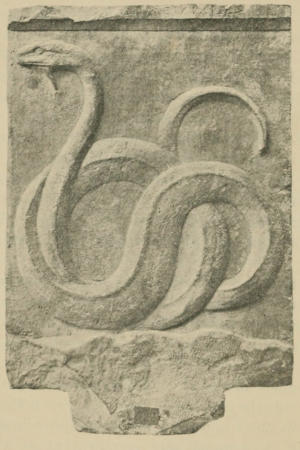
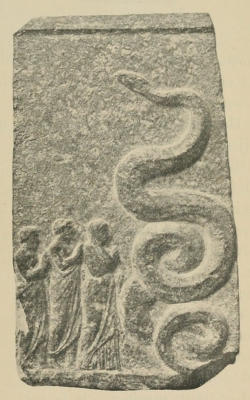
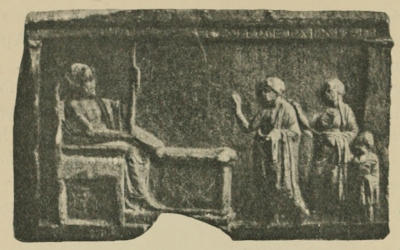
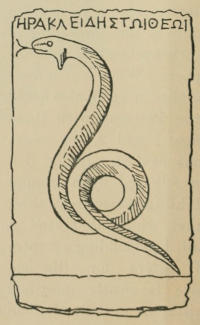
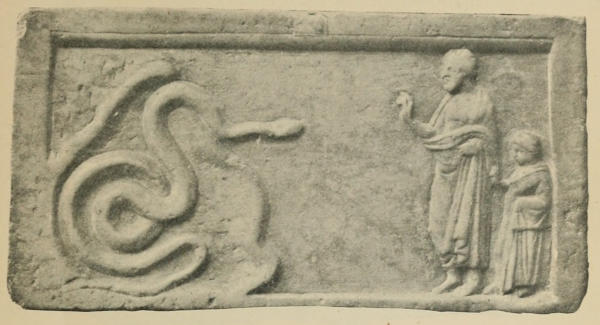
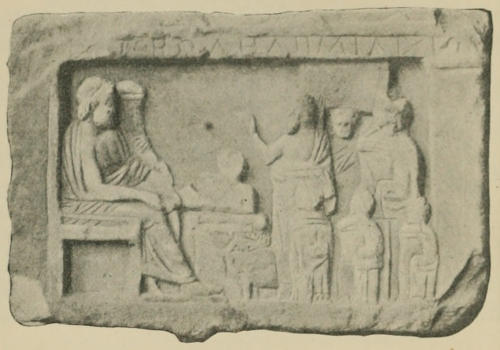
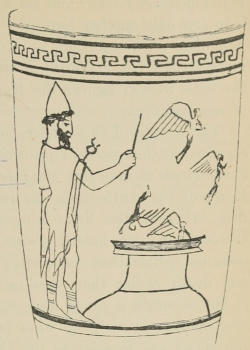
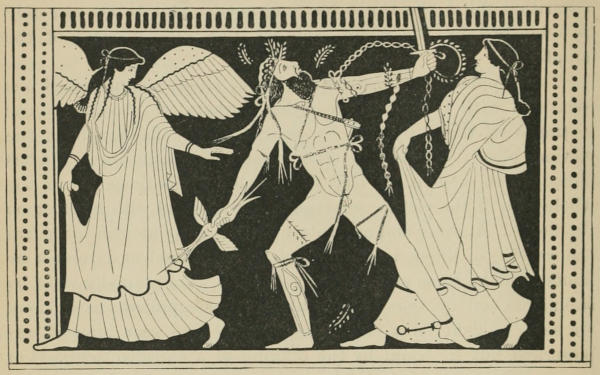
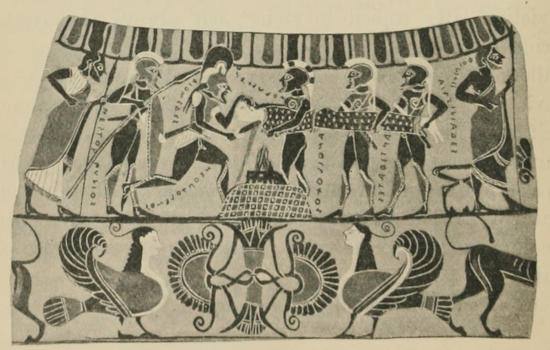
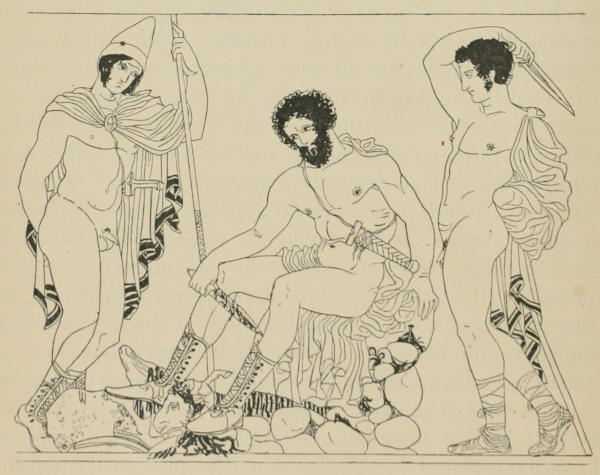
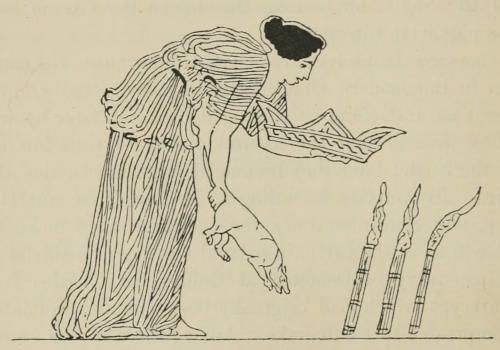
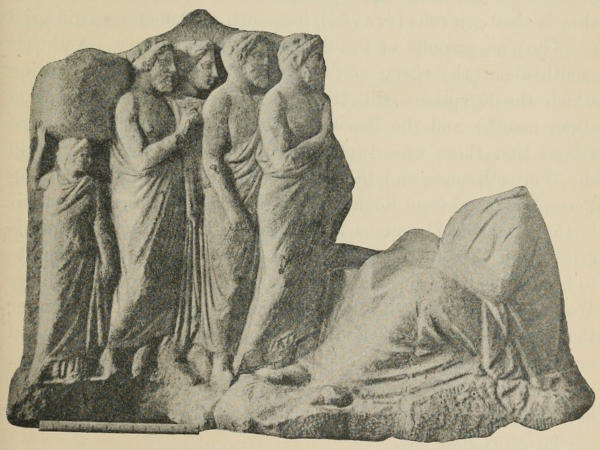
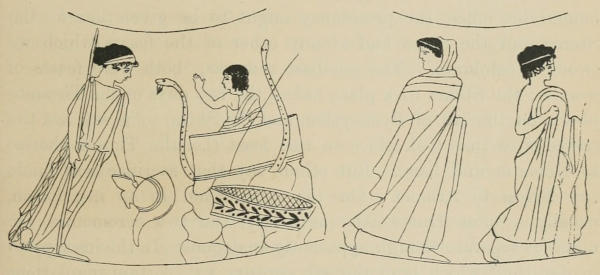
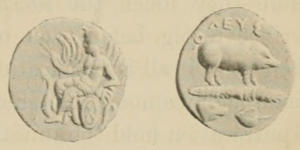
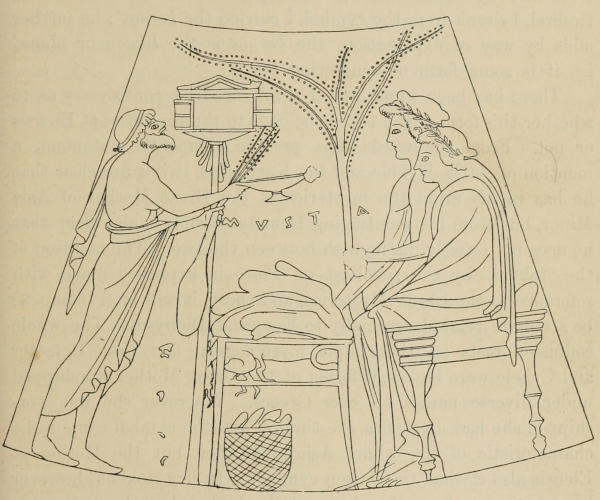
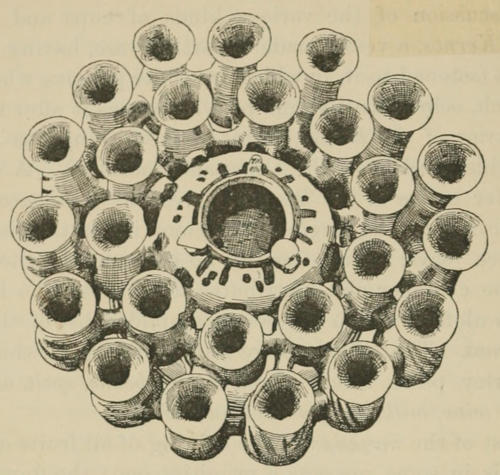
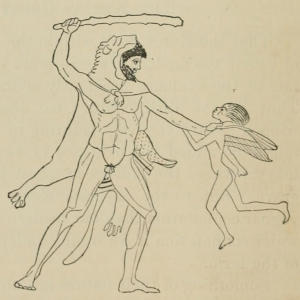
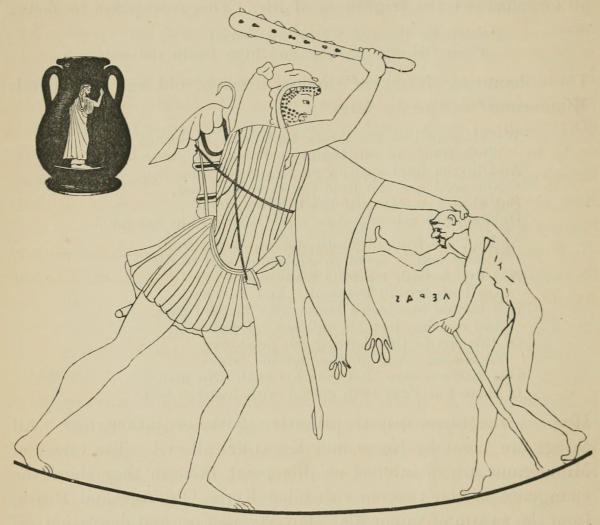
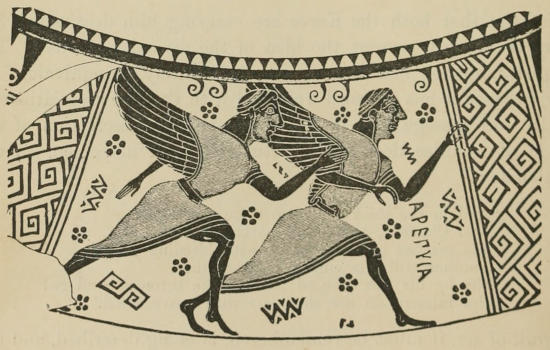
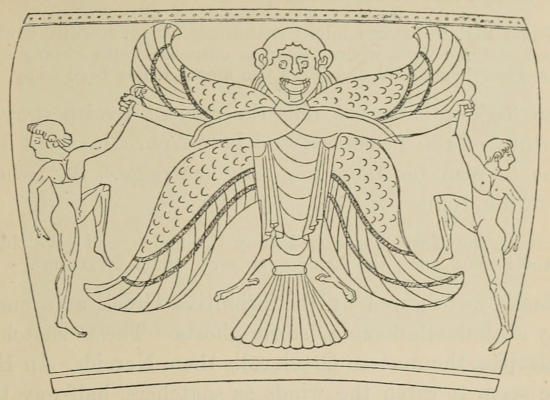
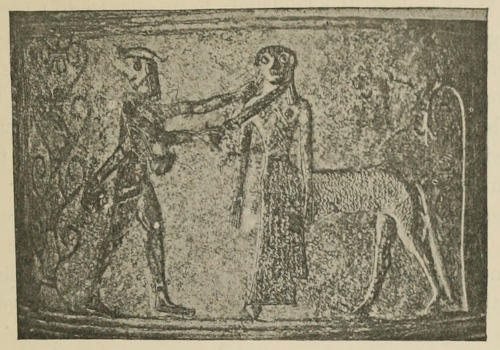
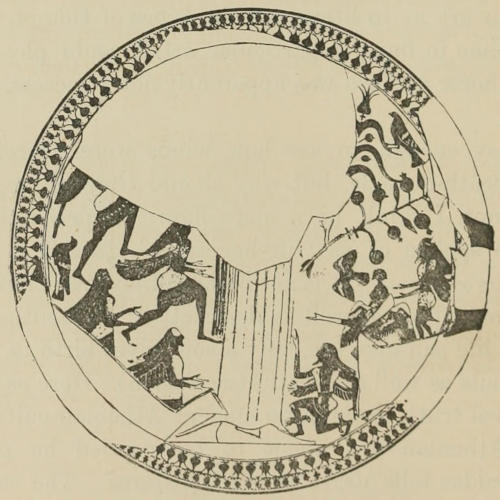
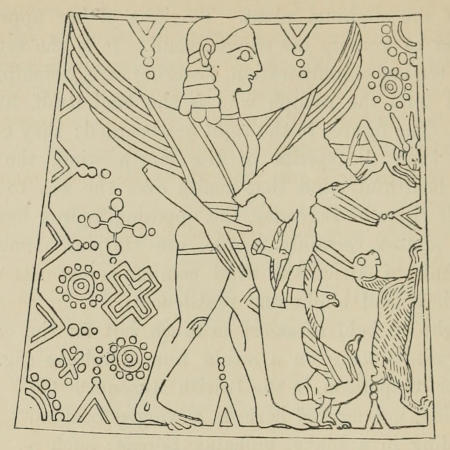
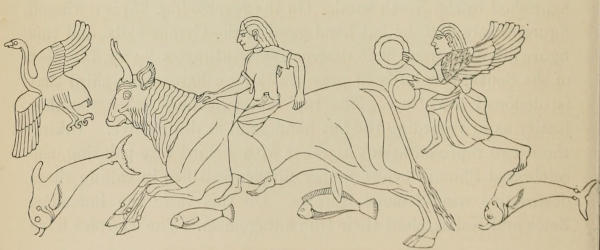
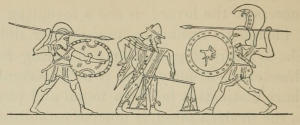
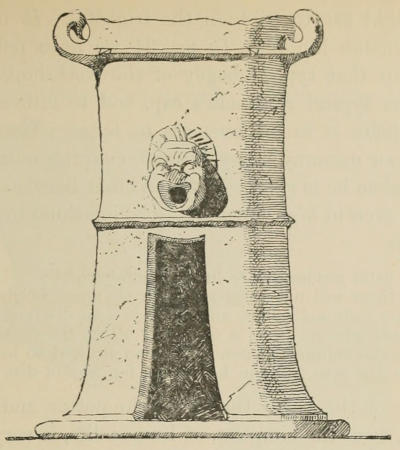
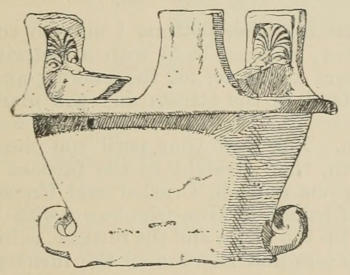
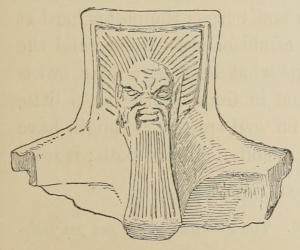
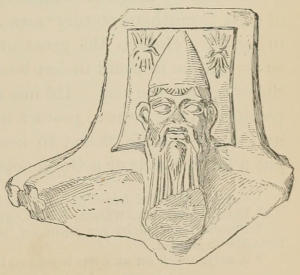
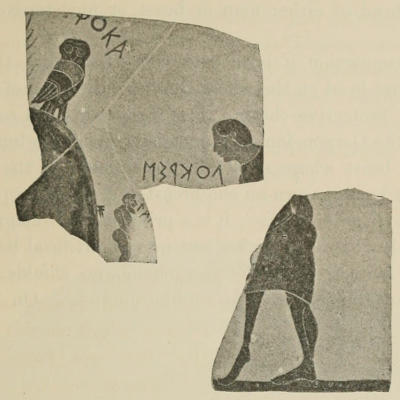
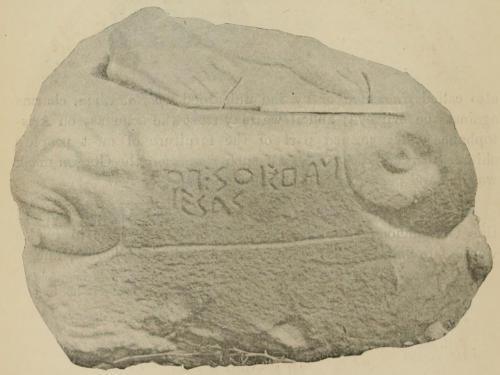
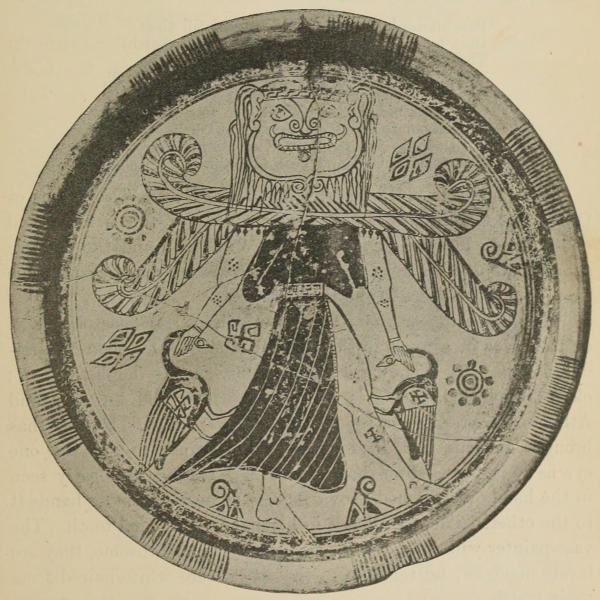
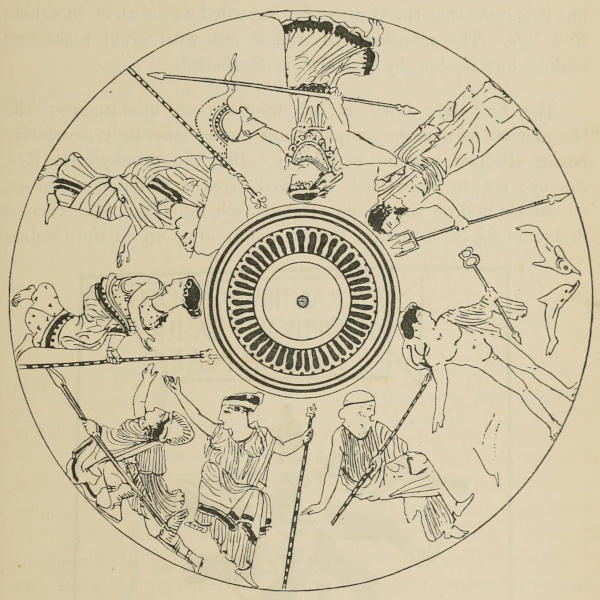
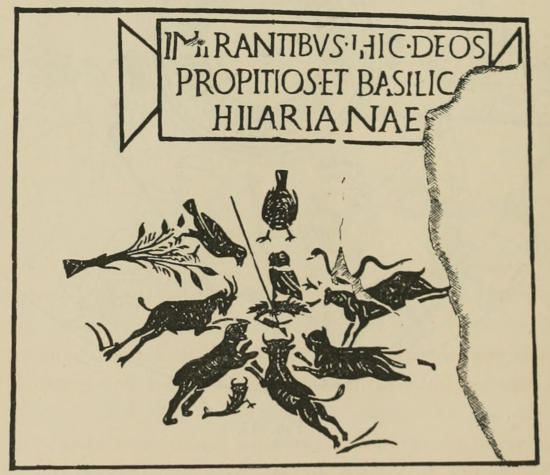
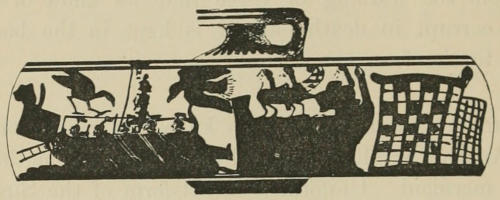
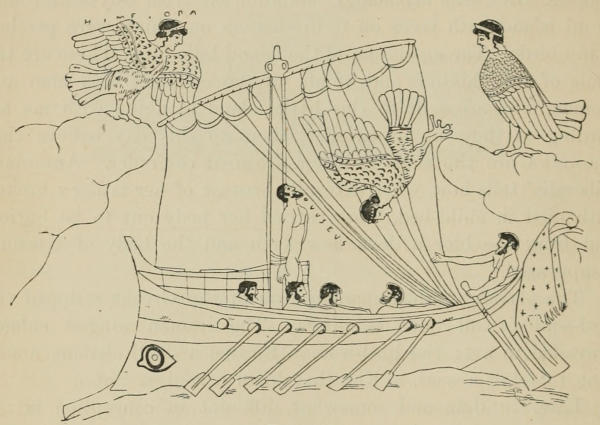
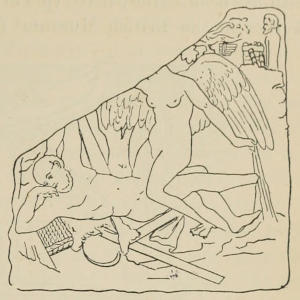
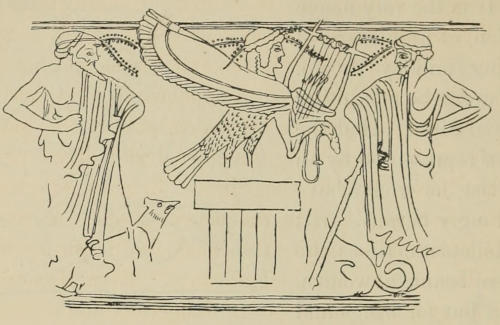
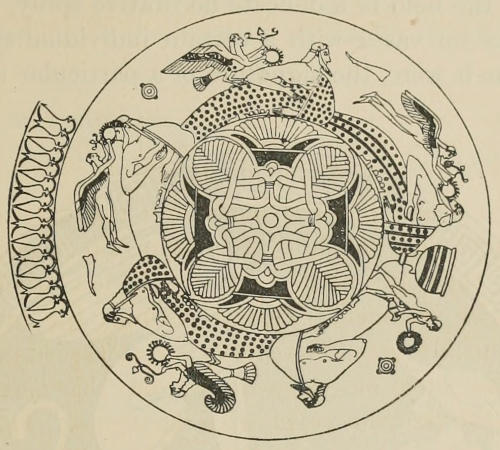
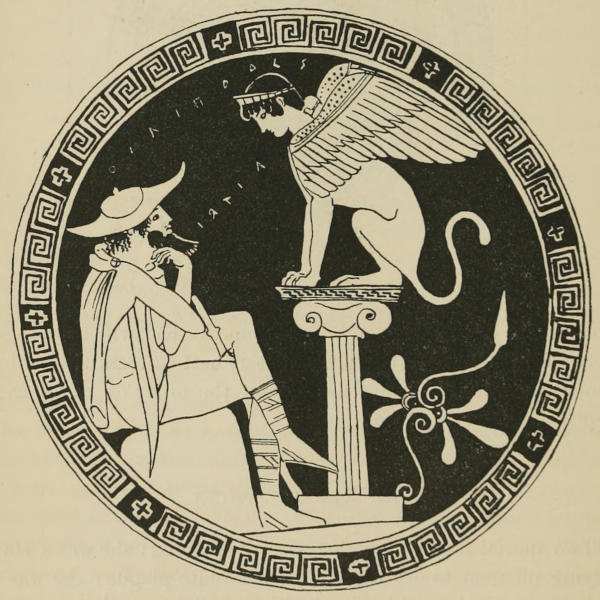
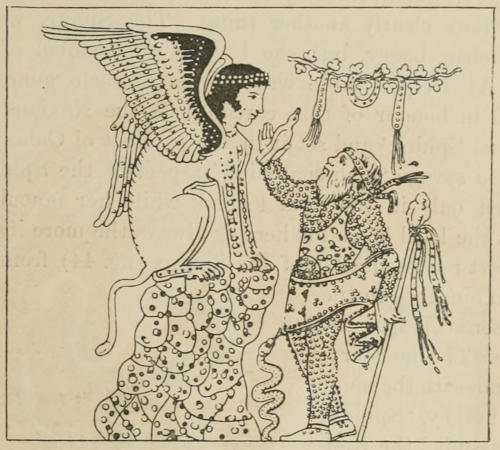
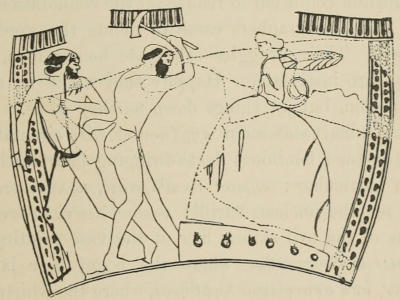
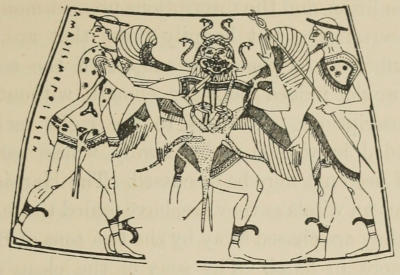
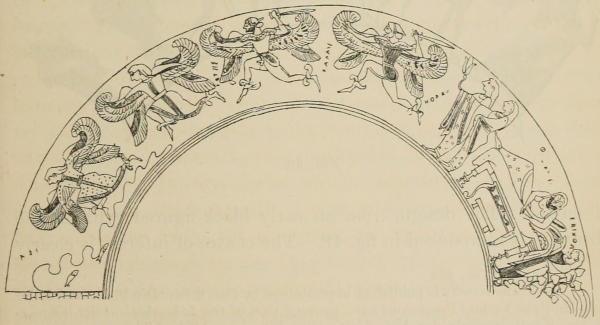
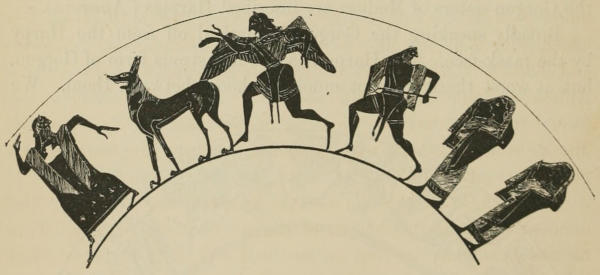
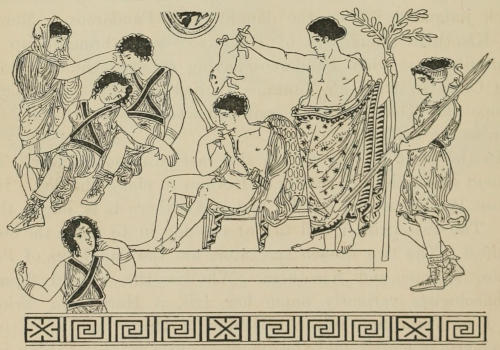
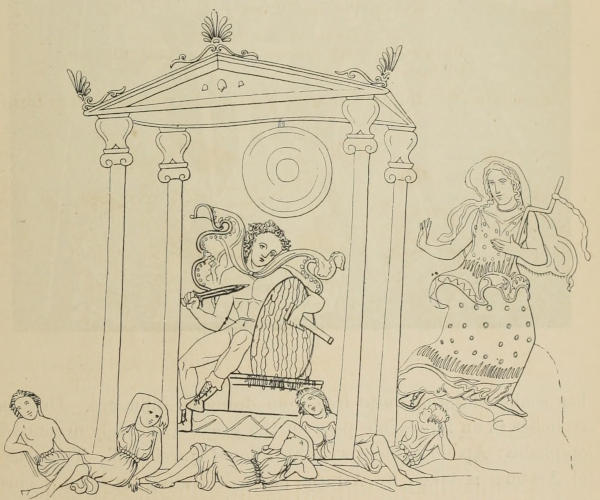
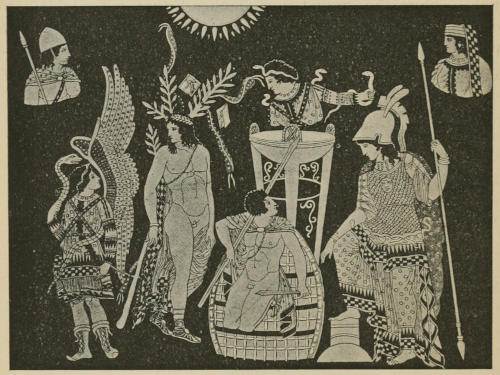
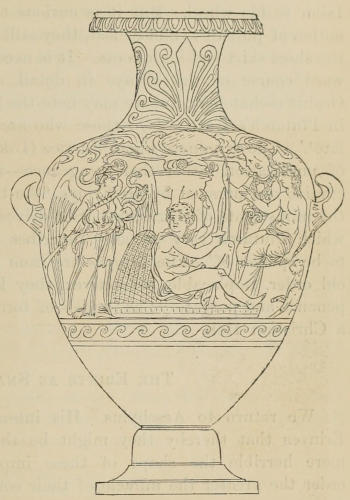
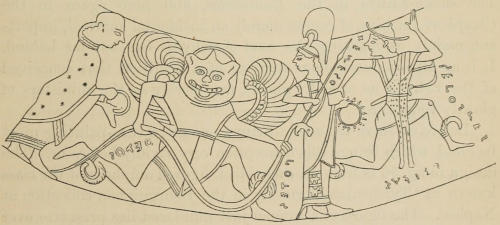
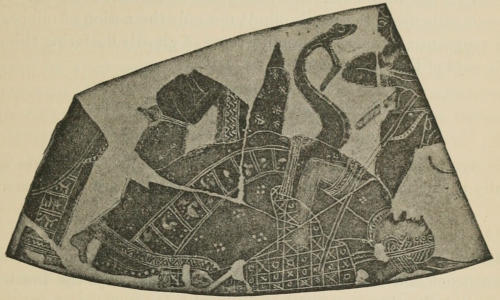
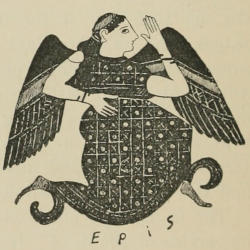
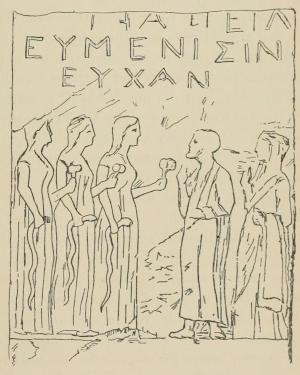
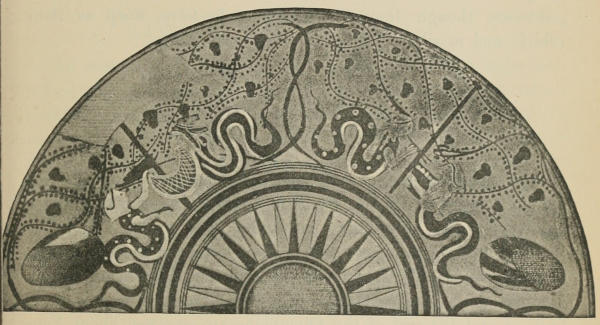
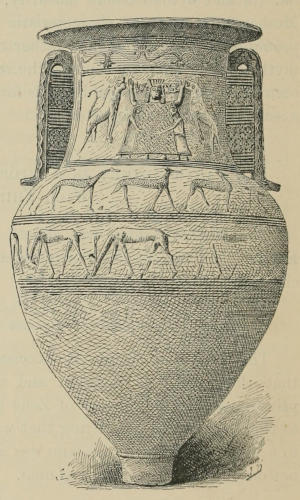
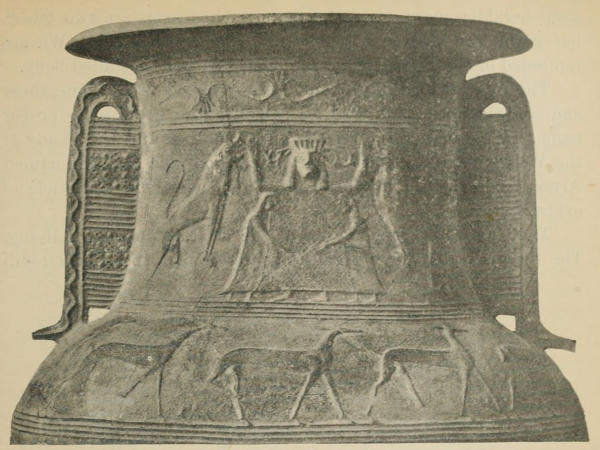
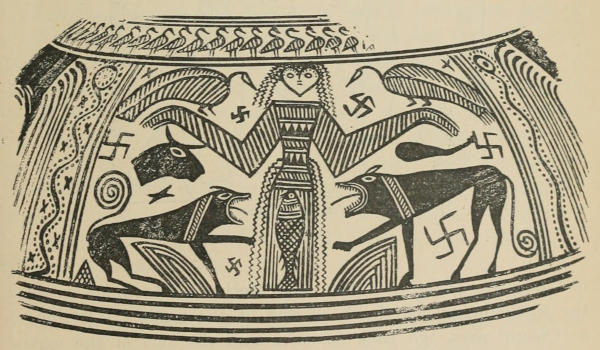
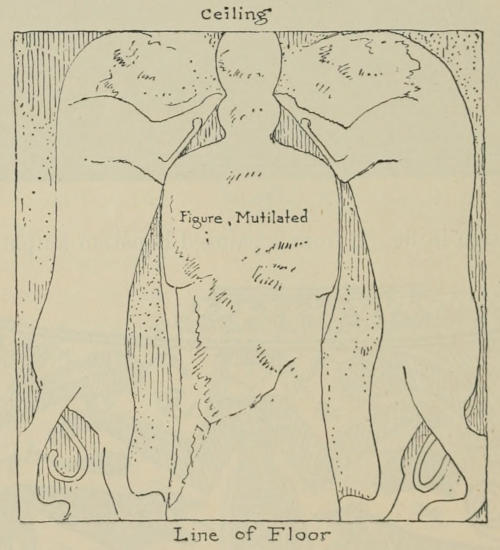
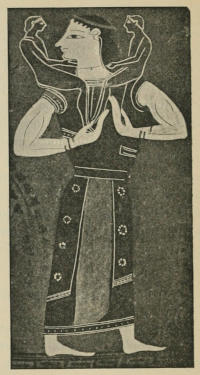
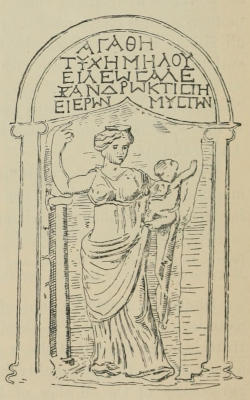
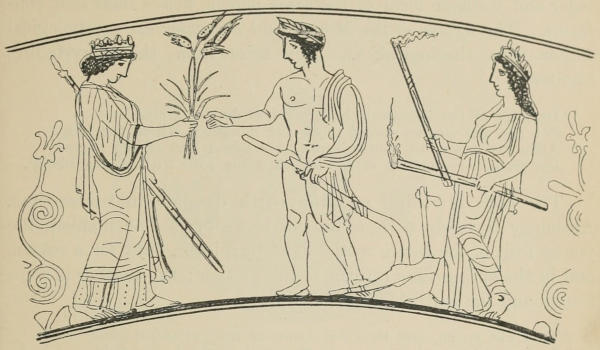
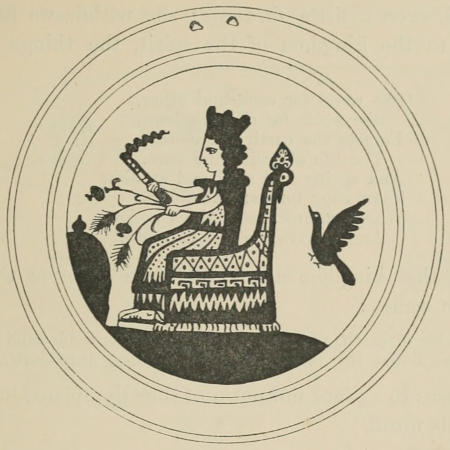
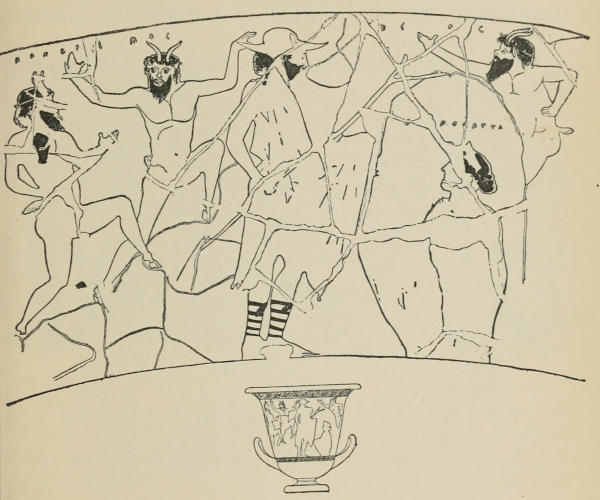
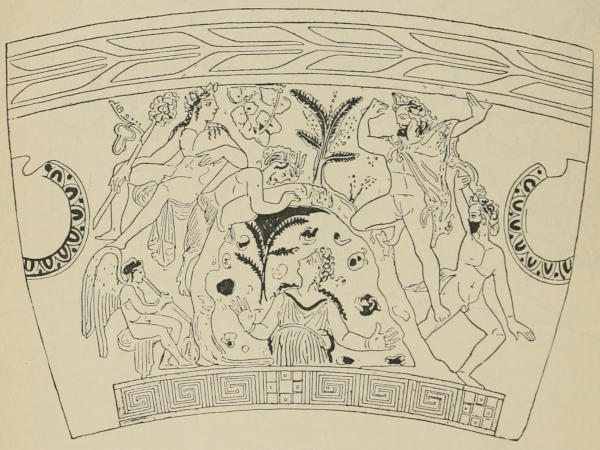
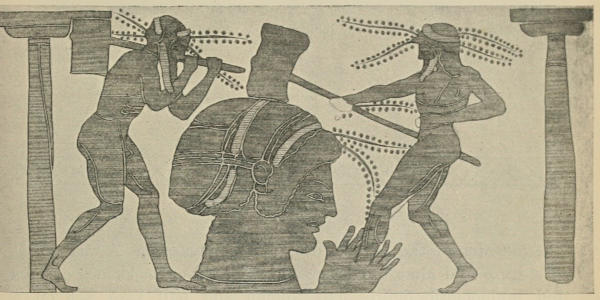
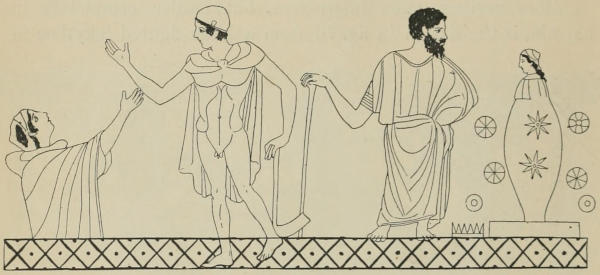
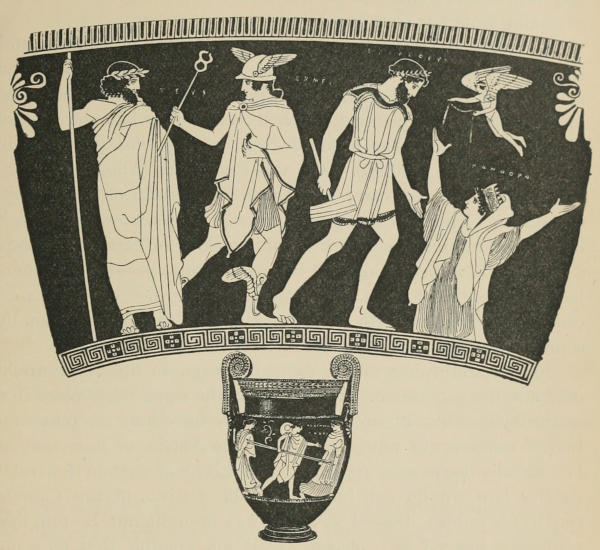
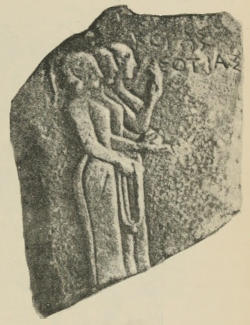
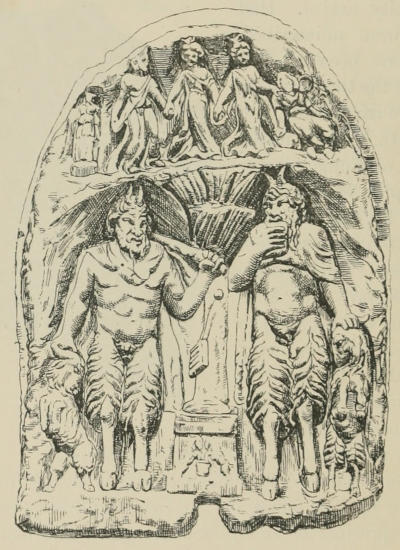
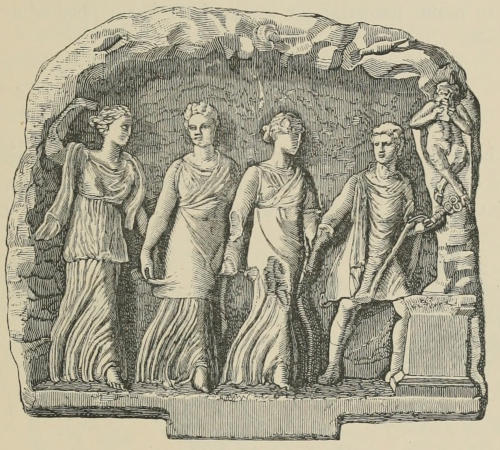
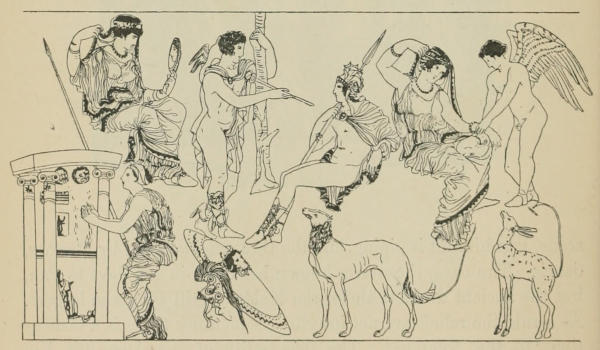
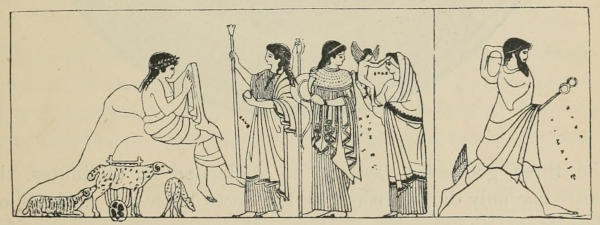
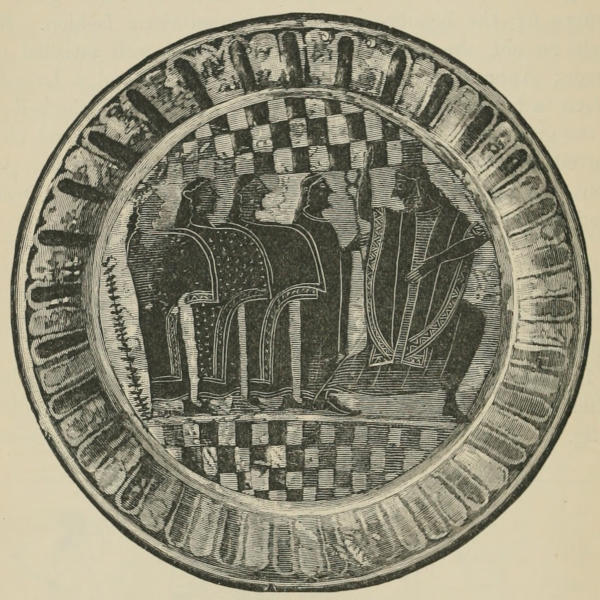
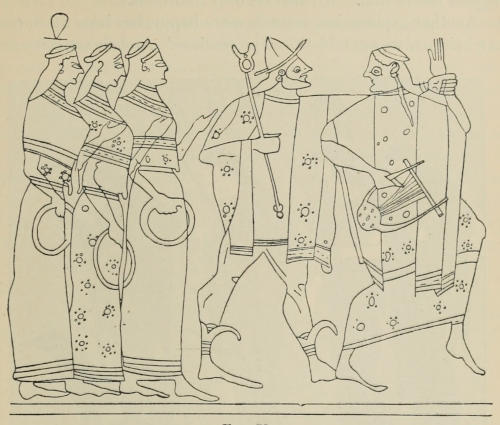
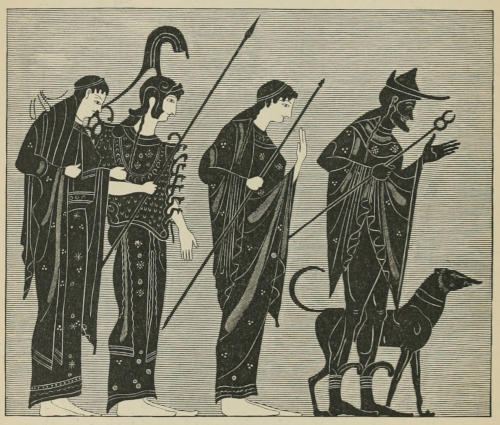
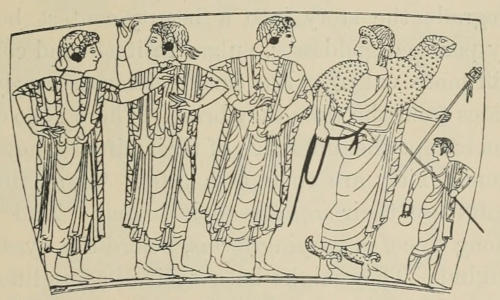
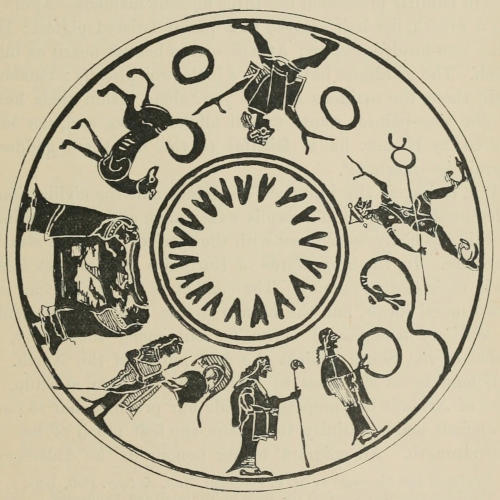
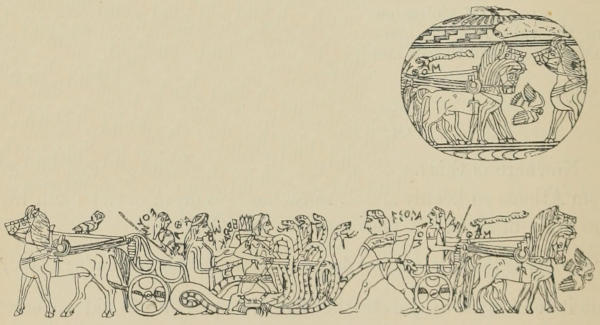
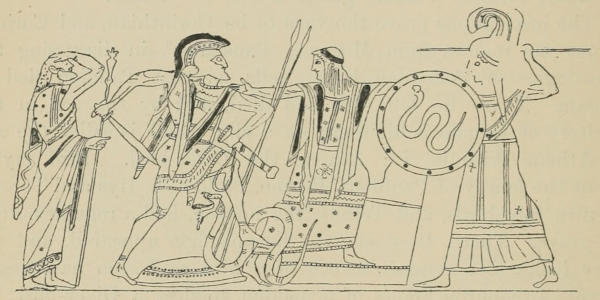
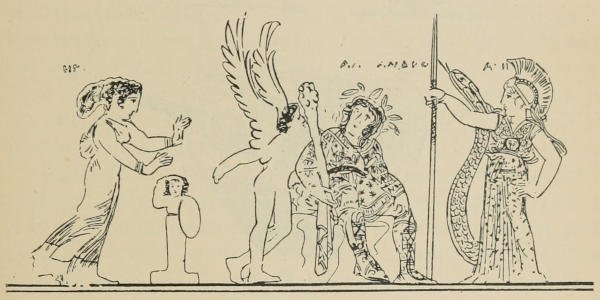
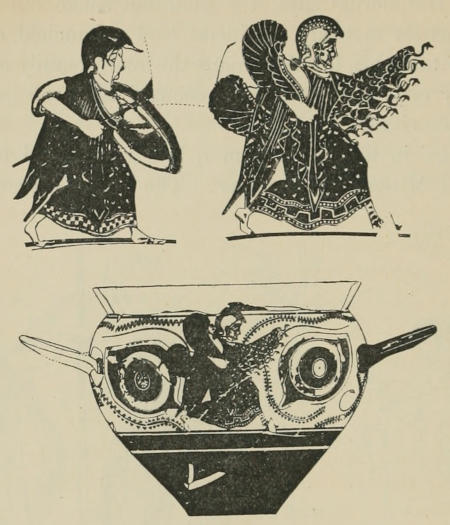
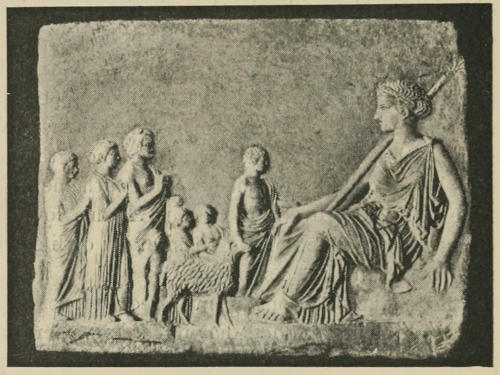
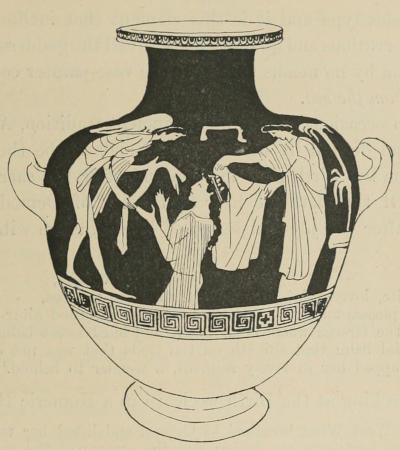
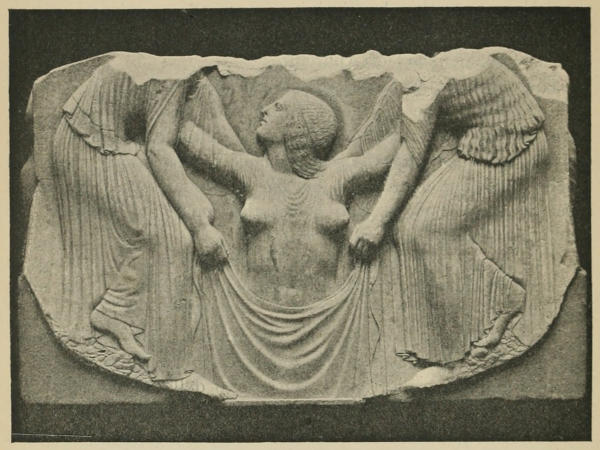
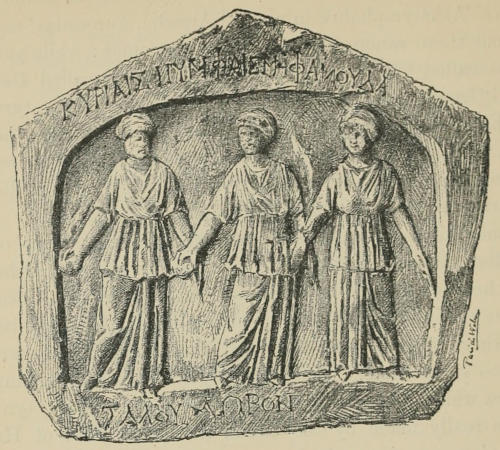
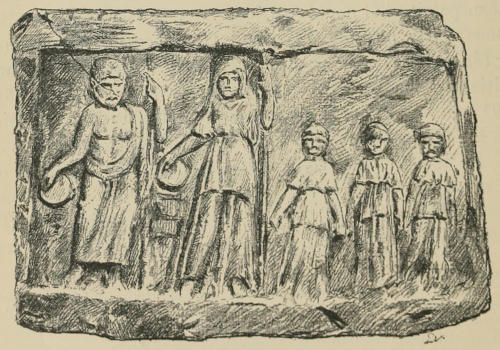
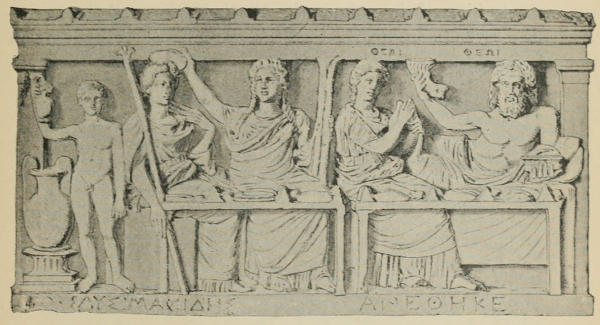
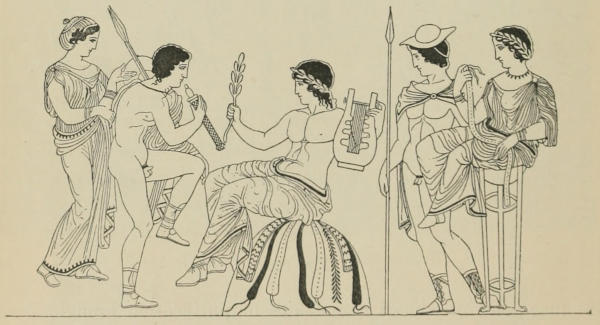
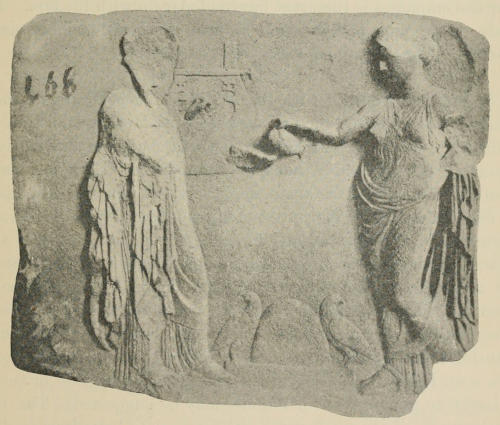
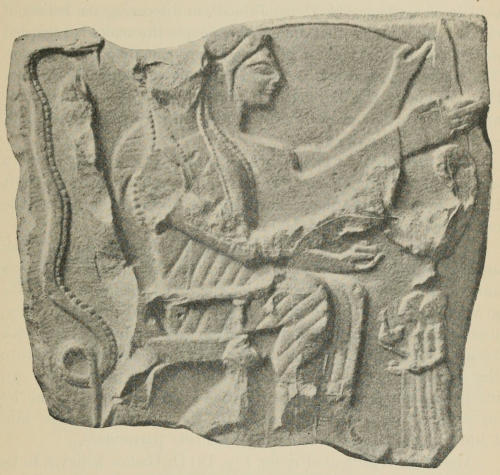
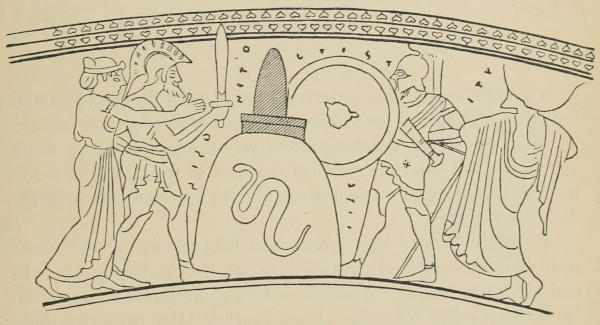
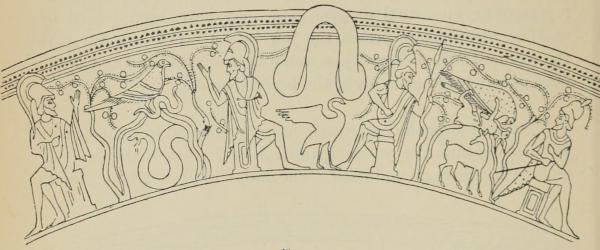
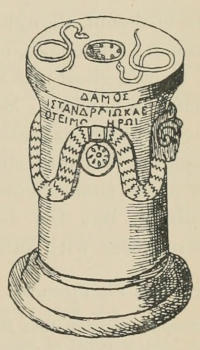
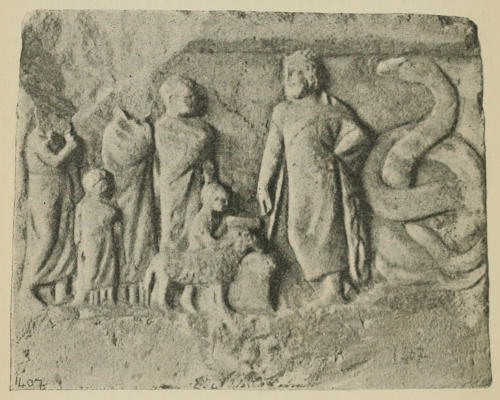
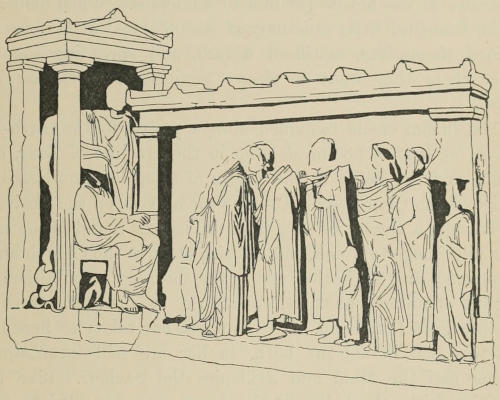
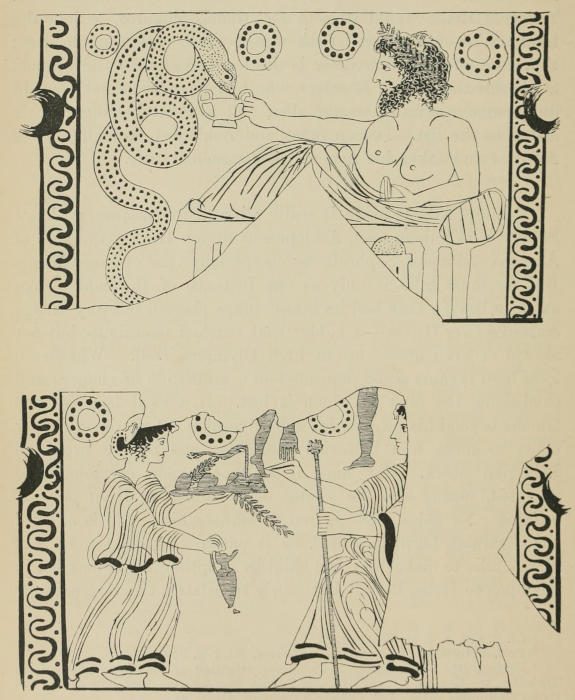
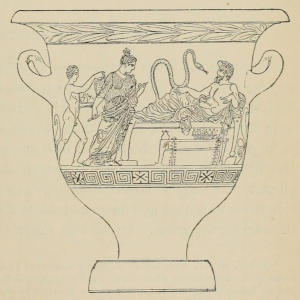
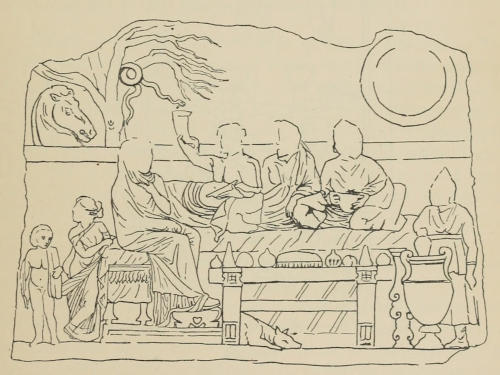
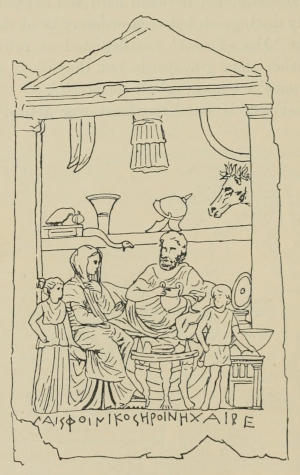
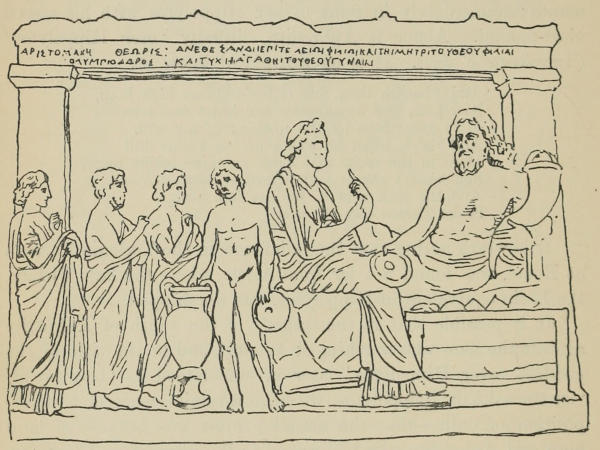
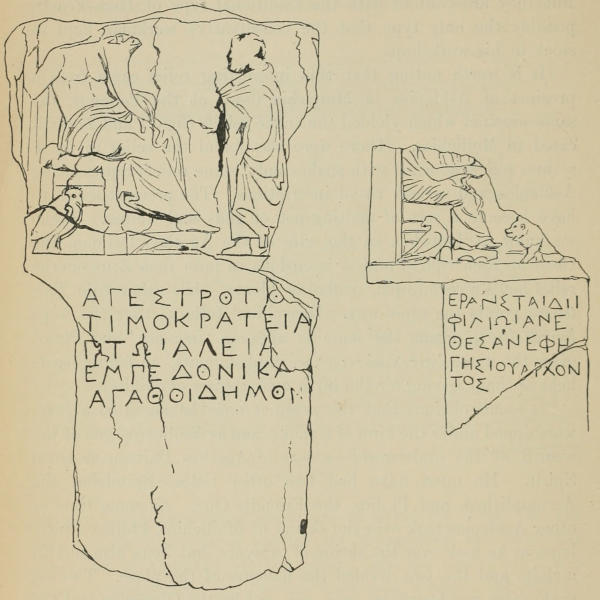
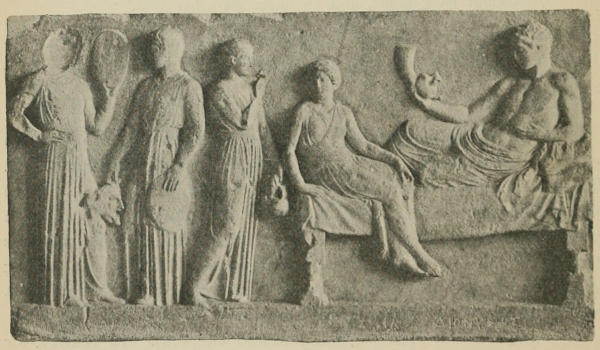
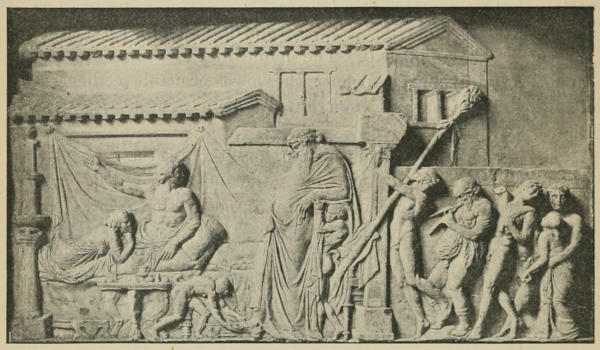
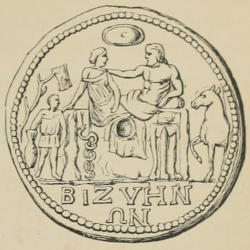
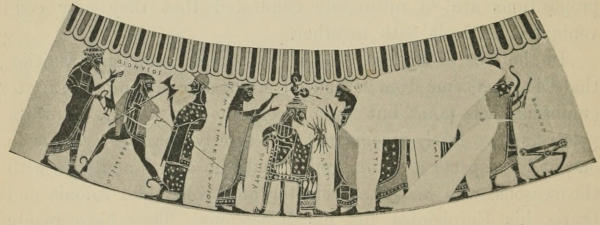
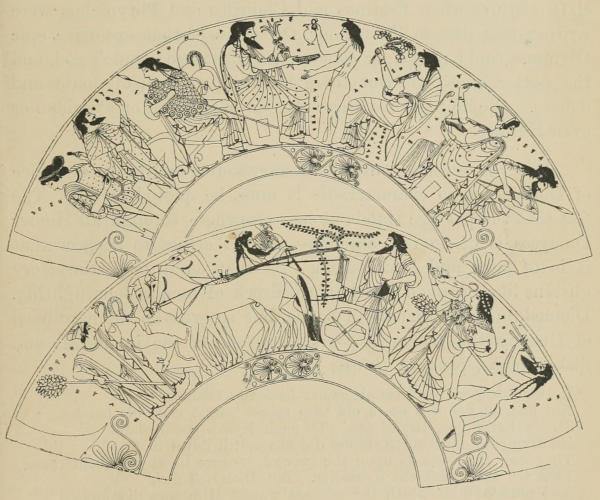
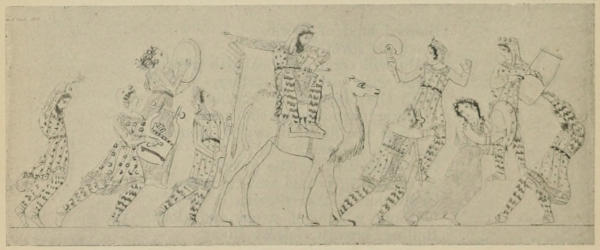
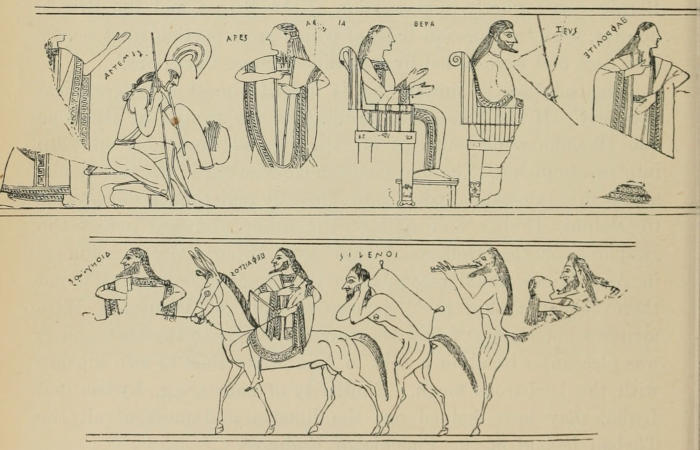
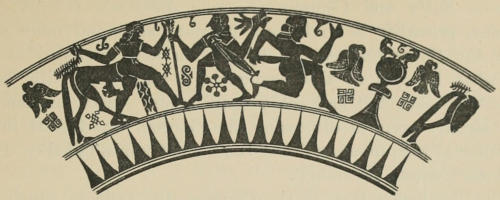
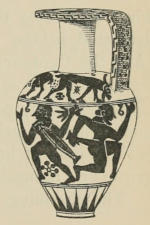
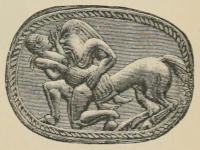
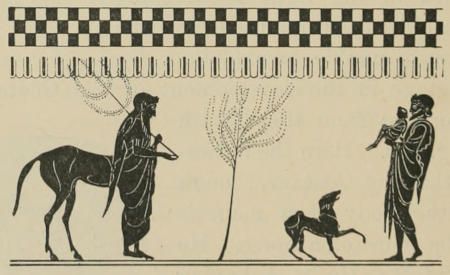
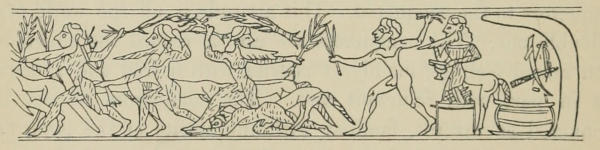
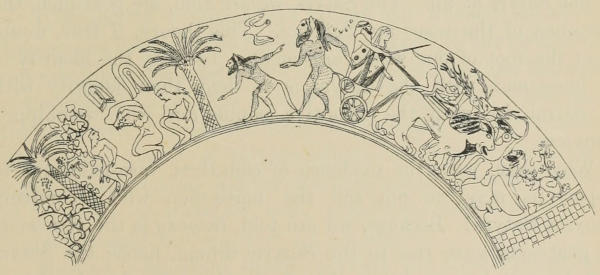
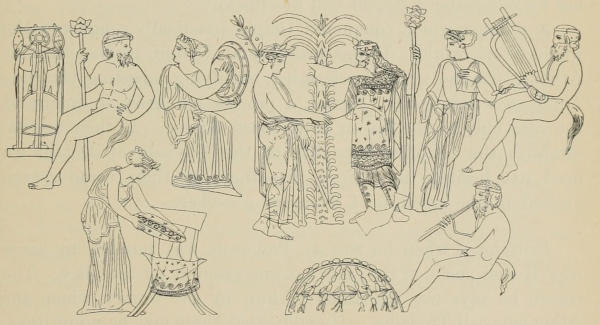
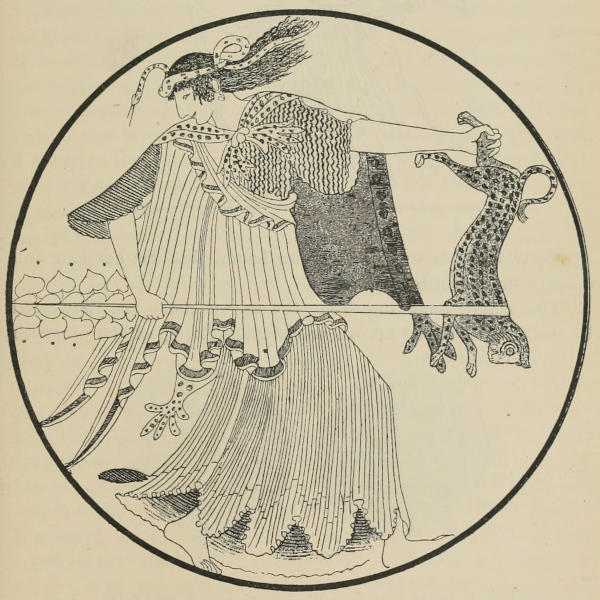
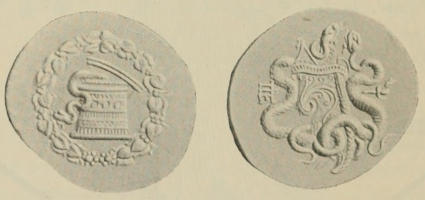
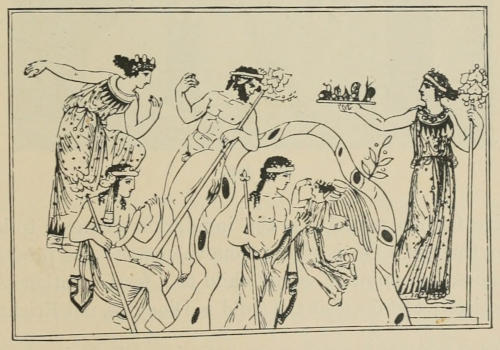
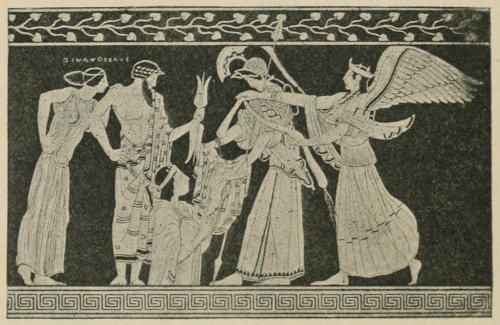
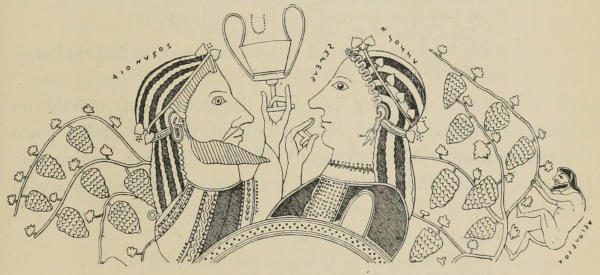
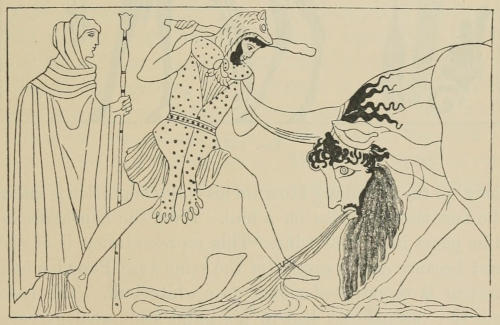
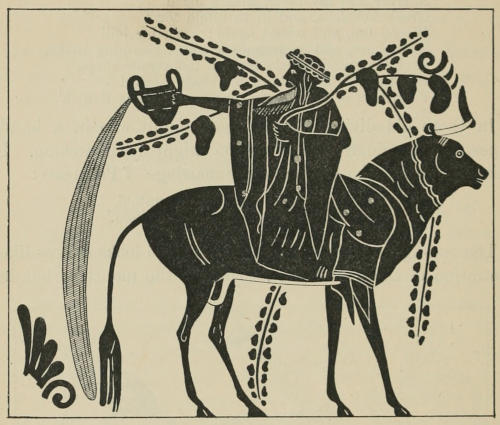
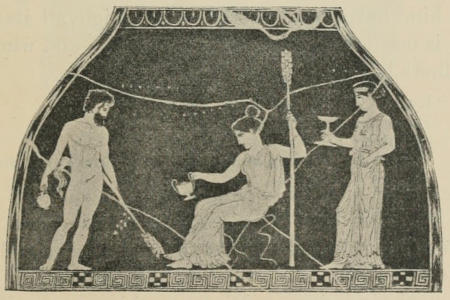
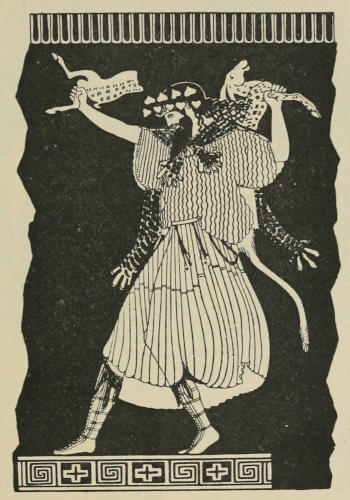
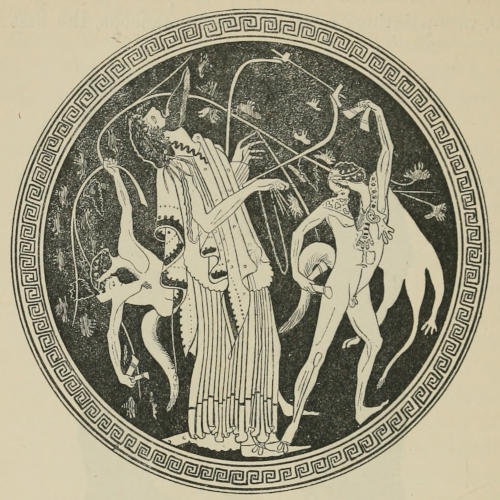
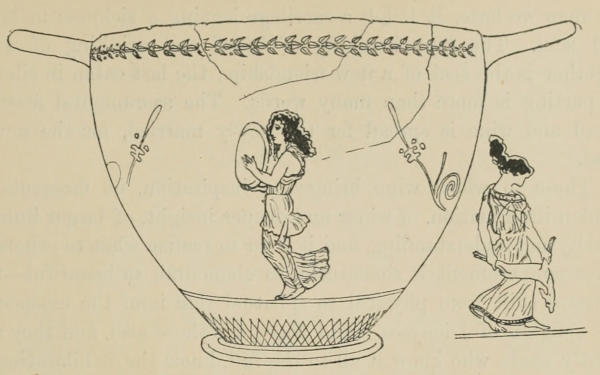
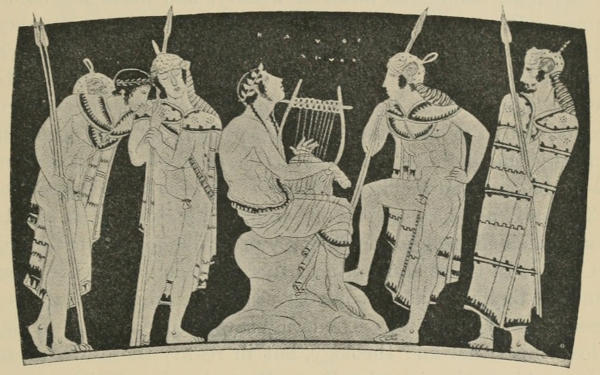
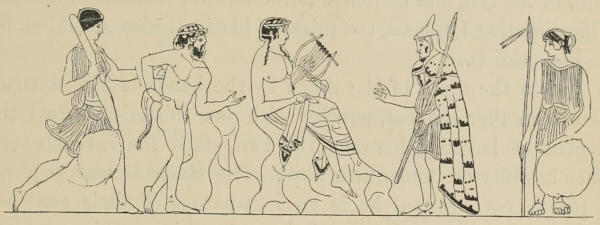
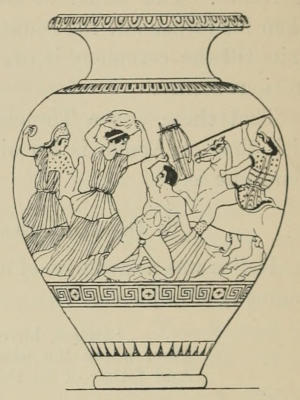
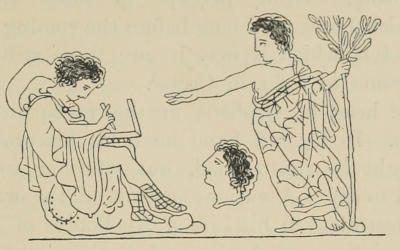
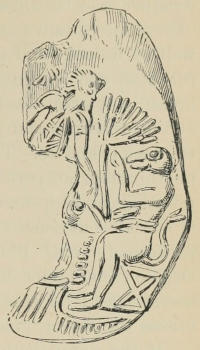
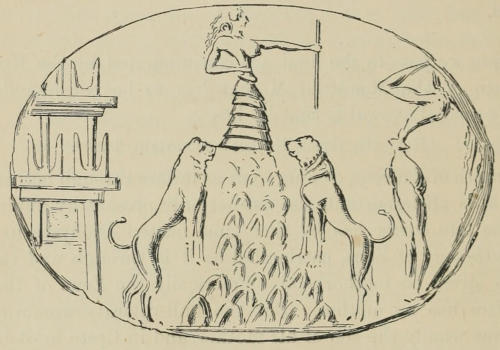
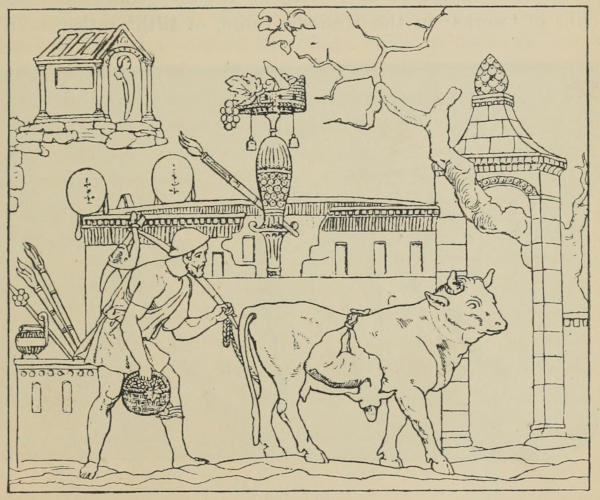
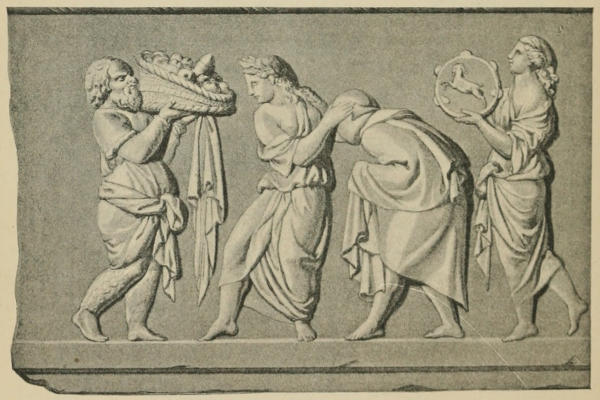
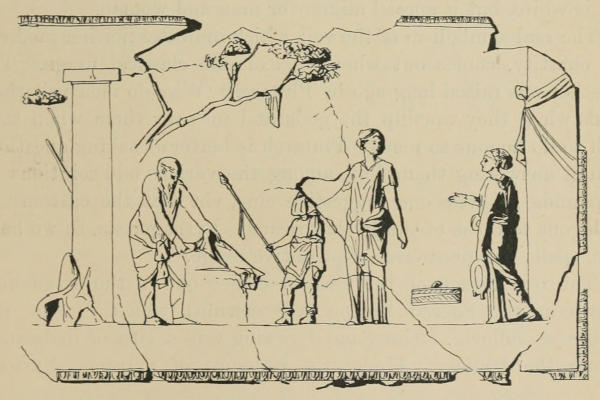
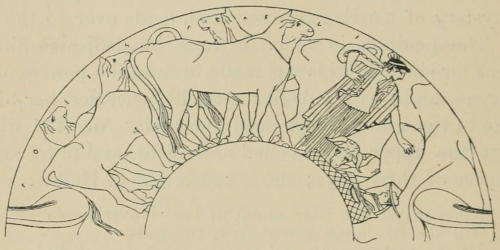
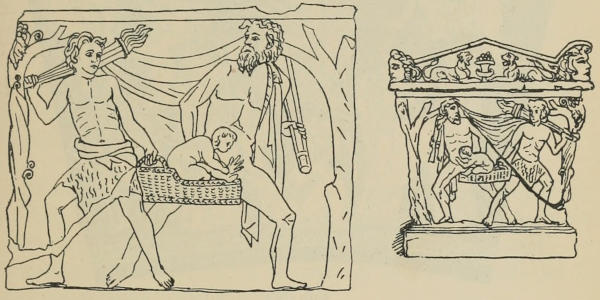
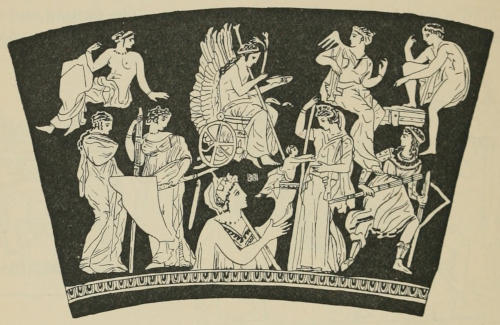
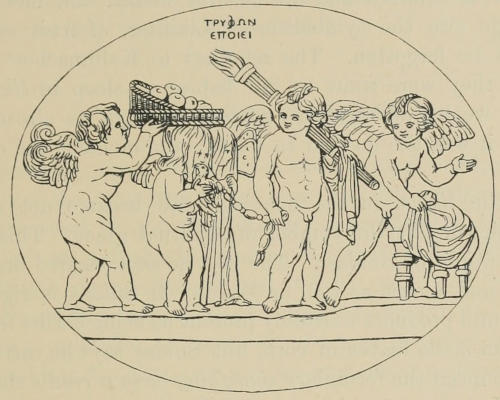
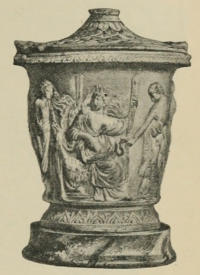
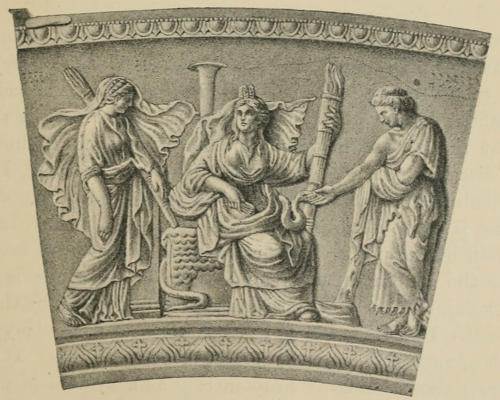
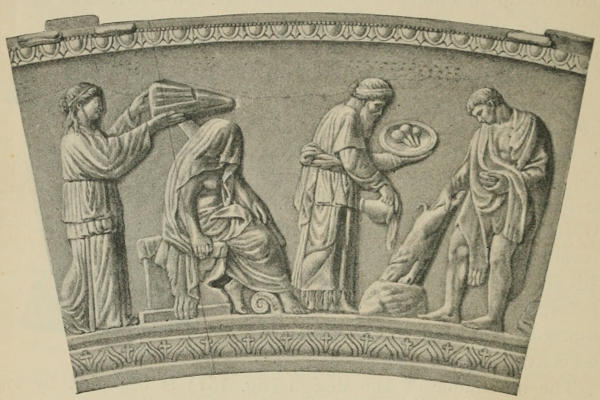
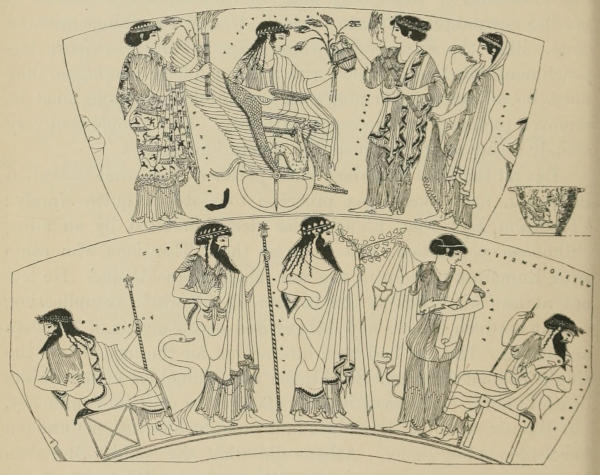
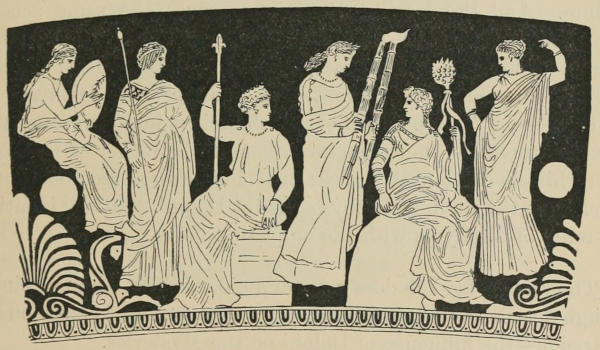
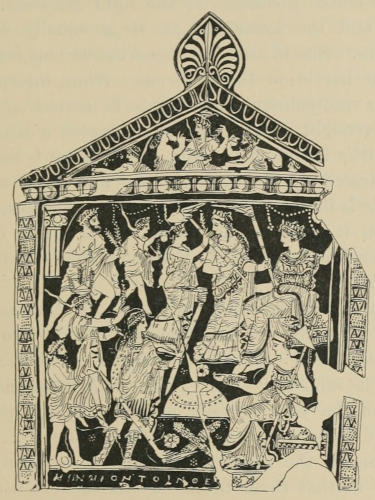
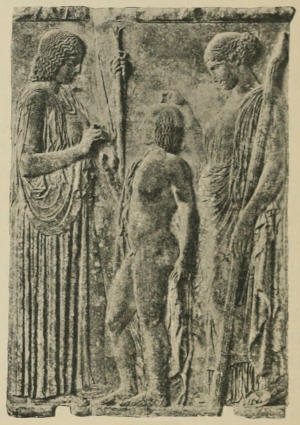
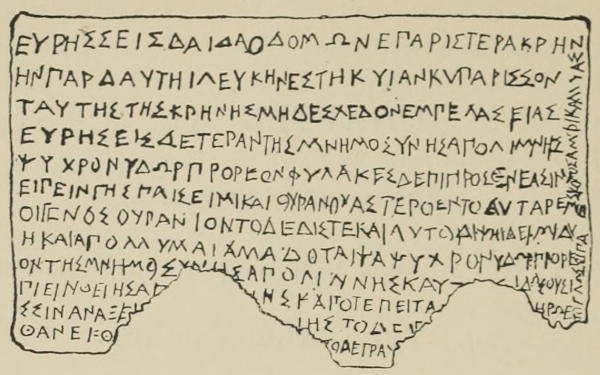
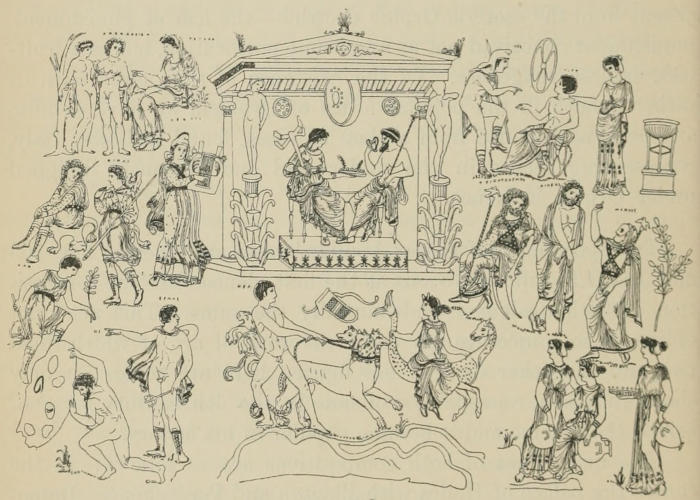
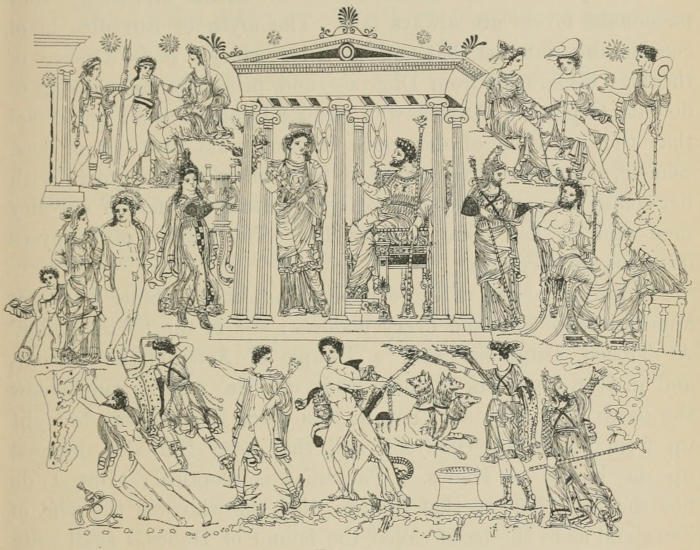
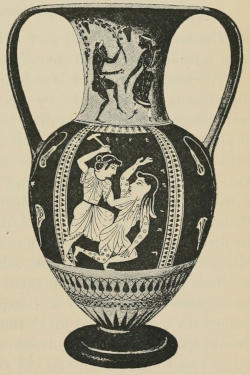
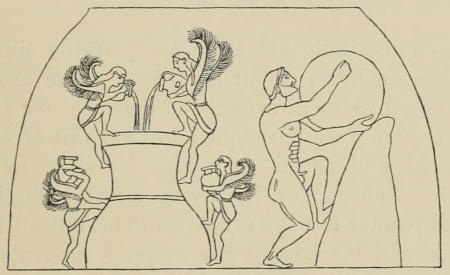
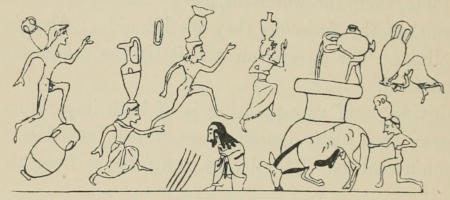
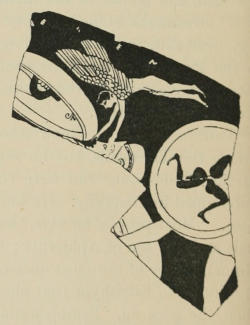
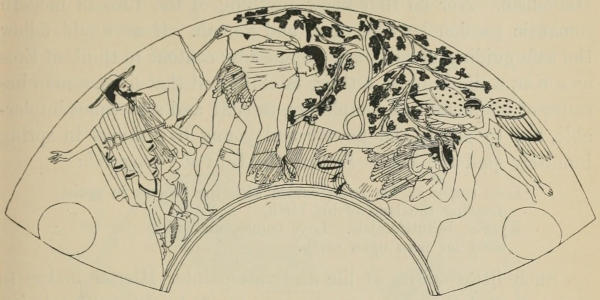
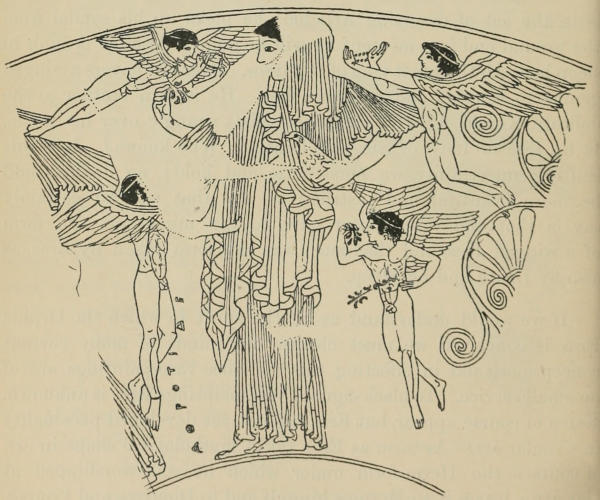
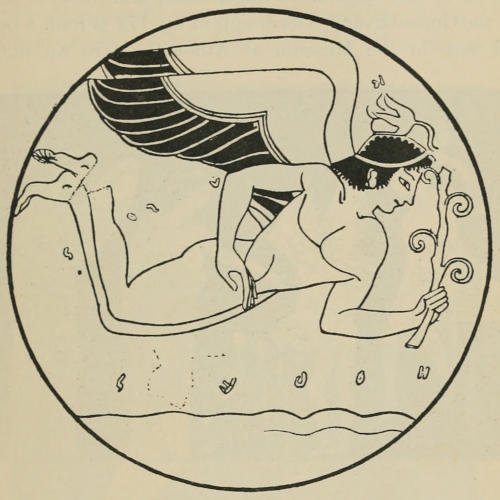
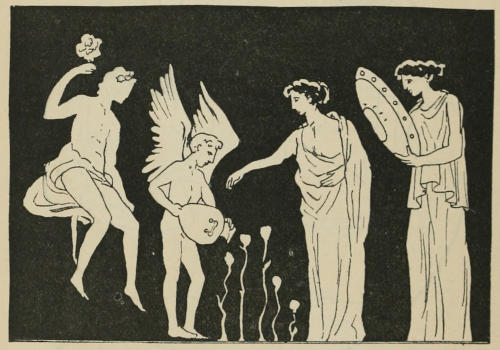
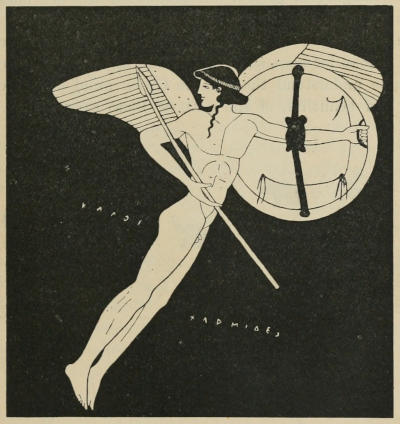
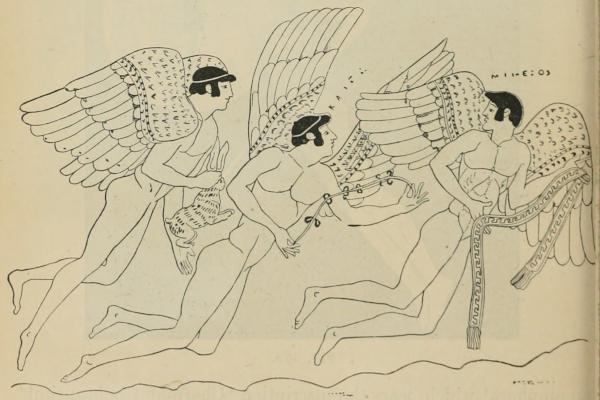
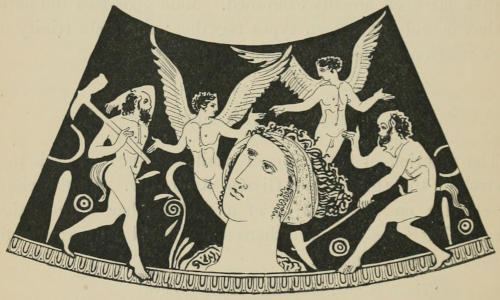
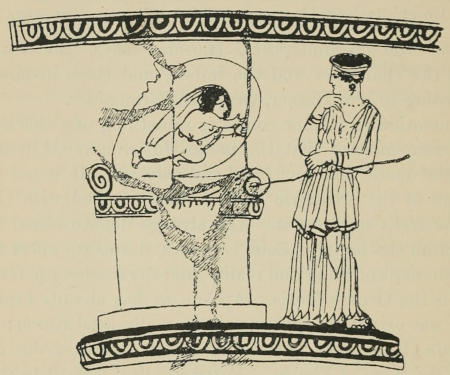
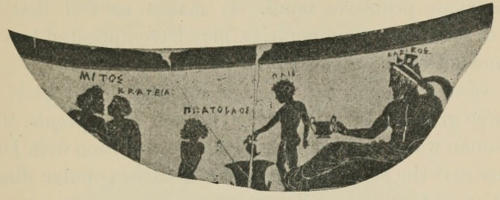
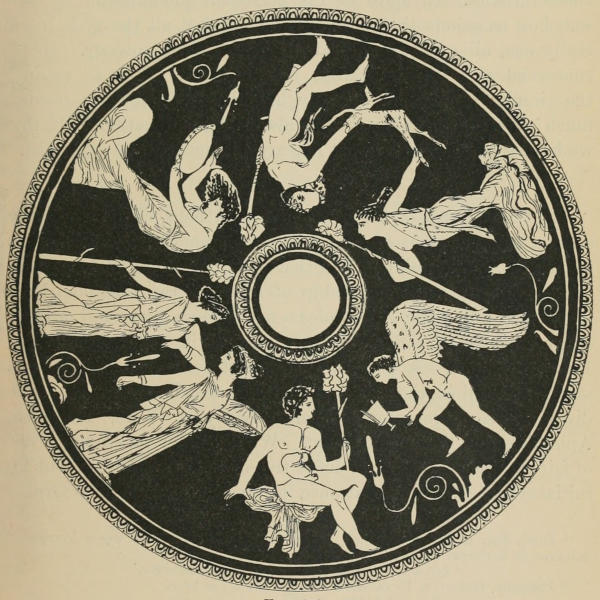
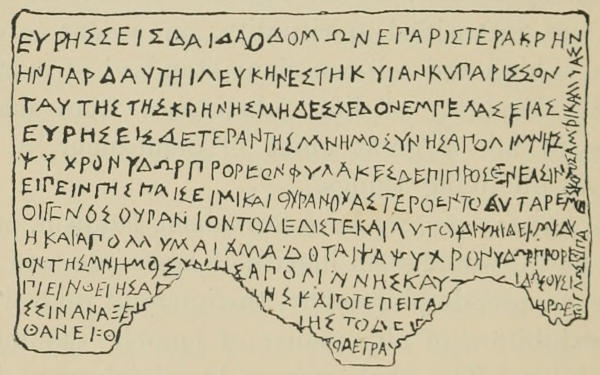
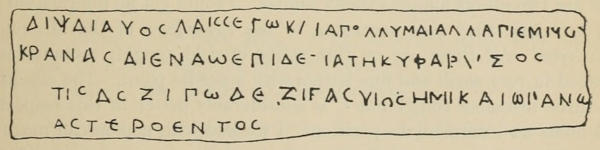
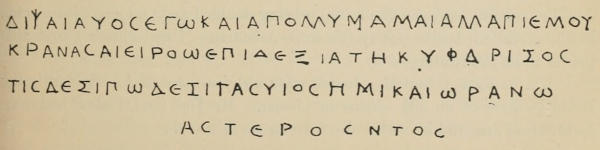
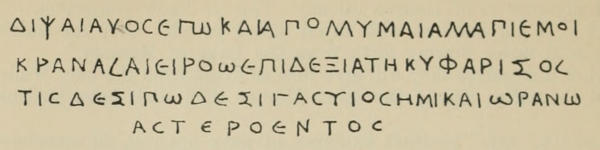
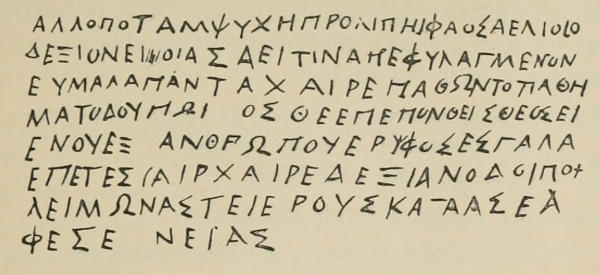
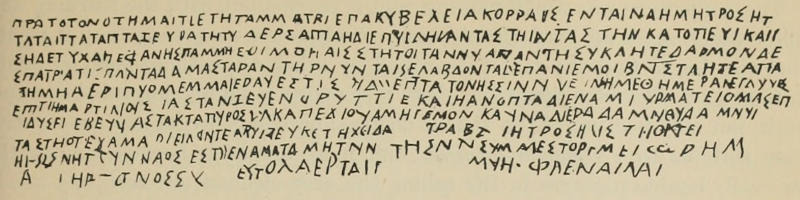
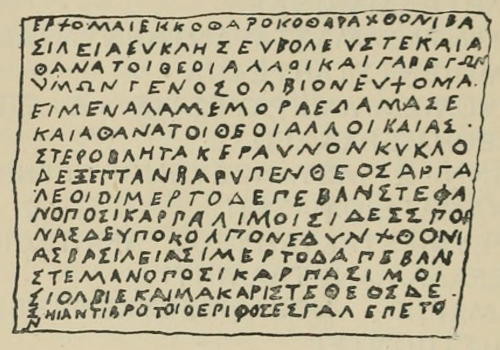
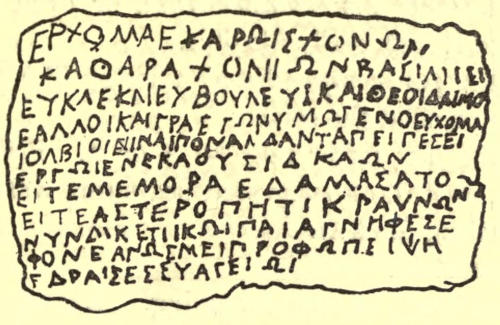
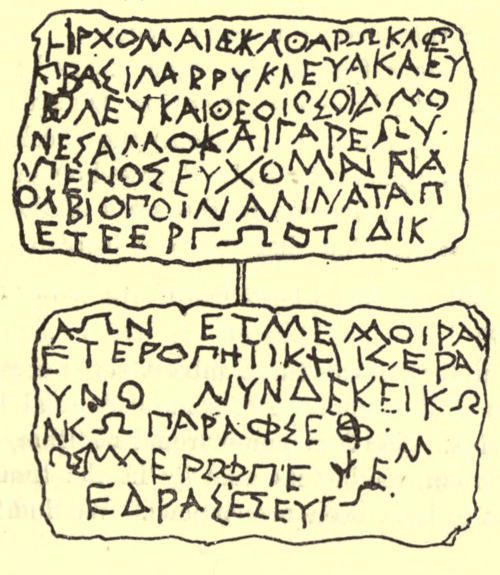
 Ο ΒΑΣΙΛΕΑΕ̣