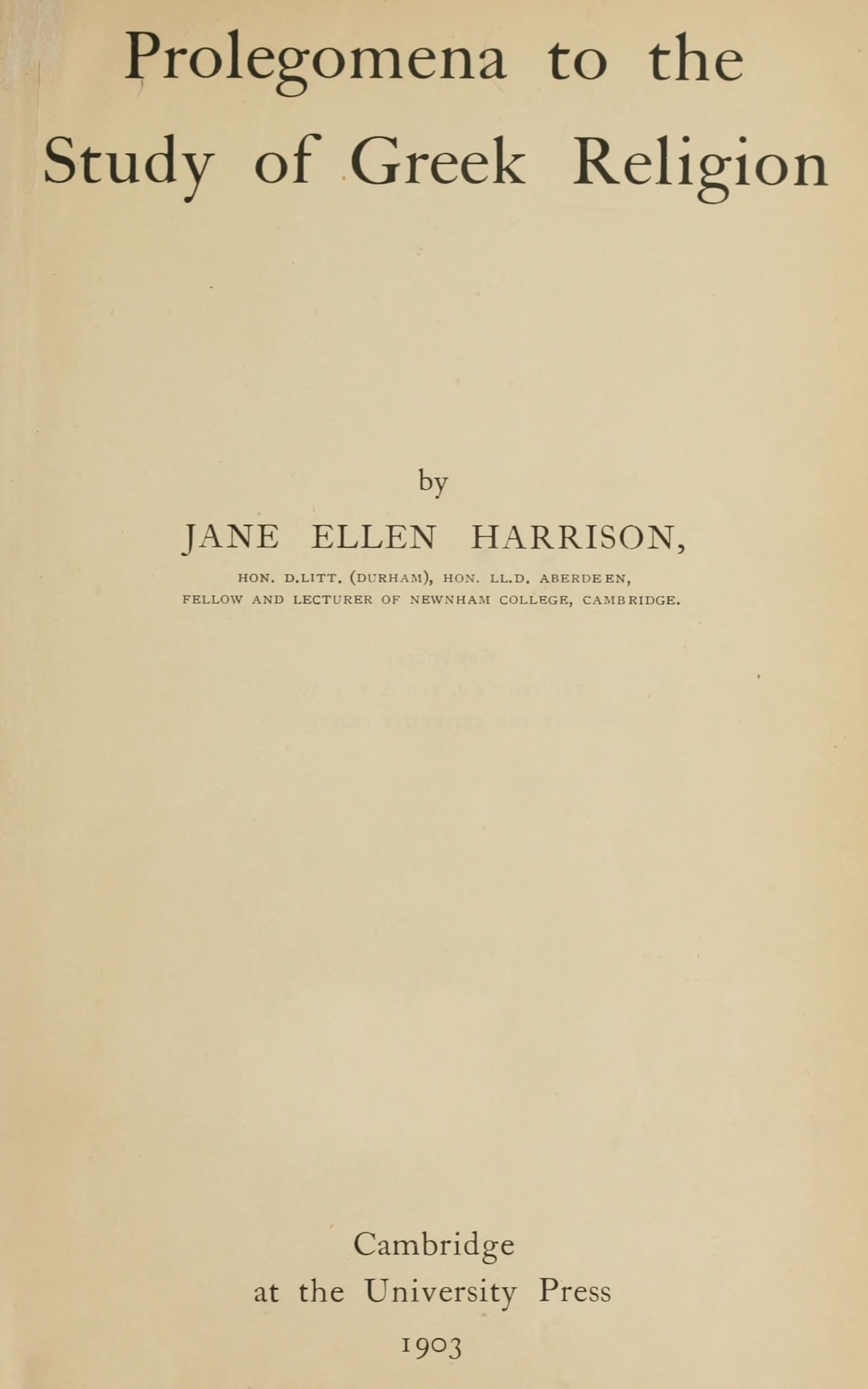
Prolegomena to the study of Greek religion
by Jane Ellen Harrison
★★★★★No ratings yet
Language: English
Sign in to rate this book.
Sign in to shelve this book.
About this eBook
- Author
- Harrison, Jane Ellen, 1850-1928
- Original Publication
- Cambridge: University Press, 1903.
- Credits
- deaurider and the Online Distributed Proofreading Team at www.pgdp.net (This file was produced from images generously made available by The Internet Archive)
- Language
- English
- LoC Class
- BL: Philosophy, Psychology, Religion: Religion: General, Miscellaneous and Atheism
- Subject
- Cults -- Greece
- Category
- Text
- Project Gutenberg
- eBook-No. 78248
- Release Date
- March 19, 2026
- Copyright
- Public domain in the USA.
Contents
- 1.Prolegomena to the Study of Greek Religion
- 2.Untitled
- 3.INTRODUCTION.
- 4.TABLE OF CONTENTS.
- 5.CHAPTER I. OLYMPIAN AND CHTHONIC RITUAL. — The Diasia. — ATTIC CALENDAR.
- 6.CHAPTER II. THE ANTHESTERIA. The Ritual of Ghosts and Sprites. — Anthesterion and February. — The Ritual of Ἐναγισμοί.
- 7.CHAPTER III. HARVEST FESTIVALS. The Thargelia, Kallynteria, Plynteria. — Thargelion and Thargelia. — The Pharmakos. — Kallynteria, Plynteria.
- 8.CHAPTER IV. THE WOMEN’S FESTIVALS. Thesmophoria, Arrephoria, Skirophoria, Stenia, Haloa. — The Thesmophoria. — Arrephoria, Skirophoria, Stenia. — The Curse and the Law. — The Haloa. — The Eleusinian Mysteries.
- 9.CHAPTER V. THE DEMONOLOGY OF GHOSTS AND SPRITES AND BOGEYS. — The Ker as Ghost and Sprite. — The Keres of Old Age and Death. — The Ker as Harpy and Wind-demon. — The Ker as Fate. — The Ker as Gorgon. — The Ker as Siren [508] . — The Ker as Sphinx. — The Ker as Erinys. — The Erinyes of Aeschylus. — The Tragic Erinyes. — The Erinys as Snake. — The ‘Semnai Theai.’ — The Eumenides.
- 10.CHAPTER VI. THE MAKING OF A GODDESS. — The Mother and the Maid. — The Earth-Mother as Karpophoros or Lady of the Wild Things. — The Mother as Kourotrophos. — Demeter and Kore. — The Anodos of the Maiden Earth-goddesses. — Pandora. — The Maiden-Trinities. — The ‘Judgment of Paris.’ — Athene. — Aphrodite. — Hera.
- 11.CHAPTER VII. THE MAKING OF A GOD. — The Hero as Snake. — The Cultus-Titles. — Asklepios and the Heroes of Healing. — The ‘Hero-Feasts.’ — Dionysos on Hero-reliefs.
- 12.CHAPTER VIII. DIONYSOS. — Dionysos an immigrant Thracian. — The Satyrs. — The Maenads. — Dionysos Liknites. — Dionysos Son of Semele. — Dionysos Son of Zeus. — Bromios. Braites. Sabazios. — Dionysos the Tree-God (Dendrites). — Dionysos the Bull-God. — Dithyrambos and the Dithyramb.
- 13.CHAPTER IX. ORPHEUS. — Orpheus as Magical Musician. — The Death of Orpheus. — The Hero-shrine of Orpheus. — Orpheus at Athens. — The Cardinal Doctrine of Orphism.
- 14.CHAPTER X. ORPHIC MYSTERIES. — a. The Omophagia. — The Hosioi and Hosia. — The Liknophoria. — The Sacred Marriage. — Orphic elements in Eleusinian Ritual.
- 15.CHAPTER XI. ORPHIC ESCHATOLOGY. — a. The Orphic Tablets. — The Well of Mnemosyne. — The Sybaris Tablets. — The Ritual Formularies. — b. Orphic Vases of Lower Italy. — The Danaides.
- 16.CHAPTER XII. ORPHIC COSMOGONY. — The World-Egg. — Eros as Herm. — Eros as Ker of Life. — Eros as Ephebos. — Eros and the Mother. — The Mysteries of Eros and the Mother at Phlya. — Pythagorean Revival of the Mother. — Eros as Phanes, Protogonos, Metis, Erikapaios.
- 17.CRITICAL APPENDIX ON THE ORPHIC TABLETS. — I. The Petelia Tablet. — II. Three tablets from Crete (Eleuthernae?) now in the National Museum at Athens. — III. Timpone Grande Tablet (a). — IV. Timpone Grande Tablet (b). — V., VI. and VII. The Compagno Tablets. — V. Compagno Tablet (a). — VI. Compagno Tablet (b). — VII. Compagno Tablet (c). — VIII. The Tablet of Caecilia Secundina.
- 18.FOOTNOTES
- 19.INDEX. — I. GREEK. — II. GENERAL.
Community reviews
Sign in to write a review.
No reviews yet.