TABLE OF CONTENTS OF
VOLUME THIRD.
PART FIRST.
SAMPLING, DRYING, INCINERATION
AND EXTRACTIONS.
Introduction, pp. 1-3.—Methods
of study; Scope of the work; Limitations of work; General manipulations.
Methods of Sampling, pp. 3-13.—Vegetable
substances; Animal substances; Preserving samples; Collecting samples;
Grinding samples; Grinding apparatus.
Drying Organic Bodies, pp. 13-36.—Volatile
bodies; Drying ovens; Air baths; Drying in vacuum; Electric drying
ovens; Steam coil apparatus; Drying in hydrogen; Drying in tubes;
Drying viscous liquids; General principles of drying.
Incineration, pp. 36-40.—Principles
of incineration; Products of combustion; Purpose and conduct of
incineration; German ash method; Courtonne’s muffle.
Extraction of Organic Bodies,
pp. 40-57.—Object of extraction; Solvents;
Methods of extraction; Extraction by digestion; Extraction by
percolation; Apparatus for extraction; Knorr’s extraction apparatus;
Soxhlet’s extraction apparatus; Compact extraction apparatus; Recovery
of solvents; Authorities cited in Part First.
PART SECOND.
SUGARS AND STARCHES.
Introduction, pp. 58-62.—Carbohydrates;
Nomenclature; Preparation of pure sugar; Classification of methods of analysis.
Analysis by Density of Solution,
pp. 63-72.—Principles of the method;
Pyknometers; Calculating volume of pyknometers; Hydrostatic balance;
Areometric method; Correction for temperature; Brix hydrometer;
Comparison of brix and baumé degrees; Errors due to impurities.
Estimation of Sugars with Polarized Light,
pp. 74-120.—Optical properties of sugars;
Polarized light; Nicol prism; Polariscope; Kinds of polariscopes;
Character of light; Description of polarizing instruments:
Laurent polariscope; Polariscope lamps; Soleil-Ventzke polariscope; Half Shadow
polariscope; Triple field polariscope; Setting the polariscope;
Control observation tube; Quartz plates; Correcting quartz plates;
Application of quartz plates; Sugar flasks; Preparing sugar solutions
for polarization; Alumina cream; Errors due to lead solutions; Double
polarization; Mercuric compounds; Bone-black; Inversion of sugar;
Clerget’s method; Influence of strength of solution; Calculation of
results; Method of Lindet; Use of invertase; Activity of invertase;
Inversion by yeast; Determination of sucrose; Determination of
raffinose; Specific rotatory power; Calculating specific rotatory
power; Variations in specific rotatory power; Gyrodynatic data; Birotation.
Chemical Methods of Estimating Sugar,
pp. 120-149.—General principles; Classification
of methods; Reduction of mercuric salts; Sachsse’s solution; Volumetric
copper methods; Action of copper solution on dextrose; Fehling’s
solution; List of copper solutions; Volumetric laboratory method;
Filtering tubes; Correction of errors; Permanganate process; Modified
permanganate method; Specific gravity of cuprous oxid; Soldaini’s
process; Relation of reducing sugar to quantity of suboxid; Factors for
different sugars; Pavy’s process; Peska’s process; Method of Allein and
Gaud; Method of Gerrard; Sidersky’s modification; Titration of excess
of copper.
Gravimetric Copper Methods,
pp. 149-170.—General principles; Laboratory
copper method; Halle method; Allihn’s method; Meissl’s method;
Determination of invert sugar; Estimation of milk sugar; Determination
of maltose; Preparation of levulose; Estimation of levulose.
Miscellaneous Methods of Sugar Analysis,
pp. 171-196; Phenylhydrazin; Molecular weights
of carbohydrates; Birotation; Estimation of pentosans; Determination of
furfurol; Method of Tollens; Method of Stone; Method of Chalmot; Method
of Krug; Precipitation with pyrogalol; Precipitation with phloroglucin;
Fermentation methods; Estimating alcohol; Estimating carbon dioxid;
Precipitation with earthy bases; Barium saccharate; Strontium
saccharate; Calcium saccharate; Qualitive tests; Optical tests;
Cobaltous nitrate test; The Dextrose group; Tests for levulose; Tests
for galactose; Tests for invert sugar; Compounds with phenylhydrazin;
Detection of sugars by means of furfurol; Bacterial action on sugars.
Determination of Starch,
pp. 196-226.—Constitution of starch;
Separation of starch; Methods of separation; Separation with diastase;
Separation in an autoclave; Principles of analysis; Estimation of
water; Estimation of ash; Estimation of nitrogen; Hydrolysis with
acids; Factors for calculation; Polarization of starch; Solution at
high pressure; Method of Hibbard; Precipitation with barium hydroxid;
Disturbing bodies in starch determinations; Colorimetric estimation of
starch; Fixation of iodin; Identification of starches; Vogel’s table;
Muter’s table; Blyth’s classification; Preparation of starches for
the microscope; Mounting in canada balsam; Description of typical
starches; Authorities cited in Part Second.
PART THIRD.
SEPARATION AND DETERMINATION
OF CARBOHYDRATES IN CRUDE OR
MANUFACTURED AGRICULTURAL PRODUCTS.
Sugars in Vegetable Juices,
pp. 227-253.—Introduction; Sugar in the sap of
trees; Sugar in sugar canes; Weighing pipettes; Gravimeter; Reducing
sugars in juices; Preservation of juices; Direct estimation of sugar;
Cutting or shredding canes; Methods of analysis; Drying and extracting;
Examination of bagasse; Fiber in canes; Sugar beets; Estimation of
sugar in sugar beets; Machines for pulping beets; Instantaneous
diffusion; Pellet’s process; Alcohol digestion; Extraction with
alcohol; Determination of sugar in mother beets; Determination of
sugars without weighing; Continuous observation tube.
Analysis of Sirups and Massecuites,
pp. 254-264.—Specific gravity; Determination
of water; Determination of ash; Determination of reducing sugars;
Estimation of minute quantities of invert sugar; Soldaini’s gravimetric
method; Weighing the copper as oxid; Analyses for factory control.
Separation of Carbohydrates in Mixtures,
pp. 264-292.—Occurrence of sugars; Optical
methods; Optical neutrality of invert sugar; Separation of sucrose
and invert sugar; Separation of sucrose and raffinose; Determination
of levulose; Formula for calculating levulose; Separation of sucrose
from dextrose; Estimation of lactose in milk; Error due to volume of
precipitate; Separation of sucrose, levulose and dextrose; Sieben’s
method; Wiechmann’s method; Copper carbonate method; Winter’s process;
Separation with lead oxid; Analysis of commercial glucose and grape
sugar; Fermentation method; Oxidation method; Removal of dextrose by
copper acetate; Separation of dextrin with alcohol.
Carbohydrates in Milk,
pp. 293-298.—Copper tartrate method; The
official method; The copper cyanid process; Separation of sugars in
evaporated milks; Method of Bigelow and McElroy.
Separation and Determination of Starch and
Fiber, pp. 298-306.—Occurrence;
Separation of starch; Dry amyliferous bodies; Indirect method of
determining water; Removal of oils and sugars; Preparation of diastase;
Estimation of starch in potatoes; Constitution of cellulose; Fiber
in cellulose; Official method; Separation of cellulose: Solubility
of cellulose; Qualitive reactions for cellulose; Rare carbohydrates;
Authorities cited in Part Third.
PART FOURTH.
FATS AND OILS.
General Principles,
pp. 309-316.—Nomenclature; Composition;
Principal glycerids; Presses for extraction; Solvents; Freeing extracts
of petroleum; Freeing fats of moisture; Sampling and drying for
analysis; Estimation of water.
Physical Properties of Fats and Oils,
pp. 317-350.—Specific gravity; Balance
for determining specific gravity; Expression of specific gravity;
Coefficient of expansion of oils; Densities of common fats and oils;
Melting point; Determination in capillary tube; Determination by
spheroidal state; Solidifying point; Temperature of crystallization;
Refractive power; Refractive index; Abbe’s refractometer; Pulfrich’s
refractometer; Refractive indices of common oils; Oleorefractometer;
Butyrorefractometer; Range of application of the butyrorefractometer;
Viscosity; Torsion viscosimeter; Microscopic appearance; Preparation
of fat crystals; Observation of fat crystals with polarized light;
Spectroscopic examination of oils; Critical temperature; Polarization;
Turbidity temperature.
Chemical Properties of Fats and Oils,
pp. 351-406.—Solubility in alcohol; Coloration
produced by oxidants; Nitric acid coloration; Phosphomolybdic acid
coloration; Picric acid coloration; Silver nitrate coloration; Stannic
bromid coloration; Auric chlorid coloration; Thermal reactions; Heat
of sulfuric saponification; Maumené’s process; Method of Richmond;
Relative maumené figure; Heat of bromination; Method of Hehner and
Mitchell; Author’s method; Haloid addition numbers; Hübl number;
Character of chemical reaction; Solution in carbon tetrachlorid;
Estimation of the iodin number; Use of iodin monochlorid; Preservation
of the hübl reagent; Bromin addition number; Method of Hehner;
Halogen absorption by fat acids; Saponification; Saponification
in an open dish; Saponification under pressure; Saponification in
the cold; Saponification value; Saponification equivalent; Acetyl
value; Determination of volatile fat acids; Removal of the alcohol;
Determination of soluble and insoluble fat acids; Formulas for
calculation; Determination of free fat acids; Identification of oils
and fats; Nature of fat acids; Separation of glycerids; Separation
with lime; Separation with lead salts; Separation of arachidic acid;
Detection of peanut oil; Bechi’s test; Milliau’s test; Detection of
sesamé oil; Sulfur chlorid reaction; Detection of cholesterin and
phytosterin; Absorption of oxygen; Elaidin reactions; Authorities cited
in Part Fourth.
PART FIFTH.
SEPARATION AND ESTIMATION OF BODIES
CONTAINING NITROGEN.
Introduction and Definitions,
pp. 410-418.—Nature of nitrogenous bodies;
Classification of proteids; Albuminoids; Other forms of nitrogen;
Occurrence of nitrates.
Qualitive Tests for Nitrogenous Bodies,
pp. 418-422.—Nitric acid; Amid
nitrogen; Ammoniacal nitrogen; Proteid nitrogen; Qualitive tests for
albumni; Qualitive tests for peptones and albuminates; Action of
polarized light on albumins; Alkaloidal nitrogen.
Estimation of Nitrogenous Bodies in Agricultural
Products, pp. 423-432.—Total nitrogen;
Ammoniacal nitrogen; Amid nitrogen; Sachsse’s method; Preparation of
asparagin; Estimation of asparagin and glutamin; Cholin and betain;
Lecithin; Factors for calculating results; Estimation of alkaloidal
nitrogen.
Separation of Proteid Bodies in Vegetable
Products, pp. 432-448.—Preliminary
treatment; Character of proteids; Separation of gluten; Extraction with
water; Action of water on composition of proteids; Extraction with
dilute salt solution; Separation of bodies soluble in water; Separation
of the globulins; Proteids soluble in dilute alcohol; Solvent action of
acids and alkalies; Method of extraction; Methods of drying separated
proteids; Determination of ash; Determination of carbon and hydrogen;
Estimation of nitrogen; Determination of sulfur; Dialysis.
Separation and Estimation of Nitrogenous
Bodies in Animal Products, pp. 448-462.—Preparation
of sample; Extraction of muscular tissues; Composition of meat extracts;
Analysis of meat extracts; Use of phosphotungstic acid; Separation of
albumoses and peptones; Estimation of gelatin; Estimation of nitrogen
in flesh bases; Treatment of residue insoluble in alcohol; Pancreas
peptone; Albumose peptone; Authorities cited in Part Fifth.
PART SIXTH.
DAIRY PRODUCTS.
Milk, pp. 464-512.—Composition
of milk; Alterability of milk; Effects of boiling on milk;
Micro-organisms of milk; Sampling milk; Scovell’s milk sampler;
Preserving milk for analysis; Freezing point; Electric conductivity;
Viscosity; Acidity and alkalinity; Determination of acidity; Opacity;
Creamometry; Specific gravity; Lactometry; Quévenne lactometer;
Lactometer of the New York Board of Health; Density of sour milk;
Density of milk serum; Total solids; Formulas for calculating total
solids; Determination of ash; Estimation of fat; Fat globules; Number
of fat globules; Counting globules; Classification of methods of
analysis; Dry extraction methods; Official methods; Variations of
extraction methods; Gypsum method; Estimation of fat in malted milk;
Comparison of fat methods; Wet extraction methods; Solution in acid;
Solution in alkali; Method of Short; Method of Thörner; Liebermann’s
method; Densimetric methods; Areometric methods; Lactobutyrometer;
Volumetric methods of fat analysis; Method of Patrick; The lactocrite;
Modification of Lindström; Babcock’s method; Method of Leffmann and
Beam; Method of Gerber; Proteid bodies in milk; Estimation of total
proteid matter; Copper sulfate as a reagent; Precipitation by ammonium
sulfate; Precipitation by tannic acid; Separation of casein from
albumin; Estimation of casein; Factors for calculation; Separation of
casein; Separation of casein with carbon dioxid; Separation of albumin;
Separation of globulin; Precipitants of milk proteids; Precipitation
by dialysis; Carbohydrates in milk; Dextrinoid body in milk; Amyloid
bodies in milk.
Butter, pp. 512-523.—General
principles of analysis; Appearance of melted butter; Microscopic examination;
Refractive power; Estimation of water, fat, casein, ash and salt;
Volatile and soluble acids; Relative proportion of glycerids;
Saponification value; Reichert number; Reichert-Meissl method;
Elimination of sulfurous acid; Errors due to poor glass; Molecular
weight of butter; Substitutes for and adulterants of butter; Butter colors.
Cheese and Koumiss,
pp. 524-536.—Composition of cheese; Manufacture
of cheese; Official methods of analysis; Process of Mueller; Separation
of fat from cheese; Filled cheese; Separation of nitrogenous bodies;
Preparation of koumiss; Determination of carbon dioxid; Acidity;
Estimation of alcohol; Proteids in koumiss; Separation by porous
porcelain; Separation by precipitation with alum; Separation with
mercury salts; Determination of water and ash; Composition of koumiss;
Authorities cited in Part Sixth.
PART SEVENTH.
MISCELLANEOUS AGRICULTURAL PRODUCTS.
Cereals and Cereal Foods,
pp. 541-545.— Classification; General methods
of analysis; Composition and analysis of bread; Determination of alum
in bread; Chemical changes produced by baking.
Fodders, Grasses, and Ensilage,
pp. 545-547.—General principles of analysis;
Organic acids in ensilage; Changes due to fermentation; Alcohol in
ensilage; Comparative values of dry fodder and ensilage.
Flesh Products,
pp. 547-555.—Names of meats; Sampling; General
methods of analysis; Examination of nitrogenous bodies; Fractional
analysis of meats; Starch in meats; Detection of horse flesh.
Methods of Digestion,
pp. 555-564.—Artificial digestion; Amylolytic
ferments; Aliphalytic ferments; Proteolytic ferments; Pepsin and
pancreatin; Digestion in pancreas extract; Artificial digestion of
cheese; Natural digestion; Digestibility of pentosans.
Preserved Meats,
pp. 565-566.—Methods of examination; Estimation
of fat; Meat preservatives.
Determination of Nutritive Values,
pp. 566-576.—Nutritive value of foods;
Comparative value of food constituents; Nutritive ratio; Calorimetric
analysis of foods; Combustion in oxygen; Bomb calorimeter; Manipulation
and calculation; Computing the calories of combustion; Calorimetric
equivalents; Distinction between butter and oleomargarin.
Fruits, Melons and Vegetables,
pp. 577-582.— Preparation of samples;
Separation of carbohydrates; Examination of the fresh matter;
Examination of fruit and vegetable juices; Separation of pectin;
Determination of free acid; Composition of fruits; Composition of ash
of fruits; Dried fruits; Zinc in evaporated fruits; Composition of
melons.
Tea and Coffee,
pp. 582-588.—Special points in analysis;
Estimation of caffein; Iodin method; Spencer’s method; Separation
of chlorophyll; Determination of proteid nitrogen; Carbohydrates of
coffee; Estimation of galactan; Revised factors for pentosans; Use of
roentgen rays.
Tannins and Allied Bodies,
pp. 588-596.— Occurrence and composition;
Detection and estimation; Precipitation with metallic salts; The
gelatin method; The hide powder method; Permanganate gelatin method;
Permanganate hide powder method; Preparation of infusion.
Tobacco, pp. 596-610.—Fermented
and unfermented tobacco; Acid and basic constituents; Composition of ash;
Composition of tobacco; Estimation of water; Estimation of nitric acid;
Estimation of sulfuric and hydrochloric acids; Estimation of oxalic,
malic and citric acids; Estimation of acetic acid; Estimation of pectic
acid; Estimation of tannic acid; Estimation of starch and sugar;
Estimation of ammonia; Estimation of nicotin; Polarization method of
Popovici; Estimation of amid nitrogen; Fractional extraction; Burning
qualities; Artificial smoker.
Fermented Beverages,
pp. 610-641.— Description; Important
constituents; Specific gravity; Determination of alcohol; Distilling
apparatus; Specific gravity of the distillate; Hydrostatic plummet;
Calculating results; Table giving percentage of alcohol by weight
and volume; Determination of percentage of alcohol by means of vapor
temperature; Improved ebullioscope; Indirect determination of extract;
Determination of total acids; Determination in a vacuum; Estimation
of water; Total acidity; Volatile acids; Tartaric acid; Tartaric,
malic and succinic acids; Polarizing bodies in fermented beverages;
Reducing sugars; Polarization of wines and beers; Application of
analytical methods; Estimation of carbohydrates; Determination of
glycerol; Coloring matters; Determination of ash; Determination of
potash; Sulfurous acid; Salicylic acid; Detection of gum and dextrin;
Determination of nitrogen; Substitutes for hops; Bouquet of fermented
and distilled liquors; Authorities cited in Part Seventh;
Index.
PART FIRST. SAMPLING, DRYING, INCINERATION AND EXTRACTIONS. — DRYING ORGANIC BODIES. — INCINERATION. — TREATMENT WITH SOLVENTS. — AUTHORITIES CITED IN PART FIRST.
VOLUME THIRD.
AGRICULTURAL PRODUCTS.
1. Introduction.—The analyst may approach the examination of
agricultural products from various directions. In the first place
he may desire to know their proximate and ultimate constitution
irrespective of their relations to the soil or to the food of man and
beast. Secondly, his study of these products may have reference solely
to the determination of the more valuable plant foods which they have
extracted from the soil and air. Lastly, he may approach his task from
a hygienic or economic standpoint for the purposes of determining the
wholesomeness or the nutritive and economic values of the products
of the field, orchard, or garden. In each case the object of the investigation
will have a considerable influence on the method of the examination.
It will be the purpose of the present volume to discuss fully the
principles of all the standard processes of analysis and the best
practice thereof, to the end that the investigator or analyst, whatever
may be the design of his work, may find satisfactory directions for
prosecuting it. As in the previous volumes, it should be understood
that these pages are written largely for the teacher and the analyst
already skilled in the principles of analytical chemistry. Much is
therefore left to the individual judgment and experience of the worker,
to whom it is hoped a judicious choice of approved processes may be
made possible.
2. Scope Of the Work.—Under the term agricultural products
is included a large number of classes of bodies of most different
constitution. In general they are the products of vegetable and animal
metabolism. First of all come the vegetable products, fruits, grains
and grasses. These may be presented in their natural state, as cereals,
green fruits and fodders, or after a certain preparation, as starches,
sugars and flours. They may also be met with in even more advanced
stages of change, as cooked foods, alcohols and secondary organic
acids, such as vinegar. In general, by the term agricultural products
is meant not only the direct products of the farm, orchard and forest,
but also the modified products thereof and the results of manufacture
applied to the raw materials. Thus, not only the grain and straw of
wheat are proper materials for agricultural analysis, but also flour
and bran, bread and cakes made therefrom. In the case of maize and
barley, the manufactured products may extend much further, for not only
do we find starch and malt, but also alcohol and beer falling within
the scope of our work. In respect of animal products, the agricultural
analyst may be called on to investigate the subject of leather and
tanning; to determine the composition of meat, milk and butter; to
pass upon the character of lard, oleomargarine, and, in general, to
determine as fully as possible the course of animal food in all its
changes between the field, the packing house and the kitchen.
3. Limitations of Work.—It is evident from the preceding
paragraph, that in order to keep the magnitude of this volume within
the limits fixed for a single volume the text must be rigidly confined
to the fundamental principles and practice of agricultural analysis.
The interesting region of pharmacy and allied branches, in respect of
plant analysis, can find no description here, and in those branches
of technical chemistry, where the materials of elaboration are the
products of the field only a superficial view can be given. The main
purpose and motive of this volume must relate closely to the more
purely agricultural processes.
4. General Manipulations.—There are certain analytical
operations which are more or less of a general nature, that is, they
are of general application without reference to the character of the
material at hand. Among these may be mentioned the determination of
moisture and of ash, and the estimation of matters soluble in ether,
alcohol and other solvents. These processes will be first described.
Preliminary to these analytical steps it is of the utmost importance
that the material be properly prepared for examination. In general,
this is accomplished by drying the samples until they can be ground
or crushed to a fine powder, the attrition being continued until
all the particles are made to pass a sieve of a given fineness. The
best sieve for this purpose is one having circular apertures half a
millimeter in diameter. Some products, both vegetable and animal,
require to be reduced to as fine a state as possible without drying.
In such instances, passing the product through a sieve is obviously
impracticable. Special grinding and disintegrating machines are made
for these purposes and they will be described further on.
There are some agricultural products which have to be prepared for
examination in special ways and these methods will be given in
connection with the processes for analyzing the bodies referred
to. Nearly all the bodies, however, with which the analyst will be
concerned, can be prepared for examination by the general methods about
to be described.
5. Preparation of the Sample. (a) Vegetable
Substances.—For all processes of analysis not executed on the
fresh sample, substances of a vegetable nature should, if in a fresh
state, be dried as rapidly as possible to prevent fermentative changes.
It is often of interest to determine the percentage of moisture in
the fresh sample. For this purpose a representative portion of the
sample should be rapidly reduced to as fine a condition as possible.
To accomplish this it should be passed through a shredding machine,
or cut by scissors or a knife into fine pieces. A few grams of the
shredded material are dried in a flat-bottomed dish at progressively
increasing temperatures, beginning at about 60° and ending at from 100°
to 110°. The latter temperature should be continued for only a short
time. The principle of this process is based upon the fact that if the
temperature be raised too high at first, some of the moisture in the
interior cells of the vegetable substance can be occluded by the too
rapid desiccation of the exterior layers which would take place at a
high temperature. The special processes for determining moisture will
be given in another place.
The rest of the sample should be partly dried at a lower temperature
or air-dried. In the case of fodders and most cattle foods the samples
come to the analyst in a naturally air-dried state. When grasses are
harvested at a time near their maturity they are sun-dried in the
meadows before placing in the stack or barn. Such sun-dried samples are
already in a state fit for grinding. Green grasses and fodders should
be dried in the sun, or in a bath at a low temperature from 50° to
60° until all danger of fermentative action is over, and then air- or
sun-dried in the usual way.
Seeds and cereals usually reach the analyst in a condition suited to
grinding without further preliminary preparation. Fruits and vegetables
present greater difficulties. Containing larger quantities of water,
and often considerable amounts of sugar, they are dried with greater
difficulty. The principles which should guide all processes of drying
are those already mentioned, viz., to secure a sufficient degree
of desiccation to permit of fine grinding and at a temperature high
enough to prevent fermentative action, and yet not sufficiently high to
cause any marked changes in the constituents of the vegetable organism.
(b) Animal Substances.—The difficulties connected with
the preliminary treatment of animal substances are far greater than
those just mentioned. Such samples are composed of widely differing
tissues, blood, bone, tendon, muscle and adipose matters, and all the
complex components of the animal organism are to be considered. The
whole animal may be presented for analysis, in which case the different
parts composing it should be separated and weighed as exactly as
possible. Where only definite parts are to be examined it is best to
separate the muscle, bone, and fat as well as may be, before attempting
to reduce the whole to a fine powder. The soft portions of the sample
are to be ground as finely as possible in a meat or sausage cutter.
The bones are crushed in some appropriate manner, and thus prepared
for further examination. Where the flesh and softer portions are to be
dried and finely ground, the presence of fat often renders the process
almost impossible. In such cases the fat must be at least partially
removed by petroleum or other solvent. In practically fat-free samples
the material, after grinding in a meat cutter, can be partially dried
at low temperatures from 60° to 75°, and afterwards ground in much the
same manner as is practiced with vegetable substances.
As is the case with the preliminary treatment of vegetable matters,
it is impossible to give any general directions of universal
applicability. The tact and experience of the analyst in all these
cases are better than any dicta of the books. In some instances, as
will appear further on, definite directions for given substances can be
given, but in all cases the general principles of procedure are on the
lines already indicated.
6. Preserving Samples.—In most cases, as is indicated in the
foregoing paragraphs, the sample may be dried before grinding to such a
degree as to prevent danger from fermentation or decay. The fine-ground
samples are usually preserved in glass-stoppered bottles, carefully
marked or numbered. In some cases it is advisable to sterilize the
bottles after stoppering, by subjecting them to a temperature of 100°
for some time. In the case of cereals assurance should be had that the
samples do not contain the eggs of any of the pests that often destroy
these products. As a rule, samples should be kept for a time after the
completion of the analytical work, and this is especially true in all
cases where there is any prospect of dispute or litigation. In general
it may be said, that samples should be destroyed only when they are
spoiled, or when storage room is exhausted.
7. Collecting Samples.—When possible, the analyst should be
his own collector. There is often as much danger from data obtained
on non-representative samples as from imperfect manipulation. When
personal supervision is not possible, the sample when received,
should be accompanied by an intelligible description of the method of
taking it, and of what it represents. In all cases the object of the
examination must be kept steadily in view. Where comparisons are to be
made the methods of collecting must be rigidly the same.
The processes of analysis, as conducted with agricultural products, are
tedious and difficult. The absolutely definite conditions that attend
the analysis of mineral substances, are mostly lacking. The simple
determinations of carbon, hydrogen, nitrogen and sulfur, which are
required in the usual processes of organic analysis, are simplicity
itself when compared with the operations which have to be performed
on agricultural products to determine their character and their value
as food and raiment. We have to do here with matters on which the
sustenance, health and prosperity of the human race are more intimately
concerned than with any other of the sciences. This fact also
emphasizes the necessity for care in collecting the materials on which
the work is to be performed.
8. Grinding Samples.—In order to properly conduct the processes
of agricultural analysis it is important to have the sample finely
ground. This arises both from the fact that such a sample is apt
to contain an average content of the various complex substances of
which the material under examination is composed, and because the
analytical processes can be conducted with greater success upon the
finely divided matter. In mineral analysis it is customary to grind the
sample to an impalpable powder in an agate mortar. With agricultural
products, however, such a degree of fineness is difficult to attain,
and moreover, is not necessary. There is a great difference of opinion
among analysts respecting the degree of fineness desirable. In some
cases we must be content with a sample which will pass a sieve with a
millimeter mesh; in fact it may be found impossible, on account of the
stickiness of the material, to sift it at all. In such cases a thorough
trituration, so as to form a homogeneous mass will have to be accepted
as sufficient. Where bodies can be reduced to a powder however, it
is best to pass them through a sieve with circular perforations half
a millimeter in diameter. A finer degree of subdivision than this is
rarely necessary.
9. The Grinding Apparatus.—The simplest form of apparatus for
reducing samples for analysis to a condition suited to passing a fine
sieve is a mortar. Where only a few samples are to be prepared and in
small quantities, it will not be necessary to provide anything further.
After the sample is well disintegrated it is poured on the sieve and
all that can pass is shaken or brushed through. The sieve is provided
with a receptacle, into which it fits closely, to avoid loss of any
particles which may be reduced to a dust. The top of the sieve, when
shaken, may also be covered if there be any tendency to loss from dust.
Any residue failing to pass the sieve is returned to the mortar and
the process thus repeated until all the material has been secured in
the receiver. The particles more difficult of pulverization are often
different in structure from the more easily pulverized portions, and
the sifted matter must always be carefully mixed before the subsample
is taken for examination. Often the materials, or portions thereof,
will contain particles tough and resistant to the pestle, but the
operator must have patience and persistence, for it is highly necessary
to accurate work that the whole sample be reduced to proper size.
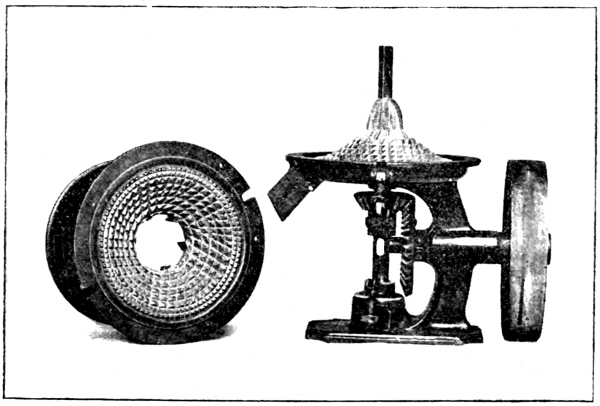
Figure 1. Mill for Grinding Dry Samples.
Where many samples are to be prepared, or in large quantities, mills
should take the place of mortars. For properly air-dried vegetable
substances, some form of mill used in grinding drugs may be employed.
Grinding surfaces of chilled corrugated steel are to be preferred.
The essential features of such a mill are that it be made of the best
material, properly tempered, and that the parts be easily separated
for convenience in cleaning. The grinding surfaces must also be so
constructed and adjusted as to secure the proper degree of fineness. In
fig. 1 is shown a mill of rather simple construction,
which has long been in satisfactory use in this laboratory. Small mills may
be operated by hand power, but when they are to be used constantly
steam power should be provided. In addition to the removal of nearly
all the moisture by air-drying there are many oleaginous seeds which
cannot be finely ground until their oil has been removed. For this
purpose the grinding surfaces of the mill are opened so that the seeds
are only coarsely broken in passing through. The fragments are then
digested with light petroleum in a large flask, furnished with a reflux
condenser. After digestion the fragments are again passed through the
mill adjusted to break them into finer particles.
The alternate grinding and digestion are thus continued until the
pulverization is complete. On a small specially prepared sample the
total content of oil is separately determined.
Fresh animal tissues are best prepared for preliminary treatment by
passing through a sausage mill. The partially homogeneous mass thus
secured should be dried at a low temperature and reground as finely as
possible. Where much fat is present it may be necessary to extract it
as mentioned above, in the case of oleaginous seeds. In such cases both
the moisture and fat in the original material should be determined on
small specially prepared samples with as great accuracy as possible.
Bones, hoofs, horns, hair and hides present special difficulties in
preparation, which the analyst will have to overcome with such skill
and ingenuity as he may possess.
The analyst will find many specially prepared animal foods already in
a fairly homogeneous form, such as potted and canned meats, infant
and invalid foods, and the like. Even with these substances, however,
a preliminary grinding and mixing will be found of advantage before
undertaking the analytical work. Many cases will arise which are
apparently entirely without the classification given above. But even in
such instances the analyst should not be without resources. Frequently
some dry inert substance may be mixed with the material in definite
quantities, whereby it is rendered more easily prepared. Perhaps no
case will be presented where persistent and judicious efforts to secure
a fairly homogeneous sample for analysis will be wholly unavailing.
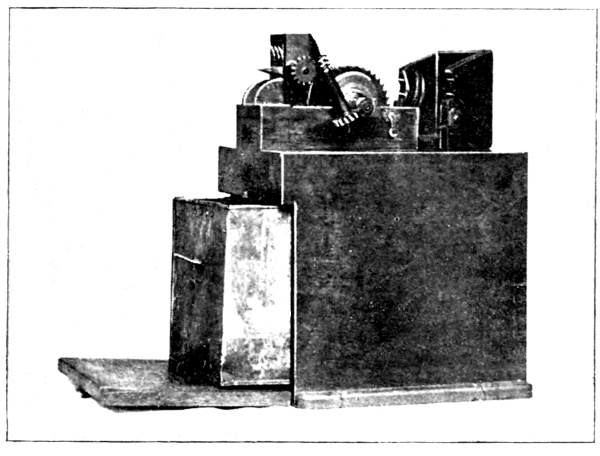
Figure 2. Comminutor for Green Samples.
In the case of green vegetable matters which require to be reduced
rapidly to a fine state of subdivision in order to secure even a fairly
good sample some special provision must be made. This is the case
with stalks of maize and sugar cane, root crops, such as potatoes and
beets, and green fodders, such as clover and grasses. The chopping of
these bodies into fine fodders by hand is slow and often impracticable.
The particles rapidly lose moisture and it is important to secure
them promptly as in the preparation of beet pulp for polarization.
For general use we have found the apparatus shown in fig. 2
quite satisfactory in this laboratory. It consists of a series of staggered
circular saws carried on an axis and geared to be driven at a high
velocity, in the case mentioned, 1,400 revolutions per minute. The
green material is fed against the revolving saws by the toothed
gear-work shown, and is thus reduced to a very fine pulp, which is
received in the box below. Stalks of maize, green fodders, sugar canes,
beets and other fresh vegetable matters are by this process reduced
to a fine homogeneous pulp, suited for sampling and for analytical
operations. Such pulped material can also be spread in a fine layer
and dried rapidly at a low temperature, thus avoiding danger of
fermentative changes when it is desired to secure the materials in a
dry condition or to preserve them for future examination. Samples of
sorghum cane, thus pulped and dried, have been preserved for many years
with their sugar content unchanged.
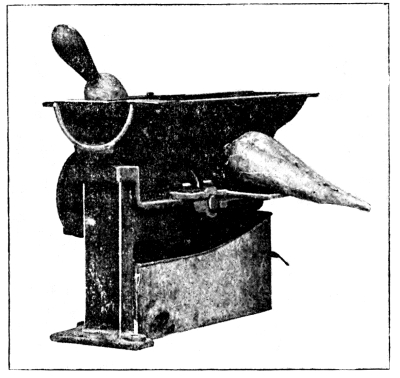
Figure 3. Rasp for Sugar Beets.
Such a machine is also useful in preparing vegetable matter for the
separation of its juices in presses. Samples of sugar cane, sugar
beets, apples and other bodies of like nature can thus be prepared to
secure their juices for chemical examination. Such an apparatus we
have found is fully as useful and indispensable in an agricultural
laboratory as a drug mill for air-dried materials.
It is often desirable in the preparation of roots for sugar analysis
to secure them in a completely disintegrated state, that is with the
cellular tissues practically all broken. Such a pulped material can
be treated with water and the sugar juices it contains thus at once
distributed to all parts of the liquid mass. The operation is known
as instantaneous diffusion. The pulp of the vegetable matter is thus
introduced into the measuring flask along with the juices and the
content of sugar can be easily determined. Several forms of apparatus
have been devised for this purpose, one of which is shown in fig. 3.
This process, originally devised by Pellet, has come into quite general
use in the determination of the sugar content of
beets.[1]
It is observed that it can be applied to other tubers, such as the
turnip, potato, artichoke, etc. It is desirable, therefore, that an
agricultural laboratory be equipped with at least three kinds of
grinding machines; viz., first, the common drug mill used for
grinding seeds, air-dried fodders, and the like; second, a pulping
machine like the system of staggered saws above described for the
purpose of reducing green vegetable matter to a fine state of
subdivision, or one like the pellet rasp for tubers; third, a mill for
general use such as is employed for making sausages from soft animal tissues.
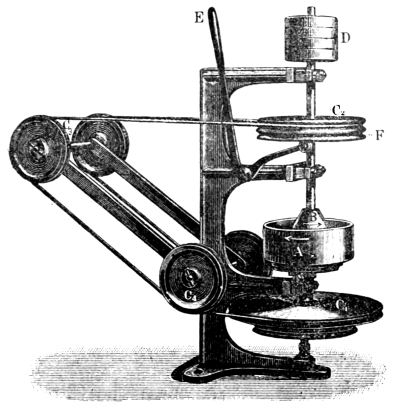
Figure 4. Dreef Grinding Apparatus.
10. Grinding Apparatus at Halle Station.—The machine used at
the Halle station for grinding samples for analysis is shown in
Fig. 4.[2]
It is so adjusted as to have both the upper and lower grinding
surfaces in motion. The power is transmitted through the pulley D,
which is fixed to an axis carrying also the inner grinding attachment
B. Through C₂, C₃, C₄, and C₁, the reverse motion is transmitted to
the outer grinder A. By means of the lever E the two grinding surfaces
can be separated when the mill is to be cleaned. The dree mill above
described is especially useful for grinding malt, dry brewers’ grains,
cereals for starch determinations and similar dry bodies. It is not
suited to grinding oily seeds and moist samples. These, according to
the Halle methods, are rubbed up in a mortar until of a size suited to
analysis, and samples such as moist residues, wet cereals, mashes, beet
cuttings, silage, etc., are dried before grinding. If it be desired to
avoid the loss of acids which may have been formed during fermentation,
about ten grams of magnesia should be thoroughly incorporated with each
kilogram of the material before drying.
11. Preliminary Treatment of Fish.—The method used by Atwater
in preparing fish for analysis is given below.[3]
The same process may also be found applicable in the preparation of
other animal tissues. The specimens, when received at the laboratory,
are at once weighed. The flesh is then separated from the refuse and
both are weighed. There is always a slight loss in the separation,
due to evaporation and to slimy and fatty matters and small fragments
of the tissues which adhere to the hands and the utensils employed in
preparing the sample. Perfect separation of the flesh from the other
parts of the fish is difficult, but the loss resulting from imperfect
separation is small. The skin of the fish, although it has considerable
nutritive value, should be separated with the other refuse.
The partial drying of the flesh for securing samples for analytical
work is accomplished by chopping it as finely as possible and
subjecting from fifty to one hundred grams of it for a day to a
temperature of 96° in an atmosphere of hydrogen. After cooling and
allowing to stand in the open air for twelve hours, the sample is again
weighed, and then ground to a fine powder and made to pass a sieve
with a half millimeter mesh. If the samples be very fat they cannot
be ground to pass so fine a sieve. In such a case a coarser sieve may
be used or the sample reduced to as fine and homogeneous a state as
possible, and bottled without sifting.
The reason for drying in hydrogen is to prevent oxidation of the fats.
As will be seen further on, however, such bodies can be quickly and
accurately dried at low temperatures in a vacuum, and thus all danger
of oxidation be avoided. In fact, the preliminary drying of all animal
and vegetable tissues, where oxidation is to be feared, can be safely
accomplished in a partial vacuum by methods to be described in another
place. In order to be able to calculate the data of the analysis to the
original fresh state of the substance, a portion of the fresh material
should have its water quantitively determined as accurately as possible.
12. Volatile Bodies.—In agricultural analysis it becomes
necessary to determine the percentage of bodies present in any given
sample which is volatile at any fixed temperature. The temperature
reached by boiling water is the one which is usually selected. It
is true that this temperature varies with the altitude and within
somewhat narrow limits at the same altitude, due to variations in
barometric pressure. As the air pressure to which any given body is
subjected, however, is a factor in the determination of its volatile
contents, it will be seen that within the altitudes at which chemical
laboratories are found, the variations in volatile content will not
be important. This arises from the fact that while water boils at a
lower temperature, as the height above the sea level increases, the
corresponding diminished air pressure permits a more ready escape of
volatile matter. As a consequence, a body dried to constant weight at
sea level, where the temperature of boiling water is 100°, will show
the same percentage of volatile matter as if dried at an altitude where
water boils at 99°. When, therefore, it is desirable to determine the
volatile matter in a sample approximately at 100°, it is better to
direct that it be done in a space surrounded by steam at the natural
pressure rather than at exactly 100°, a temperature somewhat difficult
to constantly maintain. However, where it is directed or desired to
dry to constant weight exactly at 100°, it can be accomplished by
means of an air-bath or by a water-jacketed-bath under pressure, or to
which enough solid matter is added to raise the boiling-point to 100°.
It is not often, however, that it is worth while to make any special
efforts to secure a temperature of 100°. When bodies are to be dried at
temperatures above 100°, such as 105°, 110°, and so on, an air-bath is
the most convenient means of securing the desired end. The different
kinds of apparatus to be employed will be described in succeeding paragraphs.
13. Drying at the Temperature of Boiling Water.—The best
apparatus for this process is so constructed as to have an interior
space entirely surrounded with boiling water or steam, with the
exception of the door by which entrance is gained thereto. The metal
parts of the apparatus are constructed of copper, and to keep a
constant level of water and avoid the danger of evaporating all the
liquid, it is advisable to have a reflux condenser attached to the
apparatus. It is also well to secure entrance to the interior drying
oven, not only by the door, but also by small circular openings, which
serve both to hold a thermometer and to permit of the aspiration of a
slow stream of dry air through the apparatus during the progress of
desiccation. The gaseous bodies formed by the volatilization of the
water and other matters are thus carried out of the drying box and the
process thereby accelerated. The bath should be heated by a burner so
arranged as to distribute the flame as evenly as possible over the
base. A single lamp, while it will boil the water in the center, will
not keep it at the boiling-point on the sides. The temperature of the
interior of the bath will not therefore reach 100°. The interior of the
oven should be coated with a non-detachable carbon paint to promote
the radiation of the heat from its walls, as well as to protect the
parts from oxidation where acid fumes are produced during desiccation.
Instead of a reflux condenser a constant water level may be maintained
in the bath by means of a mariotte bottle or other similar device.
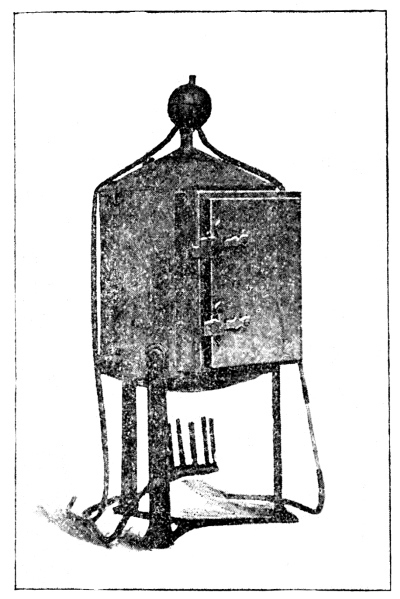
Figure 5. Water-jacketed Drying Oven.
When a bath of this kind is arranged for use with a partial vacuum, it
should be made cylindrical in shape, with conical ends, as shown in
fig. 5, in order to bear well the pressure to
which it is subjected. Among the many forms of steam-baths offered,
the analyst will have but little difficulty in selecting one suited to
his work. To avoid radiation the exterior of the apparatus should be
covered with a non-conducting material.
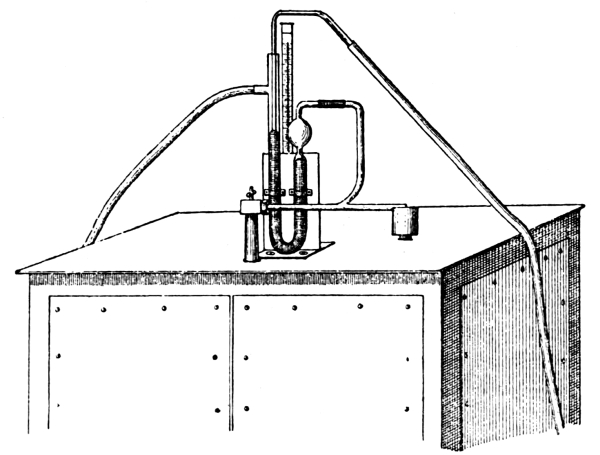
Figure 6. Thermostat for Steam-Bath.
14. Drying In a Closed Water Oven.—When it is desired to keep
the temperature of a drying oven exactly at 100° instead of at the
heat of boiling water, a closed water oven with a thermostat is to
be employed. The oven should be so constructed as to secure a free
circulation of the water about the inner space. Since as a rule the
water between the walls of the apparatus will be subjected to a slight
pressure, these walls should be made strong, or the cylindrical form
of apparatus should be used. The thermostat used by the Halle Station
is shown in Fig. 6.[4]
A ⋃ shaped tube, with a bulb on one arm and a lateral smaller
tube sealed on the other, is partly filled with mercury and connected
by rubber tubes on the right with the gas supply, and on the left with
the burner. The end carrying the bulb is connected
directly by a rubber and metal tube with the water space of the oven.
This device is provided with a valve which is left open until the
temperature of the drying space reaches about 95°. The tube conducting
the gas is held in the long arm of the ⋃ by means of a cork
through which it passes air-tight and yet is loose enough to permit of
its being moved. Its lower end is provided with a long ▲ shaped slit.
When the valve leading to the water space is closed and the water
reaches the boiling point, the pressure of the vapor depresses the
mercury in the bulb arm of the ⋃ and raises it in the other. As
the mercury rises it closes the wider opening of the ▲ shaped slit,
thus diminishing the flow of gas to the burner. By moving the gas entry
tube up or down a position is easily found in which the temperature of
the drying space, as shown by the thermometer, is kept accurately and
constantly at 100°.
In a bath arranged in this way a steam condenser is not necessary.
Since, however, in laboratories which are not at a higher altitude than
1,000 feet the boiling-point of water is nearly 100°, it does not seem
necessary to go to so much trouble to secure the exact temperature
named. There could be no practical difference in the percentage of
moisture determined at 100°, and at the boiling-point of water at a
temperature not more than 1° lower.
15. Drying in an Air-Bath.—In drying a substance in a medium of
hot air surrounded by steam, as has been described, the process is, in
reality, one of drying in air. The apparatus usually meant by the term
air-bath, however, has its drying space heated directly by a lamp, or
indirectly by a stratum of hot air occupying the place of steam in the
oven already described. The simplest form of the apparatus is a metal
box, usually copper, heated from below by a lamp. In the jacketed forms
the currents of hot air produced directly or indirectly by the lamp
are conducted around the inner drying oven, thus securing a more even
temperature. The bodies to be dried are held on perforated metal or
asbestos shelves in appropriate dishes, and the temperature to which
they are subjected is determined by a thermometer, the bulb of which is
brought as near as possible to the contents of the dish. One advantage
of the air-bath is in being able to secure almost any desired
temperature from that of the room to one of 150° or even higher. Its
chief disadvantage lies in the difficulty of securing and maintaining
an even temperature throughout all parts of the apparatus. Radiation
from the sides of the drying oven should be prevented by a covering of
asbestos or other non-combustible and non-conducting substance. The
burner employed should be a broad one and give as even a distribution
of the heat as possible over the bottom of the apparatus.
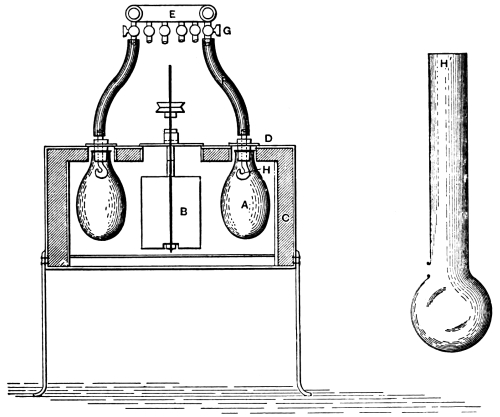
Figure 7. Spencer’s Drying Oven.
16. Spencer’s Air-Drying Oven.—In order to secure an even
distribution of the heat in the desiccating space of the oven, Spencer
has devised an apparatus, shown in the figure, in which
the temperature is maintained evenly throughout the apparatus by means of a
fan.[5]
The oven has a double bottom, the space between the two bottoms being
filled with air. The sides are also double, the space between being
filled with plaster. The fan is driven by a toy engine connected with
the compressed air service or other convenient method. Thermometers
placed in different parts of the apparatus, while in use, show a
rigidly even heat at all points so long as the fan is kept in motion.
The actual temperature desired can be controlled by a gas regulator.
This form of apparatus is well suited to drying a large number of
samples at once. Portions of liquids and viscous masses may also be
dried by enclosing them in bulbs and connecting with a vacuum.
Spencer’s oven can also be used to advantage in drying viscous
liquids in a partial vacuum. For this purpose the flask A, Fig. 7,
containing the substance is made with a round bottom to resist the
atmospheric pressure. Its capacity is conveniently from 150 to 200
cubic centimeters. It is closed with a rubber stopper carrying a trap,
H Hʹ, to keep the evaporated water from falling back. The details of
the construction of the trap H are shown at the right of the figure.
The vapors enter at the lateral orifice, just above the bulb, while the
condensed water falls back into the bulb instead of into the flask A. A
series of flasks can be used at once connected through the stopcocks
G with the circular tube E leading to the vacuum. A water pump easily
exhausts the apparatus, maintaining a vacuum of about twenty-seven
inches. The hot air in the oven is kept in motion by the fan B, thus
ensuring an even temperature in every part. The flask A may be partly
filled with sand or pumice stone before the addition of the samples
to be dried, and the weight of water lost is determined by weighing
A before and after desiccation. If it be desired to introduce a slow
current of dry air or some inert gas into A, it is easily accomplished
by passing a small tube, connected with the dry air or gas supply,
through the rubber stopper and extending it into the flask as far as
possible without coming into contact with the contents.
17. Drying Under Diminished Air Pressure.—The temperature at
which any given body loses its volatile products is conditioned largely
by the pressure to which it is subjected. At an air pressure of 760
millimeters of mercury, water boils at 100° but it is volatilized at
all temperatures. As the pressure diminishes the temperature at which a
body loses water at a given rate falls. This is a fact of importance to
be considered in drying many agricultural products. This is especially
true of those containing oils and sugars, nearly the whole number.
Invert sugar especially is apt to suffer profound changes at a
temperature of 100°, the levulose it contains undergoing partial
decomposition. Oils are prone to oxidation and partial decomposition at
high temperatures in the presence of oxygen.
In drying in a partial vacuum therefore a double advantage is secured,
that of a lower temperature of desiccation and in presence of less
oxygen. It is not necessary to have a complete vacuum. There are few
organic products which cannot be completely deprived of their volatile
matters at a temperature of from 70° to 80° in a partial vacuum in
which the air pressure has been diminished to about one-quarter of its
normal force.
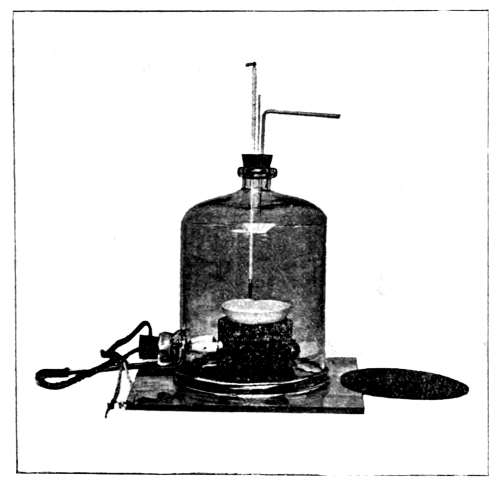
Figure 8. Electric Vacuum Drying Oven.
18. Electric Drying-Bath.—The heat of an electric current can
be conveniently used for drying in a partial vacuum by means of the
simple device illustrated in Fig. 8. In ordering
a heater of this kind the voltage of the current should be stated. The
current in use in this laboratory has a voltage of about 120, and is
installed on the three wire principle. It is well to use a rheostat
with the heater in order to control the temperature within the bell
jar. The ground rim of the bell jar rests on a rubber disk placed on a
thick ground glass or a metal plate, making an air-tight connection. A
disk of asbestos serves to separate the heater from the dish containing
the sample, in order to avoid too high a temperature.
19. Steam Coil Apparatus.—For drying at the temperature of
superheated steam, it is convenient to use an apparatus furnished with
layers or coils of steam pipes. The drying may be accomplished either
in the air or in a vacuum. In this laboratory a large drying oven,
having three shelves of brass steam-tubes and sides of non-conducting
material, is employed with great advantage. The series of heating
pipes is so arranged as to be used one at a time or collectively. Each
series is furnished with a separate steam valve, and is provided with
a trap to control the escape of the condensed vapors. In the bottom of
the apparatus are apertures through which air can enter, which after
passing through the interior of the oven escapes through a ventilator
at the top. With a pressure of forty pounds of steam to the square inch
and a free circulation of air, the temperature on the first shelf of
the apparatus is about 98°; on the second from 103° to 104°, and on
the third about 100°. The vessels containing the bodies to be dried
are not placed directly on the brass steam pipes, but the latter are
first covered with thick perforated paper or asbestos. For drying
large numbers of samples, or large quantities of one sample, such an
apparatus is almost indispensable to an agricultural laboratory.
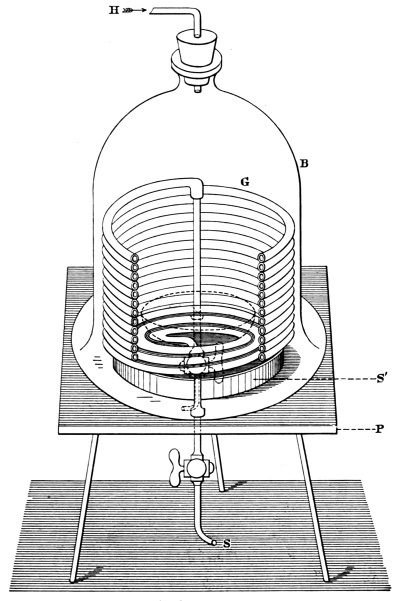
Figure 9. Steam Coil Drying Oven.
A smaller apparatus is shown in Fig. 9. The heating part
G is made of a small brass tube arranged near the bottom in a horizontal coil and
continued about the sides in a perpendicular coil. Bodies placed on the
horizontal shelf are thus entirely surrounded by the heating surfaces
except at the top.[6]
The steam pipe S is connected with the supply by the usual method, and
the escape of the condensation is controlled either by a valve or trap
in the usual way. The whole apparatus is covered by a bell jar B,
resting on a heavy cast-iron plate P, through which also the ends of
the brass coil pass. The upper surface of the iron plate may be planed,
or a planed groove may be cut into it, to secure the edge of the bell
jar. When the air is to be exhausted from the apparatus, a rubber
washer should be placed under the rim of the bell jar. The latter piece
of apparatus may either be closed, as shown in the figure,
by a rubber stopper, or it is better, though not shown, to have a stopper with
three holes. One tube passes just through the stopper and is connected
with the vacuum; the second passes to the bottom of the apparatus and
serves to introduce a slow stream of dry air or of an inert gas during
the desiccation. The third hole is for a thermometer. When no movement
of the residual gas in the apparatus is secured, a dish containing
strong sulfuric acid S’ is placed on the iron plate and under the
horizontal coil, as is shown in the figure. The sulfuric acid
so placed does not reach the boiling-point of water, and serves to absorb the
aqueous vapors from the residual air in the bell jar. By controlling
the steam supply the desiccation of a sample can be secured in
the apparatus at any desired temperature within the limit of the
temperature of steam at the pressure used. Where no steam service is at
hand a strong glass flask may be used as a boiler, in which case the
trap end of the coil must be left open. The vacuum may be supplied by
an air or bunsen pump. When a vacuum is not used an atmosphere of dry
hydrogen may be supplied through H.
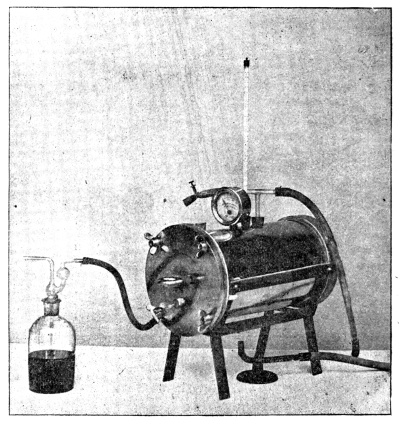
Figure 10. Carr’s Vacuum Drying Oven.
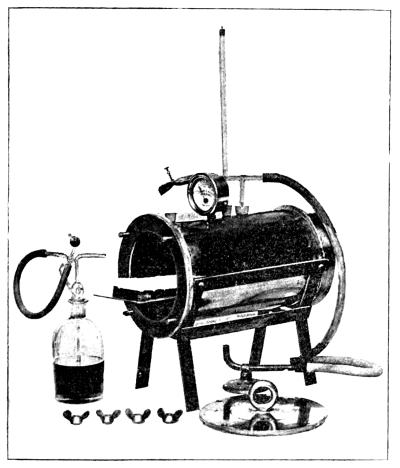
Figure 10. (Bis) Vacuum Oven Open.
20. Carr’s Vacuum Oven.—A convenient drying oven has been
devised in this laboratory by Carr.[7]
It is made of a large tube, preferably of brass. The tube may be from
six to nine inches in diameter and from twelve to fifteen inches long.
One end is closed air-tight by a brass end-piece attached by a screw,
or brazed. The other end is detachable and is made air-tight by ground
surfaces and a soft washer. In the figure this
movable end-piece is shown attached by screw-nuts, but experience has
shown that these are not necessary. On the upper longitudinal surfaces
are apertures for the insertion of a vacuum gauge and for attachment to
a vacuum apparatus.
In the figure the thermometer and aperture
for introducing dry air or an inert gas are shown in the movable end
disk, but they would be more conveniently placed in the fixed end. The
oven is heated below by a gas burner, which conveniently should be as
long as the oven. The heat is not allowed to strike the brass cylinder
directly, but the latter is protected by a piece of asbestos paper.
The temperature inside of the oven can be easily kept practically
constant by means of a gas regulator, not shown in the figure, or
by a little attention to the lamp. For a vacuum of twenty inches a
temperature of about 80° should be maintained. When the vacuum is more
complete a lower temperature can be employed. This apparatus is simple
in construction, strong, cheap, and highly satisfactory in use.
21. Drying in Hydrogen.—In some of the processes of
agricultural analysis it becomes important to dry the sample in
hydrogen or other inert gas. This may be accomplished by introducing
the dry gas desired into some form of the apparatus already described.
The drying may either be accomplished in an atmosphere of hydrogen
practically at rest or in a more limited quantity of the gas in motion.
The latter method is to be preferred by reason of its greater rapidity.
The analyst has at his command many forms of apparatus designed for the
purpose mentioned above. It will be sufficient here to describe only
two, devised particularly for agricultural purposes.
The first one of these, designed by the author, was intended especially
for drying the samples of fodders for analysis according to the methods
of the Association of Agricultural
Chemists.[8]
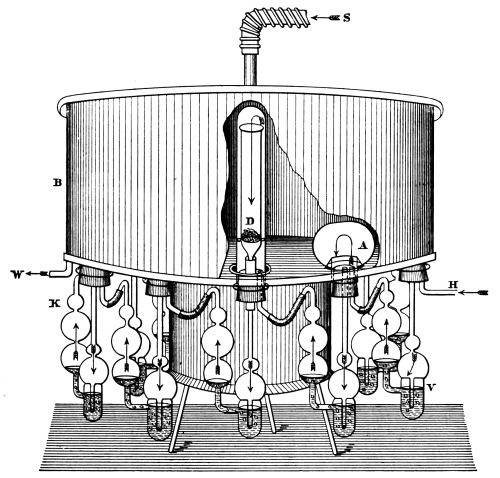
Figure 11. Apparatus for Drying in a
Current of Hydrogen.
For the purpose of drying materials contained in flasks and tubes in a
current of hydrogen the apparatus shown in Fig. 11 is
used. This apparatus consists of a circular box, B, conveniently made of
galvanized iron, having a movable cover, S, fitted for the introduction
of steam into the interior of the apparatus. Condensed steam escapes at
W. A stream of perfectly pure and dry hydrogen enters at H, passes up
through the material to be dried, down through the bulb V, containing
sulfuric acid, and follows the direction of the arrows through the rest
of the apparatus. The stream of hydrogen is thus completely dried by
passing through bulbs containing sulfuric acid, on the way from one
piece of the apparatus to the other. A, represents a flask such as is
used, with the extraction apparatus described. The apparatus which we
have used will hold eight tubes or flasks at a time, and thus a single
stream of hydrogen is made to do duty eight times in drying eight
separate samples. The great advantage of the apparatus is in the fact
that the stream of hydrogen must pass over and through the substance
to be dried. In order to prevent any sulfuric acid from being carried
forward into the next tube the bulb K, above the sulfuric acid, may be
filled with solid pieces of soda or potash.
This apparatus has been in use for a long time and no accidents from
sulfuric acid being carried forward have occurred, and there is no
danger, provided the stream of hydrogen is kept running at a slow
rate. If, however, by any accident the stream of hydrogen should be
admitted with great rapidity, particles of the sulfuric acid might be
carried forward and spoil the next sample. To avoid any such accident
as this the proposal to introduce the potash bulb has been made. The
apparatus works with perfect satisfaction, and it is believed that when
properly adjusted check weighings can be made by weighing the bulbs,
showing their increase in weight, which will give the volatile matter,
and weighing the flasks or tubes, which will show the loss of weight.
The only chance for error in weighing the bulbs is that some of the
volatile matter may be material which is not dissolved in sulfuric
acid, and is thus carried on and out of the apparatus. The blackening
of the sulfuric acid in the bulbs, in the drying of all forms of
organic matter, shows that the loss in weight of such bodies is not
due to water alone, but also to organic volatile substances, which are
capable of being decomposed by the sulfuric acid, thus blackening it.
22. Caldwell’s Hydrogen Drying-Bath.—An excellent device for
drying in hydrogen has been described by Caldwell.[9]
A vessel of copper or other suitable material serves to hold the tubes
containing the samples to be dried. It should be about twenty-four
centimeters long, fifteen high, and eight wide. This vessel is
contained in another made of the same material and of the dimensions
shown in the figure. On one side the edge of this
containing vessel may not be more than one centimeter high and the bath
should rest against it. The other side is made higher to form a support
for the drying tubes as indicated.
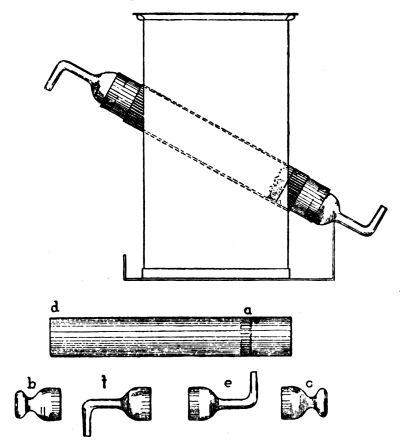
Figure 12. Caldwell’s Hydrogen Drying Apparatus.
The tube containing the substance a d is made of glass and may
be closed by the ground stoppers c b or the tube stoppers e
f. At a it carries a perforated platinum disk for holding
the filtering felt. The tube should be about thirteen centimeters long
and have an internal diameter of about twenty millimeters. With its
stoppers it should weigh only a little over thirty grams. The asbestos
felt should not be thick enough to prevent the free passage of gas.
Passing diagonally through the bath are metal tubes, preferably made of
copper, and of such a size as just to receive the glass drying tubes.
If these be a little loose they should be made tight by wrapping them
with a narrow coil of paper at either end of the tubular receptacle.
The entrance of cold air between the glass tube and its metal holder is
thus prevented, and the glass tube is held firmly in position. The glass
tube should be weighed with its two solid stoppers. Afterwards the
sample, about two grams, is placed on the asbestos felt and the
stoppers replaced and the whole reweighed. The exact weight of the
sample is thus obtained. The solid stoppers are then removed and the
tube stoppers inserted. The lower end of the tube is then connected
with the supply of dry hydrogen. The upper tube stopper is connected
by a rubber tube with a small bottle containing sulfuric acid through
which the escaping hydrogen is made to bubble. A double purpose is thus
secured; moisture is kept from entering the drying tube and the rate
at which the hydrogen is passing is easily noted. After the drying is
completed the solid stoppers are again inserted, the tube cooled in a
desiccator and weighed. The loss of weight is entered as water. The
tube containing the sample can afterwards be put into an extractor and
treated with ether or petroleum in the manner hereafter described. This
apparatus requires more hydrogen than the one previously described,
but it is rather simple in construction, is easily controlled, and has
given satisfactory results.
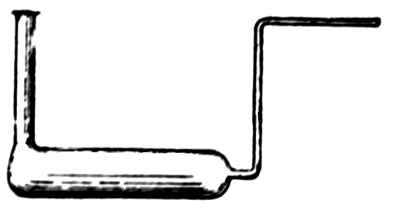
Figure 13. Liebig’s Ente.
23. Drying in Liebig’s Tubes.—In drying samples, especially of
fodders, the method practiced at the Halle Station is to place them
in drying tubes, the form of which is shown in Fig. 13.
A stream of illuminating gas, previously dried by passing over sulfuric acid and
calcium chlorid, is directed through the tubes.[10]
Many of these tubes can be used at once, arranged as shown in Fig. 14.
When the air is all driven out the stream of gas can be ignited so as
to regulate the flow properly by the size of the flame. The tubes are
held in drying ovens, as shown in the figure, the temperature
of which should be kept at 105°-107°. The drying should be continued for eight
or ten hours. At the end of this time the gas in the tube is to be
expelled by a stream of dry air and the tubes cooled in a desiccator
and weighed. There are few advantages in this method not possessed by
the processes already described. The samples, moreover, are not left
in a condition for further examination, either by incineration or extraction.
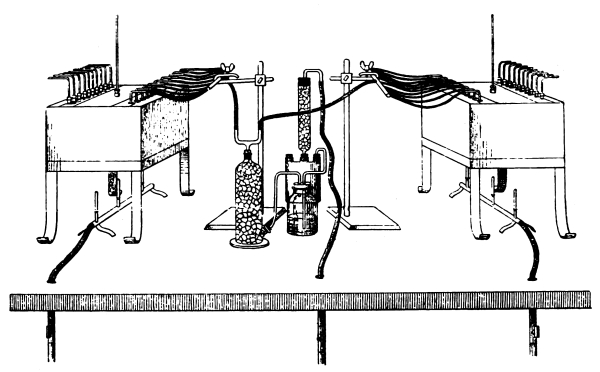
Figure 14. Drying Apparatus used at the Halle Station.
24. Wrampelmayer’s Drying Oven.—The apparatus used at the
Wageningen Station, in Holland, for drying agricultural samples,
was devised by Wrampelmayer and is shown in Fig. 15.
The oven is so constructed as to permit of drying in a stream of inert gas.
Illuminating gas is let into the drying space of the oven through the
tube A B. At B the entering gas is heated by the same lamp which boils
the liquid in the water space of the apparatus. The hot gas is dried in
the calcium chlorid tube c and then passes into the oven at D. At E it
leaves the apparatus and is thence conducted to the lamp F, used for
heating the bath. The lamp should be closed by a wire gauze diaphragm
to prevent any possible explosion by reason of any admixture with the
air in the oven. The condensation of the aqueous vapors is effected by
means of the condenser G. In the drying space is a small shelf holder,
which, by means of the hook H, can be removed from the apparatus. The
drying space is closed from the upper part of the apparatus, which
contains no water by the cover J, resting on a support K. This rim is
covered with a rubber gasket L, by means of which the cover J can be
fastened with a bayonet latch air-tight. This fastening is shown at N.
Being closed in this way the part of the cylindrical oven above the
cover may be left entirely open. Instead of the rather elaborate method
of closing the bath, some simple and equally effective device might be
used. The cover J is best made with double metallic walls enclosing an
asbestos packing.
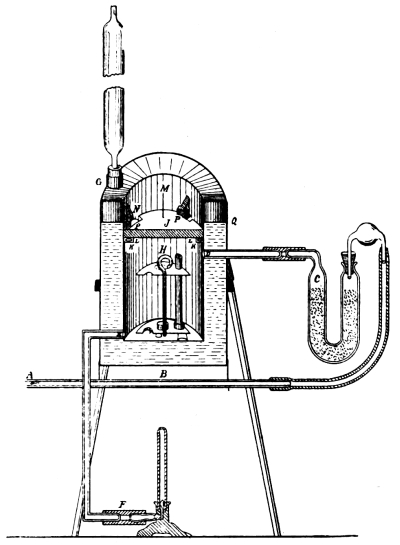
Figure 15. Wrampelmayer’s Oven.
It is evident that this oven could be used with an atmosphere of carbon
dioxid or of air, provided the gas for heating were derived from a
separate source and the tube between E and F broken. In a drying oven
designed by the author, the movable top is made with double walls and
the space between is joined to the steam chamber by means of a flexible
metallic tube, thus entirely surrounding the drying space with steam.
25. The Ulsch Drying Oven.—A convenient drying oven is
described by Ulsch which varies from the ordinary form of a
water-jacketed drying apparatus in having a series of drying tubes
inserted in the water-steam space.
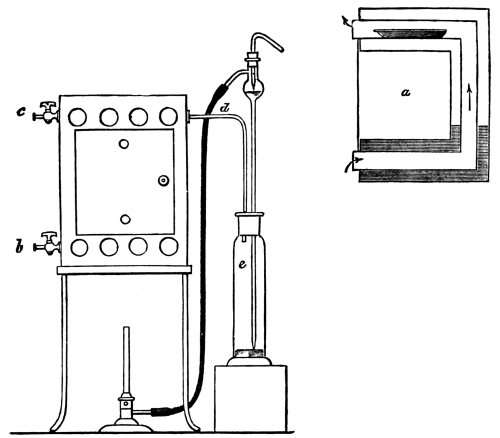
Figure 16. Ulsch Drying Oven.
The arrangement of the oven is shown in the accompanying figure.
The water space is filled only to about one-third of its height. When the
heat is applied the cock c is left open until the steam has
driven out all the air. It is then closed and the temperature of the
bath is then regulated by the manometer e, connected with the
bath by d. The bottom of the manometer cylinder contains enough
mercury to always keep sealed the end of the manometer tube. The rest
of the space is filled with water. At the top the manometer tube is
expanded into a small bulb which serves as a gas regulator, as shown
in the figure. The gas is admitted also by a
small hole above the mercury in the bulb, so that when the end of
the gas inlet tube is sealed enough gas still passes through to keep
the lamp burning. With a mercury pressure of thirty centimeters the
temperature of the bath will be about 105°. The walls of the bath
should be made strong enough to bear the pressure corresponding to this
degree. The drying can be accomplished either in the cubical drying
box a or in the drying tubes made of thin copper and disposed
as shown in the figure. The natural draft is
shown by the arrows. The substance is held in boats placed in the tube
as indicated. The air in traversing the tube is brought almost to
the temperature of the water-steam space in which the tube lies. The
natural current of hot air can easily be replaced by a stream of dry
illuminating or other inert gas.
26. Drying Viscous Liquids.—In the case of cane juices, milk,
and similar substances, the paper coil method may be used.[11]
The manipulation is conducted as follows: A strip of filtering paper from
five to eight centimeters wide and forty centimeters in length, is
rolled into a loose coil and dried at the temperature of boiling water
for two hours, placed in a dry glass-stoppered weighing tube, cooled
in a desiccator and weighed. The stoppered weighing tube prevents the
absorption of hygroscopic moisture. About three cubic centimeters of
the viscous or semi-viscous liquid are placed in a flat dish covered
by a plate of thin glass and weighed. The coil is then placed on end
in the dish, and the greater part of the liquid is at once absorbed.
The proportions between the coil and the amount of liquid should be
such that the coil will not be saturated more than two-thirds of its
length. It is then removed and placed dry end down in a steam-bath
and dried two hours. The dish, covered by the same plate of glass, is
again weighed, the loss in weight representing the quantity of liquid
absorbed by the coil. After drying for the time specified the coil
is again placed in the hot weighing tube, cooled and its weight
ascertained. The increase represents the solid matter in the sample
taken. This method has been somewhat modified by Josse, who directs
that it be conducted as follows:[12]
Filter-paper is cut into strips from one to two centimeters wide and
three meters long. The strips are crimped so they will not lie too
closely together and then wrapped into coils. These coils can absorb
about ten cubic centimeters of liquid. One of them is placed in a flat
dish about two centimeters high and seven in diameter, and dried as
described, covered, cooled and weighed. There are next placed in the
dish and weighed one or two grams of the massecuite, molasses, etc.,
which are to be dried and the dish again weighed and the total weight
of the matter added, determined by deducting the weight of the dish and
cover. About eight cubic centimeters of water are added, the material
dissolved with gentle warming, the coil placed in the dish, and the
whole dried for two hours. The cover is then replaced and the whole
cooled in a desiccator and weighed. The increase in weight represents
the dry matter in the sample taken.
The above method of solution of a viscous sample in order to divide
it evenly for desiccation is based on the principle of the method
first proposed by the author and Broadbent for drying honeys and other
viscous liquids.[13]
In this process the sample of honey, molasses, or other viscous liquid
is weighed in a flat dish, dissolved in eighty per cent alcohol, and
then a weighed quantity of pure dry sand added, sufficient to fill
the dish three-quarters full. The alcoholic solution of the viscous
liquid is evenly distributed throughout the mass of sand by capillary
attraction, and thus easily and rapidly dried when placed on the bath.
Pumice stone, on account of its great porosity, is also an excellent
medium for the distribution of a viscous liquid in aiding the process
of desiccation. The method has been worked out in great detail in
this laboratory by Carr and Sanborn,[14]
and most excellent results obtained. Round aluminum dishes two
centimeters high and from eight to ten centimeters in diameter are
conveniently used for this process. The pumice stone is dried and
broken into fragments the size of a pea before use.
27. General Principles of Drying Samples.—It would be a
needless waste of space to go into further details of devices for
desiccation. A sufficient number has been given to fully illustrate all
the principles involved. In general, it may be said that drying in the
open air at a temperature not exceeding that of boiling water can be
safely practiced with the majority of samples. For instance, we have
found practically no change in this laboratory in the composition of
cereals dried in the air and in an inert gas. The desiccation should
in all cases be accomplished as speedily as possible. To this end the
atmosphere in contact with the sample should be dry and kept in motion.
An oven surrounded by boiling water and steam is to be preferred to
one heated by air. Constancy of temperature is quite as important as
its degree and this steadiness is most easily secured by steam at
atmospheric pressure. Where higher temperatures than 100° are desired
the steam must be under pressure, or the boiling-point of the water may
be raised by adding salt or other soluble matters. A bath of paraffin
or calcium chlorid may also be used or a sand or air-bath may be
employed. The analyst must not forget, however, that inorganic matters
are prone to change at temperatures above 100°, even in an inert
atmosphere, and higher temperatures must be used with extreme caution.
Drying in partial vacuum and in a slowly changing atmosphere may
be practiced with all bodies and must be employed with some. The
simple form of apparatus already described will be found useful for
this purpose. At a vacuum of twenty inches or more, even unstable
organic agricultural products are in little danger of oxidation. In
the introduction of a dry gas, therefore, air will be found as a
rule entirely satisfactory. In the smaller form of vacuum apparatus
described, however, there is no objection to the employment of hydrogen
or of carbon dioxid. The gas entering the apparatus should be dried by
passing over calcium chlorid or by bubbling through sulfuric acid. In
this laboratory the vacuum is provided by an air-pump connected with a
large exhaust cylinder. This cylinder is connected by a system of pipes
to all the working desks. The chief objection to this system is the
unsteadiness of the pressure. When only a few are using the vacuum
apparatus for filtering or other purposes the vacuum will stand at
about twenty inches. When no one is using it the vacuum will rise to
twenty-eight or twenty-nine inches. At other times, when in general
use, it may fall to fifteen inches. Where a constant vacuum is desired
for drying, therefore, it is advisable to connect the apparatus with a
special aspirator which will give a pressure practically constant.
The dishes containing the sample should be low and flat, exposing as
large a surface as possible. For viscous liquids it will be found
advisable to previously fill the dishes with pumice stone or other
inert absorbent material to increase the surface exposed.
The special methods of drying milk, sirup, honeys, and like bodies,
will be described in the paragraphs devoted to these substances.
In drying agricultural products, not only water but all other matters
volatile at the temperature employed are expelled. It is only necessary
to conduct the products of volatilization through sulfuric acid to
demonstrate the fact that organic bodies are given off. In the case
mentioned the sulfuric acid will be speedily changed to a brown and
even black color by these bodies. It is incontestable, however, that
in most cases the essential oils and other volatile matters thus
escaping are not large in quantity and could not appreciably affect
the percentage composition of the sample. In such cases the whole of
the loss on drying is entered in the note book as water. There are
evidently many products, however, where a considerable percentage of
the volatile products is not water. The percentage of essential oils,
which have a lower boiling-point than water, can be determined in a
separate sample and this deducted from the total loss on drying will
give the water.
Simple as it seems, the determination of water in agricultural products
often presents peculiar difficulties and taxes to the utmost the
patience and skill of the analyst. Having set forth the substantial
principles of the process and indicated its more important methods,
there is left for the worker in the laboratory the choice of processes
already described, or, in special cases, the device of new ones and
adaption of old ones to meet the requirements of necessity.
28. Determination of Ash.—The principle to be kept in view in
the preparation of the ash of agricultural products is to conduct the
incineration at as low a temperature as possible to secure a complete
combustion. The danger of too high a temperature is two-fold. In the
first place some of the mineral constituents constantly present in the
ash, notably, some of the salts of potassium and sodium are volatile
at high temperatures and thus escape detection. In the second place,
some parts of the ash are rather easily fusible and in the melted state
occlude particles of unburned organic matter, and thus protect them
from complete oxidation. Both of these dangers are avoided, and an ash
practically free of carbon obtained, by conducting the combustion at
the lowest possible temperature capable of securing the oxidation of
the carbonaceous matter.
29. Products Of Combustion.—The most important product of
combustion, from the present point of view, is the mineral residue
obtained. The organic matter of the sample undergoes decomposition
in various ways, depending chiefly on its nature. Complex volatile
compounds are formed first largely of an acid nature. The residual
carbon is oxidized to carbon dioxid and the hydrogen to water. The
relative proportions of these bodies formed, in any given case, depend
on the conditions of combustion. With a low temperature and a slow
supply of oxygen, the proportion of volatile organic compounds is
increased. At a high temperature, and in a surplus of oxygen, the
proportions of water and carbon dioxid are greater. At the present
time, however, our attention is to be directed exclusively to the
mineral residue; the organic products of combustion belonging to the
domain of organic chemistry. As has already been intimated, the ash of
agricultural samples consists of the mineral matters derived from the
tissues, together with any accidental mineral impurities which may be
present, some unburned carbon, and the sulfur, phosphorus, chlorin,
nitrogen, etc., existing previously in combination with the mineral
bases. The organic sulfur and phosphorus may also undergo complete or
partial oxidation during incineration and be found in the ash. Unless
special precautions be taken, however, a portion of the organic
sulfur and phosphorus may escape as volatile compounds during the
combustion.[15]
The organic nitrogen is probably completely lost, at most, only traces
of it being oxidized during the combustion in such a way as to combine
with a mineral base. The rare mineral elements that are taken up by
plants will also be found in the ash. Here the analyst would look for
copper, boron, zinc, manganese, and the other elements which, when
existing in the soil, are apt to be found in the tissues of the plants,
not, perhaps, as organic or essential compounds, but as concomitants
of the other mineral foods absorbed by growing vegetation. This fact
is often of importance in toxicological and hygienic examinations of
foods. For instance, traces of copper or of boron in the ash of a
prescribed food would not be evidence of the use of copper or borax
salts as preservatives unless it could be shown that the soil on which
the food in question was grown was free of these bodies.
This fact manifestly applies only to those cases where mere traces
of these rare bodies are in question. The presence of considerable
quantities of them, enough to be inimical to health, could only be
attributed to artificial means.
30. Purpose and Conduct of Incineration.—In burning a sample
of an agricultural product the analyst may desire to secure either a
large sample of ash for analytical purposes as already described or to
determine the actual percentage of ash. The first purpose is secured
in many ways. In the preparation of ash for manurial purposes, for
instance, little care is exercised either to prevent volatilization of
mineral matters or to avoid the occurrence of a considerable quantity
of carbon in the sample. With this operation we have, at present,
nothing whatever to do. In preparing a sample of ash for chemical
analysis it is important, where a sufficient quantity of the sample can
be obtained, to use as large a quantity of it as convenient. While it
is true that very good results may be secured on very small samples,
it is always advisable to have a good supply of the material at hand.
Since the materials burned have only from one to three per cent of ash,
a kilogram of them will supply only from ten to thirty grams. To supply
all needful quantities of material and replace the losses due to
accident, whenever possible at least twenty grams of the ash should
be prepared. The combustion can be carried on in platinum dishes with
all bodies free of metallic oxids capable of injuring the platinum.
Otherwise porcelain or clay dishes may be employed. As a rule the
combustion is best conducted in a muffle at a low red heat. With
substances very rich in fusible ash, as for instance the cereals, it is
advisable to first char them, extract the greater part of the ash with
water, and afterwards burn the residual carbon. The aqueous extract can
then be added to the residue of combustion and evaporated to dryness at
the temperature of boiling water. During the combustion the contents
of the dish should not be disturbed until the carbon is as completely
burned out as possible. The naturally porous condition in which the
mass is left during the burning is best suited to the entire oxidation
of the carbon. At the end however, it may become necessary to bring
the superficial particles of unburned carbon into direct contact with
the bottom of the dish by stirring its contents. In most instances
very good results may be obtained by burning the ash in an open dish
without the aid of a muffle. In this case a lamp should be used with
diffuse flame covering as evenly as possible the bottom of the dish and
thus securing a uniform temperature. The carbon, when once in active
combustion, will as a rule be consumed, and an ash reasonably pure be
obtained.
The second purpose held in view by the analyst is to determine the
actual content of ash in a sample. For this purpose only a small
quantity of the material should be used, generally from two to ten
grams. The combustion should be conducted in flat-bottomed, shallow
dishes, and at a low temperature. In many cases the residue, after
determining the moisture, can be at once subjected to incineration,
and thus an important saving of time be secured. A muffle, with gentle
draft, will be found most useful for securing a white ash. The term,
white ash, is sometimes a deceptive one. In samples containing iron or
manganese, the ash may be practically free of carbon and yet be highly
colored. The point at which the combustion is to be considered as
finished therefore should be at the time the carbon has disappeared
rather than when no coloration exists. In general the methods of
incineration are the same for all substances, but some cases may arise
in which special processes must be employed. Some analysts prefer to
saturate the substance before incineration with sulfuric acid, securing
thus a sulfated ash. This is practiced especially with molasses. In
such cases the ash obtained is free of carbon dioxid and roughly the
difference in weight is compensated for by deducting one-tenth of
the weight of the ash when comparison is to be made with ordinary
carbonated ash. Naturally this process could not be used when sulfuric
acid is to be determined in the product.
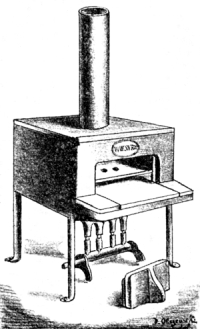
Figure 17. Courtoune Muffle.
31. German Ash Method.—The method pursued at the Halle Station
for securing the percentage of ash in a sample is as follows:[16]
Five grams of the air-dried sample are incinerated in a platinum dish and
the ash ignited until it has assumed a white, or at least a bright
gray tint. As soon as combustible gases are emitted at the beginning
of the incineration they are ignited and allowed to burn as long as
possible. It is advisable to hasten the oxidation by stirring the mass
with a piece of platinum wire. If the ash should become agglomerated,
as sometimes happens with rich food materials, it must be separated by
attrition. The ash, when cooled on a desiccator, is to be weighed. When
great exactness is required, it is advised, as set forth in a former
paragraph, to first carbonize the mass and then extract the soluble
ash with hot water before completing the oxidation. When the latter is
complete and the dish cooled the aqueous extract is added, evaporated
to dryness and the incineration completed.
32. Courtonne’s Muffle.—The ordinary arrangement of a muffle,
as in assaying, may be conveniently used in incineration. A special
muffle arrangement has been prepared by Courtonne which not only
permits of the burning of a large number of samples at once, but also
effects a considerable saving in gas. The muffle as shown in Fig. 17,
is made in two stages, and the floor projects in front of the furnace,
forming a convenient hearth. The incineration is commenced on the upper
stage, where the temperature is low, and finished on the lower one at a
higher heat. The furnace is so arranged as to permit the flame of the
burning gas to entirely surround the muffle. The draft and temperature
within the muffle are controlled by the fire-clay door shown resting on
the table.
33. Object Of Treatment.—The next step, in the analytical
work, after sampling, drying, and incinerating, is the treatment of
the sample with solvents. The object of this work is to separate
the material under examination into distinct classes of bodies
distinguished from each other by their solubilities. It is not the
purpose of this section to describe the various bodies which may
be separated in this way, especially from vegetable products. For
this description the reader may consult the standard works on plant
analysis.[17]
The chief object of a strictly agricultural examination of a field or
garden product is to determine its food value. This purpose can be
accomplished without entering into a minute separation of nearly allied
bodies. For example, in the case of carbohydrates it will be sufficient
as a rule, to separate them into four classes. In the first class will
be found those soluble in water as the ordinary sugars. In the second
group will be found those which, while not easily soluble in water, are
readily rendered so by treatment with certain ferments or by hydrolysis
with an acid. The starches are types of this class. In the third place
are found those bodies which resist the usual processes of hydrolysis
either with an acid or alkali, and therefore remain in the residue as
fiber. Cellulose is a type of these bodies. In the fourth class are
included those bodies which on hydrolysis with an acid yield furfurol
on distillation, and therefore belong to the type containing five atoms
of carbon or some multiple thereof in their molecule. For ordinary
agricultural purpose the separation is not even as complete as is
represented above.
What is true of the carbohydrates applies equally well to the fats and
to other groups. Especially in the analysis of cereals and of cattle
foods, the treatment with solvents is confined to the use in successive
order of ether or petroleum, alcohol, dilute acids, and alkalies, the
latter at a boiling temperature. The general method of treatment with
these solvents will be the subject of the following paragraphs.
34. Extraction of the Fats and Oils.—Two solvents are in
general use for the extraction of fats and oils; viz., ethylic
ether and a light petroleum. The former is the more common reagent.
Before use it should be made as pure as possible by washing first
with water, afterwards removing the water by lime or calcium chlorid,
and then completing the drying by treatment with metallic sodium.
The petroleum spirit used should be purified by several fractional
distillations until it has nearly a constant boiling-point of from 45°
to 50°. The detailed methods of preparing these reagents will be given
in another place. For rigid scientific determinations the petroleum
is to be preferred to the ether. It is equally as good a solvent
for fats and oils and is almost inert in respect to other vegetable
constituents. Ether, on the other hand, dissolves chlorophyll and its
partial oxidation products, resins, alkaloids and the like. The extract
obtained by ether is therefore less likely to be a pure fat than that
secured by petroleum. For purposes of comparison, however, the ether
should be employed, inasmuch as it has been used almost exclusively in
analytical operations in the past.
35. Methods Of Extraction.—The simplest method for
accomplishing the extraction of fat from a sample consists in treating
it with successive portions of the solvent in an open dish or a closed
flask. This process is actually employed in some analytical operations,
as, for instance, in the determination of fat in milk. Experience has
shown, however, that a portion of the substance soluble, for instance,
in ether, passes very slowly into solution, so that a treatment such as
that just described would have to be long continued to secure maximum
results. The quantity of solvent required would thus become very large
and in the case of ether would entail a great expense. For the greater
number of analytical operations, therefore, some device is employed for
using the same solvent continually. The methods of extraction therefore
fall into two general classes; viz., extraction by digestion
and extraction by percolation. This classification holds good also for
other solvents besides ether and petroleum. In general, the principles
and practice of extraction described for ether may serve equally well
for alcohol, acetone and other common solvents.
36. Extraction by Digestion.—In the use of ether or petroleum
the sample is covered with an excess of the solvent and allowed to
remain for some time in contact therewith. The soluble portions of the
sample diffuse into the reagent. The speed of diffusion is promoted
by stirring the mixtures. The operation may be conducted in an open
dish or a flask. Inasmuch as the residue is, as a rule, to be dried
and weighed, an open dish is to be preferred. To avoid loss of reagent
and to prevent filling a working room with very dangerous gases, the
temperature of digestion should be kept below the boiling-point of the
solvent. The greater part of the soluble matter will be extracted with
three or four successive applications of the reagent, but, as intimated
above, the last portions of the soluble material are extracted with
difficulty by this process. In pouring off the solvent care must be
exercised to avoid loss of particles of the sample suspended therein.
To this end it is best to pour the solvent through a filter. For the
extraction of large quantities of material for the purpose of securing
the extract for future examination, or simply to remove it, the
digestion process is usually employed. This excess of solvent required
is easily recovered by subsequent distillation and used again. The
method is rarely used for the quantitive estimation of the extract, the
process of continuous percolation being more convenient and more exact.
37. Extraction by Percolation.—In this method the solvent
employed is poured on the top of the material to be extracted and
allowed to pass through it usually by gravitation alone, sometimes with
the help of a filter-pump. The principle of the process is essentially
that of washing precipitates.
Two distinct forms of apparatus are in use for this process. In
the first kind the solvent is poured over the material and after
percolation is secured by distillation in another apparatus. In the
second kind the solvent is secured after percolation in a flask where
it is at once subjected to distillation. The vapors of the solvent
are conducted by appropriate means to a condenser placed above the
sample. After condensation the solvent is returned to the upper part of
the sample. The percolation thus becomes continuous and a very small
quantity of the solvent may thus be made to extract a comparatively
large amount of material. This process is particularly applicable
to the quantitive determination of the extract. After distillation
and drying the latter may be weighed in the flask in which it was
received or the sample may be dried and weighed in the vessel in which
it is held both before and after extraction. One great advantage of
the continuous extraction method lies in the fact that when it is
once properly started it goes on without further attention from the
analyst save an occasional examination of the flow of water through
the condenser and of the rate of the distillation. For this reason the
process may be continued for many hours without any notable loss of
time. The vapor of the solvent in passing to the condenser may pass
through a tube out of contact with the material to be extracted or it
may pass directly around the tube holding the sample. In the former
case the advantage is secured of conducting the extraction at a higher
temperature, but there is danger of boiling the solvent in contact with
the material and thus permitting the loss of a portion of the sample.
38. Apparatus Used for Extractions.—For extraction by
digestion, as has already been said, an open dish may be used. When
large quantities of material are under treatment, heavy flasks, holding
from five to ten liters, will be found convenient. In these cases a
condenser can be attached to the flask and the extraction conducted
at the boiling temperature of the solvent. During the process of
extraction it is advisable to shake the flask frequently. By proceeding
in this way the greater part of the solvent matter will be removed
after three or four successive treatments.
In extraction by percolation various forms of apparatus are employed.
The ordinary percolators of the manufacturing pharmacist may be used
for the larger operations, while the more elaborate forms of continuous
extractors will be found most convenient for quantitive work. In each
case the analyst must choose that process and form of apparatus best
suited to the purpose in view. In the next paragraphs will be described
some of the more common forms of apparatus in use.
39. Knorr’s Extraction Apparatus.—The apparatus which has been
chiefly used in this laboratory for the past few years is shown in
the accompanying figure.[18]
The principle of the construction of the apparatus lies in the complete
suppression of stoppers and in sealing the only joint of the device
with mercury.
The construction and operation of the apparatus will be understood by a
brief description of its parts.
A is the flask containing the solvent, W a steam bath made by cutting
off the top of a bottle, inverting it and conducting the steam into one
of the tubes shown in the stopper while the condensed water runs out of
the other. The top of the bath is covered with a number of concentric
copper rings, so that the opening may be made of any desirable size. B
represents the condenser, which is a long glass tube on which a number
of bulbs has been blown, and which is attached to the hood for holding
the material to be extracted, as represented at Bʹ, making a solid
glass union. Before joining the tube at Bʹ the rubber stopper which is
to hold it into the outside condenser of B is slipped on, or the rubber
stopper may be cut into its center and slipped over the tube after the
union is made. In case alcohol is to be used for the solvent, requiring
a higher temperature, the flask holding the solvent is placed entirely
within the steam-bath, as represented at Aʹ.
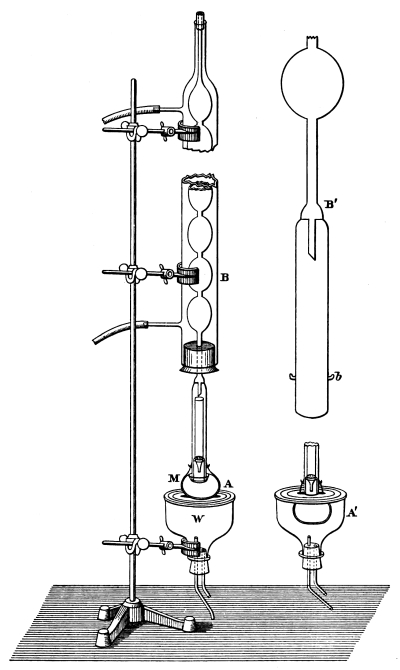
Figure 18. Knorr’s Extraction Apparatus.
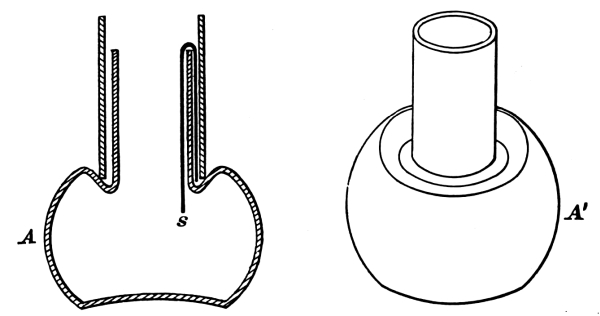
Figure 19. Extraction Flask.
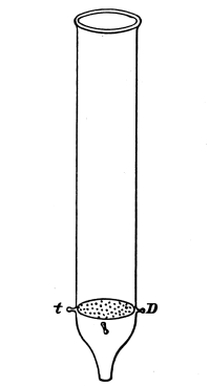
Figure 20.
Extraction Tube.
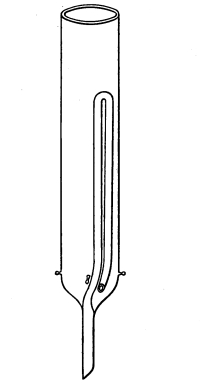
Figure 21.
Extraction Siphon Tube.
A more detailed description of the different parts of the apparatus
can be seen by consulting Figs. 19, 20,
and 21. In A, Fig. 19, is
represented a section of the flask which holds the solvent, showing how
the sides of the hood containing the matters to be extracted pass over
the neck of the flask, and showing at S a small siphon inserted in the
space between the neck of the flask and the walls of the hood for the
purpose of removing any solvent that may accumulate in this space.
A view of the flask itself is shown at Aʹ. It is made by taking an
ordinary flask, softening it about the neck and pressing the neck in
so as to form a cup, as indicated at Aʹ, to hold the mercury which
seals the union of the flask with the condenser. The flask is held in
position by passing a rubber band below it, which is attached to two
glass nipples, b, blown onto the containing vessel, as shown in
Fig. 18. The material to be extracted may be contained in an ordinary
tube, as shown in Fig. 20, which may be made from a test tube drawn
out, as indicated in the figure, having a perforated platinum disk
sealed in at D. The containing tube rests upon the edges of the flask
containing the solvent by means of nipples shown at t. If a
siphon tube is to be used, one of the most convenient forms is shown in
Fig. 21, in which the siphon lies entirely within
the extracting tube, thus being protected from breakage. By means of
this apparatus the extractions can be carried on with a very small
quantity of solvent, there being scarcely any leakage, even with the
most volatile solvents, such as ether and petroleum. The apparatus is
always ready for use, no corks are to be extracted, and no ground glass
joints to be fitted.
40. Soxhlet’s Extraction Apparatus.—A form of continuous
extraction apparatus has been proposed by Soxhlet which permits the
passage of the vapors of the solvent into the condenser by a separate
tube and the return of the condensed solvent after having stood in
contact with the sample, to the evaporating flask by a siphon. The
advantage of this process lies in freeing the sample entirely from the
rise of temperature due to contact with the vapors of the solvent, and
in the second place in the complete saturation of the sample with the
solvent before siphoning. The sample is conveniently held in a cylinder
of extracted filter-paper open above and closed below. This is placed
in the large tube between the evaporating flask and the condenser. The
sample should not fill the paper holder, and if disposed to float in
the solvent, should be held down with a plug of asbestos fiber or of
glass wool. The extract may be transferred, by dissolving in the
solvent, from the flask to a drying dish, or it may be dried and
weighed in the flask where first received.
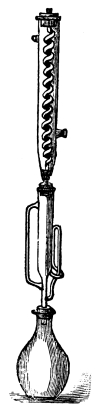
Figure 22.
Soxhlet
Extraction
Apparatus.
There are many forms of apparatus of this kind, one of which is shown
in Fig. 22, but a more extended description of
them is not necessary. The disadvantages of this process as compared
with Knorr’s, are quite apparent. The connections with the evaporating
flask and condenser are made with cork stoppers, which must be
previously thoroughly extracted with ether and alcohol. These corks
soon become dry and hard and difficult to use. The joints are likely
to leak, and grave dangers of explosion arise from the vapors of the
solvents escaping into the working room. Moreover, it is an advantage
to have the sample warmed by the vapors of the solvent during the
progress of the extraction, provided the liquid in direct contact with
the sample does not boil with sufficient vigor to cause loss.
The use of extraction apparatus with ground glass joints is also
unsatisfactory. By reason of unequal expansion and contraction these
joints often are not tight. They are also liable to break and thus
bring danger and loss of time.
41. Compact Extraction Apparatus.—In order to bring the
extraction apparatus into a more compact form, the following described
device has been successfully used in this laboratory.[19]
The condenser employed is made of metal and is found entirely within
the tube holding the solvent.
This form of condenser is shown in Fig. 23, in which
the tube E serves to introduce the cold water to the bottom of the condensing
device. The tube D serves to carry away the waste water. The tube F serves
for the introduction of the solvent by means of a small funnel. When
the solvent is introduced and has boiled for a short time, the tube
F should be closed. In each of the double conical sections of the
condenser a circular disk B is found, which causes the water flowing
from A upward to pass against the metallic surfaces of the condenser.
A section of the double conical condenser is shown in the upper right
hand corner. It is provided with two small hooks hh, soldered on
the lower surface, by means of which the crucible G can be hung with a
platinum wire. The condenser is best made smooth and circular in form.
The crucible G, which holds the material to be extracted, can be made
of platinum, but for sake of economy also of porcelain. The bottom
of the porcelain crucible is left open excepting a small shelf, as
indicated, which supports a perforated disk of platinum on which an
asbestos film is placed.
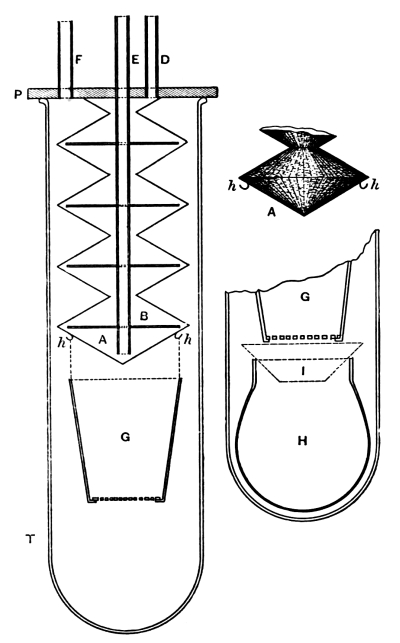
Figure 23. Compact Condensing Apparatus.
The whole apparatus is of such size as to be easily contained in the
large test-tube T.
The mouth of the test-tube is ground so as to fit as smoothly as
possible to the ground-brass plate of the metallic condenser P.
In case it is desired to weigh the extract it may be done directly by
weighing it in the test-tube T after drying in the usual way at the
end of the extraction; or a glass flask H, made to fit freely into the
test-tube, may be used, in which case a little mercury is poured into
the bottom of the tube to seal the space between H and T. To prevent
spirting of the substance in H, or projecting any of the extracted
material without or against the bottom of the crucible G, the funnel
represented by the dotted lines in the right hand section may be used.
Heat may be applied to the test-tube either by hot water, or steam, or
by a bunsen, which permits of the flame being turned down to minimum
proportions without danger of burning back. When the test-tube alone
is used it is advisable to first put into it some fragments of pumice
stone, particles of platinum foil, or a spoonful of shot, to prevent
bumping of the liquid when the lamp is used as the source of heat.
Any air which the apparatus contains is pushed out through F when the
boiling begins, the tube F not being closed until the vapor of the
liquid has reached its maximum height. With cold water in the condenser
the vapor of ether very rarely reaches above the lower compartment and
the vapor of alcohol rarely above the second.
When the plate P is accurately turned so as to fit the ground surface
of the mouth of T, it is found that ten cubic centimeters of anhydrous
ether or alcohol are sufficient to make a complete extraction, and
there is not much loss of solvent in six hours. The thickness of the
asbestos film in G, or its fineness, is so adjusted as to prevent too
rapid filtration so that the solvent may just cover the material to
be extracted, or, after the material is placed in a crucible, a plug
of extracted glass wool may be placed above it for the purpose of
distributing the solvent evenly over the surface of the material to be
extracted and of preventing the escape of fine particles.
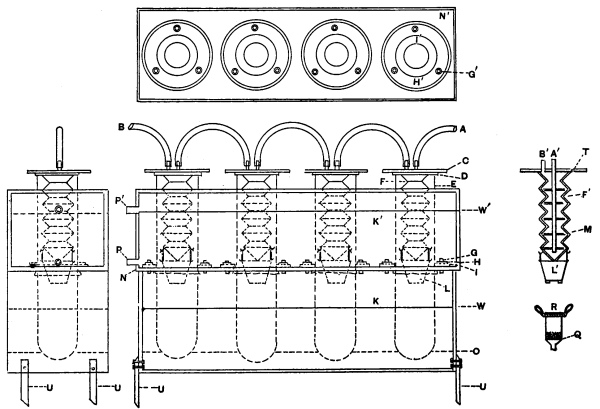
Figure 24. Improved Compact Extraction Apparatus.
In very warm weather the apparatus may be arranged as shown in figure 24.
The bath for holding the extraction tubes is made in two parts,
K and Kʹ. The bath K has a false bottom shown in the dotted line O,
perforated to receive the ends of the extraction tubes and which holds
them in place and prevents them from touching the true bottom, where
they might be unequally heated by the lamp. The upper bath Kʹ has a
perforated bottom, partly closed with rubber-cloth diaphragms Gʹ Nʹ Hʹ.
The extraction tubes passing through this bath, water-tight, permit
broken ice or ice-water to be held about their tops, and thus secure
a complete condensation of the vapors of the solvent which in warm
weather might escape the metal condenser. In practice care must be
taken to avoid enveloping too much of the upper part of the extraction
tube with the ice-water, otherwise the vapors of the solvent will be
chiefly condensed on the sides of the extraction tube and will not be
returned through the sample. It is not often that the upper bath is
needed, and then only with ether, never with alcohol. This apparatus
has proved especially useful with alcohol, using, as suggested,
glycerol in the bath. The details of its further construction and
arrangement are shown in the figure. The extraction tubes
are most conveniently arranged in a battery of four, one current of cold water
passing in at A and out at B, serving for all. The bath is supported
on legs long enough to allow the lamp plenty of room. The details of
the condenser M are shown in Bʹ, Aʹ, T, Fʹ, and Lʹ. Instead of a gooch
Lʹ for holding the sample a glass tube R, with a perforated platinum
disk Q, may be used. The water line in the bath is shown by W. This
apparatus may be made very cheaply and without greatly impairing its
efficiency by using a plain concentric condenser and leaving off the
upper bath Kʹ.
42. Solvents Employed.—It has already been intimated that the
chief solvents employed in the extraction of agricultural samples are
ether or petroleum and aqueous alcohol. The ether used should be free
of alcohol and water, the petroleum should be subjected to fractional
distillation to free it of the parts of very high and very low
boiling points, and the alcohol as a rule should contain about twenty
per cent of water.
There are many instances, however, where other solvents should be used.
The use of aqueous alcohol is sometimes preceded by that of alcohol of
greater strength or practically free of water. For the extraction of
soluble carbohydrates (sugars) cold or tepid water is employed, the
temperature of which is not allowed to rise high enough to act upon
starch granules. For the solution of the starch itself an acid solvent
is used at a boiling temperature, whereby the starch molecules undergo
hydrolysis and form dextrin or soluble sugars (maltose, dextrose). By
this process also the carbohydrates, whose molecules contain five, or
some multiple thereof, atoms of carbon form soluble sugars of which
xylose and arabinose are types. The solvent action of acids followed
by treatment with dilute alkalies at a boiling temperature, completes
practically the solution of all the carbohydrate bodies, save cellulose
and nearly related compounds. The starch carbohydrates are further
dissolved by the action of certain ferments such as diastase.
Dilute solutions of mineral salts exert a specific solvent action on
certain nitrogenous compounds and serve to help separate the albuminoid
bodies into definite groups.
Under the proper headings the uses of these principal solvents will be
described, but a complete discussion of their action, especially on
samples of a vegetable origin, should be looked for in works on plant
analysis.[20]
The application of acids and alkalies for the extraction of
carbohydrates, insoluble in water and alcohol, will be described,
in the paragraphs devoted to the analysis of fodders and cereals.
The extraction of these matters, made soluble by ferments, will be
discussed in the pages devoted to starch and artificial digestion.
It is thus seen that the general preliminary treatment of a sample
preparatory to specific methods of examination is confined to drying,
extraction with ether and alcohol, and incineration.
43. Recovery of the Solvent.—In using such solvents as ether,
chloroform, and others of high value, it is desirable often to recover
the solvent. Various forms of apparatus are employed for this purpose,
arranged in such a way as both to secure the solvent and to leave the
residue in an accessible condition, or in a form suited to weighing
in quantitive work. When the extractions are made according to the
improved method of Knorr, the flask containing the extract may be at
once connected with the apparatus shown in figure 25.[21]
A represents the flask containing the solvent to be recovered, W the
steam-bath, B the condenser sealed by mercury, M and R the flask
receiving the products of condensation. It will be found economical
to save ether, alcohol, and chloroform even when only a few cubic
centimeters remain after the extraction is complete. In the figure
the neck of the flask A is represented as narrower than it really is.
The open end of the connecting tube, which is sealed on A by mercury,
should be the same size as the tube connecting with the condenser in
the extraction apparatus.
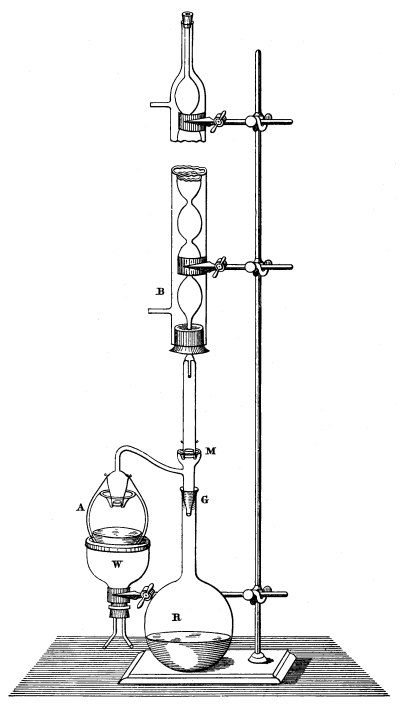
Figure 25.—Knorr’s Apparatus for
Receiving Solvents.
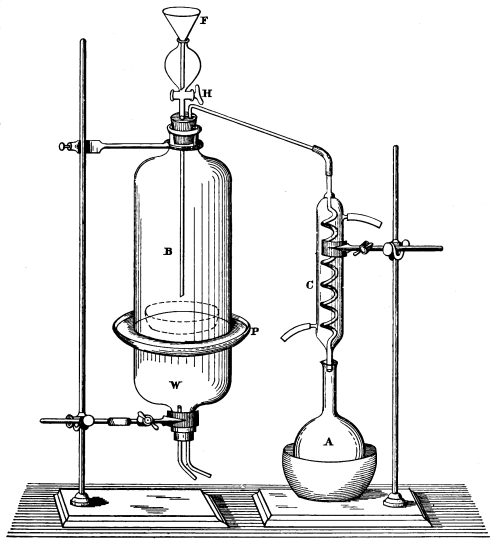
Figure 26. Apparatus for Recovering Solvents
from Open Dishes.
It often happens that materials which are dissolved by the ordinary
solvents in use are to be collected in open dishes in order that
their properties may be studied. At the same time large quantities
of solvents must be used, and it is desirable to have some method of
recovering them. The device shown in Fig. 26 has been found to work
excellently well for this purpose.[22]
It consists of a steam-bath, W, and a bottle, B, with the bottom
cut off, resting on an iron dish, P, containing a small quantity of
mercury, enough to seal the bottom of the bottle. The dish containing
the solvent is placed on the mercury, and the bottle placed down over
it, forming a tight joint. On the application of steam the solvent
escapes into the condenser, C, and is collected as a liquid in the
flask A. In very volatile solvents the flask A may be surrounded with
ice, or ice-cold water passed through the condenser. When an additional
quantity of the solvent is to be added to the dish for the purpose of
evaporating it is poured into the funnel F, and the stopcock H opened,
which allows the material to run into the dish in B without removing
the bottle. In this way many liters of the solvent may be evaporated
in any one dish, and the total amount of extract obtained together. At
the last the bottle B is removed, and the extract which is found in the
dish is ready for further operations.
PART SECOND. SUGARS AND STARCHES. — THE DETERMINATION OF THE PERCENTAGE OF SUGAR BY THE DENSITY OF ITS SOLUTION. — THE DETERMINATION OF SUGAR WITH POLARIZED LIGHT. — DESCRIPTION OF POLARIZING INSTRUMENTS. — THE ANALYTICAL PROCESS. — CHEMICAL METHODS OF ESTIMATING SUGARS. — VOLUMETRIC METHODS. — VOLUMETRIC METHODS BASED UPON THE USE OF AN AMMONIACAL COPPER SOLUTION. — GRAVIMETRIC COPPER METHODS. — DETERMINATION OF STARCH. — AUTHORITIES CITED IN PART SECOND.
44. Introduction.—Carbohydrates, of which sugars and starches
are the chief representatives, form the great mass of the results of
vegetable metabolism. The first functions of the chlorophyll cells of
the young plant are the condensation of carbon dioxid and water. The
simplest form of the condensation is formaldehyd, CH₂O. There is no
convincing evidence, however, that this is the product resulting from
the functional activity of the chlorophyll cells. The first evidence
of the condensation is found in more complex molecules; viz.,
those having six atoms of carbon. It is not the purpose of this work to
discuss the physiology of this process, but the interested student can
easily find access to the literature of the subject.[23]
When a sample of a vegetable nature reaches the analyst he finds by
far the largest part of its substance composed of these products of
condensation of the carbon dioxid and water. The sugars, starches,
pentosans, lignoses, and celluloses all have this common origin. Of
many air-dried plants these bodies form more than eighty per cent.
In green plants the sugars exist chiefly in the sap. In plants cut
green and quickly dried by artificial means the sugars are found
in a solid state. They also exist in the solid state naturally in
certain sacchariferous seeds. Many sugar-bearing plants when allowed
to dry spontaneously lose all or the greater part of their sugar by
fermentation. This is true of sugar cane, sorghum, maize stalks, and
the like. The starches are found deposited chiefly in tubers, roots or
seeds. In the potato the starch is in the tuber, in cassava the tuber
holding the starch is also a root, in maize, rice and other cereals
the starch is in the seeds. The wood-fibers; viz., pentosans,
lignose, cellulose, etc., form the framework and support of the plant
structure. Of all these carbohydrate bodies the most important as foods
are the sugars and starches, but a certain degree of digestibility
cannot be denied to other carbohydrate bodies with the possible
exception of pure cellulose. In the following paragraphs the general
principles of determining the sugars and starches will be given and
afterwards the special processes of extracting these bodies from
vegetable substances preparatory to quantitive determination.
45. Nomenclature.—In speaking of sugars it has been thought
best to retain for the present the old nomenclature in order to avoid
confusion. The terms dextrose, levulose, sucrose, etc., will therefore
be given their commonly accepted significations.
A more scientific nomenclature has recently been proposed by Fischer,
in which glucose is used as the equivalent of dextrose and fructose
as the proper name for levulose. All sugars are further classified
by Fischer into groups according to the number of carbon atoms found
in the molecule. We have thus trioses, tetroses, pentoses, hexoses,
etc. Such a sugar as sucrose is called hexobiose by reason of the fact
that it appears to be formed of two molecules of hexose sugars. For a
similar reason raffinose would belong to the hexotriose group.[24]
Again, the two great classes of sugars as determined by the structure
of the molecule are termed aldoses and ketoses according to their
relationship to the aldehyd or ketone bodies.
Since sugars may be optically twinned, that is composed of equal
molecules of right and left-handed polarizing matter it may happen that
apparently the same body may deflect the plane of polarization to the
right, to the left, or show perfect neutrality.
Natural sugars, as a rule, are optically active, but synthetic sugars
being optically twinned are apt to be neutral to polarized light.
To designate the original optical properties of the body therefore
the symbols d, l, and i, meaning dextrogyratory,
levogyratory, and inactive, respectively, are prefixed to the name.
Thus we may have d, l, or i glucose, d,
l, or i fructose, and so on.
The sugars that are of interest here belong altogether to the pentose
and hexose groups; viz., C₅H₁₀O₅ and C₆H₁₂O₆, respectively.
Of the hexobioses, sucrose, maltose, and lactose are the most important,
and of the hexotrioses, raffinose. In this manual, unless otherwise
stated, the term dextrose corresponds to d glucose, and levulose
to d fructose. In this connection, however, it should be noted
that the levulose of nature, or that which is formed by the hydrolysis
of inulin or sucrose is not identical in its optical properties with
the l fructose of Fischer.
46. Preparation of Pure Sugar.—In using the polariscope or in
testing solutions for the chemical analysis of samples, the analyst
will be required to keep always on hand some pure sugar. Several
methods of preparing pure sugar have been proposed. The finest
granulated sugar of commerce is almost pure. In securing samples for
examination those should be selected which have had a minimum treatment
with bluing in manufacture. The best quality of granulated sugar when
pulverized, washed with ninety-five per cent and then with absolute
alcohol and dried over sulfuric acid at a temperature not exceeding 50°
will be found nearly pure. Such a sugar will, as a rule, not contain
more than one-tenth per cent of impurities, and can be safely used for
all analytical purposes. It is assumed in the above that the granulated
sugar is made from sugar cane.
Granulated beet sugars may contain raffinose and so may show a
polarization in excess of 100. This sugar may be purified by dissolving
seventy parts by weight in thirty parts of water. The sugar is
precipitated by adding slowly an equal volume of ninety-six per cent
alcohol with constant stirring, the temperature of the mixture being
kept at 60°. While still warm the supernatant liquor is decanted
and the precipitated sugar washed by decantation several times with
strong warm alcohol. The sugar, on a filter, is finally washed with
absolute alcohol and dried in a thin layer over sulfuric acid at from
35° to 40°. By this process any raffinose which the sugar may have
contained is completely removed by the warm alcohol. Since beet sugar
is gradually coming into use in this country it is safer to follow the
above method with all samples.[25]
In former times it was customary to prepare pure sugar from the whitest
crystals of rock candy. These crystals are powdered, dissolved in
water, filtered, precipitated with alcohol, washed and dried in the
manner described above.
47. Classification of Methods.—In the quantitive determination
of pure sugar the various processes employed may all be grouped
into three classes. In the first class are included all those which
deduce the percentage of sugar present from the specific gravity of
its aqueous solution. The accuracy of this process depends on the
purity of the material, the proper control of the temperature, and
the reliability of the instruments employed. The results are obtained
either directly from the scale of the instruments employed or are
calculated from the arbitrary or specific gravity numbers observed. It
is evident that any impurity in the solution would serve to introduce
an error of a magnitude depending on the percentage of impurity and
the deviation of the density from that of sugar. The different classes
of sugars, having different densities in solution, give also different
readings on the instruments employed. It is evident, therefore, that a
series of tables of percentages corresponding to the specific gravities
of the solutions of different sugars would be necessary for exact work.
Practically, however, the sugar which is most abundant, viz.,
sucrose, may be taken as a representative of the others and for rapid
control work the densimetric method is highly useful.
In the second class of methods are grouped all those processes which
depend upon the property of sugar solutions to rotate the plane of
polarized light. Natural sugars all have this property and if their
solutions be found neutral to polarized light it is because they
contain sugars of opposite polarizing powers of equal intensity. Some
sugars turn the polarized plane to the right and others to the left,
and the degree of rotation in each case depends, at equal temperatures
and densities of the solutions, on the percentages of sugars present.
In order that the optical examination of a sugar may give correct
results the solution must be of a known density and free of other
bodies capable of affecting the plane of polarized light. In the
following paragraphs an attempt will be made to give in sufficient
detail the methods of practice of these different processes in so far
as they are of interest to the agricultural analyst. The number of
variations, however, in these processes is so great as to make the
attempt to fully discuss them here impracticable. The searcher for
additional details should consult the standard works on sugar
analysis.[26]
In the third class of methods are included those which are of a
chemical nature based either on the reducing power which sugar
solutions exercise on certain metallic salts, upon the formation of
certain crystalline and insoluble compounds with other bodies or
upon fermentation. Under proper conditions solutions of sugar reduce
solutions of certain metallic salts, throwing out either the metal
itself or a low oxid thereof. In alkaline solutions of mercury and
copper, sugars exercise a reducing action, throwing out in the one case
metallic mercury and in the other cuprous oxid. With phenylhydrazin,
sugars form definite crystalline compounds, quite insoluble, which
can be collected, dried and weighed. There is a large number of other
chemical reactions with sugars such as their union with the earthy
bases, color reactions with alkalies, oxidation products with acids,
and so on, which are of great use qualitively and in technological
processes, but these are of little value in quantitive determinations.
48. Principles of the Method.—This method of analysis is
applied almost exclusively to the examination of one kind of sugar,
viz., the common sugar of commerce. This sugar is derived
chiefly from sugar cane and sugar beets and is known chemically as
sucrose or saccharose. The method is accurate only when applied to
solutions of pure sucrose which contain no other bodies. It is evident
however, that other bodies in solution can be determined by the same
process, so that the principle of the method is broadly applicable to
the analyses of any body whatever in a liquid state or in solution.
Gases, liquids and solids, in solution, can all be determined by
densimetric methods.
Broadly stated the principle of the method consists in determining the
specific gravity of the liquid or solution, and thereafter taking the
percentage of the body in solution from the corresponding specific
gravity in a table. These tables are carefully prepared by gravimetric
determinations of the bodies in solution of known densities, varying by
small amounts and calculation of the percentages for the intervening
increments or decrements of density. This tabulation is accomplished at
definite temperatures and the process of analysis secured thereby is
rapid and accurate, with pure or nearly pure solutions.
49. Determination of Density.—While not strictly correct from
a physical point of view, the terms density and specific gravity are
here used synonymously and refer to a direct comparison of the weights
of equal volumes of pure water and of the solution in question, at the
temperature named. When not otherwise stated, the temperature of the
solution is assumed to be 15°.5.
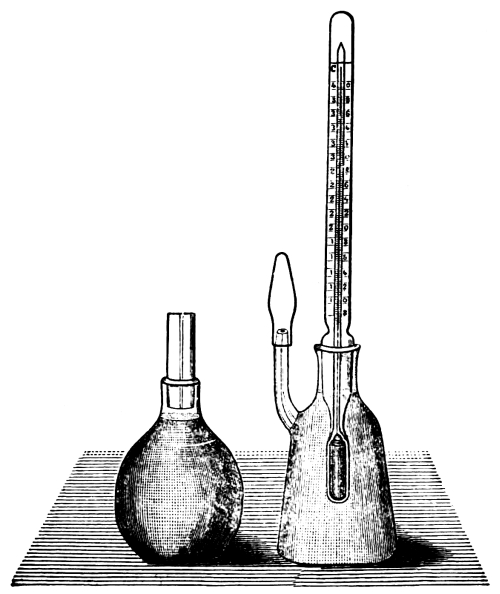
Figure 27. Common Forms of Pyknometers.
The simplest method of determining the density of a solution is to
get the weight of a definite volume thereof. This is conveniently
accomplished by the use of a pyknometer. A pyknometer is any vessel
capable of holding a definite volume of a liquid in a form suited
to weighing. It may be a simple flask with a narrow neck distinctly
marked, or a flask with a ground perforated stopper, which, when
inserted, secures always the same volume of liquid contents. A very
common form of pyknometer is one in which the central stopper carries a
thermometer and the constancy of volume is secured by a side tubulure
of very small or even capillary dimensions, which is closed by a ground
glass cap.
The apparatus may not even be of flask form, but assume a quite
different shape as in Sprengel’s tube. Pyknometers are often made to
hold an even number of cubic centimeters, but the only advantage of
this is in the ease of calculation which it secures. As a rule, it
will be found necessary to calibrate even these, and then the apparent
advantage will be easily lost. A flask which is graduated to hold fifty
cubic centimeters, may, in a few years, change its volume at least
slightly, due to molecular changes in the glass. Some of the different
forms of pyknometers are shown in the accompanying figures.
In use the pyknometer should be filled with pure water of the desired
temperature and weighed. From the total weight the tare of the flask
and stopper, weighed clean and dry, is to be deducted. The remainder
is the weight of the volume of water of the temperature noted, which
the pyknometer holds. The weight of the solution under examination is
taken in the same way and at the same temperature, and thus a direct
comparison between the two liquids is secured.
| Example.—Let the weight of the pyknometer be |
15.2985 |
grams. |
| and its weight with pure water at 15°.5 be |
26.9327 |
” |
| Then the weight of water is |
11.6342 |
” |
| The weight filled with the sugar solution is |
28.3263 |
” |
| Then the weight of the sugar solution is |
13.0278 |
” |
The specific gravity of the sugar solution is therefore, 13.0278 ÷
11.6342 = 1.1198.
For strictly accurate results the weight must be corrected for the
volume of air displaced, or in other words, be reduced to weights in
vacuo. This however is unnecessary for the ordinary operations of
agricultural analysis.
If the volume of the pyknometer be desired, it can be calculated from
the weight of pure water which it holds, one cubic centimeter of pure
water weighing one gram at 4°.
The weights of one cubic centimeter of water at each degree of
temperature from 1° to 40°, are given in the following table:
Table Showing Weights of One
Cubic Centimeter of Pure Water
at Temperatures Varying from
1° To 40°.
| Temperature. |
Weight,
Gram. |
Temperature. |
Weight,
Gram. |
| 0° |
0.999871 |
21° |
0.998047 |
| 1° |
0.999928 |
22° |
0.997826 |
| 2° |
0.999969 |
23° |
0.997601 |
| 3° |
0.999991 |
24° |
0.997367 |
| 4° |
1.000000 |
25° |
0.997120 |
| 5° |
0.999990 |
26° |
0.996866 |
| 6° |
0.999970 |
27° |
0.996603 |
| 7° |
0.999933 |
28° |
0.998331 |
| 8° |
0.999886 |
29° |
0.995051 |
| 9° |
0.999824 |
30° |
0.995765 |
| 10° |
0.999747 |
31° |
0.995401 |
| 11° |
0.999655 |
32° |
0.995087 |
| 12° |
0.999549 |
33° |
0.994765 |
| 13° |
0.999430 |
34° |
0.994436 |
| 14° |
0.999299 |
35° |
0.994098 |
| 15° |
0.999160 |
36° |
0.993720 |
| 16° |
0.999002 |
37° |
0.993370 |
| 17° |
0.998841 |
38° |
0.993030 |
| 18° |
0.998654 |
39° |
0.992680 |
| 19° |
0.998460 |
40° |
0.992330 |
| 20° |
0.998259 |
|
|
From the table and the weight of water found, the volume of the
pyknometer is easily calculated.
Example.—Let the weight of water found be 11.72892 grams, and
the temperature 20°. Then the volume of the flask is equal to 11.72892
÷ 0.998259, viz., 11.95 cubic centimeters.
50. Use of Pyknometer at High Temperatures.—It is often found
desirable to determine the density of a liquid at temperatures above
that of the laboratory, e. g., at the boiling-point of water.
This is easily accomplished by following the directions given below:
Weight of Flask.—Use a small pyknometer of from twenty-five to
thirty cubic centimeters capacity. The stopper should be beveled to a
fine edge on top and the lower end should be slightly concave to
avoid any trapping of air. The flask is to be thoroughly washed with
hot water, alcohol and ether, and then dried for some time at 100°.
After cooling in a desiccator the weight of the flask and stopper is
accurately determined.[27]
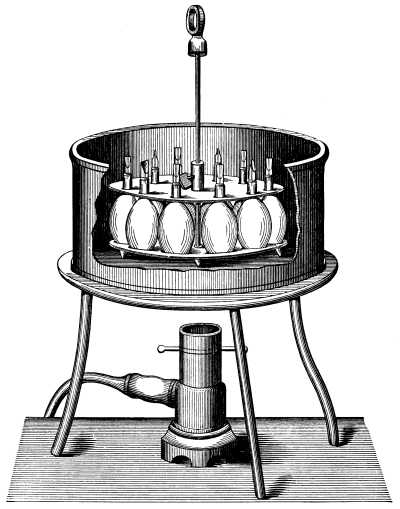
Figure 28. Bath for Pyknometers.
Weight of Water.—The flask in an appropriate holder, Fig. 28,
conveniently made of galvanized iron, is filled with freshly boiled and
hot distilled water and placed in a bath of pure, very hot distilled
water, in such a way that it is entirely surrounded by the liquid with
the exception of the top.
The water of the bath is kept in brisk ebullition for thirty minutes,
any evaporation from the flask being replaced by the addition of
boiling distilled water. The stopper should be kept for a few minutes
before use in hot distilled water and is then inserted, the flask
removed, wiped dry, and, after it is nearly cooled to room temperature,
placed in the balance and weighed when balance temperature is reached.
A convenient size of holder will enable the analyst to use eight or ten
flasks at once. The temperature at which water boils in each locality
may also be determined; but unless at very high altitudes, or on days
of unusual barometric disturbance the variations will not be great, and
will not appreciably affect the results.
51. Alternate Method of Estimating the Weight of Water in
Flasks.—Formulas for calculating the volume V, in cubic
centimeters, of a glass vessel from the weight P of water at the
temperature t contained therein, and the volume Vʹ at any
other temperature t’ are given by Landolt and Börnstein.[28]
They are as follows:
| Vʹ = P |
p |
[1 + γ (tʹ- t)]; |
| d |
in which p = weight (in brass weights) of
one cubic centimeter H₂O in vacuo. This is so nearly one gram that
it will not affect the result in the fifth place of decimals and may
therefore be disregarded. Hence the formula stands:
| Vʹ = P |
1 |
[1 + γ (tʹ- t)] |
| d |
d = density of water at temperature t.
γ = 0.000025, the cubical expansion coefficient of glass.
From this volume the weight of the water may be readily obtained by
referring to tables 13, 14 and 15a in Landolt and Börnstein’s book.
52. Example Showing Determination of Specific Gravity of a
Fat.—The flask is emptied of its water, rinsed with alcohol and
ether, and dried again for a few minutes at 100°. It is then filled
with the dry, hot, fresh-filtered fat, which should be entirely free
from air bubbles.
The stoppered flask is then replaced in the water-bath, kept for thirty
minutes at the temperature of boiling water, removed, and treated as
above. The weight of fat having been determined, the specific gravity
is obtained by dividing it by the weight of water previously found.
| Example. |
| Grams. |
| Weight of flask, dry |
10.0197 |
| Weight of flask, plus water |
37.3412 |
| Weight of water |
27.3215 |
| Weight of flask, plus fat |
34.6111 |
| Weight of fat |
24.5914 |
| Specific gravity = 24.5914 ÷ 27.3215 = |
0.90008. |
The weight of the flask dry and empty and the weight of water at 99° to
100° contained therein may be used constantly if great care be taken in
handling and cleaning the apparatus.
| Example. |
| Grams. |
| Weight of flask, dry and empty |
10.0028 |
| Weight of flask after three weeks’ use |
10.0030 |
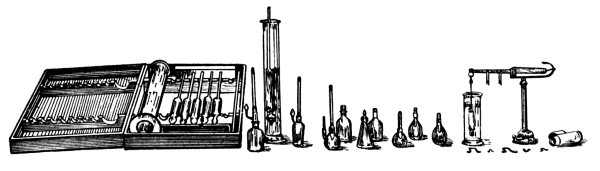
Figure 29. Aereometers, Pyknometers, and
Hydrostatic Balance.
53. Determination of Density by the Hydrostatic Balance.—While
the pyknometer is useful in control work and in fixing standards of
comparison, it is not used extensively in practical work. Quicker
methods of determination are desired in such work, and these are
found in the use of other forms of apparatus. A convenient method of
operation consists in determining the weight of a sinker, whose exact
weights in air and in pure water of a definite temperature, have been
previously determined. The instrument devised by Mohr and modified by
Westphal, is based upon that principle, and is extensively used in
practical work. The construction of this apparatus and also that of the
pyknometers and areometers is shown in the illustrations, figures
29 and 30.
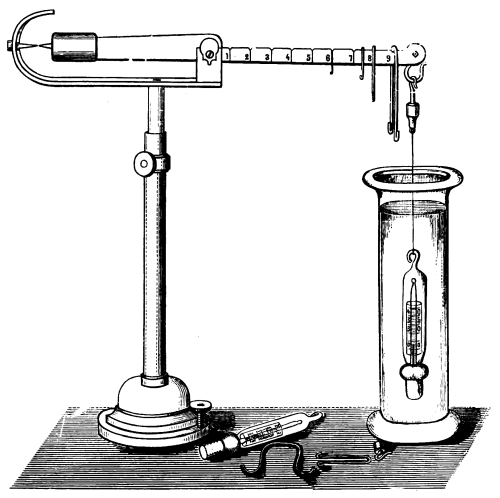
Figure 30. Hydrostatic Balance.
The weight of the sinker is so adjusted that the index of the balance
arm marks zero when the sinker is wholly immersed in pure water at the
standard temperature. The density of a solution of sugar at the same
temperature, is then determined by placing the rider-weights on the
divided arm of the balance, until the index again marks zero. The
density can then be read directly from the position of the weights in
the arm of the balance or calculated therefrom.
54. The Areometric Method.—The most rapid method of determining
the density of a solution and the one in most common use, is based
on the distance to which a heavy bulb with a slender graduated stem
will sink therein. An instrument of this kind is called an areometer.
Many forms of this instrument are employed but they all depend on the
same principle and differ only in the manner of graduation. The one of
widest application has the stem graduated in such a manner as to give
directly the specific gravity of the solution in which it is placed.
Others are made with a special graduation giving directly the
percentage of solid matter in the solution. These instruments can be
used only for the special purposes for which they are constructed.
Other forms are provided with an arbitrary graduation, the numbers
of which by appropriate tables can be converted into expressions of
specific gravity or of per cents of dissolved matters. It is not
practicable to give here, a discussion of the principles of the
construction of areometers.[29]
The two which are commonly used, are the baumé hydrometer and the
balling or brix spindle.
In the baumé instrument the zero of the scale is fixed at the point
marked by the surface of distilled water at 15°, and the point to which
it sinks in pure monohydrated sulfuric acid at the same temperature is
marked 66, corresponding to a specific gravity of 1.8427.
The specific gravity corresponding to any degree of the scale, may be
calculated in the absence of a table giving it, by the following formula
In this formula P is the density and d the degree of the
scale.[30]
In former times the baumé instruments were graduated with a solution
of common salt and a different formula was employed for calculating
specific gravity, but these older instruments are no longer in common
use.
The following table shows the specific gravities of solutions
corresponding to baumé degrees from 1° to 75° consecutively[31]:
Degree
baumé |
Specific
gravity |
Degree
baumé |
Specific
gravity |
Degree
baumé |
Specific
gravity |
Degree
baumé |
Specific
gravity |
| 0 | 1.0000 |
19 | 1.1516 |
38 | 1.3574 |
57 | 1.6527 |
| 1 | 1.0069 |
20 | 1.1608 |
39 | 1.3703 |
58 | 1.6719 |
| 2 | 1.0140 |
21 | 1.1702 |
40 | 1.3834 |
59 | 1.6915 |
| 3 | 1.0212 |
22 | 1.1798 |
41 | 1.3968 |
60 | 1.7115 |
| 4 | 1.0285 |
23 | 1.1895 |
42 | 1.4104 |
61 | 1.7321 |
| 5 | 1.0358 |
24 | 1.1994 |
43 | 1.4244 |
62 | 1.7531 |
| 6 | 1.0433 |
25 | 1.2095 |
44 | 1.4386 |
63 | 1.7748 |
| 7 | 1.0509 |
26 | 1.2197 |
45 | 1.4530 |
64 | 1.7968 |
| 8 | 1.0586 |
27 | 1.2301 |
46 | 1.4678 |
65 | 1.8194 |
| 9 | 1.0665 |
28 | 1.2407 |
47 | 1.4829 |
66 | 1.8427 |
| 10 | 1.0744 |
29 | 1.2514 |
48 | 1.4983 |
67 | 1.8665 |
| 11 | 1.0825 |
30 | 1.2624 |
49 | 1.5140 |
68 | 1.8909 |
| 12 | 1.0906 |
31 | 1.2735 |
50 | 1.5301 |
69 | 1.9161 |
| 13 | 1.0989 |
32 | 1.2849 |
51 | 1.5465 |
70 | 1.9418 |
| 14 | 1.1074 |
33 | 1.2964 |
52 | 1.5632 |
71 | 1.9683 |
| 15 | 1.1159 |
34 | 1.3081 |
53 | 1.5802 |
72 | 1.9955 |
| 16 | 1.1246 |
35 | 1.3201 |
54 | 1.5978 |
73 | 2.0235 |
| 17 | 1.1335 |
36 | 1.3323 |
55 | 1.6157 |
74 | 2.0523 |
| 18 | 1.1424 |
37 | 1.3447 |
56 | 1.6340 |
75 | 2.0819 |
55. Correction for Temperature.—The baumé hydrometer should be
used at the temperature for which it is graduated, usually 15°. In this
country the mean temperature of our working rooms is above 15°. The
liquid in the hydrometer flask should therefore be cooled to a trifle
below 15°, or kept in a bath exactly at 15° while the observation is
made. When this is not convenient, the observation may be made at any
temperature, and the reading corrected as follows: When the temperature
is above 15° multiply the difference between the observed temperature
and fifteen, by 0.0471 and add the product to the observed reading of
the baumé hydrometer; when the temperature on the other hand, is below
fifteen, the corresponding product is subtracted.[32]
56. The Balling or Brix Hydrometer.—The object of the balling
or brix instrument is to give in direct percentages the solid matter
in solution. It is evident that for this purpose the instrument must
be graduated for a particular kind of material, since ten per cent of
sugar in solution, might have a very different specific gravity from a
similar quantity of another body. Instruments of this kind graduated
for pure sugar, find a large use in technical sugar analysis. To attain
a greater accuracy and avoid an instrument with too long a stem, the
brix hydrometers are made in sets. A convenient arrangement is to have
a set of three graduated as follows; one from 0° to 30°, one from 25°
to 50°, and one from 45° to 85°. When the percentage of solid matter
dissolved is over seventy the readings of the scale are not very reliable.
57. Correction for Temperature.—The brix as the baumé scale is
graduated at a fixed temperature. This temperature is usually 17°.5.
The following table shows the corrections to be applied to the scale
reading when made at any other temperature:[33]
Per Cent of Sugar in Solution.
| |
0. | 5. |
10. | 15. |
20. | 25. |
30. | 35. |
40. | 50. |
60. | 70. |
75. |
| Temp. |
To be subtracted from the degree read. |
| 0° |
0.17 | 0.30 |
0.41 | 0.52 |
0.62 | 0.72 |
0.82 | 0.92 |
0.98 | 1.11 |
1.22 | 1.25 |
1.29 |
| 5° |
0.23 | 0.30 |
0.37 | 0.44 |
0.52 | 0.59 |
0.65 | 0.72 |
0.75 | 0.80 |
0.88 | 0.91 |
0.94 |
| 10° |
0.20 | 0.26 |
0.29 | 0.33 |
0.36 | 0.39 |
0.42 | 0.45 |
0.48 | 0.50 |
0.54 | 0.58 |
0.61 |
| 11° |
0.18 | 0.23 |
0.26 | 0.28 |
0.31 | 0.34 |
0.36 | 0.39 |
0.41 | 0.43 |
0.47 | 0.50 |
0.53 |
| 12° |
0.16 | 0.20 |
0.22 | 0.24 |
0.26 | 0.29 |
0.31 | 0.33 |
0.34 | 0.36 |
0.40 | 0.42 |
0.46 |
| 13° |
0.14 | 0.18 |
0.19 | 0.21 |
0.22 | 0.24 |
0.26 | 0.27 |
0.28 | 0.29 |
0.33 | 0.35 |
0.39 |
| 14° |
0.12 | 0.15 |
0.16 | 0.17 |
0.18 | 0.19 |
0.21 | 0.22 |
0.22 | 0.23 |
0.26 | 0.28 |
0.32 |
| 15° |
0.09 | 0.11 |
0.12 | 0.14 |
0.14 | 0.15 |
0.16 | 0.16 |
0.17 | 0.17 |
0.19 | 0.21 |
0.25 |
| 16° |
0.06 | 0.07 |
0.08 | 0.09 |
0.10 | 0.10 |
0.11 | 0.12 |
0.12 | 0.12 |
0.14 | 0.16 |
0.18 |
| 17° |
0.02 | 0.02 |
0.03 | 0.03 |
0.03 | 0.04 |
0.04 | 0.04 |
0.04 | 0.04 |
0.05 | 0.05 |
0.06 |
| |
To be added to the degree read. |
| 18° |
0.02 | 0.03 |
0.03 | 0.03 |
0.03 | 0.03 |
0.03 | 0.03 |
0.03 | 0.03 |
0.03 | 0.03 |
0.02 |
| 19° |
0.06 | 0.08 |
0.08 | 0.09 |
0.09 | 0.10 |
0.10 | 0.10 |
0.10 | 0.10 |
0.10 | 0.08 |
0.06 |
| 20° |
0.11 | 0.14 |
0.15 | 0.17 |
0.17 | 0.18 |
0.18 | 0.18 |
0.19 | 0.19 |
0.18 | 0.15 |
0.11 |
| 21° |
0.16 | 0.20 |
0.22 | 0.24 |
0.24 | 0.25 |
0.25 | 0.25 |
0.26 | 0.26 |
0.25 | 0.22 |
0.18 |
| 22° |
0.21 | 0.26 |
0.28 | 0.31 |
0.31 | 0.32 |
0.32 | 0.32 |
0.33 | 0.34 |
0.32 | 0.29 |
0.25 |
| 23° |
0.27 | 0.32 |
0.35 | 0.37 |
0.38 | 0.39 |
0.39 | 0.39 |
0.40 | 0.42 |
0.39 | 0.36 |
0.33 |
| 24° |
0.32 | 0.38 |
0.41 | 0.43 |
0.44 | 0.46 |
0.46 | 0.47 |
0.47 | 0.50 |
0.46 | 0.43 |
0.40 |
| 25° |
0.37 | 0.44 |
0.47 | 0.49 |
0.51 | 0.53 |
0.54 | 0.55 |
0.55 | 0.58 |
0.54 | 0.51 |
0.48 |
| 26° |
0.43 | 0.50 |
0.54 | 0.56 |
0.58 | 0.60 |
0.61 | 0.62 |
0.62 | 0.66 |
0.62 | 0.58 |
0.55 |
| 27° |
0.49 | 0.57 |
0.61 | 0.63 |
0.65 | 0.68 |
0.68 | 0.69 |
0.70 | 0.74 |
0.70 | 0.65 |
0.62 |
| 28° |
0.56 | 0.64 |
0.68 | 0.70 |
0.72 | 0.76 |
0.76 | 0.78 |
0.78 | 0.82 |
0.78 | 0.72 |
0.70 |
| 29° |
0.63 | 0.71 |
0.75 | 0.78 |
0.79 | 0.84 |
0.84 | 0.86 |
0.86 | 0.90 |
0.88 | 0.80 |
0.78 |
| 30° |
0.70 | 0.78 |
0.82 | 0.87 |
0.87 | 0.92 |
0.92 | 0.94 |
0.94 | 0.98 |
0.94 | 0.88 |
0.86 |
| 35° |
1.10 | 1.17 |
1.22 | 1.24 |
1.30 | 1.32 |
1.33 | 1.35 |
1.36 | 1.39 |
1.34 | 1.27 |
1.25 |
| 40° |
1.50 | 1.61 |
1.67 | 1.71 |
1.73 | 1.79 |
1.79 | 1.80 |
1.82 | 1.83 |
1.78 | 1.69 |
1.65 |
| 50° | — |
2.65 | 2.71 |
2.74 | 2.78 |
2.80 | 2.80 |
2.80 | 2.80 |
2.79 | 2.70 |
2.56 | 2.51 |
| 60° |
— | 3.87 |
3.88 | 3.88 |
3.88 | 3.88 |
3.88 | 3.88 |
3.90 | 3.82 |
3.70 | 3.43 |
3.41 |
| 70° |
— | — |
5.18 | 5.20 |
5.14 | 5.13 |
5.10 | 5.08 |
5.06 | 4.90 |
4.72 | 4.47 |
4.35 |
| 80° |
— | — |
6.62 | 6.59 |
6.54 | 6.16 |
6.38 | 6.30 |
6.26 | 6.06 |
5.82 | 5.50 |
5.33 |
According to observations of Gerlach, the correction for temperature
varies with the concentration of the solution and the range of
temperature as shown in the table.
58. Comparison of Brix and Baumé Degrees.—The following table
shows the degree baumé and the specific gravity of a sugar solution
for each degree brix (per cent of sugar in solution) from zero to
ninety-five:[34]
Degree
brix. |
Degree
baumé. |
Specific
gravity |
Degree
brix. |
Degree
baumé. |
Specific
gravity |
| 1.0 | 0.6 |
1.00388 |
37.0 | 20.7 |
1.16413 |
| 2.0 | 1.1 |
1.00779 |
38.0 | 21.2 |
1.16920 |
| 3.0 | 1.7 |
1.01173 |
39.0 | 21.8 |
1.17430 |
| 4.0 | 2.3 |
1.01570 |
40.0 | 22.3 |
1.17943 |
| 5.0 | 2.8 |
1.01970 |
41.0 | 22.9 |
1.18460 |
| 6.0 | 3.4 |
1.02373 |
42.0 | 23.4 |
1.18981 |
| 7.0 | 4.0 |
1.02779 |
43.0 | 24.0 |
1.19505 |
| 8.0 | 4.5 |
1.03187 |
44.0 | 24.5 |
1.20033 |
| 9.0 | 5.1 |
1.03599 |
45.0 | 25.0 |
1.20565 |
| 10.0 | 5.7 |
1.04014 |
46.0 | 25.6 |
1.21100 |
| 11.0 | 6.2 |
1.04431 |
47.0 | 26.1 |
1.21639 |
| 12.0 | 6.8 |
1.04852 |
48.0 | 26.6 |
1.22182 |
| 13.0 | 7.4 |
1.05276 |
49.0 | 27.2 |
1.22128 |
| 14.0 | 7.9 |
1.05703 |
50.0 | 27.7 |
1.23278 |
| 15.0 | 8.5 |
1.06133 |
51.0 | 28.2 |
1.23832 |
| 16.0 | 9.0 |
1.06566 |
52.0 | 28.8 |
1.24390 |
| 17.0 | 9.6 |
1.07002 |
53.0 | 29.3 |
1.24951 |
| 18.0 | 10.1 |
1.07441 |
54.0 | 29.8 |
1.25517 |
| 19.0 | 10.7 |
1.07884 |
55.0 | 30.4 |
1.26086 |
| 20.0 | 11.3 |
1.08329 |
56.0 | 30.9 |
1.26658 |
| 21.0 | 11.8 |
1.08778 |
57.0 | 31.4 |
1.27235 |
| 22.0 | 12.4 |
1.09231 |
58.0 | 31.9 |
1.27816 |
| 23.0 | 13.0 |
1.09686 |
59.0 | 32.5 |
1.28400 |
| 24.0 | 13.5 |
1.10145 |
60.0 | 33.0 |
1.28989 |
| 25.0 | 14.1 |
1.10607 |
61.0 | 33.5 |
1.29581 |
| 26.0 | 14.6 |
1.11072 |
62.0 | 34.0 |
1.30177 |
| 27.0 | 15.2 |
1.11541 |
63.0 | 34.5 |
1.30177 |
| 28.0 | 15.7 |
1.12013 |
64.0 | 35.1 |
1.31381 |
| 29.0 | 16.3 |
1.12488 |
65.0 | 35.6 |
1.31989 |
| 30.0 | 16.8 |
1.12967 |
66.0 | 36.1 |
1.32601 |
| 31.0 | 17.4 |
1.13449 |
67.0 | 36.6 |
1.33217 |
| 32.0 | 18.0 |
1.13934 |
68.0 | 37.1 |
1.33836 |
| 33.0 | 18.5 |
1.14423 |
69.0 | 37.6 |
1.34460 |
| 34.0 | 19.1 |
1.14915 |
70.0 | 38.1 |
1.35088 |
| 35.0 | 19.6 |
1.15411 |
71.0 | 38.6 |
1.35720 |
| 36.0 | 20.1 |
1.15911 |
72.0 | 39.1 |
1.36355
|
| |
|
| 73.0 | 39.6 |
1.36995 |
85.0 | 45.5 |
1.44986 |
| 74.0 | 40.1 |
1.37639 |
86.0 | 46.0 |
1.45678 |
| 75.0 | 40.6 |
1.38287 |
87.0 | 46.5 |
1.46374 |
| 76.0 | 41.1 |
1.38939 |
88.0 | 47.0 |
1.47074 |
| 77.0 | 41.6 |
1.39595 |
89.0 | 47.5 |
1.47778 |
| 78.0 | 42.1 |
1.40254 |
90.0 | 49.9 |
1.48486 |
| 79.0 | 42.6 |
1.40918 |
91.0 | 48.4 |
1.49199 |
| 80.0 | 43.1 |
1.41586 |
92.0 | 48.9 |
1.49915 |
| 81.0 | 43.6 |
1.42258 |
93.0 | 49.3 |
1.50635 |
| 82.0 | 44.1 |
1.42934 |
94.0 | 49.8 |
1.51359 |
| 83.0 | 44.6 |
1.43614 |
95.0 | 50.3 |
1.52087 |
| 84.0 | 45.1 |
1.44298 |
| |
|
59. Error Due to Impurities.—The fact that equal per cents
of solid bodies in solution affect the specific gravity in different
degrees has already been noted. The specific gravities of the solutions
of the common sugars, however, are so nearly the same for equal per
cents of solid matter in solution as to render the use of a brix
hydrometer quite general for technical purpose. For the mineral salts
which often occur in sugar solutions the case is quite different. A
twenty per cent solution of cane sugar at 17°.5 has a specific gravity
1.08329 and of dextrose 1.08310, practically identical. But a solution
of calcium acetate of similar strength has a specific gravity of
1.0874; of sodium sulfate 1.0807, and of potassium nitrate 1.1359.
This latter number would correspond to a sugar content of nearly
twenty-seven per cent. The brix scale can, therefore, be regarded as
giving only approximately the percentage of solid matter in sugar
solutions and, while useful in technical work, should never be relied
upon for exact analytical data.
60. Optical Properties of Natural Sugars.—The solutions of all
natural sugars have the property of deflecting the plane of polarized
light and the degree of deflection corresponds to the quantity of sugar
in solution. By measuring the amplitude of the rotation produced the
percentage of sugar in the solution can be determined. In order to
secure accuracy in the determinations it is necessary that only one
kind of sugar be present, or, if more than one, that the quantities of
all but one be determined by other means, and the disturbances produced
thereby in the total rotation be properly arranged. In point of fact
the process in practice is applied chiefly to cane and milk sugars,
both of which occur in nature in an approximately pure state. The
process is also useful in determining cane sugar when mixed with
other kinds, by reason of the fact that this sugar after hydrolysis
by treatment with a weak acid for a long or a strong acid for a short
time, definitely changes its rotating power. Since, by the same
treatment, the rotating power of other sugars which may be present is
only slightly altered, the total disturbance produced is approximately
due to the inversion of the cane sugar.
Dextrose and maltose arising from the hydrolysis of starch may also
be determined with a fair degree of accuracy by their deportment
with polarized light. When a solution of natural sugars shows
negative results when examined with polarized light, it is due to an
admixture of two or more sugars of opposite polarizing powers in such
proportions as to produce neutrality. This condition often occurs
in the examination of honeys or in submitting artificial sugars to
polarimetric observations. In the latter case the neutrality is caused
by the tendency manifested by artificially produced sugars to form twin
compounds of optically opposite qualities.
The instrument used for measuring the degree of deflection produced in
a plane of polarized light is called a polariscope, polarimeter, or
optical saccharimeter. For a theoretical discussion of the principles
of polarization and the application of these principles in the
construction of polariscopes, the reader is referred to the standard
works on optics and the construction of optical instruments.[35]
For the purposes of this work a description of the instruments commonly
employed and the methods of using them will be sufficient.
61. Polarized Light.—When a ray of light has been repeatedly
reflected from bright surfaces or when it passes through certain
crystalline bodies it acquires peculiar properties and is said to be
polarized.
Polarization is therefore a term applied to a phenomenon of light, in
which the vibrations of the ether are supposed to be restricted to a
particular form of an ellipse whose axes remain fixed in direction. If
the ellipse become a straight line it is called plane polarization.
This well-known phenomenon is most easily produced by a nicol prism,
consisting of a cut crystal of calcium carbonate (Iceland spar). This
rhombohedral crystal, the natural ends of which form angles of 71° and
109°, respectively, with the opposite edges of its principal section,
is prepared as follows:
The ends of the crystals are ground until the angles just mentioned
become 68° and 112°. The crystal is then divided diagonally at right
angles with the planes of the ends and with the principal section, and
after the new surfaces are polished they are joined again by canada
balsam. The principal section of this prism passes through the shorter
diagonal of the two rhombic ends. If now a ray of light fall on one
of the ends of this prism, parallel with the edge of its longer side,
it suffers double refraction, and each ray is plane polarized, the
one at right angles with the other. That part of the entering ray of
light which is most refracted is called the ordinary and the other the
extraordinary ray. The refractive index of the film of balsam being
intermediate between those of the rays, permits the total reflection of
the ordinary ray, which, passing to the blackened sides of the prism,
is absorbed. The extraordinary ray passes the film of balsam without
deviation and emerges from the prism in a direction parallel with the
incident ray, having, however, only half of its luminous intensity.
Two such prisms, properly mounted, furnish the essential parts of a
polarizing apparatus. They are called the polarizer and the analyzer,
respectively.
If now the plane of vibration in each prism be regarded as coincident
with its principal section, the following phenomena are observed:
If the prisms are so placed that the principal sections lie in the
prolongation of the same plane, then the extraordinary polarized ray
from the polarizer passes into the analyzer, which practically may
be regarded in this position as a continuation of the same prism.
It happens, therefore, that the extraordinary polarized ray passes
through the analyzer exactly as it did through the polarizer, and is
not reflected by the film of balsam, but emerges from the analyzer in
seemingly the same condition as from the polarizer. If now the analyzer
be rotated 180°, bringing the principal section again in the same
plane, the same phenomenon is observed. But if the rotation be in
either direction only 90°, then the polarized ray from the first prism,
incident on the second, deports itself exactly as the ordinary ray,
and on meeting the film of balsam is totally reflected. The field of
vision, therefore, is perfectly dark.
In all other inclinations of the planes of the principal sections of
the two prisms the ray incident in the analyzer is separated into
two, an ordinary and extraordinary, varying in luminous intensity in
proportion to the square of the cosine of the angle of the two planes.
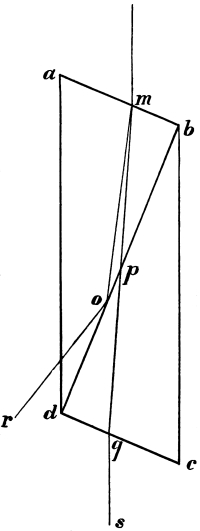
Figure 31. Course
of Rays of Light
In a Nicol.
Thus, by gradually turning the analyzer, the field of vision passes
slowly from maximum luminosity to complete obscurity. The expression
crossed nicols refers to the latter condition of the field of vision.
62. Description of the Prism.—In a nicol made as described
above, Fig. 31, suppose a ray of light parallel with the longer
side of the prism be incident to the end a b at m. By the
double refracting power of the spar the ray is divided into two, which
traverse the first half of the prism. The two rays are polarized at
right angles to one another. The less refracted ray when it strikes the
film of Canada balsam passes through it without interference. The more
refracted ray strikes the balsam at o at such an angle as to be
totally reflected and made to pass out of the prism in the direction
o r. If the prism be blackened at the surface the ray will be
entirely absorbed. The other ray passes on through the other half of
the prism and emerges in the direction of qs. It is evident that
the emergent light from a nicol has only half the illuminating power
possessed by the immergent rays.
The polarized plane of light from the nicol just described may be
regarded as passing also into a second nicol of essentially the same
construction as the first.
This second nicol, called the analyzer, is so constructed as to revolve
freely about its longitudinal axis, and is attached to a graduated
circle in such a way that the degree of rotation can be accurately
read. If the planes of polarization of the two nicols are coincident
when prolonged, the ray of light passing from the first nicol will pass
through the second practically unchanged in character or intensity. If,
however, the analyzing nicol be turned until the plane of polarization
is at right angles to that of the polarizer the immergent ray will
suffer refraction in such a manner as to be totally reflected when
reaching the film of balsam and will be thus entirely lost. In making
a complete revolution of the analyzer, therefore, two positions of
maximum intensity of light and two of darkness will be observed. In
intermediate positions the ray immergent to the analyzer will be
separated as in the first instance into two rays g p varying
intensities, one of which will be always totally reflected.
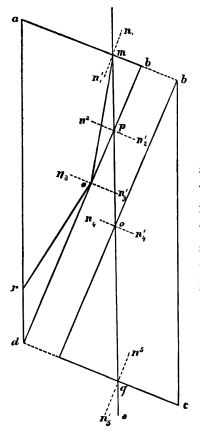
Figure 32. Theory of
the Nicol.
In Fig. 32 is given a more detailed illustration of the
action of the rays of light. The film of balsam is represented as enlarged and of
the thickness bb. Draw the perpendiculars represented by the dotted
lines n₁ nʹ₁, n₂ nʹ₂, n₃ nʹ₃
and n₄ nʹ₄. In passing into the prism at m both
refracted rays are bent towards the normal m nʹ₁. The degree of
deflection depends on the refractive index of the two rays 1.52 and
1.66 respectively. The refractive index of the extraordinary ray in
calcspar being 1.52, and in Canada balsam 1.54, it suffers but little
disturbance in passing from one to the other. On the other hand the
balsam, being considerably less refractive for the ordinary ray than
the calcspar, causes that ray to diverge outwards from the normal
o nʹ₂, and to such a degree as to suffer total reflection. The
critical angle, that is the angle at which a ray issuing from a more
refractive into a less refractive medium, emerges just parallel to the
bounding surfaces, depends on the relative index of refraction. In the
case under consideration the ratio for balsam and spar is 1.54/1.66 =
0.928 = sin 68°. Therefore the limiting value of m o n₃
so that m o may just emerge in the direction od is 68°.
If now mo were parallel to o d the angle m o n,
would be just 68°, being opposite b a d. which has been ground
to 68° in the construction of the prism. But in passing into the prism,
m o is refracted so that the angle m o n₃ is greater
than b a d. It is therefore always certain that by grinding
b a d to 68° the ordinary ray m o will be with certainty
entirely thrown out in every case. In respect of the analyzing nicol
the following additional observations will be found useful. In all
uniaxial crystals there are two directions at right angles to each
other, one of greatest and one of least resistance to the propagation
of luminous vibrations. These planes are in the direction of the
principal axis and at right angles thereto. Only light vibrating in
these two directions can be transmitted through calcspar; and all
incident light propagated by vibrations in a plane at any other angle
to the principal section is resolved into two such component rays. But
the velocities of transmission in the two directions are unequal, that
is, the refractive index of the spar for the two rays is different. If
the analyzing nicol be so adjusted as to receive the emergent light
from the polarizer when the corresponding planes of the two prisms are
coincident when extended, the emergent extraordinary ray falling into
a plane of the same resistance as that it had just left is propagated
through the second nicol with the same velocity that it passed the
first one. It is therefore similarly refracted. If, however, the
two prisms be so arranged that corresponding planes cross then the
extraordinary ray falls into a plane which it traverses with greater
velocity than it had before and is accordingly refracted and takes the
course which ends in total reflection at the film of balsam. No light
therefore can pass through the prism in that position. If any other
substance, as for instance a solution of sugar, capable of rotating
a plane of polarized light, be interposed between the two nicols the
effect produced is the same as if the analyzer had been turned to a
corresponding degree. When the analyzer is turned to that degree the
corresponding planes again coincide and the light passes. This is the
principle on which the construction of all polarizing instruments is
based.[36]
63. The Polariscope.—A polariscope for the examination of
solutions of sugar consists essentially of a prism for polarizing
the light, called a nicol, a tube of definite length for holding the
sugar solution, a second nicol made movable on its axis for adjustment
to the degree of rotation and a graduated arc for measuring it.
Instead of having the second nicol movable, many instruments have an
adjusting wedge of quartz of opposite polarizing power to the sugar,
by means of which the displacement produced on the polarized plane is
corrected. A graduated scale and vernier serve to measure the movement
of the wedges and give in certain conditions the desired reading of
the percentage of sugar present. Among the multitude of instruments
which have been devised for analytical purposes, only three will be
found in common use, and the scope of this volume will not allow space
for a description of a greater number. For a practical discussion
of the principles of polarization and their application to optical
saccharimetry, the reader may conveniently refer to the excellent
manuals of Sidersky, Tucker, Landolt, and Wiechmann.[37]
64. Kinds of Polariscopes.—The simplest form of a polarizing
apparatus consists of two nicol prisms, one of which, viz., the
analyzer, is capable of rotation about its long axis. The prolongation
of this axis is continuous with that of the other prism, viz.,
the polarizer. The two prisms are sufficiently removed from each other
to allow of the interposition of the polarizing body whose rotatory
power is to be measured.
For purposes of description three kinds of polarimeters may be
mentioned.
1. Instruments in which the deviation of the plane of polarization
is measured by turning the analyzer about its axis.
Instruments of this kind conform to the simple type first mentioned,
and are coeteris paribus the best. The Laurent, Wild,
Landolt-Lippich, etc., belong to this class.
2. Instruments in which both nicols are fixed and the direction of
the plane of polarized light corrected by the interposition of a wedge
of a solid polarizing body.
Belonging to this class are the apparatus of Soleil, Duboscq,
Scheibler, and the compensating apparatus of Schmidt and Haensch.
3. Apparatus in which the analyzer is set at a constant angle with
the polarizer, and the compensation secured by varying the length or
concentration of the interposed polarizing liquid.
The apparatus of Trannin belongs to this class.
65. Appearance of Field of Vision.—Polarimeters are also
classified in respect of the appearance of the field of vision.
1. Tint Instruments.—The field of vision in these instruments
in every position of the nicols, except that on which the plane of
vibration of the polarized light is coincident with the three principal
sections, is composed of two semi-disks of different colors.
2. Shadow Instruments.—The field of vision in this class of
polarimeters in all except neutral positions, is composed of two
semi-disks, one dark and one yellow. As the neutral position is
approximated the two disks gradually assume a light yellow color, and
when neutrality is reached they appear to be equally colored.
The Laurent, Schmidt and Haensch shadow and Landolt-Lippich
instruments, are of this class.
3. Striated Instruments.—In this class the field of vision is
striated. The lines may be tinted as in Wild’s polaristrobometer or
black, as in the Duboscq and Trannin instruments. The neutral position
is indicated either by the disappearance of the striae (Wild) or by the
phenomenon of their becoming continuous. (Duboscq, Trannin.)
66. Character of Light Used.—Polariscopes may be further
divided into two classes, based on the kind of light employed.
1. Instruments which Use Ordinary White Light.—(Oil lamp, etc.)
Scheibler, Schmidt and Haensch.
2. Instruments Employing Monochromatic Light.—(Sodium flame,
etc.) Laurent, Landolt-Lippich, etc.
67. Interchangeable Instruments.—Some of the instruments in
common use are arranged to be used either with ordinary lamp or gas
light, or with a monochromatic flame. Laurent’s polarimeter is one of
this kind. The compensating instruments also may have the field of
vision arranged for tints or shadows. Theoretically the best instrument
would be one in which the light is purely monochromatic, the field of
vision a shadow, and the compensation secured by the rotation of the
second nicol.
The accuracy of an instrument depends, however, on the skill and care
with which it is constructed and used. With quartz wedges properly
ground and mounted, and with ordinary white light, polariscopes may be
obtained which give readings as accurate as can be desired.
Since many persons are more or less affected with color-blindness, the
shadow are to be preferred to the tint fields of vision.
For practical use in sugar analysis the white light is much more
convenient than the monochromatic light.
For purposes of general investigation the polarimeters built on
the model of the laurent are to be preferred to all others. Such
instruments are not only provided with a scale which shows the
percentage of sucrose in a solution, but also with a scale and vernier
by means of which the angular rotation which the plane of vibration has
suffered, can be accurately measured in more than one-quarter of the circle.
68. Rotation Instruments.—This instrument has already been
described as one in which the extent of deviation in the plane of
polarized light caused by the intervention of an optically active
substance is measured by rotating one of the nicols about its axis and
measuring the degree of this rotation by a vernier on a graduated arc.
In Germany these instruments are called polaristrobometers,
and in France polarimètrés. In England and this country the
term polariscope or polarimeter is applied without
discrimination to all kinds of optical saccharimeters.
The polariscope of Mitscherlich was one of the earliest in use. It has
now been entirely superseded by more modern and accurate instruments.
69. The Laurent Instrument.—A polariscope adapted by Laurent
to the use of monochromatic yellow light is almost exclusively used in
France and to a considerable extent in this country. In case a worker
is confined to the use of a single instrument, the one just mentioned
is to be recommended as the best suited to general work. It has the
second nicol, called the analyzer, movable and the degree of rotation
produced is secured in angular terms directly on a divided circle. The
scale is graduated both in angular measurements and in per cents of
sugar for a definite degree of concentration of the solution and length
of observation tube. The normal solution in the laurent instrument
contains 16.19 grams of pure sugar in 100 true cubic centimeters, and
the length of the observation tube is 200 millimeters. Both the angular
rotation and the direct percentage of sugar can be read at the same
time. Great accuracy can be secured by making the readings in each
of the four quadrants. The light is rendered yellow monochromatic by
bringing into the flames of a double bunsen, spoons made of platinum
wire, which carry fragments of fused sodium chlorid.
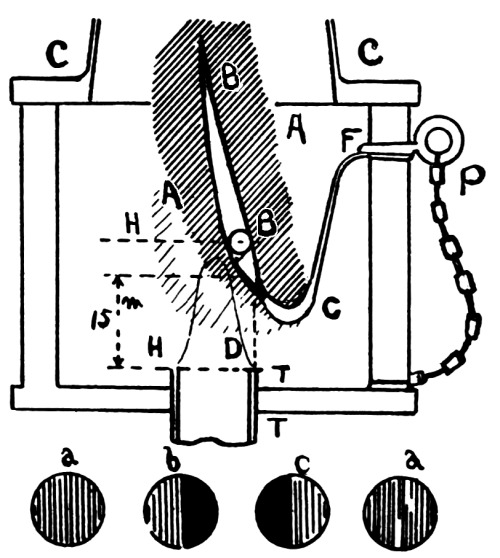
Figure 33. Laurent Lamp.
70. The Laurent Burner.—The theory of the illumination of the
laurent burner is illustrated by the accompanying Fig. 33.
The lamp consists essentially of two bunsens, surmounted by a chimney.[38]
A curved spoon made of platinum gauze serves to hold the fused particles
of sodium chlorid which are used to produce the yellow light. The spoon
is shown at G, held by the arm F, fastened by the key P. The interior
intense flame B B is surrounded by an exterior less highly colored
flame A A. It is important that the optical axis of the polariscope
be directed accurately upon the disk B, which is the most intense
part of the illumination. The point of the spoon carrying the salt
should be coincident with the prolongation of the lamp TT, so that it
just strikes the edge of the blue flame. Care should be taken not to
press the spoons into the interior of the flame as by so doing the
intensity of the illumination is very much diminished. Great care must
be observed in the position of the spoon G, and the platinum arm F
being flexible, the operator with a little patience, will be enabled
to properly place the spoon by bending it. Moreover, if the spoon be
pressed too far into the flame, the melted particles of salt collecting
in the bottom of G may drop into the lamp and occlude the orifices
through which the gas enters. The light of the yellow flame produced by
the lamp may be further purified by passing through a prism filled with
a solution of potassium dichromate, or better, a homogeneous disk cut
from a crystal of that salt.
Since the flame produced by the above device is not perfectly constant,
being more intense at the moment of introducing a fresh portion of
the fused salt, the author has used a lamp designed to furnish an
absolutely constant flame.[39]
This device which is shown in Fig. 34, is
based on the principle of adding constantly a fresh portion of the
salt to the flame. The flame is thus kept perfectly uniform in its
intensity.
The lamp consists essentially of two wheels with platinum gauze
perimeters and platinum wire spokes, driven by a clock-work D, and
mounted by the supports AAʹ as shown in the figure.
The sodium salt, chlorid or bromid, in dilute solution, is placed in the porcelain
crucibles F, supported by BBʹ as indicated in the figure, to such a
depth that the rims of the platinum wheels dip beneath the surface as
they revolve. The salt is volatilized by the lamp E. By means of the
crossed bands the wheels are made to revolve in opposite directions as
indicated by the arrows. The solution of the salt which is taken up by
the platinum net-work of the rim of the wheel, thus has time to become
perfectly dry before it enters the flame and the sputtering which
a moist salt would produce is avoided. At every instant, by this
arrangement, a minute fresh portion of salt is introduced into the
flame with the result of making a perfectly uniform light which can
be used for hours without any perceptible variation. The mechanism of
the apparatus is so simple that no further description is necessary.
The polariscope should be so directed toward the flame as to bring
into the field of vision its most luminous part. The platinum wheels
are adjustable and should be so arranged as to produce between them an
unbroken yellow flame. The wheels are eight centimeters in diameter and
are driven at a rate to make one revolution in from six to ten minutes.
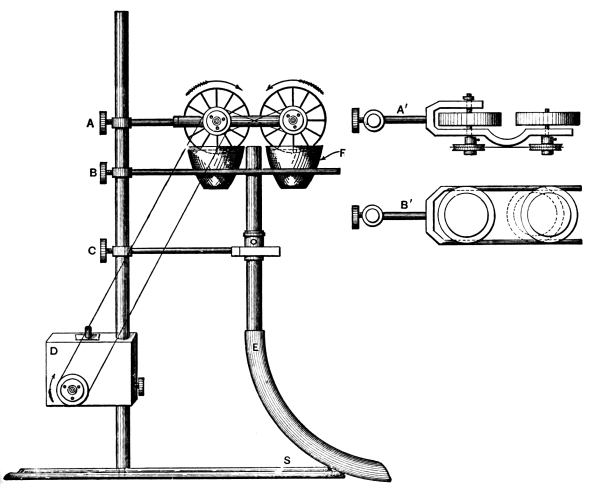
Figure 34. Lamp for Producing Constant
Monochromatic Flame.
71. Construction of Laurent’s Apparatus.—The shadow polariscope
invented by Laurent is constructed as follows: The polarizer is a
special nicol which is not fixed in its position, but is so arranged
as to be turned through a small arc about its axis. By this device,
the quantity of light passing through it can be regulated, and the
apparatus is thus useful with colored solutions which are not easily
cleared by any of the common bleaching agents. The greater the quantity
of light admitted, however, the less delicate is the reading of the
shadow produced. The plane of polarized light emergent from this prism,
falls on a disk of glass half covered by a thin lamina of quartz which
thus divides the field of vision into halves. It is this semi-disk of
quartz which is the distinguishing feature of the apparatus.[40]
The polarized light thus passes without hindrance the half field of vision
which is covered by the glass only, but can not pass the quartz plate
unless its axis is set in a certain way. The field of vision may be
thus half dark, or both halves may be equally illuminated or equally
dark according to the position of the nicol analyzer which is freely
movable about its axis and carries a vernier and reading glass over
a graduated circle. The field of vision in the laurent may have any
of the following forms.[41]
Let the polarizer be first so adjusted that the plane of polarization
of the transmitted pencil of light is parallel to the axis of the plate
lying in the direction A B. The two halves of the field of vision will
then appear equally illuminated in every position of the analyzer. But
if the polarizing nicol be inclined to AB at an angle a, the plane of
polarization of the rays passing through the quartz plate will undergo
deviation through an equal angle in the opposite direction.
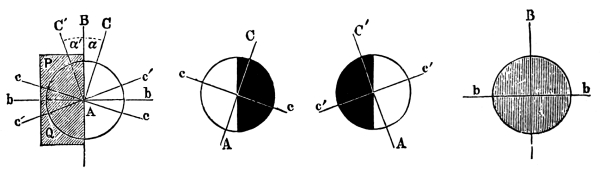
Figure 35. Field of Vision of a Laurent Polariscope.
It happens from this, that when in the uncovered half of the field, the
plane of polarization has the direction AC, in the other half it will
have the direction ACʹ. When the analyzer is rotated, if its plane of
polarization lie in the direction cc, the rays polarized parallel to AC
will be completely extinguished and the corresponding half of the field
will be dark. The opposite happens when the plane of polarization lies
in the direction of cʹcʹ. When one-half of the field is thus obscured,
the other suffers only a partial diminution in the intensity of its
illumination. When the middle position bb is reached in the rotation of
the analyzer, the illumination of the two halves is uniform, and this
is the point at which the zero of the scale is reached. The slightest
rotation of the analyzer to the right or left of this neutral point
will cause a shadow to appear on one of the halves of the field, which
by an oscillatory movement of the analyzer, seems to leap from side to
side. The smaller the angle a or BAC, the more delicate will be
the shading and the more accurate the observation. This angle being
adjustable by the mechanism already described, should be made as small
as will permit the admission of the quantity of light requisite for
accurate observation.
The various pieces composing the polariscope are arranged in the
following positions, beginning on the right of Fig. 36,
and passing to the left, where the observer is seated.[42]
1. The lamp VV, TT, AA, or the wheel burner:
2. The lens B for condensing the rays and rendering them parallel:
3. The tube I, blackened inside to carry the lens:
4. A thin lamina E, cut from a crystal of potassium bichromate, serving
to render the sodium light more monochromatic: When the saccharine
liquids under examination are colored the crystal of bichromate is
removed before the observation is made.
5. The polarizer R, which is rotatable through a small angle by the
lever K:
6. The lever JK for rotating the tube containing the polarizer: This is
operated by the rod X extending to the left.
7. Diaphragm D, half covered with a lamina of quartz.
8. Trough L for holding the observation tube: In the large instrument
shown in the figure, it is more than half a meter in
length and arranged to hold an observation tube 500 millimeters long.
9. Disk C, carrying divided circle and arbitrary sugar scale:
10. Mirror M, to throw the light of the lamp on the vernier of the scale:
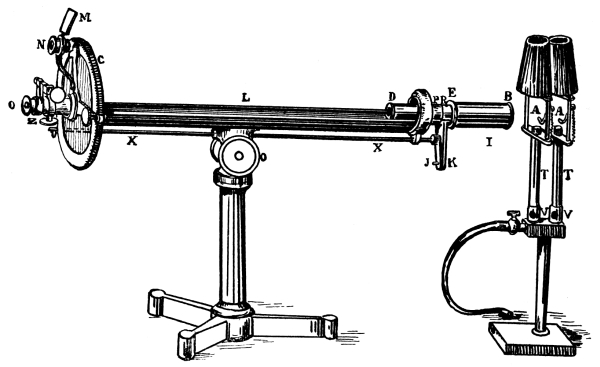
Figure 36. Laurent Polariscope.
11. Reading glass N, carried on the same radius as the mirror and used
to magnify and read the scale:
12. Device F, to regulate the zero of the instrument:
13. Tube H, carrying a nicol analyzer and ocular O for defining the
field of vision: This tube is rotated by the radial arm G, carrying the
mirror and reading glass.
72 Manipulation.—The lamp having been adjusted, the instrument,
in a dark room, is so directed that the most luminous spot of the flame
is in the line of vision. An observation tube filled with water is
placed in the trough and the zero of the vernier is placed accurately
on the zero of the scale. The even tint of the field of vision is then
secured by adjusting the apparatus by the device number 12.
73 The Soleil-Ventzke Polariscope.—A form of polariscope giving
a colored field of vision was in use in this country almost exclusively
until within ten years, and is still largely employed. There are many
forms of tint instruments, but the one almost exclusively used here
is that mentioned. A full description of their construction and
manipulation is given by Tucker.[43]
By the introduction of a third rotating nicol in front of the lens
next to the lamp, the sensitive tint at which the reading is made
can be kept at a maximum delicacy. These instruments are capable of
rendering very reliable service, especially in the hands of those who
have a delicate perception of color. They are inferior, however, to the
shadow instruments in delicacy, and are more trying to the eye of the
observer. The shadow instruments therefore, especially those making
use of an ordinary kerosene lamp, have practically driven the tint
polariscopes out of use.
The general arrangement of a tint instrument as modified by Scheibler
is shown in Fig. 37.
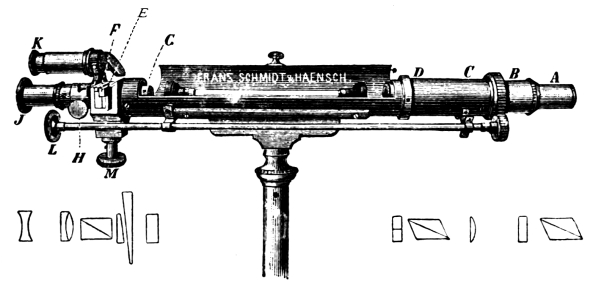
Figure 37. Tint Polariscope.
Beginning on the right of the figures, its optical parts are as
follows: A is a nicol which, with the quartz plate B, forms the
apparatus for producing the light rose neutral tint. The proper
degree of rotation of these two parts is secured by means of the
button L attached to the rod carrying the ratchet wheel as shown. The
polarizing nicol is at C, and D is a quartz disk, one-half of which is
right-handed and the other left-handed. At G is another quartz plate
belonging to the analyzing part of the apparatus. This, together with
the fixed quartz wedge F, and the movable quartz wedge E, constitute
the compensating apparatus of the instrument whereby the deviation
produced in the plane of polarized light by the solution in the tube is
restored.
Next to the compensating apparatus is the analyzing nicol which in this
instrument is fixed in a certain place, viz., the zero of the
scale. The analyzer and the telescope for observing the field of vision
are carried in the tube HJ. The movable quartz wedge has a scale which
is read with a telescope K, provided with a mirror inclined at an angle
of 45°, just over the scale and serving to illuminate it. The quartz
wedges are also provided with a movement by which the zero point of
the scale can be adjusted. A kerosene lamp with two flat wicks is the
best source of illumination and the instrument should be used in a dark
room and the light of the lamp, save that which passes through the
polariscope, be suppressed by a shade. The sensitive or transition tint
is produced by that position of the regulating apparatus which gives
a field of view of such a nature that a given small movement of the
quartz compensating wedge gives the greatest contrast in color between
the halves of the field of vision. For most eyes a faint rose-purple
tint, as nearly colorless as possible, possesses this quality. A slight
movement of the quartz wedge by means of the screw head M will, with
this tint, produce on one side a faint green and on the other a pink
color, which are in strong contrast. The neutral point is reached by so
adjusting the quartz wedge as to give to both halves of the field the
same faint rose-purple tint.
74. The Shadow Polariscope for Lamp Light.—This form of
instrument is now in general use for saccharimetric purposes. It
possesses on the one hand, the advantages of those instruments using
monochromatic light, and on the other, the ease of manipulation
possessed by the tint polariscopes. It differs from the tint instrument
in dispensing with the nicol and quartz plate used to regulate
the sensitive tint, and in having its polarizing nicol peculiarly
constructed in harmony with the optical principles of the jellet-corny
prism. The more improved forms of the apparatus have a double quartz
wedge compensation. The two wedges are of opposite optical properties,
and serve to make the observations more accurate by mutual correction.
The optical arrangement of the different parts of such a polariscope is
shown in the following figure.
The lenses for concentrating the rays of light and rendering them
parallel are contained in the tube N. At O is placed the modified
polarizing nicol. The two compensating quartz wedges are moved by the
milled screw-heads EG. The rest of the optical apparatus is arranged
as described under the tint polariscope. For practical purposes, only
one of the wedges is employed, but for all accurate work the readings
should be made with both wedges and thus every possible source of error
eliminated.
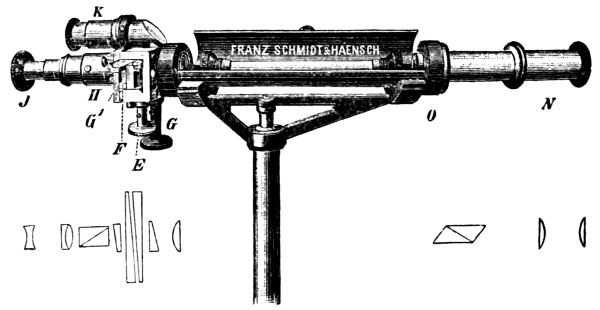
Figure 38. Double Compensating Shadow Polariscope.
75. The Triple Shadow Instrument.—When properly made, all
the instruments which have been mentioned, are capable of giving
accurate results if used in harmony with the directions given. In the
use of polariscopes having colored fields of vision a delicate sense
of distinguishing between related tints is necessary to good work.
Color-blind observers could not successfully use such apparatus. In
the shadow instruments it is only necessary to distinguish between the
halves of a field of vision unequally illuminated and to reduce this
inequality to zero. A neutral field is thus secured of one intensity
of illumination and of only one color, usually yellow. Such a field of
vision permits of the easy discrimination between the intensity of the
coloration of its two halves, and is consequently not trying to the eye
of the observer, and allows of great accuracy of discrimination. This
field of vision has lately been still further improved by dividing it
into three parts instead of two. An instrument of this kind, Fig. 39,
in use in this laboratory, permits a delicacy of reading not possessed
by any other instrument used for sugar analysis, and approaching that
of the standard Landolt-Lippich apparatus, used by us for research
work and for determining the rotation of quartz plates and testing the
accuracy of other polariscopes.
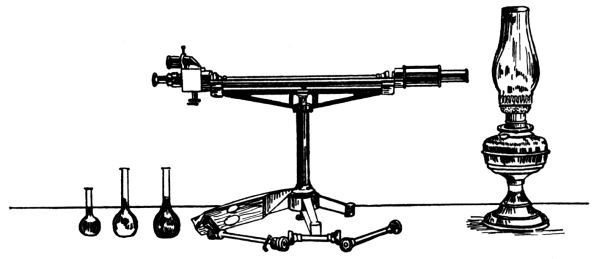
Figure 39. Triple Shadow Polariscope.
The triple shadow is secured by interposing in front of the polarizing
nicol two small nicols as indicated in Fig. 40.
The end views in different positions of the polarizer are shown in the
lower part of the diagrams.
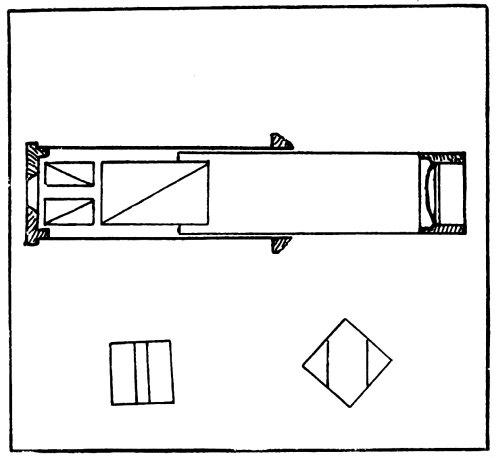
Figure 40. Apparatus for Producing a Triple Shadow.
Instead of the comparison of the intensity of the illumination being
made on the halves of the field of vision it is made by comparing
the segments of the halves with a central band, which also changes in
intensity synchronously with the two segments, but in an opposite direction.
76. General Principles.—Having described the instruments
chiefly employed in the optical examination of sugar solutions, the next
step is to apply them to the analytical work. A common set of
directions for use will be found applicable to all instruments
with such modifications only as are required by peculiarities of
construction. With the best made instruments it is always advisable
to have some method of controlling the accuracy of the observation.
The simplest way of doing this is to test the apparatus by standard
quartz plates. These plates are made from right-handed polarizing
quartz crystal ground into plates of definite thickness and accurately
tested by standard instruments. Theoretically such quartz plates
deflect the plane of polarized light in a degree proportionate to
their thickness, but practically some small deviations from the rule
are found. With a source of light of the same tint, and at a constant
temperature, such plates become a safe test for the accuracy of the
graduation of polariscopes. They are more convenient for use than pure
sugar solutions of known strength which are the final standards in
all disputed cases. These quartz plates are conveniently mounted in
tubes of the same size as those holding the sugar solution, and thus
fit accurately into the trough of the polariscope, the optical axis
of which passes through their center. The quartz plate when used for
setting the scale of a polariscope should be placed always in the same
position. In some plates slight differences of reading may be noticed
on rotating the tubes holding them. Theoretically, such differences
should not exist, but in practice they are sometimes found. The temperature
of observation should also be noted, and if not that at which the value
of the plate was fixed a proper correction should be made.
77. Setting the Polariscope.—While mention has been made of
several forms of apparatus in the preceding paragraphs, those in common
use are limited to a very small number. In this country quite a number
of color instruments may still be found, together with a few laurents,
and a constantly increasing number of shadow instruments for use with
lamp light. The following description of setting the polariscope is
especially adapted to the last named instrument, but the principles of
adjustment are equally applicable to all.
The scale of the instrument is first so adjusted by means of the
adjusting screws provided with each instrument, as to bring the zero of
the vernier and that of the scale exactly together. The telescope or
ocular is then adjusted until the sharp line separating the halves of
the field of vision is brought into focus. This being accomplished an
observation tube filled with pure water is placed in the apparatus
and the telescope again adjusted to bring the dividing line of the
field into focus. The beginner especially, should repeatedly study
this adjustment and be impressed with the fact that only in a sharply
defined field are practical observations of any worth. The importance
of having all the lenses perfect and all the cover glasses without a
flaw may be fully appreciated when it is remembered that the polarized
ray, already deprived of half its original luminous power, must pass
through several centimeters of crystallized calcium carbonate, and
half a dozen disks of glass and quartz, and as many lenses before
reaching the eye of the observer. Only with the greatest care and
neatness is it possible to secure the required degree of illumination.
The zero point having been well studied and accurately adjusted, the
scale of the instrument may be tried with a series of quartz plates of
known polarizing power at the temperature of the observation. In the
apparatus with double quartz wedge compensation, it will be noticed
that the marks on one scale are black and on the other red. The
black is the working and the red the control scale. To operate this
instrument, the red scale is placed exactly at the zero point. The
black scale is also placed at zero, and if the field of vision is not
neutral, it is made so by the micrometer screw with which the black
scale is provided. In a right-handed solution, the red scale is left
at zero and the black one moved to the right until neutrality in the
field of vision is reached and the reading is taken. The observation
tube containing the sugar solution is taken out and the red scale
moved until the field of vision is again neutral and the reading of
the red scale taken. The two readings should agree. Any failure in the
agreement shows some fault either in adjusting the apparatus or in its
construction, or some error in manipulation.
The double compensating shadow instruments are more readily tested
for accuracy in all parts of the scale than those of any other
construction. The two compensating wedges are cut with the greatest
care, one from a left-handed and the other from a right-handed
perfectly homogeneous quartz crystal. Since faults in these wedges are
due either to lack of parallelism of surface, or of perpendicularity
to the optical axis of the crystal, and since these faults of
crystallization or construction must be in a very limited degree common
they would not coincide once in many thousand times in the two wedges.
This is easily shown by the theory of probabilities. If, therefore, the
two readings made at any point, should not agree, it must be due either
to a fault in one of the wedges, or to a fault in reading or a lack of
adjustment, as has been mentioned. In such cases the readings should be
retaken and the errors are usually easily discovered.
78. Control Observation Tube.—Instead of using quartz plates of
known values for testing the accuracy of the scale, an observation tube
may be used, the length of which can be varied at the pleasure of the observer.
The construction of a tube of this kind is shown in Fig. 40.
The tube B is movable telescopically in A by means of the ratchet wheel
shown. It is closed at D water-tight by a glass disk. The tube B fits
as accurately into A as is possible to permit of free movement, and
any liquid which may infilter between its outer surface and the inner
surface of A is prevented from gaining exit by the washer C, which
fits both tubes water-tight. The ratchet which moves B in A carries
a millimeter scale and vernier N whereby the exact thickness of the
liquid solution between the surfaces of the glass disks D and E can be
always determined.
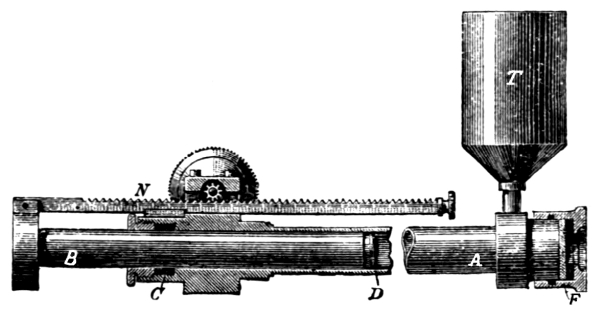
Figure 41. Control Observation Tube.
By this device the length of liquid under observation can be accurately
read to a tenth of a millimeter. The cover glass E is held in position
by any one of the devices in common use for this purpose in the case in
question, by a bayonet fastening. The funnel T, communicating directly
with the interior of A, serves to hold the solution, there being always
enough of it to fill the tube when D is removed to the maximum distance
from C, which is usually a little more than 200 millimeters.
Let the control tube be adjusted to 200 millimeters and filled with a
solution of pure sugar, which reads 100 per cent or degrees in a 200
millimeter tube. Since the degree of rotation is, other things being
equal, proportional to the length of the column of polarizing solution,
it follows that if the tube B be moved inward until the distance
between D and C is 100 millimeters, the scale should read 50° or per
cent. By adjusting the length of the distance between B and C it is
easily seen that every part of the scale can be accurately tested.
The tube should be filled by removing the funnel and closing the
orifice with a screw cap which comes with the apparatus. The cap E
is then removed and the tube filled in the ordinary manner. This
precaution is practiced to avoid carrying air bubbles into the tube
when filled directly through the funnel. With a little care, however,
this danger may be avoided, or should air bubbles enter they can be
easily removed by inclining the tube.
In case the solution used be not strictly pure it may still be employed
for testing the scale. Suppose, for instance, that a solution made up
in the usual way, has been made from a sample containing only 99.4 per
cent of sugar. Then in order to have this solution read 100° on the scale
the tube should be set at 201.2 millimeters, according to the formula
By a similar calculation the position of the tube for reading any
desired degree on the scale can be determined. The importance of
controlling all parts of the scale in compensating instruments is
emphasized by the fact that a variation of only 0.016 millimeter in the
thickness of the compensating wedge will cause a change of one degree
in the reading of the instrument.
79. Setting the Polariscope with Quartz Plates.—Pure sugar is
not always at the command of the analyst, and it is more convenient
practically to adjust the instrument by means of quartz plates, the
sugar values of which have been previously tested for the character
of the light used. Assuming the homogeneity of a plate of quartz, the
degree of deflection which it imparts to a plane of polarized light
depends on the quality of the light, the thickness of the plate, and
the temperature.
In respect of the quality of light, red polarized rays are least, and
violet most deflected. The degree of rotation produced with any ray,
at a given temperature, is directly proportional to the thickness of
the plate. Temperature affects the rotating power of a quartz plate
in a degree highly significant from a scientific point of view and
not wholly negligible for practical purposes. The rotating power of a
quartz plate increases with the temperature and the variation may be
determined by the formula given below:[44]
The formula is applicable for temperatures between 0° and 100°. Its
values are expressed in degrees of angular measure which can be
converted into degrees of the sugar scale by appropriate factors:
Formula.— aᵗ = a°(1 + 0.000146t);
in which a° = polarization in angular degrees at 0°,
t the temperature of observation and aᵗ the rotation desired.
Example.—A quartz plate which has an angular rotation of 33° at
0° will have a rotation at 20° of 33°.09834.
aᵗ = 33(1 + 0.000146 × 20) = 33.09834.
Since in instruments using the ventzke scale one degree of the sugar
scale is equal to 0.3467 degree angular measure, the sugar value of the
quartz plate mentioned is equal to 95.47 percent; 33.09834 ÷ 0.3467 = 95.47.
The sugar value of this plate at 0° is 95.18 per cent; 33 ÷ 0.3467 = 95.18.
80. Tables for Correcting Quartz Plates.—Instead of calculating
the variation in quartz plates for each temperature of observation, it
is recommended by the Bureau of Internal Revenue of the Treasury, to
use control quartz plates the values of which at any given temperature,
are found on a card which accompanies each one.[45]
The variations given, are from temperatures between 10° and 35°. Three control
plates are provided with each instrument used by the Bureau, for polarimetric
work in the custom houses, or in ascertaining bounties to be paid on
the production of domestic sugars. For example, the case of a sugar
which polarizes 80°.5 may be cited. One of the control plates nearest
to this number, is found to have at the temperature of observation, a
polarization of 91°.4, the reading being made in each case at 25°. On
consulting the card which accompanies the control plate, it is seen
that its value at the temperature mentioned, is 91°.7. The reading of
the instrument is therefore too low by three-tenths of a degree, and
this quantity should be added to the observed polarization, making it
80°.8. In this method of correcting the reading for temperature, it is
assumed that the compensating wedges of the instrument, are free of
error at the points of observation. The plates used for the purpose
above, are all standardized in the office of weights and measures of
the Coast and Geodetic Survey, before delivery to the analysts.
81. Applicability of Quartz Plates.—Quartz plates which are
correctly set for one instrument or kind of light, should be equally
accurate for the sugar scales of all instruments, using the same sugar
factor. In other words a quartz plate which reads 99° on a scheibler
color polariscope, should give the same reading on the sugar scale of a
shadow compensating or a monochromatic direct reading apparatus using
26.048 grams of sugar.
The most useful quartz plates for sugar analysis, are those which give
the readings at points between 80° and 96°, which cover the limits of
ordinary commercial sugars. For molasses the plates should read from
45° to 55°. For sugar juices of the cane and beet, the most convenient
graduation would be from 10° to 20°, but plates of this value would be
too thin for practical work and are not in use. When quartz plates are
to be used for control purposes, they should be purchased from reliable
manufacturers, or better, tested directly against pure sugar solutions
by the observer.
In practice we have found quartz plates as a rule, true to their
markings.
82. The Sugar Flask.—Sugar solutions are prepared for
polarization in flasks graduated to hold fifty or one hundred cubic
centimeters. For scientific work a flask is marked to hold 100 grams of
distilled water at 4°. The weights are all to be reduced to a vacuum
standard. One flask having been marked in this way, others may be
compared directly therewith by means of pure mercury. For this purpose
the flasks must be perfectly dry and the mercury pure, leaving no stain
on the sides of the flask. The glass must also be strong enough to
undergo no change in shape from the weight of mercury used.
For sugar work the true 100 gram flask is not usually employed, but
one graduated by weighing at 17°.5. These flasks are graduated by
first weighing them perfectly dry, filling with distilled water and
again weighing fifty and fifty-five, or 100 and 110 grams of water at
the temperature named. Since the volume of water at 17°.5 is greater
than at 4° the sugar flask in ordinary use has a greater volume by
about 0.25 cubic centimeter than the true flask. The observer should
always secure a statement from the dealer in respect of the volume
of the flask used in testing the scale of the polariscope purchased.
In the graduation of a flask in true cubic centimeters, when brass
weights are used it will be necessary to correct the weight of each
gram of water by adding to it one milligram, which is almost exactly
the weight of the volume of air displaced by one gram of water in the
circumstances named. If the flask be first counterbalanced and it be
desired to mark it at 100 cubic centimeters the sum of the weights
placed in the opposite pan should be 100 - 0.100 = 99.900 grams. While
this is not a rigidly exact correction it will be sufficient for all
practical purposes. A liter of dry air weighs 1.29366 grams; and 100
cubic centimeters of water would therefore displace 0.129 gram of air.
But the brass weights also displace a volume of air which when deducted
reduces the correction to be made for the water to nearly the one
named. For convenience in inverting sugar solutions the flasks used in
practical work are graduated at fifty and fifty-five and 100 and 110
cubic centimeters respectively.
83. Preparing Sugar Solutions for Polarization.—If sugar
samples were always pure the percentage of sugar in a given solution
could be directly determined by immediate polarization. Such cases,
however, are rarely met in practice. In the majority of cases the
sample is not only to be brought into solution but is also to be
decolorized and rendered limpid by some one of the methods to be
described. A perfectly limpid liquid is of the highest importance to
secure correct observations. With a cloudy solution the field of vision
is obscured, the dividing line of the two halves, or the double line
in the triple field, becomes blurred or invisible and the intensity
of illumination is diminished. A colored liquid which is bright is
far more easy to polarize than a colorless liquid which is turbid. In
fact, it is only rarely in sugar work that samples will be found which
require any special decolorizing treatment other than that which is
received in applying the reagents which serve to make the solutions
limpid. In the following paragraphs the approved methods of clarifying
sugar solutions preparatory to observation in the polariscope will be
described.
84. Alumina Cream.—The hydrate of alumina, commonly known as
alumina cream, is always to be preferred as a clarifying agent in all
cases where it can be successfully applied.[46]
It is a substance that acts wholly in a mechanical way and therefore
leaves the sugars in solution unchanged, carrying out only suspended
matters. In the preparation of this reagent a solution of alum is
treated with ammonia in slight excess, the aluminum hydroxid produced
washed on a filter or by decantation until neutral in reaction. The
hydroxid is suspended in pure water in proportions to produce a creamy
liquid. Although apparently very bulky, the actual space occupied by
the amount of dry hydroxid added in a few cubic centimeters is so small
as to produce no disturbing effect of importance on the volume of the
sugar solution. The cream thus prepared is shaken just before using and
from one to five cubic centimeters of it, according to the degree of
turbidity of the saccharine solution, are added before the volume in
the flask is completed to the mark. After filling the flask to the mark
the ball of the thumb is placed over the mouth and the contents well
shaken and allowed to stand for a few moments before filtering.
The alumina cream is well suited to use with solutions of commercial
sugars of not too low a grade and of most honeys and high grade sirups.
It is usually not powerful enough to clarify beet and cane juices,
molasses and massecuites.
85. Basic Lead Acetate.—A solution of basic lead acetate is an
invaluable aid to the sugar analyst in the preparation of samples for
polarimetric observation. It acts as a clarifying agent by throwing
out of solution certain organic compounds and by uniting with the
organic acids in solution forms an additional quantity of precipitate,
and these precipitates act also mechanically in removing suspended
matters from solution. The action of this reagent is therefore much
more vigorous than that of alumina cream. Coloring matters are often
precipitated and removed by treatment with lead acetate. It happens
therefore that there are few samples of saccharine bodies whose
solutions cannot be sufficiently clarified by lead acetate to permit of
polarimetric observation.
The reagent is most frequently employed of the following
strength:[47]
Boil for half an hour in one and a half liters of water 464 grams of
lead acetate and 264 grams of litharge with frequent stirring. When
cool, dilute with water to two liters, allow to stand until clear, and
decant the solution. The specific gravity of this solution is about 1.267.
In a solution of basic lead acetate of unknown strength the percentage
of lead acetate may be determined from its specific gravity by the
following table:[48]
Percentage of Lead Acetate
Corresponding
to Different Specific Gravities at 15°.
Specific
gravity. |
Percentage of
lead acetate. |
Specific
gravity. |
Percentage of
lead acetate. |
| 1.0127 |
2 |
1.2040 |
28 |
| 1.0255 |
4 |
1.2211 |
30 |
| 1.0386 |
6 |
1.2395 |
32 |
| 1.0520 |
8 |
1.2579 |
34 |
| 1.0654 |
10 |
1.2768 |
36 |
| 1.0796 |
12 |
1.2966 |
38 |
| 1.0939 |
14 |
1.3163 |
40 |
| 1.1084 |
16 |
1.3376 |
42 |
| 1.1234 |
18 |
1.3588 |
44 |
| 1.1384 |
20 |
1.3810 |
46 |
| 1.1544 |
22 |
1.4041 |
48 |
| 1.1704 |
24 |
1.4271 |
50 |
| 1.1869 |
26 |
|
|
86. Errors Due to use of Lead Solutions.—In the use of lead
solutions there is danger of errors intruding into the results of
the work. These errors are due to various sources. Lead subacetate
solution, when used with low grade products, or sugar juices, or sirups
from beets and canes, precipitates albuminous matters and also the
organic acids present. The bulk occupied by these combined precipitates
is often of considerable magnitude, so that on completing the volume in
the flask the actual sugar solution present is less than indicated. The
resulting condensation tends to give too high a polarimetric reading.
With purer samples this error is of no consequence, but especially with
low grade sirups and molasses it is a disturbing factor, which must be
considered.
One of the best methods of correcting it has been proposed by
Scheibler.[49]
To 100 cubic centimeters of a solution of the sample,
ten of lead solution are added, and after shaking and filtering
the polarimetric reading is taken. Another quantity of 100 cubic
centimeters of the solution with ten of lead is diluted to 220 cubic
centimeters, shaken, filtered, and polarized. Double the second
reading, subtract it from the first, multiply the difference by 2.2,
and deduct the product from the first reading. The remainder is the
correct polarization.
The process just described is for the usual work with beet juices and
sirups. For cane juices measured by the graduated pipette, hereafter to
be described, and for weighed samples of molasses and massecuites, the
following method of calculation is pursued.[50]
To the sample dissolved in water, add a measured portion of the lead
subacetate solution, make its volume 100 cubic centimeters and observe
the polarimetric reading. Prepare a second solution in the same way
and make the volume double that of the first and again take the
polarimetric reading. Multiply the second reading by two, subtract the
product from the first reading and multiply the remainder by two, and
subtract the product from the first reading.
| Example.— |
First polarization |
|
30.0 |
| Second polarization |
|
14.9 |
| Then 30 - (2 × 14.9 = 29.8) |
= 0.2 |
|
| 0.2 × 2 |
= 0.4 |
|
| and 30 - 0.4 |
= 29.6 |
|
The corrected reading therefore shows that the sample contained 29.6
per cent of sugar.
87. Error Due to Action of Lead Subacetate on Levulose.—In the
use of lead subacetate solution not only is there danger of error due
to the causes just described, but also to a more serious one, arising
from the chemical interaction of the clarifying agent and levulose.[51]
Lead subacetate forms a chemical union with levulose and the resulting
compound has a different rotatory power from the left-handed sugar in
an uncombined state. By adding a sufficient quantity of subacetate
solution, the left-handed rotation of levulose may be greatly
diminished if not entirely destroyed. In this case the dextrose, which
with levulose forms inverted sugar, serves to increase the apparent
right rotation due to the sucrose in solution. The reading of the
scale is therefore higher than would be given by the sucrose alone.
If the lead subacetate could be added in just the proportion to make
the invert sugar neutral to polarized light, its use would render the
analysis more accurate; but such a case could only arise accidentally.
To correct the error, after clarification, the compound of levulose and
lead may be decomposed by the addition of acetic acid according to the
method of Spencer. In this case the true content of sucrose can only be
obtained by the method of inversion proposed by Clerget, which will be
described in another paragraph.
88. Clarification with Mercuric Compounds.—Where the disturbing
bodies in a solution are chiefly of an albuminoid nature, one of the
best methods of securing clarification is by the use of a solution
containing an acid mercuric compound.[52]
In the case of milk this method is to be preferred to all others.
Albuminoid bodies themselves, have the property of deflecting the plane
of polarization, as a rule, to the left, and therefore, should be
completely removed from solutions containing right-handed sugars such
as lactose. For this purpose the mercuric compound is more efficient
than any other. It is prepared and used as follows.[53]
Dissolve mercury in double its weight of strong nitric acid and dilute
the solution with an equal volume of water. One cubic centimeter of
this solution is sufficient to clarify fifty times its volume of milk.
89. Decolorization by Means of Bone-Black.—Where the means
already described fail to make a solution sufficiently colorless to
permit of the passage of a ray of polarized light, recourse should be
had to a decolorizing agent. The most efficient of these is bone-black.
For laboratory work it is finely ground and should be dry if added to
an already measured solution. When moist it should be added to the
flask before the volume is completed, and a correction made for the
volume of the dry char employed. Bone-black has the power of absorbing
a certain quantity of sugar, and for this reason as little of it
should be employed as is sufficient to secure the end in view. If not
more than one gram of the char be used for 100 cubic centimeters of
solution, the error is not important commercially. The error may be
avoided by placing the char on the filter and rejecting the first half
of the filtered solution. The char becomes saturated with the first
portion of the solution, and does not absorb any sugar from the second.
This method, however, does not secure so complete a decolorization as
is effected by adding the black directly to the solution and allowing
to stand for some time with frequent shaking.
90. Remarks on Analytical Process.—Since large weights of sugar
are taken for polarization, a balance which will weigh accurately to
one milligram may be used. In commercial work the weighing is made in a
counterpoised dish with a prominent lip, by means of which the sample
can be directed into the mouth of the flask after partial solution.
Where the air in the working room is still, an uncovered balance is
most convenient. With a little practice the analyst will be able to
dissolve and transfer the sample from the dish to the flask without
danger of loss. The source of light used in polarizing should be in
another room, and admitted by a circular opening in the partition. In a
close polarizing room, which results from the darkening of the windows,
the temperature will rapidly rise if a lamp be present, endangering
notably the accuracy of the work, and also interfering with the comfort
of the observer. The greatest neatness must be practiced in all stages
of the work, and especially the trough of the polariscope must be kept
from injury which may arise from the leaking of the observation tubes.
Dust and dirt of all kinds must be carefully excluded from the lenses,
prisms, wedges and plates of the instrument.
91. Determination of Sucrose by Inversion.—In the foregoing
paragraphs directions have been given for the estimation of sugar
(sucrose) by its optical properties. It has been assumed so far, that
no other disturbing bodies have been present, save those which could be
removed by the clarifying agents described. The case is different when
two or more sugars are present, each of which has a specific relation
to polarized light. In such cases some method must be used for the
optical determination of sucrose, which is independent of the influence
of the other polarizing bodies, or else recourse must be had to other
methods of analysis. The conversion of the sucrose present into invert
sugar by the action of an acid or a ferment, affords an opportunity for
the estimation of sucrose in mixed sugars, by purely optical methods.
This process rests upon the principle that by the action of a dilute
acid for a short time, or of a ferment for a long time, the sucrose
is completely changed, while other sugars present are not sensibly
affected. Neither of these assumptions is rigidly correct but each is
practically applicable.
The sucrose by this process of hydrolysis is converted into an equal
mixture of levulose and dextrose. The former, at room temperatures, has
the higher specific rotating power, and the deflection of the plane of
polarization in a solution of inverted sugar is therefore to the left.
The levorotatory power of invert sugar varies with the temperature,
and this arises from the optical properties of the levulose. The
influence of temperature on the rotating power of other sugars, is not
imperceptible in all cases, but in practice is negligible.
This method of analysis is invaluable in control work in factories,
in the customs and in agricultural laboratories. Since the rotating
power of levulose diminishes as the temperature rises, an accurate
thermometric observation must accompany each polarimetric reading. At
about 88° the rotatory powers of dextrose and levulose are equal, and a
solution of pure invert sugar examined at that degree, is found to be
neutral to polarized light.
92. Clerget’s Method of Inversion.—The classical method of
Clerget for the determination of cane sugar by double polarization
before and after inversion, was first described in a memoir presented
to the Society of Encouragement for National Industry on the 14th of
October, 1846. The following description of the original method is
taken from a reprint of the proceedings of that Society, dated Nov. 1846:
Clerget points out first the observation of Mitscherlich regarding
the influence of temperature on the rotatory power of invert sugar,
and calls attention to the detailed experiments he has made which
resulted in the determination of the laws of the variation. From these
studies he was able to construct a table of corrections, applicable in
the analysis of all saccharine substances in which the cane sugar is
polarized before and after inversion. The basis of the law rests upon
the observation that a solution of pure sugar, polarizing 100° on the
sugar scale, before inversion, will polarize 44° to the left after
inversion at a temperature of zero. The quantity of sugar operated upon
by Clerget amounted to 16.471 grams in 100 cubic centimeters of liquid.
On the instrument employed by him this quantity of sugar in 100 cubic
centimeters gave a reading of 100° to the right on the sugar scale
when contained in a tube twenty centimeters in length. The process of
inversion carried on by Clerget is as follows:
The sugar solution is placed in a flask, marked on the neck at 100
and 110 cubic centimeters; or if smaller quantities are used, in a
flask marked on the neck at fifty and fifty-five cubic centimeters.
The flask is filled with the sugar solution to the first mark and then
a sufficient quantity of strong hydrochloric acid added to bring the
volume of the liquid to the second mark. The mouth of the flask is then
closed with the thumb and its contents thoroughly mixed by shaking.
A thermometer is placed in the flask which is set in a water-bath in
such a way that the water comes just above the level of the liquid
in the neck of the flask. The water is heated in such a manner as to
bring the temperature of the contents of the flask, as determined
by the thermometer, exactly to 68° and at such a rate as to require
fifteen minutes to reach this result. At the end of fifteen minutes the
temperature having reached 68° the flask is removed and placed at
once in another water-bath at the temperature of the room, to which
temperature the contents of the flask are cooled as rapidly as
possible. To make the polarimetric observation a tube twenty-two
centimeters in length is filled with the inverted sugar solution by
means of a tubulure in its center, which serves not only the purpose of
filling the tube but also afterwards to carry the thermometer, by means
of which the temperature of observation can be taken. If the sugar
solution be turbid, or contain any lead chlorid due to the previous use
of basic lead acetate in clarification, it should be filtered before
being introduced into the observation tube. This tube being one-tenth
longer than the original compensates for the dilution caused by the
addition of the hydrochloric acid in inversion.
When reading, the bulb of the thermometer should be withdrawn far
enough to permit the free passage of the ray of light and the exact
temperature of the solution noted.
The above outline of Clerget’s method of inversion is given in order
that the analyst may compare it with any of the variations which he may
find in other works. The chief points to which attention is called,
are, first, the fact that only a little over sixteen grams of sugar are
used for ten cubic centimeters of strong hydrochloric acid, and second,
that the time of heating is exactly fifteen minutes, during which time
the contents of the flask should be raised from room temperature to
exactly 68°.
From the above it is seen that the process of Clerget, as originally
described, can be applied directly to all instruments, using
approximately sixteen grams of sugar in 100 cubic centimeters.
Experience has also shown that even when larger quantities of sugar
are employed, as for instance, approximately twenty-six grams,
the inversion is effected with practical completeness in the same
circumstances. It is advised, therefore, that in all analytical
processes, in which cane sugar is to be determined by the process of
inversion with an acid, the original directions of Clerget be followed
as strictly as possible. Experience has shown that no one of the
variations proposed for Clerget’s original method has any practical
advantage and the analyst is especially cautioned against those methods
of inversion in which the temperature is continued at 68° for fifteen
minutes or in which it is allowed to go above that degree.
93. Influence of Strength of Solution and Time of Heating on the
Inversion of Sucrose.—As has been intimated, the strength of a
sugar solution and the time of heating with hydrochloric acid are
factors that must be considered in determining a formula for the
calculation of sucrose by inversion. The Clerget formula holds good
only for the conditions specified and these conditions must be rigidly
adhered to in order to secure the proper results. This matter has been
thoroughly studied by Bornträger, who also gives a nearly complete
bibliography of the subject.[54]
As a result of his investigations it seems well established that the
original Clerget formula is practically correct for the conditions
indicated, Bornträger modifying it only by substituting in the formula
143.66 for 144. This is so nearly the same as the Clerget factor
that it is not advisable to substitute it therefor. If, however,
the inverted sugar solution be diluted to double its volume before
polarization the factor proposed by Landolt, viz., 142.4, gives
more nearly accurate results. If the hydrochloric acid be neutralized
before polarization by an alkaline body, the character of the salt
which is formed also influences, to a greater or less extent, the
specific rotatory power of the solution. Hydrochloric acid itself also
influences the rotation to a certain degree.[55]
94. Calculation of Results.—The percentage of sucrose in
a solution which has been polarized before and after inversion is
calculated by an appropriate formula from the data obtained or is taken
directly from tables. These tables are too long to insert here, and in
point of fact the calculation can be made from the formula almost as
quickly as the result can be taken from a table.
Two factors are commonly used in the calculations, one based on
the supposition that a sugar solution polarizing 100° to the right
will, after inversion, give a reading of 44° to the left, at zero
temperature. In the second formula in common use the polarization to
the left in the circumstances mentioned above is assumed to be 42.4, a
number reached by Landolt after a long series of experiments.[56]
The principle of the calculation of the percentage of sucrose is based upon
the original observation of Clerget to the effect that the algebraic
difference of the two readings, divided by 144, less half of the
temperature, will give the percentage of sucrose desired. The formula
by which this is obtained is
In this formula a is the polarization on the sugar scale before
inversion, b the polarization after inversion, K the
constant representing the algebraic difference of the two polarizations
of pure sugar at 0° and t the temperature of the observation.
To K may be assigned the values 144 or 142.4, the one in more
common use. In case the polarization, after inversion, is to the
left, which is more commonly the case, the sum of the two readings
is taken for a - (-b) = a + b; when both
polarizations are to the right or left the difference is taken. S is
the percentage of sucrose desired.
| Example.— |
Let the polarization before inversion be |
+95 |
| and after inversion |
-26 |
| and the temperature |
20° |
| Then S = |
95 + 26 |
= 121 ÷ 134 = 90.6. |
| 144 - 10 |
Substituting the value 142.4 for K, the result of the
calculation is 91.4.
In high grade sugars, therefore, the difference in the results secured
by taking the two values of K amounts to about 1 per cent of
sucrose.
For a further discussion of the theory and practice of inversion the
reader is referred to the articles of Herles, Herzfeld, and Wohl.[57]
95. Method Of Lindet.—Courtonne recommends the method of Lindet
for securing the inversion instead of the method of Clerget.[58]
Modified by Courtonne, the method is as follows:
Make two or three times the normal weight of sugar dissolved in water
to a volume of 200 or 300 cubic centimeters, as the case may be. After
thoroughly mixing proceed as follows:
First, to Obtain the Polarization Direct.—Place fifty or 100
cubic centimeters of the prepared solution in a flask marked at fifty
and fifty-five or at 100 and 110 cubic centimeters, add a sufficient
quantity of lead acetate to secure a complete clarification, make the
volume to fifty-five or 110 cubic centimeters, shake thoroughly,
filter, and polarize in a 220 millimeter tube.
Second, to Obtain the Rotation after Inversion.—Place twenty
cubic centimeters of the original solution, in a flask marked at
fifty cubic centimeters, containing five grams of powdered zinc. The
flask should be placed in boiling water. Add, little by little so as
to avoid a too rapid evolution of hydrogen, ten cubic centimeters of
hydrochloric acid made of equal parts of the strongest acid and water.
After the operation is terminated, cool to the temperature of the room,
make the volume to fifty cubic centimeters, polarize, and determine
the rotation. The volume occupied by the zinc which is not dissolved,
will be about one-half cubic centimeter, hence the deviation should be
multiplied by the factor 2.475 in order to get the true deviation which
would have been produced by the pure liquor. We have then:
- A = the deviation direct.
- B = the deviation after inversion.
- C = the algebraic difference of the deviations.
The amount of sucrose, therefore, would be calculated by the formula of
Creydt,[59]
for raffinose the formula would be
in which S is the deviation due to the sucrose present. The
solutions inverted in the manner described are absolutely colorless.
There is no need of employing bone-black to secure the saccharimetric
reading nor does it present any uncertainty. It is thought by Courtonne
that this method will soon take the place of the method of Clerget on
account of the advantages above mentioned. The method will be somewhat
improved by adopting the following suggestions:
1. Instead of allowing any arbitrary number for the volume of the
undissolved zinc, decant the liquid, after inversion, into another
flask and wash repeatedly with hot water until all trace of sugar is
removed from the flask in which the inversion took place.
2. Instead of polarizing in a 200 millimeter tube make the observation
in a 500 millimeter tube, which will permit of the reading being made
without any correction whatever.
96. Inversion by Means of Invertase.—Instead of using acids
for the inversion of cane sugar the hydrolysis can be easily effected
by means of a ferment derived from yeast. A complete history of the
literature and characteristics of this ferment, together with a study
of its properties and the various methods of preparing it, has been
given by O’Sullivan and Tompson.[60]
In the preparation of invertase, the method found most effective is the
following:
The yeast is allowed to liquify for at least a month in a fairly warm
room without stirring. At the end of this time the surface is removed
and any supernatant liquid poured away. The lower sedimentary part is
thrown on a quick-acting filter and allowed to drain for two days.
To the filtrate, alcohol of specific gravity 0.87 is gradually added
to the extent of one and a half times its volume, with continued and
vigorous stirring. The process of adding the alcohol and stirring
should require about half an hour, after which the mixture is allowed
to stand for twenty-four hours to allow the precipitated invertase
to settle. The supernatant liquid is poured away and the precipitate
washed several times on successive days by decantation with alcohol of
0.92 specific gravity. When the washings become nearly colorless the
precipitate is thrown on a filter, allowed to drain, and immediately
removed and mixed with a large bulk of alcohol of 0.92 specific
gravity. The precipitate is again collected, mixed thoroughly with its
own bulk of water, and some alcohol of 0.97 specific gravity, allowed
to stand for a few hours and thrown on a filter. The filtrate contains
the invertase.
97. Determination of Activity of Invertase.—The activity of a
solution of invertase, prepared as above, is measured by the number
of minutes required for it to reduce to zero the optical power of a
solution of 100 times its weight of cane sugar at a temperature of
15°.5. In order to facilitate the action of the invertase, a trace of
sulfuric acid is added to the solution. The manipulation is as follows:
Fifty grams of sucrose are dissolved in water and made to a volume of
nearly a quarter of a liter and placed in a bath maintained at 15°.5.
Half a gram of the invertase is added, the time noted, the solution
immediately made up to a quarter of a liter and well shaken. The
contents of the flask are poured rapidly into five beakers; the actual
quantity in each beaker is not necessarily the same. To each of these
beakers, in succession, are added the following amounts of decinormal
sulfuric acid, viz., one-tenth, three-tenths, six-tenths, one,
and one and four-tenths cubic centimeters. After an hour a small
quantity of the solution is taken from beaker No. 3 and the reaction
of the invertase stopped by adding a few drops of strong potassium
hydroxid and the time of adding this reagent noted. This solution is
then read in the polariscope and the percentage of sugar inverted is
calculated from the formula C₁₂H₂₂O₁₁ + H₂O = C₆H₁₂O₆ + C₆H₁₂O₆.
The calculation of the amount of cane sugar inverted is based on the
formula,
(38.4 - d) ÷ 0.518 = p.
In this formula d equals the divisions
of the sugar scale read on the polariscope; p the percentage
of cane sugar inverted; 38.4 the reading on the sugar scale of the
original sugar solution and 51.8 the total number of divisions of the
cane sugar scale that the polariscope reading would fall through if all
the sugar were inverted. The observation tubes used in the polarization
are only 100 millimeters in length. After stopping the action of the
invertase with potassium hydroxid the solution is allowed to stand
for some time before polarization inasmuch as the dextrose formed
appears to assume the state of birotation and some time is required
for it to reach its normal rotatory power. If the invertase be used
in the alcoholic solution a sufficient quantity should be added to be
equivalent to 0.01 of the sucrose present. The time which the contents
of beaker No. 3 will take to reach optical activity is calculated in a
manner described by O’Sullivan and Tompson, but too long to be inserted
here.[61]
The five beakers mentioned above are examined in succession and the
amount of sulfuric acid best suited to the maximum inversion thus
determined. This quantity is then used in subsequent hydrolyses with
the given sample of invertase.
The action of invertase on sucrose is very rapid at the first and
becomes very much slower towards the end. At a temperature of 15°.5 it
is advisable to let the solution stand for forty-eight hours in order
to be sure that complete inversion has taken place. For this reason the
method by inversion by means of invertase is one of no great practical
importance, but it may often be useful to the analyst when the
employment of an acid is inadmissible.
98. Inversion by Yeast.—Owing to the difficulty of preparing
invertase, O’Sullivan and Thompson[62]
propose to use yeast as the hydrolytic agent, as first suggested by
Kjeldahl. It is shown that in the use of yeast it is not necessary
to employ thymol or any other antiseptic. The method of procedure is
as follows: The cane sugar solution of usual strength should not be
alkaline, but, if possible, should be exactly neutral. If there be any
ferment suspected, the temperature should be momentarily raised to 80°
to destroy its activity. The polariscopic reading of the solution is
then taken at 15°.5 and the amount of copper reduced by the solution
should also be determined.
Fifty cubic centimeters of the solution are poured into a beaker and
raised to a temperature of 55° in a constant temperature bath. Some
brewers yeast amounting to about one-tenth of the total amount of sugar
to be inverted, pressed in a towel, is thrown into the hot solution and
the whole stirred until mixture is complete. The solution is left for
four hours in the water-bath, at the end of this time it is cooled to
15°.5, a little freshly precipitated aluminum hydroxid added, and the
volume made to 100 cubic centimeters. A portion of this solution is
filtered and its polariscopic reading observed. The solution is then
left till the next day, when another polariscopic reading is taken in
order to prove that inversion is complete. The copper reducing power is
also determined. The method of calculating the results is the same as
when invertase is used. The following formulas are employed.
a = the number of divisions indicated by the polariscopic
reading for a 200 millimeter tube:
aʹ = the same number after inversion:
m = the number of the divisions of the polariscopic scale which
200 millimeters of the sugar solution containing one gram of cane sugar
per 100, alter at 15°.5 on being inverted: In the case of the ventzke
polarimeter scale, one gram of cane sugar in 100 cubic centimeters,
indicates +3.84 divisions and after inversion it gives -1.34 div. In
experiments of this kind, therefore, m = 5.18.
P = the weight of cane sugar present in 100 cubic centimeters of
the original solution:
The formula employed then is
For the copper reduction data the following are used:
G = the weight of 100 cubic centimeters of the original solution:
Gʹ; = the same for the inverted solution: Allowance must be made
here both for the dilution and for the 5 per cent increase of the
inverted sugar, but the latter number is so small that it need not be
calculated accurately.
w = the weight of the original solution used for the estimation:
wʹ = the same factor for the inverted solution:
k = the weight of cupric oxid reduced by w:
kʹ = the same factor for wʹ:
p = the weight of cane sugar present in 100 cubic centimeters of
the original solution: The formula to be employed then is
p = 0.4308
 2 |
Gʹ kʹ |
- |
G k |
 . |
| wʹ |
w |
This method has been applied to the estimation of cane sugar in
molasses, apple juices and other substances. It is recommended by the
authors as a simple and accurate means of estimating sucrose in all
solutions containing it. The methods of making the copper reductions
will be given hereafter.
99. Application of the Process.—In practice the process of
inversion is used chiefly in the analysis of molasses and low grade
massecuites. In approximately pure sugars the direct polarization is
sufficiently accurate for all practical purposes. In molasses resulting
from the manufacture of beet sugar are often found considerable
quantities of raffinose, and the inversion process has been adapted to
that character of samples. In molasses, in sugar cane factories, the
disturbing factors are chiefly invert sugars and gums. The processes
used for molasses will be given in another paragraph. In certain
determinations of lactose the process of inversion is also practiced,
but in this case the lactose is converted into dextrose and galactose,
and the factors of calculation are altogether different. The process
has also been adapted by McElroy and Bigelow to the determination of
sucrose in presence of lactose, and this method will be described
further on. In general the process of inversion is applicable to the
determination of sucrose in all mixtures of other optically active
bodies, which are not affected by the methods of inversion employed.
100. Determination of Sucrose and Raffinose.—Raffinose
is a sugar which often occurs in beets, and is found chiefly in the
molasses after the chief part of the sucrose has been removed by
crystallization. It is also found in many seeds, notably in those of
the cotton plant. In a pure solution of sucrose and raffinose, both
sugars may be determined by the inversion method of Creydt.[63]
The inversion is effected by means of hydrochloric acid in the manner
described by Clerget. The following formulas are calculated for a
temperature of observation of 20°, and the readings should be made as
near that temperature as possible.
| (2) R = |
A - S |
= 1.017A - |
6 |
| 1.57 |
1.298 |
In these formulas S and R are the respective per cents
of sucrose and raffinose desired, A the polarization in sugar
degrees before inversion, B the polarization after inversion
read at 20°, and C is the algebraic difference between A
and B. It must be understood that these formulas are applicable
only to a solution containing no other optically active substances,
save sucrose and raffinose.
101. Specific Rotatory Power.—In order to compare among
themselves the rotations produced on a plane of polarized light by
different optically active bodies in solution, it is convenient to
refer them all to an assumed standard. The degree of rotation which
the body would show in this condition, is found by calculation, since,
in reality, the conditions assumed are never found in practice. In
the case of sugars and other optically active bodies, the standard of
comparison is called the specific rotatory power. This factor in any
given case, is the angular rotation which would be produced by any
given substance in a pure anhydrous state if it were one decimeter in
length and of a specific gravity equal to water. These are conditions
which evidently do not exist in the case of sugars, since crystalline
sugar particles have no polarizing power, and it would be impossible
to pass a ray of light through an amorphous sugar column of the length
specified. The specific rotatory power is therefore to be regarded as a
purely theoretical factor, calculated from the actual data obtained by
the examination of the solution of any given substance. If the length
of the observation tube in decimeters be represented by l, the
percentage of the polarizing body in 100 grams by p, and the
specific gravity of the solution by d, and the observed angle of
rotation by a, then the factor is calculated from the formula:
| [a]Dj = |
a. 100 |
. |
| p. d. l. |
The symbols Dj refer to the character of light employed, D indicating
the monochromatic sodium flame, and j the transition tint from white light.
If the weight of the polarizing body c be given or known for 100
cubic centimeters of the solution the formula becomes
The latter formula is the one easier of application since it is only
necessary in applying it to dissolve a given weight of the active body
in an appropriate solvent and to complete the volume of the solution
exactly to 100 cubic centimeters. It is therefore unnecessary in this
case to determine the specific gravity.
102. Formulas for Calculating Specific Rotatory Power.—In order
to determine the specific rotatory power (gyrodynat[64])
of a given substance it is necessary to know the specific gravity and percentage
composition or concentration of its solution, and to examine it with
monochromatic polarized light in an instrument by which the angular
rotation can be measured. The gyrodynat of any body changes with its
degree of concentration, in some cases with the temperature, and always
with the color of the light. With the red rays the gyrodynat is least
and itprogressively increases as the violet end of the spectrum is
approached. In practice the yellow ray of the spectrum has been found
most convenient for use, and in the case of sugars the gyrodynat is
always expressed either in terms of this ray or if made with color
compensating instruments in terms of the sensitive or transition tint.
In the one case the symbol used is (a)D and in the other
(a)j. From this statement it follows that (a)D
is always numerically less than (a)j. Unless otherwise specified
the gyrodynat of a body is to be considered as determined by yellow
monochromatic light, and therefore corresponds to
aD.[65]
103. Variations in Specific Rotatory Power.—The gyrodynat of
any optically active body varies with the nature of the solvent, the
strength of the solution, and the temperature.[66]
Since water is the only solvent of importance in determining the
gyrodynat of sugars it will not be necessary here to discuss the
influence of the nature of the solvent. In respect of the strength of
the solution it has been established that in the case of cane sugar the
gyrodynat decreases while with dextrose it increases with the degree
of concentration. The influence of temperature on the gyrodynat of
common sugars is not of great importance save in the case of levulose,
where it is the most important factor, the gyrodynat rapidly increasing
as the temperature falls. It is of course understood that the above
remarks do not apply to the increase or decrease in the volume of a
solution at changed temperatures. This influence of temperature is
universally proportional to the change of volume in all cases, and
this volumetric change is completely eliminated when the polarizations
are made at the temperatures at which the solutions are completed to
standard volumes.
104. Gyrodynatic Data for Common Sugars.—In the case of cane
sugar the gyrodynat for twenty-five grams of sugar in 100 grams of
solution at 20° is [a]D = 66°.37.
This is about the degree of concentration of the solutions employed in the shadow
lamplight polariscopes. For seventeen grams of sugar in 100 grams of solution the
number is [a]D = 66°.49.
This is approximately the degree of concentration for the laurent instrument.
For any degree of concentration according to Tollens the gyrodynat
may be computed by the following formula: [a]D
= 66°.386 + 0.015035p - 0.0003986p², in which p is the number
of grams of sugar in 100 grams of the solution.[67]
In the table constructed by Schmitt the data obtained are as follows:
In 100 parts by weight
of solution. |
Specific
gravity |
Concentration |
Rotation a
for 100 mm. |
[a]D. |
| Sugar p. |
Water q. |
at 20° C.d. |
c = pd. |
at 20° C. |
|
| 64.9775 |
35.0225 |
1.31650 |
85.5432 |
56°.134 |
65°.620 |
| 54.9643 |
45.0357 |
1.25732 |
69.1076 |
45°.533 |
65°.919 |
| 39.9777 |
60.0223 |
1.17664 |
47.0392 |
31°.174 |
66°.272 |
| 25.0019 |
74.9981 |
1.10367 |
27.5938 |
18°.335 |
66°.441 |
| 16.9926 |
83.0074 |
1.06777 |
18.1442 |
12°.064 |
66°.488 |
| 9.9997 |
90.0003 |
1.03820 |
10.3817 |
6°.912 |
66°.574 |
| 4.9975 |
95.0025 |
1.01787 |
5.0868 |
3°.388 |
66°.609 |
| 1.9986 |
98.0014 |
1.00607 |
2.0107 |
1°.343 |
66°.802 |
105. Bi-Rotation.—Some sugars in fresh solution show a
gyrodynat much higher than the normal, sometimes lower. The former
phenomenon is called bi- the latter semi-rotation. Dextrose shows
birotation in a marked degree, also maltose and lactose. After
standing for a few hours, or immediately on boiling, solutions of these
sugars assume their normal state of rotation. The addition of a small
quantity of ammonia also causes the birotation to disappear.[68]
This phenomenon is doubtless due to a certain molecular taxis, which remains
after solution is apparently complete. The groups of molecules thus
held in place have a certain rotatory power of their own and this is
superadded to that of the normal solution. After a time, under the
stress of the action of the solvent, these groups are broken up and the
solution then assumes its normal condition.
106. Gyrodynat of Dextrose.—The gyrodynat of dextrose, as has
already been mentioned, increases with the degree of concentration,
thus showing a property directly opposite that of sucrose.
The general formula for the anhydrous sugar is [a]D = 52.°718
+ 0.017087p + 0.0004271p². In this formula p
represents the grams of dextrose in 100 grams of the solution. In a ten
per cent solution the gyrodynat of dextrose is therefore nearly exactly
[a]D20° = 53°.
As calculated by Tollens the gyrodynats corresponding to several
degrees of concentration are shown in the following table:
p = grams in 100
grams of solution. |
|
[a]D20°
calculated for
anhydrous dextrose. |
| 7.6819 |
|
52°.89 |
| 9.2994 |
52°.94 |
| 9.3712 |
52°.94 |
| 10.0614 |
52°.96 |
| 10.6279 |
52°.98 |
| 12.9508 |
53°.05 |
| 18.6211 |
53°.25 |
| 31.6139 |
53°.83 |
| 40.7432 |
54°.34 |
| 43.9883 |
54°.54 |
| 53.0231 |
55°.17 |
| 82.6111 |
57°.80 |
107. Gyrodynats of Other Sugars.—Of the other sugars it will be
sufficient to mention only levulose, maltose, lactose, and raffinose.
For complete tables of gyrodynatic powers the standard books on
carbohydrates may be consulted.[69]
The gyrodynat of levulose is not definitely established. At 14° the
number is nearly expressed by [a]D14° = -93°.7.
Invert sugar, which should consist of exactly equal molecules of
dextrose and levulose, has a gyrodynat expressed by the formula
[a]D0° = -27°.9,
with a concentration equivalent to 17.21 grams of sugar in 100 cubic
centimeters. The gyrodynat decreases with increase of temperature,
according to the formula [a]Dt°
= - (27°.9 - 0.32t°). According to this formula the solution is
neutral to polarized light at 87°.2, and this corresponds closely to
the data of experiment.
Maltose, in a ten per cent solution at 20°, shows a gyrodynat of
[a]D20° = 138°.3.
The general formula for other degrees of concentration is
[a]D = 140°.375 - 0.01837p - 0.095t,
in which p represents the number of grams in 100 grams of the solution
and t the temperature of observation.
In the case of lactose [a]D = 52°.53,
and this number does not appear to be greatly influenced by the degree of concentration; but
is somewhat diminished by a rising temperature.
The gyrodynat of raffinose in a ten per cent solution is
[a]D = 104°.5.
108. General Principles.—The methods for the chemical
estimation of sugars in common use depend on the reducing actions
exerted on certain metallic salts, whereby the metal itself or some
oxid thereof, is obtained. The reaction is either volumetric or
the resulting oxid or metal may be weighed. The common method is,
therefore, resolved into two distinct processes, and each of these
is carried out in several ways. Not all sugars have the faculty of
exerting a reducing action on highly oxidized metallic salts and the
most common of them all, viz., sucrose is practically without
action. This sugar, however, by simple hydrolysis, becomes reducing,
but the two components into which it is resolved by hydrolytic action
do not reduce metallic salts in the same proportion. Moreover, in all
cases the reducing power of a sugar solution is largely dependent on
its degree of concentration, and this factor must always be taken into
consideration. Salts of copper and mercury are most usually selected to
measure the reducing power of a sugar and in point of fact copper salts
are almost universally used. Copper sulfate and carbonate are the salts
usually employed, and of these the sulfate far more frequently, but
after conversion into tartrate. Practically, therefore, the study of
the reducing action of sugar as an analytical method will be confined
almost exclusively to the determination of its action on copper
tartrate.
Direct gravimetric methods are also practiced to a limited extent in
the determination of sugars as in the use of the formation of sucrates
of the alkaline earths and of the combinations which certain sugars
form with phenylhydrazin. Within a few years this last named reaction
has assumed a marked degree of importance as an analytical method.
The most practical treatment of this section, therefore, for the
limited space which can be given it, will be the study of the reducing
action of sugars, both from a volumetric and gravimetric point of
view, followed by a description of the best approved methods of the
direct precipitation of sugars by such reagents as barium hydroxid and
phenylhydrazin.
109. Classification.—Among the volumetric methods will be given
those which are in common use or such as have been approved by the
practice of analysts. Since the use of mercuric salts is now practiced
to a limited extent, only a brief study of that process will be
attempted. With the copper methods a somewhat extended description will
be given of those depending on the use of copper sulfate, and a briefer
account of the copper carbonate process.
In the copper sulfate method two distinct divisions must be noted,
viz., first an indirect process depending first upon the
reduction of the copper to a suboxid, the subsequent action of this
body on iron salts, measured finally by titration with potassium
permanganate; and second, a direct process determined either by the
disappearance of the blue color from the copper solution, or by the
absence of copper from a drop of the solution withdrawn and tested
with potassium ferrocyanid. This last mentioned reaction is one which
is found in common use. The volumetric methods are not, as a rule,
as accurate as the gravimetric, depending on weighing the resultant
metal, but they are far more rapid and well suited to technical control
determinations.
110. Reduction of Mercuric Salts.—The method of determining
sugar by its action on mercuric salts, is due to Knapp.[70]
The method is based on the observation that dextrose and other allied
sugars, will reduce an alkaline solution of mercuric cyanid, and that
the mercury will appear in a metallic state.
The mercuric liquor is prepared by adding to a solution of ten grams of
mercuric cyanid, 100 cubic centimeters of a solution of caustic soda of
1.145 specific gravity, and making the volume to one liter with water.
The solution of sugar to be titrated, should be as nearly as possible
of one per cent strength.
To 100 cubic centimeters of the boiling solution, the sugar solution is
added in small portions from a burette and in such a way as to keep the
whole mass in gentle ebullition.
To determine when all the mercuric salt has been decomposed, a drop of
the clear boiling liquid is removed and brought into contact with a
drop of stannous chlorid solution on a white surface. A brownish black
coloration or precipitate will indicate that the mercury is not all
precipitated. Fresh portions of the sugar must then be added, until no
further indication of the presence of mercury is noted. The approximate
quantity of sugar solution required to precipitate the mercury having
thus been determined, the process is repeated by adding rapidly, nearly
the quantity of sugar solution required, and then only a few drops at a
time, until the reduction is complete.
One hundred cubic centimeters of the mercuric cyanid solution prepared
as directed above, will be completely reduced by
| 202 |
milligrams |
of |
dextrose, |
| 200 |
” |
” |
invert sugar, |
| 198 |
” |
” |
levulose, |
| 308 |
” |
” |
maltose, |
| 311 |
” |
” |
lactose. |
By reason of the unpleasant odor of the boiling mercuric cyanid when
in presence of a reducing agent, the process should be conducted in a
well ventilated fume chamber. With a little practice the process is
capable of rapid execution, and gives reasonably accurate results.
111. Sachsse’s Solution.—The solution of mercuric salts
proposed by Sachsse, is made by dissolving eighteen grams of mercuric
iodid in twenty-five cubic centimeters of an aqueous solution of
potassium iodid. To this solution are added 200 cubic centimeters of
potash lye, containing eighty grams of caustic potash. After mixing the
solution, the volume is completed to one liter. The sugar solutions
used to reduce this mixture, should be more dilute than those employed
with the mercuric cyanid, and should not be over one-half per cent in
strength. The end of the reduction is determined as already described.
After a preliminary trial, nearly all the sugar necessary to complete
reduction, should be added at once, and the end of the reduction then
determined by the addition of successive small quantities. One hundred
cubic centimeters of the mercuric iodid solution prepared as directed
above, require the following quantities of sugar to effect a complete
reduction:
| 325 |
milligrams |
of |
dextrose, |
| 269 |
” |
” |
invert sugar, |
| 213 |
” |
” |
levulose, |
| 491 |
” |
” |
maltose, |
| 387 |
” |
” |
lactose. |
By reason of the great difference between the reducing power of
dextrose and levulose in this solution, it has been used in combination
with the copper reduction method, to be described, to determine the
relative proportion of dextrose and levulose in a
mixture.[71]
It is now known that copper solutions require slightly different
quantities of dextrose, levulose, or invert sugar to effect complete
reduction, but the variations are not great and in the calculation
above mentioned, it may be assumed that these differences do not exist.
Instead of using stannous chlorid as an indicator, the end of the
reaction may be determined as follows: A disk of filtering paper is
placed over a small beaker containing some ammonium sulfid. A drop of
the clear hot solution is placed on this disk, and if salts of mercury
be still present a dark stain will be produced; or a drop of the
ammonium sulfid may be brought near the moist spot formed by the drop
of mercury salt. An alkaline solution of zinc oxid may also be used.
The methods depending on the use of mercuric salts have, of late, been
supplanted by better processes, and space will not be given here to
their further discussion.
112. The Volumetric Copper Methods.—The general principle on
which these methods depend, is found in the fact that certain sugars,
notably, dextrose, (glucose), levulose, (fructose), maltose and
lactose, have the property of reducing an alkaline solution of copper
to a lower state of combination, in which the copper is separated as
cuprous oxid. The end of the reaction is either determined by the
disappearance of the blue color of the solution, or by the reaction
produced by a drop of the hot filtered solution, when placed in contact
with a drop of potassium ferrocyanid acidified with acetic.
The copper salt which is found to give the most delicate and reliable
reaction, is the tartrate. The number of volumetric processes proposed
and which are in use, is very great, and an attempt even to enumerate
all of these can not be made in this volume. A few of the most reliable
and best attested methods will be given, representing if possible, the
best practice in this and other countries. The rate of reduction of the
copper salt to suboxid, is influenced by the rate of mixing with
the sugar solutions, the temperature, the composition of the copper
solution and the strength of the sugar solution.
The degree of reduction is also modified by the rate at which the
sugar solution is added, and by the degree and duration of heating,
and all these variables together, make the volumetric methods somewhat
difficult and their data, to a certain extent, discordant. By reason,
however, of the ease with which they are applied and the speed of their
execution, they are invaluable for approximately correct work and for
use in technical control.
113. Historical.—It is not the purpose in this paragraph
to trace the development of the copper reduction method for the
determination of reducing sugars, but only to refer to the beginning of
the exact analytical application of it.
Peligot, as early as 1844, made a report to the Society for the
Encouragement of National Industry on methods proposed by Barreswil
and Fromherz for the quantitive estimation of sugar by means of copper
solution.[72]
These methods were based on the property of certain sugars to reduce alkaline
copper solution to a state of cuprous oxid first announced by
Trommer.[73]
This was followed by a paper by Falck on the quantitive determination of
sugar in urine.[74]
In 1848 the methods, which have been proposed, were critically examined
by Fehling, and from the date of his paper the determination of sugar
by the copper method may be regarded as resting on a scientific
basis.[75]
Since the date mentioned the principal improvements in the process
have been in changing the composition of the copper solution in order
to render it more stable, which has been accomplished by varying the
proportions of copper sulfate, alkali and tartaric acid. For the better
keeping of the solution the method of preserving the copper sulfate and
the alkaline tartrates in separate flasks and only mixing them at the
time of use has been found very efficacious.[76]
For testing for the end of the reaction by means of an acetic acid
solution of potassium ferrocyanid the filtering tube suggested by the
author, the use of which will be described further on, has proved quite
useful. Pavy has suggested that by the addition of ammonia to the copper
solution the precipitated suboxid may be kept in solution and the end of
the reaction thus easily distinguished by the disappearance of the blue
color.[77]
Allen has improved on this method by covering the hot mixture with a layer
of paraffin oil whereby any oxidation of the suboxid is prevented.[78]
The introduction and development of the gravimetric process depending
on securing the reduced copper oxid in a metallic state as developed by
Allihn, Soxhlet, and others, completes the resumé of this brief sketch
of the rise and development of the process.
114. Action of Alkaline Copper Solution on Dextrose.—The
action to which dextrose and other reducing sugars are subjected in
the presence of a hot alkaline copper solution is two-fold in its
nature. In the first place there is an oxidation of the sugar which is
transformed into tartronic, formic and oxalic acids, the two latter in
very small quantities. At the same time another part of the sugar is
attacked directly by the alkali and changed to complex products among
which have been detected lactic, oxyphenic and oxalic acids, also two
bodies isomeric with dioxyphenolpropionic acid. When the sugar is in
large excess melassic and glucic acids have also been detected. The
glucic acid may be regarded as being formed by simple dehydration but
becomes at once resolved into pyrocatechin and gluconic acid according
to the reaction C₁₂H₁₈O₉ = C₆H₆O₂ + C₅H₁₂O₇. The gluconic acid also is
decomposed and gives birth to lactic and glyceric acids according to
the formula C₆H₁₂O₇ = C₃H₆O₃ + C₃H₆O₄. The glyceric acid also in the
presence of a base is changed into lactic and oxalic acids. Between
lactic acid and pyrocatechin, existing in a free state, there is
produced a double reciprocal etherification in virtue of which there
arise two ethers isomeric with hydrocaffeic acid, C₉H₁₀O₄. One of these
bodies is an acid and corresponds to the constitution
- CH₃
- /
- O ── CH
- / \
- C₆H₄ CO₂H (2)
- \
- OH (2)
and the other is of an alcoholic nature corresponding to the formula
- CO₂ ── CHOH ── CH₃ (1)
- /
- C₆H₄
- \
- OH₂ (2)
Of all these products only oxyphenic and lactic acids and their ethers
and oxalic acid remain unchanged and they can be isolated. All the
others are transformed in an acid state and they can only be detected
by operating in the presence of metallic oxids capable of precipitating
them at the time of their formation.[79]
115. Fehling’s Solution.—The copper solution which has been
most used in the determination of reducing sugars is the one proposed
by Fehling as a working modification of the original reagent used by
Trommer.[80]
Following is the formula for the preparation of the fehling solution:
| Pure crystallized copper sulfate CuSO₄.5H₂O, |
34.64 |
grams: |
| Potassium tartrate, |
150.00 |
” |
| Sodium hydroxid, |
90.00 |
” |
The copper sulfate is dissolved in water and the potassium tartrate in
the aqueous solution of the sodium hydroxid which should have a volume
of about 700 cubic centimeters. The two solutions are mixed and the
volume completed to a liter. Each cubic centimeter of this solution
will be reduced by five milligrams of dextrose, equivalent to four and
a half milligrams of sucrose.
The reaction which takes place is represented by the following
molecular proportions:
| C₆H₁₂O₆ |
= |
10CuSO₄.5H₂O |
| Dextrose. |
Copper sulfate. |
| 180 |
2494 |
Fehling’s solution is delicate in its reactions but does not keep well,
depositing cuprous oxid on standing especially in a warm place exposed
to light. The fehling liquor was soon modified in its constitution by
substituting 173 grams of the double sodium and potassium tartrate for
the neutral potassium tartrate first used, and, in fact, the original
fehling reagent contained forty grams of copper sulfate instead of the
quantity mentioned above. Other proportions of the ingredients are also
given by many authors as fehling solution.
116. Comparison of Copper Solutions for Oxidizing Sugars.—For
the convenience of analysts there is given below a tabular comparison
of the different forms of fehling liquor which have been proposed
for oxidizing sugars. The table is based on a similar one prepared
by Tollens and Rodewald, amended and completed by Horton.[81] The
solutions are arranged alphabetically according to authors’ names:
1. Allihn:
34.6 grams copper sulfate, solution made up to half a liter; 173
grams potassium-sodium tartrate; 125 grams potassium hydroxid
(equivalent to 89.2 grams sodium hydroxid) solution made up to
half a liter.
2. A. H. Allen:
34.64 grams copper sulfate, solution made up to 500 cubic
centimeters; 180 grams potassium-sodium tartrate; 70 grams sodium
hydroxid (not less than 97° NaOH), solution made up to half a
liter.
3. Bödeker:
34.65 grams copper sulfate; 173 grams potassium-sodium tartrate;
480 cubic centimeters sodium hydroxid solution, 1.14 specific
gravity; 67.3 grams sodium hydroxid; fill to one liter; 0.180 gram
grape sugar reduces according to Bödeker, 36.1 cubic centimeters
of the copper solution = 0.397 gram copper oxid. The same quantity
of milk sugar reduces, however, only twenty-seven cubic
centimeters copper solution = 0.298 copper oxid.
4. Boussingault:
40 grams copper sulfate; 160 grams potassium tartrate; 130 grams
sodium hydroxid.
5. Dietzsch:
34.65 grams copper sulfate; 150 grams potassium-sodium tartrate;
250 grams sodium hydroxid solution, 1.20 specific gravity; 150
grams glycerol.
6. Fleischer:
69.278 grams copper sulfate dissolved in about half a liter of
water, add to this 200 grams tartaric acid; fill to one liter with
concentrated sodium hydroxid solution; twenty cubic centimeters
copper solution = forty cubic centimeters sugar solution, that
contain in every cubic centimeter five milligrams grape sugar.
7. Fehling:
40 grams copper sulfate; 160 grams di-potassium tartrate = 600-700
cubic centimeters sodium hydroxid solution, 1.12 specific gravity,
or from 54.6 to 63.7 grams sodium hydroxid, fill to 1154.4 cubic
centimeters.
8. Gorup-Besanez:
34.65 grams copper sulfate; 173 grams potassium-sodium tartrate;
480 cubic centimeters sodium hydroxid solution, 1.14 specific
gravity; equal 67.3 sodium hydroxid. Fill to one liter.
9. Grimaux:
40 grams copper sulfate; 160 grams potassium-sodium tartrate;
600-700 cubic centimeters sodium hydroxid solution, 1.20 specific
gravity, equal to 92.5-107.9 grams sodium hydroxid. Fill to
1154.4 cubic centimeters. Ten cubic centimeters of this solution
are completely decolorized by 0.050 gram glucose.
10. Holdefleis:
34.632 grams copper sulfate in one liter of water; 125 grams
potassium hydroxid, equivalent to 89.2 grams sodium hydroxid; 173
grams potassium-sodium tartrate. Fill to one liter.
11. Hoppe-Seyler:
34.65 grams copper sulfate; 173 grams potassium-sodium tartrate;
600-700 cubic centimeters sodium hydroxid solution, 1.12 specific
gravity; equal to 63.0-73.5 grams potassium hydroxid. Fill to
one liter. One cubic centimeter is reduced by exactly 0.005 gram
grape sugar.
12. Krocker:
6.28 grams copper sulfate; 34.6 grams potassium-sodium tartrate;
100 cubic centimeters sodium hydroxid solution, 1.14 specific
gravity. Fill to 200 cubic centimeters. In 100 cubic centimeters
of this solution is contained 0.314 gram copper sulfate, which is
reduced by 0.050 grape sugar.
13. Liebermann:
4 grams copper sulfate; 20 grams potassium-sodium tartrate; 70
grams sodium hydroxid solution, 1.12 specific gravity. Fill to
115.5 cubic centimeters.
14. Löwe:
15 grams copper sulfate; 60 grams glycerol; 80 cubic centimeters
sodium hydroxid, 1.34 specific gravity; 160 cubic centimeters
water. Fill to half a liter.
15. Mohr:
34.64 copper sulfate; 150 grams di-potassium tartrate; 600-700
cubic centimeters sodium hydroxid solution, 1.12 specific
gravity, equal to 70.5-82.3 grams sodium hydroxid. Fill to one
liter.
16. Märcker:
35 grams copper sulfate, solution made up to one liter: 175
grams potassium-sodium tartrate; 125 grams potassium hydroxid,
equivalent to 89.2 grams sodium hydroxid, solution made up to one
liter.
17. Maumenè:
375 grams copper sulfate; 188 grams potassium-sodium tartrate;
166 grams potassium hydroxid. Fill to nine liters.
18. Monier:
40 grams copper sulfate; 3 grams stannic chlorid; 80 grams cream
of tartar; 130 grams sodium hydroxid. Fill to one liter.
19. Neubauer and Vogel:
34.639 grams copper sulfate; 173 grams potassium-sodium tartrate;
500-600 grams sodium hydroxid solution, 1.12 specific gravity.
Fill to one liter.
20. Pasteur:
40 grams copper sulfate; 105 grams tartaric acid; 80 grams
potassium hydroxid; 130 grams sodium hydroxid.
21. Possoz:
40 grams copper sulfate; 300 grams potassium-sodium tartrate;
29 grams sodium hydroxid; 159 grams sodium bicarbonate, allow
to stand six months before use. Fill to one liter. One cubic
centimeter equals 0.0577 gram dextrose. One cubic centimeter
equals 0.0548 gram cane sugar.
22. Rüth:
34.64 grams copper sulfate; 143 grams potassium-sodium tartrate;
600-700 cubic centimeters sodium hydroxid solution, 1.12 specific
gravity. Fill to one liter.
23. Rodewald and Tollens:
34.639 grams copper sulfate, solution made up to half a liter;
173 grams potassium-sodium tartrate; 60 grams sodium hydroxid,
solution made up to half a liter.
24. Schorlemmer:
34.64 grams copper sulfate; 200 grams potassium-sodium tartrate;
600-700 cubic centimeters sodium hydroxid solution, 1.20 specific
gravity. Fill to one liter.
25. Soxhlet:
34.639 grams copper sulfate, solution made up to half a liter.
173 grams potassium-sodium tartrate; 51.6 grams sodium hydroxid,
solution made up to half a liter.
26. Soldaini:
3.464 grams copper sulfate; 297 grams potassium bicarbonate. Fill
to one liter.
27. Violette:
34.64 grams copper sulfate; 187.0 potassium-sodium tartrate; 78.0
sodium hydroxid made up to one liter. Ten cubic centimeters equal
0.050 gram dextrose. Ten cubic centimeters equal 0.0475 gram cane
sugar.
117. Volumetric Method used in this Laboratory.—The alkaline
copper solution preferred in this laboratory has the composition
proposed by Violette. The copper sulfate and alkaline tartrate
solutions are kept in separate vessels and mixed in proper proportions
immediately before use, and diluted with about three volumes of water.
The reduction is accomplished in a long test tube at least twenty-five
centimeters in length, and from thirty-five to forty millimeters in diameter.
The sugar solution employed should contain approximately one per cent
of reducing sugar. If it should have a greater content it should be
reduced with water to approximately the one named. If it have a less
content, it should be evaporated in a vacuum at a low temperature
until it reaches the strength mentioned above. A preliminary test
will indicate almost the exact quantity of the sugar solution to be
added to secure a complete reduction of the copper. This having been
determined the whole quantity should be added at once to the boiling
copper solution, the test tube held in the open flame of a lamp
giving a large circular flame and the contents of the tube kept in
brisk ebullition for just two minutes. The lamp is withdrawn and the
precipitated suboxid allowed to settle. If a distinct blue color remain
an additional quantity of the sugar solution is added and again boiled
for two minutes. When the blue coloration is no longer distinct, the
presence or absence of copper is determined by aspirating a drop or
two of the hot solution with the apparatus described below. This clear
filtered liquor is then brought into contact with a drop of potassium
ferrocyanid solution acidulated with acetic. The production of a brown
precipitate or color indicates that some copper is still present,
in which case an additional quantity of the sugar solution is added
and the operation continued as described above until after the last
addition of sugar solution no coloration is produced.
118. The Filtering Tube.—The filtering tube used in the above
operation is made of a long piece of narrow glass tubing with thick
walls. The length of the tube should be from forty to forty-five
centimeters. One end of the tube being softened in the flame is pressed
against a block of wood so as to form a flange. Over this flange is
tied a piece of fine linen.[82]
Instead of using a linen diaphragm the tube is greatly improved, as
suggested by Knorr, by sealing into the end of the tube while hot a
perforated platinum disk. Before using, the tube is dipped into a
vessel containing some suspended asbestos felt and by aspiration a thin
felt of asbestos is formed over the outer surface of the platinum disk.
By inverting the tube the water which has entered during aspiration is
removed. The tube thus prepared is dipped into the boiling solution in
the test tube above described and aspiration continued until a drop of
the liquor has entered the tube. It is then removed from the boiling
solution, the asbestos felt wiped off with a clean towel, and the drop
of liquor in the tube blown through the openings in the platinum disk
and brought into contact with a drop of potassium ferrocyanid in the
usual way. In this way a drop of the liquor is secured without any danger
of a reoxidation of the copper which may sometimes take place on cooling.
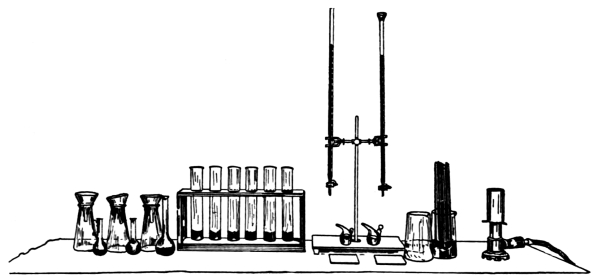
Figure 42. Apparatus for the Volumetric Estimation
of Reducing Sugars.
The careful analyst by working in this way with the volumetric method
is able to secure highly accurate results. The apparatus used is shown
in the accompanying illustration.
119. Suppression of the Error Caused by the Action of the Alkali
on Reducing Sugars.—Three methods are proposed by Gaud for
correcting or suppressing the error due to the action of the alkali
upon reducing sugars. In the first place, the common method followed
may be employed, depending upon the use of an alkaline copper solution
of known composition and the employment of a reducing sugar solution of
a strength varying between one-half and one per cent. The error which
is introduced into such a reaction is a constant one and the solution
having been tested once for all against pure sugar is capable of giving
fairly accurate results.
In the second place, a table may be constructed in which the error is
determined for sugar solutions for varying strengths, viz., from
one-tenth of one per cent to ten per cent. If y represent the
error and x the exact percentage of reducing sugar present then
the correction may be made by the following formula;
y = - 0.00004801x + 0.02876359x².
In order to use this formula in practice the percentage of reducing
sugar obtained by the actual analysis must be introduced and may
be represented by θ. The formula for correction then becomes
0.02876x² - 1.000048x + θ = 0; whence the value of
x is easily computed.
In the third place, the error may be eliminated by substituting for an
alkali which acts upon the glucose one which does not, viz.,
ammonia. At the temperature of boiling water ammonia does not have any
decomposing effect upon reducing sugars. It is important, however,
that the reduction take place in an inert atmosphere in order to
avoid the oxidation of the dissolved cuprous oxid and the temperature
need not be carried beyond 80°. The end of the reaction can be easily
distinguished in this case by the disappearance of the blue color. When
one reaction is finished the copper may be completely reoxidized by
conducting through it a current of air or oxygen for half an hour, when
an additional quantity of ammonia may be added to supply any that may
have evaporated, and a new reduction accomplished with exactly the same
quantity of copper as was used in the first. The solution used by Gaud
contains 36.65 grams of crystallized copper sulfate dissolved in water
and the volume completed to one liter with ordinary aqueous
ammonia.[83]
120. Permanganate Process for the Estimation of Reducing
Sugars.—Dextrose, invert sugar, and other reducing sugars can also
be determined with a fair degree of accuracy by an indirect volumetric
process, in which a standard solution of potassium permanganate is used
as the final reagent.[84]
The principle of the process is based upon the observation that two molecules
of dextrose reduce from an alkaline cupric tartrate solution five
molecules of cuprous oxid. The five molecules of cuprous oxid thus
precipitated when added to an acid solution of ferric sulfate, will
change five molecules of the ferric sulfate to ten molecules of ferrous
sulfate. The reaction is illustrated by the following equation:
 |
5Cu₂O
715 parts |
 |
+ |
|
5Fe₂(SO₄)₃
2000 parts |
|
+ |
|
5H₂SO₄
490 parts |
|
= |
|
10CuSO₄
1595 parts |
|
| + |
|
10FeSO₄
1520 parts |
|
+ |
|
5H₂O
90 parts |
|
The ten molecules of ferrous sulfate formed as indicated in the above
reaction, are reoxidized to ferric sulfate by a set solution of
potassium permanganate. This reaction is illustrated by the equation
given below:
|
10FeSO₄
1520 parts |
|
+ |
|
K₂Mn₂O₈
316.2 parts |
|
+ |
|
5H₂SO₄
784 parts |
|
= |
|
5Fe₂(SO₄)₂
2000 parts |
|
| + |
|
2MnSO₄
302 parts |
|
+ |
|
K₂SO₄
174.2 parts |
|
+ |
|
8H₂O
144 parts |
|
By the study of the above equations it is seen that two molecules
of dextrose or other similar reducing sugar, are equivalent
to one molecule of potassium permanganate, as is shown by the
following equations:
|
2C₆H₁₂O₆
360 parts |
|
= |
|
5Cu₂O
715 parts |
|
= |
|
10FeSO₄
1520 parts |
|
= |
|
K₂Mn₂O₈
316.2 parts |
|
It is thus seen that 316.2 parts by weight of potassium permanganate
are equivalent to 360 parts by weight of dextrose; or one part of
permanganate corresponds to 1.1385 parts by weight of dextrose. If,
therefore, the amount of permanganate required in the above reaction to
restore the iron to the ferric condition, be multiplied by the factor
mentioned above, the quotient will represent in weight the amount of
dextrose which enters into the reaction. The standard solution of
potassium permanganate should contain 4.392 grams of the salt in a
liter. One cubic centimeter of this solution is equivalent to five
milligrams of dextrose.
121. Manipulation.—The saccharine solution whose strength is to
be determined should contain approximately about one per cent of sugar.
Of this solution ten cubic centimeters are placed in a porcelain dish
together with a considerable excess of fehling solution. When no
sucrose is present, the mixture may be heated to the temperature of
boiling water and kept at that temperature for a few minutes until
all the reducing sugar is oxidized. There should be enough of the
copper solution used to maintain a strong blue coloration at the end
of the reaction. A greater uniformity of results will be secured by
using in all cases a considerable excess of the copper solution. When
sucrose or other non-reducing sugars are present, the temperature of
the reaction should not be allowed to exceed 80° and the heating may
be continued somewhat longer. At this temperature the copper solution
is absolutely without action on sucrose. The precipitated suboxid is
allowed to settle, the supernatant liquid poured off through a filter
and the suboxid washed thoroughly a number of times by decantation with
hot water, the washings being poured through the filter. This process
of washing is greatly facilitated by decanting the supernatant liquid
from the porcelain dish first into a beaker and from this into a third
beaker and so on until no suboxid is carried off. Finally the wash
water is poured through a filter-paper bringing as little as possible
of the suboxid onto the paper. The suboxid on the filter-paper and in
the beakers is next dissolved in a solution of ferric sulfate made
strongly acid with sulfuric; or in a sulfuric acid solution of ammonia
ferric sulfate which is more easily obtained free from impurities than
the ferric sulfate. When all is dissolved from the beakers the solution
is poured upon the suboxid which still remains in the porcelain dish.
When the solution is complete it is washed into a half liter flask and
all the vessels which contain the suboxid are also thoroughly washed
and the wash waters added to the same flask. The whole is rendered
strongly acid with sulfuric and made up to a volume of half a liter.
The process carried out as directed, when tested against pure sugar,
gives good results, not varying from the actual content of the sugar
by more than one-tenth per cent below or three-tenths above the true
content. The distinct pink coloration imparted to the solution by the
permanganate solution as soon as the iron is all oxidized to the ferric
state marks sharply the end of the reaction. In this respect this
process is very much to be preferred to the usual volumetric processes
depending upon the coloration produced with potassium ferrocyanid
by a copper salt for distinguishing the end of the reaction. It is
less convenient than the ordinary volumetric process by reason of the
somewhat tedious method of washing the precipitated cuprous oxid. When
a large number of analyses is to be made, however, the whole can be
washed with no more expenditure of time than is required for a single
sample. One analyst can, in this way, easily attend to fifty or a
hundred determinations at a time.
In the application of the permanganate method to the analysis of the
juices of sugar cane and sorghum it is directed to take 100 cubic
centimeters of the expressed juice and clarify by the addition of
twenty-five cubic centimeters of basic lead acetate, diluted with
water, containing enough of the lead acetate, however, to produce a
complete clarification. It is not necessary to remove the excess of
lead from the filtrate before the determination. Ten cubic centimeters
of the filtrate correspond to eight cubic centimeters of the original
juice. For percentage calculation the specific gravity of the original
juice must be known. Before the addition of the alkaline copper
solution, from fifty to seventy-five cubic centimeters of water should
be added to the clarified sugar juice and the amount of fehling
solution used in each case should be from fifty to seventy-five cubic
centimeters. The heating at 75° should be continued for half an hour
in order to insure complete reduction and oxidation of the sugar. The
sucrose can also be estimated in the same juices by inverting five
cubic centimeters of the clarified juice with five cubic centimeters
of dilute hydrochloric acid, by heating for an hour at a temperature
not above 90°. Before adding the acid for inversion, about 100 cubic
centimeters of water should be poured over the five cubic centimeters
of sugar solution. The washing of the suboxid and the estimation of the
amount reduced are accomplished in the manner above described.
This method has been extensively used in this laboratory and with very
satisfactory results. The only practical objection which can be urged
to it is in the time required for filtering. This fault is easily
remedied by adopting the method of filtering through asbestos felt
described in the next paragraph.
For the sake of uniformity, however, the copper solution should
be boiled for a few minutes before the addition of the sugar in
order to expel all oxygen, the sugar solutions should be made with
recently boiled water and the precipitation of the suboxid should be
accomplished by heating for just thirty minutes at 75°. At the end of
this time an equal volume of cold, recently boiled, water should be
added and the filtration at once accomplished.
122. Modified Permanganate Method.—The permanganate method
as used by Ewell, in this laboratory, is conducted as follows: After
the precipitate is obtained, according to the directions given in the
methods described, it is thoroughly washed with hot, recently boiled
water, on a gooch. The asbestos, with as much of the precipitate as
possible, is transferred to the beaker in which the precipitation was
made, beaten up with from twenty-five to thirty cubic centimeters
of hot, recently boiled water, and from fifty to seventy-five cubic
centimeters of a saturated solution of ferric sulfate in twenty-five
per cent sulfuric acid are added to the beaker and then poured through
the crucible to dissolve the cuprous oxid remaining therein. If the
precipitate be first beaten up with water as directed, so that no
large lumps of it remain, there is no difficulty in dissolving the
oxid in the ferric salt; while if any lumps of the oxid be allowed to
remain there is great difficulty. After the solution is obtained, it is
titrated with a solution of potassium permanganate of such a strength
that each cubic centimeter is equivalent to 0.01 gram of copper.
In triplicate determinations made by this method the precipitates
obtained required after solution in the ferric salt, 28.7, 28.9, 28.6
cubic centimeters of potassium permanganate solution, respectively.
For the quantities taken this was equivalent to an average percentage
of reducing sugars of 4.19. The percentage obtained by the gravimetric
method was 4.26.
The method seems to be sufficiently accurate for all ordinary purposes
and is extremely rapid.
The permanganate solution used should be standardized by means
of metallic iron, but in ordinary work it is also recommended to
standardize by check determinations of reducing sugars in the same
sample by the gravimetric method.
123. Determination of Reducing Sugar by the Specific Gravity of
the Cuprous Oxid.—Gaud proposes to determine the percentage of
reducing sugar from the specific gravity of the cuprous oxid. The
manipulation is carried out as follows:
In a porcelain dish are placed fifty cubic centimeters of the alkaline
copper solution and an equal quantity of water and the mixture
maintained in ebullition for two or three minutes. The dish is then
placed on a boiling water-bath and twenty-five cubic centimeters of a
reducing sugar of approximately one per cent strength added at once.
The reduction is thus secured at a temperature below 100°, which is an
important consideration in securing the minimum decomposing effect of
the alkali upon the sugar. The dish is kept upon the water-bath for
about ten minutes when the reduction is complete and the supernatant
liquor should still be intensely blue. The precipitate is washed by
decantation with boiling water, taking care to avoid the loss of any
of the cuprous oxid. The washing is continued until the wash waters
are neutral to phenolphthalein. The cuprous oxid is then washed into a
pyknometer of from twenty to twenty-five cubic centimeters capacity,
the exact content of which has been previously determined at zero. It
is filled with boiling water, the stopper inserted, and after cooling
the flask is weighed. Let P be the weight of the pyknometer plus
the liquid and the precipitate, the total volume of which is equal to
the capacity of the flask at the temperature at which it was filled,
that is Vₜ = V₀ [1 + 3β(t-t₀)].
This formula is essentially that given in paragraph 51, for
calculating the volume of a pyknometer at any temperature, substituting
for 3β, γ the cubical expansion of glass, viz., 0.000025.
The specific gravity of the dry cuprous oxid is Δ = 5.881 and let the
specific gravity of water at the temperature of filling, which can be
taken from any of the tables of the density of water, be d.
The total weight p of the precipitated suboxid may then be
calculated by the following formula:
The density of water at 99°, which is about the mean temperature of
boiling water for laboratories in general, is 0.95934, and this may be
taken as the weight of one cubic centimeter for purposes of calculation
in the formula above.
In order to obtain exact results, it is important that the weight
P be reduced to a vacuum. The weight of cuprous oxid not varying
proportionally to the weight of reducing sugar, it is necessary to
prepare a table showing the principal numerical values of the two, in
order to be able to calculate easily all the possible values, either
directly from the table or by appropriate interpolations. Following are
the chief values which are necessary for the calculation:
Milligrams
cuprous oxid. |
Milligrams
dextrose. |
Milligrams
cuprous oxid. |
Milligrams
dextrose. |
| 10 |
5.413 |
100 |
46.221 |
| 20 |
9.761 |
200 |
91.047 |
| 30 |
14.197 |
300 |
138.842 |
| 50 |
23.036 |
400 |
188.928 |
It is claimed by the author that the above method is both simple and
rapid and can be applied with an error of not more than one-thousandth
if the corrections for temperature and pressure be rigorously
applied.[85]
124. The Copper Carbonate Process.—While the copper solutions
which have been mentioned in previous paragraphs have only a slight
action on sucrose and dextrin yet on prolonged boiling even these
bodies show a reducing effect due probably to a preliminary change in
the sugar molecules whereby products analogous to dextrose or invert
sugar are formed. In order to secure a reagent, to which the sugar not
reducing alkaline copper solutions might be more resistant Soldaini has
proposed to employ a liquor containing the copper as carbonate instead
of as tartrate.[86]
This solution is prepared by adding to a solution of forty grams of
copper sulfate one of equal strength of sodium carbonate. The resulting
copper carbonate and hydroxid are collected on a filter, washed with
cold water, and dried. The reaction which takes place is represented by
the following formula:
2CuSO₄ + 2Na₂CO₃ + H₂O =
CuCO₃ + CuO₂H₂ + 2Na₂SO₄ + CO₂.
The dry precipitate obtained, which will weigh about fifteen grams, is
placed in a large flask with about 420 grams of potassium bicarbonate
and 1400 cubic centimeters of water. The contents of the flask are
heated on a steam-bath for several hours with occasional stirring
until the evolution of carbon dioxid has ceased. During this time the
liquid is kept at the same volume by the addition of water, or by
attaching a reflux condenser to the flask. The potassium and copper
compounds at the end of this time will be found dissolved and the
resulting liquor will have a deep blue color. After filtration the
solution is boiled for a few minutes and cooled to room temperature.
The volume is then completed to two liters. A more direct method of
preparing the solution, and one quite as effective, consists in adding
the solution of the copper sulfate directly to the hot solution of
potassium bicarbonate and heating and shaking the mixture until the
copper carbonate formed is dissolved. After filtering the volume is
made as above. The proportions of reagents employed are placed by
Preuss at 15.8 grams of crystallized copper sulfate and 594 grams of
potassium bicarbonate.[87]
The soldaini reagent is extremely sensitive and is capable of detecting
as little as half a milligram of invert sugar. The presence of sucrose
makes the reagent more delicate, and it is especially useful in
determining the invert sugar arising during the progress of manufacture
by the action of heat and melassigenic bodies on sucrose.
125. The Analytical Process.—As in the case of fehling solution
a great many methods of conducting the analysis with the soldaini
reagent have been proposed. The general principle of all these
processes is the one already described for the alkaline copper tartrate
solution, viz., the addition of the reducing sugar solution to
the boiling reagent, and the determination of the end of the reaction
by the disappearance of the copper.[88]
Practically, however, these methods have had no general application,
and the use of the soldaini reagent has been confined chiefly to the
determination of invert sugar in presence of a large excess of sucrose.
For this purpose the sugar solution is not added until the blue color
of the reagent has been destroyed, but on the other hand, the reagent
has been used in excess, and the cuprous oxid formed collected and
weighed as metallic copper. The weight of the metallic copper found,
multiplied by the factor 0.3546, gives the weight of invert sugar in
the volume of the sugar solution used. According to Preuss, the factor
is not a constant one, but varies with the quantity of invert sugar
present, as is seen in the formula y = 2.2868 + 3.3x +
0.0041x², in which x = the invert sugar, and y the
metallic copper.[89]
126. Tenth Normal Copper Carbonate Solution.—In the study of
some of the solutions of copper carbonate, proposed for practical
work, Ettore Soldaini was impressed with the difficulty of dissolving
so large a quantity of carbonate in the solvent employed.[90]
The solution recommended by Bodenbender and Scheller,[91]
in which forty grams of the crystallized copper sulfate were used,
failed to disclose an equivalent amount of copper in the reagent ready
for use. For this reason a tenth-normal copper solution is prepared by
Soldaini containing the equivalent of 3.464 grams of copper sulfate
in one liter. The reagent is easily prepared by adding slowly the
dissolved or finely powdered copper salt to a solution of 297 grams
of potassium bicarbonate, and after complete solution of the copper
carbonate formed, completing the volume to one liter. With this reagent
as little as one-quarter of a milligram of reducing sugar can be easily
detected. For the quantitive estimation of sugar a solution of the
above strength is to be preferred to the other forms of the soldaini
reagent by reason of the ease of direct comparison with standard
fehling solutions.
The analytical process is conducted with the tenth-normal solution,
prepared by Soldaini and described above, as follows: Place 100 cubic
centimeters of the reagent in each of several porcelain dishes heat
to boiling, and add little by little the sugar solution to one dish
until the blue color has disappeared. Having thus determined nearly the
exact quantity of sugar solution required for the copper in 100 cubic
centimeters of the reagent the whole of the sugar solution is added at
once, varying slightly the amounts added to each dish. The boiling is
continued for fifteen minutes, and the contents of the dishes poured
on filters. That filtrate which contains neither copper nor sugar
represents the exact quantity of sugar solution which contained fifty
milligrams of dextrose.
127. Relation of Reducing Sugar to Quantity of Copper Suboxid
Obtained.—The relation of the quantity of copper reduced to
the amount of sugar oxidized by the copper carbonate solution has
been determined by Ost, and the utility of the process thereby
increased.[92]
The solution used should have the following composition: 23.5 grams
of crystallized copper sulfate, 250 grams of potassium carbonate, and
100 grams of potassium bicarbonate in one liter. Without an indicator
the end reaction is distinctly marked by the passage of the blue color
into a colorless solution. Ost affirms that this solution is preferable
to any form of fehling liquor because it can be kept indefinitely
unchanged; it attacks sucrose far less strongly, and an equal quantity
of sugar precipitates nearly double the quantity of copper. The boiling
requires a longer time, as a rule ten minutes, but this is a matter of
no importance, when the other advantages are taken into consideration.
The relations of the different sugars to the quantity of copper
precipitated are given in the table in the next paragraph.
128. Factor for Different Sugars.—For pure dextrose the
relation between sugar and copper reduced has been determined by
Ost, and the data are given in the table below. The data were
obtained by adding to fifty cubic centimeters of the copper solution
twenty-five cubic centimeters of sugar solutions of varying strength
and collecting, washing, and reducing the cuprous oxid obtained in a
current of hydrogen in a glass tube by the method described further on.
The boiling in all cases was continued, just ten minutes, although a
slight variation from the standard time did not produce so great a
difference as with fehling reagent. In the case of dextrose, when fifty
milligrams were used with fifty cubic centimeters of the solution,
the milligrams of copper obtained after six, ten and twenty minutes’
boiling were 164.6, 165.5, and 166.9 respectively.[93]
The data differ considerably from those obtained by Herzfeld, but
in his experiments the boiling was continued only for five minutes,
and this is not long enough to secure the proper reduction of the
copper.[94]
Table Showing the Quantity of Copper
Reduced by Different Sugars.
Copper.
Milligrams |
Invert Sugar.
Milligrams |
Dextrose.
Milligrams |
Levulose.
Milligrams |
Galactose.
Milligrams |
Arabinose.
Milligrams |
| 50 |
15.2 |
15.6 |
14.7 |
17.4 |
17.0 |
| 55 |
16.6 |
17.0 |
16.1 |
19.1 |
18.6 |
| 60 |
18.0 |
18.5 |
17.5 |
20.8 |
20.3 |
| 65 |
19.4 |
19.9 |
18.9 |
22.5 |
21.9 |
| 70 |
20.8 |
21.4 |
20.3 |
24.2 |
23.5 |
| 75 |
22.3 |
22.9 |
21.7 |
25.9 |
25.1 |
| 80 |
23.7 |
24.4 |
23.0 |
27.7 |
26.7 |
| 85 |
25.2 |
25.8 |
24.3 |
29.3 |
28.3 |
| 90 |
26.6 |
27.3 |
25.7 |
31.1 |
29.9 |
| 95 |
28.1 |
28.8 |
27.1 |
32.8 |
31.5 |
| 100 |
29.5 |
30.3 |
28.5 |
34.5 |
33.1 |
| 105 |
31.0 |
31.8 |
29.9 |
36.2 |
34.7 |
| 110 |
32.4 |
33.3 |
31.2 |
38.0 |
36.3 |
| 115 |
33.9 |
34.8 |
32.6 |
39.7 |
37.9 |
| 120 |
35.3 |
36.3 |
34.0 |
41.4 |
39.5 |
| 125 |
36.8 |
37.8 |
35.4 |
43.1 |
41.1 |
| 130 |
38.2 |
39.3 |
36.8 |
44.8 |
42.8 |
| 135 |
39.7 |
40.8 |
38.2 |
46.5 |
44.4 |
| 140 |
41.1 |
42.3 |
39.6 |
48.3 |
46.0 |
| 145 |
42.6 |
43.8 |
41.0 |
50.0 |
47.6 |
| 150 |
44.0 |
45.3 |
42.5 |
51.8 |
49.3 |
| 155 |
45.5 |
46.8 |
43.9 |
53.6 |
50.9 |
| 160 |
47.0 |
48.3 |
45.3 |
55.4 |
52.6 |
| 165 |
48.5 |
49.8 |
46.7 |
57.2 |
54.3 |
| 170 |
50.0 |
51.4 |
48.1 |
59.0 |
55.9 |
| 175 |
51.5 |
52.9 |
49.5 |
60.8 |
57.5 |
| 180 |
53.0 |
54.5 |
51.0 |
62.7 |
59.2 |
| 185 |
54.5 |
56.0 |
52.5 |
64.5 |
60.9 |
| 190 |
56.0 |
57.6 |
54.0 |
66.4 |
62.7 |
| 195 |
57.5 |
59.2 |
55.5 |
68.3 |
64.4 |
| 200 |
59.1 |
60.8 |
57.0 |
70.3 |
66.2 |
| 205 |
60.7 |
62.4 |
58.6 |
72.3 |
68.0 |
| 210 |
62.4 |
64.1 |
60.2 |
74.3 |
69.8 |
| 215 |
64.1 |
65.8 |
61.8 |
76.3 |
71.6 |
| 220 |
65.8 |
67.5 |
63.5 |
78.3 |
73.5 |
| 225 |
67.5 |
69.2 |
65.2 |
80.3 |
75.4 |
| 230 |
69.3 |
70.9 |
66.9 |
82.4 |
77.3 |
| 235 |
71.1 |
72.7 |
68.7 |
84.5 |
79.3 |
| 240 |
72.9 |
74.5 |
70.6 |
86.6 |
81.3 |
| 245 |
74.8 |
76.4 |
72.5 |
88.9 |
83.4 |
| 250 |
76.7 |
78.4 |
74.4 |
91.2 |
85.5 |
| 255 |
78.6 |
80.5 |
76.5 |
93.5 |
87.6 |
| 260 |
80.5 |
82.8 |
78.8 |
95.9 |
89.8 |
| 265 |
82.5 |
85.1 |
81.1 |
98.3 |
92.2 |
| 270 |
84.7 |
87.5 |
83.5 |
100.7 |
94.6 |
| 275 |
87.1 |
89.9 |
85.9 |
103.3 |
97.1 |
| 280 |
89.7 |
92.4 |
88.6 |
106.1 |
99.6 |
| 285 |
92.3 |
94.9 |
91.3 |
109.0 |
102.3 |
| 290 |
95.1 |
97.6 |
94.2 |
112.0 |
105.1 |
| 295 |
98.0 |
100.4 |
97.2 |
115.1 |
107.9 |
| 298 |
100.0 |
102.5 |
99.0 |
117.0 |
109.5 |
129. Pavy’s Process.—The well-known solubility of cuprous oxid
in ammonia led Pavy to adopt a copper reagent containing ammonia in the
volumetric determination of reducing sugars.[95] In Pavy’s process an
alkaline copper solution is employed made up in the usual way, to which
a sufficient quantity of ammonia is added to hold in solution all the
copper when precipitated as cuprous oxid. The solution used by Pavy has
the following composition: One liter contains
| Crystallized copper sulfate |
34.65 |
grams |
| Potassium-sodium tartrate |
173.00 |
” |
| Caustic potash |
160.00 |
” |
For use 120 cubic centimeters of the above reagent are mixed with 300
of ammonia of specific gravity 0.88, and the volume completed to one
liter with distilled water. Twenty cubic centimeters of this reagent
are equivalent to ten milligrams of dextrose or invert sugar when added
in a one per cent solution.
In the use of ammoniacal copper solution, care must be taken that
all the liquids employed be entirely free of oxygen and that the
contents of the flask in which the reduction takes place be in some way
excluded from contact with the air. Pavy secured this by conducting
the reduction in a flask closed with a stopper carrying two holes;
one of these served for the introduction of the burette carrying the
sugar solution and the other carried a tube dipping into a water seal
by means of a slit rubber tube, which would permit of the exit of the
vapors of steam and ammonia, but prevent the regurgitation of the water
into the flask.
The complete decoloration of the copper solution marks the end of the
reaction. The usual precautions in regard to the length of the time of
boiling must be observed.
It is easy to see that in the Pavy process the quantity of ammonia in
the solution is rapidly diminished during the boiling and this has led
to the suggestion of other methods to exclude the air. Among these have
been recommended the introduction of a current of hydrogen or carbon
dioxid. One of the best methods of procedure is that proposed by Allen,
who recommends covering the copper solution by a layer of paraffin oil
(kerosene).[96]
130. Process Of Peska.—Peska has also independently made use of
Allen’s method of covering the solutions with a layer of paraffin oil
and finds it reliable.[97]
The copper reagent employed by him has the following composition:
| Crystallized copper sulfate |
6.927 |
grams |
| Ammonia, twenty-five per cent strength |
160.00 |
cc. |
The copper sulfate is dissolved in water, the ammonia added, and
the volume completed to half a liter with distilled water. A second
solution containing half a liter is made by dissolving 34.5 grams
of potassium-sodium tartrate and ten grams of sodium hydroxid and
completing the cool solution to half a liter with distilled water.
In all cases the water used in making up the above solutions must be
freshly boiled to exclude the air.
For the titration, fifty cubic centimeters of each of the above
solutions are taken, mixed and covered with a layer of paraffin oil
half a centimeter in depth. The reduction is not accomplished at a
boiling temperature, but at from 80° to 85°. The manipulation is
conducted as follows:
The mixed solutions are placed in a beaker, covered with oil, and
heated to 80°. The temperature is measured by a thermometer which also
serves as a stirring rod. The sugar solution is run down the sides
of the beaker from a burette of such a shape as to be protected from
the heat. After each addition of the sugar solution the mixture is
carefully stirred, keeping the temperature at from 80° to 85°. The
first titration is made to determine approximately the quantity of
sugar solution necessary to decolorize the copper. This done, the
actual titration is accomplished by adding at once the total amount
of sugar solution necessary to decolorize, less about one cubic
centimeter. Any sugar solution adhering to the side of the beaker
is washed down by distilled water, the contents of the beaker well
stirred, and the temperature kept at 85° for two minutes. The rest of
the sugar solution is then added in quantities of one-tenth of a cubic
centimeter until the decoloration is completed. The total time of the
final titration should not exceed five minutes. The sugar solution
should be as nearly as possible of one per cent strength. If a lower
degree of strength be employed a larger quantity of the sugar is
necessary to reduce a given quantity of copper.
In the case of dextrose, when a one per cent solution is used, eight
and two-tenths cubic centimeters, corresponding to 80.2 milligrams of
dextrose, are required to reduce 100 cubic centimeters of the mixed
reagent. On the other hand, when the sugar solution is diluted to
one-tenth of a per cent strength 82.1 milligrams are required.
With invert sugar slightly larger quantities are necessary, the
reducing power being as 94.9 to 100 as compared with dextrose. With
a one per cent strength of invert sugar it is found that eighty-four
milligrams are required to reduce 100 cubic centimeters of the mixed
reagent and when the strength of the invert sugar is reduced to
one-tenth per cent 87.03 milligrams are required.
131. Method Of Allein and Gaud.—Allein and Gaud have proposed a
further modification of the ammonia process which consists essentially
in the suppression of rochelle salt and fixed caustic alkali and the
entire substitution therefor of ammonia. Ammonia acts with much less
vigor upon sugars than the caustic alkalies, and it is therefore
claimed that the decomposition of the sugar due to the alkali is
reduced to a minimum when ammonia is employed.[98]
The copper solution is made as follows:
Dissolve 8.7916 grams of electrolytic copper in ninety-three grams
of concentrated sulfuric acid diluted with an equal volume of water.
Complete the resulting solution to one liter with concentrated ammonia.
Ten cubic centimeters of this solution are equal to fifty grams of
dextrose.
It is recommended that the reduction be accomplished in an atmosphere
of hydrogen, but it is apparent that the use of kerosene is permissible
in this case, and on account of its greater simplicity it is to be
recommended as the best means of excluding the oxygen. The reduction is
accomplished at a temperature of about 80°.
It is also proposed to reoxidize the copper by substituting a current
of air for the hydrogen at the end of the reaction, and thus use the
same copper a number of times. The danger of loss of ammonia, and the
difficulty of determining when the oxidation is complete, render this
regeneration of the reagent undesirable.
132. Method of Gerrard.—The method of Gerrard does not depend
upon the use of ammonia, but the principle involved is the same,
viz., the holding of the separated cuprous oxid in solution
and the determination of the end of the reaction by the disappearance
of the blue color. As first proposed by Gerrard, the copper sulfate
solution is made of double the strength usually employed and to each
100 cubic centimeters thereof, before use, three and three-tenths
grams of potassium cyanid are added. This is sufficient to hold the
precipitated cuprous oxid in solution.[99]
The original method of Gerrard is found difficult of execution and the
author, in conjunction with Allen, has lately modified it and reduced
it to a practical working basis.[100]
In the new method the ordinary fehling solution is employed and it
is prepared for use in the following way: Ten cubic centimeters of
the fehling solution, or half that quantity of each of the component
parts kept in separate bottles, are placed in a porcelain dish with
forty cubic centimeters of water and brought to the boiling-point. To
the boiling liquid is added, from a pipette, a five per cent solution
of potassium cyanid until the blue color just disappears, or only a
very faint tint of blue remains, avoiding any excess of the cyanid. A
second portion of the fehling solution equal to that first employed
is added, and to the boiling mixture the solution of sugar is added,
from a burette, until the blue color disappears. The contents of the
dish should be kept boiling during the addition of the sugar solution.
The volume used will contain fifty milligrams of dextrose. The sugar
solution should be of such a strength as to contain no more than half a
per cent of reducing sugar.
The principle of the preparation of the solution may be stated as
follows: If to a solution of copper sulfate, potassium be added until
the blue color disappears, a double cyanid of copper and potassium
cyanid is formed according to the following reaction:
CuSO₄ + 4KCN = Cu(CN)₂.2KCN + K₂SO₄.
This double cyanid is a salt of considerable
stability. It is not decomposed by alkalies, hydrogen or ammonium,
sulfid. With mineral acids it gives a whitish, curdy precipitate. With
fehling solution the same double cyanid is formed as that described
above. If, however, fehling solution be present in excess of the amount
necessary to form the double cyanid of copper, this excess can be used
in the oxidation of reducing sugar and the colorless condition of the
solution will be restored as soon as the excess of the fehling is
destroyed. The double cyanid holds in solution the cuprous oxid formed
and thus complete decoloration is secured.
133. Sidersky’s Modification of Soldaini’s Process.—In all
cases where the sugar solutions are not too highly colored, Sidersky
finds that the method of reduction in a large test tube, as practiced
by Violette, is applicable with the copper carbonate solution.[101]
For more exact work it is preferred to determine the quantity of copper
reduced by an indirect volumetric method. The sugar solution, properly
clarified and the lead removed if subacetates have been used, is made
of such a volume as to contain less than one per cent of reducing
sugars. In a flask or large test tube are placed 100 cubic centimeters
of the copper solution, which is boiled for a short time and the sugar
solution added, little by little, from a pipette, at such a rate as
not to stop the ebullition. The boiling is continued for five minutes
after the last addition of the sugar. The vessel is taken from the
flame and 100 cubic centimeters of cold water added, the whole brought
on an asbestos felt and the cuprous oxid washed with hot water until
the alkaline reaction has disappeared. The residual cuprous oxid
is dissolved in a measured quantity of set sulfuric acid, semi- or
fifth-normal, a few particles of potassium chlorate added, and the
mixture boiled to convert any cuprous into cupric sulfate. The reaction
is represented by the following formula:
3Cu₂O + 6H₂SO₄ + KClO₃ = 6CuSO₄ + KCl + 6H₂O.
The residual sulfuric acid is titrated with a set alkali in excess,
ammonia being preferred.
The solution of ammonia is made by diluting 200 cubic centimeters of
commercial aqua ammonia with 800 of water. Its strength is determined
by adding a little copper sulfate solution as indicator and then the
set solution of sulfuric acid until the blue color disappears. The
copper sulfate secured from the cuprous sulfate as described above
is cooled, and a quantity of the ammonia, equal to twenty-five cubic
centimeters of the set sulfuric acid, added. The excess of the
ammonia is then determined by titration with the sulfuric acid, the
disappearance of the blue color being the indication of the end of the
reaction. The number of cubic centimeters of the set sulfuric acid
required to saturate the ammonia represents the equivalent of cuprous
oxid originally present. One cubic centimeter of normal sulfuric acid
is equivalent to 0.0317 gram of metallic copper.
To determine the weight of invert sugar oxidized, multiply the weight
of copper, calculated as above described, by the factor 0.3546.[102]
For a general application of this method of analysis the relative
quantities of copper reduced by different quantities of sugar must be
taken into consideration.
While, as has already been stated, the copper carbonate process has
heretofore been applied chiefly to the detection of invert sugar, it
has merits which justify the expectation that it may some time supplant
the fehling liquor both for volumetric and gravimetric work. Large
volumes of the reagent can be prepared at once and without danger of
subsequent change. The action of the reagent on the hexobioses and
trioses is far less vigorous than that of the alkaline copper tartrate,
and the end reactions for volumetric work are, at least, as easily
determined in the one case as the other.
134. Method Depending on Titration of Excess of Copper.—Instead
of measuring the quantity of copper reduced, either by its
disappearance or by reducing the cuprous oxid to a metallic state,
Politis has proposed a method of analysis depending on the titration of
the residual copper.[103]
The reagents employed are:
(1) A copper solution containing 24.95 grams of crystallized copper
sulfate, 140 grams of sodium and potassium tartrate, and twenty-five
grams of sodium hydroxid in one liter:
(2) A solution of sodium thiosulfate containing 24.8 grams of the salt
in one liter:
(3) A solution of potassium iodid containing 12.7 grams of iodin in one
liter.
The reaction is represented by the formula
2CuCl₂ + 4KI = Cu₂I₂ + 4KCl + I₂.
The analytical process is carried out as follows: In a 100 cubic
centimeter flask are boiled fifty cubic centimeters of the copper
solution, ten cubic centimeters of about one-tenth per cent reducing
sugar solution are added, the boiling continued for five minutes,
the flask filled to the mark with boiling water and its contents
filtered. Fifty cubic centimeters of the hot filtrate are cooled,
slightly acidified, potassium iodid solution added in slight excess;
and the iodin set free determined by titration with sodium thiosulfate.
The quantity of iodin obtained corresponds to the unreduced copper
remaining after treatment with the reducing sugar. The number of cubic
centimeters of thiosulfate used subtracted from twenty-five will give
the number of cubic centimeters of the copper solution which would be
reduced by five cubic centimeters of the sugar solution used.
Example.—In the proportions given above it
was found that eleven cubic centimeters of thiosulfate were required
to saturate the iodin set free. Then 25 - 11 = 14 cubic centimeters
of copper solution reduced by five cubic centimeters of the sugar
solution. Since one cubic centimeter of the copper solution is reduced
by 0.0036 gram of dextrose the total dextrose in the five cubic
centimeters = 0.0036 × 5 = 0.0180 gram.
The above method does not seem to have any practical advantage over
those based on noting the disappearance of the copper and is given only
to illustrate the principle of the process. While the titration of the
iodin by sodium thiosulfate is easily accomplished in the absence of
organic matter, it becomes difficult, as shown by Ewell, when organic
matters are present, as they always are in the oxidation of a sugar
solution. Ewell has therefore proposed to determine the residual copper
by a standard solution of potassium cyanid, but the method has not yet
been developed.[104]
135. General Principles.—In the preceding pages the principles
of the volumetric methods of sugar analysis by means of alkaline copper
solution have been set forth. They depend either on the total
decomposition of the copper solution employed by the reducing sugar,
or else on the collection and titration of the cuprous oxid formed in
the reaction. In the gravimetric methods the general principle of the
process rests upon the collection of the cuprous oxid formed and its
reduction to metallic copper, the weight of which serves as a starting
point in the calculations of the weight of reducing sugar, which has
been oxidized in the solution.
The factors which affect the weight of copper obtained are essentially
those which influence the results in the volumetric method. The
composition of the copper solution, the temperature at which the
reduction is accomplished, the time of heating, the strength of the
sugar solution and the details of the manipulation, all affect more or
less the quantity of copper obtained. As in the volumetric method also,
the kind of reducing sugar must be taken in consideration, dextrose,
levulose, invert sugar, maltose and other sugars having each a definite
factor for reduction in given conditions. It follows, therefore, that
only those results are of value which are obtained under definite
conditions, rigidly controlled.
136. Gravimetric Methods of the Department of Agriculture
Laboratory.—The process used in this laboratory is based
essentially on the methods of Maercker, Behrend, Morgen, Meissl, Hiller
and Allihn.[105]
Where dextrose alone is present, the table of factors proposed by
Allihn is used and also the copper solution corresponding thereto.
For pure invert sugar, the tables and solutions of
Meissl are used. For invert sugar in the presence of sucrose, the table
and process proposed by Hiller are used.
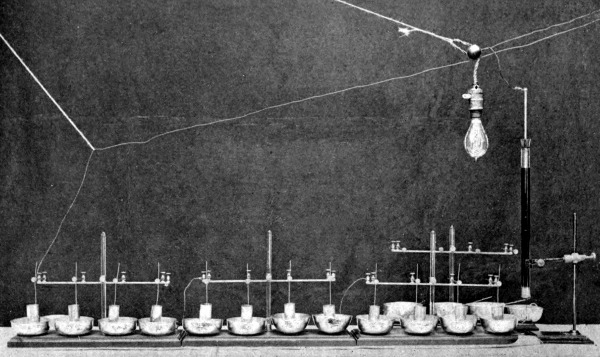
Figure 43. Apparatus for the Electrolytic
Deposition of Copper.
The reduction of the copper solution and the electrolytic deposition of
the copper are accomplished as follows:
The copper and alkali solutions are kept in separate bottles. After
mixing the equivalent volume of the two solutions in a beaker, heat is
applied and the mixture boiled. To the boiling liquid the proper volume
of the cold sugar solution is added. This must always be less than the
amount required for complete reduction. The solution is again brought
into ebullition and kept boiling exactly two minutes. A two-minute
sand glass is conveniently used to determine the time of boiling. At
the end of this time an equal volume of freshly boiled cold water is
added, and the supernatant liquor at once passed through a gooch under
pressure. The residual cuprous oxid is covered with boiling water and
washed by decantation until the wash water is no longer alkaline. It
is more convenient to wash in such a way that, at the end, the greater
part of the cuprous oxid is in the gooch. The felt and cuprous oxid are
then returned to the beaker in which the reduction is made. The gooch
is moistened with nitric acid to dissolve any adhering oxid and then
is washed into the beaker. Enough nitric acid is added to bring all
the oxid into solution, an excess being avoided, and a small amount
of water added. The mixture is again passed under pressure through
a gooch having a thin felt, to remove the asbestos and the filtrate
collected in a flask of about 150 cubic centimeters capacity. The
washing is continued until the gooch is free of copper, when the volume
of the filtrate should be about 100 cubic centimeters. The liquid is
transferred to a platinum dish holding about 175 cubic centimeters and
the flask washed with about twenty-five cubic centimeters of water.
From three to five cubic centimeters of strong sulfuric acid are added
and the copper deposited by an electric current.
137. Precipitating the Copper.—When no more nitric acid is used
than indicated in the previous paragraph, it will not be necessary
to remove it by evaporation. The platinum dishes containing the
solutions of the cuprous oxid are arranged as shown in the figure
for the precipitation of the copper by the electric current. Each of the
supporting stands has its base covered with sheet-copper, on which the
platinum dishes rest. The uprights are made of heavy glass rods and
carry the supports for the platinum cylinders which dip into the copper
solutions. The current used is from the city service and is brought
in through the lamp shown at the right of the figure.
This current has a voltage of about 120. After passing the lamp it is conducted
through the regulator shown at the right, a glass tube closed below by
a stopper carrying a piece of platinum foil, and above by one holding
a glass tube, in the lower end of which is sealed a piece of sheet
platinum connected, through the glass tube, with the lamp. The
regulating tube contains dilute sulfuric acid. The strength of current
desired is secured by adjusting the movable pole. A battery of this
kind easily secures the precipitation of sixteen samples at once, but
only twelve are shown in the figure. The practice here
is to start the operation at the time of leaving the laboratory in the afternoon.
The next morning the deposition of the copper will be found complete.
The wiring of the apparatus is shown in the figure. The wire from the
regulator is connected with the base of the first stand, and thence
passes through the horizontal support to the base of the second, and so
on. The return to the lamp is accomplished by means of the upper wire.
This plan of arranging the apparatus has been used for two years, and
with perfect satisfaction.
Where a street current is not available, the following directions
may be followed: Use four gravity cells, such as are employed in
telegraphic work, for generating the current. This will be strong
enough for one sample and by working longer for two. Connect the
platinum dish with the zinc pole of the battery. The current is allowed
to pass until all the copper is deposited. Where a larger number of
samples is to be treated at once, the size of the battery must be
correspondingly increased.
138. Method Used at the Halle Station.—The method used at the
Halle station is the same as that originally described by Maercker
for dextrose.[106]
The copper solution employed is the same as in the allihn method,
viz., 34.64 grams of copper sulfate in 500 cubic centimeters,
and 173 grams of rochelle salt and 125 grams of potassium hydroxid in
the same quantity of water. In a porcelain dish are placed thirty cubic
centimeters of copper solution and an equal quantity of the alkali,
sixty cubic centimeters of water added and the mixture boiled. To the
solution, in lively ebullition, are added twenty-five cubic centimeters
of the dextrose solution to be examined which must not contain more
than one per cent of sugar. The mixture is again boiled and the
separated cuprous oxid immediately poured into the filter and washed
with hot water, until the disappearance of an alkaline reaction. For
filtering, a glass tube is employed, provided with a platinum disk,
and resembling in every respect similar tubes used for the extraction
of substances with ether and alcohol. The arrangement of the filtering
apparatus is shown in Fig. 44. In the Halle method it is
recommended that the tubes be prepared by introducing a platinum cone in place
of the platinum disk and filling it with asbestos felt, pressing the felt
tightly against the sides of the glass tube and making the asbestos
fully one centimeter in thickness. This is a much less convenient
method of working than the one described above. After filtration and
washing, the cuprous oxid is washed with ether and alcohol and dried
for an hour at 110°, and finally reduced to metallic copper in a stream
of pure dry hydrogen, heat being applied by means of a small flame. The
apparatus for the reduction of the cuprous oxid is shown in Fig. 45.
The metallic copper, after cooling and weighing, is dissolved in nitric
acid, the tube washed with water, ether and alcohol, and again dried,
when it is ready for use a second time. The percentage of dextrose is
calculated from the milligrams of copper found by Allihn’s table.
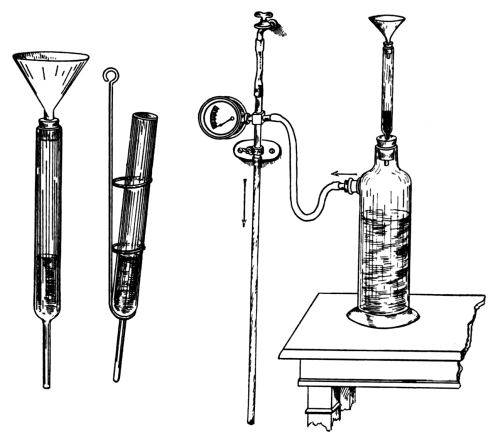
Figure 44. Apparatus for Filtering Copper Suboxid.
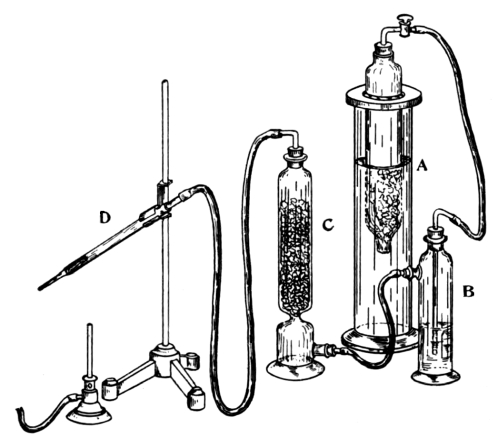
Figure 45. Apparatus for Reducing Copper Suboxid.
139. Tables for Use in the Gravimetric Determination of Reducing
Sugars.—The value of a table for computing the percentage of a
reducing sugar present in a solution, is based on the accuracy with
which the directions for the determination are followed. The solution
must be of the proper strength and made in the way directed. The degree
of dilution prescribed must be scrupulously preserved and the methods
of boiling during reduction and washing the reduced copper, followed.
The quantity of copper obtained by the use of different alkaline copper
solutions and of sugar solutions of a strength different from that
allowed by the fixed limits, is not a safe factor for computation.
It must be understood, therefore, that in the use of the tables the
directions which are given are to be followed in every particular.
140. Allihn’s Gravimetric Method for the Determination of
Dextrose.—Reagents:
| I. |
34.639 grams of CuSO₄.5H₂O, |
dissolved in water and diluted
to half a liter: |
| II. |
173 grams of rochelle salts |
dissolved in water and diluted |
| |
125 grams of KOH, |
to half a liter. |
Manipulation: Place thirty cubic centimeters of the copper
solution (I), thirty cubic centimeters of the alkaline tartrate
solution (II), and sixty cubic centimeters of water in a beaker and
heat to boiling. Add twenty-five cubic centimeters of the solution
of the material to be examined, which must be so prepared as not to
contain more than one per cent of dextrose, and boil for two minutes.
Filter immediately after adding an equal volume of recently boiled cold
water and obtain the weight of copper by one of the gravimetric methods
given. The corresponding weight of dextrose is found by the following table:
Allihn’s Table for the
Determination of Dextrose.
- (A) = Milligrams of copper.
- (B) = Milligrams of dextrose.
| (A) | (B) |
(A) | (B) |
(A) | (B) |
(A) | (B) |
(A) | (B) |
| 10 | 6.1 |
46 | 23.9 |
82 | 41.8 |
118 | 60.1 |
154 | 78.6 |
| 11 | 6.6 |
47 | 24.4 |
83 | 42.3 |
119 | 60.6 |
155 | 79.1 |
| 12 | 7.1 |
48 | 24.9 |
84 | 42.8 |
120 | 61.1 |
156 | 79.6 |
| 13 | 7.6 |
49 | 25.4 |
85 | 43.4 |
121 | 61.6 |
157 | 80.1 |
| 14 | 8.1 |
50 | 25.9 |
86 | 43.9 |
122 | 62.1 |
158 | 80.7 |
| 15 | 8.6 |
51 | 26.4 |
87 | 44.4 |
123 | 62.6 |
159 | 81.2 |
| 16 | 9.0 |
52 | 26.9 |
88 | 44.9 |
124 | 63.1 |
160 | 81.7 |
| 17 | 9.5 |
53 | 27.4 |
89 | 45.4 |
125 | 63.7 |
161 | 82.2 |
| 18 | 10.0 |
54 | 27.9 |
90 | 45.9 |
126 | 64.2 |
162 | 82.7 |
| 19 | 10.5 |
55 | 28.4 |
91 | 46.4 |
127 | 64.7 |
163 | 83.3 |
| 20 | 11.0 |
56 | 28.8 |
92 | 46.9 |
128 | 65.2 |
164 | 83.8 |
| 21 | 11.5 |
57 | 29.3 |
93 | 47.4 |
129 | 65.7 |
165 | 84.3 |
| 22 | 12.0 |
58 | 29.8 |
94 | 47.9 |
130 | 66.2 |
166 | 84.8 |
| 23 | 12.5 |
59 | 30.3 |
95 | 48.4 |
131 | 66.7 |
167 | 85.3 |
| 24 | 13.0 |
60 | 30.8 |
96 | 48.9 |
132 | 67.2 |
168 | 85.9 |
| 25 | 13.5 |
61 | 31.3 |
97 | 49.4 |
133 | 67.7 |
169 | 86.4 |
| 26 | 14.0 |
62 | 31.8 |
98 | 49.9 |
134 | 68.2 |
170 | 86.9 |
| 27 | 14.5 |
63 | 32.3 |
99 | 50.4 |
135 | 68.8 |
171 | 87.4 |
| 28 | 15.0 |
64 | 32.8 |
100 | 50.9 |
136 | 69.3 |
172 | 87.9 |
| 29 | 15.5 |
65 | 33.3 |
101 | 51.4 |
137 | 69.8 |
173 | 88.5 |
| 30 | 16.0 |
66 | 33.8 |
102 | 51.9 |
138 | 70.3 |
174 | 89.0 |
| 31 | 16.5 |
67 | 34.3 |
103 | 52.4 |
139 | 70.8 |
175 | 89.5 |
| 32 | 17.0 |
68 | 34.8 |
104 | 52.9 |
140 | 71.3 |
176 | 90.0 |
| 33 | 17.5 |
69 | 35.3 |
105 | 53.5 |
141 | 71.8 |
177 | 90.5 |
| 34 | 18.0 |
70 | 35.8 |
106 | 54.0 |
142 | 72.3 |
178 | 91.1 |
| 35 | 18.5 |
71 | 36.3 |
107 | 54.5 |
143 | 72.9 |
179 | 91.6 |
| 36 | 18.9 |
72 | 36.8 |
108 | 55.0 |
144 | 73.4 |
180 | 92.1 |
| 37 | 19.4 |
73 | 37.3 |
109 | 55.5 |
145 | 73.9 |
181 | 92.6 |
| 38 | 19.9 |
74 | 37.8 |
110 | 56.0 |
146 | 74.4 |
182 | 93.1 |
| 39 | 20.4 |
75 | 38.3 |
111 | 56.5 |
147 | 74.9 |
183 | 93.7 |
| 40 | 20.9 |
76 | 38.8 |
112 | 57.0 |
148 | 75.5 |
184 | 94.2 |
| 41 | 21.4 |
77 | 39.3 |
113 | 57.5 |
149 | 76.0 |
185 | 94.7 |
| 42 | 21.9 |
78 | 39.8 |
114 | 58.0 |
150 | 76.5 |
186 | 95.2 |
| 43 | 22.4 |
79 | 40.3 |
115 | 58.6 |
151 | 77.0 |
187 | 95.7 |
| 44 | 22.9 |
80 | 40.8 |
116 | 59.1 |
152 | 77.5 |
188 | 96.3 |
| 45 | 23.4 |
81 | 41.3 |
117 | 59.6 |
153 | 78.1 |
189 | 96.8 |
| |
| (A) | (B) |
(A) | (B) |
(A) | (B) |
(A) | (B) |
(A) | (B) |
| 190 | 97.3 |
233 | 120.1 |
276 | 143.3 |
319 | 167.0 |
362 | 191.1 |
| 191 | 97.8 |
234 | 120.7 |
277 | 143.9 |
320 | 167.5 |
363 | 191.7 |
| 192 | 98.4 |
235 | 121.2 |
278 | 144.4 |
321 | 168.1 |
364 | 192.3 |
| 193 | 98.9 |
236 | 121.7 |
279 | 145.0 |
322 | 168.6 |
365 | 192.9 |
| 194 | 99.4 |
237 | 122.3 |
280 | 145.5 |
323 | 169.2 |
366 | 193.4 |
| 195 | 100.0 |
238 | 122.8 |
281 | 146.1 |
324 | 169.7 |
367 | 194.0 |
| 196 | 100.5 |
239 | 123.4 |
282 | 146.6 |
325 | 170.3 |
368 | 194.6 |
| 197 | 101.0 |
240 | 123.9 |
283 | 147.2 |
326 | 170.9 |
369 | 195.1 |
| 198 | 101.5 |
241 | 124.4 |
284 | 147.7 |
327 | 171.4 |
370 | 195.7 |
| 199 | 102.0 |
242 | 125.0 |
285 | 148.3 |
328 | 172.0 |
371 | 196.3 |
| 200 | 102.6 |
243 | 125.5 |
286 | 148.8 |
329 | 172.5 |
372 | 196.8 |
| 201 | 103.1 |
244 | 126.0 |
287 | 149.5 |
330 | 173.1 |
373 | 197.4 |
| 202 | 103.7 |
245 | 126.6 |
288 | 149.4 |
331 | 173.7 |
374 | 198.0 |
| 203 | 104.2 |
246 | 127.1 |
289 | 150.9 |
332 | 174.2 |
375 | 198.6 |
| 204 | 104.7 |
247 | 127.6 |
290 | 151.0 |
333 | 174.8 |
376 | 199.1 |
| 205 | 105.3 |
248 | 128.1 |
291 | 151.6 |
334 | 175.3 |
377 | 199.7 |
| 206 | 105.8 |
249 | 128.7 |
292 | 152.1 |
335 | 175.9 |
378 | 200.3 |
| 207 | 106.3 |
250 | 129.2 |
293 | 152.7 |
336 | 176.5 |
379 | 200.8 |
| 208 | 106.8 |
251 | 129.7 |
294 | 153.2 |
337 | 177.0 |
380 | 201.4 |
| 209 | 107.4 |
252 | 130.3 |
295 | 153.8 |
338 | 177.6 |
381 | 202.0 |
| 210 | 107.9 |
253 | 130.8 |
296 | 154.3 |
339 | 178.1 |
382 | 202.5 |
| 211 | 108.4 |
254 | 131.4 |
297 | 154.9 |
340 | 178.7 |
383 | 203.1 |
| 212 | 109.0 |
255 | 131.9 |
298 | 155.4 |
341 | 179.3 |
384 | 203.7 |
| 213 | 109.5 |
256 | 132.4 |
299 | 156.0 |
342 | 179.8 |
385 | 204.3 |
| 214 | 110.0 |
257 | 133.0 |
300 | 156.5 |
343 | 180.4 |
386 | 204.8 |
| 215 | 110.6 |
258 | 133.5 |
301 | 157.1 |
344 | 180.9 |
387 | 205.4 |
| 216 | 111.1 |
259 | 134.1 |
302 | 157.6 |
345 | 181.5 |
388 | 206.0 |
| 217 | 111.6 |
260 | 134.6 |
303 | 158.2 |
346 | 182.1 |
389 | 206.5 |
| 218 | 112.1 |
261 | 135.1 |
304 | 158.7 |
347 | 182.6 |
390 | 207.1 |
| 219 | 112.7 |
262 | 135.7 |
305 | 159.3 |
348 | 183.2 |
391 | 207.7 |
| 220 | 113.2 |
263 | 136.2 |
306 | 159.8 |
349 | 183.7 |
392 | 208.3 |
| 221 | 113.7 |
264 | 136.8 |
307 | 160.4 |
350 | 184.3 |
393 | 208.8 |
| 222 | 114.3 |
265 | 137.3 |
308 | 160.9 |
351 | 184.9 |
394 | 209.4 |
| 223 | 114.8 |
266 | 137.8 |
309 | 161.5 |
352 | 185.4 |
395 | 210.0 |
| 224 | 115.3 |
267 | 138.4 |
310 | 162.0 |
353 | 186.0 |
396 | 210.6 |
| 225 | 115.9 |
268 | 138.9 |
311 | 162.6 |
354 | 186.6 |
397 | 211.2 |
| 226 | 116.4 |
269 | 139.5 |
312 | 163.1 |
355 | 187.2 |
398 | 211.7 |
| 227 | 116.9 |
270 | 140.0 |
313 | 163.7 |
356 | 187.7 |
399 | 212.3 |
| 228 | 117.4 |
271 | 140.6 |
314 | 164.2 |
357 | 188.3 |
400 | 212.9 |
| 229 | 118.0 |
272 | 141.1 |
315 | 164.8 |
358 | 188.9 |
401 | 213.5 |
| 230 | 118.5 |
273 | 141.7 |
316 | 165.3 |
359 | 189.4 |
402 | 214.1 |
| 231 | 119.0 |
274 | 142.2 |
317 | 165.9 |
360 | 190.0 |
403 | 214.6 |
| 232 | 119.6 |
275 | 142.8 |
318 | 166.4 |
361 | 190.6 |
404 | 215.2 |
| |
| (A) | (B) |
(A) | (B) |
(A) | (B) |
(A) | (B) |
(A) | (B) |
| 405 | 215.8 |
417 | 222.8 |
429 | 229.8 |
441 | 236.9 |
453 | 244.0 |
| 406 | 216.4 |
418 | 223.3 |
430 | 230.4 |
442 | 237.5 |
454 | 244.6 |
| 407 | 217.0 |
419 | 223.9 |
431 | 231.0 |
443 | 238.1 |
455 | 245.2 |
| 408 | 217.5 |
420 | 224.5 |
432 | 231.6 |
444 | 238.7 |
456 | 245.7 |
| 409 | 218.1 |
421 | 225.1 |
433 | 232.2 |
445 | 239.3 |
457 | 246.3 |
| 410 | 218.7 |
422 | 225.7 |
434 | 232.8 |
446 | 239.8 |
458 | 246.9 |
| 411 | 219.3 |
423 | 226.3 |
435 | 233.4 |
447 | 240.4 |
459 | 247.5 |
| 412 | 219.9 |
424 | 226.9 |
436 | 233.9 |
448 | 241.0 |
460 | 248.1 |
| 413 | 220.4 |
425 | 227.5 |
437 | 234.5 |
449 | 241.6 |
461 | 248.7 |
| 414 | 221.0 |
426 | 228.0 |
438 | 235.1 |
450 | 242.2 |
462 | 249.3 |
| 415 | 221.6 |
427 | 228.6 |
439 | 235.7 |
451 | 242.8 |
463 | 249.9 |
| 416 | 222.2 |
428 | 229.2 |
440 | 236.3 |
452 | 243.4 |
| |
141. Meissl’s Table for Invert Sugar.—Invert sugar is usually
the product of the hydrolysis of sucrose. The following table is to
be used when the hydrolysis is complete, i. e., when no
sucrose is left in the solution. The solution of copper sulfate and of
the alkaline tartrate are made up as follows: 34.64 grams of copper
sulfate in half a liter, and 173 grams of rochelle salt and 51.6 grams
sodium hydroxid in the same volume. The quantity of sugar solution
used must not contain more than 245 nor less than ninety milligrams of
invert sugar.
In the determination twenty-five cubic centimeters of the copper
solution and an equal volume of the alkaline tartrate are mixed and
boiled, the proper amount of sugar solution added to secure a quantity
of invertose within the limits named, the volume completed to 100
cubic centimeters with boiling water, and the mixture kept in lively
ebullition for two minutes. An equal volume of recently boiled cold
water is added and the cuprous oxid at once separated by filtration on
asbestos under pressure, and washed free of alkali with boiling water.
The metallic copper is secured by one of the methods already described.
Table for Invert Sugar by Meissl and
Wien.[107]
- (A) = Milligrams of copper.
- (B) = Milligrams of invert sugar.
| (A) | (B) |
(A) | (B) |
(A) | (B) |
(A) | (B) |
| 90 | 46.9 |
133 | 69.7 |
176 | 93.0 |
219 | 117.0 |
| 91 | 47.4 |
134 | 70.3 |
177 | 93.5 |
220 | 117.5 |
| 92 | 47.9 |
135 | 70.8 |
178 | 94.1 |
221 | 118.1 |
| 93 | 48.4 |
136 | 71.3 |
179 | 94.6 |
222 | 118.7 |
| 94 | 48.9 |
137 | 71.9 |
180 | 95.2 |
223 | 119.2 |
| 95 | 49.5 |
138 | 72.4 |
181 | 95.7 |
224 | 119.8 |
| 96 | 50.0 |
139 | 72.9 |
182 | 96.2 |
225 | 120.4 |
| 97 | 50.5 |
140 | 73.5 |
183 | 96.8 |
226 | 120.9 |
| 98 | 51.1 |
141 | 74.0 |
184 | 97.3 |
227 | 121.5 |
| 99 | 51.6 |
142 | 74.5 |
185 | 97.8 |
228 | 122.1 |
| 100 | 52.1 |
143 | 75.1 |
186 | 98.4 |
229 | 122.6 |
| 101 | 52.7 |
144 | 75.6 |
187 | 99.0 |
230 | 123.2 |
| 102 | 53.2 |
145 | 76.1 |
188 | 99.5 |
231 | 123.8 |
| 103 | 53.7 |
146 | 76.7 |
189 | 100.1 |
232 | 124.3 |
| 104 | 54.3 |
147 | 77.2 |
190 | 100.6 |
233 | 124.9 |
| 105 | 54.8 |
148 | 77.8 |
191 | 101.2 |
234 | 125.5 |
| 106 | 55.3 |
149 | 78.3 |
192 | 101.7 |
235 | 126.0 |
| 107 | 55.9 |
150 | 78.9 |
193 | 102.3 |
236 | 126.6 |
| 108 | 56.4 |
151 | 79.4 |
194 | 102.9 |
237 | 127.2 |
| 109 | 56.9 |
152 | 80.0 |
195 | 103.4 |
238 | 127.8 |
| 110 | 57.5 |
153 | 80.5 |
196 | 104.0 |
239 | 128.3 |
| 111 | 58.0 |
154 | 81.0 |
197 | 104.6 |
240 | 128.9 |
| 112 | 58.5 |
155 | 81.6 |
198 | 105.1 |
241 | 129.5 |
| 113 | 59.1 |
156 | 82.1 |
199 | 105.7 |
242 | 130.0 |
| 114 | 59.6 |
157 | 82.7 |
200 | 106.3 |
243 | 130.6 |
| 115 | 60.1 |
158 | 83.2 |
201 | 106.8 |
244 | 131.2 |
| 116 | 60.7 |
159 | 83.8 |
202 | 107.4 |
245 | 131.8 |
| 117 | 61.2 |
160 | 84.3 |
203 | 107.9 |
246 | 132.3 |
| 118 | 61.7 |
161 | 84.8 |
204 | 108.5 |
247 | 132.9 |
| 119 | 62.3 |
162 | 85.4 |
205 | 109.1 |
248 | 133.5 |
| 120 | 62.8 |
163 | 85.9 |
206 | 109.6 |
249 | 134.1 |
| 121 | 63.3 |
164 | 86.5 |
207 | 110.2 |
250 | 134.6 |
| 122 | 63.9 |
165 | 87.0 |
208 | 110.8 |
251 | 135.2 |
| 123 | 64.4 |
166 | 87.6 |
209 | 111.3 |
252 | 135.8 |
| 124 | 64.9 |
167 | 88.1 |
210 | 111.9 |
253 | 136.3 |
| 125 | 65.5 |
168 | 88.6 |
211 | 112.5 |
254 | 136.9 |
| 126 | 66.0 |
169 | 89.2 |
212 | 113.0 |
255 | 137.5 |
| 127 | 66.5 |
170 | 89.7 |
213 | 113.6 |
256 | 138.1 |
| 128 | 67.1 |
171 | 90.3 |
214 | 114.2 |
257 | 138.6 |
| 129 | 67.6 |
172 | 90.8 |
215 | 114.7 |
258 | 139.2 |
| 130 | 68.1 |
173 | 91.4 |
216 | 115.3 |
259 | 139.8 |
| 131 | 68.7 |
174 | 91.9 |
217 | 115.8 |
260 | 140.4 |
| 132 | 69.2 |
175 | 92.4 |
218 | 116.4 |
261 | 140.9 |
| |
| (A) | (B) |
(A) | (B) |
(A) | (B) |
(A) | (B) |
| 262 | 141.5 |
305 | 166.8 |
348 | 192.6 |
391 | 219.3 |
| 263 | 142.1 |
306 | 167.3 |
349 | 193.2 |
392 | 219.9 |
| 264 | 142.7 |
307 | 167.9 |
350 | 193.8 |
393 | 220.5 |
| 265 | 143.2 |
308 | 168.5 |
351 | 194.4 |
394 | 221.2 |
| 266 | 143.8 |
309 | 169.1 |
352 | 195.0 |
395 | 221.8 |
| 267 | 144.4 |
310 | 169.7 |
353 | 195.6 |
396 | 222.4 |
| 268 | 144.9 |
311 | 170.3 |
354 | 196.2 |
397 | 223.1 |
| 269 | 145.5 |
312 | 170.9 |
355 | 196.8 |
398 | 223.7 |
| 270 | 146.1 |
313 | 171.5 |
356 | 197.4 |
399 | 224.3 |
| 271 | 146.7 |
314 | 172.1 |
357 | 198.0 |
400 | 224.9 |
| 272 | 147.2 |
315 | 172.7 |
358 | 198.6 |
401 | 225.7 |
| 273 | 147.8 |
316 | 173.3 |
359 | 199.2 |
402 | 226.4 |
| 274 | 148.4 |
317 | 173.9 |
360 | 199.8 |
403 | 227.1 |
| 275 | 149.0 |
318 | 174.5 |
361 | 200.4 |
404 | 227.8 |
| 276 | 149.5 |
319 | 175.1 |
362 | 201.1 |
405 | 228.6 |
| 277 | 150.1 |
320 | 175.6 |
363 | 201.7 |
406 | 229.3 |
| 278 | 150.7 |
321 | 176.2 |
364 | 202.3 |
407 | 230.0 |
| 279 | 151.3 |
322 | 176.8 |
365 | 203.0 |
408 | 230.7 |
| 280 | 151.9 |
323 | 177.4 |
366 | 203.6 |
409 | 231.4 |
| 281 | 152.5 |
324 | 178.0 |
367 | 204.2 |
410 | 232.1 |
| 282 | 153.1 |
325 | 178.6 |
368 | 204.8 |
411 | 232.8 |
| 283 | 153.7 |
326 | 179.2 |
369 | 205.5 |
412 | 233.5 |
| 284 | 154.3 |
327 | 178.8 |
370 | 206.1 |
413 | 234.3 |
| 285 | 154.9 |
328 | 180.4 |
371 | 206.7 |
414 | 235.0 |
| 286 | 155.5 |
329 | 181.0 |
372 | 207.3 |
415 | 235.7 |
| 287 | 156.1 |
330 | 181.6 |
373 | 208.0 |
416 | 236.4 |
| 288 | 156.7 |
331 | 182.2 |
374 | 208.6 |
417 | 237.1 |
| 289 | 157.2 |
332 | 182.8 |
375 | 209.2 |
418 | 237.8 |
| 290 | 157.8 |
333 | 183.5 |
376 | 209.9 |
419 | 238.5 |
| 291 | 158.4 |
334 | 184.1 |
377 | 210.5 |
420 | 239.2 |
| 292 | 159.0 |
335 | 184.7 |
378 | 211.1 |
421 | 239.9 |
| 293 | 159.6 |
336 | 185.4 |
379 | 211.7 |
422 | 240.6 |
| 294 | 160.2 |
337 | 186.0 |
380 | 212.4 |
423 | 241.3 |
| 295 | 160.8 |
338 | 186.6 |
381 | 213.0 |
424 | 242.0 |
| 296 | 161.4 |
339 | 187.2 |
382 | 213.6 |
425 | 242.7 |
| 297 | 162.0 |
340 | 187.8 |
383 | 214.3 |
426 | 243.4 |
| 298 | 162.6 |
341 | 188.4 |
384 | 214.9 |
427 | 244.1 |
| 299 | 163.2 |
342 | 189.0 |
385 | 215.5 |
428 | 244.9 |
| 300 | 163.8 |
343 | 189.6 |
386 | 216.1 |
429 | 245.6 |
| 301 | 164.4 |
344 | 190.2 |
387 | 216.8 |
430 | 246.3 |
| 302 | 165.0 |
345 | 190.8 |
388 | 217.4 |
| |
| 303 | 165.6 |
346 | 191.4 |
389 | 218.0 |
| |
| 304 | 166.2 |
347 | 192.0 |
390 | 218.7 |
| |
142. Table for the Determination of Invert Sugar (Reducing Sugars)
in the Presence of Sucrose.—The method adopted by the Association
of Official Agricultural Chemists is essentially that proposed by
Meissl and Hiller.[108]
Prepare a solution of the material to be examined in such a manner
that it contains twenty grams of the mixed sugars in one hundred cubic
centimeters, after clarification and the removal of the excess of lead.
Prepare a series of solutions in large test tubes by adding one, two,
three, four, five etc. cubic centimeters of this solution to each tube
successively. Add five cubic centimeters of the mixed copper reagent
to each, heat to boiling, boil two minutes and filter. Note the volume
of sugar solution which gives the filtrate lightest in tint, but still
distinctly blue. Place twenty times this volume of the sugar solution
in a 100 cubic centimeter flask, dilute to the mark, and mix well. Use
fifty cubic centimeters of the solution for the determination, which is
conducted as already described, until the weight of copper is obtained.
For the calculation of the results use the following formulas and table
of factors of Meissl and Hiller:[109]
| Let Cu = |
the weight of the copper obtained; |
| P = |
the polarization of the sample; |
| W = |
the weight of the sample in the fifty cubic |
| |
centimeters of the solution used for determination; |
| F = |
the factor obtained from the table for conversion |
| |
of copper to invert sugar; |
| Cu |
= approximate absolute weight of invert sugar = Z; |
| 2 |
| 100 |
|
| Z × —— = |
approximate per cent of invert sugar = y; |
| W |
|
| 100P |
= R, relative number for sucrose; |
| P + y |
| 100 - R = |
I, relative number for invert sugar; |
| Cu |
= per cent of invert sugar. |
| W |
Z indicates the vertical column, and the ratio of R to I, the
horizontal column of the table, which are to be used for the purpose of
finding the factor (F) for calculating copper to invert sugar.
Example:—The polarization of a sugar is 86.4, and 3.256 grams
of it (W) are equivalent to 0.290 gram of copper. Then:
| Cu |
= |
0.290 |
= 0.145 = Z |
| 2 |
2 |
| Z × |
100 |
= 0.145 × |
100 |
= 4.45 = y |
| W |
3.256 |
| 100P |
= |
8640 |
= 95.1 = R |
| P + y |
86.4 + 4.45 |
100 - R = 100 - 95.1 = 4.9 = I
R : I = 95.1 : 4.9
By consulting the table it will be seen that the vertical column headed
I = 150 is nearest to Z, 145, the horizontal column headed 95: 5 is
nearest to the ratio of R to I, 95.1: 4.9. Where these columns meet we
find the factor 51.2, which enters into the final calculation:
| CuF |
= |
.290 × 51.2 |
= 4.56 the true per cent of invert sugar. |
| W |
3.256 |
Meissl and Hiller’s Factors for the Determination of
More Than One Per Cent of Invert Sugar.
Ratio of
sucrose
to invert
sugar = |
Approximate absolute weight of invert sugar = Z. |
| I = 200 |
I = 175 |
I = 150 |
I = 125 |
I = 100 |
I = 75 |
I = 50 |
| R : I. | mg. |
mg. | mg. |
mg. | mg. |
mg. | mg. |
| 0 : 100 | 56.4 |
55.4 | 54.5 |
53.8 | 53.2 |
53.0 | 53.0 |
| 10 : 90 | 56.3 |
55.3 | 54.4 |
53.8 | 53.2 |
52.9 | 52.9 |
| 20 : 80 | 56.2 |
55.2 | 54.3 |
53.7 | 53.2 |
52.7 | 52.7 |
| 30 : 70 | 56.1 |
55.1 | 54.2 |
53.7 | 53.2 |
52.6 | 52.6 |
| 40 : 60 | 55.9 |
55.0 | 54.1 |
53.6 | 53.1 |
52.5 | 52.4 |
| 50 : 50 | 55.7 |
54.9 | 54.0 |
53.5 | 53.1 |
52.3 | 52.2 |
| 60 : 40 | 55.6 |
54.7 | 53.8 |
53.2 | 52.8 |
52.1 | 51.9 |
| 70 : 30 | 55.5 |
54.5 | 53.5 |
52.9 | 52.5 |
51.9 | 51.6 |
| 80 : 20 | 55.4 |
54.3 | 53.3 |
52.7 | 52.2 |
51.7 | 51.3 |
| 90 : 10 | 54.6 |
53.6 | 53.1 |
52.6 | 52.1 |
51.6 | 51.2 |
| 91 : 9 | 54.1 |
53.6 | 52.6 |
52.1 | 51.6 |
51.2 | 50.7 |
| 92 : 8 | 53.6 |
53.1 | 52.1 |
51.6 | 51.2 |
50.7 | 50.3 |
| 93 : 7 | 53.6 |
53.1 | 52.1 |
51.2 | 50.7 |
50.3 | 49.8 |
| 94 : 6 | 53.1 |
52.6 | 51.6 |
50.7 | 50.3 |
49.8 | 48.9 |
| 95 : 5 | 52.6 |
52.1 | 51.2 |
50.3 | 49.4 |
48.9 | 48.5 |
| 96 : 4 | 52.1 |
51.2 | 50.7 |
49.8 | 48.9 |
47.7 | 46.9 |
| 97 : 3 | 50.7 |
50.3 | 49.8 |
48.9 | 47.7 |
46.2 | 45.1 |
| 98 : 2 | 49.9 |
48.9 | 48.5 |
47.3 | 45.8 |
43.3 | 40.0 |
| 99 : 1 | 47.7 |
47.3 | 46.5 |
45.1 | 43.3 |
41.2 | 38.1 |
143. Table for the Estimation of Milk Sugar.—The solutions to
be used for this table are the same as those employed in the preceding
table for the estimation of invert sugar. The milk sugar is supposed to
be in a pure form in solution before beginning the analysis. The method
to be employed for milk will be given in the part devoted to dairy products.
In the conduct of the work twenty-five cubic centimeters of the copper
solution are mixed with an equal quantity of the alkaline tartrate
mixture, and from twenty to one hundred cubic centimeters of the sugar
solution added, according to its concentration. This solution should
not contain less than seventy nor more than 306 milligrams of lactose.
The volume is completed to 150 cubic centimeters with boiling water and
kept in lively ebullition for six minutes. The rest of the operation is
conducted in the manner already described. From the weight of copper
obtained the quantity of milk sugar is determined by inspecting the
table. It is recommended to use such a weight of milk sugar as will
give about 200 milligrams of copper.
Table for Determining Milk Sugar.
- (A) = Milligrams of copper.
- (B) = Milligrams of milk sugar.
| (A) | (B) |
(A) | (B) |
(A) | (B) |
(A) | (B) |
| 100 | 71.6 |
120 | 86.4 |
140 | 101.3 |
160 | 116.4 |
| 101 | 72.4 |
121 | 87.2 |
141 | 102.0 |
161 | 117.1 |
| 102 | 73.1 |
122 | 87.9 |
142 | 102.8 |
162 | 117.9 |
| 103 | 73.8 |
123 | 88.7 |
143 | 103.5 |
163 | 118.6 |
| 104 | 74.6 |
124 | 89.4 |
144 | 104.3 |
164 | 119.4 |
| 105 | 75.3 |
125 | 90.1 |
145 | 105.1 |
165 | 120.2 |
| 106 | 76.1 |
126 | 90.9 |
146 | 105.8 |
166 | 120.9 |
| 107 | 76.8 |
127 | 91.6 |
147 | 106.6 |
167 | 121.7 |
| 108 | 77.6 |
128 | 92.4 |
148 | 107.3 |
168 | 122.4 |
| 109 | 78.3 |
129 | 93.1 |
149 | 108.1 |
169 | 123.2 |
| 110 | 79.0 |
130 | 93.8 |
150 | 108.8 |
170 | 123.9 |
| 111 | 79.8 |
131 | 94.6 |
151 | 109.6 |
171 | 124.7 |
| 112 | 80.5 |
132 | 95.3 |
152 | 110.3 |
172 | 125.5 |
| 113 | 81.3 |
133 | 96.1 |
153 | 111.1 |
173 | 126.2 |
| 114 | 82.0 |
134 | 96.9 |
154 | 111.9 |
174 | 127.0 |
| 115 | 82.7 |
135 | 97.6 |
155 | 112.6 |
175 | 127.8 |
| 116 | 83.5 |
136 | 98.3 |
156 | 113.4 |
176 | 128.5 |
| 117 | 84.2 |
137 | 99.1 |
157 | 114.1 |
177 | 129.3 |
| 118 | 85.0 |
138 | 99.8 |
158 | 114.9 |
178 | 130.1 |
| 119 | 85.7 |
139 | 100.5 |
159 | 115.6 |
179 | 130.8 |
| |
| (A) | (B) |
(A) | (B) |
(A) | (B) |
(A) | (B) |
| 180 | 131.6 |
223 | 164.2 |
266 | 197.2 |
309 | 231.4 |
| 181 | 132.4 |
224 | 164.9 |
267 | 198.0 |
310 | 232.2 |
| 182 | 133.1 |
225 | 165.7 |
268 | 198.8 |
311 | 232.9 |
| 183 | 133.9 |
226 | 166.4 |
269 | 199.5 |
312 | 233.7 |
| 184 | 134.7 |
227 | 167.2 |
270 | 200.3 |
313 | 234.5 |
| 185 | 135.4 |
228 | 167.9 |
271 | 201.1 |
314 | 235.3 |
| 186 | 136.2 |
229 | 168.6 |
272 | 201.9 |
315 | 236.1 |
| 187 | 137.0 |
230 | 169.4 |
273 | 202.7 |
316 | 236.8 |
| 188 | 137.7 |
231 | 170.1 |
274 | 203.5 |
317 | 237.6 |
| 189 | 138.5 |
232 | 170.9 |
275 | 204.3 |
318 | 238.4 |
| 190 | 139.3 |
233 | 171.6 |
276 | 205.1 |
319 | 239.2 |
| 191 | 140.0 |
234 | 172.4 |
277 | 205.9 |
320 | 240.0 |
| 192 | 140.8 |
235 | 173.1 |
278 | 206.7 |
321 | 240.7 |
| 193 | 141.6 |
236 | 173.9 |
279 | 207.5 |
322 | 241.5 |
| 194 | 142.3 |
237 | 174.6 |
280 | 208.3 |
323 | 242.3 |
| 195 | 143.1 |
238 | 175.4 |
281 | 209.1 |
324 | 243.1 |
| 196 | 143.9 |
239 | 176.2 |
282 | 209.9 |
325 | 243.9 |
| 197 | 144.6 |
240 | 176.9 |
283 | 210.7 |
326 | 244.6 |
| 198 | 145.4 |
241 | 177.7 |
284 | 211.5 |
327 | 245.4 |
| 199 | 146.2 |
242 | 178.5 |
285 | 212.3 |
328 | 246.2 |
| 200 | 146.9 |
243 | 179.3 |
286 | 213.1 |
329 | 247.0 |
| 201 | 147.7 |
244 | 180.1 |
287 | 213.9 |
330 | 247.7 |
| 202 | 148.5 |
245 | 180.8 |
288 | 214.7 |
331 | 248.5 |
| 203 | 149.2 |
246 | 181.6 |
289 | 215.5 |
332 | 249.2 |
| 204 | 150.0 |
247 | 182.4 |
290 | 216.3 |
333 | 250.0 |
| 205 | 150.7 |
248 | 183.2 |
291 | 217.1 |
334 | 250.8 |
| 206 | 151.5 |
249 | 184.0 |
292 | 217.9 |
335 | 251.6 |
| 207 | 152.2 |
250 | 184.8 |
293 | 218.7 |
336 | 252.5 |
| 208 | 153.0 |
251 | 185.5 |
294 | 219.5 |
337 | 253.3 |
| 209 | 153.7 |
252 | 186.3 |
295 | 220.3 |
338 | 254.1 |
| 210 | 154.5 |
253 | 187.1 |
296 | 221.1 |
339 | 254.9 |
| 211 | 155.2 |
254 | 187.9 |
297 | 221.9 |
340 | 255.7 |
| 212 | 156.0 |
255 | 188.7 |
298 | 222.7 |
341 | 256.5 |
| 213 | 156.7 |
256 | 189.4 |
299 | 223.5 |
342 | 257.4 |
| 214 | 157.5 |
257 | 190.2 |
300 | 224.4 |
343 | 258.2 |
| 215 | 158.2 |
258 | 191.0 |
301 | 225.2 |
344 | 259.0 |
| 216 | 159.0 |
259 | 191.8 |
302 | 225.9 |
345 | 259.8 |
| 217 | 159.7 |
260 | 192.5 |
303 | 226.7 |
346 | 260.6 |
| 218 | 160.4 |
261 | 193.3 |
304 | 227.5 |
347 | 261.4 |
| 219 | 161.2 |
262 | 194.1 |
305 | 228.3 |
348 | 262.3 |
| 220 | 161.9 |
263 | 194.9 |
306 | 229.1 |
349 | 263.1 |
| 221 | 162.7 |
264 | 195.7 |
307 | 229.8 |
350 | 263.9 |
| 222 | 163.4 |
265 | 196.4 |
308 | 230.6 |
351 | 264.7 |
| |
| (A) | (B) |
(A) | (B) |
(A) | (B) |
(A) | (B) |
| 352 | 265.5 |
365 | 276.2 |
377 | 286.5 |
389 | 296.8 |
| 353 | 266.3 |
366 | 277.1 |
378 | 287.4 |
390 | 297.7 |
| 354 | 267.2 |
367 | 277.9 |
379 | 288.2 |
391 | 298.5 |
| 355 | 268.0 |
368 | 278.8 |
380 | 289.1 |
392 | 299.4 |
| 356 | 268.8 |
369 | 279.6 |
381 | 289.9 |
393 | 300.3 |
| 357 | 269.6 |
370 | 280.5 |
382 | 290.8 |
394 | 301.1 |
| 358 | 270.4 |
371 | 281.4 |
383 | 291.7 |
395 | 302.0 |
| 359 | 271.2 |
372 | 282.2 |
384 | 292.5 |
396 | 302.8 |
| 360 | 272.1 |
373 | 283.1 |
385 | 293.4 |
397 | 303.7 |
| 361 | 272.9 |
374 | 283.9 |
386 | 294.2 |
398 | 304.6 |
| 362 | 273.7 |
375 | 284.8 |
387 | 295.1 |
399 | 305.4 |
| 363 | 274.5 |
376 | 285.7 |
388 | 296.0 |
400 | 306.3 |
| 364 | 275.3 |
|
144. Table for the Determination of Maltose.—The copper and
alkaline solutions employed for the oxidation of maltose are the same
as those used for invert and milk sugars.
In the manipulation twenty-five cubic centimeters each of the copper
and alkali solutions are mixed and boiled and an equal volume of the
maltose solution added, which should not contain more than one per
cent of the sugar. The boiling is continued for four minutes, an equal
volume of cold recently boiled water added, the cuprous oxid separated
by filtration and the metallic copper obtained in the manner already
described. The weight of maltose oxidized is then ascertained from the table.
- Example. Weight of impure maltose taken, ten grams to a liter:
- Quantity used, twenty-five cubic centimeters:
- Weight of copper obtained 268 milligrams:
- Weight of maltose oxidized 237 milligrams:
- Weight of impure maltose taken 250 milligrams:
- Percentage of maltose in sample 94.8.
Table for Maltose.
- (A) = Milligrams of copper.
- (B) = Milligrams of maltose.
| (A) | (B) |
(A) | (B) |
(A) | (B) |
(A) | (B) |
| 30 | 25.3 |
35 | 29.6 |
40 | 33.9 |
45 | 38.3 |
| 31 | 26.1 |
36 | 30.5 |
41 | 34.8 |
46 | 39.1 |
| 32 | 27.0 |
37 | 31.3 |
42 | 35.7 |
47 | 40.0 |
| 33 | 27.9 |
38 | 32.2 |
43 | 36.5 |
48 | 40.9 |
| 34 | 28.7 |
39 | 33.1 |
44 | 37.4 |
49 | 41.8 |
| |
| (A) | (B) |
(A) | (B) |
(A) | (B) |
(A) | (B) |
| 50 | 42.6 |
94 | 81.2 |
138 | 120.6 |
182 | 160.1 |
| 51 | 43.5 |
95 | 82.1 |
139 | 121.5 |
183 | 160.9 |
| 52 | 44.4 |
96 | 83.0 |
140 | 122.4 |
184 | 161.8 |
| 53 | 45.2 |
97 | 83.9 |
141 | 123.3 |
185 | 162.7 |
| 54 | 46.1 |
98 | 84.8 |
142 | 124.2 |
186 | 163.6 |
| 55 | 47.0 |
99 | 85.7 |
143 | 125.1 |
187 | 164.5 |
| 56 | 47.8 |
100 | 86.6 |
144 | 126.0 |
188 | 165.4 |
| 57 | 48.7 |
101 | 87.5 |
145 | 126.9 |
189 | 166.3 |
| 58 | 49.6 |
102 | 88.4 |
146 | 127.8 |
190 | 167.2 |
| 59 | 50.4 |
103 | 89.2 |
147 | 128.7 |
191 | 168.1 |
| 60 | 51.3 |
104 | 90.1 |
148 | 129.6 |
192 | 169.0 |
| 61 | 52.2 |
105 | 91.0 |
149 | 130.5 |
193 | 169.8 |
| 62 | 53.1 |
106 | 91.9 |
150 | 131.4 |
194 | 170.7 |
| 63 | 53.9 |
107 | 92.8 |
151 | 132.3 |
195 | 171.6 |
| 64 | 54.8 |
108 | 93.7 |
152 | 133.2 |
196 | 172.5 |
| 65 | 55.7 |
109 | 94.6 |
153 | 134.1 |
197 | 173.4 |
| 66 | 56.6 |
110 | 95.5 |
154 | 135.0 |
198 | 174.3 |
| 67 | 57.4 |
111 | 96.4 |
155 | 135.9 |
199 | 175.2 |
| 68 | 58.3 |
112 | 97.3 |
156 | 136.8 |
200 | 176.1 |
| 69 | 59.2 |
113 | 98.1 |
157 | 137.7 |
201 | 177.0 |
| 70 | 60.1 |
114 | 99.0 |
158 | 138.6 |
202 | 177.9 |
| 71 | 61.0 |
115 | 99.9 |
159 | 139.5 |
203 | 178.7 |
| 72 | 61.8 |
116 | 100.8 |
160 | 140.4 |
204 | 179.6 |
| 73 | 62.7 |
117 | 101.7 |
161 | 141.3 |
205 | 180.5 |
| 74 | 63.6 |
118 | 102.6 |
162 | 142.2 |
206 | 181.4 |
| 75 | 64.5 |
119 | 103.5 |
163 | 143.1 |
207 | 182.3 |
| 76 | 65.4 |
120 | 104.4 |
164 | 144.0 |
208 | 183.2 |
| 77 | 66.2 |
121 | 105.3 |
165 | 144.9 |
209 | 184.1 |
| 78 | 67.1 |
122 | 106.2 |
166 | 145.8 |
210 | 185.0 |
| 79 | 68.0 |
123 | 107.1 |
167 | 146.7 |
211 | 185.9 |
| 80 | 68.9 |
124 | 108.0 |
168 | 147.6 |
212 | 186.8 |
| 81 | 69.7 |
125 | 108.9 |
169 | 148.5 |
213 | 187.7 |
| 82 | 70.6 |
126 | 109.8 |
170 | 149.4 |
214 | 188.6 |
| 83 | 71.5 |
127 | 110.7 |
171 | 150.3 |
215 | 189.5 |
| 84 | 72.4 |
128 | 111.6 |
172 | 151.2 |
216 | 190.4 |
| 85 | 73.2 |
129 | 112.5 |
173 | 152.0 |
217 | 191.2 |
| 86 | 74.1 |
130 | 113.4 |
174 | 152.9 |
218 | 192.1 |
| 87 | 75.0 |
131 | 114.3 |
175 | 153.8 |
219 | 193.0 |
| 88 | 75.9 |
132 | 115.2 |
176 | 154.7 |
220 | 193.9 |
| 89 | 76.8 |
133 | 116.1 |
177 | 155.6 |
221 | 194.8 |
| 90 | 77.7 |
134 | 117.0 |
178 | 156.5 |
222 | 195.7 |
| 91 | 78.6 |
135 | 117.9 |
179 | 157.4 |
223 | 196.6 |
| 92 | 79.5 |
136 | 118.8 |
180 | 158.3 |
224 | 197.5 |
| 93 | 80.3 |
137 | 119.7 |
181 | 159.2 |
225 | 198.4 |
| |
| (A) | (B) |
(A) | (B) |
(A) | (B) |
(A) | (B) |
| 226 | 199.3 |
245 | 216.3 |
264 | 233.4 |
283 | 250.4 |
| 227 | 200.2 |
246 | 217.2 |
265 | 234.3 |
284 | 251.3 |
| 228 | 201.1 |
247 | 218.1 |
266 | 235.2 |
285 | 252.2 |
| 229 | 202.0 |
248 | 219.0 |
267 | 236.1 |
286 | 253.1 |
| 230 | 202.9 |
249 | 219.9 |
268 | 237.0 |
287 | 254.0 |
| 231 | 203.8 |
250 | 220.8 |
269 | 237.9 |
288 | 254.9 |
| 232 | 204.7 |
251 | 221.7 |
270 | 238.8 |
289 | 255.8 |
| 233 | 205.6 |
252 | 222.6 |
271 | 239.7 |
290 | 256.6 |
| 234 | 206.5 |
253 | 223.5 |
272 | 240.6 |
291 | 257.5 |
| 235 | 207.4 |
254 | 224.4 |
273 | 241.5 |
292 | 258.4 |
| 236 | 208.3 |
255 | 225.3 |
274 | 242.4 |
293 | 259.3 |
| 237 | 209.1 |
256 | 226.2 |
275 | 243.3 |
294 | 260.2 |
| 238 | 210.0 |
257 | 227.1 |
276 | 244.2 |
295 | 261.1 |
| 239 | 210.9 |
258 | 228.0 |
277 | 245.1 |
296 | 262.0 |
| 240 | 211.8 |
259 | 228.9 |
278 | 246.0 |
297 | 262.8 |
| 241 | 212.7 |
260 | 229.8 |
279 | 246.9 |
298 | 263.7 |
| 242 | 213.6 |
261 | 230.7 |
280 | 247.8 |
299 | 264.6 |
| 243 | 214.5 |
262 | 231.6 |
281 | 248.7 |
300 | 265.5 |
| 244 | 215.4 |
263 | 232.5 |
282 | 249.6 |
| |
145. Preparation of Levulose.—It is not often that
levulose, unmixed with other reducing sugars, is brought to the
attention of the analyst. It probably does not exist in the unmixed
state in any agricultural product. The easiest method of preparing it
is by the hydrolysis of inulin. A nearly pure levulose has also lately
been placed on the market under the name of diabetin. It is prepared
from invert sugar.
Inulin is prepared from dahlia bulbs by boiling the pulp with water
and a trace of calcium carbonate. The extract is concentrated to
a sirup and subjected to a freezing temperature to promote the
crystallization of the inulin. The separated product is subjected to
the above operations several times until it is pure and colorless. It
is then washed with alcohol and ether and is reduced to a fine powder.
Before the repeated treatment with water it is advisable to clarify
the solution with lead subacetate. The lead is afterwards removed by
hydrogen sulfid and the resultant acetic acid neutralized with calcium
carbonate.
By the action of hot dilute acids inulin is rapidly converted into
levulose.
Levulose may also be prepared from invert sugar, but in this case it
is difficult to free it from traces of dextrose. The most successful
method consists in forming a lime compound with the invert sugar and
separating the lime levulosate and dextrosate by their difference
in solubility. The levulose salt is much less soluble than the
corresponding compound of dextrose. In the manufacture of levulose
from beet molasses, the latter is dissolved in six times its weight of
water and inverted with a quantity of hydrochloric acid, proportioned
to the quantity of ash present in the sample. After inversion the
mixture is cooled to zero and the levulose precipitated by adding
fine-ground lime. The dextrose and coloring matters in these conditions
are not thrown down. The precipitated lime levulosate is separated by
filtration and washed with ice-cold water. The lime salt is afterwards
beaten to a cream with water and decomposed by carbon dioxid. The
levulose, after filtration, is concentrated to the crystallizing
point.[110]
146. Estimation of Levulose.—Levulose, when free of any
admixture with other reducing sugars, may be determined by the copper
method with the use of the subjoined table, prepared by Lehmann.[111]
The copper solution is the same as that used for invert sugar,
viz., 69.278 grams of pure copper sulfate in one liter. The
alkali solution is prepared by dissolving 346 grams of rochelle salt
and 250 grams of sodium hydroxid in water and completing the volume to
one liter.
Manipulation.—Twenty-five cubic centimeters of each solution
are mixed with fifty of water and boiled. To the boiling mixture
twenty-five cubic centimeters of the levulose solution are added, which
must not contain more than one per cent of the sugar. The boiling is
then continued for fifteen minutes, and the cuprous oxid collected,
washed and reduced to the metallic state in the usual way. The quantity
of levulose is then determined by inspection from the table given
below. Other methods of determining levulose in mixtures will be given
further on.
Table for the Estimation of Levulose.
- (A) = Milligrams of copper.
- (B) = Milligrams of levulose.
| (A) | (B) |
(A) | (B) |
(A) | (B) |
(A) | (B) |
| 20 | 7.15 |
62 | 31.66 |
104 | 56.85 |
146 | 82.81 |
| 21 | 7.78 |
63 | 32.25 |
105 | 57.46 |
147 | 83.43 |
| 22 | 8.41 |
64 | 32.84 |
106 | 58.07 |
148 | 84.06 |
| 23 | 9.04 |
65 | 33.43 |
107 | 58.68 |
149 | 84.68 |
| 24 | 9.67 |
66 | 34.02 |
108 | 59.30 |
150 | 85.31 |
| 25 | 10.30 |
67 | 34.62 |
109 | 59.91 |
151 | 85.93 |
| 26 | 10.81 |
68 | 35.21 |
110 | 60.52 |
152 | 86.55 |
| 27 | 11.33 |
69 | 35.81 |
111 | 61.13 |
153 | 87.16 |
| 28 | 11.84 |
70 | 36.40 |
112 | 61.74 |
154 | 87.88 |
| 29 | 12.36 |
71 | 37.00 |
113 | 62.36 |
155 | 88.40 |
| 30 | 12.87 |
72 | 37.59 |
114 | 62.97 |
156 | 89.05 |
| 31 | 13.46 |
73 | 38.19 |
115 | 63.58 |
157 | 89.69 |
| 32 | 14.05 |
74 | 38.78 |
116 | 64.21 |
158 | 90.34 |
| 33 | 14.64 |
75 | 39.38 |
117 | 64.84 |
159 | 90.98 |
| 34 | 15.23 |
76 | 39.98 |
118 | 65.46 |
160 | 91.63 |
| 35 | 15.82 |
77 | 40.58 |
119 | 66.09 |
161 | 92.26 |
| 36 | 16.40 |
78 | 41.17 |
120 | 66.72 |
162 | 92.90 |
| 37 | 16.99 |
79 | 41.77 |
121 | 67.32 |
163 | 93.53 |
| 38 | 17.57 |
80 | 42.37 |
122 | 67.92 |
164 | 94.17 |
| 39 | 18.16 |
81 | 42.97 |
123 | 68.53 |
165 | 94.80 |
| 40 | 18.74 |
82 | 43.57 |
124 | 69.13 |
166 | 95.44 |
| 41 | 19.32 |
83 | 44.16 |
125 | 69.73 |
167 | 96.08 |
| 42 | 19.91 |
84 | 44.76 |
126 | 70.35 |
168 | 96.77 |
| 43 | 20.49 |
85 | 45.36 |
127 | 70.96 |
169 | 97.33 |
| 44 | 21.08 |
86 | 45.96 |
128 | 71.58 |
170 | 97.99 |
| 45 | 21.66 |
87 | 46.57 |
129 | 72.19 |
171 | 98.63 |
| 46 | 22.25 |
88 | 47.17 |
130 | 72.81 |
172 | 99.27 |
| 47 | 22.83 |
89 | 47.78 |
131 | 73.43 |
173 | 99.90 |
| 48 | 23.42 |
90 | 48.38 |
132 | 74.05 |
174 | 100.54 |
| 49 | 24.00 |
91 | 48.98 |
133 | 74.67 |
175 | 101.18 |
| 50 | 24.59 |
92 | 49.58 |
134 | 75.29 |
176 | 101.82 |
| 51 | 25.18 |
93 | 50.18 |
135 | 75.91 |
177 | 102.46 |
| 52 | 25.76 |
94 | 50.78 |
136 | 76.53 |
178 | 103.11 |
| 53 | 26.35 |
95 | 51.38 |
137 | 77.15 |
179 | 103.75 |
| 54 | 26.93 |
96 | 51.98 |
138 | 77.77 |
180 | 104.39 |
| 55 | 27.52 |
97 | 52.58 |
139 | 78.39 |
181 | 105.04 |
| 56 | 28.11 |
98 | 53.19 |
140 | 79.01 |
182 | 105.68 |
| 57 | 28.70 |
99 | 53.79 |
141 | 79.64 |
183 | 106.33 |
| 58 | 29.30 |
100 | 54.39 |
142 | 80.28 |
184 | 106.97 |
| 59 | 29.89 |
101 | 55.00 |
143 | 80.91 |
185 | 107.62 |
| 60 | 30.48 |
102 | 55.62 |
144 | 81.55 |
186 | 108.27 |
| 61 | 31.07 |
103 | 56.23 |
145 | 82.18 |
187 | 108.92 |
| |
| (A) | (B) |
(A) | (B) |
(A) | (B) |
(A) | (B) |
| 188 | 109.56 |
232 | 138.57 |
276 | 168.68 |
320 | 199.97 |
| 189 | 110.21 |
233 | 139.25 |
277 | 169.37 |
321 | 200.71 |
| 190 | 110.86 |
234 | 139.18 |
278 | 170.06 |
322 | 201.44 |
| 191 | 111.50 |
235 | 140.59 |
279 | 170.75 |
323 | 202.18 |
| 192 | 112.14 |
236 | 141.27 |
280 | 171.44 |
324 | 202.91 |
| 193 | 112.78 |
237 | 141.94 |
281 | 172.14 |
325 | 203.65 |
| 194 | 113.42 |
238 | 142.62 |
282 | 172.85 |
326 | 204.39 |
| 195 | 114.06 |
239 | 143.29 |
283 | 173.55 |
327 | 205.13 |
| 196 | 114.72 |
240 | 143.97 |
284 | 174.26 |
328 | 205.88 |
| 197 | 115.38 |
241 | 144.65 |
285 | 174.96 |
329 | 206.62 |
| 198 | 116.04 |
242 | 145.32 |
286 | 175.67 |
330 | 207.36 |
| 199 | 116.70 |
243 | 146.00 |
287 | 176.39 |
331 | 208.10 |
| 200 | 117.36 |
244 | 146.67 |
288 | 177.10 |
332 | 208.83 |
| 201 | 118.02 |
245 | 147.35 |
289 | 177.82 |
333 | 209.57 |
| 202 | 118.68 |
246 | 148.03 |
290 | 178.53 |
334 | 210.30 |
| 203 | 119.33 |
247 | 148.71 |
291 | 179.24 |
335 | 211.04 |
| 204 | 119.99 |
248 | 149.40 |
292 | 179.95 |
336 | 211.78 |
| 205 | 120.65 |
249 | 150.08 |
293 | 180.65 |
337 | 212.52 |
| 206 | 121.30 |
250 | 150.76 |
294 | 181.63 |
338 | 213.25 |
| 207 | 121.96 |
251 | 151.44 |
295 | 182.07 |
339 | 213.99 |
| 208 | 122.61 |
252 | 152.12 |
296 | 182.78 |
340 | 214.73 |
| 209 | 123.27 |
253 | 152.81 |
297 | 183.49 |
341 | 215.48 |
| 210 | 123.92 |
254 | 153.49 |
298 | 184.21 |
342 | 216.23 |
| 211 | 124.58 |
255 | 154.17 |
299 | 184.92 |
343 | 216.97 |
| 212 | 125.24 |
256 | 154.91 |
300 | 185.63 |
344 | 217.72 |
| 213 | 125.90 |
257 | 155.65 |
301 | 186.35 |
345 | 218.47 |
| 214 | 126.56 |
258 | 156.40 |
302 | 187.06 |
346 | 219.21 |
| 215 | 127.22 |
259 | 157.14 |
303 | 187.78 |
347 | 219.97 |
| 216 | 127.85 |
260 | 157.88 |
304 | 188.49 |
348 | 220.71 |
| 217 | 128.48 |
261 | 158.49 |
305 | 189.21 |
349 | 221.46 |
| 218 | 129.10 |
262 | 159.09 |
306 | 189.93 |
350 | 222.21 |
| 219 | 129.73 |
263 | 159.70 |
307 | 190.65 |
351 | 222.96 |
| 220 | 130.36 |
264 | 160.30 |
308 | 191.37 |
352 | 223.72 |
| 221 | 131.07 |
265 | 160.91 |
309 | 192.09 |
353 | 224.47 |
| 222 | 131.77 |
266 | 161.63 |
310 | 192.81 |
354 | 225.23 |
| 223 | 132.48 |
267 | 162.35 |
311 | 193.53 |
355 | 225.98 |
| 224 | 133.18 |
268 | 163.07 |
312 | 194.25 |
356 | 226.74 |
| 225 | 133.89 |
269 | 163.79 |
313 | 194.97 |
357 | 227.49 |
| 226 | 134.56 |
270 | 164.51 |
314 | 195.69 |
358 | 228.25 |
| 227 | 135.23 |
271 | 165.21 |
315 | 196.41 |
359 | 229.00 |
| 228 | 135.89 |
272 | 165.90 |
316 | 197.12 |
360 | 229.76 |
| 229 | 136.89 |
273 | 166.60 |
317 | 197.83 |
361 | 230.52 |
| 230 | 137.23 |
274 | 167.29 |
318 | 198.55 |
362 | 231.28 |
| 231 | 137.90 |
275 | 167.99 |
319 | 199.26 |
363 | 232.05 |
| |
| (A) | (B) |
(A) | (B) |
(A) | (B) |
(A) | (B) |
| 364 | 232.81 |
370 | 237.39 |
376 | 241.87 |
382 | 246.25 |
| 365 | 233.57 |
371 | 238.16 |
377 | 242.51 |
383 | 247.17 |
| 366 | 234.33 |
372 | 238.93 |
378 | 243.15 |
384 | 248.08 |
| 367 | 235.10 |
373 | 239.69 |
379 | 243.79 |
385 | 248.99 |
| 368 | 235.86 |
374 | 240.46 |
380 | 244.43 |
| |
| 369 | 236.63 |
375 | 241.23 |
381 | 245.34 |
| |
147. Precipitation of Sugars with Phenylhydrazin.—The
combination of phenylhydrazin with aldehyds and ketones was first
studied by Fischer, and the near relationship of these bodies to sugar
soon led to the investigation of the compounds formed thereby with
this reagent.[112]
Reducing sugars form with phenylhydrazin insoluble crystalline bodies,
to which the name osazones has been given. The reaction which takes
place is a double one and is represented by the following formulas:
- Dextrose. Phenylhydrazin. Dextrose-phenylhydrazone.
- C₆H₁₂O₆ + C₆H₅NH.NH₂ = C₆H₁₂O₅.N.NHC₆H₅ + H₂O
- and C₆H₁₂O₅.N.NHC₆H₅ + C₆H₅NH.NH₂ =
- Phenyldextrosazone.
- C₆H₁₀O₄(N.NHC₆H₅)₂ + 2H₂O.
The dextrosazone is commonly called glucosazone. The osazones formed
with the commonly occurring reducing sugars are crystalline, stable,
insoluble bodies which can be easily separated from any attending
impurities and identified by their melting points. Glucosazone melts at
205°, lactosazone at 200° and maltosazone at 206°.
The osazones are precipitated in the following way: The reducing sugar,
in about ten per cent solution, is treated with an excess of the
acetate of phenylhydrazin in acetic acid and warmed to from 75° to 85°.
In a short time the separation is complete and the yellow precipitate
formed is washed, dried and weighed. The sugar can be recovered from
the osazone by decomposing it with strong hydrochloric acid by means
of which the phenylhydrazin is displaced and a body, osone, is formed,
which by treatment with zinc dust and acetic acid, is reduced to the
original sugar. The reactions which take place are represented by the
following equations:[113]
- Glucososone.
- C₆H₁₀O₄(N.NH.C₆H₅)₂ + 2H₂O = C₆H₁₀O₆ + 2C₆H₅N₂H₂
-
- Dextrose (Glucose).
- C₆H₁₀O₆ + H₂ = C₆H₁₂O₆.
For the complete precipitation of dextrose as osazone Lintner and
Kröber show that the solution of dextrose should not contain more than
one gram in 100 cubic centimeters. Twenty cubic centimeters containing
0.2 gram dextrose should be used for the precipitation.[114]
To this solution should be added one gram of phenylhydrazin and one gram of
fifty per cent acetic acid. The solution is then to be warmed for about
two hours and the precipitate washed with from sixty to eighty cubic
centimeters of hot water and dried for three hours at 105°. One part
of the osazone is equivalent to one part of dextrose when maltose and
dextrin are absent. When these are present the proportion is one part
of osazone to 1.04 of dextrose. Where levulose is precipitated instead
of dextrose 1.43 parts of the osazone are equal to one part of the sugar.
Sucrose is scarcely at all precipitated as osazone until inverted.
After inversion and precipitation as above, 1.33 parts osazone are
equal to one part of sucrose.
The reaction with phenylhydrazin has not been much used for quantitive
estimations of sugars, but it has been found especially useful in
identifying and separating reducing sugars. It is altogether probable,
however, that in the near future phenylhydrazin will become a common
reagent for sugar work.
Maquenne has studied the action of phenylhydrazin on sugars and
considers that this reaction offers the only known means of
precipitating these bodies from solutions where they are found mixed
with other substances.[115]
The osazones, which are thus obtained, are usually very slightly
soluble in the ordinary reagents, for which reason it is easy to obtain
them pure when there is at the disposition of the analyst a sufficient
quantity of the material. But if the sugar to be studied is rare and
if it contain, moreover, several distinct reducing bodies, the task
is more delicate. It is easy then to confound several osazones which
have almost identical points of fusion; for example, glucosazone with
galactosazone. Finally, it becomes impossible by the employment of
phenylhydrazin to distinguish glucose, dextrose or mannose from
levulose alone or mixed with its isomers. Indeed, these three sugars
give, with the acetate of phenylhydrazin the same phenylglucosazone
which melts at about 205°. It is noticed that the weights of osazones
which are precipitated when different sugars are heated for the
same time with the same quantity of the phenylhydrazin, vary within
extremely wide limits. It is constant for each kind of sugar if the
conditions under which the precipitation is made are rigorously the
same. There is then, in the weight of the osazones produced, a new
characteristic of particular value. The following numbers have been
obtained by heating for one hour at 100°, one gram of sugar with 100
cubic centimeters of water and five cubic centimeters of a solution
containing forty grams of phenylhydrazin and forty grams of acetic acid
per hundred. After cooling the liquid, the osazones are received upon
a weighed filter, washed with 100 cubic centimeters of water, dried at
110° and weighed. The weights of osazones obtained are given in the
following table:
| Character of the sugar. |
|
Weight of the
osazones. |
| |
gram. |
| Sorbine, |
crystallized |
0.82 |
| Levulose |
” |
0.70 |
| Xylose |
” |
0.40 |
| Glucose, |
anhydrous |
0.32 |
| Arabinose, |
crystallized |
0.27 |
| Galactose |
” |
0.23 |
| Rhamnose |
” |
0.15 |
| Lactose |
” |
0.11 |
| Maltose |
” |
0.11 |
With solutions twice as dilute as those above, the relative conditions
are still more sensible, and the different sugars arrange themselves in
the same order, with the exception of levulose, which shows a slight
advantage over sorbine and acquires the first rank. From the above
determinations, it is shown that levulose and sorbine give vastly
greater quantities of osazones, under given conditions, than the other
reducing sugars. It would be easy, therefore, to distinguish them by
this reaction and to recognize their presence also even in very complex
mixtures, where the polarimetric examination alone would furnish only
uncertain indications.
It is remarkable that these two sugars are the only ones among the
isomers or the homologues of dextrose, actually known, which possess
the functions of an acetone. They are not, however, easily confounded,
since the glucosazone forms beautiful needles which are ordinarily
visible to the naked eye, while the sorbinosazone is still oily and
when heated never gives perfectly distinct crystals.
This method also enables us to distinguish between dextrose and
galactose, of which the osazone is well crystallized and melts at
almost the same temperature as the phenylglucosazone. Finally, it
is observed that the reducing sugars give less of osazones than the
sugars which are not capable of hydrolysis, and consequently differ
in their inversion products. It is specially noticed in this study of
the polyglucoses (bioses, trioses), that this new method of employing
the phenylhydrazin appears very advantageous. It is sufficient to
compare the weights of the osazones to that which is given under the
same conditions by a known glucose, in order to have a very certain
verification of the probabilities of the result of the chemical or
optical examination of the mixture which is under study. All the
polyglucoses which have been examined from this point of view give
very decided results. The numbers which follow have reference to one
gram of sugar completely inverted by dilute sulfuric acid, dissolved
in 100 cubic centimeters of water, and treated with two grams of
phenylhydrazin, the same quantity of acetic acid, and five grams of
crystallized sodium acetate. All these solutions have been compared
with the artificial mixtures and corresponding glucoses, with the same
quantities of the same reagents. The following are the results of the
examination:
| |
Character of the sugar. |
Weight of the
osazones. |
| |
gram. |
| 1 |
Saccharose, ordinary |
0.71 |
| Glucose and levulose (.526 g each) |
0.73 |
| 2 |
Maltose |
0.55 |
| Glucose (1.052 g) |
0.58 |
| 3 |
Raffinose, crystallized |
0.48 |
| Levulose, glucose and galactose (.333 g each) |
0.53 |
| 4 |
Lactose, crystallized |
0.38 |
| Glucose and galactose (.500 g each) |
0.39 |
It is noticed that the agreement for each saccharose is as satisfactory
as possible. Numbers obtained with the products of inversion are always
a little low by reason of the destructive action of sulfuric acid,
and in particular, upon levulose. This is, moreover, quite sensible
when the product has to be heated for a long time with sulfuric acid
in order to secure a complete inversion. It is evident from the
data cited from the papers of Fischer, Maquenne, and others, that
the determination of sugars by this method is not a very difficult
analytical process and may, in the near future, become of great
practical importance.
148. Molecular Weights of Carbohydrates.—In the examination of
carbohydrates the determination of the molecular weights is often of
the highest analytical value.
The uncertainty in respect of the true molecular weights of the
carbohydrates is gradually disappearing by reason of the insight into
the composition of these bodies, which recently discovered physical
relations have permitted.
Raoult, many years ago,[116]
proposed a method of determining molecular weights which is
particularly applicable to carbohydrates soluble in water.
The principle of Raoult’s discovery may be stated as follows: The
depression of the freezing point of a liquid, caused by the presence of
a dissolved liquid or solid, is proportionate to the absolute amount of
substance dissolved and inversely proportionate to its molecular weight.
The following formulas may be used in computing results:
C = observed depression of freezing point:
P = weight of anhydrous substance in 100 grams:
| C |
= A = depression produced by one gram substance in 100 grams: |
| P |
K = depression produced by dissolving in 100 cubic centimeters
a number of grams of the substance corresponding to its
molecular weight:
M = molecular weight:
| Then we have, K = |
C |
× M. |
| P |
K is a quantity varying with the nature of the solvent but with
the same solvent remaining sensibly constant for numerous groups of compounds.
The value of
can be determined by experiment. The molecular
weight can therefore be calculated from the formula
With organic compounds in water the value of K
is almost constant.
Brown and Morris[117]
report results of their work in extending Raoult’s investigations of
the molecular weight of the carbohydrates. The process is carried on as
follows:
A solution of the carbohydrate is prepared containing a known weight
of the substance in 100 cubic centimeters of water. About 120 cubic
centimeters of the solution are introduced into a thin beaker of about
400 capacity. This beaker is closed with a stopper with three holes.
Through one of these a glass rod for stirring the solution is inserted.
The second perforation carries a delicate thermometer graduated to
0°.05. The temperature is read with a telescope. The beaker is placed
in a mixture of ice and brine at a temperature from 2° to 3° below
the freezing point of the solution. The solution is cooled until its
temperature is from 0°.5 to 1° below the point of congelation. Through
the third aperture in the stopper a small lump of ice taken from a
frozen portion of the same solution, is dropped, causing at once the
freezing process to begin. The liquid is briskly stirred and as the
congelation goes on the temperature rises and finally becomes constant.
The reading is then taken. The depression in the freezing point,
controlled by the strength of the solution, should never be more than
from 1° to 2°.
The molecular weights may also be determined by the boiling points of
their solutions as indicated by the author,[118]
Beckmann,[119]
Hite, Orndorff and Cameron.[120]
The method applied to some of the more important carbohydrates gave the
following results:
| Dextrose. |
| Calculated for C₆H₁₂O₆. |
Found. |
| M = 180 |
M = 180.2 |
Sucrose. |
| Calculated for C₁₂H₂₂O₁₁. |
Found. |
| M = 342 |
M = 337.5
|
Invertose (Dextrose and Levulose). |
| Calculated for C₆H₁₂O₆ |
Found. |
| M = 180 |
M = 174.3 |
Maltose. |
| Calculated for C₁₂H₂₂O₁₁. |
Found. |
| M = 342 |
M = 322 |
Lactose. |
| Calculated for C₁₂H₂₂O₁₁. |
Found. |
| M = 342 |
M = 345 |
Arabinose. |
| Calculated for C₅H₁₀O₅. |
Found. |
| M = 150 |
M = 150.3 |
Raffinose. |
| Calculated for C₁₈H₃₂O₁₆.5H₂O. |
Found. |
| M = 594 |
M = 528 |
149. Birotation.—As is well known, dextrose exhibits in fresh
solutions the phenomenon of birotation. The authors supposed that
this phenomenon might have some relation to the size of the molecule.
They, therefore, determined the molecular volume of freshly dissolved
dextrose by the method of Raoult and found M = 180. The high
rotatory power of recently dissolved dextrose is therefore not due to
any variation in the size of its molecule.
The mathematical theory of birotation is given by Müller as
follows.[121]
In proportion as the unstable modification A is
transformed into the stable modification B, the rotation will
vary. Let ρ = the specific rotatory power of B and aρ =
that of A, both in the anhydrous state. Let now p grams
of the substance be dissolved in V cubic centimeters of solvent
and observed in a tube l decimeters in length. The time from
making the solution is represented by θ. The angle of rotation α is
read at the time θ. Let x = the mass of A, and y =
that of B, and the equation is derived.
But x + y = p
| whence α =
[(a - 1)x + p] |
ρl |
| V |
If now there be introduced into the calculation the final angle
of rotation αn, which can be determined with great exactness;
we have
| and consequently α = αn[1 + |
(a - 1)x |
]. |
| p |
| whence |
(a - 1)x |
= |
α |
- 1. |
| p |
αn |
This equation gives the quantity x of the unstable matter which
is transformed into the stable modification in the time θ.
It must be admitted that the quantity dx which is changed
during the infinitely small time dθ is proportional to the
mass x which still exists at the moment θ, whence dx =
-Cʹxdθ where Cʹ represents a constant positive factor. From this
is derived the equation
Integrating and calling x the quantity of matter changed to the
stable form at the moment θ, corresponding to a rotation α₀, we have
| Cʹ = |
1 |
log. nap. |
x₀ |
, |
| θ - θ₀ |
x |
and taking into consideration the equation given
above, and substituting common for superior logarithms we get
| C = |
1 |
log. |
α₀ - αₙ |
. |
| θ - θ₀ |
α - αₙ |
Experience has shown that such a constant C really exists, and
its value can be easily calculated from the data of Parcus and
Tollens.[122]
The mean value of C from these data is 0.0301 for
arabinose; 0.0201 for xylose; 0.0393 for rhamnose; 0.0202 for fucose;
0.00927 for galactose; 0.00405 for lactose; 0.00524 for maltose, and
for dextrose, 0.00348 at 11° to 13° and 0.00398 from 13° to 15°. The
constant C as is well known, increases as the temperature is raised.
The constant C, at a given temperature, measures the progress of the
phenomenon of the change from the unstable to the stable state. It will
be noticed that among the sugars possessing multirotation properties the
pentoses possess a much higher speed of transformation than the others.
150. Estimation of Pentose Sugars and Pentosans as
Furfurol.—The production of furfurol by distilling carbohydrates
with an acid has already been mentioned. Tollens and his associates
have shown that with pentose sugars, and carbohydrate bodies yielding
them, the production of furfurol is quantitive.
The production and estimation of furfurol have been systematically
studied by Krug, to whose paper the reader is referred for the complete
literature of the subject.[123]
The essential principles of the operation are based on the conversion
of the pentoses into furfurol by distilling with a strong acid, and the
subsequent precipitation and estimation of the furfurol formed in the
first part of the reaction.
The best method of conducting the distillation is as follows:
Five grams of the pentose substance are placed in a flask of about a
quarter liter capacity, with 100 cubic centimeters of hydrochloric acid
of 1.06 specific gravity. The arrangement of the apparatus is shown in
Fig. 46. The flame of the lamp is so regulated as
to secure about two cubic centimeters of distillate per minute.
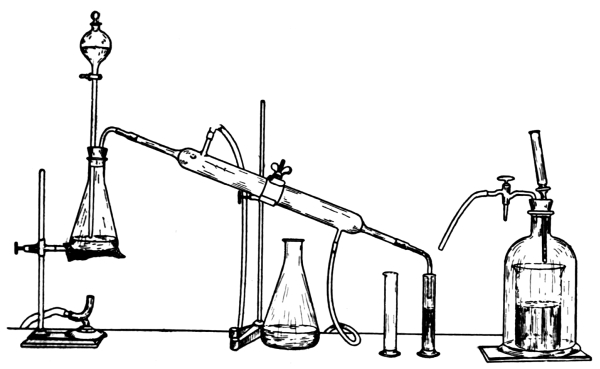
Figure 46. Distilling Apparatus for Pentoses.
The distillate is received in a graduated cylinder and as soon
as thirty cubic centimeters are collected, an equal quantity of
hydrochloric acid, of the strength noted, is added to the distilling
flask, allowing it to flow in slowly so as not to stop the ebullition.
The process is continued until a drop of the distillate gives no
sensible reaction for furfurol when tested with anilin acetate. The
test is applied as follows: Place a drop of the distillate on a piece
of filter paper moistened with anilin acetate. The presence of furfurol
will be disclosed by the production of a brilliant red color. Usually
about three hours are consumed in the distillation, during which time a
little less than 400 cubic centimeters of distillate is obtained. The
distillate is neutralized with solid sodium carbonate and, in order
to have always the same quantity of common salt present, 10.2 grams
of sodium chlorid are added for each fifty cubic centimeters of water
necessary to make the total volume to half a liter.[124]
The reactions with pentosans probably consist in first splitting up of
the molecule into a pentose and the subsequent conversion of the latter
into furfurol according to the following equations:
(C₅H₈O₄)ₙ + (H₂O)ₙ = (C₅H₁₀O₅)ₙ
Pentosan. Water.Pentose.
and
(C₅H₁₀O₅)ₙ = (C₅H₄O₂)ₙ + (3H₂O)ₙ.
Pentose. Furfurol.Water.
151. Determination of Furfurol.—The quantity of furfurol
obtained by the process mentioned above may be determined in several ways.
As Furfuramid.—When ammonia is added to a saturated solution
of furfurol, furfuramid, (C₅H₄O)₃N₂, is formed. In order to secure the
precipitate it is necessary that the furfurol be highly concentrated
and this can only be accomplished by a tedious fractional distillation.
This method, therefore, has little practical value.
As Furfurolhydrazone.—Furfurol is precipitated almost
quantitively, even from dilute solutions, by phenylhydrazin. The
reaction is represented by the equation:
| C₆H₈N₂ |
+ |
C₅H₄O₂ |
= |
C₁₁H₁₀N₂O |
+ |
H₂O. |
| Phenylhydrazin. |
|
Furfurol. |
|
Furfurolhydrazone. |
|
Water. |
152. Volumetric Methods.—Tollens and Günther have proposed
a volumetric method which is carried out as follows:[125]
The distillation is accomplished in the manner described. The distillate
is placed in a large beaker, neutralized with sodium carbonate and
acidified with a few drops of acetic. Phenylhydrazin solution of known
strength is run in until a drop of the liquid, after thorough mixing,
shows no reaction for furfurol with anilin acetate. The reagent is
prepared by dissolving five grams of pure phenylhydrazin and three
of glacial acetic acid in distilled water, and diluting to 100 cubic
centimeters. The solution is set by dissolving from two-tenths to
three-tenths gram of pure furfurol in half a liter of water and
titrating with the phenylhydrazin as indicated above. The quantity of
the pentose used has a great influence on the result.
With nearly a gram of arabinose about fifty per cent of furfurol were
obtained while when nearly five grams were used only about forty-six
per cent of furfurol were found. With xylose a similar variation was
found, the percentage of furfurol, decreasing as the quantity of
pentose increased. The method, therefore, gives only approximately
accurate results.
153. Method of Stone.—Another volumetric method proposed by
Stone is based on the detection of an excess of phenylhydrazin by its
reducing action on the fehling reagent.[126]
A standard solution of phenylhydrazin is prepared by dissolving one
gram of the hydrochlorate and three grams of sodium acetate in water
and completing the volume of the liquor to 100 cubic centimeters. This
solution contains 1.494 milligrams of phenylhydrazin in each cubic
centimeter, theoretically equivalent to 1.328 milligrams of furfurol.
The reagent is set by titrating against a known weight of furfurol.
Pure furfurol may be prepared by treating the crude article with
sulfuric acid and potassium dichromate, and subjecting the product to
fractional distillation. The distillate is treated with ammonia and
the furfuramid formed is purified by recrystallizing from alcohol and
drying over sulfuric acid. One gram of this furfuramid is dissolved in
dilute acetic acid and the volume completed to one liter with
water.[127]
The phenylhydrazin solution being unstable, is to be prepared at the time of use.
The titration is conducted as follows: Twenty-five cubic centimeters of
the distillate obtained from a pentose body, by the method described
above, are diluted with an equal volume of water, a certain quantity
of the phenylhydrazin solution added to the mixture from a burette and
the whole heated quickly to boiling. The flask is rapidly cooled and a
portion of its contents poured on a filter. The filtrate should have a
pale yellow color and be perfectly clear. If it become turbid on
standing, it should be refiltered. Two cubic centimeters of the clear
filtrate are boiled with double the quantity of the fehling reagent.
If phenylhydrazin be present, the color of the mixture will change
from blue to green. By repeating the work, with varying quantities of
phenylhydrazin, a point will soon be reached showing the end of the
reaction in a manner entirely analogous to that observed in volumetric
sugar analysis.
In practice the volumetric methods have given place to the more exact
gravimetric methods described below.
154. Gravimetric Methods.—The distillation is carried on and
the volume of the distillate completed to half a liter as described
above. Chalmot and Tollens then proceed as follows:[128]
Ten cubic centimeters of a solution of phenylhydrazin acetate,
containing in 100 cubic centimeters twelve grams of the phenylhydrazin
and seven and a half grams of glacial acetic acid dissolved and
filtered, are added to the distillate and the mixture stirred with an
appropriate mechanism for half an hour. The furfurolhydrazone at the
end of this time will have separated as small reddish-brown crystals.
The mixture is then thrown onto an asbestos filter and the liquid
separated with suction. The suction should be very gradually applied
so as not to clog the felt. The precipitate adhering to the beaker
is washed into the filter with 100 cubic centimeters of water. The
precipitate is dried at about 60° and weighed. As a check the hydrazone
may be dissolved in hot alcohol, the filter well washed, dried and
again weighed. To obtain the weight of furfurol the weight of hydrazone
found is multiplied by 0.516 and 0.025 added to compensate for the
amount which was held in solution or removed by washing. Less than one
per cent of pentose can not be determined by this method since that
amount is equalled by the known losses during the manipulation.
Factor.—To convert the furfurol found into pentoses, the
following factors are used:
Per cent furfurol
obtained from five
grams of pentoses. |
Multiply for
arabinose by. |
Multiply for
xylose by. |
Multiply for
penta-glucoses by. |
| |
| 2.5 per cent or less |
1.90 |
1.70 |
1.67 |
| 5.0 ” ” ” more |
2.04 |
1.90 |
1.92 |
155. Method Of Krug.—In conducting the determination of
furfurol, according to the method of Chalmont and Tollens just noticed,
Krug observed that the filtrate, after standing for some time, yielded
a second precipitate of furfurol hydrazone. Great difficulty was also
experienced in collecting the precipitate upon the filter on account
of the persistency with which it stuck to the sides of the vessel
in which the precipitation took place.[129]
In order to avoid these two objections, Krug modified the method as
described below and this modified method is now exclusively used in
this laboratory.
After the precipitation of the furfurol hydrazone, it is stirred
vigorously, by means of an appropriate mechanical stirrer, for at
least half an hour and then allowed to rest for twenty-four hours. On
filtering after that length of time the filtrate remains perfectly
clear and no further precipitation takes place. After the filtration is
complete and the beaker and filtering tube well washed, no attempt is
made to detach the part of the filtrate adhering to the beaker but the
whole of the precipitate, both that upon the filter and that adhering
to the sides of the beaker, is dissolved in strong alcohol, from thirty
to forty cubic centimeters being used. The alcoholic solution is
collected in a small weighed flask, the alcohol evaporated at a gentle
heat and the last traces of water removed by heating to 60° and blowing
a current of dry air through the flask. After weighing the precipitate
of furfurol hydrazone, obtained as above, the calculation of the weight
of pentose bodies is accomplished by means of the usual factors.
156. Precipitation of Furfurol with Pyrogalol.—Furfurol is
thrown out of solution in combination with certain phenol bodies by
heating together in an acid solution. Hotter has proposed a method
for the determination of furfurol based on the above fact.[130]
The furfurol is obtained by distillation in the manner already described
and hydrochloric acid is added if necessary to secure twelve per cent
of that body in a given volume. The furfurol is thrown out of an
aliquot portion by heating with an excess of pyrogalol in closed tubes
for about two hours at 110°. The reaction takes place in two stages,
represented by the following equations:
C₅H₄O₂ + C₆H₆O₃ = C₁₁H₁₀O₅
and
2C₁₁H₁₀O₅ = C₂₂H₁₈O₉ + H₂O.
The aliquot part of the distillate used should not contain more than
one-tenth of a gram of furfurol. The precipitate formed in this way is
collected on an asbestos felt, dried at 103° and weighed. The weight
obtained divided by 1.974 gives the corresponding amount of furfurol.
There is some difficulty experienced in loosening the precipitate from
the sides of the tubes in which the heating takes place, but this
defect can be overcome by heating in covered beakers in an autoclave.
157. Precipitation with Phloroglucin.—Instead of using
pyrogalol for the precipitating reagent phloroglucin may be employed.
The method of procedure proposed by Councler for this purpose is given
below.[131]
The furfurol is prepared by distillation in the usual way. The volume
of the distillate obtained is completed to half a liter with twelve per
cent hydrochloric acid, and an aliquot portion, varying in volume with
the percentage of furfurol is withdrawn for precipitation. This portion
is placed in a glass-stoppered flask with about twice the quantity of
finely powdered phloroglucin necessary to combine with the furfurol
present. The contents of the flask are well shaken and allowed to stand
fifteen hours. The precipitate is collected on an asbestos filter, washed
free of chlorin, dried at the temperature of boiling water and weighed.
The theoretical quantity of precipitate corresponding to one part
of furfurol, viz., 2.22 parts, is never obtained since the
precipitate is not wholly insoluble in water. The actual proportions
between the precipitate and the original furfurol vary with the amount
of precipitate obtained.
When the weight of the precipitate is 200 milligrams and over, 2.12
parts correspond to one part of furfurol. When the weight of the
precipitate varies from fifty to 100 milligrams, the ratio is as 2.05:1
and when only about twenty-five milligrams of precipitate are obtained
the ratio is as 1.98:1.
The quantity of pentose bodies corresponding to the furfurol is
calculated from the factors given by Tollens in a preceding paragraph.
The reaction which takes place with furfurol and phloroglucin is simply
a condensation of the reagents with the separation of water. It is very
nearly represented by the following formula:
| 2C₅H₄O₂ |
+ |
C₆H₆O₃ |
= |
C₁₆H₁₂O₆ |
+ |
H₂O. |
| Furfurol. |
|
Phloroglucin |
|
Condensation
product. |
|
Water. |
It has been shown by Welbel and Zeisel,[132]
that in the presence of twelve per cent of hydrochloric acid
phloroglucin itself is condensed into dark insoluble compounds. When
three molecules of furfurol and two molecules of phloroglucin are
present, the bodies are both condensed and separated by continued
action. When from one and a quarter to three parts of phloroglucin by
weight are used to one part of furfurol, the weight of the precipitate
obtained under constant conditions may serve sufficiently well for
the calculation of the furfurol. The precipitates contain chlorin,
which they give up even in the cold, to water. For these reasons the
analytical data obtained by the method of Councler, given above, are
apt to be misleading. It is probable also that similar conditions
may to a certain extent prevail in the separation of furfurol with
phenylhydrazin, and further investigation in this direction is
desirable. For the present the very best method that can be recommended
for the estimation of pentoses and pentosans is the conversion thereof
into furfurol and the separation of the compound with phenylhydrazin
acetate.
158. Estimation of Sugars by Fermentation.—When a solution
of a hexose sugar is subjected to the action of certain ferments a
decomposition of the molecule takes place with the production of carbon
dioxid and various alcohols and organic acids. Under the action of
the ferment of yeast Saccharomyces cerevisiae the sugar yields
theoretically only carbon dioxid and ethyl alcohol, as represented by
the equation:
C₆H₁₂O₆ = 2C₂H₆O + 2CO₂.
The theoretical quantities of alcohol and carbon dioxid obtained
according to this equation are 51.11 percent of alcohol and 48.89 per
cent of carbon dioxid.
When the yeast ferment acts on cane sugar the latter first suffers
inversion, and the molecules of dextrose and levulose produced are
subsequently converted into alcohol and carbon dioxid as represented
below:
C₁₂H₂₂O₁₁ + H₂O = 2C₆H₁₂O₆
2C₆H₁₂O₆ = 4C₂H₆O + 4CO₂.
Cane sugar, plus the water of hydrolysis, will yield theoretically 53.8
per cent of alcohol and 51.5 per cent of carbon dioxid.
In practice the theoretical proportions of alcohol and carbon dioxid
are not obtained because of the difficulty of excluding other
fermentative action, resulting in the formation especially of succinic
acid and glycerol. Moreover, a part of the sugar is consumed by the
yeast cells to secure their proper growth and development. In all
only about ninety-five per cent of the sugar can be safely assumed as
entering into the production of alcohol. About 48.5 per cent of alcohol
are all that may be expected of the weight of dextrose or invert sugar
used. Only sugars containing three molecules of carbon or some multiple
thereof are fermentable. Thus the trioses, hexoses, nonoses, etc., are
susceptible of fermentation, while the tetroses, pentoses, etc., are
not.
159. Estimating Alcohol.—In the determination of sugar by
fermentation, a rather dilute solution not exceeding ten per cent
should be used. A quantity of pure yeast, equivalent to four or five
per cent of the sugar used, is added, and the contents of the vessel,
after being well shaken, exposed to a temperature of from 25° to 30°
until the fermentation has ceased, which will be usually in from
twenty-four to thirty-six hours. The alcohol is then determined in the
residue by the methods given hereafter.
The weight of the alcohol obtained multiplied by 100 and divided by
48.5, will give the weight of the hexose reducing sugar which has been
fermented. Ninety-five parts of sucrose will give 100 parts of invert
sugar.
Example.—Let the weight of alcohol obtained be 0.625 gram. Then
0.625 × 100 ÷ 48.5 = 1.289 grams, the weight of the hexose, which has
been fermented; 1.289 grams of dextrose or levulose correspond to 1.225
of sucrose.
160. Estimating Carbon Dioxid.—The sugar may also be determined
by estimating the amount of carbon dioxid produced during the
fermentation. For this purpose the mixture of sugar solution and yeast,
prepared as above mentioned, is placed in a flask whose stopper carries
two tubes, one of which introduces air free of carbon dioxid into the
contents of the flask, and the other conducts the evolved carbon dioxid
into the absorption bulbs. In passing to the absorption bulbs the
carbon dioxid is freed of moisture by passing through another set of
bulbs filled with strong sulfuric acid. During the fermentation, the
carbon dioxid is forced through the bulbs by the pressure produced, or
better, a slow current of air is aspirated through the whole apparatus.
The aspiration is continued after the fermentation, has ceased, until
all the carbon dioxid is expelled. Towards the end, the contents of
the flask may be heated to near the boiling-point. The increase of
the weight of the potash bulbs will give the weight of carbon dioxid
obtained. A hexose reducing sugar will yield about 46.5 per cent of its
weight of carbon dioxid. The calculation is made as suggested for the
alcohol process.
The fermentation process has little practical value save in determining
sucrose in presence of lactose, as will be described in another place.
161. Precipitation of Sugars in Combination with the Earthy
Bases.—The sugars combine in varying proportions with the oxids
and hydroxids of calcium, strontium and barium. Sucrose especially,
furnishes definite crystalline aggregates with these bases in such
a way as to form the groundwork of several technical processes in
the separation of that substance from its normally and abnormally
associated compounds. These processes have little use as analytical
methods, but are of great value, as mentioned, from a technical point
of view.
162. Barium Saccharate.—This compound is formed by mixing
the aqueous solutions of barium hydroxid and sugar. The saccharate
separates in bright crystalline plates or needles from the warm
solution, as C₁₂H₂₂O₁₁BaO. One part of this precipitate is soluble in
about forty-five parts of water, both at 15° and 100°.
163. Strontium Saccharates.—Both the mono- and distrontium
saccharates are known, viz., C₁₂H₂₂O₁₁SrO + 5H₂O and
C₁₂H₂₂O₁₁2SrO.
The monosalt may be easily secured by adding a few of its crystals to a
mixture of sugar and strontium hydroxid solutions.
The disaccharate is precipitated as a granular substance when from two
to three molecules of strontium hydroxid are added to a boiling sugar
solution. The reaction is extensively used in separating the sugar from
beet molasses.
164. Calcium Saccharates.—Three calcium saccharates are known
in which one molecule of sugar is combined with one, two and three
molecules of lime respectively.
The monosaccharate is obtained by mixing the sugar and lime in the
proper proportion and precipitating by adding alcohol.
The precipitate is partly granular and partly jelly-like, and is
soluble in cold water. The dicalcium compound is obtained in the same
way and has similar properties. Both, on boiling, with water, form the
trisaccharate and free sugar.
The tricalcium saccharate is the most important of these compounds, and
may be obtained directly by mixing freshly burned and finely ground
lime (CaO) with a very cold dilute solution of sugar.
The compound crystallizes with three or four molecules of water.
When precipitated as described above, however, it has a granular,
nearly amorphous structure, and the process is frequently used in the
separation of sugar from beet molasses.
In the laboratory but little success has been had in using even the
barium hydroxid as a chemical reagent, and therefore the reactions
mentioned above are of little value for analytical purposes. In
separating sugar from vegetable fibers and seeds, however, the
treatment with strontium hydroxid is especially valuable the sugar
being subsequently recovered in a free state by breaking up the
saccharate with carbon dioxid. The technical use of these reactions
also is of great importance in the beet sugar industry.
165. Qualitive Tests for the Different Sugars.—The analyst will
often be aided in examining an unknown substance by the application
of qualitive tests, which will disclose to him the nature of the
saccharine bodies with which he has to deal.
166. Optical Test for Sucrose.—The simplest test for the
presence of sucrose is made with the polariscope. A small quantity of
the sample under examination is dissolved in water, clarified by any of
the usual methods, best with alumina cream, and polarized. A portion of
the liquor is diluted with one-tenth its volume of strong hydrochloric
acid and heated to just 68°, consuming about fifteen minutes time in
the operation. The mixture is quickly cooled and again polarized in
a tube one-tenth longer than before used; or the same tube may be
used and the observed reading of the scale increased by one-tenth.
If sucrose be present the second reading will be much lower than the
first, or may even be to the left.
167. Cobaltous Nitrate Test for Sucrose.—Sucrose in solution
may be distinguished from other sugars by the amethyst violet color
which it imparts to a solution of cobaltous nitrate. This reaction was
first described by Reich, in 1856, but has only lately been worked out
in detail. The test is applied as follows:
To about fifteen cubic centimeters of the sugar solution add five cubic
centimeters of a five per cent solution of cobaltous nitrate. After
thoroughly mixing the two solutions, add two cubic centimeters of a
fifty per cent solution of sodium hydroxid. Pure sucrose gives by this
treatment an amethyst violet color, which is permanent. Pure dextrose
gives a turquoise blue color which soon passes into a light green. When
the two sugars are mixed the coloration produced by the sucrose is the
predominant one, and one part of sucrose in nine parts of dextrose can
be distinguished. If the sucrose be mixed with impurities such as gum
arabic or dextrin, they should be precipitated by alcohol or basic lead
acetate, before the application of the test. Dextrin may be thrown
out by treatment of the solution with barium hydroxid and ammoniacal
lead acetate. The reaction may also be applied to the detection of
cane sugar in wines, after they are thoroughly decolorized by means of
lead acetate and bone-black. The presence of added sucrose to milk,
either in the fresh or condensed state, may also be detected after the
disturbing matters are thrown out with lead acetate. The presence of
sucrose in honey may also be detected by this process. The reaction
has been tried in this laboratory with very satisfactory results. The
amethyst violet coloration with sucrose is practically permanent. On
boiling the color is made slightly bluish, but is restored to the
original tint on cooling. Dextrose gives at first a fine blue color
which in the course of two hours passes into a pale green. A slight
flocculent precipitate is noticed in the tube containing the dextrose.
Maltose and lactose act very much as dextrose, but in the end do not
give so fine a green color. If the solutions containing dextrose,
lactose and maltose be boiled, the original color is destroyed and a
yellow-green color takes its place. The reaction is one which promises
to be of considerable practical value to analysts, as it may be applied
for the qualitive detection of sucrose in seeds and other vegetable
products.[133]
168. The Dextrose Group.—In case the carbohydrate in question
shows a right-handed rotation and the absence of sucrose is established
by the polariscopic observation described above, the presence of the
dextrose group may be determined by the following
test.[134]
Five grams of the carbohydrate are oxidized by boiling with from twenty
to thirty cubic centimeters of nitric acid of 1.15 specific gravity,
and then at gentle heat evaporated to dryness with stirring. If much
mucic acid be present, as will be the case if the original matter
contained lactose some water is added and the mixture well stirred,
and again evaporated to dryness to expel all nitric acid. The residue
should be of a brown color. The mass is again mixed with a little
water and the acid reaction neutralized by rubbing with fine-ground
potassium carbonate. The carbonate should be added in slight excess and
acetic acid added to the alkaline mixture, which is concentrated by
evaporation and allowed to stand a few days. At the end of this time
potassium saccharate has formed and is separated from the mother liquid
by pouring on a porous porcelain plate. The residue is collected,
dissolved in a little water and again allowed to crystallize, when it
is collected on a porous plate, as before, and washed by means of an
atomizer with a little aqueous spray until it is pure white and free of
any oxalic acid. The residual acid potassium saccharate may be weighed
after drying and then converted into the silver salt. The potash salt
for this purpose is dissolved in water, neutralized with ammonia and
precipitated with a solution of silver nitrate. The precipitate is well
stirred, collected on a gooch and washed and dried in a dark place.
It contains 50.94 percent of silver. All sugars which contain the
dextrose group yield silver saccharate when treated as above described.
Inulin, sorbose, arabinose and galactose yield no saccharic acid under
this treatment, and thus it is shown that they contain no dextrose
group. Milk sugar, maltose, the dextrins, raffinose and sucrose yield
saccharic acid when treated as above and therefore all contain the
dextrose group.
169. Levulose.—The levulose group of sugars, wherever it
occurs, when oxidized with nitric acid, gives rise to tartaric,
racemic, glycolic and oxalic acids, which are not characteristic,
being produced also by the oxidation of other carbohydrates. A more
distinguishing test is afforded by the color reactions produced with
resorcin.[135]
The reagent is prepared by dissolving half a gram of resorcin in thirty
cubic centimeters each of water and strong hydrochloric acid. To the
sugar solution under examination an equal volume of strong hydrochloric
acid is added, and then a few drops of the reagent. The mixture is
gently warmed, and in the presence of levulose develops a fire-red
color. Dextrose, lactose, mannose and the pentoses do not give the
coloration, but it is produced by sorbose in a striking degree, and
also by sucrose and raffinose since these sugars contain the levulose
group.
170. Galactose.—The galactose which arises from the hydrolysis
of milk sugar is readily recognized by the mucic acid which it gives
on oxidation with nitric acid.[136]
The analytical work is conducted as follows: The body containing
galactose or galactan is placed in a beaker with about sixty cubic
centimeters of nitric acid of 1.15 specific gravity for each five grams
of the sample used. The beaker is placed on a steam-bath and heated,
with frequent stirring, until two-thirds of the nitric acid have been
evaporated. The residual mixture is allowed to stand over night and
the following morning is treated with ten cubic centimeters of water,
allowed to stand for twenty-four hours, filtered through a gooch, and
the collected matter washed with twenty-five cubic centimeters of
water, dried at 100° and weighed. The mucic acid collected in this way
will amount to about thirty-seven per cent of the milk sugar or
seventy-five per cent of the galactose oxidized. Raffinose yields under
similar treatment, about twenty-three per cent of mucic acid, which
proves that the galactose group is contained in that sugar. Raffinose,
therefore, is composed of one molecule each of dextrose, levulose, and
galactose.
171. Invert Sugar.—The presence of a trace of invert sugar
accompanying sucrose can be determined by Soldaini’s solution,
paragraph 124, or by boiling with methyl blue.[137]
Methyl blue is the hydrochlorate of an ammonium base, which, under the influence
of a reducing agent, loses two atoms of hydrogen and becomes a colorless
compound. The test for invert sugar is made as follows: The reagent
is prepared by dissolving one gram of methyl blue in water. If the
sugar solution is not clear, twenty grams of the sugar are dissolved
in water clarified by lead subacetate, the volume completed to 100
cubic centimeters, and the solid matters separated by filtration. The
filtrate is made slightly alkaline with sodium carbonate to remove the
lead. A few drops of soda lye solution are then added and the mixture
thrown on a filter. To twenty-five cubic centimeters of the filtrate a
drop of the methyl blue solution is added, and a portion of the liquor
heated in a test tube over the naked flame. If, after boiling for one
minute, the coloration disappear, the sample contains at least 0.01
per cent of invert sugar; if the solution remain blue it contains none
at all or less than 0.01 per cent. The test may also be made with the
dilute copper carbonate solution of Ost described further on.
172. Compounds with Phenylhydrazin.—Many sugars may also be
qualitively distinguished by the character of their compounds with
phenylhydrazin. In general, it may be said that those sugars which
reduce fehling solution form definite crystalline compounds with the
reagent named. If a moderately dilute hot solution of a reducing sugar
be brought into contact with phenylhydrazin acetate, a crystalline
osazone is separated. The reaction takes place between one molecule of
the sugar and two molecules of the hydrazin compound, according to the
following formula:
C₆H₁₂O₆ + 2C₆H₅N₂H₃ = C₁₈H₂₂N₄O₄ + 2H₂O + H₂.
The hydrogen does not escape but combines in the nascent state with the
excess of phenylhydrazin to form anilin and ammonia.
The precipitation is accomplished as follows:
One part by weight of the sugar, two parts of phenylhydrazin
hydrochlorate, and three parts of sodium acetate are dissolved in
twenty parts of water and gradually heated on the water-bath.
The osazone slowly separates in a crystalline form and it is freed from
the mother liquor by filtration, and purified by solution in alcohol
and recrystallization. The crystals are composed of yellow needles,
which are difficultly soluble in water and more easily in hot alcohol.
The crystals are not decomposed by a dilute acid but are destroyed by
the action of strong acids.
Dextrosazone.—The crystals melt at from 204° to 205°, reduce
fehling liquor, and dissolved in glacial acetic acid are slightly left
rotating.
Levulosazone.—This body has the same properties as the dextrose
compound.
Maltosazone.—This substance melts at 206° with decomposition.
It is left rotating. Its structure is represented by the formula
C₂₄H₃₂N₄O₉.
Galactosazone.—This substance, C₁₈H₂₂N₄O₄, has the same
centesimal composition as the corresponding bodies produced from
dextrose and levulose. It is distinguished from these compounds,
however, by its low melting point, viz., 193°.
The above comprise all the phenylosazones which are important from
the present point of view. Sucrose, by inversion, furnishes a mixture
of dextros- and levulosazones when treated with phenylhydrazin, while
starch and dextrin yield the dextros- or maltosazone when hydrolyzed.
Lactose yields a mixture of dextros- and galactosazones when hydrolyzed
and treated as above described.
The reactions with phenylhydrazin are approximately quantitive and it
is possible that methods of exact determination may be based on them in
the near future.[138]
173. Other Qualitive Tests for Sugars.—The analyst may
sometimes desire a more extended test of qualitive reactions than those
given above. The changes of color noticed on heating with alkalies may
often be of advantage in discriminating between different sugars. The
formation of definite compounds with the earthy and other mineral bases
may also be used for qualitive determinations. One of the most delicate
qualitive tests is found in the production of furfurol and this will be
described in the following paragraphs.
174. Detection of Sugars and Other Carbohydrates by Means of
Furfurol.—The production of furfurol (furfuraldehyd) as noted in
paragraph 150, is also used quantitively for the determination
of pentose sugars and pentosans.
Furfurol was first obtained from bran (furfur), whence its name,
by treating this substance with sulfuric acid, diluted with three
volumes of water, and subjecting the mixture to distillation. Its
percentage composition is represented by the symbol C₅H₄O₂, and its
characteristics as an aldehyd by the molecular structure C₄H₃O,C-HO.
Carbohydrates in general, when treated as described above for bran,
yield furfurol, but only in a moderate quantity, with the exception of
the pentoses.
Mylius has shown[139]
that Pettenkofer’s reaction for choleic acid is due to the furfurol
arising from the cane sugar employed, which, with the gall acid,
produces the beautiful red-blue colors characteristic of the
reaction.
Von Udránszky[140]
describes methods for detecting traces of carbohydrates by the
furfurol reaction, which admit of extreme delicacy. The solution of
furfurol in water, at first proposed by Mylius, is to be used and
it should not contain more than two and two-tenths per cent, while
a solution containing five-tenths per cent furfurol is found to be
most convenient. The furfurol, before using, should be purified by
distillation, and, as a rule, only a single drop of the solution used
for the color reaction.
The furfurol reaction proposed by Schiff[141]
appears to be well suited for the detection of carbohydrates.
It is made as follows:
Xylidin is mixed with an equal volume of glacial acetic acid and the
solution treated with some alcohol. Strips of filter paper are then
dipped in the solution and dried. When these strips of prepared paper
are brought in contact with the most minute portion of furfurol,
furoxylidin is formed, C₄H₃OCH(C₈H₈NH₂)₂, producing a beautiful red
color. In practice, a small portion of the substance, supposed to
contain a carbohydrate, is placed in a test tube and heated with a
slight excess of concentrated sulfuric acid. The prepared paper is then
placed over the mouth of the test tube so as to be brought into contact
with the escaping vapors of furfurol.
The furfurol reaction with α-naphthol for some purposes, especially
the detection of sugar in urine, is more delicate than the one just
described. This reaction was first described by Molisch[142],
who, however, did not understand its real nature.
The process is carried on as follows: The dilute solution should
contain not to exceed from 0.05 to one-tenth per cent of carbohydrates.
If stronger, it should be diluted. Place one drop of the liquid in a
test tube with two drops of fifteen per cent alcoholic solution of
α-naphthol, add carefully one-half cubic centimeter of concentrated
sulfuric acid, allowing it to flow under the mixture. The appearance
of a violet ring over a greenish fringe indicates the presence of a
carbohydrate. If the substance under examination contain more than a
trace of nitrogenous matter, this must be removed before the tests
above described are applied.
If the liquids be mixed by shaking when the violet ring is seen, a
carmine tint with a trace of blue is produced. If this be examined with
a spectroscope, a small absorption band will be found between D and E,
and from F outward the whole spectrum will be observed. One drop of
dextrose solution containing 0.05 per cent of sugar gives a distinct
reaction by this process. It can be used, therefore, to detect the
presence of as little as 0.028 milligram of grape sugar. This test has
been found exceedingly delicate in this laboratory, and sufficiently
satisfactory without the spectroscopic adjunct.
The furfurol reaction is useful in detecting the presence of minute
traces of carbohydrates but is of little value in discriminating
between the different classes of these bodies.
It is not practical here to go into greater detail in the description
of qualitive reactions. The analyst, desiring further information,
should consult the standard works on sugar chemistry.
[143]
175. Detection of Sugars by Bacterial Action.—Many forms of
bacteria manifest a selective action towards sugars and this property
may in the future become the basis of a qualitive and even quantitive
test for sugars and other carbohydrates. Our present knowledge of the
subject is due almost exclusively to the researches of Smith, conducted
at the Department of Agriculture.[144]
Dextrose is the sugar first and most vigorously attacked by bacterial
action, and by proper precautions the whole of the dextrose may be
removed from mixtures with sucrose and lactose.
The development of other forms of micro-organisms which will have the
faculty of attacking other and special forms of carbohydrates is to be
looked for with confident assurance of success.
176. Constitution of Starch.—The molecule of starch is without
doubt formed by the condensation of a large number of hexose bodies.
On account of its great insolubility its molecular weight has not been
determined with any degree of accuracy. Its formula may be expressed
either as (C₆H₁₀O₅)ₙ or (C₁₂H₂₀O₁₀)ₙ. It is insoluble in cold water
and other common solvents and does not pass into solution in any reagent
without undergoing a change of structure. In hot water it forms a paste
and when heated under pressure with water it undergoes a partial change
and becomes soluble. Heated with acids or subjected to the action of
certain ferments it suffers hydrolysis and is transformed into dextrin,
maltose and dextrose. In analytical work an attempt is usually made to
transform the starch entirely into dextrose, the quantity of which is
then determined by some of the processes already given. All starches
possess the property of giving an intensely blue color with iodin and
this reaction serves to detect the most minute quantity of the material.
Starch grains derived from different sources are distinguished by
differences in size and appearance. In most cases a careful examination
of the starch particles will reveal their origin.[145]
The greatest part of the cereal grains is composed of starch, the
percentage ranging from sixty to eighty. Rice has the greatest
percentage of starch in its composition of any substance. Certain
root crops are also rich in starch, such as the potato, artichoke and
cassava. Starch appears as one of the first products of vegetable
metabolism, according to some authorities, preceding the formation
of sugars. By reason of its greater complexity, however, it is more
probable that the production of simple sugars precedes the formation of
the more complex molecule. Starch granules are probably used as a food
by the plant in the building of more complex structures and the excess
of this food is stored in the seeds and in tubers.
177. Separation of Starch Particles.—Advantage is taken of the
insolubility of the starch particles to secure their separation from
the other vegetable structures with which they are associated. The
substances containing starch are reduced to a pulp as fine as possible,
and this pulp being placed in a fine cloth the starch particles are
washed through the cloth with water. The milky filtrate carrying the
starch is collected in an appropriate holder and, after some time, the
particles subside. They may then be collected and dried. While this
process is the one used commercially in the manufacture of starch, it
can only give approximate data respecting the actual quantity of starch
in a given weight of the sample. It is not quite possible by this
method to get all the starch separated from the rest of the vegetable
matter, and particles of foreign substances, such as cellulose and
albuminoid matters, may pass through the filter cloth and be found
with the deposited granules. It follows from this that the quantitive
determination of the starch in a given sample by any direct method is
only approximately exact.
178. Methods of Separation.—Hot acids cannot be safely employed
to dissolve starch from its natural concomitants because other
carbohydrate bodies become soluble under similar conditions. In such
cases the natural sugars which are present should be removed by cold
water and the starch dissolved from the residue by a diastatic ferment.
Instead of this the sugars may be determined in a separate portion
of the pulped material and the starch, together with the sugars, determined,
and the quantity of sugar found deducted from the final result.
In these cases the final determinations are made on the sugars, after
inverting the sucrose, and proceeding as directed for invert sugars
in paragraph 141. The starch, after separation with diastase,
is converted into dextrose by one of the methods to be given and the
resulting dextrose determined by one of the approved methods.
179. Separation with Diastase.—Diastase or malt extract at
a temperature of about 65° rapidly renders starch soluble. Cereals,
potato meal and other starch-holding bodies are dried, first at a low
temperature, and extracted with ether or petroleum to remove fat. The
material is then rubbed up with water, boiled, cooled to 65°, and
treated with malt extract (diastase) prepared as given below. One
kilogram of ground green malt is mixed with one liter of glycerol
and an equal quantity of water, and allowed to stand, with frequent
shaking, for eight days. After that time the mixture is filtered,
first through a small filter press and afterwards through paper. In
case no filter press is at hand the mixture may be pressed in a bag
and the liquor obtained, filtered. Malt extract obtained in this way
will keep its diastatic properties for a long time. In its use, blank
determinations must be made of the dextrose produced by treating equal
portions of it with hydrochloric acid. For three grams of starchy
material twenty-five cubic centimeters of the malt solution should be
used and the mixture kept at 65° for two hours.[146]
180. Method in Use at the Halle Station.—The method of
separating starch from cereals, potatoes and other starch-holding
materials, employed at the Halle station, is essentially the same as
already described.[147]
The malt extract used is prepared immediately beforehand, inasmuch
as no preservative is added to it. It can be quickly prepared by
digesting, for a short time at not above 50°, 100 grams of finely
ground dried malt with one liter of water and separating the extract by
filtration. This extract will keep only a few hours.
The material in which the starch is to be determined is dried and
extracted with ether. From two to four grams of the extracted material,
according to the amount of starch which it contains, are boiled for
half an hour with 100 cubic centimeters of water, cooled to 65°,
treated with ten cubic centimeters of malt extract and kept at the
temperature named for half an hour. It is then again boiled for fifteen
minutes, cooled to the temperature mentioned and again treated with
malt extract as above. Two treatments with malt extract are usually
sufficient to bring all the starch into solution. Finally it is again
boiled and the volume completed to 250 cubic centimeters and thrown
upon a filter. Two hundred cubic centimeters of the filtrate are
converted into dextrose by boiling with hydrochloric acid, and the rest
of the analysis is conducted in the usual manner. The dextrose value of
the quantity of malt extract used must be determined upon a separate
portion thereof, and the quantity of dextrose found deducted from the
total amount obtained in the analysis.
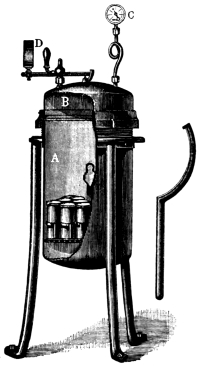
Figure 47.
Autoclave for
Starch Analysis.
181. Separation by Hydrolysis with Water at High
Temperatures.—Instead of dissolving the starch with diastase, it
may be brought into solution by heating with water under pressure. The
former method employed of heating in sealed flasks has been entirely
superceded by heating in an autoclave. The materials are best held in
metal beakers furnished with a cover which prevents loss from boiling
if the pressure should be removed too rapidly after the completion
of the operation. The autoclave is a strong metal vessel capable of
resisting the pressure of several atmospheres. It is furnished with a
pressure gauge C and a safety valve D, as shown in the figure.
The top is securely screwed on by means of a wrench, shown at the right hand
side. In the figure a portion of the case is
represented cut away to show the arrangement of the metal beakers
inside.
In the method of Reinke, as practiced at the Halle station, and in
this laboratory, about three grams of the starchy substance are placed
in each of the metal beakers with twenty-five cubic centimeters of
a one per cent lactic acid solution and thirty cubic centimeters of
water. The contents of the beaker are thoroughly mixed and they are
then heated for two and a half hours in the autoclave, at a pressure
of three and a half atmospheres. The addition of the lactic acid is
for the purpose of protecting any sugar which may be present from
decomposition at the high pressure and temperature employed. After
the completion of the heating, the autoclave is allowed to cool, the
cover is removed and the beakers taken out and their contents washed
with hot water into quarter liter flasks. After cooling, the volume
is completed with cold water, and after standing for half an hour,
with frequent shaking, the contents of the flasks are filtered and
200 cubic centimeters of the filtrate in each case converted into
dextrose with hydrochloric acid in the usual way. In order to obtain
agreeing results, it is highly necessary that the substance before
treatment should be ground to a fine powder. The addition of the lactic
acid, as practiced in the reinke method, tends to give somewhat high
results, due probably to the hydrolytic action of the acid on the
fiber present. When starchy bodies are heated in the autoclave for the
determination of their starch by polarimetric methods, or for ordinary
determinations, the use of lactic acid should be omitted.
Example.—The following data indicate the methods of calculation
to be followed in the determination of the percentage of starch in the
material by diastatic hydrolysis: Three grams of a barley were inverted
by diastase, as directed above, the volume of the solution made a
quarter of a liter, filtered, 200 cubic centimeters of the filtrate
converted into dextrose by hydrochloric acid, the volume completed to
half a liter with water and fifty cubic centimeters thereof oxidized
by the alkaline copper solution in the usual way. The amount of copper
obtained was 331 milligrams, corresponding to 174 milligrams of
dextrose. The amount of malt extract used in hydrolyzing the barley
mentioned above, was ten cubic centimeters. The diastatic solution
inverted with hydrochloric acid and treated as indicated above, yielded
191 milligrams of copper, corresponding to ninety-eight milligrams of
dextrose in ten cubic centimeters of the malt extract. The quantity of
malt extract represented in the final determination of copper, however,
was only one and six-tenths cubic centimeters. We then have:
| Total dextrose |
174 |
milligrams |
| Dextrose in one and six-tenths cubic centimeters |
|
|
| malt extract |
16 |
milligrams |
| Dextrose corresponding to 240 milligrams |
|
|
| of barley |
158 |
milligrams |
Calculated on the proportion that dextrose is to starch, as ten is to
nine, this is equivalent to 142 milligrams of starch. The percentage
of starch in the original substance, therefore, was equivalent to 142
multiplied by 100, divided by 240, viz., 59.17.
182. Principles of the Methods of Determination.—In the
approximately pure state in which starch exists in the trade, it may
be determined by conversion into dextrose and estimating the latter
by one of the methods given. It is probable that there is no known
method by which starch can be entirely converted into dextrose, and
all the methods of hydrolysis, when used for quantitive purposes,
must be standardized, not by the theoretical quantity of dextrose
which a given weight of pure starch should yield, but by the actual
quantity obtained. Starch is not largely converted into dextrose by
any of the diastatic ferments which produce principally maltose and
dextrins. Recourse must therefore be had to strong acids. In practice,
hydrochloric is the one usually employed. By the action of a hot
mineral acid, not only is starch converted into dextrose, but also
the dextrose found is subjected to changes. In such cases an opposing
action seems to be exerted by the hydrolytic agent, a part of the
dextrose formed suffering a partial condensation, and thus assuming
a state of higher molecular weight, approaching the constitution of
the dextrins. Another part of the dextrose may also suffer oxidation and
thus disappear entirely in respect of the further steps in starch analysis.
In such cases, the best the analyst can do is to conduct the hydrolysis
in as nearly as possible constant conditions, and to assume that the
percentage of dextrose present at a given time bears a constant ratio
to the quantity of starch hydrolyzed. In reality almost all the starch
appears finally as dextrose, and by proceeding on the assumption noted
above a fairly satisfactory accounting may be made of the remainder.
Starch being insoluble, it cannot be determined directly by its
rotatory power. When heated for a few hours in contact with water at a
high pressure, starch becomes soluble, and in this state has a fairly
constant gyrodynat, viz., [a]D = 197°.
Starch is also rendered soluble by rubbing it in a mortar for about ten
minutes with an excess of strong hydrochloric acid, and in this way
a quick approximate idea may be obtained of the percentage present.
Starch prepared in this manner, however, has a strong reducing power
on metallic salts, showing that a part of it has already, even in so
short a time, assumed the state of maltose or dextrose. The gyrodynat
of pure anhydrous starch in such conditions varies from [a]D
= 197° to [a]D = 194°. Starch
is also rendered soluble by boiling with salicylic acid, whereby a
solution is obtained having a gyrodynat of [a]D =
200°(circa). The methods of procedure for the analysis of starch will
be set forth in detail in the following paragraphs.
183. Estimation of Water.—In prepared or commercial starches
the water may be determined by heating in a partial vacuum. The
temperature at first should be low, not exceeding 60°. After drying
for an hour at that heat the temperature may be gradually increased.
The last traces of water come off from starch with difficulty, and the
final temperature may be carried a little beyond 100° without danger of
decomposition.
Ost recommends the use of an atmosphere of hydrogen or illuminating
gas.[148]
One and a half grams of the finely powdered sample are placed
in the drying tube described in paragraph 23, and heated in a
stream of dry hydrogen. The temperature at first is kept at about 60°
for several hours and is then gradually increased to 120°. Ost states
that even at 150° the sample preserves its pure white color, but so
high a temperature is not necessary. Maercker, at the Halle station,
makes use of the same process, but employs illuminating gas instead
of hydrogen. The importance of beginning the desiccation at a low
temperature arises from the fact that at a higher temperature, before
the greater part of the water is driven off, the starch will suffer
a partial fusion and form a paste which is very difficult to dry.
The dried sample must be kept in a stoppered vessel to prevent the
absorption of hygroscopic moisture.
184. Estimation of Ash.—When the drying is accomplished in
a flat platinum dish, the same sample may serve for incineration.
Otherwise the incineration may be accomplished in another portion of
the sample by following directions already given.[149]
185. Nitrogen.—Even very pure samples of starch may contain
a little nitrogen which is most conveniently determined by moist
combustion.[150]
As a rule, in commercial starches of good quality, the quantity of pure
starch may be considered to be the remainder after subtracting the sum
of the weights of water, ash and nitrogen multiplied by 6.25, from the
original weight of the sample taken.
| Example:— |
|
|
| Per cent of |
moisture found |
12.85 |
| ” ” ” |
ash found |
0.08 |
| ” ” ” |
nitrogen × 6.25 |
0.27 |
| Sum |
|
13.20 |
| Per cent of |
pure starch in sample |
86.80 |
Samples of starch usually contain also traces of fat and fiber, and
these when present in weighable quantities, should be determined and
proper deductions made.
186. Hydrolysis with Acids.—The acids commonly chosen for
hydrolyzing starch are sulfuric and hydrochloric. The former has the
advantage of being more easily removed from the finished product but
the latter performs the work with less damage to the sugars formed. For
commercial purposes sulfuric and for analytical practice hydrochloric
acids are commonly employed.
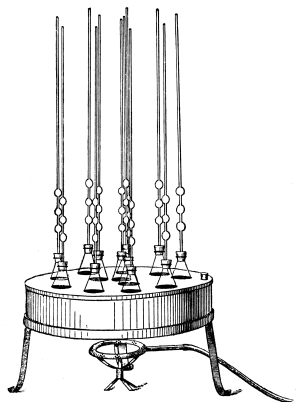
Figure 47 (bis). Maercker’s
Hydrolyzing Apparatus for Starch.
The best process for analytical purposes is the one proposed by
Sachsse.[151]
In this method the starch is heated with the hydrolyzing mixture in
the proportion of three grams to 200 cubic centimeters of water and
twenty of hydrochloric acid of 1.125 specific gravity, containing five
and six-tenths grams of the pure gas. The heating is continued for
three hours on a steam-bath. Maercker recommends, instead of the above
procedure, heating for two hours at gentle ebullition in an oil-bath.
In this method three grams of the starch are reduced to paste with 200
cubic centimeters of water, and then boiled for two hours with fifteen
cubic centimeters of hydrochloric acid of 1.125 specific gravity.
The erlenmeyers in which the hydrolysis takes place are heated in an
oil-bath and are provided with reflux condensers made of long glass
tubes on which some bulbs have been blown, as shown in the accompanying
figure. In all cases after hydrolysis the
solution is neutralized, made to a standard volume and an aliquot part,
after filtration, diluted to contain an amount of dextrose suited
to the use of the table by Allihn for calculating the percentage
of sugar. In diluting the solution preparatory to the estimation
of dextrose, it is well to remember that nine parts of starch will
furnish theoretically ten parts of dextrose. Since three grams of the
sample are used, containing approximately eighty-five per cent of
starch, the quantity of dextrose present is a little less than three
grams. The solution should therefore contain not less than 300 cubic
centimeters.
187. Factor for Calculating Starch from the Dextrose
Obtained.—If all the starch could be converted into dextrose
without loss, the quantity of it could be easily calculated
theoretically on the supposition that the formula of starch is
(C₆H₁₀O₅)ₙ. The factor by this assumption is, starch = dextrose × 0.90.
If the starch have the formula assigned to it by Nägeli, viz.,
C₃₆H₆₂O₃₁ the formula becomes, starch = dextrose × 0.918.
Ost prefers to work by Sachsse’s method and to use the factor 0.925 to
convert the dextrose into starch.[152]
In view of all the facts in the case it appears that the analyst will
reach nearly correct results by converting the starch into dextrose
by heating for three hours at 100° with hydrochloric acid or for two
hours at gentle ebullition as directed above, determining the resultant
dextrose and multiplying the weight thereof by 0.92.
188. Polarization of Starch.—Starch may be prepared for
polarization by dissolving it in cold hydrochloric acid. The process
as carried out by Effront is as follows.[153]
Five grams of starch are rubbed with twenty cubic centimeters of
cold concentrated hydrochloric acid for nearly ten minutes or until
the solution is quite clear. The volume is completed to 200 cubic
centimeters with water and the solution polarized. By this process
there is always produced a notable quantity of reducing sugars, and for
this reason it must be admitted that a portion of the starch has
suffered complete hydrolysis. Ost therefore recommends the use of an
acid of 1.17 specific gravity, and the gyrodynat of the soluble starch
thus produced is found to vary from [a]D
= 196°.3 to 196°.7. When acid of 1.20 specific gravity is employed the gyrodynat
falls to [a]D = 194.2.[154]
For approximately correct work the solution with the weaker hydrochloric
acid and subsequent polarization is to be recommended as the most rapid
method for starch determination.
It will be of interest to add the observation that the gyrodynat
of maltose has lately been redetermined by Ost, who finds it to be
[a]D²⁰ ° = 137°.04 ± 0.19.[155]
189. Solutions of Starch at High Pressure.—Starch may also be
brought into a condition suited to polarization by dissolving in water
at a high temperature and pressure. The solution is accomplished in an
autoclave as described in 181.
From two to three grams of starch are used and from eighty to ninety
cubic centimeters of water. The starch is first reduced to a pasty
state by heating with the water and, when evenly distributed throughout
the flask, is rendered soluble by heating from three to five hours in
an autoclave at from two to three atmospheres. The material is entirely
without action on an alkaline copper solution. After heating, the
volume of the solution is completed to 100 cubic centimeters and it is
then polarized. The gyrodynat of starch dissolved in this way varies
from [a]D = 196°.5 to 197°.[156]
Starch is prepared by Baudry for polarization by boiling with
salicylic acid.[157]
The gyrodynat of starch dissolved in this way is [a]D
= 200°.25.
190. Polarization after Solution in Dilute Nitric
Acid.—Guichard recommends saccharification with ten per cent
nitric acid (ten cubic centimeters strong acid, ninety cubic
centimeters water).[158]
This treatment, even after prolonged boiling, gives only a light straw
color to the solution which does not interfere with its polarization
with a laurent instrument.
In working on cereals four grams of the finely ground material, in
which the bran and flour are intimately mixed, are used.
The material is placed in a flask of about 500 cubic centimeters
capacity, with 100 cubic centimeters of the dilute acid. The flask is
closed with a stopper carrying a reflux condenser. After boiling for
an hour the contents of the flask are filtered and examined in the
saccharimeter. The dextrose formed is determined by the polarimetric
data and the quantity of starch transformed calculated from the
dextrose. The following formula is used:
| A = |
av × 25 × 0.016 |
| 2 × 52.8 |
In this formula a = the rotation in angular degrees, v =
the volume of the liquid and A = the starch transformed.
In this method no account is taken of the sucrose and other sugars
which are present in cereals. In the case of sucrose the left-handed
sugar produced by treatment with nitric acid would diminish the
rotation to the right and thus introduce an error. On the other hand
the dextrose formed from the fiber of the bran would be calculated as
starch. If these two errors should be compensating the method might
prove practical.
191. Rapid Estimation Of Starch.—For the rapid estimation of
starch in cereals, cattle foods and brewery refuse, Hibbard recommends
a method which is carried out as follows:
The malt extract is prepared by covering ground, dry malt with water
containing from fifteen to twenty per cent of alcohol. The object of
adding alcohol is to preserve the filtered extract. It exercises a
slight retarding effect on the action of the diastase, but prevents the
malt extract from fermenting. After standing for a few hours in contact
with the malt, the liquid is separated by filtration and is then ready
for use. The substance in which the starch is to be determined should
be dry enough to be finely pulverized, but previous extraction with
ether is omitted. Enough of the material to contain at least half a
gram of starch is placed in a flask with fifty cubic centimeters of
water and from one to two cubic centimeters of malt extract added. The
mixture is at once heated to boiling with frequent shaking to prevent
the formation of clots. The addition of the diastase before boiling is
to aid in preventing the formation of lumps. After boiling a minute the
mixture is cooled to 60° and from two to three cubic centimeters of
the malt extract added. It is then slowly heated until it again boils,
consuming about fifteen minutes, when, after cooling, it is tested
with iodin for starch. If a blue color be produced the operation above
described is repeated until it fails to reappear. The mixture is then
made up to a standard volume, thrown on a linen filter and an aliquot
part of the filtrate, representing from 200 to 300 milligrams of
starch, is boiled with five cubic centimeters of hydrochloric acid, of
thirty per cent strength, for half an hour. The total volume of the
liquid before boiling should be completed to sixty cubic centimeters.
By the method above described, it is claimed that the determination of
starch in a cereal or similar substance can be completed within two
hours. The chief amount of time saved is in the heating with the malt
extract, which instead of being continued for two hours, as usually
directed, can be accomplished in thirty
minutes.[159]
192. Precipitation of Starch with Barium Hydroxid.—The tendency
of carbohydrate bodies to unite with the earthy bases has been utilized
by Asboth as a basis for the quantitive determination of
starch.[160]
About three grams of the finely ground sample containing the starch,
or one gram of pure starch, are rubbed up in a mortar with water and
the detached starch remaining suspended in the wash water is poured
off. This operation is repeated until all the starch is removed. In
difficult cases hot water may be used. The starch thus separated is
heated in a quarter liter flask to the boiling point to reduce it to
the condition of paste. When the paste is cold it is treated with fifty
cubic centimeters of the barium hydroxid solution, the flask closed and
well shaken for two minutes. The volume is then completed to the mark
with forty-five per cent alcohol, the flask well shaken and allowed
to stand. In a short time the barium-starch compound separates and
settles. Fifty cubic centimeters of the clear supernatant liquor are
removed with a pipette, or the liquor may be passed through a filter
and the quantity mentioned removed for titration of the residual barium
hydroxid after the addition of a few drops of phenolphthalein solution.
The quantity of barium hydroxid remaining, deducted from the original
quantity, gives the amount which has entered into composition with the
starch; the composition of the molecule being BaOC₂₄H₄₀O₂₀, which
contains 19.10 per cent of barium oxid and 80.90 per cent of starch.
The set solution of barium hydroxid must be preserved from contact with
the carbon dioxid of the air. The burette should be directly attached
to the bottle holding the set solution, by any of the usual appliances,
and the air entering the bottle must be deprived of carbon dioxid. The
water used in the work must be also free of air, and this is secured by
boiling immediately before use.
Example.—A sample of flour selected for
the analysis weighed 3.212 grams. The starch was separated and reduced
to paste in the manner described above. Thirty and four-tenths cubic
centimeters of tenth-normal hydrochloric acid were exactly neutralized
by ten cubic centimeters of the barium hydroxid solution. After
treatment as above described, fifty cubic centimeters of the clear
liquor, corresponding to ten cubic centimeters of the added barium
hydroxid, required 19.05 cubic centimeters of tenth-normal hydrochloric
acid. Then 30.4 - 19.05 = 11.35, and 11.35 x 5 = 56.75, which number
corresponds to the total titration of the residual barium hydroxid in
terms of tenth-normal hydrochloric acid. This number multiplied by
0.0324, viz., starch corresponding to one equivalent of barium,
gave 1.8387 grams of starch or 57.24 per cent of the weight of flour employed.
The barium hydroxid method has been given a thorough trial in this
laboratory and the results have been unsatisfactory when applied to
cereals. The principle of the process, however, appears to be sound,
and with a proper variation of working details, it may become practical.
193. Disturbing Bodies in Starch Determinations.—Stone has made
a comparison of the standard methods of starch determinations, and the
results of his work show that in the case of pure starch all of the
standard methods give approximately correct figures. For instance, in
the case of a pure potato starch, the following data were obtained:
By inversion with hydrochloric acid, 85.75 per cent; by inversion with
oxalic and nitric acids, 85.75 per cent; by solution in salicylic acid,
85.47 per cent; and by precipitation with barium hydroxid, 85.58 per
cent.[161]
When these methods are used, however, for the determination of starch
in its original state, the widest variations are secured. Stone shows
that these variations are due chiefly to the inverting effect of the
reagents employed upon the pentosans present. In experiments made with
pure xylan obtained from wheat straw, the methods employed gave from
44.73 to 67.16 per cent of material, which would be calculated by
the usual methods as starch. Stone also shows that the pentosans are
practically unaffected by the action of diastase or malt extract. Pure
xylan treated with diastase, under the condition in which starch is
converted into maltose and other soluble carbohydrates, fails to give
any subsequent reaction whatever with alkaline copper solution. In
all cases, therefore, where starch occurs in conjunction with pentose
bodies, it is necessary to separate it by diastatic action before
applying any of the methods of conversion of the starch into dextrose
or its precipitation by barium hydroxid.
194. Colorimetric Estimation of Starch.—The production of the
intensely blue color which starch gives with iodin has been used not
only as the basis of a qualitive method, but also of many attempts at
quantitive determination. These attempts have, as a rule, been attended
with very unsatisfactory results, due both to the extraordinary
delicacy of the reaction and to the fact that starches of different
origin do not always give exactly the same intensity of tint when
present in the same quantity. At the present it must be admitted that
little should be expected of any quantitive colorimetric test.
In case such a test is desired the procedure described by Dennstedt
and Voigtländer may be followed.[162]
A weighed quantity of the starch-holding material, containing
approximately half a gram of starch, is placed in a two liter flask and
boiled with a liter of water. After cooling, the volume is completed to
two liters and the starch allowed to subside. Five cubic centimeters of
the clear supernatant liquor are placed in a graduated cylinder holding
100, and marked in half cubic centimeters. One drop of a solution of
iodin in potassium iodid is added and the volume completed to the mark.
A half gram of pure starch is treated in the same way and different
measured portions of the solution treated as above until the color of
the first cylinder is matched. From the quantity of pure starch in
the matched cylinder the quantity in the sample is determined. The
test should be made in duplicate or triplicate. If a violet color be
produced instead of a blue, it may be remedied by treating the sample
with alcohol before the starch granules are dissolved.
195. Fixation of Iodin.—In addition to forming a distinctive
blue color with iodin, starches have the power of fixing considerable
quantities of that substance. The starches of the cereals have this
power in a higher degree than those derived from potatoes. In presence
of a large excess of iodin the starches of rice and wheat have a
maximum iodin-fixing power of about nineteen per cent of their weight.
When only enough of iodin is employed to enter into combination
the percentage absorbed varies from nine to fifteen per cent. The
absorption of iodin by starches is a matter of importance from a
general chemical standpoint, but as at present determined has but
little analytical value. It is evident, however, that this absorption
must take place according to definite chemical quantities and the
researches of investigators may in the future discover some definite
quantitive method of measuring it.[163]
196. Identification of Starches of Different Origin.—It is
often important, especially in cases of suspected adulteration, to
determine the origin of the starch granules. For this purpose the
microscope is the sole resort. In many cases it is easy to determine
the origin of the starch by the size or the shape and marking of the
grains. In mixtures of more than one kind of starch the distinguishing
features of the several starches can be clearly made out in most
instances. There are, however, many instances where it is impossible to
discriminate by reason of the fact that the characteristics of starch
granules vary even in the same substance and from year to year with
varying conditions of culture.
In many cases the illustrations of the forms and characteristics of
starch granules which are found in books are misleading and no reliance
can be placed on any illustrations which are not either photographs or
drawings made directly from them. In the microscopic study of starches
the analyst will be greatly helped by the following descriptions of the
characteristic appearance of the granules and the classifications based
thereon.[164]
197. Vogel’s Table of the Different Starches and Arrowroots of
Commerce.—A. Granules simple, bounded by rounded surfaces.
- I. Nucleus central, layers concentric.
- a. Mostly round, or from the side, lens-shaped.
- 1. Large granules 0.0396-0.0528 mm, rye starch:
- 2. Large granules 0.0352-0.0396 mm, wheat starch:
- 3. Large granules 0.0264 mm, barley starch.
- b. Egg-shaped, oval, kidney-shaped: Hilum often long and ragged:
- 1. Large granules 0.032-0.079 mm, leguminous starches.
- II. Nucleus eccentric, layers plainly eccentric or meniscus-shaped.
- a. Granules not at all or only slightly flattened:
- 1. Nucleus mostly at the smaller end; 0.06-0.10 mm, potato starch:
- 2. Nucleus mostly at the broader end or towards the middle
- in simple granules; 0.022-0.060 mm, maranta starch.
- b. Granules more or less strongly flattened.
- 1. Many drawn out to a short point at one end.
- a. At most 0.060 mm long, curcuma starch:
- b. As much as 0.132 mm long, canna starch:
- 2. Many lengthened to bean-shaped, disk-shaped, or flattened;
- nucleus near the broader end; 0.044-0.075 mm, banana starch:
- 3. Many strongly kidney-shaped; nucleus near the edge;
- 0.048-0.056 mm, sisyrinchium starch:
- 4. Egg-shaped; at one end reduced to a wedge, at the other enlarged;
- nucleus at smaller end; 0.05-0.07 mm, yam starch:
B. Granules simple or compound, single granules or parts of
granules, either bounded entirely by plain surfaces, many-angled, or by
partly round surfaces.
- I. Granules entirely angular.
- 1. Many with prominent nucleus: At most 0.0066 mm, rice starch:
- 2. Without a nucleus: The largest 0.0088 mm, millet starch:
- II. Among the many-angled also rounded forms.
- a. No drum-shaped forms present, angular form predominating.
- 1. Without nucleus or depression very small;
- 0.0044 mm, oat starch:
- 2. With nucleus or depression; 0.0132-0.0220 mm.
- a. Nucleus or its depression considerably rounded;
- here and there the granules united into differently
- formed groups; buckwheat starch:
- b. Nucleus mostly radiate or star-shaped; all the
- granules free; maize (corn) starch:
- b. More or less numerous kettledrum and sugar-loaf like forms.
- 1. Very numerous eccentric layers; the largest granules
- 0.022-0.0352 mm, batata (sweet potato) starch:
- 2. Without layers or rings; 0.008-0.022 mm.
- a. In the kettledrum-shaped granules the nucleal
- depression mostly widened on the flattened
- side; 0.008-0.022 mm, cassava starch:
- b. Depression wanting or not enlarged.
- aa. Nucleus small, eccentric; 0.008-0.016 mm,
- pachyrhizus starch:
- bb. Nucleus small, central, or wanting.
- aaa. Many irregular angular forms;
- 0.008-0.0176 mm, sechium starch:
- bbb. But few angular forms; some with radiate,
- nucleal fissure; 0.008-0.0176 mm, chestnut starch.
C. Granules simple and compound; predominant forms, oval, with
eccentric nucleus and numerous layers; the compound granule made up
of a large granule and one or more relatively small kettledrum-shaped
ones; 0.025-0.066 mm, sago starch.
198. Muter’s Table for the Detection of Starches
when Magnified about 230 Diameters.
[All measurements are given in decimals of an inch.]
Group I: All more or less
oval in shape and having both hilum and rings visible.
| Name. |
Shape. |
Normal
measurements. |
Remarks. |
| Tous les mois |
Oval, with flat ends |
0.00370
to 0.00185 |
Hilum annular, near one
end and incomplete rings. |
| Potato |
Oval |
0.00270
to 0.00148 |
Hilum annular, rings incomplete,
shape and size very variable. |
Bermuda
arrowroot |
Sack-shaped |
0.00148
to 0.00129 |
Hilum distinct annular, shape
variable, rings faint. |
St. Vincent
arrowroot |
Oval-oblong |
0.00148
to 0.00129 |
Hilum semi-lunar, rings faint,
shape not very variable. |
Natal
arrowroot |
Broadly ovate |
0.00148
to 0.00129 |
Hilum annular, in center and
well marked complete rings. |
| Galangal |
Skittle-shaped |
About 0.00135 |
Hilum elongated, very faint
incomplete rings. |
| Calumba |
Broadly pear-shaped |
” 0.00185 |
Hilum semi-lunar, faint but
complete rings, shape variable. |
| Orris root |
Elongated-oblong |
” 0.00092 |
Hilum faint, shape characteristic. |
| Turmeric |
Oval-oblong, conical |
” 0.00148 |
Very strongly marked
incomplete rings. |
| Ginger |
Shortly conical, with
rounded angles. |
” 0.00148 |
Hilum and rings scarcely
visible, shape variable
but characteristic. |
Group II: With strongly
developed hilum more or less stellate.
| Name. |
Shape. |
Normal
measurements. |
Remarks. |
| Bean |
Oval-oblong |
About 0.00135 |
Fairly uniform. |
| Pea |
Like bean |
0.00111
to 0.00074 |
Very variable in size,with granules
under preponderating. |
| Lentil |
Like bean |
About 0.00111 |
Hilum, a long depression
seldom radiate. |
| Nutmeg |
Rounded |
” 0.00055 |
The small size and rounded
form distinctive. |
| Dari |
Elongated hexagon |
” 0.00074 |
Irregular appearance and great
convexity distinctive. |
| Maize |
Round and polygonal |
” 0.00074 |
The rounded angles of the
polygonalgranules distinctive. |
Group III:
Hilum and rings practically invisible.
| Name. |
Shape. |
Normal
measurements. |
Remarks. |
| Wheat |
Circular and flat |
0.00185
to 0.00009 |
Very variable in size and very dull
polarization in water. |
| Barley |
Slightly angular circles |
About 0.00073 |
The majority measuring about 0.00373
distinctive, and a few four times
this size. |
| Rye |
Like barley |
0.00148
to 0.00009 |
Small granules, quite round,
and here and there cracked. |
| Jalap |
Like wheat |
|
Polarizes brightly in water. |
| Rhubarb |
do. |
0.00055
to 0.00033 |
Polarizes between jalap and wheat,
and runs smaller and more convex. |
| Senega |
Like wheat |
0.00148-0.00009 |
Measurements the only guide. |
| Bayberry |
do. |
0.00074-0.00011 |
| Sumbul |
do. |
0.00074-0.00009 |
| Chestnut |
Very variable |
0.00090-0.00009 |
Variable form, and small but
regular size, distinctive. |
| Acorn |
Round-oval |
About 0.00074 |
Small and uniform size, distinctive. |
| Calabar bean |
Oval-oblong |
0.00296
to 0.00180 |
Large size and shape characteristic. |
| Licorice |
Elongated-oval |
About 0.00018 |
Small size and shape distinctive. |
Hellebore
(green or black) |
Perfectly rotund |
0.00037
to 0.00009 |
Small, regular size and rotundity,
distinctive. |
Hellebore
(white) |
Irregular |
0.00055
to 0.00009 |
Irregular shape and faint central
depression, distinctive. |
Group IV:
More or less truncated at one end.
| Name. |
Shape. |
Normal
measurements. |
Remarks. |
| Cassia |
Round |
0.00111
to 0.00018 |
Round or muller shaped granules
and faint circular hilum. |
| Cinnamon |
Like cassia |
0.00074
to 0.00009 |
More frequently truncated than
cassia, and smaller. |
| Sago (raw) |
Oval-ovate |
0.00260
to 0.00111 |
Has circular hilum at convex end
and rings faintly visible. |
| Sago (prepared) |
” |
0.00260
to 0.00111 |
Has a large oval or circular depression,
covering one-third nearly of each granule. |
| Tapioca |
Roundish |
0.00074
to 0.00055 |
A little over fifty per cent truncated
by one facet, and a pearly hilum. |
| Arum |
Like tapioca |
About 0.00056 |
Smaller than tapioca and truncated
by two facets. |
| Belladonna |
do. |
|
Not distinguishable from tapioca. |
| Colchicum |
do. |
About 0.00074 |
Larger than tapioca, and contains
many more truncated granules. |
| Scammony |
do. |
” 0.00045 |
Smaller than tapioca, more irregular,
and hilum not visible. |
| Cancella |
Very variable |
0.00033-0.00022 |
Very variable, form and small size
the only points. |
| Podophyllum |
Like tapioca |
About 0.00040 |
Like scammony, but has visible hilum
in most of the granules. |
| Aconite |
do. |
” 0.00037 |
Like tapioca, but half the size. |
Group V:
All granules more or less polygonal.
| Name. |
Shape. |
Normal
measurements. |
Remarks. |
| Tacca |
Poly- or hexagonal |
0.00075
to 0.00037 |
Distinguished from maize by
its sharp angles. |
| Oat |
Polygonal |
About 0.00037 |
Larger than rice and hilum visible
in some granules. |
| Rice> |
do. |
0.00030-0.00020 |
Measurement using one-eighth or
one-twelfth inch power, and then
hilum visible. |
| Pepper |
do. |
0.00020-0.00002 |
Do. |
| Ipecacuanha |
do. |
About 0.00018 |
Some round and truncated granules,
adhering in groups of three. |
199. Blyth’s Classification.—Blyth gives the following scheme
for the identification of starch granules by their microscopic
appearance.[165]
Division I.—Starches showing a play of colors with polarized light
and selenite plate:
The hilum and concentric rings are clearly visible, and all the starch
granules, oval or ovate. Canna arrowroot, potato, arrowroot, calumba,
orris root, ginger, galangal and turmeric belong to this division.
Division II.—Starches showing no iridescence, or scarcely any, when
examined by polarized light and selenite:
Class I.—The concentric rings are all but invisible, and the hilum
stellate. The bean, pea, maize, lentil, dari and nutmeg starches are in
this class.
Class II.—Starches which have both the concentric rings and hilum
invisible in the majority of granules: this important class includes
wheat, barley, rye, chestnut, acorn, and many starches in medicinal plants.
Class III.—All the granules are truncated at one end. This class
includes sago, tapioca and arum, several drugs and cinnamon and cassia.
Class IV.—In this class all the granules are angular in form and it
includes oats, tacca, rice, pepper and ipecacuanha.
200. Preparation of Starches for Microscopical Examination.—The
approximately pure starches of commerce may be prepared for microscopic
examination by rubbing them up with water and mounting some of the
suspended particles by one of the methods to be described below.
In grains, seeds and nuts the starch is separated by grinding with
water and working through fine linen. The starch which is worked
through is allowed to subside, again beaten up with water if necessary
and the process continued until the grains are separated sufficiently
for microscopic examination. A little potash or soda lye may be used,
if necessary, to separate the granules from albuminous and other
adhering matter. The analyst should have a collection of samples of all
common starches of known origin for purposes of comparison.
The granules are mounted for examination by plain light in a medium
of glycerol and camphor water. When polarized light is used the
mounting should be in Canada balsam.[166]
The reader can find excellent photomicrographs of the more common starches
in Griffith’s book.[167]
201. Appearance in Balsam with Polarized Light.—Mounted in
balsam the starches are scarcely visible under any form of illumination
with ordinary light, the index of refraction of the granules and the
balsam being so nearly alike. When, however, polarized light is used
the effect is a striking one. It is very easy to distinguish all the
characteristics, except the rings, the center of the cross being at the
nucleus of the granule.
With the selenite plate a play of colors is produced, which is peculiar
to some of the starches and forms the basis of Blyth’s classification.
202. Description Of Typical Starches.—The more commonly
occurring starches are described by Richardson as they appear under the
microscope magnified about 350
diameters.[168]
The illustrations, with the exception of the cassava starch, and the
maize starch accompanying it were drawn by the late Dr. Geo. Marx from
photographs made by Richardson in this laboratory. The two samples
excepted were photographed for the author by Dr. G. L. Spencer.
Maranta Starch.—Of the same type as the potato starch are the
various arrowroots, the only one of which commonly met with in this
country being the Bermuda, the starch of the rhizome of Maranta
arundinacea, and the starch of turmeric.
The granules are usually not so varied in size or shape as those of
the potato, averaging about 0.07 millimeter in length as may be seen
in Fig. 48. They are about the same size as the average of
the potato, but are not often found with the same maximum or minimum magnitude,
which circumstance, together with the fact that the end at which the
nucleus appears is broader in the maranta and more pointed in the
potato, enables one to distinguish the two starches without difficulty.
With polarized light the results are similar to those seen with potato
starch, and this is a ready means of distinguishing the two varieties,
by displaying in a striking way the form of the granule and position of
the hilum.
Potato Starch.—The starch grains of the potato are very
variable in size, being found from 0.05 to 0.10 millimeter in length,
and in shape from oval and allied forms to irregular and even round
in the smallest. These variations are illustrated in Fig. 49,
but the frequency of the smaller granules is not as evident as in some other
cases. The layers are visible in some granules with great distinctness
and in others hardly at all, being rather more prominent in the starch
as obtained from a freshly cut surface. The rings are more distinct,
too, near the hilum or nucleus, which in this, as in all tuberous
starches, is eccentric, shading off toward the broader or more expanded
portion of the granule. The hilum appears as a shadowy depression,
and with polarized light its position is well marked by the junction
of the arms of the cross. With polarized light and a selenite plate a
beautiful play of colors is obtained. The smaller granules, which are
nearly round, may readily be confused with other starches, but their
presence serves at once to distinguish this from maranta or Bermuda
arrowroot starch. Rarely compound granules are found composed of two or
three single ones each with its own nucleus.
Ginger Starch.—This starch is of the same class as those from
the potato and maranta and several others which are of underground
origin. In outline the granules are not oval like those named, but more
rectangular, having more obtuse angles in the larger ones and being
cylindrical or circular in outline in the smaller, as indicated in Fig. 50.
They average nearly the same size as maranta starch, but are much
more variable, both in size and form. The rings are scarcely visible
even with the most favorable illuminations.
Sago Starch.—This exists in two modifications in the market; as
raw and as prepared sago. In the prepared condition it is characterized
by a larger circular depression in the center of most of the granules.
The rings are not visible. They are mostly circular in form or
approaching it, and vary from 0.025 to 0.065 millimeter in diameter, as
indicated in Fig. 51.
Fig. 48.
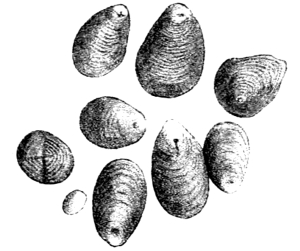
Maranta Starch × 350.
Fig. 49.
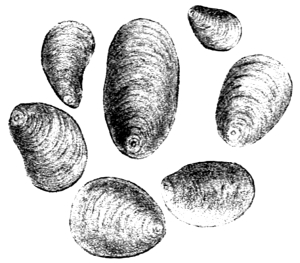
Potato Starch × 350.
Fig. 50.
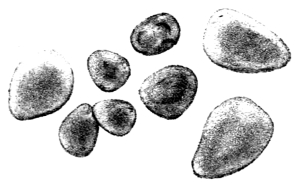
Ginger Starch × 350.
Fig. 51.
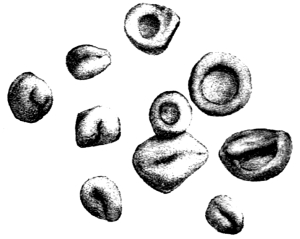
Sago Starch × 350.
Fig. 52.
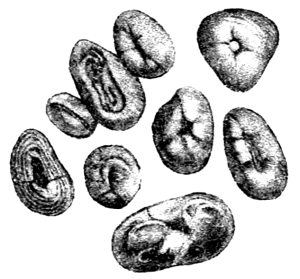
Pea Starch × 350.
Fig. 53.
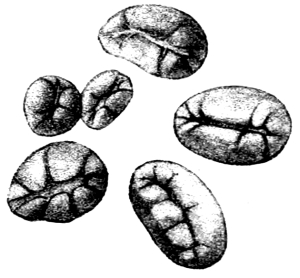
Bean Starch × 350.
DRAWN BY GEO. MARX.A. Hoen & Co., Lithocaustic
Fig. 54.
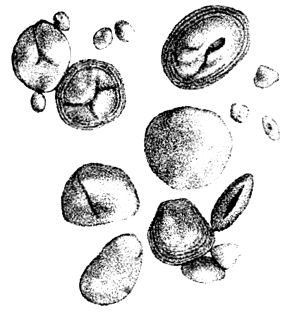
Wheat Starch × 350.
Fig. 55.
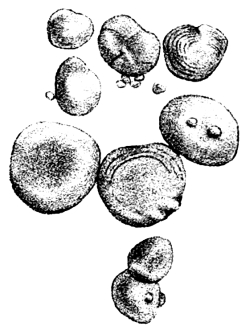
Barley Starch × 350.
Fig. 56.
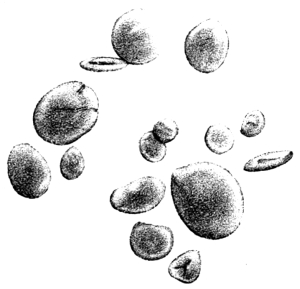
Rye Starch × 350.
Fig. 57.
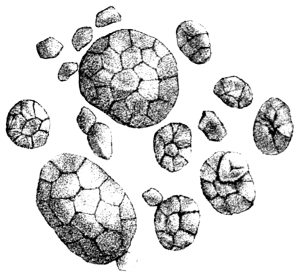
Oat Starch × 350.
Fig. 58.
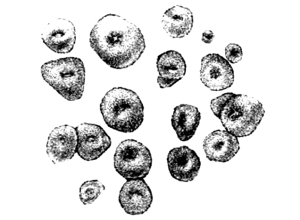
Indian Corn Starch × 350.
Fig. 59.
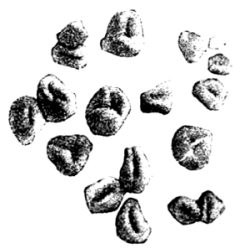
Rice Starch × 350.
DRAWN BY GEO. MARX.A. Hoen & Co.,
Lithocaustic
FIG. 60.
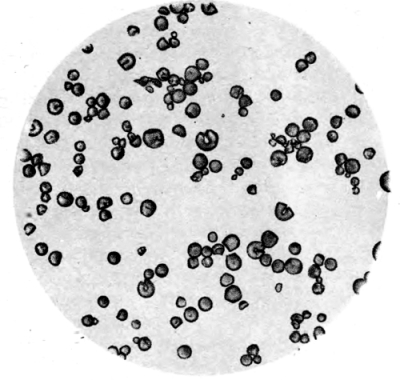
Cassava Starch × 150.
PLAIN ILLUMINATION.
FIG. 61.
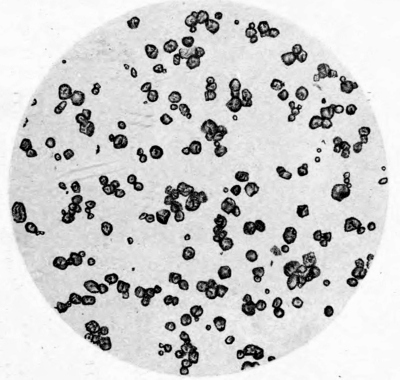
Indian Corn Starch × 150.
PLAIN ILLUMINATION.
A. Hoen & Co., Lithocaustic
Pea and Bean Starches.—These starches produce but a slight
effect with polarized light. The rings are scarcely visible, and the
hilum is stellate or much cracked along a median line, the bean more so
than the pea, the latter resembling fresh dough kneaded again into the
center as in making rolls, and the former the shape assumed by the same
after baking. The grains of both are somewhat variable in size, ranging
from 0.025 to 0.10 millimeter in length, as shown in
Figs. 52 and 53.
Wheat Starch grains are quite variable in size, varying from
0.05 to 0.010 millimeter in diameter. They belong to the same class as
barley and rye, the hilum being invisible and the rings not prominent.
The granules are circular disks in form, and there are now and then
contorted depressions resembling those in pea starch. They are the
least regular of the three starches named and do not polarize actively.
The typical forms of these granules are shown in Fig. 54.
Barley Starch is quite similar to that of wheat, but the grains
do not vary so much in size, averaging 0.05 millimeter. They have rings
which are much more distinct, and very small granules adhering to the
largest in bud-like forms, as seen in Fig. 55.
Rye Starch is more variable in size, many of the granules
not exceeding 0.02 millimeter, while the largest reach 0.06 to 0.07
millimeter. It lacks distinctive characteristics entirely, and is the
most simple in form of all the starches. Fig. 56
shows the appearance of the granules under the microscope.
Oat Starch is unique, being composed of large compound masses of
polyhedral granules from 0.12 to 0.02 millimeter in length, the single
granules averaging 0.02 to 0.015 millimeter. It does not polarize
actively, and displays neither rings nor hilum. The illustration,
Fig. 57, shows its nature with accuracy.
Indian Corn Starch.—The granules of maize starch are largely
of the same size, from 0.02 to 0.03 millimeter in diameter, with now
and then a few which are much smaller. They are mostly circular in
shape or rather polyhedral, with rounded angles, as shown in Figs. 58
and 61. They form very brilliant objects with polarized light, but
with ordinary illumination show but the faintest sign of rings and a
well-developed hilum, at times star-shaped, and at others more like a
circular depression.
Rice Starch is very similar to that of maize, and is easily
confused with it, the grains being about the same size. The grain,
however, is distinguished from it by its polygonal form, and its
well defined angles, as indicated in Fig. 59.
The hilum is more prominent and more often stellate or linear. Several
granules are at times united.
Cassava Starch.—This variety of starch is obtained from
the root of the sweet cassava, which grows in great profusion in
Florida. It is compared with maize starch in Figs. 60
and 61. In the illustration the granules are
represented as magnified 150 diameters. The grains of the cassava
starch measure about 0.012 millimeter in diameter and resemble very
nearly maize starch, except that they have greater evenness of
outline.[169]
For further descriptions of starch grains the reader is referred to the
work of Griffith, already cited.
These descriptions, it will be seen, do not agree entirely with those
of some other authors, but they are based on a somewhat extensive experience.
There are peculiarities of size, shape and appearance of starch
granules, which must be allowed for, and the necessity for every
investigator to compare a starch which he is desirous of identifying
with authentic specimens, must always be recognized.
PART THIRD. PROCESSES FOR DETECTING AND DETERMINING SUGARS AND STARCHES AND OTHER CARBOHYDRATES IN CRUDE OR MANUFACTURED AGRICULTURAL PRODUCTS. — SUCROSE, DEXTROSE, INVERT SUGAR, LEVULOSE, MALTOSE, RAFFINOSE, DEXTRIN AND LACTOSE IN MIXTURES. — OPTICAL METHODS. — SEPARATION OF SUGARS BY CHEMICAL AND CHEMICAL-OPTICAL METHODS. — CARBOHYDRATES IN MILK. — SEPARATION AND DETERMINATION OF STARCH. — AUTHORITIES CITED IN PART THIRD.
203. Introduction.—In the preceding part directions have been
given for the estimation of sugars and starches in approximately
pure forms. In the present part will be described the most approved
methods of separating these bodies and other carbohydrates from crude
agricultural products and for their chemical examination. In many
respects the processes which in a small way are used for preparing
samples for analysis are employed on a large scale for technical and
manufacturing purposes. It is evident, however, that the following
paragraphs must be confined strictly to the analytical side of the
question inasmuch as anything more than mere references to technical
processes would lead into wide digressions.
In the case of sugars the analyst is for the most part quite as much in
need of reliable methods of extraction and preparation as of processes
for analysis. With starches the matter is more simple and the chief
methods of separating them for examination were necessarily described
in the previous part.
Sugars in fresh plants exist almost entirely in solution. This is
true of all the great sources of the sugar of commerce, viz.,
the palm, the maple, the sugar beet and sugar cane. This statement is
also true of fruits and the natural nectar of flowers. By natural or
artificial drying the sugar may be reduced to the solid or semisolid
state as in the cases of raisins and honey. In certain seeds, deficient
in water, sugars may possibly exist in a solid state naturally, as may
be the case with sucrose in the peanut and raffinose in cotton seed.
Starches on the other hand when soluble, are probably not true
starches, but they partake more or less of a dextrinoid nature. Fine
starch particles occur abundantly in the juices of some plants,
as for instance sorghum, where they are associated with sugar and
can be obtained from the expressed juice by subsidence. But even
in such a case it is not certain that the starch enters into the
general circulation. It is more likely formed locally by biochemical
condensation of its constituents. Starches in a soluble or semisoluble
state are transported, as a rule, to the tubers or seeds of plants
where they are accumulated in large quantities as a reserve food for
future growth. For a study of the plant metabolism whereby starch is
produced and for its histological and physiological properties the
reader may consult the standard authorities on vegetable physiology.[170]
204. Sugar in the Sap of Trees.—Many trees at certain seasons
of the year, carry large quantities of sugar in their sap. Among these
the maple and sugar palm are preeminent. The sap is secured by cutting
a pocket into the side of the tree or by boring into it and allowing
the sap to run into an appropriate receptacle through a spile. The
content of sugar in the sap of the maple and palm varies greatly. In
some cases it falls as low as one and a half and in others rises to as
much as six or seven per cent.[171]
In most cases the sugar in the maple sap is pure sucrose, but towards
the end of the flowing season it may undergo changes of a viscous
nature due to fermentation, or inversion, forming traces of invert
sugar. In this country the sap of the maple may flow freely on any warm
day in winter, but the sugar season proper begins about February 15th
in Southern Ohio and Indiana, and about March 25th in Vermont. It lasts
from six weeks to two months. The sap flows best during moderately
warm, still days, after a light freeze.
In addition to sugar the maple sap contains a trace of albuminoid
matters and some malic acid combined with lime. As a rule it can be
subjected to polarization without preliminary clarification.
205. Determination of Sugar in Saps.—In most cases the sap may
be directly polarized in a 200 millimeter tube. Its specific gravity is
obtained by a spindle or pyknometer, and the percentage of sugars taken
directly from the table on page 73, the degree brix
corresponding to the sugar percentage.
On polarizing, the sugar percentage is calculated as follows:
Multiply the specific gravity of the sap by 100 and divide the product
by 26.048. Divide the direct reading of the sap on the sugar scale by
the quotient obtained above, and the quotient thus obtained will be the
correct percentage of sugar in the original solution.
The formula is applicable for those instruments in which 26.048 grams
represent the normal quantity of sugar which in 100 cubic centimeters
reads 100 divisions on the scale. When other factors are used they
should be substituted for 26.048 in the above formula.
The principle of the calculation is based on the weight of the sap
which is contained in 100 cubic centimeters, and this is evidently
obtained by multiplying 100 by the specific gravity of the sap. Since
26.048 is the normal quantity of sugar in that volume of the solution
the quotient of the actual weight divided by that factor shows how many
times too great the observed polarization is. The simple division of
the polariscope reading by this factor gives the correct reading.
Example: Let the specific gravity of the sap be 1.015 and the
observed polarization be 15.0. Then the true percentage of sugar in the
sap is found by the equation:
101.5 : 26.048 = 15.0 : x.
Whence x = 3.85 = percentage of sugar in the sap.
The process outlined above is not applicable when a clarifying reagent
such as lead subacetate or alumina cream must be used. But even in
these cases it will not be found necessary to weigh the sap. A sugar
flask graduated at 100 and 110 cubic centimeters is used and filled to
the first mark with the sap, the specific gravity of which is known.
The clarifying reagent is added, the volume completed to the second
mark with water, and the contents of the flask well shaken and thrown
on a dry filter. The observation tube, which should be 220 millimeters
in length, is then filled with the clear filtrate and the rest of the
process is as described above. A 200 millimeter tube may also be used in
this case and the observed reading increased by one-tenth.
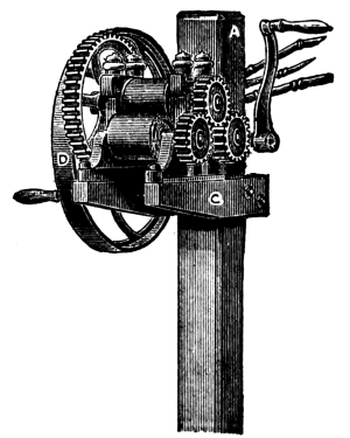
Fig. 62.
Laboratory Cane Mill.
Fig. 63.
Weighing
Pipette.
206. Estimation of Sugar in the Sap of Sugar Cane and
Sorghum.—In bodies like sugar cane and sorghum the sap containing
the sugar will not flow as in the cases of the maple and sugar palm.
The simplest way of securing the sap of the bodies named is to subject
them to pressure between rolls. A convenient method of obtaining the
sap or juice is by passing the cane through a small three-roll mill
indicated in the figure. Small mills of this
kind have been used in this division for many years and with entire
satisfaction. Small canes, such as sorghum, may be milled one at a
time, or even two or three when they are very small. In the case of
large canes, it is necessary that they be split and only half of them
used at once. The mill should not be crowded by the feed in such a way
as to endanger it or make it too difficult for the laborer to turn.
From fifty to sixty per cent of the weight of a cane in juice may be
obtained by passing it through one of these small mills. Experience
has shown that there is a little difference between the juice as first
expressed and the residual sap remaining in the bagasse, but the juice
first expressed may be used for analysis for control purposes as a fair
representative of all that the cane contains.
To determine the percentage of juice expressed, the canes may be
weighed before passing through the mill and the juice collected. Its
weight divided by the weight of the original cane will give the per
cent of the juice expressed, calculated on the whole cane. Instead of
weighing the juice the bagasse may also be collected and weighed; but
on account of the rapidity with which it dries the operation should be
accomplished without delay. The expressed juice is clarified with lead
subacetate, filtered and polarized in the manner described in former
paragraphs. Instead of weighing the juice, its specific gravity may
be taken by an accurate spindle and the volume of it, equivalent to a
given weight, measured from a sucrose pipette.[172]
A sucrose pipette for cane juice has a graduation on the upper part
of the stem which enables the operator to deliver double the normal
weight for the polariscope used, after having determined the density of
the juice by means of a spindle. A graduation of from 5° to 25° of the
brix spindle will be sufficient for all variations in the density of
the juice, or one covering a range of from 10° to 20° will suffice for
most instances. The greater the density of the juice the less volume
of it will be required for the weight mentioned. For general use, the
sucrose pipette is graduated on the stem to deliver from forty-eight
to 50.5 cubic centimeters, the graduations being in terms of the brix
spindle. The graduation of the stem of this instrument is shown in the
accompanying figure. In the use of the pipette it
is only necessary to fill it to the degree on the stem corresponding to
the degree brix found in the preliminary trial.
The quantities of juice corresponding to each degree and fractional
degree of the brix spindle are given in the following table; calculated
for the normal weight 26.048 grams for the ventzke and for 16.19 grams
for the laurent scale. The measured quantities of juice are placed in
a 100 cubic centimeter sugar flask, treated with the proper quantity
of lead subacetate, the volume completed to the mark, and the juice
filtered and polarized in a 200 millimeter tube. The reading of the
polariscope is divided by two for the factor 26.048 and by three for
the factor 16.19.
Table for Use of Sucrose Pipettes.
Degrees
brix. |
Cubic centimeters
of juice for
26.048 factor.
Divide
reading by two. |
Degrees
brix. |
Cubic centimeters
of juice for
16.19 factor.
Divide
reading by three. |
| 5.0 |
51.1 |
5.0 |
47.6 |
| 5.4 |
51.0 |
5.7 |
47.5 |
| 5.7 |
50.9 |
6.3 |
47.4 |
| 6.4 |
50.8 |
6.8 |
47.3 |
| 6.9 |
50.7 |
7.3 |
47.2 |
| 7.4 |
50.6 |
7.8 |
47.1 |
| 7.9 |
50.5 |
8.3 |
47.0 |
| 8.4 |
50.4 |
8.9 |
46.9 |
| 8.9 |
50.3 |
9.5 |
46.8 |
| 9.4 |
50.2 |
10.0 |
46.7 |
| 9.9 |
50.1 |
10.5 |
46.6 |
| 10.4 |
50.0 |
11.0 |
46.5 |
| 10.9 |
49.9 |
11.6 |
46.4 |
| 11.4 |
49.8 |
12.1 |
46.3 |
| 11.9 |
49.7 |
12.7 |
46.2 |
| 12.4 |
49.6 |
13.3 |
46.1 |
| 12.9 |
49.5 |
13.8 |
46.0 |
| 13.4 |
49.4 |
14.3 |
45.9 |
| 13.9 |
49.3 |
14.8 |
45.8 |
| 14.4 |
49.2 |
15.3 |
45.7 |
| 14.9 |
49.1 |
15.9 |
45.6 |
| 15.4 |
49.0 |
16.4 |
45.5 |
| 15.9 |
48.9 |
17.0 |
45.4 |
| 16.4 |
48.8 |
17.5 |
45.3 |
| 16.9 |
48.7 |
18.0 |
45.2 |
| 17.4 |
48.6 |
18.6 |
45.1 |
| 17.9 |
48.5 |
19.1 |
45.0 |
| 18.4 |
48.4 |
19.7 |
44.9 |
| 18.9 |
48.3 |
20.2 |
44.8 |
| 19.4 |
48.2 |
|
|
| 19.9 |
48.1 |
|
|
In ordering sucrose pipettes the factor for which they are to be
graduated should be stated.
It is evident also that with the help of the foregoing table the
measurements may be made by means of a burette. For instance, if the
degree brix is found to be 19.9, 48.1 cubic centimeters are to be used.
This quantity can be easily run from a burette. In order to make the
pipette more convenient it has been customary in this laboratory, as
practiced by Carr, to attach a glass tube with a stopcock by means of
a rubber tube to the upper part of the pipette, whereby the exact level
of the juice in the stem of the pipette can be easily set at any
required mark.
In the polarization of dilute solutions, such as are found in the
saps and juices referred to above, it must not be forgotten that the
gyrodynat of the sucrose is increased as the density of the solution
is diminished. This change introduces a slight error into the work
which is of no consequence from a technical point of view, but
becomes a matter which must be considered in exact determinations. To
avoid the annoyance of calculating the gyrodynat for every degree of
concentration, tables have been constructed by Schmitz and Crampton by
means of which the actual percentage of sugar, corresponding to any
degree of polarization, is determined by inspection. These tables may
be used when extremely accurate work is required.[173]
Figure 64. Gird’s
Gravimeter.
207. Measuring Sugar Juices with a Gravimeter.—A convenient
method of weighing sugar juices is the gravimetric process designed by
Gird.[174]
The apparatus is fully illustrated by Fig. 64. The hydrometer
F has a weight of 26.048 grams and its stem is also graduated in
degrees brix. The juice is poured into the cylinder A and allowed to
stand until air bubbles have escaped. In filling A the finger is held
over the orifice G so that the siphon tube B is completely filled, the
air escaping at the vent C. After the tube is filled the finger is
withdrawn from G and all the liquid which will run out at G allowed to
escape. The sugar flask D is now brought under G and the hydrometer F
allowed to descend into A. The hydrometer will displace exactly its
own weight of liquid. For convenience of reading, the index E may be
used which is set five degrees above the surface of the liquid in
A. The number of degrees brix read by E is then diminished by five.
The hydrometer has been improved since the description given by the
addition of a thermometer which, in addition to carrying a graduation
in degrees, also shows the correction to be made upon the degree brix
for each degree read. It is evident that the hydrometer may be made of
any weight, and thus the delivery of any desired amount of juice be secured.
208. Determination of Reducing Bodies in Cane Juices.—Sucrose
in cane juices is constantly accompanied with reducing sugars, or other
bodies which have a similar action on fehling liquor, which interfere
to a considerable degree with the practical manufacture of sugar. It is
important to determine with a moderate degree of accuracy the quantity
of these bodies. These sugars or reducing bodies are of a peculiar
nature. The author pointed out many years ago that these reducing
bodies were without action on polarized light, and for this reason
proposed the name anoptose as one characteristic of their nature.[175]
It is also found that these bodies do not yield theoretically the quantity
of alcohol which a true sugar of the hexose type would give.[176]
It is entirely probable, therefore, that they are quite different in
their nature from many of the commonly known sugars. On account of the
difficulty of separating these bodies in a pure state their actual
copper reducing power is not known. For practical purposes, however, it
is assumed to be the same as that of dextrose or invert sugar and the
percentage of these bodies present is calculated on that assumption.
In the determination of these sugars or reducing bodies, the quantity
weighed may be determined by an apparatus entirely similar to the
sucrose pipette just described above. The quantity of juice used should
be diluted as a rule to such a degree as not to contain more than one
per cent of the reducing bodies. For the best work, the juices should
be clarified with lead subacetate and the excess of lead removed with
sodium carbonate. For technical control work in sugar factories, this
process may be omitted as in such cases rapidity of work is a matter
of considerable importance and the approximate estimation of the total
quantity of reducing bodies is all that is desired.
For volumetric work, the solution of copper and the method of
manipulation described in paragraph 117 are
most conveniently used.
209. Preservation of Sugar Juices for Analysis.—Lead subacetate
not only clarifies the juices of canes and thus permits of their more
exact analytical examination, but also exercises preservative effects
which enable it to be used as a preserving agent and thus greatly
diminish the amount of work necessary in the technical control of a
sugar factory. Instead, therefore, of the analyst being compelled to
make an examination of every sample of the juice, aliquot portions
representing the different quantities can be preserved and one analysis
made for all. This method has been thoroughly investigated by Edson,
who also finds that the errors, which may be introduced by the use of
the lead subacetate in the analytical work, may be entirely avoided by
using the normal lead acetate.[177]
In the use of the normal lead acetate, much less acetic acid is
required in the polariscopic work than when the subacetate is used.
The normal lead acetate is not so good a clarifying agent as the
subacetate, but its efficiency in this respect is increased by the
addition of a little acetic acid. In its use, it is not necessary to
remove the lead, even for the determination of the reducing bodies.
For further details in regard to the technical determination of
reducing bodies, special works may be consulted.[178]
210. Direct Determination of Sugars in Canes.—The methods,
which have just been described, of securing the juices of cane by
pressure and of determining the sugars therein, do not give the actual
percentage of sugar in the cane. An approximate result may be secured
by assuming that the cane is composed of ninety parts of juice and ten
parts of cellular tissues and other insoluble matters. This assumption
is approximately true in most cases, but there are often conditions
arising which render the data calculated on the above assumption
misleading. In any particular case in order to be certain that the
correct percentage of sugar is secured it will be necessary to
determine the fiber in the cane. This is an analytical process of
considerable labor and especially so on account of the difficulty of
securing samples which represent the average composition of the cane.
The fibrous structure of the canes, the hardness of their external
covering and the toughness of their nodes or joints render the
sampling extremely difficult. Moreover, the content of sugar varies
in different parts of the cane. The parts nearest the ground are,
as a rule, richer than the upper joints and this is especially true
of sugar cane. In order, therefore, to get a fair sample, even of a
single cane, all parts of it must be considered. Several methods of the
direct determination of sugar in canes have been proposed and will be
described below.
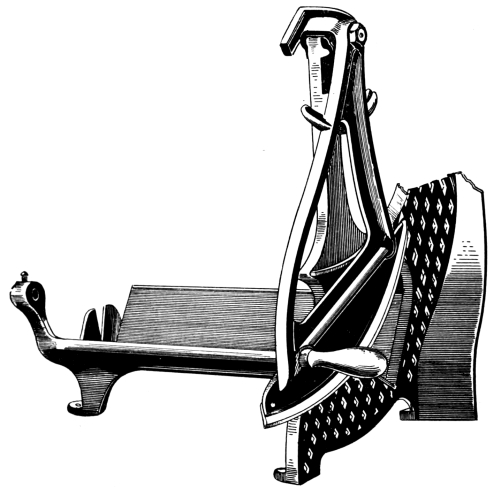
Figure 65. Machine for Cutting Canes.
211. Methods of Cutting or Shredding the Cane for Analytical
Purposes.—A simple method of cutting canes into small pieces which
will permit of an even sampling is very much to be desired. The cutting
apparatus shown in Fig. 65 has been long in use in this
laboratory. The canes by it are cut into thin slices, but the cutting edge of
the knife being perpendicular to the length of the cane renders the use of the
instrument somewhat laborious and unsatisfactory. A considerable time
is required to cut a single cane and the slices which are formed should
be received in a vessel which will protect them as much as possible
from evaporation during the process of the work. Instead of the
apparatus above a small cane cutting machine arranged with four knives
on a revolving disk maybe used. The apparatus is shown in Fig. 66.
The cane is fed against the knives through the hole shown in the open front
of the apparatus and the knives thus strike the cane obliquely.[179]
The knives can be set in the revolving disk at any desired position so
as to cut the canes into chips as fine as may be desired. The cossettes
furnished by this method may be sampled directly for the extraction of
the sugar. In the case of the cossettes from both instruments described
above a finer subdivision may be secured by passing them through a
sausage cutter.
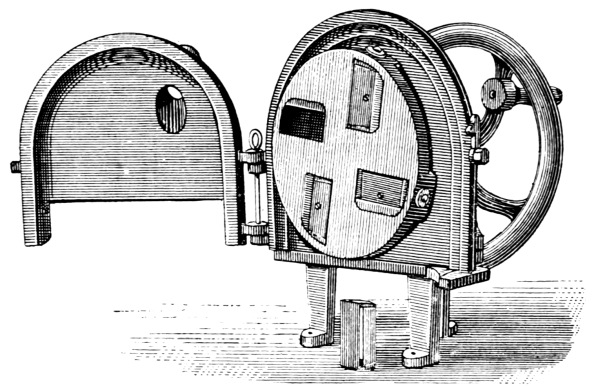
Figure 66. Cane Cutting Mill.
The best method for shredding canes, however, is to pass them through
the apparatus described on page 9. That machine
gives an extremely fine, moist mass, which is of uniform nature and
capable of being directly sampled.
212. Methods of Determination.—Even the finely divided
material obtained by the machine just described is not suited to give
an instantaneous diffusion for polarization as is done by the finely
ground beet pulp to be described further on. For the determination of
sugar a proper weight of the cossettes or pulp obtained as described
above, taken after thorough mixing, is placed in a flask graduated
properly and treated with water.[180]
The flask in which the mixture takes place should be marked to
compensate for the volume of the fiber of the cane. When the normal
weight of cane is taken for the ventzke scale, viz., 26.048, the
flask should be graduated at 102.6 cubic centimeters. If double the
normal weight be taken, the flask should be graduated at 205.2 cubic
centimeters. This graduation is based on the assumption of the presence
of fiber amounting to ten per cent of the weight of the cossettes. The
fiber is so nearly the density of the juice obtained as to be regarded
as one gram equal to one cubic centimeter. The flask is at first filled
almost full of water and then warmed to near the boiling point for an
hour with frequent shaking. It is then filled to a little above the
mark, the contents well mixed and warmed for ten minutes more with
frequent shaking. After cooling, the volume is made up to the mark,
well shaken and poured upon a filter. The filtrate is collected in a
sugar flask marked at fifty and fifty-five cubic centimeters. When
filled to the first mark a proper quantity of lead subacetate is added,
the volume completed to the second mark with water, the contents of the
flask well shaken, poured upon a filter and the filtrate polarized in
the usual way.
The reducing sugar is determined in an aliquot part of the filtrate by
one of the alkaline copper methods.
213. Determination by Drying and Extraction.—Instead of the
diffusion and polarization method just described, the fine pulp
obtained may be dried, the dried residue ground in a drug mill and
extracted with aqueous alcohol or with water.
To facilitate the calculation when this method is employed, the water
content of a small portion of the well sampled pulp is determined. The
rest of the pulp is dried, first for a few hours at a temperature not
above 60° or 70°, and then at the temperature of boiling water, either
in the open air or a partial vacuum, until all the water is driven off.
The dried residue can then be preserved in well stoppered bottles for
the determination of sugar at any convenient period. The finely ground
dried residue for this purpose is placed in an extraction apparatus
and thoroughly exhausted with eighty per cent alcohol. The extract is
dried and weighed, giving the total weight of all sugars present. After
weighing, the extract is dissolved in water, made up to a definite
volume and the reducing sugars determined in an aliquot portion thereof
by the usual methods. The weight of reducing sugars found, calculated
for the whole extract deducted from the total weight of this extract
will give the weight of the sucrose in the sample. From this number the
content of sugar in the original cane is determined from the percentage
of water found in the original sample.
Example.—In a sample of finely pulped canes the content of
water is found to be 76.5 per cent. The thoroughly dried pulp is ground
and extracted with aqueous alcohol. Five grams give two and five-tenths
grams of the extract. The extract is dissolved in water, made up to
a definite volume and the reducing sugars determined in an aliquot
part and calculated for the whole, amounting to 150 milligrams. The
extract is therefore composed of 2.35 grams of sucrose and 0.15 gram
of reducing sugars. The calculation is now made to the original sample
which contained 76.5 per cent of water and 23.5 per cent of dry matter,
as follows:
5 : x :: 23.5 : 100, whence x = 21.27,
the weight of the original material corresponding to five grams of the
dry substance. The original composition of the sample is therefore
expressed by the following numbers:
| |
Per cent. |
| Sucrose |
11.1 |
| Reducing sugars |
0.7 |
| Water |
76.5 |
| Fiber (insoluble matter) |
11.7 |
214. Examination of the Bagasse.—The method just described for
the examination of canes may be also applied to the analysis of
bagasses, with the changes made necessary by the increased percentage
of fiber therein. On account of the large surface exposed by the
bagasse, the sampling, shredding and weighing should be accomplished as
speedily as possible to avoid loss of moisture.
The optical examination of bagasses is rendered difficult by reason of
the uneven pressure to which the canes are subjected. With fairly good
milling in technical work the bagasses will have at least thirty per
cent of fiber. The method for the polariscopic examination is therefore
based upon that assumption, but the volume of the solution must be
changed for varying percentages of fiber in the bagasse. On account of
the smaller percentage of sugar, it is convenient to take double or
three times the normal weight of the bagasse for examination. Since
large sugar flasks are not commonly to be had the diffusion of the
bagasse may be conducted in a quarter liter flask. In a quarter liter
flask place 52.096 grams of the finely shredded bagasse, very nearly
fill the flask with water and extract the sugar as described for canes
in the foregoing paragraphs. In the weight of bagasse used there will
be, in round numbers, fifteen grams of fiber. When the volume of water
is completed to the mark the actual content of liquid in the flask will
therefore be only 235 cubic centimeters. Fifty cubic centimeters of the
filtrate are placed in a sugar flask marked at fifty and fifty-five
cubic centimeters, the proper quantity of lead subacetate solution
added, the volume completed to the upper mark, the contents of the
flask well shaken, filtered and polarized in a 200 millimeter tube. Let
the reading obtained be four degrees and increase this by one-tenth for
the increased volume of solution above fifty cubic centimeters. The
true reading is therefore four degrees and four-tenths. This reading,
however, must be corrected, because the original volume instead of
being 200 cubic centimeters, is 235 cubic centimeters. The actual
percentage of sugar in the sample examined is obtained by the following
proportion:
200 : 235 = 4.4 : x.
The correct reading is therefore 5°.2, the percentage of sugar in the
sample examined.
The results obtained by the method just described may vary somewhat
from the true percentage by reason of the variation of the content
of fiber in the bagasse. It is, however, sufficiently accurate for
technical control in sugar factories and on account of its rapidity
of execution is to be preferred for this purpose. More accurate
results would be obtained by drying the bagasse, and proceeding with
the examination in a manner entirely analogous to that described for
the extraction of sugar from dried canes by aqueous alcohol. In both
instances the reducing sugar is determined in the manner already
mentioned.
215. Determination of Fiber in Cane.—In estimating the content
of sugar in canes by the analysis of the expressed juices, it is
important to make frequent determinations of the fiber for the purpose
of obtaining correct data for calculation. In periods of excessive
drought, or when the canes are quite mature, the relative content of
fiber is increased, while, on the other hand, in case of immature
canes, or during excessive rainfalls, it is diminished. The chief
difficulty in determining the content of fiber in canes is found in
securing a representative sample. On account of the hard and fibrous
nature of the envelope and of their nodular tissues, canes are reduced
to a fine pulp with great difficulty by the apparatus in ordinary
use. A fairly homogeneous pulp, however, may be obtained by means of
the shredder described on page 9. The canes having been
shredded as finely as possible, a weighed quantity is placed in any convenient
extraction apparatus and thoroughly exhausted with hot water. The
treatment with hot water should be continued until a few drops of the
extract evaporated on a watch glass will leave no sensible residue.
The residual fiber is dried to constant weight at the temperature of
boiling water, cooled in a desiccator and rapidly weighed and the
percentage of fiber calculated from the data obtained. On account of
the great difficulty of securing a homogeneous pulp, even with the best
shredding machines, the determination should be made in duplicate or
triplicate and the mean of the results entered as the percentage of
fiber. The term fiber as used in this sense, must not be confounded
with the same term employed in the analysis of fodders and feeding
stuffs. In the latter case the term is applied to the residue left
after the successive treatment of the material with boiling, dilute
acid and alkali. The analysis of canes for feeding purposes is
conducted in the general manner hereinafter described for fodders.
216. Estimation of Sugar in Sugar Beets.—The methods employed
for the determination of the sugar content of beets are analogous to
those used for canes, with such variations in the method of extraction
as are made possible and necessary by the difference in the nature
of these sacchariferous plants. The sugar beet is more free of fiber
and the hard and knotty substances composing the joints of plants
are entirely absent from their composition. For this reason they
are readily reduced to a fine pulp, from which the sugar is easily
extracted. The analytical processes are also greatly simplified by the
complete absence of reducing sugars from the juices of healthy beets.
The only sugar aside from sucrose which is present in these juices
is raffinose, and this is not found in healthy beets, except when
they have been injured by frost or long keeping. In practical work,
therefore, the determination of sucrose completes the analysis in so
far as sugars are concerned. Four methods of procedure will illustrate
all the principles of the various processes employed.
217. Estimation of Sucrose in the Expressed Juice.—In the
first method the beets are reduced by any good shredding machine, to
a fine pulp, which is placed in a press and the juice expressed. In
this liquor, after clarification with lead subacetate, the sucrose is
determined by the polariscope. The methods of measuring, clarifying and
polarizing are the same as those described for saccharine juices in
paragraphs 83-85. The mean percentage of juice in the sugar beet
is ninety-five. The corrected polariscopic reading obtained multiplied
by 0.95 will give the percentage of sugar in the beet.
Example.—The solids in a sample of beet juice, as measured by a
brix spindle, are 17.5 per cent. Double the normal weight of the juice
is measured from a sucrose pipette, placed in a sugar flask, clarified,
the volume completed to 100 cubic centimeters, the contents of the
flask well shaken and filtered. The polariscopic reading obtained is
29°.0. Then (29.0 ÷ 2) × 0.95 = 13.8 = percentage of sucrose in the beet.
218. Instantaneous Diffusion.—In the second process employed
for determining the sugar content of beets, the principle involved
depends on the use of a pulp so finely divided as to permit of
the almost instant diffusion of the sugar present throughout the
added liquid. This diffusion takes place even in the cold and the
process thus presents a convenient and rapid method for the accurate
determination of the percentage of sugar in beets. The pulping is
accomplished by means of the machine described on page 10,
or the one shown in Fig. 67. The beet is pressed against the rapidly
revolving rasp by means of the grooved movable block and the finely divided pulp
is received in the box below. These machines afford a pulp which is
impalpable and which readily permits an almost instantaneous diffusion
of its sugar content.
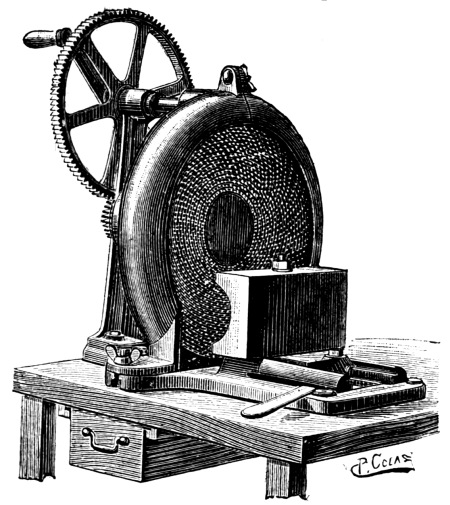
Fig 67. Apparatus for Pulping Beets.
219. Pellet’s Method of Cold Diffusion.—The impalpable pulp
having been obtained, by one of the processes described, the content of
sugar therein is determined as follows:[181]
A normal or double normal quantity of the pulp is quickly weighed, to
avoid evaporation, in a sugar dish with an appropriate lip, and washed
into the flask, which should be graduated, as shown in Fig. 68,
to allow for the volume of the fiber or marc of the beet. Since the beet
pulp contains, on an average, four per cent of marc, the volume which
is occupied thereby is assumed to be a little more than one cubic
centimeter. Since it is advisable to have as large a volume of water
as convenient, it is the practice of Pellet to wash the pulp into a
flask graduated at 201.35 cubic centimeters. If a 200 cubic centimeter
flask be used, the weight of the pulp should be 25.87 instead of
26.048 grams. After the pulp is washed into the flask, about six cubic
centimeters of lead subacetate of 30° baumé are added, together with a
little ether, to remove the foam. The flask is now gently shaken and
water added to the mark and the contents thoroughly shaken. If the pulp
is practically perfect, the filtration and polarization may follow
immediately. The filter into which the contents of the flask are poured
should be large enough to hold the whole quantity. It is recommended
to add a drop or two of strong acetic acid just before completing
the volume of the liquid in the flask to the mark. The polarization
should be made in a 400 millimeter tube, which will give directly the
percentage of sugar present. It is not necessary to heat the solution
in order to insure complete diffusion, but the temperature at which the
operation is conducted should be the ordinary one of the laboratory.
In case the pulp is not as fine as should be, the flask should be
allowed to stand for half an hour after filling, before filtration.
An insufficient amount of lead subacetate may permit some rotatory
bodies other than sugar to pass into solution, and care should be
taken to have always the proper quantity of clarifying material added.
The presence of these rotating bodies, mostly of a pectic nature,
may be shown by extracting the pulp first with cold water until all
the sugar is removed, and afterwards with boiling water. The liquor
obtained from the last precipitation will show a decided right-handed
rotation, unless first treated with lead subacetate, in which case
the polarization will be zero. A very extended experience with the
instantaneous cold aqueous diffusion has shown that the results
obtained thereby are quite as reliable as those given by hot alcoholic
or aqueous digestion.
220. Flask for Cold Diffusion and Alcohol Digestion.—For
convenience in washing the pulp into the sugar flask, the latter is
made with an enlarged mouth as shown in Fig. 68.
The dish holding the weighed quantity of pulp is held with the lip in
the mouth of the flask, and the pulp washed in by means of a jet of
water furnished from a pressure bottle or washing flask. The flask
shown is graduated for the normal weight of pulp, viz., 26.048
grams. The marking is on the constricted neck and extends from 100 to
101.3 cubic centimeters. This permits of making the proper allowance
for the volume occupied by the marc or fiber, but this is unnecessary
for the usual character of control analyses. In the case of healthy,
fresh beets, the volume occupied by the marc is nearly one and
three-tenths cubic centimeters for the normal polariscopic weight of
26.048 grams of pulp. For the laurent instrument this volume is nearly
one cubic centimeter.
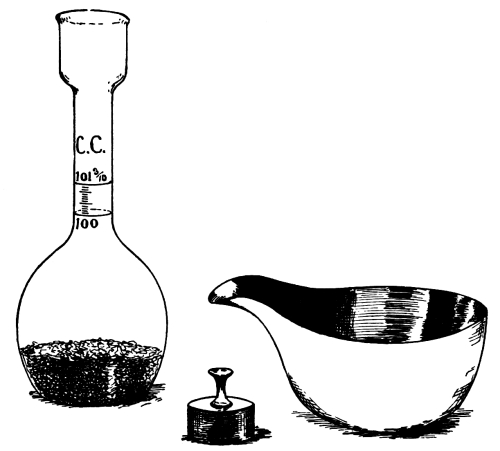
Figure 68. Apparatus for Cold Diffusion.
221. Extraction with Alcohol.—The third method of determining
sugar in beets is by alcoholic extraction. The principle of the method
is based on the fact that aqueous alcohol of not more than eighty per
cent strength will extract all the sugar from the pulp, but will not
dissolve the pectic and other rotatory bodies, which, in solution,
are capable of disturbing the rotatory power of the sugar present.
It is also further to be observed that the rotatory power of pure
sucrose, in an aqueous alcoholic solution, is not sensibly different
from that which is observed in a purely aqueous liquid. The pulp,
which is to be extracted, should be in as fine a state of subdivision
as convenient, and the process may be carried on in any of the forms
of extraction apparatus already described, or in the apparatus shown
in Fig. 69. The extraction tube, of the ordinary
forms of apparatus, however, is scarcely large enough to hold the
required amount of pulp, and therefore special tubes and forms of
apparatus have been devised for this method of procedure. In weighing
the pulp for extraction, a quarter, half, or the exact amount required
for the polariscope employed, should be used. If the tubes are of
sufficient size the full weight may be taken, viz., 26.048
or 16.19 grams for the instruments in ordinary use. Since the pulp
contains a large quantity of water, the extraction could be commenced
with alcohol of standard strength, viz., about ninety-five per
cent. The volume of alcohol employed should be such as will secure a
strength of from seventy to eighty per cent when mixed with the water
contained in the pulp. The flask receiving the extract should be kept
in continuous ebullition and the process may be regarded as complete
in about one hour, when the pulp has been properly prepared. The
method of extracting beet pulp with alcohol is due to Scheibler, and
in its present form the process is conducted according to the methods
described by Scheibler, Sickel, and Soxhlet.[182]
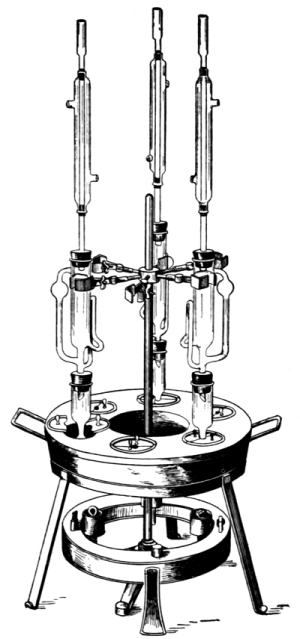
Fig. 69. Sickel-Soxhlet Extractor.
If the pulp be obtained by any other means than that of a fine rasp,
the extraction of the sugar by the aqueous alcohol takes a long time,
and even a second extraction may be necessary. It is convenient to use
as a flask for holding the solvent, one already graduated at 100 or 110
cubic centimeters. A flask especially constructed for this purpose, has
a constricted neck on which the graduations are made, and a wide mouth
serving to attach it to the extracting apparatus, as shown in Fig. 68.
When the extract is obtained in this way, it is not necessary to
transfer it to a new flask before preparing it for polarization. When
the extraction is complete, the source of heat is removed, and when all
the alcohol is collected in the flask, the latter is removed from the
extraction apparatus, cooled to room temperature, a sufficient quantity
of lead subacetate added, the flask well shaken, the volume completed
to the mark with water, again well shaken and the contents of the flask
thrown upon the filter. It is important to avoid loss of alcohol during
filtration. For this purpose it is best to have a folded filter and to
cover the funnel immediately after pouring the contents of the flask
upon the filter paper, with a second larger funnel. The stem of the
funnel carrying the filter paper, should dip well into the flask
receiving the filtrate. As in other cases of filtering sugar juices for
polarization, the first portions of the filtrate received should be
rejected. The percentage of sugar is obtained in the filtrate in the
usual way.
Where a weight of pulp equal to the normal factor of the polariscope
employed is used, and the extract collected in a 100 cubic centimeter
flask, the percentage of sugar is directly obtained by making the
reading in a 200 millimeter tube. With other weights of pulp, or other
sizes of flask, the length of the observation tube may be changed or
the reading obtained corrected by multiplication or division by an
appropriate factor. A battery of sickel-soxhlet extractors is shown in
Fig. 69.[183]
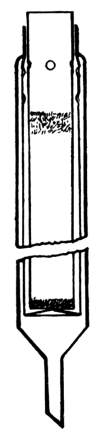
Fig. 70.
222. Scheibler’s Extraction Tube.—In order to secure a speedy
extraction of large quantities of pulp, Scheibler recommends the use of
the extraction tube shown in Fig. 70.[184]
The apparatus is composed of three concentric glass cylinders. The
outer and middle cylinders are sealed together at the top, and the
inner one is movable and carries a perforated diaphragm below, for
filtering purposes. Near the top it is provided with small circular
openings, whereby the alcoholic vapors may gain access to the condenser
(not shown). The middle cylinder is provided with two series of
apertures, through the higher of which the vapor of alcohol passes to
the condenser, while the alcohol which has passed through the pulp and
collected between the inner and middle cylinders, flows back through
the lower into the flask (not shown) containing the boiling alcohol.
The middle cylinder is provided with a curved bottom to prevent the
filtering end of the inner tube from resting too tightly against it.
The tube containing the pulp is thus protected from the direct heat
of the alcoholic vapors during the progress of extraction by a thin
cushion of liquid alcohol.
223. Alcoholic Digestion.—The fourth method of determining
sugar in beet pulp, is by means of digestion with hot alcohol. The
principle of this method is precisely the same as that which is
involved in aqueous diffusion in the cold. The diffusion, however,
in the case of the alcohol, is not instantaneous, but is secured by
maintaining the mixture of the pulp and alcohol for some time at or
near the boiling point. The methods of preparing the pulp, weighing
it and introducing it into the digestion flask are precisely those
used for aqueous digestion, but in the present case a somewhat coarser
pulp may be employed. The method is commonly known as the rapp-degener
process.[185]
Any convenient method of heating the alcohol may be used. In this
laboratory the flasks are held on a false bottom in a bath composed of
two parts of glycerol and one of water. One side of the bath holder
is made of glass, as shown in Fig. 71, in order
to keep the flasks in view. In order to avoid the loss of alcohol,
the digestion flask should be provided with a reflux condenser, or be
attached to an ordinary condenser, which will reduce the vapors of
alcohol again to a liquid. Unless the weather be very warm, the reflux
condenser may consist of a glass tube of rather wide bore and at least
one meter in length, as shown in Fig. 71. A
slight loss of alcohol during the digestion is of little consequence. A
convenient method of procedure is the following.
Double the quantity of the beet pulp required for the ventzke
polariscope, viz., 52.096 grams, weighed in a lipped metal
dish, is washed, by means of alcohol, into a flask marked at 202.6
cubic centimeters, and the flask filled two-thirds with ninety-five
per cent alcohol and well shaken. Afterwards, a proper quantity of
lead subacetate is added, and then sufficient alcohol to complete the
volume to the mark. The flask is then attached to the condenser, placed
in a water-glycerol bath and heated to a temperature of 75° for about
forty-five minutes. At the end of this time, the flask is removed
from the bath and condenser, cooled quickly with water, alcohol added
to the mark and well shaken. The filtration should be accomplished
with precautions, to avoid the loss of alcohol mentioned in paragraph
221. The filtrate is examined in the polariscope in a 200
millimeter tube, and the reading obtained gives directly the percentage
of sugar in the sample examined. Half the quantity of pulp mentioned,
in a 101.3 cubic centimeter flask, may also be used. A convenient form
of arranging a battery of flasks is shown in the accompanying figure.
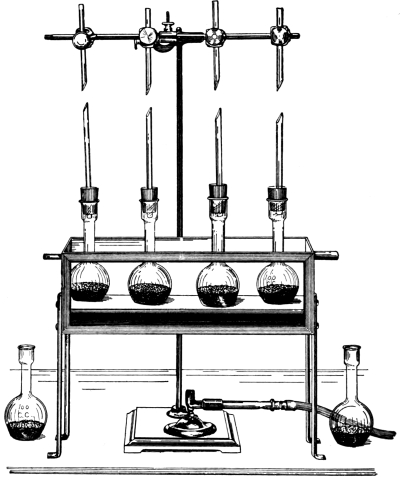
Fig. 71. Battery for Alcoholic Digestion.
224. Determination of Sugar in Mother Beets.—In selecting
mother beets for seed production, it is necessary to secure only those
of a high sugar content. This is accomplished by boring a hole about
two and a half centimeters in diameter obliquely through the beet by
means of the apparatus shown in Fig. 72.
The beet is not injured for seed production by this process, and the
pulp obtained is used for the determination of sugar. The juice is
expressed by means of the small hand press shown in Fig. 73.
Since only a small quantity of juice is obtained, it is advisable to prepare
it for polarization in a sugar flask marked at fifty cubic centimeters.
The density of the juice, by reason of its small volume, is easiest
obtained by the hydrostatic balance, as described in paragraph
53. In lieu of this, the juice may be quickly weighed in a
counterbalanced dish on a balance giving results accurate to within
one milligram. The rest of the analytical process is similar to that
already described.
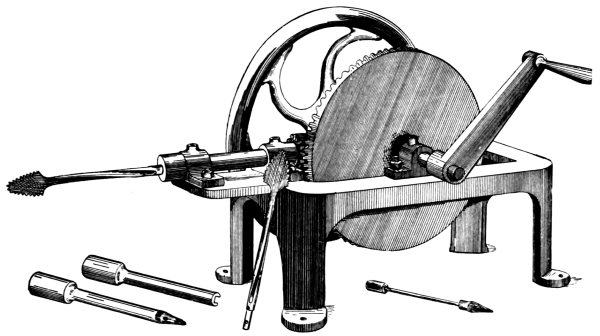
Fig. 72. Rasp for Sampling Mother Beets.
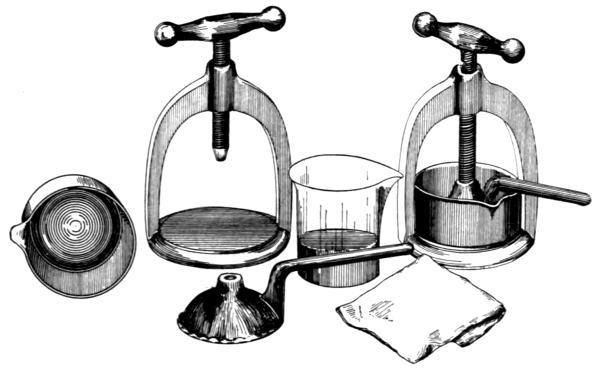
Fig. 73. Hand Press for Beet Analysis.
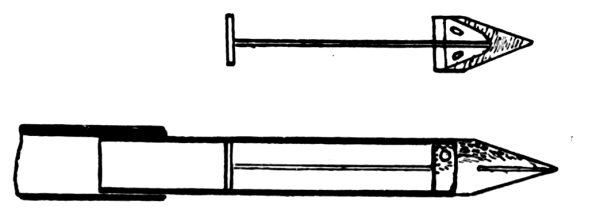
Fig. 74.
225. Aqueous Diffusion.—The process of instantaneous aqueous
diffusion may also be applied to the examination of mother beets. For
this purpose the beets are perforated by a rasp, devised by Keil, shown
lying on the floor in Fig. 72, the characteristics of which
are shown in Fig. 74. The conical end of the rasp is roughened
in such a way as to reduce the beet to an impalpable pulp. This end is fastened by
a bayonet fastening to the cylindrical carrier or arm in such a way
that, by means of a groove in the conical end of the rasp, the pulp is
introduced into the cylinder. The cylinder is provided with a small
piston by means of which the pulp can be withdrawn when the cylindrical
portion of the rasp is detached from the driving machinery. It is
important that the rasp be driven at a high rate of speed, viz.,
from 1500 to 2000 revolutions a minute. The sample of pulp at this rate
of revolution is taken almost instantly, and with skilled manipulators
the whole operation of taking a sample, removing the rasp by means of
its bayonet fastenings, withdrawing the sample of pulp and replacing
the rasp ready for another operation does not consume more than from
ten to twenty seconds. From three to four samples may thus be taken in
a minute. The samples of pulp as taken are dropped into numbered dishes
corresponding to the numbers on the beets. One-quarter of the normal
weight for the polariscope is used for the analysis. The pulp is placed
in a fifty cubic centimeter flask, water and lead subacetate added, the
flask well shaken, filled to the mark with water, again well shaken,
the contents thrown on the filter, and the filtrate polarized in a 400
millimeter tube, giving the direct percentage of sugar. For practical
purposes the percentage of marc in the beet may be neglected. If the
polarization take place in a 200 millimeter tube the number obtained
should be multiplied by two for the content of sugar.
In numbering sugar beets which are to be analyzed for seed production,
it is found that a small perforated tin tag bearing a number may be
safely affixed to the beet by means of a tack. It is not safe to use
paper tags as they may become illegible by becoming wet before the
sorting of the beets is completed. Where from 1000 to 2000 beets
are to be examined in a day, the number of the beets and the dishes
corresponding thereto must be carefully controlled to avoid confusion
and mistakes.
226. Determination of Sugars without Weighing.—An ingenious
device for the rapid analysis of mother beets is based upon the use of
a machine which cuts from the beet a core of given dimensions and this
core is subsequently reduced to a pulp which is treated with cold water
and polarized in the manner described above. The cutting knives of the
sampler can be adjusted to take a core of any desired size. Since the
beets used for analysis have essentially the same specific gravity, the
cores thus taken weigh sensibly the same and the whole core is used
for the analysis, thus doing away with the necessity of weighing. The
core obtained is reduced to a pulp in a small machine so adjusted as
to permit the whole of the pulp, when prepared, to be washed directly
into the sugar flask. By the use of this machine a very large number of
analyses can be made in a single day, and this is highly important in
the selection of mother beets, for often 50,000 or 100,000 analyses are
to be made in a short time.
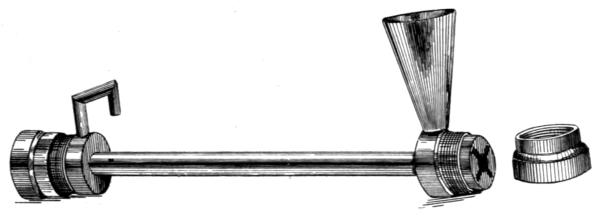
Fig. 75. Tube for Continuous Observation.
227. Continuous Diffusion Tube.—To avoid the delay occasioned
by filling and emptying observation tubes in polariscopic work, where
large numbers of analyses of canes and beets are to be made, Pellet
has devised a continuous diffusion tube, by means of which a solution,
which has just been observed, is rapidly and completely displaced by a
fresh solution. This tube, improved by Spencer, is shown in Fig. 75.
The fresh solution is poured in at the funnel, displacing completely the
old solution which flows out through the tube at the other end. The
observer watches the field vision and is able to tell when the old
solution is completely displaced by the clearing of the field, at
which time the reading of the new solution can be quickly made. When
solutions are all ready for examination an expert observer can easily
read, by the aid of this device, from four to five of them in a minute.
228. Analysis of Sirups and Massecuites.—The general principles
which control the analysis of sirups and massecuites are the same
whether these products be derived from canes or beets. In the case
of the products of canes, the sirups or massecuites contain chiefly
sucrose, invert sugar, and other copper reducing bodies, inorganic
matters and water. In the case of products derived from sugar beets
the contents are chiefly sucrose, inorganic matters, a trace of invert
sugar, raffinose and water. The principles of the determination of
these various constituents have already been described.
229. Specific Gravity.—The specific gravity of sirups and
molasses can be determined by the spindle in the usual way, but in
the case of molasses which is quite dense, the spindle method is not
reliable. It is better, therefore, both in molasses and massecuites,
to determine the density by dilution. For this purpose, as described
by Spencer, a definite weight of material, from 200 to 250 grams, is
dissolved in water and the volume of the solution completed to half a
liter. A portion of the solution is then placed in a cylinder and the
quantity of total solids contained therein determined in the usual way
by a brix or specific gravity hydrometer. In case 250 grams of the
material be used the calculation of the brix degree for the original
material is conducted according to the following formula:
In the above formula x is the required brix degree, V
the volume of the solution, B the observed brix degree of the
solution, and G the corresponding specific gravity obtained from the
table on page 73. When only small quantities of the material are at
hand the hydrostatic balance (53) should be employed. For this
purpose twenty-five grams of the material are dissolved in water and
the volume of the solution made up to 100 cubic centimeters. The sinker
of the hydrostatic balance is placed in the solution and equilibrium
secured by placing the weights upon the arm of the balance in the usual
manner. Since the arm of the balance is graduated to give, by direct
reading, the specific gravity, the density can be obtained at once.
Example.—Let the position of the weights or riders upon the
balance arm be as follows:
| (1) at point of suspension of the bob |
= 1.000 |
| (3) at mark 7 on beam |
= 0.07 |
| (4) at mark 9 on beam |
= 0.009 |
| Specific gravity |
= 1.079 |
The nearest brix degree corresponding to this specific gravity
(58) is 19. The total weight of the solution is equal to 100 ×
1.079, viz., 107.9 grams. Since the solution contains nineteen
per cent of solid matter as determined by the hydrostatic balance, the
total weight of solid matter therein is 107.9 × 19 ÷ 100 = 20.5 grams.
The total per cent. of solid matter in the original sample is therefore
20.5 ÷ 25 × 100 = 82 and the specific gravity corresponding thereto
(page 74) is 1.42934.
The specific gravity of a massecuite may also be determined in
pyknometers especially constructed for this
purpose.[186]
230. Determination Of Water.—The accurate determination of
water in sirups and massecuites is a matter of considerable difficulty.
The principles of conducting the process (26), applicable also
to the determination of water in honeys and other viscous liquids,
are as follows: In all cases where invert sugar is present the drying
should be conducted at a temperature not exceeding 75° or 80°. In
dense molasses and massecuites a weighed quantity should be dissolved
and made up to a definite volume and an aliquot portion taken for
the determination. In order to secure complete desiccation at a low
temperature, the drying should be accomplished in partial vacuum
(pages 22, 23).
The process of desiccation should be conducted in shallow,
flat-bottom dishes which may be conveniently and cheaply made of
aluminum and the process is hastened by filling the dish previously
with thoroughly dried fragments of pumice stone. When the sample does
not contain any invert sugar the desiccation can be safely accomplished
at the temperature of boiling water. Drying should be continued in all
cases until practically constant weight is obtained.
231. Determination Of Ash.—Ash is an important constituent of
the sirups, molasses, and massecuites from canes and exists in very
much larger quantities in the same products from beets. The ash may be
determined directly by careful incineration, but it is customary to add
a few drops of sulfuric acid, sufficient to combine with all the bases
present and be in slight excess. The presence of sulfuric acid is of
some advantage in the beginning of the carbonization and renders the
process somewhat easier of accomplishment. When sulfuric acid is used,
the weight of ash obtained must be diminished by one-tenth to allow for
the increased weight obtained by the conversion of the carbonates into
sulfates. In general, the principles and methods described on
pages 36-40 are to be employed.
232. Determination of Reducing Sugars in Sirups, Molasses, and
Massecuites.—The quantity of reducing sugars in the products
derived from the sugar beet, as a rule, is insignificant. In the
products from sugar cane there are large quantities of reducing matters
which, in general, are determined by any of the standard methods
already given. It has been shown by the author[187]
that the juices of healthy sugar canes contain a small quantity of
invert sugar, but this statement has been contradicted by Bloufret.[188]
It is certain, however, that the reducing bodies derived from the
products of manufacture of sugar cane and sorghum deport themselves in
a manner somewhat different from pure invert sugar. In the absence of
definite information in respect of the constitution of these bodies,
the methods applicable to dextrose and invert sugar may be applied.
Since the paragraphs relating to these processes were printed some
important improvements in the preparation of the alkaline copper
solutions have been made. The copper carbonate solution, as has already
been said, is peculiarly suited to the determination of reducing sugars
in the presence of sucrose and the modified forms of this solution, and
the methods of employing them with invert sugar, dextrose, levulose,
and maltose, are described below.
233. Estimation of Minute Quantities of Invert Sugar in
Mixtures.—The method of Hiller and Meissl, paragraph 142,
may be used for the estimation of small quantities of invert sugar
in mixtures. A modified form of Soldaini’s reagent is, however, to
be preferred for this purpose. Ost has proposed and tested a copper
carbonate solution for the purpose mentioned which gives reliable
results.[189]
The solution has the following composition:
| One liter contains |
3.6 |
grams |
crystallized copper sulfate. |
| 250.0 |
” |
potassium carbonate. |
| 100.0 |
” |
hydrogen potassium sulfate. |
This reagent undergoes no change when kept for a long while, especially
in large vessels. Even in smaller vessels it can be kept for a year or
more without undergoing any change.
The method of analysis is the same as that described in paragraph
128, with the exception that the boiling is continued for only
five minutes instead of ten, and the quantities of the copper and sugar
solutions used are doubled, being 100 and fifty cubic centimeters
respectively. In no case must the solution used contain more than
thirty-eight milligrams of invert sugar. The quantity of sucrose in
the mixture is obtained by polarization (94). Ost has also
recalculated the reduction values of the common sugars for the strong
copper carbonate solution, and the numbers obtained are slightly
different from those given on page 142.[190]
For different percentages of invert sugar in mixtures of sucrose, the
quantities of invert sugar are calculated from the number of milligrams
of copper obtained by the following table:
- (A) = Milligrams of copper obtained.
- (B) = Pure invert sugar.
- (C) = Invert sugar.
- (D) = Sucrose.
| |
Milligrams of Invert Sugar in Mixtures of |
| |
5(C) |
2(C) |
1.5(C) |
1.0(C) |
0.8(C) |
0.6(C) |
0.5(C) |
| (A) |
(B) |
95(D) |
98(D) |
98.5(D) |
99.0(D) |
99.2(D) |
99.4(D) |
99.5(D) |
| 88 |
37.9 |
37.1 |
36.0 |
35.4 |
34.7 |
34.2 |
33.9 |
33.6 |
| 85 |
36.3 |
35.5 |
34.5 |
34.0 |
33.4 |
32.9 |
32.5 |
32.2 |
| 80 |
33.9 |
33.0 |
33.2 |
31.7 |
31.2 |
30.7 |
30.2 |
29.9 |
| 75 |
31.6 |
30.7 |
30.0 |
29.5 |
29.0 |
28.5 |
28.1 |
27.7 |
| 70 |
29.4 |
28.5 |
27.8 |
27.4 |
26.8 |
26.4 |
25.9 |
25.6 |
| 65 |
27.3 |
26.3 |
25.7 |
25.3 |
24.7 |
24.3 |
23.8 |
23.5 |
| 60 |
25.2 |
24.2 |
23.6 |
23.2 |
22.6 |
22.2 |
21.8 |
21.5 |
| 55 |
23.1 |
22.1 |
21.6 |
21.2 |
20.6 |
20.2 |
19.8 |
19.6 |
| 50 |
21.2 |
20.1 |
19.6 |
19.2 |
18.6 |
18.3 |
17.9 |
17.7 |
| 45 |
19.3 |
18.2 |
17.6 |
17.2 |
16.7 |
16.3 |
16.0 |
15.8 |
| 40 |
17.3 |
16.3 |
15.7 |
15.3 |
14.8 |
14.5 |
14.2 |
14.0 |
| 35 |
15.4 |
14.5 |
13.8 |
13.4 |
13.0 |
12.7 |
12.5 |
12.3 |
| 30 |
13.5 |
12.6 |
12.0 |
11.6 |
11.2 |
11.0 |
10.8 |
10.6 |
| 25 |
11.5 |
10.8 |
10.3 |
10.0 |
9.5 |
9.3 |
9.1 |
9.0 |
| 20 |
9.6 |
9.1 |
8.6 |
8.3 |
7.9 |
7.7 |
7.5 |
7.3 |
| 15 |
7.7 |
7.3 |
6.9 |
6.7 |
6.3 |
6.1 |
5.8 |
5.6 |
| 10 |
5.8 |
5.4 |
5.1 |
5.0 |
4.7 |
4.5 |
4.2 |
3.9 |
| |
Milligrams of Invert Sugar in Mixtures of |
| |
0.4(C) |
0.3(C) |
0.2(C) |
0.1(C) |
0.05(C) |
0.02(C) |
| (A) |
99.6(D) |
99.7(D) |
99.8(D) |
99.9(D) |
99.95(D) |
99.98(D) |
| 88 |
33.3 |
|
|
|
|
|
| 85 |
32.0 |
31.8 |
|
|
|
|
| 80 |
29.7 |
29.5 |
|
|
|
|
| 75 |
27.4 |
27.2 |
|
|
|
|
| 70 |
25.3 |
25.0 |
|
|
|
|
| 65 |
23.2 |
22.8 |
|
|
|
|
| 60 |
21.2 |
20.8 |
20.4 |
|
|
|
| 55 |
19.3 |
18.9 |
18.5 |
|
|
|
| 50 |
17.4 |
17.0 |
16.7 |
|
|
|
| 45 |
15.6 |
15.3 |
14.9 |
|
|
|
| 40 |
13.8 |
13.5 |
13.2 |
|
|
|
| 35 |
12.1 |
11.9 |
11.5 |
10.3 |
|
|
| 30 |
10.4 |
10.2 |
9.9 |
8.8 |
|
|
| 25 |
8.8 |
8.6 |
8.2 |
7.3 |
|
|
| 20 |
7.1 |
6.9 |
6.6 |
5.8 |
4.9 |
|
| 15 |
5.4 |
5.2 |
5.0 |
4.4 |
3.7 |
2.0 |
| 10 |
3.8 |
3.5 |
3.4 |
3.0 |
2.5 |
1.7 |
234. Soldaini’s Method Adapted to Gravimetric Work.—By reason
of their better keeping qualities and because of their less energetic
action on non-reducing sugars, copper carbonate solutions are to be
preferred to the alkaline copper tartrate solutions for gravimetric
determinations of reducing sugars in cane juices and sugar house
products, provided the difficulties which attend the manipulation
can be removed. Ost has succeeded in securing perfectly satisfactory
results with copper carbonate solution by slightly varying the
composition thereof and continuing the boiling, for the reduction of
the copper, ten minutes.[191]
The copper solution is made as follows:
| 17.5 |
grams |
crystallized copper sulfate. |
| 250.0 |
” |
potassium carbonate. |
| 100.0 |
” |
”bicarbonate. |
The above ingredients are dissolved in water and the volume of the
solution completed to one liter. The object of the potassium bicarbonate
is to secure in the solution an excess of carbon dioxid and thus
prevent the deposition of basic copper carbonate on keeping. The
manipulation is conducted as follows:
One hundred cubic centimeters of the copper solution are mixed with
half that quantity of the sugar solution in a large erlenmeyer, which
is placed upon a wire gauze, heated quickly to boiling and kept in
ebullition just ten minutes. The sugar solution should contain not
less than eighty nor more than 150 milligrams of the reducing sugar,
and the quantity of the solution representing this should be diluted
to fifty cubic centimeters before mixing with the copper solution.
After boiling, the contents of the erlenmeyer are quickly cooled and
filtered with suction through an asbestos filter and the whole of the
copper suboxid washed into the filter tube. This precipitated suboxid
is washed once with a little potassium carbonate solution then with hot
water and finally with alcohol, well dried, heated to redness, and the
copper oxid obtained reduced to metallic copper in an atmosphere of
hydrogen entirely free of arsenic. From the weight of metallic copper
obtained the quantity of sugar which has been oxidized is calculated
from the tables below.
It is evident that the process given above may be varied so as to
conform to the practice observed in this laboratory of cooling the
boiling solution sufficiently at once by adding to it an equal volume
of recently boiled, cold water, collecting the precipitated copper
suboxid in a gooch, and, after washing it, securing solution in nitric
acid and the precipitation of the copper by electrolysis.
Table Showing Milligrams Dextrose,
Levulose and Invert Sugar Oxidized,
Corresponding to Milligrams of
Copper Reduced.
| Copper. |
Dextrose. |
Levulose. |
Invert. |
| 435 |
152.3 |
145.9 |
147.5 |
| 430 |
149.8 |
143.4 |
145.3 |
| 425 |
147.3 |
140.9 |
143.1 |
| 420 |
144.8 |
138.4 |
140.8 |
| 415 |
142.3 |
135.9 |
138.5 |
| 410 |
139.8 |
133.5 |
136.2 |
| 405 |
137.3 |
131.1 |
133.9 |
| 400 |
134.9 |
128.7 |
131.6 |
| 395 |
132.5 |
126.4 |
129.3 |
| 390 |
130.1 |
124.1 |
127.0 |
| 385 |
127.8 |
121.8 |
124.8 |
| 380 |
125.5 |
119.5 |
122.6 |
| 375 |
123.3 |
117.2 |
120.4 |
| 370 |
121.1 |
115.0 |
118.2 |
| 365 |
119.0 |
112.8 |
116.0 |
| 360 |
116.9 |
110.6 |
113.9 |
| 355 |
114.8 |
108.5 |
111.8 |
| 350 |
112.8 |
106.4 |
109.8 |
| 345 |
110.8 |
104.3 |
107.8 |
| 340 |
108.8 |
102.3 |
105.8 |
| 335 |
106.8 |
100.3 |
103.8 |
| 330 |
104.9 |
98.4 |
101.8 |
| 325 |
103.0 |
96.5 |
99.9 |
| 320 |
101.1 |
94.6 |
98.0 |
| 315 |
99.2 |
92.8 |
96.2 |
| 310 |
97.4 |
91.0 |
94.4 |
| 305 |
95.6 |
89.2 |
92.6 |
| 300 |
93.8 |
87.5 |
90.9 |
| 295 |
92.0 |
85.8 |
89.2 |
| 290 |
90.2 |
84.1 |
87.5 |
| 285 |
88.4 |
82.4 |
85.8 |
| 280 |
86.7 |
80.8 |
84.1 |
| 275 |
85.0 |
79.2 |
82.4 |
| 270 |
83.3 |
77.6 |
80.7 |
| 265 |
81.5 |
76.1 |
79.1 |
| 260 |
79.8 |
74.6 |
77.5 |
| 255 |
78.1 |
73.1 |
75.9 |
| 250 |
76.5 |
71.6 |
74.3 |
| 245 |
74.9 |
70.1 |
72.7 |
| 240 |
73.3 |
68.6 |
71.1 |
| 235 |
71.7 |
67.2 |
69.5 |
| 230 |
70.1 |
65.7 |
68.0 |
| 225 |
68.5 |
64.3 |
66.5 |
| 220 |
66.9 |
62.8 |
65.0 |
| 215 |
65.3 |
61.4 |
63.5 |
| 210 |
63.8 |
59.9 |
62.0 |
| 205 |
62.2 |
58.5 |
60.5 |
| 200 |
60.7 |
57.0 |
59.0 |
| 195 |
59.1 |
55.6 |
57.5 |
| 190 |
57.6 |
54.1 |
56.0 |
| 185 |
56.0 |
52.7 |
54.5 |
| 180 |
54.5 |
51.2 |
53.1 |
| 175 |
53.0 |
49.8 |
51.6 |
| 170 |
51.5 |
48.4 |
50.2 |
| 165 |
50.0 |
46.9 |
48.7 |
| 160 |
48.5 |
45.5 |
47.3 |
| 155 |
47.0 |
44.1 |
45.8 |
| 150 |
45.5 |
42.7 |
44.4 |
| 145 |
44.0 |
41.3 |
42.9 |
| 140 |
42.5 |
39.9 |
41.5 |
| 135 |
41.0 |
38.5 |
40.1 |
| 130 |
39.6 |
37.1 |
38.6 |
| 125 |
38.1 |
35.7 |
37.2 |
| 120 |
36.7 |
34.3 |
35.8 |
| 115 |
35.2 |
32.9 |
34.3 |
| 110 |
33.7 |
31.6 |
32.9 |
| 105 |
32.2 |
30.3 |
31.4 |
| 100 |
30.7 |
29.0 |
30.0 |
| 95 |
29.2 |
27.7 |
28.5 |
| 90 |
27.8 |
26.4 |
27.1 |
| 85 |
26.3 |
25.1 |
25.6 |
| 80 |
24.8 |
23.8 |
24.2 |
| 75 |
23.3 |
21.5 |
22.8 |
| 70 |
21.8 |
20.2 |
21.4
|
Corresponding Table for Maltose.
Milligrams
copper
obtained. |
Milligrams
maltose
anhydrid
oxidized. |
Milligrams
maltose
hydrate
oxidized. |
| 435 |
263.7 |
277.6 |
| 430 |
259.3 |
273.0 |
| 425 |
255.0 |
268.4 |
| 420 |
250.9 |
264.1 |
| 415 |
247.0 |
260.0 |
| 410 |
243.2 |
256.0 |
| 405 |
339.4 |
252.0 |
| 400 |
235.6 |
248.0 |
| 395 |
231.9 |
244.1 |
| 390 |
228.2 |
240.2 |
| 385 |
224.6 |
236.4 |
| 380 |
221.1 |
232.7 |
| 375 |
217.7 |
229.1 |
| 370 |
214.4 |
225.6 |
| 365 |
211.1 |
222.2 |
| 360 |
207.9 |
218.8 |
| 355 |
204.7 |
215.4 |
| 350 |
201.5 |
212.1 |
| 345 |
198.3 |
208.7 |
| 340 |
195.2 |
205.4 |
| 335 |
192.0 |
202.1 |
| 330 |
188.8 |
198.8 |
| 325 |
185.7 |
195.4 |
| 320 |
182.5 |
192.1 |
| 315 |
179.4 |
188.8 |
| 310 |
176.3 |
185.6 |
| 305 |
173.3 |
182.4 |
| 300 |
170.3 |
179.2 |
| 295 |
167.3 |
176.1 |
| 290 |
164.4 |
173.0 |
| 285 |
161.4 |
169.9 |
| 280 |
158.5 |
166.8 |
| 275 |
155.5 |
163.7 |
| 270 |
152.6 |
160.7 |
| 265 |
149.7 |
157.6 |
| 260 |
146.8 |
154.6 |
| 255 |
143.9 |
151.5 |
| 250 |
141.1 |
148.5 |
| 245 |
138.2 |
145.5 |
| 240 |
135.4 |
142.5 |
| 235 |
132.5 |
139.5 |
| 230 |
129.7 |
136.5 |
| 225 |
126.8 |
133.5 |
| 220 |
124.0 |
130.6 |
| 215 |
121.2 |
127.6 |
| 210 |
118.4 |
124.7 |
| 205 |
115.7 |
121.8 |
| 200 |
112.9 |
118.9 |
| 195 |
110.2 |
116.0 |
| 190 |
107.4 |
113.1 |
| 185 |
104.7 |
110.2 |
| 180 |
101.9 |
107.3 |
| 175 |
99.2 |
104.4 |
| 170 |
96.4 |
101.5 |
| 165 |
93.7 |
98.6 |
| 160 |
90.9 |
95.7 |
| 155 |
88.2 |
92.8 |
| 150 |
85.4 |
89.9 |
| 145 |
82.6 |
87.0 |
| 140 |
79.9 |
84.1 |
| 135 |
77.1 |
81.2 |
| 130 |
74.4 |
78.3 |
| 125 |
71.6 |
75.4 |
| 120 |
68.9 |
72.5 |
| 115 |
66.1 |
69.6 |
| 110 |
63.4 |
66.7 |
| 105 |
60.6 |
63.8 |
| 100 |
57.9 |
60.9 |
| 95 |
55.1 |
58.0 |
| 90 |
52.3 |
55.1 |
| 85 |
49.6 |
52.2 |
| 80 |
46.8 |
59.3 |
| 75 |
44.1 |
56.4 |
| 70 |
41.4 |
53.5 |
235. Weighing the Copper as Oxid.—In the usual methods of the
determination of reducing bodies, the percentage is calculated either
volumetrically from the quantity of the sugar solution required to
decolorize a given volume of the alkaline copper solution, or the
reduced copper suboxid is brought into a metallic state by heating in
an atmosphere of hydrogen or by electrolytic deposition. A quicker
method of procedure is found in completing the oxidation of the cupric
oxid by heating to low redness in a current of air.[192] For this
determination the precipitation of the cuprous oxid and its filtration
are made in the usual manner. The cuprous oxid is collected in a
filtering tube, made by drawing out to proper dimensions a piece of
combustion tube, and has a length of about twelve centimeters in all.
The unchanged part of the tube is about eight centimeters in length
and twelve millimeters in diameter. It is filled by first putting in
a plug of glass wool and covering this with an asbestos felt on top
of which another plug of glass wool is placed. After the cuprous oxid
is collected in the tube it is washed with boiling water, alcohol and
ether. The rubber tube connecting it with the suction is of sufficient
length to permit the tube being taken in one hand and brought into
a horizontal position over a bunsen. The tube is gradually heated,
rotating it meanwhile, until any residual moisture, alcohol or ether,
is driven off from the filtering material. The layer of glass wool
holding the cuprous oxid is gradually brought into the flame and as
the oxidation begins the material will be seen to glow. The heating is
continued for some time after the glowing has ceased, in all for three
or four minutes, the tube and the copper oxid which it contains being
brought to a low redness. The current of air passing over the red-hot
material in this time oxidizes it completely. The filtering tube,
before use, must be ignited and weighed in exactly the same manner as
described above. The heat is so applied as not to endanger the rubber
tube attached to one end of the filtering tube nor to burn the fingers
of the operator as he turns the tube during the heating. After complete
oxidation the tube is cooled in a desiccator and weighed, the increase
of weight giving the copper oxid. For the atomic weights, 63.3 copper
and 15.96 oxygen, one gram of copper oxid is equivalent to 0.79864
gram of copper, and for the weights 63.17 copper and 15.96 oxygen, one
gram of copper oxid equals 0.79831 gram of copper. From the amount of
metallic copper calculated by one of these factors, the reducing sugar
is determined by the tables already given.
236. Estimation of Dry Substance, Polarization and Apparent Purity
for Factory Control.—For technical purposes the methods of
determining the above factors, proposed by Weisberg and applicable to
concentrated sirups, massecuites, and molasses, may be used.[193]
Five times the half normal quantity of the material, viz., 65.12
grams, are placed in a quarter liter flask, dissolved in water and the
flask filled to the mark. In the well shaken mixture, which is allowed
to stand long enough to be free of air, the degree brix is estimated
by an accurate spindle. For example, in the case of molasses, let the
number obtained be 18.8.
Fifty cubic centimeters of the solution are poured into a 100 cubic
centimeter flask, the proper quantity of lead subacetate added, the
flask filled to the mark with water, its contents filtered, and the
filtrate polarized in a 200 millimeter tube. Let the number obtained on
polarization be 22°.1. This number may be used in two ways. If it be
multiplied by two the polarization of the original sample is obtained;
in this case, viz., 44°.2. In the second place, if 44.2 be
multiplied by 0.26048 and this product divided by the specific gravity
corresponding to 18°.8. viz., 1.078, the quotient 10.68 is
secured representing the polarization or per cent of sugar contained in
the solution of which the degree brix was 18.8°. From the numbers 18.8
and 10.68 the apparent purity of the solution, 56.8, is calculated,
viz., 10.68 × 100 ÷ by 18.8. The original product as calculated
above gives a polarization of 44.2 and this number multiplied by 100
and divided by 56.8 gives 77.8, or the apparent percentage of dry
matter. The original sample of molasses, therefore, had the following
composition:
| Degree brix (total solids) |
77.8 |
per cent. |
| Sucrose |
44.2 |
” |
| Solids, not sucrose |
33.6 |
” |
| Apparent purity |
56.8 |
” |
It is seen from the above that with a single weighing and a single
polarization, and within from ten to fifteen minutes, all needful
data in respect of the proper treatment of molasses for the practical
control and direction of a factory can be obtained.
In case a laurent polariscope is used, five times the normal weight,
viz., eighty-one grams of the raw material are used and the
process conducted as above.
237. Occurrence.—Sucrose and invert sugar are found together in
many commercial products, especially in raw sugars and molasses made
from sugar cane, and in these products sucrose is usually predominant.
They also form the principal saccharine contents of honey, the invert
sugar, in this case, being the chief ingredient.
In commercial grape sugar, made from starch, dextrose is the important
constituent, while in the hydrolysis of starch by a diastatic ferment,
maltose is principally produced. In the manufacture of commercial
glucose by the saccharification of starch with sulfuric acid, dextrin,
maltose, and dextrose are the dominant products, while in the similar
substance midzu ame, maltose and dextrose are chiefly found, and only a
small quantity of dextrose.[194]
In honeys derived from the exudations of coniferous trees are found
also polarizing bodies not enumerated above and presumably of a pentose
character.[195]
In evaporated milks are usually found large quantities of sucrose
in addition to the natural sugar therein contained. These mixtures
of carbohydrates often present problems of great difficulty to the
analyst, and the following paragraphs will be devoted to an elucidation
of the best approved methods of solving them.
238. Sucrose and Invert Sugar.—The chemical methods of
procedure to be followed in the case of a sample containing both
sucrose and invert sugar have been given in sufficient detail in
preceding paragraphs (124, 171).
When, however, it is desirable to study further the composition of
the mixture, important changes in the method are rendered imperative.
While the estimation of the sucrose and the total invert sugar, or
the sum of the dextrose and levulose, is easy of accomplishment the
separate determination of the dextrose and levulose is not so readily
secured. In the latter case the total quantity of the two sugars may
be determined, and after the destruction or removal of one of them the
other be estimated in the usual way; or in the mixture the levulose can
be determined by the variation in its gyrodynat, caused by changes of
temperature.
239. Optical Neutrality of Invert Sugar.—The gyrodynat of
levulose decreases as the temperature rises (107) and at or
near a temperature of 87°.2, it becomes equal to that of dextrose,
and, therefore, pure invert sugar composed of equal molecules of
levulose and dextrose is optically neutral to polarized light at that
temperature. On this fact Chandler and Ricketts have based a method of
analysis which excludes any interference in polarization due to invert
sugar.[196]
To secure the polarization at approximately a temperature
of 87°, a water-bath is placed between the nicols of an ordinary
polariscope in such a way as to hold a tubulated observation tube
in the optical axis of the instrument. The ends of the bath, in the
prolongation of this axis, are provided with clear glass disks. The
space between the cover glasses of the observation tube and the glass
disks of the bath is occupied by the water of the bath. When this is
kept at a constant temperature it does not interfere with the reading.
The observation tube may be of glass, but preferably is constructed of
metal plated with platinum on the inside. For the most exact work the
length of the observation tube, at 87°, is determined by measurement or
calculation. The bath is heated with alcohol lamps or other convenient
means. The arrangement of the apparatus is shown in Fig. 75.
In a mixture of sucrose and invert sugar any rotation of the plane
of polarized light at 87° is due to the sucrose alone. In a mixture
of dextrose and sucrose the polarization is determined, and, after
inversion, again determined at 87°. The latter number is due to
dextrose alone, and the difference between the two gives the rotation
due to sucrose.
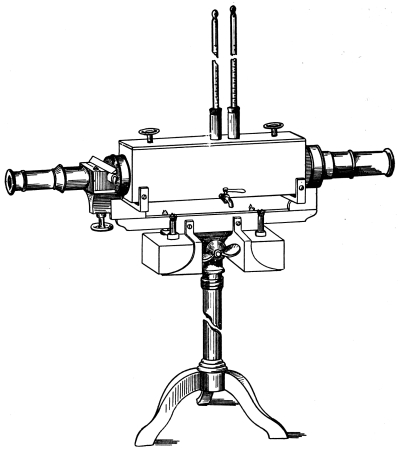
Fig. 75.—Chandler and Ricketts’ Polariscope.
240. Sucrose and Raffinose.—In raw sugars made from beet
molasses considerable quantities of raffinose are found. The method
of inversion and polarization in such cases is described in paragraph
100. In making the inversion by the method proposed by Lindet
(95), and conducting the polarization on a laurent instrument, a
slightly different formula, given below, is used; viz.:
| S = |
C - 0.4891A |
| 0.810 |
| |
| and R = |
A - S |
| 1.54 |
in which the several letters refer to the same factors as are indicated
by them in the formula of Creydt. In the application of the formula
just given the normal weight of the mixed raw sugars used is 16.2
grams.[197]
241. Optical Determination of Levulose.—The determination of
levulose by optical methods alone is made possible by reason of the
fact that the gyrodynats of the sugars with which it is associated are
not sensibly affected by changes of temperature. The principle of the
process, as developed by the author, rests on the ascertainment of the
change in the gyrodynat of levulose when its rotation is observed at
widely separated temperatures.[198]
The observation tube employed for reading at low temperatures is
provided with desiccating end tubes, which prevent the deposition of
moisture on the cover glasses. The relations of this device to the
optical parts of the apparatus are illustrated in Fig. 76.
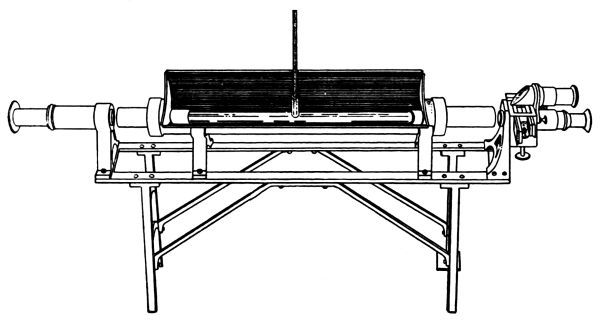
Fig. 76.—Apparatus for Polarimetric Observations
at Low Temperatures.
The protecting tubes are made of hard rubber and the desiccation is
secured by surrounding the space between the rubber and the perforated
metal axis with fragments of potash or calcium chlorid.
The details of the construction are shown in a horizontal section
through the center of the observation tube in Fig. 77. In this figure
the observation tube, made of glass or metal, is represented by
i, the metal jacket, open at the top in the V shape as
described, by k. The observation tube is closed by the heavy
disk b made of non-polarizing glass. This disk is pressed
against the end of the observation tube by the rubber washer a,
when the drying system about to be described is screwed on to k.
The apparatus for keeping the cover glass dry is contained in the
hard rubber tube m and consists of a perforated cylinder of
brass e, supported at one end by the perforated disk c
and at the outer ends by the arms d. It is closed by a cover
glass of non-polarizing glass s and can be screwed on to the
system h at n. The space p is filled with coarse
fragments of caustic soda, potash, or calcium chlorid by removing the
cover glass s. The perforated disk c prevents any of the
fragments from entering the axis of observation. When the cover glass
s is replaced, it just touches the free end of the perforated
metal tube preventing any of the fragments of the drying material from
falling into the center at the outer end. When this drying tube is
placed in position, the contents of the observation tube i can
be kept at the temperature of zero for an indefinite time without the
deposition of a particle of moisture either upon the glass b or s.
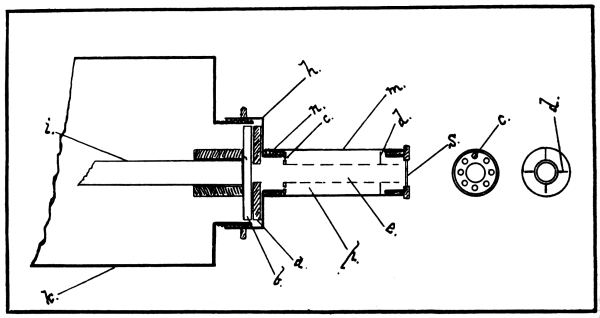
Fig. 77.—Construction of Desicating Tube.
For determining the rotation at a high temperature the apparatus of
Chandler and Ricketts (238) may be used or the following device:
The polarizing apparatus shown above, Fig. 76, may be used
after the V shape box is removed from the stand, which is so constructed
as to receive a large box covered with asbestos felt an inch thick. The
observation tube is held within this box in the same way as in the one
just described so that the hot water extends not only the entire length
of the tube but also covers the cover glasses. In both cases the cover
glasses are made of heavier glass and are much larger in diameter than
found in the ordinary tubes for polariscopes. The protecting cylinders
of hard rubber are not needed at high temperatures but can be left on
without detriment.
The illustration, Fig. 78, shows the
arrangement of the apparatus with a silver tube in position, which can
be filled and emptied without removing it.
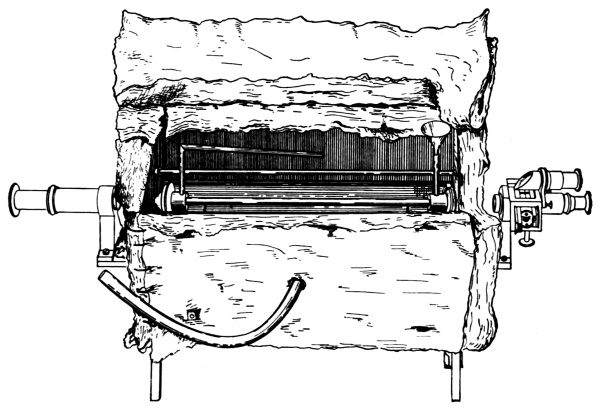
Fig. 78.—Apparatus for Polarizing
at High Temperatures.
In practice the water is heated with a jet of steam and an even
temperature is secured by a mechanical stirrer kept slowly in motion.
With such a box it is easy to maintain a temperature for several
hours which will not vary more than half a degree. The temperature
for reading the hot solutions was fixed at 88°, this being nearly the
temperature at which a mixture of equal molecules of levulose and
dextrose is optically inactive. In every case the sugar solutions were
made up to the standard volume at the temperatures at which they were
to be read and thus the variations due to expansion or contraction
were avoided. When solutions are read at a high temperature, they must
be made with freshly boiled water so as to avoid the evolution of air
bubbles which may otherwise obscure the field of vision.
By means of the apparatus described it is easy for the analyst to make
a polarimetric reading at any temperature desired. In all cases the
observation tube should be left at least a half an hour and sometimes
longer in contact with the temperature control media before the reading
is made.
The appearance of the field of vision is usually a pretty fair index
of the point of time at which a constant temperature is established
throughout all parts of the system. Any variation in temperature
produces a distortion of the field of vision while a constant fixed
temperature will disclose the field of vision in its true shape and
distinctness of outline.
Principles of the Calculation.—If 26.048 grams of pure sucrose
be dissolved in water and the volume made 100 cubic centimeters, it
will produce an angular rotation of 34°.68 when examined in a 200
millimeter tube with polarized sodium monochromatic light. Upon the
cane sugar scale of an accurately graduated shadow instrument the
reading will be 100 divisions corresponding to 100 per cent of pure
sucrose.
In the complete inversion of the cane sugar the reaction which takes
place is represented by the following formula:
| |
|
— |
+ |
| C₁₂H₂₂O₁₁ + |
H₂0 = |
C₆H₁₂O₆ + |
C₆H₁₂O₆. |
The minus and plus signs indicate that the resulting invert sugar is
a mixture of equal parts of levulose (d fructose) and dextrose
(d glucose). We are not concerned here with the fact that a
complete inversion of cane sugar is a matter of great difficulty nor
with the danger which is always experienced of destroying a part of
one of the products of inversion. They are matters which may cause
a variation in the analytical data afterward, but do not affect the
principles on which the process is based.
In the inversion of 26.048 grams of cane sugar there are therefore
produced 13.71 grams of levulose and 13.71 grams of dextrose or, in
all, 27.42 grams of the mixed sugars.
The angular rotation which would be produced by 13.71 grams of
dextrose in a volume of 100 cubic centimeters and through a column 200
millimeters in length is, with sodium light, 14°.53 equivalent to 41.89
divisions of the cane sugar scale. The specific rotatory power of a
dextrose solution of the density given is almost exactly 53, and this
number is used in the calculations.
In a mixture of the two sugars under the conditions mentioned and at a
temperature of 0° the angular rotation observed is -15°.15 equivalent
to 43.37 divisions of the cane sugar scale.
The + rotation due to the dextrose is 14°.53. Therefore the total
negative rotation due to levulose at 0° is 15°.15 + 14°.53 =
29°.68. Hence the gyrodynat of levulose at 0° and in the degree of
concentration noted is readily calculated from the formula
| [α]°D = - |
29.68 × 100 |
= -108.24. |
| 2 × 13.71 |
Since at 88° (circa) the mixture of levulose and dextrose is
neutral to polarized light, it follows that at that temperature the
specific rotatory power of levulose is equal to that of dextrose,
viz., 53°.
[α]D⁸⁸ ° = - 53°.
The total variation in the specific rotatory power of levulose, between
zero and 88°, is 55°.24. The variation for each degree of temperature,
therefore, of the specific rotatory power of levulose is equal to
55.24 divided by 88, which is equal to 0.628. From these data it is
easy to calculate the specific rotatory power of levulose for any
given temperature. For instance, let it be required to determine the
gyrodynat of levulose at a temperature of 20°. It will be found equal
to 108.24 - 0.628 × 20 = 95.68. The required rotatory power is then
[a]²⁰ °D = -95°.68.
In these calculations the influence of the presence of hydrochloric
acid upon the rotatory power of the levulose is neglected.
Since the variation in angular rotation in the mixture at different
temperatures is due almost wholly to the change in this property of the
levulose it follows that the variation for each degree of temperature
and each per cent of levulose can be calculated. Careful experiments
have shown that the variation in the rotatory power of levulose between
0° and 88° is represented by a straight line. For 13.71 grams per
100 cubic centimeters the variation for each degree of temperature
is equal to 43.37 ÷ 88 = 0.49 divisions on the cane sugar scale, or
15.15 ÷ 88 = 0°.1722 angular measure. If 13.71 grams of levulose in
100 cubic centimeters produce the deviations mentioned for each degree
of temperature, one gram would give the deviation obtained by the
following calculations:
For the cane sugar scale 0.49 ÷ 13.71 = 0°.0357 and for angular
rotation 0.1722 ÷ 13.71 = 0.01256.
The above data afford a simple formula for calculating the percentage
of levulose present from the variation observed in polarizing a
solution containing levulose, provided that the quantity of levulose
present is approximately fourteen grams per 100 cubic centimeters.
Example.—Suppose in a given case the
difference of reading between a solution containing an unknown quantity
of levulose at 0° and 88° is equal to thirty divisions of the cane
sugar scale. What weight of levulose is present? We have already seen
that one gram in 100 cubic centimeters produces a variation of 0.0357
division for 1°. For 88° this would amount to 3.1416 divisions. The
total weight of levulose present is therefore 30 ÷ 3.1416 = 9.549
grams. In the case given 26.048 grams of honey were taken for the
examination. The percentage of levulose was therefore 9.549 × 100 ÷
26.048 = 36.66 per cent.
If it be inconvenient to determine the polarimetric observations at
temperatures so widely separated as 0° and 88° the interval may be
made less. In the above case if the readings had been made at 20° and
70° the total variation would have been only ⁵⁰/⁸⁸ of the one given,
viz., 17.05 divisions of the cane sugar scale. The calculation
would then have proceeded as follows:
0.0357 × 50 = 1.785.
Then, 17.05 ÷ 1.785 = 9.552 grams of levulose, from which the actual
percentage of levulose can be calculated as above.
With honeys the operation is to be conducted as follows:
Since honeys contain approximately twenty per cent of water and in the
dry substance have approximately forty-five per cent of levulose, about
38.50 grams of the honey should be taken to get approximately 13.8
grams of levulose.
In the actual determination the calculations may be based on
the factors above noted, but without respect to the degree of
concentration. If half the quantity of dextrose noted be present its
specific rotatory power is only reduced to about 52°.75, and this will
make but little difference in the results. In the case of honey 13.024
grams of the sample are conveniently used in the examination, half the
normal weight for the ventzke sugar scale. The error, however, due to
difference in concentration is quite compensated for by the ease of
clarification and manipulation. Alumina cream alone is used in the
clarification, thus avoiding the danger of heating the solution to a
high temperature in the presence of an excess of lead acetate.
An interesting fact is observed in cooling solutions of honey to
0°. The maximum left hand rotation is not reached as soon as the
temperature reaches 0° but only after it has been kept at that
temperature for two or three hours. The line representing the change in
rotatory power in solutions of honey between 10° and 88° is practically
straight but from 10° to 0°, if measured by the readings taken without
delay, it is decidedly curved; the reading being less at first than
it is afterwards. After three hours the 0° becomes sensibly constant
and then the whole line is nearly straight, but still with a slight
deficiency in the reading at the 0°. For this reason the computations
should be based on readings between 10° and 88° rather than on a number
covering the whole range of temperature. Nevertheless, if the solution
be kept at 10° for three hours before the final reading is taken, no
error of any practical magnitude is introduced.
The calculations given above, for the cane sugar scale, can also be
made in an exactly similar manner for angular rotation. The angular
variation produced by one gram of levulose for 1° of temperature
is 0°.01256. For 88° this would become 1°.10528. Suppose the total
observed angular deviation in a given case between 0° and 88° to be
10°.404, then the weight of levulose present is 10.404 ÷ 1.10528 = 9.413 grams.
In the case mentioned 26.048 grams of honey were taken for the
examination. The percentage of levulose present, therefore, was
9.413 × 100 ÷ 26.048 = 36.13.
241. General Formula for the Calculation of Percentage of
Levulose.—Let K = deviation in divisions of the cane sugar
scale or in angular rotation produced by one gram of levulose for 1°
temperature.
Let T and tʹ = temperatures at which observations are made.
Let R = observed deviation in rotation.
Let W = weight of levulose obtained.
Let L = per cent of levulose required.
| Then L = |
R |
÷ W. |
| K(T - tʹ) |
In most genuine honeys the value of R between 0° and 88° is
approximately thirty divisions of the cane sugar scale or 10° angular
measure for 26.048 grams in 100 cubic centimeters, read in a 200
millimeter tube, or, for 13.024 grams in 100 cubic centimeters read in
a 400 millimeter tube.
The method of analysis outlined above has been applied in the
examination of a large number of honeys with most satisfactory results.
It can also be applied with equal facility to other substances
containing levulose.
242. Sucrose and Dextrose.—In mixtures these two sugars are
easily determined by optical processes, provided no other bodies
sensibly affecting the plane of polarized light be present. The total
deviation due to both sugars is determined in the usual way. The
percentage of sucrose is afterwards found by the inversion method
(92). The rotation, in the first instance due to the sucrose,
is calculated from the amount of this body found by inversion, and
the residual rotation is caused by the dextrose. The percentage of
dextrose is easily calculated by a simple proportion into which the
numbers expressing the gyrodynats of sucrose and dextrose enter. When
the readings are made on a ventzke scale the calculations are made as
follows:
| Weight of sample used |
26.048 |
grams. |
| First polarization |
88°.5 |
| Polarization after inversion |
10°.5 |
| Temperature |
20°.0 |
| Percentage of sucrose |
58.4 |
| Rotation due to dextrose |
30°.1 |
Percentage of dextrose:
66.5 : 53 = x : 30.1; whence x = 37.8.
The sample examined therefore contains 58.4 per cent of sucrose and
37.8 per cent of dextrose.
It is evident that the method just described is also applicable when
maltose, dextrin, or any other sugar or polarizing body, not sensibly
affected by the process of inversion to which the sucrose is subjected,
is substituted for dextrose. When, however, more than two optically
active bodies are present the purely polariscopic process is not
applicable. In such cases the chemical or the combined chemical and
optical methods described further on can be employed.
243. Lactose in Milk.—By reason of its definite gyrodynat
lactose in milk is quickly and accurately determined by optical
methods, when proper clarifying reagents are used to free the fluid
of fat and nitrogenous substances. Soluble albuminoids have definite
levogyratory powers and, if not entirely removed, serve to diminish the
rotation due to the lactose.
Milk casein precipitated by magnesium sulfate has the following
gyrodynatic numbers assigned to it:[199]
| Dissolved |
in |
water [a]D = -80° |
| ” |
” |
very dilute solution [a]D = -87°. |
| ” |
” |
dilute sodium hydroxid solution [a]D = -76°. |
| ” |
” |
strong potassium hydroxid solution [a]D = -91°. |
The hydrates of albumen have rotation powers which vary from
[a]D = -71°.40 to [a]D = -79°-05. From the chaotic
state of knowledge concerning the specific rotating power of the
various albumens, it is impossible to assign any number which will
bear the test of criticism. For the present, however, this number may
be fixed at [a]D = -70° for the albumens which remain in
solution in the liquids polarized for milk sugar.[200]
Many reagents have been prepared for the removal of the disturbing
bodies from milk in order to make its polarization possible. Among
the precipitants which have been used in this laboratory may be
mentioned:[201]
(1) Saturated solution basic lead acetate, specific gravity 1.97:
(2) Nitric acid solution of mercuric nitrate diluted with an equal
volume of water: (88.)
(3) Acetic acid, specific gravity 1.040, containing twenty-nine per
cent acetic acid:
(4) Nitric acid, specific gravity 1.197, containing thirty per cent
nitric acid:
(5) Sulfuric acid, specific gravity 1.255, containing thirty-one per
cent sulfuric acid:
(6) Saturated solution of sodium chlorid:
(7) Saturated solution of magnesium sulfate:
(8) Solution of mercuric iodid in acetic acid, formula; potassium
iodid, 33.2 grams; mercuric chlorid, 13.5 grams; strong acetic acid,
20.0 cubic centimeters; water 640 cubic centimeters.
Alcohol, ether, and many solutions of mineral salts, hydrochloric and
other acids are also used as precipitants for albumen, but none of them
presents any advantages.
Experience has shown that the best results in polariscopic work are
secured by the use of either the mercuric iodid or the acid mercuric
nitrate for clarifying the milk. The latter reagent should be used
in quantities of about three cubic centimeters for each 100 of milk.
It is evident when it is desired to determine the residual nitrogen
in solution, the former reagent must be employed. The quantity of
albuminoid matter left in solution after clarification with mercurial
salts is so minute as to exert no sensible effect on the rotation of
the plane of polarized light produced by the lactose.
For purposes of calculation the gyrodynat of lactose in the ordinary
conditions of temperature and concentration may be represented by
[a]D = 52°.5
(107).
Polarization.—The proper weight of milk is placed in a sugar
flask, diluted with water, clarified with the mercuric salt, the volume
completed to the mark, and the contents shaken and poured on a filter.
The filtrate is polarized in tubes of convenient length. The observed
rotation may be expressed either in degrees of angular measurement or
of the sugar scale. The weight of milk used may be two or three times
that of the normal weight calculated for the instrument employed.
Instead of weighing the milk a corresponding volume determined by its
specific gravity may be delivered from a burette-pipette (p. 231).
For the laurent polariscope three times, and for the half-shadow
instruments for lamplight, twice the normal weight of milk should be
used. For approximately sixty cubic centimeters of milk the flask
should be marked at 105 cubic centimeters in compensation for the
volume of precipitated solids or the reading obtained from a 100 cubic
centimeter flask, decreased by one-twentieth.
For the laurent instrument the normal weight of lactose is determined
by the following proportions:
Gyrodynat of sucrose, 66.5: lactose: 52.5 = x: 16.19.
Whence x = 20.51, that is, the number of grams of pure lactose
in 100 cubic centimeters required to read 100 divisions of the sugar
scale of the instrument.
For the ventzke scale the normal quantity of lactose required to read
100 divisions is found from the following equation:
66.4 : 52.5 = x : 26.048
Whence x = 32.74.
In the one case three times the normal weight of milk is 61.53 and in
the other twice the normal weight, 65.48 grams.
244. Error due to Volume of Precipitate.—Vieth states that the
volume allowed for the precipitated solids in the original process,
viz., two and four-tenths cubic centimeters, is not sufficiently
large.[202]
In such cases it is quite difficult to decide on any arbitrary
correction based on the supposed quantities of fat and
albuminoids present. A better method than to try to compensate for
any arbitrary volume is to remove entirely the disturbing cause or
eliminate it by indirect means. To wash the precipitate free of sugar
without increasing the bulk of the filtrate unduly would be extremely
difficult and tend, moreover, to bring some of the precipitated matters
again into solution. It is better, therefore, to eliminate the error
by double dilution and polarization (86). The principle of this
method is based on the fact, that, within limits not sensibly affecting
the gyrodynat by reason of different densities, the polarizations of
two solutions of the same substance are inversely proportional to their
volumes.
For convenience, it is recommended that the volumes of the samples in
each instance be 100 and 200 cubic centimeters, respectively, in which
case the true reading is obtained by the simple formula given in the
latter part of 86.
In this laboratory the double dilution method of determining the volume
of the precipitate is conducted as follows:[203]
In each of two flasks marked at 100 and 200 cubic centimeters,
respectively, are placed 65.52 grams of milk, four cubic centimeters
of mercuric nitrate added, the volume completed to the mark and the
contents of the flask well shaken.
After filtering, the polarization is made in a 400 millimeter tube
by means of the triple shadow polariscope described in 75.
From the reading thus obtained the volume of the precipitate and the
degree of correction to be applied are calculated as in the subjoined
example. The flasks should be filled at near the temperature at which
the polarizations are made and the observation room must be kept at
practically a constant temperature of 20° to avoid the complications
which would be produced by changes in the gyrodynat of lactose and
the value of the quartz plates and wedges of the apparatus by marked
variations in temperature.
Example.—Weight of milk used in each case 65.52 grams.
| Polarimetric |
reading |
from |
the |
100 |
cubic |
centimeter |
flask, |
20°.84 |
| ” |
” |
” |
” |
200 |
” |
” |
” |
10°.15 |
- Then 10.15 × 2 = 20.30
- 20.84 - 20.30 = 0.54
- 0.54 × 2 = 1.08
- 20.84 - 1.08 = 19.76
- 19.76 ÷ 4 = 4.94,
which is the corrected reading showing the percentage of lactose in the
sample used.
The volume of the precipitate is calculated as follows:
20.84 ÷ 4 = 5.21, the apparent percentage of lactose present.
Then 5.21 : 4.94 = 100 : x.
Whence x = 94.82. From this number it is seen that the true
volume of the milk solution polarized is 94.82 instead of 100 cubic
centimeters, whence the volume occupied by the precipitate is 100 -
94.82 = 5.18 cubic centimeters. So little time is required to conduct
the analysis by the double dilution method as to render it preferable
in all cases where incontestable data are desired. Where arbitrary
corrections are made the volume allowed for the precipitate may vary
from two and a half cubic centimeters in milks poor in fat, to six for
those with a high cream content.
For milks of average composition sufficient accuracy is secured by
making an arbitrary correction of five cubic centimeters for the volume
of the precipitate.
245. Conditions of Separation.—In the foregoing paragraphs the
optical methods for determining certain sugars have been described.
Many cases arise, however, in which these processes are inapplicable or
insufficient. In these instances, the analyst, as a rule, will be able
to solve the problem presented by the purely chemical methods which
have been previously described, or by a combination of the chemical
and optical processes. Not only have the different sugars distinctive
relations to polarized light, but also they are oxidized by varying
quantities of metallic salts and these differences are sufficiently
pronounced to secure in nearly every instance, no matter how complex,
data of a high degree of accuracy.
The carbohydrates of chief importance, from an agricultural point of
view, are starch and sucrose; while the alternation products of chief
importance, derived therefrom by chemical and biological means, are
dextrin, maltose, dextrose and invert sugar.
246. Sucrose, Levulose, and Dextrose.—The purely chemical
methods of separating these three sugars have been investigated by
Wiechmann.[204]
They are based on the data obtained by determining the percentage of
reducing sugars, both before and after the inversion of the sucrose,
and before and after the removal of the levulose. For the destruction
of the levulose, the method of Sieben is employed, and attention is
called to the fact that the complete removal of the levulose by this
process is difficult of accomplishment, and is probably attended with
alterations of the other sugars present.
247. Sieben’s Method of Determining Levulose.—The decomposing
action of hot hydrochloric acid on levulose, and its comparative
inaction on dextrose are the basis of Sieben’s process.[205]
The hydrochloric acid employed should contain about 220 grams of the
pure gas per liter, that is, be of twenty-two per cent strength,
corresponding to 1.108 specific gravity. If the substance acted on be
invert sugar, its solution should be approximately of two and a half
per cent strength. To 100 cubic centimeters of such a solution, sixty
of the hydrochloric acid are added, and the mixture immersed in boiling
water for three hours.
After quickly cooling, the acid is neutralized with sodium hydrate of
thirty-six times normal strength. Ten cubic centimeters of the hydrate
solution will thus neutralize the sixty of hydrochloric acid which have
been used to destroy the levulose. The work of Wiechmann discloses the
fact, easily prevised, that the method used for destroying levulose is
not always effective and that action of the reagent is not exclusively
confined to the levogyrate constituent of the mixture. Nevertheless,
data of reasonable accuracy may be secured by this process, which is
best carried out as described by Wiechmann. In this connection the
possibility of the polymerization of the dextrose molecules, when
heated with hydrochloric acid, must not be overlooked.
248. The Analytical Process.—The total quantity of invert sugar
in a given solution is determined by the methods already given
(136, 141.)
After this has been accomplished, the levulose is destroyed as
described above, and the dextrose determined by any approved method
(136, 140). In the presence
of sucrose, the sum of the reducing sugars is first determined as in
136, 142. After the inversion
of the sucrose, the invert sugar is again determined, and the increased
quantity found, calculated to sucrose. The levulose is then destroyed
by hydrochloric acid, and the dextrose determined as described above.
The quantity of sucrose may also be determined by an optical method
(91, 92, 94.).
249. Calculation of Results.—If we represent by a the weight
of metallic copper reduced by the invert sugar present in a solution
containing sucrose, and by b that obtained after the inversion
of the sucrose, the quantity of copper corresponding to the sucrose is
b - a = c. After the destruction of the levulose, the
copper reduced by the residual dextrose may be represented by d.
The weight of copper equivalent to the levulose is, therefore, b
- d = e. From the tables already given, the corresponding
quantities of the sugars equivalent to c, d, and e are
directly taken. Example:
| a = |
300 |
milligrams |
= |
|
163.8 |
milligrams |
invert sugar. |
| 156.5 |
” |
dextrose. |
| 185.63 |
” |
levulose. |
| b = |
500 |
” |
|
| d = |
275 |
” |
= |
|
142.8 |
” |
dextrose. |
| c = |
200 |
” |
= |
|
106.3 |
” |
invert sugar. |
| e = |
225 |
” |
= |
|
133.89 |
” |
levulose. |
The 106.3 milligrams of invert sugar equivalent to c, correspond
to 101 milligrams of sucrose. The quantity of dextrose equivalent to
275 milligrams of copper is 142.8. Of this amount 53.15 milligrams are
due to the inverted sucrose, leaving 89.65 milligrams arising from
the invert sugar and dextrose originally present. This quantity is
equivalent to 175 milligrams of copper.
Of the 300 milligrams of copper obtained in the first instance, 125
are due to levulose in the original sample, corresponding to 69.73
milligrams which number, multiplied by two, gives the invert sugar
present.
The sample examined, therefore, had the following composition:
| Sucrose |
101.00 |
milligrams. |
| Invert sugar |
139.46 |
” |
| Dextrose |
19.92 |
” |
| Sum |
260.38 |
” |
On the other hand, if the invert sugar be calculated from the quantity
corresponding to the 225 milligrams of copper corresponding to
e, the data will be very different from those given above. In
this instance of the levulose found corresponding to 225 milligrams
of copper, viz., 133.89, 53.15 milligrams are due to the
inverted sucrose. Then the quantity due to the invert sugar at first
present is 133.89 - 53.15 = 80.74 milligrams. Since half the weight
of invert sugar is levulose, the total weight of the invert sugar at
first present is 161.48, leaving only 8.91 milligrams due to added
dextrose. The difficulties in these calculations doubtless arise from
the imperfect destruction of the levulose, and from variations in the
reducing action of sugars on copper salts in the presence of such large
quantities of sodium chlorid.
250. Calculation from Data obtained with Copper Carbonate.—The
wide variations observed in different methods of calculations in the
preceding paragraph, are due in part to the different degrees of
oxidation exerted on alkaline copper tartrate by the dextrose and
levulose. Better results are obtained by conducting the analytical work
with Ost’s modification of Soldaini’s solution (128).
The relative quantities of levulose and dextrose oxidized by this
solution are almost identical, and the calculations, therefore, result
in nearly the same data, whether made from the numbers obtained with
the residual dextrose or from the levulose destroyed. The method of
applying this method is illustrated in the following calculation.
Example.—In a mixture of sucrose, invert sugar, and dextrose,
the quantities of copper obtained by using the copper carbonate
solution were as follows:
| Copper |
obtained |
before |
inversion |
= a = |
150 |
milligrams. |
| ” |
” |
after |
” |
= b = |
250 |
” |
| ” |
” |
” |
destroying lev’e |
= d = |
137.5 |
” |
| ” |
equivalent |
to |
inverted sucrose |
= b - a = c = |
100 |
” |
| ” |
” |
” |
levulose |
= b - d = e = |
112.5 |
” |
| a = |
150 |
milligrams |
Cu |
= |
|
44.0 |
milligrams |
invert sugar |
| 45.3 |
” |
dextrose |
| 42.5 |
” |
levulose. |
| d = |
137.5 |
” |
” |
= |
|
41.55 |
” |
dextrose. |
| c = |
100 |
” |
” |
= |
|
29.5 |
” |
invert sugar |
| |
= 28.025 |
sucrose. |
| e = |
112.5 |
” |
” |
= |
|
31.9 |
” |
levulose. |
| 14.75 |
milligrams |
of |
dextrose = |
48.5 |
milligrams |
Cu. |
| 14.75 |
” |
” |
levulose = |
51.5 |
” |
” |
137.5 - 48.5 = 89.0 milligrams Cu due to dextrose present before inversion.
| 150.0 - |
89.0 |
milligrams |
Cu |
= 27 |
milligrams |
dextrose before inversion. |
| 89.0 |
” |
” |
= 61.0 |
” |
Cu due to levulose present before inversion. |
| 61.0 |
” |
” |
= 17.8 |
” |
levulose before inversion. |
| 17.8 × 2 = |
35.6 |
milligrams |
invert sugar |
present |
before |
inversion. |
| 27.0 - 17.8 = |
9.2 |
” |
dextrose |
” |
” |
” |
Again:
- 112.5 - 51.5 = 61.0 milligrams Cu due to levulose present before inversion.
- 61.0 milligrams Cu = 17.8 milligrams levulose.
- 17.8 ” levulose indicate 35.6 milligrams invert sugar.
- Dextrose in invert sugar before inversion = 17.8 milligrams.
- Total dextrose before inversion = 27.0 milligrams.
- Dextrose above amount required for invert sugar = 27.0 - 17.8= 9.2 milligrams.
The respective quantities of the three sugars in the solution are,
therefore:
| Sucrose |
= 28.025 |
milligrams. |
| Invert sugar |
= 35.6 |
” |
| Dextrose |
= 9.2 |
” |
The calculations made from the later data (234)
give almost the same results.
251. Winter’s Process.—Winter has proposed a method of
separating dextrose and levulose in the presence of sucrose based on
the selective precipitation produced on treating mixtures of these
sugars in solution with ammoniacal lead acetate.[206]
The reagent is prepared immediately before use by adding ammonia to
a solution of lead acetate until the opalescence which is at first
produced just disappears. The separation is based on the fact that
the compound of sucrose with the reagent is easily soluble in water,
while the salts formed with levulose and dextrose are insoluble. The
separation of the sugars is accomplished as follows:
The ammoniacal lead acetate is added to the solution of the mixed
sugars until no further precipitate is produced. The precipitated
matters are digested with a large excess of water and finally separated
by filtration. The sucrose is found in the filtrate in the form of a
soluble lead compound, from which it is liberated by treatment with
carbon dioxid. The lead carbonate produced is separated by filtration
and the sucrose is estimated in an aliquot part of the filtrate by
optical or chemical methods. The precipitate containing the lead
compounds of dextrose and levulose is washed free of sucrose, suspended
in water and saturated with carbon dioxid. By this treatment the lead
compound with dextrose is decomposed and, on filtration, the dextrose
will be found in the filtrate, while the lead compound of the levulose
is retained upon the filter with the lead carbonate. After well washing
the precipitate, it is again suspended in water and saturated with
hydrogen sulfid. By this treatment the lead levulosate compound is
broken up and the levulose obtained, on subsequent filtration, in
the filtrate. The dextrose and levulose, after separation as above
described, may be determined in aliquot parts of their respective
filtrates by the usual gravimetric methods. Before determining the
levulose the solution should be heated until all excess of hydrogen
sulfid is expelled.
This method was used especially by Winter in separating the various
sugars obtained in the juices of sugar cane. It has not been largely
adopted as a laboratory method, and on account of the time and trouble
required for its conduct, is not likely to assume any very great
practical importance.
252. Separation of Sugars by Lead Oxid.—In addition to the
combination with the earthy bases, sugar forms well defined compounds
with lead oxid. One of these compounds is of such a nature as to have
considerable analytical and technical value. Its composition and the
method of preparing it have been pointed out by Kassner.[207]
Sucrose, under conditions to be described, forms with the lead oxid
a diplumbic saccharate, which separates in spheroidal crystals, and
has the composition corresponding to the formula C₁₂H₁₈O₁₁Pb₂ + 5H₂O.
The precipitation takes place quantitively and should be conducted as
follows:
The substance containing the sucrose, which may be molasses, sirups
or concentrated juices, is diluted with enough water to make a sirup
which is not too viscous. Lead oxid suspended in water is stirred into
the mass in such proportion as to give about two parts of oxid to one
of the sugar. The stirring is continued for some time until the oxid
is thoroughly distributed throughout the mass and until it becomes
thick by the commencement of the formation of the saccharate. As soon
as the mass is sufficiently thickened to prevent the remaining lead
oxid from settling, the stirring may be discontinued and the mixture
is left for twenty-four hours, at the end of which time the sucrose
has all crystallized in the form of lead saccharate. The crystals of
lead saccharate can be separated by a centrifugal machine or by passing
through a filter press, and are thoroughly washed with cold water, in
which they are almost insoluble. The washed crystals are beaten up with
water into a thick paste and the lead separated as basic carbonate by
carbon dioxid. The sucrose is found in solution in the residual liquor
and is concentrated and crystallized in the usual way.
Reducing sugars have a stronger affinity for the lead oxid than the
sucrose, and this fact is made use of to effect a nearly complete
separation when they are mixed together. In order to secure this the
lead oxid is added in the first place only in sufficient quantity to
combine with the reducing sugars present, the process being essentially
that described above. The reducing sugars which are precipitated as
lead dextrosates, lead levulosates, etc., are separated in the usual
way by a centrifugal or a filter press, and the resulting liquor,
which contains still nearly all the sucrose, is subjected to a second
precipitation by the addition of lead oxid. The second precipitation
obtained is almost pure diplumbic saccharate.
In the precipitation of the sugar which is contained in the beet
molasses, where only a trace or very little invert sugar is present,
the sucrose is almost quantitively separated, and by the concentration
of the residual liquor, potash salts are easily obtained. In this case,
after the decomposition of the lead saccharate by carbon dioxid, the
residual sugar solution is found entirely free of lead. Where invert
sugar is present, however, in any considerable proportions, it is found
to exercise a slightly soluble influence on the lead saccharate, and
in this case a trace of lead may pass into solution. For technical
purposes, this is afterwards separated by hydrosulfuric acid or the
introduction of lime sulfid.
Lead oxid is regenerated from the basic lead carbonate obtained by
heating in retorts to a little above 260°, and the carbon dioxid
evolved can also be used again in the technical process.
253. Commercial Glucose and Grape Sugar.—The commercial
products obtained by the hydrolysis of starch are known in the trade
as glucose or grape sugar. The former term is applied to the thick
sirup obtained by concentrating the products of a partial hydrolysis,
while the latter is applied to the solid semi-crystalline mass, secured
by continuing the hydrolyzing action until the intermediate products
are almost completely changed to dextrose. In this country the starch
employed is obtained almost exclusively from maize, and the hydrolyzing
agent used is sulfuric acid.[208]
The products of conversion in glucose are chiefly dextrins and dextrose
with some maltose, and in grape sugar almost entirely dextrose.
When diastase is substituted for an acid, as the hydrolytic agent,
maltose is the chief product, the ferment having no power of producing
dextrose. In the glucose of Japan, known as midzu ame dextrin and
maltose are the chief constituents.[209]
Commercial glucose is used chiefly by confectioners for manufacturing
table sirups and for adulterating honey and molasses.
Commercial grape sugar is chiefly employed by brewers as a substitute
for barley and other grains.
In Europe, the starch which is converted into glucose, is derived
principally from potatoes. The method employed in conversion, whether
an acid or diastatic action, is revealed not only by the nature of
the product, but also by the composition of its ash. In the case of
diastatic conversion the ash of the sample will contain only a trace of
sulfates, no chlorin, and be strongly alkaline, while the product of
conversion with sulfuric acid will give an ash rich in sulfates with a
little lime and be less strongly alkaline.
The process of manufacture in this country consists in treating the
starch, beaten to a cream with water, with sulfuric acid, usually under
pressure, until the product shows no blue color with iodin. The excess
of acid is removed with marble dust, the sirup separated by filtration,
whitened by bleaching with sulfurous acid or by passing it through
bone-black and evaporated to the proper consistence in a vacuum. The
solid sugar, consisting mostly of dextrose, is made in the same manner,
save that the heating with the acid is continued until the dextrin and
maltose are changed into maltose. The product is either obtained in
its ordinary hydrated form or by a special method of crystallization
secured as bright anhydrous crystals. Solutions of dextrose, when first
made, show birotation, but attain their normal gyrodynatic state on
standing for twenty-four hours in the cold, or immediately on boiling.
254. Methods Of Separation.—The accurate determination of the
quantities of the several optically active bodies formed in commercial
glucose is not possible by any of the methods now known. Approximately
accurate data may be secured by a large number of processes, and these
are based chiefly on the ascertainment of the rotation and reducing
power of the mixed sugars, the subsequent removal of the dextrose and
maltose by fermentation or oxidation and the final polarization of the
residue. The difficulties which attend these processes are alike in
all cases. Fermentation may not entirely remove the reducing sugars or
may act slightly on the dextrin. In like manner the oxidation of these
sugars by metallic salts may not entirely decompose them, may leave an
optically active residue, or may affect the optical activity of the
residual dextrin. The quantitive methods of separating these sugars
by means of phenylhydrazin, lead salts or earthy bases have not been
developed into reliable and applicable laboratory processes. At the
present time the analyst must be contented with processes confessedly
imperfect, but which, with proper precautions, yield data which are
nearly correct. The leading methods depending on fermentation and
oxidation combined with polarimetric observations will be described in
the subjoined paragraphs.
255. Fermentation Method.—This process is based on the
assumption that, under certain conditions, dextrose and maltose may
be removed from a solution and the dextrin be left unchanged. In
practice, approximately accurate results are obtained by this method,
although the assumed conditions are not strictly realized. In the
prosecution of this method the polarimetric reading of the mixed sugars
is made, and the maltose and dextrose removed therefrom by fermentation
with compressed yeast. The residual dextrins are determined by the
polariscope on the assumption that their average gyrodynat is 193.
In the calculation of the quantities of dextrose and maltose their
gyrodynats are fixed at 53 and 138 respectively. The total quantity
of reducing sugar is determined by the usual processes. The relative
reducing powers of dextrose and maltose are represented by 100 and 62
respectively. The calculations are made by the following formulas:[210]
- R = reducing sugars as dextrose
- d = dextrose
- m = maltose
- dʹ = dextrin
- P = total polarization (calculated as apparent gyrodynat)
- Pʹ = rotation after fermentation (calculated as apparent gyrodynat).
| Whence |
R |
= d + 0.62m |
(1) |
| P |
= 53d + 138m + 163dʹ |
(2) |
| Pʹ |
= 193dʹ |
(3) |
From these three equations the values of d, m, and
dʹ are readily calculated:
Example: To find d and m:
| Subtract (3) from (2) |
P = |
53d + 133m + 193dʹ |
|
| Pʹ = |
193dʹ |
|
| P - Pʹ = |
53d + 138m |
(4) |
| |
| Multiply (1) by 53 and subtract from (4) |
P - Pʹ = |
53d + 138m |
|
| 53R = |
53d + 32.86m |
|
| P - Pʹ - |
53R = 105.14m |
(5) |
| |
| Whence m = |
P - Pʹ - 53R |
|
(6) |
| 105.14 |
|
d = R - 0.62m(7)
Sidersky assigns the values [a]D
= 138.3 and [a]D = 194.8 to maltose
and dextrin respectively in the above formulas.[211]
Illustration: In the examination of a sample 26.048 grams of
midzu ame in 100 cubic centimeters were polarized in a 200 millimeter
tube and the following data were obtained:
Polarization of sample in angular degrees 69°.06, which is equal to an
apparent gyrodynat of 132.6:
Total reducing sugar as dextrose 33.33 per cent:
Polarization in angular degrees after fermentation 30°.84 =
[a]D = 59.2.
Substituting these values in the several equations gives the following
numbers:
- (1) 0.3333 = d + 0.62m
- (2) 132.6 = 53d + 138m + 193dʹ
- (3) 59.2 = 193dʹ
- (4) 73.4 = 53d + 138m
- (5) 55.74 = 105.14m
- (6) m = 0.5301 = 53.01 per cent.
- (7) d = 3333 - 3286 = 0.0047 = 00.47 per cent.
- (8) dʹ = 59.2 ÷ 193 = 0.3067 = 30.67 ” ”
Summary: Sample of midzu ame:
| Percentage |
of |
dextrin |
30.67 |
per |
cent. |
| ” |
” |
maltose |
53.01 |
” |
” |
| ” |
” |
dextrose |
00.47 |
” |
” |
| ” |
” |
water |
14.61 |
” |
” |
| ” |
” |
ash |
00.31 |
” |
” |
| |
|
Sum |
99.07 |
” |
” |
| |
|
Undetermined |
0.93 |
” |
” |
For polarization the lamplight shadow polariscope employed for sugar
may be used, and the degrees of the sugar (ventzke) scale converted
into angular degrees by multiplying by 0.3467.
The process of fermentation is conducted as described in the paragraph
given further on, relating to the determination of lactose in the
presence of sucrose.
256. The Oxidation Method.—The removal of the reducing sugars
may be accomplished by oxidation instead of fermentation. The process
of analysis is in all respects similar to that described in the
foregoing paragraph, substituting oxidation for fermentation.[212]
For the oxidizing agent mercuric cyanid is preferred, and it is
conveniently prepared by dissolving 120 grams of mercuric cyanid and
an equal quantity of sodium hydroxid in water mixing the solutions
and completing the volume to one liter. If a precipitate be formed
in mixing the solutions it should be removed by filtering through
asbestos. For the polarization, ten grams of the sugars in 100 cubic
centimeters is a convenient quantity. Ten cubic centimeters of
this solution are placed in a flask of water marked at fifty cubic
centimeters, a sufficient quantity of the mercuric cyanid added to
remain in slight excess after the oxidation is finished (from twenty to
twenty-five cubic centimeters) and the mixture heated to the boiling
point for three minutes. The alkali, after cooling, is neutralized with
strong hydrochloric acid and the passing from alkalinity to acidity
will be indicated by a discharge of the brown color which is produced
by heating with the alkaline mercuric cyanid. The heating with the
mercury salt should be conducted in a well ventilated fume chamber.
The calculation of the results is conducted by means of the formulas
given in the preceding paragraph. In the original paper describing
this method, it was stated that its accuracy depended on the complete
oxidation of the reducing sugar in a manner leaving no optically active
products, and on the inactivity of the reagents used in respect to the
dextrin present. These two conditions are not rigidly fulfilled, as is
shown by Wilson.[213]
According to his data maltose leaves an optically active residue, which
gives a somewhat greater right hand rotation than is compensated for
by the diminished rotation of the dextrin. Wilson, however, confesses
that the dextrin used contained reducing sugars, which would not be the
case had it been prepared by the process of treating it with alkaline
mercuric cyanid as above indicated. Upon the whole, the oxidation
of the reducing sugar by a mercury salt gives results which, while
not strictly accurate, are probably as reliable as those afforded by
fermentation. The author has attempted to supplant both the oxidation
and fermentation methods by removing the reducing sugars with a
precipitating reagent, such as phenylhydrazin, but the methods are not
sufficiently developed for publication.
257. Removal of Dextrose by Copper Acetate.—Maercker first
called attention to the fact that Barfoed’s reagent (one part copper
acetate in fifteen parts of water, and 200 cubic centimeters of this
solution mixed with five cubic centimeters of thirty-eight per cent.
acetic acid) reacts readily with dextrose, while it is indifferent to
maltose and dextrins. Sieben’s method of removing dextrose is based on
this fact.[214]
It is found that under certain conditions pure maltose
does not reduce either the acidified or neutral solution of copper
acetate, while dextrose or a mixture of dextrose and maltose does so
readily. It is also shown that the fermentation residue under suitable
conditions acts like maltose. Maltose solutions reduce the reagent
after boiling four minutes while at 40°-45° they have no effect even
after standing four days. The amount of copper deposited by dextrose,
under the latter conditions, is found to depend to a certain extent on
the amount of free acetic acid present, and as the solutions of copper
acetate always contain varying quantities of acetic acid which cannot
be removed without decomposition and precipitation of basic salt, the
use of an absolutely neutral solution is impracticable. The reagent
prepared according to Barfoed’s directions is almost saturated, but a
half normal solution is preferable. Sieben proposes two solutions: I,
containing 15.86 grams copper and 0.56 gram acetic anhydrid per liter;
II, containing 15.86 grams copper and three grams acetic anhydrid per
liter. The reduction of the dextrose is secured by placing 100 cubic
centimeters of the solution in a bottle, adding the sugar solution,
stoppering and keeping in a water-bath at 40°-45° two or three days. An
aliquot portion is then drawn off and the residual copper precipitated
by boiling with forty-five cubic centimeters of the alkali solution
of the fehling reagent and forty cubic centimeters of one per cent
dextrose solution, filtered and weighed as usual. The results show that
either solution can be used, and that standing for two days at 45°
is sufficient. One hundred cubic centimeters of the copper solution
are mixed with ten cubic centimeters of the sugar solution containing
from two-tenths to five-tenths gram of dextrose, as this dilution
gives the best results. No reduction is found to have taken place when
solutions containing five-tenths gram maltose or five-tenths gram
fermentation residue are used. The data can not be compiled in the
form of a table similar to Allihn’s, as it is impossible to obtain a
solution of uniform acidity each time, and the solution will have to be
standardized by means of a known pure dextrose solution and the result
obtained with the unknown sugar solution properly diluted compared with
this. This method of Sieben’s has never been practiced to any extent in
analytical separations and can not, therefore, be strongly recommended
without additional experience.
258. Removal of Dextrin by Alcohol.—By reason of its less
solubility, dextrin can be removed from a solution containing
also dextrose and maltose by precipitation with alcohol. It is
impracticable, however, to secure always that degree of alcoholic
concentration which will cause the coagulation of all the dextrins
without attacking the concomitant reducing sugars. In this laboratory
it has been found impossible to prepare a dextrin by alcoholic
precipitation, which did not contain bodies capable of oxidizing
alkaline copper solutions.
The solution containing the dextrin is brought to a sirupy consistence
by evaporation and treated with about ten volumes of ninety per cent
alcohol. After thorough mixing, the precipitated dextrin is collected
on a filter and well washed with alcohol of the strength noted. It is
then dried and weighed. If weaker solutions of dextrin are used, the
alcohol must be of correspondingly greater strength. In the filtrate
the residual maltose and dextrose may be separated and determined by
the chemical and optical methods already described.
259. The Copper Tartrate Method.—The lactose in milk is readily
estimated by the gravimetric copper method described in paragraph
143. Before the application of the process the casein and fat
of the milk should be removed by an appropriate precipitant, and an
aliquot part of the filtrate, diluted to contain about one per cent
of milk sugar, used for the determination. The clarification is very
conveniently secured by copper sulfate or acetic acid, as described
in the next paragraph. A proper correction should be made for the
volume occupied by the precipitate and, for general purposes, with
whole milk of fair quality this volume may be assumed to be five per
cent. One hundred grams of milk will give a precipitate occupying
approximately five cubic centimeters. In the analytical process, to
twenty cubic centimeters of milk, diluted with water to eighty, is
added a ten per cent solution of acetic acid, until a clear whey is
shown after standing a few minutes, when the volume is completed to 100
cubic centimeters with water, and the whole, after thorough shaking,
thrown on a filter. An aliquot part of the filtrate is neutralized with
sodium carbonate and used for the lactose determination. This solution
contains approximately one per cent of lactose. In a convenient part
of it the lactose is determined and the quantity calculated for the
whole. This quantity represents the total lactose in the twenty
cubic centimeters of milk used. The weight of the milk is found by
multiplying twenty by its specific gravity. From this number the
percentage of lactose is easily found. In this process the milk is
clarified by the removal of its casein and fat. Other albuminoids
remain in solution and while these doubtless disturb the subsequent
determination of lactose, any attempt at their removal would be equally
as disadvantageous. The volume of the precipitate formed by good, whole
milk when the process is conducted as above described, is about one
cubic centimeter, for which a corresponding correction is readily made.
260. The Official Method.—The alkaline copper method
of determining lactose, adopted by the Association of Official
Agricultural Chemists, is essentially the procedure proposed by
Soxhlet.[215]
Dilute twenty-five cubic centimeters of the milk, held in a half
liter flask, with 400 cubic centimeters of water and add ten cubic
centimeters of a solution of copper sulfate of the strength given for
Soxhlet’s modification of Fehling’s solution, page 129;
add about seven and a half cubic centimeters of a solution of potassium
hydroxid of such strength that one volume of it is just sufficient
to completely precipitate the copper as hydroxid from one volume of
the solution of copper sulfate. In place of a solution of potassium
hydroxid of this strength eight and a half cubic centimeters of a half
normal solution of sodium hydroxid may be used. After the addition
of the alkali solution the mixture must still have an acid reaction
and contain copper in solution. Fill the flask to the mark, shake and
filter through a dry filter.
Place fifty cubic centimeters of the mixed copper reagent in a beaker
and heat to the boiling point. While boiling briskly, add 100 cubic
centimeters of the lactose solution, prepared as directed above, and
boil for six minutes. Filter immediately and determine the amount of
copper reduced by one of the methods already given, pages 149-155.
Obtain the weight of lactose equivalent to the weight of copper found
from the table on page 163.
261. The Copper Cyanid Process.—It has been found by Blyth that
the copper cyanid process of Gerrard gives practically the same results
in the determination of sugar in milk as are obtained by optical
methods.[216]
The milk for this purpose is clarified, by precipitating the casein
with acetic acid in the following manner:
Twenty-five cubic centimeters of milk are diluted with an equal
volume of distilled water, and strong acetic acid added until the
casein begins to separate. The liquid is heated to boiling and, while
hot, centrifugated in any convenient machine. The supernatant liquid
obtained is separated by filtration and the solid matter thrown upon
the filter and well washed with hot water. The filtrate and washings
are cooled and completed to a volume of 100 cubic centimeters. This
liquid is of about the proper dilution for use with the copper cyanid
reagent. The percentage of sugar determined by this reagent agrees well
with that obtained by the optical method, when no other sugars than
lactose are present. If there be a notable difference in the results
of the two methods other sugars must be looked for. The presence of
dextrin may be determined by testing a few drops of the clear liquor
with iodin, which, in the presence of dextrin, gives a reddish color.
Other sugars are determined by obtaining their osazones. For this
purpose the filtrate obtained as above should be concentrated until
the volume is about thirty cubic centimeters. Any solid matter which
separates during the evaporation is removed by filtration. The osazones
are precipitated in the manner described in paragraph 147.
On cooling, the almost solid crystalline mass obtained is placed on a
filter, washed with a little cold water, the crystals then pressed
between blotting paper and dried at a temperature of 100°. The dry
osazones obtained are dissolved in boiling absolute alcohol, of which
just sufficient is used to obtain complete solution. The alcoholic
solution is set aside for twelve hours and the separation of a
crystalline product after that time shows that dextrose or invert sugar
is present. Milk sugar alone gives no precipitate but only a slight
amorphous deposit. The lactosazone is precipitated by adding a little
water to the hot alcoholic solution and the crystals thus obtained
should be dissolved in boiling absolute alcohol and reprecipitated by
the addition of water at least three times in order to secure them
pure. The osazones are identified by their melting points, paragraph
172. The first part of this method does not appear to have any
advantage over the optical process by double dilution (p. 278),
and requires more time.
262. Sugars in Evaporated Milks.—In addition to the lactose
normally present in evaporated milks the analyst will, in most cases,
find large quantities of sucrose. The latter sugar is added as a
preservative and condiment. By reason of the ease with which sucrose
is hydrolyzed, evaporated milk containing it may have also some invert
sugar among its contents. A method of examination is desirable,
therefore, which will secure the determination of lactose, sucrose
and invert sugar in mixtures. The probability of the development of
galactose and dextrose during the evaporation and conservation of the
sample, is not great. The best method of conducting this work is the
one developed by Bigelow and McElroy.[217]
The principle on which the method is based rests on the fact that in
certain conditions, easily supplied, the sucrose and invert sugar
present in a sample may be entirely removed by fermentation and the
residual lactose secured in an unchanged condition. The lactose is
finally estimated by one of the methods already described.
The details of the process follow:
On opening a package of evaporated milk, its entire contents are
transferred to a dish and well mixed. Several portions of about
twenty-five grams each are placed in flasks marked at 100 cubic
centimeters. To each of the flasks enough water is added to bring
all the sugars into solution and normal rotation is made certain by
boiling. After cooling, the contents of the flasks are clarified by
mercuric iodid in acetic acid solution. The clarifying reagent is
prepared by dissolving fifty-three grams of potassium iodid, twenty-two
grams of mercuric chlorid, and thirty-two cubic centimeters of
strongest acetic acid in water, mixing the solutions and completing
the volume to one liter. The clarification is aided by the use of
alumina cream (84). The flask is filled to the mark, and the
contents well shaken and poured on a filter. After rejecting the first
portion of the filtrate the residue is polarized in the usual manner.
Two or more separate portions of the sample are dissolved in water in
flasks of the size mentioned, heated to 55°, half a cake of compressed
yeast added to each and the temperature kept at 55° for five hours.
The residue in each flask is treated as above described, the mercuric
solution being added before cooling to prevent the fermentative action
of the yeast, and the polarization noted.
By this treatment the sucrose is completely inverted, while the
lactose is not affected. The percentage of sucrose is calculated by
the formulas given in paragraph 94, using the factor 142.6. At
the temperature noted the yeast exercises no fermentative, but only a
diastatic action.
In each case the volume of the precipitated milk solids is determined
by the double dilution method, and the proper correction made (p. 278).
The lactose remaining is determined by chemical or optical methods,
but it is necessary, in all cases where invert sugar is supposed to be
present, to determine the total reducing sugars in the original sample
as lactose. If the quantity thus determined and the amount of sucrose
found as above are sufficient to produce the rotation observed in the
first polarization, it is evident that no invert sugar is present. When
the polarization observed is less than is equivalent to the quantity
of sugar found, invert sugar is present, which tends to diminish the
rotation produced by the other sugars. In this case it is necessary to
remove both the sucrose and invert sugar by a process of fermentation,
which will leave the lactose unchanged.
This is accomplished by conducting the fermentation in the presence
of potassium fluorid, which prevents the development of the lactic
ferments. For this purpose 350 grams of the evaporated milk are
dissolved in water and the solution boiled to secure the normal
rotation of the lactose. After cooling to 80°, the casein is thrown
down by adding a solution containing about four grams of glacial
phosphoric acid and keeping the temperature at 80° for about fifteen
minutes. After cooling to room temperature, the volume is completed
to one liter with water, well shaken and poured onto a filter. An
aliquot part of the filtrate is nearly neutralized with a noted volume
of potassium hydroxid. Enough water is added to make up, with the
volume of potassium hydroxid used, the total space occupied by the
precipitated solid, corresponding to that part of the filtrate, and if
necessary, refilter. The volume occupied by the precipitated solids is
easily determined by polarization and double dilution. The filtrate,
obtained from the process described above, is placed in portions of
100 cubic centimeters each in 200 cubic centimeter flasks with about
twenty milligrams of potassium fluorid in solution, and half a cake of
compressed yeast. The yeast is broken up and evenly distributed, and
the fermentation is allowed to proceed for ten days at a temperature
of from 25° to 30°. At the end of this time experience has shown that
all of the sucrose and invert sugar has disappeared, but the lactose
remains intact. The flasks are filled to the mark with water and the
lactose determined by chemical or optical methods. By comparing the
data obtained from the estimation of the total reducing sugars before
fermentation or inversion and the estimation of the lactose after
fermentation, the quantity of invert sugar is easily calculated. The
experience of this laboratory shows that invert sugar is rarely present
in evaporated milks, which is an indication that the sucrose added
thereto does not generally suffer hydrolysis. The mean percentage of
added sucrose found in evaporated milks is about forty.
263. Occurrence.—Many bodies containing starch are presented
for the consideration of the agricultural analyst. First in importance
are the cereals, closely followed by the starchy root crops. Many
spices and other condiments also contain starchy matters. In the sap
of some plants, for instance sorghum, at certain seasons, considerable
quantities of starch occur. In the analysis of cereals and other
feeding stuffs, it has been the usual custom to make no separate
determination of starch, but to put together all soluble carbohydrates
and estimate their percentage by subtracting from 100 the sum of the
percentages of the other constituents of the sample. This aggregated
mass has been known as nitrogen-free extract. Recent advances in
methods of investigation render it advisable to determine the
starch and pentosan carbohydrates separately and to leave among the
undetermined bodies the other unclassed substances, chiefly of a
carbohydrate nature, soluble in boiling dilute acid and alkali.
264. Separation of Starch.—Starch being insoluble in its natural
state, it is impossible to separate it from the other insoluble matters
of plants by any known process. In bringing it into solution it
undergoes certain changes of an unknown nature, but tending to produce
a dextrinoid body. Nevertheless, in order to procure the starch in a
state of purity suited to analytical processes, it becomes necessary
to dissolve the starch from the other insoluble bodies that naturally
accompany it. As has been shown in preceding paragraphs, there are only
two methods of securing the solution of starch which fully meet the
conditions of accurate analysis. These are the methods depending on the
use of diastatic ferments and on the employment of heat and pressure
in the presence of water. These two processes have been described in
considerable detail in paragraphs 179-181. It is important, in
starch determinations, to remove from the sample the sugar and other
substances soluble in water and also the oils, when present in large
quantities, before subjecting it to the processes for rendering the
starch soluble.
265. Desiccation of Amyliferous Bodies.—The removal of
sugars and oils is best secured in amyliferous substances after they
are deprived of their moisture. As has already been suggested, the
desiccation should be commenced at a low temperature, not above 60°,
and continued at that point until the chief part of the water has
escaped. The operation may be conducted in one of the ways already
described (pp. 12-27). There is great difference of opinion
among analysts in respect of the degree of temperature to which the sample
should be finally subjected, but for the purposes here in view, it will
not be found necessary to go above 105°. Before beginning the operation
the sample should be as finely divided as possible, and at its end the
dried residue should be ground and passed through a sieve of half a
millimeter mesh.
266. Indirect Method of Determining: Water in Starch.—It is
claimed by Block[218]
that it is necessary to dry starch at 160° in order to get complete
dehydration. Wet starch as deposited with its maximum content of water
has nine molecules thereof, viz., C₆H₁₀O₅ + 9H₂O. Ordinary
commercial starch has about eighteen per cent of water with a formula
of C₆H₁₀O₅ + 2H₂O.
The percentage of water may be determined by Block’s feculometer or
Block’s dose-fécule. The first apparatus determines the percentage of
anhydrous starch by volume, and the second by weight.
Block’s assumption that starch can absorb only fifty per cent of its
weight of water is the basis of the determination.
A noted weight of starch is rubbed up with water until saturated, the
water poured off, the starch weighed, dried on blotting paper until it
gives off no more moisture and again weighed. Half of the lost weight
is water, from which the original per cent of water can be calculated.
This at best seems to be a rough approximation and not suited to
rigorous scientific determination.
267. Removal of Oil and Sugar.—The dried, finely powdered
sample, obtained as described above, is placed in any convenient
extractor (33-43) and the oil or fat it contains removed by
the usual solvents. For ordinary purposes, even with cereals, this
preliminary extraction of the oil is not necessary, but it becomes so
with oily seeds containing starch. The sugar is subsequently removed
by extraction with eighty per cent alcohol and the residue is then
ready for the extraction of the starch. In most cases the extraction
with alcohol will be found sufficient. In some bodies, for instance
the sweet potato (batata), the quantity of sugar present is quite
large, and generally some of it is found. If not present in appreciable
amount, the alcohol extraction may also be omitted. The sample having
been prepared as indicated, the starch may be brought into solution by
one of the methods described in paragraphs 179-181, preference
being given to the aqueous digestion in an autoclave. The dissolved
starch is washed out of the insoluble residue and determined by optical
or chemical methods 186-194.
268. Preparation of Diastase for Starch Solution.—The methods
of preparing malt extract for use in starch analysis have been
described in paragraph 179. If a purer form of diastase is
desired it may be prepared by following the directions given by Long
and Baker.[219]
Digest 200 grams of ground malt for twenty-four hours
with three parts of twenty per cent alcohol. Separate the extract
by filtration and to the filtrate add about one and a half liters
of ninety-three per cent alcohol and stir vigorously. After the
precipitate has subsided the supernatant alcohol is removed by a
syphon, the precipitate is brought onto a filter and washed with
alcohol of a strength gradually increasing to anhydrous, and finally
with anhydrous ether. The diastase is dried in a vacuum over sulfuric
acid and finally reduced to a fine powder before using. Thus prepared,
it varies in appearance from a white to a slightly brownish powder.
Made at different times and from separate portions of malt, it may show
great differences in hydrolytic power.
269. Estimation of Starch in Potatoes by Specific Gravity.—A
roughly approximate determination of the quantity of starch in potatoes
can be made by determining their specific gravity. Since the specific
gravity of pure starch is 1.65, it follows that the richer a potato is
in starch the higher will be its specific gravity. The specific weight
of substances like potatoes is conveniently determined by suspending
them in water by a fine thread attached to the upper hook of a balance
pan. There may be a variation of the percentage of other constituents
in potatoes as well as of starch, and therefore the data obtained from
the following table can only be correct on the assumption that the
starch is the only variable. In practice, errors amounting to as much
as two per cent may be easily made, and therefore the method is useful
only for agronomic and commercial and not for scientific purposes. The
method is especially useful in the selection of potatoes of high starch
content for planting. The table is constructed on the weight in grams
in pure water of 10000 grams of potatoes and the corresponding per
cents of dry matter and starch are given. It is not always convenient
to use exactly 10000 grams of potatoes for the determination, but the
calculation for any given weight is easy.[220]
Example.—Let the weight of a potato in air be 159 grams, and
its weight in water 14.8 grams.
Then the weight of 10000 grams of potatoes of like nature in water
would be found from the equation 159: 10000 = 14.8: x.
Whence x = 931 nearly.
In the table the nearest figure to 931 is 930, corresponding to
24.6 per cent of dry matter and 18.8 per cent of starch. When
the number found is half way between the numbers given in the
table the mean of the data above and below can be taken. In
other positions a proper interpolation can be made if desired but
for practical purposes the data corresponding to the nearest
number can be used.
Table for Calculating Starch in Potatoes
from Specific Gravity.
10000 grams
of potatoes
weigh in water.
Grams. |
Per cent
dry matter. |
Per cent
starch. |
| 750 |
19.9 |
14.1 |
| 760 |
20.1 |
14.3 |
| 770 |
20.3 |
14.5 |
| 780 |
20.7 |
14.9 |
| 790 |
20.9 |
15.1 |
| 800 |
21.2 |
15.4 |
| 810 |
21.4 |
15.6 |
| 820 |
21.6 |
15.8 |
| 830 |
22.0 |
16.2 |
| 840 |
22.2 |
16.4 |
| 850 |
22.4 |
16.6 |
| 860 |
22.7 |
16.9 |
| 870 |
22.9 |
17.1 |
| 880 |
23.1 |
17.3 |
| 890 |
23.5 |
17.7 |
| 900 |
23.7 |
17.9 |
| 910 |
24.0 |
18.2 |
| 920 |
24.2 |
18.4 |
| 930 |
24.6 |
18.8 |
| 940 |
24.8 |
19.0 |
| 950 |
25.0 |
19.2 |
| 960 |
25.2 |
19.4 |
| 970 |
25.5 |
19.7 |
| 980 |
25.9 |
20.1 |
| 990 |
26.1 |
20.3 |
| 1000 |
26.3 |
20.5 |
| 1010 |
26.5 |
20.7 |
| 1020 |
26.9 |
21.1 |
| 1030 |
27.2 |
21.4 |
| 1040 |
27.4 |
21.6 |
| 1050 |
27.6 |
21.8 |
| 1060 |
28.0 |
22.2 |
| 1070 |
28.3 |
22.5 |
| 1080 |
28.5 |
22.7 |
| 1090 |
28.7 |
22.9 |
| 1100 |
29.1 |
23.3 |
| 1110 |
29.3 |
23.5 |
| 1120 |
29.5 |
23.7 |
| 1130 |
29.8 |
24.0 |
| 1140 |
30.2 |
24.4 |
| 1150 |
30.4 |
24.6 |
| 1160 |
30.6 |
24.8 |
| 1170 |
31.0 |
25.0 |
| 1180 |
31.3 |
25.5 |
| 1190 |
31.5 |
25.7 |
| 1200 |
31.7 |
25.9 |
| 1210 |
32.1 |
26.3 |
| 1220 |
32.3 |
26.5 |
| 1230 |
32.5 |
26.7 |
| 1240 |
33.0 |
27.2 |
| 1250 |
33.2 |
27.4 |
| 1260 |
33.4 |
27.6 |
| 1270 |
33.6 |
27.8 |
| 1280 |
34.1 |
28.3 |
| 1290 |
34.3 |
28.5 |
| 1300 |
34.5 |
28.7 |
| 1310 |
34.9 |
29.1 |
| 1320 |
35.1 |
29.3 |
| 1330 |
35.4 |
29.6 |
| 1340 |
35.8 |
30.0 |
| 1350 |
36.0 |
30.2 |
| 1360 |
36.2 |
30.4 |
| 1370 |
36.6 |
30.8 |
270. Constitution of Cellulose.—The group of bodies known as
cellulose comprises many members of essentially the same chemical
constitution but of varying properties. The centesimal composition of
pure cellulose is shown by the following numbers:
| Carbon, |
44.2 |
per |
cent |
| Hydrogen, |
6.3 |
” |
” |
| Oxygen, |
49.5 |
” |
” |
corresponding to the formula C₆H₁₀H₅.
According to the view of Cross and Bevan, cellulose conforms in respect
of its ultimate constitutional groups to the general features of the
simple carbohydrates, but differs from them by reason of a special
molecular configuration resulting in a suppression of the activity of
constituent groups in certain respects, and an increase in activity of
others.[221]
271. Fiber and Cellulose.—The carbohydrates of a plant
insoluble in water are not composed exclusively of starch. There are,
in addition to starch, pentosan fibers yielding pentose sugars on
hydrolysis and furfuraldehyd on distillation with a strong acid. The
quantitive methods for estimating the pentosan bodies are given in
paragraphs 150-157. The method to be preferred
is that of Krug (155).
In the estimation of cattlefoods and of plant substances in general the
residue insoluble in dilute boiling acid and alkali is called crude or
indigestible fiber.
The principle on which the determination depends rests on the
assumption that all the protein, starch and other digestible
carbohydrates will be removed from the sample by successive digestion
at a boiling temperature with acid and alkali solutions of a given
strength. It is evident that the complex body obtained by the treatment
outlined above is not in any sense a definite chemical compound, but it
may be considered as being composed partly of cellulose.
272. Official Method of Determining Crude Fiber.—The method
of estimating crude fiber, adopted by the Association of Official
Agricultural Chemists, is as follows:
[222]
Extract two grams of the substance with ordinary ether, at least
almost completely, or use the residue from the determination of the
ether extract. To this residue, in a half liter flask, add 200 cubic
centimeters of boiling 1.25 per cent sulfuric acid; connect the flask
with an inverted condenser, the tube of which passes only a short
distance beyond the rubber stopper into the flask. Boil at once, and
continue the boiling for thirty minutes. A blast of air conducted into
the flask may serve to reduce the frothing of the liquid. Filter, wash
thoroughly with boiling water until the washings are no longer acid,
rinse the substance back into the same flask with 200 cubic centimeters
of a boiling 1.25 per cent solution of sodium hydroxid, free or nearly
free of sodium carbonate, boil at once and continue the boiling for
thirty minutes in the same manner as directed above for the treatment
with acid. Filter into a gooch, and wash with boiling water until the
washings are neutral, dry at 110°, weigh and incinerate completely. The
loss of weight is crude fiber.
The filter used for the first filtration may be linen, one of the forms
of glass wool or asbestos filters, or any other form that secures clear
and reasonably rapid filtration. The solutions of sulfuric acid and
sodium hydroxid are to be made up of the specified strength, determined
accurately by titration and not merely from specific gravity.
The experience of this laboratory has shown that results practically
identical with those got as above, are obtained by conducting the
digestions in hard glass beakers covered with watch glasses. The ease
of manipulation in the modification of the process just mentioned is a
sufficient justification for its use.
273. Separation of Cellulose.—Hoppe-Seyler observed that
cellulose, when melted with the alkalies at a temperature as high as
200°, was not sensibly attacked.[223]
Lange has based a process for determining cellulose on this
observation.[224]
The process, as improved by him, is carried out as follows:
From five to ten grams of the substance are moistened with water and
placed in a porcelain dish with about three times their weight of
caustic alkali free of nitrates and about twenty cubic centimeters of
water. The porcelain dish should be deep and crucible shaped and should
be placed in an oil-bath, the temperature of which is easily
controlled. The contents of the dish are stirred with the thermometer
bulb until all foaming ceases and the temperature of the mixture is
then kept at from 175° to 180° for an hour. After the melt has cooled
to 80° about seventy-five cubic centimeters of hot water are added to
bring it into solution and it is then allowed to cool. The solution is
acidified with sulfuric and placed in large centrifugal tubes. After
being made slightly alkaline with soda lye, the tubes are subjected
to continued energetic centrifugal action until the cellulose is
separated. The supernatant liquid can be nearly all poured off and the
separated cellulose is broken up, treated with hot water and again
separated by centrifugal action. The cellulose is finally collected
upon the asbestos felt, washed with hot water, alcohol and ether, dried
and weighed. With a little practice it is possible to complete the
separation of cellulose in two and one-half hours.
274. Solubility of Cellulose.—Cellulose resembles starch in
its general insolubility, but, unlike starch, it may be dissolved in
some reagents and afterwards precipitated practically unchanged or in a
state of hydration. One of the simplest solvents of cellulose is zinc
chlorid in concentrated aqueous solution.
The solution is accomplished with the aid of heat, adding one part by
weight of cotton to six parts of zinc chlorid dissolved in ten parts of
water.
A homogeneous sirup is obtained by this process, which is used in the
arts for making the carbon filaments of incandescent electric lamps.
In preparing the thread of cellulose, the solution, obtained as
described above, is allowed to flow, in a fine stream, into alcohol,
whereby a cellulose hydrate is precipitated, which is freed from zinc
hydroxid by digesting in hydrochloric acid.
Hydrochloric acid may be substituted for water in preparing the reagent
above noted, whereby a solvent is secured which acts upon cellulose
readily in the cold.
A solution of ammoniacal cupric oxid is one of the best solvents for
cellulose. The solution should contain from ten to fifteen per cent of
ammonia and from two to two and a half of cupric oxid.
In the preparation of this reagent, ammonium chlorid is added to a
solution of cupric salt and then sodium hydroxid in just sufficient
quantity to precipitate all of the copper as hydroxid. The precipitate
is well washed on a linen filter, squeezed as dry as possible and
dissolved in ammonia of 0.92 specific gravity. The cellulose is readily
precipitated from the solution in cuprammonium by the addition of
alcohol, sodium chlorid, sugar, or other dehydrating agents. Solutions
of cellulose are used in the arts for many purposes.[225]
275. Qualitive Reactions for Detecting Cellulose.—Cellulose
may be identified by its resistance to the action of oxidizing agents,
to the halogens and to alkaline solutions. It is further recognized by
the sirupy or gelatinous solutions it forms with the solvents mentioned
above. The cellulose hydrates precipitated from solutions have in some
instances the property of forming a blue color with iodin.
A characteristic reaction of cellulose is secured as follows: To a
saturated solution of zinc hydrochlorate, of 2.00 specific gravity, are
added six parts by weight of potassium iodid dissolved in ten parts
of water and this solution is saturated with iodin. Cellulose treated
with this reagent is at once stained a deep blue violet color.[226]
For the characteristics of cellulose occurring in wood the researches of
Lindsey may be consulted.[227]
276. More Rarely Occurring Carbohydrates.—It is not possible
here to give more space to the rarer forms of carbohydrates, to which
the attention of the agricultural analyst may be called. Nearly a
hundred kinds of sugars alone have been detected in the plant world.
For descriptions of the properties of these bodies and the methods of
their detection and determination, the standard works on carbohydrates
may be consulted.[228]
PART FOURTH. FATS AND OILS. — PHYSICAL PROPERTIES OF FATS. — CHEMICAL PROPERTIES. — (1) PREPARATION OF REAGENTS. — (2). DETERMINATION. — AUTHORITIES CITED IN PART FOURTH.
277. Nomenclature.—The terms fat and oil are often used
interchangeably and it is difficult in all cases to limit definitely
their application. The consistence of the substance at usual room
temperatures may be regarded as a point of demarcation. The term fat,
in this sense, is applied to glycerids which are solid or semi solid,
and oil to those which are quite or approximately liquid. A further
classification is found in the origin of the glycerids, and this gives
rise to the groups known as animal or vegetable fats and oils. In this
manual, in harmony with the practices mentioned above, the term fat
will be used to designate an animal or vegetable glycerid which is
solid, and the term oil one which is liquid at common room temperature,
viz., about 20°. There are few animal oils, and few vegetable
fats when judged by this standard, and it therefore happens that the
term oil is almost synonymous with vegetable glycerid and fat with
a glycerid of animal origin. Nearly related to the fats and oils is
the group of bodies known as resins and waxes. This group of bodies,
however, can be distinguished from the fats and oils by chemical
characteristics. The waxes are ethers formed by the union of fatty
acids and alcohols of the ethane, and perhaps also of the ethylene
series.[229]
This chemical difference is not easily expressed and the terms
themselves often add confusion to the meaning, as for instance, japan
wax is composed mostly of fats, and sperm oil is essentially a wax.
278. Composition.—Fats and oils are composed chiefly of salts
produced by the combination of the complex base glycerol with the fat
acids. Certain glycerids, as the lecithins, contain also phosphorus
in organic combinations, nitrogen, and possibly other inorganic
constituents in organic forms. By the action of alkalies the glycerids
are easily decomposed, the acid combining with the inorganic base and
the glycerol becoming free. The salts thus produced form the soaps
of commerce and the freed base, when collected and purified, is the
glycerol of the trade.
When waxes are decomposed by alkalies, fatty acids and alcohols of the
ethane series are produced.
The natural glycerids formed from glycerol, which is a trihydric
(triatomic) alcohol, are found in the neutral state composed of three
molecules of the acid, united with one of the base. If R represent the
radicle of the fat acid the general formula for the chemical process by
which the salt is produced is:
| Glycerol. |
Acid. |
Salt. |
Water. |
| |
O.H |
|
|
O.R |
|
| C₃H₅ |
O.H |
+ 3R.OH = |
C₃H₅ |
O.R |
+ 3H₂O. |
| |
O.H |
|
|
O.R |
|
The resulting salts are called triglycerids or neutral glycyl
ethers.[230]
In natural animal and vegetable products, only the neutral salts are
found, the mono- and diglycerids resulting from artificial synthesis.
For this reason the prefix tri is not necessarily used in designating
the natural glycerids, stearin, for instance, meaning the same as tristearin.
279. Principal Glycerids.—The most important glycerids which
the analyst will find are the following:
| Olein, |
C₃H₅O(O.C₁₈H₃₃O)₃. |
| Stearin, |
C₃H₅O(O.C₁₈H₃₅)₃. |
| Palmitin, |
C₃H₅O(O.C₁₆H₃₁O)₃. |
| Linolein, |
C₃H₅O(O.C₁₈H₃₁O)₃. |
| Butyrin, |
C₃H₅O(O.C₄H₇O)₃. |
Olein is the chief constituent of most oils; palmitin is found in palm
oil and many other natural glycerids; stearin is a leading constituent
of the fats of beeves and sheep, and butyrin is a characteristic
constituent of butter, which owes its flavor largely to this glycerid
and its nearly related concomitants.
280. Extraction of Oils and Fats.—Preparatory to a physical
and chemical study of the fats and oils is their separation from the
other organic matters with which they may be associated. In the case of
animal tissues this is usually accomplished by the application of heat.
The operation known as rendering may be conducted in many different
ways. For laboratory purposes, the animal tissues holding the fat
are placed in a convenient dish and a degree of heat applied which
will liquify all the fat particles and free them from their investing
membranes. The temperature employed should be as low as possible to
secure the desired effect, but fats can be subjected for some time to
a heat of a little more than 100°, without danger of decomposition.
The direct heat of a lamp, however, should not be applied, since it
is difficult to avoid too high a temperature at the point of contact
of the flame and dish. The dry heat of an air-bath or rendering in an
autoclave or by steam is preferable. The residual animal matter is
subjected to pressure and the combined liquid fat freed from foreign
matters by filtering through a jacket filter, which is kept at a
temperature above the solidifying point of the contents.
On a large scale, as in rendering lard, the fat is separated by steam
in closed vats which are strong enough to withstand the steam pressure
employed. For analytical purposes it is best to extract the fat from
animal tissues in the manner described, since the action of solvents
is slow on fat particles enveloped in their containing membranes, and
the fats, when extracted, are liable to be contaminated with extraneous
matters. In dried and ground flesh meal, however, the fat may be
extracted with the usual solvents. For the quantitive determination of
fat in bones or flesh, the sample, as finely divided as possible, is
thoroughly dried, and the fat separated from an aliquot finely powdered
portion by extraction with chloroform, ether, or petroleum. The action
of anhydrous ether on dried and powdered animal matters is apparently
a continuous one. Dormeyer has shown that even after an extraction of
several months additional matter goes into solution.[231]
The fat in such cases can be determined by saponification with
alcoholic potash and the estimation of the free fatty acids produced.
From vegetable substances, such as seeds, the fat is extracted either
by pressure or by the use of solvents. For quantitive purposes, only
solvents are employed. The dry, finely ground material is exhausted
with anhydrous ether or petroleum spirit, in one of the convenient
forms of apparatus already described (33->43). In very
oily seeds great difficulty is experienced in securing a fine state
of subdivision suited to complete extraction. In such cases it is
advisable to conduct the process in two stages. In the first stage
the material, in coarse powder, is exhausted as far as possible and
the percentage of oil determined. The residue is then easily reduced
to a fine powder, in an aliquot part of which the remaining oil is
determined in the usual way.
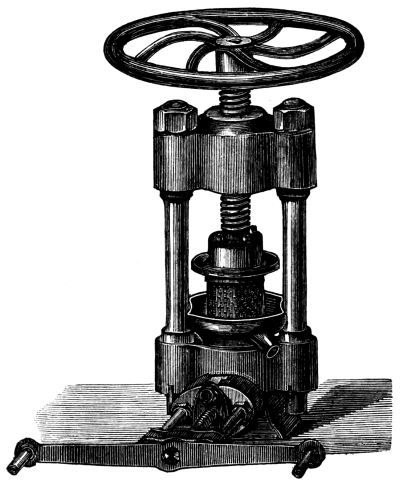
Fig. 79.—Oil Press.
In securing oils for physical and chemical examination both pressure
and solution may be employed. The purest oils are secured by pressure
at a low temperature. To obtain anything like a good extraction some
sort of hydraulic pressure must be used. In this laboratory a press is
employed in which the first pressure is secured by a screw and this is
supplemented by hydraulic pressure in which glycerol is the
transmitting liquid. The construction of the press is shown in the
accompanying figure.
The whole press is warmed to nearly 100°. The hot finely ground oily
material, enclosed in a cloth bag, is placed in the perforated cylinder
and compressed as firmly as possible by turning with the hands the
wheel shown at the top of the figure. The final
pressure is secured by the screw shown at the bottom of the figure
whereby a piston is driven into a cylinder containing glycerol. The
degree of pressure obtained is equal to 300 atmospheres.
Even with the best laboratory hydraulic pressure not more than
two-thirds of the total oil contents of oleaginous seeds can be secured
and the process is totally inapplicable to securing the oil from
tissues when it exists in quantities of less than ten per cent. To get
practically all of the oil the best method is to extract with carefully
distilled petroleum of low boiling point.
In the preparation of this reagent the petroleum ether of commerce,
containing bodies boiling at temperatures of from 35° to 80°, is
repeatedly fractioned by distillation until a product is obtained
which boils at from 45° to 60°. The distillation of this material
is conducted in a large flask heated with steam, furnished with a
column containing a number of separatory funnels and connected with an
appropriate condenser. The distillate is secured in a bottle packed
with broken ice, as shown in Fig. 80. A thermometer
suspended in the vapor of the petroleum serves to regulate the process. Too
much care to avoid accidents cannot be exercised in this operation. Not only
must steam be used in heating, but all flame and fire must be rigidly
excluded from the room in which the distillation takes place, and
the doors leading to other rooms where gas jets may be burning must
be kept closed. In the beginning of the process, as much as possible
of the petroleum boiling under 45° must be removed and rejected. The
distillation is then continued until the temperature rises above 60°.
The parts of the distillate saved between these temperatures are
redistilled under similar conditions. Other portions of the petroleum,
boiling at other temperatures, may be secured in the same way. The
products may be in a measure freed of unpleasant odors by redistilling
them from a mixture with lard. When used for quantitive purposes the
petroleum ether must leave no residue when evaporated at 100°.
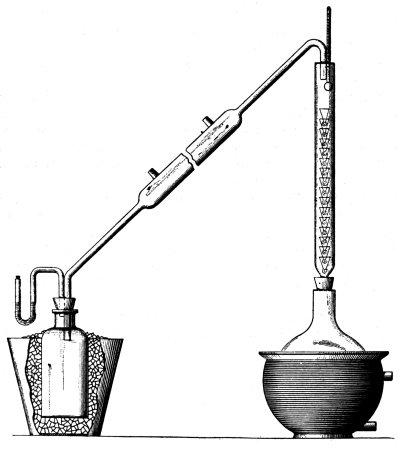
Fig. 80.—Apparatus for Fractional Distillation
of Petroleum Ether.
281. Freeing Extracted Oils from Petroleum.—The petroleum ether
which is used for extracting oils tends to give them an unpleasant odor
and flavor and its entire separation is a matter of some difficulty.
The greater part of the solvent may be recovered as described in
paragraph 43. Heating the extracted oil for several hours in
thin layers, will remove the last traces of the solvent, but affords
opportunity for oxidation, especially in the case of drying oils. An
effective means of driving off the last traces of petroleum is to cause
a current of dry carbon dioxid to pass through the sample contained
in a cylinder and heated to a temperature of from 85° to 90°. The
atmosphere of the inert gas will preserve the oil from oxidation and
the sample will, as a rule, be found free of the petroleum odor after
about ten hours treatment. Ethyl ether or chloroform may be used
instead of petroleum, but these solvents act on other matters than
the glycerids, and the extract is therefore liable to be contaminated
with more impurities than when the petroleum ether is employed. Other
solvents for fats are carbon tetrachlorid, carbon disulfid, and
benzene. In general, petroleum ether should be employed in preference
to other solvents, except in the case of castor oil, which is
difficultly soluble in both petroleum and petroleum ethers.
282. Freeing Fats Of Moisture.—Any excess of water in glycerids
will accumulate at the bottom of the liquid sample and can be removed
by decanting the fat or separating it from the oil by any other
convenient method. The warm oil may be almost entirely freed of any
residual moisture by passing it through a dry filter paper in a jacket
funnel kept at a high temperature. A section showing the construction
of such a funnel with a folded filter paper in place, is shown in Fig. 81.
The final drying, when great exactness is required, is accomplished
in a vacuum, or in an atmosphere of inert gas, or in the cold in an
exsiccator over sulfuric acid. In drying, it is well to expose the
hot oil as little as possible to the action of the air. Wherever
convenient, it should be protected from oxidation by some inert gas or
a vacuum.
283. Sampling for Analysis.—It is a matter of some difficulty
to secure a representative sample of a fat or oil for analytical
purposes. The moisture in a fat is apt to be unevenly distributed, and
the sampling is to be accomplished in a manner to secure the greatest
possible uniformity. When the quantity of material is of considerable
quantity a trier may be used which will remove a cylindrical or partly
cylindrical mass from the whole length or depth. By securing several
subsamples of this kind, and well mixing them, an average sample of the
whole mass may be secured. Where the fat is found in different casks
or packages samples should be drawn from each as described above. The
subsamples are mixed together in weights corresponding to the different
casks from which they are taken and the mass obtained by this mixture
divided into three equal portions. Two of these parts are melted in a
dish at a temperature not exceeding 60°, with constant stirring, and
when fully liquid the third part is added. As a rule, the liquid fat
retains enough heat to melt the added quantity. As soon as the mixed
fats begin to grow pasty the mass is vigorously stirred to secure an
intimate mixture of the water and other foreign bodies.[232]
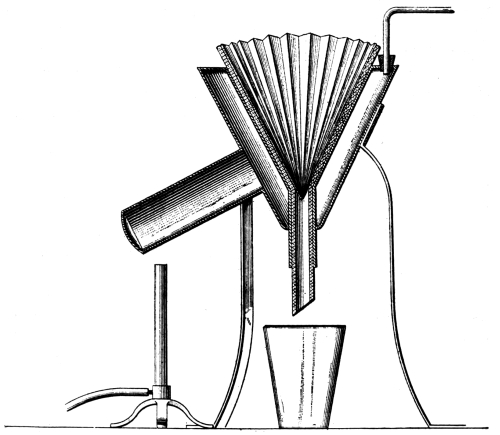
Fig. 81.—Section Showing Construction of a Funnel
for Hot Filtration.
In the case of butter fat the official chemists recommend that
subsamples be drawn from all parts of the package until about 500 grams
are secured. The portions thus drawn are to be perfectly melted in a
closed vessel at as low a temperature as possible, and when melted
the whole is to be shaken violently for some minutes till the mass is
homogeneous, and sufficiently solidified to prevent the separation of
the water and fat. A portion is then poured into the vessel from which
it is to be weighed for analysis, and this should nearly or quite fill
it. This sample should be kept in a cold place till analyzed.[233]
284. Estimation of Water.—In the official method for butter
fat, which may be applied to all kinds, about two grams are dried to
constant weight, at the temperature of boiling water, in a dish with
flat bottom, having a surface of at least twenty square centimeters.
The use of clean dry sand or asbestos is admissible, and is necessary
if a dish with round bottom be employed.
In the method recommended by Benedikt, about five grams of the sampled
fat are placed in a small flask or beaker and dried at 100° with
occasional stirring to bring the water to the surface.
According to the method of Sonnenschein, the sample is placed in a
flask carrying a cork, with an arrangement of glass tubes, whereby a
current of dry air may be aspirated over the fat during the process
of drying. When the flask is properly fitted its weight is taken, the
fat put in and reweighed to get the exact amount. The fat is better
preserved by aspirating carbon dioxid instead of air.[234]
The moisture may also be readily determined by drying on pumice stone,
as described in paragraph 26. In this case it is well to conduct
the desiccation in vacuum or in an inert atmosphere to prevent oxidation.
285. Specific Gravity.—The specific gravity of an oil is
readily determined by a westphal balance (53), by a spindle,
by a sprengel tube, or more accurately by a pyknometer. The general
principles governing the conduct of the work have already been given
(48-59). The methods described for determining the density of
sugar solutions are essentially the same as those used for oils, but it
is to be remembered that oils and fats are lighter than water and the
graduation of the sinkers for the hydrostatic balance, and the
spindles for direct determination must be for such lighter liquids.
The necessity of determining the density of a fat at a temperature
above its melting point is manifest, and for this reason the use of
the pyknometer at a high temperature (40° to 100°) is to be preferred
to all the other processes, in the case of fats which are solid at
temperatures below 25°.
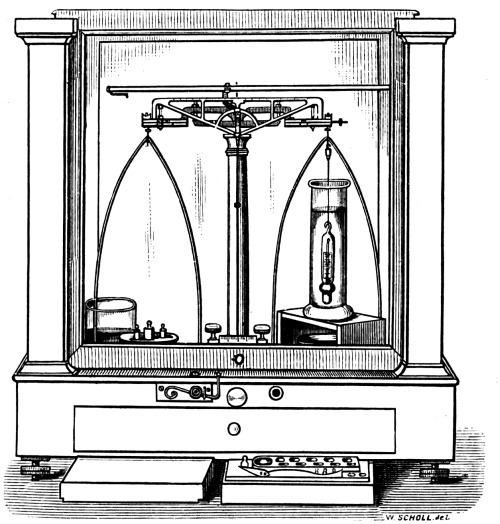
Fig. 82.—Balance and Westphal Sinker.
When great delicacy of manipulation is desired, combined with
rapid work, an analytical balance and westphal sinker may be used
conjointly.[235]
In this case it is well to have two or three sinkers graduated for
20°, 25°, and 40°, respectively. Nearly all fats, when melted and
cooled to 40°, remain in a liquid state long enough to determine their
density. The sinkers are provided with delicate thermometers, and the
temperature, which at the beginning is a little above the degree at
which the sinker is graduated, is allowed to fall to just that degree,
when the equilibrium is secured in the usual manner. The sinker is
conveniently made to displace just five grams of distilled water at the
temperature of graduation, but it is evident that a round number is not
necessary, but only convenient for calculation.
286. Expression of Specific Gravity.—Much confusion arises
in the study of data of densities because the temperatures at which
the determinations are made are not expressed. The absolute specific
gravity would be a comparison of the weight of the object at 4°, with
water at the same temperature. It is evident that such determinations
are not always convenient, and for this reason the determinations of
density are usually made at other temperatures.
In the case of a sinker, which at 35° displaces exactly five grams of
water, the following statements may be made: One cubic centimeter of
water at 35° weighs 0.994098 gram. The volume of a sinker displacing
five grams of water at that temperature is therefore 5.0297 cubic
centimeters. This volume of water at 4° weighs 5.0297 grams. In a given
case the sinker placed in an oil at 35° is found to displace a weight
equal to 4.5725 grams corresponding to a specific gravity of 35°/35°
= 0.9145. From the foregoing data the following tabular summary is
constructed:
| Weight |
of |
5.0287 |
cubic |
centimeters |
of |
oil |
at 35°, |
4.5725 |
grams. |
| ” |
” |
5.0297 |
” |
” |
” |
water |
at 35°, |
5.0000 |
” |
| ” |
” |
5.0297 |
” |
” |
” |
” |
” 4°, |
5.0297 |
” |
| Relative |
weight |
of |
oil |
at |
35°, |
to |
water |
at |
35°, |
0.9145 |
grams. |
| ” |
” |
” |
” |
” |
35°, |
” |
” |
” |
4°, |
0.9092 |
” |
287. Coefficient of Expansion of Oils.—Oils and fats of every
kind have almost the same coefficient of expansion with increasing
temperature. The coefficient of expansion is usually calculated by the
formula
in which δ represents the coefficient of
expansion, D₀ the density at the lowest temperature, D₀ʹ
the density at the highest temperature, t the lowest, and
tʹ the highest temperatures.
In the investigations made by Crampton it was shown that the formula
would be more accurate, written as follows:[236]
δ =
|
D₀ - D₀ʹ |
| (tʹ - t) × D₀ + D₀ʹ |
| 2 |
The absolute densities can be calculated from the formula Δ = δ +
K, in which Δ represents the coefficient of absolute expansion,
δ the apparent coefficient of expansions observed in glass vessels, and
K the cubical coefficient of expansion of the glass vessel. The
mean absolute coefficient of expansion for fats and oils, for 1° as
determined by experiment, is almost exactly 0.0008, and the apparent
coefficient of expansion nearly 0.00077.[237]
288. Standard of Comparison.—In expressing specific gravities
it is advisable to refer them always to water at 4°. The temperature at
which the observation is made should also be given. Thus the expression
of the specific gravity of lard, determined at different temperatures,
is made as follows:
| 100° |
| and d —— = |
0.85997, |
| 4° |
indicating the relative weights of the sample under examination at
15°.5, 40°, and 100°, respectively, to water at 4°.
289. Densities of Common Fats and Oils.—It is convenient to
have at hand some of the data representing the densities of common fats
and oils, and the following numbers are from results of determinations
made in this laboratory:[238]
| 15°.5 |
40° |
100° |
| Temperature. |
d = |
—. |
d = |
—. |
d = |
—. |
| 4° |
4° |
4° |
| Leaf lard |
0.91181 |
0.89679 |
0.85997 |
| Lard stearin |
0.90965 |
0.89443 |
0.85750 |
| Oleostearin |
0.90714 |
0.89223 |
0.85572 |
| Crude cottonseed oil |
0.92016 |
0.90486 |
0.86739 |
| Summer ” ” |
0.92055 |
0.90496 |
0.86681 |
| Winter ” ” |
0.92179 |
0.90612 |
0.86774 |
| Refined ” ” |
0.92150 |
0.90573 |
0.86714 |
| Compound lard ” |
0.91515 |
0.90000 |
0.86289 |
| Olive oil |
0.91505 |
0.89965 |
0.86168 |
290. Melting Point.—The temperature at which fats become
sensibly liquid is a physical characteristic of some importance.
Unfortunately, the line of demarcation between the solid and liquid
states of this class of bodies is not very clear. Few of them pass
per saltum from one state to the other. In most cases there is
a gradual transition, which, between its initial and final points, may
show a difference of several degrees in temperature. It has been noted,
further, that fats recently melted behave differently from those which
have been solid for several hours. For this reason it is advisable, in
preparing glycerids for the determination of their melting point, to
fuse them the day before the examination is to be made. The temperature
at which a glycerid passes from a liquid to a solid state is usually
higher than that at which it resumes its solid form. If, however, the
change of temperature could be made with extreme slowness, exposing
the sample for many hours at near its critical temperature, these
differences would be much less marked.
Many methods have been devised for determining the melting point of
fats, and none has been found that is satisfactory in every respect. In
some cases the moment at which fluidity occurs is assumed to be that
one when the small sample loses its opalescence and becomes clear.
In other cases the moment of fluidity is determined by the change of
shape of the sample or by observing the common phenomena presented by
a liquid body. In still other cases, the point at which the sample
becomes fluid is determined by the automatic completion of an electric
circuit, which is indicated by the ringing of a bell. This latter
process has been found very misleading in our experience. Only a few of
the proposed methods seem to demand attention here, and some of those,
depending on the visible liquefaction of a small quantity of the fat or
based on the physical property, possessed by all liquids when removed
from external stress, of assuming a spheroidal state will be described.
Other methods which may demand attention in any particular case may be
found in the works cited.[239]
291. Determination in a Capillary Tube.—A capillary tube
is dipped into the melted fat and when filled one end of the tube
is sealed in the lamp and it is then put aside in a cool place for
twenty-four hours. At the end of this time the tube is tied to the bulb
of a delicate thermometer the length used or filled with fat being of
the same length as the thermometer bulb. The thermometer and attached
fat are placed in water, oil, or other transparent media, and gently
warmed until the capillary column of fat becomes transparent. At this
moment the thermometric reading is made and entered as the melting
point of the fat. In comparative determinations the same length of
time should be observed in heating, otherwise discordant results
will be obtained. As in all other methods, the resulting members are
comparative and not absolute points of fusion, and the data secured by
two observers on the same sample may not agree, if different methods of
preparing the fat and different rates of fusion have been employed.
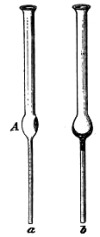
Fig. 83.—
Melting
Point
Tubes.
Several modifications of the method just described are practiced, and
perhaps with advantage in some cases. In one of these a small particle
of the fat is solidified in a bulb blown on a small tube, as indicated
in Fig. 83, tube a. The tube, in an
upright position, is heated in a convenient bath until the particle
of fat just begins to run assuming soon the position shown in tube
b. This temperature is determined by a thermometer, whose bulb
is kept in contact with the part of the observation tube containing
the fat particle. The rise of temperature is continued until the fat
collected at the bottom of the bulb is entirely transparent. This is
called the point of complete fusion.[240]
Pohl covers the bulb of a thermometer with a thin film of fat, and the
instrument is then fixed in a test tube, in such a way as not to touch
the bottom, and the film of fat warmed by the air-bath until it fuses
and collects in a droplet at the end of the thermometer bulb.[241]
Carr has modified this process by inserting the thermometer in a round
flask in such a way that the bulb of the thermometer is as nearly
as possible in the center. By this device the heating through the
intervening air is more regular and more readily controlled.[242]
A particle of fat placed on the surface of clean mercury will melt
when the mercury is raised to the proper temperature. Where larger
quantities of the fat are employed, a small shot or pellet of mercury
may be placed upon the surface and the whole warmed until the metal
sinks. Of the above noted methods, the analyst will find some form
of capillary tube or the use of a film of the fat on the bulb of a
thermometer the most satisfactory.[243]
Hehner and Angell have modified the sinking point method by increasing
the size of the sinker without a corresponding increase in weight.
This is accomplished by blowing a small pear-shaped float, nearly
one centimeter in diameter and about two long. The stem of the pear
is drawn out and broken off, and while the bulb is still warm, the
open end of the stem is held in mercury, and a small quantity of this
substance, sufficient in amount to cause the float to sink slowly
through a melted fat, is introduced into the bulb of the apparatus
and the stem sealed. The whole bulb should displace about one cubic
centimeter of liquid and weigh, after filling with mercury, about
three and four-tenths grams. In conducting the experiment about thirty
grams of the dry melted fat are placed in a large test tube and cooled
by immersing the tube in water at a temperature of 15°. The tube
containing the solidified fat is placed in a bath of cold water and the
sinker is placed in the center of the surface of the fat. The bath is
slowly heated until the float disappears. The temperature of the bath
is read just as the bulb part of the float disappears. The method is
recommended especially by the authors for butter fat investigations.[244]
298. Melting Point Determined by the Spheroidal State.—The
method described by the author, depending on the assumption of the
spheroidal state of a particle of liquid removed from all external
stress, has been found quite satisfactory in this laboratory, and has
been adopted by the official chemists.[245]
In the preparation of the apparatus there are required:
(a) a piece of ice floating in distilled water that has been
recently boiled, and (b) a mixture of alcohol and water of the
same specific gravity as the fat to be examined. This is prepared by
boiling distilled water and ninety-five per cent alcohol for a few
minutes to remove the gases which they may hold in solution. While
still hot, the water is poured into the test tube described below until
it is nearly half full. The test tube is then nearly filled with the
hot alcohol, which is carefully poured down the side of the inclined
tube to avoid too much mixing. If the alcohol is not added until the
water has cooled, the mixture will contain so many air bubbles as to
be unfit for use. These bubbles will gather on the disk of fat as the
temperature rises and finally force it to the top.
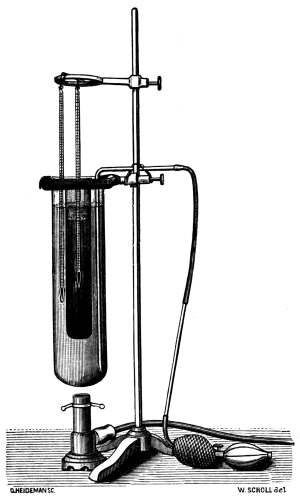
Fig. 84.—Apparatus for the
Determination of Melting point.
The apparatus for determining the melting point is shown in Fig. 84,
and consists of (a) an accurate thermometer reading
easily tenths of a degree; (b) a cathetometer for reading the
thermometer (but this may be done with an eye-glass if held steadily
and properly adjusted); (c) a thermometer; (d) a tall
beaker, thirty-five centimeters high and ten in diameter; (e)
a test tube thirty centimeters long and three and a half in diameter;
(f) a stand for supporting the apparatus; (g) some method
of stirring the water in the beaker (for example, a blowing bulb of
rubber, and a bent glass tube extending to near the bottom of the beaker).
The disks of fat are prepared as follows: The melted and filtered fat
is allowed to fall from a dropping tube from a height of about twenty
cubic centimeters on a smooth piece of ice floating in recently boiled
distilled water. The disks thus formed are from one to one and a half
centimeters in diameter and weigh about 200 milligrams. By pressing the
ice under the water the disks are made to float on the surface, whence
they are easily removed with a steel spatula, which should be cooled in
the ice water before using. They should be prepared a day or at least a
few hours before using.
The test tube containing the alcohol and water is placed in a tall
beaker, containing water and ice, until cold. The disk of fat is then
dropped into the tube from the spatula, and at once sinks until it
reaches a part of the tube where the density of the alcohol-water is
exactly equivalent to its own. Here it remains at rest and free from
the action of any force save that inherent in its own molecules.
The delicate thermometer is placed in the test tube and lowered until
the bulb is just above the disk. In order to secure an even temperature
in all parts of the alcohol mixture in the vicinity of the disk, the
thermometer is gently moved from time to time in a circularly pendulous
manner.
The disk having been placed in position, the water in the beaker is
slowly heated, and kept constantly stirred by means of the blowing
apparatus already described.
When the temperature of the alcohol-water mixture rises to about
6° below the melting point, the disk of fat begins to shrivel, and
gradually rolls up into an irregular mass.
The thermometer is now lowered until the fat particle is even with the
center of the bulb. The bulb of the thermometer should be small, so as
to indicate only the temperature of the mixture near the fat. A gentle
rotatory movement from time to time should be given to the thermometer
bulb. The rise of temperature should be so regulated that the last
2° of increment require about ten minutes. The mass of fat gradually
approaches the form of a sphere, and when it is sensibly so the reading
of the thermometer is to be made. As soon as the temperature is taken
the test tube is removed from the bath and placed again in the cooler.
A second tube, containing alcohol and water, is at once placed in the
bath. The test tube (ice water having been used as a cooler) is of
low enough temperature to cool the bath sufficiently. After the first
determination, which should be only a trial, the temperature of the
bath should be so regulated as to reach a maximum of about 1°.5 above
the melting point of the fat under examination.
The edge of the disk should not be allowed to touch the sides of the
tube. This accident rarely happens, but in case it should take place,
and the disk adhere to the sides of the tube, a new trial should be
made.
Triplicate determinations should be made, and the second and third
results should show a near agreement.
Example.—Melting point of sample of butter:
| |
Degrees. |
| First trial |
33.15 |
| Second trial |
33.05 |
| Third trial |
33.00 |
The fatty acids, being soluble in alcohol, cannot be treated as the
ordinary glycerids. But even those glycerids which are slightly soluble
in alcohol may be subjected to the above treatment without fear of
experiencing any grave disturbance of the fusing points.
293. Solidifying Point.—The temperature at which a fat shows
incipient solidification is usually lower than the point of fusion.
The same difficulties are encountered in determining the temperature
of solidification as are presented in observing the true melting
point. The passage from a transparent liquid to an opaque solid is
gradual, showing all the phases of turbidity from beginning opalescence
to complete opacity. The best the analyst can do is to determine,
as accurately as possible, the temperature at which the more solid
glycerids of the mixture begin to form definite crystals. This point is
affected to a marked degree by the element of time. A fat cooled just
below its melting point will become solid after hours, or days, whereas
it could be quickly cooled far below that temperature and still be limpid.
The methods of observation are the same for the glycerids and fatty
acids, and the general process of determination is sufficiently set
forth in the following description of the method as used in this
laboratory.[246]
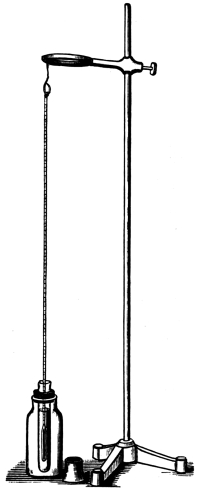
Fig. 85.—Apparatus
for Determining
Crystallizing Point.
The melted fat or fat acid is placed in a test tube contained in a
large bottle, which serves as a jacket to protect the tube from sudden
or violent changes of temperature. The efficiency of the jacket may be
increased by exhausting the air therefrom, as in the apparatus for
determining the heat of bromination, hereafter described. A very
delicate thermometer, graduated in tenths of a degree, and having a
long bulb, is employed. By means of the reading glass, the reading can
be made in twentieths of a degree. The arrangement of the apparatus
is shown in Fig. 85. The test tube is nearly
filled with the melted matter. The bottom of the jacket should be
gently warmed to prevent a too rapid congelation in the bottom of the
test tube containing the melted fat, and the tube is to be so placed
as to leave an air space between it and the bottom of the bottle. The
thermometer is suspended in such a manner as to have the bulb as nearly
as possible in the center of the melted fat. The thermometer should
be protected from air currents and should be kept perfectly still. In
case the congealing point is lower than room temperature the jacket
may be immersed in a cooling mixture, the temperature of which is only
slightly below the freezing point of the fatty mass.
When crystals of fat begin to form, the descent of the mercury in the
stem of the thermometer will become very slow and finally reach a
minimum, which should be noted. As the crystallization extends inwards
and approaches the bulb of the thermometer a point will be reached when
the mercury begins to rise. At this time the partially crystallized
mass should be vigorously stirred with the thermometer and again left
at rest in as nearly, the original position as possible. By this
operation the mercury will be made to rise and its maximum position
should be noted as the true crystallizing point of the whole mass.
In comparing different samples, it is important that the elements of
time in which the first crystallization takes place should be kept, as
nearly as possible, the same. A unit of one hour in cooling the mixture
from a temperature just above its point of fusion until the incipient
crystallization is noticed, is a convenient one for glycerids and for
fat acids.
294. Determination of Refractive Power.—The property of
refracting light is possessed by fats in different degrees and these
differences are of great help in analytical work. The examination may
be made by the simple refractometer of Abbe or Bertrand, or by the more
elaborate apparatus of Pulfrich.
The comparative refractive power of fats can also be observed by
means of the oleorefractometer of Amagat-Jean or the differential
refractometer of Zune.[247]
For details of the construction of these apparatus, with a description
of the optical principles on which they are based, the papers above
cited may be consulted. In this laboratory the instruments which
have been employed are three in number, viz., Abbe’s small
refractometer, Pulfrich’s refractometer using yellow light, and the
oleorefractometer of Amagat-Jean. A brief description of the methods
of manipulating these instruments is all that can be attempted in this
manual.
295. Refractive Index.—Refractive index is an expression
employed to characterize the measurement of the degree of deflection
caused in a ray of light in passing from one transparent medium into
another. It is the quotient of the sine of the angle of the incident,
divided by the sine of the angle of the refracted ray.
In the case of oils which remain liquid at room temperatures, the
determinations can be made without the aid of any device to maintain
liquidity. In the case of fat which becomes solid at ordinary room
temperatures, the determination must either be made in a room
artificially warmed or the apparatus must have some device, as in the
later instruments of Abbe and Pulfrich, and in the apparatus of
Amagat-Jean, whereby the sample under examination can be maintained
in a transparent condition. In each case the accuracy of the apparatus
should be tested by pure water, the refractive index of which at 18°
is 1.333. The refractive index is either read directly on the scale
as in Abbe’s instrument, or calculated from the angles measured as in
Pulfrich’s apparatus.
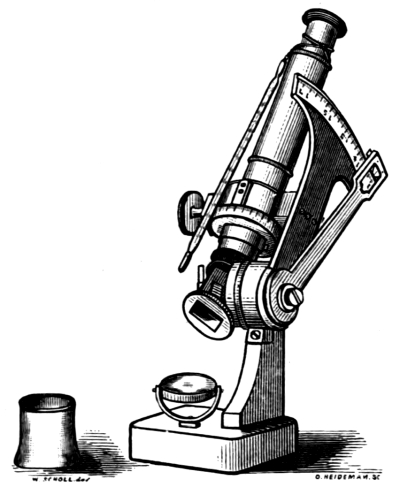
Fig. 86.—Abbe’s Refractometer.
296. Abbe’s Refractometer.—For practical use the small
instrument invented by Abbe will be found sufficient. The one which has
been in use for many years in this laboratory is shown in Fig. 86.
The illustration represents the apparatus in the position preliminary to
reading the index. In preparing the sample of oil for observation the
instrument is turned on its axis until the prisms between which the
oil is placed assume a horizontal position, as is seen in Fig. 87.
The movable prism is unfastened and laid aside, the fixed prism covered
with a rectangular shaped piece of tissue paper on which one or two
drops of the oil are placed. The movable prism is replaced in such a
manner as to secure a complete separation of the two prisms by the film
of oiled tissue paper. A little practice will enable the analyst to
secure this result.
After the paper disk holding the fat is secured by replacing the upper
prism, the apparatus is placed in its normal position and the index
moved until the light directed through the apparatus by the mirror
shows the field of vision divided into dark and light portions. The
dispersion apparatus is now turned until the rainbow colors on the part
between the dark and light fields have disappeared. Before doing this,
however, the telescope, the eyepiece of the apparatus, is so adjusted
as to bring the cross lines of the field of vision distinctly into
focus. The index of the apparatus is now moved back and forth until the
line of the two fields of vision falls exactly at the intersection of
the cross lines. The refractive index of the fat under examination is
then read directly upon the scale by means of a small magnifying glass.
To check the accuracy of the first reading, the dispersion apparatus
should be turned through an angle of 180° until the colors have again
disappeared, and, after adjustment, the scale of the instrument again
read. These two readings should nearly coincide, and their mean is the
true reading of the fat under examination.
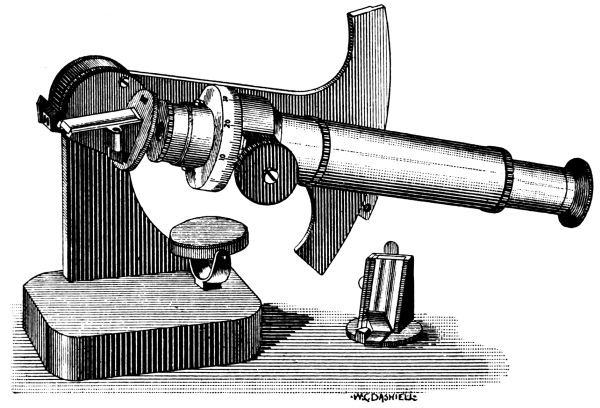
Fig. 87.—Charging Position of Refractometer.
For butter fats the apparatus should be kept in a warm place, the
temperature of which does not fall below 30°. For reducing the results
obtained to a standard temperature, say 25°, the factor 0.000176 may be
used. As the temperature rises the refractive index falls.
Example.—Refractive index of a butter fat
determined at 32°.4 = 1.4540, reduced to 25° as follows: 32.4 -25 =
7.4; 0.000176 × 7.4 = 0.0013; then 1.4540 + 0.0013 = 1.4553.
The instrument used should be set with distilled water at 18°, the
theoretical refractive index of water at that temperature being 1.333.
In the determination above given, the refractive index of pure water
measured 1.3300; hence the above numbers should be corrected for theory
by the addition of 0.0030, making the corrected index of the butter fat
mentioned at the temperature given, 1.4583.
297. Pulfrich’s Refractometer.—For exact scientific
measurements, Pulfrich’s apparatus has given here entire satisfaction.
In this instrument a larger quantity of the oil is required than for
the abbe, and this quantity is held in a cylindrical glass vessel luted
to the top of the prism. The method of accomplishing this and also an
illustration of the refraction of the rays of light are shown in Fig. 88.
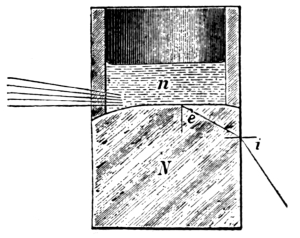
Fig. 88.—Prism of Pulfrich’s
Refractometer.
The angle i is measured by a divided circle read with the aid of
a small telescope. The index of the prism of highly refractive glass
N is known. The oil is seen at n. The light used is the
yellow sodium ray (D). From the observed angle the refractive
index of n is calculated from the formula
For convenience the values of n for all usual values of i
are computed once for all and arranged for use in tabular form. The
latest model of Pulfrich’s apparatus, arranged both for liquid and
solid bodies, and also for spectrometric observation is shown in Fig. 89.
When the sodium light is used it is placed behind the apparatus and
the light is collected and reflected on the refractive prism by the
lens N. Through H and G is secured the micrometric
reading of the angle on the scale D by means of the telescopic
arrangement F E. For regulating the temperature of the oil and
adjacent parts, a stream of water at any desired temperature is made to
circulate through L and S in the direction indicated by
the arrows. The manner in which this is accomplished is shown in the
cross section of that part of the apparatus as indicated in Fig. 90.
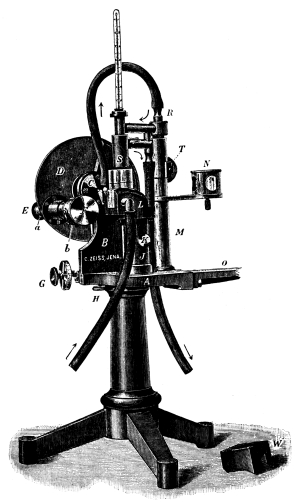
Fig. 89.—Pulfrich’s New Refractometer.
Fig. 90.—
Heating Apparatus
for Pulfrich’s
Refractometer.
Fig. 91.—Spectrometer Attachment.
For further details of the construction and operation of the apparatus
the original description may be consulted.[248]
In case a spectrometric observation is desired the H ray, for
instance, is produced by the geissler tube Q, Fig. 91.
The light is concentrated and thrown upon the refractive prism by the lens
P, the lens N, Fig. 89, being removed
for this purpose.
Tables, for correcting the dispersion and for calculating the indices
for each angle and fraction thereof, and for corrections peculiar to
the apparatus, accompany each instrument.
298. Refractive Indices of some Common Oils.—The following
numbers show the refractive indices obtained by Long for some of the
more common oils. The light used was the yellow ray of the sodium
flame.[249]
| Name. |
Temperature. |
Refractive
index. |
Calculated
for 25°. |
| Olive oil (France) |
26°.6 |
1.4673 |
1.4677 |
| ” ” (California) |
25°.4 |
1.4677 |
1.4678 |
| Cottonseed |
oil |
24°.8 |
1.4722 |
1.4721 |
| ” |
” |
26°.3 |
1.4703 |
1.4709 |
| ” |
” |
25°.3 |
1.4718 |
1.4719 |
| Sesamé |
oil |
24°.8 |
1.4728 |
1.4728 |
| ” |
” |
26°.8 |
1.4710 |
1.4716 |
| Castor |
” |
25°.4 |
1.4771 |
1.4773 |
| Lard |
” |
27°.3 |
1.4657 |
1.4666 |
| Peanut |
” |
25°.3 |
1.4696 |
1.4696 |
In case of the use of Abbe’s apparatus, in which diffused sunlight
is the source of the illumination, the numbers obtained cannot be
compared directly with those just given unless the apparatus be first
so adjusted as to read with distilled water at 18°, 1.333. In this case
the reading of the scale gives the index as determined by the yellow
ray. The numbers obtained with Abbe’s instrument for some common oils
are given below.[250]
In the determinations the instrument was set with water at 18°, reading
1.3300, and they were corrected by adding 0.0030 in order to compensate
for the error of the apparatus.
| Material. |
Calculated
for 25°. |
Corrected
index. |
| Lard |
1.4620 |
1.4650 |
| Cotton oil |
1.4674 |
1.4704 |
| Olive oil stearin |
1.4582 |
1.4610 |
| Lard stearin |
1.4594 |
1.4624 |
299. Oleorefractometer.—Instead of measuring the angular value
of the refractive power of an oil it may be compared with some standard
on a purely arbitrary scale. Such an apparatus is illustrated by the
oleorefractometer of Amagat-Jean, or by Zeiss’s butyrorefractometer.
In the first named instrument, Fig. 92, the oil to be
examined is compared directly with another typical oil and the shadow produced
by the difference in refraction is located on a scale read by a telescope
and graduated for two different temperatures.[251]
The internal structure of the apparatus is shown in Fig. 93.
Fig. 92.—Oleorefractometer.
Fig. 93.—Section Showing Construction of Oleorefractometer.
In the center of the apparatus a metal cylinder, A, is found
carrying two plate glass pieces, C B, so placed as to form an
angle of 107°. This cylinder is placed in a larger one, provided with
two circular glass windows. To these two openings are fixed to the
right and left, the telescopic attachments, G, V, S, E,
and the apparatus M, H, Sʹ, Eʹ, for rendering the rays
of light parallel. The field of vision is divided into two portions,
light and dark, by a semicircular stop inserted in the collimator,
and contains the double scale shown in the figure
placed at H. The field of vision is illuminated by a gas or oil lamp
placed at a convenient distance from the collimator. The inner metallic cylinder
A is surrounded with an outer one, to which the optical parts
are attached at D Dʹ by means of plane glass plates. This
cylinder is in turn contained in the large water cylinder P P,
carrying a thermometer in the opening shown at the top on the left. The
manipulation of the apparatus is very simple. The outer cylinder is
filled with water, at a temperature below 22°, the middle one with the
typical oil furnished with the instrument, the cover of the apparatus
carrying the thermometer placed in position and the cup-shaped funnel
inserted in the cylinder A, which is at first also filled
with the typical oil. The whole system is next brought slowly to
the temperature of 22° by means of the lamp shown in Fig. 92.
The telescope is adjusted to bring the scale of the field of vision into
focus and the line dividing the light and shadow of the field should
fall exactly on 0°a. If this be not the case the 0° is adjusted
by screws provided for that purpose until it is in proper position.
The typical oil is withdrawn from A by the cock R, the
cylinder washed with a little of the oil to be examined and then filled
therewith. On again observing the field of vision the line separating
the shadow from the light will be found moved to the right or left,
if the oil have an index different from that of the typical oil. The
position of the dividing line is read on the scale.
For fats the temperature of the apparatus is brought exactly to 45° and
the scale 0°b is used. In other respects the manipulation for the fats
is exactly that described for oils. In the use of 0°a, in case the room
be warmer than 22°, all the liquids employed should be cooled below 22°
before being placed in the apparatus. It is then only necessary to wait
until the room temperature warms the system to 22°. In the case of fats
it is advisable to heat all the liquids to about 50° and allow them to
cool to 45° instead of heating them to that temperature by means of the
lamp.
One grave objection to this instrument is found in the absence of the
proper scientific spirit controlling its manufacture and sale, as
evidenced by the attempt to preserve the secret of the composition
of the typical oil and the negligence in testing the scale of the
instruments which will be pointed out further along.
According to Jean[252]
the common oils, when purified, give the following readings at 22°:
| Peanut |
oil |
+3.5 |
to |
+6.5 |
| Colza |
” |
+17.5 |
” |
+21.0 |
| Cotton |
” |
+18.0 |
” |
+18.0 |
| Linseed |
” |
+47.0 |
” |
+54.5 |
| Lard |
” |
+5.5 |
” |
+5.5 |
| Olive |
” |
+1.5 |
” |
0.0 |
| Sesamé |
” |
+17.5 |
” |
+19.0 |
| Oleomargarin |
-15.0 |
” |
-15.0 |
| Butter |
fat |
-30.0 |
” |
-30.0 |
| Mutton |
oil |
0.0 |
” |
0.0 |
| Fish |
” |
+38.0 |
” |
+38.0 |
In this instrument, therefore, vegetable and fish oils, as a rule, show
a right hand, and animal fats a left hand deviation.
The oleorefractometer has been extensively used in this laboratory and
the data obtained thereby have been found useful. We have not found,
however, the values fixed by Jean to be constant. The numbers for lard
have varied from -3.0 to -10.0, and other fats have shown almost as
wide a variation from the values assigned by him.
Jean states that the number for lard, determined by the
oleorefractometer, is -12, and he gives a definite number for each of
the common oils and fats. On trying the pure lards of known origin in
this instrument, I have never yet found one that showed a deviation of
-12 divisions of the scale; but I have no doubt that there are many
such lards in existence. The pure normal lards derived from the fat of
a single animal would naturally show greater variations in their
chemical and physical properties, than a typical lard derived from
the mixed fats of a great many animals. In leaf lard, rendered in the
laboratory, the reading of the oleorefractometer was found to be -10°,
while with the intestinal lard it was -9°. On the other hand, a lard
rendered from the fat from the back of the animal showed a reading of
only -3°, and a typical cottonseed oil a reading of +12°. According
to the statement of Jean, a lard which gives even as low a refractive
number as -9, by his instrument, would be adjudged at least one-quarter
cottonseed oil.
After a thorough trial of the instrument of Jean, I am convinced that
it is of great diagnostic value, but if used in the arbitrary manner
indicated by the author it would lead to endless error and confusion.
In other words, this instrument is of greater value in analyses than
Abbe’s ordinary refractometer, because it gives a wider expansion in
the limits of the field of vision, and therefore can be more accurately
read, but it is far from affording a certain means of discovering
traces of adulteration with other fats.
300. Variations in the Instruments.—In the use of the
oleorefractometer, attention should be called to the fact that, through
some negligence in manufacture, the instruments do not give, in all
instances, the same reading with the same substance. Allen obtained the
following data with a sample of lard examined in three instruments,
viz., 4°.5, 6°, and 11°. Such wide differences in the scales
of the instruments cannot fail to disparage the value of comparative
determinations.
The variations in samples of known origin, when read on the same
instrument, however, will show the range of error to which the
determinations made with the oleorefractometer are subject. Pearmain
has tabulated a large number of observations of this kind, covering 240
samples of oils.[253]
Following are the data relating to the most important oils.
| |
At 22°. |
|
|
| Name of oil. |
Highest
reading.
Degrees. |
Lowest
reading.
Degrees. |
Mean
reading.
Degrees. |
| Almond |
10.5 |
8.0 |
9.5 |
| Peanut |
7.0 |
5.0 |
6.0 |
| Castor |
42.0 |
39.0 |
40.0 |
| Codliver |
46.0 |
40.0 |
44.0 |
| Cottonseed (crude) |
17.0 |
16.0 |
16.5 |
| ”(refined) |
23.0 |
17.0 |
21.5 |
| Lard oil |
-1.0 |
0.0 |
0.0 |
| Linseed (crude) |
52.0 |
48.0 |
50.0 |
| ” (refined) |
54.0 |
50.0 |
52.5 |
| Olive |
3.5 |
1.0 |
2.0 |
| Rape |
20.0 |
16.0 |
17.5 |
| Sesamé |
17.0 |
13.0 |
15.5 |
| Sunflower |
35.0 |
35.0 |
35.0 |
| Tallow oil |
-5.0 |
-1.0 |
-3.0 |
| Oleic acid |
-33.0 |
-29.0 |
-32.0 |
| |
| |
At 45°. |
|
|
| Butter |
-34.0 |
-25.0 |
-30.0 |
| Oleomargarin |
-18.0 |
-13.0 |
-15.0 |
| Lard |
-14.0 |
-8.0 |
-10.5 |
| Tallow |
-18.0 |
-15.0 |
-16.0 |
| Paraffin |
58.5 |
54.0 |
56.0 |
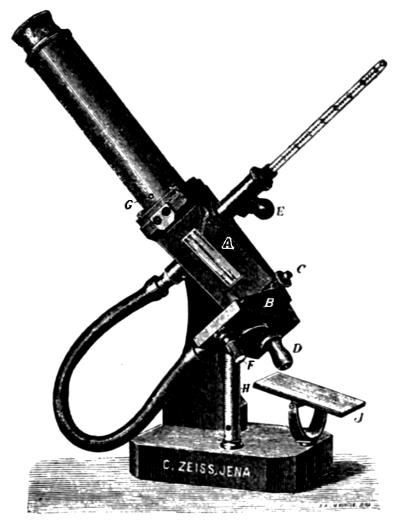
Fig. 94.—Butyrorefractometer.
301. Butyrorefractometer.—Another instrument graduated on an
arbitrary scale is the butyrorefractometer of Zeiss. This apparatus,
which resembles in some respects the instrument of Abbe, differs
therefrom essentially in dispensing with the revolving prisms of
Amici, whereby the chromatic fringing due to dispersion is corrected,
and on having the scale fixed for one substance, in this instance,
pure butter fat. The form of the instrument is shown in Fig. 94.
The achromatization for the butter fat is secured in the prisms between
which a film of the fat is placed, as in the Abbe instrument. When
a fat, differing from that for which the instrument is graduated is
introduced, the fringes of the dark and light portions of the field
will not only be colored (difference in dispersion), but the line of
separation will also be displaced (difference in refractive power). The
apparatus is therefore used in the differential determination of these
two properties. It must not be forgotten, however, that butter fats
differ so much in these properties among themselves as to make possible
the condemnation of a pure as an adulterated sample.
302. Method of Charging the Apparatus.—The prism casing of
the instrument is opened by turning the pin F to the right and
pushing the half B of the prism casing aside. The prism and its
appendages must be cleaned with the greatest care, the best means for this
purpose being soft clean linen moistened with a little alcohol or ether.
Melt the sample of butter in a spoon and pour it upon a small paper
filter held between the fingers and apply the first two or three drops
of clear butter fat so obtained to the surface of the prism contained
in prism casing B. For this purpose the apparatus should be
raised with the left hand so as to place the prism surface in a
horizontal position.
Press B against A and replace F by turning it in
the opposite direction into its original position; thereby B is
prevented from falling back and both prism surfaces are kept in close contact.
303. Method of Observation.—While looking into the telescope,
give the mirror J such a position as to render the critical line
which separates the bright left part of the field from the dark right
part distinctly visible. It may also be necessary to move or turn the
instrument about a little. First it will be necessary to ascertain
whether the space between the prism surfaces be uniformly filled with
butter, for, if not, the critical line will not be distinct.
By allowing a current of water of constant temperature to flow through
the apparatus, some time previous to the taking of the reading, the at
first somewhat hazy critical line approaches in a short time, generally
after a minute, a fixed position and quickly attains its greatest
distinctness. When this point has been reached note the appearance of
the critical line (i. e., whether colorless or colored and in
the latter case of what color); also note the position of the critical
line on the centesimal scale, which admits of the tenth divisions being
conveniently estimated, and at the same time read the thermometer. By
making an extended series of successive readings and by employing an
assistant for melting and preparing the small samples of butter, from
twenty-five to thirty refractometric butter tests may, after a little
practice, be made in an hour.
The readings of the refractive indices of a large number of butter
samples made at 25° are, by means of a table which will be found
below, directly reduced to scale divisions and yield the following
equivalents:[254]
| Natural butter |
(1.4590-1.4620) : 49.5-54.0 |
scale |
divisions. |
| Margarin |
(1.4650-1.4700) : 58.6-66.4 |
” |
” |
| Mixtures |
(1.4620-1.4690) : 54.0-64.8 |
” |
” |
Whenever, in the refractometric examination of butter at a temperature
of 25°, higher values than 54.0 are found for the critical lines these
samples will, according to Wollny, by chemical analysis, always be
found to be adulterated; but in all samples in which the value for
the position of the critical line does not fall below 52.5, chemical
analysis maybe dispensed with and the samples may be pronounced to be
pure butter.
In calculating the position of the critical line for other temperatures
than 25° allow for 1° variation of temperature a mean value of 0.55
scale division. The following table, which has been compiled in this
manner, shows the values corresponding to various temperatures, each
value being the upper limit of scale divisions admissible in pure butter:
| Temp. | Sc. div. |
Temp. | Sc. div. |
Temp. | Sc. div. |
Temp. | Sc. div. |
| 45° | 41.5 |
40° | 44.2 |
35° | 47.0 |
30° | 49.8 |
| 44° | 42.0 |
39° | 44.8 |
34° | 47.5 |
29° | 50.3 |
| 43° | 42.6 |
38° | 45.3 |
33° | 48.1 |
28° | 50.8 |
| 42° | 43.1 |
37° | 45.9 |
32° | 48.6 |
27° | 51.4 |
| 41° | 43.7 |
36° | 46.4 |
31° | 49.2 |
26° | 51.9 |
| 40° | 44.2 |
35° | 47.0 |
30° | 49.8 |
25° | 52.5 |
If, therefore, at any temperature between 45° and 25° values be found
for the critical line, which are less than the values corresponding to
the same temperature according to the table, the sample of butter may
safely be pronounced to be natural, i. e., unadulterated butter.
If the reading show higher numbers for the critical line the sample
should be reserved for chemical analysis. A special thermometer for use
in the examination of butter will be described in the section devoted
to dairy products.
304. Range of Application of the Butyrorefractometer.—The
extended range of the ocular scale of the refractometer, n =
1.42 to 1.49, which embraces the refractive indices of the majority of
oils and fats, renders the instrument applicable for testing oils and
fats and also for examining glycerol.
By reference to the subjoined table the scale divisions may be
transformed into terms of refractive indices. It gives the refractive
indices for yellow light for every ten divisions of the scale. The
differential column Δ gives the change of the refractive indices in
terms of the fourth decimal per scale division. Owing to the accuracy
with which the readings can be taken (0.1 scale division) the error of the
value of n rarely exceeds one unit of the fourth decimal of n.
Table of Refractive Indices.
| Scale div. |
nD. |
Δ. |
Scale div. |
nD. |
Δ. |
| 0 |
1.4220 |
8.0 |
50 |
1.4593 |
6.6 |
| 10 |
1.4300 |
7.7 |
60 |
1.4650 |
6.4 |
| 20 |
1.4377 |
7.5 |
70 |
1.4723 |
6.0 |
| 30 |
1.4452 |
7.2 |
80 |
1.4783 |
5.7 |
| 40 |
1.4524 |
6.9 |
90 |
1.4840 |
5.5 |
| 50 |
1.4593 |
|
100 |
1.4895 |
|
The process of observation is precisely the same as that already
described. In cases, however, where the critical line presents very
broad fringes (turpentine, linseed oil, etc.) it is advisable to repeat
the reading with the aid of a sodium flame.
305. Viscosity.—An important property of an oil, especially
when its lubricating qualities are considered, is the measure of
the friction which the particles exert on other bodies and among
themselves, in other words, its viscosity. In the measure of this
property no definite element can be considered, but the analyst must
be content with comparing the given sample with the properties of some
other liquid regarded as a standard. The usual method of procedure
consists in determining the time required for equal volumes of the two
liquids to pass through an orifice of given dimensions, under identical
conditions of temperature and pressure. In many instances the viscosity
of oils is determined by comparing them with water or rape oil, while,
in other cases, a solution of sugar is employed as the standard of measurement.
In case rape oil be taken as a standard and its viscosity represented
by 100 the number representing the viscosity of any other oil may be
found by multiplying the number of seconds required for the outflow of
fifty cubic centimeters by 100 and dividing by 535. If the specific
gravity vary from that of rape oil, viz., 0.915, at 15°, a
correction must be made by multiplying the result obtained above by the
specific gravity of the sample and dividing the product by 0.915. If
n be the observed time of outflow in seconds and s the
specific gravity the viscosity is expressed as follows:[255]
| V = |
n × 100 × s |
= |
n × 100 × s |
| 535 × 0.195 |
489.525 |
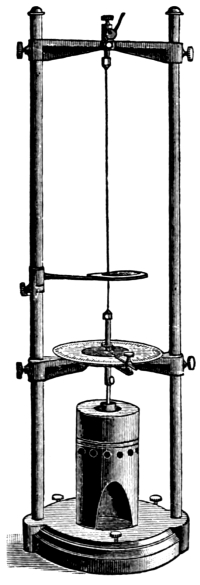
Fig. 95.—
Doolittle’s
Viscosimeter.
It is important that the height of the oil in the cylinders from which
it is delivered be kept constant, and this is secured by supplying
additional quantities, on the principle of the mariotte bottle.
306. The Torsion Viscosimeter.—In this laboratory the torsion
viscosimeter, based on the principle described by Babcock is used.
The instrument employed is the one described by Doolittle.[256]
The construction of the apparatus is illustrated in Fig. 95.
A steel wire is suspended from a firm support and fastened to a stem
which passes through a graduated horizontal disk, thus permitting the
accurate measurement of the torsion of the wire. The disk is adjusted
so that the index point reads exactly 0, thus showing that there
is no torsion in the wire. A brass cylinder seven centimeters long by
five in diameter, having a slender stem by which to suspend it, is
immersed in the oil and fastened by a thumbscrew to the lower part of
the stem of the disk. The oil cup is surrounded by a bath of water or
high fire-test oil, according to the temperature at which it is desired
to determine the viscosity. This temperature obtained, while the disk
is resting on its supports, the wire is twisted 360° by rotating the
milled head at the top. The disk being released, the cylinder rotates
in the oil by virtue of the torsion of the wire.
The action now observed is identical with that of the simple pendulum.
If there were no resistance to be overcome, the disk would return to
0, and the momentum thus acquired would carry it 360° in the opposite
direction. But the resistance of the oil to the rotation of the
cylinder causes the revolution to fall short of 360°, and the greater
the viscosity of the oil the greater will be the resistance, and also
the retardation. This retardation is found to be a very delicate
measure of the viscosity of the oil.
This retardation may be read in a number of ways, but the simplest
is to read directly the number of degrees of retardation between the
first and second complete arcs covered by the rotating pendulum. For
example, suppose the wire be twisted 360° and the disk released so that
rotation begins. In order to obtain an absolute reading to start from,
which shall be independent of any slight error in adjustment, ignore
the starting point and make the first reading of the index at the end
of the first swing. The disk is allowed to complete a vibration and
the needle is read again at its nearest approach to the first point
read. The difference in the two readings will measure the retardation
due to the viscosity of the liquid. In order to eliminate errors
duplicate determinations are made, the milled head being rotated in an
opposite direction in the second one. The mean of the two readings will
represent the true retardation. Each instrument is standardized in a
solution of pure cane sugar, as proposed by Babcock, and the viscosity,
in each case, is a number representing the number of grams of sugar in
100 cubic centimeters, which, at 22°, would produce the retardation noted.
Each instrument is accompanied by a table which contains the necessary
corrections for it and the number expressing the viscosity,
corresponding to the different degrees of retardation, as read on the
index. The following numbers, representing the viscosity of some oils
as determined by the method of Doolittle, were obtained by Krug.[257]
| Peanut |
oil |
48.50 |
| Olive |
” |
53.00 |
| Cottonseed |
” |
46.25 |
| Linseed |
” |
33.50 |
307. Microscopic Appearance.—When fats are allowed to slowly
crystallize from an ethereal solution they may afford crystalline
forms, which, when examined with a magnifying glass, yield valuable
indications of the nature and origin of the substance under
examination.[258]
The method of securing fat crystals for microscopic examination, which
has been used in this laboratory, is as follows: From two to five
grams of the fat are placed in a test tube and dissolved in from ten
to twenty cubic centimeters of ether. The tube is loosely stoppered
with cotton and allowed to stand, for fifteen hours or longer, in a
moderately warm room where no sudden changes of temperature are likely
to take place. It is advisable to prepare several solutions of the same
substance with varying properties of solvent, for it is not possible
to secure in a given instance those conditions which produce the most
characteristic crystals. The rate and time of the crystallization
should be such that the microscopic examination can take place when
only a small portion of the fat has separated in a crystalline
condition. A drop of the mass containing the crystals is removed by
means of a pipette, placed on a slide, a drop of cotton or olive
oil added, a cover glass gently pressed down on the mixture and the
preparation subjected to microscopic examination. Several slides should
be prepared from the same or different crystallizations. Sometimes the
results of an examination made in this way are very definite, but the
analyst must be warned not to expect definite data in all cases. Often
the microscopic investigations result in the production of negative or
misleading observations, and, at best, this method of procedure must be
regarded only as helpful and confirmatory.
A modification of the method of preparation described above has been
suggested by Gladding.[259]
About five grams of the melted fat are placed in a small erlenmeyer,
dissolved in a mixture of ten cubic centimeters of absolute alcohol
mixed with half that quantity of ether. The flask is stoppered with
a plug of cotton and allowed to stand in a cool place for about half
an hour. By this treatment the more easily crystallizable portions of
the fat separate in a crystalline form, while the triolein and its
nearly related glycerids remain in solution. The crystalline product is
separated by filtration through paper wet with alcohol and washed once
with the solvent mentioned above. After drying in the air for some time
the crystals are removed from the paper and dissolved in twenty-five
cubic centimeters of ether, the cotton plug inserted, and the
erlenmeyer placed, in a standing position, in a large beaker containing
water. The water jacket prevents any sudden changes of temperature and
affords an opportunity for the uniform evaporation of the ether which
should continue for fifteen hours or longer in a cool place.
Other solvents, viz., alcohol, chloroform, carbon disulfid,
carbon tetrachlorid, petroleum and petroleum ether have been
extensively used in the preparation of fat crystals for microscopic
examination, but in our experience none of these is equal to ether when
used as already described.
308. Microscopic Appearance of Crystals of Fats.—For an
extended study and illustration of the characteristics of fat crystals
the bulletin of the Division of Chemistry, already cited, may be
consulted. In the case of lard, there is a tendency, more or less
pronounced, to form prismatic crystals with rhombic ends. Beef fat on
the other hand shows a tendency to form fan-shaped crystals in which
the radii are often curved.
Typical crystals of swine and beef fat are shown in the accompanying
figures, 96 and 97.[260]
In mixtures of swine and beef fats the typical crystals are not always
developed, but in most cases the fan-shaped crystals of the beef fat
will appear more or less modified when that fat forms twenty per cent
or more of the mixture. When only five or ten per cent of the beef fat
on the one hand or a like amount of swine fat on the other are present
the expectation of developing any characteristic crystals of the
minimum constituent is not likely to be realized.
The typical crystals of lard are thought by some experts to be palmitin
and those of beef fat stearin, but no direct evidence has been adduced
in support of these a priori theories.
In the experience of this laboratory, as described by Crampton,[261]
the differences between the typical crystallization of beef and swine
fats are plainly shown. In mixed fats, on the contrary, confusing
observations are often made. In a mixture of ten per cent of beef
and ninety per cent of swine fats a uniform kind of crystallization
is observed, not distinctly typical, but the characteristics of the
lard crystals predominate. In many cases a positive identification
of the crystals is only made possible by repeated crystallizations.
In the examination of so-called refined lards, which are mixtures of
lard and beef fat, the form of aggregation of the crystals is found
to resemble the fan-shaped typical forms of beef fat. When the single
crystals, however, are examined with a higher magnifying power, they
are not found to be pointed but blunt, and some present the appearance
of plates with oblique terminations, but not so characteristic as
those obtained from pure lard. In other cases in compound lards no
beef fat crystals are observed and these lards may have been made
partly of cotton oil stearin. When a lard crystal presents its edge
to observation it may readily escape identification, or may even be
mistaken for a crystal of beef fat. In order to insure a side view the
cover glass should be pressed down with a slight rotatory movement,
whereby some of the lard crystals at least may be made to present a
side view.
309. Observation of Fat Crystals with Polarized Light.—The
appearance of fat crystals, when observed by means of polarized light
alone or with the adjunct of a selenite plate, is often of value in
distinguishing the nature and origin of the sample.[262]
Every fat and oil which is amorphous will present the same set of
phenomena when observed with polarized light through a selenite plate,
but when a fat has been melted and allowed to cool slowly the field of
vision will appear mottled and particolored when thus examined. This
method has been largely used in the technical examination of butter for
adulterants, and the microscope is extensively employed by the chemists
of the Bureau of Internal Revenue for this purpose. In the examination
of the crystals of butter fat by polarized light a cross is usually
observed when the nicols are turned at the proper angle, but the cross,
while almost uniformly seen with butter, is not distinctive, since
other fats often show it. These forms of crystals are best obtained by
heating the butter fat to the boiling-point of water for about a minute
and then allowing it to slowly solidify, and stand for twenty-four hours.
Pure butter, properly made, is never subjected to fusion, and hence,
when examined through a selenite plate, presents a uniform field of
vision similarly illuminated and tinted throughout. In oleomargarin,
the fats are sometimes, during their preparation, in a fused condition.
The field of vision is therefore filled to a greater or less extent
with crystals more or less perfect in form. Some of these crystals,
being doubly refracting, will impart to a selenite field a mottled
appearance. Such a phenomenon is therefore indicative of a fraudulent
butter or of one which has been at some time subjected to a temperature
at or above its fusing point.
310. Spectroscopic Examination of Oils.—The presence of
chlorophyll or of its alteration products is a characteristic of crude
oils of vegetable origin. In refined oils, even when of a vegetable
origin, all traces of the chlorophyll products may disappear. The
absorption bands given by oils are not all alike and in doubtful cases
a suspected sample should be compared with one of known origin.
In conducting the examination, the oil in a glass vessel with parallel
sides, is placed in front of the slit of the spectroscope and any
absorption band is located by means of the common divided scale and by
the color of the spectrum on which it falls. Olive and linseed oils
give three sharply defined absorption bands, a very dark one in the
red, a faint one on the orange and a well marked one in the green.
Sesame, arachis, poppyseed and cottonseed oils also show absorption
bands. Castor and almond oils do not affect the spectrum.
Fig. 96.
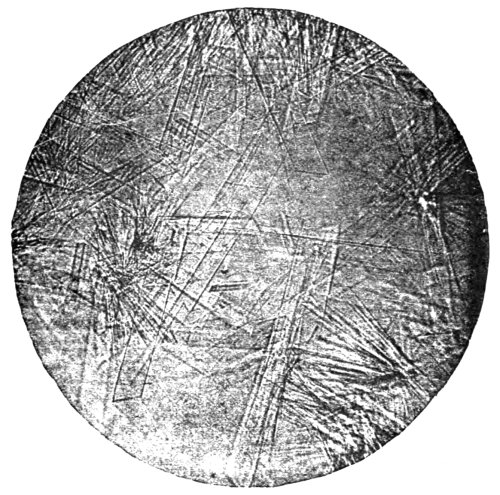
Lard Crystals × 65.
Fig. 97.
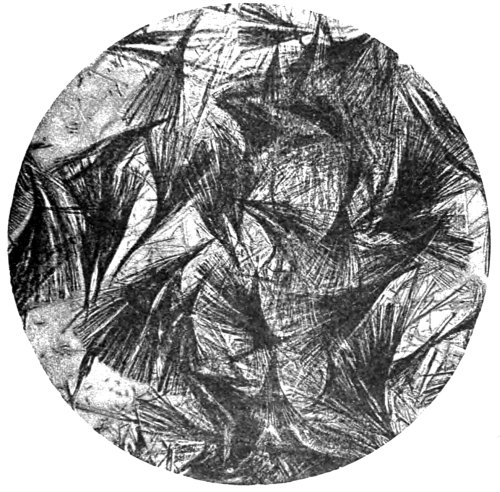
Refined Lard (beef fat) Crystals × 65.
A. Hoen & Co., Lithocaustic.
Rape and flaxseed oils absorb a part of the spectrum but do not affect
the rest of it. The spectroscope is of little practical utility in oil
analysis.[263]
311. Critical Temperature of Solution.—The study of the
critical temperature of solution of oils has been made by Crismer,
who finds it of value in analytical work.[264]
If a fatty substance be heated under pressure, with a solvent, e.
g., alcohol, it will be noticed that as the temperature rises the
meniscus of separation of the two liquids tends to become a horizontal
plane. If at this point the contents of the tube be thoroughly mixed
by shaking and then be left at rest, a point will soon be reached at
which the two liquids again separate, and this point is distinctly a
function of temperature. Following is a description of a convenient
method of determining the critical temperature of the solution of fats
and oils for experimental purposes. Tubes are prepared for holding the
reagents in such a way that, after the introduction of the fat and
alcohol, they can be easily sealed. The capacity of these tubes should
be about five cubic centimeters. They should be charged with about one
cubic centimeter of the dry filtered fat and about twice that quantity
of ninety-five per cent alcohol. Care should be exercised to avoid
touching the upper sides of the tube with the reagents. When charged
the tubes are sealed in the flame of a lamp and attached to the bulb of
a delicate thermometer in such a manner as to have the surface of its
liquid contents even with the top of the bulb. The tube is conveniently
fastened to the thermometer by a platinum wire. For duplicate
determinations two tubes may be fastened to the same thermometric bulb.
The apparatus thus prepared is placed in a large vessel filled with
strong sulfuric acid. The operator should be careful to protect himself
from the danger which might arise from an explosion of the sealed tubes
during heating. It is advisable in all cases to observe the reaction
through a large pane of clear glass. The bath of sulfuric acid is
heated by any convenient means and an even temperature throughout the
mass is secured by stirring with the thermometer and its attachments.
When the meniscus which separates the two liquids becomes a horizontal
plane the thermometer is removed and the liquid in the tubes well mixed
until it appear homogeneous. The thermometer is replaced in the bath,
which is allowed to cool slowly, and the phenomena which take place
in the sealed tubes are carefully noted. The critical temperature
of solution is that at which the two liquids begin to separate.
This moment is easily noted. It is, moreover, preceded by a similar
phenomenon taking place in the capillary part of the tube which retains
a drop of the mixture on shaking. In this droplet an opalescence
is first noted. In the mass of the liquid this opalescence, a few
seconds afterwards, is observed to permeate the whole, followed by the
formation of zones and finally of the reappearance of the meniscus of
separation between the two liquids. The temperature at this moment of
opalescence preceding the separation of the liquid is the critical
temperature of solution. With alcohol of 0.8195 specific gravity, at
15°.5 (ninety-five per cent), the observed critical temperatures for
some of the more common fats and oils are as given below:
| Butter fat |
100°.0 |
| Oleomargarin |
125°.0 |
| Peanut |
oil |
123°.0 |
| Cotton |
” |
116°.0 |
| Olive |
” |
123°.0 |
| Sesamé |
” |
121°.0 |
| Colza |
” |
132°.5 |
| Mutton tallow |
116°.0 |
| Beef marrow |
125°.0 |
| Nut oil |
100°.5 |
When the alcohol is not pure or if it be of a different density from
that named, the numbers expressing the critical temperature of solution
will vary from those given above.
312. Polarization.—The pure glycerids are generally neutral to
polarized light. In oils the degree of polarization obtained is often
variable, sometimes to the right and sometimes to the left. Olive oil,
as a rule, shows a slight right hand polarization. Peanut, sesamé, and
cottonseed oils vary in polarizing power, but in no case is it very
marked. Castor oil polarizes slightly to the right.
In determining the polarizing power of an oil it should be obtained in
a perfectly limpid state by filtration and observed through a tube of
convenient length, as a rule, 200 millimeters. The deviation obtained
may be expressed in divisions of the sugar scale of the instrument or
in degrees of angular rotation.
313. Turbidity Temperature.—The turbidity temperature of a
fat, when dissolved in glacial acetic acid, as suggested by Valenta,
may prove of some diagnostic value.[265]
The fats are dissolved, with the aid of heat, in glacial acetic acid
and, on slowly cooling, the temperature at which they become turbid is
observed. The following data observed by Jones are given for
comparison.[266]
The numbers represent the turbidity temperature of the fat when treated
with the glacial acetic acid, and allowed to cool slowly. Butter fat,
from 40° to 70°, mostly from 52° to 65°; oleomargarin, 95° to 106°;
rape oil, 101°; sesamé oil, 77°; linseed oil, 53° to 57°; lard oil,
96°; olive oil, 89°; peanut oil, 61° to 88°.
It is important in this test that the acetic acid be absolutely
glacial. About three cubic centimeters of the glacial acetic acid, and
three of the fat, should be used.
314. Solubility in Alcohol.—As has already been noted, the
glycerids are freely soluble in ether, chloroform, carbon bisulfid,
acetone, carbon tetrachlorid, and some other less commonly used
solvents. Their solubility in absolute alcohol is variable and the
determination of its degree may often be useful in analytical work.
The method used by Milliau for determining the degree of solubility
is as follows:[267]
The fatty matter is deprived of its free acids by shaking for half
an hour with twice its volume of ninety-five per cent alcohol. After
standing until the liquids are separated, the oil or fat is drawn off
and washed three times with distilled water. The sample is deprived
of water by filtering through a hot jacket filter and a given weight
of the dry sample is well shaken with twice its weight of absolute
alcohol. A weighed portion of the alcoholic solution obtained is
evaporated to remove the alcohol and the weight of the residual fat
determined. From the data obtained the percentage of solubility is
calculated. Olive oils, when treated as described above, show a
solubility of about forty-three parts per thousand of absolute alcohol,
cotton oil sixty-two parts, sesamé forty-one parts, peanut sixty-six
parts, colza twenty parts, and flaxseed seventy parts per thousand.
315. Coloration Produced by Oxidants.—When oils and fats are
mixed with oxidizing reagents, such as sulfuric and nitric acids, the
glycerids are partly decomposed with the production of colors which
have some analytical significance. The most simple method of applying
these tests is by the use of a thick porcelain plate provided with
small cup-shaped depressions for holding the few drops of material
required. Two or three drops of the oil under examination are placed
in each of the cups, a like quantity of the oxidizing reagent added,
and the mixture stirred with a small glass rod. The colors produced
are carefully noted and the mixture is allowed to remain at room
temperature for at least twelve hours in order that the final tint may
be observed. The sulfuric acid used for this reaction should have a
specific gravity of one and seven-tenths and the nitric acid should
have the usual commercial strength of the strongest acid. Pure lard,
when treated with sulfuric acid, as above described, shows but little
change of color while the vegetable oils mostly turn brown or black. In
addition to the reagents mentioned many others, including sulfuric and
nitric acids, sulfuric acid and potassium bichromate, chlorin, ammonia,
hydrogen peroxid, sodium hydroxid and aqua regia are used. Only a few
of these tests seem to have sufficient analytical importance to merit
any detailed description.[268]
316. Coloration in Large Masses.—Instead of applying the color
test in the small way just described, larger quantities of the fat may
be used, either in the natural state or after solution in petroleum
or other solvent. For this purpose about ten cubic centimeters of
the oil are shaken with a few drops of sulfuric acid or sulfuric and
nitric acids. Lard, when thus treated (five drops of sulfuric acid to
ten cubic centimeters of lard) shows practically no coloration. When
treated with an equal volume of sulfuric acid and shaken, the lard on
separating has a brown-red tint.[269]
Olive oil, with a few drops of sulfuric acid, gives a green color,
while cottonseed, peanut and other vegetable oils, when thus treated
with sulfuric and nitric acids, show brown to black coloration. The
delicacy of the reaction may be increased by first dissolving the fat
or oil in petroleum ether.
In the use of the coloration test with solvents, a convenient method
is to dissolve about one cubic centimeter of the fat in a test tube in
petroleum ether, add one drop of strong sulfuric acid and shake.
In the case of lard, the color does not change or becomes yellow
or red. Cottonseed oil, similarly treated, shows a brown or black
color.[270]
317. Special Nitric Acid Test.—A special nitric acid test for
cottonseed oil is made with nitric acid of exactly 1.375 specific
gravity at 15°. This test is especially valuable in detecting
cottonseed in olive oil. The operation is conveniently conducted by
shaking together equal volumes of the oil and acid in a test tube until
an intimate mixture or emulsion is secured. When any considerable
quantity of cottonseed oil is present an immediate brown coloration
is produced, from the intensity of which the relative proportion of
cottonseed oil in the case of a mixture may be roughly approximated.
When only a little cottonseed oil is present in the mixture, the test
tube containing the reagents should be set aside for several hours
before the final observation is made.
318. Coloration with Phosphomolybdic Acid.—Among the color
tests, one which we have found of use is the coloration produced in
certain oils, mostly of a vegetable origin, by phosphomolybdic
acid.[271]
The method of applying the test is extremely simple. A few cubic
centimeters of the oil or melted lard are dissolved in an equal volume
of chloroform, and a third volume of ten per cent phosphomolybdic acid
added. The mouth of the test tube is closed with the thumb, and the
whole is violently shaken. On being left in repose, the phosphomolybdic
acid gathers at the top, and the coloration produced therein is easily
observed. Cottonseed oil and peanut oil both give a beautiful green when
treated in this way, which is turned to a blue on the addition of
ammonia. Linseed oil gives a green color, but forms a kind of emulsion
which obscures the color to some extent. The pure lards rendered in
the laboratory give no coloration whatever to the reagent, but it
retains its beautiful amber color in every case. Mixtures containing
as little as ten per cent cottonseed oil and ninety per cent lard,
show a distinct greenish tint, while twenty per cent cottonseed oil
gives a distinct green. This reaction, therefore, may be considered
of great value, and on account of its easy application it should come
into wide use. But it is probable that different samples of cottonseed
oil, refined to different degrees or in different ways, vary in their
deportment with phosphomolybdic acid as they do with silver nitrate. In
other words, there may be some samples of cottonseed oil which will not
give the green color when treated as above, or so faintly as to have no
diagnostic value in mixtures.
This reaction shows itself with nearly all vegetable oils but those
which have been chemically treated either for the purpose of bleaching,
or for the removal of the acidity, do not respond to the test at all,
or else in a feeble manner, and that only after standing some time.
Lard, goose fat, tallow, deer fat, butter fat, etc., show no change in
color on being treated with this reagent, either with or without the
addition of alkali. The presence of a small quantity of vegetable oil
betrays itself by the appearance of the above mentioned coloration,
the intensity of which forms an approximate measure of the amount of
vegetable oil present in the sample. In experiments with suspected
lards, which deviated in their iodin absorption numbers from those of
genuine lard, the results were concordant, the color deepening as the
iodin figure rose. The mineral fats (paraffin, vaselin) are without
action on this reagent, and the only animal fat which reduces it is
codliver oil.
In like manner some samples of lard may be found which exhibit a
deportment with this reagent similar to that shown with vegetable oils,
and tallow and lard oil have been shown to give more distinct reactions
than some of the vegetable oils.[272]
The phosphomolybdic acid may be prepared by precipitating a solution of
ammonium molybdate with sodium phosphate and dissolving the washed
precipitate in a warm solution of sodium carbonate. The solution is
evaporated to dryness and the dry residue subjected to heat. If a blue
coloration be produced it may be discharged by adding a little nitric
acid and reheating. The residue is dissolved in water, acidified with
nitric and made of such a strength as to contain about ten per cent of
the substance.
319. Coloration with Picric Acid.—If to ten cubic centimeters
of oil a cold saturated solution of picric acid in ether be added and
the latter be allowed to evaporate slowly, the acid remains dissolved
in the oil, to which it communicates a brown color.
Pure lard, after the evaporation of the ether, appears of a
citron-yellow color; if cottonseed oil be present, however, the mixture
assumes a brown-red color.[273]
320. Coloration with Silver Nitrate.—A modification of Bechi’s
method of reducing silver nitrate, given further on, has been proposed
by Brullé.[274]
The reagent employed consists of twenty-five parts of silver nitrate
in 1,000 parts of alcohol of ninety-five per cent strength. Twelve
cubic centimeters of the oil to be examined and five of the reagent are
placed in a test tube, held in a vessel containing boiling water, and
the ebullition continued for about twenty minutes. At the end of this
time an olive oil, even if it be an impure one, will show a beautiful
green tint. With seed oils the results are quite different. Cotton oil
submitted to this treatment becomes completely black. Peanut oil shows
at first a brown-red coloration and finally a somewhat green tint,
losing its transparency. Sesamé oil is distinguished by a red-brown
tint very pronounced and remaining red. Colza oil takes on a yellowish
green coloration, becomes turbid and is easily distinguished in its
reaction from olive oil. In mixtures of olive oil with the other oils,
any notable proportion of the seed oils can be easily determined by the
above reactions. Natural butter treated with this reagent retains its
primitive color. That containing margarin becomes a brick-red and as
little as five per cent of margarin in butter can be detected by this
test. With ten per cent the tint is very pronounced.
321. Coloration with Stannic Bromid.—This reagent is prepared
by adding dry bromin, drop by drop, to powdered or granulated tin
held in a flask immersed in ice water, until a persistent red color
indicates that the bromin is in excess. In the application of this
reagent three or four drops of it are added successively to a little
less than that quantity of the oil, the mixture well stirred and set
aside for a few minutes. The unsaponifiable matters of castor oil give
a green color when thus treated, sandal wood oil a blood-red color and
cedar oil a purplish color.[275]
322. Coloration with Auric Chlorid.—The use of auric chlorid
for producing colorations in oils and fats was first proposed by
Hirschsohn.[276]
One gram of auric chlorid is dissolved in 200 cubic centimeters of
chloroform and about six drops of this reagent added to five cubic
centimeters of the oil to be tested. In the case of cottonseed oil a
beautiful red color is produced.
I have found that even pure lards give a trace of color sometimes with
this reagent, and therefore the production of a slight red tint cannot
in all cases be regarded as conclusive of the presence of cottonseed
oil.[277]
In general, it may be said that the color reactions with fats and oils
have a certain qualitive and sorting value, and in any doubtful case
they should not be omitted. Their value can only be established by
comparison under identical conditions with a large number of fats and
oils of known purity. The analyst must not depend too confidingly on
the data found in books, but must patiently work out these reactions
for himself.
323. Thermal Reactions.—The measurement of the heat produced
by mixing glycerids with reagents which decompose them or excite other
speedy chemical reactions, gives valuable analytical data. These
measurements may be made in any convenient form of calorimeter. The
containing vessel for the reagents should be made of platinum or some
other good conducting metal not affected by them.
The heat produced is measured in the usual way by the increment in
temperature noted in the mass of water surrounding the containing
vessel. The determination of the heat produced in chemical reactions is
a tedious and delicate operation requiring special forms of apparatus
for different substances. The time element in these operations is
a matter of importance, since it is necessary to work in rooms
subject to slight changes of temperature and to leave the apparatus
for some time at rest, in order to bring it and its contents to a
uniform temperature. For these reasons the more elaborate methods of
calorimetric examination are not well suited to ordinary analytical
work, and the reader is referred to standard works on thermal
chemistry for the details of such operations.[278]
For our purpose here a description of two simple thermal processes,
easily and quickly conducted, will be sufficient, while a description
of the method of determining the heat of combustion of foods will be
given in another place.
324. Heat of Sulfuric Saponification.—Maumené was the first to
utilize the production of heat caused by mixing sulfuric acid with a
fat as an analytical process.[279]
In conducting the process a sulfuric acid of constant strength should
be employed inasmuch as the rise of temperature produced by a strong
acid is much greater than when a weaker acid is employed. The process
is at best only comparative and it is evident that the total rise of
temperature in any given case depends on the strength of the acid, the
character, and purity of the fat or oil, the nature of the apparatus
and its degree of insulation, the method of mixing and the initial
temperature. For this reason the data given by different analysts vary
greatly.[280]
For some of the methods of conducting the operation the reader may
consult the work of Allen, cited above, or other authorities.[281]
In this laboratory the process is conducted as follows:[282]
The initial temperature of the reagents should be a constant one. For
oils 20° is a convenient starting point and for fats about 35°, at
which temperature most of them are soft enough to be easily mixed with
the reagent. The acid employed should be the pure monohydrated form,
specific gravity at 20°, 1.845.
The apparatus used is shown in Fig. 98.
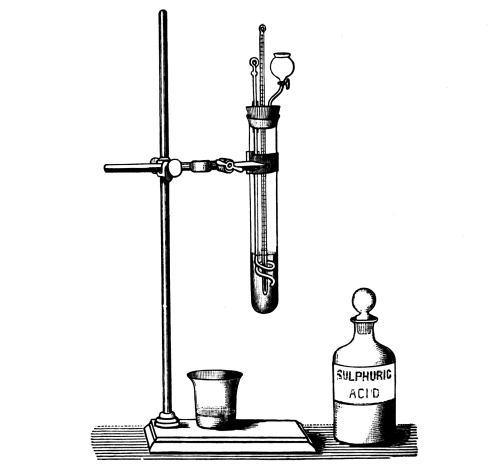
Fig. 98.—Apparatus for Determining Rise
of Temperature with Sulfuric Acid.
The test tube which holds the reagents is twenty-four centimeters in
length and five in diameter. It is provided with a stopper having three
perforations, one for a delicate thermometer, one for a bulb funnel for
delivering the sulfuric acid, and one to guide a stirring rod bent into
a spiral as shown. The thermometer is read with a magnifying glass.
Fifty cubic centimeters of the fat are placed in the test tube and ten
of sulfuric acid in the funnel and the apparatus is exposed at the
temperature desired until all parts of it, together with the reagents,
have reached the same degree. The test tube holding the oil should be
placed in a vacuum-jacket tube, such as will be described in paragraph
316. The oil is allowed to run in as rapidly as possible from
the funnel and the stirring rod is moved up and down two or three times
until the oil and acid are well mixed. Care must be exercised to stir
no more than is necessary for good mixing. The mercury is observed
as it ascends in the tube of the thermometer and its maximum height
is noted. With the glass it is easy to read to tenths, when the
thermometer is graduated in fifths of a degree. When oils are tested
which produce a rise of temperature approaching 100°, in the above
circumstances, (cottonseed, linseed and some others) either smaller
quantities should be used or the oil diluted with some inert substance
or dissolved in some inert solvent of high boiling point. For a study
of the variations produced in the rise of temperature when varying
proportions of oil and acid are used, the work of Munroe may be
consulted.[283]
The thermélaeometer described by Jean is a somewhat complicated piece
of apparatus and does not possess any advantage over the simple form
described above.[284]
Instead of expressing the data obtained in thermal degrees showing the
rise of temperature, Thompson and Ballentyne refer them to the heat
produced in mixing sulfuric acid and water.[285]
The observed thermal degree of the oil and acid divided by that of
the water and acid is termed the specific temperature reaction.
For convenience in writing, this quotient is multiplied by 100.
The respective quantities of acid and water are ten and fifty
cubic centimeters. This method of calculation has the advantage of
eliminating to a certain degree the variations which arise in the use
of sulfuric acid of differing specific gravities. In the following
table are given the comparative data obtained for some common oils.[286]
| |
Acid of 95.4
per cent. |
Acid of 96.8
per cent. |
Acid of 99
per cent. |
| Kind of oil. |
Rise of temp.
with the oil. |
Specific temp.
reaction. |
Rise of temp.
with the oil. |
Specific temp.
reaction. |
Rise of temp.
with the oil. |
Specific temp.
reaction. |
| |
0° |
0° |
0° |
0° |
0° |
0° |
| Olive oil |
36.5 |
95 |
39.4 |
85 |
44.8 |
96 |
| Rapeseed oil |
49.0 |
127 |
37.0 |
89 |
58.0 |
124 |
| Castor oil |
34.0 |
88 |
|
|
|
|
| Linseed oil |
104.5 |
270 |
|
|
125.2 |
269 |
325. Method of Richmond.—The rise of temperature produced by
mixing an oil and sulfuric acid is determined by Richmond in a simple
calorimeter, which is constructed by fitting a small deep beaker inside
a larger one with a packing of cotton. The heat capacity of the system
is determined by adding to ten grams of water, in the inner beaker,
at room temperature, twenty-five grams of water of a noted higher
temperature and observing the temperature of the mixture. The cooling
of the system, during the time required for one determination of heat
of sulfuric saponification, does not exceed one per cent of the whole
number of calories produced.[287]
Between the limits of ninety-two per cent and one hundred per cent the
rise of temperature observed is directly proportional to the strength
of the acid.
Relative Maumené Figure.—The total heat evolved per mean
molecule is called by Richmond the relative maumené figure. It is
calculated as follows:
- Let x = percentage of sulfuric acid in the acid employed;
- h = heat capacity of calorimeter in grams of water;
- R = observed rise of temperature (twenty-five grams of
- oil, five cubic centimeters sulfuric acid);
- K = potash absorbed for saponification (19.5 per cent of
- potassium hydroxid, standard of comparison);
- M = relative maumené figure:
| ThenM = R × |
21.5 |
× |
20 + h |
× |
19.5 |
| x - 78.5 |
20 |
K |
326. Heat of Bromination.—The rise of temperature caused by
mixing fats with sulfuric acid has long been used to discriminate
between different fats and oils. Hehner and Mitchell propose a similar
reaction based upon the rise of temperature produced by mixing bromin
with the sample.[288]
The action of bromin on unsaturated fatty bodies is instantaneous and
is attended with a considerable evolution of heat. Since the action of
bromin on many of the oils is very violent it is necessary to dilute
the reagent with chloroform or glacial acetic acid. Owing to its high
boiling point the acetic acid has some advantage over chloroform for
this purpose. The tests are conveniently made in a vacuum-jacket tube.
In such a tube there is no loss of heat by radiation. The bromin is
measured in a pipette having at its upper end a tube filled with
caustic lime held between plugs of asbestos. The bromin sample to be
tested and the diluent employed are kept at the same temperature before
beginning the trial. They are quickly mixed and the rise of temperature
noted. The oil is first dissolved in the chloroform and the bromin then
added.
A somewhat constant relation is noticed between the rise of temperature
and the iodin number when one gram of oil, ten cubic centimeters of
chloroform and one cubic centimeter of bromin are used.
If the rise in temperature in degrees be multiplied by 5.5 the product
is approximately the iodin number of the sample. Thus a sample of lard
gave a rise in temperature of 10°.6 and an iodin number of 57.15. The
number obtained by multiplying 10.6 by 5.5 is 58.3.
In like manner the numbers obtained for some common oils are as follows:
| Material. |
Rise of
temperature
with bromin. |
Iodin No. |
Calculated
Iodin No. |
| Butter fat |
6.6 |
37.1 |
36.3 |
| Olive oil |
15.0 |
80.8 |
82.5 |
| Maize ” |
21.5 |
122.0 |
118.2 |
| Cotton ” |
19.4 |
107.1 |
106.7 |
| Castor ” |
15.0 |
83.8 |
82.5 |
| Linseed oil |
30.4 |
160.7 |
167.2 |
| Codliver ” |
28.0 |
144.0 |
140.0 |
327. Modification of the Heat of Bromination Method.—The method
described above by Hehner and Mitchell presents many grave difficulties
in manipulation, on account of the inconvenience of handling liquid
bromin. The process is made practicable by dissolving both the oil or
fat and the bromin in chloroform, or better in carbon tetrachlorid, in
which condition the bromin solution is easily handled by means of a
special pipette.[289]
In order to make a number of analyses of the same sample ten grams of
the fat may be dissolved in chloroform or carbon tetrachlorid and the
volume completed with the same solvent to fifty cubic centimeters. In
like manner twenty cubic centimeters of the bromin are dissolved in one
of the solvents named and the volume completed to 100 cubic centimeters
therewith.
For convenience of manipulation the solutions are thus made of such a
strength that five cubic centimeters of each represent one gram of the
fat and one cubic centimeter of the liquid bromin respectively.
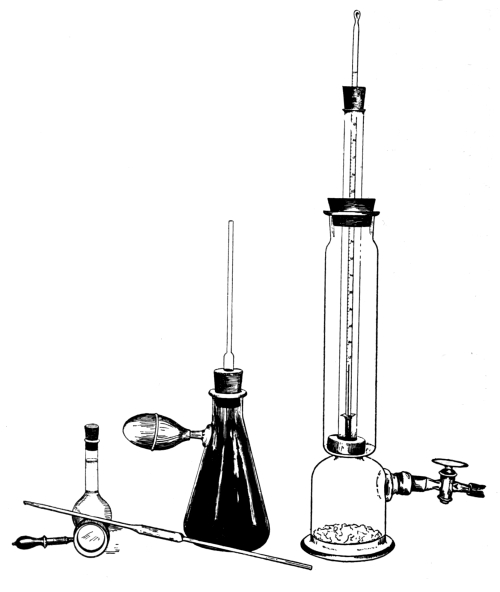
Fig. 99. Apparatus for Determining Heat of Bromination.
The apparatus used for the work is shown in the accompanying figure.
The pipette for handling the bromin solution is so arranged as to be
filled by the pressure of a rubber bulb, thus avoiding the danger of
sucking the bromin vapor into the mouth. The filling is secured by
keeping the bromin solution in a heavy erlenmeyer with a side tubulure
such as is used for filtering under pressure. The solutions are
mixed in a long tube, held in a larger vessel, from which the air is
exhausted to secure a minimum radiation of heat. A delicate thermometer
graduated in tenths serves to register the rise of temperature. The fat
solution is first placed in the test tube, with care not to pour it
down the sides of the tube but to add it by means of a pipette reaching
nearly to the bottom. The whole apparatus having been allowed to come
to a standard temperature the bromin solution is allowed to run in
quickly from the pipette. No stirring is required as the liquids are
sufficiently mixed by the addition of the bromin solution. The mercury
in the thermometer rapidly rises and is read at its maximum point by
means of a magnifying glass. With a thermometer graduated in tenths, it
is easy to read to twentieths of a degree.
It is evident that the rise of temperature obtained depends on
similar conditions to those mentioned in connection with sulfuric
saponification. Each system of apparatus must be carefully calibrated
under standard conditions and when this is done the comparative rise
of temperature obtained with various oils and fats will prove of
great analytical use. It is evident that the ratio of this rise of
temperature to the iodin number must be determined for every system of
apparatus and for every method of manipulation employed, and no fixed
factor can be given that will apply in every case.
With the apparatus above described and with the method of manipulation
given the following data were obtained for the oils mentioned:
| |
Rise of
temperature. |
| Olive oil |
20°.5 |
| Refined cottonseed oil |
25°.7 |
| Sunflowerseed oil |
28°.4 |
| Calycanthusseed oil |
29°.0 |
Bromin and chloroform, when mixed together, give off heat, due to
the chemical reaction resulting from the substitution of bromin for
hydrogen in the chloroform molecule and the formation of hydrobromic
acid. For this reason the data obtained, when chloroform is used as a
solvent, are slightly higher than with carbon tetrachlorid. The use of
the latter reagent is therefore to be preferred.
328. Haloid Addition Numbers.—Many of the glycerids possess the
property of combining directly with the haloids and forming thereby
compounds in which the haloid, by simple addition, has become a part of
the molecule. Olein is a type of this class of unsaturated glycerids.
The process may take place promptly as in the case of bromin or move
slowly as with iodin. The quantity of the haloid absorbed is best
determined in the residual matter and not by an examination of the fat
compound. By reason of the ease with which the amount of free iodin in
solution can be determined, this substance is the one which is commonly
employed in analytical operation on fats.
In general, the principle of the operation depends on bringing the fat
and haloid together in a proper solution and allowing the addition
to take place by simple contact. The quantity of the haloid in the
original solution being known, the amount which remains in solution
after the absorption is complete, deducted from that originally
present, will give the quantity which has entered into combination with
the glycerid.
329. Hübl’s Process.—In determining the quantity of iodin
which will combine with a fat, the method first proposed by Hübl,
or some modification thereof, is universally employed.[290]
In the determination of the iodin number of a glycerid it is important that
it be accomplished under set conditions and that iodid be always present
in large excess. It is only when data are obtained in the way noted
that they can be regarded as useful for comparison and determination.
Many modifications of Hübl’s process have been proposed, but it is
manifestly impracticable to give even a summary of them here. As
practiced in the chemical laboratory of the Agricultural Department and
by the Association of Official Agricultural Chemists, it is carried out
as follows:[291]
(a). Iodin Solution.—Dissolve twenty-five grams of pure
iodin in 500 cubic centimeters of ninety-five per cent alcohol.
Dissolve thirty grams of mercuric chlorid in 500 cubic centimeters of
ninety-five per cent alcohol. The latter solution, if necessary, is
filtered, and then the two solutions mixed. The mixed solution should
be allowed to stand twelve hours before using.
(b). Decinormal Sodium Thiosulfate Solution.—Dissolve
24.8 grams of chemically pure sodium thiosulfate, freshly pulverized
as finely as possible and dried between filter or blotting paper,
and dilute with water to one liter, at the temperature at which the
titrations are to be made.
(c). Starch Paste.—One gram of starch is boiled in 200
cubic centimeters of distilled water for ten minutes and cooled to room
temperature.
(d). Solution of Potassium Iodid.—One hundred and fifty
grams of potassium iodid are dissolved in water and the volume made up
to one liter.
(e). Solution of Potassium Bichromate.—Dissolve 3.874
grams of chemically pure potassium bichromate in distilled water
and make the volume up to one liter at the temperature at which the
titrations are to be made.
(a). Standardizing the Sodium Thiosulfate
Solution.—Place twenty cubic centimeters of the potassium
bichromate solution, to which have been added ten cubic centimeters of
the solution of potassium iodid, in a glass stopper flask. Add to this
mixture five cubic centimeters of strong hydrochloric acid. Allow the
solution of sodium thiosulfate to flow slowly into the flask until the
yellow color of the liquid has almost disappeared. Add a few drops of
the starch paste, and with constant shaking continue to add the sodium
thiosulfate solution until the blue color just disappears. The number
of cubic centimeters of thiosulfate solution used multiplied by five is
equivalent to one gram of iodin.
Example.—Twenty cubic centimeters of
potassium bichromate solution required 16.2 sodium thiosulfate; then
16.2 × 5 = 81 = number cubic centimeters of thiosulfate solution
equivalent to one gram of iodin. Then one cubic centimeter thiosulfate
solution = 0.0124 gram of iodin: (Theory for decinormal solution of
sodium thiosulfate, one cubic centimeter = 0.0127 gram of iodin.)
(b). Weighing the Sample.—About one gram of butter
fat is placed in a glass stopper flask, holding about 300 cubic
centimeters, with the precautions to be mentioned for weighing the fat
for determining volatile acids.
(c). Absorption of Iodin.—The fat in the flask is
dissolved in ten cubic centimeters of chloroform. After complete
solution has taken place thirty cubic centimeters of the iodin solution
(1) (a) are added. The flask is now placed in a dark place and
allowed to stand, with occasional shaking, for three hours.
(d). Titration of the Unabsorbed Iodin.—One hundred
cubic centimeters of distilled water are added to the contents of the
flask, together with twenty cubic centimeters of the potassium iodid
solution. Any iodin which may be noticed upon the stopper of the flask
should be washed back into the flask with the potassium iodid solution.
The excess of iodin is taken up with the sodium thiosulfate solution,
which is run in gradually, with constant shaking, until the yellow
color of the solution has almost disappeared. A few drops of starch
paste are added, and the titration continued until the blue color
has entirely disappeared. Toward the end of the reaction the flask
should be stoppered and violently shaken, so that any iodin remaining
in solution in the chloroform may be taken up by the potassium iodid
solution in the water. A sufficient quantity of sodium thiosulfate
solution should be added to prevent a reappearance of any blue color in
the flask for five minutes.
(e). Setting the Value of the Iodin Solution by the
Thiosulfate Solution.—At the time of adding the iodin solution
to the fat, two flasks of the same size as those used for the
determination should be employed for conducting the operation described
above, but without the presence of any fat. In every other respect the
performance of the blank experiments should be just as described. These
blank experiments must be made each time the iodin solution is used.
Example of Blank Determinations.—Thirty cubic centimeters of
iodin solution required 46.4 cubic centimeters of sodium thiosulfate
solution: Thirty cubic centimeters of iodin solution required 46.8
cubic centimeters of sodium thiosulfate solution: Mean, 46.6 cubic
centimeters.
| Weight of fat |
1.0479 |
grams |
|
| Quantity of iodin solution used |
30.0 |
cubic |
centimeters |
| Thiosulfate equivalent to iodin used |
46.6 |
” |
” |
| Thiosulfate equivalent to remaining iodin |
14.7 |
” |
” |
| Thiosulfate equivalent to iodin absorbed |
31.9 |
” |
” |
| Percent of iodin absorbed, 31.9 × 0.0124 × 100 ÷ 1.0479 = 37.75. |
330. Character of Chemical Reaction.—The exact nature of
the chemical process which takes place in this reaction is not
definitely known. Hübl supposed that the products formed were
chloro-iodid-additive compounds, and he obtained a greasy product from
oleic acid, to which he ascribed the formula C₁₈H₃₄IClO₂. By others it
is thought that chlorin alone may be added to the molecule.[292]
In general, it may be said that none of the glycerids capable
of absorbing halogens is able to take on a quantity equivalent
to theory.[293]
While the saturated fatty acids (stearic series) theoretically are not
able to absorb iodin some of them are found to do so to a small degree.
It is evident, therefore, that it is not possible to calculate the
percentage of unsaturated glycerids in a fat from their iodin number
alone. According to the data worked out by Schweitzer and Lungwitz both
addition and substitution of iodin take place during the reaction.[294]
This fact they determined by titration with potassium iodate and iodid
according to the formula 5HI + HIO₃ = 6I + 6H₂O. The authors
confess that whenever free hydriodic acid is found in the mixture that
iodin substitution has taken place and that for each atom of hydrogen
eliminated from the fat molecule two atoms of iodin disappear, one as
the substitute and the other in the form of hydriodic acid. When carbon
bisulfid or tetrachlorid is used as a solvent no substitution takes
place and pure additive compounds are formed.
The following process is recommended to secure a pure iodin addition to
a glycerid: About one gram or a little less of the oil or fat is placed
in a glass stopper flask, to which are added about seven-tenths of a
gram of powdered mercuric chlorid and twenty-five cubic centimeters of
a solution of iodin in carbon bisulfid. The stopper is made tight by
smearing it with powdered potassium iodid, tied down, and the mixture
is heated for some time under pressure. By this method it is found that
no hydriodic acid is formed, and hence all the iodin which disappears
is added to the molecule of the glycerid. The additive numbers obtained
for some oils are appended:
| Oil. |
Time of
heating. |
Temperature. |
Per cent
iodin added. |
Per cent
hübl number. |
| Lard oil |
30 minutes. |
50°.0 |
73.0 |
78.4 |
| Cottonseed oil |
2 hours. |
50°.0 |
103.0 |
106.5 |
| Oleic acid |
2 ” |
65°.5 |
93.8 |
|
331. Solution in Carbon Tetrachlorid.—Gantter has called
attention to the fact that the amount of iodin absorbed by fat does
not depend alone upon the proportion of iodin present but also upon
the amount of mercuric chlorid in the solution.[295]
Increasing amounts of mercuric chlorid cause uniformly a much greater
absorption of the iodin. For this reason he proposes to discard the use
of mercuric chlorid altogether for the hübl test and to use a solvent
which will at the same time dissolve both the iodin and the fat. For
this purpose he uses carbon tetrachlorid. The solutions are prepared as
follows:
Iodin Solution.—Ten grams of iodin are dissolved in one liter
of carbon tetrachlorid.
In the preparation of this solution the iodin must not be thrown
directly into the flask before the addition of the tetrachlorid. Iodin
dissolves very slowly in carbon tetrachlorid and the solution is made
by placing it in a sufficiently large weighing glass and adding a
portion of the carbon tetrachlorid thereto. The solution is facilitated
by stirring with a glass rod until the added tetrachlorid is apparently
charged with the dissolved iodin. The dissolved portion is then poured
into a liter flask, new portions added to the iodin and this process
continued until the iodin is completely dissolved, and then sufficient
additional quantities of the tetrachlorid are added to fill the flask
up to the mark.
332. Sodium Thiosulfate Solution.—Dissolve 19.528 grams of pure
sodium thiosulfate in 1000 cubic centimeters of water. For determining
the strength of the solution by titration, the solution of iodin in
carbon tetrachlorid and a solution of sodium thiosulfate in water are
each placed in a burette. A given volume of the iodin solution is
first run into a flask with a glass stopper and afterward the sodium
thiosulfate added little by little until, after a vigorous shaking,
the liquid has only a little color. Some solution of starch is then
added and shaken until the mixture becomes deep blue. The sodium
thiosulfate solution is added drop by drop, with vigorous shaking after
each addition, until the solution is completely decolorized. If both
solutions have been correctly made with pure materials they will be of
equal strength; that is, ten cubic centimeters of the iodin solution
will be exactly decolorized by ten cubic centimeters of the sodium
thiosulfate solution.
333. Method of Conducting the Absorption.—The quantity of the
fat or oil employed should range from 100 to 200 milligrams, according
to the absorption equivalent. These quantities should be placed in
flasks with glass stoppers in the ordinary way. In the flasks are
placed exactly fifty cubic centimeters of the iodin solution equivalent
to 500 milligrams of iodin, and the flask is then stoppered and shaken
until the fat or oil is completely dissolved. In order to avoid the
volatilization of the iodin finally, sufficient water is poured into
the flask to form a layer about one millimeter in thickness over the
solution containing the iodin and fat. The stopper should be carefully
inserted and the flask allowed to stand at rest for fifty hours.
334. Estimation of the Iodin Number.—This is determined in the
usual way by titration of the amount of iodin left in excess after the
absorption as above described. The iodin number is to be expressed
by the number of milligrams of iodin which are absorbed by each 100
milligrams of fat.
Example.—One hundred and one milligrams of flaxseed oil were
dissolved in fifty cubic centimeters of the carbon tetrachlorid
solution of iodin and allowed to stand as above described for fifty
hours. At the end of this time, 42.3 cubic centimeters of the sodium
thiosulfate solution were required to decolorize the excess of iodin
remaining.
Statement of Results.—Fifty cubic centimeters of the sodium
thiosulfate equal 500 milligrams of iodin; therefore, 42.3 cubic
centimeters of the thiosulfate solution equal 423 milligrams of iodin.
The difference equals seventy-seven milligrams of iodin absorbed by 101
milligrams of the flaxseed oil. Therefore, the iodin number equivalent
and the milligrams of iodin absorbed by 100 milligrams of flaxseed oil
equal 76.2.
It is evident from the above determination that the iodin number of
the oil, when obtained in the manner described, is less than half that
secured by the usual hübl process. Since the solvent employed, however,
is more stable than chloroform when in contact with iodin or bromin,
the proposed variation is one worthy of the careful attention of
analysts.
McIlhiney has called especial attention to the low numbers given by the
method of Gantter, and from a study of the data obtained concludes that
iodin alone will not saturate glycerids, no matter what the solvents
may be.[296]
It is clear, therefore, that the process of Gantter cannot give numbers
which are comparable with those obtained by the usual iodin method. Any
comparative value possessed by the data given by the process of Gantter
must be derived by confining it to the numbers secured by the carbon
tetrachlorid process alone.
335. Substitution of Iodin Monochlorid for Hübl’s
Reagent.—Ephraim has shown that iodin monochlorid may be
conveniently substituted for the hübl reagent with the advantage
that it can be safely used at once, while the hübl reagent undergoes
somewhat rapid changes when first prepared. The present disadvantage of
the process is found in the fact that the iodin monochlorid of commerce
is not quite pure and each new lot requires to be titrated for the
determination of its purity.
The reagent is prepared of such a strength as to contain 16.25 grams of
iodin monochlorid per liter. The solvent used is alcohol. The operation
is carried out precisely as in the hübl method, substituting the
alcoholic solution of iodin monochlorid for the iodin reagent proposed
by Hübl.[297]
If the iodin monochlorid solution, after acting on the oil, be titrated
without previous addition of potassium iodid a new value is obtained,
the chloriodin number. In titrating, the sodium thiosulfate is added
until the liquid, which is made brown by the separated iodin, becomes
yellow. At this point the solution is diluted, starch paste added, and
the titration completed.
336. Preservation of the Hübl Reagent.—To avoid the trouble due
to changes in the strength of Hübl’s reagent, Mahle adds hydrochloric
acid to it at the time of its preparation.[298]
The reagent is prepared as follows: Twenty-five grams of iodin
dissolved in a quarter of a liter of ninety-five per cent alcohol
are mixed with the same quantity of mercuric chlorid in 200 cubic
centimeters of alcohol, the same weight of hydrochloric acid of 1.19
specific gravity added and the volume of the mixture completed to
half a liter with alcohol. After five days such a solution gave, on
titration, 49.18 instead of 49.31 grams per liter of iodin.
It will be observed that this solution is double the usual strength,
but this does not influence the accuracy of the analytical data
obtained. It appears that the hübl number is not, therefore, an iodin
number, but expresses the total quantity of iodin, chlorin and oxygen
absorbed by the fat during the progress of the reaction.
337. Bromin Addition Number.—In the process of Hübl and others
an attempt is made to determine the quantity of a halogen, e.g.,
iodin, which the oil, fat or resin will absorb under certain
conditions. The numbers obtained, however, represent this absorption
only approximately, because the halogen may disappear through
substitution as well as absorption. Whether or not a halogen is added,
i. e., absorbed or substituted, may be determined experimentally.
The principle on which the determination depends rests on the fact that
a halogen, e. g., bromin, forms a molecule of hydrobromic acid
for every atom of bromin substituted, while in a simple absorption
of the halogen no such action takes place. If, therefore, bromin be
brought into contact with a fat, oil or resin, the determination of the
quantity of hydrobromic acid formed will rigidly determine the quantity
of bromin substituted during the reaction. If this quantity be deducted
from the total bromin which has disappeared, the relative quantities of
the halogen added and substituted are at once determined. In the method
of McIlhiney[299]
bromin is used instead of iodin because the addition figures of iodin
are in general much too low.
The Reagents.—The following solutions are employed:
1. One-third normal bromin dissolved in carbon tetrachlorid:
2. One-tenth normal sodium thiosulfate:
3. One-tenth normal potassium hydroxid.
The Manipulation.—From a quarter to one gram of the fat, oil
or resin, is dissolved in ten cubic centimeters of carbon tetrachlorid
in a dry bottle of 500 cubic centimeters capacity, provided with a
well-ground glass stopper. An excess of the bromin solution is added,
the bottle tightly stoppered, well shaken and placed in the dark. At
the end of eighteen hours the bottle is placed in a freezing mixture
and cooled until a partial vacuum is formed. A piece of wide rubber
tubing an inch and a half long is slipped over the lip of the bottle so
as to form a well about the stopper. This well having been filled with
water the stopper is lifted and the water is sucked into the bottle
absorbing all the hydrobromic acid which has been formed. The well
should be kept filled with water, as it is gradually taken in until in
all twenty-five cubic centimeters have been added. The bottle is next
well shaken and from ten to twenty cubic centimeters of a twenty per
cent potassium iodid solution added.
The excess of bromin liberates a corresponding amount of iodin, which
is determined by the thiosulfate solution in the usual way, after
adding about seventy-five cubic centimeters of water. The total bromin
which has disappeared is then calculated from the data obtained,
the strength of the original bromin solution having been previously
determined. The contents of the bottle are next transferred to a
separatory funnel, the aqueous portion separated, filtered through a
linen filter, a few drops of thiosulfate solution added, if a blue
color persist, and the free hydrobromic acid determined by titration
with potassium hydroxid, using methyl orange as indicator. The end
reaction is best observed by placing the solution in a porcelain
dish, adding the alkali in slight excess, and titrating back with
tenth-normal hydrochloric acid until the pink tint is perceived.
From the number of cubic centimeters of alkali used the amount of
bromin present as hydrobromic acid is calculated, and this expressed
as percentage gives the bromin substitution figure. The bromin
substitution figure multiplied by two and subtracted from the total
absorption gives the addition figure.
Following are the data for some common substances:
| Substance. |
Total bromin
absorption in
eighteen hours. |
Bromin
addition
figure. |
Bromin
substitution
figure. |
| Rosin |
212.70 |
0.00 |
106.35 |
| Raw |
linseed |
oil |
102.88 |
102.88 |
00.00 |
| Boiled |
” |
” |
103.92 |
103.92 |
00.00 |
| Salad |
cotton |
” |
65.54 |
64.26 |
0.64 |
| Sperm |
|
” |
56.60 |
54.52 |
1.04 |
By the process just described it is possible to detect mixtures of
rosins and rosin oils with animal and vegetable oils. In this respect
it possesses undoubted advantages over the older methods.
338. Method Of Hehner.—The absorption of bromin which takes
place when unsaturated fats are brought into contact with that reagent
was made the basis of an analytical process, proposed by Allen as
long ago as 1880.[300]
In the further study of the phenomena of bromin absorption, as
indicated by McIlhiney, Hehner modified the method as indicated
below.[301]
From one to three grams of the sample are placed in a tared
wide-mouthed flask and dissolved in a little chloroform. Bromin is
added to the solution, drop by drop, until it is in decided excess.
The flask is placed on a steam-bath and heated until the greater
part of the bromin is evaporated, when some more chloroform is added
and the heating continued until all the free bromin has escaped. The
flask is put in a bath at 125° and dried to constant weight. A little
acrolein and hydrobromic acid escape during the drying and the residue
may be colored, or a heavy bromo oil be obtained. The gain in weight
represents the bromin absorbed. The bromin number may be converted into
the iodin number by multiplying by 1.5875.[302]
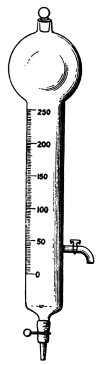
Fig. 100.—
Olein
Tube.
339. Halogen Absorption and Addition of Fat Acids.—Instead of
employing the natural glycerids for determining the degree of action
with the halogens the acids may be separated by some of the processes
of saponification hereafter described and used as directed for the
glycerids themselves. It is doubtful if any practical advantage arises
from this variation of the process. If the fat acids be separated,
however, it is possible to get some valuable data from the halogen
absorption of the fractions. Theoretically the stearic series of acids
would suffer no change in contact with halogens while the oleic series
is capable of a maximum absorptive and additive action. On this fact is
based a variation of the iodin process in which an attempt is made to
separate the oleic acid from its congeners and to apply the halogen to
the separated product.
The method of separation devised by Muter is carried out as
follows:[303]
The separatory or olein tube consists of a wide burette stem, provided
with a lateral stopcock, and drawn out below to secure a clamp delivery
tube, and at the top expanded into a bulb closed with a ground glass
stopper, as shown in Fig. 100. Forty cubic centimeters
of liquid are placed in the tube and the surface is marked 0. Above this the
graduation is continued in cubic centimeters to 250, which figure is
just below the bulb at the top.
The process of analysis is conducted as follows: About three grams of
the oil or fat are placed in a flask, with fifty cubic centimeters of
alcoholic potash lye, containing enough potassium hydroxid to ensure
complete saponification. The flask is closed and heated on a water-bath
until saponification is complete. The pressure flask to be described
hereafter may be conveniently used. After cooling, the excess of alkali
is neutralized with acetic acid in presence of phenolphthalien and then
alcoholic potash added until a faint pink color is produced. In a large
porcelain dish place 200 cubic centimeters of water and thirty of a ten
per cent solution of lead acetate and boil. Pour slowly, with constant
stirring, into the boiling liquid the soap solution prepared as above
described, and allow to cool, meanwhile continuing the stirring. At the
end, the liquid remaining is poured off and the solid residue washed
with hot water by decantation.
The precipitate of lead salts is finally removed from the dish into a
stoppered bottle, the dish washed with pure ether, the washings added
to the bottle together with enough ether to make the total volume
thereof 120 cubic centimeters. The closed bottle is allowed to stand
for twelve hours with occasional shaking, by which time the lead oleate
will have been completely dissolved. The insoluble lead salts are next
separated by filtration, and the filtrate collected in the olein tube.
The washing is accomplished by ether and, to avoid loss, the funnel
is covered with a glass plate. The ethereal solution of lead oleate
is decomposed by dilute hydrochloric acid, using about forty cubic
centimeters of a mixture containing one part of strong acid to four
of water. The olein tube is closed and shaken until the decomposition
is complete, which will be indicated by the clearing of the ethereal
solution. The tube is allowed to remain at rest until the liquids
separate and the aqueous solution is run out from the pinch-cock at the
lower end. The residue is washed with water by shaking, the water drawn
off as just described, and the process continued until all acidity is
removed.
Water is then added until the separating plane between the two liquids
is at the zero of the graduation, and enough ether added to make the
ethereal solution of a desired volume, say 200 cubic centimeters.
After well mixing, the ethereal solution or an aliquot part thereof,
e.g., fifty cubic centimeters, is removed by the side tubulure
and nearly the whole of the ether removed from the portion by
distillation. To the residue are added fifty cubic centimeters of pure
alcohol and the solution is titrated for oleic acid with decinormal
sodium hydroxid solution. Each cubic centimeter of the hydroxid
solution used is equivalent to 0.0282 gram of oleic acid. The total
quantity of oleic acid contained in the amount of fat used is readily
calculated from the data obtained.
To determine the iodin absorption of the free acid another measured
quantity of the ethereal solution containing as nearly as possible half
a gram of oleic acid, is withdrawn from the olein tube, and the ether
removed in an atmosphere of pure carbon dioxid. To the residue, without
allowing it to come in contact with the air, fifty cubic centimeters
of Hübl’s reagent are added and the flask put aside in the dark for
twelve hours. At the end of this time thirty-five cubic centimeters of
a ten per cent solution of potassium iodid are added, the contents of
the flask made up to a quarter of a liter with water, fifteen cubic
centimeters of chloroform added, and the excess of iodin titrated
in the way already described. The percentage of iodin absorbed is
calculated as already indicated.
Lane has proposed a more rapid process for the above determination.[304]
The lead soaps are precipitated in a large erlenmeyer and cooled
rapidly in water, giving the flask meanwhile a circular motion which
causes the soaps to adhere to its walls. Wash with hot water, rinsing
once with alcohol, add 120 cubic centimeters of ether, attach a reflux
condenser, and boil until the lead oleate is dissolved, cool slowly, to
allow any lead stearate which has passed into solution to separate, and
filter into the olein tube. The rest of the operation is conducted as
described above. The percentage of oleic acid and its iodin absorption
in the following glycerids are given in the table below:
| |
Cottonseed
oil. |
Lard. |
Peanut oil. |
| Per cent oleic acid |
75.16 |
64.15 |
79.84 |
| Per cent iodin absorbed |
141.96 |
99.48 |
114.00 |
340. Saponification.—In many of the analytical operations which
are conducted on the glycerids it is necessary to decompose them.
When this is accomplished by the action of a base which displaces
the glycerol from its combination with the fat acids, the resulting
salts are known as soaps and the process is named saponification. In
general use the term saponification is applied, not only strictly, as
above defined, but also broadly, including the setting free of the
glycerol either by the action of strong acids or by the application
of superheated steam. In chemical processes the saponification of a
glycerid is almost always accomplished by means of soda or potash
lye. This may be in aqueous or alcoholic solution and the process is
accomplished either hot or cold, in open vessels or under pressure.
It is only important that the alkali and glycerid be brought into
intimate contact. The rate of saponification is a function of the
intimacy of contact, the nature of the solvent and the temperature. For
chemical purposes, it is best that the decomposition of the glycerid be
accomplished at a low temperature and for most samples this is secured
by dissolving the alkali in alcohol.
In respect of solvents, that one would be most desirable, from
theoretical considerations, which acts on both the glycerids and
alkalies. In the next rank would be those which dissolve one or the
other of the materials and are easily miscible, as, for instance,
carbon tetrachlorid for the glycerid and alcohol for the alkali.
As a rule, the glycerid is not brought into solution before the
saponification process is commenced. Instead of using an alcoholic
solution of sodium or potassium hydroxid the sodium or potassium
alcoholate may be employed, made by dissolving metallic sodium or
potassium in alcohol. It is probable, however, that a little water is
always necessary to complete the process.
If a fat be dissolved in ether and treated with sodium alcoholate,
a granular deposit of soap is soon formed and the saponification is
completed in twenty-four hours. As much as 150 grams of fat can be
saponified with ten grams of metallic sodium dissolved in 250 cubic
centimeters of absolute alcohol.[305]
For practical purposes the alcoholic solution of the hydroxid is sufficient.
The chemical changes which fats undergo on saponification are of a
simple kind. When the process is accomplished by means of alkalies,
the alkaline base takes the place of the glycerol as indicated in the
following equation:
| Triolein 884. |
|
Potassium
hydroxid 168. |
|
| C₃H₅(O.C₁₈H₃₃O)₃ |
+ |
3KOH |
= |
| |
Potassium
oleate 960. |
|
Glycerol 92. |
|
| (KO.C₁₈H₃₃O)₃ |
+ |
C₃H₅(OH)₃. |
|
The actual changes which take place in ordinary saponification are
not so simple, however, since natural glycerids are mixtures of
several widely differing fats, each of which has its own rate of
decomposition. Palmitin and stearin, for instance, are saponified more
readily than olein and some of the saponifiable constituents of resins
and waxes are extremely resistant to the action of alkalies. The above
equation may be regarded as typical for saponification in aqueous or
alcoholic solutions in open dishes or under pressure. If the alkali
used be prepared by dissolving metallic sodium or potassium in absolute
alcohol (sodium alcoholate or ethoxid) the reaction which takes place
is probably represented by the equation given below:
C₃H₅(O.C₁₈H₃₃O)₃ + 3C₂H₅.ONa = C₃H₅(ONa)₃ + 3C₁₈H₃₃O.O.C₂H₅,
in which it is seen that complete saponification
cannot occur without the absorption of some water, by which the sodium
glyceroxid is converted into glycerol and sodium hydroxid, the latter
compound eventually uniting with the ethyl ether of the fat acid.[306]
Glycerids are decomposed when heated with water under a pressure of
about sixteen atmospheres or when subjected to a current of superheated
steam at 200°. The reaction consists in the addition of the elements
of water, whereby the glyceryl radicle is converted into free glycerol
and the fat acid is set free. The chemical change which ensues is shown
below:
C₃H₅(O.C₁₈H₃₃O)₃ + 3H₂O = 3C₁₈H₃₄O₂ + C₃H₅(OH)₃.
The details of saponification with sulfuric acid are of no interest
from an analytical point of view.[307]
341. Saponification in an Open Dish.—The simplest method of
saponifying fats is to treat them with the alkaline reagent in an
open dish. In all cases the process is accelerated by the application
of heat. Vigorous stirring also aids the process by securing a more
intimate mixture of the ingredients. This method of decomposing
glycerids, however, is not applicable in cases where volatile ethers
may be developed. These ethers may escape saponification and thus
prevent the formation of the maximum quantity of soap. While not suited
to exact quantitive work, the method is convenient in the preparation
of fat acids which are to be the basis of subsequent analytical
operations, as, for instance, in the preparation of fat acids for
testing with silver nitrate. Large porcelain dishes are conveniently
used and the heat is applied in any usual way, with care to avoid
scorching the fat.
342. Saponification under Pressure.—The method of
saponification which has given the best satisfaction in my work and
which has been adopted by the Association of Official Agricultural
Chemists is described below.[308]
Reagents.—The reagents employed are a solution of pure potash
containing 100 grams of the hydroxid dissolved in fifty-eight grams of
recently boiled distilled water, alcohol of approximately ninety-five
per cent strength redistilled over caustic soda, and sodium hydroxid
solution prepared as follows:
One hundred grams of sodium hydroxid are dissolved in 100 cubic
centimeters of distilled water. The caustic soda should be as free as
possible from carbonates, and be preserved from contact with the air.
Apparatus.—A saponification flask; it has a round bottom and a
ring near the top, by means of which the stopper can be tied down. The
flask is arranged for heating as shown in Fig. 101.
A pipette graduated to deliver forty cubic centimeters is recommended
as being more convenient than a burette for measuring the solutions: A
pipette with a long stem graduated to deliver 5.75 cubic centimeters at 50°.
Manipulation.—The fat to be examined should be melted and kept
in a dry warm place at about 60° for two or three hours, until the
water has entirely separated. The clear supernatant fat is poured off
and filtered through a dry filter paper in a jacket funnel containing
boiling water. Should the filtered fat, in a fused state, not be
perfectly clear, it must be filtered a second time. The final drying is
accomplished at 100° in a thin layer in a flat bottom dish, in partial
vacuum or an atmosphere of inert gas.
The saponification flasks are prepared by thoroughly washing with
water, alcohol, and ether, wiping perfectly dry on the outside,
and heating for one hour at the temperature of boiling water. The
hard flasks used in moist combustions with sulfuric acid for the
determination of nitrogen are well suited for this work. The flasks
should be placed in a tray by the side of the balance and covered with
a silk handkerchief until they are perfectly cool. They must not be
wiped with a silk handkerchief within fifteen or twenty minutes of the
time they are weighed or else the electricity developed will interfere
with weighing. The weight of the flasks having been accurately
determined, they are charged with the melted fat in the following way:
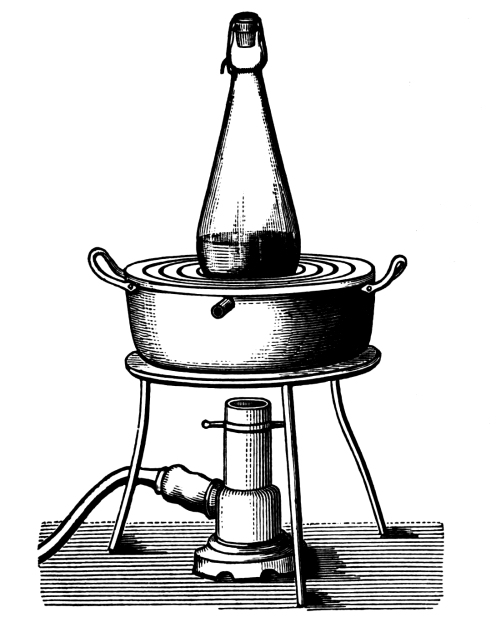
Fig. 101.—Apparatus for Saponifying under Pressure.
The pipette with a long stem, marked to deliver 5.75 cubic centimeters,
is warmed to a temperature of about 50°. The fat, having been poured
back and forth once or twice into a dry beaker in order to thoroughly
mix it, is taken up in the pipette, the nozzle of the pipette having
been previously wiped to remove any externally adhering fat, is carried
to near the bottom of the flask and 5.75 cubic centimeters of fat
allowed to flow into the flask. After the flasks have been charged in
this way they should be re-covered with the silk handkerchief and allowed
to stand for fifteen or twenty minutes, when they are again weighed.
343. Methods of Saponification.—In the Presence of
Alcohol.—Ten cubic centimeters of ninety-five per cent alcohol
are added to the fat in the flask, and then two cubic centimeters of
the sodium hydroxid solution. A soft cork stopper is inserted and
tied down with a piece of twine. The saponification is completed by
placing the flask upon the water or steam-bath. The flask during the
saponification, which should last one hour, should be gently rotated
from time to time, being careful not to project the soap for any
distance up its sides. At the end of an hour the flask, after having
been cooled to near the room temperature, is opened.
Without the Use of Alcohol.—To avoid the danger of loss from
the formation of ethers, and the trouble of removing the alcohol
after saponification, the fat may be saponified with a solution of
caustic potash in a closed flask without using alcohol. The operation
is carried on exactly as indicated above for saponification in the
presence of alcohol, using potassium instead of sodium hydroxid
solution. For the saponification, use two cubic centimeters of the
potassium hydroxid solution which are poured on the fat after it has
solidified in the flask. Great care must be taken that none of the
fat be allowed to rise on the sides of the saponifying flask to a
point where it cannot be reached by the alkali. During the process of
saponification the flask can only be very gently rotated in order to
avoid the difficulty mentioned. This process is not recommended with
any apparatus except a closed flask with round bottom. Potash is used
instead of soda so as to form a softer soap and thus allow a more
perfect saponification.
The saponification may also be conducted as follows: The alkali and fat
in the melted state are shaken vigorously in the saponification flask
until a complete emulsion is secured. The rest of the operation is then
conducted as above.
344. Saponification in the Cold.—By reason of the danger of
loss from volatile ethers in the hot alcoholic saponification, a method
for successfully conducting the operation in the cold is desirable.
Such a process has been worked out by Henriques.[309]
It is based upon the previous solution of the fat in petroleum ether,
in which condition it is so easily attacked by the alcoholic alkali
as to make the use of heat during the saponification unnecessary. The
process is conveniently conducted in a porcelain dish covered with a
watch glass. Five grams of the fat are dissolved in twenty-five cubic
centimeters of petroleum ether and treated with an equal quantity
of four per cent alcoholic soda lye. The process of saponification
begins at once and is often indicated by the separation of sodium
salts. It is best to allow the action to continue over night and,
with certain difficultly saponifiable bodies, such as wool fat and
waxes, for twenty-four hours. In the case of butter fat an odor of
butyric ether may be perceived at first but it soon disappears. After
the saponification is complete, the excess of alkali is determined
by titration in the usual way with set hydrochloric acid, using
phenolphthalien as indicator. For the determination of volatile acids,
the mixture, after saponification is complete, is evaporated rapidly
to dryness, the solid matter being reduced to powder with a glass
rod, after which it is transferred to a distilling flask and the
volatile acids secured by the usual processes. In comparison with the
saponification and reichert-meissl numbers obtained with hot alcoholic
potash, the numbers given by the cold process are found to be slightly
higher with those fats which give easily volatile ethers. On account of
the simplicity of the process and the absence of danger of loss from
ethers, it is to be recommended instead of the older methods in case
a more extended trial of it should establish the points of excellence
claimed above.
345. Saponification Value.—The number of milligrams of
potassium hydroxid required to completely saturate one gram of a fat
is known as the saponification value of the glycerid. The process of
determining this value, as worked out by Koettstorfer and modified in
the laboratory of the Department of Agriculture, is as
follows:[310]
The saponification is accomplished with the aid of potassium hydroxid
and in the flask and manner described in the preceding paragraph. About
two grams of the fat will be found a convenient quantity. Great care
must be exercised in measuring the alkaline solution, the same pipette
being used in each case and the same time for draining being allowed in
every instance. Blanks are always to be conducted with each series of
examinations. As soon as the saponification is complete, the flask is
removed from the bath, allowed to cool and its contents are titrated
with seminormal hydrochloric acid and phenolphthalien as indicator.
The number expressing the saponification value is obtained by
subtracting the number of cubic centimeters of seminormal hydrochloric
acid required to neutralize the alkali after saponification from
that required to neutralize the alkali of the blank determinations,
multiplying the result by 28.06 and dividing the product by the number
of grams of fat employed.
Example.—Weight of sample of fat used 1.532 grams: Number of
cubic centimeters half normal hydrochloric acid required to saturate
blank, 22.5: Number of cubic centimeters of half normal hydrochloric
acid required to saturate the alkali after saponification 12.0:
Difference, 10.5 cubic centimeters:
Then 10.50 × 28.06 ÷ 1.532 = 192.3.
This latter number represents the saponification value of the sample.
346. Saponification Equivalent.—Allen defines the
saponification equivalent as the number of grams of fat saponified by
one equivalent, viz., 56.1 grams of potassium hydroxid.[311]
The saponification equivalent is readily calculated from the saponification
value using it as a divisor and 56100 as a dividend. Conversely
the saponification value may be obtained by dividing 56100 by the
saponification equivalent. No advantage is gained by the introduction
of a new term so nearly related to saponification value.
347. Saponification Value of Pure Glycerids.—The theoretical
saponification values of pure glycerids are given in the following
table.[312]
| Name. |
Symbol. |
Molecular
weight. |
Saponification
value. |
| Butyrin |
C₃H₅(O.C₄H₇O)₃ |
302 |
557.3 |
| Valerin |
C₃H₅(O.C₅H₉O)₃ |
344 |
489.2 |
| Caproin |
C₃H₅(O.C₆H₁₁O)₃ |
386 |
438.3 |
| Caprin |
C₃H₅(O.C₁₀H₁₉O)₃ |
554 |
305.0 |
| Laurin |
C₃H₅(O.C₁₂H₂₃O)₃ |
638 |
263.8 |
| Myristin |
C₃H₅(O.C₁₄H₂₇O)₃ |
722 |
233.1 |
| Palmitin |
C₃H₃(O.C₁₆H₃₁O)₃ |
806 |
208.8 |
| Stearin |
C₃H₅(O.C₁₈H₃₅O)₃ |
890 |
189.1 |
| Olein |
C₃H₅(O.C₁₈H₃₃O)₃ |
884 |
190.4 |
| Linolein |
C₃H₅(O.C₁₈H₃₁O)₃ |
878 |
191.7 |
| Ricinolein |
C₃H₅(O.C₁₈H₃₃O₂)₃ |
932 |
180.6 |
| Euricin |
C₃H₅(O.C₂₂H₁₄O)₃ |
1052 |
160.0 |
From the above table it is seen that in each series of glycerids the
saponification equivalent falls as the molecular weight rises.
348. Acetyl Value.—Hydroxy acids and alcohols, when heated with
glacial acetic acid, undergo a change which consists in substituting
the radicle of acetic acid for the hydrogen atom of the alcoholic
hydroxyl group. This change is illustrated by the equations below:[313]
For a Fat Acid:
| Ricinoleic acid. |
|
Acetic anhydrid. |
|
| C₁₇H₃₂(OH).COOH |
+ |
(C₂H₃O)₂O |
= |
| |
| Acetyl-ricinoleic acid. |
|
Acetic acid. |
|
| C₁₇H₃₂(O.C₂H₃O)COOH |
+ |
HC₂H₃O₂. |
|
For an Alcohol:
| Cetyl alcohol. |
|
Acetic anhydrid. |
|
| C₁₆H₃₃.OH |
+ |
(C₂H₃O)₂O |
= |
| |
| Cetyl acetate. |
|
Acetic acid. |
|
| C₁₆H₃₃.C₂H₃O |
+ |
HC₂H₃O₂. |
|
Determination.—The method of determining the acetyl value
of a fat or alcohol has been described by Benedikt and Ulzer.[314]
The operation is conducted on the fat acids and not on the glycerids
containing them.
The insoluble fat acids are prepared as directed in paragraph
340.
From twenty to fifty grams of the fat acids are boiled with an equal
volume of acetic anhydrid, in a flask with a reflux condenser, for two
hours. The contents of the flask are transferred to a larger vessel of
about one liter capacity, mixed with half a liter of water and boiled
for half an hour. To prevent bumping, some bubbles of carbon dioxid
are drawn through the liquid by means of a tube drawn out to a fine
point and extending nearly to the bottom of the flask. The liquids
are allowed to separate into two layers and the water is removed with
a syphon. The oily matters are treated several times with boiling
water until the acetic acid is all washed out. The acetylated fat
acids are filtered through a dry hot jacket filter and an aliquot
part, from three to five grams, is dissolved in absolute alcohol.
After the addition of phenolphthalien the mixture is titrated as in
the determination of the saponification value. The acid value thus
obtained is designated as the acetyl acid value. A measured quantity
of alcoholic potash, standardized by seminormal hydrochloric acid,
is added, the mixture boiled and the excess of alkali determined by
titration. The quantity of alkali consumed in this process measures the
acetyl value. The sum of the acetyl acid and the acetyl values is the
acetyl saponification value. The acetyl value is therefore equal to
the difference of the saponification and acid values of the acetylated
fat acids. In other words, the acetyl value indicates the number of
milligrams of potassium hydroxid required to neutralize the acetic acid
obtained by the saponification of one gram of the acetylated fat acids.
Example.—A portion of the fat acids acetylated as described,
weighing 3.379 grams, is exactly neutralized by 17.2 cubic centimeters
of seminormal potassium hydroxid solution, corresponding to 17.2 ×
0.02805 = 0.4825 gram of the hydroxid, hence 0.4825 × 1000 ÷ 3.379 =
142.8, the acetyl acid value of the sample.
After the addition of 32.8 cubic centimeters more of the seminormal
potash solution, the mixture is boiled to saponify the acetylated
fat acids. The residual potash requires 14.2 cubic centimeters of
seminormal hydrochloric acid. The quantity of potash required for
the acetic acid is therefore 32.8 - 14.3 = 18.5 cubic centimeters or
18.5 × 0.02805 = 0.5189 gram of potassium hydroxid. Then 0.5189 ×
1000 ÷ 3.379 = 153.6 = acetyl value of sample. The sum of these two
values, viz., 142.8 and 153.6 is 296.4, which is the acetyl
saponification value of the sample. As with the iodin numbers, however,
it is also found that acids of the oleic series give an acetyl value
when treated as above, and it has been proposed by Lewkowitsch to
determine, in lieu of the data obtained, the actual quantity of acetic
acid absorbed by fats.[315]
This is accomplished by saponifying the acetylated product with
alcoholic potash and determining the free acetic acid by distillation,
in a manner entirely analogous to that used for estimating volatile fat
acids described further on.
The rôle which the acetyl value plays in analytical determinations is
interesting, but the data it gives are not to be valued too highly.
349. Determination of Volatile Fat Acids.—The fat acids which
are volatile at the temperature of boiling water, consist chiefly of
butyric and its associated acids occurring in the secretions of the
mammary glands. Among vegetable glycerids cocoanut oil is the only
common one which has any notable content of volatile acids. The boiling
points of the above acids, in a pure state, are much higher than the
temperature of boiling water; for instance, butyric acid boils at about
162°. By the expression volatile acids, in analytical practice, is
meant those which are carried over at 100°, or a little above, with
the water vapor, whatever be their boiling point. The great difficulty
of removing the volatile from the non-volatile fat acids has prevented
the formulation of any method whereby a sharp and complete separation
can be accomplished. The analyst, at the present time, must be content
with some approximate process which, under like conditions, will give
comparable results. Instead, therefore, of attempting a definite
determination, he confines his work to securing a partial separation
and in expressing the degree of volatile acidity in terms of a standard
alkali. To this end, a definite weight of the fat is saponified, the
resulting soap decomposed with an excess of fixed acid, and a definite
volume of distillate collected and its acidity determined by titration
with decinormal alkali. The weight of fat operated on is either two and
a half[316]
or five grams.[317]
Numerous minor variations have been proposed in the process, the most
important of which is in the use of phosphoric instead of sulfuric acid
in the distillation. An extended experience with both acids has shown
that no danger is to be apprehended in the use of sulfuric acid and
that on the whole it is to be preferred to phosphoric.[318]
The process as used in this laboratory and as adopted by the official
agricultural chemists is conducted as follows:[319]
350. Removal of the Alcohol.—The saponification is accomplished
in the manner already described, (341-344) and when alcoholic
potash is used proceed as follows:
The stopper having been laid loosely in the mouth of the flask, the
alcohol is removed by dipping the flask into a steam-bath. The steam
should cover the whole of the flask except the neck. After the alcohol
is nearly removed, frothing may be noticed in the soap, and to avoid
any loss from this cause or any creeping of the soap up the sides of
the flask, it should be removed from the bath and shaken to and fro
until the frothing disappears. The last traces of alcohol vapor may be
removed from the flask by waving it briskly, mouth down, to and fro.
Dissolving the Soap.—After the removal of the alcohol the
soap should be dissolved by adding 100 cubic centimeters of recently
boiled distilled water, or eighty cubic centimeters when aqueous
potassium hydroxid has been used for saponification, and warming on the
steam-bath, with occasional shaking, until the solution of the soap is
complete.
Setting free the Fat Acids.—When the soap solution has cooled
to about 60° or 70°, the fat acids are separated by adding forty cubic
centimeters of dilute sulfuric acid solution containing twenty-five
grams of acid in one liter, or sixty cubic centimeters when aqueous
potassium hydroxid has been used for saponification.
Melting the Fat Acid Emulsion.—The flask is restoppered as in
the first instance and the fat acid emulsion melted by replacing the
flask on the steam-bath. According to the nature of the fat examined,
the time required for the fusion of the fatty acid emulsions may vary
from a few minutes to several hours.
The Distillation.—After the fat acids are completely melted,
which can be determined by their forming a transparent, oily layer on
the surface of the water, the flask is cooled to room temperature,
and a few pieces of pumice stone added. The pumice stone is prepared
by throwing it, at a white heat, into distilled water, and keeping it
under water until used. The flask is connected with a glass condenser,
Fig. 102, slowly heated with a naked flame
until ebullition begins, and then the distillation continued by
regulating the flame in such a way as to collect 110 cubic centimeters
of the distillate in, as nearly as possible, thirty minutes. The
distillate should be received in a flask accurately marked at 110 cubic
centimeters.
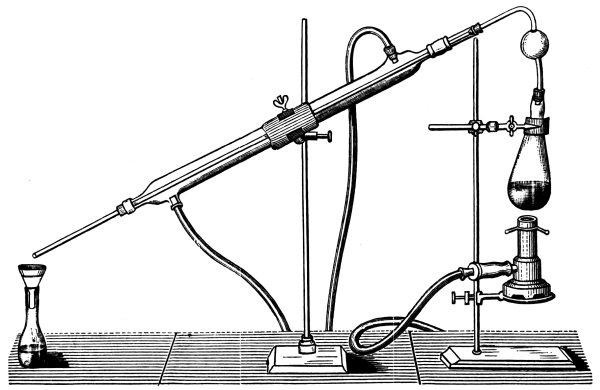
Fig. 102.—Apparatus for the Distillation of Volatile Acids.
Titration of the Volatile Acids.—The 110 cubic centimeters
of distillate, after thorough mixing, are filtered through perfectly
dry filter paper, 100 cubic centimeters of the filtered distillate
poured into a beaker holding about a quarter of a liter, half a cubic
centimeter of phenolphthalien solution added and decinormal barium
hydroxid solution run in until a red color is produced. The contents
of the beaker are then returned to the measuring flask to remove any
acid remaining therein, poured again into the beaker, and the titration
continued until the red color produced remains apparently unchanged for
two or three minutes, The number of cubic centimeters of decinormal
barium hydroxid solution required should be increased by one-tenth to
represent the entire distillate.
The number thus obtained expresses, in cubic centimeters of decinormal
alkali solution, the volatile acidity of the sample. In each case
blank distillations of the reagents used should be conducted under
identical conditions, especially when alcoholic alkali is used for
saponification. It is difficult to secure alcohol which will not yield
a trace of volatile acid in the conditions named. The quantity of
decinormal alkali required to neutralize the blank distillate is to be
deducted from that obtained with the sample of fat.
351. Determination of Soluble and Insoluble Fat Acids.—The
volatile fat acids are more or less soluble in water, while those which
are not distillable in a current of steam are quite insoluble. It is
advisable, therefore, to separate these two classes of fat acids, and
the results thus obtained are perhaps more decidedly quantitive than
are given by the distillation process just described. The methods used
for determining the percentage of insoluble acids are essentially those
of Hehner.[320]
Many variations of the process have been proposed, especially in respect
of the soluble acids.[321]
The process, as conducted in this laboratory and approved by the
Association of Official Agricultural Chemists, is as follows:
Preparation of Reagents.—Sodium Hydroxid Solution.—A
decinormal solution of sodium hydroxid is used. Each cubic centimeter
contains 0.0040 gram of sodium hydroxid and neutralizes 0.0088 gram of
butyric acid (C₄H₈O₂).
Alcoholic Potash Solution.—Dissolve forty grams of good caustic
potash in one liter of ninety-five per cent alcohol redistilled over
caustic potash or soda. The solution must be clear and the potassium
hydroxid free from carbonates.
Standard Acid Solution.—Prepare accurately a half normal
solution of hydrochloric acid.
Indicator.—Dissolve one gram of phenolphthalien in 100 cubic
centimeters of ninety-five per cent alcohol.
Determination.—Soluble Acids.—About five grams of the sample
are placed in the saponification flask already described, fifty cubic
centimeters of the alcoholic potash solution added, the flask stoppered
and placed in the steam-bath until the fat is entirely saponified. The
operation may be facilitated by occasional agitation. The alcoholic
potash is always measured with the same pipette and uniformity further
secured by allowing it to drain the same length of time (thirty
seconds). Two or three blank experiments are conducted at the same time.
In from five to thirty minutes, according to the nature of the fat, the
liquid will appear perfectly homogeneous and, when this is the case,
the saponification is complete and the flask is removed and cooled.
When sufficiently cool, the stopper is removed and the contents of
the flask rinsed with a little ninety-five per cent alcohol into an
erlenmeyer, of about 200 cubic centimeters capacity, which is placed on
the steam-bath together with the blanks until the alcohol is evaporated.
The blanks are titrated with half normal hydrochloric acid, using
phenolphthalien as indicator, and one cubic centimeter more of the half
normal hydrochloric acid than is required to neutralize the potash in
the blanks is run into each of the flasks containing the fat acids. The
flask is connected with a reflux condenser and placed on the steam-bath
until the separated fat acids form a clear stratum on the upper surface
of the liquid. The flask and contents are cooled in ice-water.
The fat acids having quite solidified, the liquid contents of the flask
are poured through a dry filter into a liter flask, taking care not
to break the cake. Between 200 and 300 cubic centimeters of water are
brought into the flask, the cork with the condenser reinserted and the
flask placed on the steam-bath until the cake of acid is thoroughly
melted. During the melting of the cake of fat acids, the flask should
occasionally be agitated with a rotary motion in such a way that its
contents are not made to touch the cork. When the fat acids have again
separated into an oily layer, the flask and its contents are cooled
in ice-water and the liquid filtered through the same filter into the
same liter flask as before. This treatment with hot water, followed
by cooling and filtration of the wash water, is repeated three times,
the washings being added to the first filtrate. The mixed washings and
filtrate are made up to one liter, and 100 cubic centimeters
thereof in duplicate are titrated with decinormal sodium hydroxid.
The number of cubic centimeters of sodium hydroxid required for
each 100 cubic centimeters of the filtrate is multiplied by ten.
The number so obtained represents the volume of decinormal sodium
hydroxid neutralized by the soluble fat acids of the fat, plus that
corresponding to the excess of the standard acid used, viz., one
cubic centimeter. The number is therefore to be diminished by five,
corresponding to the excess of one cubic centimeter of half normal
acid. This corrected volume multiplied by 0.0088 gives the weight of
soluble acids as butyric acid in the amount of fat saponified.
Insoluble Acids.—The flask containing the cake of insoluble
fat acids from the above determination and the paper through which the
soluble fat acids have been filtered are allowed to drain and dry for
twelve hours, when the cake, together with as much of the fat acids
as can be removed from the filter paper, is transferred to a weighed
evaporating dish. The funnel, with the filter, is then placed in an
erlenmeyer and the paper thoroughly washed with absolute alcohol. The
flask is rinsed with the washings from the filter paper, then with pure
alcohol, and the rinsings transferred to the evaporating dish. The dish
is placed on the steam-bath until the alcohol is evaporated, dried for
two hours at 100°, cooled in a desiccator and weighed. It is again
placed in the air-bath for two hours, cooled as before and weighed.
If there be any considerable decrease in weight, reheat two hours and
weigh again. The final weighing gives the weight of insoluble fat acids
in the sample, from which the percentage is easily calculated.
The quantity of non-volatile and insoluble acids in common glycerids
is from ninety-five to ninety-seven parts in 100. The glycerids yield
almost the same proportion of fat acids and glycerol when the acids are
insoluble and have high molecular weights. When the acids are soluble
and the molecular weight low the proportion of acids decreases and that
of glycerol increases.
In the following table will be found the data secured by quantitive
saponification and separation of soluble and insoluble acids found in
the more common glycerids:[322]
| |
Molecular weight of |
Yield per 100 parts
of glycerid. |
| Glycerid. |
Fat acid. |
Glycerid. |
Fat acid. |
Fat acid. |
Glycerol. |
| Stearin |
Stearic |
890 |
284 |
95.73 |
10.34 |
| Olein |
Oleic |
884 |
282 |
95.70 |
10.41 |
| Palmitin |
Palmitic |
806 |
256 |
95.28 |
11.42 |
| Myristin |
Myristic |
722 |
228 |
94.47 |
12.74 |
| Laurin |
Lauric |
638 |
200 |
94.95 |
14.42 |
| Caprin |
Capric |
594 |
172 |
93.14 |
15.48 |
| Caproin |
Caproic |
386 |
116 |
90.16 |
23.83 |
| Butyrin |
Butyric |
302 |
88 |
87.41 |
30.46 |
The general expression for the saponification of a neutral fat is
C₃H₅O₃.R₃ + 3H₂O = 3R.OH + C₃H₈O₃, in which R represents the acid
radicle. It is evident from this that the yield of more than 100 parts
of fat acids and glycerol given by glycerids is due to the absorption
of water during the reaction.
352. Formulas for General Calculations.—For calculating the
theoretical yields of fat acids and glycerol, the following general
formulas may be used:
- Let M = the molecular weight of the fat acid:
- K = saponification value:
- F = the quantity of free fat acids in the glycerid:
- N = the quantity of neutral fat in the glycerid:
- A = the number of milligrams of potassium hydroxid required
- to saturate the free acid in one gram of the sample.
-
- The free acid is determined by the method given below.
M grams of a fat acid require 56100 milligrams of potassium
hydroxid for complete neutralization while F grams corresponding
to 100 grams of fat are saturated by 100 × A milligrams of the alkali.
Then M : 56100 = F : 100A.
Likewise since M grams of fat acid require the quantity of
potassium hydroxid mentioned above we have:
1 : K = M : 56100,
Substituting this value of M in (1) we have
| F = |
A × 56100 |
= |
100A |
(3). |
| 561 × K |
561 × K |
It is evident that it is not necessary to calculate the acid value
(A) of the sample and the saponification value (K) of the
free fat acids, the ratio A/K alone being required. It
will be sufficient therefore to substitute for A and K
the number of cubic centimeters of alkali solutions required for
one gram of the fat and one gram of the fat acids, respectively. If
a and b represent these numbers the formula may be written
| and N = 100 - F = |
100a |
(5). |
| b |
To simplify the determinations, it may be assumed that the free fat
acids have the same molecular weight as those still in combination
with the glycerol in any given sample. On this assumption, the
process may be carried on by determining the acid value A and
the saponification value K for the total fat acids. The mean
molecular weight M, the percentage of free fat acids F,
and the proportion of neutral fat N, may then be calculated from
the formulas (2), (3), (4), and (5).
Further, let G = the quantity of glycerol and L that of
fat acids obtainable from one gram of neutral fat, that is, ¹/₁₀₀
of H the percentage of total fat acids.
The molecular weight of the neutral fat in each case is 3M + 38.
Therefore, 3M + 38 parts of neutral fat yield 3M parts of
fat acids and ninety-two parts of glycerol (C₃H₈O₃ = 92).
| Then L = |
H |
= |
3M |
(6); |
| 100 |
3M + 38 |
N per cent of neutral fat yields, therefore, on saponification,
the following theoretical quantities of fat acids F, and
glycerol G expressed as parts per hundred.
| and G = N × |
92 |
(9). |
| 3M + 38 |
Formula (9) expresses also the total yield of glycerol from any given
sample. For a further discussion of this part of the subject a work of
a more technical character may be consulted.[323]
353. Determination of a Free Fat Acid in a Fat.—The principle
of the method rests upon the comparative accuracy with which a free fat
acid can be titrated with a set alkali solution when phenolphthalien
is used as an indicator. Among the many methods of manipulation which
the analyst has at his command there is probably none more simple and
accurate than that depending on the solution of the sample in alcohol,
ether, chloroform, or carbon tetrachlorid. Any acidity of the solvent
is determined by separate titration and the proper correction made.
Either an aqueous or alcoholic solution of the alkali may be used,
preferably the latter. The alkaline solution may be approximately or
exactly decinormal, but it is easier to make it approximately so and
to determine its real value before each operation by titration against
a standard decinormal solution of acid. About ten grams of the sample
and fifty cubic centimeters of the solvent will be found convenient
quantities.
Example.—Ten grams of rancid olive oil dissolved in
alcohol ether require three and eight-tenths cubic centimeters of a
solution of alcoholic potash to saturate the free acid present. When
titrated with decinormal acid the potash solution is found to contain
25.7 milligrams of potassium hydroxid in each cubic centimeter. The
specific gravity of the oil is 0.917 and the weight used therefore 9.17
grams. Then the total quantity of potassium hydroxid required for the
neutralization of the acid is 25.7 × 3.8 = 97.7 milligrams.
The acid value A is therefore:
| A = |
3.8 × 25.7 |
= 10.6 |
| 9.17 |
It is customary to regard free acid as oleic, molecular weight 282. On
this assumption the percentage of free acids in the above case is found
by the formula
| A (per cent) = |
3.8 × 25.7 × 282 |
= 5.35 |
| 561 × 9.17 |
354. Identification of Oils and Fats.—Properly, the methods
of identifying and isolating the different oils and fats should
be looked for in works on food adulteration. There are, however,
many characteristics of these glycerids which can be advantageously
discussed in a work of this kind. Many cases arise in which the analyst
is called upon to determine the nature of a fat and discover whether
it be admixed with other glycerids. It is important often to know in
a given case whether an oil be of animal or vegetable origin. Many of
the methods of analysis already described are found useful in such
discriminations. For instance, a large amount of soluble or volatile
acids in the sample under examination, would indicate the presence
of a fat derived from milk while the form of the crystals in a solid
fat would give a clue to whether it were the product of the ox or the
swine. In the succeeding paragraphs will be briefly outlined some of
the more important additional methods of determining the nature and
origin of fats and oils of which the history is unknown.
The data obtained by means of the methods which have been described,
both physical and chemical, are all useful in judging the character and
nature of a glycerid of unknown origin. The colorations produced by
oxidizing agents, in the manner already set forth will be found useful,
especially when joined to those obtained with cottonseed and sesame
oils yet to be described. For instance, the red coloration produced by
nitric acid of 1.37 specific gravity is regarded by some authorities
as characteristic of cottonseed oil as well as the reduction by it of
silver nitrate. The coloration tests with silver nitrate (paragraph
320) and with phosphomolydic acid (paragraph 318)
are also helpful in classifying oils in respect of their animal or
vegetable origin. The careful consideration of these tests, together
with a study of the numbers obtained by treating the samples with iodin,
and the heat of bromination and sulfuric saponification, is commended
to all who are interested in classifying oils. In addition to these
reactions a few specific tests are added for more detailed work.
355. Consistence.—It has already been said that oils are mostly
of vegetable origin and the solid fats of animal derivation. In the
animal economy it would be a source of disturbance to have in the
tissues a large body of fat which would remain in a liquid state at the
normal temperature of the body. Nearly all the animal fats are found to
have a higher melting point than the body containing them. An exception
is found in the case of butter fat, but it should be remembered that
this fat is an excretion and not intended for tissue building until
it has undergone subsequent digestion. Fish oils are another notable
exception to the rule, but in this case these oils can hardly be
regarded as true glycerids in the ordinary sense of that term.
In general, it may be said that a sample of a glycerid, which in its
natural state remains liquid at usual room temperatures, is probably
an oil of vegetable origin. Fish oils have also an odor and taste
which prevent them from being confounded with vegetable oils. In oils
which are manufactured from animal glycerids such as lard oil, the
discrimination is more difficult but peculiarities of taste and color
are generally perceptible.
356. Nature of the Fat Acid.—When it is not possible to
discriminate between samples by the sensible physical properties
just described, much light can be thrown on their origin by the
determination of their other physical properties, such as specific
gravity, refractive index, melting point, etc., in the manner already
fully described. Further light may be furnished by saponification and
separation of the fat acids. The relative quantities of oleic, stearic,
palmitic, and other acids will help to a correct judgment in respect
of the nature of the sample. The vegetable oils and lard oils, for
instance, consist chiefly of olein; lard and tallow contain a large
proportion of stearin; palm oil and butter fat contain considerable
portions of palmitin, and the latter is distinguished moreover by the
presence of soluble and volatile acids combined as butyrin and its
associated glycerids.
Oleic acid can be rather readily separated from stearic and palmitic
by reason of the solubility of its lead salts in ether. One method of
accomplishing this separation has already been described (paragraph 339).
357. Separation with Lime.—A quicker, though perhaps not as
accurate a separation of the oleic from the palmitic and stearic acids,
is accomplished by means of lime according to the method developed by
Bondzyuski and Rufi.[324]
This process is used chiefly, however, to separate the free fat acids
(palmitic, stearic) from the neutral fat and the free oleic acid. It
probably has no point of superiority over the lead process.
358. Separation of the Glycerids.—The fact that olein is liquid
at temperatures allowing palmitin and stearin to remain solid, permits
of a rough separation of these two classes of bodies by mechanical
means. The mixed fats are first melted and allowed to cool very slowly.
In these conditions the stearin and palmitin separate from the olein in
a crystalline form and the olein is removed by pressure through bags.
In this way lard is separated into lard oil, consisting chiefly of
olein, and lard stearin, consisting largely of stearin. Beef (caul) fat
is in a similar manner separated into a liquid (oleo-oil) and a solid
(oleo-stearin) portion. It is evident that these separations are only
approximate, but by repeated fractionations a moderately pure olein or
stearin may be obtained.
359. Separation as Lead Salts.—Muter’s process, with a special
piece of apparatus, has already been described (339). For
general analytical work the special tube may be omitted. In a mixture
of insoluble free fat acids all are precipitated by lead acetate, and
the resulting soap may be extracted with ether, either with successive
shakings or in a continuous extraction apparatus. In this latter case
a little of the lead stearate or palmitate may pass into solution in
the hot ether and afterwards separate on cooling. When the operation
is conducted on from two to three grams of the dry mixed acids, the
percentage proportions of the soluble and insoluble acids (in ether)
can be determined. The lead salt which passes into solution can be
decomposed and the oleic acid removed, dried and weighed. Dilute
hydrochloric acid is a suitable reagent for decomposing the lead soap.
The difference between the weight of the oleic acid and that of the
mixed acids before conversion into lead soap furnishes the basis for
the calculation. For further details in respect of the fat acids the
reader may consult special analytical works.[325]
360. Separation of Arachidic Acid.—Peanut oil is easily
distinguished from other vegetable glycerids by the presence of
arachidic acid.
The method used in this laboratory for separating arachidic acid is
a modification of the usual methods based on the process as carried
out by Milliau.[326]
About twenty grams of the oil are saponified with alcoholic soda, using
twenty cubic centimeters of 36° baumé soda solution diluted with 100
cubic centimeters of ninety per cent alcohol. When the saponification
is complete, the soda is converted into the lead soap by treatment with
a slight excess of a saturated alcoholic solution of lead acetate. Good
results are also obtained by using dilute alcohol, viz., fifty
per cent, instead of ninety per cent, in preparing the lead acetate solution.
While still warm the supernatant liquid is decanted, the precipitate
washed by decantation with warm ninety per cent alcohol and triturated
with ether in a mortar four times, decanting the ethereal solution in
each instance. By this treatment all of the lead oleate and hypogaeate
are removed and are found in the ethereal solution, from which they can
be recovered and the acids set free by hydrochloric acid and determined
in the usual way.
The residue is transferred to a large dish containing two or three
liters of pure water and decomposed by the addition of about fifty
cubic centimeters of strong hydrochloric acid. The lead chlorid formed
is soluble in the large quantity of water present, which should be
warm enough to keep the free acids in a liquid state in which form
they float as a clear oily liquid on the surface. The free acids are
decanted and washed with warm water to remove the last traces of lead
chlorid and hydrochloric acid. The last traces of water are removed
by drying in a thin layer in vacuo. Practically all of the acids,
originally present in the sample except oleic and hypogaeic, are thus
obtained in a free state and their weight is determined.
The arachidic acid may be separated almost quantitively by dissolving
the mixed acids in forty cubic centimeters of ninety per cent alcohol,
adding a drop of hydrochloric acid, cooling to 16° and allowing to
stand until the arachidic acid has crystallized. The crystals are
purified by washing twice with twenty cubic centimeters of ninety
per cent and three times with the same quantity of seventy per cent
alcohol. The residual impure arachidic acid is dissolved in boiling
absolute alcohol, poured through a filter and washed with pure hot
alcohol. The filtrate is evaporated to dryness and heated to 100° until
a constant weight is obtained. From the above data, the percentages of
oleic, hypogaeic, arachidic and other acids in the sample examined are
calculated.
In the above process, owing to the pasty state of the lead soaps, the
trituration in a mortar with ether is found troublesome. The extraction
of the lead oleate and hypogaeate is facilitated by throwing the pasty
ethereal mass on a filter and washing it thoroughly with successive
portions of about fifty cubic centimeters of ether. By this variation,
it was found by Krug in this laboratory, that less ether was required
and a more complete removal of the lead oleate effected. The solution
of the lead oleate is completed by about half a dozen washings with
ether as above described. The extraction may also be secured by
placing the lead soaps in a large extracting apparatus and proceeding
as directed in paragraph 40. The residue is washed from the
filter paper into a large porcelain dish and decomposed as already
described with hydrochloric acid. After the separation is complete, the
mixture is cooled until the acids are solid. The solid acids are then
transferred to a smaller dish, freed of water and dissolved in ether.
The ethereal solution is washed with water to remove any traces of
lead salt or of hydrochloric acid. After the removal of the ether, the
arachidic acid is separated as has already been described.
The melting point of pure arachidic acid varies from 73° to 75°.
361. Detection of Arachis (Peanut) Oil.—Kreis
has modified the usual process of Renard for the detection of arachis
oil, by precipitating the solution of the fat acid with an alcoholic
instead of an aqueous solution of lead acetate, in a manner quite
similar to that described above.[327]
The fat acids are obtained in the usual manner, washed with hot water
and the acids from twenty grams of the oil dissolved in 100 cubic
centimeters of ninety per cent alcohol. The solution is cooled in
ice-water and the fat acids precipitated by the addition of fifteen
grams of lead acetate dissolved in 150 cubic centimeters of ninety
per cent alcohol. The precipitate, after standing for two hours, is
separated by filtration through cotton wool and is extracted for six
hours with ether. The residue is boiled with 250 cubic centimeters of
five per cent hydrochloric acid until the fat acids appear as a clear
oily layer upon the surface. The acids thus obtained are washed with
hot water to remove lead chlorid, dried by pressing between blotting
paper, dissolved in 100 cubic centimeters of ninety per cent alcohol,
cooled to 15° and allowed to stand for several hours, after which
time any arachidic acid present is separated by crystallization and
identified in the usual manner.
When it is not important to obtain all of the acid present, the process
may be simplified in the following manner:
The fat acids obtained from twenty grams of oil are dissolved in 300
cubic centimeters of ether and treated at the temperature of ice-water
with a quantity of the alcoholic lead acetate solution mentioned above.
Lead oleate remains in solution and the precipitate which forms after
a few hours consists almost wholly of the lead salts of the solid fat
acids. The precipitate is collected, washed with ether and identified
in the usual manner.
362. Cottonseed Oil, Bechi’s Test.—Crude, fresh cottonseed oil,
when not too highly colored, and generally the refined article, may be
distinguished from other oils by the property of reducing silver salts
in certain conditions. The reaction was first noticed by Bechi and has
been the subject of extensive discussions.[328]
The process as proposed by Bechi has been modified in many ways but
apparently without improving it. It is conducted as follows: One gram
of silver nitrate is dissolved in 200 cubic centimeters of ninety-eight
per cent alcohol and forty cubic centimeters of ether and one drop of
nitric acid added to the mixture. Ten cubic centimeters of the oil
are shaken in a test tube with one cubic centimeter of this reagent,
and then with ten cubic centimeters of a mixture containing 100
cubic centimeters of amyl alcohol and ten of colza oil. The mixture
is divided into two portions, one of which is put aside for future
comparison and the other plunged into boiling water for fifteen
minutes. A deep brown or black color, due to the reduction of silver,
reveals the presence of cottonseed oil.
In this laboratory the heating is accomplished in a small porcelain
dish on which is often deposited a brilliant mirror of metallic silver.
The white color of the porcelain also serves as a background for the
observation of the coloration produced. In most instances a green color
has been noticed after the reduction of the silver is practically
complete. Unless cottonseed oil has been boiled or refined in some
unusual way, the test, as applied above, is rarely negative. The
reduction of the silver is doubtless due to some aldehydic principle,
present in extremely minute quantities, and which may be removed by
some methods of technical treatment. The silver nitrate test therefore
is reliable when the reduction takes place, but the absence of a distinct
reaction may not in all cases prove the absence of cottonseed oil.
363. Milliau’s Process.—Milliau has proposed the application
of the silver salt directly to the free fat acids of the oil instead
of to the oil itself.[329]
About fifteen cubic centimeters of the oil are saponified with
alcoholic potash in the usual manner, 150 cubic centimeters of
water added to the dish and the mixture boiled until the alcohol is
evaporated. The fat acids are freed by the addition of decinormal
sulfuric acid and as they rise to the surface in a pasty condition are
removed with a spoon. The free acids are washed with distilled water.
The water is drained off and the free acids dissolved in fifteen
cubic centimeters of ninety-two per cent alcohol and two cubic
centimeters of a three per cent solution of silver nitrate. The test
tube containing the mixture is well shaken and placed in a water-bath,
out of contact with light, and left until about one-third of the
alcohol is evaporated. Ten cubic centimeters of water are added, the
heating continued for a few minutes and the color of the supernatant
fat acids observed. The presence of cottonseed oil is revealed by the
production of a lustrous precipitate which colors the fat acids black.
In some cases the process of Milliau gives better results than the
original method of Bechi, but this is not always the case. It does
away with the use of amyl alcohol and colza oil, but its manipulation is
more difficult. In all doubtful cases the analyst should apply both methods.
364. Detection of Sesame Oil.—Milliau has pointed out a
characteristic reaction of this oil which may be used with advantage
in cases of doubtful identity.[330]
The identification is based on the fact that the free acids of sesame
oil, or some concomitant thereof, give a rose-red color when brought in
contact with a solution of sugar in hydrochloric acid.
The analytical process is conducted as follows: About fifteen grams
of the oil are saponified with alcoholic soda and when the reaction
is complete treated with 200 cubic centimeters of hot water and
boiled until the alcohol is removed. The fat acids are set free with
decinormal sulfuric acid and removed with a spoon as they rise to the
surface in a pasty state, in which condition they are washed by shaking
with water in a large test tube. When washed, the acids are placed in
an oven at 105° until the greater part of the water is evaporated and
the acids begin to become fluid. At this point they are treated with
half their volume of hydrochloric acid saturated with finely ground
sugar. On shaking the mixture, a rose color is developed which is
characteristic of the sesame oil. Other oils give either no coloration
or at most a yellow tint.
365. The Sulfur Chlorid Reaction.—Some vegetable oils, when
treated with sulfur chlorid, give a hard product similar to elaidin,
while lard does not. This reaction is therefore helpful in
discriminating between some vegetable and animal glycerids. The process
which is described by Warren has been used with some satisfaction in
this laboratory.[331]
Five grams of the oil or fat are placed in a tared porcelain dish and
treated with two cubic centimeters of carbon bisulfid and the same
quantity of sulfur chlorid. The dish is placed on a steam-bath and its
contents stirred until the reaction is well under way. The heating is
continued until all volatile products are evaporated, the hard mass
being well rubbed up to facilitate the escape of imprisoned vapors.
The powdered or pasty mass is transferred to a filter and washed with
carbon bisulfid to remove all unaltered oil. The washing with carbon
bisulfid is hastened by pressure and about 200 cubic centimeters of the
solvent should be used. After drying, the weight of insoluble matter is
obtained and deducted from the total weight of the sample used.
The color and tenacity of the hard, insoluble portion are
characteristic. The quantitive part of the operation appears to have
but little value, but applied qualitively in this laboratory it
produces hard, leathery masses with cotton, olive and peanut oils,
and but little change in lard and beef fats. Qualitively applied,
the process is conducted as described above but without making the
weighings. In this instance it is as easy of application as the process
of Bechi and is deserving of greater attention than has been given it
by analysts.
In the combination which takes place between the sulfur and the fat it
is probable that only addition products are formed, since the quantity
of alkali required for saponification is not diminished by previously
treating the fat with sulfur chlorid.[332]
The reactions which take place are probably well represented by the
following equations, in which oleic acid is treated with sulfur chlorid:
C₁₈H₃₄O₂ + S = C₁₈H₃₄S.O₂.
C₁₈H₃₄S.O₂ + NaOH = C₁₈H₃₄SO₂Na + H₂O.
366. Detection of Cholesterin and Phytosterin in
Glycerids.—Cholesterin is often found in animal glycerids and a
corresponding body, phytosterin, is sometimes found in oils of a
vegetable origin.[333]
When one of these two bodies is present it may be useful in
distinguishing between animal and vegetable glycerids. They are
detected as follows: Fifty grams of the glycerids in each case are
saponified with alcoholic alkali, preferably potash, in order to have a
soft soap. After saponification is complete, the alcohol is evaporated
and the residual soap dissolved in two liters of water. The mixture
is shaken with ether and the ethereal solution evaporated to a small
bulk. The residue, which may contain a small quantity of unsaponified
fat, is again treated with alcoholic potash and subjected a second
time to the action of ether, as indicated above, with the addition of
a few drops of water and of alcohol if the emulsion separate slowly.
The ethereal extract finally secured is allowed to evaporate slowly
and the cholesterin (phytosterin) is obtained in a crystalline form.
The melting point of the cholesterin crystals is 146° and that of the
phytosterin 132°.
Cholesterin crystallizes in thin rhombic tables while phytosterin
separates in stellar aggregates or in bundles of long needles.
When dissolved in chloroform the two products show different color
reactions with sulfuric acid, cholesterin giving a cherry and
phytosterin a blue-red tint. In a mixture of animal and vegetable
glycerids the two products are obtained together and the melting point
of the mixture may afford some idea of the relative quantities of each
present. It is evident, however, that no reliable judgment can be
formed from these data of the relative proportions of the two kinds of
glycerids in the original sample.
367. Cholesterin and Paraffin in Ether Extracts.—In ethereal
extracts of some bodies, especially of flowers of the chrysanthemum,
paraffin is found combined with cholesterin. The two bodies may be
separated as follows:[334]
The ether extract is treated with aqueous then with alcoholic potash
several times; the residue soluble in ether is a solid body melting at
from 70° to 100°.
If the ethereal solution be cooled in a mixture of snow and salt, a
crystalline deposit is formed. This substance, purified by repeated
precipitations, is obtained colorless in fine crystalline scales
melting at 64°. It is very soluble in ether, benzene and chloroform,
almost insoluble in cold alcohol, and somewhat soluble in hot.
Its percentage composition is:
| |
Per cent. |
| Carbon |
85.00 |
| Hydrogen |
14.95 |
It is therefore a paraffin.
The ethereal solution, freed by the above process from paraffin, leaves
on evaporation a crystalline mass which is cholesterin, retaining
still a small quantity of fat matters. In treating the crystals with
alcoholic potash these fat bodies are saponified and the residue is
taken up with ether. The cholesterin is obtained in fine needles
melting at from 170° to 176°. It presents all the reactions of
cholesterin, especially the characteristic reaction with chloroform and
sulfuric acid.
368. Absorption of Oxygen.—Among oils a distinction is made
between those which oxidize readily and those which are of a more
stable composition. Linseed oil, for instance, in presence of certain
metallic oxids, absorbs oxygen readily and is a type of the drying
oils, while olive oil represents the opposite type.
The method of determining the quantity of oxygen absorbed is due to
Livache and is carried out as follows:[335]
Precipitated metallic lead (by zinc) is mixed in a flat dish, with
the oil to be tested, in the proportions of one gram of lead to
three-quarters of a gram of oil, and exposed to the air and light of
the workroom. The dish is weighed from time to time until there is no
longer any increase in weight.
Instead of lead, finely divided copper has been used by Krug in this
laboratory, but the percentage of absorption of oxygen is not so
high with copper as with lead. Krug found the quantities of oxygen
absorbed, after nine days, by the samples treated with copper and lead
respectively to be the following:
| |
Copper, per cent
oxygen absorbed. |
Lead, per cent
oxygen absorbed. |
| Olive oil |
1.69 |
2.03 |
| Cottonseed oil |
4.25 |
5.30 |
| Peanut oil |
2.74 |
3.87 |
| Linseed oil |
5.55 |
7.32 |
Livache found that linseed oil absorbed about twice as much oxygen as
indicated by the data just given.
369. Elaidin Reactions.—In discriminating between oils and fats
having a preponderance of olein and others with a smaller proportion of
that glycerid, the conversion of the olein into its isomer elaidin is
of diagnostic value. The following will be found a convenient method of
applying this test:[336]
About ten cubic centimeters of the oil are placed in a test tube
together with half that quantity of nitric acid and one gram of
mercury. The mixture is shaken until the mercury dissolves when the
mass is allowed to remain at rest for twenty minutes. At the end of
this time it is again shaken and placed aside. In from one to three
hours the reaction is complete. Olive, peanut and lard oils give
very hard elaidins. The depth to which a plunger of given weight and
dimensions sinks into an elaidin mixture at a given temperature, has
been used as a measure of the percentage of olein contained in the
sample of oil, but it is evident that such a determination is only
roughly approximate. Copper may be used instead of mercury for the
generation of the oxids of nitrogen, but it is not so effective. The
vapors of nitric oxids may also be conducted directly into the oil
from a convenient generator. The reaction may also be accomplished
by shaking the oil with nitric acid and adding, a drop at a time, a
solution of potassium nitrite.
PART FIFTH. SEPARATION AND ESTIMATION OF BODIES CONTAINING NITROGEN. — QUALITIVE TESTS FOR NITROGENOUS BODIES. — ESTIMATION OF NITROGENOUS BODIES IN AGRICULTURAL PRODUCTS. — SEPARATION OF PROTEID BODIES IN VEGETABLE PRODUCTS. — SEPARATION AND ESTIMATION OF NITROGENOUS BODIES IN ANIMAL PRODUCTS. — AUTHORITIES CITED IN PART FIFTH.
370. Nature of Nitrogenous Bodies.—The nitrogenous bodies,
valuable as foods, belong to the general class of proteids and
albuminoids. They are composed chiefly of carbon, hydrogen, oxygen,
sulfur and nitrogen. Some of them, as lecithin and nuclein, contain
phosphorus instead of sulfur, but these resemble the fats rather than
the proteids.
Nitrogenous organic bodies of the class mentioned above are designated
by the general name proteids. The term albumin is restricted in a
physiological sense to a certain class of proteids. The term albuminoid
is often used synonymously, as above, for proteids, but, more strictly
speaking, it should be reserved for that class of bodies such as
gelatin, mucin, keratin and the like, not really proteids, but,
nevertheless, closely resembling them.[337]
In chemical composition the proteids are characterized by the relative
constancy of their nitrogen content, the mean percentage of this
element being about sixteen, but varying in some instances more than
two units from that number.
371. Classification of Proteids.—Many classifications of the
proteids have been given based on physical, chemical and physiological
characteristics. In respect of origin, they are divided into two
great classes, viz., vegetable and animal. In respect of their
physical and chemical properties the following classification of the
proteids may be made.[338]
Albumins.—These are proteids soluble in water and not
precipitated from their aqueous solutions by sodium chlorid or
magnesium sulfate. They are easily coagulated by heat and are
represented by three great classes, viz., egg-, serum-, and
lactalbumin.
Egg albumin occurs in the white of egg; serum albumin is found in the
serum of the blood. Vegetable albumins have been prepared from wheat,
rye, potatoes, and papaws. (Carica Papaya). These vegetable
albumins are coagulated by heat at about 70° and are not precipitated
by the salt solutions named above, nor by acetic acid. The myrosin of
mustard seeds also resembles vegetable albumin.
Globulins.—These bodies are insoluble in water, soluble
in dilute solutions of neutral salts, but precipitated therefrom
by saturation with sodium chlorid or magnesium sulfate. They are
coagulated by heat. Among others belonging to this group are serum
globulin, fibrinogen, myosin, crystalin, and globin.
Serum globulin is found in the serum of blood; cell globulin is found
in lymph cells; fibrinogen occurs in the blood plasma; plasmin, in
blood plasma; myosin, in dead muscles; vitellin, in the yolk of eggs;
crystalin, in the lens of the eye; haemoglobin, in the red pigment of
the blood; haemocyanin, in the blood of certain low grade animals.
Vegetable globulins are found in the cereals, leguminous plants,
papaws and other vegetables, and are divided into two groups, myosins
and paraglobulins. The vegetable myosins coagulate at from 55° to
60° and are precipitated from a saline solution by removing the salt
by dialysis. In this form, however, they lose their true nature as
globulins, becoming insoluble in weak saline solutions.
The vegetable paraglobulins are coagulated at from 70° to 75°.
Vegetable vitellin, which is not included in this classification, can
be obtained in a crystalline form and of remarkable purity.[339]
Albuminates.—This name is given to the compounds of the
proteids with metallic oxids or bases, and also to acid and alkali
albumins. They are insoluble in water or dilute neutral salts, but
easily soluble in strong acids or alkalies. Casein is a type of this group.
Acid albumin is made from egg albumin by treatment with hydrochloric
acid; alkali albumin is formed in egg albumin by the action of a dilute
alkali; trinitroalbumin is formed from dry albumin by treatment with
nitric acid; casein or caseinogen is the chief proteid in milk.
The chief vegetable albuminates are legumin and conglutin. Legumin is a
vegetable casein and occurs chiefly in peas, beans and other leguminous
seeds. It is prepared by extracting the meal of the seeds mentioned
with dilute alkali, filtering the extract, precipitating with acetic
acid, washing the precipitate with alcohol, and drying over sulfuric
acid. Treated with sulfuric acid it yields leucin, tyrosin and glutamic
and aspartic acids. Conglutin is prepared in a similar manner from almonds.
It is probable that these bodies do not exist as such in the fresh
seeds in question but are produced therein from the other proteids
by the alkali used in extraction. A further description of vegetable
proteids will be found in the special paragraphs devoted to the study
of these bodies in the principal cereals.
Proteoses.—This name is applied to proteids which are not
coagulated by heat, but most of them are precipitated by saturated
solutions of neutral salts. They are also precipitated by nitric acid.
They are formed from other proteids by the action of proteolytic
ferments. The albumoses represent this group.
Protoalbumose is soluble in distilled water and weak saline solutions
and is precipitated by mercuric chlorid and copper sulfate.
Heteroalbumose is insoluble in distilled water, but soluble in weak
saline solutions, from which it separates when the salts are removed
by dialysis. Deuteroalbumose is soluble in distilled water and saline
solutions and is not precipitated on saturation with sodium chlorid. It
is thrown out by mercuric chlorid but not by copper sulfate.
Vegetable proteoses are known as phytalbumoses, two of which have been
found in the juice of the papaw mentioned above. They have also been
found in cereals.
Peptones.—These bodies are very soluble in water but are not
thrown out by heat, by saturation with neutral salts, nor by nitric
acid. They are completely precipitated by tannin and by strong alcohol.
The peptones are the only soluble proteids which are not precipitated
by saturation with ammonium sulfate. The principal animal varieties are
hemi- and anti-peptones. These forms of proteids do not appear to exist
as such in vegetable products but are produced in large quantities by
treating other proteids with pepsin or pancreatin. In sprouting plants,
there appears to be a widely diffused ferment capable of converting the
proteids of the cotyledons into peptonoid bodies and thus fitting them
for entering the tissues of the new plant.
Insoluble Proteids.—This class includes a miscellaneous
collection of nitrogenous bodies not belonging to any of the definite
groups already mentioned. Fibrin and gluten are types of these
insoluble bodies. Fibrin is formed from the fibrinogen of fresh blood
and causes coagulation. When washed free of red blood corpuscles it is
a white elastic solid. It is insoluble in water and is converted into
albumoses and peptones by trypsin and pepsin. It swells up when treated
with a very weak one-tenth per cent solution of hydrochloric acid and
dissolves to acid albumin when heated therewith.
Gluten is the most important of the insoluble vegetable proteids and
forms the chief part of the nitrogenous constituents of wheat. It is
readily prepared by washing wheat flour in cold water, as will be
described further on. It is probably a composite body formed by the
process of extraction from at least two proteid bodies existing in
wheat. When dried it forms a horny elastic mass of a yellow-gray color.
Gluten is composed of two bodies, one soluble the other insoluble
in alcohol. The part insoluble in alcohol has been called vegetable
fibrin, and the soluble part is subdivided into two portions, one
unicedin or vegetable unicin, and the other glutin (gliadin) or
vegetable gelatin. Gluten, according to some authorities, does not
properly exist in wheat flour, but is formed therein by the action
of water and certain ferments from free existing proteids. A better
explanation of the composition of gluten is that of Osborne, which will
be given further on.
372. Albuminoids.—In this paragraph the term albuminoids is not
employed as synonymous with proteids but as characteristic of a class
of bodies nearly resembling them, but, nevertheless, differing from
them in many important particulars. Following is an abstract of their
classification as given in Watt’s dictionary.[340]
Collagen.—The nitrogenous portions of connective tissues are
largely composed of collagen. By boiling water it is converted into
gelatin. It may be prepared from tendons as follows: The tendinous
tissues are shredded as finely as possible and extracted with cold
water to remove the soluble proteids. Thereafter they are subjected
for several days to the action of lime water, which dissolves the
cement holding the fibers together. The residual insoluble matter is
washed with water, weak acetic acid, and again with water. The residue
is chiefly collagen, mixed, however, with some elastin and nuclein.
With dilute acids and alkalies collagen swells up after the manner of
fibrin. The organic nitrogenous matter of bone consists largely of
collagen, which is sometimes called ossein.
Gelatin.—When the white fibers of collagen, obtained as above,
are subjected to the action of boiling water or of steam under pressure
they dissolve and form gelatin. Isinglass is a gelatin made from the
swimming bladder of the sturgeon or other fish. Glue is an impure
gelatin obtained from hides and bones. Pure gelatin may be prepared
from the commercial article by removing all soluble salts therefrom by
treatment with cold water, dissolving in hot water and filtering into
ninety per cent alcohol. The gelatin separates in the form of white
filaments and these are removed and dried. Gelatin is insoluble in
cold but soluble in hot water. It is insoluble in alcohol, ether and
chloroform. Its hot aqueous solutions deflect the plane of polarized
light to the left. Its gyrodynat varies with temperature and degree of
dilution and is also influenced by acids and alkalies. At 30° it is
[α]D³⁰° = -130.
Gelatin is not precipitated by acetic acid nor lead acetate solution,
in which respect it differs from chondrin.
If boiled for a day, or in a short time if heated to 140° in a sealed
tube, gelatin loses its power of setting and is split up into two
peptonoid bodies, semi-glutin and hemi-collin. Gelatin is easily
digested but cannot take the place of other proteids in nutrition.
Mucin.—This albuminoid, together with globulin, forms the
principal part of connective tissue. It is also present in large
quantities in mucus and is the chief lubricant of mucous membranes. It
is extremely difficult to prepare mucin in a state of purity, and it is
not certain that it has ever been accomplished. It is precipitated
but not rendered subsequently insoluble by sodium chlorid, magnesium
sulfate and alcohol. When boiled with sulfuric acid it yields leucin
and tyrosin and, with caustic soda, pyrocatechin.
Met- and Paralbumin.—Metalbumin is a form of mucin and differs
from paralbumin by giving no precipitate when boiled. Both bodies yield
reducing sugars when boiled with dilute sulfuric acid.
Nuclein.—The nitrogenous matters which form the nuclei of the
ultimate cells are called nuclein. Nuclein resembles mucin in many
physical properties but contains phosphorus. It is also, like mucin,
resistant to pepsin digestion. The nuclein of eggs and milk probably
contains iron. Nuclein is found also in cells of vegetable origin and
in yeast and mildew.
Nucleoproteids.—These are bodies which yield both nuclein
and albumin when boiled with water or treated with dilute acids or
alkalies. Many nucleoproteids have the physical properties of mucus and
the sliminess of the bile and of the synovial liquid is due to them.
They are the chief nitrogenous constituent of all protoplasm.
Chondrin.—Chondrin is obtained from cartilage by boiling
with water. The solutions of chondrin set on cooling in the manner
of gelatin. They are precipitated by the same reagents used for
throwing out gelatin and mucin. Chondrin is also levorotatory. By some
authorities chondrin is regarded as a mixture of gelatin and mucin.
Elastin.—The elastic fibers of connective tissue are composed
of this material. It can be prepared from the neck muscles by boiling
with ether and alcohol to remove fats and then for a day and a half
with water to extract the collagens. The residue is boiled with strong
acetic acid and thereafter with strong soda until the fibers begin to
smell. It is then treated with weak acetic acid and for a day with
dilute hydrochloric acid. The acid is removed by washing with water
and the residue is elastin. There is no solvent which acts on elastin
without decomposing it. It is digested by both pepsin and trypsin with
the formation of peptones.
Keratin.—This nitrogenous substance is found chiefly in hairs,
nails, and horns. It is essentially an alteration proteid product due
to peripheral exposure. It is prepared by digesting the fine ground
material successively with ether, alcohol, water and dilute acids. The
residue is keratin. An imperfect aqueous solution may be secured by
heating for a long time under pressure to 200°. It is also dissolved
by boiling the materials mentioned above with alkalies, and when the
solution thus obtained is treated with water, hydrogen sulfid is
evolved, showing that the sulfur of the molecule is loosely combined.
Horn swells up when treated with dilute acetic acid and dissolves in
the boiling glacial acid. When treated with hot dilute sulfuric acid it
yields aspartic and volatile fat acids, leucin and tyrosin. Keratin,
when burning, gives off a characteristic odor as is perceived in
burning hair.
Other Albuminoids.—Among the albuminoids of less importance
may be mentioned neurokeratin found in the medullary sheath of nerve
fibers; chitin occurring in the tissues of certain invertebrates;
conchiolin, found in the shells of mussels and snails; spongin,
occurring in sponges; fibroin forming silk and spiders webs; and hyalin
or hyalogen found in edible birds’ nests.
The nitrogenous bases in flesh which are soluble in cold water,
viz., kreatin, kreatinin, carnin, sarkin and xanthin are not
classed among the albuminoid bodies, since they have a much higher
percentage of nitrogen than is found in true proteid bodies, and are
further differentiated from them by the absence of sulfur.
373. Other Forms of Nitrogen.—In addition to the proteids and
albuminoids mentioned above, agricultural products may contain nitrogen
in the form of ammonia, amid nitrogen and nitric acid. The quantities
of nitrogen thus combined are not large but often of sufficient
magnitude to demand special study. In general, these bodies belong to
transition products, representing stages in the transfer of nitrogen
from the simple to complex forms of combination, or the reverse.
For instance, the nitrogen which finally appears in the proteids of a
plant has entered its organism chiefly as nitric acid, and the
nitric acid which is found in a vegetable product is therefore a
representative of the quantity of unabsorbed nitrogen present in
the tissues at the moment when the vital activity of the plant is
arrested. In some instances, it is found that the absorption of
nitrates by vegetable tissues takes place in far larger quantities than
is necessary for their nutrition, and in these cases the excess of
nitrates accumulates, sometimes to a remarkable extent. In a case cited
in the reports of the Kansas Agricultural Experiment Station, where
Indian corn was grown on ground which had been used for a hog pen, the
quantity of potassium nitrate found in the dried stalks was somewhat
remarkable. When one of the stalks was cut in two and tapped lightly
upon a table, crystals of potassium nitrate were easily obtained in the
form of fine powder. On splitting the cornstalk the crystals in the
pith could be seen without the aid of a microscope. On igniting a piece
of the dried stalk it burned rapidly with deflagration. The percentage
of potassium nitrate in the dried material was 18.8. Cattle eating this
fodder were poisoned.[341]
In preserved meat products large quantities of oxidized nitrogen are
often found, and these come from the use of potassium nitrate as a
preserving and coloring agent. Ammonia is rarely found in vegetable
tissues in greater quantities than mere traces, but may often exist in
weighable amounts in animal products.
Amid nitrogen is found rather constantly associated with proteid
matters in vegetable products. Asparagin and glutamin are instances
of amid bodies of frequent occurrence. Betain and cholin are found in
cottonseed.
The occurrence of nitrogen, in the form of alkaloids, is of interest
to agricultural chemists in this country, chiefly from its presence
as nicotin in tobacco and from a toxicological point of view, but
in other localities the production of alkaloids, as for instance in
opium, tea and coffee, is a staple agricultural industry. The methods
of separating and determining these forms of nitrogen will be given
further on. This description can evidently not include an extended
compilation of the methods of separating and determining alkaloidal
bodies, with the exception of those with which the agricultural analyst
will be called upon frequently to deal, viz., nicotin and
caffein and nitrogenous bases such as betain and cholin.
374. Nitric Acid.—Any nitric acid or nitrate which an
agricultural product may contain may be leached out by treating the
fine-ground material with cold water. From vegetable matters this
extract is evaporated to a small bulk, filtered, if necessary, and
tested for nitric acid by the usual treatment with ferrous sulfate
and sulfuric acid. In the case of vegetable substances there will not
usually be enough of organic matter to interfere with the delicacy of
the reaction, but in animal extracts this may occur. Colored extracts
should be decolorized with animal char (bone-black) before they are
subjected to examination. It is not well to attempt to remove the
organic matters, but, since they are more insoluble in water than the
nitrates, the solution containing both may be evaporated to dryness
and treated with a quantity of cold water insufficient for complete
solution. The nitrates will be found in the solution obtained in a
larger proportionate quantity than before.
375. Amid Nitrogen.—One or more atoms of the hydrogen in
ammonia may be replaced by acid or basic bodies (alcohol radicles).
In the former cases amids, in the latter amins result. In the ratio
of displacement there are formed primary, secondary, and tertiary
bodies determined by the number of hydrogen atoms replaced. The primary
amids are the only ones of these bodies that are of interest in this
connection.
The amids are easily decomposed, even on heating with water and the
more readily with acids and alkalies, the amido radicle being converted
into ammonia. A type of these reactions is given below.
CH₃.CO.NH₂ + H₂O = CH₂.CO.OH + H₃N.
On boiling an amid with hydrochloric acid, the ammonia is procured
as chlorid whence it is easily expelled by heating with an alkali.
In a body free of ammonia, an amid is easily detected by subjecting
the substance containing it to the action of hot hydrochloric acid,
filtering, neutralizing the free acid with sodium hydroxid, adding an
excess thereof and distilling into an acid.[342] In case the quantity
of ammonia produced is very small it may be detected by the nessler
reagent.[343]
Amids are soluble in a fresh, well washed preparation of cupric hydrate
suspended in water. The hydrate also passes into solution forming a
liquid of a deep blue color.
If amids be added to a cold solution of potassium nitrate in sulfuric
acid free nitrogen is evolved.
376. Ammoniacal Nitrogen.—This combination of nitrogen may be
detected by distilling the sample, or an aqueous extract thereof, with
magnesia or barium carbonate. The ammonia is collected in an acid and
detected therein by the usual qualitive reactions.
377. Proteid Nitrogen.—There are a few general qualitive
reactions for proteid nitrogen and some special ones for distinct forms
thereof. Below will be given a few of those reactions which are of most
importance to the agricultural analyst:
Conversion into Ammonia.—All proteid matters are converted
into ammonia on boiling with strong sulfuric acid in presence of an
oxygen carrier. Mercury is the substance usually selected to effect the
transfer of the oxygen. Bodies which are found to be free of nitrates,
ammonia and amids, are subjected directly to oxidation with sulfuric
acid, and the ammonia produced thereby is distilled and detected in
the manner already suggested. If nitrogen be present in the form of
ammonia, amids and nitrates, the substance may be heated with an acid,
hydrochloric or acetic, thrown on a filter, washed with hot dilute acid
and the residue tested as above for proteid nitrogen.
Biuret Reaction.—When proteid matter is dissolved in sulfuric
acid, the solution, made alkaline with potassium hydroxid and treated
with a few drops of a solution of copper sulfate, gives a violet
coloration. This is commonly known as the biuret reaction, because the
substance C₂H₆N₃O₂, biuret, left on heating urea to 160° gives the
coloration noted in the conditions mentioned.
It has been found by Bigelow, in this laboratory, that if a solution is
to be examined containing a very small amount of a proteid or similar
body, the copper sulfate solution should not contain more than four
grams of CuSO₄.5H₂O in 100 cubic centimeters of water, and the test
should first be made by adding to the solution one or two drops of
this copper sulfate solution, and then a strong excess of potassium
or sodium hydroxid. The test may be repeated, using from one-half to
two cubic centimeters of the copper sulfate solution, according to the
amount of proteid present. If too much of the copper sulfate solution
be employed its color may conceal that of the reaction.
Heating to the boiling point sometimes makes the violet color more
distinct.
If a solid is to be examined it is first suspended in water, and in
this state treated in the same manner as a solution. If solution is not
complete, the mixture should be filtered when the color produced may be
observed in the filtrate.
Proteoses and peptones give a red to red-violet and other proteids a
violet to violet-blue coloration.
Xanthoproteic Reaction.—Strong nitric acid produces a yellow
coloration of proteid matter, which is intensified on warming. On
treating the yellow mixture with ammonia in slight excess the color is
changed to an orange or red tint.
378. Qualitive Tests for Albumin.—Albumin is one of the chief
proteids and exists in both animal and vegetable substances. It is
soluble in cold water and may therefore be separated from many of its
nearly related bodies which are insoluble in that menstruum. In aqueous
solutions its presence may be determined by the general reactions for
proteid matters given above or by the following tests:
Precipitation by Heat.—Albumin is coagulated by heat. Vegetable
albumins become solid at about 65° and those of animal origin at a
somewhat higher temperature (75°). Some forms of animal albumin,
however, as for instance that contained in the serum, coagulate at a
lower temperature.
Precipitation by Acids.—Dilute acids also precipitate albumins
especially with the aid of heat. Practically all the albumins are
thrown out of solution by application of heat in the presence of dilute
acids.
Mercuric Salts.—Acid mercuric nitrate and a mixture of mercuric
chlorid, potassium iodid and acetic acid completely precipitate all
albuminous matters.[344]
The yellow or red color produced on heating albumin with the mercuric
nitrate is known as Million’s reaction.
379. Qualitive Test for Peptones and Albuminates.—When peptones
and albuminates are dissolved in an excess of glacial acetic acid and
the solution treated with sulfuric acid a violet color is produced and
also a faint fluorescence.
Separation of Peptones and Albumoses.—In a solution of peptones
and albumoses the latter may be precipitated by saturating the solution
with finely powdered zinc or ammonium sulfate.
Action of Phosphotungstic Acid.—All proteid matters in aqueous,
alkaline or acid solutions, are precipitated by sodium phosphotungstate
in a strongly acid solution. Acetic, phosphoric, or sulfuric acid may
be used for producing the required acidity, preference being given to
the latter.
Action of Trichloracetic Acid.—In the precipitation of albumin
by trichloracetic acid, there is formed a compound of the two bodies
which to 100 parts of albumin has 26.8 parts of the trichloracetic acid.
The different albuminoid bodies obtained by precipitation behave in
a similar manner. There are formed flocculent precipitates insoluble
both in dilute and concentrated acids in the cold and also at a high
temperature, with the exception of the hemialbumose compound.[345]
Albumin peptone, however, gives with the acid named in concentrated
solution a precipitate easily soluble in an excess of the reagent. In
the analysis of cow’s milk but not of human milk, this acid can be used
for the estimation of the albuminoid substances. With both kinds of
milk it can be used for the estimation of the albumin after the removal
of the casein.
After precipitation of the albuminoid bodies, the milk sugar can be
estimated by polarizing the filtrate and, volumetrically after removal
of the excess of the acid by evaporation. By means of trichloracetic
acid it is possible to separate albumin peptone from mucus and mucus
peptone. A similar reaction is also produced by dichloracetic acid, but
the reaction with this last agent is less delicate than with the other.
Neither mucus nor albumin is precipitated by chloracetic acid.
380. Action of Albumins on Polarized Light.—Many of the
albumins and albuminates, when in solution, strongly deflect the plane
of polarized light to the left.[346]
The gyrodynats of some of the albumins and albuminates are given below:
| Serum albumin |
[α]D = |
-57°.3 to -64°.6. |
| Egg albumin |
[α]D = |
-35°.5 to -38°.1. |
| Serum globulin |
[α]D = |
-47°.8. |
| Milk albumin |
[α]D = |
-76°.0 to -91°.0. |
Our knowledge of the gyrodynatic numbers of the proteids and allied
bodies is too fragmentary to be of any great help in analytical work.
In practice, the rotatory power of these bodies becomes a disturbing
force in the determination of milk sugar.[347]
A further study of this property of certain proteids may lead to
analytical processes for their detection and determination, but no
reliable methods for this can now be recorded.
381. Alkaloidal Nitrogen.—Only a general statement can be made
here in respect of the detection of alkaloidal nitrogen in vegetable
or animal tissues. Alkaloids are not found in healthy animal tissues
and the description of methods for isolating and detecting ptomaines is
foreign to the purpose of this work. In vegetable tissues the presence
of alkaloids may be established by the following methods of examination.
The fine-ground tissues are made to pass a sieve of half millimeter
mesh and when suspended in water are acidified with sulfuric. The
mixture is then thoroughly extracted by shaking in a separatory funnel
with petroleum ether, benzene and chloroform, successively. Some
resins, glucosids and a few alkaloidal bodies not important here are
extracted by this treatment.
The residue is made distinctly alkaline with ammonia and treated
as above with the same solvents. In the solution obtained as last
mentioned nearly all the alkaloidal bodies found in plants are contained.
All the alkaloids in a plant may be obtained by digesting the finely
divided material with dilute sulfuric acid. The acid solution thus
obtained is made nearly neutral with ammonia or magnesia, concentrated
to a sirup, and gums, mucilage, etc. thrown out by adding about three
volumes of ninety-five per cent alcohol. The alkaloids are found in the
filtrate. The alcohol is evaporated from the filtrate and the residue
tested for alkaloids by group reagents.[348]
Potassium mercuric iodid and phosphotungstic and molybdic acids are
types of these reagents.
The same group reagents may also be applied to the extracts obtained
with petroleum ether, benzene and chloroform, in all cases, after the
removal of the solvents by evaporation.
382. Total Nitrogen.—Any one of the methods heretofore
described for the estimation of total nitrogen in soils or fertilizers
is applicable for the same purpose to agricultural products. One
among these, however, is so superior in the matter of convenience and
certainty, as to make it preferable to any other. The moist combustion
of the sample with sulfuric acid with subsequent distillation of the
ammonia produced is the process which is to be recommended.[349]
The usual precautions for securing a representative sample should be
observed, but no further directions are needed. In all cases hereafter,
where the estimation of nitrogen is enjoined, it is understood that the
moist combustion process is to be used unless otherwise stated.
383. Estimation of Ammoniacal Nitrogen.—If the distillation
of ammonia be accomplished with the aid of magnesia alba or barium
carbonate it may be safely conducted on the finely ground materials
or, in case of animal bodies, in as fine a state of subdivision as
may be conveniently secured. Since the salts of ammonia are easily
soluble in water they may be all obtained in aqueous solution, and the
distillation of this solution with magnesia gives correct results.
Experience has shown that the stronger alkalies, such as sodium and
potassium hydroxids, cannot be safely used in the distillation of
ammonia from mixtures containing organic nitrogenous materials because
of the tendency of these bodies to decomposition, in the circumstances,
yielding a portion of their nitrogen as ammonia. Barium carbonate acts
with less vigor on non-ammoniacal nitrogenous matters than magnesia,
and in some cases, as pointed out further on, may be substituted
therefor with advantage. There is no danger of failing to obtain a part
of the ammonia on distillation with magnesia provided the latter does
not contain more than a trace of carbonate.[350]
When no easily decomposable organic nitrogenous matters are present,
the distillation may be conducted with the stronger alkalies in the
manner prescribed.[351]
All the necessary details of conducting the distillation are found in
the preceding volumes of this work.
384. Estimation of Amid Nitrogen.—In bodies containing no
ammonia, or from which the ammonia has been removed by the method
described in the preceding paragraph, the nitrogen in the amid bodies
is converted into ammonia by boiling for about an hour with five per
cent sulfuric or hydrochloric acid. The ammonia thus produced is
estimated in the usual manner after distillation over magnesia free
of carbonate. The free acid is exactly neutralized with sodium or
potassium carbonate before the addition of the magnesia. The results
are given in terms of asparagin. The reaction which takes place in the
decomposition of the amid body is indicated by the following equation:
| Asparagin. |
|
Sulfuric
acid. |
|
| 2C₄H₈N₂O₃ + 2H₂O |
+ |
H₂SO₄ |
= |
| |
| Aspartic acid. |
|
Ammonium
sulfate. |
|
| 2C₄H₇NO₄ |
+ |
(H₄N)₂SO₄. |
|
Half of the nitrogen contained in the amid body is thus obtained as
ammonia.
It is advisable to calculate all the amid nitrogen in agricultural
products as asparagin.
385. Sachsse’s Method.—A method for the determination of amid
bodies by liberation of free nitrogen has been described by Sachsse
and Kormann.[352]
It is based on the reaction which takes place when amid bodies are
brought into contact with nitrites in presence of an acid. The mixture
of the reagents by which the gas is set free is accomplished in the
apparatus shown in Fig. 103. The vessel A
has a capacity of about fifty cubic centimeters and carries a stopper
with three perforations for the arrangement shown.
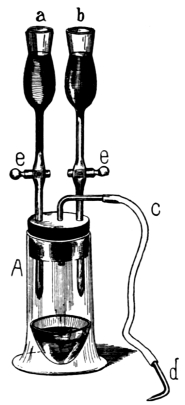
Fig. 103.—Apparatus
for Amid Nitrogen.
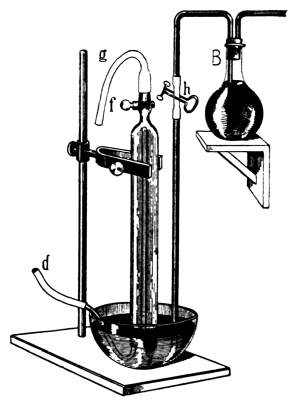
Fig. 104.—Sachsse’s Eudiometer.
About six cubic centimeters of a concentrated aqueous solution of
potassium nitrite are placed in A and the lower parts of the
tubes a and b are filled with water to a little above
e in order to exclude the air therefrom. Dilute sulfuric acid
is placed in one of the funnels and an aqueous solution of the amid
in the other. The air is displaced from the empty part of A by
introducing the sulfuric acid, a little at a time, whereby nitrous acid
and nitric oxid are evolved. This operation is continued until all the
air has been driven out through c d, the open end of d
being kept in the liquid in the dish shown in Fig. 104.
The eudiometer in which the evolved nitrogen is measured is shown in
Fig. 104, and should have a capacity of about
fifty cubic centimeters, and be graduated to fifths. It is filled with
the solution of ferrous sulfate contained in B by sucking at
g, after which the clamp h is replaced, the cock f
closed, and the free end of d placed in the lower end of the
eudiometer. The solution of the amid is run slowly into the generator
A, Fig. 103, together with small additional quantities
of the sulfuric acid when the evolution of gas becomes slow. From time to time
h is opened and fresh quantities of the ferrous solution allowed
to flow into the eudiometer. Any trace of the amid remaining in the
funnel is washed into A with pure water, with care to avoid the
introduction of air. When the liquid in A assumes a permanent
blue color the decomposition is complete. The residual gas is driven
out of A by filling with water. The tubes d and h,
after all the nitric oxid is absorbed, are removed from the eudiometer
which is transferred to a cylinder containing water and immersed
therein until the two liquid surfaces are at the same level and the
volume of the nitrogen observed. After correction for temperature and
pressure, the weight of the nitrogen is calculated. Twenty-eight parts
by weight of nitrogen correspond to 150 of pure asparagin, 181 of
tyrosin and 131 of leucin.[353]
This method of procedure is difficult of manipulation and is apt to
give results that are too high. It cannot be preferred to the more
simple and accurate processes already described.
386. Preparation of Asparagin.—In case the analyst desires to
prepare a quantity of asparagin for comparative purposes it may be
easily accomplished in the following way: A sufficient quantity of
pease or beans is sprouted in a dark place and allowed to grow until
the reserve food of the seed is exhausted. The young sprouts are
gathered, shredded and subjected to strong pressure. The juice thus
obtained is boiled to coagulate the albumin, and thrown on a filter.
The filtrate is evaporated to a thin sirup and set aside to allow the
asparagin to separate in a crystallized form. If the crystals at first
formed are colored they may be dissolved, decolorized with bone-black,
and recrystallized. Instead of the above method the young shoots may be
shredded, extracted with hot water and the extract treated as above. A
larger yield of the asparagin is obtained by the latter process than by
the one mentioned above.[354]
387. Detection and Estimation of Asparagin and Glutamin.—Of all
the amid bodies asparagin is the most important from an agricultural
standpoint, because of its wide distribution in vegetable products.[355]
Asparagin is easily obtained from the aqueous extracts of plants by
crystallization.[356]
In addition to its crystalline characteristics asparagin may be
identified by the following tests. Heated with alkalies, including
barium hydroxid, asparagin yields ammonia. Boiled with dilute acids
it forms ammonium salts. A warm aqueous solution dissolves freshly
prepared copper hydroxid with the production of a deep blue color.
Sometimes, on cooling, crystals of the copper compound formed are
separated. Asparagin crystallizes with one molecule of water. Glutamin
gives essentially the reactions characteristic of asparagin, but
crystallizes without water in small white needles. Asparagin is
easily detected with the aid of the microscope by placing sections of
vegetable tissues containing it in alcohol. After some time microscopic
crystals of asparagin are separated. The presence of large quantities
of soluble carbohydrates seriously interferes with the separation of
asparagin in crystalline form.
For the detection of glutamin the liquid containing it is boiled with
dilute hydrochloric acid, by which ammonia and glutamic acid are
formed. On the addition of lead acetate to the solution the glutamic
acid is thrown out as a lead salt, in which, after its decomposition
with hydrogen sulfid, the characteristic properties of glutamic acid
can be established.
The above process is chronophagous and also uncertain where the
quantity of glutamin is very small and that of other soluble organic
matters very large. A much better process, both for the detection
of glutamin and asparagin, is the following, based on the property
possessed by mercuric nitrate of precipitating amids.
The aqueous extract containing the amid bodies is mixed with lead
acetate until all precipitable matters are thrown out and the mixture
poured into a filter. To the filtrate is added a moderately acid
solution of mercuric nitrate. The precipitate produced is collected
on a filter, washed, suspended in water, decomposed with hydrogen
sulfid and again filtered. The amid bodies (glutamin, asparagin, etc.)
are found in the filtrate and can be detected and estimated by the
processes already described. A reaction showing the presence of an amid
body is not a positive proof of the presence of asparagin or glutamin,
since among other amids, allantoin may be present. This substance is
found in the sprouts of young plants and also in certain cereals, as
shown by researches in this laboratory.[357]
Allantoin, glutamin, and asparagin, when obtained in solution by
the above process, may be secured, by careful evaporation and
recrystallization, in well defined crystalline forms. Asparagin gives
lustrous, rhombic prisms, easily soluble in hot water, but insoluble in
alcohol and ether.
Allantoin is regarded as a diureid of glyoxalic acid and has the
composition represented by the formula C₄H₆N₄O₃. It crystallizes in
lustrous prisms having practically the same solubility as asparagin.
Glutamin is the amid of amidoglutaric acid. It crystallizes in fine
needles. Its structural formula is represented as
- CO.NH₂
- /
- C₃H₅(NH₂)
- \
- CO₂H.
387. Cholin and Betain.—Cholin is a nitrogenous base found
in both animal and plant tissues. Its name is derived from the
circumstance that it was first discovered in the bile. It is found in
the brain, yolk of eggs, hops, beets, cottonseed and many other bodies.
When united with glycerolphosphoric acid it forms lecithin, a compound
of great physiological importance. From a chemical point of view,
cholin is oxyethyltrimethyl-ammonium hydroxid,
- OH
- /
- C₂H₄; (C₅H₁₅NO₂).
- \
- N(CH₃)₃.OH
It is crystallized with difficulty and is deliquescent. Its most
important compound, from an analytical point of view, is its platinum
salt C₅H₁₄ONCl₂PtCl₄. This salt crystallizes in red-yellow plates and
is insoluble in alcohol.
Betain, C₅H₁₁NO₂, is the product of the oxidation of cholin.
In this laboratory the bases are separated from cottonseed and from
each other by the process described below.[358]
About five pounds of fine-ground cottonseed cake are extracted with
seventy per cent alcohol. The material should not be previously treated
with dilute mineral acids because of the danger of converting a part
of the cholin into betain. The alcohol is removed from the filtered
extract and the residue dissolved in water. The aqueous solution is
treated with lead acetate until no further precipitation takes place,
thrown on a filter, the lead removed from the filtrate with hydrogen
sulfid and the liquid evaporated to a viscous syrup. The sirup is
extracted with alcohol containing one per cent of hydrochloric acid.
The solution thus obtained is placed in a deep beaker and the bases
precipitated by means of an alcoholic solution of mercuric chlorid.
The complete separation of the salts requires at least two weeks.
The double salts of the bases and mercury thus obtained, after freeing
from the mother liquor, are recrystallized from a solution in water
and from the pure product thus obtained the mercury is removed after
solution in water, by hydrogen sulfid. The filtrate, after separating
the mercury, contains the bases as chlorids (hydrochlorates). The
solution of the chlorids is evaporated slowly in (pene) vacuo to a
thick sirup and set over sulfuric acid to facilitate crystallization.
The hydrochlorates are obtained in this way colorless and in
well-shaped crystalline forms.
In a quantitive determination, a small amount of the fine meal is
extracted at once with one per cent hydrochloric acid in seventy per
cent alcohol, the salts obtained purified as above and weighed.
The following process serves to determine the relative proportions of
cholin and betain in a mixture of the two bases.
A definite weight of the chlorids, prepared as directed above, is
extracted by absolute alcohol. This treatment dissolves all the cholin
chlorid and a little of the betain salt. The alcoholic solution is
evaporated and again extracted with absolute alcohol. This process is
repeated three times and at the end the cholin chlorid is obtained
free of betain. In a sample of cottonseed cake examined in this
laboratory the two bases were found present in the following relative
proportions, viz., cholin 17.5 per cent, betain 82.5 per cent.
Thus purified the cholin is finally precipitated by platinum chlorid.
For a description of the special reaction, by means of which cholin and
betain are differentiated, the paper cited above may be consulted.
These bodies have acquired an economic interest on account of their
occurrence in cottonseed meal, which is so extensively used as a cattle
food. It is evident from the relative proportions in which they occur
that the less nocuous base, betain, is the more abundant. It is
possible, however, that the base originally formed is cholin and that
betain is a secondary product.
Experience has shown that it is not safe to feed cottonseed meal to
very young animals, while moderate rations thereof may be given to
full-grown animals without much expectation of deleterious results. In
the case of toxic effects it is fair to presume that a meal has been
fed in which the cholin is relatively more abundant than the betain.
389. Lecithin.—Lecithin is a nitrogenous body, allied both to
the fats and proteids and containing glycerol and phosphoric acid. Its
percentage composition is represented with some accuracy by the formula
C₄₂H₈₆NPO₉, or according to Hoppe-Seyler, C₄₄H₉₀NPO₉. It appears to
be a compound of cholin with glycerolphosphoric acid. It is widely
distributed both in animal and vegetable organisms, in the latter
especially in pease and beans.
From a physiological point of view, lecithin is highly important as the
medium for the passage of phosphorus from the organic to the inorganic
state, and the reverse. This function of lecithin has been thoroughly
investigated in this laboratory by Maxwell.[359]
In the extraction of lecithin from seeds (pease, beans, etc.) it is not
possible to secure the whole of the substance by treatment with ether
alone.[360]
The extraction of the lecithin may, however, be entirely accomplished
by successive treatments for periods of about fifteen hours with pure
ether and alcohol. This is better than to mix the solvents, since, in
this case, the ether having the lower boiling point is chiefly active
in the extraction. When the extraction is accomplished by digestion
and not in a continuous extracting apparatus the two solvents may be
mixed together and thus used with advantage. After the evaporation of
the solvents, the lecithin is ignited with mixed sodium and potassium
carbonate whereby the organic phosphorus is secured without loss in an
inorganic form. Where greater care is desired, the method described for
organic phosphorus in soils may be used.[361]
The inorganic phosphorus thus obtained is estimated in the usual way as
magnesium pyrophosphate.
For analytical purposes, the extraction of lecithin from vegetable
substances is conducted in this laboratory as follows:[362]
The fine-ground pea or bean meal is placed in an extraction apparatus
and treated continuously with anhydrous ether for fifteen hours. The
ether in the apparatus is replaced with absolute alcohol and the
extraction continued for six hours longer. The alcoholic extract is
evaporated to dryness and treated with ether. The part of the lecithin
at first insoluble in ether becomes soluble therein after it has been
removed from the vegetable tissues by alcohol. Moreover, any trace of
inorganic phosphorus which may have been removed by the alcohol, is
left undissolved on subsequent treatment with ether. The ether extract
from the alcohol residue is added to that obtained directly, the ether
removed by evaporation, and the total lecithin oxidized and the residue
used for the estimation of phosphorus as already described.
In determining the lecithin in eggs, the procedure employed for
vegetable tissues is slightly changed.[363]
The whole egg, excluding the shell, is placed in a flask with a reflux
condenser and boiled for six hours with absolute alcohol. The alcohol
is then removed from the flask by evaporation and the residue treated
in like manner with ether for ten hours. The ether is removed and the
dry residue rubbed to a fine powder, placed in an extractor and treated
with pure ether for ten hours. The extract thus secured is oxidized
after the removal of the ether by fusion with mixed alkaline carbonates
and the phosphorus determined in the usual way.
390. Factor for Calculating Results.—The percentage of lecithin
is calculated from the weight of magnesium pyrophosphate obtained by
multiplying it by the factor, 7.2703.[364]
This factor is calculated from the second formula for lecithin given
above, in which the percentage of phosphorus pentoxid, P₂O₅, is
8.789.
Example.—In fifty-four grams of egg,
exclusive of the shell, is found an amount of organic phosphorus
yielding 0.0848 gram of magnesium pyrophosphate. Then 0.0848 × 7.2703
= 0.61652 and 0.61652 × 100 ÷ 54 = 1.14. Therefore the percentage of
lecithin in the egg is 1.14.
391. Estimation of Alkaloidal Nitrogen.—The alkaloids contain
nitrogen in a form more difficult of oxidation than that contained in
proteid or albuminoid forms. It is doubtful whether any of the nitrogen
in alkaloids becomes available for plant nutrition by any of the usual
processes of fermentation and decay to which nitrogenous bodies are
submitted in the soil. Likewise, it is true that it is not attacked by
the digestive processes in any way preparatory to its assimilation as
food by the animal tissues. Alkaloidal nitrogen is therefore not to be
regarded as a food either for the animal or plant.
For the general methods of estimating alkaloids the reader is referred
to standard works on plant chemistry and toxicology. The alkaloids of
interest in this manual are those which are found in tobacco, tea,
coffee and a few other products of agricultural importance. The best
methods of isolating and estimating these bodies will be given in the
part of the volume devoted to the special consideration of the articles
mentioned.
392. Preliminary Treatment.—The chief disturbing components
of vegetable tissues, in respect of their influence on the separation
and estimation of the proteid constituents, are fats and oils and
coloring matters. In many cases these bodies are present in such
small quantities as to be negligible, as, for instance, in rice. In
other cases they exist in such large proportions as to present almost
insuperable difficulties to analytical operations, as is the case with
oily seeds. In all instances, however, it is best to remove these
bodies, even when present in small proportions, provided it can be done
without altering the character of the proteid bodies. This is secured
by extracting the fine-ground vegetable material first with petroleum
ether, and afterwards with strong alcohol and ether. Practically, all
of the fatty bodies and the greater part of the most objectionable
coloring matters are removed by this treatment. The extraction should
in all cases be made at low temperatures, not exceeding 35°, to avoid
the coagulating effect of higher temperatures upon the albuminous
bodies which may be present.
In this laboratory, fatty seeds, as for instance peanuts, are first
ground into coarse meal, then extracted with petroleum ether, ground
to a fine meal and the fat extraction completed with petroleum ether,
ninety-five per cent alcohol and pure sulfuric ether. The residue of
the last solvent may be removed by aspirating air through the extracted
meal. In some cases, it is advisable to extract with ethyl ether before
as well as after the alcoholic extraction. This treatment removes at
least a part of the water and prevents the dilution of the first part
of alcohol added to such an extent as to make it dissolve some of the
proteid matters. In each case, a portion of the alcoholic extract
should be tested qualitively for proteid matter. If any be found,
stronger alcohol should be used for, at least, the first extraction. A
portion of the meal, prepared as above directed, is extracted with a
ten per cent solution of sodium chlorid, as described further on, and a
measured portion of the filtered extract diluted with water until the
proteid matter in solution begins to be precipitated. By this treatment
the proper strength of the salt solution, to be used for the subsequent
extraction, is determined. To save time in dialyzing, the solution of
salt employed as a solvent should be as dilute as possible.
The mixture of meal and solvent sometimes filters with difficulty.
In these cases, it is advisable to first pour it into a linen bag
from which the liquid portion can be removed by gentle pressure and
subsequently filtered through paper. As a last resort, the liquid
secured from the linen filter can be saturated with ammonium, zinc or
magnesium sulfate, whereby all the proteid matters are thrown out.
After filtering, the residue is again dissolved in salt solution and
can then be readily filtered through paper.
The clear filtrate should be tested by fractional precipitation by heat
and the final filtrate by acetic acid, as will be described further on.
The proteid matter may be further freed from amid compounds by
treatment with copper sulfate.[365]
This treatment is not advisable, however, except for the purpose of
determining the total proteid nitrogen in the sample. The action of the
water, heat and cupric sulfate combined is capable of inducing grave
changes in the character of the residual matter which would seriously
interfere with the results of subsequent studies of the nature of the
proteid bodies.
In many instances, as with cereal grains, the separation of the proteid
bodies is accomplished by no further preliminary treatment than is
necessary to reduce them to the proper degree of fineness.
393. Diversity of Character.—The proteids which occur in
vegetable products are found in all parts of the tissues of the plants,
but in cereals especially in the seeds. In grass crops and in some
of the legumes, such as clover, the nitrogenous matters are chiefly
found in the straw and leaves. The general classification of these
bodies has already been given, but each kind of plant presents marked
variations, not only in the relative proportions of the different
classes, but also in variations in the nature of each class. For this
reason the study of vegetable proteids is, in some respects, a new
research for each kind of plant examined. There are, however, some
general principles which the analyst must follow in his work, and an
attempt will be made here to establish these and to construct thereon
a rational method of conducting the investigation. In the separation
and estimation of complex bodies so nearly related to each other, it is
difficult not only to secure satisfactory results, but also to prevent
the transformation of some forms of proteid matter into others nearly
related thereto by the action of the solvents used for separation and
precipitation.
394. Separation of Gluten from Wheat Flour.—The most important
proteid in wheat is the body known as gluten, a commercial name given
to the nitrogenous matters insoluble in cold water. The gluten thus
obtained does not represent a single chemical compound, but is a
complex consisting of at least two proteid bodies, which together form
an elastic, pasty mass, insoluble in cold water containing a trace
of mineral salts. This mass has the property of holding mechanically
entangled among its particles bubbles of gas, which, expanding under
the action of heat during cooking, give to bread made of glutenous
flours its porous property.
In respect of proteids, the American wheats, as a rule, are quite
equal to those of foreign origin. This is an important characteristic
when it is remembered that both the milling and food values of a wheat
depend largely on the nitrogenous matter which is present. It must
not be forgotten, however, that merely a high percentage of proteids
is not always a sure indication of the milling value of a wheat. The
percentage of gluten to the other proteid constituents of a wheat is
not always constant, and it is the gluten content of a flour on which
its bread making qualities chiefly depend. The percentage of moist
gluten gives, in a rough way, the property of the glutenous matter of
absorbing and holding water under conditions as nearly constant as
can be obtained. In general, it may be said that the ratio between
the moist gluten and the dry gluten in a given sample is an index for
comparison with other substances in the same sample. Upon the whole,
however, the percentage of dry gluten must be regarded as the safer
index of quality. In respect of the content of glutenous matter, our
domestic wheats are distinctly superior to those of foreign origin.
They are even better than the Canadian wheats in this respect. It may
be fairly inferred, therefore, that while our domestic wheats give a
flour slightly inferior in nutritive properties to that derived from
foreign samples, it is nevertheless better adapted for baking purposes,
and this quality more than compensates for its slight deficiency in
respect of nutrition, a deficiency, which, however, is so minute as to
be hardly worth considering.[366]
The gluten is separated in this laboratory from the other constituents
of a flour by the following process:
Ten grams of the fine-ground flour are placed in a porcelain dish, well
wet with nearly an equal weight of water at a temperature of not to
exceed 15°, and the mass worked into a ball with a spatula, taking care
that none of it adheres to the walls of the dish. The ball of dough is
allowed to stand for an hour, at the end of which time it is held in
the hand and kneaded in a stream of cold water until the starch and
soluble matter are removed. The ball of gluten thus obtained is placed
in cold water and allowed to remain for an hour when it is removed,
pressed as dry as possible between the hands, rolled into a ball,
placed in a flat bottom dish and weighed. The weight obtained is
entered as moist gluten. The dish containing the ball of gluten is
dried for twenty hours in a steam-bath, again weighed, and the weight
of material obtained entered as dry gluten. The determination of dry
and moist gluten cannot in any sense be regarded as an isolation and
estimation of a definite chemical compound. For millers’ and bakers’
purposes, however, the numbers thus obtained have a high practical
value. A typical wheat grown in this country will contain about 26.50
per cent of moist and 10.25 per cent of dry gluten.
The gluten of wheat is composed of two proteid bodies, gliadin and
glutenin.[367]
Gliadin contains 17.66 per cent, and glutenin 17.49 per cent of
nitrogen. Gliadin forms a sticky mass when mixed with water and is
prevented from passing into solution by the small content of mineral
salts present in the flour. It serves to bind together the other
ingredients of the flour, thus rendering the dough tough and coherent.
Glutenin serves to fix the gliadin and thus to make it firm and solid.
Glutenin alone cannot yield gluten in the absence of gliadin, nor
gliadin without the help of glutenin. Soluble metallic salts are also
necessary to the formation of gluten, and act as suggested above, by
preventing the solution of the gliadin in water, during the process of
washing out the starch. No fermentation takes place in the formation of
gluten from the ingredients named.
The gluten, which is obtained in an impure state by the process above
described, is, therefore, not to be regarded as existing as such in the
wheat kernel or flour made therefrom, but to arise by a union of its
elements by the action of water.
395. Extraction with Water.—It is quite impossible to get an
extract from fine-ground vegetable matter in pure water because the
soluble salts of the sample pass at once into solution and then a pure
water solvent becomes an extremely dilute saline solution. The aqueous
extract may, however, be subjected to dialysis, whereby the saline
matter is removed and the proteid matter, not precipitated during the
dialytic process, may be regarded as that part of it in the original
sample soluble in pure water. Nevertheless, in many instances, it is
important to obtain an extract with cold water. In oatmeal the
aqueous extract is obtained by Osborne as follows:[368]
Five pounds of fine-ground meal are shaken occasionally with six liters
of cold water for twenty-four hours, the liquid removed by filtration
and pressure and the extraction continued with another equal portion
of water in the manner noted. The two liquid extracts are united and
saturated with commercial ammonium sulfate which precipitates all
the dissolved proteid matter. The filtrate obtained is collected on
a filter, washed with a saturated solution of ammonium sulfate and
removed as completely as possible from the filter paper by means of
a spatula. Any residual precipitate remaining on the paper is washed
into the vessel containing the removed precipitate and the undissolved
precipitate well beaten up in the liquid, which is placed in a dialyzer
with a little thymol, to prevent fermentation, and subjected to
dialysis for about two weeks. At the end of that time, the contents
of the dialyzer are practically free of sulfates. The contents of the
dialyzers are then thrown on a filter and in the filtrate are found
those proteids first extracted with water, precipitated with ammonium
sulfate and redissolved from this precipitated state by pure water. In
the case of oatmeal, this proteid matter is not coagulated by heat, and
may be obtained in the dry state by the evaporation of the filtrate
last mentioned at a low temperature in vacuo. It is evident that the
character of the proteid matter thus obtained will vary with the nature
of the substance examined. In the case of oats, it appears to be a
proteose and not an albumin.
396. Action of Water on Composition of Proteids.—When a
body, such as oatmeal, containing many proteids of nearly related
character, is exposed to the action of a large excess of water, the
proteid bodies may undergo important changes whereby their relations
to solvents are changed. After oatmeal has been extracted with water,
as described above, the proteid matter originally soluble in dilute
alcohol undergoes an alteration and assumes different properties. The
same remark is applicable to the proteid body soluble in dilute potash.
Nearly all the proteid matter of oatmeal is soluble in dilute potash, if
this solvent be applied directly, but if the sample be previously
treated with water or a ten per cent salt solution the subsequent
proportion of proteid matter soluble in dilute potash is greatly
diminished.[369]
Water applied directly to the oatmeal apparently dissolves an acid
albumin, a globulin or globulins, and a proteose. The bodies, however,
soluble in water, exist only in small quantities in oatmeal. Experience
has shown that in most instances, it is safer to begin the extraction
of a cereal for proteid matter with a dilute salt solution rather than
with water, and to determine the matters soluble in water alone by
subsequent dialysis.
397. Extraction with Dilute Salt Solution.—In general, it
is advisable to begin the work of separating vegetable proteids by
extracting the sample with a dilute brine usually of ten per cent
strength. As conducted by Osborne and Voorhees, on wheat flour, the
manipulation is carried on as follows:[370]
The fine-ground whole wheat flour, about four kilograms, is shaken with
twice that weight of a ten per cent sodium chlorid solution, strained
through a sieve, to break up lumps, and allowed to settle for sixteen
hours. At the end of this time, about half of the supernatant liquid
is removed by a siphon or by decantation and filtered. Two liters
more of the salt solution are added, the mixture well stirred and the
whole brought onto the filter used above. The filtrate is collected
in successive convenient portions and each portion, as soon as it is
obtained, is saturated with ammonium sulfate. All the proteid matter is
precipitated by this reagent. The precipitate is collected on a filter,
redissolved in a convenient quantity of the salt solution and dialyzed
for fourteen days or until all sulfates and chlorids are removed. The
proteid matter, which is separated on dialysis, in this instance, is a
globulin.
The proteid matter not precipitated on dialysis is assumed to be that
part of the original substance soluble in water.
A part of the water soluble proteid matter obtained as above is
coagulated by heat at from 50° to 80°. The part not separated by heat
gives a precipitate on saturation with sodium chlorid.
In wheat there are found soluble in water two albumins and a
proteose.[371]
In separating the albumin coagulating at a low boiling point from the
dialyzed solution mentioned above, it is heated to 60° for an hour,
the precipitate collected on a gooch, washed with hot water (60°), and
then successively with ninety-five per cent alcohol, water-free alcohol
and ether. On drying the residual voluminous matter on the filter over
sulfuric acid, it becomes dense and horny, having in an ash free state,
according to Osborne, the following composition:
| |
Per cent. |
| Carbon |
53.06 |
| Hydrogen |
6.82 |
| Nitrogen |
17.01 |
| Sulfur |
1.30 |
| Oxygen |
21.81 |
398. Treatment without Precipitation with Ammonium
Sulfate.—Where abundant means are at hand for dialyzing large
volumes of solution, the preliminary treatment of the solution made
with ten per cent sodium chlorid with ammonium sulfate may be omitted.
When the precipitated proteids are to be used for the estimation of
the nitrogen therein contained, it has been proposed to substitute
the corresponding zinc salt for the ammonium sulfate.[372]
This reagent has given satisfactory results in this laboratory and while
a larger experience is desirable before commending it as an acceptable
substitute in all cases, yet its obvious advantage, in being free of
nitrogen for the use mentioned, entitles it to careful consideration.
The manipulation, with the exception of the precipitation with ammonium
sulfate, is the same as that described in the preceding paragraph. The
globulins are completely precipitated when the dialysis is complete and
may be separated from the soluble albumins and proteoses by filtration.
399. Separation of the Bodies Soluble in
Water.—Albumins.—By the methods of treatment just
described, the proteid matters soluble in ten per cent sodium chlorid
solution are separated into two classes, viz., globulins
insoluble in pure water and albumins and proteoses soluble in pure
water. The aqueous solution will also contain any amids or nitrogenous
bases soluble in the dilute saline solution and in water. Osborne and
Voorhees have found that the best way of separating the albumins in
the pure aqueous solution is by the application of heat.[373]
By means of a fractional coagulation the albumins are divided into classes,
viz., those separating at from 60° to 65° and those remaining in
solution at that temperature but separating up to 85°. The respective
quantities of these albumins are determined by collecting them in a
filter and estimating the nitrogen therein by moist combustion in the
usual way. Even a larger number of albumins may be secured, as in the
maize kernel, by such a fractional precipitation by means of heat.
Chittenden and Osborne find in this instance that the precipitation
begins at about 40°.[374]
Proteose.—After the separation of the albumins by heat the
filtrate may still contain proteid matter. This matter belongs to
the proteose class. It may be partially secured by concentrating the
filtrate, after the removal of the albumins, to a small bulk when a
part of the proteose body will separate. It may be thrown out entirely
by treating the filtrate above mentioned with fine-ground salt until it
is saturated or by adding salt until the solution contains about twenty
per cent thereof and precipitating the proteose by acetic acid.[375]
400. Separation of the Globulins.—The globulins which are
extracted with ten per cent solution of sodium chlorid and precipitated
on dialysis may be separated by fractional solution into several
bodies of nearly related properties. This solution is conveniently
accomplished by saline solvents of increasing strength. In the case of
the maize globulins, Chittenden and Osborne employ dilute solutions of
common salt for effecting the separation, beginning with a quarter of a
per cent and ending with a two per cent mixture.[376]
401. Proteids Soluble in Dilute Alcohol.—Some of the proteid
bodies which are soluble in dilute salt solution and in water are also
soluble in alcohol. Since these bodies are more easily identified
by the processes already described, attention will be given in this
paragraph solely to those proteid bodies which are insoluble in water
or dilute salt solution and are soluble in dilute alcohol.
For the extraction of these bodies, the residue, left after extraction
with a ten per cent solution of sodium chlorid or with water, is
mixed with enough strong alcohol to secure by the admixture with the
water present in the sample an alcohol of about seventy-five per cent
strength. The mixture is well shaken and digested for some time, at a
temperature of about 46°, and thrown on a filter which is kept at about
the same temperature. The residue is again mixed with alcohol of the
same strength (seventy-five per cent) using about four liters for two
and a half kilos of the original material. During the second digestion
the temperature is kept at about 60°. The latter operation is repeated
three times and in each case the filtrate obtained is evaporated
separately.[377]
This process is especially applicable to the meal from maize kernels,
which contains a high relative percentage of an alcohol soluble
proteid, zein.
The chief part of the zein is found in the first two extracts, obtained
as described above. On evaporation, the zein separates as a tough,
leathery, yellow-colored mass on the walls of the containing vessel. It
is cut into small pieces and digested for several days in cold, pure
alcohol. This is followed by digestion with a mixture of ether and
pure alcohol, and finally with pure ether. By this treatment a part of
the zein becomes insoluble in seventy-five per cent alcohol. The part
soluble in dilute alcohol is precipitated by pouring it into water.
Another method of preparing zein is to extract the meal with
seventy-five per cent alcohol after it has been treated with a ten per
cent salt solution.
In this case the extraction is continued with seventy-five per cent
alcohol in successive portions until no more proteid matter passes
into solution. The several extracts are united and the alcohol removed
by distillation, by which process the zein is separated. It is washed
with distilled water, until the sodium chlorid is removed, dissolved in
warm alcohol of about eighty per cent strength and any insoluble matter
removed by filtration. On evaporating the filtrate nearly to dryness,
the zein is separated and pressed as free of water as possible,
yielding a yellow, elastic substance resembling molasses candy. This
preparation is purified by digestion with pure alcohol and ether in the
manner described. The two zeins which are secured by the treatment, one
soluble and the other insoluble in alcohol, are practically identical
in composition.[378]
Zein freshly precipitated by pouring its alcoholic solution in water
is wholly insoluble in water, and, on boiling therewith, is changed
into the variety insoluble in dilute alcohol. Boiled with dilute
sulfuric acid, six in 300 cubic centimeters of water, it melts, forming
a gummy mass, which is very slowly attacked by the acid yielding
proteoses and peptones. Heated with stronger sulfuric acid it undergoes
decomposition, yielding leucin, tyrosin, and glutamic acid.
402. Solvent Action of Acids and Alkalies.—In the preceding
paragraphs, a synopsis has been given of the methods of separating
proteid matters in such a manner as to secure them in a pure state in
the same conditions as they exist in the natural substances. A very
large percentage of the proteid matter is still left undissolved after
extraction with the solvents already mentioned.
Often important information may be gained concerning the nature of the
residual proteid matters by fractional extraction with dilute acids
and alkalies. When the strength of these solutions is such that they
contain about one per cent of the acid or alkali, the whole of the
proteid matter may be dissolved by boiling successively with acid and
alkali for half an hour. The proteid matter passing into solution in
these cases is usually changed in character, assuming the nature of
proteoses or allied bodies, when treated with an acid, and becoming
albuminates when boiled with an alkali. Easily soluble carbohydrate
matter is also removed by this treatment so that the residue obtained
consists largely of cellulose and is known as crude or insoluble fiber.
The removal of all the bodies soluble in dilute boiling acid and alkali
is accomplished by the method described in paragraph 272.
For research purposes, the solvent action of dilute alkali is of chief
importance to the analyst, and the extraction of the proteid matter,
after all that is soluble in water, common salt solution and alcohol
has been removed, should commence with a solution of potassium or
sodium hydroxid containing not over two-tenths per cent of the alkali.
It has been shown by Osborne that the solvent action of very dilute
alkali, in the cold, may be exerted without changing the character of
the dissolved proteid.[379]
403. Method of Extraction.—The solvent employed is usually
a two-tenths per cent solution of potassium hydroxid. It may be
added directly to the substance or may follow extraction with water,
salt solution or alcohol. In the former case, the manipulation
is illustrated by the following description of the treatment of
oatmeal:[380]
One hundred grams of oatmeal are mixed with half a liter of a
two-tenths per cent potassium hydroxid solution and allowed to stand
for some time at room temperature. The mixture is strained through
a cloth to remove the chaff and the residue is stirred with another
small portion of the solvent, again strained in the same cloth and the
residue squeezed dry. The strained liquids are united and enough more
of the solvent added to make the volume 700 cubic centimeters. After
standing for some time, the insoluble matter settles to the bottom of
the vessel and the supernatant liquid is decanted. More solvent is
added to the residue, well mixed therewith and treated as above. It is
advisable to make a third extraction in the same way. The extracts are
united, passed through a filter, the proteid matter in solution thrown
out by acetic acid, washed with water, alcohol and ether and dried over
sulfuric acid.
The methods of procedure, when the sample has been previously extracted
with water, salt solution or alcohol, are essentially the same as that
just described and the reader may consult the paper of Osborne for
details.[381]
404. Methods of Drying Separated Proteids.—In the preceding
paragraphs, the analyst has been directed, in most instances, to
dry the proteid matter, after it is secured in as pure a form as
possible, at room temperature, over sulfuric acid. By this treatment
the preparation may be obtained in a form suited to the study of its
physical properties, since its solubility has not been affected by
subjecting it to a high temperature. When it is desired to use the
sample only for chemical analysis it is not necessary to wait on the
slow process above mentioned. In this case the sample may be dried in
an inert atmosphere at the temperature of a steam-bath or even at 110°.
It is better, however, to avoid so high a temperature and to conduct
the desiccation in vacuo at a heat not above that of boiling water. The
sample, before drying, should be reduced to the finest possible state
of comminution, otherwise particles of aqueous vapor may be retained
with great tenacity.
In many cases it is advisable to dry the sample pretty thoroughly, then
grind to a fine powder and finish the desiccation with the pulverulent
mass. This treatment can be followed when the quantity of the material
is considerably in excess of that required for the analytical
operations.
405. Determination of Ash.—No method of treatment is known
by means of which vegetable proteid matters may be obtained entirely
free of mineral matters. The mineral bases may be naturally present
in the proteid matter as organic and inorganic salts, or they may be
mechanically entangled therewith, having been derived either from
the other tissues of the plant or from the solvents employed. It is
necessary in calculating the analytical data to base the computation on
the ash free substance. The percentage of ash is determined by any of
the standard processes or by heating the sample in a combustion tube,
to very low redness, in a current of oxygen. The total residue obtained
is used in calculating the percentage of ash, and the weights of
material subsequently used for the determination of carbon, hydrogen,
nitrogen and sulfur are corrected for the calculations by deducting the
quantity of mineral matter contained therein.
By reason of the highly hygroscopic nature of the dry proteid bodies,
they must be kept over a desiccating material and weighed quickly on a
balance, in an atmosphere which is kept free of moisture by the usual methods.
406. Carbon and Hydrogen.—Carbon and hydrogen are estimated in
proteid matters by combustion with copper oxid. Osborne prefers to burn
the sample in a platinum boat in a current of air or of oxygen free of
moisture and carbon dioxid.[382]
It is advisable to use also a layer of lead chromate in addition to
the copper oxid and metallic copper. The method of conducting the
combustion has already been described.[383]
The analyst should have at his disposal a quantity of pure sugar, which
may be used from time to time in testing the accuracy of the work.
In beginning a series of combustions this precaution should never be
omitted. The addition of the lead chromate is to make more certain the
absorption of oxidized sulfur produced during the combustion.
407. Estimation of Nitrogen.—In most cases it is found
convenient, during the progress of separating vegetable proteids, to
determine the quantity of each kind by estimating the nitrogen by moist
combustion and computing the quantity of proteid matter by multiplying
the nitrogen by 6.25. The estimation of the nitrogen is made either on
an aliquot part of the extract or by direct treatment of the residue.
In the pure extracted proteid matter the nitrogen is most conveniently
determined by moist combustion, but it may also be obtained either by
combustion with soda-lime or with copper oxid, or by other reliable
methods.[384]
The percentages of nitrogen found in the principal proteid bodies,
together with the factors for computing the weights of the proteid
bodies from the weights of nitrogen found, are given below:
| Name of body. |
Percentage of nitrogen. |
Factor. |
| Mucin |
13.80 to 14.13 |
7.25 to 7.08 |
| Chondrin |
14.20 to 14.65 |
7.04 to 6.83 |
| Albuminates |
13.87 |
7.21 |
| Oat proteids |
15.85 |
6.31 |
| Serum globulin |
15.63 |
6.40 |
| Egg albumin |
15.71 to 17.85 |
6.37 to 5.60 |
| Maize proteids |
16.06 |
6.22 |
| Casein |
15.41 to 16.29 |
6.49 to 6.13 |
| Serum albumin |
15.96 |
6.27 |
| Syntonin |
16.10 |
6.21 |
| Keratin |
16.20 to 17.70 |
6.17 to 5.65 |
| Fibrinogen |
16.65 |
6.01 |
| Peptones |
16.66 to 17.13 |
6.00 to 5.84 |
| Elastin |
16.75 |
5.97 |
| Wheat proteids |
16.80 to 18.39 |
5.95 to 5.44 |
| Fibrin |
16.91 |
5.91 |
| Flax seed proteids |
17.70 to 18.78 |
5.65 to 5.33 |
408. Determination of Sulfur.—Sulfur is a characteristic
constituent of the proteid bodies, existing in quantities approximating
one per cent of their weight.
In the estimation of sulfur, it is first converted into sulfuric acid,
which is thrown out by a soluble barium salt and the sulfur finally
weighed as barium sulfate.
All the sulfur existing in the organic state in a proteid may be
obtained by burning in a current of oxygen and conducting the gaseous
products of combustion through solid sodium or potassium carbonate
at or near a red heat.[385]
The organic sulfur may also be converted into sulfuric acid by fusing
the proteid body with a mixture of sodium hydroxid and potassium
nitrate. The fused mass, after cooling, is dissolved in water, the
solution acidified with hydrochloric, evaporated to dryness to
decompose nitrates and remove excess of hydrochloric acid and dissolved
in a large excess of water. After standing for a day, the solution is
filtered and the sulfuric acid thrown out of the hot filtrate with a
slight excess of barium chlorid solution. The usual precautions in
precipitating, filtering and igniting the barium sulfate are to be
observed.[386]
409. General Observations.—In the preceding paragraphs have
been stated the general principles upon which the separation of
vegetable proteid matters depends, and a description has been given
of the several processes by which this separation is accomplished. In
each case, however, special conditions exist which require special
modifications of the general processes, and these can only be
successfully secured by the skill, judgment and patient labor of the
investigator. Many of these cases have been already worked out, and the
valuable data secured by Chittenden, Osborne and others, are accessible
to the analyst in the papers already cited. In the case of the proteids
in the peanut, a similar work has been done in this laboratory by
Bigelow, the data of which have not yet been published. It is only
by a careful study of the work already done as outlined here and as
published in full in the cited papers, that the analyst will be able to
secure trustworthy guidance for future investigations.
410. Dialysis.—One of the most important of the operations
connected with the separation and analysis of proteids is the removal
of the salts whereby their solutions are secured. This is accomplished
by subjecting the solutions of the proteid matters to dialysis. The
solution is placed in bags made of parchment dialysis paper. These
bags are tied about a glass tube, whereby access may be had to their
contents during the progress of the work. Since the volume of the
liquid increases during the process, the bags should not be filled too
full in the beginning.
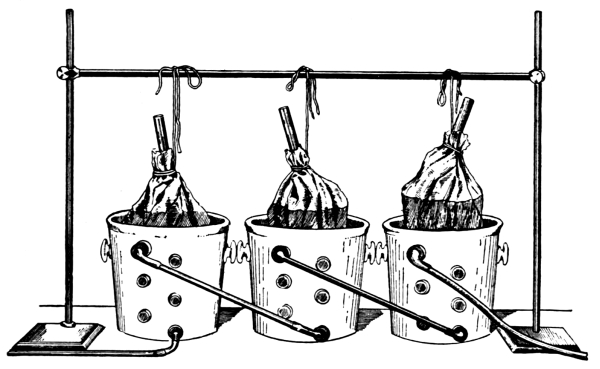
Fig. 105. Dialyzing Apparatus.
In this laboratory the dialysis is carried out by Bigelow with the
city water from the Potomac, which is first passed through a battery
of porous porcelain filtering tubes to remove any suspended silt or
micro-organisms. If unfiltered water be used, the germs therein cause
a fermentation in the proteid matter, which seriously interferes with
the value of the data obtained, and which can only be avoided by the
use of an antiseptic, such as an alcoholic solution of thymol. Even
with filtered water, the use of a few drops of the solution mentioned
is often necessary. To avoid the use of too great quantities of the
filtered water, the dialyzers are arranged en batterie, as shown
in the figure. The filtered water enters the first vessel and thence
passes through all. The parchment bags are frequently changed from
vessel to vessel, each being brought successively into the first vessel
in contact with the fresh water. In some cases the final steps in the
dialysis may be accomplished in distilled water.
It is advisable to conduct a fractional preliminary dialysis of the
salt solution containing proteids in such a way as to secure the
globulins precipitated in each interval of twenty-four hours. Each
portion thus secured may be examined with the microscope. Usually a
period of two weeks is required to entirely remove the mineral salts
from solution. If prepared parchment tubes be used for the dialysis,
they should be first tested for leaks, and should not be more than half
filled. By the use of a large number of these tubes a greater surface
is exposed to dialytic action, and the time required to complete the
operation is correspondingly decreased.
411. Preparation of the Sample.—Animal products present many
difficulties in respect of the reduction thereof to a sufficiently
comminuted condition for analytical examination. In the case of bones,
the choppers used for preparing them for feeding to fowls are the most
efficient apparatus for reducing them to fragments. In this condition
they may be ground to a finer state in a sausage machine. The flesh of
animals may be reduced by this machine, with two or three grindings,
to a fairly homogeneous mass. Subsequent grinding in a mortar with
powdered glass or sharp sand may serve to reduce the sample to a finer
pulp, but is not usually necessary and should be avoided when possible.
The sample thus prepared serves for the estimation of water, ash
and fat by methods already described. The sample should be prepared
in quantities of considerable magnitude, the whole of any organ or
separate portion of the body being used when possible. In examining the
whole body the relative weights of blood, bones, viscera, muscle, hide
and other parts should first of all be ascertained and noted.
412. Treatment of Muscular Tissues for Nitrogenous Bodies.—For
the present purpose a brief sketch of the method of separating the
nitrogenous bodies in the muscular tissues of the body is all that
can be attempted. For methods of examining the different organs and
parts of the body in greater detail, standard works on physiological
chemistry may be consulted.[387]
Extraction with Cold Water.—A noted quantity of the finely
divided tissues is mixed with several volumes of ice cold water and
well rubbed occasionally for several hours, the temperature meanwhile
being kept low. The mixture is poured into a linen bag and the liquid
portion removed by gentle pressure. The residue in like manner is
treated with fresh portions of cold water until it gives up no further
soluble matters. An aliquot portion of the extract is concentrated
to a small bulk and serves for the determination of total nitrogen.
The methods of separating and estimating nitrogenous bodies in flesh
soluble in water will be given in considerable detail further on.
Extraction with Ammonium Chlorid and Hydrochloric Acid.—The
residue, after exhaustion with cold water, is extracted with a solution
of ammonium chlorid containing 150 grams of the salt in a liter. This
method of extraction is entirely similar to that with water just
described. Globulins and myosin pass into solution by this treatment.
The residual mass is washed as free as possible of the solvent and
is then further extracted with dilute hydrochloric acid containing
four cubic centimeters of the fuming acid in a liter. The treatment
with dilute acid is continued until no further substance passes
into solution. This is determined by neutralizing a portion of the
extract with sodium carbonate, or by the direct addition of potassium
ferrocyanid. In either case absence of a precipitate indicates that no
nitrogenous matters are present in the solution.
Extraction with Alkali.—The residue from the acid extraction
is washed with water until the acid is removed and then extracted in a
similar manner with a dilute solution of sodium or potassium hydroxid
containing not to exceed two grams of the caustic to the liter. When
this residue is finally washed with water and a little acetic acid,
it will be found that practically all the purely albuminous bodies
contained in the tissues have been extracted with the exception of any
fibrin, which the blood, present in the tissues at the commencement of
the extraction, may have contained. The extract should be acidified
with acetic as soon as obtained.
Extraction with Boiling Water.—The residual matter boiled
for some time with water will part with its collagen, which, when
transformed by the heat into glutin, passes into solution.
The sarcolemma, membranes, elastic fibers and keratin remain
undissolved.
413. Contents of the Several Extracts.—By the systematic
treatment of muscular tissues in the manner just described, the
nitrogenous bodies they contain are separated into five classes,
viz.:
Cold Water Extract.—This contains serum albumin, serum
globulin, muscle albumin, myosin, mucin and peptone.
Ammonium Chlorid Extract.—This solution contains the globulins
and also in many cases some myosin and serum globulin.
Hydrochloric Acid Extract.—When the extractive matter removed
by hydrochloric acid, thrown out by sodium carbonate and well washed
with water, has a neutral reaction, it consists of syntonin, when acid,
of an albuminate.
Alkali Extract.—The acid albumin of the animal tissue is found
in the alkaline solution and may be thrown out by making the solution
slightly acid.
Insoluble Residue.—The fifth class contains the insoluble
nitrogenous bodies mentioned above.
414. General Observations.—Only a brief résumé of the methods
of treating animal tissues for nitrogenous bases is given above, since
a more elaborate discussion of these principles and methods would
lead too far away from the main purpose of this manual. For practical
purposes, the most important of these bodies are those soluble in water
and the methods of treating these will be handled at some length.
Unfortunately, the methods of determining the exact qualities of these
bodies are not as satisfactory in case of animal as in vegetable
nitrogenous bodies. The flesh bases, soluble in water, contain a much
larger percentage of nitrogen than is found in true proteid bodies, and
therefore the multiplication of the weight of nitrogen found therein by
6.25 does not give even a near approximation of the actual quantities
of the nitrogenous bodies present in the sample.
Some of the flesh bases contain more than twice as much nitrogen as
is found in proteids, and in such cases 3.12, and not 6.25, would be
the more correct factor to use in the computation. When possible,
therefore, these bodies should be precipitated and weighed after
drying, but this is not practicable in many instances. The sole
resource of the chemist in such cases is to determine the nature of the
body as nearly as possible by qualitive reactions, then to determine
the total nitrogen therein and multiply its weight by the corresponding
factor. The principal flesh bases have the following percentages of
nitrogen and the approximate factors for calculating analytical data
are also given:
| Name of base. |
Formula. |
Per cent
nitrogen. |
Factor. |
| Glutin |
C₁₃H₂₀N₄O₅ |
17.95 |
5.57 |
| Carnin |
C₇H₈N₄O₂ |
31.11 |
3.21 |
| Kreatin |
C₄H₁₉N₃O₂ |
32.06 |
3.12 |
| Kreatinin |
C₄H₇N₃O₂ |
37.17 |
2.69 |
| Sarkin |
C₅H₄N₄O |
41.18 |
2.43 |
415. Composition of Meat Extracts.—The meat extracts of
commerce contain all the constituents of meat that are soluble in
warm water. The parts which are soluble in warm water and not in cold
are found in the cold aqueous solution as suspended or sedimentary
matters. Among the nitrogenous bodies present are included albumin,
albumose and peptone among the proteids, carnin, kreatin, kreatinin,
sarkin and xanthin among the non-proteids, and inosinic and uric acids
and urea among other nitrogenous bodies. Among the non-nitrogenous
bodies are found lactic and butyric acids, inosit and glycogen. Among
mineral bodies occurs the phosphates and chlorids of the common bases.
In addition to these bodies, meat extracts may also contain gelatin
and other decomposition products of proteid matter. Since meat extract
is supposed to be prepared by the digestion of the meat free of bones
and put in cold water or in warm water not above 75°, the presence of
gelatin would indicate a different method of preparation, viz.,
either by boiling water or water heated above the boiling point under
pressure. In a properly prepared extract, the percentage of gelatin is
very small.
Approximately one-tenth of the whole nitrogen present is in the form
of albumoses and only a trace as peptones. By far the greater part of
the nitrogen exists as flesh bases (kreatin, etc.). The composition of
three meat extracts, numbers one and two solid and number three liquid,
is given in the subjoined table.[388]
| |
No. 1.
Per cent. |
No. 2.
Per cent. |
No. 3.
Per cent. |
| Total nitrogen |
9.28 |
9.14 |
2.77 |
| Nitrogen |
as |
albumin |
trace |
0.08 |
trace |
| ” |
” |
albumose |
0.96 |
1.21 |
0.70 |
| ” |
” |
peptone |
trace |
trace |
none |
| ” |
” |
flesh bases |
6.81 |
5.97 |
1.56 |
| ” |
” |
ammonia |
0.47 |
0.41 |
0.09 |
| ” |
in |
compounds insoluble in |
|
| |
|
sixty-six per cent alcohol |
0.21 |
0.33 |
0.25 |
| ” |
” |
other bodies |
0.83 |
1.14 |
0.17 |
417. Analysis of Meat Extracts.—The analysis of a meat extract
should include the determination of the water, ash and total nitrogen.
After multiplying the nitrogen which exists as proteids by 6.25 and
adding together the percentages of all the ingredients, ash, water,
etc., including ammonia, the sum is to be subtracted from 100 and the
difference entered as non-nitrogenous organic matter. The nature of
this conglomerate has already been explained.
Water.—It is advisable to determine the water in a partial
vacuum (20) or in an atmosphere of hydrogen
(23-25).
The water may also be determined in solid extracts by placing about
five grams of the material in a flat bottom tin foil dish about
fifty-five millimeters in diameter and twenty millimeters deep. The
material is dissolved in enough warm water to fill the dish a little
over one-half and the liquid is then absorbed by adding a weighed
quantity of fibrous asbestos or of dry fragments of pumice stone.
The asbestos is to be preferred because of the fact that it may be
subsequently cut into small bits for the determination of the gelatin.
The dish thus prepared is dried to constant weight in a steam-bath
or vacuum oven. The weight of the dish and of the added absorbent,
together with that of the material employed and of the dried dish and
its contents, give the data for calculating the percentage of water.
The contents of the dish are used as described further on for the
determination of gelatin. In liquid extracts the water is determined in
an entirely analogous manner, using about twenty grams of the material
and omitting the solution in water.
In solid extracts, the part insoluble in cold water is determined
separately.
Ash.—The ash is determined by ignition at the lowest possible
temperature, best in a muffle (28-32). The ash should be
examined qualitively. Where a quantitive analysis is desired, larger
quantities of the extract are incinerated and the constituents of the
ash determined in the usual way.[389]
Total Nitrogen.—Since nitrates are not present unless added
in the manufacture, the total nitrogen is best determined by moist
combustion.[390]
Nitric Nitrogen.—The extract should be tested for nitrates and
if present they are determined in the manner already described.[391]
Ammoniacal Nitrogen.—When ammonia is present it is determined
by distillation with magnesia.[392]
Since boiling with magnesia may cause the distillation of more
ammonia than is present as ammonium salts, the plus being due to the
decomposition of some other nitrogenous compounds, Stutzer replaces the
magnesia with barium carbonate.[393]
Proteid Nitrogen Insoluble in Sixty-Two Per Cent Alcohol.—The
aqueous solution is treated with strong alcohol until the mixture
contains about sixty-two per cent of the reagent. The precipitate
produced is separated by filtration, washed with sixty-two per cent
alcohol and the nitrogen therein determined.
Albumose Nitrogen.—This is secured by saturating the aqueous
solution with zinc or ammonium sulfate. The separated albumoses are
skimmed from the surface, thrown in a filter, washed with a saturated
solution of zinc sulfate and the nitrogen determined therein by moist
combustion. In the filtrate from the above separation, peptone is
detected qualitively by adding a few drops of dilute solution of copper
sulfate (biuret reaction).
Kreatin, Kreatinin and Other Flesh Bases.—The clear, aqueous
solution of the extract is acidified with sulfuric, mixed with a
solution of sodium phosphotungstate and allowed to stand for about
six days. The precipitate is collected, washed with a solution of
the precipitant, and the nitrogen therein determined. The nitrogen
found, less that due to ammonia, represents the total nitrogenous
matter precipitated by the phosphotungstic acid. From this quantity
is deducted the nitrogen in the proteids, precipitated by sixty-two
per cent alcohol and by ammonium or zinc sulfate, and the remainder
represents the nitrogen in flesh bases.
The nitrogen thrown out by the phosphotungstic acid is deducted from
the total nitrogen, and the remainder represents the nitrogenous bodies
not precipitable by the reagent named.
This method of separating the nitrogenous matters in meat extracts is
based on the observation that these bodies contain at most only a small
quantity of peptones, so small as to be safely negligible.[394]
Quantities used for Analysis.—In conducting the separations
above noted, it will be found convenient to use in each case about
five grams of the solid or twenty of the liquid extract. In the
nitrogen determinations, the weight of the sample should be inversely
proportional to its content of nitrogen.
417. Preparation of the Phosphotungstic Reagent.—The
phosphotungstic reagent is conveniently prepared as follows:
Dissolve 120 grams of sodium phosphate and 200 of sodium tungstate in
one liter of water and add to the solution 100 cubic centimeters of
strong sulfuric acid. When the reagent is prepared for general purposes
it is customary to acidify with nitric, but in the present instance,
inasmuch as the precipitate is used for the determination of nitrogen,
it is evident that sulfuric should be substituted for nitric acid. In
all cases the analyst must be assured of the strong acidity of the
reagent, and in addition to this the solutions of proteid matter to
which the reagent is added must first be made strongly acid with
sulfuric.
418. Zinc Sulfate as Reagent for Separating Albumoses from
Peptones.—When the albumoses are separated from the peptones, by
precipitation with ammonium sulfate, there may be danger of some of
this reagent adhering to the albumose, and in this way the quantity of
nitrogen obtained on analysis may be increased. To avoid an accident of
this kind Bömer replaces the ammonium by zinc sulfate.[395]
Since the precipitation of the albumoses by saturated saline solutions
depends on their hydrolytic power, the substitution of another salt
for ammonium sulfate capable of strongly attracting water, may be made
if that salt does not possess any objectionable property. Crystallized
zinc sulfate will dissolve in less than its own weight of cold water
and is therefore well suited for the purpose in view.
In the case of a meat extract, the precipitation is accomplished as
follows: Fifty cubic centimeters of the extract, freed from all solid
matter by filtration and containing about two grams of the soluble
proteids, are saturated in the cold with finely powdered zinc sulfate.
The separated albumoses collect on the surface and are skimmed off,
poured on a filter and washed with cold saturated zinc sulfate
solution. The filter and its contents are used for the determination of
nitrogen by moist combustion.[396]
The filtrate from the precipitated albumoses gives no biuret reaction,
and, therefore, as in the use of ammonium sulfate, is free of albumin.
The biuret reaction is applied to the zinc sulfate filtrate as follows:
The filtrate is greatly diluted with water and freed of zinc by means
of a saturated solution of sodium carbonate. The filtrate free of zinc
is evaporated on the steam-bath, made strongly alkaline with sodium
hydroxid and treated with a few drops of a two per cent copper sulfate
solution, added successively.
Another advantage possessed by the zinc sulfate is found in the fact
that in the filtrate from the separated albumoses the peptones and
other flesh bases can be thrown out by phosphotungstic acid. Before the
application of the reagent, the filtrate should be made strongly acid
by adding about an equal volume of dilute sulfuric acid (one part of
acid to four of water.)
The nitrogen in the precipitate thus obtained is determined by moist
combustion in the manner already suggested.
If the proteid matters contain salts of ammonium it is probable
that a difficultly soluble double sulfate of zinc and ammonium,
(NH₄)₂SO₄.ZnSO₄.6H₂O, will be found in the precipitate. Ammonium salts,
if present, should therefore be removed by distillation with magnesia.
It is better, however, to throw down the ammonia with the first zinc
precipitate, distil this with magnesia and determine the amount of
nitrogen derived from the ammonia compounds. In a second sample, the
total nitrogen is determined by moist combustion and the difference
between the two results gives that due to albumoses.
419. Examination for Muscular Tissue.—Some samples of meat
extracts contain small quantities of finely ground muscular tissue. For
detecting this the extract is treated with cold water and the insoluble
residue examined with a microscope. If muscular tissue be found, about
eight grams of the extract or twenty-five of the fluid preparation, are
treated with cold water, the insoluble matter collected upon a filter,
washed with cold water, and the nitrogen determined in the residue. The
percentage of nitrogen multiplied by 6.25 gives the quantity of muscle
fiber proteids present. The filtrate from the above determination
is acidified with acetic, boiled, any precipitate which is formed
collected and the nitrogen therein determined. The nitrogen obtained
multiplied by 6.25 gives the quantity of coagulable albumin present.
An aliquot portion of the filtrate is used for the determination of
nitrogen and the percentage therein found, deducted from the total
nitrogen of the sample, gives a remainder which may be used as a
representative of the whole of the nitrogen present in the form of
albumin and muscular tissue.
420. Estimation of Gelatin.—The tin foil dish and its contents
used for the determination of water, as above described, are cut into
small pieces, placed in a beaker and extracted four times with
absolute alcohol. After the removal of the alcohol, the residue is
extracted with ice water containing ten per cent of alcohol, in
which a small piece of ice is kept to avoid a rise of temperature.
The beaker should be shaken during the extraction, which should last
for about two minutes. Where large numbers of samples are treated
at once, any convenient form of shaking machine may be employed. At
least two extractions with ice water must be made. The residue is then
collected upon a filter and washed with ice water until the washings
are completely colorless. The residue on the filter is replaced in
the beaker, boiled with water, well washed on the filter with boiling
water, the filtrate and washings concentrated and the nitrogen therein
determined.
The principle of this determination is based on the fact that gelatin
is almost completely insoluble in ice water while serum peptones and
albumin peptones are almost completely soluble in that reagent. On
the other hand, the flesh bases and the proteids present are almost
completely removed by the preliminary treatment with alcohol and ice
water or are left undissolved by the hot water. The solution in boiling
water, therefore, contains practically nothing but gelatin.[397]
In a later article, Stutzer modifies the method given above as
follows:[398]
Of dry and moist extracts from five to seven grams and of liquid
extracts from twenty to twenty-five grams are used for the
determination and placed in tin foil dishes, as described above. In
case of solid extracts, a sufficient quantity of warm water is added to
completely dissolve them, the solution being facilitated by stirring.
In case the solution is too thin it should be concentrated before going
further. It is treated with a sufficient amount of dust-free ignited
sand to completely absorb it, and the dish and its contents are then
dried to a constant weight. The dried contents of the dish are rubbed
up in a mortar, the dish cut into fine bits, and all placed in a
beaker. The solid syrphete[399]
is extracted four times with 100 cubic centimeters of absolute alcohol,
the alcohol in each case being poured through an asbestos filter for
the purpose of collecting any matters suspended therein. In a large
flask are placed 100 grams of alcohol, 300 grams of ice and 600 grams
of cold water, and the flask is placed in a large vessel and packed
with finely divided ice. Four beakers marked b, c, d, e are
also placed in ice and the beaker containing the syrphete, left after
extraction with absolute alcohol as above mentioned, is marked a
and also placed in pounded ice. The extraction with cold alcoholic
water proceeds as follows:
In beaker a are poured 100 cubic centimeters of the mixture in
the large flask, its contents are stirred for two minutes and then the
liquid portion poured off into beaker b to which, at the same
time, a piece of ice is added. In beaker a are poured again 100
cubic centimeters from the large flask, treated as above described,
and the liquid extract poured into beaker c. In like manner the
extraction in beaker a is continued until each of the beakers
has received its portion of the extract. By this time the liquid
over the sand in beaker a should be completely colorless. The
filtration of the liquid extract is accomplished as follows:
In a funnel of about seven centimeters diameter is placed a perforated
porcelain plate about four centimeters in diameter which is covered
with asbestos felt with long fiber. Three filters are prepared in this
way. On the first filter are poured the contents of beaker b.
After the liquid has passed through, the sand and other residue in
beaker a are transferred to the filter and the beaker and
residue washed with the alcoholic ice water from the large flask. The
filtration should be accomplished under pressure. On the second filter
are poured the contents of beaker c. On the third filter the
contents of beakers d and e. The washing with alcoholic
ice water from the large flask is continued in each instance until the
filtrate is colorless. At the same time the asbestos filter, which was
used in the first instance for filtering the absolute alcohol extract,
is washed with the alcoholic ice water mixture from the large flask. At
the end the sand remaining in beaker a together with all the asbestos
filters are brought together into a porcelain dish, boiled two or
three times with water, the aqueous solution filtered and the filtrate
concentrated and used for the estimation of the nitrogen. The quantity
of nitrogen found multiplied by 6.25 represents the proteid matter in
the gelatin of the sample.
The object of the multiple filters, described above, is to accelerate
the process, and they are required because the gelatin quickly occludes
the filter pores. For this reason the asbestos filters are found
to operate better than those made of paper. It should be mentioned
that the residue of the peptones insoluble in alcohol may contain,
in addition to gelatin, also small quantities of albumoses. From the
quantity of albumose nitrogen found, it is understood that the nitrogen
in the form of coagulable albumin, determined as described in the first
process mentioned above, is to be deducted, since these coagulable
albumins are insoluble in alcohol.
421. Estimation of Nitrogen in the Flesh Bases Soluble in
Alcohol.—About five grams of the dry extract, ten grams of the
extract containing water or twenty-five grams of the liquid extract
are placed in a beaker and enough water added in each case to make
about twenty-five cubic centimeters in all. Usually no water need be
added to the liquid extracts. Very thin peptone solutions should be
evaporated until the content of water is reduced to seventy-five per
cent. The solution, prepared as above indicated, is treated slowly
with constant stirring with 250 cubic centimeters of absolute alcohol,
the stirring continued for some minutes and the vessel set aside for
twelve hours, at the end of which time the precipitate is separated by
filtration and washed repeatedly with strong alcohol. Leucin, tyrosin
and a part of the flesh bases are dissolved by alcohol. The alcohol is
removed by distillation and the residue dissolved in water. Any flocky
residue which remains on solution with water is removed by filtration,
the nitrogen determined therein and the quantity thereof added to the
albumose nitrogen found, as hereafter described.
The volume of the aqueous solution is completed with water to half a
liter. One hundred cubic centimeters of this solution are used for the
determination of total nitrogen, and another 100 cubic centimeters for
the determination of ammoniacal nitrogen by distillation with barium
carbonate. A part of the ammonia may have escaped during the
preliminary distillation of the alcohol and therefore the amount found
may not represent the whole amount originally present. The use of the
above determination is principally to ascertain the correction to be
made in the amount of total nitrogen found in the first 100 cubic
centimeters of the solution.
422. Treatment of the Residue Insoluble in Alcohol.—The
residue insoluble in alcohol is washed from the filter into the beaker
in which the first solution was made. The aqueous mixture is warmed
on a water-bath until the alcohol adhering to the precipitate is
completely evaporated, when the contents of the beaker are poured upon
a filter free of nitrogen. A small part of the albumose, by reason of
the treatment with alcohol, tends to remain undissolved, and it is
advisable to collect this albumose upon a filter, wash it well with hot
water and estimate the nitrogen therein. The quantity of nitrogen thus
found is to be added to the albumose nitrogen determined as described
later on.
The total filtrate obtained from the last filtration is made up to
a volume of half a liter, of which fifty cubic centimeters are used
for the determination of total nitrogen, fifty cubic centimeters for
the determination of gelatin, albumose and peptone, and 100 cubic
centimeters for the residual peptones. The albumose, together with the
gelatin and peptones carried down with it, is precipitated with zinc or
ammonium sulfate solution, and its per cent calculated from the amount
of nitrogen found in the precipitate. The true peptone is determined by
subtracting the quantity of nitrogen determined as albumose from the
total nitrogen in solution.
The rest of the liquid, viz., 300 cubic centimeters, is
evaporated to a small volume and tested qualitively for true peptones
as follows:
To separate the albumose and gelatin a concentrated liquor is treated
with an excess of finely divided ammonium sulfate so that a part of
the salt remains undissolved. The separated albumose, gelatin and
undissolved ammonium salts are collected on a filter, the filtrate
mixed with a few drops of dilute copper sulfate solution and a
considerable quantity of concentrated soda or potash lye added. Care
should be taken that the quantity of copper is not too great, otherwise
the peculiar red coloration will be obscured by the blue color of the
copper solution.
423. Pancreas Peptone.—The filtrate obtained as described
above, by treating the portion of the material insoluble in alcohol
with warm water, contains in addition to the albumose and gelatin the
whole of the pancreas peptone which may be present. To separate this
peptone, 100 cubic centimeters of the aqueous solution are evaporated
in a porcelain dish until the volume does not exceed ten cubic
centimeters. When cool, at least 100 cubic centimeters of a saturated
cooled solution of ammonium sulfate solution are added, the mixture
thoroughly stirred, the precipitate collected upon a filter and washed
with a cold saturated solution of ammonium sulfate. The contents of
the filter are dissolved in boiling water, the filter thoroughly
washed and the filtrate and washings evaporated in a porcelain dish
with the addition of barium carbonate until, on the addition of new
quantities of barium carbonate, no further trace of ammonia can be
discovered. The residue is extracted with water, the barium sulfate and
carbonate present separated by filtration, well washed and the nitrogen
determined in the evaporated filtrate and washings in the usual way and
multiplied by 6.25 to determine the quantity of pancreas peptone.
424. Albumose Peptone.—A part of the albumose peptone which may
be present is determined in conjunction with the other bodies mentioned
above. The chief quantity is found in the solution of the residue
insoluble in alcohol in the following manner:
Fifty cubic centimeters of the solution of this residue in hot water
are mixed with an equal volume of dilute sulfuric acid, one volume
of acid to three of water, in the cold, and a solution of sodium
phosphotungstate added until it produces no further precipitate. The
precipitate is washed with dilute sulfuric acid and the nitrogen
determined therein. The nitrogen thus found is derived from the
albumose, pancreas peptone and gelatin. The quantity of nitrogen in the
pancreas peptone and gelatin, as above described, is subtracted from
the total quantity found in the phosphotungstic acid precipitated, and
the remainder represents the nitrogen due to the albumose.
425. Nitrogen in the Form of Flesh Bases Insoluble in
Alcohol.—This is determined by subtracting the quantity of
nitrogen, determined by the phosphotungstic acid method already
described, from the total quantity of nitrogen found in the precipitate
insoluble in alcohol and soluble in water.
PART SIXTH. DAIRY PRODUCTS. — MILK. — ESTIMATION OF FAT. — PROTEID BODIES IN MILK. — ANALYSIS OF BUTTER. — EXAMINATION OF CHEESE. — AUTHORITIES CITED IN PART SIXTH.
426. Introductory.—The importance of dairy products has led to
the publication of a vast amount of literature relating thereto, and
it seems almost a hopeless task to present even a typical abstract of
the various analytical processes which have been proposed and used in
their study. The general principles which have been developed in the
preceding parts of this volume are applicable to the study of dairy
products, and the analyst who is guided by them can intelligently
examine the bodies specially considered in the present part. There
have been developed, however, many valuable processes for the special
examination of dairy products, which are of such a nature that they
could not be properly discussed in the preceding pages. In the present
part an effort will be made to present in a typical form the most
important of these processes and to state the general principles on
which they are based. This subject is naturally subdivided into three
parts, viz., milk, butter and cheese. The milk sugar industry is
not of sufficient importance to receive a special classification.
427. Composition of Milk.—The composition of milk not only
varies with the genus and species of the mammal from which it is
derived, but also depends in a marked degree on idiosyncrasy.[400]
Milk is a mixture containing water, proteids, fat, carbohydrates,
organic and inorganic acids and mineral salts. There have also been
observed in milk in minute quantities ammonia, urea, hypoxanthin,
chyme, chyle, biliverdin, cholesterin, mucin, lecithin, kreatin, leucin
and tyrosin. In the fermentation which milk undergoes in incipient
decomposition there is sometimes developed from the proteid matter, as
pointed out by Vaughn, a ptomaine, tyrotoxicon, which is a virulent
poison.[401]
The presence of these last named bodies is of interest chiefly to the
physiologist and pathologist and can receive no further attention here.
From a nutritive point of view, the important components of milk are
the fats, proteids and sugar, but especially in the nourishment of the
young the value of lime and phosphoric acid must be remembered. The
mean composition of the most important milks, as determined by recent
analyses, is given below:
| |
Water.
Per cent. |
Sugar.
Per cent. |
Proteids.
Per cent. |
Fat.
Per cent. |
Ash.
Per cent. |
| Cow |
86.90 |
4.80 |
3.60 |
4.00 |
0.70 |
| Human |
88.75 |
6.00 |
1.50 |
3.45 |
0.30 |
| Goat |
85.70 |
4.45 |
4.30 |
4.75 |
0.80 |
| Ass |
89.50 |
6.25 |
2.00 |
1.75 |
0.50 |
| Mare |
90.75 |
5.70 |
2.00 |
1.20 |
0.35 |
| Sheep |
80.80 |
4.90 |
6.55 |
6.85 |
0.90 |
The mean composition of milk, as given by Watts and König, is given in
the following tables:
| |
Watts. |
| |
Water. |
Solids. |
Proteids. |
Fats. |
Sugar. |
Mineral
Salts. |
| Woman |
87.65 |
12.35 |
3.07 |
3.91 |
5.01 |
0.17 |
| Ass |
90.70 |
9.30 |
1.70 |
1.55 |
5.80 |
0.50 |
| Cow |
86.56 |
13.44 |
4.08 |
4.03 |
4.60 |
0.73 |
| Goat |
86.76 |
13.24 |
4.23 |
4.48 |
3.91 |
0.62 |
| Sheep |
83.31 |
16.69 |
5.73 |
6.05 |
3.96 |
0.68 |
| Mare |
82.84 |
17.16 |
1.64 |
6.87 |
8.65 |
| König. |
| |
Water. |
Fat. |
Casein and
albumin. |
Milk
Sugar. |
Ash. |
| Woman |
87.41 |
3.78 |
2.29 |
6.21 |
0.31 |
| Mare |
90.78 |
1.21 |
1.99 |
5.67 |
0.35 |
| Ass |
89.64 |
1.63 |
2.22 |
5.99 |
0.51 |
| Cow |
87.17 |
3.69 |
3.55 |
4.88 |
0.71 |
The average composition of 120,540 samples of cow milk, as determined
by analysis, extending over a period of eleven years, was found by
Vieth to be as follows:[402]
| |
Per cent. |
| Total solids |
12.9 |
| Solids not fat |
8.8 |
| Fat |
4.1 |
The quantity of solids and fat in milk is less after longer than after
shorter periods between milkings.
The quantity of solids and fat in cow milk is less in the spring than
in the autumn.
The chief organic acid naturally present in milk is citric, which
exists probably in combination with lime.
The mean content of citric acid in milk is about one-tenth of one per
cent.[403]
Citric acid is not found in human milk, and probably exists only in the
mammary secretions of herbivores.
Among the mineral acids of milk, phosphoric is the most important, but
a part of the phosphorus found as phosphoric acid in the ash of milk
may come from pre-existing organic phosphorus (lecithin, nuclein).
The sulfuric acid, which is found in the ash of milk, is derived from
the sulfur of the proteid matter during ignition.
Lactic acid is developed from lactose during the souring of milk as the
result of bacterial activity.
Gases are also found in solutions of milk, notably carbon dioxid, which
gives to freshly drawn milk its brothy appearance.
The ash of milk has the following composition expressed as grams per
liter of the original milk:[404]
| Component. |
Grams
per liter. |
Probable form
of combination. |
Grams
per liter. |
| Chlorin |
0.90 |
sodium chlorid |
0.962 |
| potassium chlorid |
0.830 |
| Phosphoric acid |
2.42 |
KH₂PO₄ |
1.156 |
| K₂HPO₄ |
0.853 |
| MgHPO₄ |
0.336 |
| CaHPO₄ |
0.671 |
| Ca₃(PO₄)₂ |
0.806 |
|
|
|
|
| Potassium |
1.80 |
(as shown above) |
|
| and as potassium citrate |
0.495 |
| Sodium |
0.49 |
sodium chlorid |
0.962 |
| Lime |
1.90 |
(as shown above) |
|
| and as calcium citrate |
2.133 |
| Magnesia |
0.20 |
MgHPO₄ |
0.336 |
The percentage composition of the ash of milk, according to Fleischmann
and Schrott, is expressed as follows:[405]
| Per cent. |
| Potassium oxid, |
K₂O |
25.42 |
| Sodium oxid, |
Na₂O |
10.94 |
| Calcium oxid, |
CaO |
21.45 |
| Magnesium oxid, |
MgO |
2.54 |
| Iron oxid, |
Fe₂O₃ |
0.11 |
| Sulfuric acid, |
SO₃ |
4.11 |
| Phosphoric acid, |
P₂O₅ |
24.11 |
| Chlorin, |
Cl |
14.60 |
| |
103.28 |
| Less |
Cl as O |
3.28 |
| |
100.00 |
428. Alterability of Milk.—The natural souring and coagulation
of milk is attributed by most authorities to bacterial action produced
by infection from the air or containing vessels.[406]
Pasteur, however, shows that fresh milk sterilized at a temperature of
110° may be exposed to the air without danger of souring.[407]
After about three days, however, a fermentation is set up which is
totally different from that produced by the microzymes naturally
present in the milk. This point has been further investigated by
Béchamp, who finds that the natural souring of milk is accomplished
without the evolution of any gas, while the fermentation produced in
sterilized milk by the microbes of the air, is uniformly attended by a
gaseous development.[408]
As a result of his investigations, he concludes that the souring of
milk takes place spontaneously by reason of milk being an organic
matter, in the physiological sense of the term, and that this
alteration is produced solely by the natural microzymes of the milk.
According to Béchamp, the milk derived from healthy animals is capable
of spontaneous alteration, which consists in the development of lactic
acid and alcohol, and of curd in those milks which contain caseinates
produced by the precipitating action of the acids formed. Oxygen and
the germs which are present in the air, according to him, have nothing
to do with this alteration in the properties of milk. Milk belongs to
that class of organic bodies like blood, which are called organic from
a physiological point of view, on account of containing automatic forces
which produce rapid changes therein when they are withdrawn from the
living organisms.
After milk has become sour by the spontaneous action of the microzymes
which it contains, there are developed micro-organisms, such as
vibriones and bacteria from a natural evolution from the microzymes.
Milk which is sterilized at a high temperature, viz., that of
boiling water or above, is no longer milk in the true physiological
sense of that term. The globules of the milk undergo changes and
the microzymes a modification of their functions, so that in milk
thus altered by heat, they are able to produce a coagulation without
development of acidity. The microzymes thus modified, however, retain
to a large extent their ability to become active. Human milk differs
from cow milk in containing neither caseinates nor casein, but special
proteid bodies, and also a galactozyme or galactozymase functionally
very different from that which exists in cow milk. The extractive
matter is also a special kind, consisting of milk globules and
microzymes belonging particularly to it and containing three times less
phosphate and mineral salts than cow milk. Boiling the milk of the cow
or other animals does not render it similar to that of woman. There is
no treatment, therefore, of any milk which renders it entirely suited
to the nourishment of infants. The composition of the milk of the cow
may be represented by three groups:
1. Organic elements in suspension; consisting chiefly of the globules
of the milk, which are mostly composed of the fat, of an epidermoid
membrane containing mineral matter of special soluble albumins and of
microzymes containing also mineral matter.
2. Dissolved constituents; consisting of caseinates, lactalbuminates,
galactozymase, holding phosphates in combination, lactose, extractive
matter, organic phosphates of lime, acetates, urea and alcohol.
3. Mineral matters in solution; consisting of sodium and calcium
chlorids, carbon dioxid and oxygen.[409]
It will be noticed from the above classification that Béchamp fails to
mention citrate of lime. It is scarcely necessary to add to this brief
résumé of the theories of Béchamp that they are entirely at variance
with the opinions held by nearly all his contemporaries.
429. Effects of Boiling on Milk.—On boiling, the albumin in
milk is coagulated and on separating the proteid bodies by saturation
with magnesium sulfate no albumin is found in the filtrate. The total
casein precipitated from boiled is therefore greater than from unboiled
milk. Jager has shown that the casein can be precipitated from boiled
milk by rennet, but with greater difficulty than from unboiled.[410]
According to this author in 3.75 per cent of proteid in milk there are
found 3.15 per cent of casein, 0.35 of albumin and 0.25 of globulin.
430. Appearance of the Milk.—The color, taste, odor and other
sensible characters of the milk are to be observed and noted at the
time the sample is secured. Any variation from the faint yellow color
of the milk is due to some abnormal state. A reddish tint indicates
the admixture of blood, while a blue color is characteristic of the
presence of unusual micro-organisms. Odor and taste will reveal often
the character of the food which the animals have eaten. Any marked
departure of the sample from the properties of normal milk should at
once lead to its condemnation for culinary or dietetic purposes.
431. Micro-Organisms of the Milk.—Milk is a natural culture
solution for the growth of micro-organisms, and they multiply therein
with almost incredible rapidity. Some of these are useful, as, for
instance, those which are active in the ripening of cream, and others
are of an injurious nature, producing fermentations which destroy the
sugars or proteids of the milk and develop acid, alcohol, mucous or
ptomaine products. It is not possible here to even enumerate the kinds
of micro-organisms which abound in milk and the reader is referred to
the standard works on that subject.[411]
For analytical purposes it is important that the sample be kept as
free as possible of all micro-organisms, good or bad, which may be
accomplished by some of the methods given below.
432. Sampling Milk.—It is not difficult to secure for
examination representative samples of milk, if the proper precautions
be taken. On the other hand, the ease and rapidity with which a milk
undergoes profound changes render necessary a careful control of the
methods of taking samples. The most rapid changes to which a mass of
milk is obnoxious are due to the separation of the fat particles and
to the action of bacteria. Even after standing for a few minutes, it
will be found that the fat globules are not evenly distributed. Before
securing the sample for analysis, it is necessary to well stir or mix
the milk. A mean sample may also be secured from a can of milk by the
sampling tube devised by Scovell, which will be described below.
In securing samples, a full detailed description of the cow or herd
furnishing them is desirable, together with all other data which seem
to illustrate in any way the general and particular conditions of the
dairy. Samples are to be preserved in clean, well stoppered vessels,
properly numbered and securely sealed.
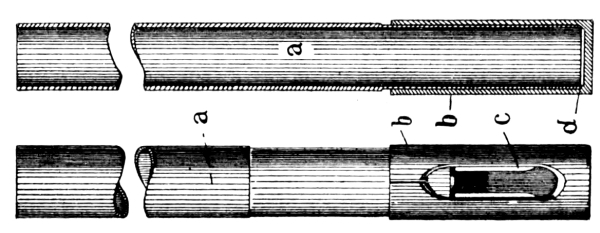
Fig. 106.—Scovell’s Milk Sampling Tube.
433. Scovell’s Milk Sampler.—In sampling large quantities of
milk in pails or shipping cans, it is exceedingly inconvenient to mix
the milk by pouring from one vessel to another or by any easy process
of stirring. In order to get representative samples in such conditions,
Scovell has put in use a sampler, by means of which a typical portion
of the milk may be withdrawn from a can without either pouring or
stirring. The construction of the sampler is shown in Fig. 106,
representing it in outline and longitudinal section. The tube a,
made of brass, is open at both ends and of any convenient dimensions.
Its lower end slides in a large tube b, closed at the bottom and
having three elliptical, lateral openings c, which admit the
milk as the tube is slowly depressed in the contents of the can. In
getting the sample, a is raised as shown in profile. When the
bottom of b reaches the bottom of the can a is pushed
down as shown in the section. The milk contained in the sampler is then
readily withdrawn.
434. Preserving Milk for Analysis.—Pasteurizing or boiling the
sample is not advisable by reason of the changes produced in the milk
by heat. The milk sample may be preserved by adding to it a little
chloroform, one part in 100 being sufficient. Boric and salicylic acids
may also be used, but not so advantageously as formaldehyd or mercuric
chlorid. Rideal has observed that one part of formaldehyd will preserve
10,000 parts of milk in a fresh state for seven days. The formaldehyd
sold in the trade contains about one part of formaldehyd in 320 of
the mixture. One-half pint of this commercial article is sufficient
for about twenty gallons of milk, corresponding to about one part of
pure formaldehyd to 45,000 parts of milk. Rideal much prefers formalin
(formaldehyd) to borax or boric acid as a milk preservative. No ill
effects due to its toxic action have been observed, even when it is
consumed in a one per cent solution.[412]
Samples of milk can be kept in this way from four to six weeks by
adding about one drop of the commercial formaldehyd to each ounce of
sample. The analyst should remember in such cases that the formaldehyd
may not all escape on evaporation, on account of forming some kind of
a compound with the constituents of the milk, as is pointed out by
Bevan.[413]
Bevan suggests that the formaldehyd may not actually be retained in the
sample, but that the increase in the apparent amount of total solids
is due to the conversion of the lactose into galactose. This point,
however, has not been determined.
Richmond and Boseley propose to detect formalin by means of
diphenylamin. A solution of diphenylamin is made with water, with the
help of just enough sulfuric acid to secure a proper solvent effect.
The liquid to be tested, which is supposed to contain formaldehyd, or
the distillate therefrom, is added to this solution and boiled. If
formaldehyd be present, a white flocculent precipitate is deposited,
which is colored green if the acid used contain nitrates. For other
methods of detecting formalin and for a partial literature of the
subject the paper mentioned above may be consulted.
One gram of fine-ground mercuric chlorid dissolved in 2,000 grams of
milk will preserve it, practically unchanged, for several days. One
gram of potassium bichromate dissolved in one liter of milk will also
preserve it for some time. Thymol, hydrochloric acid, carbon disulfid,
ether and other antiseptics may also be employed. No more of the
preserving agent should be used than is required to keep the milk until
the analysis is completed.
All methods of preservation are rendered more efficient by the
maintenance of a low temperature, whereby the vitality of the bacteria
is greatly reduced.
435. Freezing Point of Milk.—By reason of its content of sugar
and other dissolved solids, the freezing point of milk is depressed
below 0°. A good idea of the purity of whole milk is secured by
subjecting it to a kryoscopic test. The apparatus employed for this
purpose is that used in general analytical work in the determination of
freezing points. Pure full milk freezes at about 0°.55 below zero, and
any marked variation from this number shows adulteration or abnormal
composition.[414]
A simple apparatus, especially adapted to milk, is described by
Beckmann.[415]
The kryoscopic investigation may also be extended to butter fat
dissolved in benzol.
436. Electric Conductivity of Milk.—The electric conductivity
of milk may also be used as an index of its composition. The addition
of water to milk diminishes its conductivity.[416]
This method of investigation has at present but little practical value.
437. Viscosity Of Milk.—The viscosity of milk may be determined
by the methods already described. Any variation from the usual degree
of fluidity is indicated either by the abstraction of some of the contents
of the milk, the addition of some adulterant or the result of fermentation.
438. Acidity and Alkalinity of Milk.—Fresh milk of normal
constitution has an amphoteric reaction. It will redden blue and blue
red litmus paper. This arises from the presence in the milk of both
neutral and acid phosphates of the alkalies. A saturated alkaline
phosphate, i. e., one in which all the acid hydrogen of the acid
has been replaced by the base has an alkaline reaction while the
acid phosphates react acid. When fresh milk is boiled its reaction
becomes strongly alkaline and this arises chiefly from the escape
of the dissolved carbon dioxid. By the action of micro-organisms on
the lactose of milk, the alkaline reaction soon becomes acid, and
delicate test paper will show this decomposition long before it becomes
perceptible to the taste. It is advisable to test the reactions of the
milk as soon as possible after it is drawn from the udder, both before
and after boiling.
439. Determination of the Acidity of Milk.—In the determination
of the acidity of milk it is important that it first be freed of the
carbon dioxid it contains.[417]
Van Slyke has found that too high results are obtained by the direct
titration of milk for acidity, and when the milk is previously diluted
the results are also somewhat too high.[418]
Good results are got by diluting the milk with hot water and boiling
for a short time to expel the carbon dioxid. Twenty-five cubic
centimeters of milk are diluted with water to about a quarter of a
liter, as above, two cubic centimeters of a one per cent alcoholic
phenolphthalien added and the titration accomplished by decinormal
alkali. This variation of the methods of procedure, suggested by
Hopkins and Powers, appears to be the best process at present known for
the determination of acidity. The reader is referred to the paper cited
above for references to other methods which have been proposed.
440. Opacity Of Milk.—The white color and opacity of milk are
doubtless due to the presence of the suspended fat particles and to
the colloid casein. On the latter it is probably principally dependent
since the color of milk is not very sensibly changed after it has
passed the extractor, which leaves not to exceed one-tenth of one per
cent of fat in it. Some idea of the quality of the milk, however, may
be obtained by determining its opacity. This is accomplished by the use
of a lactoscope. The one generally employed was devised by Feser and is
shown in Fig. 107.
The instrument consists of a cylindrical glass vessel of a little more
than 100 cubic centimeters content, in the lower part of which is set a
cone of white glass marked with black lines. Into this part are placed
four cubic centimeters of milk. A small quantity of water is added and
the contents of the vessel shaken. This operation is repeated until the
black lines on the white glass just become visible. The graduations on
the left side show the volume of water which is necessary to bring the
dark lines into view, while those on the right indicate approximately
the percentage of fat present.
Among the other lactoscopes which have been used may be mentioned
those of Donné, Vogel, Hoppe-Seyler, Trommer, Seidlitz, Reischauer,
Mittelstrass, Hénocque, and Heusner.[419]
Since the invention of so many quick and accurate methods of fat
estimation these instruments have little more than a historical interest.
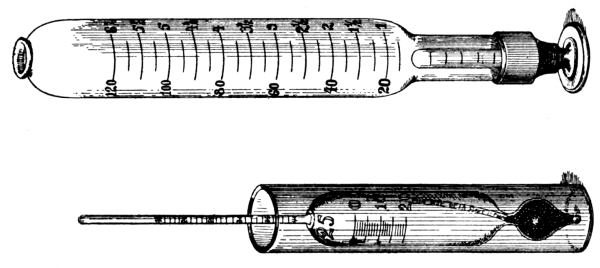
Fig. 107.—Lactoscope, Lactometer and Creamometer.
441. Creamometry.—The volume of cream which a sample of milk
affords under arbitrary conditions of time and temperature is sometimes
of value in judging the quality of milk. A convenient creamometer is
a small cylinder graduated in such a way that the volume of cream
separated in a given time can be easily noted. There are many kinds of
apparatus used for this purpose, a typical one being shown in Fig. 107.
The usual time of setting is twenty-four hours. A quicker determination
is secured by placing the milk in strong glass graduated tubes and
subjecting these to centrifugal action. The process is not exact and
is now rarely practiced as an analytical method, even for valuing the
butter making properties of milk.
442. Specific Gravity.—The specific gravity of milk is
uniformly referred to a temperature of 15°. Generally no attempt is made
to free the milk of dissolved gases beforehand. This should not be
done by boiling but by placing the sample in a vacuum for some time.
Any of the methods described for determining specific gravity in sugar
solutions may be used for milk (48-59). The specific gravity of
milk varies in general from 1.028 to 1.034. Nearly all good cow milk
from herds will show a specific gravity varying from 1.030 to 1.032. In
extreme cases from single cows the limits may exceed those first given
above, but such milk cannot be regarded as normal.
Increasing quantities of solids not fat in solution, tend to increase
the specific gravity, while an excess of fat tends to diminish it.
There is a general ratio existing between the solids not fat and the
fat in cow milk, which may be expressed as 9: 4. The removal of
cream and the addition of water in such a manner as not to affect the
specific gravity of the sample disturbs this ratio.
The determination of the specific gravity alone, therefore, cannot be
relied upon as an index of the purity of a milk.
443. Lactometry.—A hydrometer especially constructed
for use in determining the density of milk is called a lactometer. In
this country the one most commonly used is known as the lactometer
of the New York Board of Health. It is a hydrometer, delicately
constructed, with a large cylindrical air space and a small stem
carrying the thermometric and lactometric scales. It is shown held
in the creamometer in Fig. 107. The milk is brought
to a temperature of 60° F. and the reading of the lactometer scale
observed. This is converted into a number expressing the specific
gravity by means of a table of corresponding values given below. Each
mark on the scale of the instrument corresponds to two degrees and
these marks extend from 0° to 120°. The numbers of this scale can be
converted into those corresponding to the direct reading instrument,
described in the next paragraph, by multiplying them by 0.29.
The minimum density for whole milk at 60° F. is fixed by this
instrument at 100°, corresponding to a specific gravity of 1.029. The
instrument is also constructed without the thermometric scale. The mean
density of many thousand samples of pure milk, as observed by the New
York authorities, is 1.0319.
The specific gravity is easily secured, and while not of itself
decisive, should always be determined. The specific gravity of milk
increases for some time after it is drawn and should be made both when
fresh and after the lapse of several hours.[420]
Table Showing Specific Gravities Corresponding
to Degrees of the New York Board Of Health
Lactometer. Temperature 60° F.
| Degree. |
Sp. gr. |
Degree. |
Sp. gr. |
| 90 |
1.02619 |
106 |
1.03074 |
| 91 |
1.02639 |
107 |
1.03103 |
| 92 |
1.02668 |
108 |
1.03132 |
| 93 |
1.02697 |
109 |
1.03161 |
| 94 |
1.02726 |
110 |
1.03190 |
| 95 |
1.02755 |
111 |
1.03219 |
| 96 |
1.02784 |
112 |
1.03248 |
| 97 |
1.02813 |
113 |
1.03277 |
| 98 |
1.02842 |
114 |
1.03306 |
| 99 |
1.02871 |
115 |
1.03335 |
| 100 |
1.02900 |
116 |
1.03364 |
| 101 |
1.02929 |
117 |
1.03393 |
| 102 |
1.02958 |
118 |
1.03422 |
| 103 |
1.02987 |
119 |
1.03451 |
| 104 |
1.03016 |
120 |
1.03480 |
| 105 |
1.03045 |
|
|
444. Direct Reading Lactometer.—A more convenient form
of lactometer is one which gives the specific gravity directly on the
scale. The figures given represent those found in the second and third
decimal places of the number expressing the specific gravity. Thus 31
on the scale indicates a specific gravity of 1.031. This instrument is
also known as the lactometer of Quévenne. For use with milk, the scale
of the instrument does not need to embrace a wider limit than from
25 to 35, and such an instrument is capable of giving more delicate
readings than when the scale extends from 14 to 42, as is usually the
case with the quévenne instrument.
Langlet has invented a lactoscope with a scale, showing the corrections
to be applied for temperatures other than 15°. A detailed description
of this instrument, as well as the one proposed by Pinchon, is
unnecessary.[421]
445. Density of Sour Milk.—Coagulated milk cannot be used
directly for the determination of the specific gravity, both because of
its consistence and by reason of the fact that the fat is more or less
completely separated. In such a case, the casein may be dissolved by
the addition of a measured quantity of a solvent of a known specific
gravity, the density of the resulting solution determined and that
of the original milk calculated from the observed data. Ammonia is a
suitable solvent for this purpose.[422]
446. Density of the Milk Serum.—The specific gravity of the
milk serum, after the removal of the fat and casein by precipitation
and filtration, may also be determined. For normal cow milk the number
is about 1.027.
447. Total Solids.—The direct gravimetric determination of the
total solids in milk is attended with many difficulties, and has been
the theme of a very extended periodical literature. A mere examination
of the many processes which have been proposed would require several
pages.
The most direct method of procedure is to dry a small quantity of milk
in a flat-bottom dish to constant weight on a steam-bath. The surface
of the dish should be very large, even for one or two grams of milk;
in fact the relation between the quantity of milk and the surface of
the dish should be such that the fluid is just sufficient in amount to
moisten the bottom of the dish with the thinnest possible film. The
dish, during drying, is kept in a horizontal position at least until
its contents will not flow. The water of the sample will be practically
all evaporated in about two hours. The operation may be accelerated by
drying in vacuo.
The drying may also be accomplished by using a flat-bottom dish
containing some absorbent, such as sand, pumice stone, asbestos or
crysolite. The milk may also be absorbed by a dried paper coil and
dried thereon (26).
It is convenient to determine the water in the sample subsequently
to be used for the gravimetric determination of the fat, and this is
secured by the adoption of the paper coil method, as suggested by the
author, or by the use of a perforated metal tube containing porous
asbestos, as proposed by Babcock.[423]
The process is conveniently carried out as follows:
Provide a hollow cylinder of perforated sheet metal sixty millimeters
long and twenty millimeters in diameter, closed five millimeters from
one end by a disk of the same material. The perforations should be
about 0.7 millimeter in diameter and as close together as possible.
Fill loosely with from one and a half to two and a half grams of dry
woolly asbestos and weigh. Introduce a weighed quantity of milk (about
five grams). Dry at 100° for four hours. During the first part of the
drying the door of the oven should be left partly open to allow escape
of moisture. Cool in a desiccator and weigh. Repeat the drying until
the weight remains constant. Place in an extractor and treat with
anhydrous ether for two hours. Evaporate the ether and dry the fat at
100°. The extracted fat is weighed and the number thus obtained may be
checked by drying and weighing the cylinder containing the residue.
The asbestos best suited for use in this process should be of a woolly
nature, quite absorbent, and, previous to use, be ignited to free it
of moisture and organic matter. A variety of serpentine, crysolite is
sometimes used instead of asbestos. When the content of water alone is
desired, it is accurately determined by drying in vacuo over pumice
stone (page 33).
The methods above mentioned are typical and will prove a sufficient
guide for conducting the desiccation, either as described or by any
modification of the methods which may be preferred.
448. Calculation of Total Solids.—By reason of the ease and
celerity with which the density of a milk and its content of fat
can be obtained, analysts have found it convenient to calculate the
percentage of total solids instead of determining it directly. This
is accomplished by arbitrary formulas based on the data of numerous
analyses. These formulas give satisfactory results when the samples do
not vary widely from the normal and may be used with advantage in most cases.
Among the earliest formulas for the calculation may be mentioned those
of Fleischmann and Morgen,[424]
Behrend and Morgen,[425]
Claus, Stutzer and Meyer,[426] Hehner,[427]
and Hehner and Richmond.[428]
Without doing more than citing these papers it will be sufficient here
to give the formulas as corrected by the most recent experience.
In the formula worked out by Babcock the specific gravity of the sample
is represented by S, the fat by F, and the solids not fat
by t. The formula is written as follows:[429]
| t = ( |
100S - FS |
)
(250 - 2.5 F). |
| 100 - 1.0753FS |
In this formula it is assumed that the difference between the specific
gravity of the milk serum and that of water is directly proportional
to the per cent of solids in the serum, but this assumption is not
strictly correct. Even in extreme cases, however, the error does not
amount to more than 0.05 per cent.
Since a given amount of milk sugar increases the density of a milk
more than the same quantity of casein, it is evident that the formula
would not apply to those instances in which the ratio between these two
ingredients is greatly disturbed, as for instance, the whey.
The formula of Hehner and Richmond, in its latest form, is expressed as
follows:
in which T represents the total solids,
G the reading of the quévenne lactometer, D the specific
gravity, and F the fat.
Example.—Let the reading of the lactometer be 31, corresponding
to D 1.031, and the percentage of fat be three and five-tenths,
what is the percentage of the total solids?
Substituting these values in the formulas we have
| T = 0.2625 |
31 |
+ 1.2 × 3.5 = 12.09. |
| 1.031 |
To simplify the calculations, Richmond’s formula may be written
Calculated by this shortened formula from the above data T =
12.09, the same as given in the larger formula.
Calculating the solids not fat in the hypothetical case given above
by Babcock’s formula, we get t = 8.46, and this plus 3.5 gives 11.96,
which is slightly lower than the number obtained by the richmond process.
The babcock formula may be simplified by substituting the number
expressing the reading of the quévenne lactometer for that donating the
specific gravity, in other words, the specific gravity multiplied by
100 and the quotient diminished by 1000.
The formulas for solids not fat and total solids then become
| t = |
L |
+ 0.2F, and T = |
L |
+ 1.2F, |
| 4 |
4 |
in which L represents the reading of the
lactometer. By the addition of the constant factor 0.14 the results
calculated by the formula of Babcock are the same as those obtained by
the method of Richmond.
In the following table are given the solids not fat in milks as
calculated by Babcock’s formula. To obtain the total solids add the
per cent of fat to solids not fat. To obtain total solids according to
Richmond’s formula increase that number by 0.14.
Table Showing Per Cent of Solids not Fat in Milk
Corresponding to Quévenne’s Lactometer Readings
and Per Cent of Fat.
Per
cent |
Lactometer reading at 60° F. |
| of fat. |
26. | 27. |
28. | 29. |
30. | 31. |
32. | 33. |
34. | 35. |
36 . |
| 0.0 | 6.50 |
6.75 | 7.00 |
7.25 | 7.50 |
7.75 | 8.00 |
8.25 | 8.50 |
8.75 | 9.00 |
| 0.1 | 6.52 |
6.77 | 7.02 |
7.27 | 7.52 |
7.77 | 8.02 |
8.27 | 8.52 |
8.77 | 9.02 |
| 0.2 | 6.54 |
6.79 | 7.04 |
7.29 | 7.54 |
7.79 | 8.04 |
8.29 | 8.54 |
8.79 | 9.04 |
| 0.3 | 6.56 |
6.81 | 7.06 |
7.31 | 7.56 |
7.81 | 8.06 |
8.31 | 8.56 |
8.81 | 9.06 |
| 0.4 | 6.58 |
6.83 | 7.08 |
7.33 | 7.58 |
7.83 | 8.08 |
8.33 | 8.58 |
8.83 | 9.08 |
| 0.5 | 6.60 |
6.85 | 7.10 |
7.35 | 7.60 |
7.85 | 8.10 |
8.35 | 8.60 |
8.85 | 9.10 |
| 0.6 | 6.62 |
6.87 | 7.12 |
7.37 | 7.62 |
7.87 | 8.12 |
8.37 | 8.62 |
8.87 | 9.12 |
| 0.7 | 6.64 |
6.89 | 7.14 |
7.39 | 7.64 |
7.89 | 8.14 |
8.39 | 8.64 |
8.89 | 9.14 |
| 0.8 | 6.66 |
6.91 | 7.16 |
7.41 | 7.66 |
7.91 | 8.16 |
8.41 | 8.66 |
8.91 | 9.16 |
| 0.9 | 6.68 |
6.93 | 7.18 |
7.43 | 7.68 |
7.93 | 8.18 |
8.43 | 8.68 |
8.93 | 9.18 |
| 1.0 | 6.70 |
6.95 | 7.20 |
7.45 | 7.70 |
7.95 | 8.20 |
8.45 | 8.70 |
8.95 | 9.20 |
| 1.1 | 6.72 |
6.97 | 7.22 |
7.47 | 7.72 |
7.97 | 8.22 |
8.47 | 8.72 |
8.97 | 9.22 |
| 1.2 | 6.74 |
6.99 | 7.24 |
7.49 | 7.74 |
7.99 | 8.24 |
8.49 | 8.74 |
8.99 | 9.24 |
| 1.3 | 6.76 |
7.01 | 7.26 |
7.51 | 7.76 |
8.01 | 8.26 |
8.51 | 8.76 |
9.01 | 9.26 |
| 1.4 | 6.78 |
7.03 | 7.28 |
7.53 | 7.78 |
8.03 | 8.28 |
8.53 | 8.78 |
9.03 | 9.28 |
| 1.5 | 6.80 |
7.05 | 7.30 |
7.55 | 7.80 |
8.05 | 8.30 |
8.55 | 8.80 |
9.05 | 9.30 |
| 1.6 | 6.82 |
7.07 | 7.32 |
7.57 | 7.82 |
8.07 | 8.32 |
8.57 | 8.82 |
9.07 | 9.32 |
| 1.7 | 6.84 |
7.09 | 7.34 |
7.59 | 7.84 |
8.09 | 8.34 |
8.59 | 8.84 |
9.09 | 9.34 |
| 1.8 | 6.86 |
7.11 | 7.36 |
7.61 | 7.86 |
8.11 | 8.36 |
8.61 | 8.86 |
9.11 | 9.37 |
| 1.9 | 6.88 |
7.13 | 7.38 |
7.63 | 7.88 |
8.13 | 8.38 |
8.63 | 8.88 |
9.14 | 9.39 |
| 2.0 | 6.90 |
7.15 | 7.40 |
7.65 | 7.90 |
8.15 | 8.40 |
8.66 | 8.91 |
9.16 | 9.41
|
| 2.1 | 6.92 |
7.17 | 7.42 |
7.67 | 7.92 |
8.17 | 8.42 |
8.68 | 8.93 |
9.18 | 9.43 |
| 2.2 | 6.94 |
7.19 | 7.44 |
7.69 | 7.94 |
8.19 | 8.44 |
8.70 | 8.95 |
9.20 | 9.45 |
| 2.3 | 6.96 |
7.21 | 7.46 |
7.71 | 7.96 |
8.21 | 8.46 |
8.72 | 8.97 |
9.22 | 9.47 |
| 2.4 | 6.98 |
7.23 | 7.48 |
7.73 | 7.98 |
8.23 | 8.48 |
8.74 | 8.99 |
9.24 | 9.49 |
| 2.5 | 7.00 |
7.25 | 7.50 |
7.75 | 8.00 |
8.25 | 8.50 |
8.76 | 9.01 |
9.26 | 9.51 |
| 2.6 | 7.02 |
7.27 | 7.52 |
7.77 | 8.02 |
8.27 | 8.52 |
8.78 | 9.03 |
9.28 | 9.53 |
| 2.7 | 7.04 |
7.29 | 7.54 |
7.79 | 8.04 |
8.29 | 8.54 |
8.80 | 9.05 |
9.30 | 9.55 |
| 2.8 | 7.06 |
7.31 | 7.56 |
7.81 | 8.06 |
8.31 | 8.57 |
8.82 | 9.07 |
9.32 | 9.57 |
| 2.9 | 7.08 |
7.33 | 7.58 |
7.83 | 8.08 |
8.33 | 8.59 |
8.84 | 9.09 |
9.34 | 9.59 |
| 3.0 | 7.10 |
7.35 | 7.60 |
7.85 | 8.10 |
8.36 | 8.61 |
8.86 | 9.11 |
9.36 | 9.61 |
| 3.1 | 7.12 |
7.37 | 7.62 |
7.87 | 8.13 |
8.38 | 8.63 |
8.88 | 9.13 |
9.38 | 9.64 |
| 3.2 | 7.14 |
7.39 | 7.64 |
7.89 | 8.15 |
8.40 | 8.65 |
8.90 | 9.15 |
9.41 | 9.66 |
| 3.3 | 7.16 |
7.41 | 7.66 |
7.92 | 8.17 |
8.42 | 8.67 |
8.92 | 9.18 |
9.43 | 9.68 |
| 3.4 | 7.18 |
7.43 | 7.69 |
7.94 | 8.19 |
8.44 | 8.69 |
8.94 | 9.20 |
9.45 | 9.70 |
| 3.5 | 7.20 |
7.45 | 7.71 |
7.96 | 8.21 |
8.46 | 8.71 |
8.96 | 9.22 |
9.47 | 9.72 |
| 3.6 | 7.22 |
7.48 | 7.73 |
7.98 | 8.23 |
8.48 | 8.73 |
8.98 | 9.24 |
9.49 | 9.74 |
| 3.7 | 7.24 |
7.50 | 7.75 |
8.00 | 8.25 |
8.50 | 8.75 |
9.00 | 9.26 |
9.51 | 9.76 |
| 3.8 | 7.26 |
7.52 | 7.77 |
8.02 | 8.27 |
8.52 | 8.77 |
9.02 | 9.28 |
9.53 | 9.78 |
| 3.9 | 7.28 |
7.54 | 7.79 |
8.04 | 8.29 |
8.54 | 8.79 |
9.04 | 9.30 |
9.55 | 9.80 |
| 4.0 | 7.30 |
7.56 | 7.81 |
8.06 | 8.31 |
8.56 | 8.81 |
9.06 | 9.32 |
9.57 | 9.83 |
| 4.1 | 7.32 |
7.58 | 7.83 |
8.08 | 8.33 |
8.58 | 8.83 |
9.08 | 9.34 |
9.59 | 9.85 |
| 4.2 | 7.34 |
7.60 | 7.85 |
8.10 | 8.35 |
8.60 | 8.85 |
9.11 | 9.36 |
9.62 | 9.87 |
| 4.3 | 7.36 |
7.62 | 7.87 |
8.12 | 8.37 |
8.62 | 8.88 |
9.13 | 9.38 |
9.64 | 9.89 |
| 4.4 | 7.38 |
7.64 | 7.89 |
8.14 | 8.39 |
8.64 | 8.90 |
9.15 | 9.40 |
9.66 | 9.91 |
| 4.5 | 7.40 |
7.66 | 7.91 |
8.16 | 8.41 |
8.66 | 8.92 |
9.17 | 9.42 |
9.68 | 9.93 |
| 4.6 | 7.43 |
7.68 | 7.93 |
8.18 | 8.43 |
8.68 | 8.94 |
9.19 | 9.44 |
9.70 | 9.95 |
| 4.7 | 7.45 |
7.70 | 7.95 |
8.20 | 8.45 |
8.70 | 8.96 |
9.21 | 9.46 |
9.72 | 9.97 |
| 4.8 | 7.47 |
7.72 | 7.97 |
8.22 | 8.47 |
8.72 | 8.98 |
9.23 | 9.48 |
9.74 | 9.99 |
| 4.9 | 7.49 |
7.74 | 7.99 |
8.24 | 8.49 |
8.74 | 9.00 |
9.25 | 9.50 |
9.76 | 10.01 |
| 5.0 | 7.51 |
7.76 | 8.01 |
8.26 | 8.51 |
8.76 | 9.02 |
9.27 | 9.52 |
9.78 | 10.03 |
| 5.1 | 7.53 |
7.78 | 8.03 |
8.28 | 8.53 |
8.79 | 9.04 |
9.29 | 9.54 |
9.80 | 10.05 |
| 5.2 | 7.55 |
7.80 | 8.05 |
8.30 | 8.55 |
8.81 | 9.06 |
9.31 | 9.56 |
9.82 | 10.07 |
| 5.3 | 7.57 |
7.82 | 8.07 |
8.32 | 8.57 |
8.83 | 9.08 |
9.33 | 9.58 |
9.84 | 10.09 |
| 5.4 | 7.59 |
7.84 | 8.09 |
8.34 | 8.60 |
8.85 | 9.10 |
9.36 | 9.61 |
9.86 | 10.11 |
| 5.5 | 7.61 |
7.86 | 8.11 |
8.36 | 8.62 |
8.87 | 9.12 |
9.38 | 9.63 |
9.88 | 10.13 |
| 5.6 | 7.63 |
7.88 | 8.13 |
8.39 | 8.64 |
8.89 | 9.15 |
9.40 | 9.65 |
9.90 | 10.15 |
| 5.7 | 7.65 |
7.90 | 8.15 |
8.41 | 8.66 |
8.91 | 9.17 |
9.42 | 9.67 |
9.92 | 10.17 |
| 5.8 | 7.67 |
7.92 | 8.17 |
8.43 | 8.68 |
8.94 | 9.19 |
9.44 | 9.69 |
9.94 | 10.19 |
| 5.9 | 7.69 |
7.94 | 8.20 |
8.45 | 8.70 |
8.96 | 9.21 |
9.46 | 9.71 |
9.96 | 10.22 |
| 6.0 | 7.71 |
7.96 | 8.22 |
8.47 | 8.72 |
8.98 | 9.23 |
9.48 | 9.73 |
9.98 | 10.24 |
449. Determination of Ash.—In the determination of the solid
residue obtained by drying milk, it is important to observe the
directions already given (28-32).
In the direct ignition of the sample, a portion of the sulfur and
phosphorus may escape oxidation and be lost as volatile compounds.
This loss may be avoided by the use of proper oxidizing agents or by
conducting the combustion as heretofore described.[430]
In the official method, it is directed to add six cubic centimeters
of nitric acid to twenty of milk, evaporate to dryness and ignite the
residue at a low red heat until free of carbon.[431]
It is doubtful if this precaution be entirely sufficient to save all
the sulfur and phosphorus, but the method is evidently more reliable
than the common one of direct ignition without any oxidizing reagent
whatever.
450. Form of Fat in Milk.—The fat in milk occurs in the form
of globules suspended in the liquid, in other words in the form of an
emulsion. Many authorities have asserted that each globule of fat is
contained in a haptogenic membrane composed presumably of nitrogenous
matter, but there is no convincing evidence of the truth of this
opinion. The weight of experimental evidence is in the opposite
direction. The supposed action of the membrane and the phenomena
produced thereby are more easily explained by the surface tension
existing between the fat globules and the menstruum in which they are
suspended.
Babcock affirms that the spontaneous coagulation of the fibrin present
in milk tends to draw the fat globules into clusters, and this tendency
can be arrested by adding a little soda or potash lye to the milk as
soon as it is drawn.[432]
The diameter of the fat globules is extremely variable, extending in
some cases from two to twenty micromillimeters. In cow milk, the usual
diameters are from three to five micromillimeters.
451. Number of Fat Globules in Milk.—The number of fat globules
in milk depends on their size and the percentage of fat. It is evident
that no definite statement of the number can be made. There is a
tendency, on the part of the globules, to diminish in size and increase
in number as the period of lactation is prolonged. To avoid large
numbers, it is convenient to give the number of globules in 0.0001
cubic millimeter. This number may be found within wide limits depending
on the individual, race, food and other local conditions to which the
animal or herd is subjected. In general, in whole milk this number will
be found between 140 and 250.
452. Method of Counting Globules.—The number of globules in
milk is computed with the aid of the microscope. The most convenient
method is the one devised by Babcock.[433]
In carrying out this
computation, capillary tubes, from two to three centimeters long and
about one-tenth millimeter in internal diameter, are provided. The
exact diameter of each tube, in at least three points, is determined
by the micrometer attachment of the microscope, and from these
measurements the mean diameter of the tube is calculated. This known,
its cubic content for any given length is easily computed. Ten cubic
centimeters of the milk are diluted with distilled water to half a
liter and one end of a capillary tube dipped therein. The tube is
quickly filled with diluted milk and each end is closed with a little
wax to prevent evaporation. Several of these tubes being thus prepared,
they are placed in a horizontal position on the stage of the microscope
and covered with glycerol and a cover glass. The tubes are left at
rest for some time until all the fat globules have attached themselves
to the upper surfaces, in which position they are easily counted.
The micrometer is so placed as to lie parallel with the tubes, and
the number of globules, corresponding to each division of its scale,
counted. The mean number of globules corresponding to each division of
the micrometer scale is thus determined.
To compare the data obtained with each tube they are reduced to a
common basis of the number of globules found in a length of fifty
divisions of the micrometer scale in a tube having a diameter of 100
divisions, using the formula
in which n = the number of globules found in the standard
length of tube measured and d = the diameter of the tube. It
is not difficult to actually count all the globules in a length of
fifty divisions of the scale, but the computation may also be made
from the mean numbers found in a few divisions. The usual number of
globules found in a length of 0.1 millimeter in a tube 0.1 millimeter
in diameter, varies from fifty to one hundred.
Example.—The length of one division of the micrometer scale is
0.002 millimeter, and the internal diameter of the tube 0.1 millimeter.
The content of a tube, of a length of 0.002 × 50 = 0.1 millimeter, is
therefore 0.0007854 cubic millimeter.
The cubic content of a tube 100 scale divisions in diameter and fifty
in length is 0.0031416 cubic millimeter. The number of globules found
in fifty divisions of the tubes used is 40. Then the number which would
be contained in a tube of a diameter of 100 divisions of the micrometer
scale and a length of fifty divisions thereof is
| N = |
10000n |
= |
400000 |
= 160. |
| d² |
2500 |
Since the milk is diluted fifty times, the actual number of globules
corresponding to the volume given is 8000. It is convenient to reduce
the observations to some definite volume, exempla gratia, 0.0001
cubic centimeter. The equation for this in the above instance is
0.0031416: 0.0001 = 8000: x, whence x = 223, = number
of fat globules in 0.0001 cubic millimeter.
In one cubic millimeter of milk there are therefore 2,230,000 fat
globules, and in one cubic centimeter 2,230,000,000 globules. In a
single drop of milk there are from one to two hundred million fat
globules.[434]
453. Classification of Methods of Determining Fat in Milk.—The
fat, being the most valuable of the constituents of milk, is the
subject of a number of analytical processes. An effort will be made
here to classify these various methods and to illustrate each class
with one or more typical processes. In general the methods may be
divided into analytical and commercial, those of the first class being
used for scientific and of the other for trade purposes. For normal
milk, some of the trade methods have proved to be quite as accurate as
the more chronokleptic analytical processes to which, in disputed
cases, a final appeal must be taken. When the analyst is called upon to
determine the fat in a large number of samples of milk some one of the
trade methods may often be adopted with great advantage.
454. Dry Extraction Methods.—Among the oldest and most reliable
methods of determining fat in milk, are included those processes based
on the principle of drying the milk and extracting the fat from the
residue by an appropriate solvent. The solvents generally employed are
ether and petroleum spirit of low boiling point. The methods of drying
are legion.
In extracting with ether, it must not be forgotten that other bodies
than fat may pass into solution on the one hand and on the other any
substituted glycerid, such as lecithin or nuclein, which may be present
may escape solution, at least in part. Perhaps petroleum spirit,
boiling at from 45° to 60°, is the best solvent for fat, but it is
almost the universal custom in this and other countries to use ether.
455. The Official Methods.—In the methods adopted by the
Association of Official Agricultural Chemists two processes are
recommended.
(1) The Asbestos Process: In this process it is directed to
extract the residue from the determination of water by the asbestos
method (447) with anhydrous pure ether until the fat is removed,
evaporate the ether, dry the fat at 100° and weigh. The fat may also be
determined by difference, after drying the extracted cylinders at 100°.
(2) Paper Coil Method: This is essentially the method proposed
by Adams as modified by the author.[435]
Coils made of thick filter paper are cut into strips 6.25 by 62.5
centimeters, thoroughly extracted with ether and alcohol, or the weight
of the extract corrected by a constant obtained for the paper. If this
latter method be used, a small amount of anhydrous sodium carbonate
should be added. Paper free of matters soluble in ether is also to be
had for this purpose. From a weighing bottle about five grams of milk
are transferred to the coil by a pipette, taking care to keep dry the
lower end of the coil. The coil, dry end down, is placed on a piece
of glass, and dried at a temperature of boiling water for one hour,
or better, dried in hydrogen at a temperature of boiling water,
transferred to an extraction apparatus and extracted with absolute
ether or petroleum spirit boiling at about 45°. The extracted fat is
dried in hydrogen and weighed. Experience has shown that drying in
hydrogen is not necessary. The fat may be conveniently dried in partial vacuo.
456. Variations of Extraction Method.—The method of preparing
the milk for fat extraction is capable of many variations. Some of the
most important follow:
(1) Evaporation on Sand: The sand should be pure, dry and of
uniform size of grain. It may be held in a dish or tube. The dish may
be made of tin foil, so that it can be introduced with its contents
into the extraction apparatus after the desiccation is complete. For
this purpose, it is cut into fragments of convenient size after its
contents have been poured into the extractor. The scissors used are
washed with the solvent.
(2) Evaporation on Kieselguhr: Dry kieselguhr (infusorial
earth, tripoli) may take the place of the sand as above noted. The
manipulation is the same as with sand.
(3) Evaporation on Plaster of Paris,[436]
(Soxhlet Method),[437]
(4) On Pumice Stone, (5) On Powdered Glass, (6) On
Chrysolite:[438]
The manipulation in these cases is conducted as with sand and no
detailed description is required.
(7) Evaporation on Organic Substances: These variations would
fall under the general heading of drying on paper. The following
materials have been used; viz., sponge,[439]
lint,[440]
and wood pulp.[441]
In these variations the principal precautions to be observed are to
secure the organic material in a dry state and free of any matter
soluble in the solvent used.
(8) Dehydration with Anhydrous Copper Sulfate: In this process
the water of the sample is absorbed by powdered anhydrous copper
sulfate, the residual mass extracted and the butter fat obtained
determined by saponification and titration.[442]
In the manipulation about twenty grams of the anhydrous copper sulfate
are placed in a mortar, a depression made therein in such a manner that
ten cubic centimeters of milk can be poured into it without wetting
it through to the mortar. The water is soon absorbed when the mass is
ground with a little dry sand and transferred to the extractor.
Petroleum spirit of low boiling point is used as a solvent, successive
portions of about fifteen cubic centimeters each being forced through
the powdered mass under pressure. Two or three treatments with the
petroleum are required. The residual butter fat, after the evaporation
of the petroleum, is saponified with a measured portion, about
twenty-five cubic centimeters, of seminormal alcoholic potash lye. The
residual alkali is determined by titration with seminormal hydrochloric
acid in the usual manner. From the data obtained is calculated the
quantity of alkali employed in the saponification. The weight of butter
fat extracted is then calculated on the assumption that 230 milligrams
of potash are required to saponify one gram of the fat.
457. Gypsum Method for Sour Milk.—In sour milk, extraction
of the dry residue with ether is attended with danger of securing a
part of the free lactic acid in the extract. This may be avoided, at
least in part, by making the milk neutral or slightly alkaline before
desiccation. This method is illustrated by a variation of Soxhlet’s
method of drying on gypsum proposed by Kühn.[443]
The curdled milk is treated with potash lye of forty per cent strength
until the reaction is slightly alkaline. For absorbing the sample
before drying, a mixture is employed consisting of twenty-five grams
of plaster of paris, four of precipitated carbonate of lime and two
of acid potassium sulfate. To this mixture ten grams of the milk,
rendered alkaline as above noted, are added in a desiccating dish, the
excess of moisture evaporated at 100°, the residual mass finely ground
and extracted with ether for four hours. A little gypsum may be found
in the solution, but in such small quantities as not to interfere
seriously with the accuracy of the results obtained.
458. Estimation of Fat in Altered Milk.—In altered milk the
lactose has usually undergone a fermentation affording considerable
quantities of lactic acid. If such milks be treated by the extraction
method for fat, the results will always be too high, because of the
solubility of lactic acid in ether.
Vizern[444]
has proposed to avoid this error by first warming the soured
milk for a few minutes to 40°, at which temperature the clabber is
easily divided by vigorous shaking. Of the milk thus prepared, thirty
grams are diluted with two or three volumes of water and poured onto a
smooth and moistened filter. The vessel and filter are washed several
times until the filtrate presents no further acid reaction. The filter
and its contents are next placed in a vessel containing some fine
washed sand. A small quantity of water is added, sufficient to form a
paste. With a stirring rod, the filter is entirely broken up and the
whole mass thoroughly mixed. Dried on the water bath the material is
subjected to extraction in the ordinary way. Several analyses made
on fresh milk and on milk kept for several months show that almost
identical results are obtained.
In respect of this process there would be danger, on long standing,
of the formation of free acids from butter glycerids, and these acids
would be removed by the process of washing prescribed. In this case the
quantity of fat obtained would be less than in the original sample.
459. Comparison of Methods.—An immense amount of work has been
done by analysts in comparing the various types of extraction methods
outlined above.[445]
The consensus of opinion is that good results are obtained by all the
methods when properly conducted, and preference is given to the two
methods finally adopted by the Association of Official Chemists. As
solvents, pure ether and petroleum spirit of low boiling point are
preferred. The direct extraction gravimetric processes are important,
since it is to these that all the other quicker and easier methods must
appeal for the proof of their accuracy.
460. Wet Extraction Methods.—It has been found quite
impracticable to extract the fat from milk by shaking it directly with
the solvent. An emulsion is produced whereby the solvent itself becomes
incorporated with the other constituents of the milk, and from which it
is not separated easily even with the aid of whirling. The disturbing
element which prevents the separation of the solvent is doubtless the
colloid casein, since, when this is previously rendered soluble, the
separation of the solvent holding the fat is easily accomplished.
The principle on which the methods of wet extraction are based is a
simple one; viz., to secure a complete or partial solution
of the casein and subsequently to extract the fat with a solvent
immiscible with water. The methods may be divided into three great
classes; viz., (1) those in which the solvent is evaporated from
the whole of the extracted fat and the residual matters weighed; (2)
processes in which an aliquot part of the fat solution is employed and
the total fat calculated from the data secured; (3) the density of the
fat solution is determined at a definite temperature and the percentage
of fat corresponding thereto determined from tables or otherwise.
Methods (1) and (2) are practically identical in principle and one
or the other may be applied according to convenience or to local
considerations. The methods may be further subdivided in respect of the
reagents used to secure complete or partial solution of the casein, as,
for instance, alkali or acid.[446]
461. Solution in an Acid.—A good type of these processes is the
method of Schmid.[447]
In this process ten cubic centimeters of milk are placed in a test
tube of about five times that content, graduated to measure small
volumes. An equal quantity of hydrochloric acid is added, the mixture
shaken, boiled until it turns dark brown, and cooled quickly. The
fat is extracted by shaking with thirty cubic centimeters of ether.
After standing some time the ethereal solution separates and its
volume is noted. An aliquot part of the solution is removed, the
solvent evaporated, and the weight of fat in the whole determined by
calculation.
The schmid process has been improved by Stokes,[448]
Hill,[449]
and Richmond.[450]
The most important of these variations consists in weighing instead of
measuring the milk employed, thus insuring greater accuracy. Dyer and
Roberts affirm that the ether dissolves some of the caramel products
formed on boiling condensed milk with hydrochloric acid, and that the
data obtained in such cases by the process of Schmid are too high.[451]
Since lactic acid is also slightly soluble in ether, sour milk should
not be extracted with that solvent. In these cases petroleum spirit, or
a mixture of petroleum and ether, as suggested by Pinette, may be
used.[452]
Another variation consists in extracting the fat with several portions
of the solvent and evaporating all the extracts thus obtained to get
the total fat. This method is perhaps the best of those in which the
fat is extracted from the residual liquid after the decomposition of
the casein by an acid, and may be recommended as both reliable and
typical within the limitations mentioned above.
462. Solution in an Alkali.—The casein of milk is not so
readily dissolved in an alkali as in an acid, but the solution is
sufficient to permit the extraction of the fat. Soda and potash lyes
and ammonia are the alkaline bodies usually employed. To promote the
separation of the emulsions, alcohol is added with advantage. The
principle of the process rests on the observed power of an alkali
to free the fat globules sufficiently to allow them to dissolve in
ether or some other solvent. When the solvent has separated from the
emulsion at first formed, the whole or a part of it is used for the
determination of fat in a manner entirely analogous to that employed
in the process with the acid solutions described above. There are many
methods based on this principle, and some of the typical ones will be
given below. Experience has shown that extraction from an alkaline
solution is more troublesome and less perfect than from an acid and
these alkaline methods are, therefore, not so much practiced now as
they were formerly.
463. Method of Short.—Instead of measuring the volume of the
separated fat, Short has proposed a method in which the casein is
dissolved in an alkali and the fat at the same time saponified. The
soap thus produced is decomposed by sulfuric acid and the volume of the
separated fat acids noted. This volume represents eighty-seven per cent
of the corresponding volume of fat.[453]
The solvent employed is a mixture of sodium and potassium hydroxids,
containing in one liter 125 and 150 grams, respectively, of these
alkalies. The sample of milk is mixed with half its volume of the
reagent and placed in boiling water for two hours. By this treatment
the casein is dissolved and the fat saponified. After cooling to about
60°, the soap is decomposed by the addition of equal parts of sulfuric
and acetic acids. The tubes containing the mixture are again placed in
boiling water for an hour and they are then filled with boiling water
to within one inch of the top. The tubes may either be furnished with a
graduation or the column of fat be measured by a scale.
464. Method of Thörner.—The process of Short is conducted by
Thörner as follows:[454]
Ten cubic centimeters of milk measured at 15° are saponified, in
tubes fitting a centrifugal, by the addition of one and a half cubic
centimeters of an alcoholic potash lye, containing 160 grams of
potassium hydroxid per liter, or one cubic centimeter of an aqueous
fifty per cent soda lye. The saponification is hastened by setting the
tubes in boiling water, where they remain for two minutes. The soap
formed is decomposed with a strong acid, sulfuric preferred, the tubes
placed in the centrifugal and whirled for four minutes, when the fat
acids will be formed in the narrow graduated part of the tube and the
volume occupied thereby is noted after immersion in boiling water.
Thörner’s process is not followed in this country, but is used to a
considerable extent in Germany.[455]
465. Liebermann’s Method.—In this method, fifty cubic
centimeters of milk, at ordinary temperatures, are placed in a glass
cylinder twenty-five centimeters high and about four and a half
internal diameter; five cubic centimeters of potash lye of 1.27
specific gravity are added, the cylinder closed with a well fitting
cork stopper and thoroughly shaken.[456]
After shaking, fifty cubic centimeters of petroleum spirit, boiling
point about 60°, are added. The cylinder is again stoppered and
vigorously shaken until an emulsion is formed. To this emulsion fifty
cubic centimeters of alcohol of ninety-five per cent strength are
added, and the whole again thoroughly shaken. After four or five
minutes the petroleum spirit, containing the fat, separates. In order
to insure an absolute separation of the fat, however, the shaking may
be repeated three or four times for about one-quarter minute, waiting
each time between the shakings until the spirit separates.
Of the separated petroleum spirit twenty cubic centimeters are placed
in a small weighed flask. The use of the flask is recommended on
account of the ease with which the petroleum spirit can be evaporated
without danger of loss of fat. Instead of the flask a weighed beaker or
other weighed dish may be employed.
The petroleum spirit is carefully evaporated on a water-bath and the
residue dried at 110° to 120° for one hour. The weight found multiplied
by five gives the content of fat in 100 cubic centimeters of the
milk. The percentage by weight can then be calculated by taking into
consideration the specific gravity of the milk employed.
The results obtained by this method agree well with those obtained by
the paper coil method, when petroleum spirit instead of sulfuric ether
is used as the solvent for the fat. Sulfuric ether, however, gives
an apparently higher content of fat because of the solution of other
bodies not fat present in the milk.
466. Densimetric Methods.—Instead of evaporating the separated
fat solution and weighing the residue, its density may be determined
and the percentage of fat dissolved therein obtained by calculation,
or more conveniently from tables. The typical method of this kind is
due to Soxhlet, and until the introduction of modern rapid volumetric
processes, it was used perhaps more extensively than any other
proceeding for the determination of fat in milk.[457]
The reagents employed in the process are ether saturated with water and
a potash lye containing 400 grams of potash in a liter. The principle
of the process is based on the assumption that a milk made alkaline
with potash will give up all its fat when shaken with ether and the
quantity of fat in solution can be determined by ascertaining the
specific gravity of the ethereal solution.
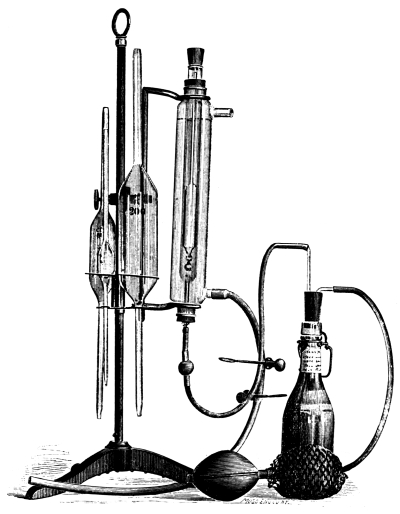
Fig. 108. Areometric Fat Apparatus.
The apparatus is arranged as shown in Fig. 108,
whereby it is easy to drive the ethereal fat solution into the
measuring vessel by means of the bellows shown. In the bottle, seen
at the right of the engraving are placed 200 cubic centimeters of
milk, ten of the potash lye and sixty of the aqueous ether. The milk
and potash are first added and well shaken, the ether then added, and
the contents of the bottle are shaken until a homogeneous emulsion
is formed. The bottle is then set aside for the separation of the
ethereal solution, which is promoted by gently jarring it from time to
time. When the chief part of the solution has separated, a sufficient
quantity of it is driven over into the measuring apparatus, by means
of the air bulbs, to float the hydrometer contained in the inner
cylinder. After a few moments the scale of the oleometer is read and
the percentage of fat calculated from the table. All the measurements
are made at a temperature of 17°.5. The temperature is preserved
constant by filling the outer cylinder of the apparatus with water.
If the room be warmer than 17°.5, the water added should be at a
temperature slightly below that and vice versa. The oleometer
carries a thermometer which indicates the moment when the reading is to
be made.
The scale of the oleometer is graduated arbitrarily from 43 to 66,
corresponding to the specific gravities 0.743 and 0.766, respectively,
or to corresponding fat contents of 2.07 and 5.12 per cent, in the
milk, a range which covers most normal milks.
In the use of the table the per cents corresponding to parts of an
oleometer division can be easily calculated.
Table for Calculating
Per Cent of Fat in Milk
by Areometric Method of Soxhlet.
Reading of
oleometer. |
Per cent fat
in milk. |
Reading of
oleometer. |
Per cent fat
in milk. |
| 43 |
2.07 |
55 |
3.49 |
| 44 |
2.18 |
56 |
3.63 |
| 45 |
2.30 |
57 |
3.75 |
| 46 |
2.40 |
58 |
3.90 |
| 47 |
2.52 |
59 |
4.03 |
| 48 |
2.64 |
60 |
4.18 |
| 49 |
2.76 |
61 |
4.32 |
| 50 |
2.88 |
62 |
4.47 |
| 51 |
3.00 |
63 |
4.63 |
| 52 |
3.12 |
64 |
4.79 |
| 53 |
3.25 |
65 |
4.95 |
| 54 |
3.37 |
66 |
5.12 |
467. Application of the Areometric Method.—Soxhlet’s method, as
outlined above, with many modifications, has been extensively used in
Europe and to a limited degree in this country, and the results
obtained are in general satisfactory, when the sample is a mixed one
from a large number of cows and of average composition.
The author has shown that the process is not applicable to abnormal
milk and often not to milk derived from one animal alone.[458]
The chief difficulty is found in securing a separation of the emulsion.
This trouble can usually be readily overcome by whirling. Any
centrifugal machine, which can receive the bottle in which the emulsion
is made, may be employed for that purpose.
Since the introduction of more modern and convenient methods of fat
determination, the areometric method has fallen into disuse and perhaps
is no longer practiced in this country. It is valuable now chiefly from
the fact that many of the recorded analyses of milk fat were made by
it, and also for its typical character in representing all methods of
analysis of fat in milk based on the density of ethereal solutions.
468. The Lactobutyrometer.—A typical instrument for measuring
the volume of fat in a milk is known as Marchand’s lactobutyrometer.
It is based on the observation that ether will dissolve the fat from
milk when the casein is wholly or partly dissolved by an alkali, and
further, that the fat in an impure form can be separated from its
ethereal solution by the action of alcohol. Experience has shown
that all the fat is not separated from the ethereal solution by this
process, and also that the part separated is a saturated solution in
ether. The method cannot be rigorously placed in the two classes given
above, but being volumetric demands consideration here chiefly because
of its historical interest.[459]
The instrument employed by Marchand is a tube about thirty centimeters
long and twelve in diameter, closed at one end and marked in three
portions of ten cubic centimeters each. The upper part is divided in
tenths of a cubic centimeter. The superior divisions are subdivided so
that the readings can be made to hundredths of a cubic centimeter.
The tube is filled with milk to the first mark and two or three drops of
a twenty-five per cent solution of soda lye added thereto. Ether is
poured in to the second mark, the tube closed and vigorously shaken.
Alcohol of about ninety per cent strength is added to the upper mark,
the tube closed, shaken and allowed to stand in a vertical position,
with occasional jolting, until the separation of the liquids is
complete. In order to promote the separation the tube is placed in a
cylinder containing water at 40°.
When the separation is complete the milk serum is found at the bottom,
the mixture of alcohol and ether in the middle and the fat at the top.
The mixture of ether and alcohol contains 0.126 gram of fat, and each
cubic centimeter of the separated ether fat 0.233 gram of fat. The
total volume of the separated fat, multiplied by 0.233, and the product
increased by 0.126, will give the weight of fat in the ten cubic
centimeters of milk employed.
Example.—Milk used, ten cubic centimeters
of 1.032 specific gravity = 10.32 grams. The observed volume of the
saturated ether fat solution is two cubic centimeters. Then the weight
of fat is 2 × 0.233 + 0.126 = 0.592 gram. The percentage of fat in the
sample is 0.592 × 100 ÷ 10.32 = 5.74.
In the apparatus used in this laboratory the upper division of the
graduation is marked 12.6, because this represents the quantity of fat
which remains in the ether-alcohol mixture for one liter of milk. From
this point the graduation is extended downward to ninety-five, which,
for ten cubic centimeters of milk, represents 0.95 gram. After the fat
has separated, enough ninety-five per cent alcohol is added to bring
the upper surface exactly to the graduation 12.6. The number of grams
per liter of milk is then read directly from the scale.
In respect of applicability, the observation made regarding Soxhlet’s
areometric method may be repeated.
In practical work in this country the lactobutyrometer is no longer
used, but many of the recorded determinations of fat in milk have been
made by this method.
469. Volumetric Methods.—For practical purposes, the volumetric
methods of estimating fat in milk have entirely superseded all the
other processes. It has been found that the fat readily separates in a
pure state from the other constituents of milk whenever the casein is
rendered completely soluble; whereas no process has yet been devised
whereby the fat can be easily separated in a pure state from milk
which has not been treated with some reagent capable of effecting a
solution of the casein. The volumetric methods may be divided into two
classes; viz., (1) Those in which the fat is separated by the
simple action of gravity, and (2) those in which the natural action
of gravity is supplanted by centrifugal motion. Each of these classes
embraces a large number of variations and some of the typical ones will
be described in the following paragraphs. As solvents for the casein a
large number of reagents has been used, including alkalies and single
and mixed acids. In practice, preference is given to the least complex
and most easily prepared solvents.
470. Method Of Patrick.—A typical illustration of the method
of collecting the fat after solution of the casein, without the aid of
whirling, is found in the process devised by Patrick.[460]
The solvent employed is a mixture of acetic, sulfuric and hydrochloric
acids, saturated with sodium sulfate, in the respective volumetric
proportions of nine, five and two. The separation is accomplished in a
large test tube drawn out near the top into a constricted neck which is
graduated to measure the volume of the separated fat or to give direct
percentage results.
The tube should have a content of about twenty-five cubic centimeters
below the upper mark on the neck. In use 10.4 cubic centimeters of
milk and a sufficient quantity of the mixed acids to fill it nearly
to the upper mark are placed in the tube, together with a piece of
pumice stone, and the mixture boiled. On cooling below 100°, the fat
will separate and the volume thereof may be measured in the constricted
portion of the tube. The volume of the fat may be converted into weight
on multiplying by 0.88 at 60°, or more conveniently the percentage of
fat be taken from a table. In practice, the tube is filled with the
milk and acid mixture nearly up to the neck, its contents well mixed
and additional acid mixture added until the liquid is raised in the
tube above the neck. After mixing a second time, the contents are
boiled for five minutes and the fat allowed to collect in the expanded
part of the tube above the neck. When the fat has collected, the
mixture is boiled gently a second time for a few minutes. By this
treatment the fat is mixed with the upper portions of the acid liquid
and clarified. The clearing of the fat may be hastened by sprinkling
over it a little effloresced sodium sulfate. The fat is brought into
the graduated neck by opening a small orifice in the belly of the tube,
which is closed by means of a rubber band. When the temperature has
reached 60°, the space occupied by the fat is noted and the numbers
obtained express the percentage of fat in the sample.
This process is illustrative of the principle of analysis, but is no
longer used in analytical determinations.
471. The Lactocrite.—One of the earliest methods for fat
estimation in milk, depending on the solution of the casein and the
collection of the fat by means of whirling, is based on the use of a
centrifugal machine known as the lactocrite. This apparatus is modeled
very like the machine usually employed for creamery work,[461]
and at one time was extensively used, but it has now given place to less
troublesome and expensive machines. The acid mixture for freeing the
fat of casein is composed of glacial acetic acid carrying five per cent
of sulfuric. The samples of milk are heated with the acid mixture in
test tubes provided with stoppers and short glass tubes to return the
condensation products. The hot mixture is poured into a small metallic
cylindrical cup holding about three cubic centimeters. This cup fits
by means of an accurately ground shoulder on a metal casing, carrying
inside a heavy glass graduated tube of small internal diameter. The
excess of the milk mixture escapes through a small aperture in the
metallic screw cap of the metal holder. The metal holder is cut away on
both sides in order to expose the graduations on the glass tube. The
glass tube is held water-tight by means of perforated elastic washers.
Thus prepared the tubes are inserted in the radial holes of a revolving
steel disk previously heated to a temperature of 60°. The whirling is
accomplished in a few minutes by imparting to the steel disk a speed of
about 6,000 revolutions per minute. At the end of this operation the
fat is found in a clear column in the small glass tube and the number
of the divisions it occupies in this tube is noted. Each division of
the scale represents one-tenth per cent of fat.
This apparatus is capable of giving accurate results when all its parts
are in good working order. In this laboratory the chief difficulty which
its use has presented is in keeping the joints in the glass metal tube tight.
This description of the apparatus is given to secure an illustration of
the principle involved, a principle which has been worked out in later
times into some of the most rapid and practical processes of estimating
fat in milk.
472. Modification of Lindström.—Many modifications have been
proposed for conducting the determination of fat by means of the
lactocrite, but they do not involve any new principle and are of
doubtful merit. In the modification suggested by Lindström, which
has attained quite an extended practical application, the solvent
mixture is composed of lactic and sulfuric acids and the butyrometer
tubes are so changed as to permit the collection of the fat in the
graduated neck after whirling, by means of adding water. The apparatus
is also adjusted to secure the congelation of the fat column before
its volume is noted.[462]
The analyst can read the fat volume at his leisure when it is in
the solid state and is not confused by changes of volume during the
observation. The best acid mixture has been found to be composed of 100
volumes of lactic, an equal amount of acetic and fifteen volumes of
sulfuric acids.[463]
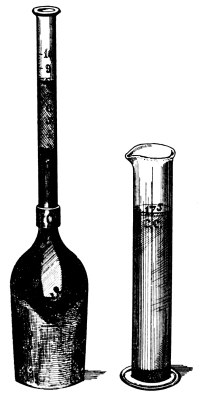
Fig. 109.
Babcock’s Butyrometer
and Acid Measure.
473. The Babcock Method.—Among the many quick volumetric
methods which have been proposed for the determination of fat in
milk, none has secured so wide an application as that suggested by
Babcock.[464]
The chief point of advantage in the use of this method is found in
effecting the solution of the casein by means of sulfuric acid of about
1.83 specific gravity. By this reagent the casein is dissolved in a few
moments without the aid of any other heat than that generated by mixing
the milk with the reagent. The bottle in which the separation is made
is shown in Fig. 109. The graduations on the neck are based
on the use of eighteen grams of milk. To avoid the trouble of weighing, the milk
is measured from a pipette graduated to deliver eighteen grams of milk
of the usual specific gravity. While it is true that normal milk may
vary somewhat in its density, it has been found that a pipette marked
at 17.6 cubic centimeters delivers a weight which can be safely assumed
to vary but slightly from the one desired. The graduated bottle holds
easily thirty-five cubic centimeters of liquid in its expanded portion
and the volume of milk just noted is mixed with an equal volume of
sulfuric acid, conveniently measured from the lip cylinder shown in the
figure. The complete mixture of the milk and
acid is effected by gently rotating the bottle until its contents are
homogeneous. The final color of the mixture varies from dark brown to black.
While still hot, the bottles are placed in a centrifugal machine and
whirled for at least five minutes. The most convenient machine, where
it is available, is the one driven by a jet of steam. The revolutions
of the centrifugal should be at least 700 per minute for a twenty inch
and 1,200 for a twelve inch wheel. After five minutes the bottles are
removed and filled to the upper mark or nearly so with hot water,
replaced in the machine and whirled for at least one minute. The fat
will then be found in a clearly defined column in the graduated neck of
the bottle. In reading the scale, the extreme limits between the lowest
point marked by the lower meniscus and the highest point marked by the
edge of the upper meniscus are to be regarded as the termini of the fat
column.
In testing cream by the babcock process, it may either be diluted until
the column of fat secured is contained in the graduated part of the
neck or specially graduated bottles may be used.
Condensed Milk: In applying the babcock test to condensed
milk, it is necessary to weigh the sample and to use only about eight
grams.[465]
This quantity is placed in the bottle and dissolved in ten cubic
centimeters of water and the analysis completed as above. The reading
noted is multiplied by eighteen and divided by the weight of the sample
taken.
Skim Milk: In determining the fat in skim milk and whey, it is
desirable to use a bottle of double the usual capacity, but with the same
graduation on the neck. The percentage of fat noted is divided by two.
Cheese: Five grams are a convenient quantity of cheese to
employ. To this quantity in the bottle are added fifteen cubic
centimeters of hot water and the flask gently shaken and warmed until
the cheese is softened. The treatment with acid and whirling are the
same as described above. The noted reading is multiplied by eighteen
and divided by five.
474. Solution in Amyl Alcohol and Hydrochloric and Sulfuric
Acids.—Leffmann and Beam have proposed to aid the solution of
the casein in sulfuric acid by the previous addition to the milk of a
mixture of equal volumes of amyl alcohol and hydrochloric acid.[466]
In this process the same graduated flasks may be used as in the
babcock process, or a special flask may be employed. In this case the
graduation of the neck is for fifteen cubic centimeters of milk, and
each one and a half cubic centimeters is divided into eighty-six parts.
The quantity of milk noted is placed in the flask, together with three
cubic centimeters of the mixture of amyl alcohol and hydrochloric acid,
and well shaken. To the mixture, sulfuric acid of 1.83 specific gravity
is added until the belly of the flask is nearly full and the contents
well mixed by shaking. When the casein is dissolved, the addition of
the sulfuric acid is continued until the flask is filled to the upper
mark and again the contents mixed. It is well to close the mouth of
the flask with a stopper while shaking. The bottle is placed in a
centrifugal and whirled for a few moments, when the fat is collected in
the graduated neck and its volume noted.
The process is also known in this country as the beimling method.[467]
The fat separated in the above process is probably mixed with a little
fusel oil, and therefore it is advisable to use the specially graduated
bottle instead of one marked in absolute volumes.[468]
The method, when conducted according to the details found in the
papers cited, gives accurate results, but is somewhat more complicated
than the babcock process and is not now used to any great extent in
analytical work.
475. Method of Gerber.—The method proposed by Gerber for
estimating fat in milk is based on the processes of Babcock, Beimling
and Beam already described. The tubes in which the decomposition of the
milk and the measurement of the fat are accomplished are of two kinds,
one open at only one end for milk and the other open at both ends for
cheese. They are closed during the separation by rubber stoppers.[469]
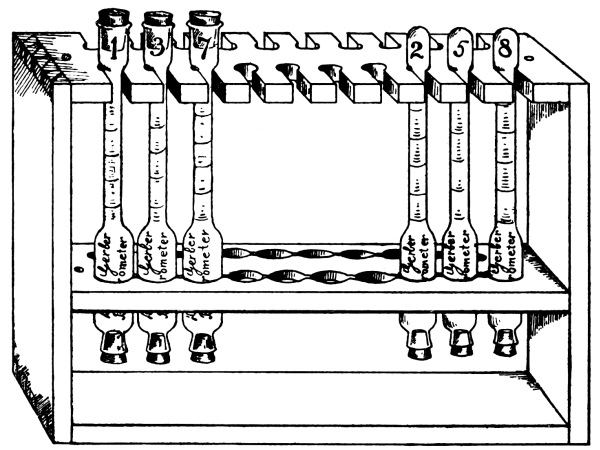
Fig. 110. Gerber’s Butyrometers.
The apparatus have been greatly improved and simplified since the first
description of them was published and have come into extensive use in
Europe and to a limited extent in this country.[470]
The butyrometer tubes are made of various sizes and shapes, but the
most convenient are those noted above as shown in Fig. 110.
Before adding the strong sulfuric acid, one cubic centimeter of amyl
alcohol is mixed with the milk in the butyrometer. This admixture
serves to clarify the fat and render the reading more easy.
The centrifugal is run by hand, and the required speed of rotation is
given it by means of a cord wrapped spirally about its axis, as shown
in Fig. 111. The cord in the new machines is
replaced by a leather strap working on a ratchet.
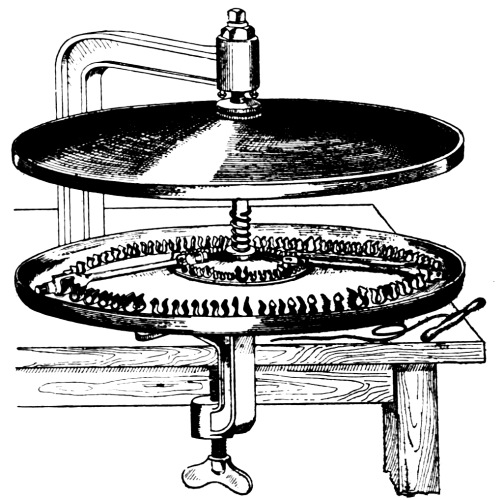
Fig. 111. Gerber’s Centrifugal.
The process is more speedy than that of Babcock, and the results have
been shown by a large experience to be reliable and accurate.
The sulfuric acid employed is of 1.825 to 1.830 specific gravity. There
is no danger of loss by the formation of volatile ethers where the
quantity of amyl alcohol used does not exceed one cubic centimeter.
In a comparison of the respective merits of the methods of Babcock,
Thörner and Gerber, made by Hausamann, the first place is awarded to
the Gerber process.[471]
In the figure 110, the butyrometers marked 2, 5
and 8 are for milk, and those numbered 1, 3 and 7 are for cream and
cheese. In conducting the analysis, ten cubic centimeters of the
sulfuric acid are placed in the butyrometer with one cubic centimeter
of the amyl alcohol. When mixed, eleven cubic centimeters of the
milk are added and the contents of the tube well mixed, the tube
stoppered and placed in the centrifugal. The larger tubes, open at both
ends, require double the quantities of the reagents mentioned. The
measurements are made at about 15°.
Minute directions for conducting the analyses with milk, skim milk,
buttermilk, cream, condensed milk, cheese and butter accompany each
apparatus.
476. Kinds of Proteid Bodies in Milk.—The proteid bodies in
milk are all found in at least partial solution. Some authorities state
that a portion of the casein is present in the form of fine particles
suspended after the manner of the fat globules.[472]
The number and kind of proteid bodies are not known with definiteness.
Among those which are known with certainty are casein, albumin, peptone
and fibrin. The latter body was discovered in milk by Babcock.[473]
Lactoglobulin and lactoprotein are also names given to imperfectly
known proteid bodies in milk. Lactoprotein is not precipitated either
by acids or by heat and is therefore probably a peptone. By far the
greater part of the proteid matters in milk is casein. Casein has been
called caseinogen by Halliburton,[474]
and paracasein by Schulze and Röse.[475]
Casein has intimate relations to the mineral matters in milk, and is
probably itself made up of several proteid bodies of slightly differing
properties. In general all that class of proteid matter contained in
milk which is precipitated by rennet or a weak acid, or spontaneously
on the development of lactic acid, is designated by the term casein,
while the albumins and peptones in similar conditions remain in
solution. Casein contains phosphorus, presumably as nuclein. Fibrin is
recognized in milk by the reactions it gives with hydrogen peroxid or
gum guiacum. The decomposition of hydrogen peroxid is not a certain
test for fibrin, inasmuch as pus and many other bodies will produce the
same effect. If the milk decompose hydrogen peroxid, however, before
and not after boiling, an additional proof of the presence of fibrin
is obtained, since boiled fibrin does not act on the reagent.[476]
The gum guiacum test is applied by dipping a strip of filter paper into the
milk and drying. The solution of gum guiacum is applied to the dried
paper and the presence of fibrin is recognized by the blue color which
is produced. The fibrin is probably changed into some other proteid
during the ripening of cream in which the fibrin is chiefly found. The
albumin in milk is coagulated by boiling, while the casein remains
practically unaffected when subjected to that temperature.
477. Estimation of Total Proteid Matter.—The total proteid
matter in milk is determined by any of the general methods applicable
to the estimation of total nitrogen, but the moist combustion method
is by far the most convenient. From the total nitrogen, that which
represents ammonia or other nonproteid nitrogenous bodies, is to
be deducted and the remainder multiplied by an appropriate factor.
Practically all the nitrogen obtained is derived from the proteid
matters and, as a rule, no correction is necessary. The factors
employed for calculating the weight of proteid matter from the nitrogen
obtained vary from 6.25 to 7.04. It is desirable that additional
investigations be made to determine the magnitude of this factor. It
is suggested that provisionally the factor 6.40 be used. In the method
adopted by the Association of Official Agricultural Chemists it is
directed that about five grams of milk be placed in the oxidizing flask
and treated without previous evaporation exactly as described for the
estimation of total nitrogen in the absence of nitrates. The nitrogen
obtained is multiplied by 6.25 to get the total proteid matter.[477]
In order to prevent the too great dilution of the sulfuric acid, the milk
may be evaporated to dryness or nearly so before oxidation. In this
laboratory it is conveniently done by placing the milk first in the
oxidizing flask, connecting this with the vacuum service and placing
the flask in hot water. The aqueous contents of the milk are quickly
given off at a temperature not exceeding 85°, and the time required is
only a few minutes.
The milk may also be dried in dishes made of thin glass or tin foil
and, after desiccation, introduced with the fragments of the dishes
into the oxidizing flask.
The preliminary drying in the oxidizing flask is recommended as the
best.
Söldner oxidizes the nitrogen in human milk by boiling ten cubic
centimeters thereof for three hours with twenty-five of sulfuric
acid, fifty milligrams of copper oxid and three drops of a four per
cent platinic chlorid solution, and, after distilling the ammonia,
uses the factor 6.39 for calculating the proteid matter. According to
this author human milk is much less rich in nitrogenous constituents
than is generally supposed, containing not more than one and a half
per cent thereof in average samples collected at least a month after
parturition.[478]
478. Precipitation of Total Proteids with Copper Sulfate.—This
method of throwing out the total proteids of milk is due to
Ritthausen.[479]
The proteids and fat are precipitated together by the addition of a
measured volume of copper sulfate solution, containing 63.92 grams
of the crystallized salt in one liter. The process, as modified by
Pfeiffer, is conducted as follows:[480]
Ten grams of milk are diluted with ten times that much water, five
cubic centimeters of the copper sulfate solution added and then soda
lye solution drop by drop until the copper is just precipitated. This
is determined by testing a few drops of the filtrate with soda lye,
which, when the copper is precipitated, will give neither a turbidity
nor a blue color.
The mixture is poured into a dry tared filter, the precipitate washed
with hot water, dried to constant weight and weighed. The fat is
removed from the dry pulverized mass by extraction with ether and the
residue dried and weighed.
The quantity of copper oxyhydrate contained in the precipitate is
calculated from the quantity of the copper solution used and amounts
to 0.2026 gram. The casein thus prepared contains not only the copper
compound named, but also some of the sodium sulfate formed on the
addition of the soda lye and other mineral salts present in the milk
and from which it is quite impossible to completely free it. There are
also many other objections to the process, and the product is of such a
nature as to render the data obtained by the method very doubtful.
This method is chiefly valuable on account of its historical interest.
Not only are the drying and weighing of the precipitate rendered
unnecessary by the modern methods of determining nitrogen, but there
are numerous sources of error which seem to throw doubt on the accuracy
of the results. The copper hydroxid does not lose all its water even on
drying at 125°.[481]
The method therefore can only be recommended for practical purposes
when all the tedious processes of drying, extracting and calculating
the quantity of copper oxid are abandoned and the moist washed
precipitate used directly for the determination of nitrogen.
479. Proteid Bodies by Ammonium Sulfate.—All the proteid bodies
except peptones are precipitated from milk on saturation with ammonium
sulfate. This method has little analytical value because of the
presence of nitrogenous salt in the precipitate. Zinc sulfate may be
substituted for the ammonium salt and thus a determination of proteid
matter other than peptone be obtained. This result subtracted from the
total proteid nitrogen gives that due to peptone.
480. Total Proteid Matter by Tannic Acid.—For the determination
of the total proteid matter in milk Sebelien uses the following
process.[482]
From three to five grams are diluted with three or four volumes of
water, a few drops of a saline solution added (sodium phosphate, sodium
chlorid, magnesium sulfate, et similia), and the proteid bodies
thrown out with an excess of tannic acid solution. The precipitate
is washed with an excess of the precipitant and the nitrogen therein
determined and multiplied by 6.37.
481. Separation of Casein from Albumin.—Sebelien prefers
magnesium sulfate or sodium chlorid to acetic acid as the best reagent
for separating casein from lactalbumin. Of the two saline reagents
mentioned, the former is the better. The milk is first diluted
with a double volume of the saturated saline solution and then the
fine powdered salt added until saturation is secured. The casein
is completely thrown out by this treatment, collected on a filter,
washed with the saturated saline solution, and the nitrogen therein
determined. The difference between the total and casein nitrogen gives
the quantity due to the albumin plus the almost negligible quantity due
to globulin.[483]
482. Van Slyke’s Method of Estimating Casein.—The casein may
be separated from the other albuminoids in milk by the procedure
proposed by Van Slyke.[484]
Ten grams of the fresh milk are diluted with ninety cubic centimeters
of water and the temperature raised to 40°. The casein is thrown down
with a ten per cent solution of acetic acid, of which about one and a
half cubic centimeters are required. The mixture is well stirred and
the precipitate allowed to subside. The whey is decanted onto a filter,
and the precipitate washed two or three times with cold water, brought
finally onto the filter and washed once or twice with cold water.
The filter paper and its contents are used for the determination of
nitrogen in the usual way. The casein is calculated from the nitrogen
found by multiplication by the factor 6.25. Milk may be preserved
for this method of determination by adding to it one part of finely
powdered mercuric chlorid for each two thousand parts of the sample.
The method is not applicable to curdled milk.
483. Theory of Precipitation.—Most authorities now agree in
supposing that the state of semisolution in which the casein is held in
milk is secured by the presence of mineral matters in the milk, in some
intimate combination with the casein. Among these bodies lime is of
the most importance. The action of the dilute acid is chiefly on these
mineral bodies, releasing them from combination with the casein, which,
being insoluble in the milk serum, is precipitated.
484. Factors for Calculation.—Most analysts still use the
common proteid factor, 6.25, in calculating the quantity of proteids
from the nitrogen determined by analysis. For casein many different
factors have been proposed. According to Makeris the factor varies from
6.83 to 7.04.[485]
Munk gives 6.34 for human and 6.37 for cow milk.[486] Sebelien adopts the
latter factor, and Hammersten nearly the same; viz., 6.39. The
weight of authority, at the present time, favors a factor considerably
above 6.25 for calculating the casein and, in fact, the total proteids
of milk from the weight of nitrogen obtained.
485. Béchamp’s Method of Preparing Pure Casein.—The casein in
about one liter of milk is precipitated by adding gradually about three
grams of glacial acetic acid diluted with water. The addition of the
acid is arrested at the moment when litmus paper shows a slightly acid
reaction. The precipitate thus produced, containing all the casein,
the milk globules and the microzymes, is separated by filtration,
being washed by decantation before collecting it on the filter. On
the filter it is washed with distilled water and the fat removed by
shaking with ether. The residue is suspended in water, dissolved in the
least possible quantity of ammonium carbonate, any insoluble residue
(microzymes, globules) separated by filtration and the pure casein
thrown out of the filtrate by the addition of acetic acid. The washing
with distilled water, solution in ammonium carbonate, filtration and
reprecipitation are repeated three or four times in order to obtain
the casein entirely free of other substances. Casein thus prepared is
burned to a carbon free ash with difficulty and contains but little
over one-tenth per cent of mineral matter.[487]
486. Separation of Casein with Carbon Dioxid.—The
supersaturation of the lime compounds of casein with carbon dioxid
diminishes the solvent action of the lime and thus helps to throw out
the proteid matter. For this reason Hoppe-Seyler recommends the use
of carbon dioxid to promote the precipitation of the casein.[488]
The milk is diluted with about twenty volumes of water and treated, drop by
drop, with very dilute acetic acid as long as a precipitate is formed.
A stream of pure carbon dioxid is conducted through the mixture for
half an hour, and it is allowed to remain at rest for twelve hours,
when the casein will have all gone down and the supernatant liquid will
be clear. Albumins and peptones are not thrown out by this treatment.
The method of precipitation is advantageously modified by saturating
the diluted milk with carbon dioxid before adding the acetic acid, less
of the latter being required when used in the order just noted.[489]
487. Separation of Albumin.—In the filtrate from the casein
precipitate the albumin may be separated by heating to 80°. It may also
be precipitated by tannic acid, in which case it may contain a little
globulin. It may also be thrown out by saturation with ammonium or
zinc sulfates. The latter reagent is to be preferred when the nitrogen
is to be determined in the precipitate. The quantities of albumin and
globulin, especially the latter, present in milk are small compared
with its content of casein.
488. Separation of Globulin.—The presence of globulin in milk
is demonstrated by Sebelien in the following manner:[490]
The milk is saturated with finely powdered common salt and the precipitate
produced is separated by filtration. This filtrate in turn is
saturated with magnesium sulfate. The precipitate produced by this
reagent is collected on a filter, dissolved in water and precipitated
by saturation with sodium chlorid. This process is repeated several
times. The final precipitate is proved to be globulin by the following
reactions: When a solution of it is dialyzed the proteid body
separates as a flocculent precipitate, which is easily dissolved in
a weak solution of common salt. The clear solution thus obtained
becomes turbid on adding water, and more so after the addition of a
little acetic acid. A neutral solution of the body is also completely
precipitated by saturation with sodium chlorid. These reactions serve
to identify the body as a globulin and not an albumin. All the globulin
in milk is not obtained by the process, since a part of it is separated
with the casein in the first precipitation.
489. Other Precipitants of Milk Proteids.—Many other reagents
besides those mentioned have been used for precipitating milk
proteids, wholly or in part. Among these may be mentioned the dilute
mineral acids, lactic acid, rennet, mercuric iodid in acetic acid,
phosphotungstic acid, acid mercuric nitrate, lead acetate and many
others.
It has been shown by the author that many of these precipitants do not
remove all the nitrogen but that among others the mercury salts are
effective.[491]
When nitrogen is to be subsequently determined the acid mercuric
nitrate cannot be employed.
490. Precipitation by Dialysis.—Since the casein is supposed to
be held in solution by the action of salts it is probable that it may
be precipitated by removing these salts by dialysis.
491. Carbohydrates in Milk.—The methods of determining lactose
in milk, both by the copper reduction and optical processes, have been
fully set forth in foregoing paragraphs (243,
244, 259, 262).
In general, the optical method by double dilution is to be preferred
as practically exact and capable of application with the minimum
consumption of time.[492]
For normal milks a single polarization is entirely sufficient, making
an arbitrary correction for the volume occupied by the precipitated
proteids and fat. This correction is conveniently placed at six and a
half per cent of the volume of milk employed.
The polarimetric estimation of lactose in human milk is likely to give
erroneous results by reason of the existence in the serum of polarizing
bodies not precipitable by the reagents commonly employed for the
removal of proteids.[493]
The same statement may be made in respect of ass and mare milk. The use
of acetopicric acid for removing disturbing bodies, as proposed by
Thibonet[494]
does not insure results free from error. With the milks above
mentioned, it is safer to rely on the data obtained by the alkaline
copper reagents.
492. Dextrinoid Body in Milk.—In treating the precipitate,
produced in milk by copper sulfate, with alcohol and ether for the
purpose of removing the fat, Ritthausen isolated a dextrin like body
quite different from lactose in its properties.[495]
The alcohol ether extract evaporated to dryness leaves a mass not
wholly soluble in ether, and therefore not composed of fat. This
residue extracted with ether, presents flocky particles, soluble in
water and mostly precipitated therefrom by alcohol. This body has a
slight reducing effect on alkaline copper salts and produces a gray
color with bismuth nitrate. The quantity of this material is so minute
as to lead Ritthausen to observe that it does not sensibly affect the
fat determinations when not separated. It is not clearly demonstrated
that it is a dextrinoid body and the analyst need not fear that the
optical determination of milk sugar will be sensibly affected thereby.
Raumer and Späth assume that certain discrepancies, observed by them in
the data obtained for lactose by the copper and optical methods, are
due to the presence of this dextrinoid body, but no positive proof
thereof is adduced.[496]
493. Amyloid Bodies in Milk.—Herz has observed in milk a body
having some of the characteristics of starch.[497]
Observed by the microscope, these particles have some of the
characteristics of the starch grains of vegetables, with a diameter
of from ten to thirty-five micromillimeters. They are colored blue by
iodin. When boiled with water, however, these particles differ from
starch in not forming a paste. The particles are most abundant in the
turbid layer found immediately beneath the ether fat solution in the
areometric process of Soxhlet.
The amyloid particles may be collected from cheese and butter by
boiling with water, when they settle and can be observed on the
sediment after freeing of fat by ether.
Some of the statements regarding the adulteration of dairy products
with starch may have been made erroneously by reason of the natural
occurrence of these particles.
As in the case of the dextrin like body mentioned above this starchy
substance, if it really exist, occurs in too minute a quantity to
influence the results of any of the analytical methods heretofore
described.
In connection with the supposed presence of an amyloid body in milk,
it should be remembered that certain decomposition nitrogenous bodies
give practically the same reactions as are noted above.[498]
Among these may be mentioned chitin, which occurs very extensively in
the animal world. The proof of the existence of dextrinoid and amyloid
bodies in milk rests on evidence which should be thoroughly revised
before being undoubtedly accepted.
494. General Principles.—The general analysis of butter fat
is conducted in accordance with the methods described in the part of
this volume devoted to the examination of fats and oils. The methods of
sampling, drying, filtering, and of determining physical and chemical
properties, are there developed in sufficient detail to guide the
analyst in all operations of a general nature. There remain for
consideration here only the special processes practiced in butter
analysis and which are not applied to fats in general. These processes
naturally relate to the study of those properties of a distinctive
nature, by means of which butter is differentiated from other fats for
which it may be mistaken or with which it may be adulterated. These
special studies, therefore, are directed chiefly to the consideration
of the peculiar physical properties of butter fat, to its content of
volatile acids and to its characteristic forms of crystallization as
observed with the aid of the microscope. For dietetic, economic and
legal reasons, it is highly important that the analyst be able to
distinguish a pure butter from any substitute therefor.
495. Appearance of Melted Butter.—Fresh, pure butter, when
slowly melted, shows after a short time the butter fat completely
separated, of a delicate yellow color and quite transparent. Old
samples of butter do not give a fat layer of equal transparency.
Oleomargarin, or any artificial butter when similarly treated, gives
a fat layer opalescent or opaque. By means of this simple test an
easy separation of pure from adulterated butter may be effected. In
mixtures, the degree of turbidity shown by the separated fats may be
regarded as a rough index of the amount of adulteration. In conducting
the work, the samples of butter, in convenient quantities according to
the size of the containing vessel, are placed in beakers and warmed
slowly at a temperature not exceeding 50°. After a lapse of half an
hour the observations are made.
If one part of the melted butter be shaken with two volumes of warm
water (40°) and set aside for five minutes the fat is still found as an
emulsion, while oleomargarin, similarly treated, shows the fat mostly
separated. This process has some merit, but must not be too highly
valued.[499]
496. Microscopic Examination of Butter.—The microscope is
helpful in judging the purity of butter and the admixture of foreign
fats, if not in too small quantity to be of any commercial importance,
can easily be detected by this means.[500]
The methods of preparing butter fat in a crystalline state are the same
as those described in paragraphs 307-309. The crystals of butter
fat differ greatly in appearance with the different methods of
preparation. When butter is melted, filtered, heated to the boiling
point of water and slowly cooled, it forms spheroidal crystalline
masses as seen by the microscope, which present a well defined cross
with polarized light. This cross is not peculiar to butter fat, but is
developed therein with greater distinctiveness than in other fats of
animal origin.
Pure, fresh, unmelted butter, when viewed with polarized light through
a plate of selenite, presents a field of vision of uniform tint,
varying with the relative positions of the nicols. When foreign fats,
previously melted, as in rendering, are mixed with the butter the
crystallization they undergo disturbs this uniformity of tint and the
field of vision appears particolored. Old, rancid or melted butter may
give rise to the same or similar phenomena under like conditions of
examination. The microscope thus becomes a most valuable instrument for
sorting butters and in distinguishing them in a preliminary way from
oleomargarin.

Fig. 112. Thermometer for Butyrorefractometer.
497. Judgment of Suspected Butter or Lard by Refractive
Power.—In discriminating between pure and adulterated butters by
the aid of the butyrorefractometer (301), the absolute reading
of the instrument is of less importance than the difference which is
detected between the highest permissible numbers, for any degree of
temperature, and the actual reading obtained at that temperature. These
differences, within certain limits, do not perceptibly vary with the
temperature, and heretofore they have been determined with the aid of
a table, and in this respect the observations have been made the more
laborious.
Wollny has rendered these tables unnecessary by constructing a
thermometer in which the mercury column does not indicate degrees of
temperature, but the highest permissible number for butter or lard
at the temperature of observation. The scale of the instrument is so
adjusted as to include temperatures of from 30° to 40°, which renders
it suited to the examination of butter and lard. The oleothermometer is
shown in Fig. 112.
The side of the scale B is for butter and that marked S
for lard. The use of the instrument is the simplest possible. The
sample of fat is placed in the prisms in the usual manner. When the
mercury in the thermometer is at rest, the scale of the instrument
is read. In the case of a butter, if the reading of the scale give a
higher number than that indicated by the thermometer, the sample is
pronounced suspicious and the degree of suspicion is proportional to
the difference of the two readings.
498. Estimation of Water, Fat, Casein, Ash and Salt.—The
methods proposed by the author for conducting these determinations,
with minor amendments, have been adopted by the Association of Official
Agricultural Chemists.[501]
Water.—The sample held in a flat bottom dish is dried to
constant weight at about 100°. The weight of the sample used should
be proportional to the area of the bottom of the dish, which should
be just covered by the film of melted fat. The dish may be previously
partly filled with sand, asbestos or pumice stone. The drying may take
place in the air, in an inert gas or in a vacuum.
Fat.—The fat in a sample of butter is readily determined by
treating the contents of the dish after the determination of water with
an appropriate solvent.
The process is conducted as follows:
The dry butter from the water determination is dissolved in the dish
with ether or petroleum spirit. The contents of the dish are then
transferred to a weighed gooch with the aid of a wash bottle containing
the solvent, and washed till free of fat. The crucible and contents are
heated at the temperature of boiling water till the weight is constant.
The weight of fat is calculated by difference from the data obtained.
The fat may also be determined by drying the butter on asbestos or
sand, and subsequently extracting the fat by anhydrous alcohol free
ether. The extract, after evaporation of the ether, is dried to
constant weight at the temperature of boiling water and weighed.
Casein or Curd and Ash.—The crucible containing the residue
from the fat determination is covered and heated, gently at first,
gradually raising the temperature to just below redness. The cover
may then be removed and the heat continued till the contents of the
crucible are white. The loss in weight of the crucible and contents
represents casein or curd, and the residue is mineral matter or ash.
Salt.—It is the usual custom in the manufacture of butter in
this country to add, as a condiment, a certain proportion of salt.
In Europe, the butter offered for consumption is usually unsalted. A
convenient method of determining the quantity of salt is found in the
removal thereof, from the sample, by repeated washing with hot water
and in determining the salt in the wash water by precipitation with
silver nitrate. The operation is conducted as follows: From five to
ten grams of the sample are placed in a separatory funnel, hot water
added, the stopper inserted and the contents of the funnel well shaken.
After standing until the fat has all collected on top of the water, the
stopcock is opened and the water is allowed to run into an erlenmeyer,
being careful to let none of the fat globules pass. Hot water is again
added to the beaker, and the extraction is repeated several times,
using each time from ten to twenty cubic centimeters of water. The
resulting washings contain all but a mere trace of the sodium chlorid
originally present in the butter. The sodium chlorid is determined in
the filtrate by a set solution of silver nitrate, using a few drops of
a solution of potassium chromate as an indicator.
It is evident that the quantity of salt may also be determined from the
ash or mineral matter obtained, as above noted, by the same process.
If desirable, which is rarely the case, the gravimetric method of
estimating the silver chlorid may be used.
499. Volatile or Soluble Acids.—The distinguishing feature
of butter, from a chemical point of view, is found in its content of
volatile or soluble fat acids. Among the volatile acids are reckoned
those which are carried over in a current of steam at a temperature
only slightly higher than that of boiling water. As soluble acids are
regarded those which pass without great difficulty into solution in hot
water. These two classes are composed essentially of the same acids.
Of these butyric is the most important, followed by caproic, caprylic
and capric acids. Small quantities or rather traces of acetic, lauric,
myristic and arachidic acids are also sometimes found in butter.
Palmitic, stearic and oleic acids also occur in large quantities. The
above named acids, in combination with glycerol, form the butter fat.
500. Relative Proportion of Ingredients.—The composition
of butter fat is given differently by different authorities.[502]
A typical dry butter fat may be regarded as having the following
composition:
| Per cent. |
| Butyrin |
7.00 |
| Caproin, Caprylin and Caprin |
2.30 |
| Olein |
37.70 |
| Palmitin, stearin, etc. |
53.00 |
Pure butter fat consists principally of the above glycerids, some
coloring principles, varying in quantity and composition with the food
of the animal, and a trace of lecithin, cholesterol, phytosterol and a
lipochrome.
501. Estimation of Volatile or Soluble Acids.—The volatile
or soluble acids in butter fat are estimated by the methods already
described (349, 351).
In practice preference is given to the method of determining volatile
acids, based on the principle that under standard conditions
practically all the acids of this nature are secured in a certain
volume of the distillate. This assumption is not strictly true, but the
method offers a convenient and reliable manner of obtaining results
which, if not absolute, are at least comparative.
The quantity of acid distilled is determined by titration with tenth
normal alkali and for convenience the data are expressed in terms of
the volume of the alkali consumed. Five grams of normal butter fat
will give a distillate, under the conditions given, requiring about
twenty-eight cubic centimeters of tenth normal alkali for complete
saturation. This is known as the reichert-meissl number. Occasionally
this number may rise to thirty-two or may sink to twenty-five. Cases
have been reported where it fell below the latter number, but such
samples cannot be regarded as normal butter.
The determination of the reichert-meissl number is the most important
of the chemical processes applied to butter fat analysis.
502. Saponification Value and Reichert Number.—It may often be
convenient to make the same sample of butter fat serve both for the
determination of the saponification value and of the reichert number.
For this purpose it is convenient to use exactly five grams of the
dry filtered fat. The saponification may be accomplished either under
pressure or by attaching a reflux condenser to the flask as suggested
by Bremer.[503]
When the saponification, which is accomplished with alcoholic potash
lye containing about 1.25 grams in each ten cubic centimeters of
seventy per cent alcohol, is finished, and the contents of the flask
are cooled, the residual alkali is titrated with a set sulfuric acid
solution, using phenolphthalein as indicator. When the color has almost
disappeared, an additional quantity of the indicator is added and the
titration continued until the liquid is of an amber tint. A sample of
the alkali, treated as above, is titrated at the same time and from the
two sets of data obtained, the saponification number is calculated as
indicated in paragraph (345).
A few drops of the alcoholic lye are added to the contents of the flask
and the alcohol removed by evaporation. The residual soap and potassium
sulfate are dissolved in 100 cubic centimeters of recently boiled
water, some pieces of pumice added, and the volatile acids removed by
distillation in the usual way after adding an excess of sulfuric acid.
It is important to conduct blank distillations in the same form of
apparatus to determine the magnitude of any corrections to be made.
The size of the distilling flask and the form of apparatus to prevent
mechanical projection of sulfuric acid into the distillate should be
the same in all cases.
503. Modification of the Reichert-Meissl Method.—Kreis has
proposed the use of strong sulfuric acid for saponifying the fats, the
saponification and distillation being accomplished in one operation.
A source of error of some inconvenience in this method is due to the
development of sulfurous acid by the reducing action of the organic
matter on the oil of vitriol. Pinette proposes to avoid this difficulty
by adding, before the distillation is begun, sufficient potassium
permanganate to produce a permanent red coloration. By this means the
sulfurous acid is completely oxidized and its transfer to the standard
alkali during distillation entirely prevented. The same result is
accomplished by Micko by the use of potassium bichromate. The details
of the manipulation are as follows:[504]
About five grams of the fused fat (butter or oleomargarin) are placed
in a flask of approximately 300 cubic centimeters capacity. After
cooling, there are added ten cubic centimeters of sulfuric acid
containing three grams of water to each ninety-seven grams of the
strongest acid.
The fat and acid are well mixed by a gentle rotatory motion of the
flask and placed in a water bath at a temperature of 35° (circa)
for fifteen minutes. At the end of this time the flask is removed from
the bath and 125 cubic centimeters of water added, little by little,
keeping the contents cool. Next are added four cubic centimeters of a
four per cent solution of potassium bichromate. The contents of the
flask are vigorously shaken and, after five minutes, a solution of
ferrous sulfate is added gradually from a burette until the reaction
with a drop of potassium ferrocyanid shows a slight excess of the iron
salt. The volume of the liquor in the flask is then increased to 150
cubic centimeters by the addition of water and 110 cubic centimeters
distilled. After mixing and filtering through a dry filter, the acid
in 100 cubic centimeters is determined by standard tenth normal barium
hydroxid solution and the number thus obtained increased by one-tenth
representing the total acid obtained.
504. Elimination of Sulfurous Acid.—Prager and Stern[505]
propose to eliminate the sulfurous acid by a stream of air, succeeded
by one of carbon dioxid, and proceed as follows: Five grams of the
butter fat are brought into a liter flask, ten cubic centimeters of
strong sulfuric acid are added and the flask is kept for ten minutes at
30-32° with constant agitation. When the liquid is cold, air is
bubbled through it until the odor of sulfurous acid has disappeared.
One hundred cubic centimeters of water are added, with precautions
against rise of temperature, and carbon dioxid is bubbled through for
ten minutes. This is then displaced by a stream of air for another ten
minutes, the delivery tube is washed into the flask with fifty cubic
centimeters of water and the distillation is effected. The following
results are quoted:
Cubic centimeters of tenth normal alkali required by five grams of
butter fat:
| |
Reichert-Meissl. |
Prager-Stern. |
| Sample |
a |
29.86 |
29.60 |
| ” |
b |
30.23 |
29.65 |
| ” |
c |
28.34 |
27.76 |
| ” |
d |
28.20 |
28.10 |
The authors do not comment on the possibility of loss of acids
other than sulfurous in the stream of air, but they admit that
further investigation is requisite to render the suggestion of Kreis
serviceable.
505. Errors Due to Poor Glass.—The easy solubility of the glass
holding the reagents is the cause of some of the difficulties attending
the determination of the saponification value. The separated silica
tends to carry down, mechanically, a part of the alkali. This is shown
by the fact that after the color has been discharged by titration
with acid and the flask set aside a reappearance of the red color is
noticed, after a time, beginning at the bottom of the flask.[506]
In order to avoid difficulties of this nature, either cold saponification
should be practiced or the digestion vessels used for moist combustion
in sulfuric acid be employed.
Errors may also be easily introduced by the use of uncalibrated
burettes and from the employment of varying quantities of the
phenolphthalein solution.
506. Estimation of the Molecular Weight of Butter and Butter
Substitutes.—Garelli and Carono have proposed a method for
discriminating between butter and its substitutes by the kryoskopic
determination of molecular weights.
The molecular weights of stearin, palmitin and olein are 890, 806
and 884, and of butyrin, caproin and caprylin 303, 386 and 470
respectively. Pure butter, therefore, has a lower mean molecular weight
than margarin.
The method and apparatus of Beckmann are used in the determination,
fifteen grams of benzol being employed as a solvent.
The constant for the molecular depression of the benzol is found to be
53.
The molecular weight obtained with samples of pure butter varied from
696 to 716, and for oleomargarin from 780 to 883.
The figures obtained with mixtures of twenty, twenty-five, thirty-three
and fifty per cent of margarin with butter were 761, 720, 728 and 749
respectively. The method can be relied upon to classify samples as follows:
- 1. Pure butter.
- 2. Butter containing margarin.
- 3. Suspicious butter.[507]
507. Substitutes and Adulterants of Butter.—In this country,
butter is never adulterated with cocoa or sesame oil, as is sometimes
the case in other lands. The common substitute for butter here is
oleomargarin, and the most common butter adulterant, neutral lard. The
methods of analyses, by means of which these bodies can be identified,
have already been sufficiently described. By the use of certain
digestive ferments and other bodies, butter may be made to hold an
excessive quantity of casein, sugar and water in the form of a somewhat
permanent emulsion.[508]
This form of adulteration is revealed at once on melting the sample.
508. Furfurol Reaction with Sesame Oil.—Olive oil and sometimes
butter are mixed with the cheaper body, sesame oil. The latter is
detected with certainty, from the red coloration it gives when mixed
with furfurol and hydrochloric acid. Instead of furfurol, some body
yielding it when subjected to the action of hydrochloric acid,
viz., sucrose or a pentose sugar, may be used. It has been
found by Wauters, however, that an alcoholic solution of two grams of
furfuraldehyd in 100 cubic centimeters of alcohol is the best reagent.
One-tenth of a cubic centimeter of this reagent is used for each
test.[509]
The test is made as follows: The quantity of the furfuraldehyd solution
mentioned above is mixed with ten cubic centimeters of hydrochloric
acid, and there are added, without mixing, an equal volume of the
suspected oil. On standing, a red coloration is produced at the zone of
separation of the two liquids. If the oil be sesame, the coloration is
produced instantly. As little as one per cent of sesame in a mixed oil
will show the color in two minutes. The manipulation is also varied by
shaking together the reagents and the melted butter. Turmeric, which
is sometimes used in coloring butter, also gives the rose-red color
when treated with hydrochloric acid, but turmeric supplies its own
furfuraldehyd. It is easy to distinguish therefore the coloration due
to sesame oil, which is developed only when furfuraldehyd is present,
from that due to the turmeric, which is produced without the aid of the
special reagent.
509. Butter Colors.—Where cows are deprived of green food and
root crops, such as carrots, and kept on a poorly balanced ration, the
butter made from their milk may be almost colorless. To remedy this
defect it is quite a common practice to color the product artificially.
Almost the sole coloring matter used in this country is anatto.[510]
Other coloring matters which are occasionally employed are turmeric,
saffron, marigold leaves, yellow wood (Chlorophora tinctoria),
carrot juice, chrome yellow (lead chromate) and dinitrocresol.
The use of small quantities of anatto, turmeric or saffron is
unobjectionable, from a sanitary point of view, but this is not the
case with such a substance as lead chromate. The detection of anatto or
saffron in butter may be accomplished by the method of Cornwall.[511]
About five grams of the warm filtered fat are dissolved in about fifty
cubic centimeters of ordinary ether, in a wide tube, and the solution
is vigorously shaken for from ten to fifteen seconds, with from twelve
to fifteen cubic centimeters of a very dilute solution of caustic
potash or soda in water, only alkaline enough to give a distinct
reaction with turmeric paper, and to remain alkaline after separating
from the ethereal fat solution. The corked tube is set aside, and in
a few hours, at most, the greater part of the aqueous solution, now
colored more or less yellow by the anatto, can be drawn from beneath
the ether with a pipette or by a stopcock below, in a sufficiently
clear state to be evaporated to dryness and tested in the usual way
with a drop of concentrated sulfuric acid.
Sometimes it is well to further purify the aqueous solution by shaking
it with some fresh ether before evaporating it, and any fat globules
that may float on its surface during evaporation should be removed by
touching them with a slip of filter paper; but the solution should not
be filtered, because the filter paper may retain much of the coloring
matter.
The dry yellow or slightly orange residue turns blue or violet blue
with sulfuric acid, then quickly green, and finally brownish or
somewhat violet this final change being variable, according to the
purity of the extract.
Saffron can be extracted in the same way; it differs from anatto very
decidedly, the most important difference being in the absence of the
green coloration.
Genuine butter, free from foreign coloring matter, imparts at most a
very pale yellow color to the alkaline solution; but it is important
to note that a mere green coloration of the dry residue on addition
of sulfuric acid is not a certain indication of anatto (as some books
state) because the writer has thus obtained from genuine butter,
free from foreign coloring matter, a dirty green coloration, but not
preceded by any blue or violet-blue tint.
Blank tests should be made with the ether.
Turmeric is easily identified by the brownish to reddish stratum that
forms between the ethereal fat solution and the alkaline solution
before they are intimately mixed. It may be even better recognized by
carefully bringing a feebly alkaline solution of ammonia in alcohol
beneath the ethereal fat solution with a pipette, and gently agitating
the two, so as to mix them partially.
Another method of separating artificial coloring matter has been
proposed by Martin.[512]
A method of determining the relative amount of butter color has been
worked out by Babcock.[513]
510. Composition Of Cheese.—Pure cheese is made from whole
milk by precipitating the casein with rennet. The precipitated casein
carries down also the fat of the milk and a little lactose and whey
remain incorporated with the cheesy mass. The ingredients of cheese
are therefore those of the whole milk less the greater part of the
whey, id est, milk sugar, lactalbumin, globulin, soluble mineral
matters and water. In the conversion of the crude precipitate noted
above into the cheese of commerce, it is subjected to a ripening
process which is chiefly conditioned by bacterial action. It is not
possible here to enter into a discussion of methods of isolating
and identifying the bacteria which promote or retard the ripening
process.[514]
As a rule, about a month is required for the curing process, before the
cheeses are ready for boxing and shipment. The most important changes
during ripening take place in the proteid matter, which is so altered
as to become more palatable and more digestible as a result of the
bacterial activity.
The percentage composition of the principal cheeses of commerce are
shown in the following table:[515]
| |
Water,
Per cent. |
Casein,
Per cent. |
Fat,
Per cent. |
Sugar,
Per cent. |
Ash,
Per cent. |
| Cheddar |
34.38 |
26.38 |
32.71 |
2.95 |
3.58 |
| Cheshire |
32.59 |
32.51 |
26.06 |
4.53 |
4.31 |
| Stilton |
30.35 |
28.85 |
35.39 |
1.59 |
3.83 |
| Brie |
50.35 |
17.18 |
25.12 |
1.94 |
5.41 |
| Neufchatel |
44.47 |
14.60 |
33.70 |
4.24 |
2.99 |
| Roquefort |
31.20 |
27.63 |
33.16 |
2.00 |
6.01 |
| Edam |
36.28 |
24.06 |
30.26 |
4.60 |
4.90 |
| Swiss |
35.80 |
24.44 |
37.40 |
|
2.36 |
| Full cream, |
38.60 |
25.35 |
30.25 |
2.03 |
4.07 |
| (mean of 143 analyses) |
It is evident that the composition of the cheese will vary with
the milk from which it is made and the manipulation to which it
is subjected. A good American green cheese made from milk of
the composition noted below will have the composition which is
appended.[516]
Table Showing Mean Composition of
Milk and Cheese Made Therefrom.
| |
Milk. |
Cheese. |
| Per |
cent. |
water |
87.38 |
36.70 |
| ” |
” |
fat |
3.73 |
34.18 |
| ” |
” |
proteids |
3.13 |
23.44 |
| ” |
” |
sugar, ash etc. |
5.76 |
5.68 |
From the above it is seen that in full milk cheese the ratio of fat to
casein is 1.46: 1, and to solids not fat 1.17: 1. This is a point of
some importance in judging the purity of a cheese. When the full milk
of a mixed herd is used the percentage of fat in a cheese will always
be considerably higher than that of casein.
511. Manipulation of the Milk.—When sweet milk is received at
the cheese factory, a starter of sour milk is added to it in order
to hasten its ripening. When it is thought that the proper degree of
acidity has been secured, it is subjected to a rennet test. In this
test 160 cubic centimeters of the milk are heated to 30° and mixed
with five cubic centimeters of the rennet solution made by diluting
five cubic centimeters of the rennet of commerce with fifty cubic
centimeters of water. The number of seconds required for the milk
to curdle is noted. The observation is facilitated by distributing
throughout the milk a few fine fragments of charcoal. The contents of
the vessel are given a circular motion and, at the moment of setting,
the movement of the black particles is suddenly arrested. If coloring
matter be added to the milk, it should be done before it becomes sour.
The quantity of rennet required is determined by the nature of the
cheese which it is desired to make. For a cheese to be rapidly cured,
enough rennet should be added to produce coagulation in from fifteen
to twenty minutes, and when slow curing is practiced in from thirty
to forty-five minutes. When the mass is solid so that it can be cut
with a knife, the temperature is raised to 37°, and it is tested on a
hot iron until it forms threads an eighth of an inch in length. This
test is made by applying an iron heated nearly to redness to the curd.
When the curd is in proper condition threads from a few millimeters to
two centimeters in length are formed, when the iron is withdrawn. The
longer threads indicate, but only to a limited extent, a higher degree
of acidity.[517]
This test is usually made about two and one-half hours from the time of
coagulation. The whey is then drawn off through a strainer and the curd
is placed on racks with linen bottoms in order that the residual whey
may escape, the curd being stirred meanwhile. In from fifteen to twenty
minutes it can be cut into blocks eight or ten inches square and turned
over. This is repeated several times in order to facilitate the escape
of the whey. When the curd assumes a stringy condition, it is run
through a mill and cut into small bits and is ready for salting, being
cooled to 27° before the salt is added. From two to three pounds of
salt are used for each 100 pounds of curd. The curd is then placed in
the molds and pressed into the desired form. The cheeses thus prepared
are placed on shelves in the ripening room and the rinds greased. They
should be turned and rubbed every day during the ripening, which takes
place at a temperature of from 15° to 18°.[518]
512. Official Methods of Analysis.—The methods of cheese
analysis recommended by the Association of Official Agricultural
Chemists are provisional and are not binding on its members. They are
as follows:[519]
Preparation of Sample.—Where the cheese can be cut, a narrow
wedge reaching from the edge to the center will more nearly represent
the average composition than any other sample. This should be chopped
quite fine, with care to avoid evaporation of water, and the several
portions for analysis taken from the mixed mass. When the sample is
obtained with a cheese trier, a plug perpendicular to the surface
one-third of the distance from the edge to the center of the cheese
more nearly represents the average composition than any other. The
plug should either reach entirely or half way through the cheese. For
inspection purposes the rind may be rejected, but for investigations
where the absolute quantity of fat in the cheese is required the rind
should be included in the sample. It is well, when admissible, to
secure two or three plugs on different sides of the cheese, and, after
splitting them lengthwise with a sharp knife, use portions of each for
the different determinations.
Determination of Water.—From five to ten grams of cheese are
placed in thin slices in a weighed platinum or porcelain dish which
contains a small quantity of freshly ignited asbestos to absorb the
fat. The dish is heated in a water oven for ten hours and weighed; the
loss in weight is considered as water. If preferred, the dish may be
placed in a desiccator over concentrated sulfuric acid and dried to
constant weight. In some cases this may require as much as two months.
The acid should be renewed when the cheese has become nearly dry.
Determination of Ether Extract.—Grind from five to ten grams
of cheese in a small mortar with about twice its weight of anhydrous
copper sulfate. The grinding should continue until the cheese is finely
pulverized and evenly distributed throughout the mass, which will have
a uniform light blue color. This mixture is transferred to a glass tube
having a strong filter paper, supported by a piece of muslin, tied over
one end. Put a little anhydrous copper sulfate into the tube next to
the filter before introducing the mixture containing the cheese. On top
of the mixture place a tuft of ignited asbestos, and place the tube in
a continuous extraction apparatus and treat with anhydrous ether for
fifteen hours. Dry the fat obtained at 100° to constant weight.
Determination of Nitrogen.—The nitrogen is determined by the
kjeldahl method, using about two grams of cheese, and multiplying the
percentage of nitrogen found by 6.25 for proteid compounds.
Determination of Ash.—The dry residue from the water
determination may be used for the ash determination. If the cheese be
rich in fat, the asbestos will be saturated therewith. This may be
carefully ignited and the fat allowed to burn, the asbestos acting as a
wick. No extra heat should be applied during this operation, as there
is danger of spurting. When the flame has died out, the burning may be
completed in a muffle at low redness. When desired, the salt may be
determined in the ash in the manner specified under butter
(498).
Determination of Other Constituents.—The sum of the percentages
of the different constituents, determined as above, subtracted from 100
will give the amount of organic acids, milk sugar etc., in the cheese.
513. Process of Mueller.—The process of Müller,[520]
as modified by Kruger,[521]
is conducted as follows: About ten grams of a good average sample of
cheese are rubbed in a porcelain mortar with a mixture of three parts
of alcohol and one part of ether. After the mixed liquids have been in
contact with the cheese five or ten minutes they are poured upon a
weighed filter of from fifteen to sixteen centimeters diameter, and
this process is repeated from one to three times, after which the
contents of the mortar are brought upon the filter. The filtrate
is received in a weighed flask, the alcohol ether driven off by
evaporation and the residue dried. Since it is difficult to get all the
particles of cheese free from the mortar, it is advisable to perform
the above process in a weighed dish which can afterwards be washed
thoroughly with ether and alcohol and dried and the amount of matter
remaining thereon accounted for. The residue remaining in the flask
after drying is treated several times with pure warm ether, and the
residue also remaining upon the filter mentioned above is completely
extracted with ether. The dried residue obtained in this way from the
filter plus the residue in the flask which received the filtrate, plus
the amount left upon the dish in which the cheese was originally rubbed
up, constitute the total dry matter of the cheese freed of fat. All
the material soluble in ether should be collected together, dried and
weighed as fat.
By this process the cheesy mass is converted into a fine powder which
can be easily and completely freed from fat by ether, and can be dried
without becoming a gummy or horny mass.
For the estimation of the nitrogen, about three grams of the well
grated cheese are used and the nitrogen determined by moist combustion
with sulfuric acid.[522]
For the estimation of ash, about five grams are carbonized, extracted
with water, and the ash determined as described below.[523]
Char from two to three grams of the substance and burn to whiteness
at the lowest possible red heat. If a white ash cannot be obtained in
this manner, exhaust the charred mass with water, collect the insoluble
residue on a filter, burn, add this ash to the residue from the
evaporation of the aqueous extract and heat the whole to a low redness
till the ash is white.
514. Separation of Fat from Cheese.—It is often desirable to
secure a considerable quantity of the cheese fat for physical and
chemical examination without the necessity of effecting a complete
quantitive separation. In this laboratory this is accomplished by the
method of Henzold.[524]
The cheese, in quantities of about 300 grams, is cut into fragments
about the size of a pea and treated with 700 cubic centimeters of
potash lye, which has previously been brought to a temperature of about
20°. The strength of the lye should be such that about fifty grams of
the caustic potash are contained in each liter of the solution.
The treatment is conveniently conducted in a wide neck flask and the
solution of the casein is promoted by vigorous shaking. After from five
to ten minutes, it will be found that the casein is dissolved and the
fat is found swimming upon the surface of the solution in the form of
lumps. The lumps of fat are collected in as large a mass as possible by
a gentle shaking to and fro. Cold water is poured into the flask until the
fat is driven up into the neck, whence it is removed by means of a spoon.
The fat obtained in this way is washed a few times with as little cold
water as possible in order to remove the residue of potash lye which
it may contain. Experience shows that the fat by this treatment is
not perceptibly attacked by the potash lye. In a short time, by this
procedure, the fat is practically all separated and is then easily
prepared for chemical analysis by filtering and drying in the manner
already described (283). The fat may also be separated, but
with less convenience, by partially drying the sample, reducing it to
a finely divided state and applying any of the usual solvents. The
solvent is removed from the extract by evaporation and the residual fat
is filtered and prepared for examination as usual.
515. Filled Cheese.—The skim milk coming from the separators
is unfortunately too often used for cheese making. The abstracted fat
is replaced with a cheaper one, usually lard. These spurious cheeses
are found in nearly every market and are generally sold as genuine.
The purchasers only discover the fraud when the cheese is consumed.
Many of the States have forbidden by statute the manufacture and sale
of this fraudulent article. Imported cheeses may also be regarded
with suspicion, inasmuch as the method of preparing filled cheese is
well known and extensively practiced abroad. A mere determination of
the percentage of fat in the sample is not an index of the purity of
the cheese. It is necessary to extract the fat by one of the methods
already described and, after drying and filtering, to submit the
suspected fat to a microscopic and chemical examination. A low content
of volatile fat acid and the occurrence of crystalline forms foreign to
butter will furnish the data for a competent judgment.
When the reichert-meissl number falls below twenty-five the sample
may be regarded with suspicion. The detection of the characteristic
crystals of lard or tallow is reliable corroborating evidence
(308).
It is stated by Kühn[525]
that the margarin factory of Mohr, at Bahrenfeld-Altona, has made for
many years a perfect emulsion of fat with skim milk. This product has
been much used in the manufacture of filled cheese which is often found
upon the German market.
516. Separation of the Nitrogenous Bodies in Cheese.—The
general methods of separation already described for proteid bodies
(417-425) are also applicable to the different nitrogenous
bodies present in cheese, representing the residue of these bodies
as originally occurring in the milk, and also the products which are
formed therefrom during the period of ripening. For practical dietary
and analytical purposes, these bodies may be considered in three groups:
(a) The useless (from a nutrient point of view) nitrogenous
bodies, including ammonia, nitric acid, the phenylamido-propionic
acids, tyrosin, leucin and other amid bodies.
(b) The albumoses and peptones, products of fermentation soluble
in boiling water.
(c) The caseins and albuminates, insoluble in boiling water.
The group of bodies under (a), according to Stutzer, may be
separated from the groups (b) and (c) by means of
phosphotungstic acid. For this purpose a portion of an intimate
mixture of fine sand and cheese (100 cheese, 400 sand) corresponding
to five grams of cheese, is shaken for fifteen minutes with 150 cubic
centimeters of water. After remaining at rest for another fifteen
minutes 100 cubic centimeters of dilute sulfuric acid (one acid, three
water) are added, followed by treatment with the phosphotungstic acid
as long as any precipitate is produced. The mixture is thrown on a
filter and the insoluble matters washed with dilute sulfuric acid until
the filtrate amounts to half a liter. Of this quantity an aliquot part
(200 cubic centimeters) is used for the determination of nitrogen. From
the quantity of nitrogen found, that representing the ammonia, as
determined in a separate portion, is deducted and the remainder
represents the nitrogen present in the cheese as amids.[526]
Albumoses and Peptones.—Albumoses and peptones are determined
in cheese by the following method:[527]
A quantity of the sand mixture already described, corresponding to five
grams of the cheese, is treated with about 100 cubic centimeters of
water, heated to boiling, and the clear liquid above the sand poured
into a flask of half a liter capacity. The extraction is continued with
successive portions of water in like manner until the volume of the
extract is nearly half a liter. When cold, the volume of the extract is
completed to half a liter with water, the liquor filtered, 200 cubic
centimeters of the filtrate treated with an equal volume of dilute
sulfuric acid (one to three) and phosphotungstic acid added until no
further precipitate takes place. The nitrogen is determined in the
precipitate after filtration and washing with dilute sulfuric acid.
Casein and Albuminates.—The quantity of casein and albuminates
in cheese is calculated by subtracting from the total nitrogen that
corresponding to ammonia, amids, that in the indigestible residue and
that corresponding to the albumose and peptone. In three samples of
cheese, viz., camembert, swiss, and gervais, Stutzer found the
nitrogen, determined as above, distributed as follows:[528]
| |
Camembert. |
Swiss. |
Gervais. |
| N as ammonia |
13.0 |
3.7 |
1.6 |
| N as amids |
38.5 |
9.0 |
5.2 |
| N as albumose peptone |
30.5 |
8.6 |
15.5 |
| N indigestible |
4.0 |
2.4 |
8.6 |
| N as casein, albuminates |
14.0 |
76.3 |
69.1 |
Ammoniacal Nitrogen.—The ammoniacal nitrogen is determined by
mixing a quantity of the sand-cheese corresponding to five grams of
cheese, with 200 cubic centimeters of water, adding an excess of barium
carbonate and collecting the ammonia by distillation in the usual way.
Digestible Proteids.—The digestible proteids in cheese are
determined by the process of artificial digestion, which will be described
in the part of this volume treating of the nutritive value of foods.
These data show the remarkable changes which the proteids undergo where
the ripening is carried very far as in the camembert cheese.
517. Koumiss.—Fermented mare milk has long been a favorite
beverage in the East, where it is known as koumiss. In Europe and
this country cow milk is employed in the manufacture of fermented
milk, although it is less rich in lactose than mare milk. The process
of manufacture is simple, provided a suitable starter is at hand.
A portion of a previous brewing is the most convenient one, the
fermentation being promoted by the addition of a little yeast. After
the process of fermentation is finished the koumiss is placed in
bottles and preserved in a horizontal position in a cellar, where the
temperature is not allowed to rise above 12°.
518. Determination of Carbon Dioxid.—The carbon dioxid in
koumiss is conveniently estimated by connecting the bottle by means
of a champagne tap with a system of absorption bulbs.[529]
The exit tube from the koumiss bottle passes first into an erlenmeyer,
which serves to break and retain any bubbles that pass over. The water is
next removed by means of sulfuric acid. The koumiss bottle is placed in
a bath of water which is raised to the boiling point as the evolution
of the gas is accomplished. The arrangement of the apparatus is shown
in Fig. 113. At the end of the operation any residual
carbon dioxid in the apparatus is removed by aspiration after removing
the tap and connecting it with a soda-lime tube to hold the carbon
dioxid in the air. A large balance suited to weighing the koumiss
bottle is required for this determination. The carbon dioxid may also
be determined, but less accurately, by loss of weight in the koumiss
bottle after adding weight of water retained in the apparatus.
519. Acidity.—Although koumiss may contain a trace of acetic
acid, it is best to determine the acid as lactic. The clarification is
most easily accomplished by mixing the koumiss with an equal volume
of ninety-five per cent alcohol, shaking and filtering. The first
filtrate will usually be found clear. If not it is refiltered. In an
aliquot part of the filtrate the acidity is determined by titration
with tenth-normal sodium hydroxid solution, using phenolphthalein as
indicator. The necessary corrections for dilution and volume of the
precipitated casein are to be made. A linen filter may be used when
paper is found too slow.
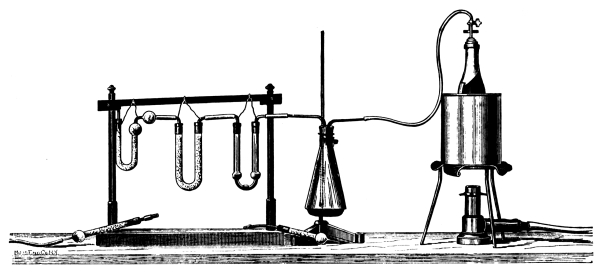
Fig. 113. Apparatus for Determining Carbon
Dioxid in Koumiss.
520. Alcohol.—Half a liter of koumiss, to which 100 cubic
centimeters of water have been added, is distilled until the distillate
amounts to 500 cubic centimeters.
If the distillate be turbid 100 cubic centimeters of water are added
and the distillation repeated. The alcohol is determined by the
processes described hereafter.
521. Lactose.—The milk sugar may be determined by any of
the methods described, but most conveniently by double dilution and
polarization (86).
522. Fat.—Evaporate twenty grams of the sample to dryness and
extract with pure ether or petroleum spirit in the manner already
described (455).
The analysis is more quickly accomplished by the volumetric method of
Babcock or Gerber (473-475).
523. Proteids.—The total proteids are most easily estimated by
the official kjeldahl method.[530]
The separation of the proteid bodies is accomplished by the methods
described in paragraphs 475-489.
In addition to the methods already described for separating the soluble
and suspended proteid bodies in milk, and which may be used also for
koumiss, the following should also be mentioned as of especial worth:
Separation by Filtration through Porous Porcelain.—A purely
physical method, and one which is to be recommended by reason of the
absence of any chemical action upon the different proteid matters,
is that proposed by Lehmann, depending upon the principle that when
milk is forced through porous porcelain, the albumin passes through
together with the milk, sugar and other soluble constituents as a clear
filtrate, while the casein and fat are perfectly retained.[531]
By this method it is quite certain that the albumin and other perfectly
soluble proteids of milk may be obtained in the purest form.
Separation by Precipitation with Alum.—Probably the best
chemical method of separating the two classes of proteid matters
is that proposed by Schlosmann, which is effected by means of
precipitating the casein with a solution of alum.[532]
The principle of this separation rests upon the fact that a solution
of potash alum, when added to milk diluted with four or five times its
volume of water, will completely separate the casein without affecting
the albumin or globulin. The operation is conducted as follows:
Ten cubic centimeters of the milk are diluted with from three to five
times that quantity of water and warmed to a temperature of about
40°. One cubic centimeter of a concentrated solution of potash alum
is added, the mixture well stirred and the coagula which are formed
allowed to subside. If the coagulation of the casein does not take
place promptly, a small addition of the alum solution is made, usually
not exceeding half a cubic centimeter, until the precipitation is
complete. The temperature during the process should be kept as nearly
as possible 40°. After a few minutes, the mixture is poured upon a
filter and the filtrate, if not perfectly clear, is poured back until
it is secured free of turbidity. In difficult cases the filtration may
be promoted by the addition of some common salt or calcium phosphate,
the latter acting mechanically in holding back the fine particles of
casein. The precipitate is washed with water at a temperature of 40°,
and afterwards with alcohol, not allowing the alcohol wash water to
flow into the filtrate. When the water has been chiefly removed from
the precipitate by washing with alcohol, the fat of the precipitated
casein is removed with ether and the residue used for the determination
of nitrogen in the usual way. The albumin is removed from the filtrate
by a tannin solution in the manner already described (480).
If it be desired to separate the albumin and globulin, the methods
described in paragraph 399 may be used.
524. Mercurial Method.—A volumetric method for determining the
total proteid matter in milk has lately been proposed by Deniges.[533]
It is based upon the observation that in the precipitation of proteid
matter by mercury salts, a definite quantity of mercury in proportion
to the amount of proteid, is carried down therewith. The precipitation
is made with a mercurial salt of known strength and the excess of the
mercurial salt in the filtrate is determined by titration. For the
details of the manipulation, the paper cited above may be consulted.
525. Water and Ash.—From two to five grams of the koumiss are
dried to constant weight in a flat platinum dish over ignited sand,
asbestos or pumice stone, and the dried residue incinerated.
526. Composition of Koumiss.—The composition of koumiss varies
with the character of the milk used and the extent of the fermentation.
Some of the data obtained by analysts are given below:[534]
Composition of Koumiss.
| Kind of milk. |
Water,
Per cent. |
Sugar,
Per cent. |
Alcohol,
Per cent. |
Fat,
Per cent. |
Proteid,
Per cent. |
Carbon
dioxid,
Per cent. |
Acidity,
Per cent. |
| Cow |
89.32 |
4.38 |
0.76 |
2.08 |
2.56 |
0.83 |
0.47 |
| Probably cow skim’d |
|
3.95 |
1.38 |
0.88 |
2.89 |
|
0.82 |
| Mare |
91.87 |
0.79 |
2.89 |
1.19 |
1.91 |
|
1.04 |
From the above it is seen that koumiss is made either from whole or
skim milk, and that the percentage of alcohol may vary within large
limits, its proportion being inverse to that of the milk sugar.
Koumiss is a beverage which is very palatable, easily digested and one
which is not appreciated in this country in proportion to its merits,
especially for the use of invalids.
PART SEVENTH. MISCELLANEOUS AGRICULTURAL PRODUCTS. — CEREALS AND CEREAL FOODS. — FODDERS, GRASSES AND ENSILAGE. — FLESH PRODUCTS. — METHODS OF DIGESTION. — PRESERVED MEATS. — DETERMINATION OF NUTRITIVE VALUES. — FRUITS, MELONS AND VEGETABLES. — TEA AND COFFEE. — TANNINS AND ALLIED BODIES. — TOBACCO. — FERMENTED BEVERAGES. — AUTHORITIES CITED IN PART SEVENTH.
527. Classification.—In the preceding parts have been set forth
the fundamental principles underlying the conduct of agricultural
analysis and a résumé of the best practice of the art. The analyst, as
a rule, will seldom be required to undertake investigations which are
unnoticed in the preceding pages. Cases will arise, however, in which
problems are presented which can not be solved by the rules already
elucidated. In respect of the great classes of agricultural bodies,
it will be observed that dairy products have already received special
mention. In respect of foods and fodders in general, it is evident that
they are chiefly composed of moisture, ash, carbohydrates, oils and
proteid matters. The methods of identifying, separating and estimating
these constituents have been fully set forth. It is not necessary,
therefore, to study in this part the analytical processes which are
applicable to cereals, cattle foods and other food products, further
than is necessary to present in the most important cases a working
résumé of principles and methods. There remain, however, certain
products of importance which require some special modifications of
treatment, and it is to these that the present part will be chiefly
devoted. Among these are found tobacco, tea and coffee, fruits,
fermented and distilled drinks and certain animal products. It is
evident that an enumeration of all agricultural products, with a
description of their methods of examination, would be impracticable in
the available space and undesirable by reason of the repetition which
would be required. In each case the analyst, in possession of the
methods described, will be able to adapt the means at his disposal to
the desired purpose to better advantage than any rigid directions could
possibly secure.
In respect of the analytical methods of determining the nutritive
value of foods, they may be divided into chemical and physiological.
The chemical methods embrace the thermal and artificial digestion
investigations, and the physiological include those which are carried
out with the help of the animal organisms. In the latter case the
digestive process is checked by the analysis of the foods before
ingestion and of the excreta of all kinds during and after digestion.
It is evident that a detailed description of this method should be
looked for in works devoted to physiological chemistry.
528. General Analysis.—The cereals are prepared for analysis
by grinding until the fragments pass a sieve having circular
perforations half a millimeter in diameter. The moisture, ash, ether
extract, proteids and carbohydrates are determined by some one of the
processes already described in detail. In this country the methods
of the Association of Official Agricultural Chemists are generally
followed.[535]
For convenience these methods are summarized below.
Moisture.—Dry from two to three grams of the fine-ground sample
for five hours, at the temperature of boiling water, in a current of
dry hydrogen. If the substance be held in a glass vessel, the latter
should not be in contact with the boiling water.
Ash.—Char from two to three grams of the sample and burn to
whiteness at the lowest possible red heat. If a white ash can not be
obtained in this manner, exhaust the charred mass with water, collect
the insoluble residue on a filter, burn it, add this ash to the residue
from the evaporation of the aqueous extract and heat the whole to low
redness until the ash is white.
Ether Extract.—Pure ether is prepared by washing the commercial
article four or five times with water to free it of the chief part
of the alcohol it contains. The residual water is mostly removed by
treating the liquid with caustic soda or potash. Any residual alcohol
or water is finally removed by the action of metallic sodium. The ether
thus prepared is stoppered, after the evolution of hydrogen has ceased,
and is kept over metallic sodium. Immediately before use it should be
distilled out of contact with moist air.
The residue from the determination of moisture, as described above, is
extracted in an appropriate apparatus (39) with the pure ether
for sixteen hours. The extract is dried to constant weight. The weight
may be checked by drying and weighing the extraction tube and its
contents before and after the operation.
Crude Proteids.—Proceed as in the method of determining
nitrogen in the absence of nitrates and multiply the weight of nitrogen
obtained by 6.25. This factor is a general one, but should not be
rigidly applied. In each instance, according to the nature of the
cereal, the appropriate factor, pointed out in paragraph 407
should be used, and the factor 6.25 be applied only in those cases
where a special factor is not given. The factors for the common cereals
are wheat 5.70, rye 5.62, oats 6.06, maize 6.22, barley 5.82 and flaxseed 5.62.
For separating the proteid matters consult paragraphs 392-410.
In the case of wheat the methods of Teller may be consulted.[536]
Amid Nitrogen.—The albuminoid nitrogen is determined as
directed in paragraph 203 of volume II. The difference between
this number and that representing the total nitrogen gives the nitrogen
as amids.
Fiber and Carbohydrates.—The methods of analysis are described
in detail in Part Third.
529. Bread.—In general, the same processes are followed in
bread analysis as are used with cereals and flours. In addition to
the regular analytical processes, breads are to be examined for
adulterants, bleaching and coloring matters, and for the purpose of
determining the changes which have taken place in their nutrient
constituents in the processes of fermentation and cooking.
Temperature of Baking.—The interior of a loaf during the
process of baking does not attain the high temperature commonly
supposed. This temperature is rarely found to be more than one degree
above the boiling point of water.[537]
In biscuits and other thin cakes, which become practically dry and
which by reason of their thinness are the more readily penetrated by
heat, the temperature may go as high as 110°.
Soluble Extract.—The quantity of matters both in flour and
bread, soluble in cold water, is determined by extraction in the usual
way and drying the extract. Soluble albuminoids, sugars and mineral
salts are extracted by this process. When possible, the operation should
be conducted both on the bread and the flour from which it is made.
Color.—In baker’s parlance is found an apparent contradiction
of terms, since it speaks of bread with “no color” when the loaf is
dark brown, while a white loaf is said to have a high color. An ideal
color for the interior of a loaf is a light cream tint, which is
more desirable than a pure white.[538]
The texture, odor and flavor of the loaf are also to be considered, but
these are properties of more importance to the technical expert than to
the analyst.
Quantity of Water.—It is not possible to set a rule of
limitation in respect of the quantity of water a bread should hold. For
full loaves, perhaps forty per cent is not too high a maximum, while
some authors put it as low as thirty-four per cent. Some flours are
capable of holding more water than others, and the loaf should have
just enough water to impart to the slice of bread the requisite degree
of softness and the proper texture. Most breads will have a content of
water ranging from thirty to forty per cent. In biscuits and other thin
cakes the moisture is much less in quantity.
Acidity.—The acidity of both bread and flour is determined by
shaking ten grams of the sample with 200 cubic centimeters of distilled
water for fifteen minutes, pouring the mass on a filter and titrating
an aliquot part of the filtrate with tenth-normal alkali. The acidity
is reckoned as lactic acid in the case of breads raised by fermentation.
Nature of Nitrogenous Compounds.—The methods of investigation
are described in paragraphs 392-410.
530. Determination of Alum in Bread.—The presence of alum in
bread may be detected by means of logwood. Five grams of fresh logwood
chips are digested with 100 cubic centimeters of amyl alcohol. One
cubic centimeter of this decoction and the same quantity of a saturated
solution of ammonium carbonate are mixed with ten grams of flour and
an equal quantity of water. With pure flour, a slight pink tint is
produced. In the presence of alum the color changes to a lavender or
blue, which is persistent on heating.
The test may be varied by diluting five cubic centimeters of the
reagents mentioned with ninety cubic centimeters of water and pouring
the mixture over ten grams of the crumbled bread. After standing for
five minutes, any residual liquid is poured off and the residue, washed
once with a little water, is dried in a steam bath, when the blue color
is developed if alum be present.[539]
531. Chemical Changes Produced by Baking.—Changes of a chemical
nature, produced in bread by baking, are found chiefly in modifications
of the starch and proteids. The starch is partly converted into dextrin
and the albumins are coagulated. The changes in digestion coefficient
are determined by the methods which follow. The fermentations which
precede the baking are due to the usual decompositions of the
carbohydrates under the influence of yeast germs.
532. General Principles.—The analyst, in examining the fibrous
foods of cattle, is expected to determine moisture, ash, fiber and
other carbohydrates, ether extract and albuminoid and amid nitrogen. If
a more exhaustive study be required, the sugar and starch are separated
from the other non-nitrogenous matters, the carbohydrate bodies
yielding furfuraldehyd separately determined and the ash subjected to
a quantitive analysis. The processes are conducted in harmony with the
principles and methods of procedure fully set forth in the preceding pages.
Green fodders and grasses are easily dried and sampled by comminution
in the shredder described on page 9, and roots
by that shown on page 10. The moisture is
determined by drying a small sample of the shredded mass, while the
rest of it is dried, first at about 60° and finally at 100°, or a
little above, ground to a fine powder and subjected to analysis by
methods already described. The food values as obtained by analysis
should be compared, when possible, with those secured by natural and
artificial digestion.
Ensilage is shredded and analyzed in precisely the same way, but in
drying, the content of volatile acids formed during fermentation must
be considered. In other words, the loss on drying ensilage at 100°, or
slightly above, is due not only to the escape of water but also to the
volatilization of the acetic acid, which is one of the final products
of fermentation which the mass undergoes in the silo.
533. Organic Acids in Ensilage.—In the examination of ensilage,
the organic acids which are present may be determined by the processes
described in following paragraphs. The acetic acid, formed chiefly
by fermentation, is conveniently determined by the method given for
tobacco further on. Lactic acid is detected and estimated by expressing
the juice from a sample of ensilage, removing the acetic acid by
distillation, repeated once or twice, and treating the filtered residue
with zinc carbonate in excess, filtering and determining the zinc
lactate in the filtrate. The zinc is determined by the method described
for evaporated apples and the lactic acid calculated from the weight of
zinc found. Crystallized zinc lactate contains 18.18 per cent of water
and 27.27 per cent of zinc oxid.[540]
534. Changes due to Fermentation in the Silo.—Silage differs
from green fodder in having less starch and sugar, more acetic and
lactic acids and alcohol and a higher proportion of amid to albuminoid
nitrogen.[541]
There is also a considerable loss of nitrogenous substances in
ensilage, due probably to their conversion into ammonium acetate, which
is lost on drying.
535. Alcohol in Ensilage.—The fermentation which takes place
in the silo is not wholly of an alcoholic nature, as the development
of lactic acid, noted above, clearly indicates. The alcohol which
is formed may escape and but small quantities can be detected in
the ripened product. So small is this quantity of alcohol that it
appears to be useless to try to secure a quantitive estimation of it.
Qualitively, it may be detected by collecting it in a distillate, which
is neutralized or made slightly alkaline with soda or potash lye and
redistilled. The greater part of the alcohol will be found in the first
few cubic centimeters, which are made alkaline with potash lye and as
much iodin added as can be without giving a red tint to the solution.
Any alcohol which is present will soon separate as iodoform.
536. Comparative Values of Fodder and Ensilage.—In judging of
the comparative values of green and dry fodders for feeding purposes,
it is necessary to secure representative samples in the green, quickly
dried and ensilaged condition. It is quite certain that the greater
part of the sugar contained in green fodders is lost both by natural
curing and by placing in a silo. When well cured by the usual processes
there is but little loss of nitrogenous matters, but in the silo this
loss is of considerable magnitude, amounting in some instances to as
much as thirty per cent.
The ideal way of preparing green fodders in order to preserve the
maximum food value efficiently, is to shred them and dry rapidly by
artificial heat, or in the sunlight, until they are in a condition
which insures freedom from fermentation. In this condition, when placed
in bales, under heavy pressure, the food constituents are preserved in
the highest available form. The immense sugar content of the stalks of
maize and sorghum could be preserved in this way almost indefinitely.
537. Names Of Meats.—The parts of the animal from which the
meats are taken have received distinctive names, which serve to
designate the parts of the carcass offered for sale. These names are
not invariable and naturally are quite different in many markets. In
this country there is some degree of uniformity among butchers in
naming the meats from different parts. The names in scientific use
for the parts of mutton, beef and pork are found in the accompanying
illustrations.[542]
538. Sampling.—When possible the whole animal should constitute
the sample. The relative weights of blood, intestinal organs, hide,
hoofs, horns, bones and edible flesh are determined as accurately as
possible. The general method of preparing samples of animal products is
given in paragraph 5.
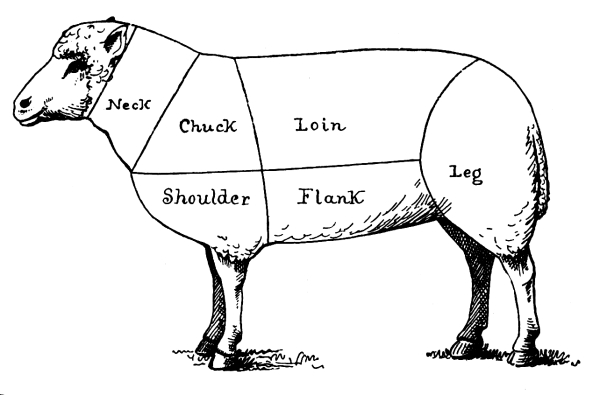
Fig. 114.
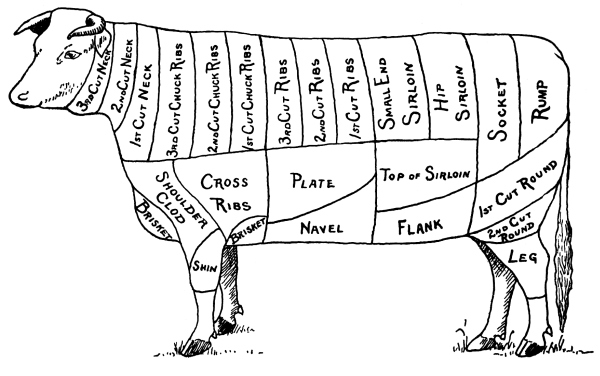
Fig. 115.
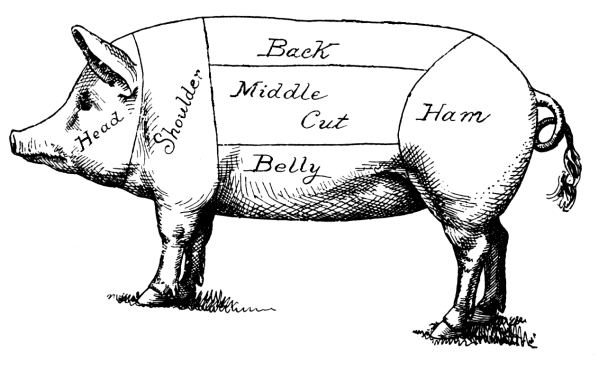
Fig. 116.
Names of Cuts of Meat.
The method of sampling employed by Atwater and Woods is essentially
that just noted.[543]
The sample, as received at the laboratory, is weighed, the flesh
(edible portion) is then separated from the refuse (skin, bones etc.)
and both portions weighed. There is always a slight loss in the
separation, evidently due to evaporation and to small fragments of
the tissues that adhere to the hands and to the implements used in
preparing the sample. The perfect separation of the flesh from the
other tissues is difficult, but the loss resulting from this is small.
In sampling the material for analysis, it is finely chopped, either in
a tray or in a sausage cutter, and in each case is well mixed.
539. Methods of Analysis.—The general methods for the analyses
of food products are applicable to meats and animal products in
general. In the separation of the nitrogenous constituents the methods
described in paragraphs 411-414 are followed. It is
not safe to estimate as proteids the total nitrogen multiplied by 6.25, since the
flesh bases have much higher percentages of nitrogen than are found
in proteid matters. As indicated in paragraph 280 the
complete extraction of dried meats by ether is difficult of accomplishment.
After a few hours it may be assumed that the total extract will
represent the fat, although additional soluble matters are obtained
by continuing the process. The heat producing power may be calculated
from the analytical data secured. The methods which have been described
in the preceding pages will be found sufficient for guidance in the
examination of animal products, and the analyst will find them, when
modified to suit particular cases, adapted to the isolation and
estimation of proximate food principles.
The methods of analyses followed by Atwater and Woods are given
below:[544]
Water and Water-Free Substance.—The drying is done in ordinary
water ovens at a temperature of nominally 100°, but actually at 96° and
98°. For each analysis of animal tissues (flesh) one or more samples of
from fifty to one hundred grams of the freshly chopped substance are
weighed on a small plate, heated for from twenty-four to forty-eight
hours, cooled, allowed to stand in the open air for about twenty-four
hours, weighed, ground, sifted through a sieve with circular holes
one-half millimeter in diameter, bottled and set aside for analysis.
In case of fat samples which cannot be worked through so fine a sieve,
either a coarser sieve is used or the substance crushed as finely as
practicable and bottled without sifting.
For the complete desiccation, about two grams of material are dried for
three hours. It is extremely difficult to get an absolutely constant
weight, though it is found that this is in most cases approximately
attained in four hours.
Nitrogen, Protein, Albuminoids etc.—The nitrogen is determined
in the partly dried substance by the method of Kjeldahl. The protein
is calculated by multiplying the percentage of nitrogen by 6.25.
The nitrogenous matters in meats and fish, i. e., in the
materials which have practically no carbohydrates, are also estimated
by subtracting the sum of ether extract and ash from the water-free
substance, or the sum of water, ether extract and ash from the fresh
substance, the remainder being taken as proteids, albuminoids etc.,
by difference. While this is not an absolutely correct measure of the
total nitrogenous matter, it is doubtless more nearly so than the
product of the nitrogen multiplied by 6.25.
Fat (Ether Extract).—The fat is extracted with ether in
the usual manner. The point at which the extraction is complete is
not always easy to determine. For the most part, the extraction is
continued for such time as experience indicates to be sufficient, and
then the flask is replaced by another and the extraction repeated until
the new flask shows no increase in weight.
According to experience, the fat of many animal tissues is much more
difficult to extract than that of most vegetable substances. In
general, the greater the percentage of fat in a substance the more
difficult is the removal of the last traces. Dried flesh is frequently
so hard that the fineness of the material to be extracted seems to be a
very important matter.
Ash.—Ash is determined by the method recommended by the
Association of Official Agricultural Chemists.
Food Value—Potential Energy.—The food materials are not
necessarily burned in the calorimeter, but the fuel value of a pound of
each of the foods, as given in the tables, is obtained by multiplying
the number of hundredths of a pound of protein and of carbohydrates by
18.6 and the number of hundredths of a pound of fat by 42.2, and taking
the sum of these three products as the number of calories of potential
energy in the materials.
More reliable results are obtained by using the factors obtained by
Stohmann; viz., 5731 calories for proteids, 9500 calories for
common glycerids, 9231 calories for butter fat, 3746 calories for
pentose sugars, 3749 calories for dextrose and levulose and 3953
calories for sucrose and milk sugar.[545]
540. Further Examination of Nitrogenous Bodies.—It is evident
that both of the methods proposed above for the examination of the
nitrogenous constituents of meats are unreliable. If the total nitrogen
be determined and multiplied by 6.25 the product does not by any means
represent the true quantity of nitrogenous matter since the flesh bases
contain in some instances more than twenty-five per cent of nitrogen.
If, on the other hand, the water, ash and fat in a meat sample be
determined and the sum of their per cents be subtracted from 100, the
difference represents the nitrogenous bodies plus all undetermined
matters and errors of analysis. The assumption that meats are free
of carbohydrates is not tenable since glycogen is constantly found
therein and in horse flesh in comparatively large amounts. In a
thoroughly scientific analysis of meats, the nitrogenous bodies should
be separated and determined by groups, according to the principles
developed in paragraphs 411-414. This process requires
a great amount of analytical work and in general it will be sufficient to make
a cold water extract to secure the flesh bases and a hot water extract
to secure the gelatin. The nitrogen is then determined in each of
these portions separately. The nitrogen in the cold water extract is
multiplied by four, in the hot water extract by six and in the residue
by 6.25. The sum of these products represents approximately the total
nitrogenous matter in the sample.
Aqueous extracts containing nitrogen are easily prepared for moist
combustion by placing them in the digestion flasks, connecting the
latter with the vacuum service and evaporating the contents of the
flask nearly to dryness. The sulfuric acid is then added and the
nitrogen converted into ammonia and determined in the usual manner.
541. Fractional Analysis of Meats.—A better idea of the
composition of a meat is obtained by separating its constituents into
several groups by the action of different solvents. This method has
been elaborated by Knorr.[546]
The separation of the meats in edible portion and waste and the
determination of moisture and fat are conducted as already described.
The residue from the fat extraction is exhausted with alcohol, and
in the extract are found the nitrogenous bases kreatin, kreatinin,
sarkin and xanthin, and urea, lactic, butyric, acetic and formic acids,
glycogen and inosit. In the residue from the alcohol extraction, the
proteid nitrogen is determined in a separate sample.
A separate portion of the sample is ground to a fine paste and
repeatedly rubbed up with cold water, which is poured through a tared
filter. When the extraction is complete, the filter and its contents
are dried and the dry residue determined. This residue represents
the nitrogenous constituents of the muscle fibers and their sheaths
together with any other bodies insoluble in cold water. The filtrate
from the cold water extraction is heated to boiling to precipitate
the albuminous matters which are collected, dried and weighed, or the
nitrogen therein determined and the albuminous matters calculated by
multiplying by the usual factor. The filtrate from the coagulated
albuminous bodies is evaporated to dryness and weighed. It consists
essentially of the same materials as the alcoholic extract mentioned
above. The ash and nitrogen in the aqueous extract are also determined.
The mean content of the edible parts of common meats, expressed as per
cents in groups as mentioned, follow:
| Per cent. |
| Water |
73.11 |
| Ash |
1.18 |
| Total soluble matter |
26.89 |
| Phosphoric acid |
0.49 |
Per cent. |
| Proteids insoluble in cold water |
13.76 |
| Of which coagulable by heat |
2.24 |
| Cold water extract |
3.56 |
| Ash in water extract |
1.09 |
| Of which phosphoric acid |
0.38 |
Per cent. |
| Fat |
4.93 |
| Alcohol extract |
3.03 |
| Proteids in residue from alcohol |
17.88 |
| Total nitrogen in sample |
3.37 |
542. Estimation of Starch in Sausages.—Starchy substances are
sometimes added to sausages for the purpose of increasing their weight.
The presence of starch in a sausage is easily detected by iodin. The
quantity may be determined by the following process:[547]
The principle of the process is based upon the observation that while
starch is easily soluble in an aqueous solution of the alkalies, it
is insoluble in an alcoholic solution thereof. The chief constituents
of meat, viz., fat and proteid matters, on the other hand,
are readily soluble in an alcoholic solution of potash or soda. This
renders the separation of the starch easy. The sample is warmed on a
water bath with a considerable excess of an eight per cent solution of
potassium hydroxid in alcohol whereby the fat and flesh are quickly
dissolved. The starch and other carbohydrate bodies, remain in an
undissolved state. In order to prevent the gelatinizing of the soap
which is formed, the mass is diluted with warm alcohol, the insoluble
residue collected upon a filter and washed with alcohol until the
alkaline reaction disappears. The residue is then treated with aqueous
potassium hydroxid solution, whereby the starch is brought into
solution and, after filtration, is treated with alcohol until it is
all precipitated. The precipitated starch is collected upon a filter,
washed with alcohol and finally with ether, dried and weighed. Starch
prepared in this way contains a considerable quantity of potash, the
amount of which can be determined by incineration. In order to avoid
this trouble, the starch, after separation in the first instance
as above mentioned and solution in aqueous potassium hydroxid,
is precipitated on the addition of enough acetic to render the
solution slightly acid. The precipitated starch, in this instance,
is practically free of potash, since potassium acetate is soluble in
alcohol.
543. Detection of Horse Flesh.—Since horse flesh has become
an important article of human food and is often sold as beef and
sausage, a method of distinguishing it is desirable. The comparative
anatomist is able to detect horse flesh when accompanied by its bones,
or in portions sufficiently large for the identification of muscular
characteristics. It is well known that horse flesh contains a much
higher percentage of glycogen than is found in other edible meats.
Niebel has based a method of detecting horse flesh upon this fact, the
glycogen being converted into dextrose and determined in the usual way.
Whenever the percentage of reducing sugars in the dry fat-free flesh
exceeds one per cent, Niebel infers that the sample under examination
is horse flesh.[548]
The reaction for horse flesh, proposed by Bräutigam and Edelmann, is
preferred by Baumert. In this test about fifty grams of the flesh are
boiled for an hour with 200 cubic centimeters of water, the filtered
bouillon evaporated to about half its volume, treated with dilute
nitric acid and the clear filtrate covered with iodin water. Horse
flesh, by reason of its high glycogen content, produces a burgundy
red zone at the points of contact of the two liquids. In the case of
sausages, if starch have been added, a blue zone is produced, and if
dextrin be present, a red zone, both of which obscure the glycogen
reaction. The starch is easily removed by treating the bouillon with
glacial acetic acid. No method is at present known for separating
dextrin from glycogen. The detection of horse flesh is a matter of
considerable importance to agriculture as well as to the consumers,
especially of sausages. A considerable quantity of horse flesh is
annually sent to the market, little of which presumably is sold under
its own name. As a cheap substitute for beef and pork in sausages, its
use must be regarded as fraudulent, although no objection can be urged
against its sale when offered under its own name.[549]
544. Artificial Digestion.—The nutrient values of cereals and
other foods are determined both by chemical analysis and by digestion
experiments. The heat forming properties of foods are disclosed by
combustion in a calorimeter, but the quantity of heat produced is not
in every case a guide to the ascertainment of the nutritive value. This
is more certainly shown, especially in the case of proteid bodies, by
the action of the natural digestive ferments.
It is probable that the digestion, which is secured by the action of
these ferments without the digestive organs, is not always the same as
the natural process, but when the conditions which prevail in natural
digestion are imitated as closely as possible the effects produced can
be considered as approximately those of the alimentary canal in healthy
action.
Three classes of ferments are active in artificial digestion,
viz., amylolytic ferments, serving to hydrolyze starch and
sugars and to convert them into dextrose, maltose and levulose,
aliphalytic ferments, which decompose the glycerids and proteolytic
ferments, which act on the nitrogenous constituents of foods. When
these ferments are made to act on foods under proper conditions of
acidity and temperature, artificial digestion ensues, and by the
measurement of the extent of the action an approximate estimate of
their digestibility can be secured. In artificial digestion, the
temperature should be kept near that of the body, viz., at about 40°.
The soluble ferments which are active in the digestion of foods, as
has been intimated, comprise three great classes. Among the first
class, viz., the amylolytic ferments, are included not only those
which convert starch into dextrose, but also those which cause the
hydrolysis of sugars in general. Among these may be mentioned ptyalin,
invertase, trehalase, maltase, lactase, diastase, inulase, pectase and
cyto-hydrolytic ferments which act upon the celluloses and other fibers.
Among the aliphalytic ferments, in addition to those which act also
upon proteid matter, may be mentioned a special one, lipase.
In the third class of ferments are found pepsin, trypsin or pancreatin
and papain.
For the latest information in regard to the nature of the soluble
ferments and their nomenclature, the work of Bourquelot may be
consulted.[550]
545. Amylytic Ferments.—A very active ferment of this kind is
found in the saliva. Saliva may be easily collected from school boys,
who will be found willing to engage in its production if supplied with
a chewing gum. A gum free of sugar is to be used, or if the chewing
gum of commerce is employed, the saliva should not be collected until
the sugar has disappeared. A dozen boys with vigorous chewing will
soon provide a sufficient quantity of saliva for practical use. The
amylolytic digestion is conducted in the apparatus hereinafter described
for digestion with pepsin and pancreatin. The starch or sugar in fine
powder is mixed with ten parts of water and one part of saliva and
kept at about 37°.5 for a definite time. The product is then examined
for starch, sucrose, maltose, dextrose, dextrin and levulose by the
processes already described. In natural digestion the hydrolysis of the
carbohydrates is not completed in the mouth. The action of the ferment
is somewhat diminished in the stomach, but not perhaps until half an
hour after eating. The dilute hydrochloric acid in the stomach, which
accumulates some time after eating, is not active in this hydrolysis.
On the contrary the amylolytic ferment of the saliva is somewhat
enfeebled by the presence of an acid. The active principle of the
saliva is ptyalin.
The diastatic hydrolysis of starch has already been described
(179). It is best secured at a somewhat
higher temperature than that of the human stomach.
546. Aliphalytic Ferments.—In the hydrolysis of glycerids in
the process of digestion the fat acids and glycerol are set free.
Whether the glycerids be completely hydrolyzed before absorption is not
definitely known. In certain cases where large quantities of oil have
been exhibited for remedial purposes, the fat acids and soaps have been
found in spherical masses in the dejecta[551]
and have been mistaken for gall stones.
The fat which enters the chyle appears to be mostly unchanged, except
that it is emulsified.[552]
The aliphalytic ferment can be prepared from the fresh pancreas,
preferably from animals that have not been fed for forty hours before
killing. It is important to prepare the ferment entirely free of
any trace of acid. The fresh glands are rubbed to a fine paste with
powdered glass and extracted for four days with pure glycerol, to which
one part of one per cent soda solution has been added. The filtered
liquor contains aliphalytic, proteolytic and amylytic ferments, and is
employed for saponification by shaking with the fat to form an emulsion
and keeping the mixture, with occasional shaking, at a temperature of
from 40° to 60°. The free acids can be titrated or separated from the
unsaponified fats by solution in alcohol.[553]
Heretofore it has not been possible to separate a pure aliphalytic
ferment from any of the digestive glands. The digestion of carbohydrates
and that of fats are intimately associated, and these two classes of
foods seem to play nearly the same rôle in the animal economy.
The aliphalytic ferments, prepared from the fresh pancreas, act also on
the glucosids and other ester-like carbohydrate bodies. Since the fats
may be regarded as ethers, the double action indicates the similarity
of composition in the two classes of bodies.[554]
The aliphalytic ferments exist also in plants and have been isolated
from rape seed.[555]
547. Proteolytic Ferments.—The most important process in
artificial digestion is the one relating to the action of the ferments
on proteid matters. The hydrolysis of fats and carbohydrates by natural
ferments takes place best in an alkaline medium, while in the case of
proteids when pepsin is used an acid medium is preferred. Since the
acidity of the stomach is due chiefly to hydrochloric, that acid is
employed in artificial digestion. The hydrolyte used is uniformly the
natural ferment of the gastric secretions, viz., pepsin; but
this is often followed by the pancreatic ferment, (pancreatin, trypsin)
in an alkaline medium. During the digestion, the proteids are changed
into peptones, and the measurement of this change determines the degree
of digestion. The total proteid matter is determined in the sample,
and after the digestion is completed, the soluble peptones are removed
by washing and the residual insoluble proteid matter determined by
moist combustion. The difference in the two determinations shows the
quantity of proteid matter digested. The investigations of Kühn on the
digestion of proteids may be profitably consulted.[556]
For a summary of digestion experiments in this country the résumé
prepared by Gordon may be consulted.[557]
The method followed in this laboratory is fully described by Bigelow and
Hamilton.[558]
548. Ferments Employed.—Both the pepsins of commerce and those
prepared directly from the stomachs of pigs may be used. The commercial
scale pepsin is found, as a rule, entirely satisfactory, and more
uniform results are secured by its use than from pepsin solutions made
from time to time from pig stomachs. In the preparation of the pepsin
solution one gram of the best scale pepsin is dissolved in one liter
of 0.33 per cent hydrochloric acid. Two grams of the sample of food
products, in fine powder, are suspended in 100 cubic centimeters of the
solution and kept, with frequent shaking, at a temperature of 40° for
twelve hours. The contents of the flask are poured on a wet filter, the
residue on the filter well washed with water not above 40°, the filter
paper and its contents transferred to a kjeldahl flask and the residual
nitrogen determined and multiplied by 6.25 to get the undigested
proteid matter. A large number of digestions can be conducted at once
in a bath shown in Fig. 117.[559]
The quantity of water in the bath should be as large as possible.
549. Digestion in Pepsin and Pancreatin.—The digestion of the
proteids is not as a rule wholly accomplished by the stomach juices,
and, therefore, in order to secure in artificial digestion results
approximating those produced in the living organism, it is necessary
to follow the treatment with pepsin by a similar one with the pancreas
juices. The method employed in this laboratory is essentially that of
Stutzer modified by Wilson.[560]
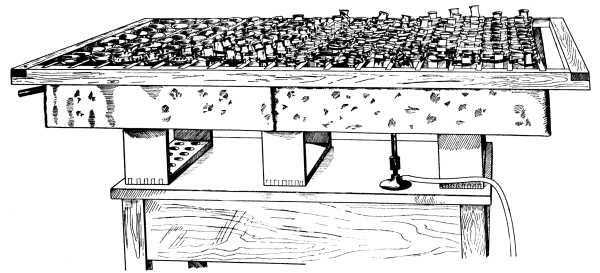
Fig. 117. Bath for Artificial Digestion.
The residue from the pepsin digestion, after washing, is treated for
six hours at near 40° with 100 cubic centimeters of pancreas solution,
prepared as follows:
Free the pancreas of a healthy steer of fat, pass it through a sausage
grinder, rub one kilogram in a mortar with fine sand and allow to stand
for a day or longer. Add three liters of lime water, one of glycerol,
of 1.23 specific gravity, and a little chloroform and set aside for
six days. Separate the liquor by pressure in a bag and filter it
through paper. Before using, mix a quarter of a liter of the filtrate
with three-quarters of a liter of water and five grams of dry sodium
carbonate, or its equivalent crystallized, heat from 38° to 40° for
two hours and filter.[561]
In order to avoid the trouble of preparing the pancreas solution pure
active pancreatin may be used.[562]
One and a half grams of pure pancreatin and three grams of sodium
carbonate are dissolved in one liter of water and 100 cubic centimeters
of this solution are used for each two grams of the sample. In all
cases where commercial pepsin and pancreatin are used, their activity
should be tested with bodies such as boiled whites of eggs, whose
coefficient of digestibility is well known and those samples be
rejected which do not prove to have the required activity.[563]
550. Digestion in Pancreas Extract.—In order to save the time
required for successive digestions in pepsin and pancreatin Niebling
has proposed to make the digestion in the pancreas extract alone.[564]
This process and also a slight modification of it have been used with
success by Bigelow and McElroy.[565]
Two grams of the sample are washed with ether and placed in a digestion
flask with 100 cubic centimeters of two-tenths per cent hydrochloric
acid. The contents of the flask are boiled for fifteen minutes, cooled,
and made slightly alkaline with sodium carbonate. One hundred cubic
centimeters of the unfiltered pancreas solution, prepared as directed
above, are added and the digestion continued at 40° for six hours. The
residue is thrown on a filter, washed, and the nitrogen determined.
The method is simplified by the substitution of active commercial
pancreatin for pancreas extract. The solution of the ferment is made of
the same strength as is specified above.
551. Artificial Digestion of Cheese.—The artificial digestion
of cheese is conducted by Stutzer as follows:[566]
The digestive liquor is prepared from the fresh stomachs of pigs by
cutting them into fine pieces and mixing with five liters of water and
100 cubic centimeters of hydrochloric acid for each stomach. To prevent
decomposition, two and a half grams of thymol, previously dissolved in
alcohol, are added to each 600 cubic centimeters of the mixture. The
mixture is allowed to stand for a day with occasional shaking, poured
into a flannel bag and the liquid portion allowed to drain without
pressing. The liquor obtained in this way is filtered, first through
coarse and then through fine paper, and when thus prepared will keep
several months without change. It is advisable to determine the content
of hydrochloric acid in the liquor by titration and this content should
be two-tenths of a per cent. The cheese to be digested is mixed with
sand as previously described, freed of fat by extraction with ether,
and a quantity corresponding to five grams of cheese placed in a
beaker, covered with half a liter of the digestive liquor and kept at
a temperature of 40° for forty-eight hours. At intervals of two hours
the flasks are well shaken and five cubic centimeters of a ten per
cent solution of hydrochloric acid added and this treatment continued
until the quantity of hydrochloric acid amounts to one per cent. After
the digestion is finished, the contents of the beaker are thrown on a
filter, washed with water and the nitrogen determined in the usual way
in the residue. By allowing the pepsin solution to act for two days as
described above, the subsequent digestion with pancreas solution is
superfluous.
552. Suggestions Regarding Manipulation.—The filter papers
should be as quick working as possible to secure the separation of
all undissolved particles. They should be of sufficient size to hold
the whole contents of the digestion flask at once, since if allowed
to become empty and partially dry, filtration is greatly impeded. The
residue should be dried at once if not submitted immediately to moist
combustion. After drying, the determination of the nitrogen can be made
at any convenient time. Beaker flasks, i. e., lip erlenmeyers
with a wide mouth are most convenient for holding the materials during
digestion. The flasks are most conveniently held by a crossed rubber
band attached at either end to pins in the wooden slats extending
across the digestive bath. The bath should be suspended by cords from
supports on the ceiling and a gentle rotatory motion imparted to it
resembling the peristaltic action attending natural digestion.
553. Natural Digestion.—The digestion of foods by natural
processes is determined chiefly by the classes of ferments already
noted. The principle underlying digestive experiments with the animal
organism may be stated as follows: A given weight of food of known
composition is fed to a healthy animal under the conditions of careful
control and preparation already mentioned. The solid dejecta of the
animal during a given period are collected and weighed daily, being
received directly from the animal in an appropriate bag, safely
secured, as is shown in the accompanying figure.
The dejecta are weighed, dried, ground to a fine powder, mixed and
a representative part analyzed. The difference between the solid
bodies in the dejecta and those given in the food during the period
of experiment represents those nutrients which have been digested and
absorbed during the passage of the food through the alimentary canal.
The urine, containing solid bodies representing the waste of the animal
organism, does not require to be analyzed for the simple control of
digestive activity outlined above. In a complete determination of this
kind the exhalations from the surface of the body and from the lungs
are also determined. In the latter case the human animal is selected
for the experiment; in the former it is more convenient to employ the
lower animals, such as the sheep and cow.
The arrangement of the stalls and of the apparatus for collecting the
excreta should be such as is both convenient and effective.[567]
The method of constructing a bag for attachment to a sheep is shown in
Fig. 118. It is made according to the directions given by
Gay, of heavy cloth and in such a way as to fit closely the posterior parts of the
animal.[568]
When attached, its appearance is shown in Fig. 119.
Fig. 118.—Bag for
Collecting Feces.
Fig. 119.—Fecal Bag Attachment.
Healthy animals in the prime of life are used, and the feeding
experiments are conducted with as large a number of animals as
possible, in order to eliminate the effects of idiosyncrasy. The food
used is previously prepared in abundant quantity and its composition
determined by the analysis of an average sample.
The feeding period is divided into two parts. In the first part the
animal is fed for a few days with the selected food until it is certain
that all the excreta are derived from the nutrients used. In the second
part the same food is continued and the excreta collected, weighed, the
moisture determined, and the total weight of the water-free excreta
ascertained. The first part should be of at least seven and the second
of at least five days duration. The urine and dung are analyzed
separately. Males are preferred for the digestion experiments because
of the greater ease of collecting the urine and feces without mixing.
For ordinary purposes the feces only are collected. The methods of
analysis do not differ from those described for the determination of
the usual ingredients of a food.
Example.—The following data taken from the results of digestive
experiments, obtained at the Maine Station, will illustrate the method
of comparing the composition of the food with that of the feces and
of determining the degree of digestion which the proteids and other
constituents of the food have undergone.
Composition of Maize Fodder and of Feces
Therefrom after Feeding to Sheep.
| Before Drying. |
| Food |
Water,
per cent. |
Ash,
per cent. |
Proteid,
per cent. |
Fiber,
per cent. |
Fat,
per cent. |
Undetermined,
per cent. |
| Sweet maize |
83.85 |
1.13 |
2.18 |
4.14 |
0.62 |
8.08 |
| Feces |
72.01 |
... |
... |
... |
... |
... |
Dry. |
| Food |
|
Ash,
per cent. |
Proteid,
per cent. |
Fiber,
per cent. |
Fat,
per cent. |
Undetermined,
per cent. |
| Sweet maize |
|
7.01 |
13.52 |
25.63 |
3.86 |
49.98 |
| Feces |
|
14.42 |
17.52 |
19.34 |
2.68 |
46.04 |
Daily Weights. |
| Food |
|
|
|
|
Green,
grams. |
Dry,
grams. |
| Sweet maize |
|
|
|
|
2521 |
407 |
| Feces |
|
|
|
|
445 |
125 |
Per Cent Digested. |
| Food |
|
Ash, |
Proteid, |
Fiber, |
Undetermined, |
Fat, |
| Sweet maize |
|
37.0 |
60.2 |
76.9 |
71.8 |
78.3 |
In the above instance it is seen that the coefficient of digestibility
extended from 37.0 per cent in the case of the mineral components
of the food, to 78.3 per cent in the case of the fats. These data
are taken only from the results obtained from a single sheep and one
article of food. The mean data secured from two animals and three kinds
of maize fodder show the following per cents of digestibility: Ash
39.4, proteid 61.8, fiber 76.7, undetermined matters 72.1, fat 76.4.
The undetermined matters are those usually known as nitrogen free
extract and composed chiefly of pentosans and other carbohydrates.[569]
554. Natural Digestibility of Pentosans.—The digestibility
of pentosan bodies in foods under the influence of natural ferments
has been investigated by Lindsey and Holland.[570]
The feeding and
collection of the feces is carried on as described above and the
relative proportions of pentosan bodies in the foods and feces
determined by estimating the furfuraldehyd as prescribed in paragraph
150.[571]
555. Methods of Examination.—In general the methods of
examination are the same as those applied in the study of fresh
meats. The contents of water, salt and other preservatives, fat and
nitrogenous matters are of most importance. When not already in a fine
state, the preserved meats are run through meat cutters until reduced
to a fine pulp. Most potted meats are already in a state of subdivision
well suited to analytical work. The composition of preserved meats has
been thoroughly studied in this laboratory by Davis.[572]
556. Estimation Of Fat.—Attention has already been called to
the difficulty of extracting the fat from meats by ether or other
solvents.[573]
In preserved meats, as well as in fresh, it is preferable to adopt some
method which will permit of the decomposition of the other organic
matters and the separation of the fat in a free state. The most
promising methods are those employed in milk analyses for the solution
of nitrogenous matters. Sulfuric or hydrochloric acid may be used for
this purpose, preference being given to sulfuric. The separated fats
may be taken up with ether or separated by centrifugal action. A method
of this kind for preserved meats, suggested by Hefelmann, is described below.
About six grams of the moist preserved meat are placed in a calibrated
test tube and dissolved in twenty-five cubic centimeters of fuming
hydrochloric acid. The tube is placed in a water bath, quickly heated
to boiling and kept at that temperature for half an hour. About twenty
cubic centimeters of cold water are added and the temperature lowered
to 30°, then twenty cubic centimeters of ether and the tube gently
shaken to promote the solution of the fat. When the ether layer has
separated, its volume is read and an aliquot part removed by means of a
pipette, dried and weighed. The separation of the ethereal solution is
greatly promoted by whirling.
The mean proportions of the ingredients of preserved meats are about
as follows:
| |
Per cent. |
| Water |
67.0 |
| Dry matter |
33.0 |
| |
| Of which |
|
| Nitrogenous bodies |
19.0 |
| Fats |
10.5 |
| Ash and undetermined |
3.5 |
557. Meat Preservatives.—Various bodies are used to give taste
and color to preserved meats and to preserve them from fermentation.
The most important of these bodies are common salt, potassium and
sodium nitrates, sulfurous, boric, benzoic and salicylic acids,
formaldehyd, saccharin and hydronaphthol. A thorough study of the
methods of detecting and isolating these bodies has been made in this
laboratory by Davis and the results are yet to be published as a part
of Bulletin 13.
558. Nutritive Value of Foods.—The value of a food as a
nutrient depends on the amount of heat it gives on combustion in the
tissues of the body, i. e. oxidation, and in its fitness to
nourish the tissues of the body, to promote growth and repair waste.
The foods which supply heat to the body are organic in their nature and
are typically represented by fats and carbohydrates. The foods which
promote growth and supply waste are not only those which preeminently
supply heat, but also include the inorganic bodies and organic
nitrogenous matters represented typically by the proteids. It is not
proper to say that one class of food is definitely devoted to heat
forming and another to tissue building, inasmuch as the same substance
may play an important rôle in both directions. As heat formers,
carbohydrates and proteids have an almost equal value, as measured by
combustion in oxygen, while fat has a double value for this purpose.
The assumption that combustion in oxygen forms a just criterion for
determining the value of a food must not be taken too literally. There
are only a few bodies of the vast number which burn in oxygen that are
capable of assimilation and oxidation by the animal organism. Only
those parts of the food that become soluble and assimilable under
the action of the digestive ferments, take part in nutrition and the
percentage of food materials digested varies within wide limits but
rarely approaches 100. It may be safely said that less than two-thirds
of the total food materials ingested are dissolved, absorbed,
decomposed and assimilated in the animal system. We have no means
of knowing how far the decomposition (oxidation) extends before
assimilation, and therefore no theoretical means of calculating the
quantity of heat which is produced during the progress of digestion.
The vital thermostat is far more delicate than any mechanical
contrivance for regulating temperature and the quantity of food, in a
state of health, converted into heat, is just sufficient to maintain
the temperature of the body at a normal degree. Any excess of heat
produced, as by violent muscular exertion, is dissipated through the
lungs, the perspiration and other secretions of the body.
Pure cellulose or undigestible fiber, when burned in oxygen, will
give a thermal value approximating that of sugar, but no illustration
is required to show that when taken into the system the bodily heat
afforded by it is insignificant in quantity.
Thermal values, therefore, have little comparative usefulness
in determining nutritive worth, except when applied to foods of
approximately the same digestive coefficient.
559. Comparative Value of Food Constituents.—It has already
been noted that, judged by combustion in oxygen, carbohydrates
and proteids have about half the thermal value possessed by fats.
Commercially, the values of foods depend in a far greater degree on
their flavor and cooking qualities than upon the amount of nutrition
they contain. Butter fat, which is scarcely more nutritious than
tallow, is worth twice as much in the market, while the prices paid for
vegetables and fruits are not based to any great extent on their food
properties.[574]
In cereals, especially in wheat, the quantity of fat is relatively
small, and starch is the preponderating element. In meats,
carbohydrates are practically eliminated and fats and proteids are the
predominating constituents.
In the markets, fats and proteids command far higher prices than sugars
and starches. The relative commercial food value of a cereal may be
roughly approximated by multiplying the percentages of fat and protein
by two and a half and adding the products to the percentage of
carbohydrates less insoluble fiber. This method was adopted in valuing
the cereals at the World’s Columbian Exposition.[575]
560. Nutritive Ratio.—In solid foods the nutritive ratio
is that existing between the percentage of proteids and that of
carbohydrates, increased by multiplying the fat by two and a half and
adding the product. In a cereal containing twelve per cent of protein,
seventy-two of carbohydrates, exclusive of fiber, and three of fat, the
ratio is 12: 72 + 3 × 2.5 = 6.5. Instead of calculating the nutritive
ratio directly from the data obtained by analysis, it may be reckoned
from the per cents of the three substances in the sample multiplied by
their digestive coefficient. Since the relative amounts of proteids,
fats and carbohydrates digested do not greatly differ, the numerical
expression of the nutritive ratio is nearly the same when obtained by
each of these methods of calculation.
Where the proportion of protein is relatively large the ratio is called
narrow, 1: 4 ... 6. When the proportion of protein is relatively small
the ratio is called broad 1: 8 ... 12. In feeding, the nutritive ratio
is varied in harmony with the purpose in view, a narrow ratio favoring
the development of muscular energy, and a wide one promoting the
deposition of fat and the development of heat. These principles guide
the scientific farmer in mixing rations for his stock, the work horses
receiving a comparatively narrow and the beeves a relatively wide ratio
in their food.
561. Calorimetric Analyses of Foods.—The general principles of
calorimetry have been already noticed. The theoretical and chemical
relations of calorimetry have been fully discussed by Berthelot,
Thomsen, Ostwald and Muir.[576]
In the analyses of foods the values as determined by calculation or
combustion are of importance in determining the nutritive relations.
Atwater has presented a résumé of the history and importance of
the calorimetric investigations of foods to which the analyst is
referred.[577]
In the computation of food values the percentages of proteids,
carbohydrates and fats are determined and the required data obtained by
applying the factors 4100, 5500 and 9300 calories for one gram of
carbohydrates, proteids and fats respectively.
For most purposes the computed values are sufficient, but it is well to
check them from time to time by actual combustions in a calorimeter.
562. Combustion in Oxygen.—The author made a series of
combustions of carbonaceous materials in oxygen at the laboratory of
Purdue University in 1877, the ignition being secured by a platinum
wire rendered incandescent by the electric current. The data obtained
were unsatisfactory on account of the crudeness of the apparatus. The
discovery of the process of burning the samples in oxygen at a high
pressure has made it possible to get expressions of thermal data which
while not yet perfect, possess a working degree of accuracy. The best
form of bomb calorimeter heretofore employed is that of Hempel, as
modified by Atwater and Woods.[578]
A section of this calorimeter, with all the parts in place, is shown in
Fig. 120.
In the figure the steel cylinder A, about 12.5 centimeters deep
and 6.2 in diameter, represents the chamber in which the combustion
takes place. Its walls are about half a centimeter thick and it weighs
about three kilograms. It is closed, when all the parts are ready and
the sample in place, by the collar C, which is secured gas tight
by means of a powerful spanner. The cover is provided with a neck
D carrying a screw E and a valve screw F. In the
neck D, where the bottom of the cylinder screw E rests,
is a shoulder fitted with a lead washer. Through G the oxygen
used for combustion is introduced. The upper edge of the cylinder
A is beveled and fits into a groove in the cover B,
carrying a soft metal washer. To facilitate the screwing on of the
cover, ball bearings KK, made of hard steel, are introduced
between the collar and the cover. The platinum wires H and
I support the platinum crucible holding the combustible bodies
which are ignited by raising the spiral iron wire connecting them
to the temperature of fusion by an electric current. The combustion
apparatus when charged is immersed in a metal cylinder M,
containing water and resting on small cylinders of cork. The water is
stirred by the apparatus LL. The cylinder M is contained
in two large concentric cylinders, N, O, made of
non-conducting materials and covered with disks of hard rubber. The
space between O and N may be filled with water. The
temperature is measured by the thermometer P, graduated to
hundredths of a degree and the reading is best accomplished by means of
a cathetometer.
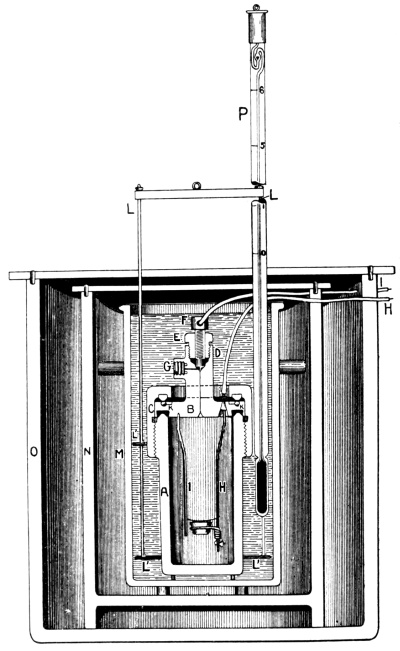
Fig. 120. Hempel and Atwater’s
Calorimeter.
563. The Williams Calorimeter.—The calorimeter bomb has been
improved by Williams by making it of aluminum bronze of a spheroidal
shape. The interior of the bomb is plated with gold. By an ingenious
arrangement of contacts the firing is secured by means of a permanently
insulated electrode fixed in the side of the bomb. The calorimetric
water, as well as that in the insulating vessel, is stirred by means of
an electrical screw so regulated as to produce no appreciable degree of
heat mechanically. The combustion is started by fusing a fine platinum
wire of definite length and thickness by means of an electric current.
The heat value of this fusion is determined and the calories produced
deducted from the total calories of the combustion. The valve admitting
the oxygen is sealed automatically on breaking connection with the
oxygen cylinder. The effluent gases, at the end of the combustion, may
be withdrawn through an alkaline solution and any nitric acid therein
thus be fixed and determined.[579]
564. Manipulation and Calculation.—The material to be burned
is conveniently prepared by pressing it into tablets. The oxygen is
supplied from cylinders, of which two should be used, one at a pressure
of more than twenty atmospheres. By this arrangement a pump is not
required.
In practical use, a known weight of the substance to be burned is
placed in the platinum capsule, the cover of the bomb screwed on,
after all adjustments have been made, and the apparatus immersed in
the water contained in M, which should be about 2° below room
temperature. All the covers are placed in position and the temperature,
of the water in M begins to rise. Readings of the thermometer
are taken at intervals of about one minute for six minutes, at which
time the temperature of the bomb and calorimetric water may be regarded
as sensibly the same. The electric current is turned on, the iron wire
at once melts, ignites the substance and the combustion rapidly takes
place. In the case of bodies which do not burn readily Atwater adds
to them some naphthalene, the thermal value of which is previously
determined. The calories due to the combustion of the added naphthalene
are deducted from the total calories obtained.
The temperature of the water in M rises rapidly at first, and
readings are made at intervals of one minute for five minutes, and then
again after ten minutes. The first of the initial readings, the one at
the moment of turning on the current, and the last one mentioned above
are the data from which the correction, made necessary by the influence
of the temperature of the room, is calculated by the following
formulas.[580]
The preliminary readings of the thermometer at one minute intervals are
represented by t₁, t₂, t₃ ... tₙ₁. The last
observation tₙ₁ is taken as the beginning temperature of the combustion
and is represented in the formulas for calculations by Θ₁. The readings
after combustion are also made at intervals of one minute, and are
designated by Θ₂, Θ₃ ... Θₙ. The readings are continued until there is
no observed change between the last two. Generally this is secured by
five or six readings.
The third period of observations begins with the last reading Θₙ,
which in the next series is represented by tʹ₁, tʹ₂ ...
tʹₙ₂.
In order to make the formulas less cumbersome let
| t₁ + t₂ + t₃ ... tₙ₁ |
= t, |
| n₁ |
| and |
tʹ₁ + tʹ₂ + tʹ₃ ... tʹₙ₂ |
= tʹ. |
| n₂ |
The correction to be made to the difference between Θₙ - Θ₁ for the
influence of the outside temperature is determined by the formula of
Regnault-Pfaundler, which is as follows:
| ∑ Δt = |
v - vʹ |
( |
ⁿ⁻¹ |
∑ |
Θr + |
Θₙ + Θ₁ |
- nt ) - (n - 1)v, |
| tʹ - t |
₁ |
2 |
is calculated from the observation of the
thermometer Θ₁, Θ₂ etc., made immediately after the combustion. It is
equal to the sum of observations Θ₁, Θ₂ etc., increased by an arbitrary
factor equivalent to (Θ₂ - Θ₁)/9, which is made necessary by reason
of the irregularity of the temperature increase during the first
minute after combustion, the mean temperature during that minute being
somewhat higher than the mean of the temperatures at the commencement
and end of that time.
The quantity of heat formed by the combustion of the iron wire used for
igniting the sample is to be deducted from the total heat produced.
This correction may be determined once for all, the weight of the
iron wire used being noted and that of any unburned portion being
ascertained after the combustion.
Ten milligrams of iron, on complete combustion, will give sixteen calories.
In the combustion of substances containing nitrogen, or in case the
free nitrogen of the air be not wholly expelled from the apparatus
before the burning, nitric acid is formed which is dissolved by the
water produced.
The heat produced by the solution of nitric acid in water is 14.3
calories per gram molecule. The quantity of nitric acid formed is
determined by titration and a corresponding reduction made in the total
calculated calories.
In the titration of nitric acid it is advisable to make use of an
alkaline solution, of which one liter is equivalent to 4.406 grams of
nitric acid. One cubic centimeter of the reagent is equivalent to a
quantity of nitric acid represented by one calorie.
Since the materials of which the bomb is composed have a specific heat
different from that of water, it is necessary to compute the water
thermal value of each apparatus.
The hydrothermal equivalent of the whole apparatus is most simply
determined by immersing it at a given temperature in water of a
different temperature.[581]
With small apparatus this method is quite sufficient, but there are
many difficulties attending its application to large systems weighing
several kilograms. In these cases the hydrothermal equivalent may be
calculated from the specific heats of the various components of the apparatus.
In calculating these values the specific heats of the various
components of the apparatus are as follows:
| Brass |
0.093 |
| Steel |
0.1097 |
| Platinum |
0.0324 |
| Copper |
0.09245 |
| Lead |
0.0315 |
| Oxygen |
0.2389 |
| Glass |
0.190 |
| Mercury |
0.0332 |
| Hard rubber |
0.33125 |
Example.—It is required to calculate the hydrothermal value of
a calorimeter composed of the following substances:
| |
Hydrothermal
value. |
| Steel bomb and cover, 2850 grams × 0.1097 |
312.65 |
grams. |
| Platinum lining, capsule and wires, 120 grams × 0.0324 |
3.89 |
” |
| Lead washer, 100 grams × 0.0315 |
3.15 |
” |
| Brass outer cylinder, 500 grams × 0.093 |
46.50 |
” |
| Mercury in thermometer, 10 grams × 0.0332 |
0.33 |
” |
| Glass (part of thermometer in water), 10 grams × 0.19 |
1.90 |
” |
| Brass stirring apparatus (part in water), 100 grams × 0.093 |
9.30 |
” |
| Total water value of system |
377.72 |
” |
When a bomb of 300 cubic centimeters capacity is filled with oxygen at
a pressure of twenty-four atmospheres it will hold about ten grams of
the gas, equivalent to a water value of 2.40 grams. Hence the water
value of the above system when charged, assuming the bomb to be of the
capacity mentioned, is 380.12 grams.
If the cylinder holding the water be made of fiber or other
non-conducting substance, its specific heat is best determined by
filling it in a known temperature with water at a definite different
temperature.
It is advisable to have the water cylinder of such a size as to permit
the use of a quantity of water for the total immersion of the bomb
which will weigh, with the water value of the apparatus, an even number
of grams. In the case above, 2622.28 grams of water placed in the
cylinder will make a water value of 3,000 grams, which is one quite
convenient for calculation.
565. Computing the Calories of Combustion.—In the preceding
paragraph has been given a brief account of the construction of the
calorimeter and of the methods of standardizing it and securing the
necessary corrections in the data directly obtained in its use. An
illustration of the details of computing the calories of combustion
taken from the paper of Stohmann, Kleber and Langbein, will be a
sufficient guide for the analyst in conducting the combustion and in
the use of the data obtained.[582]
Weight of substance burned, 1.07 grams.
Water value of system (water + apparatus), 2,500 grams.
Preliminary thermometric readings, t₁ = 26.8; t₂ = 27.2;
t₃ = 27.7; t₄ = 28.1; t₅ = 28.5; tₙ₁ = 28.9.
Thermometric reading after combustion, Θ₁ = 28.9; Θ₂ = 202; Θ₃ = 213;
Θ₄ = 214.2; Θₙ = 214.0.
Final thermometric readings, tʹ₁ = 214.0; tʹ₂ = 213.8;
tʹ₃ = 213.6; tʹ₄ = 213.5; tʹ₅ = 213.3; tʹ₆
= 213.1; tʹ₇ = 212.9; tʹ₈ = 212.7; tʹ₉ = 212.6;
tʹ₁₀ = 212.4; tʹₙ₂ = 212.2.
From the formulas given above the following numerical values are
computed:
- v = 0.42.
- vʹ = -0.18.
- t = 27.9.
- tʹ = 213.1.
- n = 5.
| n-1 |
|
| ∑ |
Θr = Θ₁ + Θ₂ + Θ₃ + Θ₄ + |
Θ₂ - Θ₁ |
= 667. |
| 1 |
|
9 |
|
Substituting these values in the formula of Regnault-Pfaundler, the
value of the correction for the influence of the external air is
| ∑ Δt = |
[ |
0.42 - (-0.18) |
( |
677 + |
214 + 29 |
- (5 × 27.9) |
) |
- (4 × 0.42) |
] |
= 0.45, |
| 213.1 - 27.9 |
2 |
which is to be added to the end temperature (Θₙ = 214.0).
The computation is then made from the following data:
| Corrected end temperature (Θₙ + 0.45) |
214.45 |
= |
15°.3699 |
| Beginning temperature (Θ₁) |
28.90 |
= |
12°.8406 |
| Increase in temperature |
185.55 |
= |
2°.5293 |
| Total calories 2.5293 × 25000 |
|
= |
6323.3 |
| Of which there were due to iron burned |
9.1 |
| ” ” ” ” nitric acid dissolved |
8.2 |
| Total calories due to one gram of substance |
5893.5 |
The thermometric readings are given in the divisions of the thermometer
which in this case are so adjusted as to have the number 28.90
correspond to 12°.8406, and each division is nearly equivalent to
0°.014 thermometric degree.
The number of calories above given is the proper one when the
computation is made to refer to constant volume. By reason of the
consumption of oxygen and the change of temperature, although mutually
compensatory, the pressure may be changed at the end of the operation.
The conversion of the data obtained at constant volume referred to
constant pressure may be made by the following formula, in which
[Q] represents the calories from constant volume and Q
the desired data for constant pressure, O the number of oxygen
atoms, H the number of hydrogen atoms in a molecule of the
substance, and 0.291 a constant for a temperature of about 18°, at
which the observations should be made.
| Q = [Q] + |
( |
H |
- O |
) |
0.291. |
| 2 |
566. Calorimetric Equivalents.—By the term calorie is
understood the quantity of heat required to raise one gram of water,
at an initial temperature of about 18°, one degree. The term ‘Calorie’
denotes the quantity of heat, in like conditions, required to raise one
kilogram of water one degree.
For purposes of comparison and for assisting the analyst in adjusting
his apparatus so as to give reliable results, the following data,
giving the calories of some common food materials, are given:
Substance.
Proteids. |
Calories. |
Chemical composition. |
| C. |
H. |
N. |
S. |
O. |
| |
|
Per cent. |
Per cent. |
Per cent. |
Per cent. |
Per cent. |
| Serum albumin |
5917.8 |
53.93 |
7.65 |
15.15 |
1.18 |
22.09 |
| Casein |
5867.0 |
54.02 |
7.33 |
15.52 |
0.75 |
22.38 |
| Egg albumin |
5735.0 |
52.95 |
7.50 |
15.19 |
1.51 |
22.85 |
| Meat free of fat and |
5720.0 |
52.11 |
6.76 |
18.14 |
0.96 |
22.66 |
| extracted with water |
| Peptone |
5298.8 |
50.10 |
6.45 |
16.42 |
1.24 |
25.79 |
| Proteids (mean) Glycerids. |
5730.8 |
52.71 |
7.09 |
16.02 |
1.03 |
23.15 |
| Butterfat |
9231.3 |
|
| Linseed oil |
9488.0 |
|
| Olive oil |
9467.0 |
|
| |
| Carbohydrates. |
|
Formula. |
| Arabinose |
3722.0 |
|
C₅H₁₀O₅ |
| Xylose |
3746.0 |
|
C₅H₁₀O₅ |
| Dextrose |
3742.6 |
|
C₆H₁₂O₆ |
| Levulose |
3755.0 |
|
C₆H₁₂O₆ |
| Sucrose |
3955.2 |
|
C₁₂H₂₂O₁₁ |
| Lactose |
3736.8 |
|
C₁₂H₂₂O₁₁ + H₂O |
| Maltose |
3949.3 |
|
C₁₂H₂₂O₁₁ |
567. Distinction between Butter and Oleomargarin.—Theoretically
the heats of combustion of butter fat and oleomargarin are different
and de Schweinitz and Emery propose to utilize this difference for
analytical purposes.[583]
The samples of pure butter fat examined by them afforded 9320, 9327 and
9362 calories, respectively. The calories obtained for various samples
of oleomargarin varied from 9574 to 9795. On mixing butter fat and
oleomargarin, a progressive increase in calorimetric power is found,
corresponding to the percentage of the latter constituent. Lards
examined at the same time gave from 9503 to 9654 calories.
568. Preparation of Sample.—Fresh fruits and vegetables are
most easily prepared for analysis by passing them through the pulping
machine described on page 9. Preliminary to the pulping
they should be separated into skins, cores, seeds and edible portions, and the
respective weights of these bodies noted. Each part is separately
reduced to a pulp and, at once, a small quantity of the well mixed
substance placed in a flat bottom dish and dried, first at a low
temperature, and finally at 100°, or somewhat higher, and the
percentage of water contained in the sample determined. The bulk of
the sample, three or four kilograms, is dried on a tray of tinned or
aluminum wire, first at a low and then at a high temperature, until
all or nearly all the moisture is driven off. The dried pulp is then
ground to as fine a powder as possible and subjected to the ordinary
processes of analysis; viz., the determination of the moisture,
ash, nitrogen, fiber, fat and carbohydrates.
In this method of analysis it is customary to determine the
carbohydrates, exclusive of fiber, by subtracting the sum of the per
cents of the other constituents and the nitrogen multiplied by 6.25
from 100.
569. Separation of the Carbohydrates.—It is often desirable to
determine the relative proportions of the more important carbohydrates
which are found in fruits and vegetables. The pentoses and pentosans
are estimated by the method described in paragraph 150.
The cane sugar, dextrose and levulose are determined by extracting a portion of
the substance with eighty per cent alcohol and estimating the reducing
sugars in the extract before and after inversion by the processes
described in paragraphs 238-251. The percentages of
sugars deducted from the percentage of carbohydrates, exclusive of fiber, give
the quantity of gums, pentosans, cellulose and pectose bodies present.
Pectose exists chiefly in unripe fruits. By the action of the fruit
acids and of a ferment, pectose, in the process of ripening, is
changed into pectin and similar hydrolyzed bodies soluble in water.
The gelatinous properties of boiled fruits and fruit juices are due to
these bodies, boiling accelerating their formation. In very ripe fruits
the pectin is completely transformed into pectic acids. The galactan is
estimated as described in 585.
570. Examination of the Fresh Matter.—To avoid the changes
which take place in drying fruits and vegetables, it is necessary to
examine them in the fresh state. The samples may be first separated
into meat and waste, as suggested above, or shredded as a whole.
The moisture in the pulp is determined as indicated above, and in
a separate portion the soluble matters are extracted by repeated
treatment with cold water. The seeds, skins, cellulose, pectose and
other insoluble bodies are thus separated from the sugars, pectins,
pectic and other acids, and other soluble matters. The insoluble
residue is rapidly dried and the relative proportions of soluble
and insoluble matters determined. The estimation of these bodies is
accomplished in the usual way.
571. Examination of Fruit and Vegetable Juices.—The fruits and
vegetables are pulped, placed in a press and the juices extracted.
The pressure should be as strong as possible and the press described
in paragraph 280 is well suited to this purpose.
The specific gravity of the expressed juice is obtained and the sucrose therein
determined by polarization before and after inversion. The reducing
sugars and the relative proportions of dextrose and levulose are
determined in the usual manner. In grape juice dextrose is the
predominant sugar while in many other fruits left hand or optically
inactive sugars predominate. Soluble gums, dextrin, pectin etc., may be
separated from the sugars by careful precipitation with alcohol, or the
total solids, ash, nitrogen, ether extract and acids be determined and
the carbohydrates estimated by difference. From the carbohydrates the
total percentage of sugars is deducted and the remainder represents the
quantity of pectin, gum and other carbohydrates present.
572. Separation of Pectin.—Pectin exists in considerable
quantities in the juice of ripe fruits (pears) and may be obtained in
an approximately pure state from the juices by first removing proteids
by the careful addition of tannin, throwing out the soluble lime
salts with oxalic acid and precipitating the pectin with alcohol. On
boiling with water, pectin is converted into parapectin, which gives
a precipitate with lead acetate. Boiling with dilute acids converts
pectin into metapectin, which is precipitated by a barium salt.
Pectic acid may be obtained by boiling an aqueous extract (carrots)
with sodium carbonate and precipitating the pectic with hydrochloric
acid. It is a jelly-like body and dries to a horny mass.
573. Determination of Free Acid.—The free acid, or rather total
acidity of fruits, is determined by the titration of their aqueous
extracts or expressed juices with a set alkali. In common fruits and
vegetables the acidity is calculated to malic C₄H₆O₅, in grapes to
tartaric C₄H₆O₆, and in citrous fruits to citric acid C₆H₈O₇. Many
other acids are found in fruits and vegetables, but those mentioned are
predominant in the classes given.
574. Composition of Common Fruits.—The composition of common
fruits in this country has been extensively investigated at the
California Station and the following data are derived chiefly from its
bulletins.[584]
- (A) = Total sugars in juice.
- (B) = Sucrose in juice.
- (C) = Dry organic matter.
| Name. |
Total
weight. |
Rind
skin. |
Seed. |
Pulp. |
Juice. |
(A) |
(B) |
| |
grams. |
per cent. |
per cent. |
per cent. |
cubic
centimeters. |
Per cent. |
Per cent. |
| Naval orange |
300 |
28.4 |
|
27.7 |
107 |
9.92 |
4.80 |
| Mediterranean sweet orange |
202 |
27.0 |
0.8 |
24.0 |
86 |
9.70 |
4.35 |
| St. Michael’s orange |
138 |
19.2 |
1.6 |
25.9 |
65.4 |
8.71 |
3.48 |
| Malta Blood orange |
177 |
31.0 |
|
24.0 |
71.0 |
10.30 |
5.85 |
| Eureka lemon |
104 |
32 |
0.12 |
24.5 |
38 |
2.08 |
0.57 |
| |
|
Flesh |
|
|
Per cent |
|
|
| Apricot |
62.4 |
93.85 |
6.15 |
10.0 |
90.0 |
13.31 |
|
| Prune |
25.6 |
94.2 |
5.8 |
21.2 |
78.8 |
20.0 |
|
| Plum |
60.4 |
95.2 |
4.8 |
24.7 |
75.3 |
17.97 |
|
| Peach |
185 |
93.8 |
6.2 |
22.5 |
77.5 |
17.0 |
|
| |
|
Skin |
Cores |
|
|
|
|
| Apple |
183 |
17.0 |
7.0 |
|
|
10.26‡ |
1.53‡ |
| ‡ In whole fresh fruit. |
| Name. |
Acid |
In whole fruit. |
Nitrogenous
bodies. |
Water. |
(C) |
Ash. |
| |
per cent. |
per cent. |
per cent. |
per cent. |
per cent. |
| Naval orange |
1.02 |
1.31 |
86.56 |
13.04 |
0.40 |
| Mediterranean sweet orange |
1.38 |
0.96 |
85.83 |
13.06 |
0.41 |
| St. Michael’s orange |
1.35 |
1.43 |
84.10 |
15.42 |
0.48 |
| Malta Blood orange |
1.61 |
1.05 |
84.50 |
15.05 |
0.45 |
| Eureka lemon |
7.66 |
0.94 |
85.99 |
13.50 |
0.51 |
| |
| Apricot |
0.68 |
1.25 |
85.16 |
14.35 |
0.49 |
| Prune |
0.40 |
1.01 |
77.38 |
22.18 |
0.44 |
| Plum |
0.48 |
1.33 |
77.43 |
22.04 |
0.53 |
| Peach |
0.25 |
|
82.50 |
16.95 |
0.55 |
| |
| Apple[585] |
|
0.11 |
86.43 |
13.28 |
0.29 |
575. Composition of Ash of Fruits.—Two or three kilograms of
the dried sample are incinerated at a low temperature and burned to
a white ash in accordance with the directions given in
paragraphs 28-32.
The composition of the ash is determined by the methods already
described.[586]
The pure ash of some common whole fruits has the following
composition:[587]
- (A) = Per cent pure ash in fruit.
- (B) = Per cent manganomanganic oxid.
- (C) = Per cent phosphorus pentoxid.
- (D) = Per cent sulfur trioxid.
| Name. |
(A) |
Per cent
potash. |
Per cent
soda. |
Per cent
lime. |
Per cent
magnesia. |
Per cent
ferric oxid. |
(B) |
| Prune |
0.47 |
63.83 |
2.65 |
4.66 |
5.47 |
2.72 |
0.39 |
| Apricot |
0.51 |
59.36 |
10.26 |
3.17 |
3.68 |
1.68 |
0.37 |
| Orange |
0.43 |
48.94 |
2.50 |
22.71 |
5.34 |
0.97 |
0.37 |
| Lemon |
0.53 |
48.26 |
1.76 |
29.87 |
4.40 |
0.43 |
0.28 |
| Apple |
1.44 |
35.68 |
26.09 |
4.08 |
8.75 |
1.40 |
|
| Pear |
1.97 |
54.69 |
8.52 |
7.98 |
5.22 |
1.04 |
|
| Peach |
4.90 |
27.95 |
0.23 |
8.81 |
17.66 |
0.55 |
|
| |
| Name. |
(C) |
(D) |
Per cent
silica. |
Per cent
chlorin. |
|
| Prune |
14.08 |
2.68 |
3.07 |
0.34 |
| Apricot |
13.09 |
2.63 |
5.23 |
0.45 |
| Orange |
12.37 |
5.25 |
0.65 |
0.92 |
| Lemon |
11.09 |
2.84 |
0.66 |
0.39 |
| Apple |
13.59 |
6.09 |
4.32 |
|
| Pear |
15.20 |
5.69 |
1.49 |
| Peach |
43.63 |
0.37 |
|
576. Dried Fruits.—A method of preserving fruits largely
practiced consists in subjecting them, in thin slices or whole, to
the action of hot air until the greater part of the moisture is
driven off. The technique of the process is fully described in recent
publications.[588]
It has been shown by Richards that fruit subjected to rapid evaporation
undergoes but little change aside from the loss of water.[589]
In the analyses of dried fruits the methods already described are used.
The presence of pectin renders the filtration of the aqueous extract
somewhat difficult, and in many cases it is advisable to determine the
sugars present in the extract without previous filtration.
577. Zinc in Evaporated Fruits.—Fruits are commonly evaporated
on trays made of galvanized iron. In these instances a portion of
the zinc is dissolved by the fruit acids, and will be found as zinc
malate etc., in the finished product. The presence of zinc salts is
objectionable for hygienic reasons, and therefore the employment of
galvanized trays should be discontinued. The presence of zinc in
evaporated fruits may be detected by the following process.[590]
The sample is placed in a large platinum dish and heated slowly until dry
and in incipient combustion. The flame is removed and the combustion
allowed to proceed, the lamp being applied from time to time in case
the burning ceases. When the mass is burned out it will be found
to consist of ash and char, which are ground to a fine powder and
extracted with hydrochloric or nitric acid. The residual char is burned
to a white ash at a low temperature, the ash extracted with acid, the
soluble portion added to the first extract and the whole filtered.
The iron in the filtrate is oxidized by boiling with bromin water and
the boiling continued until the excess of bromin is removed. A drop
of methyl orange is placed in the liquid and ammonia added until it
is only faintly acid. The iron is precipitated by adding fifty cubic
centimeters of a solution containing 250 grams of ammonium acetate in
a liter and raising the temperature to about 80°. The precipitate is
separated by filtration and washed with water at 80° until free of
chlorids. The filtrate is saturated with hydrogen sulfid, allowed to
stand until the zinc sulfid settles and poured on a close filter. It is
often necessary to return the filtrate several times before it becomes
limpid. The collected precipitate is washed with a saturated solution
of hydrogen sulfid containing a little acetic acid. The precipitate
and filter are transferred to a crucible, dried, ignited and the zinc
weighed as oxid. Small quantities of zinc salts added to fresh apples
which were dried and treated as above described, were recovered by this
method without loss. Other methods of estimating zinc in dried fruits
are given in the bulletin cited.
Evaporated apples contain a mean content of 23.85 per cent of water and
0.931 per cent of ash.
The mean quantity of zinc oxid found in samples of apples dried in
the United States is ten milligrams for each 100 grams of the fruit,
an amount entirely too small to produce any toxic effects. When zinc
exists in the soil it will be found as a natural constituent in the
crop.[591]
578. Composition of Watermelons and Muskmelons.—In the
examination of melons a separation of the rind, seeds and meat is
somewhat difficult of accomplishment, since the line of demarcation is
not distinct. In watermelons the separation of rind and meat is made
at the point where the red color of the meat disappears. In muskmelons
no such definite point is found and in the examination of these they
are taken as a whole. The total moisture, ash and nitrogen may be
determined in the whole mass or in the separate portions. The sugars
are most conveniently determined in the expressed juices. The mean
composition of the melons given below is that obtained from analyses
made in the Department of Agriculture.[592]
| Composition of Melons. |
| |
Total weight,
grams. |
Juice,
per cent. |
Total
proteids,
per cent. |
Ash,
per cent. |
| Watermelons |
10330 |
meat 83.99 |
6.12 |
0.37 |
| rind 81.02 |
| Muskmelons |
3407 |
80.23 |
6.45 |
0.57 |
Composition of Juice. |
| |
Sucrose
in juice,
per cent. |
Reducing
sugars
in juice,
per cent. |
Ash
per cent. |
| Watermelons |
meat 1.92 |
meat 4.33 |
meat 0.31 |
| rind 0.34 |
rind 2.47 |
rind 0.38 |
| Muskmelons |
1.02 |
3.04 |
0.53 |
579. Special Analysis.—Aside from the examination of teas and
coffees for adulterants, the only special determinations which are
required in analyses are the estimation of the alkaloid (caffein) and
of the tannin contained therein. It is chiefly to the alkaloid that the
stimulating effects of the beverages made from tea and coffee are due.
The determination of the quantity of tannin contained in tea and coffee
is accomplished by the processes described under the chapter devoted to
that glucosid.
The general analysis, viz., the estimation of water, ether
extract, total nitrogen, fiber, carbohydrates and ash, with the
exceptions noted above, is conducted by the methods which have already
been given.
For detailed instructions concerning the detection of adulterants of
tea and coffee the bulletins of the Chemical Division, Department of
Agriculture, may be consulted.[593]
580. Estimation of Caffein (Thein).—The method adopted
by Spencer, after a thorough trial of all the usual processes for
estimating this alkaloid, is as follows:[594]
To three grams of the finely powdered tea or coffee, in a 300 cubic
centimeter flask, add about a quarter of a liter of water, slowly heat
to the boiling point, using a fragment of tallow to prevent frothing,
and boil gently for half an hour. When boiling begins, the flask should
be nearly filled with hot water and more added from time to time to
compensate for the loss due to evaporation. After cooling, add a
strong solution of basic lead acetate until no further precipitation
is produced, complete the volume to the mark with water, mix and throw
on a filter. Precipitate the lead from the filtrate by hydrogen sulfid
and filter. Boil a measured volume of this filtrate to expel the excess
of hydrogen sulfid, cool and add sufficient water to compensate for
the evaporation. Transfer fifty cubic centimeters of this solution to
a separatory funnel and shake seven times with chloroform. Collect the
chloroform solution in a tared flask and remove the solvent by gentle
distillation. A safety bulb, such as is used in the kjeldahl nitrogen
method, should be employed to prevent entrainment of caffein with the
chloroform vapors.
The extraction with chloroform is nearly complete after shaking out
four times; a delicate test, however, will usually reveal the presence
of caffein in the watery residue even after five or six extractions,
hence seven extractions are recommended for precautionary reasons. The
residual caffein is dried at 75° for two hours and weighed.
The principal objection which has been made to Spencer’s method is
that the boiling with water is not continued for a sufficient length
of time. For the water extraction, Allen prescribes at least six hours
cohobation.[595]
In this method six grams of the powdered substance are boiled with
half a liter of water for six hours in a flask, with a condenser, the
decoction filtered, the volume of the filtrate completed to 600 cubic
centimeters with the wash water, heated to boiling, and four cubic
centimeters of strong lead acetate solution added, the mixture boiled
for ten minutes, filtered and half a liter of the filtrate evaporated
to fifty cubic centimeters. The excess of lead is removed with sodium
phosphate and the filtrate and washings concentrated to about forty
cubic centimeters. The caffein is removed by shaking four times with
chloroform. Older but less desirable processes are fully described by
Allen.[596]
In France this method is known as the process of Petit and Legrip, and
it has been worked out in great detail by Grandval and Lajoux and by
Petit and Terbat.[597]
581. Estimation of Caffein by Precipitation with Iodin.—The
caffein in this method is extracted, the extract clarified by lead
acetate and the excess of lead removed as in Spencer’s process
described above. The caffein is determined in the acidified aqueous
solution thus prepared, according to the plan proposed by Gomberg, as
follows:[598]
Definite volumes of the aqueous solution of the caffein are acidulated
with sulfuric and the alkaloid precipitated by an excess of a set
solution of iodin in potassium iodid. After filtering, the excess of
iodin in an aliquot part of the filtrate is determined by titration
with a tenth normal solution of sodium thiosulfate. The filtration
of the iodin liquor is accomplished on glass wool or asbestos. The
results of the analyses are calculated from the composition of the
precipitated caffein periodid; viz., C₈H₁₀N₄O₂.HI.I₄. The weight
of the alkaloid is calculated from the amount of iodin required for the
precipitation by the equation 4I: C₈H₁₀N₄O₂ = 508: 194. From this
equation it is shown that one part of iodin is equivalent to 0.3819
part of caffein, or one cubic centimeter of tenth normal iodin solution
is equal to 0.00485 gram of iodin.
In practice, it is recommended to divide the aqueous extract of the
alkaloid, prepared as directed above, into two portions, one of which
is treated with the iodin reagent without further preparation, and
the other after acidulation with sulfuric. After ten minutes, the
residual iodin is estimated in each of the solutions as indicated
above. The one portion, containing only the acetic acid resulting from
the decomposition of the lead acetate, serves to indicate whether
the aqueous solution of the caffein contains other bodies than that
alkaloid capable of forming a precipitate with the reagent, since the
caffein itself is not precipitated even in presence of strong acetic acid.
In the solution acidulated with sulfuric, the caffein, together with
the other bodies capable of combining with iodin, is precipitated. The
residual iodin is determined in each case, and thus the quantity which
is united with the caffein is easily ascertained. The weight of iodin
which has entered into the precipitated caffein periodid multiplied by
0.3819 gives the weight of the caffein in the solution.
Gomberg’s method has been subjected to a careful comparative study by
Spencer and has been much improved by him in important particulars.[599]
It is especially necessary to secure the complete expulsion of
the hydrogen sulfid and to observe certain precautions in the
addition of the iodin reagent. The precipitation should be made in a
glass-stoppered flask, shaking thoroughly after the addition of the
iodin and collecting the precipitate on a gooch. As thus modified, the
iodin process gives results comparable with those obtained by Spencer’s
method, and it can also be used to advantage in estimating caffein in
headache tablets in the presence of acetanilid.
582. Freeing Caffein of Chlorophyll.—Any chlorophyll which
may pass into solution and be found in the caffein may be removed
by dissolving the caffein in ten per cent sulfuric acid, filtering,
neutralizing with ammonia and evaporating to dryness. The residue is
taken up with chloroform, the chloroform removed at a low temperature
and the pure caffein thus obtained.[600]
583. Proteid Nitrogen.—The proteid nitrogen in tea and coffee
may be determined in the residue after extraction of the alkaloid
by boiling water as described above. More easily it is secured by
determining the total nitrogen in the sample and deducting therefrom
the nitrogen present as caffein. The remainder, multiplied by 6.25,
will give the quantity of proteid matter.
584. Carbohydrates of the Coffee Bean.—The carbohydrates of the
coffee bean include those common to vegetable substances; viz.,
cellulose, pentosan bodies (xylan, araban), fiber etc., together
with certain sugars, of which sucrose is pointed out by Ewell as the
chief.[601]
In smaller quantities are found a galactose yielding body (galactan),
as pointed out by Maxwell, a dextrinoid and a trace of a sugar reducing
alkaline copper solution.
The sucrose may be separated from the coffee bean by the following
process:[602]
The finely ground flour is extracted with seventy per cent alcohol, the
extract clarified with lead acetate, filtered, the lead removed from
the filtrate with hydrogen sulfid, the excess of the gas removed by
boiling, the filtrate evaporated in a partial vacuum to a sirup and the
sucrose crystallized from a solution of the sirup in alcohol.
For a quantitive determination, ten grams of the coffee flour are
extracted with ether and the residue with seventy-five per cent
alcohol. This process, conducted in a continuous extraction apparatus,
should be continued for at least twenty-four hours. The alcohol is
removed by evaporation, the residue dissolved in water, clarified with
basic lead acetate, filtered, the precipitate washed, the lead removed,
again filtered, the filtrate washed and wash water and filtrate made to
a definite volume. In an aliquot part of this solution the sugars
are determined by the alkaline copper method, both before and after
inversion. From the data obtained the percentage of sucrose is calculated.
In a coffee examined by Ewell the percentage of sucrose was found to be
6.34. The pentose yielding constituents of the coffee bean amount to
from eight to ten per cent.
When coffee meal is extracted with a five per cent solution of sodium
carbonate, a gummy substance is obtained, which is precipitable by
alcohol. This gum, after washing with hydrochloric acid containing
alcohol, gives a gray, translucent, hard mass on drying. On hydrolysis
it yielded 75.2 per cent of dextrose, on distillation with hydrochloric
acid, thirteen per cent of furfuraldehyd and, on oxidation with nitric
acid, 18.7 per cent of mucic acid. This gum, therefore, consists
chiefly of a mixture of galactan, xylan and araban.
585. Estimation of Galactan.—From three to five grams of the
substance supposed to contain galactan are placed in a beaker with
sixty cubic centimeters of nitric acid of 1.15 specific gravity. The
mixture is evaporated on a steam bath until it is reduced to one-third
of its original volume, allowed to stand for twenty-four hours, ten
cubic centimeters of water added, well stirred and again allowed
to stand for twenty-four hours, until the mucic acid is separated
in a crystalline form. To remove impurities from the mucic acid it
is separated by filtration, washed with not to exceed twenty cubic
centimeters of water, placed together with the filter in the beaker,
from twenty-five to thirty cubic centimeters of ammonium carbonate
solution, containing one part of dry ammonium carbonate, nineteen
parts of water and one part of ammonium hydroxid, added and heated to
near the boiling point. The mucic acid is dissolved by the ammonium
carbonate solution and any insoluble impurity separated by filtration,
the filtrate being received in a platinum dish, the residue well washed
and the entire filtrate and wash water evaporated to dryness on a steam
bath acidified with dilute nitric, well stirred and allowed to stand
until the mucic acid separates in a crystalline form. The separation
is usually accomplished in half an hour, after which time the crystals
of mucic acid are collected on a tared filter, or gooch, and washed
with not to exceed fifteen cubic centimeters of water followed with
sixty cubic centimeters of alcohol, then with ether, dried at 100°
and weighed. For computing the amount of galactose, one gram of the
mucic acid is equal to 1.333 of galactose and one gram of galactose is
equal to nine-tenths gram of galactan. Before the commencement of the
operation, the material should be freed of fatty matters in the case of
oily seeds and other substances similar thereto.[603]
586. Revised Factors for Pentosans.—The factors given in
paragraph 154 have lately been recalculated by Mann,
Kruger and Tollens, and as a result of their investigations the following factors
are now recommended.[604]
The quantity of furfurol is derived from the weight of furfurolhydrazone
obtained by the formula:
- 1. Furfurolhydrazone × 0.516 + 0.0104 = furfurol.
- 2. Furfurol × 1.84 = pentosans.
- 3. Furfurol × 1.64 = xylan.
- 4. Furfurol × 2.02 = araban.
The pentoses (xylose, arabinose) may be calculated from the pentosans
(xylan, araban) by dividing by 0.88.
The method of procedure preferred for the estimation of the pentosans
is that described in paragraph 157. The phloroglucin
is dissolved in hydrochloric acid of 1.06 specific gravity before it is
added to the furfurol distillate. The latest factor for converting
the phloroglucid obtained into furfurol is to divide by 1.82 for
small quantities and 1.93 for large quantities. After the furfurol is
obtained, the factors given above are applied.
587. Application of Roentgen Rays to Analysis.—The detection
of mineral matters in vegetable substances by roentgen photography has
been proposed by Ranvez.[605]
This process will prove extremely valuable in detecting the lacing
of teas with mineral substances. Practically, it has been applied by
Ranvez in the detection of mineral substances mixed with saffron with
fraudulent intent.
Barium sulfate is often mixed with saffron for the purpose of
increasing its weight. Pure saffron and adulterated samples are
enclosed in capsules of black paper and exposed on the same sensitive
plate for a definite time to the rays emanating from a crookes tube.
In this case the pure saffron forms only a very faint shadow in the
developed negative, while the parts to which barium sulfate are
attached produce strong shadows. The principle involved is applicable
to a wide range of analytical research.
588. Occurrence and Composition.—The tannins and allied bodies,
which are of importance in this connection, are those which occur in
food products and beverages and also those made use of in the leather
industry. The term tannin is applied to a large class of astringent
substances, many of which are glucosids. Tannic acid is the chief
constituent of the tannins, and is found in a state of comparative
purity in nutgalls. The source from which the tannic acid is derived
is indicated by a prefix to the name, e. g., gallotannic, from
nutgalls, and caffetannic, from coffee etc. The tannins have lately
been the theme of a critical study by Trimble, and the reader is
referred to his work for an exhaustive study of the subject.[606]
Tannin is one of the most widely diffused compounds, occurring in hundreds
of plants. Commercially, the oaks and hemlocks are the most important
plants containing tannin. The sumach, mangrove, canaigre, palmetto and
many others have also been utilized as commercial sources of tannin.
The tannins as a class are amorphous and odorless. They are slightly
acid and strongly astringent. Their colors vary from dark brown to
pure white. They are soluble in water, alcohol, ether and glycerol and
insoluble in chloroform, benzol, petroleum ether, carbon bisulfid and
the oils. The tannins give blue or green precipitates with iron salts
and most of them brown precipitates with potassium bichromate. They are
all precipitated by gelatin or albumin. Tannins are not only generally
of a glucosidal nature, but are found quite constantly associated with
reducing sugars, or in unstable combination therewith.
The reducing sugars may be separated from the tannin by precipitating
the latter with lead acetate and determining the glucose in the
filtrate after the removal of the lead. A separate portion of the
tannin is hydrolyzed with sulfuric or hydrochloric acid and the
reducing sugars again determined. Any excess of sugars over the first
determination is due to the hydrolysis of the tannin glucosid.
589. Detection and Estimation of Tannins.—The qualitive
reactions above mentioned serve to detect the presence of a tannin. Of
the iron salts ferric acetate or chlorid is preferred. Ferrous salts
do not give any reaction with dilute tannin solutions. An ammoniacal
solution of potassium ferricyanid forms with tannins a deep red color
changing to brown. In quantitive work the tannins are mostly determined
by precipitation with metallic salts, by treatment with gelatin or hide
powder, or by oxidation with potassium permanganate. Directions for the
estimation of glucosids in general are found in Dragendorff’s book.[607]
590. Precipitation with Metallic Salts.—The methods depending
on precipitation of the tannins with metallic salts are but little
used and only one of them will be mentioned here. A full description
of the others is contained in Trimble’s book.[608]
A method for the determination of caffetannic acid in coffee has been
worked out by Krug and used with some satisfaction.[609]
In this method two grams of the coffee meal are digested for thirty-six
hours with ten cubic centimeters of water, a little more than twice
that volume of ninety-five per cent alcohol added and the digestion
continued for a day. The contents of the flask are poured on a filter
and the residue washed with alcohol. The filtrate contains tannin,
caffetannic acid and traces of coloring matter and fat. It is heated
to the boiling point and clarified with a solution of lead acetate.
A caffetannate of lead containing forty-nine per cent of the metal
is precipitated. As soon as the precipitate has become flocculent it
is collected on a filter, washed with ninety per cent alcohol until
the soluble lead salts are all removed, then with ether and dried.
The composition of the precipitate is represented by the formula
Pb₃(C₁₅H₁₅O₈)₂. The caffetannic acid is calculated by the equation:
Weight of precipitate: weight of caffetannic acid = 1267: 652.
591. The Gelatin Method.—The precipitation of tannin with
gelatin is the basis of a process for its quantitive estimation which,
according to Trimble, is conducted as follows:[610]
Two and a half grams of gelatin and ten grams of alum are dissolved
in water and the volume of the solution made up to one liter. The
solution of gelatin and also that of the tannin are heated to 70° and
the tannin is precipitated by adding the gelatin reagent slowly, with
constant stirring, until the precipitate coagulates, and, on settling,
leaves a clear liquor in which no further precipitate is produced on
adding a few drops more of the reagent. In case the clearing of the
mixture do not take place readily, the process should be repeated with
a more dilute tannin solution. The precipitate is collected on two
counterpoised filter papers one placed inside the other, dried at 110°
and weighed, the empty filter paper being placed on the pan with the
weights. For pure tannin (gallotannic acid) fifty-four per cent of the
weight of the precipitate are tannin. Ammonium chlorid and common salt
have been used in place of the alum in preparing the reagent, but if
the proportion of alum mentioned above be used, satisfactory results
will be obtained in most cases.
592. The Hide Powder Method.—The principle of this method is
based on the change in specific gravity, i. e., total solids,
which a tannin solution will undergo when brought into contact with
raw hides in a state of fine subdivision. The hide powder absorbs the
tannin, and the total solid content of the solution is correspondingly
diminished. The method is conducted according to the official
directions as follows:[611]
Preparation of the Sample.—The bark, wood, leaves or other
materials holding the tannins, are dried and ground to a fine powder
and thoroughly extracted with water as mentioned below. In each case
the solution or extraction is made as thorough as possible and the
volume of the extract is made up to a definite amount.
Quantity of Tanning Material.—Use such an amount of the tanning
material as shall give in 100 cubic centimeters of the filtered
solution about one gram of dry solids. In the case of barks, woods,
leaves and similar materials, transfer to a half liter flask, fill
the flask with water at approximately 80° and let stand over night in
a bath which is kept at 80°, cool, fill to the mark, shake well and
filter. In the case of extracts and sweet liquors, wash the proper
quantity into a half liter flask with water at approximately 80°,
almost filling the flask, cool and fill to the mark.
Determination of Moisture.—Dry five grams of the sample in a
flat bottom dish at the temperature of boiling water until the weight
becomes constant.
Determination of Total Solids.—Shake the solution, which should
be at a temperature of about 20°, and immediately remove 100 cubic
centimeters with a pipette, evaporate in a weighed dish and dry to
constant weight at the temperature of boiling water.
Determination of Soluble Solids.—Filter a portion of the
solution through a folded filter, returning the filtrate to the filter
twice and adding a teaspoonful of kaolin, if necessary. Evaporate 100
cubic centimeters of the filtrate and dry as above.
Determination of Tanning Substances.—Extract twenty grams of
hide powder by shaking for five minutes with 250 cubic centimeters of
water, filter through well washed muslin or linen, repeat the operation
three times and dry as much as possible in a suitable press. Weigh the
wet powder and determine the residual moisture in about one-fourth
of the whole by drying to constant weight at 100°. Shake 200 cubic
centimeters of the unfiltered solution of the tannin with the rest
of the moist hide powder for about five minutes, add five grams of
barium sulfate, shake for one minute and filter through a schleicher
and schüll folded filter, No. 590, fifteen centimeters in diameter,
returning the first twenty-five cubic centimeters of the filtrate.
Evaporate 100 cubic centimeters of the clear filtrate and dry the
residue to constant weight at a temperature of boiling water. The
difference between the soluble solids obtained in the filtered tannin
solution and the residue as obtained above is the amount of tanning
material absorbed by the hide powder. This weight must be corrected for
the water retained by the hide powder. The shaking must be conducted
by means of a mechanical shaker, in order to remove all the tannin
substance from the solution. The simple machine used by druggists, and
known as the milkshake, is recommended.
Testing the Hide Powder.—Shake ten grams of the hide powder
with 200 cubic centimeters of water for five minutes, filter through
muslin or linen, squeeze out thoroughly by hand, replace the residue
in the flask and repeat the operation twice with the same quantity of
water. Pass the last filtrate through paper until a perfectly clear
liquid is obtained. Evaporate 100 cubic centimeters of the final
filtrate in a weighed dish, dry at 100° until the weight is constant.
If the residue amount to more than ten milligrams the sample should be
rejected. The hide powder must be kept in a dry place and tested once a
month.
Prepare a solution of pure gallotannic acid by dissolving five grams in
one liter of water. Determine the total solids by evaporating 100 cubic
centimeters of this solution and drying to constant weight. Treat 200
cubic centimeters of the solution with hide powder exactly as described
above. The hide powder must absorb at least ninety-five per cent of
the total solids present. The gallotannic acid used must be completely
soluble in water, alcohol, acetone and acetic ether and should contain
not more than one per cent of substances not removed by digesting with
excess of yellow mercuric oxid on the steam bath for two hours.
Testing the Non-Tannin Filtrate. For Tannin:—Test a small
portion of the clear non-tannin filtrate with a few drops of a ten
per cent solution of gelatin. A cloudiness indicates the presence
of tannin, in which case the determination must be repeated, using
twenty-five grams of hide powder instead of twenty grams.
For Soluble Hide:—To a small portion of the clear non-tannin
filtrate, add a few drops of the original solution, previously filtered
to remove reds. A cloudiness indicates the presence of soluble hide
due to incomplete washing of the hide powder. In this case, repeat the
determination with perfectly washed hide powder.
593. The Permanganate Gelatin Method.—This process, which is
essentially the method of Löwenthal, as improved by Councler, Schroeder
and Proctor and as used by Spencer for the determination of tannin in
teas, is conducted as described below.[612]
The principle of the process is based on the oxidation of all bodies
in solution oxidizable by potassium permanganate, the subsequent
precipitation of the tannin by a gelatin solution, and the final
oxidation, by means of permanganate, of the remaining organic bodies.
The difference between the total oxidizable matter and that left after
the precipitation of the tannin represents the tannin originally in solution.
Reagents Required.—The following reagents are necessary to the
proper conduct of the potassium permanganate process:
(1). Potassium permanganate solution containing about one and a third
grams of the salt in a liter:
The potassium permanganate solution is set by titration against the
decinormal oxalic acid solution mentioned below. The end reaction with
the indicator must be of the same tint in all the titrations, i.
e., either golden yellow or pink.
(2). Tenth-normal oxalic acid solution for determining the exact titer
of the permanganate solution:
(3). Indigo-carmin solution to be used as an indicator and containing
six grams of indigo-carmin and fifty cubic centimeters of sulfuric acid in
a liter. The indigo-carmin must be very pure and quite free of indigo-blue.
(4). Gelatin solution, prepared by digesting twenty-five grams of
gelatin at room temperature for one hour in a saturated solution of
sodium chlorid, then heating until solution is complete, cooling and
making the volume up to one liter:
(5). A salt acid solution, made by adding to 975 cubic centimeters of
a saturated solution of sodium chlorid, enough strong sulfuric acid to
bring the volume of the mixture to one liter:
(6). Powdered kaolin for promoting filtration.
The Process.—Five grams of the finely powdered tea (or other
vegetable substance containing tannin) are boiled with distilled water
in a flask of half a liter capacity for half an hour. The distilled
water should be at room temperature when poured over the powdered tea.
After cooling, the volume of the decoction is completed to half a
liter, and the contents of the flask poured on a filter. To ten cubic
centimeters of the filtered tea infusion are added two and a half times
as much of the indigo-carmin solution and about three-quarters of a
liter of distilled water.
The permanganate solution is run in from a burette, a little at a time,
with vigorous stirring, until the color changes to a light green, and
then drop by drop until the final color selected for the end of the
reaction, golden yellow or faint pink, is obtained. The number of cubic
centimeters of permanganate required is noted and represented by a in
the formula below. The titration should be made in triplicate and the
mean of the two more nearly agreeing readings taken as the correct one.
One hundred cubic centimeters of the filtered tea infusion, obtained
as directed above, are mixed with half that quantity of the gelatin
reagent, the first named quantity of the acid salt solution added,
together with ten grams of the powdered kaolin, the mixture well
shaken for several minutes and poured on a filter. Twenty-five cubic
centimeters of the filtrate, corresponding to ten of the original
tea solution are titrated with the permanganate reagent, under the
conditions given above, and the reading of the burette made and
represented by b. The quantity of permanganate solution,
viz., c, required to oxidize the tannin is calculated
from the formula a - b = c. The relation between the
permanganate, oxalic acid and tannin is such that 0.04157 gram of
gallotannic acid is equivalent to 0.063 gram of oxalic acid. The
relation between the oxalic acid solution and the permanganate having
been previously determined the data for calculating the quantity of
tannin, estimated as gallotannic acid, are at hand.
594. The Permanganate Hide Powder Method.—Instead of throwing
out the tannin with gelatin it may be absorbed by hide powder. The
principle of the process, save this modification, is the same as in
the method just described. As described by Trimble, the analysis is
conducted according to the following directions:[613]
Reagents Required.—The reagents required for conducting the
permanganate hide powder process are as follows:
1. Permanganate Solution.—Ten grams of pure potassium
permanganate are dissolved in six liters of water. The solution is
standardized with pure tannin. The moisture in the pure tannin is
determined by drying at 100° to constant weight and then a quantity of
the undried substance, representing two grams of the dried material, is
dissolved in one liter of water. Ten cubic centimeters of this solution
and double that quantity of the indigo solution to be described below,
are mixed with three-quarters of a liter of water and the permanganate
solution added from a burette with constant stirring until the liquid
assumes a greenish color and then, drop by drop, until a pure yellow
color with a pinkish rim is obtained. Fifty cubic centimeters of the
pure tannin solution are digested, with frequent shaking, with three
grams of hide powder which has been previously well moistened and dried
in a press for eighteen or twenty hours, the contents of the flask
thrown on a filter and ten cubic centimeters of the filtrate titrated
with the permanganate solution as directed above. The difference
between the amount of permanganate solution required for the first and
second titrations represents the amount of pure tannin or oxidizable
matter removed by the hide powder.
2. Indigo Solution.—The indicator which is used in the
titrations is prepared by dissolving thirty grams of sodium
sulfindigotate in three liters of dilute sulfuric acid made by adding
one volume of the strong acid to three volumes of water. The solution
is shaken for a few minutes, thrown upon a filter and the insoluble
residue washed with sufficient water to make the volume of the filtrate
six liters.
3. Hide Powder.—The hide powder used should be white, wooly in
character and sufficiently well extracted with water to afford no other
extract capable of oxidizing the permanganate solution.
The Process.—The reagents having been prepared and tested as
above, the solution of the substance containing the tannin, prepared
as described further on, is titrated first with the permanganate
solution in the manner already given. Fifty cubic centimeters of the
tannin solution are then shaken, from, time to time for eighteen hours,
with three grams of hide powder, thrown upon a filter and ten cubic
centimeters of the filtrate titrated with the potassium permanganate as
above described. From the data obtained, the quantity of permanganate
solution corresponding to the tannin removed by the hide powder is
easily calculated. The value of the permanganate solution having been
previously set with a pure tannin, renders easy of calculation the
corresponding amount of pure tannin in the solution under examination.
595. Preparation of the Tannin Infusion.—A sample weighing
about a kilogram should be secured, representing as nearly as possible
the whole of the materials containing tannin in a given lot. The sample
is reduced to a fine powder and passed through a sieve containing
apertures about a millimeter in diameter. The quantity of the sample
used for the extraction depends largely upon its content of tannin.
Five grams of nutgalls, ten grams of sumach or twenty grams of oak
bark represent about the quantities necessary for these classes of
tannin-holding materials. The sample is boiled for half an hour with
half a liter of water, filtered through a linen bag into a liter flask
and washed and pressed with enough water to make the volume of the
filtrate equal to one liter. The proper quantities of this solution are
used for the analytical processes described above.
596. Fermented and Unfermented Tobacco.—Samples of tobacco may
reach the analyst either in the fermented or unfermented state. As a
basis for comparison, it is advisable in all cases to determine the
constituents of the sample before fermentation sets in. The analysis,
after fermentation is complete, will then show the changes of a
chemical nature which it has undergone during the process of curing and
sweating. Only tobacco which has undergone fermentation is found to be
in a suitable condition for consumption. In addition to the natural
constituents of tobacco, it may contain, in the manufactured state,
flavoring ingredients such as licorice and sugar, coloring matters and
in some instances, it is said, opium or other stimulating drugs. It
is believed, however, that opium is not often found in manufactured
tobacco, and it has never been found in this laboratory in cigarettes,
although all the standard brands have been examined for it.[614]
In researches made at the Connecticut Station it is shown that
fermentation produces but little change in the relative quantities
of nitric acid, ammonia, fiber and starch in the leaves, while those
of nicotin, albuminoids and amids are diminished. This is not in
harmony with the generally accepted theory that starch is inverted and
fermented during the process.[615]
The nature of the ferments which are active in producing the changes
which tobacco undergoes in curing, is not definitely understood. Some
of the organic constituents of the tobacco undergo a considerable
change during the process. Any sugar which is found in the freshly
cured leaves disappears wholly or in part. As products of fermentation
may also be found succinic, fumaric, formic, acetic, propionic and
butyric acids.
597. Acid and Basic Constituents of Tobacco.—In unfermented
and fermented tobacco are found certain organic acids, among the most
important of which are citric, malic, oxalic, pectic and tannic. Of
the inorganic acids the chief which are found are nitric, sulfuric
and hydrochloric. Among the bases ammonia and nicotin are the most
important. Ammonia is found in the unfermented tobacco in only small
quantities, but in the fermented product it may sometimes reach as high
as half a per cent. The presence of these two nitrogenous bases in
tobacco renders the estimation of the proteid matter contained therein
somewhat tedious and difficult.
598. Composition of Tobacco Ash.—The mineral constituents of
tobacco are highly important from a commercial point of view. The
burning properties of tobacco depend largely upon the nature of its
mineral constituents. A sample containing a large quantity of chlorids
burns much less freely than one in which the sulfates and nitrates
predominate. For this reason, the use of potash fertilizers containing
large amounts of chlorin is injudicious in tobacco culture, the
carbonates and sulfates of potash being preferred. The leaves of the
tobacco plant contain a much larger percentage of mineral constituents
than the stems, their respective contents of pure ash, that is ash free
from carbon dioxid, carbon and sand, being about seventeen and seven.
The pure ash of the leaves has the following mean composition: Potash
29.1 per cent, soda 3.2 per cent, lime 36.0 per cent, magnesia 7.4 per
cent, iron oxid 2.0 per cent, phosphoric acid 4.7 per cent, sulfuric
acid 6.0 per cent, silica 5.8 per cent, and chlorin 6.7 per cent.[616]
599. Composition of Tobacco.—The mean composition of some of
the more important varieties of water-free tobacco is shown in the
following table:[617]
| |
Havana,
per cent. |
Sumatra,
per cent. |
Kentucky,
per cent. |
Java,
per cent. |
| Nicotin |
3.98 |
2.38 |
4.59 |
3.30 |
| Malic acid |
12.11 |
11.11 |
11.57 |
6.04 |
| Citric acid |
2.05 |
2.53 |
3.40 |
3.30 |
| Oxalic acid |
1.53 |
2.97 |
2.03 |
3.38 |
| Acetic acid |
0.42 |
0.29 |
0.43 |
0.22 |
| Tannic acid |
1.13 |
0.98 |
1.48 |
0.51 |
| Nitric acid |
1.32 |
0.60 |
1.88 |
0.23 |
| Pectic acid |
11.36 |
11.88 |
8.22 |
10.13 |
| Cellulose |
15.76 |
10.59 |
12.48 |
11.82 |
| Ammonia |
0.49 |
0.06 |
0.19 |
0.23 |
| Soluble nitrogenous matter |
7.74 |
8.84 |
13.90 |
10.39 |
| Insoluble”” |
9.75 |
7.97 |
8.10 |
9.53 |
| Residue and chlorophyll |
5.15 |
8.63 |
1.99 |
6.45 |
| Oil |
1.03 |
1.26 |
2.28 |
0.81 |
| Ash |
17.50 |
17.03 |
14.36 |
18.46 |
| Undetermined |
8.68 |
12.88 |
13.10 |
15.20 |
Among the undetermined matters are included those of a gummy or
resinous composition not extracted by ether, the exact nature of
which is not well understood, and the starches, sugars, pentosans and
galactan.
Tobacco grown in more northern latitudes has less nicotin than the
samples given in the foregoing table.
The following table shows the composition of tobacco grown in
Connecticut:[618]
- (A) = Unfermented,
- (B) = Fermented,
| |
Upper leaves. |
Short seconds. |
First wrappers. |
| |
(A)
% |
(B)
% |
(A)
% |
(B)
% |
(A)
% |
(B)
% |
| Water |
23.50 |
23.40 |
27.40 |
21.10 |
27.50 |
24.90 |
| Pure ash |
14.89 |
15.27 |
22.85 |
25.25 |
15.84 |
16.22 |
| Nicotin |
2.50 |
1.79 |
0.77 |
0.50 |
1.26 |
1.44 |
| Nitric acid |
1.89 |
1.97 |
2.39 |
2.82 |
2.59 |
2.35 |
| Ammonia |
0.67 |
0.71 |
0.16 |
0.16 |
0.33 |
0.47 |
| Proteids |
12.19 |
13.31 |
6.69 |
6.81 |
11.31 |
11.62 |
| Fiber |
7.90 |
8.78 |
7.89 |
8.95 |
9.92 |
10.42 |
| Starch |
3.20 |
3.36 |
2.62 |
3.01 |
2.89 |
3.08 |
| Oil and fat |
3.87 |
3.42 |
2.95 |
3.04 |
2.84 |
2.92 |
| Undeterm’d |
29.39 |
27.99 |
26.28 |
28.36 |
25.52 |
26.88 |
600. Estimation of Water.—In the estimation of water in
vegetable substances, as has already been noted, it is usual to dry
them in the air or partial vacuum, or in an inert gas, at a temperature
of 100° until a constant weight is reached. By this process, not only
the water, but all substances volatile at the temperature and in the
conditions mentioned are expelled. The quantity of these volatile
substances in vegetable matter, as a rule, is insignificant and hence
the total loss may be estimated as water. In the case of tobacco a
far different condition is presented, inasmuch as the nicotin, which
sometimes amounts to five per cent of the weight of the sample, is also
volatile under the conditions mentioned. It is advisable, therefore, to
dry the sample of tobacco at a temperature not above fifty degrees and
in a vacuum as complete as possible. Tobacco is also extremely rich in
its content of crystallized mineral salts, containing often water of
crystallization, and there is danger of this crystal water being lost
when the sample is dried at 100°. The desiccation is conveniently made
in the apparatus described on page 22. If a high vacuum be employed,
viz., about twenty-five inches of mercury, it is better not to
allow the temperature to go above 40° or 45°. A rather rapid current of
dry air should be allowed to pass through the apparatus for the more
speedy removal of the moisture and a dish containing sulfuric acid
may also be placed inside of the drying apparatus. It is possible by
proceeding in this way to secure constant weight in the sample after a
few hours.
601. Estimation of Nitric Acid.—The nitric acid in a sample
of tobacco is most easily estimated by the ferrous chlorid
process.[619]
The sample is best prepared by making an alcoholic extract which is
accomplished by exhausting about twenty-five grams of the fine tobacco
powder with 200 cubic centimeters for forty per cent alcohol made
slightly alkaline by soda lye. The mixture is boiled in a flask with
a reflux condenser for about an hour. After cooling, the volume is
completed to a definite quantity, and, after filtering, an aliquot
part is used for the analytical process. It is evident that the nitric
acid cannot be estimated in this case after previous reduction to
ammonia by zinc or iron on account of the presence of ammonia in the
sample itself. If, however, the amount of ammonia be determined in a
separate portion of the sample, the nitric acid may be reduced in the
usual way, by zinc or iron, the total quantity of ammonia determined by
distillation, the quantity originally present in the sample deducted
and the residual ammonia calculated to nitric acid.
602. Sulfuric and Hydrochloric Acids.—These two acids are
determined in the ash of the sample by the usual methods. The sulfuric
acid thus found represents the original sulfuric acid in combination
with the bases in the mineral parts of the plant, together with that
produced by the oxidation of the organic sulfur during combustion.
In order to avoid all loss of sulfur during the combustion, the
precautions already given should be observed. The separation of the
sulfur pre-existing as sulfates from that converted into sulfates during
the combustion is accomplished as previously directed.[620]
For ordinary purposes, this separation is not necessary.
To avoid loss of chlorin from volatilization during incineration the
temperature should be kept at the lowest possible point until the mass
is charred, the soluble salts extracted from the charred mass and the
incineration completed as usual.
603. Oxalic, Citric and Malic Acids.—The separation and
estimation of organic acids from vegetable tissues is a matter of great
difficulty, especially when they exist as is usually the case, in very
minute proportions. During incineration, the salts of the inorganic
acids are converted into carbonates and the subsequent examination of
the ash gives no indication of the character of the original acids. In
the case of tobacco, the organic acids of chief importance, from an
analytical point of view, are oxalic, citric and malic. These acids may
be extracted and separated by the following process:[621]
Ten grams of the dry tobacco powder are rubbed up in a mortar with
twelve cubic centimeters of dilute sulfuric acid (one to five) and then
absorbed with coarse pumice stone powder in sufficient quantity to
cause all the liquid to disappear. The mass is placed in an extraction
apparatus of proper size and thoroughly extracted with ether until a
drop of the extract leaves no acid residue on evaporation. Usually
about ten hours are required. The organic acids are thus separated
from the mineral acids. The ether is removed from the extract and the
residue dissolved in hot water, cooled, filtered, if necessary several
times, until the solution is separated from the fat and resin which
have been extracted by the ether. The filtrate is neutralized with
ammonia, slightly acidified with acetic and the oxalic acid contained
therein thrown out by means of a dilute solution of calcium acetate,
which must not be added in excess. The calcium oxalate is separated by
filtration, and determined as lime oxid. To the filtrate is added drop
by drop, with constant stirring, a dilute solution of lead acetate,
prepared by mixing one part of a saturated solution of lead acetate
with four parts of water. When the precipitate formed has settled, the
clear supernatant liquid is tested by adding a drop of acetic acid
and a few drops of the dilute lead acetate. In case a precipitate
be formed, the addition of the lead acetate is continued until a
precipitate is secured which will immediately dissolve in acetic acid.
At this moment the citric acid is almost completely precipitated.
In order to avoid the accumulation of the acetic acid by reason of
the repetition of the process as above described, the mixture is
neutralized each time with dilute ammonia. The precipitated neutral
lead citrate obtained by the above process, is separated by filtration
and, in order to avoid its decomposition when washed with pure water,
it is washed with a very dilute acetic acid solution of lead acetate.
The washing and filtration are accomplished as quickly as possible,
and the final washing is made with alcohol of thirty-six per cent
strength. In the filtrate the residual lead citrate, together with a
little lead malate, are precipitated by the alcohol used as the wash
and this precipitate is also separated by filtration. The filtrate
containing the greater part of the malic acid is evaporated to remove
the alcohol and treated with lead acetate in excess. Afterwards it
is mixed with five times its volume of thirty-six per cent alcohol
containing a half per cent of acetic acid. In these conditions the lead
malate is completely precipitated as neutral salt, and after standing a
few hours, is separated by filtration. The three precipitates, obtained
as above, are dried at 100° and weighed. If the precipitates have
been collected on filter paper they should be removed as completely
as possible, the papers incinerated in the usual way and any reduced
lead converted into nitrate and oxid by treatment with nitric acid and
subsequent ignition. From the quantities of lead oxid obtained, the
weights of the citric and malic acids are computed. The precipitate
which is obtained by the action of alcohol, above noted, is also dried
and ignited and the lead oxid found divided equally between the citric
and malic acids, the respective quantities of which found, are included
in computing their total weights. The weight of the citric acid is
calculated from the formula (C₆H₅O₇)₂Pb₃ + H₂O, and that of the malic
acid from the formula C₄H₄O₅Pb + H₂O.
604. Acetic Acid.—For the determination of the volatile acids
of the fatty series existing in tobacco, the following process, also
due to Schlösing, may be followed:[622]
The apparatus employed is shown in Fig. 121. Ten grams of the pulverized
tobacco, moistened with water and mixed with a little powdered tartaric
acid, are placed in the tube A. The two ends of the tube,
A, are stoppered with asbestos or glass wool. Steam, generated
in the flask, D, is passed into B. After fifteen minutes,
or as soon as it is certain that the contents of A have reached
a temperature of 100°, the dish, F, containing mercury, is
placed in the position shown in the figure. The steam,
by this arrangement, is forced into the lower end of A, passes into the
condenser E, and the condensed water collected in C. The
operation should be so conducted as to avoid any condensation of water
in B. It is advisable during the progress of the distillation,
which should continue for at least twenty minutes, to neutralize from
time to time the acetic acid collected in C by a set solution of
dilute alkali, or, an excess of the alkaline solution may be placed in
C and the part not neutralized by the acetic acid determined at
the end of the distillation by titration.
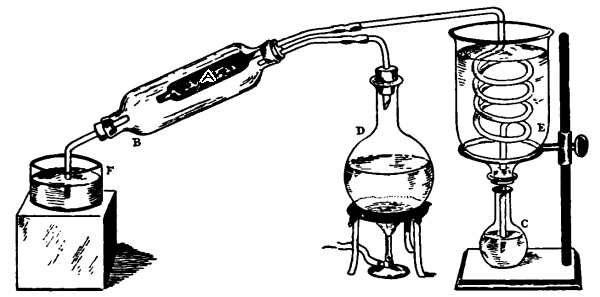
Fig. 121.—Apparatus for Acetic Acid.
605. Pectic Acid.—Under this term are included not only the
pectic acid but all the other bodies of a pectose nature contained in
tobacco. These bodies are of considerable interest, although they do
not belong to the most important constituents. In fresh tobacco leaves
are found three pectin bodies. One pectin is soluble in water, another
is an insoluble pectose and the third is the pectose body forming
salts with the alkalies, i. e., true pectic acid. In fermented
tobacco pectic acid is found chiefly in combination with lime in the
ribs of the leaves, serving to give them the necessary stiffness. For
the estimation of the pectin bodies (mucilage) the powdered tobacco is
thoroughly extracted with cold water. An aliquot part of the aqueous
extract is mixed with two volumes of strong alcohol and allowed to
stand in a well closed vessel in a cool place for twenty-four hours.
The precipitate is collected on a filter, washed with sixty-six per
cent alcohol, dried and weighed. The dried residue is incinerated and
the amount of ash determined. In general, vegetable mucilages contain
about five per cent of ash. If more than this be found, it is due to
the solution of the salts of the organic acids contained in the sample.
A dried vegetable mucilage, obtained as above, dissolves in water to
a mucilaginous liquid which does not reduce alkaline copper solution
until it has been hydrolyzed by boiling with a dilute mineral acid.[623]
606. Tannic Acid.—This acid is separated and estimated by the
processes given in paragraphs 589-595.
607. Starch and Sugar.—The unfermented leaves of tobacco
contain considerable quantities of carbohydrates in addition to woody
fiber, pentosans, galactan and cellulose. Among these, starch is the
most important. Sugar exists in small quantities in the fresh leaf,
usually not over one per cent. During fermentation, according to some
authorities, the starch is partially converted into sugar and the
latter substance disappears under the action of the alcoholic ferments.
It has been found at the Connecticut Station, however, that the starch
content of the leaf does not decrease during fermentation. The starch
and sugar may be determined in the fresh leaves by the methods already
given.
In the manufacture of certain grades of tobacco it is customary to add
a quantity of sugar. The analyst may thus be called upon to determine
in some cases whether the sugar found in a sample is natural or added.
The occurrence of natural sugars in tobacco has been investigated at
the instance of the British Treasury.[624]
The natural sugars which may be found in sun dried tobaccos usually
disappear entirely during the process of fermentation. It was found by
the Somerset House chemists that the content of sugar in commercial
tobaccos varies from none at all to over fifteen per cent. A remarkable
example of this variation is reported in two samples from this country,
one of which, grown in Kentucky, contained no sugar, and the other
grown in Virginia, 15.2 per cent.
It was noticed that the saccharin matters in the tobaccos examined
were neutral to polarized light. They are determined by their copper
reducing power. The tobacco sugars are therefore to be classed with the
reducing bodies, not optically active, found in the juices of sorghum
and sugar canes.
608. Ammonia.—As has already been intimated, ammonia exists
only in minute quantities in fresh tobacco leaves, but in considerable
quantities after fermentation. In the estimation of ammonia, twenty
grams of the tobacco powder are digested with 250 cubic centimeters of
water, acidulated with sulfuric and after an hour enough water added
to make the total quantity 400 cubic centimeters. After filtration, an
aliquot part of the filtrate, about 200 cubic centimeters, is treated
with magnesium oxid in excess and the ammonia and nicotin removed by
distillation in a current of steam. The distillate is collected in
dilute sulfuric acid of known strength. The total amount of the two
bases is determined by titration and the quantity of base representing
the nicotin, which has been determined in a separate sample, subtracted
in order to obtain the weight of the ammonia.[625]
The ammonia in tobacco is determined by Nessler in the following
manner:[626]
The powdered tobacco is mixed with water and magnesium oxid and after
standing for several hours it is distilled in a current of steam, the
distillate received in dilute sulfuric acid and the process continued
until a drop of the distillate gives no reaction for ammonia with the
nessler reagent. The excess of sulfuric acid in the distillate is
neutralized with pure sodium carbonate and the nicotin precipitated
by a neutral solution of mercuric iodid and potassium iodid. The
precipitate is separated by filtration, the filtrate treated with
sodium sulfid, and the ammonia again obtained by distillation with
an alkali, collected in dilute solution of set sulfuric acid and
determined by titration. The difference of the two determinations
represents the ammonia.
609. Nicotin.—In this laboratory McElroy has made a study of
some of the best approved methods for determining nicotin, and finds
the most simple and reliable to be that proposed by Kissling.[627]
The finely powdered tobacco should be dried at a temperature not
exceeding 60°, or it may be partially dried at that temperature before
grinding and the final drying completed afterwards. Twenty grams of
the powdered sample are intimately mixed by means of a pestle with
ten cubic centimeters of dilute alcoholic solution of soda lye, made
by dissolving six grams of sodium hydroxid in forty cubic centimeters
of water and completing the volume to 100 cubic centimeters with
ninety-five per cent alcohol. The mass is transferred to an extraction
paper cylinder, placed in an extraction apparatus and extracted for
three hours with ether. The ether is nearly all removed by careful
distillation, the residue mixed with fifty cubic centimeters of a very
dilute soda lye solution (4 to 100) and subjected to distillation in
a current of steam. The flask containing the nicotin extract should
be connected with the condensing apparatus by a safety bulb as is
usual in the distillation of substances containing fixed alkali. The
distillation should be conducted rapidly and in such a manner that when
200 cubic centimeters of the distillate have been collected, not more
than fifteen cubic centimeters of the liquid remain in the distillation
flask. In the distillate, the nicotin is determined by titration
with a set solution of dilute sulfuric acid, using rosolic acid or
phenacetolin as indicator. It is advisable to titrate each fifty cubic
centimeters of the distillate as it is received and the distillation is
continued until the last fifty cubic centimeters give no appreciable
quantity of the alkaloid. In the calculations one molecule of sulfuric
acid is equivalent to two molecules of nicotin according to the equation
- H₂SO₄ = (C₁₀H₁₄N₂)₂.
- 98324
Polarization Method.—Popovici has based a method of detecting
the quantity of nicotin in tobacco on its property of rotating the
plane of polarized light.[628]
The gyrodynat of pure nicotin is expressed by the formula
[a]D = -161°.6. When ten
parts of nicotin are mixed with ninety parts of water, this value
becomes -74°.1. By reason of this great depression in gyrodynatic value
Popovici determined the relation which exists between the dilute
solutions of nicotin and the number of minutes of angular rotation
produced on polarization in a 200 millimeter tube. In a solution in
which two grams of nicotin are contained in fifty cubic centimeters,
each minute of angular rotation is found to correspond to 6.5
milligrams of nicotin. For one gram in solution in the same volume one
minute of angular rotation corresponds to 5.9 milligrams and for a half
gram in solution to 5.7 milligrams.
The nicotin is prepared for polarization by extracting with ether, as
indicated in the previous paragraph, and the ethereal solution from
twenty grams of tobacco is shaken with a concentrated solution of
sodium phosphotungstate in nitric acid by means of which nicotin and
ammonia are precipitated and rapidly settle. The supernatant liquid
is carefully poured off and the residue made up to a volume of fifty
cubic centimeters with distilled water and the nicotin freed from any
of its compounds by the addition of eight grams of finely powdered
barium hydroxid. In order to promote the decomposition of the nicotin
compounds the mixture should be shaken at intervals for several hours.
The at first blue precipitate changes into blue green and finally into
yellow. It is separated by filtration and the somewhat yellow colored
filtrate placed in an observation tube, polarized, the polarization
calculated to minutes of angular rotation and the number of minutes
thus found multiplied by the nearest factor given above.
The analyst will find a description of other methods of estimating
nicotin in tobacco in the periodical literature of analytical
chemistry.[629]
610. Estimation of Amid Nitrogen.—For the estimation of amid
nitrogen ten grams of the powdered tobacco are digested with 100
cubic centimeters of forty per cent alcohol, the extract separated by
filtration, acidified with sulfuric and the albumin, peptone, nicotin
and ammonia precipitated with as little phosphotungstic acid as
possible. The precipitate is separated by filtration and seventy-five
cubic centimeters of the filtrate evaporated in a thin glass or tin
foil capsule after the addition of a little barium chlorid and the
nitrogen determined in the residue. The nitrogen thus obtained is that
which was present in an amid state. The nitrogen present as amids,
ammonia and nicotin subtracted from the total nitrogen leaves that
present as protein.
611. Fractional Extraction of Tobacco.—To determine the
character of the soluble constituents of tobacco it is advisable
to subject it to a fractional extraction with different reagents.
The reagents usually employed in the order mentioned are petroleum
ether, ether, absolute alcohol, water, dilute soda lye and dilute
hydrochloric acid. The extract obtained by petroleum ether contains
vegetable wax, chlorophyll and its alteration products, fat, ethereal
oils, and resin bodies. The extract with ether may be divided into
water soluble and alcohol soluble bodies. Among the first are small
quantities of glucosids and nicotin while in the alcoholic solution
resin predominates.
The alcoholic extract is also divided into water soluble and alcohol
soluble parts. The first contains the nicotin, which is insoluble in
ether, in combination with acids, together with tannic acid and allied
bodies and also the sugar. The part insoluble in water consists chiefly
of resin.
The aqueous solution contains the vegetable mucilages (pectin) soluble
carbohydrates, soluble proteids and organic acids.
The dilute soda lye solution contains chiefly proteids.
The dilute hydrochloric acid solution contains the starch and the
oxalic acid originally combined with lime. The extractions with dilute
soda lye and dilute hydrochloric acid should be made at a boiling
temperature. The residual matter consists of a mixture of carbohydrate
bodies to which the term crude fiber is usually applied.
612. Burning Qualities.—When tobacco is to be used for the
manufacture of cigars, or cigarettes, or for smoking in pipes, its
ability to keep burning is a matter of great importance. The tobacco,
when once ignited, should burn for some time and form, a fluffy ash,
free of fused mineral particles. A tobacco with good burning properties
is one containing nitrates in considerable quantity, not too much sugar
and starch, a porous cellular structure and comparatively free of
chlorin. In determining comparative burning properties the tests may be
applied to the single leaf or the tobacco may be first rolled into a
cigar form and burned in an artificial smoker.
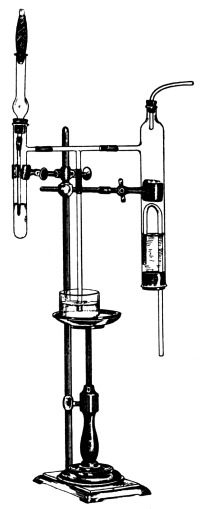
Fig. 122.
Apparatus for Smoking.
In applying the test to the leaf it is important that the ignition
be made with a fuse without flame, which maintains a uniform burning
power. Any good slow burning fuse may be used and it is applied to the
leaf in such a way that a hole may be burned in it, leaving its edges
uniformly ignited. The number of seconds elapsing before the last spark
is extinguished is noted. At the Connecticut Experiment Station a
lighter, proposed by Nessler, is employed. It is prepared by digesting
eighty grams of gum arabic in 120 cubic centimeters, and forty grams of
gum tragacanth in a quarter of a liter of water for two days, mixing
the mucilaginous masses and adding ten grams of potassium nitrate and
about 350 grams of pulverized charcoal. The mixture is rolled, on a
plate sprinkled with charcoal, into sticks a few inches in length and
of the diameter of a cigar and dried at a gentle heat. These fuses
burn slowly and without smoke and are well suited for lighting tobacco
leaves. Several tests, at least six, should be made with each leaf.
Leaves having a uniform burning power should be used as comparators and
the number of seconds they burn be designated by 100. It is important
that all the samples to be tested be exposed for a day or two to the
same atmosphere in order that they may have, as nearly as possible,
the same content of moisture. The burning tests, when possible, should
be made both before and after fermentation. As a rule fermentation
improves the burning quality of second rate leaves, but has little
effect on leaves of the first quality.
613. Artificial Smoker.—For the purpose of comparing the
burning properties of cigars, or of leaves rolled into cigar form, the
artificial smoking apparatus devised by Penfield and modified in this
laboratory is employed.[630]
The construction of the apparatus is shown in the accompanying figure.
The lighted cigar is set in the tube at the left, so that air entering
the test-tube must pass through the cigar. The test-tube contains
enough water to seal the end of the tube carrying the cigar, and is
connected with the aspirator on the right by the T tube, as
shown. An arm of the T dips just beneath the surface of the
liquid in the cup in the center. Water flows in a slow stream into the
aspirator through the tube at the extreme right, forcing the air out
through the arm of the T until the siphon begins to act. While
the water is voided through the long arm of the siphon, air enters
through the cigar, the liquid rising in the T. The action of
the apparatus is automatic and intermittent. When the cigar is about
one-third burned, it is removed without disturbing the ash cone, and
the latter examined and compared with other samples as a standard. The
sealing liquid of the long arm of the T may be mercury or water.
In case mercury be used, care must be taken not to immerse the open end
of the T more than one millimeter therein.
614. Description.—Among fermented beverages are included
those drinks, containing alcohol, prepared by fermenting the sugars
or starches of fruits, cereals or other agricultural products. Wine
and beer, in their various forms, and cider are the chief members
of this class of bodies. Koumiss, although a fermented beverage, is
not included in this classification, having been noticed under dairy
products. The large number of artificial drinks, made by mixing alcohol
with fruit and synthesized essences, is also excluded, although the
methods of analysis which are used may be applied also to them.
Fermented beverages containing less than two per cent of alcohol are
usually regarded as non-intoxicating drinks. Beers are of several
varieties, and the term includes lager beer, ale, porter and stout.
Distilled liquors are obtained by separating the alcohols and other
volatile matters from the products of fermentation by distillation.
It is not practicable here to attempt a description of the methods of
preparing fermented drinks. Special works on this branch of the subject
are easy of access.[631]
615. Important Constituents.—Alcohol is the most important
constituent of fermented beverages. The solid matters, commonly called
extract, which are obtained on evaporation are composed of dextrins,
sugars, organic acids, nitrogenous bodies and mineral matters affording
ash on combustion. Of these the dextrins and sugars form the chief part
and the proteid bodies nearly ten per cent in the case of beers made of
malt and hops. In beers the bitter principles derived from hops, while
not important by reason of quantity, are of the utmost consequence from
a gustatory and hygienic point of view. The ash of fermented beverages
varies with their nature, or with the character of the water used
in making the mash. In the manufacture of beer, water containing a
considerable proportion of gypsum is often used, and this substance is
sometimes added in the course of manufacture, especially of wine. The
presence of common salt in the ash in any notable quantity is evidence
of the addition of this condiment, either to improve the taste of the
beverage or to increase the thirst of the drinker. In cider the organic
acids, especially malic, are of importance.
Glycerol is a product of fermentation and of the hydrolysis of the fats
and oils in the substances fermented.
616. Specific Gravity.—In order to secure uniformity of
expression, the specific gravity of fermented beverages is determined
at about 15°.6, although that is a temperature much below the average
found in American laboratories. The specific gravity may be determined
by an alcoholometer, pyknometer or hydrostatic balance in harmony with
the directions given in paragraphs 48-54
and 285. By reason of the extractive
matters held in solution, fermented beverages are usually heavier than
water, even if the content of alcohol be twenty per cent or more. On
the other hand distilled liquors are lighter than water.
617. Determination of Alcohol.—The determination of the
percentage of alcohol present in a solution is based on two general
principles. On the one hand, and this is the base of the methods in
common use, the alcohol is secured mixed only with water and its amount
determined by ascertaining the specific gravity of the mixture. On the
other hand the quantity of alcohol in a mixture may be determined by
ascertaining the temperature of the vapors produced on boiling. This
is the principle involved in the use of the ebullioscope. The latter
method is not employed to any extent in this country.
Use of the Alcoholometer.—The alcoholometer usually employed
is known by the name of Gay-Lussac, who first made practical use of it
in the determination of alcohol. It is constructed in such a way as to
read directly the volume of absolute alcohol contained in one hundred
volumes of the liquid at a temperature of 15°.6. The instruments
employed should be carefully calibrated and thoroughly cleaned by
washing with absolute alcohol before use. The stem of the instrument
must be kept free from any greasy substance, and this is secured by
washing it with ether. After this last washing the analyst should be
careful not to touch the stem of the instrument with his fingers. It is
most convenient to make the determination exactly at 15°.6, but when
made at other temperatures the reading of the instrument is corrected
by tables which may be found in works especially devoted to the
analysis of wines.[632]
In this country the alcoholometer is used to some extent, but the
official method is based upon the determination of the specific gravity
by an instrument constructed in every respect like the alcoholometer,
but giving the specific gravity of the liquor at 15°.6 instead of its
percentage by volume in alcohol. The reading of the instrument having
been determined at a temperature of 15°.6, the corresponding percentage
of alcohol by volume or by weight is taken directly from the table
given further on.
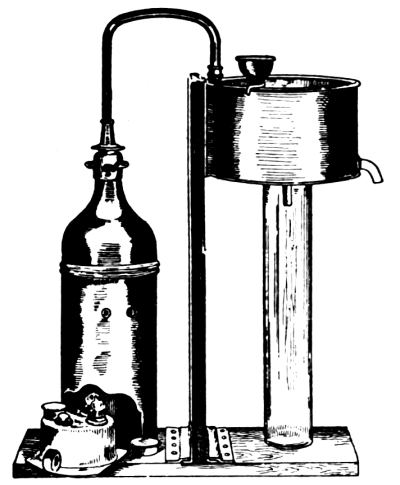
Fig. 123. Metal Distilling Apparatus.
Methods of Distillation.—The metal apparatus employed in the
laboratory of the Department of Agriculture, for the distillation of
fermented beverages in order to determine the percentage of alcohol by
the method given above, is shown in the accompanying figure.
The apparatus consists of a retort of copper carried on supports in such a
way as to permit an alcohol or bunsen lamp to be placed under it. It
is connected with a block tin condenser and the distillate is received
in a tall graduated cylinder placed under the condenser in such a way
as to prevent the loss of any alcohol in the form of vapor. Exactly
300 cubic centimeters of the wine or fermented beverage are used for
the distillation. Any acid which the wine contains is first saturated
with calcium carbonate before placing in the retort. Exactly 100
cubic centimeters of distillate are collected and the volume of the
distillate is completed to 300 cubic centimeters by the addition of
recently distilled water.[633]
The cylinder containing the distillate is brought to a temperature of 15°.6,
the alcoholometer inserted and its reading taken with the usual precautions.
Official Method.—The alcoholometers employed in the official
methods are calibrated to agree with those used by the officers of the
Bureau of Internal Revenue. They are most conveniently constructed,
carrying the thermometer scale in the same stem with that showing
the specific gravity. It is highly important that the analyst assure
himself of the exact calibration of the instrument before using it.
Inasmuch as the volume of the distillate may not be suited in all cases
to the use of a large alcoholometer, it is customary in this laboratory
to determine the specific gravity by means of the hydrostatic balance,
as described further on. Attention is also called to the fact that,
in the official method, directions are not given to neutralize the
free acid of the fermented beverage before the distillation. Since the
Internal Revenue Bureau is concerned chiefly with the determination of
alcohol in distilled liquors, this omission is of little consequence.
Even in ordinary fermented beverages the percentage of volatile acids,
(acetic etc.,) is so small as to make the error due to the failure to
neutralize it of but little consequence. In order, however, to avoid
every possibility of error, it is recommended that in all instances the
free acids of the sample be neutralized before distillation. In this
laboratory, the distillations are conducted in a glass apparatus shown
in the accompanying figure. The manipulation
is as follow:[634]
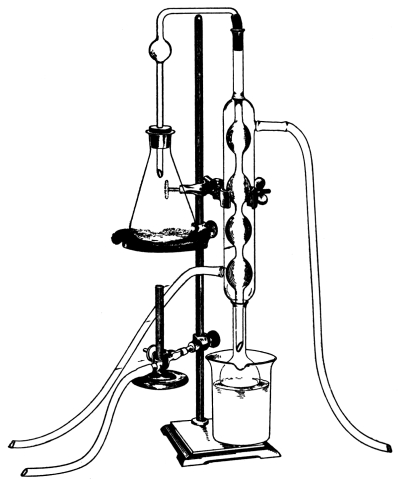
Fig. 124. Distilling Apparatus.
One hundred cubic centimeters of the liquor are placed in a flask of
from 250 to 300 cubic centimeters capacity, fifty cubic centimeters
of water added, the flask attached to a vertical condenser by means
of a bent bulb tube, 100 cubic centimeters distilled and the specific
gravity of the distillate determined. The distillate is also weighed,
or its weight calculated from the specific gravity. The corresponding
percentage of alcohol by weight is obtained from the appended table,
and this figure multiplied by the weight of the distillate, and the
result divided by the weight of the sample, gives the per cent of
alcohol by weight contained therein.
The percentage of alcohol by volume of the liquor is the same as that
of the distillate, and is obtained directly from the appended table.
In distilled liquors about thirty grams are diluted to 150 cubic
centimeters, 100 cubic centimeters distilled and the per cent of
alcohol by weight determined as above.
The percentage of alcohol by volume in the distillate is obtained from
the appended table. This figure divided by the number expressing the
volume in cubic centimeters of the liquor taken for the determination
(calculated from the specific gravity), and the result multiplied by
100 gives the per cent of alcohol by volume in the original liquor.
618. Determining the Specific Gravity of the Distillate.—The
specific gravity of the distillate may be determined by the pyknometer,
alcoholometer, hydrostatic balance or in any accurate way. The volume
of the distillate is not always large enough to be conveniently used
with an alcoholometer, especially the large ones employed by the Bureau
of Internal Revenue. In the laboratory of the Agricultural Department,
it is customary to determine the density of the distillate by the
hydrostatic balance shown in paragraph 285. The
specific gravity is in each case determined at 15°.6, referred to water of
the same temperature, or if at a different temperature calculated thereto.
619. Table for Use with Hydrostatic Plummet.—It is more
convenient to determine the density of the alcoholic distillate at room
temperature than to reduce it to the standard for which the plummet is
graduated. In the case of a plummet which displaces exactly five grams,
or multiple thereof, of distilled water at 15°.6, the corrections for
temperatures between 12°.2 and 30° are found in the following table,
prepared by Bigelow.[635]
If the weight of the alcoholic solution displaced be 4.96075 grams the
apparent specific gravity 0.99215 and the temperature of observation
25°.4, the correction, which is additive, as given in the table is
0.00191 and the true specific gravity is 0.99406 and the percentage of
alcohol by volume 4.08.
When the plummet does not exactly displace five grams of water at
15°.6, but nearly so, the table may still be used.
For example, suppose the weight of water displaced be 4.9868 instead of
five grams. The apparent specific gravity of the water by this plummet
is 0.99736 and the difference between this and the true specific
gravity is 0.00264, which is a constant correction to be added to the
specific gravity as determined in each case.
Correction Table for Specific Gravity.
Below 15°.6 Subtract; Above 15°.6 Add.
| Temp. |
Correction. |
Temp. |
Correction. |
Temp. |
Correction. |
| 12.2 |
0.00047 |
18.2 |
0.00043 |
24.2 |
0.00163 |
| 12.4 |
0.00044 |
18.4 |
0.00046 |
24.4 |
0.00167 |
| 12.6 |
0.00042 |
18.6 |
0.00050 |
24.6 |
0.00172 |
| 12.8 |
0.00039 |
18.8 |
0.00053 |
24.8 |
0.00176 |
| 13.0 |
0.00037 |
19.0 |
0.00057 |
25.0 |
0.00181 |
| 13.2 |
0.00634 |
19.2 |
0.00061 |
25.2 |
0.00186 |
| 13.4 |
0.00032 |
19.4 |
0.00065 |
25.4 |
0.00191 |
| 13.6 |
0.00029 |
19.6 |
0.00068 |
25.6 |
0.00195 |
| 13.8 |
0.00027 |
19.8 |
0.00072 |
25.8 |
0.00200 |
| 14.0 |
0.00024 |
20.0 |
0.00076 |
26.0 |
0.00205 |
| 14.2 |
0.00021 |
20.2 |
0.00080 |
26.2 |
0.00210 |
| 14.4 |
0.00018 |
20.4 |
0.00084 |
26.4 |
0.00215 |
| 14.6 |
0.00015 |
20.6 |
0.00087 |
26.6 |
0.00220 |
| 14.8 |
0.00012 |
20.8 |
0.00091 |
26.8 |
0.00225 |
| 15.0 |
0.00009 |
21.0 |
0.00095 |
27.0 |
0.00230 |
| 15.2 |
0.00006 |
21.2 |
0.00099 |
27.2 |
0.00235 |
| 15.4 |
0.00003 |
21.4 |
0.00103 |
27.4 |
0.00240 |
| 15.6 |
0.00000 |
21.6 |
0.00107 |
27.6 |
0.00246 |
| 15.8 |
0.00003 |
21.8 |
0.00111 |
27.8 |
0.00251 |
| 16.0 |
0.00006 |
22.0 |
0.00115 |
28.0 |
0.00256 |
| 16.2 |
0.00009 |
22.2 |
0.00119 |
28.2 |
0.00261 |
| 16.4 |
0.00012 |
22.4 |
0.00123 |
28.4 |
0.00267 |
| 16.6 |
0.00016 |
22.6 |
0.00128 |
28.6 |
0.00272 |
| 16.8 |
0.00019 |
22.8 |
0.00132 |
28.8 |
0.00278 |
| 17.0 |
0.00022 |
23.0 |
0.00136 |
29.0 |
0.00283 |
| 17.2 |
0.00025 |
23.2 |
0.00140 |
29.2 |
0.00288 |
| 17.4 |
0.00029 |
23.4 |
0.00145 |
29.4 |
0.00294 |
| 17.6 |
0.00032 |
23.6 |
0.00149 |
29.6 |
0.00299 |
| 17.8 |
0.00036 |
23.8 |
0.00154 |
29.8 |
0.00306 |
| 18.0 |
0.00039 |
24.0 |
0.00158 |
30.0 |
0.00311 |
The table is only accurate when the distillate does not contain over
seven nor less than three per cent of alcohol. If the distillate
contain more than seven per cent of alcohol it is diluted and the
compensating correction made.
620. Calculating Results.—The specific gravity of the alcoholic
distillate having been determined by any approved method and corrected
to a temperature of 15°.6, the corresponding per cents of alcohol by
volume and by weight are found by consulting the following table.[636]
If, for example, the corrected specific gravity be exactly that given
in any figure of the table the corresponding per cents are directly
read. If the specific gravity found fall between two numbers in the
table the corresponding per cents are determined by interpolation.
Table Showing Percentage of Alcohol
by Weight and by Volume.
Specific
gravity at
15°.6./15°.6. |
Per cent
alcohol
by volume. |
Per cent
alcohol
by weight. |
| 1.00000 |
0.00 |
0.00 |
| 0.99992 |
.05 |
.04 |
| 984 |
.10 |
.08 |
| 976 |
.15 |
.12 |
| 968 |
.20 |
.16 |
| 961 |
.25 |
.20 |
| 953 |
.30 |
.24 |
| 945 |
.35 |
.28 |
| 937 |
.40 |
.32 |
| 930 |
.45 |
.36 |
| .99923 |
0.50 |
0.40 |
| 915 |
.55 |
.44 |
| 907 |
.60 |
.48 |
| 900 |
.65 |
.52 |
| 892 |
.70 |
.56 |
| 884 |
.75 |
.60 |
| 877 |
.80 |
.64 |
| 869 |
.85 |
.67 |
| 861 |
.90 |
.71 |
| 854 |
.95 |
.75 |
| .99849 |
1.00 |
0.79 |
| 842 |
.05 |
.83 |
| 834 |
.10 |
.87 |
| 827 |
.15 |
.91 |
| 819 |
.20 |
.95 |
| 812 |
.25 |
.99 |
| 805 |
.30 |
1.03 |
| 797 |
.35 |
.07 |
| 790 |
.40 |
.11 |
| 782 |
.45 |
.15 |
| .99775 |
1.50 |
1.19 |
| 768 |
.55 |
.23 |
| 760 |
.60 |
.27 |
| 753 |
.65 |
.31 |
| 745 |
.70 |
.35 |
| 738 |
.75 |
.39 |
| 731 |
.80 |
.43 |
| 723 |
.85 |
.47 |
| 716 |
.90 |
.51 |
| 708 |
.95 |
.55 |
| .99701 |
2.00 |
1.59 |
| 694 |
.05 |
.63 |
| 687 |
.10 |
.67 |
| 679 |
.15 |
.71 |
| 672 |
.20 |
.75 |
| 665 |
.25 |
.79 |
| 658 |
.30 |
.83 |
| 651 |
.35 |
.87 |
| 643 |
.40 |
.91 |
| 636 |
.45 |
.95 |
| 0.99629 |
2.50 |
1.99 |
| 622 |
.55 |
2.03 |
| 615 |
.60 |
.07 |
| 607 |
.65 |
.11 |
| 600 |
.70 |
.15 |
| 593 |
.75 |
.19 |
| 586 |
.80 |
.23 |
| 579 |
.85 |
.27 |
| 571 |
.90 |
.31 |
| 564 |
.95 |
.35 |
| .99557 |
3.00 |
2.39 |
| 550 |
.05 |
.43 |
| 543 |
.10 |
.47 |
| 536 |
.15 |
.51 |
| 529 |
.20 |
.55 |
| 522 |
.25 |
.59 |
| 515 |
.30 |
.64 |
| 508 |
.35 |
.68 |
| 501 |
.40 |
.72 |
| 494 |
.45 |
.76 |
| .99487 |
3.50 |
2.80 |
| 480 |
.55 |
.84 |
| 473 |
.60 |
.88 |
| 466 |
.65 |
.92 |
| 459 |
.70 |
.96 |
| 452 |
.75 |
3.00 |
| 445 |
.80 |
.04 |
| 438 |
.85 |
.08 |
| 431 |
.90 |
.12 |
| 424 |
.95 |
.16 |
| .99417 |
4.00 |
3.20 |
| 410 |
.05 |
.24 |
| 403 |
.10 |
.28 |
| 397 |
.15 |
.32 |
| 390 |
.20 |
.36 |
| 383 |
.25 |
.40 |
| 376 |
.30 |
.44 |
| 369 |
.35 |
.48 |
| 363 |
.40 |
.52 |
| 356 |
.45 |
.56 |
| .99349 |
4.50 |
3.60 |
| 342 |
.55 |
.64 |
| 335 |
.60 |
.68 |
| 329 |
.65 |
.72 |
| 322 |
.70 |
.76 |
| 315 |
.75 |
.80 |
| 308 |
.80 |
.84 |
| 301 |
.85 |
.88 |
| 295 |
.90 |
.92 |
| 288 |
.95 |
.96 |
| 0.99281 |
5.00 |
4.00 |
| 274 |
.05 |
.04 |
| 268 |
.10 |
.08 |
| 261 |
.15 |
.12 |
| 255 |
.20 |
.16 |
| 248 |
.25 |
.20 |
| 241 |
.30 |
.24 |
| 235 |
.35 |
.28 |
| 228 |
.40 |
.32 |
| 222 |
.45 |
.36 |
| .99215 |
5.50 |
4.40 |
| 208 |
.55 |
.44 |
| 202 |
.60 |
.48 |
| 195 |
.65 |
.52 |
| 189 |
.70 |
.56 |
| 182 |
.75 |
.60 |
| 175 |
.80 |
.64 |
| 169 |
.85 |
.68 |
| 162 |
.90 |
.72 |
| 156 |
.95 |
.76 |
| .99149 |
6.00 |
4.80 |
| 143 |
.05 |
.84 |
| 136 |
.10 |
.87 |
| 130 |
.15 |
.92 |
| 123 |
.20 |
.96 |
| 117 |
.25 |
5.00 |
| 111 |
.30 |
.05 |
| 104 |
.35 |
.09 |
| 098 |
.40 |
.13 |
| 091 |
.45 |
.17 |
| .99085 |
6.50 |
5.21 |
| 079 |
.55 |
.25 |
| 072 |
.60 |
.29 |
| 066 |
.65 |
.33 |
| 059 |
.70 |
.37 |
| 053 |
.75 |
.41 |
| 047 |
.80 |
.45 |
| 040 |
.85 |
.49 |
| 034 |
.90 |
.53 |
| 027 |
.95 |
.57 |
| .99021 |
7.00 |
5.61 |
| 015 |
.05 |
.65 |
| 009 |
.10 |
.69 |
| 002 |
.15 |
.73 |
| .98996 |
.20 |
.77 |
| 990 |
.25 |
.81 |
| 984 |
.30 |
.86 |
| 978 |
.35 |
.90 |
| 971 |
.40 |
.94 |
| 965 |
.45 |
.98 |
| 0.98959 |
7.50 |
6.02 |
| 953 |
.55 |
.06 |
| 947 |
.60 |
.10 |
| 940 |
.65 |
.14 |
| 934 |
.70 |
.18 |
| 928 |
.75 |
.22 |
| 922 |
.80 |
.26 |
| 916 |
.85 |
.30 |
| 909 |
.90 |
.34 |
| 903 |
.95 |
.38 |
| .98897 |
8.00 |
6.42 |
| 891 |
.05 |
.46 |
| 885 |
.10 |
.50 |
| 879 |
.15 |
.54 |
| 873 |
.20 |
.58 |
| 867 |
.25 |
.62 |
| 861 |
.30 |
.67 |
| 855 |
.35 |
.71 |
| 849 |
.40 |
.75 |
| 843 |
.45 |
.79 |
| .98837 |
8.50 |
6.83 |
| 831 |
.55 |
.87 |
| 825 |
.60 |
.91 |
| 819 |
.65 |
.95 |
| 813 |
.70 |
.99 |
| 807 |
.75 |
7.03 |
| 801 |
.80 |
.07 |
| 795 |
.85 |
.11 |
| 789 |
.90 |
.15 |
| 783 |
.95 |
.19 |
| .98777 |
9.00 |
7.23 |
| 771 |
.05 |
.27 |
| 765 |
.10 |
.31 |
| 754 |
.20 |
.39 |
| 748 |
.25 |
.43 |
| 742 |
.30 |
.48 |
| 736 |
.35 |
.52 |
| 724 |
.45 |
.60 |
| .98719 |
9.50 |
7.64 |
| 713 |
.55 |
.68 |
| 707 |
.60 |
.72 |
| 701 |
.65 |
.76 |
| 695 |
.70 |
.80 |
| 689 |
.75 |
.84 |
| 683 |
.80 |
.88 |
| 678 |
.85 |
.92 |
| 672 |
.90 |
.96 |
| 666 |
.95 |
8.00 |
| 0.98660 |
10.00 |
8.04
|
| 654 |
.05 |
.08 |
| 649 |
.10 |
.12 |
| 643 |
.15 |
.16 |
| 637 |
.20 |
.20 |
| 632 |
.25 |
.24 |
| 626 |
.30 |
.28 |
| 620 |
.35 |
.33 |
| 614 |
.40 |
.37 |
| 609 |
.45 |
.41 |
| .98603 |
10.50 |
8.45 |
| 597 |
.55 |
.49 |
| 592 |
.60 |
.53 |
| 586 |
.65 |
.57 |
| 580 |
.70 |
.61 |
| 575 |
.75 |
.65 |
| 569 |
.80 |
.70 |
| 563 |
.85 |
.74 |
| 557 |
.90 |
.78 |
| 552 |
.95 |
.82 |
| .98546 |
11.00 |
8.86 |
| 540 |
.05 |
.90 |
| 535 |
.10 |
.94 |
| 529 |
.15 |
.98 |
| 524 |
.20 |
9.02 |
| 518 |
.25 |
.07 |
| 513 |
.30 |
.11 |
| 507 |
.35 |
.15 |
| 502 |
.40 |
.19 |
| 496 |
.45 |
.23 |
| .98491 |
11.50 |
9.27 |
| 485 |
.55 |
.31 |
| 479 |
.60 |
.35 |
| 474 |
.65 |
.39 |
| 468 |
.70 |
.43 |
| 463 |
.75 |
.47 |
| 457 |
.80 |
.51 |
| 452 |
.85 |
.55 |
| 446 |
.90 |
.59 |
| 441 |
.95 |
.63 |
| .98435 |
12.00 |
9.67 |
| 430 |
.05 |
.71 |
| 424 |
.10 |
.75 |
| 419 |
.15 |
.79 |
| 413 |
.20 |
.83 |
| 408 |
.25 |
.87 |
| 402 |
.30 |
.92 |
| 397 |
.35 |
.96 |
| 391 |
.40 |
10.00 |
| 386 |
.45 |
.04 |
| 0.98381 |
12.50 |
10.08 |
| 375 |
.55 |
.12 |
| 370 |
.60 |
.16 |
| 364 |
.65 |
.20 |
| 359 |
.70 |
.24 |
| 353 |
.75 |
.28 |
| 348 |
.80 |
.33 |
| 342 |
.85 |
.37 |
| 337 |
.90 |
.41 |
| 331 |
.95 |
.45 |
| .98326 |
13.00 |
10.49 |
| 321 |
.05 |
.53 |
| 315 |
.10 |
.57 |
| 310 |
.15 |
.61 |
| 305 |
.20 |
.65 |
| 299 |
.25 |
.69 |
| 294 |
.30 |
.74 |
| 289 |
.35 |
.78 |
| 283 |
.40 |
.82 |
| 278 |
.45 |
.86 |
| .98273 |
13.50 |
10.90 |
| 267 |
.55 |
.94 |
| 262 |
.60 |
.98 |
| 256 |
.65 |
11.02 |
| 251 |
.70 |
.06 |
| 246 |
.75 |
.14 |
| 240 |
.80 |
.15 |
| 235 |
.85 |
.19 |
| 230 |
.90 |
.23 |
| 224 |
.95 |
.27 |
| .98219 |
14.00 |
11.31 |
| 214 |
.05 |
.35 |
| 209 |
.10 |
.39 |
| 203 |
.15 |
.43 |
| 198 |
.20 |
.47 |
| 193 |
.25 |
.52 |
| 188 |
.30 |
.56 |
| 182 |
.35 |
.60 |
| 177 |
.40 |
.64 |
| 172 |
.45 |
.68 |
| .98167 |
14.50 |
11.72 |
| 161 |
.55 |
.76 |
| 156 |
.60 |
.80 |
| 151 |
.65 |
.84 |
| 146 |
.70 |
.88 |
| 140 |
.75 |
.93 |
| 135 |
.80 |
.97 |
| 130 |
.85 |
12.01 |
| 125 |
.90 |
.05 |
| 119 |
.95 |
.09 |
| 0.98114 |
15.00 |
12.13 |
| 108 |
.05 |
.17 |
| 104 |
.10 |
.21 |
| 099 |
.15 |
.25 |
| 093 |
.20 |
.29 |
| 088 |
.25 |
.33 |
| 083 |
.30 |
.38 |
| 078 |
.35 |
.42 |
| 073 |
.40 |
.46 |
| 068 |
.45 |
.50 |
| .98063 |
15.50 |
12.54 |
| 057 |
.55 |
.58 |
| 052 |
.60 |
.62 |
| 047 |
.65 |
.66 |
| 042 |
.70 |
.70 |
| 037 |
.75 |
.75 |
| 032 |
.80 |
.79 |
| 026 |
.85 |
.83 |
| 021 |
.90 |
.87 |
| 016 |
.95 |
.91 |
| .98011 |
16.00 |
12.95 |
| 005 |
.05 |
.99 |
| 001 |
.10 |
13.03 |
| .97996 |
.15 |
.08 |
| 991 |
.20 |
.12 |
| 986 |
.25 |
.16 |
| 980 |
.30 |
.20 |
| 975 |
.35 |
.24 |
| 970 |
.40 |
.29 |
| 965 |
.45 |
.33 |
| .97960 |
16.50 |
13.37 |
| 955 |
.55 |
.41 |
| 950 |
.60 |
.45 |
| 945 |
.65 |
.49 |
| 940 |
.70 |
.53 |
| 935 |
.75 |
.57 |
| 929 |
.80 |
.62 |
| 924 |
.85 |
.66 |
| 919 |
.90 |
.70 |
| 914 |
.95 |
.74 |
| .97909 |
17.00 |
13.78 |
| 904 |
.05 |
.82 |
| 899 |
.10 |
.86 |
| 894 |
.15 |
.90 |
| 889 |
.20 |
.94 |
| 884 |
.25 |
.98 |
| 879 |
.30 |
14.03 |
| 874 |
.35 |
.07 |
| 869 |
.40 |
.11 |
| 864 |
.45 |
.15 |
| 0.97859 |
17.50 |
14.19 |
| 853 |
.55 |
.23 |
| 848 |
.60 |
.27 |
| 843 |
.65 |
.31 |
| 838 |
.70 |
.35 |
| 833 |
.75 |
.40 |
| 828 |
.80 |
.44 |
| 823 |
.85 |
.48 |
| 818 |
.90 |
.52 |
| 813 |
.95 |
.56 |
| .97808 |
18.00 |
14.60 |
| 803 |
.05 |
.64 |
| 798 |
.10 |
.68 |
| 793 |
.15 |
.73 |
| 788 |
.20 |
.77 |
| 783 |
.25 |
.81 |
| 778 |
.30 |
.85 |
| 773 |
.35 |
.89 |
| 768 |
.40 |
.94 |
| 763 |
.45 |
.98 |
| .97758 |
18.50 |
15.02 |
| 753 |
.55 |
.06 |
| 748 |
.60 |
.10 |
| 743 |
.65 |
.14 |
| 738 |
.70 |
.18 |
| 733 |
.75 |
.22 |
| 728 |
.80 |
.27 |
| 723 |
.85 |
.31 |
| 718 |
.90 |
.35 |
| 713 |
.95 |
.39 |
| .97708 |
19.00 |
15.43 |
| 703 |
.05 |
.47 |
| 698 |
.10 |
.51 |
| 693 |
.15 |
.55 |
| 688 |
.20 |
.59 |
| 683 |
.25 |
.63 |
| 678 |
.30 |
.68 |
| 673 |
.35 |
.72 |
| 668 |
.40 |
.76 |
| 663 |
.45 |
.80 |
| .97658 |
19.50 |
15.84 |
| 653 |
.55 |
.88 |
| 648 |
.60 |
.93 |
| 643 |
.65 |
.97 |
| 638 |
.70 |
16.01 |
| 633 |
.75 |
.05 |
| 628 |
.80 |
.09 |
| 623 |
.85 |
.14 |
| 618 |
.90 |
.18 |
| 613 |
.95 |
.22
|
| 0.97608 |
20.00 |
16.26 |
| 603 |
.05 |
.30 |
| 598 |
.10 |
.34 |
| 593 |
.15 |
.38 |
| 588 |
.20 |
.42 |
| 583 |
.25 |
.46 |
| 578 |
.30 |
.51 |
| 573 |
.35 |
.58 |
| 568 |
.40 |
.59 |
| 563 |
.45 |
.63 |
| .97558 |
20.50 |
16.67 |
| 552 |
.55 |
.71 |
| 547 |
.60 |
.75 |
| 542 |
.65 |
.80 |
| 537 |
.70 |
.84 |
| 532 |
.75 |
.88 |
| 527 |
.80 |
.92 |
| 522 |
.85 |
.96 |
| 517 |
.90 |
17.01 |
| 512 |
.95 |
.05 |
| .97507 |
21.00 |
17.09 |
| 502 |
.05 |
.13 |
| 497 |
.10 |
.17 |
| 492 |
.15 |
.22 |
| 487 |
.20 |
.26 |
| 482 |
.25 |
.30 |
| 477 |
.30 |
.34 |
| 472 |
.35 |
.38 |
| 467 |
.40 |
.43 |
| 462 |
.45 |
.47 |
| .97457 |
21.50 |
17.51 |
| 451 |
.55 |
.55 |
| 446 |
.60 |
.59 |
| 441 |
.65 |
.63 |
| 436 |
.70 |
.67 |
| 431 |
.75 |
.71 |
| 426 |
.80 |
.76 |
| 421 |
.85 |
.80 |
| 416 |
.90 |
.84 |
| 411 |
.95 |
.88 |
| .97406 |
22.00 |
17.92 |
| 401 |
.05 |
.96 |
| 396 |
.10 |
18.00 |
| 391 |
.15 |
.05 |
| 386 |
.20 |
.09 |
| 381 |
.25 |
.13 |
| 375 |
.30 |
.17 |
| 370 |
.35 |
.21 |
| 365 |
.40 |
.26 |
| 360 |
.45 |
.30 |
| 0.97355 |
22.50 |
18.34 |
| 350 |
.55 |
.38 |
| 345 |
.60 |
.42 |
| 340 |
.65 |
.47 |
| 335 |
.70 |
.51 |
| 330 |
.75 |
.55 |
| 324 |
.80 |
.59 |
| 319 |
.85 |
.63 |
| 314 |
.90 |
.68 |
| 309 |
.95 |
.72 |
| .97304 |
23.00 |
18.76 |
| 299 |
.05 |
.80 |
| 294 |
.10 |
.84 |
| 289 |
.15 |
.88 |
| 283 |
.20 |
.92 |
| 278 |
.25 |
.96 |
| 273 |
.30 |
19.01 |
| 268 |
.35 |
.05 |
| 263 |
.40 |
.09 |
| 258 |
.45 |
.13 |
| .97253 |
23.50 |
19.17 |
| 247 |
.55 |
.21 |
| 242 |
.60 |
.25 |
| 237 |
.65 |
.30 |
| 232 |
.70 |
.34 |
| 227 |
.75 |
.38 |
| 222 |
.80 |
.42 |
| 216 |
.85 |
.46 |
| 211 |
.90 |
.51 |
| 206 |
.95 |
.55 |
| .97201 |
24.00 |
19.59 |
| 196 |
.05 |
.63 |
| 191 |
.10 |
.67 |
| 185 |
.15 |
.72 |
| 180 |
.20 |
.76 |
| 175 |
.25 |
.80 |
| 170 |
.30 |
.84 |
| 165 |
.35 |
.88 |
| 159 |
.40 |
.93 |
| 154 |
.45 |
.97 |
| .97149 |
24.50 |
20.01 |
| 144 |
.55 |
.05 |
| 139 |
.60 |
.09 |
| 133 |
.65 |
.14 |
| 128 |
.70 |
.18 |
| 123 |
.75 |
.22 |
| 118 |
.80 |
.26 |
| 113 |
.85 |
.30 |
| 107 |
.90 |
.35 |
| 102 |
.95 |
.39 |
| 0.97097 |
25.00 |
20.43 |
| 092 |
.05 |
.47 |
| 086 |
.10 |
.51 |
| 081 |
.15 |
.56 |
| 076 |
.20 |
.60 |
| 071 |
.25 |
.64 |
| 065 |
.30 |
.68 |
| 060 |
.35 |
.72 |
| 055 |
.40 |
.77 |
| 049 |
.45 |
.81 |
| .97014 |
25.50 |
20.85 |
| 039 |
.55 |
.89 |
| 033 |
.60 |
.93 |
| 028 |
.65 |
.98 |
| 023 |
.70 |
21.02 |
| 018 |
.75 |
.06 |
| 012 |
.80 |
.10 |
| 007 |
.85 |
.14 |
| 001 |
.90 |
.19 |
| .96996 |
.95 |
.23 |
| .96991 |
26.00 |
21.27 |
| 986 |
.05 |
.31 |
| 980 |
.10 |
.35 |
| 975 |
.15 |
.40 |
| 969 |
.20 |
.44 |
| 964 |
.25 |
.48 |
| 959 |
.30 |
.52 |
| 953 |
.35 |
.56 |
| 949 |
.40 |
.61 |
| 942 |
.45 |
.65 |
| .96937 |
26.50 |
21.69 |
| 932 |
.55 |
.73 |
| 926 |
.60 |
.77 |
| 921 |
.65 |
.82 |
| 915 |
.70 |
.86 |
| 910 |
.75 |
.90 |
| 905 |
.80 |
.94 |
| 899 |
.85 |
.98 |
| 894 |
.90 |
22.03 |
| 888 |
.95 |
.07 |
| .96883 |
27.00 |
22.11 |
| 877 |
.05 |
.15 |
| 872 |
.10 |
.20 |
| 866 |
.15 |
.24 |
| 861 |
.20 |
.28 |
| 855 |
.25 |
.33 |
| 850 |
.30 |
.37 |
| 844 |
.35 |
.41 |
| 839 |
.40 |
.45 |
| 833 |
.45 |
.50 |
| 0.96828 |
27.50 |
22.54 |
| 822 |
.55 |
.58 |
| 816 |
.60 |
.62 |
| 811 |
.65 |
.67 |
| 805 |
.70 |
.71 |
| 800 |
.75 |
.75 |
| 794 |
.80 |
.79 |
| 789 |
.85 |
.83 |
| 783 |
.90 |
.88 |
| 778 |
.95 |
.92 |
| .96772 |
28.00 |
22.96 |
| 766 |
.05 |
23.00 |
| 761 |
.10 |
.04 |
| 755 |
.15 |
.09 |
| 749 |
.20 |
.13 |
| 744 |
.25 |
.17 |
| 738 |
.30 |
.21 |
| 732 |
.35 |
.25 |
| 726 |
.40 |
.30 |
| 721 |
.45 |
.34 |
| .96715 |
28.50 |
23.38 |
| 709 |
.55 |
.42 |
| 704 |
.60 |
.47 |
| 698 |
.65 |
.51 |
| 692 |
.70 |
.55 |
| 687 |
.75 |
.60 |
| 681 |
.80 |
.64 |
| 675 |
.85 |
.68 |
| 669 |
.90 |
.72 |
| 664 |
.95 |
.77 |
| .96658 |
29.00 |
23.81 |
| 652 |
.05 |
.85 |
| 646 |
.10 |
.89 |
| 640 |
.15 |
.94 |
| 635 |
.20 |
.98 |
| 629 |
.25 |
24.02 |
| 623 |
.30 |
.06 |
| 617 |
.35 |
.10 |
| 611 |
.40 |
.15 |
| 605 |
.45 |
.19 |
| .96600 |
29.50 |
24.23 |
| 594 |
.55 |
.27 |
| 587 |
.60 |
.32 |
| 582 |
.65 |
.36 |
| 576 |
.70 |
.40 |
| 570 |
.75 |
.45 |
| 564 |
.80 |
.49 |
| 559 |
.85 |
.53 |
| 553 |
.90 |
.57 |
| 547 |
.95 |
.62 |
| 0.96541 |
30.00 |
24.66
|
| 535 |
.05 |
.70 |
| 529 |
.10 |
.74 |
| 523 |
.15 |
.79 |
| 517 |
.20 |
.83 |
| 511 |
.25 |
.87 |
| 505 |
.30 |
.91 |
| 499 |
.35 |
.95 |
| 493 |
.40 |
25.00 |
| 487 |
.45 |
.04 |
| .96481 |
30.50 |
25.08 |
| 475 |
.55 |
.12 |
| 469 |
.60 |
.17 |
| 463 |
.65 |
.21 |
| 457 |
.70 |
.25 |
| 451 |
.75 |
.30 |
| 445 |
.80 |
.34 |
| 439 |
.85 |
.38 |
| 433 |
.90 |
.42 |
| 427 |
.95 |
.47 |
| .96421 |
31.00 |
25.51 |
| 415 |
.05 |
.55 |
| 409 |
.10 |
.60 |
| 403 |
.15 |
.64 |
| 396 |
.20 |
.68 |
| 390 |
.25 |
.73 |
| 384 |
.30 |
.77 |
| 378 |
.35 |
.81 |
| 372 |
.40 |
.85 |
| 366 |
.45 |
.90 |
| .96360 |
31.50 |
25.94 |
| 353 |
.55 |
.98 |
| 347 |
.60 |
26.03 |
| 341 |
.65 |
.07 |
| 335 |
.70 |
.11 |
| 329 |
.75 |
.16 |
| 323 |
.80 |
.20 |
| 316 |
.85 |
.24 |
| 310 |
.90 |
.28 |
| 304 |
.95 |
.33 |
| .96298 |
32.00 |
26.37 |
| 292 |
.05 |
.41 |
| 285 |
.10 |
.46 |
| 279 |
.15 |
.50 |
| 273 |
.20 |
.54 |
| 267 |
.25 |
.59 |
| 260 |
.30 |
.63 |
| 254 |
.35 |
.67 |
| 248 |
.40 |
.71 |
| 241 |
.45 |
.76 |
| 0.96235 |
32.50 |
26.80 |
| 229 |
.55 |
.84 |
| 222 |
.60 |
.89 |
| 216 |
.65 |
.93 |
| 210 |
.70 |
.97 |
| 204 |
.75 |
27.02 |
| 197 |
.80 |
.06 |
| 191 |
.85 |
.10 |
| 185 |
.90 |
.14 |
| 178 |
.95 |
.19 |
| .96172 |
33.00 |
27.23 |
| 166 |
.05 |
.27 |
| 159 |
.10 |
.32 |
| 153 |
.15 |
.36 |
| 146 |
.20 |
.40 |
| 140 |
.25 |
.45 |
| 133 |
.30 |
.49 |
| 127 |
.35 |
.53 |
| 120 |
.40 |
.57 |
| 114 |
.45 |
.62 |
| .96108 |
33.50 |
27.66 |
| 101 |
.55 |
.70 |
| 095 |
.60 |
.75 |
| 088 |
.65 |
.79 |
| 082 |
.70 |
.83 |
| 075 |
.75 |
.88 |
| 069 |
.80 |
.92 |
| 062 |
.85 |
.97 |
| 056 |
.90 |
28.00 |
| 049 |
.95 |
.05 |
| .96043 |
34.00 |
28.09 |
| 036 |
.05 |
.13 |
| 030 |
.10 |
.18 |
| 023 |
.15 |
.22 |
| 016 |
.20 |
.26 |
| 010 |
.25 |
.31 |
| 003 |
.30 |
.35 |
| .95996 |
.35 |
.39 |
| 990 |
.40 |
.43 |
| 983 |
.45 |
.48 |
| .95977 |
34.50 |
28.52 |
| 970 |
.55 |
.56 |
| 963 |
.60 |
.61 |
| 957 |
.65 |
.65 |
| 950 |
.70 |
.70 |
| 943 |
.75 |
.74 |
| 937 |
.80 |
.78 |
| 930 |
.85 |
.83 |
| 923 |
.90 |
.87 |
| 917 |
.95 |
.92 |
| 0.95910 |
35.00 |
28.96 |
| 903 |
.05 |
29.00 |
| 896 |
.10 |
.05 |
| 889 |
.15 |
.09 |
| 883 |
.20 |
.13 |
| 876 |
.25 |
.18 |
| 869 |
.30 |
.22 |
| 862 |
.35 |
.26 |
| 855 |
.40 |
.30 |
| 848 |
.45 |
.35 |
| .95842 |
35.50 |
29.39 |
| 835 |
.55 |
.43 |
| 828 |
.60 |
.48 |
| 821 |
.65 |
.52 |
| 814 |
.70 |
.57 |
| 807 |
.75 |
.61 |
| 800 |
.80 |
.65 |
| 794 |
.85 |
.70 |
| 787 |
.90 |
.74 |
| 780 |
.95 |
.79 |
| .95773 |
36.00 |
29.83 |
| 766 |
.05 |
.87 |
| 759 |
.10 |
.92 |
| 752 |
.15 |
.96 |
| 745 |
.20 |
30.00 |
| 738 |
.25 |
.05 |
| 731 |
.30 |
.09 |
| 724 |
.35 |
.13 |
| 717 |
.40 |
.17 |
| 710 |
.45 |
.22 |
| .95703 |
36.50 |
30.26 |
| 695 |
.55 |
.30 |
| 688 |
.60 |
.35 |
| 681 |
.65 |
.39 |
| 674 |
.70 |
.44 |
| 667 |
.75 |
.48 |
| 660 |
.80 |
.52 |
| 653 |
.85 |
.57 |
| 646 |
.90 |
.61 |
| 639 |
.95 |
.66 |
| .95632 |
37.00 |
30.70 |
| 625 |
.05 |
.74 |
| 618 |
.10 |
.79 |
| 610 |
.15 |
.83 |
| 603 |
.20 |
.88 |
| 596 |
.25 |
.92 |
| 589 |
.30 |
.96 |
| 581 |
.35 |
31.01 |
| 574 |
.40 |
.05 |
| 567 |
.45 |
.10 |
| 0.95560 |
37.50 |
31.14 |
| 552 |
.55 |
.18 |
| 545 |
.60 |
.23 |
| 538 |
.65 |
.27 |
| 531 |
.70 |
.32 |
| 523 |
.75 |
.36 |
| 516 |
.80 |
.40 |
| 509 |
.85 |
.45 |
| 502 |
.90 |
.49 |
| 494 |
.95 |
.54 |
| .95487 |
38.00 |
31.58 |
| 480 |
.05 |
.63 |
| 472 |
.10 |
.67 |
| 465 |
.15 |
.72 |
| 457 |
.20 |
.76 |
| 450 |
.25 |
.81 |
| 442 |
.30 |
.85 |
| 435 |
.35 |
.90 |
| 427 |
.40 |
.94 |
| 420 |
.45 |
.99 |
| .95413 |
38.50 |
32.03 |
| 405 |
.55 |
.07 |
| 398 |
.60 |
.12 |
| 390 |
.65 |
.16 |
| 383 |
.70 |
.20 |
| 375 |
.75 |
.25 |
| 368 |
.80 |
.29 |
| 360 |
.85 |
.33 |
| 353 |
.90 |
.37 |
| 345 |
.95 |
.42 |
| .95338 |
39.00 |
32.46 |
| 330 |
.05 |
.50 |
| 323 |
.10 |
.55 |
| 315 |
.15 |
.59 |
| 307 |
.20 |
.64 |
| 300 |
.25 |
.68 |
| 292 |
.30 |
.72 |
| 284 |
.35 |
.77 |
| 277 |
.40 |
.81 |
| 269 |
.45 |
.86 |
| .95262 |
39.50 |
32.90 |
| 254 |
.55 |
.95 |
| 246 |
.60 |
.99 |
| 239 |
.65 |
33.04 |
| 231 |
.70 |
.08 |
| 223 |
.75 |
.13 |
| 216 |
.80 |
.17 |
| 208 |
.85 |
.22 |
| 200 |
.90 |
.27 |
| 193 |
.95 |
.31 |
| 0.95185 |
40.00 |
33.35
|
| 177 |
.05 |
.39 |
| 169 |
.10 |
.44 |
| 161 |
.15 |
.48 |
| 154 |
.20 |
.53 |
| 146 |
.25 |
.57 |
| 138 |
.30 |
.61 |
| 130 |
.35 |
.66 |
| 122 |
.40 |
.70 |
| 114 |
.45 |
.75 |
| .95107 |
40.50 |
33.79 |
| 099 |
.55 |
.84 |
| 091 |
.60 |
.88 |
| 083 |
.65 |
.93 |
| 075 |
.70 |
.97 |
| 067 |
.75 |
34.02 |
| 059 |
.80 |
.06 |
| 052 |
.85 |
.11 |
| 044 |
.90 |
.15 |
| 036 |
.95 |
.20 |
| .95028 |
41.00 |
34.24 |
| 020 |
.05 |
.28 |
| 012 |
.10 |
.33 |
| 004 |
.15 |
.37 |
| .94996 |
.20 |
.42 |
| 988 |
.25 |
.46 |
| 980 |
.30 |
.50 |
| 972 |
.35 |
.55 |
| 964 |
.40 |
.59 |
| 956 |
.45 |
.64 |
| .94948 |
41.50 |
34.68 |
| 940 |
.55 |
.73 |
| 932 |
.60 |
.77 |
| 924 |
.65 |
.82 |
| 916 |
.70 |
.86 |
| 908 |
.75 |
.91 |
| 900 |
.80 |
.95 |
| 892 |
.85 |
35.00 |
| 884 |
.90 |
.04 |
| 876 |
.95 |
.09 |
| .94868 |
42.00 |
35.13 |
| 860 |
.05 |
.18 |
| 852 |
.10 |
.22 |
| 843 |
.15 |
.27 |
| 835 |
.20 |
.31 |
| 827 |
.25 |
.36 |
| 820 |
.30 |
.40 |
| 811 |
.35 |
.45 |
| 802 |
.40 |
.49 |
| 794 |
.45 |
.54 |
| 0.94786 |
42.50 |
35.58 |
| 778 |
.55 |
.63 |
| 770 |
.60 |
.67 |
| 761 |
.65 |
.72 |
| 753 |
.70 |
.76 |
| 745 |
.75 |
.81 |
| 737 |
.80 |
.85 |
| 729 |
.85 |
.90 |
| 720 |
.90 |
.94 |
| 712 |
.95 |
.99 |
| .94704 |
43.00 |
36.03 |
| 696 |
.05 |
.08 |
| 687 |
.10 |
.12 |
| 679 |
.15 |
.17 |
| 670 |
.20 |
.21 |
| 662 |
.25 |
.23 |
| 654 |
.30 |
.30 |
| 645 |
.35 |
.35 |
| 637 |
.40 |
.39 |
| 628 |
.45 |
.44 |
| .94620 |
43.50 |
36.48 |
| 612 |
.55 |
.53 |
| 603 |
.60 |
.57 |
| 595 |
.65 |
.62 |
| 586 |
.70 |
.66 |
| 578 |
.75 |
.71 |
| 570 |
.80 |
.75 |
| 561 |
.85 |
.80 |
| 553 |
.90 |
.84 |
| 544 |
.95 |
.89 |
| .94536 |
44.00 |
36.93 |
| 527 |
.05 |
.98 |
| 519 |
.10 |
37.02 |
| 510 |
.15 |
.07 |
| 502 |
.20 |
.11 |
| 493 |
.25 |
.16 |
| 484 |
.30 |
.21 |
| 476 |
.35 |
.25 |
| 467 |
.40 |
.30 |
| 459 |
.45 |
.34 |
| .94450 |
44.50 |
37.39 |
| 441 |
.55 |
.44 |
| 433 |
.60 |
.48 |
| 424 |
.65 |
.53 |
| 416 |
.70 |
.57 |
| 407 |
.75 |
.62 |
| 398 |
.80 |
.66 |
| 390 |
.85 |
.71 |
| 381 |
.90 |
.76 |
| 373 |
.95 |
.80 |
| 0.94364 |
45.00 |
37.84 |
| 355 |
.05 |
.89 |
| 346 |
.10 |
.93 |
| 338 |
.15 |
.98 |
| 329 |
.20 |
38.02 |
| 320 |
.25 |
.07 |
| 311 |
.30 |
.12 |
| 302 |
.35 |
.16 |
| 294 |
.40 |
.21 |
| 285 |
.45 |
.25 |
| .94276 |
45.50 |
38.30 |
| 267 |
.55 |
.35 |
| 258 |
.60 |
.39 |
| 250 |
.65 |
.44 |
| 241 |
.70 |
.48 |
| 232 |
.75 |
.53 |
| 223 |
.80 |
.57 |
| 214 |
.85 |
.62 |
| 206 |
.90 |
.66 |
| 197 |
.95 |
.71 |
| .94188 |
46.00 |
38.75 |
| 179 |
.05 |
.80 |
| 170 |
.10 |
.84 |
| 161 |
.15 |
.89 |
| 152 |
.20 |
.93 |
| 143 |
.25 |
.98 |
| 134 |
.30 |
39.03 |
| 125 |
.35 |
.07 |
| 116 |
.40 |
.12 |
| 107 |
.45 |
.16 |
| .94098 |
46.50 |
39.21 |
| 089 |
.55 |
.26 |
| 080 |
.60 |
.30 |
| 071 |
.65 |
.35 |
| 062 |
.70 |
.39 |
| 053 |
.75 |
.44 |
| 044 |
.80 |
.49 |
| 035 |
.85 |
.53 |
| 026 |
.90 |
.58 |
| 017 |
.95 |
.62 |
| .94008 |
47.00 |
39.67 |
| .93999 |
.05 |
.72 |
| 990 |
.10 |
.76 |
| 980 |
.15 |
.81 |
| 971 |
.20 |
.85 |
| 962 |
.25 |
.90 |
| 953 |
.30 |
.95 |
| 944 |
.35 |
.99 |
| 934 |
.40 |
40.04 |
| 925 |
.45 |
.08 |
| 0.93916 |
47.50 |
40.13 |
| 906 |
.55 |
.18 |
| 898 |
.60 |
.22 |
| 888 |
.65 |
.27 |
| 879 |
.70 |
.32 |
| 870 |
.75 |
.37 |
| 861 |
.80 |
.41 |
| 852 |
.85 |
.46 |
| 842 |
.90 |
.51 |
| 833 |
.95 |
.55 |
| .93824 |
48.00 |
40.60 |
| 815 |
.05 |
.65 |
| 808 |
.10 |
.69 |
| 796 |
.15 |
.74 |
| 786 |
.20 |
.78 |
| 777 |
.25 |
.83 |
| 768 |
.30 |
.88 |
| 758 |
.35 |
.92 |
| 740 |
.40 |
.97 |
| 739 |
.45 |
41.01 |
| .93730 |
48.50 |
41.06 |
| 721 |
.55 |
.11 |
| 711 |
.60 |
.15 |
| 702 |
.65 |
.20 |
| 692 |
.70 |
.24 |
| 683 |
.75 |
.29 |
| 673 |
.80 |
.34 |
| 664 |
.85 |
.38 |
| 655 |
.90 |
.43 |
| 645 |
.95 |
.47 |
| .93636 |
49.00 |
41.52 |
| 626 |
.05 |
.57 |
| 617 |
.10 |
.61 |
| 607 |
.15 |
.66 |
| 598 |
.20 |
.71 |
| 588 |
.25 |
.76 |
| 578 |
.30 |
.80 |
| 569 |
.35 |
.85 |
| 559 |
.40 |
.90 |
| 550 |
.45 |
.94 |
| .93540 |
49.50 |
41.99 |
| 530 |
.55 |
42.04 |
| 521 |
.60 |
.08 |
| 511 |
.65 |
.13 |
| 502 |
.70 |
.18 |
| 492 |
.75 |
.23 |
| 482 |
.80 |
.27 |
| 473 |
.85 |
.32 |
| 463 |
.90 |
.37 |
| 454 |
.95 |
.41 |
621. Determination of Percentage of Alcohol by Means Of Vapor
Temperature.—The temperature of a mixture of alcohol and water
vapors is less than that of water alone and the depression is inversely
proportional to the quantity of alcohol present. This principle is
utilized in the construction of the ebullioscope or ebulliometer.
In this apparatus the temperature of pure boiling water vapor is
determined by a preliminary experiment. This point must be frequently
revised in order to correct it for variations in barometric pressure.
The water is withdrawn from the boiler of the apparatus, the same
volume of a wine or beer placed therein, and the vapor temperature
again determined. By comparing the boiling point of the wine, with a
scale calibrated for different percentages of alcohol, the quantity
of spirit present is determined. When water vapor is at 100° a vin
ordinaire having eight per cent of alcohol gives a vapor at 93°.8.
The presence of extractive matters in the sample, which tend to raise
its boiling point, is neglected in the calculation of results.
622. Improved Ebullioscope.—The principle mentioned in the
above paragraph may be applied with a considerable degree of accuracy,
by using the improved ebullioscope described below.[637]
The apparatus consists of a glass flask F, shaped somewhat like an
erlenmeyer, closed at the top with a rubber stopper carrying a central
aperture for the insertion of the delicate thermometer A B, and a
lateral smaller aperture for connecting the interior of the flask with
the condenser D. The return of the condensed vapors from D is effected
through the tube entering the flask F in such a manner as to deliver
the condensed liquid beneath the surface of the liquid in F as shown
in the figure. The flask F contains pieces of scrap
platinum or pumice stone to prevent bumping and secure an even ebullition.
The flask F rests upon a disk of asbestos, perforated in such a way as to
have the opening fully covered by the bottom of the flask. To protect F against
the influence of air currents it is enclosed in the glass cylinder E
resting on the asbestos disk below and closed with a detachable soft
rubber cover at the top. The temperature between the cylinder E and the
flask F is measured by the thermometer C and the flame of the lamp
G should be so adjusted as to bring the temperature between the
flask F and the cylinder E to about 90° at the time of reading the
thermometer B. The bulb of the thermometer B may be protected by a
thin glass tube carrying distilled water, so adjusted as to prevent
the escape of the watery vapor into F. The thermometer B is such as
is used for determining molecular weights by the cryoscopic method.
It has a cistern at A which holds any excess of mercury not needed in
adjusting the thermometer for any required temperature.
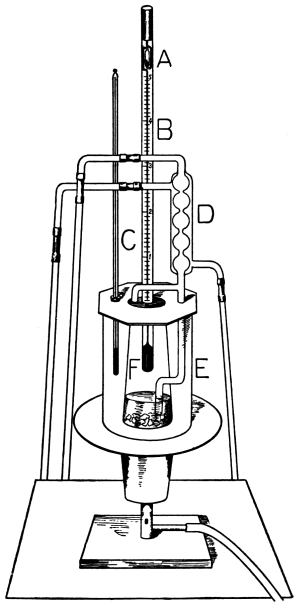
Fig. 125. Improved Ebullioscope.
A second apparatus, exactly similar to the one described, is
conveniently used for measuring the changes in barometric
pressure during the process of the analysis. The temperature of the
vapor of boiling water having been first determined, the beer or wine
is placed in F, and the temperature of the vapor of the boiling liquid
determined after the temperature of the air layer between E and F
reaches about 90°, measured on the thermometer C. By using alcoholic
mixtures of known strength the depression for each changing per cent of
alcohol is determined for each system of apparatus employed, and this
having once been done, the percentage of alcohol in any unknown liquid
is at once determined by inspecting the thermometer, the bulb of which
is immersed in the vapor from the boiling liquid. In the apparatus
figured, a depression of 0°.8 is equivalent to
one per cent of alcohol by volume. Full directions for the manipulation
of the apparatus may be found in the paper cited above.
623. Total Fixed Matters.—The residue left on evaporating a
fermented beverage to dryness is commonly known as extractive matter,
or simply extract. It is composed chiefly of unfermented carbohydrates,
organic acids, nitrogenous bodies, glycerol and mineral substances.
Hydrochloric and sulfuric acids may also be found therein. If any
non-volatile preservatives have been used in the sample, such as
borax, salicylates and the like, these will also be found in the
solid residue. The bodies which escape are water, alcohols, ethers
and essential oils. The character of the residue left by wines and
beers is evidently different. In each case it should contain typical
components which aid in judging of the purity of the sample. For
instance, in beers the substitution for malt of carbohydrate bodies
comparatively free of proteids, produces a beer containing a deficiency
of nitrogenous bodies. Pure malt beer will rarely have less than
one-half of a per cent of proteids, while beer made largely of glucose,
rice or hominy grits, will have a much smaller quantity. First will be
described below the methods of determining the fixed residue left on
evaporation, and thereafter the processes for ascertaining its leading
components.
624. Methods of the Official Chemists.—Two methods are in use
by the official chemists for determining the fixed solids in fermented
beverages.[638]
They are as follows:
Direct Method.—Fifty cubic centimeters of the sample are
weighed, placed in a platinum dish about eighty millimeters in diameter
and capable of holding about seventy-five cubic centimeters and
evaporated on the steam bath to a sirupy consistence. The residue is
heated for two and a half hours in a drying oven at the temperature of
boiling water and weighed.
In Sweet Wines.—Ten cubic centimeters of the liquor are weighed
and diluted to 100 with water. Fifty cubic centimeters of this solution
are evaporated as described above.
Optional Method.—Fifty cubic centimeters of the sample are
placed in a platinum or porcelain dish and evaporated on the steam bath
until the volume is reduced to one-third. The dealcoholized liquid
is washed into a fifty cubic centimeter flask, cooled and made up to
the original volume. It is mixed thoroughly and the specific gravity
ascertained with a pyknometer, hydrostatic balance or an accurately
standardized hydrometer. The percentage of total solids is obtained
from the appended table. The column on the left of the specific gravity
gives the percentage of extract in a wine, as calculated by Hager,
and that on the right the percentage of extract in a beer or wort,
as calculated by Schultze. According to Baumert, however, Schultze’s
table gives results which approximate more closely the data obtained by
direct estimation than does Hager’s.
Tables of Hager and Schultze for
the Determination of Extract
by the Indirect Method.
| Hager. |
Specific gravity. |
Schultze. |
| 0.84 |
1.0038 |
1.00 |
| 0.86 |
1.0039 |
1.02 |
| 0.88 |
1.0040 |
1.05 |
| 0.90 |
1.0041 |
1.08 |
| 0.92 |
1.0042 |
1.10 |
| 0.94 |
1.0043 |
1.13 |
| 0.96 |
1.0044 |
1.15 |
| 0.98 |
1.0045 |
1.18 |
| 1.00 |
1.0046 |
1.21 |
| 1.02 |
1.0047 |
1.23 |
| 1.04 |
1.0048 |
1.26 |
| 1.06 |
1.0049 |
1.29 |
| 1.08 |
1.0050 |
1.31 |
| 1.10 |
1.0051 |
1.34 |
| 1.12 |
1.0052 |
1.36 |
| 1.15 |
1.0053 |
1.39 |
| 1.17 |
1.0054 |
1.41 |
| 1.19 |
1.0055 |
1.44 |
| 1.22 |
1.0056 |
1.46 |
| 1.25 |
1.0057 |
1.49 |
| 1.27 |
1.0058 |
1.51 |
| 1.30 |
1.0059 |
1.54 |
| 1.32 |
1.0060 |
1.56 |
| 1.34 |
1.0061 |
1.59 |
| 1.37 |
1.0062 |
1.62 |
| 1.39 |
1.0063 |
1.64 |
| 1.42 |
1.0064 |
1.67 |
| 1.44 |
1.0065 |
1.69 |
| 1.46 |
1.0066 |
1.72 |
| 1.48 |
1.0067 |
1.74 |
| 1.50 |
1.0068 |
1.77 |
| 1.52 |
1.0069 |
1.79 |
| 1.55 |
1.0070 |
1.82 |
| 1.57 |
1.0071 |
1.84 |
| 1.59 |
1.0072 |
1.87 |
| 1.61 |
1.0073 |
1.90 |
| 1.64 |
1.0074 |
1.92 |
| 1.66 |
1.0075 |
1.95 |
| 1.68 |
1.0076 |
1.97 |
| 1.70 |
1.0077 |
2.00 |
| 1.72 |
1.0078 |
2.02 |
| 1.75 |
1.0079 |
2.05 |
| 1.77 |
1.0080 |
2.07 |
| 1.79 |
1.0081 |
2.10 |
| 1.82 |
1.0082 |
2.12 |
| 1.84 |
1.0083 |
2.15 |
| 1.86 |
1.0084 |
2.17 |
| 1.88 |
1.0085 |
2.20 |
| 1.90 |
1.0086 |
2.23 |
| 1.92 |
1.0087 |
2.25 |
| 1.94 |
1.0088 |
2.28 |
| 1.96 |
1.0089 |
2.30 |
| 1.98 |
1.0090 |
2.33 |
| 2.00 |
1.0091 |
2.35 |
| 2.03 |
1.0092 |
2.38 |
| 2.05 |
1.0093 |
2.41 |
| 2.07 |
1.0094 |
2.43 |
| 2.09 |
1.0095 |
2.46 |
| 2.11 |
1.0096 |
2.48 |
| 2.14 |
1.0097 |
2.51 |
| 2.16 |
1.0098 |
2.53 |
| 2.18 |
1.0099 |
2.56 |
| 2.21 |
1.0100 |
2.58 |
| 2.23 |
1.0101 |
2.61 |
| 2.25 |
1.0102 |
2.64 |
| 2.27 |
1.0103 |
2.66 |
| 2.30 |
1.0104 |
2.69 |
| 2.32 |
1.0105 |
2.71 |
| 2.34 |
1.0106 |
2.74 |
| 2.36 |
1.0107 |
2.76 |
| 2.38 |
1.0108 |
2.79 |
| 2.40 |
1.0109 |
2.82 |
| 2.42 |
1.0110 |
2.84 |
| 2.44 |
1.0111 |
2.87 |
| 2.46 |
1.0112 |
2.89 |
| 2.48 |
1.0113 |
2.92 |
| 2.50 |
1.0114 |
2.94 |
| 2.52 |
1.0115 |
2.97 |
| 2.54 |
1.0116 |
2.99 |
| 2.57 |
1.0117 |
3.02 |
| 2.59 |
1.0118 |
3.05 |
| 2.61 |
1.0119 |
3.07 |
| 2.64 |
1.0120 |
3.10 |
| 2.66 |
1.0121 |
3.12 |
| 2.68 |
1.0122 |
3.15 |
| 2.70 |
1.0123 |
3.17 |
| 2.72 |
1.0124 |
3.20 |
| 2.75 |
1.0125 |
3.23 |
| 2.77 |
1.0126 |
3.25 |
| 2.79 |
1.0127 |
3.28 |
| 2.82 |
1.0128 |
3.30 |
| 2.84 |
1.0129 |
3.33 |
| 2.86 |
1.0130 |
3.35 |
| 2.88 |
1.0131 |
3.38 |
| 2.90 |
1.0132 |
3.41 |
| 2.92 |
1.0133 |
3.43 |
| 2.94 |
1.0134 |
3.46 |
| 2.96 |
1.0135 |
3.48 |
| 2.98 |
1.0136 |
3.51 |
| 3.00 |
1.0137 |
3.54 |
If it be desired to use this table for the examination of liquors
containing a higher percentage of extract, Schultze’s table (intended
originally for wort) may be consulted.
Gautier regards the fixed solids as the residue obtained on
evaporating, in a flat platinum dish, ten cubic centimeters of wine at
100° for four hours and a half.[639]
The official French method is as follows: Twenty cubic centimeters of
wine are placed in a flat bottom, platinum dish of such a diameter
that the depth of the liquid therein does not exceed one millimeter.
The dish should be immersed as totally as possible in the steam. The
heating is continued for six hours.
The following method is used at the municipal laboratory of Paris:
Twenty-five cubic centimeters of wine are placed in a flat bottom,
platinum dish seventy millimeters in diameter and twenty-five deep. The
dish is placed on a water bath in such a manner that it just touches
the surface of the water which is kept at a constant level. The heating
is continued for seven hours.[640]
625. Determination in a Vacuum.—To avoid the changes and
decomposition produced by heating, the fixed solids may also be
determined by drying the sample in a vacuum over sulfuric acid. In
this laboratory, it has been found that the process may be greatly
facilitated by connecting the desiccating apparatus with the vacuum
service of the working desks in which a vacuum corresponding to a
mercurial column of 600 millimeters is obtained. The desiccator is
provided with a valve whereby a minute current of dry air is allowed
to flow through it. This current is not large enough to lessen the
vacuum but is sufficient to greatly accelerate the rapidity of the
evaporation. The evaporation is hastened also, in a marked degree, by
absorbing the liquid with a piece of filter paper previously dried in a
vacuum. When it is desired to examine the residue, however, it must be
obtained in a flat dish exposing a large surface to evaporation.
626. Estimation of Water.—It is evident that the percentage of
water in a fermented beverage is easily calculated when the percentage
of alcohol by weight and that of the dry residue are known. In a given
case, if the number of grams of alcohol in 100 of the sample be five
and that of fixed solids four and a half, the quantity of water therein
is 100 - (5.0 + 4.5) = 90.5 grams. In this case the volatile essences
are counted as water, but these, at most, are so small in quantity as
to be practically unweighable. Nevertheless, it must be admitted that
direct drying, in many cases, may give erroneous results, especially
when the sample contains an abundance of ethers and of glycerol. The
loss which takes place on evaporation may be diminished by adding to
the sample, before evaporation, a known weight of potassium sulfate
in crystals, which serves to increase the surface of evaporation, to
hasten the process and to obtain a quantity of residue in excess of
that secured by direct evaporation in an open dish.
627. Total Acidity.—The acidity found in fermented beverages
is due both to the natural acids of the materials from which they are
made, and to those caused by fermentation. The typical acids also
indicate the nature of the original materials, as malic in cider and
tartaric in wine. The acids of beers are due almost exclusively to
fermentation, and acetic is probably the dominant one. In determining
total acidity, it is not always convenient to ascertain beforehand what
acid predominates, nor to accurately distribute the acid among its
various components. In the analytical work it is advisable, therefore,
to estimate the total acid of cider as malic, of wines as tartaric and
of beers as acetic. The process of titration is conducted as follows:
Expel any carbon dioxid that is present by continued shaking. Transfer
ten cubic centimeters to a beaker and, in the case of white wines, add
about ten drops of a neutral litmus solution. Add decinormal sodium
hydroxid solution until the red color changes to violet. Then add the
reagent, a few drops at a time, until a drop of the liquid, placed on
delicate red litmus paper, shows an alkaline reaction.
One cubic centimeter of decinormal sodium hydroxid solution = 0.0075
gram tartaric, 0.0067 of malic and 0.006 gram of acetic acid.
628. Determination of Volatile Acids.—Fifty cubic centimeters
of the sample, to which a little tannin has been added to prevent
foaming, are distilled in a current of steam. The flask is heated until
the liquid boils, when the lamp under it is turned down and the steam
passed through until 200 cubic centimeters have been collected in the
receiver. The distillate is titrated with decinormal sodium hydroxid
solution and the result expressed as acetic acid.
One cubic centimeter of decinormal sodium hydroxid solution = 0.0060
gram acetic acid.
The acidity due to volatile acids may be determined by ascertaining the
total acidity as above described, evaporating 100 cubic centimeters to
one-third of their volume, restoring the original volume with water and
again titrating. The difference between the first and second titrations
represents the volatile acidity.
A method of determining volatile acidity in wines, without the
application of heat, has been proposed by de la Source.[641]
The sample, five cubic centimeters, freed of carbon dioxid by shaking,
is placed in a flat dish about eight centimeters in diameter. In a
separate portion of the sample, the total acidity is determined in the
presence of phenolphthalien by a set solution of barium hydroxid, one
cubic centimeter of which is equal to four milligrams of sulfuric acid.
The sample in the flat dish is placed in a desiccator, which contains
both sulfuric acid and solid potassium hydroxid, and left for two days,
by which time it is practically dry. The residue is dissolved in two
cubic centimeters of warm water and the dish is kept in the desiccator
for an additional two days. By this time the volatile acids, even
acetic, will have disappeared and the residual acidity is determined
after solution in water.
The method is also applicable when wines have been treated with an
alkali. In this case two samples of five cubic centimeters each are
acidified with two cubic centimeters of a solution of tartaric acid
containing twenty-five grams per liter. This treatment sets free the
volatile acids, and their quantity is determined as before.
629. Titration with Phenolphthalien.—The total acidity is also
easily determined by titration with a set alkali, using phenolphthalien
as indicator. Colored liquors must be treated with animal black before
the analysis. The sample is shaken to expel carbon dioxid and five
cubic centimeters added to 100 of water containing phenolphthalien. The
set alkali (tenth normal soda) is added until the red color is
discharged. Even wines having a considerable degree of color may be
titrated in this way.[642]
The acidity, expressed as tartaric, may be stated as due to sulfuric by
dividing by 1.53.
630. Determination of Tartaric Acid.—The determination of
potassium bitartrate is necessary when an estimation of the free
tartaric acid is desired.[643]
Fifty cubic centimeters of wine are placed in a porcelain dish and
evaporated to a sirupy consistence, a little quartz sand being added
to render subsequent extraction easier. After cooling, seventy cubic
centimeters of ninety-six per cent alcohol are added with constant
stirring. After standing for twelve hours, at as low a temperature as
practicable, the solution is filtered and the precipitate washed with
alcohol until the filtrate is no longer acid. The alcoholic filtrate
is preserved for the estimation of the tartaric acid. The filter and
precipitate are returned to the porcelain dish and repeatedly treated
with hot water, each extraction being filtered into a flask or beaker
until the washings are neutral. The combined aqueous filtrates and
washings are titrated with decinormal sodium hydroxid solution.
One cubic centimeter of decinormal sodium hydroxid solution = 0.0188
gram potassium bitartrate.
The alcoholic filtrate is made up to a definite volume with water and
divided into two equal portions. One portion is exactly neutralized
with decinormal sodium hydroxid solution, the other portion added,
the alcohol evaporated, the residue washed into a porcelain dish and
treated as above.
One cubic centimeter decinormal sodium hydroxid solution = 0.0075 gram
tartaric acid.
As, however, only half of the free tartaric acid is determined by this
method:
One cubic centimeter decinormal sodium hydroxid = 0.0150 gram of
tartaric acid.
631. Modified Berthelot-Fleury Method.—Ten cubic centimeters of
wine are neutralized with potassium hydroxid solution and mixed in a
graduated cylinder with forty cubic centimeters of the same sample. To
one-fifth of the volume, corresponding to ten cubic centimeters of
wine, fifty cubic centimeters of a mixture of equal parts of alcohol
and ether are added and allowed to stand twenty-four hours. The
precipitated potassium bitartrate is separated by filtration, dissolved
in water and titrated. The excess of potassium bitartrate over the
amount of that constituent present in the wine corresponds to the free
tartaric acid.[644]
632. Determination of Tartaric, Malic and Succinic Acids.—Two
hundred cubic centimeters of wine are evaporated to one-half, cooled
and lead subacetate solution added until the reaction is alkaline.[645]
The precipitate is separated by filtration and washed with cold
water until the filtrate shows only a slight reaction for lead.
The precipitate is washed from the filter into a beaker, by means
of hot water, and treated hot with hydrogen sulfid until all the
lead is converted into sulfid. It is then filtered hot and the lead
sulfid washed with hot water until the washings are no longer acid.
The filtrate and washings are evaporated to fifty cubic centimeters
and accurately neutralized with potassium hydroxid. An excess of a
saturated solution of calcium acetate is added and the liquid allowed
to stand from four to six hours with frequent stirring. It is then
filtered and the precipitate washed until the filtrate amounts to
exactly 100 cubic centimeters. The precipitate of calcium tartrate is
converted into calcium oxid by igniting in a platinum crucible. After
cooling, from ten to fifteen cubic centimeters of normal hydrochloric
acid are added, the solution washed into a beaker and accurately
titrated with normal potassium hydroxid solution. Every cubic
centimeter of normal acid saturated by the calcium oxid is equivalent
to 0.0750 gram tartaric acid. To the amount so obtained, 0.0286 gram
must be added, representing the tartaric acid held in solution in the
filtrate as calcium tartrate. The sum represents the total tartaric
acid in the wine.
The filtrate from the calcium tartrate is evaporated to about
twenty-five cubic centimeters, cooled and mixed with three times its
volume of ninety-six per cent alcohol. After standing several hours,
the precipitate is collected on a weighed filter, dried at 100° and
weighed. It represents the calcium salts of malic, succinic and
sulfuric acids and of the tartaric acid which remained in solution.
This precipitate is dissolved in a minimum quantity of hydrochloric
acid, filtered and the filter washed with hot water. Potassium
carbonate solution is added to the hot filtrate, and the precipitated
calcium carbonate separated by filtration and washed. The filtrate
contains the potassium salts of the above named acids. It is
neutralized with acetic acid, evaporated to a small volume and
precipitated hot with barium chlorid. The precipitate of barium
succinate and sulfate is separated by filtration, washed with hot
water and treated on the filter with dilute hydrochloric acid. The
barium sulfate remaining is washed, dried, ignited and weighed. In
the filtrate, which contains the barium succinate, the barium is
precipitated hot with sulfuric acid, washed, dried, ignited and
weighed. Two hundred and twenty-three parts of barium sulfate equal 118
parts of succinic acid. The succinic and sulfuric acids, as well as the
tartaric acid remaining in solution, which is equal to 0.0286 gram,
are to be calculated as calcium salts and the result deducted from the
total weight of the calcium precipitate. The remainder is the calcium
malate, of which 172 parts equal 134 parts malic acid.
According to Macagno, succinic acid may be estimated in wines by the
following process:[646]
One liter of the wine is digested with lead hydroxid, evaporated on the
water bath and the residue extracted with strong alcohol. The residual
salts of lead are boiled with a ten per cent solution of ammonium
nitrate, which dissolves the salts of succinic acid. The solution is
filtered, the lead removed by hydrogen sulfid, boiled, neutralized
with ammonia and treated with ferric chlorid as long as a precipitate
is formed. The ferric succinate is separated by filtration, washed and
ignited. The succinic acid is calculated from the weight of ferric oxid
obtained.
Malic acid in wines and ciders is determined by the method of Berthelot
in the following manner:[647]
The sample is evaporated until reduced to a tenth of its volume. To
the residue an equal volume of ninety per cent alcohol is added and
the mixture set aside for some time. The tartaric acid and tartrates
separate, together with the greater part of the salts of lime which may
be present.
The supernatant liquid is decanted and a small quantity of lime
added to it until in slight excess of that required to neutralize
the acidity. Calcium malate is separated mixed with lime. The solid
matters are separated by filtration, dissolved in a ten per cent
solution of nitric acid, from which the lime bimalate will separate in
a crystalline form. The weight of calcium bimalate multiplied by 0.59
gives that of the malic acid.
633. Polarizing Bodies in Fermented Beverages.—The study of
the nature of the carbohydrates, which constitute an important part of
the solid matters dissolved in fermented beverages, is of the greatest
importance. These bodies consist of grape sugars, sucrose, tartaric
acid and the unfermented hydrolytic products derived from starch. A
natural grape sugar (chiefly dextrose) is found in wines. Sucrose
is also a very important constituent of sweet wines. The hydrolytic
products of starch are found in beers, either as a residue from the
fermentation of malt or from the rice, glucose, hominy grits etc.,
added in brewing. The character and quantities of these residues can
be determined by the methods already given in the parts of this volume
relating to sugars and starches. For convenience, however, and for
special application to the investigation of fermented beverages a
résumé of the methods adopted by the official chemists follows:[648]
634. Determination of Reducing Sugars.—The reducing sugars are
estimated as dextrose, and may be determined by any of the methods
given for the estimation thereof (113-140).
635. Polarization.—All results are to be stated as the
polarization of the undiluted sample. The triple field shadow
saccharimeter is recommended, and the results are expressed in the
terms of the sugar scale of this instrument. If any other instrument
be used, or if it be desirable to convert to angular rotation, the
following factors may be employed:
| 1° Schmidt and Haensch |
= 0°.3468 |
angular rotation D. |
| 1° angular rotation D |
= 2°.8835 |
Schmidt and Haensch. |
| 1° Schmidt and Haensch |
= 2°.6048 |
Wild (sugar scale). |
| 1° Wild (sugar scale) |
= 0°.3840 |
Schmidt and Haensch. |
| 1° Wild (sugar scale) |
= 0°.1331 |
angular rotation D. |
| 1° angular rotation D |
= 0°.7511 |
Wild (sugar scale). |
| 1° Laurent (sugar scale) |
= 0°.2167 |
angular rotation D. |
| 1° angular rotation D |
= 4°.6154 |
Laurent (sugar scale). |
In the above table D represents the angular rotation produced with
yellow monochromatic light.
(a) In White Wines or Beers.—Sixty cubic centimeters of
wine are decolorized with three cubic centimeters of lead subacetate
solution and filtered. Thirty cubic centimeters of the filtrate are
treated with one and five-tenths cubic centimeters of a saturated
solution of sodium carbonate, filtered and polarized. This gives a
solution of nearly ten to eleven, which must be considered in the
calculation, and the polariscope reading must accordingly be increased
one-tenth.
(b) In Red Wines.—Sixty cubic centimeters of wine are
decolorized with six cubic centimeters of lead subacetate solution and
filtered. To thirty cubic centimeters of the filtrate, three cubic
centimeters of a saturated solution of sodium carbonate are added,
filtered and the filtrate polarized. The dilution in this case is
nearly five to six, and the polariscope reading must accordingly be
increased one-fifth.
(c) In Sweet Wines. (1) Before Inversion.—One
hundred cubic centimeters are decolorized with two cubic centimeters of
lead subacetate solution and filtered after the addition of eight cubic
centimeters of water. One-half cubic centimeter of a saturated solution
of sodium carbonate and four and five-tenths cubic centimeters of water
are added to fifty-five cubic centimeters of the filtrate, the liquids
mixed, filtered and polarized. The polariscope reading is multiplied by 1.2.
(2) After Inversion.—Thirty-three cubic centimeters of the
filtrate from the lead subacetate in (1) are placed in a flask with
three cubic centimeters of strong hydrochloric acid. After mixing
well, the flask is placed in water and heated until a thermometer,
placed in the flask with the bulb as near the center of the liquid as
possible, marks 68°, consuming about fifteen minutes in the heating.
It is then removed, cooled quickly to room temperature, filtered and
polarized, the temperature being noted. The polariscope reading is
multiplied by 1.2. Because of the action of lead subacetate on invert
sugar (87) it is advisable to decolorize the
samples with other reagents (87-89).
(3) After Fermentation.—Fifty cubic centimeters of wine, which
have been dealcoholized by evaporation and made up to the original
volume with water, are mixed, in a small flask, with well washed
beer yeast and kept at 30° until fermentation has ceased, which
requires from two to three days. The liquid is washed into a 100 cubic
centimeter flask, a few drops of a solution of acid mercuric nitrate
and then lead subacetate solution, followed by sodium carbonate, added.
The flask is filled to the mark with water, shaken, the solution
filtered and polarized and the reading multiplied by two.
636. Application of Analytical Methods.—(1) There is no
rotation.—This may be due to the absence of any rotatory body,
to the simultaneous presence of the dextrorotatory nonfermentable
constituents of commercial dextrose and levorotatory sugar, or to the
simultaneous presence of dextrorotatory cane sugar and levorotatory
invert sugar.
(a) The Wine is Inverted.—A levorotation shows that the
sample contains cane sugar.
(b) The Wine is Fermented.—A dextrorotation shows
that both levorotatory sugar and the unfermentable constituents of
commercial dextrose are present.
If no change take place in either (a) or (b) in the
rotation, it proves the absence of unfermented cane sugar, the unfermentable
constituents of commercial dextrose and of levorotatory sugar.
(2) There is right rotation.—This may be caused by unfermented
cane sugar, the unfermentable constituents of commercial dextrose or both.
(a) The sugar is inverted:
(a₁) It rotates to the left after inversion.—Unfermented
cane sugar is present.
(a₂) It rotates more than 2°.3 to the right.—The
unfermentable constituents of commercial dextrose are present.
(a₃) It rotates less than 2°.3 and more than 0°.9 to the
right.—It is in this case treated as follows:
Two hundred and ten cubic centimeters of the sample are evaporated to a
thin sirup with a few drops of a twenty per cent solution of potassium
acetate. To the residue 200 cubic centimeters of ninety per cent
alcohol are added with constant stirring. The alcoholic solution is
filtered into a flask and the alcohol removed by distillation until
about five cubic centimeters remain. The residue is mixed with washed
bone-black, filtered into a graduated cylinder and washed until the
filtrate amounts to thirty cubic centimeters. When the filtrate shows
a dextrorotation of more than 1°.5, it indicates the presence of
unfermentable constituents of commercial dextrose.
(3) There is left rotation.—The sample contains unfermented
levorotatory sugar, derived either from the must or mash or from
the inversion of added cane sugar. It may, however, also contain
unfermented cane sugar and the unfermentable constituents of commercial
dextrose.
(a) The wine sugars are fermented according to directions in
262.
(a₁) It polarizes 3° after fermentation.—It contains
only levorotatory sugar.
(a₂) It rotates to the right.— It contains both
levorotatory sugar and the unfermentable constituents of commercial
dextrose.
(b₁) The sucrose is inverted according to (c), in (2).
(b₂) It is more strongly levorotatory after inversion. In
contains both levorotatory sugar and unfermented cane sugar.
637. Estimation of Sucrose, Dextrose, Invert Sugar, Maltose and
Dextrin.—The total and relative quantities of these carbohydrates
are determined by the processes already described (237-262).
638. Determination of Glycerol.—(a) In Dry Wines
and Beers.—One hundred cubic centimeters of wine are evaporated
in a porcelain dish to about ten cubic centimeters, a little quartz
sand and milk of lime added and the evaporation carried almost to
dryness. The residue is mixed with fifty cubic centimeters of ninety
per cent alcohol, using a glass pestle or spatula to break up any solid
particles, heated to boiling on the water bath, allowed to settle and
the liquid filtered into a small flask. The residue is repeatedly
extracted in a similar manner, with small portions of boiling alcohol,
until the filtrate in the flask amounts to about 150 cubic centimeters.
A little quartz sand is added, the flask connected with a condenser and
the alcohol slowly distilled until about ten cubic centimeters remain.
The evaporation is continued on the water bath until the residue
becomes sirupy. It is cooled and dissolved in ten cubic centimeters of
absolute alcohol. The solution may be facilitated by gentle heating
on the steam bath. Fifteen cubic centimeters of anhydrous ether are
added, the flask stoppered and allowed to stand until the precipitate
has collected on the sides and bottom of the flask. The clear liquid
is decanted into a tared weighing bottle, the precipitate repeatedly
washed with a few cubic centimeters of a mixture of one part of
absolute alcohol and one and five-tenths parts anhydrous ether and the
washings added to the solution. The ether-alcohol is evaporated on
the steam bath, the residue dried one hour in a water oven, weighed,
the amount of ash determined and its weight deducted from that of the
weighed residue to get the quantity of glycerol.
(b) In Sweet Wines.—One hundred cubic centimeters of
wine are evaporated on the steam bath to a sirupy consistence, a little
quartz sand being added to render subsequent extraction easier. The
residue is repeatedly treated with absolute alcohol until the united
extracts amount to from 100 to 150 cubic centimeters. The solution is
collected in a flask and for every part of alcohol one and five-tenths
parts of ether are added, the liquid well shaken and allowed to stand
until it becomes clear. The supernatant liquor is decanted into a
beaker and the precipitate washed with a few cubic centimeters of
a mixture of one part alcohol and one and five-tenths parts ether.
The united liquids are distilled, the evaporation being finished on
the water bath, the residue is dissolved in water, transferred to a
porcelain dish and treated as under (a).
639. Determination of Coloring Matters in Wines.—The methods
of detecting the more commonly occurring coloring matters in wines as
practiced by the official chemists are given below.
(a) Cazeneuve Reaction.—Add two-tenths gram of
precipitated mercuric oxid to ten cubic centimeters of wine, shake for
one minute and filter.
Pure wines give filtrates which are colorless or light yellow, while
the presence of a more or less red coloration indicates that an anilin
color has been added to the wine.
(b) Method of Sostegni and Carpentieri.—Evaporate the
alcohol from 200 cubic centimeters of wine. Add from two to four cubic
centimeters of a ten per cent solution of hyrochloric acid, immerse
therein some threads of fat-free wool and boil for five minutes. Remove
the threads, wash them with cold water acidified with hydrochloric,
then with hot water acidified with hydrochloric, then with pure water
and dissolve the color in a boiling mixture of fifty cubic centimeters
of water and two cubic centimeters of concentrated ammonia. Replace
the threads by new ones, acidify with hydrochloric and boil again for
five minutes. In the presence of anilin colors to the amount of two
milligrams per liter, the threads are dyed as follows:
| Safranin |
light rose-red. |
| Vinolin |
rose-red to violet. |
| Bordeaux-red |
rose-red to violet. |
| Ponceau-red |
rose-red. |
| Tropæolin oo |
straw yellow. |
| Tropæolin ooo |
light orange. |
(c) Detection of Fuchsin and Orseille.—To twenty cubic
centimeters of wine add ten cubic centimeters of lead acetate solution,
heat slightly and mix by shaking. Filter into a test-tube, add two
cubic centimeters of amyl alcohol and shake. If the amyl alcohol be
colored red, separate it and divide it into two portions. To one add
hydrochloric acid, to the other ammonia. When the color is due to
fuchsin, the amyl alcohol will in both cases be decolorized; when due
to orseille, the ammonia will change the color of the amyl alcohol to
purple-violet.
640. Determination of Ash.—The residue from the direct extract
determination is incinerated at as low a heat as possible. Repeated
moistening, drying and heating to low redness is advisable to get rid
of all organic substances. When a quantitive analysis of the ash is
desired, large quantities of the sample are evaporated to dryness and
the residue incinerated with the usual precautions.
641. Determination Of Potash.—(a) Kayser’s
Method.—Dissolve seven-tenths gram pure sodium hydroxid and two
grams of tartaric acid in 100 cubic centimeters of wine, add 150 cubic
centimeters of ninety-two to ninety-four per cent alcohol and allow
the liquid to stand twenty-four hours. The precipitated potassium
bitartrate is collected on a small filter and washed with fifty per
cent alcohol until the filtrate amounts to 260 cubic centimeters. The
precipitate and filter are transferred to the beaker in which the
precipitation was made, the precipitate dissolved in hot water, the
volume made up to 200 cubic centimeters and fifty cubic centimeters
thereof titrated with decinormal sodium hydroxid solution, adding 0.004
gram to the final result, representing the potash which remains in
solution as bitartrate.
(b) Platinum Chlorid Method.—Evaporate 100 cubic
centimeters of the wine to dryness, incinerate the residue and
determine the potash as in ash analysis.[649]
642. Determination of Sulfurous Acid.—One hundred cubic
centimeters of wine are distilled in a current of carbon dioxid, after
the addition of phosphoric acid, until about fifty cubic centimeters
have passed over. The distillate is collected in accurately set iodin
solution. When the distillation is finished, the excess of iodin is
determined with set sodium thiosulfate solution and the sulfurous acid
calculated from the iodin used.
643. Detection of Salicylic Acid.—(a) Spica’s
Method.—Acidify 100 cubic centimeters of the liquor with sulfuric
and extract with sulfuric ether. Evaporate the extract to dryness, warm
the residue carefully with one drop of concentrated nitric acid and add
two or three drops of ammonia. The presence of salicylic acid in the
liquor is indicated by the formation of a yellow color due to ammonium
picrate and may be confirmed by dyeing therein a thread of fat-free wool.
(b) Bigelow’s Method.—Place 100 cubic centimeters of the
wine in a separatory funnel, add five cubic centimeters of sulfuric
acid (1-3) and extract with a sufficient quantity of a mixture of eight
or nine parts of ether to one part of petroleum ether. Throw away the
aqueous part of the extract, wash the ether once with water, then shake
thoroughly with about fifty cubic centimeters of water, to which from
six to eight drops of a one-half per cent solution of ferric chlorid
have been added. Discard the aqueous solution, which contains the
greater part of the tannin in combination with iron, wash again with
water, transfer the ethereal solution to a porcelain dish and allow
to evaporate spontaneously. Heat the dish on the steam bath, take up
the residue with one or two cubic centimeters of water, filter into
a test-tube and add one to two drops of one-half per cent solution
of ferric chlorid. The presence of salicylic acid is indicated by
the appearance of a violet-red coloration. In the case of red wines,
a second extraction of the residue with ether mixture is sometimes
necessary. This method cannot be used in the examination of beers and ales.
(c) Girard’s Method.—Extract a portion of the acidified
liquor with ether as in the preceding methods, evaporate the extract
to dryness and exhaust the residue with petroleum ether. The residue
from the petroleum ether extract is dissolved in water and treated with
a few drops of a very dilute solution of ferric chlorid. The presence
of salicylic acid is indicated by the appearance of a violet-red coloration.
644. Detection of Gum and Dextrin.—Four cubic centimeters of
the sample are mixed with ten cubic centimeters of ninety-six per cent
alcohol. When gum arabic or dextrin is present, a lumpy, thick and
stringy precipitate is produced, whereas pure wine becomes at first
opalescent and then gives a flocculent precipitate.
645. Determination of Nitrogen.—The best method of determining
nitrogen in fermented beverages is the common one of moist combustion
with sulfuric acid. The sample is placed in the kjeldahl digestion
flask, which is attached to the vacuum service and placed in a
steam bath until its contents are dry or nearly so. The process is
then conducted in harmony with the well known methods. Where large
quantities of the sample are to be employed, as in drinks containing
but little nitrogen, the preliminary evaporation may be accomplished in
an open dish, the contents of which are transferred to the digestion
flask before any solid matter is deposited. The same procedure may be
followed when the sample foams too much on heating.
646. Substitutes for Hops.—It is often claimed that cheap and
deleterious bitters are used in brewing in order to save hops. While
it is doubtless true that foreign bitters are sometimes employed, the
experience of this laboratory goes to show that such an adulteration
is not very prevalent in this country.[650]
Possibly strychnin, picrotoxin, quassin, gentian and other bitter
principles have sometimes been found in beer, but their use is no
longer common. It is difficult to decide in every case whether or not
foreign bitters have been added. A common process is to treat the
sample with lead acetate, filter, remove the lead from the filtrate
and detect any remaining bitters by the taste. All the hop bitters
are removed by the above process. Any remaining bitter taste is due
to other substances. For the methods of detecting the special bitter
principles in hops and other substances, the work of Dragendorff may be
consulted.[651]
647. Bouquet of Fermented and Distilled Liquors.—The bouquet
of fermented and distilled liquors is due to the presence of volatile
matters which may have three different origins. In the first place the
materials from which these beverages are made contain essential oils
and other odoriferous principles.[652]
In the grape, for instance, the essential oils are found particularly
in the skins. These essential principles may be secured by distilling
the skins of grapes in a current of steam. This method of separation,
however, cannot be regarded as strictly quantitive.
In the second place, the yeasts which produce the alcoholic
fermentation are also capable of producing odoriferous products.
These minute vegetations, resembling in their biological relations
the mushrooms, grow in the soil and reach their maturity at about
the time of the harvest of the grapes. Their spores are transmitted
through the air, reach the expressed grape juice and produce the vinous
fermentation. The particular odor due to any given yeast persists
through many generations of culture showing that the body which
produces the odor is the direct result of the vegetable activity of the
yeast. A beer yeast, after many generations of culture, will still give
a product which smells like beer, and in like manner a wine yeast will
produce one which has the odor of wine. The quantity of odorant matter
produced by this vegetable action is so minute as to escape detection
in a quantitive or qualitive way by chemical means. These subtle
perfumes arise moreover not only from the breaking up of the sugar
molecule, but are also the direct results of molecular synthesis
accomplished under the influence of the yeast itself.
In the third place, the fermented and distilled liquors contain
odoriferous principles due to the chemical reactions which take place
by the breaking up of the sugar and other molecules during the process
of fermentation. The alcohols and acids produced have distinct odors by
which they are often recognized. This is particularly true of ethylic,
propylic, butylic, amylic and oenanthylic alcohols and acetic acid.
These alcohols themselves also undergo oxidation, passing first into
the state of aldehyds which, together with ethers, produce the peculiar
aroma which is found in various fruits. The etherification noted above
is of course preceded by the formation of acids corresponding to the
various aldehyds present. The formation of these ethers takes place
very slowly during aging, and it therefore requires three or four
years for the proper ripening of wines or distilled liquors. By means
of artificial heat, electricity and aeration, the oxidizing processes
above noted may be hastened, but it is doubtful whether the products
arising from this artificial treatment are as perfect as those which
are formed in the natural processes.
CORRECTIONS FOR VOL. I. — CORRECTIONS FOR VOL. II. — CORRECTIONS FOR VOL. III.
Page 5, 11th line, insert “ten” before “thousand.”
Page 21, read “Magdeburg” instead of “Madgeburg” in both instances.
Page 61, for per cent. of oxygen in ulmin read “28.7” instead of “8.7.”
Page 62, for per cent. of carbon in apocrenic acid read “54.4” instead of “34.4.”
Page 112, 2d line from bottom, read “14” instead of “13.”
Page 140, the sentence beginning “The burette is lowered etc.” is
repeated. Dele one of them.
Page 141, 6th line, insert “or air dried” after “moisture.”
Page 141, in example read 10.25, 10.22, 13.07 and 76.21 for 9.52, 9.22,
12.07, and 60.35 respectively.
Page 158, 3d line of 172, insert “and estimating soluble matters
therein” after “flow.”
Page 159, omit “√ ” in first formula.
Page 293, 12th line, read “U” for “V.”
Page 309, last line, read “sixth” for “sixteenth.”
Page 312, 1st line, read “atmosphere” instead of “room.”
Page 315, 6th and 7th lines, read 299, and 300, for
294, and 295, respectively.
Page 323, 3d line from bottom, read 301 for 299.
Page 333, 5th line of 316, insert after “is” “to eliminate
carbon dioxid and.”
Page 354, 3d line from end of (6) insert after “solution” “acidified
with acetic and;” same line, transfer “r” from “ther,” to “pecipitate.”
Page 357, 6th line from end of (4) insert after “difference” “and the
phosphoric acid estimated as in 380, deducted therefrom.”
Page 367, 4th line, add after “taken,” “The phosphoric acid may be
determined as described in 372, or following paragraphs.”
Page 410, line 21, dele “dilute” and insert “one per cent
nitric.”
Page 410, line 25, after “capsule” insert “adding water once or twice.”
Page 449, 4th line read “hydrobromic” for “hydrochloric.”
Page 457, reference “30” read “Band 38” instead of “Band 37.”
Page 468, 8th line, dele “or gypsum” and read “200” instead of
“50.”
Page 471, last line, read “not” for “very.”
Page 472, 4th line, insert “un” before “successful.”
Page 496, 5th line, insert “the” before “soil.”
Page 515, next to last and last lines, read “stannous” instead of
“zinc.”
Page 516, second line, read “stannous” instead of “zinc.”
Page 557, 9th line of 500 read “red-yellow” instead of “blue.”
Page 14, line 21, read “61.74 per cent.” for “16.74 per cent.”
Page 23, 8th line from bottom, read “0.0025.” for “0.0035.”
Page 54, 9th line, read “white” instead of “yellow.”
Page 54, 13th line, read “phosphate” instead of “phosphomolybdate.”
Page 57, 8th line from bottom, read “saturated” instead of “citrate.”
Page 73, read “Kosmann” in 10th line of paragraph 72 for “Kormann.”
Page 158, reference number 72, read “1889” instead of “1888.”
Page 11, name of Figure 4 read “Dreef” instead of “Dree.”
Page 40, fifth and seventh lines, read “Courtonne” instead of “Courtoune.”
Page 59, eighth line from bottom, insert “original” before “optical.”
Page 60, second line, read “d” instead of “l” before “fructose.”
Page 68, legend of Figure 29, read “areometers” instead of “aereometers.”
Page 146, sixth line from bottom, insert “cyanid” after “potassium.”
Page 159, instead of headings for table as given, substitute those on
page 160.
Page 177, in formula for lactose, read “H₂₂” instead of “H₃₂”; in formula
for arabinose, read “H₁₀” instead of “H₁₉.”
Page 180, seventh line from bottom, read “Günther” instead of “Gunther.”
Page 191, read paragraph 169. Seventh line read “resorcin” instead
of “resorsin.”
Page 268, legend of Figure 77, read “Desiccating” instead of “Dessicating.”
Page 288, in formula (2) read “53d” instead of “54d.”
Pages 328, 329 and 334, read “Amagat” instead of “Armagat.”
Page 348, fourth line from bottom, omit accent in “sesame.”
Page 365, (b) first line, read 24.8 instead of 24.6.
Page 424, 4th line from bottom, read “nitrites” instead of “nitrates.”
Page 425, 4th and 5th lines, read “nitrite” instead of “nitrate.”
Page 445, in table of factors for computing proteids under Maize Proteids,
read “16.06 and 6.22” instead of “15.64 and 6.39” respectively.
Page 451, sixth line from bottom, read “occur” instead of “occurs.”
Page 464, twelfth line from bottom, dele “food.”
Page 499, ninth line from bottom, read “Babcock.”
Page 543, sixteenth line, read “6.06 and 6.22” for “6.31 and 6.39”
respectively.
Pages 555-556, read “amylolytic” for “amylytic.”
Page 555, fifth and seventeenth lines from bottom, insert after “into
dextrin, maltose.”
Page 572, second equation, read “tʹₙ₂” instead of “tʹₙ₁.”
Page 573, 3rd line from bottom, read “stirring” for “storing.”
Page 574, 6th line from bottom, read “Θ₄” for “O_4.”
Page 575, 16th line from bottom, insert “one gram of” before “substance.”
Page 576 instead of 567, fourth line of paragraph 566, read “Calorie”
instead of “calorie.”
Page 644, dele “Band 12, Ss. 64 und 199” in reference 94.