Perfumes and their Preparation.
The gratification of his senses is peculiar to man, and it
is to this trait that we are indebted for all the arts. The activities
which aimed at the gratification of the eye and ear
developed into the creative arts and music, and in like manner
human endeavor directed toward the stimulation of the
sense of smell has in our time assumed the proportions both
of an art and a science; for it was nothing but the advancement
of chemistry that made it possible to fix all the pleasant
odors offered by nature and to create new perfumes by the
artistic combination of these scents. The preparation of perfumes
is a very ancient art that is met with among all peoples
possessed of any degree of civilization. It is particularly the
ancient nations of the Orient which had in truth become
masters in the manufacture of numerous perfumes.
The first perfume was the fragrant flower; it has continued
to be so to the present day: the sprig of dried lavender
flowers which we lay in the clothes-press was probably used
for the same purpose by the contemporaries of Aristotle. In
the Orient, which we may look upon as the cradle of the art
of perfumery, the idea suggested itself early to substitute for
the delicious fragrance of the flowers some substances of
lasting odor; various sweet-scented resins supplied the material
for this purpose. The use of these aromatic resins
must have been very extensive: the ancient Egyptians alone
consumed extraordinary quantities for embalming their dead.
How highly the Oriental peoples in general prized perfumes
can be learned from the Bible: the Jews (like the Catholics
to the present day) employed an aromatic gum-resin (olibanum,
frankincense) in their religious ceremonies; in the Song
of Solomon mention is made of Indian perfumes, for instance,
cinnamon, spikenard, myrrh, and aloes.
Altogether, incense played a prominent part in the religious
ceremonies of the ancient Western Asiatic nations—among
many peoples under a theocratic government it was
even believed to be sinful to use incense for other than religious
purposes. The Bible teaches us that Ezekiel and Isaiah
protested against it, and that Moses even prescribed the
preparation of certain kinds of incense for use in the tabernacle.
Among the most highly civilized people of antiquity, the
Greeks, a large number of fragrant substances, as well as oils perfumed
with them—that is to say, perfumes in the same sense as
we still understand the term—was known; this will be no surprise
to those familiar with the culture of this remarkable people.
The odor of violets was the favorite among the Greeks; besides
this they used the scent of the different mints, thyme,
marjoram, and other aromatic plants. This was carried so
far as to become a matter of fashion for the Greek fop to use
only certain odors in the form of ointments for the hair, others
for the neck, etc. In order to prevent this luxury which was
carried to such an excess, Solon even promulgated a law that
interdicted the sale of fragrant oils to Athenian men (the law
did not apply to the women).
The Romans, who were the pupils of the Greeks in all the
arts, carried the luxury with perfumes perhaps even farther.
In ancient Rome there was a very numerous guild of perfumers
called unguentarii; they are said to have had a street
to themselves in Capua. A Patrician Roman anointed himself
three times daily with precious, sweet-scented oils which
he personally took along into his bath in golden vessels of
exquisite workmanship, so-called nartheciæ. At the funeral
of his wife Poppæa, Nero is said to have used as incense more
odorous substances than could be produced in one year in
Arabia, at that time the only reputed source of perfumes.
This luxury went so far that during the games in the open
amphitheatres the whole air was filled with sweet odors ascending
from numerous censers arranged in a circle. The
apartments of well-to-do Romans always contained large and
very valuable urns filled with dried blossoms, to keep the air
permanently perfumed.
Roman extravagance with perfumes was carried to such
an excess that under the consulate of Licinius Crassus a law
was passed which restricted the use of perfumery, there being
good reason to fear that there would not be enough for the
ceremonies in the temples.
With the migration of the almost savage Huns and Goths,
the refinement of morals ceased, progress in civilization was
retarded for centuries, and at the same time the use of perfumes
disappeared entirely in Europe; but it was otherwise
in the Orient. As an instance we may mention the prophecy
of Mohammed, who promised in the Koran to the faithful in
paradise the possession of black-eyed houries whose bodies
were composed of the purest musk.
The Arabs, the ancient masters of chemistry, were also the
first founders of the art of perfumery. Thus the Arabian
physician Avicenna, in the tenth century, taught the art of
preparing fragrant waters from leaves, and Sultan Saladin, in
1157, on his triumphal entry, had the walls of the mosque of
Omar washed with rose water.
It was the intercourse with the Orient brought about by
the Crusades that made Europeans again more familiar with
the art of perfumery, and a number of new odors rapidly became
known. Italy and France, in those times the representatives
of culture, were the countries in which the preparation
of perfumes was carried on on a large scale. Thus, for instance,
we find the name of a Roman family preserved to the present
day because one of its members had combined a sweet-scented
powder, called Frangipanni after its inventor, which is still
in favor, and because his grandson Mauritius Frangipanni had
made the important discovery that by treating this powder
with spirit of wine the fragrant substance could be obtained
in a fluid form.
The fact has been frequently related and repeated, that
Catherine de Medici, the wife of Henry II., had made use of
the fashion of perfuming the body for the purpose of ridding
herself of objectionable persons, by giving them scented gloves
prepared and at the same time poisoned by a Florentine
named René (Renato?). We think this tale to be simply a
hair-raising fable—modern chemistry knows no substance the
mere touch of which could produce the effect of a fatal
poison; and it is scarcely credible that such a material had
been known at that time and lost sight of since.
In the sixteenth century, especially at the court of Queen
Elizabeth, perfumes were used with great extravagance; in
fact, were looked upon as one of the necessaries of life. This
luxury was carried still farther at the courts of the sumptuous
kings of France; Louis XV. went so far as to demand every
day a different odor for his apartments. A lady’s lover always
used the same kind of perfume she did.
It is well known that among the Oriental nations perfumes
are used so largely that even food is flavored with rose water,
musk, etc.; and Indian and Chinese goods always possess a
peculiar aroma which is so characteristic for certain products
that it was considered to be a sign of genuineness; this was
the case, for instance, with the patchouly odor which always
adheres to Indian shawls.
A shawl-maker of Lyons, who had succeeded in perfectly
imitating Indian shawls with reference to design and colors,
spent a fabulous sum to obtain possession of the plant used
by the Indian weavers for perfuming their wares. Despite
the great outlay caused by the search for this plant, the manufacturer
is said to have done a flourishing business with his
“genuine” Indian shawls.
In more recent times the great extension of trade to the
farthest countries of the globe, and still more the progress of
chemistry, have made us familiar with a number of new perfumes.
More than two hundred different aromatic substances
are now known, and still they are far from being exhausted;
every year new odoriferous plants become known, from which
the chemist extracts perfumes. By this means, as well as by
the enormous employment of perfumes in all grades of society,
the art of their preparation has risen to a higher plane; out
of empiricism, which alone prevailed a few decades ago, into
the domain of the chemical sciences.
Since the appearance of the last edition of this book, the
art of perfumery has made noteworthy progress both with
reference to the knowledge of new aromatic substances and
to improvement in the methods of their preparation; by the
introduction of glycerin, solid and liquid vaselin, and salicylic
acid into perfumery, one of its branches—hygienic cosmetics—has
made an important advance.
At present it is particularly France and England whose
perfumery industry is most extensive and which to some extent
rule the markets of the world; southern France and Algiers
especially furnish the best raw materials, the finest essential
oils for the manufacture of perfumes at the chief centres,
Paris and London.
We apply the term perfume—which really means a fumigating
material—to those substances which make an agreeable
impression upon our sense of smell; the French call them
briefly odeurs, i.e., odors. The high degree of development
at present attained by this industry in France and England is
the cause of the fact that all perfumes are generally sold under
French or English names, which must be borne in mind by
manufacturers in this country.
Perfumes or scents, however, exert not only an agreeable
impression on the olfactory organ, but their effect extends to
the entire nervous system, which they stimulate; when used
in excess, they are apt to cause headache in sensitive persons;
the laborers in the chemical factories where these substances
are produced on a large scale, occasionally even suffer by
reason of their stimulating action on the nerves. For this
reason perfumes should never be employed otherwise than in
a very dilute condition; this necessity arises from a peculiarity
of the odorous substances which when concentrated and
pure have by no means a pleasant smell and become fragrant
only when highly diluted. Oil of roses, of orange flowers, or
of jasmine, in fact nearly all aromatic substances, have an
almost disagreeable odor when concentrated; only in an extremely
dilute state they yield those delightful scents which we
admire so much in the blossoms from which they are derived.
It will be easier to understand the almost incredible productiveness
of perfumes if we cite as an instance that a few
centigrams of musk placed on a sensitive scale can for years
fill a large hall with their characteristic odor without showing
an appreciable loss of weight, and still particles must separate
from the musk and become evenly diffused through the air of
the hall because the odor is perceptible throughout every
part of it.
It would be an error, however, were we to assume that all
aromatic substances possess the same degree of productiveness;
some of them, as for instance the odorous principle of
orris root, have a comparatively faint smell—a fact which
must be borne in mind in the combination of perfumes. Even
odors having a very similar effect on the olfactory nerves
differ widely in their intensity; for instance, true oil (attar) of
roses possesses an intensity more than twice as great as that
of the rose geranium; many authorities agree in giving the
proportion as three to eight, the first figure being that of rose
oil, the second that of oil of rose geranium. Therefore, in
order to produce perfumes of equal intensity (having the same
effect on the olfactory nerves), we must dissolve in an equal
quantity of the menstruum either three parts by weight of
the attar of roses or eight parts of the oil of rose geranium.
In the prescriptions for the preparation of perfumes given
in this book, these proportions have been carefully weighed;
but it will be the office of the trained olfactory sense of the
manufacturer to modify them for the various kinds of perfumery
in such a way as to produce a truly harmonious pleasant
odor.
Although we know many aromatic substances, we are still
in ignorance as to the preparation of certain decidedly agreeable
odors. Thus no one at present is able to produce the refreshing
odor of the sea borne along on the wind, any more
than we are able to reproduce the scent exhaled by the forest,
especially after a warm rain; chemistry, though it has done
much in the domain of perfumery, has thus far thrown no light
upon it. Even certain vegetable odors—for instance, the
delightful perfume exhaled by some Aroideæ and Primulaceæ—we
cannot as yet preserve unchanged in perfumery. This
opens an illimitable field for future activity to the progressive
manufacturer.
In a book devoted to the production of perfumes it would
certainly be in place to say something about the physiological
relations of the olfactory sensations; but unfortunately this
interesting part of physiology is still enveloped in great obscurity.
All we know positively on this subject is that many
particles of the odorous bodies evaporate and must come in
contact with the olfactory nerves in order to produce the
sensation of odor. There is no lack of experiments seeking
to draw a parallel between sensations of smell and those of
hearing, and, as is well known, we speak of a harmony and
dissonance of odors as we do of tones. Piesse, the renowned
perfumer, has even made an attempt to arrange the different
odors in a “harmonic scale” having the compass of the piano,
and to deduce therefrom a law for the mixture of the several
aromatic substances. This attempt, although very ingenious,
still lacks a scientific foundation. Piesse endeavors to combine
the several scents like tones to produce chords in different
scales; the chords of odors are to agree with those of
tones. Thus far, however, no proof has been furnished that
the olfactory nerve and the acoustic nerve have the same
organization, and under this supposition alone could Piesse’s
system be accepted as correct.
The majority of the substances used in perfumery are derived
from the vegetable kingdom, but some come from the
animal kingdom, and for others which do not occur complete
in nature we are indebted to chemistry. As is well
known, most blossoms possess a decided odor, which is extremely
fragrant in some; yet it is not the blossoms alone,
but in different genera various parts are distinguished by
agreeable odors. In some plants the fragrant substances are
contained in every part, as in different pines and the mints;
in others, only in the fruits (nutmeg, vanilla), while the other
parts are odorless; in certain plants only the rinds of the
fruits contain an aromatic substance (oranges, lemons). In
the Florentine Iris the entire plant is odorless—only its root
stock possesses an agreeable, violet-like scent; while, for instance,
in the camphor-tree an aromatic substance exists in
the wood, in the cinnamon laurel in the bark, in the clove-tree
mainly in the closed buds.
But taking the aromatic plants all together, we find that it
is particularly their flowers which contain the finest odors,
and that the majority of perfumes are prepared from their
blossoms.
From the animal kingdom we take for the purposes of perfumery
only a very small number of substances, among which,
moreover, some peculiar relation exists; while, for instance,
all men would call the odor of violets, roses, vanilla, etc.,
agreeable, the odor of some animal substances is decidedly
obnoxious to many persons, though others like it—an observation
which can be verified often with reference to musk.
With the advancement of science, chemical products find
application in ever increasing numbers; among them are substances
which owe their origin directly to the vegetable kingdom,
while others, such as nitrobenzol and pine-apple ether,
are only indirectly derived from it.
From what has been stated, we learn that our attention
must be directed particularly to those scents which are derived
from the vegetable kingdom. To the manufacturer of
perfumery, however, it is a matter of importance whence the
plants are obtained which he uses for the preparation of the
odors; a very slight change in the soil often makes a great
difference in the quality of one and the same species; we see
this quite clearly in our ordinary strawberry. While the wild
fruit is but small in size it has a delightful aromatic flavor,
and the same species transplanted into gardens attains much
greater size but possesses only a faint aroma not to be compared
with that of the wild variety. The Lombardian violet
is large and beautiful, but the German has a much more pleasant
odor. On the other hand, the blossoms of the orange-tree
obtained from the plants cultivated in pots cannot be compared
with reference to their odor with these growing in the
Riviera, the strip of coast land of the Mediterranean from
Marseilles to Genoa. Altogether the last-named region and
the south of France may be called the true garden of the
perfumer; in the neighborhood of Grasse, Cannes, Nice, Monaco,
and some other towns, extensive plots of ground are set
with aromatic plants such as orange-trees, Acacia farnesiana,
jasmine, violets, etc., whose products are elaborated in large,
well-appointed chemical factories solely devoted to the extraction
of their odors. The proximity of the sea-coast, with
its favorable climate almost free from frost, permits the cultivation
of southern plants, while in the more elevated parts
of the country the adjoining Maritime Alps cause a more
changeable climate which adapts them to certain other sweet-scented
plants.
The great value of the annual production of the French
flower farms at Cannes, Grasse, and Nice will be evident from
the following figures. The harvesting and elaboration of the
flowers at the points named give employment to fifteen thousand
persons, and the average annual production is:
| Orange flowers, |
2,000,000 |
kgm., |
valued at |
2,000,000 |
francs. |
| Roses, |
500,000 |
" |
" |
500,000 |
" |
| Jasmine, |
80,000 |
" |
" |
200,000 |
" |
| Violets, |
80,000 |
" |
" |
400,000 |
" |
| Acacia flowers, |
40,000 |
" |
" |
160,000 |
" |
| Tuberoses, |
20,000 |
" |
" |
80,000 |
" |
|
2,720,000 |
kgm., |
valued at |
3,340,000 |
francs. |
From these flowers were manufactured: 500,000 kgm. of
pomades and essences, 1,000,000 litres of orange-flower water,
100,000 litres of rose water, and 1,200 kgm. of oil of roses.
Besides, in more northern countries we find here and there
quite an extensive cultivation of aromatic plants; this is the
case, for instance, in England, where lavender, crisp mint,
and peppermint are planted on a large scale solely for their
perfume. In northern Germany, too, we sometimes find
caraway and sweet flag cultivated, for their peculiar odors
only, in special fields.
As stated above, the place of growth of a plant exerts a
powerful influence on the quality of the odors developed in it;
this circumstance may be the reason why certain scents are
prized most highly when they are derived from some definite
regions, because the buyer is sure that the product from such
places is of superior excellence.
Thus we find that English oils of lavender and peppermint
are valued more highly and bring better prices than those
from other points of production; some places even have, as
it were, acquired a monopoly of certain odors. While the
factories at Cannes produce the most perfect odors of roses,
orange flowers, jasmine, and cassie, those at Nice are famous
for the finest odors of violet, reseda (mignonette), and tuberose,
and those of Italy for the odors of bergamot and orris
root.
Unfortunately there are in the United States no extensive
places of cultivation for odoriferous plants, although certain
localities are very well adapted to the growth of violets, mignonette,
roses, syringa, lavender, etc. Peppermint, however,
is grown on a large scale in some parts of New York State
and in Michigan. Of course such an enterprise, in order to
be profitable, requires the intelligent co-operation of planters
and duly qualified chemists, besides well-furnished laboratories
and a considerable amount of capital; but under these conditions
the prospects of gain are good.
At present the manufacturers of perfumery are almost entirely
dependent upon English and French factories for their
supply of odors. Owing to the absence of competition, the
prices for the products, excellent though they are, are high,
and become still more so when the crops are short. These
conditions would be materially altered under active competition.
As indicated above, the odors used in perfumery may be
divided into three distinct groups according to their origin.
These groups are:
1. Odors of vegetable origin.
2. Odors of animal origin.
3. Odors of artificial origin—chemical products.
Before describing the preparation of true perfumes, it is
necessary to become acquainted with the several raw materials
required in their manufacture; that is to say, the simple
odorous substances, their origin, their preparation, and their
peculiar qualities. Besides these odorous raw materials, the
art of perfumery makes use of a number of chemical and mineral
products, whose quality largely influences that of the
perfume to be made. These, therefore, likewise call for an
appropriate description. Among these auxiliary substances
are alcohol, glycerin, fixed oils, and solid fats, which play an
important part not only in the preparation of the perfumes,
but also enter into the composition of many. The liquid
handkerchief perfumes always contain a large quantity of
alcohol, the scented hair oils consist largely of fixed oils,
while solid fats of animal or vegetable origin occur in the
so-called pomades. As we shall see, the actual odors, owing
to their extraordinary productiveness, constitute generally
only a small percentage of the perfumes; the greatest bulk is
usually either alcohol, fixed oil, or solid fat.
Hence, as the last-named substances, aside from the odoriferous
materials, form the foundation of all articles of perfumery,
the manufacturer must devote particular attention
to their purity, and their qualities must be discussed in detail.
The odors occurring in plants have their seat mostly in
peculiar receptacles called oil glands in which the aromatic
substances are stored and seem to take no further part in the
vital processes of the plant. As has been intimated, the parts
of the plant in which the aromatic substances are stored differ
greatly; but in general it may be said that in most cases the
flowers and fruits contain the odors; more rarely they may
be found in the roots, in the bark, or in the wood, and in very
few instances equally distributed throughout the whole plant.
In some cases, however, we can obtain totally different odors
from various parts of the same plant; this applies, for instance,
to the orange-tree, whose blossoms furnish a different
odor from the ripe fruits, and the latter must be distinguished
from that obtainable from the leaves. The odorous substances
occurring in the vegetable kingdom are either mobile liquids
(essential oils), or they have a thicker consistence ranging
from that of cream to that of soft cheese (balsams or gum-resins),
or they are solid (resins). Aside from the fact that
the term “essential oils” is quite incorrect, since the substances
called by that name have nothing in common with oils
except perhaps the liquid state, we are forced from a chemical
standpoint to include among them even solid substances;
the well-known camphor, a firm and waxy-looking body, belongs
according to all its chemical properties into the same
group as the so-called essential oils. The name “essential (or
volatile) oils” is due to the fact that the volatile vegetable
aromatic substances cause a stain on paper similar to that
produced by oils and fats; but the stain made by the former
disappears spontaneously after some time, while that due to
true oils and fats persists. The disappearance of the stain
depends on the evaporation of the vegetable aromatic substances—a
quality not possessed by fats. Hence the volatile
vegetable aromatic substances, in contradistinction from non-volatile
fixed or fatty oils, have been designated as essential
or volatile or ethereal oils. Inasmuch as the latter terms are
the ordinary trade names for these substances, we are compelled
to retain them despite their incorrectness. The French
name for essential oils is essences; “essence de lavande,” for
instance, is the French name for essential oil of lavender, and
not for an alcoholic solution of the oil, as might be inferred
from the usually accepted meaning of the English terms “essence
of lavender,” “essence of peppermint,” etc., which mean
solutions of these essential oils in alcohol.
As the localities where the raw materials—that is, the
aromatic plants—are cultivated on a large scale naturally
constitute the places of manufacture of essential oils, we find
in southern France and in England the most extensive factories
devoted exclusively to the preparation of perfumes. In
the countries named, a favorable influence is exerted, too, by
their situation near the sea, as well as by their trade with
tropical lands from which additional aromatic plants are imported.
We have stated above that the manufacture of essential
oils forms almost a monopoly in France and England; but
there is no doubt that this country (the United States) likewise
possesses many localities favorable to the cultivation of
certain aromatic plants and the preparation of essential oils
from them, so that this branch of industry could be carried
on at a profit. For this reason we have in our descriptions
devoted some attention to the conditions of growth required
by such plants as might be raised here. We even find that
some advantages are derived from the hot-house cultivation
of some tropical plants.
An exact knowledge of the chemical properties of a substance
is in all cases the first and fundamental condition for
its preparation; it would appear necessary, therefore, that
we should endeavor to gain complete information about the
nature of vegetable aromatic substances before we enter upon
the description of the various methods of their preparation.
The sources of the odors derived from the vegetable kingdom
can be divided, as stated above, into so-called essential
oils, balsams, gum-resins or soft resins, and hard resins. Since
the latter bear a certain relation to the essential oils from
which they are formed through chemical combinations, we
must consider them first.
The flowers, the fruits and their rinds, or even the wood
of some plants form the receptacles of essential oils; if they
are liquid they are called essential oils par excellence; if they
are firm they are called camphors. Besides, there are intermediate
states between them: oil of rose is always viscid and
solidifies even at temperatures considerably above the freezing-point
of water (see under Oil of Rose).
The bodies which are generally called essential oils are
usually mixtures of a hydrocarbon with an oxygenated body,
or an unchanged oil with another which has become altered
by the influence of the oxygen of the air—a condition to
which we shall recur later on. With reference to their elementary
composition, essential oils may be divided into two
groups:
1. Non-oxygenated essential oils.
2. Oxygenated essential oils.
The non-oxgenated essential oils consist only of two elements—carbon
and hydrogen; the other group, as the name
indicates, contains a third element in chemical combination,
and consist of carbon, hydrogen, and oxygen. Most of the
essential oils of the first group have the same chemical composition:
C10H16 (10 atoms of carbon combined with 16 atoms
of hydrogen). Despite the like chemical composition, all the
essential oils display different physical qualities; they vary
in density, in refractive power, in boiling-point (often by many
degrees), and, a matter of the greatest importance for our
purposes, in their odor. We may state at once that but few
essential oils can be said to have a pleasant odor; that of
most of them is even disagreeable and narcotic to the olfactory
nerves; it is only after the oil has been extremely diluted
that the odor begins to become pleasant and to resemble
that of the plant from which the oil was derived.
According to their physical qualities, essential oils may be
described as fluids of a specific narcotic odor, colorless but
very refractive, and easily inflammable. Only a few essential
oils can be produced in such a state of purity as to appear
perfectly colorless; usually they are more or less dark yellow
in color, and some even possess a characteristic tint; thus oil
of acacia is reddish-brown, oils of rose and absinth are green,
oil of chamomile is blue. But a simple experiment will show
that the color is not inseparably connected with the oil, for
certain tinted oils can be obtained perfectly colorless by being
distilled with another, less volatile oil which retains the coloring
matter.
The boiling-point of essential oils is in general very high
—between 160° and 288° of the centigrade thermometer (C.),
or 320° to 550° F. The fact that we smell the essential oils
in aromatic plants so distinctly despite their high boiling-point
is an evidence of their exceedingly strong influence on the
olfactory nerves.
A peculiar property of essential oils, which is of great importance
in their preparation, is that of distilling over in large
quantities with steam—both ordinary and superheated—that
is, at temperatures at most only slightly exceeding 100° C. or
212° F. For this reason essential oils are usually obtained in
this way, since they are but slightly soluble in water. Still,
most of the oils dissolve in water in sufficient amount to impart
to it their characteristic odor and thus to render it often
very fragrant. Aqua Naphæ triplex (orange-flower water),
rose water, etc., are such as have been distilled over with the
essential oils, contain a small quantity of the latter in solution,
and hence have a very agreeable odor.
All essential oils dissolve readily in strong alcohol, petroleum
ether, benzol, bisulphide of carbon, in liquid and solid
fats, in glycerin, etc.; we shall again recur to this important
subject under the head of the preparation of the essential
oils.
If a freshly prepared essential oil is at once excluded from
the air by being placed in hermetically sealed vessels which
it completely fills, and is kept from the light, the oil will remain
unchanged for any length of time. But if an essential
oil is exposed to the air, a peculiar, chemical alteration begins,
which proceeds more rapidly and obviously if direct light acts
upon the oil at the same time. The odor becomes less intense,
the oil grows darker in color and more viscous, and also acquires
a peculiar quality: it has a strong bleaching effect
which is easily seen on the cork closing the bottle, which is
beautifully bleached. After a certain time the oil changes to
a viscid, less odorous mass, into balsam, and the latter, after
the prolonged influence of the air, finally changes into a
brownish, odorless substance, into resin.
These remarkable physical and chemical alterations depend
on the fact that the essential oil absorbs oxygen from
the air, which it puts into a peculiar condition in which it
exerts increased chemical activity and is termed ozonized oxygen.
One of the most marked of these effects is the uncommonly
strong bleaching power of ozonized or active oxygen.
When an essential oil that has altered so far as to contain
ozonized oxygen—which is shown by its bleaching vegetable
coloring matters such as the juice of cherries, red beets,
tincture of litmus, etc., agitated with it—is cooled, we notice
the separation from it of a usually crystalline, colorless, and
odorless body called stearopten, while the remaining liquid
part is called elæopten. Stearopten always contains oxygen,
while elæopten still consists only of carbon and hydrogen.
In the formation of the stearopten we distinctly see the
beginning process of resinification, which, therefore, is nothing
but an oxidation (combination of the essential oil with oxygen).
It should, however, be stated that as to many essential
oils this is not proven by actual observation. Many of them are
not known to us as naturally existing without any stearopten.
Balsams are essential oils which have to a great extent changed
into resin, which they contain in solution, and thereby have
become more or less viscid. If the process of oxidation goes
still farther, eventually the greater portion of the essential oil
becomes oxidized, the entire mass grows firm, and then possesses
only a very faint odor which is due to the last remnants
of the unchanged essential oil.
Since aromatic substances during evaporation become
mixed with air, it appears probable that they act upon the olfactory
nerves only at the moment when they become oxidized.
The entire process of resinification of oil of turpentine can
be followed very clearly on the pitch pine (Pinus austriaca, or
other species of Pinus), just as oil of turpentine in general can
be taken as an example of an essential oil on which the peculiarities
of the non-oxygenated essential oils may be easily
studied. In many localities the pitch pine is partly deprived
of its bark when it has reached a certain age. From the trunk
exudes oil of turpentine which in the air becomes more and
more viscid by the absorption of oxygen and changes into
balsam, called turpentine. The latter is collected and distilled
with water, when the unchanged oil of turpentine passes over
with the steam, while the odorless resin (rosin or colophony)
remains behind in the stills.
The above-mentioned qualities of the essential oils indicate
naturally how those used in perfumery, which are often very
costly, are to be preserved. For this purpose small strong
bottles should be chosen which are closed with well-fitting
glass stoppers, over which is applied a glass capsule ground
to fit tightly over the neck of the bottle. These bottles should
always be completely filled (hence small bottles should be selected),
and kept tightly closed, in the dark. As the action of
oxygen is retarded by low temperatures, it is advisable to
keep bottles containing essential oils in a cool cellar. But
care must be had never to pour out an essential oil in the
cellar near an open candle light. The vapors are very apt to
take fire, as they are quite inflammable.
As there are a great many aromatic vegetable substances,
so there are numerous odors, or, to retain the customary
though incorrect appellation, numerous essential oils. All of
these, however, cannot be used in the art of perfumery, as
some of them do not possess a pleasant odor, as is the case,
for instance, with oil of turpentine. (We may state here,
however, that very pure oil of turpentine, distilled from certain
Coniferæ, has an agreeable, refreshing odor which at
present has found application in perfumery under the title of
forest perfume or pine-needle essence.) Besides, there are
numerous essential oils which, while possessing a very pleasant
odor, still cannot be used in perfumery except for very
cheap preparations, though they are employed in much larger
quantities in the manufacture of liqueurs. Such oils are: oil
of cumin, fennel, juniper, absinth, etc.
As we shall return to this subject in connection with the
essential oils which are used in perfumery in general, we will
now consider at greater length the aromatic vegetable substances
which are employed for the manufacture of fragrant
odors.
Every fragrant portion of a plant can be used for the
preparation of an aromatic substance, and therefore for the
manufacture of a perfume. Hence we are unable, in the following
enumeration of the aromatic vegetable substances, to
make any claim to absolute completeness; for every new scientific
expedition may acquaint us with hitherto unknown
plants from which the finest odors may be obtained. We
have said above that we have not yet even fixed in our perfumes
all the odors of the known aromatic plants, and therefore
there is still a large field open to the progressive manufacturer.
In the following pages we must restrict ourselves to the
description of those aromatic vegetable substances which are
used in the laboratories of the most advanced and scientific
perfumers for the manufacture of odors. At the same time
we lay particular stress on the fact that the knowledge of
these raw materials is a matter of the greatest importance to
the manufacturer of perfumes because it enables him to appreciate
the differences, often very minute, between fine and
inferior qualities. Every manufacturer who aims at the production
of fine goods must make it the rule to use nothing but
the best raw materials.
The price of the latter is apparently disproportionately
high; for all that, only the most expensive materials should
be bought, for it is the only kind that can be used. Let us
give but two instances in illustration. We find in the market,
grades of vanilla the prices of which are as one to four; the
latter is fresh and contains the aromatic substance in large
amount; the former is old, dry, and worthless, with an artificial
glossy surface and little odor. The differences in the
price are still greater in an aromatic substance of animal origin,
musk, the cheapest grades of which are altogether artificial
and perfumed with a mere trace of genuine musk.
Of course, the same remark applies to the raw materials
of animal origin and to the chemical products, all of which
should be of the greatest purity obtainable.
The aromatic substances at present employed in perfumery
for the extraction of odors are the following.
This spice consists of the fruit berries, at first green, later
black, of the Eugenia Pimenta, indigenous to Central America
and the Antilles. It is chiefly used in the manufacture of
liqueurs, less in perfumery, though it may be employed as an
addition to certain strong odors, particularly that of oil of
bay; it serves very nicely for scenting cheap soap.
This well-known plant, which is cultivated in many localities
on a large scale, belongs to the Order of Umbelliferæ.
The seeds contain about three per cent of a very aromatic essential
oil which finds application in the manufacture of soap and
in cheap perfumery; it is chiefly used as a flavoring for liqueurs.
Good anise must have a light green color, an agreeable sweetish
odor, and a sharp taste. In order to increase the weight,
anise is occasionally moistened with water; such seeds look
swollen, are apt to become slimy, and then furnish a less fragrant
oil. Anise is not to be confounded with star-anise,
which will be mentioned hereafter.
Melissa officinalis, an herbaceous plant with large, beautiful
flowers, which grows wild in our woods, contains a very sweet-smelling
oil in small quantities. This can be extracted by
distillation from the fresh herb, and furnishes very fine perfumes.
Oil of Melissa of the market is, however, usually an East
Indian oil, derived from Andropogon citratus. See under
Citronella.
The fruits of the bay-tree contain much essential oil which
is used less in the manufacture of perfumery than for scenting
soap. Venice is the most important point of export. See
the next article.
The essential oil obtained from the leaves of this tree, a
native of the West Indies, possesses a very aromatic, refreshing
odor somewhat resembling that of allspice. It is known
in the market as bay oil or oil of bay. During the last decade
or so its use has largely extended, and, while formerly almost
unknown on the continent of Europe, has become an important
article for the perfumer. An alcoholic distillate, prepared
by distilling the fresh leaves with the crude spirit from which
rum is otherwise obtained, is known as bay-rum, and is used
as a pleasant and refreshing wash for the skin. Bay-rum may
also be made by dissolving the oil, together with certain other
ingredients, in alcohol.
This gum-resin, which possesses a pleasant vanilla-like
odor, comes from a tree belonging to the Order of Styracaceæ,
the Styrax Benzoin, and probably another species of
Styrax, indigenous to tropical Asia, especially Siam and Sumatra.
The collection of benzoin is very similar to that of pine
resin; the bark of the tree is cut open, the exuding juice is
allowed to harden on the trunk, and is thus brought into commerce.
Benzoin differs according to its origin, the age of the
tree, etc., and in commerce a number of sorts (Siam, Penang,
Palembang, and Sumatra) are distinguished. As a rule, benzoin
comes in lumps ranging in size to that of a child’s head.
They are of a light gray color and inclose white, almond-shaped
pieces. The finest quality, known as Siam benzoin after its
source, usually is in small pieces (Siam benzoin in tears) which
are translucent, light yellow to brown externally, but milky
white on fracture, and have a strong vanilla odor. Less fine but
still very good is Siam benzoin in lumps, consisting of large
reddish-brown pieces inclosing white particles. All other
kinds mentioned above come from the island of Sumatra, in
lumps the size of a fist. What was formerly known as Calcutta
benzoin formed large friable pieces of a dirty reddish-gray
color. Siam as well as Penang benzoin often contains, besides
benzoic acid, also cinnamic acid; it is not known why it is not
a regular constituent. The worst quality is sold as “benzoin
sorts,” consisting of brownish pieces without white spots; they
are often mixed with splinters of wood, bast fibres, and fragments
of leaves, and can be used only for cheap perfumes.
Good benzoin, besides the qualities named, must have a
sweetish and burning sharp taste, it should be very friable,
and when heated in a porcelain capsule should emit vapors
(benzoic acid) of an acrid taste and a pronounced aromatic
odor; it should dissolve completely in strong alcohol. In
perfumery, benzoin serves for the preparation of many odors,
washes, and the manufacture of benzoic acid. The latter will
be further discussed under the head of aromatic substances
obtained by means of chemistry.
The bergamot is the fruit of a tree belonging to the Order
of Aurantiaceæ, which is cultivated in Calabria. The tree is
unknown in a wild state. The golden-yellow or greenish-yellow
fruits, resembling a lemon in shape, have a bitter and
at the same time acid pulp; the thin rind contains a very fragrant
oil which is used largely in the manufacture of fine perfumery
and soaps, and is exported chiefly from Messina and
Palermo.
The well-known fruits of the bitter almond-tree (Amygdalus
communis, var. amara). There are no definite botanical
differences between the sweet and the bitter almond-tree.
The only distinct difference is the character of the respective
fruits. The aromatic substance obtained from bitter almonds
is not present fully formed in the fruits, but results from the
chemical transformation of the amygdalin they contain; the
latter body is absent in sweet almonds.
The leaves of Melaleuca Cajuputi, a tree found in the Indian
and Malay Archipelago, which have an aromatic odor
resembling that of cardamoms. In the Orient the leaves are
used as incense and for the extraction of the oil they contain.
The wood of the Camphor-tree, native of China and Japan,
is exceedingly rich in essential oil, the firm, white, and strong-scented
camphor. The latter is usually prepared from the
wood at the home of the tree, especially in Formosa and Japan,
so that the wood hardly forms an article of commerce and is
here enumerated only for completeness’ sake. In China and
in Japan, however, it is largely used for the manufacture of
cloth-chests, trunks and wardrobes, as these are never invaded
by insects.
This plant, Carum Carvi, which is largely cultivated in
Germany, contains in its seeds from four to seven per cent of
essential oil which is extracted by distillation. Genuine caraway
seed is brownish-yellow, pointed at both ends, quite glabrous
on examination with a lens, and marked with five longitudinal
ribs. Caraway is occasionally confounded with
cumin seed, from Cuminum Cyminum, which is easily recognized
with a lens: the seeds of the latter plant have fourteen
longitudinal ribs and are hairy. The use of caraway in perfumery
is limited to ordinary goods, but in the manufacture
of liqueurs it is largely employed.
This is the bark of a West Indian tree, Croton Eluteria,
belonging to the Order of Euphorbiaceæ, native of the Bahamas.
It occurs in commerce in the shape of pieces the length
and thickness of a finger; externally it is white and fissured,
internally of a brown color and resinous. Good qualities
should be free from dust and fractured pieces (sifted cascarilla),
of a warm aromatic taste, and a very agreeable odor
which becomes more marked on being heated. Another
variety of cascarilla derived from South Africa, Cascarilla
gratissima, has very fragrant leaves which can be used immediately
as incense, just as cascarilla in general is employed in
perfumery chiefly for fumigating powders and waters.
The flowers of Acacia farnesiana (Willd.), one of the true
acacias, native of the East Indies, which flourishes farther
north than the other varieties, cultivated largely in southern
France for the delightful odor which resembles that of violets
but is more intense. The flowers are collected and made to
yield their odorous principle by one of the methods to be described
hereafter. The plant which is generally but falsely
called Acacia in this country, viz., Robinia pseudoacacia, likewise
bears very fragrant flowers which undoubtedly can be
made to yield a perfume by some one of the usual methods;
but so far we know of no perfume into which the odor of
Robinia flowers enters. Moreover, it is not alone the flowers
of Acacia farnesiana which may be utilized for the preparation
of the cassie perfume; the black currant, Ribes niger, contains
in its flowers an odor closely resembling the former; this is
actually used in the preparation of an oil sold under the name
of “oil of cassie.” The latter plant flourishes in our northern
States and would answer as a substitute for Acacia farnesiana,
which cannot stand our northern winters.
The wood met with in commerce is derived from the Virginian
juniper tree, Juniperus virginiana, which is used in
large quantities for inclosing lead pencils. The chips, the
offal from this manufacture, can be employed with advantage
for the extraction of the essential oil contained therein. Long
uniform shavings of this wood are also used for fumigation,
and the sawdust for cheap sachet powders. Cedar wood is
reddish-brown, fragrant, very soft, and splits easily. In the
perfumery industry it usually passes under the name of the
“cedar of Lebanon,” although the wood from the last-mentioned
tree (Cedrus libanotica) has quite a different agreeable
odor, is very firm, reddish-brown, and of a very bitter taste—qualities
by which it is readily distinguished from the other.
Cinnamon consists of the bark of the young twigs of the
cinnamon-tree, Cinnamomum zeylanicum, indigenous to Ceylon.
Good cinnamon consists of thin, tubular, rolled pieces
of bark which are smooth, light brown (darker on fracture), of
a pronounced characteristic odor, and a burning and at the
same time sweet taste. The most valuable in commerce is
that from Ceylon; the thicker bark is less fine.
Chinese cinnamon or cassia (French, Cassie; German, Zimmtcassia)
consists of the bark of the cassia-tree, an undetermined
species of Cinnamomum indigenous to Southern China;
this is grayish-brown and has the general properties of true
cinnamon, but it as well as the oil extracted from it has a less
fine odor than cinnamon or oil of cinnamon. A very fine
kind of Cinnamon has for a number of years past appeared
on the market under the name of Saigon cinnamon. It is
very rich in oil, and is exported from Cochin-China. Besides
the true oils of cinnamon and cassia, other essential oils are
met with in commerce under the names of oil of cinnamon
flowers and oil of cinnamon leaves, but their odor is not so
fine as that of the former. The so-called cinnamon flowers
are the unripe fruits of various cinnamon laurels, collected
after the fall of the blossoms. They form brownish cones
the length of the nail of the little finger, and furnish an essential
oil whose odor resembles that of cinnamon.
The fruit of a tree, Citrus medica, indigenous to northern
India, but largely cultivated in the countries situated around
the Mediterranean and in other countries. It is cultivated
both for the pleasant acid juice of the fruit and for their fragrant
rinds. Only the latter are of value for our purposes.
It occurs in European commerce under the name of Citronat
or citron peel. Good commercial citron peel should be
in quarters and as fresh as possible, which is shown by its softness,
the yellow color, and the strong odor. Old peel looks
shrunken and brownish and has but little pleasant odor.
The flowers of the citron-tree (Citrus medica) are white,
fragrant, and contain a very aromatic essential oil; but as the
oil is always extracted from the fresh flowers, the latter do
not form an article of commerce.
The leaves of this tree (Prunus Laurocerasus), which is
largely cultivated for officinal purposes, furnish an odorous
substance completely identical with that contained in bitter
almonds, or, rather, formed in them under certain conditions.
As the extraction of the odorous substance from bitter almonds
is much cheaper, cherry-laurel is but rarely used.
This grass, which, like the oil prepared from it, is called
citronella, is a native of northern India, and is largely cultivated
in Ceylon, where large quantities are worked for the
oil; for this reason the grass itself is seldom met with in commerce.
Its odor is somewhat similar to that of the Indian
lemon grass, that of verbena, and that of several other aromatic
plants, in place of which citronella is frequently employed.
Much confusion exists in much of the current literature
regarding the source and synonymy of the Indian grass oils
and allied products. The following list contains the most
important ones:
1. Andropogon citratus DC.—Lemon Grass. The oil is
known as Lemon Grass Oil, Indian Verbena Oil or Indian
Melissa Oil, or simply Oil of Verbena or Oil of Melissa.
2. Andropogon laniger Desf.—This is the Juncus odoratus
or Herba Schoenanthi of older pharmacy. No oil is prepared
from this.
3. Andropogon muricatus Retz.—Cuscus or Vetiver. Source
of Oil of Vetiver.
4. Andropogon nardus L.—Citronella. Source of Oil of
Citronella.
5. Andropogon Schoenanthus L.—Ginger Grass. The oil is
known as Oil of Ginger Grass, Oil of Geranium Grass, Oil of
Indian Geranium or simply Oil of Geranium, also Oil of Rose
Geranium [“Rose” is here a corruption of the Hindostanee
name of the plant, viz., Rusa], Oil of Rusa Grass, Oil of
Rusa, Oil of Palmarosa.—The two terms “Oil of Geranium”
and “Oil of Rose Geranium” should be abandoned for this
oil, to avoid confusion with the “Oil of (Rose) Geranium”
obtained from Pelargonium. See under “Geranium.”
This well-known spice comes from a tree, Caryophyllus
aromaticus, native of the Moluccas, and largely cultivated at
Zanzibar, Pemba, and elsewhere. It consists of the closed
buds. The main essential of good quality is the greatest possible
freshness, which may be recognized by the cloves being
full, heavy, reddish-brown, and of a fatty aspect, and they
must contain so much essential oil (about 18 per cent) that
when crushed between the fingers the latter should be stained
yellowish-brown. Before buying, this test should always be
made, and attention paid to the fact whether the whitish dust
is present in the wrinkles about the head. We have found in
commerce cloves from which the essential oil had been fraudulently
extracted with alcohol and hence were worthless; such
cloves may be recognized by the faint odor and taste, but especially
by the absence of the whitish dust.
The well-known fruits of this kitchen-garden plant, though
not strictly sweet-scented, possess a peculiar refreshing odor
which has found application in perfumery. Certain products
belonging under this head require the odor of cucumber, and
therefore this plant is to be included among the aromatic
plants in a wider sense.
The bark of Cinnamomum Culilavan Nees, a plant indigenous
to the Molucca islands, used to occur in commerce in
the shape of long, flat pieces of a yellowish-brown color, with
an odor like a mixture of cinnamon, sassafras, and clove oils.
It is rarely met with now.
This plant, Anethum graveolens, which is indigenous to
the Mediterranean region and southern Russia, contains in
all its parts, particularly in the seeds, an oil of a peculiar
odor, which is used as a perfume for soap, also in cheap perfumery,
and especially as a flavoring for liqueurs.
This bush, Sambucus niger, which grows wild in Europe,
bears umbellar flowers which are officinal, but contain besides
a pleasant odor which can be extracted from them.
The odor of the flowers deteriorates on drying, hence in perfumery
only the fresh flowers should be used. The American
elder (Sambucus canadensis) could easily be used in place of it.
This plant, Fœniculum vulgare, Order Umbelliferæ, is
largely cultivated in Europe. It contains an essential oil in
all its parts, but especially in the seeds. The plant is rarely
used in perfumery, but more frequently in the manufacture
of liqueurs. The herb, dried and comminuted, enters into the
composition of some cheap sachets.
This plant, originally indigenous in South Africa, contains
in its leaves an essential oil whose odor closely resembles that
of roses. At present it is cultivated on a large scale in many
parts of France and in Turkey, solely for the purposes of perfumery.
This plant would grow freely in our Southern and
Middle States, and could be cultivated with advantage for the
extraction of its highly valued perfume.
The terms “Oil of Geranium” and “Oil of Rose Geranium”
ought to be restricted in commerce to the oil obtained
from true geranium (Pelargonium). Unfortunately, they are
yet very commonly applied to an East Indian oil obtained
from a species of Andropogon (see under Citronella).
On the Antilles there are a number of bushes belonging
to the Genus Hedyosmum, Order Chloranthaceæ, whose
flowers possess a magnificent, truly intoxicating odor. Thus
far these odors seem to have been accessible only to English
perfumers. The perfumes sold under this name by Continental
manufacturers are merely combinations of different
odors.
The flowers of this plant, which flourishes well in all temperate
or tropic countries, possess a very pleasant odor, about
the preparation of which we shall have more to say hereafter.
In Europe only French perfumers have manufactured it; according
to the author’s experiments, however, its extraction
presents no more difficulty than that of any other plant.
A synthetic, chemical product, known as piperonal, related
to vanillin and cumarin, possesses the odor of the heliotrope
in a most remarkable degree. It is therefore much used to
imitate the latter. In commerce it is known as heliotropin.
This well-known climbing plant, Lonicera Caprifolium,
found in many of our garden bowers, contains an exceedingly
fragrant oil in its numerous flowers, from which the author has
prepared it. [Some of the American species of honeysuckle
would, no doubt, likewise yield an essential oil.] The oil sold
in commerce under this name is not obtained from these
flowers, but is an imitation of the odor conventionally accepted
for it. The true oil of honeysuckle, first prepared by
the author, far surpasses these imitations in fragrance.
Hyssop possesses a strong odor, a very bitter taste, and is
used only for cheap perfumery, but more frequently in the
manufacture of liqueurs.
True jasmine—not to be confounded with German jasmine
(Philadelphus coronarius, known here as the mock orange, or
the Syringa of cultivation) which is likewise employed in perfumery—flourishes
particularly in the coast lands of the Mediterranean,
where it is cultivated as a dwarf tree. The odor
obtained from the flowers is one of the finest and most expensive
in existence, and for this reason it would be well worth
trying the cultivation in our southern States. At present
nearly all the true jasmine perfume (pomade, extract, etc.)
comes from France.
True lavender, which belongs to the Order of Labiatæ
that contains many aromatic plants, is one of the most ancient
in our art; it was early used in Greece for purposes of
perfumery. Although true lavender flourishes throughout
central Europe, its cultivation on a large scale is carried on
chiefly in England, and the oil of lavender from English factories
is most highly prized. Much lavender is also grown in
France, but the product, though very fine, has a much lower
value.
True lavender is to be distinguished from spike-lavender
(French, aspic; German, Spik-Lavendel), whose odor is similar
to that of true lavender, but furnishes a much less aromatic
perfume. The cultivation of lavender in this country (U. S.)
might give good results.
The fruits of the South European lemon-tree, not to be
confounded with citrons, resemble the latter in appearance,
but they are smaller, have a more acid taste and a thinner
rind. The peel contains an essential oil which is very similar
in odor to that of the citron. Hence the oils of lemon, limetta
(from Citrus Limetta), and citron are used for the same purposes;
but when the three oils are immediately compared, an
experienced olfactory organ perceives a marked difference
between them.
This grass, which bears a close resemblance to citronella,
is largely cultivated, especially in India and Ceylon, for the
essential oil it contains. The odor of the grass is similar to
that of verbena, so that its oil is often used as an adulterant
or rather as a substitute for the former. (Compare the article
on “Citronella.”)
This plant, Syringa vulgaris, a native of Persia but fully
acclimated in Europe and in this country, has very fragrant
flowers, the odor of which can be obtained only from the
fresh blossoms.
A recently discovered liquid principle, now known as terpineol
(C10H17OH), which exists in many essential oils, and in
these, in the portion boiling between 420° and 424° F., possesses
the lilac odor in a most pronounced degree, and to its presence
in the lilac flowers the peculiar odor of the latter is, no
doubt, due. It is obtainable in the market under the name
lilacine.
The Syringa of the florists is not the true lilac, but the
same as the Mock Orange, viz., Philadelphus coronarius.
The remarks made under the head of Wallflower apply
equally to the blossoms of the white garden lily: strange to
say, they are not used in perfumery, and all the so-called odors
of lily are mixtures of several aromatic substances. The
author has succeeded in separating from the flowers, by means
of petroleum ether, the delightful odor present in large amount
in the blossoms of this plant, and has employed it in the manufacture
of magnificent perfumes.
This substance is the dried arillus covering the fruits of
Myristica fragrans, the so-called nutmegs. The tree bearing
them is indigenous to a group of islands in the Indian Archipelago
and is cultivated especially on the Molucca islands.
Although mace is in such close relation with nutmeg, yet,
strange to say, the aromatic substance differs decidedly from
that of the nut. Mace of good quality forms pieces of orange-yellow
color; they are fleshy, usually slit open on one side,
have a strong odor, tear with difficulty, and are so oily that
when crushed they stain the fingers brownish-yellow. Mace
is largely used in the preparation of sachets and particularly
for scenting soap. In England, soap scented with mace is
well liked.
The magnolia (Magnolia grandiflora), indigenous to the
warmer parts of South, Central, and North America, bears
large white flowers having a delightful odor which can be extracted
by means of petroleum ether. In the same way, truly
intoxicating perfumes may be obtained from other varieties of
magnolia. In our climate these plants flourish only in conservatories,
and in their home no steps have yet been taken
to utilize these natural treasures in a proper way; hence
European manufacturers invariably produce the perfume
called magnolia by combination of different odors.
This plant, Origanum Majorana (vulgare), frequently cultivated
in kitchen gardens, possesses in all its parts a strong
odor due to an essential oil. The latter, which is quite expensive,
is but little used, and probably only for culinary purposes.
“Oil of Origanum” in English-speaking countries is intended
to mean Oil of Thyme (from Thymus vulgaris), and
never means Oil of Marjoram.
This plant is frequent in Europe on damp meadows, and
contains an aromatic substance closely allied to oil of wintergreen,
which occurs also in the Canadian variety.
The varieties of mint claiming our attention are the following:
Mentha piperita, Peppermint (French: Menthe poivrée;
German: Pfefferminze).—Mentha viridis, Spearmint (French:
Menthe verte; German: Grüne Minze).—Mentha crispa, Crisp
Mint (French: Menthe crépue [or frisée]; German: Krause
Minze).
All of the mints have a pleasant odor; besides the plants
named above, we may mention Mentha aquatica, whose odor
faintly but distinctly recalls that of musk. Like lavender,
Mentha crispa and M. piperita are cultivated particularly in
England, and the English oils are the most superior. Mentha
piperita is also largely cultivated in the United States.
Mentha viridis and its oil are almost exclusively confined to
this country.
The tree, Hibiscus Abelmoschus, indigenous to Africa and
India, bears fruit capsules containing reddish-gray seeds with
grooved surface, so-called musk-seeds. They have an odor
resembling musk, but much weaker, though it becomes more
pronounced when the seeds are bruised. Besides this species
of Hibiscus, other plants belonging to the same order are aromatic
and are also used in perfumery.
The gum-resin which we call myrrh has long been known
in the East, where it was celebrated as one of the finest perfumes,
along with spikenard and frankincense. The tree,
Balsamodendron Myrrha (or Commiphora Myrrha Engler) is
indigenous to the countries bordering the Red Sea to about
22° N. Lat.; the gum exudes partly spontaneously from the
trunk. In European commerce myrrh appears in different
sorts; that called myrrha electa or myrrha in lacrimis is the
most precious; it forms tears of a golden yellow to brown
color, traversed by white veins; they have a pleasant smell.
That called myrrha naturalis is inferior, but on being heated
develops the characteristic aroma. In commerce a product
is sometimes offered by the name of myrrh which is nothing
but cherry-tree gum scented with genuine myrrh.
The leaves of this Southern European plant diffuse a pleasant
odor; the oil to which it is due can be extracted by distillation;
yet the perfumes usually called myrtle are not obtained
from the plant, but are made by the combination of
several aromatic substances. The aromatic water known,
especially in France, as “eau d’anges” is obtained by the distillation
of myrtle leaves with water.
The blossoms of this favorite garden plant, which is cultivated
on a large scale near Nice, have a pleasant, almost narcotic
odor which may be extracted in various ways; though
the greatest part of the so-called narcissus perfumes are made
artificially.
Another species of Narcissus (Narcissus Jonquilla) is frequently
cultivated in warm countries for its pleasant scent;
but the perfumes generally found in the market under the
name of Extract, etc., of Jonquil are artificial compounds.
These nuts are almost spherical in shape, the size of a
small walnut, of a grayish-brown color externally, and usually
coated with a faint whitish-gray covering (which is lime). Internally
they are reddish-brown, with white marbled spots.
Good fresh nutmegs should be dense, heavy, and so oily that
when pierced with a needle a drop of oil should follow the
withdrawal of the latter. Nuts which are hollow, wormy, and
of a faint odor cannot be used in perfumery. Oil of nutmeg
is used extensively in perfumery, but is rarely employed pure,
more commonly in combination with other strong odors.
This gum-resin, employed even by the ancient civilized
nations of Asia, especially as incense for religious purposes,
comes from East African trees, various species of Boswellia.
Fine olibanum appears in light yellow tears, very transparent
and hard, whose pleasant though faint odor becomes particularly
marked when it is thrown on hot coals. In perfumery
olibanum is used almost exclusively for pastils, fumigating
powders, etc. Pulverulent olibanum constitutes an inferior
quality and is often adulterated with pine resin.
The root stock of an umbelliferous plant, indigenous in
Syria, now recognized at Balsamodendron Kafal, furnishes a
yellow milky sap containing an aromatic resin with an odor
resembling that of gum ammoniacum. At least the opopanax
now obtainable in the market is derived from this source.
True opopanax resin, such as used to reach the market
formerly, is now unobtainable, and its true source is yet
unknown. Opopanax oil is used in perfumery to some
extent.
The flowers of the bitter orange tree (Citrus vulgaris), as
well as those of the sweet (Citrus Aurantium), contain very
fragrant essential oils, which differ in flavor and value according
to their source and mode of preparation. See below,
under Oil of Orange. The leaves, too, contain a peculiar oil
used in perfumery.
The very oily rinds of the orange occur in commerce in a
dried form; such peels, however, can be used only in the
manufacture of liqueurs; in perfumery nothing but the oil from
the fresh rinds is employed, and this is generally obtained by
pressure.
See Marjoram, and Thyme.
The Florentine sword-lily, Iris florentina, which often
grows wild in Italy but is largely cultivated, has a creeping
root-stock covered with a brown bark which, however, is peeled
from the fresh root. Orris root occurs in commerce in whitish
pieces which are sometimes forked; the surface is knotty, and
the size may reach the thickness of a thumb and the length
of a finger. When fresh, the roots have a disagreeable sharp
odor, but on drying they attain an odor which may be said
to resemble that of the violet; but on comparing the two
odors immediately, a considerable difference is perceptible
even to the untrained olfactory sense. Orris root should be
as fresh as possible; this may be recognized by its toughness,
the great weight, and the white, not yellow color on fracture.
It is very frequently used for sachets and for fixing other
odors.
Palm oil, a fixed oil derived from Elais guineensis, possesses
a peculiar odor faintly recalling that of violets which is
easily extracted. Although not used thus far in perfumery,
personal experiments have convinced the author that the odor
can be employed in the manufacture of cheap perfumes.
This herb, indigenous to the East Indies and China, in
appearance somewhat resembling our garden sage, is used in
the countries named as one of the most common perfumes;
many East Indian and Chinese goods (such as Cashmere
shawls, India ink, etc.) owe their peculiar odor to the patchouly
herb which is very productive. In this respect it can be
compared only with the nutmeg, but exceeds even this in intensity.
This herb is not known very long in Europe, but at
present it is imported in large quantities from India; in commerce
it occurs in small bundles consisting of stems and leaves
(collected before flowering).
This balsam, imported from Central America (San Salvador),
is derived from Toluifera Pereiræ; incisions are made
in the bark and trunk of the tree, from which the balsam
exudes. Peru balsam is of a syrupy consistence, thick and
viscid, brownish-red in thin, blackish-brown in thick layers.
Its taste is pungent, sharp, and bitter, afterward acrid; its
odor is somewhat smoky, but agreeable and balsamic. Peru
balsam is often sophisticated with fixed oil; this can be
readily detected by agitation with alcohol, by which the oil
is separated. But if castor oil is the adulterant, this test is
not applicable, as castor oil dissolves with equal facility in
alcohol.
The fruits of this plant, originally derived from the East
Indies, have a well-known narcotic odor which can be extracted
from them.
In commerce we often meet with a chemical product
called pine-apple ether which will be described at greater length
under the head of chemical products used in perfumery.
Pine-apple ether has an odor usually considered to be like that
of the fruit, but when the two substances are immediately
compared a great difference will be detected. Pine-apple ether
finds quite extensive application in confectionery for the preparation
of lemonades, punch, ices, etc. If the true pine-apple
odor is to be prepared from the fruits, care must be had to
use ripe fruits; the unripe or overripe fruits possess a less
delicate aroma.
The odor of this favorite garden plant can be easily extracted
from the flowers by means of petroleum ether; but
the genuine odor of pink is hardly ever met with in perfumery;
the preparations sold under this name being usually artificial
mixtures of other odors.
All the Plumerias, indigenous to the Antilles, contain very
fragrant odors in their flowers. To the best of our knowledge,
these odors have not yet been extracted from the flowers, and
all the perfumes sold under this name (sometimes also called
Frangipanni) are merely combinations of different odors.
This herbaceous plant, probably indigenous to northern
Africa, but long domesticated in Europe and cultivated in
gardens, is well known for its refreshing odor. The latter,
however, is very difficult to extract and is yielded only to the
method of absorption (enfleurage). The true odor of reseda,
owing to the mode of its preparation, is very expensive, and
for this reason nearly all perfumes sold under this name are
produced from other aromatic substances.
This is derived from two climbing plants, Convolvulus scoparius
and Convolvulus floridus, indigenous to the Canary
islands, and is the root wood of these plants. Its odor resembles
that of the rose, and the wood is frequently used for cheap
sachets and for the extraction of the contained essential oil
which was formerly (before oil of rose geranium was made on
the large scale) employed for the adulteration of genuine oil
of rose.
Horticulture has produced innumerable varieties from
wild species of roses, which differ in size, form, color, as well
as in odor. We instance here only the various odors exhaled
by tea roses and moss roses. Accordingly, perfumers likewise
distinguish different odors of roses. Cultivated on a large scale
exclusively for the extraction of the essential oil, we find different
varieties of roses in India, in European Turkey (Rosa
Damascena), in Persia, and in Southern France. In this country
(U. S.), too, oil of roses could be manufactured with advantage.
The wild rose, sweet brier, French églantine, possesses a
delicate but very fugitive odor, and therefore the perfume
sold as wild rose is usually prepared from other substances
with the addition of oil of roses. The same remark applies to
the odor called “white rose” and to those sold as “tea rose,”
“moss rose,” etc.
This plant, indigenous to Southern and Central Europe,
contains pretty large quantities of an aromatic oil in its leaves
and flowers; the oil has a refreshing odor and therefore is
frequently added in small amounts to fine perfumes.
This plant, cultivated in our gardens and also growing wild
here, has long been employed for its strong odor; in perfumery
rue, in a dry state as well as its oil, is occasionally
used.
All varieties of sage, the one named being found most frequently
growing wild in the meadows of Southern Europe,
and extensively cultivated in Europe and in this country,
possess a very agreeable, refreshing odor which adheres for a
long time even to the dried leaves; these are therefore very
suitable for sachets, tooth powders, etc.
The tree from which this wood is derived is indigenous to
Eastern Asia, to the Sunda Islands. The wood is soft, very
fragrant, and is also erroneously called sandal wood. The
latter is of a dark reddish-brown color, not fragrant, and is
derived from Pterocarpus santalinus, a tree indigenous to
Southern India, and the Philippine Islands; it is of value to the
dyer and the cabinet-maker, but to the perfumer only for coloring
some tinctures. For the purposes of perfumery use
can be made only of santal wood (white or yellow santal
wood) which possesses a very pleasant odor resembling that
of oil of rose. Formerly essential oil of santal was employed
for the adulteration of oil of rose. White and yellow santal
wood comes from the same tree—the former from the smaller
trunks of Santalum album.
Sassafras wood, derived from the root of the American
tree Sassafras officinalis, appears in commerce in large bundles.
It has a strong peculiar odor; in the bark of the root
the odor is even more marked. In the European drug trade
Sassafras saw dust is also met with, but this is not rarely
mixed with pine saw dust which has been moistened with
fennel water and again dried. In perfumery sassafras wood
is less used for the manufacture of volatile odors than for
scenting soap. Since the principal constituent of oil of sassafras,
viz., safrol, has been found to be contained in the crude
oil of Japanese camphor, the latter has to a very large extent
taken the place of the natural oil.
This plant, belonging to the Order of Valerianaceæ, which
generally possess a strong and more or less unpleasant odor,
forms one of the main objects of Oriental perfumery; in the
East Indies, where the plant grows wild on the mountains, the
odor is held about in the same estimation as that of roses,
violets, etc., in Europe. Spikenard was probably known to
the ancient Babylonians and Assyrians, for in the Bible, in the
Song of Solomon, we find this plant repeatedly mentioned
and praised for its pleasant odor. As the odor of spikenard
is not appreciated in Europe, the plant is rarely met with in
commerce. All parts of the plant are aromatic, but use is
chiefly made of the root, consisting of fine fibres which are
tied in bundles the thickness of a finger.
Star-anise occurs in commerce in the form of eight-chambered
capsules, each compartment containing one glossy seed,
and is derived from a Chinese tree, Illicium anisatum. The
fruits are brown, woody; the seed has a sweetish taste and an
odor resembling that of anise. Outside of perfumery star-anise
is used in the manufacture of liqueurs. Recently a drug
has appeared in commerce under the name of star-anise which
possesses poisonous qualities, and is derived from another
variety of Illicium (Illicium religiosum). While this may be
of no consequence to the perfumer, it is important to the
manufacturer of liqueurs who always uses star-anise for fine
goods and never oil of anise.
This product which belongs among the balsams is derived
from a small tree, Liquidambar orientalis, and is obtained
from the bark by heating with water, and also by pressure. It
forms a viscid mass like turpentine, has a gray color, a burning
sharp taste, an agreeable odor, and is easily soluble in strong
alcohol; but the odor becomes pleasant only after the solution
is highly diluted. Storax has the peculiar property of
binding different, very delicate odors, to render them less
fugitive, and for this reason finds frequent application in perfumery.
Oriental storax should not be confounded with American
storax which occurs in commerce under the name of Sweet
Gum, Gum Wax, or Liquidamber, and is derived from Liquidambar
styraciflua. It is quite a thick transparent liquid, light
yellow, gradually becoming more and more solid and darker
colored, but is often used in place of the former, though its
odor is less fine.
The Sumbul plant (Ferula Sumbul), indigenous to Turkestan
and adjoining countries, has a light brown root covered
with thin fibres, which has a penetrating odor of musk. Owing
to this quality it is frequently employed in perfumery,
especially for sachets. In commerce a distinction is made
between East Indian and Bokharian or Russian sumbul, due
to the different routes by which the article arrives. The latter,
which possesses the strongest odor, probably because
it reaches the market in a fresher state, is the most valuable.
The almond-tree, Amygdalus communis, occurs in two
varieties, undistinguishable by botanical characteristics. One
bears sweet, the other bitter fruits (comp. Bitter almonds,
page 24). Both are odorless and contain much fixed oil.
The special odor of bitter almonds forms only in consequence
of the decomposition of a peculiar body (amygdalin), present
in bitter almonds, when it comes in contact with water. Good
almonds are full, juicy, light brown, without wrinkles, and
have a sweet mild taste. A rancid taste characterizes staleness.
The fixed or expressed oil, both that of the sweet and
that of the bitter almonds (which are identical in taste, odor,
and other properties), is used in perfumery for fine hair oils,
ointments, and some fine soft soaps.
The calamus root met with in commerce is the creeping
root-stock of a plant (Acorus Calamus), occurring in all countries
of the northern hemisphere, and frequent in European
and American swamps. The root-stock is spongy, about as
thick as a finger, many-jointed, and of a yellowish color, with
many dark streaks and dots. Inside the color is reddish-white.
The odor is strong and the taste sharp and burning.
Sweet-pea flowers, which have a very delicate odor, yield
it to the usual solvents. The odor bears some resemblance
to that of orange flowers, but is rarely used alone; it is generally
combined with others to make it more lasting.
The white flowers of this garden bush have a very pleasant
odor which resembles that of orange flowers, in place of which
it can be used, in the cheaper grades of perfumery. This
plant which flourishes freely in our climate deserves more attention
by perfumers than it has hitherto received, since it
appears to furnish an excellent substitute for the expensive
oil of orange flowers, as above stated, in cheap perfumes.
This well-known aromatic plant, which grows most luxuriantly
on a calcareous soil, has an odor which is not unpleasant
but is in greater demand for liqueurs than for perfumes.
Here and there, however, it is employed for scenting soap.
Common thyme, Thymus vulgaris, is used for the same purposes.
Under the name of Oil of Thyme, in the English and
American market, is generally understood the oil of Thymus
vulgaris, which is largely distilled in the South of France.
This oil is commonly misnamed Oil of Origanum.
This balsam is derived from a tree indigenous to the northern
portion of South America, Toluifera Balsamum, belonging
to the Order of Leguminosæ. The balsam, which is obtained
by incisions into the bark of these trees, is at first fluid, but
becomes firm in the air owing to rapid resinification; in commerce
it appears in a viscid form ranging from that of Venice
turpentine to that of colophony. Its color varies from honey-yellow
to reddish-brown; the taste is at first sweet, then sharp,
it softens under the heat of the hand, and when warmed or
sprinkled in powder form on glowing coals it diffuses a very
pleasant odor recalling that of Peru balsam or vanilla. It
shares with storax and Peru balsam the valuable property of
fixing volatile odors and is often employed for this purpose,
but is also frequently used alone in fumigating powders, tooth
powders, etc. Adulteration of Tolu balsam with Venice turpentine
or colophony is not rarely met with.
The South American tonka tree, Dipteryx odorata, bears
almond-shaped drupes almost as long as the finger, which contain
seeds two to four centimetres in length, the so-called
tonka beans. These occur in European commerce in two
sorts, the so-called Dutch and English tonka beans; the former
are large, full, covered externally with a folded brown to black
skin, and white inside. The latter are barely two-thirds the
size of the former, almost black, and less glossy. The odor
of the tonka bean is due to a volatile crystalline substance,
coumarin, which often lies on the surface and in the wrinkles
of the bean in the form of delicate, brilliant crystalline needles.
Coumarin exists also in many other plants, for instance, in
sweet woodruff (Asperula odorata), deer-tongue (Liatris odoratissima),
etc.
This beautiful and very fragrant plant is frequently cultivated
in Southern France; its pleasant odor, however, owing
to its great volatility, can never be used pure, but must always
be fixed with one of the above-mentioned balsams. As has
been stated in connection with several aromatic plants, tuberose
could be grown in our southern States with advantage
for the extraction of its odor.
The vanilla, which may justly be called a king among aromatic
plants, is a climbing orchid indigenous to tropical America.
It is cultivated on a most extensive scale on the islands
of Reunion and Mauritius; largely also in Mexico, and in
some other countries. The agreeable odor is present in the
fruit. These form three-lobed capsules about the length of
a lead pencil and the thickness of a quill. Externally they
are glossy brown, have a fatty feel, and show in the depression
a white powder which appears crystalline under a lens. Internally
good fresh vanilla is so oily that it stains the fingers
on being crushed and is filled with numerous shining seeds
the size of a small pin’s head. These properties, together
with the plump appearance and great weight, mark good qualities.
Old vanilla, whose odor is fainter and less fragrant,
may be recognized by its wrinkled surface, the absence of the
white dust, the slight weight, and the bent ends of the capsules.
Fraudulent dealers endeavor to give such old goods
a fresher appearance by coating them with almond oil or Peru
balsam. “Vanilla de Leg” is recognized as the first quality
of Mexican vanilla. Like most odors, that of vanilla does not
become pleasant until it is sufficiently diluted.
The leaves of this Peruvian plant, especially on being
rubbed between the fingers, exhale a very pleasant odor which
is due to an essential oil. The odor resembles that of fine
citrons, or rather that of lemon grass; hence these two odors
are frequently mistaken for each other. Owing to the high
price of true oil of verbena, all the perfumes sold under this
name are prepared from oil of lemon grass (see under Citronella)
and other essential oils.
Vetiver, also called cuscus, and sometimes iwarankusa
(though this is more properly the name of Andropogon lanifer;
see above, under Citronella), is the fibrous root-stock of a
grass indigenous to India, where fragrant mats are woven
from it. The odor of the root somewhat resembles that of
santal wood, and is used partly alone, partly for fixing volatile
perfumes. Shavings of the root are frequently employed
for filling sachet bags.
The wonderful fragrance of the March violet is due to an
essential oil which it is, however, difficult to extract. For
this reason genuine perfume of violets, really prepared from
the flowers, is among the most expensive odors, and the high-priced
so-called violet perfumes are generally mixtures of
other fine odors, while the cheaper grades are made from orris
root.
This plant, Volkameria inermis, often cultivated in conservatories,
has a very agreeable odor. The perfume called
by this name, however, is not obtained from the plant, but is
produced by the mixture of several aromatic extracts from
other plants.
The wallflower, a well-known biennial garden plant belonging
to the Order of Cruciferæ, according to recent experiments
yields a very fine odor to certain substances and may be employed
in the manufacture of quite superior perfumes. The
preparations usually sold as wallflower, however, are not made
from the flowers of this plant, but are mixtures of different
odors.
This herbaceous plant, indigenous to North America, especially
Canada and the Northern and Middle United States,
where it grows wild in large quantities, has a very pleasant
odor due to an essential oil and a compound ether which can
also be produced artificially. The odor of wintergreen serves
chiefly for scenting fine soaps.
This plant, Unona odoratissima, indigenous to the Philippine
Islands, contains an exceedingly fragrant oil. It is
brought into commerce from Manilla.
Owing to climatic relations, it is impossible for the perfumer
to procure all the above-enumerated substances in the
fresh state; many of them he is forced to purchase through
the drug trade, and he should bear in mind to give the preference
always to the freshest obtainable goods. At times it
is not possible to utilize the materials at once for the extraction
of the odors and they must be kept for some time. The
vegetable substances should always be stored in an airy, not
over dry room; and the material should be often inspected.
If a trace of mouldiness shows itself, the material must be
worked at once, since, if the mould is allowed to go on, the
fragrance will suffer and may be destroyed altogether.
The aromatic substances here enumerated are those which
have actually found general employment in perfumery; but
the list is not complete, since every aromatic plant can be used
for the extraction of its odor. Of course, this is connected
with some difficulties, but even in the present state of our
knowledge they can all be overcome. When a new odor has
been prepared, the art of the perfumer consists in ascertaining
by many experiments those substances which harmonize with
it; for with few exceptions the finest grades of perfumes are not
single odors but combinations of several which are in accord.
Even among our domestic plants there are numerous finds
to be made by the perfumer, and in this respect we refer particularly
to some very fragrant kinds of orchids in our woods
and to the delightful odor of the lily of the valley. As to the
latter, a perfume is met with in commerce under this name,
but its odor bears no resemblance to that of the flower.
A few facts appear to us of especial importance. In practical
perfumery many of the plants which are easily obtainable
in large quantities, such as the flowers of clover and trefoil,
the primrose, the rock-rose (Daphne Cneorum), dame’s-violet
(Hesperis matronalis), and others above named, have never
been employed. As an actual curiosity we may state that
there is thus far no perfume containing the delightful odor
present in the flowers of the linden-tree, of the Robinia (erroneously
called Acacia), of the lilac, etc., at least not made
from the plants here named.
While the vegetable kingdom offers us an abundance of
aromatic odors the end of which it is impossible to foresee,
the animal kingdom contains absolutely no substance which
may be called sweet-scented in the strict sense of the term.
If we find nevertheless a few animal substances generally used
in perfumery, they should be considered rather as excellent
means for fixing subtle vegetable odors than as fragrant bodies
in the true sense. By themselves, indeed, they have an odor,
but to most persons it is not agreeable even if properly diluted.
Thus far only five substances of animal origin are employed
in perfumery, namely: ambergris, castor, hyraceum, musk, and
civet.
This is a substance whose origin is still doubtful; many
facts indicate that it is a secretion—whether normal or morbid
may be left undecided—of the largest living mammal,
namely, of the pot-whale (Physeter macrocephalus). Ambergris
is found in the intestines of this animal or, more frequently,
floating about in the sea; the shores of the continents
bordering the Indian Ocean furnish the largest amount of this
peculiar substance.
Ambergris is a grayish-white fatty substance which occurs
in commerce in pieces of various sizes—those as large as a fist
are rare—of a penetrating, decidedly disagreeable odor. It
is soluble in alcohol, and when properly diluted the odor becomes
pleasant and it is so permanent that a piece of linen
moistened with it smells of it even after being washed with
soap. By itself, ambergris is not much used; it finds its chief
application in combination with other odors or as an addition
to some perfumes in order to make them lasting.
This is a secretion of the beaver (Castor fiber); it accumulates
in two pear-shaped bags on the abdomen of the animal,
both male and female. The hunters remove these bags from
the body of the dead animal and in this form they are brought
into commerce. These sacs are the length of a finger, at the
thickest point the diameter of a thumb, and contain a greasy
mass of yellowish-brown, reddish-brown, or blackish color,
according to the nourishment of the animal. This mass constitutes
castor; it has a strong, disagreeable odor, a bitter,
balsamic taste, becomes soft when heated, is combustible, and
almost entirely soluble in alcohol. It is probable that this
secretion in its composition has some relation to the nourishment
of the beavers which feed by preference on resinous
vegetable substances. In commerce Canadian and Siberian
castor are distinguished; the latter is more valuable and has
almost disappeared from the market. It possesses a peculiar
tarry, Russian-leather odor, probably due to a substance
present in birch bark, upon which the Siberian animals feed
almost exclusively. Canadian castor has an odor more nearly
resembling pine resin. In perfumery castor is rarely used,
usually only for fixing other odors.
The substance occurring in commerce under this name, the
excrement of an animal found in Capeland, the rock badger
or rock rabbit (Hyrax capensis), is very similar in its properties
to castor, and according to comparative experiments
made by us can be used in place of the latter.
Of animal substances, musk is most frequently used in
perfumery, and possesses the most agreeable odor of them
all. Moreover, the odor of musk is the most intense that we
know, actually imponderable quantities of it being sufficient
to impart to a large body of air the strong odor of musk.
This substance is derived from a deer which attains the size
of a small goat and, like the chamois of the Alps, lives on the
highest mountains of the Himalayas. Only the male animal
(Moschus moschiferus) produces musk, which is secreted in a
sac or rather gland near the sexual organ. Musk being subject
to the worst adulterations owing to its high price, we
append a description of the substance as well as of the sac
or bag in which it appears in commerce.
The musk bag cut by the hunter from the body of the
animal has the size and shape of half a walnut. On the side
by which it was attached to the body of the animal it is membranous
and nearly smooth; on the external surface it is
more or less hemispherical and covered with light brown or
dark brown hair, according to the season at which the animal
was killed. The hair assumes a circular arrangement around
an opening situated in the centre of the bag. This opening, the
efferent duct of the gland, is formed by a ring-shaped muscle
which yields to the pressure of a pointed object and permits
the introduction of the point of the finger. Internally the musk
bag consists of several layers of membrane which surround
the musk itself. It is probable that the musk is secreted by
these membranes, for when the animal is dissected, no direct
communication of the musk gland with the body can be detected.
It has been surmised that the secretion of musk bears
some relation to the food; at least it has been asserted that
the animals eat, among other things, sumbul root with great
avidity; and this root, it will be remembered, has a very intense
odor of musk. However, though this appears probable
at first sight, it is contradicted by the fact that the females
and the young males likewise eat the root without manifesting
any odor of musk nor do they secrete the substance, while
the older males produce it even when they are fed with hay
only. Another fact is of interest, namely, that other ruminants,
too, for instance, cattle, diffuse a marked though faint
odor of musk which occurs also in their excrements, exactly
as in the case of the musk deer. Alligators likewise produce
a musk-like substance which has actually been made use of in
place of musk for coarser purposes.
The musk present in the glands differs in appearance with
the season and the age of the animal. Musk deers killed in
spring have in their musk bag an unctuous soft mass of a reddish-brown
color with the strongest odor; at other seasons the
mass is darker in color, almost black, and granular; the size
of the grains ranges from that of a millet-seed to that of a
large pea.
That the secretion of musk belongs to the sexual functions
appears probable from the fact that it can be found only in
the bags of males more than two years old; that of younger
animals contains only a substance of a milky consistence,
whose odor has no resemblance to that of musk. The quantity
of musk present in a bag varies with the season and the
age of the animal; the smallest quantity may be assumed at
about six drachms, though some bags contain as much as one
and a half ounces.
The hunters dry the bags either on hot stones or in the
air, or they dip them into hot oil. In commerce musk occurs
either in bags under the name moschus in vesicis, “musk in
pods,” or free, moschus in granis, moschus ex vesicis, “grain
musk.” According to its origin four sorts are distinguished:
Chinese or Tonquin musk, Siberian or Russian musk, Assam
or Bengal musk, and finally Bokharian musk. The latter two
varieties, however, rarely reach this market. Chinese musk
(Tonquin or Thibet musk) occurs in small boxes containing
twenty to thirty bags, each wrapped in Chinese tissue paper;
on which Chinese characters are printed. This is considered
the best quality. Assam musk occurs in boxes lined with
tin which contain as many as two hundred or more bags; its
value is about two-thirds that of the former. Russian musk is
packed in various ways and is worth about one-fourth that of
the Chinese; a special variety of it, of a weaker and rather urinous
odor, is known as Cabardine musk; of least value is Bokharian
musk which is of a grayish black color, with a faint odor.
Musk is adulterated in an almost incredible manner; at
times so-called musk bags are met with which are artificially
constructed of animal membranes and filled with dried blood,
earth, etc., and slightly scented with genuine musk. But
even the genuine musk bags are often tampered with; musk
being removed from the opening and the space filled with
earth, dried blood, animal excrement, or perhaps pieces of
copper and lead.
Pure musk reacts quite characteristically toward caustic
alkalies such as caustic potash and soda or solution of ammonia,
and these substances are used for testing the purity of
musk. If a dilute alkaline solution is poured over musk, a
marked increase of the odor is observed after a short time; if
the alkaline solution is concentrated or hot, the odor of musk
disappears completely and the fluid develops the caustic odor
of pure ammonia. Hot water dissolves about eighty per cent
of the total weight of musk; strong alcohol dissolves about
one-tenth of it; when heated in an open porcelain capsule,
musk burns with a disgusting empyreumatic odor and leaves
a considerable amount of ash, about one-tenth of its weight.
Besides the above-named substances which destroy the musk
odor by the decomposition of the aromatic constituent, there
are other bodies, whose action we do not know at present,
which have the peculiar property of completely extinguishing
this most penetrating of all odors: to deodorize a vessel completely
which has contained musk, it is sufficient to rub in it
some bitter almonds moistened with water or some camphor
with alcohol.
In an extremely dilute condition musk is used for perfuming
the finest soaps and sachets, and even in the manufacture
of the most expensive and best perfumes, owing to its property
of imparting permanence to very volatile odors. In the
last-mentioned class, however, the quantity of musk must always
be so small that its presence is not distinctly observed,
since many persons find the pure odor of musk very disagreeable,
while they praise the fragrance of such perfumes as
contain an amount of this substance too small to be perceived
by the olfactory nerves.
This substance bears some resemblance to musk with
reference to its derivation and the rôle it plays in the life of
the animal from which it is obtained. The Viverridæ, a class
of carnivora related to the cats and weasels, found in Asia
and Africa, furnish this substance. It is obtained chiefly
from the civet cat (Viverra Civetta) and the musk rat (Viverra
Zibetha) which are kept in captivity for the purpose of abstracting
from them from time to time the civet which is
always formed anew.
Civet is the secretion of a double gland present both in
the male and the female near the sexual organs. Fresh civet
is a whitish-yellow mass of the consistence of butter or fat,
and becomes thicker and darker on exposure to the air.
Similar to musk, it has a strong odor which becomes pleasant
on being diluted and is used both alone and for fixing other
odors.
In the manufacture of perfumery a considerable number
of chemical products find application; in this place, however,
we shall describe only those which are used very frequently
and generally, and discuss the characteristics of those employed
more rarely in connection with the articles of perfumery
into which they enter. According to their application
we may divide these substances into several groups, namely:
A. Chemicals which, without themselves serving as perfumes,
are used exclusively for the extraction of odors.
B. Chemicals which, while not fragrant, are frequently
employed in the preparation of perfumes. Under this head
we have included also those substances which are not strictly
chemical products, but originally come from the animal or
vegetable kingdom, such as fats, spermaceti, and wax, yet cannot
be used in perfumery unless they have undergone a process
of chemical purification.
C. Chemical products used for coloring perfumes, so-called
dye-stuffs.
The greater portion of the substances to be here described
it will hardly be the province of the perfumer to prepare
himself, as they are furnished by chemical factories at low
prices; but some of them—for instance, sublimed, natural
benzoic acid suitable for perfumery and a few other substances—the
perfumer should make himself, in order to be
sure of its genuineness. Therefore, while in the former class it
will be sufficient to describe their properties to enable the
manufacturer to distinguish good quality from bad, the latter
class must be discussed at greater length.
For the extraction of aromatic substances from plants a
number of bodies are used which possess great solvent power
for essential oils, and are besides very volatile, or have a low
boiling-point. These are particularly ether, chloroform, petroleum
ether, and bisulphide of carbon.
This liquid, in commerce also called sulphuric ether, is
made in large quantities in chemical laboratories by the distillation
of alcohol with sulphuric acid, followed by a second
distillation or rectification. When pure, ether forms a mobile,
thin, strong-smelling, and inflammable liquid which when
inhaled produces insensibility, for which reason it is used as
an anæsthetic in surgery. Its specific gravity is about 0.720
when anhydrous, and its boiling-point 35° C. (95° F.). It
forms an excellent solvent for essential oils, resins, fats, and
similar bodies. Owing to its great volatility, its vapors are
quickly diffused in the air, and, as they are very inflammable,
lights must be kept away from a bottle containing this substance.
The same remark applies to most of the substances
to be presently described.
is prepared by the distillation of chlorinated lime, alcohol, and
water, acetone being more recently substituted for the alcohol,
followed by rectification of the product. When inhaled it
produces insensibility like ether. It has a pleasant odor and
sweet taste. Its specific gravity is about 1.49 and its boiling-point
61° C. (142° F.). Owing to its great solvent power and
low boiling-point, chloroform is largely used for the extraction
of aromatic vegetable substances; it does not take fire
directly in the air.
Petroleum, which is brought into commerce in immense
quantities, especially from Pennsylvania, for illuminating purposes,
cannot be used in its crude state, but requires rectification.
Petroleum as it issues from the earth consists of various
hydrocarbons mixed together, some of which have very low
boiling-points, so that their vapors readily take fire and would
make the use of petroleum in lamps dangerous. Petroleum,
therefore, is heated in large apparatuses to about 70 or 80°
C. (158 to 176° F.), when the more volatile products pass
over, and the petroleum for illuminating purposes remains in
the stills. A certain fraction of the volatile distillate, the
so-called petroleum ether, is largely used in the manufacture
of varnishes. Owing to its great solvent power for aromatic
vegetable substances and its low price, petroleum ether has
become quite an important body for the extraction of perfumes,
which will be further discussed hereafter. Good petroleum
ether is colorless, has a peculiar, not unpleasant odor
and a boiling-point between 50 and 55° C. (112° and 131° F.).
is a common name for another fraction of the volatile distillate
from petroleum, viz., that which boils between 50° and
60°C. (122° to 140° F.) and has a spec. grav. of 0.670 to 0.675°.
This liquid, which is also used as a volatile solvent for the
extraction of odorous substances, must not be confounded
with Benzene or Benzol, a distillate from coal tar, boiling at
about 80° C. (176° F.) and having a spec. grav. of 0.878. The
latter is not used for the extraction of perfumes.
This is made by conducting vapors of sulphur over glowing
charcoal or coke. The vapors of bisulphide of carbon thus
formed are led into vessels filled with ice or ice-cold water,
where they condense. Bisulphide of carbon is a colorless
liquid, heavier than water and very refractive. It is inflammable,
and possesses a peculiar odor which is not disagreeable
if the liquid has been thoroughly purified. Its boiling-point
is about 45° C. (113° F.) and it has great solvent power. At
the present time, the market affords bisulphide of carbon of a
high degree of purity.
Some manufacturers who prepare their odors by extraction,
may find it advantageous to make also the bisulphide of carbon
necessary for it, and this is best done in Gérard’s apparatus
(Fig. 1). It consists of a cast-iron cylinder a, two metres high
and one metre in diameter. This cylinder is heated on the
outer surface in an oven, and two tubes, c and d, are attached
to it. Tube d is connected by e with the hemispherical vessel
b which is connected by the tube i with the condenser mlk.
The condenser is formed of three cylinders made of sheet
zinc which are surrounded with cold water. The condensed
liquid escapes into the vessel p, while the gaseous products
pass through n into the chimney. The cylinder a is filled
with about 1,500 pounds of charcoal or coke in small pieces,
after which it is closed and all tubes are carefully luted with
clay; a is then heated to a strong red heat and at intervals
of three minutes 3 pounds of sulphur are thrown in through c.
In twenty-four hours, by the use of 478 pounds of sulphur,
568 pounds of crude bisulphide of carbon are obtained; a
portion of the sulphur distils over uncombined into the vessel
b.
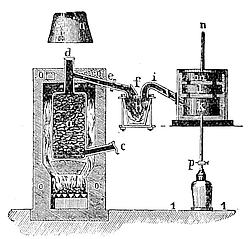
Fig. 1.
The crude bisulphide of carbon contains about twelve per
cent of sulphur and other combinations in solution and is
redistilled at exactly 48° C. (118.4° F.) in a steam-heated apparatus
with a long exit tube cooled with ice below and water
above. In order to obtain the bisulphide of carbon absolutely
pure, which is essential to render it suitable for extraction,
it is again distilled at the same temperature, with the addition
of two per cent of palm oil. As the vapors of bisulphide
of carbon are injurious to the organism, the vessels containing
it must always be kept well closed.
Among all the substances belonging under this head, there
is one which plays a prominent part in the manufacture of
most perfumes. In handkerchief perfumes it is one of the
most important substances, as it forms not only the greatest
bulk, but the perfection of the perfume depends upon its
quality. This substance is—
also called spirit of wine; French, esprit de vin; the well-known
combustible liquid formed by the alcoholic fermentation
of sugar, which is made on a large scale in extensive distilleries.
Alcohol is a thin, mobile liquid with an aromatic
odor. The usual “strong” alcohol of the market contains
about ninety-four per cent of absolute alcohol by volume.
This has a specific gravity of 0·820. Its boiling-point is 78·2°
C. (172·40 F.), and it congeals at a very low temperature, below
-100° C. Alcohol possesses great solvent power for
resins, balsams, and essential oils.
These properties, however, belong only to the commercial
stronger or so-called “druggists’ alcohol,” and more particularly
to a very pure quality of it, as free as possible from fusel-oil
compounds, known as cologne spirit. As absolute alcohol
is also necessary for the purposes of perfumery, we shall briefly
describe its preparation.
In order to make absolute alcohol, sulphate of copper is
heated in a retort until it has changed into a white powder.
After the powder has cooled in the covered retort, it is at
once introduced into a large glass bottle; over it is poured
the strongest obtainable alcohol (96% Tralles) which must be
free from fusel oil; then the bottle is closed air-tight and repeatedly
shaken. The sulphate of copper which has lost its
water of crystallization by the heat reabsorbs it from the alcohol
and again becomes blue and crystalline. Generally four
pounds of sulphate of copper are used for ten quarts of alcohol;
when white burnt sulphate of copper after long contact
with alcohol still remains white, the alcohol is proved to be
practically anhydrous (it may still contain about two per cent
of water).
Larger quantities of absolute alcohol are made in a copper
still containing fused anhydrous chloride of calcium in
small pieces. The apparatus is closed and alcohol of 94 to
95% is poured in through a tubulure. The mixture often
grows so warm that the alcohol begins to pass over, so that but
little heat need be applied to make the absolute alcohol distil
over.
Absolute alcohol obtained in this way—for by repeated distillation
we get at most an alcohol of 96%—abstracts water
from the air with avidity; hence it must be preserved in air-tight
vessels which should contain a small
amount of anhydrous sulphate of copper.
Fig. 2.
Strong commercial alcohol contains varying
amounts of water—from four to twenty
parts by volume (96 to 80% alcohol); at the
present time, however, it is always customary
for dealers in this country to supply the
officinal alcohol of 94%, when “strong alcohol”
is called for. Its strength is measured
by an areometer which sinks in proportion to
the purity of the alcohol; the alcoholometer
of Tralles or volumeter shows at once on its
scale how many parts by volume of absolute
alcohol (volume per cent) are contained in 100
volumes of alcohol. The adjoining figure (Fig. 2) shows
Tralles’ alcoholometer, with the vessel in which the test is
made. The readings of the instrument, however, are correct
only at a temperature of 15·6° C. (60° F.), the so-called normal
temperature; at a higher or lower point they must be
corrected according to the tables appended.
At temperatures below the normal, the amount of alcohol is
greater than the areometer indicates, hence a percentage
must be added; at higher temperatures a percentage must be
deducted.
Tables for Finding the True Percentage by Volume, at
the Normal Temperature of 60° F., of Alcohol of Any
Strength, when Tested at Temperatures Below or
Above 60° F.
Table I.—For Temperatures Under 60° F.
Per cent
of
Alcohol
by
Volume. |
Number of
F. Degrees
Requiring
Addition
of one to
Percentage. |
|
Per cent
of
Alcohol
by
Volume. |
Number of
F. Degrees
Requiring
Addition
of one to
Percentage. |
| 21 |
5·4 |
|
60 |
5·4 |
| 22 |
5·175 |
|
61 |
5·4 |
| 23 |
4·725 |
|
62 |
5·4 |
| 24 |
4·5 |
|
63 |
5·625 |
| 25 |
4·5 |
|
64 |
5·625 |
| 26 |
4·5 |
|
65 |
5·625 |
| 27 |
4·5 |
|
66 |
5·625 |
| 28 |
4·275 |
|
67 |
5·625 |
| 29 |
4·275 |
|
68 |
5·85 |
| 30 |
4·275 |
|
69 |
5·85 |
| 31 |
4·275 |
|
70 |
5·85 |
| 32 |
4·275 |
|
71 |
5·85 |
| 33 |
4·275 |
|
72 |
5·85 |
| 34 |
4·275 |
|
73 |
5·85 |
| 35 |
4·5 |
|
74 |
6·075 |
| 36 |
4·5 |
|
75 |
6·075 |
| 37 |
4·5 |
|
76 |
6·075 |
| 38 |
4·5 |
|
77 |
6·075 |
| 39 |
4·5 |
|
78 |
6·3 |
| 40 |
4·5 |
|
79 |
6·3 |
| 41 |
4·725 |
|
80 |
6·3 |
| 42 |
4·725 |
|
81 |
6·525 |
| 43 |
4·725 |
|
82 |
6·525 |
| 44 |
4·725 |
|
83 |
6·75 |
| 45 |
4·95 |
|
84 |
6·75 |
| 46 |
4·95 |
|
85 |
6·75 |
| 47 |
4·95 |
|
86 |
6·75 |
| 48 |
4·95 |
|
87 |
6·975 |
| 49 |
4·95 |
|
88 |
7·2 |
| 50 |
5·175 |
|
89 |
7·425 |
| 51 |
5·175 |
|
90 |
7·65 |
| 52 |
5·175 |
|
91 |
7·875 |
| 53 |
5·175 |
|
92 |
8·1 |
| 54 |
5·175 |
|
93 |
8·325 |
| 55 |
5·175 |
|
94 |
8·775 |
| 56 |
5·175 |
|
95 |
9· |
| 57 |
5·4 |
|
96 |
9·45 |
| 58 |
5·4 |
|
97 |
10·125 |
| 59 |
5·4 |
|
|
|
Explanation.—Supposing an alcohol should be found to contain 40 per cent of
absolute alcohol by Tralles’ alcoholometer at 45° F. The difference between 45
and 60° F. is 15. Opposite to 40 will be found the figure 4·5. For every 4·5 degrees
F. below 60° there must be added 1 to the alcoholic percentage. Hence
for 15 degrees there must be added 3.3 degrees. The alcoholic percentage, by
volume, therefore, is 43·3 per cent.
Table II.—For Temperatures Above 60° F.
Per cent
of
Alcohol
by
Volume. |
Number of
F. Degrees
Requiring
Subtraction
of one to
Percentage. |
|
Per cent
of
Alcohol
by
Volume. |
Number of
F. Degrees
Requiring
Subtraction
of one to
Percentage. |
| 21 |
5·85 |
|
61 |
5·175 |
| 22 |
5·625 |
|
62 |
5·175 |
| 23 |
5·4 |
|
63 |
5·175 |
| 24 |
5·175 |
|
64 |
5·175 |
| 25 |
4·95 |
|
65 |
5·175 |
| 26 |
4·95 |
|
66 |
5·4 |
| 27 |
4·725 |
|
67 |
5·4 |
| 28 |
4·725 |
|
68 |
5·4 |
| 29 |
4·5 |
|
69 |
5·625 |
| 30 |
4·5 |
|
70 |
5·625 |
| 31 |
4·5 |
|
71 |
5·625 |
| 32 |
4·5 |
|
72 |
5·625 |
| 33 |
4·5 |
|
73 |
5·625 |
| 34 |
4·5 |
|
74 |
5·625 |
| 35 |
4·5 |
|
75 |
5·85 |
| 36 |
4·5 |
|
76 |
5·85 |
| 37 |
4·5 |
|
77 |
5·85 |
| 38 |
4·5 |
|
78 |
5·85 |
| 39 |
4·5 |
|
79 |
6·075 |
| 40 |
4·5 |
|
80 |
6·075 |
| 41 |
4·5 |
|
81 |
6·075 |
| 42 |
4·5 |
|
82 |
6·075 |
| 43 |
4·5 |
|
83 |
6·3 |
| 44 |
4·5 |
|
84 |
6·3 |
| 45 |
4·5 |
|
85 |
6·3 |
| 46 |
4·5 |
|
86 |
6·525 |
| 47 |
4·725 |
|
87 |
6·525 |
| 48 |
4·725 |
|
88 |
6·525 |
| 49 |
4·725 |
|
89 |
6·75 |
| 50 |
4·725 |
|
90 |
6·975 |
| 51 |
4·725 |
|
91 |
6·975 |
| 52 |
4·725 |
|
92 |
7·425 |
| 53 |
4·95 |
|
93 |
7·425 |
| 54 |
4·95 |
|
94 |
7·65 |
| 55 |
4·95 |
|
95 |
7·65 |
| 56 |
5·175 |
|
96 |
8·1 |
| 57 |
5·175 |
|
97 |
8·1 |
| 58 |
5·175 |
|
98 |
8·325 |
| 59 |
5·175 |
|
99 |
9·45 |
| 60 |
5·175 |
|
100 |
9.9 |
Explanation.—In this case, the same calculation is performed as directed
under Table I., except that the correction is to be deducted instead of added.
Aside from the water present in it, commercial alcohol is
never pure, but always contains small quantities, at times
mere traces, of substances having a peculiar, sometimes
pleasant, sometimes disagreeable, but invariably intense odor,
which are known as fusel oils. The variety of fusel oil differs
with the raw material from which the alcohol was made;
there is a potato fusel oil (chemically amyl alcohol), a corn
fusel oil, a beet fusel oil, wine fusel oil (œnanthic ether), etc.
Fusel oils, being themselves odorous substances, exert an influence
on the fragrance of the perfume; hence it is a general
rule in perfumery to use only alcohol free from fusel oil;
that is, such from which the fusel oil has been extracted
as far as possible by means of fresh charcoal. So-called
“Cologne Spirit” of the best quality is, as a rule, practically
free from it.
Strange to say, some essential oils or aromatic substances
in general, develop their finest odors only when the perfumes
are prepared with an alcohol from a certain source. While
the charcoal treatment removes almost all the fusel oil, the
remaining traces suffice to act as odorous substances in the
true sense of the term and to produce with other aromatic
bodies a harmony of the odor which can never be reached by
the use of another variety of alcohol. To give but a single
instance we may state that all the citron odors known in
perfumery develop the finest aroma only when dissolved in
alcohol made from wine and the solution is then distilled.
The world-renowned eau de Cologne is made in this way; the
other aromatic substances contained in it are added to the
distillate from the spirit of wine and the citron oils; any cologne
made in another manner or with another alcohol has a less
fine odor. While the citron odors require true spirit of wine
for the development of their full aroma, other scents require
beet or corn alcohol to bring out their best odor. Jasmine,
tuberose, orange flowers, violet, etc., and all animal odors
(ambergris, musk, and civet) belong to the latter class. For
this remarkable and to the perfumer most important fact we
know no other explanation than that traces of fusel oils present
even in rectified alcohol take part in the general impression
made on the olfactory nerves, acting as true aromatic
substances.
Cologne spirit is expensive, but this should not be a reason
for accepting a cheaper grade, with which it would be absolutely
impossible to make really fine perfumes.
Alcohol is also generally used for the direct extraction of
odorous substances from plants, as will be seen in the description
of the processes employed in the preparation of the so-called
essences or extracts. For these purposes, too, the best
cologne spirit only should be used, that is, alcohol which has
been freed from fusel oil and redistilled, for in no other way
can the aromatic substances be obtained in the greatest possible
purity. And this is indispensable for the preparation of
really fine perfumes, for we do not hesitate to say that
French and English perfumes have acquired their deserved
reputation mainly through the great care exercised in the selection
of their raw materials, and especially of the alcohol
used for extraction.
This preparation, which is used in making a fine skin cosmetic,
is manufactured in chemical laboratories from uric acid
heated with nitric acid. Alloxan is a crystalline colorless
body which has the property of gradually producing a red
tint on the skin and finds employment for this reason.
Ammonia is a gas formed by the decomposition of nitrogenous
substances, but chiefly obtained, on a large scale,
from the so-called “gas liquor” of gas works. By itself it
develops a very disagreeable odor and stimulates the lachrymal
glands to secretion—a fact which can be verified in
any stable. A solution of the gas (water of ammonia; liquor
ammoniæ) possesses the same properties. In perfumery ammonia
is never used alone, but only in combination with
other odors, namely, in the manufacture of smelling salts
(French: sels volatils; German: Riechsalze), which are much
in favor in England and in this country. For the purposes
of the perfumer, the greater part of the commercial ammonia
is unsuitable owing to its tarry odor. Pure ammonia is best
prepared by heating equal parts of quicklime and powdered
sal-ammoniac in a retort, and conducting the generated gas
into water which dissolves it with avidity, one quart of water
dissolving more than seven hundred quarts of ammonia gas.
a combination of ammonia with carbonic acid, occurs in commerce
in large transparent lumps, often covered with a white
dust of bicarbonate of ammonia, which in the air continually
develop ammonia and therefore always smell of it. This commercial
product is, as a rule, sufficiently pure to be used in
perfumery; as to its application the same remarks apply as
were made under the head of ammonia.
This is made from bitter almonds, previously deprived of
fatty oil by pressure, which are mixed with an equal weight of
water and set in a warm place. The amygdalin undergoes decomposition
into sugar, hydrogen cyanide, and benzoyl hydride
or oil of bitter almonds. After one or two days the mass
is distilled; the distillate being a colorless liquid, containing,
besides oil of bitter almonds, hydrogen cyanide or prussic
acid, one of the most virulent poisons, from which it must be
freed. This is done by shaking the liquid repeatedly with
dilute solution of potassa, followed by agitation with water.
Pure oil of bitter almonds is not poisonous, but has a very
strong narcotic odor of bitter almonds, which, however, becomes
most marked when largely diluted with water.
This acid, contained in benzoin, is made also synthetically
from other materials, in chemical laboratories. When
pure it forms needle-shaped crystals having a silky gloss;
they have a peculiar acrid taste, but no odor. Synthetic
benzoic acid is worthless to the perfumer; in his art he can
use only a benzoic acid made from gum benzoin by sublimation,
because it contains a very aromatic essential oil for
which the acid is merely the vehicle and which can also be
employed alone.
As this sublimed benzoic acid is often adulterated with
the artificial, we advise the manufacturer of perfumery to make
his own benzoic acid according to the following directions.
The Manufacture of Sublimed Benzoic Acid.
Fig. 3.
About four pounds of benzoin B of best quality is broken
into small pieces and placed in a small copper boiler K (Fig.
3); over its entire surface is pasted white blotting paper L,
and to this is pasted a cone of strong paper
which must surround the edge of the
boiler. The cone ends above in a paper
tube R, about five feet long and an inch
wide. The copper boiler is placed in a
large clay pot T (a flower pot) and surrounded
on all sides with fine sand. The
clay pot is heated from without by a charcoal
fire. After the pot has remained about
half an hour on the fire, the latter is fanned
to its utmost and kept at this point for thirty minutes. The
heat volatilizes the benzoic acid, the above-mentioned essential
oil, and some tarry substances of a brown color. The
latter are arrested by the filter paper, while the benzoic acid
is deposited on the cone and in the tube, in the form of delicate
glossy needles which are very fragrant owing to the
essential oil. The largest yield of benzoic acid is obtained
when the temperature is raised very gradually, until finally
nothing remains in the copper boiler but a brown, almost carbonized
mass of a blistered appearance.
is used in some preparations. Borax forms colorless crystals
which slightly effloresce in dry air and hence must be preserved
in tightly closed vessels. Reddish tinted crystals are
contaminated with oxide of iron and should be rejected.
is a salt formed by fusing a mixture of manganese dioxide,
potassa, and potassium chlorate, extracting the product with
water, and evaporating the solution to crystallization; the
salt is obtained in small dark violet, almost black crystals
which dissolve in sixteen parts of water to which they impart
a beautiful violet color. By contact with organic substances,
or others easily oxidized, the solution changes its color into
green and finally is decolorized, precipitating a brown powder.
Owing to this change of color the salt has been called chameleon
mineral. As its preparation requires considerable dexterity,
it is preferable to buy it from reputable houses, rather
than to make it. It is used in the manufacture of mouth
washes and hair dyes. The solution of the salt causes brown
stains on linen and the skin; they can be removed only if the
spots are immediately washed with hydrochloric, oxalic, sulphuric,
or another acid.
Much confusion exists in the literature regarding the
strength of acetic acid when merely called by this name.
It is safe to assume that, in each country, the term applies to
the acid officinal in its national pharmacopœia as “Acidum
Aceticum.” Thus the Austrian and German pharmacopœias
understand by it an acid containing 96% of absolute acetic
acid, which is practically identical with what is known as
glacial acetic acid. The latter is, in some pharmacopœias,
distinguished by a special name: acidum aceticum glaciale,
U.S. P.; acide acétique crystallisable, French Pharm.—In the
present work, the author always intended the strong acid of
the Austrian pharmacopœia to be understood when no other
strength was designated. Like alcohol, strong acetic acid dissolves
essential oils and is used in the manufacture of various
toilet vinegars and washes. Acetic acid is made in chemical
laboratories by distillation of acetate of sodium with sulphuric
acid, or more commonly from wood vinegar. The buyer
should always satisfy himself that the product is free from an
empyreumatic odor which clings tenaciously to an insufficiently
purified sample.
Fats find extensive application in perfumery, in the preparation
of the so-called huiles antiques, pomades, and many
other cosmetics. They should be enumerated among the
chemical products used in perfumery because they can never
be employed in their commercial form, but must undergo
some process of purification, which is effected less by mechanical
than by chemical means. Commercial fats usually
contain remnants of the animal or vegetable body from which
they are derived: particles of blood and membranes occur
frequently in animal fats; cell bodies and vegetable albumin
in vegetable fats. Besides these mechanical impurities, fats,
especially if old, sometimes contain small amounts of free
fatty acids which suffice to impart to them the objectionable
odor and taste peculiar to every rancid fat. While some fats,
such as bear’s grease, butter of cacao, oil of sesame, and some
others, remain free from rancidity for a long time, others
undergo this change very rapidly; in fact, we may say that
every fat which shows the slightest odor should be called
rancid, for pure fat is absolutely odorless.
We shall here briefly describe the process employed in
the fat industry and by perfumers for the purification of fats.
Animal fat, such as lard, suet, bear’s grease, etc., as well as
cocoanut and palm oils, are introduced into a large iron boiler
containing dilute soda lye (not exceeding one per cent of
caustic soda), and the lye is heated to boiling. In the boiler
is a small pump terminating above in a curved tube having
a rose of a watering-pot at the end. The pump is so arranged
as to raise lye and melted fat at the same time and to return
the fluid into the boiler in a fine spray. After the fat is
melted, the solid matters floating on top are skimmed off with
a perforated spoon, and then the pump is operated for about
fifteen minutes. The contained shreds of membrane and
similar substances are completely dissolved by the soda lye,
the free fatty acids are perfectly combined, and the fat is at
the same time decolorized. After cooling, it floats on the
surface of the lye as a colorless and odorless fluid; it is
ladled off and poured into tall tapering vessels which are
well closed and preserved in cool cellars. Contact with the
air, especially at higher temperatures, causes rancidity of
the fat. For every twenty pounds of fat twenty quarts of
lye are used.
According to another process the fat is purified by being
heated with alum and table salt; or every twenty-five pounds
of fat, one ounce of alum and two ounces of salt are dissolved
in five gallons of water. The scum is carefully skimmed from
the surface of the melted fat, and, after it has solidified, the
fat is washed with water until the latter escapes perfectly
tasteless and odorless.
The washing is a very complicated and tedious piece of
work. Operating on a small scale, a slightly inclined marble
slab is taken, upon which a thin stream of water is constantly
falling from a tube arranged above it. The fat is
placed on the slab in small quantities (not over two pounds)
and ground with a muller, like oil colors, under a constant
flow of water. Owing to the expense of hand labor, it is advisable
to use a so-called vertical mill or chaser. This consists
of a level, circular, horizontal marble slab, bearing a
central, easily movable axis with a crosspiece upon which two,
likewise vertical, cylindrical marble plates turn like wheels in
a circle on the horizontal marble plate. The fat is placed on
the latter and continually irrigated with water; behind every
chaser is applied a marble plate with a blade which nearly
touches the chasers and returns the fat displaced laterally,
under the chasers. The axis around which the chasers run
is kept moving by any available power, and the laborer has
nothing to do but to replace the washed fat with crude.
Liquid fats are purified as follows:
The oil is intimately mixed with one per cent of sulphuric
acid. The mixture assumes a black color, the vegetable
mucilage present in the oil becoming carbonized. After
several days’ rest the oil becomes clear and floats on the surface
of the sulphuric acid which has assumed a black color
from the presence of finely divided carbon. The oil is decanted
and treated, in the manner above stated for solid fats,
with caustic soda lye. Heating can be dispensed with if the
pumping is continued for a longer time.
Benzoin and benzoic acid have the property of counteracting
the tendency of fats to become rancid; it is advisable,
therefore, to mix intimately with the completely washed fat
a small amount of benzoic acid, at most one-one-thousandth
part by weight.
The best way of preserving fats is by salicylic acid. This
is added to solid fats while they are in a melted state; if oils,
the acid is poured in and the bottle vigorously shaken. If
the oil is in casks, a small bag filled with salicylic acid is hung
into it from the bung-hole. The acid dissolves in the oil and
is disseminated through it and thus effects its preservation.
One-one-thousandth part by weight of the fat or oil is said
to be more than sufficient to keep it perfectly fresh for
years.
Fats differ largely in their physical properties—for instance,
in their appearance, melting-point, firmness, etc. As
we shall return to this subject in connection with the manufacture
of some perfumes, it is enough here to state briefly
that by the addition of spermaceti, wax, paraffin, etc., fats are
made more transparent and firmer—a matter of importance
for some cosmetic preparations.
This substance, derived from several algæ, species of
Eucheuma, indigenous to the Chinese sea, and identical with
Japanese agar-agar, on being boiled with two hundred parts
of water has the property of forming a colorless solution
which solidifies on cooling. Owing to this property the addition
of a small quantity of Chinese gelatin (0·1-0·2%) is an
excellent means for imparting to certain pomades and ointments
great transparency and firmness.
are liquids which possess an agreeable, refreshing odor resembling
that of some fruits. For this reason they are used
in confectionery, in the manufacture of liqueurs, and also in
many ways in perfumery. Chemically, fruit ethers are combinations
of an organic acid—acetic, butyric, valerianic, etc.—with
a so-called alcohol radicle such as ethyl and amyl.
Their manufacture is connected with many difficulties and is
but rarely attempted by perfumers, especially as these products
are made a specialty in some chemical laboratories and
are furnished at very low prices and of excellent quality. In
perfumery the following fruit ethers are particularly employed.
prepared by the distillation of acetate of sodium with alcohol
and sulphuric acid, is a colorless liquid having an odor of fermenting
apple juice, with a boiling-point at 74° C. (155° F.).
(ether or huile d’ananas) is made by the saponification of
butter with solution of potassa, distillation of the soap with
alcohol and sulphuric acid, and rectification of the distillate.
It is an inflammable liquid with an intense odor of pine-apple;
its boiling-point is 119° C. (246° F.). It is not generally used
pure, as its odor needs some correction. This is accomplished
by the addition of a little valerianate of amyl, and chloroform.
Also in other ways.
prepared by distillation from valerianate of sodium with alcohol
and sulphuric acid, and the subsequent addition of certain
correctives (see below).
also called pear oil, chiefly valerianate of amyl oxide, can be
obtained in large quantities from a by-product in the manufacture
of potato spirit, namely, amyl alcohol, which is carefully
heated in a still with bichromate of potassium and sulphuric
acid. The product thus obtained has a very pleasant
odor of fine pears and boils at 196° C. (385° F.). But the commercial
“pear-essence” is a more complex body (see following
table).
is a very volatile liquid boiling at 16° C. (61° F.), which is
obtained by distillation of strong alcohol with concentrated
nitric acid and rectification of the distillate; it is less used in
perfumery than the other fruit ethers.
Fruit ethers, owing to their low price and great strength,
are frequently employed in the manufacture of cheap perfumery,
in place of essential oils, but more largely for scenting
soap.
The so-called raspberry and strawberry ethers consist of
mixtures of acetic, pine-apple, apple, and other ethers (see
following table), which, combined in certain proportions,
really manifest an odor nearly akin to those of the fruits
after which they are named.
Table Showing the Ingredients Usually Employed for Preparing
Artificial Fruit Ethers (Fruit Essences).
| A = Peach. |
I = Apple. |
| B = Apricot. |
J = Grape. |
| C = Plum. |
K = Gooseberry. |
| D = Cherry. |
L = Raspberry. |
| E = Black Cherry. |
M = Strawberry. |
| F = Lemon. |
N = Melon. |
| G = Pear. |
O = Pine-apple. |
| H = Orange. |
|
A |
B |
C |
D |
E |
F |
G |
H | I |
J |
K |
L |
M |
N |
O |
| Glycerin |
5 |
4 |
8 |
3 |
.. |
5 |
10 |
10 | 1 |
2 |
.. |
.. |
.. |
.. |
1 |
| Chloroform |
.. |
1 |
.. |
.. |
.. |
1 |
.. |
2 | 1 |
.. |
.. |
1 |
1 |
.. |
.. |
| Nitrous ether |
.. |
.. |
.. |
.. |
.. |
1 |
.. |
.. | 2 |
2 |
1 |
1 |
.. |
2 |
1 |
| Aldehyde |
2 |
.. |
5 |
.. |
.. |
2 |
.. |
2 | 1 |
.. |
5 |
5 |
5 |
.. |
.. |
| Acetate of ethyl |
5 |
.. |
5 |
5 |
10 |
10 |
5 |
5 | .. |
2 |
.. |
1 |
1 |
1 |
.. |
| Formate of ethyl |
5 |
.. |
1 |
.. |
.. |
.. |
.. |
1 | .. |
.. |
.. |
1 |
5 |
4 |
5 |
| Butyrate of ethyl |
5 |
10 |
2 |
.. |
.. |
.. |
.. |
1 | .. |
.. |
.. |
.. |
.. |
5 |
.. |
| Valerianate of ethyl |
5 |
5 |
.. |
.. |
.. |
.. |
.. |
.. | .. |
.. |
1 |
1 |
.. |
.. |
.. |
| Benzoate of ethyl |
.. |
.. |
.. |
5 |
5 |
.. |
.. |
1 | .. |
10 |
1 |
1 |
.. |
.. |
.. |
| Œnanthate of ethyl |
5 |
1 |
4 |
1 |
2 |
.. |
.. |
.. | .. |
1 |
.. |
1 |
1 |
.. |
.. |
| Salicylate of methyl |
2 |
2 |
.. |
.. |
.. |
.. |
.. |
1 | .. |
.. |
.. |
1 |
.. |
10 |
.. |
| Sebacic acid |
1 |
.. |
.. |
.. |
.. |
.. |
10 |
.. | .. |
.. |
.. |
1 |
3 |
.. |
10 |
| Acetate of amyl |
.. |
.. |
.. |
.. |
.. |
.. |
.. |
10 | 10 |
.. |
.. |
.. |
2 |
.. |
.. |
| Butyrate of amyl |
.. |
1 |
.. |
.. |
.. |
10 |
.. |
.. | .. |
.. |
.. |
.. |
.. |
.. |
.. |
| Valerianate of amyl |
.. |
.. |
.. |
.. |
.. |
.. |
.. |
.. | .. |
.. |
5 |
5 |
.. |
.. |
.. |
| Essence of orange |
.. |
.. |
.. |
.. |
.. |
10 |
.. |
10 | 1 |
5 |
.. |
.. |
.. |
.. |
.. |
Alcohol,
solutions
saturated in
the cold of |
Tartaric acid |
.. |
.. |
.. |
.. |
1 |
.. |
.. |
1 | .. |
.. |
1 |
1 |
.. |
.. |
.. |
| Oxalic acid |
.. |
1 |
.. |
.. |
.. |
1 |
.. |
.. | .. |
3 |
1 |
.. |
.. |
.. |
.. |
| Succinic acid |
.. |
.. |
.. |
1 |
2 |
.. |
.. |
.. | .. |
.. |
.. |
1 |
.. |
.. |
.. |
| Benzoic acid |
.. |
.. |
.. |
.. |
.. |
.. |
.. |
.. | .. |
.. |
.. |
.. |
1 |
.. |
.. |
This substance, which may be called a true cosmetic in
itself, as it possesses marked solvent power for cutaneous
coloring matters and at the same time imparts to the skin
delicacy and flexibility, is at present to be had commercially
in great purity. Pure glycerin is a brilliant, colorless, and
odorless substance of the consistence of a thick syrup, which
mixes with water and alcohol in all proportions and has a
slightly warm but very sweet taste. It readily absorbs aromatic
substances and is used in many valued toilet articles in
combination with fats and perfumes. Recently we have succeeded
in using glycerin most successfully for the extraction
of aromatic substances.
also called artificial oil of bitter almonds, nitrobenzol, and
essence of mirbane. This substance, which is now largely
used in perfumery and soap manufacture, is obtained by the
action of fuming nitric acid on benzol. The mixture becomes
hot and emits masses of brown vapors, and there is formed a
yellow oily body which is washed with water and soda solution
until the washings escape colorless. Pure nitrobenzol is
not soluble in water, but in alcohol or ether, boils at 213° C.
(415° F.), and congeals at-5 to 6° C. (21-23° F.). Its spec.
grav. is 1·2 or a little over. Any oil of mirbane having a
lower specific gravity than 1·2 at 15° C. (59° F.) is spurious,
most likely nitrotoluol. Its odor greatly resembles that of
oil of bitter almonds, but can be clearly differentiated from
it on comparison. Care must be taken in inhaling the vapor
when undiluted, as it is poisonous. By distillation nitrobenzol
can be obtained quite colorless, and in this form is often
used for the adulteration of genuine oil of bitter almonds.
This adulteration, however, can be easily demonstrated by
heating for a short time with an alcoholic solution of a caustic
alkali which separates from nitrobenzol a brown resinous substance,
while true oil of bitter almonds loses its odor and
changes into benzoic acid which unites with the alkali.
This substance is one of the products of the distillation of
petroleum, coal, peat, and other carbonaceous sources. It is
a crystalline, brittle body, closely resembling wax in appearance
and melting between 51 and 60° C. (124 and 140° F.). Paraffin,
which is now made on a large scale for the manufacture
of candles, is very useful in perfumery as a partial substitute
for the much more expensive wax or spermaceti, over which
it has the advantage, besides its cheapness, that it imparts to
the articles great transparency—a quality which is valued
highly in fine perfumeries. The addition of some paraffin to
pomades renders them more consistent and counteracts their
tendency to become rancid. Distilled paraffin always has a
crystalline form, differing from the paraffin-like residues left
after the distillation of petroleum (so-called vaselins, etc., see
below) which are always amorphous.
appears in commerce as a white crystalline powder, made by
heating gallic acid to 200-210° C. (392-410° F.). With iron
salts, pyrogallic acid forms bluish-black combinations and precipitates
the metal from silver solutions as a velvety-black
powder. On account of these properties pyrogallic acid is
used in perfumery as a constituent of some hair dyes.
liver of sulphur, hepar sulphuris, potassii sulphuretum, the
pentasulphide of potassium, is obtained by fusing together
potash and sulphur, in the shape of a leather-brown mass
which is soluble in water and on exposure to the air is gradually
decomposed with the development of the offensive sulphuretted
hydrogen gas; hence it should be preserved in well-closed
vessels. An aqueous solution of this substance forms
with lead or silver salts a black precipitate of sulphide of
lead or silver, and is used for some hair dyes.
(amylum) is prepared from various vegetables such as potatoes,
rice, arrowroot, sago, etc., and when pure appears as an
insoluble white powder which the microscope shows to be
grains consisting of many superimposed layers. In commerce
the price of the different varieties of starch fluctuates greatly;
in perfumery well-cleansed potato starch can very well be
used for dusting powders, and the so-called poudre de riz; in
this country, corn starch is preferable.
that is, the body to which vanilla owes its fragrance, is now
made artificially and can be used in place of vanilla for soaps
and pomades.
In the distillation of petroleum there remain in the still as
a residue large quantities of a substance which when purified
is colorless and, according to the nature of the petroleum, at
ordinary temperatures has either the consistence of lard,
melting under the heat of the hand, or forms an oily liquid.
In perfumery vaselin can be used like fat or oil, over which
it has the advantage in that it always remains odorless and
free from acid; hence it is very appropriate for the manufacture
of pomades. The market affords numerous varieties of
this substance, under different names: vaselin (oil and solid),
albolene (oil and solid), cosmolin, etc., etc.
is a substance found in the skull cavities of several whales
and dolphins. In its properties it stands midway between
beeswax, paraffin, and firm fats. In the living animal spermaceti
is fluid, but after its death it congeals to a white crystalline
mass of a fatty lustre, which melts at 40° C. (104° F.),
and is frequently used for fine candles as well as for other
articles.
(Cera alba), the well-known product of the bee; in perfumery
only bleached (white) wax is employed. In recent
years Japanese wax has appeared in commerce; this is of
vegetable origin, but in its properties resembles beeswax.
bismuth white, pearl white, bismuthi subnitras, blanc de bismuth,
blanc de perles, the basic nitrate of bismuth, the chief
ingredient of many skin cosmetics, is prepared by dissolving
metallic bismuth in moderately strong nitric acid, and pouring
the solution into a large quantity of water, whereupon the
subnitrate is precipitated.
The precipitated powder is collected on a funnel and
washed with pure water until the wash water no longer
changes blue tincture of litmus to red. The bismuth white is
dried and preserved in well-closed vessels, since in the air it
gradually assumes a yellowish color; for any sulphuretted
hydrogen present in the air is greedily absorbed by this salt,
and the resulting combination with sulphur has a black color.
is obtained by treating metallic tin with fuming nitric acid,
adding the solution to a large quantity of water, and washing
the product, which forms a white insoluble powder used cosmetically
for polishing the finger nails.
Besides the chemical products here enumerated, some
others find application in perfumery; we shall describe their
properties in connection with the articles into which they
enter. In this connection mention may be made of the fact
that more and more aromatic substances are now made artificially
which were formerly obtained with difficulty from
plants. Besides vanillin mentioned above, cumarin, oil of
wintergreen, and some other products are prepared artificially.
Heliotropin and nerolin are artificially prepared substances,
possessing an odor resembling that of heliotrope and
oil of neroli, respectively, but not identical chemically with
the natural odorous substance. Artificial musk (Baur’s), is
playing a rôle at present, but is not identical with the natural
substance.
Some articles are colored intentionally; this remark applies
particularly to some soaps which not rarely are stained to correspond
to the color of the flower whose odor they bear; for instance,
violet soap. Some articles again are used only on
account of their color; for instance, paints, hair and whisker
dyes. As we shall discuss this subject at greater length in
connection with these toilet articles, we merely state here
that nowadays every manufacturer can choose between a
large number of dyes of any color, all of which are innoxious;
hence no perfumer should under any circumstances use poisonous
colors. This is a matter of importance with substances
intended for immediate contact with the human body
such as paints, lip salves, soaps, etc. All of these colors will
be described hereafter.
Excepting the articles made in Turkey and India (especially
oil of rose), most aromatic substances are manufactured
in southern France and the adjoining regions of Italy, while
a few (oils of peppermint and lavender) are produced in England;
a few also (oils of peppermint, spearmint, wintergreen,
sassafras, etc.) in the United States. However, as we have
stated above, it is possible to cultivate some plants from
which odors are extracted in the warm sections of this country,
and to obtain the most expensive perfumes from them.
Among these plants our experience leads us to suggest violets,
roses, reseda, lavender, mints, syringa, lilac, and several
others to which the climate is adapted.
The methods by which the odors can be extracted from
the plants differ according to the physical properties of the
raw material and the chemical composition of the aromatic
substance. We shall here briefly describe the methods thus
far known, and at the same time add our own experience in
this most important part of the art of perfumery. The aromatic
substances are obtained by pressure, by distillation, by
maceration (infusion), by absorption (enfleurage) through air
or through carbonic acid, and by extraction.
Certain aromatic substances that occur in large amounts
in some parts of plants, are best obtained by pressure. The
rinds of certain fruits contain an essential oil in considerable
quantities inclosed in receptacles easily distinguished under
the microscope. When these vegetable substances are subjected
to strong pressure, the oil receptacles burst and the
essential oil escapes. The force is usually applied through a
screw press with a stout iron spindle; the vegetable substances
being inclosed in strong linen or horse-hair cloths,
placed between iron plates, and subjected to a gradually increasing
pressure. Comparative experiments have shown us
that even with the most powerful presses a considerable,
amount of oil is lost owing to the fact that a large number of
oil receptacles remain intact. For this reason, when oil is to
be extracted by pressure, a hydraulic press is preferable, as
it develops greater power than any other press. In the hydraulic
presses used for this purpose the piston fits exactly
into a hollow iron cylinder with sieve-like openings in its circumference.
The vegetable substances are filled into this
cylinder; when the pressure is applied, the fluids escape
through the perforations, and the residue forms a compact
woody cake which is then free from oil.
Besides the essential oil, watery fluid is expressed, the
whole appearing as a milky liquid, owing to the admixture of
vegetable fibres, mucilage, etc. It is collected in a tall glass
cylinder which is set in a place free from any vibration.
After remaining at rest for several hours the liquid separates
into two layers, the lower being watery and mixed with
mucilage, that floating on top being almost pure oil. The
latter is separated, and finally purified by filtration through a
double paper cone in a funnel covered with a glass plate.
Fig. 4.
It is best to separate the water and oil in a regular separatory
funnel, or in a simple apparatus illustrated in Fig. 4.
It is made by cutting the bottom from a tall flask, and fitting
into the neck by means of a cork a glass tube having a diameter
of one-fourth to one-half inch. A rubber tube with stop-cock
is fastened to the glass tube. By careful opening of the
stop-cock, the watery fluid can be drained off to the last drop.
To the perfumer this method is of little importance, since
it is applicable only to a few substances which, moreover,
give cheap odors. Still, the possession of a hydraulic press is
advisable to every manufacturer who works on a large scale,
as it is useful also in the preparation of several fixed oils frequently
employed in perfumery, for instance, oils of almonds,
nuts, etc.
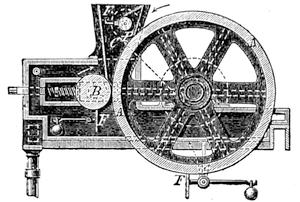
Fig. 5.
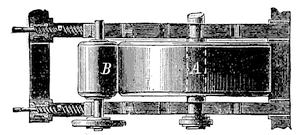
Fig. 6.
Fixed oils are best extracted in so-called drop presses, the
material having first been comminuted between rollers.
These are arranged as shown in section in Fig. 5, and in
ground plan in Fig. 6. The apparatus consists of two smooth
or slightly grooved iron cylinders A and B, respectively four
feet and one foot in diameter, which can be approximated or
separated by means of set screws. The material is placed
into the trough F containing a feeding roller moved by the
belt P. The scrapers FF, pressed against the cylinders by
means of weighted levers, free the rollers from adhering
pieces.
The drop presses Figs. 7 and 8 consist of a hydraulic press
with cylinders A and piston B; the troughs E are movable by
means of rings between two vertical columns and every trough
has a circular gutter d for the reception of the expressed oil.
The iron pots G have double walls, the inner of which has a
series of openings at its upper part; these pots are filled with
the bruised material to be pressed and after this has been
covered with a plate of horse-hair tissue are set in the press.
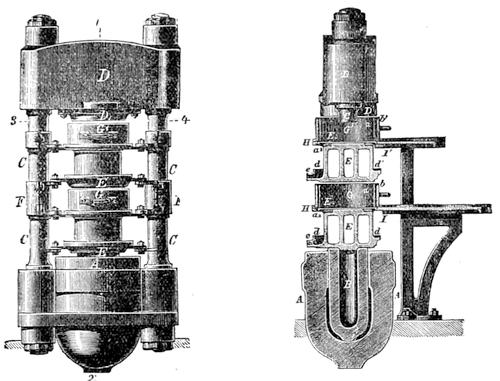
Fig. 7. Fig. 8.
As the piston rises, the troughs E sink into the pots, the
escaping oil collects in the gutters d and thence passes into a
receptacle. After pressing, the piston is allowed to sink back,
the pots G are drawn aside (Fig. 8) to tabular surfaces, and
other pots are substituted for the exhausted ones. These
drop presses are suitable for the extraction of all fixed oils
and also volatile oils present in orange and lemon peel, etc.
Many odors or essential oils possess the remarkable property
that their vapors pass so largely with that of boiling
water that they can be extracted in this way (by “distillation”)
from vegetable substances, though the essential oils
have a boiling-point far above that of water. Distillation can
be employed for a large number of substances; for instance,
the essential oils present in cumin, anise, lavender, fennel,
mace, nutmeg, etc., are extracted exclusively in this manner.
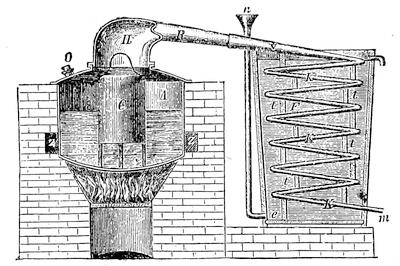
Fig. 9.
For the extraction of odors in this way, according to the
quantities of material to be worked, different apparatuses are
used, some of the most important of which will be here described.
For manufacturers who run without steam and are obliged
to use a naked flame, the adjoining apparatus (Fig. 9) will be
advantageous.
It consists of a copper boiler A, the still, set in a brick
furnace. The latter is so constructed that the incandescent
gases strike not only the curved bottom of the still, but also
its sides through the flues Z left in the brickwork. The still,
whose upper part projects from the furnace, has an opening O
on the left side, closed air-tight with a screw, which serves
for refilling with water during distillation when necessary.
To the margin of the still is fitted steam-tight the helm H,
made of copper or tinned iron, having a prolongation, the
tube R. The latter is joined to the conical projection v
which terminates in the worm K. In some apparatuses this
projection is omitted and the tube immediately joins the
worm. The latter is made of tinned iron and, as the cut
shows, is arranged in coils and supported by props t in the
wooden or metal condenser F. The condenser bears above a
short bent tube b, and below, immediately over the bottom,
an elbow tube e, long enough to reach above the edge of the
condenser, as indicated in the cut.
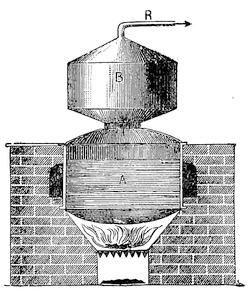
Fig. 10.
The vegetable substances to be distilled can be put immediately
into the still and covered with water; but in this
case it is advisable to use a stirrer which must be kept moving
until the water boils, otherwise
the material might burn
at the bottom. But this accident
can also be prevented by
applying a perforated false
bottom to the still above the
flues, or by inclosing the material
in a wire-sieve basket C.
In place of the basket C
the apparatus can also be provided
with an additional vessel
containing the material to
be distilled. In the still A
(Fig. 10) the water is brought
to boiling, the steam rises through the second still B in which
the material is spread on a perforated bottom. The steam
laden with the vapors of the essential oil passes through the
tube R into the condenser.
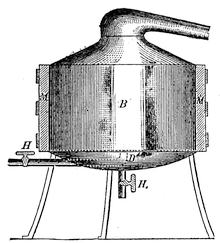
Fig. 11.
It is very advantageous, and in large establishments altogether
indispensable, to use steam in the distillation of essential
oils. Fig. 11 represents the arrangement of such an apparatus.
The still B (which in this case may be made of
stout tinned iron) stands free and is provided with a wooden
jacket M for the purpose of retaining the heat. Immediately
above the curved bottom is a
perforated plate on which the
material rests. The tube D
which enters the bottom of the
still is connected with the boiler
which furnishes steam at moderate
tension. H is the faucet
for the admission of steam; H.
is the faucet by which the water
escapes from the still at the
end of the operation. After the
still is filled with the material,
the faucet H is opened gradually
and a continuous stream of steam is allowed to pass
through the still until the operation is finished.
When working with an open fire, as soon as vapors appear
at the lower end of the worm (Fig. 9), cold water is admitted
through the tube ne; as the cold water abstracts heat from
the vapors and condenses them, it becomes warm, rises to
the surface, and escapes through b, so that the worm is continually
surrounded with cold water. If for any reason the
saving of cold water is an object, its flow may be so regulated
that the vapors are just condensed, the warm distillate being
allowed to cool in the air. When working with steam, the
cold water must be admitted the moment the steam-cock is
opened, and the flow of cold water should be ample during
the distillation, which in this case is much shorter.
The large apparatuses here described are generally used,
especially for the extraction from vegetable substances of
odors present in considerable quantity, for instance, mace,
nutmeg, cloves, cinnamon, etc., or from bulky material as the
various flowers. For very expensive odors, smaller apparatuses
are often employed, the construction of which resembles that
of the ones described. For this purpose small glass apparatuses
are very suitable; they are illustrated in Fig. 12.
The still, a retort A, consists of a spherical vessel with a
bottle neck t which is either closed with a cork or carries a
thermometer or glass tube, and with a lateral tube, the neck
of the retort, connected with the adapter r. The latter passes
into the condenser C. At the lower end of R is the bent
adapter v under which is placed the receptacle for the distillate.
The tube C is closed with corks, at its lower end is
the ascending tube h, and at its upper end the descending tube
g. During the distillation cold water flows in through h
which cools the tube r and escapes at g. The tube C, as will
be readily understood, acts like the condenser in the larger
apparatuses above described. In order to prevent the breaking
of the retort, it is not heated over a flame, but is set in a tin
vessel B filled with water. The comminuted vegetable material
is inserted with water through the up-turned neck of the
retort into the latter; the vessel B is filled with water which
is raised to the boiling-point.
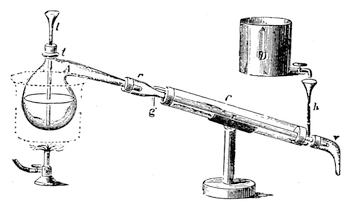
Fig. 12.
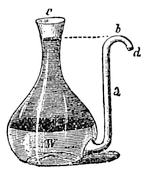
Fig. 13.
During distillation we obtain at the lower end of the condenser
pure water and essential oil. When larger quantities
are to be distilled it is advisable to use a Florentine flask as
a receptacle for the separation of the oil and water (Fig. 13).
It consists of a glass bottle from the bottom
of which ascends a tube curved above; the
latter rises high enough to bring the curvature
slightly below the neck of the flask.
During the distillation the flask becomes
filled with water W, on which floats a layer
of oil O; the excess of water escapes
through a at d until the flask finally contains
more oil and very little water.
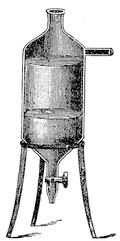
Fig. 14.
When producing essential oils on a large scale, instead of
the frail Florentine flasks it is advisable to use separators, the
construction of which is illustrated in Fig. 14. They consist
of glass cylinders, conical above and below, supported on a
suitable frame. The water accumulating
under the oil is allowed to escape by opening
the stop-cock; when the first separator
is filled with oil, the succeeding distillate
passes through the horizontal tube into the
next separator, etc.
When the distillation is carried on in an
ordinary still, we obtain, besides the essential
oil, a considerable quantity of aromatic
water, that is, a solution of the oil in water.
An apparatus which obviates the losses
caused thereby is that of Schimmel described
below, which is well adapted to
the manufacture on a large scale. The apparatus is patented.
The nearly spherical still D (Fig. 15) is surrounded by a
jacket M; the inlet steam tube R is connected with a branch
r which enters the interior of the still as a spiral tube with
numerous perforations, while R opens into the space M.
When r is opened, distillation takes place by direct steam;
when R is opened, by indirect steam; when both faucets are
opened, the still is heated at the same time with direct and
indirect steam.
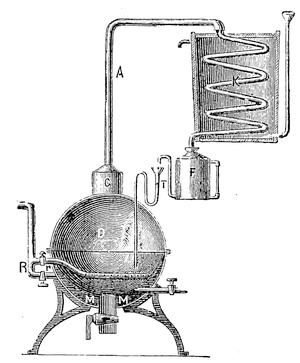
Fig. 15.
The vapors rising from the still D pass through the helm
C and the tube A into the worm K; the fluid condensed in
the latter drops into the tin Florentine flask F, the aromatic
water flowing from the latter passes back into the still D
through the Welter funnel T and is distilled over again, so
that the entire distillation can be effected with very little
water, and it is continued until the water escaping from the
Florentine flask is freed from oil and odorless.
When working with superheated steam, it is necessary to
set under the funnel tube T a vessel twice the size of the
Florentine flask, which is provided with a stop-cock above
and below. The lower cock is closed, the vessel is allowed to
fill with water from F, then the upper cock is closed, the contents
being allowed to escape into D by opening, when the
cocks are again reversed.
The use of superheated steam is important especially with
material which gives up the contained oil with difficulty, such
as woods.
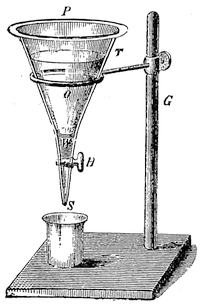
Fig. 16.
For freeing the essential oil completely from water we use
a so-called separating funnel (Fig.
16). This consists of a glass funnel
T resting on a suitable support G,
which is closed above with a glass
plate ground to fit, drawn out below
into a fine point S, and provided
with a glass stop-cock H. The contents
of the Florentine flask are
poured into the funnel which is covered
with the glass plate and allowed
to stand at rest until the layer of
oil O is clearly separated from the
water W. By careful opening of the
stop-cock the water is allowed to escape
and the oil is immediately filled into bottles which are
closed air tight and preserved in a cool and dark place.
Some odors, like those of cassie, rose, reseda, syringa, jasmine,
violets, and many other fragrant blossoms, cannot be
obtained by distillation as completely or as sweet-scented as
by the process of maceration which is in general use among
the large perfumers in southern France. This process is
based on the property of fats to absorb odorous substances
with avidity and to yield them almost entirely to strong alcohol.
According to the fat employed for the maceration of
the flowers—a solid fat like lard or a liquid like olive oil—odorous
products are obtained which are known either as
pomades or as perfumed oils (huiles antiques). By repeatedly
treating fresh flowers with the same fat the manufacturer is
able to perfume the pomade or oil at will, and in the factories
these varying strengths are designated by numbers; the
higher numbers indicating the stronger products.
The process of maceration is very simple. The fat is put
into porcelain or enamelled iron pots which are heated, in a
shallow vessel filled with water, to 40 or at most 50° C. (104-122°
F.); the flowers are inclosed in small bags of fine linen
and hung into the fat, where they are allowed to remain for
from one-half to two days. At the end of that time the bags
are removed, drained, expressed, refilled with fresh flowers,
and replaced in the fat. This procedure is repeated twelve
to sixteen times or oftener, thus producing pomades or oils
of varying fragrance.
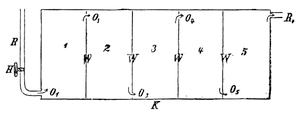
Fig. 17.
As the odors are much superior when the flowers are only
a short time in contact with the fat, it is better to use an apparatus
for continuous operation (Fig. 17). It consists of a
box K made of tin plate, which is divided into from five to
ten compartments by vertical septa and can be closed water
tight by a lid to be screwed on. The septa have alternate
upper and lower openings. The compartments contain each
a basket of tinned wire filled with the flowers for maceration,
then the lid is closed and the box heated in a water bath to
40 or 50° C. (104-122° F.). The stop-cock H in tube R is
now opened. This admits melted fat or oil from a vessel
above to the first compartment in which it rises through the
basket filled with flowers whose odor it abstracts. The additional
fat coming from above drives it over through the opening
O2 into compartment 2, where it comes in contact with
fresh flowers, passes through O3 into the third compartment,
and so on through 4 and 5, until it finally escapes through R1
well charged with odor. According to requirements a larger
number of compartments may be employed.
When all the fat has passed through the apparatus, it is
opened, the basket is removed from compartment 1, the basket
from No. 2 is placed in 1, that from 3 in 2, etc.; basket 1
is emptied, filled with fresh flowers, and placed in compartment
5, so that every basket gradually passes through all
compartments to No. 1. In this way the fat rapidly absorbs
all the odor.
The odorous substances are abstracted from the pomades
or huiles antiques by treatment with strong alcohol (90-95%)
which dissolves the essential oils but not the fats. The huiles
antiques with the alcohol are placed in large glass bottles and
frequently shaken. In order to abstract the odors from
pomades, the latter are allowed to congeal and are divided
into small pieces which are inserted into the bottles of alcohol.
A better plan is to fill the pomades into a tin cylinder
with a narrow opening in front and to express the pomades,
by a well-fitting piston, in the shape of a thin thread which
thus presents a large surface to the action of the alcohol, thus
hastening the absorption of the odor. The alcoholic solution
obtained after some weeks is then distilled off at a low temperature.
We shall recur to this hereafter.
No matter how long the fats are left in contact with alcohol,
they do not yield up to it all the odor, but retain a small
portion of it and hence have a very fragrant smell. They
are, therefore, brought into commerce as perfumed oils or
pomades bearing the name of the odorous substance they
contain: orange flower, reseda pomade or oil, etc.; they are
highly prized and are sometimes used again for the extraction
of the same odor.
Some odors cannot bear even the slight rise of temperature
necessary for their extraction by the method of maceration
or infusion. For these delicate odors one of the following
methods may be employed.
In this method the absorbing power of fat is likewise used
for retaining the odors, but the flowers are treated with the
fat at ordinary temperatures. This procedure which is employed
especially in southern France is carried out as follows.
The fat (lard) is spread to a thickness of about one-quarter
inch on glass plates G one yard long and two feet wide, which
are inserted in wooden frames R and sprinkled with flowers
F (Fig. 18). The frames are superimposed (the cut shows two
of the frames) and left for from one to three days, when fresh
flowers are substituted for the wilted ones, and so on until
the pomade has attained the desired strength.
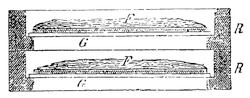
Fig. 18.
This procedure is very cumbrous and tedious and therefore
had better be modified thus: In an air-tight box K (Fig.
19) we place a larger number of glass plates g covered with
lard drawn into fine threads by means of a syringe. This box
is connected with a smaller one K1 which is filled with fresh
flowers and provided with openings below and above, O and
O1. The latter, O1 communicates by a tube with box K, at
whose upper end is a tube e terminating in an exhaust fan so
that the air must pass through the apparatus in the direction
indicated by the arrows. A small fan V driven by clockwork
will answer. The air drawn from K1 is laden with odors and
in passing over the fat as shown by the arrows gives them up
completely to the fat. The use of this apparatus has very
important advantages: the absorption is effected rapidly, requires
little power, and the flowers do not come at all into
contact with the fat which therefore can take up nothing but
the odors present in the air.
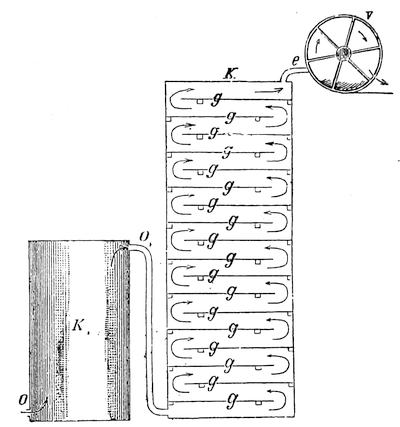
Fig. 19.
Instead of charging the fat with odors by either one of
the methods here described, carbonic acid can also be employed
with advantage, by means of the apparatus illustrated in Fig.
20. The large glass vessel G contains pieces of white marble
M upon which hydrochloric acid is poured at intervals
through the funnel tube R. A current of carbonic acid is
thus developed, which passes through a wash bottle W filled
with water, then through the tin vessel B containing fresh
flowers, and finally into a bottle A filled with strong alcohol
and set in cold water, after which it escapes through the tube
e. The carbonic acid absorbs the aromatic vapors from B
and leaves them in the alcohol which absorbs them. (G, R,
W are made of glass, B of tin.)
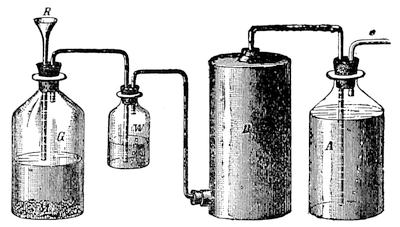
Fig. 20.
This method is based on the fact that some volatile liquids
such as ether, chloroform, petroleum ether, or bisulphide of
carbon possess the property of rapidly extracting the aromatic
substances from flowers; when they are evaporated at
a gentle heat they leave the pure odors behind. In our opinion
this process is the best of all for the perfumer and it is to
be regretted that it is not more generally used.
As a rule we employ either petroleum ether or bisulphide
of carbon (see above, pp. 65, 66) because these products are
cheaper than ether or chloroform.
The apparatus we use for this purpose is illustrated in
Fig. 21. It consists of a cylinder C made of tinned iron,
which is provided above with a circular gutter R terminating
in a stop-cock h and which can be closed by a lid D bearing
a stop-cock o. A tube b with a stop-cock a enters the bottom
of the cylinder. The latter is filled with the flowers, the volatile
liquid (petroleum ether, bisulphide of carbon, etc.) is
poured over them, the lid is put on, and the gutter R filled
with water, thereby sealing the contents of the vessel hermetically.
After the extraction, which requires about thirty to forty
minutes, stop-cock o is opened first, then stop-cock a, and the
liquid is allowed to escape into the retort of the still (Fig. 12).
If the extraction is to be repeated, the water is allowed to
escape from the gutter through h, the lid is opened, and the
solvent is again poured over the flowers.
For operation on a larger scale the glass retorts are too
small and should be replaced by tin vessels (Fig. 22) having
the form of a wide-mouthed bottle F; they are closed by a
lid D which is rendered air tight by being clamped upon the
flange of the vessel (R) with iron screws S, a pasteboard
washer being interposed; a curved glass tube connects the
apparatus with the condenser of Fig. 12.
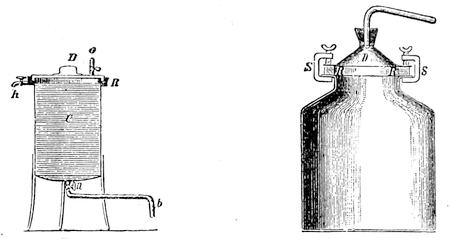
Fig. 21.
Fig. 22.
The solutions of the aromatic substances are evaporated
in these apparatuses at the lowest possible temperature, the
solvent being condensed and used over again. The heat required
is for ether about 36° C. (97° F.), for chloroform about
65° C. (149° F.), for petroleum ether about 56° C. (133° F.),
and for bisulphide of carbon about 45° C. (113° F.). If it is desired
to obtain the aromatic substances pure from an alcoholic
extract of the pomades made by one of the above-described
processes—which is rarely done since these solutions are generally
used as such for perfumes—a heat of 75 to 80 C.
(167 to 176° F.) is required.
Another extraction apparatus illustrated in Fig. 23 is
well adapted to operations on a large scale. Its main parts
are the extractor E and the still B. The former is set in a
vat W continually supplied with cold water. The still B is
surrounded with hot water in the boiler K.
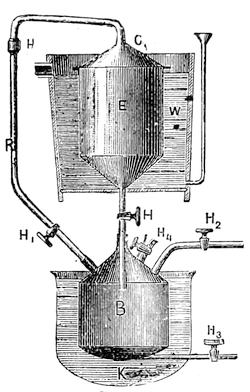
Fig. 23.
To start the apparatus the cone C is removed, the vessel
E is filled with the material to
be extracted, and C is replaced.
The faucets H2 and H4 are opened,
the solvent is poured into the
still through the latter, when
these faucets are closed and
those marked H and H1 are
opened.
The water in K is heated
until the contents of B are in
brisk ebullition; the vapor rises
through RH, is condensed on
entering E and falls in small
drops on the material. This fine
rain of the solvent dissolves the
aromatic substances and flows back into B, where it is again
evaporated, and so on.
At the end of the extraction the faucets H and H1 are
closed and H2, is opened. The vapors of the solvent pass
through it into a worm where they are condensed; the essential
oil remaining in B is drained off by opening H3.
For still larger operations more perfect apparatuses are
employed, such as those of Seiffert and Vohl. Seiffert’s apparatus
(Fig. 24) consists of a battery of jacketed cylinders;
steam circulates in the space between the cylinders and the
jackets. Each cylinder contains a plate covered with a wire
net on which the flowers to be extracted are placed. All the
cylinders having been filled and closed, the solvent is admitted
from a container above, through S and a into C2; when this
is filled the liquid flows through a2b3cn into C. The solution
saturated with essential oil leaves the apparatus through dn
and p and enters a reservoir. The course of the liquid is
aided by the suction of an air-pump acting on p.
When the reservoir contains an amount of fluid equal to
that in Cn, dn is closed, an is opened, and C connected with
C1 through bn and c1. That the contents of C2 are completely
extracted is shown by the fact that the liquid appears colorless
in the glass tube inserted in b2; a1 and C2 are closed; a2
and C3 are opened, thereby excluding C2 from the current of
bisulphide of carbon which then flows through C3CnC1. In
order to permit the free flow of the bisulphide of carbon
through S despite the exclusion of C2, the faucets a1a2a3an
must be two-way cocks; in one position they connect S with b;
in the other they close b and leave the passage through S
open.
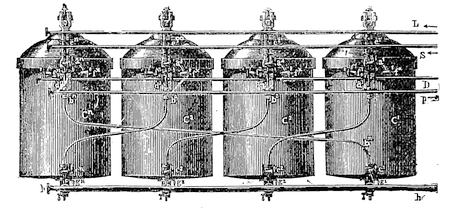
Fig. 24.
In order to collect the bisulphide of carbon present in the
extracted residue in C2, faucet g2 is opened and the bisulphide
of carbon allowed to escape through h. The faucet e2 in tube
L on being opened admits compressed air to C2, thus hastening
the outflow. If nothing escapes below, faucets f2 and fx
are opened, steam enters through tube D between jacket and
cylinder; the bisulphide of carbon vapor passes through g2
and h into the worm. After the expulsion of the bisulphide
of carbon, C3 is emptied, refilled, connected with C1, and bisulphide
of carbon admitted from C3 in the manner above
described.
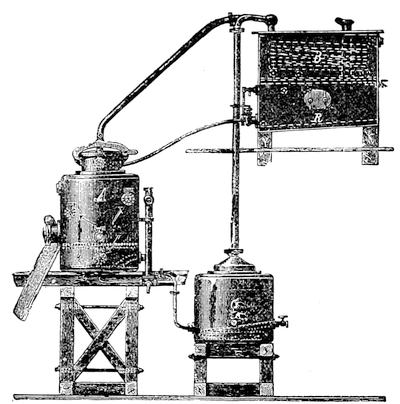
Fig. 25.
An extraction apparatus which has been much recommended
of late is the so-called “Excelsior Apparatus” made
by Wegelin and Huebner, Halle a. S., which can be worked
with any desired solvent. The construction of the apparatus
(Figs. 25 and 26) is as follows.
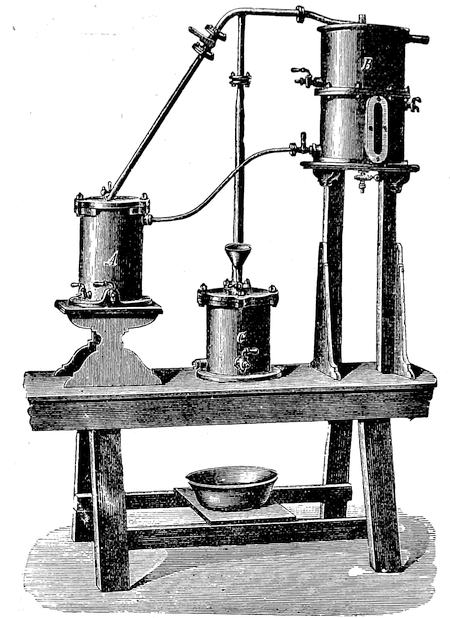
Fig. 26.
The solvent is admitted to the reservoir R in the lower
part of the condenser B through the tube indicated in the
figure. The material to be extracted having been filled into
the cylinder A through the manhole, the apparatus is closed.
The cold water is admitted to the condenser by opening a
faucet. The three-way cock shown in Fig. 25 is so placed as
to open a communication of the overflow tube with A. The
faucet at the lower end of the reservoir R is now opened sufficiently
and the solvent passes into A from above, and as it
descends takes up more and more oil, flows through the sieve-plate,
and escapes through the tube at the bottom of A
through the three-way cock, the overflow tube, and the drain
tube into the accumulator C. The opening of a faucet now
admits steam to the heating coil, when the solvent evaporates,
leaving the oil or fat behind. It is condensed in B, again
returns to R, whence it passes once more through the faucet
into the extractor A. The vessel C and the tubes leading to
A and C are surrounded with felt to prevent loss of heat. A
sample taken from the small cock at the foot of A (it has a
small plate in the interior of the tube) will show when the extraction
in A may be looked upon as finished. The solvent
is distilled off or recovered from the residue in A in the following
manner. First the faucet in R is closed. The three-way
cock A is set to establish direct communication between
A and C, thus cutting off the overflow tube. Hence all the
solvent in A flows into C for distillation, while the oil is left
behind. Steam being admitted to the residue, the solvent
rises as vapor through the upper tube from A to B and collects
in a liquid state in R. To drive off the last traces of
the solvent from the fat or oil obtained, steam is blown into
C by opening the valve. Besides the solvent, watery vapor
enters B and forms a layer of water in R under the solvent.
By taking a sample from the test-cock of the reservoir C
which has an internal small plate, the termination of the process
is ascertained. The gauge tube at the reservoir shows
the level of the solvent and water. The water is drawn off
by opening the faucet at the lower end of the reservoir. A
is emptied through the manhole and by draining the oil from
C through the discharge cock. The tube R is closed by a
light valve so as to prevent evaporation of the solvent. All
the apparatuses work without pressure so that there is no
danger from overstrain.
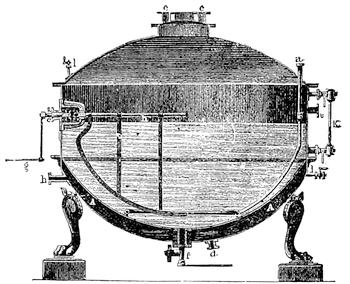
Fig. 27.
The solutions of the essential oils in bisulphide of carbon
are distilled off in the steam still illustrated in Fig. 27; the
steam enters at h, the water of condensation escapes at d, the
liquid to be distilled enters at e from a container at a higher
level. The boiling is kept uniform by the stirring arrangement
hg. After the bisulphide of carbon is distilled off, air is passed
through the oil by the curved tube a which has fine perforations,
so as to evaporate the last traces of the solvent.
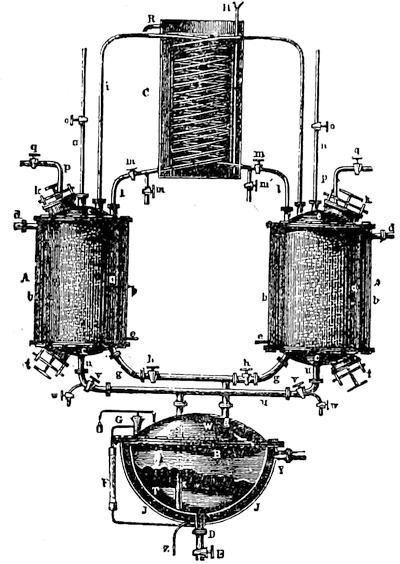
Fig. 28.
In Vohl’s apparatus (Fig. 28), arranged for petroleum
ether, the extraction is effected with the boiling fluid; hence
this apparatus is better adapted for the cheaper oils than for
the finest oils from flowers. The apparatus consists of two
extractors A A, the accumulator B, and the condenser C. Petroleum
ether is allowed to flow over the substances to be extracted,
by opening the faucets mm, vh, closing ogwE, and
opening o, the course being through ux to B. When B is
two-thirds full, the flow of petroleum ether is cut off, steam
is admitted through y and the contents of B are brought to
the boiling-point. The vapors pass through g and are condensed
in f until the contents of A reach the boiling-point of
the solvent, when the vapors pass through i into C, and after
closing m´ the liquid passes through ml into the inner cylinder
of the extraction apparatus and returns through uxx.
Fig. 29.
After the contents of A are extracted, m´ is opened, m
closed, and steam is admitted through d into the jacket of A;
the vapors of the solvent force the liquid part of the contents
through ux into B. Overfilling of B is prevented by allowing
the vapors of the solvent to escape at the
proper time into the condenser through
p by opening q. Then v is closed, q
opened, and the steam present in A
drawn off by an exhaust applied to p;
as soon as p begins to cool, all the petroleum
ether is distilled off, the steam is
cut off at d, and the extract evacuated
through t. The contents of B are brought
into a still through D and E.
By employing greater pressure the extraction
can also be effected by what is
called displacement; the material to be
extracted is placed in a stout-walled vessel
S (Fig. 29) which is connected by a
narrow tube at least ten yards long with the vessel F containing
the solvent. Stopcock H is first opened, then stop-cock
H1 which is closed as soon as fluid begins to flow from
it. After the liquid has remained in contact with the material
for from thirty to sixty minutes, H1 is opened very
slowly, the liquid is allowed to escape and is displaced with
water which is made to pass out of F in the same way as the
solvent, until the latter is completely displaced from S.
After the solvent has been distilled off, the less volatile
essential oil remains in the still almost pure, containing only
traces of wax, vegetable fat or coloring matter which are of
no consequence for our purposes. The last remnants of the
solvent cannot be expelled by distillation, but by forcing
through the essential oil a current of pure air for fifteen or
twenty minutes. The essential oils then are of the purest,
unexceptionable quality.
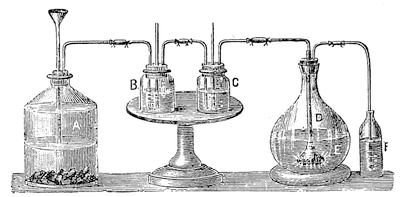
Fig. 30.
In the case of delicate oils it is better to use carbonic acid
in place of air for expelling the last traces of the solvent, as
the oxygen may impair the delicacy of the fragrance. For
this purpose we use the apparatus illustrated in Fig. 30. In
the large bottle A carbonic acid is generated by pouring
hydrochloric acid over fragments of white marble. The carbonic
acid passes into the vessel B filled with water which
frees it from any adhering drops of hydrochloric acid; then
into C filled with sulphuric acid to which it yields its water
so that only pure carbonic acid escapes through the fine rose
at the end of tube D which is made of pure tin, and as it
passes through the oil in E it carries off the last traces of the
volatile solvent. In its final passage through the water in
F it leaves behind any oil that may have been carried with it.
As all the aromatic substances change in air by the gradual
absorption of oxygen, and lose their odor—become resinified—these
costly substances must be put into small bottles
which they completely fill, and be preserved in a cool dark
place, as light and heat favor resinification. The bottles must
be closed with well-fitting glass stoppers.
Aromatic waters or eaux aromatisées, such as jasmine
water (eau de jasmin), orange-flower water (eau de fleurs
d’oranges, eau triple de Néroli, aqua naphæ triplex), etc., are
made by distillation of these flowers with water and show a
faint but very fine odor. When they contain, besides, dilute
alcohol they are called spirituous waters or esprits. Those
brought into commerce from southern France are of excellent
quality.
The quantities of essential oil obtainable from the vegetable
substances vary with the amount present in each. The
following table shows the average quantities of oil to be obtained
from 100 parts of material.
| Material. |
Name of Plant. |
Mean Yield
per 100 Parts. |
| Ajowan seed |
Ptychotis Ajowan |
3·000 |
| Alant root |
Inula Helenium |
0·600 |
| Allspice |
Myrtus Pimenta |
3·500 |
| Almonds, bitter |
Amygdala amara |
0·400-0·700 |
| Angelica seed |
Archangelica officinalis |
1·150 |
| Angelica root, Thuring. |
Archangelica officinalis |
0·750 |
| Angelica root, Saxon |
Archangelica officinalis |
1·000 |
| Anise seed, Russian |
Pimpinella Anisum |
2·800 |
| Anise seed, Thuring. |
Pimpinella Anisum |
2·400 |
| Anise seed, Morav. |
Pimpinella Anisum |
2·600 |
| Anise seed, Chili |
Pimpinella Anisum |
2·400 |
| Anise seed, Spanish |
Pimpinella Anisum |
3·000 |
| Anise seed, Levant |
Pimpinella Anisum |
1·300 |
| Anise chaff |
Pimpinella Anisum |
0·666 |
| Arnica flowers |
Arnica montana |
0·040 |
| Arnica root |
Arnica montana |
1·100 |
| Asafœtida |
Ferula Asafœtida |
3·250 |
| Avens root |
Geum urbanum |
0·040 |
| Basilicum herb, fresh |
Ocymum basilicum |
0·040 |
| Bay leaves |
Pimenta acris |
2·300-2·600 |
| Bear’s berry |
Uva ursi |
1·010 |
| Beech tar |
Betula alba |
20·000 |
| Bergamots |
|
ab. 3·400 |
| Betel leaves |
Piper Betle |
0·550 |
| Bitter almond meal |
Amygdala amara |
0·950 |
| Buchu leaves |
Barosma crenulata |
2·600 |
| Butter-bur oil |
Tussilago Petasites |
0·056 |
| Calamus root |
Acorus Calamus |
2·800 |
| Camomile, German |
Matricaria Chamomilla |
4·000-6·000 |
| Camomile, Roman |
Anthemis nobilis |
3·000 |
| Caraway seed, |
| Cult. German |
Carum Carvi |
4·000 |
| Cult. Dutch |
Carum Carvi |
5·500 |
| Cult. East Prussian |
Carum Carvi |
5·000 |
| Cult. Moravian |
Carum Carvi |
5·000 |
| Wild German |
Carum Carvi |
6·000-7·000 |
| Wild Norwegian |
Carum Carvi |
6·000-6·500 |
| Wild Russian |
Carum Carvi |
3·000 |
| Cardamoms, Ceylon |
Elettaria Cardamomum |
4·250 |
| Cardamoms, Madras |
Elettaria Cardamomum |
4·300 |
| Cardamoms, Malabar |
Elettaria Cardamomum |
1·750 |
| Cardamoms, Siam |
Elettaria Cardamomum |
1·350 |
| Carrot seed |
Daucus Carota |
1·650 |
| Cascarilla bark |
Croton Eluteria |
1·500 |
| Cassia flowers |
Cinnamomum Cassia |
3·500 |
| Cassia wood |
Cinnamomum Cassia |
0·285 |
| Cedar wood |
Juniperus virginianus |
0·700-1·000 |
| Celery herb |
Apium graveolens |
0·200 |
| Celery seed |
Apium graveolens |
0·300 |
| Chekan leaves |
Myrtus Chekan |
1·000 |
| Cinnamon, Ceylon |
Cinnamomum zeylanicum |
0·900-1·250 |
| Cinnamon, white |
Canella alba |
1·000 |
| Cloves, Amboina |
Caryophyllus aromaticus |
19·000 |
| Cloves, Bourbon |
Caryophyllus aromaticus |
18·000 |
| Cloves, Zanzibar |
Caryophyllus aromaticus |
17·500 |
| Cloves, stems |
Caryophyllus aromaticus |
6·000 |
| Common wormwood herb |
Artemisia Abrotanum |
0.040 |
| Common wormwood root |
Artemisia Abrotanum |
0·100 |
| Copaiva balsam, Para |
Copaifera officinalis |
45·000 |
| Copaiva balsam, East Ind. |
Dipterocarpus turbinatus |
65·000 |
| Coriander seed, |
| Thuringian |
Coriandrum sativum |
0·800 |
| Russian |
Coriandrum sativum |
0·900 |
| Dutch |
Coriandrum sativum |
0·600 |
| East Indian |
Coriandrum sativum |
0·150 |
| Italian |
Coriandrum sativum |
0·700 |
| Mogadore |
Coriandrum sativum |
0·600 |
| Crisp mint herb |
Mentha crispa |
1·000 |
| Cubebs |
Piper Cubeba |
12·000-16·000 |
| Culilaban bark |
Laurus Culilavan |
3·400 |
| Cumin seed, Mogadore |
Cuminum Cyminum |
3·000 |
| Cumin seed, Maltese |
Cuminum Cyminum |
3·900 |
| Cumin seed, Syrian |
Cuminum Cyminum |
4·200 |
| Cumin seed, East Indian |
Cuminum Cyminum |
2·250 |
| Curcuma root |
Curcuma longa |
5·200 |
| Dill seed, German |
Anethum graveolens |
3·800 |
| Dill seed, Russian |
Anethum graveolens |
4·000 |
| Dill seed, East Indian |
Anethum Sowa |
2·000 |
| Elder flowers |
Sambucus niger |
0·025 |
| Elemi resin |
Icica Abilo |
17·000 |
| Eucalyptus leaves, dry |
Eucalyptus globulus |
3·000 |
| Fennel seed, |
| Saxon |
Foeniculum vulgare |
5·000-5·600 |
| Galician |
Foeniculum vulgare |
6·000 |
| East Indian |
Foeniculum Panmorium |
2·200 |
| Galanga root |
Alpinia Galanga |
0·750 |
| Galbanum resin |
Galbanum officinale |
6·500 |
| Geranium |
Pelargonium odoratissimum |
0·115 |
| Ginger root, |
| African |
Zingiber officinale |
2·600 |
| Bengal |
Zingiber officinale |
2·000 |
| Japan |
Zingiber officinale |
1·800 |
| Cochin China |
Zingiber officinale |
1·900 |
| Hazel root |
Asarum europæum |
1·100 |
| Heracleum seed |
Heracleum Sphondylium |
1·000 |
| Hop flowers |
Humulus Lupulus |
0·700 |
| Hop meal, lupulin |
Humulus Lupulus |
2·250 |
| Hyssop herb |
Hyssopa officinalis |
0·400 |
| Iva herb |
Iva moschata |
0·400 |
| Juniper berries, |
| German |
Juniperus communis |
0·500-0·700 |
| Italian |
Juniperus communis |
1·100-1·200 |
| Hungarian |
Juniperus communis |
1·000-1·100 |
| Laurel berries |
Laurus nobilis |
1·000 |
| Laurel leaves |
Laurus nobilis |
2·400 |
| Laurel, Californian |
Oreodaphne californica |
7·600 |
| Lavender flowers, |
| German |
Lavandula vera |
2·900 |
| Linaloe wood |
Elaphrium graveolens |
5·000 |
| Lovage root |
Levisticum officinale |
0·600 |
| Mace |
Myristica fragrans |
11·000-16·000 |
| Marjoram herb, fresh |
Origanum Majorana |
0·350 |
| Marjoram herb, dry |
Origanum Majorana |
0·900 |
| Marsh-rosemary oil |
Ledum palustre |
0·350 |
| Massoy bark |
Massoia aromatica |
| Masterwort root |
Imperatoria Ostruthium |
0·800 |
| Matico leaves |
Piper angustifolium |
2·400 |
| Matricaria herb |
Matricaria Parthenium |
0·030 |
| Melissa herb |
Melissa officinalis |
0·100 |
| Michelia bark |
Michelia nilagirica |
0·300 |
| Milfoil herb |
Achillea Millefolium |
0·080 |
| Musk seed |
Hibiscus Abelmoschus |
0·200 |
| Mustard seed, |
| Dutch |
Sinapis nigra |
0·850 |
| German |
Sinapis nigra |
0·750 |
| East Indian |
Sinapis nigra |
0·590 |
| Pugliese |
Sinapis nigra |
0·750 |
| Russian |
Sinapis juncea |
0·500 |
|
| Myrrh |
Balsamodendron Myrrha |
2·500-6·500 |
| Myrtle |
Myrtus communis |
0·275 |
| Nigella seed |
Nigella sativa |
0·300 |
| Nutmegs |
Myristica fragrans |
8·000-10·000 |
| Olibanum resin |
Boswellia, var. spec |
6·300 |
| Opoponax resin |
Pastinaca Opoponax |
6·500 |
| Orange peel, sweet |
Citrus Aurantium |
2·500 |
| Orris root |
Iris florentina |
0·200 |
| Parsley herb |
Apium Petroselinum |
0·300 |
| Parsley seed |
Apium Petroselinum |
3·000 |
| Parsnip seed |
Pastinaca sativa |
2·400 |
| Patchouly herb |
Pogostemon Patchouly |
1·500-4·000 |
| Peach kernels |
Amygdalus persica |
0·800-1·000 |
| Pellitory root |
Valeriana celtia |
1·000 |
| Pepper, black |
Piper nigrum |
2·200 |
| Peppermint, fresh |
Mentha piperita |
0·300 |
| Peppermint, dry |
Mentha piperita |
1·000-1·250 |
| Peru balsam |
Toluifera Pereiræ |
0·400 |
| Pimpernel root |
Pimpinella saxifraga |
0·025 |
| Poplar sprouts |
Populus niger |
0·500 |
| Rhodium wood |
Convolvulus Scoparius |
0·050 |
| Rose flowers, fresh |
Rosa centifolia |
0·050 |
| Rosemary |
Rosmarinus officinalis |
1·550 |
| Rue herb |
Ruta graveolens |
0·180 |
| Sage herb, German |
Salvia officinalis |
1·400 |
| Sage herb, Italian |
Salvia officinalis |
1·700 |
| Santal wood, |
| East Indian |
Santalum album |
4·500 |
| Macassar |
Santalum album |
2·500 |
| West Indian |
Unknown |
2·700 |
| Sassafras wood |
Sassafras officinalis |
2·600 |
| Savin herb |
Juniperus Sabina |
3·750 |
| Snakeroot, Canadian |
Asarum canadense |
2·800-3·250 |
| Snakeroot, Virginian |
Aristolochia Serpentaria |
2·000 |
| Star-anise, Chinese |
Illicium anisatum |
5·000 |
| Star-anise, Japanese |
Illicium religiosum |
1·000 |
| Storax |
Liquidambar orientalis |
1·000 |
| Sumbul root |
Ferula Sumbul |
0·300 |
| Tansy herb |
Tanacetum vulgare |
0·150 |
| Thyme |
Thymus Serpyllum |
0·200 |
| Thyme dry |
Thymus Serpyllum |
0·100 |
| Valerian root, German |
Valeriana officinalis |
0·950 |
| Valerian root, Dutch |
Valeriana officinalis |
1·000 |
| Valerian root, Japan |
Patrinia scabiosæfolia |
| Vetiver root |
Andropogon muricatus |
0·200-0·350 |
| Violet flowers |
Viola odorata |
0·030 |
| Water-yarrow seed |
Phellandrium aquaticum |
1·300 |
| Wintersweet marjoram |
Origanum creticum |
3·500 |
| Worm seed |
Artemisia maritima |
2·000 |
| Wormwood herb |
Artemisia Absinthium |
0·300-0·400 |
| Zedoary root |
Curcuma Zedoaria |
1·300 |
Fresh flowers as a rule contain more aromatic material
than wilted ones; the yield of dried herbs, leaves, etc., is usually
greater than that of the fresh, because the latter contain
much water which is lost in drying. When such vegetable
materials cannot be worked fresh, which is best, they should
be completely dried, spread on boards, at a moderate temperature
in the shade and preserved in dry airy rooms, special
care being had to guard against mould.
In a preceding chapter on the chemical properties of the
vegetable substances many of their characteristics have been
described. In this place we need only describe the physical
properties of the essential oils, and with some of them to lay
stress on those peculiarities by which they are specially differentiated.
This knowledge is of the greatest importance to
the manufacturer of perfumery because no single individual is
in a position to prepare all aromatic substances himself, but
must rely on commerce for some of them; and in no group
of chemicals is adulteration as frequent and as difficult of demonstration
as among the aromatics. These adulterations
are carried so far that many essential oils occurring in commerce
under certain names often have nothing in common
with the substance for which they are sold but the name.
The oil of Acacia farnesiana is greenish-yellow and viscid;
the density and boiling-point, which are of the greatest importance
with reference to the genuineness of an essential oil,
are not yet accurately known. Moreover, this oil never
occurs in commerce as such, but its odor is present in perfumes,
fixed oils, and pomades.
should be colorless or faintly yellow; a dark yellow color indicates
old and inferior quality. The characteristics of this oil
are the odor, its aromatic sweet taste, and especially the property
of solidifying at a comparatively high temperature, 10-15°
C. (50-59° F.), which is due to the separation of a stearopten,
anethol. Oil of anise is frequently adulterated with or
replaced by oil of star-anise. The easy solidification of the
oil of anise is not always proof of its good quality, for the oil
from anise chaff, which congeals at a still higher temperature,
is sometimes mixed with it, and this has a less fine odor than
that distilled from the seed. One part by weight of oil of
anise is soluble in an equal weight of alcohol of 94%.
has a pale yellow color which becomes greenish when the oil
is kept in copper vessels, and a strong agreeable odor. This
oil requires the greatest care in its preservation, as it abstracts
oxygen from the air with extreme rapidity, when it changes
its superior odor so that it can hardly be distinguished from
oil of turpentine.
when pure, is a colorless, refractive liquid which is heavier
than water. The vessels in which this product is preserved
must be stoppered air-tight, for in the air the oil very quickly
changes into a white, odorless mass of crystals consisting of
benzoic acid.
Oil of bitter almond is formed by the action of the amygdalin
upon the emulsin present in the fruit, bitter-almond
meal being deprived of fat and left in contact with water for
some hours at from 40-45° C. (104-113° F.). Besides oil of
bitter almond, sugar and prussic acid are likewise formed.
The crude oil distilled from the meal is freed from the prussic
acid by agitation with ferrous chloride and lime-water, and
redistillation.
has usually a greenish color, and has a burning, camphoraceous
and at the same time cooling taste. It has a peculiar
odor resembling that of camphor and rosemary.
This oil, which is very viscid and of a yellow or reddish
color, must usually be mixed with other essential oils in order
to furnish pleasant perfumes.
Oil of chamomile, from Matricaria Chamomilla (common
chamomile), which is specially characterized by its magnificent
dark-blue color, has a marked narcotic odor and is very
high-priced, owing to the small yield of oil by the flowers.
The oil from Anthemis nobilis (Roman chamomile) has also a
blue color which gradually becomes greenish-yellow.
This essential oil differs from the others mainly by being
firm and crystalline at ordinary temperatures. Chinese or
Japanese camphor melts at 175° C. (347° F.) and boils at 205°
C. (401° F.). Camphor is seldom used alone, as its odor is
hardly fragrant; but it finds frequent application in the preparation
of mouth washes, toilet vinegars, etc. In commerce
so-called Borneo camphor is also met with (though rarely),
which closely resembles the Chinese in appearance and other
qualities, but is more friable and melts at 189° C. (388·4° F.).
is not used pure in perfumery, the bark being generally employed
instead.
has a yellow color, gradually becoming dark reddish-brown, and
an odor resembling that of oil of cinnamon, but the odor is not
so fine, nor so strong, as that of the latter. The taste of the
oil is of special importance: while that of true oil of cinnamon
is burning though sweet, oil of cassia has a sharper
taste, and this taste is considered by some a good mark of
recognition of the rather common adulteration of true oil of
cinnamon which is much more costly.
This oil, obtained from the wood of the Juniperus virginiana
(not from the true cedar, Cedrus Libani), is clear like
water, has a pleasant odor, and differs from most essential oils
by congealing at a very low temperature (-22° C. or-8° F.)
and by its uncommon resinification in contact with air.
Oil of citron is usually merely a synonym for “oil of
lemon.” But in perfumery it has been customary to designate
the oil of lemon which was extracted by the écuelle process,
as “oil of citron-zeste” or “oil of citron,” while “oil of lemon”
meant the distilled oil. Since there is no difficulty at the
present time in obtaining all the hand-pressed oil that may be
required, and of the finest quality, there is no longer any necessity
for making the before-mentioned distinction.
is one of the most important essential oils for the perfumer
as well as the manufacturer of liqueurs, confectioner, etc. The
oil is pale yellow, and of a very strong refreshing odor which
it loses rapidly in contact with the air, when it acquires a disagreeable
odor of turpentine and gradually resinifies. This
change is particularly marked under the influence of light.
Its spec. grav. is 0·850 at 20° C. (68° F.). It is soluble in an
equal volume of strong alcohol or glacial acetic acid. The
hand-pressed oil has a much finer aroma than that obtained
by distillation.
This oil is hardly ever made in Europe, since it is imported
in excellent quality and at low prices from India and
especially the island of Ceylon. (See above, p. 29.)
This oil, which is imported in considerable quantities from
India (chiefly Ceylon), is colorless and possesses a very pleasant
odor of lemon which at the same time recalls that of roses
and still more that of geranium, which is not rarely adulterated
with it. (See above, p. 33.)
has a pale yellow color and a burning, sharp, aromatic taste.
Like oil of cubebs (oleum cubebæ), oil of dill (oleum anethi), and
oil of fennel (oleum fœniculi) which latter also has a rather
low congealing point (-8° C. or +17° F.), this oil is used less
in perfumery than for scenting soap and in the manufacture of
liqueurs. But it should be noted that these oils, as well as
those of bergamot, caraway, star-anise, and some others, could
well be employed for cheap perfumes and for scenting soap.
Oil of dill also finds application alone in the preparation of
some face washes, and the dried fennel herb in cheap sachets.
can be made at slight cost from the flowers, as the raw material
is obtainable without much trouble; it forms a yellow,
strong-scented oil. In perfumery, however, use is generally
made only of the pomade made from the fresh flowers or the
alcoholic extract prepared from it. Or else the odor is imitated
by means of terpineol, which is now on the market
under the name of lilacin.
It is necessary to distinguish clearly between oil of true
geranium distilled in Southern France and Algiers from species
of Pelargonium; and Turkish oil of geranium, also known as
Palmarosa oil, oil of geranium grass, oil of Rusa grass, etc.,
which is distilled in India from ginger grass. (See above, p.
33.)
The first-mentioned oil has a much finer aroma than the
second. The two oils are frequently confounded, even in
prominent works of reference.
When oil of geranium or of rose geranium is directed to
be used, the French (or Algerian, or Spanish) oil should be
employed. These cost more than twice as much as the so-called
Turkish or palmarosa oil.
This oil which does not yet occur in commerce (we find
merely the pomade and the alcoholic extract of the latter)
has been made by the author experimentally; the most suitable
method was found to be extraction with petroleum ether.
As the plant, Heliotropium peruvianum, the source of this delightful
odor, is frequently cultivated in our gardens, the preparation
of the oil by this method is to be recommended,
being less expensive and more rapid than by the use of fat,
while the product obtained with petroleum ether is as fine as
that extracted by alcohol from the pomade.
The remark made under the head of oil of lilac applies
equally to this oil. For the benefit of those who wish to make
this oil in its pure form we may add that it is absolutely necessary
to select only the freshest flowers, otherwise the odor
will be very much impaired.
not to be confounded with the oil of Syringa or German jasmine
(Philadelphus coronarius), is colorless or yellowish and
has a very strong, almost narcotic odor. It is one of the
most valuable and at the same time most expensive aromatic
substances employed in perfumery. Genuine oil of jasmine
can be obtained only from Southern France at very high
prices. What is usually sold as “oil of jasmine” is a fixed oil
impregnated with the aroma of jasmine.
is not used as such in perfumery; at most cherry-laurel water
may be employed. But as this has the odor of oil of bitter
almond and as the presence of some prussic acid, on account
of which the officinal cherry-laurel water is used, is of no value
to the perfumer and is, in fact, undesirable, owing to its
poisonous quality, we substitute in all cases a corresponding
quantity of oil of bitter almond for cherry-laurel water.
is light brown, somewhat viscid; the odor recalls that of the
oils of cinnamon, sassafras, and clove. It has been used for
scenting soap.
is light yellow and has an aromatic odor and burning taste.
In perfumery it is used only for very cheap odors and for
scenting soap; it finds its chief application in the manufacture
of liqueurs.
This oil is of great importance to the perfumer and is imported
in unsurpassed quality from England (Mitcham); it is
light yellow, has a burning sharp taste, and is exceedingly sensitive
to light and air, under the action of which it loses its
refreshing odor in a very brief time and acquires a common
smell recalling that of turpentine.
The buyer of this oil should take care to secure the true oil
of lavender (from Lavandula vera); for the oil of spike-lavender
is sold under the same name. This, prepared from Lavandula
Spica, has a similar odor to the genuine, but cannot be
compared with it in delicacy. For this reason, too, the difference
in the price between the two is considerable. True
English oil of lavender costs ten times as much as oil of spike-lavender.
The English brand of the true oil is of so excellent
a quality that it brings four or five times as much as the best
French oil, which is sold under the name of huile de lavande
des Alpes. Yet during the last decade or so the French oil
of lavender flowers has become so much improved in quality
that it has become a serious rival to the Mitcham oil.
made from the flowers of the well-known garden plant, and
likewise from the ornamental plant, are, strange to say, not
manufactured in any place, to our knowledge. Experiments
made by us in this direction prove that the odors of these
plants can be obtained either by absorption or, more readily,
by extraction. The perfumes thus far occurring under these
names are always combinations of different scents which,
though pleasant, have but little in common with the plants
whose names they bear.
In this connection we may say that the perfumes sold under
the names of various flowers often have no relation to them,
but are mixtures of various odors. While it cannot be denied
that perfumes may be made in this manner which resemble
those of the respective plants, it is unquestionably an imperfection
in the art of perfumery that these odors are not really
made from the flowers mentioned. To give another characteristic
instance, we may add that the delightful odor of the
well-known lily of the valley (Convallaria majalis)—a plant
which grows wild abundantly in many of our forests—has not
yet been produced, and that even imitations of this odor,
which in delicacy and fragrance stands next to those of the
rose and violet, are seldom met with in commerce.
obtained from the fruits of the lemon-tree, is one of the most
important products, both statistically and economically, of
the Citrus family. In German works there is often a confusion
between “oil of citron” and “oil of lemon,” it being supposed
by the authors that the “Citronen-öl” is derived from
the citron (Citrus medica), and the “Limonen-öl” from the
lemon (Citrus Limonum). There is, indeed, some oil made,
occasionally, from the citron, but it does not figure in price-lists.
The oil of the lemon, on the other hand, is very commonly
called “Citronen-öl,” and the fruit itself “Citrone.”
Hence, when “Citronen-öl” is quoted in a formula, it may be
assumed at once that oil of lemon is intended. It is very
liable to resinify, when it loses its fragrance.
is green, and usually mixed with the fixed oil of the same
plant. It finds more frequent application in the manufacture
of liqueurs than in perfumery; but as it has a pleasant odor
it might well be used for cheap perfumes. But in that event
it must be freed from the fixed oil by distillation.
likewise, has not yet been prepared as such. The remarks
made above under the head of oils of lily and wallflower apply
also to this odor. The so-called magnolia perfumes are mixtures
of different odors.
Oil of marjoram, which is obtained by distillation from the
dried herb, has a strong aromatic odor. It is mentioned as
having often been used in perfumery for scenting soap instead
of oil of thyme, whose odor, moreover, is very similar to that
of marjoram, but this is a mistake, due to the fact that ordinary
oil of thyme has long been sold under the name of oil of
origanum. True oil of marjoram costs about twelve dollars
a pound, while oil of thyme (so-called oil of origanum) is worth
only about eighty cents. It is rarely employed for volatile
perfumes.
The oil of Melissa officinalis, owing to the very small yield,
is quite expensive. It is used only for the preparation of
some perfumes which owe their peculiar qualities to this strong
odor. This oil must not be confounded with the spurious oil
of melissa, also called oil of citron-melissa, which is identical
with oil of lemon grass (see page 30).
Although all the mints possess an agreeable odor, only three
varieties find extensive application. There are the oils from
Mentha piperita, peppermint; Mentha viridis, spearmint; and
Mentha crispa, crispmint. The oils of English manufacture are
highly esteemed, but the United States also produces them of
excellent quality. At one time the cultivation of mints, particularly
peppermint, was greatly extended, with the expectation
of deriving satisfactory profit from the enterprise. It has, however,
been conclusively shown that the market cannot absorb
more than a certain quantity of these products; and that any
over-production brings loss and disappointment to the investor.
Beside the three kinds of mint above mentioned,
there is another species, Mentha arvensis, a native of Japan,
which is extensively cultivated there, and is the chief source
of the menthol of commerce, so well known as an efficient
remedy for neuralgia, migraine, etc., in form of menthol cones.
The three varieties of the mint oils previously mentioned are
distinguished, aside from their pleasant odor, by the property
of leaving a very refreshing and cooling taste in the mouth,
and for this reason they form the most important constituent
of all fine mouth washes.
True oil of peppermint, Oleum Menthæ piperitæ, when pure
is colorless, very mobile, of a burning sharp taste which is followed
by a peculiar coolness. The commercial product is
usually pale green. Oil of crispmint, Oleum Menthæ crispæ,
which in Europe is often sold to novices as oil of peppermint,
has always a more or less yellow color and resembles the oil of
peppermint in its properties, but it is less fine and cheaper.
The same is true of the oil of spearmint, but this has a very
characteristic odor and taste, distinctly different from peppermint.
As above stated, the oils of mint are extensively used for
mouth washes, also for scenting soap, in liqueurs and pastils,
but rarely in handkerchief perfumes.
These oils are prepared either from the seed coat (Oleum
Macidis) or the nutmeg itself (Oleum Myristicæ). Oil of
mace generally has a yellowish-red color in tint varying from
dark to light and even colorless. Its taste is agreeable and
mild and the odor exceedingly strong. Like oil of nutmeg,
it is extensively used in the manufacture of liqueurs and for
scenting soap. The oil prepared by distillation from the nutmeg
is, when fresh, almost colorless or at most faintly yellow,
of a burning sharp taste, and an aromatic odor. Like oil of
mace, it is used in the manufacture of liqueurs and soaps and
also in many perfumes.
In India a third valuable product is obtained from the
nutmeg by expression of the ripe fruits and is called nutmeg
butter. This is bright yellow and consists of a true fat
and an essential oil. Its odor is very pleasant and a very
superior soap can be made by saponification of this valuable
product with soda lye.
This oil is of a greenish color and very mobile, but it is not
a commercial product; the manufacturer must prepare the oil
himself from the leaves, though the yield is small. The articles
sold as so-called essence of myrtle are always mixtures
of different odors. Southern France, however, exports at high
prices a myrtle water (eau des anges) which is really made by
distillation of the leaves with water.
As to the odor to which this flower owes its fragrance we
may repeat what we have said just now with reference to the
oil of myrtle: we have never succeeded in obtaining this oil
in commerce. The so-called essence of narcissus, though a
very pleasant mixture, contains no trace of the true oil. As to
the same remark applies: the compositions sold under the
name of essence d’œillet, however, have a very striking odor
of pink.
This oil when fresh is colorless, but soon becomes yellowish
or brown. It is heavier than water in which it sinks and
is characterized by an exceedingly strong burning taste and
a spicy odor. It remains at least partly fluid at a very low
temperature, namely,-20° C. (-4° F.).
commercially known also under the French names huile de
fleurs d’oranges, huile néroli, huile néroli pétale, is obtained
from the flowers of the orange-tree in Southern France, where
the orange is specially planted for this purpose. The odor of
the oil varies with the mode of its preparation; that obtained
by distillation with water has a different odor from that made
by maceration with fat and extraction with alcohol. The latter
variety of oil as such, however, is not found in commerce, the
alcoholic extract entering at once into the composition of the
perfumes.
The French manufacturers of this oil, which is of great importance
in perfumery, distinguish several varieties. The
most valuable is the oil from the flowers of Citrus vulgaris (or
Citrus Bigaradia), the true bitter orange (or Seville orange) tree.
This is the so-called néroli bigarade. That called néroli pétale
is obtained from the same flowers carefully deprived of their
floral envelopes, so that only the petals are subjected to distillation.
Much cheaper than these two is the oil of petit
grain which is distilled from the leaves and sometimes also
unripe fruits of various trees of the Citrus order.
All these oils are among the most delicate; when fresh
they are colorless and have a peculiar bitter taste; exposed to
light and air they assume a reddish tint and undergo rapid
resinification. They should, therefore, be preserved in particularly
well-closed vessels in a dark, cool place.
Not to be confounded with these oils is the
of which there are two kinds, one from the bitter orange, known
also as Oil of Orange, Bigarade, and the other from the sweet
orange, also known as Oil of Portugal. Both are extracted
from the peel of the fruit by mechanical means. Both oils of
orange peel are golden yellow, and have a pleasant, refreshing
odor recalling that of the fruit. They find application for
scenting soap, in toilet waters, and in some true perfumes.
When oil of orange or oil of orange peel is mentioned in any
formula, without further specification, the oil of bitter orange
peel should be used.
This oil, which might be manufactured with advantage in
India, the home of the plant, is, strange to say, not imported
from that country, but is distilled in Europe from the dried
herb. Fresh oil of patchouly is brown in color, very viscid,
almost like balsam, and surpasses all other essential oils in the
intensity of its odor. Owing to the strong odor, pure oil of
patchouly must really be called ill-smelling; only when highly
diluted does the odor become pleasant, and then forms a
useful ingredient of many perfumes as the fundamental odor
in the harmony.
Oil of false jasmine, from the flowers of Philadelphus coronarius,
is not made as such; in Southern France, however, the
flowers are frequently used for the preparation of a cheap
pomade known commercially as orange-flower pomade. A
personal experiment made with the view to obtain the pure
odor by extraction of the flowers with petroleum ether has
shown that this plant is suitable for making very fine preparations,
both handkerchief perfumes and pomades.
of a burning sharp taste and odor, is colorless, but is hardly
ever used for the purposes of the perfumer—at most for soaps—but
all the more frequently in the manufacture of liqueurs,
and particularly also in that of artificial bay-rum.
has not been made thus far, though there is no doubt that
this perfume, too, can be prepared pure from the alcoholic
extract of the pomade. The properties of the oil should resemble
those of the finest néroli pétale.
This oil, obtained by distillation of the herb, is colorless or
pale yellow, of a very strong, penetrating odor; it is used in
some washes, but more particularly as an ingredient in the
manufacture of artificial cognac, for which purpose the plant
is specially cultivated in France.
The delightful odor of this plant which formerly could
only be fixed by maceration in fat may be readily prepared
by extraction with petroleum ether. Yet special precautions
should be taken that nothing but portions of the flowers, carefully
picked off, and no green leaves are extracted. The oil
thus obtained has a yellow color and a disagreeable odor which
changes into the well-known pleasant smell of the flower when
highly diluted with alcohol.
also known as attar or otto of rose. The various species of
roses give different odors. The commercial Turkish, Persian,
and Indian oils of rose (which latter is never exported)—which,
by the way, are very generally adulterated even at their point
of production—are derived mainly from Rosa damascena, and
when highly diluted yield the pleasant odor of our ordinary
garden roses. The rose oils having the odor of the moss rose,
tea rose, or dog rose are made almost exclusively in France
and in commerce do not appear pure but generally in the
form of pomades or alcoholic solutions known as essences de
roses.
True rose oil is yellowish or yellow, or else greenish, and
varying from liquid almost to the consistence of butter. Between
these extremes there are all possible gradations. A
comparatively very high congealing-point is a characteristic
of oil of rose. It becomes almost solid at 14 to 20° C. (57 to
68° F.). The portion separated during solidification is colorless,
markedly crystalline, and, strange to say, almost odorless.
Pure oil of rose smells disagreeably narcotic, only the
very dilute solution shows the incomparable fragrance.
Much superior to the oils of rose which are prepared from
rose leaves (either fresh or salted) are those obtained by
maceration or extraction with petroleum ether. Those perfumes
sold under the name of various species of rose, such
as moss rose, etc., are combinations of rose oil with other
aromatics.
This bright yellow light oil is obtained by distillation of
the wood of Convolvulus Scoparius. At times this oil is scarce
in commerce. It has a faint but decided odor of rose.
This oil is obtained by distillation from the herb of the
rosemary plant as a thin, pale green fluid with an aromatic
odor and spicy taste. It is used as an ingredient in some old
renowned handkerchief perfumes—for instance, Cologne water—also
for flavoring soaps and liqueurs.
from the flowers of Salvia officinalis, is yellowish, with an
odor somewhat similar to that of oil of peppermint, but far
less intense. Like the latter it imparts a pleasant coolness
to the mouth and hence is used in some mouth washes.
The oil of santal wood (also called sandal-wood oil) has a
thick, honey-like consistence and an agreeable, rose-like odor.
Formerly it was sometimes used for the adulteration of oil of
rose, but can also very well be used alone for several perfumes
and fumigating preparations.
is yellow, spicy, with a burning odor and taste; in the cold
it crystallizes only in part. The odor of this oil recalls that
of fennel. The purest form of it, or rather substitute for it,
is safrol, its main constituent, which is, however, now extracted
more economically from crude oil of camphor, in
which it likewise forms an ingredient.
Several species of Spiræa, and especially Spiræa ulmaria,
furnish very pleasant odors. This oil consists mainly of salicylic
aldehyde.
Despite its pleasant odor and the facility of its production,
this substance has thus far found little application in perfumery.
The natural oil of meadowsweet, owing to its extremely
high price, can hardly ever be used.
resembles in its properties the oil of anise, even in its odor;
but all connoisseurs agree that the odor of the oil of star-anise
far surpasses that of the oil of anise, hence the former is used
especially for fine perfumes. This preference, however, does
not extend to all preparations. For certain liqueurs, such as
anisette, the oil obtained from common anise (Saxon anise) is
usually preferred. Many also regard the odor of star-anise as
inferior to that of fine European anise.
The essential oils of thyme (chiefly Thymus vulgaris) and
some related plants are very frequently used for scenting
cheap soaps. The oils of these plants are light yellow, and
so similar in odor that it is not possible to distinguish them
except by direct comparison.
or, more correctly, vanilla camphor, the true odorous constituent
of vanilla, also called vanillin, is a crystalline substance
with a delightful odor, melting at 76° C. (169° F.). This is
now extensively made artificially from the cambium sap of
pines, the coniferin being converted by chemical processes
into vanillin. One ounce of good vanillin is equivalent to
about forty ounces of best Mexican vanilla beans.
has thus far been produced in but very small quantities from
the alcoholic extract of the true violet pomade; it has a
greenish color and when pure a narcotic odor not to be recognized
as that of the flower. The pleasant odor of violets
manifests itself only in extreme dilution.
is yellow, with a very pleasant odor of lemons. Its price being
quite high, it is usually adulterated with oil of lemon-grass, or
else the latter is sold under the name of oil of verbena (see p.
30). In fact the odors of the two oils are so similar that they
are easily confounded.
from Andropogon muricatus (see p. 30), is viscid, reddish-brown,
with a very strong and lasting odor.
This product is obtained by distillation from the leaves and
twigs of Gaultheria procumbens or else by distilling the bark
or leaves of Betula lenta with water, in which case the oil is
generated by the action of the water, as it does not pre-exist in
the birch, and, moreover, in this case the oil consists of nothing
but methyl salicylate. It differs, like oil of meadowsweet,
very markedly from the other aromatic substances and mainly
consists of a so-called compound ether. It is a salicylate of
methyl, boils at 220° C. (428° F.), is much heavier than water
(specific gravity 1·173 to 1·184), and dissolves readily in alcohol
and other solvents. It is used chiefly for scenting soap; the
perfumes sold as wintergreen are usually mixtures of different
substances which contain no oil of wintergreen.
is imported from Manilla. It is colorless or yellowish, and
has a most delightful characteristic odor, which is rather fugitive
if not made resistant by other substances. It forms an
important constituent of several of the most favorite and expensive
essences.
is colorless, but rapidly becomes yellow in the air. It is used
in some very cheap perfumes and in the manufacture of
liqueurs.
Commercially we find chiefly three varieties of essential
oils which are designated as: oil of Ceylon cinnamon, oil
of Chinese cinnamon or oil of cassia, and oil of cinnamon
leaves. Oil of Ceylon cinnamon, sometimes called “true oil
of cinnamon,” made from the bark of the twigs of the cinnamon
laurel and formerly imported mainly from Ceylon but
now distilled in large amounts in Germany from imported
cinnamon “chips,” is rather viscid, golden yellow to reddish-brown
in color, of a burning though sweet taste. In the air it
gradually absorbs oxygen, when it becomes dark red, thicker,
and of weaker flavor. Oil of Ceylon cinnamon, which should
always be used in perfumes or liqueurs when simply “oil of
cinnamon” is directed, has a specific gravity of 1·030 to 1·035
at 15° C. (59° F.) and boils at about 240° C. (464° F.). Its
chief constituent upon which its aroma depends is cinnamyl
aldehyde.
Oil of Chinese cinnamon, or oil of cassia, has for a very
long time, up to within a few years, always reached the market
in a more or less adulterated state, a regular practice of
the Chinese exporters being to dissolve ordinary resin in it
(claiming afterward that the “resin” was caused by the oxidation
of the oil through age) and often also to add petroleum
to it. These frauds have been well shown up by Schimmel
& Co., of Leipsic; and in consequence thereof, the quality of
oil of cassia exported from China has been greatly improved.
Oil of cassia when pure has a specific gravity of 1·060 to
1·065, and should contain not less than seventy-five per cent of
cinnamyl aldehyde.
Oil of cinnamon leaves is an inferior product, often used
for adulterating oil of Ceylon cinnamon. It does not deserve
notice by the perfumer.
As an appendix we may add in this connection a description
of the
because it must be called an important substance to know
for the perfumer, inasmuch as it is very frequently used for
the adulteration of different essential oils. Oil of turpentine,
which is obtained from incisions into the bark of different
fir and pine trees, the exuding resin being distilled with
water, comes into commerce from various sources. Different
sorts are distinguished, but to the perfumer only the
rectified oil of turpentine, oleum terebinthinæ rectificatum, is
important. Oil of turpentine has a yellowish color and a
decidedly disagreeable, resinous, and burnt taste. By repeated
distillation, especially over quicklime or chloride of lime
(bleaching powder), it is finally obtained as a colorless, very
refractive liquid with a density of 0·855 to 0·870 and a boiling-point
at 160° C. (320° F.). Its odor is peculiar, but not easily
distinguished from that of old essential oils, such as oils of
caraway, anise, etc. One peculiarity of oil of turpentine is
that its odor is easily masked by that of other essential oils,
so that, for instance, a comparatively large quantity of oil of
turpentine needs the addition of but little oil of anise to impart
to the entire mixture a rather pronounced odor of anise.
This peculiarity has led to the frequent employment of rectified
oil of turpentine for the adulteration of other essential
oils.
We find it necessary to devote a special chapter to the
adulterations of the commercial essential oils because an experience
of many years has shown us that hardly any other
group of products is subject to so many sophistications as
essential oils. The high price of most aromatic substances
and the difficulty of recognizing the adulteration furnish an
inviting field to the unscrupulous manufacturer. In the best
interest of the perfumer, therefore, we advise the purchase of
essential oils only from renowned reliable houses, even at
higher prices, for the cheap commercial products are almost
worthless, since they are almost without exception adulterated.
The adulterations are very manifold. Some expensive oils
are mixed with cheaper ones having a similar odor—for instance,
oil of rose with oil of geranium or oil of geranium
grass; oil of orange flowers with the oil from Philadelphus
coronarius; oil of verbena with oil of lemon grass; oils of caraway,
anise, and fennel with oil of turpentine; oil of cinnamon
with oil of cassia, etc. Besides these, other deceptions are
practised—for instance, oil of anise is mixed with oil of turpentine
and in order to make the mixture congeal readily
(which is the characteristic of true oil of anise, as above
stated) paraffin or spermaceti is added. A similar practice
prevails with adulterated oil of rose and other viscid oils. Oil
of bitter almond we have found adulterated with or entirely
replaced by nitrobenzol, etc.
The demonstration of the adulteration of an essential oil
by chemical means offers many difficulties. We devote particular
attention to the physical characteristics, for experience
has shown us that the olfactory organ—provided it is very
expert—is often able to determine the genuineness of any aromatic
substance when other tests have given only uncertain
results, or can give certain results only in the hands of experts.
To make this test, however, quite reliable, it is necessary
to be familiar with the substances in their pure unadulterated
condition.
The manufacturer of perfumery, therefore, should spare
neither trouble nor pecuniary sacrifices to obtain possession
of absolutely genuine specimens of those essential oils, even in
minute quantities, which he intends to employ. Such samples
should be carefully preserved (protected from heat,
evaporation, daylight, etc.) for the purpose of immediate comparison
with the oils to be purchased.
As above stated, the physical properties of the essential
oils usually furnish the means of recognizing their purity, and
these give more reliable results to the practical perfumer than
the chemical tests. The most valuable points are furnished
by the boiling-point, the congealing-point, and the density of
the oils. The following table gives the boiling and congealing
points of the most important essential oils in degrees of the
centigrade thermometer, together with the density (or specific
gravity); where two figures are given, they indicate the extreme
limits found in genuine samples.
Special characteristics of some essential oils with reference
to their action at low temperatures or their melting-point are
given in the column “Remarks.”
Oil of turpentine, paraffin, wax, and spermaceti being frequently
used for the adulteration of essential oils, have been
included in the table.
If accurate results are aimed at in the examination of an
essential oil according to this table, the specific gravity should
be determined by means of a scale sensitive to one one-thousandth
gram, and the thermometer should be graduated to the
tenth of a degree.
Table Showing the Approximate Density, Boiling and Congealing
Points of the most Important Essential Oils
Used in Perfumery.
| Essential Oil of |
Density. |
Boiling Point, Deg. C. |
Congealing Point, Deg. C. |
Remarks. |
| Absinth |
0·895 |
... |
... |
|
| Anise |
0·980 |
... |
+10-15 |
|
| Bergamot |
0·850-0·890 |
188 |
-24 |
|
| Bitter almond |
1·040 |
180 |
... |
|
| Do., art. (nitrobenzol) |
1·866 |
213 |
+3 |
|
| Cajuput |
0·880 |
... |
... |
|
| Calamus |
0·962 |
... |
... |
|
| Camomile |
0·924 |
160-210 |
... |
|
| Camphor (Borneo) |
... |
212 |
... |
Melts at 198 |
| Camphor (Chinese) |
0·985 |
205 |
... |
Melts at 175 |
| Caraway |
0·960 |
195 |
... |
|
| Cassia |
1·060 |
252-255 |
... |
|
| Cedar wood |
... |
264 |
-22 |
|
| Cinnamon |
1·030-1·035 |
240 |
below -25 |
|
| Cinnamon leaf |
1·053 |
... |
... |
|
| Clove |
1·034-1·055 |
248 |
below 20 |
Forms crystals -16 |
| Coriander |
0·871 |
150-200 |
... |
|
| Crispmint |
0·978 |
... |
... |
|
| Cubeb |
0·880 |
... |
... |
|
| Fennel |
0·960-0·980 |
... |
+8 |
|
| Gaultheria |
1·173 |
224 |
... |
|
| Geranium |
0·895 |
216-220 |
... |
Forms crystals -16 |
| Hyssop |
0·889 |
... |
... |
|
| Juniper |
0·870 |
... |
... |
|
| Lavender |
0·870-0·940 |
186-192 |
... |
|
| Spike-lavender |
... |
140 |
... |
|
| Lemon |
0·850-0·870 |
177-250 |
... |
|
| Lemon grass |
0·870-0·898 |
220 |
-22 |
|
| Limetta |
0·931 |
... |
... |
|
| Mace |
0·890-0·950 |
... |
... |
|
| Marjoram |
0·890-0·920 |
163 |
... |
|
| Melissa |
0·855 |
... |
... |
|
| Neroli |
0·889-0·889 |
175 |
... |
Forms crystals -16 |
| Nutmeg |
0·880-0·948 |
172 |
... |
|
| Nutmeg butter |
... |
... |
31 |
|
| Olibanum |
... |
162 |
... |
|
| Orange, bitter |
0·830-0·860 |
176 |
... |
|
| Orange, sweet |
0·840-0·850 |
176 |
... |
|
| Parsley |
1·015 |
... |
... |
|
| Patchouly |
0·950-1·012 |
282-294 |
... |
|
| Peppermint |
0·902-0·930 |
188-212 |
... |
|
| Portugal (orange peel) |
0·840-0·850 |
176 |
... |
|
| Rose |
0·832 |
229 |
+14-20 |
|
| Rosemary |
0·895-0·916 |
185 |
... |
|
| Rue |
0·911 |
... |
... |
|
| Sage |
0·902 |
... |
... |
|
| Santal |
0·950-0·980 |
288 |
-22 |
|
| Sassafras |
1·082 |
... |
... |
|
| Serpyllum |
0·890-0·920 |
... |
... |
|
| Star-anise |
0·982 |
... |
... |
|
| Thyme |
0·870-0·940 |
170-180 |
... |
|
| Vanilla |
... |
150 |
76 |
|
| Vetiver |
1·007 |
286 |
... |
|
| Wintergreen |
1·180 |
220 |
... |
|
| Ylang-ylang |
0·980 |
... |
... |
|
| Turpentine |
0·855-0·870 |
160 |
... |
|
| Paraffin |
0·870 |
... |
... |
Melts at 50-65 |
| Wax |
0·960-0·970 |
... |
... |
Melts at 65-70 |
| Spermaceti |
0·943 |
... |
... |
Melts at 45-50 |
In buying essential oils, except it be from a house whose
reputation is a guaranty of their genuineness, it is to the interest
of the perfumer to make a test. He must look for certain
substances which are generally used for the sophistication of
essential oils. These are: A. Other essential oils; B. Fixed
oils; C. Alcohol; D. Paraffin, spermaceti, wax.
This mode of adulteration, which is frequent, is naturally
the one most difficult of demonstration. In the case of cheap
oils such as those of caraway, lemon, orange peel, etc., rectified
oil of turpentine is almost without exception the adulterant.
The methods usually recommended, such as attempting
to dissolve out the oil of turpentine by strong alcohol,
hoping thus to separate it from the essential oil, are without
practical value.
The adulteration can, however, often be demonstrated by
rubbing a drop of the suspected oil on a glass plate and testing
the odor, provided the olfactory organ is trained. As
the above table shows, the oils have different high boiling-points,
while oil of turpentine boils at a rather low temperature,
hence it evaporates sooner than the others and can be
demonstrated by its odor.
The demonstration of an adulteration with an essential
oil is most certain by so-called fractional distillation. Some
of the oil to be examined (about four to six fluidrachms) is
placed in a small retort with condenser and heated to a temperature
a few degrees below the boiling-point of the oil in
question. If, for instance, oil of bergamot adulterated with
oil of turpentine is to be tested, it is heated carefully to
nearly 188° C. (370° F.), the boiling-point of the oil of bergamot;
the oil of turpentine which boils at 160° C. (320° F.)
passes over completely, while the oil of bergamot remains in
the retort.
Fractional distillation is also the most reliable way of demonstrating
an adulteration with a fixed oil or with paraffin,
wax, or spermaceti. An adulteration of oil of lavender with
oil of spike-lavender, which is otherwise barely recognizable,
is positively shown by this method; even oil of geranium in
oil of rose, oil of cassia in oil of cinnamon, etc., may be thus
demonstrated.
An addition of fixed oils can be easily demonstrated by
agitation of the oil with strong alcohol in which the essential
oil dissolves, while the fixed oil remains unchanged. Castor
oil, however, is likewise soluble in alcohol and for this reason
is frequently used for the adulteration of essential oils. Yet
the presence of a fixed oil can also be shown in a very simple
manner by placing a drop of the suspected oil upon white
paper and leaving it for some hours in a warm spot. If the
oil was pure, the translucent stain on the paper will disappear
completely (also when the oil was adulterated with turpentine);
but if it was mixed with a fixed oil, the stain will remain
permanently and cannot be removed from the paper even by
strong heat.
This frequent adulteration is demonstrated either by fractional
distillation, when the alcohol passes over first between
70° and 80° C. (158° and 176° F.), or by the use of
the vessel illustrated in Fig. 31, which is divided
into 100 equal parts.
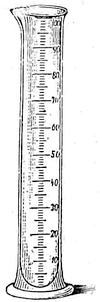
Fig. 31.
The vessel is filled to the tenth division with
the oil to be tested, and water is added to bring
the volume to the 50 mark. If alcohol is present,
it is taken up by the water so that the volume of
oil appears to diminish. If the oil reaches to the
mark 7, it contained three volumes of alcohol, or
in other words it was mixed with thirty per cent
of alcohol. It is true, essential oils likewise dissolve
somewhat in water, but in such minute quantities as not
to affect the success of the test.
This mode of adulteration is practised mainly with viscid
oils which congeal at rather high temperatures, such as oils of
anise, rose, etc., the essential oils being usually mixed at the
same time with oil of turpentine or paraffin. The fraud is
easily detected by fractional distillation.
Oil of bitter almonds is often adulterated with oil of mirbane;
this can be demonstrated by shaking 1 volume of the
oil with 17 volumes of alcohol of 45%, and setting the mixture
aside to settle. The nitrobenzol (oil of mirbane) will then
collect at the bottom. Oil of Rose may be tested as follows:
Mix the oil with an equal quantity of concentrated sulphuric
acid. Neither the color nor the odor of the oil should be
changed, but if oil of geranium was present a disagreeable
odor and a darker color is produced.
It has been proposed, too, to test the oils by heating with
iodine or nitric acid and determining the purity by the reaction;
but the results with the different oils are so similar
that the test is almost worthless. We have had the same experience
with the test by nitro-prusside of copper which on
being heated with essential oils gives colored precipitates differing
with various oils, but still so similar that they cannot
be relied upon. We have found in all cases that a comparison
of an oil with a sample of known purity is the best, or else
the tests given in the preceding pages.
The term essence or extract in perfumery means a solution
of an aromatic substance in strong alcohol. These solutions
are generally made as concentrated as possible and in this
form find application in the manufacture of handkerchief perfumes
and of certain odors bearing a special name. The so-called
extrait d’œillet, extract of pink, or the favorite perfumes
known as new-mown hay have nothing in common with
either pink or hay except the name; like many other odors,
both are merely mixtures of different essences or extracts.
Besides the manufacture of true perfumes, essences or extracts
are also used for scenting fine soaps, sachets, mouth
washes, etc. For the latter, too, use is often made of the so-called
aromatic waters (eaux aromatisées) which are obtained
as a by-product in the distillation of fragrant plants, and have a
very fine odor owing to the small amount of the aromatic
substance they hold in solution. To this class belong orange-flower
water (Aqua Naphæ triplex, eau de fleurs d’oranges),
peppermint water (Aqua Menthæ, eau de menthe), and many
others.
Essences or extracts can be made in two ways: in the
case of aromatic substances which are obtainable in the pure
state—that is, essential oils—by dissolving them in strong
alcohol in definite proportions; in the case of aromatics combined
with a fatty substance by one of the processes described
above, by treating the pomade (lard, or other perfectly bland,
sweet, and in itself odorless fat combined with the aromatic)
or huile antique (fixed oil holding the aromatic substance in
solution) with the strongest alcohol.
According to the action of the alcohol upon the pomade
or huile antique at ordinary or higher temperature, the process
is called cold or warm infusion. Cold infusion furnishes
the odor in a much more delicate and superior form than the
warm. The cold infusion requires for complete solution of
the aromatic four to six weeks; the warm, ten to fourteen
days. Although the former consumes a much longer time, it
is to be preferred, as the heat injures the odor. Pomades or
huiles antiques are never completely exhausted by a single
treatment with alcohol. Even when heat is employed they
always retain a portion of the aromatic with great tenacity;
a second and third infusion still abstracts odor from them,
and finally nothing remains but pure fat with a pleasant odor
which is stained and sold commercially as pomade under the
name of the respective odor—violet, orange flower, reseda,
etc.—or else is used over again in the factory for the extraction
of flowers.
Experience has shown us that it is best to infuse the pomades
or huiles antiques twice in the cold and to use the two
fluids united for the finest perfumes; the residue by warm infusion
furnishes an essence of second quality, and superior
pomades or fragrant oils. The infusion is generally effected
in strong glass bottles of a capacity of three to five gallons;
about five to six quarts of cologne spirit being poured over
six to eight pounds or pints of fat or huile antique.
In treating huiles antiques all parts of the oil should be
brought into contact with the alcohol as much as possible,
hence the bottles must be frequently shaken; a better plan is
to bring the tightly closed bottles into an apparatus in which
they are constantly agitated by rotation. Such an apparatus
is easily made by placing the bottles in an inclined position
between two rods fastened to a common axis which is kept
revolving. The adjoining illustration (Fig. 32) shows such a
contrivance which is required also in the manufacture of perfumes.
The rotation may be effected by clockwork, water
power, or any other motor.
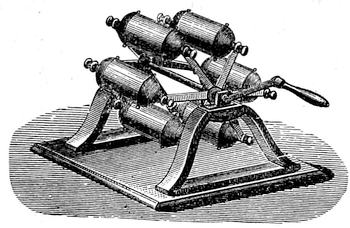
Fig. 32.
Pomades being solid must be divided into small pieces
which may be done with a knife, but the following procedure
is more suitable and less laborious. The pomade is placed
in a tin cylinder four inches wide and about a foot high, which
is open at one end, the other being closed with a tin plate
having several fine openings. The cylinder filled with pomade
is set upon the bottle containing the alcohol for extraction,
and the pomade is pressed through the openings in the
shape of thin threads by means of a piston.
In this way, of course, the pomade acquires a very large
surface and rapidly yields the aromatic substance to the
alcohol. The odor of the pomade differs according to the
length of time which it has been subjected to the flowers, and
on being treated with alcohol furnishes extracts of corresponding
strength. This should be borne in mind in the manufacture
of perfumes which are intended to be uniform in
quality.
After two cold and one warm infusion of the pomade, it
may be made to yield some more aromatic material by heating
it carefully to its exact melting-point, when extract again
appears on the surface and can be poured off by gentle inclination
of the vessel.
In the following pages we give the proportions by weight
and measure employed by the most important French, English,
and German manufacturers for their pomade extracts or
solutions of the essential oils in alcohol. As to the latter we
again repeat that it must be over 88 to 90% strength according
to Tralles or even stronger, and that it must be absolutely free
from any trace of amyl alcohol (potato fusel oil), the least
amount of which impairs the delicacy of the odor. In this
country (the United States) there is no difficulty whatever in
obtaining alcohol of proper strength. The market offers
scarcely any other but that of 94%. Of course deodorized
alcohol, or so-called Cologne spirit should be used. Grain
and wine spirits are the kinds which when rectified are to be
preferred to all others. All the citron oils (i.e., oils of lemon,
bergamot, and those with similar odor), rose oils (oils of rose,
geranium, and rhodium), and many other sweet scents are
most fragrant when dissolved in pure spirit of wine, while the
odors from the animal kingdom and those of violet (violet
and orris root) smell sweetest when dissolved in grain spirit.
The essences prepared from pomades or huiles antiques
usually contain in solution some fat which is best removed by
cooling. To this end the vessels containing the essences are
placed in a vat and surrounded with pellets of ice and crystals
of chloride of calcium. By this mixture the temperature can
be reduced below-20° C. (-4° F.), and after some time the
fats are deposited in a solid form at the bottom of the vessel.
This is then taken from the vat and the essence carefully
poured from the sediment.
The alcoholic extracts of the pomades or solutions of the
aromatics are called essences or extracts (French, extraits);
the solutions obtained from resins and balsams are usually
termed tinctures.
While some extracts, owing to their strong odor, can be
used only when diluted with alcohol, others are employed in
perfumes as such. Pure extracts (extraits purs) are those
containing only a single odor and are but rarely used as perfumes;
the latter are usually mixtures of several, often a great
many odors.
Note.—There is considerable confusion, in works on perfumery,
regarding the terms essence and extract. In French
works, essence always means “essential oil.” Thus “essence
de rose” is “essential oil of roses,” or “attar (otto) of roses.”
Extrait (French) is used of alcoholic solutions of oils, as well
as alcoholic extracts of pomades, or of substances not wholly
soluble in alcohol, and also of compound liquids. In English,
essence is used, and should be confined to alcoholic solutions
of essential oils (“essence of lemon,” “essence of peppermint”).
It is, then, equivalent to the term “spirit,” which is
also used only of alcoholic solutions of essential oils or other
volatile substance (such as: spirit of peppermint, essence of
peppermint; spirit of camphor, etc.). Liquid alcoholic extracts
of substances not wholly soluble in alcohol are properly
called tinctures (for instance, tincture of benzoin, tincture of
musk); and liquid alcoholic extracts of pomades, or compound
odorous liquids, are best comprised under the general
term extracts.
We shall employ the terms essence, extract, and tincture in
the sense here explained.
| Cassie pomade |
6 lbs. |
| Alcohol |
5 qts. |
Extract of cassie has a fine green color—a fact which is
not desirable in perfumes intended for the handkerchief because
colored preparations leave stains. However, extract of
cassie is rarely used pure, but is generally mixed with other
odors for handkerchief perfumes, whereby the color is so
much diluted that it may be disregarded. This extract—and
the same remark applies to all the others—immediately after
its preparation must be put into tightly closed vessels and
preserved in the coolest attainable dark place; for light, air,
and heat must be called the destroyers of perfumes, since the
most delightful odors eventually disappear under their influence.
For the benefit of manufacturers who import this extract
from Southern France, the main source of supply, we may
add that the word cassie or extrait de cassie, derived from
the flowers of Acacia farnesiana, might readily give rise to
confusion with extrait de cassia, made from the bark of the
cinnamon cassia.
| Ambergris |
5 oz. |
| Alcohol |
5 qts. |
The ambergris should be broken into small pieces with a
chopping knife repeatedly moistened with alcohol, and allowed
to digest in the alcohol for some weeks at a temperature of
about 30° C. (86° F.).
| Benzoin |
10 oz. |
| Alcohol |
5 qts. |
This tincture is not so much used for handkerchief perfumes
as for preserving many pomades, as it possesses the
valuable property of preventing fats from becoming rancid.
| Oil of bergamot |
8 oz. |
| Alcohol |
5 qts. |
| Castor |
2½ oz. |
| Alcohol |
5 qts. |
| Musk seed, powdered |
1 lb. |
| Alcohol |
5 qts. |
| Oil of bitter almond |
1¾ oz. |
| Alcohol |
5 qts. |
| Oil of calamus |
1¾ oz. |
| Alcohol |
5 qts. |
This essence has a pleasant odor, but it is not valued as a
true perfume; though if it is mixed with other essences or
extracts until its characteristic odor is no longer recognizable
it furnishes a very useful basis for many cheap articles.
| Oil of cedar wood |
½ lb. |
| Alcohol |
5 qts. |
This essence made from the oil is colorless and can be
used immediately for handkerchief perfumes.
This is made by digesting finely rasped cedar wood with
strong alcohol, namely:
| Cedar wood chips |
6 lb. |
| Alcohol |
5 qts. |
The result is a fragrant tincture with a beautiful deep red
color which cannot be employed for handkerchief perfumes,
but for many cosmetic preparations such as mouth washes
and for scenting soap.
| Extrait de citronella |
3 to 3½ oz. |
| Alcohol |
5 qts. |
| Oil of lemon grass |
2 to 3 oz. |
| Alcohol |
5 qts. |
The genuine is seldom made; the preparation sold under
this name consists of:
| Oil of bitter almond |
15 grains. |
| Extract of orange flowers, from pomade |
2 qts. |
| Extract of tuberose, from pomade |
3 qts. |
| Tincture of civet |
¼ pint. |
Of late, extract of lilac is often prepared by means of
lilacin or terpineol, as follows:
| Lilacin |
1 oz. |
| Alcohol |
1 pint. |
Extract of Honeysuckle (Extrait de Chèvre-feuille).
The author has made this extract by treating the pomade
prepared from the flowers of Lonicera Caprifolium, in the following
proportion:
| Honeysuckle pomade |
6 lb. |
| Alcohol |
5 qts. |
The commercial extract of this name is always a compound
which may be prepared according to the following
formula:
| Extract of rose, made from the pomade |
1 qt. |
| Extract of tuberose, from pomade |
1 qt. |
| Extract of violet, from pomade |
1 qt. |
| Tincture of vanilla |
½ pint. |
| Tincture of Tolu |
½ pint. |
| Oil of bitter almond |
15 grains. |
| Oil of neroli |
8 grains. |
| Oil of geranium (rose-geranium) |
5½ oz. |
| Alcohol |
5 qts. |
In the commercial article the essence of lemon grass is
often substituted for the essence of geranium, the odor being
similar, though less delicate.
| Cucumbers |
8 lbs. |
| Alcohol |
5 qts. |
The cucumbers are peeled, cut into thin slices, and macerated
in the warm alcohol. If the odor is not strong enough
in the alcohol after some days, it is poured over some more
fresh slices, the macerated residue is expressed, and at the
end of the operation all the liquids are united and filtered.
| Heliotrope pomade |
6 lb. |
| Alcohol |
5 qts. |
This has thus far been manufactured only by French perfumers
at very high prices; the great majority of the so-called
extracts of heliotrope are compounded from:
| Extract of rose, from pomade |
2 qts. |
| Extract of orange flowers, from pomade |
14 oz. |
| Tincture of ambergris |
7 oz. |
| Tincture of vanilla |
4 qts. |
| Oil of bitter almond |
75 grains. |
This is used as a perfume as such.
More recently, piperonal, under the name heliotropin, is
used for making this extract—
| Heliotropin |
¼ oz. |
| Alcohol |
1 Pint. |
It is necessary to blend this with various other aromatics
in order to cover the pronounced odor. A little cumarin is
usually of great help. But is it impossible, as yet, to give
reliable proportions which would suit all cases.
| Jasmine pomade |
6 lb. |
| Alcohol |
5 qts. |
| Oil of lavender |
7 oz. |
| Alcohol |
5 qts. |
A far superior essence may be prepared by the distillation
of:
| Oil of lavender |
7 oz. |
| Rose water |
2 qts. |
| Alcohol |
10 qts. |
The distillation is continued until one-half of the entire
liquid has passed over; the residue in the still furnishes an
essence of lavender of the second quality.
The genuine odor can be made only from the pomade; the
commercial extract consists of:
| Extract of cassie, from pomade |
1 pint. |
| Extract of orange flower, from pomade |
1 qt. |
| Extract of rose, from pomade |
1 qt. |
| Tincture of vanilla. |
1 pint. |
| Tincture of orris root |
1 pint. |
| Oil of bitter almond |
1 pint. |
As to this delightful odor the remark made under the preceding
head applies likewise; artificial extract of lily consists
of:
| Extract of cassie, from pomade |
3 pints. |
| Extract of jasmine, from pomade |
13½ fl. oz. |
| Extract of orange flower, from pomade |
27 fl. oz. |
| Extract of rose, from pomade |
3 pints. |
| Extract of tuberose, from pomade |
3 qts. |
| Tincture of vanilla |
40½ fl. oz. |
| Oil of bitter almond |
30 grains. |
| Oil of lemon |
7 oz. |
| Alcohol |
5 qts. |
This favorite perfume is a mixture of:
| Extract of orange flower, from pomade |
2 qts. |
| Extract of rose, from pomade |
4 qts. |
| Extract of tuberose, from pomade |
1 qt. |
| Extract of violet, from pomade |
1 qt. |
| Oil of bitter almond |
40 grains. |
| Oil of lemon |
16 grains. |
| Oil of peppermint |
6½ oz. |
| Alcohol |
5 qts. |
| Musk |
2½ oz. |
| Alcohol |
5 qts. |
This tincture is of special importance, not so much because
of its odor as on account of its useful property of fixing other
very volatile odors.
Owing to the small yield of essential oil furnished on distillation
by the myrtle and the comparatively high price of
the oil of myrtle, nearly all the extract of myrtle is prepared
artificially, as follows:
| Extract of jasmine, from pomade |
½ pint. |
| Extract of orange flower, from pomade |
1 qt. |
| Extract of rose, from pomade |
2 qts. |
| Extract of tuberose, from pomade |
1 qt. |
| Tincture of vanilla |
1 qt. |
In perfumery, two extracts of narcissus are distinguished—true
extract of narcissus, from the flowers of the garden
plant, Narcissus poeticus, and the so-called extract of jonquille,
from Narcissus Jonquilla, which is cultivated in Southern
France and whose odor is obtained by maceration. Genuine
extract of narcissus is even more rarely obtainable than
extract of jonquille; the odors of both are imitated, mainly
according to the following prescriptions:
| Extract of jonquille, from pomade |
2 qts. |
| Extract of tuberose, from pomade |
3 qts. |
| Tincture of storax |
½ pint. |
| Tincture of tolu |
½ pint. |
| Extract of jasmine, from pomade |
2 qts. |
| Extract of orange flower, from pomade |
1 qt. |
| Extract of tuberose, from pomade |
2 qts. |
| Tincture of vanilla |
½ pint. |
| Oil of clove |
4½ oz. |
| Alcohol |
5 qts. |
This pleasant odor occurs in commerce only as an imitation.
| Extract of cassie, from pomade |
2½ pints. |
| Extract of orange flower, from pomade |
2½ pints. |
| Extract of rose, from pomade |
5 pints. |
| Tincture of vanilla |
20 fl. oz. |
| Oil of clove, a sufficient quantity, about |
75 grains. |
The oil of clove which determines the characteristic odor
of this extract is dissolved in a little alcohol; of this solution
enough is gradually added to the mixture until the odor has
become sufficiently strong.
| Orange-flower pomade |
6 lb. |
| Alcohol |
5 qts. |
| Or, |
| Oil neroli pétale |
2½ oz. |
| Alcohol |
5 qts. |
The latter preparation is also called “essence of neroli.”
The extract prepared from the pomade furnishes this
highly esteemed odor of a delicacy never to be approached
by that made with oil. The alcoholic extract of the pomade
perfumed with the flowers of Syringa (Philadelphus coronarius)
also occurs in commerce as extract of orange flowers or neroli.
| Oil of patchouly |
1¼ oz. |
| Alcohol |
5 qts. |
This pure essence of patchouly has not a very pleasant
odor; that made according to the following formula is far
superior.
| Oil of patchouly |
1½ oz. |
| Oil of rose |
⅜ oz. |
| Alcohol |
5 qts. |
| Peru balsam |
10½ oz. |
| Alcohol |
5 qts. |
This tincture, though of a very pleasant odor, can be used
only for scenting soap or sachets, as it has a very dark brown
color; by distilling alcohol over Peru balsam a colorless extract
is obtained, though of a fainter odor.
| Oil of allspice |
3½ oz. |
| Alcohol |
5 qts. |
This extract, made almost exclusively in Southern France
by maceration of the pomade, is but rarely met with in commerce;
what passes under this name is made as follows:
| Extract of orange flower, from pomade |
2½ pints. |
| Extract of rose, from pomade |
2½ pints. |
| Extract of tuberose, from pomade |
2½ pints. |
| Tincture of vanilla |
5¾ oz. |
| Reseda pomade |
5 to 6 lb. |
| Alcohol |
5 qts. |
| Tincture of tolu |
5½ oz. |
The addition of the tincture of tolu is necessary here,
owing to the extraordinary volatility of the delightful odor of
mignonette, which is lessened by the addition of tincture of
tolu.
In commerce several sorts of essence or extract of rose
are distinguished; only the cheaper grades are made by direct
solution of the oil of rose in alcohol, the better grades are prepared
only from pomades. As the rose is the noblest of flowers,
so are these odors the most magnificent thus far produced
by the art of perfumery, since they are approached in delicacy
and fragrance only by the genuine extracts of orange flower
and violet. The so-called rose waters (eaux de rose) are best
obtained by distillation of fresh or salted rose leaves with water.
The preceding formulæ will show that both extract of rose
and rose water form important constituents of many compound
essences, hence these materials require special attention. In
the following pages we enumerate only those formulæ which
are acknowledged as the best and furnish the finest product.
As rose water likewise belongs among the rose odors we give
directions for its preparation, and observe in passing that the
precautions required in the manufacture of this one apply
also to all aromatic waters (eaux aromatisées). The first
essential to the production of a fine aromatic water is the employment
of the freshest possible flowers; when kept in stock,
chemical changes occur in the leaves which affect also the
aromatic constituents and lead to a deterioration of the fragrance.
Hence we urgently recommend to distil the freshly
gathered flowers as soon as possible, even if the quantity on
hand be small. Should this not be feasible, it is advisable to
press the flowers immediately after gathering in stone-ware
pots and to pour over them a saturated solution of table salt.
A concentrated saline solution prevents decomposition by
the abstraction of water; and thus larger quantities of flowers
may be gathered and distilled with the salt solution. The
majority of aromatic waters are prepared in this way, for instance,
rose, jasmine, lilac, and others. They enter less into
handkerchief perfumes than into various mouth and other
washes, and cosmetics in general.
| Rose leaves |
4 lb. |
| Water |
20 pints. |
Mix them, and by means of steam, distil 10 pints.
The rose leaves are, of course, preferably to be used while
fresh. If they are to be preserved for future use, they should
be packed in stone-ware jars, and covered with a solution of
common salt. This is poured off before distillation, but used
over again for the same purpose.
| Rose pomade |
8 lb. |
| Alcohol |
5 qts. |
Essence of [Oil of] Rose (Esprit de Roses Triple).
| Oil of rose |
3½ oz. |
| Alcohol |
5 qts. |
This essence is not so good as the extract.
| Essence of rose (triple) |
2 qts. |
| Tincture of tonka |
½ pint. |
| Extract of tuberose |
2 qts. |
| Extract of verbena |
½ pint. |
| Extract of cassie, from pomade |
44 fl. oz. |
| Extract of orange flower, from pomade |
44 fl. oz. |
| Extract of rose, from pomade |
2½ qts. |
| Essence of rose (triple) |
44 fl. oz. |
| Oil of lemon grass |
¼ oz. |
| Oil of neroli |
¼ oz. |
| Extract of rose, from pomade |
2 qts. |
| Extract of orange flower, from pomade |
1 qt. |
| Essence of rose (triple) |
1 qt. |
| Tincture of ambergris |
1 pint. |
| Tincture of musk |
½ lb. |
| Extract of rose, from pomade |
1 qt. |
| Extract of geranium, from pomade |
1 qt. |
| Extract of orange flower, from pomade |
½ pint. |
| Essence of rose (triple) |
1 qt. |
| Tincture of santal |
½ pint. |
| Tincture of orris root |
½ pint. |
| Extract of rose, from pomade |
1 qt. |
| Extract of jasmine, from pomade |
1 pint. |
| Extract of violet, from pomade |
1 qt. |
| Essence of patchouly |
½ pint. |
| Essence of rose (triple) |
1 qt. |
| Extract of rose, from pomade |
5 qts. |
| Oil of rose |
1¾ oz. |
| Tincture of santal |
3½ oz. |
| Essence of rose (triple) |
1 pint. |
| Alcohol |
9 pints. |
| Storax |
10½ oz. |
| Alcohol |
5 qts. |
Though this tincture has a pleasant odor, it is not ordinarily
used by itself, but for fixing other odors.
| Tolu balsam |
10½ oz. |
| Alcohol |
5 qts. |
The remark made under tincture of storax applies also to
this.
| Tonka beans, crushed |
21 oz. |
| Alcohol |
5 qts. |
| Tuberose pomade |
8-10 lb. |
| Alcohol |
5 qts. |
| Tincture of storax |
10 fl. oz. |
| Vanilla, sliced |
½ lb. |
| Alcohol |
5 qts. |
| Violet pomade |
6-7 lb. |
| Extract of cassie |
6½ fl. oz. |
| Alcohol |
5 qts. |
This extract is very expensive; a good imitation is made
as follows:
| Extract of cassie, from pomade |
2 qts. |
| Extract of rose, from pomade |
1 qt. |
| Extract of tuberose, from pomade |
1 qt. |
| Tincture of orris root |
1 qt. |
| Oil of bitter almond |
15 grains. |
| Orris root, powdered |
6-7 lb. |
| Alcohol |
5 qts. |
This tincture is sold as a very cheap violet perfume, but
it has also considerable value to perfumery in general, owing
to its fixing power.
True oil of verbena is rather expensive. Hence artificial
compositions are employed under the name of verbena which
resemble the true odor, though not exactly like it.
| Oil of lemon grass |
75 grains. |
| Oil of lemon |
14 oz. |
| Oil of orange peel |
3½ oz. |
| Alcohol |
5 qts. |
This extract is cheap and is used immediately as a perfume.
The extract usually sold under the French name Extrait
de verveine is more expensive and far superior:
| Extract of orange flower, from pomade |
30 fl. oz. |
| Extract of rose, from pomade |
1 qt. |
| Extract of tuberose, from pomade |
⅓ oz. |
| Oil of citron zeste |
½ oz. |
| Oil of lemon grass |
¾ oz. |
| Oil of lemon peel |
9 oz. |
| Oil of orange peel |
4½ oz. |
| Alcohol |
4⅔ pints. |
As already explained, if hand-pressed oil of lemon (made
by the écuelle process) is available, then the “oil of citron
zeste” (which is this particular kind of oil) and the “oil of
lemon” may be simply added together; that is, 9½ oz. of oil
of lemon are used.
This extract is no more derived from the fragrant blossom
whose name it bears than are those of the lily, pink, and others
met with in commerce. It is prepared according to the following
formula:
| Extract of jasmine, from pomade |
1 pint. |
| Extract of rose, from pomade |
1 qt. |
| Extract of tuberose, from pomade |
2 qts. |
| Extract of violet, from pomade |
2 qts. |
| Tincture of musk. |
½ pint. |
| Oil of vetiver |
2½ oz. |
| Alcohol |
5 qts. |
Tincture of Olibanum (Extrait d’Oliban, Extrait
d’Encens).
| Olibanum |
1 lb. |
| Alcohol |
5 qts. |
This essence is more commonly sold under the English
than the French name. Its composition is the following:
| Tincture of ambergris |
1 pint. |
| Extract of cassie |
1 qt. |
| Essence of lavender |
1 pint. |
| Extract of orange flower, from pomade |
1 qt. |
| Extract of rose, from pomade |
2 qts. |
| Tincture of vanilla. |
1 pint. |
| Essence of vetiver |
1 pint. |
| Civet. |
1—1½ oz. |
| Orris root |
1—1½ oz. |
| Alcohol |
5 qts. |
Tincture of civet is exceedingly lasting and is generally
employed for fixing other odors. As to the quantity required
to fix perfumes in general, we may state that it varies
with the nature of the odor. As a rule, about one-sixteenth
part of tincture of civet suffices for even the most volatile
perfumes.
| Cinnamon |
1 lb. |
| Alcohol |
5 qts. |
Owing to the yellow color left upon handkerchiefs by perfumes
prepared with this extract, it can be used only for common
goods, but it is more frequently employed for scenting
soaps.
According to the purposes for which they are intended,
the various articles of perfumery may be divided into several
groups. They are:
A. Liquid.—Alcoholic handkerchief perfumes. Among
these are the so-called extracts, bouquets, and waters. Ammoniacal
and acid perfumes: aromatic vinegars and volatile
ammoniacal salts.
B. Dry.—Sachet powders, fumigating pastils and powders.
Emulsions, crêmes, perfumed soaps, toilet waters, nail
powders.
Hair oils, pomades, hair washes.
Preparations for the Care of the Mouth.
Tooth powders, mouth washes.
Paints, powders, hair dyes, depilatories, etc.
In connection with the description of these different articles
some remarks will be made about the colors employed in
perfumery and about the utensils used with the cosmetics,
such as combs, brushes, sponges, etc.
The manufacture of handkerchief perfumes is very simple:
the extracts prepared as directed in Chapter XI. are
mixed in definite proportions and the perfume is finished. If
the extracts are well seasoned, the perfumes blend in perfect
harmony within a few days, and this time may be even shortened
by the use of the apparatus illustrated in Fig. 32. If
the extracts have been but recently prepared, a longer time
will be required before the odor of the alcohol and the several
constituents is imperceptible and all odors have blended
into a harmonious whole.
If the manufacturer can afford to allow the finished extracts
and perfumes to season for some length of time—of
course, in well-closed and completely filled vessels—in a cool
place, they will improve markedly in quality. Perfumes which
contain but a single odor or in which a certain odor distinctly
predominates are usually called by the name of the respective
plant, etc., under a French title, e.g., extrait de violette, extrait
de reséda, etc. Combinations of many odors which produce
an agreeable impression as a whole, while no one odor predominates,
are called bouquets or waters; for instance, Bouquet
de Jockey Club, Eau de Mille Fleurs, Cologne Water, Hungarian
Water, etc.
The mixture of the extracts is effected in strong glass bottles
of a capacity exactly adapted to the perfume, so as to be
completely filled. For perfumes which require seasoning to
make the odors blend we use small glass balls of which enough
are introduced into the bottle to make the mixture rise into
the neck of the container which is then closed air-tight and
preserved in a dark, cool place.
Of course, all perfumes should be perfectly clear and free
from turbidity. The extracts made from pomades or essential
oils are clear and furnish perfumes that remain so; extracts
prepared from balsams or resins should be allowed to stand
at rest for several weeks and then be carefully decanted from
the sediment. Filtration should be dispensed with unless absolutely
unavoidable, on account of the large amount of oxygen
with which the extract would thereby come in contact, to
the detriment of the odor.
The bottles in which the perfumes are mixed, as well as
those in which they are put up for sale, must be perfectly
dry, as a very small amount of water often suffices to separate
a portion of the aromatics and to render the liquid turbid or
opalescent.
Fine perfumes are always sold in glass vessels with ground-glass
stoppers; cork has a peculiar odor which it would communicate
to the liquid. For the more perfect exclusion of
the air the stoppers and bottle necks are moreover covered
with animal membrane, sheet rubber, or vegetable parchment,
with an outer cap of white glove leather.
In the case of very expensive perfumes, much care is bestowed
on the container; certain perfumes are filled into bottles
of peculiar form and color, or into small porcelain jars
provided with corresponding labels printed in gold and colors.
Sometimes the container costs many times the price of the
perfume. But as the finest perfumes are articles of luxury in
the truest sense of the word, they require extreme care in
their putting up; and good taste in the selection of the containers
for fluids, pomades, cosmetics, powders, etc., is of as
much importance to the perfumer as the possession of a sensitive
and trained olfactory organ.
In the following formulas for the preparation of bouquets,
the words extract, essence, and tincture have the same meaning
as was explained under Chapter XI. For cheap perfumes
the corresponding essential oils dissolved in alcohol, that is,
the corresponding “essence,” is employed in place of the true
“extract.”
| Extract of cassie |
1 pint. |
| Extract of orange flower |
1 pint. |
| Essence of geranium |
1 qt. |
| Extract of tuberose |
2 qts. |
| Tincture of civet |
1 pint. |
| Tincture of ambergris |
3 qts. |
| Tincture of musk |
1½ pints. |
| Oil of rose |
1 oz. |
| Tincture of vanilla |
13½ fl. oz. |
| Alcohol |
3 pints. |
| Essence of rose (triple) |
2 qts. |
| Tincture of ambergris |
4 qts |
| Tincture of musk |
1 qt. |
| Tincture of vanilla |
1 pint. |
| Extract of cassie |
1 qt. |
| Tincture of ambergris |
1 pint. |
| Extract of jasmine |
1 qt. |
| Tincture of musk |
1 pint. |
| Extract of rose |
1 qt. |
| Extract of violet |
1 qt. |
| Extract of cassie |
1 pint. |
| Tincture of ambergris |
3 fl. oz. |
| Extract of jasmine |
6 fl. oz. |
| Extract of rose |
5 pints. |
| Extract of violet |
5 pints. |
| Essence of rose (triple) |
10 fl. oz. |
| Oil of bergamot |
120 grains. |
| Oil of lemon |
30 grains. |
Note. Here and in all succeeding formulas, “oil of lemon”
is meant to be the finest “hand-pressed” oil.
| Oil of anise |
150 grains. |
| Oil of bergamot |
1 oz. |
| Oil of cardamom |
15 grains. |
| Oil of lemon |
30 grains. |
| Oil of coriander |
15 grains. |
| Oil of geranium |
30 grains. |
| Oil of melissa |
15 grains. |
| Oil of neroli |
75 grains. |
| Oil of rose |
30 grains. |
| Oil of santal |
30 grains. |
| Oil of thyme |
15 grains. |
| Alcohol |
10 qts. |
| Extract of cassie |
1 qt. |
| Tincture of ambergris |
1 pint. |
| Extract of jasmine |
1 qt. |
| Extract of orange flower |
1 qt. |
| Extract of rose |
1 qt. |
| Tincture of orris root |
1 pint. |
| Oil of lavender |
40 grains. |
| Oil of neroli |
40 grains. |
| Oil of rose |
75 grains. |
| Extract of jasmine |
1 pint. |
| Extract of rose |
1 pint. |
| Extract of tuberose |
1 pint. |
| Extract of violet |
1 pint. |
| Tincture of orris root |
1 pint. |
| Oil of geranium |
75 grains. |
| Extract of cassie |
1 qt. |
| Extract of jasmine |
½ pint. |
| Extract of tuberose |
½ pint. |
| Tincture of civet |
18 grains. |
| Essence of rose (triple) |
½ pint. |
| Oil of bitter almond |
30 grains. |
| Extract of cassie |
20 fl. oz. |
| Tincture of musk |
20 fl. oz. |
| Extract of neroli |
20 fl. oz. |
| Extract of orange flower |
20 fl. oz. |
| Tincture of tonka bean |
40 fl. oz. |
| Tincture of orris root |
20 fl. oz. |
| Oil of lemon |
½ oz. |
| Essence of rose (triple) |
5 pints. |
| Tincture of ambergris |
2 oz. |
| Extract of jasmine |
1 qt. |
| Tincture of musk |
2 oz. |
| Extract of rose |
1 qt. |
| Extract of violet |
1 qt. |
| Essence of rose (triple) |
1 qt. |
| Oil of bergamot |
45 grains. |
| Oil of lemon. |
45 grains. |
| Oil of neroli |
45 grains. |
| Tincture of ambergris |
1 qt. |
| Tincture of musk |
1 qt. |
| Tincture of tonka |
1 qt. |
| Tincture of vanilla |
1 qt. |
| Tincture of orris root |
1 qt. |
| Essence of rose (triple) |
2 qts. |
| Tincture of ambergris |
1 pint. |
| Extract of rose |
1 qt. |
| Extract of tuberose |
1 qt. |
| Extract of violet |
1 qt. |
| Tincture of orris root |
1 pint. |
| Oil of bergamot |
½ oz. |
| Oil of lemon |
1 oz. |
| Tincture of benzoin |
5½ oz. |
| Extract of rose |
3 pints. |
| Extract of tuberose |
3 pints. |
| Extract of violet |
3 pints. |
| Oil of bergamot |
2½ oz. |
| Oil of lemon |
1¾ oz. |
| Oil of orange peel |
1¾ oz. |
| Extract of cassie |
1½ pints. |
| Extract of jasmine |
1½ pints. |
| Extract of orange flower |
1½ pints. |
| Extract of rose |
1½ pints. |
| Tincture of vanilla |
3 pints. |
| Oil of bitter almond |
⅜ oz. |
While this perfume is very pleasant, its odor has no resemblance
to the delicate fragrance of Convallaria majalis, our
ordinary lily of the valley.
| Extract of cassie |
20 fl. oz. |
| Tincture of ambergris |
13½ fl. oz. |
| Extract of jasmine |
20 fl. oz. |
| Tincture of musk |
13½ fl. oz. |
| Tincture of orris root |
5 pints. |
| Oil of bergamot |
1½ oz. |
| Oil of lavender |
1½ oz. |
| Oil of clove |
75 grains. |
| Oil of neroli |
1½ oz. |
| Oil of rose |
1½ oz. |
| Alcohol |
5 pints. |
| Oil of bergamot |
⅜ oz. |
| Oil of neroli |
24 grains. |
| Alcohol |
5½ oz. |
| Orris root |
1 oz. |
| Storax, liquid |
8 grains. |
| Musk |
3 grains. |
Macerate for two weeks, and filter.
An old renowned perfume, a former rival of Cologne water;
the name is derived from a noble Hungarian family.
| Tincture of ambergris |
½ pint. |
| Extract of neroli |
1 qt. |
| Extract of orange flower |
1 qt. |
| Tincture of tonka |
1 qt. |
| Tincture of vanilla |
1 qt. |
| Tincture of vetiver |
1 qt. |
| Tincture of orris root |
1 qt. |
| Essence of rose (triple) |
1 qt. |
| Oil of clove |
75 grains. |
| Oil of santal |
75 grains. |
| Calamus root |
3 oz. |
| Cloves |
3 oz. |
| Nutmeg |
3 oz. |
| Alcohol |
4 qts. |
Macerate for two weeks and filter; in the filtrate dissolve:
| Tincture of ambergris |
6 oz. |
| Ammonia |
30 grains. |
| Oil of bitter almond |
30 grains. |
| Oil of lemon |
3 oz. |
| Tincture of musk |
6 oz. |
| Oil of neroli |
60 grains. |
| Oil of orange peel |
30 grains. |
| Oil of rose |
75 grains. |
| Oil of cedar wood |
10½ oz. |
| Extract of rose |
1 pint. |
| Alcohol |
5 qts. |
| Extract of cassie |
1 pint. |
| Tincture of ambergris |
5 oz. |
| Extract of jasmine |
1 qt. |
| Tincture of musk |
5 oz. |
| Extract of rose |
2 qts. |
| Extract of violet |
1 qt. |
| Essence of rose (triple) |
1 qt. |
| Oil of bitter almond |
15 grains. |
| Extract of orange flower |
2 qts. |
| Extract of tuberose |
3 qts. |
| Tincture of civet |
2 to 3½ oz. |
The above-named ingredients are exceedingly volatile;
according to the desired permanence of the perfume, more or
less of the extract of civet is added.
| Tincture of ambergris |
1 pint. |
| Tincture of orris root |
2 qts. |
| Essence of rose (triple) |
2 qts. |
| Oil of bergamot |
4½ oz. |
| Oil of lemon |
1 oz. |
| Extract of cassie |
1 oz. |
| Extract of jasmine |
1 oz. |
| Tincture of musk |
1½ oz. |
| Oil of cassia |
1½ oz. |
| Oil of lemon |
½ oz. |
| Oil of lavender |
1 oz. |
| Oil of neroli |
½ oz. |
| Oil of clove |
1½ oz. |
| Oil of palmarosa |
1 oz. |
| Oil of petit grain |
1 oz. |
| Oil of Portugal |
1 oz. |
| Oil of rose |
75 grains. |
| Oil of thyme |
75 grains. |
| Alcohol |
10 qts. |
This perfume is much admired in England. The title Ess.
Bouquet is an abbreviation of the full name given above.
| Tincture of ambergris |
2 oz. |
| Tincture of orris |
8 oz. |
| Essence of rose (triple) |
1 pint. |
| Oil of lemon |
¼ oz. |
| Oil of bergamot |
1 oz. |
| Oil of bergamot |
60 grains. |
| Oil of lemon |
90 grains. |
| Oil of lavender |
15 grains. |
| Oil of clove |
8 grains. |
| Alcohol |
5 qts. |
| Extract of rose |
1 qt. |
| Extract of orange flower |
1 pint. |
| Extract of tuberose |
1 pint. |
| Extract of violet |
½ pint. |
| Tincture of benzoin |
3 fl. oz. |
| Tincture of storax |
3 fl. oz. |
| Tincture of musk |
1½ fl. oz. |
| Oil of citronella |
¾ oz. |
| Alcohol |
2 qts. |
Honeysuckle (Extrait de Chèvre-feuille).
| Extract of rose |
1 qt. |
| Extract of tuberose |
1 qt. |
| Extract of violet |
1 qt. |
| Tincture of tolu |
½ pint. |
| Tincture of vanilla |
½ pint. |
| Oil of bitter almond |
15 grains. |
| Oil of neroli |
8 grains. |
| Extract of rose |
2 qts. |
| Extract of orange flower |
14 oz. |
| Tincture of ambergris |
7 oz. |
| Tincture of vanilla |
4 qts. |
| Oil of bitter almond |
75 grains. |
A very lasting perfume which is especially suitable for
scenting the linen in a press.
| Vanilla |
15 grains. |
| Oil of neroli |
2 drops. |
| Oil of bitter almond |
1 drop. |
| Musk |
1½ grains. |
| Benzoin |
45 grains. |
| Cologne spirit |
3½ oz. |
Macerate for one week, and filter.
Hay owes its fragrance partly to cumarin, which is present
in many plants, but in especially large amount in tonka
beans. Hence all similar perfumes must contain tincture of
tonka. Other aromatic substances, however, contribute to
the odor of hay, but the cumarin gives, as it were, the keynote
to its real odor.
A very pleasant perfume is made after the following formula:
| Essence of rose (triple) |
1 qt. |
| Essence of geranium |
1 qt. |
| Extract of jasmine |
1 qt. |
| Extract of orange flower |
1 qt. |
| Extract of rose |
1 qt. |
| Tincture of tonka |
2 qts. |
Some add to this perfume 1 pint of extract of cassie which
imparts a greenish color to it.
| Extract of orange flower |
20 fl. oz. |
| Tincture of musk |
10 fl. oz. |
| Extract of rose |
5 pints. |
| Tincture of vanilla |
20 fl. oz. |
| Tincture of orris root |
20 fl. oz. |
| Oil of clove |
120 grains. |
| Extract of white rose |
5 qts. |
| Tincture of vanilla |
1 lb. |
An exceedingly fine perfume.
This plant, Hovenia dulcis, indigenous to Japan, has a
peculiar odor, which, however, is not pleasant to European
taste. The perfume sold under this name has a special odor,
though it differs from that of the plant. It is made according
to the following formula:
| Oil of lemon |
3 oz. |
| Oil of clove |
¼ oz. |
| Oil of neroli |
75 grains. |
| Oil of rose |
75 grains. |
| Alcohol |
5 qts. |
| Essence of rose (triple) |
1 pint. |
| Extract of cassie |
6 fl. oz. |
| Extract of orange flower |
6 fl. oz. |
| Tincture of musk |
150 grains. |
| Tincture of tonka |
1 pint. |
| Oil of citronella |
150 grains. |
| Alcohol |
3 qts. |
| Extract of rose |
1 qt. |
| Extract of orange flower |
1 qt. |
| Essence of patchouly |
½ pint. |
| Extract of verbena |
1 pint. |
| Essence of vetiver |
1 pint. |
| Tincture of civet |
3 fl. oz. |
| Tincture of musk. |
⅓ fl. oz. |
| Tincture of cedar wood |
1 qt. |
| Essence of patchouly |
1 qt. |
| Extract of santal |
1 qt. |
| Extract of verbena |
1 qt. |
| Essence of vetiver |
1 pint. |
| Essence of rose (triple) |
1 qt. |
England first introduced a perfume under this name, which
soon became popular and was largely imitated. Jockey Club
perfume is among the finest known to the trade; the delicacy
of its odor rests largely on the extracts of cassie and tuberose
which are employed in their strongest form—an alcoholic extract
of a pomade well charged with the odors of the plants.
As in the case of Cologne water, there are a number of widely
diverging formulas for its preparation, from which we select
a few which furnish excellent perfumes.
| Extract of cassie |
1 pint. |
| Tincture of ambergris |
¾ pint. |
| Extract of rose |
1½ pints. |
| Extract of tuberose |
¾ pint. |
| Tincture of orris root |
3 pints. |
| Essence of rose (triple) |
1½ pints. |
| Oil of bergamot |
¾ oz. |
| Extract of cassie |
1½ pints. |
| Extract of jasmine |
2¼ pints. |
| Extract of rose |
3 pints. |
| Extract of tuberose |
3 pints. |
| Tincture of civet |
½ pint. |
| Extract of cassie |
1 qt. |
| Tincture of ambergris |
13½ fl. oz. |
| Extract of jasmine |
1 qt. |
| Extract of rose |
1 pint. |
| Extract of tuberose |
1 qt. |
| Extract of violet |
1 pint. |
| Tincture of civet |
20 fl. oz. |
| Oil of bergamot |
¾ oz. |
| Oil of citronella |
½ oz. |
| Oil of neroli |
½ oz. |
| Extract of jasmine |
2 qts. |
| Extract of orange flower |
1 qt. |
| Extract of tuberose |
2 qts. |
| Tincture of vanilla |
½ pint. |
| Extract of cassie |
1 qt. |
| Extract of ambergris |
½ pint. |
| Extract of narcissus (Jonquille) |
2 qts. |
| Tincture of tonka |
1 qt. |
| Tincture of orris root |
2 qts. |
| Tincture of civet |
½ pint. |
| Essence of rose (triple) |
1 qt. |
| Oil of citronella |
75 grains. |
| Oil of lemon grass |
45 grains. |
This perfume, which was once very popular, owes its peculiar
refreshing odor to the tincture of tonka beans; by increasing
this ingredient the specific odor can be made more
pronounced.
| Extract of jasmine |
1 pint. |
| Essence of lavender |
½ pint. |
| Tincture of musk |
½ pint. |
| Essence of patachouly |
½ pint. |
| Extract of santal |
½ pint. |
| Extract of tuberose |
1 pint. |
| Tincture of vanilla |
½ pint. |
| Extract of violet |
1 qt. |
| Essence of rose (triple) |
1 pint. |
| Oil of citronella |
75 grains. |
| Oil of lemon |
½ oz. |
This famous perfume, which was first made in Cologne on
the Rhine, its formula being kept secret, can be produced
anywhere of the same quality as the original. In order to
obtain a first-class product, it is necessary, besides using the
finest oils—a matter of course for all fine perfumes—to observe
another special point. Every Cologne water contains oils of
the citron group which develop their best odors only in true
spirit of wine. Unless an alcohol distilled from wine is used,
it will be impossible to make a Cologne water of really first
quality. While it is possible to make a good cologne with
grain or potato spirit, especially if highly rectified, comparison
with one prepared from pure spirit of wine will at once
show a marked difference. The small amount of œnanthic
ether, hardly demonstrable by chemical tests but present in
every spirit of wine, exerts a decided influence on the flavor.
Cologne water of the most superior and incomparable quality
is made by dissolving the essential oils, excepting the oils
of rosemary and neroli, in the alcohol and distilling it, the
other oils being added to the distillate.
A very large number of formulas for the preparation of
Cologne water have been published of which we subjoin a
few. We have purposely omitted those containing many
essential oils, as experience has taught us that they are of little
value; for it is not the number of oils that determines the
fineness of a perfume, but the manner in which certain odors
are combined.
| Oil of bergamot |
2½ oz. |
| Oil of lemon (hand-pressed) |
6 oz. |
| Oil of neroli pétale |
3½ oz. |
| Oil of neroli bigarade |
1¼ oz. |
| Oil of rosemary |
2½ oz. |
| Alcohol |
30 qts. |
| Oil of bergamot |
4½ oz. |
| Oil of lemon |
4½ oz. |
| Oil of neroli pétale |
¾ oz. |
| Oil of orange peel |
4½ oz. |
| Oil of petit grain |
2½ oz. |
| Oil of rosemary |
2½ oz. |
| Alcohol |
30 qts. |
| Oil of bergamot |
7 oz. |
| Oil of lemon |
3½ oz. |
| Oil of lavender |
3½ oz. |
| Alcohol |
30 qts. |
| Oil of bergamot |
1¾ oz. |
| Oil of lemon |
3½ oz. |
| Oil of lavender |
150 grains. |
| Oil of neroli |
½ oz. |
| Oil of rosemary |
75 grains. |
| Alcohol |
30 qts. |
| Oil of bergamot |
2 oz. |
| Oil of lemon |
1 oz. |
| Oil of lavender |
½ oz. |
| Oil of melissa |
¼ oz. |
| Oil of neroli |
¼ oz. |
| Alcohol |
30 qts. |
| Oil of bergamot |
3½ oz. |
| Oil of lemon |
½ oz. |
| Oil of lavender |
¼ oz. |
| Oil of melissa |
½ oz. |
| Oil of neroli |
¼ oz. |
| Alcohol |
30 qts. |
| Oil of bergamot |
1 lb. |
| Oil of lemon |
1 lb. |
| Oil of lavender |
6½ oz. |
| Oil of neroli |
¾ oz. |
| Oil of petit grain |
1½ oz. |
| Oil of orange peel |
1 lb. |
| Oil of rosemary |
150 grains. |
| Alcohol |
30 qts. |
| Oil of bergamot |
2¼ oz. |
| Oil of cajuput |
½ oz. |
| Oil of lemon |
4½ oz. |
| Oil of lavender |
6½ oz. |
| Oil of neroli |
2¼oz. |
| Oil of orange peel |
4½ oz. |
| Oil of petit grain |
½ oz. |
| Orange-flower water |
1 qt. |
| Alcohol |
30 qts. |
The numerous formulas show that oils of lemon, bergamot,
and orange form normal constituents of every Cologne water;
the finer grades always contain, in addition, oils of rosemary
and neroli. It is advisable to dissolve the aromatics in very
strong alcohol and then to effect the dilution required with
orange-flower or rose water. This dilution is also to be employed
when a cheaper product is desired.
English (Mitcham) oil of lavender should always be used
when it is desired to produce perfumes of first quality.
| Oil of bergamot |
1 oz. |
| Oil of lemon |
½ oz. |
| Oil of geranium |
75 grains. |
| Oil of lavender |
5½ oz. |
| Musk |
8 grains. |
| Peru balsam |
2 oz. |
| Storax |
4¼ oz. |
| Civet |
15 grains. |
| Alcohol |
10 qts. |
The essential oils are dissolved in the alcohol, the other
substances are macerated in the solution for one month, and
the liquid decanted.
| Tincture of musk |
3 fl. oz. |
| Tincture of vanilla |
3 fl. oz. |
| Tincture of civet |
3 fl. oz. |
| Oil of bergamot |
1¼ oz. |
| Oil of lemon |
¾ oz. |
| Oil of lavender |
3½ oz. |
| Rose water (triple) |
1 qt. |
| Alcohol |
10 qts. |
| Tincture of ambergris |
½ pint. |
| Essence of lavender |
2 qts. |
| Eau de mille fleurs (see below, page 186) |
2 qts. |
| Extract of jasmine |
3 pints. |
| Essence of patchouly |
1½ pints. |
| Essence of santal |
1½ pints. |
| Extract of tuberose |
1 qt. |
| Extract of verbena |
6½ fl. oz. |
| Essence of vetiver |
1½ pints. |
| Essence of rose (triple) |
1½ pints. |
| Oil of lemon |
¾ oz. |
| Oil of neroli |
¾ oz. |
| Oil of orange peel |
150 grains. |
| Oil of bergamot |
2¼ oz. |
| Oil of rosemary |
75 grains. |
| Orange-flower water |
1 qt. |
| Alcohol |
9 pints. |
| Extract of cassie |
1 pint. |
| Extract of orange flower |
1 qt. |
| Extract of rose |
1 qt. |
| Tincture of vanilla |
1 pint. |
| Tincture of orris root |
1 pint. |
| Oil of bitter almond |
8 grains. |
| Extract of cassie |
3 pints. |
| Extract of jasmine |
13½ fl. oz. |
| Extract of orange flower |
27 fl. oz. |
| Extract of rose |
1 pint. |
| Extract of tuberose |
3 qts. |
| Tincture of vanilla |
40 fl. oz. |
| Oil of bitter almond |
30 grains. |
| Oil of lemon |
2¼ oz. |
| Oil of orange peel |
4½ oz. |
| Oil of rose |
¼ oz. |
| Alcohol |
5 qts. |
| Extract of orange flower |
2 qts. |
| Extract of rose |
4 qts. |
| Extract of tuberose |
1 qt. |
| Extract of violet |
1 qt. |
| Oil of bitter almond |
40 grains. |
| Oil of lemon |
15 grains. |
| Oil of bitter almond |
150 grains. |
| Extract of jasmine |
7 oz. |
| Extract of neroli |
7 oz. |
| Extract of cassie |
14 oz. |
| Extract of tuberose |
28 oz. |
| Alcohol |
28 oz. |
| Extract of jasmine |
3½ oz. |
| Extract of ylang-ylang (see below, p. 198) |
½ oz. |
| Cardamom seed, crushed |
75 grains. |
| Oil of orris |
10 drops. |
Macerate for a week, and filter.
The amount of cardamom seed is to be weighed exactly;
should its odor still be too pronounced, extract of jasmine
should be gradually added until the right aroma is obtained.
| Tincture of ambergris |
½ pint. |
| Tincture of musk |
½ pint. |
| Extract of neroli |
1 pint. |
| Extract of orange flower |
1 qt. |
| Tincture of tonka |
1 pint. |
| Tincture of vanilla |
1 pint. |
| Tincture of orris root |
1 pint. |
| Essence of vetiver |
1 pint. |
| Essence of rose (triple) |
1 qt. |
| Oil of clove |
75 grains. |
| Oil of santal |
75 grains. |
| Extract of cassie |
1 qt. |
| Extract of jasmine |
1 qt. |
| Extract of orange flower |
1 qt. |
| Extract of tuberose |
1 qt. |
| Tincture of civet |
1 pint. |
| Oil of bitter almond |
75 grains. |
| Oil of nutmeg |
60 grains. |
| Extract of cassie |
1 pint. |
| Essence of cedar |
1 pint. |
| Extract of jasmine |
1 pint. |
| Tincture of musk |
6 fl. oz. |
| Extract of neroli |
1 pint. |
| Extract of patchouly |
1 pint. |
| Tincture of vanilla |
1 pint. |
| Extract of violet |
1 pint. |
| Essence of vetiver |
1 pint. |
| Tincture of civet |
6 fl. oz. |
| Oil of lemon |
½ oz. |
| Oil of geranium |
¾ oz. |
| Oil of lavender |
¾ oz. |
| Oil of orange peel |
½ oz. |
| Extract of cassie |
1 pint. |
| Tincture of ambergris |
½ pint. |
| Essence of cedar |
½ pint. |
| Extract of jasmine |
1 pint. |
| Tincture of musk |
½ pint. |
| Extract of orange flower |
1 pint. |
| Extract of rose |
1 pint. |
| Extract of tuberose |
1 pint. |
| Tincture of vanilla |
½ pint. |
| Extract of violet |
1 pint. |
| Essence of rose (simple) |
1 qt. |
| Oil of bergamot |
1¼ oz. |
| Oil of bitter almond |
24 grains. |
| Oil of clove |
24 grains. |
| Oil of neroli |
24 grains. |
| Extract of cassie |
6 fl. oz. |
| Essence of cedar |
3 fl. oz. |
| Tincture of musk |
3 fl. oz. |
| Extract of violet |
6 fl. oz. |
| Oil of bergamot |
1½ oz. |
| Oil of cedar |
1¾ oz. |
| Oil of lemon |
¼ oz. |
| Oil of lavender |
¼ oz. |
| Oil of clove |
¼ oz. |
| Oil of palmarosa |
½ oz. |
| Alcohol |
9 pints. |
| Tincture of ambergris |
10 fl. oz. |
| Tincture of musk |
10 fl. oz. |
| Extract of rose |
3 pints. |
| Extract of tuberose |
3 pints. |
| Essence of rose (triple) |
3 pints. |
| Oil of bergamot |
1¾ oz. |
| Oil of clove |
¼ oz. |
| Extract of cassie |
3½ oz. |
| Extract of jasmine |
3½ oz. |
| Tincture of musk |
3½ oz. |
| Tincture of tonka |
3 pints. |
| Tincture of orris root |
7 oz. |
| Oil of geranium |
1½ oz. |
| Oil of neroli |
1½ oz. |
| Oil of rose |
⅞ oz. |
| Alcohol |
3 qts. |
(For perfuming hair oils and pomades.)
| Oil of cinnamon |
10 drops. |
| Oil of neroli |
20 drops. |
| Oil of rose |
20 drops. |
| Oil of clove |
— |
| Oil of orange peel |
15 grains. |
| Oil of calamus |
20 drops. |
| Oil of geranium |
150 grains. |
| Oil of lemon |
½ oz. |
| Oil of bergamot |
2½ oz. |
| Oil of verbena |
75 grains. |
| Tincture of ambergris |
3 pints. |
| Tincture of musk |
3 qts. |
| Extract of rose |
1½ pints. |
| Extract of cassie |
1 qt. |
| Extract of jasmine |
1 qt. |
| Extract of rose |
1 qt. |
| Extract of tuberose |
1 qt. |
| Bouquet à la maréchale |
2 qts. |
| Oil of santal |
¾ oz. |
| Extract of jasmine |
½ pint. |
| Extract of orange flower |
1 qt. |
| Extract of rose |
2 qts. |
| Extract of tuberose |
1 qt. |
| Tincture of vanilla |
1 qt. |
| Extract of jonquille |
2 qts. |
| Extract of tuberose |
3 qts. |
| Tincture of storax |
½ pint. |
| Tincture of tolu |
½ pint. |
| Extract of rose |
1 qt. |
| Extract of orange flower |
1 qt. |
| Essence of patchouly |
3 fl. oz. |
| Extract of verbena |
6 fl. oz. |
| Essence of vetiver |
6 fl. oz. |
| Oil of bitter almond |
150 grains. |
| Oil of citronella |
¾ oz. |
| Oil of nutmeg |
75 grains. |
| Tonka beans, in pieces |
75 grains. |
| Orris root |
150 grains. |
| Vanillin |
8 grains. |
| Oil of bergamot |
30 drops. |
| Oil of neroli |
2 drops. |
| Oil of rose |
2 drops. |
| Oil of lavender |
2 drops. |
| Oil of clove |
1 drop. |
| Patchouly herb |
3 grains |
| Benzoic acid |
8 grains. |
| Nettle herb |
30 grains. |
| Alcohol |
7½ oz. |
Digest for two weeks, and filter.
| Extract of cassie |
2½ pints. |
| Extract of orange flower |
2½ pints. |
| Extract of rose |
5 pints. |
| Tincture of vanilla |
20 fl. oz. |
| Oil of clove |
75 grains. |
| Extract of tuberose |
1 qt. |
| Extract of orange flower |
1 qt. |
| Extract of rose |
1 qt. |
| Tincture of vanilla |
5½ oz. |
| Extract of rose |
1 qt. |
| Extract of jasmine |
1 pint. |
| Extract of violet |
½ pint. |
| Tincture of musk |
2½ fl. drachms. |
| Oil of neroli |
¾ oz. |
| Oil of lemon |
¾ oz. |
| Alcohol |
2 qts. |
| Oil of bergamot |
1 oz. |
| Oil of lemon |
2¼ oz. |
| Oil of orange peel |
½ lb. |
| Oil of rose |
¼ oz. |
| Alcohol |
5 qts. |
| Extract of cassie |
10 fl. oz. |
| Extract of rose |
5 pints. |
| Extract of orange flower |
20 fl. oz. |
| Extract of tuberose |
2½ pints. |
| Extract of violet |
5 pints. |
| Tincture of civet |
3 fl. oz. |
| Oil of bergamot |
¾ oz. |
| Oil of citron |
150 grains. |
| Oil of patchouly |
1½ oz. |
| Oil of rose |
150 grains. |
| Alcohol |
5 qts. |
(Artificial, almost indistinguishable from the genuine.)
| Tonka beans, in pieces |
30 grains. |
| Storax, liquid |
15 grains. |
| Orris root |
1¾ oz. |
| Oil of neroli |
10 drops. |
| Oil of rose |
10 drops. |
| Oil of bitter almond |
2 drops. |
| Oil of bergamot |
20 drops. |
| Ambergris |
15 grains. |
| Musk |
8 grains. |
| Nettle herb |
30 grains. |
| Alcohol |
½ lb. |
Macerate for from one to two weeks, and filter.
| Tincture of ambergris |
4¼ oz. |
| Tincture of musk |
4¼ oz. |
| Tincture of vanilla |
4¼ oz. |
| Oil of bergamot |
1 oz. |
| Oil of lavender |
2¼ oz. |
| Oil of clove |
1¼ oz. |
| Oil of rose |
75 grains. |
| Alcohol |
4 qts. |
The odor of Rondeletia has not thus far been isolated, at
least in Europe (the plant is indigenous to the Antilles). The
oils of lavender and clove together constitute the odor known
in perfumery as Rondeletia. By increasing the quantity of
the two oils, the strength of the perfume may be heightened.
| Tincture of ambergris |
2½ oz. |
| Extract of jasmine |
1 qt. |
| Tincture of musk |
3 fl. oz. |
| Extract of rose |
1 qt. |
| Tincture of vanilla |
½ pint. |
| Extract of violet |
1 qt. |
| Essence of vetiver |
½ pint. |
| Oil of bergamot |
75 grains. |
| Oil of clove |
1¾ oz. |
The art of perfumery has endeavored to fix this most
magnificent of all odors, and we must confess that in this case
it has succeeded in solving the problem in a manner unequalled
in any other perfume. We are able to imitate not only the
pure rose odor, but also those of its several varieties such as
the tea rose, moss rose, etc., both as to character and intensity.
Fine rose odors can be produced in their full fragrance
only from pomade extracts; the various rose oils furnish inferior
products.
| Essence of rose (triple) |
1 qt. |
| Rose pomade |
8 lbs. |
| Alcohol |
5 qts. |
| Oil of rose |
3½ oz. |
| Alcohol |
5 qts. |
| Essence of rose (triple) |
2 qts. |
| Tincture of tonka |
½ pint. |
| Extract of tuberose |
2 qts. |
| Extract of verbena |
½ pint. |
| Extract of cassie |
2½ pints. |
| Extract of orange flower |
2½ pints. |
| Extract of rose |
5 pints. |
| Essence of rose (triple) |
2½ pints. |
| Oil of lemon-grass |
¼ oz. |
| Oil of neroli |
¼ oz. |
| Extract of rose |
2 qts. |
| Extract of orange flower |
1 qt. |
| Essence of rose (triple) |
1 qt. |
| Tincture of ambergris |
1 pint. |
| Tincture of musk |
½ lb. |
| Extract of rose |
1 qt. |
| Extract of geranium |
1 qt. |
| Extract of orange flower |
½ pint. |
| Essence of rose (triple) |
1 qt. |
| Extract of santal |
½ pint. |
| Tincture of orris root |
½ pint. |
| Extract of rose |
1 qt. |
| Extract of jasmine |
1 pint. |
| Extract of violet |
1 qt. |
| Essence of patchouly |
½ pint. |
| Essence of rose (triple) |
1 qt. |
| Oil of rose |
15 drops. |
| Patchouly herb |
3 grains. |
| Musk |
3 grains. |
| Cologne spirit |
7 oz. |
| Extract of rose |
5 qts. |
| Oil of rose |
1¾ oz. |
| Extract of cassie |
1 qt. |
| Tincture of ambergris |
13½ fl. oz. |
| Essence of geranium |
1 qt. |
| Extract of jasmine |
1 qt. |
| Extract of orange flower |
2 qts. |
| Tincture of musk |
10 fl. oz. |
| Extract of cassie |
1 qt. |
| Tincture of ambergris |
¼ pint. |
| Extract of jasmine |
1 qt. |
| Tincture of musk |
¼ pint. |
| Extract of rose |
1 qt. |
| Extract of tuberose |
1 qt. |
| Tincture of vanilla |
¾ pint. |
| Oil of bergamot |
½ oz. |
| Oil of clove |
30 grains. |
| Oil of mace |
30 grains. |
| Extract of cassie |
13½ fl. oz. |
| Tincture of ambergris |
5 fl. oz. |
| Extract of jasmine |
2½ pints. |
| Tincture of musk |
5 fl. oz. |
| Extract of rose |
5 pints. |
| Extract of violet |
2½ pints. |
| Extract of verbena |
13½ fl. oz. |
| Essence of rose (triple) |
2½ pints. |
| Oil of bergamot |
1½ oz. |
| Oil of lemon |
1½ oz. |
| Extract of rose |
2½ pints. |
| Extract of cassie |
1 qt. |
| Extract of jasmine |
1 qt. |
| Extract of tuberose |
1 pint. |
| Tincture of civet |
½ pint. |
| Oil of bitter almond |
150 grains. |
| Extract of reseda |
1¾ oz. |
| Extract of violet |
3½ oz. |
| Patchouly herb |
5 grains. |
| Benzoic acid |
8 grains. |
| Oil of orris |
10 drops. |
| Alcohol |
1¾ oz. |
| Extract of cassie |
6 fl. oz. |
| Extract of jasmine |
1 qt. |
| Extract of rose |
1 pint. |
| Extract of tuberose |
1 qt. |
| Tincture of orris root |
1 qt. |
| Oil of bitter almond |
15 grains. |
| Oil of neroli |
30 grains. |
| Extract of orange flower |
1 pint. |
| Essence of rose (triple) |
1 pint. |
| Oil of lemon |
1 oz. |
| Oil of melissa |
1 oz. |
| Oil of peppermint |
30 grains. |
| Oil of rosemary |
2 oz. |
| Alcohol (from wine) |
5 qts. |
| Essence of geranium |
1 pint. |
| Tincture of musk |
1 qt. |
| Extract of orange flower |
1 qt. |
| Extract of santal |
1 pint. |
| Tincture of tonka |
1 qt. |
| Tincture of vanilla |
1 qt. |
| Essence of rose (triple) |
1 pint. |
| Violet pomade |
6 to 7 lb. |
| Extract of cassie |
6 fl. oz. |
| Alcohol |
5 qts. |
This is the finest among the true violet perfumes. Less
fine, though still of prime quality, is the following:
| Extract of cassie |
2 qts. |
| Extract of rose |
1 qt. |
| Extract of tuberose |
1 qt. |
| Tincture of orris root |
1 qt. |
| Oil of bitter almond |
15 grains. |
| Oil of lemon grass |
½ oz. |
| Oil of lemon |
14 oz. |
| Oil of orange peel |
3½ oz. |
| Alcohol |
5 qts. |
A cheap and pleasant perfume: the following is far superior.
| Oil of lemon |
10½ oz. |
| Oil of lemon grass |
6 oz. |
| Oil of orange peel |
5 oz. |
| Extract of orange flower |
2 lb. |
| Extract of rose |
3 lb. |
| Extract of tuberose |
2 lb. |
| Alcohol |
5 qts. |
This “Extract of Verbena B” is a modification of that
given previously, on page 164.
| Extract of orange flower |
30 fl. oz. |
| Extract of rose |
1 qt. |
| Extract of tuberose |
30 fl. oz. |
| Oil of lemon |
1 oz. |
| Oil of lemon grass |
¾ oz. |
| Oil of orange peel |
¼ lb. |
| Alcohol |
4½ pints. |
| Extract of cassie |
13½ fl. oz. |
| Extract of jasmine |
13½ fl. oz. |
| Extract of rose |
13½ fl. oz. |
| Extract of violet |
2 qts. |
| Tincture of orris root |
13½ fl. oz. |
| Oil of bitter almond |
30 grains. |
| Extract of jasmine |
1 pint. |
| Extract of rose |
1 qt. |
| Extract of tuberose |
2 qts. |
| Extract of violet |
2 qts. |
| Tincture of musk |
½ pint. |
| Oil of turpentine |
14 oz. |
| Oil of lavender |
1½ oz. |
| Oil of lemon grass |
¾ oz. |
| Alcohol |
5 qts. |
The oil of turpentine must be clear like water, and most
carefully rectified. If it can be obtained of good quality, the
oil distilled from the leaves or needles of Pinus sylvestris,
commonly known as pine-needle oil or fir-wool oil, is to be
preferred for this purpose. Still better is the oil obtained
from Pinus Pumilio.
| Extract of cassie |
1 qt. |
| Tincture of ambergris |
½ pint. |
| Extract of jasmine |
1 qt. |
| Tincture of musk |
½ pint. |
| Extract of tuberose |
1 qt. |
| Extract of violet |
1 qt. |
| Essence of rose (triple) |
3 pints. |
| Oil of bergamot |
1 oz. |
| Oil of lemon |
75 grains. |
| Extract of cassie |
1 qt. |
| Tincture of ambergris |
1 pint. |
| Extract of lavender |
1 pint. |
| Extract of orange flower |
1 qt. |
| Extract of rose |
2 qts. |
| Tincture of vanilla |
1 pint. |
| Essence of vetiver |
1 pint. |
| Extract of rose |
1 qt. |
| Extract of santal |
2 qts. |
| Tincture of orris root |
1 qt. |
| Essence of vetiver |
1 pint. |
| Extract of cassie |
6 fl. oz. |
| Extract of jasmine |
1 qt. |
| Extract of orange flower |
2 qts. |
| Extract of santal |
2 qts. |
| Tincture of vanilla |
1 pint. |
| Essence of rose (triple) |
1 qt. |
| Benzoic acid, sublimed |
1½ oz. |
The characteristic odor of this perfume depends upon the
volatile oil adhering to the sublimed benzoic acid; for this
reason no other benzoic acid should be used than that obtained
by sublimation.
| Cologne water |
4 qts. |
| Essence of rose (triple) |
1 qt. |
| Tincture of vanilla |
3½ oz. |
| Tincture of tolu |
14 oz. |
| Oil of neroli |
75 grains. |
| Oil of ylang-ylang |
¾ oz. |
The great majority of the above-described perfumes are
made with extracts prepared from pomades; hence their cost
of production is considerable and the selling-price high. For
the requirements of the middle classes, quite fragrant perfumes
are manufactured by dissolving the cheaper essential
oils in ordinary alcohol, and various new odors can be obtained
by mixing several of them. The extracts made with
cheap oils are well suited to this purpose. The oils most frequently
used for such articles are those of bergamot, lemon,
orange peel, lavender flowers (French), lemon grass, nutmeg,
clove, and santal. The alcohol must be free from fusel oil
and have a strength of at least 70% Tralles.
Oils with not very intense odor are generally used in the
proportion of about 2 to 2½ ounces to the quart of alcohol;
half that quantity will suffice for strong-scented oils such as
those of lemon-grass, clove, and nutmeg.
From these simple solutions an experienced manufacturer
can produce very nice perfumes by mixing them in due proportions;
they are comparatively cheap, and sometimes they
yield relatively more profit than the finest articles, whose contents
and containers generally represent a considerable outlay
on the part of the manufacturer.
Ammonia (ammonia water) has a disagreeable odor and
exerts a very caustic effect on the lachrymal glands. Despite
these properties, ammonia, in a highly dilute condition and
mixed with other aromatics, finds manifold application in perfumery
and serves particularly for the manufacture of the so-called
smelling salts, or inexhaustible salts, used for filling
smelling bottles.
The liquid or caustic ammonia, however, is not so suitable
for the purposes of the perfumer as the carbonate of ammonia,
which when pure forms colorless crystals usually covered with
a white dust (consisting of bicarbonate of ammonia); these,
undergoing gradual decomposition, give off the odor of ammonia
and hence are more lasting in smelling bottles than
the pure liquid ammonia.
The main essential for both of these substances is purity.
Caustic ammonia as well as carbonate of ammonia are now
obtained on a large scale from “gas liquor,” but the crude
products always retain some of the penetrating odor of coal
tar which renders them valueless for the purposes of the perfumer.
We must, therefore, make it a rule to use nothing
but perfectly pure materials which, moreover, are easily to be
had in the market.
| Oil of bergamot |
24 grains. |
| Oil of lavender |
45 grains. |
| Oil of mace |
24 grains. |
| Oil of clove |
24 grains. |
| Oil of rosemary |
45 grains. |
| Water of ammonia |
1 qt. |
The aromatics are placed in a bottle, the ammonia is added,
and the bottle vigorously shaken; the solution is soon effected,
and the turbid liquid can be at once filled into bottles.
According to the material from which the containers are
made, different methods must be adopted. It is necessary
to give the liquid such form as to prevent its flowing out
when the vessel is inverted; this is important, as the bottles
are often carried in dress pockets and the ammonia destroys
most colors. As a rule the vessels are filled with
indifferent porous substances which are moistened with
the perfume. If the container is made of box wood, ivory,
porcelain, or some other opaque material, it is filled with fibres
of asbestos or with very small pieces of sponge, and as much
perfume is poured in as the substance can take up; the vessels
are then inverted into a porcelain plate and allowed to
drain, and are finally closed with a loose plug of cotton. If
the container is transparent, it is better to use, instead of the
asbestos or sponge which do not look neat, either small pieces
of white pumice stone, powdered glass, small white glass beads,
or crystals of sulphate of potassium which is insoluble in the
perfume.
While the first-named ammoniacal preparation is called a
salt, it is really nothing but perfumed caustic ammonia; but
white smelling salt is what its name indicates and can be perfumed
as desired by the consumer; but as only certain scents
harmonize with ammonia, not every odor can be employed;
the most appropriate are oils whose odor resembles that of
rose, and the oils of nutmeg and cinnamon.
Mix in a large porcelain jar—
| Carbonate of ammonia |
2 lb. |
| Caustic ammonia |
1 lb. |
Cover the jar and leave it at rest. After some days the
mixture will have changed into a firm mass of monocarbonate
of ammonia which is rubbed to a coarse powder, perfumed,
and filled into bottles. The above quantities require:
| Oil of bergamot |
15 grains. |
| Oil of lavender |
15 grains. |
| Oil of nutmeg |
8 grains. |
| Oil of clove |
8 grains. |
| Oil of rose |
8 grains. |
| Oil of cinnamon |
75 grains. |
The oils are poured into a mortar and rubbed up with
about one-tenth of the salt; of this perfumed salt enough is
added to the several portions of the mass, and triturated until
the odor is equally distributed. For cheaper smelling salts
oils of geranium and cassia may be substituted for the oils of
rose and cinnamon.
In this perfume ammonia is continually generated; the
salt is prepared by mixing chloride of ammonium or sal-ammoniac
in fine powder with freshly slaked lime. Fine or
cheap perfume is added, according to the grade desired.
The mixture of sal-ammoniac and slaked lime continually develops
small amounts of ammonia—it takes a long time until
the decomposition is complete, and for this reason a bottle
filled with Preston salt retains the odor of ammonia for several
years.
This is the only ammoniacal perfume used in a liquid
form. It is made according to the following formula:
| Tincture of ambergris |
10½ oz. |
| Tincture of benzoin |
½ lb. |
| Oil of lavender |
150 grains. |
| Water of ammonia |
1½ lb. |
The tinctures are mixed with the ammonia by agitation
and immediately filled into bottles; the liquid should have a
milky appearance. At times 150 grains of white soap is added
which aids in imparting to the liquid the desired milky appearance.
In fine eau de Luce the odor of ambergris should
predominate; this can be easily effected by increasing the
amount of tincture of ambergris.
As there is a group of perfumes which is distinguished by
their characteristic odor of ammonia and which we have therefore
called ammoniacal, so there is an important series of articles
containing acetic acid which are used cosmetically as
so-called toilet vinegars, and in some washes.
Ordinary vinegar, i.e., water containing four to six per
cent of acetic acid, has, as is well known, a not unpleasant
refreshing odor and a pure acid taste. Pure acetic acid, now
made in large quantities and of excellent quality, is known
commercially as glacial acetic acid. In commerce, it is customary
to designate any acetic acid containing 85 or more
per cent of the absolute acid, as glacial acetic acid. In chemical
or pharmacopœial nomenclature, however, the glacial acid
is meant to be as near 100% as possible. In perfumery, an 85%
acid is sufficiently strong. It forms a colorless liquid with a
narcotic odor and an intensely acid taste; it congeals into
glassy crystals at a temperature of 8.5° C. (47° F.). The latter
property is of importance as showing the purity of the acid.
Concentrated acetic acid, like alcohol, dissolves aromatic substances,
with which it forms perfumes which differ from those
made with alcohol mainly by their peculiar refreshing after-odor
which is due to the acetic acid.
Acetic acid can be saturated with various odors and thus
furnish fine perfumes; but for so-called toilet vinegars which
are used as washes the acetic acid must be properly diluted,
since the concentrated acid has pronounced caustic properties,
reddens the skin, and may even produce destructive effects
on sensitive parts such as the lips.
| Glacial acetic acid |
2 lb. |
| Camphor |
4¼ oz. |
| Oil of lavender |
¾ oz. |
| Oil of mace |
150 grains. |
| Oil of rosemary |
150 grains. |
Instead of the perfumes here given, finer odors may be
employed for the production of superior toilet vinegars; thus
we find vinaigre ambré, au musc, à la violette, au jasmin, etc.,
according to the perfume used. As concentrated acetic acid
dissolves most aromatic substances the same as alcohol, all
alcoholic perfumes may have their counterparts in acetic acid;
but the aromatics should never be added in so large amount
as to mask the characteristic odor of the acetic acid. A very
pleasant vinegar may be produced by combining an alcoholic
with an acid perfume, as in the following:
| 1. Macerate: |
| Leaves of geranium, lavender, peppermint, |
| rosemary, and sage, of each |
1 oz. |
| In alcohol of 80% |
1 lb. |
| 2. Macerate: |
| Angelica root, calamus root, camphor, |
| mace, nutmeg, cloves, of each |
½ oz. |
| In glacial acetic acid |
2 lb. |
for two weeks, mix the liquids, and filter them into a bottle
which should not be completely filled. The longer this mixture
is allowed to season in the bottle, the finer will be the
aroma; for in the course of time the alcohol and acetic acid
react on each other and form acetic ether, which likewise possesses
a pleasant aromatic odor.
Certain aromatic vinegars, like ammoniacal perfumes, are
filled into smelling bottles containing the same porous substances
for their absorption, namely, sponge, pumice stone,
crystals of potassium sulphate, etc.
| Essence of rose (triple) |
10½ oz. |
| White-wine vinegar |
1 qt. |
This should be colored a pale rose tint with one of the dye-stuffs
to be enumerated hereafter. The use of true wine vinegar
is to be recommended for this and all the following toilet
vinegars, as the œnanthic ether it contains has a favorable
effect on the fineness of the odor.
| Extract of orange flower |
7 oz. |
| White-wine vinegar |
1 qt. |
This is usually left colorless.
| Extract of cassie |
8 oz. |
| Extract of orange flower |
3½ oz. |
| Tincture of orris root |
5½ oz. |
| Essence of rose (triple) |
5½ oz. |
| White-wine vinegar |
1 qt. |
| Leaves of lavender, peppermint, rue, rosemary, |
| and cinnamon, of each |
3¼ oz. |
| Calamus, mace, nutmeg, of each |
150 grains. |
| Camphor |
¾ oz. |
| Macerated in alcohol |
7 oz. |
| And acetic acid |
4¾ lb. |
| Benzoin |
2¼ oz. |
| Lavender |
¾ oz. |
| Cloves |
150 grains. |
| Marjoram |
¾ oz. |
| Cinnamon |
150 grains. |
| Alcohol |
1 qt. |
| White-wine vinegar |
2 qts. |
Macerate the solids with the alcohol and vinegar.
| Cologne water |
1 qt. |
| Glacial acetic acid |
1¾ oz. |
As this vinegar is made by mixing an alcoholic perfume
with acetic acid, so all other alcoholic perfumes may be employed
for a like purpose; but the quantities must be determined
by experiment, for the various aromatics differ in the
intensity of their odor.
| Glacial acetic acid |
14 oz. |
| Acetic ether |
1½ oz. |
| Nitrous ether |
¾ oz. |
| Water |
5 qts. |
The water should be added after the ethers have been dissolved
in the glacial acetic acid.
| Lavender water |
4 qts. |
| Rose water |
1 pint. |
| Glacial acetic acid |
½ lb. |
To be stained a bluish color with indigo-carmine.
| Orange-flower water |
4 qts. |
| Glacial acetic acid |
7 oz. |
| Tincture of benzoin |
1½ oz. |
| Tincture of tolu |
1½ oz. |
| Oil of bergamot |
150 grains. |
| Oil of lemon |
150 grains. |
| Oil of neroli |
30 grains. |
| Oil of orange peel |
½ oz. |
| Oil of lavender |
15 grains. |
| Oil of rosemary |
15 grains. |
| Tincture of musk |
15 grains. |
| Concentrated acetic acid |
21 oz. |
| Alcohol |
4¾ lb. |
| Oil of bergamot |
30 grains. |
| Oil of lemon |
30 grains. |
| Oil of rose |
8 drops. |
| Oil of neroli |
5 drops. |
| Benzoin |
75 grains. |
| Vanillin |
15 grains. |
| Concentrated acetic acid |
½ oz. |
| Alcohol |
½ lb. |
Macerate for two weeks, and filter.
| Glacial acetic acid |
7 oz. |
| Tincture of benzoin |
1¾ oz. |
| Tincture of tolu |
1¾ oz. |
| Oil of neroli |
150 grains. |
| Oil of geranium |
150 grains. |
| Water |
2 qts. |
To be stained with tincture of krameria (rhatany).
As a matter of course, dry perfumes are of greater antiquity
than fluid; aromatic substances require merely to be
dried in order to retain their fragrance permanently. The
oldest civilized people known in history—Egyptians, Assyrians,
Persians, Babylonians, and the Jews, as numerous passages
in the Bible prove—used dried portions of plants, leaves,
flowers, and resins as perfumes and incense.
To this day there is kept up quite a trade in Valeriana
celtica, a strong-scented Alpine plant, and in powdered amber,
with the Orient, where they are used for scent bags and incense
respectively. The Catholic Church retains to the
present time the Jewish rite of burning incense, and in our
museums will be found urns, taken from Egyptian graves, from
which pleasant odors escape even now after nearly four thousand
years, owing to the aromatic resins with which they are
filled. It is said, too, that the delightful volatile odors of our
handkerchief perfumes were first prepared by an Italian named
Frangipanni conceiving the idea of treating a dry mixture of
different aromatic plants with alcohol and thus imparting the
odor they contained to the latter.
Not all aromatics can be made into sachet powders; it is
well known that the delightful odor of violets changes into a
positively disagreeable smell when the flowers are dried, and
the same remark applies to the blossoms of the lily of the
valley, mignonette, lily, and most of our fragrant plants. On
the other hand, some portions of plants, especially those in
which the odorous principle is contained not only in the
flower but in all parts of the plant, as in the mints, sage, and
most Labiatæ, remain fragrant for a long time after drying
and hence can be employed for sachets. Besides the plants
named, lavender, rose leaves, the leaves of the lemon and
orange tree, Acacia farnesiana, patchouly herb, and some other
plants continue fragrant after drying.
Any vegetable substance to be used for sachets must be
completely dried so as to prevent mould. The drying should
be effected in a warm, shady place, sometimes in heated chambers;
direct sunlight and excessive heat injure the strength
of the odor, a portion of the aromatics becoming resinified
and volatilized. If artificial heat is employed, a temperature
between 40 and 45° C. (104-113° F.) is most suitable.
The external form of this class of preparations varies of
course with the public for which it is intended. Expensive
sachets are sold in silk bags with different ornamentation;
those intended for the Orient are generally put up as small silk
cushions richly ornamented with gold and colors to suit Oriental
taste. Cheap sachets are sold in envelopes or in round
boxes. It is customary to have the ingredients ground or
finely powdered, for which purpose small hand-mills will
generally suffice.
| Mace |
23 oz. |
| Patchouly |
28 oz. |
| Vetiver root |
35 oz. |
| Oil of orange peel |
1¾ oz. |
| Oil of peppermint |
3½ oz. |
| Cedar wood |
2 lb. |
| Rhodium |
2 lb. |
| Santal wood |
2 lb. |
| Oil of rhodium |
½ oz. |
The oil is mixed with the finely powdered or rasped woods
and distributed in the mass by trituration.
| Calamus root |
1 lb. |
| Caraway |
½ lb. |
| Lavender |
1 lb. |
| Marjoram |
½ lb. |
| Musk |
30 grains. |
| Cloves |
2¾ oz. |
| Peppermint |
½ lb. |
| Rose leaves |
1 lb. |
| Rosemary |
3½ oz. |
| Thyme |
½ lb. |
| Musk |
1 oz. |
| Sage |
½ lb. |
| Santal wood |
½ lb. |
| Orris root |
6 lb. |
| Vetiver |
½ lb. |
| Civet |
¼ oz. |
| Oil of neroli |
75 grains. |
| Oil of santal |
75 grains. |
| Oil of rhodium |
75 grains. |
|
| Musk |
½ oz. |
| Rose leaves |
2 lb. |
| Tonka beans |
1 lb. |
| Vanilla |
½ lb. |
| Orris root |
4 lb. |
| Oil of bitter almond |
30 grains. |
| Santal wood |
3½ oz. |
| Orris root |
21 oz. |
| Cinnamon |
10½ oz. |
| Oil of lavender |
75 grains. |
| Cloves |
30 grains. |
| Oil of rose |
150 grains. |
| Benzoin |
1 lb. |
| Lavender flowers |
4 lb. |
| Oil of lavender |
1 oz. |
| Oil of rose |
75 grains. |
| Cassia |
½ lb. |
| Musk |
75 grains. |
| Cloves |
½ lb. |
| Rose leaves |
½ lb. |
| Santal wood |
1 lb. |
| Orris root |
1 lb. |
| Benzoin |
1 lb. |
| Lavender |
1 lb. |
| Musk |
30 grains. |
| Cloves |
4½ oz. |
| Allspice |
2½ oz. |
| Rose leaves |
1 lb. |
| Santal wood |
4¼ oz. |
| Tonka beans |
4¼ oz. |
| Vanilla |
4½ oz. |
| Orris root |
1 lb. |
| Civet |
30 grains. |
| Cinnamon |
½ oz. |
| Benzoin |
½ lb. |
| Santal wood |
1 lb. |
| Thyme |
1 lb. |
| Orris root |
1 lb. |
| Vetiver root |
2 lb. |
| Oil of geranium |
75 grains. |
This name is applied in Spain to a dish prepared from
various remnants of food. The olla podrida of the perfumer
is made from the remnants of the aromatic vegetable substances
after their extraction with alcohol, petroleum ether,
etc. Although vanilla, cinnamon, nutmeg, etc., be repeatedly
extracted, they still retain their characteristic odor, though
somewhat fainter, and thus they can be used with advantage
for sachet powders intended for filling bags, cushions, etc.
If mixed in corresponding proportions, they can be made use
of for all the sachets here enumerated. No definite formula
can be given for a peculiar dry perfume to be called Olla
podrida; the olfactory organ is the best guide.
| Patchouly herb |
2 lb. |
| Oil of patchouly |
30 grains. |
| Musk |
15 grains. |
The musk is rubbed up with gradually increased quantities
of the patchouly herb and with the addition of the oil of
patchouly; the intimate mixture of the powder saturated with
musk and oil of patchouly and the rest of the powder is effected
by prolonged stirring of the two powders in a large vessel.
The same process is followed with all other dry powders in
which a small amount of a solid with intense odor or of an
essential oil is to be mixed with a large quantity of powder.
| Musk |
30 grains. |
| Rose leaves |
1 lb. |
| Tonka beans |
3½ oz. |
| Orris root |
2 lb. |
| Oil of nutmeg |
75 grains. |
| Oil of clove |
75 grains. |
| Oil of rose |
150 grains. |
| Oil of cinnamon |
75 grains. |
| Lemon peels |
1 lb. |
| Orange peels |
2 lb. |
| Orris root |
1 lb. |
| Cinnamon |
3½ oz. |
| Oil of lemon grass |
150 grains. |
| Oil of neroli |
150 grains. |
| Oil of orange peel |
2½ oz. |
Many widely differing perfumes are sold in the market
under this name; a good formula for its preparation is the
following:
| Lavender |
1 lb. |
| Cloves |
2½ oz. |
| Allspice |
2½ oz. |
| Rose leaves |
1 lb. |
| Reseda |
1¾ oz. |
| Orris root |
½ lb. |
| Vanilla |
150 grains. |
| Cinnamon |
1¾ oz. |
| Sand, or table salt, etc. |
1 lb. |
The admixture of fine white sand, table salt, or powdered
glass or marble, etc., is made merely for the purpose of increasing
the weight.
| Geranium herb |
3½ oz. |
| Rose leaves |
2 lb. |
| Santal wood |
1 lb. |
| Oil of rose |
½ oz. |
| Rose leaves |
2 lb. |
| Santal wood |
1 lb. |
| Oil of rose |
1 oz. |
which is simply finely rasped santal wood, is also sometimes
sold as rose sachet powder when it has received an addition
of some oil of geranium.
| Benzoin |
½ lb. |
| Musk |
30 grains. |
| Orange flowers |
1¾ oz. |
| Rose leaves |
1 lb. |
| Orris root |
2 lb. |
| Oil of bitter almond |
75 grains. |
| Oil of lemon grass |
30 grains. |
| Orris root, powdered |
1 lb. |
| Musk |
8 grains. |
| Vanillin |
30 grains. |
| Oil of rose |
25 drops. |
| Oil of petit grain |
150 grains. |
| Cologne water |
3½ oz. |
Mix intimately in a porcelain mortar.
| Lemon peels |
1 lb. |
| Caraway |
½ lb. |
| Orange peels |
1 lb. |
| Oil of bergamot |
1¾ oz. |
| Oil of lemon |
1¾ oz. |
| Oil of lemon grass |
75 grains. |
| Vetiver root |
2 lb. |
| Musk |
15 grains. |
| Civet |
20 grains. |