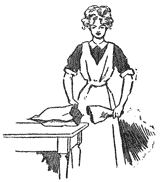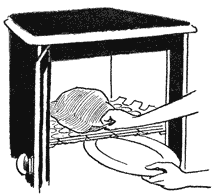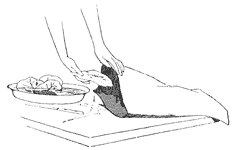
PREPARING TO COOK CABBAGE.
Those who have tried the foregoing recipes are unanimous
in their approval, but as regards the cooking of vegetables
in paper bags, opinions are divided. Several noted vegetarians
are enthusiastic on the subject, and declare that
paper-cooking is the very best possible way of conserving
the juices and flavour of all vegetables. Others, again, shake
doubtful heads, though they admit that some vegetables
are improved by this method of cooking, while others are
quite decided against it, maintaining that a new and unpleasant
flavour is imparted to vegetables so cooked. On
investigation, however, it will be found that these last-mentioned
critics have not given paper-bag cookery
a fair trial. They have probably seized on the homely
cabbage as an inexpensive subject on which to experiment,
hastily washed it, thrust it into a paper bag, and placed it
in the oven for an indefinite period. The result, naturally,
is uneatable. Shredded very finely, and put into a well
buttered bag with a cup of water, a piece of butter the
size of a walnut, pepper, and salt, a palatable dish will
emerge from the oven. At the same time, cabbage, plainly
boiled or cooked in a conservative boilerette, is in many
people's estimation a more superior dish. Potatoes, again,
are a cause of division in the camp. They undoubtedly
acquire a new flavour when cooked in a paper bag, and
this flavour is not agreeable to every palate. Many people
prefer new potatoes plainly boiled, for the young, immature
vegetable is of so watery a nature that unless the
moisture be dispersed by rapid boiling, the potato is too
wet and waxy to be palatable. For this reason, new
potatoes cooked by steam or in a conservative boilerette
are seldom liked, and paper-bagged new potatoes are open
to the same objection. It is a different matter, however,
with old potatoes, which, when cooked in a paper bag, are
very generally liked, and several excellent and proved
recipes for cooking old potatoes in paper bags are given
further on.
Asparagus is not always a success cooked in a paper bag.
Some people complain that the flavour is by no means so
delicate when so treated as when simply boiled or cooked
by steam or in a conservative boilerette, therefore this
vegetable is best put on the black list.
Other vegetables which have been tried and found
wanting are celery, turnip-tops, and artichokes. These,
however, when once boiled, can be utilised to make many
delightful dishes in paper-bag cookery. It may, too, be
worth the while of the ardent paper-bag cook to continue
to experiment with them until success crowns her efforts.
Speaking personally, these vegetables have not met with
general approval when cooked in paper bags. But one
cannot waste time in lamentations over the few vegetables
which are failures cooked in this way, when one considers
how many there are which gain so much in flavour as to be
a revelation in delicacy and richness of taste to those who
have only known them cooked in the ordinary way.
Green peas gain a perfectly exquisite flavour when
cooked in a paper bag, but a certain amount of care is
required. Too much water will ruin them, and if left too
long in the oven they will be hard. One family declared
with one voice against paper-bag cookery, because a dish
of young, fresh peas emerged from the oven looking like
tiny brown bullets, and crackling crisply between the teeth
of those who tried to eat them. But this, of course, was
the fault of a careless, incompetent cook, not of paper-bag
cookery.
Broad beans are delicious cooked paper-bag fashion;
but here, also, care and attention are required, as also with
French beans and scarlet runners. Tomatoes cooked in this
way are infinitely superior to those cooked in any other
way, and there are a great variety of delicious tomato
dishes to be cooked in paper bags. Young carrots and
turnips gain in flavour so cooked, and cauliflower paper-bagged
is unsurpassed. Brussels sprouts are not without
merit, and mushrooms, onions, cucumber, and vegetable
marrow gain so much in flavour as to almost fulfil the
harassed housewife's aspiration for a new discovery in
vegetables.
POTATOES.
Pare and wash the required number of potatoes and
place in the greased bag wet from the washing. Put in a
hot oven and cook for fifty minutes, reducing the heat after
ten minutes.
STEWED POTATOES
are a very savoury dish. Wash and peel as many potatoes
as are wanted, cut each into four thick slices, and put in a
greased paper bag, with a finely chopped peeled onion, a
tablespoonful of minced parsley, a good piece of roast-beef
dripping, salt and pepper to taste, and half a cup of water.
In forty minutes turn this savoury and delicious potato
mixture into a very hot dish and serve at once.
DUCHESS POTATOES.
This is an excellent way of using up cold mashed potatoes.
Melt a piece of butter or dripping in a little milk, the quantities
being in proportion to the amount of potato; add
pepper, salt, a pinch of dry mustard, and beat all very
thoroughly up together. Butter a bag very thickly, put
in the potato, and cook in a hot oven for ten minutes.
SLICED POTATOES.
Slice the potatoes thickly, wash well, and then dry in a
cloth. Sprinkle with salt and a little flour. Butter a
“Papakuk” bag very thickly, and cook for thirty minutes.
The bag must be shaken now and then to make the potatoes
crisp.
GREEN PEAS.
Shell the peas and to each half peck add a pinch of salt,
one lump of sugar, and one leaf of mint; more than one
leaf would give too strong a flavour to the peas. Add one
glass of water, and cook for three-quarters of an hour. The
gas should be reduced after five minutes. If the heat is
too great, the peas will be hard.
BROAD BEANS.
Remove the pods and then shell the beans. This extra
trouble is quite worth taking, for it makes all the difference
in the delicacy of the flavour, and the skins are very easily
removed. Put the beans when skinned into a thickly
buttered bag, add a piece of butter the size of a walnut,
into which has been worked a tablespoonful of flour, a
little salt, and a teaspoonful of minced onion. Add also a
cupful of water, and cook three-quarters of an hour, reducing
the heat after the first five minutes.
DUCHESS GREEN PEAS.
Shell the peas and put into a thickly buttered bag with
a lettuce cleaned and pulled into very small pieces, a few
spring onions, a leaf of mint, a pinch of salt, a little castor
sugar, a good slice of butter, and a cupful of water. Cook
for about three-quarters of an hour, the gas turned down
after the first five minutes.
FRENCH BEANS AND SCARLET RUNNERS.
These are excellent cooked in a paper bag. Contrary
to the opinion of many cooks, the beans should never be
sliced, but cooked whole. If the scarlet runners are very
large and coarse, they may be cut into two or three pieces,
but otherwise, they should merely have the tops and
stringy parts removed and be cooked entire. Put them
into a well buttered bag, with a slice of butter, a tablespoonful
of minced parsley, the same of minced onion, if
the flavour is liked, the juice of half a lemon and half a
teacupful of water. Cook for about thirty minutes.
CARROTS.
Wash and scrape a bunch of young carrots, and put
them into a buttered bag, with half a teacupful of milk and
water. Cook for twenty minutes. If the carrots are large
and no longer young, they should be cut into thick slices.
TURNIPS.
New turnips are delicious when cooked in a well
buttered paper bag. Wash and peel them, cut into thick
slices, put into a greased bag, with half a cupful of
milk and water, a pinch of salt, a pinch of castor sugar,
and half a teaspoonful of white pepper. Cook for about
thirty minutes.
MUSHROOMS.
These are particularly good cooked in a paper bag. They
must be freshly gathered, if they are to be really nice.
Cut off a portion of the stalk, peel the top, and wipe the
mushrooms carefully with a piece of flannel and a little
salt. Put them into a buttered bag, with a piece of butter
on each mushroom. Cook for twenty minutes. This
method preserves all the aroma and flavour of the mushroom.
CAULIFLOWER.
There is no more delicious way of cooking a cauliflower
than by cooking it in a paper bag. Cut away all the green,
carefully cleanse the cauliflower, cutting the stalk crosswise
to secure equal cooking. Lightly butter the cauliflower
all over, put very carefully into a bag with half a
tumbler of water, and cook thirty minutes.
PARSNIPS.
Wash, pare, and cut into slices as many parsnips as may
be required, sprinkle with salt and pepper. Put them into
a greased paper bag, with a cup of water and a little
thickened milk. Cook for twenty minutes.
ONIONS.
The onion is rich in nitrogenous matter, induces sleep
when taken at night, and is excellent as a remedy for colds.
It has a soothing action on the nerves, and is beneficial to
the kidneys. Take moderate-sized Spanish onions, remove
the outer skin; cut off the tops to form lids, and hollow
out a little of the onion. Fill this with sausage-meat,
cored and skinned sheep's kidney, or a little minced and
seasoned meat. Rub over with dripping, put into a well
greased bag, and cook for an hour.
ONIONS AND TOMATOES.
These two vegetables go particularly well together.
One excellent method of cooking them is to take as many
tomatoes as there are onions, slice off the tops, scoop out
some of the pulp, and carefully fix them in the hollow
of onions, which have been steamed till tender and a
hollow scooped in each. Put a piece of butter in the
tomato centres, drop an egg into each, sprinkle with salt
and pepper, add a tiny bit more butter, replace the top of
the tomato, cover with the piece of onion previously cut
off, put into a well greased bag, and cook for fifteen
minutes.
TOMATO STEW.
Take nice ripe tomatoes. Plunge into boiling water for
a few seconds, then put into cold water for the same length
of time. Take them out and pull off the skins, which will
now come away readily. Cut them up roughly in a basin;
add salt and pepper, the grated rind of half a lemon, a
bouquet of herbs, thyme, parsley, and bay leaf, and half
a teacupful of water, and a piece of butter. Mix together,
and turn into a well buttered bag. Cook for twenty
minutes. Empty into a hot dish, pick out the bouquet of
herbs, and serve immediately.
TOMATO PIE.
Prepare the tomatoes as in the foregoing recipe, and put
into a basin roughly cut up. Mix in a tablespoonful of
chopped onion, salt, and pepper, a teaspoonful of grated
lemon rind, half a cupful of weak stock or water, a tablespoonful
of fine bread-crumbs, a small piece of butter.
Have ready macaroni boiled and cut in inch-long pieces.
Mix with the tomato. Thickly butter a “Papakuk” bag,
put in the pie, and cook for twenty minutes.
STUFFED TOMATOES.
This is a very nice supper or breakfast dish. Choose ripe
but firm tomatoes. Cut off the tops, and put them aside.
Scoop out the seeds from the tomatoes, and fill with a little
minced cooked meat, nicely seasoned; or cut a sheep's
kidney in four and use it as stuffing; or a pork sausage
skinned and made to fit the hollow. Put a tiny piece of
butter on each, sprinkle with salt, pepper, and a little
minced parsley; fit on the lids, brush over with oiled
butter, put into a greased “Papakuk” bag, and cook for
twenty minutes.
VEGETABLE MARROWS.
These are particularly good cooked in “Papakuk”
fashion. Plainly boiled and served with white sauce, it
is an insipid vegetable, and even mashed with butter it is not
very savoury. Prepared, however, in the following method,
it is both tasty and satisfying. It is best pared before being
cooked, although many vegetarians maintain that by doing
so a great deal of the flavour and juice is lost, an assertion
made also of the cucumber. This is very true when either
vegetable is cooked in the ordinary way, but not so in
paper-bag cookery. Having peeled the marrow, it must be
cut in two, lengthways, and all the seeds and fibres removed.
The cavity must be filled with a tasty stuffing of
minced onion, cooked meat, finely minced, and half as
much bread-crumbs seasoned with salt and pepper, and
also some minced parsley, chopped beef suet, and a well-beaten
egg. Tie the two halves together with thin string,
brush over with oiled butter, put carefully into a thickly
greased bag, and cook forty-five minutes.
SLICED VEGETABLE MARROW.
Peel a rather small marrow, and slice it into rings,
cutting out all seeds and fibres. Sprinkle each ring with
salt and pepper. Have ready a very thick batter, dip
each ring in this, and put it, with as much batter as it will
take up, into a very thickly buttered bag, and cook thirty
minutes.
SAVOURY VEGETABLE MARROW.
This is a very tasty vegetable dish. Peel, cut open
right through the middle, not lengthways; take four or
five ripe tomatoes, plunge first into boiling, then into cold
water, to remove the skins, then cut up roughly in a basin,
add two onions, finely minced, a teaspoonful of lemon
juice, salt and pepper to taste, a slice of butter or some
grated suet, any remnants of cold ham or bacon there may
be in the house, finely minced, a teaspoonful of minced
parsley, half a cupful of fine bread-crumbs. Bind the
mixture with the yolk of an egg, well beaten, and fill in the
two halves of the marrow. Carefully put each half in a
separate well buttered bag, the mixture side uppermost,
and cook for forty-five minutes.
CUCUMBER.
Simply peel one or more cucumbers, brush over with
oiled butter, season with salt, pepper, sprinkle over with
a little flour, put into a well buttered “Papakuk” bag,
and cook twenty minutes.
CUCUMBER FRITTERS.
Peel a young cucumber, cut in slices of a medium thickness,
season with salt, pepper, the juice of a lemon, and
leave them to soak for an hour. Have ready a thick batter,
dip in the slices, sprinkle with minced parsley and a little
minced onion, put into a thickly greased bag and cook
fifteen minutes.
CUCUMBER STUFFED.
Peel a large thick cucumber, cut off the top, scoop out
the seeds, fill with a mixture of minced cold meat, a few
bread-crumbs, seasoning, and a little stock to moisten.
A very nice stuffing is made with some sausage-meat or
some kidneys cut small, flavoured with minced onion and
parsley. Fix on the top with white of egg, brush over with
oiled butter, sprinkle with bread-crumbs, and cook twenty
minutes in a thickly greased bag.
Cereals do not seem very adaptable for paper-bag
cookery, but with a little care and attention they lend
themselves very fairly to this method of cooking, and
gain considerably in flavour thereby.
BUTTER BEANS
are extremely nice cooked in paper-bag fashion. They
want a great deal of soaking to be really mellow. Wash
the beans well, and put to soak early in the morning in
abundance of water. Leave all day. By night the beans
will have absorbed most of the water. Pour off any that
may remain, leaving them quite dry. Cover the basin and
leave till morning. This gives the beans a much nicer
flavour than if they were cooked at once. Next day skin
them. They are much superior when the outer skin is
removed, and the trouble is really trifling. Put them into
a buttered bag with a cupful of water, a sprinkle of minced
parsley, a tablespoonful of minced onion, two rashers of
fat bacon, cut into dice, but no salt, which would render
them hard. They will be ready in an hour and a half. If
the skins are left on, they will take another half-hour. Have
ready a little butter, just melted over the fire, season with
salt and pepper, and pour over the dish of beans before
sending to table. If the bacon is omitted, substitute a
good slice of butter in the bag.
LENTILS.
Either Egyptian or German lentils are excellent in a
paper bag. Wash them well, soak all night in abundance
of fresh, cold water. Next day put them in a well greased
“Papakuk” bag, with the water in which they have been
soaking, a carrot, a turnip, a parsnip, and an onion, chopped
up roughly. Add neither salt nor pepper. Cook two
hours, and they will then be tender enough to press through
a colander. Season the resulting purée with salt and
pepper, re-heat, and serve as a vegetable. Or add enough
boiling stock to make a thick cream, stir in carefully a
well beaten egg, and serve as soup.
LENTIL CUTLETS.
Cook the lentils as in the recipe already given. When
they have been pressed through a colander, add enough
bread-crumbs and mashed potato to make a stiff paste,
season rather highly with salt, pepper, a little lemon juice,
and a tablespoonful of onion juice. Mix thoroughly, form
into neat cutlets, place in a thickly buttered bag, and cook
fifteen minutes.
RICE.
Well wash a cup of rice, and put to soak overnight.
Next day put it with the water in which it has soaked and
at least another cupful into a very thoroughly greased bag.
If it is not sufficiently greased, the rice will stick to it.
Cook thirty-five minutes.
SAVOURY RICE.
Soak a cup of well washed rice overnight. Next day
put it into a well greased bag with a sliced onion, two
skinned and cut-up tomatoes, pepper, salt, a piece of
thinly cut lemon rind, a couple of rashers of streaky bacon
cut in dice. Add a cupful of stock or water and cook
thirty-five minutes.
VEGETABLE ROLL.
Mash a quarter of a pound each of cooked carrot, turnip,
vegetable marrow, haricot beans, and potatoes. Season
with pepper, salt, grated nutmeg, mixed herbs; mix all
well, bind with a beaten egg, form into a shapely roll, put
into a greased bag, and cook fifteen minutes.
SAVOURY MACARONI.
Cut cold boiled macaroni into convenient lengths, and
put into a basin. Skin and cut up roughly two or three
ripe tomatoes; tinned may be used when fresh ones are
expensive. Add these to the macaroni; add also a tablespoonful
of strong gravy or some made from “Lemco” or
any good meat extract; pepper, salt, a chopped onion, half
a cup of fine bread-crumbs, and the zest of a lemon. Put
all into a well buttered bag and cook fifteen minutes.
GROUND RICE FRITTERS.
Rub ground rice smooth in a little milk, and add enough
to boiling milk to make a thick paste. Add to this a tablespoonful
of onion juice, a piece of butter the size of a walnut,
pepper and salt to taste, and a tablespoonful of grated
cheese. Mix well and let it get cold. Form balls out of the
paste, put into a well buttered bag, and cook fifteen
minutes.
MUSHROOM PUDDING.
Roll out a nice short crust, cut it in two. On one half
lay small button mushrooms, properly cleansed; sprinkle
with a little salt and pepper; put bits of butter over them,
cover with the other half of pastry; put into a buttered
bag and cook fifteen minutes.
TURNIP CUPS.
Take nicely shaped round turnips, cut off the tops and
scoop out some of the centres; fill with green peas, put
little bits of butter on the tops; put the cups carefully into
a well greased bag, so as not to upset them. Add cautiously
about two tablespoonfuls of water and cook twenty minutes.
ONION DUMPLINGS.
Take as many onions as may be required, peel them,
and make a deep incision across them; put into this cut
a piece of butter or dripping, salt, and pepper. Make a
good short crust, roll it out, and cut into as many pieces as
there are onions. Put an onion on each, and work up the
paste as if making an apple dumpling. Put into a well
greased bag and cook about an hour.