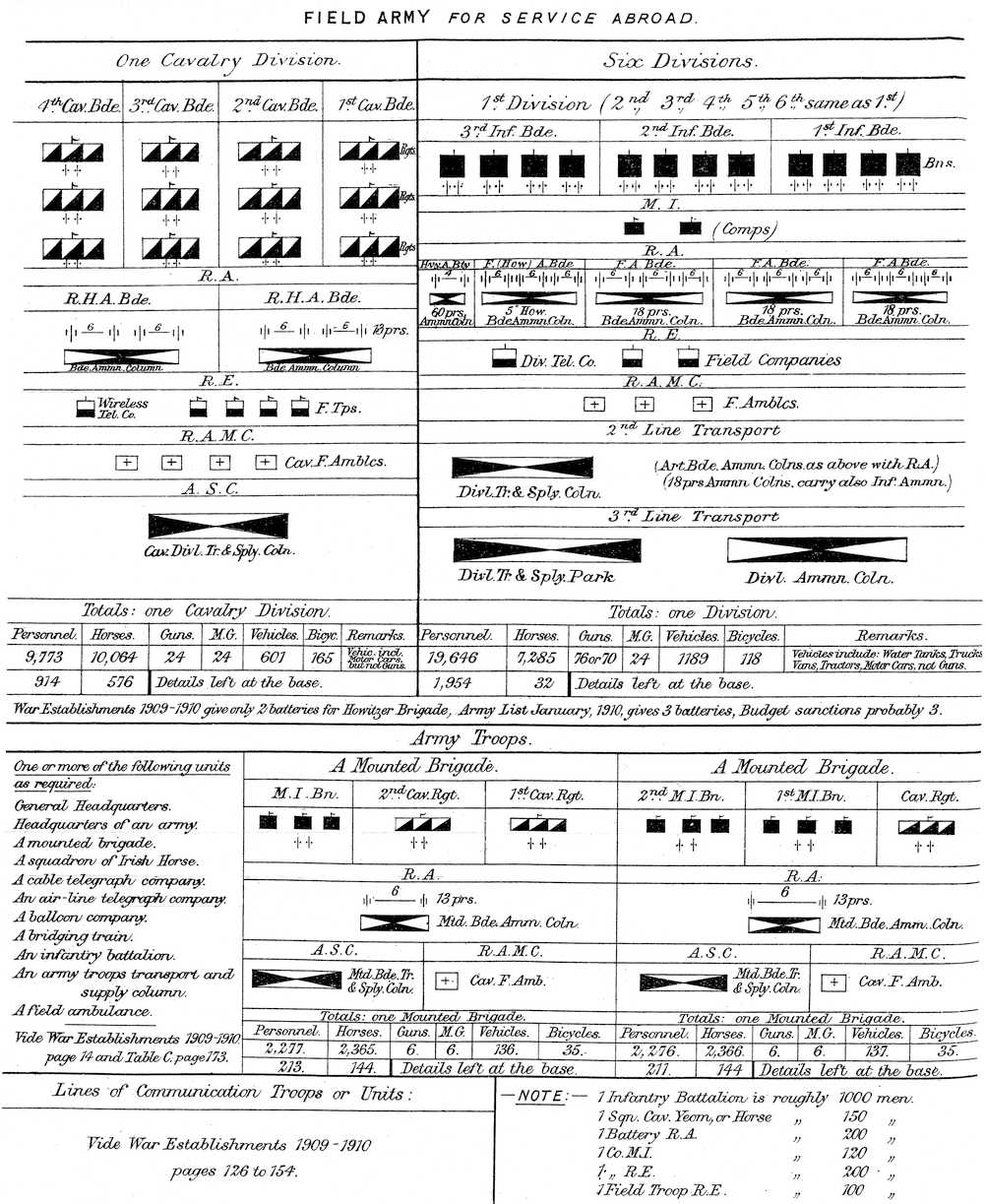
A description will now be given of the organization
of the British Administrative Services designed
for the Expeditionary Force of six Divisions with
a Cavalry Division and two Mounted Brigades.
At the head of each Administrative Service is a
Director, who is the adviser of the C.-in-C. on
technical matters connected with the Service he
administers. He is responsible for providing for
the requirements which his Service is designed to
meet, subject to the instructions of that branch of
the Staff to which the C.-in-C. has delegated his
authority in this respect.
A representative of each Director is allotted to
the Staff of the L. of C. and of the Subordinate
Commands, to whom he holds the same position
as his Director does to the Staff of the C.-in-C.
The Services are thus kept in close touch with the
Staff, so as to conform readily to the movements
and requirements of the Troops.
The following is a list of the Directors, and
shows the nature of the duty of the Administrative
Service which each directs.
Director of Army Signals: Service of inter-communication.
Director of Army Medical Services: Care of
the sick and wounded; sanitation.
Director of Army Transport: Provision of
transport.
Director of Army Supplies: Provision of food,
forage, fuel, and light.
Director of Army Ordnance Services: Provision
of ammunition, equipment, clothing, and
stores.
Director of Army Veterinary Service: Care of
animals.
Director of Army Remounts: Providing fresh
horses.
Director of Army Railways: Working of railways.
Director of Army Works: Engineer works on
the L. of C.
Director of Army Postal Services.
The Service of Army Signals is controlled by
the General Staff, and the Medical Services by the
Adjutant-General’s Branch, for the reasons previously
explained, in describing the organization of
the Staff, in Chapter VI. All the other Directors,
and their representatives with Subordinate Commands,
work under the supervision of the Quarter-Master-General’s
Branch of the Staff.
Besides the above Directors, and the Administrative
Services they control, the following Officials
and Departments form part of the General Head-Quarters
of the Army in the Field.
A Deputy Judge-Advocate-General, for legal
advice, and a Principal Chaplain are attached to
Head-Quarters of the C.-in-C., and are placed
under the Adjutant-General.
An Accounts Department, under the Financial
Adviser attached to Head-Quarters, and a Record
Office, to deal with correspondence, will be established
at the Base.
Of the officers enumerated above, the first four
Directors, those of Army Signals, Medical Services,
Transport, and Supplies, accompany General Head-Quarters
in the field. The remainder are usually
attached to the Head-Quarters of the Lines of
Communication, where the Services they administer
are mainly employed.
It is desirable, therefore, that a sketch of the
organization of the Administrative Services should
be prefaced by one of that of the Lines of Communication
(L. of C.), on which they mainly act.
The normal L. of C. for which these Services are
calculated is a Railway 100 miles long reaching
from a Sea Base to Railhead, and thence by two
roads 30 miles long to two Advanced Bases.
The defence of the L. of C. is now entirely
separated from its administration, and is entrusted
to an Officer styled the Commander of L. of C.
Defences, who is also responsible for its military
government when in hostile territory. To this
officer are allotted certain “L. of C. Defence
Troops” (two battalions for the normal L. of C.
laid down). The L. of C. is divided into sections
for defence, each under a subordinate “L. of C.
Defence Commander.”
The administration of the L. of C. is vested in
an Officer styled the Inspector-General of Communications,
who has command over all the Administrative
Services on the L. of C., controls their
working, and regulates the traffic on the L. of C.
He has a Staff, to which are attached the Heads of
the Administrative Services, or their representatives.
The L. of C. consists essentially of one
or more Advanced Bases close in rear of the Army,
a Railhead (beyond which railway service is not
organized), various intermediate Sections, or Posts,
as required, and, most important of all, the Base,
at the end farthest from the front, and nearest
home. The sections may be conterminous with
the sections of defence. For each of these portions
of the L. of C. there is an Administrative
Commandant in charge of its interior economy,
and responsible for forwarding the traffic on the
L. of C. through his section.
Each of the Administrative Services will now
be discussed in detail; those which are in part with
the Fighting Troops at the front being described
in this chapter, those which are entirely on the
L. of C. in the next.
It is only in the armies of England and the
United States that a complete system of inter-communication
between all parts of the Army has
been organized. Such a system has not been fully
developed in foreign armies, but its necessity is
more than ever pressing, owing to the wide dispersion
of forces in war, and the need for rapid
transmission of Information as to the enemy’s
movements from the Front to Head-Quarters, and
of Orders from the several Head-Quarters to the
Troops.
The means of communication in war are:
Electric: i.e. Telegraph, telephone, wireless.
Visual: i.e. Flag, lamp, or heliograph.
Manual: i.e. Orderlies (mounted, bicycle, or
foot); a system of relay posts served by
despatch riders; motor cars or motor
cycles.
Balloons, aeroplanes, and kites.
Balloons were first used by the French at the
Battle of Fleurus in 1794, and are being experimented
on by many nations at present. There
will be six balloons, of which three can be worked
at one time, with the British Army of six Divisions,
and probably two balloons to each German Army
Corps.
The whole system of inter-communication in the
British Expeditionary Force is under the Director
of Army Signals, who is at General Head-Quarters,
in close connection with the General Staff.
Communication Units are provided for General
Head-Quarters and Divisions, and also on the
L. of C., as follows:
Cavalry Division: 1 Wireless Telegraph Company.
Infantry Division: 1 Telegraph Company.
General Head-Quarters: 2 Cable Telegraph
Companies; 2 Air-line Companies; 3 Balloon
Companies.
Lines of Communication: 2 Telegraph Companies.
The following are the details of the communication
provided by these units, and of their composition:
The Wireless Telegraph Company provides communication
between General Head-Quarters and
the Cavalry Division, up to 80 miles, and also
inter-communication in the Cavalry Division, between
Head-Quarters and the Brigades, up to
20 miles.
The Company is composed as follows: A Head-Quarters
Section, for communication with General
Head-Quarters, and with detached Brigades; three
Sections for three detached Brigades (the fourth
Brigade being with Divisional Head-Quarters). Each
of these Sections carries its wireless equipment in
a wagon, but is also provided with 3 pack horses
to carry it. The Head-Quarters Section has equipment
for 5 large stations—one for communication
with the three Sections, two detached to
General Head-Quarters, and two for communicating
with the latter. These duplicate stations allow
of one pair being ready for work while the other
pair are moving into new positions as the Head-Quarters
advance.
The strength of the Company is 136, with 114
horses—namely: 5 Officers, 6 Sergeants, 4 Artificers,
1 Trumpeter, 120 rank and file, of whom 60 are
available for the telegraph work.
There are 16 wagons, 46 riding horses, and 4
bicycles.
The Divisional Telegraph Company provides for
internal communication in the Division. It comprises
3 Detachments, each providing a line of
cable 10 miles long, with 3 telegraph offices for
communication with the 3 Brigades.
The strength of the Company is 61, with 41
horses—namely: 2 Officers, 3 Sergeants, 1 Artificer,
55 rank and file, of whom 35 are available for
the telegraph work.
There are 6 wagons, 21 riding horses, and 1
bicycle.
There are 2 “Cable Companies” and 2 “Air-line
Companies” at General Head-Quarters. The former
provide temporary communication between General
Head-Quarters and Divisions or Army Detachments;
the latter, communication of a more permanent
character between General Head-Quarters
and the Advanced Base.
The “Cable Company” comprises a Head-Quarters,
and four Sections, or 9 detachments, each
providing 10 miles of cable line, and 3 telegraph
offices.
The strength of the Company is 176, with 125
horses—namely: 6 Officers, 7 Sergeants, 4 Artificers,
2 Trumpeters, 157 rank and file, of whom 100
are available for the telegraph work.
There are 19 wagons, 61 riding horses, and 1
bicycle.
The “Air-line Company” comprises a Head-Quarters
and three Sections, each of 2 detachments,
providing 20 miles of air-line, 8 miles of
cable, and 6 offices.
The strength of the Company is 225, with 158
horses—namely: 6 Officers, 12 Sergeants, 5 Artificers,
2 Trumpeters, 200 rank and file, of whom
120 are available for the telegraph work.
There are 22 wagons, 52 riding horses, and 1
bicycle.
Three Balloon Companies are allotted as Army
Troops, each to work one balloon and one set
of kites, with telephones to connect the observer
up in the captive balloon or kite with the ground.
The strength of a Company is 67, with 52
horses—namely: 3 Officers, 3 Sergeants, 1 Artificer,
1 Bugler, 59 rank and file, of whom 30 are
available for the ballooning work.
There are 3 wagons for equipment, 6 reservoir
wagons for gas, 8 riding horses, and 1 bicycle.
Note.—In the strength of all the above Engineer
Units are included 2 men of the Medical Corps
attached.
The above network of telegraphic inter-communication,
extending between all Head-Quarters,
is supplemented within the Units of the Field
Force by a system of Signalling.
Each Division has a Divisional Signalling Officer,
with a small detachment of Signallers—4 men in
the Cavalry Division, and a Sergeant and 6 men
in the Infantry Division.
Each Brigade has a Brigade Signalling Officer
and 4 Signallers.
Each Cavalry Regiment and Mounted Infantry
Battalion has a Signalling Sergeant, with 27
Signallers (9 per squadron).
Each Infantry Regiment has a Signalling Officer
and Sergeant, with 32 Signallers (4 per company).
Each Divisional Artillery Head-Quarters has 4
Signallers.
Every Artillery Brigade has 2 Signallers.
Every Battery has 5 Signallers.
A system of Telephones is, in addition, provided
for each Infantry Brigade. There is a Telephone
Detachment to work under the Brigade Signalling
Officer. It consists of a N.C.O. and 5 privates,
with a cart and a pack mule to carry the equipment,
for which 2 drivers are allotted.
Road Transport alone will be here considered.
This is the most important of the Administrative
Services, as on it depend the mobility of the
Force, and the working of the Supply, Medical,
and Stores Services. Transport is required with
the Units at the front, to carry the baggage and
stores of the troops, and their ammunition and
food for daily consumption, and to enable field
ambulances to accompany the army. Transport
is also required on the Lines of Communication,
to bring up ammunition and food from the base to
the front, and to remove the wounded to the base.
It is agreed that Transport must be organized
on a military basis when accompanying troops
at the front, where civil transport is hardly dependable;
but to provide the vast amount required
in rear of the army on the L. of C. would demand
more military Transport than could be kept up in
peace, and Auxiliary Transport has to be collected
from civil services for this purpose.
It is obvious that without a carefully worked
out system of organization for its Transport, an
army in the field will be helpless from want of
ammunition and food, and slow and uncertain in
its movements; the sick and wounded will lack
attention; and the troops cannot fail to undergo
hardships and privations, which will have a bad
effect on their morale and fighting power.
Owing to the enormous amount of food required
for an army, the main function of the Transport
is to carry supplies, so that the connection between
Transport and Supply is a very intimate one. It
has been found desirable, therefore, to amalgamate
the administrative units which effect these two
services. Those who are responsible for providing
food should also be responsible for moving it.
The administrative units of the combined services
of Transport and Supply are provided by the
Army Service Corps, as shown in detail in the
next section of this chapter. The Officers of this
Corps are trained both for Transport and Supply
duties. Their identical training and their organization
together in one unit tends to produce co-operation
in both services of Transport and Supply, and
should minimize any chance of failure in war. The
fact that all officers are interchangeable between
these services also gives an elasticity to the system
which is wanting when they are separate.
The Transport with the Units in the field is
called Regimental Transport, in distinction from
the Transport on the Lines of Communication, and
consists of two categories:
(a) Transport of Fighting Units, including all
Head-Quarters. This Transport is divided
into First Line, and Second Line, Transport.
(b) Transport of Administrative Units—i.e.
Ambulances, Supply Columns, and Supply
Parks.
(a) First Line Transport forms an integral part
of each fighting unit; the unit provides its own
drivers and superintendence for its transport, which
accompanies it at all times. The First Line Transport
carries on wheels (or by pack) all that the
unit requires for fighting—namely: guns, ammunition,
entrenching tools—besides signalling, medical,
veterinary, and other technical equipment.
Second Line Transport for all units is provided
by the A.S.C., to carry the baggage, supplies,
stores, and water which the unit requires to have
with it when at rest. This transport is not required
for fighting, and, when near the enemy, does not
accompany its unit, but is all massed in rear of the
fighting troops, but able to rejoin its various units
in a few hours. The water carts alone may at
times accompany the troops.
The stores carried include cooking utensils and
butchers’ implements, artificers’ tools and material,
office books and stationery; also, when specially
required, blankets, tents, and fuel.
The supplies carried are indicated later in the
description of the Supply Service which follows.
Transport for each Head-Quarters is all furnished
by the Army Service Corps (A.S.C.).
(b) Transport of Administrative Units.—This is
provided also by the A.S.C., and is described in
the two following sections of this chapter, under
the heading of the Supply Services and Medical
Services.
The Transport on the Lines of Communication is
controlled by the representative of the Director of
Transport at Head-Quarters of the L. of C. It is
carried on by Auxiliary Transport Companies,
composed generally of non-military wagons, teams,
and drivers, under the control of a small personnel
of Army Service Corps. Mechanical Road Transport
is likely in the future to be very largely
employed on the L. of C. to work from railhead
to the Units of field troops at the front.
In the British Army organization the details of
the L. of C. Transport are as follows:
Twelve Auxiliary Transport Companies of 50
wagons, and six of 100 wagons, are formed. Each
has an A.S.C. personnel of 3 Officers and 54 other
ranks, with 10 riding horses. Every 50 wagons
require 115 drivers and 210 horses, including 5 per
cent. spare.
In case the local transport is formed of carts,
the Auxiliary Company has an A.S.C. personnel
of 1 Officer and 28 other ranks. Every 50 carts
require 58 drivers, and 105 horses, including
spare.
There are four units called Transport Depôts, each
with a personnel of 3 Officers and 93 other ranks,
organized in four Sections; each Section can form
a small depôt on the L. of C., providing a reserve
of horsed transport to replace wastage, and a
repairing section for mechanical transport.
Transport for local work at the Base, and at
posts on the L. of C., is improvised from civil
sources, as it requires no great degree of mobility,
and, working locally, and at a distance from the
enemy, can be easily kept under supervision.
Experience teaches that supplies of food can
only be furnished to troops during war in three
ways:
(a) The men may be fed by the occupants of
the houses where they are billeted.
This is only possible in towns, or in
the country when the troops are much
scattered, and when the Army is moving
continuously, and the troops do not remain
more than a day or two in one place.
(b) Food may be obtained from the country by
purchase, or by requisition, which must
always be carried out in a regular manner
by responsible officers, or waste, confusion,
and individual looting and terrorism will
ensue.
(c) Food may be drawn from the L. of C. and
issued by the Supply Service.
A combination of all three methods is generally
practicable. The food available in the country
should be used as far as possible, so as to avoid
straining the resources of the Supply Service, and
the capacity of the Lines of Communication.
Under the average conditions of country and
climate for which the British normal regulations
are designed, it may be expected that fuel, water,
hay and straw, and cattle, will be obtainable in the
country. Thus only bread and groceries, and corn
for horses, have normally to be conveyed to the
troops by the Supply Service.
Both purchase and requisition demand good
organization, and trained supply officers accompanying
the troops. The Supply Service is
organized in the way about to be described, partly
so as to provide officers, men, and wagons to collect
supplies in the country and bring them to the
troops, partly to transport from the Base what is
required to supplement the amount collected.
The Supplies for an Army in the Field may be
considered under two heads:
(I.) Mobile Supplies with the Troops.
(II.) Supply Depôts on the Lines of Communication.
The former are divided into three lines of
supply:
(a) Regimental Supplies, controlled by the Unit itself.
(b) Column Supplies.
(c) Park Supplies.
The last two are controlled by the Supply Service.
(a) Regimental Supplies are those carried in
Regimental wagons, in addition to what is in the
personal charge of each man—namely, the remains
of the current day’s ration issued overnight, and an
emergency ration of preserved food. In the wagon
with each unit are one day’s ration of food and of
oats for the unit, for issue that evening, besides a
second grocery ration and some compressed forage.
(b) Column Supplies are carried in Supply
Columns, of which one is allotted to each Division
and Mounted Brigade, and to the Army Troops.
Each Column carries one day’s ration and forage
for its Division, and one emergency ration. One
day’s meat on the hoof will usually be driven with
the Column.
The Supply Column replenishes the regimental
supplies daily, and is kept filled up by collecting
local supplies, or by drawing on the L. of C.
depôts, or, as a last resource, on the Park Supplies.
(c) Park Supplies are carried in the Transport
and Supply Park allotted to each Division, which
usually marches a day’s march in rear of the troops.
It carries three days’ rations for its Division, and is
divided into three sections, i.e. 1 per Brigade.
There is in the Field Park also a Bakery Detachment,
capable of baking for 22,500 men; this is, as
a rule, stationed at the Advanced Base. One to
three days’ meat supply on the hoof will generally
be driven with the Park. The Parks are kept
filled up by a more extended exploitation of local
resources than the Supply Columns can effect, and
obtain the balance required from the L. of C.
depôts.
This organization thus supplies the following
rations per man, and corn per horse, with the
troops in the field, apart from any Supplies which
may be moving up along the L. of C.
COMPOSITION OF FIELD RATION
Meat: 1¼ lb. fresh, or 1 lb. preserved.
Bread: 1¼ lb., or 1 lb. biscuit.
Groceries: Tea, sugar, salt, pepper.
Jam.
Lime-juice and rum, when authorized.
Vegetables: 8 oz. fresh, or 2 oz. dried, or 4 oz.
preserved fruit.
The weight of a ration may be taken at 3 lb. net
or 4 lb. gross, and that of the emergency ration is
6½ lb. net or 9½ lb. gross.
The preserved meat and biscuit are carried in
80-lb. wood cases, containing 60 rations of meat
and 50 of biscuit. The cases furnish kindling for
fires.
12 lb. corn per horse, or 15 lb. for heavy
draught horses.
DISTRIBUTION OF SUPPLIES
On the man or horse: 1 day’s ration and 1 day’s
oats, less amount consumed overnight; 1 emergency
ration.
In Regimental Transport: 1 day’s ration, less
vegetables, and 1 day’s groceries extra; 1 day’s
corn.
In T. and S. Columns: 1 day’s rations and corn.
In T. and S. Park: 3 days’ rations and corn.
Compressed forage: 1 bale (82 lb.) in each
wagon in the Force.
Total carried with the Force per man and horse:
6 days’ meat and biscuit and corn, less that consumed
overnight;
6 days’ groceries;
5 days’ jam, lime-juice, and rum;
4 days’ vegetables;
2 emergency rations;
or sufficient for from 7 to 8 days, without receiving
supplies from the L. of C.
Advanced Supply Depôts, established at the
Advanced Base, to replenish the Mobile Supplies
with the Troops.
Intermediate Supply Depôts, formed at Railhead,
and sometimes at other points on the Lines of
Communication, as a reserve.
The Base Depôt.—This is the main source of
supply for the Army. In it are accumulated
ample reserves of all supplies, procured partly from
home, partly by contract from abroad, but as far
as possible by direct purchase in the theatre of war.
INTERIOR ORGANIZATION OF TRANSPORT AND
SUPPLY UNITS
The Supply Columns and Supply Parks are
formed by Companies of the “Army Service
Corps,” which comprise both Transport and Supply
personnel, with the necessary horses, wagons, and
stores.
The Company of Army Service Corps varies in
strength according to its functions, but comprises
on an average the following:
For Transport duties: 3 Officers, 63 other ranks,
108 horses, 25 wagons.
For Supply duties: 1 Officer, 13 other ranks.
The various Supply Columns are formed of a
number of A.S.C. Companies on the following
scale: one Company per Brigade, and one per
Head-Quarters; so that the Supply Column of a
Division comprises 4 A.S.C. Companies, that of
the Cavalry Division 5 A.S.C. Companies, and
that of a Mounted Brigade 1 A.S.C. Company.
The Army Troops Supply Column is formed by
1 A.S.C. Company.
The Divisional Supply Park is formed in 3
sections, or one per Brigade, each being formed by
1 A.S.C. Company.
The Field Bakery Detachment is formed by 1
A.S.C. Company, and is divided into 8 sections,
each of which can erect and work 10 ovens.
The Supply Depôts on the Lines of Communication
have a personnel provided from 40 Depôt Units
of Supply and 8 Bakery Sections; one unit and
one section are calculated to suffice for a depôt to
feed 4,000 men and 1,000 animals. Their personnel
comprises clerks, issuers, butchers, and bakers.
Civil labour and transport will be obtained to
supplement the military personnel, as required.
The Medical Service is of immense importance
to the operations. No General can afford to
neglect his sick and wounded. He can hardly
fight, if he knows he cannot attend to them on
the battlefield, and remove them afterwards to
hospitals in rear. There must be at the front
sufficient surgeons, as well as medical appliances
and stores, to cope with this work. The transport
of the sick to the rear must be carried out
without delay or confusion, and on the Lines of
Communication, and at the Base, there must be
properly equipped hospitals to receive the sick
and wounded.
The method of dealing with casualties in action
is as follows:
In the front, with the fighting men, are the
regimental surgeons and the stretcher bearers of
the Infantry, for work on the battlefield. Behind
the fighting line are stretcher bearers and ambulance
wagons of the Field Ambulance, collecting
the wounded, and taking them to the dressing
stations. In rear are the Clearing Hospitals,
into which the sick and wounded are collected, and
whence they are despatched in Ambulance Trains
along the railway to Stationary Hospitals on the
Lines of Communication, or to the Base Hospitals.
The invalids are then removed, either to convalescent
depôts on the L. of C., or by hospital ship to
the home country, where civil organization can be
depended on to help the Military Hospitals to deal
with them.
The Medical Services are manned and administered
by the “Royal Army Medical Corps.” Their
transport is provided by the Army Service Corps.
The organization comprises the following:
1. Medical Establishments with Units.
2. Field Ambulances with Subordinate Commands.
Six Clearing Hospitals, at Advanced Base.
Six Ambulance Railway Trains, each available
for 100 patients lying down.
Twelve Stationary Hospitals of 200 beds each,
on the Lines of Communication.
Twelve General Hospitals of 520 beds each, at
the Base.
Convalescent Depôts, as required.
Six Hospital Ships, each to carry 220 patients.
Three Base Depôts, and three Advanced Base
Depôts, containing a reserve of Medical Stores.
It will be observed that for a Division and a
Brigade of Mounted Troops there are provided
1 Clearing Hospital, 1 Ambulance Train, 2
Stationary and 2 General Hospitals, and 1
Hospital Ship.
1. Each Unit has attached to it a Medical
Officer, and itself supplies two trained Orderlies,
and a cart (or pack horse for mounted troops), to
carry medical equipment. There are also two
trained stretcher bearers from the ranks of each
Infantry Company (or four men from each Squadron),
trained in “first-aid” duties.
2. Field Ambulances are allotted to each
Division, and Cavalry Field Ambulances to the
Cavalry Division, and to the Mounted Brigades.
They are provided on the scale of one for each
Brigade. There are also two Field Ambulances
for the “Army Troops.”
Each description of Ambulance comprises a
Bearer Division of stretcher bearers, and a Tent
Division, which forms a “Dressing Station”—that
is, a small mobile field hospital in which only
absolutely necessary dressing is applied.
The Field Ambulance is divided into three equal
Sections, and the Cavalry Field Ambulance into
two Sections. Each Section has 3 ambulance
wagons, a water cart, and 2 wagons and a cart for
carrying its stores, baggage, and supplies. Each
Section is thus self-contained, and can be sent off
without reorganization, whenever required to accompany
a detached portion of the Brigade.
The strength of a Field Ambulance is:
10 Officers, 120 stretcher bearers, 60 hospital
staff, all belonging to the Royal Army Medical
Corps (R.A.M.C.), and 60 men and 90 horses
provided by the A.S.C. for its transport, which
consists of 10 four-horsed ambulance wagons, 3
water carts, and 9 other wagons for medical
supplies, baggage, and stores. Its Bearer Division
provides 18 squads of stretcher bearers, each squad
being of 6 men; and its Tent Division can accommodate
150 patients.
A Cavalry Field Ambulance comprises:
6 Officers, 38 stretcher bearers, 30 hospital staff,
of the R.A.M.C., and 44 men and 70 horses of the
A.S.C. It has 4 two-horsed, and 6 four-horsed,
ambulance wagons, 2 water carts, 4 other wagons.
Its Tent Division can accommodate 50 patients.
The establishment of a Clearing, or a Stationary,
Hospital to accommodate 200 patients is 8 Officers
and 80 other ranks; that of a General Hospital, 21
Officers and 140 other ranks. Nursing sisters are
allotted to the non-mobile Hospitals on the
L. of C. at the rate of 17 to 200 patients, but not
to the mobile Clearing Hospitals.
Each Ambulance Train is provided with 2
Officers, 18 other ranks, and 2 sisters, and can
carry 100 patients.
The Sanitary Service is one of the Medical
Services. Its object is to preserve the health of the
troops, by looking after purity of water supply,
and sanitation of camps.
The personnel of the Sanitary Service is provided
by the R.A.M.C. It comprises a Sanitary Squad
with each Unit, and on the Lines of Communication
a Sanitary Section at the Base and Railhead,
a Squad at each Post or Rest Camp, and 2 Squads
at each Advanced Base.
The Section comprises an Officer and 25 men of
the R.A.M.C., the Squad a Sergeant and 5 men.
In addition, a N.C.O. of each Cavalry Regiment,
or Artillery Brigade, or Battalion, and 1 or 2 men
of each Squadron, Battery, or Company, are
trained for carrying out Sanitary duties with their
Unit.