Where be the equal now
of those glorious editions of the poets, the “Annuals,” “Keepsakes,”
“Books of Beauty,” and other delightful volumes that still charm the
eyes and glad the hearts of those who have the taste and the wit to
possess them? As works of the highest art quality, they have never
since been equalled for beauty of work, with their engraved titles,
frontispieces, and illustrations in the text, drawn by Stothard,
Turner, Creswick, Stanfield, Harding, and a host of the first names in
British Art, and engraved in the rarest and most exquisite manner by
men equally eminent in their line. “Woodcuts,” however, cut them out
for the time, owing to the excellence to which the art had attained,
and the greater rapidity and cheapness in printing.
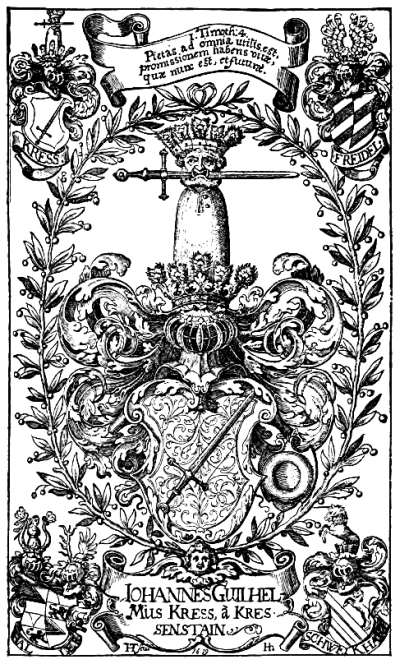
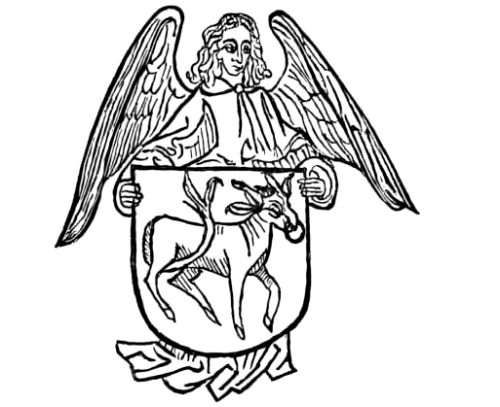
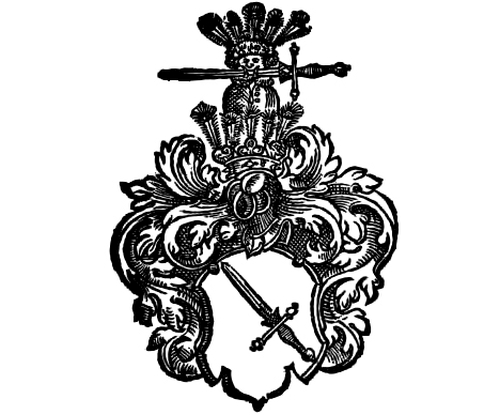
Kress Book-plate.
(See Ex Libris Journal, Vol. IV., p. 9.)
Engraved on Copper by Hans Troschel, 1699.
Reproduced by process block.
In all the changes and inventions in the modes of art reproduction
the engraved plate has steadily held its own as the most finished
and perfect. For Ex Libris it is particularly suitable; it is par
excellence THE STYLE for the attainment
of the highest art quality.
The Art Journal, supported by one or two similar publications, has
heroically endeavoured to maintain the traditions of the best period of
the Art in its steel-plate illustrations, but, except for pictures of
this kind, and of larger size for framing, illustrations on steel and
copper for books may be said to be practically extinct.
Time, however, has its revenges: wood engraving, in its turn, is being
rapidly displaced by “process blocks” (of which more anon), and now,
if we take up any recent illustrated book or journal, we find the bulk
of the pictures and designs not wood engravings but process blocks.
In every good collection of Ex Libris the majority of examples will be
found to be printed from engraved plates, very few relatively being
from wood blocks. The reason is not far to seek. The wood engraving as
practised in England previous to the opening of the present century was
poor in execution, and did not lend itself sufficiently to working out
minute details with the same ease and readiness with which they can be
executed on copper.
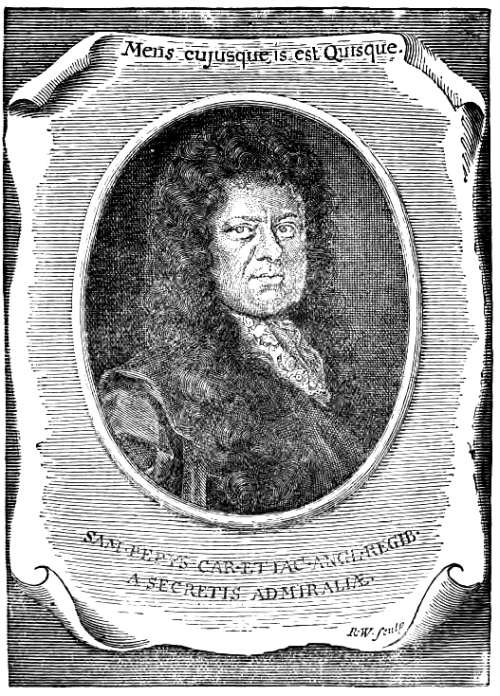
Pure Line Engraving by Robert White,
from a Painting by Sir Godfrey Kneller.
Reproduced by process block.
That it was the favourite mode of producing these dainty little
works is evident also from the fact that copper-plate pictures for
book illustrations of every kind had almost entirely superseded wood
engraving, which had indeed fallen completely into disfavour. Until the
beginning of the present century, when Bewick and others had elevated
it into a fine art, wood engraving was in an exceedingly rude condition,
and little fitted for small works. Copper-plate engraving, on the
contrary, had for several centuries flourished successfully; every
goldsmith was able to “chase” and engrave the decorative and heraldic
work upon silver plate and goldsmiths’ work, or upon metal of any
kind, in relief, or intaglio, as in medals, coins, etc. That this is
no mere assumption we know from historical evidence, as well as from a
careful comparison of the “handling,” or the manner of cutting the
lines upon silver work, which is identical with the style of cutting
the lines in so very many engraved book-plates of the last and early
part of the present century. Whatever may be thought of the vagaries
of the accessories in the Jacobean, Chippendale, and other kindred
styles—which are essentially silver engraving patterns—much of this class
of work shows at least a true heraldic spirit in the treatment of the charges.
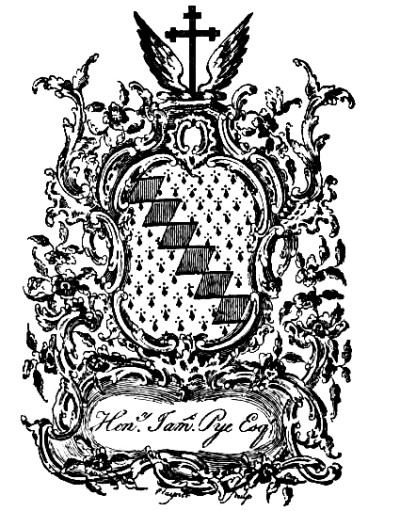
A Chippendale pattern. Silver Engraver’s style of work,
reproduced by process block.
Benvenuto Cellini, whose works now bring fabulous prices in goldsmith
work, was an expert engraver as well, as were probably most of the
workers in the precious metals of his time. Hogarth, in the earlier
part of his career, did much in the way of engraving arms, crests,
etc., for the silversmiths; so did Bewick, who worked on wood and
on metal indifferently. The writer has done a fair share of similar
work in his younger days; and to his knowledge it was the custom in
many establishments for the engravers to do both, as the exigencies
of business required, though the tendency when work was plentiful was
to specialise, each man doing that part for which he seemed to have
an aptitude. This refers particularly to graver work; the pictorial
engraver executing his work principally by means of the etching
process, and only finishing up with the graver.
No doubt a life-long practice in one particular class of work of this
kind is calculated to engender a stiff and formal manner, and set
patterns to become stereotyped, were it not for the capricious changes
of fashion; sometimes slowly developed, at other times, a new fashion
suddenly sets in and changes all; the later chasing the earlier out of
the field, only to be elbowed aside in its turn. Styles of ornament, as
they course each other down the stream of time, invariably leave their
high-water marks on the margin, which serve as valuable data for the
student; the prevailing styles of decorative and heraldic art, having,
like all mundane things, their periods of development, full-blossoming,
and decadence, the dates of which, book-plate collectors, aided by
dated specimens, arrive at with tolerable certainty.
The prevalence of a particular style, its vogue and duration, will
account in a great measure for the family likeness observable in so
many book-plates; the chief factors, however, may be set down to the
general low state of the art, the paucity of designers and engravers of merit,
and the ample supply of the ordinary article—the mechanical craftsman.
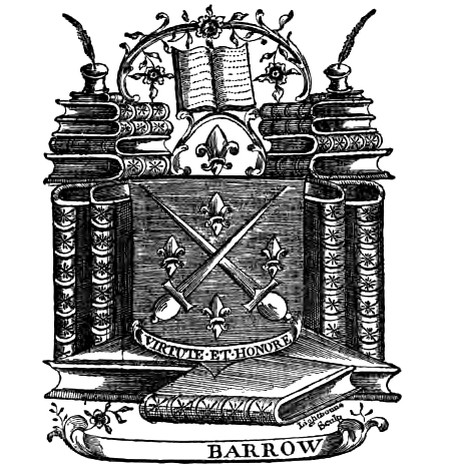
Pure Line Engraving, reproduced by process block.
As to the history and development of styles in Ex Libris, a reference
to the works of the Hon. J. Leicester Warren, J. Paul Rylands,
F.S.A., Egerton Castle, M.A.,
F.S.A., W. J. Hardy, and the pages of the
Ex Libris Journal, will find the subject fully and plainly set forth.
A word as to the origin and history of Copper-Plate Engraving. The art
of engraving on metal plates, for taking impressions on paper, was
first practised by Tommaso Fineguerra, a Florentine goldsmith, about
the year 1460. Some writers have claimed the invention for Germany, but
it is generally considered that the art was first practised in Italy,
and had its origin in the workshops of the goldsmith. An assistant
is said to have suggested to Fineguerra the possibility of taking an
impression from an engraved design with ink on moistened paper. The
first book printed at Rome was illustrated by the first plate
engraving. This work is dated 1478, but was commenced in 1472.
Engraving made rapid strides towards excellence in Germany. Albert
Dürer was a man whose universality of talent extended the boundaries
of every department of art, and carried all to a degree of perfection
previously unknown. He had great command of the graver, and carried his
plates to a higher state of finish than his Italian contemporaries. He
is also believed to have invented the art of etching by corrosion: on
examining his etchings, we see that they have all been corroded at one
“biting-in,” which sufficiently explains their monotonous appearance,
and proves that “stopping-out” was not then understood. To the Dutch
and Flemish schools we owe many improvements in the art. The celebrity
of the French school dates from the time of Louis XIV. Gerard Audran was
the first engraver who successfully united to any extent the use of the
graver and the etching point. The English school of engraving dates
only from the middle of the eighteenth century, previous to which those
who practised the art in England were chiefly foreigners. Hogarth
engraved many of his own designs. Francis Vivares introduced the art
of landscape etching: he, Woollet, and Brown produced some of the
first landscape engravings extant. Sir Robert Strange excelled in
portrait engraving. Of the moderns who have attained eminence in the
various branches of the art, the very enumeration of them would lead
to needless length, the present purpose being chiefly to describe the
processes.
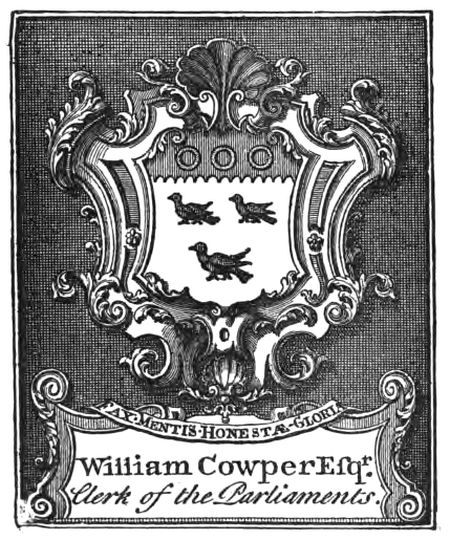
Pure Line Engraving, reproduced by process block.
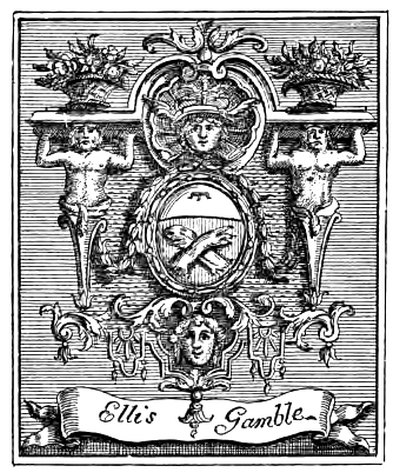
Line Engraving by William Hogarth,
reproduced by process block.
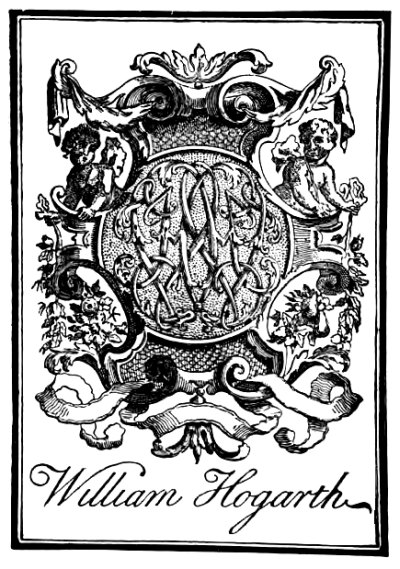
William Hogarth’s own book-plate.
Line Engraving, reproduced by process block.
There are many kinds of engraving on steel and copper for the
purpose of printing by the copper-plate press. We will specify
those principally in use and indicate their chief characteristics;
afterwards, some further explanation may be necessary. It may be here
stated that the various processes are of such a technical nature that
it would be impossible in a short compass to explain all the details of
execution; we may, however, refer those who desire to pursue the
subject further to an excellent little handbook (price one shilling)
published by Winsor and Newton,[2]
which, as stated in the preface, will, by means of any of the modes
of engraving on copper therein treated of, enable anyone “skilled in
pen and ink drawing to reproduce their designs with greater delicacy
and added depth of effect.” Other books on the subject there are, of
greater cost, as Hamerton’s splendid work, but for the amateur the
handy little manual just named is an admirable guide.
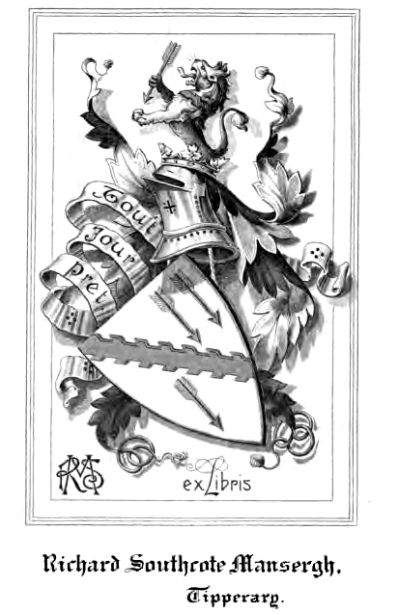
Transfer, direct from Engraved plate to stone.
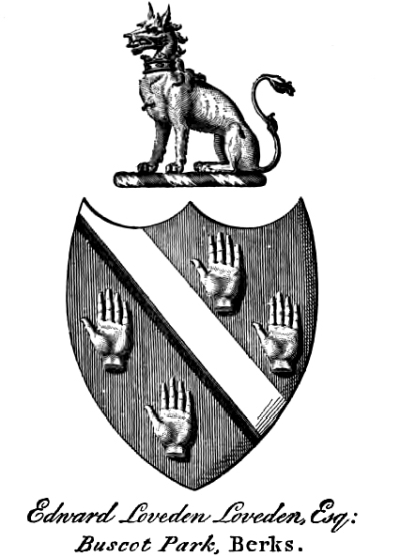
Pure Line Engraving, reproduced by process block.
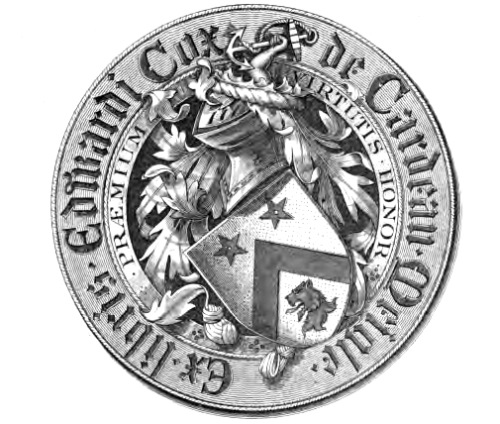
Transfer, direct from Engraved plate to stone.
To one skilled in drawing, and with some leisure and enthusiasm for the
work, Etching offers a delightful field for the exercise
of the artistic mind. There are no technical difficulties that may not be
surmounted by care and patience. The few tools and necessary appliances
are not of a costly nature, if we except the copper-plate printing press.
There are different kinds or methods of engraving, the six principal
varieties of which need only be considered, namely:—
- (1) Line Engraving.
- (2) Etching.
- (3) Soft-ground Etching.
- (4) Aquatint Engraving.
- (5) Mezzotint Engraving.
- (6) Stipple Engraving.
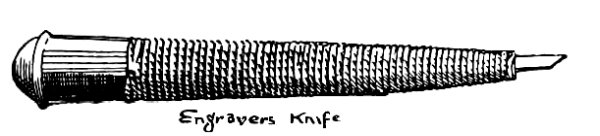
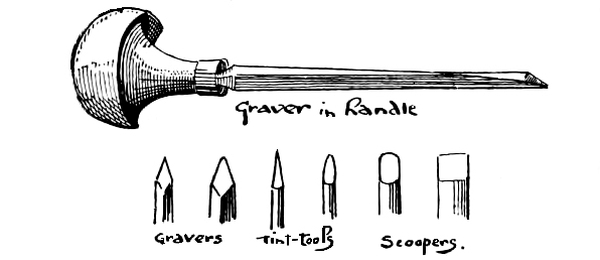
The distinctive features of all copper-plate and steel-plate engraving
consist in this, that the lines or strokes composing the design are cut
or ploughed into the surface of the metal with a fine tool termed a
graver, etched or corroded out with acid or by other means. A Print
is obtained by filling the lines so made with a special ink composed of
a drying oil and colour-pigment. During the process of inking the plate
is kept warm, the superfluous ink being wiped off with a coarse muslin
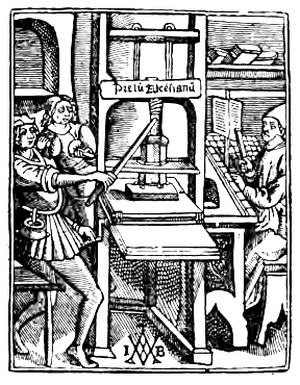
rag, and made perfectly clean. The plate, placed in the travelling bed
of the copper-plate press, is covered with a sheet of paper slightly
damp; on turning the press, it is subjected to such pressure as forces
the paper into the lines; by this means the ink is transferred to the
paper, and the result is an impression or proof.
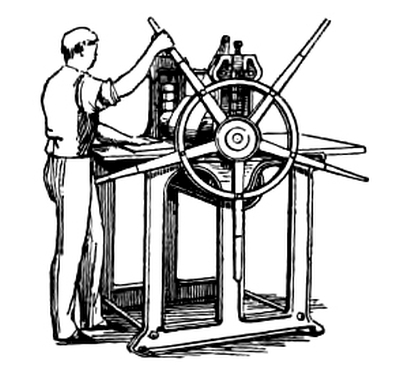
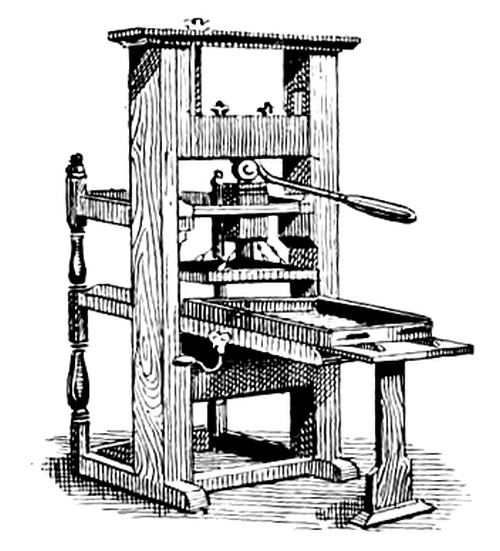
Copper-plate Printing Press.
Transfer, direct from Engraved plate to stone.
The majority of the earlier book-plates are engraved, or cut into
the plate entirely with the graver, and may properly be termed line
engraving par excellence.
As early examples of this style of work we are enabled to give
reproductions of several book-plates, viz., Kress of Kressenstein, by
Hans Troschel, 1699, p. 28; the portrait plate of Samuel Pepys, by
Robert White, p. 31; two plates engraved by Hogarth, pp. 40-41. The Ex
Libris of William Cowper, Clerk of the Parliaments;
Edward Loveden Loveden; —— Barrow;
and Henʸ Jamˢ Pye, also illustrate the quality of line
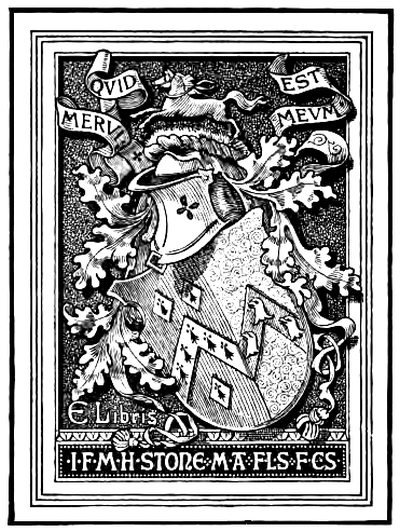
or graver work alone. The examples interspersed in the text carry their own explanation.
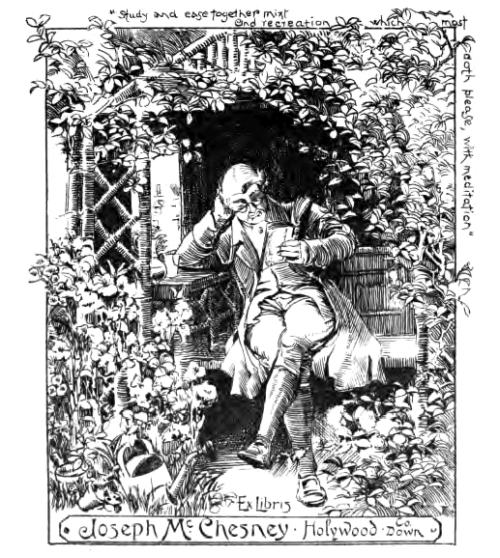
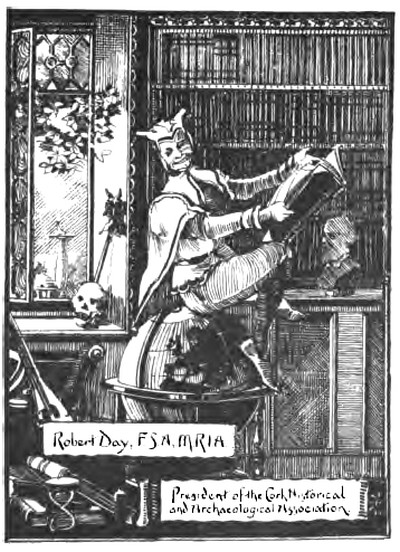
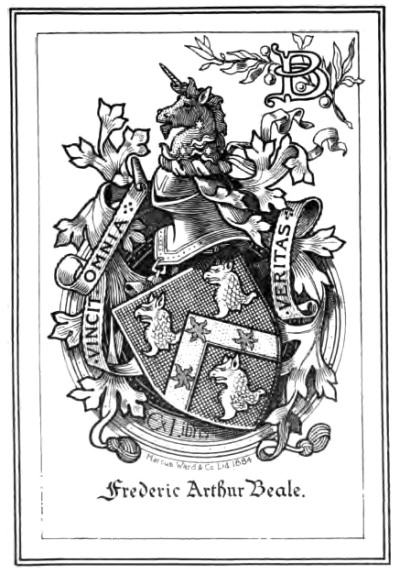
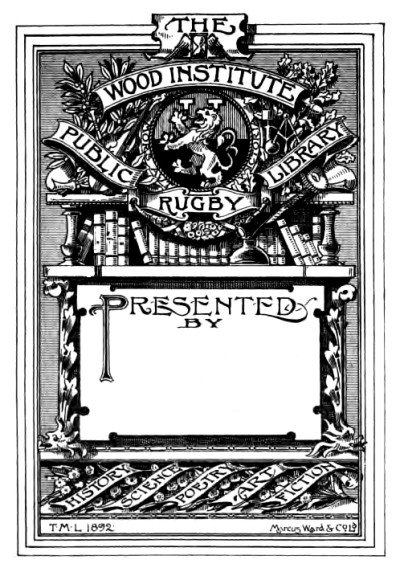
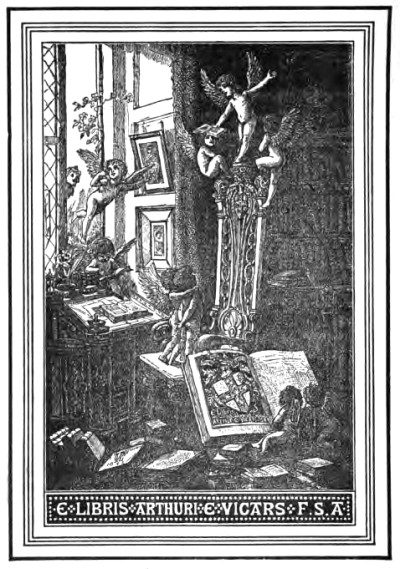
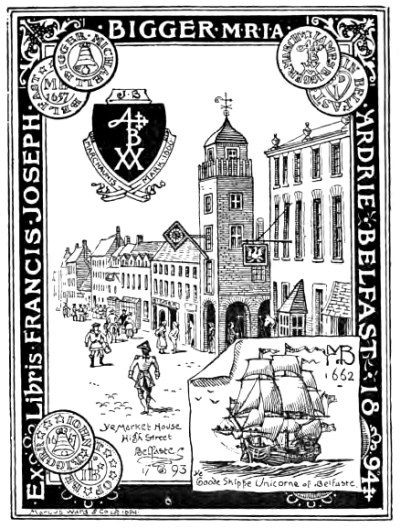
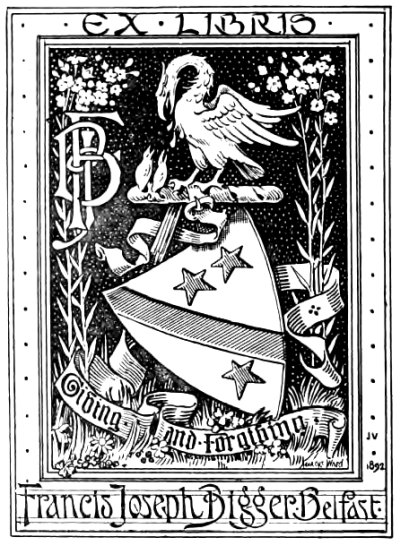
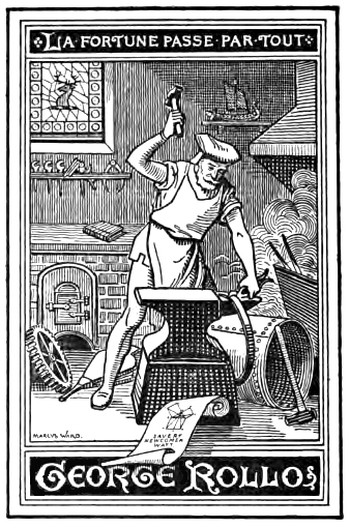
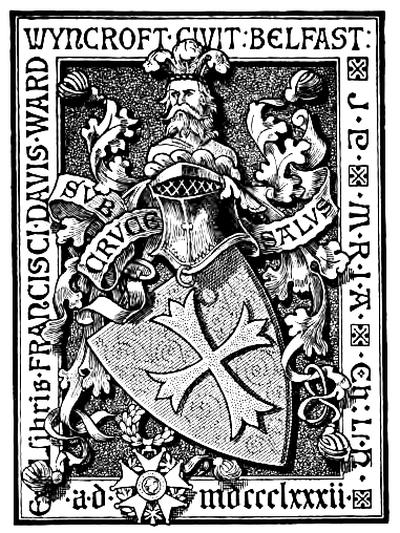
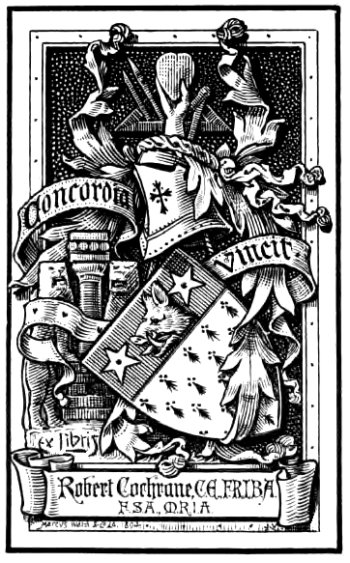
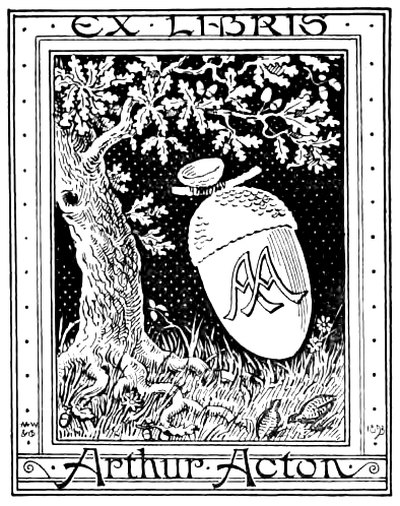
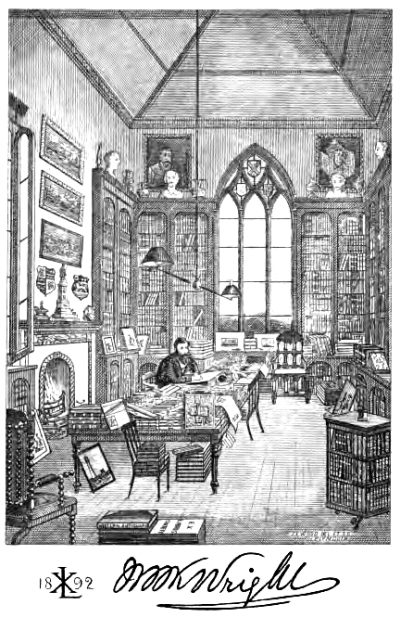
As modern examples of this style we are enabled to give several
characteristic varieties—the library interior of W. H. K. Wright,
by J. E. Wood, of Plymouth, and a number designed by the writer and
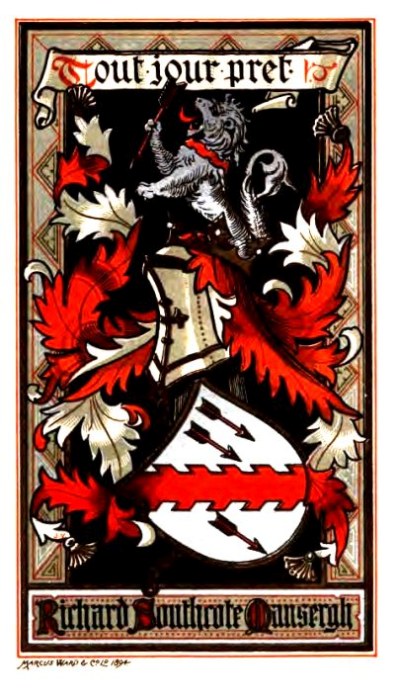
engraved by Marcus Ward & Co., Limited, printed by lithography—all of
which will be found useful as keys to the style of handling of graver
work alone, and in combination with etching.
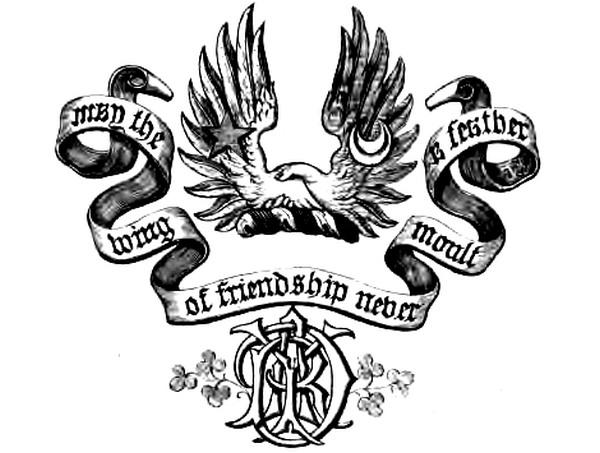
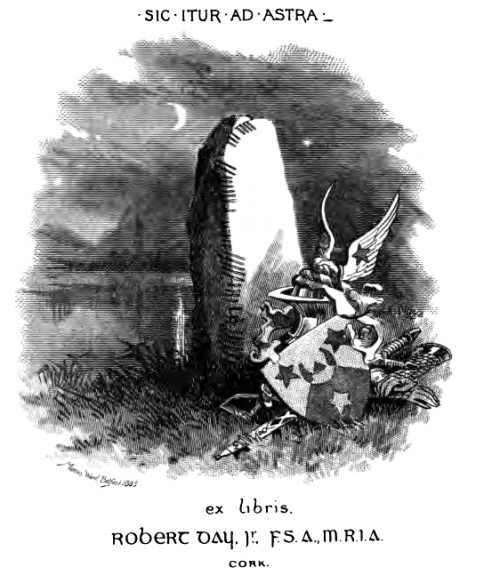
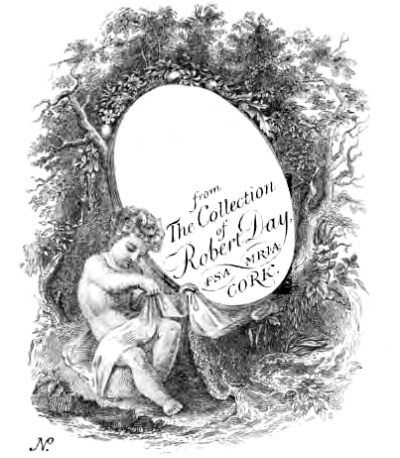
Among the chief exponents of the art may be mentioned the name of C. W.
Sherborn, who is facile princeps as an engraver of heraldic subjects.
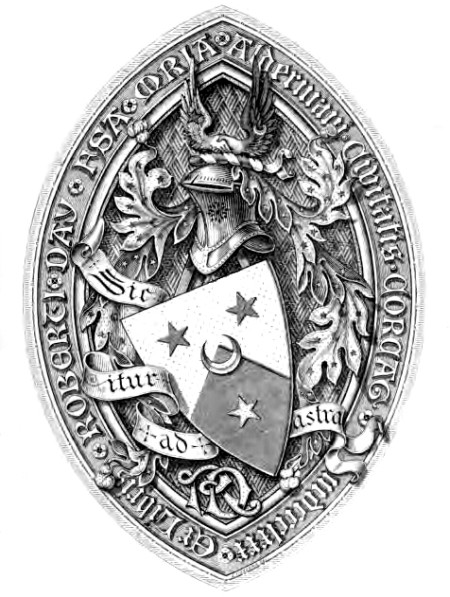
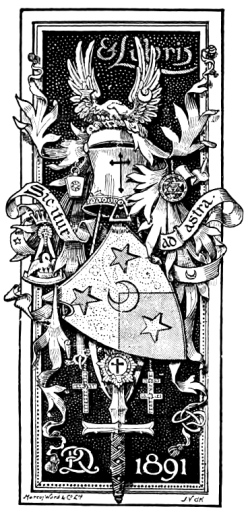
One of his smaller works, engraved in pure line, appears facing page
27, the dainty crest plate of R. Day, F.S.A.,
printed direct from the copper-plate; a favourite old toast, in playful
allusion to the wings in the crest, doing duty as a motto.
This method admits greater freedom of handling than graver work. The
design is drawn through a resisting ground with the etching point,
and the exposed lines on the surface of the copper corroded to the
requisite depth with aquafortis, the finishing of the work being
usually done with the graver.
Transfer, direct from Engraved plate to stone.
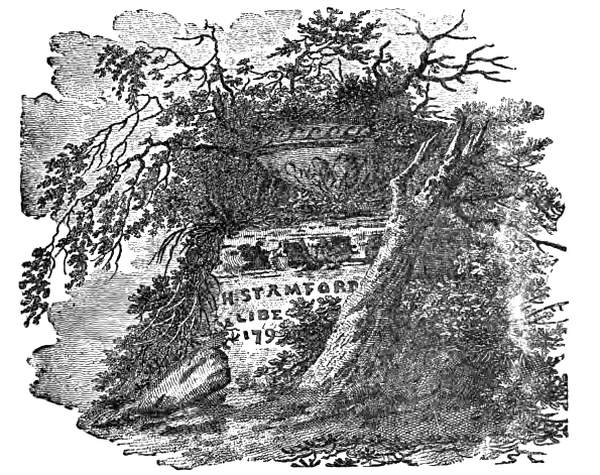
Etching on Copper reproduced by process block.
From the collection of W. H. K. Wright.
Machine ruling or tinting is now much used in conjunction with line
engraving and etching, for the even tints of skies and level surfaces
in pictorial work, and for the symbolical lines denoting tinctures in
heraldry, of which several examples are given.
Steel-plates were used for engraving very fine work, or when large
numbers of copies were required to be printed from the plate. Any
advantage over copper which steel formerly possessed is now neutralised
by the process known as steel facing, that is, coating the copper
plate with an electro deposit of iron.
Copper-plate printing, as it is termed, though giving the most perfect
result, is slow and tedious, and necessarily costly. A much speedier
method of printing—by Lithography—is now much used instead, transfers
from the engraved plate being put on the lithographic stone and printed
therefrom, the original plate being retained intact. (See examples under Lithography).
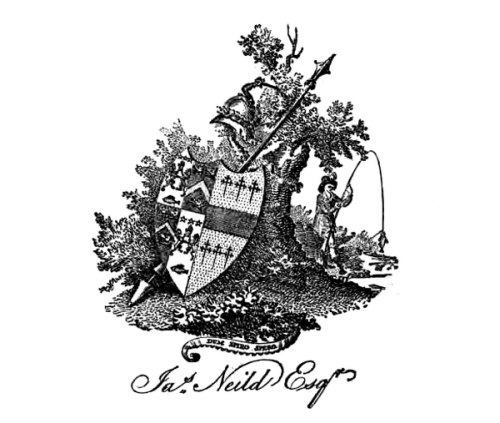
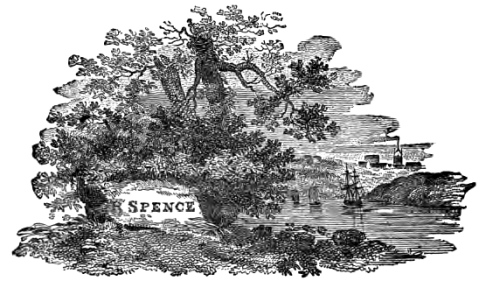
Two Etchings on Copper by Bewick, reproduced by process block.
From the collection of W. H. K. Wright.
Some early examples of etched plates are given. The urn design
of Charles Bragge, Armorial Landscape, and
Bewickian Landscape show the character and
handling of etched work as distinguished from line engraving. Other
examples illustrate the combination of Line, Etching, and
Machine Ruling work.
A very charming style of work which was much used by Bartolozzi and
other engravers of his time, but now gone entirely out of use. A
suitable book-plate engraved in this manner not turning up in time,
the present fine example of the style was selected to illustrate the
character of the work, which bears a close resemblance to a chalk
drawing, and on that account offers considerable difficulties in the
way of reproduction by the half-tone process. The result is, however,
successful in a remarkable degree in translating the peculiar texture
of the original.
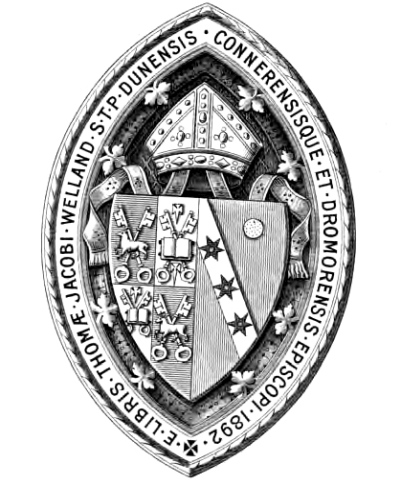
Transfer, direct from Engraved plate to stone.
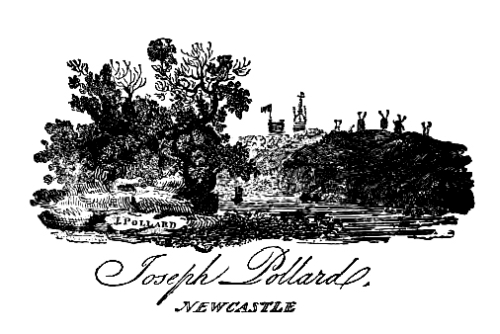
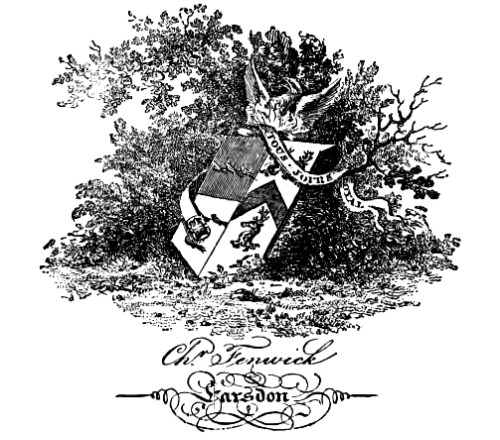
Two Etchings on Copper by Bewick, reproduced by process block.
From the Collection of W. H. K. Wright.
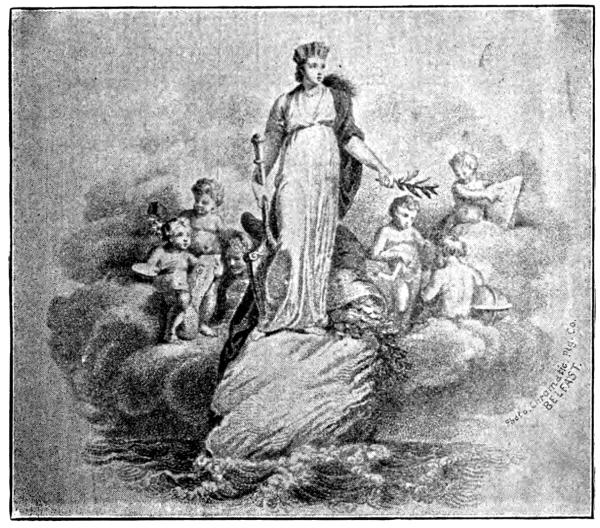
The allegorical device represents the turret-crowned goddess Cybele,
“mother of a hundred gods,” standing upon an isolated rock in the sea,
holding out an olive-branch, and with her attribute, the rudder, as
guide and director of the destinies of cities and states; youthful
figures representing the Arts and Sciences—which are the glory of a
State—are disporting themselves in the clouds.
Though not originally intended for a book-plate, a friend is desirous
of adopting it, with the motto from Virgil, “Fato prudentia major”—to
intimate that, in his opinion, prudence is greater than fate.
A style of work having all the appearance of a china ink drawing, and
frequently used by artists in conjunction with etching, to give body
and consistency to the tints. An admirable example of this combination
of etching and aquatint is the charming book-plate of the Hon.
Leicester Warren, by W. Bell Scott, well known to collectors. It does
not, however, lend itself well to reproduction.
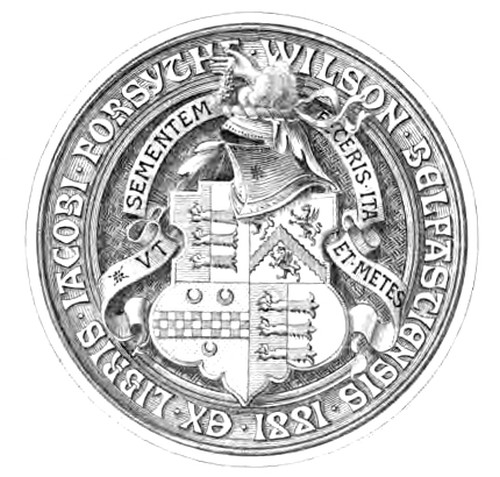
Transfer, direct from Engraved plate to stone.
The texture, which may be of various degrees of fineness, is produced
on the plate by a solution of resin (dissolved in pure spirit), which
is poured over the surface; as the spirit evaporates it leaves the
resin in minute isolated particles adhering to the plate. The design
is traced or transferred upon it, the highest lights “stopped out”
with engravers’ varnish. The etching (or biting-in with acid) is then
proceeded with; repeated stoppings out and etchings are made as the
deeper shades are attained.
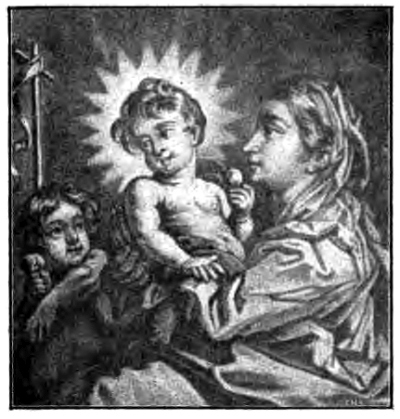
Produced by roughening the surface of the plate by a rocking tool, and
the lights and shades attained by scraping and burnishing. Seldom used
for small work, but largely used combined with Nos. 1 and 2 for prints
and pictures. The small French print of the Virgin and Child,
reproduced by half-tone process block, represents fairly well the
character of the work. (See example under “Half-tone Process Blocks.”)
Performed with the graver or other tool, which is so managed as to
produce the tints by small dots. This method is much used for statuary
and for portraits particularly, the rest of the picture being generally
executed by some of the other methods, Nos. 1 and 2 especially.
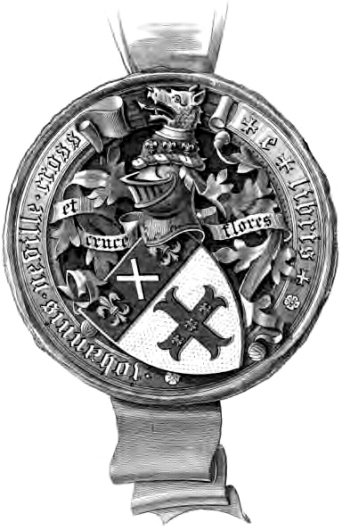
Transfer, direct from Engraved plate to stone.
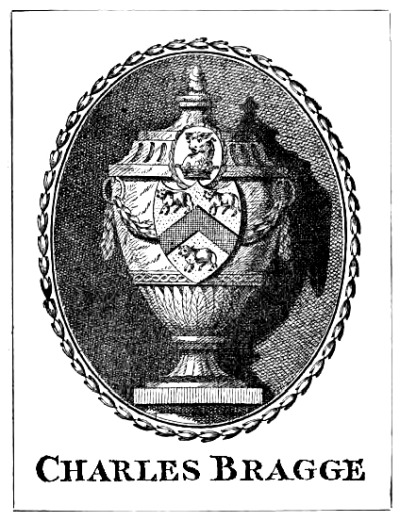
Etching on Copper, reproduced by process block.
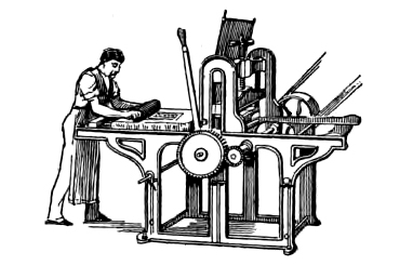
Lithographic Printing Press.