MOTION PICTURE DIRECTING THE FACTS AND THEORIES OF THE NEWEST ART
Transcriber's Note:
The cover image was created by the transcriber and is placed in the public domain.
By PETER MILNE
Motion Picture critic for over six years on
Motion Picture News, Picture Play Magazine
and Wid's (Film) Daily; and member scenario
and production department of Famous
Players-Lasky Corporation.
The observations on the art of directing motion
pictures included in this book are not by any means
intended as lessons for the layman with ambitions
pointing him toward this goal. To teach the craft
through the printed page is as impossible of accomplishment
as instructing a steeple-jack in his trade
through correspondence school. “A director must be
born, not made.” This old adage, adapted to our
present situation, is of a necessity partially false, inasmuch
as at the time of the present day directors'
initial birthdays there was no such thing as motion
picture production. Still it is true in a sense. Because
to direct for the screen requires a personality and an
ability, blending so many elements of generalship and
technique that to studiously acquire them is next to
an impossibility.
Be that as it may, the motion picture of today is
developing its own directors. It has reached out to
all businesses and arts and drafted men who are now
headed for top positions in the ranks of directorial
artists. Besides it offers the most humble of the studio
staff the opportunity to rise to the top.
During recent years cameramen, property men, authors,
continuity writers, artists of brush and of pen
and ink, actors and business men from varying lines
have become identified with the art of motion picture
directing. The law of averages has declared that many
of these should fall short of success. Many have.
6But others have succeeded, have succeeded even beyond
the expectations of their sponsors. Therefore it may
safely be said that the gates to the field of motion
picture directing are ready to open to all-comers, provided
that the aspirants have the inborn abilities and
personal makeup that are rigidly required.
These abilities, essential qualities and characteristics
are dealt with in the following chapters by the undersigned
who has spent nearly ten years in the motion
picture industry, serving in the capacities of critic and
continuity writer.
These abilities, essential qualities and characteristics
are, therefore, set down here as first hand observations.
But they are never intended as lessons that will produce
immediate results in the way of lucrative positions.
No reader of this volume can go dashing home to his
eager wife with that much advertised greeting: “Dear!
I've got that job! The New York Institute's book on
directing produced 100 per cent results!”
It is hoped, however, that it will give those who
have the patience to peruse it something of an insight
into the tremendous responsibilities that rest on the
shoulders of the conscientious director. At present
most people seem to believe that that line on the screen:
“Directed by ——” just stands for a lucky fellow
having a grand and glorious fling within the walls of a
motion picture studio.
Peter Milne.
7With grateful thanks and appreciation for
the views expressed therein by Marshall
Neilan, William C. De Mille, Rex Ingram,
Cecil B. De Mille, Frank Borzage, Edward
Dillon, Ernst Lubitsch; and the representatives
of D. W. Griffith, Thomas H. Ince,
and other artists herein referred to, whose
co-operation has made this book possible.
Chapter I THE GREAT AND THE LESS GREAT
8
Emotional experience
and the capacity for enduring
and retaining mental pictures
of such experiences—these
constitute the chief asset that distinguishes
the master director
from the rank and file. Practical
explanations and a word of
warning
9
Chapter I
What is the fundamental asset that makes the great
motion picture director? The requisite that distinguishes
the real artist from the rank and file? It is
really the same asset that distinguishes the great artist
in any walk of art from the less great.
When you put this question to a selected group of
directors you are liable to receive a different answer
from each one. In fact several were approached on
the subject before this chapter was written. And very
few of them agreed with one another. A still smaller
number hit upon what seems the correct answer to the
question.
It is quite true that the ability to “feel” a story and
each one of its individual scenes, counts a lot in a
director's favor. The proper “atmosphere,” the director's
ability to achieve it, is vastly important. So
also it is important to have the ability to properly
“visualize” the continuous action of a picture even
before the cameraman has once turned his crank.
But after all has been said and done on these scores
it remains that the one determining factor that distinguishes
the great from the near-great in the picture
producing art is experience.
Other requirements are important, vastly so, but
first of all and in capital letters EXPERIENCE.
It is fondly hoped that no one will presume to take
this literally to the very capital letter. To produce a
realistic crook story a director must not, of necessity,
10turn Raffles for a night. Nor to portray the effects of
African “yaka water” on a white man, must he subject
himself to a long siege of the drug itself. And doubtless
a capable director can successfully picturize the life
of a pearl fisher without diving into the briny deep.
Such specific experiences are not within the span
of any one man's life. A director might know Africa
thoroughly, might know what “yaka water” was as well
as a “madeira chair” and then be handed a manuscript
containing such nautical terms as “chain box,” “capstan,”
“seacock” and “chain cable.” As a consequence
a director must always hold himself in readiness for
research work when a 'script containing such foreign
terms comes his way.
But these experiences are largely physical experiences.
And they are very minor when it comes to a
summing up. No matter what peculiar terms and
words are used in a story, it is the emotional content
of it that counts as of greatest importance. Therefore
the director with the most complete groundwork of
emotional experience is the man most properly equipped
to rise above his fellows. This groundwork of
experience takes the shape of an emotional arc, an arc
that includes on its line points representing each human
emotion of life, reduced to specific and commonplace
fundamentals. The more points of emotion upon the
director's arc, the better craftsman he is.
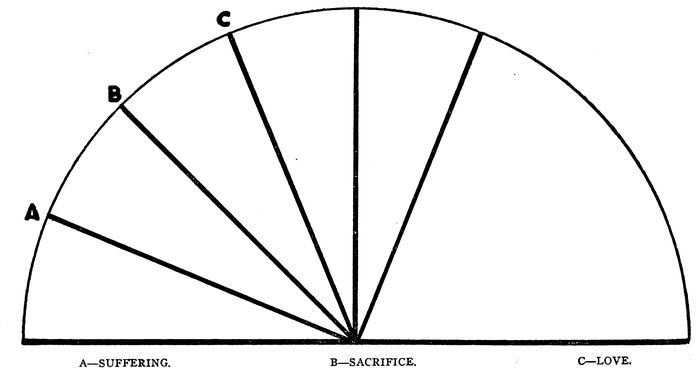
Diagrams properly don't belong in books written
upon an art such as directing. They should be confined
to volumes on mathematics and astronomy, but a simple
one introduced here will assist in illustrating the above
point clearly.
11
12Now let the arc pictured illustrate the entire
span of emotional experience possible for a certain
man, our great director, to have undergone. Say that
the line and point A represent the emotion of suffering.
Our director has suffered in his early career. Perhaps
he has slept on a park bench on a cold night with
newspapers stuffed among his thin clothes to guard
against the wind. His sleep has been fitful and in his
moments of awakening he has thought the whole world
against him—and roundly cursed it. In the morning
he has risen with his bones aching and not even the
two cents in his trousers necessary for the purchase of
a cup of boiled muddy water called coffee down the
line at Ben's Busy Bee.
This is a not uncommon case of suffering, specially
in the world of make-believe, where genius is raised
from poverty to affluence sometimes within the short
space of a single day.
But while it is being experienced it is doubtless one
of the most terrible adventures ever visited upon a
human being. As a consequence in later years this
experience of acute suffering remains stamped, consciously
or subconsciously, on the individual's mind.
Now to the point where this experience will tell
when the individual has become a director. The director
is called upon to stage, we will say, the scene of
Napoleon, a prisoner of the European powers on the
island of St. Helena.
13
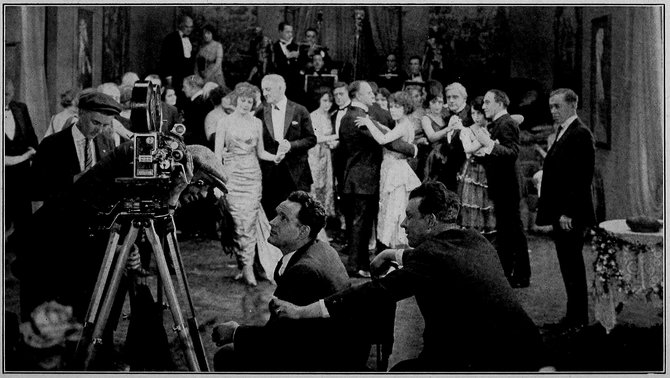
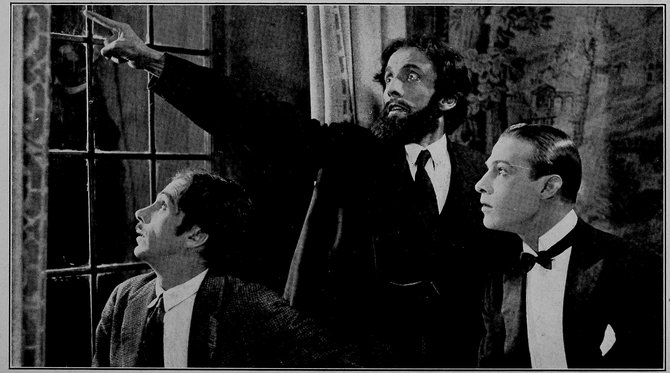
REX INGRAM, DRILLING SOME OF THE VARIOUS “TYPES” OF “THE FOUR HORSEMEN” IN THEIR PARTS
14
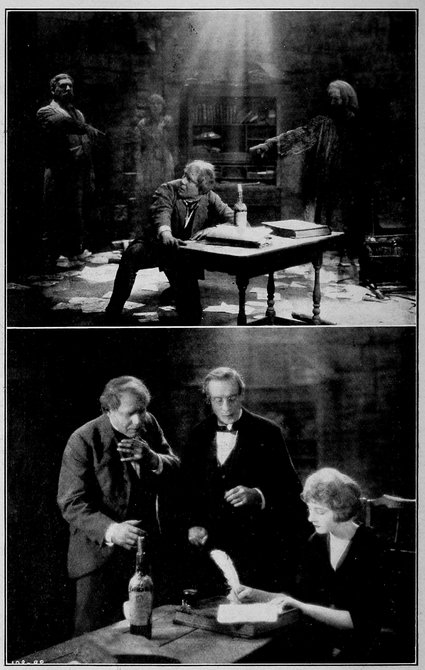
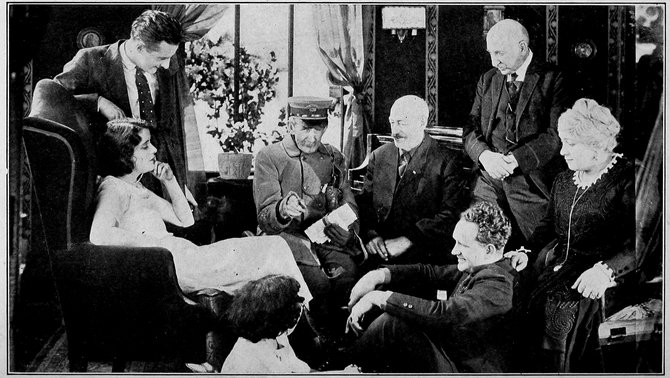
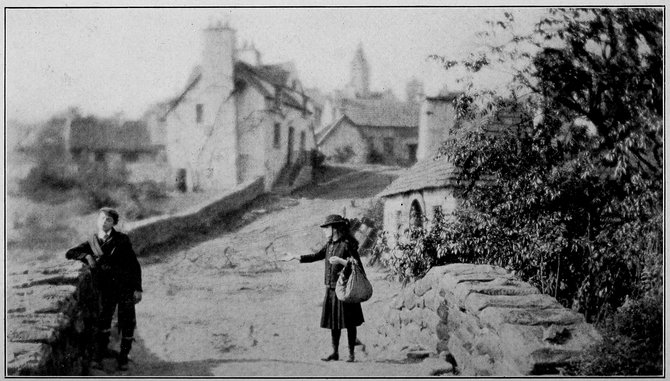
GEORGE FITZMAURICE TRANSFERRED “PETER IBBETSON” TO THE SCREEN RETAINING ALL ITS RARE CHARM
15How can the director know how Napoleon felt?
What does he know about his attitude of mind? The
answers are he knows everything. Back in the photographic
gallery of his mind he reaches for that scene
of himself on the park bench. He recalls that that
was the night during which he suffered, in his own
mind, even to the extent that Napoleon had suffered.
Therefore, still in his mind's eye, our director refers
to his arc of emotional experience. The point A represents
the height of his suffering. He then merely
extends the line A out and beyond his own emotional
arc until it crosses the emotional arc of Napoleon at
the point where he suffered the tortures of defeat, disillusionment
and imprisonment.
On the other hand perhaps the scene of suffering
that our director will be called upon to reproduce on
the screen is one less important or vivid than his own.
It might be a scene of a little boy stammering out his
first lesson in school. Suffering, to be sure, but not of
such great magnitude. In this case the line A is merely
extended downward until the little boy's emotional
arc is reached.
To reduce such a process of the intellect is indeed
dangerous. An individual's emotional experience is
no matter of diagrammatical science. However this
science is purely imaginary. The whole process is
carried out in the director's brain. It is only the fact
that it is here reduced to cold type that makes it seem
rather brutal.
Perhaps certain directors will scoff at the idea but
to those it may be replied that they use such a process
of reasoning whether they know it or not. The whole
16working out of the scheme is mechanical and subconscious
to a certain extent.
Perhaps, too, there are those among the directors who
believe that their moments of supreme suffering, park
bench or otherwise, were far greater than Napoleon's
sufferings. Nevertheless their own arcs of emotional
experience still serve their good steads. Such a director
merely reverses the process and goes down the line A
until he reaches what he believes the arc of Napoleon,
instead of going up the line. Such conceit on the part
of the director does not, however, lead to the best
results.
By the same process the director is able to live in his
mind the greatest case of self-sacrifice that the world
has ever known, provided that at one time in his career
he has made a self-sacrifice that loomed of tremendous
proportions at the time. His line of sacrifice, B, is
followed to the point where it cuts the arc containing
the greatest sacrificial act of the world. And of course
on the line, B, as on all the other lines from all the other
points innumerable other arcs cut across representing
cases of emotion between the greatest and the humblest.
And so by his own experience, no matter how small
or how large it is in comparison to the experience he
is to picturize, the director is able to give a realistic
and sensitive representation of it on the motion picture
screen.
The case holds the same with all the other emotions
of life. Perhaps with the case of love it is a bit different.
For in the matter of other emotions the director may
grant that someone else has experienced them in greater
17degree than he. But with the matter of his own
romance or romances—no! All directors have no hesitancy
in claiming, only to themselves of course, that
theirs is the greatest in the world. Consequently there
is no line C, but just the point. It is stationary. The
director follows it neither up nor down to reach out for
some similar point on another arc. Thus it is that
romantic scenes are quite the most frequently done
realistically and properly of all the emotional scenes
contrived for the screen. This time the director's conceit
does not stand in his way.
For the rest the great director's arc of emotional
experience contains every emotion, every cross and mixture
of emotions, that he has lived through during his
life. His arc contains hundreds of lines, each one distinguished
from the other by less than a hair's breadth.
And yet, when he comes to employ the arc in his work,
the exact line he desires immediately stands out in bold
relief from the others and the director sets to work
upon it.
Thus the greatest directors of today are the men who
have run the greatest gamut of emotional experience.
To converse with D. W. Griffith is to instantly realize
that here is a man who has suffered, sacrificed, lost,
loved, triumphed. His brain is a storehouse of emotional
experience, his own particular arc contains so
many points upon it that a dozen times a dozen alphabets
would not suffice to represent them all.
Thomas H. Ince has confessed to tramping Broadway
searching for work. Chance led him to the old
Biograph studio. Today he is among the greatest
18producers in the art. And it is a safe wager that his
beginnings and struggles have not been obliterated from
his mind by his success—rather they have been responsible
for it.
Charles Chaplin, greatest comedian in the world
and his own director gives evidence in each of his pictures,
mute, grand evidence of the sufferings, the
sacrifices, the little joys and triumphs of the days of
his youth when he had nothing.
And so does every great director today show in his
pictures, whether he knows it or not, the experiences
in his emotional career.
And let it be said also that the less great display a
remarkable lack of experience.
It must be reiterated here that these chapters are
not to be taken in the light of a text book. The writer
would have a holy horror of having on his mind a
happily married family man, who tossed up his business
and his bank account to sleep on a park bench,
and who tossed up his wife and children to enter upon
one illicit love affair after another, just to complete his
arc of emotional experience, because it has been stated
here that the fullest arc produces the best results.
Such experiences must come naturally. The great
director is a born artist. The born artist is a natural
vagabond and nine-hundred and ninety-nine people of
a thousand are not natural vagabonds.
After this fundamental requisite of experience come
a dozen other assets that go to make the good director—the
great director. The ability to handle people, to
be a master of men, the knack of “visualization,” to
19inject those little touches into a scene that perform the
miraculous act of “getting under the skin,” to achieve
a proper and telling “atmosphere,” etc., etc. These
requisites will be dealt with in other chapters, sometimes
by the directors themselves.
But no matter how important these other essentials
loom it may be stated again that first of all EMOTIONAL
EXPERIENCE counts.
Chapter II THE PICTURE SENSE
20
Every director who consistently
derives a living from
picture making has in more or
less degree the power of visualization.—Without
it he would be
unfit for his position.—The conclusion
that this “power” is mere
common sense applied to picture
directing
21
Chapter II
All our directors are not great. There would be
no fun for the picture audiences if they were. Fans
would be deprived of that greatest of all pleasures;
writing to the magazines to point out that Marie
wore silk stockings going in the door and lace filigreed
hose coming out of it. But in the rank and file of
directors whose work appears with regularity on the
screen there are many capable and skilled men—each
one, perhaps, merely waiting the chance or opportunity
to step into the limelight with a pictorial masterpiece.
Most of these directors are noted as “specialty men.”
One can do comedy-drama well, another excels at
straight romance, a third has a particular turn for
handling the intricacies of farce. These men are
skilled artists but not great artists. Potentially great,
perhaps, but the full extent of their emotional arcs has
not as yet been tested.
What then, a student of the screen has a perfect right
to ask, determines the ability of these men? The answer
is, that uncanny sixth sense necessary to become
a director, “picture sense” or more technically, the
power of visualization.
The picture sense is latent in every embryo director.
It can be developed, but no amount of study will acquire
it. It seems to be born in some men just as a
perfect tenor voice is born in some men. Study brings
each out but cannot create either one.
The “picture sense” is the art of seeing in the mind's
22eye, or rather the mind's picture screen, every scene of
the scenario writer's typewritten manuscript. Readers
will probably recall that this accomplishment has also
been set down as the scenario writer's fundamental
groundwork of learning. Thus the writer and the
director have much in common. And this is one reason
why so many scenario writers have become successful
directors.
It may readily be seen that this picture sense, this
ability of visualization, is constantly being used by the
director. When he first reads his script he is visualizing
it every moment of the way. To himself he says,
“Scene one will look like this, scene two will follow
like this.” He then conjures up before his eye what
sort of a set he will work in, what properties it possesses,
how his people will dress, where they will stand when
they go through their emotions, how they will enter
and exit from the scene, and a hundred and one other
details.
If, during this process of visualization, the story or
one of its various scenes rings false, then the director
is prepared to talk it over with the scenario writer and
see what can be done to set it right.
So right here it may be divined that a director with
this sense of visualization developed to the utmost is
a most valuable asset to any producing company. If,
on the contrary, he has to wait until he sees a scene
actually screened before he can detect its flaws and,
seeing them, prepare to take it all over again, the waste
time runs into money lost.
23
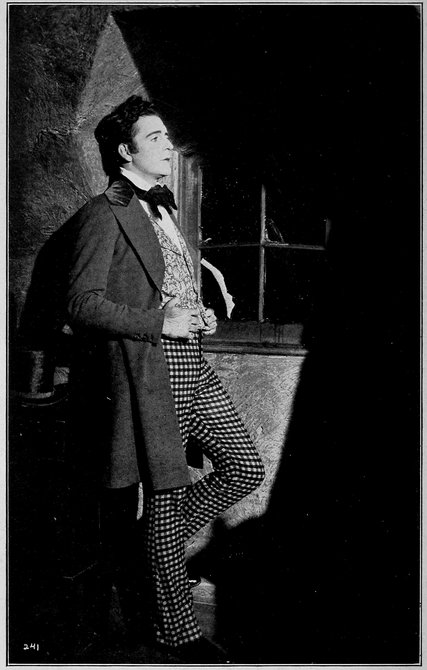
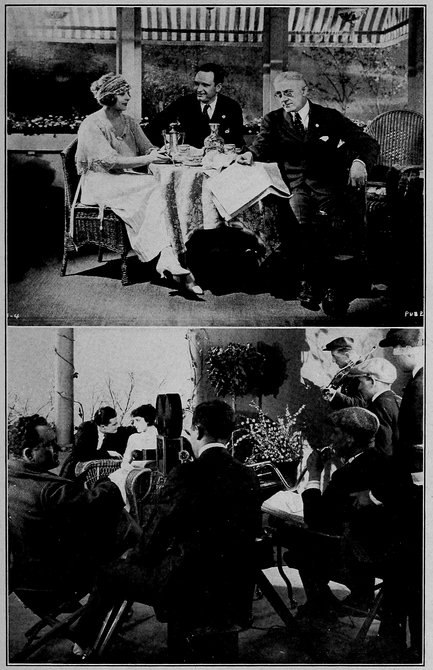
IN “SENTIMENTAL TOMMY,” DIRECTOR JOHN S. ROBERTSON SUCCEEDED IN RETAINING THE CHARM OF SIR JAMES M. BARRIE'S ORIGINAL WORK
24
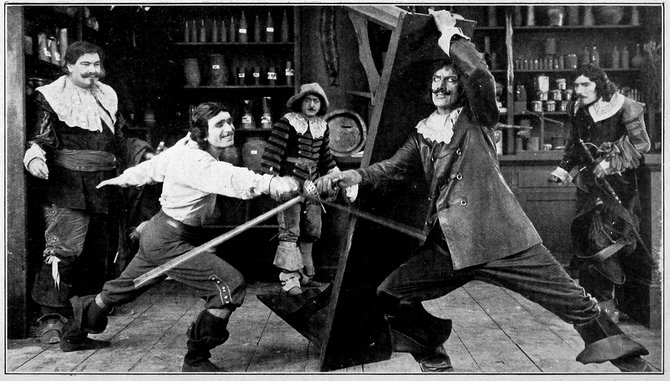
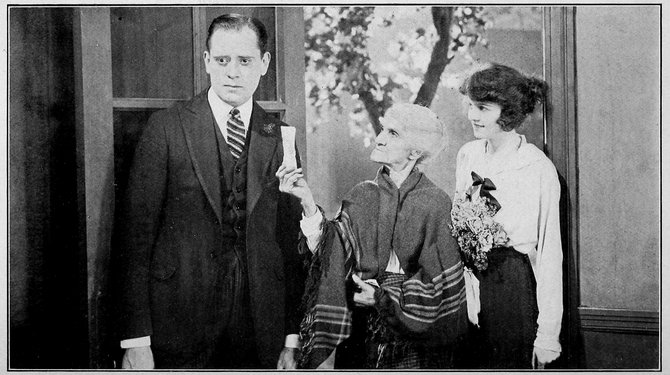
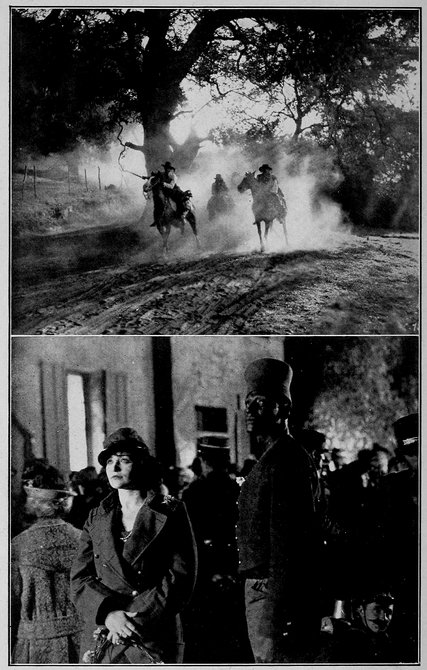
“THE THREE MUSKETEERS” REPRESENTS DOUGLAS FAIRBANKS AT HIS BEST AND MUCH OF THE CREDIT BELONGS TO FRED NIBLO, DIRECTOR
25Thus a director with a proper sense of visualization
is not prepared to “shoot” until he has determined that
each scene will screen realistically to the best of his
knowledge.
All this may sound perfectly easy to those unacquainted
with the inside of a motion picture studio.
It might be surmised that to detect unrealities in a
manuscript is merely a matter of common sense.
But it is remarkable indeed to take notice of the
many men, true artists in their particular lines and
certainly possessed of a modicum of common sense,
who have experimented in the directorial field and who
have failed because of this lack of picture sense, lack
of the ability to visualize.
One of the larger producing companies in the field
today, which is constantly seeking new directorial
talent, a company that is actually willing to pay intelligent
men to learn the craft of directing, recently
induced an author of national reputation to join its
scenario department with a view of later becoming a
director after he had become fully acquainted with the
construction of manuscripts.
This man never had a chance at directing because
he never made good in the scenario department. He
didn't, couldn't visualize. And as said “picture sense”
is required every bit as much by the scenario writer
as it is by the director.
Whereas, this highly talented individual failed in
mastering the picture craft, another man, a man who
had never written a line in his life, was given a megaphone
and told to go out and “shoot” a picture. This
man was a cameraman, had worked on a hundred
26pictures and, having the power to visualize, had developed
it to a remarkable degree. The results he
achieved with his first picture have earned him a position
with the producing company as long as he wants it.
The difference between these two “rookies” was just
that difference of “picture sense.” On the one hand was
a man with the inborn power of visualization, on the
other hand a man with a total lack of it. The difference
between success and failure.
Because of these conclusions it might be pointed out
that picture sense is a greater asset in the production of
pictures than a general experience in human emotions.
The argument might stand if it were not for the fact
that the cameraman-director is not as yet great. Indeed,
he is several degrees below the heights reached by the
creme de la creme of the craft. As yet he has only
attempted light romance on the screen, the easiest sort
of picture to produce and to produce well as has been
pointed out. As yet his real emotional gamut has not
been brought into play. It is an unknown quantity.
When it becomes known we may determine the degree
of the director's greatness.
Every studio has its stories regarding the amusing
predicaments in which a director would have found
himself had he not previously taken stock of the situation
and summoned his power of visualization to his
assistance.
It might be well to cite a simple case in point to
thoroughly bring out the value of this ability.
For instance, a director came upon the following
sequence of scenes in a scenario he was scheduled to
produce:
27Scene 45—Interior Ballroom. Full Shot
Host and hostess stand at door in f.g. receiving late guests.
General dancing and ad lib activity in b.g. Run for a few feet
and then bring in Mary escorted by John. They exchange greetings
with host and hostess.
Scene 46—Interior Ballroom. Semi-Closeup
Richard sees Mary enter and starts off toward her.
Scene 47—Interior. Medium Shot
Mary turns from greeting host and hostess while John is still
talking with them. Richard enters and confronts Mary. He speaks
hotly.
Spoken Title:
“You dare to come here, now that I've found you out?”
Scene 48—Interior Ballroom. Closeshot
Richard and Mary. Richard completes title. She looks at him
with scorn. He rages on a few moments and then exits.
Scene 49—Interior Ballroom. Full Shot
Mary turns to John who leaves host and hostess, and the
couple make their way across the dance floor.
This, of course, is but a section of a script. Moreover,
it is as technically perfect as anyone could desire.
And yet here the scenario writer has Richard denouncing
Mary in a closeshot, denouncing her quite savagely,
and right on top of this, in the next scene, she is
walking serenely on with her partner, neither he nor
any of the others in the crowded room having noticed
the previous scene.
This, of course, is an exceedingly obvious instance
of how the ability to visualize comes to the director's
aid. Yet there are many more subtle errors and superficially
more realistic, that are ever lurking in a manuscript,
lurking so securely as to sometimes escape notice.
You may choose to say again, “Tush, the scenario
writer lacked common sense when he wrote the above
sequence of scenes.”
28And so he did. After all, common sense when applied
to the art of directing is none other than “picture
sense,” the power of visualization. And so we arrive
back at the beginning of the chapter.
Chapter III PREPARATION FOR PRODUCTION
29
The routine attached to a
director's task before he begins
actual production.—Also
some instances of stellar temperament,
which, though mildly
amusing in their relation, are
something akin to tragedy in
their enactment
30
Chapter III
Before going further into the requirements of actual
directing and the methods employed by certain directors,
the various processes through which a scenario
goes before the actual work of production starts, can
be noted with benefit.
The scenario writer finishes his manuscript and the
director goes into retirement for a day or two to study
it and to put it through the test of visualization.
In the meantime other copies of the manuscript have
been placed with the various departments of production
of the studio.
The production department receives a copy. It is
the duty of this department, first of all, to estimate the
cost of the picture. So a “scene plot” is made. This
consists of the description of each interior “setting”
and exterior “location” called for in the story. A list
is made as follows:
Interiors
Ball room
Kitchen
Living room
Cafe
Etc., etc.
Exteriors
Waterfalls
Open road
Large field
Etc., etc.
31After the description of each interior and exterior
are placed the numbers representing the manuscript
scenes that are played in each interior and exterior.
The cost of production is then estimated. The production
manager, the head of the studio, a man who
strives to combine the ability of a business man with
the feeling of an artist, perhaps sees a way whereby
the kitchen scenes can be transferred to the living room.
This will eliminate the cost of erecting the kitchen
setting.
Details such as this attended to, he will then give
orders to the art and property departments to start on
erecting the first setting. This is usually the one in
which the greatest number of scenes are enacted.
The art department makes plans for the setting.
When these are passed they are given to the boss carpenter
who sets his men at work on the actual preparation
of the set.
When they have finished the art department in conjunction
with the property and drapery departments
“dress” the set. This is the working of fixing it up and
making it look like the real thing.
In the meantime the picture is being cast. Probably
the star and leading man are already chosen. Then the
casting director makes the list of all the actors, actresses
and “extras” needed in the production of the
picture.
He refers to his files and calls upon the people he
needs, either upon those in the stock company which
most studios of size maintain, or from the numerous
agencies who manage the players.
32His selections are then submitted to the director
and the production manager for O. K.
In the meantime the location department has secured
a list of the exterior scenes required by the
picture. The location man refers to his files containing
pictures of every likely location within a reasonable
distance of the studio. He must find waterfalls, open
road and a large field.
He selects these locations, being sure that the physical
action of the story can be played in those he selects
and then submits them to the director. If the director
has a reason for not liking any of them, the location
man must jump into his automobile and tour the countryside
for suitable substitutes to his first selections.
All rather hard and serious work.
Then the director starts to work. The production
department must watch him and have the next setting
ready for him on time so that not a day will be wasted.
If more than one or two companies are working in
the studio there may not be room to erect the next
setting. Then, perhaps, if weather permits, the director
goes out on location.
Thus he is obliged to jump from one place in the
story to another. He may be shooting scenes in the
last part of the picture on one day and scenes in the
first part a few days later.
All this is the routine work that must be gone through
with the production of each picture.
Then the temperament of the actors and actresses
comes in—comes in very strongly for that matter. If
the director be working with a female star she may
complain as to her leading man.
33
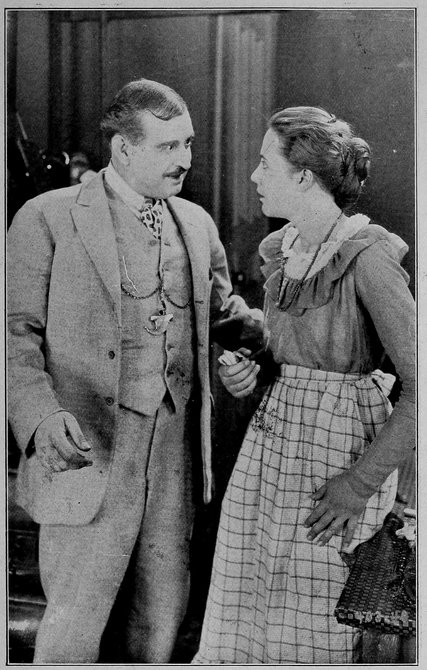
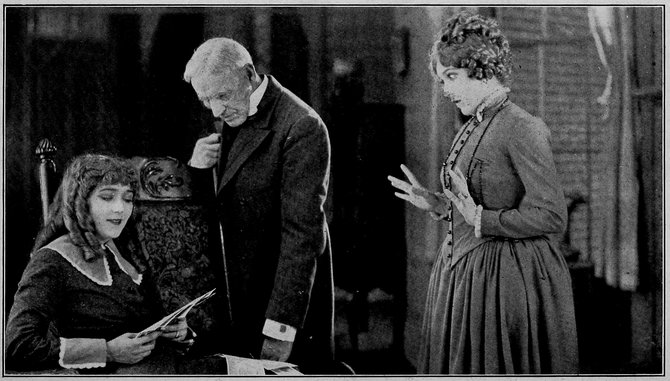
TRUE AND PENETRATING CHARACTERIZATION FEATURES WIN DE MILLE'S “MISS LULU BETT”
34
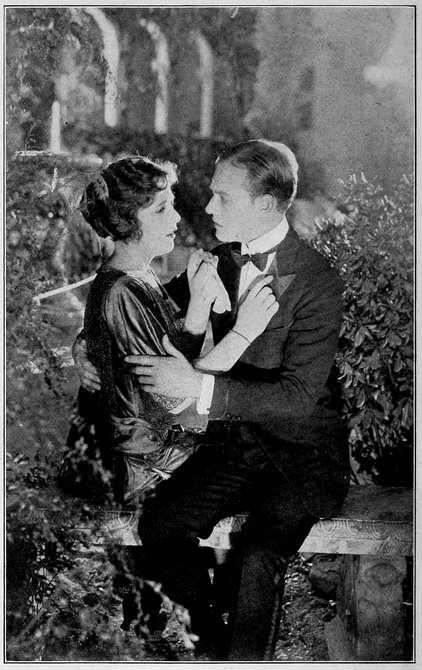
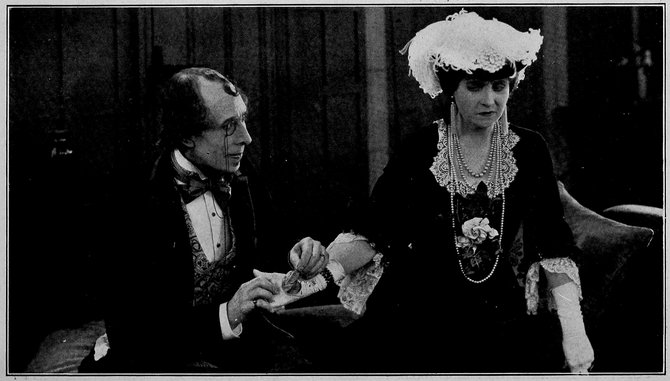
“THE LOST ROMANCE,” A PICTURE DIRECTED BY WILLIAM DE MILLE, BEARS THE SAME TRUE RELATION TO THE UPPER CRUST OF THE SOCIAL PIE AS “MISS LULU BETT” DOES TO THE MIDDLE PART
35“What's the matter with him?” the director will
ask. “Can't he act?”
“Yes, but he is not quite tall enough,” answers the
star, “why can't I have So-and-So from my last picture?”
“Well, So-and-So is busy on another picture just now,
sorry,” answers the director.
“I won't work without him,” this from the star.
Of course she will work without him. She has to.
The director knows this. So does she. But he has to
handle her diplomatically, to say the least.
He would like to come out and say: “You will work
with any leading man they give us.” But he doesn't.
He knows the temperament of the feminine star.
He summons all his reserve to his rescue and speaks
to the lady in cooing words. He brushes her ruffled
fur the right way. Exasperated husbands might take
a fine example from him.
After a few minutes talk he has succeeded in convincing
the lady that Such-and-Such has So-and-So
beaten eighty ways as to general ability, furthermore,
his contrasting complexion shows her off to much better
advantage.
Then the star, thoroughly convinced, cheers the
director up with such an answer as: “Oh, all right, if
you insist, but I did want So-and-So.”
She wouldn't dream of giving in and showing the
director he was right. The director doesn't get such
satisfaction. But if he's wise he doesn't bother about it.
36And so the work of production can go on. One day
while the director is working in the cafe setting, which
may be erected to represent a Parisian cafe an extra
will come up to him and tell him that it is all wrong.
“Because,” he will say, “I've been in a cafe in Paris.”
“Well, were you in all the cafes of Paris?,” the director
will politely ask.
“No, but this one didn't have—”
“Back to your place then, please,” answers the director
if he maintains his diplomacy and poise and
retains his anger.
Another extra will have too much makeup on. The
director must know how makeup photographs, what
its effects are with people of various complexions and
under certain lights.
The extra will resent being sent back to the dressing
room and told to alter his face. It is a reflection on his
ability. Another case where diplomacy is demanded.
And so finally the director gets everything working
smoothly. He gains the confidence of the star and
the leading man. He shows the extras that he knows
his business and is perfectly able to look out for it,
without their assistance.
The only trouble is that just about at this point
the director has finished the picture.
Chapter IV THE METHOD OF WILLIAM DE MILLE
37
Facts regarding the manner
in which the majority of pictures
are made.—The new order
of producing pictures “in continuity”
with some interesting
remarks on the subject from
William C. De Mille, director
of “Lulu Bett” and “The Lost
Romance”
38
Chapter IV
One of the most highly publicized tasks which fall
to the lot of the director, highly publicized because
of its mere freakishness, is the routine which
decrees that he must often begin “shooting” his picture
in the middle or at the end of his story, or at any intermediate
point except the very first scene. Press agents
delight in harping on this fact, calling attention to the
mental agility of the director in being able to jump
from love scene to angry outburst, omitting intervening
action in the jump and coming back to it at a later
date.
This is due to the fact, as has just been stated, that
all scenes taking place in the same set or exterior location
must, for economy's and convenience's sake, be
photographed at once or rather successively.
The “scene plot,” compiled by the production department,
lists the number of interior settings and exterior
locations required by the picture and after the
description of each scene in the scene plot a row of
numbers, each indicating a separate scene to be played
in the set or location, follows. Thus a section of a scene
plot may read:
LIVING ROOM: Scenes 19, 20, 21, 81, 82, 83, 84,
85, 159, 160, etc.
Of all the settings required let it be said that the
living room contains the majority of the action to be
39photographed. In all likelihood, then, this set is the
first one to be erected by the studio production department
and as a result the director begins his first
days work with scene No. 19 and follows it with scenes
No. 20 and No. 21, which disclose closely related
action.
Let us say that these early scenes have to do with the
first happy days of a young married couple. They discover
the little joys and hardships of housekeeping, etc.
Well and good. But immediately after producing these
scenes the director is forced to jump ahead to the
sequence beginning with scene No. 81. Here is a point
considerably further advanced in the story and so the
director is obliged to mentally leap the action intervening
between his first sequence and his second.
Whereas Mary and John may have been perfectly contented
in scene No. 19, they may have grown two years
older and separated altogether in scene No. 81. Inasmuch
as he “shoots” No. 81 immediately after No. 21
it must be seen that the director is obliged to adapt his
own mood to this peculiar state of affairs created by
the ramifications of studio organization. He must live
two years in half an hour or less. Such procedure
requires mental gymnastics that are more difficult than
the act of the vaudeville contortionist.
It is needless to add that this jumping hither and
thither and back to hither again, requires a minutely
adjusted sense of continuity on the director's part. To
keep his whole story and the comparative values of
certain sequences straight in his mind, is no easy matter.
Further complications enter when it is realized that
40a sequence of exterior scenes may follow immediately
after a sequence of interior scenes, these exteriors being
closely identified with the interiors and requiring the
same mood. But yet again the plan of work mapped
out by the production department may postpone these
scenes to the very last day of work. Thus the director is
forced to jump back into the early mood of his story
after he has rehearsed himself and become thoroughly
satiated with all the other moods, a task imposing seemingly
insurmountable difficulties.
Time was when it used to be the boast of some directors
that they could produce a picture in this jumping
about fashion just as well as if they had been
permitted to “shoot” their stories in actual continuity.
The method is still followed but the boasts aren't as
audible.
This method of production gave a fine opening to
those critics who cried out that the motion pictures
would always remain in the cheap state so well described
in the word “movie.” Really artistic results
could never be secured with this eternal jumping from
4 to 11 to 44, they said. They added, quite rightly
too, that a consistent, well developed, psychologically
ascending character was impossible of achievement
under this plan. Inasmuch as actors often had to play
their climaxes first and then go back and play a scene
that led up to the climax, there was considerable point
to the arguments of the critics.
A very few directors have now managed to arrange
their work so that they can actually make their pictures
in continuity, beginning with scene No. 1 and proceeding
41straight through, with but slight deviations, to the
end.
Among these directors and leading them all in results
attained, stands William C. De Mille, a director
responsible for such artistic successes as “The Prince
Chap” and “Conrad in Quest of His Youth,” both with
Thomas Meighan, and “The Lost Romance” and
“Miss Lulu Bett,” with casts very nearly approaching
the all-star state.
Mr. De Mille specializes in stories containing the
true and dramatic psychological development of character.
The artificial melodramatics and blatant heroics
he subdues to unnoticeable effect or more often eliminates
entirely. His arc of emotional experience is filled,
it is more than obvious, with all the sensitive lines
imaginable. In fact Mr. De Mille is one of the few
artistic directors in the field today, though perhaps his
name has not been as highly publicized as have those
of lesser lights.
Mr. De Mille states that both he and his brother,
Cecil, produce their pictures in actual continuity.
“With such pictures as those in which I specialize,”
he says, “and by this specialty I mean of course pictures
such as 'Miss Lulu Bett' and 'The Lost Romance,'
pictures that depend considerably for their
value on the consistent and progressive development of
character, rather than mere physical action, producing
in continuity is tremendously effective as well as a great
help.”
“To jump about in character studies of this type
would be exceedingly difficult for both players and
42director and in many cases, suitable results would not
be obtained.”
Let it be inserted here that other directors may scoff
at the De Mille idea, but it may also be noted by
students of the screen that no other director has
achieved the highly artistic results in this line of pictures
that stand to the credit of William De Mille.
Let him continue: “The method of starting with
scene No. 1 and proceeding numerically to the conclusion
of the picture is of benefit to both players and
director. The players characterizations become well
sustained, they take a greater interest in their work as
they realize it growing consistently with each day's
effort. And the director is able to get a better slant on
his story as he watches the whole thing grow and take
definite shape from day to day.”
Those who ask for proof need only look at one of
the four pictures mentioned above that Mr. De Mille
produced. “The Lost Romance” contained four of the
most real characters ever developed on the screen. As
for the two pictures in which Thomas Meighan appeared
it is safe to say that his work in them far surpassed
anything else he has done before or since with
the exception of “The Miracle Man.” And the basic
success of these two Meighan pictures was in each
case, the characterization rendered by the star. This
characterization might have been achieved by other
methods but it is doubtful. Certainly De Mille's
method has proven itself.
43
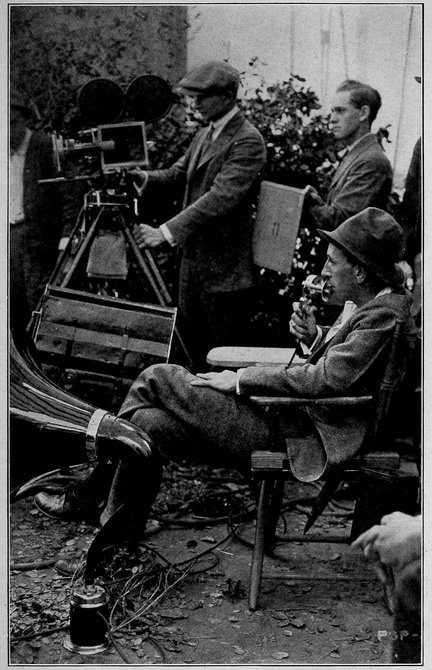
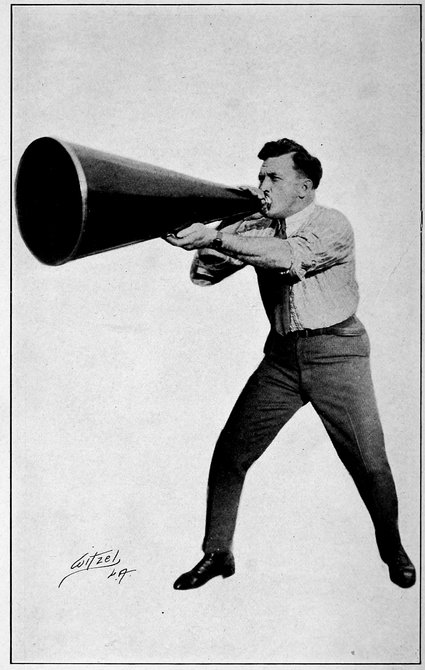
WILLIAM DE MILLE USING THE MAGNA-VOX, AN ELECTRICAL IMPROVEMENT ON THE MEGAPHONE, WHICH CARRIES HIS VOICE DIRECTLY ONTO THE “SET” AND INTO THE EARS OF HIS PLAYERS
44
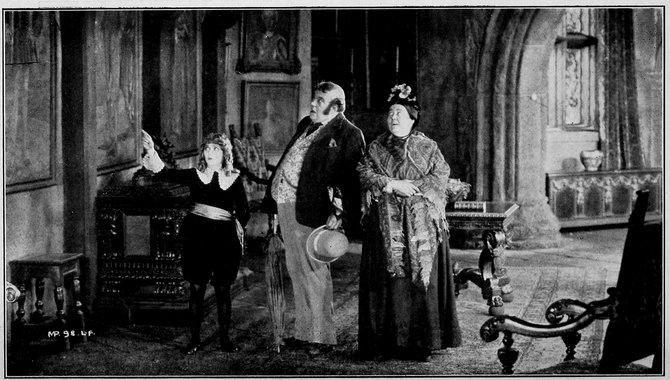
“MISS LULU BETT,” DIRECTED BY WILLIAM DE MILLE, LIFTS THE CURTAIN ON A DRAMATIC SLICE OF LIFE
45The production of a picture after this method necessitates
a carefully prepared manuscript, for once again,
the efficiency demanded by studio organization enters
into the scheme of things. “Naturally the continuity
writer must take particular care in building scripts
for me,” Mr. De Mille continues, “for it may be seen
that this arrangement of production calls for an equally
careful arrangement of the different settings employed
in the picture. The studio seldom permits a director to
keep more than three or four settings standing at once
for any considerable length of time. So it must be
arranged that the early action of the picture takes
place in the first three or four settings erected. In
other words, the settings of the production must be
progressive as well as the characterizations. It is a
little mechanical trick that is much easier to utilize
than it is to explain.”
It may be added that Mr. De Mille himself works
with his writers on their scenarios and supervises all
such details as this matter of mechanics as well as the
more important matters that come under the head of
scenario writing.
To make his method easier Mr. De Mille has
evolved still another production trick which is interesting
to say the least. Many directors after they have
photographed a full scene are obliged to lose valuable
time in moving the camera and lights up to the principal
players in order to take closeups. This time may
also account for the loss of the proper mood on the part
of the director and his players.
To eliminate this unsatisfactory condition, Mr. De
Mille has his settings built so that he can photograph
them from different angles and from different distances
46at the same time. So his players while acting one long
scene are actually photographed in full shots, semi-closeups
and closeups. The closeups cameras are
“blinded” behind convenient pieces of scenery.
This step of producing pictures in continuity is a big
one and one in the right direction. Pictures are not
perfect in this day by any manner of means but when
a point is reached when all those that demand to be so
treated can be produced in continuity, the results will
doubtless be obviously better.
Naturally, however, this method would not apply
to the director working on the “action” picture such as
that in which William S. Hart and Tom Mix appear.
In such cases where physical action and thrills are set
at a premium, it would be useless and an entire waste
of time to insist on producing in continuity. Imagine
calling “Halt!” on a long shot of advancing train
robbers while the cameraman moved up and took a
closeup of the bad man's finger pulling the trigger!
And then moving back again and permitting the train
robbers to proceed.
Such a procedure would be as foolish as to attempt
to produce one of De Mille's works in the old fashioned
way.
Chapter V CECIL DE MILLE ALSO SPEAKS
47
In which it is noted that the
more famous De Mille, besides
employing the method of
production described by his
brother, places unusual faith in
the intelligence of his actors and
actresses.—“Never show them
HOW but tell them WHAT”
is his formula.—A case where an
actor insisted on being shown
48
Chapter V
Mention of one of the De Milles immediately brings
to mind the other. Cecil and William are as easy to
say in one breath as Anthony and Cleopatra, Nip and
Tuck and Mutt and Jeff.
Cecil B. De Mille is one of the few directors of
today whose name carries a picture to the financial
success that greets a picture bearing the name of a
great star. It appears that he first rode to national
fame when he inaugurated a series of pictures bearing
such mandatory and interrogatory titles as “Don't
Change Your Husband” and “Why Change Your
Wife?”
But long before this he was cutting wide swaths in
the old fashioned method of directing by doing his
work in a distinctly individual and better way. Pictures
such as “The Golden Chance” and the first edition
of “The Squaw Man” stamped him as considerably
more of an artist than the earlier pioneers in the art
of directing.
Cecil De Mille was, perhaps, the first director to
use the method of producing his pictures in continuity,
as outlined by his brother in the previous chapter.
Perhaps this is the reason that he early secured such
superior results to those achieved by the general run
of directors in the early days.
Or perhaps on the other hand it is his ability to
handle actors and actresses so as to get the very utmost
from their efforts. For Mr. De Mille claims that one
49of the primal rules of directing is “never tell an actor
how to play a scene.”
On this axiom, he states, lies the secret of achieving
real characterization and absolute naturalness on the
screen.
This may appear to be a perfectly natural conclusion
to some readers. An actor of ability knows his business
and therefore knows how to develop a true characterization.
All he needs is a few words from the director
as regards the timing of his transition from one emotion
to another.
This is becoming more and more true as the art of
picture production develops but the time is easily recalled
when directors boasted that they acted out every
part of the picture so that their casts might secure the
proper grasp of the story.
I remember very well one director, a big man in his
day but who has since sunk to oblivion as far as picture
production goes, who used to take great delight in
showing his players how to play certain scenes.
After a few preliminary rehearsals he would become
disgusted, or pretend to become disgusted, with the
efforts of his cast and thereupon he would act out each
and every role for the cast's benefit. It was rather
ridiculous to see him affecting the coy mannerisms of
an ingenue, then jumping quickly into the role of the
hero and from there to the contrasting part of the villain.
He would even perform the butler with pompous
dignity for the benefit of the extra who was playing
the part.
But what effect did all this play on the director's
50part have on the onlooking cast? The director's personality
and individual mannerisms were displayed in
every role. Thereafter the actors endeavored to imitate
him not to enact their parts. The hero merely gave an
imitation of the director giving an imitation of the
hero. The ingenue gave an imitation of the director
imitating the ingenue. And so on through all the parts.
The results, it need hardly be pointed out, were not
natural. In the end all the players gave bad imitations
of the director. On top of this they endeavored to
effect his mannerism and tricks of expression. As a
consequence there was absolutely nothing distinctive
about the completed picture. It was the director's and
no one else's. The director, being conceited to a great
degree, was naturally delighted with the result. But
he was the only one delighted with it as is testified by
the fact that he is not in the art today.
This method has gradually been forced out of the
studio. There are few directors who insist on acting
every part out nowadays. There are some left but not
many. A few more years and they will all disappear
and then we will have still better pictures.
Mr. De Mille evidently believes that a good many
directors of the present day still adhere to the old
fashioned method. It is to be hoped that he isn't altogether
right.
“Too many directors,” he says, “consider it their duty
to show an actor just how to play every scene in the
picture. This type of director insists on acting out
every role and demands that his cast shall mimic his
51action before the camera. The results are woefully
wooden, unnatural and characterless.
“In the perfect photoplay each character must be
distinctly itself. It must be sharply differentiated from
all other characters in that particular play. This result
can only be achieved by permitting each actor or actress
to work out his or her own interpretation of a role.
“If I show an actor how to pick up a paper or a book
in a scene he will consciously strive to imitate my actions.
Now, what may be perfectly natural for me
may be unnatural and awkward for him. At the best
his attempt to copy my model will be but a poor reproduction
of Cecil B. De Mille on the screen. If I
carried that program through with respect to each
player I would have just as many weak versions of
Cecil B. De Mille as there are characters in the play.
“If, on the other hand, I explain to the actor what
the action of the scene is and what idea or emotion I
want him to convey to the spectator and then permit
him to work out his own interpretation of the scene I
have a distinctive, natural and far more powerful piece
of work from that actor. I assume that every actor is
better at creating than mimicking me.
“My task comes in in my effort to perfect his interpretation
by helpful criticism and suggestion but not
by example.
“Before beginning actual production on a picture I
make it a rule to call together the entire cast and the
technical staff. At this meeting I tell them the story
with all the detail of characterization and atmosphere
that I am capable of putting into it. I do not read
52them the continuity scene by scene. I try to make them
see and feel the story and the characters and, as everyone
in the production art knows, the straight reading
of a continuity is an uninteresting and tedious proposition.
“So when the cameras actually start to turn, each
member of the cast has his or her own characterization
and its relationship to the others well in mind.
“At the beginning of each scene I sketch out verbally
what the action of the scene is to convey to picture
audiences. Then comes a rehearsal and often many
rehearsals before it is actually filmed. But through
all these rehearsals I make a point of never showing
anyone how to do a thing. If an actor does something
badly or awkwardly I try to locate the cause of the
awkwardness and remedy that. By way of example
the scene may call for an actor to be seated at a desk
thoughtfully smoking a pipe. Perhaps the actor may
handle the pipe like an amateur. Inquiry may uncover
the fact that he is far more at home smoking a cigar.
Thereupon the cigar is supplied and the scene proceeds
smoothly.
“A little thing, to be sure, but between the pipe and
the cigar lies the difference between a natural and an
unnatural performance.
“No actor worthy of his calling should have to be
shown how to play a scene. He may have to be coached;
that is part of the director's task. But it is no part of
the director's duties to furnish the acting model for
any or every character in the play. I firmly believe that
attempts on the part of the directors to show actors how
to do certain things will inevitably result in bad performances
and consequent damage to the quality of
the finished production.”
53
Melbourne Spurr CECIL B. DE MILLE
54
CECIL B. DE MILLE AT WORK
55Mr. De Mille's comments are very interesting. It
is to be supposed that he does not give copies of the
picture continuity to his players that they may thoroughly
acquaint themselves with the parts they are
to play before actual production work begins. Today
the majority of directors like to do this.
However, as Mr. De Mille says, “I tell the story
with all the detail of characterization and atmosphere
that I am capable of putting into it.” This appears to
be an admirable course to pursue. Given the continuity
an actor may get quite the wrong idea of the role he is
to play. Listening to his director sketch the story,
including in it his ideas as to its development, must of
necessity give the actor a clear idea of his work and
an idea more coinciding with that of the director's.
Thus it might appear that misunderstanding and argument
are well disposed of.
On the other hand Mr. De Mille is fortunate in
having players of general intelligence and ability to
deal with. Look over any of the casts he has employed
in his recent productions, “The Affairs of Anatol” for
example, and you will discover that there is hardly an
unknown in the entire cast.
It is amusing to consider what Mr. De Mille would
have done if he had had the task of producing “Cappy
Ricks,” a picture made by one of the directors that
Mr. De Mille developed, Tom Forman. There was
56the role of a Swedish sea captain, humorously called
“All-Hands-and-Feet” in this picture.
An old prize fighter was selected to play the role.
He looked the part to perfection. But the scenario
called for the star, Thomas Meighan, to engage in a
fight with him and knock him out. The ancient fighter
was perfectly agreeable for the fight, in fact he battered
his opponent considerably but when it came time for
him to be knocked out he just wouldn't fall down.
The scene was tried over and over again and each
time when it came to the psychological moment “All-Hands-and-Feet”
positively refused to fall down on
the deck after Mr. Meighan had delivered a blow
on the chin.
“Go down! Down!” Mr. Forman kept repeating
wrathfully.
“Down? Down?” queried the one time prize fighter,
“I no understand what you say.”
Eventually Mr. Forman had to submit to the ignominy
of allowing Mr. Meighan to land on his chin
and drop him on the deck.
A broad grin crept over the benign countenance of
“All-Hands-and-Feet” as he said, “Ah, I never bane
knocked down, I see what you mean. I try to fall
next time”.
Mr. Forman and Mr. Meighan started a movement
to back “All-Hands-and-Feet” for the championship of
the world. But when their subject heard of it he
mysteriously disappeared. Possibly he didn't want to
be taught what “down” meant in a serious way.
Chapter VI WHEN ACTING ABILITY HELPS
57
An amusing incident of studio
life that might be seen by
a visitor any day in the week
with the moral “Never be shocked
by anything you see in a
motion picture studio”
58
Chapter VI
No better illustration of the value of Mr. De Mille's
foregoing remarks can be found than in the case of
Charles Chaplin. Mr. Chaplin as well as being the
world's greatest comedian, also directs his pictures.
Suppose that Mr. Chaplin decided to rehearse in
every part of his picture so that his supporting players
might pattern his performances after his. The completed
product would show: One good Charles Chaplin
and a dozen bad imitations of Charles Chaplin.
Mr. Chaplin has imitators enough without going
to the trouble of bringing them right into his own
pictures.
Incidentally the task that confronts the actor-director
is extraordinarily difficult. He not only is
obliged to face the lights in makeup and drop his own
personality in the role he is playing but he must also
be able to see his own work from behind the camera,
to retain his perspective from this angle of the production
as well as from the acting angle.
His is thus a twice difficult task and perhaps for this
reason there are few surviving actor-directors. In the
old days there used to be loads of them but the pictures
were then too much actor and not enough director.
Besides Charles Chaplin only a few survive today,
prominent among them being William S. Hart and
Charles Ray and it may be said that each of these stars
has done his best work when directed by someone else.
When they essay the dual task of acting and directing
59they pay too little attention to the supervision of the
entire production and concentrate too largely on their
own performances.
Despite this criticism of the actor-director and the cry
against directors showing their players how to perform
a scene no one can deny that a knowledge of acting, or
rather a knowledge of how to act, comes in very handy
from the director's point of view.
A little over a year ago I happened to visit one of the
large eastern studios when John S. Robertson, probably
one of the most competent men in the production craft
was working there. Mr. Robertson has years of acting
on the stage behind him. He played in stock for a long
period and knows every role in every play of importance
produced over a period of considerable years.
However Mr. Robertson is now a director and not an
actor. What was my surprise then to discover him in
the midst of a highly dramatic scene. The setting was
the dressing room of a stage star. Mr. Robertson was
half sitting, half reclining on a luxurious chaise-lounge.
The atmosphere was fairly exotic.
Marc McDermott, excellent character actor that he
is, stood in the background, immaculately clad in evening
attire. He was gazing at Mr. Robertson with the
glint of evil in his eyes.
The door opened and in walked Reginald Denny
who immediately rushed madly to the couch on which
Mr. Robertson was reclining languidly and proceeded
to make violent love to him.
Naturally my first impulse was to make matters
known to the Department of Health but on inquiry I
60soon learned that Mr. Robertson was merely playing
Elsie Ferguson's role in the preliminary rehearsal of
“Footlights.” Miss Ferguson was a little late and Mr.
Robertson was obliging for the benefit of Messrs.
McDermott and Denny!
So I watched them further. A long scene was enacted
with Mr. Robertson playing Miss Ferguson's role
exactly as the script called. And he was doing it as if
it were the most natural thing in the world. As for the
other participants they were so engrossed in their work
that they didn't seem to notice the absence of Miss
Ferguson and the presence of her capable substitute.
When at last she did appear the scene only needed
one brief rehearsal before the cameras started to grind.
Besides pointing out the value of the ability to act
to the director this little tale also points another moral,
to wit, never be shocked at anything you see in a motion
picture studio.
Chapter VII REX INGRAM ON “ATMOSPHERE”
61
The director of “The Four
Horsemen of the Apocalypse”
and “The Conquering
Power,” two of the screen's
greatest achievements, has something
to say about settings and
atmosphere.—Using impressionistic
methods to realistic ends is
his forte.—The effort demanded
to achieve convincing realism on
the screen
62
Chapter VII
Few people who closely follow the screen will need
an introduction to Rex Ingram, the young director
who startled the whole screen world with the artistry
of his work in “The Four Horsemen of the Apocalypse.”
Mr. Ingram is one of those to whom the screen
gave one of its biggest opportunities. For a long time
before “The Four Horsemen” was completed the
wiseacres were prowling about, shaking their beards
and stating that the young director was running wild
and breaking the producing company that was sponsoring
the picture.
How he startled the world with a magnificent piece
of work is still recent screen history. And how he followed
his first big success with another great picture,
“The Conquering Power,” is also still fresh in the
minds of picture audiences.
Among many others one thing distinguished both
“The Four Horsemen” and “The Conquering Power”
and that was the remarkable atmosphere which Mr.
Ingram had managed to inject in both subjects. It was
absolutely startling in its effect. Those who hadn't
stopped to bother about Mr. Ingram's early studies
which included art in two forms, painting and sculpturing,
didn't know how in the world he had managed
it. However, it appears from Mr. Ingram's own words
that he merely used common sense and applied the
methods of the older arts to the craft of picture production.
63
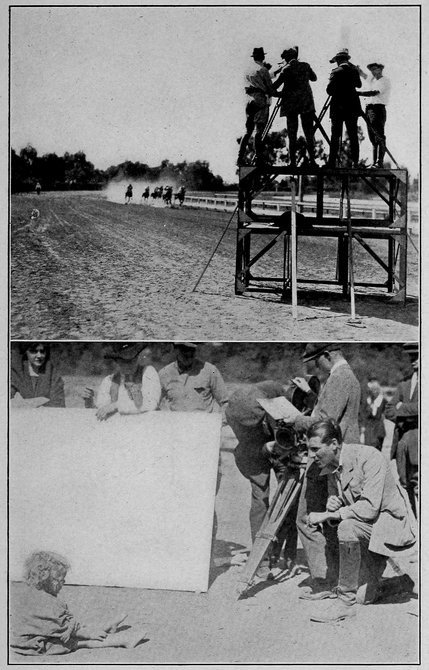
REX INGRAM, REHEARSING ONE OF THE RACE TRACK SCENES IN “TURN TO THE RIGHT”
64
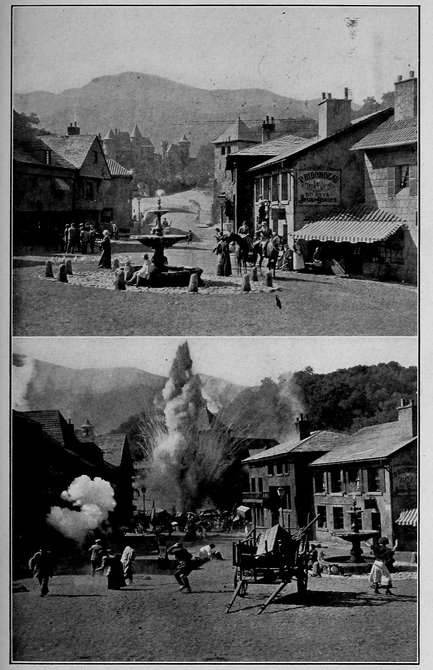
REX INGRAM DIRECTING ONE OF THE MANY MOB SCENES IN “THE FOUR HORSEMEN”
65He has some very interesting things to say regarding
the value of atmosphere in motion picture production.
He writes: “After sincerity of characterization and
directness in story-telling, atmosphere does more toward
making an audience accept what it sees on the
screen than anything else. By accept, I mean, be entertained,
engrossed in the subject.
“While good atmosphere gives an air of reality to
a picture yet the most convincing and engrossing atmosphere
is often far from realistic. This is so because
the aim of the director should be to get over the effect
of the atmosphere he desires, rather than the actual
atmosphere which exists in such scenes as he may wish
to portray, and which, if reduced literally to the screen
would be quite unconvincing.”
This principle of Mr. Ingram's is the ideal one on
which to work. It is the principle of other arts
beside that of producing motion pictures. It is the
principle of creating something by implication and
suggestion rather than actual reproduction. This, however,
detracts not one whit from the credit that is Mr.
Ingram's for being the first director to apply it to picture
production in a consistent and effective way.
Mr. Ingram continues: “Whether a scene is being
made of a beach-comber's shanty, an underworld basement
saloon, a pool-hall, a ship's cabin, a shoe factory
or a smart restaurant, not only should the aim be to
convince the audience, but enough study should be
given the subject, in each case, to convince the habitues
of any of these places that they are in familiar surroundings.
66“One of the most interesting sets that I have ever
handled from an atmospheric standpoint was the interior
of a derelict ship, beached, and become the
hang-out of beach-combers, in 'Under Crimson Skies,'
a production some years old. Conrad, the master writer
of the sea, never offered a more wonderful opportunity
for color than did this episode in the story provided
by J. G. Hawks, with its thrilling climax in the battle
in the surf between the white man and the black giant.
“In 'The Four Horsemen,' the basement resort of
the Buenos Aires bocca, or river front hang-out, furnished
plenty of chances to make colorful pictures—yet
had I been literal in the way I handled it the effect
would not have been anything nearly as realistic. For
I doubt if anything just like that dive ever existed in
the Argentine or anywhere else for that matter.
“The set was a Spanish version of a bowery cellar
saloon that I used in a picture which I made several
years before and re-created to suit the episode suggested
in the great Ibanez novel. The signs on the wall, the
types of men, in fact all the bits of atmosphere in the
place were the results of painstaking efforts to get
“color” and local atmosphere into the set. In one
corner a sign hung which was the advertisement of a
notorious 'crimp,' a sailor's boarding-house keeper,
whose establishment was on the bocca for years. An
old sailor who was working in the scene and who had
lived in Buenos Aires came to me and said: 'I've been
shanghaied by that blood-sucker.'
“I have gone so far as to have my principals speak
the language of the country in which the picture is
67laid. Few of them like to go to this trouble but it helps
them materially in keeping in the required atmosphere.
The results on the screen are so encouraging that after
they see what it has done for them the players don't
mind the extra study that this course entails.
“I know of no branch of a director's job that is more
fascinating than getting color and atmosphere into the
settings—thinking out bits of 'business,' little flashes
of life which, though only on the screen for a few
moments, can give an air of reality to an entire sequence
of scenes, that would perhaps otherwise be lacking.
“In screening Balzac, as I did in making 'The
Conquering Power,' fine atmosphere and characterization
are of more vital importance than incident,
for nine times out of ten it is the characters in a great
novel that we remember—rather than the plot.”
Mr. Ingram is going on his way, creating distinctly
unusual pictures and one of the chief reasons is this
great attention that he pays to atmosphere by suggestion
rather than actual reproduction. Novelists call atmosphere
“background.” The terms are the same. The
novelist creates his background, his atmosphere, by
painting pictures with words, suggesting the locale
and environment of history. Thus with Mr. Ingram.
He suggests scenes in his pictures and refuses to label
them. In this respect he is farther advanced than most
any director in the art today.
This idea of suggestion can easily be carried too
far, however. The German producer who turned out
“The Cabinet of Dr. Caligari” carried it to the point
of alleged futuristic “art.” He aimed to suggest but
68instead he puzzled completely. The producer of “The
Golem,” another German picture, came nearer the
point. But it appears that neither of them equalled
or much less surpassed the work of Mr. Ingram in his
two fine productions already mentioned.
Mr. Ingram is one of the very few new directors
that the screen has developed in recent years. New in
the sense that he has attracted attention not only within
the art of picture production but without it as well.
He is one of those men who have been recruited from
other fields of endeavor and who has fulfilled expectations
and gone far beyond them. A man such as Ingram
will always have an opportunity. He may have to fight
for it but it's bound to come.
Mr. Ingram's remarks about building settings, so that
people who frequent such places in real life will instantly
recognize them, opens an interesting field of
comment. Even if a director labors painstakingly to
achieve the proper atmosphere there are always some
crabs in the audience who are bound to take exception.
If they can't find something to criticise in the setting
they criticise the way the extras play their parts.
For a long time doctors have been grossly misrepresented
on the screen. Doctors in particular have objected
that they never act as if possessed of diplomas.
A director recently resolved to put an end to such
criticism. It annoyed him particularly inasmuch as he
had a friend, an M.D., who was forever poking fun at
him whenever he introduced a man of medicine into
a picture.
69When the director in question completed his latest
picture he took his doctor friend to see it and after it
was over asked him specially how he liked the performance
of the actor who played the doctor.
“Terrible,” replied his friend, “The man never saw
a clinic and shows it. No real doctor would act like
that.”
“That's funny,” replied the director with a smile,
“because, you see he wasn't an actor but—a doctor!”
Chapter VIII MAINLY ABOUT D. W. GRIFFITH
70
The producer and director of
“The Birth of a Nation,”
“Hearts of the World,” “Way
Down East,” and “Orphans of
the Storm” works with amazing
disregard of system.—Others attempt
his methods of procedure
and come more often to grief
than to glory
71
Chapter VIII
No volume on the subject of directing would be
complete without the mention of D. W. Griffith. And
yet it is utterly impossible to deal with D. W. Griffith
in any comprehensive way. The producer of the first
great picture “The Birth of a Nation,” the man who
strove for something beyond the times in “Intolerance,”
the artist who made “Hearts of the World” and the
masterly technician who stands sponsor for “Way
Down East,” is singularly hard to approach from any
ordinary viewpoint.
There is no doubt that D. W. Griffith at intervals
gives just cause to the commentators who place him at
the top of the list of all directors. But at the same time
he often does the most ordinary of things on the screen.
In one picture he is an artist and in the next he appears
in the light of a producer of hack pieces of motion
picture film.
The reason, no doubt, is that Mr. Griffith is a business
man as well as an artist. He sinks an unusually
large amount of money in a picture such as “Hearts of
the World” and then realizes that, while the returns
from such a subject are slowly accruing, he must needs
turn out a few pot-boilers to keep the wolf from the
door. Thus “Hearts of the World” was followed by
two or three shorter and less pretentious war pictures
of commonplace variety.
Mr. Griffith is constantly exasperating people by
such mixed proceedings and just when his long-suffering
72public has decided to forsake him forever and turn
to more consistent directors and producers, he startles
the world again with another masterpiece.
His latest picture, for instance, “Orphans of the
Storm,” has proven an artistic success from almost
every viewpoint, and has been quite capable of disposing
of the bad taste left in the collective mouths of
critical audiences by his recent “Dream Street.”
One of the most interesting things about Mr. Griffith
to the lay mind is that he never uses the usual continuity
that the majority of directors employ. He has his story
clearly in his mind before he starts work. He has something
of a subconscious realization of how many different
scenes ought to be embraced in each episode
and he sets about his work accordingly.
This might not seem so difficult as it really is if Mr.
Griffith employed the De Mille method of directing
his pictures in continuity, beginning with scene No. 1
and proceeding numerically onward. But Mr. Griffith
sails right along using one setting or scene after another
without much regard for continuity. He takes the
number of shots required in each setting and scene with
but slight assistance from notes and memoranda.
He works in the following order: A scene may represent
a room in a country home. A son is saying
goodbye to his mother; he is either going away to war
or going to the city to make good. There is, of course,
a tearful parting. Now the average director will refer
to his script and note that the scenario writer has
given him, say, twelve different shots, including closeups,
long shots and semi-closeups in which to get the
“goodbye” scene over and done with.
73
D. W. GRIFFITH
74
D. W. GRIFFITH IMMORTALIZED AN ANCIENT MELODRAMA IN “WAY DOWN EAST”
75Mr. Griffith, on the other hand, will refer to no
'script of any kind, he will merely go about taking the
sequence of scenes as they occur on the screen. There
may be first a tearful closeup of the mother, then a closeup
of the boy, nervous, happy, sad. Then a shot of both
of them embracing and the son pulling away. Then a
wider shot showing the son about to make his exit, but
turning and coming back to say a last farewell to the
mother. And so on and so forth. The action itself will
suggest other scenes to Mr. Griffith.
Of course there are many other directors who work
in the same way in some respects. Such a simple sequence
as related above can be accomplished by any
director without recourse to an elaborate continuity.
But the majority of directors, even though they don't
refer to a continuity minutely with respect to such
sequences, have one handy so that they can refer to it
in times when the complications of the story begin to
pile up.
To draw a clearer parallel, the usual director is like
a motorist who has carefully studied his road map
before setting out on a journey and who refers to it
time and again during the trip, specially when he
comes to a cross roads. Mr. Griffith never studies a
road map. He just jumps into his car and starts going.
When he comes to a crossing he takes the road that
seems the best to him. Sometimes this road is the wrong
one. More often it is right. But at least Mr. Griffith
has had the fun of exploring without really knowing
76what is coming next. As a consequence, his experiences
even though at times poor with respect to picture
technique, are never tedious but always refreshing.
Mr. Griffith explains his aversions to a cut-and-dried
continuity by saying that he doesn't want other people
to think out his story for him. Rather he prefers to
think it out himself. He believes that the man who
works directly from a continuity is merely carrying
out the plans of the scenario writer. It doesn't take
any great exertion, he believes, to successfully carry out
these ideas if they are good ideas. On the other hand
when he himself sets to work without a continuity he
has the added joy of creating something as he goes
along. He is not working from some other person's
brain but from his own.
Mr. Griffith's method of working has its advantages
and, under certain circumstances, it would have its
grave disadvantages. Mr. Griffith, being his own employer,
can take all the time he wishes on the making
of his productions. A director working on a schedule
that makes some consideration of time would be quite
at a loss in working without a 'script. The chances
are he would become hopelessly involved before he
got halfway through and wonder what he was producing.
And this time schedule would not permit the
director to sit down and puzzle himself out of his predicament
for hours and hours the way Mr. Griffith
does. And then, even if it did permit him so to do,
the chances are again that he might not come out of
the predicament with all the loose ends of his story
neatly assorted the way Mr. Griffith does. After all,
77there is only one Griffith and attempting to apply his
methods to other directors is something like walking
and walking around a block and wondering why you
never get farther up town.
Times were, in the days of the old Biograph and
Fine Arts companies, that Mr. Griffith had a number
of directors working under his supervision. A number
of these men, notably Chet Withey, Edward Dillon
and the Franklin brothers have made marks for themselves
with other companies, working somewhat on
the Griffith method but usually with a continuity to
guide them.
I know of one director who worked with Mr. Griffith
long ago and who is still boasting of his association
with him (for working with D. W., you see, grants
one as much prestige in the picture world as having
an ancestor that came over on the Mayflower gives
one in the social world), but who has not yet made a
good picture since he left his former chief.
Among other boasts this director includes the one
that he never used a continuity when producing a
picture. I happened to be up at his studio one day
when he was involved in the production of a particularly
difficult and heavy dramatic sequence of action.
There were a number of players at work on a large
setting and each one of them had an important part.
This director worked along fairly smoothly up to a
certain point and then suddenly stopped. He was lost.
Didn't know what came next. But rather than admit it
to his company he sat staring at them for fully half an
hour, then proceeded to pace the studio floor in great
78agitation “seeking for the missing idea.” He then announced
that he would retire to his private office and
think the matter over quietly. About five minutes later
he emerged with all his ideas straightened out. Of
course, to the gullible, his disappearing act had been
the signal for a great inspiration but in reality, as I
found out afterwards, he had gone into his office and
referred to the continuity of the story which he had
carefully secreted in his desk all the time.
The director's vanity would never permit him to
admit this in public. He chose to be regarded as another
Griffith. Unhappily for him his completed picture
proved that he was far from another Griffith or
even a second-rate one. Really Mr. Griffith has a lot
to answer for in this matter. Either he or the vanity
of the men who formerly worked with him has to be
blamed. And as Mr. Griffith is a concrete object we
might as well blame him.
The realization has dawned on the writer that this
chapter is totally inadequate in giving any description
of Mr. Griffith, apart from the small information that
he works without a manuscript. Such, however, seems
doomed to be the case. One cannot dissect Mr. Griffith,
take him apart and explain this piece and that. This
because he is considerably an artist and no real artist
can tell exactly how he works and give the processes
by which he achieves certain effects.
A painter will begin work on a fresh canvass by
putting daubs of color here, there and everywhere. The
layman doesn't know what in the deuce he is up to.
But in the finished product these early daubs of color
count largely in the effect created by the whole mass.
Even the artist himself cannot explain concisely and
clearly the why and wherefore of every daub he applied
early in his creation.
79
ALL THE OLD CHARACTERS OF “WAY DOWN EAST” WERE RECREATED ON THE SCREEN WITH AMAZING FIDELITY
80
D. W. GRIFFITH
81So it is with Mr. Griffith. He probably could not
explain his method of working himself. He goes ahead
on his creation, putting a stroke here and another there.
The why and wherefore of them are things undefinable.
Perhaps when his picture is finished he can give you
the whys and wherefores but the chances are that he
can't. He only knows that he has striven for something
and either succeeded or failed in the achievement of
his ambition.
And so it is with other directors, after all is said
and done. Some of the methods of other directors
as set down earlier in these chapters are merely ideas,
small gleanings; but in themselves alone they are no
more responsible for the successes of these directors
than are their names.
Chapter IX MOUNTAINS AND MOLEHILLS
82
Why D. W. Griffith has been
more successful in producing
spectacular features than
other directors.—His ability to
step from the mountain to the
molehill with agility and delicacy.—The
futility of mob scenes
that mean mob scenes and nothing
more
83
Chapter IX
The foregoing words on D. W. Griffith have brought
to mind the matter of motion picture spectacles, those
pictures telling a personal story before a background
of masses of people and monstrous settings. There is
small doubt but that the spectacle is the most difficult
of all motion pictures to produce. Mr. Griffith has
succeeded most often with such subjects, perhaps because
he has attempted them more often. Rex Ingram
succeeded admirably well in “The Four Horsemen of
the Apocalypse” and no doubt will succeed again when
he tries further, as he most surely will.
Many others have succeeded too, and many have
failed, the chief reason for the failures being, it appears,
that the spectacle idea appealed to the director
in capital letters while he forgot all about the personal
element of the story. No spectacle, no matter how
grand and glittering and gorgeous, no matter how
heavily peopled with costumed supernumeraries, no
matter how thickly smeared with money and elaborate
“art” can succeed if the director forgets about his personal
story in the bigness of his background. He must
be able to step from the mountain to the molehill with
agility and with such delicacy of touch that he doesn't
smash the molehill by treading on it as if it were the
mountain.
As an example of this appreciation of both the spectacular
and personal elements of story, no better picture
can be found than Mr. Griffith's “Hearts of the
84World,” his story of the European war. He brought
before the eye all the horrible realities of the battle
field, used them to dramatic purpose time and again.
And yet in the midst of all this spectacular action he
never for once lost sight of the personal element in the
story, this element represented on the battle field by
Robert Harron who played the part of the young
soldier. How many people who saw “Hearts of the
World” can forget the scene in the shell hole in which
the center of attention were the young soldier and the
dying negro? This was one of the most remarkable of
the personal, intimate touches in the picture and yet
the very next moment the spectator was plunged back
into the mass horror of the tremendous conflict.
This was only an instance of many. In the last scenes
which looked forward to the armistice parade in Paris
(looked forward to it with an uncanny amount of
judgment), soldiers and citizens were seen going mad
with joy in the streets of the city. A thrilling sight in
itself were these mass scenes, showing thousands of
people nearly breaking their own and their friends'
necks with unrestrained joy at peace come at last.
But even in the midst of all these scenes of thrilling
revelry the four principal characters of the picture
were introduced rejoicing too. And the glimpses shown
of them brought the thrills of the big scenes to a tremendous
emotional climax.
It would seem a simple matter for the clear-thinking
director to produce a spectacular picture at the same
time keeping his finger on the pulse of the intimate,
personal story that gives color and reality to the bigness
of his backgrounds. But it is more often the case than
not that the director who tackles a spectacle forgets his
story in the mad rush for sweeping effect. As a consequence
he loses his grip on the interest of his
audience.
85
“THE THREE MUSKETEERS” COMBINED THE ELEMENTS OF ROMANCE AND THRILL IN EXACTLY THE RIGHT PROPORTIONS
86
DIRECTOR JOHN ROBERTSON SECURED EXCELLENT LIGHTING AND DERIVED WONDERFUL WORK FROM HIS CAST IN “SENTIMENTAL TOMMY”
87How many pictures could be named in which just
mass scene after mass scene appeared on the screen,
containing no dramatic purpose, no interest aside from
their sheer spectacular value (an interest that soon
dies if not fostered with glimpses of the personal story),
just mass scene after mass scene until the spectator
begins to wonder what in thunder the whole thing
means? It seems offhand that any number of such pictures
could be named.
But if the director keeps his senses about him he
never loses sight of the little things of the spectacle,
they are as vitally important as the mass action itself.
It might be appropriate to mention the recent
German pictures in this connection. The German picture
director is noted for the production of spectacular
features. In some respects he surpasses the American
director, namely in the artistry of his big scenes and
the effective manner in which he handles large numbers
of people but on the other hand the German director
has the fault of overlooking the personal story in his
eagerness to get the spectacular effects.
This fact is particularly noticeable in German pictures
when they first come to this country. Of course
the pictures first have to pass through the hands of
experts. The titles are translated and revised to fit the
styles the American public has long since expressed
88itself satisfied with. But more important, much that
the German director left in has to be cut out. Pictures
made in Germany and shown here as five or six or
seven reel features very often run eight or nine or ten
reels when they first are imported here. And in these
extra reels which the American cutters painlessly remove
from here, there and everywhere in the long
stretch of the film, are mob scenes used just because
they are mob scenes. Mob scene follows mob scene,
until each scene has no particular meaning, the mass
effects grow tiresome and the spectator longs for a
glimpse of the story forgotten so long ago by the director.
The American cutter is able to eliminate much
of these superfluous scenes but he can not give the
intimate story the prominence that was denied it in the
beginning by the German director.
Probably the reason why so many directors neglect
this personal element in their spectacles is because of
the fact that several years ago a big scene, that is a
scene containing a few dozen or a few hundred people,
was supposed to impress audiences with the fact that a
lot of money had been spent on the picture and that
therefore, because a lot of money was spent on it, it
was a work of merit.
“Here,” a director used to say when he had doubt
in the value of the story he was working on, “Give
me a big ball room set and a hundred people in evening
clothes and I'll give this picture real class.”
The argument sounds particularly false and unsound
today as it was all the time. But the motion picture
directors of today, a great many of them at least, still
89seem to think that a picture can be made good by
throwing a lot of money away on lavish settings, and
settings containing a lot of people, even though they
fail to regard the personal element of the story in a
serious light, even though they fail to make this element
convincing and real.
Some of the biggest directors in the business have
this idea, strange as it may seem. These fellows, believing
themselves secure, take delight in poking fun
at Mr. Griffith because he will stop a spectacular scene
now and then to show a youngster playing with kittens.
Mr. Griffith may have been inclined to pay too much
attention to kittens and puppies at one time in his
career but he was headed along on the right track and
those who laughed at these scenes of his were then and
there switched off to the wrong track.
Chapter X SOME OF THE ARTS OF SLAPSTICK COMEDY
90
The director of the knockabout
comedy grossly neglected
in the parcelling out of
praise.—The inventive genius of
Mack Sennett, king of comedy,
and a digression on the “discovery”
of Charles Chaplin,
prompted by our present day
radical and liberal writers
91
Chapter X
The usual critic of the motion picture is given to
prating long and seriously about the art and the business
of it with relation to the Griffiths, the De Milles, the
Ingrams, the German Ernst Lubitschs and the ordinary
whatnots and their dramatic productions, but when
approaching the producer of the slapstick-thrill comedy,
they seem to forget that this branch of production
is an art too and a very high one and one to be
taken just as seriously if not more so than the art of
dramatic production.
The picture critics of the New York and Boston
newspapers, for instance, will sometimes devote a
whole column to a review of an ordinary dramatic
production and then close with the line: “There is also
a Mack Sennett comedy on the bill.” Nine times out of
ten this comedy so briefly dismissed is more interesting
and entertaining than the featured part of the program.
Aside from Charles Chaplin (Chaplin is his own
director) the critics don't regard the comedy director
in his proper light—often one of high artistic achievement
plus a marvelous amount of ingenuity.
To digress for a moment, the case of the critics and
the Chaplin comedies amuses the writer and many of
his acquaintance immensely. It appears that the critics,
commentators and publicists of national and sectional
standing have only recently “discovered” Charles
Chaplin. The reviewers of the daily newspapers and
the magazines now hail each effort of his as masterly,
92pointing out virtues in his performances, in his attitude
on life and in his inventive genius with remarkable
pride. Chaplin has become the “fashion” with those
who formerly thought his name a synonym for a vulgar,
pie-throwing clown.
It was some seven years ago that a number of motion
picture trade critics and myself first saw the comedian
doing a “bit” in a Mack Sennett comedy. Somebody
said his name was Charles Chapman. Somebody else
said it was Chaplain. They thought so. They weren't
quite sure who he was. But everyone in that little room
knew then that, whoever he was, he was great.
Five years afterwards, as the picture subtitle would
say, some of the newspaper critics woke up to the fact
that this little man was an artist. And a year later the
liberals and radicals of Greenwich Village, New York,
and points west, discovered that Mr. Chaplin was
somewhat liberal, even radical, politically, and so
made the astounding revelation to their worlds that he
was a great artist. Perhaps the above is a little unfair
but if Mr. Chaplin had voted a straight Republican
ticket it is hardly to be supposed that he would have
been heralded as such a master of his craft by these
people.
But we in the motion pictures knew him in his true
colors from the first and so perhaps this little excursion
into the realm of jealous back-biting may be pardoned.
However we feel somewhat as Columbus, in his grave
might feel if Marshall Foch on his recent visit to
these shores, should have announced to the world that
he had discovered America.
93But to get back to the art of the director who makes
a good slapstick comedy. The directors such as Mack
Sennett and his staff of associates, such as Hal Roach
who guides the destinies of the bespectacled Harold
Lloyd, and such as Henry Lehrman, who follows
blindly but often quite successfully in Mr. Sennett's
footsteps. These men, laboring tirelessly on the invention
of new “gags,” stunts and fooleries for the amusement
of the picture public are deserving of immense
credit.
“Slapstick” is a term that ill describes the efforts of
these men. It is a hangover from the period when
motion pictures were “movies” and deserved no better
appellation. It suggests, besides the act of employing
the old stage slapstick itself, the equally worn trick of
throwing custard pies. Strange as it may seem to some
whose memory of the old days in the making of pictures
overshadows their ability to make observations
in the present, pies are seldom used in a comedy studio
these days, except in the dining room for purposes of
conventional consumption.
The throwing of a pie was ceased long since as a
comedy “gag” by the high class slapstick directors.
Other “gags” have replaced it. Once in a while it is
resorted to, probably just for old times sake but as a
rule the comedy directors and those mysterious men
of the comedy studio, who can hardly be called scenario
writers, men whose inspiration is often the combined
effect of phonograph music and bottled spirits, are
able to hand out something newer and more amusing
than mere pie-throwing.
94What appears to be most interesting in the production
of these comedies is the amazing machinery at
the director's control for the entertainment and the
fooling, the funny hocus-pocus fooling, of the picture
going public. Mack Sennett's studio on the western
coast is probably the best equipped in this way and
every mechanical contrivance he employs in the making
of his pictures is guarded jealously by him and his
staff as a state secret might be guarded. Mr. Sennett
doesn't believe in telling people how he performs his
tricks. He works on the principle that the public is
better satisfied by remaining mystified, of which more
anon.
So it is beyond the power of anyone outside of Mr.
Sennett's confidence to set down the exact manner in
which he causes to be done some of the most amazing
stunts on the screen. One can hazard the guess that he
makes a comedian appear to be walking on water by
double exposure but, given this information, any other
director would be hard put to it to do the trick successfully.
Mr. Sennett is often called upon to assist other directors
in producing a thrill. Most people well remember
Anita Stewart's picture of two or three years
ago, “In Old Kentucky.” And those who can recall the
picture will also be able to recall the scene wherein
Miss Stewart, on horseback, urged her steed to jump a
yawning chasm, rather wide and terrifyingly deep. It
was one of the biggest thrills in the picture and it was
made in Mr. Sennett's studio. Neither Miss Stewart,
nor Marshall Neilan, who directed all the rest of “In
Old Kentucky” had anything to do with this particular
scene. It was further said that Mr. Sennett demanded
and received a sum equivalent to the yearly salary of the
President of the United States, for his contribution to
the old melodrama.
95
MACK SENNETT MIXES SITUATIONS LUDICROUSLY. HERE IS A MARRIAGE SERVICE PROCEEDING UNDER DIFFICULTIES
96
MACK SENNETT NOT ONLY GOES IN FOR “GAGS” WHOLESALE BUT ENDOWS HIS PICTURES WITH A FINE QUALITY OF BURLESQUE. THIS IS A SCENE FROM “DOWN ON THE FARM”
97A great part of Mr. Sennett's art lies in his inventive
genius and his happy faculty of applying some basically
sound trick of mechanics to a ridiculous comedy
situation. In this respect he proceeds from the same
principle that R. L. Goldberg, the cartoonist, does.
Those “easy machines” contrived by Goldberg, involved,
intricate and ridiculous, that finally end up
by scratching a man's back or slapping a mosquito, have
as a basis an actual mechanical theory. So with Mr.
Sennett. In a recent Ben Turpin picture the comedian
appeared as a baker. He was shown “holing” doughnuts
with a mechanic's auger and going about his work
in a perfectly serious fashion. A little later the subtitle
“testing” was flashed on the screen, followed by
the scene of the baker testing his doughnuts by slipping
them over a bar and chinning himself on them.
The effect was utterly ridiculous, uproariously
funny. And what was it? Really just an application of
sound scientific methods, never funny when applied
correctly, but as applied to a bakery more or less of a
scream. Mr. Sennett and his staff will startle audiences
into fits of laughter time and again by such methods.
While on the subject of Ben Turpin it is only fair
to record here that Mack Sennett has never received
the credit due him for developing this cross-eyed
Romeo. Turpin can be, and has been, quite a tiresome
98bore on the screen. He proved it a few years ago by
trying to star himself without Mr. Sennett's guiding
hand—and he failed. Certainly in his case direction
enters into his success largely. Ford Sterling is another
who once left Mr. Sennett's guidance to form his own
company. But he also came back to the fold.
The tricks of the slapstick producers are numerous.
The familiar scene of the automobiles skidding all over
a wet pavement is sometimes actually hazardous to
those participating but more often it is filmed with a
slow camera, the cars also skidding around rather
slowly, with the result that the completed picture gives
the impression of sheer and utter recklessness. In the
Ben Turpin picture already mentioned the comedian
endeavored to eat asparagus and just as he would get a
tip near his mouth it would curl away like a snake. Of
course there are such things as wires and springs.
The element of surprise enters into the making of
the modern comedy to a great extent. Harold Lloyd
and his director, Hal Roach, employ the method of the
surprise laugh to admirable effect. One of the biggest
laughs that this comedian has ever been responsible
for was brought on by a totally unexpected surprise. He
appeared as a youth who sought suicide as a way out
of all his troubles. He climbed on the railing of a
bridge with a rock hung round his neck and leaped
into the water below. The water was only about a foot
deep and the youth came to a jarring stop when his
feet hit the bottom. The laugh that followed was really
to be described as an outburst.
Messrs. Lloyd and Roach probably scorn the tricks
99by which scenes can be made to look thrilling, preferring
instead to accomplish the actual thrill, more than
any other comedy producers. It may be recalled that
Mr. Lloyd once caused a variety of heart afflictions by
appearing in a picture in which he was seen walking
in his sleep on the edge of a high building. Fake?
Not a bit of it! The real thing—that is the high building,
not the sleep-walking.
All the studios in California confined to the elaborate
production of slapstick-thrill comedy have their own
hospitals and their own staffs of bonesetters and doctors.
And, in order that the public may have its fill of
laughs, these hospitals often have their fill of patients.
Chapter XI OTHER TRICKS UP DIRECTORS' SLEEVES
100
Proving that the illusion
once created by the double
exposure has been completely
spoiled by giving it so much
publicity.—And so the spoiling
process is begun on a number of
other tricks employed by the
director to fool the public
101
DOUBLE EXPOSURE, DESPITE THE FACT THAT ITS MECHANICS HAVE LONG SINCE BEEN EXPOSED, WAS USED SUCCESSFULLY IN MARY PICKFORD'S “LITTLE LORD FAUNTLEROY,” DIRECTED BY AL GREEN AND JACK PICKFORD
102
THE PHOTOGRAPHIC WORK IN “THE CONQUERING POWER” WAS ALSO AN ACHIEVEMENT
EVERY SCENE IN “THE CONQUERING POWER” CARRIED SUBTLE SUGGESTION IN ITS VERY ATMOSPHERE
103
Chapter XI
Mack Sennett's principle of keeping the tricks of his
studio to himself and not spreading them broadcast
through a publicity department and acquainting audiences
with the “how” of all his thrill scenes is basically
a sound one. It is the principle followed by David
Belasco with respect to his stage productions. Mr.
Belasco never tells how he achieves a certain effect.
P. T. Barnum proceeded on a like principle; that there
was “one born every minute” and that everyone of those
liked to be fooled.
Mr. Belasco goes even further and strives to prevent
his stars from appearing in public. This of course is
exactly opposite in view to the motion picture stars'
idea of doing things. The more they appear in public,
the more that is printed about them, the surer they
are of their popularity.
It is a question as to whether audiences would care
more for Mary Pickford if they didn't know the size
of her shoes, what facial cream she recommends, how
much money she makes and how she spends her Sunday
afternoons; as to whether they would care more for
Constance Talmadge if they didn't know the size of
her shoes, what facial cream she recommends, how
much money she makes and how she spends her Sunday
afternoons; as to whether they would care more for
Wallace Reid if they didn't know the size of his shoes,
what hair tonic he recommends, how much money he
makes and how he spends his Sunday afternoons, it is
104a question that can never be answered. But in regard
to giving away the mechanics of picture making,
whether it is a wise or an unwise course, the question
has already been answered.
The pointed reference is to the case of the double
exposure. This has been explained so many times (and
often explained incorrectly) that now when a scene
appears on a theatre screen in which the same player
appears twice at one time, you can hear all around you
the explanation of how it is done.
As a result of all the publicity given the subject of
double exposure its use to create a real illusion has
practically passed. Immediately it comes on the screen
an audience is snapped out of the story and confronted
with the bare and unromantic machinery of picture
making.
John will thereupon say to Mary: “Oh, they do that
by blinding half of the camera lens and dividing the
scene in two. First he plays the part on the left hand
side and then—”
“Yes, and then,” Mary will say to John, “they turn
the camera back and expose the other side of the film
while he's playing the other part.”
And there you are. All very simple. Easiest thing
in the world to explain. But in the meantime Mary
and John have lost track of the story, the illusion has
been smashed for them and for all the people sitting
around them.
Therefore having proven that it is a bad thing to
give away the secrets of the director and cameraman
and cutter, I will now set down two or three other
105secrets of the director and the cameraman and the cutter
so that other illusions of yours may be spoiled when you
go to the theatre. Consequently, if you desire to retain
your illusions refrain from finishing this chapter.
The fight on the edge of a high precipice waged
between the hero and the villain of the story is a favorite
scene of every director's. It is usually terminated
when the hero mustering all his strength, lands on the
jaw of the villain and tumbles him off the precipice
into the nothingness below.
Now, of course villains are expensive commodities,
often calling for five hundred dollars a week and more
and no director can afford to let one drop over a cliff
now and then just for the sake of a thrill. Furthermore,
they are usually happily married with large families
and these families would be inclined to feel some
venom for the director if he permitted the villains to
go over the precipices.
So the following course is decided upon as the next
best thing to actually killing the villain. The first part
of the rough and tumble fight is gone through in a
natural way. Then comes the scene which begins
with the hero's rush for the villain and ends with
the blow that sends the unfortunate over the cliff.
The villain takes his nerve with him and stands on the
edge of the cliff and leans as far back as he is able.
The hero then places one fist on the villain's jaw and
allows it to rest there lightly. Then he pulls it back
suddenly. The villain follows him back to safety and
they proceed to fight in a rough and tumble way again.
But what has the camera been doing all the time?
106Ah, the camera has been grinding backwards so that
when the above scene is flashed on the screen it looks
as if the hero really hit the villain on the jaw. And
just at the point where the villain is shown leaning
back to the farthest of his ability the film is cut and a
dummy likeness of the villain is substituted for the
fall, thereby saving the director's reputation and his
standing with the real villain's family.
Then there is the close shot of the hero's fist landing
with terrific impact on the villain's jaw and sending
him sprawling. Naturally no villain really wants to
feel the terrific impact of the hero's fist. The two boys
may be good friends in real life. So the hero lets his
fist fly gently and merely taps his opponent.
But, of course, this wouldn't look realistic on the
screen so what does the director do or order the cutter
to do? He cuts or orders to be cut every second or
every third individual picture from the strip of film
that shows the slowly moving fist. As a consequence
of this cutting the movement of the fist is given actual
speed and finally when the scene is shown on the screen
it looks like the real thing!
Of course the old trick of the baby being rescued
from the onrushing train in the nick of time or the
scene of the automobile just cutting across in front
of the thundering express are generally understood.
The action is usually taken backwards as in the fight
on the edge of the precipice with most satisfactory
and thrilling results when shown on the screen frontwards.
107
“DISRAELI” IS THE PLAY IN WHICH GEORGE ARLISS WON WIDE FAME. DIRECTED FOR THE SCREEN BY HENRY KOLKER IT STANDS AS THE MOST PERFECT ADAPTATION ON RECORD
108
WALLY REID IN THE GEORGE FITZMAURICE PRODUCTION OF “PETER IBBETSON”
109And now that I have succeeded in spoiling these illusions
for readers who have not previously had them
spoiled, is it any particular wonder why Mack Sennett
guards the secrets of his study with a certain amount
of jealousy?
Chapter XII SOME WORDS FROM FRANK BORZAGE
110
The director of “Humoresque”
and “Get-Rich-Quick
Wallingford,” a born creator,
an instinctive picture director,
believes there is not enough true
characterization on the screen
today.—Audiences like to see
counterparts of themselves on
the screen, not highly glorified
heroes and heroines, is his theory
111
Chapter XII
Earlier in these chapters reference was made to the
number of capable and skilled men, as yet unproven
with respect to the extent of their emotional experience,
who were eagerly awaiting the opportunity to step into
the limelight with a pictorial masterpiece. In only
a little over the last twelve months two such men were
given the opportunity and both proved themselves,
emerging from their experiences as directors whose
names now stand for the best in motion pictures. Of
and from one of these men, Rex Ingram, we have
already heard.
The other is Frank Borzage who in the short space
of a year has given picture audiences “Humoresque”
and “Get-Rich-Quick Wallingford,” both artistic and
financial successes. Mr. Borzage is obviously a born
director, that is a born creator, a born artist. The
qualities are to be observed in him merely on a chance
conversation. It is easy to see that here is a man with
a great groundwork of emotional experience to serve
him in his art. And Mr. Borzage is one of those who
subscribe to the theory set forth in the first chapter of
this book; that without a full background of emotional
experience a director can never rise to the heights of
his craft.
Mr. Borzage's method of working may not be distinctly
individual with him but at least no other director
has stated as clearly what he believes to be one of the
secrets of making good pictures. Mr. Borzage believes
112that behind every face he sees there is some sort of a
story. Unable to find out exactly what this story is,
he will draw it in part from the face itself. The face
will tell him certain things, the rest will be supplied
from the imagination.
“Characterization is what makes pictures attractive,”
Mr. Borzage says, “Sincere, true characterization.
There isn't enough of it in the average picture of today.
There is too much dealing with the surface things,
the superficial things. The majority of directors don't
go deep enough into the personalities with which they
deal.
“I believe in developing every character, no matter
how small, that there is in my story if that development
is to prove interesting. And by interesting I don't
mean the blood-and-thunder sort of interest. A
character doesn't have to have committed a murder or
betrayed a friend, or to have won a battle in a war or
politics to be interesting. It is the commonplace little
things in that character's life that can be thrown up
on the screen and made interesting, absorbing, living.
“It is my aim to develop characters on the screen
that everyone in an audience will recognize. I want
a man to say when he sees a character in one of my
pictures, 'Well, that's awfully like Johnny Jones,' or
I want him to say, 'Gosh, I did the same thing myself,
yesterday.' That is the kind of a character that makes
a hit on the screen. A character that everybody recognizes
and immediately loves. In every face I see I
find a story. It doesn't seem hard. The story is right
there lying on top, easily visible. You can take it and
113make something real, vital out of it. And by face I
don't mean face literally when it comes right down
to directing pictures. Then by face I mean the characters
in my story.
“So many times even in the best of stories, written
by the best of writers and prepared by the best of
continuity writers, it seems to me that opportunities
have been overlooked for the development of character.
It is probably because the majority of authors
don't realize the extent to which you can go on the
screen in developing a characterization. They are still
thinking in terms of the printed page. They don't
know quite how to think in pictures.
“And so if a minor character can be developed without
crowding plot interest and the important characters
(and certainly minor characters can be developed in
this fashion) why I always want to do it and do do it.
“Again I say it is in these homely, plain, average characters
that there lies the real interest for the majority
of audiences. The average picture deals with a hero
and heroine who are not average people. They are
generally very superior in everything they do. Most
producers and directors believe that audiences like
such people and no other kind because they have always
gone to see them on the screen and continue to do so.
These superior people are in the majority of plays and
pictures and stories that we see and read.
“But just stop and see where the plain, average
character when elevated to the position of importance
in a film or a play, has captured the hearts of thousands,
millions. I refer to the plays, 'Lightnin',' and 'The
114First Year' and to 'Humoresque,' the picture. Here
were plain, everyday people, just like all of us and
just because they were so like all of us we like them
better than we like swashbuckling heroes in modern
adventure pictures and entirely too wide-eyed and
pretty heroines in pictures supposed to be representing
life.
“Of course, a dramatic picture with average people
in it is the hardest thing in the world to write. That
is, it seems to be from its scarcity. Perhaps though
the writers proceed on the idea that audiences want
fantastically heroic heroes and heroines because they
believe people like to see themselves as they would
like to be. This is a sound theory and no doubt is
responsible for the popularity of the average picture
but I think people really like to see themselves as they
are. There are stories, and dramatic stories in real
peoples' lives but of course they are hard to find. It's
all very well to say that there's drama in the life of
the man who delivers the milk and in the lives of those
in the apartment next door. It's there all right. But
find it! That's what I try to do and that's what I
try to do in my pictures. That makes them a little
bit different from the usual picture perhaps.”
Mr. Borzage's “Humoresque” and his more recent
picture from the Cohan play and the Chester stories,
“Get-Rich-Quick Wallingford” bear silent witness to
his ideas on picture making with respect to character
development. “Humoresque” contained some of the
keenest character studies ever screened. Its first half,
dealing with Jewish family life in New York City's
115Ghetto was doted with gems of true characterization,
recognizable as representing actually the average Jewish
family of the east side. Much of this characterization
was drawn from the work of the author, Fannie
Hurst, and Mr. Borzage is the first to recognize this
fact, and much more was supplied by the director
himself. The manner in which he built up the character
of the Jewish father, for instance, instilling into
it the proper amount of sympathy, humor and racial
characteristic, is a lasting tribute to its work.
There is an interesting story with respect to “Humoresque”
that has often been told. The picture had cost
a deal of money and was watched with particular interest
by everyone in the studio where it was made
from William R. Hearst, down to the merest property
man. It was something of an experiment.
When it was finally completed and in readiness to
be put before the public the heads of the organization
decided not to put it out! They were afraid of it!
Why? Well, because it dealt solely with Jewish characters,
it didn't contain the ordinary type of motion
picture plot, in brief, it was something quite apart
from the usual type of picture. Therefore those who
stood sponsor for it trembled lest it fail financially and
trembled to the point where they decided it shouldn't
be released at all.
And then someone spoke up and started to champion
the picture. It may have been Mr. Borzage. But
whoever it was the picture went into a theatre and from
the first performance started to break records. And
such has been the case with a number of the best pictures
116produced. “The Birth of a Nation” and “The
Miracle Man” were considered by those supposed to
know as failures before they were released. They would
never make a penny. And all three of these pictures
went out and cleaned up the shekels for their sponsors!
Mr. Borzage has a few words to say on the subject
of directing which also stamp him as a man from
whom greater successes still are to be expected in the
future. “Every type of picture,” he says, “whether
drama, melodrama, comedy or farce can be treated
in the same way with respect to characterization. By
this I mean that all such types of pictures are based
primarily on the sincerity of their characterizations.
If I were making slapstick pictures I would pay just
as much attention to characterization as I do now.
Look at Chaplin. Characterization, true characterization,
is at the bottom of his success. It is what makes
his pictures more than mere comedies but masterpieces
of picture art.
“As for melodrama, I think it a vastly belittled type
of entertainment. Of course the old melodrama, the
type disparagingly referred to as 'ten, twenty, thirty'
contained little merit beside its ability to thrill. Then
there was no characterization except that which rose
from the situations themselves. Situations created character,
true to the rule of melodrama. But today in the
pictures we have the old melodramatic situations fitted
out decently with true characterizations. Critics are
inclined to belittle them and call them cheap. But they
don't seem to sense the idea that life is made up largely
of melodrama. The most grotesque situations rise
every day in life. Read the newspapers, talk with your
friends and see if I'm not right. Coincidence runs rife
in the life of everyone. And yet when these true to life
situations are transferred to the screen they are sometimes
laughed down because they are 'melodrama.'
117
FRANK BORZAGE IN DIRECTING “BACK PAY” STOPS TO GIVE DIRECTIONS TO HIS CAMERAMAN, CHESTER LYONS
118
FRANK BORZAGE AND THE “HUMORESQUE” COMPANY. THE DIRECTOR IS SEATED ON THE FLOOR. THE LITTLE GIRL IS MIRIAM BATTISTA. THE WOMAN AT THE RIGHT IS VERA GORDON. ALMA RUBENS IS ON THE LEFT WITH GASTON GLASS BY HER CHAIR. DORE DAVIDSON STANDS WITH HIS HANDS FOLDED
119“If this is true then all life is a joke and while some
humorists hold to this idea, I am not one of those who
believe it so.”
Chapter XIII WHAT TEMPO MEANS IN DIRECTING
120
The matter of tempo is strictly
of the technical side of directing.
Edward Dillon explains
how comedy pictures can
be “made” or “broken” through
close attention to this angle of
production, or a total disregard
of it
121
Chapter XIII
One of the most important matters concerned with
the direction of a picture is that of tempo. Tempo
is a term borrowed from the music world but it applies
to pictures as accurately as it does to music. Its meaning
is simple, of course, but to put it in a more commonplace
way it means the “timing,” or rather the
proper timing of the various episodes that constitute
the picture.
The value of proper tempo is at once recognizable
with respect to some of the familiar episodes of picture
dramas. Anyone can readily realize the value
of an ultra-rapid tempo in dealing with a chase episode,
either in comedy or in drama, say for instance,
when policemen are chasing crooks. Here the motion
is speeded up to its greatest possible extent while still
keeping within the bounds of realism and probability.
Sometimes, as is well known, realism and probability
in a chase are far exceeded in burlesque comedies.
Likewise, it is just as easy to pick out a typical sequence
where slow tempo is demanded; any such sequence
as a religious ceremony or an important dramatic
denunciation.
To point out one manner in which the tempo of scenes
varies in less typical sequences and to point out the
value of its variation is, however, a far more difficult
thing to do. To the eye of the layman the tempo of
a picture may never vary from one end to the other.
Subconsciously, however, this variation of the tempo
122is in a great part responsible for that person's enjoyment
of the entertainment. Just as a chase scene is
keyed to the greatest possible tempo and just as a denunciation
scene may be keyed to the slowest possible
tempo, just so other scenes of varying dramatic calibre
should be keyed to rates of tempo of varying and relative
importance. Sometimes two sequences may be
played together in which there is little more than a
hair's breadth in tempo but little as it is it is still
there, exercising a subtle effect on the dramatic worth
of the picture as it unfolds on the screen.
The director who has this realization of the proper
tempo down to something approaching a practical
science is the best director. To gauge the value of a
certain sequence and then to think it out in minutes and
seconds is a task of exceedingly difficult proportions.
Then too, there is the circumstance of the speed at
which the cameraman is grinding to be considered.
A cameraman can manage the tempo of a picture by
himself if he knows sufficiently and likewise if he is
ignorant of the niceties of his work he may well ruin
a picture through lack of proper attention to the timing
of his scenes, despite all the efforts of the director.
While it doesn't take any unusual amount of judgment
to determine the scenes that should be played in
fast tempo, it does take considerable judgment to determine
those that should be played in slow tempo. Many
directors are inclined to award altogether too much
film space (are inclined, in other words, to play in
too slow a tempo) scenes of little importance. When
a director has erred in this fashion a number of times
123in the production of one picture, the results show on
the screen in the shape of lost interest on the audience's
part. The spectator gets the idea that the picture is
padded out with scenes just to fill in, whether this was
the aim of the director or not.
Scenes that should be played in a rapid tempo are
usually played at their normal gait on the studio stages
but when it comes to a scene that is played slowly for
the reason of registering a certain strong dramatic
point, these scenes are as a rule played a little bit
slower than they would normally be presented.
The question of tempo simmers down, therefore, to
the question of how skilled the director of the picture
is in securing desired effects on the screen. Tempo
is so thoroughly a part of a director's manifold duties,
a part of almost each and every one, that is, that it is
extremely difficult to disassociate it from any of them.
In dealing with it, it is impossible to go thoroughly into
the subject without saying something on pictorial and
dramatic detail, about the ability of the players themselves
and about the camera and its master.
But the picture properly timed and keyed is undoubtedly
the best picture. The drama that leads up
to an inevitable climax that sustains the interest of
the spectator through a considerable series of episodes
before that climax is reached; the drama that, at the
moment of the climax itself, fairly bursts forth on the
admiring spectator in all its strength and force, is the
drama made with close attention to the tempo of each
of its episodes.
Edward Dillon, one of the surest directors of light
124comedy in the producing art who received his schooling
under such present day masters as D. W. Griffith and
Mack Sennett, has a few interesting words to say with
respect to the topic.
“Tempo, the gauging of scenes and sequences to their
proper time can almost make or break a picture,” he
says. “This fact is specially true with respect to the
light comedy or the comedy-drama. Audiences as a
whole, I don't suppose, can properly realize how much
the proper tempo means in the success of a comedy.
In my experience in producing comedies I have often
noticed that the slightest variation from the proper
tempo in one direction or the other, often spoils the
effect of a possible laugh. A slight slowing down in
tempo may throw an entire comedy sequence out of
gear, so to speak, and irreparably weaken its effect on
the screen. Too much speed in the wrong place often
has the same more or less disastrous results.
“A player can spoil a dramatic or comedy effect by
taking too much time to walk out of a room or going
out of it too quickly. He can spoil it by allowing the expression
of his face to change too quickly or too slowly.
These instances are practical examples of what tempo
means. A director has to watch his players constantly
in order to prevent such slips. They demand particularly
close watching when they are not experienced in
pictures, say when they have been recruited from the
legitimate stage.
“If anyone seeks an actual demonstration of what the
lack of attention to tempo means to a picture, let him go
to see one of the various cheap slapstick comedies so
125often produced. He can find them by steering clear of
the theatres that show the well known comedy brands
produced by the leading producers. When he finds one
of the others he will immediately know it because he
will see the familiar old chase scenes done in rank,
amateurish style. The people in the chase will go
fast in one scene and slow in the next. The director
didn't know how to achieve the effect he wanted. He
probably thought doing a chase picture was the mere
job of telling one bunch of people to chase another
bunch of people. And that is far from all of it.”
All of which is but one more reason why directing
motion pictures isn't the easiest thing under the sun.
Chapter XIV “OVERSHOOTING”—AND THE SERIAL
126
Lack of proper attention to
tempo often results in a director
finding himself at a loss when
it comes to cutting his picture.—The
severe task faced by the director
of the two reel episode
serial and how he must make
every foot of film count
127
FRANK BORZAGE TALKING OVER A DOMESTIC SCENE WITH SEENA OWEN AND J. BARNEY SHERRY. THE PICTURE IS “BACK PAY”
FRANK BORZAGE DIRECTING “HUMORESQUE.” THE DICTAPHONE WAS USED BY MR. BORZAGE TO RECORD THE COMPLETE CONTINUITY INSTEAD OF HAVING THE MANUSCRIPT HOLDER USE STENOGRAPHIC NOTES
128
THE TYPES IN FRANK BORZAGE'S “GET RICH QUICK WALLINGFORD” ARE RECOGNIZABLE TO ALL
129
Chapter XIV
Tempo is such an intricate subject that the more
that is said of it, the more it obtrudes itself on the
matter of directing. If a director isn't careful, watching
the progress of the various episodes of his picture
and measuring their importance and actual length in
his mind's eye, he is liable to have too much material
on hand when he comes to the task of “cutting” his
picture.
The cutting and the editing of a picture present
together one of the most difficult processes through
which it goes before reaching the public. And while
cutting and editing are not exactly part of a director's
duties, he exercises a certain amount of supervision
over the process because in it his work is finished off
and polished.
The cutting and editing of scenes is the process of
putting them together in the proper sequences and
trimming off unnecessary footage so that the picture
approaches the proper length. Skilled cutting and
editing, carrying with it a careful appreciation of the
director's work, can sometimes redeem a picture that
seems hopelessly bad. Likewise lack of skill and
appreciation in the cutting and editing process sometimes
“kills” a picture.
But when a director has failed to properly gauge
the tempo of the various sequences that go to make up a
picture, there is all sorts of trouble when the finishing
off and polishing process is started. The director may
130have allowed too much space for each of his episodes
and thus when the editing starts, the director or the
editor finds it next to impossible to bring the picture
down to the required length without mutilating the
whole.
Of course, the ideal state of affairs would be to
permit the picture to run its natural length. Then
there would be no trouble at all about directors' overshooting.
However, this would lead to pictures being
unnecessarily long as there would always be directors
who would abuse such a privilege. The length of the
average feature is, however, elastic enough to permit
a director to err a thousand feet or so in his judgment
as to the length of a story and still be safe. Feature
pictures run anywhere from forty-five hundred feet
to six thousand feet. The average length is five thousand
feet, hence the term “five reeler.”
And most stories can be told easily enough within
the average five reels. There is one critic who claims
that no story is big enough to consume more than
five reels of film. He is pretty nearly right, at that.
But with all these footages known before hand there
are directors who will so misjudge the tempo of the
picture sequences and who will so misjudge the importance
of sequences and include in them more scenes
than are necessary (these directors are usually the
ones who work without a continuity), that when they
have finished with the camera work on a picture, they
find themselves with too much footage on hand and
forced into the necessity of cutting out much of the
story value of their picture.
131One of the most artistic pictures produced during the
last year, a picture adapted from a brace of novels of
universal fame was to a certain extent, spoiled because
the director “overshot” various phases of the story.
When he had cut it as much as he was able, when he
had brought it down to ten thousand feet, it was quite
perfect. And he was unable to cut it down further
because each further cut he made on it would have
been like sticking a knife in himself and twisting it.
It takes more than courage for a director to cut out a
scene over which he may have labored for hours at
a time.
However, the public, through the theatre owners,
has declared itself as generally opposed to pictures
taking more than an hour and a half to run unless they
provide some remarkably effective sustaining interest.
As this picture lacked spectacular quality and was
never smashingly dramatic it had to be cut down to
average length and in this final cutting much that was
good about it was removed and discarded.
Most directors, however, can judge their tempo and
their footage to be sure not to run into such trouble.
The real difficulty on this score comes when the short
two reel picture is made and particularly the serial
picture so popular in some theatres today.
In the direction of a serial, each chapter of which
is usually told in two thousand feet of film, or two-fifths
as much as is allotted the average feature picture,
the director is faced with the necessity of making every
foot of film contain either plot interest or action interest.
Pictorial beauty, characterization, atmosphere,
132qualities which sometimes assist the interest of a feature
picture to a great extent, are discarded from the
slightest contemplation in the direction of a serial,
even as similar elements are discarded in the writing
of the magazine serial story.
So it is in the production of the ever-popular rapid-fire,
thrill serial that the matter of tempo is of the
utmost importance to the director. If he takes a little
too long in picturizing a certain sequence, where does
he stand? He can't resort to the practice of the feature
director, that is cutting out a few scenes here and there
that he may have included for their pictorial quality or
for their atmosphere. He can't do this because he
has excluded those scenes in the first place. Every
foot of his film is given over to plot and action interest.
So it may be seen that this question of tempo enters
importantly into the director's work.
Incidentally the serial director's job is an exceedingly
difficult one. Often in the two reels allowed him
he must tell as much if not more story than is usually
told in the five reel feature. He must constantly keep
the action going at a break-neck speed. He can seldom
let a player stand still for the short space of a half
minute. Everyone is constantly on the move. The
plot and the action demand it. The characters of the
story must be characterized by plot and action. There
is no space for the human touches and the characterization
by little details. Not in a motion picture serial.
In addition much of the serial's action proceeds at
an extraordinary rate of speed. The rate is hardly
natural at all. The director must adapt himself to
133this strictly serial way of doing things. This ultra-speed
is particularly noticeable when it comes to the
big thrill, the big punch scene which usually closes
an episode of a serial. Here the action assumes almost
lightning like rapidity. The director must force his
players to the limit of their capacity for speed. If in
his scenes of plot interest there was not a half minute
to be lost here in these scenes there is not a half second
to be lost.
The serial director works down to the line and
doesn't allow himself much to spare on one side of it
or the other. So, it may be seen, if he isn't a good
judge of tempo he is liable to find himself in the
very deuce of a mix when he comes to cut and edit
his episodes. If he has allowed too much film for a
certain incident there usually isn't much to do but
cut the entire incident out and cover the hole with a
subtitle. If, by any chance, he has not allowed enough
space for his action, the episode appears hurried, awkward,
jumbled, hard to follow. And if he has slowed
some scenes down a bit so that he will have the proper
footage when it comes to this cutting and editing, his
audiences will jump on him for trying to “pad out”
the picture.
So, difficult as is the task that confronts the director
of the five reel dramatic or humorous subject, the task
that confronts the director of the serial must needs be
set down as more difficult still. The only reason why
the serial director is not given greater position in
this volume is that the demands of his audiences and
the limitations of his footage, permit him to attempt
134little that is regarded in a serious way by audiences
of taste and discrimination.
The average feature picture can be summed up on
its merits on the day that it is shown but, “features may
come and features may go, but serials run on forever”
and consequently no one can attempt to sum up a serial
in one sitting.
Chapter XV THE METHOD OF THOMAS H. INCE
135
A survey of the Ince method
of production with due
realization of the fact that he
stakes everything on the picture
continuity.—Proof of his success
and a few of the reasons for it
with an anecdote about a certain
director who wouldn't play ball
with Mr. Ince
136
Chapter XV
As a general rule there is no love lost between directors
and scenario writers. This is particularly the
case in the big producing companies where directors
work more or less on a schedule, an elastic schedule to
be sure, but nevertheless a schedule. In these companies
a director seldom has a chance to co-operate with the
scenario writer on the construction of a continuity.
Sometimes he has complaints on it which are never
taken up and discussed due to lack of time. As a
result the director blames the scenario writer for the
mistakes in the finished picture.
With the case of the directors who have proven
themselves in an artistic way, it will be found that the
majority of them have much to say about the handling
of their stories in continuity form. They either actually
co-operate on the writing of the continuity from
which they are to work or they claim to discard continuities
altogether and work from notes, a brief synopsis
or—from the head.
Both the De Milles have much to say about the
writing of continuities from which they work. As a
consequence when it comes to the actual task of directing
they are dealing with their own ideas. It has
been related how D. W. Griffith prefers to work without
a continuity and his reasons therefore. Frank
Borzage is a champion for the continuity synopsis, a
running account of the plot, undivided into scenes.
Many other directors prefer this method, dividing
their pictures into the desired and natural number of
scenes during actual work. All such directors claim
that to follow a scene numbered continuity through
directly results in a mechanical picture. Like the
De Milles they claim that to produce such a picture
well, they must also have a hand in the writing of the
mechanical continuity.
137
THOMAS H. INCE WATCHING ONE OF HIS COMPANIES AT WORK WHILE THE CAMERAS CLICK MERRILY ABOVE
138
THE HANDLING OF A GIANT MEGAPHONE IS ONE OF THE FIRST THINGS A DIRECTOR LEARNS. OBSERVE THOMAS H. INCE'S SKILL
139On the face of it the arguments of these directors
seem sound. But it is easy enough to take the other
side of the question and riddle the arguments completely.
The stand can be taken that the motion picture
director performs no other functions than those performed
by the stage director. And many and many a
stage director has turned out productions of artistic
worth by merely following the author's manuscript.
Few stage directors decline to direct a Shakespearean
production for the reason that they didn't have a hand
in the writing of the play.
Which brings up the methods employed by Thomas
H. Ince, probably the most successful producing-director
in the entire field of motion pictures. Mr.
Ince is at the head of a number of producing units.
He has a certain number of directors making pictures
for him. Over the work of these men he exercises an
actual supervision. And when a director works for
Mr. Ince he does what Mr. Ince tells him to do.
Mr. Ince is one of the veterans of the picture producing
craft. He has developed more stars, perhaps, than
any other man in the field today. William S. Hart,
Charles Ray, Dorothy Dalton and Louise Glaum are
the brightest of those he has brought out. And the
140secret of Thomas H. Ince's greatness, whether he
admits it himself or not, is the minute attention he pays
to the matter of preparing the continuities of the pictures
from which his directors work.
Probably Mr. Ince pays more attention to this preparation
of a continuity than does any other producer.
In his opinion the greater part of the work of producing
a picture has been completed when the continuity
is in final shape to hand to the director.
Equipped with the power of visualization to a remarkable
degree Mr. Ince and his production manager
thoroughly scrutinize the continuity when it is handed
them by a member of the scenario department. Every
point in the story, and every point in its development
at the hands of the continuity writer is discussed. As
a rule when the continuity is returned to its author
there are a number of alterations and changes to be
made. And when these are made Mr. Ince goes over
the script again. Sometimes this interchange of ideas
is carried on between Mr. Ince and his scenario department
for six or eight times before the continuity
is in final shape for the director.
Then when the director finally does receive the
manuscript he finds some such order as this stamped
across its face: “Produce this exactly as written!” This,
however, is not the arbitrary demand of an autocrat.
If the director sees a place where a change will work
some good to the story he has the privilege of placing
the matter before Mr. Ince himself. But for the most
part the Ince continuities are so thoroughly gone over
before placing them in the hands of the directors that
141few if any changes for the better suggest themselves.
Therefore when the Ince director starts to work on
the picture he is carrying out the ideas of the continuity
writer and his chief to the most minute detail. His
is the business of directing the picture, not of creating
it in the broadest sense of the words.
Now according to other directors who insist that
such a method of procedure produces mechanical results,
is responsible for a work lacking in inspiration
and all the finer qualities that go to make a picture,
and degrades the director into the position of a mere
clerk, Mr. Ince's pictures would be the worst the art
has to offer. The fact that they are the most consistently
meritorious that the art has to offer would seem to
refute the arguments brought up by these others completely.
So what is the answer? Griffith produces good
pictures after his method. Borzage and a number of
others produce good pictures after the same methods,
or methods practically the same. And Mr. Ince, hands
his director a continuity divided strictly into scenes,
each camera angle is numbered and for a purpose, for
the director to go out and make all these camera angles,
these scenes, just as Mr. Ince ordered him to.
The answer is, after all, quite simple. Mr. Ince
has capabilities matched by no other director in the
producing art. One of his capabilities may be matched
here and there but never all of them by another individual.
Thus Mr. Ince and his scenario department
are the creators of Ince pictures. The directors he
employs carry out his ideas. And these directors, while
142the above argument may prove them mere automatons,
are in reality skilled men, artists for the most part,
versed in all the niceties of picture producing. The
fact that the majority of them, when they have left
Mr. Ince's fold, have succeeded on their own separate
accounts, is proof of that.
The matter, therefore, simmers down to this simple
problem. Can a producing organization turn out
better pictures than an individual director? The solution
of the problem is in the following qualified statement:
Yes, when the producing organization is headed
by Thomas H. Ince.
Mr. Ince's qualifications for such leadership are
manifold. To begin with, he is, naturally, a born
leader of men. If chance had led him into the business
world instead of the art of motion picture producing
he might well be a bank director or a railroad official.
He would know his business thoroughly whatever it
was and then would proceed with the utmost confidence
in his own knowledge. Of course he would make
mistakes even as he has made some few mistakes in
picture producing but more often the reverse from
mistakes would be the case.
Anyone familiar with Mr. Ince will talk for hours
on his magnetic personality. It is a personality that
few, if any, seem able to resist. Thus he is able to
give orders and have them carried out to the letter
without giving offense. It seems that giving orders
without accompanying them by a modicum of offense
is a pretty hard thing to do. Dozens of men in the
143craft of picture producing would trade almost anything
they've got for this ability of Mr. Ince's.
On top of these qualities, invaluable from whatever
angle of business or art that they are approached is
Mr. Ince's thorough knowledge of making pictures.
This knowledge is not confined to one department of
production, nor does he specialize in a single department
of production. He is conversant with every department
and is able to consider each one in its proper
light, to value it properly, particularly with its relation
to the others.
Still there are the individualists that oppose Mr.
Ince and belittle his methods. He doesn't bother about
them often as he employs directors who are willing
to work into his scheme of production and these for
the most part have been richly rewarded.
There is an interesting story in connection with one
individualistic director, whose name shall be kept a
secret for his own sake, and the Ince organization. It
appears that Mr. Ince had signed this director to a
contract without inquiring into his willingness to work
along the prescribed Ince lines.
The continuity of a comedy-drama was handed him
shortly after his arrival at the studio and he was told
that everything was in readiness for him to begin work.
The director read the continuity and addressed himself
to Mr. Ince somewhat as follows: “You don't
expect me to produce this, do you? Why this continuity
is so bad that it couldn't possibly turn out to be a
good picture. I won't make it!”
Mr. Ince, with the director's name fastened on the
144end of a contract, is alleged to have replied with a
certain degree of forcefulness: “You will produce it.”
The argument went back and forth. The director
wanted to work but he didn't want to work in the Ince
manner. Mr. Ince's pride and temper were undoubtedly
stirred and he insisted that the director produce
the picture along the lines prescribed by him.
Finally an agreement was reached. The director
condescended to produce the picture on condition that
when it was produced his name was to be left off it
as director. Mr. Ince acceded to this demand.
To do the director credit he then went about his
work sincerely. Mr. Ince watched him carefully and
realized that he was doing his best, though still believing
the cause was hopeless. The director, when he
finished work, was dismissed from whatever further
terms were contained in the contract.
And so the picture was put before the public without
the individualistic director's name upon it. It was one
of the most successful pictures ever released. It was
an irresistible comedy-drama and everyone who saw
it fairly revelled in it.
The director when he realized how he had talked
himself out of credit for one of the art's best pictures
must have fretted and fumed considerably. Equally
galling must have been the large advertising bills he
received for pointing out the fact to the motion picture
trade in large announcements that he had directed
the picture. For Mr. Ince had lived up to the agreement
to the letter. He had not only left the director's
145name off the picture but had removed it from all advertising
as well.
Mr. Ince had his little joke.
And probably the director doesn't care much now
anyway. He is a success with another company and
is still saying that he can't make good pictures from
a continuity on which he didn't work himself.
Chapter XVI DIRECTORS SCHOOLED BY INCE
146
A partial list of directors
schooled under Thomas H.
Ince who have made successes
as individualists elsewhere and
who, because of their successes,
are actual refutations of the argument
that Mr. Ince turns out
mere picture mechanics and carpenters,
not artistic creators
147
THOMAS H. INCE, AMONG HIS OTHER ACCOMPLISHMENTS, CAN SHOW AN ACTOR HOW TO PERFORM IN A SCENE AND OFTEN DOES
148
MARY PICKFORD'S VERSION OF “LITTLE LORD FAUNTLEROY” IS A CREDITABLE VERSION OF THE FAMOUS STORY. THE ATMOSPHERE COMMUNICATED TO THE VARIOUS SCENES BY THE DIRECTOR, PLAYED AN IMPORTANT PART IN THE PICTURE'S SUCCESS
149
Chapter XVI
Those who cry down the methods employed by
Thomas H. Ince with respect to the directors who
work in his studio often state that the Ince school of
directing snuffs out any original ideas that a director
may possess and makes him a mere picture mechanic,
capable only of turning out mechanical and uninteresting
pictures.
And lest it be thought that sufficient proof hasn't been
offered to counteract this argument some few of the
directors who started under the early Ince regime and
left to make their marks as individualists elsewhere
are mentioned here.
There is Reginald Barker, long on the Ince staff,
who until recently was employed at the Goldwyn
studios and who was entrusted with the direction of
many of their most important stories and stars. The
facts and records point to only one conclusion, that
Mr. Barker has directed some of the most successful
pictures made by the Goldwyn company and is one
of the most reliable men in the field today.
There is Fred Niblo who after a short session at
the Ince studio turned his energy elsewhere. Mr.
Niblo happens to be the man who directed Douglas
Fairbanks in the highly successful “Three Musketeers.”
No one, within or without the field of motion pictures,
has once stated that “The Three Musketeers” appears
to be the work of an automaton.
There is R. William Neill, who, since he left the
150Ince school some several years ago has been hard put
to it to accept all the positions he has had offered him.
Other picture producers are not in the habit of seeking
a man to fill the responsible position of director when
he can only carry out the definite orders of his superior.
There is Jerome Storm who while with the Ince
organization made a big name for himself by directing
many of the pictures in which Charles Ray appeared.
Mr. Storm left Mr. Ince when Mr. Ray left him.
Mr. Storm directed Mr. Ray's first independent picture.
Mr. Ray, since he has been directing his own
pictures, shows sadly the lack of Mr. Storm's guiding
hand. And Mr. Storm has had various positions since
leaving Mr. Ray—in fact, has had quite as many as
he could well take care of.
There is Victor Shertzinger who while with Mr.
Ince also made some very good Charles Ray pictures.
With the Goldwyn company he made an enviable reputation
for himself as a director of light comedy and
proved more successful in handling Mabel Normand
than any other director with the sole exception of Mack
Sennett himself. Mr. Shertzinger is now at the head of
his own producing company. A difficult post for a man
to achieve who is no more than a mere mechanic taking
orders from a producing genius such as Mr. Ince!
There is Lambert Hillyer, who with this writing
is back with Mr. Ince after several years in the service
of William S. Hart, directing and writing the majority
of that star's pictures. Mr. Hart would hardly pick
a mechanical nincompoop to direct his screen efforts
151which are considerably important both to Mr. Hart
and the public at large.
There is Frank Borzage himself who was with Mr.
Ince a long time as an actor and who had ample opportunity
to absorb his system of directing. And Mr.
Borzage, as has been previously stated, is quite a worthy
director.
There is Roland Lee, one of the younger directors,
developed by Mr. Ince who only recently left him and
who immediately made a name for himself directing
some Hobart Bosworth pictures and who at this writing
is with the Goldwyn company handling the directorial
end of some of that company's most important pictures.
This is an array of directors rather difficult to match.
And if it was tried to match it from a list of directors
turned out by any other producing-director or any
other producing organization, the poor fellow who
tried would find himself in for a life's job.
To work in the Ince school of directing is, indeed,
the luckiest thing that can befall a director. Instead
of making him an insignificant employe, merely carrying
out the work mapped out by the man higher up,
it teaches him thoroughly all branches of picture
directing so that when he strikes out for himself he
is far better able to approach the excellence achieved
by his former superior than he would be without such
schooling.
Chapter XVII WHO CREATES A PICTURE?
152
Wherein it is shown that
the continuity writer and
not the director is the actual creator
of the motion picture in its
motion picture form.—Proof is
offered by the directors themselves
who, perhaps unwittingly,
have previously shown that the
continuity writer is the beginning
of everything in the studio
153
Chapter XVII
So much discussion has been set down in these pages
regarding the results obtained when a director prepares
his own continuity or when he works without a
continuity in his hand; and it has been explained that
a large number of directors produce the best results
when they collaborate with their continuity writers,
that the question naturally arises as to who is the actual
creator of the motion pictures seen on the theatre
screens. Is the director the creator? Or is the continuity
writer the creator?
This is a question that can't be answered without
giving immeasurable offense to the one group of artists
or the other. Every director will publicly announce
that he and his fellows are the creators. And every
continuity writer will announce the same thing. Having
had considerable experience in the continuity line and
never having directed a picture, I will probably be
accused of bias when I side with the writing men.
However, the facts of the case seem to point solely to
the conclusion that the writers are the creators. The
very directors who decline to follow a written continuity
in their work give particular significance to
this statement.
It has been shown that D. W. Griffith and a number
of his lesser disciples decline to use a continuity on
the ground that it cramps their originality. They can't
make a good picture following another man's continuity.
What better answer could be found than that
154in answer of the question, “Who is the creator of a
picture?”
Both the De Milles are frank with the statement
that they work long and arduously over the preparation
of their continuities. Then there is Thomas H. Ince's
method which, as explained, stresses the importance of
the continuity above all else. It appears to be plain,
therefore, that the continuity is generally regarded as
the beginning of everything with respect to the motion
picture. Of course, the original story comes first of
all and is vastly the most important matter for consideration.
But the original, as a general rule, is not
a picture story. From the original story the continuity
writer creates the picture.
The continuity writer thinks in pictures. If he is
efficient he is able to visualize his work as he goes along.
When he has finished his task he has a completed picture
in his mind. And if his continuity is a perfect
work he has a completed picture on paper. And, still
further, if the director is capable of visualizing, he
discerns this completed picture that lies before him
on paper and proceeds to transfer it to the celluloid.
The man who carries out the plans for the construction
of a giant building or of a subway, the man
who does the actual building of a great ship or the
man who directs a picture, are not the creators of
their work. The creators are the men who draw up
the plans.
The reason why directors claim that they can't get
the best results working with another man's continuity
is that they realize that directing has its limitations.
155To actually create they must invade the field of creation.
And so the Griffiths and the De Milles invade
the continuity writers' field and do creating on their
own accounts. And some of them, of course, are creators
of excellence.
Then, these matters granted, why bother about the
continuity writer, it may be asked. Without going to
the defense of these greatly abused fellows it may be
emphatically stated that without the continuity writer
the directors would find their work greatly deteriorating.
In the field of production today there are
certain directors who insist on doing their own continuities,
who refuse even the slightest assistance or
suggestion from an outside source. Many of these
men grow “stale” in their work and turn out uninspired
and mechanical pictures. They “live” with a picture
too long. They get to know it so well that they slight
it. They know it so well that they think everyone else
is on the same familiar footing with it. They see it
through their own eyes only and they see it through
colored glasses that obligingly obliterate all its faults
and intensify its merits. These men won't let anyone
touch one of their pictures in any process of production.
They even insist on doing the actual cutting and editing
of the film and the writing of the subtitles. Their work
is, as a rule, artless, tedious to watch and flat in the
majority of effects striven for.
This condemnation of the man who combines both
the arts of writing for the screen and directing is not
to be taken without exception. The rule is like every
156other rule and wouldn't be a rule unless there were
here and there an exception to it.
So, instead of a creator the motion picture director
really finds himself in the same position occupied by
the man who sets out to translate a book from one
language into another. The work has already been
created and lies before him needing only his deft touch
to recreate it through a different medium than type.
Recreate seems to be the proper word. Deprived of
the privilege of calling himself a creator, a director
can at last call himself a recreator.
And when a director proceeds to translate a work
of his own from type to picture form he is filling both
positions. However, the fact that he is creating in
one of his capacities, doesn't mean that he is creating
in the other as well.
This sudden depriving of the director of all award in
the creation of a motion picture and handing it to
the screen writer may not seem at all just. There are
directors who will say that such a claim is ridiculous,
who will say that a continuity writer cannot possibly
be the creator of a picture because he doesn't know
the exact topography of the exterior location or setting
to be used as background for the scene, who will say
that there are hundreds of times when little pieces of
“business” suggest themselves on the moment to the
director.
157
THE JEWISH TYPES IN FRANK BORZAGE'S “HUMORESQUE” HAVE BECOME WORLD RENOWNED
158
“DISRAELI,” DIRECTED BY HENRY KOLKER, IS ONE OF THE MOST PERFECTLY MADE PICTURES FROM THE STANDPOINT OF THE PRODUCING ART
159These and dozens of other arguments will be advanced
to riddle the statement that the continuity
writer is the creator. But the statement will still stand
as a fact. The slight changes necessitated when an
exterior location presents some unusual topography
never seriously change the plot of the picture. The
business introduced, if it is good business, enriches the
plot so much the more. Then if the director wishes
he may designate himself as a decorator in addition
to a recreator.
But despite all these words that seem to detract from
the glory of the director, his work remains a high art,
tremendous and difficult to master. His task of translating
from the printed page to the strips of film is
no child's play by any manner of means. To accomplish
this work he must bring into play all his talents,
his experience, his level-headedness, his judgment of
story values, his ability to handle people, his knowledge
of dramatic construction and so on and so forth.
If he hasn't many talents he is liable to keenly feel
the lack of them before he has progressed far on his
work.
The fact that the average director refers to his
continuity or rather somebody else's continuity to guide
him is no reflection on his own ability. It produces
proper balance in the work of picture making and
the director knows it. He knows too that the art of
picture making is no exception to the old rule that
two heads are better than one.
The best scheme of things and one which is followed
in many studios today is to have a director and a continuity
writer work hand in hand not only on the construction
of the picture story but also on the director's
end of it—the writer acting in the capacity of supervisor
and advisor to the director. This method of
160procedure has produced some of the best pictures recently
made.
It would be ideal if human nature in general didn't
contain those qualities which make armies and navies
necessary and which make cats and dogs fight.
Chapter XVIII MUSIC IN PICTURE PRODUCTION
161
The value of music in inspiring
the proper mood in a
company of players.—An argument
in favor of this aide to the
director and the recitation of an
occasion where a director went
mad
162
Chapter XVIII
Many directors use music to inspire from their actors
and actresses the best performances. The idea is plausible
and often productive of the desired results. Often,
too, it is carried to extremes. There is one quite famous
star who needs “Hearts and Flowers” rendered in
the slowest pitch of melancholy, to satisfactorily walk
across a setting. She doesn't register any deep emotion
in this instance either, unless walking can be so termed.
It was some time in the year 1914 that music was
discovered as one of the director's chief aides. A large
ballroom scene was being photographed at the old
Thanhauser studio in New Rochelle. Invitations were
sent to members of the press to attend and watch the
work. A rare innovation was promised. The innovation
turned out to be the fact that the ballroom dancers
actually danced to the strains of an orchestra! Previously
picture dancers had been forced to rely on
their own sense of rhythm.
Since then musicians have grown to be almost as
vital in picture making as the cameraman or the actors
themselves. At the studios in the early morning appear
almost as many men carrying violin cases as there are
with makeup boxes.
The idea isn't at all as far-fetched as it may sound.
Music, more than all the advice and coaching that a
director may give his company, serves to cast them in
the proper mood for a scene. National folk dances
and folk songs offer proof of this. It is a familiar sight
163to see members of Latin and Slavic nations, stirred
to the very depths of their souls by the familiar notes
of some ancient folk song or dance. It will inspire
them to forget their surroundings and break into abandoned
action.
Thus, when an actor or an actress is called upon to
do a particularly pathetic and emotional scene upon
the screen, the proper accompaniment from musicians
assists the player in striking the right note in the
performance. There are comedians, too, who employ
musical inspiration. However, when they are playing
a burlesque scene they often call for the slow, tearful
music that is used for the serious scene. It gives them
a better slant on the burlesque element in the scene.
Probably the director first conceived the idea of
using music in the making of his pictures from the
fact that it is used to such great success in the presentation
of the completed picture to the public. Sometimes
the difference in effect in seeing a picture in the
bare projection room of a studio and then watching it
shown in a theatre to a full orchestral accompaniment
is startling. So, rightly argued the director, if music
can be employed to such benefit in the exhibition of
a picture, it can be employed to equal benefit in the
production of it.
In a studio where two or three companies are working
at the same time it must be confessed that the
effect of the various orchestras is more or less confusing.
The actors and actresses would be doing quite the right
thing if they went altogether insane. I was in a large
studio in the west only recently when a cabaret scene
164was being filmed on one set to the wildest of jazz tunes.
Immediately to one side of it there was a subduedly
lighted church scene, wherein hero and heroine were,
for purposes of pictures, going through the marriage
ceremony. The man who was playing the little
melodion for this scene was having a furious time
trying to make himself heard above the ten piece jazz
band only a few feet away.
The director of the church scene finally decided to
await the time when the director of the cabaret scene
paused between “takes” of his picture. He thought
he had hit the right moment and was half way through
his quiet marriage when “zim-boom-bang” the jazzers
were at it again.
The last I saw of the poor church director he was
learning the latest dance steps from the actor who
played the minister.
Yes, many motion picture directors turn gray prematurely.
Chapter XIX JUST SUPPOSE
165
Do you actually know what
you could be up against if
tomorrow you were given the
opportunity to direct a picture?
What do you know about light,
camera angles, makeup, exits
and entrances? Could you successfully
dominate the stage
before a company of wise professionals?
166
Chapter XIX
Practically anyone who has given any thought,
whether serious or not, to picture production, thinks
deep down in his heart that he could direct just as well
if not better than the fellows that are directing. In like
manner, when his fancy turns in the direction of writing
for the screen, he is certain that he could write a better
photoplay than the “creatures of luck” who are writing
photoplays. This, of course, is human nature and can
never be changed.
But just suppose, for the sake of argument, that you
reader (you representing in this instance one of those
everyones who knows he can direct as well if not better
than the next fellow); just suppose you are given your
opportunity to direct. Just suppose that tomorrow
morning you are to start your first picture. You have
read your continuity over and again, you have assembled
your cast, you have seen to it that the first
setting constructed in the studio is to your liking.
Tomorrow you begin work on actual production.
You arrive at the studio at nine o'clock (for directors
have to keep hours like everyone else, you know) and
you step briskly out of your limousine and proceed to
your office, where, after divesting yourself of outer
garments, you read again the scenes you are to begin
work upon. Following this you step briskly upon the
studio stage and find your company waiting for you
(providing, of course, that the star hasn't decided to
become temperamental and be an hour late the first
morning).
167
A RACE TRACK SCENE IN “TURN TO THE RIGHT,” DIRECTED BY REX INGRAM
REX INGRAM DIRECTING A “BIT” OF “THE FOUR HORSEMEN.” THE WHITE CANVAS SQUARE IS A REFLECTOR, USED IN EXTERIOR SCENES TO GIVE THE PLAYERS THE FULL BENEFIT OF THE SUNLIGHT
168
THOMAS MEIGHAN AND “ALL HANDS AND FEET” IN THE SCENE FROM “CAPPY RICKS” WHEREIN THE LATTER PROFESSED HIS IGNORANCE OF THE CORRECT MANNER IN WHICH TO FALL DOWN
169You glance over the setting to see whether everything
is ship-shape and in readiness. Perhaps it is and perhaps
it isn't. Perhaps dust has accumulated on the
library table over night and perhaps again the property
boy has forgotten to remove it. (Must a director
bother about such little details? Indeed, the director
must).
The dust removed you turn your attention to the
lights. Are the “banks” in the right place? (Of course,
you know that a “bank” is the moving mass of light
that is flooded in from the side of the setting). You
go into consultation with the cameraman and the chief
electrician to determine whether they are in the right
place or not. And you mustn't betray any ignorance
about the placing of the lights to these men. If you
do your standing with them begins diminishing even
before you have begun work. Well, the banks are all
right. So are the overheads. And the sunlight arc.
And are you going to use any of the smaller “spots”
to offset your star to the best advantage? These must
also be in the right place.
You have made sure then that everything is well
with the lights. Thereupon you turn your attention
to the camera. The cameraman has been told from
what angle you are going to “shoot” the scene first
and has “set up” his machine according to his own
likes. You study the angle and you visualize just how
the scene will look on the film, taken from this angle.
You may want the camera a little closer or a little
170farther away and so you go into conference with the
cameraman and after considerable argument you win
your point and the camera is moved. This, of course,
necessitates a slight change in the position of the lights
again which, of course, you attend to.
Then finally you come to the consideration of the
players themselves. You know all about makeup, of
course, and you examine the players closely to see
whether they know all about it too. Is this fellow who
is playing the butler made up properly? Is this girl
who is to do the “bit” of the maid all right? No, you
decide, she has too much rouge on her lips and not
enough mascara about the eyes. You politely inform
her of her mistake and beg her to hurry to her dressing
room and alter her countenance.
For this interference the maid looks daggers at you
and departs. The star strolls restlessly about and looks
at you as if to say, “Well, when are you going to begin,
anyway?” You look at the union stage hands and
realize that while they are standing around here grinning
at you they are getting paid for it every minute
and their pay is being charged up against your work.
And you haven't even started yet and here it is almost
eleven o'clock! Still you mustn't become obviously
flustered. If you did the whole company would give
you a laugh, closely approaching the justly celebrated
razz-berry.
The maid returns. She is ready at last so are the
others. Now you begin a rehearsal. Your scene calls
for the following action.
171—maid enters library door and crosses down to
telephone. She answers phone. Butler pokes head in
door and listens intently as she talks over phone. He
is startled out of his position by the appearance of the
master of the house back of him. He steps into the
room and holds the door open for his master. The
maid, realizing that she isn't alone, drops the telephone
in confusion, and confronts the master. She makes
apologies and exits, followed by the butler while
the master of the house looks after her in a quandary.
You explain the parts to the butler and the maid
who perhaps are not familiar with the scene. Then you
do start. And like as not the first rehearsal will appear
impossible to your well-trained eye. The maid and
the butler don't act properly. You call a halt in the
middle of a scene and explain matters thoroughly to
them. The star, playing the master of the house, thinks
that you might have explained all this before and
plainly shows that state of mind. He is so capable in
expressing his innermost thoughts that your sole consolation
is the happy thought that he is a fine actor and
won't need much direction.
Finally the rehearsal runs smoothly. You then order
“lights” and up they all go. And then you order
“camera” and your cameraman starts grinding. And
then you order “action” and the players start through
the scene, every motion of theirs recorded by the all-seeing
eye of the camera. To you, the director, standing
there watching and prompting now and again,
every little fault of the players, every bit of wasted
motion, every insignificant gesture, stands out in the
shape of a tremendous eyesore. You know they are
doing what you told them but still you tell yourself
172it could be much better. At length you tell the cameraman
to stop in the middle of the scene. The players
look up at you as if to say, “Well, what now!” and
you step forward and try to explain with the utmost
of tact that the maid didn't handle the telephone properly
and that the butler didn't listen eagerly enough.
So, despite their frowns, you proceed with the scene
again. And this time it is the star who doesn't suit you.
He doesn't seem to stop short enough when he comes
to the door and he doesn't seem to regard the maid
suspiciously enough when she confronts him guiltily.
You explain matters, therefore, to the star. Now this
star of yours may be a particularly conceited fellow.
He may sincerely believe too that he is playing the part
as well as it possibly could be played. He listens with
something approaching a deaf ear to your patient explanations
as to how the part should be played.
And then he flabbergasts you with this remark,
“Well, I am doing it the best way I can and I don't
get what you mean at all. Suppose you go through the
scene for me!” You try to think quickly and wonder
what Cecil De Mille or somebody else who doesn't
believe in showing a player “how” would act under
the circumstances. You are lost and the only course
for you to take is to show the star how you think the
scene ought to be played.
But can you act? Did you ever try? No matter,
you've got to now. So you make a wild stab at the
part. Everyone, you know, is standing around watching
you. Some actors from another picture may have
strolled over to watch you. They linger when they discover
173that you are to give an exhibition of acting. You
rather have the idea that the entire studio force is out
there watching you—and laughing at you.
Following your performance you take the star aside
and ask him whether he got the idea. If he is in a
condescending mood by that time he may say, “yes,”
and so you start the scene again. And now the trouble
is that you are inclined to believe that anything your
players do is the right thing. You are still nervous from
the exhibit you just made of yourself and trying hard
not to display the symptoms of it to everyone around
you.
So you summon up all your courage and direct that
scene with all your might and main. It's just got to be
good. And when it's been done once it's got to be done
a second time (all producers make two negatives, you
see, one for domestic use and one for foreign exportation).
Inwardly you breathe a sigh of relief when
finally that particular scene has been completed and
then you want the camera moved up for closeups.
(Again, of course you have marked exactly where you
want these closeups. And you are ready to tell each
player exactly what you want him to do over again for
the closeups). And the cameraman busies about setting
up his camera for the first closeup and you are just
about to start taking it when the lunch hour looms up,
the electricians and stage hands leave you flat and you
discover that you have to postpone your important
work for full sixty minutes.
In the silent and lonely confines of your office you
pace the floor and wonder how the afternoon is going
174to turn out. You discover that you have spent the whole
hour pacing and forgotten to eat. No matter, your
appetite was gone anyway and you go back to work,
trying to feel ready for any emergency that the afternoon
may produce.
And so the day ends. The afternoon reproduces the
experiences of the morning with variations. The next
day reproduces it further. But if you have gained the
confidence of your players and your various assistants
and if you have proven to them that you know what to
direct and how to direct, the work looms much easier.
Every late afternoon after the picture is under way you
and your cameraman and your star sit in a dark, silent
projecting room and gaze upon the daily “rushes.”
These are the first prints of the scenes you made the
day before. Thus you can see your work grow and
thus also your star sees whether he can place full confidence
in you. If he discovers that he can, your relations
improve as the picture progresses. And after a
while you don't even hesitate about getting out there
on the “set” and showing him just how to do a thing.
He'll like it too.
You have also definitely proved to the cameraman
and the head electrician and the assistant director
(who knows that he could direct better than you) that
you know more about your business than they know
about it. You have shown them that you know how to
arrange your players in a big scene so as to get the best
possible dramatic and artistic effects, you have shown
them that you can direct the manipulation of the lights
so as to produce a different sort of illusion, you have
175shown them, briefly, that you know more about camera
work than the cameraman, more about lighting than
the electrician, more about acting than the cast, more
about composition than the art director, and more about
writing than the continuity writer.
You may know deep in your heart that you have
bluffed them into believing in your widespread superiority
but they don't know it and so the gods of success
are beginning to shine on you.
Chapter XX “STEALING” AN EXTERIOR
176
Explaining how directors
sometimes film scenes
on busy streets in broad daylight
without passers-by becoming
aware of the fact.—An amusing
incident that arose when one
director endeavored to “steal” a
succession of rather dramatic
scenes
177
A FRENCH TOWN WAS BUILT FOR “THE FOUR HORSEMEN” MERELY TO BE DESTROYED
178
A SCOTCH VILLAGE ON LONG ISLAND! ERECTED FOR “SENTIMENTAL TOMMY,” DIRECTED BY JOHN S. ROBERTSON. IT IS A TRIUMPH ARTISTICALLY BUT PROVED A FINANCIAL FAILURE
179
Chapter XX
One of the most difficult details of production that
confronts the director in the ordinary routine of affairs,
is that of “stealing” exterior scenes. Those who have
consistently attended picture shows are well acquainted
with the exterior scenes, the illusion of which is spoiled,
by the gaping and laughing spectators on the side lines.
And then on occasion a street scene will be found that
has been filmed right in the midst of heavy traffic and
not one of the many people in the scene as much as
award a sly gap to the camera.
This effect of realism is produced when the director
goes to the trouble of “stealing” an exterior. In “stealing”
the director has his camera “blinded.” There
are various sorts of blinds used. A taxicab or limousine
provide effective blinds. The cameraman can get in
with his instrument and shoot the scene going on on
the sidewalk and at the same time remain unnoticed
before the majority of passers-by who would otherwise
donate to themselves the roles of spoil-spectators.
Sometimes a truck loaded with packing cases can
effectively conceal the cameraman and his instrument
at the same time affording an unobstructed focal distance
between the camera and the scene to be filmed.
Such scenes require careful rehearsing in the studio
before departure for the desired location. Even then,
however, the director must rely on the snap-judgment
of himself and his players in the actual taking of the
scene for it will offer peculiarities and differences of
180topography impossible of consideration in the studio
rehearsals.
Then again, in these scenes the players must wear
either the absolute minimum of makeup to prevent
them from being detected as players or, better yet, wear
none at all. If the sunlight happens to be right, none
is worn as a rule.
Often in these scenes peculiarities arise which are
interesting. I recall an exterior scene which a director
for one of the large studios in the east endeavored to
“steal” in which the action was of considerable importance
to the story. The scene was supposed to be
night and representing a little traversed residential
section of the city.
The action called for the leading man in the case
to effect the actions of a man entirely too full of pre-Volstead
liquor for his own benefit. In brief, after
staggering about a bit, he was to collapse in a heap
on the sidewalk. The heroine, coming along at this
moment, was called upon to take pity on the poor
wretch and take him into her house before which he
had fallen.
Just as she succeeded in raising him to his feet a
policeman was to come along and question her about
the young man's identity. To protect him she was to
claim that he was her husband.
To give the whole scene an added touch of realism
it was thought that it would be better to have several
pedestrians pass the hero by as he lay unconscious on
the sidewalk.
The time chosen to take the scene was late afternoon
181and a little frequented street was selected for the
occasion. A number of people were passing, however,
and these, the director thought, could be used in the
roles of unconscious extras in the picture.
But the director had miscalculated human nature.
The passers-by, unconscious of the presence of a camera
in the taxicab, really thought the actor was unfortunately
drunk and several stopped to offer assistance.
The presence of mind of the actor saved the situation.
When two people bent over him and offered assistance,
he angrily told them to be on their ways. Thus repulsed
they moved on. Of course the hero accepted
the assistance of the girl as the 'script called for.
But the general effect of the scene was changed
by the interest of the passers-by in the drunken man.
It was thought that the majority of folk regarded
such figures with antipathy. Instead they were interested.
The actor who was playing the hero explained the
matter afterwards. “They weren't so all-fired concerned
and worried about me,” he said, “those two
fellows that bent over me really wanted to know where
I got it.”
The last part of the scene was interrupted also. The
actor made up as the policeman interfered with
the hero and heroine as per the scene but as he was
questioning the heroine as to the identity of the young
man a real policeman appeared on the scene and questioned
the made-up policeman as to his own identity.
The masquerading cop told the real article that a
182motion picture was being taken and for the love of
the director not to look round at the camera.
The policeman sensed the situation and obeyed orders
and as a result the scene appeared on the screen as if
two policemen had entered into an argument as to
what disposition should be made of the drunken man.
Of course, when the scene was done the real policeman
was not in the least averse to accepting a slight
reward for his good services.
Chapter XXI THE IMPORTANCE OF THE ART DIRECTOR
183
Artists are entering field
of motion picture production
both as directors and art
directors.—Advice of the art director
should be sought on exterior
scenes.—A few words of
Maurice Tourneur
184
Chapter XXI
Many artists have found the field of motion picture
directing exceedingly attractive. The majority of
them have entered the new field in the capacity of art
directors, planning and supervising the construction
and the dressing of the settings. Several others have
graduated from such posts to the positions of directors.
Perhaps the artistic side of picture production is the
one which had developed less than any of the others.
For a long time art directors, interior decorators and
artistic designers were unknown elements in a motion
picture studio. The early picture public demanded
sensation and action. When an interior setting was
used furniture was thrown in it indiscriminately. The
more, the better. Grand Rapids and Louis IV furnishings
were thrown in regardless. An early biblical
picture showed the scene of the last supper with the
assembled Apostles seated in a variety of modern furniture
from the factories of the middle western states.
It is only of comparative recency that real artists
and architects have entered the production field. Today
all the larger studios have extensive art departments
that co-operate with the director and his staff in the
preparation of the settings. Accuracy distinguishes the
majority of the work of these departments. Errors
in period pictures are seldom to be discerned even by
the most watchful.
But as yet the art director has failed to put in an
appearance where he is needed quite as much as in
185the preparation of the interior settings; I refer to the
exterior. Beautiful as are many of the exteriors seen
in the modern pictures they often lack the proper
balance. Any art student could tell you and point out
where the composition of many exteriors is faulty.
It is too much to ask that every motion picture
director be an art director besides. A man might be
perfect as a dramatic director and still be utterly lacking
with respect to composition. But if the director
cannot be versed in both the arts there should be,
and doubtless will be in time, an art director working
along with the dramatic director on every scene, interior
or exterior.
The former artists now actually directing are few in
number. Perhaps the foremost of them all is Maurice
Tourneur who came from France several years ago
and who was previous to his stage and screen work
in that country, a mural decorator. His early productions
here attracted widespread interest in the art itself
because of the evident touch of an artistic hand. “The
Blue Bird” was a triumph from the standpoint of pictorial
artistry. So were several others he made at the
same time. But they didn't make money. So Mr.
Tourneur turned to the production of frankly melodramatic
subjects. These he endowed too with all
the art at his command and so lifted melodrama to a
higher plane than it ever reached before.
Perhaps the fate of Mr. Tourneur's “The Blue Bird”
is timely to recall now. Those today who clamor for
more artistic and better things on the screen and who
opine that no director or producing company has the
186courage to attempt such things and who insist that if
such things were attempted they would be eagerly received,
will do well to heed the pathetic fate of “The
Bluebird.” The picture director and producer are
always willing to strive for something a little finer on
the screen but to date the public hasn't given them any
appreciable amount of encouragement.
Hugo Ballin and Penhryn Stanlaws are among the
artists now directing who have attained prominence
in both fields. The latter has made long strides in the
short time he has been in a picture studio and gives
promise of attaining the same heights in the newer art
that he attained in his original line of creative endeavor.
187
REX INGRAM NEVER LOST TRACK OF HIS PERSONAL STORY IN “THE FOUR HORSEMEN”
188
PICTORIAL BEAUTY WAS A DIRECTORIAL ACHIEVEMENT DISPLAYED IN “THE FOUR HORSEMEN”
A SCENE FROM “THE FOUR HORSEMEN.” HERE IS A STILL THAT ILLUSTRATES REX INGRAM'S ABILITY TO SUGGEST A SITUATION
Chapter XXII DIRECTORIAL CONVENTIONS
189
In which the business of slamming
directors in general is
freely indulged.—Directors have
created an array of utterly false
conventions by their constant use
of them.—A plea for them to
stop.—A particular plea for
them to stop picking on tobacco
190
Chapter XXII
Most of the chapters in this book, when dealing specifically
with the work of directors, have been keyed in
the general tone of praise. The reader might thus
absorb the idea that it is thought no room for improvement
in the youngest of the arts exists. However, most
of the men mentioned in former chapters have consistently
worthy records but in case the idea prevails
that I believe the millennium in pictures has long since
been attained, I hereby dedicate this chapter to a general
slamming of every director in the production art.
The awful conventions that every director seems to
have adopted as his own (the best directors and the
worst in one degree or another) are one of the eyesores
of modern picture productions.
The little slips in technicalities such as showing a
cigar just lighted in one scene and burned to a butt
in the next and the paradoxical fact that John exits
from one interior wearing a brown derby and enters
another wearing a black derby—these little slips which
are themselves conventions of oversight, can be left to
the motion picture fans who constantly write the papers
calling attention to them.
There are more real conventions that, little though
they are, have long since become a terrible bore to
those who view pictures through eyes at all critical, simply
because directors on a whole seem to have adopted
these conventions as if they were actually real and
part of life. I mean such little things as the ever-present
191wall safe in the library setting and the childish
and idiotic little dresses with which telephones are
clothed. I am not of the socially elect but no friend
of mine maintains a wall safe in his library, a safe
which, with one good firm wrench properly applied,
would leave a gaping cavity in the wall. Neither am
I accustomed to visiting ladies' boudoirs but I am
firmly convinced that dressing a telephone as a doll
is something that simply isn't done in the best regulated
families. It is simply and impurely a trick of
the “movies.”
And no more natural is it for every man to keep a
pistol in the top drawer of his desk. I once conducted
a surreptitious investigation of the top drawers of
various of my friends and could have acquired a miscellaneous
collection of everything from old Overholt to
scissors without including in it a pistol.
Mention these foolish little conventions to a director
and he will enjoy a hearty laugh over them with you.
But the very next day he will return to his work of
producing a picture and use every one of these tricks
and a whole lot more with never so much as a thought.
Fortunately, however, the pistol in the drawer trick
has so often been laughed at and down on the screen
that most directors are fighting clear of it.
Another convention which seems to grate against
people of taste is the habit of directors permitting their
property man to pile a breakfast table with dozens of
varieties of knives, forks and spoons. The morning
breakfast of the newlyweds usually appears on the
screen as a parade of fine silverware.
192Directors, without number, also choose to ignore the
common conventions of gentlemen until, ignoring them
to such an extent, they have created an opposite set of
conventions to those that actually exist in all social
circles of life, the poorest and the richest. Specifically,
directors forget to tell their actors to rise when a lady
sits at a table and often are at a loss as to the proper
thing for a gentleman to do with his hat when talking
to a lady.
Then there are the horrible directorial conventions
regarding college life. A motion picture college is
full of snobs, its dormitories are made up of rooms
wall-papered with pennants and peopled with thirty-five
year old actors in bulky sweaters who never stir
without a pipe with a tremendous bowl and a mandolin
or some stringed instrument.
There are, too, the tiresome conventions of the small
town with the inevitable and unrealistic rubes. In
fact, here the director has taken a figure created for
burlesque shows and meant only for burlesque shows
and impossible farce comedies and adopted it as a real
person, an actual inhabitant of a real small town.
There are, too, the wearisome conventions of western
mining camp life as shown on the motion picture screen.
Perhaps censor boards and writers have contributed in
producing these conventions; chief of which is the fact
that every dance hall queen is virtue personified, a
Pollyanna in spangles, but they are conventions and
unreal ones, nevertheless.
There is the unreal mother of the films. The convention
is that if she is a fond and loving mother she
193must sit and knit and sit and knit and occasionally wipe
away a tear or two. And if she is not represented thus,
as fond and motherly, she must be represented as an
impossible social climber or a freak feminist on a par
with the suffragettes of burlesque shows ten years ago.
Normal mothers reach the screen once in a hundred
times.
It is granted again that screen writers and censor
boards have assisted considerably in building up these
false conventions, but the director is the lucky fellow
that has it in his power to change them. Let him go
about his task gradually if he so wishes, but let him go
about it.
Only recently I had cause to give complaint to the
practice of directors in identifying cigarettes solely
with villains. Some of the screen villains have actually
been permitted to reach the point in their careers when
the mere manner of toying with a cigarette signifies
some specific course of villainy. Their actions with
cigarettes are as plain as the old-fashioned moustachioed
villain's actions when he strode upon the stage and
pronounced “Curses!”
Such a convention is altogether too dangerous besides
being funny. The reformers have already begun to
associate the cigarette with villainy. And if the directors,
through their villains, allow them to go that
way, we will soon see the departure of cigarettes from
our midst altogether, even as the lamented drink has
departed—or is supposed to have departed.
I, for one, am going to blame the directors for such
a state of affairs. When a cigarette-legger approaches
194me in future years and whispers, “I know where you
can get a package of your favorite brand for two dollars,”
I'm going to hit him and curse the director and
his conventions that he wouldn't change even when I
thus warned him.
Chapter XXIII ERNST LUBITSCH: GERMAN DIRECTOR
195
Lubitsch, on his first visit
to American shores, gives
some few of his ideas on picture
directing.—“Passion,” “Deception,”
and “The Wife of
Pharaoh” are proof of his skill
but he has faults and can afford
to absorb much of the technique
of the American director.—His
discovery of Pola Negri a great
stroke
196
Chapter XXIII
Earlier mention has been made in these pages to
German pictures. Lest this term be confusing to those
without the picture trade and in the hinterlands, it
may be explained that these recently imported pictures
are generally advertised as “European pictures,” “continental
spectacles” or with any blanket descriptive
phrase that possibly but not pointedly includes Germany.
There seems to be no good cause for refusing to
give the spade its proper name today and if there are
still those unacquainted with the fact, it can here be
announced that “Passion,” “Deception,” “The Golem,”
“The Cabinet of Dr. Caligari,” “One Arabian Night,”
etc., etc., were all produced in Germany.
“Passion” and “Deception,” produced under the direction
of the man considered Germany's foremost director,
Ernst Lubitsch, represent the best in the German
art that has yet been extensively shown here in
the United States. There is another production, however,
“The Indian Tomb,” called so temporarily at
least, and directed by a gentleman with the unassuming
cognomen of Joe May, that is destined to far overshadow
anything that Mr. Lubitsch has yet been responsible
for. But of this production more anon.
197
HERE IS THE SCENE FROM CECIL DE MILLE'S “FORBIDDEN FRUIT” THAT AMAZED ERNST LUBITSCH
198
ELSIE FERGUSON IN THE GEORGE FITZMAURICE PRODUCTION OF “PETER IBBETSON”
199Mr. Lubitsch, as said, has been accorded tremendous
praise on this side of the Atlantic. The New York
critics swept him up to the plane with D. W. Griffith
as soon as “Passion” and “Deception” were publicly
shown, and Mr. Lubitsch positively doesn't belong beside
Mr. Griffith, despite the fact that he is a great
artist. However and notwithstanding the critics have
formed such a habit of awarding fulsome praise to
everything that bears the Lubitsch name that the situation
is becoming funny. A gentleman in the production
department of one of the large film companies
recently advanced the thought that the company should
release a domestic picture, long considered inferior for
the American market, with the name Lubitsch upon
it and the line “made in Germany” stamped across
its face. No matter how bad it was these counterfeits
would assure it of good reviews was the contention.
When the work of Mr. Lubitsch is seriously considered
and balanced, the good points and the bad
points, the conclusion must inevitably be reached that
he is an artistic director, but lacking or rather, to give
him the benefit of the doubt, slighting details of production
and story, that give every great picture its
lasting stamp of individualism. In a previous chapter
it was contended that the majority of German directors,
in the production of spectacular works, overlooked the
personal story in an effort to be awe-inspiring with
their mob scenes. In a sense this criticism holds true
with Mr. Lubitsch. Details of story mean little to
him. In fact, on his first visit to the United States,
when interviewed, he expressed amazement over the
fact that Cecil De Mille in one of his pictures, “Forbidden
Fruit,” to be exact, brought out the predicament
of the heroine, a social masquerader, by planting in
closeups her hesitancy about the selection of the right
fork for the various courses of a dinner. Such detail
200work, which goes a long way toward humanizing a
story no matter how melodramatic the structure of
the whole thing may be, is unknown to the German
directors of which Mr. Lubitsch is, at the moment,
the bright and shining example.
Consequently, it may be asked: How can Mr. Lubitsch
be placed beside the American, D. W. Griffith,
when in such details Mr. Griffith excels? His latest
spectacle, “Orphans of the Storm,” is proof again that
he is a master of blending the personal story with the
spectacular background.
At present, economic situations in Germany permit
the production of spectacles there on a scale of lavishness
which our American directors could not duplicate
without sending their backers into bankruptcy. Labor
is so cheap that the most magnificent settings can be
erected in the German studios for small sums of money,
sums that would be small even if the rate of exchange
between Germany and the United States which makes
them seem ridiculously small, was more evenly balanced.
Thus a new field of effects is open to the
German director that is correspondingly being denied
the American director by the increasing cost of labor
and materials.
Mr. Lubitsch is one of those who has made excellent
use of these magnificent settings provided him. He
has peopled them with thousands of supernumeraries
and he is a born artist when it comes to directing the
movements and actions of great groups of people. He
manages to get more movement and color into such
201scenes than the great majority of American directors
have managed to achieve in the past.
So, too, Mr. Lubitsch seems able to extract the maximum
ability from his actors and actresses. He was an
actor once himself and a good one and, contrary to an
opinion, expressed earlier in this book, believes in showing
his actors how to play their scenes. Indeed, they
are told very little concerning the story but rely for
all their inspiration upon Mr. Lubitsch.
In his more serious statements concerning picture
directing, Mr. Lubitsch is mostly inclined to point out
the faults of pictures and the difficulty of producing
them, than to explain what he considers the finer points
of directorial technique.
Mr. Lubitsch talked, through an interpreter, about
the very weakness of his and others that has just been
noted. “So many pictures that promise much in their
early stages,” he said, “are in the end spoiled by a lack
of the proper balance and blending of all the elements
that go to make the picture. The work of the author
is so often sacrificed for the pictorial effect of the director.
The painter (scenic designer) so often has
to give way to the importance of the dramatic scene.”
All of which is exactly right. The majority of
American directors whose work has been considered
in this book know just how to achieve proper balance
in their pictures. They know where the work of the
author ends and that of the scenic artist begins. No
director worthy of serious consideration in an American
studio today permits his dramatic scenes to be sacrificed
to make way for masterpieces of pictorial background.
202Nor does he reverse the mistake and sacrifice pictorial
background for dramatic scenes or anything else. He
knows how to achieve the proper balance.
“I prefer to suggest ideas and situations in my pictures,”
he continued, “rather than to load down a scene
with nothing but the starkly realistic. I prefer my
actors, too, to suggest an emotion rather than to register
it obviously on the screen.”
Here, perhaps, more than in any other direction
does Mr. Lubitsch's greatness actually lie. He uses
scenes, exteriors, actors to subtly and powerfully suggest
an effect, rather than to use the same properties
merely to obviously point out such an effect. It is
this method, too, that, as has also been pointed out
previously, is Rex Ingram's forte. Mr. Lubitsch's art
in this direction is exemplified in both “Passion” and
“Deception” as well as in “The Loves of Pharaoh,” his
most recent picture which he brought with him from
Germany.
Mr. Lubitsch went on to say, and every other interviewer
seized upon his words with enthusiasm, that
he only cuts his pictures once. Some remarks have
already been recorded on how important a part of
picture making is the cutting and editing of the scenes
after they have left the director's hands. It has been
my privilege to see many of Mr. Lubitsch's pictures
as well as a number of other German productions before
they have been shown to the American public.
The one great fault with those produced by Mr.
Lubitsch is that they are far from properly cut and
edited.
203Hence, I am unable to rush into print to praise Mr.
Lubitsch because of his statement that he only cuts his
picture once. Rather, I will write here the sound
advice that in future he cut his pictures eight, nine
or ten times. After Mr. Lubitsch's single cutting of
his pictures they run twice too long for the American
public. A point which can be successfully communicated
to an audience in a quick interchange of
closeups by an American director will take Mr. Lubitsch
the laborious interchange of ten or a dozen
closeups, the last one differing very little from the
first one.
The reason for this I am unable to account for.
Mr. Lubitsch believes in the art of suggestion as he says.
Then why does he drive home a minor point with so
many hammers when a little touch from his index
finger is sufficient to accomplish his ends? Clearly in
these two respects Mr. Lubitsch is a direct contradiction
of himself. Does he do this unwittingly or does he do
it because his public (the German public) demands to
have a point driven home with sledge hammer blows?
In the light of no other answer, we must accept the
latter conclusion and chalk the matter up against the
stupidity of “continental” picture audiences which
seems a bit harsh.
These words on Mr. Lubitsch seem so unsatisfactory
on second reading that there is an inclination to discard
them altogether. In the first place they have the flavor
of 100 per cent Americanism, i.e. attacking or waxing
unenthusiastic about the work of a German director
merely because he is a German director. Which is
204not the case at all and for proof of which I ask you to
turn quickly to the next chapter.
Mr. Lubitsch has received so much public praise
that to go against the tide here can not help but seem
purely the inspiration of a pig-head. But then there
is no denying that Mr. Lubitsch is a contradiction of
himself. He talks about suggestion and then does the
sledge-hammer trick, he talks about cutting his pictures
once when such a feat is an impossibility.
He is an artist, potentially very great without a doubt,
but not as mature as many of his sponsors would have
us believe. His tours of the American studios will
doubtless have a marked effect on his future productions
made abroad. It is to be fondly hoped that he
will absorb only the good points of American technique
and combine these with the good points of his own technique,
discarding the bad points of each set. When he
accomplishes this I will line up and sing his praises
lustily along with the others who now hail him as a
Moses in the bullrushes of picturedom.
But wait! After all Mr. Lubitsch is great. He
discovered Pola Negri. Hoch!
Chapter XXIV JOE MAY: GERMAN DIRECTOR
205
In which it is pointed out that
in three of Mr. May's pictures
he displays more qualifications
to be heralded as Germany's
best artist than Mr. Lubitsch.—“The
Indian Tomb” a
superfine blending of popular
appealing pictorial elements
206
Chapter XXIV
From the standpoint of producing pictures with tremendous
popular appeal and at the same time investing
them with artistic settings, settings that fairly belie
description, and from the standpoint of paying close
attention to detail of story and acting, from these
standpoints which are all important, Joe May, previously
mentioned, “has it,” in the vernacular, “all
over” Ernst Lubitsch.
Unfortunately, Mr. May had not, at this writing,
ventured to American shores. When he does come it
is fondly hoped that the same interviewers and critics
who scrambled for words from Mr. Lubitsch and considered
them as gold will listen to what Mr. May has
to say and consider it worth something more than the
German mark.
I would have liked to include a first hand interview
from Mr. May in this chapter. If I had wirelessed
him for his formulae of production he doubtless would
have replied in German idiom: “Get a good story and
go to it.”
To date I have seen three of his pictures, one superbly
imagined and mounted mystical drama, “The Indian
Tomb,” one thrilling serial entitled “The Mistress of
the World” and one intense modern society drama at
present entitled “Lavinia Morland's Confession.” And
so I can only form an opinion as to his method of
working, of directing his pictures. And this opinion
is that he embraces in his technique all that is meritorious
in the American director's technique, exactly what
Ernst Lubitsch should do to honestly earn the fulsome
praise that is his.
207
REX INGRAM CAUGHT IN AN INTERESTING SCENE WHILE DIRECTING THE PRINCIPALS IN “THE CONQUERING POWER”
208
CECIL B. DE MILLE DIRECTING
CECIL B. DE MILLE WATCHING A REHEARSAL
209“The Indian Tomb” is by all odds the most amazing
picture that I have ever seen. To begin with, Mr.
May had a hand in the adaptation of it. He collaborated
on the continuity which is after the generally
approved method of the best American directors. He
spent no end of time on this work, presumably, for Mr.
Lubitsch tells us that all German directors pore over
the continuity of their pictures for weeks and months
so that finally when they are ready to begin the actual
filming of the picture every scene is “fool-proof.” This
is the method of Thomas H. Ince to the letter.
In the second place, Mr. May must have been given
half a dozen billion marks or more to spend on settings.
The beautiful Indian settings that are to be seen in the
picture, beautiful, magnificent and tremendous could
never be built for an American production for less
than a million dollars. They greet the eye in such
rapid succession that they might be described, in no
tones of aspersion, as bewildering.
Mr. May selected an excellent cast. The actors are
possibly without reputation in Germany. It is safe
to say that none of them with the exception of Mia May,
the star, are known broadly. But under Mr. May's
direction, each works with a skill so effective that the
spectator is nearly obliged to forget there is acting
going on before his eye. The Indian Yogi is a commanding,
inspiring figure. The Prince breathes passion,
210hatred, cunning. The last extra, given a bit to
perform, does it with amazing effect.
Mr. May has given in “The Indian Tomb” a marvelous
demonstration of what tempo means. The whole
tempo of his picture, once the story reaches India is
slow—but never tiresome. He seems to have realized
that a picture laid in a mystic locale, a locale strange
to nearly everyone who frequents picture theatres, a
locale enriched in poetry, fiction and song, as a land
of uncanny magic, that such a picture demanded a slow,
steady tempo. The effect thus achieved strengthens the
story ten-fold. Played too fast in one phase or another,
hurrying over one sequence to get to another,
would have spoiled the magic effect of “The Indian
Tomb” completely.
When “The Indian Tomb” first was imported to
these shores its length approximated eighteen thousand
feet! An unheard of length, to be sure. Of course, it
will not reach the American public in such an amount
of footage. There is room for cutting, very careful
trimming. But even if “The Indian Tomb” was shown
here in all its abundance of footage, I doubt very much
if it would have proved tiresome except to those with
weak eyes. The magic of its story unfolded before a
panorama of astounding scenes would hold the interest
of the most jaded picture “fan” throughout its entire
length.
The Joe May serial, “The Mistress of the World”
shown abroad in forty-eight reels has also been cut
down considerably for American consumption. It was
made quite some time previous to “The Indian Tomb”
211and as a work of art cannot be compared with it. However,
throughout its various chapters, Mr. May shows
the skill which was to attain its fullest flower in “The
Indian Tomb.” Here again are marvelous settings,
here also does he show that he knows the value of
tempo, although in achieving it he has often been forced
to labor with poor mechanical effects. And here, too,
does he know how to secure that awe-inspiring surprise
by suddenly showing, unexpectedly but logically, the
most amazing glimpses of extravagant, magnificent
scenery.
In the modern society drama, “Lavinia Morland's
Confession,” Mr. May has not bothered about big
settings and has discarded the spectacular. And in this
entirely different field of picture production he has
emerged triumphant again with a gripping, intense
drama, related by an accused woman in a crowded
court room. Certainly everyone who sees the picture
here is going to imagine himself just another spectator
in that court.
Those are the three reasons why Mr. May, in my
mind, should be placed on a higher pedestal than the
much praised Mr. Lubitsch. The latter has shown
himself capable of producing spectacles, costume pictures.
The former has shown himself capable of producing
any sort of a picture—except a comedy. I don't
think Mr. May could produce a comedy. His comedy
touches in one of his pictures are awful. But there
aren't many of them. And he didn't try any in “The
Indian Tomb.”
212Mr. May is a showman and an artist. He knows
values. He knows and seems to know full well how to
achieve the proper balance in his pictures. He knows
detail and uses it to most effective advantage. And
above all, he seems to be a natural born picture story
teller. He is as much a part of his art as it has been
shown that Frank Borzage is a part of his.
Mia May, his wife, is perhaps something about Joe
May that American audiences will object to. Mia
May is not young. Americans like young and pretty
faces. Europeans, including Germans, it is said, again
referring to the words of Mr. Lubitsch, tire of a pretty
face unless it is accompanied by ability and even prefer
a face not quite so pretty and not quite so young if the
ability is to be found in it.
Chapter XXV ILLUSTRATING THE USE OF DETAIL
213
Bringing just the right
amount of detail of story to
the screen a rare accomplishment.—“The
Law and the Woman”
a practical illustration of
the injection of the proper proportion
214
Chapter XXV
The question of detail has come up so often in the
discussion of various directors and in their various
discussions regarding directing that a few more words
are, perhaps, due on the all important matter.
The injection of detail in a story is by right the work
of the continuity writer. However, most of the directors
that have been referred to here, as said, are either their
own continuity writers or they exercise such close supervision
or collaboration over and on their continuities
that here at least the injection of detail is the director's
duty. Even when a director follows a continuity closely
without having had a hand in its construction he often
realizes where detail will help the completed picture
due to some peculiarity of setting and location, and so
he may inject it of his own accord.
Detail is, without doubt, an element that often distinguishes
good pictures from bad. A superfluity of
story detail is a bad thing. If a director permits himself
to wander off the main track and introduce irrelevant
details believing that they have interest in themselves
alone, he soon finds trouble getting back to the
main track again.
On the other hand, knowing just where a little injection
of detail, a little prolongation of this situation
or that, will help a story, is a knack or a separate art
that is by no means common among directors. To give
this exceedingly technical matter a popular light it is
best to cite an instance where a picture was lifted into
215the class of melodramatic masterpieces by the skillful
use of it. This instance is represented by “The Law
and the Woman,” a picture directed by Penrhyn
Stanlaws.
This picture is based on the old Clyde Fitch play,
“The Woman in the Case.” The situation established
is this: A woman of no virtue whatever brings evidence
to bear against an innocent man who thereupon is tried
and convicted of murder and is sentenced to die in the
electric chair. The man's wife, convinced of his innocence,
enters into the other woman's circle of friends,
plays the part of a sister under the skin and ultimately
succeeds in forcing a confession from her that frees
her husband—at the last minute.
This basic situation is rather old. It has appeared
on the screen in various guises from time immemorial.
The accused man—the last minute confession. The
climax used to be the mad dash to the prison (the
telephone wires were always out of order) and the
rescue of the condemned just as the executioner was
about to throw the electric switch.
Naturally then, a picture-wise being knows full well
the outcome of “The Law and the Woman” even while
he is in the thick of the situation. The director knew
this too—knew that his audience was going to know
how his story ended. How then to make them forget
that they knew it? How to make them so interested
in the happenings on the screen that they were caught
up in them and lost sight of the foregone conclusion
altogether? The answer: By the judicious use of detail.
This judicious application of detail is to be found
216in “The Law and the Woman” as directed by Mr.
Stanlaws. The wife is several times about to hear the
confession from the lips of the other woman. “It's
coming now,” you think. But no! Some little detail
arises to prevent it. The telephone rings and when
the conversation is over the other woman's inclination
for confidences has passed. Again the confession is
about to come when the other woman (exercising the
prerogative of her sex) suddenly changes her mind.
A half dozen other such little details halt that confession,
the while the spectator has completely forgotten
that he knows the outcome. All he is interested
in is that confession.
In the final climax when the desired words are
wrenched from the woman's lips detail is again brought
admirably into play. The woman's superstitions are
preyed upon. She is alone at a table. A door slams. A
shade flies up. Her nerves grow ragged. So do yours.
Throughout it all the utmost suspense is maintained
until finally when the confession comes you breathe
the same sigh of wonderful thanks and relief that is
breathed by the wife.
For skillful use of detail then, Penrhyn Stanlaws'
work in “The Law and the Woman” is commended.
And in case I am not giving credit where credit is
due, Albert S. LeVino prepared the continuity.
217
“THE LAW AND THE WOMAN” IS A REMARKABLE ILLUSTRATION OF HOW JUDICIOUSLY APPLIED DETAIL CAN HEIGHTEN A DRAMATIC EFFECT. IT WAS DIRECTED BY PENHRYN STANLAWS
218
“FORBIDDEN FRUIT” IS AN EXTRAVAGANT, FASCINATING MELODRAMA DIRECTED BY CECIL DE MILLE—A NEW VERSION OF HIS OLD PICTURE, “THE GOLDEN CHANCE,” DONE IN HIS SALAD DAYS
Chapter XXVI MARSHALL NEILAN SUMMARIZES
219
Mr. Neilan, whose moods
run the range of human
emotions, believes that many directors
forget to put themselves
in the places of their audiences.—Loss
of proper perspective
results.—Mr. Neilan also summarizes
in such complete fashion
that he concludes the argument
220
Chapter XXVI
It appears after all that Cecil De Mille is the only
director in the producing art who doesn't believe in
showing his players how to play a scene. Here comes
Marshall Neilan with some words on directing and
the first thing he says is: “One of the most potent assets
of the director is his own ability to act. It is a difficult
matter to tell a person how to do certain things if one
doesn't know how to do it one's self. It is a simple matter
to stop an actor in his work and tell him he isn't doing
it right, but it is another matter entirely to get out on
the set and show him the error of his ways before the
camera. Therefore, a director's ability to act is a first
asset.”
This, coming on top of the De Mille formula is
disconcerting. Disconcerting because both Mr. De
Mille and Mr. Neilan manage to get the utmost from
their players. And they go about it in entirely different
ways it would seem. As a result neither one of them can
be wrong and they both must be right. A cold can be
cured by repeated swallows of hot scotch but others
prefer to stuff themselves full of quinine and let it go
at that. The cold is done away with in both cases.
Hence good performances are seen in both Neilan and
De Mille pictures.
Mr. Neilan elaborates further on the subject thus:
“By the same token it is more or less impossible to
correct the portrayal of a certain piece of business if
you haven't the ability to demonstrate just how it should
221be corrected. In practically every scene that a director
takes he is obliged first to get out on the set and show
an actor or an actress how to perform a bit of business
or how to register an expression. So, naturally a director
must be able to act. He may be a bad actor
or a good one but as long as he is able to show what he
wants done and how he wants it done his work is going
to be much easier.
“This is specially true in the handling of children on
the screen. Children, talented or not, are not possessed
of years of actual stage or screen experience which is
necessary to give a performer the proper finesse and
polish in actual screen work. The director with the
ability to act can get out before the camera and go
through the child's part for him, incorporating in it
the polish that he desires the child to put into it. If
the child is a good mimic the rest is easy. And I am
not afraid that in mimicking me the child is going to
give a mechanical performance.”
Mr. Neilan knows whereof he speaks when it comes
to handling children. Two of his best pictures, “Penrod”
and “Dinty” were stories with a boy actor, Wesley
Barry, playing the principal role. In fact, it is due
to Mr. Neilan's tutelage that young Barry has reached
his present state of popularity. He has come under
other directors besides Mr. Neilan but the teachings
he received from the creator of his two best pictures
still remain.
Continuing on the same theme Mr. Neilan says:
“The merit of an actor's performance depends in ratio
on the director's ability to show him what he wants.
222This accounts for the reason that certain actors and
actresses receive flattering praise for their performances
under one director while under the next director they
may fail miserably. Any number of such instances could
be cited but I have lots of friends among the actors and
actresses and I don't want to turn them into enemies
over night.”
I do not altogether subscribe to this statement of Mr.
Neilan's. It is quite true that players have gained fame
under one director and then worked with another and
fallen down on the job. In fact one producing company
recently elevated a certain actress to stardom because of
her excellent work in one of its big pictures. But as
soon as she left the guidance of the director who made
this picture her ability seemed to take wings and leave
her in the lurch.
But blaming these sudden transitions from good to
bad on the directors ability to show an actor how to
work, and the next fellow's refusal or inability to show
him how is not, to my way of thinking, exactly right.
It may have something to do with it but after all if a
director shows all his players how he wants a scene
done, the result, as Mr. De Mille pointed out, would
eventually result in the entire cast giving mechanical
imitations of the director in a protean act. An actor
does better work for certain directors, included among
which is Mr. Neilan, because for such directors he has
respect, he believes in their ability, they retain his confidence.
Then too Mr. Neilan and the others inspire an
actor to his greatest efforts. The enthusiasm of the
artistic director is communicated to the actor. If he
223is any sort of an actor he simply can't go wrong when
working under the direction of a truly artistic director
such as Mr. Neilan.
“The dramatic sense—the sense of dramatic construction”
continues Mr. Neilan, “is another highly
important asset of the motion picture director. This
remark is, of course, somewhat obvious but in my
opinion there are too many so-called directors who turn
out machine-made pictures and the chief reason that
they are machine-made is because their makers don't
know the least thing about construction. Half of them
wouldn't know a dramatic situation if it was thrust
under their various noses.
“It doesn't make any difference whether this dramatic
sense is a result of years of study of the drama or
whether it is just a subconscious sixth sense thrown in
along with the other five. It's the same in other branches
of work, creative or otherwise. Some men become great
generals through long years of study and application
to the science of war. Another man just steps in and
is able to converse with them on even terms because
he is an instinctive general. In the motion picture
producing art every director who has created a position
for himself has either acquired the dramatic sense
through years of study or else has it ingrained in him
so deeply that he couldn't lose it even if his job were
cleaning streets.
“There are many of our directors in the latter class.
Fellows born with the dramatic sense. The art of
picture producing has recruited so many young men
that perhaps the majority of them must needs be put in
224this class. In the year to come I sincerely believe that
the study of the creation of motion pictures will be
taught as an art or craft just as playmaking is today.
In fact, the scenario classes in many of the universities
now are paving the way for the broader classes to
come. Most of the dramatic scholars in the picture
art have been recruited from the stage. These are
the men who have the traditions and the teachings of
drama at their finger tips.
“Where does this sense help? A plain instance is
the director's ability or inability to know when a situation
is handled correctly in a story. His dramatic
sense will answer the question for him. If the situation
is treated falsely he will know how to change it—he
will instantly detect the fault and eliminate it.”
Here Mr. Neilan takes up the same line of thought
that I endeavored to set down in the second chapter of
this book. The power of visualization, which enables
a director to detect the right from the wrong, is the
second most important asset of the motion picture
director. Without it he is totally at a loss. This dramatic
sense, or rather this dramatic-picture sense is
really nothing less than the power of visualization. The
two things work to the same end and, call it what you
will, no man can ever hope to be a director and live
to be recognized as such without the power of visualization
or, according to Mr. Neilan, the sixth sense.
“Perhaps I should place ahead of these two requisites,”
Mr. Neilan goes on to say, “the ability of the
director to put himself in the place of his audience—to
view his work through not only neutral but critical eyes.
225First it is necessary to keep within the understanding
of the average photoplay audience. And, don't forget,
that it has been discovered that the age of the average
picture audience is startlingly low—somewhere in the
'teens'. If we present things on the screen that are
five years ahead of an audience we aren't the right
kind of creators. It is just as bad to do this as to
present something five years behind the times.
“Like all directors I know there is room for improvement
in screen work. The art is young yet and
has got to advance slowly, mainly because its tremendous
and cosmopolitan following will only advance
slowly. The motion picture can't afford to go too far
ahead of its audience. It can keep a few paces ahead
and encourage its audiences to come up those few paces
but it can't go too far afield.
“This matter of a director viewing his work from
the vantage point of the audience has a more practical
application as well. The director must retain his perspective
on his picture—must retain, that is, his first
fresh perspective. So many directors become so satiated
in their work that they lose the value of their
pictures. They have gone over their stories in every
scene from the scenario all through the process of directing
and in the cutting room where they are confronted
with the difficult task of bringing their pictures
down to the required length they are inclined
to cut out valuable story material. They know their
stories so well that they forget an audience only sees
them once, that an audience as a rule is in total ignorance
of the story until it begins on the screen. Therefore
226every point of value in the story must be retained.
And to accomplish this the director must jump outside
himself and view his picture from the standpoint of the
layman every time that he has anything to do with it.
“This loss of perspective is one of the reasons why
we have 'jumpy' pictures and pictures that seem lacking
in continuity.”
Mr. Neilan concludes the subject with these words:
“Above all, I consider that the director's appreciation
of the human side of life is his greatest asset. Unless
a director is thoroughly human down to the very earth
and appreciative of the things in life that are common
to the ordinary mortal he can not hope to attain any
degree of success. If he himself has suffered, if he is
a close student of human nature and can reflect
the human things on the screen then he automatically
becomes a successful director—I might almost say a
true artist.”
Mr. Neilan hasn't bothered to list his own abilities
which are manifold. His moods run the range of
human emotions. He can transport an audience with
the quiet beauty and sincere pathos of his work as he
did in the best Mary Pickford picture ever made,
“Stella Maris,” or he can become positively Goldbergian
in his creations and rival Mack Sennett as he did
in “Dinty.”
Mr. Neilan is his own best answer to all the arguments
he has set forth here.
I had intended to attach a summary to this book,
listing the requirements of the successful director but
on beginning the task I find that I would be merely
duplicating Mr. Neilan's words. He has compiled
the summary.
227
MARSHALL NEILAN
228
MARSHALL NEILAN (SEATED) DIRECTING WESLEY BARRY IN A SCENE FOR “PENROD”
Chapter XXVII “BEST DIRECTED” PICTURES
229
A list of contemporary pictures
in each one of which
the art of the director has been
best displayed
230
Chapter XXVII
I am not going to try, in conclusion, to list the best
directed pictures made during the life of the picture
producing art. Such a list would necessarily be overlong
while those that we considered masterpieces three
years ago are inferior when matched beside the worthy
productions of today. The only picture that seems to
have lived is “The Birth of a Nation.” This first
pretentious work of D. W. Griffith will naturally rank
high in any list of “best pictures.” So, too, do some of
the earlier Chaplin pictures which have been reissued
many times under different titles.
The list of best directed pictures appended therefore
does not belong particularly to one period of producing
activity. It does contain, however, pictures that will
be as good five years from the moment of writing as
they were when first shown on the screens of the picture
theatres. Time dims the quality of the great rank
and file of pictures but it will have a difficult time
rubbing the polish from these. Doubtless many others
should be included. There are the delightful comedies
of Constance Talmadge, the more serious works of
Norma Talmadge, numbers of Mary Pickford pictures
and numbers of Douglas Fairbanks pictures that will
perhaps live longer than those included here. William
S. Hart has immortalized himself forever yet recent
pictures of his fail to react in as powerful a manner
as his earlier work.
Furthermore, there have been some exceedingly popular
231pictures that have been very badly directed. No
effort has been made to include these. And no effort
has been made to include minor pictures quite well
directed.
All points in the matter of direction have been considered.
Minor faults have been glossed over when the
merits have swung the scales overwhelmingly in their
direction.
The list, finally, is not to be taken as anything more
than contemporary.
“Shoulder Arms” and “The Kid,” directed by
Charles Chaplin. Because, in addition to being the
best comedies produced, they show a marvelous insight
into human nature and because the dividing line between
their comedy and the tragedies that might result
from the same situations, is but the width of a hair.
“Way Down East,” directed by D. W. Griffith.
Because here is a masterly handled picturization of a
famous old melodrama. Because the rough edges have
been smoothed over by the master hand of the director
and because it closes in the biggest thrill ever presented
on the screen.
“Orphans of the Storm,” directed by D. W. Griffith.
Because here is a masterly handled picturization of a
famous old melodrama, etc.
“Miss Lulu Bett” and “Midsummer Madness,” directed
by William C. De Mille. Because both pictures,
dealing with classes of people remotely removed from
one another, contain a penetrating and true study of
character and because these characters have been welded
together in both instances in potent, dramatic pictures.
232“The Four Horsemen of the Apocalypse” and “The
Conquering Power,” directed by Rex Ingram. Because
tragedy and spectacle has been handled in the one,
and tragedy in the other, with the discriminating eye
of an artist. Because each presents its director as able
in creating an illusion on the screen so complete as to
dissolve the theatre walls into a part of the picture
itself.
“The Three Musketeers,” directed by Fred Niblo.
Because it is the best of Douglas Fairbanks' many best.
Because it displays the fact that its director knows how
to apply modern technique to a classic and still preserve
the worth of the classic.
“Disraeli,” directed by Henry Kolker. Because it
is the best screen version of a celebrated play ever
produced.
“The City of Silent Men,” directed by Tom Forman.
Because it raises a crook melodrama to the level of
high art.
“Humoresque,” directed by Frank Borzage. Because
it is the most faithful presentation of racial traits and
characteristics filmed. Because its director reveals in
it his uncanny power of developing a screen character
until you can almost hear it speak.
“Sentimental Tommy,” directed by John Robertson.
Because a rare and beautiful story has been transferred
to the screen without harm or loss and because in it its
director gave one of the most eloquent answers ever
given to those who claim there are no artists in the
art of picture producing.
“Peter Ibbetson,” directed by George Fitzmaurice.
233Because a rare and beautiful story has been transferred
to the screen without harm or loss and because in it its
director gave one of the most eloquent answers ever
given to those who claim there are no artists in the art
of picture producing.
“Stella Maris,” directed by Marshall Neilan. Because
it is the best picture in which Mary Pickford
has ever appeared.
“Little Lord Fauntleroy,” directed by Al Green
and Jack Pickford. Because something approaching
an artistic achievement has been made from this ancient
too-sentimental work.
“The Indian Tomb,” directed by Joe May. Because,
with the exception of humor, it blends every motion
pictorial element in a whole so absorbing that time
means nothing.
“Tol'ble David,” directed by Henry King. Because
the spirit of the original work, a work of literary merit,
has been skillfully communicated to the screen.
“The Law and the Woman,” directed by Penrhyn
Stanlaws. Because an old plot has been translated into
terms of intense melodrama through the judicious use
of detail.
“Scratch My Back,” directed by Sidney Olcott. Because
it is an original, ingenious comedy done in excellent
taste.
“Over the Hill,” directed by Harry Millarde. Because
it is a sentimental tear-jerker done in the most
highly skilled fashion.
“Forbidden Fruit,” directed by Cecil B. De Mille.
234Because it represents its director at his exotic, most
extravagant best.
“Passion,” directed by Ernst Lubitsch. Because it
displays the art of handling big masses of people colorfully
and because with its spectacular scenes there is
a blending of an absorbing personal story.
“Dinty,” directed by Marshall Neilan. Because it
is one of the most captivating, rollicking and delightfully
foolish things ever done on the screen.
“Doubling for Romeo,” directed by Clarence Badger.
Because it is one of the most captivating, rollicking
and delightfully foolish things ever done on the
screen.
“The Silent Call,” directed by Laurence Trimble.
Because it is the best melodramatic novelty of the year.
“The Miracle Man,” directed by the late George
Loane Tucker. Because—well, just because.
“The Loves of Pharaoh,” directed by Ernst Lubitsch.
Because it is the best work of this director. Because
in it he more nearly actually reaches his publicity
pedestal than in any other of his pictures.
235Other Exceptional Books on
PHOTOGRAPHY
AND KINDRED SUBJECTS
Motion Picture Photography
By CARL LOUIS GREGORY, F. R. P. S.
Formerly Chief Instructor in Cinematography, Signal Corps School of Photography, Columbia University, New York. With special chapters by Charles W. Hoffman, and by Research Specialists of the Research Laboratories, Eastman Kodak Company.
Price $6.00
Motion Picture Projection
By T. O'CONOR SLOANE, Ph.D., LL.D.
Associate Editor, Practical Electrics and Science and Invention Magazine. The above book of Motion Picture Projecting includes Electricity, Optics, Projecting Machines, and the Intermittent Movement of all kinds and the fullest details of practise.
Price $5.00
Screen Acting
By INEZ and HELEN KLUMPH
With the assistance and advice of Lillian and Dorothy Gish, Colleen Moore, Mabel Ballin, Mae Murray, William S. Hart, Ruth Roland, and many other distinguished motion picture players, directors, cameramen, and makeup experts. Particular thanks is due Arch Reeve of the Famous Players-Lasky Corporation who supplied much valuable data.
Price $3.00
Photoplay Writing
By WILLIAM LORD WRIGHT
Author of “The Motion Picture Story,” “The Art of Scenario Writing,” formerly Editor for the Selig Polyscope Co., and Pathe Exchange, Inc.; also Western Representative for United Picture Theatres, Inc., Editor, Serials and Western Department, Universal Film Mfg. Co., Universal City, Calif.
Price $3.00
Published and Copyrighted by
FALK PUBLISHING CO., Inc.
Department 16 145 West 36th Street, New York
Used as supplementary texts in
New York Institute of Photography
NEW YORK CHICAGO BROOKLYN
(Send all orders to the Publishers)
236The New York
Institute of Photography
gives a complete
Residence Course
in Photography
MOTION PICTURE
COMMERCIAL
PORTRAITURE
covering in a thorough and practical way
every phase of this profitable profession