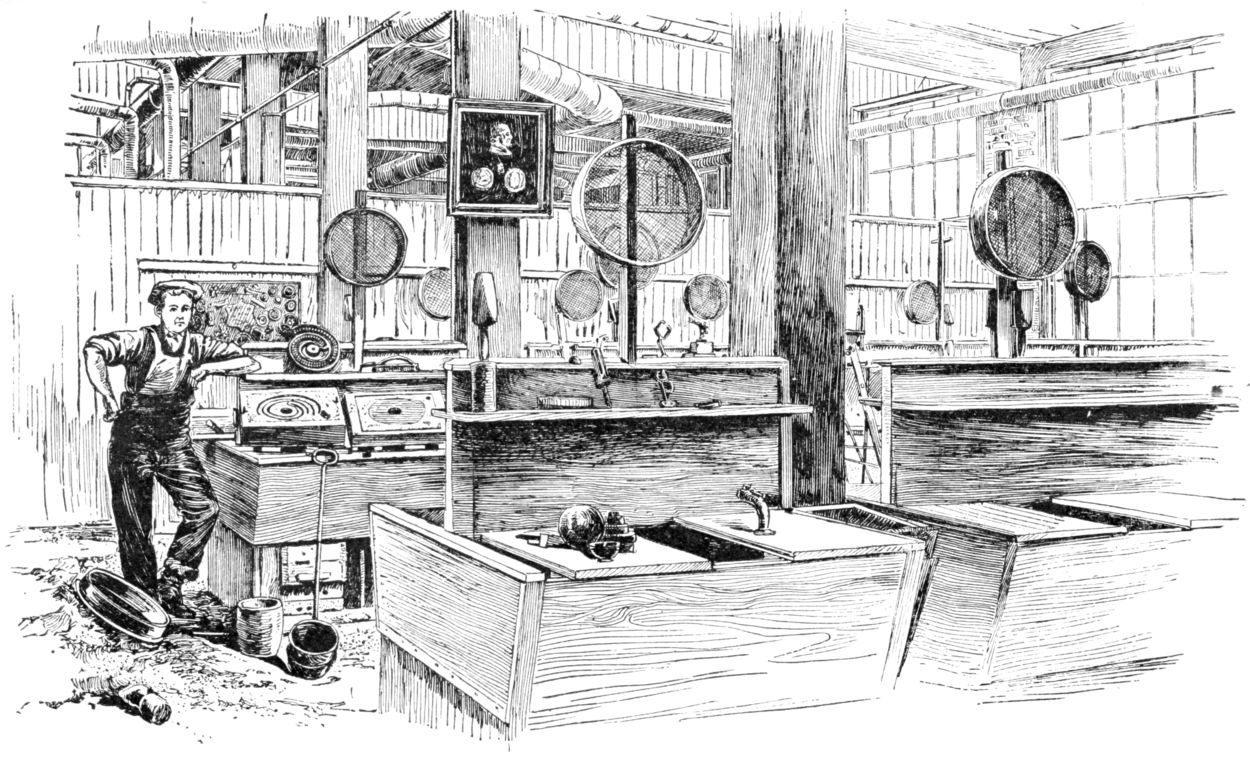
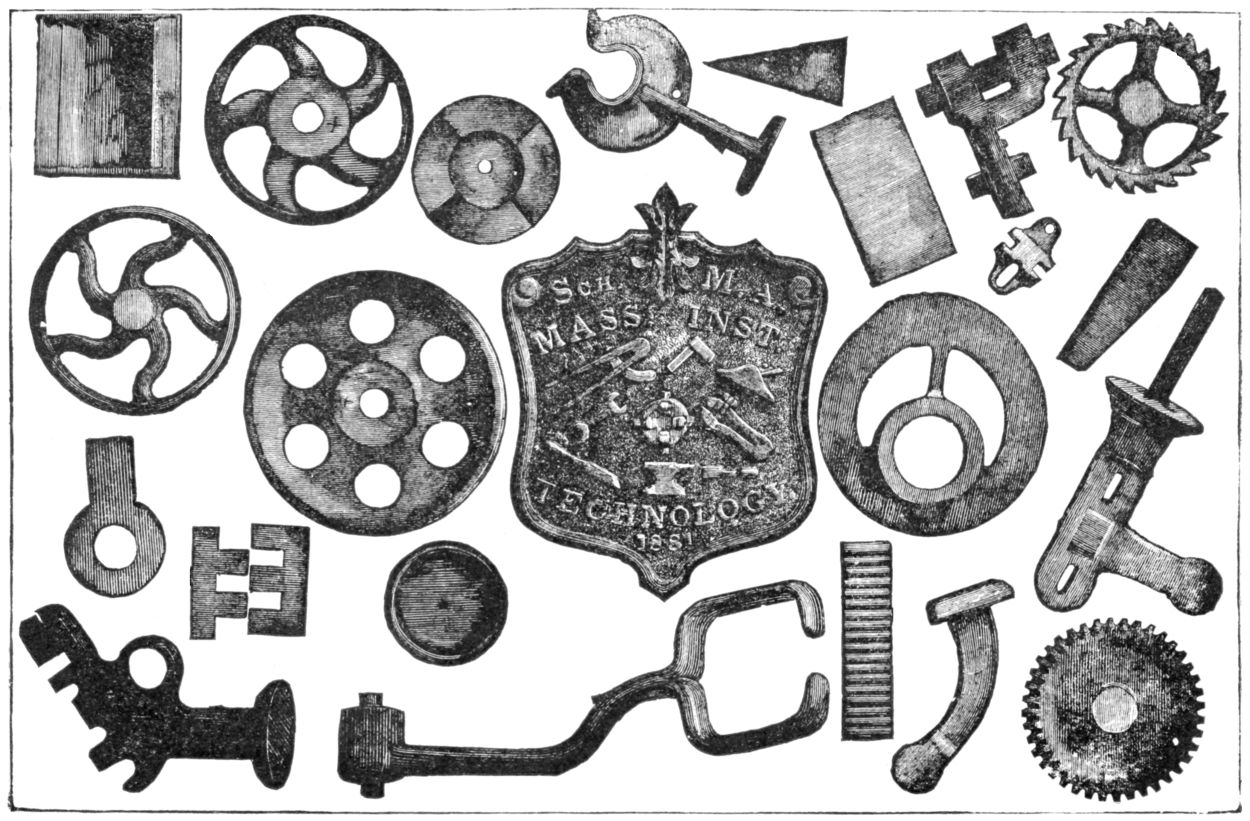
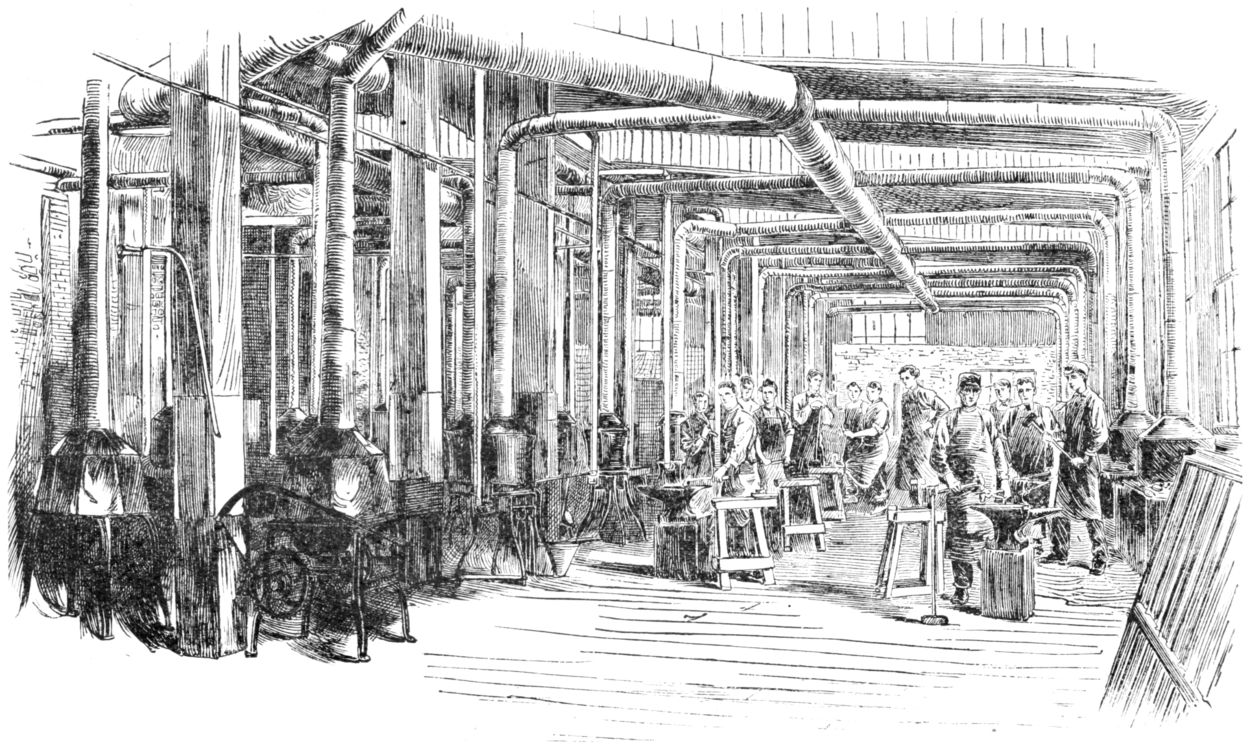
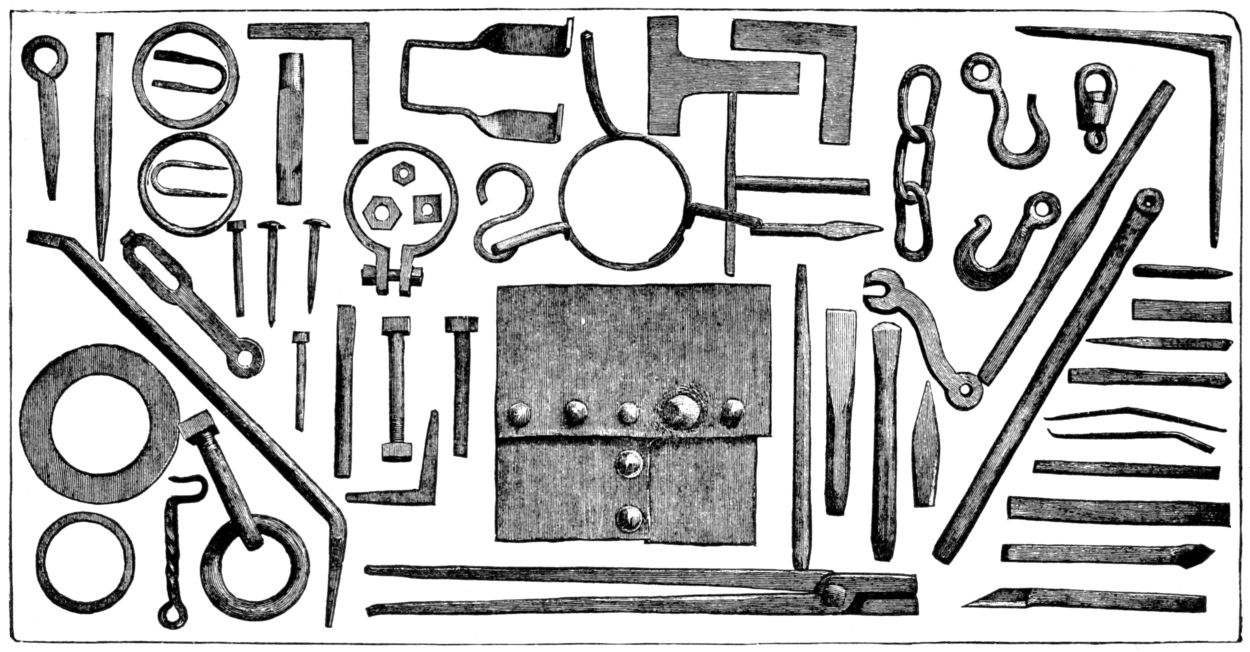
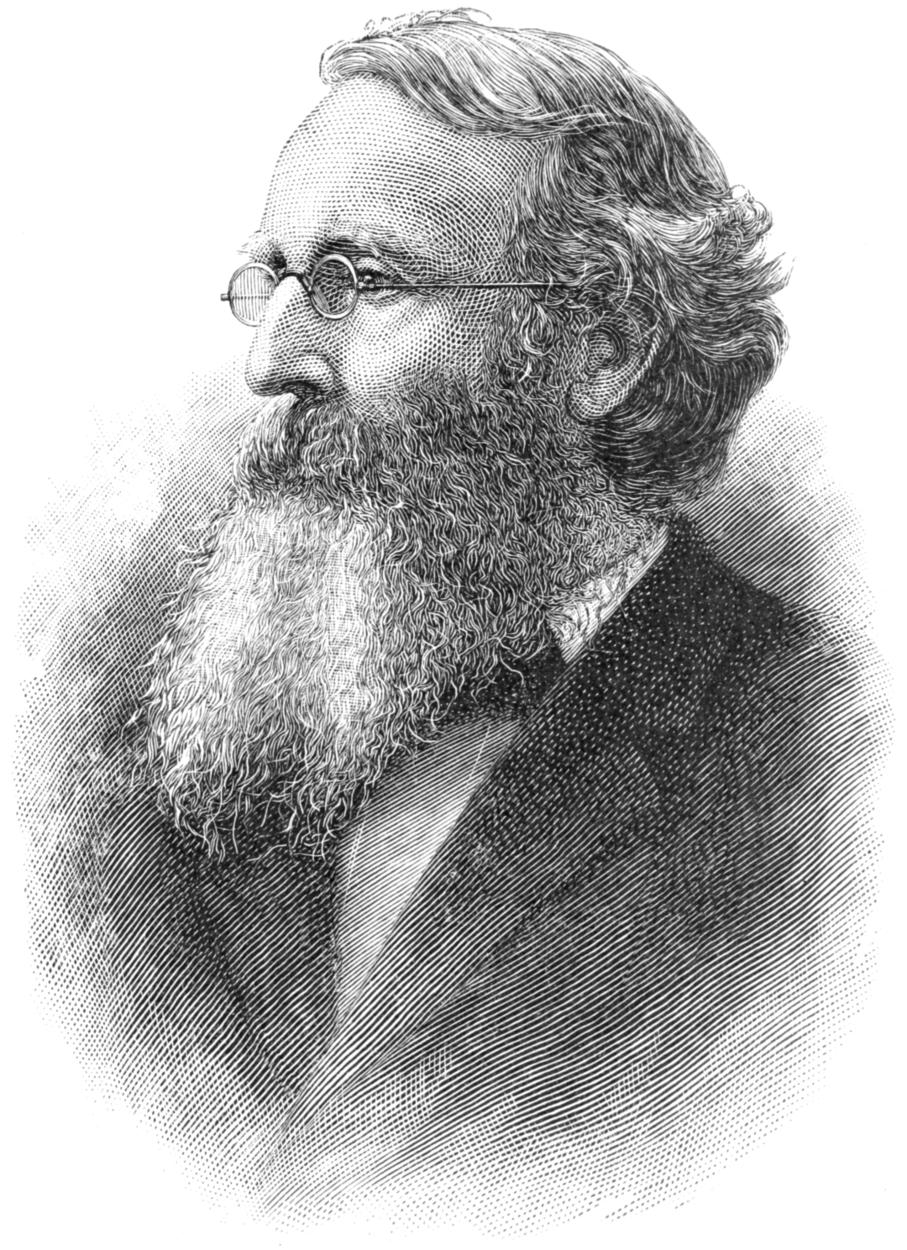
The cover image has been created for this text, and is in the public domain.
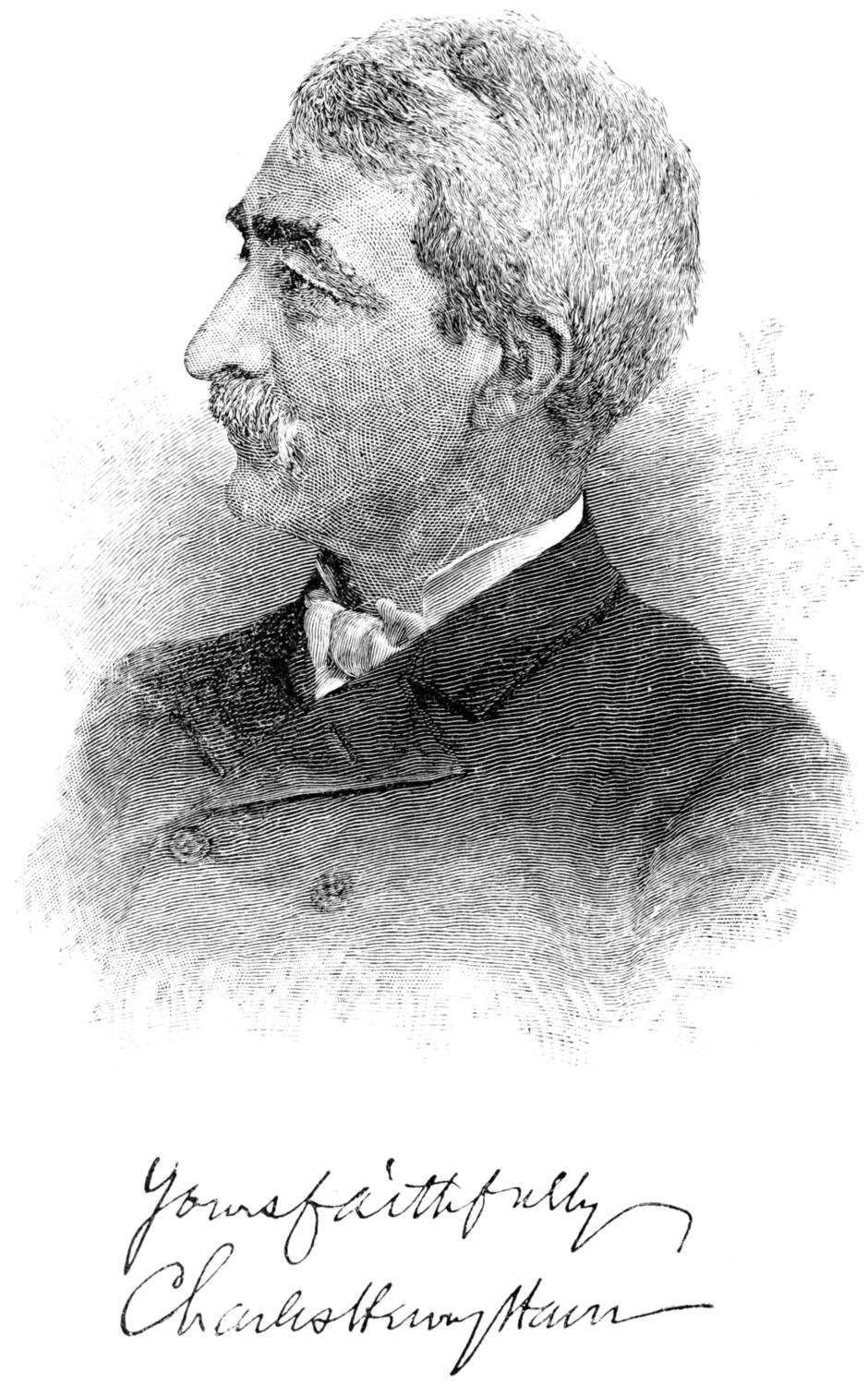
Yours faithfully
Charles Henry Ham
By CHARLES H. HAM
BEING THE THIRD EDITION OF
“MANUAL TRAINING, THE SOLUTION
OF SOCIAL AND INDUSTRIAL PROBLEMS”
ILLUSTRATED
NEW YORK ⁛ CINCINNATI ⁛ CHICAGO AMERICAN BOOK COMPANY
Copyright, 1886, by Harper & Brothers.
Copyright, 1900, by Charles H. Ham. All rights reserved.
W. P. 5
PREFACE TO THE THIRD EDITION.
The work of which this is the third edition has been
before the public of this country, England, and all English-speaking
countries since 1886—thirteen years. As
it proposes a revolution in educational methods, it was not
to be presumed that it would escape criticism. But, while
the reviews of it have been numerous, they have, on the
whole, been very generous. My most radical postulates
have, however, been received by educators of the old régime
with expressions of emphatic dissent. In presenting
the third edition of the work I have, therefore, thought
it wise to support the text with many high authorities in
the form of foot-notes. As was to be expected, my analysis
of Greek history and character provoked the severest
criticism. It is regarded, indeed, as conclusive evidence
of gross ignorance of the entire subject. To meet the
charge of ignorance, I have made a large number of citations
from Herodotus, Thucydides, Xenophon, Plutarch,
and others—authors consulted, originally, in the preparation
of this part of the work. I may venture to observe,
with due deference to those schoolmen who regard the
ancient Greeks as an ideal people, that I have searched
contemporaneous history in vain for evidence of the verity
of this claim; and I am hence constrained to adhere
firmly to the extreme views expressed in the text. And
if these views are correct, it follows that the passion for
Greek models in education is not only a mental dissipation,
but a moral crime.
The other new notes are commended to the careful
consideration of the reader, as the fruit of my added
years of research and reflection.
The Appendix contains a compilation, in tabular form,
of all the facts obtainable from original sources, through
the aid of a skilled statistician, showing the physical
progress of Manual Training in this country, and the
chief countries of Europe, during the last fifteen years.
In this edition the disguise of the first edition is dropped.
In that edition a certain school was referred to as
“the Chicago school,” whereas it was, in fact, purely an
ideal school, which had no existence except in the mind
of the author. But it embodied educational theories and
ideas of Comenius and other great men which the author
desired to see adopted. That desire not having been realized,
I content myself here by quoting the observation
of Oscar Browning as to the proneness of the school-master
to neglect opportunities: “The more we reflect
on the method of Comenius, the more shall we see that
it is replete with suggestiveness, and we shall feel surprised
that so much wisdom can have lain in the path of
school-masters for two hundred and fifty years, and that
they never stooped to avail themselves of its treasures.”
It is proper to state that the terms “Kindergarten,”
“Manual Training,” and “The New Education,” are used
throughout the work as equivalents.
The change of title to “Mind and Hand: Manual
Training the Chief Factor in Education”—is made in
response to the common and just criticism of the original
title as too narrow for the broad treatment of the subject
which characterized the text.
The notes prepared especially for this edition will be
found at the ends of the chapters to which they respectively
belong.
Wherever in this work apparent discrimination in favor
of the male sex is indulged through the employment of
the pronoun “he,” “his,” or “him,” rather than the corresponding
feminine parts of speech, it is merely apparent,
not real; for I urge the co-education of the sexes
as I urge the co-education of Mind and Hand, because
the woman is the complement of the man as the hand is
the complement of the mind. For I believe, with John
Stuart Mill, that “The true virtue of human beings is
fitness to live together as equals; and to enable them to
live together as equals, they must be associated in education”;
and with Mary Wollstonecraft, that “Virtue will
never prevail in society till the morals of both sexes are
founded on reason, and till the affections common to both
are allowed their due strength by the discharge of mutual
duties.”
The Author.
New York City, March, 1900.
PREFACE TO FIRST EDITION.
In 1879 I read a paper before the Chicago Philosophical
Society on the subject of “The Inventive Genius;
or, an Epitome of Human Progress.” The suggestion of
the subject came from Mr. Charles J. Barnes, to whom I
desire in this public way to express my obligation for an
introduction to a profoundly interesting study, and one
which has given a new direction to all my thoughts.
At the conclusion of my labors in the preparation of
the paper, I realized the force of Bacon’s remark, that
“the real and legitimate goal of the sciences is the endowment
of human life with new inventions and riches.”
In tracing the course of invention and discovery, I
found that I was moving in the line of the progress of
civilization. I found that the great gulf between the
savage and the civilized man is spanned by the seven
hand-tools—the axe, the saw, the plane, the hammer, the
square, the chisel, and the file—and that the modern
machine-shop is an aggregation of these tools driven by
steam. I hence came to regard tools as the great civilizing
agency of the world. With Carlyle I said, “Man
without tools is nothing; with tools he is all.” From
this point it was only a step to the proposition that, It is
through the arts alone that all branches of learning find
expression, and touch human life. Then I said, The true
definition of education is the development of all the powers
of man to the culminating point of action; and this power
in the concrete, the power to do some useful thing for
man—this must be the last analysis of educational truth.
These ideas are not new. They pervade Lord Bacon’s
writings, are admirably formulated in Rousseau’s
“Emile,” and were restated by Mr. Herbert Spencer
twenty-five years ago. More than this, Comenius, Pestalozzi,
and Froebel attempted to carry them into practical
operation in the school-room, but with only a small
measure of success. It remains for the age of steel to
show how powerless mere words are in the presence of
things, and so to emphasize the demand for a radical
reform in educational methods.
In 1880 my attention was drawn to the Manual Training
Department of the Washington University of St.
Louis, Mo. In that school I found the realization of Bacon’s
aphorism, “Education is the cultivation of a just
and legitimate familiarity betwixt the mind and things.”
I made an exhaustive study of the methods of the St.
Louis school, and reached the conclusion that the philosopher’s
stone in education had been discovered. The columns
of the Chicago Tribune were opened to me, and
I wrote constantly on the subject for the ensuing three
years. Meantime the Chicago Manual-Training School
(the first independent institution of the kind in the world)
was founded and opened, and the agitation spread over
the whole country, and indeed over the whole civilized
world.
This work was commenced two years ago. I found
the labor much more arduous than I anticipated, and its
completion has hence been delayed far beyond the time
originally contemplated for placing it in the hands of a
publisher. It may be summarized briefly as consisting
of four divisions: 1. A detailed description of the various
laboratory class processes, from the first lesson to the
last, in the course of three years. 2. An exhaustive argument
a posteriori and a fortiori in support of the
proposition that tool practice is highly promotive of intellectual
growth, and in a still greater degree of the
upbuilding of character. 3. A sketch of the historical
period, showing that the decay of civilization and the
destruction of social organisms have resulted directly
from defects in methods of education. 4. A brief sketch
of the history of manual training as an educational force.
To Dr. John D. Runkle, of the Massachusetts Institute
of Technology, the founder of manual training as an educational
institution in this country, I cannot express
too strongly my deep obligation for valuable suggestions
and constant encouragement. To him also am I indebted
for nearly all my illustrations, as also particularly for
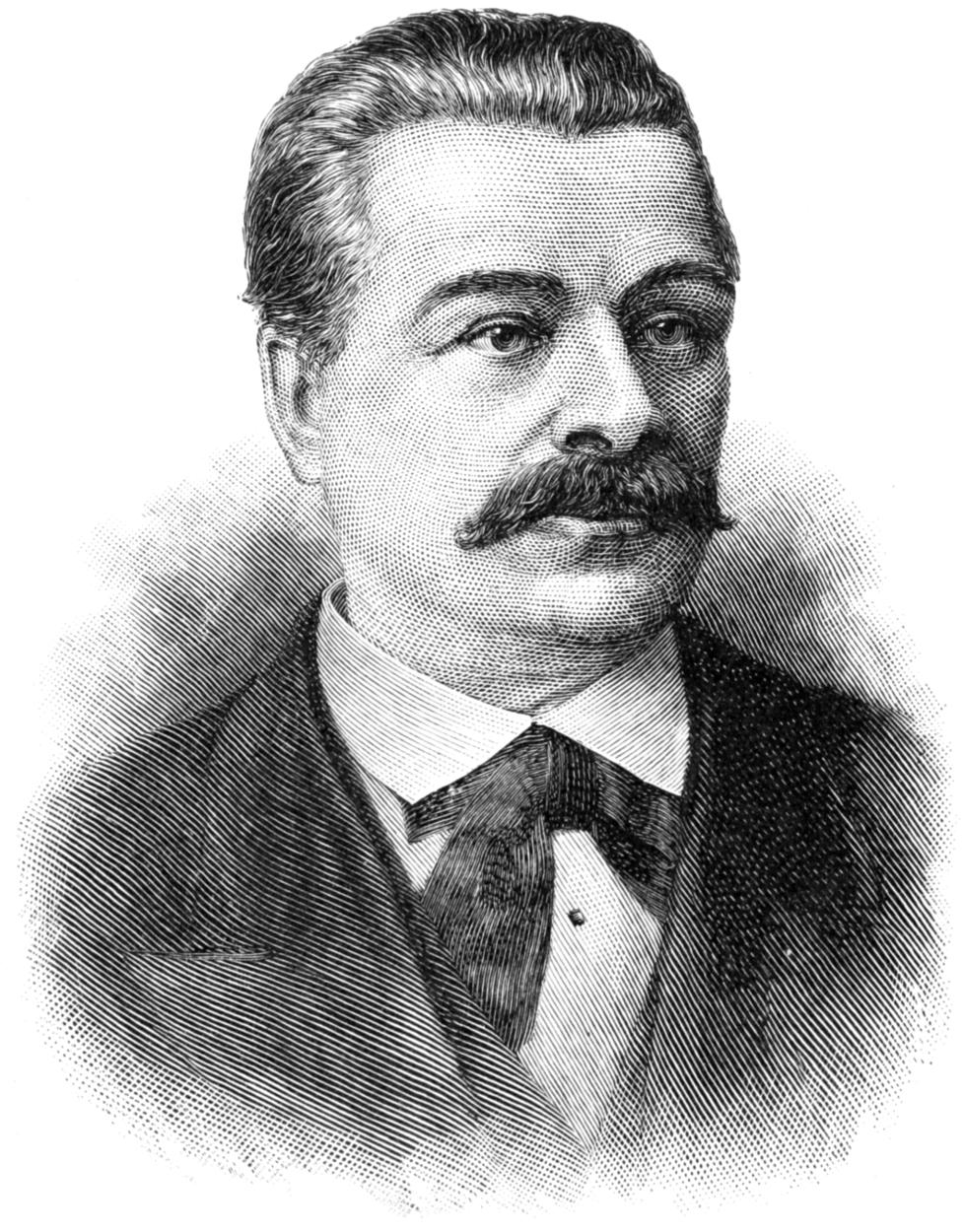
the excellent portrait of M. Victor Della Vos, the founder
of the new system of education in Russia. I am also
under obligations to Col. Augustus Jacobson, a leading
advocate of the new education, for constant counsel and
support, as also to Dr. Henry H. Belfield, Director of the
Chicago Manual Training School, and Mr. John S. Clark,
of Boston.
Of the authors consulted, I cannot forbear mention of
Lord Bacon, Rousseau, and Herbert Spencer, whose great
works constitute the foundation of the new system of education
according to nature. Nor can I omit to acknowledge,
with all the emphasis of which words are susceptible,
my obligations to Mr. Samuel Smiles. His works,
from the lives of the engineers to the shortest of his biographies,
constitute an inexhaustible treasure-house of
facts from which I have drawn without stint. Mr. Smiles
has traced the springs of English greatness to their true
source, the workshop. I have attempted to continue his
office by showing that the workshop is a great educational
force, and hence that its educational element ought to
be incorporated in the system of public instruction.
The propositions of the following pages involve an educational
revolution destined to enlighten, and so ultimately
to redeem manual labor from the scorn of the
ages of slavery, and, in the end, to render the skilled laborer
worthy of high social distinction, thus presenting
at once a solution not only of the industrial question but
of the social question.
Charles H. Ham.
INTRODUCTION TO THE THIRD EDITION By Col. Francis W. Parker , Principal of the Chicago Normal School.
The last twenty-five years have brought much of intrinsic
value into American education. Rapid increase
in population and ever-changing conditions have made
imperative demands for schools adequate to self-government.
The Kindergarten led the way to other substantial reforms
in education, and called attention to the actual needs
of childhood. It proved conclusively that hand-work is
one of the dominant interests of the child, and demonstrated
the absolute dependence of brain-growth upon
Manual Training.
Manual Training is thus a direct outcome and sequence
of the Kindergarten. It supplies a need for which there
is no substitute. The belief that that which is begun in
the Kindergarten should be continued and expanded in
all upper grades, forces itself more and more upon thoughtful
minds. Modern psychology brings its potent evidence
as to the tremendous value of the work of the hand in the
building of the brain. The trend of educational thought
will always be in the direction of hand training as a fundamental
element in education.
Twenty-five years ago Manual Training was little known
in this country as a factor in education. Charles H. Ham,
imbued with a fervid patriotism, saw clearly that one of
the intrinsic needs of education—an absolute necessity in
the evolution of a democracy—is the training of the whole
being, hand, brain, and soul, through educative work. He
was, indeed, a pioneer, beginning his work when there was
very little attention given to this important subject, and
at a time, too, when it was opposed by nearly all leading
educators.
Mr. Ham, together with Colonel Jacobson, brought a
strong influence to bear upon the Commercial Club of
Chicago, to found a Manual-Training school. This school
is now a department of the Chicago University and has
been in successful operation for thirteen years. There
are in Chicago to-day the Armour Institute, the Lewis
Institute, and the Jewish Manual-Training School, all
prominent and well established. There is also a high
school for Manual Training in connection with the public
schools, and, best of all, there are indications which show
that hand-work is making its way throughout the grades.
Mr. Ham, without doubt, had a strong influence upon
the late George M. Pullman, which led him to provide,
through his will, for a Manual-Training school for the
children of the city which he built.
Manual-Training schools are now maintained in almost
every city in the Union. Much remains to be done before
Manual Training takes its true place in education.
The majority of these schools now in existence are for
boys who have graduated from the grammar school, which
leaves the years between six and fourteen with little or
no hand-work. Thus the most important period for brain-growth
through hand activity is neglected.
The future of Manual Training is to introduce hand-work
as the principal factor in the first four years’ work,
to be continued in the four years of the grammar grades,
and correlated with all other subjects. Indeed, the ideal
is to introduce Manual Training in all courses of study,
from the Kindergarten to the University, inclusive.
The patrons of Cook County Normal School owe to
Mr. Ham the establishment of Manual Training in connection
with the primary grades of the school, nearly fifteen
years ago; for without the practical aid he gave it,
it could not have been accomplished at that time. The
children—indeed, all the people of this country—owe
him an immense debt of gratitude for his heroic championship
of hand-work.
Manual Training gives a true dignity to labor; it calls
attention to the place of hand-work in human progress,
and as civilization goes on it will have a higher and still
higher place in the hearts of the people.
CONTENTS.
CHAPTER I. THE IDEAL SCHOOL.
Its Situation. — Its Tall Chimney. — The Whir of Machinery and Sound
of the Sledge-hammer. — The School that is to dignify Labor. — The Realization of the
Dream of Bacon, Rousseau, Comenius, Pestalozzi, and Froebel. — The School that fitly represents the Age of
Steel.Page 1
CHAPTER II. THE MAJESTY OF TOOLS.
Tools the highest Text-books. — How to Use them the Test of
Scholarship. — They are the Gauge of Civilization. — Carlyle’s Apostrophe to
them. — The Typical Hand-tools. — The Automata of the
Machine-shop. — Through Tools Science and Art are United. — The Power of
Tools. — Their Educational Value. — Without Tools Man is Nothing; with Tools he is
All. — It is through the Arts alone that Education touches Human
Life.7
CHAPTER III. THE ENGINE ROOM.
The Corliss Engine. — A Thing of Grace and Power. — The Growth of Two
Thousand Years. — From Hero to Watt. — Its Duty as a
School-master. — The Interdependence of the Ages. — The School in
Epitome.14
CHAPTER IV. THE DRAWING-ROOM.
Twenty-four Boys bending over the Drawing-board. — Analysis and Synthesis in
Drawing. — Geometric Drawing. — Pictorial Drawing. — The Principles of
Design. — The Æsthetic in Art. — The
Fundamentals. — Object and Constructive
Drawing. — Drawing for the Exercises in the Laboratories. — The Educational Value of
Drawing. — The Language of Drawing. — Every Student an expert Draughtsman at the end of
the Course.16
CHAPTER V. THE CARPENTER’S LABORATORY.
The Natural History of the Pine-tree. — How it is Converted into Lumber, what it is
Worth, and how it is Consumed. — Where the Students get Information. — Working Drawings
of the Lesson. — Asking Questions. — The Instructor Executes the
Lesson. — Instruction in the Use and Care of Tools. — Twenty-four Boys Making
Things. — As Busy as Bees. — The Music of the Laboratory. — The
Self-reliance of the Students.21
CHAPTER VI. THE WOOD-TURNING LABORATORY.
A Radical Change. — From the Square to the Circle; from Angles to Spherical,
Cylindrical, and Eccentric Forms. — The Rhythm of Mechanics. — The Potter’s Wheel of the
Ancients and the Turning-lathe. — The Speculation of Holtzapffels on its Origin. — The
Greeks as Turners. — The Turners of the Middle Ages. — George III. at the
Lathe. — Maudsley’s Slide-rest, and the Revolution it wrought. — The Natural History of
Black-walnut. — The Practical Value of Imagination. — Disraeli’s Tribute to it; Sir
Robert Peel’s Want of it. — The Laboratory animated by Steam. — The Boys at the
Lathes. — Their Manly Bearing. — The Lesson.30
CHAPTER VII. THE FOUNDING LABORATORY.
The Iron Age. — Iron the King of Metals. — Locke’s
Apothegm. — The Moulder’s Art is Fundamental. — History of
Founding. — Remains of Bronze Castings in Egypt, Greece, and Assyria. — Layard’s
Discoveries. — The Greek Sculptors. — The Colossal Statue of Apollo at
Rhodes. — The Great Bells of History. — Moulding and Casting a
Pulley. — Description of the Process, Step by Step. — The Furnace
Fire. — Pouring the Hot Metal into the Moulds. — A Pen Picture of the
Laboratory. — Thus were the Hundred Gates of Babylon cast. — Neglect of the Practical
Arts by Herodotus. — How Slavery has degraded Labor. — How Manual Training is to dignify
it.45
CHAPTER VIII. THE FORGING LABORATORY.
Twenty-four manly-looking Boys with Sledge-hammer in Hand — their Muscle and
Brawn. — The Pride of Conscious Strength. — The Story of the Origin of an
Empire. — The Greater Empire of Mechanics. — The Smelter and the Smith the Bulwark of the
British Government. — Coal — its Modern Aspects; its Early History; Superstition
regarding its Use. — Dud. Dudley utilizes “Pit-coal” for Smelting — the Story of his
Struggles; his Imprisonment and Death. — The English People import their Pots and
Kettles. — “The Blast is on and the Forge Fire sings.” — The Lesson, first on the
Black-board, then in Red-hot Iron on the Anvil. — Striking out the Anvil Chorus — the
Sparks fly whizzing through the Air. — The Mythological History of Iron. — The Smith in
Feudal Times. — His Versatility. — History of Damascus Steel. — We
should reverence the early Inventors. — The Useful Arts finer than the Fine Arts. — The
Ancient Smelter and Smith, and the Students in the Manual-training School.58
CHAPTER IX. THE MACHINE-TOOL LABORATORY.
The Foundery and Smithy are Ancient, the Machine-tool Shop is Modern. — The Giant,
Steam, reduced to Servitude. — The Iron Lines of Progress. — They converge in the Shop;
its triumphs from the Watchspring to the Locomotive. — The Applications of Iron in Art is the Subject of
Subjects. — The Story of Invention is the History of Civilization. — The Machine-maker
and the Tool-maker are the best Friends of Man. — Watt’s Great Conception waited for Automatic Tools; their
Accuracy. — The Hand-made and the Machine-made Watch. — The Elgin (Illinois) Watch
Factory. — The Interdependence of the Arts. — The making of a Suit of
Clothes. — The Anteroom of the Machine-tool Laboratory. — Chipping and
Filing. — The File-cutter. — The Poverty of Words as compared with
Things. — The Graduating Project. — The Vision of the
Instructor.78
CHAPTER X. MANUAL AND MENTAL TRAINING COMBINED.
The new Education is all-sided — its Effect. — A Harmonious
Development of the Whole Being. — Examination for Admission to the Chicago School. — List
of Questions in Arithmetic, Geography, and
Language. — The Curriculum. — The Alternation of Manual and Mental
Exercises. — The Demand for Scientific Education — its
Effect. — Ambition to be useful.105
CHAPTER XI. THE INTELLECTUAL EFFECT OF MANUAL TRAINING.
Intelligence is the Basis of Character. — The more Practical the Intelligence the
Higher the Development of Character. — The use of Tools quickens the Intellect. — Making
Things rouses the Attention, sharpens the Observation, and steadies the Judgment. — History of Inventions
in England, 1740-1840. — Poor, Ignorant Apprentices become learned Men. — Cort, Huntsman,
Mushet, Neilson, Stephenson, and Watt. — The Union of Books and Tools. — Results at
Rotterdam, Holland; at Moscow, Russia; at Komotau, Bohemia; and at St. Louis, Mo. — The Consideration of
Overwhelming Import.113
CHAPTER XII. THE EDUCATION OF WOMEN A NECESSITY.
The Difference between Ancient and Modern Systems of Education. — Plato Blinded by
Half-truths. — No place in the present order of things for Dogmatisms. — Education begins
at Birth. — The Influence of Women extends from the Cradle to the Grave. — The Crime of
Crimes. — Neglect to educate Woman. — The Superiority of Women over Men as
Teachers. — Froebel discovered it. — Nature designed Woman to Teach; hence the Importance
of Fitting her for her Highest Destiny.123
CHAPTER XIII. THE MORAL EFFECT OF MANUAL TRAINING.
Mental Impulses are often Vicious; but the Exertion of Physical Power in the Arts is always
Beneficent — hence Manual Training tends to correct vicious mental Impulses. — Every
mental Impression produces a moral Effect. — All Training is Moral as well as
Mental. — Selfishness is total Depravity; but Selfishness has been Deified under the name of
Prudence. — Napoleon an Example of Selfishness. — The End of Selfishness is Disaster;
but Prevailing Systems of Education promote Selfishness. — The Modern City an Illustration of
Selfishness. — The Ancient City. — Existing Systems of Education Negatively
Wrong. — Manual Training supplies the lacking Element. — The Objective must take the
Place of the Subjective in Education. — Words without Acts are as dead as Faith without
Works.130
CHAPTER XIV. THE MIND AND THE HAND.
The Mind and the Hand are Allies; the Mind speculates, the Hand tests its Speculations in
Things. — The Hand explodes the Errors of the Mind — it searches after Truth and finds
it in Things. — Mental Errors are subtile; they elude us, but the False in Things stands
self-exposed. — The Hand is the Mind’s Moral Rudder. — The Organ of Touch the most
Wonderful of the Senses; all the Others are Passive; it alone is Active. — Sir Charles Bell’s Discovery of
a “Muscular Sense.” — Dr. Henry Maudsley on the Muscular Sense. — The Hand influences
the Brain. — Connected Thought impossible without Language, and Language dependent upon Objects; and all
Artificial Objects are the Work of the Hand. — Progress is therefore the Imprint of the Hand upon Matter
in Art. — The Hand is nearer the Brain than are the Eye and the Ear. — The Marvellous
Works of the Hand.144
CHAPTER XV. THE POWER OF THE TRAINED HAND.
The Legend of Adam and the Stick with which he subdued the Animals. — The Stick is the
Symbol of Power, and only the Hand can wield it. — The Hand imprisons Steam and Electricity, and keeps them
at hard Labor. — The Destitution of England Two Hundred and Fifty Years ago: a Pen
Picture. — The Transformation wrought by the Hand: a Pen Picture. — It is due, not to Men
who make Laws, but to Men who make Things. — The Scientist and the Inventor are the World’s
Benefactors. — A Parallel between the Right Honorable William E. Gladstone and Sir Henry
Bessemer. — Mr. Gladstone a Man of Ideas, Mr. Bessemer a Man of Deeds. — The Value of
the latter’s Inventions. — Mr. Gladstone represents the Old Education, Mr. Bessemer the
New.157
CHAPTER XVI. THE INVENTORS, CIVIL ENGINEERS, AND MECHANICS OF ENGLAND, AND ENGLISH PROGRESS.
A Trade is better than a Profession. — The Railway, Telegraph, and Steamship are more
Potent than the Lawyer, Doctor, and Priest. — Book-makers writing the Lives of the Inventors of last
Century. — The Workshop to be the Scene of the Greatest Triumphs of Man. — The Civil
Engineers of England the Heroes of English Progress. — The
Life of James Brindley, the Canal-maker; his Struggles and Poverty. — The Roll of
Honor. — Mr. Gladstone’s Significant Admission that English Triumphs in Science and Art were won without
Government Aid. — Disregarding the Common-sense of the Savage, Legislators have chosen to learn of Plato,
who declared that “The Useful Arts are Degrading.” — How Improvements in the Arts have been met by Ignorant
Opposition. — The Power wielded by the Mechanic.170
CHAPTER XVII. POWER OF STEAM AND CONTEMPT OF ARTISANS.
A few Million People now wield twice as much Industrial Power as all the People on the Globe exerted a
Hundred Years ago. — A Revolution wrought, not by the Schools and Colleges, but by the
Mechanic. — The Union between Science and Art prevented by the Speculative Philosophy of the Middle
Ages. — Statesmen, Lawyers, Littérateurs, Poets, and Artists more highly esteemed than Civil Engineers,
Mechanics, and Artisans. — The Refugee Artisan a Power in England, the Refugee Politician
worthless. — Prejudice against the Artisan Class shown by Mr. Galton in his Work on “Hereditary
Genius.” — The Influence of Slavery: it has lasted Thousands of Years, and still Survives.
184
CHAPTER XVIII. AUTOMATIC CONTRASTED WITH SCIENTIFIC EDUCATION.
The Past tyrannizes over the Present by Interposing the Stolid Resistance of Habit. —
Habits of Thought like Habits of the Body become Automatic. — There is much Freedom of Speech but very
little Freedom of Thought: Habit, Tradition, and Reverence for Antiquity forbid it. — The Schools educate
Automatically. — A glaring Defect of the Schools shown by Mr. John S. Clark, of Boston. —
The Automatic Character of the Popular System of Education shown by the Quincy (Mass.) Experiment. —
Several Intelligent Opinions to the same Effect. — The Public Schools as an Industrial Agency a
Failure. — A Conclusive Evidence of the Automatic and Superficial Character of prevailing Methods of
Education in the Schools of a large City. — The Views of Colonel Francis W. Parker. —
Scientific Education is found in the Kindergarten and the Manual-training School. — “The Cultivation of
Familiarity betwixt the Mind and Things.”191
CHAPTER XIX. AUTOMATIC CONTRASTED WITH SCIENTIFIC
EDUCATION — Continued.
The Failure of Education in America shown by Statistics of Railway and Mercantile Disasters.
— Shrinkage of Railway Values and Failures of Merchants. — Only Three per Cent. of those
entering Mercantile Life achieve Success. — Business Enterprises conducted by Guess: Cause, Unscientific
Education. — Savage Training is better because Objective. — Mr. Foley, late of the
Massachusetts Institute of Technology, on the Scientific Character of Manual Education — Prof. Goss, of
Purdue University, to the same Effect — also Dr. Belfield, of the Chicago Manual-training School.
— Students love the Laboratory Exercises. — Demoralizing Effect of Unscientific Training.
— The Failure of Justice and Legislation as contrasted with the Success of Civil Engineering and
Architecture.210
CHAPTER XX. AUTOMATIC CONTRASTED WITH SCIENTIFIC EDUCATION — Continued.
The Training of the Merchant, the Lawyer, the Judge, and the Legislator contrasted with that of the
Artisan. — The Training of the Merchant makes him Selfish, and Selfishness breeds Dishonesty. —
Professional Men become Speculative Philosophers, and test their Speculations by Consciousness. —
The Artisan forgets Self in the Study of Things. — The Search after Truth. — The Story
of Palissy. — The Hero is the Normal Man; those who Marvel at his Acts are abnormally Developed.
— Savonarola and John Brown. — The New England System of Education contrasted with that of the
South. — American Statesmanship — its Failure in an Educational Point of
View. — Why the State Provides for Education; to protect Property. — The British
Government and the Land Question. — The Thoroughness of the Training given by Schools of Mechanic Art and
Institutes of Technology as shown in Things. — Story of the Emperor of Germany and the
Needle-maker. — The Iron Bridge lasts a Century, the Act of the Legislator wears out in a
Year. — The Cause of the Failures of Justice and Legislation. — The best Act is the Act
that Repeals a Law; but the Act of the Inventor is never Repealed. — Things the Source and Issue of Ideas;
hence the Necessity of Training in the Arts.229
CHAPTER XXI. EDUCATION AND THE SOCIAL
PROBLEM — HISTORIC. EGYPT AND GREECE.
Fundamental Propositions. — Selfishness the Source of Social Evil; Subjective Education
the Source of Selfishness and the Cause of Contempt of Labor; and Social Disintegration the Result of Contempt of Labor and
the Useful Arts. — The First Class-distinction — the Strongest Man ruled; his First
Rival, the Ingenious Man. — Superstition. — The Castes of India and
Egypt — how came they about? — Egyptian Education based on Selfishness. —
Rise of Egypt — her Career; her Fall; Analysis thereof. — She Typifies all the
Early Nations: Force and Rapacity above, Chains and Slavery below. — Their Education consisted of Selfish
Maxims for the Government of the Many by the Few, and Government meant the Appropriation of the Products of Labor.
— Analysis of Greek Character — its Savage Characteristics. — Greek
Treachery and Cruelty. — Greek Venality. — Her Orators accepted
Bribes. — Responsibility of Greek Education and Philosophy for the Ruin of Greek
Civilization. — Rectitude wholly left out of her Scheme of Education. — Plato’s Contempt
of Matter: it led to Contempt of Man and all his Works. — Greek Education consisted of Rhetoric and Logic;
all Useful Things were hence held in Contempt.247
CHAPTER XXII. EDUCATION AND THE SOCIAL PROBLEM — HISTORIC. ROME.
Vigor of the Early Romans — their Virtues and Vices; their Rigorous Laws; their
Defective Education; their Contempt of Labor. — Slavery: its Horrors and Brutalizing
Influence. — Education Confined to the Arts of Politics and War; it transformed Courage into Cruelty, and
Fortitude into Stoicism. — Robbery and Bribery. — The Vices of Greece and Carthage
imported into Rome. — Slaves construct all the great Public Works; they Revolt, and the Legions Slaughter
them. — The Gothic Invasion. — Rome Falls. — False Philosophy and
Superficial Education promoted Selfishness. — Deification of Abstractions, and Scorn of Men and
Things. — Universal Moral Degradation. — Neglect of Honest Men and Promotion of
Demagogues. — The Decline of Morals and Growth of Literature. — Darwin’s Law of
Reversion, through Selfishness to Savagery. — Contest between the Rich and the Poor. —
Logic, Rhetoric, and Ruin.263
CHAPTER XXIII. EDUCATION AND THE SOCIAL
PROBLEM — HISTORIC. THE MIDDLE AGES.
The Trinity upon which Civilization Rests: Justice, the Arts, and Labor; and these Depend upon Scientific
Education. — Reason of the Failure of Theodoric and Charlemagne to Reconstruct the Pagan
Civilization. — Contempt of Man. — Serfdom. — The Vices of the Time:
False Philosophy, an Odious Social Caste, and Ignorance. — The Splendid Career of the Moors in Spain, in
Contrast. — Effect upon Spain of the Expulsion of the Moors. — The Repressive Force of
Authority and the Atrocious Philosophy of Contempt of Man. — The Rule of Italy — a
Menace and a Sneer. — The work of Regeneration. — The Crusades. — The
Destruction of Feudalism. — The Invention of Printing. — The Discovery of America.
— Investigation. — Discoveries in Science and Art.278
CHAPTER XXIV. EDUCATION AND THE SOCIAL PROBLEM — HISTORIC. EUROPE.
The Standing Army a Legacy of Evil from the Middle Ages. — It is the Controlling
Feature of the European Situation. — Its Collateral Evils: Wars and Debts. — The Debts
of Europe Represent a Series of Colossal Crimes against the People; with the Armies and Navies they Absorb the Bulk of the
Annual Revenue. — The People Fleeing from them. — They Threaten Bankruptcy; they Prevent
Education. — Germany, the best-educated Nation in Europe, losing most by Emigration. —
Her People will not Endure the Standing Army. — The Folly of the European International Policy of Hate.
— It is Possible for Europe to Restore to Productive Employments 3,000,000 of men, to place at the
Disposal of her Educators $700,000,000, instead of $70,000,000 per annum, and to pay her National Debts in Fifty-four Years,
simply by the Disbandment of her Armies and Navies. — The Armament of Europe Stands in the Way of Universal
Education and of Universal Industrial Prosperity. — Standing Armies the Last Analysis of Selfishness; they
are Coeval with the Revival during the Middle Ages of the Greco-Roman Subjective Methods of Education. —
They must go out when the New Education comes in.289
CHAPTER XXV. EDUCATION AND THE SOCIAL
PROBLEM — HISTORIC. AMERICA.
An Old Civilization in a New Country. — Old Methods in a New System of
Schools. — Sordid Views of Education. — The highest Aim Money-getting. —
Herbert Spencer on the English Schools. — Same Defects in the American Schools. —
Maxims of Selfishness. — The Cultivation of Avarice. — Political Incongruities.
— Negroes escaping from Slavery called Fugitives from Justice. — The Results of Subjective
Educational Processes. — Climatic Influences alone saved America from becoming a Slave Empire. —
Illiteracy. — Abnormal Growth of Cities. — Failure of Justice. —
Defects of Education shown in Reckless and Corrupt Legislation. — Waste of an Empire of Public
Land. — Henry D. Lloyd’s History of Congressional Land Grants. — The Growth and Power of
Corporations. — The Origin of large Fortunes, Speculations. — Old Social Forces producing
old Social Evils. — Still America is the Hope of the World. — The Right of Suffrage in
the United States justifies the Sentiment of Patriotism. — Let Suffrage be made Intelligent and Virtuous,
and all Social Evils will yield to it; and all the Wealth of the Country is subject to the Draft of the Ballot for
Education. — The Hope of Social Reform depends upon a complete Educational Revolution.
307
CHAPTER XXVI. THE MANUAL ELEMENT IN EDUCATION IN 1884.
The Kindergarten and the Manual-training School one in Principle. — Russia solved the
Problem of Tool Instruction by Laboratory Processes. — The Initiatory Step by M. Victor Della-Vos, Director
of the Imperial Technical School of Moscow in 1868. — Statement of Director Della-Vos as to the Origin,
Progress, and Results of the New System of Training. — Its Introduction into all the Technical Schools of
Russia. — Dr. John D. Runkle, President of the Massachusetts Institute of Technology, recommends the
Russian System in 1876, and it is adopted. — Statement of Dr. Runkle as to how he was led to the adoption
of the Russian System. — Dr. Woodward, of Washington University, St. Louis, Mo., establishes the second
School in this Country. — His Historical Note in the Prospectus of 1882-83. — First Class
graduated 1883. — Manual Training in the Agricultural Colleges. — In Boston, in New Haven,
in Baltimore, in San Francisco, and other places. — Manual Training at the Meeting of the National
Educational Association, 1884. — Kindergarten and
Manual-training Exhibits. — Prof. Felix Adler’s School in New York City — the most
Comprehensive School in the World. — The Chicago Manual-training School the first Independent Institution
of the Kind — its Inception; its Incorporation; its Opening. Its Director, Dr. Belfield. —
His Inaugural Address. — Manual Training in the Public Schools of Philadelphia. —
Manual Training in twenty-four States. — Revolutionizing a Texas College. — Local
Option Law in Massachusetts. — Department of Domestic Economy in the Iowa Agricultural College.
— Manual Training in Tennessee, in the University of Michigan, in the National Educational Association, in
Ohio. — The Toledo School for both Sexes. — The Importance of the Education of Woman.
— The Slöjd Schools of Europe.328
CHAPTER XXVII. PROGRESS OF THE NEW EDUCATION — 1883-1899.
Educational Revolution in 1883-4. — Urgent Demand for Reform. —
Existing Schools denounced as Superficial, their Methods as Automatic, their System as a Mixture of Cram and Smatter.
— The Controversy between the School-master of the Old Régime and the Reformer. — The Leaders
of the Movement, Col. Parker, Dr. MacAlister, and others — followers of Rousseau, Bacon, and Spencer.
— “The End of Man is an Action, not a Thought.” — The Conservative Teachers fall into
Line. — The New Education becomes an Aggressive Force pushing on to Victory. — The
Physical Progress of Manual Training — its Quality not equal to its Extent. — The New
System of Training confided to Teachers of the Old Régime. — Ideal Teachers hard to find. —
Teachers willing to Learn should be Encouraged. — The effects of Manual Training long antedate its
Introduction to the Schools. — Bacon’s Definition of Education. — Stephenson and the
Value of Hand-work. — Manual Training is the union of Thought and Action. — It is the
antithesis of the Greek methods, which exalted Abstractions and debased Things. — The Rule of Comenius and
the Injunction of Rousseau — few Teachers comprehend them. — The Employment of the Hands
in the Arts is more highly Educative than the acquisition of the rules of Reading and Arithmetic. — What
the Locomotive has accomplished for Man. — Education must be equal, and Social and Political Equality will
follow. — The foundation of the New Education is the Baconian Philosophy as stated by Macaulay.
— Use and Service are the Twin-ministers of Human Progress. — Definitions of Genius.
— Attention. — Sir Henry Maine. — Manual Training relates to all the Arts of
Life. — Mind and Hand. — Newton and the Apple. — The Sense of Touch
resides in the Hand. — Robert Seidel on Familiarity with Objects. — Material Progress
the basis of Spiritual Growth. — Plato and the Divine
Dialogues. — Poverty, Society, and the Useful Arts. — Selfishness must give way to
Altruism. — The Struggle of Life. — The Progress of the Arts and the final Regeneration
of the Race. — The Arts that make Life sweet and beautiful. — The final Fundamental
Educational Ideal is Universality. — Comenius’s definition of Schools — the Workshops of
Humanity. — That one Man should die ignorant, who had capacity for Knowledge, is a Tragedy. —
Mental and Manual Exercises to be rendered homogeneous in the School of the Future. — The hero of
the Ideal School.370
“His tongue was framed to music, And his hand was armed with skill; His face was the mould of beauty, And his heart the throne of will.”
—Emerson.
CHAPTER I. THE IDEAL SCHOOL.
MIND AND HAND:
MANUAL TRAINING THE CHIEF FACTOR IN EDUCATION.
Its Situation. — Its Tall Chimney. — The Whir of Machinery and
Sound of the Sledge-hammer. — The School that is to dignify
Labor. — The Realization of the Dream of Bacon, Rousseau, Comenius,
Pestalozzi, and Froebel. — The School that fitly represents
the Age of Steel.
The Ideal School is an institution which develops and
trains to usefulness the moral, physical, and intellectual
powers of man. It is what Comenius called Humanity’s
workshop, and in America it is becoming the natural
center of the Public School system. The building, well-designed
for its occupancy, is large, airy, open to the light
on every side, amply provided with all appliances requisite
for instruction in the arts and sciences, and finished
interiorly and exteriorly in the highest style of useful
and beautiful architectural effects. The distinguishing
characteristic of the Ideal School building is its chimney,
which rises far above the roof, from whose tall stack
a column of smoke issues, and the hum and whir of
machinery is heard, and the heavy thud of the sledge-hammer
resounding on the anvil, smites the ear.
It is, then, a factory rather than a school?
No. It is a school; the school of the future; the
school that is to dignify labor; the school that is to
generate power; the school where every sound contributes
to the harmony of development, where the brain
informs the muscle, where thought directs every blow,
where the mind, the eye, and the hand constitute an
invincible triple alliance. This is the school that Locke
dreamed of, that Bacon wished for, that Rousseau described,
and that Comenius, Pestalozzi, and Froebel
struggled in vain to establish.
It is, then, science and the arts in apotheosis. For if
it be, as claimed, the Ideal school, it is destined to lift
the veil from the face of Nature, to reveal her most
precious secrets, and to divert to man’s use all her
treasures.
Yes; it is to other schools what the diamond is to
other precious stones—the last analysis of educational
thought. It is the philosopher’s stone in education; the
incarnated dream of the alchemist, which dissolved earth,
air, and water into their original elements, and recombined
them to compass man’s immortality. Through it
that which has hitherto been impossible is to become a
potential reality.
In this building which resembles a factory or machine-shop
an educational revolution is to be wrought. Education
is to be rescued from the domination of mediæval
ideas, relieved of the enervating influence of Grecian
æstheticism, and confided to the scientific direction of
the followers of Bacon, whose philosophy is common
sense and its law, progress. The philosophy of Plato
left in its wake a long line of abstract propositions,
decayed civilizations, and ruined cities, while the philosophy
of Bacon, in the language of Macaulay, “has lengthened
life; mitigated pain; extinguished diseases;
increased the fertility of the soil; given new securities
to the mariner; spanned great rivers and estuaries with
bridges of form unknown to our fathers; guided the
thunderbolt innocuously from heaven to earth; lighted
up the night with the splendor of the day; extended
the range of the human vision; multiplied the power of
the human muscles; accelerated motion; annihilated
distance; facilitated intercourse, correspondence, all
friendly offices, all dispatch of business; enabled man
to descend to the depths of the sea, to soar into the air,
to penetrate securely into the noxious recesses of the
earth, to traverse the land in cars which whirl along
without horses, and the ocean in ships which run ten
knots an hour against the wind.”
It is this beneficent work of Bacon that the Ideal
school is to continue—the work of demonstrating to the
world that the most useful thing is the most beautiful
thing—discarding Plato, the apostle of idle speculation,
and exalting Bacon, the minister of use.
In laying the foundations of education in labor it is dignified
and education is ennobled. In such a union there
is honor and strength, and long life to our institutions.
For the permanence of the civil compact in this country,
as in other countries, depends less upon a wide diffusion
of unassimilated and undigested intelligence than upon
such a thorough, practical education of the masses in the
arts and sciences as shall enable them to secure, and
qualify them to store up, a fair share of the aggregate
produce of labor.
If this school shall appear like a hive of industry, let
the reader not be deceived. Its main purpose, intellectual
development, is never lost sight of fora moment. It
is founded on labor, which, being the most sacred of human
functions, is the most useful of educational methods. It
is a system of object-teaching—teaching through things
instead of through signs of things. It is the embodiment
of Bacon’s aphorism—“Education is the cultivation
of a just and legitimate familiarity betwixt the mind
and things.” The students draw pictures of things, and
then fashion them into things at the forge, the bench,
and the turning-lathe; not mainly that they may enter
machine-shops, and with greater facility make similar
things, but that they may become stronger intellectually
and morally; that they may attain a wider range of
mental vision, a more varied power of expression, and so
be better able to solve the problems of life when they
shall enter upon the stage of practical activity.
It is a theory of this school that in the processes of education
the idea should never be isolated from the object
it represents;[E1] (1) because the idea, being the reflex perception
or shadow of the object, is less clearly defined than
the object itself, and (2) because joining the object and
the idea intensifies the impression. Separated from its
object the idea is unreal, a phantasm. The object is the
flesh, blood, bones, and nerves of the idea. Without its
body the idea is as impotent as the jet of steam that rises
from the surface of boiling water and loses itself in the air.
But unite it to its object and it becomes the vital spark,
the animating force, the Promethean fire. Thus steam
converts the Corliss engine—a huge mass of lifeless iron—into
a thing of grace, of beauty, and of resistless power.
Suppose the teacher, for example, desires to convey to
the mind of a child having no knowledge of form an
impression of the shape of the earth; he says, “It is
globular.” The child’s face expresses nothing because
there is in its mind no conception of the object represented
by the word globular. The teacher says, “It is a
sphere,” with no better success. He adds, “A sphere is
a body bounded by a surface, every point of which is
equally distant from a point within called the centre.”
The child’s face is still expressionless. The teacher takes
a handful of moist clay and moulds it into the form of a
sphere, and exhibiting it, says, “The earth is like this.”
The child claps its hands, utters a cry of delight, and
exclaims, “It is round like a ball!”
This is an illustration of the triumph of object-teaching,
the method alike of the kindergarten and the manual
training school. As the child is father of the man,
so the kindergarten is father of the manual training
school. The kindergarten comes first in the order of
development, and leads logically to the manual training
school. The same principle underlies both. In both it
is sought to generate power by dealing with things in
connection with ideas. Both have common methods of
instruction, and they should be adapted to the whole
period of school life, and applied to all schools.
The Ideal school, most precisely representative of the
present age—the age of science—is dedicated to a homogeneous
system of mental and manual training, to the
generation of power, to the development of true manhood.
And above all, this school is destined to unite in
indissoluble bonds science and art, and so to confer upon
labor the highest and justest dignity—that of doing and
responsibility. The reason of the degradation of labor
was admirably stated by America’s most distinguished
educational reformer, the late Mr. Horace Mann, who said,
“The labor of the world has been performed by ignorant
men, by classes doomed to ignorance from sire to son; by
the bondmen and bondwomen of the Jews, by the helots
of Sparta, by the captives who passed under the Roman
yoke, and by the villeins and serfs and slaves of more
modern times.”
When it shall have been demonstrated that the highest
degree of education results from combining manual
with intellectual training, the laborer will feel the pride
of a genuine triumph; for the consciousness that every
thought-impelled blow educates him, and so raises him
in the scale of manhood, will nerve his arm, and fire his
brain with hope and courage.
[E1]
“And the attempt to convey scientific conceptions without the
appeal to observation, which can alone give such conceptions firmness
and reality, appears to me to be in direct antagonism to the
fundamental principles of scientific education.”—“Physiography,”
[Preface], p. vii. By T. H. Huxley, F.R.S. New York: D. Appleton
& Co., 1878.
This theory is the antithesis of that of Plato, namely; “that the simplest
and purest way of examining things, is to pursue every particular
by thought alone, without offering to support our meditation by
seeing or backing our reasonings by any other corporal sense.”—Plato’s
“Divine Dialogues,” p. 180. London: S. Cornish & Co., 1839.
CHAPTER II. THE MAJESTY OF TOOLS.
Tools the Highest Text-books. — How to Use them the Test of
Scholarship. — They are the Gauge of Civilization. — Carlyle’s Apostrophe
to them. — The Typical Hand-tools. — The Automata of the
Machine-shop. — Through Tools Science and Art are United. — The
Power of Tools. — Their Educational Value. — Without Tools Man
is Nothing; with Tools he is All. — It is through the Arts alone
that Education touches Human Life.
Sacred to the majesty of tools might be appropriately
inscribed over the entrance to this Ideal school; for its
highest text-books are tools, and how to use them most
intelligently is the test of scholarship. To realize the
potency of tools it is only necessary to contrast the two
states of man—the one without tools, the other with
tools. See him in the first state, naked, shivering with
cold, now hiding away from the beasts in caves, and now,
famished and despairing, gaunt and hollow-eyed, creeping
stealthily like a panther upon his prey. Then see
him in the poetic, graphic apostrophe of Carlyle:—“Man
is a tool-using animal. He can use tools, can
devise tools; with these the granite mountains melt
into light dust before him; he kneads iron as if it were
soft paste; seas are his smooth highway, winds and fire his
unwearying steeds. Nowhere do you find him without
tools; without tools he is nothing, with tools he is all!”
What a picture of the influence of tools upon civilization!
It is through the use of tools that man has
reached the place of absolute supremacy among animals.
As he increases his stock of tools he recedes from the
state of savagery. The great gulf between the aboriginal
savage and the civilized man is spanned by the seven
hand-tools—the axe, the saw, the plane, the hammer, the
square, the chisel, and the file. These are the universal
tools of the arts, and the modern machine-shop is an
aggregation of them rendered automatic and driven by
steam.
The ancients constructed automata which were exceedingly
ingenious. In the statues that could walk and
talk, the Chinese puppets and the marionettes of the
Greeks there was a hint of the modern automatic tools,
which, driven by steam, fashion with equal accuracy the
delicate parts of the watch and the huge segments of the
marine engine. The ancients knew more of science than
of art. They were familiar with the power of steam,
but knew not how to apply it to the wants of man.
They knew that steam would turn a spit, but they had
not a sufficient knowledge of art to convert the power
they had discovered into a monster of force, and train it
to bear the burdens of commerce. They never thought
to apply the jet of steam used to turn a spit to great
automatic machines, and to fit into them saws and files,
and needles and drills, and gimlets and planes, and compel
them to do the work of thousands of men. But this
is precisely what the modern mechanic has accomplished.
In making a slave of steam, science and art
have combined to free mankind.
We marvel at the dulness of the ancients as shown in
their failure to utilize in the useful arts the discoveries
of science. That they should have studied the stars over
their heads to the neglect of the earth under their feet is
incomprehensible to the modern mind. But will not future
generations marvel at us? Is it not an astounding
fact that, with a knowledge of the tremendous influence
of tools upon the destiny of the human race so graphically
depicted by Carlyle, the nations have been so slow
in incorporating tool-practice into educational methods?
The distinguishing features of modern civilization sprang
as definitively from cunningly devised and skilfully handled
tools as any effect from its cause. And yet the
world’s statesmen have failed to discover the value of
tool-practice as an educational agency. The face of the
globe has been transformed by the union of art and
science, but the world’s statesmen have not discerned the
importance of uniting them in the curriculum of the
schools. If the ancients could see us as we see them,
they would doubtless laugh at us as we laugh at them.
We might take a lesson from the savage. He is taught
to fight, to hunt, and to fish, and in these arts the brain,
the hand, and the eye are trained simultaneously. He is
first given object-lessons, as the pupil of the kindergarten
is taught. Then the tomahawk, the spear, and the bow
and arrow are placed in his hands, and he fights for his
life, or fishes or hunts for his dinner. The young Indian
is taught all that it is necessary for him to know, and he
is educated, practically, in the savage’s three workshops—the
battle-field, the forest and plain, the sea and lake.
Thus the young savage enters upon the duties of his life
with an exact practical knowledge of them. He has not
been taught a theory of fighting, he has used the weapons
of warfare; he has not studied the arts of fishing and
hunting, he has handled the spear and the bow and arrow,
and their use is as familiar to him as the multiplication
table is to the boy in the public school.
We have more and better tools than the savage possesses.
With the aid of science and art we harness steam
to our chariot and compel it to draw us whither we will.
We steal fire from the clouds and make it serve us as
a messenger. We imprison the air, and with it stop the
flying railway train; with the aid of science and art we
reduce the most subtile forces of nature to servitude.
But we neither teach our youth how to master their
elements nor how to use them.
Tools represent the steps of human progress—in architecture,
from the mud hut to the modern mansion; in
agriculture, from the pointed stick used to tear the turf
to a thousand and one ingenious instruments of husbandry;
in ship-building, from the rudderless, sailless boat to
the ocean steamer; in fabrics, from the matted fleece of
the shepherd to the varied products of countless looms;
in pottery, from the first rude Egyptian cup to the exquisite
vase of the Sevres factory. And so of every art
that contributes to the comfort and pleasure of man; the
development of each has been accomplished by tools in the
hands of the laborer.
Since, then, man owes so much to labor, he has doubtless
educated the laborer and showered honors upon
him (?). On the contrary, the labor of the world has been
performed by the most ignorant classes, by bondmen, by
helots and captives, by serfs and slaves. The laborer has
been held in such contempt, and been so debased by ignorance,
that he has often violently protested against improvements
in the tools of the trades, and with vandal
hands destroyed the mill, the factory, and the forge erected
to ameliorate his condition. At the top of the social
scale the sage has studied the stars and invented systems
of abstract philosophy; at the bottom ignorance has deified
itself and starved. This divorce of science from art
has resulted in such incongruities as the Pyramids of
Egypt and periodical famines; as the hanging gardens
of Babylon and the horrors of Jewish captivity; as the
Greek Parthenon and dwellings without chimneys; as
the statues of Phidias and Praxiteles, and royal banquets
without knives, forks, or spoons; as the Roman Forum
and the Roman populace crying for bread and circuses;
as Socrates, Plato, Seneca and Aurelius, and Caligula,
Claudius, Nero and Domitian.
On the other hand the union of science with art tunnels
the mountain, bridges the river, dams the torrent,
and converts the wilderness into a fruitful field.
Science discovers and art appropriates and utilizes;
and as science is helpless without the aid of art, so art is
dead without the help of tools. Tools then constitute
the great civilizing agency of the world; for civilization
is the art of rendering life agreeable. The savage may
own a continent, but if he possesses only the savage’s
tools—the spear and the bow and arrow—he will be
ill-fed, ill-housed, ill-clothed, and poorly protected both
against cold and heat. He might be familiar with all
the known sciences, but if he were ignorant of the arts
his state, instead of being improved, would be rendered
more deplorable; for with the thoughts, emotions, sensibilities,
and aspirations of a sage he would still be powerless
to steal from heaven a single spark of fire with
which to warm his miserable hut.
In the light of this analysis Carlyle’s rhapsody on tools
becomes a prosaic fact, and his conclusion—that man without
tools is nothing, with tools all—points the way to the
discovery of the philosopher’s stone in education. For
if man without tools is nothing, to be unable to use tools
is to be destitute of power; and if with tools he is all,
to be able to use tools is to be all-powerful. And this
power in the concrete, the power to do some useful thing
for man—this is the last analysis of educational truth.
There is no better definition of education than that of
Pestalozzi—“the generation of power.” But what kind
of power? Not merely power to think abstractly, to
speculate, to moralize, to philosophize, but power to act
intelligently. And the power to act intelligently involves
the exertion, in greater or less degree, of all the
powers, both mental and physical. Education, then, is
the development of all the powers of man to the culminating
point of action. What kind of action? Action
in art. What is art? “The power of doing something
not taught by nature or instinct; power or skill in the
use of knowledge; the practical application of the rules
or principles of science.” Again we have the last analysis
of education—“skill in the use of knowledge; the
application of the rules or principles of science.” And
this is tool practice.
It is unnecessary, in an educational view, to divide
the arts by the employment of the terms “useful” and
“fine;” for the fine arts can only exist legitimately
where the useful arts have paved the way. In a harmonious
development the artist will enter on the heels
of the artisan. Art is cosmopolitan. It is not less
worthily represented by the carpenter with his square,
saw, and plane, and the smith with his sledge, than by the
sculptor with his mallet and chisel, and the painter with
his easel and brush; both classes contribute to the comfort
and pleasure of man; for comfort is enhanced by
pleasure, and pleasure is intensified by comfort. It follows
that the ultimate object of education is the attainment
of skill in the arts. To this end the speculations
and investigations of philosophy and the experiments of
chemistry lead. At the door of the study of the philosopher
and of the laboratory of the chemist stands the
artisan, listening for the newest hint that philosophy can
impart, waiting for the result of the latest chemical analysis.
In his hands these suggestions take form; through
his skilful manipulation the faint indications of science
become real things, suited to the exigencies of human life.
It is the most astounding fact of history that education
has been confined to abstractions. The schools have
taught history, mathematics, language and literature, and
the sciences, to the utter exclusion of the arts, notwithstanding
the obvious fact that it is through the arts alone
that other branches of learning touch human life. As
Bacon has so aptly expressed it, “The real and legitimate
goal of the sciences is the endowment of human life with
new inventions and riches.” In a word, public education
stops at the exact point where it should begin to apply
the theories it has imparted. At this point the school
of mental and manual training combined—the Ideal
School—begins; not only books but tools are put into the
hands of the pupil, with this injunction of Comenius;
“Let those things that have to be done be learned by
doing them.”
CHAPTER III. THE ENGINE-ROOM.
The Corliss Engine. — A Thing of Grace and Power. — The Growth
of Two Thousand Years. — From Hero to Watt. — Its Duty as a
School-master. — The Interdependence of the Ages. — The School
in Epitome.
Let us enter the Ideal School building and take a
bird’s-eye view of the visible processes of the new education.
The first object that attracts attention is the engine.
It is a “Corliss,” fifty-two horse-power, and makes that
peculiar kind of noise which conveys to the mind of the
observer an impression of restrained power. When the
student, upon entering the school, is shown this beautiful
machine he is told that it, like all other inventions, is a
growth—the growth of at least two thousand years; that
the power of steam was known to the ancients—the
Egyptians, Greeks, and Romans; that Hero, a philosopher
of Alexandria, invented a crude steam-engine before
the beginning of the Christian era, and that the engine
before us, which throbs and trembles under the pressure
of its battery of steel boilers in doing duty as a school-master,
is the latest development of Hero’s conception.
The educational idea underlying this fact is the interdependence
of the ages; each generation is a link between
the past and the future. “To show,” as Philarète
Chasles says, “that man can only act efficiently by association
with others, it has been ordained that each inventor
shall only interpret the first word of the problem
he sets himself to solve, and that every great idea shall
be the résumé of the past at the same time that it is the
germ of the future.”
The first word of the solution of the steam-power
problem came from Hero down the ages, through Decans,
Papin, Savory, Newcomen, Breighton, and Smeaton,
to Watt. To Watt is awarded the honor of the
invention of the modern steam-engine; but the first conception
of his engine was derived from an atmospheric
machine through the accident of it having been placed
in his hands for repairs. Smeaton was the inventor of
that atmospheric engine, and his mind was one of the
links in the chain of intelligences extending back to
Egypt, through whose united agency the steam-engine
became a real thing of power in the cunning hands of
James Watt, of whom the late Dr. Draper said, “He
conferred on his native country more solid benefits than
all the treaties she ever made and all the battles she ever
won.” This law governing great achievements is full of
encouragement to the student of mechanics, for while
the thought of compassing any great discovery or invention
may well appall even the boldest, the most humble
may hope through studious industry to contribute something
to the sum of human knowledge.
The engine-room of our school is neater than that of
the ordinary machine-shop, but the furnace roars like
any other, its open mouth shows a bank of glowing coals,
and the “stoker,” with grimy hands, wipes the sweat
from his sooty brow. The whole school is here seen in
epitome: the “stoker” typifies the student toiling at
the forge, and in the polished engine, exhibiting both
grace and power in its automatic action, we see the student’s
graduating project, a machine, the joint creation
of brain, eye, and hand.
CHAPTER IV. THE DRAWING-ROOM.
Twenty-four Boys bending over the Drawing-board. — Analysis and
Synthesis in Drawing. — Geometric Drawing. — Pictorial Drawing. — The
Principles of Design. — The Æsthetic in Art. — The Fundamentals. — Object
and Constructive Drawing. — Drawing for the
Exercises in the Laboratories. — The Educational Value of Drawing. — The
Language of Drawing. — Every Student an expert
Draughtsman at the end of the Course.
Passing from the engine-room we enter the room assigned
to drawing,—the first step in art education—where
twenty-four boys are bending over the drawing-board,
pencil in hand. Every school-day for three years
these boys will spend an hour in this room. Each division
of drawing—free-hand and mechanical—is thoroughly
taught. Every graduate of the institution will
be an expert draughtsman. The room is very still, only
the scratching sound of twenty-four pencils is heard.
The instructor moves about among the students, with
here and there a hint, a suggestion, a correction, or a
word of commendation—“good.”
Drawing is the representation on paper of the facts,
and the appearance to the eye of forms. The exercise
proceeds by both analysis and synthesis. A cube is divided
into all the geometric figures of which it is susceptible,
and these figures are imitated with the pencil on
paper. Then the figures are reunited, and the cube is
similarly imitated. As the child in the kindergarten is
taught several fundamental geometric facts through the
use of variously subdivided cubes, so the student of
drawing is taught by a similar process how to represent
these fundamental facts on paper. For example (1), the
student is taught to draw the following (sketches 1, 2,
and 3) geometric forms
of the square, oblong,
and circle; (2) he is
taught (sketches 4, 5, 6,
and 7) to represent the
facts of the oblong block and cylinder; (3) these facts
are expressed as follows (sketches 8 and 9) in working
drawings. Sketches 8 and 9 are such drawings as would
be placed in the hands of a mechanic as plans for the
manufacture of the solids they represent;
and the most elaborate working
drawings for building and mechanical
purposes are merely the complete development
of this division of the art.
Another division of drawing consists
in the representation of solids
or objects as they appear to the eye or pictorially. The
oblong block and cylinder, for example,
appear to the eye very differently
from their facts represented in the
working drawings (sketches 8 and 9),
as thus—(sketches 10 and 11).
The development of this division of drawing leads to
general pictorial representation.
Finally the mastery of the art of drawing involves a
study of the principles of design as applied to industrial
articles with the purpose of enhancing their value, as designs
for wall-paper, carpets, embroideries, tapestry, textiles
generally, and decorative work in wood. This is
the æsthetic element in the art which appeals to and develops
the student’s taste. It is an important feature of
drawing, not less on this account than from the fact that
the designer’s profession is a very lucrative one, but it is
less important than object and constructive drawing, because
less fundamental. Besides, object and constructive
work in drawing come first in the order of development,
and it is an inexorable rule of the new education to follow
implicitly the hints of nature.
The basis of the art of drawing is geometry, and its
a, b, c consists in a knowledge of certain geometrical
lines, curves, and angles. This knowledge is gained
from examples on the black-board which are reproduced
on paper. But to relieve the student of this school
from the tedium of reproducing, hundreds of times in
succession, the same lines, angles, and curves, object-drawing
is introduced very early in the course; and to render
the exercise more attractive, as well as to impress it
more firmly upon the mind, the objects drawn during the
day are made features of the construction lesson in the
carpenter’s laboratory, the wood or iron turning laboratory,
or the laboratory of founding on the following day.
At first the objects selected for this exercise are of a very
simple character, as a piece of plain moulding—a piece of
elaborate moulding; parts of a drawing-board—an entire
drawing-board; parts of a table or desk—an entire table
or desk; parts of a draughtsman’s stool—an entire stool;
parts of a chair—an entire chair.
As the student advances in the general course he advances
in object and constructive drawing, from simple
to complex forms. He draws, for example, various parts
of the steam-heating apparatus, and from these draughts
makes working drawings of patterns for moulding. These
he works out in the Carpenter’s Laboratory, and thence
takes them to the moulding-room, where they are used
in the lesson given in moulding for casting. This method
of instruction leads to a critical analysis of the entire interior
of the school building. Each article is resolved
into the original elements of its construction, and each
element or part is first represented on paper, then expanded
into working drawings, and then wrought out in
wood and iron. Finally the student reaches the engine,
every part of which is made the subject of exhaustive
study; the facts of every part are represented on paper,
working drawings of every part are made, and every part
is reproduced in steel and iron in miniature, and, as a
triumph of drawing, a representation on paper of the
completed engine is produced.
The value of drawing as an educational agency is simply
incalculable. It is the first step in manual training.
It brings the eye and the mind into relations of the
closest intimacy, and makes the hand the organ of both.
It trains and develops the sense of form and proportion,
renders the eye accurate in observation, and the hand
cunning in execution.
The students are intent upon their work. The eye is
busy acting as interpreter between the mind and the
hand. Having conveyed the impression of an object to
the mind, under its direction it now photographs the
object on paper, and the hand obeying the will traces it
out in lines. Thus the power is gained of multiplying
forms of things with the pencil as words are multiplied
by types.
Drawing is a language—the language in which art records
the discoveries of science. It is not German, it is
not French, it is not English—it is universal—common
to all draughtsmen. The face of the student exhibits
vivid flashes of intelligence as the picture reveals itself
under his hand. Each line is a word, an angle completes
the sentence; with a curve and a little delicate shading
we have a paragraph. The picture begins to glow with
thought. The student’s face flushes, his heart beats quick
and his hand trembles. But he restrains himself, and
adds more lines, more angles and curves, more shading,
and the picture is complete. It stands out in bold relief,
and looks like a real thing. If the student knows the story
of the brazen statue of Albertus Magnus he half expects
his picture of a locomotive to move. He listens for the
sound of the hissing steam, and a smile lights up his face
as the illusion vanishes. Presently he will take his drawing
to the shop, and at the bench, the lathe, the anvil,
and the forge, reproduce it in iron and steel, and actually
vitalize it with steam.
CHAPTER V. THE CARPENTER’S LABORATORY.
The Natural History of the Pine-tree. — How it is Converted into
Lumber, what it is Worth, and how it is Consumed. — Where the
Students get Information. — Working Drawings of the Lesson. — Asking
Questions. — The Instructor Executes the Lesson. — Instruction
in the Use and Care of Tools. — Twenty-four Boys Making
Things. — As Busy as Bees. — The Music of the Laboratory. — The
Self-reliance of the Students.
Passing from the Drawing-Room down a flight of
stairs we enter the Carpenter’s Laboratory. Here we find
twenty-four boys seated before a black-board. At their
left stands the instructor with a piece of white pine in his
hand. The piece of pine is the subject of his lecture.
He frequently breaks the thread of his remarks to ask
questions, and he is as frequently interrupted by questions
from members of the class. The scene closely resembles
an animated discussion, of which a desire to learn
by asking questions is the chief characteristic. The discussion
is about pine-trees and pine lumber. A pale-faced,
city-bred boy rises to describe the pine-tree. He
describes a fir-tree, such as may be seen in well-kept urban
grounds and parks, and describes it in well-chosen,
almost poetic phrase. The instructor shakes his head,
but with a genial smile, and recognizes a boy whose face
is tanned brown, and who rises at the nod and stands
rather awkwardly as he speaks. He has seen the pine
in its native wilds, and he describes quite graphically
its long, bare trunk and slender limbs. But he says
nothing of its narrow, linear leaves, of a dark green color,
nor of its woody cones, nor of the Æolian-harp-like sound
of the wind in its branches. Why, the instructor wants
to know, and he propounds a series of questions, the answers
to which afford a brief sketch of the boy’s history.
His father is a dealer in pine logs, and once this boy
went with him into the pineries of Northern Michigan
in mid-winter, when the landscape was white with snow,
and there saw the huge trees sway back and forth under
the woodman’s axe, saw them topple over, and heard the
loud crash of their fall, saw them trimmed and sawed
into mill-logs. He took no note of the woody cones, nor
of the narrow leaves of the pine, nor did the sound of
the wind in its branches make any impression upon his
mind. He saw the pine as his father saw it, with the
eyes of a lumberman. He learned just one thing, and
learned it so well that he is able to tell the story of the
pine-tree from the moment of its fall from the stump in
the great forest to its arrival at the mill, and thence, cut
into boards, planks, and timber, to the raft or schooner
bound for Chicago.
Then the different varieties of the pine-tree are enumerated,
and the uses to which their woods are severally
adapted mentioned. The countries which chiefly produce
the pine-tree are named, and the climatic conditions
most favorable to its growth briefly referred to. This
discussion leads to the subject of commerce in pine lumber—quantity
consumed, demand and supply, etc; and
this in turn brings a boy to his feet with the statement
that at the present rate of consumption the supply of
pine in North America will be exhausted in fifty years.
In answer to a question the boy says he read the statement
in a newspaper. This leads to further inquiry as
to the sources of information sought by the members of
the class, whereupon it appears that fifteen boys have
consulted the title “pine” in some encyclopedia with a
view to the present lesson, and that eighteen boys have
read the market report under the title “lumber” in a
daily journal, in order to learn the value of white-pine
boards. The value being stated by half a dozen boys,
each member of the class computes the cost of the piece
of pine in the hands of the teacher.
THE LABORATORY OF CARPENTRY.
Ten minutes having been consumed in the inquiry into
the nature and value of the wood in which the lesson of
the day is to be wrought, the instructor makes working
drawings of the lesson on the black-board. It may consist
of a plain joint, a mitre joint, a dove-tail joint, a
tenon and mortise, or a frame involving all these, and
more manipulations. In the few minutes devoted to this
exercise any question that occurs to the mind of the student
may be asked, and no impatience is manifested or
felt if the questions are numerous and reiterated. But
as a matter-of-fact very few questions are asked during
the black-board exercise, because each student, having
gone over every step of it in his drawing-class the day
previous, is perfectly familiar with the subject.
The instructor now quits the black-board for the bench,
where, in the presence of the whole class, he executes the
difficult parts of the lesson, still propounding and answering
questions. If a new tool is brought into requisition,
instruction is given in its care and use. Now the boys
repair to their benches, throw off their coats, and seize
their tools. In a moment the silence and repose of the
recitation-room are exchanged for the noise and activity
of the laboratory. A quarter of an hour ago we left
twenty-four boys, with bowed heads, making drawings of
things; for a quarter of an hour we have listened to a
peculiar kind of recitation involving much practical knowledge
on the subject of the pine-tree and its product, lumber;
now we stand in the presence of twenty-four boys, in
twenty-four different attitudes of labor, making things.
They are literally as busy as bees, using the square, the
saw, the plane, and the chisel; they are, as the journeyman
carpenter would say, “getting out stuff for a job.”
The coarse, buzzing sound of the cross-cut saw resounds
loudly through the room; above this bass note the sharp
tenor tone of the rip-saw is heard, and the rasping sound
of half a dozen planes throwing off a series of curling
pine ribbons comes in as a rude refrain. The faces of the
boys are ruddy with the glow of exercise; the pale-faced
boy who mistook a fir-tree for a pine will have his revenge
on the angular boy from the Michigan pinery, for he is
doing a finer piece of work than the other.
COURSE IN THE LABORATORY OF CARPENTRY.
In the midst of the harmonious confusion caused by the
use of saws, planes, mallets, and chisels, the instructor raps
on his desk, and silence is restored; three or four boys
stand in a group about the instructor’s desk, the others
pause and wipe the perspiration from their brows. It is
a picture full of interest—twenty-four boys, with flushed,
eager faces, lifting their eyes simultaneously to the face of
the instructor, waiting for the hint which is to come, and
which is sure in these now active minds to result in a
prompt solution of the main problem of the day’s lesson.
A similar question from several boys shows the instructor
that the lesson has not been made clear; hence the
general explanation which follows the call to order. So
the work goes on, with now and then an interruption.
There is a student trying to fit a tenon into its mortise;
he is nervous and impatient; the instructor observes him,
foresees a catastrophe, and moves towards his bench. But
it is too late! The tenon being forced the mortise splits,
and the discomforted student makes a wry face. The instructor
approaches with a word of good cheer, but with
the warning aphorism that “haste makes waste.” The
student’s face flushes, and he chronicles his failure as
Huntsman, the inventor of cast-steel, did his, by burying
the wreck under a pile of shavings, and commencing, as
the lawyers say, de novo. Thus the lesson proceeds “by
the usual laboratory methods employed in teaching the
sciences;” the class learns the thing to be done by doing
it. The students are at their best, because the lesson
to be learned compels a close union between the three
great powers of man—observation, reflection, and action.
No student seeks aid from another, because such a course
would be impossible without the knowledge of the whole
class. A feeling of self-reliance is thus developed, the
disposition to shirk repressed, and a sense of sturdy independence
encouraged and promoted.
CHAPTER VI. THE WOOD-TURNING LABORATORY.
A Radical Change. — From the Square to the Circle; from Angles
to Spherical, Cylindrical, and Eccentric Forms. — The Rhythm of
Mechanics. — The Potter’s Wheel of the Ancients and the Turning-lathe. — The
Speculation of Holtzapffels on its Origin. — The Greeks
as Turners. — The Turners of the Middle Ages. — George III. at the
Lathe. — Maudslay’s Slide-rest, and the Revolution it wrought. — The
Natural History of Black-walnut. — The Practical Value of
Imagination. — Disraeli’s Tribute to it; Sir Robert Peel’s Want of
it. — The Laboratory animated by Steam. — The Boys at the Lathes. — Their
Manly Bearing. — The Lesson.
When the twenty-four boys of the Carpenter’s Laboratory
have become expert in the use of the tools employed
in carpentry they will be introduced to the Wood-turning
Laboratory. The change is radical—from the square to
the circle, from the prose to the poetry of mechanical
manipulation. Carpentry is distinguished for its corners
and angles, turnery for its spherical, cylindrical, and
eccentric forms. In these forms Nature abounds and
delights, and it is in these forms that the rhythm of
mechanics exists. It is by the Turners that the arts are
supplied with a thousand and one things of use and
beauty. The machines, great and small, from the locomotive
to the stocking-knitter—without which the work
of the modern world could not be done—these wonderful
contrivances, seemingly more cunning than the hand
of man, owe their very existence to the turning-lathe.
THE WOOD-TURNING LABORATORY.
The skilled instructor in this department of the school
loves to dwell upon the history of turning. Its origin is
enveloped in the obscurity of early Egyptian traditions.
It is the subject of one of the oldest myths, which runs
thus: “Num, the directing spirit of the universe, and
oldest of created beings, first exercised the potter’s art,
moulding the human race on his wheel. Having made
the heavens and the earth, and the air, and the sun and
moon, he modelled man out of the dark Nilotic clay, and
into his nostrils breathed the breath of life.”
The Potter’s Wheel of the ancients contained the germ
of the turning-lathe found in every modern machine-shop,
whether for the manipulation of wood or iron. Holtzapffels
has an ingenious speculation as to the origin of
the invention of the lathe. In his elaborate work on
“Turning and Mechanical Manipulation” he says,
“It would appear probable that the origin of the lathe
may be found in the revolution given to tools for piercing
objects for ornament or use. At first it may be supposed
that a spine or thorn from a tree, a splinter of
bone or a tooth, was alone used and pressed into the
work as we should use a brad-awl. The process would
naturally be slow and unsuitable to hard materials, and
this probably suggested to the primitive mechanic the
idea of attaching a splinter of bone or flint to the end of
a short piece of stick, rubbing which between the palms
of his hands would give a rotary motion to the tool.”
Of the steps of progress in invention, from the rude
turning-tools of the ancients down to the beginning of
the present century, when Maudslay’s improvement made
the lathe the king of the machine-shop, little is known.
By the Greeks the invention of turning was ascribed to
Dædalus. Phidias, who produced the two great masterpieces
of Greek art, Athene and Jupiter Olympius, was
familiar with the then existing system of wood-turning.
In cutting figures on signets and gems in such stones as
agate, carnelian, chalcedony, and amethyst, the Greek
artificers used the wheel and the style. In the abundant
ornamentation of Roman dwellings—their elaborately
carved chairs, tables, bedsteads, sofas, and stools—there
is ample evidence of a knowledge of the art of turning
in wood. Improvements were made in turning-tools,
and fine ornamental work was done by the artisans of
the Middle Ages, to which the cathedrals and palaces
of the time bear witness. Later, during the sixteenth
and seventeenth centuries, turning became a fashionable
amusement among the French nobility and gentry.
Louis XVI. was an expert locksmith, and spent much
of his royal time in that pursuit. The fashion extended
to England. George III. is said to have been an expert
wood-turner, to have been “learned in wheels and treadles,
chucks and chisels;” and as a matter of course a pursuit
indulged by kings was followed by many nobles.
There is, however, no evidence that those distinguished
amateurs made any improvements in the tools they used;
inventions and discoveries in this as in all departments
of art came from the other end of the social scale.
When the Spaniards sacked Antwerp in 1585 the Flemish
silk-weavers fled to England and set up their looms
there; and a century later, upon the revocation of the
Edict of Nantes, the silk industry of England received a
new accession of refugee artisans consisting of persecuted
Protestants. Doubtless with the Flemish weavers there
crossed the British Channel representatives of all the
useful arts, including that of turning; for in another
hundred years England took the front rank among nations
in nearly all industrial pursuits.
Among the great inventions and discoveries which distinguished
the last quarter of the eighteenth century,
Maudslay’s slide-rest attachment to the lathe was one of
the greatest, if not the greatest. Without it Watt’s invention
would have been of little more real service to
mankind than the French automata of the first quarter of
the same century—the mechanical peacock of Degennes,
Vaucauson’s duck, or Maillardet’s conjurer. Mr. Samuel
Smiles, in his admirable book on “Iron-workers and Tool-makers,”
declares that this passion for automata, which
gave rise to many highly ingenious devices, “had the
effect of introducing among the higher order of artists
habits of nice and accurate workmanship in executing
delicate pieces of machinery.” And he adds, “The same
combination of mechanical powers which made the steel
spider crawl, the duck quack, or waved the tiny rod of
the magician, contributed in future years to purposes of
higher import—the wheels and pinions, which in these
automata almost eluded the human senses by their minuteness,
reappearing in modern times in the stupendous
mechanism of our self-acting lathes, spinning-mules, and
steam-engines.”
That there was a logical connection between the two
eras of mechanical contrivance—that of the ingenious
automata and that of the useful modern machines—is
extremely probable. That the refugee artisans from
Antwerp and from France had a stimulating effect upon
English invention and discovery there can be little doubt;
and that the French automata, which were much written
about, and exhibited as a triumph of mechanical genius,
became known to and exercised an influence upon the
minds of intelligent mechanics is equally probable. We
are therefore surprised to find Mr. Smiles arriving at a
conclusion in such direct conflict with his general views
of the gradual growth of inventions, namely, “that
Maudslay’s invention was entirely independent of all
that had gone before, and that he contrived it for the
special purpose of overcoming the difficulties which he
himself experienced in turning out duplicate parts in
large numbers.”
But however this may be, Mr. Maudslay’s invention
revolutionized the workshop. Before its introduction
the tool of the artisan was guided solely by muscular
strength and the dexterity of the hand; the smallest variation
in the pressure applied rendered the work imperfect.
The slide-rest acting automatically changed all that. With
it thousands of duplicates of the most ponderous, as well
as the most minute pieces of machinery, are executed
with the utmost precision. Without it the steam-engine,
whether locomotive or stationary, would have been hardly
more than a dream of genius; for the monster that is
to be fed with steam can be properly constructed only by
automatic steam-driven tools; or, as another has expressed
it, “Steam-engines were never properly made until they
made themselves.”
Ten minutes are thus agreeably and profitably occupied
by the instructor in a review of the history of a
single invention, and its relations to the whole field of
mechanical work.
Another branch of the lesson consists of an inquiry into
the natural history, qualities, value, and common uses of
the wood which is to be the material of the day’s manipulation—black-walnut.
Holding a piece of the purplish
brown wood high in his hand the instructor discharges,
as it were, a volley of questions at the class,
“What is it called?” “Where is it found?” “How
large does the tree grow?” “For what is the wood
chiefly used?” Up go a dozen hands. The owner of one
of the hands is recognized, and he rises to tell all about
it, but is only allowed to say “black-walnut.” The next
speaker is permitted to say that “the black-walnut is
found all over North America;” the next that it is more
abundant west of the Alleghanies, and most abundant in
the valley of the Mississippi; the next that in a forest
it has a limbless trunk from thirty to fifty feet high,
but in the “open” branches near the ground; the next
that it is extensively used in house-finishing, in furniture,
for all kinds of cabinet-work, and especially for
gunstocks.
Further inquiry elicits the information that the black-walnut
is a quick-growing, large tree; that its wood is
hard, fine-grained, durable, and susceptible of a high polish,
and that through use and exposure it turns dark, and
with great age becomes almost black. One student describes
the leaves, another the fruit or nuts, and states
that they are used in dyeing; a third states that the
black-walnut is a great favorite for planting in the treeless
tracts of the West, on account of its rapid growth
and the value of its timber. When the subject appears
to be nearly exhausted, a boy at the farther end of one of
the forms rises timidly and tells the story of the late Mr.
W. C. Bryant’s great black-walnut-tree at Roslyn, Long
Island. He concludes, excitedly, “It is one hundred and
seventy years old and twenty-five feet in circumference.”[1]
The timid boy dwells upon his story of the “big” tree
with evident fondness, and his eyes dilate with satisfaction
as he resumes his seat. The circumstance of the
great age no less than the enormous size of the tree has
captivated his imagination. The discriminating instructor
will not fail to note such incidents of the lesson. It
is through them that the special aptitudes of students are
disclosed. The instructor will always bear prominently
in mind that the purpose of the school is not to make
mechanics but men. Nor will he forget, as Buckle remarked,
that Shakespeare preceded Newton. Buckle pays
a glowing tribute to the usefulness of the imagination.
He says, “Shakespeare and the poets sowed the seed which
Newton and the philosophers reaped.... They drew
attention to nature, and thus became the real founders of
all natural science. They did even more than this. They
first impregnated the mind of England with bold and
lofty conceptions. They taught the men of their generation
to crave after the unseen.”
[1]
“At Ellerslie, the birthplace of Wallace, exists an oak which
is celebrated as having been a remarkable object in his time, and
which can scarcely, therefore, be less than seven hundred years old.
Near Staines there is a yew-tree older than Magna Charta (1215), and
the yews at Fountains Abbey, in Yorkshire, are probably more than
twelve hundred years old. Eight olive-trees still exist in the Garden
of Olives at Jerusalem which are known to be at least eight hundred
years old.”—“Vegetable Physiology.” By William B. Carpenter,
M.D., F.R.S., F.G.S. London: Bell and Daldy. 1865. p. 78.
Disraeli, in his matchless biography of Lord George
Bentinck, in summing up the character of a great English
statesman is equally emphatic in praise of the imagination
as a practical quality. He says,
“Thus gifted and thus accomplished, Sir Robert Peel
had a great deficiency—he was without imagination.
Wanting imagination, he wanted prescience. No one
was more sagacious when dealing with the circumstances
before him; no one penetrated the present with more
acuteness and accuracy. His judgment was faultless,
provided he had not to deal with the future. Thus it
happened through his long career, that while he always
was looked upon as the most prudent and safest of leaders,
he ever, after a protracted display of admirable tactics,
concluded his campaigns by surrendering at discretion.
He was so adroit that he could prolong resistance
even beyond its term, but so little foreseeing that often
in the very triumph of his manœuvres he found himself
in an untenable position.”
The timid boy has imagination; if he has application
and the logical faculty he may become an inventor, or he
may become an artist—an engraver or a designer of works
of art—or he may become a man of letters. To the man
of vivid imagination and industry all avenues are open;
Disraeli’s wonderful career offers a striking illustration
of the truth of this proposition. The true purpose of
education is the harmonious development of the whole
being, and the purpose of this turning laboratory is to educate
these twenty-four boys, not to make turners of them.
The laboratory is a labyrinth of belts, large and small,
of wheels, big and little, of pulleys and lathes. A student,
at a word from the instructor, moves a lever a few
inches, and the breath of life is breathed into the complicated
mass of machinery. The throbbing heart of the
engine far away sends the currents of its power along
shafting and pulleys. The dull, monotonous whir of
steam-driven machinery salutes the ear, and the twenty-four
students take their places at the lathes. They are
from fourteen to seventeen years of age, and range in
height from undersize to “full-grown.” They look like
little men. Their faces are grave, showing a sense of responsibility.
They are to handle edge-tools on wood rapidly
revolved by the power of steam. There is peril in an
uncautious step, and death lurks in the shafting. Of these
dangers they have been repeatedly warned; and there is
in their bearing that manifestation of wary coolness which
we call “nerve,” and which in an emergency develops
into a lofty heroism capable of sublime self-sacrifice.
This is the very essence of education, its informing spirit.
The student no longer thinks merely of becoming an
expert turner; he thinks of becoming a man! All the
powers of his mind are roused to vigorous action;
imagination illumes the path, and reason, following
with firm but cautious step, drives straight to the mark.
Rapid development results from the combination of practice
with theory—rapid because orderly, or natural. The
knowledge acquired is at once assimilated, and becomes
a mental resource, subject to draft like a bank account.
But unlike a bank account it increases in the ratio of the
frequency with which drafts are made upon it, and the
result is the student leaves school at seventeen years of
age with the reasoning experience of an ordinarily educated
man of forty.
The lesson has been announced by the instructor, its
chief points stated and analyzed, its place in the scale (so
to speak) of the art of turnery defined, its educational
value to the mind, the hand, and the eye shown, and the
points of difficulty involved so emphasized as to lead to
painstaking care in the execution of crucial parts. The
new tool required by the lesson is handled in presence of
the waiting class by the instructor; the time of its invention
stated; the name of its inventor given; the method
of its manufacture described; and how to sharpen, take
care of, and use it explained with such minuteness of detail
as to insure the making of a permanent impression
upon the minds of students.
COURSE IN THE WOOD-TURNING AND PATTERN LABORATORY.
The wood-turner’s case contains more than a hundred
tools, perhaps a hundred and fifty, but not more than a
score of them are fundamental; the others are subsidiary,
and require very little if any explanation.
The lesson may be one in simple turning, as a table-leg,
the round of a chair, or parts of a section of a miniature
garden-fence; or it may be a set of pulleys, or patterns
for various forms of pipe. The pieces of wood to be
wrought or manipulated lie at the feet of the student,
and the working drawing (drawn by the student himself)
lies on the bench before him. The piece of wood to be
turned first is adjusted, the student touches a lever over
his head which sets the lathe in motion, takes the required
tool in hand, and the work begins. Guided by the automatic
slide-rest, the sharp point of the tool chips away
the revolving wood until it assumes the form of the
drawing lying under the eye of the operator. Thus the
lesson proceeds to the end of the prescribed period—two
hours. The master watches every step of its progress.
If a student is puzzled he receives prompt assistance, so
that no time may be lost. Indeed the relations between
instructor and students are such, or ought to be such, that
the question is asked before the puzzled mind falls into a
rut of profitless speculation through revolving in a circle.
But if the true sequential method of study is followed
the student rarely fails, from the vantage ground of a
step securely taken, to comprehend the nature of the
next step in the regular order of succession. This is the
Russian system, and it is the method of the wood-turnery
as well as of every department of the Manual Training
School. Hence a certain tool having been mastered,
the next tool in the regular order of succession is more
easily understood, because (1) each tool contains a hint of
the nature of its successor, and (2) each addition to the
student’s stock of knowledge confers an increased capability
of comprehension.
When the lesson is concluded the whir of the machinery
ceases, and a great silence falls upon the class as the
students assemble about the instructor, each presenting
his piece of work. This is the moment of friendly criticism.
The instructor handles each specimen, comments
upon the character of the workmanship, points out its
defects, and calls for criticisms from the class. These
are freely given. There is an animated discussion, involving
explanations on the part of the instructor of the
various causes of defects, and suggestions as to suitable
methods of amendment. Then the pieces of work are
marked according to the various degrees of excellence
they exhibit, and the class is dismissed.
CHAPTER VII. THE FOUNDING LABORATORY.
The Iron Age. — Iron the King of Metals. — Locke’s Apothegm. — The
Moulder’s Art is Fundamental. — History of Founding. — Remains
of Bronze Castings in Egypt, Greece, and Assyria. — Layard’s Discoveries. — The
Greek Sculptors. — The Colossal Statue of Apollo
at Rhodes. — The Great Bells of History. — Moulding and Casting
a Pulley. — Description of the Process, Step by Step. — The Furnace
Fire. — Pouring the Hot Metal into the Moulds. — A Pen Picture of
the Laboratory. — Thus were the Hundred Gates of Babylon cast. — Neglect
of the Useful Arts by Herodotus. — How Slavery has degraded
Labor. — How Manual Training is to dignify it.
As we enter the Founding Laboratory we recall Locke’s
apothegm: “He who first made known the use of that
contemptible mineral [iron] may be truly styled the father
of arts and the author of plenty.” We reflect, too,
that the mineral that has given its name to an age of the
world—our age—is worthy of careful study.
The Founding Laboratory, like all the laboratories of
the school, is designed for twenty-four students. There
are twenty-four moulding-benches, combined with troughs
for sand, and a cupola furnace where from five hundred
to one thousand pounds of iron may be melted.
The students we lately parted from in the Wood-turning
Laboratory are here. Their training has been confined
to manipulations in wood; they are now to be made acquainted
with iron—iron in considerable masses. They
should know something, in outline, of the history of the
king of metals in the Founding Laboratory. The instructor
speaks familiarly to them, somewhat as follows:
The art of the founder is fundamental in its nature.
The arts of founding and forging are, indeed, the essential
preliminary steps which lead to the finer manipulations
entering into all metal constructions. Whether
forging preceded founding or founding forging is immaterial;
both arts are as old as recorded history—much
older indeed. Moulding, which is the first step in the
founder’s art, should be among the oldest of human discoveries,
since man had only to take in his hand a lump
of moist clay to receive ocular evidence of his power to
give it any desired form.
Moulding for casting is closely allied to the potter’s
art. The potter selects a clay suitable for the vessel he
desires to mould, and the founder prepares a composition
of sand and loam of the proper consistency to serve as a
matrix for the vessel he desires to cast.
The art of founding was doubtless first applied to
bronze. The ruins of Egypt and Greece abound in the
remains of bronze castings, an analysis of which reveals
about the same relative proportions of tin and copper
in use now for the best qualities of statuary bronze. The
bronze castings of the Assyrians show a high degree of
art. Many specimens of this fine work of the Assyrian
founder have been rescued from the ruins of long-buried
Nineveh—buried so long that Xenophon and his ten
thousand Greeks marched over its site more than two
thousand years ago without making any sign of a knowledge
of its existence, and Alexander fought a great battle
in its neighborhood in apparent ignorance of the fact
that he trod on classic ground. But there, delving beneath
the rubbish and decayed vegetation of four thousand
years or more, Layard found great treasures of art
in the palaces of Sennacherib and other Assyrian monarchs—vases,
jars, bronzes, glass-bottles, carved ivory and
mother-of-pearl ornaments, engraved gems, bells, dishes,
and ear-rings of exquisite workmanship, besides arms and
a variety of tools of the practical arts.
In Greece, in the time of Praxiteles, bronze was
moulded into forms of rare beauty and grandeur. The
colossal statue of Apollo at Rhodes affords an example
of the magnitude of the Greek castings. It was cast in
several parts, and was over one hundred feet high.
About fifty years after its erection it was destroyed by
an earthquake. Its fragments lay on the ground where
it fell, nearly a thousand years; but when the Saracens
gathered them together and sold them, there was a sufficient
quantity to load a caravan consisting of nine hundred
camels. One of the finest existing specimens of
ancient bronze casting is that of a statue of Mercury discovered
at Herculaneum, and now to be seen in the museum
at Naples.
During the era of church bells the founder exercised
his art in casting bells of huge dimensions. Early in the
fifteenth century a bell weighing about fifty tons was
cast at Pekin, China. This bell still exists, is fourteen
and a half feet in height and thirteen feet in diameter.
But the greatest bell-founding feat was, however, that of
1733, in casting the bell of Moscow. This bell is nineteen
feet three inches in height and sixty feet nine inches in
circumference, and weighs 443,772 pounds. The value of
the metal entering into its construction is estimated at
$300,000. It long lay in a pit in the midst of the Kremlin,
but Czar Nicholas caused it to be raised, mounted
upon a granite pedestal, and converted into a chapel.
The methods of casting employed by the founder of
this king of bells are not known. The bell has outlived
the Works where it was cast. The melting and handling
of two hundred and twenty tons of bronze metal certainly
required appointments, mechanical and otherwise, of
the most stupendous character; and the existence of such
Works presupposes an intimate acquaintance with the
most minute details of the founder’s art, since the natural
order of development is from the less to the greater.
That is to say, the founder who could manipulate scores
of tons of metal in a single great casting could doubtless
manipulate a few pounds of metal; or, the founder who
could cast a bell weighing two hundred and twenty tons,
could cast pots and kettles and hundreds of other little
useful things. What we hope to do in this school Founding
Laboratory is to gain a correct conception of great
things by making ourselves thoroughly familiar with
many forms of little things in moulding and casting.
The lesson of the day is the moulding and casting of a
plain pulley. In the Pattern Laboratory each student has
already executed a pattern of the pulley to be cast, and
the pattern lies before him on his moulding-bench. Now
the instructor, at the most conspicuous bench in the
room, proceeds to execute the first part of the lesson,
which consists of moulding. Taking from the trough a
handful of sand, he explains that it is only by the use of
sand possessing certain properties, as a degree of moisture,
but not enough to vaporize when the metal is poured
in, and a small admixture of clay, but not enough to
make of the compound a loam, that the mould can be
saved from ruin through vaporization, and, at the same
time, given the essential quality of adhesiveness and plasticity.
In the course of this explanation he remarks
that the sand used in some parts of the mould is mixed
with pulverized bituminous coal, coke, or plumbago, in
order to give a smoother surface. Now he takes the
“flask”—a wooden apparatus containing the sand in
which the mould is made—and explains its construction
and use. From this point—the sifting of facing sand on
the turn-over board, to the final one of replacing the cope
and securing it with keys or clamps—every step of the
process is carefully gone through with and explained.
THE FOUNDING LABORATORY.
Meantime, before the moulding lesson has proceeded
far, a fire is kindled in the furnace and it is “charged;”
that is to say, filled with alternate layers of coal and pig-iron,
with occasional fluxes of limestone. During the
process of charging the furnace the instructor explains
the principle of its construction, and shows how it operates.
At every subsequent rest in moulding the students
surround the furnace to witness the progress of the fire,
the position of the layers of coal, and the state of combustion.
They pass the furnace in procession, and each
peeps in through the isinglass windows upon the glowing
fire, asks a question, or a dozen questions, perhaps,
and gives place to the next student in line. In the intervals
of these visits to the furnace the work of making
twenty-four moulds goes on under the eye of the
instructor, the students explaining each step in advance.
He is omnipresent, answering a question here, preventing
a fatal mistake there, cheering, inspiring, and guiding
the whole class, but never insisting upon a slavish adherence
to strict identity in processes. And it is to be
noted that there is in moulding more latitude for independence
than in almost any other mechanical manipulation.
Certain essentials there are, of course, but these
being secured, the student may exercise his ingenuity in
the execution of many minor details. That there is considerable
individuality in the class may be seen by observation
of the different methods employed by the several
young moulders to compass various details of the same
general process.
The moulds are nearly completed. The instructor
assists a student who is found to be a little behind in his
work, and interposes a warning against haste at the critical
moment. Within a period of ten minutes the twenty-four
patterns are “tapped,” loosened, and lifted from
their beds, imperfections are carefully repaired with the
trowel, or some other tool, channels to the pouring holes
are cut in the surfaces, the pieces remaining in the copes
are removed, the particles of loose sand are blown from
the surfaces of the moulds, and the twenty-four copes
are replaced, and secured in their correct positions with
keys or clamps.
A final visit is now made to the furnace. The fusion
is found to be complete; the “pigs” are converted into
a molten pool. It only remains to pour the hot metal
into the moulds. The instructor seizes an iron ladle lined
with clay, holds it under the spout of the furnace reservoir
until it is nearly filled with the glowing fluid, lifts
and carries it carefully across the room, and pours the
contents into a mould. Then the students, in squads,
after having been cautioned as to the deadly nature of
the molten mass they are to handle, follow the example
of their instructor. At this moment the laboratory appeals
powerfully to the imagination. The picture it presents
is weird in the extreme. From the open furnace
door a stream of crimson light floods the room. The
students wear paper caps and are bare-armed; their faces
glow in the reflected glare of the furnace-fire; they march
up to the furnace one by one, each receiving a ladleful
of steaming hot metal, and countermarch to their benches,
where they pour the contents of their ladles into the
moulds.
COURSE IN THE FOUNDING LABORATORY.
Still holding his empty ladle in his hand, the instructor
watches the progress of the lesson with keen interest
until the last stream of metal has found its way into
the throat of the last mould. He recalls the story of
Vulcan, the God of Fire, and of all the arts and industries
dependent upon it, and wonders why he was not
depicted pouring tons of molten metal, in the foundery,
rather than sledge in hand at the forge. Then he regards
the class with a benignant expression of pride, begs for
silence, and says, “Thus were the hundred brazen gates
of ancient Babylon cast long before the beginning of
the Christian era.” Herodotus did not think to tell us
much of the state of the useful arts in the early time of
which he wrote, but the brazen gates attracted his attention,
and he described them: “At the end of each street
a little gate is found in the wall along the river-side, in
number equal to the streets, and they are all made of
brass, and lead down to the edge of the river.” Could
Herodotus have foreseen what a deep interest his readers
of this remote time would take in the history of the useful
arts, he would have written less about the walls, palaces,
and temples of Babylon, and more about the artificers.
He would have begged admission to the forges
and founderies of the city; he would have visited the
Assyrian founder at his work, questioned him about his
processes, and set down his answers with painstaking
care. Then he would have sought an introduction to
the smithy, and from the grimy forger learned what he
could tell of his art and of kindred arts. So the father
of history might have made an enduring record of the
real things which throughout all time have contributed
to the advancement of the human race, rather than of
events growing out of the ambitions and passions of men—the
rise and fall of kingdoms and empires, the varying
fortune of battle, the treacheries, crimes, and brutalities
of rulers, and the cringing submission of millions of subjects.
But, alas, the founders and smiths, and all the
other cunning artificers of the vast empire of Syria, were
slaves! and through their ancestry for unnumbered generations
the stigma of slavery had attached to labor.
Ay, on the bare backs of the founders of Babylon’s brazen
gates the popular scorn of labor had doubtless left its
livid brand.
With these pariahs of Assyrian society, these outcasts
of the social circle, the great Greek historian could not
even speak. Descended from a long line of noble Halicarnassian
families, Herodotus felt all the prejudices of
the hereditary aristocracy of his country. Hence he dilates
upon the wonders of Babylon, but is silent as to its
architects and artisans. He describes with great minuteness
of detail the tower of Jupiter Belus, but gives no
hint of the name of its designer and builder. He declares
that Babylon was adorned in a manner surpassing
any city of the time, but in regard to the artificers
through whose ingenuity and skill such pleasing effects
were produced he gives no sign.
The silence of Herodotus on the subject of the useful
arts in Babylon does not indicate a want of appreciation
of their value, but merely shows contempt of the
Assyrian artisan, and this not because he was an artisan,
but because he was a slave. The story of Solon and
Crœsus, which antedates Herodotus, whether true or a
myth, shows that iron and artisanship were appreciated
by both Greeks and barbarians. When Crœsus had
exhibited to the Greek sage his vast hoard of treasures,
Solon said, “If another comes that hath better iron than
you he will be master of all this gold.” Here is a recognition
of the immense value of the arts of smelting and
forging, coupled with a contemptuous silence regarding
as well the smelter and the smith as the rank and file
of the armies who should wield the swords and spears
drawn by science from the recesses of the earth, and by
art wrought and tempered at the forge. Through all
the early ages the brand and scorn of slavery adhered to
labor, while the arts, the products of labor, were often
deified. Thus the Scythian, who from a grinning skull
drank the warm blood of his captive, regarded with superstitious
awe as a god the iron sword with which he cut
off his captive’s head.
It was only with the revival of learning, after the intellectual
and moral gloom of the Dark Ages, that labor
began slowly to lift its bowed head and assert itself.
But it does not yet stand erect. It still stoops as if in
the presence of a master. Every now and then it winces
and cringes as if the sound of the descending lash smote
its ear. It remains for you, students in this school of
the arts—all the arts that make mankind good and great—it
remains for you to brush away from the tear-stained
face of labor all the shadows accumulated there through
all the dead ages of oppression and slavery. It remains
for you to make labor bold by making it intelligent. It
remains for you to dignify and ennoble labor by bestowing
upon it the ripest scientific and artistic culture, and
devoting to its service the best energies of body and
mind.
CHAPTER VIII. THE FORGING LABORATORY.
Twenty-four manly-looking Boys with Sledge-hammer in Hand — their
Muscle and Brawn. — The Pride of Conscious Strength. — The
Story of the Origin of an Empire. — The Greater Empire of
Mechanics. — The Smelter and the Smith the Bulwark of the British
Government. — Coal — its Modern Aspects; its Early History;
Superstition regarding its Use. — Dud. Dudley utilizes “Pit-coal”
for Smelting — the Story of his Struggles; his Imprisonment and
Death. — The English People import their Pots and Kettles. — “The
Blast is on and the Forge Fire sings.” — The Lesson, first on the
Black-board, then in Red-hot Iron on the Anvil. — Striking out the
Anvil Chorus — the Sparks fly whizzing through the Air. — The
Mythological History of Iron. — The Smith in Feudal Times. — His
Versatility. — History of Damascus Steel. — We should reverence
the early Inventors. — The Useful Arts finer than the Fine Arts. — The
Ancient Smelter and Smith, and the Students in the Manual
Training School.
This is the Forging Laboratory. It is only a few steps
from the laboratory for founding, where we lately saw
twenty-four students taking off their leather aprons after
a two hours’ lesson in moulding and casting. Here we
find, also, twenty-four students, but not the twenty-four
we saw in the laboratory for founding. This class is
more advanced. The boys are a trifle taller; they show
more muscle, more strength, and bear themselves with a
still more confident air.
In the Forging Laboratory there are twenty-four forges
with all essential accessories, as anvils, tubs, and sets of
ordinary hand-tools.
THE FORGING LABORATORY.
The students, with coats off and sleeves rolled above
their elbows, in pairs, as smith and helper, stand, sledge
and tongs in hand, at twelve of the forges. They are
manly-looking boys. Their feet are firmly planted, their
bodies erect, their heads thrown a little back. Their
arms show brawn; the muscles stand out in relief from
the solid flesh. Their faces express the pride of conscious
strength, and their eyes show animation.
As we regard the class with a sympathetic thrill of
satisfaction, the story of the origin of the Turkish Empire
is recalled: “A race of slaves, living in the mountain
regions of Asia, are employed by a powerful Khan
to forge weapons for his use in war. A bold chief persuades
them to use the weapons forged for a master to
secure their own deliverance. For centuries after they
had thus conquered their freedom, the Turkish people
celebrated their liberation by an annual ceremony in
which a piece of iron was heated in the fire, and a smith’s
hammer successively handled by the prince and his nobles.”
The greatest empire in the world to-day is the empire
of the art of mechanism, and its most potent instrument
is iron. Once the perpetuity of governments depended
upon the mere possession of the dingy ore.
When Elizabeth came to the throne, in the middle of
the sixteenth century, England was almost defenceless,
owing to the short supply of iron. Spain, much better
equipped, hence relied confidently upon her ability to
subdue the English. But the Virgin Queen, comprehending
the nature of the crisis, imported iron from
Sweden and encouraged the Sussex forges, and the Spanish
Armada was defeated. Thus the smelter and the
smith became the bulwark of the British government.
But at an earlier period the fraternity of smiths gave
direction to the course of empire. The secret of the
easy conquest of Britain by the Normans was their superior
armor. They were clad in steel, and their horses
were shod with iron. The chief farrier of William became
an earl; and he was proud of his origin, for his coat
of arms bore six horseshoes.
Iron and civilization are terms of equivalent import.
Iron is king, and the smelter and smith are his chief
ministers. It is not known when, by whom, or how the
art of smelting iron was discovered. As well ask by
whom and how fire was discovered? These are secrets
of the early morning of human life—of that time when
man made no record of his struggles.
In lieu of history the instructor resorts to tradition,
repeating the following legend: “While men were patiently
rubbing sticks to point them into arrows, a spark
leapt forth and ignited the wood-dust which had been
scraped from the sticks, and so fire was found.”
Now the “helper” looks to his “blast” with keen interest;
for the management of the forge-fire is one of
the niceties of the smith’s art. He stirs the fire a little
impatiently. The instructor heeds the act, but not the
movement of impatience. On the contrary he seizes the
occasion to introduce the subject of coal. Question follows
question in rapid succession, and the answers are
prompt and satisfactory, touching all modern aspects of
the subject, namely, the magnitude of the annual “output,”
the localities of heaviest production, the cost of
mining; the uses, respectively, to which different qualities
are applied, demand and supply, and market value
or price. Here the instructor remarks that the mining,
transportation, and sale of coal are conducted in this country
by a number of large corporations, with an aggregate
capitalization and bonded indebtedness of six or seven
hundred million dollars, and that through combinations
between these corporations the price is often arbitrarily
advanced. “But,” he concludes, “the discussion of
that branch of the subject belongs more properly to the
class in political economy.”
The history of coal in its relation to iron smelting and
manufacture forms a curious chapter in the vicissitudes
of the useful arts. One hundred and fifty years ago
not only all the smith’s fires but the smelter’s fires were
kept up with charcoal. The forests of England were
literally swept away, like chaff before the wind, to feed
the yawning mouths of the iron mills. To make a ton
of iron required the consumption of hundreds of cords
of wood. To save the timber restrictive legislation was
adopted, and the mills were gradually closed for want of
fuel, until, in 1788, there was not one left in Sussex, and
only a small number in the kingdom. Meantime the English
iron supply came from Sweden, Spain, and Germany.
England seemed to be following in the footsteps of the
Roman Empire. The Romans accomplished in iron
smelting and forging just what might be expected of
a warlike people. They required iron for arms and
armor, and in smelting skimmed the surface. This is
proved by the cinder heaps, rich in ore, which they left
in Britain. Archæologists trace the decline of Rome in
her monuments, which show a steady deterioration in the
soldier’s equipment. Alison attributes this decline to
the exhaustion of her gold and silver mines. A far more
plausible conjecture is found in the waste of timber in
fuel for smelting purposes, and the resulting failure of
the iron supply.
The fall of the Roman Empire may be accounted for
by her neglect of the useful arts. The nation that
converts all her iron into swords and spears shall surely
perish. Had the city of Seven Hills possessed seven
men of mechanical genius like Watt, Stephenson, Maudslay,
Clement, Whitney, Neilson, and Nasmyth, her fall
might have been averted, or if not averted, it need not
have involved the practical extinction of civilization, thus
imposing upon mankind the shame of the Dark Ages.
At the beginning of the seventeenth century there was
much ignorant prejudice against the use of mineral coal.
It was believed to be injurious to health. All sorts of diseases
were attributed to its supposed malignant influence,
and at one time to burn it in dwellings was made a penal
offence. But this prejudice did not extend to its use in
smelting iron, and whatever there was of inventive genius
was devoted to a solution of the problem of its adaptation
to such purposes. Mr. Samuel Smiles has collected
the names of the most prominent of these Dutch and
German mechanics, namely, Sturtevant, Rovenzon, Jordens,
Francke, and Sir Philibert Vernatt, and given each
a niche in the temple of fame. Some of them had a true
conception of the required processes, but they all failed
to render the application practically available.
It remained for Dud. Dudley to succeed in making a
thoroughly practical application of mineral coal to iron-smelting
purposes, and then curiously enough to fail of
success in introducing it into general use. Dudley was
born in 1599, in an iron-manufacturing district. His father
owned iron-works near the town of Dudley, which
was a collection of forges and workshops where “nails,
horseshoes, keys, locks, and common agricultural tools”
were made. Brought up in the neighborhood of “twenty
thousand smiths and workers in iron,” young Dudley
“attained considerable knowledge of the various processes
of manufacture.” At twenty years of age he was
taken from college and placed in charge of a furnace and
two forges in Worcestershire, where there was a scarcity
of wood but an abundance of mineral coal. He began
immediately to experiment, with a view to the substitution
of the latter for the former, and in a year succeeded
in demonstrating “the practicability of smelting iron
with fuel made from pit-coal, which so many before him
had tried in vain.” But the charcoal iron-masters combined
to resist the new method because it cheapened the
product. They instigated mobs to destroy Dudley’s furnaces
one after another, as soon as they were completed,
harassed him with lawsuits, and finally beggared and
drove him to prison. Then they tried to wring his secret
from him. To this attempt Cromwell, who was interested
in furnaces in the Forest of Dean, is said to have
been a party. But all these efforts failed, and Dudley
died in 1684 carrying his secret with him to the grave,
and there the secret slumbered nearly one hundred years.
The story of Dud. Dudley, as told by Mr. Smiles in his
“Iron-workers and Tool-makers,” is one of surpassing
interest. It is worthy the careful perusal not only of
every school-boy but of the philosophic student in search
of the lessons of history, for it affords fresh evidence of
the truth of the proposition that the progress of civilization
depends upon progress in invention and discovery.
Under the influence of ignorance, prejudice, and superstition
the iron industry of England continued to decline
until the beginning of the eighteenth century, when the
British people imported their pots and kettles. Fifty
years later, at the Coalbrookdale iron-works in Shropshire,
when the furnaces had consumed all the wood in the
neighborhood and a fuel famine was imminent, smelting
with mineral coal was successfully resumed, and in 1766
two workmen of the “works”—the brothers Cranege—invented
the reverberatory furnace, which added immensely
to the application of coal to smelting purposes.
But while we are discussing the history of coal we are
consuming coal to little purpose, for the blast is on and
the furnace fires glow like miniature volcanic craters.
Let us to work. Before the black-board, chalk in hand,
the instructor stands and gives out the lesson. He presents
it in the form of drawings, complete and in detail.
It may involve only the single process of “drawing,” or
it may involve several processes, as “drawing,” “bending,”
and “welding.” The first sketch, for example, represents
a flat bar of iron, the counterpart of the bars resting
against the several forges. The second sketch shows
the bar wrought into the form of a cylinder. The third
sketch shows it “drawn” or lengthened, and hence reduced
in size. The fourth sketch presents two rods the
united lengths of which equal the length of the original
rod. The fifth sketch represents the two rods “bent”
into the form of chain-links, and a sub-sketch shows the
proper shape of the ends of the links for “welding.”
The sixth sketch shows the two links joined and welded.
The black-board illustrations may be omitted if the
school is provided with a complete set of samples. The
school of mechanic arts of the Massachusetts Institute of
Technology has a hundred samples representing the successive
steps in blacksmithing manipulation, including
welding, and the welding samples consist of two parts,
the first representing the details of the piece prepared
for welding, and the second the welded piece. These
samples are part of a collection of three hundred and
twenty pieces of exquisite workmanship, covering every
department of a complete manual training course, presented
to the Institute in 1877 by the Emperor of Russia.
COURSE IN THE FORGING LABORATORY.
The black-board illustrations or the samples having
been exhibited and explained as clearly as is possible in
words, the instructor takes his place at one of the forges,
and, surrounded by the class, goes through with the successive
steps of any manipulation contained in the lesson
which has not been actually wrought out in some previous
lesson.
If the manipulation is a simple one the silence is only
broken by the sound of the blast and the stroke of the
hammer—the students understand every turn of the iron
and every blow struck by the instructor—but if the
manipulation is complicated, involving a fresh principle,
the instructor is saluted by a volley of questions, and he
often pauses to answer them. It is the time for questions;
the more questions now, the fewer questions when
all the blasts shall be on, and all the sledges flying through
the air and making music on the anvils. A question now
may lead to the enlightenment of twenty-four students; a
question later is sure to cost the time of twenty-four students,
and the answer to it may enlighten only one student.
At last the instructor drops the sledge, straightens up
to his full height, and wipes the sweat from his brow.
If the students respect the instructor they will respect
labor, and they will respect the instructor if he is worthy
of respect.
Now the school-room is a smithy and yet it is not. It
is neither very hot nor very smoky, for there is an exhaust
fan in operation which vitalizes the circulation.
But the atmosphere resounds with the clangorous strokes
of a dozen sledges, mingled with the sullen roar of as
many forge-fires; and there are traces of soot on the
walls, and pale smoke-wreaths creep along the ceilings,
and hide in corners, and circle about columns in fantastic
shapes. It is a smithy, but a smithy adapted, by its extraordinary
neatness, to the manufacture of watch-springs,
palate-arbors, and Damascus blades.
The faces of the students are aglow with the flush of
health-giving exercise; their brows are “wet with honest
sweat,” their heart-beats are full and strong, and the
crimson life-currents surge hotly through every vein to
their very finger-tips. They strike out the anvil chorus
in all the keys and in every measure of the scale, and
the burning sparks fly whizzing through the air.
At a sign from the instructor there is a pause. The
students stand at ease and the work is inspected. This
is the time for more questions if any student is in doubt;
and the rest of five minutes affords opportunity for a
brief lecture on the subject of the early history of the
fraternity of smiths.
Mythology gives the highest place in its pantheon to
Vulcan, the God of Fire. For notwithstanding he is represented
as bearded, covered with dust and soot, blowing
the fires of his forges and surrounded by his chief ministers,
the cyclops, he is given Venus to wife and made the
father of Cupid. Among the Scythians the iron sword
was a god. When Jerusalem was taken by the Babylonians
they made captives of all the smiths and other
craftsmen of the city—a more grievous act than the
thousand million dollar tribute levied upon France by
Germany at the close of the war of 1870. For to be deprived
of the use of iron is to be relegated to a state of
barbarism.
The vulgar accounted for the keenness of the first
sword-blades on the score of magic, and the praises of
the smiths who forged were sung with the chiefs of chivalry
who wielded them. So highly was this mysterious
power regarded by Tancred, the crusader, that in return
for the present of King Arthur’s sword, Excalibar, by
Richard I., he paid for it with “four great ships and fifteen
galleys.”
The smith was a mighty man in England in the early
time. “In the royal court of Wales he sat in the great
hall with the king and queen, and was entitled to a
draught of every kind of liquor served.” His person
was sacred; his calling placed him above the law. He
was necessary to the feudal state; he forged swords
“on the temper of which life, honor, and victory in battle
depended.” The smith, after the Norman invasion,
gained in importance in England. He was the chief
man of the village, its oracle, and the most cunning workman
of the time. His name descended to more families
than that of any other profession—for the origin of the
name Smith is the hot, dusty, smoky smithy, and however
it may be disguised in the spelling, it is entitled to
the proud distinction which its representatives sometimes
seek to conceal.
Mr. Smiles draws the following graphic picture of the
versatility of the smith of the Middle Ages:
“The smith’s tools were of many sorts, but the chief
were his hammer, pincers, chisel, tongs, and anvil. It is
astonishing what a variety of articles he turned out of
his smithy by the help of these rude implements. In
the tooling, chasing, and consummate knowledge of the
capabilities of iron he greatly surpassed the modern
workman. The numerous exquisite specimens of his
handicraft which exist in our old gate-ways, church doors,
altar railings, and ornamented dogs and andirons, still
serve as types for continual reproduction. He was, indeed,
the most ‘cunning workman’ of his time. But besides
all this he was an engineer. If a road had to be
made, or a stream embanked, or a trench dug, he was invariably
called upon to provide the tools, and often to
direct the work. He was also the military engineer of
his day, and as late as the reign of Edward III. we find
the king repeatedly sending for smiths from the Forest
of Dean to act as engineers for the royal army at the
siege of Berwick.”
But the most signal triumph of the art, both of the
smelter and the smith, is found in the famous swords of
Damascus, whose edge and temper were so keen and perfect
that they would sever a gauze veil floating in the
air, or crash through bones and helmets without sustaining
injury. These Damascus blades, long renowned in
the East, but first encountered by Europeans during the
crusades, in the hands of the followers of Mahomet, were
made of Indian steel or “wootz.” This steel, produced
in the form of little cakes weighing about two pounds
each, in the neighborhood of the city of Golconda, in
Hindostan, was transported on the backs of camels two
thousand miles to the city of Damascus, and there converted
into swords, sabres, and scimitars.
This smith’s work has never been excelled, if equalled.
Millions of dollars have been expended in efforts to produce
the equal of Indian steel. Among the investigators
of the subject the most noted was a Russian general,
Anossoff, who died in 1851. His experiments were of
a very elaborate and exhaustive character. They occupied
a lifetime, and resulted in the establishment of
works in the Ural Mountains, on the Siberian border, for
the production of Damascus steel by a process of his
own invention. After General Anossoff’s death the quality
of the steel produced at his works deteriorated.
We should treat with reverence these obscure hints of
the triumphs of the ancients in certain departments of
art as suggestive of like great achievements in other directions,
for without a knowledge of types they could
neither teach the many what the few knew, nor preserve
what they had acquired for the instruction of future
ages. All art is the product of a sequential series of
ideas, each idea containing the germ of the next; hence
the preservation of each idea is essential to progress.
The art of printing alone enables man to preserve such a
record. It follows presumptively that the art of printing
constitutes the predominant feature of difference
between the civilization of the moderns and that of the
ancients. And it is important to observe that the art of
printing is far more necessary to progress in the useful
arts than in the so-called fine arts. The ancient temples
with their sculptured splendors—the Parthenon, the Jupiter
Olympius, and scores of others—remained long to
testify to the genius of Phidias, Praxiteles, and their gifted
colleagues of the chisel. These souvenirs of Greek
genius still serve as models for the architect and the
sculptor. It needs no chronicle to prove that they mark
the culmination of the fine arts. If the moderns have
failed to excel, or even equal them, it is not because their
conception, design, or construction involved occult processes.
It is rather because there is a limit to the development
of the so-called fine arts, and that limit in architecture
and sculpture was reached in Greece more than
two thousand years ago.
But with the Damascus blade, which typifies the useful
arts, it is entirely different. It, too, is in itself a triumph
of genius not less pronounced than the Athena of
Phidias. But above and beyond this the arts of smelting
and forging are so subtile as almost to elude the
grasp of analysis. Not only the method of the fabrication
of the Damascus blade but the processes involved
in the production of the steel entering into its composition—all
these are shrouded in impenetrable mystery.
It follows that the useful arts are finer than the so-called
fine arts. Their processes are more intricate, and
hence more difficult of comprehension. To a solution
of the questions presented in the course of their study
an extended acquaintance with the sciences is essential.
The highest departments of the fine arts, so-called, require
only a study of the features, figure, and character
of man, and of certain visible forms of nature, while
the useful arts make incessant demands upon the resources
of natural philosophy. The chemist toils in his
laboratory, and the botanist and the geologist explore
forest, field, and mine in search of new truths, with the
single purpose of enlarging the sphere of the useful arts,
and so of ministering more effectively to the ever increasing
needs of man. Hence there can be no limit to
the development of the useful arts except the limit to be
found in the exhaustion of the forces of nature.
We should, then, venerate the artisan rather than the
artist. Let us invoke the shade of the dusky Indian
smelter. See him in the dark recesses of the forest,
bending in rapt attention over his furnace, or holding
aloft a little lump of his matchless steel. Alas, he is
dumb! His secret perished with him. But the Indian
smelter and the Damascus smith are kin to all the inventors
and discoverers of all the ages. Across continents
and seas, over trackless wastes of history—epochs during
which ignorance and superstition prevailed and the intellect
of man slumbered—the ancient smelter and the
ancient smith extend their shadowy hands to the students
in this school of the nineteenth century—extend
them in token of the fellowship of a common struggle
and a common hope of triumph—the struggle after
truth[E2], and the hope of the triumph of industry.
The instructor raps on the black-board, and the school-room
is at once transformed into a smithy. Again the
forge-fires roar, and again the anvils resound under the
stroke of the hammer. For half an hour the lesson goes
on, and then comes the wind-up, and the several tests
of excellence are applied to the completed task of each
student. Form, dimensions, finish—these are the tests.
The instructor marks the several pieces of work, makes a
record of the result, reads the record, and is on the point
of dismissing the class when an idea occurs to his mind
and he enjoins silence. Taking in his hand a heavy
sledge, and resting it on the anvil before him, he says,
“This is a baby-hammer, and all the forging we do here
is baby-forging. I hope soon to have an opportunity to
take you to the great works of Mr. Crane, in this city,
and there show you a steam-hammer which weighs a ton
striking fifty to one hundred blows a minute—blows, too,
that shame the fabled power of Vulcan, the God of Fire.
At Pittsburg, Pa., there is an anvil of 150 tons weight
which serves for forging with a 15-ton hammer. But
the monster steam-hammer is to be found in Krupp’s cast-steel
works at Essen, Germany. The hammer-head is 12
feet long, 51⁄2 feet wide, 4 feet thick, weighs 50 tons, and
has a stroke of 9 feet. The depth of the foundation
is 100 feet, consisting of three parts, masonry, timber,
and iron, bolted together. Four cranes, each capable of
bearing 200 tons, serve the hammer with material.”
The steam-hammer was invented in 1837 by James
Nasmyth, of England, in response to a demand for a
hammer that would forge a steamship paddle-shaft of
unprecedented size. The nature of the emergency being
presented to his mind, Mr. Nasmyth conceived the idea
of the steam-hammer instantaneously, as it were, and at
once proceeded to sketch the child of his brain on paper.
He was too poor to defray the cost of patenting his invention;
nor was he able to procure the necessary funds
for that purpose until he had seen in France a hammer
made from his own original sketch in operation.
The steam-hammer came rapidly into use, superseding
all others of the ponderous sort, increasing the quantity
of products and reducing the cost of manufacture by
fifty per cent. It was through the steam-hammer only
that the fabrication of the immense wrought-iron ordnance
and the huge plates for covering ships-of-war of
modern times became possible. In the hands of the
giant, steam, Mr. Nasmyth’s hammer, even if it weigh
fifty tons, is susceptible of more accurate strokes than
the tack-hammer in the hands of the upholsterer, or the
sledge in the hands of the most skilled blacksmith. It
crushes tons of iron into a shapeless mass at one blow,
and at the next drives a tack, or cracks an egg-shell in an
egg-cup without injuring the cup.
Mr. Nasmyth, in 1845, applied the steam-hammer principle
to the pile-driver. With this wonderful machine
the “driving-block,” weighing several tons, descends
eighty times a minute on the head of the pile, sending
it home with almost incredible rapidity. The saving of
time as compared with the old method is in the ratio of
1 to 1800; that is, a pile can be driven in four minutes
that before required twelve hours.
The course in the Forging Laboratory extends from the
making and care of forge-fires to case-hardening iron and
hardening and tempering steel; and competent and experienced
instructors declare that the student in the educational
smithy gains as much skill in a day as the smith’s
apprentice gains in a year in the ordinary shop.
[E2]
“The inquiry of truth, which is the love-making or wooing of it;
the knowledge of truth, which is the presence of it; and the belief
of truth, which is the enjoying of it—is the sovereign good of human
nature.”—Essays of Francis Bacon—“Truth,” p. 2. London: Henry
G. Bohn, 1852.
CHAPTER IX. THE MACHINE-TOOL LABORATORY.
The Foundery and Smithy are Ancient, the Machine-tool Shop is Modern. — The
Giant, Steam, reduced to Servitude. — The Iron Lines of
Progress. — They converge in the Shop; its triumphs from the Watchspring
to the Locomotive. — The Applications of Iron in Art is the
Subject of Subjects. — The Story of Invention is the History of
Civilization. — The Machine-maker and the Tool-maker are the best
Friends of Man. — Watt’s Great Conception waited for Automatic
Tools; their Accuracy. — The Hand-made and the Machine-made
Watch. — The Elgin (Illinois) Watch Factory. — The Interdependence
of the Arts. — The Making of a Suit of Clothes. — The Anteroom
of the Machine-tool Laboratory. — Chipping and Filing. — The
File-cutter. — The Poverty of Words as compared with Things. — The
Graduating Project. — The Vision of the Instructor.
THE MACHINE-TOOL LABORATORY.
The transition from the laboratories for founding and
forging to the Machine-tool Laboratory symbolizes a
mighty revolution in the practical arts—a revolution so
stupendous as to defy description, and so far-reaching as
to appall the spirit of prophecy. The foundery and the
smithy date back to the dawn of history; the machine-tool
shop is a creation of yesterday. About the early
manipulations of iron mythology wove a web of fancy:
Vulcan forged Jove’s thunderbolts, the iron sword of
the savage was a god, and even far down the course of
time, late in the Middle Ages, Tancred, the crusader, paid
an almost fabulous sum for King Arthur’s famous sword
Excalibar—but the modern machine-tool shop is a huge
iron automaton, without sentiment, and possessing no
poetry except the rhythmic harmony of motion. In this
shop steam is reduced to servitude, and compelled with
giant hands to bore, mortise, plane, polish, fashion, and
fit great masses of iron, and, anon, with delicate fingers
to spin gossamer threads of burnished steel. With the
hot steam coursing through its steel-ribbed veins the
brain of this automaton thinks the thoughts foreordained
by its inventor; its hands do his bidding, its arms fetch
and carry for him, its feet come and go at his beck
and nod. This automaton feeds on iron, steel, copper,
and brass, and produces the watch-spring and the locomotive,
the revolver and the Krupp gun, the surgeon’s
lancet and the shaft of a steamship, the steel pen and the
steam-hammer, the vault-lock and the pile-driver, the
sewing-machine and the Corliss engine. The lever which
wakens this automaton to life, which endows its brain
with genius and its fingers with cunning, is the rod of
empire. All the lines of modern development converge
in the machine-tool shop, and they are all lines of iron,
whether consisting of a fine wire strung on poles in mid-air
or of huge bars resting on the solid earth. Iron is
the king of metals but the slave of man. Its magnetic
quality guides the mariner on the sea, and its tough fibre
and density sustain the weight of the locomotive on the
land. It constitutes the foundation of every useful art,
from the plough of the husbandman to the Jacquard
loom of the weaver. But it is only in the machine-tool
shop that the great steam-driven machines of commerce
and manufacture can be produced. The ancients possessed
iron, which they cast in the foundery and forged
in the smithy; they knew the power of steam, and the
magicians of the time amused the populace with exhibitions
of it, but they had no machine-tool shops in which
steam could be harnessed for the journey across continents
and seas. The thousand and one modern applications
of iron to the needs of man have originated in the
machine-tool shop. It is through these applications of
iron, not through iron itself, that human pursuits have
been so widely diversified, and human powers so richly
developed and enlarged.
The contrasts presented by the development of the
useful arts during the last hundred years are startling:
The toilsome journey of a day reduced to an hour with
the maximum of comfort; the few yards of fabric painfully
woven by hand expanded into webs of cotton, linen,
woollen, and silk cloths, rolling from thousands of
steam-driven looms; the stocking once requiring hours
to make, now dropping second by second from the iron
fingers of the knitting-machine; the nails, screws, pins,
and needles, forged one by one in the old village smithy,
now flying from the hands of automatic machines by the
thousand million; the numberless stitches of the sewing-machine
as compared with the few of the olden time,
which made the fingers and the hearts of women ache;
the vast crop of cereals planted, cultivated, and gathered
into barns with iron hands in contrast with the toilsome
processes of even fifty years ago. These are only a
few of the many illustrations that might be given of
progress in the useful arts, and they all emanate from
the machine-tool shop.
At the threshold of the most important inquiry that
ever occupied the mind of man stand the twenty-four
students we have followed, with more or less regularity,
through the various laboratories which constitute the
preliminary steps in the manual training course. It is
the most important inquiry that ever engaged the attention
of man, because it touches modern civilization at
more points than any other. It consists of an investigation
into the subject of the diversity of the applications
of iron in art, a study both of the minute and the ponderous
in iron tools and machines, and it is by these tools
and machines that the bulk of the great enterprises of
the men of modern times are carried forward. These
students are familiar with the details of the laboratories
for founding and forging, but the manipulations of those
branches of iron manufacture are coarse and heavy as
compared with those of the Machine-tool Laboratory. In
a word, the difference between the iron manipulations of
the Machine-tool Laboratory and those of the founding
and forging laboratories is the exact measure of the difference
between the modern and the ancient systems of
civilization.
The ancient civilizations culminated in that of Rome.
The Romans possessed iron, but confined their manipulations
of it to the foundery and the smithy. Under the
Roman empire the enterprises of man—commercial, manufacturing,
and industrial generally—reached the limit
marked by the applications of iron to the useful arts. It
is not important in this connection to inquire why inventions
and discoveries ceased. It is enough that they
ceased. There was a pause; man, risen to a giddy height,
looked backward instead of forward and upward; the
struggle to advance came to an end, ambition died out of
life, and a saturnalia of bloody crime and savage brutality
ensued. Exhaustion followed, then stagnation, moral
and intellectual, and then the decay of all the arts. The
world stood still, and in that state of quiescence remained
until printing was invented and America discovered.
Still it waited two hundred and fifty years before receiving
the first hint of steam-driven machines and the
machines and the machine tool-shop, and during all that
time progress was painfully slow. Something was required
to give to human ambition a grand impulse, and to open to
human energy and industry a broad field. That something
did not come until the middle of the eighteenth century,
and it should never be forgotten that it came then through
the humble men of the workshop. To their inventive
genius mankind owes more than to all the philosophers,
litterateurs, professors, and statesmen of all time. These
men of the workshop—Huntsman, Cort, Roebuck, Watt,
Fulton, Mushet, Hargreaves, Neilson, Whitney, Bramah,
Maudslay, Clement, Murray, Roberts, the Stephensons,
father and son, and Nasmyth—invented machines which
seem to rival human intelligence, and in fact far excel
human precision in the execution of their work. In endowing
iron with the cunning of genius and the terrific
power of the fabled cyclops, the modern mechanic has
revolutionized the field of human effort, transferring it
from the foundery and the smithy to the machine-tool
shop. It is here, and here alone, that steam-driven
machines can be made. They may be conceived in the
mind of a Watt or a Stephenson, but they can be made
only by the automatic tools of a Maudslay, a Clement, a
Bramah, or a Nasmyth. Man was helpless without steam-driven
machines, and he could not have steam-driven machines
until machine-made tools had been devised with
which to make them. The experience of Watt strikingly
illustrates this point. When he had completed his invention
of the steam-engine, he found it nearly impossible
to realize his idea in a working machine, owing to the
incompetency of the workmen of that time. In reply
to the inquiry of Dr. Roebuck, “What is the principal
hinderance in erecting engines?” he responds, “It is always
the smith-work.” His first cylinder, made of hammered
iron soldered together by a whitesmith, was a complete
failure. But even such workmen were so scarce
that upon the death of this “white-iron man” Watt was
reduced almost to a state of despair. “His next cylinder
was cast and bored at Carron, but it was so untrue that
it proved next to useless. The piston could not be kept
steam-tight, notwithstanding the various expedients which
were adopted of stuffing it with paper, cork, putty, pasteboard,
and old hats.” Smeaton, the best workman of the
time, “expressed the opinion, when he saw the engine at
work, that notwithstanding the excellence of the invention
it could never be brought into general use because
of the difficulty of getting its various parts manufactured
with sufficient precision.” Watt constantly complained
of “villanous bad workmanship.” “Machine-made tools
were unknown, hence there were no good tools. Attempting
to run an engine of the old regime, the foreman
of the shop gave it up in despair, exclaiming, “I think
we had better leave the cogs to settle their differences
with one another; they will grind themselves right in
time.” Contrast with this clumsy machine of the hand-tool
era the Corliss engine of the present day, whose
every movement possesses the noiseless grace of a woman
and the conscious power of a giant; and this giant
springs full-armed from the machine-tool shop as Minerva
sprang from the brain of Jupiter. Mr. Smiles says,
“When the powerful oscillating engines of the Warrior
were put on board that ship, the parts, consisting of
some five thousand separate pieces, were brought from
the different workshops of the Messrs. Penn & Sons,
where they had been made by workmen who knew not
the places they were to occupy, and fitted together with
such precision that so soon as the steam was raised and
let into the cylinders the immense machine began as if
to breathe and move like a living creature, stretching its
huge arms like a new-born giant; and then, after practising
its strength a little, and proving its soundness in
body and limb, it started off with the power of above a
thousand horses, to try its strength in breasting the billows
of the North Sea.”
The great and small tools, the automata of the machine-shop,
are no less triumphs of mechanical genius
than the “powerful oscillating engines of the Warrior.”
The prime difficulty of the hand-worker was to make two
things exactly alike, then followed the impossibility of
making many things—the narrow limit of human capacity
to produce. At that point the inventor appeared
with a machine which would make a thousand things in
the time the hand-worker required to make one, and
each one of them the exact counterpart of every other.
A hundred years ago John Arnold, the inventor of the
chronometer, accomplished a marvel of patience and ingenuity
in the form of a watch the size of twopence and
the weight of sixpence. The workmanship was so delicate
that he was compelled not only to fashion every
part with his own hand, but to design and make the tools
employed in its construction. The watch was presented
to George III., of England, who showed his appreciation
of Arnold’s mechanical skill in a present of five hundred
guineas. The Emperor of Russia offered Arnold $5000
for a duplicate of the wonderful little time-piece, which
offer was, however, declined. It was so difficult for the
expert watch-maker of a century ago to make two things
exactly alike, that Arnold could not afford to undertake
to make another miniature watch even for the exorbitant
price of $5000. But for ten dollars the Elgin (Illinois)
National Watch Company will supply the Emperor of
Russia with a machine-made watch more nearly perfect
than Arnold’s masterpiece, and on the same day turn out
one thousand others exactly like it. Imagine yourself
now in the watch factory of the Elgin Company; observe
that artisan holding in his hand a coil of fine steel wire
weighing a pound. He approaches a machine, places one
end of the wire in its iron fingers, presses a lever, and in
a few minutes the coil is converted into two hundred
thousand minute screws, each and every one as perfect
as the best that Arnold made for his George III. gem.
It is with the greatest effort of painstaking care that
the expert sewing-woman draws two stitches closely resembling
each other, yet while she is making the toilsome
exertion of her utmost skill the sewing-machine
sets hundreds of stitches so exactly alike that a microscopic
examination would fail to detect the least dissimilarity.
The sewing-machine affords an admirable illustration
of the interdependence of the practical arts. The sewing-woman
was able to keep pace with the slow and toilsome
processes of the distaff and loom, but upon the
application of steam-power to spinning and weaving the
demand for sewing was augmented a thousand-fold. If
the sewing-machine has not emancipated woman from
the drudgery so pathetically depicted by Tom Hood, it
has multiplied the production of garments almost beyond
the power of figures to express. Note this instance illustrative
of the triumph of automatic machinery in its
application to manufactures. “The Emperor of Austria
was lately presented with a suit of clothes possessing
this remarkable history: The wool from which the garments
were made was clipped from the sheep only eleven
hours before the suit was completed. At 6.08 in the
morning the sheep were sheared; at 6.11 the wool was
washed; at 6.37 dyed; at 6.50 picked; at 7.34 the final
carding process was finished; at eight o’clock it was
spun; at 8.15 spooled; at 8.37 the warp was in the
loom; at 8.43 the shuttles were ready; at 11.10 seven
and three-fourth ells of cloth were completed; at 12.03
the cloth was fulled; at 12.14 washed; at 12.17 sprinkled;
at 12.31 dried; at 12.45 sheared; at 1.07 napped;
at 1.10 brushed; and at 1.15 prepared and ready for the
shears and needle. At five o’clock the suit, consisting
of a hunting-jacket, waistcoat, and trousers, was finished.”
There is a sort of anteroom to the Machine-tool Laboratory
with which the students are thoroughly familiar.
It is called the Chipping, Filing, and Fitting Laboratory,
has twenty-four vises, a great assortment of cold-chisels
and files, and is devoted to vise work. The course in
the Chipping Filing and Fitting Laboratory consists of a
score or more lessons involving various file and chisel
manipulations, as, “filing to line,” “dovetailing,” “parallel
fitting tongues and grooves,” “ring-work and free-hand
filing,” “chipping bevels,” “ward-filing and key-fitting,”
“screw-filing,” “scraping,” etc., each lesson being
so devised as to insure the introduction of variously
shaped tools, and their application to the forms of work
for which they are designed.
This anteroom to the Machine-tool Laboratory is like
most anterooms plain in its appointments, and it is also
like the conventional anteroom, a place where the student
does not desire to remain long. The witchery of the great
laboratory beyond has already cast its spell over the boy
at the vise. But there is excellent hand and eye training
work in the Chipping, Filing, and Fitting Laboratory.
THE CHIPPING, FILING, AND FITTING LABORATORY.
The file is a humble tool, but it is older than history,
dating back to the Greek Mythological period. “From
the smallest mouse-tail file used in the delicate operations
of the watch and philosophical instrument maker, to the
square file for the smith’s heaviest work, there is a multifarious
diversity in shape, size, and gauge of cutting.”
Some of the files made by the Swiss for the watch-maker
“are of so fine a cut that the unaided eye cannot discern
the ridges.”
In no department of the useful arts did the hand-worker
attain to greater dexterity than in file-cutting.
With a sharp-edged chisel the file-cutter made from one
hundred and fifty to two hundred “burs” a minute, and
they were so fine as to be traced by the sense of touch
alone, but as straight as though ruled by a machine. The
hand-working file-cutter held his ground until 1859,
when a Frenchman, M. Bernot, invented a file-cutting
machine which superseded the old method of manufacture,
except in cases requiring delicacy of manipulation,
reducing the cost of files to one-eighth of their former
price.
The lessons in the Machine-tool Laboratory will not be
described in detail as in the other laboratories. The processes
are so delicate and so intricate, and the resulting
products in machines so closely approach the marvellous,
as to beggar description. The poverty of words as compared
with things asserts itself with unexampled force in
the presence of a great variety of tools, each of which
seems to be endowed with the power of reflection, and
each of which, instead of whispering a word in your
ear, drops into your hand a thing of use to man.
The laboratory is silent, the tools are dumb, but how
eloquently they proclaim the era of comfort and luxury!
They have no tongue, but through their lips you shall
speak across continents and under seas. They have no
legs, but through their aid you shall, in a race round the
world, outstrip Mercury. The machines they make shall
bear all your burdens; with their brawny arms they lift
a thousand tons, and with their fingers of fairy-like delicacy
pick up a pin; with the augur of Hercules they
bore a channel through the mountain of granite, and
with a Liliputian gimlet tunnel one of the hairs of your
head.
These ingenious tools are worthy of careful inspection
both on account of the marvels they perform and the
delicacy of their construction and adjustments. One
of them, a screw-engine lathe, for example, is taken to
pieces, and each piece described in order that the students
may be made familiar with the construction of the
tool, and so rendered capable of taking good care of it.
During this inspection the instructor outlines the history
of the tool. The main feature is the slide-rest, invented
by Maudslay while in the employ of Bramah, the lock-maker.
It is not too much to say that two things exactly
alike, or near enough alike, practically, to serve the
same purpose very well, were never produced on the old-fashioned
turning lathe. This the instructor endeavors
to make clear to the class. He also explains precisely
how Maudslay’s improvement remedied the defects of
the old-fashioned lathe. Still there remained something
to be done to make it perfect, and putting the pieces together
the instructor shows where Maudslay’s work ended
and that of Clement began. Clement made two improvements
in the slide-rest, one involving the principle
of self-correction, for which he received the gold Isis
medal of the Society of Arts in 1827, and the other
consisting of the “self-adjusting double-driving centre
check,” for which he was awarded the silver medal of the
same society in 1828. Thus improved or perfected, the
slide-lathe became the acknowledged king of machine-tools,
the self-adjusting two-armed driver taking the
strain from the centre and dividing it between the two
arms, and so correcting all tendency to eccentricity in
the work.
The Machine-tool Laboratory contains a great variety
of tools, of which the chief are lathes, drills, and planers;
but there are many auxiliary tools, and in the advanced
stages of the course a single lesson often affords opportunity
for the introduction of several of them. And, as
in the other school laboratories, each tool, upon its first
presentation to the class, forms the subject of a brief
lecture—a practical lecture too, for the instructor uses
the tool while he sketches its history and perhaps that
of its inventor, shows what place it holds in the order
of machine-tool development, and how admirably it is
adapted to its particular work, and makes suggestions as
to its care. Sometimes a lesson involves the use of a
drawing made by the students a year before, and the
piece of iron in which it is wrought is the product of a
previous lesson in forging; and it may also have been
manipulated with the file or the cold-chisel, or both, in
the Chipping, Filing, and Fitting Laboratory.
From the first lesson in the room devoted to drawing,
to the last lesson in the Machine-tool Laboratory,
the course of training is orderly, consecutive. Each step
contains a hint of the nature of the next step, and each
succeeding step consists of a further application of the
principles and processes of the last preceding step. In
a word, the students follow their drawings through all
the laboratories till the designs “are brought out in a
finished state either in cast or wrought iron.”
The lathe is the fundamental machine-tool, but a completely
equipped machine-tool laboratory includes a great
variety of supplementary or auxiliary tools, a thorough
knowledge of which is essential to a good mechanical education.
It does not follow, because these tools are in a
large degree automatic, that skill may be dispensed with
in their use. Many of them are very complicated in design
and construction, and they can no more be made to
do efficient service under an unskilled hand than a locomotive
can be made to accomplish a series of successful
“runs” by an unskilled “driver.” Hence every tool
in the laboratory is made the subject of an exhaustive
study. The principle of mechanics involved in its construction
is expounded, a practical illustration of its
method of operation is given, its peculiar liability to injury
is explained, and rules for its care are carefully formulated,
and frequently repeated.
There is a prevalent theory that the wide application
of so-called automatic tools to mechanical work largely
decreases the legitimate demand for skilled mechanics,
but it is fallacious. In the first place a thousand things
are now made where one thing was made fifty years ago.
In the second place the extensive use of steam and
electricity greatly enlarges the sphere wherein accurate
work becomes absolutely essential to human safety, and
hence extends the field of operations of the inventive
faculty. In the third place the cost of machine-tool
made products having been greatly reduced, competition
is proportionately intensified, thus narrowing the margin
of profit, and so rendering any injury to machinery
through want of skill in the operator relatively more
disastrous. As a matter of fact a fine machine-tool is
more liable than a watch to get out of order through
careless handling, and it no more than a watch, can be
properly repaired by a bungler. It follows that skill in
the use of machine-tools is as essential to a successful
mechanical career now, as skill in the use of hand-tools
was formerly.
COURSE IN THE MACHINE-TOOL LABORATORY.
But another conclusion follows more irresistibly, namely—that
the mechanical engineer who devotes his attention
to the construction and management of massive machinery,
such as pumps, hydraulic and lever presses,
looms, and steam-engines, whether locomotive, marine, or
other, must, in order to be master of his profession, be thoroughly
familiar with every step of their construction; and
such familiarity can only be acquired by a course of practical
study in the machine-tool shop. It is the province of
the mechanical engineer to utilize certain forces of nature
in the service of man, and it is only through the machine-tool
shop that such utilization can be effected. It hence
follows that a practical acquaintance with the manipulations
of the machine-tool shop is an essential prerequisite
to a successful career in the field of higher mechanics.
The man who aspires to construct any great mechanical
engineering work, like the Brooklyn Bridge, for example,
must know the exact mechanical power of every
piece of machinery he employs, as also the exact mechanical
value of every piece of iron that enters into the
structure; and these things he cannot know unless he
is familiar with the entire series of iron manipulations,
from those of the foundery to those of the machine-tool
shop.
The aspect of the Machine-tool Laboratory when in repose,
so to speak, is dull and uninteresting, not to say
repellant. There are twenty-four engine-lathes, as many
adjustable vises, a milling machine, and a variety of auxiliary
tools. The lathes are supported by dingy-looking
cast-iron frames, and under each lathe there is a chest of
drawers containing a set of tools. Overhead there is a
wilderness of pulleys and shafting, which seems to the
untrained eye to have very little relation to the machines
below. The working parts of the lathes show burnished
steel surfaces, which reflect coldly the glare of yellow
sunlight flooding the room. If it were moonlight instead
of sunlight one might summon the ghosts of those daring
men who hundreds and thousands of years ago dreamed
audaciously of the future of applied mechanics. Roger
Bacon must have had a vision of the machine-tool shop
when he said, “I will now mention some of the wonderful
works of art and nature in which there is nothing of
magic, and which magic could not perform. Instruments
may be made by which the largest ships, with only one
man guiding them, will be carried with greater velocity
than if they were full of sailors; chariots may be constructed
that will move with incredible rapidity without
the help of animals; a small instrument may be made to
raise or depress the greatest weights; an instrument may
be fabricated by which one man may draw a thousand
men to him by force and against their will; as also machines
which will enable men to walk at the bottom of
seas or rivers without danger.”
When steam is “turned on” the aspect of the Machine-tool
Laboratory is completely changed. Steam is, indeed,
the arch-revolutionist; it breathes the breath of life into
inanimate things—makes them think, speak, and act. The
low hum of unused machinery first salutes the ear; then
the students take their places. They are three years older
than when we encountered them in the engine-room.
They are from seventeen to twenty years of age. They
are no longer boys; they are young men—robust, hearty-looking
young men. Their bearing is very resolute—remarkably
resolute; their attitude is erect. They are full-chested,
muscular-armed, frank-faced young men. In the
three years’ course now drawing to a close they have
learned how to do many things, and hence they show a
good degree of confidence. But the dominant expression
on all the interesting young faces is, after all, one of modesty;
so true is it that every acquisition of knowledge, and
especially useful knowledge, not only stimulates desire
to learn more, but enlightens perception as to the magnitude
of the field of further inquiry. As the addition
of a useful thing to the world’s stock of things creates a
demand for a score more of useful things, so the addition
of a fact to the student’s stock of facts not only creates a
desire for more facts, but strengthens the mind for
further investigation.
It may be that there are vain statesmen, philosophers,
priests, and kings, but we should as little expect to find
a vain mechanic as a vain scientist.
These twenty-four students may go out into the world
to-morrow to make their way. Some of them will enter
upon the stage of active life, others will continue
their studies in higher schools of literature, science, and
art; but whether they go or stay, if they have made the
most of their opportunities in the Manual Training School
they will have learned the lesson of modesty, and learned
to respect labor, not only as a means of earning one’s
daily bread, but as the most powerful and the most
healthful mental and moral stimulant.
Steam is on, and the students standing at the lathes
are impatient to begin. It is not a lesson in the ordinary
sense. Each student works independently of special
direction, for each is engaged in making a machine—the
graduating project. The instructor is at hand, not to
dictate but to advise, if requested. From his fund of
experience as the elder scholar he will answer questions
propounded by his younger fellow-students. In front of
the students, parts of the working drawings may be seen.
It is plain that there is to be variety in the exhibit of
“projects.” There are several steam-engines, differing
in model; there is a steam-pump, a punching machine,
a lathe, an electric machine, and a steam-hammer.
At a sign work commences—a dozen varieties of work,
emitting a dozen tones of buzzing and whizzing. The
instructor’s face lights up with a pleased expression as
he notes the progress of the work. There is no sign
of hesitation in the class; no questions are asked; the
students seem to be driving straight to the mark. The
instructor’s heart swells with pride; he can trust “his
boys!” He has been regarding them with an expression
of affection, but now his eyes wander—they have a far-away
look. He no longer sees the students, he is looking
beyond them. He drops into a reclining attitude,
sighs, falls into a reverie, and dreams. In his dream he
sees naked savages, emerging from caves, armed with
clubs, pursuing animals. These are succeeded by men
bearing rude stone implements—axes and hammers—and
these in turn by men armed with bows and arrows,
but half-clothed with skins of beasts, and crouching and
shivering beneath the shelter of the branches of a tree
pulled downward and secured by clods of earth. This
picture disappears, and is replaced by a pastoral scene—a
vast plain covered with flocks and herds. In the
foreground stands the shepherd, and in the distance his
tent, consisting of skins of beasts stretched on poles, and in
the tent door a woman sits pounding a fleece into felt.
The shepherd, his flocks and herds, his tent, and the
woman in the tent door, vanish like the mists of morning,
and where the shepherd was, the husbandman is seen
harvesting the golden grain; and in the shadow of the
cottage which has replaced the tent a woman is grinding
corn. The scene again changes—the plain has become
the site of a great city. The city is protected by
thick, high walls, surmounted with frowning battlements.
Sentinels pace back and forth along the parapet. Huge
helmets protect their heads, and their bodies are clothed
in armor. Quivers full of bronze-tipped arrows depend
from their shoulders; in their hands they carry long
bows, and the clank, clank of their broad, two-edged,
bronze swords breaks the dull, monotonous routine of
their march. A brazen gate swings back noiselessly on
brazen hinges, and, bowing to the sentinel, the dreamer as
noiselessly glides into the city. Suddenly he feels the
hot breath of the foundery furnace-fire, and is blinded by
a glare of red light. Shading his eyes he sees dusky
forms hurrying to and fro with ladles full of molten
metal. Turning away he hears the heavy stroke of the
sledge, and looking, beholds a dusty, smoky smithy. The
stalwart smith drops the sledge at his side, rests one foot
on the anvil-block, and wipes the sweat from his brow;
the helper thrusts the cooling metal into the coals, bends
to the bellows, and the forge-fire sings. At the sound of
a bell the dreamer starts, the old Assyrian city falls into
ruins, the ruins crumble into dust, and on this dust another
city rises, flourishes, falls, and piles the dust of
its ruins. Over a waste of years—twenty centuries—the
dreamer’s thought flashes, and he stands in the presence
of the Alexandrian mechanic-philosopher. He sees Hero
in the public street, gazing abstractedly at his condensed-air
fountain, and follows him into his shop or laboratory,
and observes him curiously as he toys with the model of
a queer little steam-engine. “This is the Iron Age, but
in its infancy,” he exclaims under his breath, as his eyes
wander from a fine Damascus blade hanging against the
wall to some poor hand-tools lying on the working-bench.
“I will speak to this old man,” he continues, “and ask
him to step into my Machine-tool Laboratory, and see my
boys make steam-engines; it will be a revelation to him.
Come, old friend—there—look!” And the dreamer
looks. Does he see double? The laboratory is unchanged;
steam is still on; the whir of machinery and
the buzzing sound of steam-driven tools salute the ear,
and the students are all busy at their benches finishing
parts of “projects” and adjusting them in their places,
But there are twenty-four other men—shades of men—in
the laboratory. Most of them are old; some are in working
clothes, others in full dress, wearing ribbons and orders
of merit. Over each student one of these shades
bends with an air of absorbing attention. The dreamer
recognizes Papin, Fulton, Watt, and Stephenson shadowing
the students engaged in the construction of engines.
They beckon Hero, and he joins the group, threading his
way timidly between the lines of lathes, and looking
askance at the rapidly revolving wheels and flying belts.
Over the shoulders of other students are seen the faces
of Maudslay, Bramah, Clement, Roberts, Whitney, Nasmyth,
Huntsman, Cort, Murray, Dudley, Yarranton, Roebuck,
and Whitworth, besides several unfamiliar faces.
Suddenly they all gather about a nearly completed project—a
stationary engine. They witness the forcing
home of the last screw; they see the miniature machine
made fast to the bench. Steam is let into the cylinders.
The student’s flushed face is in sharp contrast with the
colorless faces of the group of old men by whom he is
surrounded. The piston-rod moves languidly—the machine
trembles as if awaking from slumber, the shaft oscillates
slowly, then faster, then regularly, like a strong
pulse-beat. The project is a success—the first one completed!
The student’s face turns pale—as pale as the
white faces of the old men at his side. They open their
lips as if to cheer him, but no sound escapes them. He
breathes quick—almost gasps; his heart beats loudly; he
tries to shout but cannot utter a word. At last he claps
his hands! The instructor starts from his chair, rubs his
eyes, and stares round the laboratory. All the students
are there, gathered in a group about the finished “project,”
but the ghostly shades of the old inventors have
vanished like the unsubstantial fabric of a vision.
The “projects” are not all finished on the same day.
Some of them are far more complicated than others, and
some students are more skilled than others. All are very
busy. It is not improper to ask questions relating to work
on the graduating projects; the instructor is at hand to
answer such questions. But it is a point of honor not
to ask a question if the difficulty can possibly be otherwise
overcome. Hence very few questions are asked.
The last week of the term is a very trying one to
all concerned. The students are reticent and unusually
silent; all are anxious, some are timid—the nervous
tension is extreme. The instructor becomes taciturn
under a painful sense of compulsory isolation from his
class, towards all the members of which he has, for three
years, sustained fraternal rather than dictatorial relations.
But as the projects are, one by one, completed, the atmosphere
clears. When the student realizes that his project
is certain to be a success, his face brightens and he is
pleased to discuss its “points” with the instructor. The
instructor is delighted to resume his former relations
with the class, the feeling of constraint is dispelled, and
the graduation-day exercises are contemplated with confidence.
CHAPTER X. MANUAL AND MENTAL TRAINING COMBINED. — ARITHMETIC. — GEOGRAPHY. — LANGUAGE.
The new Education is all-sided — its Effect. — A Harmonious Development
of the Whole Being. — Examination for Admission to the
Chicago School. — List of Questions in Arithmetic, Geography, and
Language. — The Curriculum. — The Alternation of Manual and
Mental Exercises. — The Demand for Scientific Education — its
Effect. — Ambition to be useful.
We have now passed in review all the school laboratories,
from the engine-room, or laboratory where power
is generated, to the Machine-tool Laboratory where power
is utilized, or harnessed, and compelled to do the work
of man. We have observed the student, in his first
effort over the drawing-board, struggling laboriously to
make a straight line, and in the Laboratory of Carpentry,
trying with varying success to make a tenon fit the mortise,
and we have stood by his side in the Machine-tool
Laboratory in the moment of his triumph exhibiting his
graduating “project”—a miniature engine throbbing under
the pressure of steam, and doing its work with admirable
precision. But we have seen only the manual
side of the curriculum. The mental side is still to be
shown. The claim made in behalf of the new education
is that it is better balanced than the old, that it is all-sided,
that it produces a harmonious development of the
whole being, that it makes of the student a man fully
furnished for the battle of life, mentally, morally, and
physically. Accordingly the curriculum of the Manual
Training School combines with the laboratory exercises
a variety of mental exercises of quite a comprehensive
character; and first, certain mental requirements are necessary
to admission, as witness the following from the
first catalogue of the Chicago Manual Training School:
“Candidates for admission to the Junior year must be at
least fourteen years of age, and must present sufficient
evidence of good moral character. They must pass a
satisfactory examination in reading, spelling, writing, geography,
English composition, and the fundamental operations
of arithmetic as applied to integers, common and
decimal fractions, and denominate numbers. Ability to
use the English language correctly is especially desired.”
The following questions were used at the first examination
for admission to the Chicago school.
Transcribe work sufficient to show processes. No
credit given for results alone.
1. Change to decimals and find the sum of 4⁄5, 5⁄8,
11⁄16, 9⁄20, 41⁄50.
2. Divide the product of 285⁄7 and 134⁄9 by the
difference of 85⁄12
and 44⁄5.
3. Divide .00875 by 121⁄2.
4. Reduce .395 of a mile to integers.
5. If a locomotive move 5⁄8 of a mile in 11⁄12 of an hour, what is its
speed per hour?
6. A man invested 1⁄5 of his money in land, .125 of it in stocks,
$12,000 in a vessel, and had $55,500 remaining. How much did he
invest in land?
7. Bought a square mile of land at $75 an acre. I reserved 160
acres of it for streets and alleys, and divided the remainder into lots
each 66 feet front by 200 feet deep, all of which I sold for $15 per
front foot. The expense of surveying, etc., was $2000. What did I
gain?
8. How many balls, each 1⁄4 of an inch in diameter, are equal in
weight to a ball of the same material 1 foot in diameter?
9. Find cost of material for making box, inside measurement 4 by
2 by 3 feet, of inch lumber, worth $30 per M., 1⁄25 of the lumber purchased
being wasted. Include in the cost 7 dozen screws at $1.80
per gross.
THE STUDENTS WITH THEIR BOOKS.
10. What is the height of a rectangular cistern capable of containing
600 gallons, the bottom of which is 7 by 11 feet, inside measurement?
1. Name the five most populous cities of the United States in
order of population. On what water is St. Petersburg? Dublin?
Rome? Calcutta? Cairo?
2. Locate the principal coal fields and iron regions of the United
States. What minerals occur in Illinois?
3. Draw map of Illinois, showing by what States and by what
waters bounded. Locate the capital and the largest city of Illinois.
4. Name the outlet of Lake Erie; of Lake Champlain; of Great
Salt Lake; of the Black Sea; of Lake Victoria Nyanza.
5. Compare the latitude and climate of Spain and Illinois.
6. How does the island of Great Britain compare in area with the
United States, or with any one of the United States which you may
mention?
7. How do the Alps compare in height with the Rocky Mountains?
Name the highest peak in Europe; in North America; in
South America; in the world.
8. How does climate vary with altitude above the sea level? Illustrate
by an example.
9. What is the cause of day and night? Of changes of seasons?
What is latitude? Longitude?
10. When it is 11 A.M. by “Central Time” in Chicago, what is the
hour by “Eastern Time” in New York City? What is the hour in
London? Is “Central Time” in Chicago the true time? Why?
Or, in place of the last question: What are the termini of the
Illinois and Michigan Canal? What waters are connected by the
Suez Canal? Of what water route does the Suez Canal take the
place?
1. Correct in every particular, and give reason for each correction:
a. The man which was sick has went to his work.
b. Every person should attend to their own affairs.
c. Such expressions sound harshly.
d. Between you and I, this is a real easy examination.
e. The cause of the tides were not wholly unknown to the ancients.
2. “Pleasantly rose next morning the sun on the village of Grand Pré.”
How is the idea of the rising of the sun modified?
3.
“Flashed all their sabres bare, Flashed as they turned in air, Sab’ring the gunners there, Charging an army, while All the world wondered.”
Change to good prose.
4. State the meaning of each prefix and suffix in the following
words: Emigrate; Immigrate; Illegally; Admissible; Thoughtlessness;
Affixing.
5. a. Why is the final e of “service” retained in “serviceable?”
5. b. Write the present participle of “befit;” of “benefit.”
What difference in spelling? Why?
5. c. Define Ancient; Venerable; Obsolete.
6. Write an essay on Chicago, mentioning the rapid growth of the
city; its land and water communications; its commerce and manufactures;
its public buildings; its institutions of learning and charity,
and any other items which may occur to you.
Having passed the ordeal of the foregoing battery of
questions the student of the Ideal School finds his mental
exercises alternated with manual exercises throughout
the entire course in something like the following order,
namely:
Junior Year.—(1.) Mathematics—Arithmetic;
Algebra. (2.) Science.—Physiology;
Physical Geography. (3.) Language.—English Language and Literature; or
Latin Reader. (4.) Drawing.—Freehand Model and Object; Projection; Machine;
Perspective. (5.) Shopwork.—Carpentry, Joinery, Wood-Turning, Pattern-Making,
Proper Care and Use of Tools.
Middle Year.—(1.) Mathematics.—Geometry.
(2.) Science.—Physics. (3.) Language.—General
History and Literature; or Cæsar. (4.) Drawing.—Orthographic
Projection and Shadows; Line and Brush Shading; Isometric Projection and Shadows;
Details of Machinery; Machine from Measurement. (5.) Shopwork.—Molding,
Casting; Forging, Welding, Tempering; Soldering, Brazing.
Senior Year.—(1.) Mathematics.—Plane Trigonometry; Mechanics; Book-keeping.
(2.) Science.—Chemistry; or Descriptive Geometry and Higher Algebra.
(3.) Language, etc.—English Literature, Civil Government, Political Economy; or
Cicero, or French. (4.) Drawing.—Machine from Measurement; Building from
Measurement; Architectural Perspective. (5.) Machine Shopwork.—Such as Chipping,
Filing, Fitting, Turning, Drilling, Planing, etc. Study of Machinery, including
the Management and Care of Steam Engines and Boilers.
Latin and French may be taken instead of English
Language, Literature, and History. Instruction will be
given each year in the properties of the materials—wood,
iron, brass, etc.—used in that year.
Throughout the course, one hour per day, or more,
will be given to drawing, and not less than two hours
per day to laboratory work. The remainder of the
school day will be devoted to study and recitation. Before
graduating, each pupil will be required to construct
a machine from drawings and patterns made by himself.
A diploma will be given on graduation.
The new education is a blending of manual and mental
training. It recognizes the fact that science discovers
and art utilizes, and that these two forces move the
modern world.
At present the Manual Training School is a missionary
enterprise. Its purpose is to create in the public mind
an imperative demand for the incorporation of its scientific
methods into the public-school course of instruction.
A vast majority of our people are employed in the
useful arts, and distinction in every department of labor
now depends upon scientific education. Without technical
education or manual training the laborer of the
future cannot hope to rise above the grade of a piece of
automatic machinery. He falls into the routine of the
shop like a cog or lever moved by steam. To avert this
dire misfortune our common schools must be made
institutions for manual as well as intellectual training.
They must inculcate the dignity of labor not by precept
merely, but by example. It is not enough that schools
of technology, polytechnic institutes, and manual training
schools are being established here and there by private
subscription. The supply of these classes of education
is only a drop in the bucket to the public demand.
Technical and manual training must be made part of the
general public educational system. In our city high-schools
we now fit boys for college. In those schools
we must hereafter fit them for the colleges of art.
When this shall have become the fashion in education
there will be thousands of high-school graduates with
a grand passion for mechanical pursuits—boys with
more curiosity on the subject of the expansive force of
steam than on the subject of “Greek roots;” with more
ambition to invent something useful to man than to learn
how to draw a bill in chancery; with a stronger desire
to discover a new secret in electricity than to carry off a
prize for the best Latin oration.
CHAPTER XI. THE INTELLECTUAL EFFECT OF MANUAL TRAINING.
Intelligence is the Basis of Character. — The more Practical the Intelligence
the Higher the Development of Character. — The use of
Tools quickens the Intellect. — Making Things rouses the Attention,
sharpens the Observation, and steadies the Judgment. — History
of Inventions in England, 1740-1840. — Poor, Ignorant Apprentices
become learned Men. — Cort, Huntsman, Mushet, Neilson, Stephenson,
and Watt. — The Union of Books and Tools. — Results at
Rotterdam, Holland; at Moscow, Russia; at Komotau, Bohemia;
and at St. Louis, Mo. — The Consideration of Overwhelming Import.
The quality of all civilizations depends upon intelligence
and character, or morality, in the order stated; for
morality springs from intelligence, not intelligence from
morality. This is an axiomatic deduction of historic
analysis.[2]
Nor would it be difficult to prove that practical
intelligence is more conducive to a high development
of morals than mere theoretical intelligence. For
is it not true that the nations most skilled in the useful
arts are most highly cultured in morals? And if it be
true, it constitutes a potential argument in support of
joining to intellectual instruction in the schools a course
of training in the elements of the useful arts. And of
the fact which forms the basis of this argument there is
a logical explanation.
[2]
“But if we contrast this stationary aspect of moral truths with
the progressive aspect of intellectual truths, the difference is, indeed,
startling.... These are to every educated man recognized and notorious
facts, and the inference to be drawn from them is immediately
obvious. Since civilization is the product of moral and intellectual
agencies, and since that product is constantly changing, it
evidently cannot be regulated by the stationary agent; because when
surrounding circumstances are unchanged, a stationary agent can
only produce a stationary effect. The only other agent is the intellectual
one, and that this is the real mover may be proved in two
distinct ways: first, because being, as we have already seen, either
moral or intellectual, and being, as we have also seen, not moral, it
must be intellectual; and secondly, because the intellectual principle
has an activity and a capacity for adaptation which, as I undertake
to show, is quite sufficient to account for the extraordinary progress
that, during several centuries, Europe has continued to make.”—Buckle’s
“History of Civilization,” Vol. I., p. 130. D. Appleton &
Co., 1864.
Nothing stimulates and quickens the intellect more
than the use of mechanical tools. The boy who begins
to construct things is compelled at once to begin to think,
deliberate, reason, and conclude. As he proceeds he is
brought in contact with powerful natural forces. If he
would control, direct, and apply these forces he must
first master the laws by which they are governed; he
must investigate the causes of the phenomena of matter,
and it will be strange if from this he is not also led to a
study of the phenomena of mind. At the very threshold
of practical mechanics a thirst for wisdom is engendered,
and the student is irresistibly impelled to investigate the
mysteries of philosophy. Thus the training of the eye
and the hand reacts upon the brain, stimulating it to excursions
into the realm of scientific discovery in search
of facts to be applied in practical forms at the bench and
the anvil.
The history of invention and discovery in England affords
a striking confirmation of the truth of the proposition
that mechanical investigation, with tools in hand,
stimulates the intellectual faculties to the highest point
of activity and excellence. The germs of nearly all the
great inventions in mechanics, the benefit of which the
world is now enjoying in such ample measure, are directly
traceable to the workshops of Great Britain during
the period 1740-1840.
England had then no popular system of education, and
the apprentices in her shops were poor, obscure, and, at
the start, illiterate. But to those poor apprentices the
honor of the great inventions and discoveries of that age
is almost wholly due. And it is a notable fact that in
the struggle to invent tools and machines, to master the
art of mechanism, to steal from Nature her secret forces,
and harness and use them for the benefit of man, the
toiling workers not infrequently became highly educated,
intellectual giants, familiar not alone with special studies,
but masters of many branches of learning.
In 1770 the Russian Government, aware of the inferiority
of English iron, and deeming Russian iron essential
to England, directed the price of iron for export to be
raised three hundred per cent. This arbitrary act stimulated
invention. Henry Cort, the son of a brick-maker,
entered upon a series of experiments, with a view to the
improvement of English iron. They occupied several
years, and were of a very expensive character—so expensive
as eventually to bankrupt the man who made them.
They were, however, so successful as to constitute a splendid
epoch in the history of metallurgy. In 1786 Lord
Sheffield declared that Cort’s improvements in iron, and
the steam-engine of Watt, were of more value to Great
Britain than the thirteen colonies of America; and in
1862 it was estimated that those improvements had added
three thousand million dollars to the wealth of England
alone, to say nothing of the rest of the world of iron
manufacture throughout which they had been applied.
But the only estate secured by this great man as a reward
of his genius and a life of toil, as his biographer
pathetically remarks, was “the little domain of six feet
by two in which he lies buried in Hampstead churchyard.”
In 1715 Sheffield contained two thousand inhabitants,
of whom one-third were beggars. Its manufactures consisted
of jews-harps, tobacco-boxes, and knives. Sheffield
is now the chief seat of the steel manufacture of
the world. The initial step in this great transformation
scene was taken by Benjamin Huntsman. He was born
in 1704, and bred to a mechanical calling. The early
years of his life were spent in the occupation of clock
making and repairing. He was shrewd, observant, and
practical, and he gradually extended the scope of his
profession to repairing, and finally to making hand-tools.
In this branch of his trade he detected defects in the
German steel in common use. He removed from Doncaster
to Sheffield, and there in the privacy of his cottage
studied metallurgy, and for years labored in secret over
the furnace and the crucible. His numerous failures
were subsequently found chronicled in masses of metal,
in various stages of imperfection, buried in the earth.
But when he emerged from his long seclusion he offered
to his fellow-mechanics a piece of cast-steel so hard that
they declined to work it. He sent the product of his
works to France, and the French knives and razors made
from it and imported into England drove the Sheffield
cutlery from the market. Then the Sheffield cutlers
sought to have the export of steel prohibited. Failing
in that they stole Huntsman’s secret. This was possible,
since the process had not been patented. The story of
the theft is told in a little work entitled “The Useful
Metals and their Alloys.” It is in substance that one
Walker, an iron-founder, “disguised himself as a tramp,
and feigning great distress and abject poverty, appeared
shivering at the door of Huntsman’s foundery late one
night when the workmen were about to begin their labors
at steel-casting, and asked for permission to warm
himself by the furnace-fire.” He was permitted to enter,
and when he left he carried away the secret of the inventor
of cast-steel.
Huntsman was a member of the Society of Friends,
and it was doubtless on that account that he declined a
membership of the Royal Society tendered to him in
honor of his great discovery or invention of cast-steel.
David Mushet’s discovery of the extraordinary value
of black-band iron-stone in 1801 made Scotland a first-class
iron-producing country; and Neilson’s invention of
the hot-blast in 1828 revolutionized the processes of iron
manufacture by vastly cheapening them. Both these
men sprang from the labor class, and both were self-educated.
Through almost superhuman efforts they rose
from poverty and obscurity to fame. Mushet’s “Papers
on Iron and Steel,” in the language of Smiles, “are
among the most valuable original contributions to the
literature of iron manufacture that have yet been given
to the world;” and Neilson was made a member of the
Royal Society in recognition of his distinguished ability
and the great services he rendered in the cause of the
useful arts.
George Stephenson rose from the coal-mine to the
summit of renown as a theoretical and practical mechanic.
While employed in various collieries as “fireman”
and “plugman,” he acquired a thorough knowledge of
the engines then in use, taking them apart, repairing, and
putting them together again. At eighteen years of age
he could not read. In the course of two years attendance
at night-schools he learned to read, write, and cipher.[3]
Continuing to work in collieries, he employed his
leisure hours in studying mechanics and engineering, and
in mending clocks and shoes. When thirty-one years of
age he was appointed “enginewright” at Killingworth
Colliery, at a salary of £100 a year. From this point of
time dates his career as an inventor. His first locomotive
was completed in 1814, and the “Rocket” made
its trial trip in 1829. During the intervening fifteen
years Stephenson was largely engaged in the engineering
department of railway enterprises as well as in the prosecution
of experiments for the perfecting of locomotive
engines. The most eminent engineers of the time doubted
the practicability of the locomotive, and continued
to recommend stationary engines, while Stephenson was
leading up to the “Rocket.” The success of the “Rocket”
made its inventor the most famous mechanic in the
world. For the next fifteen years he was the leading
spirit in all the great railway enterprises of England, besides
being called repeatedly to Belgium and Spain as
consulting engineer. He was offered a fellowship of the
Royal Society, also one in the Civil Engineers’ Society,
also knighthood by Sir Robert Peel. All these empty
honors he declined. “I have to state,” he said, in reply
to a request for his “ornamental initials,” “that I have
no flourishes to my name, either before or after, and I
think it will be as well if you merely say George Stephenson.”
He may justly be styled the founder of the
existing railway system of the world, which undoubtedly
exerts more influence upon civilization than any other
one cause or set of allied causes; and to have risen from
the humblest station in a colliery to the dignity of founding
such a system is sufficient evidence of a gigantic intellectual
growth.
[3]
“In conclusion, we are of opinion that special instruction which
can be applied to the material would be at once more fruitful in good
results and more attractive if the pupil could go from the class-room
to the workshop (laboratory) to practically demonstrate the theories
to which he has just been listening. In support of this opinion we
might add the observations made in our own evening-schools, where
the most noteworthy and rapid progress is made in those cases where
the pupil has occasion to put into actual practice on the material
itself the instruction which he has received in the drawing-class.”—“Report
of Committee of Council of Arts and Manufactures of the
Province of Quebec, created to Inquire into the Question of Practical
Schools.”
James Watt was an extremely fragile child, and hence
unable to join in the rude sports of robust children. Thus
confined within-doors he early amused himself by drawing
“with a pencil upon paper, or with chalk upon the
floor.” He was also supplied with a few tools from his
father’s carpenter’s shop, “which he soon learned to handle
with considerable expertness.” Mr. Smiles, in his
biography of Watt, says, “The mechanical dexterity he
acquired was the foundation upon which he built the
speculations to which he owes his glory, nor without this
manual training is there the least likelihood that he would
have become the improver and almost the creator of the
steam-engine.”[4]
In the parrot-power of learning or memorizing
Watt was a dull boy, and he left the grammar-school
of his native town at an early age, never to return
to the “halls of learning.” But while engaged in humble
mechanical employments he perfected his education, studying
after work-hours. He nearly starved his body, but constantly
added to his intellectual stores. He mastered the
principles of engineering, civil and military, studied natural
history, criticism, art, and acquired several modern languages.
In a word, without the aid of the schools, but
under the stimulating influence of mechanical investigation
and work, Watt became an accomplished and scientific
man. When nearly eighty years of age he and Sir
Walter Scott met. Referring to the occasion, and speaking
of Watt, Sir Walter is reported to have said, “The
alert, kind, benevolent old man had his attention alive to
every one’s question, his information at every one’s command.
His talents and fancy overflowed on every subject.
One gentleman was a deep philologist—he talked with
him on the origin of the alphabet as if he had been
coeval with Cadmus; another a celebrated critic—you
would have said the old man had studied political economy
and belles-lettres all his life; of science it is unnecessary
to speak—it was his distinguished walk.”
[4]
“I believe that well-advised practice in any of the constructive
arts involving not more than one-third of the student’s time will yield
as much mental improvement as will result if the whole time be devoted
to study from text-books.”—Prof. Wm. F. M. Goss, six years
Director of the Department of Practical Mechanics of Purdue University.
“And reflect that he will learn more by one hour of manual labor
than he will retain from a whole day’s verbal instructions.”—“The
Emilius and Sophia” of J. J. Rousseau, Vol. II., p. 64. London:
1767.
“The things themselves are the best explanations. I can never
enough repeat it, that we make words of too much consequence;
with our prating modes of education we make nothing but praters.”—Ibid.,
p. 46.
These examples of remarkable intellectual development
in connection with tool-practice are not phenomenal.
From the annals of invention and discovery numerous
instances might be cited in support of the proposition
of this chapter, that tool-practice stimulates intellectual
growth.
In the Artisan’s School at Rotterdam, Holland, an experience
of seven years has demonstrated that “boys who
are occupied one-half the day with books in the school,
and the remaining half with tools in the laboratories,
make about as rapid intellectual progress as those of equal
ability who spend the whole day in study and recitation.”
The testimony of Dr. Woodward, director of the St. Louis
(Mo.) Manual Training School, is to the same effect. And
in one of his reports he says, “Success in drawing or shop-work
has often had the effect of arousing the ambition
in mathematics and history, and vice versa.... The habit
of working from drawings and to nice measurements has
given the students a confidence in themselves altogether
new. This is shown in the readiness with which they
undertake the execution of small commissions in behalf
of the school.... In fact, the increased usefulness of our
students is making itself felt, and in several instances the
result has been the offer of business positions too tempting
to be rejected.”
Of the results achieved by the Imperial Technical
School, Moscow, Russia, M. Victor Della-Vos, director,
speaks with the utmost confidence. He says, “And now
(1878) we present our system of instruction, not as a
project, but as an accomplished fact, confirmed by the
long experience of ten years of success in its results.”
The methods of instruction of the school at Moscow
were introduced into all the technical schools of Russia
in 1870.
A similar degree of success has attended the Royal
Mechanic Art School at Komotau, Bohemia. The management
says, “The school has shown the most brilliant
proofs of usefulness, and the ends gained have been acknowledged
at home and abroad. One proof is that in
spite of the hard times all the pupils from Komotau
have found occupation in different manufacturing establishments;
and another that England, a country unsurpassed
in the manufactures of iron and steel, has already
sent some students to the school.”
If the pupil in the Manual Training School makes as
rapid progress intellectually as the pupil in the public or
private school of corresponding grade, it follows that
whatever skill in the use of tools is acquired, and whatever
knowledge of practical mechanics is gained—these
stand for the net gain of the pupil of the new system
of education. But much more follows by implication.
For if the few pupils of the world’s few manual
training schools are making equal intellectual progress
with the many pupils of the many schools of the old régime,
and making such progress in a little more than half
the study-hours, the consideration of overwhelming import
is the loss sustained by the millions of pupils being
trained under the old system.
CHAPTER XII. THE EDUCATION OF WOMEN A NECESSITY.
The Difference between Ancient and Modern Systems of Education. — Plato
Blinded by Half-truths. — No place in the present order of
things for Dogmatisms. — Education commences at Birth. — The Influence
of Woman extends from the Cradle to the Grave. — The
Crime of Crimes. — Neglect to educate Woman. — The Superiority
of Women over Men as Teachers. — Froebel discovered it. — Nature
designed Woman to Teach; hence the Importance of Fitting her
for her Highest Destiny.
This, from the lips of Plato, was the theory of the
ancients: “The earth is the common mother of the human
race, but it has pleased the gods to mix gold in the
composition of some, silver in that of others, iron and
copper in that of others.”[5] On this divinely established
principle of caste all the ancient educational systems were
founded. They were limited to the development of the
few in whose composition gold was supposed to be mixed.
[5]
“The Republic of Plato,” p. 114. London: Macmillan & Co.,
1881.
The idea of a universal education is modern, and all
other differences between the ancients and moderns combined
are as nothing to this one fundamental difference
between the two civilizations. Plato’s ideal republic was
based upon the assumption that the “guardians” might
be made just and wise by educating them; but that the
other classes might also be made just and wise by education,
and the State be so rendered absolutely secure, did
not occur to the great philosopher.
Plato was blinded by half-truths, as Rousseau was two
thousand years later, when he said, “The poor stand in
no need of education; that of their station is confined,
and they cannot obtain any other.”[6] That men are created
unequal intellectually is only a half-truth in an educational
view; the whole truth is that every child is susceptible
of the developing influence of education, and
hence the obligation of the State to educate relates to all
children. Plato’s simile of the gold, the silver, and the
iron shows how autocratically even the greatest mind is
controlled by its environment, and limited by the facts
which constitute the basis of its generalizations. Were
Plato teaching here, now, he would transpose the order of
statement in his simile, since iron, not gold, is the king
of metals. Each generation increases the world’s stock
of facts; hence there is no place in the modern order of
things for the dogmatist—the dogmatisms of yesterday
become apt themes for the satires of to-day, subjecting
their authors to ridicule. This fact should impress upon
professional teachers, and upon all persons engaged in
seeking to promote the cause of education, the importance
of a reverently studious habit of mind touching the
progress of events. The tyranny of tradition is an ever-present,
potent influence, and only the growing mind can
resist it.
[6]
“Emilius and Sophia,” Vol. I, p. 40. London: 1767.
But there are certain principles upon which not only
ancient and modern educators agree, but about which
there is no dispute between existing rival schools, as, for
example, this proposition of Plato—
“The beginning is the most important part, especially
in dealing with anything young and tender, for that is
the time when any impression which one may desire to
communicate is most readily stamped and taken.”[7]
[7]
“The Republic of Plato,” p. 65. London: Macmillan & Co.,
1881.
And this proposition of Rousseau—
“The education of a man commences at his birth; before
he can speak, before he can understand, he is already
instructed.... Trace the progress of the most ignorant of
mortals from his birth to the present hour and you will
be astonished at the knowledge he has acquired.”[8]
[8]
“Emilius and Sophia,” Vol. I., p. 54. London: 1767.
And this further proposition, also of Rousseau—
“The common profession of all men is humanity; and
whoever is well educated to discharge the duties of a
man cannot be badly prepared to fill up any of those
offices that have a relation to him.”[9]
The truth of these propositions being admitted, some
conception may be formed of the tremendous influence
exerted by woman upon the destinies of the human race.
It extends literally from the cradle to the grave. All
other influences combined are less potent, less comprehensive
than this single, persistent force that creates the
very atmosphere in which the infant mind develops,
holding the ground alone and undisturbed until the
child’s plastic character has been formed, receiving ineradicable
impressions. What a crime, then, was the neglect
of the people of past ages to educate woman! It
is in vain that the education of man is attempted if that
of woman is neglected. It was Rousseau who in despair
exclaimed:
“How can a child be properly educated by one who
has not been properly educated himself?”
Since, therefore, the education of the man begins while
he lies helpless in his mother’s arms, and since the first
steps in this direction are the most important, and since
some sort of education proceeds with almost inconceivable
rapidity through all the early years of life, it follows
that the kindergarten fills a place in the educational
field entirely unoccupied until the time of Froebel. He
first applied the ideas of Rousseau to school life. But
when the kindergarten receives the child, three or four of
the most precious educational years have already passed
away, and at the still tender age of seven the child is
surrendered to a very different system of training. The
kindergarten is therefore only a brief episode in the educational
period of the child’s life. But if it be the true
education, it is susceptible of universal application.
Throughout all nature the order of development is constant
and harmonious, and the child-nature cannot in
reason constitute an exception to this rule. Froebel said,
“The end and aim of all our work should be the harmonious
growth of the whole being.” If his principle is
the true one, his method is susceptible of such modification
and expansion as to render it applicable to the whole
educational period. All mothers should therefore be
trained in the principles and methods of the new education—the
kindergarten system should prevail in all
schools, and the kindergarten curriculum should be extended
and adapted to all ages and grades of pupils.
Several great minds, separated by considerable intervals
of time, have united in condemning the old systems
of education—Bacon, Comenius, Rousseau, Pestalozzi,
and Froebel. Bacon, himself a university man, said,
“They learn nothing at the universities but to believe;”
and he proposed that a college be appropriated to the
discovery of new truth, “to mix like a living spring with
the stagnant waters.” Three of these great men—Comenius,
Pestalozzi, and Froebel—were professional teachers.
Theoretically they were in accord with and followers
of Bacon, and in practice they were substantially
agreed. Comenius said, “Let things that have to be done
be learned by doing them.” Pestalozzi said, “Education
is the generation of power,” and Froebel said, “The end
and aim of all our work should be the harmonious growth
of the whole being.”
These are very high authorities, and they are buttressed
by seemingly impregnable educational propositions. The
record of Froebel’s life is worthy of great weight in support
of his theory. His devotion to the cause of education
was absolute. He never knew a selfish aim. He
struggled for the race, not for self. He was the victim
of many misfortunes, but none disturbed the serenity of
this great soul devoted to the greatest of great causes—the
cause of education. And education to his apprehension
was the thorough training of every faculty of the
mind and every power of the body for the duties of actual
practical life. His love embraced the world in its
entirety and in all its parts. Dying, he said, “I love
flowers, men, children, God! I love everything!” It
was his profoundly philosophic conception of the innate
lovableness of every natural object that made him shudder
at the cruel distortion wrought in the natures of
little children by false methods of education. Hence
his intense devotion to the subject of infant training, and
hence the excellence of the system which bears his name.
Froebel’s most subtile discovery was the fact of the
superiority of women over men, as teachers. Only an
honest, brave soul could have made this discovery, for
tradition stood like a lion in the way, and prejudice discouraged
investigation. But Froebel sought truth for
truth’s sake, fearlessly defying tradition and ignoring
prejudice; and years of experiment convinced him that
the greatest measure of success in infant training was
surely attainable through women. That this discovery,
so simple, yet so big with grand possibilities, was not made
earlier is due to the fact that there is so little really
independent thought, so little investigation free from
the trammels of prejudice. Now that a great mind has
pointed the way it is obvious that Nature, having designed
that the years of early childhood should be spent
with the mother, must have also designed that women
should be the chief educators of children. And it follows,
of course, that the education of women is more
important than that of men, since it is from them that
children receive their first impressions, and since first
impressions are indelibly stamped upon the infant mind,
giving it form, color, and substance.
In confiding to women this great trust, Froebel imposed
upon them an incalculable weight of responsibility. It
comprehends the destiny of the human race, involving
the problem of its progress or retrogression.
A common first conception of the kindergarten is—a
convenient asylum for the children of mothers who
desire to be relieved of their care. A more thoughtful
study reveals its poetry and sentiment, the innocent joy
of the assembly of pupils, the harmony of song, and the
grace of motion in the games and dances. A final, large
view discloses the true educational principle. The kindergarten
is more clearly comprehended after studying
the manual training school—moving from the effect to
the cause; for as the child is father of the man, so the
kindergarten is father of the manual training school.
The kindergarten comes first in the order of development,
and leads logically to the manual training school.
The same principle underlies both. In both it is sought
to generate power by dealing with actualities. The
corner-stone of both is object-teaching—teaching through
things instead of through signs of things. This principle,
common to both, is the concrete as opposed to the
abstract. The theory of both is that, in teaching, ideas
should never be isolated from the objects they
represent.[E3]
The kindergarten and the manual training school, being
one in principle, should have common methods of instruction,
varied sufficiently to adapt them to the whole
range of school life.
[E3]
“This method of object teaching is perhaps the greatest service
which the naturalistic school has rendered to the cause of education.
Hinted at by Rabelais and Locke, still more largely developed by
Rousseau, it has received, in the last century, a more accurate and
scientific form, and is probably destined to become the source of a
new curriculum in which literature will only hold a secondary place.”—“Educational
Theories,” p. 109. By Oscar Browning, M.A.
New York: Harper & Brothers, 1885.
CHAPTER XIII. THE MORAL EFFECT OF MANUAL TRAINING.
Mental Impulses are often Vicious; but the Exertion of Physical
Power in the Arts is always Beneficent — hence Manual Training
tends to correct vicious mental Impulses. — Every mental Impression
produces a moral Effect. — All Training is Moral as well as
Mental. — Selfishness is total Depravity; but Selfishness has been
Deified under the name of Prudence. — Napoleon an Example of
Selfishness. — The End of Selfishness is Disaster; but Prevailing
Systems of Education promote Selfishness. — The Modern City an
Illustration of Selfishness. — The Ancient City. — Existing Systems
of Education Negatively Wrong. — Manual Training supplies the
lacking Element. — The Objective must take the Place of the Subjective
in Education. — Words without Acts are as dead as Faith
without Works.
Education, or training, has two immediate and continuous
effects—the development of innate mental qualities
or aptitudes and the formation of character. In an orderly
logical system of training the development would
be harmonious, and the resulting formation of character
symmetrical. These are, however, ideal conditions requiring
a perfect system of training, and students free
from the perversions and deformities growing out of
the law of heredity. But under any system of training
there is progress—development and character formation.
The aphorism, “An idle brain is the devil’s workshop,”
expresses only a half-truth. What it means is this: if
the mind is not well employed it will be ill employed; or
if it is not occupied with good thoughts it will be occupied
with evil thoughts. The mind of man is never at
rest, in equilibrium, even in a state of barbarism. Indeed
this is obvious, since all civilizations are growths
from states of savagery. But the barbaric line once passed,
development is greatly accelerated, assuming with the
evolution of the ages the form of a geometrical progression.
The distinguishing characteristic of modern civilization
is action. In so far as this action, which may be called
the impulsive force of the spirit of the age, is natural and
orderly, it constitutes an aid to the processes of education;
if otherwise, it is obstructive, hindering them.
The law of mental development is not the exact correlative
of the law of physical development. The direct
aim of physical training is muscular power; of mental
training the aim is mental power and rectitude. Physical
power is not intrinsically vicious; it becomes vicious
only when exerted under a vicious intellectual impulse.
But this is not necessarily true of mental power; for
mental power may be gained quite apart from the element
of rectitude, in which event it is vicious, and may
be exerted in scorn of the accepted standards of right,
truth, and justice. As a matter of fact it is often so exerted,
and the fact that it is so exerted accounts for the
crimes of individuals, the faults of society, and the errors
of governments. The constitution of mental power is,
then, complex, while that of physical power is simple. If
mental power consists of sense perception, or understanding,
and moral perception, or rectitude, in due proportion,
the issue is a noble character; but if rectitude is wanting,
the issue is an evil character. If, on the other hand, there
is no interference with the orderly development of physical
power, the issue of its exertion is always skill—skill
applied in innumerable forms to the uses of man. Only
through a mental impulse rendered vicious by the absence
of the element of rectitude can physical power be
diverted from its naturally beneficent mission.
It follows that most of the evils of civilization flow
from an ill-balanced mental constitution—a mental constitution
wanting the essential element of rectitude. Since,
then, mental development, under certain widely prevailing
conditions, is so prolific of evil, and physical development
or skill so universally prolific of good, it is obvious
that the beneficent influence of the latter should,
if practicable, be brought to bear upon the former in educational
systems. In a word, may not the two systems
of training be so connected in the schools as to cause
the manual to react upon the mental, with the effect of
greatly stimulating the ethical side of the mind?
It is not essential to our purpose to inquire whether a
perfect system of education, and hence an ideal state of
society, is possible. It will be sufficient if we are able to
show wherein prevailing systems of education can be improved.
In a former chapter we sought to show that the use of
mechanical tools stimulates the intellect; in the present
chapter it is our purpose to endeavor to show that manual
training tends to the promotion of rectitude, to the
up building of character.
For purposes of culture the mind consists of divisions,
as the body consists of members. It is susceptible of
development in the line of the application of mental
training, as any member of the body is susceptible of development
through physical training or use. For example,
the memory may be invigorated by the constant application
of certain kinds of mental training, as the arm
is strengthened by the constant use of the sledge-hammer.
But if the mental training which stimulates the memory
is applied to the neglect of other lines of training, the
memory will be strengthened at the expense of some other
faculty of the mind, as the excessive use of the sledge-hammer
strengthens the arm at the cost of other members
of the body. In the one case the mind, and in the other
the body will be deformed. In the case of the sledge-hammer
training the muscles of the arm will stand out
like whip-cords, while those of the legs will shrivel and
become attenuated. In the case of the training of the
memory that faculty will show an abnormal development,
while some other faculty, as the power of ratiocination,
probably, will become weak.
It is not necessary in this connection to inquire into
the origin of moral sentiments, or to consider the rival
theories on the subject. However men may differ as
between the two schools of moral philosophers—the
sentimentalists and the utilitarians—they will agree that
the moral side of the mind, so to speak, consists of divisions
like the mental side; that these divisions are the
source, respectively, of good and evil tendencies, and that
these tendencies are susceptible of cultivation; that the
evil may be restrained and the good developed, and vice
versa. Nor will it be disputed that there is such a
blending of the moral with the mental nature in the
mind of man as to render any consideration of the subject
irrational and incomplete which does not comprehend
both, and treat them, practically, as one and the
same. Man is so constituted, and his relations to society
are such, that every mental impression he receives produces
a moral effect, the character of which is, of course,
largely dependent upon the accepted standards of right,
truth, and justice. Hence all scholastic training is both
mental and moral. It is moral as well as mental, whether
the instructor will it so or not; and that it is moral is
well, since it is obviously true, as Galton pertinently remarks,
that “Great men have usually high moral natures,
and are affectionate and reverential, inasmuch as
mere brain without heart is insufficient to achieve eminence.”
Selfishness is the arch enemy of virtue; from it all
forms of immorality spring, and its last analysis is total
depravity. But literature, which is the fruitage of education,
is full of maxims in honor of selfishness. Said the
Dauphin to the French king, “Self-love, my liege, is not
so vile a sin as self-neglecting.” Said Herbert, “Help
thyself and God will help thee.” “A penny saved is as
good as a penny earned,” said Franklin; and the grasping
“Yankee” stretches the maxim a point in saying to
his son, “Make money honestly if you can, but make
money.”
The following, also, are current maxims: “Every man
is the architect of his own fortune;” “Every tub must
stand upon its own bottom;” “In the race of life the
devil takes the hindmost;” “Look to the main chance;”
and, “Keep what you have got, and catch what you can.”
To the same purpose is the famous old aphorism of which
Napoleon the First was so fond, “God always favors the
heaviest battalions.” Emerson declared that Napoleon
represented “the spirit of modern commerce, of money,
and material power,” and he certainly was the very incarnation
of selfishness.[10]
He had a hand of iron, and he
laid it heavily on all who opposed him. If it became
necessary to imprison his enemies he imprisoned them;
if it became necessary to kill them he cut off their heads.
When charged with the commission of great crimes, he
retorted, “Men of my stamp do not commit crimes!”
“I have always marched with the opinion of great masses
and events,” he exclaimed, with the insolence of a butcher
exhibiting his bloody hands. Old-fashioned codes of
morals were for those who opposed his plans, not for
him. But the end of selfishness is disaster. It is as
dangerous to assume to rise above moral laws as to sink
below them; in the one case they crush, and in the other
they undermine. “The half” is, after all, “more than
the whole,” for “the half” may be retained, but “the
whole” is sure to slip from the fingers of grasping avarice.
Napoleon, who defied all mankind, expiated his
crimes on a rock in mid-ocean. There, whining, protesting,
and prating of injustice, he died miserably, a
colossal example of the folly of selfishness.
[10]
“‘God has granted,’ says the Koran, ‘to every people a prophet
in its own tongue.’ Paris, and London, and New York, the spirit of
commerce, of money, and material power, were also to have their
prophet; and Bonaparte was qualified and sent. Every one of the
million readers of anecdotes, or memoirs, or lives of Napoleon delights
in the page, because he studies in it his own history.”—“Representative
Men,” p. 221. Boston: Phillips, Sampson & Co., 1858.
It would be impossible more severely to arraign existing educational
methods; for men are what education makes them.
Selfishness seeks to wring from society a support without
giving to it an equivalent return. What industry
creates and saves to society, selfishness seeks to misappropriate
to its own use; hence selfishness is in conflict
with the true spirit of civilization, which is the compact
of all to protect each in his rights. Selfishness caused
the destruction of all the governments of ancient times,
and it has been the cause of all the revolutions of modern
times. There can be no stability in government until
altruism takes the place of selfishness in the world’s code
of ethics. The sole condition of the stability of the State
is a disposition on the part of its people to conform to
justice and correct moral principles in all social relations.
Any system of education that does not tend to produce
a state of morals conformable to this high standard is not
merely defective; it is radically wrong, and therefore
positively vicious. The true purpose of education is the
harmonious development of all the powers of the man—mental,
moral, and physical. But harmony in a selfish
character is impossible, for selfishness is blind of one
eye, so to speak; it considers only one side of a cause—the
side that relates to its interest, regardless of all other
interests. Let not prudence be confounded with selfishness.
Prudence and selfishness are as wide apart as the
poles. Extreme prudence is perfectly consistent with
entire rectitude, while extreme selfishness is the synonym
of depravity; hence the first step in education is to
eliminate selfishness from the mind, and the next step is
to put rectitude in its place.
Prevailing systems of education no doubt promote the
spirit of selfishness:[11]
witness the character of the struggle
for self-aggrandizement. It is more intense and more
widely extended than at any period of the world’s history.
That it is more intense is shown by the more and
more rapid concentration of populations in cities, where
the struggle assumes its most intense form, and exhibits
itself in its most threatening aspect.
[11]
“In small, undeveloped societies, where for ages complete peace
has continued, there exists nothing like what we call Government;
no coercive agency, but mere honorary headship, if any headship at
all. In these exceptional communities, unaggressive, and from special
causes unaggressed upon, there is so little deviation from the virtues
of truthfulness, honesty, justice, and generosity, that nothing beyond
an occasional expression of public opinion by informally assembled
elders is needful.”—“Political Institutions,” ¶¶ 437, 573; “The Sins
of Legislators,” in “The Man versus the State,” p. 44. By Herbert
Spencer. New York: D. Appleton & Co.
Cities have always been plague-spots on the body politic,
and they are not less so now than in ancient times.
It is in cities that all dangers to the State originate;
and the sole, fundamental reason why cities are a standing
menace to the integrity of the social compact is the
fact that they are dominated by selfishness. It is in
cities that the unnatural, unwholesome desire to live
without labor, to live by speculative enterprises, becomes
a consuming passion, inoculating with a deeper and darker
degree of selfishness an ever-widening circle of people;
and selfishness at last inevitably leads to anarchy. It
leads to anarchy and chaos because both classes of society
become depraved—the rich and powerful through indolence
and sensual indulgence, and the poor and wretched
through ignorance and privation and their attendant
mean vices.
The modern city is the despair of the political economist.
It grows relatively faster in population than
the rural district, and it would be the extreme of optimism
to declare that it grows better.[E4] It does not matter
that the city is the centre of learning, the nursery of all
the active intelligences which are achieving fresh triumphs
daily in every department of science, literature,
and art. It is also the centre of vice, and the nursery
of every variety of crime.
The difficulty—nay, the despair—of the situation is
not relieved or mitigated by the undisputed fact that the
ancient city was much worse morally and politically than
the modern city, and hence that as between Rome and
Chicago there is an immense moral and political advantage
in favor of the latter. If Chicago is retrograding
morally and politically, what is to prevent it from sinking
to the moral and political status of Rome under the infamous
emperors of the period of its decadence? If the
modern American city is rapidly degenerating, both as a
moral force and a political institution, what is to arrest
its downward progress? What influence is to intervene
to reverse the order and nature of its development?
Rome, in the very agonies of political dissolution, possessed
all the then known arts, a splendid literature, and
a school of philosophy whose ethical code was more lofty,
if less human, than that of the new system which was
struggling to replace the old. That the inconceivably
atrocious gladiatorial games should have developed into
such huge proportions in conjunction with the sublime
moral teachings of Seneca, Plutarch, Marcus Aurelius,
and a score of others, is the despair of students of Roman
history. While they taught, emperors and people alike
feasted their eyes on bloody orgies of men and beasts,
on scenes of the most horrible barbarity. Caligula took
special delight in watching the countenances of the dying,
“for he had learned to take an artistic pleasure in
observing the variations of their agony.” Criminals
dressed in the skins of wild beasts were thrown to bulls
which were maddened with red-hot irons. “Four hundred
bears were killed in a single day under Caligula; three
hundred on another day under Claudius. Under Nero,
four hundred tigers fought with bulls and elephants; four
hundred bears and three hundred lions were slaughtered
by his soldiers. In a single day, at the dedication of the
Colosseum by Titus, five thousand animals perished. Under
Trajan the games continued for one hundred and
twenty-three successive days. Lions, tigers, rhinoceroses,
hippopotami, giraffes, bulls, stags, even crocodiles and serpents,
were employed to give novelty to the spectacle.”
And yet the civilization that produced these games
gave to the world, forever, the moral precepts of the stoics
and philosophers. Cicero had maintained the doctrine
of the universal brotherhood of man. “Nature ordains,”
he says, “that a man should wish the good of every man,
whoever he may be, for this very reason: that he is a
man.” Menander maintained that “man should deem
nothing human foreign to his interest.” Lucan looked
forward to the time when “the human race will cast
aside its weapons, and all nations learn to love.” In a
letter on the death of his slaves Pliny exhibited feelings
of strong human affection, and Plutarch, in a letter of
consolation to his wife on the death of his daughter, left
a touching record of the tenderness of his heart in the
recital of a simple trait of the child: “She desired her
nurse to press even her dolls to the breast. She was so
loving that she wished everything that gave her pleasure
to share in the best that she had.” Says Seneca, “The
whole universe which you see around you, comprising all
things both divine and human, is one. We are members
of one great body.” And Epictetus, “You are a citizen
and a part of the world. The duty of a citizen is in
nothing to consider his own interest distinct from that
of others.”
The contrast between these noble moral sentiments
and the actual life of the Roman people is truly startling.[E5]
It is plain that the profession of lofty moral sentiments
by a class, the possession of high literary attainments,
and an extensive acquaintance with the arts, do not always
afford protection against national degradation and
decay. Nor is it by any means certain that the Christian
religion is destined to effect more in this regard than the
pagan code of morals. Rome embraced religion, but its
conversion was powerless to avert political and commercial
destruction.
The modern city has for guides the example of all the
ancient civilizations and political and moral systems, and
in addition it has, in its most vital form, the Christian
system of morals and faith. But notwithstanding all
these helps it is politically corrupt and morally depraved.
Its streets are the scenes of vice scarcely less revolting
than those of ancient Rome. It harbors an army of
criminals which grows with its growth, and is without
any systematized effort either to reform or abolish it.
Indeed this army of criminals is constantly reinforced in
an increasing ratio to the whole population from the ranks
of the rising generation, which is to a degree enforced to
ignorance by the inadequacy of educational facilities.[12]
Its power to accumulate wealth is increasing, but this
power is confined to relatively fewer hands, and this is
one of the most alarming features of the situation. For
the increase of ignorance, vice, and crime is sure to keep
pace with the abnormal growth of estates, stimulated to
the highest degree by dishonest business practices and
gigantic schemes of speculation.
[12]
In support of the truth of these propositions it is sufficient merely
to allude to the late disclosures by the Pall Mall Gazette of the prevalence
of revolting crimes in London, England. It is also pertinent
to remark the attitude of hostility maintained by the higher classes
(so called) of the English people towards the editor of the journal in
which the disclosures were made, as significant of an alarming degeneration
of the moral sense of the British public.
It does not follow because prevailing methods of education
promote the spirit of selfishness, and hence contain
the seeds of social and moral decay, that they are wholly
vicious; but it does follow, if they are not positively
wrong, that they are negatively wrong. Let us assume
that they are only negatively wrong, that they lack an
essential element in all mental and moral training—the
manual element; and let us try to discover what would
be the effect of the incorporation of this element into
the curriculum of the schools.
A system of education consisting exclusively of mental
exercises promotes selfishness because such training is
subjective. Its effects flow inward; they relate to self.
All mental acquirements become a part of self, and so
remain forever, unless they are transmuted into things
through the agency of the hand.
It is through the hand alone that the mind finally impresses
itself upon matter. In other words, thought and
speech must be incarnate in things or they are dead.
The orator appeals to the people to strike for their
rights; the people rend the air with shouts and subside
into silence. The orator cries, “To Arms!” Again the
people shout, and again subside into silence. The orator’s
thoughts are of carnage, his words of flames, but
they are as dead as if never uttered because no hand is
raised to embody them in deeds.
Manual training, on the other hand, promotes altruism
because it is objective. Its effects flow outward; they
relate not to self but to the human race. The skilled
hand confers benefits upon man, and each benefit so
conferred exerts the natural reflex moral influence of
a good act upon the mind of the benefactor.[E6]
Morality is not a mere sentiment, a barren ideality. It
is true there is a negative morality which consists in
refraining from the commission of wrongful acts. But
the morality of the great ethical teachers is positive; it
consists in doing. Christ said, “Inasmuch as ye have
done it unto one of the least of these my brethren, ye
have done it unto me.” Words without acts are as dead
as faith without works. Paul said, “Though I have all
faith, so that I could remove mountains, and have not
charity, I am nothing.”
Morality is a vital principle whose exemplification consists
in doing justice; and justice is that virtue “which
consists in giving to every one what is his due; practical
conformity to the laws and to principles of rectitude in
the dealings of men with each other; honesty, integrity
in commerce or mutual intercourse.” It follows that
morality can no more be acquired by memorizing a series
of maxims than the art of using tools can be acquired by
studying the laws of mechanics and of mechanism.
[E4]
“No city was ever so deeply disgraced by its municipal government
as the city of New York. Fourteen years ago the exposure of
the Tweed Ring revealed a corruption in that government which had
mastered Legislatures and courts, and was plotting to control the national
administration; and as we write, all of the living ex-members
of the late Board of Aldermen, except two, are held for trial for
bribery and corruption, or are in hiding.
“Such a shame is unprecedented. It is in itself a sharp satire
upon popular elections, as well as upon the character and public
spirit of New York; and the worst of it is that, bad as it is, no citizen
probably feels himself to be humiliated, or is conscious of any
personal responsibility. To the most stupid man, however, such
facts forecast a constant deterioration of the situation.”—“Harper’s
Weekly,” April 24, 1886.
[E5]
The morality of the present age, like that of the Romans, is a
mere theory, entirely destitute of vital force. Selfishness is still, as
it always has been, the controlling element in human conduct, and
selfishness and morality are utterly incompatible. Moral precepts
are inculcated in a perfunctory way, as Greek is taught because it is
the fashion, but with no more idea that they will be adopted as the
rule of life, than that the language of Homer will again be used as
the instrument of speech. The contempt in which morality is commonly
held is well shown by the remark of a popular lecturer, who
said of Peter the Great, that, “viewed morally he was a monster,
and by the gauge of decency, a brute, but a giant from the lofty
heights of statesmanship and civilization.” How vain is the hope
of reform while leaders of men deem it possible for statesmanship to
be rendered lofty by a moral monster, or that the cause of civilization
may be advanced by a brute!
[E6]
“The artisan stands between every man, woman, and child and
the crude materials embodied in the three kingdoms of Nature, and
by the magic of his skill they are transformed into means serviceable
for use. The wood in the forest, the marble in the quarry, the clay
in the bank, the metal in the mine pass through his hands, take on
the form of his thought, become arranged by his intelligence, and
the product is the modern dwelling. Is there any fancy in fairy tale
more wonderful than this? By the skill of the tanner and the shoemaker
the raw skin is transformed into the useful shoe. Do you
ever think of your indebtedness to these humble toilers for your
protection and comfort? Do they ever think of the service they are
rendering you?—a service which cannot be compensated by dollars
and cents. The jewels which sparkle in royal crowns and add
lustre to queenly beauty, the silks and precious stuffs which clothe
and give new charms to the loveliness of women, owe their beauty,
their lustre, their value to the artisan. He stands between the
worm, the mine, and the wearer; and by the transforming power of
his skill and patient labor they become robes of beauty and gems of
light. But of far greater importance is the service he is rendering to
our common humanity. He takes the material which our Heavenly
Father has provided in such abundance, puts his thought, his intelligence,
and he has every conceivable motive for putting his love
and good-will toward men, into them and passing them on as tokens
of his love and fidelity to human good. Everything he touches becomes
a message not only of his knowledge and his skill but a fit
embodiment of his regard for his fellow-men.”—“Mechanical Employments
as Means of Human Culture.” Rev. Chauncey Giles.
Eleventh Series Tracts, p. 15. Philadelphia: New Church Tract
and Publication Society.
CHAPTER XIV. THE MIND AND THE HAND.
The Mind and the Hand are Allies; the Mind speculates, the Hand
tests its Speculations in Things. — The Hand explodes the Errors of
the Mind — it searches after Truth and finds it in Things. — Mental
Errors are subtile; they elude us, but the False in Things stands self-exposed. — The
Hand is the Mind’s Moral Rudder. — The Organ of
Touch the most Wonderful of the Senses; all the Others are Passive;
it alone is Active. — Sir Charles Bell’s Discovery of a “Muscular
Sense.” — Dr. Henry Maudsley on the Muscular Sense. — The Hand
influences the Brain. — Connected Thought impossible without Language,
and Language dependent upon Objects; and all Artificial
Objects are the Work of the Hand. — Progress is therefore the Imprint
of the Hand upon Matter in Art. — The Hand is nearer the
Brain than are the Eye and the Ear. — The Marvellous Works of
the Hand.
A purely mental acquirement is a theorem—something
to be proved. As to whether the theorem is susceptible
of proof is always a question until the doubt is
solved by the act of doing. Hence Comenius’s definition
of education—“Let those things that have to be done be
learned by doing them”—is profoundly philosophical,
since nothing can be fully learned without the final act
of doing, owing to the fact of the incompleteness of all
theoretical knowledge.
The mind and the hand are natural allies. The mind
speculates; the hand tests the speculations of the mind by
the law of practical application. The hand explodes the
errors of the mind, for it inquires, so to speak, by the act
of doing, whether or not a given theorem is demonstrable
in the form of a problem. The hand is, therefore,
not only constantly searching after the truth, but is constantly
finding it.[13] It is possible for the mind to indulge
in false logic, to make the worse appear the better reason,
without instant exposure. But for the hand to work
falsely is to produce a misshapen thing—tool or machine—which
in its construction gives the lie to its maker.
Thus the hand that is false to truth, in the very act
publishes the verdict of its own guilt, exposes itself to
contempt and derision, convicts itself of unskilfulness or
of dishonesty.
[13]
“In other cases, even by the strictest attention, it is not possible
to give complete or strict truth in words. We could not, by any
number of words, describe the color of a ribbon so as to enable a
mercer to match it without seeing it. But an ‘accurate’ colorist can
convey the required intelligence at once, with a tint on paper.”—“The
Laws of Feesole,” Vol. I., p. 7. By John Ruskin, LL.D. New
York: John Wiley & Sons, 1879.
There is no escaping the logical conclusion of an investigation
into the relations existing between the mind
and the hand. The hand is scarcely less the guide than
the agent of the mind. It steadies the mind. It is
the mind’s moral rudder, its balance-wheel. It is the
mind’s monitor. It is constantly appealing to the mind,
by its acts, to “hew to the line, let the chips fly where
they may.”
Dr. George Wilson says, “In many respects the organ
of touch, as embodied in the hand, is the most wonderful
of the senses. The organs of the other senses are passive;
the organ of touch alone is active.... The hand
selects what it shall touch, and touches what it pleases.
It puts away from it the things which it hates, and beckons
towards it the things which it desires.... Moreover,
the hand cares not only for its own wants, but when
the other organs of the senses are rendered useless takes
their duties upon it.... The blind man reads with
his hand, the dumb man speaks with it; it plucks the
flower for the nostril, and supplies the tongue with objects
of taste. Not less amply does it give expression to
the wit, the genius, the will, the power of man. Put a
sword into it and it will fight, a plough and it will till, a
harp and it will play, a pencil and it will paint, a pen and
it will speak. What, moreover, is a ship, a railway, a
light-house, or a palace—what indeed is a whole city, a
whole continent of cities, all the cities of the globe, nay
the very globe itself, so far as man has changed it, but
the work of that giant hand with which the human race,
acting as one mighty man, has executed his will.”[14]
[14]
“The Five Gateways of Knowledge,” p. 121. By George Wilson,
M.D., F.R.S.E. London: Macmillan & Co., 1881.
There is a philosophical explanation of the versatility
of the hand so graphically portrayed in the foregoing
passage, and it is found in Sir Charles Bell’s great discovery
of a “muscular sense.” The principle of this discovery
is that “there are distinct nerves of sensation and of
motion or volition—one set bearing messages from the
body to the brain, and the other from the brain to the
body.”
In his work on the hand, after reviewing the line of
argument which led to his discovery, Sir Charles says,
“By such arguments I have been in the habit of showing
that we possess a muscular sense, and that without it
we could have no guidance of the frame. We could not
command our muscles in standing, far less in walking,
leaping, or running, had we not a perception of the condition
of the muscles previous to the exercise of the will.
And as for the hand, it is not more the freedom of its
action which constitutes its perfection, than the knowledge
which we have of these motions, and our consequent
ability to direct it with the utmost precision.”[15]
[15]
“The Hand: its Mechanism and Vital Endowments as Evincing
Design,” p. 151. By Sir Charles Bell, K.G.H., F.R.S., L. and E.
Harper & Brothers, 1864.
On the influence of the muscular sense, Dr. Henry
Maudsley has these pertinent observations:
“Those who would degrade the body, in order, as they
imagine, to exalt the mind, should consider more deeply
than they do the importance of our muscular expressions
of feeling. The manifold shades and kinds of expression
which the lips present—their gibes, gambols, and flashes
of merriment; the quick language of a quivering nostril;
the varied waves and ripples of beautiful emotion which
play on the human countenance, with the spasms of passion
that disfigure it—all which we take such pains to
embody in art—are simply effects of muscular action....
Fix the countenance in the pattern of a particular
emotion—in a look of anger, of wonder, or of scorn—and
the emotion whose appearance is thus imitated will not fail
to be aroused. And if we try, while the features are fixed
in the expression of one passion, to call up in the mind a
quite different one, we shall find it impossible to do so....
We perceive, then, that the muscles are not alone the
machinery by which the mind acts upon the world, but
that their actions are essential elements in our mental operations.
The superiority of the human over the animal
mind seems to be essentially connected with the greater
variety of muscular action of which man is capable;
were he deprived of the infinitely varied movements of
hands, tongue, larynx, lips, and face, in which he is so far
ahead of the animals, it is probable that he would be no
better than an idiot, notwithstanding he might have a
normal development of brain.”[16]
[16] “Body and Mind,” p. 32. By Henry Maudsley, M.D. New
York: D. Appleton & Co., 1883.
It is through the muscular sense that the hand influences
the brain. According to Sir Charles the hand acts
first. It telegraphs, for example, that it is ready to grasp
the chisel or the sledge-hammer, or seize the pen, whereupon
the brain telegraphs back precise directions as to
the work to be done. These messages to and fro are
lightning-like flashes of intelligence, which blend or fuse
all the powers of the man, both mental and physical, and
inform and inspire the mass with vital force.[17]
[17]
The goldsmith’s art was one of the finest among the ancients,
and so continued far into the Middle Ages. The cutting of cameos,
for example, required the highest skill and produced the most exquisite
results. Mr. Ruskin calls attention to the fact that “all the
great early Italian masters of painting and sculpture, without exception,
began by being goldsmiths’ apprentices;” and that “they
felt themselves so indebted to, and formed by, the master craftsman
who had mainly disciplined their fingers, whether in work on
gold or marble, that they practically considered him their father,
and took his name rather than their own.”—“Fors Clavigera,”
Part III., p. 291. By John Ruskin. LL.D. New York: John
Wiley & Sons, 1881.
Through constant use the muscular sense is sharpened
to a marvellous degree of fineness, and the hand, permeated
by it, forms habits which react powerfully upon the
mind. If, now, during the period of childhood and youth,
the hand is exercised in the useful and beautiful arts, its
muscular sense will be developed normally, or in the direction
of rectitude, and the reflex effect of this growth
upon the mind will be beneficent.
It is thus that the trained hand comes at last to foresee,
as it were, that a false proposition is surely destined to
be exploded. The habit of rectitude gives it prescience.
It invariably discovers, sooner or later, that a false proposition,
when embodied in wood or iron, becomes a conspicuous
abortion, involving in disgrace both the designer
and the maker. A false proposition in the abstract may
be rendered very alluring; a false proposition in the
concrete is always hideous. One of the chief effects of
manual training is, then, the discovery and development
of truth; and truth, in its broadest signification, is merely
another name for justice; and justice is the synonym of
morality.
It has been shown that thought and speech are dead
unless embodied in things. It may also be asserted with
confidence that man would lose the power of speech almost
wholly if his words should cease to be realized in
things. Mr. Darwin declares that “a complex train of
thought can no more be carried on without the aid of
words, whether spoken or silent, than a long calculation
without the use of figures or algebra.”[18] And Dr. Maudsley
says, “But neither these instances nor the case of
Laura Bridgman can be used to prove that it is possible
to think without any means of physical expression. On
the contrary the evidence is all the other way. The deaf
and dumb man invents his own signs, which he draws
from the nature of objects, seizing the most striking outline,
or the principal movement of an action, and using
them afterwards as tokens to represent the objects. The
deaf and dumb gesticulate also as they think; and Laura
Bridgman’s fingers worked, making the initial movements
for letters of the finger alphabet, not only during her
waking thoughts, but in her dreams. If we substitute
for ‘names’ the motor intuitions, or take care to comprise
in language all the modes of expressing thoughts,
whether verbal, vocal writing, or gesture language, then
it is unquestionable that thought is impossible without
language.”[19]
[18]
“The Descent of Man,” p. 88. By Charles Darwin, M.A. New
York: D. Appleton & Co., 1881.
[19]
“Physiology of the Mind,” p. 480. By Henry Maudsley, M.D.
New York: D. Appleton & Co., 1883.
As connected thoughts are impossible without words,
or signs of words, so words are dependent upon objects
for their existence. Says Dr. Maudsley, “Words cannot
attain to definiteness save as living outgrowths of
realities.”[20]
And Heyse says, “Thought is not even present
to the thinker till he has set it forth out of himself.”
[20]
“I therefore declare my conviction,” says Max Müller, “whether
right or wrong, as explicitly as possible, that thought in one sense
of the word, i. e., in reasoning, is impossible without language.”—“Physiology
of the Mind,” p. 480. By Henry Maudsley, M.D.
New York: D. Appleton & Co., 1883.
It follows that language has its origin not less in external
objects than in the mind. Objects make impressions
upon the mind through the senses, and words serve
as the means of preserving a record of such impressions
and of communicating them to other minds. If, now,
the mind should cease to receive impressions, language
would no longer be required, since there would be nothing
to express; and the occasion for the use of language
ceasing to exist, the power of speech would ultimately be
lost. The power of speech, then, depends upon a continuous
succession of impressions made upon the mind
by its contact, through the senses, with matter in its
various forms, whether in nature or in art.
It may also be claimed that the power of speech depends
almost entirely upon the endless succession of
fresh objects presented to the mind by the hand. These
form the subject as well as the occasion of speech. If
the hand should cease to make new things, new words
would cease to be required. The principal changes in
language arise out of new discoveries in science and new
inventions in art, each fresh discovery of science giving
rise to many new things in art. Art and science react
upon each other.[21] The growth of a State, its advance
in the scale of civilization, depends upon progress in the
practical arts. Hence the fact that, when a State ceases
to advance, its language ceases to grow, becomes stationary,
stagnates. In such a State there would be no occasion
for new words. If a constantly diminishing number
of objects were presented to the mind, speech would
become less and less necessary. If no new objects were
presented, no fresh impressions upon the mind would be
made, and speech would degenerate into a mere iteration.
If the hands should cease to labor in the arts, should
cease to make things, should cease to plant and gather,
the scope of speech would be still further restricted,
would be confined to an expression of the wants of savages
subsisting on the native fruits of field and forest.
[21]
“And the great advances in science have uniformly corresponded
with the invention of some instrument by which the power of the
senses has been increased, or the range of action extended.”—“Physiology
of the Mind,” p. 8. By Henry Maudsley, M.D. New York:
D. Appleton & Co., 1883.
It comes to this, that progress can find expression only
in the concrete. Guttenberg had an idea that he could employ
movable types in the production of books. Suppose
he had been content with the mere promulgation of his
theory in words, and that those who came after him had
been similarly content? There would have been no
printing-presses down to the present time. Suppose that
Watt and Stephenson and Fulton had been content with
the declaration, in words, of the discoveries they made
in regard to the application of the power of steam to
useful purposes, and that those who came after them
had been similarly content? There would have been
neither railways, nor steamships, nor steam-driven machinery
of any kind down to the present time.
As words are essential to the processes of thought, so
objects are essential to words or living speech. And as
all objects made by man owe their existence to the hand,
it follows that the hand exerts an incalculable influence
upon the mind, and so constitutes the most potent agency
in the work of civilization. It was not without good
reason that Anaxagoras characterized man as the wisest
of animals because of his having hands. And what is it
to be wise? To be wise is “to have the power of discerning
and judging correctly, or of discriminating between
what is true and what is false; between what is
fit and proper and what is improper.” The hand is used
as the synonym of wisdom because it is only in the concrete
that the false is sure of detection, and it is through
the hand alone that ideas are realized in things.[22] Again
we have the hand as the discoverer of truth.
[22]
“Let him [the youth] once learn to take a straight shaving off a
plank, or draw a fine curve without faltering, or lay a brick level in
its mortar, and he has learned a multitude of other matters which no
lips of man could ever teach him.”—“Time and Tide,” p. 145. By
John Ruskin, LL.D. New York: John Wiley & Sons, 1883.
The assertion of the majesty of the hand by the Ionic
philosopher of the fifth century B.C. contained the
germ of the manual training idea of this latter part of
the nineteenth century. Anaxagoras was unconsciously,
no doubt, struggling toward the light, toward the inductive
method of investigation, toward the sole avenue
through which it is possible to study the mind, namely,
through the body. The ignorance of the ancients on the
subject of physiology was so dense as to leave them no
resource save speculative philosophy. The progress
made in the study of anatomy, and organic and inorganic
chemistry at Alexandria, was, however, considerable. The
foundations of a systematic physiology were being securely
laid by Hippocrates, Herophilus, and their compeers of
the medical profession, and the way was thus being opened
to an intelligent study of the mind. It is highly probable
that this growing disposition to investigate things,
together with the increasing importance to civilization
of the useful arts, would soon have reacted destructively
upon the speculative philosophy of the time had not a
series of national disasters, involving the fall of Greece
and Rome, overwhelmed both arts and philosophy in one
common ruin.
From the fall of Rome to the time of Bacon speculative
philosophy dominated the world. Progress dates
from the beginning of the seventeenth century, but it
was very slow until within a hundred years. Philosophy
has now, however, found a scientific basis. Instead of
speculating about the “theory of vitality,” it concerns
itself with “the natural phenomena of living bodies, so
far as they are appreciable by the human senses and intelligence.”
But the schools have not moved forward with events.
Their methods are unscientific; they are still dominated
by the mediæval ideas of speculative philosophy. One
of the ablest educators in this country has well observed
that “there has been very little change in the ideas
which have controlled our methods of education, and
these ideas were formed something like four hundred
years ago. Like nearly all the great agencies of modern
civilization, the established system of education dates
from the Renaissance, and the direction given to the
schools at that time has been followed with but slight
modification ever since.”[23]
[23]
Mr. James MacAlister, Superintendent of Schools of the City of
Philadelphia, before the American Institute of Instruction at Saratoga,
July 13, 1882.
The justice of this arraignment of the schools for extreme
conservatism is shown by the remark of a prominent
educator who opposes the incorporation of manual
training in the curriculum of the public schools. He
says, “Some even go so far as to regard the fingers as a
new avenue to the brain, and think that great pedagogic
advantages will be given by the new method, so that
boys may make equal attainments in arithmetic, reading,
and grammar in less time.... They [teachers] will
still find the eye and ear nearer to the brain than the
hand.” No assumption could be more false than this,
that the eye and the ear are more important organs than
the hand because they are located, physically, nearer the
brain. The attribute of mobility with which the hand is
endowed confers upon it not only the potency of the
closest possible proximity, but each of the countless positions
it may assume, together with its flexibility and
adaptability, multiplies its powers in the order of a geometrical
ratio.
This disposition to undervalue the hand is an inheritance
from the speculative philosophy of the Middle
Ages, which was based on contempt of the body and all
its members. The effect of this false doctrine has been
vicious in the extreme. Contempt for the body has generated
a feeling of contempt for manual labor, and repugnance
to manual labor has multiplied dishonest practices
in the course of the struggle to acquire wealth by any
other means than manual labor, and so corrupted society.
That man should feel contempt for the most efficient
member of his own body is, indeed, incomprehensible,
since contempt for the hand leads logically to contempt
for its works, and its works comprise all the visible
results of civilization. To enumerate the works of the
hand would be to describe the world as it at present exists
in contradistinction to the world in a state of nature.
Everywhere we behold with admiration and wonder the
marvellous triumphs of the hand, from the iron bridge
that spans the torrent of Niagara to the steel micrometer
that measures the millionth part of an inch. It
matters not whether the hand is nearer or farther from
the brain than the eye and the ear, it is able to afford
powerful aid to them.
Man would explore the planetary system; he lifts his
longing eyes to the starry vault, but in vain; it is a
sealed book! The hand fashions the telescope, adjusts
it, places it at a convenient angle, and the milky way is
resolved into millions of stars, “scattered like glittering
dust on the black ground of the general heavens,” the
lunar mountains are measured, and the spots on the sun
revealed. Man would study the anatomy and habits of the
myriads of insects in which the teeming earth abounds.
Impossible! The mechanism of the eye is not adapted
to such a delicate operation. But the hand presents the
microscope, and a world of hitherto unknown minute existences
is revealed with a distinctness which permits the
most exhaustive investigation. Thus, through the aid of
the hand, the eye now contemplates with philosophic
interest the ever-changing aspect of the spots on the sun
at a distance of ninety million miles, and now imprisons
the red ant, measuring only 6⁄100 of an inch in length, and
studies its physiology, counting its pulsations, classifying
its nerves and muscles, and weighing its brain. Man
would speak with his friend or business correspondent
miles away. Neither the voice nor the ear is adapted to
the task. But the hand fashions and presents the telephone,
and the conversation proceeds even in a whisper.
It will be said that the mind devises the telescope, the microscope,
and the telephone. True, but their construction
would be impossible without the hand. And is it at all
probable that the mind would have devised these admirable
instruments if man had been made without hands?[24]
[24]
“The hand is the most marvellous instrument in the world; it is
the necessary complement of the mind in dealing with matter in all
its varied forms. It is the hand that ‘rounded Peter’s dome;’ it is
the hand that carved those statues in marble and bronze, that painted
those pictures in palace and church, which we travel into distant
lands to admire; it is the hand that builds the ships which sail the
sea, laden with the commerce of the world; it is the hand that constructs
the machinery which moves the busy industries of this age of
steam; it is the hand that enables the mind to realize in a thousand
ways its highest imaginings, its profoundest reasonings, and its most
practical inventions.”—Mr. James MacAlister, Superintendent of
Schools of the City of Philadelphia, before the American Institute of
Instruction at Saratoga, July 13, 1882.
CHAPTER XV. THE POWER OF THE TRAINED HAND.
The Legend of Adam and the Stick with which he subdued the Animals. — The
Stick is the Symbol of Power, and only the Hand can
wield it. — The Hand imprisons Steam and Electricity, and keeps
them at hard Labor. — The Destitution of England Two Hundred
Years ago: a Pen Picture. — The Transformation wrought by
the Hand: a Pen Picture. — It is due, not to Men who make
Laws, but to Men who make Things. — The Scientist and the Inventor
are the World’s Benefactors. — A Parallel between the Right
Honorable William E. Gladstone and Sir Henry Bessemer. — Mr.
Gladstone a Man of Ideas, Mr. Bessemer a Man of Deeds. — The
Value of the latter’s Inventions. — Mr. Gladstone represents the Old
Education, Mr. Bessemer the New.
It has been remarked that man is the wisest of animals
because he has hands. It is equally true that he is the
most powerful of animals because he has hands. It is
with the hand that man has subdued all the animals.
There is a legend to the effect that on the day when
Adam revolted against his Maker, the animals, in their
turn, revolted against him, and ceased to obey him.
“Adam called on the Lord for help, and the Lord commanded
him to take a branch from the nearest tree and
make of it a weapon, and strike with it the first animal
that should refuse to obey him. Adam took the branch,
the leaves fell from it of their own accord, and he found
himself furnished with a stick proportioned to his
height. When the animals saw this weapon in the hands
of the man they were seized with an instinctive fear
mingled with wonder, and they did not dare to attack
him. A lion alone, bolder than the rest, leaped upon
him to devour him, but Adam, who stood upon his
guard, swift as lightning whirled his stick and felled him
to the earth with a single blow! At this sight the terror
of the other animals was so great that they approached
him trembling, and in token of their submission licked
the stick that he held in his hand.”[25]
[25]
“The Story of the Stick,” p. 2. Translated and Adapted from
the French of Antony Réal [Fernand Michel]. New York: J. W.
Bouton, 1875.
Throughout all the early ages the stick was both the
symbol and the instrument of power; and it is only the
hand that can grasp and wield the stick. The early
kings reigned by virtue of the strong arm and the supple
hand. They claimed to be descended from Hercules,
and their emblem of power was a knotty stick. Nor
does empire depend less upon the hand now than it did
in the morning of time.
The hand no longer grasps the knotty stick; it no
longer menaces mankind. But it wields the mechanical
powers. It imprisons steam and electricity, and keeps
them at hard labor. It makes ploughs, planters, harvesters,
sewing-machines, locomotives, and steamships. It
digs canals, opens mines, builds bridges, makes roads,
erects mills and factories, constructs harbors and docks,
reclaims waste lands, and covers the globe with tracks of
steel over which the commerce of the world is borne.
Two hundred years ago England was destitute of
most of these things. It had then no good dirt roads
even, no good bridges, no canals, no public works
worth mentioning, and scarcely any manufactories of
importance. The post-bags were carried on horseback
once a week. The highways were besieged by robbers.
One-fifth of the community were paupers. Mechanics
worked for from sixpence to a shilling a day. The chief
food of the poor was rye, barley, or oats. The people
were ignorant and brutal—masters beat their servants,
and husbands beat their wives. Teachers used the lash as
the principal means of imparting knowledge. The mob
rejoiced in fights of all kinds, and shouted with glee
when an eye was torn out or a finger chopped off in
these savage encounters. Executions were favorite public
amusements. The prisons were full, and proved to be
fruitful nurseries of crime.
From little better than a wilderness, and almost a
state of savagery, England has been transformed into a
fruitful field, and its people raised in the scale of civilization.
Its public works are the admiration of the
world; its coffers are full of gold; its strong boxes are
piled high with evidences of the indebtedness of other
nations; its ships plough the billows of every sea, and
bear the commerce of every land; and its manufactories,
of vast extent, are monuments of inventive genius, industry,
perseverance, and skill, more imposing far than
the pyramids of Egypt or the temples of Greece and
Rome.
To whom do the people of England and of the world
owe this national progress, this progress in the useful
arts on a scale so colossal as, by comparison, to dwarf
the achievements of all the earlier epochs of history?
Not to statesmen or legislators. They neither dig canals,
open mines, build railways, lay ocean cables, nor
erect factories. The pen in their hands may be mightier
than the sword; but it is no match for the plough and
the reaper, the electric battery and imprisoned steam.
Legislators make laws but mechanics make things. On
this subject, after an exhaustive investigation, Buckle
says, “Seeing, therefore, that the efforts of government
in favor of civilization are, when most successful, altogether
negative, and seeing, too, that when these efforts
are more than negative they become injurious, it clearly
follows that all speculations must be erroneous which
ascribe the progress of Europe to the wisdom of its
rulers. This is an inference which rests not only on the
arguments already adduced, but on facts which might be
multiplied from every page of history.... We have
seen that their laws in favor of industry have injured
industry, that their laws in favor of religion have increased
hypocrisy, and that their laws to secure truth
have encouraged perjury.... But it is a mere matter
of history that our legislators, even to the last moment,
were so terrified by the idea of innovation that they refused
every reform until the voice of the people rose
high enough to awe them into submission, and forced
them to grant what, without much pressure, they would
by no means have conceded.”[26]
[26]
“History of Civilization in England,” Vol. I., pp. 204, 205, 361.
By Henry Thomas Buckle. New York: D. Appleton & Co.
It is, then, clearly not to the men who make laws that
we are indebted for progress in civilization, but to the
men who make things. The scientist who discovers a
new principle in physics is a public benefactor. The
inventor who devises a new machine helps forward the
cause of progress. Whitney’s cotton-gin trebled the
value of the cotton-fields of the South. The mechanic
who constructs a machine that will make ten or a hundred
things in the time before required to make one
thing is in the front rank of the civilizers of the human
race.[27]
[27]
“Your wealth, your amusement, your pride, would all be alike
impossible, but for those whom you scorn or forget.... The sailor
wrestling with the sea’s rage; the quiet student poring over his book
or his vial; the common worker, without praise, and nearly without
bread, fulfilling his task as your horses drag your carts, hopeless,
and spurned of all: these are the men by whom England lives.”—“Sesame
and Lilies,” p. 68. By John Ruskin, LL.D. New York:
John Wiley & Sons, 1884.
Inventors, not statesmen, rule the world through their
machines, which augment the powers of man and sharpen
his senses. Steam has made all civilized countries prosperous
and great by vastly increasing man’s powers—by
making him hundred-handed.[28]
[28]
“The causes which most disturbed or accelerated the normal
progress of society in antiquity were the appearance of great men;
in modern times they have been the appearance of great inventions.”—“History
of European Morals,” Vol. I., p. 126. By William Edward
Hartpole Lecky, M.A. New York: D. Appleton & Co.
In 1809 there was born to a distinguished baronet of
Liverpool, England, a son. The boy was educated at
Eton and Christ Church College, Oxford, graduating in
1831. In 1832 the young man entered parliament. In
1834 he took office under Sir Robert Peel. The name
of the young man who commenced life under such
auspicious circumstances was William Ewart Gladstone.
For nearly half a century Mr. Gladstone was a prominent
figure in English politics and administration.
During that long period of time he was in the eye of the
world, so to speak. He moulded the laws of an empire,
repealed old statutes and made new statutes, largely
influenced both the domestic and the foreign policy of a
great nation, and exerted a considerable degree of control
over the international affairs of the continent of
Europe.
In 1813, four years after the birth of Mr. Gladstone,
at Charlton, in Hertfordshire, England, Henry Bessemer
was born. His father, Anthony Bessemer, had fled to
England in 1792, a refugee from France. Henry Bessemer’s
early training consisted of the rudiments of an
ordinary education received in the parish school of the
neighboring town of Hitchin. His father was a skilled
mechanic and inventor, and Henry inherited the inventive
faculty. He studied and practised the art of wood-turnery,
producing, before arriving at the age of manhood,
the most difficult patterns known to the art.
At the age of eighteen, in the year 1831—the year in
which Mr. Gladstone completed his education—young
Bessemer appeared in London, an obscure, unknown
stranger. He, however, secured employment as a modeller
and designer. His attention was soon directed to
the imperfections of government stamps, in which there
had been no improvement since the time of Queen Anne.
He was informed by Sir Charles Persley, of the Stamp-office,
that the frauds in stamps probably aggregated
one hundred thousand pounds per annum. In the evenings
of a few months he invented and made an improved
stamp which obviated the objections to the one
then in use. The invention was at once adopted by the
Stamp-office, and in lieu of a stipulated sum in payment
therefor, young Bessemer was asked “whether he would
be satisfied with the position of superintendent of stamps,
with five hundred or six hundred pounds per annum?”
The suggested appointment he agreed to accept. Meantime,
before the contemplated change occurred in the
Stamp-office, the young inventor devised a further improvement
in the new stamp, which not only made it much
more perfect, but rendered it unnecessary for the government
to employ a superintendent of stamps. In perfect
good faith young Bessemer exhibited to the chief of the
Stamp-office his new stamp, which was so palpably an improvement
on the other that it was at once preferred and
promptly adopted. What is more, the government not
only declined to appoint the inventor to a place, but
declined to give him a penny for his invention. This was
in 1834, the year in which Mr. Gladstone began his
long career as a representative of the British Crown.
As young Mr. Gladstone entered the Treasury, its
“junior lord,” young Mr. Bessemer retired from it an
unsuccessful suitor for the just reward of genius and toil.
He says, “Thus sad and dispirited, and with a burning
sense of injustice overpowering all other feelings, I went
my way from the Stamp-office, too proud to ask as a favor
that which was indubitably my right.”[29]
[29]
“The Creators of the Age of Steel,” p. 20. By W. T. Jeans.
New York: Charles Scribner’s Sons, 1884.
From this point, both of time and event, there is a
very wide divergence in the lives of these great men.
The one is a man of ideas, the other a man of deeds.
Mr. Gladstone thinks, talks, makes treaties and laws. He
is constantly in the public eye, and his name ever on the
public tongue. He is regarded as a great financier; he
is certainly a great orator. He sways the multitude with
his eloquence. He takes distinguished part in the wordy
contests which occur every now and then in Parliament.
These debates are much talked of. At the conclusion
of one of them there is a vote of want of confidence,
and Mr. Gladstone goes out of office and Mr. Disraeli
comes in. At the conclusion of another of them
there is a vote of want of confidence, and Mr. Disraeli
goes out of office and Mr. Gladstone comes in. But
whether Mr. Gladstone goes out and Mr. Disraeli comes
in, or Mr. Disraeli goes out and Mr. Gladstone comes in,
makes very little difference with the trade and commerce
of the kingdom. The railway traffic continues in the
one event or the other; the steamers continue to cross
and recross the ocean; the “post” comes and goes; the
electric current continues to act as messenger-boy; the
telephone brings us face to face with our business correspondent
or friend. There is, indeed, no reason why a vote
of want of confidence in Mr. Gladstone or Mr. Disraeli
should imply a want of confidence in steam or electricity,
because neither Mr. Gladstone nor Mr. Disraeli ever had
anything to do with the application of these great forces
to the uses of man. They were entirely absorbed, the
one in promoting the advancement of Liberalism, and
the other in promoting the advancement of Toryism.
And it is a curious fact, as showing the mutability of
political opinion, that Mr. Disraeli entered public life as
a Liberal, and subsequently became a great Tory leader;
and Mr. Gladstone entered public life as a Tory, and subsequently
became a great Liberal leader.
For twenty-two years after he retired empty-handed
from the government Stamp-office Mr. Bessemer continued
his career as an inventor and manufacturer,
without, however, attracting any great share of public
attention. But in 1856 he announced that he had made
a discovery of vast importance in the process of steel
making.[30]
For a hundred years previously the Huntsman
process had held the field. It yielded excellent steel but
was very expensive. Mr. Bessemer announced that he
could produce splendid cast-steel at about the cost of
making iron! The announcement was received with
much incredulity; but the “Bessemer converter” was
exhibited, the new process shown, and the result seemed
to confirm the verity of the claim of the inventor. Practical
difficulties, however, postponed its complete success
till 1860, when the new process supplanted all others.
[30]
“The first patent of Sir H. Bessemer in which air is mentioned
as the oxidizing agent is dated October 17, 1855, and other three
months were spent in experimenting before the idea of introducing
the air from the bottom of a large converter struck him. The patent
embodying the latter idea is dated February 11, 1856.”—“The Creators
of the Age of Steel,” note to p. 38. By W. T. Jeans. New
York: Charles Scribner’s Sons, 1884.
Mr. Bessemer now stood at the head of the inventors
of the world, and Mr. Gladstone, as Chancellor of the
Exchequer under Lord Palmerston, had come to be regarded
as one of the most skilful governmental financiers
in Europe, which meant that he was an adept in devising
schemes of taxation calculated to yield the most revenue
with the least popular discontent. When it is considered
that it is necessary for the English Minister of Finance
to draw from the British people more than a million
dollars every morning of the year, including Sundays,
before either the English lord or the English peasant can
indulge in a free breakfast, the extreme delicacy of
the duties devolving upon him will be understood and
appreciated. If he proposes the repeal of the soap tax
in order to extinguish the slave-trade, he must impose
an additional penny in the pound on malt liquors in
order to put an end to the vice of drunkenness. He is
constantly between Scylla and Charybdis—in keeping
off the one he is in danger of being swallowed up in the
other. And if he can, at the end of the fiscal year, find
a million dollars to apply to the liquidation of the public
debt, he is extremely fortunate. From 1836, about the
time Mr. Gladstone began his public career, down to
1877, the several chancellors of the English Exchequer,
including Mr. Gladstone, contrived to save, in the aggregate,
about twelve million pounds sterling for this purpose.
Let us recur a moment to the subject of the invention
of Mr. Bessemer. It went into operation in 1860. The
temptation to reproduce Mr. Bessemer’s own description
of his process, which revolutionized the manufacture of
steel, is irresistible. It is as follows:
“The converting vessel is mounted on an axis at or
near its centre of gravity. It is constructed of boilerplates,
and is lined either with fire-brick, road-drift, or
gannister, which resists the heat better than any other
material yet tried, and has also the advantage of cheapness.
The vessel, having been heated, is brought into the
requisite position to receive its charge of melted metal,
without either of the tuyeres (or air-holes) being below
the surface. No action can therefore take place until
the vessel is turned up (so that the blast can enter
through the tuyeres). The process is thus in an instant
brought into full activity, and small though powerful
jets of air spring upward through the fluid mass. The
air, expanding in volume, divides itself into globules, or
bursts violently upward, carrying with it some hundredweight
of fluid metal, which again falls into the boiling
mass below. Every part of the apparatus trembles under
the violent agitation thus produced; a roaring flame
rushes from the mouth of the vessel, and as the process
advances it changes its violet color to orange, and finally
to a voluminous pure white flame. The sparks, which
at first were large, like those of ordinary foundery iron,
change into small hissing points, and these gradually
give way to soft floating specks of bluish light as the
state of malleable iron is approached. There is no
eruption of cinder as in the early experiments, although
it is formed during the process; the improved shape of
the converter causes it to be retained, and it not only
acts beneficially on the metal, but it helps to confine the
heat, which during the process has rapidly risen from
the comparatively low temperature of melted pig-iron to
one vastly greater than the highest known welding heats,
by which malleable iron only becomes sufficiently soft
to be shaped by the blows of the hammer; but here it
becomes perfectly fluid, and even rises so much above
the melting point as to admit of its being poured from
the converter into a founder’s ladle, and from thence
to be transferred to several successive moulds.”[31]
[31]
“The Creators of the Age of Steel,” p. 71. By W. T. Jeans.
New York: Charles Scribner’s Sons, 1884.
What is the value of this process? What is the extent
of the service rendered by Mr. Bessemer to man?
It is estimated that in the twenty-one years first elapsing
after the successful working of the Bessemer process, the
production of steel by it, notwithstanding its necessarily
slow progress, amounted to twenty-five million tons. At
$200 a ton, the alleged saving in cost as compared with
the old process, this represents an aggregate saving of
$5,000,000,000. In 1882 the world’s production was
four million tons, which at the rate named yielded a
saving of the enormous aggregate of $800,000,000 in a
single year.[E7]
These sums seem almost fabulous, especially
so since they result from simply blowing air through
crude melted iron for a quarter of an hour! But the
radical character of the change wrought in the metal by
the air-blowing process is shown by the fact that a steel
rail is worth as much as twenty iron rails.[32]
[32]
“At the Birmingham meeting of the British Association in 1865,
Sir Henry Bessemer explained that at Chalk Farm steel rails were
laid down on one side of the line and iron rails on the other, so that
every engine and carriage there had to pass over both steel and iron
rails at the same time. When the first face was worn off an iron rail
it was turned the other way upward, and when the second face was
worn out it was replaced by a new iron rail. When Sir Henry exhibited
one of these steel rails at Birmingham only one face of it was
nearly worn out, while on the opposite side of the line eleven iron
rails had in the same time been worn out on both faces. It thus appeared
that one steel rail was capable of doing the work of twenty-three
iron ones.”—“The Creators of the Age of Steel,” p. 93. By
W. T. Jeans. New York: Charles Scribner’s Sons, 1884.
All the governments of Europe honored Mr. Bessemer
for his great invention, some by medals and orders of
merit, and others by appropriating without compensation
his process of steel-making. Of these latter Prussia
stood in the front rank. England alone stood aloof.
“A prophet is not without honor save in his own country
and among his own kin.” From 1860 to 1872 England
continued to load Mr. Gladstone and Mr. Disraeli
with honors, but not until the latter year did the government
recognize Mr. Bessemer, when the Prince of Wales
presented him with the Albert gold medal, and in 1879
he was knighted by the Queen.
A comparison between the lives and services to man
of two of the most distinguished statesmen of England,
with the life and services, to man, of Sir Henry Bessemer,
cannot fail to be of great value to every young man who
possesses the power of just discrimination. But can just
discrimination be expected of any young man entering
upon the stage of active life when such discrimination
is not possessed by the public at large? For example:
The question being propounded, What is the value of the
combined services to man of Mr. Gladstone and Mr.
Disraeli, as compared with those of Sir Henry Bessemer?
ninety-nine out of a hundred men of sound judgment
would doubtless say, “The value of the services of
the two statesmen is quite unimportant, while the value
of the services of Mr. Bessemer is enormous, incalculable.”
But how many of these ninety-nine men of sound
judgment could resist the fascination of the applause
accorded to the statesmen? How many of them would
have the moral courage to educate their sons for the
career of Mr. Bessemer instead of for the career of Mr.
Disraeli or of Mr. Gladstone?* Not many in the present
state of public sentiment. It will be a great day for
man, the day that ushers in the dawn of more sober views
of life, the day that inaugurates the era of the mastership
of things in the place of the mastership of words.
Mr. Gladstone stands for politics and statesmanship at
their best, and his career is the product of the old system
of education at its best. Mr. Bessemer stands for science
and art united, and his career is the product of the new
education.
[E7]
But the pecuniary value of Mr. Bessemer’s discovery is not the
consideration of chief import. Its social influence extends to the
remotest bounds of civilization, and includes the whole human race,
because it abridges the period of labor necessary to the production
of a given quantity of useful things, thereby enhancing the sum of
life’s comforts and pleasures.
CHAPTER XVI. THE INVENTORS, CIVIL ENGINEERS, AND MECHANICS OF ENGLAND, AND ENGLISH PROGRESS.
A Trade is better than a Profession. — The Railway, Telegraph, and
Steamship are more Potent than the Lawyer, Doctor, and Priest. — Book-makers
writing the Lives of the Inventors of last Century. — The
Workshop to be the Scene of the Greatest Triumphs of Man. — The
Civil Engineers of England the Heroes of English Progress. — The
Life of James Brindley, the Canal-maker; his Struggles and
Poverty. — The Roll of Honor. — Mr. Gladstone’s Significant Admission
that English Triumphs in Science and Art were won without
Government Aid. — Disregarding the Common-sense of the Savage,
Legislators have chosen to learn of Plato, who declared that “The
Useful Arts are Degrading.” — How Improvements in the Arts have
been met by Ignorant Opposition. — The Power wielded by the
Mechanic.
The young man with a mechanical trade is better
equipped for the battle of life than the young man with
a learned profession. The prizes may not be so dazzling,
but they are more numerous, and they are within reach.
The skilled mechanic, with industry and prudence, is sure
of a cottage, and the cottage may grow into a mansion,
while the man of letters struggles so often in vain to
mount the steps of a palace. The railroad, the telegraph,
and the steamship exert a more potent influence upon
the destinies of mankind than the lawyer, the doctor, and
the priest. The giants, steam and electricity, which bear
the great burdens of commerce, have to be harnessed to
enable them to do their work; and to make this harness,
the furnace, the forge, and the shop are brought into
requisition. The railroad alone taxes to the utmost nearly
every department of the useful arts. To the construction
of the passenger-coach, for instance, more than a
hundred trades contribute the varied cunning and skill
of their workmanship.
This is the age of steel, and he who knows how to
mould the king of metals into puissant forms has his
hand nearest the rod of empire. Who would not rather
be able to construct a Corliss engine than learn the trick
of drawing a bill in chancery?
There was a time, not long ago, when inventors and
discoverers were little recognized and poorly compensated
for their splendid achievements. But that time is
past. The book-makers of to-day are groping about the
old shops where the inventors of last century worked,
and the cottages where they lived, in order to tell the
simple story of their lives, and write their names in the
temple of fame. Huntsman, who emerged from long
seclusion over the furnace and crucible, and presented
to his fellow-workmen a piece of steel which rivalled
that of old Damascus, and drove from the British markets
all other steels—how resplendent his name is now!
How every incident in the life of Watt is sought for—his
struggles, his disappointments, and his final success!
And so of Mushet, Neilson, Bramah, Maudslay, Clement,
Murray, Nasmyth, Stephenson, and Fulton. When Watt
had devised his engine he found no workmen expert
enough to make it. Then Maudslay, Clement, and Murray
invented automatic iron hands and fingers, and endowed
them with almost human intelligence, and far more
than human precision, and Watt’s difficulty was removed.
The “greasy mechanics” did more to hasten the world’s
progress in a century—1740 to 1840—than had been accomplished
up to that time by all the statesmen of all
the dead ages. But those heroes of the workshop had
none of the opportunities afforded by the manual training
school of the present age. They toiled many hours
each day for a shilling or two, and lived in stuffy hovels,
and puzzled over the abc of mechanics by the light of
a tallow-candle. Some of them gained fortunes, while
others were robbed of the fruits of genius, and slept in
unknown graves; but all their names are treasured and
honored now. The world moves, and in this age it
moves always toward a higher appreciation of the value
of the useful arts. This country is destined to become
a vast workshop, and in this workshop the best energies,
the strongest vital forces of the American people are
eventually to be exerted. How necessary, then, to educate
the hands as well as the brain of the youth of the
country.[E8]
Mr. Smiles, in his “Lives of the Engineers,” has shown
us the true springs of English greatness. In telling the
story of the struggles and triumphs of the canal-makers,
the bridge-builders, the coal-miners, the millwrights, the
road-makers, the harbor and dock makers, the ship-builders,
the iron and steel makers, and the railway-builders—in
telling this story of persistence, of nerve, and “pluck,”
he has sketched the career of the real heroes of English
progress. A brief sketch of the life of James Brindley
will serve to show how these noble men wrought, how
they suffered, and how they conquered.
James Brindley was born in 1716. His parents were
poor. His father was a ne’er-do-well. His mother taught
him to be honest and industrious. James worked as a
common laborer till he was seventeen years of age. In
1733 he became a millwright’s apprentice—bound for
seven years. He was a dull boy, learning slowly, but
before the end of his “bound” term he became the best
workman in the neighborhood. He helped the now celebrated
Wedgwoods out of a difficulty by inventing and
constructing flint-mills for their works. He invented
and constructed pumps for clearing the Clifton coal-mines
of water—an entirely new device that opened coal
chambers which had long been completely drowned out.
His compensation for this class of work—the work of
genius—was two shillings a day!
In 1755 he built a silk-mill, in which he made several
important improvements in machinery, etc. But this
man, who possessed inventive genius of a high order and
large executive ability, could neither write legibly nor
spell correctly, and his charge for almost inestimable services
was still, in 1757, only two to four shillings a day.
His struggles to improve the steam-engine form a curious
chapter in the story of his life. It was to him that the
Duke of Bridgewater owed his success in canal-making.
The duke was born in 1736. He was a weak and sickly
child, his mental capacity being apparently defective
to a degree sufficient to debar him from his inheritance
of the family title and estates. An affair of the heart
which resulted unfavorably rendered him morose, and
changed his whole course of life. He abruptly quitted
the race-track, where he had condescended even to play
the rôle of “jockey,” and turned his attention to the improvement
of his estates. They contained coal deposits,
which he undertook to develop through cheapening
transportation, and Brindley became his engineer. His
first canal, consisting largely of aqueducts, was called
“Brindley’s castle in the air,” and his “river hung in
the air.” It was this “river hung in the air”—the first
English canal—that made the Manchester of to-day possible.
Another canal enterprise of the duke cost more
than a million dollars—that connecting Liverpool with
Manchester. This latter canal yielded £80,000 per annum
income, and it was constructed by Brindley at a
salary of 3s. 6d. a day!
Brindley was obstinate, and often quarrelled with his
employer about the methods of construction of great
works; and what is more, the duke always yielded.
He humbly submitted to every demand made by his
engineer except a demand for compensation. Brindley’s
“wage” rate during the many years occupied in the
duke’s great canal enterprises was 3s. 6d. per day. This,
at all events, is the price named by Smiles in his life
of Brindley. In a note to the work it is, however, stated
that his stipulated pay was a guinea a day. It is agreed
on all hands, however, that whatever the rate agreed
upon was, Brindley was not paid, and that his heirs were
begging unsuccessfully for his just dues long after his
death. In a word, Brindley’s honor as an engineer being
at stake, and it being dearer to him than any money
consideration, he worked for nothing rather than allow
the enterprise to fail. And the duke was parsimonious
enough to take the engineer’s services for nothing, and
his heirs were mean enough to refuse payment for such
services when demanded by his widow.
In a literary point of view Brindley was ignorant, but
in no other respect. This was said of him by one of his
contemporaries:
“Mr. Brindley is one of those great geniuses whom
Nature sometimes rears by her own force, and brings to
maturity without the necessity of cultivation. His whole
plan is admirable, and so well calculated that he is never
at a loss; for if any difficulty arises he removes it with a
facility which appears so much like inspiration that you
would think Minerva was at his fingers’ ends.”[33]
[33]
“Lives of the Engineers.” By Samuel Smiles. London: John
Murray, 1862. Vol. I., “Life of James Brindley.”
The life of Brindley is typical of a score of biographies
presented in the “Lives of the Engineers,” among
which the following are especially worthy of mention:
William Edwards, John Metcalf, John Perry, Sir Hugh
Myddelton, Cornelius Vermuyden, Andrew Yarranton,[34]
Andrew Meikle, John Rennie, John Smeaton, Thomas
Telford, William Murdock, Dr. D. Papin, Thomas Savery,
Dud Dudley, Matthew Boulton, and William Symington.
These, and their natural coadjutors, the discoverers of new
forces in nature and the inventors of new things in art, the
iron-workers and tool-makers—these are the great names
in English history. They are the names without which
there would have been no English history worth writing.
Mr. Gladstone once said of them, naming Brindley, Metcalf,
Smeaton, Rennie, and Telford, “These men who
have now become famous among us had no mechanics’
institutes, no libraries, no classes, no examinations to
cheer them on their way. In the greatest poverty, difficulties,
and discouragements their energies were found
sufficient for their work, and they have written their
names in a distinguished page of the history of their
country.”
[34]
“He was the founder of English political economy, the first man
in England who saw and said that peace is better than war, that trade
is better than plunder, that honest industry is better than martial
greatness, and that the best occupation of a government is to secure
prosperity at home, and let other nations alone.”—“Elements of Political
Science.” By Patrick Edward Dove. Edinburgh: 1854.
The admission of Mr. Gladstone that the great achievements
of these heroes of invention and discovery were
won without any aid whatever, either from the government
or the people of England, is a pregnant fact. It is
the key-note of this work, the reason why it is written
and published.
The neglect of the useful arts by all the governments
of the world, from the dawn of civilization down to the
present time, is an impeachment of the common-sense of
mankind as shown in the conduct of public affairs. The
civilized man might have learned wisdom from the savage,
who is taught to fight, to hunt, and to fish, the brain,
the hand, and the eye being trained simultaneously. But
he chose to learn of Plato, who in the “Republic” says to
Glaucon, “All the useful arts, I believe, we thought degrading.”
And further in the same work: “We shall
tell our people, in mythical language, you are doubtless
all brethren as many as inhabit the city, but the God
who created you, mixed gold in the composition of such
of you as are qualified to rule, which gives them the
highest value, while in the auxiliaries he made silver an
ingredient, assigning iron and copper to the cultivators of
the soil and the other workmen. Therefore, inasmuch as
you are all related to one another, although your children
will generally resemble their parents, yet sometimes a
golden parent will produce a silver child, and a silver
parent a golden child, and so on, each producing any.
The rulers, therefore, have received this in charge first
and above all from the gods, to observe nothing more
closely, in their character of vigilant guardians, than the
children that are born, to see which of these metals enters
into the composition of their souls; and if a child
be born in their class with an alloy of copper or iron,
they are to have no manner of pity upon it, but giving
it the value that belongs to its nature, they are to thrust
it away into the class of artisans or agriculturists. And
if, again, among these a child be born with an admixture
of gold or silver, when they have assayed it they are to
raise it either to the class of guardians or to that of auxiliaries,
because there is an oracle which declares that
the city shall then perish when it is guarded by iron or
copper.”[35]
[35]
“The Republic of Plato,” p. 114. London: Macmillan & Co.,
1881.
So ingrained in the public mind has this contempt for
the artisan and laborer become in the course of ages, that
notwithstanding the fact of the admitted kingship of
iron among metals, and notwithstanding the fact that
without iron the world would almost sink into a state of
barbarism, still the opposition to the introduction of tool
practice into the public schools is violent, and most violent
among those classes who would be most benefited
by it. Pending consideration of a bill by the Massachusetts
Assembly in 1883, providing for the admission of
manual training to the public-school curriculum, an opponent
of the measure said: “The introduction of the
use of tools is only another attempt to deprive the poorer
classes of a good education. It is simply an attempt
to overload the course of studies in the schools so that
children shall not learn anything; so that the poor may
be made poorer, while the children of the rich having a
good time in the public schools may have their thought
and health preserved for higher or special education.”
This is a repetition of the old answer of the Inquisition
to Galileo upon the announcement and defence of his
great discovery. He was summoned to Rome, and “accused
of having taught that the earth moves, that the
sun is stationary, and of having attempted to reconcile
these doctrines with the Scriptures.” Bruno had been
driven to and fro over the face of the civilized world,
and finally burned in the year 1600 for teaching the system
of Copernicus. Having the fear of Bruno’s fate before
his eyes, Galileo recanted, and promised neither to
publish nor defend his theories. But his love of science
overcame his fear of oppression, and in 1632 he published
his “System of the World.” Again he was summoned
before the Inquisition, which was destined forever
after to torment and persecute him. He was driven to
his knees before the cardinals, consigned to prison, and
tortured to blindness. After his death in a prison of the
Inquisition at the age of seventy-seven years, his right to
make a will was disputed, his body was denied burial in
consecrated ground, and his friends were prohibited the
privilege of raising a monument to his memory in the
Church of Santa Croce in Florence.
Eighteen hundred years ago a Roman emperor refused
to sanction the use of improved machinery in the prosecution
of a great public work, on the ground that it
would deprive the poor of employment.
In 1663 a Dutchman erected a saw-mill in England,
but the hostility of the workmen compelled its abandonment.
More than a hundred years elapsed before the
second saw-mill was put in operation in England, and
that was destroyed by hand-sawyers.
The Flemish weavers who introduced improved weaving
machinery into England in the seventeenth century
were met by protests. One of these protests, addressed
to Parliament, represented that the Flemish weavers had
“made so bould as to devise engines for working of tape,
lace, ribbin, and such like, wherein one man doth more
among them than seven Englishe men can doe, so as
their cheap sale of commodities beggereth all our Englishe
artificers of that trade and enricheth them.”
A little more than a hundred years ago, in England,
when the Sankey Canal, six miles long, was authorized,
it was upon the express condition that the boats plying
upon it should be drawn by men only.
Illustrations of the vis inertiæ of ignorance might be
multiplied indefinitely. Ignorance reverences the past.
Ignorance never doubts. Ignorance is content; perfectly
satisfied with its own knowledge, if the paradox may
be allowed, it never seeks to increase it. But it is suspicious.
In every effort to enlighten it discovers a conspiracy
to undermine. Incapable of the intellectual effort
of inquiry, it stagnates, and regards as a deadly enemy
those who seek to disturb the serenity of its muddy pool.
When labor was only another name for a state of slavery,
to teach men to labor skilfully was merely to raise
them to a little higher grade of servitude. Hence it is
only at a very recent period that it has occurred to mankind
to teach skilled labor in the schools. All educational
systems, our own among the rest, seem to have
been intended to make lawyers, doctors, priests, statesmen,
littérateurs, poets. But this is the age of steel, the
age of machines and machinery. Tremendous forces in
nature have been discovered and utilized, and these discoveries
and their utilization have so multiplied vast enterprises
that the importance of the mere ornamental
branches of learning is dwarfed in their presence. “This
is the practical age, and an educational system which is
not practical is nothing. We shall still have our Tennysons,
and our Longfellows, and our doctors of abstract
philosophy; but there is little time to sentimentalize with
the poets or speculate with the philosophers. There is
work to do.[E9] The mine is to be explored and its treasures
brought to the surface; more and more powerful machines
are to be constructed to bear the burdens of commerce;
new elements of force are to be discovered and
applied to the constantly increasing wants of mankind.[36]
[36]
“To know the ‘use’ either of land or tools you must know what
useful things can be grown from the one and made with the other.
And therefore to know what is useful, and what useless, and be skilful
to provide the one, and wise to scorn the other, is the first need
for all industrious men. Wherefore, I propose that schools should
be established wherein the use of land and tools shall be taught conclusively—in
other words, the sciences of agriculture (with associated
river and sea culture), and the noble arts and exercises of humanity.—“Fors
Clavigera,” p. 302. Part. III. By John Ruskin, LL.D. New
York: John Wiley & Sons, 1881.
On the subject of the demand for a more comprehensive
educational system, Col. Augustus Jacobson says,
with great force, “Youth is the expensive period of
man’s existence. Youth produces nothing and eats all
the time. If the youth is not trained there can hardly
be a profit to mankind on his existence. As mankind is
liable for, and bound to pay, his expenses, he should be
so trained that he may repay them. He can only become
a profitable investment by training. If he is left unskilled,
the money spent on him is wasted. There is
no profit on a whole generation of Spaniards or Turks.
Mankind should be wise enough to reap the profit there
always is in finishing raw material, by making human
raw material into a highly finished product.”
There are millions of intelligent little children in
the public schools of the United States, receiving,
doubtless, excellent intellectual or mental training. But
they are not being trained for the actual duties of life as
the savage child is taught to fight, to fish, and to hunt.
They are not taught to labor with their hands, either
skilfully or unskilfully. They are not given instruction
in any department of the useful arts, notwithstanding
the fact that in the case of a vast majority of them the
alternative of earning their bread by the labor of their
unskilled hands, or resorting to their wits for a support,
will be presented immediately on their entrance upon
the stage of active life. The apprentice system gave
skilled mechanics to England, and her splendid manufacturing
establishments are the result. The trained
English apprentice became an inventor, and his inventions
and art discoveries studded the island with workshops
filled with automatic product-multiplying machinery.
The savage of Australia in Captain Cook’s time could
kill a pigeon with a spear at thirty yards, but he couldn’t
count the fingers on his right hand. The Southern Esquimau
turns a somersault in the water in his boat with
ease. But his more Northern brother has no canoe, and
is ignorant of the existence of a boat; he has no use for
a boat, because the sea in the latitude of his home is
frozen the entire year. The savage is taught what he
needs to know in his condition, and is taught nothing
else; hence his skill in the few avocations he pursues.
The civilized boy in school is taught many theories,
but is not required to put any of them in practice; hence
he enters upon the serious duties of life unprepared to
discharge any of them.[37]
It may be said that he is in
real danger of the penitentiary until he learns a profession
or a trade. “Of four hundred and eighty-seven
convicts consigned to the State Prison for the Eastern District
of Pennsylvania in 1879, five-sixths had attended public
schools, and the same number were without trades.”
It is noticeable also that during the same period “not
five were received who were what are called mechanics.”
In the penitentiary of the State of Illinois four out of
five of the convicts have no handicraft. The fact that
the skilled workman is far more likely than the common
laborer to keep out of the penitentiary is a powerful
argument in favor of joining manual training to the
mental exercises of our common schools.
[37]
Discussion of the subject of technical education at a meeting of
the Society of Arts, London, England, 1885.
Dr. Gladstone, F.R.S.: “It should be their aim in [elementary
schools] to give such a notion of the value of materials and the use
of tools as could afterwards be turned to use in any required direction.
There were two great difficulties in the way of doing this.
The first and greatest was the inveterate notion that education consisted
of book-learning.... Another difficulty was the ignorance of
teachers in this respect. If an endeavor were made to introduce
some knowledge of science into schools, they generally found that
the teachers had some kind of theoretical knowledge, but it had been
obtained mainly from books; and what was chiefly wanted was that
things should be taught as well as words and before words.”
Prof. Guthrie, F.R.S.: “This method of bringing the hand and
the mind to work together really lay at the basis of all true technical
instruction; where the mind alone was employed the knowledge
acquired passed away, but when the mind and the hand had
been educated together the knowledge was never forgotten.”
The general adoption of a comprehensive system of
mechanical education in the public schools would quickly
dispel the unworthy prejudice against labor which taints
the minds of the youth of the country. The splendid
career which this age opens to the educated mechanic
should be made clear to the vision of every boy in the
land, and he will see, in the tools he is taught to
handle, the key not only to fair success, but to wealth
and fame. Professor Thurston, President of the American
Society of Mechanical Engineers, thus sums up the
mighty power wielded by the mechanic:
“The class of men from whose ranks the membership
of this society is principally drawn direct the labors of
nearly three millions of prosperous people in three hundred
thousand mills, with $2,500,000,000 capital; they
direct the payment of more than $1,000,000,000 in annual
wages; the consumption of $3,000,000,000 worth of raw
material, and the output of $5,000,000,000 worth of manufactured
products. Fifty thousand steam-engines, and
more than as many water-wheels, at their command turn
the machinery of these hundreds of thousands of workshops
that everywhere dot our land, giving the strength
of three million horses night or day.”[38]
[38]
Inaugural address, as President of the American Society of Engineers,
New York, November 4, 1880.
[E8]
“Deeds are greater than words. Deeds have such a life, mute
but undeniable, and grow as living trees and fruit-trees do; they
people the vacuity of Time, and make it green and worthy.”—“Past
and Present,” p. 139. By Thomas Carlyle. London: Chapman
& Hall.
[E9]
“Natural science is the point of interest now, and I think it is
dimming and extinguishing a good deal that was called poetry.
These sublime and all-reconciling revelations of nature will exact
of poetry a correspondent height and scope, or put an end to it.”—Letter
of R. W. Emerson to Anna C. L. Botta, “Memoirs of —.
By her friends,” 8vo, pp. 459. J. Selwin, Tait & Sons.
CHAPTER XVII. POWER OF STEAM AND CONTEMPT OF ARTISANS.
A few Million People now wield twice as much Industrial Power as
all the People on the Globe exerted a Hundred Years ago. — A
Revolution wrought, not by the Schools and Colleges, but by the
Mechanic. — The Union between Science and Art prevented by the
Speculative Philosophy of the Middle Ages. — Statesmen, Lawyers,
Littérateurs, Poets, and Artists more highly esteemed than Civil
Engineers, Mechanics, and Artisans. — The Refugee Artisan a Power
in England, the Refugee Politician worthless. — Prejudice against
the Artisan Class shown by Mr. Galton in his Work on “Hereditary
Genius.” — The Influence of Slavery: it has lasted Thousands of
Years, and still Survives.
What the civil engineers and mechanics of England
have done for that country the same classes here have
done for America. It is by these classes that all civilized
countries have been made prosperous and great. And
the agent through which the power of man has been
augmented a thousand-fold is steam. “In the manufactures
of Great Britain alone, the power which steam exerts
is estimated to be equal to the manual labor of four
hundred millions of men, or more than double the number
of males supposed to inhabit the globe.”[39] This is the
most significant fact of all time, namely, that a few millions
of people in a small island now wield twice as much
industrial power as all the people on the globe exerted
one hundred years ago. And it is a fact of the utmost
significance that the public educational institutions of
England contributed scarcely anything to this industrial
revolution, whose influence now comprehends all civilized
countries. The men by whom it was wrought came not
from the classic shades of the universities, but from the
foundery, the forge, and the machine-shop. There has
been very little change in educational methods since the
time when Bacon said, “They learn nothing at the universities
but to believe.” He proposed that a college be established
and devoted to the discovery of new truth. No
such college has, however, been established, but many new
truths have been discovered. Suppose all the universities
of England, of the United States, and of all other highly
civilized countries had, from the time of Bacon, been
conformed to his ideas, and devoted to the discovery of
new truths? Such a course would have united science
and art, and insured vastly greater progress, no doubt,
than that which has actually taken place. The union of
science with art has thus far been rendered impossible
by reason of the wide prevalence of purely speculative
views. The speculative philosophy of the Middle Ages
still projects its baleful influence over our institutions of
learning. Abstract ideas are still regarded as of more
vital importance than things. Statesmen, lawyers, littérateurs,
poets, and artists are more highly esteemed than
civil engineers, machinists, and artisans. Mr. Smiles, in
his excellent work on the Huguenots, has shown that
England owes to the French and the Flemish immigrants
“almost all her industrial arts and very much of the most
valuable life-blood of her modern race.”[40]
Commenting
upon this fact in his work on “Hereditary Genius,” Mr.
Francis Galton says,
“There has been another emigration from France of
not unequal magnitude, but followed by very different results,
namely, that of the revolution of 1789. It is most
instructive to contrast the effects of the two. The Protestant
emigrants were able men, and have profoundly
influenced for good both our breed and our history; on
the other hand, the political refugees had but poor average
stamina, and have left scarcely any traces behind
them.”[41]
[39]
“Brief Biographies: James Watt,” p. 1. By Samuel Smiles.
Chicago: Belford, Clark & Co., 1883.
[40]
“In short, wherever the refugees settled they acted as so many
missionaries of skilled work, exhibiting the best practical examples of
diligence, industry, and thrift, and teaching the English people in the
most effective manner the beginnings of those various industrial arts
in which they have since acquired so much distinction and wealth.”—“The
Huguenots,” p. 107. By Samuel Smiles. New York: Harper
& Brothers, 1867.
[41]
“Hereditary Genius,” p. 360. By Francis Galton, F.R.S., etc.
New York: D. Appleton & Co., 1880.
This is the testimony of a distinguished student of
biology; and it is to the effect that the refugee artisan is
of immense value to the country where he finds an asylum,
while the refugee politician is of no value at all.
We should naturally say, our author having made this
important discovery will enlarge upon it. First of all,
he will deduce the conclusion that if the refugee politician
is of no value to the country where he finds an asylum,
the home politician is an equally unimportant factor
in the social problem. Then he will make an exhaustive
study of the industrial class as the chief basis of his propositions
and speculations on the subject of the science of
life. Not at all. Mr. Galton, in his work on “Hereditary
Genius,” offers another striking illustration of the
repressive force of habit and the influence of popular
prejudice. In his classifications of men according to
their professions, with a view to the inquiry whether
“genius, talent, or whatever we term great mental capacity,
follows the law of organic transmission—runs in
families, and is an affair of blood and breed”—in such
classifications Mr. Galton forgets for the time being that
there is an industrial class. He runs through the entire
social scale, from “the judges of England between 1660
and 1865,” not omitting Lord Jeffreys, down through
statesmen, commanders, literary men, poets, musicians,
men of science, painters, divines, the boys in Cambridge,
oarsmen, and wrestlers of the North Country, but has
no word to say of the civil engineers, or of the inventors—those
immortal men whose monuments in stone
and iron exist in every corner of England.
Buckles’s caustic remark, “the most valuable additions
made to legislation have been enactments destructive
of preceding legislation, and the best laws which
have been passed have been those in which some former
laws have been repealed,” does not apply to the works
of the civil engineers, inventors, and mechanics of England
or of any other country. Their works live after
them and never fail to reflect honor upon them. The
“acts” of the inventor may be amended but they are
never repealed. Each inventive step, however short and
apparently unimportant, constitutes a substantial link in
the chain of progress; and it is a substantial link, because
it invariably contains a hint of the next sequential
step.
Mr. Galton is an original thinker of great power, and
an untiring investigator. In contrasting the politician
with the artisan he discriminates admirably. He finds
that the politician is of no value, practically, to the community,
while the artisan is of almost inestimable value;
and this conclusion he states curtly, without appearing to
care a rush for the public sentiment which reverences
politics and so-called statesmanship. But when he “makes
up his jewels,” so to speak, on the subject of “hereditary
genius,” Mr. Galton, as already remarked, forgets that it
is worth while to consider the class of men who in the
last hundred years have literally almost created a new
world. Why is this? The late Mr. Horace Mann answered
the question long ago, and he answered it so well
that his answer is here reproduced in extenso: “Mankind
had made great advances in astronomy, in geometry,
and other mathematical sciences, in the writing of
history, in oratory and in poetry, in painting and in
sculpture, and in those kinds of architecture which may
be called regal or religious, centuries before the great
mechanical discoveries and inventions which now bless
the world were brought to light; and the question has
often forced itself upon reflecting minds why there was
this preposterousness, this inversion of what would appear
to be the natural order of progress? Why was it,
for instance, that men should have learned the courses
of the stars and the revolution of the planets before they
found out how to make a good wagon-wheel? Why was
it that they built the Parthenon and the Coliseum before
they knew how to construct a comfortable, healthful
dwelling-house? Why did they build the Roman aqueducts
before they framed a saw-mill? Or why did they
achieve the noblest models in eloquence, in poetry, and
in the drama before they invented movable types? I
think we have arrived at a point where we can unriddle
this enigma. The labor of the world has been performed
by ignorant men, by classes doomed to ignorance from
sire to son; by the bondmen and the bondwomen of the
Jews, by the helots of Sparta, by the captives who passed
under the Roman yoke, and by the villeins and serfs and
slaves of more modern times.”
When the great educational reformer of Massachusetts
thus graphically pointed out slavery as the cause of
the contempt in which the useful arts had been held
from the dawn of history, four millions of men were
kept in bondage, and compelled to toil under the lash
by one of the most enlightened nations of the earth.
Later thirteen millions of people pledged “their lives,
their fortunes, and their sacred honor” to the perpetuation
of slavery, and half a million soldiers marched repeatedly
to battle to do or die in behalf of the right (?)
of one man to buy and sell the bodies of his fellow-men.
There is, then, a logical reason for Mr. Galton’s neglect
of the artisan class. Slavery in its most odious form
not only existed in the heart of a so-called “free” nation
twenty-five years ago, but dared Liberty to a deadly
contest. Nor were the upholders of slavery without
moral support among the governments and peoples of
the world. The government of England, of which Mr.
Galton is a subject, under cover of a pretended neutrality
aided the American slaveholders’ Confederacy in
sweeping Freedom’s ships from the sea; and the great
families of England, the families cited by Mr. Galton in
support of his proposition that genius “is an affair of
blood and breed”—those great families were well pleased
when Freedom’s ships went down and Freedom’s armies
retreated before the assaults of the slave confederacy.
This somewhat extended reference to Mr. Galton is
not intended to impugn his good faith as an author. Its
design is simply to show that the influence of slavery is
not yet extinct; that it still moulds ideas, controls habits
of thought, inspires literary men, and permeates literature.
In a word, the cause of the contempt in which
the useful arts were held in Babylon in the time of Herodotus
was in full force in this country down to the
date of the issuance of Mr. Lincoln’s proclamation of
emancipation; and it is scarcely necessary to observe
that the British Constitution grew out of the feudal system,
which was only another name for slavery. It is a
proverb in England to this day that it is safer to shoot a
man than a hare; and the sentiment of the proverb is a
complete justification of human bondage, since it implies
that property rights are more sacred than the rights of
man. Thus slavery has kept its brand of shame upon
the useful arts for thousands of years, and the mind of
man has been so deeply impressed thereby that it does
not react now that slavery is extinct. Like the slave released
from bondage, who still feels the chain, still winces
and shrinks from the imaginary scourge, the mind of
man continues to revolve automatically in the old channels.[E10]
[E10]
“It is related of the Scythians that they became involved in a
contest with the descendants of certain of their slaves, who successfully
resisted them in several battles, whereupon one of them said:
‘Men of Scythia, what are we doing? By fighting with our slaves,
both we ourselves by being slain become fewer in number, and by
killing them we shall hereafter have fewer to rule over. Now,
therefore, it seems to me that we should lay aside our spears and
bows, and that everyone, taking a horsewhip, should go directly to
them; for so long as they saw us with arms, they considered themselves
equal to us, and born of equal birth; but when they shall
see us with our whips instead of arms, they will soon learn that
they are our slaves, and being conscious of that will no longer resist.’
The Scythians, having heard this, adopted the advice; and the
slaves, struck with astonishment at what was done, forgot to fight
and fled.”—Herodotus, “Melpomene,” IV. §§ 3, 4. New York:
Harper & Brothers, 1882.
CHAPTER XVIII. AUTOMATIC CONTRASTED WITH SCIENTIFIC EDUCATION.
The Past tyrannizes over the Present by Interposing the Stolid Resistance
of Habit. — Habits of Thought like Habits of the Body
become Automatic. — There is much Freedom of Speech but very
little Freedom of Thought: Habit, Tradition, and Reverence for
Antiquity forbid it. — The Schools educate Automatically. — A glaring
Defect of the Schools shown by Mr. John S. Clark, of Boston. — The
Automatic Character of the Popular System of Education
shown by the Quincy (Mass.) Experiment. — Several Intelligent
Opinions to the same Effect. — The Public Schools as an Industrial
Agency a Failure. — A Conclusive Evidence of the Automatic
and Superficial Character of prevailing Methods of Education in
the Schools of a large City. — The Views of Colonel Francis W.
Parker. — Scientific Education is found in the Kindergarten and
the Manual Training School. — “The Cultivation of Familiarity
betwixt the Mind and Things.” — Colonel Augustus Jacobson on
the Effect of the New Education.
All reforms must encounter the stolid resistance of
habit. It is not less tyrannical because it is a negative
force. It braces itself and holds back with all its might.
It is in this manner that the past dominates the present.[E11]
This automatic habit of mind is precisely like certain
automatic habits of the body which operate quite independently
of any act of volition. For example: “When
we move about in a room with the objects in which we
are quite familiar, we direct our steps so as to avoid
them, without being conscious what they are or what we
are doing; we see them, as we easily discover if we try
to move about in the same way with our eyes shut, but
we do not perceive them, the mind being fully occupied
with some train of thought.”[42] In the same way the
mind under certain conditions becomes an automaton,
constantly revolving old thoughts after the causes that
gave rise to them have ceased to operate. Piano-forte
playing affords an excellent illustration of this automatic
action of the mind. “A pupil learning to play the piano-forte
is obliged to call to mind each note, but the skilful
player goes through no such process of conscious
remembrance; his ideas, like his movements, are automatic,
and both so rapid as to surpass the rapidity of
succession of conscious ideas and movements.”[43]
[42] “Body and Mind,” p. 22. By Henry Maudsley, M.D. New
York: D. Appleton & Co., 1883.
Freedom of speech and freedom of thought are catch-penny
phrases. There is much of the former, but very
little of the latter. Speech is generally the result of automatic
thought rather than of ratiocination. Independent
thought is of all mental processes the most difficult
and the most rare; habit, tradition, and reverence for
antiquity unite to forbid it, and these combined influences
are strengthened by the law of heredity. The tendency
to automatic action of the mind is still further
promoted by the environment of modern life. The
crowding of populations into cities, and the division and
subdivision of labor in the factory and the shop, and
even in the so-called learned professions, have a tendency
to increase the dependence of the individual upon the
mass of society. And this interdependence of the units
of society renders them more and more imitative, and
hence more and more automatic both mentally and physically.
Another powerful influence contributes to the same
end. The schools educate automatically. They train
the absorbing powers of the brain, but fail to cultivate
the faculties of assimilation and re-creation, and neglect
almost wholly to develop the power of expression. Mr.
John S. Clark, of Boston, has made this point of the
failure of the schools to train the brain-power of expression
to its utmost, so plain that it is here reproduced in
full, as follows:
Five senses.
Tongue.
Hand.
Fig. 1.
“Studying the functions of the brain, we find that for
educational purposes it may be likened to an organism
with a threefold form of working, an organism with a
power of absorption, a power of assimilation and re-creation,
and a power of expressing or giving out. The
force or character of a brain is measured entirely by its
expressing power, by what comes out of it. Examining
a little closer, we find that the brain absorbs through all
the five senses, while for expressing purposes it makes
use of but two of these senses, or rather of but two
organs of these senses—the
tongue and the hand.
Fig. 1 is a simple diagram
representing a brain
with the five senses placed
on one side, as means of
absorbing power, while on
the other side the tongue and the hand are placed as
organs of expressing power. The other function of
the brain, that of assimilation and re-creation, cannot of
course be graphically represented. It may, however, be
said to be the result of the action of the other two functions.
Now, the equipping of a brain, or the healthy
education of a brain, consists in giving it expressing
power through the tongue and the hand, coextensive
with the power of absorption and the power of re-creation.
Reading.
Mathematics.
Geography.
Five Senses.
Grammar.
Tongue.
History.
Speech.
Languages.
Physiology.
Hand.
Literature.
Writing.
Natural History.
Theoretical Sciences.
Fig. 2.
“Applying our popular schemes of education to the
brain, and especially those based on the 3-R idea of education,
we find what is indicated in Fig. 2, that provision
has been made for greatly distending the absorbing side
of the brain, while for the expressing side, the practical
side, provision has been limited to the use of the tongue
in speech and to the hand in writing. If now we follow
the result of this brain equipment into practical life, we
find that speech and writing, as means for expressing
thought, have their applications mainly in the commercial
and financial employments and the professions, and
only incidentally in the industrial and mechanical employments.
With such an inadequate and one-sided
brain equipment it is not possible in any broad, practical
way to bring thought or brain-power to the service
of industry. The fact so generally admitted, that we
are getting so few intelligent artisans or mechanics from
our scheme of public education, that we turn out pupils
of both sexes with a decided repugnance to industrial
labor, is an attestation to the truth of this statement.
The simple fact is that our education is not broad
enough on the expressing side of the brain, that too
much attention has been given to the absorbing side of
this organ, that no adequate provisions have been made
whereby it can discharge its power in work connected
with the industries.
Reading.
Mathematics.
Geography.
Grammar.
Five Senses.
History.
Tongue.
Languages.
Speech.
Physiology.
Literature.
Hand.
Writing.
Natural History.
Drawing.
Theoretical Sciences.
Manual Arts.
Practical Sciences.
Fig. 3.
“In Fig. 3 a remedy for this defect is indicated in the
addition of the study of graphic and æsthetic art, through
drawing, and of training in the manual arts, to the previous
brain equipment. Observe where these features
come in the scheme—on the expressing side of the brain
and in the service of the hand, thus giving the brain
ample power to discharge thought in its most complete
form for use or for beauty. With these features added
to the brain equipment its power of expressing thought
in all practical directions will be coextensive with its absorbing
and re-creating powers; and just as soon as the
public can clearly see that in the outcome of our public
education there is no respecting of persons or of classes,
that pupils are trained for honest labor with their hands
as well as to living by their wits, are taught to produce
something, to create values by the action of their brain
through the work of their hands, a much deeper interest
in public education will not only be manifested, but generous
provisions for its support will also be given.”[44]
[44]
Address delivered before the Philadelphia Board of Trade and
the Franklin Institute, June 6, 1881.
The charge that the schools educate automatically
rather than rationally is of such vital importance that
it should be sustained by the best attainable proof.
Strong proof is at hand in the history of the so-called
Quincy (Mass.) experiment.
In 1878 doubt of the efficiency of the schools of Norfolk
County, long indulged, culminated in action by the
Association of School Committees and Superintendents.
It was insisted by certain members of the committee that
the existing methods were “about as good as human intelligence
could devise,” and by others that the people
were getting “no adequate returns for the money expended
under the system in general use.” It was resolved
to institute a searching investigation, and the
standard for the measurement of the acquirements of
pupils adopted was, “a reasonable degree of ability to
read, to write legibly, correctly, and grammatically, and
to deal readily with simple mathematics after about eight
years of schooling.”
The association selected Mr. George A. Walton, an
experienced educator, to make the examination of the
schools of the county, and the number of pupils examined
exceeded three thousand. In their preface to Mr.
Walton’s report the gentlemen of the association say:
“Publicity, discussion, and discontent are wholesome
things to apply to school management in Massachusetts.
That this is a fair sample of the results now accomplished
cannot be questioned. But though they may not be flattering
to our pride, we yet believe that they are as good
as can be obtained in any other county in Massachusetts,
or, indeed, of any other State where similar tests are
applied in a similar manner. If any school authorities
elsewhere doubt the truth of this statement, let the experiment
be tried in the schools of their county.
“The questions naturally arise, What is the cause of
this lamentable ignorance? and what is the remedy?
The answer to the former suggests the reply to the latter.
Too much has been attempted in the schools. There
has been a slavish adherence to text-books, and no room
given for freedom and originality of thought. Rules
have been memorized, and the children taught to recite
from the text-book, while they have not had the slightest
conception of the true meaning of the subject....
“The rules and exceptions in grammar are faithfully
committed to memory, and most intricate sentences can
be successfully analyzed, the phrases separated, and the
modifiers named in true grammatical style, while the pupils
who have undergone such severe training in this respect
are unable to present their own thoughts concisely
or clearly, or even correctly, upon paper. The memory
is cultivated, and the reason allowed to slumber.
“In arithmetic the pupils show a readiness to solve
a problem when they are able to fit it to some rule that
they have learned; but when they are given a simple
question out of the regular course, they are like a ship at
sea without rudder or compass.”
This is the severest and most sweeping criticism ever
passed upon our American common-school system, and it
emanates from its friends and the friends of universal
education.
Mr. Walton says of reading, as taught in the Norfolk
County schools, “As for any systematic analysis by which
the pupil learns to make a careful and independent study
of his piece, it is but little practised in the schools even
of the grammar grade;” and he declares that reading,
without comprehending the ideas of which the words
are mere signs, “is not merely useless, but dangerous,
just in proportion to the facility with which the words
are called.”
Of the results of his examinations in penmanship Mr.
Walton says, “Most of the faults in the writing indicate
imperfect teaching.” Of his examinations in spelling he
says that “the commonest words are misspelled when used
in sentences or composition, while words of difficult orthography
are spelled with accuracy when dictated for
spelling.” For example, he says, “The words ‘whose,’
‘which,’ and ‘father,’ when spelled orally, were generally
correct, but when written in sentences they were frequently,
in many schools, in a majority of cases, erroneous.”
No test could more clearly demonstrate the purely
mechanical character of the methods of instruction than
this of a comparison between the pupils’ oral and written
spelling. The average of excellence in spelling the three
simple words “which, whose, scholar,” of the primary
grade for the whole county of Norfolk, as found by Mr.
Walton, was the exceedingly low one of 55.9, the basis
being 100.
The ingenuity in bad spelling of this grade of pupils,
who had been at least four years in school, is well illustrated
by the example of the word “carriage,” written
as follows: “Carage, carrage, craidge, caradg, carege, carriag,
carrige;” and of the word “sleigh,” written “saly,
slay, slaig, slaigh, slagh, slaw, sleig, sleugh, sleight, sligh,
sley, slew, slave, sleygh;” and of the word “Tuesday,”
written “Tusgay, tuestay, toesday;” and of the word
“Wednesday,” written “wanesday, wedenyday, Wedernsday,
wednest, Wenday, Wendsday, wensday, wenesday,
wensdaw, wenze, Wenzie, Wendsstay, wenstday, Wesday,
Whensday, winday, Windday, Winsday,” etc.
The word “scholar” presented one hundred and sixty
different erroneous spellings; that of “depot” fifty, among
which were the following: “Deappow, deppowe, deaphow,
deapohoe, teapot, doopo,” and “bepo.” An exercise in
spelling by both grades of pupils, the “primary,” composed
of pupils from eight and a half to ten and a half
years old, and the “grammar,” composed of pupils from
twelve and a half to fifteen and a half years old, showed
errors of which the following are examples: Any, spelled
ane and enny; along, aloud and alon; amongst, amunt;
animals, anables; arithmetic, rithmes; asked, asted; beautiful,
beuful; been, ben, bene, and bin; by-and-by, bimeby;
coat, coot, coth, cote, goat, and coate; Boston, bostone;
boy, poy, and bou; city, sitty; eggs, ages; custard-pie,
custed puy; coming, comin, commun, gomming, and
comming.
An exercise in composition developed the following
specimen errors: “The was two boys; They was two
boys; How is all the boys? Things that was good; They
is not many here I know; He come to school; I see him
yesterday; He asked cyrus what he done that day; I had
saw him; he had wore a coat,” etc.
The examinations in mathematics yielded similar results
to those developed in reading, writing, spelling, and
composition. Mr. Walton says, “If instead of this [the
routine method of the school] the pupil should be compelled
to deal with real things, and to find his answer by
studying the conditions of his problem, the fiction which
arithmetic now is to most pupils would become to them
a reality.”[45]
[45]
“The New Departure in the Common Schools of Quincy,” by
Charles F. Adams, Jr., and the “Report of Examination of Schools
in Norfolk County, Mass.,” by George A. Walton. Boston: Estes
& Lauriat, 1881.
The prime difficulty is here stated. The schools deal
in “fictions.” In the language of the Norfolk County
committee, “The memory is cultivated and the reason
allowed to slumber.” Now, if to every fact memorized
the pupil were required to apply the test of reason to
analyze it and find out its relation to other facts, and fix
it with all its relations in his mind, he would possess certain
solid information of an ascertained practical value.
It is very simple. It is making the pupil think for himself
by showing him how to think for himself instead
of thinking for him. Of course this is object-teaching.
In the reading-lesson the pupil is required to know the
meaning of the words of which it is composed in order
to read with correct expression. When required
to spell a word orally he is also required to write it.
In the study of arithmetic he is shown certain objects,
blocks of cubical and other forms, and required to apply
the rules of the book to the ascertainment of their
contents. In grammar the analysis of the sentence is
followed by the writing of it, and the construction of
other sentences involving similar principles in the art of
composition, and so on.
This is the kindergarten system now rapidly coming
into high favor as an essential preliminary step in education.
It is also the system of the manual training school.
Under this system the pupil is not merely told that the
saw is a thin, flat piece of steel with teeth used for cutting
boards and timbers; a saw is placed in his hand and
he is taught to use it: and so of all the hand and machine
tools of the trades. He stands at the forge, bends
over the moulding-form, shoves the plane in the carpenter-shop,
presides at the turning-lathe, that ingenious invention
of Maudslay—an automaton truer than the human
eye, more cunning and more accurate than the human
hand; executes plans for patterns and then makes the
patterns, and finally, from the faint lines he has traced
on paper, constructs a machine, breathes the breath of life
(steam) into its veins, and with it moves mountains!
In further support of the charge that the schools educate
automatically, and hence superficially, the following
intelligent opinions are cited:
Charles Francis Adams, Jr., remarks that the common
schools of Massachusetts cost $4,000,000 a year;
and adds, “The imitative or memorizing faculties only
are cultivated, and little or no attention is paid to the
thinking or reflective powers. Indeed it may almost be
said that a child of any originality or with individual
characteristics is looked upon as wholly out of place in a
public school.... To skate is as difficult as to write;
probably more difficult. Yet in spite of hard teaching
in the one case and no teaching in the other, the boy can
skate beautifully, and he cannot write his native tongue
at all.”[46]
[46]
“Scientific Common-school Education.”—Harper’s Magazine,
November, 1880 (see note [E12] at end of chapter).
Mr. Edward Atkinson says, “We are training no
American craftsmen, and unless we devise better methods
than the old and now obsolete apprentice system,
much of the perfection of our almost automatic mechanism
will have been achieved at the cost not only of the
manual but also of the mental development of our men.
Our almost automatic mills and machine-shops will become
mental stupefactories.”[47]
[47]
“Elementary Instruction in the Mechanic Arts.”—Scribner’s
Monthly, April 1881, p. 902.
Prof. Barbour, of Yale College, says, “Our schools are
suffering from congestion of the brain: too much thought
and too little putting it in practice.”
An English observer of our public schools says, “They
teach apparently for information, almost regardless of development.
This system develops no special individuality
or power, forms few habits of observation, benefits
little except the memory, and herein lies its great weakness.”
The late Mr. Wendell Phillips said, “Our system stops
too short, and as a justice to boys and girls as well as to
society it should see to it that those whose life is to be
one of manual labor should be better trained for it.”
Mr. Wickersham, late Superintendent of Public Instruction
for the State of Pennsylvania, says, “It is
high time that something should be done to enable our
youth to learn trades and to form industrious habits and
a taste for work.”
Dr. Runkle, of the Massachusetts Institute of Technology,
says, “Public education should touch practical
life in a larger number of points; it should better fit all
for that sphere in life in which they are destined to find
their highest happiness and well-being.”
Opinions of this character might be multiplied almost
indefinitely. They reflect the general sentiment that, as
an industrial agency, the public school is a failure; but
its value as an enlightening and civilizing agency is not
therefore underestimated. It was not established as an
industrial agency; it was established as a bulwark of liberty,
and nobly did it fulfil its mission. The colonial
fathers had a horror of ignorance, and as a barrier against
it they raised the public school. But they were without
industrial interests in the higher departments of skilled
labor, and without commerce in a large way. Lord Sheffield
said that the American colonies were founded with
the sole view of securing to England a monopoly of their
trade, and Lord Chatham declared that they had no right
to manufacture even a nail or a horseshoe. Even after
the Revolution, in 1784, the commerce of the country
was so insignificant that eight bales of cotton shipped
from South Carolina were seized by the customs authorities
of England on the ground that so large a quantity
could not have been produced in the United States!
These humble conditions no longer exist, and to object
to the expansion of the public-school system to meet
the requirements of new exigencies is to ignore the logic
and march of events. The nations are running an industrial
race, and the nation that applies to labor the
most thought, the most intelligence, will rise highest in
the scale of civilization, will gain most in wealth, will
most surely survive the shocks of time, will live longest
in history. In the race for industrial supremacy we are
not at the front. It is a fact to be pondered that we are
exchanging the products of unskilled for skilled labor
with the nations of Europe. In the course of a year, for
example, England exports of raw material and food only
about $150,000,000 in value, while her exports of manufactures
aggregate about $850,000,000 in value. On the
other hand, our exports consist almost entirely of raw
material and food, their annual value being about
$800,000,000, while of manufactures we export only a
beggarly $75,000,000 worth, and our imports of manufactures
are of the annual value of about $250,000,000.
In crude, uneducated, unskilled labor capacity, we have
grown much more rapidly than in the departments of
educated, skilled labor; and in the exact ratio of this
growth of unskilled over skilled labor, we are behind the
age. We are industrially ill-balanced. We are selling
brawn and buying thought—cunning, invention, genius;
exhausting our physical manhood and impoverishing a
virgin soil. We are suffering from a paucity of skilled
labor, and we hesitate to apply the needed and obviously
adequate remedy—the training of the youth of the
country in the elements of the useful arts, in the public
schools.
A final and conclusive evidence of the verity of the
charge that prevailing methods of education are automatic,
and hence superficial in their character, is found
in an examination test recently made in one of the public
schools in a large American city, in the department of
mathematics. The superintendent begins to distrust his
own system of abstract instruction, and resolves to test
the acquirements of certain classes of pupils ranging from
ten to twelve years of age. He submits a series of questions
in number, which are promptly solved either orally
or in chalk on the black-board, showing a complete mastery
of the subject from the abstract side, or point of
view. To test the practical value of the knowledge thus
exhibited the superintendent repeats his series of questions,
applying them to things. For example: He passes
six cards to a pupil, and requests that one-half of them be
returned. This question having been promptly and correctly
answered by the return of three of them, and the
six cards being again placed in the hands of the pupil,
the second question is propounded, namely, “Please give
me one-third of one-half of the cards in your hand.”
The pupil is puzzled; he fumbles the cards nervously,
blushes, and returns a wrong number or becomes entirely
helpless and “gives it up.” This question, or some other
question of similar general import, is submitted to each
member of the class with a like unfavorable result in
eight or nine cases in a total of ten cases. The superintendent
is astonished; he is more than astonished, he is
deeply chagrined; for he knows that the kindergarten
child of six or seven years of age, with the blocks, would
answer his series of questions correctly eight or nine
times in a total of ten.
It is impossible to conceive of a more striking illustration
of the prime defects of automatic education than is
afforded by the foregoing described experiment. It sustains
and justifies the severe criticism of the schools by
Mr. Charles Francis Adams, Jr., in his magazine article
of 1880, in the course of which he says,
“From one point of view children are regarded as
automatons; from another, as india-rubber bags; from
a third, as so much raw material. They must move in
step and exactly alike. They must receive the same
mental nutriment in equal quantities and at fixed times.
Its assimilation is wholly immaterial, but the motions
must be gone through with. Finally, as raw material,
they are emptied in at the primaries, and marched out
at the grammar grades—and it is well!”[48]
[48]
“Scientific Common-school Education.”—Harper’s New Monthly
Magazine, November, 1880, p. 937.
The testimony of Col. Francis W. Parker, of the Cook
County (Illinois) Normal School, is to the same effect.
He says,
“The most important work of to-day is to collect, reconcile,
and apply all the principles and methods of education
that have been discovered in the past, into one
science and art of teaching. This would certainly radically
change all our school work in this country. When
this is done the ground will be made ready for new advances
in the incomplete science of education. Because
a complete science has not yet been discovered is a very
poor reason for not applying what we already know.
What specific changes would the application of known
mental laws, in teaching about which all psychologists are
in agreement, bring about? For it is only by a sharp
comparison of what is now done according to tradition
and custom in our schools, with that which can be done
by the application of the simplest principles of teaching,
that the value of the true art of instruction may be in
some degree appreciated.
“To illustrate this it may be mentioned that little
children have been taught to read, in the past, and a great
majority of them are now taught, by a method that is
utterly opposed to a mental law, about which there can
be no dispute among those who know anything of the
science of teaching. I refer to the A B C method. Nearly
three hundred years ago Comenius discovered a rule
of teaching which may be said to embrace all rules in its
category—‘Things that have to be done should be learned
by doing them.’ This rule is so simple and plain that
every one, except the teachers, has adopted and used it
since man has lived upon the earth. If I am not very
much mistaken, the school-master for the last fifty years
has been incessantly inventing ways of doing things in
the school-room by doing something else. We try to
teach the English language by rules, definitions, analyses,
diagrams, and parsing. Before the poor innocent child
can write a single sentence correctly, we teach the painful
pronunciation of words without the grasping of thought
as reading. We vainly endeavor to give children a
knowledge of number by teaching figures, the signs of
number. We cram our victim’s mind full of empty,
meaningless words, instead of inspiring and developing
it by the sweet and strong realities of thought. This
futile struggle to do things by doing something else is
to-day costing the people of this country millions and
millions of hard-earned dollars; and it is much to be
feared that it will one day cost their children the blessings
of free government. This is a serious charge.
“The three hundred thousand teachers of this country
are as faithful, honest, and earnest as any other class of
active workers. If, then, these great truths in education
be at the doors of our educators, why do they not acquire
and use them? The answer is not far to seek. Not one
teacher in five hundred ever makes a practical, thorough
study of the history of education, to say nothing of the
science.
“The tremendous projecting power of tradition stands
stubbornly in the way of progress in education. It can
only be met and overcome by the most thorough searching
and indefatigable study of the child’s nature, and of
the means by which the possibilities for good in God’s
greatest creation may be realized.”[49]
[49]
Letter to the author under date of April, 1883, and by him reproduced
in a communication published in the Chicago Tribune,
April 23, 1883.
The change from automatic to scientific education
ought not to be very difficult. It has been made in the
kindergarten. It consists in substituting things in place
of signs of things. The boys should be taught to read in
school as he will be required to read; to write as he will
be required to write; and to cipher as he will be required
to cipher, when he becomes a man.
In teaching chemistry, for example, there should be
a laboratory with the necessary illustrative apparatus.
In teaching geography, in addition to the books and the
globe, the form of the continent should be moulded in
sand, with coast lines, mountain ranges, rivers, canals, harbors,
cities, etc. In teaching number the pupil should
have the things and parts of things, represented by signs,
in his hands. In teaching mechanics the pupil should
handle the saw, the plane, the file, the hammer, and the
chisel, and stand at the bench, the forge, and the turning-lathe.
It is in this way only that the pupil can be
taught the power of expressing, as Mr. Clark puts it,
“what has been absorbed on the receptive side.”
Mr. MacAlister illustrates the force of Mr. Clark’s diagrams
in a sentence: “We must not close our eyes to
the fact that by far the larger number of men in every
civilized community are workers to whom a skilled hand
is quite as important as a well filled head.”[50] The prevailing
methods of teaching fill the head but do not provide
for assimilation, re-creation, and expression. Now to assimilate,
to reduce to practical value and put to use facts
memorized, and to create, the power of expression is an
essential prerequisite; creating is expressing ideas in concrete
form. But under the old régime of education only
two modes of expression are provided—speech and writing.
A third mode—drawing—has been very generally
adopted. Drawing, however, is only the first step, an
incomplete step, so to speak, of expression. It is a sign,
an outline, of a thing. What we want is the thing itself.
That thing can only be produced at the forge, the bench,
or the lathe; and this is manual training in the arts.
[50]
Mr. James MacAlister, Superintendent of Schools of the City of
Philadelphia, Pa., at the meeting of the American Institute of Instruction,
Saratoga, N. Y., July 13, 1882.
What manual training will do for the pupil is expressed
in the following terse paragraph by Col. Augustus
Jacobson:
“The boy leaving school should carry with him mechanical,
business, and scientific training, fitting him for
whatever it may become necessary for him to do in the
world. I would secure for society the advantage of all
the brain capacity that is born and all the training it can
take. It is possible and practicable to let every child of
fair capacity start in life from his school a skilled worker,
with the principal tools of all the mechanical employments,
an athlete with the maximum of health possible
to him, and thoroughly at home in science and literature.
The child so trained would, when grown, be to the ordinary
man of to-day what Jay-Eye-See is to an ordinary
plough-horse.”
[E11]
“Fortunately the past never completely dies for man. Many
may forget it, but he always preserves it within him. For, take him
at any epoch, and he is the product, the epitome, of all the earlier
epochs. Let him look into his own soul, and he can find and distinguish
these different epochs by what each of them has left within
him.”—“The Ancient City,” p. 13. By Fustel De Coulanges. Boston:
Lee & Shepard, 1882.
[E12]
“In fact, memory comes from interest. What children are
deeply interested in they will never forget. A boy who can never
say his lesson by heart will remember every detail of the cricket or
football matches in which his heart really lives.”—“Educational
Theories,” p. 116. By Oscar Browning, M.A. New York: Harper
& Brothers, 1885.
CHAPTER XIX. AUTOMATIC CONTRASTED WITH SCIENTIFIC EDUCATION— Continued .
The Failure of Education in America shown by Statistics of Railway
and Mercantile Disasters. — Shrinkage of Railway Values and Failures
of Merchants. — Only Three Per Cent. of those entering Mercantile
Life achieve Success. — Business Enterprises conducted by
Guess: Cause, Unscientific Education. — Savage Training is better
because Objective. — Mr. Foley, late of the Massachusetts Institute
of Technology, on the Scientific Character of Manual Education — Prof.
Goss, of Purdue University, to the same Effect — also Dr.
Belfield, of the Chicago Manual Training School. — Students love
the Laboratory Exercises. — Demoralizing Effect of Unscientific
Training. — The Failure of Justice and Legislation as contrasted
with the Success of Civil Engineering and Architecture.
A striking illustration of the defective character of
both public and private systems of education, in the
United States, is afforded by the statistics of commercial,
railway, and other business failures. In 1877 a careful
compilation of figures in regard to the shrinkage of railway
values showed the following result:
“In round numbers, eighteen hundred millions of dollars,
or thirty-eight per cent. of the capital reported as
invested in two hundred of our railway companies alone,
is wholly unproductive to the investors, and the greater
part is wholly lost to them. This is sufficiently appalling,
but when we consider how many companies that have
managed to keep up the interest on their bonds have
wholly, or almost, ceased to pay any interest on their capital
stock, which stock, in turn, has shrunk to seventy-five,
fifty, twenty-five, ten, in some cases five per cent. of
its par value, it will seem to be a reasonable conclusion
that the actual shrinkage and loss to somebody on the
face value of railway investments in the United States
has been fully fifty per cent.!”[51]
In view of this startling exhibit it is evident that in
the projection, construction, and management of the railways
of the United States there has been gross incompetency.
In 1881 Messrs. R. G. Dun & Co., the well-known
commercial agents, showed that of the wholesale merchants
doing business in the city of Chicago in 1870
fifty per cent. had failed, suspended, or compromised
with their creditors.
Forty years ago Gen. Dearborn, a prominent citizen
of Chicago, declared that not more than three per cent.
of the individuals who embark in trade end life with success.
The success meant, doubtless, is unbroken solvency
during the business experience of the merchant, and
the final accumulation of a competence. The mercantile
ranks in the United States afford many instances of individual
merchants and firms who have settled or compromised
with their creditors several times, and finally
succeeded—succeeded at the expense of their creditors.
But this is not the success meant by Gen. Dearborn.
This statistical information, furnished by Messrs. R. G.
Dun & Co., tends to confirm, approximately, the verity
of the common remark that in trade not one in a hundred
succeeds.
Let us suppose that three merchants in a hundred so
conduct their business as never to ask their creditors for
a favor, never to “settle” for 50 or 25 cents, but always
pay “dollar for dollar,” and come out in the end rich.
This is strictly legitimate success. It would be very interesting
to learn what becomes of the other ninety-seven
merchants. Most of them go down after a few years,
never again to emerge above the surface of commercial
affairs. They live on salaries, enter the ranks of the
speculative class, or become genteel paupers. But doubtless
seven at least of the ninety-seven “compromise” and
“settle” themselves over the breakers, and finally achieve
success. So that of the ten successful merchants out of
a hundred those who succeed at the expense of their creditors
are as seven to three of those who win success by
the highest degree of mercantile merit.
With ninety utter failures, seven successes which involve
the misfortune or wreck of others, and only three
untarnished successes in a hundred, the general ambition
to enter mercantile life is simply unaccountable. Of
course the small number of successful merchants have to
calculate upon the failures which will inevitably occur.
They must discount the losses they are sure to incur
through those failures—provide for them by increasing
the otherwise sufficient profit of each transaction. In
this way the public pays the cost of each failure. In
other words, the consumer is taxed to pay the expense
of ninety complete failures, and seven partial failures, in
every hundred mercantile experiments. This expense
aggregates scores of millions of dollars in this country
alone, every year. The sum of losses by the failure of
merchants in good seasons is very large, and in seasons
of commercial depression it is vast.
It is evident that ninety-seven in every hundred merchants
mistake their avocation. Only three in a hundred
are exactly fitted for the business they undertake. They
are morally the “fittest” who survive by virtue of ability
and integrity; the seven who survive by levying
contributions on their creditors may also be regarded as
the “fittest” according to the Darwinian theory. Of the
ninety who go down without even a struggle to “settle”
or “compromise,” they answer to the received definition
of dirt—“matter out of place.”
The investigation made by Messrs. R. G. Dun & Co.,
which resulted in the statistical information here reproduced
and commented upon, was brought about by the
assertion in 1881 of a life-insurance agent that fifty per
cent. of the wholesale merchants doing business in the city
of Chicago in 1870 had meantime failed, suspended, or compromised
with their creditors. Out of this investigation
the question logically springs, “Is not failing in business
made too easy?”[52] If “compromises,” “settlements,” and
“failures” carry with them no disgrace, it is but natural
that thousands should take the risk of them in the contest
for the great prizes which are the reward of success.
The distinction in the public mind between the three
merchants in a hundred who succeed legitimately and
the seven who succeed by questionable “compromises”
or “settlements” is very slight; and too many of the
ninety who fail utterly retire with large sums of money
which belong honestly to their creditors. Doubtless the
life-insurance agent, in depicting the perils of mercantile
ventures, urged the propriety of the merchant fortifying
himself against disaster by insuring his life for the benefit
of his family. This is a legitimate argument when
addressed to the merchant in solvent condition; but the
life-insurance agent’s intimate acquaintance with the
shaky finances of nine-tenths of the commercial community
teaches him that a large share of the money he receives
in premiums, comes not from the merchant, but
from the merchant’s creditors, who will soon be called
upon, in the natural course of events, to consent to a
composition of his claim, while the shaky merchant will
retire with a paid-up policy of insurance in favor of his
family.
[52]
“Mercantile honor is held so high in some countries that the
calamity of bankruptcy drives men mad. In France there are numerous
instances of almost superhuman struggles on the part of
ruined merchants to regain, by patient effort and pinching economy,
their lost station in the business community. César Birotteau, Balzac’s
hero of such a struggle, dies from excess of emotion in the hour
of his triumph. ‘Behold the death of the just!’ the Abbé Loraux
exclaims, as he regards, with lofty pride, the expiring merchant.”—“Ten-minute
Sketches,” p. 220. By Charles H. Ham. Chicago and
New York: Belford, Clark & Co., 1884.
It is quite plain that in nine cases out of ten the merchant
who carries a large policy of insurance on his life
actually pays for it out of his creditors’ instead of his
own money. To be sure, it may be said that the nine
merchants hope and expect to succeed, as well as the one.
But is not it the duty of the merchant who owes large
sums of money to think more of providing means for
the payment of his immediate debts than of laying up a
support for himself and family in the event of failure?
Some disgrace ought to attach to failure in business; that
is to say, disgrace enough to make the merchant cautious
and economical, with a view, not to his own protection
in the event of failure, but to the protection of his creditors,
and of his own reputation as a business man.
These failures, on so vast a scale, of railway enterprises,
and the almost total wreck of mercantile ventures, show
that the business of this country is done, as a Yankee
might say, “by guess,” or as the mechanic of the old
régime would say, “by the rule of thumb.” The conclusion
is hence irresistible that the youth of the United
States are not so educated as to fit them for the conduct,
to a successful issue, of great business enterprises. And
this is an impeachment of what is regarded, on the whole,
as the best system of popular education in operation in
the world. A system of education which turns out ninety-three
or ninety-seven men who fail, to three or seven
men who succeed in business, must be very unscientific.
If the savage system of education were not better adapted
to the savage state, the savage would perish from the
earth in the process of civilization. The savage bends
his ear to the ground and robs the forest of its secrets,
not three times in a hundred, but ninety and nine times.
Ninety-nine times in a hundred he traces the footsteps
of his enemy in the tangled mazes of the pathless
wood.
In “Aborigines of Australia”[53] Mr. G. S. Lang states
that “one day while travelling in Australia he pointed
to a footstep and asked whose it was. The guide glanced
at it without stopping his horse, and at once answered,
‘Whitefellow call him Tiger.’ This turned out to be correct;
which was the more remarkable as the two men belonged
to different tribes, and had not met for two years.”
Among the Arabs it is asserted that some men know
every individual in the tribe by his footstep. Besides
this, every Arab knows the printed footsteps of his own
camels, and of those belonging to his immediate neighbors.
He knows by the depth or slightness of the impression
whether a camel was pasturing, and therefore
not carrying any load, or mounted by one person only,
or heavily loaded. The Australian will kill a pigeon
with a spear at a distance of thirty paces. The Esquimau
in his kayak will actually turn somersaults in the
water. After giving many illustrations of the skill of
various races of savages, Sir John Lubbock says,
“What an amount of practice must be required to obtain
such skill as this! How true, also, must the weapons
be! Indeed it is very evident that each distinct type of
flint implement must have been designed for some distinct
purpose.” He adds, “The neatness with which the
Hottentots, Esquimaux, North American Indians, etc., are
able to sew is very remarkable, although awls and sinews
would in our hands be but poor substitutes for needles
and thread. As already mentioned (in page 332), some
cautious archæologists hesitated to refer the reindeer
caves of the Dordogne to the Stone Age, on account of
the bone needles and the works of art which are found in
them. The eyes of the needles especially, they thought,
could only be made with metallic implements. Prof.
Lartet ingeniously removed these doubts by making a
similar needle for himself with the help of flint; but
he might have referred to the fact stated by Cook in his
first voyage, that the New Zealanders succeeded in drilling
a hole through a piece of glass which he had given
them, using for this purpose, as he supposed, a piece of
jasper.”[54]
[54]
“Prehistoric Times,” pp. 544, 548. By Sir John Lubbock, Bart.,
M.P. New York: D. Appleton & Co., 1875.
The education which enables the savage to make these
extremely nice adjustments of means to ends is scientific.
The observation, for example, of the Arab who draws
such accurate conclusions from the “printed footstep of
the camel,” if applied to the problems of civilized life,
would result in success, not failure.
The excellence of this savage training consists in its
practical character, in its perfect adaptation to the end in
view. For example, the Esquimau boy is not instructed
in the theory of turning somersaults in the water, in his
kayak. He sees his father perform the feat; he is given
a kayak and required to perform it also. The result is
early and complete success. So of the Arab. In traversing
the desert it is important for him to read every
sign, to translate every mark left in the sand. Upon the
accuracy of his observation his life may often depend.
The print of the camel’s footstep may tell him whether
he is, soon or late, to meet friend or foe. Hence from
early childhood his faculty of observation is trained until
it soon becomes as delicate and nice as the sense of touch
of a blind, deaf mute. Sir John Lubbock thinks that a
great amount of practice must be required to achieve so
much skill; but the results are due, probably, more to
the nature, than to the extent, of the practice. It is the
excellence of the training that produces results which
excite wonder and admiration. The savage is indolent;
he works only that he may eat, and he works well, simply
because he has been taught objectively, instead of
subjectively.
The difference in results between the best and the
poorest methods of instruction is very great, as witness
the testimony of Mr. Thomas Foley, late instructor in
forging, vise-work, and machine-tool work in the school
of mechanic arts of the Massachusetts Institute of Technology.
He says,
“It is a great waste of time to spend two or three
years in acquiring knowledge of a given business, profession,
or trade, that can be acquired in the short space of
twelve or thirteen days, under a proper course of instruction.
Twelve days of systematic school-shop instruction
produces as great a degree of dexterity as two or more
years’ apprenticeship under the adverse conditions which
prevail in the trade-shop.”[55] The manual training methods
are the same as those which enable the savage to
perform such feats of skill. They are the natural and
hence most efficient methods of imparting instruction.
[55]
Report on “The Manual Element in Education,” p. 30. By John
D. Runkle, Ph.D., LL.D., Walker Professor of Mathematics, Institute
of Technology, Boston, Mass.
The manual training school is a kindergarten for boys
fourteen years of age. Miss S. E. Blow, in formulating
the theory of the kindergarten, describes the methods of
the savage’s school, and those of the manual training
school, as follows:
“It is a truth now universally recognized by educators
that ideas are formed in the mind of a child by abstraction
and generalization from the facts revealed to him
through the senses; that only what he himself has perceived
of the visible and tangible properties of things
can serve as the basis of thought; and that upon the vividness
and completeness of the impressions made upon
him by external objects, will depend the clearness of his
inferences and the correctness of his judgments. It is
equally true, and as generally recognized, that in young
children the perceptive faculties are relatively stronger
than at any later period, and that while the understanding
and reason still sleep, the sensitive mind is receiving
those sharp impressions of external things which, held
fast by memory, transformed by the imagination, and
finally classified and organized through reflection, result
in the determination of thought and the formation of
character.
“These two parallel truths indicate clearly that the
first duty of the educator is to aid the perceptive faculties
in their work by supplying the external objects best calculated
to serve as the basis of normal conceptions, by
exhibiting these objects from many different stand-points—that
variety of interest may sharpen and intensify the
impressions they make upon the mind, and by presenting
them in such a sequence that the transition from one
object to another may be made as easy as possible.”[56]
[56]
“The Kindergarten. An address, delivered April 3, 1875, before
the Normal Teachers’ Association, at St. Louis, Mo.”
This admirable exposition of the theory of scientific
education solves the mystery which has always enveloped
savage skill. It also affords a philosophic explanation of
the fact discovered by Mr. Foley, namely, that the student
of the manual training school acquires as much
knowledge in one hundred and twenty hours as the apprentice
of the machine-shop does in two years. In a
word, it shows exactly why scientific education is so incomparably
superior to automatic education. Mr. Foley
asserts, in substance, that the scientific methods of the
manual training school are twenty times as valuable to
the student as the unscientific methods of the trade-shop
are to the apprentice.
In a familiar letter to the author, Prof. Goss[57] shows
why the methods of the manual training school are so
very valuable. He says:
“In such a school, or course, a student is taught to perform
a series of operations, involving practice with a variety
of tools, on pieces of suitable material. It is not to
be supposed that his ability to make a certain piece is
directly valuable, for the experience of a lifetime may
never require him to make it again. It is not expected
that while making the piece he will learn a number of
formulated facts relating to his work, and its application
to other work, for that is not the best way to learn. Nor
can we expect him to acquire a high degree of hand skill
(accuracy and rapidity of movement combined), for this
his limited time will not permit. But he does this: he
works out a practical mechanical problem with every
piece he makes. He sees how the tool should be handled,
and how the material operated on behaves. He comes to
understand why the tool cuts well in some directions and
not so well in others; and all the time he queries to
himself where it was that he saw a joint like the one he
is making. He is an investigator—as much so as a student
in chemistry. His mind must always guide his
hand; his reasoning opens new fields of thought with
every stroke of the chisel.
[57]
Prof. William F. M. Goss, a graduate of the school of mechanic
arts of the Massachusetts Institute of Technology, and at present instructor
in the mechanic arts department of the Purdue University.
“A boy ten years old, who was a member of a class
under my direction in Indianapolis in 1883, is reported
to have said, ‘Why, mother, I never looked at the doors
and windows so much in all my life as I have since I began
at the wood-working school.’
“I tell my students how to go to work, when they are
likely to make mistakes, and how mistakes may be avoided.
In operating along the line directed they thoroughly
understand what they are doing, and why they do it.
They see on all sides of their work.
“If I have several different tools for doing work of
the same character, I frequently give a student first one
and then another, until he has tried them all. Then
I ask him which he likes best, and why. Suppose we are
to make a drawing-board. The class having already been
made familiar with the principles governing the shrinkage
and warping of woods, is asked in what way the cleats,
to prevent warping, may best be fastened to the ends.
The question is left open for a day or two, and sketches
are submitted and views exchanged on the subject.
“I frequently ask my students to pass to me, in writing,
as many facts (not in the form of a composition) as
they can think of regarding certain stated features of
their work—not facts to be obtained from books, but
from things they have seen and with which they are familiar.
The replies are often remarkable for accuracy
and force of statement....
“The manual training school that does not by its work
inspire thought and encourage investigation is poor indeed;
the school that assumes its work to be mind training
by hand practice is the ideal school, and the school
that will succeed....
“My answer to your second and third questions is already
evident. I consider an hour in the shop as valuable
for its intellectual training as an hour of book-study, and
two hours in the shop as valuable as two hours of study.
I do not think that a student can take two hours of shop-work
in addition to a full course of outside study; but I
am convinced that two hours in the shop can be made to
take the place of one hour of study without extra burden
to the student. Therefore, this being done, the student
will get as much again intellectual benefit from the shop
as he would get if the shop-work equivalent in time were
given to book-study.”
This description of the mental operations which accompany
the laboratory exercises of the manual training
school shows the intimacy of the relations existing between
the brain and the hand. It shows how they act
and react upon each other, and affords an explanation of
the remark of Dr. Belfield,[58] that the laboratory exercises
are in fact a great strain upon the mental constitution of
the student. This observation of Dr. Belfield, one of the
most distinguished teachers of the old régime in the
United States, entirely justifies the claim made in behalf
of the scientific character of manual training as an educational
agency, for it shows that such training is in no
sense automatic. If manual training is a great strain
upon the mental faculties, it must be because the use of
tools stimulates such faculties to great activity. And if
this is true, the mental discipline derived from manual
training must be proportionally great. This is a pivotal
point; for if the observation of Dr. Belfield is well
founded in fact and reason, it proves to a demonstration
the high educational value of manual training—proves its
superiority over all the methods of the old régime.
[58]
Henry H. Belfield, A.M., Ph.D., Director of the Chicago Manual
Training School.
Prof. Goss says, “The manual training school student
is an investigator—as much so as a student in chemistry.
His mind must always guide his hand, his reasoning
opens new fields of thought with every stroke of the
chisel. He sees on all sides of his work.”[59]
And Dr.
Belfield says that these varied operations of the mind
cause a severe mental strain. It would be difficult to
find a better exemplification of scientific education than
a course of training which exercises simultaneously the
powers of both body and mind, a course which with every
fresh burden put upon the mind puts new vitality into
the body. This is, indeed, the very opposite of automatic
education, and we may well call it scientific education.
[59]
“No extent of acquaintance with the meanings of words can
give the power of forming correct inferences respecting causes and
effects. The constant habit of drawing conclusions from data, and
then of verifying those conclusions by observation and experiment,
can alone give the power of judging correctly.”—“Education,” p. 88.
By Herbert Spencer. New York: D. Appleton & Co., 1883.
Another leaf from the experience of Dr. Belfield is
worthy of reproduction here. On the 20th of February,
1884, he took the sense of the students in his school on
the question whether or not they should indulge in a
vacation on Washington’s birthday anniversary. Somewhat
to his surprise the vote was almost unanimous in the
affirmative. He acceded to the wishes of the students,
but no sooner was the announcement made, than he was
besieged with applications from nearly all of them for
permission to convert the holiday into a work-day in the
laboratories! Dr. Belfield has been compelled to post a
peremptory order against the occupancy of the school
laboratories by the students on Saturdays, which are regular
vacation days.
Natural training is scientific training. The fondness
of the student for the manual training school is evidence
of its scientific character. He is fond of it because
it is natural. Miss Blow says of the child: “Only what
he himself has perceived of the visible and tangible properties
of things can serve as the basis of thought, and
upon the vividness and completeness of the impressions
made upon him by external objects will depend the
clearness of his inferences and the correctness of his
judgments.” This is the education both of the kindergarten
and the manual training school, and it brightens,
stimulates, and develops, while automatic education stupefies.
Mr. Foley, formerly of the Massachusetts Institute of
Technology, declares, as the result of his experience, as
already stated, that the scientific methods of the manual
training school are twenty times as valuable to the student
as the unscientific methods of the trade-shop are to
the apprentice. But we have shown in a former chapter
that the training of the trade-shops of England, during
the past one hundred and fifty years, has been better than
that of the English schools and universities; in a word,
that England is more indebted for her greatness to her
apprentice system than to her school system. It follows
that the school system of England must have been almost
indescribably poor.
That the system of popular education in the United
States, which is much more comprehensive, and presumably
better, than that of England, is very poor indeed in
results, is shown by the statistics of railway and mercantile
disasters; and it is scarcely necessary to remark that
these disasters show prevailing methods of education to
be as defective morally as they are mentally. The reason
of this is that, being automatic, they lead neither to
the discovery of truth nor to the detection of error. It
is easy to juggle with words, to argue in a circle, to make
the worse appear the better reason, and to reach false
conclusions which wear a plausible aspect. But it is not
so with things. If the cylinder is not tight the steam-engine
is a lifeless mass of iron of no value whatever. A
flaw in the wheel of the locomotive wrecks the train.
Through a defective flue in the chimney the house is set
on fire. A lie in the concrete is always hideous; like
murder, it will out. Hence it is that the mind is liable
to fall into grave errors until it is fortified by the wise
counsel of the practical hand.
It is obvious that the reason of the demand for the
manual element in education is not so much that industrial
interests require to be promoted, as that mental operations
may be rendered more true, and hence more scientific.
What we need more than we need a better class
of mechanics is a better class of men—men of a higher
grade both morally and intellectually. The study of
things so steadies and balances the mind that the attention
being once turned in that direction great results
soon follow, as witness, the history of discovery and invention
in England.
The world moves very fast industrially, but very slow
morally and intellectually. Mechanics stand the test of
scrutiny far better than merchants. Civil engineers and
architects are more competent than railway presidents,
lawyers, judges, and legislators. The reason of this fact
is that mechanics, civil engineers, and architects are educated
practically in the world’s shops and the world’s
technical schools. They are trained in things, while merchants,
railway presidents, lawyers, judges, and legislators
have only the automatic word-training of the schools. It
is notorious that criminals are not punished in this country.
Suppose there were such a failure of bridges as there
is of justice. That is to say, suppose nine-tenths of the
bridges constructed, whether for railway or other purposes,
should fall within a few months of their completion.
What would be thought of the technical schools
whence the civil engineers graduate?
Ninety-seven merchants in a hundred fail. Suppose
ninety-seven buildings in a hundred, constructed under
the direction of architects, should tumble down over the
heads of their occupants six months after their erection.
The education of the architects would no doubt be regarded
as defective.
Buckle says of English legislation, “The best laws
which have been passed have been those by which some
former laws were repealed.”[60] It will be admitted that
the same is true of American legislation.[61] In other
words, the average legislator is wiser in the statutes he
repeals than in the bills he enacts. What if the incompetency
of the legislator were paralleled by that of the
machinist? Suppose ninety-seven in every one hundred
locomotives should break down on the “trial-trip,” and
be returned to the builder’s shop for remanufacture.
Such a result would be an impeachment of the education
of the locomotive builder.
[60]
“History of Civilization in England,” Vol. I, p. 200. By Henry
Thomas Buckle. New York: D. Appleton & Co., 1864.
“In a paper read to the Statistical Society in May, 1873, Mr. Janson,
Vice-president of the Law Society, stated that from the statute of
Merton (20 Henry III.) to the end of 1872 there had been passed
18,110 public acts, of which he estimated that four-fifths had been
wholly or partially repealed. He also stated that the number of public
acts repealed wholly or in part, or amended, during the three years
1870-71-72 had been 3532, of which 2759 had been totally repealed.
To see whether this rate of repeal has continued I have referred to
the annually issued volumes of the ‘Public General Statutes’ for the
last three sessions. Saying nothing of the numerous amended acts,
the result is that in the last three sessions there have been totally repealed,
separately or in groups, 650 acts belonging to the present reign,
besides many of preceding reigns....
“Seeing, then, that bad legislation means injury to men’s lives,
judge what must be the total amount of mental distress, physical
pain, and raised mortality which these thousands of repealed Acts of
Parliament represent.”—“The Man versus the State,” pp. 50, 51. By
Herbert Spencer. New York: D. Appleton & Co.
[61]
“So thoroughly have the conscience and intelligence of the North
apprehended these facts [neglect to educate and enlighten the freedmen],
that while the Nation has done nothing they have given in private
charity, intended to remedy this evil, nearly a million dollars a
year for nearly twenty years. This is the instinct of a people versus
the stupidity of their legislators.... Of the true character of the South
he [the author] was, like all his class, profoundly ignorant, almost as
ignorant as the men who made the Nation’s laws.”—“An Appeal to
Cæsar,” pp. 52, 56. By A. W. Tourgée.
Ninety-seven in every hundred boys who graduate
from the public schools and embark in mercantile pursuits
fail. Suppose ninety-seven in every hundred
watches made in the American watch factories should
prove to be worthless. The watch companies would,
no doubt, soon be in the hands of the sheriff. But, as
a matter of fact, the Elgin National Watch Company,
for example, makes twelve hundred watches a day, and
each and every one of them is an almost perfect time-keeper.
There is, then, no such failure of the arts as there is of
justice; no such failure of mechanics as of merchants; no
such failure of locomotives and watches as of legislation.
It follows that the education of artisans is better, more
scientific, than that of merchants, judges, lawyers, and
legislators. And this is a very significant fact when it
is considered that the State does much for education in
belles-lettres and scarcely anything for education in the
arts and sciences.[62]
[62]
The reason why statutes fail more frequently than steam-engines
and bridges is not wholly because the legislator has to deal with human
nature and the mechanic with inanimate matter. Steam and
electricity are subtle forces, but man has quickly mastered them and
successfully applied them to a variety of uses.
It is not to the interest of any one that the machinist should make
a defective locomotive, for example; but it is often to the interest of
some one that the legislator should enact vicious laws. Vicious
statutes are enacted with a design to injure the public in order that
certain individuals may be benefited thereby.
If the mind should act as honestly in legislation as the hand does
in construction, statutes would not have to be repealed yearly.
We have fallen into the habit of regarding education as a polite
accomplishment having very little to do with the real business of
life; but this is not the fact. Education begins in the cradle and
continues through life; and it makes the man what he is. If he
goes to the penitentiary it is his education that sends him there. If
he is sent to the General Assembly of the State or to the Congress of
the Nation, and there helps to enact vicious laws, it is his education
that is responsible for such laws. If the man as a citizen sells his
franchise at the polls, or his vote in the legislative hall, for money, it
is the education he has received that is responsible for his baseness.
It will be said that the explanation of the greater apparent accuracy
of the work of the hand is to be found in the fact that it
operates upon matter while the mind deals with metaphysical subtilties.
The contention will not be that mind is less plastic than
matter, but that it is more difficult of comprehension. But how do
we know this to be the fact? Where has the experiment been tried
of honest contact mind with mind? It was not tried by the ancients.
It is not on trial in any part of the world to-day. There is, hence,
no place in which to seek evidence as to how mind would act upon
mind if treated honestly, as matter is treated by the hand. But if
the quality of selfishness is eliminated, there will be no difficulty in
bringing all minds to an agreement, as the parts of a watch are
brought into harmonious and useful action. And it is through the
hand that this beneficent union is destined to be effected; for the
hand is the source of wisdom, which is simply the power of discriminating
between the true and the false.
CHAPTER XX. AUTOMATIC CONTRASTED WITH SCIENTIFIC EDUCATION— Continued .
The Training of the Merchant, the Lawyer, the Judge, and the Legislator
contrasted with that of the Artisan. — The Training of the
Merchant makes him Selfish, and Selfishness breeds Dishonesty. — Professional
Men become Speculative Philosophers, and test their
Speculations by Consciousness. — The Artisan forgets Self in the
Study of Things. — The Search after Truth. — The Story of Palissy. — The
Hero is the Normal Man; those who Marvel at his Acts are
abnormally Developed. — Savonarola and John Brown. — The New
England System of Education contrasted with that of the South. — American
Statesmanship — its Failure in an Educational Point of
View. — Why the State Provides for Education; to protect Property. — The
British Government and the Land Question. — The Thoroughness
of the Training given by Schools of Mechanic Art and Institutes
of Technology as shown in Things. — Story of the Emperor
of Germany and the Needle-maker. — The Iron Bridge lasts a Century,
the Act of the Legislator wears out in a Year. — The Cause
of the Failures of Justice and Legislation. — The best Law is the
Act that Repeals a Law; but the Act of the Inventor is never Repealed. — Things
the Source and Issue of Ideas; hence the Necessity
of Training in the Arts.
There is a cause for the failure of the merchant, the
lawyer, the judge, and the legislator, as well as for the
success of the artisan. And the cause must be sought in
the courses of training, respectively, of the two classes.
Let us assume that the artisan and the merchant, the
lawyer, the judge, and the legislator, graduate at the same
time from the public high school, or from Harvard or
Yale. The merchant at once begins to trade, to buy and
sell. He concerns himself with things only as they have
a value, either naturally arising from the law of demand
and supply, or arbitrarily imposed by circumstances. His
consideration of the relations of things is confined to the
single question of the percentage of profit which may
accrue to him from traffic in them. These are subjective
processes of thought, and the merchant becomes absorbed
in them to the exclusion of all other topics. It goes
without saying that he becomes intensely selfish. The
struggle is one of mercantile life or death—ninety-three
to ninety-seven in a hundred die; three to seven survive.
Among merchants there is, hence, very little thought
of the subject of justice, and no effort to discover truth.
There must, at the end of the year, be a favorable balance
on the right side of the ledger, or the balance on the
wrong side unerringly points the way to ruin. This is
the post-school training of the merchant. That neither
it nor his previous education renders him skilful we know,
since he fails ninety-three to ninety-seven times in a hundred
trials. That subjective training does not and never
can promote rectitude has been shown in a former chapter
of this work. That merchants who compromise with
their creditors, and subsequently accumulate fortunes, very
rarely repay the debt formerly forgiven is a notorious
fact. A Chicago merchant who himself repaid such a
composition debt early in his career, states, at the end of
twenty-five years’ experience, that of compromises involving
several hundred thousand dollars, made by him in favor
of debtors, not one dollar has ever been repaid.
Upon leaving school or college the lawyer, the judge,
and the legislator at once apply themselves to books;
their subsequent training is exclusively subjective. Their
ideas receive color from, and are verified only by reference
to, consciousness. Subjective truths have no relations
to things, and hence are susceptible of verification
only through consciousness. They are, therefore, mere
speculations after all, often ingenious but always problematical.
The result of such training is selfishness—selfishness
of a very intense character; and, as has been
already shown, selfishness is merely another name for injustice.
On the other hand the artisan devotes himself to things.
His training is exclusively objective. His ideas flow outward;
he studies the nature and relations of things. In
this investigation he forgets self because his life becomes
a grand struggle in search of truth; and the discovery of
truth in things, if not easy, is ultimately sure of attainment,
since harmony is its sign, and its opposite, the false,
is certain of exposure through its native deformity; for
however alluring a lie may be made to appear in the abstract,
in the concrete it is a monster unmasked.
From the false the artisan intuitively shrinks. He can
only succeed by finding the truth, and embodying it in
some useful or beautiful thing which will contribute to the
comfort or pleasure of man. Hence his watchword is utility,
or, beauty in utility. Of the engrossing character of
this struggle the story of Bernard Palissy affords a splendid
illustration. Palissy was an artist, a student, and a
naturalist, but poor, and compelled to follow the profession
of surveying to support his family. At the age of
thirty he saw an enamelled cup, of Italian manufacture,
which fired his ambition. Ignorant of the nature of
clays, he nevertheless resolved to discover enamel, and
entered upon a laborious course of investigation and experiment
with that end in view. After many years of
Herculean effort and indescribable privation, which beggared
and estranged his family, and rendered him an object
of ridicule among his neighbors, he achieved a grand
success. At a critical period of his experiments, in the
face of the indignant protests of his almost starving family,
having exhausted his credit to the last penny, he consigned
to the flames of his furnace the chairs, tables, and
floors of his humble cottage, and continued to watch his
chemicals with all-absorbing attention, while his wife in
despair rushed through the streets making loud proclamation
of the scandal.
But Palissy was more than a potter; he was a Christian,
a philosopher, and an austere reformer. Notwithstanding
he had been petted and patronized as an ingenious
artisan by the royal family of France, he was finally
cast into prison under charge of heresy. It was there
that the remarkable interview with King Henry III. occurred,
which immortalized Palissy as a hero. “My good
man,” said the king, “you have been forty-five years in
the service of the queen, my mother, or in mine, and we
have suffered you to live in your own religion, amid all
the executions and the massacres. Now, however, I am
so pressed by the Guise party and my people that I have
been compelled in spite of myself to imprison these two
poor women and you.” “Sire,” answered the old man,
“the count came yesterday on your part, promising life
to these two sisters upon condition of the sacrifice of
their virtue. They replied that they would now be martyrs
to their own honor as well as for the honor of God.
You have said several times that you feel pity for me;
but it is I who pity you, who have said, ‘I am compelled!’
That is not speaking like a king. These girls and I, who
have part in the kingdom of heaven—we will teach you
to talk royally. The Guisarts, all your people, and yourself,
cannot compel a potter to bow down to images of
clay!”[63] And Palissy the potter and heretic, at the age of
seventy, died in the Bastile, proudly defying a king.
[63]
“Palissy the Potter,” Vol. II., pp. 187, 188. By Henry Morley.
Boston: Ticknor, Reed & Fields, 1853.
The more absorbing the struggle for the discovery of
truth the less room there is in the mind for selfishness;
and as selfishness recedes, justice assumes its appropriate
place as the controlling element in human conduct. The
hero is an honest man, that’s all,—
“Though love repine, and reason chafe, There comes a voice without reply; ’Tis man’s perdition to be safe, When for the truth he ought to die.”
If all men were heroes—honest—there would be no occasion
for heroism. If all education can be made scientific,
all men can be made honest. The struggle to find
truth is more natural than the struggle to succeed regardless
of, or against, truth. The reason why what we
call heroism appears so grand is this: the standards of public
judgment have become so perverted by long custom
in the abuse of truth, that normal conduct appears strange.
When Palissy burned his chairs and tables in the cause
of art, his family and his neighbors derided him, and denounced
him as a madman, and in prison the king urged
him, as a friend, to save himself from death by recanting
his assertion of the right of freedom of religious opinion.
Palissy was a hero neither to his family, his friends, nor
his king;[64]
but he was right, and his discovery and his
firmness rendered him immortal. We now know, three
hundred years farther down the course of time, that Palissy’s
struggle over the furnace in the cause of art was
mentally and morally normal, while the opposition he
encountered was abnormal; and that his defiance of the
king was mentally and morally normal, while his persecution
was abnormal and cruel.
[64]
“I had nothing but reproaches in the house; in place of consolation,
they gave me maledictions. My neighbors, who had heard of
this affair [the failure of an experiment], said that I was nothing but
a fool, and that I might have had more than eight francs for the
things that I had broken; and all this talk was brought to mingle
with my grief.”—“Palissy the Potter,” Vol. I., p. 190. By Henry
Morley. Boston: Ticknor, Reed & Fields, 1853.
Palissy’s mind was trained naturally in the direction
of rectitude, while the minds of the millions of men who
permitted him to die unfriended, a prisoner in the Bastile,
were developed unnaturally. Their education was
unscientific, and their characters were hence deformed.
The one symmetrical character was that of Palissy, the
lover of truth, who was ready to starve, if need be, for
his art, and ready to die for his faith. The thin ranks
of the so-called heroes of the ages of history constitute
the measure of the poverty of the systems of education
that have prevailed among mankind. These so-called
heroes are merely normally developed men—men who
search for the truth, and having found it, honor it always
and everywhere. They are peculiar to no clime, to no
country, to no age. They are cosmopolitan, and the fact
that they are honored, after death, by succeeding ages is
proof positive of the world’s progress, or rather of the
progress of moral ideas.
The civilization of Italy in the middle of the fifteenth
century presents the most violent possible contrast to
that of America in the last half of the nineteenth century.
But the one produced Savonarola, the hater of
abuses in the Roman Catholic Church, and the other
John Brown, the stern, uncompromising hater of human
bondage. Four hundred years is a long period in the
history of civilization; but the priest of the fifteenth
century, and the farmer of the nineteenth, are as near
of kin in spirit, as if they had been born of the same
mother, and reared in the same moral atmosphere.
The true hero is always inexorable—as Savonarola in
the presence of the majesty of a dying, remorse-stricken,
half-repentant prince, and John Brown in the presence
of his exultant but half-terrified captors. When Lorenzo
di Medici lay terror-stricken, on his death-bed, Savonarola
demanded of the dying prince, as the price of absolution,
a restoration of the liberties of the people of Florence;
and this being refused, the priest departed without
one word of peace.
When John Brown, wounded and bleeding, lay a captive
at Harper’s Ferry, listening to the taunts of angry
Virginians, he said, calmly and firmly, “You had better—all
you people of the South—prepare yourselves for a
settlement of this question. It must come up for settlement
sooner than you are prepared for it, and the sooner
you commence that preparation the better for you. You
may dispose of me very easily—I am nearly disposed of
now—but this question is still to be settled—this negro
question, I mean. The end of that is not yet.”[65]
[65]
“The Public Life of Captain John Brown.” p. 283. By John
Redpath. Boston: Thayer & Eldridge, 1860.
There is nothing grander in history, whether real or
mythological, than the picture of the humble priest of
the fifteenth century, with no power except the justice
of his cause, shaking thrones and making proud prelates,
and even the Pope himself, tremble with fear! And the
exact parallel of this picture is found, four hundred years
down the stream of time, in the person of the farmer,
John Brown, defying the Constitution, law, and public
sentiment of his country in the interest simply of the
cause of justice.
It has been shown through citations from the Walton
report, as well as by the opinions of many competent
witnesses, that the New England system of education,
whether correct in theory or not, is, in actual operation,
very defective. But at the time of its establishment it
was the best system in existence. To it this country owes
the quality of its civilization. The neglect of education
by the Government of the United States is the most astonishing
fact of its history. It is incomprehensible how,
with a comparatively excellent educational system in operation,
and in full view in the New England, Middle,
and Western States, the National Government could calmly
and inactively contemplate the almost entire neglect
of popular education in the States of the South, and ignore,
from year to year, the steadily accumulating horrors
of ignorance and vice which were destined to lead
to such deplorable political and social results.
The difference between the civilization of New England
and that of South Carolina, for example, is exactly
measured by the difference between their respective educational
systems. New England undertook, at a very
early day, to educate every class of its citizens; South
Carolina made a monopoly of education, confining it to
a single class.
It must be admitted that the American statesmanship
of the whole period of our history has been scarcely less
short-sighted than that of England under the Georges,
which resulted in saddling upon her people a debt that
they can never pay. If England had provided a comprehensive
and scientific system of popular education at
the beginning of the eighteenth century, who doubts that
the wars through which her debt was incurred would
have been averted? If the Government of the United
States had compelled the adoption of a scientific educational
system by the States of the South, who doubts
that slavery would have peaceably passed away, and the
occasion for war passed away with it?
The conspicuous failure of American statesmanship
consists in a failure to appreciate the value of scientific
education, it shows that good citizenship is impossible
without good education—for good education and good
citizenship are convertible terms. And it is easy to show,
by the past, that to hesitate on the subject of education is
to be lost.[66]
[66]
“If you examine into the history of rogues, you will find that they
are as truly manufactured articles as anything else, and it is just because
our present system of political economy gives so large a stimulus
to that manufacture that you may know it to be a false one. We
had better seek for a system which will develop honest men than for
one which will deal cunningly with vagabonds. Let us reform our
schools, and we shall find little reform needed in our prisons.”—“Unto
This Last,” p. 50. By John Ruskin. New York: John
Wiley & Sons, 1883.
Why do we provide for popular education? Is it out
of pure generosity that the rich citizen consents to be
taxed to pay for the education of his poor neighbor’s
children? Does the man who has no children willingly
surrender a portion of his estate for the education of the
children of others, as an act of benevolence? Not at all.
There is no security for property in a community devoid
of education and consequent intelligence. Intelligence
alone confers upon property a sacred character. In one
of two ways only can property be rendered secure in the
owner’s hands. It may be protected by a hired soldiery,
through the force of arms,[E13] or through the force of public
sentiment enlightened by education. The reason why
the poor but educated citizen would not lay violent hands
on the rich citizen’s property is the fact that he indulges
the intelligent hope of himself acquiring property. Besides,
the morals of a community are in the ratio of its
intelligence. The indulgence of hope promotes self-esteem,
and self-respect, and these qualities react ethically.
It should be borne in mind that while one of the
main purposes of all governments is to preserve property
rights, nearly all the governments of history have been
shattered in pieces in the effort to fulfil this function of
their existence. It may be said that there is never anything
sacred about property unless it is honestly acquired.
All the force of our own government was exerted in a
vain effort to protect property in slaves. England has
been compelled to disturb the property rights of the
Irish landlords, and this is only the prelude to an attack
upon the property rights of her own landlords. It was
the ignorance of the English people hundreds of years
ago that permitted the establishment of a land system
which is now about to crumble in pieces, and in its fail
wreck certain property rights.
There is nothing sacred about property unless it is honestly
acquired and honestly held; and property can only
be honestly acquired and honestly held, in communities
intelligent enough to guard its acquisition, and continued
possession, by just and adequate laws. It follows that education
is the sole bulwark of the State, and so of property.
The question of the first consequence is, therefore,
always, What is the best system of education? It is obvious,
also, that the subject of cost should not enter into
the discussion; that the best education is the cheapest,
is an indisputable proposition. We have seen that the
New England system of education, which has spread over
the whole country, is very much better than the system
which prevailed in those States of the Union where slavery
continued to exist down to 1864. But we have seen,
also, that that system is very defective; that it is automatic,
and hence not natural, not practical, not scientific.
It does not produce great merchants, great lawyers, great
judges, or great legislators. That it does not, is abundantly
shown by the fact that in mercantile life there are
ninety-three to ninety-seven failures in every one hundred
experiments; by the fact that there is notoriously a
general failure of justice; and by the fact that here, as in
Great Britain, the chief business of statesmen is the undoing
of vicious legislation.
There is a system of training which produces a much
higher average of culture than that of the public schools
and the universities. We allude to the training received
by the students of special mechanical and technical institutions,
and by the apprentices in trade-shops. The proof
of this is found in the world’s railways, ships, harbors,
docks, canals, bridges, telegraph and telephone lines, and
in a thousand and one other manifestations of skill in
art. In the adaptation of means to an end, and in nicety
of construction, the mechanic and the civil engineer show,
in innumerable ways, with what thoroughness both their
minds and their hands have been trained. If mercantile
operations were governed by such excellent rules in projection,
and by such precision in execution, ninety-seven
merchants in a hundred would not go to the wall.
A story has lately gone the round of the public prints
to the effect that, during a visit to a needle factory by the
Emperor of Germany, a workman begged a hair of his
head, bored an eye in it, threaded it, and handed it back
to the monarch, who had expressed surprise that eyes
could be bored in the smaller sizes of needles. It does
not matter whether or not this story is literally true; it
illustrates the delicacy of modern mechanical operations.
Hundreds of similar illustrations might be given, showing
how marvellously skilful the hand has become.
It is not claimed that the hand is a nicer instrument
than the mind. As a matter of fact, in drilling the hole
in the hair the mind and the hand work together—the
mind directs the hand, we will say. The mind devises
or invents a watch—every wheel, pinion, screw, and
spring—and directs the hand how to make it, and how to
set it up, and it ticks off the time. Why does the mind
succeed so admirably when it employs the hand to execute
its will, but so ill when it devises and attempts, itself,
to execute? How is it that the mind invents a watch
which, being made by the hand, records the hour to a
second, ninety-nine times in a hundred, but fails ninety-three
to ninety-seven times in a hundred to devise and
carry into execution a mercantile venture? How is it
that the mind invents a steam-engine consisting of a hundred
pieces, so that, each piece being made by a different
hand, the machine shall, when set up, ninety-nine times
in a hundred, at once perform the work of five hundred
horses without strain or friction, but when it grapples with
law and fact in the chair of lawyer or judge produces
a most pitiable wreck of justice? How is it that the
mind devises and the hand executes with such nice adaptation
of means to the end in view, a bridge, that resembles
a spider’s web, and yet bears thousands of tons
and endures for ages, but when it undertakes to legislate
evolves statutes that wear out in a year? The first
iron bridge constructed spanned the Severn, in England.
It was opened to traffic a hundred years ago, but it is
still a stanch structure likely to stand for centuries.
Where are the English statutes of that time? Repealed
to give place to a long line of others which in turn have
been repealed. When the famous iron bridge across the
Severn was constructed, English legislators were passing
bills to compel the American colonies to trade only with
the mother country, and to tax them without their consent.
Lord Sheffield said, with charming frankness, that
the colonies were founded with the sole view of securing
to England a monopoly of their trade; and Lord Chatham
declared that they would not be permitted to make
even a nail or a horseshoe.
In 1516 Sir Thomas More denounced the criminal law
of England, declaring that “the loss of money should not
cause the loss of man’s life.”[67] But this humane and enlightened
sentiment had so little weight that during the
reign of Henry VIII. seventy-two thousand thieves were
hanged—at the rate of two thousand a year. In 1785
twenty men were executed in London at one time for
thefts of five shillings. The Lord Chief-justice and the
Lord Chancellor agreed that it would be dangerous to
repeal the law punishing pilfering by youths. In 1816
the Commons passed a bill abolishing capital punishment
for shoplifting—stealing the value of five shillings—but
the Lords defeated it, Lord Ellenborough, Chief-justice,
observing, peevishly, “They want to alter these laws
which a century has proved to be necessary, and which
are now to be overturned by speculation and modern
philosophy.”[68]
[67]
“The History of England,” Vol. II., p. 83. By Harriet Martineau.
Philadelphia: Porter & Coates.
[68]
“The History of England,” Vol. II., p. 85. By Harriet Martineau.
Philadelphia: Porter & Coates.
The cause of these failures—of mercantile ventures, of
justice, and of legislation—is this: Subjective mental
processes are automatic, and hence they neither generate
power nor promote rectitude; they enfeeble rather than
energize the brain. Men whose characters are formed
by such educational processes never originate anything.
They become selfish, they venerate the past, their eyes
are turned backward; hence, if they sometimes make a
feeble effort to move forward they stumble. The lawyer,
the judge, and the legislator are examples of this
class. Their guide-books are musty folios in a dead language;
they look for “precedents” in an age whose civilization
perished with its language, and whose maxims
and rules of life were long ago exploded. Such men can
be compelled to move forward only by the lash of public
opinion. Buckle, speaking of the reforms extorted from
the legislators of England, says,
“But it is a mere matter of history that our legislators,
even to the last moment, were so terrified by the
idea of innovation that they refused every reform until
the voice of the people rose high enough to awe them
into submission, and forced them to grant what without
such pressure they would by no means have conceded.”[69]
[69]
“History of Civilization,” Vol. I., p. 361. By Henry Thomas
Buckle. New York: D. Appleton & Co., 1864.
On the other hand, the inventor, the discoverer, and
the artisan are always in the advance, and always moving
forward. They never look back except to catch the vital
principle of the invention or discovery of yesterday for
utilization in the improved machine of to-day. Their
acts are never repealed because they never become odious.
They never become odious because they contain the
germs of imperishable truth. They are never false; they
are suitable to their time and the stage of development;
they constitute links in the chain of progress. While the
legislator is horrified at the thought of innovation, the
inventor, the discoverer, and the artisan are electrified
by the discovery of a new principle in physics, and delighted
at its application in a new invention, and its
practical operation in a new and useful machine.
The difference in effects upon the mental and moral
nature, between purely mental training and mental and
manual training combined, is susceptible of logical explanation.
It is only in things that the truth stands
clearly revealed, and only in things that the false is sure
of exposure.[70] Hence exclusively mental training stops
far short of the objective point of true education. For
if it be true that the last analysis of education is art,
progress can find expression only in things—in the work
of men’s hands. And it is true; for ideas are mere vain
speculations until they are embodied in things. Nor is
this materialism unless all civilization is material; for
the prime difference between barbarism and civilization
consists in the presence, in a state of civilization, of more
things of use and beauty than are found in a state of barbarism.
To exalt things is not materialistic; they are
both the source and issue of ideas, and the measure of
civilization. Ideas and things are hence indissolubly
connected; and it follows that any system of education
which separates them is radically defective.[71] Exclusively
mental training does not produce a symmetrical character,
because at best it merely teaches the student how
to think, and the complement of thinking is acting. Before
thoughts can have any influence whatever upon the
world of mind and matter external to the mind originating
them they must be expressed. They may be expressed
feebly, through the voice, in words; more durably,
and therefore more forcibly, with the pen, on paper;
more forcibly still in drawing—pictures of things; and,
with the superlative degree of force, in real things.
[70]
“To know the truth it is necessary to do the truth.”...
“We rightly seek the meaning of the abstract in the concrete, because
we cannot act in relation to the abstract, which is only a representative
sign; we must give it a concrete form in order to make it a
clear and distinct idea; until we have done so we do not know that
we really believe—only believe that we believe it. A truth is best
certified to be a truth when we live it and have ceased to talk about
it.”—“Body and Will,” p. 49. By Henry Maudsley, M.D. New
York: D. Appleton & Co., 1884.
[71]
“Prof. Huxley seems to hold that zoology cannot be learned with
any degree of sufficiency unless the student practises dissection. In
support of this position there are strong reasons. In the first place,
the impression made on the mind by the actual objects, as seen, handled,
and operated upon, is far beyond the efficacy of words or description.
And not only is it greater, but it is more faithful to the
fact. While diagrams have a special value in bringing out links of
connection that are disguised in the actual objects, they can never
show the things exactly as they appear to our senses; and this full
and precise conception of actuality is the most desirable form of
knowledge; it is truth, the whole truth, and nothing but the truth.
Moreover, it enables the student to exercise a free and independent
judgment upon the dicta of the teacher.”—“Education as a Science,”
p. 303. By Alexander Bain, LL.D. New York: D. Appleton & Co.,
1884.
The object of education is the generation of power.
But to generate and store up power, whether mental or
physical, or both, is a waste of effort, unless the power is
to be exerted. Why generate steam if there is no engine
to be operated? Steam may be likened to an idea which
finds expression through the engine—a thing. Why
store the mind with facts—historical, philosophical, or
mathematical—which are useless until applied to things,
if they are not to be applied to things? And if they are
to be applied to things, why not teach the art of so applying
them? As a matter of fact, the system of education
which does not do this is one-sided, incomplete,
unscientific. Rousseau says, “Education itself is
certainly nothing but habit.” If this be true, it will
be conceded that the habit of expressing ideas in things
should be formed in the schools, because the chief way
in which man is benefited is through the expression of
ideas in things. The system of education which tends to
form this habit is that of the kindergarten and that of
the manual training school. These systems are one in
principle. They are not new; they at least date back to
Bacon, who declared that he would “employ his utmost
endeavors towards restoring or cultivating a just and legitimate
familiarity betwixt the mind and things.” The
kindergarten and the manual training school exactly realize
Bacon’s idea. The idea of the manual training
school was in the mind of Comenius when he said, “Let
things that have to be done be learned by doing them.”
It was in the mind of Pestalozzi when he said, “Education
is the generation of power.” It was in the mind of
Froebel, not less than the kindergarten, when he said,
“The end and aim of all our work should be the harmonious
growth of the whole being.”
These are excellent definitions of education, and they
are sequential. If things that have to be done are
learned by doing them, there will be in the course of the
process a wholesome exercise of both body and mind,
and this exercise will result in the generation of power—power
to think well, and to do well; and the process
being continued, the result cannot fail to be the harmonious
growth of the whole being. This is scientific, as
opposed to automatic, education.[72]
[72]
“Intellectual progress is of necessity from the concrete to the
abstract. But regardless of this, highly abstract subjects such as
grammar, which should come quite late, are begun quite early. Political
geography, dead and uninteresting to a child, and which should
be an appendage of sociological studies, is commenced betimes, while
physical geography, comprehensible and comparatively attractive to
a child, is in great part passed over. Nearly every subject dealt with
is arranged in abnormal order—definitions and rules and principles
being put first, instead of being disclosed, as they are in the order of
nature, through the study of cases. And then, pervading the whole,
is the vicious system of rote learning—a system of sacrificing the
spirit to the letter....
“A leading fact in human progress is that every science is evolved
out of its corresponding art. It results from the necessity we are
under, both individually and as a race, of reaching the abstract by
way of the concrete, that there must be practice and an accruing
experience with its empirical generalizations before there can be
science.”—“Education,” pp. 61, 124. By Herbert Spencer. New
York: D. Appleton & Co., 1883.
[E13]
But the protection to property afforded by arms is only temporary.
An increase of the standing army involves an increase of ignorance
and poverty, and the last analysis of ignorance and poverty is anarchy.
The anarchists of Chicago [1886] were of foreign birth. They
came to the United States from the standing-army-ridden countries
of Europe. They were the product, the victims, of the European
governmental system. Hence, the proposal to adopt arms as a
remedy for anarchy is a proposal to abandon the American idea of
government for that of Europe. To preserve the society of to-day
from violent dissolution, it is necessary to shoot the anarchist. But
to assure the permanence of society it is necessary to educate the
child of the anarchist.
CHAPTER XXI. EDUCATION AND THE SOCIAL PROBLEM—HISTORIC. EGYPT AND GREECE.
Fundamental Propositions. — Selfishness the Source of Social Evil;
Subjective Education the Source of Selfishness and the Cause of
Contempt of Labor; and Social Disintegration the Result of Contempt
of Labor and the Useful Arts. — The First Class-distinction — the
Strongest Man ruled; his First Rival, the Ingenious Man. — Superstition. — The
Castes of India and Egypt — how came they
about? — Egyptian Education based on Selfishness. — Rise of Egypt — her
Career; her Fall; Analysis thereof. — She Typifies all the
Early Nations: Force and Rapacity above, Chains and Slavery
below. — Their Education consisted of Selfish Maxims for the Government
of the Many by the Few, and Government meant the Appropriation
of the Products of Labor. — Analysis of Greek Character — its
Savage Characteristics. — Greek Treachery and Cruelty. — Greek
Venality. — Her Orators accepted Bribes. — Responsibility of
Greek Education and Philosophy for the Ruin of Greek Civilization. — Rectitude
wholly left out of her Scheme of Education. — Plato’s
Contempt of Matter: it led to Contempt of Man and all
his Works. — Greek Education consisted of Rhetoric and Logic; all
Useful Things were hence held in Contempt.
It is a fundamental proposition of this work that selfishness
is the essence of depravity, and hence the source
of all social evil; and in previous chapters it has been
shown, argumentatively, that exclusively subjective processes
of education tend, in a high degree, to promote selfishness.
Another fundamental proposition of this work
is that the useful arts are the true measure of civilization,
and that, as they are the product of labor, contempt of
the laborer leads inevitably to social disintegration and
the destruction of the State. If these propositions are
true, the solution of all social problems is to be sought
through a radical change in educational methods. If
they are true, it is of the first importance that they be
proved, not only by argument, but by the citation of such
facts of history as bear upon the subject. Civilization is
the product of education.[E14] If the education is good the
product will be good, if evil the product will be evil. The
purpose of this and the four following chapters is, therefore,
to trace the progress of civilization, to sketch in bold
outline the social history of man.
The aphorism, all men are created equal, is a fine
phrase, but its truth is reserved for realization by the
civilization of the future. A tendency to the formation
of class-distinctions in human society, whether savage or
civilized, is disclosed by all history.
The first class-distinction sprang from the physical superiority
of one savage over his fellows. He whose powerful
frame and commanding eye enabled him best to cope
with the beasts of field and forest became chief of the
tribe. He held the first place by virtue of his brawny
arm, and the less athletic, and more timid, became his
subjects. But he was not long without rivals. His first
rival was the dwarf, or hunchback, who, struggling to overcome
the misfortune of his deformity, in the seclusion of
his mud hut, invented the stone hatchet and stone-pointed
arrow-head. His next rival was the puny, pale-faced
youth who converted pantomimic signs and rude gestures
into a language of sounds, and so armed communities
with the power of combination for mutual protection.
Those who soonest mastered the first alphabet took high
rank in the social circle, while those who could still only
make themselves understood by grimaces and gestures
fell to the grade of ciphers in the body politic, and came
to be looked upon as dunces in society. Thereafter the
women, who had previously been won as wives by personal
prowess, were more equally parcelled out. The
savage who had invented the bow and the arrow was exempted
from the toils of the chase, and from the general
contention at the courting season; a wife was assigned to
him, and his tent was supplied with game in the hope
that he would invent some other useful thing. Thus
mind began to assert its empire over matter, the division
of labor commenced, and a class-distinction was formed.
Doubtless the youth who invented language cultivated
superstition among the ignorant, and so, increasing his already
considerable influence, secured the first social rank.
Hence the castes of India and Egypt, consisting, in their
order, of the priesthood, the army, the mercantile class,
and, at the bottom of the scale, the servile laborer.
Of the long period of social progress from a state of
savagery to the proud civilization of historic Egypt the
record is faint and fragmentary. Ages passed, during
which men struggled, and died, and left no sign—neither
hieroglyphic character, monument, nor buried city.
Through what mental alchemy was the savage chief transformed,
in the course of hundreds of generations, into the
learned, accomplished, and astute Egyptian priest, from
whose courtly lips Herodotus received the chronicles of
the Egyptian kings and the romantic story of the residence
in Egypt of Helen of Troy?[73] How were the members
of the savage tribe converted, one into an obedient
soldier, another into an adroit, self-seeking merchant, and
another into a cringing slave? These are secrets of antiquity,
destined, doubtless, to remain forever unrevealed.
We do know, however, that the civilization of Egypt,
like all other civilizations, was the product of training or
education; and the nature of the education may be inferred
from the character and fate of the civilization.
[73]
“Herodotus, ‘Euterpe,’” II., §§ 112-116. New York: Harper &
Brothers, 1882.
Of the Egyptian system of education selfishness was
the basis. Given chains and slavery for the lowest class
and there were force and rapacity in the highest class.[74]
Before the free-born savage was reduced to slavery and
made to toil under the lash, whole hecatombs of lives
were sacrificed. Before the mind of the savage was degraded
to the baseness of slavery, his body, hacked and
hewn, bent submissively to the scourge. For the Egyptian
boy there was, doubtless, a “Poor Richard’s Almanack,”
which taught him that he must “look to the main
chance;” that “in the race of life the devil takes the
hindmost;” and that “self-preservation is the first law of
nature.” Thus trained he entered the ranks of the priesthood,
one of his brothers took a commission in the army,
and the others embarked in mercantile life. For the
servile class there was no education beyond their several
occupations. Each man was compelled to follow the
trade of his father, to marry within his own class, to die
as he was born.
[74]
“The Martyrdom of Man,” p. 18. By Winwood Reade. New
York: Charles P. Somerby, 1876.
Ruled by the priests, and the army, Egypt grew rich.
Her commerce, conducted by means of caravans, embraced
the whole civilized world and included all its products.
She became a great military and naval power, her armies
overrunning Asia, and her fleets sweeping the Indian
Ocean. Her victorious campaigns opened new markets
to her commerce, and through these channels wealth
poured into the empire. In the track of the wheels of
the Egyptian war-chariots the Egyptian merchant quickly
followed. At the point of the arrows of her archers
she offered her linen goods to conquered peoples, as England,
at the point of the bayonet, subsequently offered
her cotton goods to prostrate India.
In Egypt all the learning of the time was concentrated.
It was the university of Greece. Every intellectual Greek
made a voyage to Egypt; it was regarded as a part of
education, as a pilgrimage to the cradle-land of their
mythology.[E15]
The possession of great wealth led to habits
of luxury. The house of the Egyptian gentleman was a
palace adorned with the triumphs of art, and devoted to
pleasure. Its walls, its floors, and its furniture reflected
the skill, not to say genius, of slaves—for all the manual
labor of Egypt was performed by slaves. At the end of
the fashionable dinner, given in the palace by its rich
master, a mummy, richly painted and gilded, was presented
to each guest in turn by a servant, who said, “Look
on this; drink and enjoy thyself, for such as it is now
so thou shalt be when thou art dead.”[75]
[75]
“Herodotus, ‘Euterpe,’” II., p. 78. New York: Harper &
Brothers, 1882.
One day when the priests were sacrificing in the temples,
and the chief officers of the army were dining with
a contractor for army supplies, a band of mountaineers
rushed out of the recesses of Persia and swept like a
wind across the plains. They were dressed in leather;
they had never tasted fruit nor wine; they had never
seen a market; they knew not how to buy or sell. They
were taught three things—to ride on horseback, to hurl
the javelin, and to speak the truth.[76] All Asia was covered
with blood and flames. The allied kingdoms fell at
once, and India and Egypt were soon afterwards added
to the Persian empire.
[76]
“Herodotus, ‘Clio,’” I., §§ 71, 136, 153. New York: Harper &
Brothers, 1882.
Egypt typifies all the early nations. In its rise, progress,
and fall, the course of the others may be traced.
First there is a band of hardy men whose prowess renders
them irresistible. They are inured to toil; they practise
all the manly virtues; they are trained to labor with
their hands; they are taught to speak the truth. They
lay the foundations of the State in industry[E16] and prudence;
their children develop its resources; their children’s
children, through many generations, gradually accumulate
wealth. The arts flourish, and luxuries are multiplied.
There are many great estates, and those who inherit
them cease to labor, and, ceasing to labor, they become
a charge upon the public; for the value of an estate
created one hundred years ago, or one year ago, can be
maintained in no other way than by the labor of to-day.[77]
The idlers increase in number, and the struggle for
existence, of the workers, becomes more intense. Idleness
breeds vice, and the public morals are debauched.[E17]
We see this class at the feast of Belshazzar and at the
dinner of the Egyptian bon vivant. On the wall of every
such banqueting room there is an ominous handwriting,
provided, only, that there is a Daniel to interpret it. It
means that the nation that degrades labor, tolerates idleness,
and deifies vice, is ripe for annihilation. If, now,
there is on the frontier of the effete nation a virile people,
it is only a question of time and opportunity, when they
will make slaves of the revellers, and spoil of their inherited
estates. The worn-out, exhausted nation disappears
in blood and flames. The rich idler, the poor sycophant,
the rulers and the ruled, the slave and his master, the
priest, the soldier, the merchant, and the laborer, all go to
destruction together.
[77]
“It is not equitable that what one man hath done for the public
should discharge another of what it has a right to expect from him;
for one, standing indebted in himself to society, cannot substitute
anything in the room of his personal service. The father cannot
transmit to his son the right of being useless to his fellow-creatures....
The man who earns not his subsistence, but eats the bread of
idleness, is no better than a thief.... To labor, then, is the indispensable
duty of social or political man. Rich or poor, strong or weak,
every idle citizen is a knave.”—“Emilius and Sophia,” Vol. II.,
pp. 92, 93. By J. J. Rousseau. London: 1767.
In the ancient nations there was always force and rapacity
above, and chains and slavery below. Education
was confined to a small class, and consisted of selfish
maxims for the government of the many, and government
was only another name for the appropriation of the products
of their labor. Selfishness bred injustice, and the
practice of injustice undermined the State. Whether the
State survived or fell was a matter of indifference to the
slave. A slave he remained in any event—if not of
the Egyptian then of the Persian. But the importance
of labor is shown by those bloody revolutions. The battles
of antiquity were contests for the possession of the
labor class. Which nationality—the Egyptian or the
Persian—should drive the toilers to their daily tasks;
which should reap the fruit of the sweat of their brows;
which should buy and sell them; which scourge them to
their dungeons? These were the questions which agitated
the minds of ancient rulers. They were the questions
which agitated the mind of Xerxes when he invaded
Greece, with millions of followers, to encounter defeat
at the hands of a few thousand men of a superior type.
The Greek civilization sprung from mythology and
ended in anarchy. In the East the Greeks were called
the people of youth. Their religion was of the savage
type. Their gods were immortalized men; they loved
and hated, transgressed and suffered; they resorted to
stratagems to compass their ends; they were a kind of
exalted but unscrupulous aristocracy.
Greek patriotism was narrow; each city was politically
independent, and the citizen of one city was an alien and
a stranger in the territory of every other. The Greeks
were superstitious. If the omens were unfavorable the
general refused to give battle; the plague was a visible
sign of the wrath of the gods; the priests sacrificed perpetually;
the oracle of Apollo outlived Grecian independence
hundreds of years.[E18]
Grecian national festivals were childish, consisting of
wrestling, boxing, running, jumping, and chariot-racing.
But the victor in those games conferred everlasting glory
upon his family and his country, and was rewarded with
distinguished honors.
Like savages, the Greeks were treacherous. The destiny
of Greece was controlled by renegades. There was
disloyalty in every camp, a Greek deserter in every opposing
army, and a traitor, or a band of traitors, in every
besieged Greek city.[E19] They were cruel; of their captives
they butchered the men and enslaved the women, and
they stripped and robbed the bodies of the slain, on the
battle-field. Like savages they assassinated ambassadors,
and like savages surrendered prisoners to their personal
enemies to be massacred.[E20]
Their sense of honor was dull.
Xenophon, after winning imperishable renown, in conducting
the famous retreat of the “Ten Thousand,” led a
detachment of them on a pillaging expedition, and so
amassed a fortune. “My patriotism,” says Alcibiades,
“I keep not at a time when I am being wronged.”
“For there was neither promise that could be depended
on, nor oath that struck them with fear,” exclaims
Thucydides.[78]
[78]
“The History of the Peloponnesian War,” Vol. I., p. 210. London:
George Bell & Sons.
Venality was the predominating trait in Greek character,
and venality unrestrained is savagery. In the Greek
Pantheon the highest niche was reserved for the God of
Gain. The early Greeks were pirates; they plundered
one another; they sometimes actually sold themselves
into slavery, so great was their lust of gold. The richest
cities ruled the poor cities. Pericles boasted that he
could not be bribed, but he robbed all Greece to embellish
Athens, and was accused of peculation, tried, convicted,
and fined. The Athenians declared that the
Spartans were taught to steal, and the Spartans retorted
that the best Athenians were invariably thieves. When
Persia could no longer fight she defended her territory
against Greek invasion with gold coins.
The Greek orators never refused a bribe, and oratory
ruled Greece.[E21] Greek oratory was very persuasive. A
discriminating writer declares that, with their fine phrases
and rhetorical expressions, the Greek orators swindled history,
obtaining a vast amount of admiration under false
pretences.[79]
[79]
“The Martyrdom of Man,” p. 88. By Winwood Reade. New
York: Charles P. Somerby, 1876.
For these defects in Greek character, and for the resulting
decay of Greek civilization, Greek philosophy and
Greek education must be held responsible. Metaphysics
and rhetoric ruined Greece. It was in the schools of
rhetoric that the young Greeks received their training
for the duties of public life. There they were taught
the art of oratory; there they learned how to make the
worse appear the better reason. There they were taught,
not to expound the truth, but to indulge in the arts of
sophistry. It was in those schools that the young Greek
was trained to be eloquent, to win applause in the courts
of law, not to convince the judgments of judge, or juror;
for judicial decisions were notoriously subjects of the
most shameful traffic.
The element of rectitude was wholly left out of the
Greek system of education, and hence wholly wanting in
Greek character. The Greeks had a profound distrust
of one another. They were dishonest; they were treacherous;
they were cruel; they were false; and all these
vices are peculiar to a state of savagery.[E22] In ethics they
never emerged from the savage state, and hence in politics
their failure was complete; for the prime condition
of the most simple form of civil society is mutual confidence.
But the mutual distrust of the Greeks, based on
want of integrity, was so absolute that political unity was
impossible, and the failure to combine the several cities
under one government led, eventually, to the destruction
of Greek civilization.
To this result Greek philosophy also contributed.
Plato’s contempt for matter was so profound that he regarded
the soul’s residence in the body as an evil. He
taught that the philosopher should emancipate himself
from the illusions of sense, devoting his life to reflection,
and surrendering his mind “to communion with its kindred
eternal essences.”[E23] Contempt of matter led logically
to contempt of the physical man, and hence to contempt
of things, the work of man’s hands. Such a philosophy
was necessarily “in the air.” It afforded no aid to the
sciences; for science is the product of generalizations
from matter. It scorned art; for the arts are applications
of the sciences in useful things. With the Greek school-master
rhetoric was the chief part of education; with the
Greek philosopher dialectics was the science par eminence.
Thus the Greek system of education was confined to
rhetoric and logic—the art of speaking with propriety,
elegance, and force, and the power of deducing legitimate
conclusions from assumed premises.[E24] In the Greek
schools of rhetoric there was no struggle to find the
truth; in the schools of philosophy there was no respect
for the evidence of the senses. The Greek orator harangued
the jury eloquently while his client bargained
with the court for the price of justice! The Greek philosopher
confounded his audience with the force of his
unanswerable logic, and appealed to his inner consciousness
in support of the soundness of his premises!
The explanation of Greek duplicity is found in Greek
metaphysics. To scorn things is to disregard facts, and
disregard of facts is contempt of the truth. Greek education
was confined to a consideration of the subject of
the nature and relations of abstract ideas, while the subject
of the nature and relations of things was wholly neglected.
Such a system of education led logically to
selfishness, and out of selfishness grew inordinate ambition
and greed; and these passions led, through treachery
and dishonesty, to factional contests, which, eventuating
in bloodshed, could only end in anarchy. Distracted
by the jealousies and rivalries of States constantly in hostile
conflict, and enfeebled by the never-ending strife between
the rich and the poor, Greece fell a prey to the
rapacity, and lust of power, of her unscrupulous Roman
neighbor.
[E14]
“All the happiness of families depends upon the education of
children, and houses rise or sink according as their children are virtuous
or vicious.”—Plato’s “Divine Dialogues,” p. 262. London: S.
Cornish & Co., 1839.
[E15]
“The Egyptians were, in the opinion of the Greeks, the wisest of
mankind.”—Herodotus, “Euterpe,” II., § 160. New York: Harper
& Brothers, 1882.
“For my part, I think that Melampus, being a wise man, both acquired
the art of divination, and having learned many other things
in Egypt, introduced them among the Greeks, and particularly the
worship of Bacchus.”—Ibid, “Euterpe,” II., § 49.
“And indeed the names of almost all the Gods came from Egypt
into Greece.”—Ibid, “Euterpe,” II., § 50.
“The manner in which oracles are delivered at Thebes in Egypt
and at Dodona, is very similar; and the art of divination from victims
came likewise from Egypt.”—Ibid, “Euterpe,” II., § 57.
“The Egyptians were also the first who introduced public festivals,
processions, and solemn supplications: And the Greeks learned
these from them.”—Ibid, “Euterpe,” II., § 57.
To the same effect, see also:
Ibid,
“Euterpe,”
II.,
§ 64.
„
„
„
§ 109.
„
„
„
§ 123.
„
„
„
§ 160.
„
„
„
§§ 164-166.
„
„
„
§ 171.
And Ibid, “Melpomene,” IV., § 180.
[E16]
“Amasis it was who established the law among the Egyptians
that every Egyptian should annually declare to the governor of his
district by what means he maintained himself; and if he failed to do
this, or did not show that he lived by honest means, he should be
punished with death. Solon, the Athenian, having brought this law
from Egypt, established it at Athens; and that people still continue
to observe it, as being an unobjectionable regulation.”—Herodotus,
“Euterpe,” II., § 177. New York: Harper & Brothers, 1882.
[E17]
“Lysimachus, son of Aristides the Just, and Melesias, son of
Thucydides, to the Athenian generals, Nicias and Laches:
“Both he and I have entertained our children with thousands of
brave actions done by our fathers both in peace and war, while they
headed the Athenians and their allies; but to our great misfortune
we can tell them no such thing of ourselves. This covers us with
shame; we blush for it before our children, and are forced to cast
the blame upon our fathers; who, after we grew up, suffered us to
live in effeminacy and luxury; while they were employing all their
care for the interest of the public.”—Plato’s “Divine Dialogues,” p.
256. London: S. Cornish & Co., 1839.
[E18]
“After the encounter between the cavalry had taken place, Agesilaus,
on offering sacrifice the next day with a view to advancing,
found the victims inauspicious and in consequence of this indication
turned off and proceeded toward the coast.”—Xenophon, “Hellenics,”
p. 369. London: George Bell & Sons, 1881.
See, also, Thucydides, Vol. II., p. 348. London: George Bell &
Sons, 1880.
And Ibid, Vol. II., p. 484.
And, “Plutarch’s Lives [Timoleon],” p. 177. New York: Harper
& Brothers, 1850.
[E19]
Alcibiades to the Lacedæmonians: “And now, I beg that I may
not be the worse thought of by any among you, because I am now
strenuously attacking my country with its bitterest enemies, though I
formerly had a reputation for patriotism.”—Thucydides, Vol. II., p.
439. London: George Bell & Sons, 1880.
Of Pausanias and Themistocles, who were both traitors, Thucydides
says: “Such was the end of Pausanias the Lacedæmonian and
Themistocles the Athenian, who had been the most distinguished of
all the Greeks in their day.”—“History of the Peloponnesian War,”
Vol. I., pp. 75-83.
See also
Ibid,
Vol. I.,
p. 288.
„
„
„
pp. 292-293.
„
„
„
p. 304.
„
„
„
pp. 306-307.
„
„
„
p. 241.
„
„
Vol. II.,
p. 510.
See also Herodotus, “Melpomene,” IV., § 142. New York: Harper
& Brothers, 1882.
[E20] “When the Corcyræans had got possession of them [prisoners
surrendered by their allies the Athenians] they shut them up in a
large building, and, afterward taking them out by twenties, led them
through two rows of heavy-armed soldiers posted on each side; the
prisoners being bound together were beaten and stabbed by the men
ranged in the lines, whenever any of them happened to see a personal
enemy; while men carrying whips went by their side, and hastened
on the way those that were proceeding too slowly.”—Thucydides,
Vol. I., pp. 256-257. London: George Bell & Sons, 1880.
Ibid, Vol.
I., p. 62.
„
II., p. 376.
„
II., p. 468.
„
II., p. 495.
„
II., pp. 510-511.
„
II., p. 523.
See also
Herodotus, “Terpsichore,” V., § 6.
Ibid,
“Terpsichore,” V., § 21.
Ibid,
“Urania,” VII., §§ 104, 105, 106.
See also Xenophon, “Hellenics,” p. 328. London: George Bell
& Sons, 1882.
See also “Plutarch’s Lives [Lycurgus],” p. 42. New York: Harper
& Brothers, 1850.
[E21]
“For the Grecians in old time, ... turned to piracy, ...
and falling upon towns that were unfortified, ... they rifled
them, and made most of their livelihood by this means.”...
“For through desire of gain the lower orders submitted to be slaves
to their betters; and the more powerful, having a superabundance
of money, brought the smaller cities into subjection.”—Thucydides,
Vol. I., pp. 3, 4, 5. London: George Bell & Sons, 1880.
“Yet that the boys might not suffer too much from hunger, Lycurgus,
though he did not allow them to take what they wanted without
trouble, gave them leave to steal certain things to relieve the
cravings of nature; and he made it honorable to steal as many cheeses
as possible.”—Xenophon’s “Minor Works,” p. 208. London: George
Bell & Sons, 1882.
“Demosthenes could not resist the temptation; it made all the
impression upon him that was expected; he received the money, like
a garrison into his house, and went over to the interest of Harpalus.
Next day he came into the Assembly with a quantity of wool and
bandages about his neck; and when the people called upon him to get
up and speak, he made signs that he had lost his voice, upon which
some that were by said, ‘it was no common hoarseness that he got
in the night; it was a hoarseness occasioned by swallowing gold and
silver.’”—“Plutarch’s Lives [Demosthenes],” pp. 594-595. New
York: Harper & Brothers, 1850.
See also, “Plutarch’s Lives [Agesilaus],” p. 431. New York: Harper
& Brothers, 1850.
Ibid
[Demosthenes], p. 591.
„
[Aristides], p. 232.
“And Plato, among all that were accounted great and illustrious
men in Athens, judged none but Aristides worthy of real esteem.”—“Plutarch’s
Lives [Aristides],” p. 243. New York: Harper &
Brothers, 1850.
But it was Aristides who said of a public measure: “It is not just,
but it is expedient.”
“As to the proceedings in courts of law they [the Athenians] have
less regard to what is just than to what is profitable to themselves.”—Xenophon’s
“Minor Works,” pp. 235-236. London: George Bell
& Sons, 1882.
Ibid, pp. 243, 244.
When Mardonius the Persian consulted with the Thebans how to
subdue Greece, they said: “Send money to the most powerful men
in the cities, and by sending it you will split Greece into parties, and
then, with the assistance of those of your party, you may easily
subdue those who are not in your interest.”—Herodotus, “Calliope,”
IX., § 2. New York: Harper & Brothers, 1882.
Ibid,
“Urania,” VIII., §§ 128-134.
„
“Calliope,” IX., § 44.
See also “Plutarch’s Lives [Pericles],” p. 123. New York: Harper
& Brothers, 1850.
Ibid,
“Pericles,” p. 118.
„
“Pericles,” p. 115, note.
“Accordingly, as the Athenians state, these men while staying at
Delphi, prevailed on the Pythian by money, when any Spartans
should come thither to consult the oracle, either on their own account
or that of the public, to propose to them to liberate Athens
from servitude.”—Herodotus, “Terpsichore,” V., § 63. New York:
Harper & Brothers, 1882.
Ibid, “Erato,” VI., §§ 72, 100.
[E22]
Euripides makes Andromache say: “O, ye inhabitants of Sparta,
most hated of mortals among all men, crafty in counsel, king of liars,
concoctors of evil plots, crooked and thinking nothing soundly,
but all things tortuously, unjustly are ye prospered in Greece. And
what evil is there not in you? Are there not abundant murders? Are
ye not given to base gain? Are ye not detected speaking ever one
thing with the tongue but thinking another? A murrain seize you!”—“The
Tragedies of Euripides [Andromache],” Vol, II., p. 138.
New York: Harper & Brothers, 1857.
[E23]
“Is it not by reasoning that the soul embraces truths? And
does it not reason better than before when it is not encumbered by
seeing or hearing, by pain or pleasure? When shut up within itself
it bids adieu to the body, and entertains as little correspondence
with it as possible; and pursues the knowledge of things without
touching them.... Is it not especially upon this occasion that
the soul of a philosopher despises and avoids the body and wants to
be by itself?... Now, the purgation of the soul, as we were
saying just now, is only its separation from the body, its accustoming
itself to retire and lock itself up, renouncing all commerce with
it as much as possible, and living by itself, whether in this or the
other world, without being chained to the body.”—Plato’s “Divine
Dialogues,” pp. 180, 181, 182. London: S. Cornish & Co., 1839.
[E24]
“During most of the flourishing age of Hellenistic culture the
rhetor was the acknowledged practical teacher; and his course,
which occupied several years, with the interruption of the summer
holidays, comprised first a careful reading of classical authors, both
poetical and prose, with explanations and illustrations. This made
the student acquainted with the language and literature of Greece.
But it was only introductory to the technical study of expression,
of eloquence based on these models, and of accurate writing as a collateral
branch of this study. When a man had so perfected himself,
he was considered fit for public employment.”—“Old Greek Education,”
p. 137. By J. P. Mahaffy, M. A. New York: Harper &
Brothers, 1882.
CHAPTER XXII. EDUCATION AND THE SOCIAL PROBLEM—HISTORIC. ROME.
Vigor of the Early Romans — their Virtues and Vices; their Rigorous
Laws; their Defective Education; their Contempt of Labor. — Slavery:
its Horrors and Brutalizing Influence. — Education Confined
to the Arts of Politics and War; it transformed Courage into
Cruelty, and Fortitude into Stoicism. — Robbery and Bribery. — The
Vices of Greece and Carthage imported into Rome. — Slaves construct
all the great Public Works; they Revolt, and the Legions
Slaughter them. — The Gothic Invasion. — Rome Falls. — False Philosophy
and Superficial Education promoted Selfishness. — Deification
of Abstractions, and Scorn of Men and Things. — Universal
Moral Degradation. — Neglect of Honest Men and Promotion of
Demagogues. — The Decline of Morals and Growth of Literature. — Darwin’s
Law of Reversion, through Selfishness, to Savagery. — Contest
between the Rich and the Poor. — Logic, Rhetoric, and
Ruin.
In the city of the Seven Hills there was no statue to
Pity, as at Athens. In the long line of Roman conquerors
there was no one possessing the title to fame, of
which, on his death-bed, Pericles boasted, namely, that
“no Athenian had ever worn mourning on his account.”
The dominion of Rome was logical. In the legend of
Romulus and Remus, suckled by the she-wolf, there is a
hint of the rugged vigor which characterized the Roman
people, and distinguished them from the earlier nationalities.
In all the civilizations anterior to that of Rome there
was an element of pliability or softness which belongs to
the youth of man. But from the day on which Romulus,
with the brazen ploughshare, drew a furrow around the
Palatine, both the sinews and the souls of his followers
hardened into maturity. The rising walls of the city, so
the legend runs, were moistened with the life-drops of
Remus, whose derisive remark and act cost him his life,
his slayer exclaiming, haughtily, “So perish all who dare
to climb these ramparts.” The rape of the Sabines, the
conflicts which ensued with that outraged people, their
incorporation with the conquerors, their subsequent joint
conquests, and the shrewdness displayed in the conservation
of the fruits of victory—these events show that man
had attained his majority. Under the shadow of the
walls of the Eternal City all the great races were associated
and mingled—Latins, Trojans, Greeks, Sabines, and
Etruscans. The Roman civilization was the product of
all that had gone before, as it was destined to be the father
of all that should follow it. The Roman had no
peer either in courage or fortitude. Aspiring to universal
dominion, he toughened himself to achieve it.
Dooming his enemy to death or slavery, he was not less
self-exacting, his own life, through the cup of poison,
the sword, or the opened vein, becoming the forfeit
equally of misfortune and shame. The tragic fate of
Lucretia, the resulting revolution, the banishment of the
Tarquins, and the abolition of the kingly government
show the swiftness of Roman retribution and the terrible
force of Roman resolution. Roman persistence in the
path of conquest for many centuries is typified by Cato in
his invocation of destruction upon Carthage. The masculine
character of the Roman vices finds illustration in
the struggle of Appius, the Decemvir, to possess the person
of Virginia by wresting the law from its true purpose,
the conservation of justice, and converting it into a
shield for lust; and the vigor of Roman virtue is exemplified
in the act of Virginius plunging the knife into the
heart of his beloved daughter to save her honor. The
rigorous laws of Rome testify to the stamina of her people.
The father to whom a deformed son was born must
cause the child to be put to death, and any citizen might
kill the man who betrayed the design of becoming king.
A scientific system of education would have conserved
and developed the noble and eliminated the ignoble traits
of Roman character. But neither Roman education, philosophy,
nor ethics inculcated either respect for labor or
reverence for human rights; and hence the laborer was
reduced to slavery, and the slave made the victim of every
known atrocity. Slavery became the corner-stone of
the Roman State, and slavery and labor were synonymous
terms. The Roman supply of laborers was maintained
by depopulating conquered countries. In the train of
the legions, returning to Rome in triumph, there were
not only statues, paintings, and other works of art, but
thousands of men, women, and children destined to slavery.
And the laws in regard to slaves were terrible, as
laws touching slavery must always be—for a state of
slavery is a state of war. It was a law of Rome that if
a slave murdered his master the whole family of slaves
should be put to death; and Tacitus relates an instance
of the execution of four hundred slaves for the murder
of a citizen, their master. In the course of the servile
rebellion in Sicily a million slaves were killed; and it
should be borne in mind that they were valuable laborers—many
of them skilled artisans. Vast numbers of
them were exposed to wild beasts in the arena, for the
popular amusement. The rebellion of the gladiators was
put down only by a resort to awful atrocities, among
which was the crucifixion of prisoners. The revolt of
the allies was quelled at the cost of half a million lives.
But slaves were plenty, for Rome had her bloody hand
at the throat of all mankind, and her hoarse cry was,
“Your life or your liberty!”
Every Roman freeman was a soldier, and the cultivation
of the land, manufactures, and all the pursuits of industry,
were carried on by slaves. Slave labor was cheaper
than the labor of animals; cattle were taken from
the plough and slaughtered for beef that slaves—men—might
take their places. Labor fell to the lowest degree
of contempt, and the laborer was a thing to be spurned—for
the free citizen to labor with his hands was more
disgraceful than to die of starvation. Hence there was a
class of citizen paupers to whom largesses of corn were
doled out by the demagogues of the Senate and the army.
Ultimately these citizen-paupers became so vile and filthy
that they engendered leprosy and other loathsome diseases,
as they dragged their palsied limbs through the
streets of the city, crying, “Bread and circuses! bread
and circuses!”
Roman education was confined almost exclusively to
the training of the sons of rich citizens in the arts of
politics and war; and in a State where labor was despised,
and whose corner-stone was slavery, and whose
shibboleth was conquest, the baseness of these arts may
be imagined but hardly described. It promoted selfishness,
and in the course of centuries selfishness transformed
Roman courage into cruelty, and Roman fortitude
into brutal stoicism. The Roman sense of justice was
swallowed up in Roman lust of power. Rome became
the great robber nation of the world. She was on the
land what Greece had once been on the sea—a pirate.
She made the streets of the cities she conquered run
with blood. Thousands of captives she doomed to death;
other thousands graced the triumphs of her generals, and
the spoil saved from the fury of the flames, and the more
ungovernable fury of the licentious soldiery, was carried
home to the Eternal City, there to fall into the hands of
the most cunning among the demagogues, for use in the
bribery of courts, senators, and the populace.
Tacitus deplored the decline of public virtue. He declared,
mournfully, that “Nothing was sacred, nothing
safe from the hand of rapacity.” His environment blinded
him to the true cause of the depravity he so eloquently
deplored—selfishness. Had he been familiar with
the inductive method he would have found in a defective
system of education the cause of Roman venality and corruption.
He might thus have realized the weakness of a
community of men who wanted the necessary force and
virtue to depose a Tiberius and elevate to his place a
Germanicus; or to dethrone a Domitian and crown in
his stead an Agricola.
Education in Rome deified selfishness, and hence realized
its last analysis—total depravity. Of course nothing
was sacred in a community where men were ruthlessly
trampled underfoot! Of course nothing was “safe
from the hand of rapacity” where the laborer was degraded
to a place in the social scale below the leprous
pauper whose filthy person provoked disgust, and whose
poisonous breath, as he cried for bread, spread abroad
disease and death!
It was inevitable that the nation that grew rich through
plunder should grow poor in public and private virtue.
And such was the fact. The eagles that protected robbers
abroad, spread their sheltering wings over defaulters,
bribers, and thieves at home. There had been a time in
Rome when bribery was punishable with death, but now
candidates for office sat at tables in the streets near the
polling-places and openly paid the citizens for their votes.
The change in the habits of the people was as pronounced
as the change in the laws. The early triumphs of the
Romans were industrial—flocks and herds; their trophies,
obtained in single combat, consisted of spears and
helmets. When Cincinnatus was sent for to assume
the dictatorship he was found in his field following the
plough. Valerius, four times consul, and by Livy characterized
as the first man of his time, died so poor that
he had to be buried at the public charge. But with the
fall of Greece and Carthage, and the reduction of Asia,
there was a great social change at Rome. The Roman
legions not only carried home the wealth of the countries
they conquered but the vices of the peoples they
subdued. An ancient writer summarizes the situation
in the following graphic sentence: “The only fashionable
principles were to acquire wealth by every means of
avarice and injustice, and to dissipate it by every method
of luxury and profusion.”
The end is not far off. The story of Persia, of Egypt,
and of Greece is the story equally of Rome. Avarice
and injustice, luxury and profusion do their sure work.
The Roman civilization is more than a thousand years
old. Asiatic wealth, the luxury and false philosophy of
Greece, and a vicious system of education, promoting
selfishness, have united to sap its foundations. Society
is divided into three classes—an aristocracy based solely
upon wealth, cruel and profligate, a mob of free citizens,
otherwise paupers, who live by beggary and the sale of
their votes, and laborers who are slaves.
On the occasion of the presentation of spectacles,
among a variety of presents slaves (laborers) are thrown
into the arena to be scrambled for by the free citizens!
But men are cheap. In Asia they sell for sixpence
apiece, and Rome has only to send an army there to get
them for nothing. To this class, to these slaves, however,
the Roman people are indebted for all the arts which
make life agreeable. They construct all the great public
works. They build the splendid roads over which the
Roman legions follow their generals in triumph home to
Rome. They make the aqueducts, dig the canals, and
construct the buildings, public and private, whose remains
still attest their magnificence—the Forum, the
amphitheatres, and the golden house of the Cæsars.
They build the villas overlooking the Bay of Naples, in
which the nobles live in riot and wantonness; they cook
the dinners given in those villas; they make the clothes
the nobles wear, and the jewels that adorn their persons.
They cultivate the fields, follow the plough, train and
trim the vine, and gather in the harvest. They raise the
corn that is distributed by the nobles among the soldiery,
and given as a bribe to the diseased and debauched free
citizens for their votes. They feel deeply the injustice
of their lot, and, like men, strike for liberty. But the
Roman legions are set on them like blood-hounds, and
hundreds of thousands of them are slaughtered and made
food for birds of prey, and other thousands are thrown
into the arena to be torn by wild beasts, and still others
are bestowed as gifts upon the populace at the games.
The contest between the rich and the poor is at an
end; the rich are millionaires, the poor are beggars. It
is the story of Dives and Lazarus over again. The rich
are clothed in purple and fine linen, and fare sumptuously
every day; the poor are full of sores, and live upon
the crumbs that fall from the tables of the rich. Rome
topples to her fall. The Gothic invader is at her gates,
and there is no army to defend them. The barbarian
demands a ransom. To obtain it the statues are despoiled
of their ornaments and precious stones, and the gods of
gold and silver are melted in the fire. The ransom is
given, and Alaric retires. But he returns, and this time
to pillage. The city is sacked; rich and poor, bond and
free, are whelmed in one common ruin. At last the
diabolic wish of the infamous Caligula is realized. The
Roman people have but one neck, and the Goth puts his
foot upon it. Rome falls, the victim of her own crimes,
strangled by her own gluttony. Thus ends the first
period of the world’s manhood—ends in exhaustion, and
a syncope which is destined to last a thousand years.
Long before the fall of the republic Rome had become
the seat of all the world’s learning. In robbing conquered
countries she not only took their gold and silver,
a share of their people for slaves, and their works of art,
but their libraries, their philosophy, and their literature.
But neither the Greek nor the Roman philosophy contributed
in the least to a solution of the pressing social
problems of the time. The wise men of Rome were
powerless to help either themselves or their fellow-men,
because their philosophy was false. It was purely speculative;
it had no body of facts to rest upon.
The Roman educators and philosophers were almost as
ignorant of physiology as Plato was hundreds of years
before, hence they were unable to study the mind in the
sole way in which it is intelligently approachable, namely,
through its bodily manifestations. In studying the
mind as an independent entity there could be no general
rules of investigation. The metaphysical philosopher did
not study the mind of man; he explored his own mind
merely—consulted his own inner consciousness. Hence
there were, in Rome, as many systems of philosophy,
more or less clearly defined and distinct, as there were
philosophers. But they were merely metaphysical speculations,
dreams, dependent upon purely subjective processes;
and those processes were in turn dependent upon
the ever-changing states of mind of each philosopher.
It is obvious that these systems of philosophy could
exert no influence upon the community at large, for the
community formed no part of the subject matter of their
speculations. But they did exert an influence, and a
very pernicious one, upon the philosophers themselves,
and indeed upon all the cultured men of Rome; for they
were thereby made thoroughly selfish, and so rendered incapable
of forming a just judgment of public affairs. In
considering the mind apart from the body, the body naturally
fell into utter contempt. This was the great crime
of speculative philosophy; for in engendering a feeling
of contempt for the human body it furnished an excuse
for slavery. And this contempt logically included manual
labor, for the only manual laborer was a slave; and
it also extended to the useful arts, for all those arts were
the work of slaves. Hence the laborer, being a slave,
was placed lower in the social scale than the pauper who
sold his vote for a glass of wine. And thus it came
about that a factitious right—the right of suffrage—was
more highly esteemed by the public than the cardinal
virtue of industry, upon which alone the perpetuity of
the social compact depends.
And, again, the wretched state of public morals may be
inferred from the fact that the right of suffrage, through
which the idle, leprous pauper was elevated above the
industrious laborer and above the useful arts, was notoriously
the subject of open traffic in the streets of Rome
on every election day. Thus Roman philosophy landed
the Roman people in the last ditch, for it led to the deification
of abstract ideas and to scorn of things. That
this utter perversion of the truth and wreck of justice
was the cause of the decline of the Roman Empire there
is no doubt.
It is equally plain that the noted men of Rome were
utterly ignorant of the cause of the disorders which afflicted
the body politic. There is no evidence, either in
their lives or their works, that they brought to the consideration
of the great social problems of the time any
practical philosophy whatever. Suetonius, with a graphic
pen, portrays the cruelties of the Cæsars, but hints at
no cause therefor inherent in the social system. Cicero
forecasts the doom of the republic, but has no remedy
to propose except that of the elevation of Pompey rather
than Cæsar. Livy and Tacitus deplore the decay of
public and private virtue, but are silent on the subject
of the infamy of slavery and on the shame of degrading
labor. The moral sentiments of Seneca and Aurelius
are of the most elevated character, but the fact that they
ignore slavery, the slave, the laborer, and the useful arts,
shows either that they never thought upon those fundamental
social questions, or that their thoughts ran in the
popular channel; in a word, that their philosophy was
so shallow as to render them callous to the great crimes
upon which the Roman State rested.
That the subjective philosophy and the defective educational
system of the Romans rendered them selfish,
and hence corrupt, there is abundant evidence. Cicero
professed the most lofty patriotism, but he was without
moral courage. It was he who congratulated the public
men of Rome, after the usurpation of Cæsar, upon the
privilege of remaining “totally silent!” He regarded
Pompey as “the greatest man the world had ever produced,”
but deserted him in his extremity, which was
equally the extremity of his country. He denounced
Cæsar as the cause of the culminating misfortunes of
Rome, but went down upon his knees to him, and rose
to his feet only to exhaust all the resources of his matchless
eloquence in fulsome adulation of the destroyer of
the Republic.
Seneca’s moral precepts are sublime, but his political
maxims are atrocious. Witness this pretence of an all-embracing
love for man—“Whenever thou seest a fellow-creature
in distress know that thou seest a human
being.” Contrast with this exalted sentiment of the
great stoic his political maxim—“Terror is the safeguard
of a kingdom”—and reflect that he lived under
the reigns of Claudius and Nero. The millions of slaves
in the Roman dominions were “human beings,” but
Seneca had no practical regard for them as “fellow-creatures
in distress.” His beautiful humanitarian sentiment
was a barren ideality—it bore no fruit; but his
brutal political maxim caused him to thrive. Under the
favor of Claudius he amassed a vast fortune. His
palace in the city was sumptuously furnished, his country-seats
were splendidly appointed, and he possessed
abundance of ready money. “There can be no happiness
without virtue,” exclaims this prosperous Roman citizen.
But while he pens this lofty sentiment he is accused of
avarice, usury, and extortion, charged with complicity in
the Piso conspiracy, and banished for the crime of adultery.
The debasing influence of the Greek philosophy, upon
the Roman people, is shown by contrasting the characters
of the distinguished men who were honored by the
public at widely separated periods of time. Thus, during
the period 400-350 B.C., Camillus, noted above all
his contemporaries for the purity of his public life, was
uninterruptedly honored with the highest offices in the
State, and loved and respected by all classes of the community.
But three hundred years later Cæsar, who involved
the country in civil war to compass his ambition,
and in which struggle liberty perished—he was preferred,
in all the political struggles preliminary to his assumption
of supreme power, to Cato, whose patriotism
was unquestioned, and whose rigid virtue was proverbial
throughout the Roman Empire. So also of a still
later period, Agricola and Germanicus were renowned for
the possession of the highest qualities of true manhood,
joined to the practice in public life of the most austere
and self-sacrificing virtue. Both served the State with
courage, ability, and zeal; but the one, after a brilliant
career in the West, was forced into retirement, and the
other, after splendid services in the East, was exiled and
poisoned.
Previous to the introduction of the Greek philosophy,
and the Greek education and social habits, the Roman
people were worthy of their noblest representative—Camillus.
At that early period of their history they
rewarded virtue and punished vice. But during the Empire,
after the invasion of Greek manners, they were
unworthy of their best representatives—Cato, Germanicus,
and Agricola. To those great and good men they
preferred Cæsar, Caligula, and Nero: they rewarded vice
and punished virtue. There is in this circumstance unquestionable
evidence of a great declension in character.
But the remarkable fact in regard to this period of Roman
history is that the declension in character was accompanied
by a species of great mental growth or power.
During this period a literature was created which has
ever since been famous, and which still exerts a considerable
influence upon man. Cæsar’s Commentaries, the
Orations of Cicero, the Annals of Tacitus, Livy’s History,
the Odes and Satires of Horace, the Meditations of Aurelius,
and the Morals of Seneca are in all the world’s
libraries, and, in the universities, are placed in the hands
of the most favored youth of all the civilized countries
of the world, as models of style and exponents of a civilization
whence all modern civilizations sprung. But
this literature possessed no saving quality, because in so
far as it was elevated in morals it did not represent the
Roman people, not even the authors themselves generally,
as has been shown. As a matter of fact, during the
period of the creation of the great literature of Rome,
Darwin’s law of “reversion” was in active operation.
There was a “black sheep” in every noble Roman family.
Bad men appeared, not now and then, at long intervals,
as in all civilizations, but every day and everywhere;
and these men were political and social leaders. They
moulded the policy of the State and set the fashion in
society. Under their direction the Roman people retrograded
towards a state of savagery, and savagery is but
another name for selfishness. Selfishness in its worst
estate is the essence of human depravity, and to that condition
the Roman people fell, at the time when their moralists
were inditing those sublime sentiments which still
challenge the admiration of all great and good men.
That the Roman people were as dead to the influence
of high moral sentiments as the Britons were when first
encountered by Cæsar, shows that they had degenerated
to a similar condition of savagery, or to a condition
of absolute selfishness, which is its moral equivalent.
Given a savage state, two savages and one dinner; the
savages will fight to the death for the dinner. Given a
state of civilization absolutely selfish, two contestants and
one prize; each contestant will exhaust all the resources
of artifice, duplicity, and falsehood to secure the prize.
To this deplorable condition the Roman people were reduced
by subjective educational processes. Selfishness
causes the individual to seek his own interest in total disregard
of the interest of others. Hence it tends directly
to the disintegration of society, since the essence of the
civil compact is the pledge of each member of the community
that he will do no injury to his fellows. Selfishness
violates this pledge; for to gain its end it ruthlessly
crushes whatever appears in its path.
In Rome selfishness did its complete work. It transformed
the government from a pure democracy into an
oligarchy composed of wealthy citizens, who called themselves
nobles. By this class wealth was made the sole
standard of social and political distinction, and in its
presence, and through its influence, the old strife between
the patricians and the plebeians gave way to a state of
hostility between the rich and the poor—always the last
analysis of social disorder. The contest was distinguished
by assassinations, embezzlements of the public money,
the quarrels of rival demagogues, and civil wars, and it
culminated in Cæsar and the empire.
The nobles, or aristocrats, who wrought the work of
transformation, were refined and elegant in their manners,
and accomplished in the tricks of finance, the technicalities
of the law, and the arts of oratory. They were
the product of the Roman schools of rhetoric and logic,
whose subjective methods obscured the truth, promoted
vanity, and deified selfishness. All the guards of honor
and rectitude having been swept away by Cæsar, a savage
contest for supremacy ensued among the aristocrats. The
prize for which they contended consisted of the spoil of
the Roman legions and the product of the labor of the
Roman slaves. This was the Roman patrimony—the
price of blood and of the sweat of enforced toil. For
this prize the Roman aristocrats struggled like savages
fighting for the one dinner.
It is the old struggle, the struggle witnessed by each,
in turn, of the nations of antiquity—the struggle in which
selfishness vanquishes itself. But this is a struggle of
giants, is on a grander scale, and is more conspicuous,
for the historian, pen in hand, records its bloody scenes.
It is the last act in a great drama, a drama that has lasted
a thousand years. It is the conclusion of the long struggle
of a few large-brained, unscrupulous individuals, to
grasp the fruits of the toil of all men. The conspirators
are about to fail, as such conspiracies have always failed
and must always fail, and like Samson in his blind fury
they will pull down upon their own devoted heads the
pillars of the temple. The struggle culminates in a hand-to-hand
conflict for the mastery between the baffled chiefs
of the conspiracy to enslave mankind—the supreme effort
of selfishness—and it involves the authors and their
victims in one common disaster. Once more it is proved
that a false system of education, a system which exalts
abstract ideas and degrades things, promotes selfishness;
that selfishness is the equivalent of savagery, and that
savagery, however refined, wrecks society.
CHAPTER XXIII. EDUCATION AND THE SOCIAL PROBLEM—HISTORIC. THE MIDDLE AGES .
The Trinity upon which Civilization Rests: Justice, the Arts, and
Labor; and these Depend upon Scientific Education. — Reason of
the Failure of Theodoric and Charlemagne to Reconstruct the
Pagan Civilization. — Contempt of Man. — Serfdom. — The Vices of
the Time: False Philosophy, an Odious Social Caste, and Ignorance. — The
Splendid Career of the Moors in Spain, in Contrast. — Effect
upon Spain of the Expulsion of the Moors. — The Repressive
Force of Authority and the Atrocious Philosophy of Contempt of
Man. — The Rule of Italy — a Menace and a Sneer. — The work of
Regeneration. — The Crusades. — The Destruction of Feudalism. — The
Invention of Printing. — The Discovery of America. — Investigation. — Discoveries
in Science and Art.
Civilization languishes in an atmosphere of injustice,
and if the injustice is gross, as slavery, for example, and
long continued, the State perishes in the social convulsion
which ensues. Thus perished the nations of antiquity.
Civilization depends upon the useful arts; in
them it had its origin, and with them it advances. The
savage, in his most primitive state, is ignorant of all the
arts; the most highly civilized man is familiar with, and
under obligations to, all of them. The useful arts depend
upon labor. If the laborer is degraded, the useful
arts decline, as he sinks, in the social scale; if he is
honored, they advance, as he rises. The trinity upon
which civilization rests is, therefore, justice, the useful
arts, and labor; and this trinity of saving forces depends
in turn upon the scientific education of man. Rome
held all these things in contempt, and Rome perished.
Anarchy ensued, and, from a state of governmental chaos,
the feudal system was evolved. A brief analysis
of the history of the mediæval period will show that
education was unscientific, and consequently that justice
was scorned, the useful arts neglected, and labor
despised.
Theodoric strove to stem the tide of demoralization
which succeeded the overthrow of the pagans in Italy.
He was a semi-barbarian, but a man of genius, and ten
years of his youth, spent at Constantinople, taught him
the value of civilization. Under his reign there was
a restoration of the common industries, work on internal
improvements was resumed, and there was a revival
of polite literature and the fine arts. But there was
no general prosperity because there was no general system
of education. Polite literature must rest upon a
basis of general culture, or it is valueless to the country
in which it flourishes. So of the fine arts; they can exist
legitimately only as the natural outgrowth and embellishment
of the useful arts.[80] In the due order of development
the useful precede the fine arts. Theodoric
began the reconstruction of the exhausted Roman civilization
from the top, and his work was a complete failure,
of course, because it had no foundation. It was like the
Greek and Roman philosophy, it had no basis of things
to rest upon. Hence the order evoked from chaos by
the great Ostrogoth to chaos soon returned.
[80]
“But it is one thing to admit that æsthetic culture is in a high
degree conducive to human happiness, and another thing to admit
that it is a fundamental requisite to human happiness. However
important it may be, it must yield precedence to those kinds of culture
which bear more directly upon the duties of life. As before
hinted, literature and the fine arts are made possible by those activities
which make individual and social life possible; and manifestly
that which is made possible must be postponed to that which makes
it possible.”—“Education,” p. 72. By Herbert Spencer. New York:
D. Appleton & Co., 1883.
Charlemagne also attempted to reconstruct a worn-out
civilization through the revival of polite literature and
the fine arts. He assembled at his court distinguished
littérateurs from all parts of the world, with the view
of reviving classical learning. He established a normal
school called “The Palatine,” whence classically trained
teachers were sent into the provinces. He constructed
gorgeous palaces, some of which were ornamented with
columns and sculptural fragments, the spoil of the earlier
architectural triumphs of Italy. But he did not found
schools for the education of the common people. The
common people were serfs. The theory of Plato still
prevailed, namely, that the majority is always dull, and
always wrong; that wisdom and virtue reside in the
minority. In pursuance of this theory, which happens,
curiously enough, to inure to the exclusive benefit of its
inventors and supporters, education was confined to a
small class. The training of the masses was wholly neglected,
and they were poor, ignorant, and brutal. The
state of mediæval society is graphically summarized by a
modern historian:
“In the castle sits the baron, with his children on his
lap, and his wife leaning on his shoulder; the troubadour
sings, and the page and the demoiselle exchange a glance
of love. The castle is the home of music and chivalry
and family affection; the convent is the home of religion
and of art. But the people cower in their wooden
huts, half starved, half frozen, and wolves sniff at them
through the chinks in the walls. The convent prays and
the castle sings; the cottage hungers and groans and
dies.”[81]
[81]
“The Martyrdom of Man.” By Winwood Reade. New York:
Charles P. Somerby, 1876.
Enterprise was the slave of superstition and ignorance.
Some monks in Germany desired to erect a corn-mill,
but a neighboring lord objected, declaring that the wind
belonged to him. The useful arts were unknown and unstudied
except by the monks, and their practice of them
was confined chiefly to fashioning utensils for the use
of the altar. Mankind lay in a state of intellectual and
moral paralysis. Feudalism emasculated human energy.
One art only flourished—the art of war. The pursuit of
any of the useful arts, beyond that of agriculture, by the
serfs, was impracticable, since sufficient time could not be
spared from feudal strife for the proper tillage of the
soil. The vassal was always subject to summary call to
arms. If in the spring the noble wished to fight, the
fields remained unplanted; if he wished to fight in the
fall, the harvest remained ungathered. The serf, therefore,
led a precarious life. If he escaped death in battle,
he was still quite likely to die of starvation. In the fertile
plains of Lombardy, in the first half of the thirteenth
century, there were five famines!
Nothing happens without due cause. The misfortunes
suffered by the people of Europe during the Middle
Ages did not fall upon them from the clouds. The
moral darkness which veiled the face of justice, and the
intellectual stupor which prevented scientific and art
researches, are not inexplicable mysteries. The vices,
the cruelties, the poverty, and the pitiable superstitions
of that time were the product of a false philosophy,
an odious social caste, and a state of general
ignorance.
It happens that for hundreds of years of this period
of wretchedness and crime there was in the heart of
Europe an industrious, cultured, prosperous, and happy
people. Their religion forbade the taking of usurious
interest under terrible moral penalties; it also forbade
“all distinctions of caste,” and enjoined full social equality.
They were the friends of education. “To every
mosque was attached a public school, in which the children
of the poor were taught to read and write.” They
established libraries in their chief cities, and were the
patrons of the sciences and of the useful arts in all their
forms. In a word, to the general prevalence of superstition
and ignorance in Europe the Moors in Spain constituted
a glowing exception.
Wherever the Saracen went he carried science and art.
He honored labor, and genius and learning followed in
his footsteps. Taught by learned Jews, he studied the
works of the ancient philosophers, and preserved and extended
their knowledge of astronomy, chemistry, algebra,
and geography. Cordova was the abode of wealth,
learning, refinement, and the arts. Its mosques and palaces
were models of architectural splendor, and its industries
employed 200,000 families. Seville contained 16,000
silk-looms, and employed 130,000 weavers. The banks
of the Guadalquivir were thickly studded with those
gems of free labor, manufacturing villages. The dyeing
of silk and wool fabrics was carried to great perfection,
and the Moorish metal-workers were the most expert
of the time. The Saracen invented cotton paper, introduced
into Spain cotton and leather manufactures, and
promoted the cultivation of sugar-cane, rice, and the mulberry.
Nor did he neglect agriculture in any of its
branches; he created a new era in husbandry. His kingdom
in Spain was the richest and most prosperous in the
Western world; indeed, its prosperity was in striking
contrast with the poverty and misery of the peoples by
whom it was surrounded. Under the third caliph its
revenue reached £6,000,000 sterling, a sum, as Gibbon
remarks, which in the tenth century probably surpassed
the united revenues of all the Christian monarchs. But
these industrious, cultured people were the descendants
of invaders, and the Spaniards, under the influence of a
blind and unreasoning impulse of religious and patriotic
zeal, drove them from the soil they had literally made to
“blossom like the rose,” and themselves relapsed into a
state of indolence, ignorance, and poverty.
From the effects of the persecution of a race of artificers,
and the proscription of the useful arts, Spain has
never recovered. She has since always been, and is to-day,
a striking exemplification of the verity of the proposition
that stagnation in the useful arts is the death of
civilization. In the last half of the seventeenth century
the people of Madrid were threatened with starvation.
To avert the impending calamity the adjacent country
was scoured by the military, and the inhabitants compelled
to yield supplies. There was danger that the
Royal family would go hungry to bed. The tax-gatherer
sold houses and furniture, and the inhabitants were
forced to fly; the fields were left uncultivated, and multitudes
died from want and exposure. During the seventeenth
century Madrid lost half its population; the
looms of Seville were silenced; the woollen manufactures
of Toledo were transferred by the exiled Moriscoes
to Tunis; Castile, Segovia, and Burgos lost their manufactures,
and their inhabitants were reduced to poverty
and despair.[82]
[82]
“The Intellectual Development of Europe,” Vol. II., Chap. II.
By John William Draper, M.D., LL.D. New York: Harper &
Brothers; “History of Civilization in England,” Vol. II., Chap. I.
By Henry Thomas Buckle. New York: D. Appleton & Co., 1864.
Two leading causes contributed to reduce the people
of Europe during the Middle Ages to a state of moral
obliquity, intellectual torpor, and physical incapacity—the
repressive force of authority and the atrocious philosophy
of contempt of man formulated by Machiavelli.
The one forbade scientific investigation, the other strangled
the spirit of invention in the grip of enforced ignorance.
Authority chilled courage, and contempt withered
hope. Italy governed the world, and her rule consisted
of a menace and a sneer. Under this régime of cruelty
and cynicism man shrunk into a state of moral cowardice
and intellectual lethargy.
The political maxims which bear the name of Machiavelli
were not invented by him. When he formulated
them, in 1513, they had been in force in Italy a thousand
years. These maxims explain the fact of the existence
of a period of the world’s history known as “the Dark
Ages.” The chief of them divides the human race into
three classes, the members of the first of which understand
things by their own natural powers; the second
when they are explained to them; the third not at all.
The third class embraces a vast majority of men; the
second only a small number; the first a very small number.
The first class is to rule both the other classes, the
second by craft and duplicity, the third by authority,
and, that failing, by force. Other maxims assume the
despicable character of all men, and justify falsehood,
duplicity, cruelty, and murder, in the ruling class. A
single proposition shows the infamy of the whole system,
namely, “There are three ways of deciding any contest—by
fraud, by force, or by law, and a wise man will
make the most suitable choice.”[83] These are maxims not
of civilization but of barbarism. They involve a state
of slavery, and where slavery exists the useful arts decline,
and ultimately perish. And so it was in the Middle
Ages.
[83]
“The Prince,” Chap. XVIII. By Niccolo Machiavelli.
Several great events led to the emancipation of the
people of Europe from the joint reign of authority and
contempt. The learning of the Jews and Saracens—their
knowledge of the arts and sciences—gradually
spread, and occupied the minds of cloistered students,
giving to them an intellectual impulse. The Crusades,
pitiful and prolific of horrors as they were, shed a great
light upon Europe. They brought the men of the West
face to face with a practical progressive civilization—a
civilization that “filled the earth with prodigies of human
skill.” The Crusaders were told that they would
be led against hordes of barbarians. What astonishment
must have seized them when they stood under the walls
of Constantinople and beheld its splendors! Nor was
their surprise less, doubtless, in the character of the foe
they encountered. They had expected to meet with
treachery and cruelty; they found chivalry, courtesy,
and high culture.[84]
[84]
“The Intellectual Development of Europe,” Vol. II., pp. 135,
136. By John William Draper, M.D., LL.D. New York: Harper
& Brothers.
These surprises and contrasts profoundly impressed
the Crusaders, and they returned to Europe relieved of
many illusions, and notably of the fallacy that the wealth
of Eastern princes was destined to supply the waste of
their own squandered estates. They returned, too, to
find a new civilization in process of development. Two
hundred years of comparative freedom from the repressive
force of feudalism changed the face of the country
and the character of its people. During the absence of
the nobles, in the Holy Land, a middle class sprung into
existence, possessing the qualities which always distinguish
that class—thrift and prudence. The mortgaged
estates of the Crusaders had fallen partly into their
hands, and partly into the hands of the Crown. Towns
had sprung up, and a commercial class and a manufacturing
class had been formed. The artisan became a factor
in the social problem. He offered his wares to the
lords and ladies of the castles, and they bought themselves
poor. As Emerson says, “The banker with his
seven per cent. drove the earl out of his castle.” In the
eleventh century nobility was above price, in the thirteenth
it was for sale, and soon afterwards it was offered
as a gift.
The invention of printing, the art preservative of all
arts, removed the seal from the lips of learning. The
desire to conceal is no match for the desire to print.
Thenceforth, through the medium of types, the voice of
genius was destined to reach to the ends of the earth;
and, more important still, every discovery in science, and
every invention in art, became the sure heritage of future
ages.
The discovery of America was the crowning act of
man’s emancipation. In sweeping away the last vestige
of the theory on which patristic geography was based,
Columbus freed mankind. In the cry of “land ho!”
with which he greeted the new continent, he sounded
the death-knell of intellectual slavery. His was the last
act in a series of acts which struck off the shackles of
thought, and let in upon the long night of the Middle
Ages the clear light of day. Leonardo da Vinci took up
the interrupted work of Archimedes, and the science of
mechanics made rapid progress. At last it was correctly
observed that “experiment is the only interpreter of nature,”
and the development of natural philosophy began.
Bruno was still to be burned, and Galileo imprisoned.
But the persecutors of those great men were no longer
moved by mere blind zeal. They believed and trembled,
and in seeking to drown the truth in the blood of the
votaries of science, they rendered it more conspicuous.
By the light of the flames which consumed the body of
the too daring philosopher a thousand scientists studied
the stars, the earth, and the air.
The invention of printing paralyzed authority, and the
discovery of America gave wings to hope. A few manuscripts
could be locked in vaults or burned, but millions
of books must inevitably, ultimately, find their way to
the people. Books were, therefore, the sure promise of
universal culture—the precursor of the common school.
The discovery of another continent startled the people of
Europe from the deep sleep of a thousand years, and sent
a fresh current of blood surging through their veins. It
seemed like a sort of new creation, and appealed powerfully
to the imagination. And it is always the imagination
that “blazes” the path to glorious achievements. It
is through the imagination that men are moved to “crave
after the unseen,” and through the imagination that the
human mind becomes big with “bold and lofty conceptions.”
A new world having been discovered by one man,
it was natural that all men should be put upon inquiry.
Hence the era of investigation, the resulting discoveries
of science, and their innumerable applications, through
the useful arts, to the fast multiplying needs of man.
CHAPTER XXIV. EDUCATION AND THE SOCIAL PROBLEM—HISTORIC. EUROPE.
The Standing Army a Legacy of Evil from the Middle Ages. — It is
the Controlling Feature of the European Situation. — Its Collateral
Evils: Wars and Debts. — The Debts of Europe Represent a Series
of Colossal Crimes against the People; with the Armies and Navies
they Absorb the Bulk of the Annual Revenue. — The People
Fleeing from them. — They Threaten Bankruptcy; they Prevent
Education. — Germany, the best-educated Nation in Europe, losing
most by Emigration. — Her People will not Endure the Standing
Army. — The Folly of the European International Policy of Hate. — It
is Possible for Europe to Restore to Productive Employments
3,000,000 of men, to place at the Disposal of her Educators
$700,000,000, instead of $70,000,000 per annum, and to pay her
National Debts in Fifty-four Years, simply by the Disbandment
of her Armies and Navies. — The Armament of Europe Stands in
the Way of Universal Education and of Universal Industrial Prosperity. — Standing
Armies the Last Analysis of Selfishness; they
are Coeval with the Revival during the Middle Ages of the Greco-Roman
Subjective Methods of Education. — They must go out
when the New Education comes in.
The mediæval period conferred upon man two great
blessings—a new continent and the art of printing. It
also left a legacy of evil. With the partition of Europe
into great States the modern age began, and it began
with this inheritance of evil from the Middle Ages—the
standing army.
The feudal lords wrecked their estates and sacrificed
their lives during the Crusades, and a middle class arose
and united with the kings in the government of the
State. But this alliance was of short duration; it soon
gave way to an alliance which proved to be enduring—an
alliance between the aristocracy and the kings.
By the ruin of feudalism thousands of serfs were set
free. Trained to arms, it was easy to make soldiers of
them. They were accordingly converted into mercenary
troops—mustered into the service of the new alliance
as guards of the modern State. Thus the standing
armies of the “great powers” originated. This legacy
of evil has so increased in magnitude that it is, to-day,
the dominant feature of European public economy, and
the portentous fact of the social problem.
The standing armies of Europe number two million five
hundred thousand men, and their naval auxiliaries consist
of three thousand vessels, thirty thousand guns, and
two hundred thousand men. This is the mammoth evil
bequeathed to Europe by the Middle Ages, and out of
it many collateral evils have sprung, as wars, debts, and
exorbitant tax levies.[E25]
Thirty years ago the national debts of the governments
of Europe had risen to $9,000,000,000. Since that
time they have almost trebled! The cause of this vast increase
is easy to find. It consists chiefly of four great wars,
namely, the Crimean war of 1854-56, the Franco-Sardinian
war against Austria in 1859, the German-Italian
war of 1866, and the Franco-Prussian war of 1870-72.
These wars were waged to maintain what is termed the
balance of power; they involved no principle affecting
the rights of man. Whatever their issue, no gain could
hence accrue to the people of Europe. And this is the
nature of most of the wars in which the standing armies
of Europe have been employed since their organization.
But the European budget shows that they are the overshadowing
feature of the European governmental systems.
The annual revenue of the States of Europe is about
$1,725,000,000. Of this sum $700,000,000 is devoted to
the support of the standing armies and navies, and as
much more is required to meet the interest charge on
the debts created in the prosecution of wars waged to
maintain the balance of power! Thus, of the aggregate
of European revenue, the sum of $1,400,000,000 is devoted
to the purely supposititious theory that the subjects
of the great powers are inflamed with an intense
desire to cut one another’s throats, while the small sum
of $325,000,000 is left for the support of the civil service,
comprising all the strictly legitimate objects of government,
and including education!
The national debts of Europe represent a series of
colossal crimes against the people. They were incurred
in the prosecution of unnecessary wars, and for the support
of unnecessary standing armies. With relation to
these debts the people are divided into two classes—one
class owns them and the other class pays interest on
them. This relationship comprehends future generations
in perpetuity. Every child born in Europe inherits
either an estate in these debts or an obligation to contribute
towards the payment of the interest upon them.
Thus the fruits of a great crime have been transmuted
into a vested right in one class of people, and into a
vested wrong in another class.[85]
[85]
“For instance, I have seven thousand pounds in what we call
the Funds or Founded things; but I am not comfortable about the
founding of them. All that I can see of them is a square bit of
paper, with some ugly printing on it, and all that I know of them is
that this bit of paper gives me the right to tax you every year, and
make you pay me two hundred pounds out of your wages; which is
very pleasant for me; but how long will you be pleased to do so?
Suppose it should occur to you, any summer’s day, that you had better
not? Where would my seven thousand pounds be? In fact,
where are they now? We call ourselves a rich people; but you see
this seven thousand pounds of mine has no real existence—it only
means that you, the workers, are poorer by two hundred pounds a
year than you would be if I hadn’t got it. And this is surely a very
odd kind of money for a country to boast of.”—“Fors Clavigera,”
Part I., p. 67. By John Ruskin, LL.D. New York: John Wiley
& Sons, 1880.
If the European standing armies and navies had not
been raised and kept up, and if the revenue devoted to
their support had been expended for schools, there would
not now be an uneducated person in Europe. If these
standing armies and navies were now disbanded, and the
revenue at present expended for their support diverted
to the support of schools, and so applied continuously
for half a century, there would not be, at the end of that
period, an illiterate person in Europe.
Under existing conditions the debts of the European
nations cannot be paid. But vast as the sum of them is,
their payment is not only possible, but practicable in a
very short time. Disband the standing armies and navies,
and continue the present rate of taxation, and there would
be an annual surplus revenue of $700,000,000. Apply
this sum, together with the surplus of the interest appropriation,
accruing through the resulting yearly decrease
of the interest charge, to the liquidation of these debts,
and they would be extinguished in about twenty years.[E26]
But if the period during which provision is made for
the extinguishment of these debts be extended to fifty-four
years, and, meantime, the present rate of taxation be
maintained, there would be released and rendered available
for educational purposes, annually, the sum of
$600,000,000.
What is the purpose, it may be inquired, of these calculations?
Their purpose is to show what the armies
and navies of Europe cost, and what they stand in the
way of. They cost so much that not a dollar of the
national debts of Europe can be paid while they continue
to exist. They cost so much that the people who
are taxed to support them are fleeing from them as from
a scourge. They cost so much that the decline of the
nations which support them has already begun, and this
decline can be arrested only by their disbandment.
That the nations of Europe are declining is shown by
the statistics of emigration. The foundation of national
prosperity is manual labor. There must be a solid basis
of industrial growth for the superstructure of elegance,
refinement, luxury, and culture. Manual labor is as essential
to triumphs in literature, music, and the fine arts
as the foundations of the Brooklyn Bridge, buried in the
earth, are to the beautiful arch which spans the great
river. And in the strife for supremacy between the
nations of the world the maintenance of these triumphs
depends, also, upon manual labor.[86]
The real flower of a
population is, therefore, its labor class. All other classes
depend upon it, and all national triumphs spring from it.
Hence a drain upon the labor class of a nation is a drain
upon its most vital resource. The nation that suffers
such a drain continuously is in its decadence. It loses
some of its vigor, some of its productive power, and the
loss is not supplied. True, the poor emigrant takes with
him no part of the splendors of the country he leaves,
but his brawny arm and skilled hand have contributed to
the support of national pomp and social elegance, and as
he steps aboard the steamer he withdraws that support
forever.
[86]
“Now, therefore, see briefly what it all comes to. First, you
spend eighty millions of money in fireworks [war], doing no end of
damage in letting them off.
“Then you borrow money to pay the firework-maker’s bill, from
any gain-loving persons who have got it.
“And then, dressing your bailiff’s men in new red coats and cocked
hats, you send them drumming and trumpeting into the fields, to
take the peasants by the throat, and make them pay the interest on
what you have borrowed, and the expense of the cocked hats besides.
“That is ‘financiering,’ my friends, as the mob of the money-makers
understand it. And they understand it well. For that is
what it always comes to, finally—taking the peasant by the throat.
He must pay—for he only can. Food can only be got out of the
ground, and all these devices of soldiership, and law, and arithmetic,
are but ways of getting at last down to him, the furrow-driver, and
snatching the roots from him as he digs.”—“Fors Clavigera,” Part
II., p. 27. By John Ruskin, LL.D. New York: John Wiley &
Sons, 1882.
Napoleon the Infamous plundered the conquered capitals
of Europe to beautify and enrich the art treasuries
of Paris. The art treasures of Europe are destined to
cross the ocean, in the track of the column of emigration,
if the flower of her labor class continues to flee from her
standing armies and navies, as the statues of Rome
followed the army of the modern Cæsar. For where
the flower of the world’s labor class gathers, there
wealth most abounds. Labor, not gold and silver, is
the source of wealth, hence it is to the laborer that art
triumphs are due, and this is the order of their development.
The laborer provides for immediate, pressing
wants; he is prudent, and accumulates a surplus; he
hungers for education; he develops a love of the beautiful;
he seeks to dignify his life and adorn his home; he
patronizes art; he draws to himself the art treasures of
the world.
The standing armies and navies of Europe have cost
the European laborer the sacrifice of all these pleasing
and noble aspirations.[E27] Beyond the point of providing
for “immediate pressing wants” he has not been able
to pass. His surplus goes to the tax-gatherer, to feed
and clothe the army and the navy. His desire for education,
his love of the beautiful, his hope of a dignified
life, and of a home adorned by art—these all are
dreams, illusions, which vanish into thin air in the presence
of the substantial fact of the annual European budget—for
the support of the standing armies and navies
$700,000,000!
In the way of the payment of the national debts of
Europe her standing armies and navies rear themselves
like an impassable wall. Against any general educational
system they have hitherto constituted an insurmountable
barrier; and in the future, as in the past, their maintenance
dooms the masses to illiteracy. They stand in
the way especially of the incorporation, in the curriculum
of the public schools, of the manual element in education,
because it is the most expensive, as it is the most
important part of instruction.
Germany affords an admirable example of the power
of education, even though defective in character, and of
the disgust with which standing armies inspire an intelligent
people. The Germans are the best-educated people
in Europe. The educational system of Germany was
established by Prussia as a politico-economic measure
after the humiliation of the German States by Bonaparte.
Said Frederick William, “Though territory, power,
and prestige be lost, they can be regained by acquiring
intellectual and moral power.” The outcome
of the Franco-Prussian war of 1870 verified the truth
of this prediction. Her freedom from debt enabled
Prussia to inaugurate and carry forward a comprehensive
educational system, which in turn enabled her not
only to vanquish her ancient enemy, but to make France
pay the cost of her own humiliation. Thus at a single
stroke Prussia avenged the defeats suffered at the hands
of the first Napoleon, and permanently weakened France
by compelling her vastly to increase her national debt.
The alacrity with which the French people subscribed
for the new bonds was much remarked upon, at the time,
as evincing both financial soundness and patriotism. But
the really grave feature of the situation—the vast augmentation
of the public burdens of France—was scarcely
mentioned, and was, perhaps, philosophically considered
only by that astute statesman, Prince Bismarck. The
war with Germany cost France $2,000,000,000, and compelled
an enormous increase of taxation. The debt statement
for 1877 was $4,635,000,000—the expenditures
$533,000,000; and of this latter sum $373,000,000 were
absorbed by the army, the navy, and the national debt!
The significant feature of the European situation is
the freedom from debt of Germany. It is by virtue of
this fact that she holds the first place in Europe. Her
rate of taxation is as low as that of little Switzerland.
All the other Great Powers are hampered by great debts.
Spain is bankrupt; she does not pay the interest on her
debt. Austria increases her debt every year; she is practically
bankrupt. It is only a question of time, if standing
armies and navies continue to be maintained and
wars to occur, when all the debtor nations will be reduced
to bankruptcy.[87] The nation sinks as the column
of debt rises. France cannot double her debt again and
make her people pay interest on it. England draws
from her citizens a larger per capita revenue than any
other nation of Europe, except France, and she has
nearly touched the limit of their capacity to pay taxes.
A sudden and considerable increase of her debt would
strain the Government, and might shatter it.
[87]
“The progress of the enormous debts which at present oppress,
and will in the long run probably ruin, all the great Nations of Europe,
has been pretty uniform.”—“Wealth of Nations,” Vol. III., p.
392. By Adam Smith, LL.D., F.R.S. Edinburgh, 1819.
Thus, the more searching the analysis of the European
situation, the more clear does the exceptional
strength of Germany appear. But out of her abundant
strength a weakness has been evolved. The system of
education that rendered the Germans so powerful against
France as soldiers, has made them thoughtful citizens.
It has revolutionized the public sentiment of Germany
on the subject of government. In the place of passion
it has substituted reason. The Prussian “subject” for
whom the king thought, has become a German citizen
who thinks for himself, and one of his earliest reflections
is that, in modern civilization, a standing army is a
solecism. The ignorant Prussian hated the French because
hatred of them was enjoined upon him as the correlative
of the duty of blind devotion to his king. But
the educated German knows that the sole motive of the
continuance of the standing army is the maintenance of
the balance of power, which is merely a tacit agreement
between the European rulers, by divine right, to
perpetuate their own lease of power. Hence the “intellectual
and moral power” conferred upon the German
people, by education, reacts upon Germany in the form
of a drain of the flower of her population by emigration.
The citizenship of Germany is more valuable, in an
economic sense, than that of any other country of Europe—more
valuable because Germany is the most powerful
nation of the European family of States; more
valuable because of them all she alone is free from debt;
more valuable by reason of her more moderate scale of
taxation. But she still furnishes the heaviest contingent
to the column of emigration steadily moving towards
the United States. In a word, the most valuable citizenship
in Europe—that of Germany—is least regarded
and most freely surrendered. Why? Because the Germans
are the best-educated people in Europe. Poor as
the German primary school system is, it is universal, and
it has destroyed what it was founded chiefly to promote
and perpetuate, namely, reverence for, and loyalty to,
government by Divine right. German intelligence revolts
from taxation for the support of a standing army.
It revolts from the theory and policy of hate upon which
standing armies are based. It comprehends perfectly
that the standing army is a menace to the freedom
of the citizen, at home, rather than a defence against
pretended danger from abroad. It scorns, as absurd,
the threadbare assumption that Englishmen, Frenchmen,
Italians, Russians, and Germans desire to fly at one another’s
throats, and that they can be restrained only by
a cordon of bayonets.[E28] It realizes that the perpetuation
of the era of hate, through the standing army, retards
the mental and physical progress of the human race,
which would be greatly promoted by the free intermingling
of the various nationalities of Europe.[88] That it is
from the standing army that the emigrant flees is shown
by the records of the military department of the German
government.
[88]
The multiplicity of languages is due to the policy of international
hate, inaugurated by the nations of Europe to promote the
selfish purposes of rulers. Barbarism is diversity; civilization is
unity. The human race is one, provided it is civilized, and it should
have but one language. Language is a tool, and time consumed in
acquiring skill in the use of more than one tool designed for the
same end, is wasted. The standing armies of Europe obstruct the
way to unity of language. The time will come when all civilized
peoples will speak one tongue, probably the English. Then language
will cease to be a mere vain accomplishment, and become what it
ought always to have been, the simple means of familiarizing the
mind with things, and of the communication of knowledge.
In the year 1883 twenty-nine thousand men were arrested
for attempting to emigrate from Germany to avoid
the required military service, and more than a hundred
thousand others, from whom service was due, refused,
both to report for duty, and to furnish the required excuses
for the failure to enroll themselves.
The law of Germany requires every male citizen, capable
of bearing arms, to serve three years in the standing
army—to devote three of the best years of his life to the
preservation of the balance of power in Europe! In addition,
he must serve four years in the reserve, and five
years in the landwehr. And this service is regarded as
a debt due the government. Every male child born in
Germany contracts this debt, in contemplation of law, in
the act of drawing his first breath, and nothing but death
releases him from the obligation. Having been taught
in the emperor’s schools to love the emperor, when he
reaches the military age, a musket is placed in his hands,
and he is taught to shoot the emperor’s enemies. If he
refuses to enter the army he is fined; if he refuses to
pay the fine he is imprisoned.
The German emperor attributes the decline in the
military organization to the negligence of his military
staff, but its true cause is the German educational system.
The steady augmentation of the rolls of military
delinquents is the measure of the growth of German intelligence.
The ease with which Germany conquered
France flattered the vanity of the educated German, but
it did not prevent him from emigrating to America. To
the cultured mind the army that wins the contest in
which no principle is involved is as odious as the army
that loses. To the cultured mind all standing armies are
odious, because they are an embodied assumption of the
barbarism of man, and a denial of the efficacy of reason.
The great stream of German emigration attests the superiority
of German culture. The educated German declines
to learn the art of shooting the emperor’s enemies,
but he knows that Germany is, in fact, governed by its
standing army—by muskets—and he quits the country.
Thus the chief power of Germany becomes her chief
weakness. A system of education which has made her
the first nation in Europe produces wide-spread discontent
among her people, because she is governed by obsolete
ideas. Nor can the loss in virile force suffered by
Germany, through emigration, be made good by a counter
movement of immigrants from the less favored countries
of Europe. The economic condition of Germany—her
freedom from debt and her comparatively low rate of
taxation—invite such a movement. But the European
policy of international hate, created and perpetuated by
standing armies, forbids Germany to recoup her losses of
men to America, through corresponding gains of men
from the overtaxed populations of neighboring countries.
The grinning skeletons of a hundred battles in
which the rival nationalities of Europe have been pitted
against one another, rise to challenge the social intermingling
of peoples separated for centuries by the arts
of diplomacy, traditions of blood and flames, and the serried
ranks of standing armies.
The disposition of Germans to emigrate irritates the
emperor and his prime-minister. The loss of numbers
might be borne, for notwithstanding the steady outward
flow of emigrants there is a slight increase of population
in Germany. But it is the quality of the exodus
that annoys the emperor and his chancellor. The German
emigrants are strong men and women—strong mentally
and physically. All the weaklings, all the paupers,
all the imbeciles, the aged, and the infirm remain, only
the young and vigorous go. Those who go have been
taught at the expense of the State to love the emperor
and hate his enemies, but they do neither. The German
system of education, from the point of view of rulers by
divine right, is, hence, a conspicuous failure. It makes
better men but poorer subjects. The more thoroughly
the man is educated the more valuable he is to himself
and to the community, but the less valuable to his king.
His growth in intelligence is the measure of his decline
in reverence for rulers by divine right, and the standing
armies by which they are alone supported. This is the
cause of German emigration, and its effect is to weaken
the German Empire. Germany is not so strong as she
was when her armies swept over France; she declines in
power each year, through the loss of men—the sole support
of a State.[E29]
They flee from her standing army to
the United States, a republic with only a handful of soldiers.
The system of education established to increase the
power of Prussia in Europe has accomplished its purpose.
But it has done much more—something never
thought of by its founders. It has produced a wide-spread
feeling of intelligent discontent; and discontent
is an inarticulate cry for reform. The cultured German
scorns the standing army, refuses to serve in it, protests
against its longer existence, and demands more and better
education for his children. His protest is unheeded,
and he quits the country. But the demand for higher
education is not, cannot be, disregarded. Intelligence is
contagious; it infects with a thirst for knowledge all
with whom it comes in contact. Education is the arch-revolutionist
whose onward march is irresistible. Soon
a riper culture will make the German Protestants more
courageous and more imperative in their demands, and
they will remain in the country to enforce them. Education
made Germany the first military power in Europe;
but education could not have been put to a more ignoble
service. The desire of intelligent Germans is that Germany
shall become the first industrial power in Europe,
and this desire can be realized by the disbandment of her
standing army.
This review of the situation in Europe shows that it is
practicable for her to restore, at once, to productive employments
three millions of men—the flower of her
population—now not only idle, but a public charge. It
shows, also, that it is practicable for Europe to place, at
once, at the disposal of her educators $700,000,000 per
annum instead of $70,000,000 per annum, as at present.
The corollary of these two propositions is a third, namely,
that it is practicable for Europe to extinguish her
national debts in fifty-four years. It follows that the
regular armies of Europe alone stand in the way of
universal education, and of universal industrial prosperity.
Standing armies everywhere within the lines of advanced
civilization must soon disappear before the march
of education.[89] Social questions cannot much longer be
settled by emigration. The world’s virgin soil is being
rapidly appropriated. When the surface of the whole
earth shall have become occupied, barbarisms of every
nature will be intolerable. Man must then be highly
civilized, and the only highly civilizing influence is education.
The age of force is passing away; the age of
science and art—the age of industrial development—has
begun, and standing armies are as abnormal in Europe
now as slavery was in the United States twenty-five years
ago.[90]
[89]
“This nation to-day is in profound peace with the world; but
in my judgment it has before it a great duty, which will not only
make that profound peace permanent, but shall set such an example
as will absolutely abolish war on this continent, and by a great example
and a lofty moral precedent shall ultimately abolish it in other
continents. I am justified in saying that every one of the seventeen
independent Powers of North and South America is not only willing
but ready—is not only ready but eager—to enter into a solemn compact
in a congress that may be called in the name of peace, to agree
that if, unhappily, differences shall arise—as differences will arise
between men and nations—they shall be settled upon the peaceful
and Christian basis of arbitration.
“And, as I have often said before, I am glad to repeat, in this great
centre of civilization and power, that in my judgment no national
spectacle, no international spectacle, no continental spectacle, could
be more grand than that the republics of the Western world should
meet together and solemnly agree that neither the soil of North nor
that of South America shall be hereafter stained by brothers’ blood.”—Extract
from the Speech of Hon. James G. Blaine at the Delmonico
Dinner, October 29, 1884.
[90]
“It is only slowly, and after having been long in contact with
society, that man becomes more indulgent towards others and more
severe towards himself.”—“Suicide: an Essay on Comparative Moral
Statistics,” p. 226. By Henry Morselli, M.D. New York: D. Appleton
& Co., 1882.
Standing armies are the instruments of tyranny; they
are the last analysis of selfishness, the incarnation of depravity;
for they do not reason—they strike. It is
worthy of note that the standing armies of Europe are
coeval with the revival of learning, and the revival of
learning was a revival of the Greco-Roman subjective
educational methods. The logical effect of those methods
was the promotion of selfishness, and the standing
armies conserved the selfish designs of the rulers of the
newly-formed States. It is hence not a mere coincidence
that standing armies and the revival of learning through
subjective processes of thought are of common origin.
The Machiavellian philosophy of cruelty, duplicity, and
contempt of man sprung logically from egoism, and as
logically led to the formation of standing armies—bodies
of armed men, trained, under compulsion, to kill, burn,
and destroy.
The synonyms of the standing army are selfishness
and its vile issue, feudalism, serfdom, slavery, ignorance,
and contempt of man. These conditions are passing
away, and the standing army, the worst, as it is the most
costly relic of savagery, must pass away with them. It
cannot withstand the advance of the new education,
whose mission is peace, whose quest is the truth, whose
premise is a fact, whose conclusion is a thing of use and
beauty, and whose goal is justice.
[E25]
War is not merely a relic of barbarism; it is barbarism triumphant.
It is evidence of the presence, active and malignant, of all the
bad passions of man. Nor are idle armies less infamous than armies
in deadly conflict. Carlyle well says that the one monster in the
world is the idle man; and the standing army is a vast horde of idle
men quartered on the community. The standing armies of Europe,
on parade, in barracks, and in forts, are as unmixed an evil as the
legions of Rome were in Gaul, in Greece, or before Carthage. It is
a shame to civilization that arbitration did not long ago take the
place of the coarse brutality of war. The duello between Nations
is not less absurd, and it is a thousand-fold more wicked, than the
duello between individuals. It is savagery pure and simple, the
child of selfishness, and not less inconsistent with a high state of civilization
than slavery.
[E26]
Of the British funding system when it was in its infancy, as early
as 1748, Lord Bolingbroke said: “It is a method by which one part
of the nation is pawned to the other, with hardly any hope left of
ever being redeemed.”
See, also, in the North American Review for September, 1886, an
exhaustive article on the impolicy of national debt perpetuation, by
N. P. Hill, in which it is alleged that “great interests are at work to
prevent the payment of the national debt of the United States.”
[E27]
In his recent great work—“The Wonderful Century”—Mr. Alfred
Russel Wallace, on the authority of “The Statesman’s Year
Book” for 1897, states that the standing armies and navies of Europe
number three millions of men; cost 180,000,000 pounds sterling per
annum, and withdraw from useful employments ten millions of men
engaged in repairing the waste of war.—“The Wonderful Century,”
pp. 335-336. New York: Dodd, Mead & Co., 1898.
[E28]
“I know now that my fellowship with others cannot be shut off by
a frontier, or by a government decree which decides that I belong to
some particular political organization. I know now that all men are
everywhere brothers and equals. When I think now of all the evil I
have done, that I have endured, and that I have seen about me, arising
from national enmities, I see clearly that it is all due to that gross
imposture called patriotism—love for one’s native land.” ...
“I understand now that true welfare is possible for me only on condition
that I recognize my fellowship with the whole world.”—“My
Religion,” p. 256. By Count Leo Tolstoi. New York: Thomas Y.
Crowell & Co.
[E29]
There is another cause of the decline of Germany: War degrades;
it is a reversion toward barbarism. Not only is the soldier brutalized
by martial exercises and scenes of carnage, but the moral and mental
fibre of the people of a nation which indulges in war is rendered
coarser. The remark of M. Renan on the subject is profoundly
philosophical:
“The man who has passed years in the carriage of arms after the
German fashion is dead to all delicate work whether of the hand or
brain.”—“Recollections of my Youth,” p. 159. By Ernest Renan.
New York: G. P. Putnam’s Sons, 1883.
CHAPTER XXV. EDUCATION AND THE SOCIAL PROBLEM—HISTORIC. AMERICA.
An Old Civilization in a New Country. — Old Methods in a New System
of Schools. — Sordid Views of Education. — The highest Aim
Money-getting. — Herbert Spencer on the English Schools. — Same
Defects in the American Schools. — Maxims of Selfishness. — The
Cultivation of Avarice. — Political Incongruities. — Negroes escaping
from Slavery called Fugitives from Justice. — The Results of
Subjective Educational Processes. — Climatic Influences alone saved
America from becoming a Slave Empire. — Illiteracy. — Abnormal
Growth of Cities. — Failure of Justice. — Defects of Education shown
in Reckless and Corrupt Legislation. — Waste of an Empire of Public
Land. — Henry D. Lloyd’s History of Congressional Land Grants. — The
Growth and Power of Corporations. — The Origin of large
Fortunes, Speculations. — Old Social Forces producing old Social
Evils. — Still America is the Hope of the World. — The Right of
Suffrage in the United States justifies the Sentiment of Patriotism. — Let
Suffrage be made Intelligent and Virtuous, and all Social
Evils will yield to it; and all the Wealth of the Country is subject
to the Draft of the Ballot for Education. — The Hope of Social Reform
depends upon a complete Educational Revolution.
The discovery of America startled Europe. It was a
great blow to prevailing dogmatisms. It upset many
learned (?) theories. It swept away patristic geography.
It completed the figure of the earth, rendering it susceptible
of intelligent study. The advantages of such
investigation accrued to man, to a degree, before the social
and civil life of America began. In the century and
a quarter which elapsed between the landing of Columbus
and that of the Pilgrims, on these shores, considerable
social and political progress was made in Europe,
and especially in England. From the turbulent scenes of
the reigns of James I. and Charles I., which eventuated
in the Cromwellian rebellion and victory of the Commons,
the Pilgrims escaped. They not only bore with
them, to the new continent, the impress of the long
struggle for liberty waged by the English people, but
they were, in a certain sense, the product of the progress
of all the ages. But they constituted only a small part
of the column of immigrants. Detachments of the Cavaliers
came also, and Germans, Frenchmen, and Irishmen
came with them.
The discovery of America was a sort of new creation,[91]
but its almost virgin soil was destined to become the
home of an old civilization. From all the nationalities of
the Old World the New World was to be peopled. The
ambitious, the restless, the adventurous, the enterprising,
and the hardy of every tongue, were gradually to assemble
in the new field of action. The manner in which
they treated the natives of the new country, both north
and south, showed their origin and their training. Their
determination to conquer and hold the new territory was
but thinly disguised. Their descent upon the Atlantic
coast was not the exact counterpart of that of Cæsar upon
the coast of Britain, but it was the same in spirit; and
the active trade in slaves which soon sprang up, and
which was thereafter vigorously prosecuted for two hundred
years, showed the taint of savagery—the impress of
Roman cruelty, rapacity, and injustice.
[91]
“The discovery of America is the greatest event which has ever
taken place in this world of ours, one half of which had hitherto
been unknown to the other. All that until now appeared extraordinary
seems to disappear before this sort of new creation.”—Voltaire.
It is evident that in its most important feature—the
formation of character—education had made little if any
progress at the time of the organization of civil society
in America. The democratic idea was not new. It found
expression in every form during the struggles of Greece
and Rome, and the revival of learning had led to the
discussion of governmental questions in the light of history.
Besides, the reformation of Luther had opened
the way to the last analysis of dissent in the person of
Roger Williams, who asserted the right of absolute freedom
of thought and speech. Of the religious right of
private judgment the political right of an equal voice in
public affairs is the corollary. Hence, that the Puritans
should establish the town organizations so justly lauded
by M. Tocqueville was quite logical.[92] Nor was the
public-school system less logical; all citizens being members
of the government, all children must be prepared
for the duties of citizenship. But unfortunately the old
system of education was put into the new schools, as the
old civilizations had been transferred to the new country.
The system of education under which the kings and ruling
classes of England and of the continent of Europe
were trained to selfishness, cruelty, and injustice, was
heedlessly adopted in the schools of New England, which
became the models of schools throughout the country.
[92]
“Town meetings are to liberty what primary schools are to
science; they bring it within the people’s reach, they teach men how
to use and how to enjoy it.... The township institutions of New
England form a complete and regular whole; they are old; they have
the support of the laws, and the still stronger support of the manners
of the community, over which they exercise a prodigious influence.”—“Democracy
in America,” Vol. I., p. 76. By Alexis De Tocqueville.
Boston: John Allyn, 1876.
The popular idea in regard to the schools was (1) that
they fitted their pupils for the duties of citizenship, or,
more properly, for the art of governing, and (2) that
they taught the art of getting on in the world; and getting
on in the world was interpreted to mean getting and
keeping money. That this sordid view of education was
generally held in the rural districts of New England is
shown by the fact that any culture beyond a limited and
imperfect knowledge of reading, writing, and arithmetic
was regarded as superfluous. Not even the rudiments of
either the sciences or the arts were imparted, and yet it
is only through a knowledge of the sciences and the arts
that progress in civilization is made. The early settlers
of New England devised a new system of schools, but
they imported into them an old system of education, the
Greco-Roman subjective system, introduced into England
with the revival of learning. Of this system Mr.
Herbert Spencer says, “Had there been no teaching but
such as is given in our public schools, England would
now be what it was in feudal times.” And he adds:
“The vital knowledge, that by which we have grown
as a nation to what we are, and which now underlies our
whole existence, is a knowledge that has got itself taught in
nooks and corners, while the ordained agencies for teaching
have been mumbling little else but dead formulas.”[93]
[93]
“That which our school courses leave almost entirely out, we
thus find to be that which most nearly concerns the business of life.
All our industries would cease were it not for that information which
men begin to acquire as they best may after their education is said
to be finished.”—“Education,” p. 54. By Herbert Spencer. New
York: D. Appleton & Co., 1883.
But these are merely negative effects of subjective
methods of education. The positive evil effect of them
is selfishness, the sum of all villanies. Under the new
system of schools—schools for all—the old philosophy of
life flourished. Under the name of prudence, selfishness
was deified. The maxim of Herbert—“Help thyself and
God will help thee”—was reproduced by Franklin in a
hundred forms. The child was taught, not that “The
half is more than the whole,” but that “In the race of
life the devil takes the hindmost.”
Thus greed and avarice were cultivated to the sacrifice
of honesty. Calling selfishness prudence led to confounding
right and wrong—freedom and slavery. Hence
we have the Declaration of Independence containing the
lofty sentiment, “All men are created equal,” and the
Constitution throwing the shield of its protection over
human bondage. A false system of education led to
political incongruities of the grossest character, as, in the
preamble to the Constitution, the declaration of its high
purpose—to establish justice and secure the blessings of
liberty—and in the body of the instrument a guaranty
of the slave-trade for twenty-five years, and a compact
that it should be the duty of the national army to shoot
rebellious slaves, and the duty of free citizens, of the free
States, to hunt down escaping slaves and surrender them
to their owners in the slave States.
The failure of the prevailing system of education to
promote rectitude and right thinking was so complete
that negroes escaping from slavery were called “fugitives
from justice!” Its failure was so complete that the very
streets of Boston in which patriots had struggled to the
death in the cause of liberty now echoed the groans of
the slave, and resounded with the clank of his chains.
Its failure was so complete that in Faneuil Hall, the
cradle of liberty, slavery was justified. Its failure was
so complete that a senator, for daring to characterize
slavery as barbaric, was stricken down and beaten with a
club, until he lay helpless in a pool of blood on the floor
of the legislative hall of the great, free republic.
These are characteristics of the early civilizations, the
civilizations of Greece and Rome. They are the product
of selfishness, and they show that subjective educational
processes—processes which proceed from the abstract to
the concrete, thus violating the natural law of investigation—produce
the same effects in the nineteenth century
as they did in the first century.
Ethically, slavery was tried only by the test of self-interest.
In the North, as in Europe, it was not profitable,
and it faded away; in the South, in the cotton and
rice fields, it was thought to be profitable, and it spread
and flourished. That the opposition to slavery, at the
North, did not grow out of education in the schools, is
evident, because the sons of the Southern ruling class
were educated in the high schools and colleges of the
North; but they became, notwithstanding such training,
almost to a man, slavery propagandists. The heinousness
of slavery was perceptible only to those who had no
personal interest in its perpetuation. It is plain that the
effect of the education of the schools upon the youth of
the country was to make them callous to the common
impressions of right and wrong; in a word, to render
them thoroughly selfish.
It is difficult to resist the conclusion that, if slavery had
been as profitable at the North as it was at the South, it
would have been perpetuated, and would have poisoned
the infant civilization of America as that of Rome was
vitiated and destroyed. Assuming the truth of this
hypothesis, climate conditions, not education, saved this
continent from the scourge of slavery. To the fact that
a large part of the territory of the United States is situated
in the temperate zone we owe the elimination of
slavery from the social problem.
Existing social conditions in the United States do not
differ materially from those of the chief countries of
Europe. We have only a small standing army; but
the sole great question which divided the people during
the first hundred years of our political existence—slavery—had
to be settled as such questions have been settled
from the beginning of history, as savages settle all
questions—by violence, by an appeal to the logic of
brute force.
Our government differs from the governments of Europe
both in principle and form, but the governmental
influence is only one of many influences which unite to
mould social habits. The democratic principle, adopted
as the foundation of our political institutions, has not
served to counteract the tendency to the formation of
social class distinctions. The people lack the wisdom, or
the virtue, or both, to insist upon the first prerequisite to
even an approximation to social equality, namely, universal
education. Of our population of fifty millions, five
millions of persons, ten years old and over, are unable to
read, and six millions are unable to write. In the last
census decade we made the paltry gain of three per cent,
in intelligence, but in 1880 we had six hundred thousand
more illiterates than in 1870. Nearly two millions of
the legal voters in the United States are illiterates. Every
sixth man who offers his ballot at the polls is unable
to write his name. Under such circumstances class distinctions
of the most pronounced type are inevitable.
The tendency to the concentration of populations in
cities in the United States is not less decided than it is
in the countries of Europe. In 1820 the population of
our cities constituted less than one-twentieth of the
whole population of the country, but in 1880 it constituted
more than one-fifth of the whole.
Cities have always been the chief source of societary
disturbances. In the worst days of the Roman Empire
tranquillity and prosperity reigned in many of the distant
provinces. While at the city of Rome “every kind
of vice paraded itself with revolting cynicism,” in the
provinces “there was a middle class in which good-nature,
conjugal fidelity, probity, and the domestic virtues
were generally practised.”
Of one of the youngest large cities in the United
States the late superintendent of a Training School for
Waifs says, “Never in the history of this city has infant
wretchedness stalked forth in such multiplied and such
humiliating forms. It is hard to suppress the conviction
that even Pagan Rome, in the corrupt age of Augustus,
did not witness a more rapid and frightful declension in
morals than that which can to-day be found in the city
of Chicago.”
The most graphic description ever given of a waif came
from the lips of John Morrissey.[94] He said of himself,
“I was, at the age of seven years, thrown a waif upon
the streets of Dublin. I slept in alleys and under sidewalks.
I disputed with other waifs the possession of a
crust. We fought like young savages for the garbage
that fell from the basket of the scullion. The strongest
won and satisfied the cravings of hunger; the weakest
starved. I had no idea that anything was to be gained
by other means than brute force. Hence my code of
moral and political ethics—the strongest man is the best
man. I became a pugilist.”
[94]
A noted pugilist, proprietor of gambling-houses in New York
City and at Saratoga Springs, and a politician who represented a
New York City district in Congress.
The substantial citizen who passes the street waif with
contempt should reflect that ten or a dozen years later
he will meet him, a full-grown man, at the polls, still
clothed in rags, perhaps, but his peer in all the rights of
citizenship. It was the unfortunates of the dark alleys
and noxious streets of New York—the waifs, the savages
of the John Morrissey type—that made Tweedism[95] possible,
that made robbery in the name of law possible, that
made taxation the equivalent of confiscation in that city.
[95]
For an account of the career of William Marcy Tweed, see “The
American Cyclopædia,” Vol. XVI, p. 85. New York: D. Appleton
& Co., 1881.
Mr. Charles Dickens, in “Bleak House,” in the course
of a pen-picture of a wretched quarter of London, under
the name of “Tom-all-alones,” shows how ignorance,
poverty, and vice react upon society. He says, “There
is not an atom of Tom’s slime, not a cubic inch of any
pestilential gas in which he lives, not one obscenity or
degradation about him, not an ignorance, not a wickedness,
not a brutality of his committing but shall work its
retribution through every order of society, up to the
proudest of the proud, and to the highest of the high.”
The presence of the poison is already shown in the
failure of justice. These waifs, grown to man’s estate,
but destitute of education and moral principle, wielding
the power of the ballot, desecrate the jury-room with
their vile presence, and tug at the skirts of sheriffs,
prosecuting officers, and judges, and notorious criminals
escape punishment! So grievous has the abuse become
that Judge Lynch has opened his summary, awful court
in almost every State of the Union.
To say that this class menaces the government with
destruction is to state it mildly. In every case of the
failure of justice the government is in part subverted;
for when crime goes unpunished, the law, violated in
that particular instance, becomes a dead letter; and when
lynching shall have become the rule, and the execution
of the law the exception, government by law will have
ceased to exist—it will have given way to government
by force. Then the army will be invoked to shoot down
the men for whose education the law failed to provide,
in every city of the land, as it was invoked in Pittsburg
in 1877.
What are we doing to avert this danger which threatens
our institutions? With the exception of here and
there a weak effort on the part of a few humanitarians,
as in the training school referred to, we are leaving hundreds
of thousands of waifs to develop into savages, and,
what is worse, savages with the power to tax civilized
people! We have a system of public schools into which
such children as choose may enter to a certain limit, remain
as long as they please, and depart when they please.
But there are thousands of children in every large city
who could not enter if they would, and who are not compelled
to receive the civilizing benefits of education, and
who hence join the army of waifs and study the art of
savagery; and, as has been remarked, they go to swell
the ranks of a populace as depraved as that which in
Rome cried for “bread and circuses!” and sacked the
city while it was in flames.
The defective, not to say vicious character of our system
of education, is shown by the reckless course of our
legislators on the subject of the disposition of the public
domain. William the Conqueror, conceiving that any
social revolution is incomplete until it disturbs the proprietorship
of land, confiscated the entire landed estates
of England, and conferred what remained of the proprietary,
after reservations in the Crown, upon his retainers,
the Normans. Eight hundred years have elapsed since
the issue of William’s land-tenure edict, but it still remains
the controlling feature of the British Constitution.
It has compelled the deportation of millions of Englishmen;
it has reduced the masses of Scotland to a grinding
poverty, and converted their country into hunting-grounds
for the amusement of the landlord class; it has
depopulated Ireland, and exasperated almost to madness
the remnant of her people.
But we have failed to profit by the example of England.
Our legislators have been blind to the lessons of
history, or they have been corrupt. They have been ignorant
of political and social laws, or they have been
wanting in rectitude. In the period of thirty years,
ended in 1880, Congress gave to railway corporations
over 240,000 square miles, or 154,067,553 acres, of the
best public lands in the States and Territories of the
Union—an area double that of the whole kingdom of
Great Britain and Ireland, including the adjacent isles.
On the 17th of March, 1883, the Chicago Daily Tribune
published a history of these land grants, compiled
by Mr. Henry D. Lloyd, under the following summary:
“The story of the dissipation of our great national
inheritance—thrown away by Congress, wasted by the
Land Office, stolen by thieves. A land monopoly worse
than that of England, begotten in America. English
monopoly is in families; American monopoly is in
corporations; and corporations are the only aristocrats
that have no souls, and never die.”
The following passages from the opening paragraphs
of Mr. Lloyd’s history are reproduced here by permission
of the author:
“The public are profoundly ignorant of the facts about
the public land. They know, in a dim way, that it is
passing out of their hands, and that huge monopolies are
being created out of the lands which they meant should
be the inheritance of the settler. The land set apart for
homes for families has been made into empires for corporations.
In the story recited below, every element of
human fault and fraud will be seen to have been at work
in the spoliation of the land of the people. Congress
has been extravagant and has failed to act when part
of the results of its extravagance might have been saved.
The Land Office has been inadequately equipped by Congress,
and has on its own account been careless, dishonest,
and traitorous to the interests of the people. It has been
wax in the hands of the great railroad corporations, but
double-edged steel in the side of the poor settler. It has
overruled decisions of the Supreme Court and nullified
acts of Congress to betray its trust and enrich the railroads,
but has refused even to exercise its discretion when
the home of a settler, held by a righteous title, was to be
confiscated at the demand of corporate greed. The niggardliness
of Congress makes clerks, on salaries of twelve
hundred to eighteen hundred dollars a year, untrained in
the law, knowing nothing of the rules of evidence, judges
of the law and facts in cases involving millions of dollars
and thousands of homes. There is no worse chapter in
the history of government than the facts we have to give
showing the deliberate and heartless evictions of the European
immigrant and the American settler in order to
give their farms to covetous corporations. The land-grant
roads have had millions of acres granted them by
the Land Office in excess of the grants by Congress.
The whole story is summed up in the recent remark of
one who had thoroughly investigated the subject—that
the history of the management of the land-grant roads
by the Land Office is a history of the management of the
Land Office by the railroads.
“No chapter in this story will be found of more sombre
interest than the statements made as to the Supreme
Court by the Senate Committee on Public Lands, in a report
submitted by Senator Van Wyck recommending a
bill to compel the railroads to pay taxes on their lands.
Its decisions as to the titles of the railroads and the settlers
to the lands, like those of a weathercock, have pointed
the way the corporation blew its breath.”
The summary of Mr. Lloyd’s paper by the editor of
the Tribune, as a preface to its publication, and the foregoing
characterization of the acts of Congress, of the
Land Office, and of the Supreme Court, by Mr. Lloyd,
are fully justified by the alleged facts marshalled in the
body of the sketch; and these allegations, after a year
and a half of public scrutiny, stand unchallenged.
It would be difficult to conceive of a more reckless
series of legislative acts than those through which the
public domain in the United States has been squandered;
and they are rendered either ignorant or vicious by the
fact that in the vast empire surrendered almost totally
without consideration, each legislator, in common with
the people by and for whom he was deputed to act, had
a personal interest. Through this series of acts of Congress
the public domain was rudely wrested from its
rightful owners, the people; the abnormal growth of
corporate power unduly promoted, and a tendency to
the concentration, in a few hands, of the landed estates of
the country fostered.
The social and economic effects of this land legislation
must be very great and far-reaching. Of the effects of
the concentration of landed estates in a few hands we
need not speak; they are sufficiently plain in England,
Scotland, and Ireland.[96] But great corporations are a creation
of yesterday; they are the product of steam. The
railway, the factory, the mine of iron or coal, the furnace,
the foundery, and the forge—these vast interests,
chartered and endowed with certain muniments of sovereignty,
are, as property, almost as indestructible as
landed estates protected by the law of primogeniture.
Men are trained from generation to generation to the
care and conduct of them, and hence they are far less
liable to waste and dispersion than private estates, which,
in transmission, may be subjected to disastrous changes
of management. Being also enterprises of a semi-public
character, the public is bound, as well as their owners, to
see to their preservation.
[96]
“The more essential and important consideration is this—that
whenever the few rapidly accumulate excessive wealth, the many
must, necessarily, become comparatively poorer.... In every case
in which we have traced out the efficient causes of the present depression
we have found it to originate in customs, laws, or modes of
action which are ethically unsound, if not positively immoral. Wars
and excessive war armaments, loans to despots or for war purposes,
the accumulation of vast wealth by individuals, excessive speculation,
adulteration of manufactured goods, and, lastly, our bad land
system, with its insecurity of tenure, excessive rents, confiscation of
tenants’ property, its common enclosures, evictions, and depopulation
of the rural districts—all come under this category.”—“Bad Times,”
pp. 65, 117. By Alfred Russel Wallace, LL.D. London: Macmillan
& Co., 1885.
It is to a small number of the greatest of these great
companies that Congress has given an empire of land
in the West—an area double that owned by the lords
of England, Scotland, and Ireland. In the railway proprietor
of the United States the two great elements of
power are united—steam and land. It needs no argument
to show that only the nation can control the proprietor
of both the land and the railway—the sole means
of reaching a market for the products of the land. The
appellative—kingship—to the railway proprietor is not a
misnomer. He is a real potentate, both by virtue of the
multitudes of men over whom he rules autocratically,
and of the magnitude of the revenue he wields. Presidents
come and go, but he remains. Legislators investigate
him and report upon him, but they are met by a
flat denial of the authority of either State or nation to interfere
with his “vested rights.” He claims the right of
himself and associates to control, absolutely, the internal
commerce of the country; and this claim involves the
pretence that they may confiscate merchandise seeking a
market by charging, for carriage, the full value of the
thing transported.
The railway and the factory, the two great products of
steam, are new factors in the social problem, and to properly
control them will require new wisdom; and the new
wisdom is not to be drawn from old educational fountains.
State legislation has been as vicious as that of the nation.
The people of nearly every State in the Union
have been made the victims of great frauds and gross ignorance
at the hands of their representatives. In nearly
every State syndicates have been formed with the design
of securing valuable franchises without consideration;
and to effectuate such designs bribery has been freely and
successfully resorted to in a vast number of cases. But
rarely has the guilty agent of the guilty syndicate, or
the perjured, purchased legislator been brought to justice,
notwithstanding the fact that exposure has often
followed the iniquity.
Evidence of the essentially European character of the
American civilization is afforded by the prevalence of
speculation.[E30] In Wall Street, New York, on the Board
of Trade, Chicago, and on the exchanges of all large cities
speculation rages. The real transactions of those business
marts are very small, indeed, as compared with the
transactions of a speculative character. On the New
York Cotton Exchange the speculative trades in “futures”
are thirty times more than the cotton sales. On
the Chicago Board of Trade the speculative trades in
“futures” are fifteen times more than the sales of grain
and provisions, and so of the exchanges of all other large
cities. To support these speculative operations fresh
money is required to be constantly poured into the pool,
and it is drawn from every class in the community.
Very little of the “fresh money” is ever returned. Most
of it remains in the hands of the pool managers, of those
whose profession it is to manipulate the markets. Thus
the fever of speculation extends from centre to circumference
of the country, stimulating bad passions, creating
distaste for labor, relieving the countryman of his surplus,
and increasing the already overgrown fortune of the city
operator. A writer on current topics, discussing this subject,
says, “Put your finger on one of our great fortunes,
and nine times out of ten you will feel underneath it the
cold heart of some one who has mined on the San Francisco
Stock Exchange, or packed pork on the Chicago
Board of Trade, or built railroads in Wall Street.”[97]
[97]
“America does not now suffer from this cause [standing armies],
but nowhere in the world have colossal fortunes, rabid speculation,
and great monopolies reached so portentous a magnitude, or exerted
so pernicious an influence.”—“Bad Times,” p. 80. By Alfred Russel
Wallace, LL.D. London: Macmillan & Co,. 1885.
A sufficient number of the salient features of American
civilization have been brought under review to show
that the new continent has not borne new social fruits.
Under extremely favorable physical conditions—a country
of vast resources, a wide range of climates, and a soil
of great fertility—we planted old social forces, and old
social evils are in process of rapid development. We are
transplanted Europeans, controlled by European mental
and moral habitudes. And the virile force, evoked by
the splendid physical opportunities of a vast new country,
so intensifies the struggle for wealth and power, that
European social abuses are not only reproduced, but
sometimes exaggerated in this land of boasted equal
political rights.
But notwithstanding the fact that social tendencies in
America seem to be similar to those of Europe, it is upon
America alone that the eyes of mankind rest with an expression
of ardent hopefulness. Nor is this hope destitute
of a basis of rationality. It is in the United States,
for the first time in all the ages, that a good reason can
be given for indulging the sentiment of patriotism. Love
of country here is a due appreciation of the value of the
right of suffrage. The private soldier who goes forth to
fight the battles of the United States is a man and citizen,
and upon his return from the field he may, with the
ballot, devote to the education of his children a share of
the estate of the army contractor who amassed a fortune
while he defended the country. All the property in the
United States, whether honestly or dishonestly acquired,
is subject to the order of the ballot of the citizen. It
may be taken for war purposes, and it may be taken for
educational purposes. In the universality of the right
of suffrage lies the power of correcting all social evils.
It is through the right of suffrage that the wrongs inflicted
upon a too patient people by corrupt and ignorant
legislation may be ultimately righted. By the suffrages
of the people the tax bill is voted; and it is through the
tax bill that the vast estates of corporations and individuals,
whether obtained by dishonest practices or not, may
be made to contribute to the thorough education of all
the children of the country. And it is through the
sentiment of patriotism thus inspired that the right of
universal suffrage in the United States is destined to
preservation forever.
The late proposition to limit suffrage in the city of
New York is explainable only on the theory put forth
in this chapter, that our civilization is the product of
European ideas—that we are Europeans in disguise. On
any other hypothesis it would be amazing. It is even
now sufficiently startling that the proposition to restrict
suffrage should precede the proposition to make education
universal by making it compulsory, and to purge
it of its glaring defects. Every attempt to restrict the
right of suffrage in the United States will, however, fail.
The right of self-government can be taken from the
American people only by force. The American citizen
will not vote away his right to vote, as the careless Greek
sold his freedom, and as the Chinaman sells his life.
That American social abuses do not spring from free
suffrage is evident, because similar abuses exist in countries
where the masses have little or no share in the
government. Social evils are the product of defective
education. So long as European educational methods
prevail in this country, so long European social abuses
will characterize our civilization. Our education is scant
in quantity and poor in quality; hence the standard of
the suffrage is lowered by the presence of ignorance and
depravity. But when the suffrage shall be better informed,
it will be more honest; and when it shall have
become more honest and more intelligent, it will have
gained the power to grapple with social abuses.
Such examination of history as we have been able to
make fails to disclose any radical change in educational
methods for three thousand years. The charge of Mr.
Herbert Spencer against the schools of England, to wit,
“That which our school courses leave almost entirely out
we thus find to be that which most nearly concerns the
business of life”—this charge applies with almost as
much force to the schools of the United States as to the
Greek and Roman schools of rhetoric and logic. Bacon’s
aphorism—“Education is the cultivation of a just
and legitimate familiarity betwixt the mind and things”—is
two hundred and fifty years old, but it has as yet
exerted scarcely an appreciable influence upon the methods
of our public schools. We still reverse the natural
order of investigation proceeding from the abstract to the
concrete, thus lumbering the mind of the student with
trash which must be removed as a preliminary to the
first step in the real work of education. We still impart
a knowledge of words instead of a knowledge of things;
we still ignore art, notwithstanding the fact that it is
through art alone that education touches human life.
We still inculcate contempt of labor, and teach the student
how to “make his way in the world” by his wits,
rather than by giving an equivalent for what he shall
receive; and, worst of all, we continue, through subjective
processes of thought, to charge the mind with selfishness,
the essence of depravity.
Meantime, social problems press for a solution, a solution
here and now. Our social problems cannot be settled
as those of Europe have been, for two hundred
years, by emigration. We have no Columbus, and if we
had such an explorer, there is no new hemisphere for
him to discover. The lesson of all history is, that selfish
people cannot dwell together in unity. The struggle to
secure more than a fair share of the products of the labor
of all is sure to end in a quarrel; the quarrel ends in a
revolution, and the revolution, under the glare of flames,
drowns in blood the records of civilization. But in America
the man must live with his fellows. As Mr. Henry
D. Lloyd well says, in “Lords of Industry,” “Our young
men can no longer go West; they must go up or down.
Not new land, but new virtue must be the outlet for the
future. Our halt at the shores of the Pacific is a much
more serious affair than that which brought our ancestors
to a pause before the barriers of the Atlantic, and compelled
them to practise living together for a few hundred
years. We cannot hereafter, as in the past, recover freedom
by going to the prairies; we must find it in the
society of the good.” [98]
If we are to find freedom only in the society of the
good, we must create such a society—a society free from
selfishness; for to the stability of society public spirit is
essential, and with a pure public spirit selfishness is at
war. Hence, in a system of education like the prevailing
one, which promotes selfishness, the germs of social
disintegration are present, and, from the beginning, the
end may with absolute certainty be predicted. It follows
that any hope of social reform is wholly irrational
that does not spring from the postulate of a complete
educational revolution.
[E30]
The speculative habit has so debauched public sentiment in England
and America that distinguished authors hesitate not to give free
expression to a feeling of contempt for the ancients because of their
failure to engage in colossal swindling operations, as witness the
following:
“The charges of fraud [in the Attic courts], which are many, are
of the vulgarest and simplest kind, depending upon violence, on false
swearing, and upon evading judgment by legal devices. There is not
a single case of any large or complicated swindling, such as is exhibited
by the genius of modern English and American speculators.
There is not even such ingenuity as was shown by Verres in his
government of Sicily to be found among the clever Athenians.”—“Social
Life in Greece,” p. 408. By the Rev. J. P. Mahaffy, F.T.C.D.
London: Macmillan & Co., 1883.
[E31] “On all hands of us, there is the announcement, audible enough,
that the Old Empire of Routine has ended; that to say a thing has
long been, is no reason for its continuing to be. The things which
have been are fallen into decay, are fallen into incompetence; large
masses of mankind, in every society of our Europe, are no longer
capable of living at all by the things which have been. When millions
of men can no longer by their utmost exertion gain food for
themselves, and ‘the third man for thirty-six weeks each year is short
of third-rate potatoes,’ the things which have been must decidedly
prepare to alter themselves!”—“Lectures on Heroes,” p. 157. By
Thomas Carlyle. Chapman & Hall’s People’s Edition.
“Change the sources of a river, and you will change it throughout
its whole course; change the education of a people, and you will
alter their character and their manners:”—“Studies of Nature,” Vol.
II., p. 575. By Bernardin St. Pierre. London: Henry G. Bohn, 1846.
CHAPTER XXVI. THE MANUAL ELEMENT IN EDUCATION IN 1884.
The Kindergarten and the Manual Training School one in Principle. — Russia
solved the Problem of Tool Instruction by Laboratory
Processes. — The Initiatory Step by M. Victor Della-Vos, Director
of the Imperial Technical School of Moscow in 1868. — Statement
of Director Della-Vos as to the Origin, Progress, and Results of the
New System of Training. — Its Introduction into all the Technical
Schools of Russia. — Dr. John D. Runkle, President of the Massachusetts
Institute of Technology, recommends the Russian System
in 1876, and it is adopted. — Statement of Dr. Runkle as to how
he was led to the adoption of the Russian System. — Dr. Woodward,
of Washington University, St. Louis, Mo., establishes the second
School in this Country. — His Historical Note in the Prospectus of
1882-83. — First Class graduated 1883. — Manual Training in the
Agricultural Colleges — In Boston, in New Haven, in Baltimore, in
San Francisco, and other places. — Manual Training at the Meeting
of the National Educational Association, 1884. — Kindergarten and
Manual Training Exhibits. — Prof. Felix Adler’s School in New
York City — the most Comprehensive School in the World. — The
Chicago Manual Training School the first Independent Institution
of the Kind — its Inception; its Incorporation; its Opening. Its
Director, Dr. Belfield. — His Inaugural Address. — Manual Training
in the Public Schools of Philadelphia. — Manual Training in twenty-four
States. — Revolutionizing a Texas College. — Local Option
Law in Massachusetts. — Department of Domestic Economy in the
Iowa Agricultural College. — Manual Training in Tennessee, in the
University of Michigan, in the National Educational Association,
in Ohio. — The Toledo School for both Sexes. — The Importance of
the Education of Woman. — The Slöjd Schools of Europe.
The principle of the manual training school exists in
the kindergarten, and for that principle we are indebted
directly to Froebel, and indirectly to Pestalozzi, Comenius,
Rousseau, and Bacon. But it was reserved for
Russia to solve the problem of tool instruction by the
laboratory process, and make it the foundation of a great
reform in education. The initiatory step was taken in
1868 by M. Victor Della-Vos, Director of the Imperial
Technical School of Moscow. The following statement
is extracted from the account given by Director Della-Vos
of the exhibit of the Moscow school at Philadelphia
(Centennial of 1876), and at the Paris Exposition in 1878,
as best showing the inception of the new education:
M. VICTOR DELLA-VOS, THE FOUNDER OF MANUAL TRAINING IN
RUSSIA.
“In 1868 the school council considered it indispensable,
in order to secure the systematical teaching of elementary
practical work, as well as for the more convenient
supervision of the pupils while practically employed,
to separate entirely the school workshops from the mechanical
works in which the orders from private individuals
are executed, admitting pupils to the latter only
when they have perfectly acquired the principles of practical
labor.
“By the separation alone of the school workshops from
the mechanical works, the principal aim was, however,
far from being attained. It was found necessary to
work out such a method of teaching the elementary
principles of mechanical art as, firstly, should demand
the least possible length of time for their acquirement;
secondly, should increase the facility of the supervision
of the graded employment of the pupils; thirdly,
should impart to the study of practical work the character
of a sound systematical acquirement of knowledge;
and fourthly and lastly, should facilitate the demonstration
of the progress of every pupil at every stated
time. Everybody is well aware that the successful study
of any art whatsoever, free-hand or linear drawing, music,
singing, painting, etc., is only attainable when the
first attempts at any of them are strictly subject to the
laws of gradation and successiveness, when every student
adheres to a definite method or school, surmounting little
by little, and by certain degrees, the difficulties encountered.
“All those arts which we have just named possess a
method of study which has been well worked out and
defined, because, since they have long constituted a part
of the education of the well-instructed classes of people,
they could not but become subject to scientific analysis,
could not but become the objects of investigation, with a
view of defining those conditions which might render the
study of them as easy and well regulated as possible.
“If we except the attempts made in France in the year
1867 by the celebrated and learned mechanical engineer,
A. Cler, to form a collection of models for the practical
study of the principal methods of forging and welding
iron and steel, as well as the chief parts of joiners’ work,
and this with a purely demonstrative aim, no one, as far
as we are aware, has hitherto been actively engaged in
the working out of this question in its application to the
study of hand labor in workshops. To the Imperial
Technical School belongs the initiative in the introduction
of a systematical method of teaching the arts of
turning, carpentering, fitting, and forging.
“To the knowledge and experience in these specialties,
of the gentlemen intrusted with the management of the
school workshops, and to their warm sympathy in the
matter of practical education, we are indebted for the
drawing up of the programme of systematical instruction
in the mechanical arts, its introduction in the year 1868
into the workshops, and also for the preparation of the
necessary auxiliaries to study. In the year 1870, at the
exhibition of manufactures at St. Petersburg, the school
exhibited its methods of teaching mechanical arts, and
from that time they have been common to all the technical
schools of Russia.
“And now (1878) we present our system of instruction,
not as a project, but as an accomplished fact, confirmed
by the long experience of ten years of success in
its results.”
For the introduction of the manual element in education
to the United States we are indebted to the intellectual
acumen of Dr. John D. Runkle, Ph.D., LL.D.,
Walker Professor of Mathematics, Institute of Technology,
Boston, Mass. In 1876 Doctor Runkle was President
of the Massachusetts Institute of Technology. In
his official report for that year he gave an exhaustive exposition
of the Russian system, in the course of which he
said,
“We went to Philadelphia, therefore, earnestly seeking
for light in this as well as in all other directions, and this
special report is now made to ask your attention to a fundamental,
and, as I think, complete solution of this most
important problem of practical mechanism for engineers.
The question is simply this, Can a system of shop-work
instruction be devised of sufficient range and quality
which will not consume more time than ought to be
spared from the indispensable studies?
“This question has been answered triumphantly in the
affirmative, and the answer comes from Russia. It gives
me the greatest pleasure to call your attention to the exhibit
made by the Imperial Technical Schools of St.
Petersburg and Moscow, consisting entirely of collections
of tools and samples of shop-work by students, illustrating
the system which has made these magnificent results
possible.”
In conclusion Doctor Runkle made the following earnest
recommendation:
“In the light of the experience which Russia brings us,
not only in the form of a proposed system, but proved
by several years of experience in more than a single
school, it seems to me that the duty of the Institute is
plain. We should, without delay, complete our course in
Mechanical Engineering by adding a series of instruction
shops, which I earnestly recommend.”
In accordance with this recommendation the “new
school of Mechanic Arts” was created, and made part of
the Massachusetts Institute of Technology.
In his report for 1877 Doctor Runkle said,
“The plan announced in my last report, of building
a series of shops [laboratories] in which to teach the
students in the department of Mechanical Engineering
and others the use of tools, and the fundamental steps in
the art of construction, in accordance with the Russian
system, as exhibited at Philadelphia in 1876, has been
carried steadily forward, and I have now the pleasure of
announcing its near completion.”
Reference is also made in the same report to the action
of the trustees of the Institute in acknowledging the reception
of certain models illustrating the system of Mechanic
Art education, presented by the government of
Russia, as follows:
“At a meeting of the Corporation of the Massachusetts
Institute of Technology, held November 20, 1877,
a communication from his Excellency, Hon. George H.
Boker, American Minister at St. Petersburg, was read,
announcing the gift to this Institute of eight cases of
models, illustrating the system of Mechanic Art education,
as devised and so successfully applied at the Imperial
Technical School of Moscow. The undersigned have
been charged with the agreeable duty of transmitting to
his Imperial Highness the following resolutions:
DR. JOHN D. RUNKLE, THE FOUNDER OF MANUAL TRAINING IN THE
UNITED STATES.
“Resolved, That the Corporation of the Massachusetts
Institute of Technology takes this opportunity to cordially
congratulate his Imperial Highness, Prince Pierre
d’Oldenbourg, that, at the Imperial Technical School of
Moscow, education in the Mechanic Arts has been for
the first time based upon philosophical and purely educational
grounds, fully justifying for it the title of the
‘Russian system.’
“Resolved, That this Corporation hereby tenders its
grateful thanks to his Imperial Highness for his most
valuable gift, with the assurance that these models will
be of the greatest aid in promoting Mechanic Art education
not only in the School of this Institute, but in all
similar schools throughout the United States.”
Appreciating the value of the services rendered to the
cause of the new education by Dr. Runkle, in introducing
to the schools of the United States tool practice by
laboratory methods, and desiring to inform the public of
the course of thought which led to results so important,
the author addressed him on the subject. His reply,
under date of May 22, 1884, is in substance as follows:
“From the first the course in Mechanical Engineering
has been an important one in the Institute of Technology.
A few students came with a knowledge of shop-work,
and had a clear field open to them on graduation, but the
larger number found it difficult to enter upon their professional
work without first taking one or two years of
apprenticeship. This always seemed to me a fault in the
education, and yet I did not see the way to remedy it
without building up manufacturing works in connection
with the school—a step which I knew to be an inversion
of a true educational method.
“At Philadelphia, in 1876, almost the first thing I saw
was a small case containing three series of models—one
of chipping and filing, one of forging, and one of machine-tool
work. I saw at once that they were not parts
of machines, but simply graded models for teaching the
manipulations in those arts. In an instant the problem
I had been seeking to solve was clear to my mind; a
plain distinction between a Mechanic Art and its application
in some special trade became apparent.
“My first work was to build up at the Institute a series
of Mechanic Art shops, or laboratories, to teach these
arts, just as we teach chemistry and physics by the same
means. At the same time I believed that this discipline
could be made a part of general education, just as we
make the sciences available for the same end through
laboratory instruction.
“All teaching has in an important sense a double purpose:
first, the cultivation of the powers of the individual,
and second, the pursuit of similar subjects, by substantially
the same means, as a professional end. Now
we use our shops [laboratories] both for educational and
professional ends.... In brief, we teach the mechanic
arts by laboratory methods, and the student applies the
special skill and knowledge acquired, or not, as circumstances
or his inclinations dictate.”
The second manual training school in this country was
founded as a department of Washington University, St.
Louis, Mo., by Dr. C. M. Woodward. In a paper read
before the St. Louis Social Science Association, May 16,
1878, Dr. Woodward discussed the subject of education
both philosophically and practically. In the course of
his address he gave a full account of the Russian system
of manual training as expounded by Dr. Runkle, endorsed
it, and recommended it to the people of St. Louis
as the true method of education in the following pregnant
sentence: “The manual education which begins in
the kindergarten, before the children are able to read a
word, should never cease.”[99]
[99]
The pressing problem of the time in methods of practical education
is to devise suitable manual exercises for the school period embraced
in the interim between the end of the kindergarten series of
lessons and the beginning of the series of laboratory exercises described
in this work—the grammar-school period—for children of
both sexes from six to fourteen years of age.
In the same paper Dr. Woodward thus modestly describes
the beginning of the school which is now one of
the most highly-esteemed educational institutions of St.
Louis:
“With the aid of our stanch friend, Mr. Gottlieb
Conzelman, we fitted up during last summer a wood-working
shop, with work-benches and vises for eighteen
students; a second shop for vise-work upon metals and
for machine-work; and a third with a single outfit of
blacksmith’s tools. During the last few months systematic
instruction has been given to different classes in all
these shops. Special attention has been paid to the use
of wood-working hand-tools, to wood-turning, and to
filing.”
These tentative steps promoted a healthy public sentiment,
and attracted the attention of several wealthy men,
who in 1879 contributed the funds for the permanent
foundation of the school. The prospectus for the year
1882-83 contains the following “historical note,” which
shows great progress:
“The ordinance establishing the Manual Training
School was adopted by the Board of Directors of the
University, June 6, 1879.
“The lot was purchased and the building begun in
August of the same year. In the November following a
prospectus of the school was published. In June, 1880,
the building being partially equipped, was opened for
public inspection, and a class of boys was examined for
admission. On September 6, 1880, the school began
with a single class of about fifty pupils. The whole
number enrolled during the year was sixty-seven. A
public exhibition of drawing and shop-work was given
June 16, 1881.
“The second year of the school opened September 12,
1881, and closed June 14, 1882. There were two classes,
sixty-one pupils belonging to the first year, and forty-six
to the second year, making one hundred and seven in all.
Of the second-year class, forty-two had attended the
school the previous year.
“The third year of the school will open on September
11th, when three classes will be present.
“The large addition now in progress (June, 1882) is to
be completed and furnished by the day set for the examination
of candidates for admission, September 8th. The
number of pupils in the new first-year class is to be limited
to one hundred. Nearly one-half of that number
have already been received.”
The capacity of the school since the completion of the
“addition” alluded to in the “historical note” is two
hundred and forty students. The first class was graduated
in June, 1883; the second class in June, 1884. The
establishment of this excellent school is due first to the
energy and educational foresight of Dr. Woodward, and
second, to the munificent money donations of three citizens
of St. Louis—Mr. Edwin Harrison, Mr. Samuel Cupples,
and Mr. Gottlieb Conzelman. Other citizens emulated
their noble example, and the result was a sufficient
fund for the support of the school, whose purpose is to
demonstrate the practicability of uniting manual and
mental instruction in the public schools of St. Louis and
of the country. With a single further quotation from
the prospectus of the second great manual training
school in the United States, on the subject of labor, we
close this too brief notice:
“One great object of the school is to foster a higher
appreciation of the value and dignity of intelligent labor,
and the worth and respectability of laboring men. A boy
who sees nothing in manual labor but mere brute force
despises both labor and the laborer. With the acquisition
of skill in himself comes the ability and willingness
to recognize skill in his fellows. When once he appreciates
skill in handicraft, he regards the workman with
sympathy and respect.”
Considerable progress in manual training has been
made in the State agricultural colleges of the country.
In twelve of these colleges drawing and tool practice
have been introduced. Generally the tool practice covers
pattern-making, blacksmithing, moulding and founding,
forging and bench-work, and machine-tool work in iron.
The most pronounced success has been achieved at Purdue
University, Lafayette, Ind., under the directorship
of Prof. Wm. F. M. Goss, who graduated from the school
of Mechanic Arts of the Massachusetts Institute of Technology
in 1879.
Manual training in connection with the public-school
system of education has been inaugurated in Boston
and Milford, Mass.; New Haven, and the State Normal
School, New Britain, Conn.; Omaha, Neb.;[100] Eau Claire,
Wis.;[101] Moline, Peru, and the Cook County Normal
School, Normal Park, Ill.; Montclair, N. J.; Cleveland
and Barnesville, Ohio; San Francisco, Cal.; and Baltimore,
Md.
[100]
In charge of Albert M. Bumann, B.S., graduate of the St. Louis
Manual Training School, class of 1885.
[101]
In charge of William F. Barnes, B.S., graduate of the St. Louis
Manual Training School, class of 1885.
On the occasion of the annual meeting of 1884 of the
National Educational Association of the United States,
at Madison, Wis., manual training received a very large
share of the attention of educators. Very creditable exhibits
of various manipulations in wood, iron, and steel
were made by the following institutions, namely, the
Massachusetts Institute of Technology, Purdue University,
the St. Louis Manual Training School, the Illinois
Industrial University, the University of Wisconsin, and
the Spring Garden Institute of Philadelphia. There
were also about thirty kindergarten exhibits, and a large
number of exhibits of specimens of drawing from public
schools in various parts of the country.
Prof. Felix Adler’s educational enterprise in the city
of New York—The Workingman’s School and Free Kindergarten—is
unique in this that, while it is entirely a
work of charity, it is the most comprehensive educational
institution in existence, as appears from the following
description of its course of instruction:
“The Workingman’s School and Free Kindergarten
form one institution. The children are admitted at the
age of three to the kindergarten. They are graduated
from it at six, and enter the workingman’s school. They
remain in the school till they are thirteen or fourteen
years of age. Thereafter those who show decided ability
receive higher technical instruction. For the others who
leave the school proper and are sent to work, a series of
evening classes will be opened, in which their industrial
and general education will be continued in various directions.
This graduate course of the workingman’s school
is intended to extend up to the eighteenth or twenty-first
year.
“From the third year up to manhood and womanhood—such,”
says Prof. Adler, “is the scope embraced by the
purposes of our institution!”
The following extracts from a late report of the principal
of the school, Mr. G. Bamberger, on its “purposes,”
show that they are identical with those of the so-called
manual training school, and also that its methods are similar:
“We, therefore, have undertaken to institute a reform
in education in the following two ways: We begin
industrial instruction at the very earliest age possible.
Already in our kindergarten we lay the foundation for
the system of work instruction that is to follow. In the
school proper, then, we seek to bridge over the interval
lying between the preparatory kindergarten training and
the specialized instruction of the technical school, utilizing
the school age itself for the development of industrial
ability. This, however, is only one characteristic
feature of our institution. The other, and the capital
one, is, that we seek to combine industrial instruction
organically with the ordinary branches of instruction,
thus using it not only for the material purpose of creating
skill, but also ideally as a factor of mind-education.
To our knowledge, such an application of work instruction
has nowhere as yet been attempted, either abroad or
in this country....
“In the teaching of history to these young children
we hold it essential that the teacher should be entirely
independent of any text-book, and able to freely handle
the vast material at his disposal, and to draw from it, as
from an endless storehouse, with fixed and definite purpose.
We attach even greater importance to the moral
than to the intellectual significance of history. The benefits
which the understanding, the memory, and the imagination
derive from the study of history are not small.
But history, considered as a realm of actions, can be made
especially fruitful of sound influence upon the active,
moral side of human nature. The moral judgment is
strengthened by a knowledge of the evolution of mankind
in good and evil. The moral feelings are purified
by abhorrence of the vices of the past, and by admiration
of examples of greatness and virtue. Text-books
are not to be discarded, but their choice is a matter
of great difficulty. Thus, all books in which historical
instruction is given in the shape of printed questions and
answers are highly objectionable. They are convenient
bridges which lead to nothing.”
The following extract from a late report of Prof. Adler
shows the purpose of the establishment of what he
calls the “model school” to be identical with that of the
projectors of the St. Louis and Chicago manual training
schools, namely, the ultimate adoption by the public
schools of the country of a far more rational system of
instruction than that which at present prevails. He says,
“It seemed to us, therefore, far more necessary, far
more calculated to really advance the public good, that
one model school should be erected in which the entire
system of rational and liberal education for the children
of the poorer class might be exhibited from beginning to
end. We ventured to hope that such an example, having
once been set, would not be without effect upon the
common-school system at large, and that the extension
of our work would proceed by the natural course of the
‘survival of what is fittest.’ It was decided, therefore,
that the twenty-five graduates from the kindergarten
should be invited to remain with us, that a complete
school should be instituted, and that a teacher should be
at once appointed to take in hand the instruction of the
lowest class. The munificence of Mr. Joseph Seligman,
to whose name we cannot refer without gratitude and respect,
at this stage enabled us to go on with our undertaking,
when the dearth of funds would otherwise have
compelled us to wait, or perhaps desist altogether. His
timely gift of ten thousand dollars was the means of
starting the school, and on this as well as on other accounts
his memory deserves to be cherished by those
who cherish the educational interests of the people.”
The Chicago Manual Training School is the only independent
educational institution of the kind in the
world. All the schools of this character to which reference
has been made in this chapter are departments of
colleges or institutes of technology. The Chicago school
is unique in another respect: it owes its origin entirely
to laymen. Professional educators labored long and earnestly
to found the schools we have described, but the
Chicago school was inspired by men unknown in the
field of educational enterprise, advocated by a secular
daily journal, and established by an association of merchants,
manufacturers, and bankers. For many years the
Chicago Tribune had very freely and severely criticised
the educational methods of the public schools. Early in
the year 1881 its editorial columns were opened to the
author of this work, who began and continued, therein,
the advocacy of the establishment of a manual training
school in Chicago, as a tentative step towards the incorporation
in the curriculum of the public schools, of more
practical methods of instruction.
The editorial advocacy of the Tribune was continued
for twelve months, articles appearing about once a week,
without apparent effect beyond provoking a controversy
with certain professional educators, who attacked the positions
assumed by the Tribune. But a public sentiment
had been created on the subject, and the Commercial
Club was destined soon to embody that sentiment in action.
At its regular monthly meeting, March 25, 1882,
the subject of reform in methods of education was discussed
by members of the club, and by men invited to
be present for that purpose; the establishment of a school
was resolved upon, and $100,000 pledged for its support.
The Chicago Manual Training School Association was
incorporated April 11, 1883; the corner-stone of its
building was laid September 24, 1883; and the sessions
of the school commenced on the 4th of February, 1884,
with a class of seventy-two students, “selected by examination
from one hundred and thirty applicants, under
the directorship of Henry H. Belfield, A.M., Ph.D.”
The Board of Trustees consists of E. W. Blatchford,
president; R. T. Crane, vice-president; Marshall Field,
treasurer; William A. Fuller, secretary; John Crerar,
John W. Doane, N. K. Fairbank, Edson Keith, and George
M. Pullman.
The object of the school is stated in the articles of
incorporation as follows:
“Instruction and practice in the use of tools, with such
instruction as may be deemed necessary in mathematics,
drawing, and the English branches of a high-school course.
The tool instruction as at present contemplated shall include
carpentry, wood-turning, pattern-making, iron chipping
and filing, forge-work, brazing and soldering, the use
of machine-shop tools, and such other instruction of a
similar character as may be deemed advisable to add to
the foregoing from time to time, it being the intention
to divide the working hours of the students, as nearly
as possible, equally between manual and mental exercises.”
From the first annual catalogue, under the title “Building
and Equipment,” we extract the following:
“The school building is beautifully located on Michigan
Avenue, and contains ample accommodations, in
rooms for study and work, for several hundred pupils.
“The equipment in the mechanical department consists
mainly, at present, of twenty-four cabinet-makers’
benches; bench and lathe tools of the best quality for
seventy-two boys; twenty-four speed lathes, twelve-inch
swing, thirty inches between centres; a fifty-two horse-power
Corliss engine, twelve-inch cylinder, thirty-six
inch stroke; two tubular boilers, forty inches in diameter,
fourteen feet long. The Corliss engine, boilers, and
lathes were made especially for the school.
“A very valuable scientific library of nearly five hundred
volumes, the property of the American Electrical
Society, has been placed in the school. To this library,
which is particularly rich in works pertaining to electricity
and chemistry, but which contains also cyclopedias,
dictionaries, and other works of reference, the pupils
have access.
“The Blatchford Literary Society, an organization of
pupils for improvement in composition, debate, etc., has
lately had a handsome donation of money for the purchase
of books to be placed in their alcove in the school
library. Several periodicals are regularly placed on the
library tables through the generosity of the publishers.
“By the kindness of Dr. Wm. F. Poole, librarian, pupils
are able to obtain books from the Chicago Public
Library on unusually favorable conditions.”
Thus the Chicago Manual Training School, a practical
school, a school of instruction in things, a school after
Bacon’s “own heart,” sprang from the brains of a number
of plain, practical business men, full-armed, as
Minerva from the brain of Jupiter.
The Trustees were fortunate in securing Dr. Belfield
for the directorship of the school. Before the introduction
of the new education to this country, eleven years
ago, while Russia was struggling with the problem of
tool practice by the laboratory method, Dr. Belfield urged
the need of manual training in the public schools of Chicago,
in which he was a teacher. He was met with derision;
but the president of the Board of Education of
Chicago and the superintendent of schools are now advocates
of the new system of training.
In conclusion we present the following extracts from
the inaugural address of Dr. Belfield, delivered before
the Chicago Manual Training School Association, June
19, 1884, as embodying the results of his experience
and observation as to the value of the new system of
training:
“The distinctive feature of the manual training school
is the education of the mind, and of the hand as the agent
of the mind. The time of the pupil in school is about
equally divided between the study of books and the study
of things; between the academic work on the one hand,
and the drawing and shop-work on the other. Observe,
I do not say between school-work and shop-work, for the
shop is as much a school as is any other part of the establishment.
Nor do I mean that the shop gives an education
of the hand alone, and the class-room an education
of the brain; but I mean that the shop educates hand
and brain. That the hand is educated I need not stop
to prove; but the shop educates the mind also.
“Had you been in the wood-working room of this
school a few hours ago, what would you have seen?
Twenty-four boys at work at lathes driven by a powerful
engine. Are any idle? No. Are any inattentive
to their work? No; you notice the closest and most
earnest attention, frequently approaching abstraction.
Here, then, is the cultivation of a most important faculty
of the mind, attention, the power of concentration;
and it is worthy of remark that this attention is not an
enforced attention, but is cheerful, voluntary, and unremitting.
“The young workman is engaged on a problem in
wood, just as, a few hours earlier, he was engaged on a
problem in algebra. He has before him a drawing made
to a scale. The problem is this: He must gain a clear
conception of the object represented by the drawing; he
must imagine it; he must select or cut a block of wood
of the proper dimensions and of the right quality. It
must not be too large, for he must guard against waste
of material and waste of time. It must be large enough,
for there must be no incompleteness about the finished
product of his labor. Observe him as the work grows
under his hand; observe the selecting of the proper tools
for the different parts of the process; observe the careful
measuring, the watchful eye upon the position of the
chisel, the speed of the lathe, the gradual approach of
the once rectangular block to the model which exists in
his brain—and you must admit that this work demands
and develops, not manual dexterity alone, but attention,
observation, imagination, judgment, reasoning....
“My own opinion is that an hour in the shop of a
well-conducted manual training school develops as much
mental strength as an hour devoted to Virgil or Legendre....
“But of this I am confident, that three years of a
manual training school will give at least as much purely
intellectual growth as three years of the ordinary high
school, because, as has been said, every school hour, whether
spent in the class-room, the drawing-room, or in the
shop, is an hour devoted to intellectual training. And I
am also convinced that the manual training school boy’s
comprehension of some essential branches of knowledge
will be as far superior to that of the other boy’s, as the
realization of the grandeur and beauty of the Alps to the
man who has seen their glories is superior to the conception
of him who has merely read of them....
“And here is the mistake of those who would degrade
a manual training school into a manufacturing establishment.
The fact should never be lost sight of for an
instant that the product of the school should be, not the
polished article of furniture, not the perfect piece of machinery,
but the polished, perfect boy. The acquisition
of industrial skill should be the means of promoting the
general education of the pupil; the education of the hand
should be the means of more completely and more efficaciously
educating the brain....
“Take two boys, one with little or no education, the
other a high-school graduate; let them enter the machine-shop
of a large manufactory, beginning, as boys
ignorant of the technique of the trade must begin, at the
lowest round of the ladder. It cannot be doubted that
in three or four years the high-school graduate, if he had
been willing to do the drudgery incident to the place,
would have reached a higher position than the other boy,
and would be in a fair way to succeed to some responsible
post in the establishment. But the graduate of the
manual training school, by reason of his superior knowledge
of machinery and materials, his skill in the use of
tools, added to his general mental training, would begin
at the point reached by the high-school boy after his
years of apprenticeship. From the day of his entrance
into the factory he would be conspicuous. While the
other boys would stand in the presence of the huge Titan
of the shop lost in the wonder of ignorance, the manual
training boy would gaze with delight on the marvel of
mechanism, wrapped in the admiration begotten of a
thorough understanding of its construction, and strong
in the consciousness of his mastery of it.”
Manual training was introduced in the Pennsylvania
State College, experimentally, about three years ago. In
1883 the course was “greatly extended,” and in September,
1884, it went into full operation. The course
is substantially the same as that of the Chicago school;
and that it was the outgrowth of the Russian system,
and inspired by Dr. Runkle, is shown by the following
extract from a circular lately issued by Prof. Louis E.
Reber:
“Some may think that the variety of operations in the
mechanic arts is so great as to make it impossible to give
the student any real knowledge in the time at his disposal.
It should be borne in mind, however, that this
multiplicity of processes may be reduced to a small number
of manual operations, and the numerous tools employed
are only modifications of, or convenient substitutes
for, a few tools which are in general use.”
A course in tool practice by the laboratory method has
been made part of the curriculum of the College of the
City of New York.[102] I am permitted to make an extract
from a letter written in August last by Alfred G. Compton,
Professor of Applied Mathematics of the College of
the City of New York, to Dr. Runkle. I print this extract
to show the exacting nature of the demands made
upon instructors by the new education. It is as follows:
“We are anxious to find, by the opening of our term
in September, a competent instructor in wood-working
for our course in mechanic arts, now in its second year.
He should be a good and ready draughtsman, skilful in
perspective and projections, and ready in black-board
sketching, besides being acquainted with the use of tools,
and apt at class-teaching. He will have at first $1000 a
year.”
[102]
“The first report of the Industrial Educational Association of
New York gives a list of thirty-one schools in that city in which industrial
education is furnished.”—Address of Prof. S. R. Thompson,
Industrial Department of the National Educational Association, Saratoga
Springs, N. Y., July, 1885.
The lack of competent instructors is the most serious
difficulty which the new education is destined to encounter.
The desire to adopt tool practice is so widespread
among the people that educators, whether willing or otherwise,
are compelled to attempt to gratify the demand.
At the same time the force of competent instructors is
very small, and the danger is that the new system of education
will be brought into disrepute through the failure
of its proper administration.
In 1882 Mr. Paul Tulane, of Princeton, N. J., made a
large donation, consisting of his realty in the city of
New Orleans, in aid of education in the State of Louisiana.
In 1884 the University bearing its donor’s name—Tulane—came
into existence. In the deed of donation
Mr. Tulane declared that by the term education he
meant to “foster such a course of intellectual development
as shall be useful and of solid worth, and not be
merely ornamental or superficial.” Hence manual training
has been made a prominent feature of the institution.[103]
[103]
John M. Ordway, A.M., late Professor of Metallurgy and Industrial
Chemistry of the Massachusetts Institute of Technology, has been
called to New Orleans to organize and direct the manual training
department of the institution; and he is assisted by Charles A.
Heath, B.S., and Everett E. Hapgood, graduates of the School of
Mechanic Arts of the Massachusetts Institute of Technology.
There is in operation at Crozet, Va., a manual training
school called, after its founder, Mr. Samuel Miller, “The
Miller Manual Labor School;” but of the methods of
training pursued at this school the author is not accurately
informed.
Girard College, dedicated nearly forty years ago, has
adopted manual training. In response to a letter by the
author, asking for information, Mr. W. Heyward Drayton,
of Philadelphia, gives the following historical sketch
of the introduction and progress of tool practice by the
laboratory method in that noble institution:
“From time to time some of the directors recognized
the importance of mechanical instruction, but after one
or two attempts further efforts in this direction were
abandoned, as those proved utter failures. It was not
until Dr. Runkle, of the Massachusetts Institute of Technology,
at the instance of the late Mr. William Welsh,
then president of the Board of Directors of City Trusts,
delivered a short address on the subject in the lecture-room
of the Franklin Institute in this city, that any practical
mode of introducing this branch of study into the
college was presented.
“... Following as nearly as possible the scheme suggested
by Dr. Runkle, and aided by many suggestions from
him, in April, 1882, we began to instruct the larger boys
to use tools in several kinds of metals. We were so fortunate
as to secure the services of a very competent and
enthusiastic instructor, who confined his instruction merely
to teaching the use of tools, but without any pretence
of teaching any trade. The result of two years’ experience
has been so satisfactory that our boys leave the college
to go to workshops, where they secure sufficient
wages to support them at once; and they have, in many
cases, been found so expert that in a few months their
wages have been increased. We have been so encouraged
by this as a substitute for apprenticing lads, which
is fast becoming impossible, that we have just erected
commodious workshops [laboratories], in which, on the
same system, but to many more boys, we propose to teach
the use of tools in wood-work also, as we have heretofore
taught in metals. To this time we have been compelled,
from want of facilities, to confine our instruction
to about one hundred and seventy-five boys. We expect
next month (October, 1884) to increase the number to
three hundred—only being limited by the youth of the
pupils, many of whom are too young to permit of their
handling tools.”
Manual training has been made part of the curriculum
of the Agricultural and Mechanical College of Auburn,
Ala., and the department is under the direction of a graduate
of the Massachusetts Institute of Technology.[104]
[104]
George H. Bryant, B.S., graduate of the Massachusetts Institute
of Technology, class of 1883.
Manual training has been adopted as a branch of education
in the Denver (Col.) University, and the director
of the department is a graduate of the manual training
department of the Washington University of St. Louis,
Mo.[105]
[105]
C. H. Wright, B.S., graduate of the St. Louis Manual Training
School, class of 1885.
The present year (1885) witnesses a very important
addition to the list of manual training schools—that of
Philadelphia.
It is not too much to say that Mr. James MacAlister
has revolutionized the public schools of Philadelphia in
the short period of two years during which he has held
the office of superintendent; and the last wave of the
revolution reveals a fully-equipped manual training school
as part of the public-school system of the conservative,
grand old Quaker city. And this practical element in
education is to be free to all public-school boys fourteen
years of age, who can show themselves qualified to enter,
as witness the following “rules” of the Philadelphia
public schools:
“Promotions to the Manual Training School shall be
made at the close of the June term, from the Twelfth
Grade, or any higher grade, of the Boys’ Grammar, Consolidated
and Combined Schools; but no boy shall be
promoted who is under fourteen years of age.
“It shall be the duty of the Principals of the several
Boys’ Grammar, Consolidated and Combined Schools, to
certify to the superintendent of schools the names of all
boys of the proper age who have finished the course of
study in the Twelfth Grade, or any higher grade, and are
desirous of promotion to the Manual Training School.”
In calling the attention of the public to the establishment
of a manual training school as part of the educational
system of Philadelphia, a committee of the City
Board of Education say, under date of June 10, 1885,
“The undersigned desire to call attention to the new
manual training school to be opened in this city next
September. It is intended for boys who have finished
the Twelfth Grade, or any higher grade, of the Grammar-school
course. The instruction will embrace a thorough
course, so far as it goes, in English, mathematics,
free-hand and mechanical drawing, and the fundamental
sciences; but in addition to these branches a carefully
graded course of manual training will form a leading
feature of the school. This manual training is intended
to give the boys such a knowledge of the tools and materials
employed in the chief industrial pursuits of our
time as shall place them in more direct and sympathetic
relations with the great activities of the business world.
The school will make our public education not only more
complete and symmetrical in character than it has been
heretofore, but it will be at the same time better adapted
to enable the pupils to win their way in life. No matter
what future a parent may have marked out for his boy—whether
he be intended for an industrial, a mercantile, or
a professional occupation, it is believed that such an education
will be of immense advantage to him. Upon the
industries of the world, to a much larger extent than ever
before in its history, depend the progress, the prosperity,
the happiness of society. To prepare boys for this condition
of things will be the aim of this school. The entire
course of instruction and training will be practical
in the largest and best sense of that term. The culture
it gives will include the hand as well as the head, and
its graduates will be trained to work as well as to think.
The course will extend over a period of three years, but
it is so arranged that boys whose intended pursuits in
life will not warrant spending so much time may participate
in its advantages for a shorter period before entering
upon other studies or a permanent occupation.
“The Manual Training School has been organized in
response to a growing sentiment respecting the character
of public education which has been strongly manifested
in Philadelphia, and the Board of Public Education believe
that the movement, when fully understood, will
meet with the cordial approval of our people. Your
careful consideration of the nature and objects which
the school seeks to accomplish is respectfully solicited.”
This act of the school authorities of the city of Philadelphia
is the strongest popular endorsement the theory
of manual training as an element of education has received.
It commits a great city to a fair trial of the new
education under the most favorable auspices—under the
conduct of Mr. James MacAlister, one of the most accomplished,
as well as most sternly practical educators
in the United States.
But this is only part of a general system of manual
training introduced throughout the whole course of instruction
given in the public schools of Philadelphia.
There are kindergartens (sub-primaries) for children
from three to six years of age, and an industrial art
department for all the students (of both sexes) of the
grammar schools. In this latter department the course
of training comprises “drawing and design,” “modelling,”
“wood-carving,” “carpentry and joinery,” and
“metal work.” These courses, including manual training
proper, “at the top,” form a comprehensive system
of head and hand training known as the new education.
Mr. MacAlister says, “The conviction is gradually obtaining
among the members of the Board of Education
[of Philadelphia], and in the public mind, that every
child should receive manual training; that a complete
education implies the training of the hand in connection
with the training of the mind; and that this feature
must ultimately be incorporated into the public education.
What is this but the realization of the principles
which every great thinker and reformer in education
has insisted upon, from Comenius, Locke, and Rousseau,
to Pestalozzi, Froebel, and Spencer!”[106]
[106]
In a letter to the author, Mr. MacAlister re-enforces the observations
quoted in the text. He says,
“I wish you to understand that all my own convictions and action
in connection with this movement are based upon what in my judgment
should constitute an education fitted to prepare a human being
for the social conditions of to-day, and not merely upon the industrial
demands of our time.... I believe there is a great future for the
manual training movement in Philadelphia. I feel encouraged to go
forward with the work. The great principles which underlie the
system are with me intense convictions; they mean nothing less than
a revolution in education. The great ideas of the reformers of school
training must be realized in the public schools, or they will fail in
accomplishing the ends for which they were instituted and have been
maintained.”
The rapid progress of the revolution in education is
shown by the fact that manual training in some form
has been adopted in certain of the schools of at least
twenty-four of the States of the American Union.
In some of the higher educational institutions the new
education is warmly welcomed, while in others public
sentiment alone compels its adoption. The State Agricultural
and Mechanical College of Texas has been revolutionized
in this way. A member of the Faculty[107]
writes as follows:
“This institution was opened on the 4th of October,
1876. In spite of its name, the conditions of its endowment,
and its avowed object, it was founded on the plan
of the old classical and mathematical college, and had
no industrial features whatever till the beginning of the
year 1880. At that time the public sentiment of the
State had condemned so decidedly and repeatedly the
misappropriation of the funds, and perversion of the energies
of the college under its administration as a literary
school, that the directors found it necessary to reorganize
it by accepting the resignation of the members of
the faculty without exception, and calling in a new corps
of instructors. In 1880-81 a large dormitory building
was converted into a shop [laboratory]. This was fitted
with tools for elementary instruction in wood-working
for the accommodation of about fifty students. A small
metal-working plant was also erected, the whole being
furnished with power from a twelve-horse-power engine.
Since that time a brick shop [laboratory] has been provided
for the accommodation of the metal-working machinery,
which now includes the principal machines used
in ordinary iron-working, all driven by a twenty-horsepower
engine.”
[107]
H. H. Dinwiddie, Professor of Chemistry, Chairman of the Faculty.
Massachusetts, the cradle of the American common-school
system, is the first State to legalize by statute the
new education, placing manual training on an equal footing
with mental training, by the following act:
“Section I. of Chapter XLIV. of the Public Statutes,
relating to the branches of instruction to be taught in
public schools, is amended by striking out in the eighth
line the words ‘and hygiene,’ and inserting instead the
words ‘hygiene and the elementary use of hand-tools;’
and in any city or town where such tools shall be introduced
they shall be purchased by the school committee
at the expense of such city or town, and loaned to such
pupils as may be allowed to use them free of charge,
subject to such rules and regulations, as to care and custody,
as the school committee may prescribe.”[108]
[108]
“School Laws of Massachusetts. Supplement to the Edition of
1883, containing the Additional Legislation to the Close of the Legislative
Session of 1885; issued by the State Board of Education.”
The Legislature of Connecticut adopted a similar statute
last year (1884).
The Iowa Agricultural College is the first educational
institution in the country to recognize the importance
of instruction in the arts of home life. In this college
domestic economy has been elevated to the dignity of a
department called the “School of Domestic Economy,”
with the following “special faculty:”
The President, Mrs. Emma P. Ewing, Dean.
Domestic Economy.
J. L. Budd
Horticulture and Gardening.
A. A. Bennett
Chemistry.
B. D. Halsted
Botany.
D. S. Fairchild
Hygiene and Physiology.
Laura M. Saunderson
Elocution.
The course of study is as follows:
FIRST YEAR.
First Term.
Second Term.
Domestic Economy.
Domestic Economy.
Botany.
Physiology and Hygiene.
Physical Training.
Dress-fitting and Millinery.
Household Accounts.
Essays.
SECOND YEAR.
First Term.
Second Term.
Domestic Economy.
Domestic Economy.
Chemistry.
Home Architecture.
Duties of the Nurse.
Home Sanitation.
Designing and Free-hand Drawing.
Home Æsthetics and Decorative Art.
Landscape and Floral Gardening.
Essays and Graduating Thesis.
Mrs. Ewing, dean of the school, thus states, clearly
and powerfully, the reasons for its establishment and its
purposes:
“This school is based upon the assumption that no
industry is more important to human happiness than that
which makes the home; and that a pleasant home is an
essential element of broad culture, and one of the surest
safeguards of morality and virtue. It was organized to
meet the wants of pupils who desire a knowledge of the
principles that underlie domestic economy, and the course
of study is especially arranged to furnish women instruction
in applied house-keeping and the arts and sciences
relating thereto—to incite them to a faithful performance
of the every-day duties of life, and to inspire them with
a belief in the nobleness and dignity of a true womanhood.
“No calling requires for its perfect mastery a greater
amount of practice and theory combined than that of
domestic economy, and students, in addition to recitations
and lectures on the various topics of the course,
receive practical training in all branches of house-work,
in the purchase and care of family supplies, and in general
household management. They are not, however,
required to perform a greater amount of labor than is
necessary for the desired instruction.
“The course of study is for graduates of colleges and
universities. It extends through two years, and leads to
the degree of Master of Domestic Economy.”[109]
[109]
Annual Catalogue of the Iowa Agricultural College.
The Le Moyne Normal Institute of Memphis, Tenn.,
is a private school, “sustained chiefly by benevolently
disposed people at the North, for colored youth.” In a
letter to the author the principal of this school thus describes
the manual features of its curriculum:
“Besides our Normal work proper, we give girls of
the school two years’ training in needle-work of different
kinds, one year’s instruction in choice and preparation of
foods, with practice in an experimental kitchen, and six
months’ training in nursing or care of the sick. One
hour a day is given to each of the foregoing subjects for
the time indicated.
“I am about to erect workshops for training for our
boys in the use of wood-working tools, and in iron-working
and moulding—the course to comprise two years’
time, two hours per day at the benches. We shall also
have type-setting and printing as specialties for individual
students. This work will be in operation in January,
1886.”[110]
The professor in charge of the Mechanical Engineering
Department of the University of Michigan writes to
the author as follows:
“There can be no doubt in the mind of a sane man
that this practical instruction [laboratory work] is exactly
what is needed by our engineering students. We are
assured of that fact by the expression of gratification on
the part of our engineering alumni to find here the very
instruction which they were obliged to spend two or
three years to secure after graduating. We give our
students work of an elementary character for a few
weeks, or until they become accustomed to tools, when
we put them to work on some part of a machine. If
they spoil it, well and good—it goes into the scrap-heap;
if they succeed, they have the pleasure of seeing a perfect
machine grow up under their eyes and hand. Students
having matured minds, as most of ours have, work
better with a definite plan in view. We always require
them to work from drawings. Our course in forging is
very popular; and it is especially useful, as it gives our
young men that knowledge of the different kinds of iron
and steel which will be of the greatest benefit to them
as engineers.”[111]
[111]
Mortimer E. Cooley, Assistant Engineer, U. S. Navy.
The National Educational Association of the United
States, at its last meeting, at Saratoga Springs, N. Y.
(1885), took a great step forward in the adoption of a
resolution[112] endorsing the kindergarten. The association
was, however, singularly illogical in its subsequent action,
in voting to lay upon the table a resolution[113] recommending
the introduction of manual training to the public
schools. The kindergarten and manual training are
one in principle, and should be one in practice. All
educators will soon see this, and the National Educational
Association will no doubt soon place itself as heartily
on record in support of manual training as it has already
done in support of the kindergarten.
[112]
“Resolved, that we trust the time is near at hand when the true
principles of the kindergarten will guide all elementary training, and
when public sentiment and legislative enactment will incorporate the
kindergarten into our public-school system.”
[113]
“Resolved, That we recognize the educational value of training
the hand to skill in the use of tools, and recommend that provision
be made, as far as practicable, for such training in public schools.”
Ohio ranks as the third State in the Union industrially,
and she is making great strides in the direction of a more
practical system of education. This is shown by the
prominent place given to instruction in the mechanic
arts in the State University at Columbus, by the prosperity
of the Case School of Applied Science, and the introduction
of manual training to the public-school system
at Cleveland, and by the establishment of the Scott
Manual Training School at Toledo. The city of Toledo
owes the inception of the movement in support of the
new education to the munificence of the late Jesup W.
Scott, who during his life conveyed to trustees for purposes
of industrial education, in connection with the
public-school system, certain valuable real estate. After
the death of Mr. Scott, his three sons,[114] still residents of
Toledo, supplemented their father’s donation with a sufficient
sum of money to secure the erection and complete
equipment of a manual training school for three
hundred and fifty pupils.
The school is modelled after the schools of St. Louis
and Chicago; but it gives only the manual side of the
curriculum, because it is conducted in connection with
the public High School, receiving its pupils therefrom.
It opened in the autumn of 1884 with sixty pupils, ten
of whom were girls. Its register now numbers two hundred,
fifty of whom are girls. Its course for boys is substantially
the same as that of the Chicago school. The
course for girls includes free-hand and mechanical drawing,
designing, modelling, wood-carving, cutting, fitting,
and making garments, and domestic science, including
food preparation and household decoration. A distinguished
lawyer and citizen of Toledo,[115] who has been
prominent in the work of establishing the school, says,
“The brightest and most faithful pupils of the High
School have eagerly availed themselves of the opportunity
for manual instruction, and the zeal with which this new
work is pursued has added a new charm to school life.”
The school is in charge of Mr. Ralph Miller, B.S., who
is assisted by Mr. Geo. S. Mills, B.S.[116] It is especially
interesting, both as the newest educational enterprise and
because it places the sexes on a footing of absolute equality.
Reform in education must begin with woman, for
it is from her that man inherits his notable traits, and
from her that he receives the earliest and most enduring
impressions. In the arms of the mother the infant mind
rapidly unfolds. It is in the cradle, in the nursery, and
at the fireside that the child becomes father of the man.
The regeneration of the race through education must,
then, begin with the child, and be directed by the mother;
and this being the fact, the education of woman becomes
far more imperative than that of man.
[116]
Graduates of the St. Louis Manual Training School, class of 1884.
That the ancients made so little progress in morals is
due to the fact of their neglect of the education of woman.
Neither in Egypt nor Persia was provision made
for her mental or moral training. There were schools
for boys in Greece, but none for girls; and not till late
in the Empire was there any special culture for girls in
Rome.
In the Middle Ages learning was confined to the religious
orders. The narrow bounds of the convent contained
all there was of science and art. In the castle
and at the tournament woman ministered to man’s pride
and vanity; and in the peasant’s hut, which was the
abode equally of poverty and ignorance, she endured
both mental and moral starvation. Sir Walter Raleigh,
Lord Bacon, Swift, Addison, Lord Chesterfield, Dr. Johnson,
and Southey treated woman with mingled contempt
and pity, and yet they were familiar with the story of
Lucretia, of Virginia, and of the Maid of Orleans! But
Shakespeare, with a sublimer genius, portrayed a Cordelia,
a Desdemona, an Imogen, and a Queen Catharine,
and with rare prevision of a future better than the age
he knew, wrote these glowing lines:
“Falsehood and cowardice Are things that women highly hold in hate.”
This is the rational age, though not less truly chivalrous
than that of Arthur and his knights; for, as Ruskin
well says, “The buckling on of the knight’s armor by
his lady’s hand is the type of an eternal truth—that the
soul’s armor is never well set to the heart unless a woman’s
hand has braced it.”[117]
[117]
“Sesame and Lilies,” p. 97. By John Ruskin, LL.D. New
York: John Wiley & Sons, 1884.
The distinguishing features of this time are its homes
and its schools, and the purity of the one and the efficiency
of the other depends upon woman. It was reserved
for Froebel to rescue woman from the scorn of
preceding ages by declaring her superior fitness for the
office of teacher—the most exalted of civil functions.
The growth of the kindergarten has not been commensurate
with its importance. Indifference and prejudice
have united to discourage progress. Ancient contempt
of childhood—that contempt which in Persia
excluded the boy from the presence of his father until
the fifth year of his age[118]—projects its sombre shadow
down the ages. But manual training, which is the kindergarten
in another form, is leading captive the imagination
of the American people, and where the imagination
leads, woman is in the van. Woman is to man
what the poet is to the scientist, what Shakespeare was
to Newton, the celestial guide. She tempts to deeds of
heroism and self-sacrifice. She is less selfish than man,
because a more vivid imagination inspires her with a
deeper feeling of compassion for the misfortunes and
follies of the race. Her intuitions are truer than those
of man, her ideals higher, her sense of justice finer, and
of duty stronger; and she has a better appreciation of
the moral value of industry, remembering the temptations
of her sex to evil through habits of idleness, enforced
by the decrees of custom. And she is our teacher,
whether we will or no—our teacher from the cradle
to the grave—and it is through her ministry that we are
destined to realize our highest mental and moral ideals.[E32]
This sketch of the history of manual training in the
United States is doubtless incomplete. It is, however,
sufficient to show that the subject is already one of
absorbing interest in all parts of the country.
Manual training in the public schools of Europe can
scarcely be called educational, since the pupils usually
make articles for household use. The purpose is purely
industrial, and hence the mental culture received in the
course of the manual exercise is the mere incident of a
mechanical pursuit. But the making of things in the
schools of Europe is gradually extending.
In Denmark an annual appropriation ($2000) is made
by the Legislature for the encouragement of slöjd (hand-cunning)
in the schools. All pupils in Danish and Swedish
schools make things.
In Germany, Dr. Erasmus Schwab published in Vienna,
in 1873, a book, “The Work School in the Common
School.” Rittmeister Claussen Von Kaas, of Denmark,
travelled through Germany and delivered lectures on
manual training, and now there is a considerable agitation
of the subject.
In Finland all the country schools are slöjd schools.
In 1881 the Legislature of Norway appropriated $1250
for the support of slöjd in the schools.
In France a law (1882) makes manual training obligatory,
and a school for training teachers has been established—“L’école
Normale Superieure de travail Manuel”—in
which there are about fifty students. Prof. G. Solicis
was the chief supporter of manual training in France.
In Sweden, in 1876, there were eighty slöjd schools.
In 1877 the number had increased to one hundred; in
1878, to one hundred and thirty; in 1879, to two hundred;
in 1880, to three hundred; in 1881, to four hundred;
and in 1882, to five hundred.
In Nääs, in Sweden, there is a seminary for the training
of slöjd teachers.[119] Of this seminary Otto Salomon is
director. In the slöjd schools small articles are made for
use in the house, kitchen, on the farm, etc. The course
of instruction embraces one hundred models. The materials
for the first series of twenty-five models cost about
40 cents; for the second series of twenty-five the cost is
75 cents; and for the third series of fifty the cost is $3.25.
The annual expense of the manual training in a Swedish
country school is about ten to eleven dollars.
[119]
“Four young women have graduated from the Slöjd Teacher’s
Seminary at Nääs, Sweden, and two of them are now engaged in
teaching manual arts.”—Letter from John M. Ordway, A.M., Chair
of Applied Chemistry and Biology, and Director of Manual Training,
Tulane University of Louisiana.
The technical and mechanic art or trade schools of
Europe, generally, whether public or private, do not
come within the scope of this work, since their purpose
is industrial, not educational.
[E32]
“In fine, I have been beloved by the four women whose love was
of the most comfort to me: My mother, my sister, my wife and my
daughter. I have had the better part, and it will not be taken from
me, for I often fancy that the judgments which will be passed upon
us in the Valley of Jehoshaphat, will be neither more nor less than
those of women, countersigned by the Almighty.”—“Recollections
of My Youth,” p. 306. By Ernest Renan. New York: G. P. Putnam’s
Sons, 1883.
CHAPTER XXVII. PROGRESS OF THE NEW EDUCATION—1883-1898.
Educational Revolution in 1883-4. — Urgent Demand for Reform — Existing
Schools Denounced as Superficial, their Methods as Automatic,
their System as a Mixture of Cram and Smatter — The
Controversy between the School-master of the Old Régime and
the Reformer — The Leaders of the Movement, Col. Parker, Dr.
MacAlister, and Others — Followers of Rousseau, Bacon, and
Spencer — “The End of Man is an Action, not a Thought” — The
Conservative Teachers Fall into Line — The New Education Becomes
an Aggressive Force, Pushing on to Victory — The Physical
Progress of Manual Training — Its Quality Not Equal to its Extent — The
New System of Training Confided to Teachers of the
Old Régime — Ideal Teachers Hard to Find — Teachers Willing to
Learn Should Be Encouraged — The Effects of Manual Training
Long Antedate its Introduction to the Schools — Bacon’s Definition
of Education — Stephenson and the Value of Hand-work — Manual
Training is the Union of Thought and Action — It is the Antithesis
of the Greek Methods, which Exalted Abstractions and Debased
Things — The Rule of Comenius and the Injunction of Rousseau — Few
Teachers Comprehend Them — The Employment of the
Hands in the Arts is More Highly Educative than the Acquisition
of the Rules of Reading and Arithmetic — What the Locomotive
has Accomplished for Man — Education Must be Equal, and
Social and Political Equality will Follow — The Foundation of
the New Education is the Baconian Philosophy as Stated by
Macaulay — Use and Service are the Twin-ministers of Human
Progress — Definitions of Genius — Attention — Sir Henry Maine — Manual
Training Relates to all the Arts of Life — Mind and Hand — Newton
and the Apple — The Sense of Touch Resides in the
Hand — Robert Seidel on Familiarity with Objects — Material
Progress the Basis of Spiritual Growth — Plato and the Divine
Dialogues — Poverty, Society, and the Useful Arts — Selfishness
Must Give Way to Altruism — The Struggle of Life — The Progress
of the Arts and the Final Regeneration of the Race — The Arts
that Make Life Sweet and Beautiful — The Final Fundamental
Educational Ideal is Universality — Comenius’s Definition of Schools — The
Workshops of Humanity — That One Man Should Die Ignorant
who had Capacity for Knowledge is a Tragedy — Mental and
Manual Exercises to be Rendered Homogeneous in the School of
the Future — The Hero of the Ideal School.
Fifteen years ago a great wave of educational awakening
swept over this country. It penetrated every
nook and corner of the land, pervading both cities, large
and small, and the rural districts. It took the shape of
a demand, often almost inarticulate, for reform. The
schools were denounced as superficial; their methods
as automatic; their teachers as unintelligent and untrained,
their system of instruction as a mixture of
cram and smatter.
The school-master is a conservative, and with his
champions he came promptly to the defence of the old
schools and their old methods. The controversy became
heated, and soon the rival forces joined battle. Col.
Francis W. Parker, of the Chicago Normal School, and
Dr. James MacAlister, now President of the Drexel
Institute of Philadelphia, and others were prominent
leaders of the new reform movement, whose banner was
“Manual Training,” or “The New Education.”
Under this brilliant and enthusiastic leadership the
movement became a crusade in the interest of the educational
ideas of Montaigne, Rousseau, Bacon, Locke,
Comenius, Pestalozzi, Froebel, Spencer, Mann, and their
long array of sympathizers and supporters, who, with
Bacon, declare that “the end of man is an action, not a
thought.”
But the work of the reformers was too serious to be
long controlled, either by emotion or passion. The more
intelligent and better educated and trained teachers
gradually came to the support of the new system and
methods, and the mass of the teaching fraternity caught
something of the enthusiasm by which the reformers
were inspired to struggle for a great cause. Thereafter
Manual Training became an aggressive force openly demanding
recognition, and pushing for victory and ultimate
control.
In the Appendix hereto the physical progress of Manual
Training is shown in tabulated form; and the extent
of such progress is all, if not more, than its most ardent
friends and advocates could rationally desire. But it is
not to be doubted that the quality of the progress the
new education has made in the period of fifteen years
under consideration is far inferior to its extent. The
statistics here presented relate mainly to the village,
town, and city schools of this country, and especially to
its public schools, with some general observations and
facts in relation to the progress of the new education
in England and the chief countries in Europe. In a few
instances the tabulations include institutions designed
for industrial rather than strictly educational purposes.
But it is deemed wise to retain them, on the ground that
whether so designed or not all industrial training is
educative.
It is worthy of intelligent inquiry whether as a matter
of fact, not only in this country, but in all countries, the
progress of Manual Training has not been very unsatisfactory
in quality. In most cases the new education
was necessarily confided to teachers of the old régime,
who, as a preliminary, were compelled to unlearn what
was false and erroneous in the old system, to overcome
the prejudices of years, sometimes of a lifetime, and to
become faithful and laborious students of a new and
scientific scheme of education. The main difficulty in
matters educational has always been to secure ideal
teachers. Education is the first of human considerations,
and its professors should be the most learned of
human beings. If the teachers who have been called to
the Priesthood, of the New Education, have proved incompetent
in many instances, instead of being hastily
condemned they should be helped forward towards the
goal of competency by all friends of that progress in
education which is the sole hope of human perfection.
The most striking effects of Manual Training long
antedate its introduction to the schools. For thousands
of years, in every shop where the humble mechanic
wrought; at every fireside where the domestic arts obtained
a foothold; in every field where a step forward
was made through the invention of some less crude implement
of husbandry than the one that preceded it, the
mind and the hand expressed their joint struggle towards
the achievement of that skill in useful things which
constitutes the very kernel of civilization. Bacon’s definition
of education—“the cultivation of a just and legitimate
familiarity betwixt the mind and things”—is
a recognition of the philosophic fact that the hand is
the source of wisdom; and the life of George Stephenson,
the inventor of the locomotive, affords a most impressive
illustration of the educative value of hand-work.
At the coal-pit’s mouth Stephenson, meantime
learning his “A B C’s,” invented the “Rocket,” while
the bookish engineers were declaring it to be a mechanical
impossibility. Stephenson’s achievement was the
realization in things of Bacon’s luminous precept—“The
end of man is an action, not a thought.”—This is the
philosophy, the rationale, of Manual Training; it is the
union of thought and action, and it therefore demands
the elimination from educational methods of the abstract
philosophy of the Greeks. In his declaration, “All the
useful arts are degrading,” Plato defined the character
of the revival of learning which was to occur hundreds
of years afterwards; it was a revival of Greek methods,
which exalted abstractions, and debased things. Mr.
Herbert Spencer refers to its baleful effects upon the
schools of England in the severest terms of condemnation.
That Mr. Spencer’s arraignment of the schools is
just, is shown by its antithesis expressed in the dictum
of Dr. Dwight, of Yale College, who says: “Education
is for the purpose of developing and cultivating the
thinking power. It is to the end of making a knowing,
thinking mind.”
Bacon discovered, and did not hesitate to declare, that
“the understanding is more prone to error than the
senses”; and this fact constitutes the basis of his philosophy
of “things,” which is another name for the law
of induction. “For if we would look into and dissect
the nature of this real world,” he says, “we must consult
only things themselves.” If we would find the corner-stone
of education, we must consult labor. Nothing
great is accomplished without a due mingling of drudgery
and humility; for of all the virtues humility is the
most excellent. The Greeks failed to comprehend the
true educational idea because of their pride. They associated
use with slavery, because in Greece all labor
was performed by slaves; and, scorning labor, they
scorned use, and, by consequence, service, the greatest
of the moralities.
Upon the foundation laid by Bacon, Rabelais, and
Montaigne, Comenius, Rousseau, Pestalozzi, and Froebel
raised a great superstructure of educational ideas.
Words were subordinated, and things ennobled.
Comenius’s rule, to “leave nothing until it has been
impressed by means of the ear, the eye, the tongue, the
hand,” and the injunction of Rousseau that “the student
will learn more by one hour of manual labor than he
will retain from a whole day’s verbal instructions; that
the things themselves are the best explanations”—these
are the maxims of the new education.
But to what extent has the old school-master adopted
the new education, to what extent occupied the old
school-room with new ideas? How many school-masters
of even the present régime comprehend with John Ruskin
that “the youth who has once learned to take a
straight shaving off a plank, or to draw a fine curve
without faltering, or to lay a brick level in its mortar,
has learned a multitude of other matters which no lips
of man could ever teach him?” In other words, to what
extent does the conviction pervade the ranks of the fraternity
of teachers, whether of public-schools, private
schools, colleges, or universities, that the employment of
the hands in the useful arts is more highly educative
than the acquisition of the rules of reading, writing, and
arithmetic? Or, considering the subject of the history
and career of George Stephenson, for instance, what, in
the opinion of the modern school-master, contributed
most to his development as a man and citizen of the
world—the mental exercise of learning to read, write,
and cipher, which task he accomplished while engaged
in inventing the locomotive, or the combined mental
and manual exercise of taking apart, repairing, and putting
together the stationary engine used at the colliery
where he was employed? If, in the course of our investigation,
it should be found that doing things as
Stephenson did is more conducive to intellectual development
than memorizing words and reciting poetry,
as the Greeks did, some light may be thrown on the
general subject of existing educational methods. Their
chief defect is their lack of moral power. Morality
does not reside in the letters of the alphabet, but there
is in the locomotive, for example, a great moral principle—the
principle of the brotherhood of man. For, in devising
the locomotive, Stephenson made man’s neighborhood
coterminous with earth’s utmost bounds; thus, in
a single act, achieving his own apotheosis, and assuring,
ultimately, the moral and intellectual kinship of the
race. For the hand stands for use, for service, and for
unyielding integrity; and it may be confidently asserted
on the conviction of observation, experience, and a studious
consideration of historic facts, that its drill and
discipline as enforced in the world’s workshops, and in
the best of existing Manual-training schools, results in a
far greater degree of mind development than is produced
by any exclusively academic course, and hence
that Manual Training is the most important of all
methods of education.
The most sacred of human rights is the right of the
poor child, born in a highly civilized, wealthy community,
to the same kind and degree of education as that
received by the child of the most opulent citizen.
It was long ago remarked that “the inequalities of
intellect, like the inequalities of the surface of our globe,
bear so small a proportion to the mass that in calculating
its great revolutions they may safely be neglected;”
and the late Henry George declared that the differences
in men, intellectually, are no greater than their physical
differences.
The perpetuity of free institutions depends upon
social not less than upon political equality. But social
equality is impossible without educational equality: the
very thought of intimate relations with the ignorant is
repulsive to the learned. Education, impartial and
universal, is, therefore, the sole guarantee of an ideal
civilization, and so of an imperishable state.
Old social evils constantly recur because the old crime
of inequality in education is forever and ever repeated.
It follows that we shall make all things equal through
equal education. But what sort of education? We shall
not train the child, as the ancients did, “to dispute in
learned phrase as to whether we can be certain that we
are certain of nothing!” Nor shall we stuff his memory
with the grammar and rhetoric of an ancient tongue, in
view of the profound observation of Dr. Draper, that a
living thought can no more be embodied in a dead language
than activity can be imparted to a corpse. But
we shall rather instruct him in the principles of the
Baconian philosophy, of which Macaulay so aptly says:
“Its characteristic distinction, its essential spirit, is its
majestic humility—the persuasion that nothing can be
too insignificant for the attention of the wisest which
is not too insignificant to give pleasure or pain to the
meanest.”
The end sought in education by the ancients was
ornament, and its strict analogy is found in barbaric
life. Spencer has pointed out that the savage smeared
his body with yellow ochre before he covered it with
clothes, and that he adorned his head with feathers before
he built a hut. So, under the laws of evolution,
before a Bacon could arise, whole generations of philosophers
were born, lived, speculated, and died, without
leaving to mankind the smallest heritage of that common
sense by which we nevertheless live.
A philosophy which scorned the useful in all its
aspects was essentially barbaric; for art differentiates
civilized from savage life: its law was stagnation, as the
law of scientific investigation is progress. Use is the
greatest thing in the material world, as service is the
greatest thing in the moral world; and they are united
in the philosophy of Bacon, which, beginning in observation
and ending in art, multiplies useful things that are
beautiful, and beautiful things that are useful.
The old education was an outgrowth of the old philosophy;
the new education springs as logically from the
new, or Baconian, philosophy. The old education was
ornamental; the new is scientific, or useful. The old
education was designed to make masters; the new is
designed to make men.
President Eliot, of Harvard University, admits that
his method of education is to compel the student to
work. On the other hand, the method of the new
education is to attract him. Genius has many definitions,
one of which is “a capacity for taking infinite
pains.” But its humblest equivalent is “attention”;
and we propose to secure the student’s attention through
his hands: for the most significant fact in all the realm
of certitude is the fact that man impresses himself upon
nature through the hand alone!
Let us then, in the new school, unite mind and hand
in a crusade after the truths that are hidden in things.
For Manual Training, educationally, is the blending of
thought and action. The thought that does not lead to
an act is both mentally and materially barren. For as it
confers no benefit upon the human race, neither does
it profit the mind that conceives it. Nay, more. An
unprolific thought exhausts the mind to no purpose, as
an unfruitful tree cumbers the ground. It follows that
the integrity of the mind can be maintained only by the
submission of its immature judgments to the verification
of things. Hence the correlation of thoughts and things
is as necessary to mental and moral growth as the application
of the principles of abstract mechanics to the arts
of peace is essential to human progress.
Sir Henry Maine supports this doctrine in a graphic
paragraph: “Unchecked by external truth the mind of
man has a fatal facility for ensnaring and entrapping
and entangling itself. But happily, happily for the
human race, some fragment of physical speculation has
been built into every false system.”
Things are the source of ideas. Action generates
thought. He who has tools in his hand thinks best as
well as acts best. The man whose finger is on Nature’s
pulse feels her heart-throbs, and so discovers and utilizes
her secrets. The men and women who do the world’s
work are better educated than the schoolmen who vainly
tell them how to do it; and they are better educated
because they are in closer relationship with things,
through the supreme sense of touch, which refines and
spiritualizes the hand—that wonderful member which
differentiates man from the other animals, and makes
him their master.
Manual Training educationally, then, relates to all the
arts whose sum is the art of living. For whether it be
the chair on which we sit; or the bed on which we lie;
or the garments we wear; or the house that shelters us;
or the railway train on which we cross continents; or
the ship that takes us over seas; or the unspeakable marvels
of the world’s museums and galleries upon which
we gaze with rapture; or the orchestra of an hundred
instruments, whose music enchants us; or the treasures
of dead cities—long buried—now unearthed; or the temples
in which we worship; or the monuments which
commemorate our heroes and martyrs; or the tombs in
which we moulder away to dust—they are all the work
of the hand!
Manual Training is the acquisition by the hand of the
arts through which man expresses himself in things.
It is a series of educational generalizations in things.
The purpose of it is to put the mind and hand en rapport
with each other; to make the hand acquainted with the
elementary manipulations of the typical arts, by actual
exercises, as the mind is familiarized with the fundamental
principles of the sciences by studying their laws.
Superior observation is only another name for genius.
To the dull eye the falling apple taught no lesson, but
to Newton’s quick apprehension it revealed the law of
gravitation!
It is not alone, however, in the sense of sight that
observation resides; nor is it keenest there. We have
recently learned the value of object teaching; but we
have yet to learn, popularly and practically, what has
long been known to science—that the sense of touch is
the master sense, whence all the other senses spring.
It is because of this fact, and of the further fact that
the sense of touch is most highly developed in the hand,
that man is the wisest of animals.
It follows that more than in the sense of seeing, hearing,
tasting, or smelling—nay, more than in all these
senses combined—the faculty of observation resides in
the hand.
Dr. Wilson declares that touch “reigns throughout
the body, and is the token of life in every part”; and
Dr. Maudsley says: “It is the fundamental sense, the
mother-tongue of language.”
How apt is this definition of the sense of touch—“the
token of life in every part”—and how comprehensive
this—“the mother-tongue of language!” And of this
master sense the hand is the chief organ and minister.
How versatile it is; what adaptability it possesses; what
helpfulness! In the moment of danger how reassuring its
supporting grasp; how consoling its gentle touch when
grief overwhelms! In defeat how it trembles with
emotion, and how tense with exaltation it becomes in
the hour of victory! With what infinite loathing it
shrinks from a hated contact, and with what sympathetic
vibrations of ardor responds to the clinging pressure
of love!
If we would become familiar with objects we must
subject them to the test of touch, we must handle them.
As Robert Seidel, a great teacher, well says: “We must
stretch them, beat them, cool them, expose them to the
sun, the water, the air—we must work them.”
It is through these processes of loving manipulation
that the mechanic and the artisan transform things crude
and ugly into forms of use and beauty. And it is in this
way, and this way only, that man has trod the path of
progress. It is a rugged road, whose steeps are to be
climbed alone by those whose hearts are warm with holy
zeal, whose souls are aglow with enthusiasm, and whose
hands are endowed with the rich experiences of thoughtful
toil. And we shall fit all mankind for this noble
task by training them to usefulness—that is, by teaching
them, not merely how to think, but how to act, how to
work.
It is a broad and conclusive generalization of Herbert
Spencer that since literature and the fine arts are made
possible by the useful arts, manifestly that which is made
possible must be postponed to that which makes it possible.
Nor does this rational and sober view of art detract
in the least from its dignity or sentiment. On the contrary,
it provides a foundation for works of the imagination—a
basis for that spirituality which is the fruit of the
happy conjunction of a multitude of material conditions
evolved from the humblest as well as the noblest of the
useful arts—a basis without which the beautiful arts
could never exist.
It thus becomes plain that social and economic conditions
are the product of education in things. Art education
differentiates the civilized from the savage man.
The pathway of progress which now blazes with the
glory of electricity stretches back to the gloom of the
caves where our early ancestors dwelt; and the steps of
this advance consist of improvements in the useful and
beautiful arts. From gesture to speech; from pictures
to types; from the canoe to the steamship, and from the
canal to the locomotive, the race has moved forward,
always and only, through art triumphs.
So all the generations of men have lived and toiled
for us. We are the heirs of the hoarded learning, of the
accumulated mental and moral fibre, and of the treasured
arts of the ages. And we are hence the elders, as Bacon
says, of the philosophers, the sages, and the inventors
and discoverers of all time. Their achievements are
heights whence we may discern and occupy new and
wider fields of human endeavor.
The precise relation of the useful arts to social and
economic conditions is, therefore, that of creator. As
your art education is, so shall your society be. There
are persons who unconsciously dissociate art and civilization—who
think that things are not essential to spiritual
development, who fail to realize the fact that the main
reason of the barbaric character of the savage is the
absence from his environment of the arts of peace and
plenty. If, for example, Plato had not been provided
with food and clothing and shelter, he would doubtless
not have composed the divine dialogues; and if there
had been neither mechanics, nor architects, nor sculptors
to adorn with palaces and temples the Greek cities, his
ideal republic would not have had a place in classic
literature; and finally, if there had been no (slave) hand-workers
in Greece (for art products are all, directly
or indirectly, the work of the hand), instead of being
the most venerated of philosophers, Plato might have
been, perhaps, the most wretched of savages, prolonging
a miserable existence by means the most inglorious.
But so unconscious was he of the true relation of the
useful arts to life that he denounced them all as “degrading”!
Poverty is the chief scourge of society; and it is a
familiar economic fact that where the useful arts are
most flourishing poverty is least pressing, so that to
abolish poverty it would seem to be only necessary to
multiply and extend the arts. And if poverty is to be
abolished; if there is ever to be an ideal civilization, the
controlling motive of humanity must be changed from
selfishness to altruism; and this change can come only
through love of work. So long as work shall be regarded
as a “curse,” the paramount purpose of the individual
will be to avoid it, and to compel others to submit to it.
Hence the antagonisms that arise at every point of human
contact. The sum of these antagonisms is what we call
the struggle of life, which is merely the struggle of each
to survive at the expense of his fellows, and is therefore
barbaric.
Now as we have seen that it is through the arts that
man has been civilized—that, in a word, the arts differentiate
the civilized from the savage man—it is evident that
the further regeneration of the race is to be wrought by
analogous means—that is to say, by a wider expansion of
the arts of peace. And the way to achieve this result is
to transform our schools, which were modelled after the
classic methods of Greece and Rome, into laboratories
for the development of useful men and women, through
the mastery of the useful arts; the arts that make life
sweet and beautiful; the arts that adorn our homes, that
render the earth fertile and make it blossom as the rose;
the arts that annihilate distance and so promote man’s
brotherhood by enlarging his neighborhood—these are
the arts that inspire us with just and generous impulses,
the arts in which the noblest moral sentiments are made
manifest in things.
These, then, are the arts which ought to be made the
subject of thorough and exhaustive education—the arts
that led Comenius to define schools as the workshops of
humanity. The final essential educational condition is
universality; for it is obvious that inequality of educational
opportunity is the grossest injustice of which organized
society is capable. It is against this injustice that
Carlyle exclaims: “That there should one man die
ignorant, who had capacity for knowledge, this I call a
tragedy, were it to happen more than twenty times in
the minute.”
This is indeed the tragedy of tragedies—the tragedy
on the heels of which slavery stalks; in whose train
caste rides in scornful state; in whose hideous shadow
war waits to shed blood and spread pestilence and famine.
All these are the satellites of ignorance, and hardly less
of partial education than of total unenlightenment; and
hence the only hope that civilization shall finally triumph
over barbarism rests in universal, impartial, and scientific
education.
The contrasts between the old and the new school
methods pointed out in this chapter show along what
lines educational progress is to be sought. The ideal
school is to consist, not of one academic department,
and a department of Manual Training, but of mental
and manual exercises so related as to produce homogeneity.
The tabulations of facts which will be found in the
Appendix show that a vast number of schools have been
dedicated to the new education. If they are to be developed
into ideal schools thousands of ideal teachers must
devote themselves to the arduous task. Each school
transformed from the dull routine of mediocrity to the
vigor and elasticity which wait on development will cost
the life of a hero. The school that has no hero to struggle
for its salvation will surely languish and die. Every
great school of the future must therefore have its hero,
for it is only the hero who toils without thought of reward.
As Carlyle so well says: “The wages of every
noble work do yet lie in heaven or else nowhere.” And
he has left this message of advice and encouragement to
the hero of the school of the future which is to revolutionize
the world: “Thou wilt never sell thy life in a
satisfactory manner. Give it like a royal heart; let the
price be nothing: thou hast then, in a certain sense, got
all for it!”
APPENDIX — STATISTICS.—MANUAL TRAINING, 1883-1898, IN THE UNITED STATES
[125]
Of the 54 cities tabulated, only 9 report the number of separate primary schools in
which Manual Training is taught. These 9 cities report 202 schools, or an average of
22.4 schools per city. Nine cities report all. Thirty-four cities do not report. If the
average obtained from the cities reporting can be applied to all, then 1120 primary
schools have Manual Training. Thirty-one cities do not report the number of teachers.
Twenty cities report 34. Applying the above method shows 85 teachers of Manual Training
in primary schools. It must be remembered that there are special or supervising
teachers; the regular teachers doing most of this work under supervision. Thirty-two
cities report 87,598 pupils taking Primary Manual Training; or 2737 on the average to
each city reporting. Applying this average to the 51 cities reporting, the total is 139,587.
[129]
The Massachusetts Institute of Technology was established in 1865; but in 1876 it
adopted Manual Training as a system into all its grades, and thus became the first distinctive
Manual-training School without prejudice to its high standing as an Institute
of Technology.
[130]
The Cook County (Illinois) Normal School was originally established as a private
school. It is now the public training school for teachers in the public schools.
PRIVATE TRADE SCHOOLS AND INSTITUTES OF TECHNOLOGY
Note.—Private trade schools for teaching watch-making, some fifteen in number, are
united, because no data was secured. Private cooking schools, dress-making schools,
barber schools, etc., have within the last five years sprung up in various parts of the
country. Some of these are of considerable importance, but most are small, and no effort
has been made to secure reports from them.
[131]
These schools are supported by both legislative appropriations and private endowments.
They are not public schools in the usual sense of the term.
[132]
The University of Cincinnati is supported by both public funds and private endowments.
It is unique in this, that, although a university in its grade of work, it is
essentially a part of the public-school system. The city collects a one-tenth mill tax
annually for its benefit; and the university, including its technical and Manual-training
course, is free to residents of the city. The necessary expenses, such as
laboratory fees, are kept to the lowest possible limit; and every family in the municipality
is entitled to educate its children in this thoroughly equipped university, practically
without cost.
TECHNOLOGY IN PUBLIC EDUCATIONAL INSTITUTIONS OF COLLEGIATE
GRADE—EXCLUSIVE OF PURELY AGRICULTURAL
COLLEGES
[134] Industrial Training, rather than Manual Training, characterizes the Charity Schools,
the central idea being to prepare the child for some occupation by which it can become
self-supporting. As will be seen by the table, this idea found very early expression in
the Manual-labor School at Arbutus, Maryland. The co-education of mind and hand,
because of its equal, or greater, educational value, was not thought of in these charity
institutions until recently, and cannot be said to obtain in any of them even now.
PROGRESS OF MANUAL TRAINING BY YEARS, IN CITIES
The following table shows growth by years, as represented by
cities establishing Manual Training or Kindergartens in Public
Schools. The number refers to cities adopting this feature of education
in the years named.
NOTE ON STATE LAWS IN RELATION TO MANUAL TRAINING. — Manual Training in Russia. — Manual Training in Finland. — Manual Training in England. — Manual Training in Switzerland. — Manual Training in Germany. — Manual Training in France. — Manual Training in Italy. — Manual Training in Belgium. — Manual Training in Austria. — Manual Training in Sweden, Norway, and Denmark. — Manual Training in the Netherlands. — Manual Training in Argentine Republic.
Connecticut, in 1888, authorized and empowered school
boards to introduce Manual Training in public schools.
Congress appropriated $8000 to Manual Training equipment
in the District of Columbia in 1896.
In 1885 the State of Georgia passed a law authorizing
and recommending school boards to introduce Manual Training
in the public schools of the state. The law was simply
a moral indorsement, and had little practical effect.
Indiana has a law authorizing the introduction of Manual
Training into the public schools of all cities of 100,000 inhabitants
or over.
Massachusetts passed an authorizing act in 1884, and on
April 14, 1894, a law was adopted, section one of which is
as follows:
“After the first day of September in the year eighteen hundred
and ninety five, every city of twenty thousand or more inhabitants
shall maintain as part of its high-school system the teaching of Manual
Training. The course to be pursued in said instruction shall be subject
to the approval of the state board of education.”
In 1887 New Jersey passed a law to encourage the introduction
of Manual Training in public schools. The chief
provision of the act was, that whenever any school district
should raise by taxation, subscription, or both, a sum of
money not less than $1000, for the establishment of Manual
Training in such school district, the state should appropriate
a sum equal to that raised by the district, to aid in the
establishment of such school; provided that no one district
should receive over $5000 in any one year from state
funds. In 1888 this law was amended so as to include
districts that should raise not to exceed $500, the state agreeing
to duplicate the sum raised. The effect of this law was
very marked in 1890, resulting in the establishment of a
large number of schools.
In 1888 New York passed a law authorizing local school
boards to establish Manual Training within their respective
jurisdictions. The same law makes the teaching of Manual
Training compulsory in normal schools, subject, however, to
recommendations of the state superintendent of public instruction,
which provision has practically nullified it.
Ohio has a law authorizing a tax levy of 5⁄10 of a mill for
cities of a certain size, and 1⁄5 of a mill for certain other
cities, in excess of other taxes; the sums so raised to be
used for the purpose of introducing Manual Training into
the public schools.
In 1895 Wyoming authorized school boards to establish
Manual Training in the public schools.
In 1895 Wisconsin authorized the establishment of Manual
Training in its public schools providing state aid for the
same, but limiting the number to receive state aid to ten
high-schools to be selected by the state superintendent of
schools.
The best of existing state-aid laws is that of Maryland,
enacted April 7, 1898. It is very liberal and will doubtless
greatly stimulate the progress of the new education in that
state. The Wisconsin law gives $250 to each of its schools
per year, and the New Jersey law duplicates whatever the
school board raises for that purpose. But the Maryland
law gives $1500 to each school the first year, and $50 per
pupil per year thereafter, up to the limit of $1500 per school
per year—enough, probably, to pay the entire expense of
the system. Following is the text of the statute:
“Whereas, The establishment of well-conducted and liberally
supported schools, or departments, in one of the large graded schools
or high-schools in each county of the state, for the development and
training of the manual ability of pupils, must tend to supply a growing
want in each county of the state; and
Whereas, It is especially the duty of the state to afford the best
educational facilities to its youth in those technical studies which are
directly associated with the material prosperity of its people; and
Whereas, It is for the best interests of this state that the colored
population of each county shall have an opportunity for the establishment
of separate industrial schools; therefore,
Sec. 1. Be it enacted by the General Assembly of
Maryland, That
it shall be the duty of the board of county school commissioners, when
a suitable building, or room or rooms connected with one of the large
graded schools or high-schools shall be provided by the county, or
money sufficient for the erection of such building, or room or rooms,
to accept the same (if, in the judgment of the board, there is any
necessity therefor), and thereafter to provide for the maintenance of
a Manual Training school, or Manual Training department, for said
county, and the salaries of teachers and Manual Training instructors,
out of the general school fund and the state aid hereinafter provided.
Sec. 2. And be it enacted, That whenever a Manual Training school,
or Manual Training department, is opened in any county, the president
and secretary of the board of county school commissioners of
said county shall report to the secretary of the state board of education,
and the state board of education shall, without delay, proceed
to appoint the principal of the state normal school, or one of the
teachers in said school, well qualified for such service, to visit the
school and give a certificate of approval of its condition and the plan
upon which it is conducted; and thereafter the president and secretary
of the board of county school commissioners shall report to the comptroller
the condition of the school, the number of instructors, and the
number of pupils enrolled, on or before the twentieth day of January
in each year.
Sec. 3. And be it enacted, That the comptroller of the treasury,
after receiving the certificate of approval concerning the county
Manual Training school, or Manual Training department, according to
the provisions of the second section of this act, is hereby authorized
and directed to issue his warrant upon the treasurer of the state for
the sum of fifteen hundred dollars, payable to the order of the treasurer
of the board of county school commissioners of the county filing
the certificate of approval aforesaid, out of any moneys in the state
treasury not otherwise appropriated, on the first day of October in
each year, for the support of said Manual Training school, or Manual
Training department.
Sec. 4. And be it enacted, That the county Manual Training school,
or the Manual Training department and the school to which it is
attached, shall be under the management and control of the board of
county school commissioners.
Sec. 5. And be it enacted, That it shall be the duty of the board of
county school commissioners of each county in this state, whenever
a suitable building, or room or rooms connected with one of the colored
schools of said county, shall be provided by the county to accept the
same, if in the judgment of the said board there is any necessity therefor,
and thereafter to provide for the maintenance of such member
[number] of separate colored industrial schools as in their judgment
may be needed, and the salaries of such teachers as may be required
for that purpose shall be paid out of the general fund and the state
aid hereinafter provided.
Sec. 6. And be it enacted, That whenever any such separate colored
industrial school or schools are opened in any county, the president and
secretary of the board of county school commissioners of said county
shall report the fact to the secretary of the state board of education,
and the state board of education shall without delay proceed to appoint
a proper person well qualified for such service, to visit the said school
or schools and give a certificate of approval of its condition and the
plan upon which it is conducted, and thereafter the president and
secretary of the said board shall report to the comptroller of this state
the condition of said school or schools, the number of instructors and
the number of pupils enrolled during the school year last ended, on
or before the 20th day of August in each year.
Sec. 7. And be it enacted, That the comptroller of the treasury upon
receiving the certificate of approval concerning the county colored industrial
school or schools, as aforesaid, according to the provisions of
the sixth section of this act, is hereby authorized and directed to issue
his warrant upon the treasurer of the state for the sum of fifteen
hundred dollars, payable to the order [of the] treasurer of the board
of county school commissioners of the county, upon the filing of the
certificates of approval aforesaid, out of any moneys in the state
treasury not otherwise appropriated, on the first day of October in each
year, for the support of said colored industrial school or schools, and
thereafter the said industrial school or schools shall be under the management
and control of the said board of county school commissioners.
Sec. 8. And be it enacted, That no entire appropriation for the
benefit of any Manual Training school, provided for under this act,
shall be paid as authorized, after the first annual appropriation, unless
said school have had an average daily attendance of thirty scholars
for the preceding year; and in case said attendance shall fall short of
said number, then there shall only be paid towards the maintenance
of said school at the rate of fifty ($50.00) dollars for each scholar of
its daily average annual attendance, to be determined by the report
hereinbefore required to be made to the comptroller.
Sec. 9. And be it enacted, That no appropriation for the benefit
of the colored industrial schools of any county, provided for under
this act, shall be paid after the first annual appropriation, unless the
average daily attendance at such school or schools shall have been,
for the preceding year, at least thirty scholars; and in case said
attendance shall fall short of said number, then there shall be paid
to the treasurer of the county school commissioners maintaining said
school or schools, only at the rate of fifty ($50.00) dollars a scholar,
for the daily average annual attendance at the same, to be determined
by the report hereinbefore required to be made to the comptroller.
Approved April 7, 1898.”
The report of the state superintendent of public instruction
for Michigan, for the year 1897, shows that Kindergartens
exist in the public schools of the following cities
and towns: Cities of over 4000 population as shown by
state census of 1894—Albion, Big Rapids, Cadillac, Calumet,
Detroit, Escanaba, Grand Haven, Grand Rapids, Holland,
Ionia, Ironwood, Ishpeming, Jackson, Menonimee,
Mt. Clemens, Muskegon, Negamee, Niles, St. Joseph, Traverse
City, West Bay City, Wyandotte—twenty-two cities
of over 4000 population. The twenty-four cities and
towns with less than 4000 population as shown by state
census of 1894, and having Kindergartens in their public
schools, are: Algonac, Alma, Au Sable, Caro, Crystal
Falls, Dowagiac, Fremont, Greenville, Hartford, Houghton,
Ithaca, Lake Linden, Lake View, Mancelona, Manistique,
Montague, Morenci, Nashville, Pentwater, Reed
City, Sand Beach, Stanton, Union City, Vassar. Such of
these cities and towns as furnished reports will be found
in the accompanying tables; from the others no data was
received.
Two thoroughly equipped Manual Training schools are
projected: one, to be in Pullman, Illinois, is to result from a
bequest in the will of the late Mr. George M. Pullman, who
left a large sum for its construction, and an annuity of
$25,000 for its maintenance; the other school is to be built
by the Calumet and Hecla Mining Company, at Calumet,
Michigan. Both these schools will be free, and will probably
become a part of the public-school system of their
respective towns.
The legislature of Massachusetts in 1898 passed an act
establishing a trade-school for weavers, to be located at
Lowell, Massachusetts, provided the city would raise half
the money necessary for its construction, the state to pay
the other half. This is the first well-defined movement in
this country to establish public trade-schools to teach the
trades prevailing in the locality of the school. Europe has
many such schools.
There is, as yet, no established national school system
in Russia. The school systems of Finland and other Russian
dependencies are provincial and local. An imperial
decree of March 7, 1888, however, contained an elaborate
plan for elementary national education, in which Manual
Training, Technical, and Trade education were given not
only prominence but precedence. The doctrine of state
aid to educational institutions is, however, fully and liberally
recognized. Manual Training was founded in Russia
in 1868, as mentioned in the first edition of this work, by
M. Victor Della Vos, and revived and extended in 1884 by
the then Minister of Finance, who sent two teachers to
Naäs, Sweden, to take a six weeks’ course of instruction,
and a workshop for boys’ hand labor was the same year
established in connection with the Teachers’ Institute in
St. Petersburg. In 1885 this was made a permanent feature
of Teachers’ Institute work, and an annual grant of 3000
rubles ($1659) was voted; and in 1887 a course in metal
work was added to this school. In 1888 three normal
courses for instructing teachers in Manual Training were
instituted and subsidized by the imperial government.
One of these at Novaia Ladoga trains both city and country
school-teachers; at Riga, city teachers only, while at Kiev
only country teachers are trained. The instruction of
teachers in Manual Training was also made part of the
teachers’ institutes at Glookhov, Vilna, and Orenboorg in
1889. Besides these there were in 1890 eleven vacation
institutes, training two hundred and fifty teachers for the
work of imparting manual instruction. These teachers’
institutes, vacation and permanent (or normal schools),
have increased rapidly and received rich subsidies from the
imperial treasury. In 1891 the Russian Minister of War
introduced Manual Training into all the cadet schools.
The most recent available data indicate the introduction
of Manual Training into one hundred and sixteen establishments,
as follows: four teachers’ institutes, fourteen teachers’
seminaries, four intermediate schools, forty-four higher
public schools, and thirty-four elementary common schools.
A more recent report—which, however, is not at hand—is
said to show remarkable developments in Manual Training
in common and rural schools. A brief survey of technical
and trade schools in Russia follows.
The technical schools at Moscow and St. Petersburg are
imperial schools of university grade, richly endowed, and
reputed to be the best equipped schools in Europe. The
oldest and best technical school in Moscow below university
rank, and making no attempt to teach trades, is the Komisarof
Technical School, founded in 1865 by two railroad
contractors. It now receives government aid, and has about
four hundred pupils. The Society for the Promotion of
Technical Education in 1873 founded a school called the
“Mechanical Handicraft School of Moscow.” The government
contributes $1000 per year to this school. There are
five technical schools having a grade of academic work
comparable with our high schools—the Komisarof Technical
School of Moscow, mentioned above, founded in 1865;
the Lodz, in 1869; Irkootsk, 1873; Kungursk, 1877; and the
Omsk, in 1882. The five schools had 1052 students at date
of latest available report. Trade-schools of grammar grade,
twenty-three in number, had 2474 pupils. Of these schools
three were established in 1868; one in 1871; two in 1872; one
in 1873; one in 1874; one in 1875; two in 1877; one in 1878;
two in 1879; one in 1880; two in 1883; two in 1885; three
in 1886; one in 1887. Trade-schools of primary grade, sixty-three
in number, with 2562 pupils. One was established
in 1865; one in 1866; two in 1867; one in 1870; one in 1871;
three in 1872; two in 1873; five in 1874; six in 1875; one in
1876; six in 1877; four in 1878; three in 1879; two in 1880;
two in 1881; four in 1882; five in 1883; five in 1884; one in
1885; one in 1886; four in 1887; two in 1888; one in 1889.
Finland was the birthplace of the man who first devised
and practised that method of education known as Sloyd—a
form of Manual Training.
Otto Cygneans, of Helsingfors Teachers’ Seminary, after
a thorough study of Froebel and Pestalozzi (to whom he
gives ample credit), originated in 1858 a system for carrying
the education of the hand beyond the kindergarten into all
grades of schools. To Finland also belongs the credit of
being the first country to officially recognize the value of
such education. Since 1866 (sometimes stated 1868) Manual
Training (Sloyd) has been compulsory in all the elemental
and normal schools of Finland. In 1896 there were four
normal schools with 569 students, and 75,712 pupils taking
Manual Training in the elementary schools of the cities.
Statistics of rural schools are not obtainable. In addition
to these, there were in 1896 forty-two separate and distinctively
Manual-training high-schools, with 1030 pupils,
besides eight industrial schools, with 56 teachers and 380
pupils. All are public schools. There are technical and
trade schools of all grades, from the Polytechnic School at
Helsingfors to the elementary trade and weaving schools.
There are seven schools where navigation is taught, twelve
weaving, dyeing, and sewing schools, supported wholly or
in part by the government, fourteen elementary technical
schools, five high-grade technical schools, and ten trade-schools
other than weaving and navigation. Government
aid is granted to all of these schools.
The activity of Germany along the line of trade and
technical schools, immediately following the Centennial
Exposition at Philadelphia, alarmed the people of England,
producing in 1882 what has been termed a “Technical
education scare.” The friends of Manual Training, acting
upon this popular and commercial anxiety, secured the
passage of the “Technical Instruction Act of 1889.” By
the terms of this act the schools organized under it were
not to be trade-schools; and the construction put upon the
expression “Manual Instruction” makes the term practically
synonymous with our term Manual Training. The
following table shows the growth of these schools. The
growth of cooking schools is also statistically represented
in the table.
[136]
The number of pupils taking Manual Training cannot be given; as an indication,
however, it may be said that the London School Board reports that in 1895, 30,508 boys
were instructed in wood work in London schools alone.
Governmental aid to drawing and Manual Training, when
incorporated in the curriculum of day grammar-grade
schools, evening “continuation schools,” and teachers’ training
colleges, is bestowed through the executive department,
styled “The Science and Art Department.” Special attention
is paid to training teachers in the teachers’ colleges, so
that they will be able to give instruction in Manual Training.
This is specially true to grammar-grade teachers. In 1894
56 teachers’ colleges were giving Manual Training to 4,434
teacher-pupils, the government granting $13,290 in aid of
such training. In 1895, the science and art department,
upon examinations aided 910 elementary Manual-training
schools, giving instruction to 67,470 pupils; the amount of
aid granted was $81,537.
In 1890 a law was passed empowering county councils to
use the surplus from duties on liquor to aid Manual-training
and technical schools. Many districts use the “liquor
money” to establish purely Manual-training schools, attaching
them to municipal technical schools. Generally, however,
the “liquor money” goes to technical and art schools.
The report for 1895 shows $5,699,046 applied by local authorities
to technical instruction under the “liquor money” law.
Scotland secured in 1887 a law empowering local authorities
to levy a tax of a penny in the pound for the support of
technical schools. In 1889 a similar law was passed for
England. The Welsh law of 1889 organizing intermediate
schools, recognizes and defines Manual Training. These acts
led up to the “liquor money” law referred to.
The City and Guilds of London Institute, organized in
1876, is the principal private promoter of technical education
in England. This organization has founded three schools
of its own, besides aiding liberally similar schools in all
parts of the kingdom. With the exception of the well-known
South-Kensington school, the Manchester school, and
the Birmingham schools, the technical schools of England,
as well as its Manual-training schools and kindergartens, are
of recent origin. Huddersfield Technical School, founded
as a mechanics’ institute in 1841, is another exceptionally
old and especially good school of its class.
As each canton regulates its own school system, the
federal constitution requiring only that education must be
obligatory and free, the same diversity of conditions exists
in the cantons of Switzerland that is found in the states of
our own Union:—
Thus in the canton of Geneva, kindergartens and Manual-training
schools are a part of the public-school system,
entirely supported by public funds, and Manual Training is
compulsory for all male pupils, in all grades of the public
schools. The gradual advance from kindergarten work to
primary, grammar, and high-school, makes a complete course
in Manual Training in the schools of Geneva—perhaps the
most complete to be found in any single public-school system.
In other cantons, however, kindergartens exist generally as
private institutions, aided by public funds and contributions
from societies and individuals. The growth of kindergartens
in Switzerland by years cannot be shown from any
data at hand; the following table, however, shows the status
at the date of most recent available data:
PUPILS AND TEACHERS IN KINDERGARTENS OF SWITZERLAND
Canton
Number of Separate Kinder- gartens
Number of Pupils
Number of Teachers
Zurich
61
3,532
79
Berne
62
2,550
63
Lucerne
3
260
6
Uri
1
..
..
Schwytz
4
91
4
Unterwalden
2
85
2
Zug
5
188
6
Freyburg
10
912
10
Soleure
8
..
..
Basel Town
32
2,117
46
Basel Land
8
452
8
Appenzell Outer Rhodes
16
843
19
Appenzell Inner Rhodes
1
60
2
Grisons
2
80
4
Aargau
13
..
13
Ticino
23
1,351
43
Vaud
160
4,000
160
Valais
3
249
3
Neuchâtel
36
997
36
Geneva
65
3,872
85
Total
515
21,639
589
Manual Training for boys was introduced into the
Switzerland schools in 1884 by M. Rudin, who in that
year instructed a class of forty teachers; in 1891 over one
hundred teachers were taking a Manual-training course under
his instruction. The following table shows the growth
of Manual Training to 1889, or five years after its introduction.
More recent data are unfortunately not available.
MANUAL-TRAINING CLASSES IN SWITZERLAND
Canton
Number of Classes
Number of Pupils
Number of Teachers
Zurich
19
305
13
Basel
32
558
19
Saint Gall
6
122
8
Schaffhausen
2
120
2
Grisons
2
48
2
Thurgau
2
46
1
Soleure
..
40
1
Aargau
1
..
1
Berne
5
175
5
Classes in Manual Training are reported from the cantons
of Vaud, Neuchâtel, Appenzell, Freyburg, and Glarus;
but statistics are not given. Manual Training for girls has
been an integral part of the public schools of Switzerland
for many years, and in practically all of the cantons this
instruction is obligatory. The instruction consists in knitting,
sewing, mending, cutting, and fitting, with lectures on
house-keeping, and was introduced into the schools rather
for its industrial use than in recognition of its educational
value. Switzerland early recognized the importance of
technical instruction and the development of artisan skill.
The Municipal School of Art at Geneva was founded in
1751, and is intended as a school for working-men. It is
the oldest in Switzerland. The working-man’s school at
Berne was founded in 1829, and, though a private institution,
it is subsidized by the federal government. The
Polytechnic School at Zurich was founded by the federal
government in 1854. The Industrial School in that city,
founded in 1873 by a society, is subsidized by the city,
canton, and federal government. “The Tecknikum” of
Winterthur, probably the most complete of its class of
schools, was founded as a cantonal institution in 1873.
The most extensive are the technical institutions for the
education of working-men. The government began the
establishment of these at the beginning of this century.
By 1865, ninety-one had been established; in 1889, eleven
hundred and eighty-four of these schools, having 26,716
pupils, were reported. Trade-schools have sprung up
everywhere, adapting themselves to local industries and
common needs. The School of Watchmaking, at Fleurier,
was founded as a private institution in 1850, but has been
municipal property since 1875. Municipal Schools of
Watchmaking exist at Chaux-de-Fonds, 1865; St. Imier,
1866; Locle, 1868; Neuchâtel, 1871; Bienne, 1872; Porentruy,
1883, is a municipal and state school, as is also that
at Soleure, 1884. The Trade School for Women is a private
institution of Basel, founded in 1879; that of Berne, in 1888.
These schools are founded by Societies for the Advancement
of Public Utility, and teach women the millinery and dress-making
trades, and give instruction in household work, and
all the means by which women can become self-supporting.
The societies have also founded numerous House-keeping
Schools, and Schools for Domestic Servants.
No attempt is here made to give a complete list of
Switzerland’s trade-schools, or the efforts being made to
advance the skill of her artisans. It is but proper, however,
to mention the latest efforts to overcome the difficulties
growing out of the decline in apprenticeship. In 1884 the
Mannheim Trade Unions asked for a committee of investigation
into the condition of the small trades. The committee
reported, recommending the adoption of a suggestion
received from the Karlsruhe Trades Union. It was in effect,
that master-workmen who are willing to train apprentices
systematically, according to regulations prescribed by
school authorities, shall be aided by the state treasury.
In 1888 Baden appropriated 5000 marks per annum for
this purpose, and in 1892 twenty-two trades, or one hundred
and twenty-two workshops, having one hundred and eighty
apprentices, were subsidized. In 1895 the appropriation
was increased. In 1898 the federal government of Switzerland
adopted the plan and purposes to greatly extend it.
The result of this is, practically, that every skilled master-workman
who desires may become to a certain extent a
public-school teacher, and every factory or workshop is, or
may become, a school-house.
The officials of the regular school systems of Germany,
while for some years past active in advancing trade-schools,
have never recognized Manual Training as worthy a place
in the public schools, except as regards female handiwork,
which is everywhere a part of the course in grammar and
high schools for girls. Individuals, and “societies for the
promotion of practical education,” must therefore take the
initiative in Manual Training, and this results either in
private schools, or in persuading municipal or state authorities
to annex a Manual-training department to some public
school.
Of the 328 Manual-training schools for boys existing in
1892, 126 were independent schools, and 202 were annexes
attached to other educational institutions of various kinds.
Special societies maintain 50 schools and 72 annexes, of the
above total, while municipal authorities maintain 70 schools
and state authorities 66 annexes. The growth by years
since 1878 is shown in the following table:
Established
Inde- pendent Schools
Annexes to Other Schools
Prior to 1878
..
26
1878
1
..
1879
3
..
1880
4
4
1881
9
6
1882
4
3
1883
2
6
1884
3
10
1885
2
11
1886
1
9
1887
8
11
1888
13
11
1889
19
23
1890
21
30
1891
27
36
1892
9
16
Total
126
202
In 1892 there were 285 teachers and 7374 pupils in the
independent schools; 363 teachers and 6841 pupils in the
annexes, or 648 teachers and 14,235 pupils in both. While
something had been done in Germany in the way of trade-schools
prior to that date, the general interest and official
zeal was created by the Centennial Exhibition at Philadelphia
in 1876, when Professor Reuleaux cabled to Bismarck,
“Our goods are cheap but wretched.” The various states
began to inaugurate the educational system that had made
the manufactures of France so superior to those of her competitor,
and from 1879 to 1890 over 50 trade-schools were
established in Prussia.
Some of the German states, notably Saxony and Würtemberg,
had early established trade-schools. In 1837 three royal
labor-schools were established by the state of Saxony; one
in 1838, and two in 1840. Special schools for instruction
in weaving, embroidery, and lace-making were established;
one in 1835, one in 1857, one in 1861, one in 1866, and one
in 1881. Of the 32 trade-schools in Saxony seven have been
established since 1886. In the 20 “Kleinstaaten” or so-called
small states of Germany there were, in 1895, 218
trade-schools having 2047 pupils. Practically all of these
have been established since 1879. The city of Berlin in
1895 reported 21 trade-schools with 8992 pupils, 332 teachers,
and expenditures (exclusive of state aid) for these schools
of $129,102; besides $80,339 spent for trade education in
so-called “continuation” schools. In February, 1897, the
number of students attending these schools in Berlin was
14,750, or 1 per cent. of the population.
It will be interesting, in view of the antagonistic attitude
of the school authorities to the introduction of Manual-training
methods in public schools from kindergartens up,
to note how long Germany will follow the trade-school experiment
of France, without learning, as did France, to fit
her boys for the trade-schools by putting their little hands
to school in the kindergarten, the primary school, and so
on through grammar and high school; so that by the time
the trade-school comes in to differentiate and accentuate
special skill, the boy will have learned equally the use and
control of muscle and of mind.
The highest results of trade-schools upon a nation’s manufactures,
and therefore upon its exports and its wealth, cannot
be realized until the Manual-training school has furnished
the educated hand as raw material for the trade-school to
work upon. The nation that begins with the trade-school
first will have a long and expensive lesson to learn. France
learned it. Will Germany require as long and expensive a
tuition? Germany has, however, the advantage, in that many
of her private citizens, and “societies for practical education,”
are, as usual, far more intelligent than her school
authorities.
The thorough reorganization of the public schools of
France by the law of June 16, 1881, renders any reference
to the prior system unnecessary here.
By this law primary education was rendered absolutely
free; and by the law of March 28, 1882, compulsory education
for all children between the ages of 6 and 13 years
was established. The law of October 30, 1886, systematized
the public schools, classifying and grading them, and fixing
a curriculum. Kindergartens admitting pupils from the
ages of 2 to 6 years were made general by this law, and in
1886-87 there were 3597 kindergartens with 543,839 pupils.
In 1895 this number had grown to 4734 kindergartens,
714,734 pupils, and 9199 teachers, all women.
The government programme contemplates that Manual
Training proper shall begin where its elements in the kindergarten
leave off, and be continued throughout the four
grades of primary instruction. But the full purpose of the
law seems slow of realization, for in 1890, four years after
the passage of the law, only 400 shop-schools of primary
grade had been established, 101 of these in Paris. Manual
Training has been compulsory in all public high-schools of
France since 1886. These may be either independent schools
or classes annexed to an elementary school. In the latter
case they are called cours complémentaires. In 1886 there
were 16,217 boys and 5150 girls in public high-schools; in
1895 there were 21,996 boys and 8660 girls, a rise of 35 per
cent. for boys and of 68 per cent. for girls in the ten years.
In the cours complémentaires there were 11,518 boys and
5223 girls in 1895, an increase of 37 per cent. for boys
and 26 per cent. for girls over the figures for 1886. This
result was not, however, accomplished at once. There had
been the usual struggle for Manual-training schools before
the law of 1886 made them universal and compulsory.
The school authorities of Paris introduced sewing into the
public schools in 1867, and in 1873 M. Salicis began the
introduction of Manual Training into what we would term
grammar-schools. Shops were annexed to the boys’ school
in the Rue Tournefort in 1873. From that time until the
general law of 1886 the growth was gradual. There are in
France a large number of Manual Apprenticeship schools.
They are a kind of primary trade-school. Prior to 1880
various cities, as Paris, Havre, Rheims, etc., had founded
apprenticeship schools. Private schools of the same character
had been established by individuals and industrial
associations. The law of 1880 organized these efforts, assimilated
all these institutions, and brought them under
the control of the public. The tendency to bring all industrial
institutions, whether classical, manual, trade, or technical,
under control of the state has been very marked since
1880 in France, and still more so since the law of 1886.
Of the six industrial and house-keeping schools for girls in
Paris four were founded by the city; the others were private
institutions absorbed by the city—one in 1884, the other in
1886. They are of high-school grade, and, in addition to
general domestic economy, teach special trades to women,
such as millinery and artificial flower work. The nation
maintains high-class trade and technical schools in all
industries important to her commerce. And there can be
no doubt that the excellence of her manufactures has its
origin in the large number, variety, and excellence of her
free schools. The National School of Watch-makers was
founded in 1848 by the government of Savoy, and reorganized
by the French government in 1890. The National
Schools of Arts and Trades, four in number, are the oldest
and most important of the public institutes of technology
and trades. The first of these was founded as a private
institution in 1780, and became national property during
the First Republic. The second of these schools was established
in 1804, the third in 1843, and the fourth completed
in 1892. These schools instruct fully in the mechanical
arts, the purpose being to educate at public expense thoroughly
equipped superintendents and masters of workshops
for industrial establishments. Such, too, is the purpose
of the Central School of Arts and Manufactures at Paris,
which, founded as a private institution in 1829, became the
property of the state in 1857.
Schools of Mining, such as the one at Houghton, Michigan,
are located, one at Paris (National High-school of Mines);
one at St. Étienne (School of Mines); and schools for master
miners at Alais and at Douai. The National Conservatory
of Arts and Trades, founded by the National Convention
in 1794, began in 1819, under special ordinance of the government,
gratuitous courses of instruction upon the application
of the sciences and industrial arts. It is to industrial
education what the College of France is to classicism and
“pure science”—whatever that may mean. No attempt is
here made to give a complete list of the trade and technical
schools of France, whether public or private. They are
exceedingly numerous, and cover every phase of industry.
The purpose here, however, is to call attention to the fact
that France began with trade-schools, and, after a hundred
years of experimenting with trade and technical institutions,
she reached the wisdom embodied in the laws of 1886 and
1890, which provide for the training of the hand of the
child in the kindergarten and continuously throughput
the school age, thus furnishing aptest possible pupils for
her higher trade and technical institutes, and the greatest
possible development of skill for her industries. The
character of her manufactures shows the importance of the
scholar in industry.
Discussions in 1882 and 1885 led to an official adoption
of Manual Training in normal schools in 1892, when twenty
selected teachers were given one month’s gratuitous training.
In 1893 Sloyd was made obligatory in the practice department
of all normal schools. In 1893, 34 men and 34 women
teachers were taking the Manual-training course at Repatrausone.
The school authorities in Italy acting upon the
English idea of teaching Manual Training to the teachers
first, and so interest them that they will introduce Sloyd
into the elementary schools of their districts.
Beyond the statement that Manual Training was experimentally
taught to 400 pupils in Genoa in 1892, no data is at
present obtainable as to the success of this plan. There are
194 industrial schools, seeking to teach special industries.
In 1887 there were 419 technical schools, of more or less
importance, and 74 institutes of secondary technology.
With the exception of the Aldini-Valeriani institute in Bologna,
founded in 1834, and the Scuola Professionale at
Foggia, established by the state in 1872, the trade and
technical schools of Italy seem to be of recent origin.
The law of July 1, 1879, reorganizing the public-school
system of Belgium, made kindergartens a universal and
integral part of the public schools. Children are admitted at
3 years of age, remaining till seven. “At Brussels, Liege,
and Verviers, experimental transition classes exist, which
prolong kindergarten methods in the primary grades, the
Manual-training exercises of Froebel reappearing in the
primary schools, and there developing into some simple form
of actual hand labor, with paper, pasteboard, or clay. The
results have been very satisfactory.” In 1891 the city of
Liege reported 4717 children attending public kindergartens.
A normal school for training kindergarten teachers
is maintained at Liege. In 1890 Belgium maintained 1042
kindergartens having 104,760 pupils. The movement to
generalize Manual Training in the public schools began in
1882, took definite shape three years later, and by 1887 the
state made Manual Training obligatory in all state normal
schools, sixteen in number. Fifty cities also reported Manual
Training established in their public schools in 1888. The
more recent reports, while not given much to statistics,
show satisfactory growth in the system. Schools of apprenticeship
and of trade have received more encouragement
in Belgium than Manual Training has in the schools
of grammar and high-school grades.
Apprenticeship schools to teach lace-making to the indigent
peasantry were established by the state as early as
1776. With the introduction of machinery, and the expansion
of industries, the character of these schools was
changed. Abuses grew up. Academic tuition was abandoned
for work, and the schools practically turned over to
financial interests of the exploiters of the labor of children.
A reorganization occurred in 1890 when the state subsidized
some forty of these apprenticeship schools, and abolished
many others.
Trade-schools of every variety, from the schools for fishermen
at Ostend and Blankenberg to the famous trade-schools
of Brussels, abound in Belgium. While these
schools are for the most part private schools, they are usually
subsidized by the city or local government. The industrial
school at Ghent is a technical school of importance founded
in 1828. That at Tournay was opened in 1841. These are
the oldest schools of their type in Belgium. A new impetus
was given to these schools in 1885, and from that date many
have sprung up in all parts of the country, the local industries
determining the character of the trade-schools. The
trade-school at Ghent, established in 1890, is the best expression
of modern methods, as distinguished from the early
ideas represented by Tournay. This school was overcrowded
with pupils in 1892. The state grants a subsidy of 6000
francs ($1158), and the province also aids the school. In
1889, 54 industrial schools were reported in Belgium. In
1872 a house-keeping school for girls was established by
M. Smits, of Couillet, the first of its kind in Belgium. In
1890 there were 160, and in 1892, 250 such schools, and
classes in house-keeping attached to other schools. Practically
all of these were either public schools or free classes
in private institutions.
In Austria no attempt is made to combine in the same
institutions the discipline of shop-work and the academics
of the public schools. The first shop-school was established in
Vienna by a private association, August 10, 1883. The second
followed, February 16, 1887. In 1884 a normal school for
the training of Manual-training teachers was established.
At Budapest a Manual-training school was organized by
private initiative in 1886.
The municipal statutes almost immediately required one
such school to be maintained by each school district, and in
1889 there were in the twelve districts sixteen such schools.
One unimportant trade-school dates back to 1871; but with
the exception of the work done in Vienna and Budapest, and
a few so-called “continuation schools” and trade-schools,
nothing of importance was done by Austria until 1896. The
activity of the empire since the latter date has been directed
towards the establishment of apprenticeship schools.
From Finland the new educational ideals developed by
Otto Cygnaeus spread to Sweden, and thence to the world
at large. Dr. Salomon of Naäs introduced Manual Training
(Sloyd) into his school in 1872, and in 1878 there were 103
Sloyd schools in Sweden. In 1879 there were 163; in 1880,
234; in 1881, 300; in 1882, 377; in 1883, 463; in 1884, 584;
in 1885, 727; in 1886, 872; in 1887, 991; in 1888, 1167; in
1890, 1278; in 1891, 1492; in 1892, 1624; in 1893, 1787; in
1894, 1887; in 1895, 2483; or an increase of 2380 in 17
years. In 1877 parliament voted $4000 per annum to
advance Sloyd instruction; in 1891 this was increased to
$30,000 per annum, in addition to amounts given by provincial
authorities, agricultural and private societies, and
parish authorities. The Naäs seminary for the instruction
of teachers of Sloyd (Dr. Salomon’s school) reports that
2627 teachers of Sloyd had been taught between 1875 and
1896. In the Sloyd teachers training-school at Stockholm
573 women instructors were taught in the years from 1885
to 1897, inclusive. There are 32 evening and holiday schools,
which in 1895 received a subsidy of $12,060.
There is no definite data on Manual Training in Norway
earlier than 1889, though Sloyd had doubtless been introduced
from adjacent countries prior to that time. By law,
however, Sloyd was made compulsory in all city elementary
and intermediate grade schools in 1892, and optional in
village schools. In 1891, $5060 was given as a subsidy for
teaching Sloyd in 178 schools. The number of students in
rural elementary schools in which Sloyd is optional is given
at 236,161; number of students in city schools where Sloyd
is compulsory, 58,871.
In 1883 the first Danish Sloyd school was established.
The Copenhagen Seminary for instructing teachers of Sloyd
was established in 1885. In 1888, 46 schools reported Sloyd
courses with 2000 pupils under instruction; this number in
1889 had grown to 59, and in 1896 to 114. Of this latter
number 30 are regular Sloyd schools; the others educational
institutions having Sloyd as a part of the course. In 1890,
$4368 was appropriated to further the introduction of Sloyd
into the schools of Denmark. In this connection must be
mentioned the “Home Industry” schools of Denmark. Not
less than 500 of these schools exist, generally attached to
other schools, and supported by 400 societies for promotion
of home industries and by state aid. It was the powerful
advocacy of these schools by their champion, Clauson-Kaas,
that delayed the introduction of Sloyd into Danish schools
until 1883, when the influence of Professor Mikkelsen began
to gain the ascendency. Not only was Clauson-Kaas a
powerful man in his advocacy of these home industry schools,
but equally vociferous and partisan in his opposition to
Manual Training or Sloyd as a means of education and
intellectual development. In the terrific strife of partisan
school-teachers as to what constituted education, the schools
of Denmark not only deteriorated but were wellnigh closed.
That the home industry schools had their use is witnessed
by the fact that practically every Danish housewife is not
only an expert needlewoman and house-keeper, but expert
in all those arts that go by the name of female handicraft.
Grade schools and technical education have not developed
greatly in Scandinavian countries. Sweden has two important
schools for weaving, the Eskilstuna school for metal-workers,
and four technical schools. Norway has two schools
for teaching the wood-carver’s trade, two of carpentry, a
school for mechanics, three technical schools, and four industrial
schools for women. Apart from the numerous
schools of home industries, difficult if not impossible to
classify, Denmark has a trade-school for shoemakers, and
one of considerable importance for watch-makers.
The normal course in the Netherlands includes Manual
Training for boys, it being the intention to teach teachers
first, and to establish Manual Training in the schools later.
There are a large number of trade and apprenticeship schools,
the government taking far more interest in these than in
Manual Training. In 1895 there were twenty “Ambachtscholen”
(for training tinners, carpenters, and dyers), with
2295 students. There are forty-eight industrial schools.
January 13, 1896, a commission was appointed to report
a plan for the introduction of kindergartens and Manual
Training into the public-school system. In 1897 the report
was made, and its recommendations were enacted into a
law going into effect January 1, 1898. The introduction
of Manual Training is to begin with the national colleges,
sixteen in number, with 2629 pupils; the normal schools,
thirty-five in number, with 1770 pupils. Ultimately under
the law Manual Training will be adopted in the 3749 elementary
schools, having 264,294 pupils, though no statistics
are at hand showing to what extent this has been already
accomplished. The papers presented before the commission
which sat through February, 1896, were upon the importance
of kindergartens as a basis for Manual Training;
Manual Training as a means of education; Manual Training
from the hygienic standpoint, etc. Some speakers favored
industrial rather than Manual-training schools, but the
commission reported that the system of Sloyd used at
Naäs, Sweden, with certain modifications to suit local conditions,
was the proper one to adopt. The kindergarten
system recommended is purely Froebelian. From one of
the papers read before the commission it is learned that
Manual Training is a recognized part of the course of instruction
in the national colleges of Uruguay, and to some extent
in its elementary schools. Definite data for Uruguay schools
are not, however, at hand.
INDEX. — Transcriber’s Notes
A.
Abstract ideas regarded as of more vital importance than things, 185.
Adams, Charles Francis, Jr., arraigns the schools of Massachusetts for automatism, 201;
declares that, in the public schools, children are regarded as automatons, etc., 205.
Adler, Prof. Felix, declaration of [in note], that manual training promotes rectitude, 142;
unique educational enterprise of, in New York City, 342;
extracts from report of, as to purposes of the “model school,”, 344, 345.
Agricola, noted for the practice of the most austere virtue, 274;
after great services, was retired, 274.
Agricultural colleges, manual training in twelve, of the State, 341.
Agriculture nearly perishes in the Middle Ages—prevalence of famines, 281.
Alabama, Agricultural and Mechanical College of, adopts manual training, 355.
Alcibiades kept not his patriotism when he was being wronged, 255.
Alison, his theory of the cause of the decline of Rome, 63.
Altruism, stability of government depends upon, 135.
America, discovery of, the crowning act of man’s emancipation from the gloom of the Dark Ages, 286;
gives wings to hope, 287;
startles the people of Europe from the deep sleep of a thousand years, 287;
a great blow to prevailing dogmatisms, 307;
completes the figure of the earth, rendering it susceptible of intelligent study, 307.
America, early immigration to, consisted of Puritans and Cavaliers, Germans, Frenchmen, and Irishmen,
306;
destined to become the home of an old civilization, 306;
the manner in which the colonists of, treated the natives showed the Roman taint of savagery, 306;
European social abuses exaggerated in, 323;
the eyes of mankind rest upon, alone with hope, 323.
Americans, are transplanted Europeans controlled by European mental and moral habitudes, 323;
will not vote away their right to vote, 324, 325.
Anaxagoras, his characterization of man as the wisest of animals because he has
hands, 152.
Ancients, reverence due them for their art triumphs, 73;
temples of, remained long as instructors of succeeding generations, 73;
educational theory of, contrasted with that of moderns, 123;
ignorance of, on the subject of physiology, 153;
speculative philosophy the only resource of, 153;
slow growth of, in morals due to the fact of their neglect of the education of woman, 366;
contempt of, for children, 367.
Anossoff, a Russian general, experiments of, in the effort to produce Damascus steel, 72.
Antwerp, Flemish silk-weavers of, flee to England upon the sacking of, 34.
Arithmetic, automatism in teaching it in the schools of the United States, as shown by the Walton report,
197;
Colonel Parker’s declaration in regard to the defective methods of instruction in, 206,
207.
Arnold, John, inventor of the chronometer, 86;
his ingenious watch, of the size of twopence and weight of sixpence, 86.
Art, its cosmopolitan character, 12;
the product of a sequential series of steps, 73;
the preservation of a record of each step essential to progress, 73;
printing makes every invention in, the heritage of all the ages, 286;
triumphs due to the laborer, 294;
ignored in educational systems, 326.
Artisan, the, embodies the discoveries of science in things, 13;
more deserving of veneration than the artist, 74;
regarded with disdain by statesmen, lawyers, littérateurs, poets, and artists, 185;
education of, more scientific than that of merchants, lawyers, judges, etc., 227;
training of, is objective, 231;
intuitively shrinks from the false, and struggles to find the truth, 231;
always in the advance, 242.
Artists more highly esteemed than engineers, machinists, and artisans, 185.
Arts, the fine, not so fine as the useful, 74;
can exist legitimately only as the natural outgrowth of the useful arts, 279;
the so-called fine arts must wait for the expansion and perfection of the useful arts, 383;
civilization and the, are one, 384.
Arts, the useful, finer than the so-called fine arts—their processes more intricate, 74;
no limit to their development except the exhaustion of the forces of nature, 74;
neglect of, by all the governments of the world is amazing, 176;
Plato’s contempt of, 176;
no instruction is given in the public schools, 181;
slavery’s brand of shame still upon, 190;
no such failure of the, as there is of justice, 227;
the true measure of civilization, 247;
depend upon labor, 278;
precede the fine arts, 279;
unknown in the Middle Ages, 281;
stagnation in, is the death of civilization, 283.
Atkinson, Edward, declares that the perfection of our almost automatic mechanism is achieved at the
cost not only of the manual but of the mental development of our men, 201.
Aurelius, Marcus, sublime moral teachings of, 138.
Austria, Emperor of, has a suit of clothes made from the fleece in eleven hours, 87;
increases her debt each year, 296.
Authority, in the Middle Ages, chilled courage, 284.
Automata, of the ancients—hint of modern automatic tools in, 8;
of the moderns, triumphs of mechanical genius, 86.
Automatism, of mind and body, 191;
of mind promoted by the environment of modern life, 192;
promotion of, by the schools, 193;
in the schools of Norfolk County, Mass., as shown by the Walton report, 196;
as shown in the Walton report in grammar, in arithmetic, in reading, in penmanship, in spelling, and in composition,
197, 198, 199;
a final and conclusive test of the prevalence of, in the schools, 204.
B.
Babylon, the hundred brazen gates of, 55;
influence of ideas of, in full force in the United States down to the time of the emancipation proclamation of President
Lincoln, 190.
Bacon, Lord, the school he wished for, 2;
his aphorism, 4;
his apothegm on the sciences, 13;
condemns the old system of education, 126;
his opinion of the universities, 127;
his proposal that a college be established for the discovery of new truth, 185;
his proposal to bring the mind into accord with things, 245;
foresees the kindergarten and the manual training school, 245;
celebrated aphorism of, has had but little influence upon the methods of our public schools, 325;
the basis of his philosophy of things, 374.
Bacon, Roger, his daring prediction of mechanical wonders, 98.
Belfield, Dr. Henry H., Director of the Chicago Manual Training School, 346;
his early appreciation of the mental value of manual training, 348;
extracts from the inaugural address of, 348-351.
Bell, Sir Charles, his great discovery of the muscular sense, 146;
his definition of the office of the sixth sense, 146.
Bells, that of Pekin, China, 47;
that of Moscow, 47;
they show an intimate knowledge of the founder’s art, 48.
Bessemer, Sir Henry, his birth and early training, 162;
his appearance in London, a poor young man—his first invention, 162;
as young Gladstone enters the Treasury, he retires an unsuccessful suitor for the just reward of genius and toil,
163;
his burning sense of outrage, 163;
announcement of his discovery of a new process in steel-making, 164;
his declaration that he could make steel at the cost of iron received with incredulity, 165;
his process of steel-making a complete success in 1860, 165;
compared with Mr. Gladstone, 165, 166;
description of the process that revolutionized the steel manufacture, 166,
167;
value of process of, 167;
the government of England slow in honoring, 168;
comparison between the life and services of, to man and those of Mr. Gladstone and Mr. Disraeli, 168,
169;
stands for the new education, 169.
Black-walnut, its natural history studied in the wood-turning laboratory, 36;
its structure, growth, and uses, 37;
the poet Bryant’s great tree, 37.
Blatchford, E. W., President of the Chicago Manual Training School Association, 346.
Blatchford Literary Society, an organization of students of the Chicago Manual Training School, 348.
Blow, Miss S. E., in formulating the theory of the kindergarten, describes the method equally of the savage and the
manual training school, 218, 219.
Board of Trade of Chicago, the speculative trades in futures on, are fifteen times more than the sales of grain and
provisions, 322.
Body, contempt of the, by the ancients, led to contempt of manual labor, 155.
Book-makers, the, writing the lives of the old inventors in the temple of fame, 171.
Books, the sure promise of universal culture, 287;
the precursor of the common school, 287.
Boston, the streets of, in which patriots had struggled for liberty, now echoed the groans of the slave,
311;
manual training in, 341.
Boy, the civilized, is not trained in school for the actual duties of life, 181;
is taught many theories, but not required to put any of them in practice, 181;
is in danger of the penitentiary until he learns a trade or profession, 181,
182.
Boys, ninety-seven in a hundred, who graduate from the public schools and embark in mercantile pursuits, fail,
227.
Brain, the, its absorbing and expressing powers—diagram illustrating, 193;
the healthy education of, consists in giving to the expressing side power equal to that of the absorbing side,
193, 194;
the functions of the absorbing side extended, while those of the expressing side are restricted—diagram illustrating,
194;
functions of the expressing side of, increased by adding drawing and the manual arts, 195.
Breighton helps to solve the steam-power problem, 15.
Bridge, the first iron, across the Severn, one hundred years old, but
likely to last for centuries, 241.
Bridgman, Laura, used the finger alphabet in her dreams, 150.
Brindley, James, sketch of the life of, 172;
a common laborer—a millwright’s apprentice—a man of honor—an illiterate, but a genius and an originator of
great canal enterprises, 172-175;
the engineer of the Duke of Bridgewater, 173;
his “castle in the air” and “river hung in the air,” 173;
his obstinacy, poverty, and poor pay for splendid services of which he was robbed by the duke, 174;
his life and career typical of a score of biographies presented in Mr. Smiles’s “Lives of the Engineers,”
175.
Bronze, castings of, in the ruins of Egypt and Greece, 46.
Brooklyn Bridge illustrates the necessity of practical training for the civil engineer, 97.
Brown, John, Captain, in the presence of his exultant but half-terrified captors, 235;
defying the constitution, the laws, and public sentiment in the interest of the cause of justice,
236.
Bruno, his fate, condemned by the Inquisition and burned as a heretic, 178;
persecution of, a link in the chain of progress, 287.
Buckle, Henry Thomas, his testimony to the practical uses of imagination, 38;
his scathing arraignment of English statesmen and legislators, 160;
his declaration that the best English laws are those by which former laws are repealed, 187;
his declaration in regard to the obstinacy and stupidity of English legislators, 242.
Budget, the European, shows that the standing armies are the overshadowing feature of the situation,
290;
the portion of, that goes to the maintenance of the standing armies, 291.
Burgos, manufactures of, destroyed by the expulsion of the Moors from Spain, 283.
C.
Cæsar preferred to Cato, whose patriotism was above question, 274;
commentaries of, in all the world’s universities, 275.
Caligula, his pleasure in witnessing the countenances of dying gladiators, 138.
Carpenter’s laboratory, class of students at the black-board in, discussing the history and nature of certain woods,
21;
working drawings of the lesson put on the black-board by the instructor in, 25;
parts of the lesson executed by the instructor in, 25;
new tools introduced, and their care and use explained, 25;
the students at their benches in, making things, as busy as bees, 26;
a call to order and a solution of the main problem of the day’s lesson, 26;
a tenon too large for its mortise, 29.
Caste, a tendency to, disclosed in all history, 248;
illustration of, the earliest—the
chief of the brawny arm, 248;
illustrations of, in savage and half-civilized communities, 248, 249;
in Egypt—in India, 249;
in the United States, 313.
Castile, manufactures of, destroyed by the expulsion of the Moors from Spain, 283.
Castle of the Middle Ages, the home of music and chivalry, 280.
Cato a type of Roman persistence in the path of conquest, 264;
patriotism and virtue of, 274.
Centennial Exposition, exhibit of models of tool-practice in the Imperial Technical School, Moscow, Russia, at the,
331.
Charcoal, the forests of England swept away to provide it for the smith’s and smelter’s fires, in the early time,
63.
Charlemagne, attempt of, to reconstruct a worn-out civilization, 280;
neglect of the education of the people the cause of the failure of, 280.
Chatham, Lord, declaration of, that the American colonies had no right to make a nail or a horseshoe,
203.
Chicago Manual Training School, description of building, 1;
its main purpose intellectual development, 3;
theory of, 4;
engine-room of, 14;
engine of, doing duty as a school-master, 14;
an epitome of, in the engine-room, 15;
its purpose not to make mechanics, but men, 38;
conditions of admission to, 106;
detail of questions used in examination of candidates for the first class in, 106-110;
curriculum of, 110, 111;
optional studies of, 111;
blending of manual and mental instruction in, 111;
missionary character of, 111;
the only independent educational institution of the kind in the world, 345;
owes its origin entirely to laymen, 345;
established by an association of merchants, manufacturers, and bankers, 345, 346;
incorporated April 11, 1883, 346;
corner-stone of, laid September 24, 1883, 346;
opened February 4, 1884, 340;
officers and trustees of association of, 346;
object of, mental and manual culture, 347;
equipment of, 347;
library of, 347;
Dr. Henry H. Belfield director of, 348.
Chicago Tribune, criticism of the methods of the public schools by the, 346;
columns of, opened to the author, 346;
effect of advocacy of manual training by the, 346.
Child, the, becomes father of the man, in the cradle, the nursery, and at the fireside, 365;
contempt of, by the ancients, 367.
Chipping, filing, and fitting laboratory, 88;
course in the, 88;
the ante-room to the machine-tool laboratory, 88.
Christian religion, the, its failure to save Rome, 140.
Cicero, his doctrine of the universal brotherhood of man, 139;
forecasts the doom of the Roman Republic, but has no remedy for the public ills to propose, 272;
without moral courage, 273.
Cities, rapid concentration of population in, 137;
plague-spots on the body
politic, 137;
dominated by selfishness, 137;
statistics of increase of population in, 313, 314;
the chief sources of society disturbances, 314.
City, the modern, the despair of the political economist, 137;
the centre of vice, 137;
pen-picture of its vices and crimes, 140;
picture of vice in, 314.
City of New York, College of, manual training in, 352;
first report of the industrial educational association of, gives a list of thirty-one schools in, where industrial education
is furnished (note), 352.
Civil engineer, the modern, must be familiar with all the processes of the machine-tool shop, 97;
his works may be amended, but never repealed, 187;
more competent than the railway president, the lawyer, the judge, or the legislator, 225;
trained in things, 225.
Civilization, progress of, depends upon progress in invention and discovery, 65;
a growth from the state of savagery, 131;
evils of, flow from mental development wanting the element of rectitude, 132;
contrast presented by that of Italy in the fifteenth century, and that of America in the nineteenth,
234;
difference between, and barbarism, 244;
the useful arts the true measure of, 247;
the product of education, 248;
of Greece sprang from mythology and ended in anarchy, 254;
languishes in an atmosphere of injustice, 278;
the trinity upon which it rests is justice, the useful arts, and labor, 278;
American, has not borne new social fruits, 323.
Clark, John S., his elaborate exposition of the defects of existing educational methods, 193,
194, 195.
Claudius, under the favor of, Seneca amassed a vast fortune, 273.
Clement, Joseph, great English inventor of the eighteenth century, 84;
his two improvements in the slide-rest, and the medals he received for them, 92.
Coal, subject of production, cost, demand, and supply discussed in forging laboratory, 62;
history of application of, to useful arts, 63;
prejudice against use of mineral, in the beginning of the seventeenth century, 64;
smelting with mineral, successfully introduced in England in 1766, 66.
Coalbrookdale Iron-works, mineral coal first used at, for smelting purposes, 65,
66.
Columbus, in proving that the world is round, frees mankind, 286;
sounds the death-knell of intellectual slavery, 286, 287.
Comenius, the school he struggled in vain to establish, 2;
his theory of learning by doing, 13;
condemns the old system of education, 126;
his definition of education, 127;
foresees the kindergarten and the manual training school, 245.
Commerce, early, of America, so insignificant that in 1784 eight bales of cotton shipped from South Carolina were
seized by the custom authorities of England on the ground that so large a quantity could not have been produced in the
United States, 203.
Commercial Club, the, founds the Chicago Manual Training School,
2;
guarantees $100,000 for its support, 3;
meeting of, March 25, 1882, 346.
Common-school system of the United States, glaring defects of, shown by the Walton report, 197,
198, 199.
Composition, automatism in teaching, in the schools of the United States, as shown by the Walton report,
199.
Compton, Prof. Alfred G., on the exacting nature of the demands made upon instructors by the new education,
352.
Concrete, progress can find expression only in the, 151, 152;
a lie always hideous in the, 224.
Connecticut, manual training in State Normal School, 342;
legislature of, adopts manual training as part of the course of public instruction, 360.
Convent, of the Middle Ages, the home of religion and of art, 280.
Cook County Normal School, Ill., manual training in, 342.
Cooley, Lieut. Mortimer E., letter of, to the author on effects of manual training in the University of Michigan,
363.
Cordova the abode of wealth, learning, refinement, and the arts, 282.
Corporate power unduly promoted by reckless legislation on the subject of land in the United States,
320.
Corporations, a creation of yesterday, the product of steam, 320;
almost as indestructible as landed estates, 320;
men trained from generation to generation to the care of, 320.
Cort, Henry, an English inventor of the eighteenth century, 84;
experiments of, with a view to the improvement of English iron, 115.
Cotton-gin, the, trebled the value of the cotton-fields of the South, 160.
Cotton Exchange of New York, speculative trades in futures on, thirty times more than the actual cotton sales,
322.
Crane, R. T., Vice-President of the Chicago Manual Training School Association, 346.
Cranege, the Brothers, inventors of the reverberatory furnace, 66.
Crerar, John, Trustee of the Chicago Manual Training School Association, 346.
Crusaders, their astonishment at the splendors of Constantinople, 285;
they expected to meet with treachery and cruelty—they found chivalry and high culture, 285;
they returned to Europe relieved of many illusions, 285, 286.
Crusades, the, pitiful and prolific of horrors as they were, shed a great light upon Europe, 285;
brought the men of the West face to face with a progressive civilization, 285.
D.
Dædalus, invention of turning ascribed to, by the Greeks, 33.
Damascus blades, the most signal triumph of the art of the smelter and the
smith, 72;
the material of which they were made, and their temper, 72;
first encountered by Europeans during the Crusades, 72;
triumphs of genius not less pronounced than the Athena of Phidias, 74.
Dark Ages, the shame of, caused by the neglect of the useful arts, 64;
maxims of Machiavelli explain the fact of the existence of, 284;
gloom of, dispelled by the discovery of America, 286.
Darwin, Charles, declares that a complex train of thought cannot be carried on without the aid of words,
149;
law of reversion of, in operation during the decay of the Roman civilization, 275.
Da Vinci, Leonardo, took up the work of Archimedes, and the science of mechanics made progress, 287.
De Caus helps to solve the steam-power problem, 15.
Della Vos, M. Victor, Director of the Imperial Technical School, Moscow, 121;
testimony of, as to value of manual training, 121;
author of the laboratory process of tool instruction, 331.
Democratic idea, the, not new when adopted in America, 309.
Democratic principle in the United States Government does not prevent class distinctions, 313.
Denmark appropriates money for teaching hand-cunning in the schools, 368.
Denver (Col.) University, manual training in, 355.
Dickens, Charles, his pen-picture of “Tom All-alone’s”—philosophy of, 315.
Dinwiddie, Prof. H. H., his account of the manner in which the Agricultural and Mechanical College of Texas was
revolutionized in the interest of manual training, 359.
Disasters, mercantile and other, show that business is done by the “rule of thumb,” 214.
Disraeli (Lord Beaconsfield), his tribute to the value of the imagination as a useful quality, 38;
his alternations of political power with Mr. Gladstone—from Liberalism to Toryism an easy transition,
164;
England heaps honors upon him while it neglects Mr. Bessemer, 168;
comparison between the life services of, to man and those of Sir Henry Bessemer, 169.
Doane, John W., Trustee of the Chicago Manual Training School Association, 346.
Dogmatist, the, no place for, in the modern order of things, 124.
Domestic economy made a department of the Iowa Agricultural College, 360;
part of the curriculum of the Le Moyne Normal Institute, 362.
Draper, Dr. John W., profound observation by, 377;
drudgery and humility, the value of, 374.
Drawing, thoroughness of training in, 16;
definition of, 16;
sketches of certain geometric forms, 17;
working drawings, pictorial drawings, and designs applied to industrial art, 18;
its æsthetic element, 18;
geometry its basis, examples of, 18;
from objects in the school laboratories, 19;
value of, as an educational agency, 19;
language of, common to all draughtsmen—pen-picture of class in, 20;
first step of expression, 208.
Drayton, W. Heyward, historical sketch of origin of manual training in
Girard College by, 353-355.
Dudley, Dud, inventor of machinery for the application of mineral coal to smelting purposes, 64;
sketch of career of, 64, 65;
combinations against, by the charcoal iron-masters, 64, 65;
furnaces of, destroyed by mobs, and their owner reduced to beggary and driven to prison, 64,
65.
Dun, R. G., & Co., statistics of, in relation to commercial failures, 211.
E.
Ear not a more important organ than the hand because situated nearer the brain, 154.
Edict of Nantes, revocation of, drove artisans to England, 34.
Education, the philosopher’s stone in, 2;
laying the foundation of, in labor, 3;
the power to do some useful thing the last analysis of, 12;
definition of, 12;
confined to abstractions in the past, 13;
the new—claims made in its behalf, 105;
universal, a modern idea, 123;
difference in systems of, constitutes difference between ancient and modern civilizations, 123,
124;
every child entitled to receive, 124;
certain fundamentals of, upon which all are agreed, 125;
Rousseau’s definition of, 125;
begins at birth and continues to the end of life, 126;
Froebel’s definition of, 126;
old system of, condemned by Bacon, Comenius, Rousseau, Pestalozzi, and Froebel, 126;
of woman more important than that of man, 128;
develops innate mental qualities and forms character, 130;
all, is both mental and moral, 133;
any system of, that does not produce altruism is vicious, 136;
first step in, to eliminate selfishness and put rectitude in its place, 136;
a system of, consisting exclusively of mental exercises, promotes selfishness, 141;
methods of, controlled by the Classicism of the Renaissance, 154;
of the hands as well as the brain necessary, 172;
the old, designed to make lawyers, doctors, priests, statesmen, littérateurs, and poets, 179;
that is not practical, in the Age of Steel, is nothing, 179;
not broad enough on the expressing side of the brain, 194;
illustrations of defects of, shown by the Walton report, 196, 197,
198, 199;
in existing systems of, the memory is cultivated while the reason is allowed to slumber, 200;
defective methods of, result in vast mercantile and railway disasters, 215;
defective morally, since the truth is to be found only in things, 224;
the New England system of, very defective, but to it the country owes the quality of its civilization,
235;
in South Carolina the monopoly of a class, 235;
a scientific system of, would have averted the War of Rebellion in the United States, and kept down the debt of England,
237;
why popular, is provided for by the State, 237;
the sole bulwark of the State, 238;
the best is the cheapest, 239;
of New England does not produce great lawyers, great judges, or great legislators, 239;
exclusively mental, stops far short of the objective
point of true, 243;
the last analysis of, is art, 243;
any system of, which separates ideas and things, is radically defective, 244;
the object of, is the generation of power, 244;
the system of, which does not teach the application of facts to things, is unscientific, 245;
among the ancients, was confined to a small class, and consisted of selfish maxims for the government of the many,
253;
of the Greeks responsible for the destruction of Greek civilization, 256;
defects of the Roman, 265;
Roman, deified selfishness and so realized its last analysis—total depravity, 267;
a false system of, wrecks the Roman civilization, 277;
scientific, essential to the salvation of the trinity upon which civilization rests, 278;
how to make it universal in Europe, 292, 293;
possible only in Europe through the disbandment of the standing armies, 295;
in Germany, has taught the people to hate standing armies, 298, 299;
is causing the emigration of Germany’s best citizens, 302;
is the arch-revolutionist whose march is irresistible, 302;
the new, will come in as the standing armies go out, 304;
had made little progress at the time of the organization of civil society in America, 309;
the system of, under which the kings and ruling classes of Europe had been trained to selfishness, cruelty, and injustice,
put into the New England common schools, 309;
sordid view of, generally held in the rural districts of New England, 310;
Herbert Spencer’s view of the prevailing methods of, 310;
positive ill effects of the prevailing methods of, 310, 311;
a false system of, in the United States, led to political incongruities of the grossest character, 311;
complete failure of, to promote rectitude, 311;
defects of system of, in the United States, shown by the ignorance and crimes of legislators, 317;
may be made universal through the ballot, 324;
all property may be taken for, by the ballot, 324;
American, is scant in quantity and poor in quality, 325;
no radical change in methods of, for 3000 years, 325;
a complete revolution in, essential to social reform, 327;
must begin with the child and be directed by the mother, 366;
the new, becomes one aggressive force, 372;
the new, confided to the teachers of the old régime, 372;
the first of human considerations, 373;
its professors should be the most learned of human beings, 373;
the new, maxims of, 375;
what form and character shall our education take?, 377;
the old, was designed to make masters, the new to make men, 378;
universality and equality of, the first and last essential, 384.
Edward III. of England uses the smiths at the siege of Berwick, 72.
Egypt, how the castes of, arose, 249;
progress of the civilization of, 249;
civilization of, the product of education, 250;
selfishness the basis of the system of education of, 250;
wealth, commerce, and military and naval power of, 250;
learning of, 251;
luxury of, 251;
conquered by Persia, 251, 252;
no provision in, for the training of woman, 366.
Electricity must be “harnessed” at the forge and in the shop to enable it to do its work, 170.
Elizabeth, Queen, use of iron by, to defeat the Spanish Armada,
61.
Emerson, his declaration that Napoleon was typical of the modern man, 134;
his observation that during the Crusades “the banker with his seven per cent. drove the earl out of his castle,”
286.
Emigrant, the, withdraws his support from the fatherland, 290.
Emigration, social questions cannot much longer be settled by, 299.
Empire, art of mechanism greatest of modern times, 61.
England, history of the early iron manufacture of, 63;
decline of the iron industry of, during the seventeenth century, 65;
the people of, import their pots and kettles, 65;
workshops of, originate great inventions during the period 1740-1840, 115;
apprentices of, become learned men, 115;
material condition of, 250 years ago, 158, 159;
civilization and transformation of—how accomplished, 159;
studded with workshops, filled with automatic machines through the apprentice system, 181;
debt of, to the French and Flemish immigrants, 185;
constitution of, grew out of the feudal system, 190;
safer to shoot a man than a hare in, 190;
school system of, indescribably poor, 224;
a scientific system of education in, would have averted wars and kept down the national debt of, 237;
criminal laws of, 241;
draws from her people a larger per capita revenue than any nation of Europe, 297;
has nearly reached the limit of the power of her people to pay taxes, 297;
land system of—its terrible effect upon the English, Scotch, and Irish, 317.
English history, the great names in—the names without which there would have been no English history,
175.
Enterprise, in the Middle Ages, the slave of superstition and ignorance, 277.
Equality, social and educational, essential to an ideal civilization, 375.
Europe, face of, and civilization of, changed during the Crusades, 286;
growth of the middle class of, 286;
the artisan became a factor in the social problem of, 286;
art treasures of, destined to follow in the track of her fleeing population, 294;
may restore to productive employments three millions of men, 302;
may place at the disposal of her educators seven hundred million dollars per annum, instead of seventy million dollars, as
at present, 302;
may extinguish her national debts in fifty-four years, 303;
progress in, previous to the discovery of America, 307, 308.
Ewing, Mrs. Emma P., Dean of the Domestic Economy Department of the Iowa Agricultural College, 361;
on the importance of the study of domestic economy, 361, 362.
Expression, power of, quite as important as that of absorption, 208;
susceptible of being made clear only in things, 208.
Eye, not a more important organ than the hand, because it is situated nearer the brain, 154.
F.
Fairbank, N. K., Trustee of the Chicago Manual Training School Association, 346.
Feudalism emasculated human energy, 281;
the ruin of, set thousands of serfs free, 290.
Field, Marshall, Treasurer of the Chicago Manual Training School Association, 346.
File, the, older than history, dating back to the Greek mythological period, 91;
of the Swiss watch-makers, 91;
dexterity of the hand-working cutter of, 91;
invention of file-cutting machine in 1859, 91.
Finland, all the schools of, give instruction in hand-cunning, 368.
Foley, Thomas, on the excellence of the laboratory methods of instruction, 217,
218.
Force, new elements of, to be discovered and applied to the needs of man, 180.
Forging, laboratory of, 58;
pen-picture of a class of students in, 61;
story of the origin of the Turkish Empire related by the instructor in, 61;
the management of the forge fires in, 62;
lessons in, on the black-board and at the forges, in detail, 66;
the instructor in, at the forge, 69;
questions by the students in, 69;
the school-room converted into a smithy which resounds with the clang of sledges, 69,
70;
healthful effects of the exercise—the anvil chorus, 70;
the tests of merit in, applied, 75;
the instructor in, gives a lecture on the steam-hammer, 75;
extent of the course in, 77.
Founding, laboratory of, 45;
history of the art of, 46;
first applied to bronze, 46;
lesson of the day, casting a pulley, 48;
the process in detail, 51;
pen-picture of the students pouring the steaming metal into moulds, 52.
France, permanently weakened by the increase of her national debt, 296;
debt, statement of—what the war with Germany cost her, 296;
cannot double her debt again and make her people pay interest on it, 297;
a law of, makes manual training obligatory, 368;
supports a school for training teachers of manual training, 368;
Prof. G. Solicis the chief supporter of manual training in, 368.
Froebel, the school be struggled in vain to establish, 2;
first applies Rousseau’s ideas to school life, 126;
his definition of education, 126;
condemns the old system of education, 126;
a character of, 127;
his discovery of the superior fitness of woman for the office of teacher, 127,
128;
foresees the manual training school, 245;
it was reserved for him to rescue woman from the scorn of the ages, 367.
Fuller, William A., Secretary of the Chicago Manual Training School
Association, 346.
Galileo, persecution of, for his great discovery, 177, 178;
persecutors of, believed and trembled, 287.
Galton, Francis, declaration of, that brain without heart is insufficient to achieve eminence,
134;
his testimony to the great value of artisan immigration, and the worthless character of political refugees,
186;
his neglect of the artisan class in his speculations on the subject of the science of life, 186,
187;
reason of his neglect of the artisan class stated by Horace Mann—the influence of slavery, 188.
George III. an expert wood-turner, 34;
gives John Arnold five hundred guineas for a miniature watch, 86.
Germanicus noted for the highest public virtue, 274;
after great services, is exiled and poisoned, 274.
Germany, Emperor of, experience of, in a needle factory, illustrative of the delicacy of mechanical operations,
240.
Germany, foundation of her educational system, 295, 296;
superior training of her people enabled her to humiliate France, 296;
freedom from debt of, the significant feature of the European situation, 296;
low rate of taxation in, 296;
weakness of, through emigration, 297;
the educated subject of, has become a thoughtful citizen, who rebels against the standing army, and flees from it,
297, 298;
high value of citizenship of, 298;
citizenship freely abandoned, because the educated German revolts at the standing army, 298;
the military records of, show the cause of German emigration to be disgust of the policy of international hate,
299;
increase in the number of military delinquents in, is the measure of the growth of German intelligence,
300;
the chief power of, becomes her chief weakness, 300;
cannot recoup her losses to America through gains from neighboring countries, on account of the policy of international
hate, 300, 301;
losing the flower of her population—the strong—the weaklings, the paupers, the aged, and the infirm remain,
301;
is growing weaker each year, 301;
agitation on the subject of manual training in, 368.
Gibbon on the wealth of the Saracens in Spain, 283.
Girard College, manual training in, 353;
Dr. Runkle’s influence in promoting the adoption of manual training in, 354.
Gladiatorial games, atrocities of, in Rome, contrasted with the sublime precepts of Seneca, Plutarch, and Marcus
Aurelius, 138;
extent of slaughter of animals at their celebration, 138.
Gladstone, William Ewart, political power and popularity of, 161;
enters upon his long official career as young Henry Bessemer retires from the Stamp-office without his just reward,
163;
a great orator, and a great
financier, a talker, a maker of laws and treaties, constantly in the public
eye, 163;
in office and out of office, 163, 164;
from Toryism to Liberalism—an easy transition, 164;
compared with Sir Henry Bessemer, 165, 166;
England heaps honors upon him while she neglects Mr. Bessemer, 168;
comparison of the life and services of, to man, with those of Mr. Bessemer, 169;
stands for the old system of education, 169;
admission of, that the great mechanics of England had no aid from the government, 175.
Gold, once the king of metals, surrenders its sceptre to iron, 124.
Goss, William F. M., his exposition of the methods of the manual training school in detail, 219,
220, 221, 222;
pronounced success of the Manual Training Department of Purdue University, under directorship of, 341.
Grammar, automatism in teaching, in the common schools of the United States, as shown in the Walton report,
197;
criticism of Colonel Parker on methods of instruction in, 206.
Great Powers of Europe all hampered by great debts, 296.
Greece, Egypt the University of, 251;
every intellectual Greek made a voyage to Egypt, 251;
the destiny of, was controlled by renegades—there was disloyalty in every camp, a traitor in every army, and a band of
traitors in every besieged city, 254;
the orators of, never refused bribes, and oratory ruled in, 255;
philosophy and education of, responsible for decay of the civilization of, 256;
ruined by metaphysics and rhetoric, 256;
no schools in, for girls, 366.
Greeks, the people of youth, 254;
religion and patriotism of, 254;
were treacherous, cruel, and their sense of honor dull, 254;
they enslaved women and robbed the bodies of the slain on the battle-field, 254;
declaration of Thucydides that there was neither promise that could be depended upon, nor oath that struck them with fear,
255;
in the Pantheon the highest niche was reserved for the God of Gain, 255;
the early, were pirates, and some sold themselves into slavery, so great was their lust of gold, 255;
armies of the, bribed by Persia, 255;
young, taught the arts of sophistry in the schools of rhetoric, 256;
never emerged from the savage state, 256.
Habit, all reforms must encounter the stolid resistance of, 191.
Hand, it is through the, alone, that the mind impresses itself upon matter, 141;
the skilled, confers benefits upon man, 141;
and the mind are natural allies, 144;
tests the speculations of the mind by the law of practical application, 144;
explodes the errors of the mind, 144;
finds the truth, 145;
if it works falsely, publishes its own guilt in the false thing it makes, 145;
Dr. Wilson’s graphic picture of the versatility of the, 145;
not less the guide than the agent of the mind, 145;
influences the mind through the muscular sense, 148;
how its habit of labor leads
to the discovery of the truth and the exposure of the false,
149;
the preserver of the power of speech through the endless succession of objects it presents to the mind,
151;
the, ceasing to labor in the arts, to plant and to gather, speech would degenerate into a mere iteration of the wants of
savages subsisting on fruits, 151;
the most potent agency in the work of civilization, 152;
mobility of, multiplies its powers in a geometrical ratio, 154;
contempt of, an inheritance from the speculative philosophy of the Middle Ages, 155;
the works of, comprise all the visible results of civilization, 155;
marvels wrought by the, 155, 156;
James MacAlister on the power and versatility of the [note], 156;
wields the mechanical powers—its works, 158;
the wise counsel of the practical, steadies the mind, 225;
not a nicer instrument than the mind, 240;
the, stands for use, for service, and for integrity, 376;
its drill and discipline more highly educative than any exclusively academic course, 376;
through it alone man impresses himself upon Nature, 378;
is refined and spiritualized by the sense of touch, 379;
the multitudinous works of the, 379, 380.
Hand-work, difficulties of, illustrated, 86;
educative value of, 375.
Hargreaves, James, inventor of the “spinning-jenny,” 84.
Hero, of Alexandria, the inventor of the steam-engine, 14.
Hero, the, is an honest man, 233;
the, in education, 385.
Herodotus, his description of the hundred brazen gates of Babylon, 55;
his contempt for the artisan, 56.
Heroes, the thin ranks of, constitute the measure of the poverty of the systems of education that have prevailed
among mankind, 234;
are normally developed men who honor the truth everywhere, 234;
the fact that they are honored after death evidence of progress, 234.
Heroism rendered grand by contrast with the debased standards of public judgment, 233.
Herophilus opens the way to an intelligent study of the mind, 153.
Hippocrates opens the way to an intelligent study of the mind, 153.
Holtzapffels, speculation of, as to the origin of the invention of the lathe, 33.
Honesty, only another name for heroism, 233;
scientific education will make it universal, 233.
Huntsman, Benjamin, an English inventor of the eighteenth century, 84;
sketch of the career of, 116;
his invention of cast-steel, and its effect upon the Sheffield cutlery market, 116;
how his secret was stolen, 117;
declines a membership of the Royal Society, 117;
how resplendent his name is now, 171.
I.
Ideas are mere vain speculations till embodied in things, 243;
and things are indissolubly connected, 244.
Ignorance, illustration of, in the opposition of a Roman Emperor to
the use of improved machinery, 178;
reverences the past, never doubts, is suspicious, an enemy of all progress, 179;
in the schools of Norfolk County, Mass., 197.
Illinois Penitentiary, statistics of show that four out of five of the inmates of have no handicraft,
182.
Imagination, Buckle’s tribute to the, 38;
Disraeli on Sir Robert Peel’s want of, 38;
Disraeli’s career an illustration of the value of, 39;
the discovery of America appealed powerfully to the, 287;
blazes the path to glorious achievements, 287.
Imperial Technical School, Moscow, manual training adopted as part of curriculum of the, in 1868,
331;
sketch of the history of manual training in, by Director Della Vos, 331-333.
Inventions, a growth, 14;
each step of constitutes a link in the chain of progress, 187;
contain the germs of imperishable truth, 243.
Inventive genius, to the, mankind owes more than to the philosophers, littérateurs, professors, and statesmen
of all time, 84.
Inventor, the, produces a machine that will make a thousand things in the time required by the hand-worker to make one,
86;
helps on the cause of progress, 160;
rules the world, 161;
his works are never repealed, 187;
is always in the advance, 242.
Iowa, Agricultural College of, makes domestic economy a part of its curriculum, 360;
faculty and course of study in the department of domestic economy of, 360, 361.
Iron, Locke’s famous apothegm on the value of, 45;
the most potent instrument of power, 61;
use of by Queen Elizabeth to defeat the Spanish Armada, 61;
the equivalent of civilization, 62;
is king, and the smelter and smith are his chief ministers, 62;
to make a ton of, required hundreds of cords of wood before the introduction of “pit” coal for smelting purposes,
63;
the foundation of every useful art, 81.
Italy, government of, during the Middle Ages, consisted of a menace and a sneer, 284.
J.
Jacobson, Col. Augustus, on the demand for a more comprehensive system of education, 180;
on the proper equipment of the boy upon leaving school, 209.
Jerusalem, when conquered, its smiths and other craftsmen were carried away as captives by the Babylonians,
70.
Jews, learning of, exerted an ameliorating influence upon the darkness
of the Middle Ages, 285.
Judges, training of, is exclusively subjective, 230;
rendered selfish by subjective processes of thought, 231;
venerate the past, 242.
Justice assumes the place of selfishness in the mind of the hero, 233;
cause of the failure of, 242.
K.
Keith, Edson, Trustee of Chicago Manual Training School Association, 340.
Kindergarten, the, father of the manual training school, 5;
fills a place unoccupied until the time of Froebel, 126;
educational principles of, susceptible of universal application, 126;
analysis of, 128;
leads logically to the manual training school, 129;
method of, is scientific, 207;
method of, is the expression of ideas in things, 245;
realizes the dream of Bacon, Comenius, and Pestalozzi, 245;
exhibits of work of, at the meeting of the National Educational Association in 1884, 342;
endorsed by the National Educational Association, 363;
the growth of, prevented by prejudice and indifference, 367.
Labor class, the real flower of a population, 293;
all other classes depend upon the, 294;
a drain upon the, is a drain upon the most vital resource of the State, 294;
where the flower of gathers, wealth most abounds, 294.
Labor, manual, scorn of, among the ancients, 56;
its slow recovery of independence, its destined dignity through scientific and art culture, 57;
repugnance to, has multiplied dishonest practices, 155;
respect for, would be increased by the adoption in the public schools of a comprehensive system of mechanical training,
182;
cause of the scorn of—the slavery of the laborer, 188;
of to-day alone maintains the value of property, 252;
of men cheaper than that of cattle, in Rome, 266;
the useful arts depend upon, 278;
the foundation of national prosperity, 293;
essential to triumphs in literature, music, and the fine arts, 293;
not gold and silver, is the source of wealth, 294;
draws to itself the art treasures of the world, 294, 295;
contempt of, inculcated by educational systems, 326.
Laborer, the, degraded through slavery, 10;
contempt of, ingrained in the public mind, 177;
contempt of, leads inevitably to social disintegration, 247;
the battles of antiquity were contests for the possession of, 253;
reduced to slavery in Rome, 265;
spurned in Rome, 266;
the useful arts decline if he is degraded, 278,
and advance if he is honored, 278;
the standing armies of Europe have cost him all his noble ambitions, 295;
surplus of, goes to the tax-gatherer, 295;
forced to sacrifice his desire for education, his love of the beautiful, of dignity, and of a home adorned by art,
295.
Laborers thrown into the arena in Rome to be scrambled for,
269.
Landed estates, effect of concentration of, in a few hands, 320;
vast, conferred upon a few corporations in the United States—double the area of that owned by the lords of England,
Scotland, and Ireland, 321.
Language, thought impossible without, 150;
changes in, arise out of new discoveries in science and new inventions in art, 151;
stagnates when the State ceases to advance, 151;
invention of, 248;
when nations shall dwell together in unity there will be but one, 299
[note].
Lawyers more highly esteemed than civil engineers, machinists, and artisans, 185;
training of, is exclusively subjective, 230;
rendered selfish by subjective processes of thought, 231;
look for precedents in an age whose civilization perished with its language, 242.
Layard, discoveries of, in the ruins of Nineveh, 46.
Learning, the revival of exalted abstractions and debased things, 374.
Legislation, restrictive, in England, to prevent the conversion of timber into charcoal for smelting purposes,
63;
the best, in England, is that by which former statutes were repealed, 226;
of the United States no better than that of England, 226;
cause of failure of, 242;
reckless, in the United States, on the subject of the public domain, 319;
of the States of the Union vicious and corrupt, 322.
Legislators, not the authors of English progress, 159;
Buckle’s scathing arraignment of, 160;
wiser in the statutes they repeal than in those they enact, 226, 227;
training of, is exclusively subjective, 230;
rendered selfish by subjective processes of thought, 231;
become selfish, and venerate the past, 242;
refuse to grant reforms until awed into submission, 242.
Le Moyne Normal Institute, manual training and domestic economy in, 356.
Literature, full of maxims in honor of selfishness, 134;
polite, must rest upon a basis of general culture, or it is valueless, 279.
Littérateurs more highly esteemed than civil engineers, machinists, and artisans, 185.
Livy characterizes Valerius as the first man of his time, 264;
deplores the decay of virtue, 272.
Lloyd, Henry D., his history of the land system of the United States—syllabus of, 317;
opening paragraphs of the history of the United States by, 318, 319;
declaration of, that we must hereafter find freedom in the society of the good, 326.
Locke, the school he dreamed of, 2;
famous apothegm of, on iron, 45.
Locomotive, the—stands for the brotherhood of man, 376.
Locomotives, no such failure of, as there is of legislation, 227.
Lucretia, political effects of the tragic fate of,
264.
Luther, the reformation of, opened the way to the last analysis of dissent in America, 309.
M.
MacAlister, James, declaration of, that there has been but little change in the ideas that have controlled our methods
of education in four hundred years, 154;
his graphic description of the power and versatility of the hand [note],
156;
observation of, that a skilled hand, to the majority of men, is quite as important as a well-filled head,
208;
has revolutionized the public schools of Philadelphia in two years, 355;
one of the most accomplished as well as sternly practical educators in the United States, 357;
opinion of, that every child should receive manual training, 358;
opinion of, that the great principles which underlie the system mean nothing less than a revolution in education
[note], 358, 364.
Macaulay’s, Lord, analysis of the Baconian philosophy, 377.
Machiavelli, philosophy formulated by, 284;
political maxims of, not invented by him, 284;
maxims of, atrocious character of, 284, 285;
maxims of, promote barbarism, 285.
Machines, automatic, nails, screws, pins, and needles flying from the fingers of, by the thousand million,
82;
more powerful to be constructed in the future, 180.
Machine-tool laboratory, the students of, enter upon a most important inquiry, 82;
the study of minute and ponderous tools in, 83;
delicacy of the processes of, 91;
the poverty of words as compared with things asserted in, 91;
silence of, how eloquent, 91, 92;
a screw-engine lathe taken to pieces in, 92;
improvements in the lathe explained in, 92;
fundamental and auxiliary tools of, explained, 93;
course of training in, orderly, 93;
students work from their own drawings in, 94;
why skill is required to handle steam-driven tools of the, 94;
aspect of the, when in repose, 97;
aspect of the, when steam is on, 98;
pen-picture of students of, 99;
students of, at work on graduating projects in, 100;
dream of instructor in, 100-103;
completing graduating projects in, 103, 104.
Machine-tool shop, the modern, an aggregation of hand-tools made automatic, and driven by steam, 8;
revolution in the useful arts caused by the, 78;
what this creation of modern times, a huge automaton with steam coursing through its veins, does,
78-81;
its arms, its hands, its brain, its food, and its products, 81;
lines of modern development converge in the, 81;
human pursuits widely diversified by, 82.
Macomber, A. E., on the Toledo Manual Training School, 365.
Madrid, people of, threatened with starvation, 283;
lost half its population in the seventeenth century, 283.
Man, the two states of—with and without tools—contrasted,
7;
the gulf between the civilized and savage, spanned by the seven-hand-tools, 8;
the wisest of animals because he has hands, 152;
the most powerful of animals because he has hands, 157;
powers of, increased by steam, 161;
the most highly civilized, familiar with all the arts, 278;
in the Middle Ages, shrunk into a state of moral cowardice and intellectual lethargy, 284.
Mann, Horace, cause of the degradation of labor stated by, 5;
reason for the scorn of labor given by, in extenso, 188.
Manual training, promotes rectitude, 132;
promotes altruism because it is objective, 141;
its effects relate to the human race, 141;
Prof. Felix Adler in support of its tendency to promote rectitude, 142;
idea of, grasped by the Ionic philosopher, 153;
exactly what it is, 200;
is natural and hence efficient, 218;
required to render mental operations more true, 225;
possible in Europe only through the disbandment of the standing armies, 295;
in all the technical schools of Russia, 333;
theory of, by Dr. John D. Runkle, 338;
in the Massachusetts Institute of Technology, 333, 334;
in the St. Louis school, 338, 339;
in twelve of the State agricultural colleges, 341;
in Purdue University, 341;
in Boston and Milford, Mass., New Haven, and the State Normal School, Conn., Omaha, Neb., Eau Claire, Wis., Moline, Peru,
and the Cook County Normal School, Normal Park, Ill., Montclair, N. J., Cleveland and Barnesville, O., San Francisco, Cal.,
and Baltimore, Md., 342;
exhibits of work of, at the meeting of the National Educational Association in 1884, 342;
in Prof. Felix Adler’s Workingman’s School, 342;
in Chicago, 345;
Dr. Belfield on the mental effect of, 350;
in the Pennsylvania State College, 351;
Prof. Louis E. Reber in support of, 351, 352;
in the College of the City of New York, 352;
in thirty-one schools in the city of New York [note], 352;
in the Tulane University, 353;
in the Miller School at Crozet, Va., 353;
in Girard College, 353;
in the Alabama Agricultural and Mechanical College, 355;
in the Denver (Col.) University, 355;
in the public schools of Philadelphia, 356;
in twenty-four of the States of the Union, 359;
in the Agricultural and Mechanical College of Texas, 359;
part of the course of public instruction by Massachusetts and Connecticut, 360;
in the Le Moyne Normal Institute, 362;
in the University of Michigan, 363;
laid on the table by the National Educational Association, 363, 364;
in the State University, Cleveland, and Toledo, O., 364;
is leading captive the imagination of the American people, 367;
the purpose of, in the schools of Europe, 368;
progress of—its extent greater than its quality, 372;
acquisition by the hand of the arts through which man expresses himself in things, 380;
a series of educational generalizations in things, 380.
Manual training school the child of the kindergarten, 5;
destined to unite science and art, 5;
its highest text-books tools, 7;
must be made part of the public system of education, 112;
gain of the pupil of, 122;
pupil
of, constructs a machine, breathes into it the breath of life, and with it
moves mountains, 201;
methods of, twenty times more valuable than the unscientific methods of the trade-shop, 219;
pupil of, is an investigator, his reasoning opens new fields of thought with every stroke of the chisel,
220;
pupil of, gets as much again intellectual benefit from the laboratory as he would if the laboratory equivalent in time
were given to book study, 221;
laboratory exercises of, a great strain upon the mental constitution, and hence highly educational,
222;
pupils of, love it—an incident, 223;
method of the, is the expression of ideas in things, 245;
realizes the idea of Bacon, Comenius, Pestalozzi, and Froebel, 245.
Massachusetts Institute of Technology, its models of mechanical manipulation presented by the Emperor of Russia,
66;
first institution of learning in the United States to adopt manual training, 333;
manual training adopted by, in 1876, 334;
resolution of thanks for a series of models, presented by the Emperor of Russia, adopted by, 334,
335.
Massachusetts, legislature of, adopts manual training as part of the public school course of, 360.
Maudslay, Henry, his improvement of the lathe made it the king of the machine-tool shop, 33;
without his slide-rest Watt’s engine could not have been made, 35;
through his slide-rest alone the mechanic is able to make two things exactly alike, 92;
slide-rest of, an automaton truer than the human eye, more cunning than the human hand, 200,
201.
Maudsley, Dr. Henry, on the contribution of the muscular sense to mental operations, 147;
on the impossibility of thinking without physical expression, 149.
Mechanic, the, who makes a machine that multiplies products is in the front rank of the civilizers of the race,
160;
prospects of the skilled, in life, 170;
did more to hasten the world’s progress from 1740 to 1840 than all the statesmen of previous ages,
171;
splendid career which this age opens to the educated, 182;
tremendous power wielded by, 183;
has wrought an industrial revolution, 185;
works of, reflect honor upon, 187;
stands the test of scrutiny better than the merchant, 225;
trained in things, 225.
Mechanics, skilled, the use of automatic tools increases rather than diminishes the demand for, 94;
of the early time had none of the advantages of the manual training school, 172;
their sufferings and misfortunes, 172;
no such failure of, as there is of merchants, 227;
thoroughness of training of, 239.
Mediæval period, the speculative philosophy of, still projects its baleful influence over our institutions of
learning, 185;
graphic picture of society in, by Winwood Reade, 280, 281;
the art of war only flourished in, 281;
precarious condition of the serfs in—fate of—to be killed in battle or die of starvation,
281;
causes of the moral and intellectual darkness of the, 281, 282;
causes of the moral and intellectual torpor of the people
of, 284;
conferred upon man two great blessings, and left a legacy of evil, 289;
degradation of woman in the, 366.
Memory cultivated at the expense of the reason, 200.
Mental acquirement, a, is a theorem—something to be proved, 144.
Mental development, law of, 131;
which is most conducive to, doing things, or memorizing words, 376.
Mental training, exclusively, does not produce a symmetrical character, 244.
Merchants, percentage of failure of, in Chicago from 1870 to 1881, 211;
three per cent. of, only, succeed, 211;
ninety-seven per cent. of, go to the wall, 212;
cost of failures of, borne by the public, 212;
ninety-seven per cent. of, mistake their avocation, 212;
failure of, made too easy, 213;
honor of, in France [note], 213;
ninety-seven in one hundred fail, 225;
cause of failures of, 229;
selfishness of—do not seek for justice, or to find truth, 230;
who compromise with their creditors, and subsequently accumulate fortunes, rarely repay the forgiven debt,
230;
cause of failure of, 242.
Mercury, bronze statue of, at the Museum of Naples, 47.
Michigan, University of, manual training in, as described by Instructor Lieut. M. E. Cooley, 363.
Miller Manual Training School, the, of Crozet, Va., 353.
Mind, the, mental laws of, 132, 133;
moral laws of, 133;
and the hand are natural allies, 144;
indulges in false logic without instant detection, 145;
the hand its moral rudder, its balance-wheel, 145;
influenced by the hand through the muscular sense, 148;
steadied by the wise counsel of the practical hand, 225;
steadied and balanced by the study of things, 225;
devises a watch, and the hand makes it, 240;
fails when it attempts to execute its devices, 240;
succeeds when the hand executes its plans, but fails in merchandizing, law, and justice, 240;
should not be stored with facts unless they are to be applied to things, 245;
how it began to assert its empire over matter, 249.
Moors, the, in Spain in the Middle Ages constituted a glowing exception to the general prevalence of superstition
and ignorance, 282;
skilled in all the arts, 282.
Morality, springs from intelligence, 113;
is not a mere sentiment, a barren ideality, 142;
of Christ and Paul, 142;
is a vital principle whose exemplification consists in doing justice, 142;
cannot be acquired by memorizing a series of maxims, 143;
of a community is in the ratio of its intelligence, 238.
Morrissey, John, his brief autobiography, 314, 315.
Mother, the, in the arms of, the infant mind rapidly unfolds,
365.
Muscular sense, the, its discovery by Sir Charles Bell, 146;
its power over the movements of the frame—walking, etc., 146;
Dr. Henry Maudsley on the, 147;
actions of essential elements in mental operations, 147;
sharpened to marvellous fineness by constant use, 148;
if trained in the direction of truth, it will react in the direction of rectitude, on the mind, 148,
149.
Mushet, David, an English inventor and author, 84;
his discovery of the value of black band iron-stone, 117;
his papers on iron and steel, 117;
sprung from the labor class, 117.
Mythology, the highest place in its Pantheon given to Vulcan, the God of Fire, 70.
N.
Napoleon, the incarnation of selfishness, 134, 135;
the infamous, plundered the conquered capitals of Europe, 294.
Nasmyth, James, invented the steam-hammer in 1837, and applied the principle of it to the pile-driver in 1845,
76.
Nation, the, that degrades labor is ripe for destruction, 253;
that loses its population by emigration is in its decadence, 294.
National debts of Europe, amount of, thirty years ago, 286;
doubled since 1850, 290;
cause of the rapid increase of, 290;
represent a series of colossal crimes against the people, 291;
with relation to them, the people are divided into two classes—one class owns them, the other class pays interest on
them, 291;
in one class they are a vested right, in the other a vested wrong, 291;
how they can be paid, and education promoted at the same time, 292;
can be paid only by disbanding the standing armies, 295;
will reduce their governments to bankruptcy unless standing armies are disbanded, 296.
National Educational Association, manual training exhibits at, 1884, meeting of, 342;
meeting of 1885 adopts a resolution endorsing the kindergarten, 363;
illogical action of, in laying upon the table a resolution endorsing manual training, 363,
364.
Nations, the rise, progress, and decay of, 252, 253;
sink as the column of debt rises, 297.
Neilson, James B., inventor of the hot-blast, 84;
revolutionizes the processes of iron manufacture, 117;
sprang from the labor class, and is made a member of the Royal Society, 117.
New England, system of education of, moulded the character of the civilization of the United States,
235;
difference between the civilization of, and that of South Carolina, measured by the difference in their respective
educational systems, 235;
educational system of, is unscientific, 239.
Newcomen helps to solve the steam-power problem, 15.
Nineveh, bronze castings recovered from the ruins of, 46.
Nobility above price in the eleventh century, for sale in the thirteenth, and soon afterwards offered as a gift,
286.
Norway appropriates money for teaching hand-cunning in the schools, 368.
O.
Object teaching, example of, 4;
the corner-stone of the kindergarten and the manual training school, 129;
an analysis of, with examples, 200.
Observation, the power of, resides chiefly in the hand, 380.
Ohio, high rank of, industrially, 364;
making great strides towards a more practical system of education, 364;
State University of, manual training in, 364;
prosperity of the Case School of Applied Science in, 364;
manual training schools of Cleveland and Toledo, in, 364.
Palissy, Bernard, sketch of his career, 231, 232,
233;
burns the furniture of his house in the cause of art, 232;
is cast into prison for heresy—his defiance of King Henry III., 232;
dies in the Bastile, 233;
was right, and his devotion to art rendered him immortal, 233, 234;
struggle of, over the furnace in the cause of art, was mentally and morally normal, while the opposition he encountered
was abnormal, 234;
mind of, was developed normally, while the minds of the millions of men who permitted him to die unfriended were developed
abnormally, 234;
willing to starve for his art, and ready to die for his faith, 234.
Paris Exposition, exhibit of models of tool practice in the Imperial Technical School, Moscow, Russia, at the,
331.
Parker, Col. Francis W., declares that the application of science to methods of instruction would produce a radical
change in all school work, 205;
his forcible exposition of the defects of prevailing methods of instruction, 205,
206, 207;
asserts that teachers are faithful, honest, and earnest, but ignorant of the history and science of education,
207, 364.
Patriotism can be indulged with good reason only in the United States, 323.
Penmanship, automatism in teaching, in the schools of the United States, as shown by the Walton report,
198.
Pennsylvania State College, manual training in the, 351.
Pennsylvania State Prison, statistics—five-sixths of the inmates of, had attended public schools, and the same
number were without trades, 182.
Pericles boasted that he could not be bribed, but robbed all Greece to embellish Athens, and was convicted of
peculation and fined, 255.
Persia, no provision in, for either the mental or moral training of
woman, 366;
the boy in, excluded from the presence of his father till the fifth year, 367.
Pestalozzi, the school he struggled in vain to establish, 2;
his definition of education, 12;
his condemnation of the old system of education, 126;
foresaw the kindergarten and the manual training school, 245.
Philadelphia, manual training made part of the public school system of, 353;
rules of the public schools of, 355, 356;
report of a committee of the Board of Education of, in regard to manual training, 356,
357;
hand-training introduced into the public schools of, 358.
Philosophers, the, little time to speculate with, 180.
Philosophy established on a scientific basis—the study of natural phenomena, 153;
of the Greeks scorned both science and art, 257.
Pile-driver, the steam-hammer principle applied to the, 76;
power of the, 76.
Pilgrims, the product of the progress of all the ages, 308.
Pine, in the forest and in lumber, 21;
description of the tree by the son of a lumberman, 21;
uses of, commerce in, supply of, 22;
sources of information of students in regard to—newspapers and encyclopedias, 25.
Plato, his theory of the divine origin of caste, 123;
blinded by half-truths, 124;
how he was controlled by his environment, 124;
his theory of the importance of early training, 125;
his contempt for the useful arts, 176, 177, 369;
regarded the soul’s residence in the body as an evil, 256;
opinion of, that the majority is always dull and always wrong, 280;
the creation of his Divine Dialogues depended upon the useful arts, 383.
Plutarch, sublime moral teachings of, 138;
on the death of his daughter, 139.
Poets, the, little time to sentimentalize with, 180;
more highly esteemed than civil engineers, machinists, and artisans, 185.
Poole, Dr. William F., courtesy of, to the students of the Chicago Manual Training School, 348.
Poverty, its final abolition depends upon the multiplication of the useful arts, 383.
Power, generation of, the object of education, 244;
to generate and store up either mental or physical, not to be exerted, is a waste of energy, 245.
Printing, the art of, essential to progress in the useful arts, 73;
not so necessary to progress in the so-called fine arts, 73;
removes the seal from the lips of learning, 286;
makes every discovery in science and every invention in art the heritage of all the ages, 286;
the invention of, paralyzed authority, 287.
Progress, if Guttenberg had rested content with an idea, there would
have been no printing-press, 152;
if Watt, Stephenson, and Fulton had stopped at words, there would have been neither railways nor steamships,
152;
dates from the beginning of the seventeenth century, 153;
slow until within one hundred years, 153;
due not to the men who make laws, but to the men who make things, 160;
of the world towards a higher appreciation of the value of the useful arts, 172;
of moral ideas shown by the honors lavished upon the memory of heroes, 234;
can find expression only in things, 243;
the path of, a rugged road, 381;
its steps consist of improvements in the useful and beautiful arts, 382;
the lines on which educational, is to be sought, 385.
Property, no security for, in a community devoid of education, 237;
intelligence alone confers a sacred character upon, 237;
may be protected by a hired soldiery, or by public sentiment enlightened by education, 238;
the main purpose of governments is to protect, but nearly all the governments of history have been destroyed in the effort
to fulfil this function of their existence, 238;
in slaves, failure of the United States to protect, 238;
rights of, in English land, about to be disturbed, 238;
not sacred unless honestly acquired and honestly held, 238;
all in the United States may be devoted to education by the ballot, 324.
Prudence, extreme, consistent with rectitude, 136;
selfishness deified under the name of, 311.
Public lands of the United States squandered by Congress, 317;
history of waste of, by Henry D. Lloyd, in the Chicago Tribune, 317,
318, 319.
Public schools of New England, 309;
the old system of education put into the, 303;
popular idea of the, 310;
neither science nor art taught in the, 310;
revived the Greco-Roman subjective system, 310.
Public schools of the United States, attendance in, not compulsory—some children enter them, and some do not,
316;
leave out that which most nearly concerns the business of life, 325.
Pullman, George M., Trustee of the Chicago Manual Training School Association, 346.
Purdue University, pronounced success achieved in manual training in, under the directorship of Professor Goss,
341.
R.
Railroad, the, influence of, upon the destinies of mankind, 170;
taxes to the utmost nearly every department of the useful arts, 171;
incompetency of management of, as shown by shrinkage in values of stocks of, 210;
in the proprietor of, the two great elements of modern power, land and steam, are united, 321;
proprietor of the, is a king, 321;
monstrous claims of the proprietor of, 315.
Reading, automatism of teaching, in the schools of the United States, as shown by the Walton report,
197;
Colonel Parker declares that prevailing
methods of instruction in, are “utterly opposed to a mental law about which there can be no dispute,”
206.
Reason, in existing systems of education, allowed to slumber, 200.
Reber, Prof. Louis E., in support of manual training, 352.
Roman aristocrats, were refined and accomplished, 276, 277;
savage contest for supremacy among the, 277.
Roman civilization the product of all that had gone before, 260.
Roman literature, possessed no saving quality, 275;
did not represent the Roman people, 275.
Roman State, the, slavery the corner-stone of, 265.
Romans, the, had no peer either in courage or fortitude, 264;
vices of, shown in the character of Appius, the Decemvir, 264;
virtues of, shown in the character of Virginius, 265;
sense of justice of, swallowed up in lust of power, 266;
early triumphs of industrial, 268;
indebted to slaves for all the arts, 269;
philosophy of, so shallow as to render them callous to the great crimes upon which the State rested,
272;
debasing influence of the Greek philosophy upon, 274;
under the Empire rewarded vice and punished virtue, 274;
preferred Cæsar, Caligula, and Nero to Cato, Germanicus, and Agricola, 274;
retrograded towards a state of savagery under the Empire, 275;
became absolutely selfish, and hence totally depraved, 276.
Rome, the decline of, caused by the failure of the fuel supply, and by her neglect of the useful arts,
63, 64;
had she possessed great mechanics her fall might have been averted, 64;
her civilization culminated at the limit of the application of iron to the useful arts, 83;
a pen-picture of the decline of, 83;
her splendors and her degradation, 138;
fall of, stopped the study of physiology, 153;
the dominion of, logical—vigorous but pitiless, 263;
all the great races mingled in, 264;
laws of, show the stamina of her people, 265;
supply of laborers for, maintained by depopulating conquered countries, 265;
in the train of the legions returning to, were men, women, and children destined to slavery, 265;
laws of, in regard to slaves, terrible, 265;
for the free citizen of, to labor with his hands was more disgraceful than to die of starvation,
266;
free citizen paupers of, crying “bread and circuses,” 266;
education in, confined to politics and war, 266;
became the great robber nation of the world, 266;
was on the land what Greece had been on the sea—a pirate, 266;
the spoil of conquered countries used to bribe courts, senators, and the populace, 267;
nothing safe in, from the hand of rapacity, 267;
grew
rich through plunder, and poor in public and private virtue, 267;
bribery in, 268;
great social change in, after the fall of Greece and Carthage and the reduction of Asia, 268;
summary of the causes of the fall of, 268;
scenes immediately preceding the fall of, 269, 270;
the seat of all the world’s learning, 270;
the wise men of, powerless to help their fellow-men, because their philosophy was false, 270;
metaphysical philosophy of, 270, 271;
the philosophy of, furnished an excuse for slavery, 271;
suffrage in, the subject of open traffic, 271, 272;
noted men of, ignorant of the cause of the disorders which afflicted the body politic, 272;
in the city of, vice reigned supreme, while in the provinces there was a middle class by whom all the domestic virtues
were practised, 314;
no culture in, for girls till late in the Empire, 366.
Rousseau, the school he described, 2;
his opinion that the poor need no education, 124;
his theory of the vital importance of early training, 125;
his definition of education, 125;
his appreciation of the importance of the education of woman, 125, 126;
his condemnation of the old system of education, 126;
declaration of, that education is nothing but habit, 245.
Runkle, Dr. John D., his declaration that public education should touch practical life in a larger number of points,
202;
the founder of manual training in the United States, 333;
excerpts from the report of, in 1876, recommending the adoption of manual training by the Massachusetts Institute of
Technology, 333, 334;
letter of, to the author, containing an exposition of the theory of manual training, with an account of its origin in
the mind of, 337, 338;
assists in introducing manual training into Girard College, 354.
Ruskin, on finding the truth in things [note], 145;
on disciplining the fingers in the laboratory of the goldsmiths [note],
148;
on learning by labor what the lips of man could never teach [note],
152;
tribute of, to labor [note], 161;
on rogues, a manufactured article [note], 237;
on how national debts bear upon labor [note], 291;
on how standing armies are supported [note], 293.
Russia, arbitrary act of, in 1770, in relation to the export of iron, 115;
solves the problem of tool instruction by the laboratory process, 331;
manual training introduced into all the technical schools of, 333.
Russia, Emperor of, presents one hundred models of mechanical manipulations to the Massachusetts Institute of
Technology, 69;
offers John Arnold five thousand dollars for a duplicate of his George III. watch, 86.
Sankey Canal, the, authorized upon condition that boats plying upon it should be drawn by men only,
179.
Saracens, the friends of education, of science, and art,
282;
inventors of cotton-paper, promoters of all the industries, including agriculture, 282,
283;
driven from the soil they had made to blossom like the rose, 283;
ameliorating influence of, upon the ignorance and superstition of the Middle Ages, 285.
Savage, the, how he is trained, 9;
helplessness of, 11;
how he is taught to hunt and fish, 176;
is taught what he needs to know in his condition, and nothing else, 181;
if his education were as unscientific as that of the civilized boy, the race would perish, 215;
ninety-nine times in a hundred he traces the footsteps of his enemy in the forest, 215,
216;
education of, is scientific, 216;
in the practical character of the training of, consists its excellence, 217;
mystery which envelops skill of, solved, 219;
ignorant, in his primitive state, of all the arts, 278.
Savonarola, the hater of abuses in the Roman Catholic Church, 234;
at the death-bed of Lorenzo de Medici, 235;
shaking thrones and making proud prelates tremble, 235.
Savory helps to solve the steam-power problem, 15.
Saw-mills, opposition to their introduction in England, 178.
School, of the future, 2;
proposed by Ruskin [note], 180.
Schools, the, have not moved forward with events, 154;
are still dominated by mediæval ideas of speculative philosophy, 154;
as an industrial agency are a failure, 202;
were established as a bulwark of liberty, 202;
denounced, 371;
must be transformed from the ornamental type of Greece into laboratories for the development of useful men and
women, 384;
a vast number of, have been dedicated to the new education—are they to be developed into ideal schools?,
385.
Schoolmaster, the, and the Reformer, 371;
the old, and the new education, 375.
Schools of England, arraignment of, by Herbert Spencer, 325.
Schwab, Dr. Erasmus, and “The Work School in the Common School,” 368.
Science, effect of divorce of, from art, 11;
through printing every discovery in, becomes the heritage of future ages, 286.
Scientific education, simplicity of, 207, 208;
difference between, and unscientific, 217;
description of, by Miss S. E. Blow, 218, 219;
is natural education, 223;
brightens, stimulates, and develops, while automatic stupefies, 223, 224.
Scientist, the, a public benefactor, 160;
studies the stars, the earth, and the air in the light of the flames of persecution, 287.
Scott, Frank J., contributor to the fund for the founding of the Toledo, Ohio, Manual Training School,
364.
Scott, Jesup W., the founder of the Toledo Manual Training School, 358.
Scott, Maurice, contributor to the fund for the founding of the Toledo Manual Training School, 364.
Scott, William F., contributor to the fund for the founding of the Toledo Manual Training School, 364.
Scythians, among the, the iron sword was a god, 70.
Segovia, manufactures of, destroyed by the expulsion of the Moors from Spain, 283.
Seligman, Mr. Joseph, munificence of, established Professor Adler’s Workingman’s School in New York City on a
firm basis, 345.
Selfishness, the arch-enemy of virtue, 134;
maxims in honor of, 134;
Napoleon a colossal example of the folly of, 135;
in conflict with the true spirit of civilization, 135;
causes revolutions and destroys governments, 135;
is blind of one eye—sees only one side of a cause, 136;
let not prudence be confounded with, 136;
extreme, the synonym of depravity, 136;
promoted by prevailing systems of education, 136;
promoted by a mercantile career, 230;
of the lawyer, the judge, and the legislator, 230, 231;
as it recedes from the mind, justice assumes its appropriate place as the controlling element in human conduct,
233;
the source of all social evil, 247;
transformed Roman courage into cruelty, and Roman fortitude into brutal stoicism, 266;
transformed the government of Rome from a pure democracy into an oligarchy of wealth, 276;
vanquishes itself in Rome, 277;
the equivalent of savagery, 277;
deified under the name of prudence, 311;
calling it prudence led to confounding right and wrong, 311;
effects of, in the nineteenth century the same as in the first, 312;
the mind charged with, through subjective educational processes, 326;
ends in a struggle which ends in a revolution, 326.
Seneca, sublime moral precepts of, contrasted with the horrors of the gladiatorial games, 138;
his doctrine of humanity, 139;
ignores slavery, the slave, the laborer, and the useful arts, 268;
morals of, glittering generalities, politics of, practical, 269;
put money in his purse, 269;
charged with complicity in the Piso conspiracy, and banished for the crime of adultery, 269.
Serfs of the Middle Ages the mercenary troops of the modern State, 290.
Service—the greatest thing in the moral world, 378.
Seville, silk industry of, 292;
looms of, silenced in the seventeenth century, 283.
Sewing-machine, the, its accuracy, 87;
it illustrates the interdependence of the practical arts, 87;
it multiplies garments beyond the power of figures to express, 87.
Sheffield, Lord, his estimate of the value of Henry Cort’s improvements in iron and the steam-engine of Watt,
115;
his declaration of the purpose of the establishment of the American colonies, 202.
Sheffield, town of, its insignificance in 1715, 116;
its manufacturing importance now, 116.
Skill being prolific of good should be brought to bear upon educational systems, 132.
Slavery existed in the United States when Horace Mann declared it to be the cause of the degradation of labor and
the laborer, 189;
aided by
England in its struggle for survival, 189;
influence of, not yet extinct, 189;
has kept its brand of shame upon the useful arts for thousands of years, 190;
how the Egyptian was reduced to, 250;
and labor were synonymous terms in Rome, 265;
a state of, is a state of war, 265;
confounded with freedom in the United States, 311;
negroes escaping from, called fugitives from justice, 311;
justified in Faneuil Hall, the cradle of liberty, 311;
tried only by the test of self-interest, 312;
in the North it faded away, in the South it flourished, 312;
climate conditions, not education, saved this continent from the scourge of, 312,
313;
question of continuance of, in the United States, settled by violence, as savages settle controversies,
313.
Slaves, in Rome, laws in relation to, 265;
a million killed in the course of the servile rebellion in Sicily, 265;
exposed to wild beasts in the arena for the popular amusement, 265;
all industrial pursuits in Rome carried on by, 266;
labor of, in Rome, cheaper than that of cattle, 266;
construct all the great public works in Rome, 269;
strike for liberty in Rome, and are slaughtered, 271;
clank of the chains of, in the streets of Boston, 311.
Smeaton helps to solve the steam-power problem, 15;
the best workman of his time, 85.
Smiles, Samuel, declares that the automata of the Middle Ages led to the useful automatic tools of the eighteenth
century, 35;
his peculiar views about Maudslay’s great invention, 36;
his history of the Dutch and German mechanics who contributed to the solution of the problem of the application of mineral
coal to smelting purposes, 64;
his graphic picture of the versatility of the smith, 71;
his pen-picture of the steamship Warrior “breasting the billows of the North Sea,” 85;
shows the true springs of English greatness in his “Lives of the Engineers,” 172;
shows the origin of useful arts in England in his great work on the Huguenots, 185.
Smith, the, gives direction to the course of Empire, 62;
a man of great consequence in England in the early time, 71;
name of, descends to more families than that of any other profession, 71;
versatility of, 71, 72;
conducts the engineering at the siege of Berwick, 72;
ancient, kin to all the ages through his works, 74.
Social evils, are the product of defective education, 325.
Social problems, solution of, to be sought through a radical change in educational methods, 248;
the railway and factory are new factors in, 321;
of America cannot be settled as those of Europe are, by emigration, 326.
Solicis, Prof. G., the chief supporter of manual training in France, 368.
South Carolina, educational system of, confined to a class, as opposed to universal education in New England,
235.
Spain, ruined by the expulsion of the Moors, 283;
destitution in the chief cities of, 283;
danger that the royal family of, would go hungry to bed, 283;
is bankrupt, 296.
Speculation, rages on the exchanges of all large American cities,
322;
affects every class in the community, 322;
stimulates bad passions, and creates a distaste for labor, 322.
Speculative philosophy, only resource of the ancients, 153;
dominated the world from the fall of Rome to the time of Bacon, 153.
Speech, must be incarnate in things or it is dead, 141;
man would lose the power of, if his words should cease to be realized in things, 149;
dependent upon objects for its existence, 150;
has its origin not less in external objects than in the mind, 150;
would be lost if the senses should cease to be impressed by things, 150;
freedom of, and of thought, catch-penny phrases, 192.
Spelling, automatism in teaching, in the schools of the United States, as shown by the Walton report,
198, 199.
Spencer, Herbert, on the defects of the schools of England, 325;
the contrast between his views and the dictum of Dr. Dwight of Yale University, 374;
pointed out, the analogy between early methods of education and barbarism, 377.
Standing armies, a legacy of evil from the Middle Ages, 289;
recruited from the ranks of the serfs, 290;
the dominant feature of European public economy, 290;
number of, 290;
collateral evils of, 290;
responsible for illiteracy and pauperism, 292;
what they cost and what they stand in the way of, 293;
how they are supported [note], 293;
an assumption of the barbarism of man, 300;
stand in the way of education and prosperity, 303;
must everywhere soon disappear before the march of education, 303;
are as abnormal in Europe as slavery was in the United States, 303, 304;
are the instruments of tyranny, the last analysis of selfishness, 304;
the result of the Greco-Roman methods of education, 304.
State, a, growth of, depends upon progress in the practical arts, 151;
ceasing to advance, its language ceases to grow, becomes stationary, stagnates, 151.
Statesmen, not the authors of English progress, 159;
Buckle’s scathing arraignment of, 160;
more highly esteemed than civil engineers, machinists, and artisans, 185.
Steam, power of, known to the ancients, 14;
makes all civilized countries prosperous and great, 161;
must be harnessed at the forge and in the shop to enable it to do its work, 170;
power exerted by, in the manufactories of Great Britain equal to the manual labor of four hundred millions of men,
184;
may be likened to an idea which finds expression through the engine—a thing, 245;
the railway and the factory two great products of, 321.
Steam-hammer, the, in works of Mr. Crane, Chicago, 75;
in Pittsburg, Pa., and at Krupp’s cast-steel works, Essen, Germany, 75;
invention of, in 1837, its accuracy, power, and delicacy, 76;
application of the principle of, to the pile-driver in 1845, 76.
Steamship, the, influence of, upon the destinies of mankind,
170.
Steel, Age of, great enterprises of the, dwarf the merely ornamental branches of learning, 179.
Steele, Prof. A. J., Principal of the Le Moyne Normal Institute—letter of, to the Author,
362.
Stephenson, George, inventor of the locomotive, 84;
sketch of his remarkable career, 118, 119;
declines knighthood and a membership in the Royal Society, 119;
the founder of the railway system of the world, 119.
Stephenson, Robert, an English railway engineer, 84.
Stick, Adam and the, 157;
the symbol and instrument of power, 158.
Stoics and philosophers of Rome, lofty moral sentiments of, in contrast with the Roman vices,
139.
Suetonius, portrays the cruelties of the Cæsars, but hints at no cause therefor inherent in the social system,
272.
Suffrage, love of country in the United States is a due appreciation of the right of, 323;
in the universality of the right of, lies the power of correcting all social evils, 324;
destined to preservation forever in the United States, 324;
attempt to limit, in New York accounted for by the prevalence of European ideas, 324;
the right of, can be taken from the American people only by force, 324;
standard of, lowered by ignorance and depravity, 325;
when better informed it will be more honest, 325;
with increased intelligence it will gain the power to grapple with social abuses, 325.
Superstition, how it arose through ignorance and selfishness, 249.
Sweden, five hundred slöjd schools in, in 1882, 368;
supports a school for the training of teachers of slöjd schools at Nääs, 369.
Syria, the founders, smiths, and all the artisans of, were slaves, 56.
T.
Tacitus, his account of the execution of four hundred slaves for the murder of one man, 265;
his lament at the decline of public virtue, 267;
is silent on the subject of the infamy of slavery, and on the shame of degrading labor, 272.
Tancred the Crusader pays for King Arthur’s sword Excalibar “four great ships and fifteen galleys,” 71.
Things both the subject and occasion of speech, 151;
regarded as of less
vital importance than abstract ideas, 185;
the false, easily detected in—examples, 224;
the study of, steadies and balances the mind, 225;
the truth revealed only in, 243;
ideas are mere vain speculations till embodied in, 243;
the habit of expressing ideas in, should be formed in the schools, 245;
the truths that are hidden in, 378;
the integrity of the mind can be maintained only by the submission of its immature judgments to the verification of,
379;
the source of ideas, 379;
essential to spiritual development, 384.
Thought, must be incarnate in things, or it is dead, 141;
is not even present to the thinker until he has set it forth, out of himself, 150;
independent, of all mental processes the most difficult—habit, tradition, and reverence for antiquity unite to
forbid it, 192.
Thoughts must be expressed to have influence, 244;
may be expressed most forcibly in things, 244.
Thucydides arraigns the Greeks as falsifiers and perjurers, 255.
Thurston, Robert H., on the tremendous power wielded by the mechanic, 183.
Toledo, O., Manual Training School, inception of, due to the generosity of the late Jesup W. Scott and his three sons,
364;
connected with the public high-school, 364, 365;
students of, consist of both sexes, 365;
the course for girls in, 365.
Toledo, Spain, woollen manufactures of, transferred by the exiled Moors to Tunis, 283.
“Tom All-alone’s” in “Bleak House”—social philosophy of, 315.
Tool practice, quickens the intellect, 114;
engenders a thirst for wisdom, 114;
history of, in England confirms this view, 114;
the foundation of James Watt’s culture, 119;
George Stephenson’s career an illustration of the intellectual effect of, 119;
testimony of the Director of the Artisans’ School at Rotterdam, Holland, as to intellectual effect of,
121;
testimony of Dr. Woodward, Director of the St. Louis Manual Training School, as to intellectual effect of,
121;
testimony of M. Victor Della Vos, Director of the Imperial Technical School of Moscow, as to intellectual effect of,
121;
effect of, as shown by the experience of the Mechanic Art School at Komotan, Bohemia, 122.
Tools, influence of, upon modern civilization, 9;
represent the steps of human progress, 10;
the great civilizing agency of the world, 11.
Touch, the master sense, whence all the other senses spring, 380;
reigns throughout the body, and is the token of life in every part, 381;
is the fundamental sense, the mother-tongue of, language, 381;
its versatility, 381.
Townships of New England, their establishment logical, 309.
Truth, the struggle after, 233;
the love of, natural, 233;
heroes honor it, 234;
conspicuous through efforts to suppress it, 287.
Tulane, Paul, founder of the Tulane University of New Orleans, La.,
353.
Tulane University, manual training a prominent feature in the, 353.
Turkish Empire, story of its origin through the art of forging, 61.
Tweedism, what made it possible in the city of New York, 315.
Types, through the medium of, the voice of genius is destined to reach to the ends of the earth,
286.
U.
United States, the, not at the front in the race of nations for industrial supremacy, 203;
comparison of imports and exports of, with those of England, 203;
industrially ill-balanced, 204;
suffering from a paucity of skilled labor, 204;
educational system of, very poor, as shown by the statistics of railway and commercial disasters, 224;
educational system of, as poor morally as mentally, 224;
neglect of education by, the most astonishing fact in the history of, 235;
a scientific educational system forced upon the South by, would have averted the war of rebellion, 237;
could not protect property in slaves, 238;
social conditions in, similar to those prevailing in Europe, 313;
illiteracy in, 313;
increase of illiteracy in, 313;
every sixth man who votes in, is unable to write his name, 313;
land system of, rivals that of England in injustice, 317;
history of the land system of, by Henry D. Lloyd, in the Chicago Tribune, 317-319;
the sentiment of patriotism justifiable only in, 323;
the soldier of, is a citizen of, 323, 324.
Universities, the men who have transformed the face of the earth came not from the, 185;
Bacon’s caustic remark in relation to the, 185;
on Bacon’s plan would have united science and art, 185.
Use—the greatest thing in the material world, 378.
V.
Valerius, died so poor that he was buried at the public charge, 268.
Venus, made the wife of Vulcan, the God of Fire, 70.
Von Kaas, Rittmeister Claussen, lectures on the subject of manual training in Germany, 368.
Vulcan, the God of Fire, given Venus to wife, the father of Cupid, 70.
W.
Waif, the, description of, by John Morrissey, 314;
destined to become an equal citizen, 315;
made Tweedism in New York City possible, 315;
pollutes the fountains of justice, 315, 316;
menaces the government with destruction, 316;
permitted by the hundred thousand to develop into a savage, 316;
power of, to tax civilized people, 316.
Walton, George A., report of, in regard to investigation of the schools of Norfolk County, Mass.,
196-199.
Wars, modern, of European nations involve no principle,
290.
Washington University, manual training department of, established in 1878, 338,
339;
excerpts from the prospectus of, 1882-83, showing the progress of manual training, 339,
340;
founding of manual training department of, due to the energy and foresight of Dr. Woodward first, and second, to the
donations of private citizens, 340, 341.
Watch Company, Elgin National, makes a thousand watches a day—all perfect, 87;
makes two hundred thousand watch-screws in a few minutes, 87.
Watt, James, the last link in the chain of steam-engine inventors, 15;
Dr. Draper’s eulogy of, 15;
chief difficulty of, in perfecting the steam-engine, 84, 85;
Smeaton’s opinion that the engine of, could not be made to work with hand-made tools, 85;
sketch of the life and career of, 119, 120;
a dull boy in school, 120;
tribute of Sir Walter Scott to the greatness of, 120;
every incident in the life of, now eagerly sought for, 171.
Weaving Machinery, improved, opposition to introduction of, in England, 178.
William the Conqueror, his appreciation of the importance of land proprietorship, 317.
Williams, Roger, the champion of absolute freedom of thought and speech, 309.
Wilson, Dr. George, his panegyric on the hand, 145.
Wisdom, the power of discriminating between what is true and what is false, 152;
the hand used as the synonym of, because it is only in the concrete that the false is sure of detection, 152.
Woman, tremendous influence of, upon the destinies of the human race, 125;
neglect of past ages to educate, a crime, 125;
education of, more important than that of man, 128;
condition of, in a state of savagery, 249;
reform in education must begin with, 365;
the education of, more imperative than that of man, 365;
neglect of the education of, among the ancients, 366;
degradation of, in the Middle Ages, 366;
contempt of, by Bacon, Swift, Addison, and Johnson, 366;
Shakespeare’s tribute to, 366;
Ruskin’s worship of, 366;
the purity of the home and the efficiency of the school depends upon, 367;
in the van where the imagination leads, 367;
less selfish than man, 367;
intuitions of, truer, ideals higher, sense of justice finer, and of duty stronger than those of man,
367;
the teacher of man from the cradle to the grave, 367.
Woodward, Dr. C. M., Director of the St. Louis Manual Training School, 121;
statement of, as to intellectual effect of manual training, 121;
his account of the origin of the St. Louis school, 339.
Wood-turning laboratory, radical change of, from carpentry—from angles to spherical, cylindrical, and eccentric
forms, 30;
the value in the arts of the lathe, 30;
its mythical origin, 33;
its application and uses among the ancients, 34;
fashionable in the sixteenth and seventeenth centuries
in England and France, 34;
purpose of, is not to make turners, but to educate boys, 39;
the machinery of, in motion, 39;
pen-picture of the students in, 39;
the lesson in detail in, 40;
the students at their lathes in, 43;
the instructor passes upon the work of the class in, 44.
Wootz, or Indian steel, produced near Golconda, and used in the fabrication of Damascus blades, 72;
millions of dollars expended in efforts to produce the equal of, 72.
Words, weakness of, 141;
cannot attain to definiteness save as living outgrowths of realities, 150;
easy to juggle with, and make the worse appear the better reason, 224;
educational systems still train in, rather than in things, 325, 326.
Workingman’s School and Free Kindergarten of New York City, the most comprehensive educational institution in the world,
342;
scope of, 343;
purpose of, identical with that of the manual training school, 343;
methods of instruction in the, 343, 344.
Y.
Yarranton, Andrew, according to Patrick Edward Dove, was the founder of English political economy,
175.
Z.
Zenophon, after conducting the retreat of the Ten Thousand, led a detachment of Greeks on a pillaging expedition,
255.
THE END
Inconsistencies in spelling, hyphenation, etc. (including in proper names) have been retained, except as mentioned below.
Depending on the hard- and software and their settings used to read this text, not all elements may display as intended.
As explained in the Preface, the book contains both endnotes per chapter and footnotes. This
distinction has been kept in this text, with the endnotes being numbered E1, E2, E3, ... and the footnotes having numbers 1, 2, 3, ....
Text in a dotted box has been transcribed from the illustration for the sake of legibility
and completeness.
Page 85, “Machine-made tools were unknown ...: either the closing quote mark is missing, or the opening quote mark was
included erroneously.
Page 169: there is a footnote marker * on this page, but no footnote.
Page 179, paragraph starting When labor was only another name ... and
related foot- and endotes: several quote marks appear to be lacking.
Page 180, Footnote 36: there probably should have been a closing quote mark after ... exercises of humanity.
Page 327, Endnote [E31]: there is no marker in the text for this note.
Page 400, Minnesota, Minn.: as printed in the source document; probably an error for Minneapolis, Minn.
Page 464, Zenophon: the text consistently uses Xenophon.
Changes:
Illustrations and footnotes have been moved out of text paragraphs.
Some obvious minor typographical and punctuation errors have been corrected silently.
Table of Contents: Several page numbers have been corrected to the book’s actual page numbers.
Page 6, Endnote 1: closing quote mark inserted after ... principles of scientific education.
Page 13: closing quote mark inserted after ... be learned by doing them.
Page 58: ... accessaries, as anvils, ... changed to ... accessories, as anvils, ....
Page 77, Endnote 2: opening quote mark inserted before The inquiry of truth ....