FROM FIBER TO FABRIC
IT IS NOT very long since the spinning wheel and
the clacking loom were an indispensable furnishing
of every farmhouse and of many city dwellings
as well. With infinite patience the fleece of
sheep, the lint of flax, the filaments of silk and the
fibers of cotton were spun into yarn and then
woven into cloth, and it was the nimble fingers of
the housewife that carried the process through from
the matted raw product to the finished garment.
It is comparatively easy to comprehend the development
of machines for dealing with such gross
material as earth, rock, iron, and wood, but when
we come to consider the infinitely delicate and almost
imponderable fibers that go to make up our
textiles, the marvel is that any but highly skilled
human hands, guided by keen eyesight, could combine
the tangled and obstreperous filaments into
fine yarn and weave this yarn into complicated patterns
of cloth. But the spinning wheel and hand
loom could not stand long in the path of power-driven
machinery, and now huge, blind machines,
with stiff, unbending fingers of metal, comb out
the matted masses of raw material, remove the dirt
and twigs, straighten out the snarls far quicker
and better than could be done by hand, and transform
the fibers into beautiful fabrics such as in
former days would have been the envy of kings.
We cannot attempt to describe all the machinery
involved in the spinning and weaving of yarn, but
it is highly important that every well-informed
person have a general knowledge of textile machinery.
Because cotton cloth is more widely used than
either linen or wool, we shall confine ourselves to
the cotton branch of the textile industry, particularly
as the difference between the treatment of
cotton and other textile materials lies chiefly in the
preparation of the thread or yarn.
The predominance of cotton among textiles may
be traced back to the invention of a young New
Englander fresh from college, who went to Georgia
as a private tutor, only to find when he got there
that some one else had been engaged in his stead,
leaving him stranded and practically penniless in
a strange land. We had occasion to refer to this
man in Chapter III. Eli Whitney was a born mechanic,
and before entering college had not only
shown great skill but had actually built up a thriving
business in the manufacture of nails, hatpins
and knife blades.
The agricultural condition of Georgia and its
neighboring States at the time that Whitney arrived
there was very poor. There was no market
for their products. A splendid cotton, with fibers
from 1⅜ to 2½ inches long, was growing on the
islands along the coast, but this cotton could not
be raised inland. The upland product, known as
“green seed” cotton, had a fiber only half as long
as the “Sea Island” cotton, but the principal drawback
to its use was the difficulty of separating
the fiber from the seed. It was a day’s work
for one woman to separate a single pound of the
“green seed” cotton fiber.
His attention having been brought to this matter,
Whitney undertook to design a machine which
would remove the fiber from the seed in a small
fraction of the time required by hand labor. He
was visiting at the time at the plantation of Mrs.
Greene, widow of General Nathaniel Greene, of
Revolutionary fame, and he set himself to the task
with such limited materials and tools as he could
find on the estate. In a couple of weeks he had
built a model which contained all the essentials of
the modern cotton gin, with which a single man
could separate more cotton in a day than could be
produced by hand in a whole season. This was in
the winter of 1792. The effect of the invention
was felt immediately. Cotton production had been
falling off steadily. In 1791, 189,316 pounds of
cotton had been exported. The next year there was
a falling off to 138,328 pounds, but following the
introduction of the cotton gin exports rose to
487,000 pounds in 1793, 1,681,000 in 1794, and
6,276,000 in 1795. Fifty years later the world production
amounted to 1,169,600,000, nearly seven-eighths
of which was contributed by the United
States, and of this only a small amount was Sea
Island cotton.
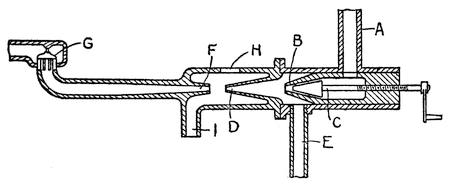
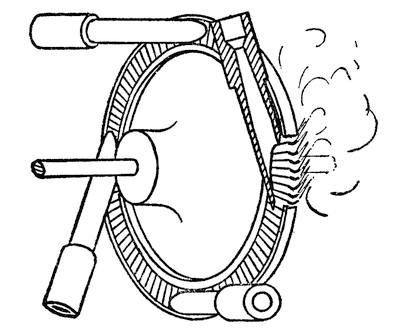
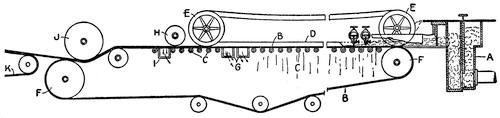
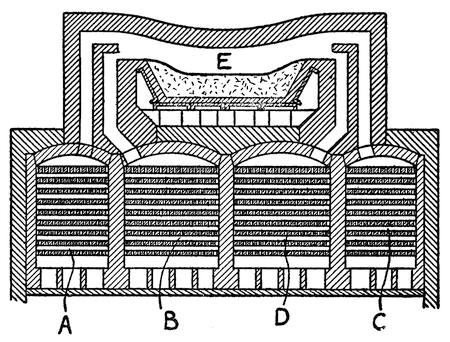
A cotton gin (Fig. 65) consists of a gang of circular
saws (A), with forwardly pointed teeth which
pass between the ribs of an inclined grating (B)
that forms the floor of a chamber (C) known as a
roll box. In this box is mounted a toothed roller
(D). The cotton is fed into the box and the fibers
are seized by the teeth of the saws and dragged
through the grating while the seeds, being too
large to pass through, are left behind and, rolling
down the grating, drop into a hopper. The action
of the saws is such as to impart a rolling motion
to the mass of cotton, and hence to the roller in the
roll box. This tends to drag the cotton into the
roll box and bring fresh supplies to the saws. The
fleece carried by the saw teeth is beaten off by a
wheel (E) fitted with wire brushes. These brushes,
traveling in the same direction as the saw teeth,
but at a higher velocity, readily disengage the fibers
from the teeth and create an air blast that blows
the cotton fleece out of the gin.
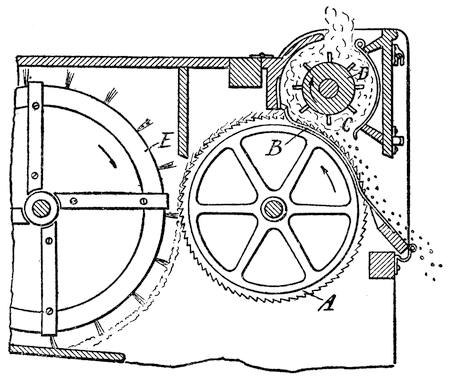
FIG. 65—SECTIONAL VIEW OF A COTTON GIN
Cotton as it comes from the bale is a compact,
matted mass, mixed with bits of seed, leaves, sand,
and other impurities, and it must pass through a
number of machines before it comes out as a pure,
light, fleecy product, with the fibers combed parallel.
Even for a medium yarn a dozen machines are
required to prepare the cotton for the spinning
mule.
A system of “counts” is used to indicate the size
of yarn and it is based on the number of hanks
it takes to make a pound. A hank is always 840
yards and 50’s would mean that the yarn is of
such fineness that it would take 50 × 840 yards
(=4,200 yards) of it to weigh a pound. Yarn
below 30’s is graded as coarse; between 30’s and
60’s as medium and above 60’s as fine. To prepare
cotton as it comes from the bale for a fine
yarn of, say, 100’s, it must go through no less than
sixteen machines before it reaches the mule.
We have not the space to describe all of these
machines, but in general it will suffice to say that
the cotton is graded by passing it through a series
of pickers. These machines throw out the fibers
and beat them so as to knock out the impurities
and, at the same time, a blast of air blows out the
dust. The cotton is treated by a number of such
machines in succession and is finally delivered in
a broad sheet known as a “lap,” after which it
passes through the carding machine which combs
out the tangled bunches and removes further impurities
from the lap. The lap is then gathered
into a compact rope known as a “sliver.” The
sliver goes through the drawing rolls which serve
to parallelize the fibers and make the sliver of even
thickness, and at the same time to give a moderate
amount of twist so that it will hold together, and it
issues from the machine as “roving.” In the case
of fine yarn the sliver issuing from the carding
machine goes through a combing machine so as to
remove the finer fibers. The bobbins of the roving
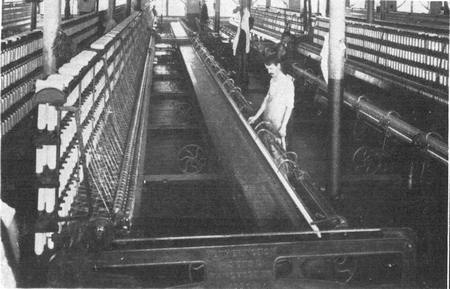
are then placed in the spinning machine, which
may be either the spinning mule or the ring spinning
machine. The principal difference between the two
is that the spinning mule is intermittent in its operation,
while the ring spinner not only spins the roving
into yarn but at the same time winds it up on
a bobbin.
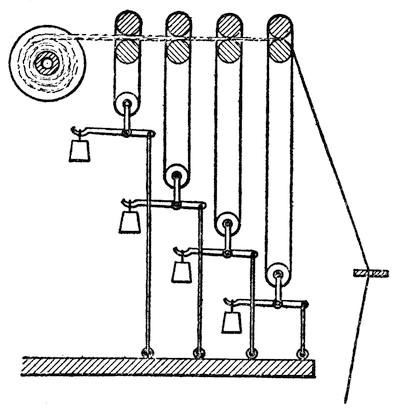
FIG. 66.—ARKWRIGHT’S DRAWING ROLLS
The first advance over the old-fashioned spinning
wheel, which dates back to the fifteenth century,
was in 1770, when the first spinning jenny was invented
by Hargreaves. This consisted practically
of a multiple spinning wheel by which one man
could spin a large numbers of bobbins of yarn at
the same time. It was at about the same time that
Arkwright invented the drawing rolls which have
played a most important part in the preparation
of yarn, and this invention is worthy of our attention
because it contains an interesting mechanical
principle. As shown in Figure 66, a number of
pairs of rolls are provided through which the roving
passes, but successive pairs operate at higher
velocities. Thus, the second pair of rollers through
which the roving passes run at a little higher speed
than the first pair, the third a little higher than the
second pair, and so on. As a result, the roving is
drawn out by the operation and issues from the
last pair of rollers at a higher speed than it entered
the first pair of rollers. The only way in which it
can accommodate itself to this accelerated motion
is to be attenuated or drawn out. Weights are used,
as shown in the drawing, to press the upper rollers
against the lower ones.
Shortly after Arkwright’s invention came the
mule spinner, invented by Crompton between 1774
and 1779. Machines operated on the same general
principle as this are in general use to-day. In the
old-fashioned method of spinning by hand the
worker took a small quantity of cotton, pulled it
out into a long sliver, attached one end to a bobbin
and gave the bobbin a twirl between his hands in
order to spin the fiber into yarn; then the yarn was
wound up on the bobbin and the process was repeated.
The spinning mule does practically the
same thing, but infinitely faster and on a much
larger scale. As shown in Figure 67, the bobbins
of roving (A) are mounted on a stand and passed
through a set of drawing rolls (B) which are regulated
to pull the rovings out to the desired thickness
of yarn. The roving then passes to the nose
of a “cop,” or spindle (C), which is revolved at
very high speed. The cop is carried by a carriage
(D) which moves away from the bobbins of roving
to the position indicated by dotted lines, while
the cop is revolving. The cop has a travel of about
five feet during the time the yarn is drawn out and
spun. Then the carriage moves back toward the
stand upon which the bobbins of roving are
mounted and the spun yarn is wound up on the
cop. The reason the yarn does not wind up on
the cop while it is spinning is because it runs to
the nose of the cop and, at each turn of the cop,
the coil twists on the nose and slips off. On the
return of the carriage, however, a set of wires (E),
called “fallers,” press the yarn down so that the
revolving cop will wind up the slack.
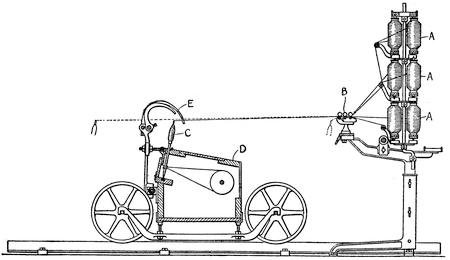
FIG. 67.—DETAILS OF A SPINNING MULE
The continuously operating ring-spinning machine
is provided with a ring frame (Figure 68)
around the cop or spindle. This frame, together
with the spindle, revolves at high speed, but as the
ring revolves a little more slowly than the spindle
it winds the yarn comparatively slowly upon the
spindle or bobbin.
Having now produced our yarn, we may pause to
consider the different types of fabric into which it
may be formed, and to draw a distinction between,
woven, braided, knitted, and net goods. In weaving
we have two sets of threads, one set running
transversely to the other; in braided materials the
threads all run longitudinally and are arranged to
cross each other diagonally, so that they are interwoven;
in knitting and netting there is a single
thread. In the case of netting this thread is knotted
where it loops back upon itself, whereas in
knitting it is merely looped without knotting.
The loom can trace its genealogy away back to
early Babylonian times, and the modern power-driven
machine does not differ in its broad principles
of operation from its ancient progenitor—the
hand loom.
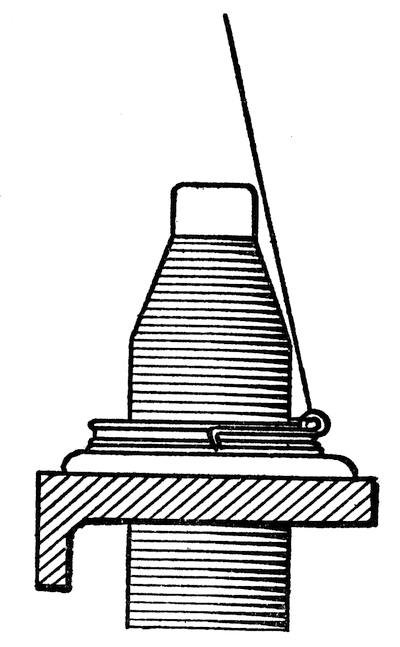
FIG. 68.—RING-SPINNING FRAME
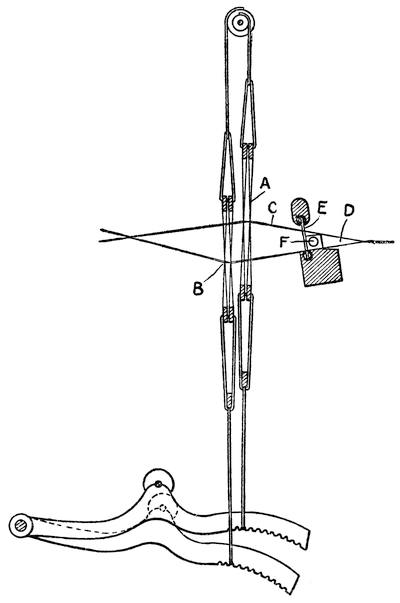
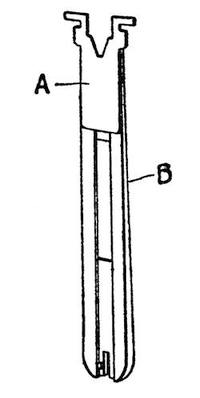
FIG. 69.—THE HEDDLES OF A LOOM
Every industry has a vocabulary of its own to
furnish names for its machine parts and products
peculiar unto itself, and in this respect the textile
industry is by no means an exception. The threads
that run lengthwise in a piece of woven cloth are
known as the “weft,” “woof” or “filling.” In the
loom the warp threads are threaded through loops
on what are known as “heddles”; in fact, there are
two “heddles,” A and B, Figure 69. Alternate
warp threads (C) pass through the loops of one
heddle, and the other threads through the loops
on the other heddle. When one heddle is raised
and the other lowered, the threads form a wedge-shaped
space (D) which is known as a “shed.”
The filling thread is sent through the shed and is
then pressed closely into the wedge-shaped space
against the cloth already woven by means of a
“reed” (E) which is a comblike member with teeth
or flat pieces of metal that pass between the warp
threads. This done, the position of the heddles is
reversed, so that A is now lowered and B raised,
thus binding the warp thread in place and forming
another shed for the next warp thread; and thus
the process continues.
The filling thread is placed in a shuttle (F)
which carries a bobbin on which the thread is
wound. As the shuttle is thrown back and forth
through the shed, the thread is unwound and trails
behind it. Formerly the shuttle was thrown back
and forth by hand, but years ago, long before the
invention of the steam engine, the flying shuttle
was invented. In other words, a mechanism was
provided for striking the shuttle a blow and throwing
it across the warp from side to side. By
this means the speed of operations was greatly
increased.
About the middle of the eighteenth century the
drop box was invented. This consists of a receptacle
for shuttles carrying different colors of thread
which may be selected in a definite order and
thrown back and forth so as to vary the pattern
of the cloth.
In present looms a special machine is provided for
taking the threads from the bobbins or cops and
laying them in an even sheet to form the warp of
the loom. These are wound on a beam and the
machine is known as a beam warper. As the
threads are apt to be somewhat fuzzy it is necessary
to size them, and a machine known as a
slasher is employed for this purpose. This machine
coats each thread of warp yarn with a sizing compound
or an adhesive and dries the sheet of warp
preparatory to its use in the loom.
In common weaving the weft or filling threads
run alternately under and over the warp threads
with perfect regularity. A pattern can be formed
by passing the weft threads under and over alternate
groups of warp threads, and this is effected
in the ordinary loom by threading the weft in
groups through the heddles, i. e., instead of having
every second thread pass through one heddle and
the intervening threads through the other heddle;
the threads are arranged in alternate groups of
two or more. This gives a regular pattern, but it
may be varied to form ornamental designs if the
groups are varied. Such designs used to be worked
out by hand very slowly and laboriously, with the
result that figured weaving was very expensive.
At the French Exposition of 1801 a loom was
exhibited that made a sensation. With seemingly
human intelligence it selected individual warp
threads or groups of threads and raised them or
lowered them so as to work out elaborate ornamental
designs. The inventor, Joseph Marie Jacquard,
of Lyons, received a medal for his marvelous
invention and was decorated with the Cross of the
Legion of Honor.
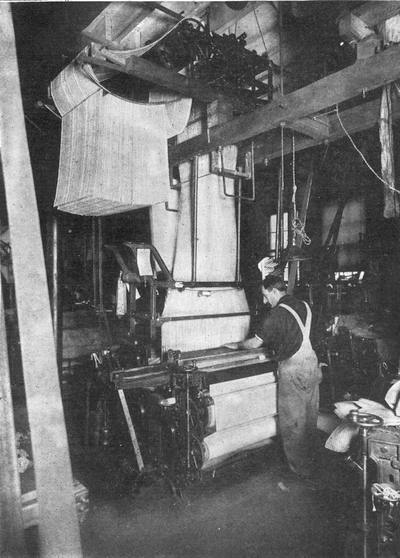
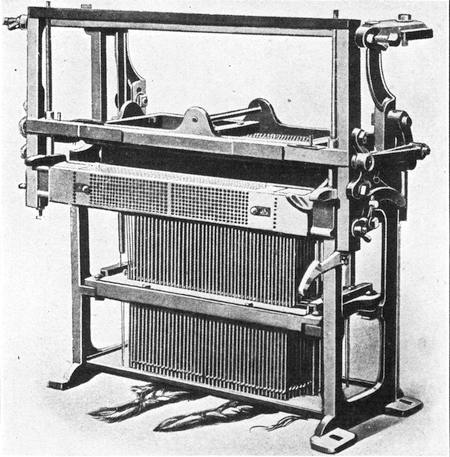
The “brains” of the Jacquard loom is a set of
pasteboard cards that are perforated in accordance
with a prearranged design. The warp threads, instead
of being passed through the loops of two heddles,
are passed through what might be termed
individual heddles, one for each thread, or for a
small group of threads. These consist of cords in
each of which is an eyelet through which the warp
thread passes. The cord is weighted at its lower
end and its upper end is fastened to a hook in a
box at the top of the machine. The hooks engage
transverse bars known as “griffes” or “knives,”
and when the griffes are raised, the hooks engaging
them are also raised. In this way the warp threads
that pass through the eyelets that are connected
to the hooks are raised. But running horizontally
across the hooks there are “needles” or rods with
eyelets or bends in them through which the hooks
pass. These needles may be moved lengthwise to
make the hoops engage or disengage the knives.
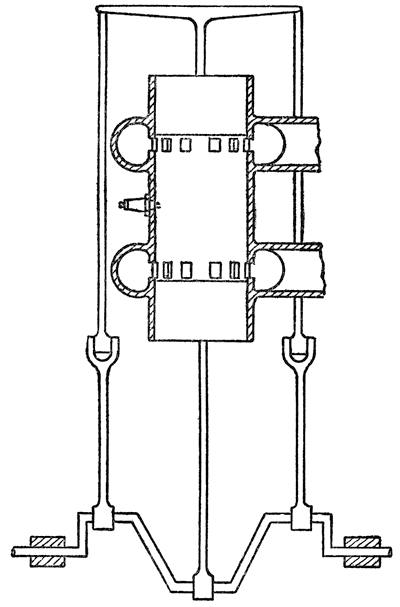
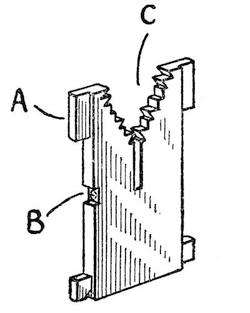
The mechanism is illustrated in Figure 70, where
the knives are shown in section at A, the hooks at B
and the needles at C. For the sake of simplicity
only eight hooks and needles are shown; in actual
practice there are hundreds in a single machine.
At the right-hand end of each needle there is a
spring which pushes the needle toward the left,
thereby bringing the hook through which it passes
into position to be lifted by its griffe. At the left-hand
side of the machine there is a card (D) which
presses back the needles and thereby bends the
hooks out of position to engage the griffes. However,
there are perforations in the card through
which certain of the needles can pass, letting the
hooks they control engage the needles. The cards
thus select the particular weft threads that are to
be raised. In our illustration most of the needles
have entered holes in the card, but the second,
fourth and sixth from the top have been pushed back
by the blank wall of the card and their hooks have
been bent back clear of the griffes. Only four
cards are shown in the drawing arranged in a four-sided
box or “cylinder,” and the cards are successively
presented to the needles. For more elaborate
designs a large number of cards are used, arranged
in a slatted belt, and these come successively into
position. As many as thirty thousand cards have
been employed to carry out a single pattern.
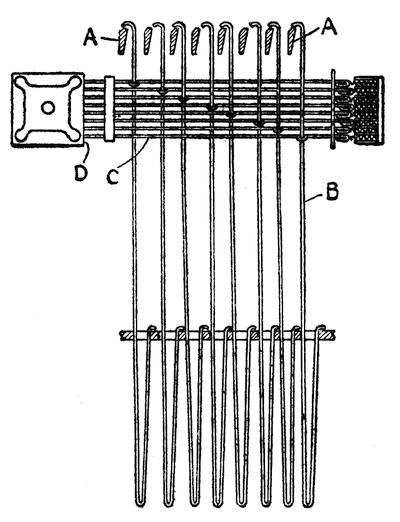
FIG. 70.—DETAIL OF A JACQUARD
LOOM
We are wont to call Necessity the Mother of Invention;
in many cases Laziness has given rise to
valuable inventions, but according to legend, Cupid
played the leading rôle in the development of the
knitting machine. It is said that in 1589 William
Lee of England fell in love, but the girl who was
the object of his devotion was always so busy with
her knitting that she could not give him the attention
he sought or thought he deserved. However,
Lee was not to be thwarted in this fashion,
so he built a machine to do the knitting in order
that the girl could devote herself more completely
to him.
There is another less pleasant version of the
story to the effect that Lee became so attached to
his knitting machine that he neglected the girl.
However, in either case, love was somehow mixed up
in the invention of the knitting machine.
We are not going to attempt to delve into the complicated
mechanism of a modern knitting machine,
but will merely call attention to the fact that
modern machines perform automatically practically
all the movements of the human hand in
hand knitting.
The tendency of modern machinery has been to
relieve the housewife of the tedious work she
formerly performed and to take such work away
from the home to the factory. There is one important
machine, however, which has been introduced
into the home, apparently to stay; for in the majority
of houses it is still considered indispensable. It
is a fact that the introduction of labor-saving machinery
into the household has, until recently, met
with stern opposition on the part of the housewife.
It is all the more remarkable, therefore,
that in the middle of the nineteenth century
the sewing machine began successfully to invade
the home.
It was in 1844 that Elias Howe hit upon the brilliant
idea of putting an eye at the point of a needle.
This enabled him to produce a successful sewing
machine, because it was unnecessary for him to
pass the needle completely through the cloth in
order to pull the thread through it. When the
needle point penetrated the cloth a shuttle passed
through the loop of thread that was carried
through with the point. This shuttle carried a
second thread which interlocked with the thread
of the needle forming what is known as a “lock
stitch.” In Howe’s machine the cloth was held
vertically and the needle which was curved was carried
by a lever. The needle was driven through
the cloth with a swinging motion, somewhat like
that of a pick-ax. The shuttle was driven back and
forth by a pair of strikers after the manner of
the flying shuttle of a loom. George Fisher, a
friend of Howe, furnished $500 with which the
first successful machine was built in 1845, and
with this machine Howe sewed two suits of clothes,
one for Mr. Fisher and the other for himself. A
public exhibition was held at which the machine,
crude as it was, beat five of the best hand-sewers
that could be found. In 1863 Howe was reaping a
fortune in royalties from his machine which were
estimated at $4,000 per day.
The next notable improvement in sewing machinery
was that of the rotary bobbin, invented by
A. B. Wilson, which was patented in 1852. This
did away with the flying shuttle and simplified the
machine considerably. It made the sewing machine
comparatively quiet, thus adapting it for domestic
use. In Wilson’s machine, a rotating hook passed
through the loop of thread and carried it around
the bobbin on which the lower thread was wound.
Wilson also invented the four-motion feed for feeding
the cloth under the needle. Sewing machines
up to that time had been operated by hand, but
Isaac Merritt Singer introduced a foot-power machine
and by progressive business methods built up
a thriving industry and did much to establish the
sewing machine, not only at home, but abroad
as well.
The single-thread machine was invented by a
Virginia farmer who had never seen a sewing machine.
James E. A. Gibbs had seen a picture of a
sewing machine and, unaware of the fact that there
was a shuttle carrying a second thread on the rear,
or under side of the cloth, fell to puzzling over the
problem of what happened to the thread carried by
the needle through the cloth. Somehow, it seemed
to him, the loop of thread must be held until the
next stitch carried another loop of thread through
it, thus forming a chain stitch. This led him to
invent an ingenious revolving hook. With infinite
patience he whittled out a model of his invention,
and it is this hook that is the outstanding feature
of the Wilcox and Gibbs machine.
A notable modern development of the sewing
machine is its adaptation to the making of embroideries
and even laces. In the common domestic
sewing machine the cloth is fed step by step under
the needle, and the length of the step regulates the
size or length of the stitches. The feed may be set
for short or long stitches. It is evident that if a
greater range of length of stitch were provided,
and if, while the machine was operating, the stitch
could be varied at will, not only in length but in the
direction as well, it would be possible to work
out elaborate patterns of embroidery. This is what
is done on the power-driven embroidery machines.
Like the original Howe machine, the cloth is held
vertically and a series of needles are used which
pass horizontally through the cloth. As the needle
retreats, the thread it carries forms a loop on the
rear or “wrong” side of the cloth, and through this
a shuttle is driven which carries a thread wound
upon a bobbin. Between stitches the cloth is moved
this way and that, in accordance with a prearranged
pattern, and thus the design is embroidered.
A single machine may have several hundred needles
and, as they all work in unison, each needle
repeats the design. The arrangement is such that
one needle starts where the next one leaves off, so
that the embroidery is continuous. The shuttles
which operate on the wrong side of the cloth are
small, boat-shaped parts which the Swiss have
named “schiffli” or “little ships,” and this name has
come to be applied to the whole machine.
The guiding of the cloth to produce the required
design is accomplished either by hand or automatically.
In the hand-guided schiffli machine a
skilled “stitcher” seated at one side of the machine
operates a pantagraph, tracing an enlarged design
mounted on a board before him. As he moves the
lever vertically and horizontally the frame carrying
the cloth is correspondingly moved before the
needles. An expert stitcher can put a great deal
of individuality into the work, which is impossible
in the strictly automatic machine; accordingly the
pantagraph is used for the finer grades of embroideries.
In the automatic machines a perforated
roll like that of a piano player is used. The
perforations control the movements of the frame
that carries the fabric.
These machines are of Swiss and German design,
but American inventors have recently developed a
machine for producing fine needlework which imitates
very closely the work of the hand. In this
machine the needle passes completely through the
fabric as in ordinary hand sewing, but it does not
have to be turned around for the return stitch because
it is pointed at each end and has the eye in
the middle. The needles are held by spring clips
in a swinging frame. When the frame swings toward
the cloth the needles are pushed through the
fabric and their points are caught by spring clips in
a frame on the opposite side. The latter frame
draws the needles completely through and a set
of hooks catch the thread and pull the stitch taut.
The advantage of this type of machine is that it
produces the same design on each side of the cloth;
in other words, there is no “wrong” side to the
embroidery. The design is controlled by a
“stitcher” operating a pantagraphic system of
levers and by skillful manipulation he can completely
overcome the flat machinelike appearance
of the automatic schiffli machine.
Laces are very ingeniously produced on schiffli
machines by using the “burnt-out” system invented
forty years ago by a German, named Beckel. This
consists in the use of thread of a different material
from that of the fabric, and after the embroidery
is completed the fabric is removed either chemically
or by the application of heat, leaving only the
stitching, which forms a delicate lace. For instance,
cotton thread may be embroidered on a
groundwork of wool, or silk thread is used on a
fabric of cotton. Laces made in this way are
known as Plauen laces, taking their name from the
city where Beckel invented the process, and they
form a large part of the machine-made laces that
are now so widely used.
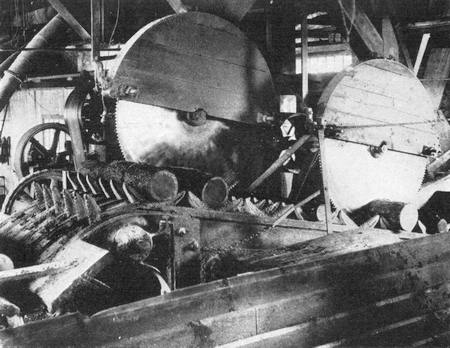
SAWING LOGS INTO 16-INCH LENGTHS PRIOR TO
GRINDING THEM INTO PULP
Copyright Kadel & Herbert
THE HEATER IN A PULP MILL WHERE THE WOOD
PULP IS MIXED WITH CLAY
A MODERN FOURDRINIER PAPER-MAKING MACHINE