GENERAL AND DETAILED DESCRIPTION OF THE COMBINED MASSAGE EXERCISES WITH THEIR ANALYSIS AND EFFECTS — Exercise No. 1 — Detailed Description — Analysis and Effects of the Combined Massage Exercise No. 1 — THE COMBINED MASSAGE EXERCISE No. 2 — Detailed Description — Analysis and Effects of the Combined Massage Exercise No. 2 — THE COMBINED MASSAGE EXERCISE No. 3 — Detailed Description — Exercise No. 3 A — Analysis and Effects of the Combined Massage Exercise No. 3 (3 A) — THE COMBINED MASSAGE EXERCISE No. 4 — Detailed Description — Analysis and Effects of the Combined Massage Exercise No. 4 — THE COMBINED MASSAGE EXERCISE No. 5 — Detailed Description — Combined with Deep Breathing — Analysis and Effects of the Combined Massage Exercise No. 5 — THE COMBINED MASSAGE EXERCISE No. 6 — Detailed Description — Analysis and Effects of the Combined Massage Exercise No. 6 — THE COMBINED MASSAGE EXERCISE No. 7 — Detailed Description — Combined with Deep Breathing — Analysis and Effects of the Combined Massage Exercise No. 7 — THE COMBINED MASSAGE EXERCISE No. 8 — Detailed Description — Analysis and Effects of the Combined Massage Exercise No. 8 — THE COMBINED MASSAGE EXERCISE No. 9 — Detailed Description — Exercise No. 9 A — Analysis and Effects of the Combined Massage Exercise No. 9 (9 A) — THE COMBINED MASSAGE EXERCISE No. 10 — Detailed Description — Analysis and Effects of the Combined Massage Exercise No. 10 — THE COMBINED MASSAGE EXERCISE No. 11 — Detailed Description — Analysis and Effects of the Combined Massage Exercise No. 11 — THE COMBINED MASSAGE EXERCISE No. 12 — Detailed Description — Analysis and Effects of the Combined Massage Exercise No. 12 — THE COMBINED MASSAGE EXERCISE No. 13 — Detailed Description — Combined with Deep Breathing — Analysis and Effects of the Combined Massage Exercise No. 13 — THE COMBINED MASSAGE EXERCISE No. 14 — Detailed Description — Exercise No. 14 A — Analysis and Effects of the Combined Massage Exercise No. 14 — Effects of Exercise No. 14 A
Massaging with both hands simultaneously from the forehead
or each temple up over the top and side of the head and
continuing down the back of the head, neck and cervical vertebrae,
and thence around both sides of the neck and down each
side of the throat; at the same time bending the head forward
and backward.
Position.—Standing or sitting erect in a chair or bed.
Exercise No. 1.
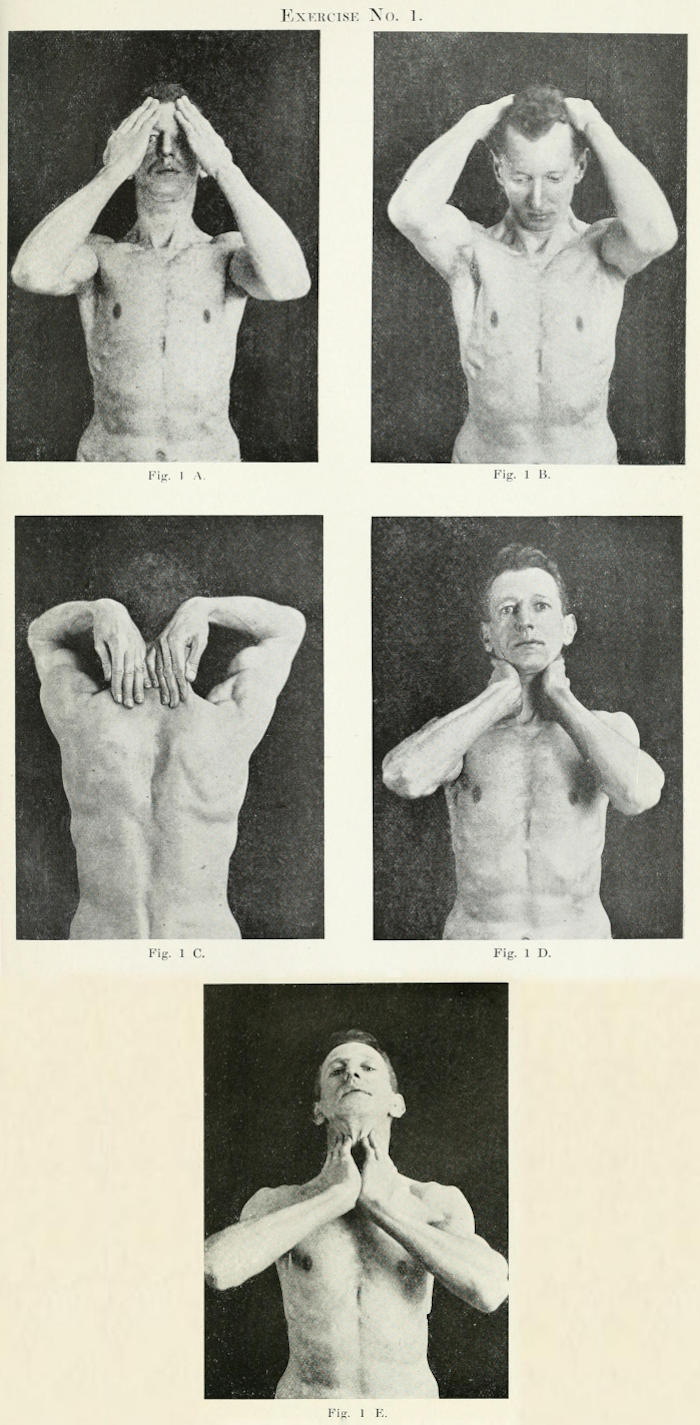
Fig. 1 A. Fig. 1 B.
Fig. 1 C. Fig. 1 D.
Fig. 1 E.
With the four fingers together and the thumbs close, place
the inner side of the fingers in the middle of the forehead, so
that the hands are nearly parallel to each other (Fig. 1 A).
Stroke from there with the fingers and palms of both hands
simultaneously up over the head; at the same time bending the
head forward (Fig. 1 B). Continue down the back of the
head and neck as far as possible, pressing with the fingers on
each side of the cervical vertebrae (Fig. 1 C). From here continue
the stroking with the palms of the hands and the fingers
around each side of the neck toward the throat; at the same
time bending the head slowly backward (Fig. 1 D). When the
fingers reach the throat they stroke downward on each side of
it (Fig. 1 E).
Doing this exercise five times will take about half a minute.
Note I. While the fingers are stroking the neck on each
side of the cervical vertebrae, the elbows should be elevated
as high as possible.
Note II. Inhale while the hands are moving over the
head and down the back of the neck. Exhale while the hands
and fingers are moving around the neck and over the throat.
Note III. Women with long and abundant hair, which
in hanging loose might interfere with the movements of the
hands and fingers, can braid it at the back of the head (pigtail
fashion) and the fingers can stroke around each side of it. Or
the loosened hair may be parted in the middle, thus leaving the
back of the neck comparatively free.
The influence of the massage movements on the muscles,
nerves, tissues and circulation as well as on the internal organs
has already been described to some extent in the Chapter,
“Construction and Characteristics of the Combined Massage
Exercises.” Therefore, the analysis and effects of this and
the other exercises will only attempt to explain how each
exercise is combined, and what nerves, muscles and organs are
influenced by it.
This exercise is combined in such a way, that there is obtained
the movements of the arms and the bending of the head
forward and backward, together with the massage of the temples,
the forehead, the scalp, the cervical vertebrae, the neck
and the throat.
The movements of the head, arms and hands in applying
the massage movements, exercise the muscles and nerves of
the hands, arms, shoulders, the upper back, the sides and the
chest. They also stretch the muscles and nerves of the latter
two.
The massage influences the muscles, vessels, nerves and tissues
of the temples, scalp, neck, throat and likewise the glands
in the neck.
This exercise acts as a preventive to, and is beneficial for
headache, facial neuralgia, falling hair and a disordered circulation
to the head. It will reduce fat shoulders and necks and
will build up thin ones.
It is also beneficial for singers and public speakers.
Massaging each arm and side alternately from the wrist
along the upper aspect of the arm up over shoulder to the base
of the neck, then from the wrist again along the under side of
the arm over armpit and part of shoulder blade down the same
side of body and across the lower chest to the opposite side; at
the same time exercising the arms and shoulders.
Position.—Standing or sitting erect in a bed or chair.
Exercise No. 2.
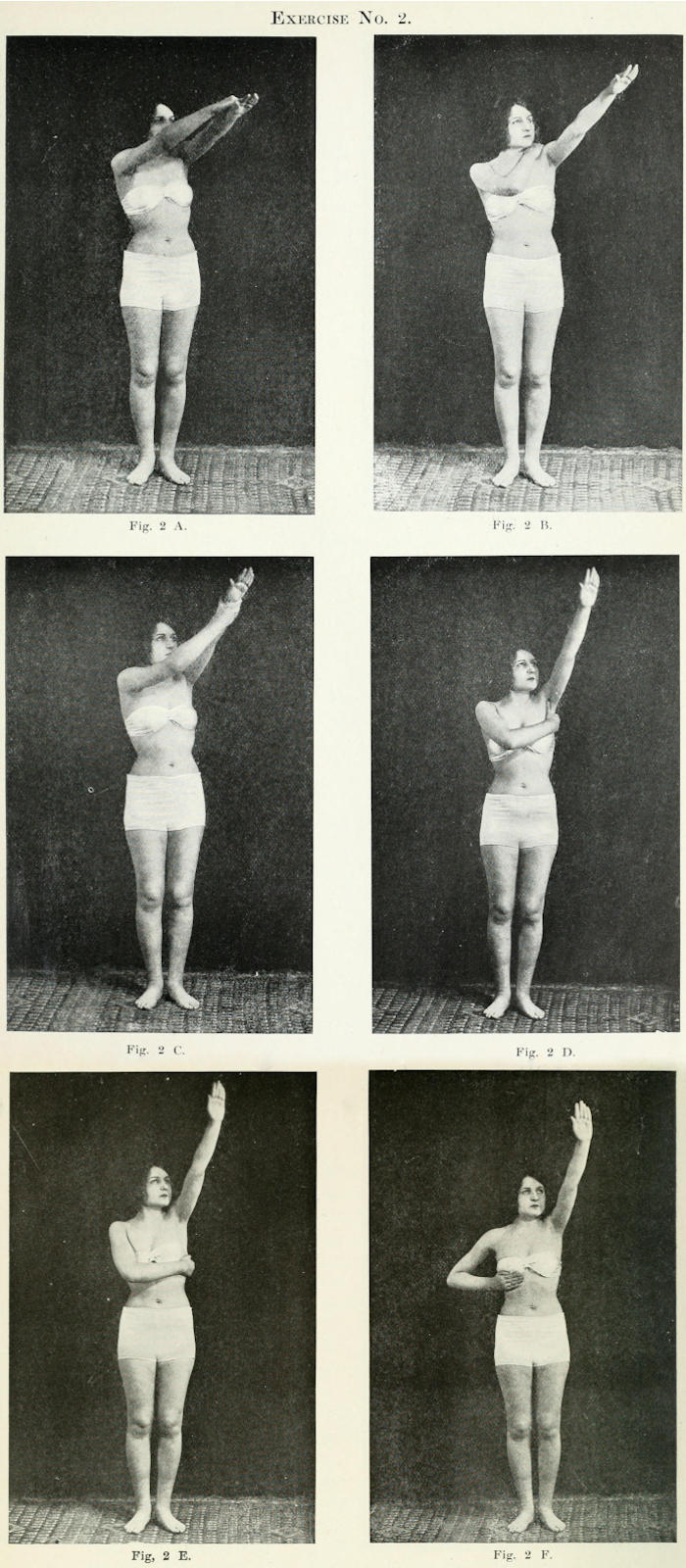
Fig. 2 A. Fig. 2 B.
Fig. 2 C. Fig. 2 D.
Fig. 2 E. Fig. 2 F.
Stretch the left arm to the front, holding it at such an angle
that the tip of the fingers are at the same height or slightly
higher than the top of the head, the fingers held straight and
together, with the thumbs close. Place the right hand, with
the fingers and thumb close, over the upper side of the left arm
at or on the wrist in such a way that the hand and fingers are
bent transversely over the arm, and so that the palm of the
hand and fingers are pressing equally on top and both sides of
same (Fig. 2 A).
Stroke thus from there along the upper side of the outstretched
arm, continuing over shoulder to the base of the neck
(Fig. 2 B). Then let the hand slip loosely backward the same
way over the arm to the wrist. Now clutch the out-stretched
arm underneath at the wrist in such a way that the thumb is on
the inner side and the four fingers on the outer side of the arm
(Fig. 2 C). Stroke thus the out-stretched arm underneath
from the wrist up to the armpit, at the same time raising it
slowly to a nearly perpendicular position. Then continue
downward underneath the shoulder with the four fingers
around as far as possible on the shoulder blade, and the thumb
in the armpit (Fig. 2 D). Continue downward the same side
of body, the fingers being kept as far over toward the back as
possible and the hand held transversely to the side of the body
and bent in such a way that it presses equally with the palm
and the fingers. When the hand has thus passed just below a
line horizontal to the nipple of the left breast (Fig. 2 E) let
it move across the chest underneath the nipples to the other
side, in that way, thus not altering the position of the hand
itself (Fig. 2 F).
During this massage of the left side and across the lower
chest, the left arm should still be held in its out-stretched position
over the head.
Upon completing the movement on the right side and
changing to the left, release the right hand from the chest and
put out the right arm, holding it in the same position as was the
left, in the beginning. At the same time let the left arm be
brought down with its hand on the upper side of the right wrist
and begin to stroke the right arm and side in the same manner
as the left. In thus changing from one arm and side to the
other, practically no stop should be made.
Doing this exercise five times will take about half a minute.
If counting every time when commencing to stroke each arm,
it will be ten counts.
Note I. When the upper side of one of the arms has been
massaged to the base of the neck, it is not absolutely necessary
to let the hand go back over the arm, as described, in order to
massage it underneath. The hand can simply be taken away
from the neck and the outstretched arm grasped underneath
the wrist without touching its upper side. However, it is best
performed in the way first described, but let the hands return,
barely touching the arm.
This exercise is combined in such a way that there is obtained
the movements of the arms together with their massage
and that of the shoulders, the sides of the upper body, the outer
sides of the upper back, and the lower chest.
The arms and shoulders are here exercised to a greater
extent than in exercise No. 1. Thus, for instance, if the left
arm is being stroked upward with the right hand, the muscles
of the right hand are not only exercised, but likewise those of
the left arm and shoulder, the latter are especially put into play
because the left arm is resisting the pressure of the right hand
upon it. The left arm furthermore is massaged at the same
time. The reverse is of course the case when the right arm is
massaged.
The movements of the arms and hands, in applying the
massage movements, exercise the muscles and nerves of the
hands, the arms, the shoulders, the upper back, the sides, and
the lower chest.
The massage influences the muscles, nerves, blood and
lymph vessels of the arms, the shoulders, the sides and the
lower chest. It also stimulates the action of the liver and
strengthens that of the heart.
This exercise is especially beneficial for stiffness in arms
and shoulders caused by playing baseball, golf, hockey or from
other over-exertion. It will reduce fat shoulders and arms
and build up thin ones.
Massaging each leg alternately with both hands simultaneously
from ankle upward over leg and hip, continuing from
there with one hand above the other and parallel to each other,
directly across the abdomen, one hand moving underneath the
ribs, over the transverse colon and the stomach and the other
hand over the lower abdomen and pelvis; at the same time lifting
and stretching the legs and bending the trunk forward and
backward.
Position.—Standing erect with feet parallel and about four
inches apart.
Exercise No. 3.
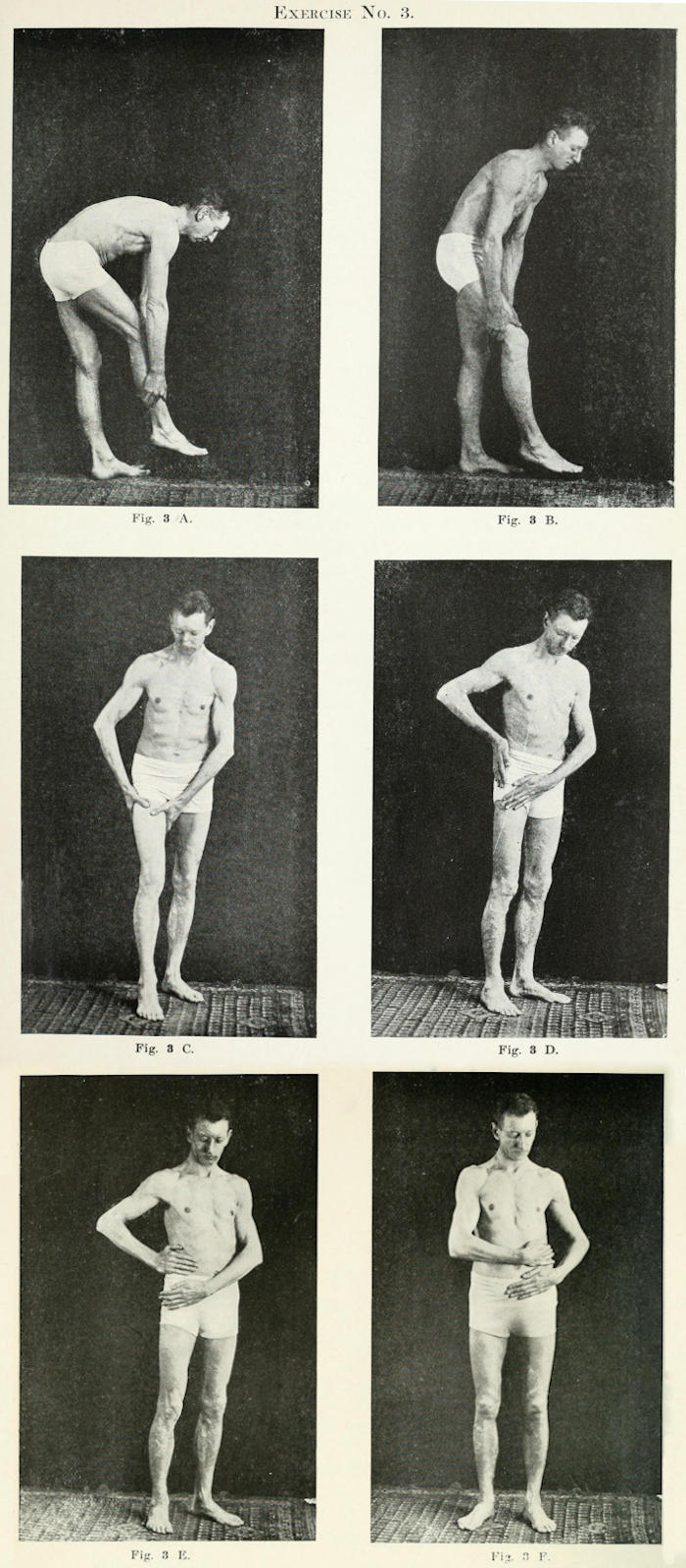
Fig. 3 A. Fig. 3 B.
Fig. 3 C. Fig. 3 D.
Fig. 3 E. Fig. 3 F.
Bend the trunk forward, at the same time raising the right
leg about four inches from the floor, so that it is slightly bent
at the knee and hip and pointed somewhat forward. The
weight will then rest on the left leg, the knee of which should
be held as rigidly as possible. With the trunk bent forward,
clutch the right leg with both hands just above the ankle in
such a way, that the thumbs are in front on either side of the
tibia (shin-bone). The fingers of each hand, which are kept
close together are slanted downward and around the back of
the leg from each side, so that the third and fourth fingers of
each hand meet and touch at the middle line of the calf muscles.
The palms of the hands are thus on each side of the leg, the
right hand being on the right or outer side and the left on the
inner or left side (Fig. 3 A).
Stroke thus with both hands simultaneously from the ankle
upward over the lower right leg pressing the muscles with the
thumbs and especially with the inner side of the tips of the
fingers on the middle of the calf muscles.
While continuing over the knee and in order to conform
the hands to the shape of the thigh, turn the thumbs more transversely
over the upper side of the thigh and do the same with
the fingers underneath, so that as far as possible the muscles of
the thigh are influenced all around (Fig. 3 B).
The hands thus reach the groin (Fig. 3 C).
Here the right hand, the fingers pointed downward and
thumb close, continues upward over the side of the hip, until
the back part of the right palm is just above the crest of the
ilium, or hip bone. Here it is turned around so that the fingers
are pointing straight toward the left, or toward the middle line
of the body. Simultaneously the left hand, at the inner side
of the groin, is also turned, but in such a way that the fingers
are pointed toward the right and with the back part of the palm
it presses and strokes a short distance over the appendix and
the lower right side of the abdomen. This is done at the same
time as the right hand is stroking upward over the hip and
turned around as described (Fig. 3 D). When both hands
are thus turned, the left will be underneath the right, the fingers
of each hand pointed in an opposite direction and the
hands parallel to each other. The right foot is placed on the
floor, at the time that the hands reach the groin or hip, and at
the same time, the upper body is returned to an upright position,
the shoulders thrown slightly backward without strain.
The abdominal muscles should be neither distended nor contracted,
but kept in a natural position (Fig. 3 E).
Without bending the body to sides, continue thus with both
hands simultaneously across the abdomen, the right hand with
fingers first, moves underneath the ribs, and pressure is exerted
with the fingers and palm over the abdominal viscera
(the point of the liver, the transverse colon, the region of the
solar plexus, the duodenum, the pylorus, and the stomach) and
finishes over on the left side, with the fingers moving between
the crest of the ilium, or hip bone, and the lowest border of the
ribs. The left hand with the back of the palm preceding, at
the same time strokes across the lower abdomen just underneath
the umbilicus or navel, and over to the left side, where it
is released simultaneously with the right hand (Fig. 3 F).
Now stroke over the left leg, hip and abdomen in a similar
way, but of course with this difference; that here the left hand
strokes upward over the outer side of the leg, over the left hip
and across the stomach from the left, above the right hand.
The latter moves from the inner side of the leg, across the lower
abdomen below the left hand. In other words, the left hand
massages over the left leg and side and from the latter across the
abdomen in the same way as the right hand does on the right
side, and likewise the right hand massages over the left leg and
side and from the latter across the abdomen, in the same way
as does the left hand on the right side.
This exercise done five times will take about half a minute.
If counting each time when commencing to stroke each leg it
will be ten counts.
Note I. The raising of the trunk should be the force,
which here pulls the arms and hands over the leg.
Note II. In bending to massage upward on each leg, the
latter can also be bent and raised as high as possible. In that
case the leg is pushed downward through the hands, while these
are pressing on it, the muscles of the thigh or hip thus being
exercised and influenced more than if the leg is raised or bent
only a short distance. On the contrary, if the leg is placed
only slightly forward with but little flexion of the knee, as
explained in the detailed description, the upper body has to
be bent further downward in order that the hands reach the
lower leg at the ankle. In this way, the muscles of the abdomen
and back are exercised and influenced to a greater extent.
If the exercise is done only five times it should be executed
as explained in the Detailed Description; if done ten times or
more, both ways may be used about an equal number of times
each.
Position.—Lying supine on the floor or bed.
Exercise No. 3A.
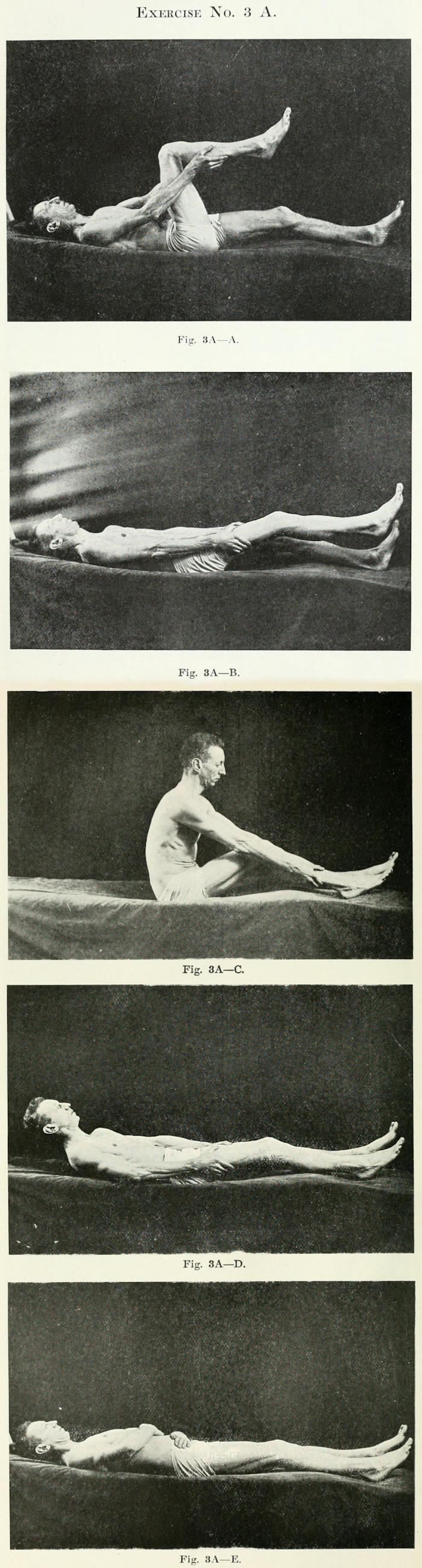
Fig. 3A—A.
Fig. 3A—B.
Fig. 3A—C.
Fig. 3A—D.
Fig. 3A—E.
Here the movements are the same as in No. 3, except that
they are done from the position of lying flat on the back on a
bed or mattress. Those of the leg and trunk may be altered
in a similar way to those of No. 3. Thus the upper body can
remain resting with the back on the bed, while each leg is bent
up and firmly held with the hands at the ankle. The leg then
pushes itself through them (Fig. 3 A—A and B).
Or, the upper body can be raised and each leg kept nearly
straight or bent more or less, is then stroked while the trunk
is being bent backward and downward again on the bed (similar
to a rowing exercise) (Fig. 3 A—C and D).
The leg and trunk should be back and resting flat on the
bed while the hands are stroking over the hips and abdomen,
so that the latter is neither distended nor contracted, but kept
in a natural and relaxed position (Fig. 3 A—E).
This exercise is combined so that there is obtained practically
the same movements as in rowing, together with massage
of the legs and the abdomen. This is the case whether the
movements are done from a standing position or while lying
or sitting.
The movements of the legs, the trunk and the arms and
hands, in applying the massage movements, exercise the muscles
and nerves of the hands, the arms, the shoulders, the back
and the sides of the body, the chest, the abdomen and the legs.
They also exercise the liver and other digestive organs and have
a beneficial influence on the heart. They stretch the nerves in
the spine in a natural way.
The massage influences the muscles, nerves and vessels of
the legs and the abdomen, also the lower point of the liver, the
pancreas, the stomach, the intestines, the different abdominal
nerve-plexuses, the appendix and the organs of the pelvis. The
heart is influenced indirectly through the circulation of the
blood.
This exercise is beneficial for pain and weakness in the legs,
caused by diseased conditions of the nerves, as in sciatica, partial
paralysis, etc. (See Supplement, page 92.) It is
especially beneficial for disorders in the digestive system, as in
chronic or habitual constipation, gas in the stomach, etc. (See
Supplement, page 88). It is beneficial to the generative organs
in women. It is especial beneficial for professional dancers
and runners and people whose profession causes great
strain on the legs.
It should be remembered that in this and all the other exercises
where the abdominal organs are massaged, it is important
not to let the hands go over the ribs and the upper abdominal
cavity at the same time. The digestive organs cannot be properly
reached and influenced in this way. Especially is this
the case if the hand strokes in a perpendicular position, that
is, with fingers pointing downward and not transversely. Even
if the hands were stroking over the abdomen, underneath the
ribs in a perpendicular position, this would not be sufficient for
the reason that as much pressure can not be exerted in this
way as with the hands in a transverse position. It would also
cover too many organs at one time to make a sufficient impression
upon them.
Massaging each side alternately from the side of the knee
upward over the thigh, hip and side, then across the lower chest
or underneath the breasts, to the opposite side; and at the same
time bending the upper body from side to side.
Position.—Standing erect with shoulders thrown backward
and chest forward, but without strain, heels together and feet
and legs stationary.
Exercise No. 4.
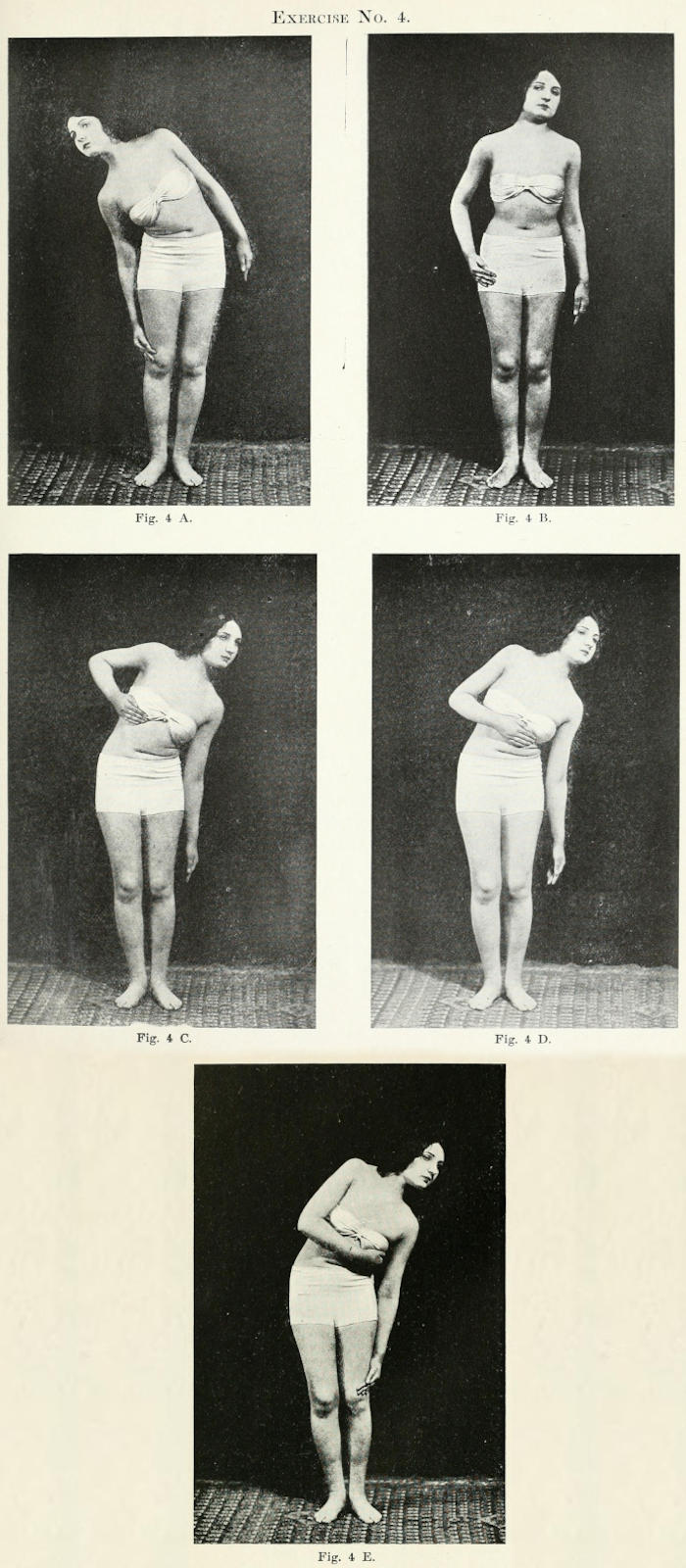
Fig. 4 A. Fig. 4 B.
Fig. 4 C. Fig. 4 D.
Fig. 4 E.
Without altering the position of the legs, bend the upper
body to the right as far as possible, so that the right hand is
level with or just above the outer side of the right knee. Place
this hand, with fingers and thumb close, transversely over the
side of the thigh just above the knee so that the fingers are
pointing inward, toward the left (Fig. 4 A).
Stroke thus with the right hand from there upward over the
side of the right thigh, hip and trunk until the thumb is horizontal
with the nipple of the right breast, the fingers of the
hand should thus be pointing straight toward the left side. In
thus stroking upward on the right side the trunk should be bent
directly to the left (Fig. 4 B and C).
Then without altering the position of the body or the hand,
continue stroking with the latter, fingers first, across the lower
chest over the region of the liver under the right nipple of the
breast, toward the left side (Fig. 4 D), where the hand moves
underneath the nipple of the breast, over the lower region of
the heart and is released on that side (Fig. 4 E).
Now alternate to the left side. The upper body is still bent
to the left, and the left hand is placed on the side of the left
thigh, just above the knee (Fig. 4 E). Now massage the left
thigh, hip and side and from there across the chest with the
left hand, in the same way as the right side was massaged with
the right hand. When the hand is moving upward over the
left thigh, hip and side, the body is of course bent to the right.
After the left side has been massaged, repeat the movements
on the right and so forth, alternately.
This exercise done five times will take about fifteen seconds.
If counting every time when commencing to stroke from each
side of hip, it will be ten counts.
This exercise is combined in such a manner that there is
obtained the movements of the arms and the bending of the
body sideways, together with massage of the outer side of the
thighs, the hips, the sides of the body and the lower chest.
The movements of the body and arms and hands in applying
the massage movements, exercise the muscles and nerves
of the arms, the shoulders, the back, the sides, the lower chest
and breasts and the abdomen. They also slightly influence the
liver, the stomach, the intestines and kidneys.
The massage influences the muscles, nerves and vessels of
the outer side of the thighs, the hips, the lower sides of the
trunk and the lower chest, as well as the liver and the heart.
Massaging the right leg with the right hand and the left leg
with the left hand simultaneously from behind the ankles upward
over the backs and sides of the lower legs, backs and sides
of the thighs, continuing a short distance upward over the hips
and from there, still with both hands at the same time, across
the abdomen and lower chest to the opposite sides, the right
hand passing from the right side underneath the ribs over to
the left side, and the left hand passing from the left side underneath
the nipples or breasts over to the right side. From there,
continue stroking with both hands simultaneously inward and
upward over the opposite nipples or breasts and the upper
chest where the hands pass each other and stroke outward to
their respective sides under the armpits; the right hand thus
stroking from the left side inward and upward over the left
nipple or breast and the left hand from the right side inward
and upward over the right nipple or breast. Release the hands
at the armpits and stroke down each side of the lower back and
buttocks with the backs of the hands. At the same time, bending
the upper body forward and backward.
Position.—Standing erect with heels about eight inches
apart and feet nearly parallel.
Exercise No. 5.
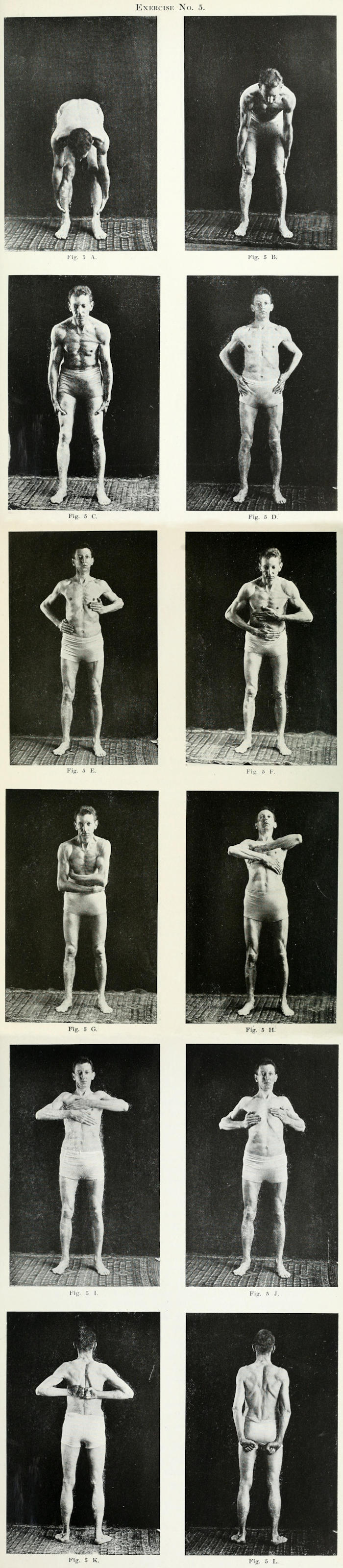
Fig. 5 A. Fig. 5 B.
Fig. 5 C. Fig. 5 D.
Fig. 5 E. Fig. 5 F.
Fig. 5 G. Fig. 5 H.
Fig. 5 I. Fig. 5 J.
Fig. 5 K. Fig. 5 L.
Without bending the legs, bend the upper body forward
as far as possible, and clutch the lower right leg with the right
hand and the lower left leg with the left hand from behind and
just above the ankles in such a way that the palm of each hand
is on the back of each leg, the four fingers placed around the
inner sides and thumbs around the outer sides, thus making an
equal pressure with fingers and palms of hands around each
leg (Fig. 5 A).
Now, stroke upward over the calf muscles and thighs, the
palms of the hands here stroking the outer sides of the latter,
the four fingers underneath and the thumb on top, at the same
time raising the trunk to an upright position (Fig. 5 B and C).
While the hands continue upward over the sides of hips,
turn them around so that the fingers point inward (Fig. 5 D).
Continue thus with the right hand on the right side until it is
just above the crest of the ilium, or hip bone. The left hand,
at the same time moves a little higher upward on the left side
until its thumb is nearly horizontal with the nipple of the left
breast. The trunk is now in an upright position, the shoulders
thrown well back (Fig. 5 E).
With the fingers of both hands thus pointing toward the
middle of the body, continue stroking with both hands simultaneously
from each side across the front of the body, to the
opposite sides, the left hand above the right, passing each other
at the middle line. Bend the trunk slightly forward at the
same time (Fig. 5 F). In other words, the right hand strokes
from the right side underneath the ribs directly over to the left
side, above the crest of the left ilium, or hip bone, and around
as far as possible on that side. The left hand strokes at the
same time from the left side across the lower chest, underneath
the nipples over to and around as far as possible on the right
side. The left forearm is thus crossed over the right (Fig. 5 G).
Then continue stroking with both hands simultaneously
from each side inward and upward over each breast and upper
chest. The right hand thus moving from the left side strokes
inward and upward over the left breast and across the upper
chest to the right side and ceases underneath the right armpit.
The left hand moving from the right side, strokes inward and
upward over the right breast and across the upper chest to the
left side and ceases under the left armpit. At the same time,
the trunk which has been bent slightly forward, while the hands
were stroking across the lower chest and abdomen, is raised
and bent slightly backward. In thus stroking inward and upward
over the chest, the hands and fingers are held in the same
way as when they were on the sides of the body. When moving
over the breasts the left forearm is of course crossed over
the right (Fig. 5 H), but when reaching the middle of the
chest the hands cross, the left hand being directly above the
right (Fig. 5 I), and from there they continue stroking transversely
over the chest to their respective sides under the armpit
(Fig. 5 J).
The hands are now released and brought as far up on the
back as possible. The backs of the clenched hands are placed
on each side of the back, in such a way, that the knuckles at the
base of the finger of each hand are close to and opposite each
other on each side of the spinal column (Fig. 5 K). Stroke
thus from there with the backs of both hands simultaneously
downward on each side of the lower back and buttocks, the
knuckles following the spine on each side of same (Fig. 5 L).
This exercise done five times will take about half a minute.
Note I. If unable to place the hands behind the ankles
without bending the knees, the latter may be bent slightly or
the leg stroked at a distance from the ankle possible to reach
without bending the knees.
Note II. When the hands are stroking and pressing over
the legs, let the raising movement of the trunk pull the out-stretched
arms up as far as the motion permits.
If done very slowly, deep breathing may be practiced with
this exercise in the following way:
Inhale the air through the nose, while stroking upward over
the legs and hips and raising the upper body.
Exhale this air through the mouth while stroking and
pressing across the body from sides, and while the upper body
is being bent slightly forward.
Inhale again through the nose, while stroking inward and
upward over the chest, and while the upper body is being again
bent upward and slightly backward.
Retain this air in the lungs while the hands are moving
down the spine, back and buttocks.
Exhale this air through the mouth, while the body is being
bent downward, in order to repeat the exercise.
If special or general deep breathing exercises are practiced
between each massage exercise, natural breathing during this
exercise will be sufficient. In the event that the reader has little
available time and may wish to practice some deep breathing
and exercises for a few minutes, this combination will be
found admirable.
This exercise is so combined that there is obtained the movements
of the arms and the bending of the trunk forward and
backward together with massage of the back and sides of the
legs, the hips, the sides of the upper body, the chest and breasts,
the abdomen and lower back, and the buttocks.
The movements of the trunk, arms and hands, in applying
the massage movements, exercise the muscles and nerves of the
arms, the shoulders and the entire upper body, including the
abdomen. The organs of the latter are influenced in the same
way. The muscles of the legs are here not exercised to the
same extent as in exercise No. 3, but if the legs are kept straight
in bending the trunk forward the great sciatic and other nerves
of the leg are stretched in a natural way. The spinal cord is
also stretched.
The massage influences the legs, but not to such an extent
as in exercise No. 3, first, because each is here only massaged
with one hand and secondly, because the muscles are kept more
rigid by the bending of the body, for the reason that the weight
of the body is upon them. It influences the muscles, nerves
and vessels of the abdomen, the hips, the sides, the chest and
breasts, the lower and upper back and especially the spine and
the buttocks. It also influences the heart, the liver both from
in front and behind, and the kidneys. It influences the digestive
organs directly from in front and indirectly through
the nerves in the back.
To call attention to the difference between scientific massage
movements and rubbing, it may be pointed out that there
are five principal massage movements combined with the movements
of the body in this exercise, namely:
1. The stroking and pressing upward over the back of
the legs.
2. The manner in which the right hand strokes and presses
directly across the abdomen from the right.
3. The stroking and pressing with the left hand from the
left side over the region of the heart to the opposite side.
4. The stroking and pressing with the hands from each
opposite side of the lower chest, over the region of the heart
and liver inward and upward across the chest.
5. The manner in which the backs of the clutched hands
are stroking and pressing downward on each side of the lower
back and the spine.
If the hands would stroke over the front of the lower legs
and continue straight up over the abdomen and then downward
on the backs of the legs instead of upwards; neither the
nerves, muscles and vessels of the legs nor the internal organs
would be influenced in the proper way. Such rubbing would
be of little value.
Massaging with both hands simultaneously downward on
each side of back and buttocks; at the same time turning the
trunk to the right and left.
Position.—Standing erect with chest thrown forward and
shoulders back, but without strain, heels about five inches apart
and with the feet either pointed slightly outward to each side
or parallel to each other, arms hanging loosely at side.
Exercise No. 6.
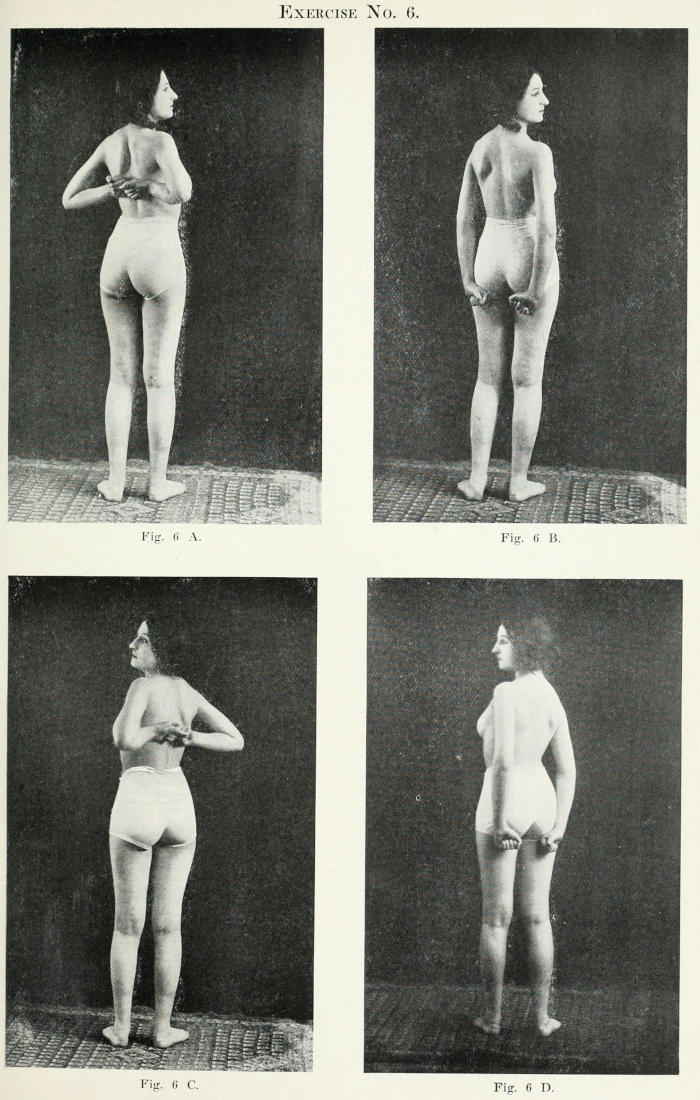
Fig. 6 A. Fig. 6 B.
Fig. 6 C. Fig. 6 D.
Without altering the position of legs and feet, turn the
trunk around to the right so that if possible the chest and
shoulders are facing squarely to that side. The trunk will thus
have made a quarter of a turn to the right. While the body is
in that position, clench the hands and move them quickly
around and as far up as possible on each side of the back, the
back of the hands turned toward the body, the knuckles of each
hand opposite each other on each side of the spinal column
(Fig. 6 A).
Stroke thus with the backs of both hands simultaneously
downward over each side of the lower back and buttocks, where
the hands are released (Fig. 6 B).
Now, without altering the position of the legs or feet, turn
the trunk over to the left side, as far as possible, so that the
chest and shoulders are facing squarely to the left. Thus this
time a half turn is made. While in this position, stroke downward
on the back in the same way as when the body was turned
toward the other side (Fig. 6 C and D).
Alternate by turning to the right, that is, half a turn from
the last posture, etc.
This exercise done five times will take about ten seconds. If
counting every time the trunk is turned to the side, it will be
ten counts.
This exercise is combined in such a way that there is obtained
the movements of the arms and the turning of the upper
body to each side, together with massage of the lower back and
buttocks.
The movements of the body and the arms and hands in applying
the massage movements exercise the muscles and nerves
of the arms, the shoulders, the upper chest, the upper and lower
back, the hips and the sides of the body. They also influence
the kidneys.
The massage influences the muscles, nerves and vessels of
the lower back and buttocks, and also the kidneys, bladder and
liver and, through the back, the nerves leading to the abdominal
organs.
With the exception of the vibratory-pushing-movements of
the tissues over the region of the heart and liver and a new arm
movement, this exercise is a combination of some of the most
important movements of other exercises in this volume, which
are here executed in a different order. This is done, first, to
get one of the most important and concentrated exercises in the
middle of the course, and secondly, so that it can be used when
there is time for only one or two exercises, thus serving the benefit
of as many of the most important movements as possible,
in the shortest time.
Position.—Standing erect.
Exercise No. 7.
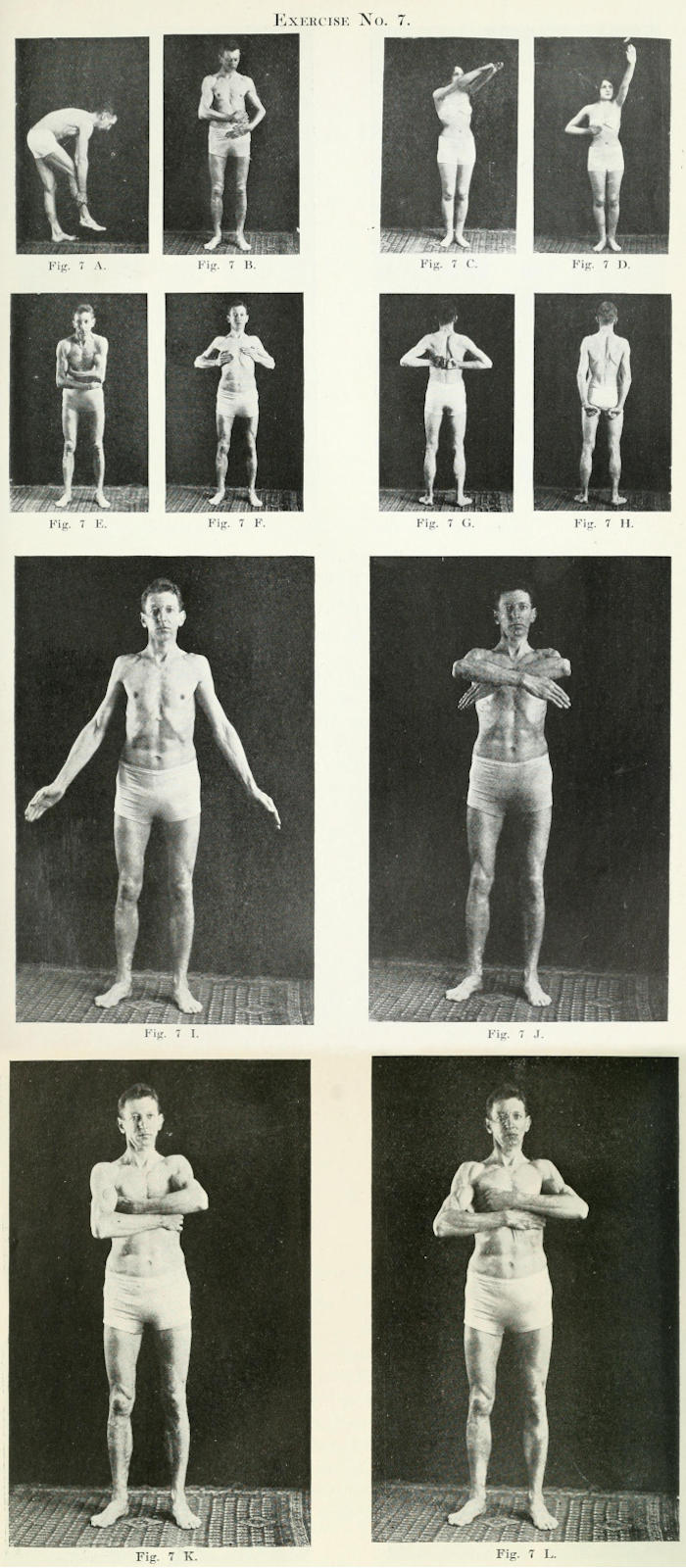
Fig. 7 A. Fig. 7 B.
Fig. 7 C. Fig. 7 D.
Fig. 7 E. Fig. 7 F.
Fig. 7 G. Fig. 7 H.
Fig. 7 I. Fig. 7 J.
Fig. 7 K. Fig. 7 L.
Massage upward over the right leg and side of hip and
from there across the abdomen to the left side, as in exercise No.
3 (Fig. 7 A and B) or (Fig. 3 A to F).
Release the hands there and massage the right arm and side
and across the lower chest with the left hand as in exercise No.
2. (This movement has not been illustrated as it is similar to
the massaging of the left arm, side and from there across the
lower chest.)
Release the left hand and massage the left leg and across
the abdomen as in exercise No. 3. (The massaging of the left
leg and across the abdomen has likewise not been illustrated
as it is similar to the massaging of the right leg and across the
abdomen.)
Release the hands and massage the left arm, left side and
over the lower chest as in exercise No. 2 (Fig. 7 C and D) or
(Fig. 2 A to F).
Now, bend the upper body, this time only slightly forward
and cross the left forearm over the right, thus placing the hands
on the opposite lower sides of the trunk and massage from
there inward and upward over the breast and upper chest as
in exercise No. 5 (Fig. 7 E and F) or (Fig. 5 G to J).
From there let the hands be brought around and stroke
down each side of the back and buttocks with the backs of the
hands, as in exercise No. 5 (Fig. 7 G and H) or (Fig. 5 K
and L).
Now, swing the out-stretched arms around to the front
(Fig. 7 I), bend the elbows (Fig. 7 J) and place the palms
of the hands, with fingers out-stretched and close together, on
each opposite side of the lower chest (Fig. 7 K) and while
keeping the hands stationary on the skin, quickly move or push
this and the underlying tissues and muscles sideways four times
(Fig. 7 L).
This exercise done five times will take about one minute.
Notice—The exercise should, like all the others, be executed
so that there is no pause between the various movements.
If the exercise is done slowly, deep breathing may be added
in the following way:
Inhale deeply and forcibly through the nose so that the
lungs are filled with air, while the hands are moving upward
over the right leg and side of hip and the body is being raised.
Exhale this air quickly and forcibly through the mouth,
while continuing massage over the abdomen to the left side,
with the body bent slightly forward.
Breathe through the nose in the same way, while the left
hand strokes the right arm and continues underneath the
shoulder.
Exhale this air with force through the mouth, while the
hand continues down the right side and from there across the
lower chest.
Inhale and exhale when massaging up over the left leg
and hip and across the abdomen in the same way as when the
right leg and side were massaged.
Inhale and exhale again the same way, while the right arm
is massaging the left arm, side and across the lower chest as
when the right arm was massaged.
Breathe again with force through the nose, while massaging
inward and upward over the chest.
Retain this air in the lungs, while the backs of the hands
are stroking downward on each side of the back and buttocks
and while the arms are swinging around to the front.
Exhale this air through the mouth, while the hands are
vibrating or pushing the skin over the underlying tissues on
each opposite side of the lower chest, or on or underneath the
breasts. Continue this movement with the hands and do not
release them until the lungs are completely emptied of air.
This exercise is combined in such a way that there is obtained
the movements of the arms, the bending and stretching
of the legs and the bending and raising of the body together
with the massage of the arms, sides, legs, hips, abdomen, chest
and back.
The movements of the legs, the upper body, the arms and
hands in applying the massage movements, exercise the muscles
and nerves of the whole body, except those of the head and
neck. They influence all the internal organs of the body.
The massage likewise influences the muscles, nerves, glands,
vessels and organs of the whole body except those of the head,
neck, the middle of the uppermost part of the back and the
feet.
The deep breathing profoundly influences the lungs, the
blood, the nervous system, the digestive system, the heart, the
liver and the respiratory muscles.
Massaging down both sides of the lower back alternately,
with the back of each hand; at the same time turning the trunk
to the right and left.
Position.—Standing erect, with chest thrown forward and
shoulders back, but without strain, heels about five inches apart
and with the feet either pointed slightly outward to each side
or parallel to each other, arms hanging loosely at sides.
Exercise No. 8.
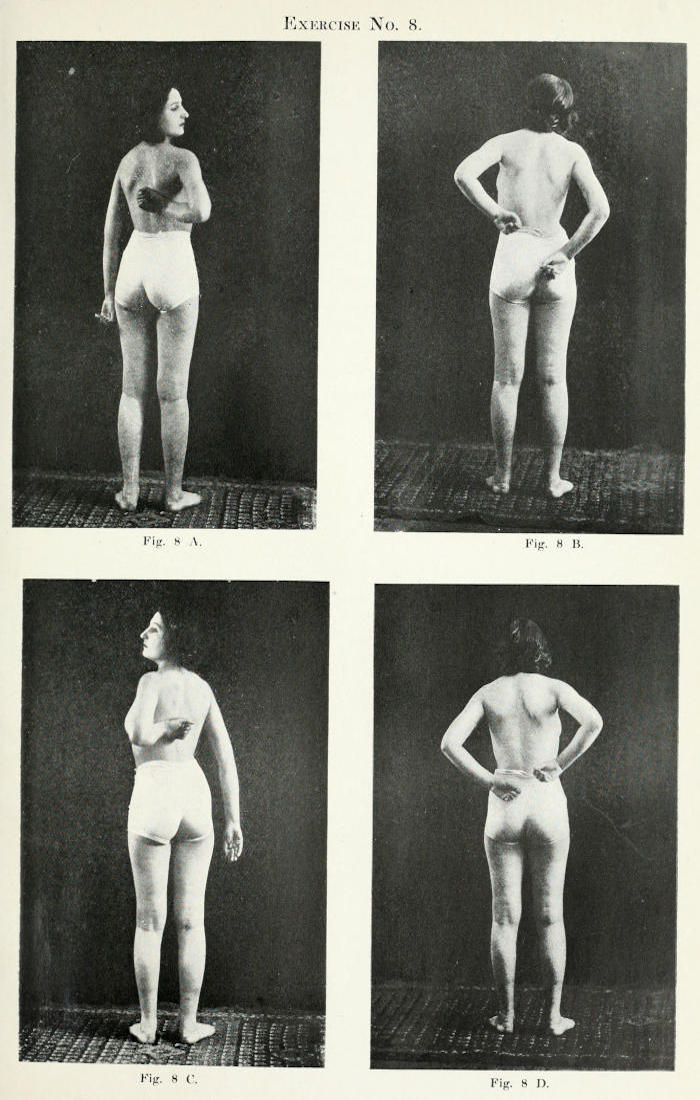
Fig. 8 A. Fig. 8 B.
Fig. 8 C. Fig. 8 D.
Without altering position of legs and feet, turn the trunk
around to the right so that, if possible, the chest and shoulders
are facing squarely to that side, then turn it to the left, then to
the right again, and so forth, alternately. During this movement
of the trunk, stroke continually downward over each side
of the back from the end of the shoulder blade to the buttocks
with the back of each hand alternately. The hands are not
clenched, but only half closed. After one stroke is executed
that hand is lifted slightly outward from the body and placed
underneath the shoulder blade to begin stroking again. The
same movement obtains with the opposite hand alternately.
Thus the hands come into contact with the tissues only when
moving downward on the back (Fig. 8 A, B, C and D). The
speed should be about one stroke a second.
This exercise done five times will take about twenty seconds.
If counting each time the trunk is turned to either side, it
will be ten counts.
This exercise is combined in such a manner that there is obtained
the movements of the arms and the turning of the trunk
to each side together with massage of the lower back.
The movements of the body and the arms and hands in applying
the massage movements exercise the muscles and nerves
of the arms, the shoulders, the upper chest, the upper and lower
back, the hips and the sides of the body. They also influence
the kidneys.
The massage influences the muscles, nerves and vessels of
the lower back. It also influences the kidneys, bladder and
liver and, through the back, the nerves leading to the abdominal
organs.
Massaging with the right hand from the outer side of the
left thigh, upward over the left hip and lower side of trunk,
continuing from there, inward and upward over the left nipple
or breast and upper chest and across the latter outward to the
right armpit. Then, stroking with the left hand from the outer
side of the right thigh upward over the right hip and lower
side of trunk, and continuing from there, inward and upward
over the right nipple or breast and upper chest and across the
latter out to the left armpit; at the same time bending the upper
body slightly forward and to the right and left.
Position.—Standing erect, with heels about eight inches
apart and feet nearly parallel, legs and feet kept stationary.
Exercise No. 9.
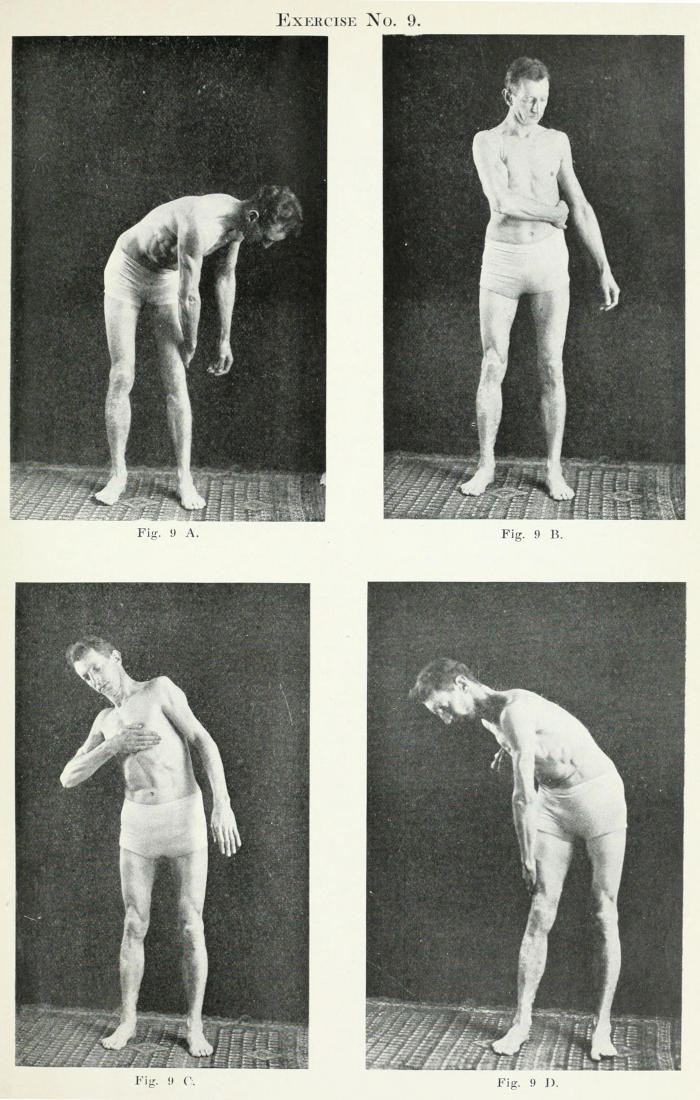
Fig. 9 A. Fig. 9 B.
Fig. 9 C. Fig. 9 D.
Bend the trunk forward and slightly to the left and place
the right hand transversely on the outside of the left thigh in
such a way that the four fingers are close together and pointed
outward and backward (Fig. 9 A).
From there, stroke with the right hand, upward over the
side of the left thigh, hip and lower side (Fig. 9 B) and
inward and upward over the left nipple or breast and upper
chest and outward to the right armpit; at the same time raising
the trunk.
When the hand strokes across the upper chest the upper
body is bent to the right, but not forward (Fig. 9 C).
Release the right hand at the right armpit; while the upper
body is still bent to the right, bend it forward and place the
left hand on the outer side of the right thigh (Fig. 9 D) stroking
from there upward over the right hip, lower side and inward
and upward over the right nipple or breast and upper
chest, outward to the left armpit; at the same time raising the
upper body. This time, however, the trunk is bent to the
left, as the hand strokes the upper chest outward to the left
armpit.
Begin again with the right hand on the side of the left
thigh and continue thus each side alternately.
This exercise done five times will take about twenty-five seconds.
If counting each time when commencing to stroke
from the side of the hip, it will be ten counts.
Note I. When stroking and pressing upward over the
side of each thigh, let the raising movement of the trunk pull
the arm and hand up as far as the motion permits.
Position.—The same as in exercise No. 9.
Here the same movements are done as in Exercise No. 9,
but the following arm exercise has been added:
While the right hand strokes upward over the left side and
upper chest, and the body is raised and bent to the right, the
left outstretched arm is carried or swung around to the back
and upward over the head to the front and down on the outer
side of the right thigh, so that it reaches there when the right
arm is released at the right armpit. The right arm then performs
a similar movement, while the left hand is stroking
upward over the right side.
This is somewhat similar to a swimming arm movement.
It is also very like the motion used in throwing hand
grenades.
Note I. Women with well-developed breasts, who
might find it somewhat difficult to stroke inward and upward
over them, may stroke more or less sideways inward over
the breasts, or raise the palm or the back of the hand slightly
outward from the body.
This exercise is combined in such a way that there is
obtained the movements of the arms and the bending of the
upper body forward and to the sides, together with massage
of the outer side of the thighs, the hips, the lower sides of
the body, the chest and breasts.
In bending the body forward and to the side, in order to
stroke upward over the opposite side from the thigh, the
body makes a sort of twisting movement which is especially
beneficial for the muscles of the lower sides, the upper abdomen
and the lower back, as well as for the liver. These
muscles then become stretched when the hand strokes outward
to the armpit, on the other side of the upper chest,
and the body is bent to that side.
The movements of the body and arms in applying the
massage movements, exercise the muscles and nerves of the
arms, the shoulders, the back, the chest, the lower sides and
the diaphragm. They also influence the liver, the heart and
the digestive organs.
The massage influences the muscles of the outer side of
the thighs, the hips, the sides of the body and the chest and
breasts.
Massaging with the left hand, from the side of the right
hip, straight across the lower abdomen to the left side. Then,
with the right hand, from the side of the left hip, straight
across the lower abdomen to the right side. Massaging again
with the left hand from the side of the right hip—but this
time with the hand placed about four inches higher up—inward
and upward underneath the border of the false ribs to
the sternum (the bone in the middle of the chest, and to
which the ribs are attached in front). Then massage with
the right hand from the side of the left hip inward and upward
under the false ribs to the end of the sternum, placing the
right hand on top of the left, when massaging with the latter
and vice-versa.
Position.—Standing erect, heels about six inches apart and
feet pointed slightly outward, legs and feet stationary.
Exercise No. 10.
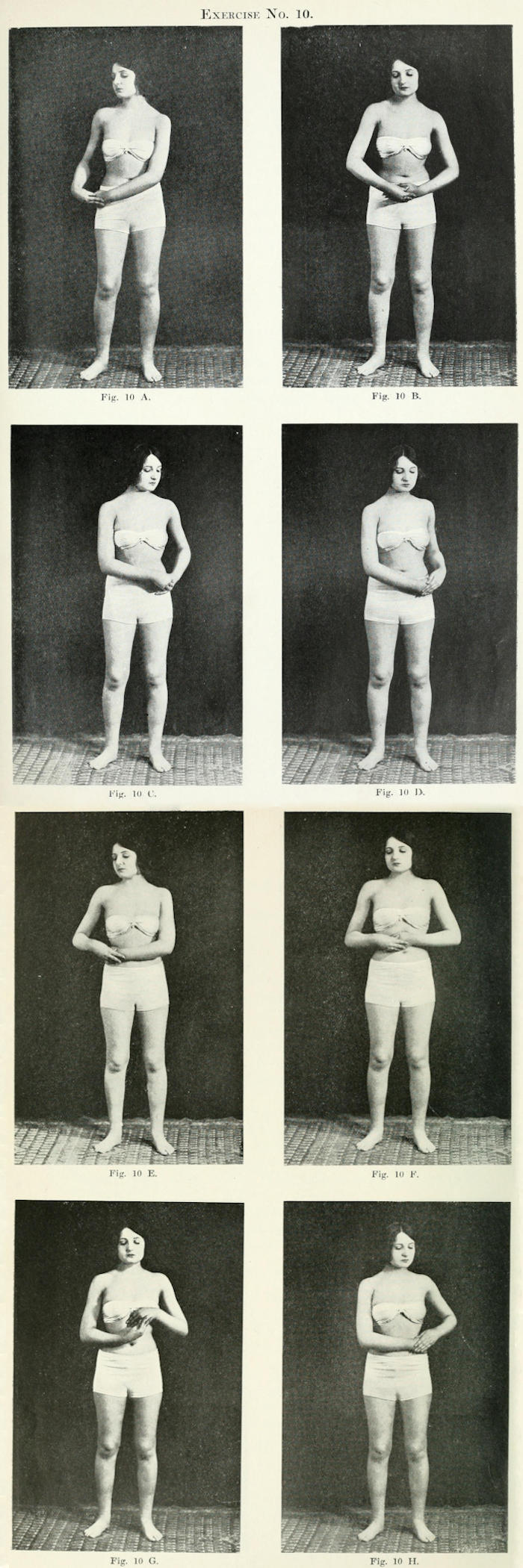
Fig. 10 A. Fig. 10 B.
Fig. 10 C. Fig. 10 D.
Fig. 10 E. Fig. 10 F.
Fig. 10 G. Fig. 10 H.
Place the left hand with the right on top transversely over
the outer side of the right hip in such a way that the fingers
of the left hand are pointing outward or around toward the
back, and the hand is in line with the lower abdomen (Fig.
10 A). Stroke thus from there, straight across the lower
abdomen just underneath the umbilicus to the left side, pressing
continually with the right hand on top (Fig. 10 B and C).
Then stroke with the right hand and pressing with the left
on top of it from the side of the left hip directly across the
lower abdomen from that side, in the same way. (Fig. 10 D.
Being similar to the movement just completed, only one figure
is shown here.)
Now, place the left hand, with the right on top of it, again
on the side of the right hip, but this time about four inches
higher up, so that the thumb is just above the crest of the
ilium, or hip bone (Fig. 10 E). Stroke from there, with the
left hand, inward and upward underneath the border of the
ribs as far as the sternum (the bone in the middle of the chest).
The palm of the hand, which of course precedes the fingers,
moves at first slightly transversely (Fig. 10 F). The inner
side of the ends of the fingers are pressed in under the ribs
with the help of the right hand until they reach the sternum
or where the ribs are slanting downwards to the left side (Fig.
10 G).
Stroke now, with the right hand, the left pressing on top
of it, from the side of the left hip, with the thumb just above
the hip bone, inward and upward underneath the false ribs,
that is, in the same way as was done with the left hand from
the right side. (Fig. 10 H. Here, likewise, only one figure
is shown.)
Thus, first stroke once from each opposite side across the
lower abdomen, then once from each opposite side inward and
upward under the ribs. The exercise has been executed once.
Five times will take about forty seconds.
Note I. The trunk should be kept in an upright position
and not bent to the right, left or backwards. The abdominal
muscles should be relaxed so that the stomach and bowels are
neither distended nor contracted, but are held naturally.
Note II. The movements can, of course, also be done
with one hand, but because pressure should be fairly strong
(especially in stout people) to influence the digestive and abdominal
organs and the nerve-centers properly, it is best to
use both hands, one on top of the other. The strain will thus
also be removed from the fingers when they are pressing inward
and upward under the false ribs.
In this exercise especial attention is given to the massaging
of the internal organs, muscles, nerves and vessels of the
abdomen, without any movements of the body except those of
the arms.
The movements of the arms and hands in applying the
massage movements, exercise the muscles of the arms, the
shoulders, upper chest and back.
The massage influences the digestive organs and glands as
well as all the other organs in the abdomen.
This exercise is very beneficial for all the digestive and
abdominal organs in women as well as in men. (See also
chapter for women, page 17, and Digestive Disorders in Supplement,
page 88.)
Beating with the clenched hands (women may use the
palm of the hand with the fingers outstretched), upward over
each side of abdomen and chest, and bending the upper body
backward at the same time; then beating similarly downward,
bringing the upper body forward to an upright position, while
the hands are beating downward over the chest.
Position.—Standing erect, legs and feet stationary.
Exercise No. 11.
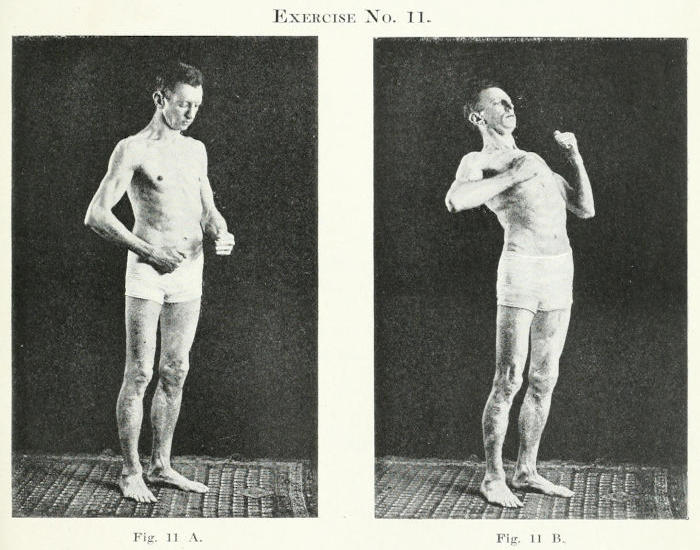
Fig. 11 A. Fig. 11 B.
Clench the hands. With the palm and the outer side of
the fingers, which are thus turned toward the body, strike first a
light and quick blow with the right hand on the right side of
the lower abdomen (Fig. 11 A), then similarly with the left
hand on the left side of the abdomen, at the same level. Then
strike with the right hand again, one or two fingers’ breadth
further upward on the lower right half of abdomen, and again,
with the left hand, a little further up on the left side, and so
forth, up over the chest. When the hands reach the lower ribs,
and while they are thus beating upward, on each side of the
chest, to the collar bone, the upper body is bent backward, as
far as possible, but without strain (Fig. 11 B). From there,
beat the same way back and downward again over chest, at the
same time bringing the upper body forward to an upright
position. When the hands continue down over the abdomen,
the upper body is thus in a natural position.
The hands should give light, quick blows and rebound from
the body each time, as in the beating of a drum.
Note. Women may use the palms of the hands, with
the fingers outstretched and close together, when beating over
the chest. Inhale the air while the upper body is being bent
backward, exhale while it is brought forward to an upright
position.
This exercise done five times will take about ten seconds.
If counting every time when commencing to beat upward over
the abdomen, it will make five counts.
This exercise is combined in such a way that there is obtained
the movements of the arms and the bending of the
upper body backwards, together with the beating of the abdomen
and of the chest.
The beating, which in massage is called tapotement, stimulates
the nerves and contracts and stimulates the muscles, if
the blows are given very lightly and quickly. Stronger and
harder blows cause a benumbing effect upon the nerves, and
should therefore be avoided.
The movements of the trunk and the arms and hands, in
applying the beating, exercise the muscles and nerves of the
arms, the shoulders, the back and the abdomen.
The beating influences the nerves, vessels, organs and
muscles of the abdomen and the chest. It stimulates the heart
and loosens the execretion from the lungs.
Massaging transversely over the left shoulder, continuing
downward over the upper left part of the chest with the right
hand, then, in the same way, over the right shoulder and upper
chest with the left hand.
Position.—Standing erect.
Exercise No. 12.
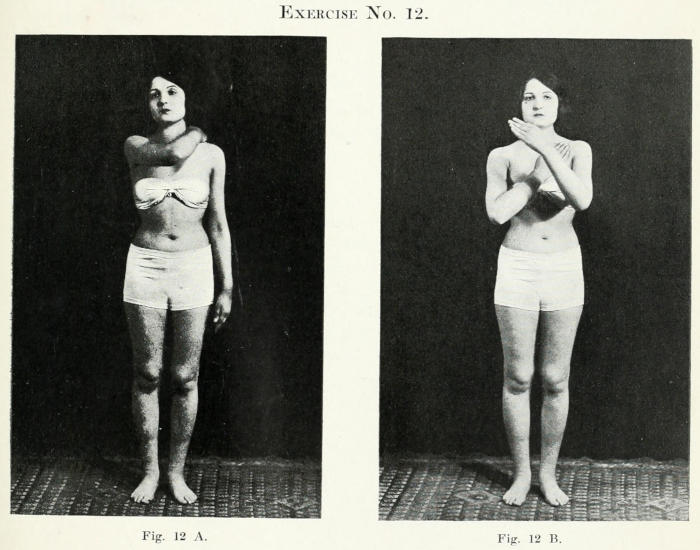
Fig. 12 A. Fig. 12 B.
With the four fingers and thumb close, place the right
hand transversely over the left shoulder in such a way that the
fingers are reaching as far down on the upper back as possible,
the two or three first fingers resting between the inner
border of the shoulder blade and the spine, and the thumb
close to the base of the neck (Fig. 12 A).
Stroke thus with the palm of the hand, the fingers pressing
more or less between the shoulder blades and spine as they
move upward, transversely over the shoulder, continuing
down the same side of upper chest (Fig. 12 B).
While the right hand is thus stroking the left shoulder
and upper chest, the left arm and hand is brought across and
up over the right forearm to the right shoulder, and this shoulder
is massaged continuing downward over the upper part of
the left chest, in the same way, as soon as the right arm is
released from the left side of chest.
The right hand is then again brought over the left shoulder
and across the left forearm and that shoulder massaged, and
so forth, alternately and evenly.
This exercise done five times will take about ten seconds.
If counting each time when commencing to stroke each shoulder,
it will be ten counts.
Note. Men may stroke downward over the chest as far as
the diaphragm, if desired.
Women should only stroke as far as the breasts, and not
over them.
This exercise is combined in such a way that there is obtained
the movements of the arms together with massage of
the shoulders and the upper chest.
The movements of the arms and hands, in applying the
massage movements, exercise the muscles and nerves of the
arms, the shoulders, the upper back and the upper chest.
The massage influences the muscles, vessels and nerves of
the shoulders and the upper chest. It increases the flow of
blood to the muscles surrounding the lungs.
This exercise, like No. 2, is especially beneficial for stiffness
in the shoulders and upper chest, resulting from golf or
other over-exertion in kindred sports.
Massaging with each hand simultaneously upward over
each opposite thigh, hip, lower side of body and inward and
upward over nipples or breasts and upper chest and stroking
down each side of the lower back and buttocks; at the same
time, bending and raising the upper body.
Position.—Standing erect, heels about eight inches apart,
and feet nearly parallel, legs and feet kept stationary, knees
straight.
Exercise No. 13.
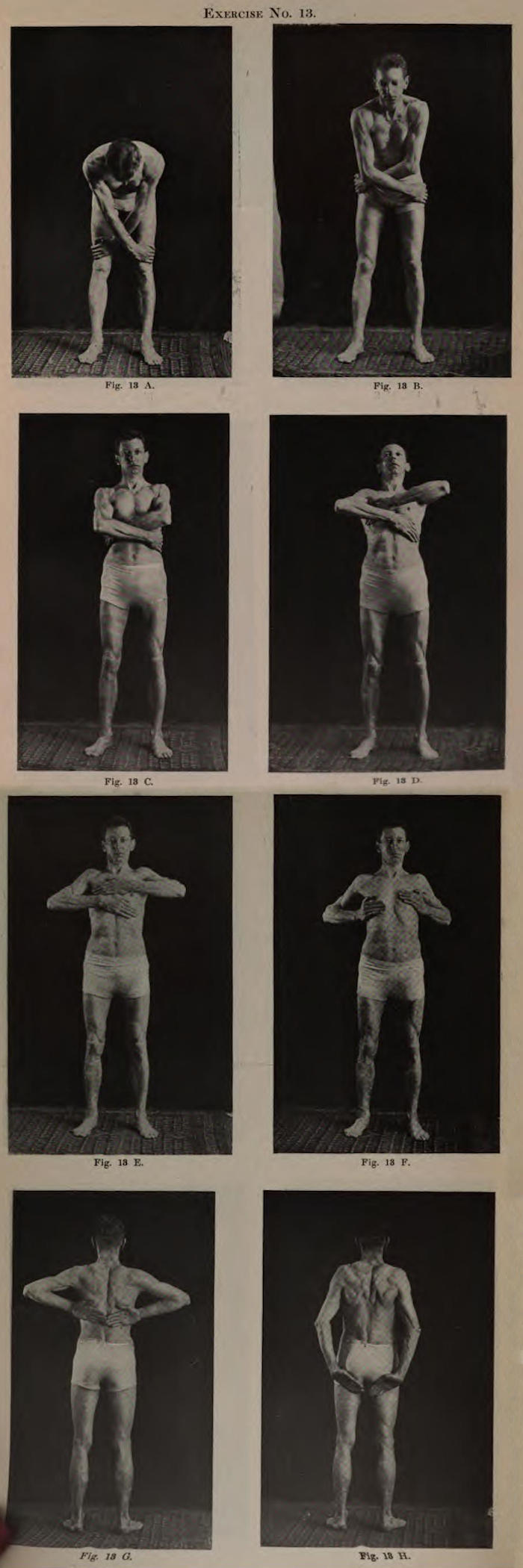
Fig. 13 A. Fig. 13 B.
Fig. 13 C. Fig. 13 D.
Fig. 13 E. Fig. 13 F.
Fig. 13 G. Fig. 13 H.
Without bending the knees, bend the upper body forward
and cross the right forearm over the left, or the left over the
right, placing the right hand transversely over the front of
the left thigh, just above the knee; the fingers of the hand are
kept close together and pointing to or around the other side
of the thigh. Place the left hand in the same way and at the
corresponding place on the right thigh (Fig. 13 A).
Stroke thus upward over the front of each thigh with both
hands simultaneously, continuing from there, in the same way
upward over hips and lower sides of the body (Fig. 13 B and
C), and inward and upward over the nipples or breasts and
upper chest, where the hands cross each other and continue outward
to their respective sides underneath the armpits (Fig. 13
D, E and F).
Then, barely moving the arms, turn the hands from there
around on each side of the back, and without here clutching the
hands stroke now with the backs of the hands and fingers,
downward over each side of the lower back and buttocks (Fig.
13 G and H).
The upper body is, of course, raised while the hands are
stroking upward over thighs and hips and bent slightly backward
while stroking inward and upward over the chest.
This exercise done five times will take about fifteen seconds.
Note. When stroking and pressing upward over the front
part of the thigh, let the raising movement of the trunk draw
the arms and hands up as far as the motion permits.
A special deep breathing exercise may be added in the following
way:
Fill the lungs with air through the nose, while stroking
from thighs up over sides and chest.
Retain this air in the lungs, while the hands are stroking
down the back.
Exhale this air through the mouth, while bending the upper
body forward in order to stroke upward over the thighs again.
This exercise is combined in such a manner that there is
obtained the movements of the arms and the bending of the
trunk forward and backward, together with massage of the
front of the thighs, the hips, the lower sides, the chest and
breasts, the lower back and buttocks.
The movements of the body, arms and hands in applying
the massage movements, exercise the muscles and nerves of
the arms, the shoulders, the chest, the back, the abdomen and
the hips. They also influence the abdominal organs and the
heart. The nerves of the legs are stretched.
The massage influences the muscles, vessels and nerves of
the front of the thighs, the hips, the lower sides, the breasts,
the chest and the lower back. It also influences the heart and
the kidneys.
Massaging, with the left hand, from the lower left side
of the upper body and with the right hand from the upper right
side of the upper body simultaneously straight across the
lower and upper chest respectively to the reverse side and back
again; at the same time turning the upper body to right and
left.
Position.—Standing erect, heels about five inches apart,
feet nearly parallel, legs and feet stationary.
Exercise No. 14.
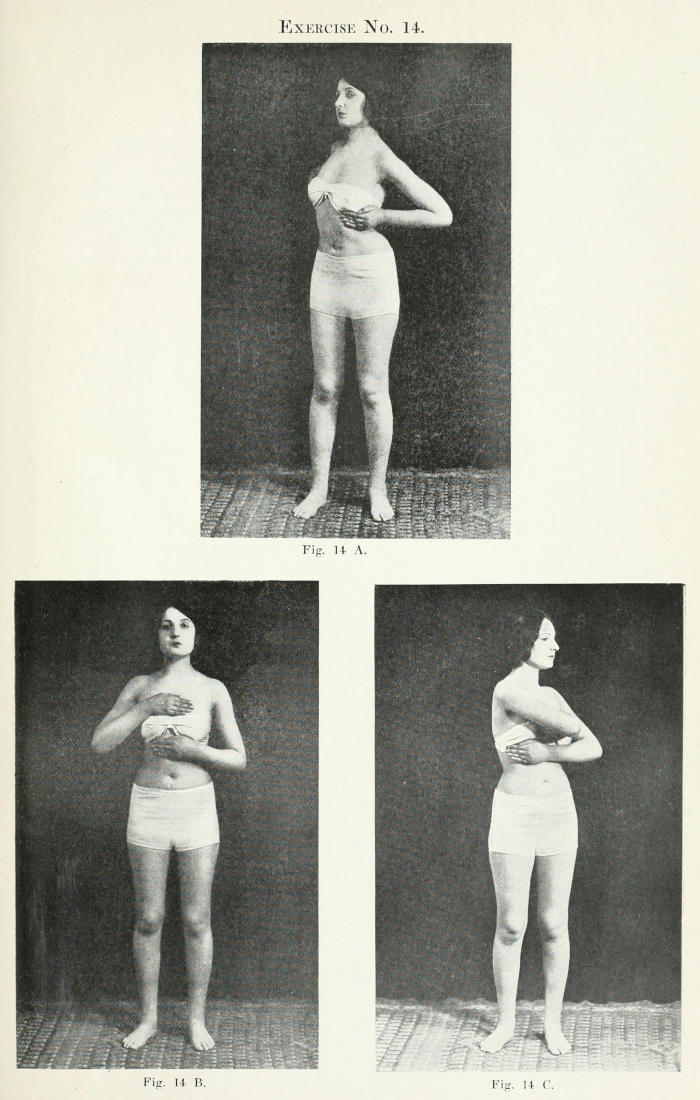
Fig. 14 A.
Fig. 14 B. Fig. 14 C.
Place the left hand, with the four fingers and thumb close,
transversely on the lower left side of the body, underneath
the line of the nipple or breast, and in such a way that the
fingers are pointing toward the middle of the chest. Place the
right hand in the same way on the upper right side of the body,
just underneath the armpits (Fig. 14 A).
Now, stroke with both hands, from each side at the same
time, directly across the chest and as far over on the opposite
side as possible (Fig. 14 B and C). Stroke back again the
same way.
The left hand thus strokes from the left side underneath
the nipples or breasts over on the right side and back again,
while the right hand strokes from the right side across the
upper chest, over on the left side and back again.
At the same time, turn the upper body slowly from side
to side without altering the position of the legs and feet. The
turning of the body and the stroking should be done evenly
and not jerkingly.
This exercise done five times will take about fifteen seconds.
If counting each time the trunk is turned to either side, it
will be ten counts.
(Combined with Rolling of the Trunk)
The massaging over the chest as done in No. 14 may also
be done, while the trunk is rolled around in the following way:
Place the feet further away from each other—about ten
inches.
Begin stroking the chest, as described. Without altering
the position of the legs and feet, bend the upper body forward;
from there roll and bend it over to the right, continuing
rolling and bending it backward, then to the left and around
to the front, terminating in a forward bending. Stop here
and with the body still bent, roll in opposite direction, that is,
to the left, back, right and front.
The hands are, of course, stroking evenly across the chest
during the rolling.
The trunk may be rolled around first two or three times to
the right, and then two or three times to the left.
Three times each way around is equivalent to five executions.
This exercise done five times will take about twenty seconds.
This exercise is combined in such a way that there is obtained
the movements of the arms and the turning of the
trunk, together with the massage of the chest and the upper
sides of the body.
The movements of the body and arms and hands in applying
the massage movements, exercise the muscles and nerves
of the arms, the shoulders, the upper and lower back, the sides
and the abdomen. This also influences the kidneys.
The massage influences the muscles and nerves of the chest
and the sides, likewise, the heart, the liver and lungs.
In No. 14 A the rolling exercises the muscles and nerves
of the abdomen and lower sides to a greater extent than does
the turning in exercise No. 14.