Didelphis virginiana Kerr. Anim. Kingd., p. 193, 1792.
Type locality.—Virginia
Description.—Slightly smaller than a house cat; body in older
animals heavy and fat; tail long, naked, scaled and prehensile. Ears
large, naked and black with white tips; muzzle elongate and pointed;
color of fur variable; overhair usually white and underfur white
tipped with black; guard hairs long and coarse but underfur soft and
dense; forefoot with opposable thumb; females with abdominal
pouch.
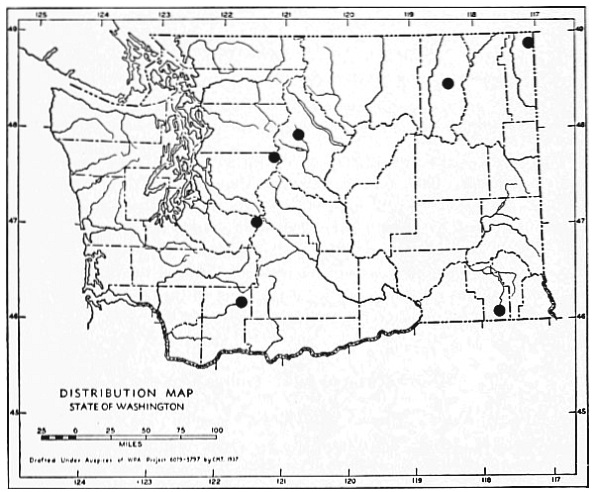
Remarks.—The opossum has been introduced from the eastern
United States into California and Oregon and has become well
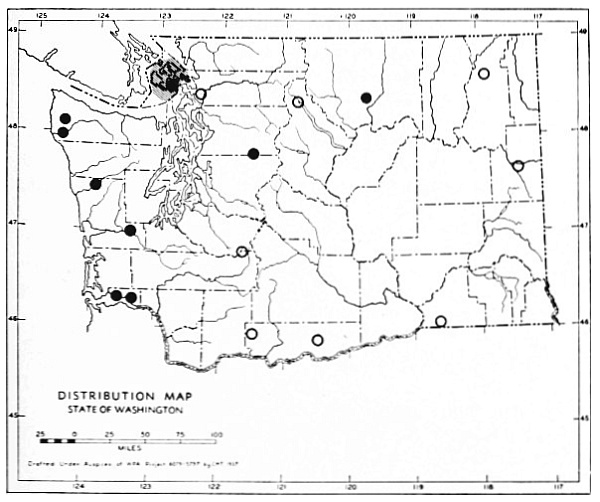
established in those states. Recent records from Clear Lake, Skagit
County, and South Bend, Pacific County, indicate that the opossum
is now resident in Washington and it may be expected to increase
and spread (Scheffer, 1943). The animals may also enter the area
about Walla Walla from Oregon. The source of the opossums which
have appeared in Washington is not yet known.
Of this animal, Dr. Carl Hartman (1923: 347) has written:
"In the popular mind, the generation of no animal is so shrouded
in mystery as that of the opossum. Throughout the country, among
both whites and negroes, deeply rooted tradition has it that the
opossum copulates through the nose and that the female blows the
fruit of conception into the pouch. Other myths relating to details
of the reproductive process in this species are current among the
people.
"The growth of such legends need not surprise one, however, for
the early birth of the embryos and the use of the pouch as an
incubator certainly challenge the imagination. These phenomena
attract the attention because they are unique, differing from the
familiar method of rearing the young obtaining among the higher
mammals, including man. Familiarity breeds contempt; the ordinary
ceases to be marvelous. Thus on account of its rareness and its
'different' character the opossum, our only marsupial, figures in the
folklore to a prominent degree."
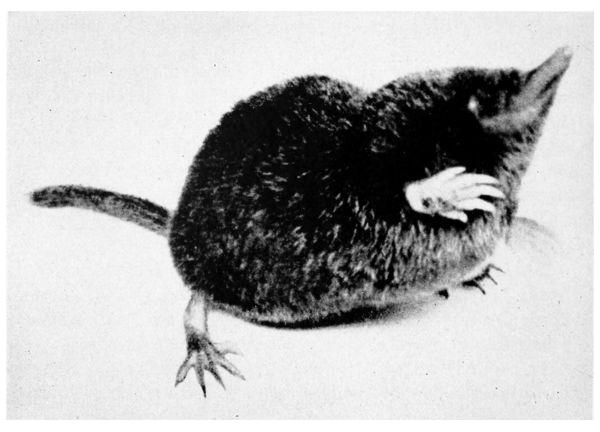
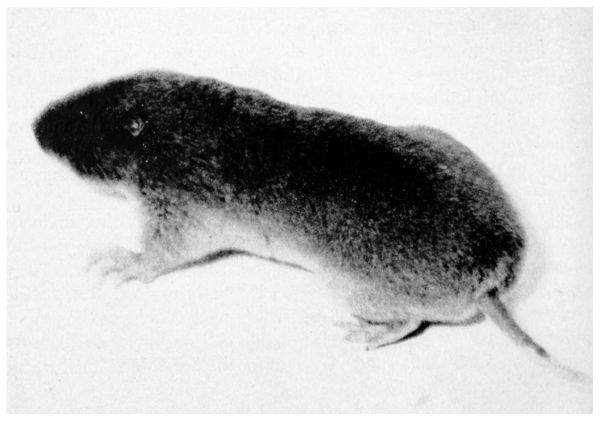
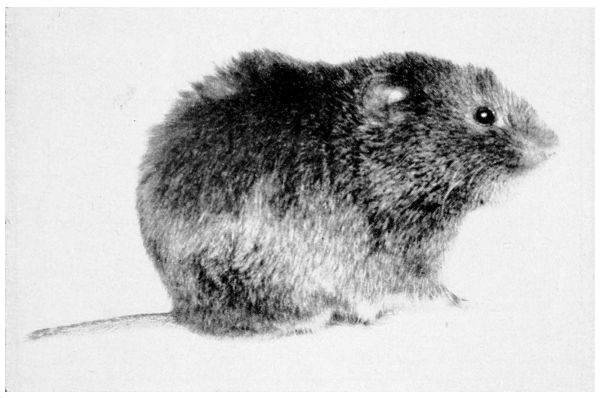
Description.—The shrew-mole is tiny, possessing a head and body
2-1/2 to 3 inches long and a tail about 1-1/2 inches in length. The body
is relatively stout but is less cylindrical than that of Scapanus. The
eyes are nearly buried in the fur. The nose is long and pointed.
The legs are short and the forefeet wide and powerful. The tail is
thick, constricted at the base and clothed with short, stiff bristles.
The fur is short and posteriorly directed. In color the shrew-mole is
dark slate, almost black.
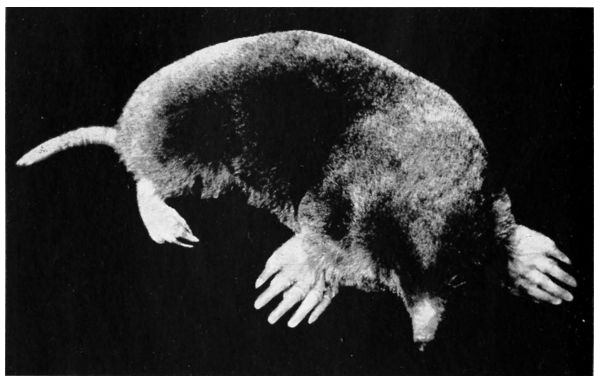
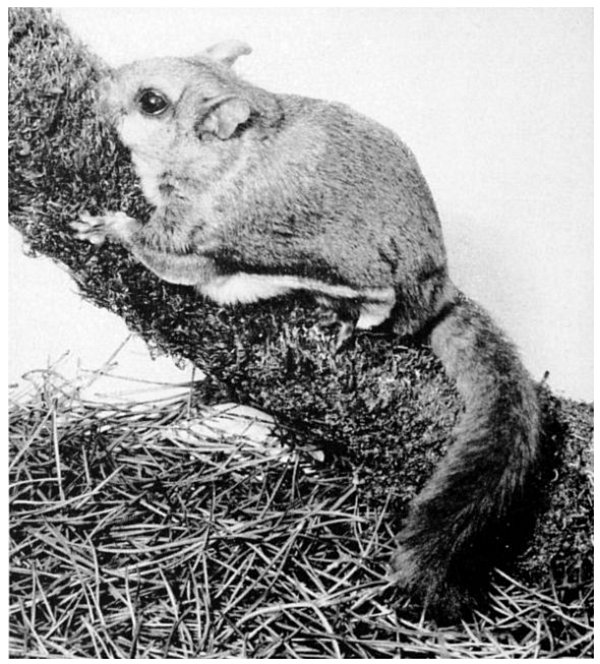
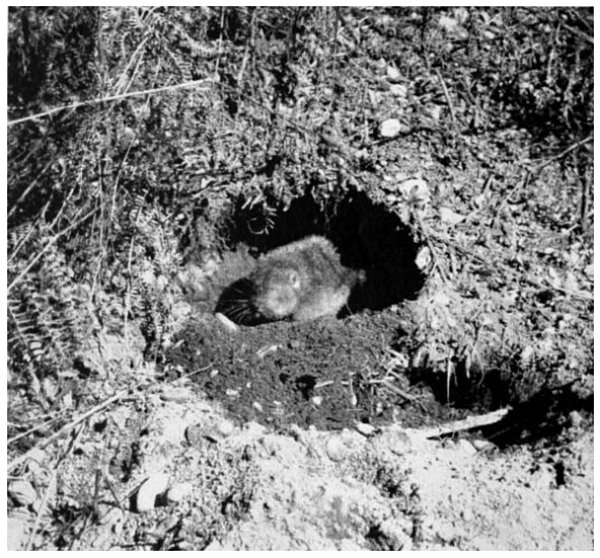
Fig. 21.
Gibbs shrew-mole (Neurotrichus gibbsii minor), female in captivity;
Seattle, Washington, September 12, 1939. (Fish and Wildlife Service photo by
Victor B. Scheffer, No. 719.)
Remarks.—Shrew-moles inhabit moist habitats from sea level to
8,000 feet. They are burrowing mammals and prefer to live in soft
earth, free of sod. In the lowlands of western Washington, shrew-moles
are most abundant in damp, shady ravines where the vegetation includes
deciduous trees and dense underbrush with but little grass.
In the mountains, shrew-moles are usually found near streams or
rock slides, where the larger annuals grow densely on soil that is
deep, soft, and free of turf. Vertically they range from the Humid
Transition Life-zone through the Canadian, and well into the Hudsonian
Life-zone.
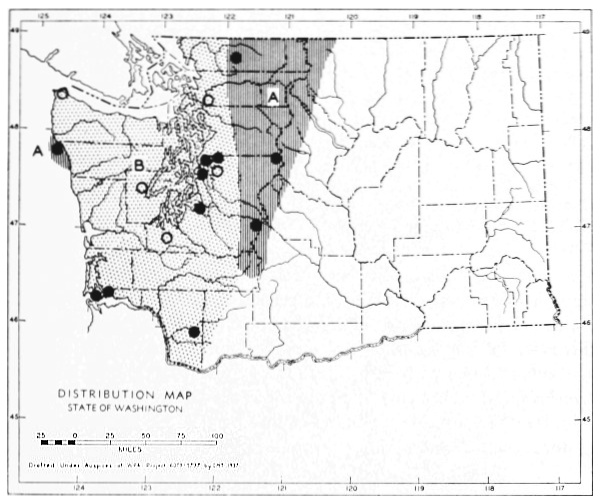
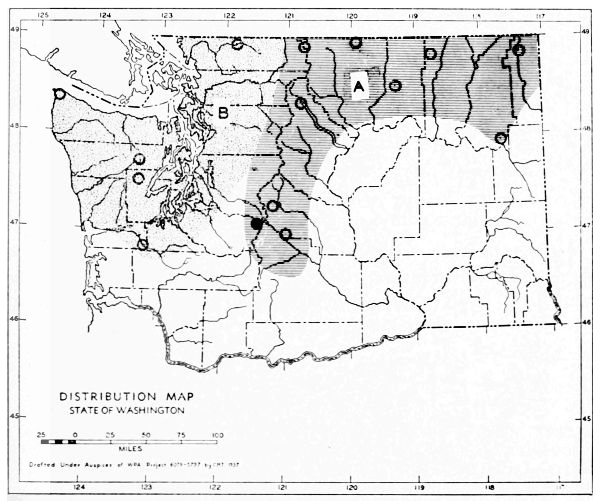
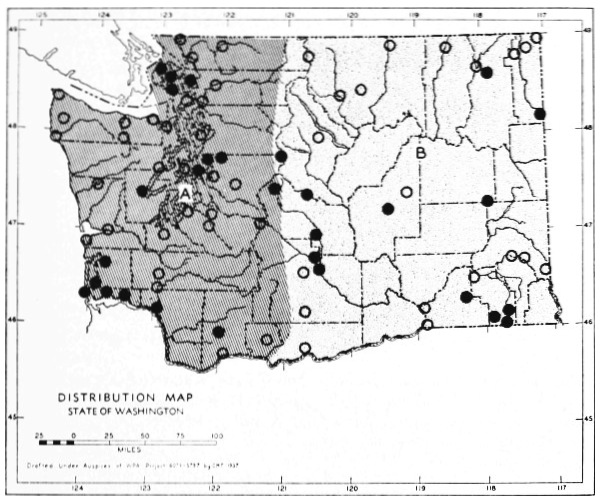
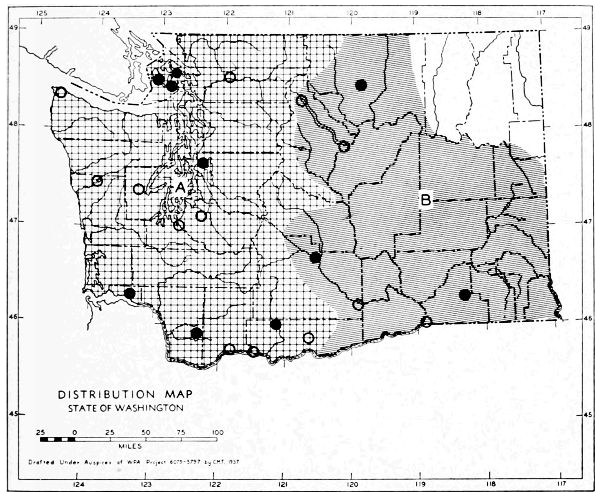
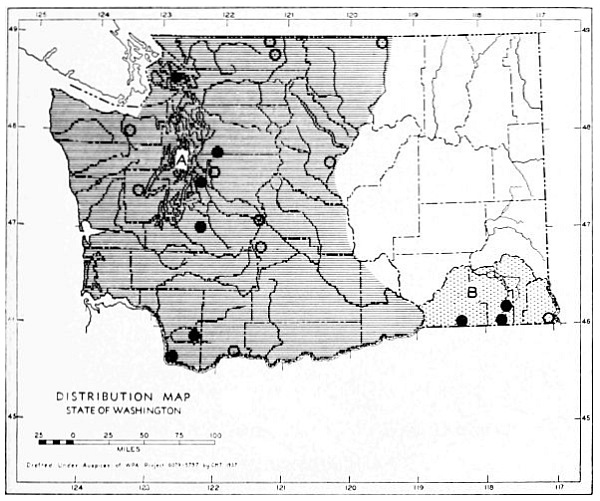
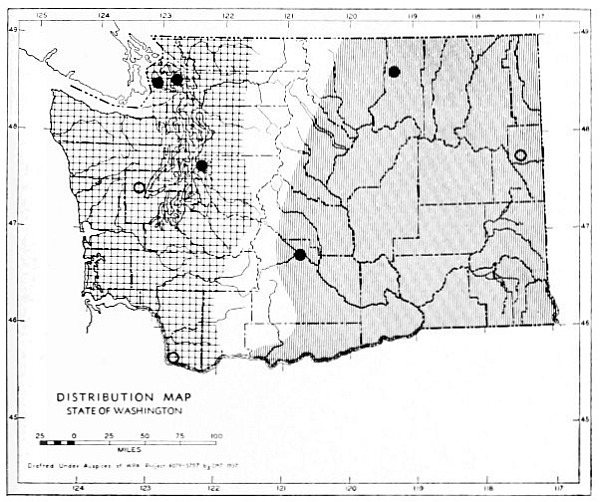
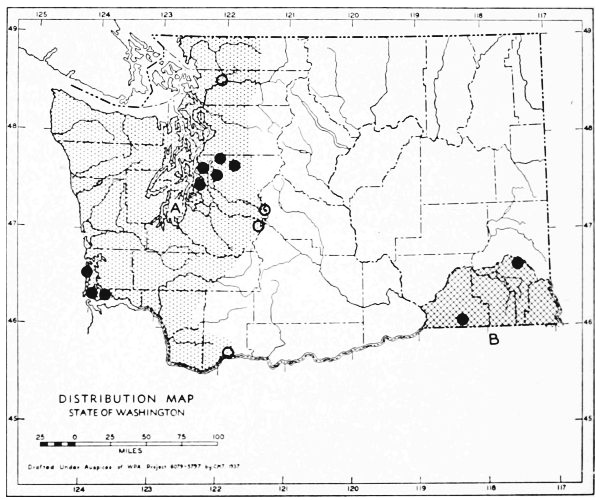
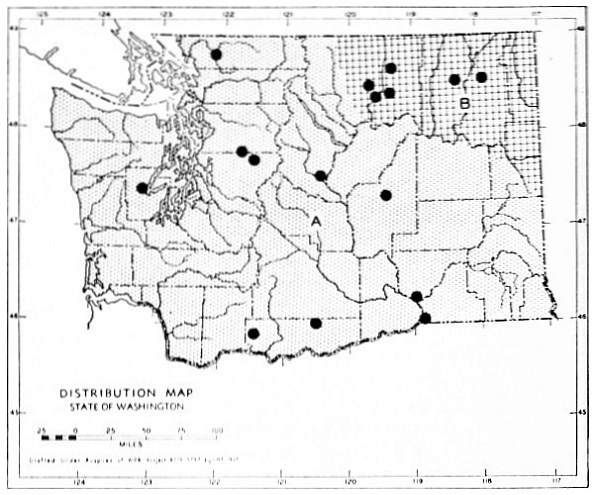
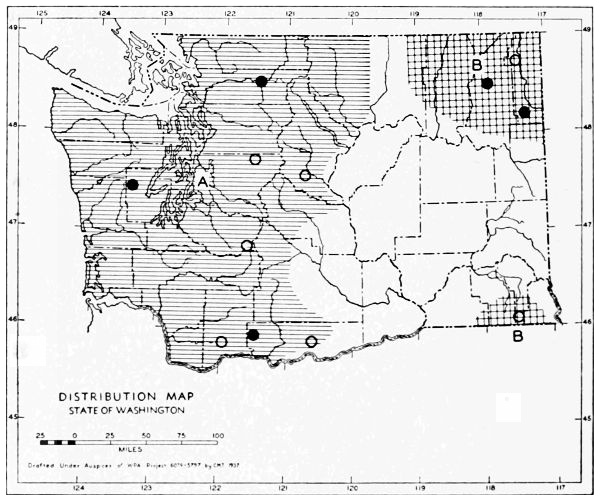
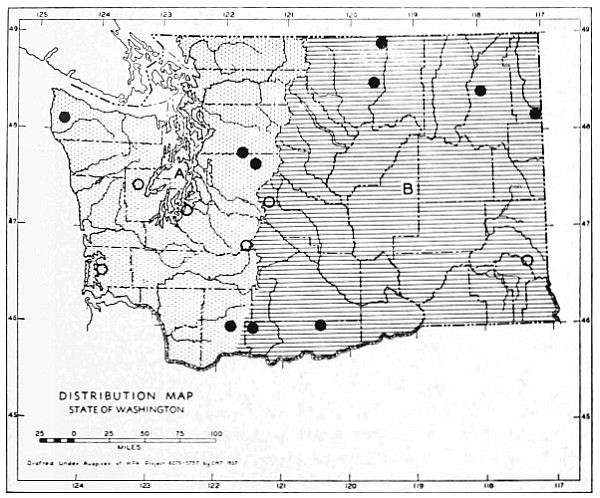
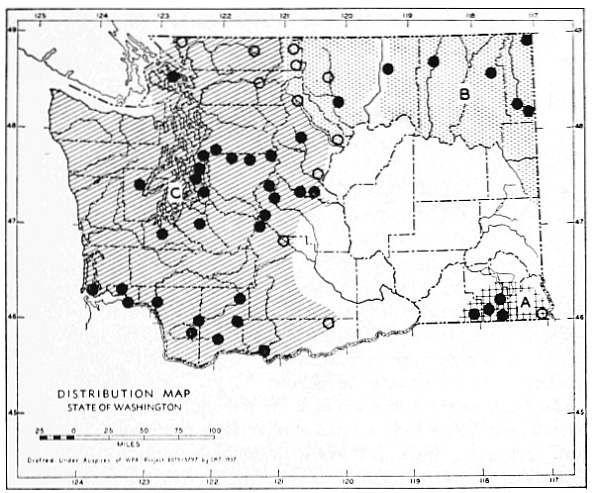
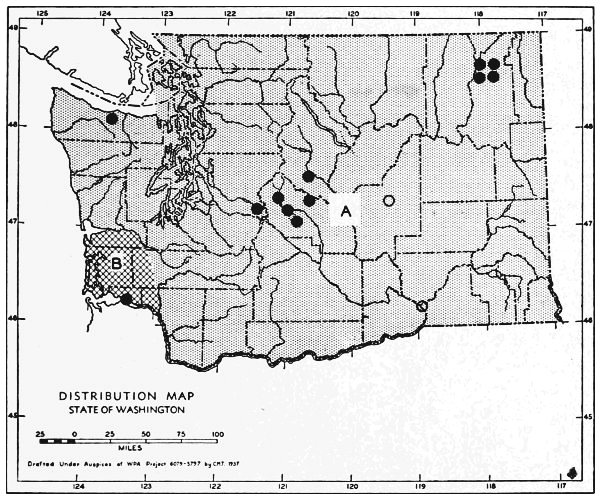
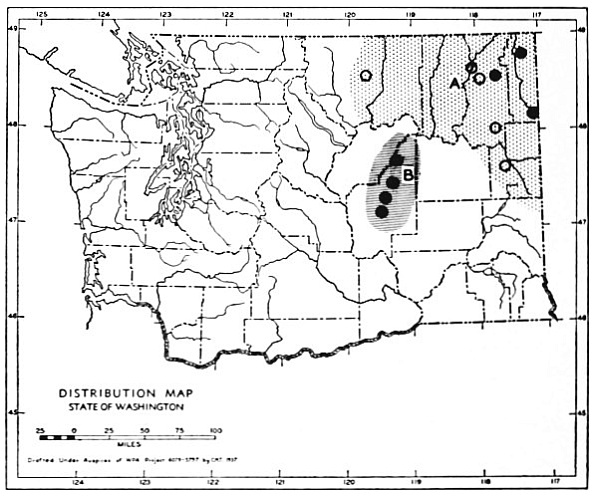
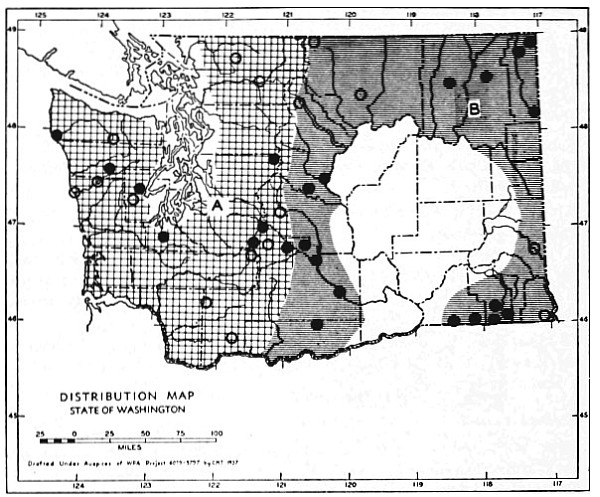
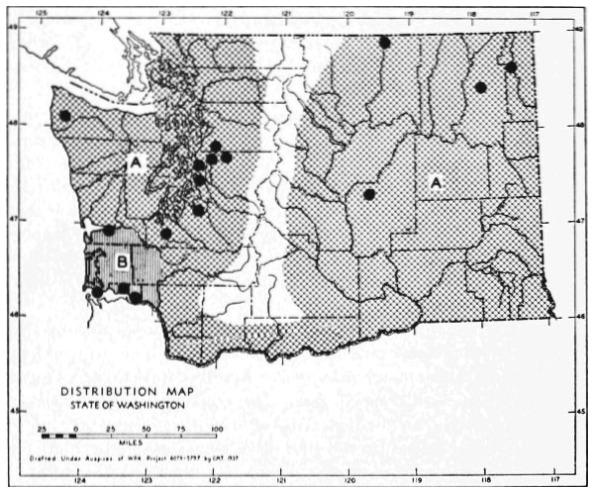
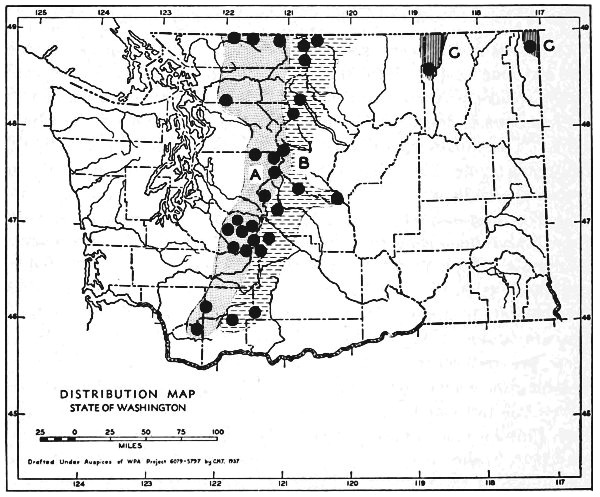
Fig. 22.
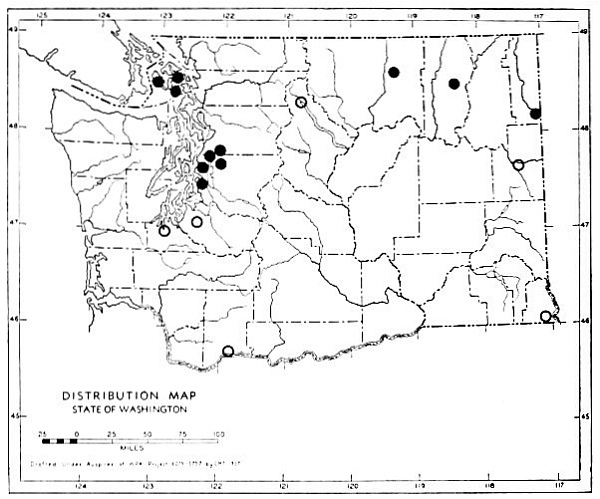
Distribution of the Gibbs shrew-mole in Washington. A. Neurotrichus
gibbsii gibbsii. B. Neurotrichus gibbsii minor.
Shrew-moles are both diurnal and nocturnal. They rest or sleep
periodically, the length of their rest or sleep being longer when much
food is eaten, and the intervals between their periods of rest or sleep
is longer when less food is eaten. Owls and snakes appear to be
their principal enemies. Predatory mammals eat some shrew-moles,
and probably kill many that they do not eat. Shrew-moles are
completely blind, and their long, prehensile nose guides all their
activity. Their ordinary movements on the surface of the ground
are slow and cautious. When frightened they break into a scuttling
rush which ends beneath a leaf or bit of bark where the animal becomes
motionless. Shrew-moles, on the surface of the ground, make
considerable noise. They construct molelike burrows, but these are
not as extensive or complicated as those of moles. The shrew-mole
hunts for food in shallow trenches that it makes just under the layer
of dead leaves and vegetable debris that covers the ground in their
habitat. The food of the shrew-moles includes earthworms, isopods,
insect larvae, soft-bodied insects, and other animal matter. Some
vegetable matter is eaten.
Breeding takes place at all seasons of the year, save perhaps in
December and January. Embryos vary from one to four. The nest
of a shrew-mole at Seattle, King County, consisted of a handful of
damp leaves in a cavity of a rotten, punky, alder stump. The nest
contained four half-grown young.
Urotrichus gibbsii Baird, Mamm. N. Amer., p. 76, 1857.
Neurotrichus [sic] gibbsii Günther, Proc. Zool. Soc. London, pl. 42, 1880.
Neurotrichus Gibbsii True, Proc. U. S. Nat. Mus., 7 (1884):607, 1885.
Neurotrichus gibbsii Bryant, Zoe. 1:359, February, 1891.
Neurotrichus gibbsii gibbsii Miller, U. S. Nat. Mus. Bull., 79:11, December 31, 1912.
Type.—Obtained at Naches Pass, 4,500 ft., Pierce County, Washington,
by G. Gibbs on July 15, 1854 (see Dalquest and Burgner, 1941); type in
United States National Museum.
Racial characters.—Size relatively large; tail relatively long; foreclaws
straight on ventral surface.
Measurements.—Two females from Tye, 4,000 ft., Stevens Pass, King
County, average: total length, 121.5; length of tail, 45; length of hind foot, 18.
Distribution.—The Cascade Mountains, from British Columbia south, and
Destruction Island, Jefferson County. Records of occurrence are Baker Lake
(J. M. E.), Tye (M. V. Z.), and Mount Rainier (Mount Rainier Ntl. Park
Mus.)
Remarks.—Shrew-moles are present on Destruction Island, a
small island in the Pacific off the coast of Jefferson County. These
moles are large, and are like gibbsii. It is thought, however, that
this resemblance is due to convergent evolution rather than a once-continuous
range with gibbsii. It is significant that a shrew (Sorex
trowbridgii destructioni), the only other native land mammal on the
island, differs from its mainland counterpart in much the same way
as does Neurotrichus g. gibbsii from Neurotrichus g. minor.
Neurotrichus gibbsii minor Dalquest and Burgner, Murrelet, 22:12, April 30, 1941.
Type.—Obtained on the University of Washington Campus, Seattle, King
County, Washington, by W. W. Dalquest on May 19, 1940; type in the
Museum of Vertebrate Zoölogy.
Racial characters.—Size small; tail short; foreclaws light and weak as compared
to those of gibbsii, with ventral surfaces curved.
Measurements.—Eighty-five specimens (males and females) from Seattle,
King County, average: total length, 107.0; length of tail, 35.3; length of
hind foot, 15.0.
Distribution.—The lowlands of western Washington. Marginal records are:
Mt. Vernon (Jackson, 1915: 97), Cottage Lake (W.W.D.) and Yacolt (M.
V.Z.).
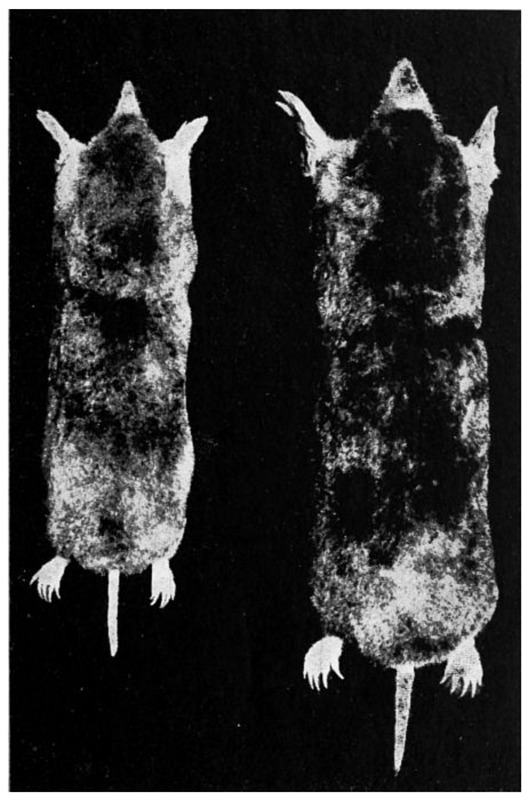
Fig. 23.
Coast mole (Scapanus orarius orarius) left
and Townsend mole (Scapanus townsendii) right; Puyallup.
Washington, May, 1914. (Fish and Wildlife Service
photo by T. H. Scheffer, No. B-18637.)
Moles are of stocky build and have cylindrical, rounded bodies.
The eyes are tiny, nearly concealed in the fur. They have no external
ears. The legs are short; the forefeet wide, spadelike, and
armed with powerful claws. The fur is erect, not posteriorly directed.
The color of the fur is deep bluish or brownish slate. The
short, nearly naked tail is pale pink or whitish. Moles of this genus
are found only along the Pacific Coast of North America from
southern Canada south into Baja California.
Scalops townsendii Bachman. Jour. Acad. Nat. Sci. Philadelphia, 8 (pt. 1):58, 1839.
Scapanus tow[n]sendii Pomel. Arch. Sci. Phys. Nat., Geneva, 9 (ser. 4):247, 1848.
Scapanus Townsendii True. Proc. U. S. Nat. Mus., 7 (1881):607, 1885.
Type.—Probably obtained at Fort Vancouver. Clark County. Washington,
by J. K. Townsend. A cotype was obtained on May 9. 1835; type in Academy
of Natural Sciences of Philadelphia.
Measurements.—Three males and 6 females from southwestern Washington
average, respectively: total length 221, 214; length of tail 51, 46; hind foot
28.3, 26; weight 147, 117 grams.
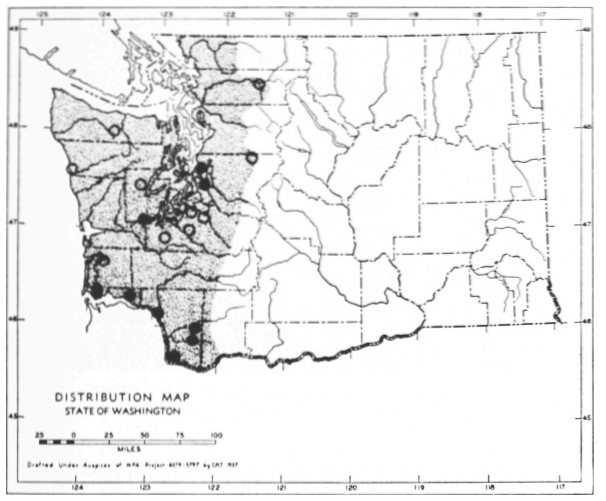
Distribution.—The lowlands of western Washington. Marginal occurrences
are: Sauk (Jackson. 1915: 61); Skykomish (Jackson, 1915: 61) and Yacolt
(M.V.Z.).
Remarks.—Scapanus townsendii occurs only in a narrow belt extending
from southwestern British Columbia to northwestern California.
It seems to prefer a generally damper habitat than the
smaller-sized coast mole, although both species are sometimes found
in the same locality. The larger mole is abundant in the meadows
on the flood plains of rivers at low elevations, and on the glacial
outwash prairies. It is often numerous in the fir forests, although
its workings and mounds are less conspicuous there. The bodies of
nine drowned individuals were found in a well by an old cabin in
dense fir forest near Duvall, King County. Townsend moles occasionally
occur in the Canadian Life-zone, as at Staircase on the
north side of Lake Cushman in Mason County where workings were
observed, but most records are from the Humid division of the
Transition Life-zone.
The Townsend mole is mainly nocturnal. If ridges of its runways
are crushed down, they usually remain so throughout the day and
are rebuilt the following night. Only about ten per cent of the ridges
that were crushed were rebuilt in the daytime, and most of these
were repaired in the early morning. The species is almost completely
subterranean. Some individuals are crushed on highways
by cars, showing that these moles occasionally travel on the surface
of the ground.
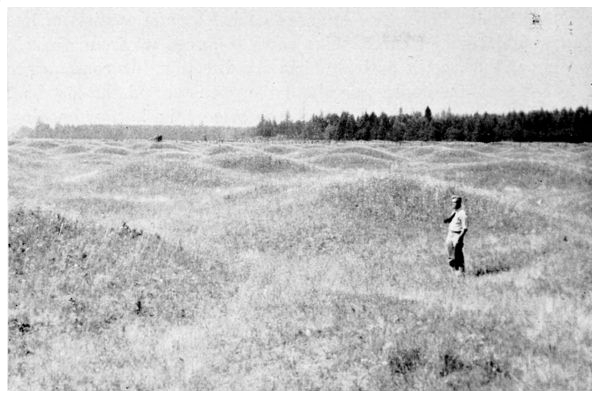
Townsend moles throw up numerous mounds, each usually containing
about a cubic foot of earth. The mounds commonly are
built just about as far apart as a man can step. The general direction
as well as the twists and turns of a mole's burrow can usually
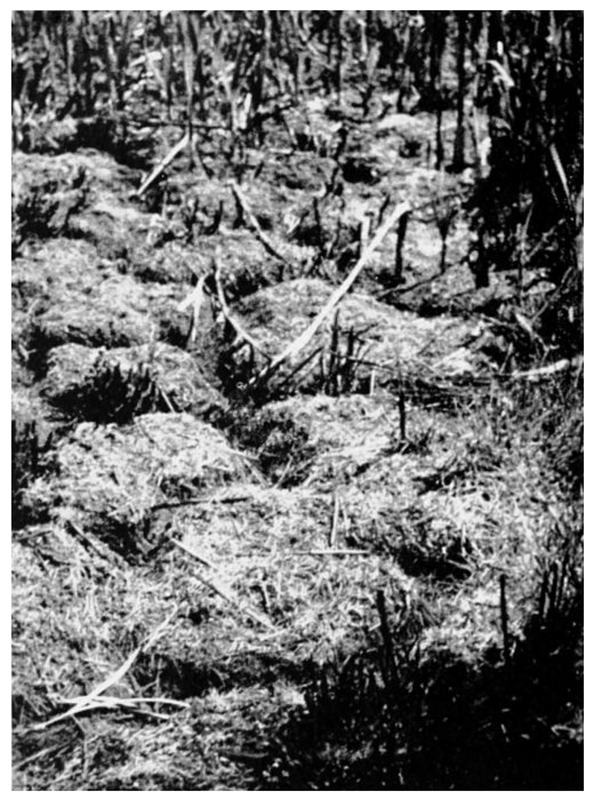
be determined from the mounds. Townsend moles also construct
ridges on the surface of the ground by pushing up sod in building a
tunnel just below the grass roots. Smaller ridges are less commonly
made by coast moles. More extensive tunnels, constructed deeper
in the earth, serve as living quarters.
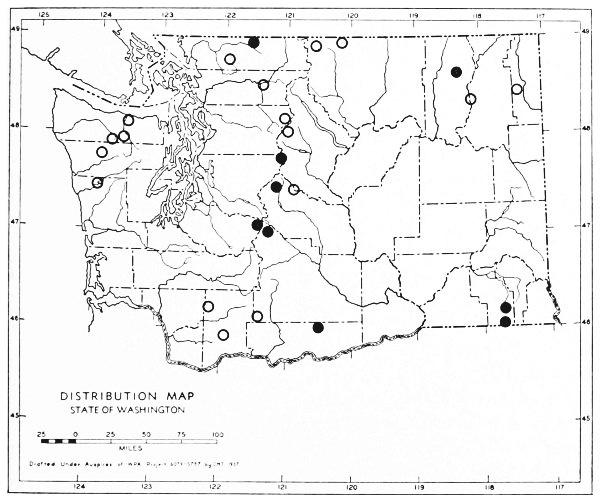
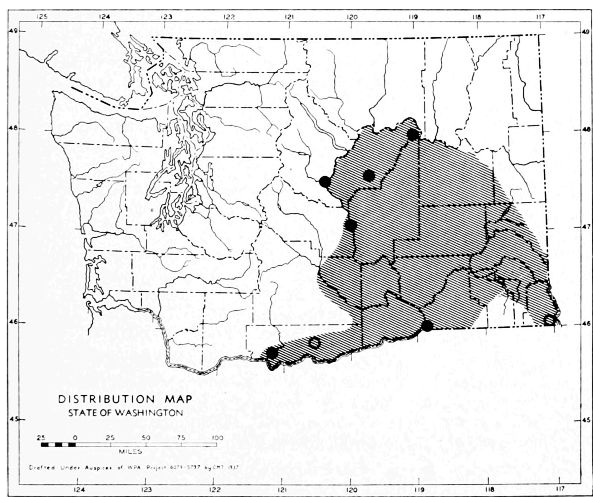
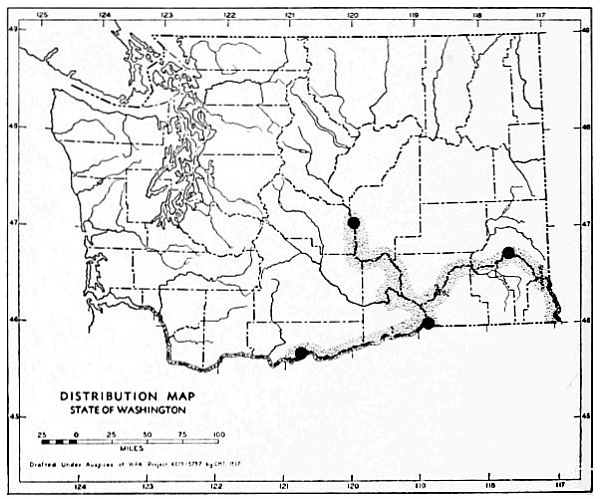
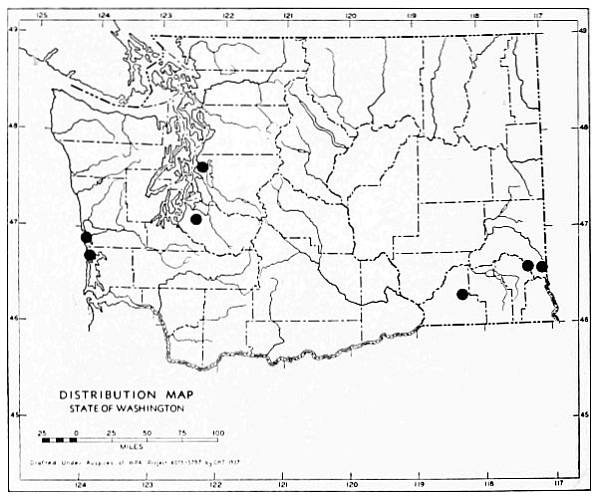
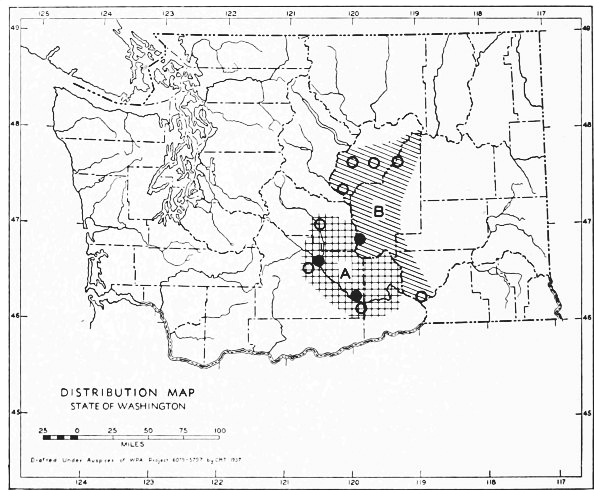
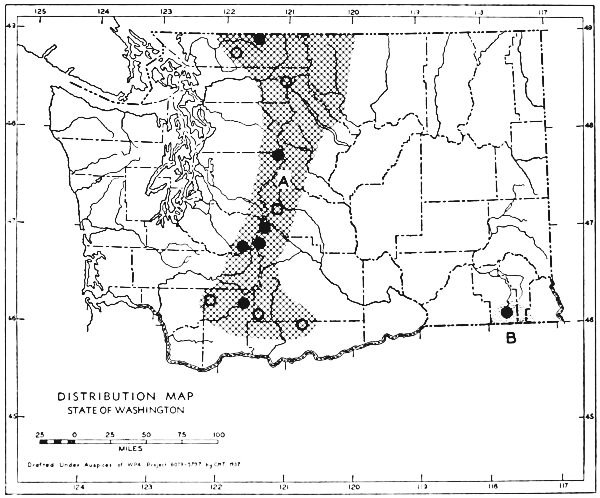
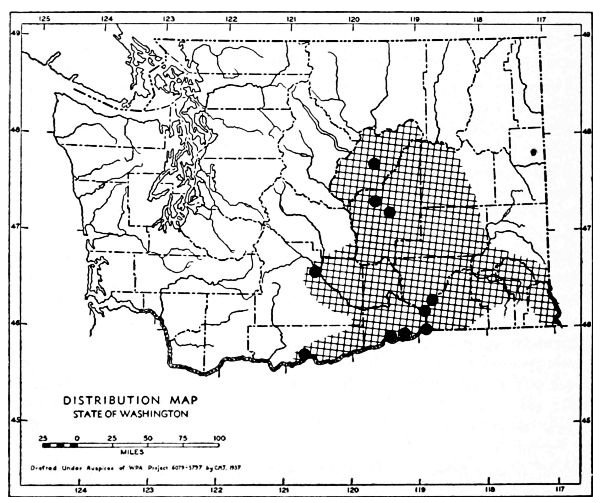
Fig. 24.
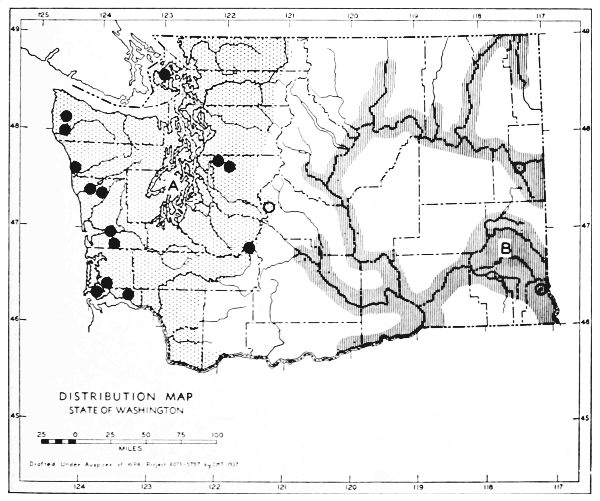
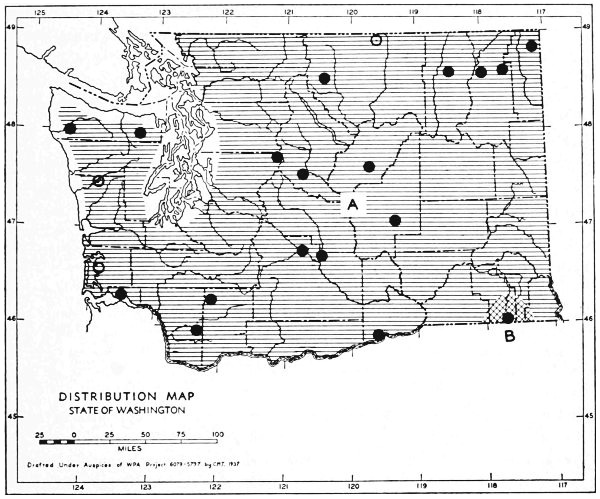
Distribution of the Townsend mole, Scapanus townsendii, in
Washington.
According to Wight (1928: 24), Scheffer (1922: 11) and Moore
(1933: 39), the food of this large mole includes earthworms and
ground-inhabiting insects, insect larvae, spiders, centipedes, flesh,
and small amounts of soft vegetation. Scheffer (1922: 10) found
that the large mole breeds in February and produces from two to
four young at a litter, with an average of three.
Description.—The coast mole is almost identical with the larger
mole in form of body but is smaller. Head and body are about
5-1/4 and tail about 1-1/2 inches in length.
The coast mole occupies all of the territory inhabited by the
Townsend mole and ranges slightly farther northward, southward
and eastward. However it does not range east of the boundaries
of the three Pacific Coast states or British Columbia.
The mounds and workings of the coast mole are smaller than
those of the Townsend mole and consequently are less noticed. It
seems less prone to make numerous mounds, a pace apart, than the
larger mole, and burrows tend to extend deeper in the ground. Upthrust
ridges are less commonly built by orarius than by townsendii.
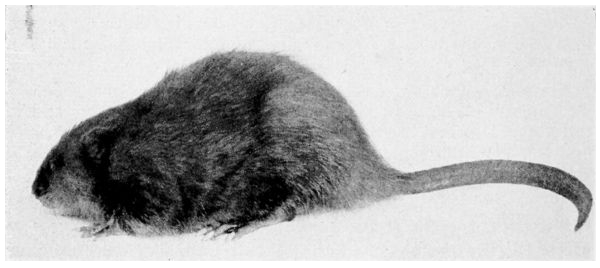
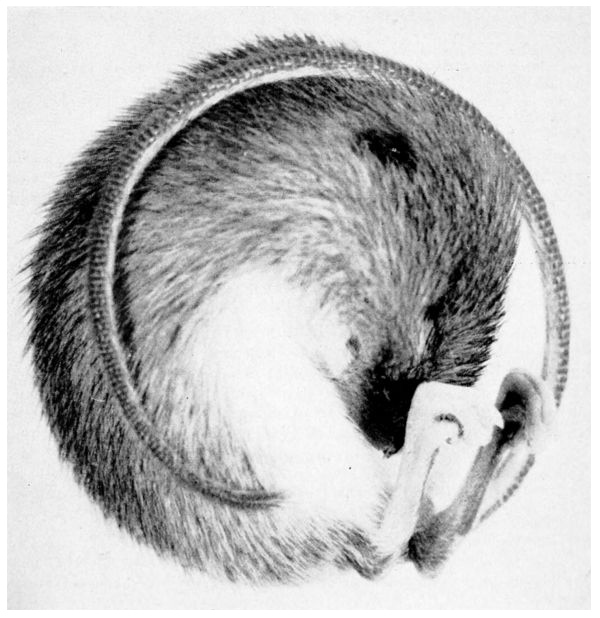
Fig. 25.
Coast mole (Scapanus orarius orarius). Freshly killed; Seattle,
Washington, June 9, 1938. (Fish and Wildlife Service photo by Victor B.
Scheffer, No. 64.)
Jackson (1915: 62) mentions the possibility of ecologic differences
between orarius and townsendii. There are some differences
in habitat and habits. The coast mole seems to live deeper in the
ground, prefers better drained soil, and is less colonial than the
Townsend mole. These are average differences, however, and the
two species commonly occur together. Another difference is that
the larger mole rarely enters the dense deciduous woods, such as
the brush-grown alder and dogwood jungles along the stream valleys.
I have taken the coast mole in such localities, and often have
found their workings there. The surface of a nearby meadow may
be dotted with mounds of both species, but the larger mole seems
not to enter ground that is thickly grown with brush. The coast
mole ascends to greater altitudes in the Cascade Mountains than
does the Townsend mole.
Like the larger mole the coast mole feeds principally on earthworms
and insects (Moore, 1933: 38). On September 29, 1939, in
a ravine at Seattle, in two baited traps set six inches apart, a creeping
mouse (Microtus oregoni) and a coast mole were found. The
mouse had come to the bait and been caught. The mole had seemingly
emerged from the ground through a tunnel a foot away and
had been attracted to the body of the mouse. It had eaten an area a
half inch in diameter and three-quarters of an inch deep into the
body of the mouse just behind the shoulder, when in shifting its
position it had become caught in the unsprung trap behind it. When
found the mole lay dead with its nose inside the body of the mouse
and its back broken. This is the only case known to me of a coast
mole appearing voluntarily on the surface of the ground. Never
have I found coast moles crushed on the highway; several Townsend
moles so killed have been found.
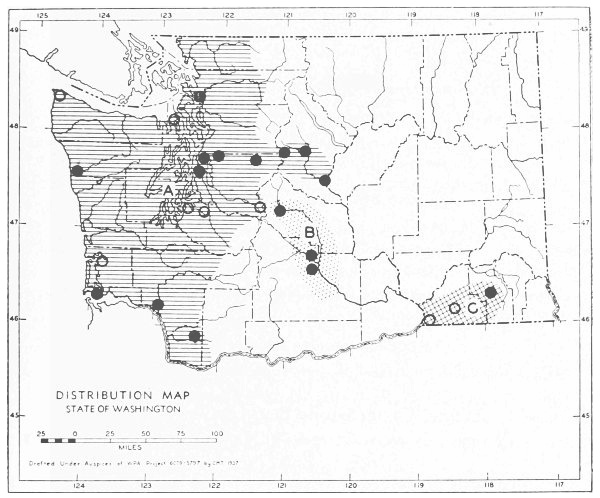
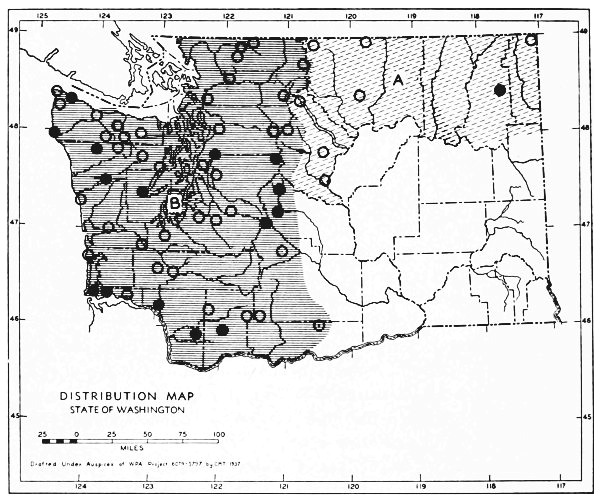
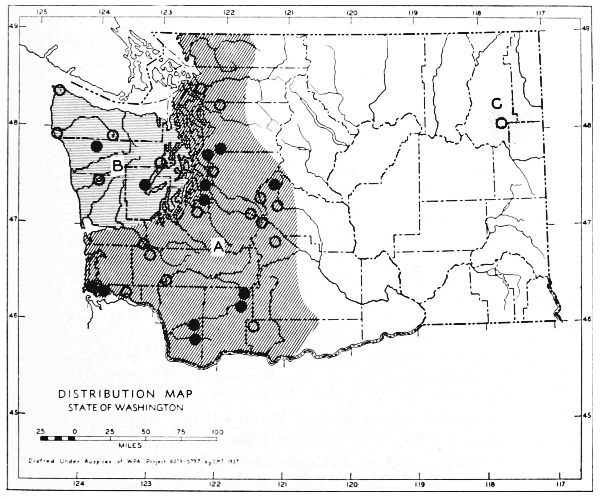
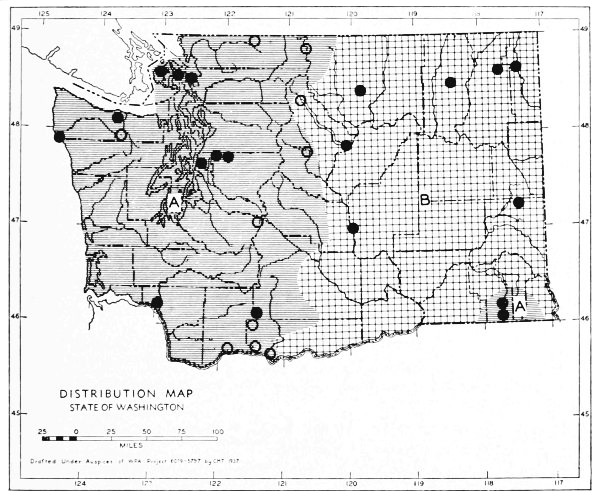
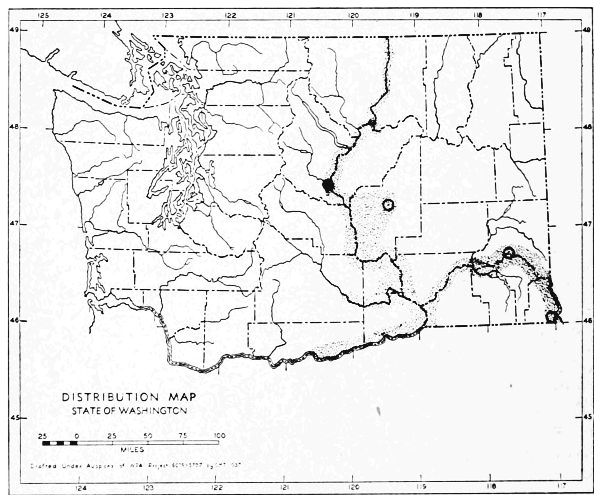
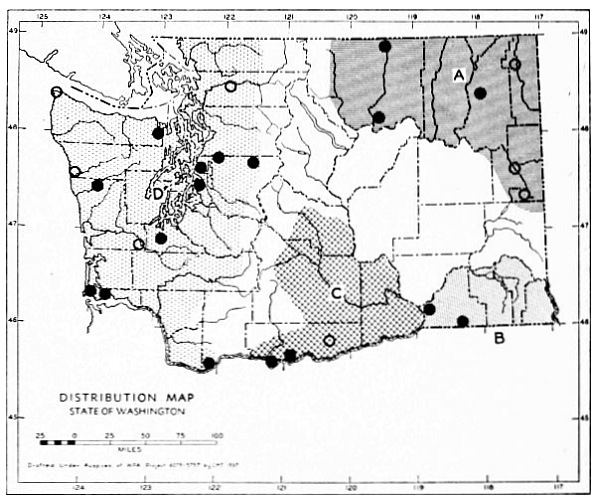
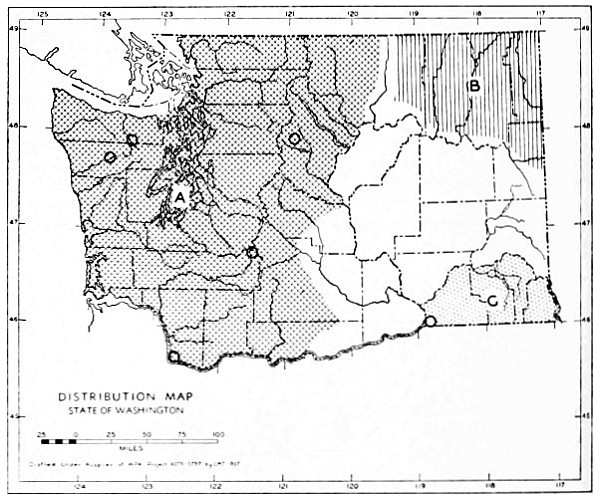
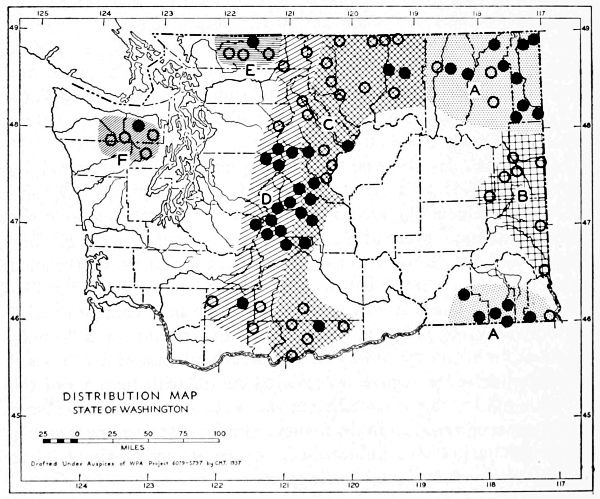
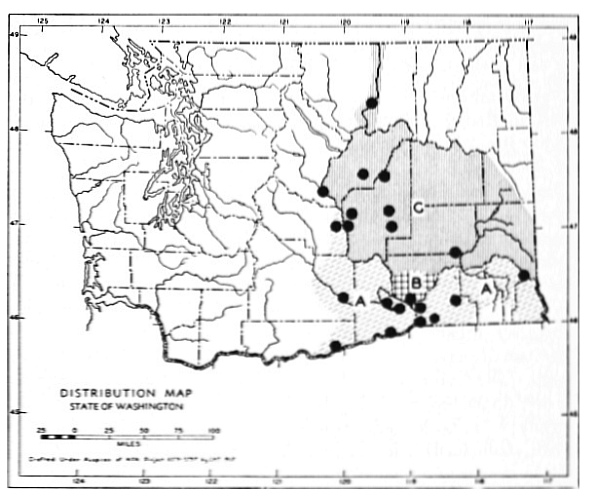
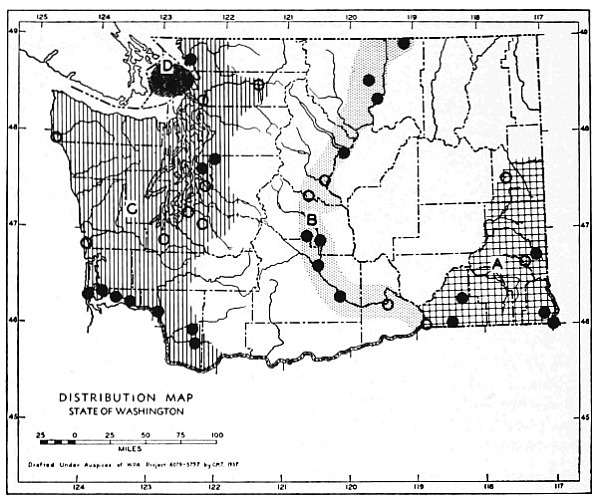
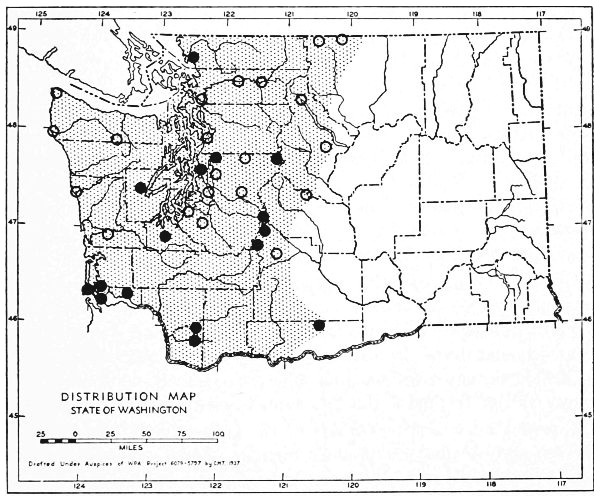
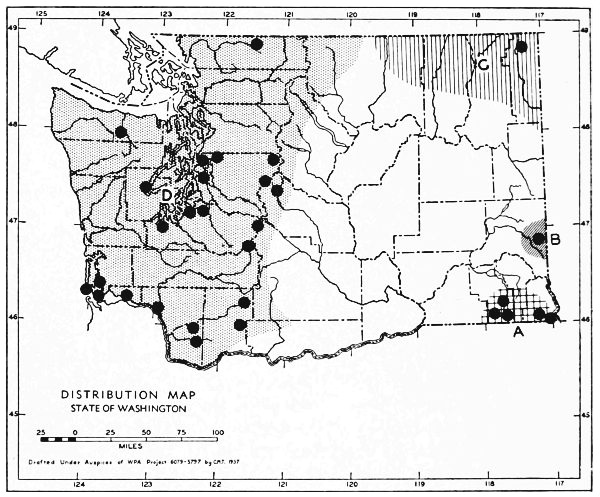
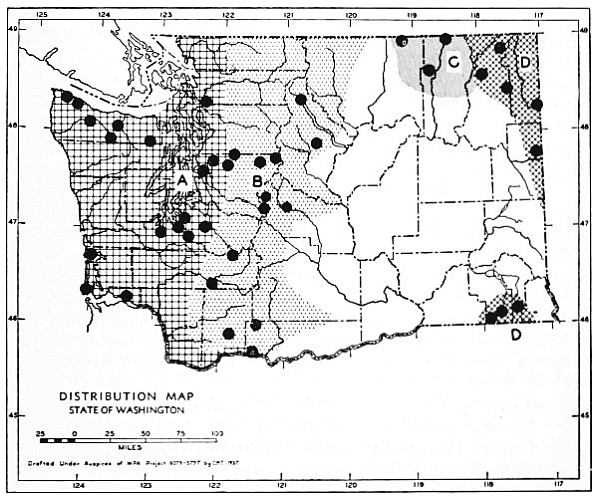
Fig. 26.
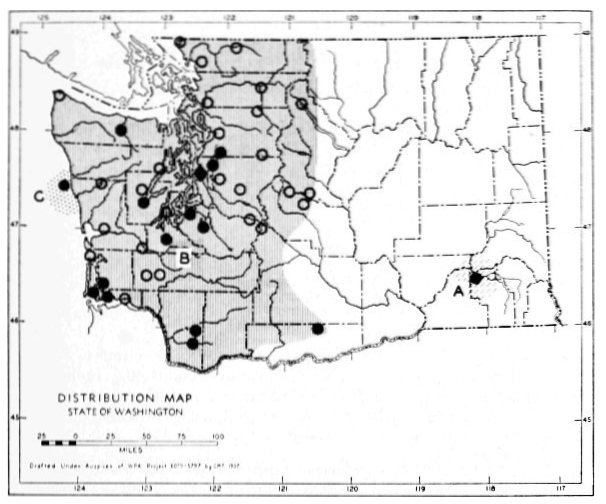
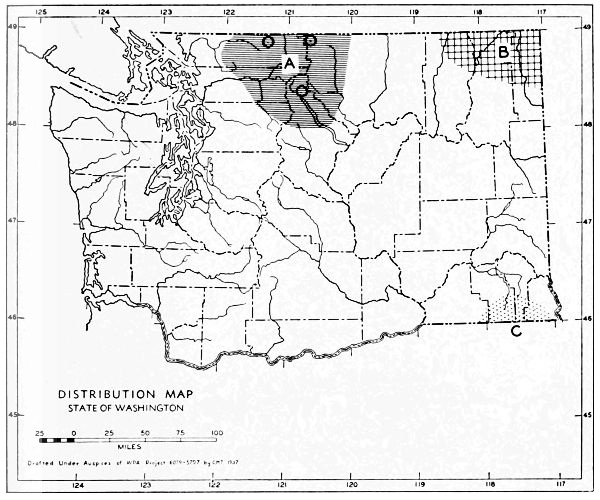
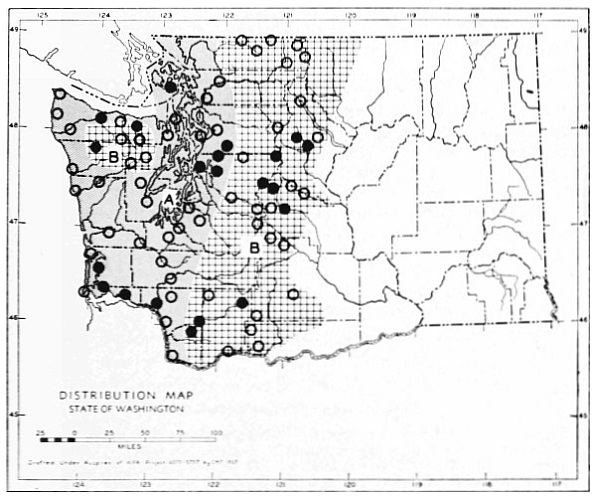
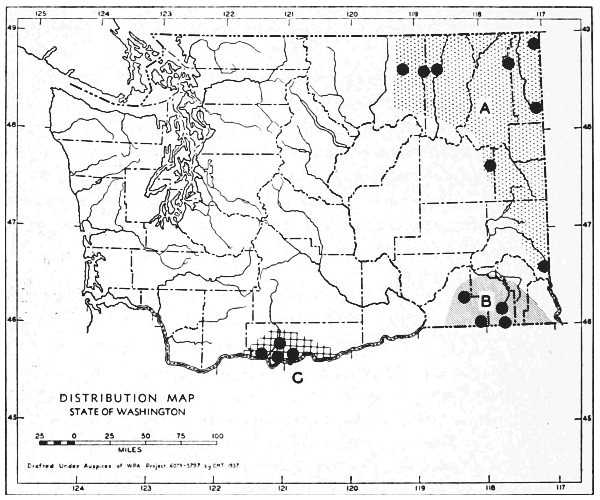
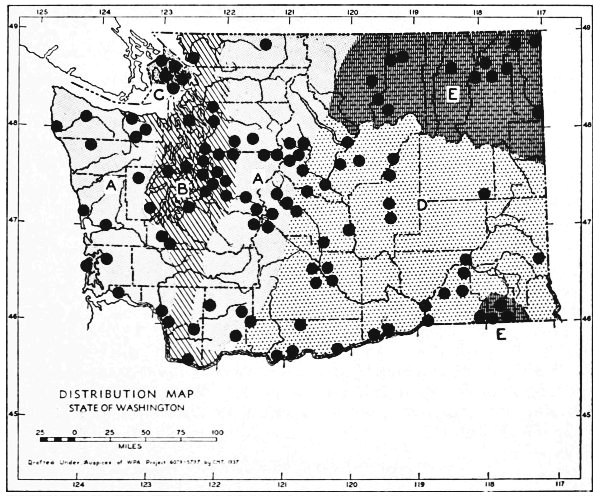
Distribution of the coast mole in Washington. A. Scapanus orarius
orarius. B. Scapanus orarius yakimensis. C. Scapanus orarius schefferi.
The coast mole seems to breed very early in the spring. Males
with swollen testes are found late in January. The young usually
number four and are born in late March or early April. The breeding
season seems to be the same as that of townsendii but the number
of young to a litter may average slightly greater.
Scapanus orarius True. Proc. U. S. Nat. Mus., 19:52, December 21, 1896.
Scapanus orarius orarius Jackson, N. Amer. Fauna, 38:61, September 30, 1915.
Type.—Obtained at Shoalwater (= Willapa) Bay, Pacific County, Washington,
by J. G. Cooper on August 30, 1855; type in United States National
Museum.
Racial Characters.—Color dark bluish; frontal region of skull not inflated.
Measurements.—Eight males and two females from Seattle, King County,
average, respectively: total length 159, 155; length of tail 33, 31; hind foot
20.7, 20.5; weight 58.5, 55.8.
Distribution.—Western Washington. Marginal occurrences are: Skykomish
(B.S.C.), Merritt (B.S.C.), Wenatchee (B.S.C.), Lester (Jackson, 1915: 64)
and Yacolt (M.V.Z.).
Scapanus orarius yakimensis Dalquest and Scheffer, Murrelet, 25:27, September 19, 1944.
Type.—Obtained 3/4 mile north of Union Gap, Yakima County, Washington,
by J. A. Gray, Jr., on July 3, 1941; type in Museum of Vertebrate Zoölogy.
Racial Characters.—Color pale, grayish; skull narrow with inflated frontal
region.
Measurements.—Six specimens (males and females) from Selah, Yakima
County, average: total length 164; length of tail 37; length of hind foot 21.5.
The type specimen weighed 58 grams.
Distribution.—The Yakima Valley area; recorded from the type locality
northwestward to Easton (B.S.C.).
Scapanus orarius schefferi Jackson, N. Amer. Fauna, 38:63, September 30, 1915.
Type.—Obtained at Walla Walla, Walla Walla County, Washington, by T.
H. Scheffer on August 8, 1914; type in United States National Museum.
Racial Characters.—Large size; pale color; large, wide skull with inflated
frontal area.
Measurements.—Six topotypes average: total length 159; length of tail 35;
hind foot 21.5.
Distribution.—Southeastern Washington; recorded from Fort Walla Walla
(Jackson, 1915: 64), Walla Walla (Jackson, 1915: 64) and Dayton (M.V.Z.).
Shrews have tiny eyes, almost concealed in the fur. The body is
slim; the nose elongate and pointed. The legs are short and the feet
small and weak. The fur is short but soft and posteriorly directed.
The cinereous shrew, for example, is about 4 inches in length, of
which the tail comprises 1-3/4 inches. The upper parts are dark
grayish brown and the underparts dull gray.
Shrews of the genus Sorex are cosmopolitan in distribution. In
North America they range from the arctic south to Central America.
Three subgenera are recognized by Jackson (1928: 27), all three of
which are represented in the state of Washington. The twelve subspecies
present occupy numerous habitats, and their ranges include
almost all of the state.
Jackson pointed out (1928: 1) that "No other group of American
mammals having a wide distribution, and in many localities
an abundance of individuals, is so little known to the nonprofessional
mammalogist as the long-tailed shrews." In Washington,
especially in the coastal area of western Washington,
shrews are widespread and abundant in many habitats. In some
places they are the most common mammal present. In spite of this
their presence is often unsuspected by persons that are otherwise
alert to the animal life around them. This is even more surprising
when one takes into account the facts that long-tailed shrews are
diurnal as well as nocturnal and are less apt to detect the presence
of man than are most other species of mammals.
An important factor making long-tailed shrews inconspicuous is
their small size, and contributing factors include their rapid movements
and dull colors. On several occasions the writer, after seeing
a long-tailed shrew vanish soundlessly under a log or into a patch of
dead leaves, was left wondering if one actually had been seen or if
instead his imagination had conjured up an animal from a dust mote
or wind-blown leaf.
The environment of the long-tailed shrews, except for the water
shrews, is the zone at the very surface of the earth, just beneath the
layer of moss, grass, dead leaves, and decaying vegetation. The
removal of the covering vegetative layer reveals a maze of tiny
tunnels, the branchings and complexities of which are infinite. Tiny
traps baited with oats or meat and set in these runways catch the
long-tailed shrews that inhabit them.
The food of long-tailed shrews is varied. It is principally soft-bodied
insects, insect pupae, and earthworms. At times a considerable
quantity of soft vegetation and some seeds are eaten. Recent
studies (Moore, 1940: 1942) have shown that by destroying seeds
some shrews may adversely affect the reforestation of some coniferous
trees. Shrews readily eat meat, and often destroy the small
mammals, including other shrews, taken in the mammal collector's
traps.
Hamilton (1940: 485) found that in one species of long-tailed
shrew in the United States individuals rarely lived more than one
year. This seems not to be true of at least some of the species found
in Washington.
Parasites, internal or external, are not commonly found on long-tailed
shrews. They are regularly eaten by owls and snakes, but
most carnivorous mammals, though they readily kill them, rarely
eat them.
The cinereous shrew ranges over most of Alaska, Canada and the
northern half of the United States. A number of subspecies have
been described, of which two have been reported from Washington.
The cinereous shrew is of medium size and difficult to distinguish
from the dusky and wandering shrews, especially in eastern
Washington, without studying the skulls. In cinereus the fourth
unicuspid tooth is smaller than the third; in vagrans and obscurus
it is larger. The relatively narrow rostrum of cinereus also serves
to separate it from the other two species.
The cinereous shrew seems to be less restricted to the vicinity of
streams and marshes than Sorex vagrans, resembling Sorex obscurus
and Sorex trowbridgii in this respect. In Washington it seems to
be rare and has not been taken by the writer. Published records
for Sorex c. cinereus indicate that this race is, in Washington, confined
to mountainous areas. The coastal race, streatori, seems to be
confined to the humid area.
Sorex arcticus cinereus Kerr. Anim. Kingd., p. 206, 1792.
Sorex cinereus cinereus Jackson. Jour. Mamm., 6: 56, February 9, 1925.
Type.—None. Name based on the account of a shrew seen at Fort Severn,
Canada, by J. R. Forster in 1772.
Racial characters.—Small size and pale color.
Measurements.—Seven males and 8 females from Indian Point Lake, British
Columbia, average, respectively: total length 99, 95; length of tail 43.5, 42.2;
hind foot 12.7, 12.3.
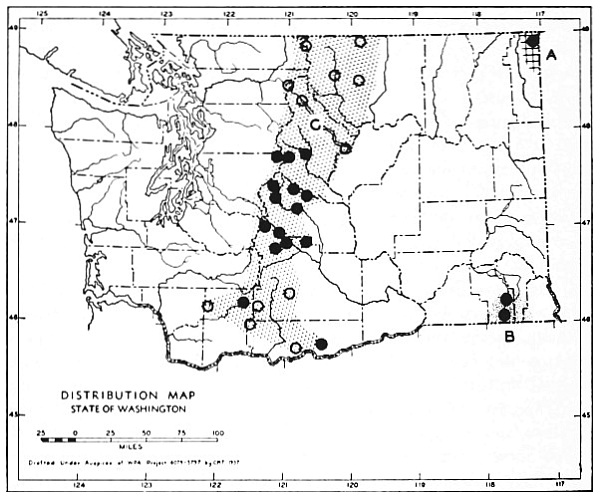
Distribution.—Northeastern Washington (Metaline and Loon Lake, Jackson,
1928: 49) and the Cascades from Whatcom Pass (Jackson, 1928: 55) southward
to Conrad Meadows (Jackson, 1928: 49). There is a specimen in the
collection of the California Academy of Sciences, from Mt. Rainier.
Remarks.—This is the most wide-ranging subspecies of shrew, being recorded
from Alaska, 10 Canadian provinces and 26 states (Jackson, 1928:
46-50). In the more northern and eastern parts of its range it is sometimes
the commonest shrew.
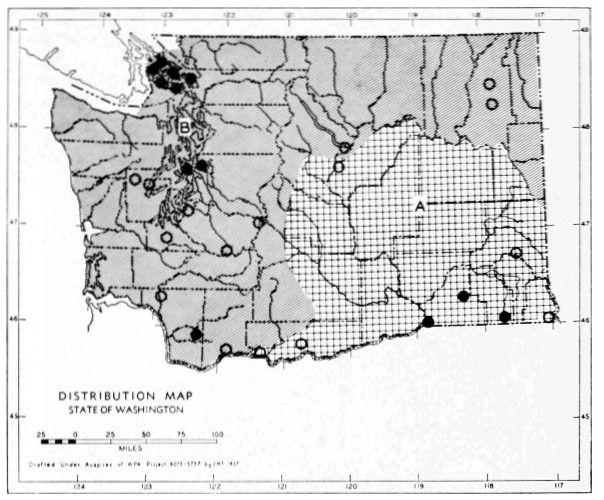
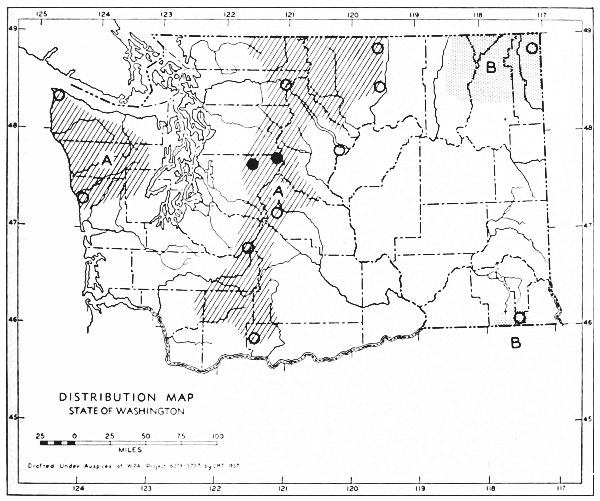
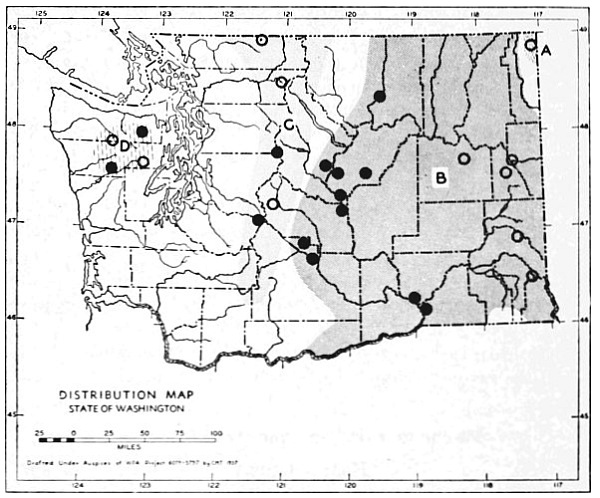
Fig. 27.
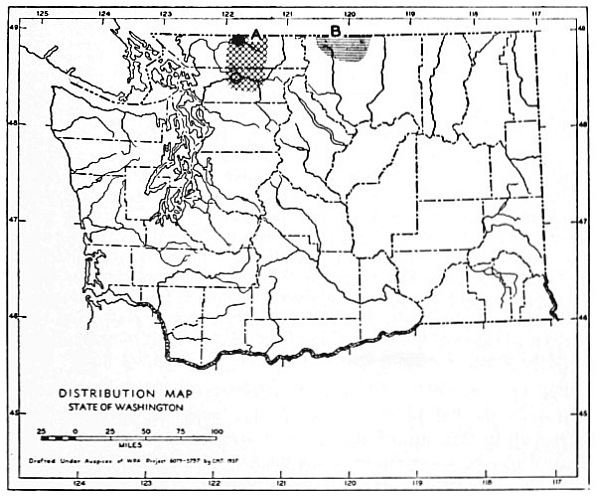
Distribution of the cinereous shrew in Washington. A. Sorex cinereus
cinereus. B. Sorex cinereus streatori.
Sorex personatus streatori Merriam. N. Amer. Fauna, 10:62, December 31. 1895.
Sorex cinereus streatori Jackson. Jour. Mamm., 6:56. February 9, 1925.
Type.—Obtained at Yakutat, Alaska, by C. P. Streator on July 9, 1895;
type in the United States National Museum.
Racial characters.—Larger and darker than Sorex cinereus cinereus.
Measurements.—Five females from Alta Lake, British Columbia, average:
total length 103; length of tail 45; hind foot 12.5.
Distribution.—The western part of the northern Cascades (Glacier, Jackson,
1928: 55) and the Olympic Peninsula (Neah Bay south to Cedarville, Jackson,
1928: 55).
Remarks.—This shrew seems to occupy the same range as Sorex obscurus
setosus but is rare where obscurus is common.
Sorex merriami Dobson. Monogr. Insectivora, pt. 3, fasc. 1, pl. 23, fig. 6, May, 1890.
Sorex merriami merriami Benson and Bond. Jour. Mamm., 20: 348, August 14, 1939.
Type.—Obtained on Little Bighorn River, about a mile and a half above
Fort Custer, Crow Indian Reservation, Montana, by Charles E. Bendire on
December 26, 1884; type in United States National Museum.
Measurements.—Of type: total length 90; length of tail 35; hind foot 11.5
(after Jackson, 1928: 80).
Distribution.—A single specimen of this rare shrew is known from Washington.
Jackson (1928: 81) states that it "was collected by George G. Cantwell,
November 18, 1919, at the entrance to an old badger digging on top of a
'high bunch grass hill' at Starbuck (altitude 645 feet), Columbia County,
Wash."
Description.—Similar to Sorex cinereus but upper parts pale grayish
and underparts white.
The Merriam shrew has been recorded from but a few localities in
the western United States. It is one of the rarest of the small mammals
known to occur in North America. All the known specimens
have been found in desert areas.
Description.—The Trowbridge shrew closely resembles the cinereous
shrew in body form but possesses a longer tail. The head and
body of adults measure about 2-1/4 inches and the tail about 2 inches.
The Trowbridge shrew may be separated from all other small shrews
that occur in Washington by its dark bluish upper parts and bluish
or slaty underparts. The tail is distinctly bicolor.
Trowbridge shrews occur from southern British Columbia south
to central California. Their distribution, to the south, is more
extensive than that of many members of the Pacific Coastal Fauna.
They are forest animals, ranging widely over the dry ground beneath
the fir forest, where they are usually the only shrews present.
They are abundant in ravines and in some swampy woods when
other shrews are absent, but they avoid open meadows or marshes.
Vertically, they occur from the humid division of the Transition
Life-zone to the Hudsonian Life-zone.
These little shrews do not live well in captivity and I have learned
relatively little concerning their habits from live specimens. They
seem to be slower-moving and less aggressive than the wandering
shrew. Population studies showed that the Trowbridge shrew is
unable to compete with the wandering shrew in ravine habitats
(Dalquest, 1941A: 173). The principal food of the Trowbridge
shrew includes soft-bodied insects and insect pupae.
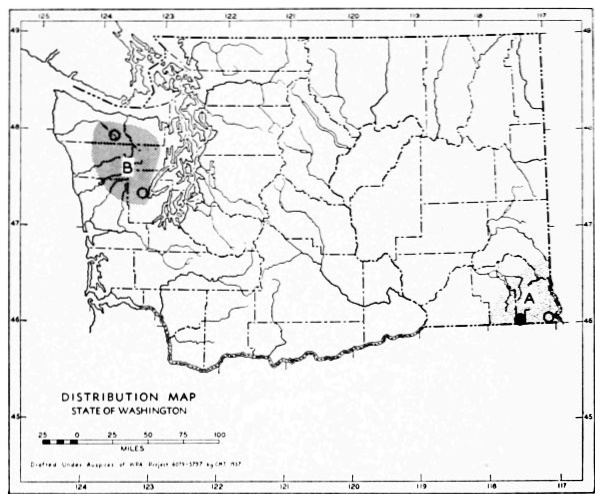
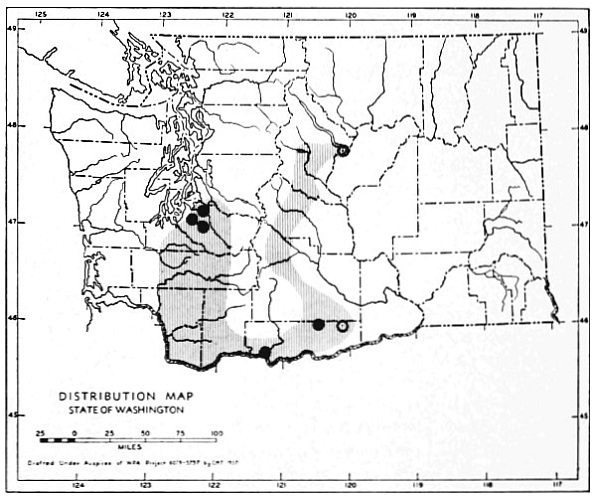
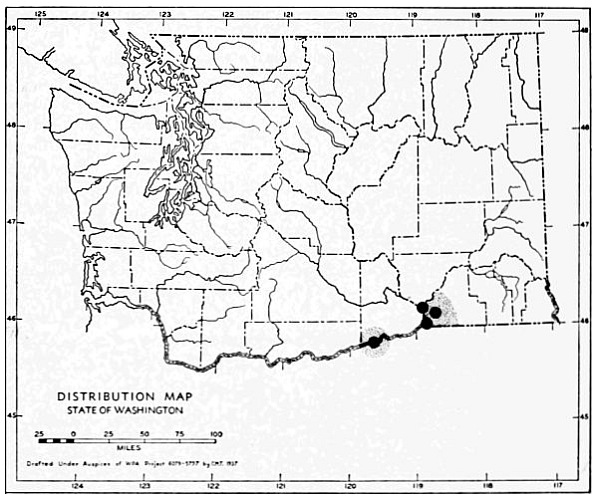
Fig. 28.
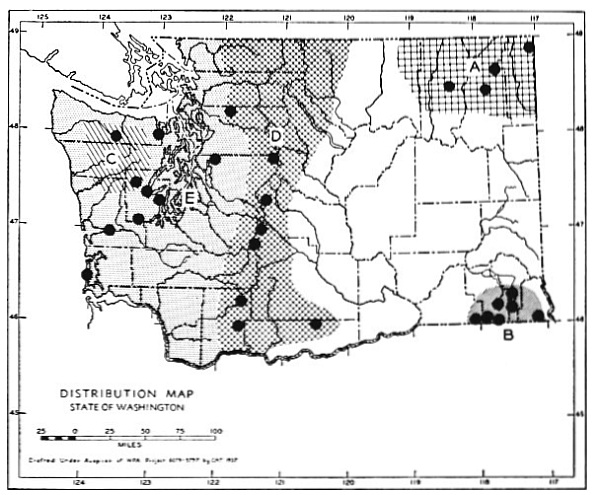
Distribution of the Merriam and Trowbridge shrews in Washington.
A. Sorex merriami merriami. B. Sorex trowbridgii trowbridgii. C.
Sorex trowbridgii destructioni.
Moore (1942) has shown that shrews eat the seeds of the Douglas
fir and may be a serious check on the reproduction of this important
tree. The Trowbridge shrew is the most abundant shrew in the fir
forests and probably constitutes the principal shrew that might be
classed as a pest.
A specimen containing 4 embryos was taken near Shelton, Mason
County, on April 23, 1937. Males with enlarged, greenish testes
were taken in April of 1938, 1939 and 1940. Specimens obtained
in other months showed no indications of breeding.
Sorex trowbridgii Baird, Rept. Pacific R. R. Survey, 8 (pt. 1):13, 1857.
Type.—Two cotypes were obtained at Astoria, Clatsop County, Oregon. The
skin of one (the lectotype) was entered in the U. S. National Museum catalogue
in July, 1855, and the skull in January, 1857. The other was obtained
by J. Wayne on July 10, 1855.
Racial characters.—Small size and narrow skull.
Measurements.—The average measurements of 38 adults from King County,
Washington, are: total length 115.3; length of tail 54.4; hind foot 13.4.
Distribution.—Forested areas from the Pacific Coast eastward through the
Cascades to Stehekin (Jackson, 1928: 96), 2 mi. S. Blewitt Pass (Jackson,
1928: 96) and Satus Pass (M.V.Z.).
Sorex trowbridgii destructioni Scheffer and Dalquest, Jour. Mamm., 23:334, August 13,
1942.
Type.—Obtained on Destruction Island, Jefferson County, Washington, by
V. B. Scheffer on April 22, 1941; type in United States National Museum.
Racial characters.—Large size and wide skull.
Measurements.—Thirty topotypes average: total length 122.5; length of
tail 56.7; hind foot 14.3; weight 7.5 grams.
Distribution.—Known only from Destruction Island, 35 acres in area, lying
4 miles off the Washington Coast.
Description.—This species closely resembles the cinereous shrew
in body form. Its head and body measure about 2-1/4 inches; the
tail slightly less than 2 inches. In summer the upper parts are reddish
brown and the underparts gray tinged with brownish. In winter
the upper parts are more dusky.
Several races of the wandering shrew range over western North
America from southwestern British Columbia south to southern
Mexico. Two races occur in the state of Washington.
Marshy areas and damp places are the habitat of the wandering
shrew. Cattail and tule marshes, sphagnum bogs, and meadows are
favored. They frequent streams through forests but rarely are taken
in places away from water. On some of the San Juan Islands, wandering
shrews were found along the beaches where they were feeding
on the amphipods that live in the dead seaweed and litter at the
high tide line. In a favorable habitat, wandering shrews may be
the most abundant mammal present. Specimens are occasionally
taken in 90 per cent or more of a mammal collector's traps.
The preference of the wandering shrew for damp areas makes it
more or less independent of life-zones, for marshy areas, whether
in Transition, Canadian, or Upper Sonoran life-zones, present comparable
ecological conditions.
Broadbrooks (1939: 65) found that captives taken at Seattle ate
rolled oats, apple, fresh or cooked meat, sow bugs, centipedes, earthworms,
frogs (Hyla regilla), a salamander (Plethodon vehiculum),
and small, black slugs (Arean arean). Wandering shrews proved incapable
of destroying snails (Helisoma occidentalis) and large slugs.
The captive shrews kept by Broadbrooks ate an average of 1.3 times
their own weight in food each day.
Fig. 29.
Distribution of the wandering shrew in Washington. A. Sorex
vagrans vagrans. B. Sorex vagrans monticola.
The wandering shrew changes from winter to summer pelage in
a few days, seemingly in the second week of October (Dalquest,
1944: 147). The spring molt occurs rapidly but perhaps at a less
regular date. Rarely a midsummer molt occurs.
The earliest evidence of breeding in a wandering shrew was discovered
on January 27, 1937. Most adult females taken in February,
March, April and May were pregnant. Embryos were less often
found in summer and fall, but one pregnant female was taken in
November. Embryos varied in number from 3 to 8 with an average
of six.
Sorex vagrans Baird, Rept. Pacific R. R. Survey, 8 (pt. 1):15, 1857.
Sorex suckleyi Baird, Rept. Pacific R. R. Survey, 8 (pt. 1):18, 1857 (type from Steilacoom
Pierce County, Washington).
Type.—Obtained at Willapa Bay [Shoalwater Bay], Pacific County, Washington,
by J. G. Cooper; entered in U. S. Nat. Mus. catalogue on October
23, 1856.
Racial characters.—Dark color.
Measurements.—Twenty-five males and 25 females from Seattle, King
County, average, respectively: total length 110.5, 107; length of tail 44.6, 45;
hind foot 12.4, 12.4.
Distribution.—This is the common marsh shrew of western Washington and
occurs from the Pacific Ocean east to the Cascades at Lake Keechelus (W.S.M.)
and 15 mi. NW White Salmon (Jackson, 1928: 106).
Sorex monticolus Merriam, N. Amer. Fauna, 3:43, September 11, 1896.
Sorex vagrans monticola Merriam, N. Amer. Fauna, 10:69, December 31, 1895.
Type.—Obtained on San Francisco Mountain, 1150 ft. altitude, Coconino
County, Arizona, by C. H. Merriam and V. Bailey on August 28, 1889; type
in United States National Museum.
Racial characters.—Pale color.
Measurements.—Five males and 5 females from Selah, Yakima County,
average, respectively: total length 100, 98.4; length of tail 40.6, 39.2; hind
foot 12.2, 12.
Distribution.—Eastern Washington. The range of this shrew extends west
to Bauerman Ridge (Jackson, 1928: 113), Merritt (W.W.D.) and Maryhill
(M.V.Z.).
Remarks.—A series of shrews from Moses Lake, Grant County, differs from
monticola in larger size and darker color. They agree rather closely with
Sorex r. amoenus from California and Nevada. Because they are isolated
from that subspecies it seems best to consider them a microgeographic race
referable to monticola.
Description.—The dusky shrew is similar in form of body to the
cinereous shrew. The length of head and body is about 2-1/4 inches.
The tail is about 2-1/2 inches. The upper parts are rusty or reddish
brown. The underparts are brownish gray. The dusky shrew differs
from the wandering shrew in possessing a slightly longer body
and longer tail, but in eastern Washington the two species are almost
indistinguishable.
Dusky shrews range from northern Alaska to southern New Mexico,
and from the Rocky Mountains to the Pacific Ocean. Thirteen
subspecies are recognized by Jackson (1928: 115), of which two
occur in Washington.
Records of the dusky shrew are not available from the arid subdivision
of the Transition or the Upper Sonoran life-zones. It occurs
sparingly in the humid subdivision of the Transition and is
common in the Canadian and Hudsonian life-zones.
The habitat of the dusky shrew is varied. Near Seattle, King
County, several specimens were trapped in marshes where Sorex
vagrans was abundant. Near Stevens Pass, King County, two were
taken in a marsh; two others were trapped in a dry, coniferous
forest; one was taken in a small bed of heather on a barren mountain
top; and another was found dead in a pan of pancake batter in
camp. Two specimens were trapped along a small stream at Dewey
Lake, Mt. Rainier, Yakima County. Four specimens were caught
in traps set in a talus slope on a dry hillside at the North Fork of
the Quinault River, Jefferson County. Three others were trapped
in dense, rain-forest thickets along the ocean at La Push, Jefferson
County. These records indicate that the dusky shrew has a wider
environmental range than other Washington shrews. Despite this
wide range of tolerance the dusky shrew is common only locally,
except in the Hudsonian Life-zone.
Little is known of the habits of dusky shrews but they seem to
be as diurnal as they are nocturnal. At Wolf Bar, North Fork of
the Quinault River, Jefferson County, a dusky shrew was seen on
the packed-earth floor of an old trapper's cabin. A hat was carefully
dropped over the live animal but, when the hat was lifted,
the shrew was found dead. In an old cabin at Stevens Pass, King
County, a dusky shrew was found dead one morning in a pan of
flapjack batter prepared the evening before. As this pan was on a
table about three feet from the floor, the shrew must have climbed
to the table by way of the rough cabin wall, but how the animal
managed to scale the side of the pan is a mystery.
Slipp (1942: 211) discovered the nest of a dusky shrew between
Round Pass and Lake George, 4200 feet elevation, in Mt. Rainier
National Park, on July 25, 1937. The nest was in a rotten fir log
20 inches in diameter. The nest, a ball of dry grass the size of a
man's fist, had no central cavity or passages, the occupants "merely
pushed through wherever they wished." Seven young shrews were
found in and near the nest. Though the eyes of the young were
still closed, they were able to creep about and squeal.
A specimen obtained 5 miles west-southwest of Guler, Skamania
County, contained 4 embryos on July 10, 1939.
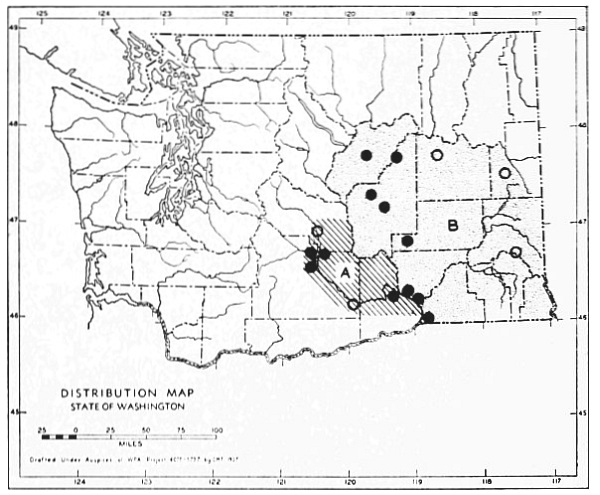
Fig. 30.
Distribution of the dusky shrew in Washington. A. Sorex obscurus
obscurus. B. Sorex obscurus setosus.
Sorex vagrans similis Merriam, N. Amer. Fauna, 5: 34, July 30, 1891 (not of Hensel, 1855).
Sorex obscurus Merriam, N. Amer. Fauna, 10: 72, December 31, 1895 (substitute for similis
Merriam).
Type.—Obtained on Timber Creek, 8,200 ft., Lemhi Mountains, Lemhi
County, Idaho, by V. Bailey and B. H. Dutcher on August 26, 1890; type in
United States National Museum.
Racial characters.—Tail relatively short, color pale.
Measurements.—Thirteen males and 10 females from Indian-point Lake,
British Columbia, average, respectively: total length 105, 107; length of tail
45, 46; hind foot 13.3, 13.3.
Distribution.—Northeastern Washington west, according to Jackson (1928:
122), to Pasayten River, Stehekin and Wenatchee. Because specimens from
Tye, King County, and Mt. Stuart, Easton and Lake Keechelus are clearly
referable to S. o. setosus, the specimens recorded by Jackson (1928: 122),
from Easton and Signal Peak, are mapped in the range of setosus.
Sorex setosus Elliot, Field Columb. Mus. Publ. 32. zoöl, ser., 1:274. March, 1899.
Sorex obscurus setosus Jackson, Proc. Biol. Soc. Washington. 31:127. November 29, 1918.
Sorex obscurus bairdi Jackson, N. Amer. Fauna, 51:140. July 24, 1928.
Type.—Obtained at Happy Lake, Clallam County, Washington, by D. G.
Elliot on August 18, 1898; type in Field Museum of Natural History.
Racial characters.—Tail long, color dark.
Measurements.—Twelve males and 17 females from southwestern Washington
average, respectively: total length 118, 119; length of tail 53, 53; hind
foot 13.8, 13.7; weight 6.6, 5.2 grams.
Distribution.—Western Washington, east through the Cascades to Barron
(Jackson, 1928: 137), Cascade River (Jackson 1928: 137) and Satus Pass
(W. W. D.).
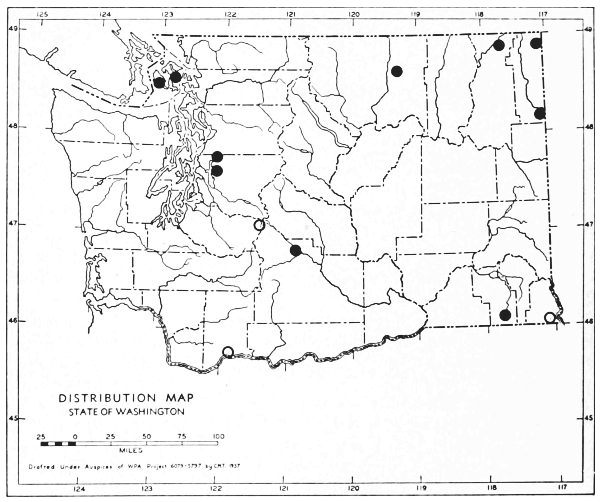
Fig. 31.
Distribution of the mountain water shrew. Sorex palustris navigator,
in Washington.
Neosorex navigator Baird, Rept. Pacific R. R. Survey, 8 (pt. I): 11, 1857.
Sorex (Neosorex) palustris navigator Merriam, N. Amer. Fauna, 10:92, December 31, 1895.
Sorex palustris navigator Stephens, California Mammals, p. 254, June, 1906.
Type.—Obtained at head of Yakima River, Kittitas County, Washington,
by J. G. Cooper on August 31, 1853; type in United States National Museum.
Measurements.—Two males and 4 females from Washington average, respectively:
total length 150, 150; length of tail 70, 74; hind foot 18.5, 20;
weight?, 11.0 grams.
Distribution.—Mountainous areas of entire state, including the Olympic
Mountains, from Elwah (Jackson, 1928: 188) south to Quinault River (Jackson,
1928: 189); the Cascades from Tomyhoi Lake (W. W. D.) south to 15
mi. N. Carson (Jackson, 1928: 189); northeastern Washington from Shovel
Creek (W. W. D.) south to Gifford (Jackson, 1928: 189); the Blue Mountains
at Godman Springs (M. V. Z.) and Hompeg Falls (M. V. Z.).
Description.—In general form of body the mountain water shrew
resembles the cinereous shrew but is perhaps more stocky. It is a
large shrew, nearly as large as a house mouse. The head and body
measure about 3 inches; the tail also is about 3 inches long. The
fur is exceedingly soft. The upper parts are blackish in color, lightly
frosted with paler hairs. The underparts, from throat to vent, are
whitish tinged with gray or brown. The stiff, curved fringe of
bristles on the outer part of the hind foot serves as an aid in swimming.
Mountain water shrews range over much of Canada and in mountainous
areas of the western United States extend south to Arizona.
The subspecies found in Washington ranges over all of the western
United States.
The mountain water shrew is primarily a mammal of the Hudsonian
and Canadian life-zones. It sometimes descends to the
Transition Life-zone along clear, cold streams where conditions are
similar to those in the Canadian Life-zone.
The favored habitats of the mountain water shrew are the clear,
cold streams of the alpine cirques and gushing streams on the mountain
sides. In the pools and waterfalls, and among the rocks and
mosses that border them, the larvae of aquatic insects, upon which
the mountain water shrew feeds, are abundant. Svihla (1934: 45)
observed that the fur of a swimming water shrew gathered air bubbles
and "it had difficulty in forcing its way down to the bottom
[of an aquarium]. On reaching the bottom it literally stood on its
long flexible nose which was thrust into the sand and debris, searching
for food, its feet kicking rapidly in order to maintain this position.
A change in direction was brought about by a twist of the
body. To come to the surface again it merely stopped kicking and
immediately rose like a cork." The buoyancy of the water shrew
allows it to float in the water, like a duck. Jackson (1928: 9)
observed a water shrew run across the surface of a small pool.
Near Stevens Pass a water shrew dashed from under a stone and
ran, did not swim, across the surface of a small, deep pool to escape
in a burrow on the other side. According to Jackson, an air bubble
held in each foot supports the shrew on the surface of the water.
A mountain water shrew observed at Shovel Creek, Ferry County,
was as agile on land as any other species of shrew. In summary,
water shrews are able to swim, dive, float like a duck, and walk on
the surface of the water as well as walk on land.
The food of the mountain water shrew includes snails, leeches,
and the larvae of aquatic insects. Mice caught in traps are sometimes
eaten by water shrews. Svihla (loc. cit.) found a captive
water shrew unable to capture pollywogs and minnows kept in the
same aquarium.
Description.—The Bendire water shrew is similar in form of body
to the cinereous shrew but possesses a more stocky body which, with
the head, measures about 3-1/2 inches long; the tail is about 2-3/4 inches
long. The Bendire water shrew closely resembles also the mountain
water shrew but has a longer body and shorter tail. The upper
parts are blackish in color, not lightly frosted with gray hairs. The
hind feet lack the fringe of stiff, curved bristles characteristic of
the mountain water shrew. The underparts are black in the race
S. b. bendirii. In the race albiventer the throat is blackish but the
abdomen is pale gray tinged with brownish.
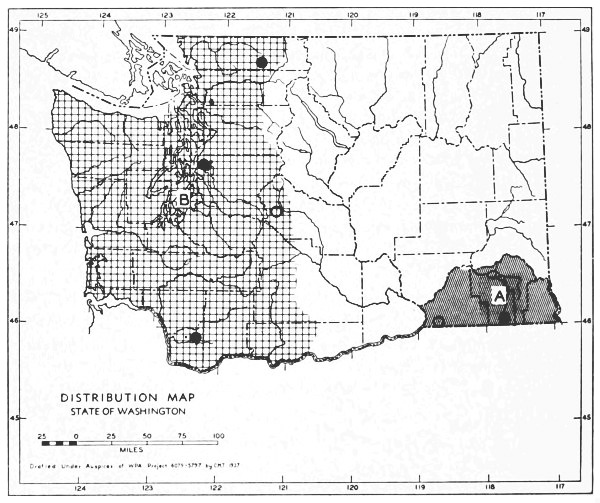
Fig. 32.
Distribution of the Bendire water shrew and the pigmy shrew in
Washington. A. Sorex bendirii bendirii. B. Sorex bendirii albiventer. C.
Microsorex hoyi washingtoni.
Bendire water shrews are restricted to the Pacific Coast of North
America from southern British Columbia to northern California.
Generally they are found at elevations lower than are mountain
water shrews. They are typically mammals of the humid division
of the Transition Life-zone but often occur in the Canadian Life-zone.
They occupy marshes, swamps, damp ravines, and the banks
of slow-moving streams. Little is known of their habits, except
what has been deduced from the circumstances of their capture.
They seem less aquatic than the mountain water shrew. Near Jackson
Guard Station on the Hoh River, Jefferson County, one was
taken by setting traps on dense beds of water cress that floated in
a slow-moving stream. The animal must have swum or walked on
the surface of the mat of vegetation. Near Paradise Lake, King
County, several were caught in a deep, dark, red cedar swamp. One
was caught in a marsh nearby. Nothing is known of the food habits
of the Bendire water shrew.
Atophyrax bendirii Merriam, Trans. Linn. Soc. New York, 2:217, August 28, 1884.
Atophyrax Bendirei True, Proc. U. S. Nat. Mus., 7 (1884):606, 1885.
Sorex bendirii Dobson, Monog. Insectivora, part 3, fasc. 1, pl. 23, 1890.
Neosorex bendirii bendirii Miller, U. S. Nat. Mus. Bull., 79:22, December 31, 1912.
Type.—Obtained approximately 1 mile from Williamson River, 18 miles
southeast of Fort Klamath, Klamath County, Oregon, by C. C. Bendire on
August 1, 1882; type in United States National Museum.
Racial characters.—Underparts everywhere sooty black.
Measurements.—Ten males and 10 females from southwestern Washington
average, respectively: total length 163.9, 161.0; length of tail 71.0, 72.6; hind
foot 20.5, 20.3; weight 16.8, 14.5 grams.
Distribution.—The southern Cascades and the lowlands of western Washington,
exclusive of the Olympic Peninsula. Marginal localities on the west
include Mt. Vernon (Jackson, 1928: 196), Bothell (W.S.M.), Renton (M.V.Z.),
Puyallup (W.W.D.), Steilacoom (Jackson, 1928: 196) and Oakville
(Jackson, 1928: 196).
Sorex (Atophyrax) bendirii albiventer Merriam, N. Amer. Fauna, 10:97, December 31, 1895.
Neosorex bendirii albiventer Miller, U. S. Nat. Mus. Bull., 79:22, December 31, 1912.
Sorex bendirii albiventer Jackson, N. Amer. Fauna, 51:198, July 24, 1928.
Type.—Obtained at Lake Cushman, Mason County, Washington, by C. P.
Streator on July 7, 1894; type in United States National Museum.
Racial characters.—Area on abdomen whitish.
Measurements.—A male from near the type locality measures: total length
167; length of tail 69; hind foot 22. One from Potlatch, Mason County,
measures 167; 69; 22.
Distribution.—The Olympic Peninsula of Washington. Marginal localities
on the south are: Potlatch (M.V.Z.) and Lake Quinault (Jackson, 1928: 199).
Microsorex hoyi washingtoni Jackson, Proc. Biol. Soc. Washington, 38:125, November 13,
1925.
Type.—Obtained at Loon Lake, Stevens County, Washington, by V. Bailey
on September 26, 1897; type in United States National Museum.
Measurements.—Of type: total length 89; length of tail 27; hind foot 9.
Distribution.—In Washington, known only from the type specimen which
was "found dead in a trail in dry pine woods" (Jackson, 1928: 4).
Description.—The pigmy shrew is similar in form of body to the
cinereous shrew but smaller. The head and body are about 1-3/4
inches in length; the tail is about 1 inch long. The upper parts are
reddish brown and the underparts are gray.
These tiny mammals range widely across central Canada and
northern United States from the Atlantic nearly to the Pacific, and
north to central Alaska. A single species is known, one race of
which occurs in Washington. The subspecies is known from but
two specimens: the type and an individual from Montana (Koford,
1938: 372.)
Description.—The genus Myotis may be separated from all other
bats that occur in Washington by the presence of 38 teeth (dental
formula i. 2-2/3-3, c. 1-1/1-1, p. 3-3/3-3, m. 3-3/3-3 = 38). Their small size separates them
from all other genera save Pipistrellus, from which Myotis may be
distinguished by the straight, rather than hooked, anterior border of
the tragus. Species of Myotis found in Washington vary considerably
in size, but all are less than 100 mm. in total length. The upper
parts are various shades of brown in color. The ears, when laid
forward, always extend to the nostrils or beyond.
This genus is one of the most widely ranging groups of Recent
mammals. It occurs on all continents, including Australia and
many of the larger islands. Of the 19 American species recognized
by Miller and Allen (1928), eight occur in the state of Washington.
They are low-flying forms and as a rule appear relatively late in
the evening. Their flight is rapid and erratic. They often hunt over
the surfaces of streams, pools, and lakes. Some kinds hunt in the
shade of forest trees and these are especially difficult to collect.
Others hunt the brushy canyons and coulees of the desert areas of
eastern Washington.
Grinnell (1918: 241-242) points out that, although bats are not
subject to isolation by topographic barriers, as most wingless mammals
are, they may be restricted by ecologic barriers in the same
way as are other small mammals. This is particularly true of
Myotis in Washington. Of the eight species in the state, five are
represented by one subspecies west of the Cascade Mountains and
another, paler subspecies in the more arid country east of the
Cascades.
The mobility of bats makes it difficult to determine their origin
and migrational history. Five of the Myotis found in Washington
seem to belong to the Pacific Coastal Fauna, and to have been isolated
south of the last continental glacier. Complete isolation is
unlikely as these species occur in the Cascade Mountains as well
as in the Pacific Coastal Faunal Area, and three occur also in the
Blue Mountains of southeastern Washington. The differentiation
of the Coastal type of Myotis may have come about through habitat
selection, of the type discussed by Miller (1942: 25). One western
Washington Myotis (M. keenii) seems to belong to a northern fauna,
and to have extended its range south to Washington. All seven
species of the desert-living Myotis found in eastern Washington
have subspecies which seem to have been derived from the Great
Basin Faunal Area.
Myotis lucifugus is represented by two geographic races in Washington.
The species ranges across Canada and the United States,
from the Atlantic to the Pacific and from the northern limit of tree
growth to southern Mexico.
Fig. 33.
Distribution of the big myotis in Washington. A. Myotis lucifugus
alascensis. B. Myotis lucifugus carissima.
It usually proves rather difficult to separate Myotis lucifugus, on
the basis of external features, from other species with which it may
occur. Its large foot (9-10 mm.), short ear (when laid forward not
extending past nose) and the absence of a keel on the calcar
separate it from all species except Myotis yumanensis. From the
latter species, lucifugus may be distinguished by the gradually
rather than abruptly rising forehead, as seen in cleaned skulls, and
by more shiny, metallic color of fur.
Little is known of the habits of this bat in Washington. It usually
appears after dusk, and most specimens are shot over ponds or lakes,
where the reflection of light from the sky on the water allows the
hunter enough light to sight a gun. A few specimens were collected
in deep forests. Its flight and feeding habits are not known to differ
from those of other species with which it was associated, except
at the south end of Lake Chelan, Chelan County, where two individuals
were shot as they hovered near the tops of pine trees and
seemed to be picking insects from the branches. I have never found
this bat in its daytime retreat.
A specimen taken at Sportman's Lake, San Juan County, held one
embryo on June 26, 1938.
Myotis (Leuconoë) carissima Thomas, Ann. and Mag. Nat. Hist., 13 (ser. 7): 383, May,
1904.
Myotis lucifugus carissima Cary, N. Amer. Fauna, 42:43, October 3, 1917.
Type.—Obtained at Yellowstone Lake, Yellowstone National Park, Wyoming
by J. Darling in September, 1903; type in British Museum.
Racial characters.—Color pale, rather "brassy" in tone; distal border of
interfemoral membrane paler than proximal part.
Measurements.—Four specimens from eastern Washington average: total
length 77; length of tail 33; hind foot 11; ear 13; height of tragus 7.3.
Distribution.—East of the eastern base of the Cascade Mountains, save
for the Blue Mountains of southeastern Washington. Western records are
Stehekin (Miller and Allen, 1928: 52) and Vantage (W. W. D.)
Myotis lucifugus alascensis Miller, N. Amer. Fauna, 13:63, October 16, 1897.
Vespertilio gryphus lucifugus Allen, U. S. Nat. Mus. Bull., 43:78, March 14, 1894 (part
specimens from Washington).
Type.—Obtained at Sitka, Alaska, by C. P. Streator on August 5, 1895;
type in United States National Museum.
Racial characters.—Color dark, almost bronze; wing and tail membranes
uniformly dark in color.
Measurements.—Five specimens from San Juan County, Washington,
average: total length 80.9; length of tail 32.1; hind foot 12; ear 12; height
of tragus 7; weight 5.4 grams.
Distribution.—From the eastern base of the Cascade Mountains west of the
Pacific, and the Blue Mountains of southeastern Washington. Marginal occurrences
listed by Miller and Allen (1928:49) are Chilliwack River, Lake
Wenatchee, and Lyle.
Description.—The present species closely resembles Myotis lucifugus
and specimens in worn pelage can not be distinguished from
that species unless the cleaned skulls are examined. In fresh
pelage, yumanensis is duller than lucifugus.
Myotis yumanensis ranges from southern British Columbia to
central Mexico west of the Mississippi River. Four races are
recognized by Miller and Allen (1928: 62).
Fig. 34.
Distribution of the Yuma myotis in Washington. A. Myotis yumanensis
saturatus. B. Myotis yumanensis sociabilis.
The habits of Myotis yumanensis and Myotis lucifugus appear to
be the same. In Washington the two species are commonly found
together. In western Washington, Myotis yumanensis seems to be
more common than Myotis lucifugus.
In the San Juan Islands a yumanensis was found hiding in the
attic of an old cabin on Blakeley Island. A specimen of long-eared
bat was taken at the same place. Another Yuma myotis was caught
behind a door of a mill on Blakeley Island (Dalquest, 1940: 4).
This species shares with Myotis californicus the habit of apparently
drinking salt water.
A specimen obtained at Sportsmans Lake, San Juan County, held
one embryo on June 27, 1938. One from Peavine Pass, Blakeley
Island, San Juan County, held one embryo on June 22, 1939.
Myotis yumanensis sociabilis H. W. Grinnell, Univ. California Publ. Zoöl., 12:318, December
4, 1914.
Type.—Obtained at old Fort Tejon, Kern County, California, by J. Grinnell
on July 23, 1904; type in Museum of Vertebrate Zoölogy.
Racial character.—Color pale.
Measurements.—Two males and 2 females from Selah, Yakima County, average:
total length 78; length of tail 36; hind foot 10; ear 14; height of
tragus 7.
Distribution.—Eastern Washington generally. Marginal records on the west
are: Stehekin (Miller and Allen, 1928: 69), and Selah (W.W.D.).
Fig. 35.
Distribution of the fringe-tailed myotis and the Keen myotis in
Washington. A. Myotis thysanodes thysanodes. B. Myotis keenii keenii.
Myotis yumanensis saturatus Miller, N. Amer. Fauna, 13:68, October 16, 1897.
Type.—Obtained at Hamilton, Skagit County, Washington, by T. S. Palmer
on September 13, 1889; type in United States National Museum.
Racial character.—Color dark.
Measurements.—Eighteen adults of both sexes from San Juan County,
Washington, average: Total length 78.2; length of tail 34.4; hind foot 10.1;
ear 15; height of tragus 7.4; weight 5.9 grams.
Distribution.—From the eastern base of the Cascade Mountains to the
Pacific. This is the commonest Myotis found in western Washington. Marginal
localities are: Hamilton (Miller and Allen, 1928: 71), and Goldendale
(Miller and Allen, 1928: 71).
Vespertilio subulatus keenii Merriam, Amer. Nat., 29:860, September, 1895.
Myotis subulatus keenii Miller, N. Amer. Fauna, 13:77, October 16, 1897.
Myotis keenii keenii Miller and Allen, U. S. Nat. Mus. Bull., 144:104, May 25, 1928.
Type.—Obtained at Masset, Graham Island, Queen Charlotte Islands, British
Columbia, by J. H. Keen in 1894; type in United States National Museum.
Measurements.—Miller and Allen (1928: 109) list the measurements of a
male from Sol Duc Hot Springs, Clallam County, and a specimen of unknown
sex from Lake Cushman, Jefferson County, as, respectively: total length 89,
87; length of tail 34, 36; hind foot 8.4, 7.4; ear?, 14.6.
Distribution.—Only the Olympic Peninsula, where it has been recorded by
Miller and Allen (1928: 104) from Sol Duc Hot Springs and Lake Cushman.
Description.—Myotis keenii is similar, in general, to Myotis lucifugus
and Myotis yumanensis, but the ears are longer and when laid
forward reach about 4 mm. past the nose rather than ending at the
nostrils. The foot is of medium size (about 8 mm.) and no keel is
present on the calcar.
The distribution of this species is given by Miller and Allen (1928:
101) as "northern North America from the limits of tree growth
south in the east to South Carolina and Arkansas, and in the west
to northwestern Washington."
I have not observed this bat in Washington and know nothing of
its habits. Its distribution is most unusual. Its range seems to lie
only in the glaciated area of western British Columbia and northern
Washington.
Description.—The distinguishing feature of Myotis evotis is its
long ears, which, when laid forward, reach 5 mm. in front of the
nose. Myotis thysanodes and Myotis keenii, other species in which
the ears are rather long, have the ears ending less than 5 mm. anterior
to the nose when laid forward. The foot of Myotis evotis is
of moderate size (8 to 9 mm.).
This species ranges over the western United States, from British
Columbia to central Mexico. Two subspecies of this interesting bat
are recognized, both of which occur in Washington.
Though I have hunted for this species of bat in Washington on
numerous occasions, I have taken no specimens. In the summer of
1939, Myotis identified as this species because of their large ears,
were seen flying at midnight in the light of searchlights over Lake
Washington Canal at Seattle. Mary Greer gave us a specimen
which was struck by her auto near Baker Lake, Whatcom County.
According to Miss Greer, the specimen was seen "hovering in the
road, like a large moth." The time was about midnight. This
evidence indicates that the species does its hunting late at night,
when ordinary methods of hunting bats are useless, and may account
for the scarcity of specimens from the state. Nevertheless, collectors
from the California Museum of Vertebrate Zoölogy took specimens
in the Blue Mountains where the bats flew slowly, in rather straight
courses, 20 to 25 feet from the ground.
Fig. 36.
Distribution of the long-eared myotis in Washington. A. Myotis
evotis evotis. B. Myotis evotis pacificus.
This species has not, so far as is known, been taken in Washington
in its daytime retreat. Daniel Bonell saved two specimens from under
slabs of loose bark on old, dead snags near Tillamook, Oregon. Davis
(1939: 214) reported them as hiding in the daytime in a cave in
Craters of the Moon National Monument, Idaho. Whitlow and Hall
(1933: 241) report specimens found in an old cabin near Pocatello,
Idaho, two of them containing one embryo each.
Vespertilio evotis Allen, Smithsonian Misc. Coll., 7 (no. 165):48, June, 1864.
Myotis evotis Miller, N. Amer. Fauna, 13:77, October 16, 1897.
Myotis evotis evotis Miller and Allen, U. S. Nat. Mus. Bull., 144:114, April 14, 1928.
Type.—Description based on a series of specimens, one of which came from
Monterey, California. This locality was designated the type locality by
Miller (1897: 78).
Racial character.—Color pale.
Measurements.—Two males and 2 specimens of unknown sex from the
Blue Mountains, Columbia County, average: total length 87; length of tail
40; hind foot 7.5; ear 20; height of tragus 11; weight 5.4 grams.
Distribution.—The Blue Mountains area, of southeastern Washington; recorded
from South Touchet (Miller and Allen, 1928: 116) and Godman Springs
(W. S. M.).
Remarks.—Miller and Allen (1928: 116) record the dark race of Myotis
evotis from the Blue Mountains. Specimens examined by me are much paler
than pacificus and most of them are indistinguishable from specimens of evotis
from California.
Vespertilio evotis Allen, Smithsonian Misc. Coll., 7 (no. 165):48, June, 1864 (part specimens
from Puget Sound).
Myotis evotis evotis Miller and Allen, U. S. Nat. Mus. Bull., 144:114, May 25, 1928.
Myotis evotis pacificus Dalquest, Proc. Biol. Soc. Washington, 56:2, February 25, 1943.
Type.—Obtained from 3-1/2 miles east and 5 miles north of Yacolt, Clark
County, Washington, by John Chattin on August 3, 1940; type in Museum of
Vertebrate Zoölogy.
Racial character.—Color dark.
Measurements.—Five specimens from the type locality average: Total
length 85; length of tail 41; hind foot 7.4; ear 19.4; height of tragus 10;
weight 5.5 grams.
Distribution.—Western Washington from the Cascade Mountains westward.
Marginal occurrences are: Baker Lake (W. W. D.) and Easton (Miller and
Allen, 1928: 116).
Myotis thysanodes Miller, N. Amer. Fauna, 13:80, October 16, 1897.
Myotis thysanodes thysanodes Miller and Allen, U. S. Nat. Mus. Bull., 144:126, May
25, 1928.
Type.—Obtained at Old Fort Tejon, Kern County, California, by T. S.
Palmer on July 5, 1891; type in United States National Museum.
Measurements.—Two males and 3 females from Vernon, British Columbia,
average, respectively: total length 90.5, 82; length of tail 41.5, 37; hind foot
10.5, 10; ear 18.5, 16; height of tragus 14, 13.
Distribution.—In Washington known only from the southeastern border of
the state, namely from Dayton (W. S. M.) and Anatone (Miller and Allen,
1928: 127).
Description.—Myotis thysanodes resembles Myotis evotis, but differs
in larger size, smaller ear (reaching less than 5 mm. past nose
when laid forward), and in possessing a well developed fringe of
hairs along the border of the caudal membrane.
This species of bat ranges over western North America from southern
British Columbia to southern Mexico. Two geographic races are
currently recognized, only one of which occurs in the United States.
This bat is not recorded by Davis (1939) as occurring in Idaho and
has been found only once in Oregon. The only published account
of the habits of thysanodes seems to be that of Palmer (in Miller,
1897: 84, also Grinnell, 1918) who found adults and young of various
sizes in company with Myotis yumanensis in the attic of an old
adobe building near Old Fort Tejon, California, in July, 1891. The
specimens obtained in Washington and British Columbia came from
dry areas of pine forest.
Description.—This species, in Washington, may be easily recognized
by its relatively large size and the presence of a distinct keel
on the side of the calcar, posterior to the foot.
Four subspecies of Myotis volans are recognized by Miller and
Allen (1928: 136). These range over western North America from
southern Alaska to southern Mexico. Two subspecies occur in
Washington.
The record stations in Washington for the pale, southern race are
all in arid places and the dark, coastal race is a forest animal. Most
of the specimens taken by me (all of the dark race) were in clearings
or along roads through timber near the crests of hills. They
appeared relatively late in the evening, after the big-brown and
the silver-haired bats had been in the air for some time. Often
they were taken in company with Myotis lucifugus and Myotis
yumanensis. They were appreciably larger than those species and
their flight was slower and less erratic. They usually flew in relatively
straight lines or large circles at from ten to forty feet from
the ground. At Lake Kapowsin, Pierce County, they were attracted
by swishing a long pole in the air. At Renton, King County, one
was shot as it hunted insects at a city street light several hours
after dark.
Vespertilio longicrus True, Science, 8:588, 1886.
Vespertilio nitidus longicrus H. Allen, U. S. Nat. Mus. Bull., 43:103, March 14, 1894.
Myotis lucifugus longicrus Miller, N. Amer. Fauna, 13:64, October 16, 1897.
Myotis longicrus Lyon and Osgood, U. S. Nat. Mus. Bull., 62:271, January 28, 1909.
Myotis volans longicrus Miller and Allen, U. S. Nat. Mus. Bull., 144:140, May 25, 1928.
Type.—Obtained in the "vicinity of Puget Sound, Washington" by D. S.
Jordan, and catalogued in the U. S. National Museum on December 16, 1886.
Racial character.—Color dark.
Measurements.—A female from 6 miles northeast of Kelso, Cowlitz County,
measures: total length 95; length of tail 39; hind foot 8; ear 13; height of
tragus 8.
Distribution.—From the eastern base of the Cascade Mountains to the
Pacific. Marginal records (from Miller and Allen, 1928: 142) are Oroville,
Entiat, and Carson.
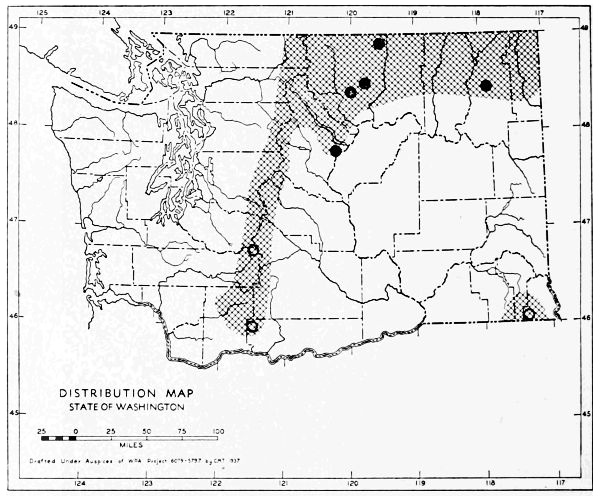
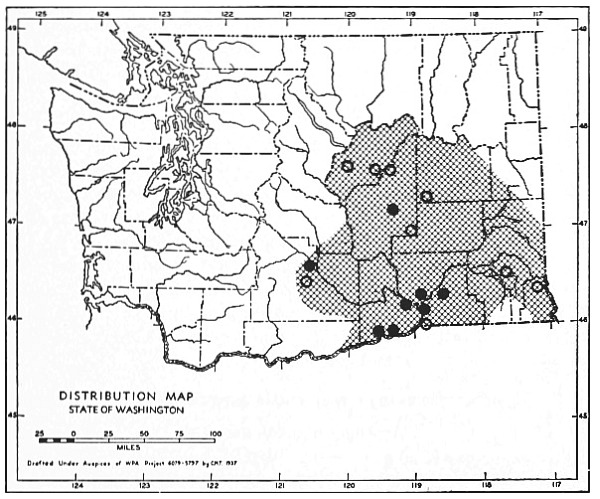
Fig. 37.
Distribution of the hairy-winged myotis in Washington. A. Myotis
volans longicrus. B. Myotis volans interior.
Myotis longicrus interior Miller, Proc. Biol. Soc. Washington, 27:211, October 31, 1914.
Myotis volans interior Miller and Allen, U. S. Nat. Mus. Bull., 144:142, May 25, 1928.
Type.—Obtained 5 miles south of Twining, Taos County, New Mexico, by
Vernon Bailey on July 23, 1904; type in United States National Museum.
Racial characters.—Smaller and paler than Myotis v. longicrus.
Measurements.—Four males and a female from the Blue Mountains, Columbia
County, average: total length 93; length of tail 41.5; hind foot?; ear
12; height of tragus 6.3.
Distribution.—Known only from the Blue Mountains area of the southeastern
part of the state, from Walla Walla (E. S. B.) east to Anatone (Miller
and Allen, 1928: 144).
Remarks.—Of 5 specimens available from the Blue Mountains, 4 are like
interior and 1 is like longicrus.
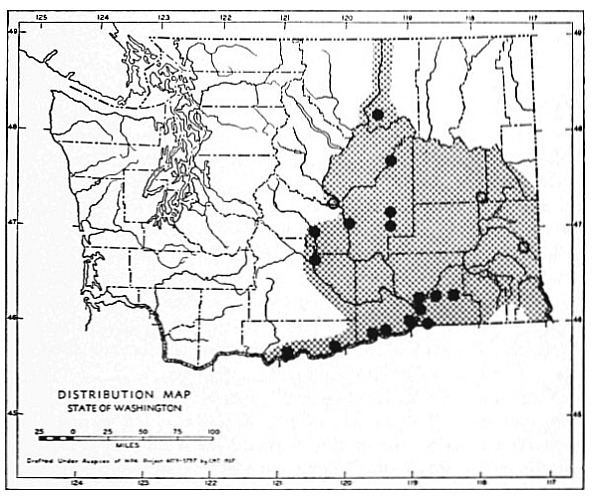
Fig. 38.
Distribution of the California myotis in Washington. A. Myotis
californicus californicus. B. Myotis californicus caurinus.
Description.—Myotis californicus may be separated from all Myotis
that occur in Washington, except Myotis subulatus, by its small
foot (about 6 mm.). It is the only small-footed bat found in western
Washington. In eastern Washington, where Myotis subulatus
occurs, the cleaned skulls of the two species must be compared before
certain identification of some specimens is possible. The skull
of M. californicus possesses a higher cranium and more abruptly
rising forehead than that of M. subulatus.
Four geographic races of this bat recognized by Miller and Allen
(1928: 149) range from southern Alaska southward over western
North America to southern Mexico. Two subspecies occur in Washington.
Myotis californicus, in western Washington, often occurs in company
with Myotis yumanensis, lucifugus, and volans. In flight it
cannot be distinguished from M. yumanensis or M. lucifugus. Most
of our specimens were collected over water, for these bats usually
fly rather late and can be shot most easily where their reflection
on the water assists the hunter in aiming. They are usually not
common, one or two being taken at a single locality. This species,
like Myotis yumanensis, seems to drink salt water. On May 9,
1936, a living specimen was caught under a loose piece of bark on
a dead tree.
Vespertilio nitidus H. Allen, Proc. Acad. Nat. Sci. Philadelphia, p. 247, 1862 (part of the
specimens were from Fort Steilacoom, Pierce Co., Washington).
Myotis californicus caurinus Miller, N. Amer. Fauna, 13:72, October 16, 1897.
Type.—Obtained at Masset, Graham Island, Queen Charlotte Islands, British
Columbia, by J. H. Keen in 1895; type in United States National Museum.
Racial character.—Color reddish-brown.
Fig. 39.
Distribution of the small-footed myotis, Myotis subulatus melanorhinus,
in Washington.
Measurements.—Eight specimens, including both sexes, from the San Juan
Islands, San Juan and Skagit counties, average: total length 77.8; length of
tail 36.7; hind foot 6.7; ear?; height of tragus 7.6; weight 5.2 grams.
Distribution.—Western Washington east through the northern Cascades to
Chelan, Blue Creek and Colville (Miller and Allen, 1928: 156) in northeastern
Washington, and, farther south, east to Mount Rainier (Miller and Allen,
1928: 156) and Carson (Miller and Allen, 1928: 156).
Vespertilio californicus Audubon and Bachman, Jour. Acad. Nat. Sci., Philadelphia, 8 (ser. 1, ser. 1,
pt. 2):285, 1842.
Myotis californicus Miller, N. Amer. Fauna, 13:69, October 16, 1897.
Type.—None designated. Type locality fixed at Monterey, Monterey
County, California, by Miller and Allen (1928: 153).
Racial character.—Color pale.
Measurements.—A female from Crooked River, Crook County, Oregon,
measures: Total length 80; length of tail 40; hind foot 7; ear 13; height of
tragus 5; weight 3.2 grams.
Distribution.—Recorded only from the eastern part of the state. Westernmost
records, according to Miller and Allen (1928: 155) are: Orondo, Goldendale
and Lyle.
Vespertilio melanorhinus Merriam, N. Amer. Fauna, 3:46, September 11, 1890.
Myotis subulatus melanorhinus Miller and Allen, U. S. Nat. Mus. Bull., 144:169, May 25,
1928.
Type.—Obtained on San Francisco Mountain, 8250 ft. elevation, Coconino
County, Arizona, by C. H. Merriam and V. Bailey on August 4, 1889; type
in United States National Museum.
Measurements.—Three males and 2 females from eastern Washington average:
total length 77; length of tail 37; hind foot 7; ear 15; height of tragus
8. One weighed 5.4 grams.
Distribution.—Desert areas of eastern Washington, including the Columbian
Plateau and the lower Columbia River Valley. Marginal records are: 5 mi. S
Grand Coulee Dam (W. W. D.) in the north, Wenatchee (W. W. D.) in the
northwest, Lyle (W. W. D.) in the southwest, and Bly (Miller and Allen, 1928:
171) in the southeast.
Description.—Myotis subulatus is closely similar to Myotis californicus,
but is more orange in color and has the skin on the face
more nearly black. Specimens cannot be identified with certainty
until the cleaned skulls are examined. The more flattened cranium
and less abruptly rising forehead separate Myotis subulatus from M.
californicus.
This species is confined to the United States and northern Mexico.
Two races are recognized by Miller and Allen (1928), of which one
occurs in Washington. It is the commonest bat in the desert of
eastern Washington. It lives far from trees on plains and in sandy
or rocky areas, emerging rather early in the evening. It is not difficult
to shoot. Its flight is erratic. The animal usually hunts in large,
irregular circles at 10 to 25 feet from the ground. It has not been
found in its daytime retreat but may hide in crevices in rocky outcrops.
Near Vantage, Grant County, individuals were shot as they
hung up in a concrete underpass to digest food. The stomachs of specimens
taken were so crammed with the remains of insects that their
abdomens were greatly distended. The underpass seemed to be only
a resting place, not inhabited by day. Others were taken when they
came to rest in the loft of a barn at Selah, Yakima County. They
usually did not arrive at the barn until an hour after sunset and were
still present there at midnight.
V[espertilio]. noctivagans Le Conte, McMurtrie's Cuvier, Anim. Kingd., 1:431, 1831.
Vesperugo noctivagans True, Proc. U. S. Nat. Mus., 7:602, 1885.
Lasionycteris noctivagans Allen, U. S. Nat. Mus. Bull., 43:105, March 14, 1894.
Type.—None designated; described from a specimen obtained in the "eastern
United States."
Measurements.—Five males from San Juan County, Washington, average:
total length 96.2; length of tail 46.4; hind foot 8.5; ear 16; height of tragus
7.2; weight 8.2 grams.
Distribution.—Forested areas of the entire state. This species is migratory
and first appears about the middle of May. September 15th is the latest recorded
occurrence, when one was seen at Seattle, King County. Marginal
records are: Sportsmans Lake (W. W. D.), in the northwest; Carson (Taylor
and Shaw, 1929: 9) in the southwest; Pass Creek Pass (W. W. D.) in the
northeast; and Bly (Taylor and Shaw, 1929: 9) in the southeast.
Remarks.—The chocolate-brown color phase of the silver-haired
bat is most common east of the Cascade Mountains, while almost all
specimens from western Washington represent the black phase.
This medium-sized bat is the darkest-colored species living in
the state, ranging from chocolate-brown to nearly black. Numerous
white-tipped hairs give the upper parts a frosted appearance.
The upper surface of the interfemoral membrane is well
furred, a character shared only with Lasiurus. The dental formula
(i. 2-2/3-3, c. 1-1/1-1, p. 2-2/3-3, m. 3-3/3-3 = 36) is the same as that of Corynorhinus. The
small ears and short tragus immediately distinguish the silver-haired
bat from the long-eared bat.
The genus Lasionycteris contains but a single species, of which
no geographic races have been described. It ranges across North
America from coast to coast and from central Canada southward,
in forested areas, nearly to Mexico. This species is known to be migratory,
and southern records probably do not represent breeding
individuals.
In Washington these bats have been taken in the Transition,
Canadian, and Hudsonian life-zones. They were found near clearings
in forests of open pine woods in the arid section of eastern
Washington, near mountain hemlock thickets in the high mountains,
and in the dense rain-forests of the Pacific Coastal area.
Fig. 40.
Distribution of the silver-haired bat. Lasionycteris noctivagans,
in Washington.
The size and flight of the silver-haired bats are distinctive, and
after some experience it is possible to identify them in the air. It
is an early flier, usually appearing just after the swallows roost.
They fly at a considerable height, rarely coming within forty feet
of the ground. The wings are moved with a "fluttery" motion, and
their flight is interrupted by frequent short glides. They fly more
rapidly than the big brown-bats, and twist and dart sideways more
frequently. Compared with big brown-bats, silver-haired bats are
relatively gregarious, and six to a dozen individuals were seen in the
same area. They generally hunt in sweeping circles, from fifty to
one hundred yards in diameter. In the daytime the silver-haired
bats hide beneath slabs of loose bark on dead trees. Near Cottage
Lake, King County, two individuals were found beneath the bark
on an old, lightning-blasted stub. The dark color of the bats
blended with the charred surface of the stub.
This species feeds mainly on forest insects and for this reason is
probably of considerable value to man. The stomachs of specimens
were usually crammed with the remains of small, soft-bodied insects.
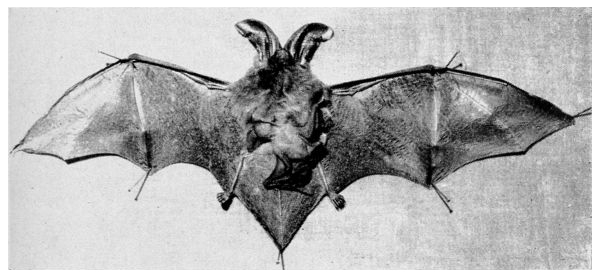
Description.—Diagnostic characters of the long-eared bat are:
medium size (total length about 4 inches); dull, grayish-brown
color; exceptionally long ears (over 1 inch from notch); thin, tissue-like
membranes; and paired "lumps" on the rostrum. The dental
formula is: i. 2-2/3-3, c. 1-1/1-1, p. 2-2/3-3, m. 3-3/3-3 = 36.
Fig. 41.
Long-eared bat (Corynorhinus rafinesquii intermedius), female
with young; Boulder Cave, Kittitas County, Washington, July 20, 1928. (Fish
and Wildlife Service photo by T. H. Scheffer, No. B-33332.)
Long-eared bats range from southern British Columbia to southern
Mexico. Three species are listed by Miller (1924: 82), one of which
(rafinesquii) is divisible into five geographic races.
This bat is colonial and is not uncommonly found in caves, mine
shafts, and darkened attics of old buildings. It is of scattered distribution
throughout the state. In Washington its distribution in
winter is unknown. A specimen from Friday Harbor, San Juan
County, taken in March, 1936, indicates that it hibernates in the
state. Whitlow and Hall (1933: 245) give a detailed account of
individuals found hibernating in winter near Pocatello, Idaho.
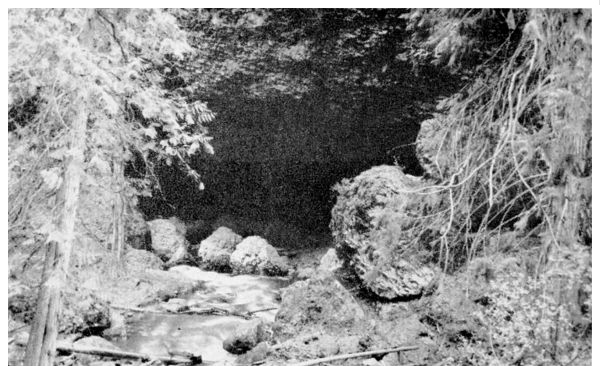
Fig. 42.
Entrance to Boulder Cave, inhabited by long-eared bats (Corynorhinus);
Kittitas County, Washington, May 26, 1938. (Fish and Wildlife
Service photo by Victor B. Scheffer, No. 56.)
John K. Townsend (1839: 325) mentions that the "great-eared
bat" at the forts of the Columbia River district (Fort Vancouver)
were protected by the "gentlemen of the Hudson's Bay Company
for their services in destroying the dermestes which abound in their
fur establishments." Townsend mentions also that the long-eared
bats seldom left the "storehouses attached to the forts," even at
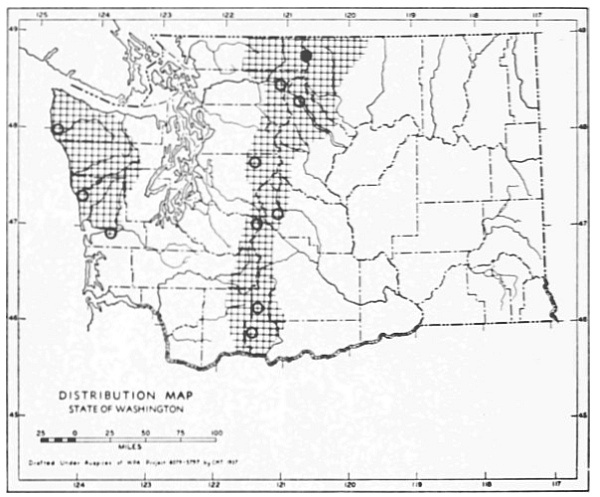
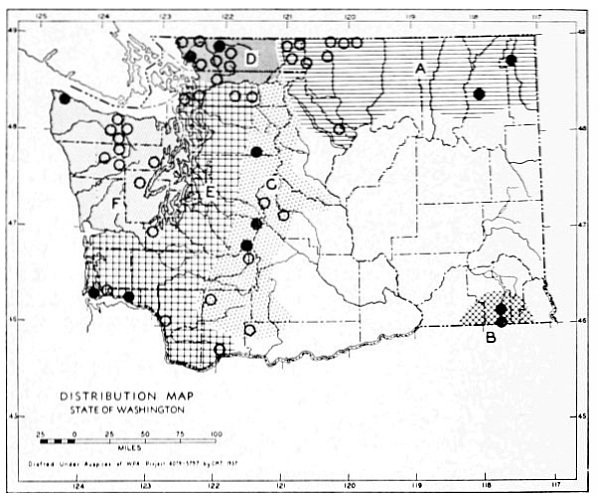
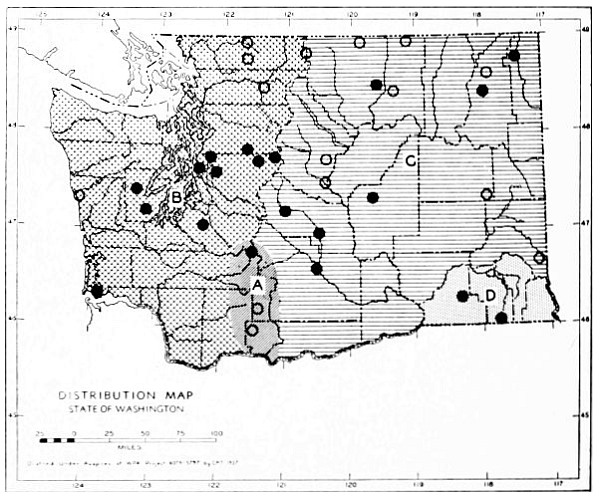
night. My own observations are similar, in that at Boulder Cave,
Kittitas County, on July 7, 1936, when not less than 100 long-eared
bats were present in the cave, I watched the entrances to the cave
until an hour after dark but no bats were seen to emerge. All of the
specimens available from Washington were caught in their daytime
hiding place. The number of long-eared bats at Boulder Cave
has decreased in recent years. On July 12, 1930, bats were so
abundant that 90 were captured with a single sweep of a butterfly
net (T. H. Scheffer, 1930: 11). On July 7, 1936, it was estimated
that there were slightly more than 100 in the cave. On June 11,
1937, the number was less, probably about 75.
Little is known of the food habits of the long-eared bat. The
stomach of a specimen from Blakeley Island, San Juan County, was
crammed with the remains of insects, including the wing scales of
Lepidoptera and the wings of small Diptera.
Scheffer noted that the long-eared bats at Boulder Cave were
nearly ready to give birth to young on July 12, 1930, and were carrying
naked young a week later. On July 7, 1936, at the same locality,
females contained nearly full-term embryos.
Fig. 43.
Distribution of the long-eared bat in Washington. A. Corynorhinus
rafinesquii townsendii. B. Corynorhinus rafinesquii intermedius.
Plecotus townsendii Cooper, Ann. Lyc. Nat. Hist. New York, 4:73, November, 1837.
Corynorhinus macrotis townsendii Miller, N. Amer. Fauna, 13:53, October 16, 1897.
Corynorhinus megalotis townsendii G. M. Allen, Bull. Mus. Comp. Zoöl., 60:344, April,
1916.
Corynorhinus rafinesquii townsendii Miller, U. S. Nat. Mus. Bull., 128:82, April 29, 1924.
Type.—Probably obtained at Fort Vancouver, Clark County, Washington;
type not now in existence.
Racial character.—Dark color.
Measurements.—A male from Blakeley Island, San Juan County, measured:
total length 83; length of tail 43; hind foot 8.5; ear 37.4; tragus 15.1; weight
10 grams.
Distribution.—Western Washington, from Blakeley Island (W. W. D.) in
the north, south to Seattle (W. W. D.) and Fort Vancouver.
Corynorhinus rafinesquii intermedius H. W. Grinnell, Univ. California Publ. Zoöl., 12:320,
December 4, 1914.
Corynorhinus rafinesquii townsendii Dalquest, Jour. Mamm., 19:213, May 14, 1938.
Type.—Obtained at Auburn, Placer County, California, by J. C. Hawver
on July 31, 1909; type in Museum of Vertebrate Zoölogy.
Racial characters.—Paler and duller than townsendii.
Measurements.—One male and 6 females from 15 miles east of Tonasket,
Okanogan County, average: total length 96, length of tail 47; hind foot 11;
ear 35.5; tragus 14.
Distribution.—Scattered localities in the arid subdivision of the Transition
Life-zone of eastern Washington, from 15 mi. E Tonasket (W. W. D.) on the
north to Boulder Cave (W. W. D.) on the west and Spokane (W. S. C.) on
the east.
Remarks.—Of specimens in the University of Kansas, Museum of Natural
History, those from Selah (not plotted on distribution map), Yakima County,
are paler than those from Boulder Cave, Yakima County, but both series are
paler than specimens from the coast of Oregon.
Fig. 44.
Distribution of the western pipistrelle, Pipistrellus hesperus hesperus,
in Washington.
Scotophilus hesperus H. Allen, Smithsonian Misc. Coll., 7 (no. 165):43, June, 1864.
Vesperugo hesperus True, Proc. U. S. Nat. Mus., 7:602, 1885.
Pipistrellus hesperus Miller, N. Amer. Fauna, 13:88, October 16, 1897.
Type.—Obtained at Old Fort Yuma, Imperial County, California, by G. H.
Thomas; catalogued in U. S. National Museum on October 31, 1861.
Measurements.—A specimen from Maryhill, Klickitat County, measures:
total length 68; length of tail 27; hind foot 7; ear 10; height of tragus 3;
weight 4.2 grams. Two males from Vantage, Grant County, average: 68.5;
27.5; 6; 11; 4.
Distribution.—Known only from along the Snake and Columbia rivers
of south-central Washington; recorded from Vantage (W.W.D.), south to
Maryhill (M.V.Z.), and east to Almota (Taylor and Shaw, 1929: 9).
Description.—This is the smallest bat found in Washington, its
body being approximately 1-3/4 inches long and the tail 1-1/4. It may
be separated from Myotis by the bent tragus and by the
possession of 34 rather than 38 teeth. The dental formula is:
i. 2-2/3-3, c. 1-1/1-1, p. 2-2/2-2, m. 3-3/3-3 = 34.
The genus Pipestrellus is cosmopolitan in distribution. The few
records for the single subspecies found in Washington indicate that
it is a casual, though probably regular, summer visitant from the
south.
Two western pipistrelles were shot at Vantage, Grant County,
on July 23, 1937. They flew in slow circles about 50 feet from the
ground. No breeding records are known from the state.
Eptesicus fuscus bernardinus Rhoads, Proc. Acad. Nat. Sci. Philadelphia, 1901:619, February
6, 1902.
Eptesicus fuscus pallidus Engels, Amer. Midland Nat., 17:656, May, 1936 (part specimens
from Washington).
Type.—Obtained near San Bernardino, San Bernardino County, California,
by R. B. Herron on May 26, 1893; type in Academy of Natural Sciences of
Philadelphia.
Measurements.—Three males and 5 females from Washington average:
total length 117; length of tail 48; hind foot 11.5; ear 18.3; height of tragus 9.
Distribution.—Forested areas of the entire state of Washington. Marginal
localities are San Juan Island (W.W.D.) in the northwest, Carson (Taylor
and Shaw, 1929: 9), in the southwest, Newport (W.W.D.) in the northeast,
and Grand Ronde River (Taylor and Shaw, 1929: 9) in the southeast.
Remarks.—Specimens from both eastern and western Washington vary
greatly in color, and series of specimens from eastern Washington average
little, if any, paler than series from western Washington. Washington specimens
most closely resemble specimens from California of the race bernardinus
and average darker than pallidus.
Description. The big brown-bat may be distinguished from other bats by its
large size (about 4-1/2 inches), rich, brown color, and small ears
(reaching only to nostril when laid forward). It possesses 32 teeth,
the dental formula being: i. 2-2/3-3, c. 1-1/1-1, p. 1-1/2-2, m. 3-3/3-3 = 32.
Bats of the genus Eptesicus are cosmopolitan in distribution. A
single species occurs in North America, of which Engels (1936)
recognizes four races in western United States.
Fig. 45.
Distribution of the big brown-bat, Eptesicus fuscus bernardinus,
in Washington.
The big brown-bat appears early in the evening, often before the
swallows have retired. This, and its large size, makes it relatively
easy to study. It is principally a forest bat but also is found in
towns and cities. It is common in Seattle and hunts around street
lights and about the trees in the city parks. In its more natural
habitat it flies over trees and clearings. Big brown-bats were repeatedly
timed, with a car's speedometer, at 17 miles an hour as
they flew down a road lined with tall trees. This is a greater speed
than that at which they usually hunt. When the speed of the car
was increased the bats dodged sideways, around the car. At lesser
speeds they pulled ahead and escaped.
Big brown-bats are less gregarious, when hunting, than some bats.
One or two may be found in a small area, the limits of which are
definitely fixed. We noted this repeatedly near Cottage Lake, King
County, where the big brown-bats hunted along roads through second-growth
conifers. The bats patrolled back and forth along a
section of a road about a quarter of a mile in length. When a bat
reached the end of its personal territory, it would wheel and return.
On six successive trips a bat turned, to retrace its course, at points
less than 50 feet distant from the point of the first turn. When
the bat approached the turning point on the seventh trip, a bat from
the adjoining strip of road approached the area. The two animals
fluttered about each other with shrill squeaks, audible 50 feet away.
The fluttering and squeaking continued for nearly a minute, after
which both bats resumed their hunting. Darkness concluded the
observations.
On several occasions we stood on a road patrolled by a big brown-bat.
The bat immediately detected the watcher and fluttered about
his head and face. Big brown-bats ignore other species of bats
hunting on their territory. Indeed, such comparatively slow flyers
could scarcely drive the more speedy bats away.
Two Eptesicus, kept in captivity for several weeks, exhibited very
different personalities. One was shy and sullen. It cowered in
the back of its cage and attempted to bite when handled. It would
eat only small quantities of finely scraped liver tendered to it on a
spoon. If a bit of liver adhered to its face it would shake violently
and refuse to eat more. When it had eaten its fill, it would seize
the spoon in its teeth and spill the remaining food. The second
specimen was tame and greedy. It ate insects, liver, earthworms,
and even pieces of flesh. After two days in captivity it learned to
come to the door of its cage at a person's approach and open its
mouth, in anticipation of food. If it dropped bits of liver on which
it was chewing it would descend from the top of its cage to retrieve
them, squeaking indignantly while doing so. It also descended to
the floor of the cage to lap water from a dish. It habitually hung
head downward from the roof of its cage, but reversed its position
when evacuating urine or feces. Engler (1943: 96) discovered that
big brown-bats will kill and eat smaller bats, at least in captivity.
Vespertilio cinereus (misspelled linereus) Beauvois, Catal. Raisonné Mus. Peale, Philadelphia,
1796:18 (p. 15 of English edition by Peale and Beauvois).
Lasiurus cinereus H. Allen, Smithsonian Misc. Coll., 7 (no. 165): 21, 1864.
Atalapha cinerea True, Proc. U. S. Nat. Mus., 7:602, 1885.
Type.—None designated. Type locality Pennsylvania, probably near Philadelphia.
Measurements.—Ten specimens from California average: Total length 130.5;
length of tail 54.8; hind foot 10.7; ear 16; height of tragus 9.5; weight (of 3)
20.4 grams.
Distribution.—Recorded from Seattle (W.S.M.) to the north, Westport
(W.S.M.) to the west and Pullman (W.S.M.) to the east.
Fig. 46.
Record stations for the hoary bat, Lasiurus cinerea, in Washington.
Remarks.—The hoary bat is the largest and most distinctively
marked kind of bat in the state. Adults are usually more than 5
inches in total length. The fur is exceptionally long and soft. The
wing-membranes are thick and leathery. The posterior half of the
wing-membrane is black; the anterior half is pale. The interfemoral
membrane is furred. Dorsally the color of the fur is mottled
white and seal-brown, giving a silvery-gray effect. The ears are
short and thick; the feet short and wide. The dental formula is:
i. 1-1/3-3, c. 1-1/1-1, p. 2-2/2-2, m. 3-3/3-3 = 32.
The genus Lasiurus is found in North America, South America,
and the Hawaiian Islands. Lasiurus cinereus ranges from British
Columbia to southern South America. Osgood (1943: 53) records
two subspecies from Chile.
Information on the natural history of the hoary bat is meager.
It was observed in the Kettle River Mountains, but none was obtained.
It flew erratically and rapidly and did not appear until
darkness had set in. At least two were seen above a road through
a forest of western larch and ponderosa pine. Probably it breeds in
the mountains of northeastern Washington and in the northern
Cascades.
The hoary bat is migratory, leaving the state in August and September,
rarely lingering until early October. It winters along the
coast of central and southern California (Dalquest, 1943: 23).
Antrozous pallidus cantwelli Bailey, N. Amer. Fauna, 55:391, August 29, 1936.
Type.—Obtained at Rogersburg, Asotin County, Washington, by G. G. Cantwell
on May 28, 1918; type in United States National Museum.
Measurements.—A male from the south bank of the Columbia River, opposite
Fallbridge, Klickitat County, measures: total length 113; length of tail
40; hind foot 14; ear 36; height of tragus 13; weight 19.8 grams.
Distribution.—Recorded only from localities near the Columbia and Snake
rivers in eastern Washington; from Wenatchee (W.W.D.) south and east to
Bly and Rogersburg (Taylor and Shaw, 1929: 9).
Description.—Antrozous pallidus is more likely to be confused
with Corynorhinus than with any other kind of bat and can
be distinguished from Corynorhinus by its larger size (4-1/2 to 5
inches), lighter color, thick and leathery membranes, and shorter,
wider ears. Antrozous lacks the prominent "lumps" on the rostrum,
characteristic of the long-eared bat. The dental formula is:
i. 1-1/2-2, c. 1-1/1-1, p. 1-1/2-2, m. 3-3/3-3 = 28.
The genus Antrozous is confined to western United States and
northwestern Mexico. Two species are recognized by Miller (1924:
84). One of these (pallidus) includes three geographic races. A
single race is known to occur in Washington.
Fig. 47.
Distribution of the pallid bat, Antrozous pallidus cantwelli,
in Washington.
The pallid bat chooses a crevice in a cliff, cave, or building as its
daytime hiding place. Like Corynorhinus, it is colonial. The basalt
cliffs of eastern Washington offer such ideal hiding places that pallid
bats are seldom seen and consequently little is known of their habits.
In the southwestern United States, pallid bats are more abundant
and better known. H. W. Grinnell (1918: 355) notes that the floor
of a roost of pallid bats was strewn each morning with the heads,
wings, and legs of insects. Most numerous were the remains of the
Jerusalem cricket (Stenopelmatus), a flightless insect that the bats
must have secured on the ground. Engler (1943: 96) found that in
captivity, pallid bats would kill and eat smaller bats and lizards
confined with them.
Bailey (1936: 392) believes that the young of this bat are born
in late June and early July. One or two young constitute a litter.
Description.—The black bear is the largest carnivore found in
Washington if the grizzly is extinct there. The exact size of the
adult male black bear is somewhat in question. Few actual weights
are on record of Washington bears. Grinnell, Dixon and Linsdale
(1937: 101) paid special attention to the maximum weight of black
bears in California and concluded that few ever exceeded 500 pounds.
The total length of the largest black bear among specimens from
the entire Pacific Coastal area, especially from California and
Alaska, they give as 5 feet, 10 inches (op. cit., p. 102). It may
safely be assumed that few individuals ever reach a length of six
feet. Females are smaller; recorded weights of adults rarely exceed
350 pounds. The largest males have hind feet from 10 to 10-1/2
inches in length.
Fig. 48.
Female black bear (Ursus americanus altifrontalis), and two cubs,
near Big Four Inn, Mt. Baker National Forest, Washington, July, 1939. (Forest
Service photo by R. L. Fromme.)
The black bear, including its closely related species, the Mexican
bear, Ursus machetes, ranges over Alaska, Canada, the United States
and northern Mexico. The distinction between the black and grizzly
bears has been listed under the account of Ursus chelan.
The fur of black bears in the Cascade Mountains in the fall is
long, sleek and glossy but rather stiff. In the spring and early
summer the fur of animals at Mount Rainier often appeared coarse,
wooly and patchy or rubbed on older animals. Some smaller bears
possessed sleek, well-groomed pelts. Bears from the lowland areas
are said to possess poor pelts because of constant abrasion in the
forests. In the fall, when the salmon are spawning, the bears are
said by trappers to roll in decayed fish until they "smell so bad
you can't come near them" and their fur is matted and "crawling
with lice."
It is now known that the cinnamon bear, sometimes called brown
bear, is merely a color phase of the black bear. The brown phase
varies in color from a rich, dark reddish brown to a pale cinnamon
brown. Cowan (1938: 204) has recorded the geographic variation
in the brown and black coats of the bears of British Columbia and,
in part, of Washington. On the Olympic Peninsula the brown phase
is rare. Old residents have told me of seeing but a few brown bears
in their life. I have seen only black bears in the lowlands of western
Washington. Cowan (loc. cit.) lists 1,197 black and 79 brown
bears from Fort Nisqually, Pierce County, between 1834 and 1852.
In the Cascade Mountains the brown phase is not uncommon, perhaps
one out of five bears seen being brown. In northeastern
Washington the brown and black phases are about equal in number,
and some trappers state that the browns are more numerous. Cowan
lists 3,813 black and 2,871 brown bears from Fort Colville between
1826 and 1856.
The black bear occurs in a variety of habitats in Washington.
It seems to be absent only from the treeless areas of eastern Washington,
and is most abundant in the Cascade Mountains and Olympic
Mountains where food is abundant and men are few. It is not
uncommon throughout the timbered lowlands of northeastern Washington
and western Washington, however, and shows a surprising
ability to exist unnoticed near the larger cities. In the dense,
junglelike forests of southwestern Washington it is numerous.
Jackson (1944: 1) estimates that 13,679 black bears live in Washington,
more than in any other state.
The habits of the black bear have changed greatly where it has
come into contact with man. At Mount Rainier National Park
black bears now ignore people, save to beg for food. In the Cascades
the bears are wild but so seldom see men that in many places
they live much as they did hundreds of years ago. In the lowlands
of western Washington they are in daily contact with evidence of
man or his guns. As a result they are silent and shy, rarely being
seen.
Fig. 49.
Black bear (Ursus americanus altifrontalis), in "hibernation," Mt.
Baker region, Washington, about 1936. (John E. Candle photo, courtesy
"Field and Stream.")
The black bear in the mountains is active sometimes by day and
sometimes by night. Probably it is principally nocturnal but active
by day only when the food obtained at night is insufficient to
meet the needs of the animal. In the lowlands it is almost completely
nocturnal. In the mountains it enters upon its winter sleep
with the first snows or, if the snows are late, when the huckleberries
are gone. Ordinarily black bears are in "hibernation" by the
middle of November. In the lowlands of western Washington they
are active until after the salmon spawning season, and probably do
not "hibernate" before the middle of December and may not do so
at all. In the mountains they emerge from the winter sleep in May;
in the lowlands they emerge in February or March.
The black bear is omnivorous in the truest sense of the word.
Because the animal is of large size it requires much nourishment.
This is obtained by eating large quantities of material with low
food value. Material eaten passes rapidly through the digestive
tract and often only easily digested parts seem to be utilized. Feces
commonly contain complete and undigested berries and seeds or
almost undigested pieces of apples or other fruit.
The principal food of the black bear in Washington is berries.
Many species are eaten, but the huckleberry (Vaccinium sp.) is
favored. Other food items are: Gaultheria shallon (pulpy fruit);
Oregon grape, Berberis nervosa (flowers and fruit); salmonberry,
Rubus parviflorus (leaves and fruit); leaves of several plants, including
Rubus macropetalus and other thorny kinds; grass, succulent
plants, and roots. Insects are eaten and most feces show remains of
a few. In June, 1938, near Cle Elum, Kittitas County, a species
of sword-tailed cricket fully two inches in length was abundant,
and droppings of a bear there were composed entirely of the remains
of these crickets. Fish, especially spawning salmon, are important
food. When salmon are spawning the bears in the vicinity feed on
nothing else. Warm-blooded vertebrates probably are eaten but
none of the many bear droppings examined by me contained remains
of birds or mammals. Bennett, English and Watts (1943: 30) found
few mammals to be eaten by bears studied by them in Pennsylvania.
Locally bears kill pigs and sheep, smash bee-hives and raid fruit
trees.
The large size and sometimes awkward appearance of black bears
combine to give a comic note to some of their natural actions. A
bear in full flight, lumbering along a trail with head swinging from
side to side and hind feet stretching past the forelegs at each stride,
is more apt than not to amuse the observer. Near Stevens Pass, a
large black bear was observed lying on its back in a mud wallow.
This was an oval opening in the ground in a meadow of heather and
huckleberry near a small stream. The wallow was approximately
5 feet long, 3 feet deep and 4 feet wide. The bear was immersed in
muddy water with only its head and feet visible. It seemed well
content and comfortable, shifting its bulk occasionally and waving
its paws. When a stray breeze brought to the bear the scent of my
companion and myself the animal's contentment vanished and it
hastily made a frantic effort to depart. It had wedged itself deeply
in the hole, and as it twisted and turned in attempting to sit up,
waves of water gushed from the wallow. Eventually escaping
from its wallow, the bear half ran and half rolled to the cover of
alders 100 feet away. This particular wallow had been in use by
bears for some time, as was attested by old droppings at its edge
and by its well-worn condition.
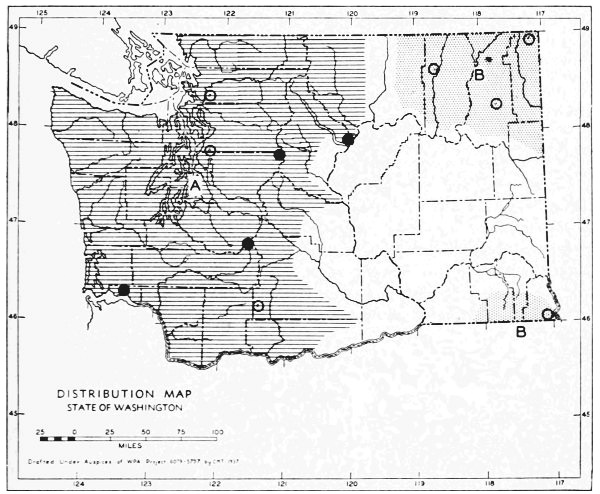
Fig. 50.
Distribution of the black bear in Washington. A. Ursus americanus
altifrontalis. B. Ursus americanus cinnamomum.
The fact that Washington has the largest population of black
bears of the states in the union is due, largely, I feel, to abundant
natural cover, food, such as salmon and huckleberries, and an intelligent
game code. In California and some other states the black
bear has been considered a fur bearer, to be trapped with steel traps.
This is permitted in spite of the fact that their pelts bring but a few
dollars, usually less than ten. Their sale scarcely repays the trapper
for his labor in preparing the hide. Townsend (1887: 182) remarked
on the ease with which bears could be trapped in California although
in the same area they were so shy that they could seldom be shot.
As a result of trapping, the number of bears in some states has been
dangerously reduced. In Washington the bear is a game animal,
to be hunted with a rifle for a few weeks in the fall when the pelt
and flesh are at their best. As a result bears are numerous and can
be hunted with fair chances of success.
Ursus altifrontalis Elliot, Field Columb. Mus. Publ. 80, zoöl. ser. 3:234, June, 1903.
Euarctos altifrontalis Miller, U. S. Nat. Mus. Bull., 128:90, April 29, 1924.
Ursus americanus americanus Taylor and Shaw, Mammals and Birds of Mount Rainier National
Park, U. S. Nat. Park Service, Washington, p. 37, 1927.
Euarctos americanus altifrontalis Bailey, N. Amer. Fauna, 55:321, August 29, 1936.
Ursus americanus altifrontalis Hall, Univ. California Publ. Zoöl., 30:232, March 2, 1928.
Type.—Obtained at Lake Crescent, Olympic Peninsula, Clallam County,
Washington, by D. G. Elliot in 1898; type in Field Museum of Natural
History.
Racial characters.—Color dark, almost always black instead of brown; skull
wide, high and heavy; molar teeth wide and heavy.
Distribution.—From the eastern base of the Cascade Mountains westward
to the Pacific. Marginal occurrences are Chelan (W.W.D.) and Signal Peak
(Taylor and Shaw, 1929: 10).
Ursus americanus var. cinnamomum Audubon and Bachman, Quadrupeds of North America,
3:125, 1854.
Euarctos cinnamomum Miller, U. S. Nat. Mus. Bull., 128:91, April 29, 1924.
Euarctos americanus cinnamomum Bailey, N. Amer. Fauna, 55:319, August 29, 1936.
Ursus americanus cinnamomum Hall, Univ. California Publ. Zoöl., 30:232, March 2, 1928.
Type.—Obtained near the mouth of Jim Ford Creek, Lower Clearwater
River, western Idaho (Bailey, 1936: 319) by Lewis and Clark on May 31, 1806.
Racial characters.—Resembling altifrontalis but skull and molar teeth narrower;
color even in black phase paler and browner; brown and black phases of
approximately equal incidence.
Distribution.—Northeastern Washington and the Blue Mountains of southeastern
Washington, occurring westward as far as Republic (Taylor and Shaw,
1929: 10).
Ursus chelan Merriam, Proc. Biol. Soc. Washington, 29:136, September 6, 1916.
Type.—Obtained in Township 30 N. Range 16 E. Willamette Meridian,
Wenatchee National Forest, Chelan County, Washington, by D. S. Rice on
September 1, 1913; type in United States National Museum.
Measurements.—The skull of the type, an old male, measures: basal length
314; occipito-nasal length 323; palatal length 170; zygomatic breadth 225;
interorbital breadth 86.
Distribution.—Probably once from the Stevens Pass area north to British
Columbia. Possibly still remaining in the mountains between Mount Baker
and Lake Chelan.
Remarks.—Grizzly bears occurred in the lowlands of Oregon (Bailey,
1936: 324) and California (Grinnell, Dixon and Linsdale, 1937: 67) but there
is no record of their ever having occurred in the lowlands of western Washington.
Bears of the genus Ursus range over Europe, Asia and North
America. No less than 75 kinds of grizzly and big brown bears are
recognized for North America by Merriam (1918). They are closely
related to the brown bears of Asia. The 13 kinds of black bears
of North America are now thought to belong to but one species,
namely americanus, and have no close relatives in Eurasia.
Fig. 51.
Probable past distribution of grizzly bears in Washington. A. Ursus
chelan. B. Ursus canadensis. C. Ursus idahoensis.
The grizzly is the largest carnivorous mammal in North America.
From the black bear the grizzly may be distinguished in life by the
prominent muscular hump on the shoulders. Another feature is the
long, slim, gently curved claws of the forefoot as compared with
the shorter, stouter and sharply curved or hooked foreclaws of the
black bear. The grizzly is much larger than the black bear. Cranially,
the grizzly differs in possessing a larger skull with lower
frontal area, higher, more extensive sagittal crest, more posteriorly
jutting occipital condyles and much longer tooth row. The color
of both species is variable. Some grizzly bears from Alaska and
British Columbia are dark brown, almost as black as a black bear.
Others are pale cinnamon with the longer guard hairs pale gray.
Individuals of this frosted appearance popularly are known as "silver
tips." In Washington, the black bear varies in color from glossy
black, through various shades of brown to a pale cinnamon.
The grizzly bear is extinct over most of Washington. A few may
remain in remote parts of the northern Cascades, and are regularly
listed on the game census reports of the Mount Baker National
Forest. Nevertheless, I have found no one who has seen an undoubted
grizzly bear in Washington. The type specimen was obtained
well up in the Cascade Mountains where the animals, like
those in British Columbia, feed on roots, berries, marmots, pikas
and other vegetable and animal life.
Description.—The raccoon is a relatively large carnivore with a
stout, heavy body. Large adults measure three feet in length and
weigh up to 20 pounds. The legs are of moderate length. The
broad head tapers sharply to a pointed muzzle. The ears are erect,
broad, low and rounded; the tail is long, about one-half the length
of the head and body, bushy and round; the hind feet are large,
flat and naked-soled but the forefeet are smaller with long, slim,
handlike toes. The color of the body is a grizzled gray heavily
washed with black on the back and sides. A jet-black "mask"
across the eyes, sharply outlined by white muzzle and forehead, is
the most distinctive feature of the head. The tail is alternately
marked with six or seven black and five or six yellowish gray bands.
The long, loose guard hairs give the body a shaggy appearance. The
fur of the wrists is short, smooth, coarse, and directed downward.
The raccoon is not an aquatic mammal, yet it is closely associated
with water, whether it be streams, rivers, lakes or the ocean.
The favored habitat of the raccoon is the shore line. It is a wader
and, if it can be considered as specialized for any occupation, it is
wading in mud and shallow water. Its long toes, naked feet, and
short-haired wrists are admirable adapted for walking on muddy
bottoms or in shallow water. The coon is also at home on land. It
moves swiftly and silently and when chased by dogs can cover miles
in a few hours. It is an agile climber and lives in dens well up in
trees.
The raccoon is almost completely nocturnal. Individuals are occasionally
seen in the morning or evening, especially, when the tide
is low along the ocean beach or Puget Sound. Near Fall City, King
County, a small raccoon was seen eating a crayfish at 3:30 p.m. on
a warm, sunny June day. In the eastern United States raccoons
sleep during much of the winter, and probably they do the same
in eastern Washington. In western Washington they are active most
of the winter. Some trappers stated that the animals "hole up" in
spells of unusually cold weather. Along the Tolt River, 10 miles
southeast of Duvall, King County, their tracks were seen daily in
January, 1936, although the temperature fell well below freezing
each night.
Washington is near the northern limit of the range of the raccoon.
The animal is reasonably common in western Washington, and
ranges well up into the Cascade Mountains. The highest altitudinal
record available is Longmire, Mount Rainier National Park (Taylor
and Shaw, 1927). Raccoons are not uncommon in southeastern
Washington and in the Yakima Valley. They follow the Columbia
River northward, as shown by tracks at Wenatchee on two occasions.
The river valleys that flow into the Columbia in northeastern
Washington seem admirably adapted for raccoons but the animal
is rare there. Trappers who have lived and trapped in northeastern
Washington for many years tell of seeing tracks at intervals of
years along the Okanogan, San Poil, Colville and Kettle rivers.
Several stated that tracks had been seen more often in recent years.
Northeastern Washington seems to be the peripheral range of the
species, occupied at rare intervals by animals wandering north from
the Columbia River.
The food habits of raccoons are almost as varied as those of black
bears. Animal matter forms their diet over most of the year; along
stream courses crayfish, fish, thin-shelled fresh-water mussels, frogs
(Hyla and Rana), and aquatic insects are eaten. Along beaches
fish brought in by the tide, crustaceans, and mussels (Mytilus
edulis) are taken; small sharks appear not to be eaten. A recently
dead dogfish that lay on the beach at Whidby Island, Island County,
was ringed by the tracks of a raccoon but had not been eaten. The
shore crabs (Hemigrapsus nudus and Hemigrapsus oregonensis) are
a favored food and regular items of diet. The edible crab (Cancer
productus) is also eaten and in the San Juan Islands the porcelain
crab (Petrolisthes eriomerus) was commonly eaten. Small mammals
and birds are eaten regularly by this race of raccoon in California
(Grinnell, Dixon and Linsdale, 1937: 157), and the eggs and young
of wild birds are sought in the spring (op. cit.: 158). The ability
of the raccoon as a climber makes it a particular menace to nesting
birds. Berries, including domestic blackberries and salmonberries,
are eaten in quantity when available. Apples are dearly loved and
the trees and orchards of abandoned ranches are regularly visited.
The fondness of the raccoon for green corn is well known. Insects
are present in small quantities in most droppings and in the late
summer some feces were composed entirely of the remains of grasshoppers.
Chickens, ducks, young turkeys and eggs are stolen and
individuals become extremely adept at raiding hen-houses.
At one time, about 1920, the raccoon became scarce in western
Washington as a result of heavy trapping and high price of the pelts.
A closed season was strictly enforced until it again became common.
The price received by the trapper for raw furs of raccoon has since
been rather low, from two to ten dollars. With fur prices in this
range, the number of raccoons probably will not be reduced to a
dangerously low level by trapping, but instead may be expected
to furnish a regular winter income to the trappers who do trap for it.
Raccoons are known to breed in their first year of life (Pope, 1944:
91).
Procyon psora Gray, Ann. and Mag. Nat. Hist., 10: 261. December, 1842.
Procyon psora pacifica Merriam, N. Amer. Fauna, 16: 107, October 28, 1899 (type from
Lake Keechelus, Kittitas County, Washington).
Procyon proteus Brass, Aus dem Reiche der Pelze, p. 564, 1911.
Procyon lotor pacifica Taylor and Shaw, Occ. Pap. Chas. R. Conner Mus., no. 2: 10. December,
1929.
Procyon lotor psora Grinnell, Dixon, and Linsdale, Fur-bearing Mamm. California, Univ.
California Press, Berkeley, p. 137, July 22, 1937.
Type locality.—Sacramento, Sacramento County, California.
Racial characters.—Medium size; dark color; smoothly rounded skull.
Measurements.—A female from Forks, Clallam County, measures: total
length 905; length of tail 355; hind foot 125; ear 50; weight 14-1/2 lbs. A
female and 6 males, young animals of the year, taken between November
15 and December 15, average: 772; 284; 114; weight (of 3) 8-2/3 lbs.
Fig. 52.
Distribution of the raccoon in Washington. A. Procyon lotor psora.
B. Procyon lotor excelsus.
Distribution.—From the western slope of the Cascade Mountains westward.
Marginal occurrences are Lake Keechelus (type locality) and Mount Rainier
(Taylor and Shaw, 1927: 45).
Remarks.—The range of variation in color and cranial characters of coastal
raccoons is large. I am unable to find any character or average difference to
separate the raccoons of western Washington from those of northern California.
Procyon lotor excelsus Nelson and Goldman, Jour. Mamm., 11:458, November 11, 1930.
Type.—Obtained on upper Owyhee River, near the mouth of the
North Fork in southeastern Oregon by J. W. Fisk on April 15, 1920; type
in United States National Museum.
Racial characters.—Similar to psora but larger; body paler and grayer;
skull larger, heavier and more angular.
Distribution.—Southeastern Washington, the valleys of the Snake and
Yakima rivers and the valley of the Columbia River north to northeastern
Washington. Marginal records, from reports of trappers, include the Okanogan
River, Okanogan County, Wenatchee, Chelan County, and Selah, Yakima
County.
Remarks.—The assignment of the raccoons of northeastern Washington to
excelsus is tentative for I have seen no specimens.
Description.—The marten is slightly smaller and slimmer than a
house cat, and at first glance resembles a large squirrel. The legs
are longer, the body stouter and the fur more fluffy than those of
a mink or weasel. Adult males weigh from two to two and a half
pounds, and females from one and a half to two pounds. Males
are slightly more than two feet in total length and females about
18 inches, the tail comprising one-third or more of the total length.
The head is broad and narrows rapidly to a sharp muzzle. The
ears are large, erect and prominent. The feet are large with stout
toes and long, sharply curved pinkish-white claws. The body and
head are rich golden brown, the tail, wrists, feet and muzzle being
darker.
The western marten ranges from British Columbia southward
through Idaho and Washington to California. A closely related
species, americana, is found in Alaska, the eastern United States
and Canada. Martens and fishers may be distinguished from weasels
and minks by the presence of 18 rather than 16 teeth in the upper
jaw and 20 instead of 18 teeth in the lower jaw.
The western marten is arboreal. Its principal habitat in Washington
is the Canadian Life-zone forests of the Olympic, Cascade
and Blue mountains and the various ranges in the northeastern part
of the state. At one time it ranged near sea level along the densely
forested coastal belt and may still do so in the more rugged parts
of the Willapa Hills.
The marten is both diurnal and nocturnal. In Mount Rainier
National Park the species has become quite tame and may be seen
in the daytime. Many of the small mammals upon which it feeds
are diurnal, but others are nocturnal. The marten is active throughout
the year. Trappers report that during a storm the marten
"holes up in rock slides" where it lives on conies and chipmunks
until the storm passes. It spends a large part of its time in trees,
and travels through them for long distances. It climbs more skillfully
than the tree squirrels upon which it feeds. On the ground
or on snow the marten travels in bounds, a yard at a leap, and
its characteristic bounding gait forms tracks that are distinctive
and easily followed.
Mammals of the weasel family mostly are not gregarious but the
marten is exceptional in that in the winter it travels in bands of 6
to 10 animals. Individuals composing these bands are inclined to
wander but nevertheless the whole band travels in a definite general
direction at a good rate of speed. Travel-ways or "runs" may be
used by more than one band, and a run may extend for many miles,
perhaps for as many as 50. A band of martens may take two weeks
to complete the circuit, but usually returns to the starting point
in less than a week. Most runs are about "half-way up the mountain,"
or midway between the crest of the hill or timber-line and
the floor of the stream valley below. In summer the marten ranges
higher; it lives in the trees just below timber-line and in the talus
slides near timber-line. When the snows are unusually late the
martens may keep to these higher areas until November.
The food of the marten consists principally of small mammals
and probably birds; the staple food in winter is the Douglas squirrel.
In summer they feed on pikas, mantled ground squirrels and chipmunks.
Mice, also, are eaten. The deer mouse, Peromyscus maniculatus,
is usually abundant about old cabins and is successfully
used as bait by trappers. Wood rats and flying squirrels are also
eaten, the latter being especially important in certain areas. The
tracks of martens that had been following snowshoe rabbits were
seen on several occasions but the martens had turned off before a
kill was made. In every instance the rabbit tracks indicated that
the animals were hopping leisurely and browsing; apparently the
tracks were made some time before the marten began to follow them.
Martens are inquisitive, and to judge from their tracks in snow
they investigate almost every object that they pass; a fallen mound
of snow, branch, bit of moss, log or isolated tree is apt to be visited.
Failing to find a meal in or around one of these objects, the marten
visits the next object that catches its eye. Seemingly the animal
always is giving concentrated attention to some definite object although
the attention can shift in an instant when a more interesting
object comes in to view. As a result the trail of a marten in the
snow is an intricate affair composed of numerous straight lines and
sharp turns.
The trapping of martens is specialized work, engaged in by professional
trappers that follow trap lines many miles in length.
Trappers commonly have a base cabin and one or two shelters
situated a day's march apart, The trap-line is set in a circle, requiring
one to three days' travel by the trapper to complete the
circuit.
The standard "set" for marten in the Cascades consists of an
opening 8 to 10 inches wide, 4 inches high and 6 inches deep chopped
into the side of a dead stub. The hole is cut as high as the trapper
can reach. A trap is set in the opening and bait is placed in the
back of the hole. A sapling 1 to 3 inches in diameter inclined at
an angle of 45° from the ground to the hole completes the set. As
the snow deepens, new holes are chopped higher up on the stub.
Such sets seen in the summer may consist of six or seven holes spaced
a foot apart. The chips from the holes are left lying on the snow
and are said to attract the animals. Bait commonly consists of
flying squirrel, red squirrel or deer mouse.
Fig. 53.
Distribution of the western marten in Washington. A. Martes
caurina caurina. B. Martes caurina origenes.
The value of the marten's pelt fluctuates from year to year. In
recent years average pelts have sold at from ten to twenty dollars
each. The number of individuals taken by a trapper varies with
the trapper's skill and energy and the location of the trap line. The
largest catch made by one trapper in a single winter, of which I
know, was 300 animals, taken near Mt. Adams.
Mustela caurina Merriam, N. Amer. Fauna, 4:27, October 8, 1890.
Martes caurina caurina Miller, U. S. Nat. Mus. Bull., 79:93, December 31, 1912.
Type.—Obtained near Grays Harbor, Grays Harbor County, Washington,
by L. C. Toey on February 4, 1886; type in United States National Museum.
Racial characters.—Color dark; throat patch bright orange or brownish.
Distribution.—From the Cascade Mountains westward. Marginal localities
are (from Taylor and Shaw, 1929: 10) head of Cascade River, Riverside, Chelan,
Easton and Trout Lake. The record from Chelan seems doubtful, and the
specimen may have come from somewhere around Lake Chelan, rather than
from the town of that name.
Remarks.—Skulls of martens from many localities in western North
America were studied in an effort to determine the relationship of the eastern
pine marten (Martes americana) and the western marten. East of the Rocky
Mountains the ranges of the two species approach closely, but each retains
distinctive characters, notably the shape of the auditory bullae. The two
species have not been taken together and the possibility of intergradation
exists. On the basis of the evidence at hand, the two should be regarded
as full species until positive proof of intergradation is established.
In the absence of sufficient material, the marten of the Cascades is referred
to Martes caurina caurina. Fur graders distinguish between a dark "coast
marten" and a paler "Cascade marten."
Mustela caurina origenes Rhoads, Proc. Acad. at Sci. Philadelphia, 1902:458, September
30, 1902.
Martes caurina origenes Miller, U. S. Nat. Mus. Bull., 79:93, December 31, 1912.
Type.—Obtained at Marvine Lodge, Garfield County, Colorado, by E. T.
Seton on September 16, 1901; type in Academy of Natural Sciences of Philadelphia.
Racial characters.—Paler than caurina with grayer head and yellow or white
rather than deep orange or brown throat patch.
Distribution.—Mountainous areas of northeastern Washington and the Blue
Mountains of southeastern Washington. Trappers have reported this marten
from the mountains near Republic, Ferry County.
[Mustela] pennanti Erxleben, Syst. Regni. Anim., 1:470, 1777.
Martes pennanti pennanti Miller, U. S. Nat. Mus. Bull., 79:94, December 31, 1912.
Mustela canadensis pacifica Rhoads, Trans. Amer. Philos. Soc., n.s., 19:435, September,
1898 (type from Lake Keechelus, Kittitas County, Washington).
Martes pennanti pacifica Miller, U. S. Nat. Mus. Bull., 79:94, December 31, 1912.
Martes pennanti Grinnell, Dixon and Linsdale, Fur-bearing Mamm. California, Univ. California
Press, Berkeley, p. 211, July 22, 1937.
Type locality.—Eastern Canada.
Distribution.—Originally forested areas from the eastern base of the Cascades
westward and possibly the Blue Mountains of southeastern Washington
and the mountains of northeastern Washington; now probably confined to the
Cascade and Olympic mountains.
Fig. 54.
Fisher (Martes pennanti). 2-year-old male in captivity; New Westminster,
B. C., March 7, 1939. (Fish and Wildlife Service photo by Victor B.
Scheffer, No. 598.)
Remarks.—The fisher is the size of a large cat. In general proportions
it resembles the marten. Adult males measure about 3-1/2
feet in length; the tail comprises 16 inches of this. Adult females
are slightly less than 3 feet in length of which the tail makes up
approximately 15 inches. Males weigh up to 10 lbs. and females
about 5-1/2 pounds (Grinnell, Dixon and Linsdale, 1937: 213). The
fisher has a slim body, bushy tail, short legs, large feet, and wide,
low and triangular head. The ears are low, wide, rounded and erect.
The fur is an ashy, brownish gray in color with an overwash of
blackish caused by long, dark hairs. The head is slightly paler than
the body. The feet, rump and tail are darkest. The claws are
strong and sharply curved.
The fisher is found in wooded parts of North America, extending
southward in the Cascade-Sierra Nevada Chain to central California.
Its near relatives are the martens. It is active all year.
Like the marten, it is active by day and probably also by night. In
spite of absolute protection for several years, the fisher is rare in
Washington, and seems never to have been common. In consequence
relatively little is known of its habits, and the little that is known
has been reported by fur-trappers.
Fig. 55.
Distribution of the fisher, Martes pennanti, in Washington.
The fisher seems not to live in bands as does the marten. Most of
the actual records of fishers trapped are at higher altitudes but are
misleading because most trappers agree that the fisher occupied a
lower zone, altitudinally, than does the marten. There are old
records of its occurrence near sea level (Scheffer, 1938: 9). The
animals are usually taken in marten sets or in traps set especially for
fishers by trappers who find their tracks on their marten trap lines.
Since marten trappers are almost the only persons who travel in
the mountains in winter, and since they operate mostly above the
areas where fishers live, relatively few fishers are reported.
Fishers are said to feed on chipmunks, squirrels, mice, birds and
other small, warm-blooded animals, and to climb trees and catch
squirrels in their natural habitat. Also, fishers are said to catch and
kill martens. Their tracks in the snow resemble the marten's in that
the hind feet land in the same places as the forefeet; both animals
bound rather than walk.
The pelt of the fisher commands a high price. The smaller sized,
females, are the more valuable. The price paid for pelts fluctuates
widely and has ranged from as low as twelve dollars to as high as
one hundred dollars in recent years.
In Washington more fishers live in the Olympic Peninsula and the
northern Cascade Mountains than elsewhere. A few may occur in
northeastern Washington, the Blue Mountains and the Willapa Hills.
The name pacifica was regarded by Grinnell, Dixon, and Linsdale
(1937: 217) as a synonym of pennanti.
Description.—Though it is similar in general characters and proportions
to the long-tailed weasel, the ermine is much smaller and
has a relatively shorter tail. It is darker and less reddish or yellowish
in summer. Adult males measure about 10 inches in length,
of which 3-1/2 inches is the length of the tail. Females measure about
8 inches and have tails 2 inches long. The upper parts are chocolate
brown; the underparts are white or pale yellow. Along the
coast of Washington, the pale color of the underparts is more restricted
in the ermine than in the long-tailed weasel. The dark
brown tail has a black tip. Ermines east of the summit of the Cascades
become pure white in winter, save for the black tail tip. West
of the summit of the Cascades the winter pelt is similar to the summer
pelt but is slightly paler with denser underfur.
Ermines in America range from the Arctic southward, in mountainous
areas, to the southern end of the Sierra Nevada in California,
and in the Rocky Mountains to northern New Mexico. In
Washington they are found over the entire state except the arid
parts of eastern Washington, where only the long-tailed weasel occurs.
So far as my observations go, the ermine is principally nocturnal
in Washington; I have seen only one abroad in the daytime.
It dashed from a roadside thicket near Glacier, Whatcom County,
and was crushed beneath the wheels of a car. Taylor and Shaw
(1927: 53) note several instances of diurnal activity of the ermines
at Mount Rainier National Park.
The ermine seems to feed principally upon mice. Its small size
adapts it to entering burrows that larger weasels cannot enter. It
probably eats chipmunks, birds, and other small, warm-blooded
animals. Ermines climb readily and are often taken in traps set in
trees for martens. Near Skykomish, King County, William Hoffman
took two ermines in traps set in burrows of mountain beavers.
The mountain beavers were needed for use as bait on his trap line.
The traps were reset and later caught mountain beavers. Seemingly
the ermines were traveling through the burrows, perhaps to catch
the mice which utilize the burrows as highways, rather than to prey
upon mountain beavers. It is difficult to see how the tiny ermine
could kill an adult mountain beaver, which outweighs it many
times. Should the incisors of the mountain beaver close even once
upon an ermine it would most certainly be seriously wounded or
killed. Judging by the forest habitat occupied by the ermine in
Washington, one might expect its principal food to consist of deer
mice (Peromyscus maniculatus), red-backed mice (Clethrionomys)
and meadow mice (Microtus).
In observing the activities and habits of mammals in their natural
habitat, I have often relied on tracking in fresh snow. Strangely
enough, tracks of ermines were seldom found, and the few that were
seen came from beneath a log, bush or wind-fall and disappeared
beneath similar cover, rarely extending 20 feet on the surface of the
snow. The larger, long-tailed weasels often traveled for miles on
the surface of the snow. Possibly the ermines were following the
burrows of mice through the snow, or perhaps they kept beneath
the surface from fear of owls. This suggests a reason why ermines
are so seldom seen abroad. They may be following burrows and
runways of mice and seldom come to the surface of the ground.
On November 18, 1936, we saw three ermines and two long-tailed
weasels taken by a trapper on Deception Creek near Stevens Pass,
King County. All were in the white winter coat. In December,
1938, we obtained two ermines at Skykomish, King County, 18
miles west of Stevens Pass. These were in the brown winter coat.
In that area the break between the brown and white winter coat
seems to come just west of the main Cascade Summit, or at the
same point that the break occurs between the brown and white
winter coats of the long-tailed weasel.
Ermine skins have little value and usually bring from 10 to 35
cents. They are saved incidentally by trappers, for it takes but a
few moments to skin and prepare them. They possess the strong,
musk odor so typical of the long-tailed weasel.
Mustela erminea invicta Hall, Jour. Mamm., 26:75, February 27, 1945.
Type.—Obtained at Benewah, Benewah County, Idaho, by W. T. Shaw on
October 24, 1926; type in Museum of Vertebrate Zoölogy.
Racial characters.—Largest of the Washington ermines; winter coat entirely
white; upper lips white; black of tail more than half length of tail vertebrae.
Measurements.—Ten males and 5 females from central Idaho average,
respectively (Hall, 1945): total length 291, 255; length of tail 86, 71; hind foot
40, 32. 3.
Distribution.—Northeastern Washington and the northeastern Cascades,
west to Chilliwack River and Hannegan Pass (Hall, 1945: 78).
Mustela erminea fallenda Hall, Jour. Mamm., 26:79, February 27, 1945.
Type.—Obtained at Huntingdon, British Columbia, by C. H. Young on
May 21, 1927; type in National Museum of Canada.
Racial characters.-Size large; winter coat usually brown; pale color of
underparts much restricted; color of upper parts dark; color of lips variable;
tail with more than distal half black.
Measurements.—Seven males and 2 females average, respectively (Hall,
1945: 79): total length 278, 232; length of tail 77, 60; hind foot 36.5, 27.
Distribution.—The extreme north coast of Washington, from the Canadian
boundary south through Whatcom County (Hall, 1945: 80-81).
Remarks.—The range of this ermine is similar to that of the yellow-pine
chipmunk, Eutamias amoenus felix.
Fig. 56.
Distribution of the ermine in Washington. A. Mustela erminea
invicta. B. Mustela erminea murica. C. Mustela erminea gulosa. D. Mustela
erminea fallenda. E. Mustela erminea streatori. F. Mustela erminea
olympica.
Mustela erminea olympica Hall, Jour. Mamm., 26:81, February 27, 1945.
Type.—Obtained near head of Sol Duc River, Clallam County, Washington,
by V. Bailey, on April 28, 1897; type in United States National Museum.
Racial characters.—Similar to streatori but smaller, especially females.
Measurements.—Twelve males and 6 females average, respectively: total
length 243, 196; length of tail 65, 52; hind foot 31, 23.4 (Hall, 1945: 81).
Distribution.—The Olympic Peninsula, extending southeastward to Olympia.
Putorius streatori Merriam, N. Amer. Fauna, 11:13, June 30. 1896.
Mustela streatori streatori Miller, U. S. Nat. Mus. Bull., 79:96, December 31, 1912.
Mustela cicognanii streatori Taylor and Shaw, Occ. Pap. Chas. R. Conner Mus., no. 2:11,
December, 1929.
Mustela erminea streatori Hall, Jour. Mamm., 26:76, February 23, 1945.
Type.—Obtained at Mount Vernon, Skagit County, Washington, by D. R.
Lucky on February 29, 1896; type in United States National Museum.
Racial characters.—Similar to fallenda but pale color of underparts less
restricted; tail with less than distal half black.
Measurements.—Two males and 2 females from extreme southwestern Washington
average, respectively: total length 245, 210; length of tail 72, 54; hind
foot 31.5, 25.5; ear 17, 14; weight 72.3, 46.
Distribution.—The lowlands of western Washington; north to Skagit County
and Whidby Island (Taylor and Shaw, 1929: 11), southward and westward to
Ilwaco (M.V.Z.) and eastward to Carson (U.S.N.M.).
Mustela erminea gulosa Hall, Journ. Mamm., 26:84, February 27, 1945.
Type.—Obtained at Trout Lake, Klickatat County, Washington, by P.
Schmid on February 3, 1897; type in United States National Museum.
Racial characters.—Similar to invicta but smaller; winter coat usually white;
tail less than one-half black; upper lips white.
Measurements.—Five males from Mount Rainier, and 4 females from the
Cascade Mountains, average, respectively (Hall, 1945: 84): total length 253,
208; length of tail 76, 54; hind foot 30.2, 24.3.
Distribution.—The Cascade Mountains. Known from Skykomish (W.W.D.)
and southward to Mount Adams (Trout Lake, Hall, 1945: 85).
Putorius (Arctogale) muricus Bangs, Proc. New England Zoöl. Club, 1:71, July 31, 1899.
Mustela muricus Miller, U. S. Nat. Mus. Bull., 79:96, December 31, 1912.
Mustela cicognanii lepta Taylor and Shaw, Occ. Pap. Chas. R. Conner Mus., no. 2:11, December,
1929.
Mustela cicognanii muricus Bailey, N. Amer. Fauna, 55:292, August 29, 1936.
Mustela erminea murica Hall, Jour. Mamm., 26:77, February 27, 1945.
Type.—Obtained at Echo, El Dorado County, California, by W. W. Price
and E. M. Nutting on July 15, 1897; type in Museum of Comparative Zoölogy.
Racial characters.—Similar to invicta but smaller and paler.
Measurements.—A young female from Stay-a-while Spring, Columbia
County, measured: total length 201; length of tail 46; hind foot 24; ear 14;
weight 45.8. A female from Butte Creek, Columbia County, measured: 185;
50; 26. A male from Baker Creek, White Pine County, Nevada, measured:
220; 56; 26; 14.5; weight 57.7.
Distribution.—The Blue Mountains of southeastern Washington.
Remarks.—Two specimens available from the Blue Mountains are darker
than typical murica.
Description.—Male long-tailed weasels measure about 16 inches
in total length of which 6 inches is the length of the tail. Females are
smaller, measuring about 14 inches in length with a tail 5 inches
long. The body is long and exceedingly thin. The legs are short and
stout with rather large feet and strong, curved claws. The tail is
well-furred, not tapered, but lacks the bushy appearance of the tail
of the fisher. The head is low, wide at the base and abruptly tapering
to the muzzle. The ears are erect, low and rounded. The fur
is short but dense and rather soft. In summer the color of the head,
back, sides and outside of the legs is brown. The throat, chest,
underside of body and insides of legs are yellow or orange. In winter
they may be entirely white, save for the black tip of the tail. The
tail is slightly darker than the back in summer and possesses a long
black tip.
Long-tailed weasels do not hibernate even in the coldest parts of
Washington. They are active both by day and by night, apparently
doing their hunting at the time of day or night when they can most
easily obtain food. In the Cascade Mountains where diurnal mammals
such as squirrels, chipmunks and pikas are common, weasels
are not uncommonly seen by day. In the lowlands of western Washington,
where they feed on more nocturnal mammals, they are
seldom seen.
The long-tailed weasel is relatively unspecialized in habits. They
climb readily and skillfully. They are active on the surface of the
ground and follow the burrow systems of fossorial animals such
as gophers and mountain beavers.
Weasels seen in the wild rarely exhibit fear of man but rather
are curious and apt to watch his actions. Weasels are also often
hit by cars and the number so killed seems to me to be out of proportion
to their actual numbers.
In moving on the surface of the ground the weasel arches its back
and contracts the body until the four feet are rather close together.
When the long neck and small head are held upright the animal
presents a surprisingly giraffelike appearance. When climbing, the
long, slim body has a snakelike appearance. A weasel travels swiftly
and erratically in a series of bounds and seems always to know
where the next hole is situated.
The weasel has been accused of killing birds and doubtless does
so when opportunity presents itself. However, in Washington I
have no actual evidence of its killing birds other than domestic fowls.
At Republic, Ferry County, a companion and I saw a weasel enter
the burrow of a ground squirrel (Citellus columbianus). The
following day we returned to the area. The weasel was not seen
but a ground squirrel dashed into the hole at our approach. Seemingly
the ground squirrel had eluded the weasel. At Conconully,
Okanogan County, we set a number of gopher traps in an alfalfa
field. The following morning an adult male long-tailed weasel was
found in a trap but not a gopher was taken. Near Moses Lake,
Grant County, an adult male weasel was caught in a gopher trap,
but no gophers were taken. At Shelton, Mason County, 50 gopher
traps were set. At daylight the following morning the first trap
visited was found to be pulled into the burrow. When a gentle
tug was given the wire fastening the trap, a decisive jerk at the other
end showed that the catch was alive. If trapped gophers that pull
the traps back into their burrows are pulled out by main strength,
their skins are often torn and damaged. Therefore an attempt was
made to reach into the burrow and pull back the sod. An adult
female long-tailed weasel promptly fastened its teeth into my forefinger
and clung on, bulldog fashion, to be lifted into the air with
the attached trap swinging. When the left hand was used to force
the animal to release its grip, it fastened onto the left thumb. With
right thumb and forefinger I forced it to release its grip, but was
unable to elude its teeth which again fastened to my right forefinger.
Only by laying it on the ground and crushing its chest with
my foot could I free myself from the vicious little beast. No gophers
were taken in traps set less than 150 feet from where the weasel
was trapped. In the three instances mentioned above, weasels
had seemingly killed all the gophers in their immediate vicinity.
As regards the gophers near Moses Lake, none was found
a year later in the area where the weasel was taken and only old,
abandoned burrows were seen. T. H. Scheffer (1932: 54) records
other instances of the capture of weasels in gopher burrows.
At the northern limits of the city of Seattle, steel traps were set
for mountain beavers in a rather dense colony of these mammals.
Well-used burrows indicated that approximately 10 individuals were
present. The following morning an exceptionally large male weasel
was found in a trap, but all others were empty. The traps were
left out for two additional nights but no mountain beavers were
taken. A month later the colony seemed abandoned and no evidence
of recent digging was noted. It could only be concluded that
the weasel had killed the animals comprising the colony. A large
mountain beaver weighs three or four pounds, which is 6 or 8 times
as much as a weasel. Edson (1933: 76) recounts trapping 7 weasels
in burrows of mountain beavers near Bellingham, Whatcom County.
Near Forks, Clallam County, a weasel was seen pursuing a young
snowshoe rabbit (Lepus americanus washingtonii) along the edge
of a concrete highway. As our car approached and passed the animals,
they separated, the weasel retreating to the cover of horsetail
(Equisetum) beside the road. The car was stopped 50 feet ahead.
As we emerged the weasel dashed from cover to intercept the rabbit
in the center of the road. The weasel knocked the rabbit to its side
and, placing its feet on the rabbit's shoulders, bit fiercely at its
neck. It then dashed back to the cover of the horsetails. The
rabbit stood up, made two hops and died. It was approximately
two weeks old.
Fig. 57.
Distribution of the long-tailed weasel in Washington. A. Mustela
frenata washingtoni. B. Mustela frenata altifrontalis. C. Mustela frenata
nevadensis. D. Mustela frenata effera.
The pelts of weasels bring the trapper from twenty-five cents to
a dollar and a half. Only skins in the white winter coat command
the higher price. They are usually taken in traps set for other
animals.
In the western part of the state, long-tailed weasels do not turn
white in the winter; the back is slightly less reddish than in summer
and the underparts are pale yellow or white or may be both
yellow and white. From the summit of the Cascades eastward
weasels become white. The break in winter color seems to occur
slightly west of the main summit of the Cascades. Specimens taken
by marten trappers at Tye and Scenic, near Stevens Pass, were
white on November 15, 1936, but specimens from Skykomish and
Baring, 18 miles to the west, were brown.
The long-tailed weasel possesses a distinctive odor. It results
from a glandular secretion and, although it has no great carrying
power or lasting quality, it does affect some persons strongly. It
is a heavy, rather sickening scent.
The gestation period of Mustela f. nevadensis has been recorded
as more than 131 days (Hall, 1938B: 250). The gestation period
of the long-tailed weasel of eastern United States has been recorded
as more than 70 days. Three to five young are born in a litter,
usually four.
Mustela arizonensis Taylor and Shaw, Occ. Pap. Chas. R. Conner Mus., no. 2:11, December,
1929.
Mustela washingtoni Taylor and Shaw, in part, Occ. Pap. Chas. R. Conner Mus., no. 2:11,
December, 1929.
Mustela frenata nevadensis Hall, Carnegie Inst. Washington, Publ. 473:91, November 20,
1936.
Type.—Obtained 3 miles east of Baker, White Pine County, Nevada, by
E. R. Hall and W. C. Russell on May 30, 1929; type in Museum of Vertebrate
Zoölogy.
Racial characters.—Size medium; colors pale; back near Brussels Brown
in summer, chin white and underparts yellow, rarely orange; color in winter
white with black tip on tail.
Measurements.—A male from Neppel, Grant County, measures: total length
412; length of tail 151; hind foot 43; ear 19. Two males from Yakima,
Yakima County, average: 379; 135; 42.5; 21; weight 176.5. A female from
Ellensburg and one from 4 miles east of Ellensburg, Kittitas County, average:
284; 98; 33; 17.
Distribution.—From the high Cascades eastward, save for the Blue Mountains
area. Marginal occurrences are Barron (Hall, 1936: 93) and Easton
(W. W. D.).
Remarks.—Specimens from the northern Cascades are intergrades between
nevadensis and the form to the west, altifrontalis. Specimens from extreme
northeastern Washington might be referred to oribasa Bangs as readily as to
nevadensis.
Mustela frenata effera Hall, Carnegie Inst. Washington, Publ. 473:93, November 20, 1936.
Type.—Obtained at Ironside, Malheur County, Oregon, by H. E. Anthony on
September 8, 1912; type in American Museum of Natural History.
Racial characters.—Similar to nevadensis in color but smaller, with smaller,
lighter skull. Color in winter white with black tip on tail.
Measurements.—A female from Prescott, Walla Walla County, measures:
total length 310; length of tail 105; hind foot 34.
Distribution.—Southeastern Washington, south of the Snake River. Specimens
from Walla Walla and Prescott have been examined.
Putorius washingtoni Merriam, N. Amer. Fauna, 11:18, June 30, 1896.
Mustela washingtoni Miller, U. S. Nat. Mus. Bull., 79:98, December 31, 1912.
Mustela frenata washingtoni Hall, Carnegie Inst. Washington, Publ. 473:106, November
20, 1936.
Type.—Obtained at Trout Lake, Skamania County, Washington, by D. N.
Kaegi on December 15, 1895; type in United States National Museum.
Racial characters.—Color rich, dark; hind feet free of color of underparts.
Measurements.—A male from Spray Park, Pierce County, measures: total
length 423; length of tail 164; hind foot 52.
Distribution.—Higher Cascades from Mt. Rainer (M. V. Z.) south to Mt.
Adams (Taylor and Shaw, 1929: 11).
Mustela saturata Taylor and Shaw, Occ. Papers Chas. R. Conner Mus., no. 2:11, December,
1929.
Mustela frenata altifrontalis Hall, Carnegie Inst. Washington, Publ. 473:94, November 20,
1936.
Type.—Obtained at Tillamook, Tillamook County, Oregon, by A. Walker on
July 10, 1928; type in Museum of Vertebrate Zoölogy.
Racial characters.—Similar to nevadensis but darker above in summer and
richer orange beneath; winter color of upper parts dark brown, underparts
pale yellow or white.
Measurements.—Four males and 2 females from western Washington average,
respectively: total length 411.5, 267; length of tail 145, 137.5; hind foot
50, 43; ear 26, 21.5; weight 227, 136.7 grams.
Distribution.—From the Cascade Mountains to the Pacific. Marginal
occurrences are Rockport (Hall, 1936: 95) and Tye (W. W. D.).
Putorius vison energumenos Bangs, Proc. Boston Soc. Nat. Hist., 27:5, March, 1896.
Mustela vison energumenos Miller, U. S. Nat. Mus. Bull., 79:101, December 31, 1912.
Type.—Obtained at Sumas, British Columbia, by A. C. Brooks on September
23, 1895; type in Museum of Comparative Zoölogy.
Measurements.—A male from Seattle, King County, measures: total length
540; length of tail 180; hind foot 66; weight 1 pound, 15 ounces.
Distribution.—Throughout the state save for the Columbian Plateau; recorded
from Neah Bay (Taylor and Shaw, 1929: 11) in the northwest, Ilwaco
(M.V.Z.) in the southwest, Metaline (W.W.D.) in the northeast, and the
Blue Mountains (Dice, 1919: 12) in the southeast.
Fig. 58.
Distribution of the mink, Mustela vison energumenos, in Washington.
Description.—Because of the value and lasting popularity of its
fur, the mink is known to all. Few persons, however, recognize the
animal in the wild. The mink possesses the long, slim body and
short, rather stout legs of a weasel but has a more bushy tail. The
mink is larger than the weasel. Large males weigh up to 3 pounds;
females 1-1/2 pounds. Males measure about 2 feet in length, of
which the tail comprises eight inches. Females measure about 20
inches and have tails 7 inches long. The color is rich, dark reddish
or chocolate brown. The underparts are slightly paler than the
back. There are usually small white markings on the chin, chest
or other part of the ventral surface. These markings sometimes take
the form of narrow white lines.
The mink ranges from the Atlantic to the Pacific and from Alaska
south to Florida, New Mexico and central California. It is active
throughout the year and is principally, though not exclusively, nocturnal.
McMurry (1940: 47) records three mink seen at 3:30 p. m.
on August 8, 1939, at Packwood Lake, Lewis County, one of which
was carrying a garter snake two feet in length. This mustelid is
semiaquatic, living along rivers, streams, lakes and salt water and
spends most of its time along the shore, on muddy or sandy beaches.
In this respect it resembles the raccoon. Whereas the raccoon
spends a part of its time on the land, the mink spends a corresponding
amount of its time in the water. It is an excellent swimmer,
able to overtake and capture fish in the water.
In the San Juan Islands minks have forsaken the shoreline and
roam over the uplands, feeding on the abundant, feral domestic
rabbits. I found evidence of their presence far inland, miles from
water, in grassy and bushy wastes; along the beaches their tracks
were rarely seen. Along Puget Sound, minks spend part of their
time on the beaches, feeding on dead fish and other marine animal
life. These animals, however, seem to live along the rivers and
streams flowing into the sound. Along the ocean coast, some minks
seem to live exclusively in the marine shoreline habitat.
The mink ascends some distance into the Cascade and Olympic
mountains along the larger watercourses. There are reliable reports
of minks from Heart Lake and Lake Dorothy, King County,
high in the Cascades. These animals were seen in the summer but
they may live in higher parts of the Cascades, at least about some
of the larger lakes throughout the year. As far as is known there
are no minks on the Columbian Plateau.
The food probably varies with locality. Along the ocean beaches
they eat dead sea birds, stranded fish, crustaceans, and mollusks.
Along Puget Sound their tracks are commonly seen following the
caked, decaying seaweed and debris that collects at the high tide
mark. Svihla and Svihla (1931: 22) captured a mink that was
feeding on the beach of the Olympic Peninsula. This individual, in
captivity, was able to open and feed on clams. Fur trappers report
that minks feed on mountain beavers, and that the flesh of the
mountain beaver is the best bait for attracting minks. Along
streams and lakes, minks are thought to feed on mice, birds, fish,
crayfish and thin-shelled, fresh-water mussels. The muskrat forms
an important item of diet near the larger lakes and streams. Muskrats
trapped near Seattle were often attacked by minks and either
eaten or so slashed and torn that their pelts were worth but a fraction
of what they would bring in an undamaged condition.
The tracks of a mink noted in freshly fallen snow about a garbage
dump on the shore of Lake Washington, Seattle, indicated that
the animal had been hunting house rats, which were numerous there.
Minks are not uncommon in the marshes along Lake Washington
near the University of Washington campus, Seattle, where I discovered
evidence of their preying on ducks and coots. The ducks
included mallards and green-winged teal, species most apt to alight
in small pools in the rushes where a mink might find cover. I found
the fresh tracks of one mink about a half-eaten golden tench 8
inches long. The tench is a fish of the sucker tribe, introduced
into the lake. Tracks of minks are not uncommonly seen along
rivers and streams under conditions that indicate they were hunting
crayfish.
The raw pelt of the mink sells usually at from 10 to 20 dollars.
The fur is in constant demand and fluctuates in price less than most
furs. The average trapper takes a few minks each year along with
his catch of muskrats, raccoons, and skunks but some trappers have
taken as many as 100 minks in a winter in areas where the animal
is especially numerous.
Gulo luteus Elliot, Field Columb. Mus., Publ. 87, zoöl. ser. 3:260, December, 1903.
Gulo luscus luteus Grinnell, Dixon, and Linsdale, Fur-bearing Mamm. California, Univ.
California Press, Berkeley, p. 251, July 22, 1937.
Type.—Obtained on Mt. Whitney, Tulare County, California, by E. Heller;
type in Field Museum of Natural History.
Measurements.—The dried skin of a wolverine taken 3 miles south of Riverside,
Okanogan County, was 4 feet in length. The animal weighed 40 pounds
(Scheffer, 1941: 37).
Distribution.—Timber-line region of the Cascades Mountains. From
Robinson Creek (Scheffer, 1938: 8) south to Mount Rainier (Taylor and Shaw,
1929: 12).
Remarks.—Specimens from Washington are intermediate in character
between luteus and the race inhabiting British Columbia, although available
skulls are closer to luteus.
Fig. 59.
Wolverine (Gulo luscus), mounted specimen, male, trapped by
Billy Robinson about 1902 on Billy Robinson Creek, Okanogan County, Washington.
(Fish and Wildlife Service photo by Victor B. Scheffer, No. 76.)
Description.—Large males measure more than three feet in length,
of which the tail makes up 10 inches; they weigh as much as 50
pounds (Grinnell, Dixon and Linsdale, 1937: 253). The body is
wide and stocky; the tail is short; the legs, especially the forelegs,
are short, thick and powerful; the feet are large and are armed with
long, curved claws; the head is wide; the jaws are powerful with
heavy teeth. The pelage is long and rather shaggy. Face, legs,
back and terminal portion of the tail are dark, blackish brown but
the forehead is grayish, contrasting with the dark color of face and
top of the head. Two broad, yellowish-brown bands begin on the
side of the shoulders and pass back, low on the sides, to the hips
where they join across the back and base of the tail.
The wolverines, nominally of several species, form a compact
group that ranges over the boreal regions of the Old and New world.
In North America they range southward from the Arctic to California
and Colorado.
Fig. 60.
Wolverine (Gulo luscus), male, trapped by Reuben R. Lamb,
March 22, 1941, three miles south of Riverside, Washington; reported to
weigh 40 pounds; dried pelt 3 × 4 feet. (Reuben R. Lamb photo.)
Fig. 61.
Distribution of the wolverine, Gulo luscus luteus, in Washington.
The wolverine is adapted to boreal conditions and is most abundant
in the arctic. In the Cascades it occurs only at or near timber-line.
Except the wolf and the possibly extinct grizzly bear, the
wolverine is the rarest carnivore in Washington. Probably it has
been rare since the retreat of the continental glaciers, for suitable
habitat for wolverines is not abundant and each animal requires
a large area over which to range. An unusual record, possibly of
a wandering animal, is given by Scheffer (1941: 37). This is of an
adult male taken in the Okanogan Valley 3 miles south of Riverside,
Okanogan County, on March 22, 1941.
Description.—The otter has the long body of many mustelids,
but is specialized for aquatic life. Males are slightly larger than
females. Large adults measure more than 3-1/2 feet in length, of
which the tail comprises 18 inches. The largest adults may weigh
as much as 25 pounds. The body is elongate but rather plump. The
forelimbs are small and laterally placed. The hind legs are the
heavier, and are situated posteriorly. The feet are large and webbed
for swimming. The tail is long, thick at the base and gradually
tapering to a narrow tip. The head is small and rounded. The
ears are tiny and the eyes are of moderate size. The upper lips are
large, somewhat spaniel-like, and support a mustache of stiff vibrissae.
The fur is short, dense and soft. The tail is sleek with
short, posteriorly-directed fur, and is not bushy. The fur is rich,
dark chocolate brown in color, slightly paler on the animal's underparts
than on its upper parts.
Otters range over Eurasia, North America and South America.
Those occurring in North America north of Mexico are thought to
belong to a single species, canadensis. Several species from tropical
America may eventually be shown to also be races of canadensis.
The aquatic habits of the otter allow it to exist in several life-zones,
in both marine and fresh-water habitats. The principal environment
is the streams, rivers and lakes of the Transition Life-zone,
but along the larger rivers, otters range up into the Canadian
Life-zone and along the Snake and Columbia rivers they enter the
Upper Sonoran Life-zone. They are active throughout the year.
As we have observed them, they are principally nocturnal.
Otters are extremely powerful swimmers. Tracks along the North
Fork of the Tolt River, King County, showed where otters had entered
water that flowed over a stony bottom at the velocity of
rapids. Their occurrence in the Tolt, Skykomish and Snoqualmie
rivers where these are swift mountain streams indicates exceptional
swimming ability. After emerging from the water, an otter often
follows along the shore, sometimes for miles.
In the San Juan Islands the otters have taken to a marine existence.
In the summer of 1938, abundant opportunity offered to
observe the otters at Thatcher Bay, Blakely Island. Here, in the
evening, bats were shot as they flew over the calm water of the bay.
Specimens killed were retrieved by rowing out to them with a dory.
For the first two nights bats were collected and retrieved without
incident. On the third night, several of the bats vanished between
the time they were killed and the time that the boat was launched
from the rocky beach. The presence of a shark or other large fish
was at first suspected, but observation showed a group of three or
possibly four otters to be the thieves. On succeeding nights the
animals became bolder. A dead bat became the object of a race
between otters and collector. They completely ignored shouts,
dodged stones hurled at them, and stole almost all the bats shot.
Only a sense of humor and desire to study the animals saved them
from a load of fine shot. Bat collecting was given up in disgust.
These otters were remarkably seallike in many actions. In swimming
their heads, shoulders and part of their back were exposed.
In resting in the water, only the round head remained above the
surface. They were never seen to float prone on the surface or rest
on their backs, as does the sea otter. They were noisy swimmers,
splashing with paws or heads as they dived. Their eyesight was
remarkable. Stones the size of a walnut were hurled at them from
distances as short as 25 feet. All were dodged with little effort. In
this connection the experience of two trappers who caught an otter
in the Samamish River near Woodinville, King County, is interesting.
The trap holding the otter had been attached by a wire 6
feet long to a pole on the bank. The wire was detached from the
pole; while one trapper held the wire, the other tried to strike the
otter with an oar as the boat drifted over deep water. The otter
was free to swim and dive for the length of the wire and trap chain.
It detected, and evaded by dodging or diving, every blow directed
at it and not until the animal tired, a half hour later, could it be
killed. The trappers then noted that the splashing of oars and otter
had nearly filled the boat with water. The trappers were exhausted.
The otters of Blakely Island were not unique in occupying a marine
habitat. At Strawberry Bay, Cypress Island, on July 5, 1938,
fishermen brought in a "strange animal" caught by them at Black
Rock, a tiny bare and isolated islet 5 miles to the west. The heavy
box holding the animal was opened, disclosing a very frightened
young otter. Questioned, the fishermen stated that four young and
one adult had been seen in the surf. They had thought the animals
a species of seal, and were somewhat surprised at being successful
in their attempts to catch one. The otter was too young to fare
for itself and was kept in camp in the hope that it might be reared
and released. It ate a few fresh herring and candlefish and drank
some condensed milk. It refused whole salmon and sea bass but
ate some skinned and boned strips of these fish. It died a week
after it was captured. This young otter made a ticking sound, almost
a chirp. A variety of crying and whimpering sounds were also
made, and when petted it grunted in satisfaction. If surprised or
when first picked up it gave a deep harsh growl, unexpectedly
vicious in sound, for such a small animal.
The otters at Blakely Island fed on a great variety of food. The
only food they were actually seen to eat was candlefish, a slim
silvery fish 6 inches in length. On several occasions an otter was
seen swimming with the head of a candlefish held fast in its mouth
and the fish's body extending out in a silvery bow. Many feces of
these otters were composed entirely of the feathers of grebes and
scoters. These birds were probably not killed by the otters but died
a natural death or were shot by men. At that camp scarcely a
day passed in which at least one person was not seen firing a .22
caliber rifle from a cabin cruiser into the flocks of scoters at the
mouth of the bay. Dead sea birds were common on the shore and
doubtless furnished food for otters as they did for crows and eagles.
The majority of the otter feces examined at Blakely Island were
composed of the remains of invertebrates. The small mussel (Mytilus
edulis) was most abundant. Crabs formed an important part
of their diet. Strangely enough the shore crab (Hemigrapsus nudus)
and the porcelain crab (Petrolisthes eriomerus) were seldom eaten
though they were abundant beneath the rocks upon which the feces
were found, and formed the principal food item of raccoons. These
species of invertebrates live beneath rocks and the raccoon probably
reaches beneath the rocks to catch the crabs with its handlike forefeet,
as the otter is unable to do. The edible crab (Cancer productus)
and kelp crab (Telmessus cheiragonus) were most often eaten
by otters. Also eaten were snails (Margarites, Littorina), bitter
oysters (Pododesmus macroschisma), unidentified pelecypods, barnacles
(Balanus), one chiton (Mopalia muscosa), and once a starfish.
The invertebrate remains, save for the snails, were crushed and
broken.
Fish of many species were abundant in these waters. Salmon
were often seen leaping near the playing otters. Yet no scales or
other remains of fish were detected in the feces. Candlefish possess
tiny scales that could probably be seen by microscopic examination
only. As for the bird remains, the quantity of feathers
consumed is notable. The otters apparently do not pluck birds, as
do minks. Indeed, of the material eaten, the food value by volume
seems extraordinarily low. A great quantity must be eaten to
nourish an animal as large and as active as an otter. The number of
fecal droppings seen each morning indicates that this is the case.
Fig. 62.
River otter (Lutra canadensis pacifica), trapped in Columbia National
Forest, Washington, February, 1937. (Adolph Roth photo.)
The favored food of the otter in fresh water streams and lakes
is the crayfish. The greater part, perhaps 80 per cent, of otter feces
seen in the lowlands of western Washington, were composed of crayfish
remains. Some fish are also eaten and locally otters may do
damage among the steelhead trout. Even worse, from the fisherman's
standpoint, they frighten and scatter the schools of steelhead
trout. Frogs are eaten, as well as the thin-shelled mussels.
The feathers of coots were twice seen in otter feces near Cottage
Lake, King County.
The fur of the otter is dense and beautiful but the skin is rather
heavy. Changes in styles cause great fluctuation in the value of
the otter's pelt.
Fig. 63.
Distribution of the river otter in Washington. Unshaded Lutra
canadensis pacifica. Shaded Lutra canadensis vancouverensis.
Lutra hudsonica pacifica Rhoads, Trans. Amer. Philos. Soc., n. s., 19: 429, September, 1898.
Lutra canadensis pacifica Allen, Bull. Amer. Mus. Nat. Hist., 10: 460, November 10, 1898.
Type.—Obtained at Lake Keechelus, Kittitas County, Washington (altitude
3,000, rather than 8,000 feet as stated in original citation); type in Academy
of Natural Sciences of Philadelphia.
Measurements.—An adult male from the Lower Calawah River, near Forks,
Clallam County, measured (skinned carcass): total length 1205; length of tail
490; weight (entire) 23 pounds. A male from Puget Island, Wahkiakum
County, measured (skinned carcass): total length 1250; length of tail 490.
A female from Satsop, Grays Harbor County, measured (skinned carcass):
total length 1205; length of tail 440. A female from Calawah River near
Forks, Clallam County, measured: total length 1062; length of tail 430;
hind foot 120; ear 23; weight 14-3/4 pounds.
Distribution.—Watercourses throughout the state, scarcer east of the Cascades;
recorded at Forks (V. B. S.) in the northwest, Puget Island (V. B. S.)
in the southwest, Colville (Taylor and Shaw, 1929: 12) in the northeast, and
Touchet (Taylor and Shaw, 1929: 12) in the southeast.
Lutra vancouverensis Goldman, Proc. Biol. Soc. Washington, 48: 186, November 15, 1935.
Type.—Obtained at Quatsino, Vancouver Island, British Columbia, by H.
O. Berg in 1905; type in United States National Museum.
Racial characters.—No adults, referred to this race from Washington, have
been examined. Said to have broader skull than pacifica.
Measurements.—The only available specimen, a young female from Black
Rock, San Juan County, measured: total length 792; length of tail 247; hind
foot 103; ear 22.
Distribution.—The San Juan Islands of northern Puget Sound and adjacent
marine waters.
Remarks.—The otters of the San Juan Islands are referred to this race on
geographical grounds. Numerous islands connect Vancouver Island with the
San Juan Islands, and intervening channels are not too wide for otters to
swim. Adult material may show that the otters of the San Juan Islands are
referable to pacifica or to an undescribed race rather than to vancouverensis.
Latax lutris nereis Merriam, Proc. Biol. Soc. Washington, 17: 159, October 6, 1904.
Enhydra lutris nereis Grinnell, Univ. California Publ. Zoöl., 21: 316, January 27, 1923.
Type.—Obtained on San Miguel Island, Santa Barbara Islands, by G. M.
McGuire in 1904; type in United States National Museum.
Distribution.—Formerly occurred along the ocean coast of Washington.
Now extinct there.
Description.—Adult sea otters reach a length of six feet. The body
is stout, long and round; the tail is short, flattened and about a foot
in length. The legs are short and thick. The hind feet are webbed
for swimming. The head is rounded with small eyes and ears, and
a seallike mustache of stiff bristles on the muzzle. The upper lip
is thick and heavy, drooping over the sides of the mouth in a spaniel-like
fashion. The fur is long, soft and extremely dense. The color
of the body is various shades of rich, dark brown. Scattered white
hairs often give the coat a frosted appearance. The heads of the
adults are pale grey, occasionally almost white.
The sea otter once ranged from the Gulf of California north
along the west coast of North America to Alaska, the Aleutian
Islands, Siberia and Japan. It is now found only in a small area
along the coast of California and in remote islands of the north
Pacific. Once abundant along the coast of Washington, it is now
completely extinct there.
The habits of sea otters living on the California Coast in the
vicinity of Carmel have been described by Fisher (1939: 21-36).
Available information on the sea otter in Washington has been given
by Scheffer (1940B: 369-388). The search for sea-otter skins influenced
the exploration and settlement of the northwest. Captain
James Cook obtained skins of sea otter at Nootka Sound, Vancouver
Island, in 1778. The mouth of the Columbia River was discovered
by Captain Robert Gray on May 11, 1792, while trading for sea
otter skins.
According to Scheffer, the bulk of the sea-otter population on the
Washington coast was concentrated between the mouth of the Columbia
River and Point Grenville at the mouth of the Quinault
River. The otters were found several miles from land in extensive
kelp beds. The principal food of the sea otter in Washington seems
to have been the short-spined purple sea urchin (Strongylocentrotus
purpuratus). The animals were social, living in herds of up to 400
individuals. They never came out on land, living, sleeping, and
bringing forth their young on the kelp beds of the open ocean. The
single young was born at any month of the year.
Description.—The civet cat is slightly less than 18 inches in total
length, of which the tail constitutes 6 inches. Large, fat animals
may weigh more than a pound. The body is long and moderately
stout, heavier than that of the weasel but slimmer than that of the
striped skunk. The tail is long with long, plumelike fur. The legs
are slender and of moderate length. The feet are small with long
claws. The head is small and triangular with low, erect ears and
large, bright eyes. The fur is short but soft and silky. The ground
color of the civet cat is black. Wavy lines and spots of white or
salmon intercept the black in a complex pattern. Variations in color
patterns include width of stripes, waviness of stripes, and breaking
up of the stripes into spots.
Spilogale is restricted to America; it ranges from southern
British Columbia south into Central America. Several species are
now recognized, but additional material probably will show intergradation
between some of them and reduce the number.
The name "spotted skunk" is seldom used by trappers or other
persons familiar with the animal. Nor is it appropriate, for the
distinctive color pattern is composed of short stripes. Neither is
the term "civet cat" appropriate, for the true civet is found in Asia.
The name civet cat is well established, however, and will doubtless
remain in general use.
The civet cat is principally a lowland animal, but has been recorded
from the Nisqually entrance of Mt. Rainier National Park
(Brockman, 1939: 70). Its rather generalized habits allow it to
exist in areas that will not support larger carnivores or species with
specialized food habits. It dwells in areas of thickets, brushy
tangles or deep woods. In southeastern Washington it lives in
rocky places as well as in river-side thickets of willow and cottonwood.
Where conditions are suitable it ranges up into the Canadian
Life-zone but is most abundant in the Transition Life-zone.
The civet cats, in contrast to the striped skunks, are exclusively
nocturnal. They are active the year around in western Washington
but move about less in spells of unusually cold weather. We have
taken them, however, in freezing weather.
In spite of their abundance and wide range, civet cats are known
to few persons other than trappers, perhaps because of their exclusively
nocturnal habits. They do occasionally make people
aware of themselves by taking up residence about old buildings.
They are rather noisy at times. At the Tolt River, 10 miles southeast
of Duvall, King County, we were asleep in an old building
when a stamping noise from the next room awakened us. Investigation
revealed a civet cat indulging in a series of short, stiff-legged
hops. The forefeet were held slightly ahead and six or eight hops
made. The animal would then relax, turn, and prance off in a new
direction. The amount of noise made by its feet striking the board
floor was surprising. The civet cat seemed to enjoy the noise it
made, and the prancing may have been a method of playing.
Trapped civet cats have been seen to make a similar but shorter
series of hops at the trapper's approach, which might have been a
warning. In the case described, however, the noise of the animal's
actions was heard before the animal was seen and presumably
when it was unaware of human presence. The civet cat also makes
a drumming noise similar to the drumming of a wood rat. This
was heard twice from wild animals that did not suspect an observer's
presence, and once from a captive animal. While an
animal was drumming I never had the opportunity to watch the
actions closely enough to describe them. Apparently the drumming
is done with the forefeet.
The civet cat is said to be a good climber and to do some of its
hunting in trees. One trapped civet cat climbed to the limit of a
trap chain and wire in a low bush near Cottage Lake, King County,
but, in Washington, I have no other evidence of this animal climbing.
Near Cottage Lake, we took a civet cat in a trap set beneath
2 inches of water at the side of a stream. The animal had either
been swimming or wading.
Trapped civet cats rarely dig holes near the traps, as striped
skunks often do. One caught near Ocean Park, Pacific County, did
dig a hole beneath a log and forced earth and leaves over the entrance.
I walked within a few feet of the animal in searching for
the trap. Not until the trap chain was seen did I find the civet cat.
None was taken in traps set in mountain beaver burrows, although
I have caught both striped skunks and weasels in such burrows.
Some trappers state that the musk of the civet cat smells different
from that of the striped skunk. I think the odor is slightly more
acrid and that it does not carry so far as the skunk musk. The civet
cat is far more active and nervous than the striped skunk. Whereas
the striped skunk almost never throws its scent when trapped, the
civet cat almost invariably does so, apparently when the trap closes
about its legs. Striped skunks in traps move slowly and steadily
but civet cats jump, roll and squirm erratically.
Fig. 64.
Distribution of the civet cat in Washington. A. Spilogale gracilis
latifrons. B. Spilogale gracilis saxatilis.
In the winter of 1934 a large male civet cat was taken near
Cottage Lake, King County. It had been killed and partially eaten
in the trap. The ground about the set was torn up, indicating that
the civet cat had put up a fight. The area for many feet about
smelled of skunk musk. The body of the civet cat was used for bait
and the trap reset. The following morning a large male striped
skunk was in the trap. Its skin bore superficial cuts in several places
about its neck and rump, and it was doubtless the animal that had
killed the civet cat. Under ordinary circumstances a striped skunk
could scarcely catch the far swifter and more agile civet cat. One
civet cat in a trap was killed and partly eaten by a horned owl. Save
for dislodging a few feathers, the civet cat seemed to have done little
damage to the owl. The thick cover inhabited by the civet cat
ordinarily protects it from owls. Dead civet cats run over by cars on
the highway are rarely seen.
The stomach of a specimen from Ocean Park, Pacific County,
contained the remains of three red-backed mice (Clethrionomys
californicus). The stomachs of most specimens trapped were empty.
Mice, birds and insects probably constitute the bulk of the food.
Notes on the early life of Spilogale interrupta, a species related
to the one occurring in Washington, have been published by Crabb
(1944: 213-221).
The fur of the civet cat is of little value; in recent years trappers
have received from fifteen cents to a dollar for large pelts. Because
of its habit of throwing scent when in the traps, most trappers discard
the animals without skinning them.
Spilogale saxatilis Merriam, N. Amer. Fauna, 4:13, October 8, 1890.
Spilogale gracilis saxatilis Howell, N. Amer. Fauna, 26:23, November 24, 1906.
Type.—Obtained at Provo, Utah County, Utah, by V. Bailey on November
13, 1890; type in United States National Museum.
Racial characters.—Size small; white areas extensive, especially on tail but
white triangle on head small; white areas less often tinged with salmon or
orange than latifrons.
Measurements.—Howell (1906: 32) gives the measurements of a male from
Harney, Oregon, and the average of 3 females from Oregon as, respectively:
total length 455, 360; length of tail 155, 129; hind foot 50, 40.
Distribution.—Southeastern Washington, north to Kamiak Butte (Taylor
and Shaw, 1929: 12).
Spilogale phenax latifrons Merriam, N. Amer. Fauna, 4:15, October 8, 1890.
Spilogale olympica Elliot, Field Columb. Mus., Publ. 32, zoöl. ser. 1:270, March, 1899
(type from Lake Sutherland, Clallam County, Washington).
Spilogale phenax olympica Howell, N. Amer. Fauna, 26:33, November 24, 1906.
Spilogale gracilis latifrons Grinnell, Dixon and Linsdale, Fur-bearing Mamm. California,
Univ. California Press, Berkeley, p. 301, July 22, 1937.
Type.—Obtained at Roseburg, Douglas County, Oregon, by T. S. Palmer
on July 13, 1889; type in United States National Museum.
Racial characters.—Larger than saxatilis with less extensive white markings,
especially on tail, but white markings on head larger; white usually tinged
with salmon or pale orange.
Measurements.—Means for four males, from Pacific County, are total
length 411; length of tail 136; hind foot 47.5; ear 27. One weighed 784 grams.
Distribution.—Western Washington from the western edge of the Cascades
westward. Marginal records, given by Taylor and Shaw (1929: 12) are Hamilton,
on the north; Lake Keechelus, on the east; and Carson, on the south.
Remarks.—Comparison of adult specimens of civet cats from western
Washington and western Oregon shows no reliable character for recognition
of two races. No difference in tail length exists. Narrowness of rostrum was
the only diagnostic character found by Howell (1906: 34) to separate latifrons
and olympica. We have carefully compared civet cats from western Oregon,
southwestern Washington and the area about Seattle. Some local variation
exists but overlapping is great and specimens from Washington do not have
rostra that average narrower than specimens from Oregon.
Description.—The striped skunk is a heavy-bodied animal about
the size of a house cat. The legs are of moderate length and stout
and the hind feet are large. The claws of the forefeet are long,
strong and curved. The head is small and pointed, with small eyes
and ears. The tail is long, nearly equal in length to the head and
body. The fur is long, soft and shiny, and is jet black with sharply
contrasting white markings. These consist of a narrow stripe on
the forehead, a broad band on the neck that diverges into two
stripes on the back. The two lateral stripes fuse on the rump. The
tail has long black hairs some of which are white at the base.
Striped skunks range over North America from central Canada
southward to southern Mexico. Two species are recognized by Hall
(1936: 64), namely mephitis and macroura. The latter species is
found in Mexico and parts of the southwestern United States.
Skunks are principally nocturnal but are sometimes active in the
morning and evening, especially on cloudy days. They prefer relatively
open country such as logged-over land, old fields and river-side
and streamside thickets. Their dens usually consist of old Aplodontia
burrows or burrows which they, themselves, dig under stumps
or log jams, the floors of old buildings or among rocks. They feed
on a variety of animals and wild fruit. Along Puget Sound they
wander over the beaches when the tide is out, eating stranded fish,
crustaceans and other marine animals. The purple shore crab
(Hemigrapusus nudus) forms a staple article of diet. Along streams
and rivers they wander along low, muddy banks and sand bars
searching for fish, crayfish, insects and insect larvae. The larger
water beetles (Dytiscidae) are often eaten; feces are at times composed
entirely of their shells. For the most part, however, skunks
have no regular food habits but eat such insects, small mammals,
birds or refuse as are available.
The skunk is famous for the musk which it uses as a defensive
weapon. This highly volatile liquid is ejected from two small,
nipplelike ducts situated in the edge of the anus. The consistency,
color, and distance to which the musk can be discharged varies with
the amount thrown. The first discharge or two is usually a fine,
pale yellow spray, which can be accurately directed to a distance
of 25 feet. The third discharge consists of small drops of heavy,
bright-yellow liquid that travels an arching curve, 5 feet high, reaching
a maximum distance of about 10 feet. Later discharges consist
of heavy yellow mucus and can be thrown only a few feet. As many
as seven or eight discharges are possible. Skunk musk is acrid and
pungent in order. In quantity or at close range it is choking. In
small quantities it is not unpleasant. It is extremely lasting, sometimes
being noticeable for months on clothes or buildings. It is
soluble in gasoline and clothes may be de-scented by several washings
in that fluid.
The striped skunk is an even-tempered animal. Its defensive
fluid is discharged only when it is cornered or attacked. A trapped
skunk rarely releases musk. A man, by speaking softly and moving
slowly, can come within a distance of six feet of a trapped
skunk. Experienced trappers utilize this fact to approach and shoot
trapped skunks through the head or neck and so produce odorless
furs.
The skunk is potentially a source of considerable income to trappers
in Washington. The value of their furs varies with the demand
but large prime skins usually bring from $1 to $4. In eastern
Washington, where trapping for coyotes and other terrestrial mammals
is carried on, the skunks taken incidentally are an important
source of revenue. In western Washington they are often abundant
but are seldom trapped. The most sought pelts in western Washington
are the mink, muskrat and raccoon; all semiaquatic species.
Skunks are rarely taken in traps set for these mammals and few
trappers bother to set overland trap lines for skunks.
The young of the striped skunk usually number four to six. They
are born in late May or early June in western Washington; possibly
later in eastern Washington.
Mephitis americana var. hudsonica Richardson, Fauna Boreali-Americana, 1:55, 1829.
Mephitis hudsonica Bangs, Proc. Boston Soc. Nat. Hist., 26:536, July 31, 1895.
Chincha hudsonica Howell, N. Amer. Fauna, 20:24, August 31, 1901.
Mephitis mephitis hudsonica Hall, Carnegie Inst. Washington, Publ. 473:65, November 20,
1936.
Type.—Obtained on the "plains of the Saskatchewan, Canada."
Racial characters.—Size moderate; stripes diverging anteriorly on back of
neck; tail long with white stripe reaching well out, nearly to tip; zygomatic
arches nearly parallel.
Measurements.—Howell (1901: 24) gives the average of 3 males from Saskatchewan,
Montana and Wyoming, and of 3 females from Montana and
Idaho, as, respectively: total length 726, 602; length of tail 268, 250; hind
foot 82, 71.
Distribution.—Northeastern Washington and the eastern edge of the northern
Cascades, south probably to the Wenatchee Mountains. Recorded west
to Oroville (W. W. D.) and Timentwa (W. W. D.) and south to Spokane (Taylor
and Shaw, 1929: 12).
Chincha occidentalis major Howell, N. Amer. Fauna, 20:37, August 31, 1901.
Mephitis mephitis major Hall, Univ. California Publ. Zoöl., 37:2, April 10, 1931.
Fig. 65.
Distribution of the striped skunk in Washington. A. Mephitis
mephitis hudsonica. B. Mephitis mephitis major. C. Mephitis mephitis notata.
D. Mephitis mephitis spissigrada.
Type.—Obtained at Fort Klamath, Klamath County, Oregon, by B. L. Cunningham
on January 5, 1898; type in United States National Museum.
Racial characters.—Slightly larger than hudsonica with white stripes diverging
on shoulders rather than neck.
Measurements.—A young male from 1 mile north of Burbank, Walla Walla
County, measures: total length 474; length of tail 205; hind foot 68; ear 30;
weight 815 grams.
Distribution.—Southeastern Washington, south of the Snake River and east
of the Columbia River, occurring west to Burbank (M. V. Z.).
Chincha occidentalis notata Howell, N. Amer. Fauna, 20:36, August 31, 1901.
Mephitis mephitis notata Hall, Carnegie Inst. Washington, Publ. 473:67, November 20,
1936.
Type.—Obtained at Trout Lake, south base of Mt. Adams, Klickitat County,
Washington, by P. Schmid on March 22, 1897; type in United States National
Museum.
Racial characters.—Similar to hudsonica but larger; stripes narrower, diverging
anteriorly on neck or back of head; tail shorter, sometimes without
long, white hairs.
Measurements.—Howell (1901:37) gives the average of 3 adult males from
Trout Lake, Klickitat County, as: total length 633; length of tail 249; hind
foot 76.
Distribution.—The Columbia River Valley of the southern Cascades from
the Wind River east to the Snake River and the Yakima Valley area (trappers'
reports).
Mephitis spissigrada Bangs, Proc. Biol. Soc. Washington, 12:31, March 24, 1898.
Mephitis foetulenta Elliot, Field Columb. Mus., Publ. 32, zoöl. ser., 1:269, March, 1899
(type from Laguna, near Port Angeles, Clallam County, Washington).
Chincha occidentalis spissigrada Howell, N. Amer. Fauna, 20:35, August 31, 1901.
Mephitis mephitis spissigrada Hall, Carnegie Inst. Publ. 473:67, November 20, 1936.
Type.—Obtained at Sumas [prairie], British Columbia, by A. Brooks on
September 30, 1895; type in Museum of Comparative Zoölogy.
Racial characters.—Similar to hudsonica but larger; stripes broader, usually
diverging on shoulders; hairs of stripes often cream color or yellowish near
base; end of tail usually white.
Measurements.—An adult male from 2-1/2 miles southeast of Chinook, Pacific
County, measures: total length 578; length of tail 260; hind foot 30. A female
from the same place and one from Renton, King County, average: 575;
233; 72; 27.
Distribution.—Lowlands of western Washington. This form rarely goes far
into the mountains except along the valleys of the larger rivers. Marginal
records are Skykomish (W. W. D.) and Washougal River (W. W. D.).
Ursus taxus Schreber, Saugethiere, 3:520, 1778.
Taxidea taxus Rhoads, Amer. Nat., 28:524, June, 1894.
Taxidea taxus neglecta Taylor and Shaw, Occ. Pap. Chas. R. Conner Mus., no. 2:12, December,
1929.
Taxidea taxus taxus Hall, Carnegie Inst. Washington, Publ. 473:78, November 20, 1936.
Type.—None. Type locality probably southwest of Hudson Bay (Hall,
1936: 78).
Measurements.—Two males from northern Nevada measure, respectively:
total length 780, 762; length of tail 113, 150; hind foot 136, 120; ear 55, 54;
weight 15, 11 pounds.
Distribution.—Of general distribution over open country east of the Cascades.
Marginal records are Wauconda (Taylor and Shaw, 1929: 12), Chelan
(Taylor and Shaw, 1929: 13), Goldendale (W. W. D.) and "Divide above
Trout Lake" (trapper's photograph).
Fig. 66.
Badger (Taxidea taxus taxus), tame animal in Seattle, Washington.
January 29, 1938. Captured at Lakeside, Chelan County, and photographed
at approximate age of ten months; subadult male. (Eloise Kuntz photo).
Description.—The badger is the size of a small dog, measuring up
to 32 inches in total length and weighing up to 20 pounds. The body
is heavy, powerful and remarkably flat and compressed. The tail
and legs are short. The forelegs are thick and strong, armed with
long heavy claws for digging. The ears are wide and low. The color
of the upper parts is a grizzled yellowish brown, not unlike the
color of the yellow-bellied marmot. The underparts are buffy, often
with a white area on the abdomen. The legs, feet, top of head, ears,
and small areas on the cheeks are blackish. Triangular areas about
the eyes are buffy. A white stripe extends from the nose pad backwards,
between the eyes, to the shoulders and serves as the best
recognition mark.
Fig. 67.
Distribution of the badger, Taxidea taxus taxus, in Washington.
Badgers are found over central and western United States,
Canada and northern Mexico. They are commonest on the plains
and desert, principally because the burrowing mammals upon which
they feed are most abundant there. The badger is a powerful and
rapid digger, being able to overtake and capture mice, ground
squirrels, and even pocket gophers. Perry (1939: 49-53) in her
interesting accounts of the habits of a pet badger obtained at Lakeside,
Chelan County, found the animal powerful enough to dig
through a concrete floor! Evidence of badger's activities are usually
seen at any ground squirrel colony in eastern Washington. This
evidence consists of large holes in the ground. Rarely a horizontal
tunnel begins at the depth of two to four feet and extends for an
unknown distance. Earth removed in excavating is heaped beside
one or both of the narrower sides of the surface opening.
In examining badger workings in ground squirrel colonies I have
been impressed by the fact that most of the holes ended not more
than four or five feet from the entrances—perhaps at the places
where the ground squirrel nests were located, although it may be
that the digging of the badger so terrified the squirrels that they
dashed out in an attempt to escape past the badger, before he
reached the nests. Kangaroo rats and pocket mice often attempt
to escape by dashing past a person when he is excavating their burrows.
The power of the short, thick and slightly bowed foreleg of the
badger is tremendous. The claws are stout and fully an inch long.
The animal is able to break up and remove at a scoop, the baked,
claylike loess of the Columbian Plateau. Clods of this same material
are so firm that only by twisting and exerting considerable power
was I able to break them. The soil a foot beneath the sunbaked
crust is softer and more easily worked.
It is difficult to estimate the size of badger populations. In the
arid land of eastern Washington their diggings may exist almost
unchanged for many years. Interviews with professional trappers
serve to indicate their range and numbers as follows: southeastern
edge of the Cascades and Yakima Valley, not common, rarely straying
up into mountains—average trapper's catch, only one to three a
year; Okanogan Valley and northeastern edge of Cascades, not
common—average trapper's catch is six to ten a year, occasional
trappers catching as many as 35; Columbia, Kettle River,
and other valleys in northeastern Washington, uncommon, a few
records only; Columbian Plateau, fairly common—average professional
trapper's yearly catch includes 10 to 20 badgers; southeastern
Washington, now rare because of overtrapping, formerly common.
Trappers state that the badgers taken in northeastern Washington
are usually classified as "hair badger" by fur buyers and bring
only a dollar or two. The badgers of the eastern Cascades are "fur"
badgers but do not bring top prices. The badgers of the Columbian
Plateau bring the best prices. Seemingly some geographic variation
exists among badgers in Washington. Those from the more humid
areas of northeastern Washington and the eastern Cascades are
darker and bring poorer prices than the paler "silver" badgers of
the more open desert areas.
The principal food of the badger in Washington seems to be
ground squirrels, Citellus washingtoni, townsendii, columbianus, or
saturatus, depending on locality. Pocket mice, gophers, and other
mammals are also eaten, as are grasshoppers, sword-tailed crickets,
other insects, and birds.
Young of badgers number 3 to 5 and are born in late April, May,
or early June.
Vulpes cascadensis Merriam, Proc. Washington Acad. Sci., 2:665, December 28, 1900.
Vulpes fulvus cascadensis Bailey, N. Amer. Fauna, 55:281, August 29, 1936.
Type.—Obtained at Trout Lake, Klickitat County, Washington, by P.
Schmid on March 3, 1898; type in United States National Museum.
Racial characters.—Skull heavy, narrow; color yellowish.
Measurements.—A male from Crater Lake, Klamath County, Oregon, measures:
total length 1113; length of tail 441; hind foot 180; ear 112; weight 9
pounds.
Distribution.—From Trout Lake northward, through the higher Cascades,
to Loomis (Taylor and Shaw, 1929: 13).
Description.—The red fox of the Cascades is large and measures
about 4 feet in total length, of which the tail comprises 15 inches.
The body is slender and doglike; the legs long and slim; the tail
thick and bushy, and the ears are large and erect. In the red phase
the red fox of the Cascades is distinctly more yellowish than the
red fox of the eastern United States; the head is especially yellow.
The body has more red on the shoulder area than posteriorly, and
is darkest on the rump. The tail is rather pale with a dusky, not
black, area distally and a white tip. The ears are dusky. The lower
legs and feet are black. The throat, chest and underparts are white.
The "cross" phase, according to Cowan (1938: 202-206), is rather
common in the Cascades. In cross foxes the color is darker, brown
rather than yellowish, and the area from the nape of the neck back
between the shoulders, including a bar across the shoulders, is deep
blackish or grayish brown. In a pelt that is stretched out a cross is
formed by the dark areas. The black and silver phases of the red
fox are also said by Cowan to be relatively common in the Cascades,
constituting 48 per cent of the population. Of 3,163 foxes traded
at Fort Colville, in northeastern Washington, only 19 per cent were
silver or cross. One fox, trapped in Okanogan County, is said by
its captor to have been black above and straw colored beneath, with
no white on the body.
Red foxes range from Alaska and northern Canada well southward
into the United States. Related forms occur in Eurasia.
The red fox of Washington is an alpine animal, ranging at or
slightly below timber-line. Here food is abundant in summer and
fall but must be scarce in winter. In winter its habitat is difficult
for man to reach and few persons penetrate the dangerous terrain
where the fox lives. A few professional trappers regularly catch
foxes in the Cascades but know little of their habits.
The feces of red foxes examined by Taylor and Shaw on Mt.
Rainier contained remains of insects and berries (Taylor and Shaw,
1927: 43).
The red fox is rare in Washington; it lives in inaccessible territory
and its fur is not especially valuable. The animal is of relatively
little economic importance.
The brood den of a red fox found by Livezey and Evendan (1943:
500) near Corvallis, Oregon, was two-thirds of the way up a 300-foot
hill in a strip of oaks (Quercus garryana). Well-packed trails led
to an entrance concealed in poison oak (Rhus diversiloba). Remains
of a turkey, 5 ground squirrels, and a jack rabbit were found near
the den. The entrance was 8 inches wide and 15 inches high. The
tunnel tapered to 5 inches in diameter and was 47 feet long. Seven
pups, 4 males and 3 females, were found in the den.
Fig. 68.
Distribution of the red fox in Washington. A. Vulpes fulva cascadensis.
B. Vulpes fulva macroura. (See p. 450.)
Description.—The coyote is a large carnivore, about the size and
general proportions of a small collie dog but with bushier tail, and
more slender body. Adults measure about four feet in length, of
which the tail comprises a fourth. Adult males weigh about 30
pounds. The color is somewhat variable, yellowish, buffy, or
grayish. The muzzle and backs of the ears are more reddish, and
the legs brown. The tail is yellowish gray with a dusky tip. The
throat, chest and underparts are white.
Fig. 69.
Coyote (Canis latrans lestes), in trap, 5 miles southeast of McKenna,
Washington, April 10, 1924. (Fish and Wildlife Service photo by G.
R. Bach, No. 26901.)
The coyote ranges from Alaska southward, over western North
America, to Central America.
At the present time the coyote ranges over almost all of Washington,
except for the highest parts of the mountains and the dense
forest areas of western Washington. According to available
information it was not found about Puget Sound or the Olympic
Peninsula until relatively recent times. Some old trappers are of
the opinion that coyotes did not come into western Washington
until the timber wolves became rare there. The scarcity of the
timber wolves seems to coincide with settlement, clearing and
lumbering. Probably coyotes did not become common in western
Washington until lumbering provided extensive clearings and open
areas more suitable to them than forest. Certainly coyotes and
wolves existed together in eastern Washington.
It is difficult to determine whether coyotes were completely absent
from western Washington in the early days or simply scarce. The
glacial prairies of the Puget Sound area provide suitable habitat
for coyotes and coyotes are abundant there at the present time.
If coyotes were present at all in western Washington in the early
days it is reasonable to suppose that they would have been common
on the prairies. Yet I was told by an old trapper who had lived
near Scotts Prairie, Mason County, for many years, that he had
never seen or heard coyotes there until about 1910. Although a
coyote might be mistaken for a small wolf, the call, as this trapper
pointed out, is distinctive.
The principal habitat requirement of the coyote seems to be
extensive areas of open country. This it finds in the desert area
of the Columbian Plateau, the open forests of northeastern Washington
and the eastern Cascades, and in the extensive timbered and
burned-over lands in western Washington. In summer coyotes
range well up into the Hudsonian Life-zone of the Cascade and
Olympic mountains. Their principal range is lower, in the Transition
and Upper Sonoran life-zones.
The coyotes are both nocturnal and diurnal. In the vicinity of
human habitations they are most active at night. In the heat of
the day they take refuge in brushy areas or small gullies. Many
actions of the coyote are doglike, and were it not for the large,
round, bushy tail, a coyote might easily be mistaken for a dog.
The tail is carried in a drooped position with the tip bowed slightly
backwards. When badly frightened and running at full speed the
tail is stretched out straight behind. The ordinary gait is a purposeful
trot with the head held erect, the ears pricked up, and the
legs moving smoothly and effortlessly. Near Moses Lake, Grant
County, I watched a coyote trot along the side of one of a series
of small sand dunes. At the report of the small shotgun fired at it,
the coyote's dignified trot changed to terrified bounds, its feet dug
into the dune, throwing showers of sand into the air, as it crossed
several successive dunes in full flight before turning to take advantage
of the shelter of a draw between two dunes. A coyote
chased by an automobile attained a speed of 43 miles an hour for
a short distance (Zimmerman, 1943: 400).
I have not watched a coyote stalk game, but as described to me
it creeps up to within a few yards of its prey and catches it with
a sudden dash. In hunting a jack rabbit, the coyote is said to pursue
it, taking advantage of short cuts, until close enough to seize it.
Better known than the coyote itself is its howl—several doglike
barks, each successive one of a series shorter and higher pitched, the
last one ending in a long, drawn-out howl. In the winter of 1936
the coyotes near Cottage Lake, King County, were especially vociferous.
They ordinarily began to howl about 9 p.m., but could
be induced to howl earlier by imitating their call. Their howling
was a signal for all nearby ranchers' dogs to howl in reply. In the
desert areas of eastern Washington I heard coyotes most often just
at dusk or at dawn.
The coyote is principally carnivorous, feeding on any mammals
and birds easy to kill. It willingly eats carrion, even when much
decayed. Large insects such as grasshoppers and crickets are eaten
when they are abundant and easily caught. Fruit and berries are
eaten when available.
Sperry (1941) reported on the analysis of the contents of 8,339
coyote stomachs from various places in the United States, 1,186 of
the stomachs being from Washington. The following information
is from his report on all of the 8,339 stomachs: rabbits formed
one-third of the food; Microtus was found in 7 per cent of the
stomachs; Peromyscus in 6 per cent; Neotoma in 4 per cent. Reithrodontomys
were found in 53 of the 8,339 stomachs and in insignificant
numbers. Onychomys occurred in 11 of the 8,339 stomachs;
Clethrionomys in 8. Ondatra occurred in 8 of the 8,339. Two
muskrats were in stomachs obtained from Washington. Citellus
(exclusive of beecheyi, lateralis, and saturatus) were found in 4
per cent and were locally important; Citellus beecheyi occurred in
84 stomachs, including 1 from Washington; Citellus lateralis and
saturatus occurred in 50 stomachs, including 5 from Washington.
Marmota were found in 1 per cent of the stomachs. They were
included in stomachs from Washington but the number was not
reported. Tamias (= Eutamias) were found in 43 stomachs from
western United States and were present in 1 per cent of the 1,186
stomachs from Washington. Sciurus and Tamiasciurus occurred in
33 stomachs. Included were 3 Tamiasciurus douglasii, a Tamiasciurus
hudsonicus, and a Sciurus griseus from Washington. Glaucomys
occurred in 6 Washington-taken coyotes, of a total of 11
from the entire United States. Perognathus occurred in 3 per cent of
the stomachs, and 274 individuals were represented. They were
found in 10 per cent of the 1,186 Washington stomachs. Thomomys
occurred in 4 per cent of the stomachs examined and in 7 per cent
of the stomachs from Washington. Erethizon appeared in 2 per cent
of the stomachs (135 records), including some from Washington.
Aplodonta occurred in only 11 stomachs, all taken in Washington.
Locally, it is concluded, mountain beavers are important coyote
food. House mice occurred in but five stomachs, including 2 from
Washington. Zapus did not occur in coyote stomachs from Washington.
Domestic sheep and goats formed 7 per cent of the food of
Washington coyotes. Calves occurred in 3 stomachs of coyotes
from Washington. Pigs occurred in 8. Deer formed 3 per cent, by
volume, of coyote food in Washington. A part of the stock and
deer reported was doubtless carrion.
One shrew was found in the stomach of a coyote from Washington,
and two stomachs contained moles. A house cat was eaten by
one Washington coyote, and another coyote had eaten a raccoon.
Birds occurred in 13 per cent of the stomachs examined but formed
only a small part by volume. Poultry formed one-fourth of this
volume. Reptiles formed 0.08 per cent of the food eaten by coyotes
and occurred in 3 per cent of the stomachs. A coyote from Washington
had eaten a garter snake. No frogs were found in coyote
stomachs. A coyote from Washington had eaten a salamander. Another
had eaten a fish. Insects formed 1.08 per cent of the total
food eaten by coyotes. Fruit formed 3.63 per cent. Carrion constituted
25.2 per cent of the total food eaten.
It is extremely difficult to draw conclusions regarding the economic
value of any species. Much depends on the outlook of the individual,
his occupation, the locality where the animal occurs and
local conditions there. Furthermore it is impossible to understand
and fairly weigh all the factors involved.
Coyotes destroy game and stock. They also eat carrion and destroy
sick animals, thus preventing the spread of disease. They
eat jack rabbits which are pests, and snowshoes and cottontails
which are game. They eat mice, which are a pest in agricultural
areas, a benefit on rangelands where they destroy weed seeds, and
of neutral importance elsewhere. To analyze the economic value
of the coyote, the economic importance of all animals on which it
feeds must be considered and the "good" and "bad" balanced—a
well-nigh impossible task.
In any event, the coyote has been judged and found guilty.
Coyotes are controlled by poison, trapping, and bounty. In spite of
control measures the coyote is holding its own in numbers or increasing.
Stimulated in part by the bounty, professional trappers take many
coyotes each year in Washington. The pelts fluctuate in value from
year to year but a large, prime skin usually brings from 5 to 10
dollars.
Fig. 70.
Distribution of the coyote in Washington. A. Canis latrans lestes.
B. Canis latrans incolatus.
Canis lestes Merriam, Proc. Biol. Soc. Washington, 11:25, March 15, 1897.
Canis latrans lestes Taylor and Shaw, Mamm. and Birds Mt. Rainier Nat. Park, p. 41, 1927.
Type.—Obtained in the Toyabe Mountains near Cloverdale, Nye County,
Nevada, by V. Bailey on November 21, 1890; type in United States National
Museum.
Racial characters.—Frontal region of skull only slightly concave.
Measurements.—A male from 20 miles south of Ephrata, Grant County, on
the Columbian Plateau, measures: total length 1185; length of tail 365;
hind foot 198; ear 125; weight 26-1/2 lbs. A female from 10 miles northeast
of Goldendale, Klickitat County, in the southern Cascades, measured: 1105;
280; 197; weight 19 lbs. A female from Cashmere, Chelan County, in the
northern Cascades, measured: 1209; 410; 210; 131. A female from the middle
fork of the Nooksack River, Whatcom County, in western Washington,
measured: total length 1185; length of tail 358.
Distribution.—Suitable areas of the entire state, except for northeastern
Washington.
Remarks.—Pending a revision of the coyotes, those of western Washington
are referred to lestes.
Canis latrans incolatus Hall, Univ. California Publ. Zoöl., 40:369, November 5, 1934.
Type.—Obtained at Isaacs Lake, 3,000 ft. elevation, Bowron Lakes Region,
British Columbia, by T. T. and E. B. McCabe on October 23, 1928; type in
Museum of Vertebrate Zoölogy.
Racial characters.—Similar to lestes but frontal region more concave.
Measurements.—A male from 20 miles east of Tonasket, Okanogan
County, measures: total length 1033; length of tail 291; hind foot 163;
ear 110.
Distribution.—Northeastern Washington, west to Okanogan and Conconully
(W. W. D.).
Remarks.—Several series of coyote skulls from northeastern Washington
are more variable than series of lestes from California and incolatus from
British Columbia. The "dish-faced" character of incolatus is more strongly
represented in some coyotes from northeastern Washington than in topotypes
of incolatus but others are more like lestes. In average measurements they
are nearer incolatus.
Canis lupus var. fusca Richardson, Mammalia, Zoölogy, Captain Beechey's voyage of the
Blossom, p. 5, 1839.
Lupus gigas Townsend, Jour. Acad. Sci. Philadelphia, 2:75, November, 1850 (type from
near Vancouver, Clark County, Washington).
Canis gigas Miller, Smithsonian Misc. Coll., 59 (no. 15):4, June 8, 1912.
Canis occidentalis gigas Taylor and Shaw, Birds and Mamm. Mt. Rainier Nat. Park, p. 39,
1927.
Canis lycaon gigas Bailey, N. Amer. Fauna, 55:272, August 29, 1936.
Type locality.—Banks of the Columbia below The Dalles in Oregon or
Washington.
Racial characters.—A large, relatively dark colored wolf with wide skull
and heavy dentition.
Distribution.—Probably occurred from the eastern base of the Cascades
westward to the Pacific. Now extinct over most of its range.
Fig. 71.
Probable past distribution of the wolf in Washington. A. Canis
lupus fuscus. B. Canis lupus columbianus. C. Canis lupus irremotus.
Description.—The wolf is a large carnivore of the general proportions
of a large collie dog. Wolves closely resemble coyotes but
are larger, with stouter body, larger feet, thicker muzzle and more
massive, powerful skull and teeth. The fur of wolves is long and
rather stiff. In general color of the body they resemble coyotes,
but the underparts are less white and the legs and feet are more
contrastingly reddish.
Wolves of the species Canis lupus range over the northern parts
of both the Old and New World. In America they are found from
the Arctic south into Mexico.
Wolves occurred in western, northeastern and southeastern Washington.
They seem not to have occurred on the Columbian Plateau.
Wolves are generally associated with the larger, hooved mammals
upon which they feed. In Washington these probably once included
the elk, deer, mountain sheep and mountain goat. Hooved animals,
except mountain sheep and deer, may not have occurred on the Columbian
Plateau in historic times, and even the deer and sheep probably
were scarce. There was probably little food for wolves on the
Plateau.
The early settlers found wolves to be common and a serious pest.
By 1900 they had nearly disappeared. In the settled parts of western
Washington they were doubtless exterminated at an early date
but it is difficult to account for their disappearance on the Olympic
Peninsula. To the best of my knowledge, two wolves killed on
the north fork of the Quinault River in 1920, or a few years earlier,
were the last ones from that peninsula. Previously they were common
and I doubt that man killed them all; perhaps some introduced
disease, such as rabies, brought about their extinction.
In the Cascade area they probably still exist in small numbers
and in remote places. There are said to be some near Mount Adams.
They have been reported from Mount Rainier as recently as 1920.
Trappers state that there are a few in the northern Cascades, between
Lake Chelan and Mount Baker. There are no recent records
for southeastern Washington. The last wolves killed on the Columbian
Plateau were two taken at Wahluke, Grant County, on September
17, 1917. Only rumors—no authentic reports—of wolves
are available from northeastern Washington in recent years. The
reappearance of the caribou there may attract wolves from British
Columbia.
Any report of wolves, even from experienced trappers, is open to
some question. An unusually large coyote often is mistaken for a
wolf. A large, wild and wolflike dog is even more likely to be mistaken
for a wolf.
The wolf no longer is an important element in the mammalian
fauna of Washington and will probably never be so again. The species,
like the grizzly bear, is nearly extinct in the state.
Canis familiaris Linnaeus, Syst. Nat., ed. 12, 1:56, 1766.
Type locality.—Sweden.
Dogs were present with aboriginal man in Washington, previous
to the arrival of the white man. For greater detail see Bailey
(1936), Suckley and Gibbs (1860) and Allen (1920).
Fig. 72.
Cougar or mountain lion (Felis concolor missoulensis), skin
mounted as a rug; shot on Mill Creek, Pend Oreille County, Washington,
February 13, 1935, by Ralph Johnson. Skin now measures: snout to tip of
tail 252 cm., span between tips of forepaws 157 cm., tail 89 cm.; male. (Fish
and Wildlife Service photo by Victor B. Scheffer, No. 66.)
Description.—The cougar is a large cat and has the general proportions
of the house cat. Large cougars measure more than seven
feet in length of which the tail comprises two feet. Large males
weigh more than 150 pounds. Females are smaller and lighter than
males. In color the head, back, tail and outside of the legs are
reddish brown. The throat, underparts and inside of the legs are
white. The tip of the tail, or area near the tip, is black or blackish.
Cougars, often called mountain lions, pumas and panthers, range
from Canada to southern South America.
The cougar feeds extensively upon deer and its habits and habitat
are accordingly specialized. It is active in both winter and summer
and zonally ranges from the Transition through the Canadian to the
Hudsonian life-zones.
Fig. 73.
Cougar or mountain lion (Felis concolor oregonensis), adults and
young taken by Dewey Schmid in White Salmon Valley, Washington, about
December 1, 1937, and January 1, 1938. Two bobcats show at extreme right.
(Dewey Schmid photo.)
The number of deer killed by the average cougar is unknown.
Some trappers believe that a cougar kills a deer at least every other
day while others feel that only one a week is taken. Other food
is eaten when available. Because cougars kill deer, they are incessantly
warred upon by hunters and sportsmen. Bounties, often
generous, have long been paid in Washington. Although many
cougars are killed each year they are still numerous in many areas.
So many remote areas in the mountains are not easily accessible
to man and dogs that the cougar, as a species, probably will persist
for many years.
A cougar is one of the most secretive animals in the wilds.
Rarely are individuals seen by man. They are difficult to trap,
principally because they are such wide-ranging animals and partly
because they prefer to feed on fresh deer meat and hence are not
apt to be attracted to trap bait. For these same reasons they are
difficult to poison. By using poisoned hamburger, a government
agent did poison one near Leavenworth, Chelan County. The
principal method of killing cougar is to hunt them with packs of
especially trained hounds which pursue the cougar until it takes
refuge in a tree or other supposed place of safety, where it is shot.
A common gait is a swift, smooth trot in which the body is kept
low and the tail droops with the terminal part bent backwards.
A wild cougar seen near Leavenworth, Chelan County, traveled
with effortless speed until fired upon. At the sound of the shot
it made two great bounds and disappeared into the brush fringing
a canyon.
Fig. 74.
Distribution of the cougar in Washington. A. Felis concolor oregonensis.
B. Felis concolor missoulensis.
Although the cougar is a large and powerful carnivore it almost
never makes unprovoked attacks upon man. An exception was
the cougar that partially devoured a thirteen-year old boy near
Lake Chelan, Chelan County (Finley, 1925: 197-199).
The hunting range of an individual cougar is many miles in
extent. These ranges are traveled periodically and any particular
area may be visited regularly every few days. The cougars may
travel many miles each night in search of deer. Their ranges
must overlap to a certain extent for as many as 12 have been taken
from a single drainage area. Over most of the year they are solitary
but breeding females may attract several males and hunters occasionally
capture a female and several males at one locality. Breeding
occurs in almost any month of the year. The young are cared
for by the female and follow her for perhaps a year. Young individuals
have been taken at the same time and in the same locality
as an adult female and several adult males that supposedly were
breeding. There are from one to three young in a litter. For the
first months of their life cougar kittens are spotted. In this they
differ from the young of the bobcat which are plain or slightly
mottled and do not become spotted until later in life. Cougar
kittens differ further from bobcat kittens in possessing a long tail.
The pelage of the cougar is short and of no value as fur although
the skins often are sold at a good price as trophies when prepared
as rugs.
Felix [sic] oregonensis Rafinesque, Atlantic Journal, 1:62, 1832.
Felis hippolestes olympus Merriam, Proc. Biol. Soc. Washington, 11:220, July 15, 1897
(type from Lake Cushman, Mason County, Washington).
Felis oregonensis Stone, Science, n. s., 9:35, January 6, 1899.
Felis oregonensis oregonensis Miller, U. S. Nat. Mus. Bull., 128:158, April 29, 1924.
Felis concolor oregonensis Nelson and Goldman, Jour. Mamm., 10:347, November 11, 1929.
Type locality.—"Oregon Mountains, or east or west of them."
Racial characters.—Light, rounded skull, dark color, extensive black on tip
of tail and short, rather coarse fur.
Distribution.—From the eastern base of the Cascade Mountains westward
to the Pacific. Marginal records are (trappers' specimens): Ruby, Leavenworth,
and Goldendale.
Felis concolor missoulensis Goldman, Jour. Mamm., 24:229, June 8, 1943.
Type.—Obtained 10 miles southwest of Missoula, Missoula County, Montana,
by R. and C. Thompson, on December 30, 1936; type in United States
National Museum.
Racial characters.—A large cougar with heavy, wide skull, pale color and
rather long, soft fur.
Distribution.—Northeastern Washington west at least to Republic (W.W.D.)
and the Blue Mountains of southeastern Washington.
Remarks.—Goldman (1943: 229) states "Between the Rocky Mountains and
the Cascade Range missoulensis intergrades with oregonensis." My own comparison
of specimens reveals differences of considerable magnitude between the
cougars of western and northeastern Washington. I suppose that intergradation
takes place in a limited area in, and west of, the Okanogan River Valley
in Washington.
Fig. 75.
Canadian lynx, Lynx canadensis, male, taken February 16, 1939,
on Baldy Mountain, northwest Idaho, by Lloyd Robinson of Sandpoint.
(Ross A. Hall photo.)
Lynx canadensis Kerr, Anim. Kingd., 1: systematic catalogue inserted between pages 32 and
33 (description, p. 157), 1792.
Lynx borealis canadensis True, Proc. U. S. Nat. Mus., 7:611, 1885.
Lynx canadensis canadensis Miller, U. S. Nat. Mus. Bull., 128:160, April 29, 1924.
Type locality.—Eastern Canada.
Measurements.—A female from Buttermills Creek, Twisp River, Okanogan
County, measured: total length 900; length of tail 95; hind foot 205.
Distribution.—Higher parts of the Cascade Mountains, Blue Mountains and
mountains of northeastern Washington, recorded from Oroville on the north
(W. W. D.) to Mount Adams (Taylor and Shaw, 1929: 13) on the south.
Fig. 76.
Canadian lynx (Lynx canadensis), catch of nine, with two coyotes,
taken by Lester Fairbrother in hills west of Oroville, Washington, March,
1938. (Lester Fairbrother photo.)
Description.—The Canadian lynx weighs about 20 pounds and is
catlike in general proportions but differs in possessing longer, stouter
legs, much larger feet, a short tail, tufted ears and long, very soft
fur. The pelage of the upper parts is soft gray with a slightly yellowish
tone; the ears and tail are black; and the underparts are gray
with indistinct black spots. The pelage is shorter and more reddish
in summer. Bailey (1936: 271) records a maximum weight of 28
pounds.
Fig. 77.
Distribution of the Canadian lynx, Lynx canadensis, in Washington.
The lynx ranges over the forested parts of North America from
the Arctic south into the northern United States. It has a restricted
range in Washington, occurring in the same areas as does the red
fox. Although the lynx is an important fur bearer in Canada and
Alaska, it is unimportant in Washington because only a few are
trapped each winter. Most of the natural range is in the remote
and wilder parts of the mountains. Here, each of several trappers
regularly takes a dozen or more each year. Mr. Lester Fairbrother
of Oroville, Okanogan County, regularly traps lynxes in the northern
Cascades. They are taken in wooded areas where snowshoe rabbits,
their principal food in winter, are abundant. In the more accessible
parts of the animal's range, such as the Blue Mountains
and the mountains of northeastern Washington, lynxes are rare. As
much as sixty dollars each is offered for large skins.
Description.—The average male bobcat weighs approximately 20
pounds. The female is about one-fourth lighter. A bobcat has
longer, stouter legs and larger feet than a house cat and a short tail.
The ears are short, with pointed tufts of hair.
Fig. 78.
Bobcat (Lynx rufus fasciatus), two-year-old male captured as a
kit near Lyman, Washington, in the spring of 1937, by Earl Scott; photographed
March 9, 1939. (Fish and Wildlife Service photo by Victor B. Scheffer,
No. 588.)
Bobcats range from southern Canada south to central Mexico.
Whereas the Canadian lynx occupies the boreal region, the bobcat
occupies the temperate region. It is thought to be principally nocturnal
but is occasionally active by day. One that I watched near
Lake Samamish, King County, when it was unaware of my presence,
was decidedly uncatlike as it strolled with a smooth but stiff-legged
gait on a forest trail, with head held up, short tail erect and wagging
back and forth with each step. The general impression was of a
large, extremely long-legged animal. There was nothing stealthy
in its movements. Another individual seen in the same locality on
a later date saw me. As it bounded away the body was kept low
and the legs were bent with the forelegs appearing almost bowlegged.
Like many other carnivores, each bobcat has a home range
which varies with the available food supply. The range may include
deep forest, dense thickets and open grasslands, but country with
considerable edge-environment seems to be preferred to dense cover,
and rocky areas to smooth soil. Perhaps the abundance of mice
and wood rats attracts bobcats to the rocks, but the cover afforded is
also a factor.
The bobcat is almost universally regarded as a predator and the
state of Washington now offers a bounty on it. The animals doubtless
do kill a certain amount of game, but kill also other animals
which man regards as pests because they interfere with reforestation
and growing of food crops. One of the best natural checks on these
pests is the bobcat which, in certain areas, does more good than
harm. Where doing damage to game or livestock bobcats may be
eliminated by trapping or hunting with dogs.
Trappers report that bobcats have a poor sense of smell but
very keen sight. They are easily trapped. The fur is soft and
handsome but does not wear well. Fur buyers designate the large,
pale bobcats of eastern Washington as lynx cats and reserve the
name bobcat for the more reddish race of western Washington. Immature
and unprime pelts from eastern Washington also are classed
as "bobcat."
The difference between the pale bobcat of eastern Washington and
the dark race of western Washington is greater than that which
separates many subspecies. Dewey Smith of Guler, Klickitat
County, showed me skins of bobcats taken on his trap-line along
the White Salmon River, which drains southward to the Columbia,
and over into the watershed of the Lewis River. Bobcats from the
White Salmon River were pale and gray, and those from along the
Lewis River were more reddish. The difference was striking. A
very few intermediate skins indicated that interbreeding occurs.
The geographic variation between the two races is reminiscent of
that in the snowshoe rabbits of the western Cascades.
Lynx fasciatus Rafinesque, Amer. Monthly Mag., 2:46, November, 1817.
Lynx fasciatus fasciatus Miller, U. S. Nat. Mus. Bull., 128:160, April 29, 1924.
Lynx rufus fasciatus Bailey, N. Amer. Fauna, 55:269, August 29, 1936.
Type locality.—Near mouth of the Columbia River on "Netul" River (Lewis
and Clark River) near Astoria (Bailey, 1936: 269).
Racial characters.—Size moderate; fur short; color distinctly reddish.
Measurements.—A male from Forks, Clallam County, measured: total length
890; length of tail 190; hind foot 167; ear 80; weight 24-1/2 pounds.
Distribution.—From the Cascade Mountains westward, including the valleys
of rivers draining westward in the Cascades. Marginal occurrences are: Skykomish
(W. W. D.), Mt. Rainier (Taylor and Shaw, 1927: 60) and headwaters
of Lewis River (W. W. D.).
Fig. 79.
Distribution of the bobcat in Washington. A. Lynx rufus fasciatus.
B. Lynx rufus pallescens.
Lynx fasciatus pallescens Merriam, N. Amer. Fauna, 16:104, October 28, 1899.
Lynx rufus uinta Bailey, N. Amer. Fauna, 55:267, August 29, 1936.
Lynx rufus pallescens Bailey, N. Amer. Fauna, 55:268, August 29, 1936.
Type.—Obtained at Trout Lake, Klickitat County, Washington, by D. Kaegi
on January 10, 1895; type in United States National Museum.
Racial characters.—Size large; skull heavy with extensive crests and ridges;
fur long and soft; color pale, more grayish and less reddish than in fasciatus.
Distribution.—From the Cascade Mountains eastward, including the valleys
of rivers in the Cascades which drain southward and eastward. Marginal
records of occurrences are Oroville (W. W. D.), Lake Keechelus (Taylor and
Shaw, 1929: 15) and Trout Lake (W. W. D.).
Otaria californiana Lesson, Dict. Class Nat. Hist., 13:420, 1828.
Zalophus californianus Allen, Monogr. N. Amer. Pinnipeds, U. S. Geol. and Geogr. Surv.
Terr., Misc. Publ., 12:276, 1880.
Type locality.—California.
Distribution.—Rare or casual along the coast of Washington.
Description.—Adult males are 7 to 8 feet in length and females
about 6 feet. Bulls weigh as much as 1,000 pounds, and females up
to 600 pounds. Both fore and hind limbs are modified for swimming;
they are flippers directed posteriorly. The body is cylindrical
and streamlined, the neck thick and the head small. Adult males
possess a high sagittal crest resulting in a high forehead. Eyes and
ears are small. The reddish brown pelage is short and coarse. Females
are darker than the males.
The California sea lion occurs along the Pacific Coast from Mexico
to northern California and has been recorded from Oregon
(Bailey, 1936: 332), Washington and British Columbia (Greenwood,
Newcombe, and Fraser, 1918: 1-39). It is of rare or casual
occurrence along the coast of Washington.
Phoca jubata Schreber, Säugthiere, 3:300, 1776.
Eumetopias Stelleri True, Proc. U. S. Nat. Mus., 7 (1884):607, 1885.
Eumetopias jubata Allen, Bull. Amer. Mus. Nat. Hist., 16:113, March 15, 1902.
Type locality.—North Pacific Ocean.
Distribution.—Ocean coast, breeding on small, rocky islets such as the Quillayute
Needles.
Description.—The Steller sea lion resembles the California sea
lion but is larger. Old bulls are from 10 to 12 feet in length and
weigh from 1,200 to 1,500 pounds, perhaps even a ton. Females are
8 to 9 feet in length and may weigh up to 1000 pounds. The female
Steller sea lion is nearly as large as the male of the California sea
lion. The bull Steller sea lion lacks the high forehead characteristic
of the California sea lion, and the body is heavier and stouter, especially
in the neck and chest. Bulls are distinctly bicolored, the
head, neck and chest being cinnamon and the rest of the body
darker. Females are a uniform dark brown color. The Steller sea
lion makes a loud, deep roaring sound.
Steller sea lions occur along the coast of Asia south to Japan
and the coast of North America from the Bering Strait south to
central California. The range thus meets and overlaps that of the
California sea lion.
Steller sea lions are splendid swimmers and spend much of their
time in the surf. They often lie in the water a few yards from
where the waves pound some jagged cliff, retaining their dangerous
position without discernible effort. They are curious and will raise
their head and neck vertically out of the water to observe a passing
boat. Much time is spent beneath the surface, presumably hunting
fish. They sometimes leap up out of the water in an arching dive
or may simply lower their heads beneath the surface and appear
several minutes later at another place. They may come to the surface
with a porpoiselike roll, breathe, and again dive. Many of their
actions seem inspired by playfulness—a means of working off excess
energy.
Sea lions haul out on a number of rocky islands along the coast.
They are slow and clumsy on land. Their rear flippers can be
directed forward and so give them some assistance in moving about.
When startled they are able, with much struggling, to move with
fair speed to the water. They can dive from considerable heights.
The studies of Greenwood, Newcombe and Fraser (1918: 1-39)
show that the Steller sea lions eat a great variety of marine fish
and other sea life. Included in their diet are squid, starfish, crabs,
clams, mussels, salmon, herring, flounder, rock cod, sea bass and
dogfish. They seem not to be selective in their food habits but eat
the food most easily available at the time. Unfortunately this is
occasionally salmon in nets or traps and for this reason fishermen
usually kill sea lions on sight. The number of sea lions along the
coast of Washington has been greatly reduced by shooting and dynamiting
the animals on their hauling-out grounds. There is no
doubt that sea lions do occasionally eat salmon, especially in traps
or nets. They also become entangled in the nets, and damage them.
On the other hand, investigations of their food habits have
shown that they do not eat any great number of salmon or other
important food fishes. They are a relatively harmless and exceedingly
interesting animal and might well be preserved in numbers
exceeding their present population.
Until relatively recent times the sea lion was an important source
of food to the Indians living along the ocean coast. The bones of
sea lions are often the most numerous vertebrate remains in shell
mounds.
The Steller sea lion now breeds only in a few places along the
coast of Washington. They are polygamous and each of the stronger
bulls has eight or ten cows in his harem. Fierce battles between
bulls are said to take place in the breeding season, late in May. A
single pup is born after a gestation period of about one year. Pups
are darker in color than adults.
Siren cynocephalus Walbaum, Petri Artedi Sueci Genera Pisc., p. 560, 1792.
Callorhinus ursinus True, Proc. U. S. Nat. Mus., 7 (1884):607, 1885.
Callorhinus alascanus Jordan and Clark, Fur Seals and Fur Seal Islands of the North Pacific,
pt. 3, p. 2, November, 1899.
Callotaria ursina cynocephala Stejneger, George Wilhelm Steller, Harvard Univ. Press, p. 285,
1936.
Type locality.—Pribilof Islands, Alaska.
Distribution.—Breeds on the Pribilof Islands, Alaska. Abundant off the
coast of Washington on migration.
Description.—The difference in the size of male and female fur
seals is great. Males are about 8 feet in length when fully grown but
the females are only about 4 feet long. Males weigh up to 700
pounds but females only about 100 pounds. In general appearance
the fur seal resembles the sea lion but the fur is longer, denser and
softer. Males are very dark brown in color. Females and young
are grayish brown. The fur seal, like the sea lion, can reverse its hind
flippers and use them to a certain extent in walking.
The Alaskan fur seal breeds on the Pribilof Islands, Alaska. The
seals emerge from the water to certain favored hauling-out places in
May and June. They leave the Islands in November to begin their
long migration. The bulls spend the winter off the coast of Alaska
south of the Aleutians but the females and young travel south to
the ocean off California. In the spring they start north, arriving off
the coast of Washington in February, March and April. Young,
rarely adults, are washed up on the ocean beaches of Washington
(Scheffer, 1939: 43).
The United States Government, by international treaty, manages
the fur seal herds on a sustained yield basis and pelagic sealing by
independent hunters is prohibited. Indians are allowed to take the
fur seals on migration but are subject to certain restrictions. Modern
boats, outboard motors and guns are prohibited. Indians living on
the coast of Washington hunt the fur seals from dugout canoes.
The weapons are double-headed harpoons with long cedar shafts.
One harpoon head is at the tip of the shaft and the other is on a short
fork that projects downward and forward at a 30° angle from the
main shaft. The harpoon is thrown with the aid of hand grips at
the end of the shaft. The seal is recovered by rawhide lines connected
to the harpoon heads. The hunters leave shore at dawn and
travel ten to twenty miles from land, at which distance the seal
herds are usually encountered. The hunting is dangerous work and
is carried on only by skilled and brave men. Relatively calm
weather is required. The flesh of the seals is eaten and the skins
sold.
Schultz and Rafn (1936: 13-15) examined the stomachs of 41
fur seals taken within 30 miles of La Push, Washington, in March,
April and May, 1930. Food found included squids, shrimps, herring
and lampreys.
Halicyon richardii Gray, Proc. Zoöl. Soc. London, p. 28, 1864.
Phoca richardii Allen, Bull. Amer. Mus. Nat. Hist., 16:491, December 12, 1902.
Phoca richardii richardii Miller, U. S. Nat. Mus. Bull., 128:164, April 29, 1924.
Phoca vitulina richardii Doutt, Ann. Carnegie Mus., 29:117, May 12, 1942.
Type.—Described from a specimen obtained at the Fraser River, British
Columbia, probably on March 23, 1861, by C. B. Wood and another obtained
by Wood at Queen Charlotte Sound, British Columbia, in 1862 (see Scheffer
and Slipp, 1944: 374); type in British Museum of Natural History.
Distribution.—Puget Sound, the Strait of Juan De Fuca and the coast
of Washington, extending at times up the Columbia River to The Dalles.
Has been recorded in Lake Washington, Seattle (Bonham, 1942: 76).
Description.—Adults are about 5 feet in length and weigh up to
250 pounds; males are approximately a quarter larger than females.
The hair seals differ from the sea lions and fur seals in a number of
respects. The body is widest in the midsection rather than in the
chest. The neck is short and slim. The eyes are large and there
are no external ears. The hind flippers are not reversible but are
permanently directed posteriorly. The pelage is short, stiff, and
directed posteriorly. The ground color is silver gray or yellow;
usually it is yellow, blotched and marbled with black, dusky or
gray.
Hair seals range over the northern Atlantic and Pacific oceans,
occurring southward along the Pacific Coast of North America to
central Mexico. Six races are recognized by Doutt (1942: 115).
The hair seal is the common seal in Puget Sound, the Strait of
Juan De Fuca and on the ocean coast. Scheffer and Slipp (1944:
373) estimate that 5,000 live along the coast of Washington. Hair
seals are social to some degree but are often seen singly. In
Puget Sound, where there are relatively few hauling-out areas,
they rarely leave the water but on the ocean coast they emerge to
bask on the reefs. On Destruction Island, Jefferson County, V. B.
Scheffer and I watched a herd of about 20 animals that lay on a
reef exposed by low tide. According to the lighthouse keeper the
reef was occupied daily by these seals. Scheffer and Slipp (loc. cit.,
p. 388) report herds of up to 200 hair seals. In Puget Sound 10 to
20 seals seem to be the usual number in a herd, but occasionally
there are as many as 50.
Hair seals often exhibit curiosity concerning small boats; the
seals lie in the water with only their round heads above the surface,
staring at the boat for many minutes. Constant shooting has made
them shy and any quick movement will cause them to dive; several
dived instantly when I pointed either a stick or gun at them.
Hair seals are less spectacular than sea lions. When basking
on rocks the seals are silent. When an observer is yet a long distance
away the seals raise their small heads and remain on the
alert. When they take to the water, they travel with a jerking
motion. In the water one rarely sees more than their heads. When
they dive they usually sink below the surface, never making the
spectacular arching dive so typical of the sea lions.
At Useless Bay, Whidby Island, Island County, a herd of five
or six hair seals was studied in July, 1936. These animals played
and slept in the shallow water beneath a high, forested bluff and
could be watched from the bluff above. The seals seemed to
gather here in the early afternoon. Much of their time was spent
sleeping on the surface with the body in a bowed position and drifting
freely. Occasional waving of the rear flippers kept them from
drifting away. They played a great deal, splashing, diving and
swimming in circles or spirals. Occasionally one would dive down to
swim slowly along just above the bottom. At times one would put
on a sudden burst of speed, apparently in pursuit of some fish,
rarely continued for more than 30 or 40 feet after which the seal
usually rose to the surface to resume play. Never did I see one with
a fish in its mouth and these pursuits, if pursuits they were, seemed
to have been prompted more by a spirit of play than by hunger.
A young seal was kept as a pet for several weeks at Friday
Harbor, San Juan County. It was tame and affectionate but decidedly
temperamental. It demanded constant attention and whimpered,
cried or moaned if left alone. It was more active by night
than by day and made a characteristic mooing cry, which continued
at intervals throughout the night. This habit led to its eventual
disposal. The temper of this young seal was shown by its actions
when it encountered strands of kelp while swimming. If the kelp
strands held back its progress it would turn back, seize the kelp
in its teeth and bite viciously. Never did it attempt to bite persons.
The hair seal was generally thought to feed almost exclusively
on salmon, but the work of Scheffer (1928: 10-16) showed this view
to be incorrect. Of 14 hair seal stomachs examined, all of which
were full, only two contained salmon. In a later study (Scheffer
and Sperry, 1931: 214-226), only two of 100 stomachs examined
contained salmon. Other food items were tomcod, flounder, sculpin,
herring, shiner, hake, skate, blenny, unidentified fish, squid, octopus,
shrimp, crab and starfish. In spite of Scheffer's work, hair seals
are killed at every opportunity by fisherman and boatman. Bounties
were paid on their scalps for many years, and more than 1,000
bounties were paid for each of several years previous to 1930.
Their small, round heads bobbing on the waves offer a poor target
and many seals, after having been fired at, become extremely shy.
They seem to be holding their own in numbers at the present time.
Scheffer and Slipp (1944: 401) found that the young were born
in late May along the ocean coast and in June and July in Puget
Sound. The young seal mentioned as having been kept captive
at Friday Harbor was obtained from an Indian on July 26, 1938,
and was said to be two weeks old at the time. The Indian said that
he had watched the birth of the young and then killed the mother
for bounty. On July 28 the young seal weighed approximately 20
pounds and was in good health. The seal could swim well. It
was said to have been born "on the rocks" at Long Island, San
Juan County. The seal drank milk from a baby's bottle but
refused fresh scallops, clams and fish of several species. When
put into a large, screened box sunk in the water it at once investigated
the other animals in the box. It showed no fear of a large
bull cod weighing 50 pounds, or of a 20-pound skate and several
sharks 5 feet long but seemed to be frightened by a large octopus
weighing about 30 pounds. In swimming, the front flippers were
held flat against the body and the actual swimming was accomplished
by the vertically-held rear flippers and the rapid swinging
of the hips. Its eyes were very dark brown, almost black, but
soft and appealing. The bases of the vibrissae were thick and soft.
The belly was silvery white and unspotted. The sides and back
were iron gray spotted with dark, bluish gray, the whole overlaid
with a silvery tint. The claws were long, round, and sharply
pointed.
When sleeping, the seal usually lay on its side, occasionally upon
its back or belly. The front flippers were held tight to its sides
but the back flippers were held straight back with the digits bent
inward at right angles and laid so that the right digits were against
the left. In moving on land the front flippers were folded into
fists and used to push the animal forward while the body was moved
by snakelike motions of the hips. It breathed in short gasps.
The chipmunks of Asia and western North America have usually
been separated under the generic name Eutamias from those of the
genus Tamias of eastern America. Ellerman (1940: 428) placed
both in the same genus and Bryant (1945: 257-390) reached the
same conclusions after intensive study of American sciurids. Bryant's
treatment is followed here. The sciurid genera as they occur in
Washington, are listed by Bryant as follows: Tamias, Marmota,
Citellus, Sciurus, Tamiasciurus, Glaucomys. This order, rather than
that of Miller (1924) is used here. Four species of Tamias are listed
for Washington: minimus represented by two subspecies; amoenus,
by six; ruficaudus by one; and townsendii, by two.
Chipmunks from Washington vary in size from less than 8 inches
in total length to more than 10 inches in total length. Some race
of chipmunk occurs in almost every part of Washington. Their
striped color pattern serves as a universal recognition mark. The
somewhat similarly striped mantled ground squirrel is often mistakenly
called chipmunk. The mantled ground squirrel is larger
than any chipmunk, has but two dark stripes as compared with
five dark stripes of chipmunks, and has a plain, reddish head unlike
the distinctly striped head of Tamias.
Like most members of the squirrel family, chipmunks are active
by day and are therefore better known to man than are most of
the other kinds of small mammals, most of which are nocturnal.
The attractive color and sprightly actions of chipmunks make them
a delightful feature of the outdoors. They feed on fruit, seeds, and
fungus and eagerly eat food that can be begged or stolen from
man. They have been known to kill mice and they have been accused
of destroying nests and eggs of birds. They often eat insects
and occasionally eat the flesh of mice or other chipmunks held in
collector's traps.
Chipmunks climb trees and bushes readily but only townsendii
can be called arboreal, and even it prefers to climb on stumps and
dead trunks rather than in living trees. All species are fond of
climbing about rocky outcrops and talus slides.
The call of the chipmunks is a birdlike cheep. In minimus it is
shrill and uttered rapidly, but it is low-pitched and is uttered by
townsendii with longer intervals between the notes. The call of
amoenus is of an intermediate nature.
Young of chipmunks vary in number from four to six. Nests are
constructed of dry grass and are placed under rocks, logs, and in
burrows in the ground. There are four pairs of mammae, one pectoral,
two abdominal, and one inguinal.
Description.—The least chipmunk is the smallest chipmunk found
in Washington. The head and body of adults measure about 3-1/2
inches; the tail about 3-1/2 inches. Its fur is short and sleek. The
dorsal stripe is black; the upper pale stripe is buffy gray; the lower
dark stripe is rich brown; the lower stripe is white. The sides are
pale buff and the head, rump and thighs are buffy gray. The tail
is brownish above, yellowish beneath.
Tamias minimus has a wide range, being found from the Cascade-Sierra
Nevada Chain to the Great Lakes and from northern
Canada to central Arizona and New Mexico. Two races occur in
Washington, both in the sagebrush desert area.
Least chipmunks are only locally common in Washington. I
have found them in areas where the soil was firmly packed and
sagebrush the dominant vegetation. All were far from water. Two
miles west of Vantage, Kittitas County, several were found near
an old sheep corral, where one took shelter in a pile of boards. In
my experience, least chipmunks are wary and difficult to collect.
Many times as I crept silently through the sagebrush chipmunk
after chipmunk scampered with tail aloft into a hole at the base of
same sage bush, each far out of gunshot, voicing alarmed chirps.
The extreme caution of least chipmunks, as compared with other
species, is doubtless a necessary adaptation to living in an exposed
situation. The open sagebrush desert is a favored hunting place
of hawks and eagles; also coyotes, wildcats, and badgers sometimes
abound there. All these probably find the least chipmunk a suitable
food item and only the most cautious chipmunk survives to reproduce.
The least chipmunk has been timed at a speed of 10 miles
per hour (Cottam and Williams, 1943: 262).
The food of the least chipmunk in eastern Washington is almost
entirely seeds of the annuals that flourish briefly in the spring. Insects
probably are eaten and one specimen had the remains of two
scorpions in its stomach.
Eutamias minimus pictus Howell, N. Amer. Fauna, 52:39, November 30, 1929.
Eutamias minimus scrutator Hall and Hatfield, Univ. California Publ. Zoöl., 40:321, February
12, 1934.
Tamias minimus scrutator Ellerman, Fam. and Genera of Living Rodents, British Mus. Nat.
Hist., p. 432, June 8, 1940.
Fig. 80.
Distribution of the least chipmunk in Washington. A. Tamias minimus
scrutator. B. Tamias minimus grisescens.
Type.—Obtained near Blanco Mountain, 10500 ft. elevation, Mono County,
California, by J. Grinnell on July 28, 1917; type in Museum of Vertebrate Zoölogy.
Racial characters.—Buffy color; wide dark stripes and narrow pale stripes.
Measurements.—A male and a female from Sunnyside, Yakima County,
measure respectively; total length 186, 186; length of tail 81, 82; hind foot 31,
31; ear 9, 10.
Distribution.—The sagebrush areas west of the Columbia River. Present in
scattered and widely separated areas, ranging, according to Howell (1929: 41),
north to Ellensburg and south to Wiley City.
This species is a member of the Great Basin Fauna that entered the state
from Oregon. The population in Washington is now isolated north and west
of the Columbia River but seems not to differ from least chipmunks from
Oregon and Nevada.
Eutamias minimus grisescens Howell, Jour. Mamm., 6:52, February 9, 1925.
Tamias minimus grisescens Ellerman, Fam. and Genera of Living Rodents, British Mus. Nat.
Hist., p. 431, June 8, 1940.
Type.—Obtained at Farmer, Douglas County, Washington, by J. A. Loring,
on July 31, 1897; type in United States National Museum.
Racial characters.—Similar to scrutator but smaller; more grayish, less buffy
in color, dark stripes narrower and pale stripes wider.
Measurements.—Seven topotypes and near topotypes average: Total length
177; length of tail 78.7; hind foot 26.8; ear 10.6.
Distribution.—Known only from the Columbian Plateau. This race is rare
and though we hunted for it in localities where specimens have been collected,
including the type locality, it was found but twice. Ranchers living in the area
know the chipmunk but see individuals only occasionally. Marginal occurrences
are Douglas (Howell, 1929: 41), Vantage (V. B. S.) and Pasco (Howell,
1929: 41).
Remarks.—The geographic range of this race is separated from that of
scrutator by the Columbia River and many miles of country uninhabited by
chipmunks of this species.
Description.—The yellow-pine chipmunk resembles the least chipmunk
but is larger. The underside of the tail is more ochraceous,
less yellowish. The color of the sides varies considerably in the
various races. The stripes are narrow and sharply delineated, the
dorsal one being black. Next lower is a grayish stripe, followed by
one of brownish black. The lower stripe is white. The underparts,
in most races, are white but in luteiventris are buffy.
The geographic range of the species is west of the Great Plains
from central British Columbia to central California. There are
twelve races, six of them occurring in Washington.
The yellow-pine chipmunk is a small animal, being but little
larger than the least chipmunk, and much smaller than townsendii.
Externally it may be separated from the Townsend chipmunk by
its small size, sleek, appressed pelage and brighter color. Separation
from minimus is more difficult but, in the Washington races of
minimus, the colored fur of the underside of the tail is pale yellowish
while in amoenus it is more ochraceous or buffy. So far as is
known, the two species do not occur together in Washington.
The yellow-pine chipmunks live in open woods, brushy areas,
clearings, and rocky outcrops. Suitable conditions are abundant
in mountainous areas and the distribution of mountain ranges affects
the distribution of these chipmunks. Where yellow pine forests
descend to relatively low altitudes, the chipmunks enter the lowlands.
Such conditions are present in some places along the eastern
base of the Cascades, the inter-mountain river valleys of northeastern
Washington, and along the central-eastern border of the
state.
Yellow-pine chipmunks are sprightly and active. They seem
always to be moving restlessly about, running, investigating for food,
and watching for enemies. They are far tamer than the least chipmunks,
usually allowing the observer to approach within twenty
feet or closer. Some, after coaxing, will take food from a person's
hand.
Near Stevens Pass, King County, numbers of Tamias townsendii
cooperi and Tamias amoenus ludibundus, apparently on good terms,
were feeding together on blue huckleberries which grew in abundance
on an extensive snowslide area. The yellow-pine chipmunks
had been drawn from surrounding open areas by the berries, while
the Townsend chipmunks had been attracted from the forest by
the same food. The nervous movements of amoenus contrasted
strongly with the more sedate behavior of townsendii. At the observer's
close approach the yellow-pine chipmunks went scampering
off through the brush and tangles of logs and branches, to emerge
again and watch from a hundred feet away. The same individuals,
when repeatedly followed, always remained in sight. Most of the
Townsend chipmunks, when frightened, ran into the nearest dense
cover and vanished, not to appear again. A goodly number, perhaps
ten per cent, climbed high up in fir trees. None of the yellow-pine
chipmunks took refuge in trees.
The yellow-pine chipmunk is usually found at considerable altitude
and consequently there is deep snow and bitter cold in winter
where it lives. Hibernation is probably complete. Seemingly these
chipmunks depend on stored food rather than on accumulated fat
to tide them over the winter, for animals collected in autumn are
no fatter than those taken in the spring. Svihla (1936B: 290) found
that Tamias a. canicaudus, hibernating in captivity at Pullman,
Whitman County, awoke at intervals to eat stored food. The time
of retirement of yellow-pine chipmunks for the winter seems to coincide
with the coming of winter weather. In mid-November of
one year, when no snow had yet fallen in the Cascades, yellow-pine
chipmunks were common near Stevens Pass, although their actions
were noticeably slow. In another autumn, when the winter snows
came early, I looked in vain for chipmunks in October where they
had been common earlier. George C. Cantwell noted a yellow-pine
chipmunk at Republic, Ferry County, on November 9, 1903, after
the ground was "well frozen," but apparently free of snow (Howell,
1929: 7). Like other species that hibernate, they, at times, seem to
become active in winter; J. B. Flett reported seeing a yellow-pine
chipmunk at Longmire, Mt. Rainier, on February 14, 1920, and
again on March 31 (Howell, loc. cit., p. 7). At Deer Park, Clallam
County, at timber-line, several Tamias townsendii cooperi were
active in early April, 1938, but only one Tamias amoenus was seen.
In the previous June they were abundant there and townsendii was
scarce.
I have watched these chipmunks eat the berries of the red huckleberry
(Vaccinium parvifolium), salmonberry (Rubus spectabilis),
thimbleberry (Rubus parviflorus), devil's club (Fatsia horrida), and
mountain ash (Sorbus cascadensis and S. occidentalis). Of these,
the blue huckleberry (Vaccinum occidentale and V. membranaceum)
are probably the most important to the chipmunks. At Sherman
Creek Pass, in the Kettle River Mountains, Ferry County, I watched
a pika (Ochotona) busily harvesting wild raspberry plants (Rubus
leucodermis), and laying them in a pile under a rock. A yellow-pine
chipmunk waited under the rock and ate the ripe berries from
each branch as it was laid away.
A brood nest of the yellow-pine chipmunk was discovered by
Shaw (1944: 274) at Hurricane Ridge, Clallam County. The entrance
was a hole 1-1/2 inches in diameter constructed among the
grass and alpine flowers of a meadow at 6,450 feet elevation. The
burrow itself was 2 inches in diameter, and had a turning-around
pocket 9 inches from the entrance. The nest was situated just beneath
the sod, 4 feet from the entrance. The nest chamber was 7
inches high by 7-1/2 inches in diameter and in the shape of a "round-bottomed
flask." It was filled snugly with nest material composed
of a grasslike sedge (Carex spectabilis) mixed with feathers of the
blue grouse. Earth excavated from the nest cavity had been forced
upwards through the sod in the manner of a mole in forming mounds.
The single burrow was unbranched. Seven young of about 16 to
18 days of age were found in the nest.
Eutamias caurinus Merriam, Proc. Acad. Nat. Sci. Philadelphia, p. 352, October 4, 1898.
Eutamias amoenus caurinus Howell, Jour. Mamm., 3:184, August 4, 1922.
Tamias amoenus caurinus Ellerman, Fam. and Genera of Living Rodents, British Mus. Nat.
Hist., p. 432, June 8, 1940.
Type.—Obtained at timber-line, head of Sol Duc River, Olympic Mountains,
Clallam County, Washington, by C. H. Merriam and Vernon Bailey on
August 27, 1897; type in United States National Museum.
Racial characters.—Small size and pale color.
Measurements.—Seven males and 3 females from Deer Park, Clallam
County, average: total length 207.4; length of tail 93.2; hind foot 32.5; ear 16.
Distribution.—Higher parts of the Olympic Mountains, from Deer Park
(W. W. D.) south to head of Dosewallips River (Howell, 1929:77).
Tamias quadrivittatus felix Rhoads, Amer. Nat., 29:941, October, 1895.
Eutamias quadrivittatus felix Miller and Rehn, Proc. Boston Soc. Nat. Hist., 30:44, December
27, 1901.
Eutamias amoenus felix Howell, Jour. Mamm., 3:184, August 4, 1922.
Tamias amoenus felix Ellerman, Fam. and Genera of Living Rodents, British Mus. Nat.
Hist., p. 432, June 8, 1940.
Fig. 81.
Distribution of the yellow-pine chipmunk in Washington. A.
Tamias amoenus luteiventris. B. Tamias amoenus canicaudus. C. Tamias
amoenus affinis. D. Tamias amoenus ludibundus. E. Tamias amoenus felix.
F. Tamias amoenus caurinus.
Type.—Obtained at Church Mountain, British Columbia, near the United
States boundary by Allan Brooks on August 13, 1895; type in Philadelphia
Academy of Natural Sciences.
Racial characters.—Large size and rich, dark color.
Measurements.—Ten topotypes average: total length 224.7; length of tail
98.8; hind foot 34.1; ear 14.4.
Distribution.—The extreme northwestern Cascades, north and west of Mt.
Baker.
Remarks.—This richly-colored coastal race barely enters Washington. It
is abundant near Goldrun Pass and Tomyhoi Lake, Whatcom County, just
south of the international boundary.
Eutamias ludibundus Hollister, Smithsonian Misc. Coll., 56 (no. 26):1, December 5, 1911.
Eutamias amoenus ludibundus Howell, Jour. Mamm., 3:184, August 4, 1922.
Tamias amoenus ludibundus Ellerman, Fam. and Genera of Living Rodents, British Mus.
Nat. Hist., p. 432, June 8, 1940.
Type.—Obtained at Yellowhead Lake, 3,700 ft., British Columbia, by N.
Hollister on August 29, 1911; type in United States National Museum.
Racial characters.—Moderate size, brownish rump, ochraceous sides.
Measurements.—Five males and 4 females from the higher parts of the
Cascades average, respectively: total length 210, 217; length of tail 89, 90;
hind foot 33, 33; ear 17.4, 16.7; weight 50, 59.7 grams.
Distribution.—The higher Cascade Mountains. Marginal records are:
Barron (Howell, 1929:75), Lyman Lake (Howell, 1929:75), Cascade Tunnel
(W. W. D.), Mt. Stuart (W. W. D.), Lake Kachees (W. W. D.), Boulder Cave
(W. W. D.), and Mt. St. Helens (Howell, 1929:75).
Remarks.—At the higher altitudes this race seems to be the equivalent of
affinis. The latter race lives in relatively arid yellow pine forests and ludibundus
occupies more moist and varied habitats higher in the mountains.
Tamias quadrivittatus affinis Allen, Amer. Mus. Nat. Hist. Bull., 3:103, June, 1890.
Eutamias quadrivittatus affinis Miller and Rehn, Proc. Boston Soc. Nat. Hist., 30:44, December
27, 1901.
Eutamias amoenus affinis Howell, Jour. Mamm., 3:184, August 4, 1922.
Tamias amoenus affinis Ellerman, Fam. and Genera of Living Rodents, British Mus. Nat.
Hist., p. 432, June 8, 1940.
Type.—Obtained at Ashcroft, British Columbia, by C. P. Streator on July
3, 1889; type in United States National Museum.
Racial characters.—Small size, grayish color including rump, and white underparts.
Measurements.—Fourteen males and 7 females from Washington average:
total length 201.5; length of tail 86.5; hind foot 31.7; ear 17.2.
Distribution.—The eastern slope of the Cascade Mountains. Marginal records
on the west are: Bald Mountain (Howell, 1929:73), Mazama (Howell,
1929:73), Hart Lake (Howell, 1929:73), Lake Wenatchee (W. W. D.), 10 mi.
S. Dryden (W. W. D.), Blewett Pass (W. W. D.), 10 mi. N. W. Ellensburg
(W. W. D.), Wenas Creek (W. W. D.), Mt. Adams (Howell, 1929:73), and
Lyle (Howell, 1929:73). Marginal occurrences on the east are: Mt. Chopaka
(Howell, 1929:73), 20 mi. E. Tonasket (W. W. D.) and Omak Lake (Howell,
1929:73).
Eutamias canicaudus Merriam, Proc. Biol. Soc. Washington, 16:77, May 29, 1903.
Eutamias amoenus canicaudus Howell, Jour. Mamm., 3:184, August 4, 1922.
Tamias amoenus canicaudus Ellerman, Fam. and Genera of Living Rodents, British Mus.
Nat. Hist., p. 432, June 8, 1940.
Type.—Obtained at Spokane, Spokane County, Washington, by C. P.
Streator, on April 11, 1891; type in United States National Museum.
Racial characters.—Large size, pale color, grayish tail, white or buffy underparts.
Measurements.—Thirteen topotypes average: total length 227.2; length
of tail 104.4; hind foot 33.7; ear 14.
Distribution.—The pine-covered lowlands along the central-eastern border
of the state, ranging, according to Howell (1929: 71), from Spokane County
south to Pullman.
Tamias quadrivittatus luteiventris Allen, Amer. Mus. Nat. Hist. Bull., 3:101, June, 1890.
Eutamias quadrivittatus luteiventris Miller and Rehn, Proc. Boston Soc. Nat. Hist., 30:44,
December 27, 1901.
Eutamias amoenus luteiventris, Howell, Jour. Mamm., 3:179, August 4, 1922.
Tamias amoenus luteiventris Ellerman, Fam. and Genera of Living Rodents, British Mus.
Nat. Hist., p. 432, June 8, 1940.
Type.—Obtained at Chief Mountain Lake (Waterton Lake), Alberta (3-1/2
mi. N. United States boundary) by Elliott Coues on August 24, 1874; type in
United States National Museum.
Racial characters.—Small size, rich color, buffy underparts.
Measurements.—Twelve males and 12 females from the Blue Mountains,
Columbia County, average respectively: total length 212, 219; length of tail
96.7, 101; hind foot 31.7, 32.5; ear 17.3, 18; weight 46.5, 52.8 grams.
Distribution.—The Blue Mountains of southeastern Washington, and the
Pend Oreille Mountains of northeastern Washington, west to Eureka, in
the Kettle River Mountains, Ferry County (Howell, 1929: 69), and south
to Newport (W. W. D.).
Eutamias ruficaudus simulans Howell, Jour. Mamm., 3:179, August 4, 1922.
Tamias ruficaudus simulans Ellerman, Fam. and Genera of Living Rodents, British Mus.
Nat. Hist., p. 434, June 8, 1940.
Type.—Obtained at Coeur d'Alene, Kootenai County, Idaho, by C. P.
Streator on June 1, 1891.
Measurements.—Six males and 3 females from northeastern Washington
average: total length 234; length of tail 109; hind foot 31.6; ear 18.
Distribution.—Northeastern Washington, reported from Pend Oreille,
Stevens and Ferry counties by Howell (1929: 98).
Description.—The red-tailed chipmunk closely resembles Tamias
amoenus. From T. a. luteiventris and T. a. canicaudus it differs
principally in larger size, wider brain case and especially in its pure
white underparts. From T. a. affinis it differs in richer coloration,
especially the brownish rather than gray rump. The differences
separating it from amoenus are slight, and only adult specimens
can be identified in the field.
According to Howell (1929: 81) this species occurs in northern
Idaho, western Montana, northeastern Washington, southeastern
British Columbia and extreme southwestern Alberta. Two subspecies
are recognized, only one of which occurs in Washington.
A number of large, white-bellied chipmunks have been taken in
northeastern Washington that answer well to the description of ruficaudus.
Also, there are a number of specimens that I cannot definitely
identify as either amoenus or ruficaudus. Some buff-bellied
chipmunks from Idaho are as large, and possess brain cases as wide,
as specimens from Washington unhesitatingly called ruficaudus,
while some white-bellied individuals match amoenus luteiventris in
all other characters. When all the specimens available from Pend
Oreille, Stevens and Ferry counties are separated into amoenus and
ruficaudus and the skulls are examined, it is noticeable that all the
ruficaudus are old, fully adult animals and that most of the amoenus
are younger, showing less wear on the teeth. Perhaps the buffy
underparts are lost with increasing age.
This leads to the suspicion that ruficaudus, as applied to chipmunks
in Washington, is a synonym of amoenus. Until considerable
material is collected in northeastern Washington, showing individual
and age variation, it seems best to retain the name ruficaudus.
Most of the specimens referable to ruficaudus were taken in talus
slides high in the Pend Oreille Mountains. A smaller series was
collected at a lower altitude in open pine forests near Pend Oreille
Lakes, Stevens County. I could detect no difference between
amoenus and ruficaudus in habitat or habits.
Description.—The Townsend chipmunk is the largest of the chipmunks
that occur in Washington. Head and body measure about
5-1/2 inches; the tail about 4-1/2 inches. The fur of the Townsend
chipmunk is more lax and less sleek than that of other species. The
upper parts are duller and darker ochraceous. Stripes are wide and
not sharply delineated. The dark stripes are deep chestnut or blackish.
The upper pale stripe is pale buffy gray; the lower is whitish.
The tail is blackish frosted with white above and rich ochraceous
below. Underparts are dull white.
The Townsend chipmunk ranges from the Fraser River in southern
British Columbia through western Washington and Oregon, to
central California. Like other members of the Pacific Coastal
Fauna which extend southward to California, its geographic range
extends farther inland to the south and geographic variation is
greater; 3 races are listed by Johnson (1943: 114) in California.
The Townsend chipmunk is the largest and darkest chipmunk in
Washington. Over much of its range it is the only chipmunk found
although in some mountainous areas both townsendii and amoenus
occur together. The larger size and richer coloration, especially the
rich tawny color of the underside of the tail, separate Townsend
chipmunks from amoenus.
Fig. 82.
Townsend chipmunk (Tamias townsendii cooperi), captured on
Goat Creek, 3,000 feet, western Cascade Mountains near Chinook Pass, Washington,
September 16, 1940, by Earl J. Larrison; photographed February 1,
1941. (Fish and Wildlife Service photo by Victor B. Scheffer, No. 1139.)
Townsend chipmunks are closely associated with the coniferous
forest where they live in clearings and tangles of underbrush such
as on steep hillsides, fire slashings, snowslide areas or mountain
glades. Though capable of swift movement, they are less nervous
and active than other chipmunks. Rarely are they as abundant,
even locally, as other species, and the home range of an individual
seems to be larger than that of an amoenus or a minimus. Rarely
are more than two seen in a locality. Their more sedentary habits
make them less conspicuous than other species. In the fall, when
berries are dried out and seeds are ripe, they are most often seen.
The Townsend chipmunk seems to be the most arboreal species found
in Washington and individuals are not uncommonly seen in trees.
The brushy cover inhabited by Townsend chipmunks protects
them from most hawks while their diurnal habits prevent owls from
feeding on them. Predatory mammals probably constitute their
greatest menace. A weasel (Mustela frenata) was seen to follow
a Townsend chipmunk into a pile of timbers near Cottage Lake,
King County, and another was seen carrying a dead Townsend chipmunk
at Stevens Pass, King County. Tracks around an area of
blood and fur showed where a mink (Mustela vison) had killed a
Townsend chipmunk near Cottage Lake, King County.
Fig. 83.
Distribution of the Townsend chipmunk in Washington. A. Tamias
townsendii townsendii. B. Tamias townsendii cooperi.
Shaw (1944: 278) discovered the brood nest of a Townsend chipmunk
on Hurricane Ridge, Clallam County, 4,500 feet elevation.
The burrow was in a cool, damp area among surface runs of moles
(Scapanus), and led to an underground nest among the roots of a
tree. The nest was formed of the gray, moss-like lichen (Usnea),
lined within with sedge leaves (Carex spectabilis) and covered outside
with leaves of the same sedge. A turning-about chamber was
constructed near the entrance. The burrow was single and not
branched. Three young, only two or three days old, were in the nest.
Tamias townsendii Bachman, Jour. Acad. Nat. Sci. Philadelphia, 8 (pt. 1):68, 1839.
Tamias quadrivittatus townsendii Allen, Proc. Boston Soc. Nat. Hist., 16:290, 1874.
Tamias asiaticus var. townsendii Allen, Monog. N. Amer. Rodentia, Rept. U. S. Geol.
Surv. Terr., 11:794, 1877.
Eutamias townsendii Merriam, Proc. Biol. Soc. Washington, 11:195, July 1, 1897.
Type.—Lectotype obtained near the lower mouth of the Willamette River,
Multnomah County, Oregon, by J. K. Townsend in 1834; in Philadelphia
Academy of Natural Sciences.
Racial Characters.—Color of sides rich tawny; dark stripes black or dark
brown, and pale stripes cinnamon; underside of tail tawny.
Measurements.—Fifteen males and 10 females from western Washington
average, respectively: total length 254.7, 258.6; length of tail 116, 122; hind
foot 36.7, 37.1; ear 20.5, 20.4; weight 72, 81.2 grams.
Distribution.—The humid coastal belt of western Washington, from the
western base of the Cascade Mountains to the Pacific, exclusive of the Olympic
Mountains. When A. H. Howell revised the chipmunks in 1929, he employed
a concept of a subspecies different from the writer's own. The locality records
listed by Howell (1929: 109-112) for Tamias townsendii townsendii and T. t.
cooperi are not in agreement with Howell's own distribution map (op. cit.:
107). When the localities listed by Howell are plotted on a map of Washington,
the ranges of the two races overlap in some critical areas. Not all of
the material examined by Howell was seen by the writer, and, consequently,
the ranges shown in Fig. 83 are plotted, in part, on geographic grounds.
Marginal localities on the east, so plotted, for T. t. townsendii, are: Hamilton
(U. S. N. M.), 5 mi. E. Monroe (W. W. D.), Redmond (W. W. D.), Roy
(U. S. N. M.), and Vancouver (U. S. N. M.).
Tamias cooperi Baird, Proc. Acad. Nat. Sci. Philadelphia, 7:334, 1855.
Tamias townsendii var. cooperi Baird, Mamm. N. Amer., p. 737, 1857.
Eutamias cooperi Lyon, Smithsonian Misc. Coll., 50:89, June 27, 1907.
Eutamias townsendii cooperi Howell, Jour. Mamm., 3:184, August 4, 1922.
Type.—Cotypes obtained at Klickitat Pass, 4,500 ft., Skamania County,
Washington, by J. S. Cooper in July, 1853; in United States National Museum.
Racial Characters.—Similar to T. t. townsendii but paler with pale stripes
whitish rather than cinnamon.
Measurements.—Ten males and 10 females from the Cascades average, respectively:
total length 246.4, 246.8; length of tail 111.7, 107.6; hind foot 35,
35.4; ear 20, 20; weight 77, 89.9 grams.
Distribution.—The higher and eastern Cascade Mountains and the Olympic
Mountains. Marginal localities along the Cascades probably include: Swamp
Creek (U. S. N. M.), Index (W. S. C.), North Bend (U. S. N. M.), Mt. St.
Helens (U. S. N. M.), and Yacolt (M. V. Z.).
Marmota monax petrensis Howell, N. Amer. Fauna, 37:33, April 7, 1915.
Type.—Obtained at Revelstoke, British Columbia, by W. Spreadborough on
May 12, 1890; type in United States National Museum.
Measurements.—Howell (1915: 33) gives the measurements of an adult
male (the type) as: total length 540; length of tail 127; hind foot 76. An
adult female from Barkerville, British Columbia, measured: total length 505;
length of tail 125; and hind foot 68.
Distribution.—The Pend Oreille Mountains. Pend Oreille County. The
woodchuck was seen and positively identified in northeastern Washington but
no specimens were collected.
Description.—The woodchuck is the smallest member of the genus
Marmota that occurs in Washington. Adults are about 22 inches
in length, of which the tail comprises 5 inches. The body is stout
and plump. The legs are short. The ears are low and rounded.
The eyes are large but not prominent. The fur is rather stiff but
dense. The upper parts are cinnamon, frosted with white-tipped
guard hairs. The underparts are tawny. There is no white bar
across the nose.
Woodchucks occur from Alaska to Idaho and eastward to the
Atlantic, extending southward in the eastern United States. Miller
(1924: 173-175) lists seven subspecies, one of which enters the extreme
northeastern corner of Washington.
The habits of the eastern woodchuck (Marmota monax rufescens)
have been studied by Hamilton (1934: 85-178), but the northern
races are less well known. Cowan (1939: 77-79) gives observations
on the habits, nests and burrows of Marmota monax canadensis.
Arctomys flaviventer avarus Bangs, Proc. New England Zoöl. Club, 1:68, July 31, 1899.
[Marmota flaviventer] avarus Trouessart, Catal. Mamm., viv. foss., suppl., p. 344, 1904.
Marmota flaviventris avara Miller, U. S. Nat. Mus. Bull., 128:175, April 29, 1924.
Type.—Obtained at Okanogan, British Columbia, by A. C. Brooks on July
17, 1897; type in Museum of Comparative Zoölogy.
Measurements.—A male from 5 miles north of Entiat, Chelan County, measured:
total length 610; length of tail 182; hind foot 70; ear 28.
Distribution.—From the eastern edge of the Cascade Mountains eastward,
except, apparently, extreme northeastern Washington. Marginal records are:
Okanogan (W. W. D.) in the north, Wenas (W. W. D.) in the west, Pasco
(M. V. Z.) in the south, and 14 mi. S. W. Pullman (Howell, 1915: 42) in the
east.
Description.—The yellow-bellied marmot is similar to the woodchuck
but is slightly larger. It is decidedly paler in color, less
reddish, but possesses white-tipped hairs on the dorsal surface, as
does the woodchuck. The yellow-bellied marmot also differs from
the woodchuck in having a distinct white bar on the nose. Its pelage
is coarse and rather thin.
The yellow-bellied marmot is typically an animal of the basalt
talus of eastern Washington but occurs in mountainous areas in
northeastern Washington. These animals are usually found near
streams, ponds, lakes, or rivers. They wander considerably, however,
and are often found far from water. Their wandering habits
probably account for their presence near temporary streams and
ponds on the Columbian Plateau. When these temporary sources
of water dry up in July or early August, the marmots go into hibernation.
Edson (1935: 68) records a marmot from Bellingham,
Whatcom County, far west of the usual range of the species.
The "ground hog" is often hunted for sport and sometimes for
food. Near centers of human population the yellow-bellied marmots
are extremely shy. Along the highways of the Columbia River on
any Sunday in June, it is not unusual to see a dozen cars in an
hour, moving slowly past a talus slide while eager hunters scan the
rocks for marmots. In the late afternoon, when the marmots leave
the protection of the talus slides to drink at the river, they fall easy
prey to rifles with telescope sights. Near cities in eastern Washington
yellow-bellied marmots have become partially nocturnal.
Couch (1930: 2-6) attempted to excavate several dens of yellow-bellied
marmots, but decided to leave the task "to some future
road-building crew." Embryos found by Couch numbered three to
six. Couch thought the young were born about March 15 in the
Snake River area and about April 15 in the upper Okanogan area.
The young appear above ground approximately 30 days after birth.
The yellow-bellied marmots enter aestivation from late June to
early August, depending on the locality and local conditions. They
are active longer in northeastern Washington. Couch records a
yellow-bellied marmot seen in Okanogan County on October 10, but
regards this as exceptional. The marmots near Wenatchee, Chelan
County, emerge from their burrows in early March (March 5 to
10, from reports of residents in 1937, 1938). Couch (1930: 5) gives
February 20 to March 15 as the date of appearance.
A principal requirement for marmots is the presence of rocks. At
Cle Elum, Kittitas County, I took a marmot from an alfalfa field
where a farmer had placed all the surface stones in a loose pile.
Fifteen miles east of Tonasket, Okanogan County, marmots were
living in the stones piled by road builders to support the ends of a
small bridge. A hundred feet away another marmot was living
under an abandoned building. A high, convenient rock near their
burrow serves the yellow-bellied marmots as a look-out post. These
look-out posts seem, in many cases, to have been used by many
generations of marmots, for their feces sometimes fill nearby crevices
to a depth of several feet and cover the look-out rock itself.
The glacial boulders on the plateau between the Okanogan River
and Omak Lake, Okanogan County, furnish the best examples of
look-out posts. These numerous isolated boulders, ten to fifty feet
in diameter and ten to thirty feet high, each seem to furnish shelter
to one or more marmots. Well-worn trails lead from the boulders
to burrows and feeding areas.
The food of the yellow-bellied marmot includes grasses and succulent
plants found in their habitat. Fondness for alfalfa makes
them a serious pest in some areas, for their large size enables them
to make considerable inroads on a field. Natural enemies probably
include most larger predaceous mammals. Hawks and eagles probably
kill their young. Near Tonasket, Okanogan County, Robert
Dalquest surprised a coyote as it ran across a small wash. A shot
caused the coyote to drop a half-grown marmot which it had been
carrying.
Marmota caligata cascadensis Howell, Proc. Biol. Soc. Washington, 27:17, February 2, 1914.
Type.—Obtained on Mt. Rainier, 6,000 ft., Pierce County, Washington,
by A. K. Fisher on August 11, 1897; type in United States National Museum.
Measurements.—A young adult male from Stevens Pass, King County,
measures: total length 773; length of tail 221; hind foot 93; ear 27.
Distribution.—The Cascade Mountains, ranging from Mt. Baker (W. W. D.)
and Mt. Chopaka (Taylor and Shaw, 1929: 15) south to Mt. Adams (Taylor
and Shaw, 1929: 15).
Description.—The hoary marmot is the largest of the American
marmots; adults are 28 inches or more in length, of which the tail
makes up about 8 inches. The pelage is dense and rather woolly.
The upper parts are not frosted with white-tipped hairs, but are
gray washed with blackish. The head is blackish with white facial
markings, and the shoulders, legs and underparts are gray. The
tail is dark reddish brown.
Hoary marmots range from Alaska south to Washington and
Idaho. Howell (1915: 57-67) recognizes seven races of this species.
Fig. 84A.
Distribution of marmots in Washington. A. Marmota monax
petrensis. B. Marmota flaviventris avara. C. Marmota caligata cascadensis.
D. Marmota olympus.
This mammal of the higher altitudes rarely goes below the
Hudsonian Life-zone. It is most common in the talus slides at the
lower edge of the Arctic-Alpine Life-zone. Like other marmots, it
prefers to live amid loose boulders. The steep talus or "scab rock"
slides in the glacial cirques provide an ideal habitat. The crevices
and caves beneath the rocks offer concealment for young and adults.
A large boulder with a flat top is usually selected as a look-out.
Well-worn trails lead from the talus slides to nearby grassy slopes.
When surprised in the open, the hoary marmot exhibits a peculiar
bounding run, reminiscent of that of tree squirrels. The short tail
"follows through" in the leaps. In the rock slides the hoary marmot
is surprisingly agile.
The clear, shrill whistle of the hoary marmot is familiar to all
who penetrate its haunts. The whistle is remarkably similar to the
whistle of a person. Locally the hoary marmot is known as "whistler"
or "whistle pig." Individuals emerge from hibernation early
in June; most adults retire again by the middle of September. On
September 14, 1937, a young of the year was shot and few were seen
where they had been common in June. All were shy. Only one
adult was seen.
Large hawks and eagles commonly hunt over the rock slides inhabited
by marmots, and probably kill very young individuals.
Only the larger predators such as bear, cougar, wolf, coyote, lynx,
and bobcat would be expected to kill an adult hoary marmot.
Arctomys olympus Merriam, Proc. Acad. Nat. Sci. Philadelphia, p. 352, October 4, 1898.
[Marmota] olympus Trouessart, Catal. Mamm., viv. foss. suppl., p. 344, 1904.
Type.—Obtained at timber-line, head of Sol Duc River, Clallam County,
Washington, by C. H. Merriam, on August 27, 1897; type in United States
National Museum.
Measurements.—Two small but adult females from Deer Park, Clallam
County, measure respectively: total length 758, 691; length of tail 163, 161;
hind foot 106, 97; ear 31, 29.
Distribution.—This species is confined to the Olympic Mountains.
Description.—The Olympic marmot closely resembles the hoary
marmot, and differs in being slightly larger, and reddish or rusty
brown where the hoary marmot is gray. It lacks the blackish overwash
of the hoary marmot. The nose is whitish.
Although the Olympic marmot belongs to the hoary marmot group
it is a distinct species, most closely related to the marmot of the
mountains of Vancouver Island. Its habits differ but little from
those of the hoary marmot. It lives in burrows in talus slides and
boulder piles near timber line. A few burrows are dug beneath logs.
Well worn trails lead from burrows to feeding grounds on nearby
grassy slopes and heather meadows. High rocks or logs serve as
lookouts. The alarm whistle is similar to that of the hoary marmot.
Spermophilus townsendii Bachman, Jour. Acad. Nat. Sci. Philadelphia, 8:61, 1839.
Spermophilus mollis yakimensis Merriam, Proc. Biol. Soc. Washington, 12:70, March 24,
1898.
[Citellus mollis] yakimensis Trouessart, Cat. Mamm., Sup., p. 339, 1904.
Citellus townsendii townsendii Howell, N. Amer. Fauna, 56:60, May 18, 1938.
Fig. 84B.
Distribution of the Townsend and Washington ground squirrels in
Washington. A. Citellus townsendii townsendii. B. Citellus washingtoni.
Type.—Obtained on the western bank of the Columbia River "about 300
miles above its mouth" (probably near the mouth of the Walla Walla or
Touchet river; more exactly, opposite Wallula, in Benton County, Washington)
by J. K. Townsend in July, 1836; type in Academy of Natural Sciences of
Philadelphia.
Measurements.—Ten adults from Mabton and North Yakima, Yakima
County, average: total length 212.2; length of tail 45.7; hind foot 33.9.
Distribution.—The Upper Sonoran Life-zone area of the Yakima Valley
from Ellensburg (Howell, 1938: 63) south to the Columbia at Kennewick
(W. W. D.).
Remarks.—This race is probably derived from C. t. mollis of
Oregon, from which it is but slightly differentiated. It was known
for many years as Citellus mollis yakimensis. For use of the name
townsendii see Howell (1938: 62).
The head and body are about 6-1/2 inches long and the tail is
about 2 inches in length. The head is large with low, rounded ears
and large eyes. The neck is distinctly constricted and the body
is plump. Adults are "pot-bellied." The legs are short and the
feet small. The tail is short, round at the base but bushy throughout
the rest of its length. The pelage is short and rather harsh.
In color the upper parts are yellowish gray flecked with tiny, pale
dots. The underparts are buffy. The face, thighs and tail are reddish
buff.
Ground squirrels occur in parts of Europe, Asia, and much of
western North America. Howell (1938: 36-37) recognizes eight
subgenera and thirty-one species in North America. Three subgenera
occur in Washington, namely: Citellus, the spotted ground
squirrels, represented by Citellus townsendii, Citellus washingtoni
and Citellus columbianus; Otospermophilus, the long-tailed ground
squirrels, represented by Citellus beecheyi; and Callospermophilus,
the striped ground squirrels, represented by Citellus lateralis and
Citellus saturatus.
All ground squirrels are diurnal and consequently are familiar to
man. Most species bear local names and the striped or mantled
ground squirrels are often mistaken for chipmunks. Some species
are destructive to crops, especially grain. In addition they harbor
sylvatic plague. Economically the genus Citellus is of great importance
in Washington.
All Washington ground squirrels live in burrows which they construct
themselves. The life histories of the two striped species are
less well known than those of the more economically important
species. All species hibernate. The striped species disappear in
October and reappear the following March. This can be called
true hibernation. The long-tailed ground squirrels probably hibernate
at high altitudes but aestivate in more arid localities. In
Washington the Douglas ground squirrel occupies an area that is
relatively temperate and humid. They may hibernate or aestivate,
depending on local conditions, or they may remain active all year.
The spotted ground squirrels disappear in midsummer and sleep
(aestivate) until the following spring, for in their arid habitat the
disappearance of green food in late summer and fall makes living
conditions almost as unfavorable as in winter.
Townsend ground squirrels range from central Washington south
to southern Nevada and from the Cascade Mountains east to eastern
Idaho and central Utah. Five races are recognized, only one of which
occurs in Washington, where it is confined to the Upper Sonoran
Life-zone. It occupies the sagebrush area, being most common
where the sage is in scattered clumps separated by grassy areas.
Occasionally these squirrels occupy extensive grasslands where sage
is scarce and in the Yakima area may enter pastures and fields.
They live in colonies, often with more than ten separate burrows to
the acre.
Burrows are dug in dusty ground, either near sage bushes or in
openings among them. Well-worn trails lead from feeding places
to openings of burrows. Mouths of burrows are usually situated
on flat ground and are surrounded by a rim of excavated earth four
to six inches high. If located on a slope, the excavated earth collects
as a mound on the lower side, and serves as a look-out post for
the squirrels. Burrows excavated by Scheffer are described by
Howell (1938: 5). One reached a depth of 5-1/4 feet at a point
where it branched 11 feet from the entrance. One branch led to the
nest chamber three feet to the right of the main tunnel. The other
reached a depth of six feet at a point 14 feet from the entrance,
then turned upwards at a 70 degree angle and reached the surface
through a partly obstructed entrance, 12 feet from the original entrance.
The nest chamber was 6-1/2 inches in diameter and filled
with a perfectly dry nest of fine grass, partly broken and shredded.
Food consists of soft green vegetation and seeds. Foods listed
by Howell (1938: 5) include: Sphaeralida munroana, Plantago
purshii, Bromus tectorum, Agropyron pauciflorum, Oryzopsis hymenoides,
Norta altissima, Artemisiae spinescens, sunflower, alfalfa,
wheat, barley, potato, beets, carrots, lettuce, and insects (grasshoppers,
cicadas). In 1917, these squirrels were reported to have
practically destroyed a ten-acre field of beets at White Swan,
Yakima County.
Aestivation of older individuals begins in late May and the last
young disappear in early June. The squirrels appear again in late
January, before the snow has disappeared (Scheffer, 1941: 272).
The voice of the Townsend ground squirrel is a faint, high pitched
"pe-eee-ep," of remarkable carrying power for so faint a sound,
and extremely difficult to trace to its source. Scheffer (in Howell,
op. cit., p. 6) mentions also a chirping sound and a chatter of alarm
which I have not heard.
Five to seven embryos were found in specimens collected near
Yakima. Scheffer (1941: 270) found the number of fetuses in 52
pregnant females from the Kennewick area to vary from 4 to 16
with an average of 8.6. Francis (1922: 5) reported tularemia in
this species. They probably harbor also sylvatic plague.
Citellus washingtoni washingtoni Howell, N. Amer. Fauna, 56:69, May 18, 1938.
Citellus washingtoni loringi Howell, N. Amer. Fauna, 56:71, May 18, 1938 (type from
Douglas, Douglas County, Washington).
Type.—Obtained at Touchet, Walla Walla County, Washington, by C. P.
Streator on May 18, 1891; type in United States National Museum.
Distribution.—The Columbian Plateau and southward into Oregon, ranging
from Farmer (Howell, 1938: 71) and Moses Coulee (W. W. D.) south to
Wallula (M. V. Z.).
Measurements.—Fifteen specimens from the vicinity of the type locality
average: total length 229.2; length of tail 50; hind foot 35.3. A male from 4
miles west of Pasco, Franklin County, weighed 201 grams.
Remarks.—Citellus w. loringi allegedly differs from typical washingtoni
in smaller size. The specimens collected by us from within the range of
loringi are as large as those from farther south. C. w. loringi is regarded as a
synonym of C. w. washingtoni.
Description.—The Washington ground squirrel closely resembles
the Townsend ground squirrel in size and appearance. It differs
principally in color. The upper parts are brownish gray marked
with distinct white spots, and the underparts are buffy. The face,
thighs and tail are dull reddish.
This species is closely related to the Townsend ground squirrel
but its habitat is more varied. It is most common in areas of low
sage bushes surrounded by grasslands and on extensive grasslands,
but occurs also in sandy places, wheat fields, and rocky hillsides.
The animals live in colonies, in some places 50 or more individuals
to the acre. They occur also as scattered individuals or small
colonies in smaller areas of suitable habitat. For example, along
the highway from Farmer, Douglas County, to Waterville, a distance
of 15 miles, a band of natural grass, 50 feet or less in width,
lies between the road and the extensive wheat fields beyond. This
strip of natural cover possessed about one Citellus to each 200 feet
along most of its length. The squirrels were often seen sitting on
rolls of wire drift fence, used to keep snow drifts from the road in
winter but in summer rolled into bundles 3 feet in diameter and left
standing at intervals of one each 100 feet. The squirrels had constructed
their burrow entrances beneath these rolls and used the
rolls as look-out posts. At my approach they would dodge into the
rolls of wire and, unless scared, remained in the wire roll. By approaching
carefully and overturning the rolls I was able to trap
and capture a good series of living specimens.
Burrows, nests, habits, and food of this species seem identical to
those of townsendii. Aestivation dates seem to be the same (Scheffer,
1941: 270-279). The hibernation of this species has been discussed
in detail by Svhila (1939: 6-10). Food species listed by
Scheffer at Wallula (Howell, 1938: 8) are identical to those of
townsendii at Kennewick, across the Columbia River (see account
of townsendii).
Scheffer (1941: 270-279) examined 26 pregnant females of this
species and found the fetuses to vary from 5 to 11 in number, with an
average of 8.
Description.—The Columbian ground squirrel has the general
body proportions, large head, large eyes, low, rounded ears, plump
body and short tail of the Townsend ground squirrel, but is much
larger. The head and body of an adult measure about 10 inches and
the tail about 4 inches. The upper parts are grayish buff mottled
with round white dots. The underparts and forefeet are pale ochraceous.
The back of the head and neck are gray. The face, thighs
and tail are reddish.
The Columbian ground squirrel occupies inland mountainous areas
from central British Columbia to central Oregon and Idaho and
from eastern Washington and Oregon to western Montana and
southwestern Alberta. It is closely related to the arctic ground
squirrels of the Citellus parryii group, which are in turn related to
the Siberian forms, buxtoni and stejnegeri.
The habitat of the Columbian ground squirrel is varied but is
usually more humid than that of the Townsend and Washington
ground squirrels. The most arid of the lands occupied by them in
Washington are the grasslands and wheat fields of the Poulouse
country and the eastern border of the state. In northeastern Washington
they live in meadows and grasslands in the valleys, in openings
in the coniferous forest at higher altitudes and in parks and
alpine meadows almost to timber-line on the mountains. Some individuals
were in brushy places or even in forests, far from grassy
clearings. Near Republic, Ferry County, a Columbian ground
squirrel was killed as it ran along a log in dense larch woods. Its
burrows were found in a tangle of brush and fallen logs. No clearings,
meadow or grassland existed nearby. Narrow bands of cleared
land beside roads and railroad tracks are extensively used by these
squirrels. Where small meadows or pastures occur, this species lives
in dense colonies. If grasslands are extensive it lives in loose colonies,
often with considerable distances between individual burrow
systems. In the mountains the squirrels are scattered or live in
small groups.
Burrows of the Columbian ground squirrel are often constructed
in the open. Mouths of burrows, especially if the animals are living
in colonies, usually are marked by a large pile of excavated
earth. If, however, there is some large object on the surface of the
ground, such as a stone, stump, or log, the entrance to the burrow is
located beside this. Such objects are often undermined and made
to settle, eventually becoming buried. The squirrels live under
houses, and the yards of abandoned ranch buildings are often infested
with them.
The burrows of the Columbian ground squirrel have been described
by Shaw (1919, 1924B, 1925, A, B, E, 1926) and Bailey
(1918: 47). Two types of burrows are constructed, summer burrows
and hibernation dens. Summer burrows are used year after year, perhaps
by succeeding generations of squirrels. They vary considerably
but usually are 3 or 4 inches in diameter and possess several
entrances. The depth to which the burrow descends, as well as the
number of forks and subsidiary burrows, depends to some extent
on the whims of the individual squirrel and the length of time the
burrow has been occupied. Usually the burrow reaches a depth of
four feet and two or more branches are present. A turning-about
chamber is present, not far from the entrance. Here a startled
squirrel can turn about and watch the entrance and, if the alarm
was false, the squirrel resumes its activities above ground. Nests
are above the level of the main burrow system and thus are
protected from flooding by rain or melting snow. Stored food and
excrement are deposited in separate compartments. Escape entrances,
concealed in grass and weeds, for use in case the burrow is
invaded, are dug from beneath the surface of the ground and thus
are unmarked by any telltale mound of earth.
Separate dens are used for aestivation. While the squirrel is in
aestivation the entrances to the summer burrow are solidly plugged
with tamped earth. Aestivation dens are short and may or may not
communicate with the summer burrow. Shaw (1925B: 58) measured
50 such dens and found the aestivation cell to average 2 feet 6
inches beneath the surface with extreme depths of 6 inches and 4
feet 11 inches. Ordinarily a drainage burrow is dug beneath the
level of the nest.
Fig. 85.
Distribution of the Columbian and Beechey ground squirrels in
Washington. A. Citellus columbianus columbianus. B. Citellus columbianus
ruficaudus. C. Citellus beecheyi douglasii.
The time and length of aestivation is variable. Old males enter
aestivation before the females and young, and emerge earlier in the
spring. In the lowlands, as about Pullman, Whitman County, the
squirrels begin to disappear in mid July. In the mountains of
northeastern Washington they are active until late August. They
emerge again in late February or early March. Shaw (1925B) mentions
that food is occasionally stored in aestivation dens of male
squirrels. This food is not eaten in the winter but in the spring,
when the squirrels awaken.
The gestation period was determined by Shaw (1925C: 108) as
24 days. Two to five, rarely seven, young are born. The average
litter is about 3.5. Mating occurs in late March and the young are
born about the middle of April.
Most green vegetation occurring in its habitat is food for the
Columbian ground squirrel. Bulbs, seeds, fruit, berries, grain, clover,
alfalfa, and garden truck are eagerly eaten. The squirrels are
especially fond of wheat and great damage results from their depredations.
In northeastern Washington some wheat fields are almost
entirely destroyed. Shaw (1925G) showed that one squirrel destroyed
an average of more than 50 pounds of wheat in a season.
When populations range as high as ten squirrels to the acre, little
wheat is left.
In Montana the Columbian ground squirrel is a known reservoir
of Rocky Mountain spotted fever (Birdseye, 1912: 1-46) while
sylvatic plague has been reported in this species in Oregon (Meyer,
1936: 965). Control of the Columbian ground squirrel by traps,
poison, and shooting is only locally successful.
Arctomys columbianus Ord, Guthrie's Geography, 2d American Edition, 2:292 (description,
p. 303), 1815.
Spermophilus columbianus Merriam, N. Amer. Fauna, 5:39, July 30, 1891.
Citellus columbianus Allen, Bull. Amer. Mus. Nat. Hist., 19:536, October 10, 1903.
Type.—None designated. Description based on Lewis and Clark's account
of animals taken by them between the forks of the Clearwater and Kooskooskie
rivers, Idaho.
Racial characters.—Smaller size and paler color than in ruficaudus.
Measurements.—Five females from northeastern Washington average: total
length 346; length of tail 77; hind foot 48.6; ear 20.
Distribution.—Northeastern Washington, from 15 mi. E. Tonasket (W. W. D.)
east to Pass Creek Pass (U. S. N. M.) and south to Pullman (W. S. C.) along
the eastern edge of the state.
Citellus columbianus ruficaudus Howell, Proc. Biol. Soc. Washington, 41:212, December 18,
1928.
Type.—Obtained at Wallowa Lake, Wallowa County, Oregon, by G. G.
Cantwell on April 13, 1919; type in United States National Museum.
Racial characters.—Similar to Citellus columbianus columbianus but tail
redder, especially above, and red color everywhere deeper.
Distribution.—Restricted to the Blue Mountains of extreme southeastern
Washington.
Remarks.—This is at best a slightly differentiated race and upon further
study, animals assigned to it may prove unworthy of recognition as a distinct
subspecies.
Arctomys? (Spermophilus?) douglasii Richardson, Fauna Boreali-Americana, 1:172, 1829.
Spermophilus douglasii F. Cuvier, Sup. a l'hist. natur. Buffon, 1:333, 1831.
[Spermophilus grammurus] var. douglasii Allen, Proc. Boston Soc. Nat. Hist., 16:293, 1874.
Citellus v[ariegatus]. douglasii Elliot, Field Columb. Mus. Publ. 76, zoöl. ser. 3:183,
May, 1903.
Citellus beecheyi douglasi Grinnell, Proc. California Acad. Sci., 3 (ser. 4):345, August 28,
1913.
Otospermophilus grammurus douglasii Miller, U. S. Nat. Mus. Bull., 128:18, April 29, 1924.
Citellus douglasii Taylor and Shaw, Occ. Papers Chas. R. Conner Mus., no. 2:15, December,
1929.
Citellus beecheyi douglasii Howell, N. Amer. Fauna, 56:150, May 18, 1938.
Type.—None. Description based on a hunter's skin from "Banks of the
Columbia," probably near The Dalles, Wasco County, Oregon.
Measurements.—A male and 6 females from Klickitat County, average, respectively:
total length 469, 480; length of tail 181, 198; hind foot 58, 62; ear
26, 26.
Distribution.—The Columbia River Valley from Goldendale (W. W. D.)
west to the White Salmon River (W. W. D.).
Remarks.—Ground squirrels have been common on the Oregon
side of the Columbia River for a long time. The specimen upon
which the description was based was presumably obtained there in
the early 1800's. Yet the species did not become established in
Washington until 100 years later, in about 1915.
The head is large with eyes and ears of moderate size. The body
is rather stout; thicker than that of a tree squirrel but slimmer than
that of the Columbian ground squirrel. Head and body are about
11 inches in length and the tail is about 7 inches long. The upper
parts are dark brownish or blackish gray heavily marked with white
spots. A triangular area at the shoulders is clear black outlined
in whitish. The head and neck are grayish brown. The underparts
are buffy. The tail is gray above and buffy beneath.
This species belongs to the subgenus Otospermophilus. Externally
the species beecheyi differs from Citellus washingtoni, townsendii,
and columbianus, all of which belong to the subgenus Citellus, in
possessing more slender limbs, a longer, thinner body, a rather bushy
tail that is nearly two-thirds, rather than less than half, the length
of the body, and larger, more prominent ears. The Beechey ground
squirrel lacks also the hazel color of nose and thigh that is characteristic
of the subgenus Citellus in Washington.
Citellus beecheyi ranges from the southern edge of the state of
Washington southward through western Oregon and California into
northern Lower California. It is a western coastal species and
reaches eastward only as far as Nevada. A related species, Citellus
variegatus, occurs farther inland, from Utah, Colorado, and Texas,
southward to central Mexico. Eight subspecies of Citellus beecheyi
are recognized by Howell (1938), all but three of which are restricted
to California.
At present the Beechey ground squirrel occupies a limited area
of Washington, which it has invaded in recent years (Scheffer and
Dalquest, 1939: 44). However, it is extending its range and may
be expected eventually to occupy a considerable part of the state.
The habitat of this ground squirrel is varied. It occupies a more
humid terrain than do most members of the genus. At the present
time it is most common in grassy fields and rocky outcrops along
the Columbia River. It is common also in the open oak groves on
the hillsides back from the river valley and some individuals were
seen near Guler, well up on the slopes of Mount Adams. As observed
in Washington, its favored habitat is about rock outcrops
and talus slides near extensive fields or grasslands. In California
and Oregon, however, it occurs among other places, in scattered
fields and meadows of the coniferous forests in the humid subdivision
of the Transition Life-zone. The range of tolerance of the
species is such that it might extend its range into much of western
Washington, including the Puget Sound area. It may be expected
to move northward through the eastern Cascades.
Because of its limited range and the short time of its establishment,
the Beechey ground squirrel has been studied little in Washington.
According to Howell (1938: 28), this race is less prolific
and abundant than other members of the species. Of the Beechey
ground squirrel, certainly the subspecies C. b. douglasii, is less common,
locally and over wide areas, in its range in California and Oregon,
than are the subspecies C. b. beecheyi and C. b. fisheri in California.
In Washington, on the other hand, douglasii is locally
abundant, perhaps more so than elsewhere.
The habits of this race in California have been studied by Grinnell
and Dixon (1919: 595-807). Burrows have been excavated
near Eugene, Oregon, and the findings published (Edge, 1934: 189-193).
Burrows were dug on sloping or well-drained ground. Mounds
of earth at the entrances were usually inconspicuous but well-worn
trails led to the burrows. The burrows entered the ground at an
angle of 35° for about two feet, then flattened out horizontally for
six feet or more. The burrows were from 1 to 4 feet deep, usually
about 2 feet. Ordinary burrows had a single entrance but some
older burrows had two or more. Burrows branched frequently.
Nest chambers were of the shape of a flattened sphere 10 inches in
diameter. Frequently more than one nest was found in a burrow,
but only one was in use at a time. Some nests were infested with
fleas. Nests frequently contained food. Most of the burrows observed
by me had their entrances beside rocks or oak roots. In
alfalfa fields near Bingen and Lyle, Klickitat County, the burrows
were in open fields and the entrances were marked by large mounds
of earth. In actual diameter the burrows seemed smaller than those
of Citellus columbianus.
Aestivation and hibernation of the ground squirrels in the lower
Columbia River Valley seem unnecessary, for the climate is temperate
and humid. It is not established that douglasii hibernates
in other parts of its range where the climate is mild. Specimens
shot at White Salmon in early March were lean and gave no evidence
of having hibernated.
The Beechey ground squirrel is an excellent climber; I have seen
individuals in oak trees on a number of occasions. They like to sit
on fence posts and when alarmed descend head foremost, with speed
and agility. In running on the ground their movements are more
graceful than those of Citellus columbianus but are unlike the flowing,
bounding run of tree squirrels.
Near White Salmon and Lyle, these ground squirrels were eating
burr clover (Medicago), grasses (Bromus), and alfalfa. In some
places they do considerable damage to alfalfa fields. They probably
eat acorns and are said to eat some insects.
In California the young are born in May and number five to seven.
No disease has been recorded for this subspecies but a related
form in California (Citellus b. beecheyi) is known to harbor plague
(Kellogg, 1935: 857) and tularemia (McCoy, 1911: 53-71).
Description.—The head and body measure about 6 inches and the
tail about 4 inches. The head is large and rounded with eyes and
ears of moderate size. The body is stouter than that of a chipmunk.
The tail is long and well furred. Upper parts are buffy gray with
one pale stripe bordered by two black stripes extending from
shoulders to rump, and the underparts are buffy. The head and
shoulders are tawny. The tail is buffy beneath and darker above.
Externally golden-mantled ground squirrels somewhat resemble
chipmunks but actually are no more closely related to chipmunks
than are other ground squirrels. They are larger than chipmunks
and their stripes differ in that there is but one pale stripe on each
side bordered with black stripes rather than two pale stripes, and
in that the stripes end at the shoulders rather than continuing on
to the face.
These ground squirrels are distributed in mountainous areas of
western North America from central British Columbia south to
central Arizona and New Mexico. A closely related species (Citellus
madrensis) occupies a limited area in northern Mexico and another
lives in the Cascades of Washington. There are two subspecies of
lateralis in Washington, each with a major part of its range outside
of Washington.
This species inhabits mountain clearings, parks and talus slides,
where it is most common about rocks, stumps, and logs. Its fondness
for talus slides and outcrops has earned it the common name of
"rock squirrel" in some places.
Entrances to burrows are usually beside a rock, stump, or root,
or are concealed under talus slides. A burrow excavated by Hatt
(1927) in Colorado was three inches in diameter at the entrance and
uniformly two inches in diameter for the rest of its length. Most
of the burrow was 8 inches beneath the surface. The tunnel
branched twice and contained one pocket, probably a turning or
passing chamber, in addition to the nest. "A runway surrounded
the nest on three sides, from which there were four passages leading
in. The nest cavity was 4 inches deep, the nest not filling the space
available, but occurring more as a mat in the bottom of a cup."
The habits of this ground squirrel in Washington are little known.
Since it occupies areas that are cold and under deep snow in winter,
it probably hibernates. According to Howell (1938: 32) these
animals become fat in the fall and must retire for the winter about
the middle of September.
The food habits of these ground squirrels in Washington are little
known. In the Pend Oreille Mountains, Pend Oreille County, I
found them eating the fruit of the western raspberry (Rubus leucodermis).
Howell lists, as food of this species, the seeds of yellow
pine and douglas fir, serviceberries, other berries and seeds, grain,
mushrooms, and several kinds of insects.
Callospermophilus lateralis tescorum Hollister, Smithsonian Misc. Coll., 56 (no. 26):2, December
5, 1911.
Citellus lateralis tescorum Elliot, Check-list Mamm. N. Amer., Supp., p. 29, 1917.
Type.—Obtained at the head of Moose Pass Branch, Smoky River, Alberta
(near Moose Pass, British Columbia), 7,000 ft., by N. Hollister on August 2,
1911; type in United States National Museum.
Racial characters.—Large size, gray color.
Measurements.—A female from Pass Creek Pass, Pend Oreille County,
measures: total length 257; length of tail 90; hind foot 40; ear 14.
Distribution.—Known only from the Pend Oreille Mountains, Pend Oreille
County, at Pass Creek Pass (W. W. D.).
Fig. 86.
Distribution of golden-mantled ground squirrels in Washington.
A. Citellus lateralis tescorum. B. Citellus lateralis connectens. C. Citellus
saturatus.
Callospermophilus chrysodeirus connectens Howell, Jour. Mamm., 12:161, May 14, 1931.
Citellus lateralis connectens Howell, N. Amer. Fauna, 56:205, May 18, 1938.
Type.—Obtained at Homestead, Oregon, by H. H. Sheldon on June 1,
1916; type in United States National Museum.
Racial Characters.—Similar to C. l. tescorum but browner, more buffy and
less grayish, mantle brighter, size slightly smaller.
Measurements.—Seven males from northeastern Oregon average (Howell,
1938: 206): total length 266; length of tail 92; hind foot 41.7; ear 14.8 (dry).
An adult female from Godman Springs, Columbia County, measures: total
length 257; length of tail 87; hind foot 37; ear 14.
Distribution.—The Blue Mountains of extreme southeastern Washington.
Remarks.—This race differs markedly from the subspecies that occupies
northeastern Washington, but differs but little from Citellus l. chrysodeirus
of the Cascades of Oregon.
Tamias lateralis saturatus Rhoads, Proc. Acad. Nat. Sci. Philadelphia, 1895:43, April 9,
1895.
[Spermophilus lateralis] saturatus Elliot, Field Columb. Mus. Publ. 45, zoöl. ser., 2:83,
1901.
Citellus lateralis saturatus Elliot, Field Columb. Mus. Publ. 105, zoöl. ser., 6:106, 1905.
Callospermophilus lateralis saturatus Miller, U. S. Nat. Mus. Bull., 79:316, December 31,
1912.
Citellus saturatus Howell, N. Amer. Fauna, 56:212, May 18, 1936.
Type.—Obtained at Lake Keechelus, 3000 ft., Kittitas County, Washington,
by A. Rupert, in September, 1893; type in Academy of Natural Sciences of
Philadelphia.
Measurements.—Ten males from the Cascade Mountains average: total
length 305; length of tail 110.9; hind foot 46.5; ear 17 (dry). The weights
of 3 males and 5 females average, respectively: 281 grams; 259.4 grams.
Distribution.—The higher and eastern Cascade Mountains from Barron
(Howell, 1938: 213) and Bauerman Ridge (Howell, 1938: 213) south to
Cleveland (Howell, 1938: 213) and Goldendale (W. W. D.).
Remarks.—The golden-mantled ground squirrel of the Cascades is
similar to Citellus lateralis but is larger and duller-colored. Head
and body are about 8 inches in length and the tail is about 4-1/2
inches long. The upper parts are brownish gray with one pale and
two dark stripes on each side. Head and shoulders are tawny. The
underparts are dull buffy gray.
Citellus saturatus occupies the Cascade Mountains of Washington
and southern British Columbia. It inhabits talus slides and clearings.
The rock embankment of the Great Northern Railroad between
the Cascade Tunnel and Leavenworth, Chelan County, is a
favored habitat and the population along the railroad probably
averages one squirrel each hundred yards. To the east it extends
well into the Transition Life-zone, being abundant in clearings in
the open forest of yellow pine. In places its range nearly reaches
the Upper Sonoran Life-zone. A few miles east of Leavenworth,
Chelan County, we found this squirrel in chapparal and brush,
principally composed of Ceanothus creneatus. Here the animals
were unusually abundant and formed a colony almost as dense as
colonies of Citellus washingtoni.
Entrances of burrows are usually placed beside rocks, stumps or
logs. In the area near Leavenworth, mentioned above, entrances
to burrows were in the open or among roots of bushes. The entrances
to many burrows are doubtless concealed under talus slides.
No complete records of excavations of burrows are available. One
burrow, uncovered by road construction operations three miles east
of Scenic, Chelan County, was dug in the earth-filled cleft of a great
granite boulder. The cleft was 5 feet wide at the surface of the
ground but narrowed until at a depth of six feet the stones were in
contact. The cleft was at least 10 yards long. The burrow descended
at an angle of 45 degrees, to a depth of three feet. Here the construction
work had passed the cleft, but digging into the almost
vertical wall uncovered the nest at the end of a horizontal tunnel
two feet farther on. It was a matted cup of dry grass with two
fresh, green fern fronds lying loose in the cup. Two divergent burrows
emerged on opposite sides of the nest cavity, but a fall of the
loose, gravelly soil prevented further observation. The body of the
occupant, crushed and mangled by the steam-shovel scoop, was that
of a small male.
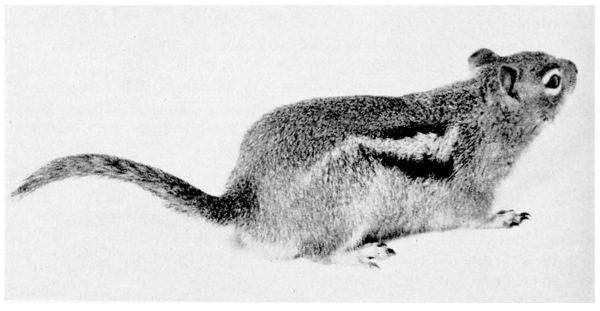
Fig. 87.
Golden-mantled ground squirrel (Citellus saturatus), captured
when young at Tye, Washington, by Earl J. Larrison, June 20, 1940; photographed
February 1, 1941. (Fish and Wildlife Service photo by Victor B.
Scheffer, No. 1139.)
In spite of their vivacious appearance, these squirrels are rather
sedentary. When undisturbed they move leisurely over rocks and
stumps, pausing often, and occasionally sitting on their hindquarters
to gaze about for minutes at a time. They are good climbers and
often ascend smooth-barked trees to heights of 20 feet or more. At
the approach of danger they descend and enter the nearest burrow.
In August these ground squirrels become exceedingly fat and by
late September only a few may be seen, basking in the midday
sun. These take alarm at the slightest excuse. All have usually
gone into hibernation by October 15.
The food includes the berries of salal, huckleberry, mountain ash,
and seeds of lupine. Near Liberty, Kittitas County, a squirrel killed
by a car had its cheek pouches stuffed with garden peas. The source
of its loot was doubtless the garden of a farmhouse 100 feet away.
Numerous individuals are run over by cars, and on many occasions
I have found other individuals eating the sun-dried flesh of their
mates, parents, or young. These cannibals are often run over while
so engaged, and it is not unusual to find two or three dead on a
section of pavement 20 feet in length.
Economically this species is of little importance. Its principal
enemies probably include hawks, weasels, martens, bobcats and
coyotes.
Sciurus griseus Ord, Jour. de phys., 87:152, 1818.
Sciurus griseus griseus Miller, U. S. Nat. Mus. Bull., 128:222, April 29, 1924.
Type.—None. Described from a squirrel seen by Lewis and Clark. Type
locality, The Dalles, Wasco County, Oregon.
Measurements.—A female from midway between Satus Pass and Goldendale,
Klickitat County, measured: total length 560; length of tail 264; hind
foot 76; weight 897 grams.
Distribution.—Southwestern Washington north to the glacial prairies near
Tacoma (W. W. D.); the Columbia River Valley of the southern Cascades;
the eastern edge of the Cascades north to Lake Chelan (Taylor and Shaw,
1929: 18).
Fig. 88.
Distribution of the western gray squirrel, Sciurus griseus,
in Washington.
Description.—This is the largest tree squirrel found in Washington.
The head and body measure about 12 inches, and the tail about
11 inches. The body is long and slender. The fur is long and soft,
that on the tail being exceptionally long. The upper parts are silvery
gray and the underparts white.
The western gray squirrel is restricted to the region of the Pacific
Coast and ranges from central Washington south to northern Lower
California. Three subspecies are recognized, only one of which occurs
in Washington. Like the red squirrels, the western gray squirrel
is arboreal. Its favored habitat is the oak woods rather than coniferous
forest. Its range in Washington is largely regulated by the
distribution of oaks, especially the garry oak (Quercus garryana).
Altitudinally it ranges from near sea level at Puget Sound to above
2,500 feet elevation in the eastern Cascade Mountains. It seems to
be restricted to the Transition Life-zone.
The habits of the western gray squirrel are modified by its arboreal
existence. Homes consist of holes in hollow trees or outside
nests of sticks and twigs. It is extremely active in trees and travels
from tree to tree on branches that seem scarcely strong enough to
bear the weight of so large an animal. The oak woods in Washington
are usually rather open and the trees more scattered than
is the case in coniferous forests. Consequently gray squirrels must
more often descend to the ground than Douglas and red squirrels.
On the ground, western gray squirrels travel in smooth leaps each
of two feet or more in length. The long tail is held out behind and
"follows through" the animal's leaps in a remarkable way. The tip
of the tail may be descending from the previous leap while the animal's
fore parts are already at the height of a new jump. This
results in a "flowing" movement that is extremely graceful. The
squirrel may stop momentarily to dig in the ground or search for
an acorn. At such times the tail is immediately switched up, over
the back.
The western gray squirrel is able to drop unharmed for considerable
distances. Near Fort Lewis, Pierce County, a gray squirrel
was cornered in a tall fir tree and an agile friend volunteered to
climb the tree. The squirrel ascended to the very topmost branches.
When only a few feet separated them the squirrel leaped far out
into the air. Its legs were stretched out stiffly, the tail was extended
and the body slightly arched. It struck the ground with an audible
thud and bounced fully 18 inches. At the height of its bounce, the
squirrel's legs began moving rapidly, and it struck the ground the
second time at a full run.
The principal food is acorns, although the seeds of the Douglas
fir and probably other conifers are eaten. Four embryos were found
by Victor B. Scheffer in a specimen from Klickitat County on March
20, 1939.
Sciurus carolinensis hypophaeus Merriam, Science, 7:351, April 16, 1886.
Type.—Obtained at Elk River, Sherburne County, Minnesota.
Description.—Size large, slightly smaller than the western gray
squirrel; color of upper parts less silvery, more reddish, especially
on the dorsal area and top of the tail.
Remarks.—The eastern gray squirrel was introduced at Woodland
Park, Seattle, in 1925. The original stock (7 pairs) came
from Minneapolis, Minnesota. It has spread through the nearby
woods, around Green Lake, Cowan Park, and to the woods on the
University of Washington Campus. Occasional individuals are
found outside the city limits, but the species seems not to spread
away from the city.
[Sciurus] niger Linnaeus, Syst. Nat., 1 (10th ed.):64, 1758.
Description.—Similar in size and appearance to the eastern gray
squirrel but upper parts more reddish and underparts reddish orange
rather than white.
Remarks.—Occasional fox squirrels are encountered near Seattle
where they have been introduced from the southeastern United
States. The source and date of the introduction are unknown.
Description.—The head and body of the red squirrel measure
about 7-3/4 inches, the tail about 5 inches. It may be recognized
by its trim body, bushy tail and white underparts. The upper parts
are reddish gray, reddest on the dorsal area. The red color of the
center of the back extends to the tail. A black line separates
the dark upper parts from the white underparts.
Red squirrels range over North America from the northern limit
of tree growth south through the United States to Tennessee and
North Carolina. A related species, douglasii, is found along the
Pacific coast from British Columbia to California. The genus
Tamiasciurus differs from Sciurus of Washington in lacking a penis
bone or baculum. There are other fundamental differences in anatomy
(see Mossman, Lowlah and Bradley, 1932: 89-155).
The habitat of the red squirrels is the coniferous forests from
which they rarely stray. Zonally they range through the Transition
and Canadian life-zones into the Hudsonian Life-zone. Red squirrels
are arboreal and most of their habits are modified by arboreal
existence. They are swift and agile climbers, able to travel from
tree to tree on slender twigs or by leaping as much as ten feet to
span the distance from one branch to another. They ascend and
descend trees head first. They hang by their hind feet, high in the
air, to clip the cones of conifers. If cornered in a tree they leap
far out and, by extending the legs and tail stiffly, fall to the ground
unharmed by leaps of fifty feet or more.
Fig. 89.
Douglas squirrel (Tamiasciurus douglasii douglasii): feeding station
with remnants of Douglas fir cone, Longmire, Washington, elevation 2,700
feet, June 25, 1937. (Fish and Wildlife Service photo by Victor B. Scheffer,
No. 268.)
The homes of red squirrels are woodpecker holes or other holes in
hollow trees. More rarely they build outside nests of twigs and
branches, about two feet in diameter, or add onto old nests of crows
or jays. Most nests and holes are some distance from the ground
but some holes are between roots on the ground itself.
The food consists principally of the seeds of coniferous trees,
especially Douglas fir and various species of pines. Cones are
clipped when green or just before ripening and are either allowed
to fall to the ground to be retrieved later or are at once carried to
a favored feeding place to be consumed. Cones are held between
the forepaws while the squirrel sits on its hind feet, tail curved up
over its back, and rapidly clips the cone apart to get the seeds
it contains. The cone is rotated between the paws and a steady
stream of husks drops to the ground. Soon only the core is left and
this too joins the husks on the ground. Favored feeding stations
are used continually, perhaps by generation after generation of
squirrels, and debris from thousands of cones accumulates in great
piles.
Cones are stored. In the vicinity of a favored feeding place, at
times virtually every hiding place is filled with green cones. Cones
may be jammed into cracks or crevices in logs or stumps without
effort at concealment or may be carefully covered with leaves
or dry needles. Many are placed in craterlike pits dug in the ground.
Most of these pits probably are later covered over but many are
left open to the weather. Hollows in trees are probably also used
for storage, as are holes dug into the piles of accumulated cone debris
beneath feeding stations. Other food eaten by squirrels includes
hazelnuts, berries, maple seeds, and mushrooms. A variety of fruits
and seeds are doubtless eaten when opportunity offers.
Red squirrels do not hibernate. In the lowlands they are active
all winter long but are noticeably shy and quiet. In the mountains
they disappear after the snow falls but tracks may be seen in the
snow about their dens and occasional individuals are seen. Specimens
collected at this time are not fat, as would be the case if
hibernation had been interrupted. Seemingly they stay close to
their homes and feed on stored food.
The call of the red squirrel is harsher, more metallic, than that
of the Douglas squirrel. The common call is a rolling "bur-r-r,"
starting loud but fading out entirely in a half minute. A lower-pitched
"pauf" is uttered at intervals when the squirrel is going
about its business. The danger cry is a loud "pee-ee," not unlike
the call of a red-tailed hawk but less shrill. A low pitched "chauf-chauf-chauf,"
repeated at intervals of about two seconds, is
occasionally given in the fall of the year.
Sciurus hudsonicus streatori Allen, Bull. Amer. Mus. Nat. Hist., 10:267, July 22, 1898.
T[amiasciurus]. h[udsonicus]. streatori Howell, Proc. Biol. Soc. Washington, 49:135, August
22, 1936.
Type.—Obtained at Ducks, British Columbia; type in American Museum
of Natural History.
Racial characters.—Similar to richardsoni but smaller and darker, redder
above.
Measurements.—Seven males from north-central Washington average: total
length 330; length of tail 129; hind foot 51; ear 23.
Distribution.—Northeastern Washington. Marginal occurrences are (from
Taylor and Shaw, 1929: 17): Beaver Creek, Ruby Creek, and head of Lake
Chelan.
Remarks.—This race reaches Washington from the interior of British Columbia.
Intergradation between hudsonicus streatori and h. richardsoni takes
place over much of northeastern Washington.
Fig. 90.
Distribution of the red squirrel and Douglas squirrel in Washington.
A. Tamiasciurus hudsonicus richardsoni. B. Tamiasciurus hudsonicus
streatori. C. Tamiasciurus douglasii douglasii.
Sciurus richardsoni Bachman, Proc. Zoöl. Soc. London, p. 100, 1838.
Sciurus hudsonius Richardsoni True, Proc. U. S. Nat. Mus., 7:595, 1884.
Sciurus hudsonius Richardsoni Allen, Bull. Amer. Mus. Nat. Hist., 10:265, July 22, 1898.
Sciurus hudsonicus richardsoni Miller, U. S. Nat. Mus. Bull., 128:211, April 29, 1924.
Tamiasciurus hudsonicus richardsoni Svihla and Svihla, Murrelet, 21:55, December 20, 1940.
Type.—Obtained at the head of Big Lost River, Custer County, Idaho.
Racial characters.—Color paler, especially on back.
Measurements.—Four males and 4 females average, respectively: total length
339, 339; length of tail 133, 131; hind foot 54, 51; ear 24, 24; weight 256, 266.
Distribution.—The Blue Mountains of southeastern Washington.
Sciurus douglasii Bachman, Proc. Zoöl. Soc. London, p. 99, 1838.
Sciurus hudsonius Douglasii True, Proc. U. S. Nat. Mus., 7:595, 1884.
Sciurus douglasii douglasii Miller, U. S. Nat. Mus. Bull., 128:212, April 29, 1924.
Sciurus douglasii cascadensis Taylor and Shaw, Occ. Papers Chas. R. Conner Mus., no. 2:18,
December, 1929.
Tamiasciurus douglasii Holdenried, Jour. Mamm., 21:406, November 14, 1940.
Type.—Obtained near the mouth of the Columbia River by David Douglas.
Measurements.—Fifteen males and 10 females from the lowlands of western
Washington average, respectively: total length 317, 320; length of tail 121,
126.7; hind foot 50, 49.4; ear 23.2, 22.6; weight 204, 202 grams.
Distribution.—From the eastern base of the Cascade Mountains westward
to the Pacific. Marginal occurrences are: Nooksack River (Taylor and Shaw,
1929: 18), Lake Wenatchee (W. W. D.) and Wenatchee (Taylor and Shaw,
1929: 18).
Remarks.—Squirrels from the Puget Sound area are slightly less
intensely colored than specimens from the ocean coast and the
Olympic Mountains. Those from the higher and eastern Cascade
Mountains are paler still. When, however, squirrels from the Cascades
of Washington are compared with individuals of the race inhabiting
the Cascades of Oregon, it is apparent that the Washington
squirrels are nearest to douglasii. The pale tips of the hairs in the
tail of the Oregon race are strikingly white while in Washington
specimens they are orange or yellow.
The Douglas squirrel resembles the red squirrel in size and proportions
but differs in being dusky olive (less reddish) on the upper
parts and orange instead of white on the underparts.
Douglas squirrels range from southern British Columbia southward
to Lower California. They are confined to the Pacific Coastal
region. Although closely related to Tamiasciurus hudsonicus, no
intergradation with that species has been found.
The rich coloration of the Douglas squirrel matches the background
of the humid forests it inhabits. It occurs at sea level along
the ocean coast, the shores of Puget Sound and on some islands in
Puget Sound. It ranges through the Transition and Canadian life-zones
well into the Hudsonian.
It makes its home in holes in trees or in nests constructed of
conifer twigs, needles and bark. Old nests of birds may be modified
and taken over, but most outside nests seem to have been made
entirely by the squirrel. Nests are usually placed near the top
of denser fir and cedar trees. Nests are hemispherical in shape, 12
inches or more in diameter, and open on top. The central cup, 4
inches in diameter, is lined with strips of inner bark of red cedar
coiled but unshredded. Nests in holes are usually some distance
from the ground, but the entrances to some are at ground level.
The habits of the Douglas squirrels vary with the season. In
spring they are shy. They rarely call and are skillful in keeping
branches or tree trunks between themselves and persons. In June
and July they become bolder, calling more frequently and moving
about more. In September and October they become exceptionally
bold. They call almost incessantly from late morning until early
afternoon, and spend considerable time on the ground.
The call notes of the Douglas squirrel are similar to those of the
red squirrel but are softer, more slurred. The common call is the
long, trilling "burr," loud at first and becoming gradually softer.
On hot afternoons in late summer a barking "pauf" note is given.
This sound is repeated several times at intervals of a minute or so.
It has remarkable carrying power. The danger signal is a loud,
explosive "pe-ee." Another common call is a short barking or
chirping "bauf" with a musical, questioning sound. This is repeated
at intervals of a few seconds when the presence of danger
is suspected. At times it, rather than the loud danger signal, is
given also when a person is sighted. A low chirping note is often
given while the squirrel is busily at work. This is made while the
squirrel is moving about. Other calls described are made from a
standing or sitting position and are accompanied by a jerk or a
flick of the tail.
The Douglas squirrel eats seeds of the Douglas fir, seeds of maple,
hazelnuts, dogwood berries and mushrooms. The berries of forest
shrubs, such as the red huckleberry, salal and Oregon grape, may
also be eaten.
Two broods of young may be born in a year. The first is born
in early June. Embryos found from June 11 to 28 varied in
number from 6 to 8. A nursing female was taken as early as June
10, 1938, and one was taken as late as October 10, 1938.
Douglas squirrels commonly have a few fleas and 2 to 5 ticks at
the bases of the ears. No lice, cases of mange, or serious infestations
of parasites have been seen.
Fig. 91.
Northern flying squirrel (Glaucomys sabrinus), probably from near
Seattle, in Woodland Park Zoo, Seattle, Washington, January 28, 1941. (Fish
and Wildlife Service photo by Victor B. Scheffer, No. 1137.)
Description.—The northern flying squirrel is slightly smaller than
the red squirrel (Tamiasciurus). The head and body measure about
7 inches and the tail about 5 inches. The most distinctive feature
is the loose fold of skin that stretches from the wrist of the foreleg
to the ankle of the hind leg. The fur is extremely soft and plushlike.
It is not separated into guard hair and underfur, and because
all hairs are of approximately the same length, the fur appears extremely
sleek. The fur of the tail is of the same texture as that on
the body but is dorso-ventrally compressed. The eyes are large and
dark. The color of the upper parts varies from reddish brown in
some races to brownish gray in others. The underparts are buffy
gray.
Flying squirrels range over the forested parts of North America
from Guatemala to Alaska and northern Canada and from the Atlantic
to the Pacific. A closely related genus (Pteromys) occurs in
Europe. Two species are found in North America. The small volans
ranges in eastern United States, Mexico, and Guatemala, while the
larger sabrinus occurs in parts of the western United States, most
of Canada, and central Alaska. Near the Great Lakes the two
species occur in the same area, probably in different habitats.
Howell (1918: 16) recognized 18 subspecies of sabrinus, five of
which were recorded in the state of Washington. One of these
(olympicus) proves to be a synonym of an earlier-named subspecies
but another form (bangsi), not recorded for Washington by Howell,
has been found in the Blue Mountains in the southeastern corner of
the state (Taylor and Shaw, 1929: 18).
Flying squirrels are strictly arboreal and occur only in woods and
forests. They prefer areas where trees grow close together and to
considerable heights. Older woods with dead stubs and hollow trees
are preferred. They occasionally invade attics of cabins and other
habitations of man. The old Forestry Building on the University
of Washington Campus, later the home of the Washington State
Museum, was inhabited by flying squirrels for many years. Several
specimens preserved in the Museum prove the poor judgment of the
animal in choosing a natural history museum as a home.
Relatively little is known of the detailed habits of Glaucomys
sabrinus although the life history of the eastern Glaucomys volans
has been described. Flying squirrels are active all winter, even in
the high mountains. They are often caught in traps set for fur
bearers and, where trapping is an important means of livelihood,
they are serious pests. Flying squirrels do not actually fly but only
glide through the air. The loose fold of fur between their limbs is
stretched by extending the legs. With it the flying squirrel is able
to sail 50 yards or more. The flat tail serves as a rudder and allows
the squirrel to change direction while in flight. Glides end with
an upward swoop, allowing the squirrel to alight, head upwards, on
a tree trunk slightly lower than their starting point.
Unlike other members of the squirrel family, flying squirrels are
completely nocturnal. They are seen in the daytime only when
frightened from their retreats. Homes consist principally of old
woodpecker holes or other cavities in trees. They are said to build
outside nests, similar to those of tree squirrels, but I have found
none of these in Washington. The animals can be frightened from
their holes by pounding on the bases of trees in which their nests
are situated. Certain holes seem to be preferred nesting places.
Near Cottage Lake, King County, two flying squirrels were taken
from a woodpecker hole in succeeding years. Cowan (1936B: 58)
discovered remains of 14 nests of flying squirrels in a single hollow
tree near Alta Lake, British Columbia. According to Cowan, hollow
trees are used in winter but the young are born in outside nests of
shredded bark and lichens. The young usually number 3 and are
born in May and June.
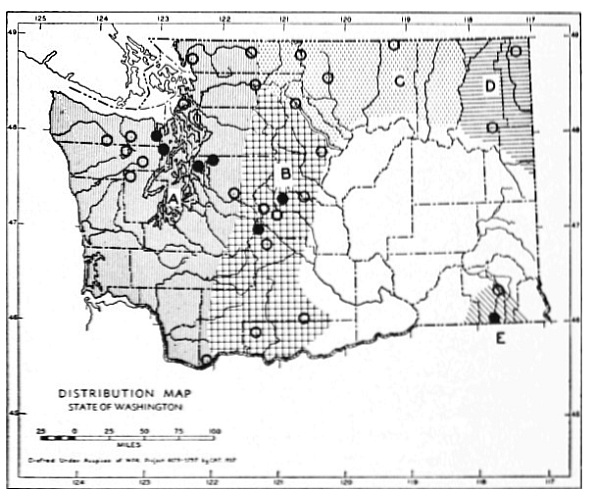
Fig. 92.
Distribution of flying squirrel in Washington. A. Glaucomys sabrinus
oregonensis. B. Glaucomys sabrinus fuliginosus. C. Glaucomys sabrinus
columbiensis. D. Glaucomys sabrinus latipes. E. Glaucomys sabrinus
bangsi.
Only once have I heard the voice of a flying squirrel. Near Dewey
Lake, Yakima County, the squirrels were unusually abundant in the
black hemlock and Douglas fir forests of the mountain sides. Here
a birdlike twittering note caught my attention and occasional dark,
sailing shapes were glimpsed against the clear sky. Eight traps set
in the afternoon and visited at 11 p. m. held two flying squirrels.
In the morning another was in a trap. Seemingly the squirrels are
active most of the night.
The food consists principally of conifer seeds and probably other
nuts, seeds, and fruit. They eat the meat bait of traps set for fur
bearers and probably eat the eggs of birds.
Pteromys oregonensis Bachman, Jour. Acad. Nat. Sci. Philadelphia, 8:101, 1839.
Sciuropterus alpinus oregonensis Rhoads, Proc. Acad. Nat. Sci. Philadelphia, p. 324, June,
1897.
Sciuropterus alpinus olympicus Elliot, Field Columb. Mus. Publ. 30, zoöl. ser., 1:225, February
1, 1899 (type from Happy Lake, Clallam County, Washington).
Glaucomys sabrinus oregonensis Howell, N. Amer. Fauna, 44:44, June 13, 1918.
Glaucomys sabrinus olympicus Howell, N. Amer. Fauna, 44:49, June 13, 1918.
Type.—Obtained "in pine [= conifer] woods of the Columbia near the sea"
by J. K. Townsend in 1839. Probably near St. Helen, Columbia County,
Oregon (Rhoads, 1897:324).
Racial characters.—Small size, rich color.
Measurements.—A male from Cottage Lake, King County, measured: total
length 287; length of tail 125; hind foot 38. A female from 5 miles southeast
of Sequim, Clallam County, measured: 303; 133; 41; ear 27. A male from
Quilcene, Jefferson County, measured: 311; 140; 41.
Distribution.—Western Washington west of the Cascade Mountains. The
locality records for flying squirrels in the northern Cascade Mountains, given
by Taylor and Shaw (1929: 18), when plotted on a distribution map, show
overlapping of ranges in this area. The ranges of the three races involved
have been drawn on the accompanying map (fig. 92) on the basis of geographic
probability and are subject to revision because the specimens from
this area have not been examined.
Marginal records that may apply to G. s. oregonensis are, from Taylor and
Shaw (1929: 18): Nooksack River, Rockport, North Bend and Skamania.
Remarks.—Of all the races occurring in Washington, oregonensis is the most
distinct. Glaucomys s. olympicus Elliot must be regarded as a synonym of
oregonensis.
Sciuropterus alpinus bangsi Rhoads, Proc. Acad. Nat. Sci. Philadelphia, p. 321, June, 1897.
Glaucomys sabrinus bangsi Howell, N. Amer. Fauna, 44:38, June 13, 1918.
Type.—Obtained in Idaho County, Idaho, by Harbison and Bargamin on
March 8, 1897; type in Philadelphia Academy of Natural Sciences.
Racial characters.—Similar to oregonensis but larger and paler throughout.
Measurements.—A female from Wildcat Spring, Columbia County, measured:
total length 333; length of tail 147; hind foot 45; ear 29; weight 151
grams.
Distribution.—Found only in the Blue Mountains of extreme southeastern
Washington.
Glaucomys sabrinus columbiensis Howell, Proc. Biol. Soc. Washington, 28:111, May 27,
1915.
Type.—Obtained at Okanogan, British Columbia, by Allan Brooks on May
9, 1898; type in United States National Museum.
Racial characters.—Larger than oregonensis and paler. Similar to bangsi
but paler, especially beneath, and less reddish above.
Measurements.—Howell (1918: 46) gives the average of two subadult topotypes
as: total length 313; length of tail 143; hind foot 42.
Distribution.—Northeastern Washington, probably extending, from records
of Taylor and Shaw (1929: 18), west to Mazama and Stehekin and east to
Molson.
Glaucomys sabrinus latipes Howell, Proc. Biol. Soc. Washington, 28:112, May 27, 1915.
Type.—Obtained at Glacier, British Columbia, by J. A. Loring, on August
13, 1894; type in United States National Museum.
Racial characters.—Similar to bangsi and columbiensis but with larger feet
and grayer color.
Measurements.—Howell (1918: 49) gives the average of 10 specimens as:
total length 342; length of tail 153; hind foot 41.5.
Distribution.—The Pend Oreille Mountains of extreme northeastern Washington,
north (from records of Taylor and Shaw, 1929: 18-19, as revised) to
Sullivan Lake and south to Loon Lake.
Sciuropterus alpinus fuliginosus Rhoads, Proc. Acad. Nat. Sci. Philadelphia, p. 321, June,
1897.
Glaucomys sabrinus fuliginosus Howell, N. Amer. Fauna, 44:47, June 13, 1918.
Type.—Obtained at Martin Station, Kittitas County, Washington, by Allan
Rupert in March, 1893; type in Philadelphia Academy of Natural Sciences.
Racial characters.—Similar to columbiensis but underparts darker and tail
paler. Larger and paler than oregonensis.
Measurements.—Three females from the Cascades average: total length
327; length of tail 145; hind foot 40.7; ear 25.
Distribution.—The Cascade Mountains, according to Taylor and Shaw (1929:
18), as revised here, east to Entiat River and south to Carson.
Description.—Great Basin pocket mice are slightly larger than
house mice. The ears are tiny and round; the tail is relatively long,
slightly longer than the head and body; the forefeet are small but
the hind feet are large and powerful, more than one-fourth as long
as the head and body. They have relatively large, fur-lined, external
cheek pouches. The color of the upper parts varies with the
subspecies from blackish olive-gray to buffy olive-gray; a line of
clear buff or buffy-olive extends along the lower part of side, separating
the darker color of the upper parts from the white underparts;
the tail is short-haired, blackish above, olive beneath.
Pocket mice of the genus Perognathus range from Mexico northward
to British Columbia. Only one species, parvus, occurs in
Washington where it is represented by three subspecies. Pocket mice
are most common in the Upper Sonoran Life-zone in sandy areas
dotted with desert shrubs. They are found occasionally in dry,
grassy places in the Arid Transition Life-zone. They may be locally
abundant in rocky areas and are often trapped high on talus slides,
many yards from the nearest soil. Gray (1943: 191-193) estimates
their numbers on the sagebrush areas of the Yakima Valley at 32
per acre. They are completely nocturnal. Their ordinary movements
are rather slow and specimens studied by the aid of a searchlight
usually crept quietly into the protection of the nearest desert
shrub. The trail of a pocket mouse in soft sand may be recognized
by the distinctive mark left by the dragging tail.
Burrows of pocket mice usually are at the bases of shrubs where
tough roots furnish protection. They are kept closed during the
day by means of a plug of fresh earth or sand. Openings may often
be recognized by a fan-shaped pile of fresh sand before the hole.
Burrows excavated were usually less than four feet in length and
branched from two to four times. No nests were found in the burrows
but one contained a few fresh stalks of desert annuals. The
air in the burrows seemed warm and humid.
The pouches of pocket mice from Washington often contain the
fresh, green tips of desert plants, grass seeds, seeds of plants
other than grasses, and plant leaves. Because of their occasional
great abundance, pocket mice may be a menace to agriculture.
Fortunately much of their habitat is unsuited to farming.
In Washington pocket mice breed in March and April. From 4
to 8 embryos were found in pregnant females.
Cricetodipus parvus Peale, U. S. Explor. Exped., 8 (mamm. and ornith.):53, 1848.
Perognathus parvus Cassin, U. S. Explor. Exped., 8 (mamm. and ornith.):48, 1858.
Perognathus parvus parvus Miller, Bull. U. S. Nat. Mus., 128:278, April 29, 1924.
Fig. 93.
Distribution of the Great Basin pocket mouse in Washington. A.
Perognathus parvus parvus. B. Perognathus parvus columbianus. C. Perognathus
parvus lordi.
Type.—Probably obtained in the neighborhood of The Dalles, Wasco
County, Oregon.
Racial characters.—Size small; upper parts brownish-buff washed with blackish
or, in gray phase, ashy gray washed with blackish; sides buffy yellow; a
buffy spot often present on throat; tail blackish above, olive below; facial
markings usually brownish-buff but in older animals indistinct and washed
with blackish.
Measurements.—Thirty-one males and 19 females from Washington average,
respectively: total length 169, 164; length of tail 90, 86; hind foot 22.6,
21.8; ear 5, 5.
Distribution.—Southeastern Washington south of the Snake River, the area
on the north side of the Columbia River in Klickitat County, and the Yakima
Valley area as far north as the Vantage, Kittitas County (W. W. D.). Other
marginal records are: Kennewick (W. W. D.), Atilla (W. W. D.) and Walla
Walla (E. S. B.).
Remarks.—Dichromatism seems to be rather common in Perognathus p.
parvus—so common that Osgood (1900: 35) recognized both a "red" and a
"gray" phase. Anderson (1932: 102) found no dichromatism in P. p. lordi
in British Columbia. A single specimen from the Grand Coulee at Dry Falls,
Grant County, does show dichromatism. It is even more red than the reddest
topotypes of parvus examined.
Seemingly the recessive gene for red is still present in lordi, or has mutated
anew. When present, the color is deeper and brighter than in the parent population,
in keeping with the heavier pigmentation of the race lordi.
Abromys lordi Gray, Proc. Zoöl. Soc. London, p. 202, 1868.
Perognathus lordi Merriam, N. Amer. Fauna, 1:28, October 25, 1889.
Perognathus lordi lordi Miller, U. S. Nat. Mus. Bull., 128:279, April 29, 1924.
Perognathus parvus lordi Davis, Recent Mamm. of Idaho, p. 266, Caxton Printers, Caldwell,
Idaho, April 5, 1939.
Type.—Obtained in southern British Columbia (probably near Lake Osoyoos)
by J. K. Lord, probably in 1860.
Racial characters.—Size large; color of upper parts buffy-olive, washed with
blackish; sides buff-olive; facial markings absent or, if present, indistinct and
pale olive; tail blackish above, olive below.
Measurements.—Twenty-nine males and 10 females average, respectively:
total length 175, 171; length of tail 93, 89; hind foot 23.4, 22.9; ear 5.3, 5.1.
Distribution.—Okanogan Valley and the Columbian Plateau, except for the
southwestern part. Marginal localities are: Vantage, Grant County (W. W.
D.), 10 mi. S. Moses Lake (W. W. D.), Washtucna (M. V. Z.) and Pullman
(M. V. Z.).
Remarks.—There are constant differences between Perognathus parvus parvus
and Perognathus parvus lordi. The latter is larger, darker, and differs
slightly in average cranial measurements. The Snake River, the Columbia
River, and the Wenatchee Mountains separate the geographic ranges of the
two subspecies and prevent intergradation between them. Nevertheless their
close similarity and probable common origin indicate that both belong to one
species, namely parvus.
Perognathus columbianus Merriam, Proc. Acad. Nat. Sci. Philadelphia, p. 263, September
27, 1894.
Perognathus lordi columbianus, Osgood, N. Amer. Fauna, 18:40, September 20, 1900.
Type.—Obtained at Pasco, Franklin County, Washington, by Clark P.
Streator on May 9, 1891; type in United States National Museum.
Racial characters.—Size and color as in lordi but skull considerably wider
in mastoid region.
Measurements.—Twenty-one male and 9 female topotypes average, respectively:
total length 173, 168; length of tail 91, 89; hind foot 23.9, 22.8; ear 5, 5.
Distribution.—The vicinity of the type locality and the part of the Columbian
Plateau north of the Snake and east of the Columbia rivers.
Remarks.—This race is separated from parvus by river barriers and the
two do not intergrade. It differs significantly from lordi only in the wider mastoid
region. No barrier separates the range of lordi from that of parvus, and
the two races intergrade over a wide area (north to Moses Lake, east to
Washtucna). The race columbianus must have originated in situ from lordi.
The habitat of columbianus seems not to differ from that of parvus or lordi.
Perodipus ordi columbianus Merriam, Proc. Biol. Soc. Washington, 9:115, June 21, 1894.
Dipodomys ordii columbianus Grinnell, Jour. Mamm., 2:96, May 2, 1921.
Type.—Obtained at Umatilla, Umatilla County, Oregon, by C. P. Streator
on October 18, 1890; type in United States National Museum.
Measurements.—Fourteen males and 9 females from Walla Walla County
average, respectively: total length 261.5, 248.4; length of tail 137.2, 139.1; hind
foot 40.6, 40.8; ear 13.1, 13.0; weight 52.1, 49.0 grams.
Distribution.—Western Walla Walla County from the Oregon boundary
north to the Snake River and on Blalock Island in the Columbia River, Benton
County.
Fig. 94.
Distribution of the Ord kangaroo rat, Dipodomys ordii columbianus,
in Washington.
Description.—The kangaroo rat with a body about the size of that
of a chipmunk has an exceptionally large head and large, black eyes.
The forelegs and forefeet are tiny but the hind feet and legs are large
and powerful. The hind foot is almost a third as long as the head
and body. The tail is long, longer than the head and body. Kangaroo
rats possess fur-lined, external cheek pouches, like those of
the pocket mice. The upper parts are soft buff in color. The underparts
and a stripe on each flank are white. The tail is dusky
above and below, with white sides; it is tufted at the tip.
Kangaroo rats are typical of the desert regions of the southwestern
United States, where numerous species and subspecies are found.
A single subspecies of the wide-ranging species ordii occurs into
southeastern Washington, where it is restricted to sandy areas in
the Upper Sonoran Life-zone. In the soft, drifted sand along the
Columbia River where sagebrush and other desert shrubs are low
and widely spaced kangaroo rats are abundant.
These rats are strictly nocturnal. When individuals are dug
from their burrows in the daytime they usually hop about in a
dazed manner and appear to be blinded by sunlight. Near Wallula,
Walla Walla County, these rats were caught at night with a butterfly
net as they stood "paralyzed" in the beam of a powerful searchlight.
Such night hunting was unsuccessful on cloudy or windy
nights when kangaroo rats seem not to move about.
As might be guessed from their powerful hind legs, kangaroo
rats travel in bounds. Near Wallula, where we watched them in
their natural habitat, they traveled, when unfrightened, in slow
hops, each hop followed by a pause. As they struck the surface
of the ground an audible thud could be heard for a distance of
several feet. After each jump they paused for a second or so,
perhaps to allow a pursuing enemy to over-run them.
Near Wallula the burrows of kangaroo rats were dug in large
mounds of wind-blown sand. The burrows entered these natural
mounds horizontally and branched two or three times. Their
average length was about five feet. No nests or food stores were
discovered although several kangaroo rats were caught as they burst
from entrances at sides of the mounds. All entrances to burrows
were plugged with soft sand. The air in the burrows seemed warm
and humid.
Food found in the cheek pouches of kangaroo rats from Washington
included the seeds of desert annuals, short sections of sprouts
of an unidentified plant, grass seeds, and the leaves of the hop-sage.
A female taken March 22, 1939, contained 3 embryos.
Description.—The pocket gopher is a fossorial animal, being but
slightly less adapted to an underground existence than the moles.
The body is stout, the legs short and the head broad. The tail is
short, sparsely haired, cylindrical and blunt-ended. The fur is soft
and dense. The eyes are small and the ears tiny and naked. The
incisor teeth are external, being separated from the mouth cavity
by a furry strip of skin. Like the pocket mouse and kangaroo rat,
the pocket gopher possesses external, fur-lined cheek pouches. The
openings of these begin just below and posterior to the nostrils,
sweep out and down in a semicircle, and end at the chin posterior
to the base of the lower incisors. They extend laterally to the shoulders
and easily accommodate a fifty-cent piece.
Fig. 95.
Northern pocket gopher (Thomomys talpoides yelmensis), from
two miles southwest of Tenino, Washington, January 28, 1941. (Fish and
Wildlife Service photo by Victor B. Scheffer, No. 1133.)
The family Geomyidae is composed of eight genera, so similar
in appearance that the name "pocket gopher" is applied to all of
them. The family is confined to North and Central America. Three
genera occur in the United States but only one, Thomomys, occurs
in Washington. Thomomys is restricted to western North America
where it ranges from central Canada south to the southern edge of
the table land of Mexico.
Several hundred kinds of Thomomys have been described and as
systematic work with this genus has been continued, more and more
kinds, originally thought to be species, are found to intergrade and
to be only subspecies. All of the 17 kinds of pocket gophers occurring
in Washington belong to a single species.
The pocket gopher is principally nocturnal or crepuscular but
sometimes it is active at midday, especially if the day be dark and
cloudy. Pocket-gopher activity is indicated by fresh mounds of
earth on the surface of the ground. Rarely, an observer may see
movement of plants as the gopher molests the roots of the plants, or
even see the head and shoulders of an animal that partly emerges
from an open burrow. The ordinary gopher mound consists of less
than a cubic foot of earth. The earth is forced up from a single
opening and usually is pushed out in one direction. In consequence
it forms in a fan-shaped pile about the opening, and the last load
forms a circular plug above and to one side of the burrow opening.
When so much earth has been forced out of one opening that expulsion
of additional loads of earth is overly difficult, the burrow is
extended slightly to one side, or even extended into the newly formed
mound, and another fan formed. Usually not more than three
coalesced fans form a mound, but where the soil is exceedingly soft
and fluffy, hundreds of fans may form a composite mound and the
one mound may include a cubic yard of earth. Large composite
mounds probably are formed gradually over a period of weeks or
even months.
The earth in a fresh gopher mound is usually "scratched," and
gives the appearance of having been sieved. Pebbles weighing more
than 100 grams are included in material ejected from burrows. The
entrances to the burrows of gophers are usually solidly plugged
with earth. The plug may be from a few inches to more than a foot
in length. At times a burrow entrance may appear to be open, but
in such cases investigation will usually reveal it to be plugged some
distance back—sometimes several feet.
In contrast to the gopher mounds described above, the mounds
of moles are not fan-shaped but volcano-shaped. The earth from a
mole's burrow is forced straight upwards, whence it falls to either
side. Later loads are pushed up from beneath, raising the entire
mound, with the last material ejected at the center and bottom.
The earth of a fresh mole-mound is not of fine texture but instead
is "clotted" and, if damp, gives the mound a fractured appearance.
When mounds are older, perhaps changed by rain and sun, their
identity as of mole-origin or pocket gopher-origin is more difficult
to establish. In such cases, if no fresh mounds can be found, the
observer must rely on the spacing of the mounds. Mole-mounds are
spaced along a burrow, about as far apart as a man can step. Gopher
mounds are irregularly spaced, and the course of the burrow cannot
be traced merely by observing the arrangement of the mounds as
can that of the mole.
In addition to mounds, gopher burrows have plugged openings
where a gopher has come to the surface, probably to cut plants. Such
entrances are marked by a plug of earth several inches long.
Mounds and feeding entrances of the gopher burrow are usually
not constructed in the main burrow system itself, but at the ends
of lateral burrows of varying length. If one traces the burrow back
from the mound, a junction with the main, better-constructed burrow
is found. The junction is usually T-shaped, with the lateral
burrow at right angles to the main burrow. More rarely the junction
has a Y-shape.
Fig. 96.
Giant mounds raised by pocket gophers on Mima Prairie, Thurston
County, Washington, July 13, 1941. (Fish and Wildlife Service photo by
Victor B. Scheffer, No. 1209.)
The burrow system of the pocket gopher may be divided into
three main parts. These are the laterals, just discussed, the main
burrow, and the deep nesting burrow. The main burrow is a sinuous
tube or tunnel at a relatively uniform depth, that marks the extent
of the gopher's home territory. This tunnel may branch, or even
intersect. As it is extended in one direction, the earth excavated
by the gopher may in part be thrust into an unused portion of the
burrow.
The deep, nesting burrows may be used only in the breeding season.
They are connected with the main tunnel system but descend
to a greater depth. Usually they descend into the harder, consolidated
layers of soil below the zone where plant roots penetrate.
Here chambers are constructed in which nests and food are stored.
Usually a vertical shaft is dug in the burrow ahead of the nest to
lead rain water away from the nest.
In areas where gophers live in a thin layer of soil underlain by a
more or less impenetrable layer of rock, clay or gravel, it has been
suggested that they form unique structures known as Mima Mounds.
The formation of these mounds has been discussed in detail elsewhere
(Dalquest and Scheffer, 1942: 68-84). At least in the breeding
season the gophers work mainly and make their nest where the
soil is deepest. In the vicinity of this nest, considerable mounding
and cultivation of soil ensues. This stimulates plant growth in the
area. Much observation indicates that cultivation of earth by
gophers stimulates plant growth to a greater extent than the depredations
of the gopher deplete the ensuing growth. Thus the gopher,
by cultivation of the soil in the area about its burrow, stimulates
the growth of vegetation and so increases his own food supply. Consequently
there is but little incentive for the gopher to leave the
vicinity of the nest. The gopher does, however, construct lateral
tunnels into surrounding areas. Earth from these lateral tunnels
is, in part, thrown to the surface in mounds and in part transported
back to fill the abandoned burrows near the nest. The earth from
the burrows about the nest was earlier ejected on the surface.
Slowly, then, earth is transported from surrounding areas to burrows
in the vicinity of the original nest. Each succeeding generation
finds in the vicinity of the original nest, better food and deeper soil,
while areas surrounding the nest possess thinner soil and less vegetation.
Over a period of thousands of generations of gophers, large
mounds, known as Mima Mounds, are formed. Since the removal
of earth from the surrounding areas and its accumulation in the
Mima Mound are chance affairs, the contours of the mound are
smooth and flowing while the contours of the intermound areas are
smoothly convex.
The pocket gophers in Washington are economically important.
In truck and flower gardens they are a pest, especially if the crop be
bulb plants. In grain fields they are a pest because their mounds
cover considerable grain and are apt to clog or dull the knife of the
mower. In fields of young alfalfa they are apt to crop back the
plant more rapidly than it can grow. Once the alfalfa plant is well
established, however, the cultivation resulting from activities of
gophers, some persons believe, stimulates the plant to such an extent
that it grows larger and healthier in spite of the gopher's feeding
on it. In the White Salmon Valley, Klickitat County, I examined
numerous alfalfa fields. The most luxuriant growth was invariably
in fields where gophers were common. In these fields, the largest
plants were those in the immediate vicinity of gopher activity. The
commensal relation between the gopher and alfalfa was understood
by many farmers, who forbade us to take gophers for specimens
from their fields. Several told us that they always trapped the
gophers from the fields of young alfalfa and from hay meadows but
encouraged their presence in fields of older alfalfa.
Fig. 97.
Food cache of northern pocket gopher (Thomomys talpoides tacomensis),
from chamber four inches below surface of ground, Tacoma, Washington,
December 1, 1940. Contents 575 grams (about 2 liters) of roots, principally
quackgrass, Agropyron repens. (Fish and Wildlife Service photo by
Victor B. Scheffer, No. 1119.)
Another economic factor is the gopher's removal of certain weeds
from grazing land. A number of introduced weeds form dense
rosettes that prevent the growth of grass from several square inches
of ground and themselves lie so close to the ground as to be unavailable
as food to grazing stock. These weeds seem to be favored
food of gophers which cut not only the rosettes but the roots of the
weeds as well.
In irrigated parts of eastern Washington the gopher is a serious
pest. It burrows in the banks of the main ditches, causing cave-ins
and occasional breaks with resultant water loss. The mounds of
gophers fill in the smaller channels and divert the streams. Constant
attention is necessary to keep the ditches free of gopher
mounds.
In uncultivated land the gopher is a distinct asset unless the land
is near enough to cultivated land to serve as a reservoir of pests.
In the mountains and on the desert the gopher cultivates and keeps
the soil soft and stimulates the growth of water-retaining vegetation,
thus preventing rapid run-off and erosion and keeping the flow of
springs and streams constant. Boulders, logs, and other obstructions
are undermined and, as a result of gopher activity, in time
sink under the surface of the ground. Thus a larger surface is available
for plant growth. Lastly the gopher furnishes an important
food source for certain fur-bearing mammals and eases the predator
pressure on game species.
The subspecies of pocket gopher occupying the Puget Sound area
are highly restricted in their habitat preference; they occur only
on the grassy prairies of the glacial outwash aprons. They do not
occur in woods, brush or even small openings on the borders of the
prairies. The alpine forms occupy the mountain meadows and are
slightly less selective in their habits. It should be noted that in
western Washington the forests are far more open at higher altitudes
than at low elevations. The races inhabiting the desert are found
in open areas, often in sandy places. They occur more rarely in
areas where the soil is baked and claylike, and then usually in the
vicinity of springs or watercourses. The race T. t. fuscus has a wide
range of tolerance as regards environmental factors; it occurs near
Wenatchee in essentially desert conditions, in alpine meadows of
northeastern Washington, and in many habitats at intermediate
elevations. It occurs also in brushy areas and is often abundant
in open pine forests.
Since the gopher usually has a narrow range of tolerance as regards
its environmental adaptations, this has resulted in considerably
more isolation than is the case with other mammals, and has
probably contributed to the formation of the many subspecies.
Within the range of almost every race, microgeographic races, or
local populations with distinctive characters, are found. Many subspecies
of Thomomys are probably the result of chance fixation of
genetic characters already present in a more genetically variable
ancestral population, and the loss of other genetic factors. Such
races might be considered degenerative (see Dalquest and Scheffer,
1944: 24).
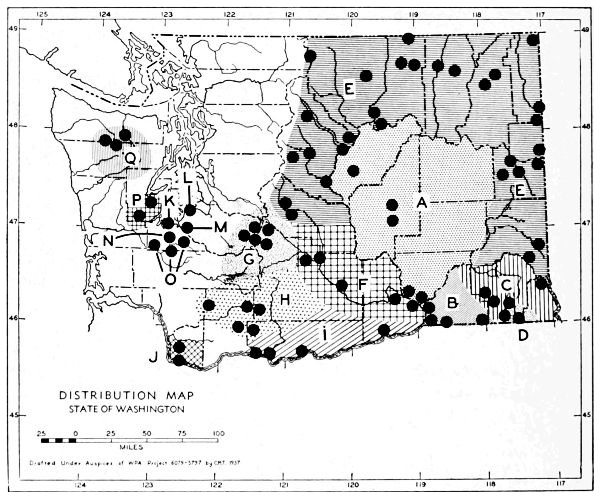
Fig. 98.
Distribution of the northern pocket gopher in Washington. A.
Thomomys talpoides devexus. B. Thomomys talpoides columbianus. C.
Thomomys talpoides aequalidens. D. Thomomys talpoides wallowa. E.
Thomomys talpoides fuscus. F. Thomomys talpoides yakimensis. G. Thomomys
talpoides shawii. H. Thomomys talpoides immunis. I. Thomomys
talpoides limosus. J. Thomomys talpoides douglasii. K. Thomomys talpoides
pugetensis. L. Thomomys talpoides tacomensis. M. Thomomys talpoides
glacialis. N. Thomomys talpoides tumuli. O. Thomomys talpoides
yelmensis. P. Thomomys talpoides couchii. Q. Thomomys talpoides melanops.
The history of the pocket gophers of Washington has been traced
previously (Dalquest and Scheffer, 1942, 1944). It may be briefly
summarized as follows: At the close of Vashon-Wisconsin times,
gophers were found in the southern Cascades, on the Simcoe Bridge,
the Columbian Plateau, and in southeastern Washington. Following
the retreat of the ice, the gophers in the Mount Rainier area
spread westward on the outwash of the Nisqually and perhaps other
glaciers to the Vashon Outwash about southern Puget Sound and
thence to the Olympic Mountains. In the southern Cascades,
gophers spread westward on glacial terraces of the Columbia River
to the vicinity of Vancouver, Clark County. The establishment
and growth of the forests split up the original populations, and
continued spread of forest has exterminated many units. All the
races in the lowlands of western Washington face extermination as
the prairies are reclaimed by forest.
Pocket gophers also invaded northeastern Washington from Idaho
and spread westward to the Cascades, thence southward until the
native gophers were encountered north of Mount Rainier and in
the Yakima Valley. The invading gophers nearly surrounded the
Columbian Plateau.
T. H. Scheffer (1938B: 220-224) found the gestation period of
the pocket gopher to be approximately 28 days. No second brood
is raised in Washington. Near Kennewick, Yakima County, the
young are born from February to April. The average number of
embryos found in 76 female gophers was 6.3. Near Olympia, Thurston
County, the young are born from March to June. The average
number of embryos from 312 females was 5.0.
Thomomys talpoides devexus Hall and Dalquest, Murrelet, 20:3, April 30, 1939.
Thomomys talpoides ericaeus Goldman, Jour. Mamm., 20:243, May 15, 1939 (type from
Badger Mountains, Douglas County, Washington).
Type.—Obtained 1 mile west-southwest of Neppel (now Moses Lake), Grant
County, Washington, by W. W. Dalquest on May 30, 1938; type in Museum
of Vertebrate Zoölogy.
Racial characters.—Size medium; ears tiny; color of upper parts pale
brownish gray; underparts white; postauricular spots dark.
Measurements.—Two male and 4 female topotypes average, respectively:
total length 184, 184; length of tail 54, 55; hind foot 25, 25; weight 89, 71
grams.
Distribution.—The Columbian Plateau. Marginal occurrences of the races
of pocket gophers occurring in Washington are not listed here because they
have recently been placed on record (Dalquest and Scheffer, 1944: 308-333,
423-450).
Remarks.—This is the smallest and palest race of pocket gopher found in
Washington.
Thomomys fuscus columbianus Bailey, Proc. Biol. Soc. Washington, 27:117, July 10, 1914.
Thomomys columbianus Bailey, N. Amer. Fauna, 39:106, November 15, 1915.
Thomomys talpoides columbianus Goldman, Jour. Mamm., 20:234, May 15, 1939.
Type.—Obtained at Touchet, Walla Walla County, Washington, by C. P.
Streator on September 10, 1890; type in United States National Museum.
Racial characters.—Larger and brighter in color than devexus. Near ochraceous
orange in color.
Measurements.—Five male and three female topotypes average, respectively:
total length 213, 209; length of tail 60, 58; hind foot 29, 28.
Distribution.—Walla Walla County, between the Snake River and the
Oregon boundary and from the Columbia River east to the Columbia County
line.
Thomomys talpoides aequalidens Dalquest, Murrelet, 23:3, May 14, 1942.
Type.—Obtained at Abel Place, 2,200 ft., 6 miles south-southeast of Dayton,
Columbia County, Washington, by S. H. Lyman, on April 6, 1934; type in
Museum of Vertebrate Zoölogy.
Racial characters.—Large size, very dark color.
Measurements.—The average of four male topotypes and the measurements
of one female topotype are, respectively: total length 202, 201; length of tail
57, 59; hind foot 26, 27.
Distribution.—Southeastern Washington east of the range of columbianus
and north of the higher parts of the Blue Mountains.
Thomomys quadratus wallowa Hall and Orr, Proc. Biol. Soc. Washington, 46:41, March 24,
1933.
Thomomys talpoides wallowa Goldman, Jour. Mamm., 20:234, May 15, 1939.
Type.—Obtained at Catherine Creek, 7 miles east of Telocaset, 3,500 ft.,
Union County, Oregon, by R. T. Orr on June 29, 1932; type in Museum of
Vertebrate Zoölogy.
Racial characters.—Similar to devexus but much darker. Similar (in Washington)
to aequalidens but much smaller.
Measurements.—Four males and 4 females from Mountain Top and Stay-a-while
Spring, Columbia County, average, respectively: total length 191, 180;
length of tail 56, 52; hind foot 26, 25.
Distribution.—The higher parts of the Blue Mountains.
Remarks.—Washington specimens referred to this race are intermediate
between wallowa and aequalidens but are colored like aequalidens.
Thomomys clusius fuscus Merriam, N. Amer. Fauna, 5:69, July 30, 1891.
Thomomys myops Merriam, Proc. Biol. Soc. Washington, 14:112, July 19, 1901 (type from
Conconnully, Okanogan County, Washington).
Thomomys fuscus fuscus Bailey, N. Amer. Fauna, 39:126, November 15, 1915.
Thomomys talpoides fuscus Hall and Dalquest, Murrelet, 20:4, April 30, 1939.
Type.—Obtained at the head of Big Lost River, Custer County, Idaho, by
B. H. Dutcher on September 23, 1890; type in United States National Museum.
Racial characters.—Similar to devexus but upper parts rich tawny in color.
Measurements.—Three males and 2 females from Newport, Pend Oreille
County, average, respectively: total length 189, 186; length of tail 54, 57;
hind foot 27, 26.
Distribution.—Along the eastern border of the state to the north of the
Snake River, northeastern Washington, and the northeastern Cascades.
Thomomys talpoides yakimensis Hall and Dalquest, Murrelet, 20:4, April 30, 1939.
Thomomys talpoides badius Goldman, Jour. Mamm., 20:242, May 15, 1939 (type from
Wenatchee, Chelan County, Washington).
Type.—Obtained at Selah, Yakima County, Washington, by P. Burgner,
on November 27, 1938; type in Museum of Vertebrate Zoölogy.
Racial characters.—Similar to fuscus but more orange, less red.
Measurements.—Four male and 3 female topotypes average, respectively:
total length 209, 191; length of tail 60, 56; hind foot 27, 26.
Distribution.—The eastern edge of the Cascades from the Wenatchee Mountains
south to the Simcoe Anticline.
Thomomys douglasii shawi Taylor, Proc. Biol. Soc. Washington, 34:121, June 30, 1921.
Thomomys talpoides shawi Hall and Dalquest, Murrelet, 20:4, April 30, 1939.
Type.—Obtained at Owyhigh Lakes, Mount Rainier, Pierce County, Washington,
by G. G. Cantwell, on August 9, 1919; type in United States National
Museum.
Racial characters.—A large, tan-colored pocket gopher, similar to aequalidens
but paler.
Measurements.—Two male and 7 female topotypes average, respectively:
total length 227, 213; length of tail 72, 64; hind foot 32, 30.
Distribution.—The higher Cascade Mountains from Mount Rainier southward.
Southern limits of range unknown.
Thomomys talpoides immunis Hall and Dalquest, Murrelet, 20:4, April 30, 1939.
Type.—Obtained 5 miles south of Trout Lake, Klickitat County, Washington,
by W. W. Dalquest on July 27, 1937; type in Museum of Vertebrate
Zoölogy.
Racial characters.—Similar to shawi but paler and grayer.
Measurements.—Two males and 2 females from Morrison Springs Ranger
Station, Skamania County, average, respectively: total length 211, 212; length
of tail 64, 58; hind foot 28, 29.
Distribution.—The Cascade Mountains from the vicinity of Mount Adams
north. The zone of intergradation between shawi and immunis is in the
rugged, inaccessible mountains between Mount Rainier and Mount Adams.
Thomomys limosus Merriam, Proc. Biol. Soc. Washington, 14:116, July 19, 1901.
Thomomys talpoides limosus Goldman, Jour. Mamm., 20:235, May 15, 1939.
Type.—Obtained at White Salmon, Klickitat County, Washington, by
J. A. Loring on June 26, 1897; type in United States National Museum.
Racial characters.—Similar to immunis but darker with smaller, shorter
skull.
Measurements.—One male and 13 female topotypes average, respectively:
total length 210, 198; length of tail 55, 56; hind foot 30, 28.
Distribution.—The lower Columbia River Valley, from the type locality east
to the Columbian Plateau.
Geomys douglasii Richardson, Fauna Boreali-American, 1:200, 1829.
Geomys fuliginosus Schinz, Syn. Mamm., 2:136, 1846 (type from "Habitat ad fluvium
Columbia").
Thomomys douglasii Allen, Bull. Amer. Mus. Nat. Hist., 5:66, April 28, 1893.
Thomomys douglasi douglasi Bailey, N. Amer. Fauna, 39:116, November 15, 1915.
Thomomys talpoides douglasii Goldman, Jour. Mamm., 20:234, May 15, 1939.
Type.—Obtained at Fort Vancouver (now the city of Vancouver), Clark
County, Washington, by David Douglas, probably in 1825. Probably not now
in existence.
Racial characters.—A medium-sized, yellowish gopher with tiny, pointed
ears and very small postauricular patches.
Measurements.—Two male and 10 female topotypes average, respectively:
total length 227, 213; length of tail 68, 63; hind foot 30, 30; and weight 148,
117 grams.
Distribution.—Known only from Clark County.
Thomomys talpoides glacialis Dalquest and Scheffer, Proc. Biol. Soc. Washington, 55:97,
August 13, 1942.
Type.—Obtained 2 miles south of Roy, Pierce County, Washington, by W.
W. Dalquest, on December 19, 1941; type in United States National Museum.
Racial characters.—A dark, yellowish-brown gopher with orange-tinged underparts.
Measurements.—Twenty male and 17 female topotypes average, respectively:
total length 225, 220; length of tail 72, 71; hind foot 30, 30; and weight
128, 116 grams.
Distribution.—Known only from Roy Prairie, Pierce County.
Thomomys douglasii tacomensis Taylor, Proc. Biol. Soc. Washington, 32:169, September 30,
1919.
Thomomys talpoides tacomensis Goldman, Jour. Mamm., 20:235, May 15, 1939.
Type.—Obtained 6 miles south of Tacoma, Pierce County, Washington, by
G. G. Cantwell on December 24, 1918; type in United States National Museum.
Racial characters.—A large, dark form; rich hazel in color with large, black
postauricular patches and ochraceous underparts.
Measurements.—Thirteen male and 15 female topotypes average, respectively:
total length 224, 196; length of tail 71, 57; hind foot 31, 29; and weight
127, 104 grams.
Distribution.—Restricted to the area about Steilacoom and Tacoma, Pierce
County, Washington.
Thomomys talpoides pugetensis Dalquest and Scheffer, Proc. Biol. Soc. Washington, 55:96,
August 13, 1942.
Type.—Obtained 4 miles south of Olympia, Thurston County, Washington,
by W. W. Dalquest, on December 31, 1941; type in United States National
Museum.
Racial characters.—Similar to glacialis but underparts not tinged with orange
and conspicuous dusky areas present on sides of neck.
Measurements.—Fourteen male and 19 female topotypes average, respectively:
total length 223, 205; length of tail 62, 59; hind foot 30, 29; and weight
123, 96 grams.
Distribution.—Known only from the type locality.
Thomomys talpoides tumuli Dalquest and Scheffer, Proc. Biol. Soc. Washington, 55:96,
August 13, 1942.
Type.—Obtained on Rocky Prairie, 7 miles north of Tenino, Thurston
County, Washington, by W. W. Dalquest on January 2, 1942; type in United
States National Museum.
Racial characters.—Similar to pugetensis but grayer, less yellow.
Measurements.—Eleven male and 14 female topotypes average, respectively:
total length 225, 216; length of tail 60, 64; hind foot 31, 30; and weight 140,
118 grams.
Distribution.—Known only from the type locality.
Thomomys douglasi yelmensis Merriam, Proc. Biol. Soc. Washington, 13:21, January 31,
1899.
Thomomys douglasii yelmensis Taylor, Proc. Biol. Soc. Washington, 32:169, September 30,
1919.
Thomomys talpoides yelmensis Goldman, Jour. Mamm., 20:235, May 15, 1939.
Type.—Obtained at Tenino, Thurston County, Washington, by C. P.
Streator on October 24, 1891; type in United States National Museum.
Racial characters.—A rather small, yellowish race with whitish underparts.
Measurements.—Twenty-one male and 21 female topotypes average, respectively;
total length 213, 202; length of tail 64, 61; hind foot 29, 28; and weight
121, 101 grams.
Distribution.—Known only from Grand Mound Prairie (type locality), Vail
Prairie, near Vail, and Rochester Prairie, near Rochester, all in Thurston
County.
Thomomys talpoides couchi Goldman, Jour. Mamm., 20:243, May 15, 1939.
Type.—Obtained on Scotts Prairie, 4 miles north of Shelton, Mason County,
Washington, by L. K. Couch, on June 27, 1922; type in United States National
Museum.
Racial characters.—A small race; rich hazel in color.
Measurements.—Thirteen male and 9 female topotypes average, respectively:
total length 196, 191; length of tail 55, 53; hind foot 27, 27; and
weight 87, 79 grams.
Distribution.—Known only from the type locality and from Lost Lake
Prairie, near Satsop, Mason County.
Thomomys melanops Merriam, Proc. Biol. Soc. Washington, 13:21, January 31, 1899.
Thomomys douglasi melanops Bailey, N. Amer. Fauna, 39:119, November 15, 1915.
Thomomys talpoides melanops Goldman, Jour. Mamm., 20:235, May 15, 1939.
Type.—Obtained at head of Sol Duc River, Clallam County, Washington,
by V. Bailey on August 28, 1897; type in United States National Museum.
Racial characters.—Most like shawi but smaller, with larger postauricular
patches and dusky areas on side of head.
Measurements.—A male topotype measures: total length 211; length of tail
67; hind foot 28.
Distribution.—Higher Olympic Mountains.
Description.—The beaver is the largest rodent occurring in Washington.
Large individuals weight approximately 50 pounds. They
are heavily-built, robust animals with large heads and short necks.
The large, flat, naked tail immediately separates them from all other
mammals occurring in the state. The forelegs are short and the
forefeet handlike. The hind legs are long, thick and powerful. The
hind feet are large and webbed for swimming. The ears are small
and the eyes, although of moderate size, are not prominent. The
incisors are large and prominent with a distinct yellow or orange
color. The close, dense underfur is overlaid with long, lax, rather
stiff overfur or guardhairs.
Fig. 99.
Beaver (Castor canadensis). Silvana, Washington, August 15, 1921.
(Fish and Wildlife Service by Leo K. Couch, No. B-21912.)
Beavers are found in Europe, Asia and North America. In
America they range from Alaska to Mexico and from the Atlantic
to the Pacific. Many American subspecies have been described, all
thought to belong to a single species.
Beavers live in streams and lakes of Washington under diverse
climatic conditions. They are perhaps most abundant in the western
Washington lowlands where there are numerous watercourses. In
the Cascade Mountains they are found well up into the Canadian
Life-zone, where the streams are swift and clear with stony bottoms.
The highest altitudinal record known to us is Reflection Lake,
Mt. Rainier, 4,861 feet (Brockman, 1939: 71). Farther east, in the
timbered regions of the eastern Cascades and in northeastern Washington,
beavers live in deeper, more sluggish streams. Abundant
beaver signs were noted at the junction of the Snake and Columbia
rivers where the animals were occupying one of the hottest, most
desertlike portions of the state. They are found in Moses Lake,
in the center of the arid Columbian Plateau. Beavers once occurred
in the San Juan Islands and have recently been reintroduced there.
Fig. 100.
Beaver (Castor canadensis): lodge and beaver pond, Elbe, Washington,
August 24, 1926. (T. H. Scheffer photo.)
The part the beaver played in man's exploration of the state of
Washington is a story in itself. The establishment of Fort Vancouver
and Fort Spokane and other settlements was principally due
to the trade in beaver pelts. These forts served as headquarters
for Douglas, Suckley, Townsend, Nuttall and other early naturalists
who contributed so greatly to the knowledge of the mammalian
fauna of the western United States.
Fig. 101.
Cottonwood pole carved by beaver, Lake Wenatchee, Washington,
May 13, 1938. (Fish and Wildlife Service photo by Victor B. Scheffer,
No. 33.)
Trapping for fur drastically reduced the number of beavers in
Washington. After trapping was prohibited they were slow in recovering
and, until about 1930, they were uncommon. After that
date they seemed to increase rapidly, becoming abundant about
1940. The present system of removing beavers only from areas
where they are doing damage, and then only under strict supervision
from the State Department of Game, has held their numbers at a
high level.
The food of the beaver varies greatly with locality. Along the
Columbia River, in eastern Washington, cottonwood (Populus hastata)
and willow (Salix sp.) seem to constitute favorite foods. Few
other trees grow in this arid region. On Puget Island, near the
mouth of the Columbia, willow, alder (Alnus oregonus) and probably
other shrubs are eaten. In the many streams that run from
the western Cascade Mountains to Puget Sound, various species of
willow seem to be the principal food eaten. Some alder, cascara,
Douglas fir, red huckleberry and salmonberry are eaten. In some
streams on the eastern slope of the Cascades, coniferous trees, including
Douglas fir, yellow pine (Pinus ponderosa), and red cedar
(Thuja plicata) are used.
Beaver dams are abundant in certain sections of Washington,
notably the area between the Cascade Mountains and Puget Sound.
Dams several hundred feet in length were seen in the valley of Cherry
Creek, 7 miles northeast of Duvall, King County. However, in
most parts of the state few dams are built. No dams are necessary
in the larger streams and lakes while the smaller mountain streams
possess a gradient too steep for successful damming. Spring floods
and high water following rains would destroy such dams.
True beaver houses, or lodges, are seldom seen in Washington.
In the larger streams, rivers and lakes the beavers are "bank beavers,"
living in burrows with underwater entrances. In the mountain
streams, log jams furnish protection. Great piles of logs and
debris accumulate at bends of streams in periods of high water.
These jams commonly contain large, well-anchored key logs and
persist for years. Back-cutting by the stream often forms deep
pools before the jams while the sloping bank opposite may support
willows and alders. Thus beavers may find a home, food, and a
protecting pool of deep water at a log jam. In periods of low water,
and when meandering of the stream causes it to leave the log jam,
canals are constructed by the beavers to connect the log jam with
the stream.
Where dams are built a few lodges may occur. For the most part,
however, the beavers dig holes in the bank or in small islands that
result from their dam-building activities. Burrows are occasionally
easy to locate because of the mud and sticks laid on the ground
above. At best these sticks form a layer only a few inches thick
and are too loosely packed to furnish any additional protection.
They probably represent a concession to the beavers' lodge-building
instincts.
The beaver probably breeds in January. A specimen from Cle
Elum, taken on March 1, contained 4 embryos and one from the
Teanaway River near Cle Elum held 2 embryos on February 28.
One from Swauk Creek, Kittitas County, on the eastern slope of the
Cascades, had 3 embryos on February 12. A young beaver was born
to a captive animal on May 18. Its mother was taken at Soos
Creek in southeastern King County. This baby weighed 884 grams.
The majority of the beavers trapped are small animals, measuring
from 725 to 900 mm. (total length) in February, and weighing from
10 to 20 pounds. These are kits, probably one and two years old.
It is rather difficult to divide these animals into two age groups but
probably the first year young (7 to 11 months old) weigh from 10
to 15 pounds and measure between 725 and 800 mm. in total length.
Two-year olds (19 to 23 months) measure from 800 to 925 mm. and
weigh from 15 to 25 pounds. They measure approximately 1050
mm. the third year, when they become adult, and weigh in the neighborhood
of 45 pounds. Individuals occasionally weigh more than
50 pounds; these are probably old adults.
Damage by beavers is limited. Their dams occasionally flood
roads and rarely fields. In some parts of eastern Washington, where
fruit raising is an important industry, an individual beaver may
cause considerable damage by cutting valuable trees. Ornamental
trees may be damaged near the larger cities. Beavers living in Lake
Washington in almost the center of the city of Seattle, caused some
damage to ornamental trees on the University of Washington Golf
Course. Canals and dams in small streams and ditches in areas
where stock raising is practiced, flood stock food and sometimes form
mudholes or bogs where stock might be trapped. Where individual
beavers are doing damage they are trapped and killed, or are live-trapped
and transported to more favorable habitats. In places
where any beaver may be potentially dangerous, as in the fruit-growing
areas of eastern Washington or stock-raising areas in
western Washington, their numbers should be kept down by continued
trapping.
Fig. 102.
Forest road flooded by beavers which built a dam on the upstream (left) side of a bridge; Tronson Creek, Blewett
Pass, Wenatchee National Forest, May 13, 1938. (Fish and Wildlife Service by Victor B. Scheffer, No. 30.)
Probably the greatest value of beavers lies in the impounding of
water by their dams. This is especially true in the arid mountains of
eastern Washington and in the logged-off or burned-over parts of
western Washington. These ponds prevent erosion, raise the water
table and so stimulate the growth of vegetation, insure greater
regularity of stream flow, provide suitable water for trout and muskrats
as well as some breeding grounds for waterfowl. On burned-over
or logged-off land, the greatest, and often the only, growth of
new conifers is in the vicinity of beaver ponds. In the vicinity of
beaver dams, rich growths of willows and other deciduous vegetation
provides food and cover for deer and fur-bearing mammals.
Fig. 103.
Distribution of the beaver in Washington. A. Castor canadensis
leucodonta. B. Castor canadensis idoneus.
Trapping of beaver for their fur at present is not a private enterprise
but controlled trapping by the state adds to public funds.
Castor canadensis leucodonta Gray, Ann. and Mag. Nat. Hist., 4 (ser. 4):293, October, 1869.
Castor canadensis pacificus Rhoads, Trans. Amer. Philos. Soc., 19 (n. s.):422, September,
1898 (type from Lake Keechelus, Kittitas County, Washington).
Type.—Obtained by Dr. Robert Brown, probably on Vancouver Island,
British Columbia.
Racial characters.—Large size; reddish color; elongate skull.
Distribution.—Found over all but the southwestern corner of the state.
The most westward locality from which specimens have been examined is
Lake Crescent (U. S. N. M.).
Remarks.—The good series of beaver skulls available from several areas
of Washington has led to careful comparison of Washington material with
specimens from Vancouver Island. Skulls from extreme southwestern Washington
are small and decidedly short, being referable to the race idoneus. No
satisfactory way of distinguishing between the others could be found and all
are consequently referred to the earliest named form, leucodonta.
Castor canadensis idoneus Jewett and Hall, Jour. Mamm., 21:87, February 15, 1940.
Type.—Obtained at Foley Creek, tributary to Nehalem River, Tillamook
County, Oregon, by C. Leach on December 15, 1914; type in California
Museum of Vertebrate Zoölogy.
Description.—Similar to leucodonta but smaller, darker, with shorter and
wider skull.
Distribution.—Lowlands near the mouth of the Columbia River. Specimens
from Puget Island (U. S. N. M.) have been examined.
Onychomys leucogaster fuscogriseus Anthony, Bull. Amer. Mus. Nat. Hist., 32: 11, March 7,
1913.
Type.—Obtained at Ironside, Malheur County, Oregon, by H. E. Anthony,
in 1912; type in American Museum of Natural History.
Measurements.—Nine males and 5 females from Franklin, Benton, and
Walla Walla counties, Washington, average, respectively: total length 132.3,
133.0; length of tail 35.8, 35.6; hind foot 19.2, 19.6; ear 17.6, 17.6; weight 23.3,
24.1 grams.
Distribution.—The Columbian Plateau, southeastern Washington, and the
Yakima Valley, ranging north to Douglas (Taylor and Shaw, 1929: 21), west
to Yakima (M. V. Z.), east to Asotin (Taylor and Shaw, 1929: 21) and south
to Wallula (Taylor and Shaw, 1929: 21).
Fig. 104.
Distribution of the northern grasshopper mouse, Onychomys leucogaster
fuscogriseus, in Washington.
Description.—A mature grasshopper mouse is slightly larger than
a house mouse; the head and body measure about 4 inches and the
tail about 1-1/4 inches; it may be recognized by the rather plump
body, naked ears, short, thick and tapering tail and soft, dense fur.
The upper parts of adults are buffy. Younger animals are blue-gray
above. Underparts and tail are white.
Grasshopper mice of two species range over much of northern
Mexico and the western United States. The species occurring in
Washington, leucogaster, is found from southern Manitoba to
northern Mexico, and from the Pacific states east to North Dakota.
This species is characteristic of the Upper Sonoran Life-zone, and
usually is associated with sagebrush and greasewood. It prefers
open areas of sand and avoids heavy cover, and seems to be strictly
nocturnal. It eats vegetation, seeds, insects, or the flesh of other
mice. According to Bailey (1936: 178), grasshopper mice pursue,
catch and kill other mice. They hunt by scent and follow tracks
like a wolf. They make a sound, or "call," like a miniature wolf
howl. They are said to be rather docile and make friends with
humans quickly.
On some occasions grasshopper mice are locally abundant, but
for the most part they are rather uncommon over their range.
Usually one is taken in about 200 traps set in suitable habitats.
They do not hibernate; one was caught at Moses Lake, Grant
County, on a freezing winter night.
The grasshopper mouse is almost always associated with the
pocket mouse (Perognathus parvus), deer-mouse (Peromyscus
maniculatus), and often the harvest mouse (Reithrodontomys megalotis).
The same snakes, owls, and carnivorous mammals that prey
on these mice doubtless eat also the grasshopper mouse.
R. D. Svihla (1936: 172) determined the gestation period of 3
lactating grasshopper mice captured at Lind, Adams County, as 33,
39 and 47 days. A non-lactating female gave birth to a litter in 32
days. Young varied from 2 to 5 in number and were pink and hairless
at birth, with eyes and ears closed.
Reithrodon megalotis Baird, Mamm. N. Amer., p. 451, 1857.
Reithrodontomys megalotis nigrescens Howell, N. Amer. Fauna, 36:32, June 5, 1914 (type
from Payette, Idaho).
Reithrodontomys megalotis megalotis Bailey, N. Amer. Fauna, 55:189, August 29, 1936.
Type.—Obtained between Janos, Chihuahua, and San Luis Springs, New
Mexico, by C. B. R. Kennerly, in 1855; type in United States National
Museum.
Measurements.—Five males and 6 females, showing moderate wear on the
third upper molars, from Walla Walla County, average, respectively: total
length 141, 137.5; length of tail 71.8, 68.1; hind foot 17.2, 16.7; weight (males
only) 10.5 grams. A female, 136 mm. long, from Grant County, weighed 9.5
grams. Over the range of megalotis in the United States, males average consistently
larger than females in length of the hind foot and consistently less
in length of head and body.
Distribution.—The Columbian Plateau, the Upper Sonoran Life-zone area
west of the Columbia River and south of the Wenatchee Mountains in Kittitas,
Yakima, and Benton counties, the north side of the Columbia River in
Klickitat County, and Okanogan County east of the Okanogan River. Marginal
localities are: Timentwa (W. W. D.) on the north, Maryhill (M. V. Z.)
on the west, Wallula (M. V. Z.) on the south, and Colfax (Taylor and Shaw,
1929: 21) on the east.
Fig. 105.
Distribution of the western harvest mouse, Reithrodontomys
megalotis megalotis, in Washington.
Remarks.—Harvest mice from the states of Washington, Oregon, Idaho,
Utah, Nevada, California, Arizona, and New Mexico were examined to ascertain
the validity of the name Reithrodontomys megalotis nigrescens Howell
(type from Payette County, Idaho). No cranial characters or measurements
could be found to separate nigrescens from megalotis. Specimens from Washington,
Oregon, and west-central Idaho, within the range ascribed to nigrescens,
averaged slightly darker in color with a more distinct, blackish dorsal line than
specimens from New Mexico. This difference is slight, and specimens from
any one locality vary greatly in color. Some Washington specimens are as
pale as the palest material from New Mexico, and some of the darkest nigrescens
can be matched by specimens of megalotis from Arizona and New Mexico.
This slight color variant is not worthy of recognition as a distinct subspecies,
and I agree with Howell (1939: 390) that nigrescens is a synonym of megalotis.
Description.—The western harvest mouse is about the size and
shape of the common house mouse. The length of the tail is approximately
equal to the length of the head and body. The tail is
slim and lightly haired. The upper parts are brownish buff lightly
washed with blackish. A faint but distinct dark dorsal stripe is
usually present. The underparts are white. From Mus and Peromyscus,
Reithrodontomys can be distinguished by the grooves on
the anterior face of the upper incisors and the long brown hairs at
the bases of the ears.
This genus reaches the extreme northern limit of its distribution
in the state of Washington, where it ranges to the Canadian border.
A single subspecies occurs in Washington. The harvest mouse is a
resident of the Upper Sonoran Life-zone and it is most abundant
in dense growths of grass, weeds, and other vegetation. Along the
Yakima River, near Ellensburg, it was abundant in thick, river-side
jungle. Near Yakima many specimens were taken in a marsh of
cattails and tules. In the Grand Coulee they live in thick grass.
Near Moses Lake several were found in their nests in a thick growth
of tumbleweed. Harvest mice occur also, although never in great
numbers, in relatively open areas. At the Potholes near Moses Lake,
Grant County, a few were caught on sand dunes among scattered
bushes of sage. They were taken on sagebrush flats in several
localities. Gray (1943: 191) estimates their numbers in the sagebrush
area of the Yakima Valley at 5 per acre.
Where harvest mice live in dense vegetation they make small runways
and food piles similar to those of Microtus but in more open
areas they leave no perceptible signs. Near Yakima the nest of a
harvest mouse was found among the roots of an overturned apple
tree. This nest was an irregular ball composed of fine grasses and
shredded bark closed above, with a side entrance and a central
cavity three inches in diameter. Near Moses Lake three nests of
harvest mice were discovered on the ground under cover of a dense
growth of tumbleweed, and six live harvest mice were captured in
the same area. These nests were cuplike, open above, and were
composed of dry grasses, bits of weeds, and newspaper. The smoothly
rounded inner cups measured about three inches in diameter.
Embryos were found in harvest mice in Washington from March
to April and numbered 3 to 6.
Description.—The deer mouse is slightly larger than the house
mouse, the head and body measuring from 3-1/2 to 4 inches. The
length of the tail varies considerably in the several races, ranging
from approximately 2-1/2 inches in gambelii to 4 inches or more in
some individuals of oreas. The eyes are large and protrude slightly.
The ears are large, erect and naked. The tail is sparsely furred with
short, posteriorly directed hairs. The color of the upper parts varies
from yellowish buff in gambelii to reddish brown in oreas and dusky
in austerus. Young deer mice are gray or bluish gray above. Underparts
and feet are white. The tail is bicolored, being dusky
above and white below.
Fig. 106.
Deer mouse (Peromyscus maniculatus austerus), in captivity, Seattle,
Washington, September 18, 1939. (Fish and Wildlife Service photo by
Victor B. Scheffer, No. 723.)
In Washington Peromyscus may be separated from other naked-eared
mice by ungrooved teeth and slightly tapering, bicolor tail.
Nearly every part of North America is inhabited by one or more
kinds of Peromyscus. The single species, maniculatus, which occurs
in Washington, ranges from the Atlantic to the Pacific and from
the Arctic to tropical Mexico. Osgood (1909: 17) remarks: "...
it is probable that a line, or several lines, could be drawn from Labrador
to Alaska and thence to southern Mexico throughout which
not a single square mile is not inhabited by some form of this species."
Deer mice are the most abundant mice in Washington. They
occur at sea level on the ocean beaches and above timber-line, even
breeding in the Arctic-alpine Life-zone. They occur on the islands
in Puget Sound, the lowland marshes and deciduous thickets of western
Washington, the great conifer forests, the alpine cirques and
mountain parks, and the deserts of eastern Washington. Almost
everywhere they are the commonest mammal encountered. They
make their homes in city dwellings, under logs or in hollow trees in
the forest, in the burrows of larger rodents and, if necessary, in burrows
of their own construction.
Nests are usually cup-shaped masses of soft material, 4 to 8 inches
in diameter with central cavities 2 to 3 inches in diameter. Materials
utilized include dry grass, shredded bark, rope, rags, newspaper,
moss, cattail fluff, fur, wool, and feathers. One nest discovered
in the attic of an old building near Coulee City, Grant County,
consisted of the mummified body of a wood rat (Neotoma cinerea).
The fur of the arched body of the rat formed one side of the nest,
while the fur of the far side of the body had been plucked to form
the remainder. In the extensive marshes along Lake Washington,
King County, deer mice occupy the ball-shaped nests of tule wrens
(Telamtodytes palustris). These are constructed entirely of fragments
of cattail leaves and cattail fluff and are placed in the cattail
rushes about four feet above the wet ground of the marsh. Other
deer mouse nests were found in an unused typewriter, in the pocket
of an old coat, in a window frame, under a piece of tar paper on
the ground, in a cavity in the ground under a board, between a ceiling
and a loose bit of roofing paper, under rocks and logs, in hollows
in logs, and in an unused nest of a wood rat. Where plant
cover is dense, nests are placed on the surface of the ground, as
under thick growths of tumbleweed (Salsola) in eastern Washington.
Deer mice are definitely nocturnal. Of thousands of specimens
trapped only a few were taken in the daytime. Two of these were
taken in a rock slide at Pass Creek Pass, Pend Oreille County, on
the same day, and some unusual conditions may have incited them
to travel in daylight. Deer mice are active throughout the winter
and their lacy footprints are seen on the snow in below-freezing
weather. They are mainly terrestial but one race (oreas) is at
least partly arboreal for it is often taken in traps set in trees for
flying squirrels. One was caught in a trap set 50 feet from the
ground. All are good climbers, and oreas is perhaps the best. One
was watched as it climbed the rough cedar shake wall of a cabin,
ran upside-down across three feet of rough ceiling, and descended
the opposite wall head first. They are equally agile in climbing
rocks and cliffs.
The ordinary gait of the deer mouse is a steady run. When frightened
it may leap a distance of one foot or more. When surprised
in its nest it usually remains in the vicinity, hopping about in confusion,
returning time after time to the exposed nest.
The food of deer mice consists principally of vegetable material
such as seeds, nuts, berries, and the soft parts of fleshy plants.
Mushrooms and lichens are eaten. Insect remains are present in
small quantities in most stomachs examined. Flesh is also eaten
and small mammals caught in traps are often eaten by deer mice.
Cannibalism appears to be common only in captivity.
Fig. 107.
Distribution of the deer mouse in Washington. A. Peromyscus
maniculatus oreas. B. Peromyscus maniculatus austerus. C. Peromyscus
maniculatus hollisteri. D. Peromyscus maniculatus gambelii. E. Peromyscus
maniculatus artemisiae.
Deer mice are often heavily parasitized by tapeworms and roundworms.
Virtually all of the deer mice taken on Jones Island in the
San Juan Islands had livers so infected by the eggs of a nematode
worm as to be swollen to several times their natural size, and had a
yellow, crystalline appearance. The maggots of parasitic flies often
occur in the anal and genital region of deer mice, effectively sterilizing
some individuals.
Predatory snakes, birds, and mammals doubtless kill and eat
deer mice. Strangely enough, although deer mice may be the
commonest mammal in an area, the pellets of owls collected in
the same area usually contain the remains of relatively few deer
mice. The impact of owls seems to be greatest upon mice, such
as Microtus, which follow definite runways.
The breeding season of the deer mouse extends over most of
the spring and summer. Growth and development of the young of
Peromyscus m. oreas have been discussed by A. Svihla (1936A).
Embryos found varied in number from 2 to 8 with a mean of 4.5.
Peromyscus oreas Bangs, Proc. Biol. Soc. Washington, 12:84, March 24, 1898.
Peromyscus akeleyi Elliot, Field Columb. Mus. Publ. 30., zoöl. ser., 1:226. February 1, 1899
(type from Elwha River, Olympic Mountains, Washington).
Peromyscus maniculatus oreas Osgood, N. Amer. Fauna, 28:51, April 17, 1909.
Type.—Obtained on Church Mountain, 6,500 ft., Mt. Baker Range, near
the U. S. boundary, British Columbia, by Allan Brooks on August 29, 1896;
type in Museum of Comparative Zoölogy.
Racial characters.—Size large; tail more than 50 per cent of total length;
color of upper parts reddish.
Measurements.—Twenty-five males and 15 females average: total length
202; length of tail 110; hind foot 22.6; ear 18.7.
Distribution.—From the Cascade Mountains west to the Pacific Ocean,
save for the Puget Sound area and a narrow band extending southward
nearly to the Columbia River. Marginal localities along the west side of
Puget Sound are: Deer Park (W.W.D.), Lake Cushman (W.W.D.), and
Kelso (M.V.Z.). Marginal localities on the west side of the Cascade
Mountains are: Tomyhoi Lake (W.W.D.), Forks of Skykomish River
(W.W.D.), North Bend (W.W.D.), Mt. St. Helens (V.B.S.) and Yacolt
(M.V.Z.). Marginal localities on the east slope of the Cascade Mountains
are: Grouse Creek (W.W.D.), Lake Wenatchee (W.W.D.), Easton (W.W.D.),
Morrison Springs Ranger Station (W.W.D.) and Wind River C.C.C.
Camp (W.W.D.).
Peromyscus maniculatus hollisteri Osgood, N. Amer. Fauna, 28:62, April 17, 1909.
Type.—Obtained at Friday Harbor, San Juan Island, San Juan County,
Washington, by N. Hollister on October 23, 1903; type in United States
National Museum.
Racial characters.—Similar to oreas but darker, less reddish, and with
much shorter tail. Length of tail about 40 per cent of total length.
Measurements.—Populations of deer mice on the various islands vary
slightly in average measurements. The average measurements of 10 males
and 10 females from San Juan Island, 20 males and 15 females from Blakeley
Island, and 20 males and 15 females from Cypress Island, are respectively:
total length 189, 183, 179; length of tail 87, 82, 79; hind foot 22.8, 22, 19.5;
ear 19.4, 18.7, 19.5; weight 33, 29, 32 grams.
Distribution.—The San Juan Islands, San Juan and Skagit counties, in
northern Puget Sound.
Hesperomys austerus Baird, Proc. Acad. Nat. Sci. Philadelphia, 7:336, 1855.
Sitomys americanus austerus Allen, Bull. Amer. Mus. Nat. Hist., 5:192, August 18, 1893.
P[eromyscus]., austerus Bangs, Amer. Nat., 31:75, January 1, 1897.
Peromyscus maniculatus austerus Osgood, N. Amer. Fauna, 28:63, April 17, 1909.
Type.—Obtained at Old Fort Steilacoom, Pierce County, Washington, by
J. G. Suckley, probably on January 20, 1854; type in United States National
Museum.
Racial characters.—Similar to oreas but smaller with relatively shorter tail;
tail narrower at base, less sharply bicolor; upper parts duller, browner, less
reddish. In oreas the tail is usually more than 100 mm. In austerus the
tail is usually less than 90 mm.
Measurements.—Twenty-seven males and 23 females from Seattle, King
County, average: total length 180.5; length of tail 88.6; hind foot 21; ear
18. The average weight of 15 adults is 21 grams.
Distribution.—The Puget Sound area and south to the Columbia River
in a narrow band through the lowlands. Marginal localities on the west side
of Puget Sound are: Port Angeles (W.W.D.), Bremerton (W.W.D.), 4
miles north of Shelton (W.W.D.), Tenino (W.W.D.) and Mouth of Klama
River (M.V.Z.). Marginal localities on the east side of Puget Sound are:
Bellingham (W.W.D.), Arlington (W.W.D.), Everett (W.W.D.), 4 miles
east of Monroe (W.W.D.), Fall City (W.W.D.), and Vancouver (W.W.D.).
Peromyscus oreas rubidus Osgood, Proc. Biol. Soc. Washington, 14:193, December 12, 1901.
Peromyscus maniculatus rubidus Osgood, N. Amer. Fauna, 28:65, April 17, 1909.
Type.—Obtained at Mendocino City, California, by J. A. Loring on
November 17, 1897; type in United States National Museum.
Racial characters.—Closely similar to austerus but paler with longer skull.
Specimens from Washington are almost purplish-brown in appearance.
Measurements.—Six males and 2 females from Puget Island, Wahkiakum
County, average: total length 177; length of tail 89; hind foot 21.9; ear 18.7.
Distribution.—This is the deer mouse of the humid coastal belt of Oregon
and California. It enters Washington only at Puget Island, Wahkiakum
County, in the Columbia River.
Peromyscus gambelii Baird, Mamm. N. Amer., Pacific R. R. Reports, 8:464, 1857.
Sitomys americanus gambelii Allen, Bull. Amer. Mus. Nat. Hist., 5:190, August 18, 1893.
P[eromyscus]., t[exanus]. gambelii Mearns, Proc. U. S. Nat. Mus., 18:446, March 25, 1896.
Peromyscus maniculatus gambeli Osgood, N. Amer. Fauna, 28:67, April 17, 1909.
Type.—Obtained at Monterey, Monterey County, California, by W. P. Trowbridge;
skin catalogued on January 4, 1853; type in United States National
Museum.
Racial characters.—Size small; tail short; color pale, varying from buffy
gray to rich buff; rarely dark reddish brown.
Measurements.—Twenty-five males and 15 females average: total length
160; length of tail 71; hind foot 19.8; ear 17.7.
Distribution.—The Columbian Plateau. Intergradation with oreas occurs
between the Columbia River and the Cascade Mountains. Marginal records
on the west are: Chelan (W.W.D.), Leavenworth (W.W.D.), Cle Elum
(W.W.D.), Satus Pass (W.W.D.), Lyle (V.B.S.). Marginal localities on
the north are: Chelan (W.W.D.), 5 miles north of Coulee (W.W.D.),
Sprague (V.B.S.) and Steptoe Butte (M.V.Z.).
Sitomys americanus artemisiae Rhoads, Proc. Acad. Nat. Sci. Philadelphia, p. 260, October
23, 1894.
Peromyscus texanus artemisiae Miller and Rehn, Proc. Boston Soc. Nat. Hist., 30:84, December,
1901.
Peromyscus maniculatus artemisiae Osgood, N. Amer. Fauna, 28:58, April 17, 1909.
Type.—Obtained at Ashcroft, British Columbia, by S. N. Rhoads on July
5, 1892; type in Philadelphia Academy of Sciences.
Racial characters.—Similar to gambelii but darker, more reddish; often with
longer tail.
Measurements.—Ten males and 10 females from northeastern Washington
average: total length 167; length of tail 80; hind foot 20; ear 17.8.
Distribution.—Northeastern Washington and the Blue Mountains of southeastern
Washington, extending west, in northeastern Washington, to Conconully
(W.W.D.) and south to Duly Lake (W.W.D.).
Description.—The bushy-tailed wood rat is slightly larger than
the common Norway or brown rat. The head and body measure
about 12-1/2 inches and the tail about 3-1/2 inches. It resembles the
deer mouse in general proportions. The ears are large and naked
and the black eyes are large and protruding. The tail is bushy,
squirrel-like. The feet are small and have furry soles. The fur is
soft and silky. Adults are brownish gray above with white underparts
and a gray tail. Young individuals have blue-gray upper-parts.
Wood rats range over most of North America. They exhibit
great variation, especially in the southwestern United States. The
bushy-tailed species occurs in the western United States and Canada.
Wood rats are notorious for invading buildings in the mountains
and in the desert. However, their natural habitat is broken
rock or talus. This habitat preference accounts for their distribution
in Washington, for talus is common except in the humid subdivision
of the Transition Life-zone. Wood rats are probably most
abundant in the talus slides of the Columbian Plateau, especially
in the canyon of the Columbia River and in Moses and Grand
coulees. They are common in all the mountainous areas in the
state where high altitudes and steep slopes result in the accumulation
of talus. Wood rats range from sea level to 10,000 feet elevation
on Mount Rainier and from the Upper Sonoran to the Arctic-alpine
life-zones. Great horned owls and probably all of the
carnivores that share the range of the wood rat prey on it to some
extent. Sperry (1941: 15) lists Neotoma in four per cent of 8,339
coyote stomachs gathered throughout the United States.
Wood rats in Washington are definitely nocturnal and are rarely
seen in daylight. On January 10, 1939, however, near Colville,
Stevens County, a companion and I were sitting on the porch of a
deserted shack eating lunch. Suddenly a wood rat darted out of
the open door into the full sunlight and tugged at a can, containing
a few drops of tomato juice, which one of us was holding in his hand.
When the rat looked up and saw the human, it hastily retreated.
The wood rat has a habit of flattening its body tightly against the
ground when observed and also of "drumming" with its feet when
excited. This habit is shared by the snowshoe rabbit and the spotted
skunk. A captive specimen "drummed" by lifting its back feet,
alternately, about one-half inch from the surface of a piece of wood
and striking downward with surprising power. The agility of the
wood rat was demonstrated near Wallula where we watched a specimen
by the light of a flashlight as it climbed an almost vertical
rock wall, taking advantage of small fractures for toe-holds.
Wood rats are far from noiseless in their nocturnal activities. Near
Moses Coulee, Douglas County, wood rats were heard from a distance
of 50 feet as they scampered back and forth through a concrete
culvert under the highway.
Many species of wood rats build complicated stick houses in which
they live. In Washington, elaborate stick houses are sometimes
built but are usually not occupied. In the attic of an old building
near Pend Oreille Lakes, Stevens County, two large and complicated
houses were discovered. These were built of sticks, paper and other
debris and measured more than three feet in diameter. Three small,
cup-shaped nests resembling those of a bird, made of soft grasses,
moss, and shredded paper were found on the attic floor ten feet or
more from the stick houses. These nests gave every indication of
being used, while the piles of sticks contained no nests and seemed
never to have been occupied. Near Moses Lake, Grant County, a
wood rat house built in the rafters of an old shed was constructed
entirely of tumbleweeds (Salsola pestifer). This house was spherical
in shape and measured more than five feet in diameter. It
appeared to be unoccupied and a wood rat, probably its builder, was
living under the floor of the shed. Most wood rat houses consist
of a half-dozen sticks arranged in a crevice in a rock pile or a cave.
Wood rats were placing fresh material on a house in the Wenatchee
National Forest on January 17, 1939, when there was two feet of
snow on the ground and the temperature was hovering around zero.
The house measured about one cubic yard and consisted of Ceanothus
leaves and steins, with some twigs of fir (Abies). It was built under
a bunk in a broken-down cabin left by deer hunters.
The collecting habit of the wood rat has gained it the name "pack-rat."
Taylor (1920A: 91) lists the following materials from a wood
rat nest on Mt. Rainier: Nesting material: rags, leaves, paper,
thumb of a glove, string, thongs, oakum; Food: apple core, onion
peel, bacon rind, raisins, 10 bars of chocolate, figs, puff balls, bread
crust, meat scraps, cantaloupe rind, potatoes, dried apricots, lemons,
mushrooms, beans, peanuts, banana, 15 lumps of sugar; Miscellaneous:
dime, coffee can cover, paraffin from jelly glass, bones, 19
pieces of candles and several cakes of soap.
As a rule only one or two wood rats are trapped at a given locality,
indicating that the species is not gregarious. The presence of wood
rats in a building, cave, mine tunnel, or talus slide can be detected
in several ways. The white, mineral-like incrustation formed by the
urine of many generations of wood rats is usually conspicuous on
rocks near their homes. A strong musky odor pervades the atmosphere
in every habitat occupied by wood rats. Wood rat feces,
consisting of hard, black cylinders one-half inch long and three-sixteenths
of an inch in diameter, are invariably found scattered
on stones or exposed areas of ground.
Fig. 108.
Distribution of the bushy-tailed wood rat in Washington. A. Neotoma
cinerea occidentalis. B. Neotoma cinerea alticola.
The food of the bushy-tailed wood rat is varied and includes insects
and vegetation. A captive specimen that escaped in the University
of Washington Zoölogical Laboratories killed and ate a
number of lizards.
Embryos found from April 18 to June 14 varied in number from
3 to 5.
Neotoma occidentalis Baird, Proc. Acad. Nat. Sci. Philadelphia, p. 335, 1855.
Neotoma cinerea occidentalis Merriam, N. Amer. Fauna, 5:58, July 30, 1891.
Type.—Obtained at Shoalwater Bay (Willapa Bay), Pacific County, Washington,
by J. G. Cooper, in June, 1854; type in United States National Museum.
Racial characters.—Size large; color of upper parts cinnamon brown.
Measurements.—A male and a female from Glade Creek, 1/2 mile north
of the Columbia River, Benton County, measure, respectively: total length
425, 395; length of tail 181, 176; hind foot 50, 44; ear 32, 31; weight 532.5,
330.0 grams.
Distribution.—Throughout the state except in the Blue Mountains.
Remarks.—Specimens from the Olympic Mountains and western Washington
are slightly duller-colored than specimens from eastern Washington and
young from western Washington are more bluish, less gray, than young individuals
from the Columbian Plateau. The specimens from the Columbian
Plateau show some resemblance to alticola. Specimens from northeastern
Washington are more like typical occidentalis.
Neotoma cinerca alticola Hooper, Univ. California Publ. Zoöl., 42:409, May 17, 1940.
Type.—Obtained at Parker Creek, 5,500 ft., Warner Mountains, Modoc
County, California, by N. B. Stern on June 22, 1916; type in Museum of Vertebrate
Zoölogy.
Racial characters.—Similar to Neotoma c. occidentalis but slightly paler,
with paler hind feet and narrower sphenopalatine vacuities.
Measurements.—A female from Stay-a-while Spring, Columbia County,
measures: total length 387; length of tail 171; hind foot 43; ear 33; weight
330 grams.
Distribution.—Southeastern Washington, south of the Snake River.
Remarks.—The only adult specimen available from the Blue Mountains
shows well the characters attributed to alticola.
Synaptomys (Mictomys) wrangeli Merriam, Proc. Biol. Soc. Washington, 10:63, March 19,
1896.
Synaptomys (Mictomys) truei Merriam, Proc. Biol. Soc. Washington, 10:62, March 19, 1896
(type from Skagit Valley, Skagit County, Washington).
Synaptomys borealis wrangeli Howell, N. Amer. Fauna, 50:26, June 30, 1927.
Type.—Obtained at Wrangel, Alexander Archipelago, Alaska, by C. P.
Streator on September 6, 1895; type in United States National Museum.
Racial character.—Dark color.
Distribution.—The northwestern Cascades, from Mt. Baker northward.
Remarks.—The relationship of this race to artemisiae remains to be worked
out.
Fig. 109.
Distribution of the northern lemming mouse in Washington. A.
Synaptomys borealis wrangeli. B. Possible range of Synaptomys borealis
artemisiae.
Description.—Lemming mice may be recognized by their short,
thick bodies, slightly larger than the bodies of the common house
mouse (Mus); short tails, which are less than 20 per cent of their
total length; small, inconspicuous ears; and grooved upper incisors.
Mice of the genus Synaptomys range over much of boreal North
America. Two species and eleven races are recognized by Howell
(1927B: 9). Synaptomys borealis ranges westward across Canada
from Labrador to the Pacific Coast and from Alaska south to Washington.
The lemming mice are terrestrial and inhabit runways similar
to those of meadow mice (Microtus). They are alpine in distribution.
Shaw (1930: 7-10) found them among typical annual
herbs in a cold, boggy mountain valley. Other than this, nothing
is known of the species in Washington. Indeed little is known of
the life history of any member of the genus.
The lemming mouse possesses four pairs of mammae, two pectoral
and two inguinal. It is the most primitive of the microtines. It
seems to be of boreal origin but is not known from the Old World.
It was evidently forced southward by the Pleistocene glaciers into
Washington and is now retreating northward in the wake of the ice.
The only specimens recorded from Washington are from the northern
border of the state.
Description.—Heather voles are heavy-bodied, short-legged mice,
closely similar in general appearance to other microtines that occur
in Washington. Their dull, brownish upper parts, lacking a distinct
reddish dorsal stripe, separate them from the red-backed mice
(Clethrionomys) and the lack of grooves on their upper incisors
separates them from Synaptomys. Their relatively short tail (30
per cent or less of their total length) separates them from most
meadow mice (Microtus). There are no external characters which
serve to separate them from all species of Microtus and the teeth
must be examined certainly to identify Phenacomys. In Microtus
the angles between the cusps of the inner and outer sides of the
lower molars are of approximately equal depth, but in Phenacomys
the angles on the inner side of the lower molars are at least twice
as deep as those of the outer side of the jaw. In addition the molars
of Phenacomys are rooted while those of Microtus are not.
The heather voles and their relatives are primitive microtines
that range through boreal North America including the higher parts
of the Rocky Mountains and the cool area along the Pacific Coast.
Several species are included in the genus: an arctic form (ungava),
a lowland Pacific Coastal species (albipes), two tree-inhabiting
species (longicaudus and silvicola) and a mountain species (intermedius).
Thus far only intermedius has been found in Washington
but further search may reveal that one or more of the arboreal
species and possibly albipes are also present.
Heather voles are alpine animals, seldom occurring below the
Hudsonian Life-zone. They are rare as compared with most microtines,
and are seldom taken in traps, even by the experienced collector
of small mammals. Evidence of their presence is most often
found in the dense meadows of heather (Cassiope and Phyllodoce)
high on the mountains. Here their feces, runways, and old winter
nests are not uncommon, and heather voles may be far more abundant
than trapping records indicate. They are not restricted to
the vicinity of heather, however, for one of my specimens was taken
in a marshy willow thicket near Stevens Pass in King County,
one in a patch of skunk-cabbage in a grassy glacial cirque near
Tomyhoi Lake in Whatcom County, and one at the edge of a snowbank
on a steep hillside at Deer Park, Clallam County. In each
of these places, however, there were heather meadows within a
thousand yards. Shaw (1924A: 12-15) also found the heather
mouse on "comparatively dry hill slopes" and reports that it "rather
characteristically occurs in such log-tangled areas as former fire
zones."
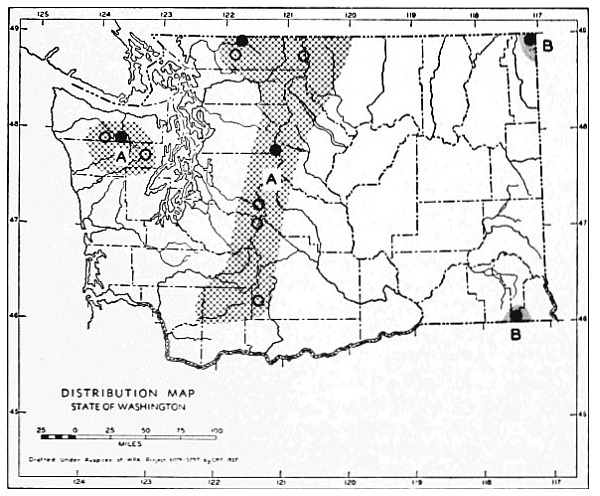
Fig. 110.
Distribution of the heather vole in Washington. A. Phenacomys
intermedius oramontis. B. Phenacomys intermedius intermedius.
The winter nests of Phenacomys intermedius are placed on the
surface of the ground and in the season when occupied are deeply
buried under the snow. They are spherical or oval in shape, six to
eight inches in diameter and with a side entrance. One examined
by Shaw was "formed of white heather twigs, the interstices being
filled with leaves of huckleberry." It was "lined with finely
shredded grass." All those examined by me were composed of grass
and lichens.
The principal foods of the heather vole seem to be white heather
(Cassiope mertensiana) and huckleberry (Vaccinium). Red heather
(Phyllodoce empetriformis) is not eaten. Shaw also lists beargrass
(Xerophyllum tenax) and lousewort (Pedicularis) as eaten.
A burrow excavated and figured by Shaw, was slightly more than
a yard long and contained four young in a nest situated but a few
inches from one of the three entrances. The nest was made of grass
and moss. A female taken at Tye, King County, contained 4 embryos
on May 28, 1939. One taken at Pass Creek Pass, Pend Oreille
County, contained 3 small embryos on June 14, 1938.
Phenacomys intermedius Merriam, N. Amer. Fauna, 2:32, October 30, 1889.
Phenacomys intermedius intermedius Howell, N. Amer. Fauna, 48:15, October 12, 1926.
Type.—Obtained 20 miles north-northwest of Kamloops, 5,500 ft. elevation,
British Columbia, by G. M. Dawson on October 2, 1888; type in United States
National Museum.
Racial characters.—Size small; color of upper parts brownish gray; skull
small.
Measurements.—A female from Pass Creek Pass, Pend Oreille County,
measured: total length 127; length of tail 29; hind foot 17; weight 25 grams.
Distribution.—Known only from extreme northeastern Washington at Pass
Creek Pass (W.W.D.) and the Blue Mountains.
Phenacomys oramontis Rhoads, Amer. Nat., 29:941, October, 1895.
Phenacomys olympicus Elliot, Field Columb. Mus. Publ. 30, zoöl. ser., 1:225, February 1,
1899 (type from Happy Lake, 5,000 ft., Clallam County, Washington).
Microtus (Lagurus) pumilus Elliot, Field Columb. Mus. Publ. 30, zoöl. ser., 1:226, February
1, 1899 (type from Happy Lake, 5,000 ft., Clallam County, Washington).
Phenacomys intermedius olympicus Howell, N. Amer. Fauna, 48:21, October 12, 1926.
Phenacomys intermedius oramontis Anderson, Canadian Field Nat., 56:59, June 8, 1942.
Type.—Obtained on Church Mountain, 6,000 ft., Mt. Baker Range, British
Columbia, just north of international boundary, by A. C. Brooks on August
6, 1895; type in Philadelphia Academy of Natural Sciences.
Racial characters.—Similar to intermedius but darker, browner above and
deeper gray beneath; skull large and heavy.
Measurements.—A female from Tye, King County, measures: total length
152; length of tail 40; hind foot 19; ear 12. A female from Tomyhoi Lake,
Whatcom County, measures: 170; 45; 20; 15.
Distribution.—The Cascade and Olympic mountains, from Tomyhoi Lake
(W. W. D.) on the north, to Mt. Adams (Taylor and Shaw, 1929:23) on the
south.
Description.—Red-backed mice are heavy-bodied, short-tailed
and short-legged mice, similar in general appearance to the meadow
mice (Microtus). Unlike the meadow mice, they possess rooted
molars, a primitive character. They do not have grooved incisors,
like Synaptomys, or the great difference in the depth of the angles
of the lower molars that characterizes both Synaptomys and Phenacomys.
Externally Clethrionomys may be recognized by the
broad red dorsal area from which they obtain their common name.
Their sides are grayish or dusky and the undersides buffy white.
The red-backed mice, including more than one species, range over
the boreal parts of the Old and New World. In America they are
found in most of Alaska, Canada and the northern United States,
and extend southward in the Rocky Mountains and along the Pacific
Coast. The one species Clethrionomys gapperi ranges across southern
Canada from the Atlantic to the Pacific, extending southward
in forested areas to New Mexico. They usually live in clearings in
the forest. In the Pend Oreille Mountains saturatus was common
in damp, mossy talus slides, along with Microtus longicaudus and
Phenacomys intermedius. The Clethrionomys outnumbered the two
latter species combined by 25 to 1. In nearby forest, red-backed
mice were scarce but no other microtines were found. In the Kettle
River Mountains a week later, red-backed mice were rare. A single
specimen was taken in a damp place in the forest; none was found
in talus slides. Near Stevens Pass, King County, in the Cascades,
cascadensis was taken in equal numbers in talus slides and under
logs in the forest. Near Dewey Lake, Yakima County, in the Cascades,
I took them only in an extensive grassy meadow. In the
Blue Mountains I found idahoensis in the dense chaparral, far from
forests.
Unlike Microtus, red-backed mice do not make runways, although
they sometimes follow the runways of other mammals.
Taylor (1920B: 92) found red-backed mice breeding on Mount
Rainier from early July to the middle of September. One female
gave birth to four young in a nest in his duffle bag.
Fig. 111.
Distribution of the Gapper and California red-backed mice in
Washington. A. Clethrionomys gapperi saturatus. B. Clethrionomys gapperi
idahoensis. C. Clethrionomys gapperi nivarius. D. Clethrionomys gapperi
cascadensis. E. Clethrionomys californicus occidentalis.
Evotomys gapperi saturatus Rhoads, Proc. Acad. Nat. Sci. Philadelphia, p. 284, October 23,
1894.
[Clethrionomys gapperi] saturatus Whitlow and Hall, Univ. California Publ. Zoöl., 40:265,
September 30, 1933.
Type.—Obtained at Nelson, British Columbia, by S. N. Rhoads on August
27, 1892; type in Philadelphia Academy of Sciences.
Racial characters.—Size small, about 140 mm. in total length; tail short,
about one-third of total length; ears large, projecting above fur; color of head
and sides gray tinged with yellowish; back with distinct red stripe; underparts
whitish tinged with buff.
Measurements.—Five males and 10 females from Pass Creek Pass, Pend
Oreille County, average: total length 147; length of tail 43; hind foot 18.3;
ear 14.
Distribution.—Northeastern Washington from Sherman Creek Pass (W. W.
D.) on the west to Pass Creek Pass on the east.
Evotomys idahoensis Merriam, N. Amer. Fauna, 5:66, July 30, 1891.
Clethrionomys gapperi idahoensis Whitlow and Hall, Univ. California Publ. Zoöl., 40:265,
September 30, 1933.
Type.—Obtained at Sawtooth (Alturas) Lake, 7,200 ft., Blaine County,
Idaho, by C. H. Merriam and V. Bailey, on October 4, 1890; type in United
States National Museum.
Racial characters.—Similar to saturatus but brain case longer and narrower
and dorsal area more reddish.
Measurements.—Seven males and 6 females from the Blue Mountains average,
respectively: total length 138, 142; length of tail 41, 41; hind foot 18.7,
19.0; ear 13.6, 13.5; weight 20.5, 22.7 grams.
Distribution.—The Blue Mountains of southeastern Washington.
Evotomys gapperi saturatus Taylor and Shaw, Occ. Pap. Chas. R. Conner Mus., no. 2:23,
December, 1929.
Clethrionomys gapperi cascadensis Booth, Murrelet, 26:27, August 10, 1945.
Type.—Obtained 2 miles south of Blewett Pass, 3,000 ft. elevation, Kittitas
County, Washington, by G. G. Cantwell, on October 30, 1921; type in United
States National Museum.
Racial characters.—Dark and dull with underparts dull buffy.
Measurements.—Ten adults from the Cascade Mountains average (Booth,
1945: 27): total length 162; length of tail 50; hind foot 19; ear 14.
Distribution.—The Cascade Mountains, according to Booth (loc. cit., p. 28),
from Hannegan Pass south to Mount Adams. Marginal localities listed are:
Swamp Creek, Glacier Peak, McKenna, and Mt. St. Helens. These, and other
localities listed by Booth are not plotted on the accompanying distribution
map (fig. 111).
Evotomys nivarius Bailey, Proc. Biol. Soc. Washington, 11:136, May 13, 1897.
Evotomys gapperi nivarius Taylor and Shaw, Occ. Papers Chas. R. Conner Mus., no. 2:23,
1929.
Clethrionomys nivarius Svihla, Murrelet, 12:54, May, 1931.
Type.—Obtained on the northwest slope of Mt. Ellinor, 4,000 ft. elevation,
Mason County, Washington, by C. P. Streator, on July 9, 1894; type in United
States National Museum.
Racial characters.—Similar to saturatus but paler throughout.
Measurements.—Two males and a female from 1 mile northwest of Lake
Cushman, Mason County, average: total length 140; length of tail 42; hind
foot 18; ear 13.
Distribution.—The Olympic Mountains, from Sol Duc Hot Springs
(W.S.M.) south and west at least to Staircase, on Lake Cushman (W.W.D.).
Evotomys occidentalis Merriam, N. Amer. Fauna, 4:25, October 8, 1890.
Evotomys pygmaeus Rhoads, Proc. Acad. Nat. Sci. Philadelphia, p. 284, October 23, 1894
(type from mouth of Nisqually River, Pierce County, Washington).
Evotomys gapperi occidentalis Taylor and Shaw, Occ. Papers Chas. R. Conner Mus., no.
2:23, 1929.
Clethrionomys occidentalis Hall, Murrelet, 13:79, September, 1932.
Type.—Obtained at Aberdeen, Grays Harbor County, Washington, by T. S.
Palmer, on August 16, 1889; type in United States National Museum.
Measurements.—Ten males and 10 females average: total length 137;
length of tail 45; hind foot 18; ear 12.3.
Distribution.—The lowlands of western Washington, east at least to Cottage
Lake (W. W. D.).
Remarks.—Specimens from the type locality of occidentalis and
other places along the ocean coast are larger and brighter in color
than specimens from farther inland, but the difference appears to
me to be insufficient to warrant subspecific separation of the two
lots.
Clethrionomys californicus resembles Clethrionomys gapperi but
is darker and duller in color with the red dorsal area more obscured
and forming less of a stripe. C. californicus is found in the forested
lowlands of western Washington, Oregon, and northern California,
and in the Cascades of Oregon. In Washington, it is confined entirely
to the forest where it is trapped under logs and on the layer
of dead needles at the bases of conifers. Mice of this species were
numerous in the forest along the Pacific Coast on the Long
Beach Peninsula and at Aberdeen, Grays Harbor County. At Lost
Lake Prairie, Mason County, at the southeastern base of the
Olympic Mountains, they were rather scarce, but were the only
mammals taken in the deep woods. Near Shelton, Mason County,
at the eastern edge of the Olympic Mountains, a number of specimens
were taken along with twice as many Peromyscus maniculatus.
At Cottage Lake, King County, near Seattle, they were rare,
comprising about two per cent of the mammals taken in two weeks'
trapping.
Almost nothing was learned of the habits of these mice. They
seem to be rigidly restricted to a habitat where few plants other
than trees grow. The stomachs examined contained pasty masses
of finely chewed white vegetation with occasional gray particles
that might have been bits of lichens. The mice do not make runways
like those of Microtus.
Description.—The upper parts are dark blackish brown and the
underparts grayish or whitish. The tail comprises about a fourth
of the total length and the foot does not exceed 21 mm. These two
features separate it from most other species of meadow mice. From
Microtus oregoni it may be separated by its larger size, blackish
color and well-developed eyes. From Microtus montanus it differs
in being larger, darker, and in having a closed posterior loop on the
innerside of the second upper molar.
Fig. 112.
Pennsylvania meadow mouse (Microtus pennsylvanicus kincaidi),
from ten miles south of Moses Lake, Washington, April 28, 1940. (Fish and
Wildlife Service photo by Victor B. Scheffer, No. 937.)
Microtus pennsylvanicus is the most common meadow mouse of
the eastern United States. It ranges westward through Canada and
southward in the Rocky Mountains. A number of races occur in this
extensive range. In northeastern Washington the eastern meadow
mouse is locally common, being confined to marshes and damp
meadows. Well-used runways are made through the dense vegetation
and piles of feces and blades of grass are deposited therein. A
number of broods are raised in a season, for young of many different
ages are taken together in midsummer.
On the Columbian Plateau this mouse lives in marshy areas about
lakes and potholes. Narrow trails are constructed through the
dense vegetation. It burrows in damp earth and some occupied
burrows are half-full of seepage water. Cuttings found in runways
show that the mice feed on a variety of plants, including sedge
(Carex). In the Moses Lake area the breeding season begins in
March. Embryos found March 24, 1940, varied from 4 to 7 in
number. This species is cyclically abundant.
Fig. 113.
Distribution of the Pennsylvania meadow mouse in Washington.
A. Microtus pennsylvanicus funebris. B. Microtus pennsylvanicus kincaidi.
Microtus pennsylvanicus modestus Bailey, N. Amer. Fauna, 17:20, June 6, 1900.
Microtus drummondii Bailey, N. Amer. Fauna, 17:22, June 6, 1900.
Microtus pennsylvanicus funebris Dale, Jour. Mamm., 21:338, August 13, 1940.
Type.—Obtained at Coldstream. 1,450 ft., 3-1/2 miles southeast of Vernon.
British Columbia, by T. P. Maslin. Jr., on August 2, 1937; type in Museum
of Vertebrate Zoölogy.
Racial characters.—Size medium; color reddish brown; fur short, harsh;
skull small and narrow.
Measurements.—Three males from Newport, Pend Oreille County, average:
total length 165; length of tail 40; hind foot 20; ear 15.3.
Distribution.—Northeastern Washington, west to Conconully (Taylor and
Shaw, 1929: 24) and east to Newport (W. W. D.).
Remarks.—Specimens from northeastern Washington are larger and darker,
more reddish and less gray, than drummondii. They are larger, more reddish,
and have relatively narrower skulls, than modestus from Colorado and Idaho.
They closely resemble funebris from south-central British Columbia, and
are best referred to that race. Rand (1943: 123) considers funebris a synonym
of modestus but I feel is incorrect in doing so.
Microtus montanus kincaidi Dalquest, Proc. Biol. Soc. Washington, 54:145, September 30,
1941.
Type.—Obtained at The Potholes, 10 miles south of Moses Lake, Grant
County, Washington, by W. W. Dalquest on March 24, 1940; type in Museum
of Vertebrate Zoölogy.
Racial characters.—Large size; dark blackish color; long fur; wide, angular
skull.
Measurements.—Six male and 12 female topotypes average, respectively:
total length 176.6, 168.0; length of tail 45.1, 43.8; hind foot 20.8, 20.3;
ear 14.0, 13.4.
Distribution.—The Columbian Plateau, in the Grand Coulee area.
Description.—Montane meadow mice have short tails, flaring
zygomatic arches, and heavily ridged skulls. They are small, about
6-1/2 inches long, and buffy-gray in color. Their short tails, less
than one-third the length of head and body, and gray color separate
them from all other Washington meadow mice.
Montane meadow mice are widely distributed in the southwestern
United States, where numerous races are found. They occupy
damp meadows and marshes in the arid subdivision of the Transition
Life-zone of eastern Washington. They seem to require deep,
dense cover of grasses, reeds, or sedges, near water. They are
usually associated with harvest mice (Reithrodontomys megalotis),
wandering shrews (Sorex vagrans monticola), and muskrats (Ondatra
zibethica). Hawks and owls are their principal enemies,
but predatory mammals and snakes probably kill many.
Montane meadow mice evidently are both diurnal and nocturnal;
specimens were taken in the daytime as well as at night, and captives
were active periodically day and night. Captives were extremely
quick in their movements. If disturbed they sat up on their
haunches and chattered indignantly. It was almost impossible to
handle them without being bitten.
The trails of montane meadow mice are narrower than those of
other meadow mice, and appear to be used the year around. Burrows
are numerous where the mice are plentiful. A heap of damp
earth marks the entrance to each burrow. One nest of M. m. canescens
near Lake Chelan, Chelan County, was under a log on a
small knoll in a marsh. The nest was round, about 8 inches in
diameter, and was composed of cattails, grasses, and moss.
Fig. 114.
Distribution of the montane and Townsend meadow mice in
Washington. A. Microtus montanus nanus. B. Microtus montanus canescens.
C. Microtus townsendii townsendii. D. Microtus townsendii pugeti.
Arvicola (Mynomes) nanus Merriam, N. Amer. Fauna, 5:63, July 30, 1891.
Microtus nanus Miller, Proc. Biol. Soc. Washington, 11:67, April 21, 1897.
Microtus nanus nanus Miller, Bull. U. S. Nat. Mus., 128:409, April 29, 1924.
Microtus montanus nanus Hall, Proc. Biol. Soc. Washington, 51:133, August 23, 1938.
Type.—Obtained in the Pahsimeroi Mountains, 9,300 ft., Custer County,
Idaho, by C. H. Merriam and V. Bailey on September 16, 1890; type in
United States National Museum.
Racial characters.—Size medium; color of upper parts brownish gray; sides
paler; underparts grayish white.
Measurements.—A large male from Prescott, Walla Walla County, measures:
total length 168; length of tail 48; hind foot 20. A female from Prescott,
Walla Walla County, and a female from Pullman, Whitman County,
average: 133; 31; 18.5.
Distribution.—Southeastern Washington, westward as far as 5 miles east
of Wallula (M.V.Z.).
Microtus nanus canescens Bailey, Proc. Biol. Soc. Washington, 12:87, April 30, 1898.
Microtus montanus canescens Hall, Proc. Biol. Soc. Washington, 51:133, August 23, 1938.
Type.—Obtained at Conconully, Okanogan County, Washington, by J. A.
Loring, on September 12, 1897; type in United States National Museum.
Racial characters.—Size small; color of upper parts pale brownish gray;
sides yellowish gray. This race differs from Microtus m. nanus in generally
paler, less brownish coloration. It does not differ from nanus in any distinctive
cranial features.
Measurements.—Two male and 2 female topotypes average, respectively:
total length 151, 143; length of tail 35, 33.5; hind foot, 19.5, 19.5. A series of
8 males and 6 females from Selah, Yakima County, average, respectively: total
length 151.7, 150.5; length of tail 41.5, 40.1; hind foot 19.7, 18.8; ear 12.8, 13.0;
weight 47.2, 36.8 grams.
Distribution.—The eastern foothills of the Cascade Mountains from the
British Columbian boundary south, probably to the Columbia River. Recorded
east to Benton City (Taylor and Shaw, 1929: 24).
Remarks.—A large series from Selah, Yakima County, is somewhat intermediate
between nanus and canescens. These specimens from south of the
Wenatchee Mountains are, however, more like canescens in color than they are
like nanus.
Bailey (1900: 32) records a specimen of this race from North Yakima as
Microtus canicaudus.
Description.—The Townsend meadow mouse is a large-bodied,
long-furred mouse with a tail of moderate length. Head and body
measure about 8 inches, the tail about 2-1/2 inches. The legs are
short and the ears scarcely project through the fur on the head.
In summer the color is dark reddish-brown. The winter color is dark
brownish-black. Underparts are paler, more grayish brown, than
are the upper parts. The tail is sparsely haired.
Townsend meadow mice occur west of the Cascade Mountains in
California, Washington, Oregon, British Columbia, and on some
British Columbian and Washington islands. The habitats of the
two races of the Townsend meadow mice found in Washington are
wholly in the humid subdivision of the Transition Life-zone but
vary somewhat in nature. The race townsendii lives in marshes or
damp meadows, under cover of deep, rank vegetation. These mice
avoid forested areas or dry brush, but sometimes occur in dry grass
when it is deep enough to conceal them from enemies. The race
pugeti has been recorded from meadows, salt marshes, driftwood
strewn on sea-beaches, areas of sparse, dry grass, and piles of rocks.
Townsend meadow mice are as diurnal as they are nocturnal;
specimens have been trapped at almost all hours of the day and
night. Their ordinary method of traveling is a slow run. When
startled they make a dash for the nearest cover, into which they
dive headlong. They make considerable noise while moving about
and often may be heard from several feet away. Captives in the
laboratory seemed rather dull and stupid as compared with other
meadow mice.
Fig. 115.
Runways of Townsend meadow mice (Microtus
townsendii) worn to grooves in the damp soil at Seattle;
May 18, 1938; dense cover of cattails has been
burned off (W. W. Dalquest photo).
In the fall, winter, and early spring the Townsend meadow mice
keep to their runways. These runways are used by successive generations
of mice, and often are worn into ditches several inches
deep. In the late spring and summer, when the grass and other
vegetation in their habitat is tall and rank, offering complete concealment,
the runways are abandoned and cuttings of rejected food
are found scattered over the surface of the ground.
The food of the Townsend meadow mice includes the succulent
leaves and stems of many grasses and annuals. Near Seattle the
staple summer food is the velvet grass (Holcus lanatus), although
many other plants, including the horsetail (Equisetum arvense),
are eaten. In winter the common cattail is eaten. Couch (1925:
200) found caches of the roots of mint (Mentha canadensis) stored
by this species. As much as 14 quarts was found in a single cache.
The cup-shaped nests of Townsend meadow mice near Seattle
were below ground. Embryos were found from May 4 to May 20
and varied in number from 5 to 8 with a mean of 7. In the San Juan
Islands the nests of M. t. pugeti were under driftwood.
Arvicola townsendii Bachman, Jour. Acad. Nat. Sci. Philadelphia, 8 (pt. 1):60, 1839.
Arvicola occidentalis Peale, U. S. Expl. Exped., Mammalogy, p. 45, 1848 (type from Puget
Sound).
M[icrotus]. townsendi Miller, N. Amer. Fauna, 12:66, July 23, 1896.
Microtus townsendii townsendii Svihla and Svihla, Murrelet, 14:40, May, 1933.
Type.—Obtained on the Columbia River (probably on or near Sauvie
Island, Multnomah County, Oregon); type in Philadelphia Academy of
Natural Sciences.
Racial characters.—Size large; skull narrow in interorbital region.
Measurements.—Eight males and 5 females from Clark and Pacific counties,
southwestern Washington, average, respectively: total length 208.0,
208.4; length of tail 65.7, 66.0; hind foot 26.5, 25.4; ear 15.0, 14.6; weight
80.8, 76.7 grams. Thirteen males and 9 females from Seattle average, respectively:
211.8, 209.0; 71.2, 68.6; 25.7, 26.0; 15.8, 15.4.
Distribution.—The lowlands of western Washington from Bellingham
(J.M.E.) south to Puget Island (V.B.S.).
Microtus townsendii pugeti Dalquest, Murrelet, 21:7, April 1, 1940.
Type.—Obtained at Neck Point, northwest corner of Shaw Island, San
Juan County, Washington, by D. H. Johnson, on July 10, 1938; type in
Museum of Vertebrate Zoölogy.
Racial characters.—Size small; skull wide in interorbital region, averaging
about 4.0 mm. (3.8-4.2); basi-sphenoid truncate posteriorly; upper incisors
strongly curved.
Measurements.—Two males and 6 females average: total length 182.6;
length of tail 50.3; hind foot 23.2; ear 15.0.
Distribution.—Found only on the San Juan Islands, San Juan and Skagit
counties.
Remarks.—The islands occupied by this race of mouse were heavily glaciated
by the last continental glacier (Vashon). Mice of the species townsendii
apparently migrated to the islands early in the Recent era, and under isolation
developed the differences which now separate them from the mainland
population.
Description.—The several races of this species vary from small to
large in size. Their bodies are relatively longer and slimmer than
those of the other meadow mice that occur in Washington. Their
most distinctive feature is the long tail, only slightly shorter than
the head and body. Their fur is rather coarse. The color varies
from grayish brown to dull reddish brown with a brighter brown
dorsal stripe. The tail is bicolor; black or dark brown above, yellowish
below. The underparts are whitish gray.
Fig. 116.
Distribution of the long-tailed meadow mouse in Washington. A.
Microtus longicaudus macrurus. B. Microtus longicaudus halli.
Long-tailed meadow mice are widely distributed over the western
United States, Canada, and Alaska. In Washington the long-tailed
meadow mouse has been taken in many habitats. One specimen was
taken along a small, temporary stream through sagebrush in the
Upper Sonoran Life-zone. Others were found in marshes and near
water in the arid subdivision of the Transition Life-zone. In the
humid subdivision of the Transition Life-zone they are not uncommon
in damp areas along the ocean coast, but are rather rare
in dry, grassy habitats. In the Canadian and Hudsonian life-zones
they are fairly common in forest-free, grassy places, being most
abundant near talus slides. Altitudinally they range from sea level
to 6,000 feet.
Long-tailed meadow mice are rather rare. Several were taken
in the daytime at Round Top Mountain, Pend Oreille County, and
two others were taken in daytime two miles south of Tenino, Thurston
County. However most of the specimens were caught at night.
Long-tailed meadow mice do not, at least ordinarily, make trails
as do other meadow mice. Specimens are usually taken unexpectedly,
and intensive trapping in the area where a specimen or two is
taken rarely yields additional individuals.
Two specimens taken in the Cascade Mountains in September were
pregnant; one contained two embryos and the other four.
Microtus mordax angustus Hall, Univ. California Publ. Zoöl., 37:13, April 10, 1931 (not of
Thomas, 1908).
Microtus longicaudus angustus Goldman, Jour. Mamm., 19:491, November 14, 1938.
Microtus mordax halli Ellerman, Fam. and Genera of Living Rodents, British Mus. Nat.
Hist., 2:603, March 21, 1941 (new name for Microtus mordax angustus Hall).
Type.—Obtained at Godman Springs, 5,700 ft., Blue Mountains, Columbia
County, Washington, by S. H. Lyman, on September 1, 1927; type in Museum
of Vertebrate Zoölogy.
Racial characters.—Size small; color of sides pale grayish brown; brown
dorsal stripe conspicuous; tail relatively short.
Measurements.—Four males and 5 females from eastern Washington average,
respectively: total length 164.8, 166.6; length of tail 55.8, 55.8; hind
foot 22.0, 21.4.
Distribution.—From the Blue Mountains of southeastern Washington north,
along the eastern edge of the state, to British Columbia, and thence west,
north of the Columbia River, to the Cascades, and south along the eastern
edge of the Cascades to the Wenatchee Mountains. Marginal occurrences
are: Pasayten River (Taylor and Shaw, 1929: 24), Hart Lake (Taylor and
Shaw, 1929: 24), Blewett Pass (W.W.D.), Boulder Cave (W.W.D.), and
Satus Pass (W.W.D.).
Remarks.—Four specimens from Satus Pass, Klickitat County, are somewhat
intermediate between this race and macrurus, and indicate that halli crossed
the Columbia River when an alpine meadow land extended from the Simcoe
Anticline to southeastern Washington.
One specimen from Selah, Yakima County, is colored somewhat like halli,
and is smaller than macrurus. Possibly the halli type of meadow mouse
spread northward to the Yakima Valley. This specimen was taken in the
Upper Sonoran Life-zone. A specimen from the Arid Transition Zone at
Naches, Yakima County (taken in almost Canadian Life-zone habitat), is
like macrurus-halli intergrades from the higher Cascade Mountains.
Microtus macrurus Merriam, Proc. Acad. Nat. Sci. Philadelphia, p. 353, October 4, 1898.
Microtus mordax macrurus Dice, Murrelet, 13:49, May, 1932.
Microtus longicaudus macrurus Goldman, Jour. Mamm., 19:491, November 14, 1938.
Type.—Obtained at Lake Cushman, Mason County, Washington, by C. P.
Streator on June 26, 1894; type in United States National Museum.
Racial characters.—Size large; tail relatively long, almost as long as head
and body; color of upper parts dull brown; dorsal stripe obscure; underparts
gray.
Measurements.—Two males and 4 females from the Olympic Mountains and
the coast of Washington, average, respectively: total length 212.5, 220.5;
length of tail 82.5, 86.8; hind foot 25.5, 24.7; ear 15.0, 13.7.
Distribution.—The Olympic Mountains, the coast region of western Washington,
and the Cascade Mountains, save in the southeastern part. Marginal
occurrences are: Sauk (Taylor and Shaw, 1929: 24), Tye (W.W.D.), Naches
River (W.W.D.), and Wind River (W.W.D.).
Remarks.—Specimens from the Cascade Mountains are referred to macrurus
but are intermediate between that race and halli.
Description.—This is the largest meadow mouse found in Washington.
It is too large to be called a mouse and the term water rat,
applied to it by Merriam, suits it well. It is the only Washington
microtine measuring more than 8 inches in total length. The upper
parts are dark, reddish brown in color; the underparts are grayish
brown. The tail comprises about one-third of the total length.
This species of meadow mouse ranges from Canada south to Colorado
in the Rocky Mountains and in the Cascades south into Oregon.
The water rats are strictly alpine animals, occurring about streams,
marshes and damp meadows. In the Cascade Mountains they are
most common in the glacial cirques where tiny streams flow through
grassy meadows to plunge over the lip of the cirque on a rocky
course of cascades to the valley below. Here their broad trails occur
along the stream banks, commonly entering the water where it
is swift. These trails are well-worn roads, usually about four inches
wide but often wider. The burrows of the water rat are about
three inches in diameter and are constructed with no effort at concealment;
large mounds of earth mark their entrances. Freshly dug
burrows are so abundant that it seems likely more are dug than are
actually inhabited. Burrows are often dug beneath rocks.
The water rat is mainly nocturnal but not uncommonly is seen in
the daytime. Twice I cornered a water rat away from its burrow
and each time it escaped by swimming. The rats swam with great
speed but with much splashing. One dived under the surface of a
small pool and disappeared. Stones along the bank were pulled out
until the rat was captured in a small chamber at the end of a burrow.
The burrow entered the bank at the base of a large stone six
inches beneath the surface. This burrow resembled a miniature
muskrat burrow and apparently had been dug when the rat was
under water.
Like Phenacomys, the water rat constructs sub-snow nests on the
surface of the ground. These are recognizable by their large size
and by piles of ovoid droppings a quarter of an inch in length.
These nests are loosely built and fall apart soon after the snow melts.
The water rat is sometimes a pest to the mammal collector for
they spring mouse traps set for other mammals without becoming
caught. At times the greater part of an entire trap line was thus
rendered ineffective by these mammals. Fully adult animals are
uncommon in collections for a rat trap or steel trap is needed to
take them and these items, when packed on back up mountains to
water-rat habitat, are usually set for still larger animals. Racey
(Racey and Cowan, 1935: H27) recounting his difficulty in securing
specimens when no suitable traps were at hand, writes: "Killed one
with my hands, shot another, and a third was stunned by a mouse
trap."
Taylor and Shaw (1927: 76) list food eaten by the water rat on
Mount Rainier as the avalanche lily, dogtooth violet, Ligusticum
purpureum, Valeriana sitchensis, Polygonum bistortoides, Petasites
frigida, Phyllodoce empetriformis, Potentilla flabellifolia, Aster sp.,
grass, wild clover, conifer seeds, two kinds of blueberry (Vacinnium)
and Xerophyllum tenax. Racey and Cowan (1935) list foods eaten
in the Cascades of southern British Columbia as Lupinus polyphyllus,
Senecio balsamitae, Pedicularis bractiosa and Arnica alpinus.
A female from Dewey Lake, Yakima County, contained 4 embryos
on September 1, 1940. One from Tye, King County, had 2
embryos on September 8, 1940.
Aulacomys arvicoloides Rhoads, Amer. Nat., 28:182, February, 1894.
Microtus richardsoni arvicoloides Bailey, N. Amer. Fauna, 17:62, June 6, 1900.
Type.—Obtained at Lake Keechelus, Kittitas County, Washington, by A.
Rupert in September, 1893. Rhoads gives the altitude as 8,000 ft. This
apparently is an error, for the elevation of the lake is 2,458 ft. and the summit
of Snoqualmie Pass, to the west, is 3,100 ft. Probably 3,000 ft. was
intended; type in Philadelphia Academy of Natural Sciences.
Racial characters.—Size large; color of upper parts dark reddish brown;
underparts paler.
Fig. 117.
Distribution of the water rat in Washington. A. Microtus richardsoni
arvicoloides. B. Microtus richardsoni macropus.
Measurements.—A female from Tomyhoi Lake, Whatcom County, measured:
total length 242; length of tail 68; hind foot 27; ear 17. A female from
Tye, King County, measured: 257; 83; 26; 17.
Distribution.—The Cascade Mountains, from Tomyhoi Lake (W.W.D.)
south to Potato Hill (Taylor and Shaw, 1929: 25).
Arvicola (Mynomes) macropus Merriam, N. Amer. Fauna, 5:60, July 30, 1891.
Microtus richardsoni macropus Bailey, N. Amer. Fauna, 17:61, June 6, 1900.
Microtus richardsonii macropus Taylor and Shaw, Occ. Pap. Chas. R. Conner Mus., no. 2:25,
December, 1929.
Type.—Obtained in the Pashimeroi Mountains, 9,700 ft., Custer County,
Idaho, by C. H. Merriam and V. Bailey in 1890; type in United States National
Museum.
Racial characters.—Similar to arvicoloides but slightly smaller and redder.
Measurements.—A female from Stay-a-while Spring, Columbia County,
measures: total length 228; length of tail 73; hind foot 25; ear 14.
Distribution.—The Blue Mountains of southeastern Washington.
Arvicola oregoni Bachman, Jour. Acad. Nat. Sci. Philadelphia, 8:60, 1839.
Microtus oregoni Miller, N. Amer. Fauna, 12:9, July 23, 1896.
Microtus morosus Elliot, Field Columb. Mus. Publ. 30, zoöl. ser., 1:227, February 1, 1899
(type from Boulder Lake, 5,000 ft., Clallam County, Washington).
Microtus oregoni oregoni Miller, U. S. Nat. Mus. Bull., 79:227, December 31, 1912.
Microtus oregoni cantwelli Taylor, Jour. Mamm., 1:180, August 24, 1920 (type from Glacier
Basin, 5,935 ft., Mt. Rainier, Pierce County, Washington).
Fig. 118.
Distribution of the creeping mouse, Microtus oregoni oregoni,
in Washington.
Type.—Obtained at Astoria, Clatsop County, Oregon, by J. K. Townsend
in 1836; type in Philadelphia Academy of Natural Sciences.
Measurements.—Ten males and 10 females from southwestern Washington,
average, respectively: total length 133, 126; length of tail 35, 32; hind foot 16.9,
16.7; ear 9.8, 9.7; weight 19.3, 19.1 grams.
Distribution.—The Cascade Mountains, the Olympic Mountains, and the
lowlands of western Washington.
Remarks.—A large series of topotypes of Microtus o. oregoni in the California
Museum of Vertebrate Zoölogy, and the rather large series from Cowlitz
County, Washington, show a wide range of variation in color, size, and cranial
characters. Specimens from the Cascade and Olympic Mountains seem to
average a bit paler than topotypes of oregoni, but are not worthy of recognition
as distinct races. Too few topotypes of Microtus o. serpens from British
Columbia are available to judge the status of that race with any certainty,
but specimens from northwestern Washington are certainly oregoni.
Description.—The creeping mouse is a small species of general
microtine form. The head and body measure about 4 inches and
the tail about 1-1/2 inches. The ears are small and the eyes tiny,
nearly buried in the fur. The fur is short and rather rough. It
does not lie back smoothly, thereby giving a woolly appearance.
The upper parts are reddish or grayish brown and the underparts
are grayish white. The nondescript appearance suggests a young
rather than adult mouse.
The creeping mouse (subgenus Chilotus) is restricted to the Pacific
Coast and ranges from British Columbia to California. In
Washington it occupies almost every conceivable "mouse" habitat
in its range, including wet marshes, damp ravines, dry forest, damp,
mossy forest, meadows, alpine meadows and fields of short grass.
It is rare in all but the latter habitat. In fields of short or dry
grass it is often abundant. In the Cascade Mountains it was in
relatively dry places along streams or rock slides. Altitudinally
it ranges from sea level to at least 6,000 feet, and from the Humid
Transition well into the Hudsonian life-zones.
Creeping mice construct tiny tunnels among the grass roots and
seldom venture out of them. In suitable habitat the surface of
the ground beneath the grass is a maze of these tunnels, which cross,
intersect, and divide in a complex network. An observer standing
in a field occupied by creeping mice can scarcely conceive of the
extent and perfection of the tiny tunnel system at his feet.
Creeping mice lived but a day or two in captivity. Save for the
bits of grass blades left in their runways, little is known of their
food or other life habits. Their nests are round balls of dry grasses
placed in cavities under logs. None of the many examined possessed
a lining of softer materials. Embryos found in pregnant females
from April 10 to May 18 numbered from 2 to 4.
Arvicola pauperrima Cooper, Amer. Nat., 2:535, December, 1868.
Arvicola pauperrimus Merriam, N. Amer. Fauna, 5:64, July 30, 1891.
L[agurus]. pauperrimus Thomas, Ann. and Mag. Nat. Hist., ser. 8, 9:401, April, 1912.
Microtus pauperrimus Bailey, N. Amer. Fauna, 55:214, August 29, 1936.
Lemmiscus pauperrimus Davis, Recent Mamm. Idaho, Caxton Printers, p. 327, April 5, 1939.
Lemmiscus curtatus pauperrimus Goldman, Proc. Biol. Soc. Washington, 54:70, July 31,
1941.
Type.—Obtained on the "Plains of the Columbia" near the Snake River,
southwestern Washington by J. G. Cooper on October 9, 1860. Probably
from the Bunchgrass Hills near Wallula (Old Fort Walla Walla), Walla
Walla County: type in United States National Museum.
Measurements.—Bailey (1900: 69) gives the average of 3 adults from the
vicinity of Antelope, Oregon, as: total length 115; length of tail 20; hind
foot 16.
Distribution.—Known in Washington only from the type and a specimen
from Badger Mountains, 8 miles southwest of Waterville (Taylor and Shaw,
1929: 25).
Remarks.—This rare vole is the smallest microtine rodent in
Washington. The head and body measure about 4 inches and the
tail about 1 inch. The upper parts are grayish or yellowish brown
and the underparts grayish. The upper incisors are not grooved
and the inner and outer angles of the molars are about equal in
length.
Mice of the genus Lagurus occur in Siberia and in prairie areas
of the northwestern United States and Canada. The sagebrush
vole inhabits the Upper Sonoran Life-zone. It prefers upland areas
of low sagebrush with sparse grass. Poorly formed runways and
small piles of feces indicate its presence. The type of Lagurus
pauperrimus was obtained in southwestern Washington 80 years
ago, and a single additional record has since been obtained. Nothing
is known of its habits in Washington. The life history of related
forms has been reported on by Hall (1928: 201-204) from
Nevada and Moore (1943: 188-191) from Oregon.
Davis (1939: 326) raised the subgenus Lemmiscus Thomas (for
American forms) to generic rank and Goldman (1941: 69) accepted
this usage. Comparison of the Siberian and American
species reveals but three impressive differences: the dorsal stripe
of the Siberian mice, the greater development of prisms in the
molars of the American species, and the presence of cement in the
angles of the molars of the Siberian specimens and its lack in the
American. These differences seem to be of no more than subgeneric
value. Goldman (1941: 69) showed that all American Lagurus
belong to a single species.
Description.—The muskrat is a large aquatic rodent. Head and
body measure about 14 inches; the tail about 10 inches. The body
is plump and the head small. Eyes and ears are relatively small.
The forefeet are small and handlike with furred wrists. The hind
feet are large with webbed toes and naked wrists. The tail is narrow,
constricted at the base and flattened vertically. It is scaled
and possesses scattered, stiff hairs. The underfur is dense and soft.
The guard hair is stiff and shiny. The upper parts are rich, dark
brown. The underparts are gray washed with cinnamon.
Fig. 119.
Muskrat (Ondatra zibethicus osoyoosensis), male, Lake Washington,
Seattle, October 13, 1939; weight 906 grams on November 4, 1939. (Fish
and Wildlife Service photo by Victor B. Scheffer, No. 736.)
Muskrats are found in Canada and the United States. They are
lowland animals, rarely ranging into the Canadian Life-zone. Their
aquatic habitat makes them relatively independent of temperature,
and consequently they occur in both the Transition and Upper Sonoran
life-zones.
The muskrat is well adapted to aquatic life. The toes of the
large hind feet are webbed at the base, the hind feet are turned
slightly outward, a fringe of stiff bristles at the rear edge of each
foot furnishes additional aid in swimming, and the laterally compressed
tail makes it an efficient rudder. In the water the surface
of the fur flattens down to entrap air in the dense underfur, keeping
the body dry.
The typical habitat of the muskrat is slow-moving water or still
water, such as in lakes, ponds, marshes and sluggish rivers and
streams. Muskrats occur commonly, though not in large numbers,
in more swiftly moving streams. In Puget Sound and the San Juan
Islands they occupy a marine habitat.
In the extensive marshes along Lake Washington, King County,
muskrats are abundant. They occupy sluggish water, often water
polluted by garbage and sewage. In these marshes, banks suitable
for the construction of burrows are absent and houses are made of
cattail stalks and leaves. The food of these marsh-living muskrats
consists principally of cattail and other marsh vegetation.
In contrast to the marsh-occupying muskrats, muskrats along the
open, marsh-free shores of the lake live in deep clear water where
waves lap the shore. These muskrats live exclusively in burrows
dug in the banks and feed upon fresh-water mussels.
In still greater contrast were muskrats living 20 miles away, near
Cottage Lake, King County. Here we found them in small clear
streams, 4 to 10 feet wide. Depth of the water varied from a few
inches to three feet. The streams flowed through meadows, pastures
and junglelike, deciduous woods. Muskrats were slightly more common
along wooded stretches than in open areas. Some were trapped
where the streams flowed at high velocity over shallow, gravel bottoms.
The animals lived in burrows and fed upon fresh-water
mussels and a variety of plants.
Near Richmond Beach, Snohomish County, muskrats took up residence
in a small tidal pool along Puget Sound. The nearest fresh
water stream large enough to support a muskrat was two miles away.
Two muskrats were trapped here. Investigation of a tidal pool a
mile to the north disclosed unmistakable muskrat signs. Traps set
in the culvert connecting the pool with Puget Sound at high tide
took several specimens. Study showed that the muskrats were not
living in the pool but among the large boulders forming the breakwater
for the Great Northern Railroad, along the sound itself. They
were feeding on marine mussels (Mytilus). These mussels lived in
the salt water of the sound, not in the tidal pool.
At Peavine Pass, Blakely Island, in the San Juan Islands, muskrats
were living in the swift tidal current and deep, marine waters.
Several were seen in late afternoon. All were swimming parallel
to the shore about 50 feet out. Here also they fed on Mytilus, but
their homes were not discovered. Certainly they were not living
in the tidal pool at Flat Point, a half-mile away.
In the interior of Blakely Island a colony of muskrats was discovered
living in a marsh of about one acre. In the rainy season
the ground of the marsh was covered with less than one inch of
water. Residents said that in the dry season springs kept the ground
moist. Muskrats were living in burrows whose entrances descended
at a 45-degree angle and were filled with water. The ground about
some occupied burrows was dry, the only water visible being in the
burrow itself. A variety of marsh vegetation provided food.
Fig. 120.
Distribution of the muskrat in Washington. A. Ondatra zibethicus
osoyoosensis. B. Ondatra zibethicus occipitalis.
Burrows of muskrats always have entrances under water. Usually
they enter a vertical bank 6 to 15 inches below water line and occasionally
3 feet below it. About half the burrows excavated near
Lake Washington, King County, had a single entrance. About 40
per cent had double or triple entrances situated 2 to 3 feet apart and
converging within a yard to a single burrow. About 10 per cent had
double burrows more than 3 feet in length. Burrows were from 5
to 8 inches in diameter. Nest chambers were from 12 to 15 inches
in diameter, spherical, and from 6 to 30 feet from the burrow entrance.
The nests themselves were bulky, loose masses of cattail
leaves. Embryos found in late February and early March numbered
4 to 8.
Because it is abundant, widely spread and easy to trap, the muskrat
is one of the most important fur bearers in the state. The fur
is relatively stable in value. In recent years the average skin has
brought the trapper slightly less than a dollar. Muskrat flesh is
eaten and sold on the market in the eastern United States but has
never been popular in Washington. The muskrat does little damage
to agriculture, most complaints arising from its burrows which
interfere with irrigation ditches.
Fiber osoyoosensis Lord, Proc. Zoöl. Soc. London, p. 97, 1863.
F[iber]. z[ibethicus]. osoyoosensis Hollister, Proc. Biol. Soc. Washington, 23:1, February 2,
1910.
Ondatra zibethica osoyoosensis Miller, U. S. Nat. Mus. Bull., 79:231, December 31, 1912.
Type.—Obtained at Osoyoose Lake, British Columbia, on British Columbia-Washington
boundary at head of Okanogan River, by J. K. Lord, in 1861 or
1862.
Racial characters.—Color of the upper parts rich, dark brown.
Measurements.—Two males and a female from Seattle, King County, average
and measure respectively: total length 565, 555; length of tail 262, 257;
hind foot 80.5, 79; weight 2 pounds 13 ounces and 2 pounds 3 ounces.
Distribution.—Eastern Washington generally and all but the southern part
of western Washington. Specimens from as far southwest as Tenino (W.W.D.)
are typical of osoyoosensis.
Fiber occipitalis Elliot, Field Columb. Mus. Publ. 74, zoöl. ser., 3:162, April, 1903.
Ondatra zibethica occipitalis Miller, U. S. Nat. Mus. Bull., 79:231, December 31, 1912.
Type.—Obtained at Florence, Lane County, Oregon, by E. Heller, in 1901;
type in Chicago Natural History Museum.
Racial characters.—Similar to osoyoosensis but redder; fur shorter and interpterygoid
spaces of skull narrower.
Measurements.—A male from Chinook, Pacific County, measures: total
length 580; length of tail 248; hind foot 78; ear 21; weight 863 grams.
Distribution.—The southwestern corner of the state, extending north to
Aberdeen (V.B.S.) and east to Cathlamet (V.B.S.).
Description.—Size large, total length approximately 400 mm.;
tail long, naked, comprising 50 per cent or more of total length;
color sooty black or brown; in brown phase, whitish beneath.
The roof rat became established in Central America some 350
years ago, and entered the United States (English Colonies) late
in the seventeenth century. Subsequent to the introduction of the
Norway rat the roof rat decreased in numbers and is now found
only in restricted areas.
[Mus] rattus Linnaeus, Syst. Nat., 1 (ed. 10):61, 1758.
Rattus rattus Hollister, Proc. Biol. Soc. Washington, 26:126, June 6, 1916.
Type.—From Uppsala, Sweden.
Remarks.—In Washington I have taken specimens of the roof
rat in the San Juan Islands and in the coniferous forests on the
west slope of the Cascades. In the latter area it seems to be widely
spread and to live in the wild.
Mus alexandrinus Geoffroy, Catal. Mam. du Mus. Nat. d'Hist. Nat. Paris, p. 192, 1803.
R[attus]. rattus alexandrinus Hinton, Jour. Bombay Nat. Hist. Soc., 26:63, December 20,
1918.
Type.—From Alexandria, Egypt.
Remarks.—This subspecies seems to be rare in Washington. My
specimens are all from small, isolated islands in the San Juan
group. All were taken in the vicinity of human habitations. R. r.
alexandrinus resembles R. r. rattus, differing only in brown color
of upper parts.
[Mus] norvegicus Erxleben, Syst. Regni Anim., 1:381, 1777.
Rattus norvegicus Hollister, Proc. Biol. Soc. Washington, 29:126, June 6, 1916.
Type.—From Norway.
Description.—Larger, heavier-bodied and coarser-furred than the black rat
or roof rat with shorter, heavier tail. The tail is less than 50 per cent of the
total length. The color of the back is dull, reddish brown, the sides are paler
and the underparts are dirty gray.
Remarks.—The Norway rat was absent from the Pacific Coast
of the United States before 1851. It probably reached the coast
slightly after that date. It is common about all large cities in
Washington. In the western part of the state it lives along streams
and marshes under feral conditions.
[Mus] musculus Linnaeus, Syst. Nat., 1 (ed. 10):62, 1758.
Description.—Size small; tail about 50 per cent of total length, naked; ears
small, about 12 mm. in height; upper incisors not grooved; color of upper
parts reddish or grayish brown; underparts brown or gray.
Remarks.—The house mouse became established in North America
soon after its settlement by Europeans. It is now common throughout
the state of Washington, principally near human habitations,
but often lives in the wild.
Races of the house mouse have been dealt with by Schwartz and
Schwartz (1943: 59-72), and by Nichols (1944: 82-89), but lack of
adequate material prevents subspecific identification of house mice
from Washington at this time.
Description.—The mountain beaver is a stout-bodied animal
about 14 inches in length, with a tiny tail that is almost invisible
externally. The head is large, wide and low with small eyes, small
ears and long vibrissae. The legs are short and heavy, but the
forefeet are small and handlike; the hind feet are large and powerful.
The claws of both forefeet and hind feet are long and strong. The
pelage is short, coarse and rough. The upper parts are dark reddish
brown and the underparts are grayish brown. The feet are pink.
Fig. 121.
Mountain beaver (Aplodontia rufa rufa), Seattle, Washington,
March 19, 1940. (Fish and Wildlife Service photo by Victor B. Scheffer,
No. 919.)
Mountain beavers are confined to the Pacific Coast and range
from southern British Columbia to central California. The genus
contains a single species of which Taylor (1918) recognized nine
races. The principal habitat of the mountain beaver is clearings
at the edge of coniferous forests. The animals are most abundant
near springs, streams and damp places, although they are not
aquatic. The tangled jungles of deciduous trees and shrubs that
grow in the ravines and stream valleys of the Puget Sound area
present optimum habitat. They occur also on hillsides, on logged-off
land and along roadside clearings. In the mountains they occur in
thickets and forests, always, in our experience, near streams.
The most conspicuous evidence of the presence of mountain
beavers is their burrows. These are large tunnels, four to eight
inches in diameter. To each set of tunnels there are numerous
entrances, some partly concealed in brush or beside logs or stumps,
and some are in the open. Those in the open are less used as entrances
than as places for receiving the loose earth which the animals
excavate. A pile may contain nearly a cubic yard of earth and
stones. Many of the burrows are shallow, and cave-ins are common.
Breaks in the roof of a burrow are not repaired, although debris is
removed from the burrow itself. The burrows seem not to be constructed
according to a system, but are extended to take in whatever
brush, logs or other cover is available. They are commonly dug
through damp or muddy soil. Small streams flow through some
burrows. Such partly flooded runs seem to be favored by the
animals.
The nest of a mountain beaver excavated by Scheffer (1929:
15), under the roots of a fallen tree, was oval in shape, twenty
inches high and 13 inches wide. The nest was protected from flooding
by a basal chamber, or basin, six inches beneath the nest. Two
drainage tunnels lead away from this basal chamber. The nest
was composed of the leaves and stems of bracken laced together
with grass and fine twigs. Two other nests examined by Scheffer
measured 17 by 18 inches and 19 by 17 inches. Both were about
two feet beneath the surface.
Around Puget Sound the mountain beavers mate in early March.
The young number two to three, rarely four, per litter and are born
in early April.
Mountain beavers enter water readily but wade rather than
swim. They are rather noisy, splashing in water and breaking
twigs or rustling leaves on the ground. They climb bushes and
saplings, clipping off branches for food as they ascend. According
to Scheffer (1929: 15) they leave the stubs of branches attached
to the trunk to facilitate their descent. Twice a mountain beaver
was found several feet up in a sapling. In both saplings the animal
had clipped the branches close to the trunk and was desperately
reaching with its hind feet for missing branches. When the observer
came near, one animal squealed, tumbled to the ground, and
scurried frantically to its burrow.
Although principally nocturnal, mountain beavers are not infrequently
active by day, especially in the fall. At this season
they harvest food and spread it on logs to dry. The cured hay is
removed to their burrows for nesting material and food. In winter
mountain beavers are more restricted in habits and are rarely seen
by day. Presumably they feed on stored food at this time but they
forage somewhat. In winter they eat such evergreen shrubs as
salal (Gaultheria shallon) and Oregon grape (Berberis nervosa).
They eat also the bark of trees, especially that of the willow (Salix).
Under cover of snow, in the mountains, they burrow to some extent
and pack excavated earth in snow burrows. The melting of the
snow in the spring reveals the earth core, six to eight inches in
diameter and two to four feet long. Several such earth cores were
forked, showing that part of the earth had been pushed into a
branching burrow.
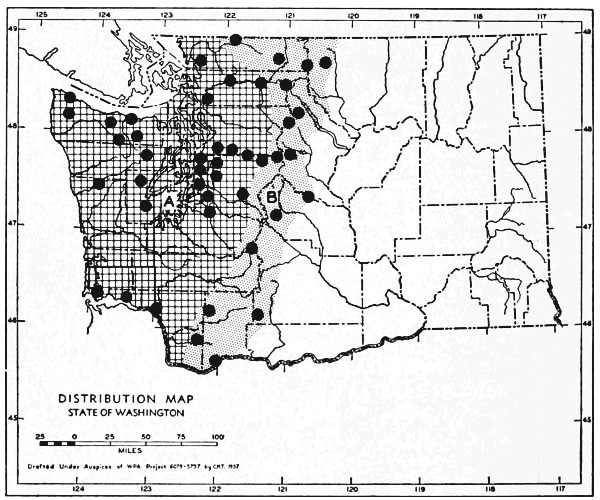
Fig. 122.
Distribution of the mountain beaver in Washington. A. Aplodontia
rufa rufa. B. Aplodontia rufa rainieri.
The mountain beaver holds its food in its forefeet, squirrel-like,
when it eats. Its food consists of the leaves and bark of woody
plants and entire herbs, including roots. The mountain beaver is
the only mammal so far as known that eats the bracken fern. It
feeds on the branches of coniferous trees, including Douglas fir,
red cedar, and hemlock. Such thorny species as the blackberry,
blackcap and devil's club are eaten. The odiferous skunk cabbage
and the stinging nettle are on its bill of fare. A list of its food
would include most plants found in its habitat, and we know of
no species that it refuses as food.
The mountain beaver is more of a nuisance than a pest. In most
of its range there is but little farming although where crops are
raised the mountain beaver may do some damage. It undermines
roads and trails and defiles springs and streams. Control is simple
for the animals readily enter steel traps set in their burrows.
Anisonyx? rufa Rafinesque, Amer. Monthly Mag., 2:45, November, 1817.
Haplodon rufus True, Proc. U. S. Nat. Mus., 7 (1884):596, 1885.
Aplodontia rufa Merriam, Ann. New York Acad. Sci., 3:316, May, 1886.
Aplodontia olympica Merriam, Proc. Biol. Soc. Washington, 13:20, January 31, 1899 (type
from Lake Quiniault, Grays Harbor County, Washington).
Aplodontia rufa grisea Taylor, Univ. California Publ. Zoöl., 12:497, May 6, 1916 (type from
Renton, King County, Washington).
Aplodontia rufa rufa Taylor, Univ. California Publ. Zoöl., 12:497, May 6, 1916.
Type.—None. Based on a description by Lewis and Clark. Taylor
(1918: 455) regarded as typical specimens collected at "Marmot, Clackamas
County, Oregon (western slope of Mount Hood, not far from the Columbia
River)."
Racial characters.—Size small; skull small.
Measurements.—Eight males and 7 females, from the area about Puget
Sound, average, respectively: total length 343, 338; length of tail 37.5, 33.5;
hind foot 57.8, 56; ear 25, 24.5; weight 1342, 1300 grams.
Distribution.—Western Washington, between Puget Sound and the Cascade
Mountains and southward. Marginal localities are: Bellingham (U.S.N.M.),
Sauk (U.S.N.M.), Forks of Skykomish River (W.W.D.), North Bend
(U.S.N.M.), and mouth of Klama River (M.V.Z.).
Remarks.—Individual variation in mountain beavers is considerable. Two
weakly defined races are recognized in Washington.
Aplodontia major rainieri Merriam, Proc. Biol. Soc. Washington, 13:21, January 31, 1899.
[Haplodontia rufa] raineri Elliot, Field Columb. Mus. Publ. 45, zoöl. ser., 2:112, 1901.
[Aplodontia rufa] raineri Trouessart, Catal. Mamm., viv. foss., suppl. p. 348, 1904.
Aplodontia rufa columbiana Taylor, Univ. California Publ. Zoöl., 12:499, 1916 (type from
Hope, British Columbia).
Type.—Obtained at Paradise Creek, 5, 200 ft., Mount Rainier, Pierce County,
Washington, by V. Bailey on August 6, 1897; type in United States National
Museum.
Racial characters.—Similar to rufa but larger with larger skull.
Measurements.—Three males and a female from Tye, King County, average
and measure respectively: total length 352, 340; length of tail 35, 40;
hind foot 60, 59; ear 24, 19.
Distribution.—The higher Cascade Mountains from the Columbia River
northward to the Canadian boundary. Marginal localities are: Canyon Creek
(U.S.N.M.), Cascade Pass (U.S.N.M.), Tye (W.W.D.), Mt. Rainier
(U.S.N.M.), Mt. St. Helens (U.S.N.M.), and Yacolt (M.V.Z.).
Remarks.—Intergradation between rufa and raineri is seen in specimens from
the area between Stevens Pass and Skykomish, King County.
Fig. 123.
Big jumping mouse (Zapus princeps trinotatus) in hibernation.
Puyallup, Washington, January 30, 1939. (Fish and Wildlife Service photo by
Victor B. Scheffer, No. 576.)
Description.—The big jumping mouse is a medium-sized mouse,
slightly larger than the house mouse, with an exceptionally long,
tapering tail. Head and body measure about 4 inches and the tail
about 5 inches. The body is slender with a small head, small eyes
and small, naked ears. The forefeet are small and handlike but the
hind feet are large with long, powerful legs. The long, naked tail
is smoothly tapering to a narrow point. The fur is short, posteriorly
directed, stiff and bristlelike. The dorsal area is dusky,
the sides are orange or yellow, and the underparts are creamy white.
Each upper incisor tooth has a groove on its anterior face.
Jumping mice are boreal mammals occurring in wooded regions
ranging from the Arctic region southward to North Carolina, New
Mexico and California. Jumping mice are of rather general distribution
in Washington, being only locally common. They are
partial to damp, boggy areas but avoid true swamps. They occur
in clearings in the forests in the Puget Sound area and in meadows
in river bottoms and in jungles in ravines. They reach their greatest
abundance in the boggy meadows and glacial cirques of the mountains
and spread out from such areas to seemingly less favored
habitat on dryer slopes and heather meadows. Unlike many species,
they do not seem to inhabit talus slides. They are entirely absent
from the eastern Washington desert.
Sometimes the jumping mouse walks on all four feet but the
ordinary means of progression is by short hops on the hind feet
alone. When startled they travel in great bounds, covering six feet
or more at a jump. When jumping they make considerable noise,
swishing or rustling through the grass and landing with an audible
thud. The long tail serves as a balancing organ. A specimen whose
tail had been lost was reported by Svihla and Svihla (1933: 133)
to turn somersaults in the air and invariably to land on its back
rather than its feet.
Jumping mice become very fat and hibernate in middle summer
or early fall. In the lowlands they disappear by late July but in
the mountains they remain active until the middle of September.
They spend the winter in nests of grass several feet beneath the
surface. A hibernating individual figured by Flahaut (1939: 17)
was curled in a ball, head down with the tail wrapped completely
around the greatest circumference of the ball.
Near Seattle the principal food of the jumping mouse was the
velvet grass (Holchus lanatus), and the seeds of grasses and the
broad-leaved dock. The fruit of the blackberry (Rubus macropetalus)
is eaten and occasional individuals are seen with the chin
stained a deep purple from the juice.
The new-born young of the jumping mouse were reported by
Svihla and Svihla (1933: 132) to average 0.8 grams in weight. They
are pink, hairless, lacking even the facial vibrissae, with eyes closed
and ears folded.
Zapus trinotatus Rhoads, Proc. Acad. Nat. Sci. Philadelphia, 1894, p. 421, January 15, 1895.
Zapus imperator Elliot, Field Columb. Mus. Publ. 30, zoöl. ser., 1:228, February 1, 1899
(type from Sieg's Ranch, Elwha River, Olympic Mountains, Clallam County, Washington).
Type.—Obtained on Lulu Island, mouth of Fraser River, British Columbia,
by S. N. Rhoads on May 31, 1892; type in Philadelphia Academy of Natural
Sciences.
Racial characters.—Similar to oregonus but brighter; sides orange; underparts
creamy white; buffy area often present on chest.
Measurements.—Twenty males and 15 females from western Washington
average, respectively: total length 230, 233; length of tail 140, 140; hind foot
33, 32.8; ear 14.9, 16.3; weight 23.7, 25.7 grams.
Distribution.—Western Washington and the Cascade Mountains, east in the
northern Cascades at least to Tomyhoi Lake (W.W.D.).
Remarks.—Actual intergrades between trinotatus and kootenayensis have not
been examined but the differences separating the two forms are of the degree
that usually distinguish subspecies. Since trinotatus occurs in the high Cascades
as far east as Mount Baker, at least, and kootenayensis probably occurs
in the northeastern Cascades, the two forms doubtless come together in the
rugged, inaccessible area between these two localities. Further collecting will
probably show a narrow zone of intergradation in extreme western Okanogan
County.
Fig. 124.
Distribution of the big jumping mouse in Washington. A. Zapus
princeps oregonus. B. Zapus princeps idahoensis. C. Zapus princeps
kootenayensis. D. Zapus princeps trinotatus.
Zapus princeps kootenayensis Anderson, Ann. Rept. Nat. Mus. Canada for 1931, p. 108,
November 24. 1932.
Type.—Obtained on Green Mountain, 6,000 ft., 10 miles north of Rossland,
West Kootenay District, British Columbia, by R. M. Anderson, on July 18,
1929; type in National Museum of Canada.
Racial characters.—Similar to oregonus but paler; yellow more faded.
Measurements.—Twenty females, including 15 topotypes, average (Anderson,
1932: 109): total length 245; length of tail 140; hind foot 30.5.
Distribution.—Northeastern Washington. Specimens from Sullivan Lake
(E.S.B.) have been examined.
Zapus princeps idahoensis Davis, Jour. Mamm., 15:221, August 10, 1934.
Type.—Obtained 5 miles east of Warm Lake, 7,000 feet elevation, Valley
County, Idaho, by W. B. Davis; type in Museum of Vertebrate Zoölogy.
Racial characters.—Similar to kootenayensis but brighter in color, more
ochraceous. Similar to oregonus but paler, more yellowish.
Measurements.—Davis (1939:339) gives the measurements of six adult
topotypes as: total length 240; length of tail 144; hind foot 31.
Distribution.—A single specimen in the Charles R. Conner Museum from
Kamiak Butte, Whitman County, is referable to this race.
Zapus princeps oregonus Preble, N. Amer. Fauna. 15:24, August 8, 1899.
Type.—Obtained at Elgin, Union County, Oregon, by E. A. Preble, on May
29, 1896; type in United States National Museum.
Racial characters.—Small size, pale color.
Measurements.—Three males and 3 females from the Blue Mountains average,
respectively: total length 233, 234; length of tail 138, 139; hind foot
31.8, 31.8; ear 16, 16; weight 29, 33 grams.
Distribution.—The Blue Mountains of southeastern Washington.
Description.—The porcupine is one of the largest rodents found
in Washington, being exceeded in size only by the beaver. Its body
is heavy and stocky, its legs short, its tail long and thick and its eyes
small. It is best known for the modified hairs, or quills, of its tail
and dorsal area. These vary in greatest diameter from one-sixteenth
to three-sixteenths of an inch and from three-quarters of an inch to
five inches in length. They are ivory-white with black tips. In
addition to quills, the porcupine possesses wooly, black underfur
and long, banded guard hair. The bands of the guard hairs are
black and yellow, varying in width. Commonly they are of a single
color, black, yellow or brown.
Porcupines range over virtually all wooded parts of North
America north of Mexico, in and above the Transition Life-zone.
The Canadian porcupines have been studied by Anderson and Rand
(1943A) and intergradation between the eastern dorsatum and the
western epixanthum has been shown.
The porcupines are commonly considered to be forest animals.
However, they are rather rare in the denser coniferous forests. In
the more open areas on the Cascade Mountains, especially on the
eastern slopes, they are not uncommon. They are rather common
in the coniferous forests of northeastern Washington and the Blue
Mountains. They seem to be rather common also in desert areas
at the southern edge of the Columbian Plateau.
The huge incisors of the porcupine are adapted to feeding on bark.
They do feed on bark to a certain extent in Washington, but it is
my observation that more herbs and bushes are eaten than bark. In
areas where porcupines are common, trees are commonly girdled,
usually close to the top. Trees girdled in this manner in the Kettle
River Mountains included western larch, ponderosa pine, and grand
fir. The tops of some trees were killed.
The ordinary walking gait of the porcupine is a slow deliberate
walk in which he appears to waddle somewhat. They can increase
their speed to a slow trot. They are slow, deliberate climbers,
ascending and descending trees with head upward. They are able
also to climb rocks and cliffs, sometimes being seen on the tops of
large boulders.
Despite their large size, porcupines are not commonly seen. They
are mainly nocturnal and, in the daytime, find concealment high in
the branches of some conifer or a cave between the rocks in a talus
slide.
While encamped near Sherman Creek Pass in the Kettle River
Mountains my companion and I heard a crunching of gravel from
the road fifty feet away. We listened intently, wondering what
person would be abroad in the mountains at midnight. In the vicinity
of our car, concealed from our view by trees, the noise stopped, to
be followed a few minutes later by a rasping and clattering that
could be heard far away. We raced to the car to discover a large porcupine
crouched on the running board by a pile of "pick-up" antlers
of the white-tailed deer left there by us. The "porkie" had been
chewing on these, heedless of the noise made by the loose antlers
clashing against the metal side of the car.
Fig. 125.
Distribution of the porcupine, Erethizon epixanthum in Washington.
Boundaries between ranges of subspecies are uncertain.
In Washington the single young is born late in May or early in
June. There are two pairs of mammae, both pectoral, of which only
the anterior are functional.
Erethizon epixanthus Brandt, Mem. Acad. Imp. Sci. St. Pétersbourg, ser. 6, 3 (Sci. Nat.
vol. 1): 390, 1835.
Erethizon dorsatus epixanthus True, Proc. U. S. Nat. Mus., 7:600, 1885.
Erethizon epixanthum epixanthum Miller, U. S. Nat. Mus. Bull., 128:437, April 29, 1924.
Erethizon dorsatum epixanthum Anderson and Rand, Canadian Jour. Research, 21:293,
September 24, 1943.
Type.—None. Type locality California.
Racial characters.—Size large, total length of adults approximately 30 inches;
tail long (nearly one-third of total length), thick, heavy and spiny; body stout;
legs short; claws long and curved; ears and eyes small; body spines short,
thick and most abundant on posterior part of back, longer and more slender
on sides and shoulders; guard hairs of shoulders and sides long, almost concealing
spines; fur of underparts shorter; color variable, brown, black or yellow.
In winter the fur is longer and woolly, concealing spines.
Distribution.—The Columbian Plateau and the Blue Mountains.
Remarks.—Anderson and Rand (1943A: 295) ascribe two races to Washington.
With inadequate material myself to verify this ascription. I think it probable
that the northern forest porcupine and the Great Basin animal are racially
different. In consequence the available names, nigrescens and epixanthum, are
here applied, pending a revision of the entire genus.
Erethizon epixanthus nigrescens Allen, Bull. Amer. Mus. Nat. Hist., 19:558, October 10,
1903.
Erethizon epixanthum nigrescens Miller, U. S. Nat. Mus. Bull., 128:437, April 29, 1924.
Erethizon dorsatum nigrescens Anderson and Rand, Canadian Jour. Research, 21:293, September
24, 1943.
Type.—Obtained on the Shesley River, British Columbia, by M. P. Anderson
on August 23, 1902; type in American Museum of Natural History.
Measurements.—A female from Sherman Creek Pass, Ferry County, measured:
total length 770; length of tail 250; hind foot 95; ear 37. A female from
Tye, King County, measured: 930; 280; 125; weight 20 pounds.
Distribution.—Forested parts of the state, exclusive of the Blue Mountains.
Remarks.—Porcupines are extremely rare west of the Cascades but are occasionally
reported from as far west as the Olympic Peninsula.
Mus coypus Molina, Sagg. Stor. Nat. Chili, p. 287, 1782.
Myocastor coypus Kerr, Anim. Kingd., p. 225, 1792.
Type locality.—Chile.
Description.—Size large, slightly smaller than a beaver; color
rich, reddish brown; tail long, round; hind feet webbed for swimming.
Remarks.—The nutria, a native of South America, has been
brought to the United States and raised commercially on "fur
farms." The species has become established in the wild in several
localities in western Washington and at the Colville Indian Reservation
in northeastern Washington. For further details see Larrison
(1943).
Description.—The pika is of guinea-pig size, with a short, chunky
body about 200 mm. in length. The tail is represented externally
merely by a tuft of white fur. The short, wide head has large, circular
ears, large black eyes, and long whiskers. The legs are short
and the soles of the feet are furred. The color of the Washington
races varies from grayish-yellow to dark reddish brown. Like
rabbits, all pikas have two pairs of upper incisors. The second pair,
located just in back of the first, is small and delicate.
Ochotona is a wide-ranging genus with many more species in Asia
and extreme eastern Europe than in North America. Three races
of the species princeps occur in the state of Washington, where they
are confined to the Cascade, Kettle River, and Pend Oreille Mountains.
The ranges of all three races extend northward into British
Columbia; one (brunnescens) occurs also in Oregon, and one
(cuppes) in Idaho.
In Washington pikas live only in talus slides and rock piles, where
they find refuge from most of the carnivores that prey on small
mammals. Their distribution in the state seems to be regulated by
the distribution of talus slides, and areas free of talus act as effective
barriers to pikas. They are abundant throughout the Cascades
but are absent from the Olympic Mountains although conditions
there are well suited to them. Probably the lowlands of western
Washington which, owing to moderate temperature and low relief,
have little talus and exposed rock, serve as a barrier. The Columbian
Plateau is also free of pikas. This may be due to the relative
scarcity of talus as compared with mountainous areas, and the fact
that much of the talus on the Plateau is composed of fragments of
basalt too small to afford the shelter needed by pikas. The aridity
of the Columbian Plateau may contribute to the absence of pikas,
although this seems unlikely in view of the fact that they occur on
arid lands in Nevada and elsewhere.
Altitudinally, pikas range from 300 feet, in Clark County, to
6,000 feet on Mt. Rainier, Pierce County, and on Round Top Mountain,
Pend Oreille County. They occur from the arid subdivision
of the Transition Life-zone, at Milk Creek, Kittitas County, to the
upper edge of the Hudsonian Life-zone, at Glacier Basin, Mt.
Rainier. Generally speaking, they are mammals of the mountains.
Common enemies of the pikas are the weasel (Mustela frenata),
marten (Martes caurina), and hawks of several species. Pikas are
active by day, especially in the early morning. Their call note is
a short "eek!" which carries a long distance. This squeaking note is
often heard throughout the night when rain threatens their drying
hay.
Fig. 126.
Distribution of the pika in Washington. A. Ochotona princeps
brunnescens. B. Ochotona princeps fenisex. C. Ochotona princeps cuppes.
Vegetation used as food, either for immediate consumption or for
winter use, includes almost all grasses, vines, shrubs, and trees
available near the pika's home. The subalpine lupines are especially
favored. Even such a thorny growth as the devil's club (Oplopanax
horridum) is eaten. Heather (Phyllodoce, Cassiope) has not
been found in any of the numerous hay piles examined, even when
it is the commonest plant in the vicinity. Large bundles of plants
are carried in the pika's mouth. The forefeet do not assist in transporting
the load. If intended for immediate consumption, the plants
are deposited on one of last year's hay piles and are eaten at leisure.
The eating habits of the pika are rabbitlike. A large leaf is seized
at the tip and drawn into the mouth with rapid chewing motions
without assistance from the forefeet. Plants destined to become
hay are carefully spread out and exposed to the sun. In cloudy
or rainy weather the exposed plants are gathered and stored under
large rocks, to be reëxposed for curing when the weather improves.
Large hay piles often include more than fifty pounds of perfectly
cured grasses, annuals, bushes and evergreens.
No record of embryos is available for Washington pikas, but a
male with enlarged testes was taken at Lake Keechelus, Kittitas
County, on March 22, 1940. Half-grown young of fenisex were
taken at Sawtooth Mountain, Skamania County, on July 13, 1939,
and of brunnescens at Slate Creek, Whatcom County, on August 16,
1937. Nearly full-grown young of fenisex are reported taken at
Bald Mountain, head of Ashnola River, Okanogan County, on September
16, 1920. Young cuppes of several sizes were taken at
Sherman Creek Pass, Ferry County, on September 11, 1938. The
breeding season possibly extends from March to August with a
tendency to be earlier at lower elevations.
Ochotona cuppes Bangs, Proc. New England Zoöl. Club, 1:40, June 5, 1899.
Ochotona princeps cuppes A. H. Howell, N. Amer. Fauna, 47:27, August 21, 1924.
Type.—Obtained by Allan Brooks at the Monashee Divide, 4,000 feet, Gold
Range, British Columbia, on August 2, 1897; type in Museum of Comparative
Zoölogy.
Racial characters.—Smallest and palest of the Washington pikas; total
length less than 8 inches; color of upper parts grayish-yellow, grayest on
posterior third of back; underparts pale buff; skull small, but with relatively
wide zygomatic and interorbital regions.
Measurements.—Eight males and 3 females from Round Top Mountain,
Pend Oreille County, average, respectively: total length 183.5, 181.5; hind
foot 30.7, 31.0; ear 22.4, 23.7; one adult male from the same locality weighed
141.6 grams.
Distribution.—This pika has been found at Round Top Mountain (W.W.D.)
and Pass Creek Pass (W.W.D.) in northeastern Washington.
Lagomys minimus Lord, Proc. Zoöl. Soc. London, p. 98, 1863 (not of Schinz, 1821).
Ochotona minimus Bangs, Proc. New England Zoöl. Club, 1:39, June 5, 1899.
Ochotona fenisex Osgood, Proc. Biol. Soc. Washington, 26:80, March 22, 1913 (substitute
for minimus Lord).
Ochotona princeps fenisex A. H. Howell, N. Amer. Fauna, 47:28, August 21, 1924.
Type.—Obtained by J. K. Lord at "Ptarmigan Hill," near head of Ashnola
River, Cascade Range, British Columbia, in early fall of 1860 (?); type in
British Museum.
Racial characters.—Size and color intermediate between brunnescens and
cuppes; length about 8 inches; color of upper parts near Pinkish Cinnamon,
becoming gray on posterior third of back; underparts washed with buff; skull
of medium size and proportions.
Measurements.—Nine males and 5 females from Okanogan and Chelan
counties average, respectively: total length 190.0, 197.4; hind foot 31.1, 32.8;
ear 21.6, 22.0.
Distribution.—Specimens referable to this race occur from the British Columbian
boundary south, through the eastern Cascade Mountains. Along the
western border of its range, fenisex becomes larger and darker, merging into
the race brunnescens. Marginal records are: Hidden Lakes (U.S.N.M.),
Lyman Lake (U.S.N.M.), Mt. Stuart (W.W.D.), Easton (U.S.N.M.),
Mt. Aix (U.S.N.M.), Steamboat Mt. (M.V.Z.).
Ochotona fenisex brunnescens A. H. Howell, Proc. Biol. Soc. Washington, 32:108, May 20,
1919.
Ochotona princeps brunnescens A. H. Howell, N. Amer. Fauna. 47:31, August 21, 1924.
Type.—Obtained by George G. Cantwell at Lake Keechelus, Kittitas
County, Washington, on August 23, 1917; type in United States National
Museum.
Racial characters.—Largest and darkest of the three races of Washington
pikas; total length 8 inches or more; color of upper parts rich cinnamon,
heavily washed with blackish; posterior part of back slightly paler; underparts
buffy cinnamon; skull large and heavy with wide zygomatic arches but relatively
narrow interorbital region and relatively narrow across maxillary tooth
rows.
Measurements.—Eight males and 9 females from within three miles of
Stevens Pass, King and Chelan counties, average, respectively: total length
201.8, 208.3; hind foot 33.3, 33.0; ear 22.3, 22.6. The average weights of 4
males and 3 females from 3 mi. S E Tumtum Mountain, Clark County, are
178.0 and 174.3 grams, respectively.
Distribution.—From the British Columbia boundary south to the Columbia
River and from the western Cascades east to the area of intergradation with
fenisex. Marginal occurrences are: Whatcom Pass (U.S.N.M.), Stevens Pass
(W.W.D.), Keechelus (U.S.N.M.), Cowlitz Pass (U.S.N.M.), Tumtum
Mountain (M.V.Z.).
Lepus townsendii Bachman, Jour. Acad. Nat. Sci. Philadelphia, 8 (pt. 1):90, pl. 2, 1839.
Lepus campestris townsendi Merriam, Proc. Biol. Soc. Washington, 17:132, July 14, 1904.
Lepus townsendii townsendii Hollister, Proc. Biol. Soc. Washington, 28:70, March 12, 1915.
Type.—Obtained by J. K. Townsend at old Fort Walla Walla (present town
of Wallula), Walla Walla County, Washington; type in Philadelphia Academy
of Natural Sciences.
Measurements.—A male from Miller's Island, Klickitat County, in the
Columbia River, measured: total length 564; length of tail 117; hind foot 156;
ear 110; weight 337.5 grams.
Distribution.—Previously found over the grasslands of eastern Washington.
Now restricted and scarce except in the Okanogan Valley.
Remarks.—The white-tailed jack rabbit is the largest rabbit in
the state, adults measuring 24 or more inches in length. The long
legs and long ears accentuate the impression of large size. Its body
is more bulky than that of its relative, the black-tailed jack rabbit.
In summer the pelage of the upper parts is dark gray and in winter
it is white over nearly the entire body.
The white-tailed jack rabbit occurs from southern Saskatchewan
south to extreme northern New Mexico, and from eastern Washington
east to Wisconsin. A single race occurs in Washington. In
eastern Washington "whitetails" favor the hilly, bunchgrass territory
of the arid subdivision of the Transition and Upper Sonoran
life-zones. In winter they descend to the lower sagebrush valleys.
The principal enemies of the white-tailed jack rabbit are the eagle,
coyote, and bobcat. Of 1,186 stomachs of coyotes from Washington,
Sperry (1941: 11) found that 27 percent contained rabbits, including
jack rabbits, snowshoe hares, and cottontails.
In the daytime, white-tailed jack rabbits hide in forms which
consist of shallow holes dug at the bases of bushes or beside rocks.
They feed in the morning, evening, and in the night along wide, well-defined
trails through the bunchgrass. If startled from their forms
they dash off in bounding, erratic leaps, skimming away until lost
to sight. A whitetail has been timed at a speed of 34 miles per
hour (Cottam and Williams, 1943: 262).
The early explorers and settlers found the white-tailed jack rabbits
abundant in eastern Washington. With the invasion and spread
of the black-tailed jack rabbit, and the reduction of native bunchgrass
through overgrazing by livestock, the whitetail has become
rare. In several years of field work on the Columbian Plateau, I
saw none. Near Wallula, the type locality, residents had not seen
whitetails for years, but thought there might be a few left "back
in the hills." There are thought to be a few left near Ellensburg
and Yakima.
Only in the Okanogan Valley are the whitetails holding their own;
they are reasonably common there. In winter they come down from
the hills on to the sagebrush flats along the Okanogan River in Okanogan
County. In January it is not unusual to see as many as
five in a day's drive. When, as will most certainly occur, the black-tailed
jack rabbit enters the Okanogan Valley, the splendid whitetail
may be expected to disappear from Washington.
Because this species has been so reduced in numbers, no distributional
map has been included. Taylor and Shaw (1929: 28) give
its range as: "north to Oroville, east to Pullman, south to Asotin,
Walla Walla, and Kennewick, and west to Lake Chelan (Manson),
Yakima Valley, and Klickitat County." This range is similar to
that of the Nuttall Cottontail (Fig. 129).
Description.—The appearance, size, and proportions of the snowshoe
rabbit are similar to those of the Belgian hare. The body is
about 16 inches in length, the ears are midway in size between those
of the cottontail and the jack rabbit, and the feet are relatively
long and the tail is short. In summer the color of the upper parts is
reddish brown, varying with the subspecies. The winter pelage of
Lepus a. washingtonii is a slightly paler brown than the summer
coat. In the other three races in Washington the winter coat is
entirely white, except for the dusky borders of the ears.
Snowshoe rabbits occur in Alaska, Canada, and the northern
United States, from the Atlantic to the Pacific. They are absent
in desert or prairie regions but range far southward in the
United States in mountainous areas. They are found throughout
Washington, except on the Columbian Plateau and in the
Okanogan River Valley. None of the four races found in Washington
is restricted exclusively to the state. Snowshoe rabbits
live only in wooded areas. Their habitat varies from dense, impenetrable
rain-forests along the ocean to the alpine parks, dotted
with trees, of the Hudsonian Life-zone. They occur in humid and
arid subdivisions of the Transition, Canadian, and Hudsonian
life-zones. Altitudinally they range from sea level to 6,000 feet
(Mt. Rainier).
Enemies of the snowshoe rabbit include the coyote, bobcat, lynx,
long-tailed weasel, and great horned owl.
Snowshoe rabbits are largely nocturnal or crepuscular in habit.
They are secretive and slip away quietly at the least threat of danger.
Persons often live for years in localities where snowshoe
rabbits are abundant without seeing a live individual. Those that
are seen ordinarily have been startled from their forms at midday,
or surprised while feeding on clover along a highway in the early
morning. More commonly they are seen crossing a road in the lights
of an automobile. Tracks, easily found after a fresh snowfall, give
some indication of their numbers in any locality.
Little information is available on the fluctuations of numbers of
snowshoe rabbits in Washington. Floyd Thornton, a trapper living
at Forks, Clallam County, states that they were numerous in 1924,
scarce in 1930-31, and fairly common in 1938-39. More rabbits
are seen shortly after the breeding season than at other times of
the year. From April 8-10, 1941, I saw none on a highway extending
about 100 miles along the west coast of the Olympic Peninsula,
but on June 4-5 here counted 3 dead on the road and saw 3 running
across it. One was about one-third grown and another two-thirds
grown.
Fig. 127.
Distribution of the snowshoe hare in Washington. A. Lepus
americanus washingtonii. B. Lepus americanus cascadensis. C. Lepus americanus
columbiensis. D. Lepus americanus pineus.
The snowshoe rabbits are classed as game animals in Washington
but few people hunt them. Their winter food includes buds and
needles of hemlock, Douglas fir, and probably other evergreens.
Annuals, grasses, and shrubs, as well as Douglas fir needles, are
eaten in the summer. Snowshoe rabbits do some damage by eating
the bark of trees and the boughs of newly planted evergreens. Together
with rodents they are responsible for serious damage to plantations
of Douglas fir and hemlock on the Olympic Peninsula.
At least in summer, they are heavily parasitized by fleas and ticks
and may in addition carry tularemia, or rabbit fever.
Scheffer (1933: 77-78) found that the young were born from May
5 to July 4 in the Puget Sound area and that there were from
2 to 5, usually 5 per litter.
Lepus washingtonii Baird, Proc. Acad. Nat. Sci. Philadelphia, 7:333, 1855.
[Lepus americanus] var. Washingtoni J. A. Allen, Proc. Boston Soc. Nat. Hist., 17:434,
February 17, 1875.
Lepus americanus Washingtoni True, Proc. U. S. Nat. Mus., 7:601, 1885.
Type.—Obtained by G. Suckley at Steilacoom, Pierce County, Washington,
on April 1, 1854; type in United States National Museum.
Racial characters.—Size small for a snowshoe rabbit; color of upper parts
dark, in summer between Sayal Brown and Cinnamon, in winter slightly
paler, near Pale Cinnamon Buff (capitalized color terms in the accounts of
the lagomorphs are after Ridgway, Color Standards and Color Nomenclature,
Washington, D. C., 1912); underparts white; soles of feet usually stained yellowish,
brownish, or blackish.
Measurements.—Two males and 6 females from the Olympic Peninsula
average, respectively: total length 407, 402.5; hind foot 114, 119. Weight of
a 408 mm. male from the same locality 2-1/4 lbs.
Distribution.—This snowshoe rabbit occupies the humid subdivision of the
Transition Life-zone of western Washington from the British Columbian
boundary south to the Columbia River. Marginal occurrences are (from Dalquest,
1942: 175): Mt. Vernon, Paradise Lake, Lake Kapowsin, and White
Salmon.
Lepus bairdi cascadensis Nelson, Proc. Biol. Soc. Washington, 20:87, December 11, 1907.
Lepus americanus cascadensis Racey and Cowan, Ann. Rept. Provincial Mus. British Columbia,
p. H 18, 1935.
Type.—Obtained by W. C. Colt near Hope, British Columbia, on June 12,
1894; type in Museum of Comparative Zoölogy.
Racial characters.—Size medium for a snowshoe rabbit; color of upper parts
in summer near Orange Cinnamon; head paler, sharply marked off from
body; underparts white. Color in winter: entire body pure white except for
dusky borders of ears and eyelids.
Measurements.—Three males and 5 females from Kittitas County, Washington,
average, respectively: total length 405, 440; hind foot 124, 133.
Distribution.—The Cascade Mountains from the British Columbia boundary
south to Mount Adams. Marginal occurrences are: Skykomish (Dalquest,
1942: 177), Vance (Dalquest, 1942: 177) and 7 mi. W Guler (W.W.D.).
Lepus americanus pineus Dalquest, Jour. Mamm., 23:178, May 14, 1942.
Type.—Obtained by P. G. Putnam at Cedar Mountain (now Moscow
Mountain), Latah County, Idaho, on May 29, 1921; type in University of
Michigan, Museum of Zoölogy.
Racial characters.—Size small for a snowshoe rabbit; in summer, upper
parts Cinnamon Brown, with sides slightly paler and rump patch blackish;
color of the head between Sayal Brown and Cinnamon; hips Light Olivaceous
Buff; chest-band light Cinnamon; ears blackish, often edged with white. In
winter the color of the entire body is white, save for the dusky edges of the
ears and the blackish eyelids. The color of the underfur in winter is usually
Pale Pinkish Cinnamon, rarely Light Vinaceous Cinnamon or Orange Cinnamon,
with the basal portion slaty.
Measurements.—Two males and 5 females, from northeastern Washington,
average, respectively: total length 419, 439; hind foot 138.5, 138. The average
measurements of 3 males and 7 females from the Blue Mountains are: 407,
422; 128, 131.
Distribution.—The pine forests of the arid subdivision of the Transition
Life-zone along the eastern border of Washington, in the Blue Mountains,
and in the forested parts of northeastern Washington as far west as the
Kettle River Range. Western records of occurrence are (Dalquest, 1942:
179): Deep Lake, Colville, Calispel Peak.
Lepus americanus columbiensis Rhoads, Proc. Acad. Nat. Sci. Philadelphia, p. 242, June,
1895.
Type.—Obtained by S. N. Rhoads at Vernon, British Columbia, on July
29, 1892; type in Philadelphia Academy of Natural Sciences.
Racial characters.—Size large; color in summer: upper parts near Cinnamon
Brown, sides and head slightly paler; top of tail and small rump-patch
blackish; chest-band pale Cinnamon Brown; hips light Ochraceous Buff;
chin and belly white.
Measurements.—A male from Molson, Okanogan County, measures: total
length 435; length of tail 150. A male and a female from Danville, Ferry
County, measure, respectively: 460, 430; 150, 142.
Distribution.—Only a small part of the range of this rabbit lies within the
state of Washington; the greater part is in British Columbia. In Washington
it occupies the timbered areas north of the Columbia River, east of the Okanogan
River, and west of the Kettle River Range. Records are (Dalquest,
1942: 182): Molson, Danville and Republic. In the 1942 paper, the latter
locality was erroneously listed under pineus.
Lepus texianus deserticola Mearns, Proc. U. S. Nat. Mus., 18:564, June 24, 1896.
Lepus texianus wallawalla Merriam, Proc. Biol. Soc. Washington, 17:137, July 14, 1904
(type from Touchet, Walla Walla County, Washington).
Lepus californicus deserticola Nelson, N. Amer. Fauna, 29:137, August 31, 1909.
Type.—Obtained at western edge of Colorado desert, Imperial County, California;
type in American Museum of Natural History.
Measurements.—Three males and 4 females from Union Gap, Yakima
County, average, respectively: total length 538, 539; length of tail 72, 71; hind
foot 128, 124; ear 120, 124. Two females from the same locality weighed 5
and 6-1/2 pounds, respectively.
Distribution.—The Columbian Plateau, southeastern Washington, and the
Yakima Valley area. The northernmost locality record is Moses Coulee
(W.W.D.).
Remarks.—The blacktail is the commonest jack rabbit of the
West. It is larger than the domestic rabbit and its enormous ears,
long, gangling legs, and bounding gait make it appear even larger
than it really is. Its iron-gray color, black tail and black ear tips
match its sagebrush habitat.
Fig. 128.
Distribution of the black-tailed jack rabbit, Lepus californicus
deserticola, in Washington.
Black-tailed jack rabbits reach the northern limit of their distribution
on the Columbian Plateau of eastern Washington. They extend
from Washington south to the Valley of Mexico and from the
Pacific Coast east to Missouri (Nelson, 1909: 127). About 20 races
are recognized, of which only one is native to Washington.
The blacktail is restricted to the Upper Sonoran Life-zone. Seldom
is it found far from sagebrush (Artemisia) and rabbitbrush
(Chrysothamus). It is well adapted to desert life, and is able to
withstand the bitterly cold winters and hot, dry summers of eastern
Washington. Blacktails are active in the evening, night, morning,
and cooler parts of the day. In the daytime they crouch in forms
consisting of shallow depressions at the bases of shrubs.
Blacktails eat the twigs and leaves of sagebrush, rabbitbrush,
other desert shrubs, and grasses. They are particularly fond of alfalfa
and cultivated crops, of which they destroy great quantities.
They are serious pests during periodic years of abundance. Some
measure of their abundance may be gained by counting the bodies
of jack rabbits killed by cars on well-traveled highways through
sagebrush areas. In years of abundance these may number 50 to
100 per mile, while in years of scarcity these may number only one
or two.
Black-tailed jack rabbits are susceptible to numerous parasites
and diseases including tularemia. Diseased rabbits are especially
noticeable during years of abundance. Jack rabbits are almost
never used as food although many are shot for sport or to protect
crops.
The black-tailed jack rabbit is a swift runner. Cottam and Williams
(1943: 263) timed 6 individuals while running under varying
conditions. Full speeds for 50 to 300 yards varied from 27 to 38
miles per hour. The maximum speed was attained by two individuals,
each for 100 yards.
Embryos found in March numbered 4, 5 and 6.
Lepus nuttallii Bachman, Jour. Acad. Nat. Sci. Philadelphia, 7:345, 1837.
Lepus artemisia Bachman, Jour. Acad. Nat. Sci. Philadelphia, 8:94, 1839 (type from Wallula,
Walla Walla County, Washington).
[Lepus sylvaticus] var. Nuttallii Allen, Proc. Boston Soc. Nat. Hist., 17:434, February 17,
1875.
Lepus sylvaticus Nuttalli True, Proc. U. S. Nat. Mus., 7:601, 1885.
Sylvilagus (Sylvilagus) nuttallii Lyon, Smithsonian Misc. Coll., 45 (no. 1456):336, June 15,
1904.
Sylvilagus nuttalli Nelson, N. A. Fauna, 29:201, August 31, 1909.
Type.—Obtained near mouth of Malheur River, Malheur County, Oregon.
by T. Nuttall in August, 1834; type in Philadelphia Academy of Natural
Sciences.
Measurements.—Two males and 4 females from Moses Lake, Grant County,
average, respectively: total length 355, 348; length of tail 33, 35; hind foot 83,
83; ear 63.5, 60.
Distribution.—The Columbian Plateau, Okanogan Valley, Yakima Valley
and Columbia Valley in southeastern Washington; in general, the sagebrush
area of eastern Washington; north in the Okanogan River Valley to Oroville
and in the Columbia Valley to Kettle Falls (W.W.D., records not all shown
on map).
Remarks.—Nuttall cottontails are small, grayish-brown rabbits
with relatively short, rounded ears and short legs. Their small
size and small ears, which lack black tips, distinguish them from
jack rabbits where the two occur together.
Fig. 129.
Distribution of the Nuttall cottontail. Sylvilagus nuttallii nuttallii,
in Washington.
The genus Sylvilagus is found in both North and South America.
The species nuttallii, with three subspecies, is restricted to the
western part of the United States. It ranges from southern Canada
south to central New Mexico and from western South Dakota west
to the Cascades. A single race occurs in Washington. Nuttall
cottontails depend on cover for concealment from enemies. They
frequent thick stands of tall sagebrush, riparian thickets, or rocky
coulees. Seldom are they encountered in the open. In the sand-dune
areas near Moses Lake cottontails were abundant in the dense,
thorny thickets about potholes and in areas of tall sagebrush.
They are especially common near the talus at the bases of the walls
of Grand Coulee, and Moses Coulee where they do not hesitate to
enter crevices in rock slides for protection. Indeed, cottontails are
abundant everywhere within their range in the state of Washington,
where suitable cover and food are present. They seem to be confined
to the Upper Sonoran Life-zone.
Cottontails are most active at night, as is attested by the number
killed then by automobiles on highways. The greatest number are
seen by observers in the morning and evening but it is not unusual
to see an animal feeding at midday. When startled they dash for
the nearest thicket or pile of rocks with their tiny white tails erect.
They travel in relatively straight lines and do not dash from side
to side in flight as do jack rabbits. They sometimes seek concealment
by "freezing" motionlessly in plain sight. When feeding undisturbed
they travel by slow hops.
The trails of cottontails are characteristic of thickets in sagebrush
country. The trails are narrow, less than four inches wide,
and often enter thickets of strong, thorny growths which can
scarcely be penetrated by man. Near Okanogan Lake the trails of
cottontails were found among greasewood bushes on hard-packed
gravel. Trails are usually most abundant in thickets near water.
Permanent trails are not made through low sagebrush or over sandy
areas where the animals prefer to pick their way when traveling
from one clump of cover to another.
Nuttall cottontails probably eat many desert grasses, annuals,
and shrubs; observation indicates that sagebrush (Artemisiae tridentata)
and rabbit brush (Chrysothamnus nauseosus) are particularly
important as food.
The young of cottontails in Washington seem to vary from one to
four per litter and are born between April and June.
Lepus sylvaticus floridanus Allen, Bull. Amer. Mus. Nat. Hist., 3:160, October 8, 1890.
Sylvilagus floridanus Lyon, Smithsonian Misc. Coll., 45 (no. 1456):322, June 15, 1904.
Description.—Slightly larger than the sagebrush cottontail;
smaller than the snowshoe rabbit; ears small; color of upper parts
pinkish cinnamon-brown; sides pale grayish-cinnamon; underparts
white; nape of neck cinnamon; chest band paler cinnamon; tail
brown above, white beneath; forefeet and sides of hind feet cinnamon.
Remarks.—The Florida cottontail is not native to the state of
Washington but has been introduced at several localities. It is
spreading rapidly at the present time. Points of introduction include
Pullman, Whitman County (1926-1927); Battleground, Clark
County (1933); Auburn, King County (1927); and Whidby Island,
Island County (1931). At least two subspecies (mearnsi, alacer)
have been introduced and a third (similis) may have been introduced.
For further information on introduced cottontails see Dalquest
(1941B: 408-411).
Lepus idahoensis Merriam. N. Amer. Fauna, 5:75, July 30, 1891.
Brachylagus idahoensis Lyon, Smithsonian Misc. Coll., 45 (no. 1456):323, June 15, 1904.
Sylvilagus idahoensis Grinnell, Dixon and Linsdale, Univ. California Publ. Zoöl., 35:553,
October 10, 1930.
Type.—Obtained in the Pahsimeroi Valley, Custer County, Idaho, by V.
Bailey and B. H. Dutcher on September 16, 1890; type in United States
National Museum.
Distribution.—Known only from the central part of the Columbian Plateau.
Description.—The pigmy rabbit is a tiny species, differing from
the cottontail in smaller size, paler, grayer color, shorter ears and
smaller legs.
The pigmy rabbit is restricted to the Great Basin region. No
subspecies has been described. It is rare and of local occurrence
in Washington, having been recorded only from the central part
of the Columbian Plateau. Orr (1940), who studied the species
in California, found them only in stands of tall, dense sage
(Artemisiae tridentata). It is a burrowing form, not straying far
from its hole.
Description.—The elk, next to the moose, is our largest deer. The
legs of the elk are slender. The tail is a short, pointed stub a few
inches long. The neck is thick in proportion to the head. Both
males and females possess the canine teeth familiar as "elk tooth
charms." Only the males possess antlers. These are huge, slender
beams that curve up, out and back with the basal tine or "dog
killer" and four to six points on each antler. The antlers are deciduous
and are shed annually. The body is grayish or tan in color.
The head, neck, chest and legs are rich, dark brown, strongly contrasting
with the paler body. The distinctive rump patch is pale
tan or white.
In the past the elk was found over most of the forested areas of
Washington. Lumbering, agriculture and settlement as well as excessive
hunting removed it from parts of eastern Washington and
all except the most inaccessible parts of the lowlands of western
Washington. Only in the Cascade and Olympic Mountains and the
coastal strip between the Columbia River and the Olympic Mountains,
did the elk survive in appreciable numbers. Conservationists
and a more enlightened game policy began to protect the elk at the
turn of the century. It was already too late to save the species
in eastern Washington, where it seems never to have been truly
abundant and where relatively open country afforded little protection
from the high-powered rifle. In the dense, rugged forests of
western Washington a sizable number remained on the Olympic
Peninsula and these, under protection, increased to their present
numbers. The dense, tangled forests of the southwestern coastal
area and the western Cascades lack conditions suitable to support
truly large elk herds. These areas probably now have as large an
elk population as can safely be supported and fed.
The elk of eastern Washington had disappeared or nearly disappeared
by 1910. The race originally occurring there was the Rocky
Mountain form; it has been reintroduced from Montana and Wyoming
into northeastern Washington and the Blue Mountains area.
These plantings have not been very successful. Introduced in the
eastern Cascades, however, the Rocky Mountain elk thrived and
increased on what was probably once the peripheral range of the
coastal elk.
Fig. 130.
Elk or wapiti (Cervus canadensis nelsoni), Banff, Alberta, October,
1939. (G. A. Thomas photo.)
The habits of the elk are best known from the herds in the
Olympic Mountains and on the Rattlesnake Game Refuge in the
eastern Cascade Mountains. Here the animals are numerous and
relatively tame. Their habits seem to differ somewhat in the forests
of the lowlands from those of the animals in the higher Olympics
where the topography and climate are very different.
The elk is a social animal, gathering in herds over most of the
year. The old males leave the herds in the spring but seem to
stay in small bands while their antlers are growing. In the Olympic
Mountains, herds of 100 or more animals have been seen. In the
lowlands there are ordinarily from five to ten in a herd.
Fig. 131.
Group of elk or wapiti (Cervus canadensis nelsoni), Banff, Alberta,
October 10, 1939. (G. A. Thomas photo.)
The elk is a browsing animal, feeding on twigs and leaves of deciduous
trees, shrubs and evergreens. In spring and summer it eats
grasses and succulent annuals, but in winter twigs and needles of
evergreens, perennial ferns, dry grass and even moss is utilized. To
a certain extent the elk are migratory, ascending to the open
meadows of the Hudsonian Life-zone in the early summer and returning
to the dense forests of the Transition and lower Canadian
Life-zones with the winter snows. The lowland elk make no such
migrations, merely leaving the riverbottom jungles when the leaves
are off the deciduous plants growing there, and live in the coniferous
timber.
In the forests the elk is capable of swift and almost silent movement.
It is an eerie experience to trail a herd of elk through a dense
forest in a winter rain, knowing that a number of the large animals
are within a few feet, moving swiftly but silently away. When a
herd is feeding and does not suspect the presence of an observer,
the animals rustle branches, break twigs, snort and wheeze as they
breathe.
The antlers of the males are shed in March. The bulls retire
from the herd until the new horns are well grown, in late August
or September. Breeding takes place in September or October and
the young are born the following April or May.
Cervus roosevelti Merriam, Proc. Biol. Soc. Washington, 11:272, December 17, 1897.
Cervus canadensis occidentalis Taylor and Shaw, Occ. Papers Chas. R. Conner Mus., 2:29,
December, 1929.
Type.—Obtained on Mount Elaine, Mason County, Washington, by H. and
C. Emmet on October 4, 1897; type in United States National Museum.
Racial characters.—A large, dark elk with short, heavy antlers.
Measurements.—The type measured, in the flesh (Bailey, 1936:81): total
length 2,490; tail 80; ear (dry) 208.
Distribution.—From the Cascade Mountains westward; possibly occurred
formerly in the eastern Cascades, and perhaps still present there, in places, or
mixed with introduced nelsoni.
Remarks.—For use of the name roosevelti rather than occidentalis see
Bailey (1936:81).
Cervus canadensis canadensis Taylor and Shaw, Occ. Papers Chas. R. Conner Mus., 2:29,
December, 1929.
Cervus canadensis nelsoni Bailey, Proc. Biol. Sec. Washington, 48:188, November 15, 1935.
Type.—Obtained at Yellowstone National Park, Wyoming, by J. Pitcher;
died in captivity on September 21, 1904; type in United States National Museum.
Description.—Smaller and paler than roosevelti with longer, slimmer antlers.
Distribution.—Formerly occurred in northeastern Washington and the Blue
Mountains of southeastern Washington. Since then exterminated and reintroduced
to both areas from the Rocky Mountains. Also introduced and
established in the eastern Cascades.
Description.—The white-tailed deer differs from the black-tailed
and mule deer in several anatomical details. The tail is long, wide,
and when the animal is frightened is carried upright with the long,
white hair of the underside spread out. The antlers of the buck
are not of a biramous system of branching but instead consist of
a main beam which curves sharply out and forward, remaining
low. All subsidiary tines, save the basal one, emerge from the
dorsal side of the main beam. The basal tine is usually a spurlike
point arising vertically from the main beam not far from the base
of the antler. In exceptional specimens the basal tine is large and
divided into several points. The body of the "whitetail" is more
smoothly rounded, and more graceful, than that of the mule deer.
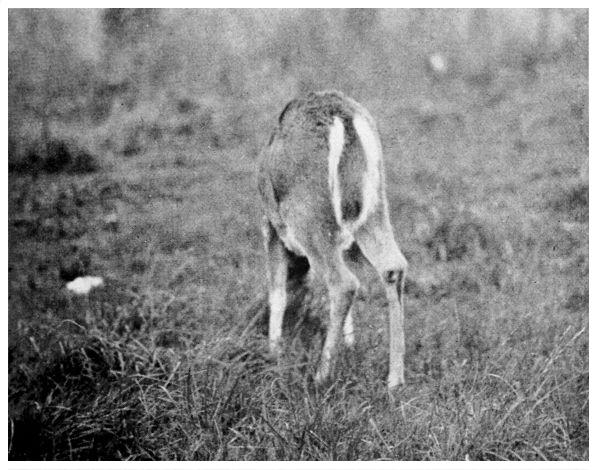
Fig. 132.
White-tailed deer (Odocoileus virginianus leucurus), doe at least
nine years old, kept as a pet by Mrs. Jack Hovis, Puget Island, Washington,
December 16, 1939. (Fish and Wildlife Service photo by Victor B. Scheffer,
No. 750.)
White-tailed deer range from Canada south to Panama and from
the Atlantic to the Pacific. Their range is much more extensive
to the east and south than that of the "blacktail" and mule deer.
In western Washington the whitetail occupies a limited habitat
near the mouth of the Columbia River. Its geographic range was
probably somewhat greater in the past. Its habitat includes the
low, damp, marshy islands and floodplain of the Columbia. Blacktail
range in the wooded hills surrounding the whitetail's range but
rarely enter it to compete with the whitetail (Scheffer, 1940A: 282).
In northeastern Washington the whitetail shows the same tendency
to occupy low, marshy areas and valleys. The habitat preference
of the whitetail in northeastern Washington is less exact
than in western Washington, for the species ranges up from the
valleys into the forests of larch and cottonwood of the Transition
Life-zone. Its habitat includes denser forest and brushy areas.
Rarely does it occur in the open type of forest occupied by the
mule deer.
Fig. 133.
White-tailed deer (Odocoileus virginianus ochrourus): fawn kept
as a pet by L. E. Borud, Ione, Washington, June 13, 1938. (Fish and Wildlife
Service photo by Victor B. Scheffer, No. 69.)
In Washington the whitetail is not an important game animal.
The race occurring in western Washington is characterized by small
size and small antlers. Further, its total population is estimated at
but 400 to 900 individuals. The whitetail of northeastern Washington
is larger and possesses larger antlers. Indeed, some antlers
from Ferry County are the largest antlers of whitetail that I have
ever seen. Nevertheless, the whitetail of northeastern Washington
is smaller than the mule deer and far less common. The habitat
is dense and difficult to traverse. The animal is shy and silent,
fleeing soundlessly when approached. For these reasons most hunters
in northeastern Washington prefer to hunt the mule deer.
Fig. 134.
White-tailed deer (Odocoileus virginianus ochrourus): left antler
found on ground at Park Rapids, Pend Oreille County, Washington, October
1, 1937. (Fish and Wildlife Service photo by Victor B. Scheffer, No. 756.)
Odocoileus virginianus macrourus Taylor and Shaw, Occ. Papers Chas. R. Conner Mus., 2:30,
December, 1929.
Odocoileus virginianus ochrourus Bailey, Proc. Biol. Soc. Washington, 45:43, April 2, 1932.
Fig. 135.
White-tailed deer (Odocoileus virginianus leucurus), antlers of
large buck killed in the fall of 1939 at Cathlamet, Washington, by Paul Lewis.
(Fish and Wildlife Service photo by Victor B. Scheffer. No. 752.)
Type.—Obtained at Coolin, south end of Priest Lake, Bonner County,
Idaho, by F. Lemmer on December 27, 1908; type in United States National
Museum.
Racial characters.—A large, pale white tail with large, low antlers and distinctive
cranial features.
Measurements.—The type, an adult male, measures (Bailey, 1936. p. 43):
total length 1,752; tail 265; hind foot 483; ear (dry) 120.
Distribution.—Northeastern Washington. Probably once occurred in southeastern
Washington.
Cervus leucurus Douglas, Zoöl. Jour., 4:330, 1829.
Odocoileus leucurus Thompson, Forest and Stream, 51:286, October 8, 1898.
Odocoileus virginianus leucurus Lydekker, Cat. Ung. Mamm. British Mus., 4:162, 1915.
Type.—Obtained on the North Umpqua River, Oregon, by David Douglas
on October 17, 1826; type originally, and perhaps still, in British Museum.
Racial characters.—A small, handsome whitetail with slender, erect antlers
and brownish or grayish color.
Measurements.—A young adult female from 1 mile south of Skamokawa,
Wahkiakum County, measured: total length 1,545; length of tail 250; hind
foot 458; ear 143; weight 88 pounds.
Distribution.—Previously occurred over much of southwestern Washington;
now confined to the banks and islands of the Columbia River in Wahkiakum
County.
Description.—The mule and black-tailed deer are among deer of
medium to large size. Adult mule deer may weigh up to 400 pounds
while some fully adult blacktail bucks may weigh as little as 100
pounds. The body is heavily muscled, the legs long and the tail
only about 6 inches in length. The ears are long, from 6 to 8 inches
from notch to tip. The head is long and the male has well-developed
antlers. The first antlers are almost straight spikes. Those
of the second year are bent slightly outward and forward and are
equally or subequally forked with the anterior branch usually the
stouter. In the third year the anteriolateral curvature is more pronounced
and one or both of the forks again fork. In succeeding
years forks are larger and more numerous but the essential biramous
arrangement of forking is maintained. The "blacktail" and mule
deer are strongly marked races. The blacktail differs from the mule
deer in: smaller size; darker color, especially on face and tail; tail
dark brown above with dark tip rather than whitish with black tip;
tail haired beneath, not naked for half its length; antlers smaller
and lighter; and skull and teeth smaller.
Mule deer and black-tailed deer range over western North America
from southeastern Alaska southward into northern Mexico. They
inhabit forested parts of the state of Washington. Blacktails occupy
the San Juan Islands, the islands in Puget Sound, the Olympic
Mountains, the lowlands of western Washington, and the Cascade
Mountains. Mule deer occupy the Cascades, including their eastern
slope, northeastern and southeastern Washington and parts of the
Columbian Plateau. Over this large range there is considerable
local geographic variation.
Jackson (1944: 1-56) estimated that 109,600 blacktail and 175,725
mule deer live in Washington. Thus Washington is second only to
California in number of blacktail and ranks fifth in number of mule
deer.
Individual variation over the range of the mule deer is considerable
but no trends of variation are distinguishable. Mule deer from
the Blue Mountains, northeastern Washington and the eastern Cascades
are essentially similar.
There is geographic variation as well as great individual variation
in the black-tailed deer of Washington. The deer of the San Juan
Islands and the islands of Puget Sound are smaller and darker than
those of the mainland and possess smaller, lighter antlers. The deer
of Whidby Island are sometimes contemptuously referred to by
residents as jackrabbit deer. Fully grown bucks on the Islands
weigh in the neighborhood of 100 pounds, rarely exceeding 150 pounds,
whereas bucks on the mainland commonly weigh more than 150
pounds dressed.
Fig. 136.
Mule deer (Odocoileus hemionus hemionus), subadult male from
Okanogan County, Washington, raised in captivity; photographed June 29,
1938, on Hurricane Ridge, Olympic National Park. (Fish and Wildlife Service
photo by Victor B. Scheffer, No. 99.)
The dividing line between the ranges of the black-tailed and mule
deer in general is the summit of the Cascade Mountains. In summer
the two races come together and doubtless mingle in the Cascades
but as fall approaches they migrate. The mule deer moves
eastward to the yellow-pine areas on the lower slopes while the
blacktails descend westward to the denser Douglas fir and hemlock
forests on the western flanks of the Cascades. In the breeding season
the two races are separated. However, as shown by Cowan
(1936A: 219), in the Pemberton Valley, British Columbia, the two
forms occur together during the breeding season and intergradation
occurs there. Intergradation occurs also in the Lake Wenatchee
area of Chelan County. Observation of hunters' specimens showed
some undoubted intergrades among the more abundant, typical mule
deer.
Both the mule deer and blacktail have a characteristic bounding
gait, unlike the smooth run of the white-tailed deer. The tail is
usually held down, rarely erect. When not frightened they move
with dainty steps, making little noise.
Fig. 137.
Black-tailed deer (Odocoileus hemionus columbianus), buck resting
at midday, Van Trump Park, Mt. Rainier, Washington, August, 1931.
(Fish and Wildlife Service photo by Victor B. Scheffer, No. 260.)
The black-tailed deer in certain areas is more nocturnal than
diurnal. They feed principally in the early morning and evening.
In the Olympic Mountains, on the North Fork of the Quinault
River, in July, 1937, blacktails were watched feeding and playing
until midnight. Also in December, 1939, deer, near the forks of
the Skykomish River, were moving about, browsing as late as 11
p. m. while a light snow was falling. In the San Juan Islands, in the
summer of 1939, deer were observed feeding at all hours of the day.
The blacktail lives in some of the most dense jungle areas of western
Washington. On Whidby Island and some of the San Juan
Islands the brush and vines grow so densely that a man can scarcely
penetrate them. Were it not for the deer trails, formed by generations
of deer, our small mammal investigations would have been
far more difficult. The blacktail lives also in the dense forests
where fir, hemlock and cedars grow to heights of more than 150
feet. Here lack of light allows only ferns and moss to form an understory
vegetation. These forests often clothe the steep glacial
hills and the trails of the deer on such hills show them to be adept
climbers. Deer trails generally avoid fallen trees and other obstacles.
When startled, however, a stump, fence or log is easily
leaped by a blacktail. Often they are in small bands of 6 to 10
individuals, but almost as often are solitary, or in pairs.
The habitat of the mule deer is generally more open than that
of the blacktail. In the summer, it may occupy rough and rugged
country; in the higher Cascades individuals were found in the
rocky and brushy country and in open glades and meadows. Farther
east they were in the open yellow-pine forests where extensive
grassy slopes, free of trees, existed. In some parts of northeastern
Washington they lived in the larch and lodgepole pine forests almost
dense enough to be "blacktail country." In the Okanogan Valley and
on the northwestern corner of the Columbia Plateau mule deer
lived in open prairie country where a few cottonwoods and willows
were the only trees.
The mule deer seem more social than the blacktail. In the late
summer they gather in bands of 10 to 20 or more. In winter, under
pressure of hunger, they gather in herds and raid haystacks and
pastures. Farmers in the Methow Valley, Okanogan County, report
herds of 200 to 400 mule deer about a single haystack.
The mule deer and blacktail are the principal game mammals of
the state of Washington. Thousands of hunters enter the woods
each year in search of a buck. Eastern Washington is the favored
hunting grounds for that is the home of the mule deer, the larger
size of which makes it a more desirable trophy. Also the open
country which it inhabits makes hunting more productive. Sums
spent on equipment, gasoline and hunting licenses are tremendous
but the feeling is that the return in recreational value and venison
are worth the cost. A few casualties result each year among the
army of deer hunters.
Cervus hemionus Rafinesque, Amer. Month. Mag., 1:436, October, 1817.
Cariacus macrotis True, Proc. U. S. Nat. Mus., 7:592, 1885.
Odocoileus hemionus Merriam, Proc. Biol. Soc. Washington, 12:100, April 30, 1898.
Odocoileus hemionus macrotis Bailey, National Geographic, 20:64, 1932.
Type locality.—Vicinity of Big Sioux River, South Dakota.
Racial characters.—Large size, pale color.
Measurements.—Two adult males from Stay-a-while Spring, Columbia
County, measure respectively: total length 1,751, 1,559; length of tail 172,
205; hind foot 515, 485; ear 210, 211; length of metatarsal gland 150, 135.
Distribution.—Summit of Cascades eastward, in forested areas, exact limits
not certainly known.
Cervus macrotis var. columbiana Richardson, Fauna Boreali-Americana, 1:257, 1829.
Cariacus columbianus True, Proc. U. S. Nat. Mus., 7 (1884):592, 1885.
Cervus columbianus Baird, U. S. Pacific R. R. Exp. and Surveys, p. 659, 1857.
Eucervus columbianus Gray, Ann. and Mag. Nat. Hist., 18 (ser. 3):338, 1866.
Odocoileus columbianus Merriam, Proc. Biol. Soc. Washington, 12:100, April 30, 1898.
Odocoileus columbianus columbianus Swarth, Univ. California Publ. Zoöl., 10:85, February
13, 1912.
Odocoileus hemionus columbianus Cowan, California Fish and Game, 22:215, July, 1936.
Type.—Obtained at Cape Disappointment, Pacific County, Washington, by
Lewis and Clark on November 19, 1805 (Cowan, 1936A: 218).
Racial characters.—Small size, dark color.
Distribution.—Summit of Cascades westward, including islands in Puget
Sound and San Juan Islands; exact limits of range uncertain.
Alces americanus shirasi Nelson, Proc. Biol. Soc. Washington, 27:72, April 25, 1914.
Type.—Obtained near the Snake River, Lincoln County, Wyoming, by J.
Shire on December 11, 1913; type in United States National Museum.
Distribution.—Casual wanderer into northeastern Washington from Canada.
Remarks.—The moose is the largest North American deer. Its
large size and huge, palmate antlers serve to separate it from any
other member of the deer tribe.
Moose range from northern United States to central Canada and
Alaska. The European elk and the American moose are subspecies
of the same species. The moose is of only casual occurrence in
Washington. The latest authentic record for Washington is a bull
that wandered southward and westward from Canada until it was
killed on an Indian reservation in Ferry County. Other moose are
reported to have wandered into northeastern Washington from
Canada in past years.
Dice (1919) was told that moose once occurred in the Blue
Mountains of southeastern Washington but there is no confirmation
of this report.
Rangifer montanus Seton-Thompson, Ottawa Naturalist, 13:129-30, August, 1899.
Rangifer arcticus montanus Jacobi, Erganzungsband, Zoöl. Anz., 96:92, November, 1931.
Type.—Obtained near Revelstoke, Selkirk Range, British Columbia.
Distribution.—Rare or casual along the Canadian boundary in northeastern
Washington.
Remarks.—The caribou is a rather stout-bodied deer with large
hoofs, short, rounded muzzle and long, erect, flattened antlers.
Caribou and their relatives, the reindeer, range over Arctic Europe,
Asia, Greenland and America. In North America they range from
the Atlantic to the Pacific and from the northern border of the
United States northward into the Arctic. The caribou was, until
recent years, a regular winter resident in small numbers in northeastern
Washington near the Canadian Boundary. Their wintering
grounds in Washington were said to have been destroyed by fire in
1915 and the species has appeared in the state only casually since
then. Two were killed in 1940 by hunters who thought they were
deer. Caribou are protected by law in Washington.
Bison bison bison Taylor and Shaw, Occ. Papers Chas. R. Conner Mus., 2:31, December,
1929.
Bison bison oregonus Bailey, Proc. Biol. Soc. Washington, 45:48, April 2, 1932.
Type.—Skull and skeleton picked up at Malheur Lake, Oregon, by G. M.
Benson in November, 1931; type in United States National Museum.
Distribution.—Perhaps casual in eastern Washington before coming of the
white man.
Remarks.—Bison, or buffalo, occurred in southeastern Oregon
but disappeared before white men reached the country (Bailey,
1936: 57). Gibbs (1860: 138) was told by an Indian hunter in
1853 that a lost bull had been killed in the Grand Coulee (state of
Washington) 25 years before but that "this was an extraordinary
occurrence, perhaps before unknown." In the days before horses
reached the Indian tribes of eastern Washington and Oregon, wandering
bison from herds in Oregon probably strayed into Washington,
in somewhat the manner that the moose today stray in
from Canada.
Description.—The mountain sheep is the size of a small deer.
The horns of the males are massive spirals. Those of the females
are smaller, curve upward and backward, rarely forming a semicircle.
The horns are permanent structures, enlarged each year by
growth at the base. Growth is irregular, probably as the result of
seasonal reproductive activities. As a result the horns are "ringed"
with concentric ridges. The color of the upper parts is dark, grayish
brown. The face is paler, yellowish brown. The outer sides
of the legs are dark brown. The rump, abdomen, and insides of
legs are white.
Mountain sheep of the genus Ovis are abundantly represented in
Asia. Two species occur in North America, Ovis dalli in Alaska,
and Ovis canadensis in western North America. They range from
Alaska south to northern Mexico.
In the past the mountain sheep inhabited most of the eastern
Cascade Mountains, the Blue Mountains, Pend Oreille Mountains,
and the cliffs of the Columbia River Valley in eastern Washington.
They occurred on the eastern or Columbian Plateau side of the
river and therefore probably occupied the cliffs of Moses Coulee
and the Grand Coulee. Their habitat seems thus to have included
rocky areas from the Upper Sonoran to the Hudsonian life-zones.
At the present time they are extinct over most of their range. A
small band still remains in the extreme northeastern Cascades
near Mount Chopaka.
Little has been published concerning the habits of the mountain
sheep in Washington. In caves along the Columbia River in Grant
County, bones of sheep are found in association with stone arrowheads
and other human artifacts. Presumably the sheep were
killed and eaten by the Indians.
The history of the mountain sheep in North America is outlined
by Cowan (1940: 506). The genus is thought to have crossed
from Asia to America by the land bridge now under Bering Strait
in the early Pleistocene and spread southward through the Rockies.
The advance of the glacial ice forced them farther southward and
the southern (canadensis) sheep were separated from their relatives
farther north. The present differences between the Rocky
Mountain and western sheep seem to have resulted from separation
by glaciers during Wisconsin Time.
Ovis canadensis Shaw, Nat. Misc., vol. 15, text to pl. 610, about December, 1803.
Type.—Obtained in the mountains on Bow River; W. B. Davis (1939: 377)
gives Dew River near Exshaw, Alberta.
Racial characters.—Large size; heavy, closely coiled horns.
Measurements.—Cowan (1940: 533) gives the measurements of a fully adult
(6-year old) ram from Colorado as: total length 1,953; length of tail 127;
hind foot 394; ear (dry) 63.
Distribution.—Now extinct in Washington. Cowan (op. cit.: 535) refers
to this race as the sheep that formerly occurred in the Blue Mountains. This
view seems logical but I feel that the sheep formerly occurring in the Pend
Oreille Mountains of extreme northeastern Washington should, on the basis
of geographic probability, also be referred to canadensis.
Ovis californianus Douglas, Zoöl. Jour., 4:332, 1829.
Ovis californica Richardson, Fauna Boreali-Americana, 1:272, 1829.
Ovis californiana Biddulph, Proc. Zoöl. Soc. London, p. 683, 1885.
Ovis canadensis californiana Lydekker, The Sheep and its Cousins, p. 288, 1912.
Type.—Obtained from near Mount Adams, Yakima County, Washington,
by D. Douglas on August 27, 1826; type in British Museum.
Racial characters.—Similar to canadensis but smaller with more slender,
spreading horns and horn tips less blunt.
Measurements.—Cowan (1940: 545) gives the measurements of a ram, five
years old, from Owens Valley, California, as: total length, 1,582; length of tail,
110; hind foot, 240.
Distribution.—Formerly occupied the eastern Cascades, the valley of the
Columbia and possibly the cliffs bordering Moses Coulee and The Grand
Coulee. Now it is found only near Mt. Chopaka in the extreme northeastern
Cascades.
Description.—The mountain goat is of deer-size, with a stout
body and a pronounced hump on the shoulders. The legs are short
but the hoofs are large with large dewclaws. The neck is short
and thick. The head is large and goatlike in appearance. The tail
is tiny. The horns are slim, round and curve up and slightly backwards.
They are hollow and are permanent structures, added to
each year. The body is snow white, consisting of long, soft wool,
which is longer and coarser on forelegs, neck and chin than on the
body. Males have a distinct beard.
Mountain goats range from Washington and Idaho north to
Alaska. Their nearest relatives are the Old-World antelopes, especially
the alpine species of Europe and Asia.
The mountain goat is an animal of the high mountains. Their
habitat is the bare-rock cliffs and rock-strewn slopes of the Arctic-alpine
and Hudsonian Life-zones. Where extensive, open rocky
areas occur they descend to the Canadian Life-zone. Even in winter
they keep to the high cliffs where steep slopes and strong winds
keep the snow from the plants on which they feed.
Mountain goats are considered a game animal in Canada and
Idaho. The species has been protected in Washington for many
years. As a result they are common, although not present in numbers
sufficient to withstand hunting. The high country which they
occupy is unsuited to any of man's domestic animals and no reason
is apparent at present why the mountain goat should not be protected
and conserved for many years.
Fig. 138.
Mountain goat (Oreamnos americanus americanus), old female,
Lake Chelan, Washington, March 6, 1937. (Forest Service photo by Oliver
T. Edwards, No. 348491.)
In spite of the protection accorded them, the mountain goat has
not become tame. In driving over Stevens Pass, King County, one
can, with the aid of glasses, usually pick out one or more mountain
goats on nearby mountains. Nevertheless, I have never seen one
within 100 yards of a highway, nor heard of one being killed by
cars on a highway.
The mountain goat does not, as a rule, allow close approach by
man. At Goat Basin, Deception Creek, King County, circumstances
are particularly favorable for goats and several are usually to be
seen. While studying them on several occasions, I was never able
to get truly close to them. On the few occasions when I came upon
a band unexpectedly, they rapidly went over the mountain or up
the nearest cliff.
Fig. 139.
Group of mountain goats (Oreamnos americanus americanus),
northern Cascade Mountains, Washington. (Forest Service photo, No.
348490.)
When unfrightened, these mountain goats spent much time standing,
or lying with forefeet folded under them, looking into space.
For such large animals they seemed to spend little time feeding. At
intervals of about five minutes they plucked the ferns or other plants
that grew in abundance on ledges or in tiny crevices in the cliffs.
Some animals did browse for several minutes at a time. They
seemed rather particular as to their food, plucking only one or
two stems from a clump of vegetation.
The ordinary movements of the mountain goats are deliberate.
They rarely move more than a few feet at a time. They climb
with sure-footed ease but usually slowly. In climbing, the forelegs
are spread and the knees are bent. The animal moves as if it were
climbing steps. The greatest action is in the knee joints. If surprised
in the open they run with a smoother gait, the legs moving
from the shoulder and hip. If near a cliff they climb rapidly, jumping
when necessary, and rarely stop while in sight. Evidence of the
presence of mountain goats is usually seen in the form of tufts and
strands of wool. Their wool becomes caught in bushes and rough
rocks and seemingly pulls out easily.
The range of the mountain goat in Washington includes the entire
Cascade range from Mt. Adams and Mt. Saint Helens north to
the Canadian boundary. They extend west to Mt. Baker, Mt.
Higgins and Mt. Index and east to Lake Chelan and, in the Wenatchee
Range, east of Mt. Stuart, perhaps almost to the Columbia
River.
Dice (1919: 21) was told that mountain goats once occurred in
the Blue Mountains of southeastern Washington. We know of no
suitable goat country in the Blue Mountains of Washington and
feel that the report was probably based on an erroneous identification.
There is a single record, supported by specimen, of a mountain
goat from northeastern Washington. This individual probably
wandered into Washington from northern Idaho, Montana, or adjacent
British Columbia.
Ovis montanus Ord, Guthrie's Geol., 2d Amer. Ed., p. 292, 1815 (preoccupied).
R[upicapra]. americana Blainville, Bull. Sci. Soc. Philomath, Paris, p. 80, 1816.
Mazama dorsata Rafinesque, Amer. Month. Mag., 2:44, 1817 (new name for Ovis montanus
Ord).
Mazama montana True, Proc. U. S. Nat. Mus., 7 (1884):592, 1885.
Oreamnos montanus Merriam, Science, n. s., 1:19, 1895.
Oreamnos montanus montanus Miller, U. S. Nat. Mus. Bull., 79:398, December 31, 1912.
Oreamnos americanus americanus Hollister, Proc. Biol. Soc. Washington, 25:186, December 24,
1912.
Type.—None. Descriptions all based on Ovis montanus Ord who, in turn,
based his description on the account of skins seen by Lewis and Clark on
the Columbia River of Washington or Oregon. As the mountain goat is not
known to have ever occurred in Oregon in Recent times, the type locality
is probably near Mt. Adams, Washington, the point where goats come nearest
the Columbia.
Measurements.—The measurements of a large male killed "west of North
Yakima" were reported by A. S. Harmer as: 8 feet 3 inches from tip of nose
to tip of tail; horns 10 inches; weight 507 pounds (Outdoor Life, 1915: 459).
Distribution.—Throughout the higher Cascade Mountains.
Oreamnos montanus missoulae Allen, Bull. Amer. Mus. Nat. Hist., 20:20, February 10, 1904.
Oreamnos americanus missoulae Hollister, Proc. Biol. Soc. Washington, 25:186, December
24, 1912.
Type.—Obtained at Missoula, Missoula County, Montana; type in American
Museum of Natural History.
Distribution.—A single record for northeastern Washington. Seemingly a
rare wanderer from outside the state.