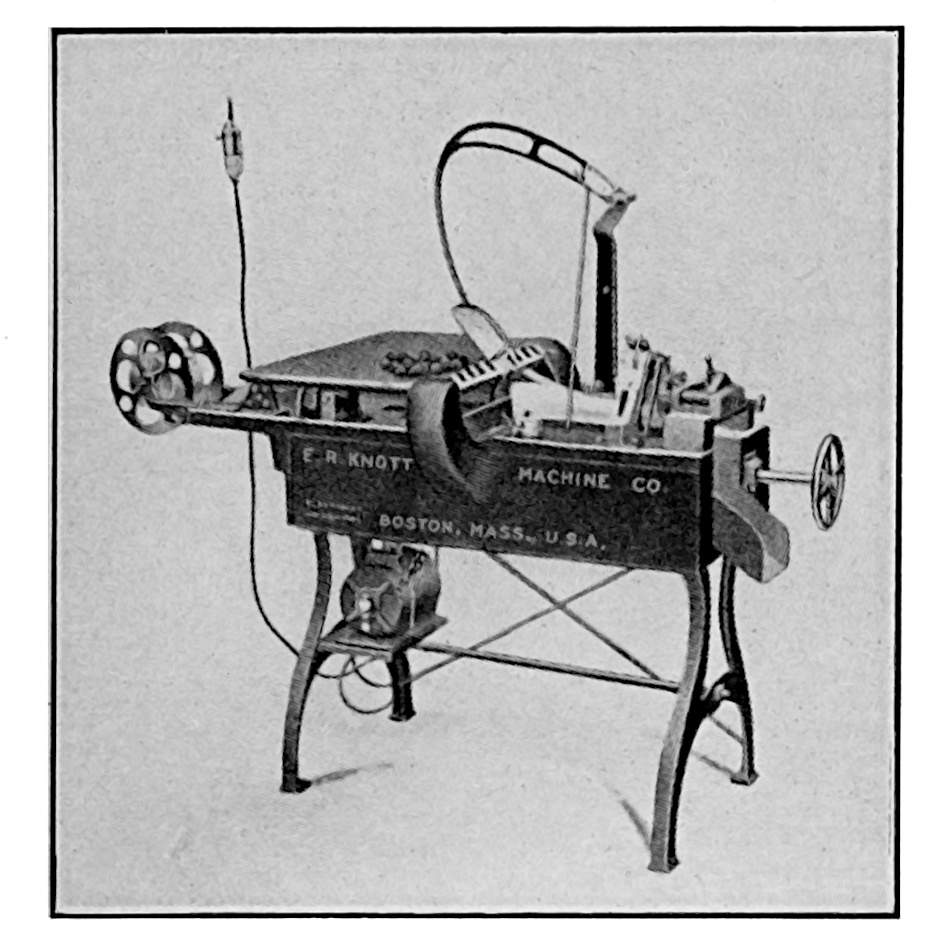
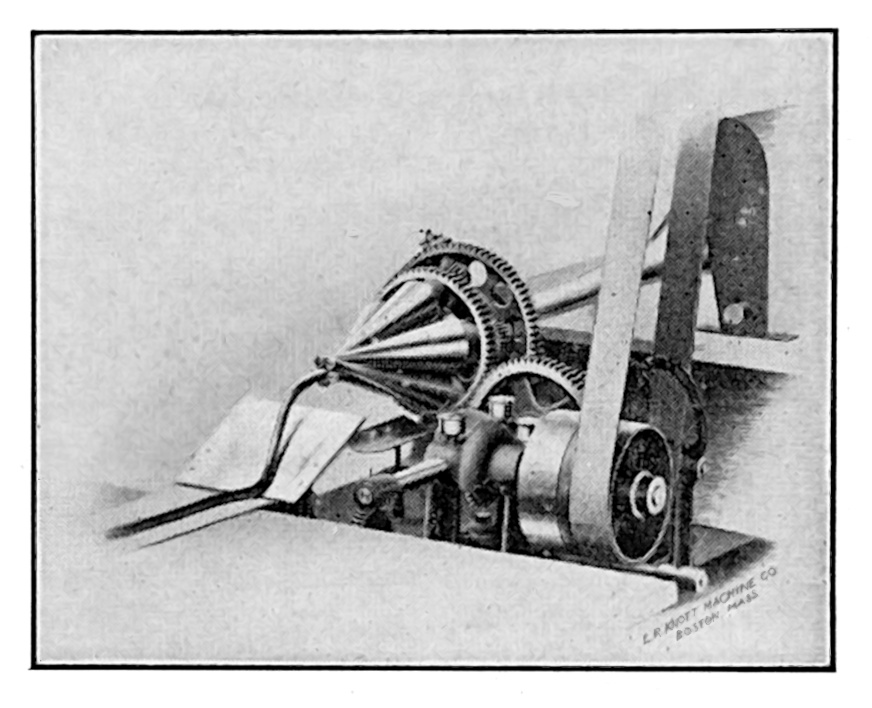
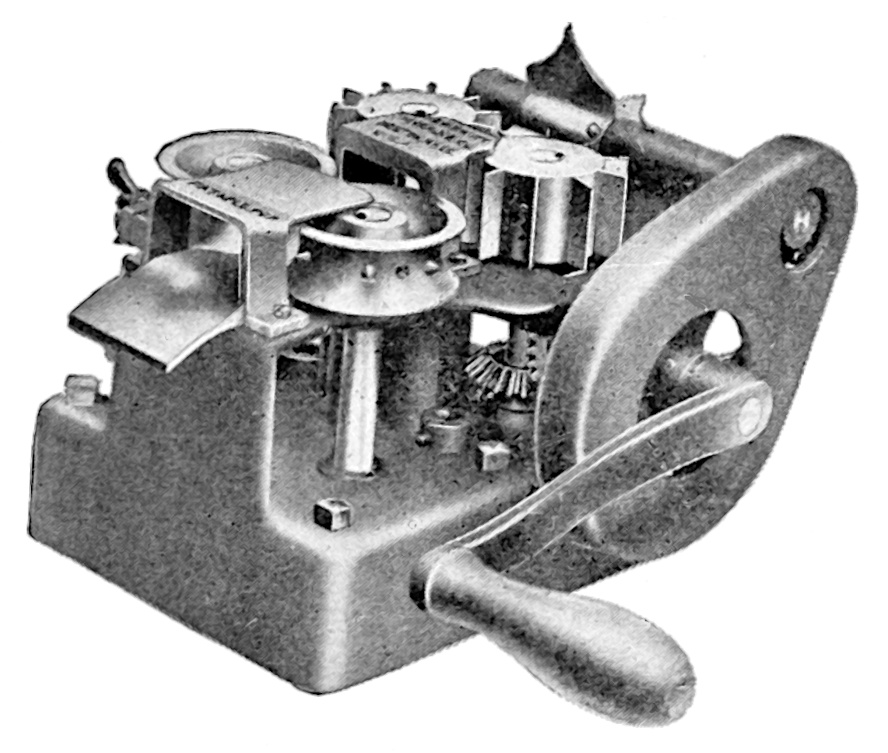
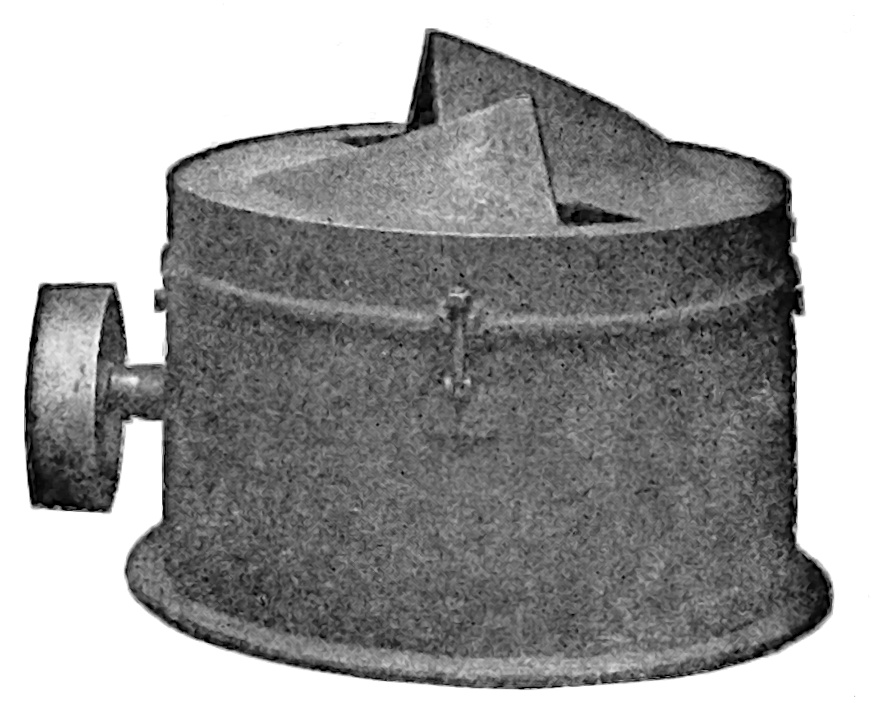
YOU will agree with me that unless you have your outfit arranged
right you will be wasting steps, and that one worker will be in the
way of another.
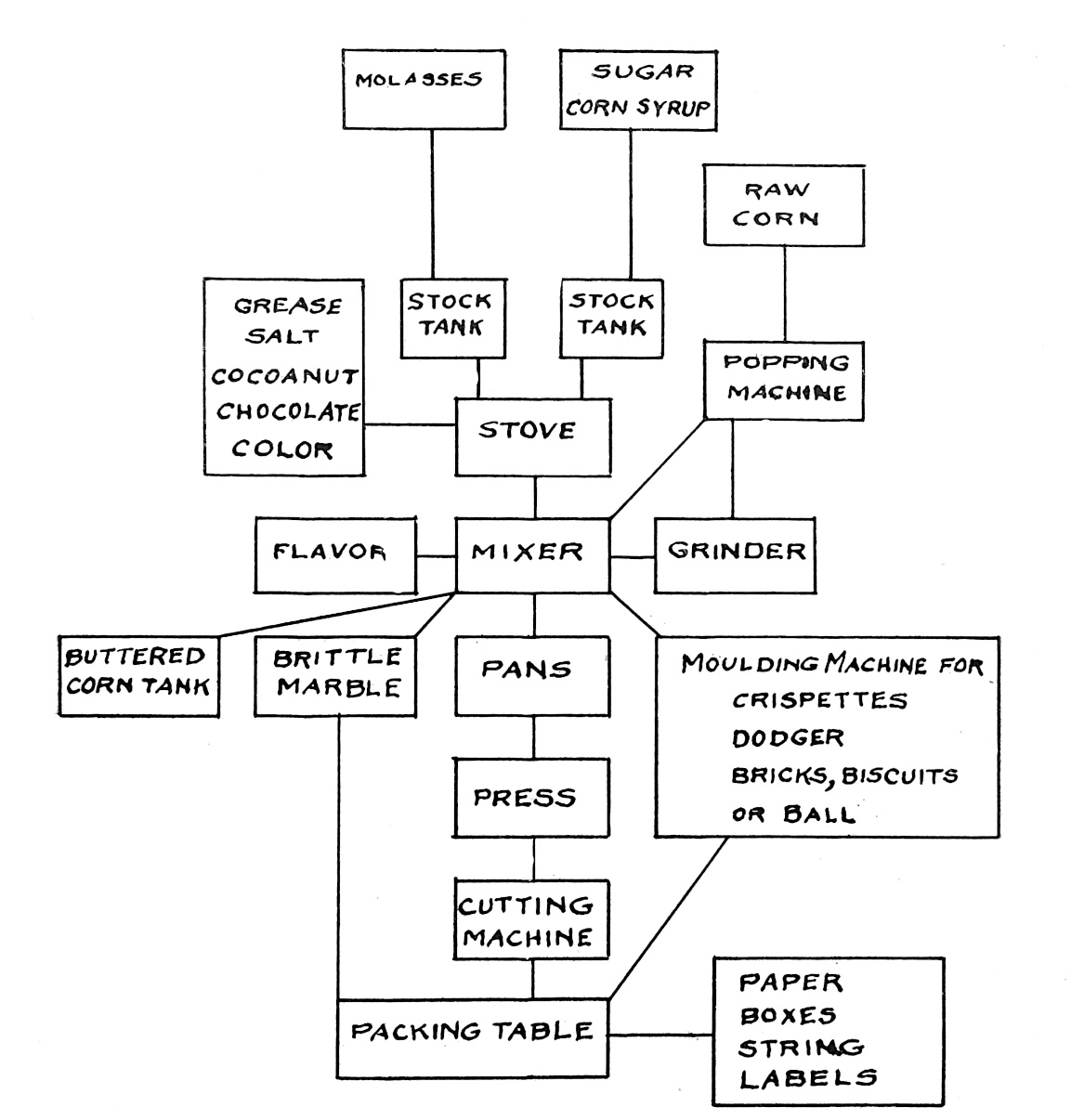
The best way is to have the room arranged so that the raw corn
starts down one side of the room and the finished goods come back on
the other, so that the process of manufacture passes around the room in
a continuous progress toward the shipping point.
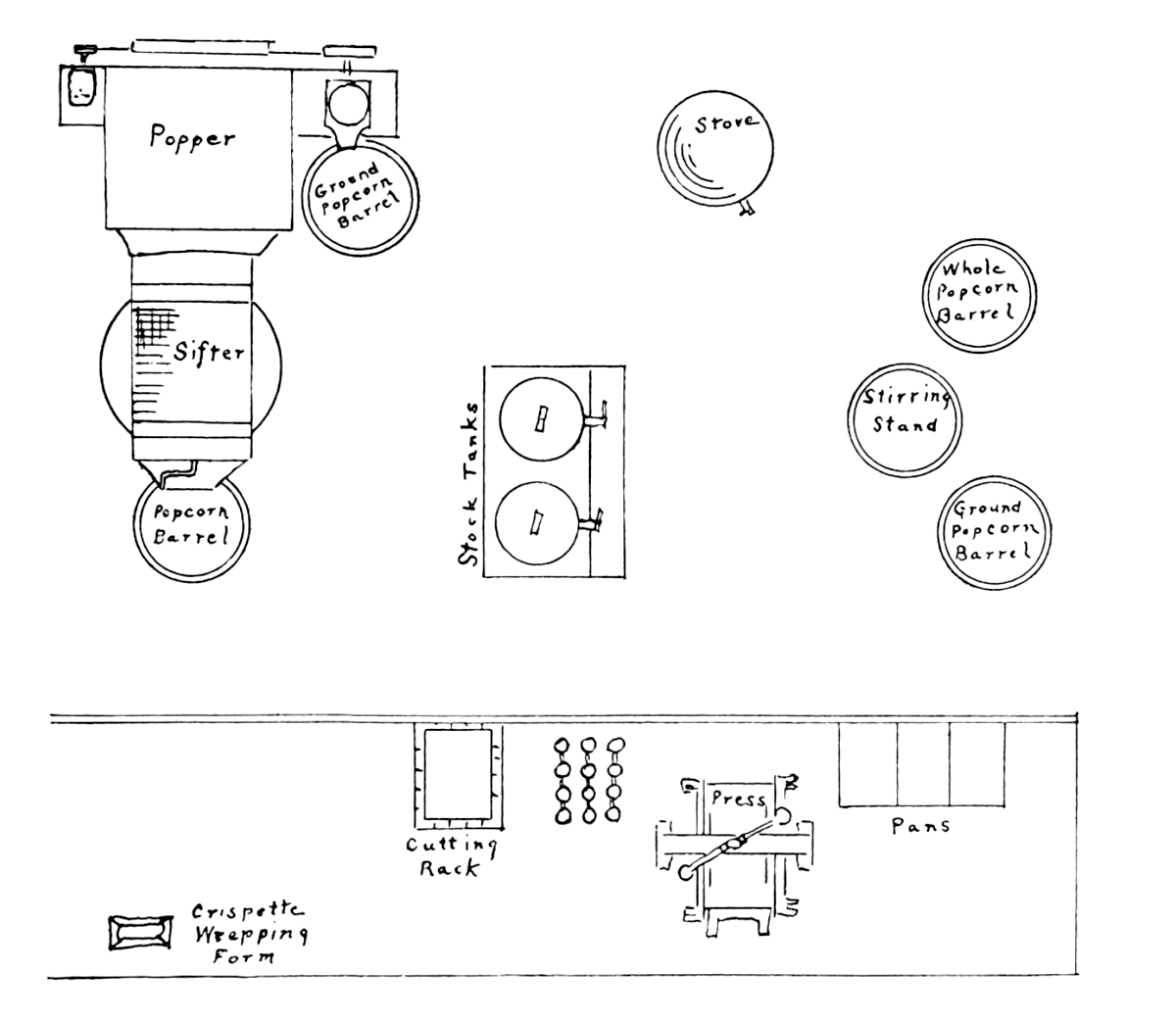
This sketch gives you an arrangement to consider. You should
make your Popper and Mill Stand, Stock Tank Stand, Kettle Stirring
Stand and Bench so that you can move them, and thus try various
distances and arrangements to fit the particular line of goods that becomes
your leader.
It is just as bad to have machines too close together as to have them
too far apart, even when arranged in good working order. In the plan
above, room is left for barrels to stand in front of the popper, at the
side of and in front of the mill and room for two at the Kettle Stirring
Stand, one for whole corn and one for ground corn.
Several conditions of manufacture are changed as the quantity of
production is increased.
You should pop your corn in a separate room from the place in which
the cooking is done. The heat from the poppers—even with the windows
open in summer—is very uncomfortable and the escaping gas and burning
dust makes the air very unhealthy. Have your poppers so arranged
that the bad air will rise and escape without disturbing the workers.
Ordinary windows are not enough. Put a ventilator over the poppers.
Place a hood, or canopy over your stoves connected by pipe to outdoors,
so that when any syrup or molasses gets on the stove and creates
a smoke, it will pass off without making the workers uncomfortable.
The arrangement of your factory space as to the location of the
doors, windows, stairs and elevator will effect your placing machinery.
Whether you use individual motor drive, or shaft driven machines,
will effect the arranging of your plant.
What you intend to manufacture and what machines you buy will
also determine how you use your floor space to the best advantage.
Individual motor drive enables you to locate your machines to
better manufacturing advantages.
As your business changes in what you make, as you increase or
change your goods and as you add more machines, you can more easily
move machines to keep the best manufacturing arrangement.
As to cost of operation, it is hard to say under modern conditions
whether one way is cheaper than another. With separate motor to each
machine, you have no overhead shafts and belts to drop oil and dust
and compel you to locate by them. You are not liable to have your
plant idle because the one motor is out of order, or one belt has parted,
you can keep making something if one machine is out of order, for all the
others will be running.
Many manufacturers make a stand for their popper out of three-quarter
inch gas pipe, which is fireproof, clean, simple and cheap. It is
best to have three pipes for the popper to rest on, one across near the
front and two across near the back. These two project to the right
twelve inches for the shelf for mill (Stock No. 2001-1). By the use of
elbows, tees, flanges and piping you can make a stand to rest on the floor
or hang from the ceiling and bring the popper to the right height for your
barrels. When hung from the ceiling it leaves the floor clear, and in
every way is to be preferred if you make the construction rigid. Determine
the height of the barrel you are to use under your Knott Rotary
Sifter (Stock No. 112) and have the top of the stand for popper twelve
and one-half inches higher than that.
Use an iron box or barrel under the popper to catch the unpopped
kernels. In that way you risk no fire should a blazing kernel fall into
it. A blaze in pop-corn is easily smothered by stirring up the corn.
You are urged to use an iron barrel under the Knott Rotary Sifter
(Stock No. 112) to catch the siftings.
Order your popper made ready to attach Knott’s Rotary Sifter,
it costs no more.
Remove the pop-corn popper cylinder.
See that the valves are closed.
Use only the best gasoline.
Do not fill the tank while the burners are lighted, nor remove the
tank to fill it. Do not let the tank run dry.
If gasoline burners should leak at any time at the hexagon stuffing
box on the valve stem, tighten with pliers. Repeat this operation if
any further trouble occurs from this source. If this doesn’t overcome
the trouble remove the stuffing box and wrap some cotton cord or linen
thread well saturated with common soap around the valve stem. Then
tighten stuffing box.
To prevent smoking up the cylinder you are recommended to use
alcohol (denatured or wood) in generating cups; light and allow to burn
out, then turn on gasoline and light at the perforated cone at top of
burner; turn low.
If you are not used to gasoline burners, get some one who knows
how to show you.
It is essential to have an uninterrupted and sufficient supply of gas.
Do not use a rubber tube to carry gas to the popper if you can connect
the popper directly by pipe. The tubing greatly reduces the pressure.
Run a three-quarter-inch pipe to a small sized Popper; and an
inch pipe to the large sized Poppers. See that the gas comes to this
through no smaller pipe.
Light the burner and turn low.
The distance the pop-corn cylinder is away from the burner is
very important. If your cylinder is too near the burner, your corn will
be really under the heat and not in it. If the cylinder is too far away
from the burner, the corn will be too far away from the hottest part
of your fire. This will show by your corn being roasted instead of popped
and by your popped kernels being small. The distance between cylinder
and the burner should be about 1 inch. This does not mean ¼ inch
or ½ inch, neither does it mean 1¼ inch or 1½ inch. The pressure
of the gas may require that you make a new adjustment of the burner
up or down to get absolutely the best results with the gas you must use.
Make yourself thoroughly familiar with the motions of operating
the popper with raw corn without fire before trying to pop corn.
A power-driven machine should have the power turned on before
the burner is lighted. This prevents the liability of your forgetting to
keep the cylinder revolving over the fire. If the cylinder is not in motion,
the fire will burn a hole in it or get it out of shape.
Having oiled the shaft with heavy oil, replace the cylinder.
Put in a scoopful of corn.
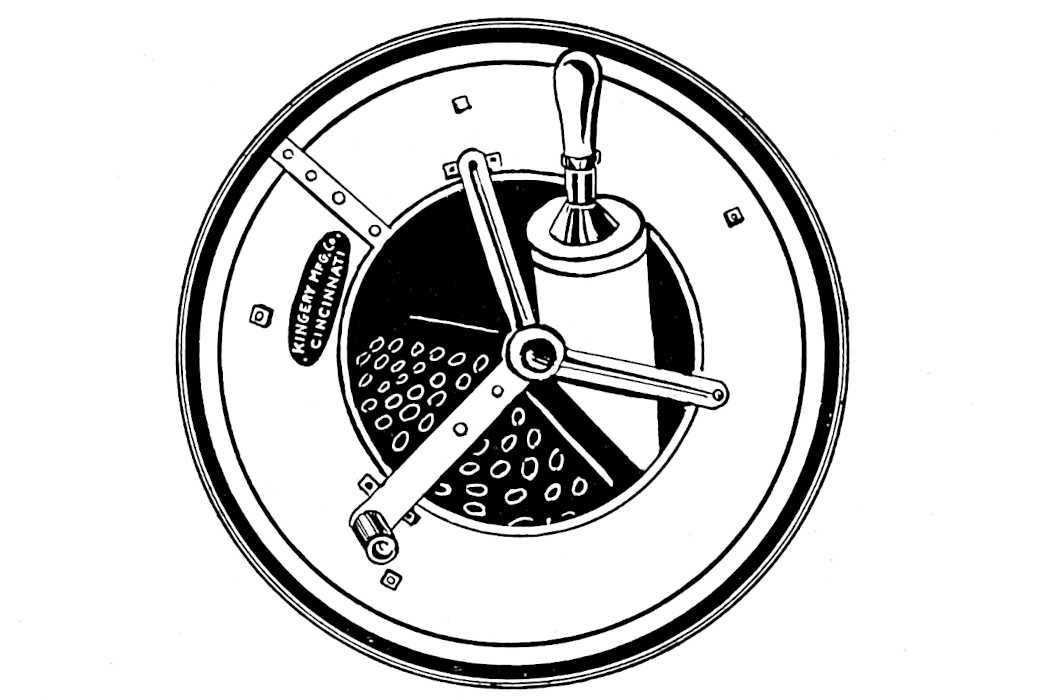
This illustrates method of placing corn in cylinder
Turn up the fire and revolve the cylinder clockwise, eighteen or
twenty revolutions to the minute.
The popping should begin in one and one-half to two and one-half
minutes.
After the popper has been running a little while and becomes thoroughly
warmed up, popping may begin in one and one-half minutes.
When the popping is about two-thirds completed, if you are using
gasoline fuel, turn down the inside burner only. When gas is used
turn the valve off about half-way.
In case pop-corn catches fire in the cylinder, put in a scoop of raw
corn, which will extinguish the blaze.
After a little practice you will know from the discharging corn just
what moment to turn the cylinder slowly backward and stop to dump
the unpopped kernels. On the power machines you must draw the
bolt on the crank before you can turn it backwards.
Put in another scoopful of corn.
Turn up the burner, and if you are using gasoline, first the outside
and then the inside one, so that the lighting will be from the outside.
Proceed as before.
This machine may be used as a peanut roaster by using a special
peanut cylinder in place of the pop-corn cylinder. These cylinders are
carried in stock at the factory and will fit your popper.
Open the slide, insert the funnel and put in peanuts until the cylinder
is three-quarters full. Then close the slide; remove the pop-corn
cylinder; light the burners; put the peanut cylinder in the machine,
then revolve the cylinder at the same speed as the pop-corn cylinder,
about eighteen to twenty revolutions per minute.
Test the peanuts by running a tryer in the hole in the cylinder.
It will require twenty to thirty minutes to roast.
Empty the cylinder by drawing it part way out, turning it hole
downward and swaying it back and forth.
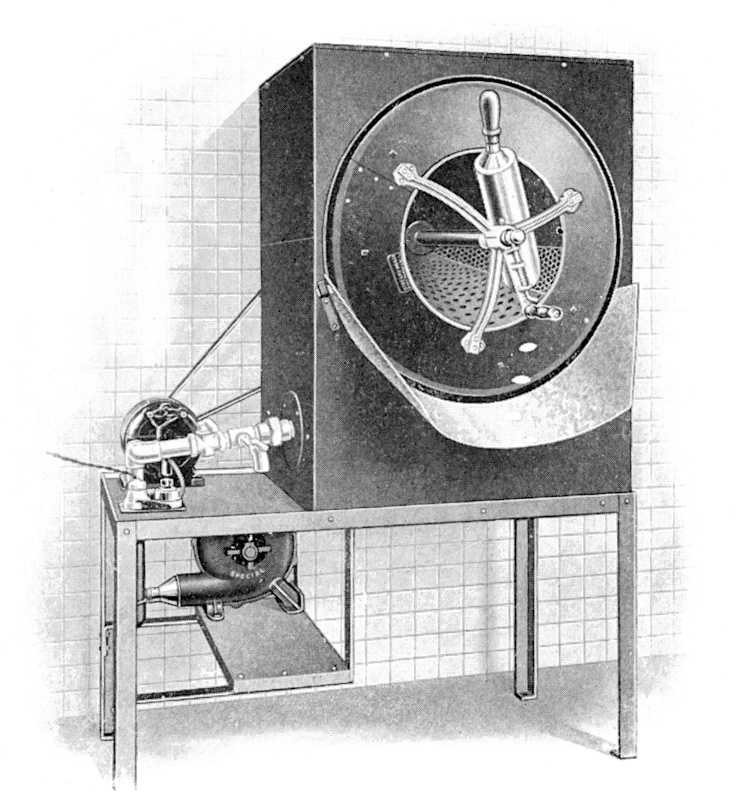
Stock No. 2003-2. Kingery Popper: “The One Liked the Best”
- Stock No. 2003-1 Kingery No. 50, gas fuel and motor without blower
- Stock No. 2003-2 Kingery No. 58, gas fuel with motor and blower
- Stock No. 2003-3 Kingery No. 51, gas fuel with 24-inch pulley
- Stock No. 2003-4 Kingery No. 250, gas fuel and motor attached. Nickel plated
- Stock No. 2003-5 Kingery No. 258, gas fuel with motor and blower. Nickel plated
- Stock No. 2003-6 Kingery No. 59, gas fuel, 24-inch pulley and blower
- Stock No. 2003-7 Similar to No. 2003-2, but without stand
- Stock No. 2003-8 Similar to No. 2003-2, but without stand or motor
- Stock No. 2003-9 Popping machine of 4 bushel per hour capacity, with motor and with atmospheric gas burner
- Stock No. 2003-10 Similar to No. 2003-9, but with gas burner and blower
Stock No. 2003-2. Capacity, 12 bushels per hour. Dimensions
of body, 37 inches high, 28 inches wide, 14 inches deep; gas machine,
18 inches deep.
Smaller machines or machines arranged in series.
We recommend this machine, we know it is right.
Kingery poppers are generally used in factory production because
of their efficiency. The best popper is Kingery No. 58, arranged with
gas fuel, electric motor and a blower that forces air into the burner,
which mixing with the gas gives a much cleaner, hotter fire with less
gas. A fire that pops corn into larger kernels, pops a larger per cent.
of the corn and does it in a shorter time.
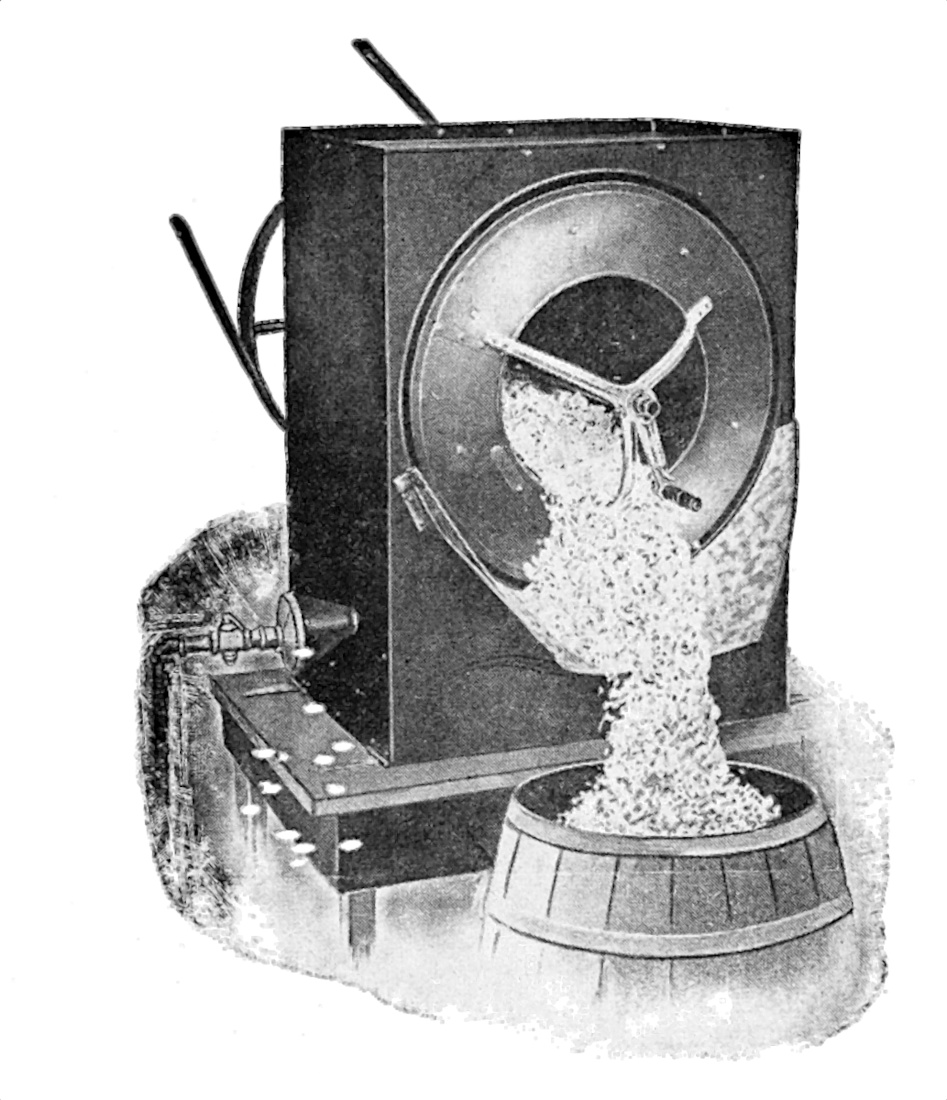
About fifty, more or less, of unpopped kernels will be blown out by
the popping corn or carried out with it at each popping.
These must be sifted out of the popped corn before you make up
your confection. You do not want to bite down on a hard kernel and
break a tooth, so that it is necessary for you to make certain that every
hard kernel is eliminated.
The pop-corn cannot get by without being sifted and every hard
kernel is taken out.
The screen does not clog because it turns over twenty times a
minute. No pop-corn kernels are broken, as the pop-corn tumbles over
and over in a veritable cascade seven times in passing from the hopper
through the cylinder.
By a long series of experiments the construction was determined
that positively took out every hard kernel.
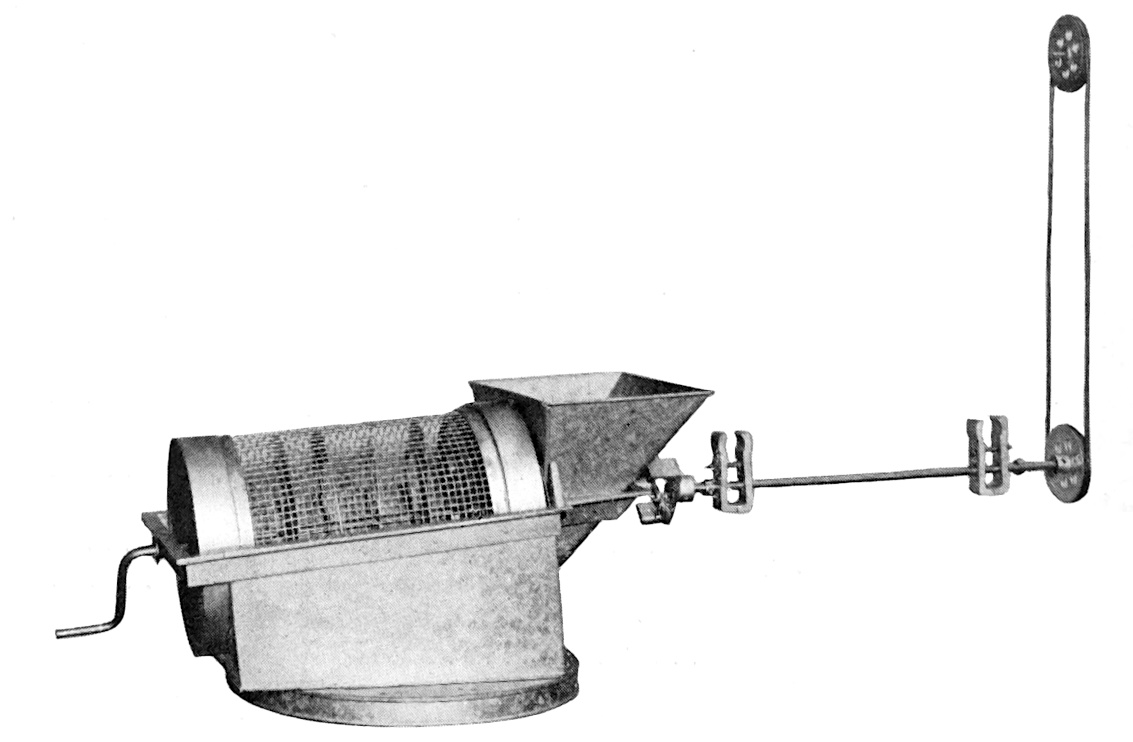
Stock No. 112. Model C
(Patent applied for)
With the sifter and driving parts as shown on page 20 you receive
drills and tap for bit-stock so you may put up the machine yourself
by following the direction sheet.
Screen 12 inches in diameter by 19 inches long with baffle plates
that compel the corn to travel in a cascade over 21 feet of screen before
it gets out, the pop-corn tumbling over itself so there is nothing to
break it up.
Built on cast iron frame, rigid construction, cannot clog, ample
capacity, cannot choke, does not break up pop-corn, you can take it
away and put it back while popper is running.
Ample capacity to handle pop-corn from large popper.
Siftings must all fall inside of your barrel whether it be 18 inches or
21 inches in diameter.
The power it takes is so small you need not think of it.
- Stock No. 112 Knott’s Rotary Pop-corn Sifter with driving parts complete
Grinding pop-corn is not the same as crushing raw grain. Pop-corn
should be torn apart when it is ground and not mashed, as it is the
fluffy, light texture you desire to maintain.
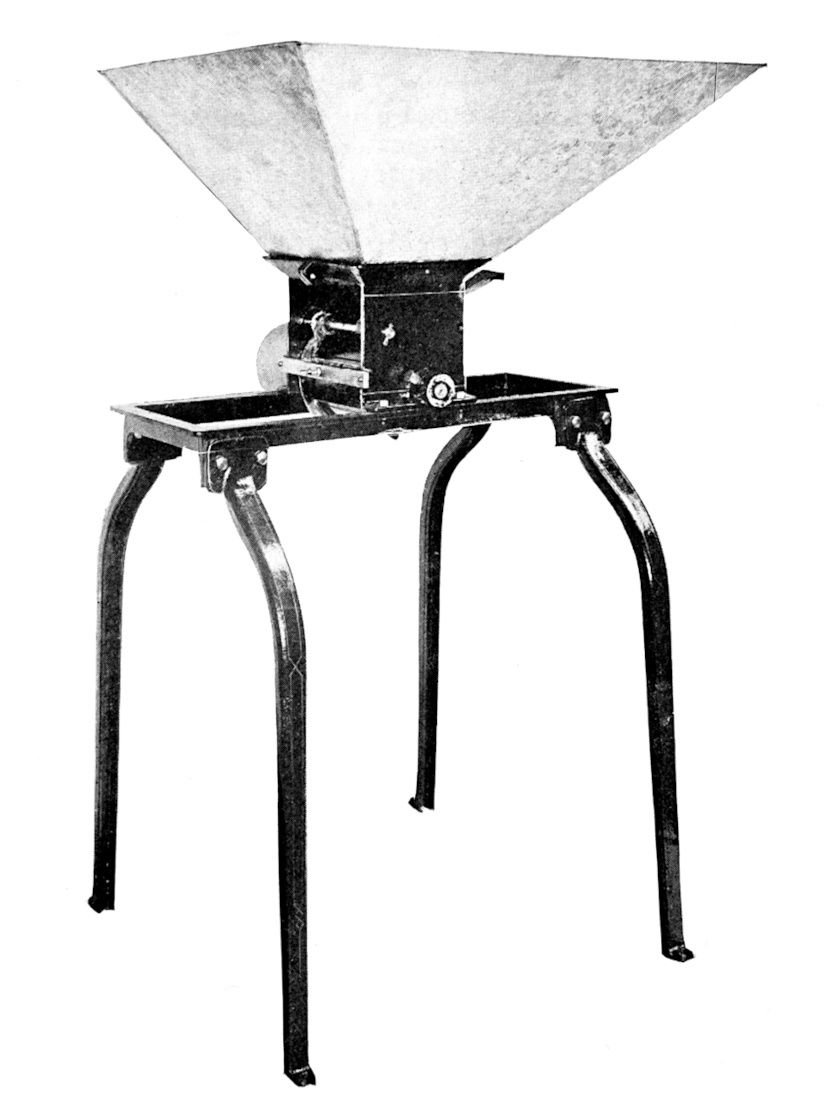
Knott’s Mills (Stock No. 2001 and Stock No. 109) accomplish the
same work in different ways, but the former is of disc construction and
the latter of the cylinder type. The former is slower but uses much
less power.
In case of Mill, Stock No. 2001-1 (see page 24), which is power-driven,
the construction is such that it will make no great difference
whether the pop-corn is put in before or after the mill is started.
Adjustment is made by the thumb screw in the hub of the pulley.
Turning in causes the mill to grind finer.
In case the pop-corn does not feed in the hopper a stick run down
in the Hopper (Stock No. 2020-1) or a common knife stuck in between
the machine and the Hopper will cause the machine to start grinding
again.
Hopper (Stock No. 2020) for this mill holds a bushel of pop-corn.
Knott’s Grinder, Stock No. 109 is the machine for efficient work.
Every last bit of pop-corn put in the hopper will be ground without
attention.
Never open the slide to let the pop-corn to the grinder until after
the power is on. If the power is put on after the pop-corn is let into the
machine it will choke, in which case you will have to shut the slide
and turn the machine over by hand to clear it.
Adjustment is made by the thumb screw on the side of the machine.
Screwing it in causes finer grinding. By tightening up the lock nut on
the adjusting screw you lock the adjustment.
Illustrations on page 23 show how the stationary burr bracket is
swung out to drop out nails or gravel.
Use this grinder with legs to straddle a barrel and hopper that
holds a barrel of pop-corn and place on the stand by the side of the grinder
an electric motor totally enclosed type Stock No. 2016-5, No. 2016-6,
No. 2016-11, No. 2016-12.
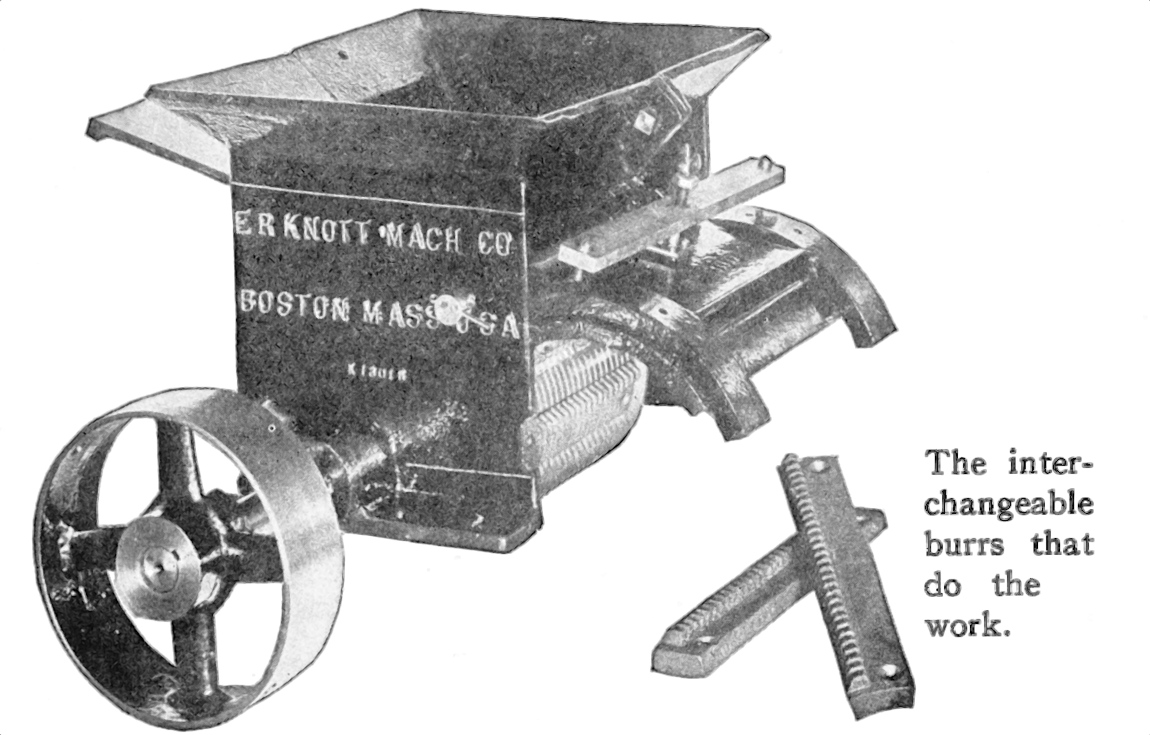
Stock No. 109-4—Knott’s Pop-Corn Grinder
This shows the stationary burrs swung out to drop out nails or gravel,
without changing the grinding adjustment.
Your pop-corn is
pulled apart—not
mashed. Adjustable;
no dust. Uniform
grinding. All
metal. Will last a
lifetime. Large
quantity capacity.
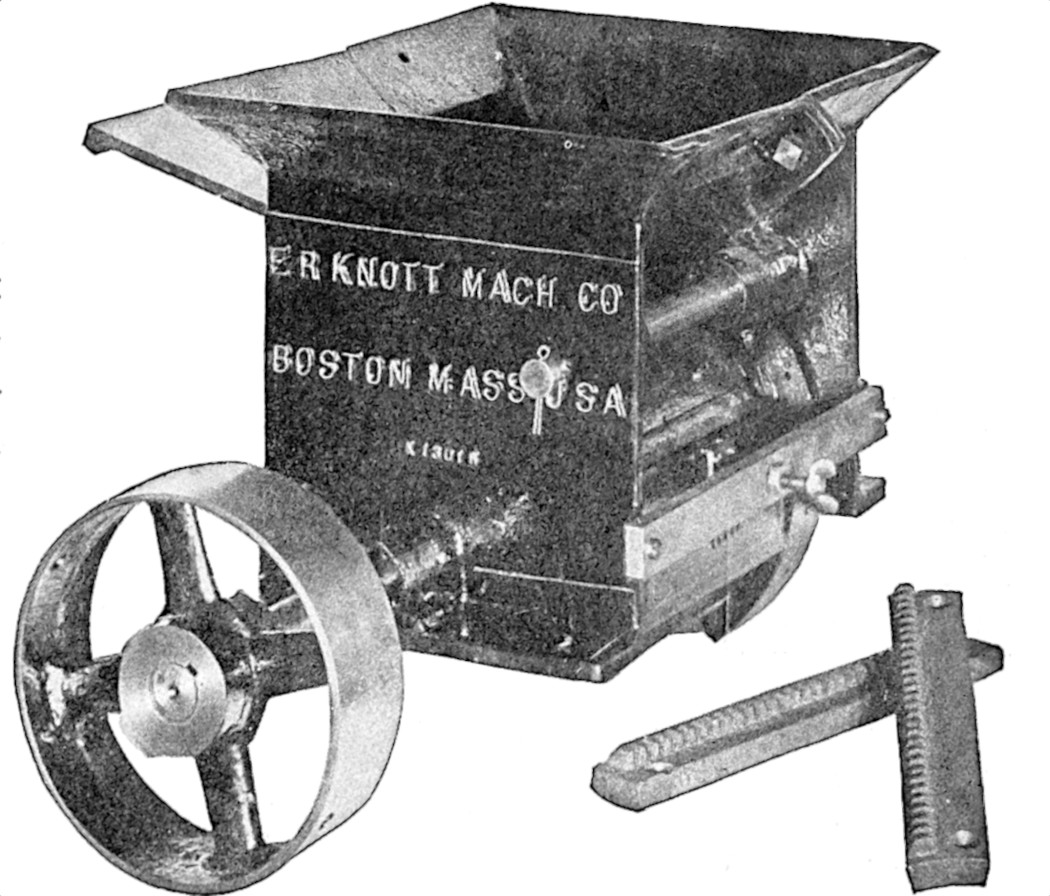
Stock No. 109-4—Knott’s Pop-Corn Grinder
Showing stationary burr in position for grinding.
| CAPACITY |
10 bbls. per hour |
| POWER |
½ H.P. |
| SPEED |
500 R.P.M. |
| PULLEY |
7″ × 2″ |
| MEASUREMENTS |
11½″ × 16½″ × 10″ |
| THROAT |
7¼″ × 1½″ |
| WEIGHT |
75 lbs. |
Use our motors either Stock No. 2016-5, or No. 2016-6, or No. 2016-11,
or No. 2016-12.
- Stock No. 109-1 Knott’s Pop-corn Grinder with legs to straddle
a barrel and galvanized iron hopper
of one barrel capacity
- Stock No. 109-2 Knott’s Pop-corn Grinder with hopper, without legs
- Stock No. 109-3 Knott’s Pop-corn Grinder with legs, without hopper
- Stock No. 109-4 Knott’s Pop-corn Grinder without legs or hopper
- Stock No. 109-10 Revolving Burrs, each section
- Stock No. 109-11 Stationary Burrs, each section
Stock No. 2001-1
Knott’s Pop-Corn Mill
Your pop-corn is pulled apart—not mashed. Adjustable. No
dust. Uniform grinding. All metal. Will last a lifetime. Small
quantity capacity.
| CAPACITY |
2 bbls. per hour |
| POWER |
⅙ H.P. |
| SPEED |
500 R.P.M. |
| PULLEY |
7″ × 1½″ |
| MEASUREMENTS |
12″ × 8½″ × 17¼″ |
| THROAT |
3″ × 2″ |
| WEIGHT |
45 lbs. |
May be driven with one of our Stock No. 2016-1, or No. 2016-2,
or No. 2016-7, or No. 2016-8 electric motors.
- Stock No. 2001-1 Knott’s Pop-corn Mill with 7-inch pulley
for 1½-inch flat belt
- Stock No. 2001-2 Knott’s Pop-corn Mill with hand crank
- Stock No. 2020-1 Hopper of galvanized iron of 1 bushel capacity
for Knott’s Pop-corn Mill
For greater output consider our Stock No. 109 Mill.
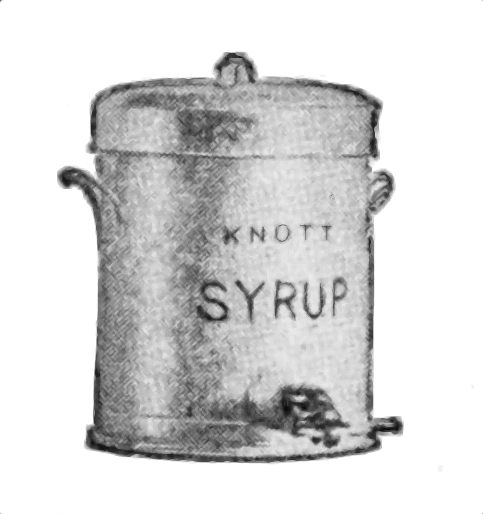
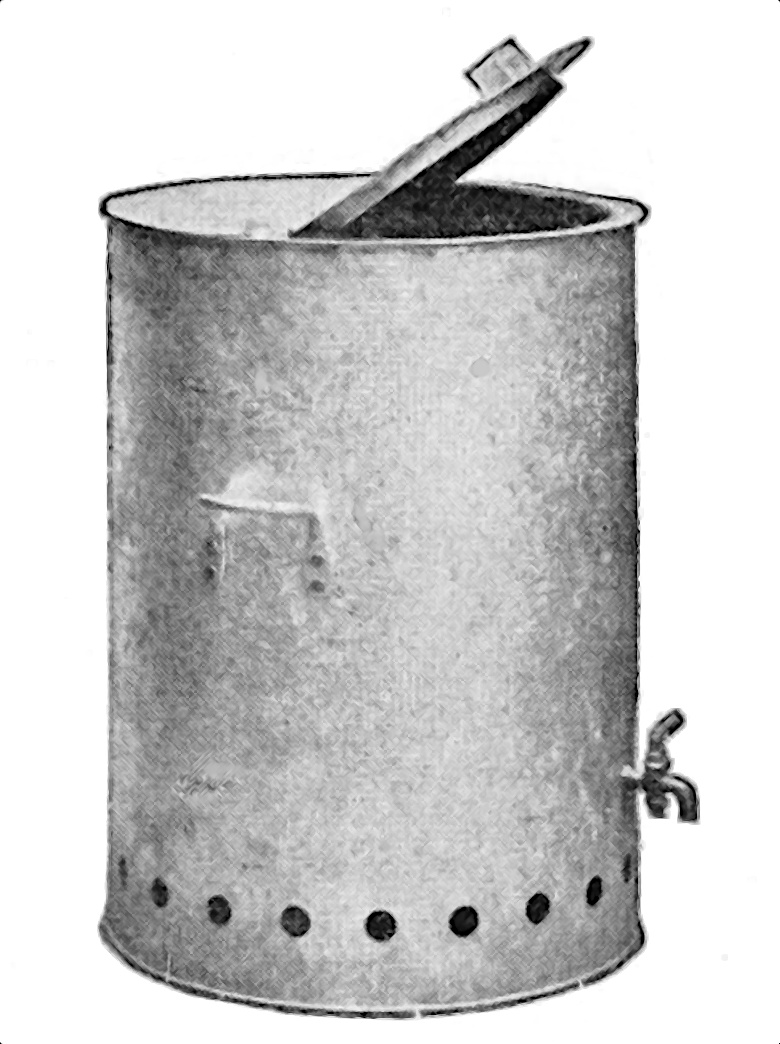
The time saver, clean way, heavy sheet steel, with steel band top
and bottom, electric welded, galvanized after manufacture; Stebbins’
side-opening molasses gate, screwed in; 14 inches in diameter and 17
inches deep.
- Stock No. 2013-1 Knott’s Stock Tank galvanized
You make the stand so your two quart measure (Stock No.
2010-1) may be stood on a shelf under the gate, thus giving clean,
quick method of filling measure.
One tank is for the purpose of holding molasses and the other you
should have for syrup made by melting, just bringing to a boil your
sugar and corn syrup in the proportions the recipes you are using call
for. Use a thermometer and see that it registers 220 degrees, no more or
less.
Placing the syrup right off the stove in the covered tank causes it
to hold the heat so as you draw it for each batch, you start each batch
with hot syrup, which saves time in cooking and accuracy in measuring,
aids much toward uniform products.
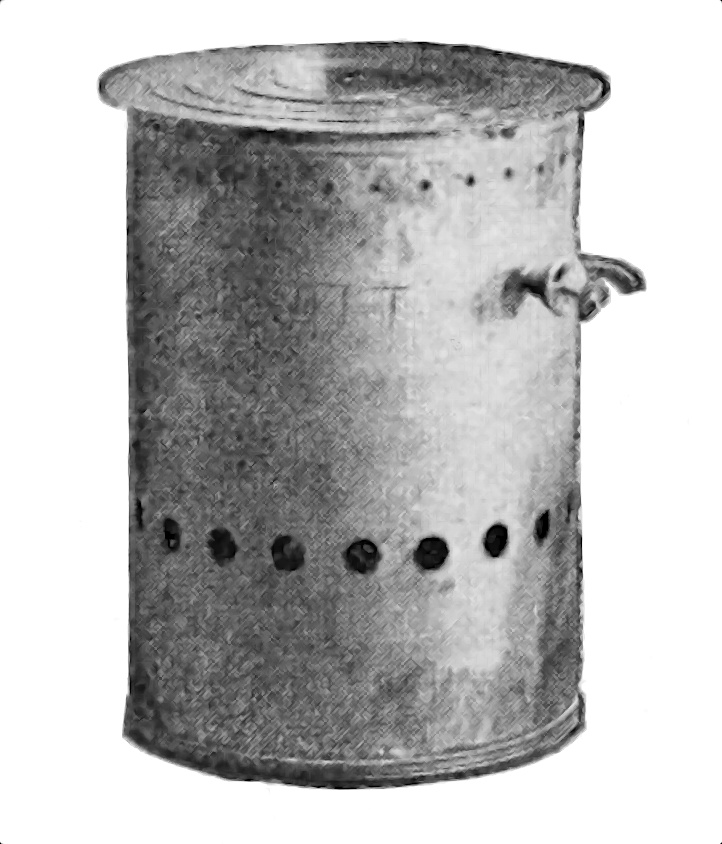
Stove top of seven rings, drum of heavy sheet steel, with steel band
top and bottom.
Burners of ample capacity and interchangeable.
19 inches in diameter, 25 inches high and weighs 57 pounds.
- Stock No. 113-1 Knott’s Pop-corn Gas Stove
- Stock No. 113-2 Knott’s Pop-corn Gasoline Stove
- Stock No. 113-3 Knott’s Pop-corn Gas Stove with Electric blower
The Knott Pop-corn Stove is made to be used especially with the
Knott Pop-corn Kettle (Stock No. 2004-2) which fits into just the right
position so that the fire may boil the syrup for a batch in a few minutes.
These stoves are made so that if you want the other fuel burner
you can get it from us and put it in by the aid of a screw-driver.
Read the directions under Pop-corn Popper for generating the gasoline
burners and follow them in using gasoline stoves.
The gas stove burner you can regulate for air supply and for gas.
This burner is a special one which we recommend because the heat is
drawn to the center in a revolving shape like a whirlwind, concentrating
the heat on the bottom of the kettle where you want it.
The Electric Blower Stove gives a much hotter fire and the cost of
running it is small.
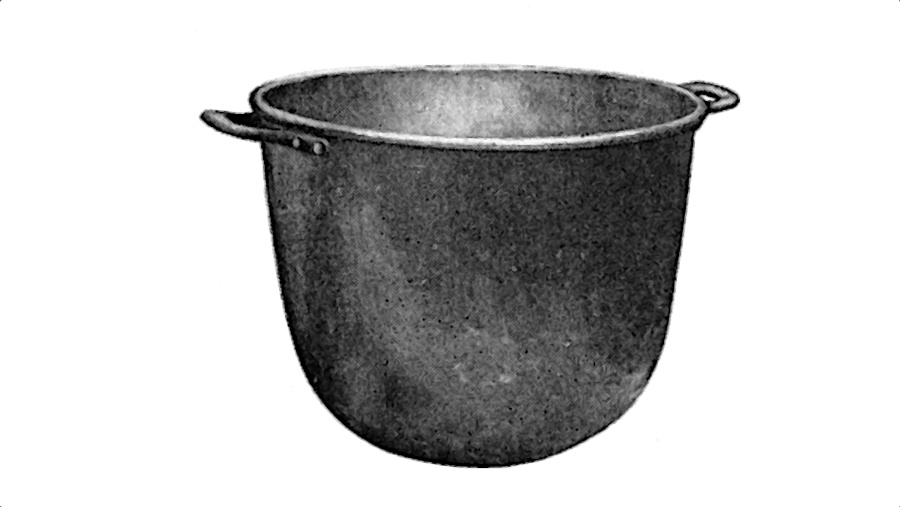
Copper kettle, 19 inches in diameter by 17 inches deep, with single
grip handles.
Special sizes. If you want them tell us.
Made light for lifting, but especially strong and durable to stand
the stirring of pop-corn.
Weight about 14½ pounds.
Knott’s kettle is the right one to use for all around factory pop-corn
work. It is the style used in the pop-corn factories of New England,
because they find this method requires the least labor and because
it uses less candy to cover the corn. It enables you to cook the candy
higher than other methods and thus increases the keeping quality of
the pop-corn confection.
You boil your syrup in this kettle. Because you are boiling for
each batch less than a gallon of stock, it is not convenient when working
fast to use a thermometer. Pop-corn makers use one of four tests,
according to their experience in the business. 1.—The so-called “water
test,” half a teaspoonful of syrup dropped in cold water. 2.—The test
by the color of the syrup. 3.—The test by how it leaves the paddle when
scooped up on it. It will string off or come off in lumps, so-called “ragging
off the paddle.” 4.—A test by the steam or smoke which rises
from the kettle.
You are advised to get a confectioner’s thermometer and make
the other tests at the same time you use the thermometer, doing it with
syrup over a slow fire and in that way learn how the syrup you finally
determine to use will act at the temperature you require.
Practical experience is the one way to learn. Do not expect to
make a good batch the first time nor the third time, but you need have
no discouragement if you have not reached perfect results on your
twelfth batch.
In beginning, you are likely to cook candy too high to be easily
worked into shape.
Efficient pop-corn making is not to be learned very easily; it comes
with practice.
When you are running on one kind of pop-corn as a specialty so
that you want to get out one batch after another as fast as possible, it
is well to use two fires and two kettles. One kettle with syrup may be
warming up while you are boiling the other.
You will find it well to use a cover on your kettle, part of the time,
one of Stock No. 2005-1, or one that you can make yourself out of thin
wood. The object is to let the condensing steam run down and thus
clean the sides of the kettle.
Copper or wood covers are best, an iron cover rusts out quickly.
- Stock No. 2005-1 Copper Steaming Cover for kettle
- Stock No. 2005-2 Nickeled Copper Steaming Cover for kettle
These covers will last you a long time because they are of heavy
material and handle riveted with copper rivets.
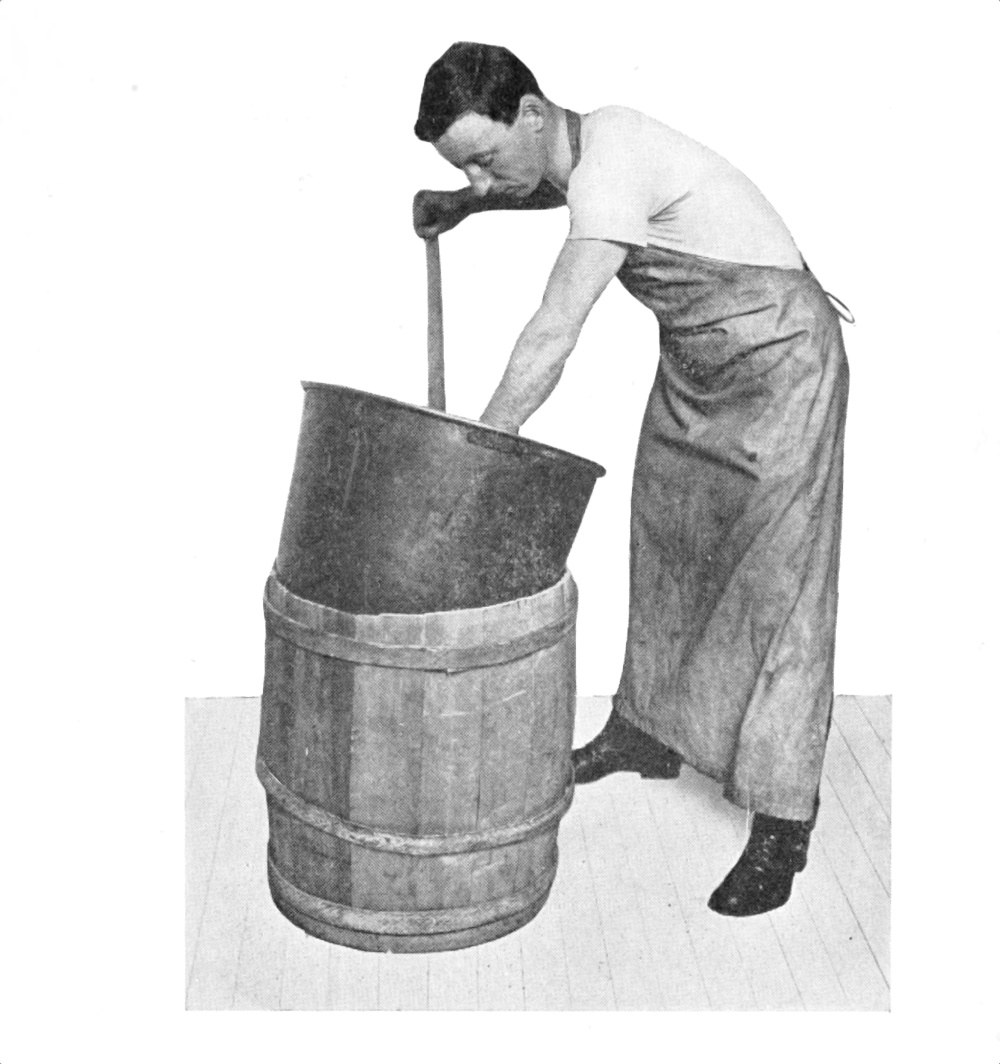
Take the kettle off of the fire and set it in your stirring stand. The
stirring stand may be made of a band of iron supported on three or four
angle iron legs, or you can cut off a barrel to fit your height and use that
as a stirring stand. Put some stones or sand in the bottom to steady it.
Stirring pop-corn is not as easy as it looks. A beginner’s courage
is tested sometimes by giving him a batch to stir in which there is no
grease. He makes no start at all. Again he may be tried on a wintergreen-flavored
batch with an extra dose of flavor. His eyes run so with
water that usually he does not finish the batch.
Try this plan: Put the corn in the kettle, then with your left hand
on the middle of the paddle (Stock No. 2006-1) and your right hand over
the end, make strokes down against the side of the kettle and up through
the middle of the batch, at the same time walking around the kettle.
Efficient stirring will come with practice.
Stir the pop-corn quickly, but have the batch light, not soggy.
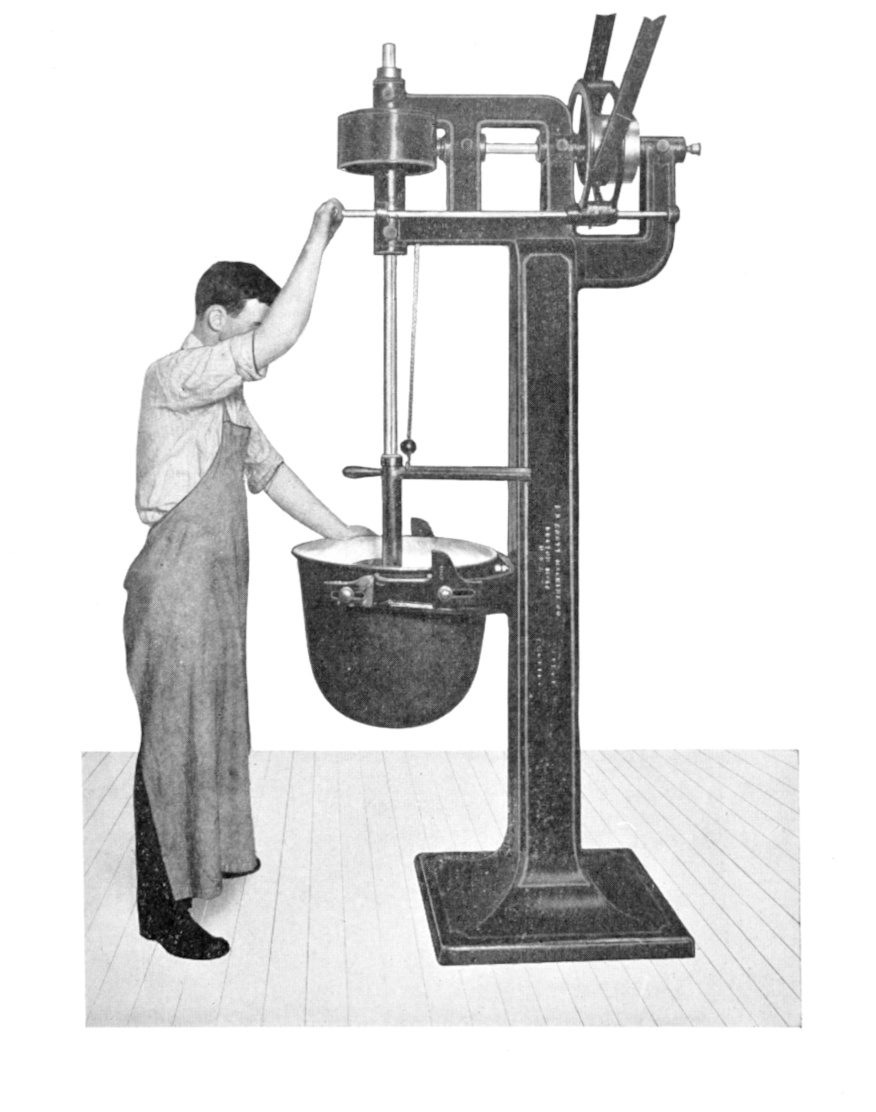
The use of the Knott Pop-Corn Mixing Machine has been well
considered and yet the mechanical mixing of pop-corn cannot be emphasized
too much.
Many failures in the pop-corn confection business are due to poor
mixing. Soggy confection, “hot spot,” that is spots in the confection
where there is much more candy than anywhere else. Uneven appearance
and texture to the confection, due to slow mixing.
See that you make the best, and only by using Knott’s Pop-Corn
Mixing Machine can the best be made.
You must realize that a dough mixer is not a cake mixer, is not an
egg beater, is not a concrete mixer, is not a pop-corn mixer.
You know the materials are not alike and the result wanted in each
case is different.
You see why you should use a machine specially developed for
pop-corn, to distribute the hot syrup quickly and evenly over the pop-corn
and give a light fluffy mixture.
Knott’s Pop-Corn Mixing Machine is made specially for Pop-corn,
to give the result you want.
Use this method for quality and economy. Mix your Pop-corn in
the hot kettle, in which you have just boiled your syrup, and use Knott’s
Pop-corn Mixing Machine.
You mix all kinds of pop-corn on this machine better than it can
be done any other way.
Whole pop-corn is mixed without breaking the kernels.
Goods are mixed up light, fluffy, thoroughly, evenly.
You distribute the syrup so quickly over the pop-corn that you can
cook it higher.
The goods eat better.
You do away with hand mixing entirely.
Make more goods with less labor.
Not so many containers.
The cook makes no difference.
You get more cakes from the same batch; that is, you save in any
case more than fourteen per cent. on your bills for material.
Stirs a bushel of pop-corn without throwing any out of the kettle.
Mixes different kinds of batches without any change of adjustment
of either paddles or speed.
Nothing to wear the kettles.
So quickly is the syrup distributed that it takes less syrup to cover
the pop-corn.
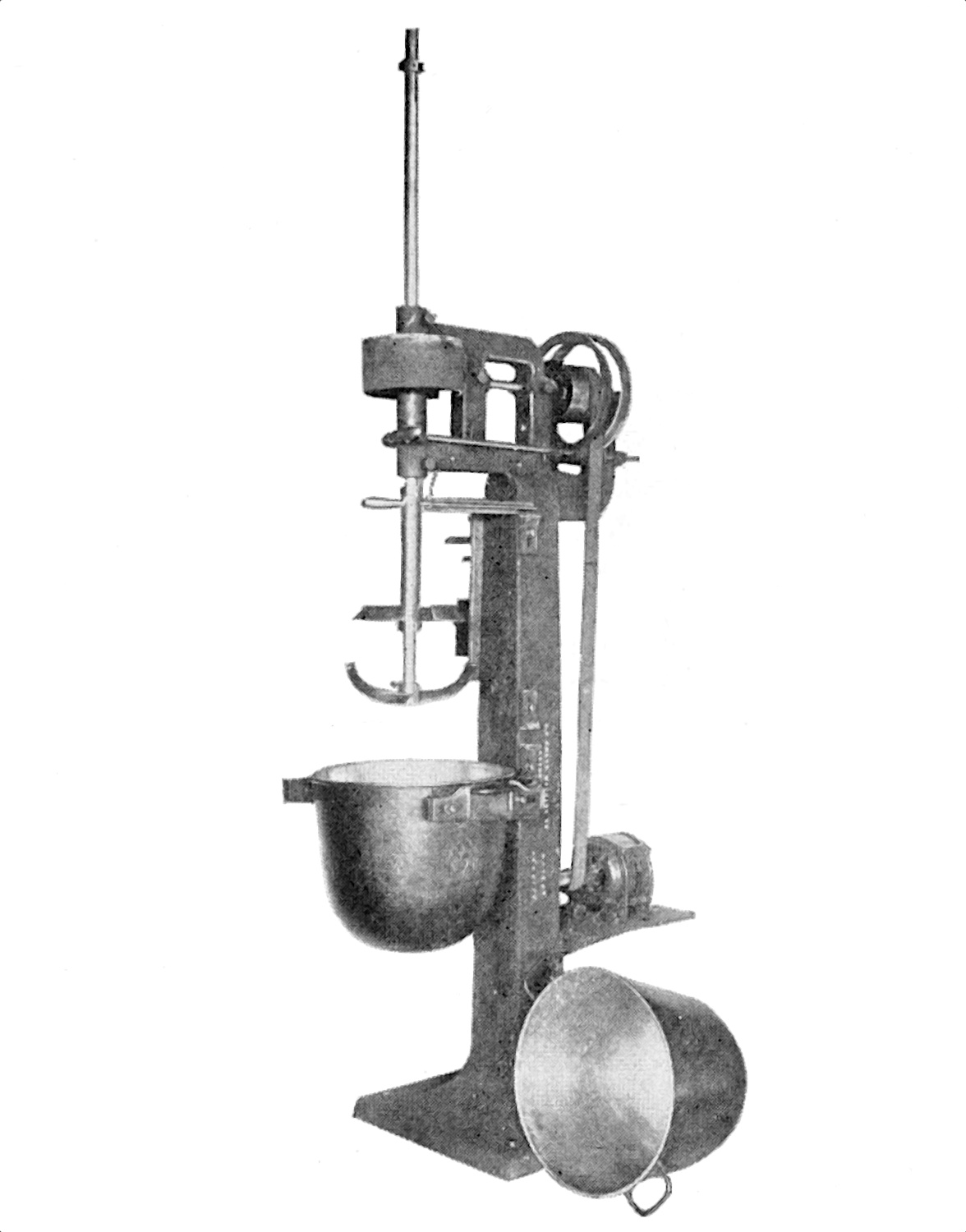
Patented Nov. 4, 1919, No. 1320766
Stock No. 114-2
| CAPACITY |
One bushel |
| POWER |
½ H.P. |
| SPEED |
Pulley 500 R.P.M.
Paddle 125 R.P.M. |
| BELT |
2″ Belt
7″ dia. Pulley |
| MEASUREMENT |
9 ft. of Head Room
24″ wide
43″ deep |
| WEIGHT |
700 lbs. net
800 lbs. crated |
- Stock No. 114-1. Knott’s Pop-corn Mixing Machine
with two Stock No. 2004-2 Kettles
- Stock No. 114-2. Knott’s Pop-corn Mixing Machine with
motor attached, with two Stock No. 2004-2 Kettles
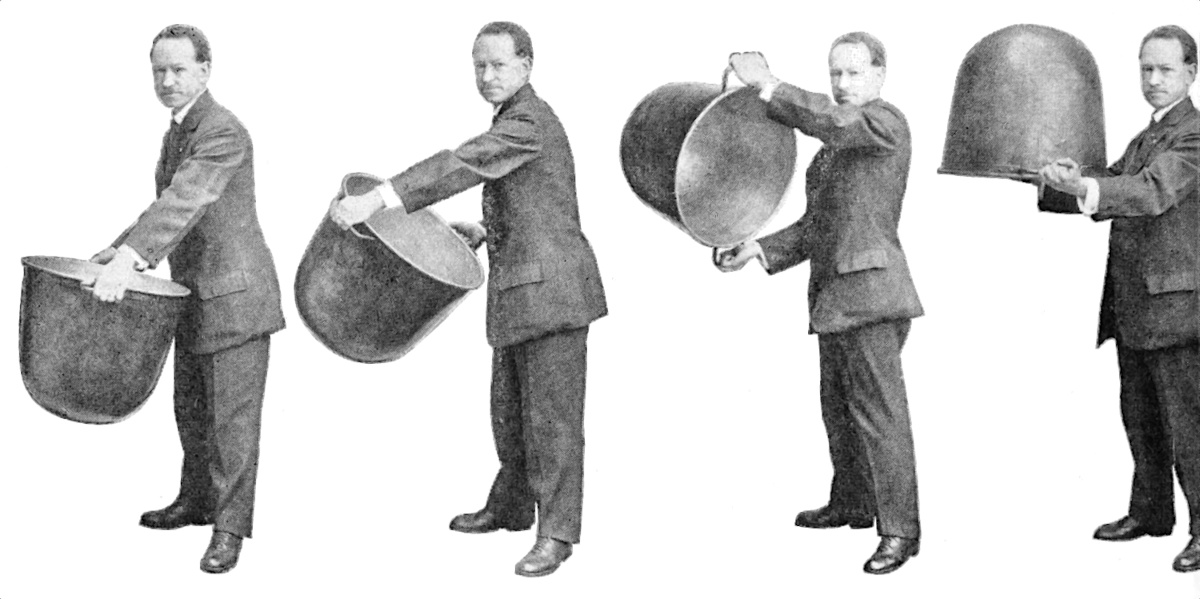
In regard to swinging the kettle to dump the batch. Pop-corn
kettle (Stock No. 2004-2) is not heavy, weighing but fourteen and one-half
pounds, and with the pop-corn batch in it, it weighs but a few pounds
more. The kettle is swung away from the face thus: take hold of the
two handles, swing the kettle underneath from left to right, upward,
still keeping the left hand away from yourself and the right hand near
you, until the kettle is more than half-way up. Then hold the two
handles the same distance away from you. That rotates the kettle
upon its center axis while you are swinging up the rest of the way to
the top position, at which you stop to dump the batch. You will notice
by this motion that the kettle bottom comes nowhere near your face.
During the swinging you are moving the kettle so that when you stop
the batch falls out right upon the bench or machine just where you want it.
The first two or three times you try this feat, all the pop-corn may
not go where you want it, but after that you will have no difficulty.
You see, in making square corn cakes, bricks or bars, there are
three operations: panning, pressing and cutting; each quickly performed,
but the tools used must be right in detail in their dimensions or the
greatest difficulty will be experienced, even to the point that you will
not be able to make the goods at all.
The kettle of pop-corn, all stirred, yet hot, is dumped into the
pans arranged together on the bench. You pan the corn evenly and
quickly by hand. Now turn each pan of corn upside down on the bench.
Take off the pan and slip it under the pop-corn. The pop-corn is then
in the pan bottom-side up so as to present a more even surface to the
pressing plate in the press.
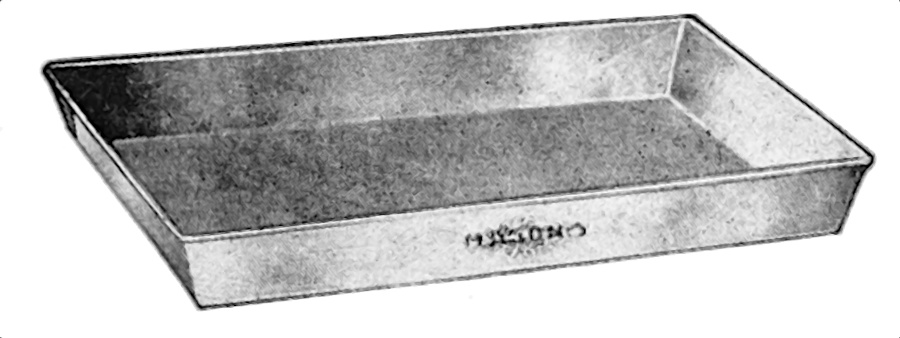
Stock No. 2007-1 pans are the right size for you to pan the corn,
by moving your two hands toward you across the pan, with a side motion
of your wrists, leaving an even pan of corn and taking to the next pan
whatever surplus comes over in your hands. This is certainly the quickest
pan to use.
These pans are made from heavy
galvanized sheet steel with heavy
wired rim. The clearance of the
sides is right. This is the pan that
will stand considerable usage.
- Stock No. 2007-1 Measurement inside on bottom, 16 inches by
9 inches, Pop-corn Pan
- Stock No. 2007-2 12 inches by 18 inches, Pop-corn Pan
- Special sizes at your request.
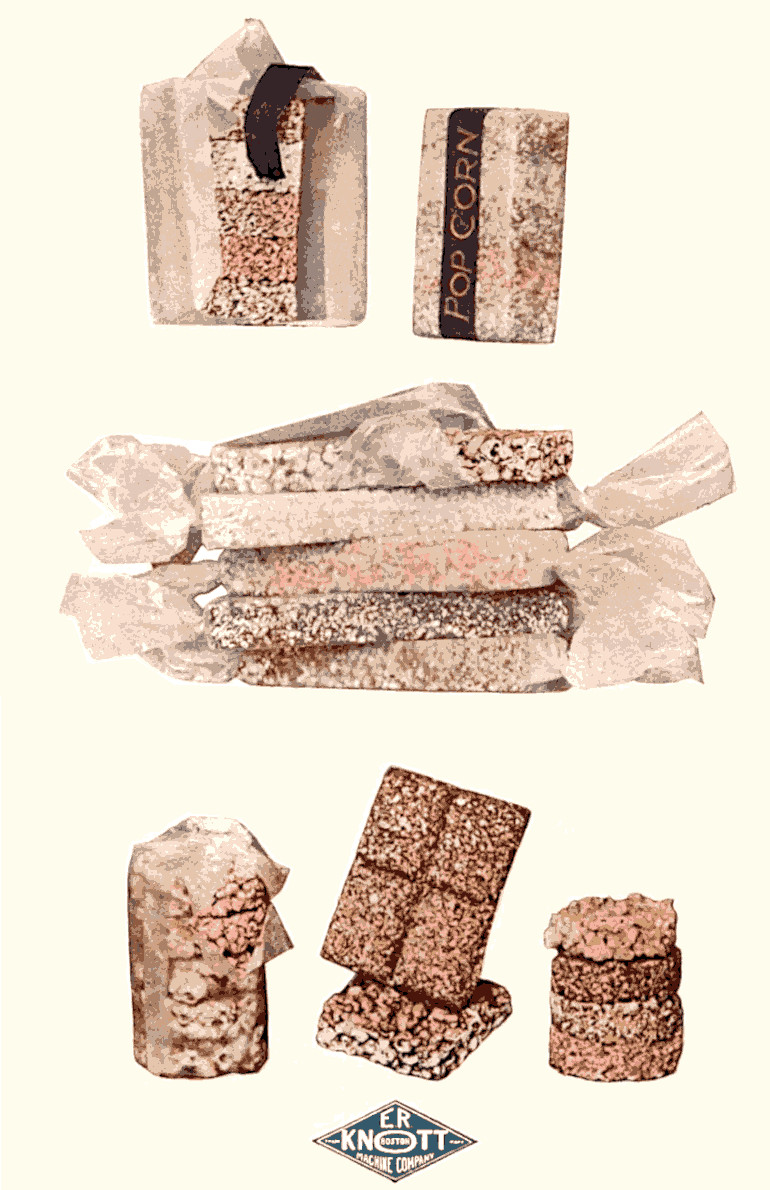
Place a paper wrapper across the top of the
form and put the crispettes, four, five or six, in the
paper into the form. Bring the paper together
over the corn, fold it a couple of times, then tuck
down the ends, fold them in and crease the bottom
to hold them. See illustration in colors.
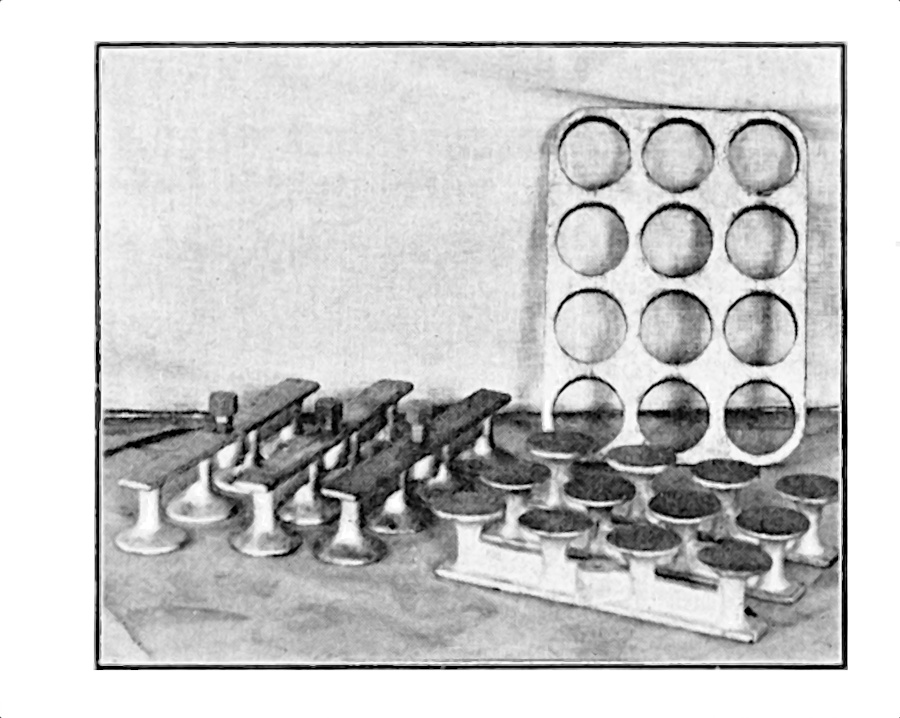
Arrange moulds side by side on bench, dump your mixed batch on
the moulds, fill the moulds with the corn. Slide moulds under the
press. The number of moulds used for each batch is determined by
the space you have to work in and the quantity you want to make.
- Stock No. 2002-3 Crispette Round Cake Moulds and Plunger for hand press
- Stock No. 110-2 with screws for fastening to the bench, and plate for pan work
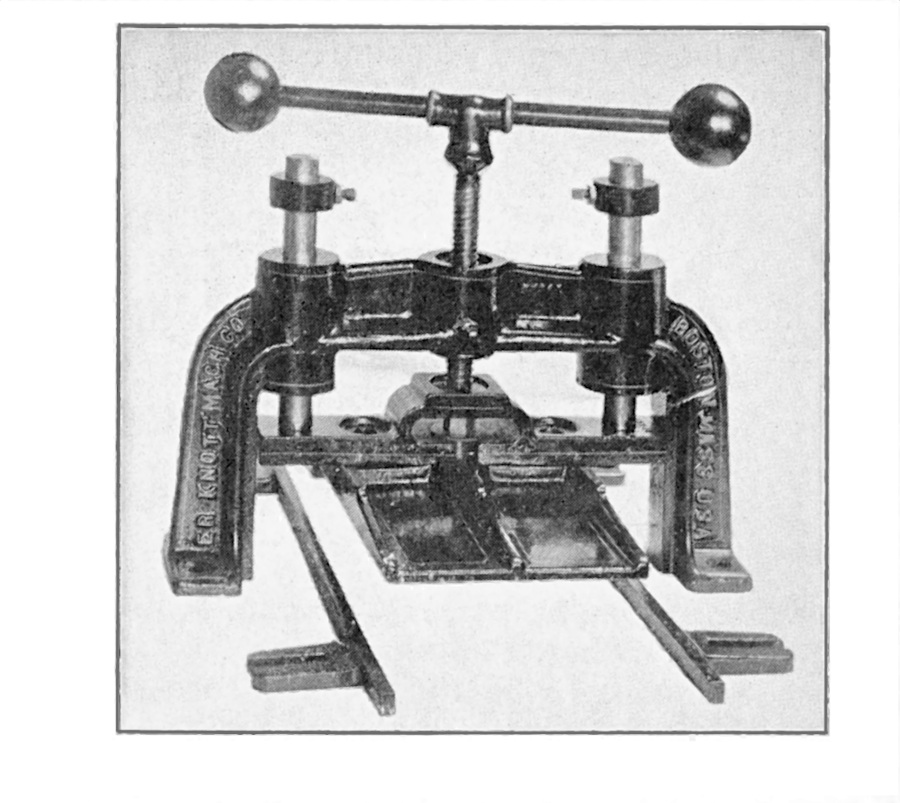
This hand press is rugged, simple and efficient.
You bolt it to a bench with the arch twenty inches from the front
edge of the bench. Slip in the plate for pan work, and fasten it in place
by means of cap screw. Slide a pan under and screw down plate into
pan. This locates the pan so that you can bring against it the three
guides, two sides and back; tighten them in place so that you can slide
the pan in between them and bring the press down without danger of
the plate coming down on the edge of pan.
Do not press your pop-corn too solid; it does not eat as well and
takes more stock per box.
Put the three sets of round cake plungers on the press cross-bar,
locating them by putting the mould plate under the press and fastening
them by tightening the cap screws. Adjust and clamp the guides each
side and at the back of mould plate, so that when you fill it you can slide
it in and bring the plungers down without their striking on the edges.
You may put a block under each end of the press cross-bar against
the inside of the arch as a stop to regulate the thickness of your cakes.
Three plunger castings are made with small cap screws to fasten
them on top of the bench.
Use them to push the cakes out of the mould plate, by pushing
this plate down over them.
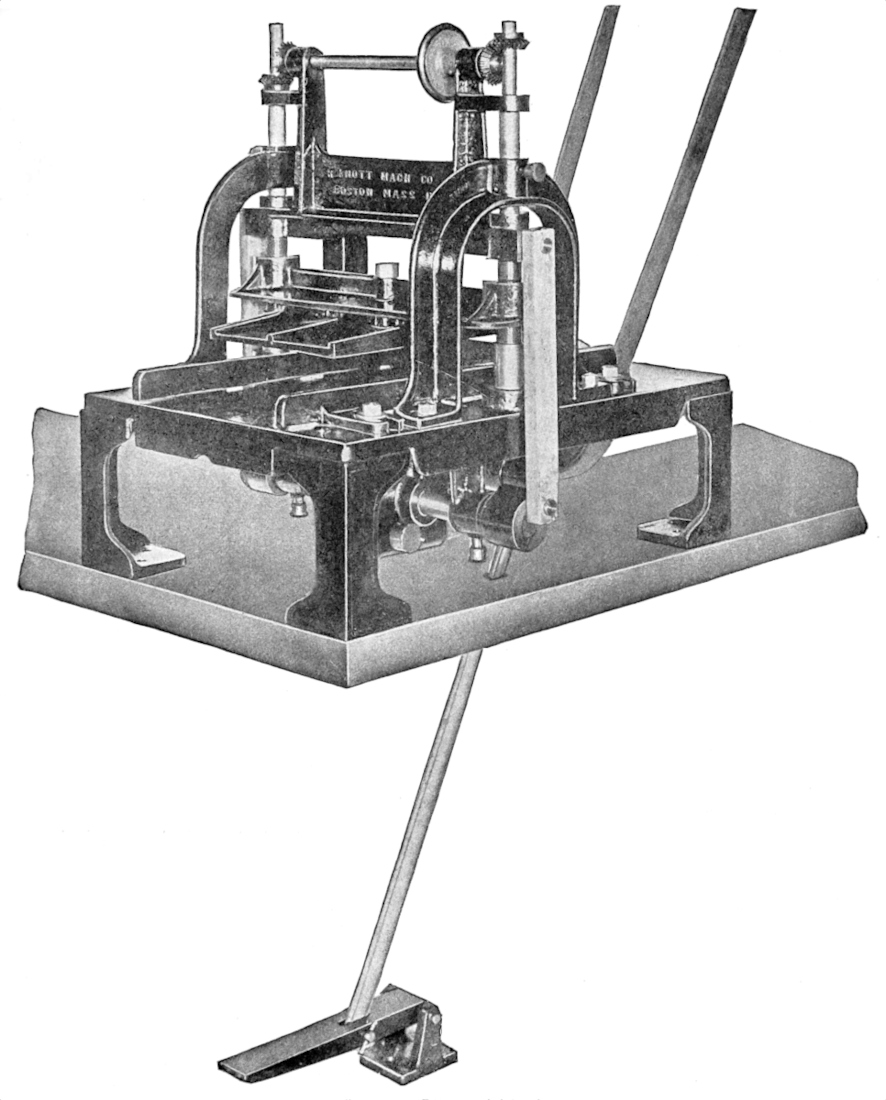
Stock No. 110-1
Knott’s Pop-Corn Press.
The press that does not hesitate.
| PULLEY |
7 inches |
| BELT |
2-inch flat |
| SPEED |
500 R.P.M. |
| POWER |
½ H.P. |
| WEIGHT |
350 lbs. |
You will find this press is durable and easily operated. It is adjustable
as to thickness of cake from zero inches to two inches.
The press is started and stopped by the treadle on the floor; putting
down your foot starts the press, lifting your foot stops it. A positive
lock is arranged so that when the treadle is released the machine
locks against operation, preventing accidents.
Power press may be driven by our motor (Stock No. 2016-13, No.
2016-14, No. 2016-15, or No. 2016-16.)
Speed, twenty-five strokes per minute.
Capacity. It will take our 16 × 9-inch or 18 × 12-inch pans of pop-corn
and press the corn without hesitating.
- Stock No. 110 Power Press with foot trip, one plate 16 × 9
inches, and adjustable guides
- Stock No. 2002-1 Plate for “Two-fers,” 12 × 18 inches, with fins
to cut pan of corn into 56 pieces. Made
of special non-sticking metal
- Stock No. 2002-2 Press casting for holding “Two-fers” plate
or Pressing Pans 12 × 18
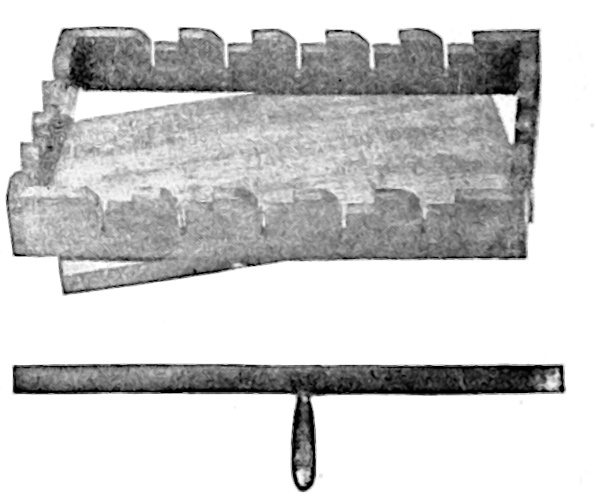
These are the very best style of hand cutting
rack you can use, made of maple. Nickel-plated
handle on straight edge. This rack is
made to stay in shape and give long service.
- Stock No. 2008-1 Rack, to match pan 16 inches by 9 inches for
cutting package corn
- Special racks for bars, squares, etc.
- Prices at your request.
On the bench, about two feet to the right of the press, fasten a
board two feet long to the edge, letting it project an inch above the
bench.
Place your cutting rack frame against this board on the bench
with the bottom board in it and the end toward you.
Take the pan of pressed corn, and turn it upside down on the bench
between the press and this cutting rack. A sharp rap will drop the
corn out of the pan.
Lift this sheet of corn, put the back end into the cutting rack, bend
the sheet into a bow shape so that the front end will go into the rack.
Then press down the center.
Hold the straight edge by the handle in the left hand and draw
quickly a well sharpened knife (Stock No. 2009-1) toward you along the
straight edge to make the cut, passing it through the slots in the sides
of the rack. To cut the other way, turn the rack around.
To remove the pop-corn from the rack, lift up the rack frame, leaving
the bottom board. The corn will fit tight enough to be lifted with
the frame. Set the frame down on the bench to the right. Place your
right hand on the pop-corn and lift off the rack with your left hand.
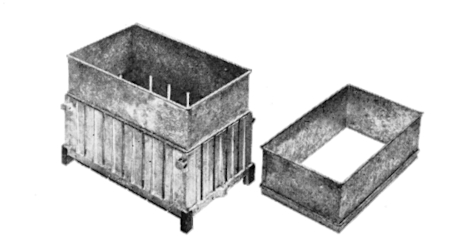
Showing cutting rack with transfer rack on it and showing transfer rack separate
- Stock No. 111-1 Knott’s Pop-Corn Brick and Bar Cutting
Machine for 16 × 9-inch pans with one cutting rack
- Stock No. 2017-1 Extra Rack for cutting 19 × 9-inch pans of pop-corn
- Stock No. 2022-1 Transfer Rack for cutting machine
Special Cutting Racks for cutting 16 × 9-inch pans into any size
cakes made to order.
This gives the pop-corn brick finished for wrapping, five cakes of
different flavors all cut together, making a much better package than
hand cutting.
Cuts five sheets in the time it takes to cut one by hand. Pushes
five sheets out of rack in one-eighth time that it takes to push five sheets
out of hand cutting rack and register one on top of the other for bricks.
Does away with the hand tiring work of cutting with a knife.
Cut your corn with machine accuracy.
Save seventy-five per cent. of your cutting labor.
Increase output per day of pop-corn bricks one hundred per cent.
Drive this by belting from overhead or from motor under the bench.
Made with tight and loose pulleys and belt shipper.
| MEASUREMENTS |
63 in. × 27 in. plus
overhang of 18 in. |
| PULLEY |
12 in. |
| BELT |
2½ in. flat |
| SPEED |
500 R.P.M. |
| POWER |
1 H.P. |
| WEIGHT |
450 lbs. |
In the making of assorted flavor bricks of pop-corn, you run five
batches and fill five pans out of each batch.
First batch, white, vanilla flavor. Second batch, molasses. Third
batch, chocolate. Fourth batch, molasses. Fifth batch, pink with wintergreen
flavor.
You use five transfer racks and put them in a row on the bench. Turn
a pressed pan of corn right from the press upside down on the table to
get out the sheet of corn; take the sheet of corn and put it in the transfer
rack by putting the back end down first, bend sheet in the middle,
put the front end down and then press down the middle. You have
five sheets, or pans from a batch; put one in each transfer rack. Do the
same with each of the five batches. Sheets being made each one inch
thick, the transfer racks will be just filled.
Place a full transfer rack of pop-corn in place on the cutting rack
and push the pop-corn down into the cutting rack. Remove the transfer
rack. Now run the full cutting rack of pop-corn under the knife in the
cutting machine.
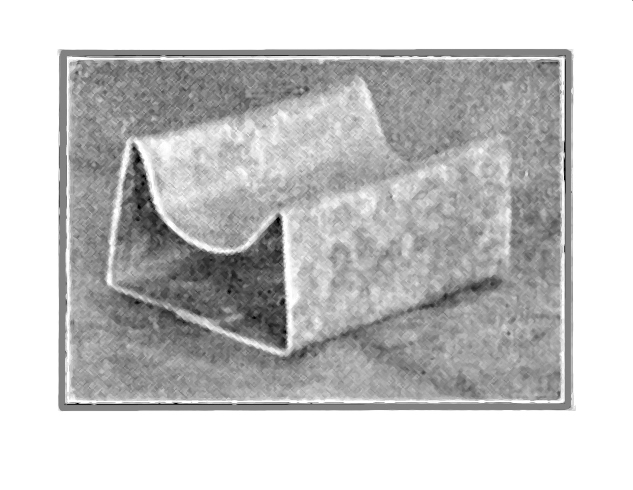
The push-out stand should be placed conveniently on the bench,
so that you put the cutting rack of cut pop-corn on this push-out stand.
As the rack goes down over the stand, the bottom board goes up with
the corn on it, so it may be lifted off and the corn slid off onto the packing
table.
In the manufacture of penny-pop-corn, it is good to cut them one
sheet at a time, then when the goods have become cold pack them. It
is necessary to cut them while warm. When the sheets are piled up and
cut together as in the Brick and Bar cutting machine, Stock No. 111,
they stick together and in the case of the assorted brick, that is just what
is wanted. When cutting penny goods, the cakes are wanted separated.
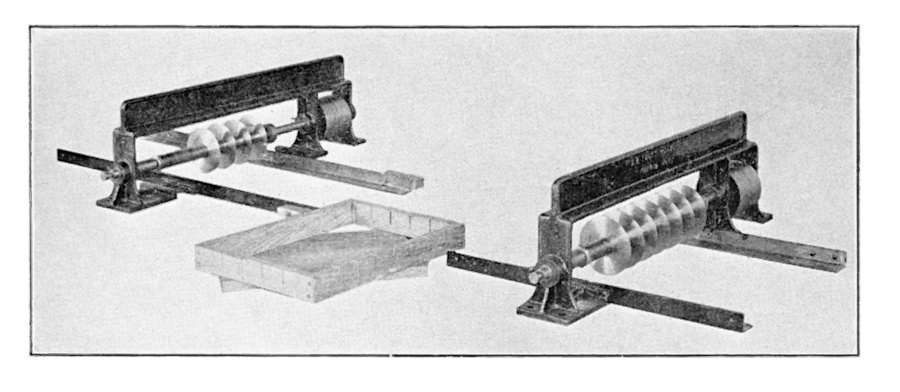
This machine cuts one sheet at a time, but at many times the speed
of hand cutting. The sheet is put in the rack and passed through one
way, cutting the corn in strips, then the rack is turned and passed through
the second part of the machine, which completes the cutting by severing
the strips into blocks.
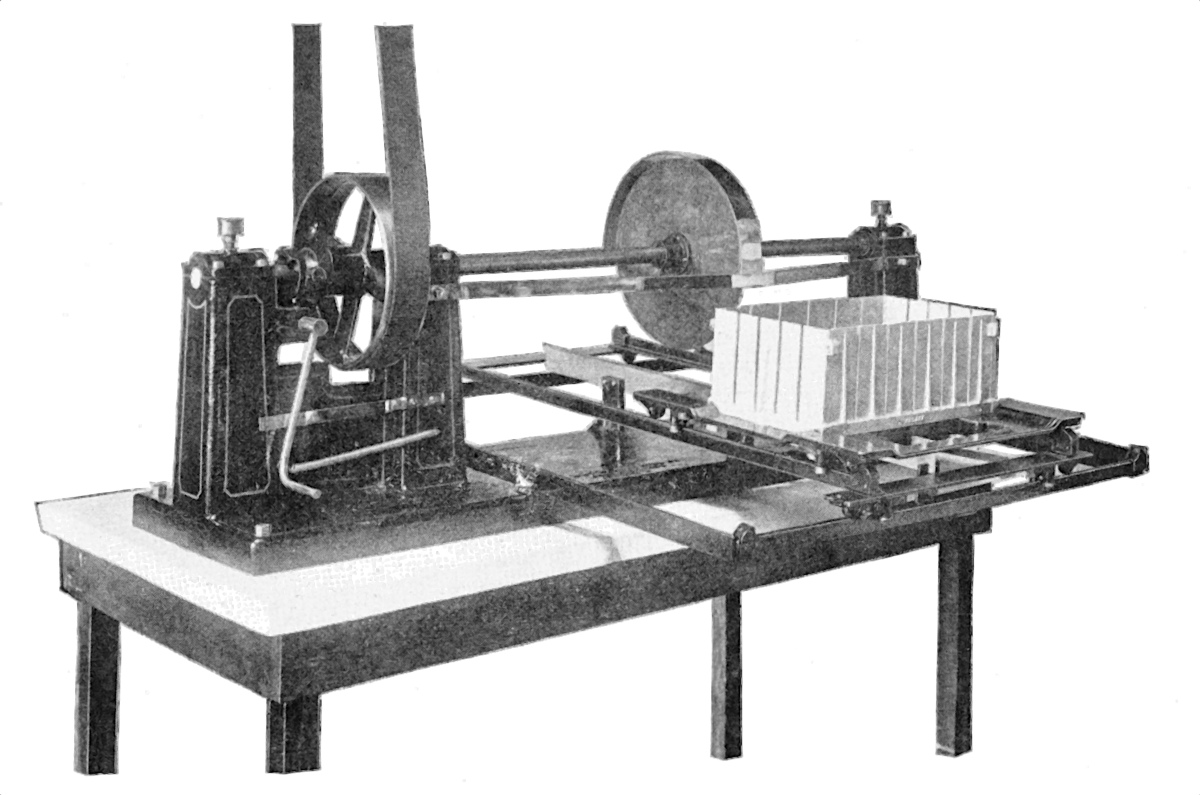
You arrange this machine on your bench in the position as above
in the picture. It is best to drive it from a motor on the bench by a
chain, but it may be driven from a shaft overhead by belt.
| MEASUREMENTS |
48″ × 80″ |
| PULLEY |
5″ |
| BELT |
2″ |
| SPEED |
500 R.P.M. |
| POWER |
1 + 1 H.P. |
| WEIGHT |
200 lbs. |
Machine complete with 5 racks as shown, may be made to handle
sheets of corn 12 inches × 18 inches, Stock No. 2007-2 12-inch pans, and cut
the corn 2, 3, 4, 5 or 6 divisions on the 12-inch side and 2, 3, 4, 5, 6, 7 or
8 divisions on the 18-inch side. You see a large variety of sizes are possible
by having racks for each.
The machine may be made to cut 9 × 16 sheets, pan 2007-1.
- Stock No. 115-1 Knott’s Two Way Cutting Machine, with two
1 H.P. motors, one to drive each set of knives
- Stock No. 115-2 Knott’s Two Way Cutting Machine, with
countershafts for belt drive
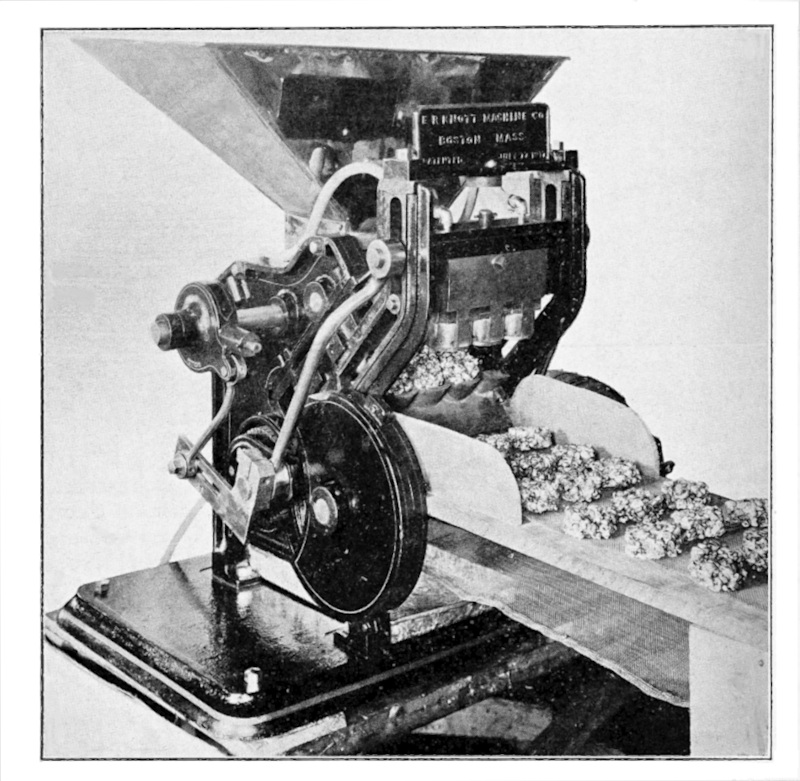
S. F. 3 Machine Making Crispettes
Driven by one-horse motor, then no belt is in the way.
S. F. 3 Machine makes three crispettes at a stroke, 50 strokes per
minute, 150 cakes per minute, 2 5-16 inch diameter cakes with the
thickness of cake adjustable.
S. F. 6 Machine makes six crispettes at a stroke, 50 strokes per
minute, 300 cakes per minute, 2 5-16 inch diameter cakes with the thickness
of cake adjustable.
Specify what electricity your motor should be and how long you
want the conveyor. 20 feet is good length.
You see at last we have a machine that will make the mixed corn
into cakes faster than you can get the batches to it. No longer need
you blister your hands filling corn into moulds and make your cakes
too solid, or have the batch get cold before all are moulded. As the name
says, this machine is a “self filling” machine. You simply place the
freshly mixed corn in the hopper on the feed rolls and the machine lays
the finished cakes on the conveyor.
Not alone is this machine making in many places the round whole
corn fritters, but it works well on ground pop-corn.
It is made up special for cakes of square and oblong shape. It is
also used in putting out strips of corn marked to be broken into penny
pieces. In fact new applications of this machine are being found constantly.
Even a ball of pop-corn is one of the products this machine
can be made to produce.
With this automatic means of moulding corn, you can now make at
a profit small and thin cakes of corn that could not be made by hand.
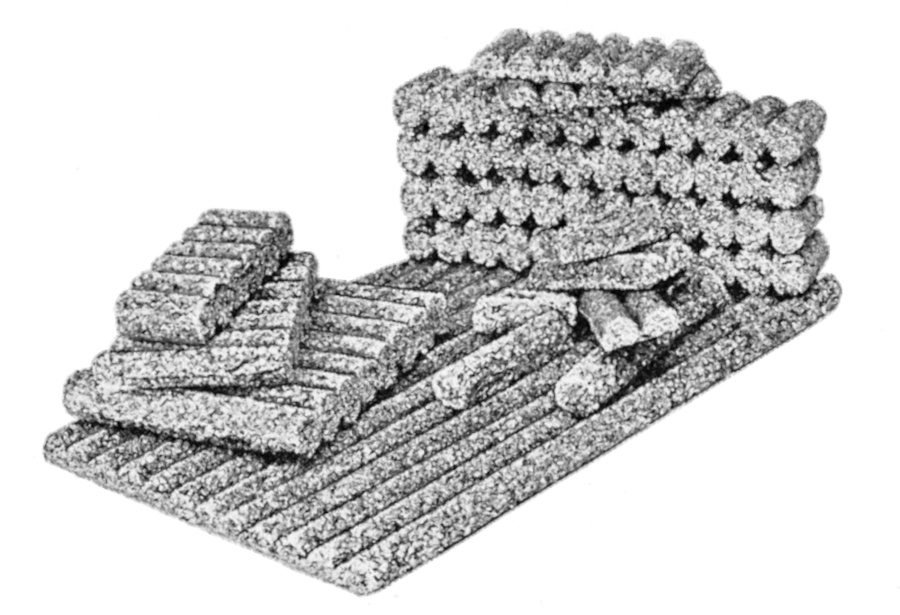
The Dainty Pop-Corn Confection
- Vanilla Brittle Bitts
- Chocolate Brittle Bitts
- Wintergreen Brittle Bitts
- Molasses Brittle Bitts
- Orange Brittle Bitts
- Lime Brittle Bitts
- Sassafras Brittle Bitts
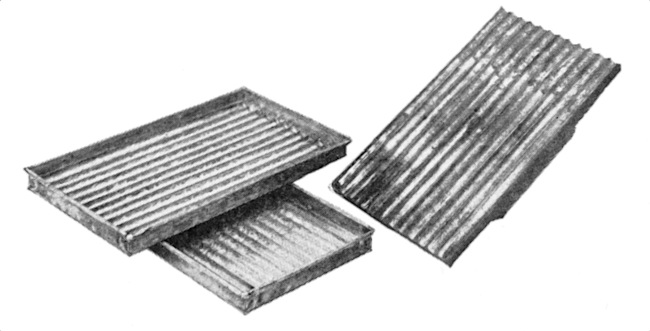
Moulds for Making Brittle Bitts
- Stock No. 2007-3 Pans for Brittle Bitts
- Stock No. 2002-4 Pressing Plate for Brittle Bitts
- Special Racks for cutting Brittle Bitts
Use formula No. 5 on page 51 of Knott’s Pop-Corn Book for the
syrup in your stock tank.
To make a batch to fill five pans, Stock No. 2007-1 for half round
shape, try 1¼ quarts stock and ¾ peck of Ground Pop-Corn, then vary
the proportions the next time to suit you.
To make a batch to fill five pans Stock No. 2007-3 for round
shape, try 2½ quarts stock and 1½ pecks of Ground Pop-Corn, then
vary the proportions the next time to suit you.
Each pressed sheet of Brittle Bitts is 9 inches wide by 16 inches
long and composed of 12 sticks 16 inches long.
You may cut them into any length that will divide into 16 inches
without waste. Thus, you cut 16 pieces 1 inch long, or 4 pieces 4 inches
long.
You can break them apart so as to have each cake made up of
two sticks, three sticks or four sticks without waste.
The mechanical handling of sheet Pop-Corn is well described elsewhere
in Knott’s Pop-Corn Book.
Popping, Page 6; Sifting, Page 20; Grinding, Page 21; Boiling,
Page 48; Mixing, Page 28; Panning, Page 30; Pressing, Page 34; Cutting,
Page 34. Look at index, Page 60.
- Put up in quarters, halves, pound boxes.
- Put up in glass front boxes same as crackers.
- Pack in 10-pound boxes same as crackers.
- Price 50 cents per pound.
BRITTLE BITTS
- Take home a pound to eat with your apple sauce.
- Eat Brittle Bitts with ice-cream.
- Take Brittle Bitts as a lunch on an outing.
- Munch Brittle Bitts while you read the evening paper.
- Eat Molasses Brittle Bitts with milk for breakfast.
Water jacketed, gas burner, galvanized sheet steel
Retail business where buttered pop-corn is sold fast must handle
the making in the way to produce the best buttered pop-corn at the
lowest price for materials.
Make by recipe on page 49. Mix on Knott’s Pop-corn Mixing
Machine and sell from the buttered corn tank where the buttered corn
is kept hot by the hot water jacket.
From the time the kettle comes off of the fire to the time the corn
is buttered ready for customers, is twelve (12) seconds. That is why
this method makes the best, every kernel of pop-corn has a drop of
butter on it. Delicious, why, you cannot refuse coming back for more.
- Stock No. 2006-1 Knott’s Pop-corn Stirring Paddle, 36 inches long
This paddle is turned and finished from one piece of stock of straight
and close grain. Made to our special design, you will find it will take less
strokes to mix your batch than is possible with any other.
- Stock No. 2009-1 Knott’s Pop-corn Knife
This is the knife to use with racks (Stock No. 2008-1) for cutting
the corn into Bricks, Bars, etc.
It is a quality product. Hand forged from the best grade of cast
steel, hand ground and carefully tempered.
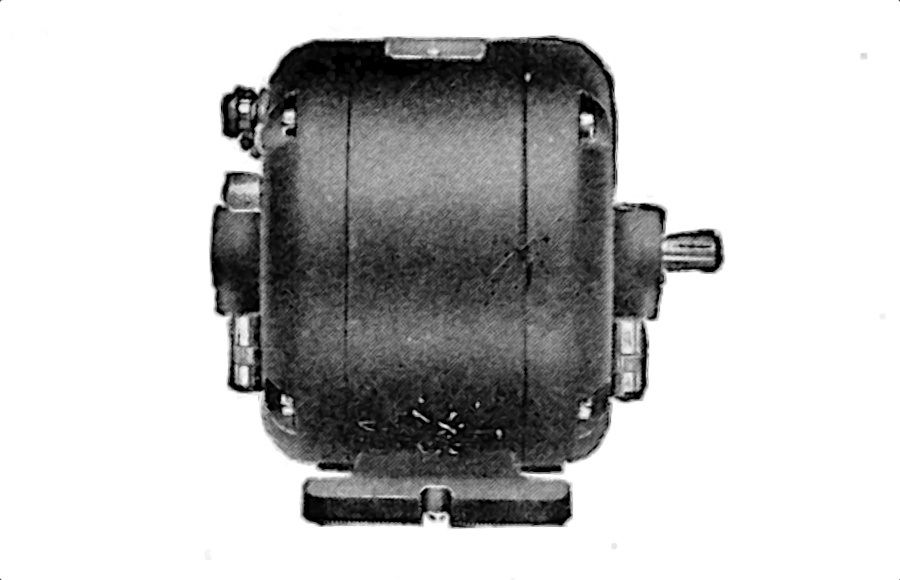
Individual Motor Drive is the most flexible and economical method
of driving pop-corn machines. No shafting, no belts, no dirt or grease.
We have found by experience that this type of motor can be relied
on at all times. Cheaper motors may be bought, but they are not cheap
to run. Here are the motors you should have:
- Stock No. 2016-1 ⅙ H.P. 1700 R.P.M. 115 v. D.C.
- Stock No. 2016-2 ⅙ H.P. 1700 R.P.M. 230 v. D.C.
- Stock No. 2016-3 ¼ H.P. 1700 R.P.M. 115 v. D.C.
- Stock No. 2016-4 ¼ H.P. 1700 R.P.M. 230 v. D.C.
- Stock No. 2016-5 ½ H.P. 1700 R.P.M. 115 v. D.C.
- Stock No. 2016-6 ½ H.P. 1700 R.P.M. 230 v. D.C.
- Stock No. 2016-13 1 H.P. 1700 R.P.M. 115 v. D.C.
- Stock No. 2016-14 1 H.P. 1700 R.P.M. 230 v. D.C.
- Stock No. 2016-7 ⅙ H.P. 1800 R.P.M. 110 v. 60 cy. 1 phase A.C.
- Stock No. 2016-8 ⅙ H.P. 1800 R.P.M. 220 v. 60 cy. 1 phase A.C.
- Stock No. 2016-9 ¼ H.P. 1800 R.P.M. 110 v. 60 cy. 1 phase A.C.
- Stock No. 2016-10 ¼ H.P. 1800 R.P.M. 220 v. 60 cy. 1 phase A.C.
- Stock No. 2016-11 ½ H.P. 1800 R.P.M. 110 v. 60 cy. 1 phase A.C.
- Stock No. 2016-12 ½ H.P. 1800 R.P.M. 220 v. 60 cy. 1 phase A.C.
- Stock No. 2016-15 1 H.P. 1800 R.P.M. 110 v. 60 cy. 1 phase A.C.
- Stock No. 2016-16 1 H.P. 1800 R.P.M. 220 v. 60 cy. 1 phase A.C.
Also three phase Motors