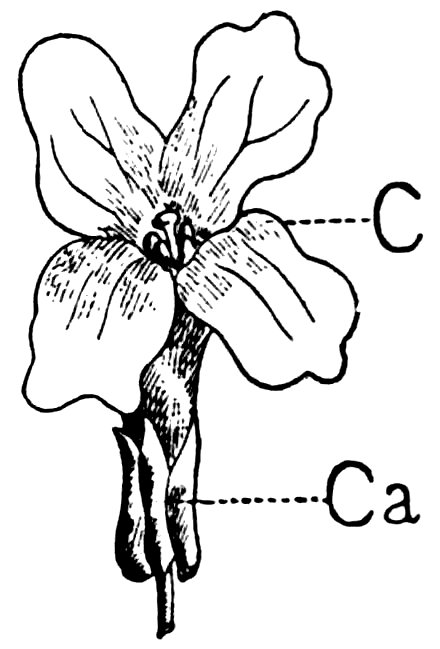
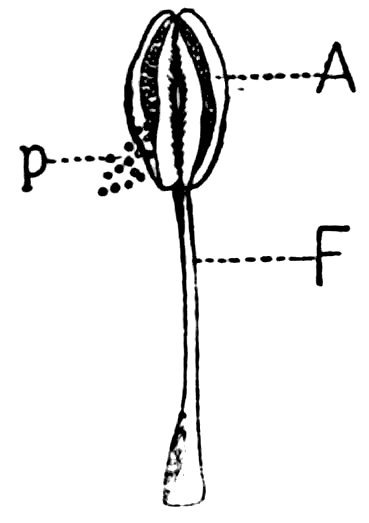
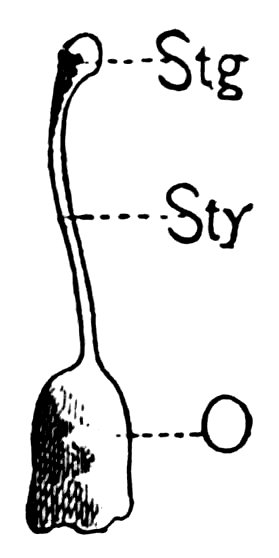
FLOWER DESCRIPTIONS — I WHITE — Blood-root. Sanguinaria Canadensis. Poppy Family. — Shad-bush. June-berry. Service-berry. Amelanchier oblongifolia. Rose Family. — Wood Anemone. Wind-flower. Anemone nemorosa. Crowfoot Family. — Rue Anemone. Anemonella thalictroides. Crowfoot Family. — Star-flower. Trientalis Americana. Primrose Family. — ——— ——— Maianthemum Canadense. Lily Family. — Gold Thread. Coptis trifolia. Crowfoot Family. — Pyxie. Flowering-moss. Pyxidanthera barbulata. Order Diapensiaceæ . — Crinkle-root. Toothwort. Pepper-root. Dentaria diphylla. Mustard Family (p. 17 ). — Spring-cress. Cardamine rhomboidea. Mustard Family (p. 17 ). — Whitlow-grass. Draba verna. Mustard Family (p. 17 ). — Shepherd’s Purse. Capsella Bursa-pastoris. Mustard Family (p. 17 ). — May-apple. Mandrake. Podophyllum peltatum. Barberry Family. — Twin-leaf. Rheumatism-root. Jeffersonia diphylla. Barberry Family. — Harbinger-of-Spring. Erigenia bulbosa. Parsley Family (p. 15 ). — Early Everlasting. Plantain-leaved Everlasting. Antennaria plantaginifolia. Composite Family (p. 13 ). — Spring Beauty. Claytonia Virginica. Purslane Family. — Dutchman’s Breeches. White-hearts. Dicentra Cucullaria. Fumitory Family. — Squirrel Corn. Dicentra Canadensis. Fumitory Family. — Foam-flower. False Mitre-wort. Tiarella cordifolia. Saxifrage Family. — Early Saxifrage. Saxifraga Virginiensis. Saxifrage Family. — Mitre-wort. Bishop’s Cap. Mitella diphylla. Saxifrage Family. — Indian Poke. False Hellebore. Veratrum viride. Lily Family. — Carrion-flower. Cat-brier. Smilax herbacea. Lily Family. — Larger White Trillium. Trillium grandiflorum. Lily Family. — Ground-nut. Dwarf Ginseng. Aralia trifolia. Ginseng Family. — Ginseng. Aralia quinquefolia. Ginseng Family. — Wild Sarsaparilla. Aralia nudicaulis. Ginseng Family. — Spikenard. Aralia racemosa. Ginseng Family. — Canada Violet. Viola Canadensis. Violet Family. — Solomon’s Seal. Polygonatum biflorum. Lily Family. — Choke-berry. Pyrus arbutifolia. Rose Family. — Creeping Snowberry. Chiogenes serpyllifolia. Heath Family. — Bearberry. Arctostaphylos Uva-ursi. Heath Family. — False Solomon’s Seal. Smilacina racemosa. Lily Family. — Maple-leaved Viburnum. Dockmackie. Arrow-wood. Viburnum acerifolium. Honeysuckle Family. — Hobble-bush. American Wayfaring-tree. Viburnum lantanoides. Honeysuckle Family. — Round-leaved Dogwood. Cornus circinata. Dogwood Family. — Bellwort. Oakesia sessilifolia. Lily Family. — Hawthorn. White-thorn. Cratægus coccinea. Rose Family. — White Baneberry. Actæa alba. Crowfoot Family. — Mountain Holly. Nemopanthes fascicularis. Holly Family. — Winterberry. Black Alder. Ilex verticillata. Holly Family. — Red-berried Elder. Sambucus racemosa. Honeysuckle Family. — Bunch-berry. Dwarf Cornel. Cornus Canadensis. Dogwood Family. — Sweet Bay. Laurel Magnolia. Magnolia glauca. Magnolia Family. — Lizard’s Tail. Saururus cernuus. Pepper Family. — Moonseed. Menispermum Canadense. Moonseed Family. — Mountain Laurel. Spoonwood. Calico-bush. Kalmia latifolia. Heath Family. — White Swamp Honeysuckle. Clammy Azalea. Rhododendron viscosum. Heath Family. — American Rhododendron. Great Laurel. Rhododendron maximum. Heath Family. — Wood Sorrel. Oxalis Acetosella. Geranium Family. — Poison Sumach. Rhus venenata. Cashew Family. — Staghorn Sumach. Rhus typhina. Cashew Family. — Poison Ivy. Rhus Toxicodendron. Cashew Family. — Virginia Creeper. American Ivy. Ampelopsis quinquefolia. Vine Family. — Shin-leaf. Pyrola elliptica. Heath Family. — Common Black Huckleberry. Gaylussacia resinosa. Heath Family. — Common Blueberry. Vaccinium corymbosun. Heath Family. — Squaw Huckleberry. Vaccinium stamineum. Heath Family. — Pipsissewa. Prince’s Pine. Chimaphila umbellata. Heath Family. — Spotted Pipsissewa. Chimaphila maculata. Heath Family. — White DaisY. White-weed. Ox-eyed Daisy. Chrysanthemum Leucanthemum. Composite Family (p. 13 ). — Daisy Fleabane. Sweet Scabious. Erigeron annuus. Composite Family (p. 13 ). — Mayweed. Chamomile. Anthemis Cotula. Composite Family (p. 13 ). — New Jersey Tea. Red-root. Ceanothus Americanus. Buckthorn Family. — Bastard Toadflax. Comandra umbellata. Sandalwood Family. — Wintergreen. Checkerberry. Mountain Tea. Gaultheria procumbens. Heath Family. — White Sweet Clover. White Melilot. Melilotus alba. Pulse Family (p. 16 ). — Waterleaf. Hydrophyllum Virginicum. Waterleaf Family. — Indian Pipe. Corpse-plant. Monotropa uniflora. Heath Family. — Field Chickweed. Cerastium arvense. Pink Family. — Enchanter’s Nightshade. Circæa Lutetiana. Evening Primrose Family. — Thimble-weed. Anemone Virginiana. Crowfoot Family. — Cleavers. Goose-grass. Bedstraw. Galium Aparine. Madder Family. — Bitter-sweet. Wax-work. Celastrus scandens. Staff-tree Family. — Culver’s Root. Veronica Virginica. Figwort Family. — Black Cohosh. Bugbane. Black Snakeroot. Cimicifuga racemosa. Crowfoot Family. — Common Elder. Sambucus Canadensis. Honeysuckle Family. — Spurge. Euphorbia corollata. Spurge Family. — Partridge Vine. Mitchella repens. Madder Family. — Green Orchis. Habenaria virescens. — Ragged Fringed Orchis. Habenaria lacera. Orchis Family (p. 17 ). — Button-bush. Cephalanthus occidentalis. Madder Family. — Mild Water-pepper. Polygonum hydropiperoides. Buckwheat Family. — Climbing False Buckwheat. Polygonum scandens. Buckwheat Family. — ——— ——— Dalibarda repens. Rose Family. — Starry Campion. Silene stellata. Pink Family. — Colic-root. Star-grass. Aletris farinosa. Bloodwort Family. — Tall Meadow Rue. Thalictrum polygamum. Crowfoot Family. — White Avens. Geum album. Rose Family. — Meadow-sweet. Spiræa salicifolia. Rose Family. — White Water-lily. Nymphæa odorata. Water-lily Family. — White Vervain. Verbena urticæfolia. Verbena Family. — Round-leaved Sundew. Drosera rotundifolia. Sundew Family. — Pokeweed. Garget. Pigeon-berry. Phytolacca decandra. Pokeweed Family. — White Fringed Orchis. Habenaria blephariglottis. Orchis Family (p. 17 ). — Rattlesnake-plantain. Goodyera pubescens. Orchis Family (p. 17 ). — Common Yarrow. Milfoil. Achillea Millefolium. Composite Family (p. 13 ). — Wild Carrot. Bird’s Nest. Queen Anne’s Lace. Daucus carota. Parsley Family (p. 15 ). — Water-Hemlock. Spotted Cowbane. Cicuta maculata. Parsley Family (p. 15 ). — Mock Bishop-weed. Discopleura capillacea. Parsley Family (p. 15 ). — Sweet Cicely. Osmorrhiza longistylis. Parsley Family (p. 15 ). — Water-parsnip. Sium cicutæfolium. Parsley Family (p. 15 ). — Arrow-head. Sagittaria variabilis. Water-plantain Family. — Water-plantain. Alisma Plantago. Water-plantain Family. — Ground Cherry. Physalis Virginiana. Nightshade Family. — Turtle-head. Chelone glabra. Figwort Family. — Common Dodder. Love Vine. Cuscuta Gronovii. Convolvulus Family. — Traveller’s Joy. Virgin’s Bower. Clematis Virginiana. Crowfoot Family. — Sweet Pepperbush. White Alder. Clethra alnifolia. Heath Family. — Thorn-apple. Jamestown Weed. Datura Stramonium. Nightshade Family. — Wild Balsam-apple. Echinocystis lobata. Gourd Family. — White Asters. Aster. Composite Family (p. 13 ). — Boneset. Thoroughwort. Eupatorium perfoliatum. Composite Family (p. 13 ). — White Snakeroot. Eupatorium ageratoides. Composite Family (p. 13 ). — Climbing Hemp-weed. Mikania scandens. Composite Family (p. 13 ). — Ladies’ Tresses. Spiranthes cernua. Orchis Family (p. 17 ). — Green-flowered Milkweed. Asclepias verticillata. Milkweed Family. — Groundsel Tree. Baccharis halimifolia. Composite Family (p. 13 ). — Grass of Parnassus. Parnassia Caroliniana. Saxifrage Family. — Pearly Everlasting. Anaphilis margaritacea. Composite Family (p. 13 ). — Fragrant Life-everlasting. Gnaphalium polycephalum. Composite Family (p. 13 ). — II YELLOW — Marsh Marigold. Caltha palustris. Crowfoot Family. — Spice-bush. Benjamin-bush. Fever-bush. Lindera Benzoin. Laurel Family. — Yellow Adder’s Tongue. Dog’s Tooth Violet. Erythronium Americanum. Lily Family. — Celandine. Chelidonium majus. Poppy Family. — Celandine Poppy. Stylophorum diphyllum. Poppy Family. — Downy Yellow Violet. Viola pubescens. Violet Family. — Common Cinquefoil. Five Finger. Potentilla Canadensis. Rose Family. — Shrubby Cinquefoil. Five Finger. Potentilla fruticosa. Rose Family. — Silvery Cinquefoil. Potentilla argentea. Rose Family. — Golden Ragwort. Squaw-weed. Senecio aureus. Composite Family (p. 13 ). — ——— ——— Clintonia borealis. Lily Family. — Yellow Lady’s Slipper. Whip-poor-Will’s Shoe. Cypripedium pubescens. Orchis Family (p. 17 ). — Early Meadow Parsnip. Zizia aurea. Parsley Family (p. 15 ). — Golden Club. Orontium aquaticum. Arum Family. — Spearwort. Ranunculus ambigens. Crowfoot Family. — Indian Cucumber-root. Medeola Virginica. Lily Family. — Common Bladderwort. Utricularia vulgaris. Bladderwort Family. — Yellow Pond-lily. Spatter Dock. Nuphar advena. Water-lily Family. — Winter-cress, Yellow Rocket. Herb of St. Barbara. Barbarea vulgaris. Mustard Family (p. 17 ). — Black Mustard. Brassica nigra. Mustard Family (p. 17 ). — Wild Radish. Raphanus Raphanistrum. Mustard Family (p. 17 ). — Cynthia. Dwarf Dandelion. Krigia Virginica. Composite Family (p. 13 ). — Rattlesnake-weed. Hieracium venosum. Composite Family (p. 13 ). — Dandelion. Taraxacum officinale. Composite Family (p. 13 ). — Poverty-grass. Hudsonia tomentosa. Rock-rose Family. — Bush-honeysuckle. Diervilla trifida. Honeysuckle Family. — Cow Wheat. Melampyrum Americanum. Figwort Family. — Meadow Lily. Wild Yellow Lily. Lilium Canadense. Lily Family. — Prickly Pear. Indian Fig. Opuntia Rafinesquii. Cactus Family. — Four-leaved Loosestrife. Lysimachia quadrifolia. Primrose Family. — Yellow Loosestrife. Lysimachia stricta. Primrose Family. — Rock-rose. Frost-weed. Helianthemum Canadense. Rock-rose Family. — ——— ——— Steironema ciliatum. Primrose Family. — Common Barberry. Berberis vulgaris. Barberry Family. — Yellow Star-grass. Hypoxis erecta. Amaryllis Family. — Wild Indigo. Baptisia tinctoria. Pulse Family (p. 16 ). — Yellow Clover. Hop Clover. Trifolium agrarium. Pulse Family (p. 16 ). — Dyer’s Green-weed. Wood-waxen. New England Whin. Genista tinctoria. Pulse Family (p. 16 ). — Yellow Sweet Clover. Yellow Melilot. Melilotus officinalis. Pulse Family (p. 16 ). — Rattlebox. Crotalaria sagittalis. Pulse Family (p. 16 ). — Butter-and-Eggs. Toadflax. Linaria vulgaris. Figwort Family. — Wild Senna. Cassia Marilandica. Pulse Family. — Partridge-pea. Cassia Chamæcrista. Pulse Family. — Common St. John’s-wort. Hypericum perforatum. St. John’s-wort Family. — St. Andrew’s Cross. Ascyrum Crux-Andreæ. St. John’s-wort Family. — Common Mullein. Verbascum Thapsus. Figwort Family. — Moth Mullein. Verbascum Blattaria. Figwort Family. — Yellow Fringed Orchis. Orange Orchis. Habenaria ciliaris. Orchis Family (p. 17 ). — Jewel-Weed. Touch-me-not. Geranium Family. — Agrimony. Agrimonia Eupatoria. Rose Family. — Yellow Wood Sorrel. Oxalis stricta. Geranium Family. — Sundrops. Œnothera fruticosa. Evening Primrose Family. — Evening Primrose. Œnothera biennis. Evening Primrose Family. — Horse Balm. Rich-weed. Stone-root. Collinsonia Canadensis. Mint Family (p. 16 ). — Black-eyed Susan. Cone-flower. Rudbeckia hirta. Composite Family (p. 13 ). — ——— ——— Rudbeckia laciniata. Composite Family (p. 13 ). — Golden Aster. Chrysopsis Mariana. Composite Family (p. 13 ). — Golden-rod. Solidago. Composite Family (p. 13 ). — Elecampane. Inula Helenium. Composite Family (p. 13 ). — Fall Dandelion. Leontodon autumnalis. Composite Family (p. 13 ). — Wild Sunflower. Helianthus giganteus. Composite Family (p. 13 ). — Sneezeweed. Swamp Sunflower. Helenium autumnale. Composite Family (p. 13 ). — Stick-tight. Bur Marigold, Beggar-ticks. Bidens frondosa. Composite Family (p. 13 ). — Smooth False Foxglove. Gerardia quercifolia. Figwort Family. — Tansy. Tanacetum vulgare. Composite Family (p. 13 ). — Witch-hazel. Hamamelis Virginiana. Witch-hazel Family. — III PINK — Trailing Arbutus. Mayflower. Ground Laurel. Epigæa repens. Heath Family. — Twin-flower. Linnæa borealis. Honeysuckle Family. — Showy Orchis. Orchis spectabilis. Orchis Family (p. 17 ). — Twisted Stalk. Streptopus roseus. Lily Family. — Wild Pink. Silene Pennsylvanica. Pink Family. — Pink Lady’s Slipper. Moccason-flower. Cypripedium acaule. Orchis Family (p. 17 ). — ——— ——— Calopogon pulchellus. Orchis Family (p. 17 ). — Pink Azalea. Wild Honeysuckle. Pinxter Flower. Swamp Pink. Rhododendron nudiflorum. Heath Family. — ——— ——— Rhododendron Rhodora. Heath Family. — Sheep Laurel. Lambkill. Kalmia angustifolia. Heath Family. — American Cranberry. Vaccinium macrocarpon. Heath Family. — Adder’s Mouth. Pogonia ophioglossoides. Orchis Family (p. 17 ). — Common Milkwort. Polygala sanguinea. Milkwort Family. — ——— ——— Polygala polygama. Milkwort Family. — Fringed Polygala. Polygala paucifolia. Milkwort Family. — Moss Polygala. Polygala cruciata. Milkwort Family. — Spreading Dogbane. Indian Hemp. Apocynum androsæmifolium. Dogbane Family. — Hedge Bindweed. Convolvulus Americanus. Convolvulus Family. — Purple-flowering Raspberry. Rubus odoratus. Rose Family. — Pale Corydalis. Corydalis glauca. Fumitory Family. — Common Milkweed. Asclepias Cornuti. Milkweed Family. — Herb Robert. Geranium Robertianum. Geranium Family. — Bush Clover. Lespedeza procumbens. Pulse Family (p. 16 ). — Tick-trefoil. Desmodium Canadense. Pulse Family (p. 16 ). — Tick-Trefoil. Desmodium nudiflorum. Pulse Family (p. 16 ). — Bouncing Bet. Soapwort. Saponaria officinalis. Pink Family. — Steeple-bush. Hardhack. Spiræa tomentosa. Rose Family. — Deptford Pink. Dianthus Armeria. Pink Family. — Purple Loosestrife. Lythrum Salicaria. Loosestrife Family. — Meadow-beauty. Deer-grass. Rhexia Virginica. Melastoma Family. — Clammy Cuphea. Wax-weed. Cuphea viscosissima. Loosestrife Family. — Sea Pink. Sabbatia stellaris. Gentian Family. — Marsh St. John’s-wort. Elodes campanulata. St. John’s-wort Family. — Rose Mallow. Swamp Mallow. Hibiscus Moscheutos. Mallow Family. — Salt Marsh Fleabane. Pluchea camphorata. Composite Family (p. 13 ). — Hairy Willow-herb. Epilobium hirsutum. Evening Primrose Family. — Fireweed. Great Willow-herb. Epilobium angustifolium. Evening Primrose Family. — ——— ——— Epilobium coloratum. Evening Primrose Family. — Purple Gerardia. Gerardia purpurea. Figwort Family. — Joe-Pye-weed. Trumpet-weed. Eupatorium purpureum. Composite Family (p. 13 ). — Pink Knotweed. Polygonum Pennsylvanicum. Buckwheat Family. — Sand Knotweed. Polygonella articulata. (Formerly Polygonum articulatum .) Buckwheat Family. — IV RED — Wild Columbine. Aquilegia Canadensis. Crowfoot Family. — Wake Robin. Birthroot. Trillium erectum. Lily Family. — Wood Betony. Lousewort. Pedicularis Canadensis. Figwort Family. — Painted Cup. Castilleia coccinea. Figwort Family. — Wood Lily. Wild Red Lily. Lilium Philadelphicum. Lily Family. — Turk’s Cap Lily. Lilium superbum. Lily Family. — Hound’s Tongue. Cynoglossum officinale. Borage Family. — Butterfly-weed. Pleurisy-root. Asclepias tuberosa. Milkweed Family. — European Hawkweed. Devil’s Paintbrush. Hieracium aurantiacum. Composite Family (p. 13 ). — Oswego Tea. Bee Balm. Monarda didyma. Mint Family (p. 16 ). — Pimpernel. Poor-Man’s-Weather-Glass. Anagallis arvensis. Primrose Family. — Cardinal-flower. Lobelia cardinalis. Lobelia Family. — Trumpet Honeysuckle. Lonicera sempervirens. Honeysuckle Family. — V BLUE AND PURPLE — Liverwort. Liver-leaf. Hepatica triloba. Crowfoot Family. — Common Blue Violet. Viola cucullata. Violet Family. — Dog Violet. Viola canina, var. Muhlenbergii. Violet Family. — Bluets. Quaker Ladies. Houstonia cærulea. Madder Family. — Bluebells. Virginian Cowslip. Lungwort. Mertensia Virginica. Borage Family. — Blue-eyed Mary. Innocence. Collinsia verna. Figwort Family. — Forget-me-not. Myosotis laxa. Borage Family. — Wild Phlox. Phlox divaricata. Polemonium Family. — Robin’s Plantain. Blue Spring-daisy. Erigeron bellidifolius. Composite Family (p. 13 ). — One-flowered Cancer-root. Aphyllon uniflorum. Broom-Rape Family. — Violet Wood Sorrel. Oxalis violacea. Geranium Family. — Pitcher-Plant. Side-saddle Flower. Huntsman’s Cup. Sarracenia purpurea. Pitcher-plant Family. — Wild Geranium. Wild Cranesbill. Geranium maculatum. Geranium Family. — Gill-over-the-Ground. Ground Ivy. Nepeta Glechoma. Mint Family (p. 16 ). — Larkspur. Delphinium. Crowfoot Family. — Wild Lupine. Lupinus perennis. Pulse Family (p. 16 ). — Harebell. Campanula rotundifolia. Campanula Family. — Blue-eyed Grass. Sisyrinchium angustifolium. Iris Family. — Venus’s Looking-glass. Specularia perfoliata. Campanula Family. — Skull-cap. Scutellaria. Mint Family (p. 16 ). — Fleur-de-lis. Larger Blue Flag. Iris versicolor. Iris Family. — American Brooklime. Veronica Americana. Figwort Family. — Common Speedwell. Veronica officinalis. Figwort Family. — Arethusa. Arethusa bulbosa. Orchis Family (p. 17 ). — Purple Fringed Orchises. Orchis Family (p. 17 ). — American Pennyroyal. Hedeoma pulegioides. Mint Family (p. 16 ). — Monkey-flower. Mimulus ringens. Figwort Family. — Common Motherwort. Leonurus cardiaca. Mint Family (p. 16 ). — Corn Cockle. Lychnis Githago. Pink Family. — Blue Vervain. Simpler’s Joy. Verbena hastata. Vervain Family. — Beard-tongue. Pentstemon pubescens. Figwort Family. — Self-heal. Heal-all. Brunella vulgaris. Mint Family (p. 16 ). — Wild Bergamot. Monarda fistulosa. Mint Family (p. 16 ). — Day-flower. Commelina Virginica. Spiderwort Family. — Blue Linaria. Blue Toadflax. Linaria Canadensis. Figwort Family. — Spiderwort. Tradescantia Virginica. Spiderwort Family. — Pickerel-weed. Pontedaria cordata. Pickerel-weed Family. — Blueweed. Viper’s Bugloss. Echium vulgare. Borage Family. — Nightshade. Solanum Dulcamara. Nightshade Family. — Great Lobelia. Lobelia syphilitica. Lobelia Family. — Indian Tobacco. Lobelia inflata. Lobelia Family. — Hog Pea-nut. Amphicarpæa monoica. Pulse Family (p. 16 ). — Beach Pea. Lathyrus maritimus. Pulse Family (p. 16 ). — ——— ——— Strophostyles angulosa. Pulse Family (p. 16 ). — Blue Vetch. Vicia cracca. Pulse Family (p. 16 ). — Chicory. Succory. Cichorium Intybus. Composite Family (p. 13 ). — Blue and Purple Asters. Aster. Composite Family (p. 13 ). — Iron-weed. Vernonia Noveboracensis. Composite Family (p. 13 ). — Blue Curls. Bastard Pennyroyal. Trichostema dichotomum. Mint Family (p. 16 ). — Sea Lavender. Marsh Rosemary. Statice Caroliniana. Leadwort Family. — Blazing Star. Liatris scariosa. Composite Family (p. 13 ). — Common Dittany. Cunila Mariana. Mint Family (p. 16 ). — Closed Gentian. Gentiana Andrewsii. Gentian Family. — Five-flowered Gentian. Gentiana quinqueflora. Gentian Family. — Fringed Gentian. Gentiana crinita. Gentian Family. — VI MISCELLANEOUS — Skunk Cabbage. Swamp Cabbage. Symplocarpus fœtidus. Arum Family. — Wild Ginger. Asarum Canadense. Birthwort Family. — Jack-in-the-Pulpit. Indian Turnip. Arisæma triphyllum. Arum Family. — Alum-root. Heuchera Americana. Saxifrage Family. — Blue Cohosh. Caulophyllum thalictroides. Barberry Family. — Early Meadow Rue. Thalictrum dioicum. Crowfoot Family. — Lily-leaved Liparis. Liparis liliifolia. Orchis Family (p. 17 ). — Beechdrops. Cancer-root. Epiphegus Virginiana. Broom-rape Family. — Pine Sap. False Beechdrops. Monotropa Hypopitys. Heath Family. — Rattlesnake-root. Prenanthes alba. — Lion’s Foot. Gall-of-the-Earth. Prenanthes serpentaria. Composite Family (p. 13 ). — Wild Bean. Ground-nut. Apios tuberosa. Pulse Family (p. 16 ). — Coral-root. Corallorhiza multiflora. Orchis Family (p. 17 ).
21
“A fresh footpath, a fresh flower, a fresh delight”
Richard Jefferies
22
Rootstock.—Thick, charged with a crimson juice. Scape.—Naked, one-flowered.
Leaves.—Rounded, deeply lobed. Flower.—White, terminal.
Calyx.—Of two sepals falling early. Corolla.—Of eight to twelve snow-white
petals. Stamens.—About twenty-four. Pistil.—One, short.
In early April the firm tip of the curled-up leaf of the blood-root
pushes through the earth and brown leaves, bearing within
its carefully shielded burden—the young erect flower-bud. When
the perils of the way are passed and a safe height is reached this
pale, deeply lobed leaf resigns its precious charge and gradually
unfolds itself; meanwhile the bud slowly swells into a blossom.
Surely no flower of all the year can vie with this in spotless
beauty. Its very transitoriness enhances its charm. The snowy
petals fall from about their golden centre before one has had
time to grow satiated with their perfection. Unless the rocky
hill-sides and wood-borders are jealously watched it may escape us
altogether. One or two warm sunny days will hasten it to maturity,
and a few more hours of wind and storm shatter its loveliness.
Care should be taken in picking the flower—if it must be
picked—as the red liquid which oozes blood-like from the
wounded stem makes a lasting stain. This crimson juice was
prized by the Indians for decorating their faces and tomahawks.
A tall shrub or small tree found in low ground. Leaves.—Oblong,
acutely pointed, finely toothed, mostly rounded at base. Flowers.—White,
growing in racemes. Calyx.—Five-cleft. Corolla.—Of five rather long
petals. Stamens.—Numerous, short. Pistils.—With five styles. Fruit.—Round,
red, berry-like, sweet and edible, ripening in June.
23
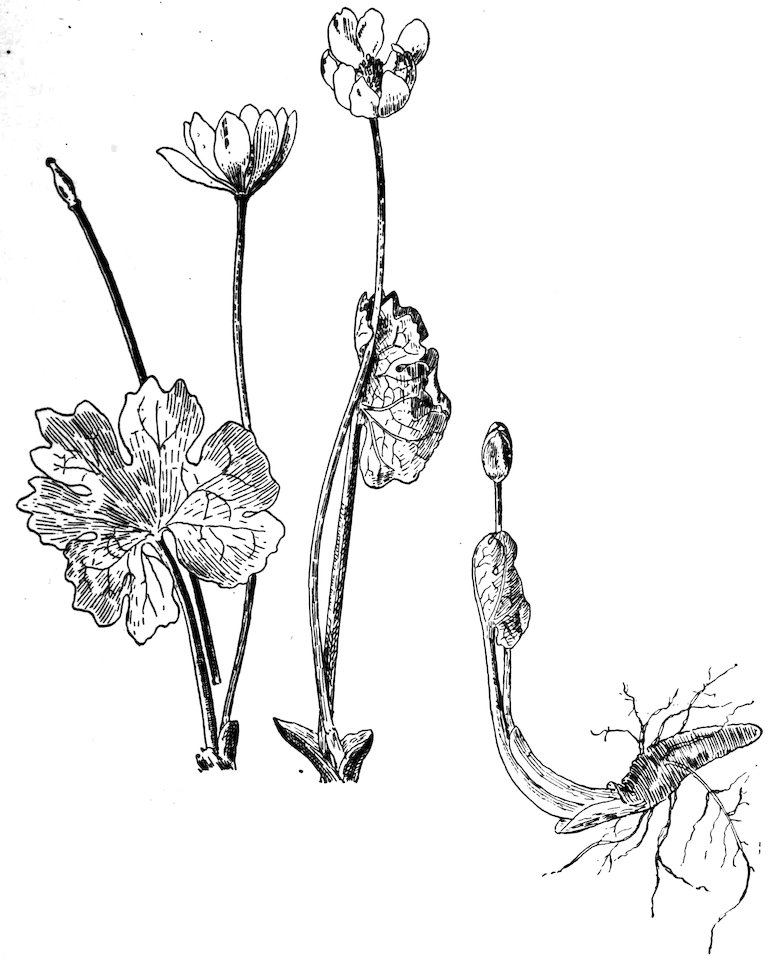
PLATE I
BLOOD-ROOT.—S. Canadensis.
24Down in the boggy meadow in early March we can almost
fancy that from beneath the solemn purple cowls of the skunk-cabbage
brotherhood comes the joyful chorus—
For lo, the winter is past!—
but we chilly mortals still find the wind so frosty and the woods
so unpromising that we return shivering to the fireside and refuse
to take up the glad strain till the feathery clusters of the shad-bush
droop from the pasture thicket. Then only are we ready to
admit that
The flowers appear upon the earth,
The time of the singing of birds is come.
Even then, search the woods as we may, we shall hardly find
thus early in April another shrub in blossom, unless it be the
spice-bush, whose tiny honey-yellow flowers escape all but the
careful observer. The shad-bush has been thus named because of
its flowering at the season when shad “run;” June-berry, because
the shrub’s crimson fruit surprises us by gleaming from the copses
at the very beginning of summer; service-berry, because of the
use made by the Indians of this fruit, which they gathered in
great quantities, and, after much crushing and pounding, utilized
in a sort of cake.
Stem.—Slender. Leaves.—Divided into delicate leaflets. Flower.—Solitary,
white, pink, or purplish. Calyx.—Of from four to seven petal-like
sepals. Corolla.—None. Stamens and Pistils.—Numerous.
—Within the woods,
Whose young and half transparent leaves scarce cast
A shade, gay circles of anemones
Danced on their stalks;
writes Bryant, bringing vividly before us the feathery foliage of
the spring woods, and the tremulous beauty of the slender-stemmed
anemones. Whittier, too, tells how these
—wind flowers sway
Against the throbbing heart of May.
25
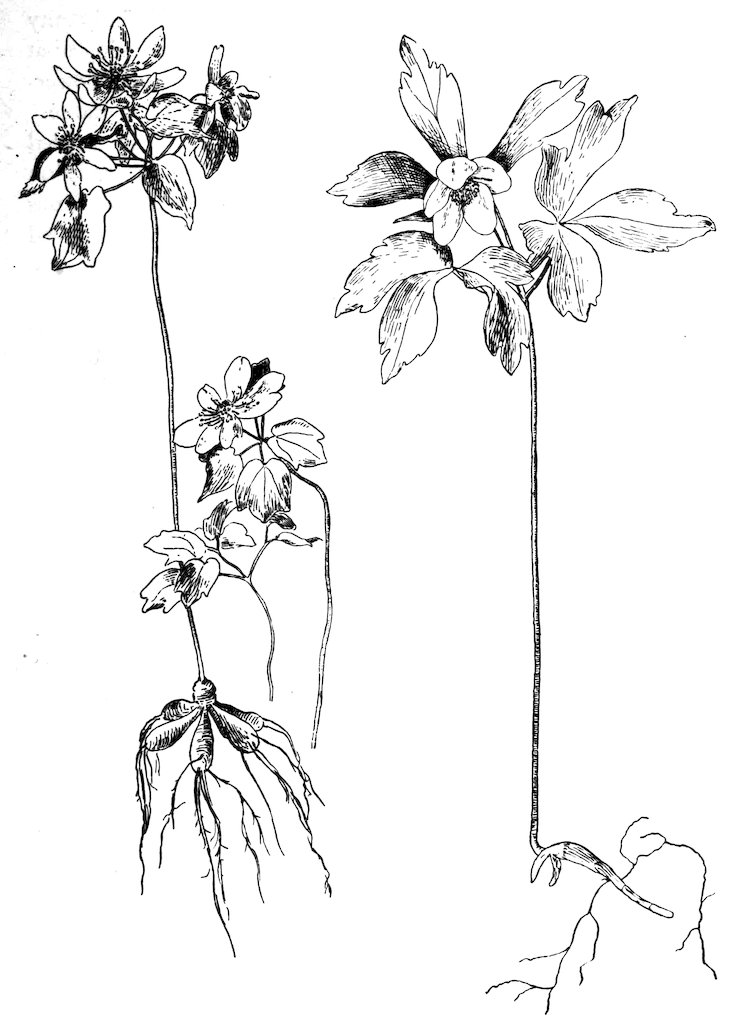
PLATE II
RUE ANEMONE.—A. thalictroides.
WOOD ANEMONE.—A. nemorosa.
26And in the writings of the ancients as well we could find many
allusions to the same flower were we justified in believing that
the blossom christened the “wind-shaken,” by some poet flower-lover
of early Greece, was identical with our modern anemone.
Pliny tells us that the anemone of the classics was so entitled
because it opened at the wind’s bidding. The Greek tradition
claims that it sprang from the passionate tears shed by Venus
over the body of the slain Adonis. At one time it was believed
that the wind which had passed over a field of anemones was
poisoned and that disease followed in its wake. Perhaps because
of this superstition the flower was adopted as the emblem of sickness
by the Persians. Surely our delicate blossom is far removed
from any suggestion of disease or unwholesomeness, seeming instead
to hold the very essence of spring and purity in its quivering
cup.
Stem.—Six to twelve inches high. Leaves.—Divided into rounded leaflets.
Flowers.—White or pinkish, clustered. Calyx.—Of five to ten petal-like
sepals. Corolla.—None. Stamens.—Numerous. Pistils.—Four to
fifteen.
The rue anemone seems to linger especially about the spreading
roots of old trees. It blossoms with the wood anemone,
from which it differs in bearing its flowers in clusters.
Stem.—Smooth, erect. Leaves.—Thin, pointed, whorled at the summit
of the stem. Flowers.—White, delicate, star-shaped. Calyx.—Generally
seven-parted. Corolla.—Generally seven-parted, flat, spreading. Stamens.—Four
or five. Pistil.—One.
Finding this delicate flower in the May woods, one is at once
reminded of the anemone. The whole effect of plant, leaf, and
snow-white blossom is starry and pointed. The frosted tapering
petals distinguish it from the rounded blossoms of the wild strawberry,
near which it often grows.
27
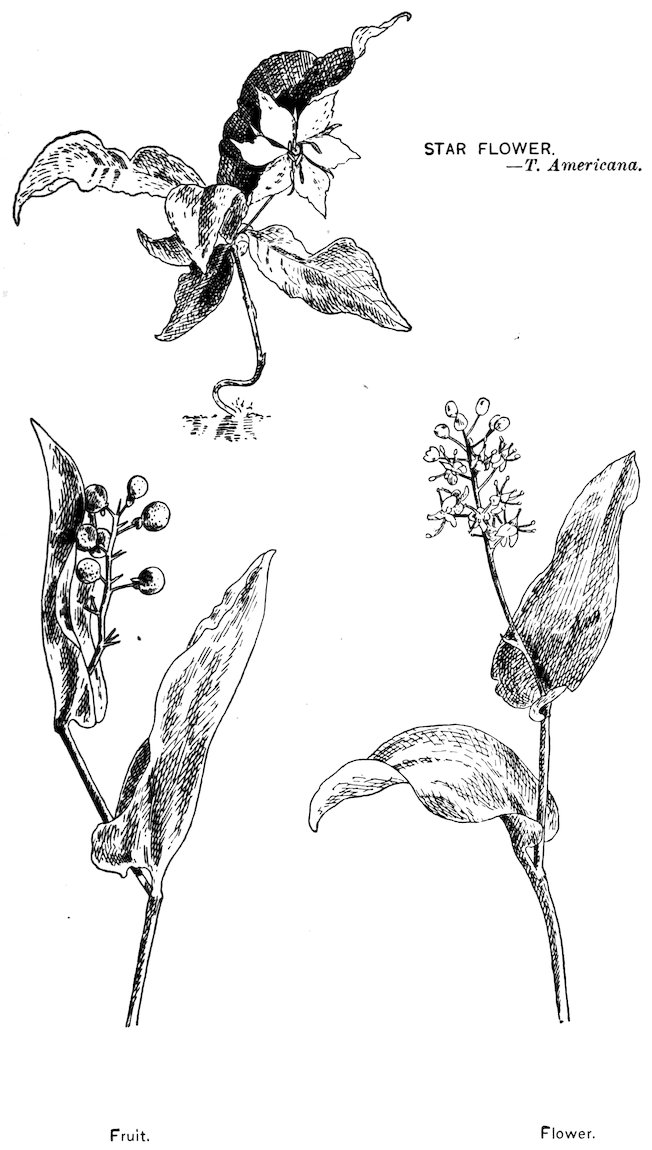
PLATE III
STAR-FLOWER.—T. Americana.
Maianthemum Canadense.
28
Stem.—Three to six inches high, with two or three leaves. Leaves.—Lance-shaped
to oval, heart-shaped at base. Flowers.—White or straw-color,
growing in a raceme. Perianth.—Four-parted. Stamens.—Four.
Pistil.—One, with a two-lobed stigma. Fruit.—A red berry.
It seems unfair that this familiar and pretty little plant should
be without any homely English name. Its botanical title signifies
“Canada Mayflower,” but while it undoubtedly grows in
Canada and flowers in May, the name is not a happy one, for it
abounds as far south as North Carolina, and is not the first blossom
to be entitled “Mayflower.”
In late summer the red berries are often found in close proximity
to the fruit of the shin-leaf and pipsissewa.
Scape.—Slender, three to five inches high. Leaves.—Evergreen, shining,
divided into three leaflets. Flowers.—Small, white, solitary. Calyx.—Of
five to seven petal-like sepals which fall early. Corolla.—Of five to seven
club-shaped petals. Stamens.—Fifteen to twenty-five. Pistils.—Three to
seven. Root.—Of long, bright yellow fibres.
This little plant abundantly carpets the northern bogs and
extends southward over the mountains, its tiny flowers appearing
in May. Its bright yellow thread-like roots give it its
common name.
Stems.—Prostrate and creeping, branching. Leaves.—Narrowly lance-shaped,
awl-pointed. Flowers.—White or pink, small, numerous. Calyx.—Of
five sepals. Corolla.—Five-lobed. Stamens.—Five. Pistil.—One,
with a three-lobed stigma.
In early spring we may look for the white flowers of this
moss-like plant in the sandy pine-woods of New Jersey and
southward. At Lakewood they appear even before those of the
trailing arbutus which grows in the same localities. The generic
name is from two Greek words which signify a small box
and anther, and refers to the anthers, which open as if by a lid.
29
Rootstock.—Five to ten inches long, wrinkled, crisp, of a pleasant, pungent
taste. Stem.—Leafless below, bearing two leaves above. Leaves.—Divided
into three-toothed leaflets. Flowers.—White, in a terminal cluster.
Pod.—Flat and lance-shaped.
The crinkle-root has been valued—not so much on account
of its pretty flowers which may be found in the rich May woods—but
for its crisp edible root which has lent savor to many a
simple luncheon in the cool shadows of the forest.
Rootstock.—Slender, bearing small tubers. Stem.—From a tuberous
base, upright, slender. Root-leaves.—Round and often heart-shaped. Stem-leaves.—The
lower rounded, the upper almost lance-shaped. Flowers.—White,
large. Pod.—Flat, lance-shaped, pointed with a slender style
tipped with a conspicuous stigma; smaller than that of the crinkle-root.
The spring-cress grows abundantly in the wet meadows and
about the borders of springs. Its large white flowers appear as
early as April, lasting until June.
Scapes.—One to three inches high. Leaves.—All from the root, oblong
or lance-shaped. Flowers.—White, with two-cleft petals. Pod.—Flat, varying
from oval to oblong, lance-shaped.
This little plant may be found flowering along the roadsides
and in sandy places during April and May. It has come to us
from Europe.
Stem.—Low, branching. Root-leaves.—Clustered, incised or toothed.
Stem-leaves.—Arrow-shaped, set close to the stem. Flowers.—White,
small, in general structure resembling other members of the Mustard family.
Pod.—Triangular, heart-shaped.
This is one of the commonest of our wayside weeds, working
its way everywhere with such persistency and appropriating
other people’s property so shamelessly, that it has won for itself
the nickname of pickpocket. Its popular title arose from the
shape of its little seed-pods.
30
Flowering stem.—Two-leaved, one-flowered. Flowerless stems.—Terminated
by one large, rounded, much-lobed leaf. Leaves (of flowering stems).—One-sided,
five to nine-lobed, the lobes oblong, the leaf-stalks
fastened to their lower side near the inner edge. Flower.—White, large,
nodding from the fork made by the two leaves. Calyx.—Of six early falling
sepals. Corolla.—Of six to nine rounded petals. Stamens.—Twice as many
as the petals. Pistil.—One, with a large, thick stigma set close to the
ovary. Fruit.—A large, fleshy, egg-shaped berry, sweet and edible.
“The umbrellas are out!” cry the children, when the great
green leaves of the May-apple first unfold themselves in spring.
These curious-looking leaves at once betray the hiding-place of
the pretty but unpleasantly odoriferous flower which nods beneath
them. They lie thickly along the woods and meadows in
many parts of the country, arresting one’s attention by the
railways. The fruit, which ripens in July, has been given the
name of “wild lemon,” in some places on account of its shape.
It was valued by the Indians for medicinal purposes, and its
mawkish flavor still seems to find favor with the children,
notwithstanding its frequently unpleasant after-effects. The
leaves and roots are poisonous if taken internally, and are said
to have been used as a pot-herb, with fatal results. They yield
an extract which has been utilized in medicine.
A low plant. Leaves.—From the root, long-stalked, parted into two
rounded leaflets. Scape.—One-flowered. Flower.—White, one inch broad.
Sepals.—Four, falling early. Petals.—Eight; flat, oblong. Stamens.—Eight.
Pistil.—One, with a two-lobed stigma.
The twin-leaf is often found growing with the blood-root in
the woods of April or May. It abounds somewhat west and
southward.
Stem.—Three to nine inches high, from a deep round tuber. Leaves.—One
or two, divided into linear-oblong leaf-segments. Flowers.—White,
small, few, in a leafy-bracted compound umbel.
31
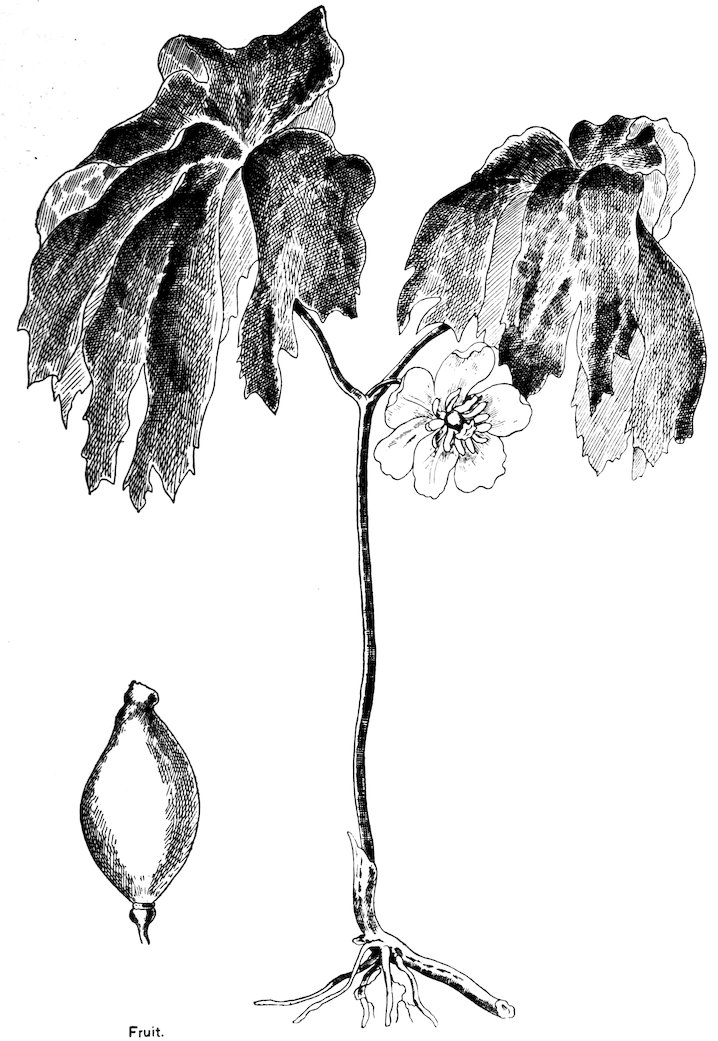
PLATE IV
MAY-APPLE.—P. peltatum.
32The pretty little harbinger-of-spring should be easily identified
by those who are fortunate enough to find it, for it is one of
the smallest members of the Parsley family. It is only common
in certain localities, being found in abundance in the neighborhood
of Washington, where its flowers appear as early as March.
Stems.—Downy or woolly, three to eighteen inches high. Leaves.—Silky,
woolly when young; those from the root, oval, three-nerved; those on
the flowering stems, small, lance-shaped. Flower-heads.—Crowded, clustered,
small, yellowish-white, composed entirely of tubular flowers.
In early spring the hill-sides are whitened with this, the earliest
of the everlastings.
Stem.—From a small tuber, often somewhat reclining. Leaves.—Two;
opposite, long and narrow. Flowers.—White, with pink veins, or pink with
deeper-colored veins, growing in a loose cluster. Calyx.—Of two sepals.
Corolla.—Of five petals. Stamens.—Five. Pistil.—One, with style three-cleft
at apex.
So bashful when I spied her,
So pretty, so ashamed!
So hidden in her leaflets
Lest anybody find:
So breathless when I passed her,
So helpless when I turned
And bore her struggling, blushing,
Her simple haunts beyond!
For whom I robbed the dingle,
For whom betrayed the dell,
Many will doubtless ask me,
But I shall never tell!
Yet we are all free to guess—and what flower—at least in the
early year, before it has gained that touch of confidence which
it acquires later—is so bashful, so pretty, so flushed with rosy
shame, so eager to defend its modesty by closing its blushing
petals when carried off by the despoiler—as the spring beauty?
To be sure, she is not “hidden in her leaflets,” although often
seeking concealment beneath the leaves of other plants—but
why not assume that Miss Dickinson has availed herself of something
of the license so freely granted to poets—especially, it
seems to me—to poets of nature? Perhaps of this class few are
more accurate than she, and although we wonder at the sudden
blindness which leads her to claim that
—Nature rarer uses yellow
Than another hue—
when it seems as though it needed but little knowledge of flowers
to recognize that yellow, probably, occurs more frequently among
them than any other color, and also at the representation of this
same nature as
—Spending scarlet like a woman—
when in reality she is so chary of this splendid hue; still we cannot
but appreciate that this poet was in close and peculiar sympathy
with flowers, and was wont to paint them with more than
customary fidelity.
33
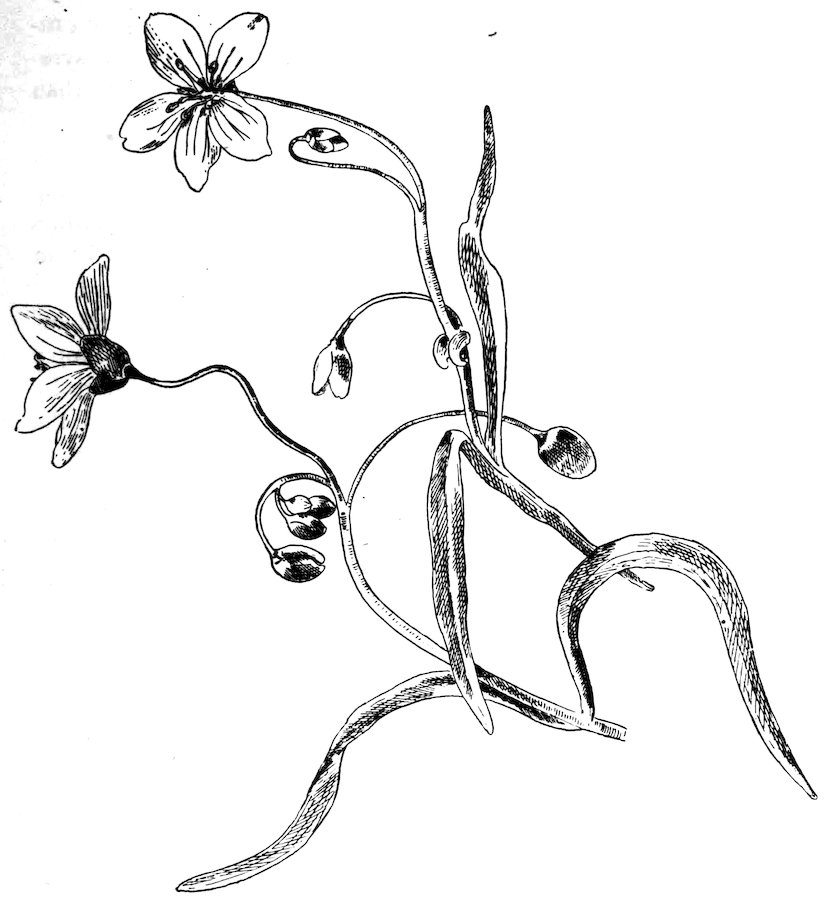
PLATE V
SPRING BEAUTY.—C. Virginica.
34We look for the spring beauty in April and May, and often
find it in the same moist places—on a brook’s edge or skirting
the wet woods—as the yellow adder’s tongue. It is sometimes
mistaken for an anemone, but its rose-veined corolla and linear
leaves easily identify it. Parts of the carriage-drive in the Central
Park are bordered with great patches of the dainty blossoms.
One is always glad to discover these children of the country
within our city limits, where they can be known and loved by
those other children who are so unfortunate as to be denied the
knowledge of them in their usual haunts. If the day chances to
be cloudy these flowers close and are only induced to open again
by an abundance of sunlight. This habit of closing in the shade
is common to many flowers, and should be remembered by those
who bring home their treasures from the woods and fields, only
to discard the majority as hopelessly wilted. If any such exhausted
blossoms are placed in the sunlight, with their stems in
fresh water, they will probably regain their vigor. Should this
treatment fail, an application of very hot—almost boiling—water
should be tried. This heroic measure often meets with success.
Scape.—Slender. Leaves.—Thrice-compound. Flowers.—White and
yellow, growing in a raceme. Calyx.—Of two small, scale-like sepals.
Corolla.—Closed and flattened; of four somewhat cohering white petals
tipped with yellow; the two outer—large, with spreading tips and deep spurs;
the two inner—small, with spoon-shaped tips uniting over the anthers and
stigma. Stamens.—Six. Pistil.—One.
35
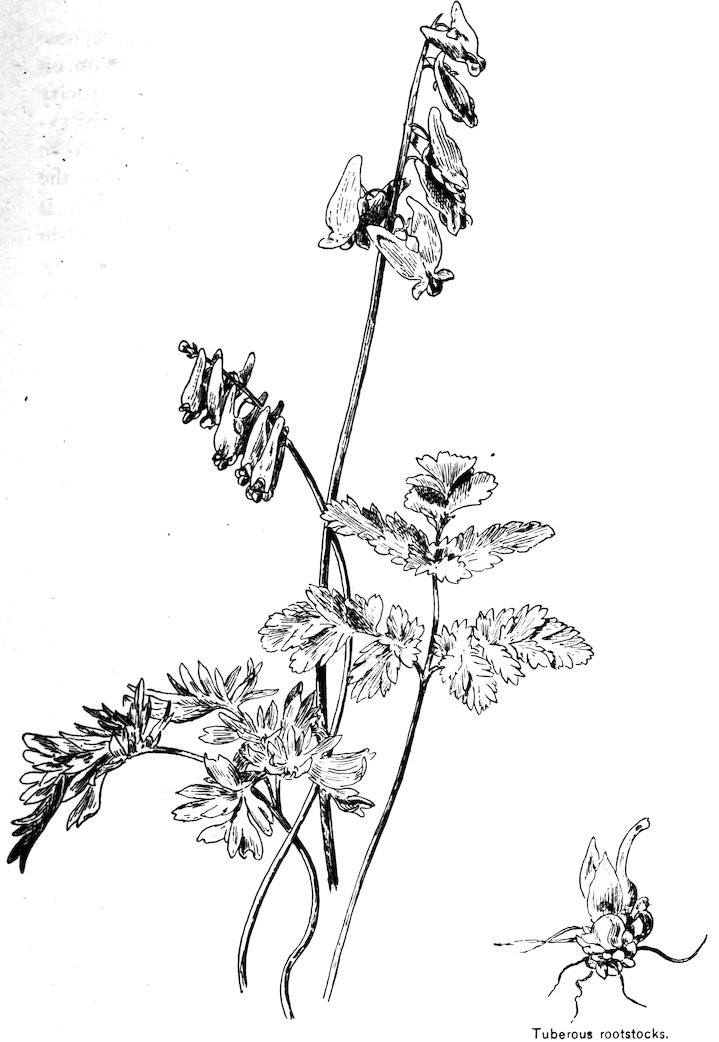
PLATE VI
DUTCHMAN’S BREECHES.—D. Cucullaria.
36There is something singularly fragile and spring-like in the
appearance of this plant as its heart-shaped blossoms nod from
the rocky ledges where they thrive best. One would suppose
that the firmly closed petals guarded against any intrusion on
the part of insect-visitors and indicated the flower’s capacity
for self-fertilization; but it is found that when insects are excluded
by means of gauze no seeds are set, which goes to prove
that the pollen from another flower is a necessary factor in the
continuance of this species. The generic name, Dicentra, is
from the Greek and signifies two-spurred. The flower, when
seen, explains its two English titles. It is accessible to every
New Yorker, for in early April it whitens many of the shaded
ledges in the upper part of the Central Park.
The squirrel corn closely resembles the dutchman’s breeches.
Its greenish or pinkish flowers are heart-shaped, with short,
rounded spurs. They have the fragrance of hyacinths, and
are found blossoming in early spring in the rich woods of the
North.
Stem.—Five to twelve inches high, leafless, or rarely with one or two
leaves. Leaves.—From the rootstock or runners, heart-shaped, sharply
lobed. Flowers.—White, in a full raceme. Calyx.—Bell-shaped, five-parted.
Corolla.—Of five petals on claws. Stamens.—Ten, long and slender.
Pistil.—One, with two styles.
Over the hills and in the rocky woods of April and May the
graceful white racemes of the foam-flower arrest our attention.
This is a near relative of the Mitella or true mitre-wort. Its
generic name is a diminutive from the Greek for turban, and is
said to refer to the shape of the pistil.
Scape.—Four to nine inches high. Leaves.—Clustered at the root, somewhat
wedge-shaped, narrowed into a broad leaf-stalk. Flowers.—White,
small, clustered. Calyx.—Five-cleft. Corolla.—Of five petals. Stamens.—Ten.
Pistil.—One, with two styles.
37
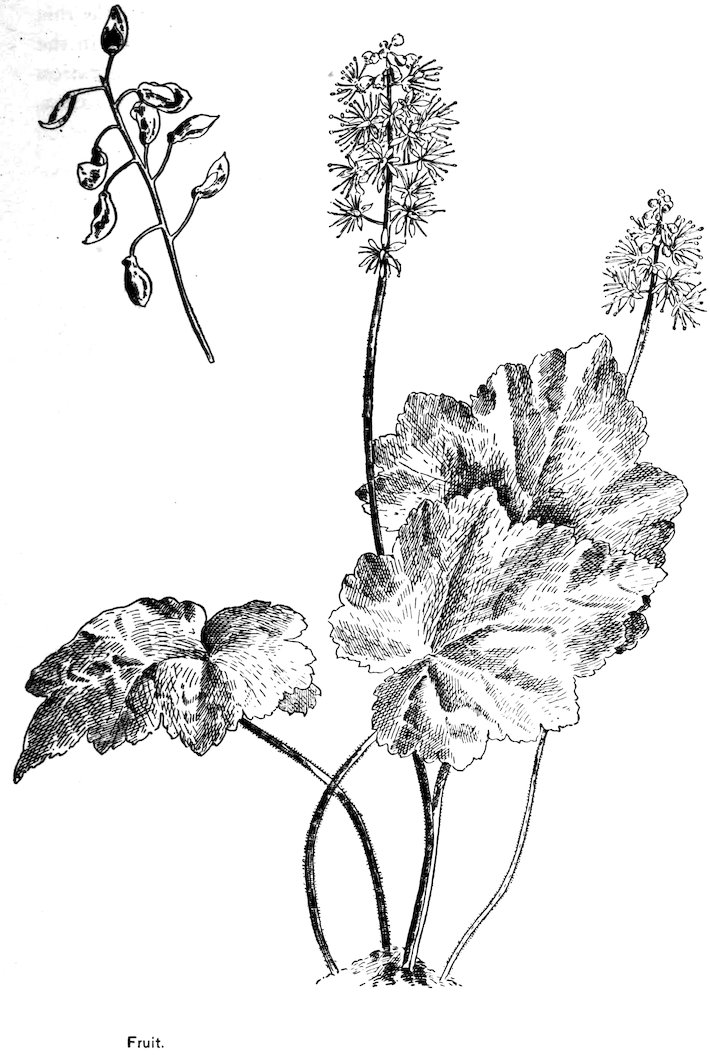
PLATE VII
FOAM-FLOWER.—T. cordifolia.
38In April we notice that the seams in the rocky cliffs and hill-sides
begin to whiten with the blossoms of the early saxifrage.
Steinbrech—stonebreak—the Germans appropriately entitle this
little plant, which bursts into bloom from the minute clefts in the
rocks and which has been supposed to cause their disintegration
by its growth. The generic and common names are from saxum—a
rock, and frango—to break.
Stem.—Six to twelve inches high, hairy, bearing two opposite leaves.
Leaves.—Heart-shaped, lobed and toothed, those of the stem opposite and
nearly sessile. Flowers.—White, small, in a slender raceme. Calyx.—Short,
five-cleft. Corolla.—Of five slender petals which are deeply incised.
Stamens.—Ten, short. Pistil.—One, with two styles.
The mitre-wort resembles the foam-flower in foliage, but
bears its delicate crystal-like flowers in a more slender raceme.
It also is found in the rich woods, blossoming somewhat later.
Root.—Poisonous, coarse and fibrous. Stem.—Stout, two to seven feet
high, very leafy to the top. Leaves.—Broadly oval, pointed, clasping.
Flowers.—Dull greenish, inconspicuous, clustered. Perianth.—Of six
spreading sepals. Stamens.—Six. Pistil.—One, with three styles.
When we go to the swampy woods in March or April we
notice an array of green, solid-looking spears which have just appeared
above the ground. If we handle one of these we are impressed
with its firmness and rigidity. When the increasing
warmth and sunshine have tempted the veiny, many-plaited
leaves of the false hellebore to unfold themselves it is difficult to
realize that they composed that sturdy tool which so effectively
tunnelled its way upward to the earth’s surface. The tall stems
and large bright leaves of this plant are very noticeable in the
early year, forming conspicuous masses of foliage while the trees
and shrubs are still almost leafless. The dingy flowers which
appear later rarely attract attention.
39
Stem.—Climbing, three to fifteen feet high. Leaves.—Ovate, or rounded
heart-shaped, or abruptly cut off at base, shining. Flowers.—Greenish or
yellowish, small, clustered, unisexual. Perianth.—Six-parted. Stamens.—six.
Pistil.—One, with three spreading stigmas. (Stamens and pistils occurring
on different plants.) Fruit.—A bluish-black berry.
One whiff of the foul breath of the carrion flower suffices for
its identification. Thoreau likens its odor to that of “a dead
rat in the wall.” It seems unfortunate that this strikingly
handsome plant which clambers so ornamentally over the luxuriant
thickets which border our lanes and streams, should be so
handicapped each June. Happily with the disappearance of the
blossoms, it takes its place as one of the most attractive of our
climbers.
The common green-brier, S. rotundifolia, is a near relation
which is easily distinguished by its prickly stem.
The dark berries and deeply tinted leaves of this genus add
greatly to the glorious autumnal display along our roadsides and
in the woods and meadows.
Stem.—Stout, from a tuber-like rootstock. Leaves.—Ovate, three in a
whorl, a short distance below the flower. Flower.—Single, terminal, large,
white, turning pink or marked with green. Calyx.—Of three green, spreading
sepals. Corolla.—Of three long pointed petals. Stamens.—Six. Pistil.—One,
with three spreading stigmas. Fruit.—A large ovate, somewhat
angled, red berry.
This very beautiful and decorative flower must be sought far
from the highway in the cool rich woods of April and May.
Mr. Ellwanger speaks of the “chaste pure triangles of the white
wood lily,” and says that it often attains a height of nearly two
feet.
T. cernuum has no English title. Its smaller white or pinkish
blossom is borne on a stalk which is so much curved as to
sometimes quite conceal the flower beneath the leaves. It may
be sought in the moist places in the woods.
40The painted trillium, T. erythrocarpum, is also less large and
showy than the great white trillium, but it is quite as pleasing.
Its white petals are painted at their base with red stripes. This
species is very plentiful in the Adirondack and Catskill Mountains.
Stem.—Four to eight inches high. Leaves.—Three in a whorl, divided
into from three to five leaflets. Flowers.—White, in an umbel. Fruit.—Yellowish,
berry-like. Root.—A globular tuber.
The tiny white flowers of the dwarf ginseng are so closely
clustered as to make “one feathery ball of bloom,” to quote Mr.
Hamilton Gibson. This little plant resembles its larger relative,
the true ginseng. It blossoms in our rich open woods early in
spring, and hides its small round tuber so deep in the earth that
it requires no little care to uproot it without breaking the slender
stem. This tuber is edible and pungent-tasting, giving the plant
its name of ground-nut.
Root.—Large and spindle-shaped, often forked. Stem.—About one foot
high. Leaves.—Three in a whorl, divided into leaflets. Flowers.—Greenish-white,
in a simple umbel. Fruit.—Bright red, berry-like.
This plant is well known by name, but is yearly becoming
more scarce. The aromatic root is so greatly valued in China for
its supposed power of combating fatigue and old age that it can
only be gathered by order of the emperor. The forked specimens
are believed to be the most powerful, and their fancied likeness
to the human form has obtained for the plant the Chinese title
of Jin-chen (from which ginseng is a corruption), and the Indian
one of Garan-toguen, both of which, strangely enough, are said
to signify, like a man. The Canadian Jesuits first began to ship
the roots of the American species to China, where they sold at
about five dollars a pound. At present they are said to command
about one-fifth of that price in the home market.
41
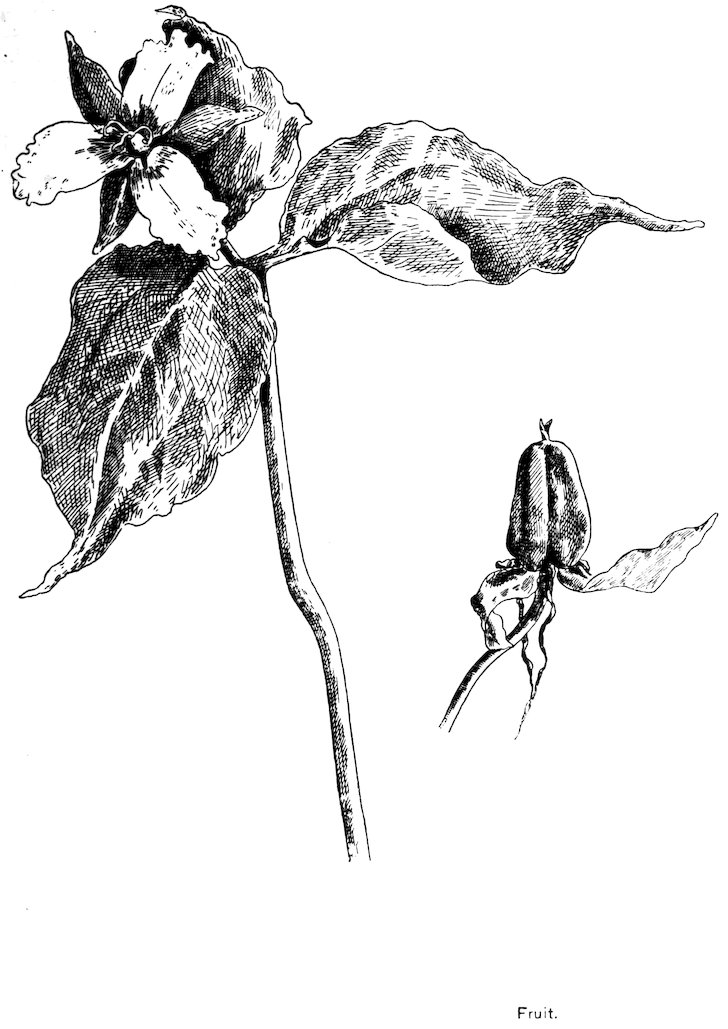
PLATE VIII
PAINTED TRILLIUM.—T. erythrocarpum.
42
Stem.—Bearing a single large, long-stalked, much-divided leaf, and a
shorter naked scape which bears the rounded flower-clusters. Flowers.—Greenish-white,
in umbels. Calyx.—With short or obsolete teeth. Corolla.—Of
five petals. Stamens.—Five. Fruit.—Black or dark purple, berry-like.
In the June woods the much-divided leaf and rounded
flower-clusters of the wild sarsaparilla are frequently noticed, as
well as the dark berries of the later year. The long aromatic
roots of this plant are sold as a substitute for the genuine sarsaparilla.
The rice-paper plant of China is a member of this
genus.
Root.—Large and aromatic. Stem.—Often tall and widely branched,
leafy. Leaves.—Divided into many leaflets. Flowers.—Greenish-white, in
clusters which are racemed. Fruit.—Dark purple, berry-like.
Stem.—Leafy, upright, one to two feet high. Leaves.—Heart-shaped,
pointed, toothed. Flowers.—White, veined with purple, violet beneath,
otherwise greatly resembling the common blue violet.
We associate the violet with the early year, but I have found
the delicate fragrant flowers of this species blossoming high up
on the Catskill Mountains late into September; and have known
them to continue to appear in a New York city-garden into November.
They are among the loveliest of the family, having a
certain sprightly self-assertion which is peculiarly charming,
perhaps because so unexpected.
The tiny sweet white violet, V. blanda, with brown or purple
veins, which is found in nearly all low, wet, woody places in
spring, is perhaps the only uniformly fragrant member of the
family, and its scent, though sweet, is faint and elusive.
43
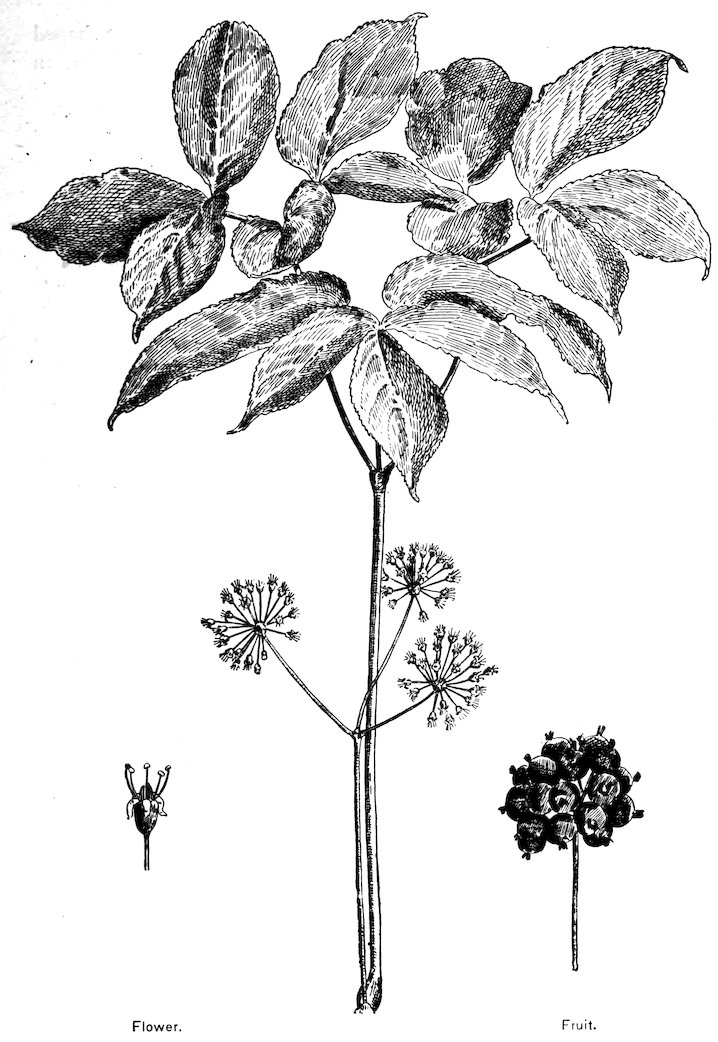
PLATE IX
WILD SARSAPARILLA.—A. nudicaulis.
44The lance-leaved violet, V. lanceolata, is another white
species which is easily distinguished by its smooth lance-shaped
leaves, quite unlike those of the common violet. It is found in
damp soil, especially eastward.
Stem.—Slender, curving, one to three feet long. Leaves.—Alternate,
oval, set close to the stem. Flowers.—Greenish-white or straw-colored,
bell-shaped, nodding from the axils of the leaves. Perianth.—Six-lobed at
the summit. Stamens.—Six. Pistil.—One. Fruit.—A dark blue berry.
The graceful leafy stems of the Solomon’s seal are among the
most decorative features of our spring woods. The small blossoms
which appear in May grow either singly or in clusters on a
flower-stalk which is so fastened into the axil of each leaf that
they droop beneath, forming a curve of singular grace which is
sustained in later summer by the dark blue berries.
The larger species, P. giganteum, grows to a height of from
two to seven feet, blossoming in the meadows and along the
streams in June.
The common name was suggested by the rootstocks, which
are marked with large round scars left by the death and separation
of the base of the stout stalks of the previous years. These
scars somewhat resemble the impression of a seal upon wax.
The generic name is from two Greek words signifying
many, and knee, alluding to the numerous joints of the rootstock.
A shrub from one to three feet high. Leaves.—Oblong or somewhat
lance-shaped, finely toothed, downy beneath. Flowers.—White or reddish,
small, clustered. Calyx.—Five-cleft. Corolla.—Of five petals. Stamens.—Numerous.
Pistil.—One, with two to five styles. Fruit.—Small, pear-shaped
or globular, berry-like, dark red or blackish.
This low shrub is common in swamps and moist thickets all
along the Atlantic coast, as well as farther inland. Its flowers
appear in May or June; its fruit in late summer or autumn.
45
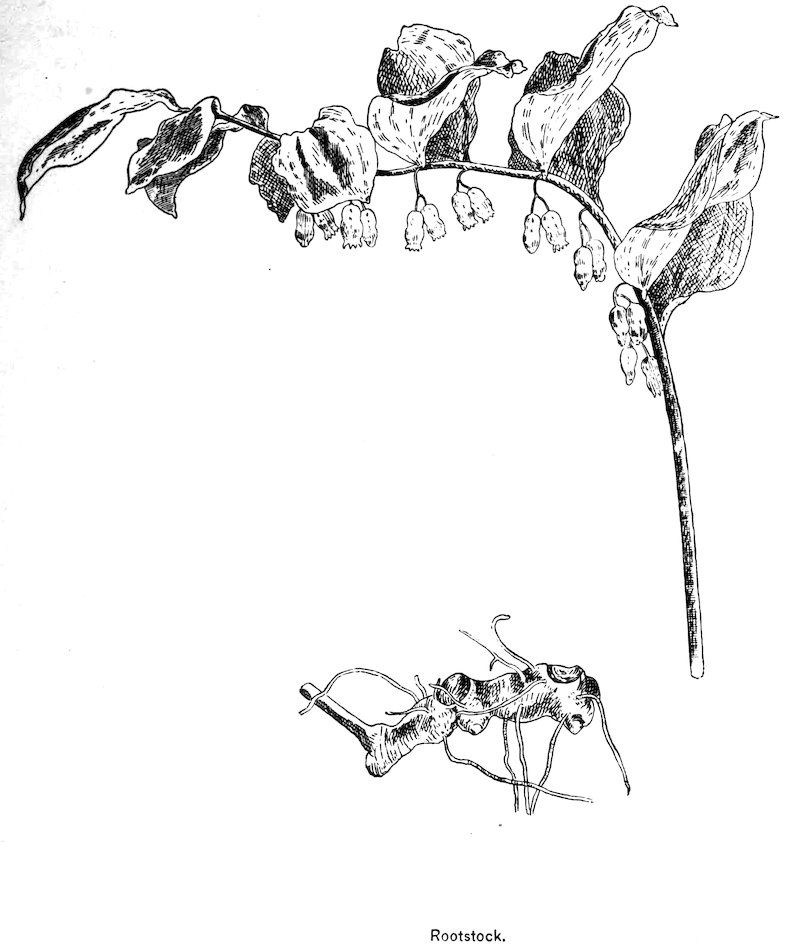
PLATE X
SOLOMON’S SEAL.—P. biflorum.
46
Stem.—Slender, trailing and creeping. Leaves.—Evergreen, small,
ovate, pointed. Flowers.—Small, white, solitary from the axils of the
leaves. Calyx.—Four-parted, with four large bracelets beneath. Corolla.—Deeply
four-parted. Stamens.—Eight. Pistil.—One. Fruit.—A pure
white berry.
This pretty little creeper is found blossoming in May in the
peat-bogs and mossy woods of the North. It is only conspicuous
when hung with its snow-white berries in late summer. It
has the aromatic flavor of the wintergreen.
A trailing shrub. Leaves.—Thick and evergreen, smooth, somewhat
wedge-shaped. Flowers.—Whitish, clustered. Calyx.—Small. Corolla.—Urn-shaped,
five-toothed. Stamens.—Ten. Pistil.—One. Fruit.—Red,
berry-like.
This plant blossoms in May, and is found on rocky hill-sides.
Its name refers to the relish with which bears are supposed to
devour its fruit.
Stem.—Usually curving, one to three feet long. Leaves.—Oblong, veiny.
Flowers.—Greenish-white, small, in a terminal raceme. Perianth.—Six-parted.
Stamens.—Six. Pistil.—One. Fruit.—A pale red berry speckled
with purple.
A singular lack of imagination is betrayed in the common
name of this plant. Despite a general resemblance to the true
Solomon’s seal, and the close proximity in which the two are
constantly found, S. racemosa, has enough originality to deserve
an individual title. The position of the much smaller flowers is
markedly different. Instead of drooping beneath the stem they
terminate it, having frequently a pleasant fragrance, while the
berries of late summer are pale red, flecked with purple. It puzzles
one to understand why these two plants should so constantly
be found growing side by side—so close at times that they almost
appear to spring from one point. The generic name is
from smilax, on account of a supposed resemblance between the
leaves of this plant and those which belong to that genus.
47
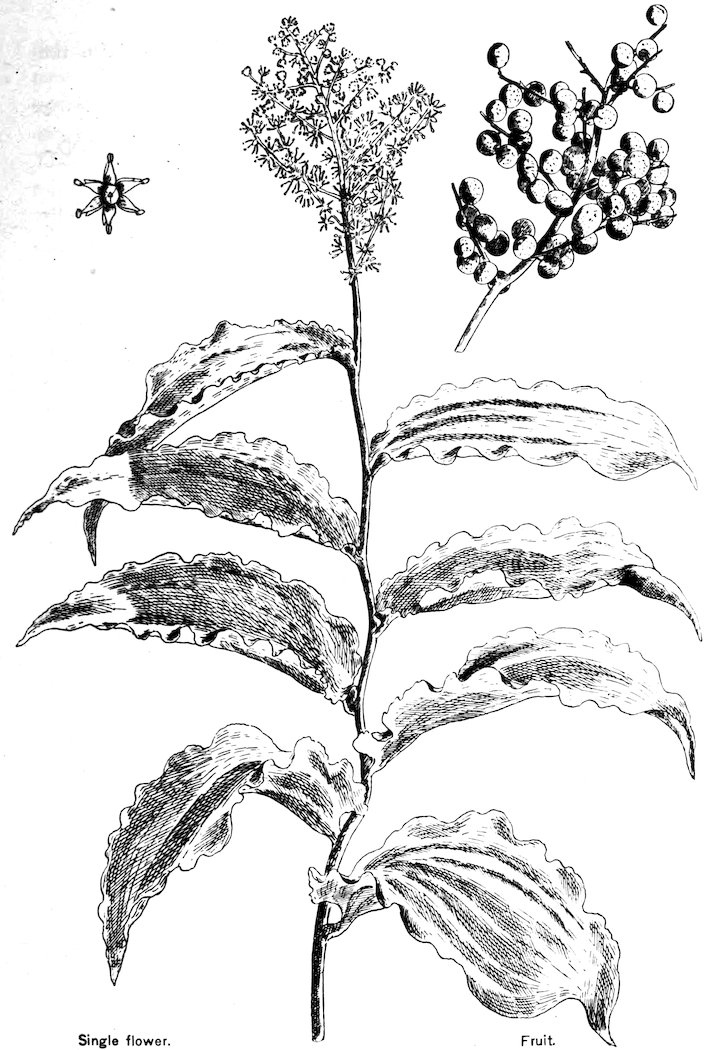
PLATE XI
FALSE SOLOMON’S SEAL.—S. racemosa.
48
A shrub from three to six feet high. Leaves.—Somewhat three-lobed, resembling
those of the maple, downy underneath. Flowers.—White, small,
in flat-topped clusters. Calyx.—Five-toothed. Corolla.—Spreading, five-lobed.
Stamens.—Five. Pistil.—One. Fruit.—Berry-like, crimson, turning
purple.
Perhaps our flowering shrubs contribute even more to the
beauty of the early summer woods and fields than the smaller
plants. Along many of the lanes which intersect the woodlands
the viburnums are conspicuous in June. When the blossoms
of the dockmackie have passed away we need not be surprised
if we are informed that this shrub is a young maple. There is
certainly a resemblance between its leaves and those of the maple,
as the specific name indicates. To be sure, the first red, then
purple berries, can scarcely be accounted for, but such a trifling
incongruity would fail to daunt the would-be wiseacre of field
and forest. With Napoleonic audacity he will give you the name
of almost any shrub or flower about which you may inquire.
Seizing upon some feature he has observed in another plant, he
will immediately christen the one in question with the same title—somewhat
modified, perhaps—and in all probability his authority
will remain unquestioned. There is a marvellous amount of inaccuracy
afloat in regard to the names of even the commonest
plants, owing to this wide-spread habit of guessing at the truth
and stating a conjecture as a fact.
Leaves.—Rounded, pointed, closely toothed, heart-shaped at the base,
the veins beneath as well as the stalks and small branches being covered
with a rusty scurf. Fruit.—Coral-red, berry-like.
The marginal flowers of the flat-topped clusters of the hobble-bush,
like those of the hydrangea, are much larger than the
49inner ones, and are without either stamens or pistils; their only
part in the economy of the shrub being to form an attractive
setting for the cluster, and thus to allure the insect-visitors that
are usually so necessary to the future well-being of the species.
The shrub is a common one in our northern woods and mountains.
Its straggling growth, and its reclining branches, which
often take root in the ground, have suggested the popular
names of hobble-bush, and wayfaring-tree.
A shrub six to ten feet high. Leaves.—Rounded, abruptly pointed.
Flowers.—Small, white, in flat, spreading clusters. Calyx.—Minutely four-toothed.
Corolla.—Of four white, oblong, spreading petals. Stamens.—Four.
Pistil.—One. Fruit.—Light blue, berry-like.
The different members of the Dogwood family are important
factors in the lovely pageant which delights our eyes along the
country lanes every spring. Oddly enough, only the smallest
and largest representative of the tribe (the little bunch-berry,
and the flowering-dogwood, which is sometimes a tree of goodly
dimensions), have in common the showy involucre which is
usually taken for the blossom itself; but which instead only surrounds
the close cluster of inconspicuous greenish flowers.
The other members of the genus are all comprised in the
shrubby dogwoods; many of these are very similar in appearance,
bearing their white flowers in flat, spreading clusters,
and differing chiefly in their leaves and fruit.
The branches of the round-leaved dogwood are greenish
and warty-dotted. Its fruit is light blue, and berry-like.
The panicled dogwood, C. paniculata, may be distinguished
by its white fruit and smooth, gray branches.
The red-osier dogwood, C. stolonifera, is common in wet
places. Its young shoots and branches are a bright purplish-red.
Its flower-clusters are small; its fruit, white or lead-color.
The bark of this genus has been considered a powerful tonic,
and an extract entitled “cornine,” is said to possess the properties
of quinine less strongly marked. The Chinese peel its
50twigs, and use them for whitening their teeth. It is said that
the Creoles also owe the dazzling beauty of their teeth to this
same practice.
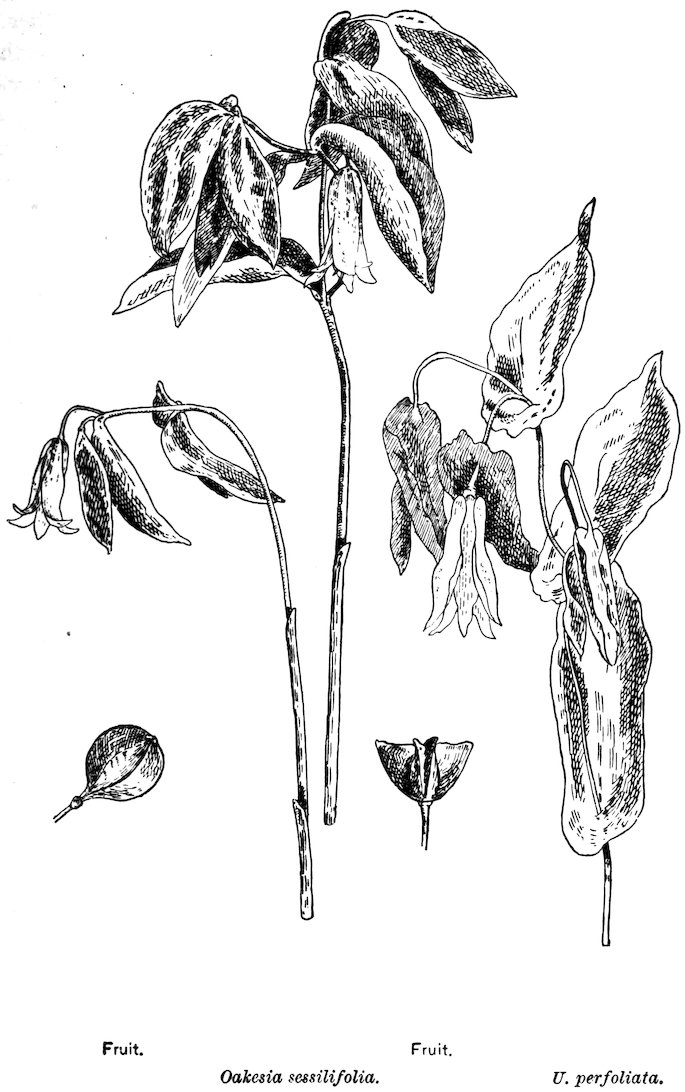
Stem.—Acutely angled, rather low. Leaves.—Set close to or clasping
the stem, pale, lance-oblong. Flower.—Yellowish-white or straw-color.
Perianth.—Narrowly bell-shaped, divided into six distinct sepals. Stamens.—Six.
Pistil.—One, with a deeply three-cleft style.
In spring this little plant is very abundant in the woods. It
bears one or two small lily-like blossoms which droop modestly
beneath the curving stems.
With the same common name and near of kin is Uvularia
perfoliata, with leaves which seem pierced by the stem, but
otherwise of a strikingly similar aspect.
A shrub or small tree, with spreading branches, and stout thorns or
spines. Leaves.—On slender leaf-stalks, thin, rounded, toothed, sometimes
lobed. Flowers.—White or sometimes reddish, rather large, clustered, with
a somewhat disagreeable odor. Calyx.—Urn-shaped, five-cleft. Corolla.—Of
five broad, rounded petals. Stamens.—Five to ten, or many. Pistil.—One,
with one to five styles. Fruit.—Coral-red, berry-like.
The flowers of the white-thorn appear in spring, at the same
time with those of the dogwoods. Its scarlet fruit gleams from
the thicket in September.
Stem.—About two feet high. Leaves.—Twice or thrice-compound, leaflets
incised and sharply toothed. Flowers.—Small, white, in a thick, oblong,
terminal raceme. Calyx.—Of four to five tiny sepals which fall as the
flower expands. Corolla.—Of four to ten small flat petals with slender
claws. Stamens.—Numerous, with slender white filaments. Pistil.—One,
with a depressed, two-lobed stigma. Fruit.—An oval white berry, with a
dark spot, on a thick red stalk.
51
52The feathery clusters of the white baneberry may be gathered
when we go to the woods for the columbine, the wild ginger,
the Jack-in-the-pulpit, and Solomon’s seal. These flowers are
very nearly contemporaneous and seek the same cool shaded
nooks, all often being found within a few feet of one another.
The red baneberry, A. rubra, is a somewhat more Northern
plant and usually blossoms a week or two earlier. Its cherry-red
(occasionally white) berries on their slender stalks are easily distinguished
from the white ones of A. alba, which look strikingly
like the china eyes that small children occasionally manage to
gouge from their dolls’ heads.
A much branched shrub, with ash-gray bark. Leaves.—Alternate, oblong,
smooth, on slender leaf-stalks. Flowers.—White, some perfect,
others unisexual; solitary or clustered in the axils of the leaves on long,
slender flower-stalks. Calyx.—Minute or obsolete. Corolla.—Of four or
five spreading petals. Stamens.—Four or five. Pistil.—One. Fruit.—Coral-red,
berry-like.
The flowers of this shrub appear in the damp woods of May.
Its light red berries on their slender stalks are noticed in late
summer when its near relation, the black alder or winterberry
is also conspicuous. Its generic name signifies flower with a
thread-like stalk.
A shrub, common in low grounds. Leaves.—Oval or lance-shaped,
pointed at apex and base, toothed. Flowers.—White; some perfect,
others unisexual; clustered on very short flower-stalks in the axils of the
leaves; appearing in May or June. Calyx.—Minute. Corolla.—Of four
to six petals. Stamens.—Four to six. Pistil.—One. Fruit.—Coral-red,
berry-like.
The year may draw nearly to its close without our attention
being arrested by this shrub. But in September it is well nigh
impossible to stroll through the country lanes without pausing
to admire the bright red berries clustered so thickly among the
leaves of the black alder. The American holly, I. opaca, is
closely related to this shrub, whose generic name is the ancient
Latin title for the holly-oak.
53
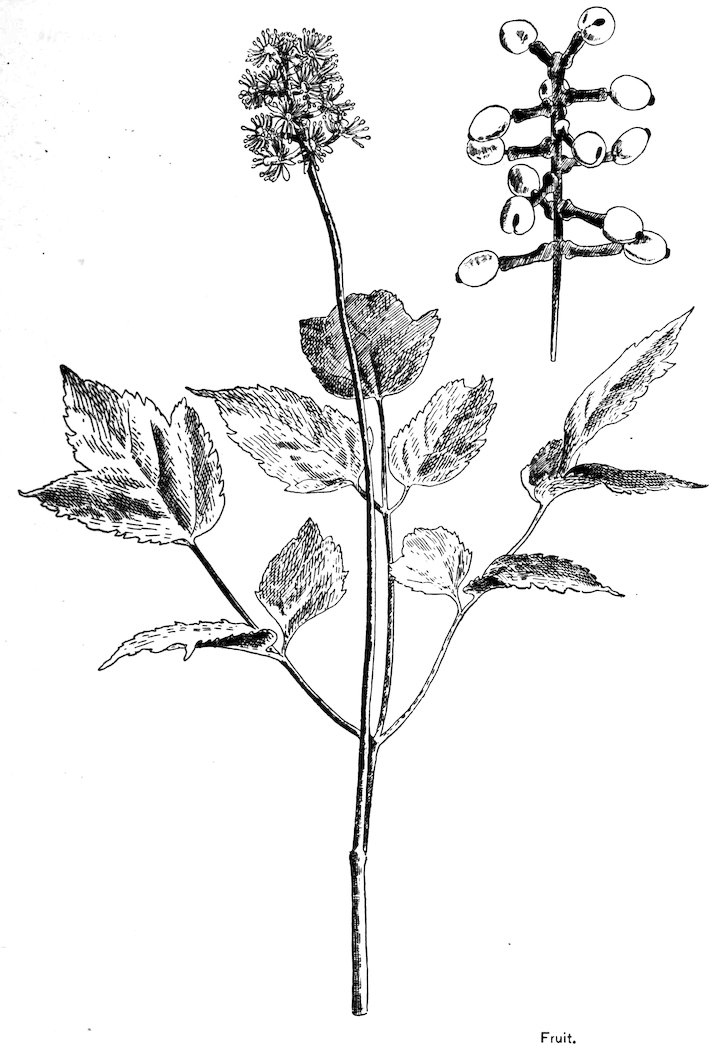
PLATE XIII
WHITE BANEBERRY.—A. alba.
54
Stems.—Woody, two to twelve feet high. Leaves.—Divided into leaflets.
Flowers.—White, resembling those of the Common Elder (p. 78), but
borne in pyramidal instead of in flat-topped clusters. Fruit.—Bright red,
berry-like.
The white clusters of the red-berried elder are found in the
rocky woods of May; its scarlet fruit, like that of the shad-bush,
appearing in June.
Stem.—Five to seven inches high. Leaves.—Ovate, pointed, the upper
crowded into an apparent whorl of four to six. Flowers.—Greenish, small,
in a cluster which is surrounded by a large and showy four-leaved, petal-like,
white or pinkish involucre. Calyx.—Minutely four-toothed. Corolla.—Of
four spreading petals. Stamens.—Four. Pistil.—One. Fruit.—Bright
red, berry-like.
When one’s eye first falls upon the pretty flowers of the
bunch-berry in the June woods, the impression is received that
each low stem bears upon its summit a single large white blossom.
A more searching look discovers that what appeared like rounded
petals are really the showy white leaves of the involucre which
surround the small, closely clustered, greenish flowers.
The bright red berries which appear in late summer make
brilliant patches in the woods and swamps. Both in flower and
fruit this is one of the prettiest of our smaller plants. It is
closely allied to the well-known flowering-dogwood, which is so
ornamental a tree in early spring.
In the Scotch Highlands it is called the “plant of gluttony,”
on account of its supposed power of increasing the appetite.
It is said to form part of the winter food of the Esquimaux.
55
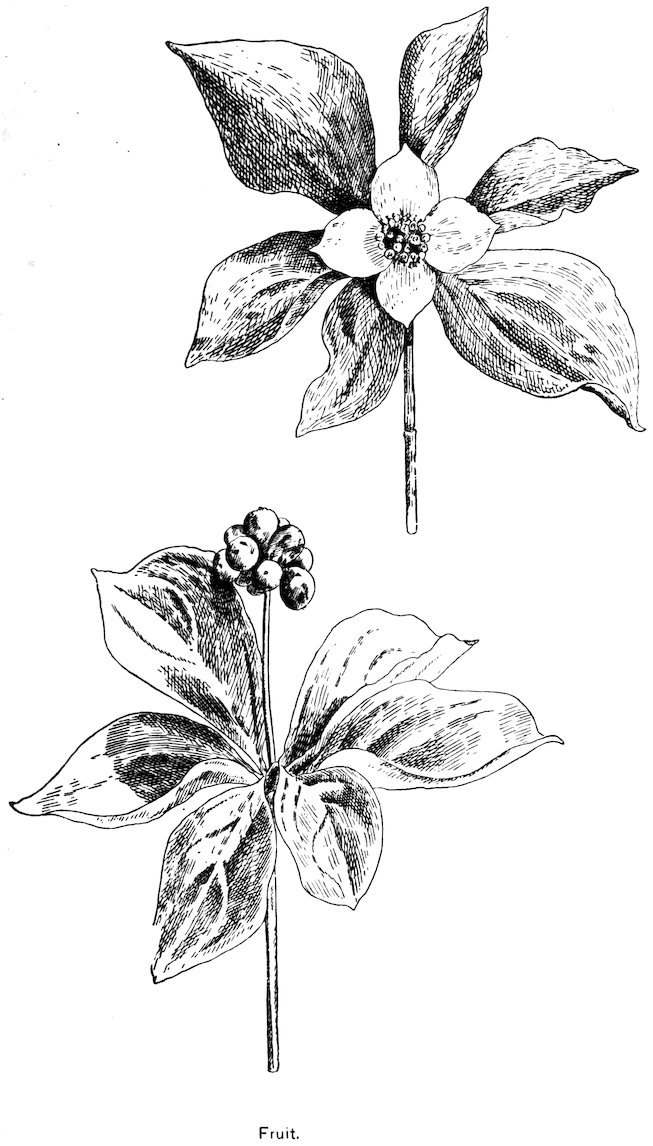
PLATE XIV
Fruit.
BUNCH-BERRY.—C. Canadensis.
56
A shrub from four to twenty feet high. Leaves.—Oval to broadly lance-shaped,
from three to six inches long. Flowers.—White, two inches
long, growing singly at the ends of the branches. Calyx.—Of three sepals.
Corolla.—Globular, with from six to nine broad petals. Stamens.—Numerous,
with short filaments and long anthers. Pistils.—Many, packed so as
to make a sort of cone in fruit. Fruit.—Cone-like, red, fleshy when ripe;
the pistils opening at maturity and releasing the scarlet seeds which hang by
delicate threads.
The beautiful fragrant blossoms of the sweet bay may be
found from June till August, in swamps along the coast from
Cape Ann southward.
Stem.—Jointed, often tall. Leaves.—Alternate, heart-shaped. Flowers.—White,
without calyx or corolla, crowded into a slender, wand-like
terminal spike which nods at the end. Stamens.—Usually six or seven.
Pistils.—Three or four, united at their base.
The nodding, fragrant spikes of the lizard’s tail abound in
certain swamps from June till August. While the plant is not
a common one, it is occasionally found in great profusion, and is
sure to arrest attention by its odd appearance.
Stem.—Woody, climbing. Leaves.—Three to seven-angled or lobed,
their stalks fastened near the edge of the lower surface. Flowers.—White
or yellowish, in small loose clusters, unisexual. Calyx.—Of four to eight
sepals. Corolla.—Of six to eight short petals. Stamens and Pistils.—Occurring
on different plants. Fruit.—Berry-like, black, with a bloom.
Clambering over the thickets which line the streams, we notice
in September the lobed or angled leaves and black berries of
the moonseed, the small white or yellowish flowers of which were,
perhaps, overlooked in June.
57
An evergreen shrub. Leaves.—Oblong, pointed, shining, of a leathery
texture. Flowers.—White or pink, in terminal clusters. Calyx.—Five-parted.
Corolla.—Marked with red, wheel-shaped, five-lobed, with ten depressions.
Stamens.—Ten, each anther lodged in one of the depressions of
the corolla. Pistil.—One.
The shining green leaves which surround the white or rose-colored
flowers of the mountain laurel are familiar to all who have
skirted the west shore of the Hudson River, wandered across
the hills that lie in its vicinity, or clambered across the mountains
of Pennsylvania, where the shrub sometimes grows to a
height of thirty feet. Not that these localities limit its range:
for it abounds more or less from Canada to Florida, and far inland,
especially along the mountains, whose sides are often
clothed with an apparent mantle of pink snow during the month
of June, and whose waste places are, in very truth, made to blossom
like the rose at this season.
The shrub is highly prized and carefully cultivated in England.
Barewood Gardens, the beautiful home of the editor of
the London Times, is celebrated for its fine specimens of mountain
laurel and American rhododendron. The English papers
advertise the approach of the flowering season, the estate is
thrown open to the public, and the people for miles around flock
to see the radiant strangers from across the water. The shrub is
not known there as the laurel, but by its generic title, Kalmia.
The head gardener of the place received with some incredulity
my statement that in parts of America the waste hill-sides were
brilliant with its beauty every June.
The ingenious contrivance of these flowers to secure cross-fertilization
is most interesting. The long filaments of the stamens
are arched by each anther being caught in a little pouch of
the corolla; the disturbance caused by the sudden alighting of
an insect on the blossom, or the quick brush of a bee’s wing,
dislodges the anthers from their niches, and the stamens spring
upward with such violence that the pollen is jerked from its hiding-place
in the pore of the anther-cell on to the body of the insect-visitor,
58who straightway carries it off to another flower upon whose
protruding stigma it is sure to be inadvertently deposited. In
order to see the working of this for one’s self, it is only necessary
to pick a fresh blossom and either brush the corolla quickly with
one’s finger, or touch the stamens suddenly with a pin, when
the anthers will be dislodged and the pollen will be seen to fly.
This is not the laurel of the ancients—the symbol of victory
and fame—notwithstanding some resemblance in the form of the
leaves. The classic shrub is supposed to be identical with the
Laurus nobilis which was carried to our country by the early
colonists, but which did not thrive in its new environment.
The leaves of our species are supposed to possess poisonous
qualities, and are said to have been used by the Indians for suicidal
purposes. There is also a popular belief that the flesh of a
partridge which has fed upon its fruit becomes poisonous. The
clammy exudation about the flower-stalks and blossoms may
serve the purpose of excluding from the flower such small insects
as would otherwise crawl up to it, dislodge the stamens, scatter
the pollen, and yet be unable to carry it to its proper destination
on the pistil of another flower.
The Kalmia was named by Linnæus after Peter Kalm, one of
his pupils who travelled in this country, who was, perhaps, the
first to make known the shrub to his great master.
The popular name spoonwood grew from its use by the Indians
for making eating-utensils. The wood is of fine grain and
takes a good polish.
The title calico-bush probably arose from the marking of the
corolla, which, to an imaginative mind, might suggest the cheap
cotton-prints sold in the shops.
A shrub from three to ten feet high. Leaves.—Oblong. Flowers.—White,
clustered, appearing after the leaves. Calyx-lobes.—Minute. Corolla.—White,
five-lobed, the clammy tube much longer than the lobes.
Stamens.—Usually five, protruding. Pistil.—One, protruding.
59
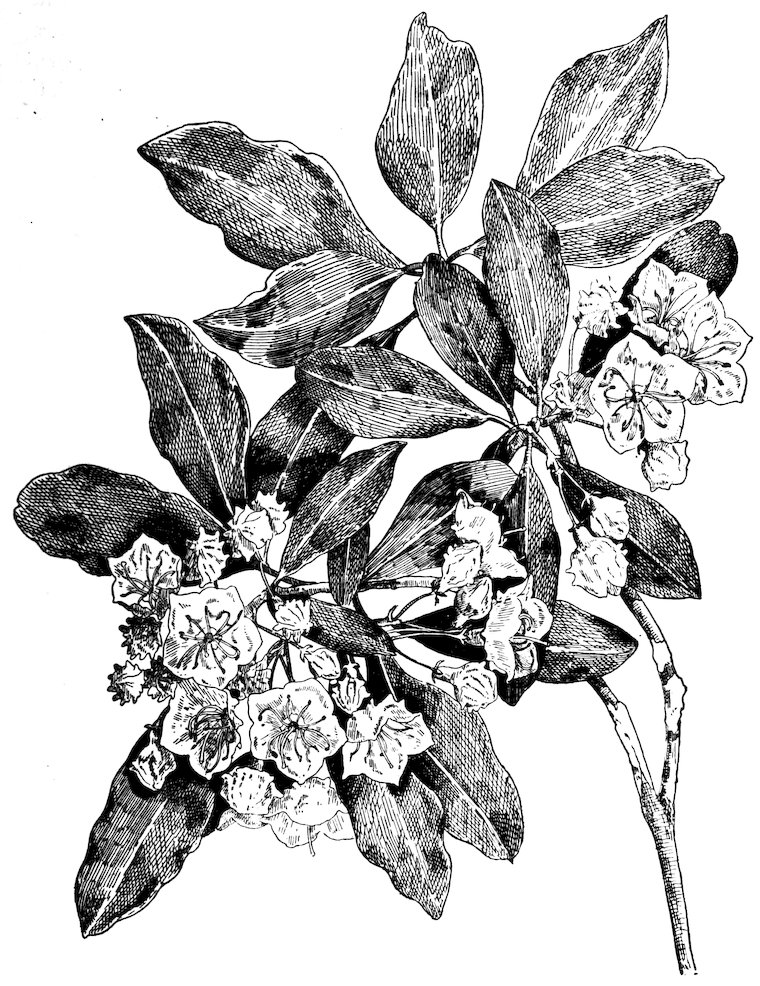
PLATE XV
MOUNTAIN LAUREL.—K. latifolia.
60The fragrant white flowers of this beautiful shrub appear in
early summer along the swamps which skirt the coast, and occasionally
farther inland. The close family resemblance to the pink
azalea (Pl. LXV.) will be at once detected. On the branches
of both species will be found those abnormal, fleshy growths,
called variously “swamp apples” and “May apples,” which
are so relished by the children. Formerly these growths were
attributed to the sting of an insect, as in the “oak apple;”
now they are generally believed to be modified buds.
A shrub from six to thirty-five feet high. Leaves.—Thick and leathery,
oblong, entire. Flowers.—White or pink, clustered. Calyx.—Minute,
five-toothed. Corolla.—Somewhat bell-shaped, five-parted, greenish in the
throat, with red, yellow, or green spots. Stamens.—Usually ten. Pistil.—One.
This beautiful native shrub is one of the glories of our country
when in the perfection of its loveliness. The woods which
nearly cover many of the mountains of our Eastern States hide
from all but the bold explorer a radiant display during the early
part of July. Then the lovely waxy flower-clusters of the American
rhododendron are in their fulness of beauty. As in the
laurel, the clammy flower-stalks seem fitted to protect the blossom
from the depredations of small and useless insects, while the
markings on the corolla attract the attention of the desirable bee.
In those parts of the country where it flourishes most luxuriantly,
veritable rhododendron jungles termed “hells” by the
mountaineers are formed. The branches reach out and interlace
in such a fashion as to be almost impassable.
The nectar secreted by the blossoms is popularly supposed to
be poisonous. We read in Xenophon that during the retreat
of the Ten Thousand, the soldiers found a quantity of honey of
which they freely partook, with results that proved almost fatal.
This honey is said to have been made from a rhododendron
which is still common in Asia Minor and which is believed to
possess intoxicating and poisonous properties.
61
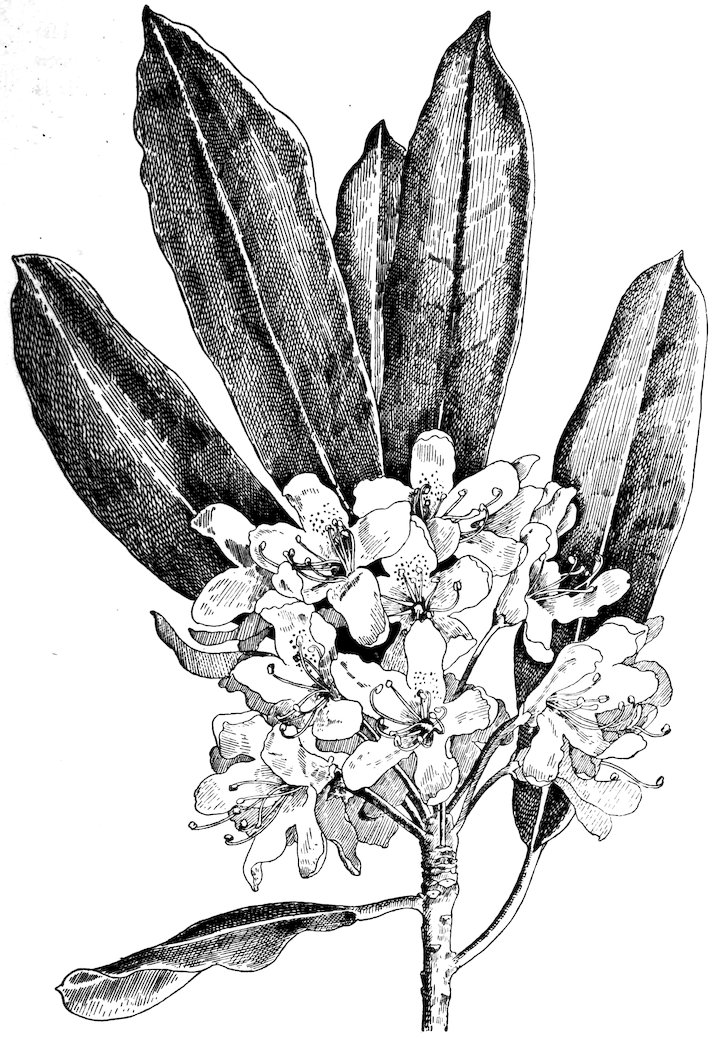
PLATE XVI
AMERICAN RHODODENDRON.—R. maximum.
62Comparatively little attention had been paid to this superb
flower until the Centennial Celebration at Philadelphia, when
some fine exhibits attracted the admiration of thousands. The
shrub has been carefully cultivated in England, having been
brought to great perfection on some of the English estates. It is
yearly winning more notice in this country.
The generic name is from the Greek for rose-tree.
Scape.—One-flowered, two to five inches high. Leaves.—Divided into
three clover-like leaflets. Flower.—White veined with red, solitary.
Calyx.—Of five sepals. Corolla.—Of five petals. Stamens.—Ten. Pistil.—One
with five styles.
Surely nowhere can be found a daintier carpeting than that
made by the clover-like foliage of the wood sorrel when studded
with its rose-veined blossoms in the northern woods of June.
At the very name comes a vision of mossy nooks where the sunlight
only comes on sufferance, piercing its difficult path through
the tent-like foliage of the forest, resting only long enough to become
a golden memory.
The early Italian painters availed themselves of its chaste
beauty. Mr. Ruskin says: “Fra Angelico’s use of the Oxalis
Acetosella is as faithful in representation as touching in feeling.
The triple leaf of the plant and white flower stained purple
probably gave it strange typical interest among the Christian
painters.”
Throughout Europe it bears the odd name of “Hallelujah”
on account of its flowering between Easter and Whitsuntide, the
season when the Psalms sung in the churches resound with that
word. There has been an unfounded theory that this title sprang
from St. Patrick’s endeavor to prove to his rude audience the
possibility of a Trinity in Unity from the three-divided leaves.
By many this ternate leaf has been considered the shamrock of
the ancient Irish.
The English title, “cuckoo-bread,” refers to the appearance
of the blossoms at the season when the cry of the cuckoo is first
heard.
63
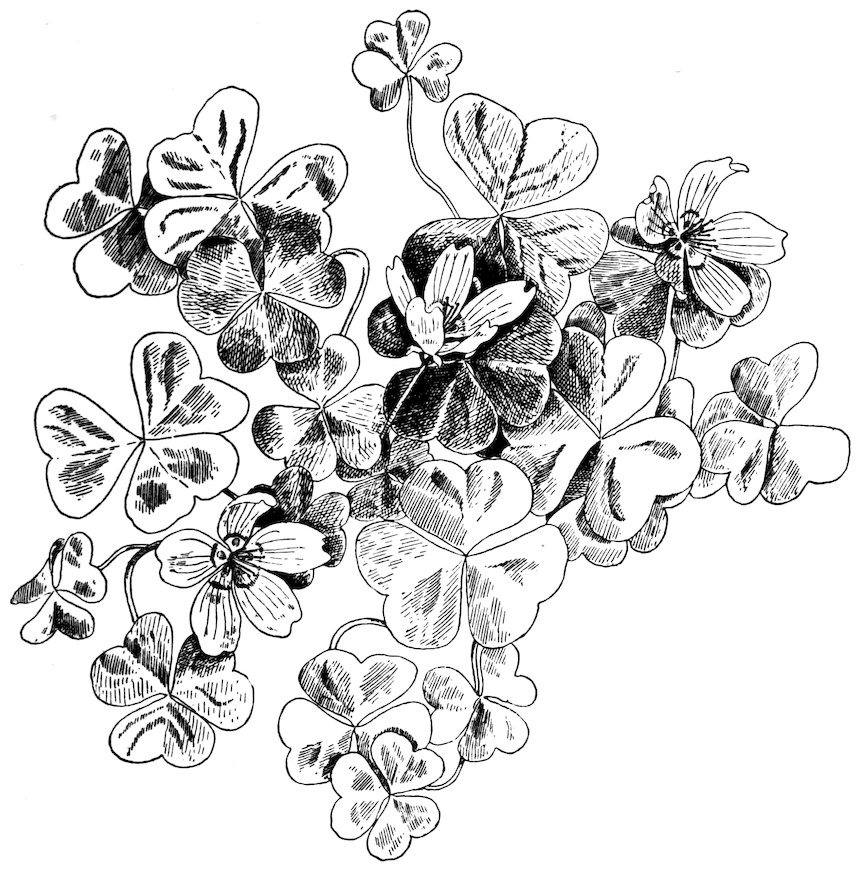
PLATE XVII
WOOD SORREL.—O. Acetosella.
64Our name sorrel is from the Greek for sour and has reference
to the acrid juice of the plant. The delicate leaflets “sleep” at
night; that is, they droop and close one against another.
A shrub from six to eighteen feet high. Leaves.—Divided into seven
to thirteen oblong entire leaflets. Flowers.—Greenish or yellowish-white,
in loose axillary clusters; some perfect, others unisexual. Fruit.—Whitish
or dun-colored, small, globular.
The poison sumach infests swampy places and flowers in
June. In early summer it can be distinguished from the harmless
members of the family by the slender flower-clusters which
grow from the axils of the leaves, those of the innocent sumachs
being borne in pyramidal, terminal clusters. In the later year the
fruits of the respective shrubs are, of course, similarly situated,
but, to accentuate the distinction, they differ in color; that of
the poison sumach being whitish or dun-colored, while that of
the other is crimson.
A shrub or tree from ten to thirty feet high. Leaves.—Divided into
eleven to thirty-one somewhat lance-shaped, toothed leaflets. Flowers.—Greenish
or yellowish-white, in upright terminal clusters, some perfect, others
unisexual, appearing in June. Fruit.—Crimson, small, globular, hairy.
This is the common sumach which illuminates our hill-sides
every autumn with masses of flame-like color. Many of us would
like to decorate our homes with its brilliant sprays, but are deterred
from handling them by the fear of being poisoned, not
knowing that one glance at the crimson fruit-plumes should reassure
us, as the poisonous sumachs are white-fruited. These
tossing pyramidal fruit-clusters at first appear to explain the
common title of staghorn sumach. It is not till the foliage has
disappeared, and the forked branches are displayed in all their
nakedness, that we feel that these must be the feature in which
the common name originated.
65
A shrub which usually climbs by means of rootlets over rocks, walls, and
trees; sometimes low and erect. Leaves.—Divided into three somewhat
four-sided pointed leaflets. Flowers.—Greenish or yellowish-white, small,
some perfect, others unisexual; in loose clusters in the axils of the leaves in
June. Fruit.—Small, globular, somewhat berry-like, dun-colored, clustered.
This much-dreaded plant is often confused with the beautiful
Virginia creeper, occasionally to the ruthless destruction of the
latter. Generally the two can be distinguished by the three-divided
leaves of the poison ivy, the leaves of the Virginia
creeper usually being five-divided. In the late year the whitish
fruit of the ivy easily identifies it, the berries of the creeper being
blackish. The poison ivy is reputed to be especially harmful
during the night, or at any time in early summer when the sun
is not shining upon it.
A woody vine climbing by means of disk-bearing tendrils, and also by
rootlets. Leaves.—Usually divided into five leaflets. Flowers.—Greenish,
small, clustered, appearing in July. Fruit.—A small, blackish berry in October.
Surely in autumn, if not always, this is the most beautiful of
our native climbers. At that season its blood-like sprays are outlined
against the dark evergreens about which they delight to
twine, showing that marvellous discrimination in background
which so constantly excites our admiration in nature. The Virginia
creeper is extensively cultivated in Europe. Even in
Venice, that sea-city where one so little anticipates any reminders
of home woods and meadows, many a dim canal mirrors
in October some crumbling wall or graceful trellis aglow
with its vivid beauty.
66
Scape.—Upright, scaly, terminating in a many-flowered raceme. Leaves.—From
the root, thin and dull, somewhat oval. Flowers.—White, nodding.
Calyx.—Five-parted. Corolla.—Of five rounded, concave petals. Stamens.—Ten.
Pistil.—One, with a long curved style.
In the distance these pretty flowers suggest the lilies-of-the-valley.
They are found in the woods of June and July,
often in close company with the pipsissewa. The ugly common
name of shin-leaf arose from an early custom of applying the
leaves of this genus to bruises or sores; the English peasantry
being in the habit of calling any kind of plaster a “shin-plaster”
without regard to the part of the body to which it might be
applied. The old herbalist, Salmon, says that the name Pyrola
was given to the genus by the Romans on account of the fancied
resemblance of its leaves and flowers to those of a pear-tree.
The English also call the plant “wintergreen,” which name we
usually reserve for Gaultheria procumbens.
P. rotundifolia is a species with thick, shining, rounded leaves.
One to three feet high. Stems.—Shrubby, branching. Leaves.—Oval
or oblong, sprinkled more or less with waxy, resinous atoms. Flowers.—White,
reddish, or purplish, bell-shaped, growing in short, one-sided clusters.
Calyx.—With five short teeth. Corolla.—Bell-shaped, with a five-cleft
border. Stamens.—Ten. Pistil.—One. Fruit.—A black, bloomless, edible
berry.
The flowers of the common huckleberry appear in May or
June; the berries in late summer. The shrub abounds in rocky
woods and swamps.
The blueberry has a bloom which is lacking in the huckleberry.
It is found in swamps or low thickets in late summer.
67
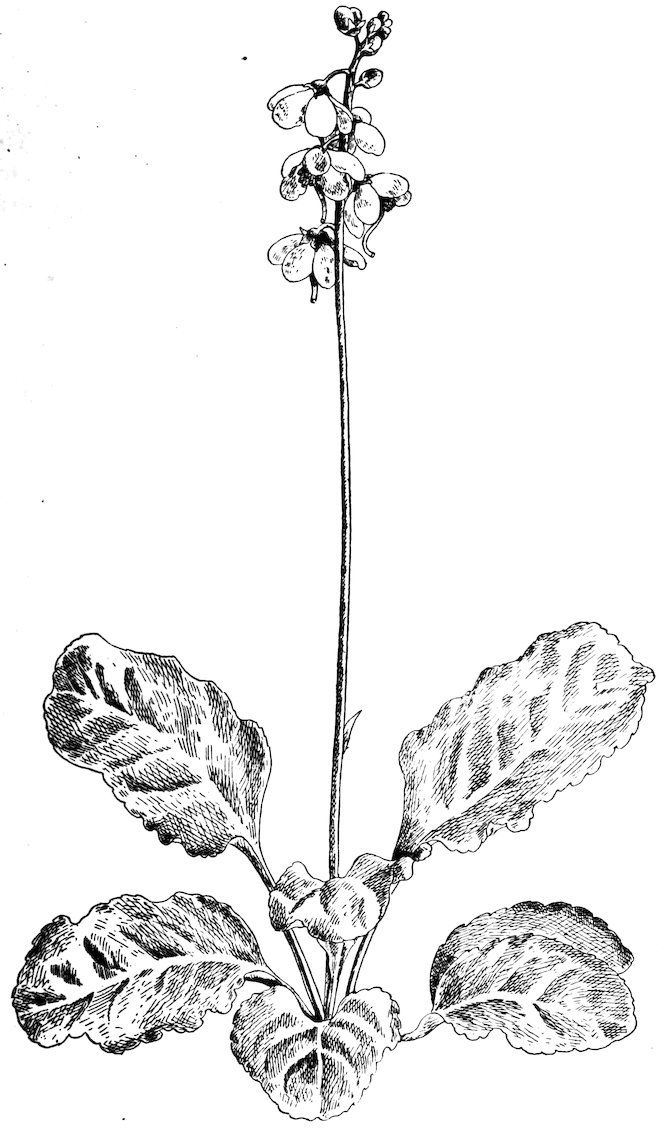
PLATE XVIII
SHIN-LEAF.—P. elliptica.
68
Two or three feet high. Stems.—Diffusely branched.
This large greenish or yellowish berry is hardly edible. The
flowers appear in June, and are easily recognized by their protruding
stamens. The leaves are pale green above and whitish
underneath.
Stem.—Four to ten inches high, leafy. Leaves.—Somewhat whorled or
scattered, evergreen, lance-shaped, with sharply toothed edges. Flowers.—White
or purplish, fragrant, in a loose terminal cluster. Calyx.—Five-lobed.
Corolla.—With five rounded, widely spreading petals. Stamens.—Ten,
with violet anthers. Pistil.—One, with a short top-shaped style and
disk-like stigma.
When strolling through the woods in summer one is apt to
chance upon great patches of these deliciously fragrant and pretty
flowers. The little plant, with its shining evergreen foliage,
flourishes abundantly among decaying leaves in sandy soil, and
puts forth its dainty blossoms late in June. It is one of the latest
of the fragile wood-flowers which are so charming in the earlier
year, and which have already begun to surrender in favor of
their hardier, more self-assertive brethren of the fields and roadsides.
The common name, pipsissewa, is evidently of Indian
origin, and perhaps refers to the strengthening properties which
the red men ascribed to it.
The spotted pipsissewa blossoms a little later than its twin-sister.
Its slightly toothed leaves are conspicuously marked with
white.
69
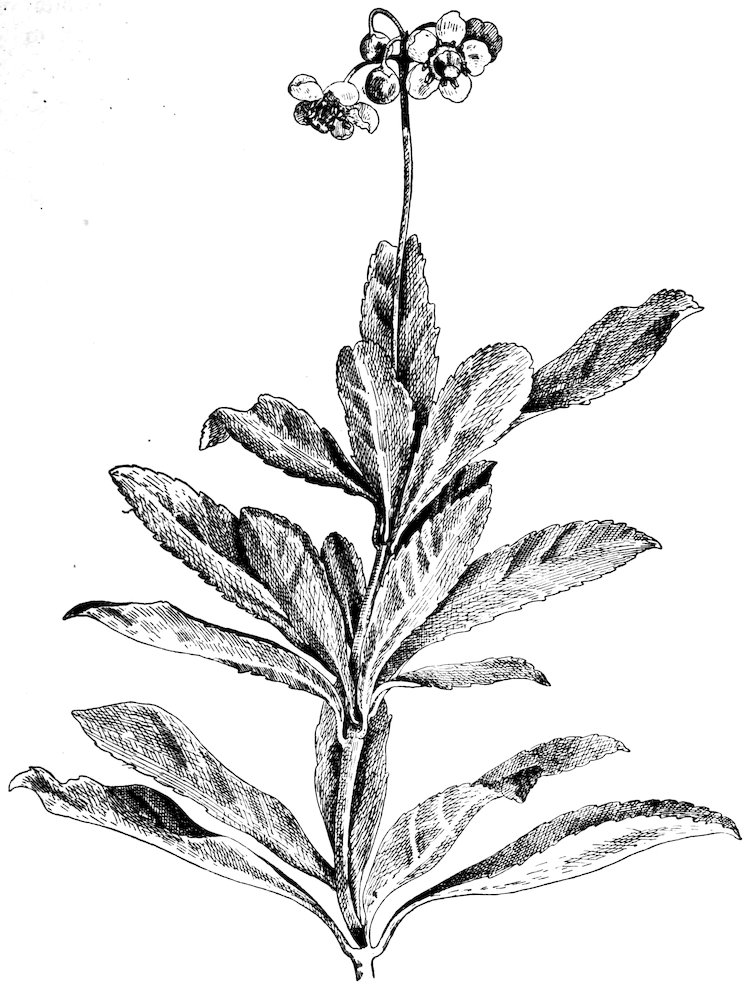
PLATE XIX
PIPSISSEWA.—C. umbellata.
70The common white daisy stars the June meadows with those
gold-centred blossoms which delight the eyes of the beauty-lover
while they make sore the heart of the farmer, for the “whiteweed,”
as he calls it, is hurtful to pasture-land and difficult to
eradicate.
The true daisy is the Bellis perennis of England,—the
Wee, modest crimson-tippit flower
of Burns. This was first called “day’s eye,” because it closed at
night and opened at dawn,—
That well by reason men it call may,
The Daisie, or else the eye of the day,
sang Chaucer nearly four hundred years ago. In England our
flower is called “ox-eye” and “moon daisy;” in Scotland,
“dog-daisy.”
The plant is not native to this country, but was brought from
the Old World by the early colonists.
Stem.—Stout, from three to five feet high, branched, hairy. Leaves.—Coarsely
and sharply toothed, the lowest ovate, the upper narrower. Flower-heads.—Small,
clustered, composed of both ray and disk-flowers, the former
white, purplish, or pinkish, the latter yellow.
During the summer months the fields and waysides are whitened
with these very common flowers which look somewhat like
small white daisies or asters.
Another common species is E. strigosus, a smaller plant, with
smaller flower-heads also, but with the white ray-flowers longer.
The generic name is from two Greek words signifying spring
and an old man, in allusion to the hoariness of certain species
which flower in the spring. The fleabanes were so named from
the belief that when burned they were objectionable to insects.
They were formerly hung in country cottages for the purpose of
excluding such unpleasant intruders.
71
Stem.—Branching. Leaves.—Finely dissected. Flower-heads.—Composed
of white ray and yellow disk-flowers, resembling the common white
daisy.
In midsummer the pretty daisy-like blossoms of this strong-scented
plant are massed along the roadsides. So nearly a
counterpart of the common daisy do they appear that they are
constantly mistaken for that flower. The smaller heads, with
the yellow disk-flowers crowded upon a receptacle which is much
more conical than that of the daisy, and the finely dissected,
feathery leaves, serve to identify the Mayweed. The country-folk
brew “chamomile tea” from these leaves, and through
their agency raise painfully effective blisters in an emergency.
Root.—Dark red. Stem.—Shrubby, one to three feet high. Flowers.—White,
small, clustered. Calyx.—White, petal-like, five-lobed, incurved.
Corolla.—With five long-clawed hooded petals. Stamens.—Five. Pistil.—One,
with three stigmas.
This shrubby plant is very common in dry woods. In
July its white feathery flower-clusters brighten many a shady
nook in an otherwise flowerless neighborhood. During the
Revolution its leaves were used as a substitute for tea.
Stem.—Eight to ten inches high, branching, leafy. Leaves.—Alternate,
oblong, pale. Flowers.—Greenish-white, small, clustered. Calyx.—Bell
or urn-shaped. Corolla.—None. Stamens.—Five. Pistil.—One.
The bastard toadflax is commonly found in dry ground,
flowering in May or June. Its root forms parasitic attachments
to the roots of trees.
72
Stem.—Three to six inches high, slender, leafy at the summit. Leaves.—Oval,
shining, evergreen. Flowers.—White, growing from the axils of
the leaves. Calyx.—Five-lobed. Corolla.—Urn-shaped, with five small
teeth. Stamens.—Ten. Pistil.—One. Fruit.—A globular red berry.
He who seeks the cool shade of the evergreens on a hot July
day is likely to discover the nodding wax-like flowers of this
little plant. They are delicate and pretty, with a background
of shining leaves. These leaves when young have a pleasant
aromatic flavor similar to that of the sweet birch; they are
sometimes used as a substitute for tea. The bright red berries
are also edible and savory, and are much appreciated by the
hungry birds and deer during the winter. If not thus consumed
they remain upon the plant until the following spring when they
either drop or rot upon the stem, thus allowing the seeds to escape.
Stem.—Two to four feet high. Leaves.—Divided into three-toothed leaflets.
Flowers.—Papilionaceous, white, growing in spike-like racemes.
Like its yellow sister, M. officinalis, this plant is found blossoming
along the roadsides throughout the summer. The flowers
are said to serve as flavoring in Gruyère cheese, snuff, and smoking-tobacco,
and to act like camphor when packed with furs to
preserve them from moths, besides imparting a pleasant fragrance.
One to two feet high. Leaves.—Divided into five to seven oblong, pointed,
toothed divisions. Flowers.—White or purplish, in one-sided raceme-like
clusters which are usually coiled from the apex when young. Calyx.—Five-parted.
Corolla.—Five-cleft, bell-shaped. Stamens.—Five, protruding.
Pistil.—One.
This plant is found flowering in summer in the rich woods.
73
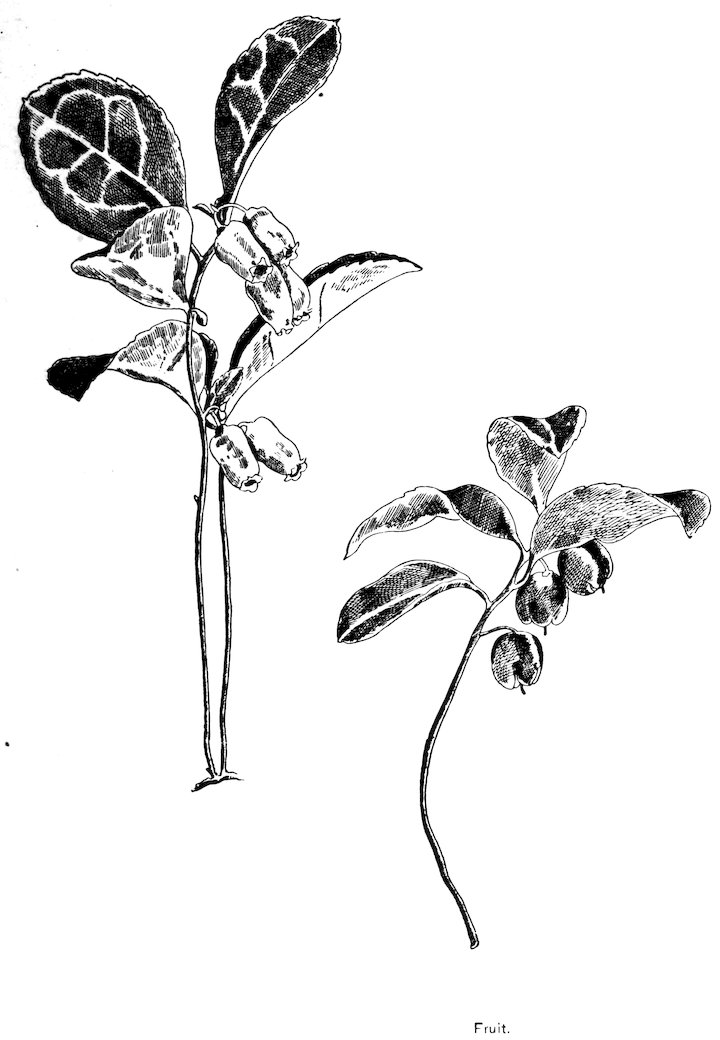
PLATE XX
WINTERGREEN.—G. procumbens.
74
A low fleshy herb from three to eight inches high, without green foliage, of
a wax-like appearance, with colorless bracts in the place of leaves. Flower.—White
or pinkish, single, terminal, nodding. Calyx.—Of two to four
bract-like scales. Corolla.—Of four or five wedge-shaped petals. Stamens.—Eight
or ten, with yellow anthers. Pistil.—One, with a disk-like, four or
five-rayed stigma.
The effect of a cluster of these nodding, wax-like flowers in
the deep woods of summer is singularly fairy-like. They spring
from a ball of matted rootlets, and are parasitic, drawing their
nourishment from decaying vegetable matter. In fruit the plant
erects itself and loses its striking resemblance to a pipe. Its
clammy touch, and its disposition to decompose and turn black
when handled, has earned it the name of corpse-plant. It was
used by the Indians as an eye-lotion, and is still believed by some
to possess healing properties.
Four to eight inches high. Stems.—Slender. Leaves.—Linear or narrowly
lance-shaped. Flowers.—White, large, in terminal clusters. Calyx.—Usually
of five sepals. Corolla.—Usually of five two-lobed petals which
are more than twice the length of the calyx. Stamens.—Twice as many, or
fewer than the petals. Pistil.—One, with as many styles as there are sepals.
This is one of the most noticeable of the chickweeds. Its
starry flowers are found in dry or rocky places, blossoming from
May till July.
The common chickweed, which besets damp places everywhere,
is Stellaria media; this is much used as food for songbirds.
The long-leaved stitchwort, S. longifolia, is a species which
is common in grassy places, especially northward. It has linear
leaves, unlike those of S. media, which are ovate or oblong.
75
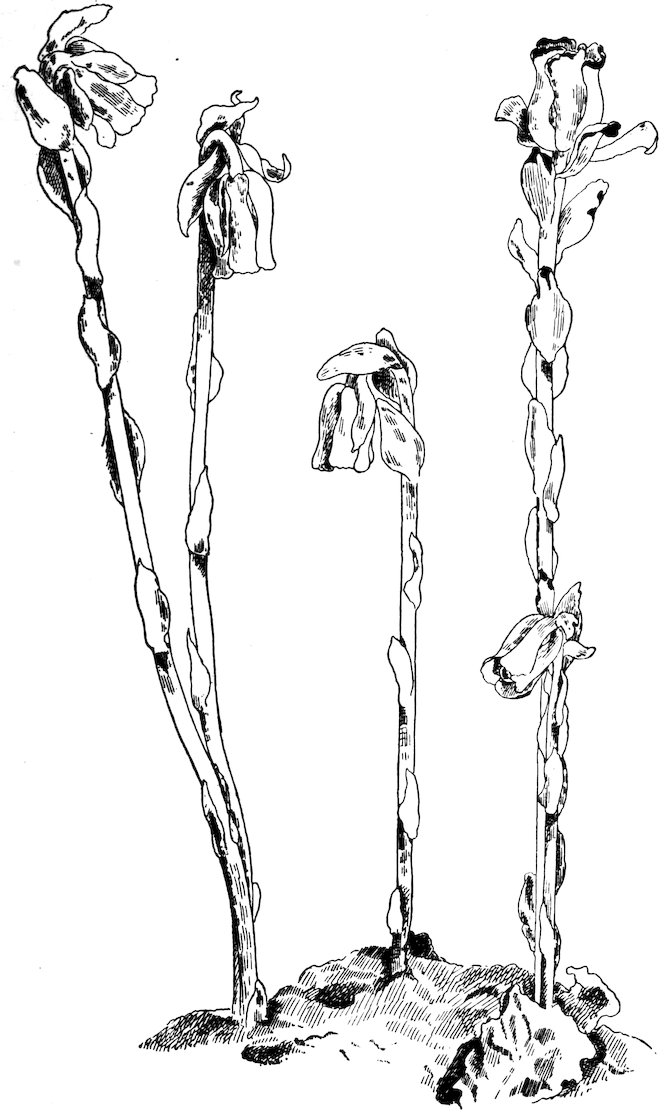
PLATE XXI
INDIAN PIPE.—M. uniflora.
76
Stem.—One or two feet high. Leaves.—Opposite, thin, ovate, slightly
toothed. Flowers.—Dull white, small, growing in a raceme. Calyx.—Two-lobed.
Corolla.—Of two petals. Stamens.—Two. Pistil.—One.
This insignificant and ordinarily uninteresting plant arrests
attention by the frequency with which it is found flowering in
the summer woods and along shady roadsides.
C. Alpina is a smaller, less common species, which is found
along the mountains and in deep woods. Both species are burdened
with the singularly inappropriate name of enchanter’s
nightshade. There is nothing in their appearance to suggest an
enchanter or any of the nightshades. It seems, however, that
the name of a plant called after the enchantress Circe, and described
by Dioscorides nearly two thousand years ago, was accidentally
transferred to this unpretentious genus.
Stem.—Two or three feet high. Leaves.—Twice or thrice cleft, the divisions
again toothed or cleft. Flowers.—Greenish or sometimes white,
borne on long, upright flower-stalks. Calyx.—Of five sepals. Corolla.—None.
Stamens and Pistils.—Indefinite in number.
These greenish flowers, which may be found in the woods and
meadows throughout the summer, are only striking by reason of
their long, erect flower-stalks. The oblong, thimble-like fruit-head,
which is rather noticeable in the later year, gives to the
plant its common name.
Stem.—Weak and reclining, bristly. Leaves.—Lance-shaped, about
eight in a whorl. Flowers.—White, small, growing from the axils of the
leaves. Calyx-teeth.—Obsolete. Corolla.—Usually four-parted, wheel-shaped.
Stamens.—Usually four. Pistil.—One with two styles. Fruit.—Globular,
bristly, with hooked prickles.
This plant may be found in wooded or shady places throughout
the continent. Its flowers, which appear in summer, are
77rather inconspicuous, one’s attention being chiefly attracted by
its many whorls of slender leaves.
Stem.—Woody, twining. Leaves.—Alternate, oblong, finely toothed,
pointed. Flowers.—Small, greenish, or cream-color, in raceme-like clusters,
appearing in June. Pod.—Orange-colored, globular, and berry-like, curling
back in three divisions when ripe so as to display the scarlet covering of the
seeds within.
The small flowers of the bitter-sweet, which appear in June,
rarely attract attention. But in October no lover of color can
fail to admire the deep orange pods which at last curl back so as
advantageously to display the brilliant scarlet covering of the
seeds. Perhaps we have no fruit which illuminates more vividly
the roadside thicket of late autumn; or touches with greater
warmth those tumbled, overgrown walls which are so picturesque
a feature in parts of the country, and do in a small way for our
quiet landscapes what vine-covered ruins accomplish for the scenery
of the Old World.
Stem.—Straight and tall, from two to six feet high. Leaves.—Whorled,
lance-shaped, finely toothed. Flowers.—White, small, growing in slender
clustered spikes. Calyx.—Irregularly four or five-toothed. Corolla.—Four
or five-lobed. Stamens.—Two, protruding. Pistil.—One.
The tall straight stems of the culver’s root lift their slender
spikes in midsummer to a height that seems strangely at variance
with the habit of this genus. The small flowers, however, at
once betray their kinship with the speedwells. Although it is,
perhaps, a little late to look for the white wands of the black
cohosh the two plants might easily be confused in the distance,
as they have much the same aspect and seek alike the cool recesses
of the woods. This same species grows in Japan and was
introduced into English gardens nearly two hundred years ago.
It is one of the many Indian remedies which were adopted by
our forefathers.
78
Stem.—Three to eight feet high. Leaves.—Divided, the leaflets toothed
or incised. Flowers.—White, growing in elongated wand-like racemes.
Calyx.—Of four or five white petal-like sepals, falling early. Corolla.—Of
from one to eight white petals or transformed stamens. Stamens.—Numerous,
with slender white filaments. Pistils.—One to three.
The tall white wands of the black cohosh shoot up in the
shadowy woods of midsummer like so many ghosts. A curious-looking
plant it is, bearing aloft the feathery flowers which have
such an unpleasant odor that even the insects are supposed to
avoid them. Fortunately they are sufficiently conspicuous to be
admired at a distance, many a newly cleared hill-side and wood-border
being lightened by their slender, torch-like racemes which
flash upon us as we travel through the country. The plant was
one of the many which the Indians believed to be efficacious for
snake-bites. The generic name is from cimex—a bug, and fugare—to
drive away.
Stems.—Scarcely woody, five to ten feet high. Leaves.—Divided into
toothed leaflets. Flowers.—White, small, in flat-topped clusters. Calyx.—Lobes
minute or none. Corolla.—With five spreading lobes. Stamens.—Five.
Pistil.—One, with three stigmas. Fruit.—Dark purple, berry-like.
The common elder borders the lanes and streams with its
spreading flower-clusters in early summer, and in the later year
is noticeable for the dark berries from which “elderberry wine”
is brewed by the country people. The fine white wood is easily
cut and is used for skewers and pegs. A decoction of the leaves
serves the gardener a good purpose in protecting delicate plants
from caterpillars. Evelyn wrote of it: “If the medicinal properties
of the leaves, berries, bark, etc., were thoroughly known,
I cannot tell what our countrymen could ail for which he might
not fetch from every hedge, whether from sickness or wound.”
The white pith can easily be removed from the stems, hence
the old English name of bore-wood.
79
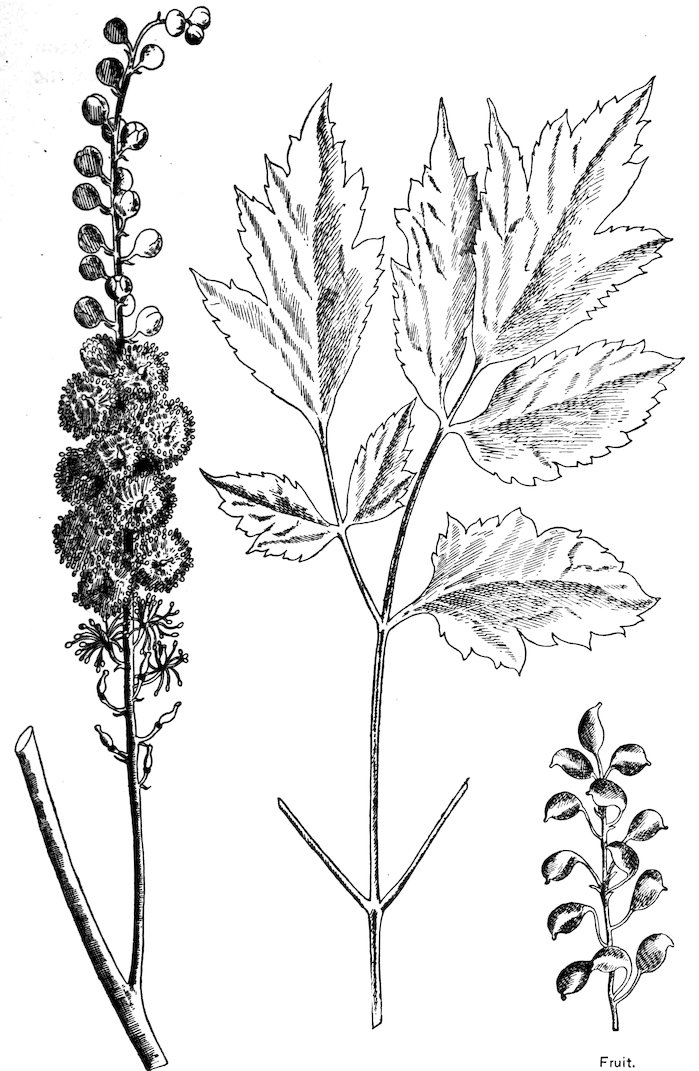
PLATE XXII
BLACK COHOSH.—C. racemosa.
80The name elder is probably derived from the Anglo-Saxon
aeld—a fire—and is thought to refer to the former use of the
hollow branches in blowing up a fire.
Stem.—Two or three feet high. Leaves.—Ovate, lance-shaped or linear.
Flowers.—Clustered within the usually five-lobed, cup-shaped involucre
which was formerly considered the flower itself; the male flowers numerous
and lining its base, consisting each of a single stamen; the female flower
solitary in the middle of the involucre, consisting of a three-lobed ovary
with three styles, each style being two-cleft. Pod.—On a slender stalk,
smooth.
In this plant the showy white appendages of the cup-shaped
clustered involucres are usually taken for the petals of the flower;
only the botanist suspecting that the minute organs within these
involucres really form a cluster of separate flowers of different
sexes. While the most northerly range in the Eastern States of
this spurge is usually considered to be New York, the botany
states that it has been recently naturalized in Massachusetts. It
blossoms from July till October.
Stems.—Smooth and trailing. Leaves.—Rounded, evergreen, veined
with white. Flowers.—White, fragrant, in pairs. Calyx.—Four-toothed.
Corolla.—Funnel-form, with four spreading lobes, bearded within. Stamens.—Four.
Pistil.—One, its ovary united with that of its sister flower, its
four stigmas linear.
At all times of the year this little plant faithfully fulfils its
mission of adorning that small portion of the earth to which it
finds itself rooted. But only the early summer finds the partridge
vine exhaling its delicious fragrance from the delicate sister-blossoms
which are its glory. Among the waxy flowers will be
found as many of the bright red berries of the previous year as
have been left unmolested by the hungry winter birds. This
plant is found not only in the moist woods of North America,
but also in the forests of Mexico and Japan. It is a near relative
of the dainty bluets or Quaker ladies, and has the same peculiarity
of dimorphous flowers (p. 232).
81
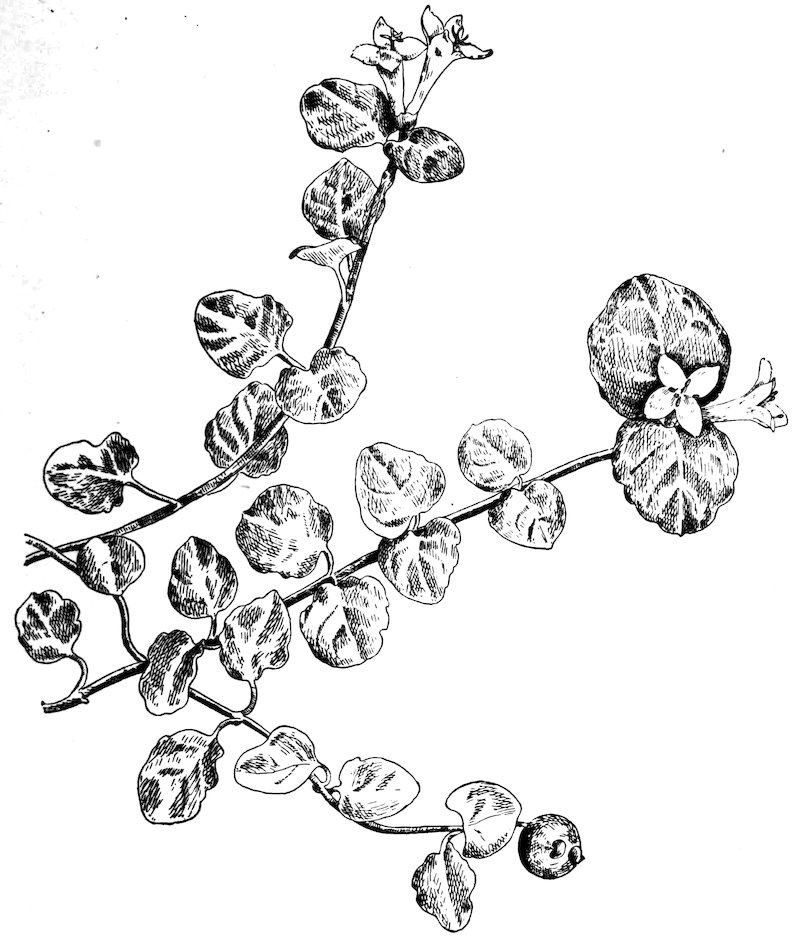
PLATE XXIII
PARTRIDGE VINE.—M. repens.
82
Leaves.—Oblong or lance-shaped. Flowers.—Greenish or yellowish-white,
growing in a spike.
These two orchids are found in wet boggy places during the
earlier summer, the green antedating the ragged fringed orchis
by a week or more. The lip of the ragged fringed is three-parted,
the divisions being deeply fringed, giving what is called
in Sweet’s “British Flower-Garden” an “elegantly jagged appearance.”
The lip of the green orchis is furnished with a tooth
on each side and a strong protuberance in the middle. So far
as superficial beauty and conspicuousness are concerned these
flowers do scant justice to the brilliant family to which they belong,
and equally excite the scornful exclamation, “You call
that an orchid!” when brought home for analysis or preservation.
A shrub three to eight feet high. Leaves.—Opposite or whorled in threes,
somewhat oblong and pointed. Flowers.—Small, white, closely crowded in
round button-like heads. Calyx.—Four-toothed. Corolla.—Four-toothed.
Stamens.—Four. Pistil.—One, with a thread-like protruding style and
blunt stigma.
This pretty shrub borders the streams and swamps throughout
the country. Its button-like flower-clusters appear in midsummer.
It belongs to the family of which the delicate bluet and
fragrant partridge vine are also members. Its flowers have a jasmine-like
fragrance.
83
Stem.—One to three feet high, smooth, branching. Leaves.—Alternate,
narrowly lance-shaped or oblong. Flowers.—White or flesh-color, small,
growing in erect, slender spikes. Calyx.—Five-parted. Corolla.—None.
Stamens.—Eight. Pistil.—One, usually with three styles.
These rather inconspicuous but very common flowers are
found in moist places and shallow water.
The common knotweed, P. aviculare, which grows in such
abundance in country dooryards and waste places, has slender,
often prostrate, stems, and small greenish flowers, which are clustered
in the axils of the leaves or spiked at the termination of
the stems. This is perhaps the “hindering knotgrass” to which
Shakespeare refers in the “Midsummer Night’s Dream,” so
terming it, not on account of its knotted trailing stems, but because
of the belief that it would hinder the growth of a child. In
Beaumont and Fletcher’s “Coxcomb” the same superstition is
indicated:
We want a boy
Kept under for a year with milk and knotgrass.
It is said that many birds are nourished by the seeds of this
plant.
Stem.—Smooth, twining, and climbing over bushes, eight to twelve feet
high. Leaves.—Heart or arrow-shaped, pointed, alternate. Flowers.—Greenish
or pinkish, in racemes. Calyx.—Five-parted, with colored margins.
Corolla.—None. Stamens.—Usually eight. Pistil.—One, with three
stigmas. Seed-vessel.—Green, three-angled, winged, conspicuous in autumn.
In early summer this plant, which clambers so perseveringly
over the moist thickets which line our country lanes, is comparatively
inconspicuous. The racemes of small greenish flowers are
not calculated to attract one’s attention, and it is late summer or
autumn before the thick clusters of greenish fruit composed of the
84winged seed-vessels arrest one’s notice. At this time the vine is
very beautiful and striking, and one wonders that it could have
escaped detection in the earlier year.
Scape.—Low. Leaves.—Heart-shaped, wavy-toothed. Flowers.—White,
one or two borne on each scape. Calyx.—Deeply five or six-parted, three
of the divisions larger and toothed. Corolla.—Of five petals. Stamens.—Many.
Pistils.—Five to ten.
The foliage of this pretty little plant suggests the violet;
while its white blossom betrays its kinship with the wild strawberry.
It may be found from June till August in woody places,
being one of those flowers which we seek deliberately, whose
charm is never decreased by its being thrust upon us inopportunely.
Who can tell how much the attractiveness of the wild
carrot, the dandelion, or butter-and-eggs would be enhanced
were they so discreet as to withdraw from the common haunts of
men into the shady exclusiveness which causes us to prize many
far less beautiful flowers?
Stem.—Swollen at the joints, about three feet high. Leaves.—Whorled
in fours, oval, taper-pointed. Flowers.—White, in a large pyramidal cluster.
Calyx.—Inflated, five-toothed. Corolla.—Of five deeply fringed petals.
Stamens.—Ten. Pistil.—One, with three styles.
In late July many of our wooded banks are decorated with
the tall stems, whorled leaves, and prettily fringed flowers of the
starry campion.
Closely allied to it is the bladder campion of the fields, S.
Cucubalus, a much smaller plant, with opposite leaves, loosely
clustered white flowers, a greatly inflated calyx, and two-cleft
petals. This is an emigrant from Europe, which was first naturalized
near Boston, and has now become wild in different parts
of the country, quite overrunning some of the farm-lands which
border the Hudson River.
85
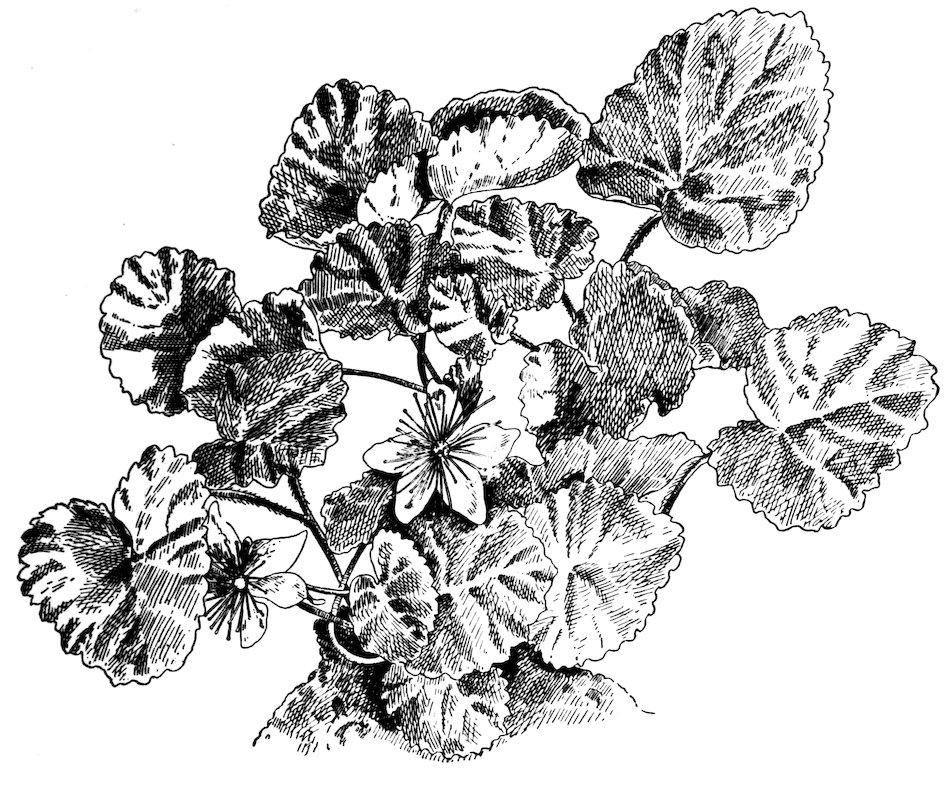
PLATE XXIV
Dalibarda repens.
86
Leaves.—Thin, lance-shaped, in a spreading cluster from the root.
Scape.—Slender, two to three feet high. Flowers.—White, small, growing
in a wand-like, spiked raceme. Perianth.—Six-cleft at the summit, oblong-tubular.
Stamens.—Six. Pistil.—One, with style three-cleft at apex.
In summer we find these flowers in the grassy woods. The
generic title is the Greek word for “a female slave who grinds
corn,” and refers to the mealy appearance of the blossoms.
Four to eight feet high. Leaves.—Divided into many firm, rounded leaflets.
Flowers.—White, in large clusters; some perfect, others unisexual.
Calyx.—Of four or five small petal-like sepals which usually fall off very
early. Corolla.—None. Stamens.—Numerous. Pistils.—Four to fifteen.
Where a stream trails its sluggish length through the fields
of midsummer, its way is oftentimes marked by the tall meadow
rue, the feathery, graceful flower-clusters of which erect themselves
serenely above the myriad blossoms which are making
radiant the wet meadows at this season. For here, too, we
may search for the purple flag and fringed orchis, the yellow
meadow lily, the pink swamp milkweed, each charming in its
way, but none with the cool chaste beauty of the meadow rue.
The staminate flowers of this plant are especially delicate and
feathery.
Stem.—Slender, about two feet high. Root-leaves.—Divided into from
three to five leaflets, or entire. Stem-leaves.—Three-lobed or divided, or
only toothed. Flowers.—White. Calyx.—Deeply five-cleft, usually with
five small bractlets alternating with its lobes. Corolla.—Of five petals.
Stamens.—Numerous. Pistils.—Numerous, with hooked styles which become
elongated in fruit.
The white avens is one of the less noticeable plants which
border the summer woods, blossoming from May till August.
Later the hooked seeds which grow in round burr-like heads
secure wide dispersion by attaching themselves to animals or
clothing. Other species of avens have more conspicuous golden-yellow
flowers.
87
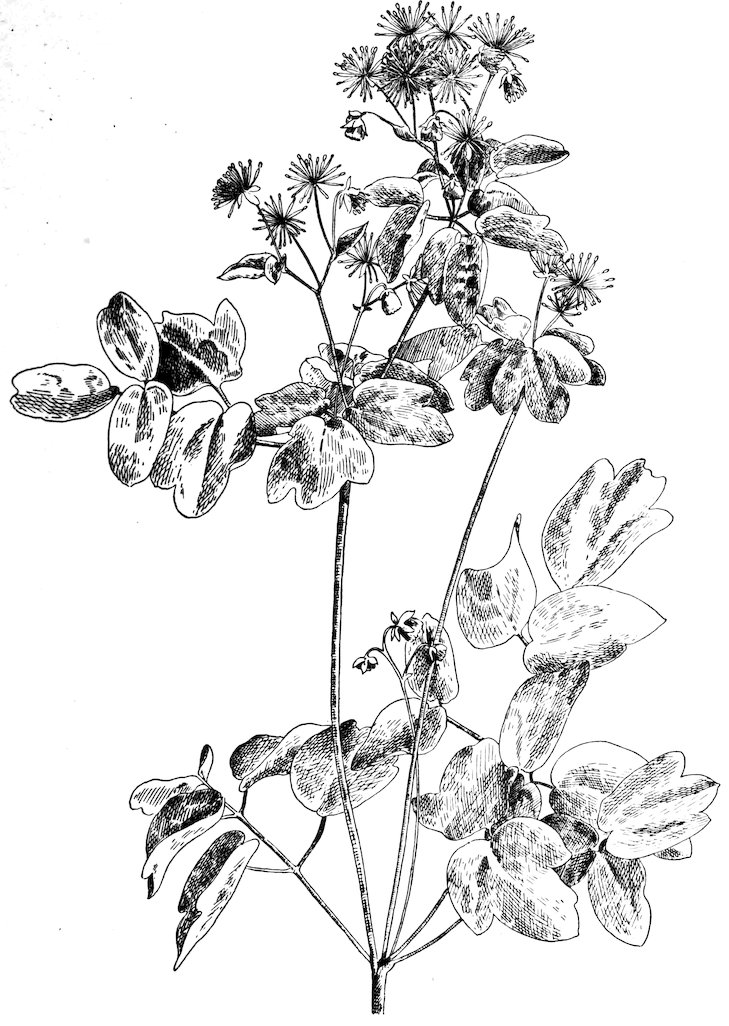
PLATE XXV
TALL MEADOW RUE.—T. polygamum.
88
Stem.—Nearly smooth, two or three feet high. Leaves.—Alternate,
somewhat lance-shaped, toothed. Flowers.—Small, white or flesh-color, in
pyramidal clusters. Calyx.—Five-cleft. Corolla.—Of five rounded petals.
Stamens.—Numerous. Pistils.—Five to eight.
The feathery spires of the meadow-sweet soar upward from
the river banks and low meadows in late July. Unlike its pink
sister, the steeple-bush, its leaves and stems are fairly smooth.
The lack of fragrance in the flowers is disappointing, because of
the hopes raised by the plant’s common name. This is said by
Dr. Prior to be a corruption of the Anglo-Saxon mead-wort,
which signifies honey-wine herb, alluding to a fact which is mentioned
in Hill’s “Herbal,” that “the flowers mixed with mead
give it the flavor of the Greek wines.”
Although the significance of many of the plant-names seems
clear enough at first sight, such an example as this serves to
show how really obscure it often is.
Leaves.—Rounded, somewhat heart-shaped, floating on the surface of
the water. Flowers.—Large, white, or sometimes pink, fragrant. Calyx.—Of
four sepals which are green without. Corolla.—Of many petals. Stamens.—Indefinite
in number. Pistil.—With a many-celled ovary whose
summit is tipped with a globular projection around which are the radiating
stigmas.
This exquisite flower calls for little description. Many of us
are so fortunate as to hold in our memories golden mornings devoted
to its quest. We can hardly take the shortest railway
journey in summer without passing some shadowy pool whose
greatest adornment is this spotless and queenly blossom. The
breath of the lily-pond is brought even into the heart of our cities
where dark-eyed little Italians peddle clusters of the long-stemmed
fragrant flowers about the streets.
89
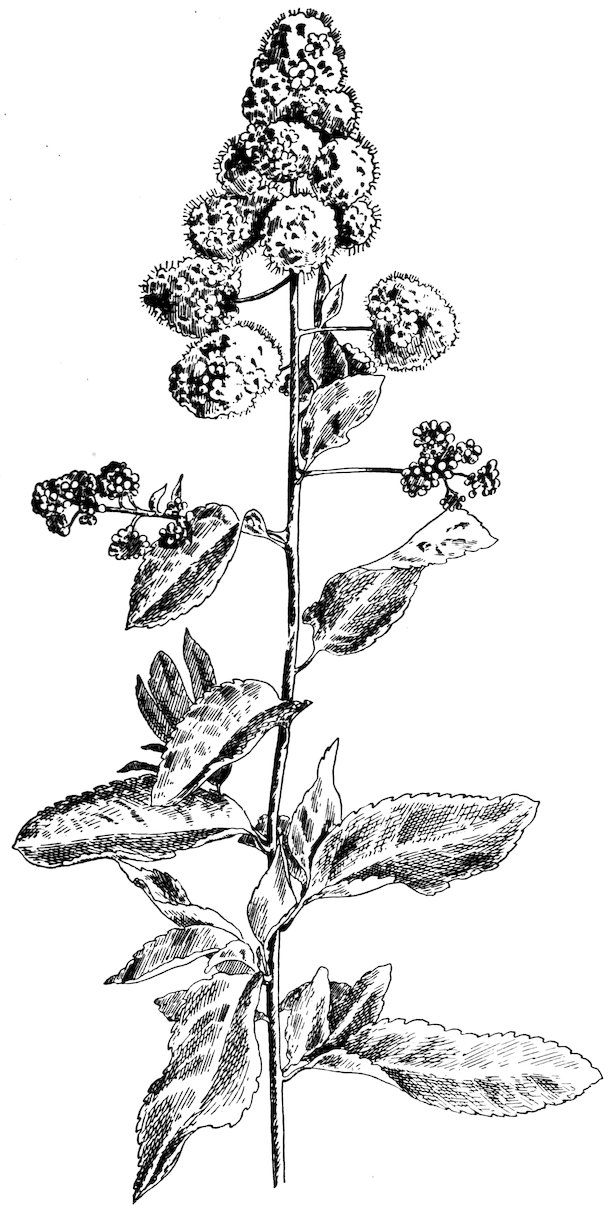
PLATE XXVI
MEADOW-SWEET.—S. salicifolia.
90In the water-lily may be seen an example of so-called plant-metamorphosis.
The petals appear to pass gradually into stamens,
it being difficult to decide where the petals end and the
stamens begin. But whether stamens are transformed petals, or
petals transformed stamens seems to be a mooted question. In
Gray we read, “Petals numerous, in many rows, the innermost
gradually passing into stamens,” while Mr. Grant Allen writes:
“Petals are in all probability enlarged and flattened stamens,
which have been set apart for the work of attracting insects,”
and goes on to say, “Flowers can and do exist without petals, ... but no flower can possibly exist without stamens, which
are one of the two essential reproductive organs in the plant.”
From this he argues that it is more rational to consider a petal a
transformed stamen than vice versa. To go further into the subject
here would be impossible, but a careful study of the water-lily
is likely to excite one’s curiosity in the matter.
Three to five feet high. Leaves.—Oval, coarsely toothed. Flowers.—Small,
white, in slender spikes, otherwise resembling Purple Vervain.
It almost excites one’s incredulity to be told that this uninteresting
looking plant, which grows rankly along the highways,
is an importation from the tropics, yet for this statement the
botany is responsible.
Scape.—A few inches high. Leaves.—Rounded, abruptly narrowed into
spreading, hairy leaf-stalks; beset with reddish, gland-bearing bristles.
Flowers.—White, growing in a one-sided raceme, which so nods at its apex
that the fresh-blown blossom is always uppermost. Calyx.—Of five sepals.
91Corolla.—Of five petals. Pistil.—One, with three or five styles, which are
sometimes so deeply two-parted as to be taken for twice as many.
What’s this I hear
About the new carnivora?
Can little plants
Eat bugs and ants
And gnats and flies?
A sort of retrograding:
Surely the fare
Of flowers is air,
Or sunshine sweet;
They shouldn’t eat,
Or do aught so degrading!
But by degrees we are learning to reconcile ourselves to the
fact that the more we study the plants the less we are able to attribute
to them altogether unfamiliar and ethereal habits. We
find that the laws which control their being are strangely suggestive
of those which regulate ours, and after the disappearance
of the shock which attends the shattered illusion, their charm is
only increased by the new sense of kinship.
The round-leaved sundew is found blossoming in many of
our marshes in midsummer. When the sun shines upon its
leaves they look as though covered with sparkling dewdrops,
hence its common name. These drops are a glutinous exudation,
by means of which insects visiting the plant are first captured;
the reddish bristles then close tightly about them, and it
is supposed that their juices are absorbed by the plant. At all
events the rash visitor rarely escapes. In many localities it is
easy to secure any number of these little plants and to try for
one’s self the rather grewsome experiment of feeding them with
small insects. Should the tender-hearted recoil from such reckless
slaughter, they might confine their offerings on the altar of
science to mosquitoes, small spiders, and other deservedly unpopular
creatures.
D. Americana is a very similar species, with longer, narrower
leaves.
The thread-leaved sundew, D. filiformis has fine, thread-like
leaves and pink flowers, and is found in wet sand along the
coast.
92
Stems.—In length from six to ten feet high; purple-pink or bright red,
stout. Leaves.—Large, alternate, veiny. Flowers.—White or pinkish, the
green ovaries conspicuous, growing in racemes. Calyx.—Of five rounded
or petal-like sepals, pinkish without. Corolla.—None. Stamens.—Ten.
Pistil.—One, with ten styles. Fruit.—A dark purplish berry.
There is a vigor about this native plant which is very pleasing.
In July it is possible that we barely notice the white flowers
and large leaves; but when in September the tall purple
stems rear themselves above their neighbors in the roadside
thicket, the leaves look as though stained with wine, and the
long clusters of rich dark berries hang heavily from the branches,
we cannot but admire its independent beauty. The berries serve
as food for the birds. A tincture of them at one time acquired
some reputation as a remedy for rheumatism. In Pennsylvania
they have been used with whiskey to make a so-called “portwine.”
From their dark juice arose the name of “red-ink
plant,” which is common in some places. The large roots are
poisonous, but the acrid young shoots are rendered harmless by
boiling, and are eaten like asparagus, being quite as good, I have
been told by country people.
Despite the difference in the spelling of the names, it has
been suggested that the plant was called after President Polk.
This is most improbable, as it was common throughout the
country long before his birth, and its twigs are said to have been
plucked and worn by his followers during his campaign for the
Presidency.
About one foot high. Leaves.—Oblong or lance-shaped, the upper passing
into pointed bracts. Flowers.—Pure white, with a slender spur and
fringed lip; growing in an oblong spike.
93
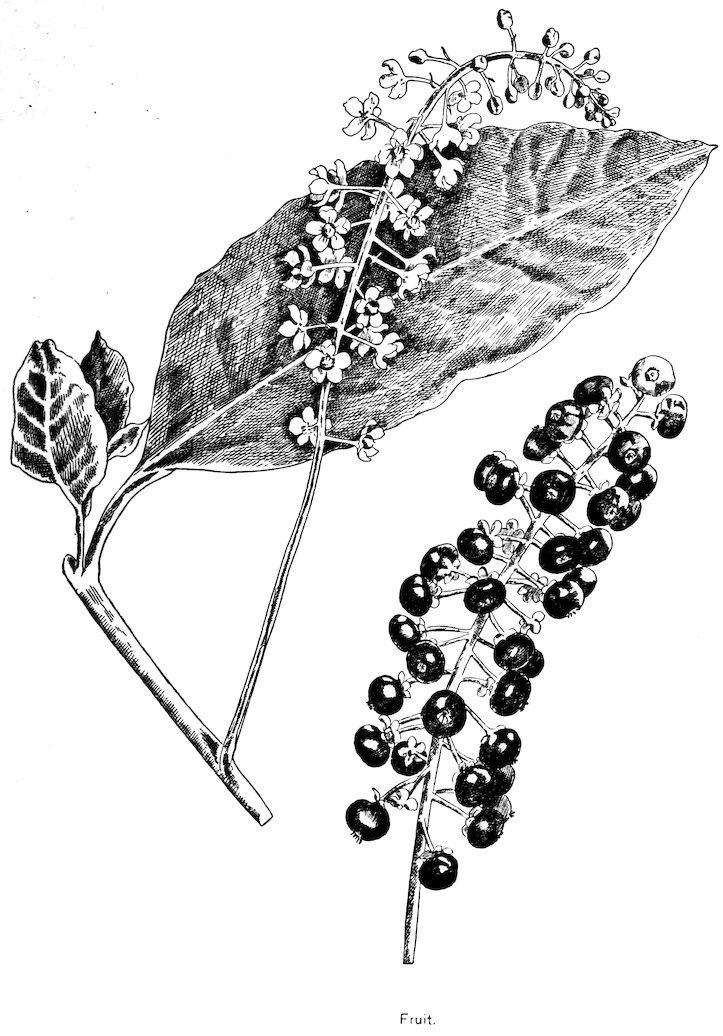
PLATE XXVII
POKEWEED.—P. decandra.
94This seems to me the most exquisite of our native orchids.
The fringed lips give the snowy, delicate flowers a feathery appearance
as they gleam from the shadowy woods of midsummer,
or from the peat-bogs where they thrive best; or perhaps they
spire upward from among the dark green rushes which border
some lonely mountain lake. Like the yellow fringed orchis (Pl.
LII), which they greatly resemble in general structure, they may
be sought in vain for many seasons and then will be discovered
one midsummer day lavishing their spotless loveliness upon some
unsuspected marsh which has chanced to escape our vigilance.
Scape.—Six to twelve inches high. Leaves.—From the root in a sort of
flat rosette; conspicuously veined with white; thickish, evergreen. Flowers.—Small,
greenish-white, crowded in a close spike.
The flowers of the rattlesnake-plantain appear in late summer
and are less conspicuous than the prettily tufted, white-veined
leaves which may be found in the rich woods throughout
the year. The plant has been reputed an infallible cure for
hydrophobia and snake-bites. It is said that the Indians had
such faith in its remedial virtues that they would allow a snake
to drive its fangs into them for a small sum, if they had these
leaves on hand to apply to the wound.
Stem.—Simple at first, often branching near the summit. Leaves.—Divided
into finely toothed segments. Flower-heads.—White, occasionally
pink, clustered, small, made up of both ray and disk-flowers.
95
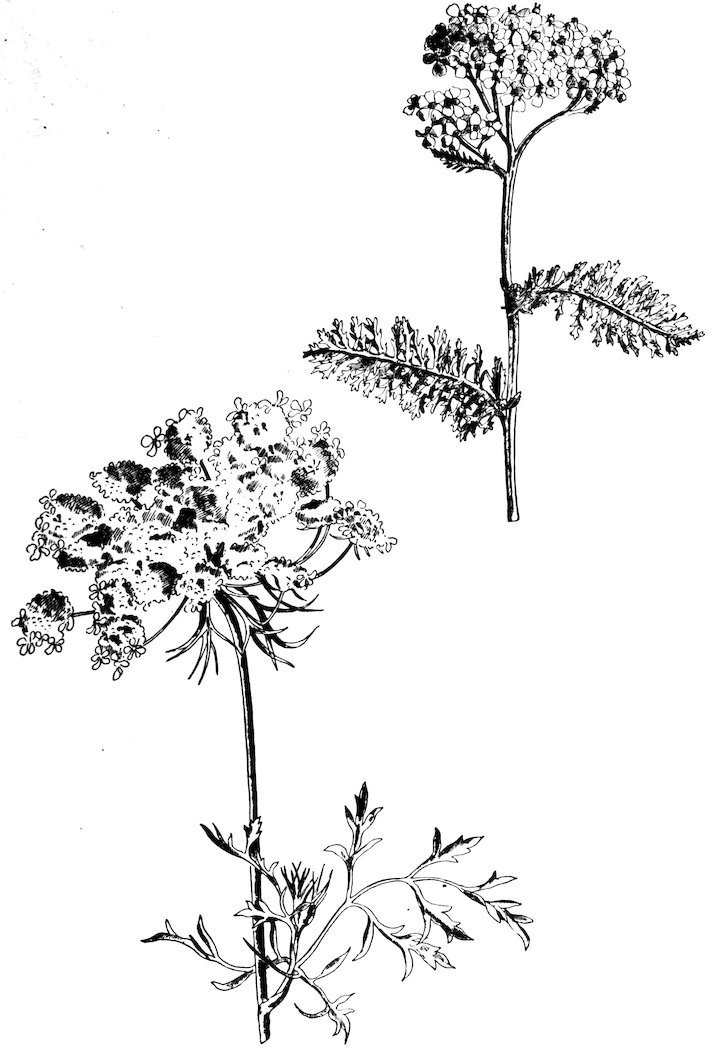
PLATE XXVIII
WILD CARROT.—D. carota. YARROW.—A. millefolium.
96This is one of our most frequent roadside weeds, blossoming
throughout the summer and late into the autumn. Tradition claims
that it was used by Achilles to cure the wounds of his soldiers,
and the genus is named after that mighty hero. It still forms
one of the ingredients of an ointment valued by the Scotch Highlanders.
The early English botanists called the plant “nosebleed,”
“because the leaves being put into the nose caused it to
bleed;” and Gerarde writes that “Most men say that the leaves
chewed, and especially greene, are a remedie for the toothache.”
These same pungent leaves also won it the name of “old man’s
pepper,” while in Sweden its title signifies field hop, and refers
to its employment in the manufacture of beer. Linnæus
considered the beer thus brewed to be more intoxicating than
that in which hops were utilized. The old women of the Orkney
Islands hold “milfoil tea” in high repute, believing it to be
gifted with the power of dispelling melancholy. In Switzerland
a good vinegar is said to be made from the Alpine species.
The plant is cultivated in the gardens of Madeira, where so
many beautiful, and in our eyes rare, flowers grow in wild
profusion.
Stems.—Tall and slender. Leaves.—Finely dissected. Flowers.—White,
in a compound umbel, forming a circular flat-topped cluster.
When the delicate flowers of the wild carrot are still unsoiled
by the dust from the highway, and fresh from the early summer
rains, they are very beautiful, adding much to the appearance of
the roadsides and fields along which they grow so abundantly as
to strike despair into the heart of the farmer, for this is, perhaps,
the “peskiest” of all the weeds with which he has to contend.
As time goes on the blossoms begin to have a careworn
look and lose something of the cobwebby aspect which won them
the title of Queen Anne’s lace. In late summer the flower-stalks
erect themselves, forming a concave cluster which has the
appearance of a bird’s nest. I have read that a species of bee
makes use of this ready-made home, but have never seen any indications
of such an occupancy.
This is believed to be the stock from which the garden carrot
was raised. The vegetable was well known to the ancients, and
we learn from Pliny that the finest specimens were brought to
Rome from Candia. When it was first introduced into Great
Britain is not known, although the supposition is that it was
brought over by the Dutch during the reign of Elizabeth. In
the writings of Parkinson we read that the ladies wore carrot-leaves
97in their hair in place of feathers. One can picture the
dejected appearance of a ball-room belle at the close of an entertainment.
Stem.—Smooth, stout, from two to six feet high, streaked with purple.
Leaves.—Twice or thrice-compound, leaflets coarsely toothed. Flowers.—White,
in compound umbels, the little umbels composed of numerous flowers.
This plant is often confused with the wild carrot, the sweet
Cicely, and other white-flowered members of the Parsley family;
but it can usually be identified by its purple-streaked stem. The
umbels of the water-hemlock are also more loosely clustered than
those of the carrot, and their stalks are much more unequal. It
is commonly found in marshy ground, blossoming in midsummer.
Its popular names refer to its poisonous properties, its root being
said to contain the most dangerous vegetable-poison native to our
country and to have been frequently confounded with that of the
edible sweet Cicely with fatal results.
One or two feet high, occasionally much taller. Stems.—Branching.
Leaves.—Dissected into fine, thread-like divisions. Flowers.—White, very
small, growing in compound umbels with thread-like bracts.
This plant blossoms all summer in wet meadows, both inland
and along the coast; but it is especially common in the salt marshes
near New York City. It probably owes its English name
to the fancied resemblance between the bracted flower-clusters
and a bishop’s cap. Its effect is feathery and delicate.
One to three feet high. Root.—Thick, aromatic, edible. Leaves.—Twice
or thrice-compound. Flowers.—White, growing in a few-rayed compound
umbel.
The roots of the sweet Cicely are prized by country children
for their pleasant flavor. Great care should be taken not to confound
98this plant with the water-hemlock, which is very poisonous,
and which it greatly resembles, although flowering earlier in the
year. The generic name is from two Greek words which signify
scent and root.
Two to six feet high. Stem.—Stout. Leaves.—Divided into from three
to eight pairs of sharply toothed leaflets. Flowers.—White, in compound
umbels.
This plant is found growing in water or wet places throughout
North America.
Scape.—A few inches to several feet high. Leaves.—Arrow-shaped.
Flowers.—White, unisexual, in whorls of three on the leafless scape. Calyx.—Of
three sepals. Corolla.—Of three white, rounded petals. Stamens and
Pistils.—Indefinite in number, occurring in different flowers, the lower whorls
of flowers usually being pistillate, the upper staminate.
Among our water-flowers none are more delicately lovely than
those of the arrow-head. Fortunately the ugly and inconspicuous
female flowers grow on the lower whorls, while the male
ones, with their snowy petals and golden centres, are arranged
about the upper part of the scape, where the eye first falls. It is
a pleasure to chance upon a slow stream whose margins are bordered
with these fragile blossoms and bright, arrow-shaped leaves.
Scape.—One to three feet high, bearing the flowers in whorled, panicled
branches. Leaves.—From the root, oblong, lance-shaped or linear, mostly
rounded or heart-shaped at base. Flowers.—White or pale pink, small,
in large, loose clusters which branch from the scape. Calyx.—Of three sepals.
Corolla.—Of three petals. Stamens.—Usually six. Pistils.—Many,
on a flattened receptacle.
The water-plantain is nearly related to the arrow-head, and
is often found blossoming with it in marshy places or shallow
water.
99
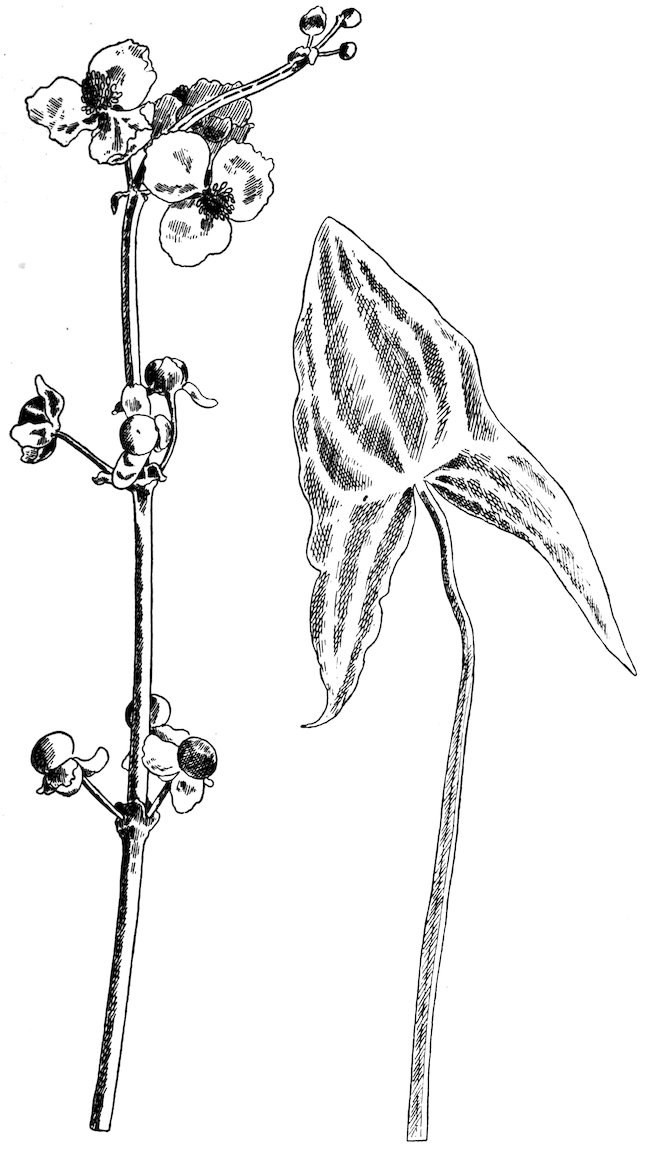
PLATE XXIX
ARROW-HEAD.—S. variabilis.
100
A strong-scented, low, much branched and spreading herb. Leaves.—Somewhat
oblong or heart-shaped, wavy-toothed. Flowers.—Greenish or
yellowish-white, solitary on nodding flower-stalks. Calyx.—Five-cleft; enlarging
and much inflated in fruit, loosely enclosing the berry. Corolla.—Between
wheel-shaped and funnel-form. Stamens.—Five, erect, with yellow
anthers. Pistil.—One. Fruit.—A green or yellow edible berry which
is loosely enveloped in the much-inflated calyx.
We find the ground cherry in light sandy soil, and are more
apt to notice the loosely enveloped berry of the late year than
the rather inconspicuous flowers which appear in summer.
One to seven feet high. Stem.—Smooth, upright, branching. Leaves.—Opposite,
lance-shaped, toothed. Flowers.—White or pinkish, growing
in a spike or close cluster. Calyx.—Of five sepals. Corolla.—Two-lipped,
the upper lip broad and arched, notched at the apex, lower lip three-lobed at
the apex, woolly bearded in the throat. Stamens.—Four perfect ones, with
woolly filaments and very woolly, heart-shaped anthers, and one small sterile
one. Pistil.—One.
It seems to have been my fate to find the flowers which the
botany relegates to “dry, sandy soil” flourishing luxuriantly in
marshes; and to encounter the flowers which by rights belong
to “wet woods” flaunting themselves in sunny meadows. This
cannot be attributed to the natural depravity of inanimate objects,
for what is more full of life than the flowers?—and no one
would believe in their depravity except perhaps the amateur botanist
who is endeavoring to master the different species of
golden-rods and asters. Therefore it is pleasant to record that
I do not remember ever having met a turtle-head, which is assigned
by the botany to “wet places,” which had not gotten
as close to a stream or a marsh or a moist ditch as it well could
without actually wetting its feet. The flowers of this plant are
more odd and striking than pretty. Their appearance is such
that their common name seems fairly appropriate. I have heard
unbotanical people call them “white closed gentians.”
101
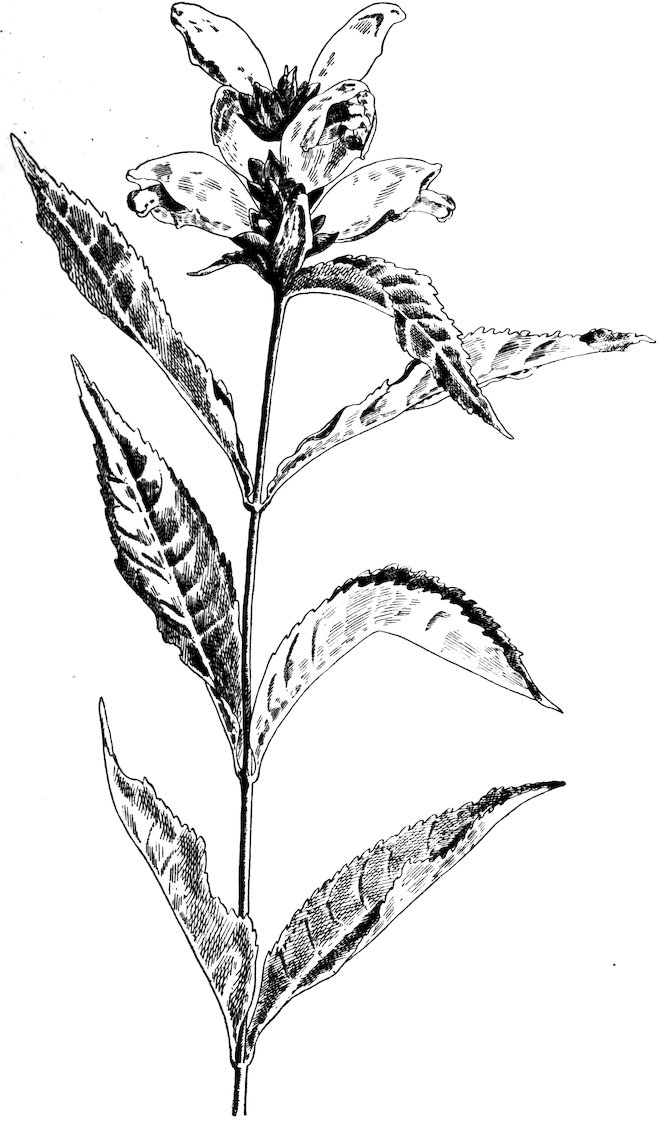
PLATE XXX
TURTLE-HEAD.—C. glabra.
102
Stems.—Yellow or reddish, thread-like, twining, leafless. Flowers.—White,
in close clusters. Calyx.—Five-cleft. Corolla.—With five spreading
lobes. Stamens.—Five. Pistil.—One, with two styles.
Late in the summer we are perhaps tempted deep into some
thicket by the jasmine-scented heads of the button-bush or the
fragrant spikes of the clethra, and note for the first time the tangled
golden threads and close white flower-clusters of the dodder.
If we try to trace to their source these twisted stems, which the
Creoles know as “angels’ hair,” we discover that they are
fastened to the bark of the shrub or plant about which they are
twining by means of small suckers; but nowhere can we find any
connection with the earth, all their nourishment being extracted
from the plant to which they are adhering. Originally this curious
herb sprang from the ground which succored it until it succeeded
in attaching itself to some plant; having accomplished
this it severed all connection with mother-earth by the withering
away or snapping off of the stem below.
The flax-dodder, C. Epilinum, is a very injurious plant in
European flax-fields. It has been sparingly introduced into this
country with flax-seed.
Stem.—Climbing, somewhat woody. Leaves.—Opposite, three-divided.
Flowers.—Whitish, in clusters, unisexual. Calyx.—Of four petal-like sepals.
Corolla.—None. Stamens and Pistils.—Indefinite in number, occurring
on different plants.
In July and August this beautiful plant, covered with its white
blossoms and clambering over the shrubs which border the country
lanes, makes indeed a fitting bower for any maid or traveller
who may chance to be seeking shelter. Later in the year the
seeds with their silvery plumes give a feathery effect which is
very striking.
103
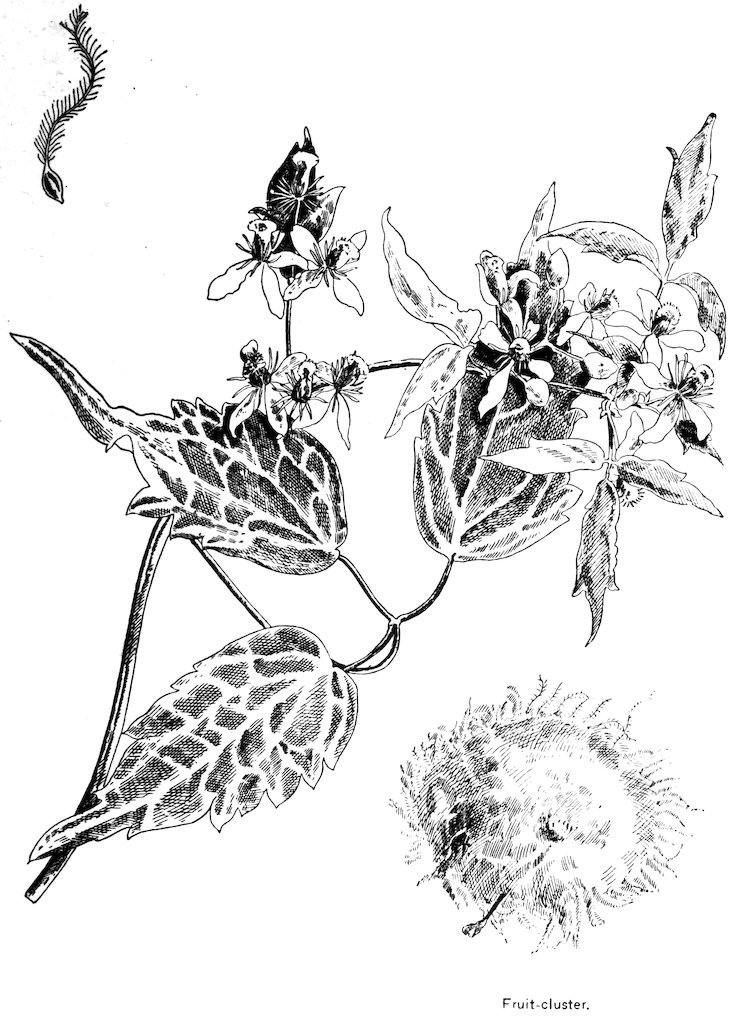
PLATE XXXI
TRAVELLER’S JOY.—Clematis Virginiana.
104This graceful climber works its way by means of its bending
or clasping leaf-stalks. Darwin has made interesting experiments
regarding the movements of the young shoots of the Clematis.
He discovered that, “one revolved describing a broad
oval, in five hours, thirty minutes; and another in six hours,
twelve minutes; they follow the course of the sun.”
A shrub from three to ten feet high. Leaves.—Alternate, ovate, sharply
toothed. Flowers.—White, growing in clustered finger-like racemes.
Calyx.—Of five sepals. Corolla.—Of five oblong petals. Stamens.—Ten,
protruding. Pistil.—One, three-cleft at apex.
Nearly all our flowering shrubs are past their glory by midsummer,
when the fragrant blossoms of the sweet pepperbush begin
to exhale their perfume from the cool thickets which line the
lanes along the New England coast. There is a certain luxuriance
in the vegetation of this part of the country in August
which is generally lacking farther inland, where the fairer flowers
have passed away, and the country begins to show the effects
of the long days of heat and drought. The moisture of the air,
and the peculiar character of the soil near the sea, are responsible
for the freshness and beauty of many of the late flowers which
we find in such a locality.
Clethra is the ancient Greek name for the alder, which this
plant somewhat resembles in foliage.
Stem.—Smooth and branching. Leaves.—Ovate, wavy-toothed or angled.
Flowers.—White, large and showy, on short flower-stalks from the forks of
the branching stem. Calyx.—Five-toothed. Corolla.—Funnel-form, the
border five-toothed. Stamens.—Five. Pistil.—One. Fruit.—Green,
globular, prickly.
The showy white flowers of the thorn-apple are found in waste
places during the summer and autumn, a heap of rubbish forming
their usual unattractive background. The plant is a rank,
ill-scented one, which was introduced into our country from Asia.
105It was so associated with civilization as to be called the “white
man’s plant” by the Indians.
Its purple-flowered relative, D. Tatula, is an emigrant from
the tropics. This genus possesses narcotic-poisonous properties.
Stem.—Climbing, nearly smooth, with three-forked tendrils. Leaves.—Deeply
and sharply five-lobed. Flowers.—Numerous, small, greenish-white,
unisexual; the staminate ones growing in long racemes, the pistillate ones in
small clusters or solitary. Fruit.—Fleshy, oval, green, about two inches
long, clothed with weak prickles.
This is an ornamental climber which is found bearing its
flowers and fruit at the same time. It grows in rich soil along
rivers in parts of New England, Pennsylvania, and westward;
and is often cultivated in gardens, making an effective arbor-vine.
The generic name is from two Greek words which signify
hedgehog and bladder, in reference to the prickly fruit.
Flower-heads.—Composed of white ray-flowers with a centre of yellow
disk-flowers.
While we have far fewer species of white than of blue or
purple asters, some of these few are so abundant in individuals
as to hold their own fairly well against their bright-hued rivals.
The slender zigzag stems, thin, coarsely toothed, heart-shaped
leaves, and white, loosely clustered flower-heads of A.
corymbosus, are noticeable along the shaded roadsides and in the
open woods of August.
Bordering the dry fields at this same season are the spreading
wand-like branches, thickly covered with the tiny flower-heads as
with snowflakes, of A. ericoides.
A. umbellatus is the tall white aster of the swamps and moist
thickets. It sometimes reaches a height of seven feet, and can
be identified by its long tapering leaves and large, flat flower-clusters.
106A beautiful and abundant seaside species is A. multiflorus.
Its small flower-heads are closely crowded on the low, bushy,
spreading branches; its leaves are narrow, rigid, crowded, and
somewhat hoary. The whole effect of the plant is heath-like;
it also somewhat suggests an evergreen.
Stem.—Stout and hairy, two to four feet high. Leaves.—Opposite,
widely spreading, lance-shaped, united at the base around the stem. Flower-heads.—Dull
white, small, composed entirely of tubular blossoms borne in
large clusters.
To one whose childhood was passed in the country some
fifty years ago the name or sight of this plant is fraught with
unpleasant memories. The attic or wood-shed was hung with
bunches of the dried herb which served as so many grewsome
warnings against wet feet, or any over-exposure which might
result in cold or malaria. A certain Nemesis, in the shape of a
nauseous draught which was poured down the throat under the
name of “boneset tea,” attended such a catastrophe. The Indians
first discovered its virtues, and named the plant ague-weed.
Possibly this is one of the few herbs whose efficacy has not been
over-rated. Dr. Millspaugh says: “It is prominently adapted to
cure a disease peculiar to the South, known as break-bone fever
(Dengue), and it is without doubt from this property that the
name boneset was derived.”
About three feet high. Stem.—Smooth and branching. Leaves.—Opposite,
long-stalked, broadly ovate, coarsely and sharply toothed. Flower-heads.—White,
clustered, composed of tubular blossoms.
Although this species is less common than boneset, it is
frequently found blossoming in the rich Northern woods of late
summer.
107
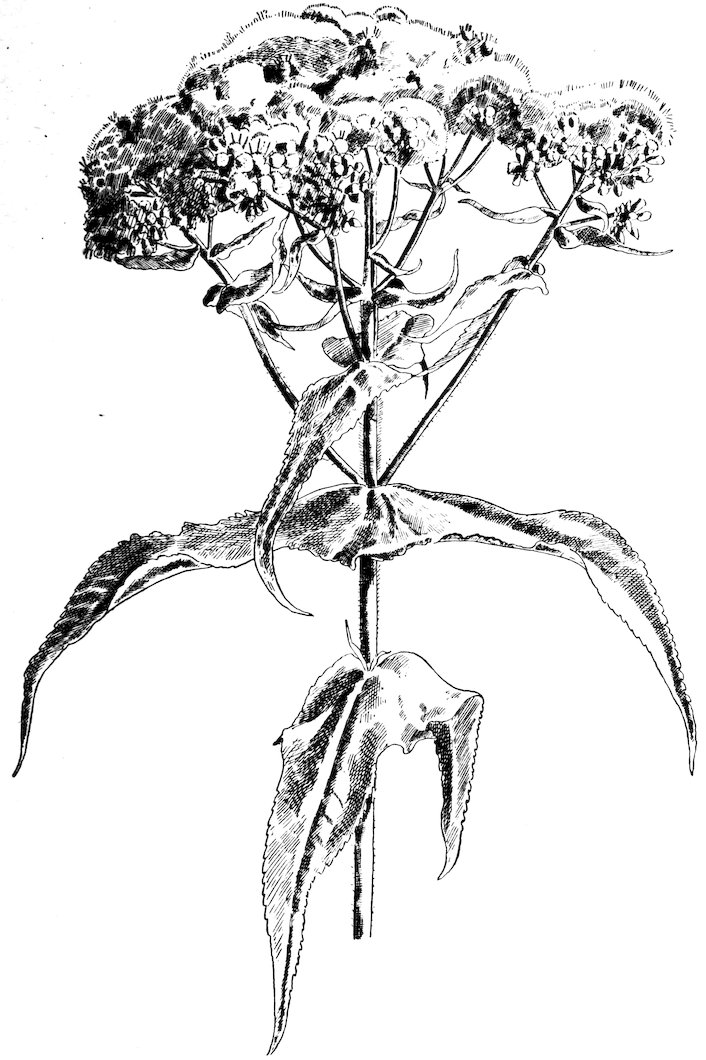
PLATE XXXII
BONESET.—E. perfoliatum.
108
Stem.—Twining and climbing, nearly smooth. Leaves.—Opposite,
somewhat triangular-heart-shaped, pointed, toothed at the base. Flower-heads.—Dull
white or flesh-color, composed of four tubular flowers; clustered,
resembling boneset.
In late summer one often finds the thickets which line the
slow streams nearly covered with the dull white flowers of the
climbing hemp-weed. At first sight the likeness to the boneset
is so marked that the two plants are often confused, but a second
glance discovers the climbing stems and triangular leaves which
clearly distinguish this genus.
Stem.—Leafy below, leafy-bracted above, six to twenty inches high.
Leaves.—Linear-lance-shaped, the lowest elongated. Flowers.—White,
fragrant, the lips wavy or crisped; growing in slender spikes.
This pretty little orchid is found in great abundance in September
and October. The botany relegates it to “wet places,”
but I have seen dry upland pastures as well as low-lying swamps
profusely flecked with its slender, fragrant spikes. The braided
appearance of these spikes would easily account for the popular
name of ladies’ tresses; but we learn that the plant’s English
name was formerly “ladies’ traces,” from a fancied resemblance
between its twisted clusters and the lacings which played so important
a part in the feminine toilet. I am told that in parts of
New England the country people have christened the plant “wild
hyacinth.”
The flowers of S. gracilis are very small, and grow in a much
more slender, one-sided spike than those of S. cernua. They
are found in the dry woods and along the sandy hill-sides from
July onward.
109
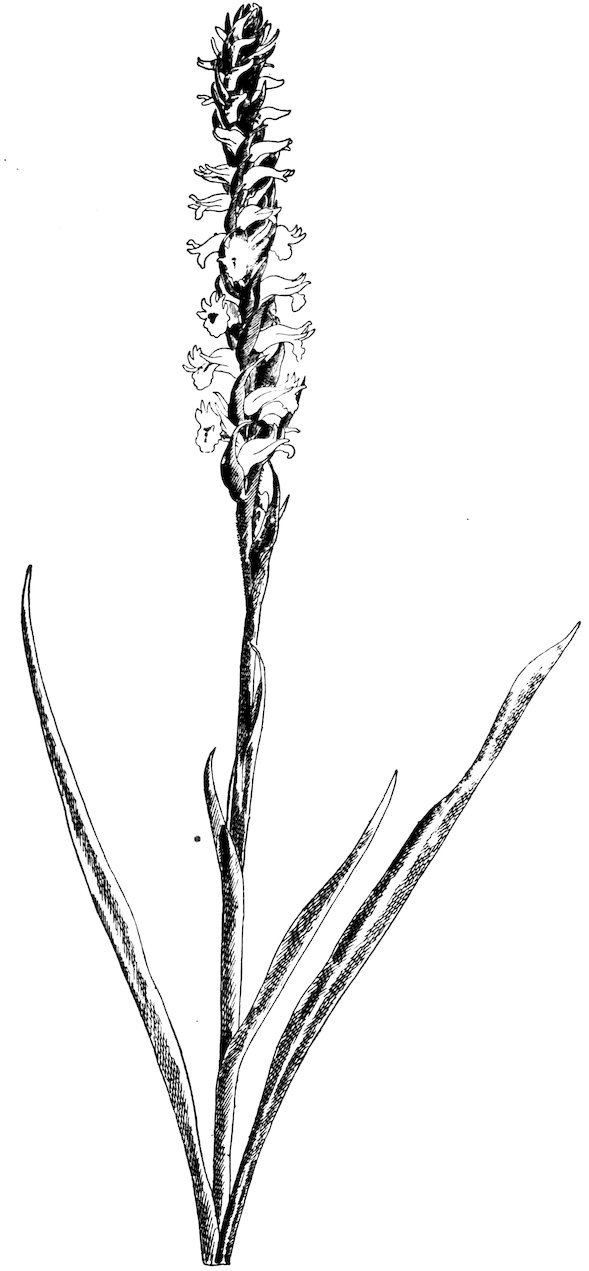
PLATE XXXIII
LADIES’ TRESSES.—S. cernua.
110
Stem.—Slender, very leafy to the summit. Leaves.—Very narrow, from
three to six in a whorl. Flowers.—Greenish-white, in small clusters at the
summit and along the sides of the stem. Fruit.—Two erect pods, one often
stunted.
This species is one commonly found on dry uplands, especially
southward, with flowers resembling in structure those of
the other milkweeds. (Pl. .)
A shrub from six to twelve feet high. Leaves.—Somewhat ovate and
wedge-shaped, coarsely toothed on the upper entire. Flower-heads.—Whitish
or yellowish, composed of unisexual tubular flowers, the stamens and
pistils occurring on different plants.
Some October day, as we pick our way through the salt
marshes which lie back of the beach, we may spy in the distance
a thicket which looks as though composed of such white-flowered
shrubs as belong to June. Hastening to the spot we discover
that the silky-tufted seeds of the female groundsel tree are responsible
for our surprise. The shrub is much more noticeable
and effective at this season than when—a few weeks previous—it
was covered with its small white or yellowish flower-heads.
Stem.—Scape-like, nine inches to two feet high, with usually one small
rounded leaf clasping it below; bearing at its summit a single flower.
Leaves.—Thickish, rounded, often heart-shaped, from the root. Flower.—White
or cream-color, veiny. Calyx.—Of five slightly united sepals. Corolla.—Of
five veiny petals. True Stamens.—Five, alternate with the petals,
and with clusters of sterile gland-tipped filaments. Pistil.—One, with
four stigmas.
111
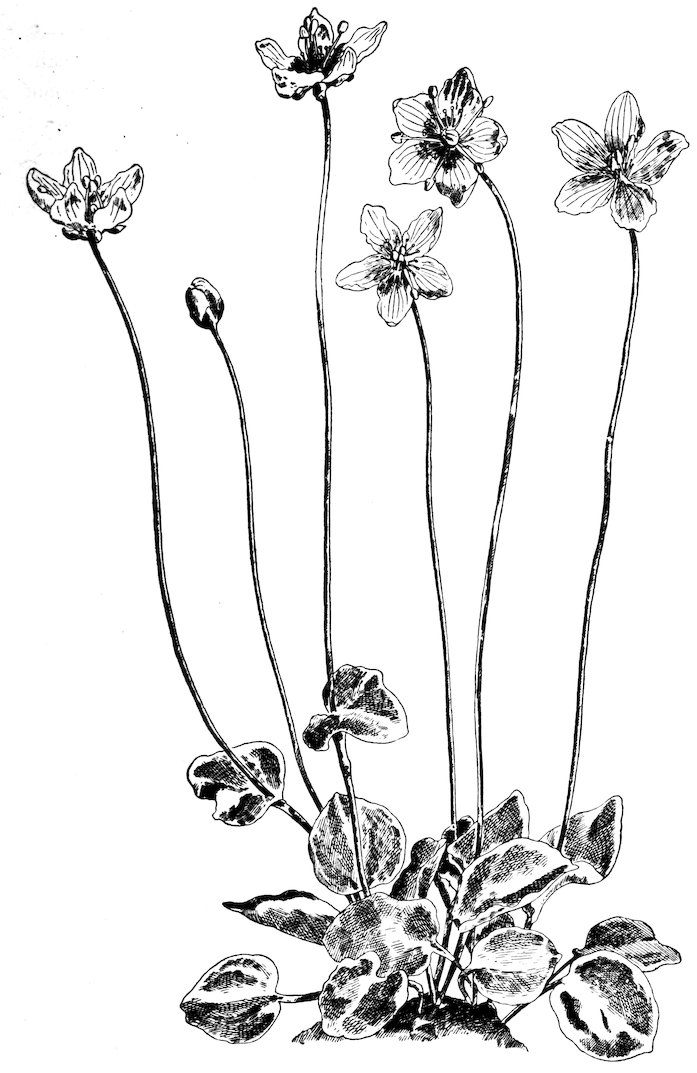
PLATE XXXIV
GRASS OF PARNASSUS.—P. Caroliniana.
112Gerarde indignantly declares that this plant has been described
by blind men, not “such as are blinde in their eyes, but
in their understandings, for if this plant be a kind of grasse then
may the Butter-burre or Colte’s-foote be reckoned for grasses—as
also all other plants whatsoever.” But if it covered Parnassus
with its delicate veiny blossoms as abundantly as it does some
moist New England meadows each autumn, the ancients may
have reasoned that a plant almost as common as grass must somehow
partake of its nature. The slender-stemmed, creamy flowers
are never seen to better advantage than when disputing with
the fringed gentian the possession of some luxurious swamp.
Stem.—Erect, one or two feet high, leafy. Leaves.—Broadly linear to
lance-shaped. Flower-heads.—Composed entirely of tubular flowers with
very numerous pearly white involucral scales.
This species is common throughout our Northern woods and
pastures, blossoming in August. Thoreau writes of it in September:
“The pearly everlasting is an interesting white at present.
Though the stems and leaves are still green, it is dry and
unwithering like an artificial flower; its white, flexuous stem and
branches, too, like wire wound with cotton. Neither is there
any scent to betray it. Its amaranthine quality is instead of
high color. Its very brown centre now affects me as a fresh and
original color. It monopolizes small circles in the midst of
sweet fern, perchance, on a dry hill-side.”
Stem.—Erect, one to three feet high, woolly. Leaves.—Lance-shaped.
Flower-heads.—Yellowish-white, clustered at the summit of the branches,
composed of many tubular flowers.
This is the “fragrant life-everlasting,” as Thoreau calls
it, of late summer. It abounds in rocky pastures and throughout
the somewhat open woods.
Note.—Flowers so faintly tinged with color as to give a white effect in
the mass or at a distance are placed in the White section: greenish or greenish-white
flowers are also found here. The Moth Mullein (p. 152) and
Bouncing Bet (p. 196) are found frequently bearing white flowers: indeed,
white varieties of flowers which are usually colored, need never surprise one.
113
Stem.—Hollow, furrowed. Leaves.—Rounded, somewhat kidney-shaped.
Flowers.—Golden-yellow. Calyx.—Of five to nine petal-like sepals. Corolla.—None.
Stamens.—Numerous. Pistils.—Five to ten, almost without
styles.
Hark, hark! the lark at Heaven’s gate sings,
And Phœbus ’gins arise,
His steeds to water at those springs,
On chaliced flowers that lies:
And winking Mary-buds begin
To ope their golden eyes;
With everything that pretty is—
My lady sweet, arise!
Arise, arise.—Cymbeline.
We claim—and not without authority—that these “winking
Mary-buds” are identical with the gay marsh marigolds which
border our springs and gladden our wet meadows every April.
There are those who assert that the poet had in mind the garden
marigold—Calendula—but surely no cultivated flower could harmonize
with the spirit of the song as do these gleaming swamp
blossoms. We will yield to the garden if necessary—
The marigold that goes to bed with the sun
And with him rises weeping—
of the “Winter’s Tale,” but insist on retaining for that larger,
lovelier garden in which we all feel a certain sense of possession—even
if we are not taxed on real estate in any part of the country—the
“golden eyes” of the Mary-buds, and we feel strengthened
in our position by the statement in Mr. Robinson’s “Wild
Garden” that the marsh marigold is so abundant along certain
English rivers as to cause the ground to look as though paved
with gold at those seasons when they overflow their banks.
114These flowers are peddled about our streets every spring
under the name of cowslips—a title to which they have no claim,
and which is the result of that reckless fashion of christening unrecognized
flowers which is so prevalent, and which is responsible
for so much confusion about their English names.
The derivation of marigold is somewhat obscure. In the
“Grete Herball” of the sixteenth century the flower is spoken
of as Mary Gowles, and by the early English poets as gold simply.
As the first part of the word might be derived from the
Anglo-Saxon mere—a marsh, it seems possible that the entire
name may signify marsh-gold, which would be an appropriate
and poetic title for this shining flower of the marshes.
An aromatic shrub from six to fifteen feet high. Leaves.—Oblong, pale
underneath. Flowers.—Appearing before the leaves in March or April,
honey-yellow, borne in clusters which are composed of smaller clusters, surrounded
by an involucre of four early falling scales. Fruit.—Red, berry-like,
somewhat pear-shaped.
These are among the very earliest blossoms to be found in
the moist woods of spring. During the Revolution the powdered
berries were used as a substitute for allspice; while at the
time of the Rebellion the leaves served as a substitute for tea.
Scape.—Six to nine inches high, one-flowered. Leaves.—Two, oblong-lance-shaped,
pale green mottled with purple and white. Flower.—Rather
large, pale yellow marked with purple, nodding. Perianth.—Of six recurved
or spreading sepals. Stamens.—Six. Pistil.—One.
The white blossoms of the shad-bush gleam from the thicket,
and the sheltered hill-side is already starred with the blood-root
and anemone when we go to seek the yellow adder’s tongue.
We direct our steps toward one of those hollows in the wood
which is watered by such a clear gurgling brook as must appeal
to every country-loving heart; and there where the pale April
sunlight filters through the leafless branches, nod myriads of
these lilies, each one guarded by a pair of mottled, erect, sentinel-like
leaves.
115
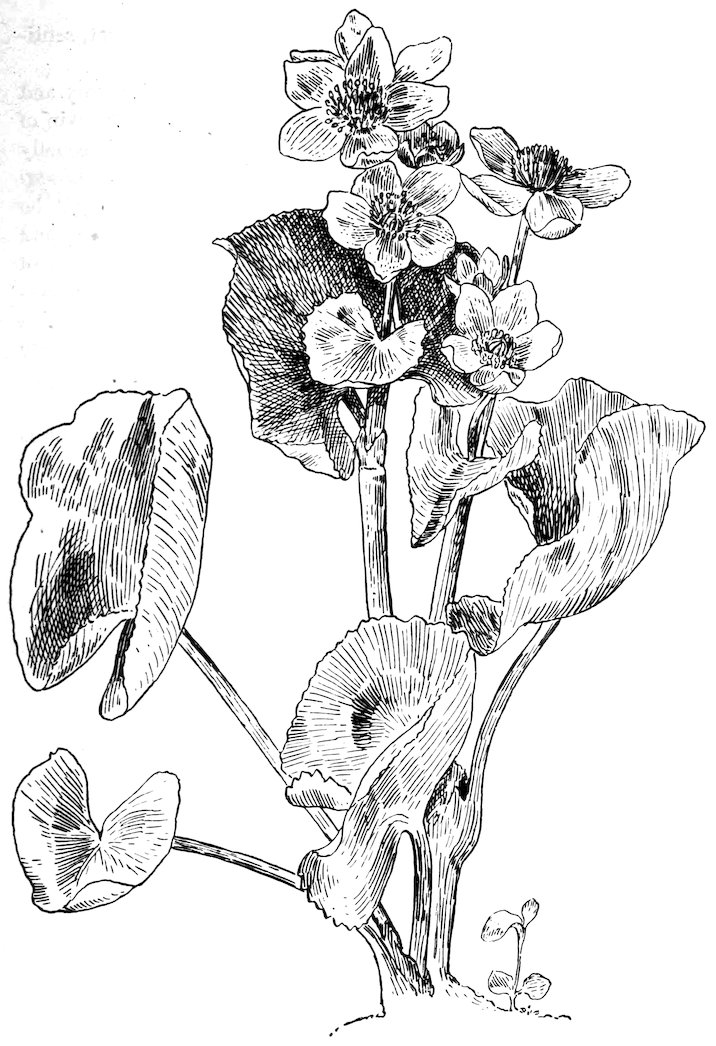
PLATE XXXV
MARSH MARIGOLD.—C. palustris.
116The two English names of this plant are unsatisfactory and
inappropriate. If the marking of its leaves resembles the skin of
an adder why name it after its tongue? And there is equally
little reason for calling a lily a violet. Mr. Burroughs has suggested
two pretty and significant names. “Fawn lily,” he
thinks, would be appropriate, because a fawn is also mottled, and
because the two leaves stand up with the alert, startled look of
a fawn’s ears. The speckled foliage and perhaps its flowering
season are indicated in the title “trout-lily,” which has a
spring-like flavor not without charm. It is said that the early
settlers of Pennsylvania named the flower “yellow snowdrop,”
in memory of their own “harbinger-of-spring.”
The white adder’s tongue, E. albidum, is a species which is
usually found somewhat westward.
Stem.—Brittle, with saffron-colored, acrid juice. Leaves.—Compound
or divided, toothed or cut. Flowers.—Yellow, clustered. Calyx.—Of two
sepals falling early. Corolla.—Of four petals. Stamens.—Sixteen to
twenty-four. Pistil.—One, with a two-lobed stigma. Pod.—Slender, linear.
The name of celandine must always suggest the poet who
never seemed to weary of writing in its honor:
Pansies, lilies, kingcups, daisies,
Let them live upon their praises;
Long as there’s a sun that sets,
Primroses will have their glory;
Long as there are violets,
They will have a place in story;
There’s a flower that shall be mine,
’Tis the little celandine.
And when certain yellow flowers which frequent the village roadside
are pointed out to us as those of the celandine, we feel a
sense of disappointment that the favorite theme of Wordsworth
should arouse within us so little enthusiasm. So perhaps we are
rather relieved than otherwise to realize that the botanical name
of this plant signifies greater celandine; for we remember that
the poet never failed to specify the small celandine as the object
of his praise. The small celandine is Ranunculus ficaria, one
of the Crowfoot family, and is only found in this country as an
escape from gardens.
117
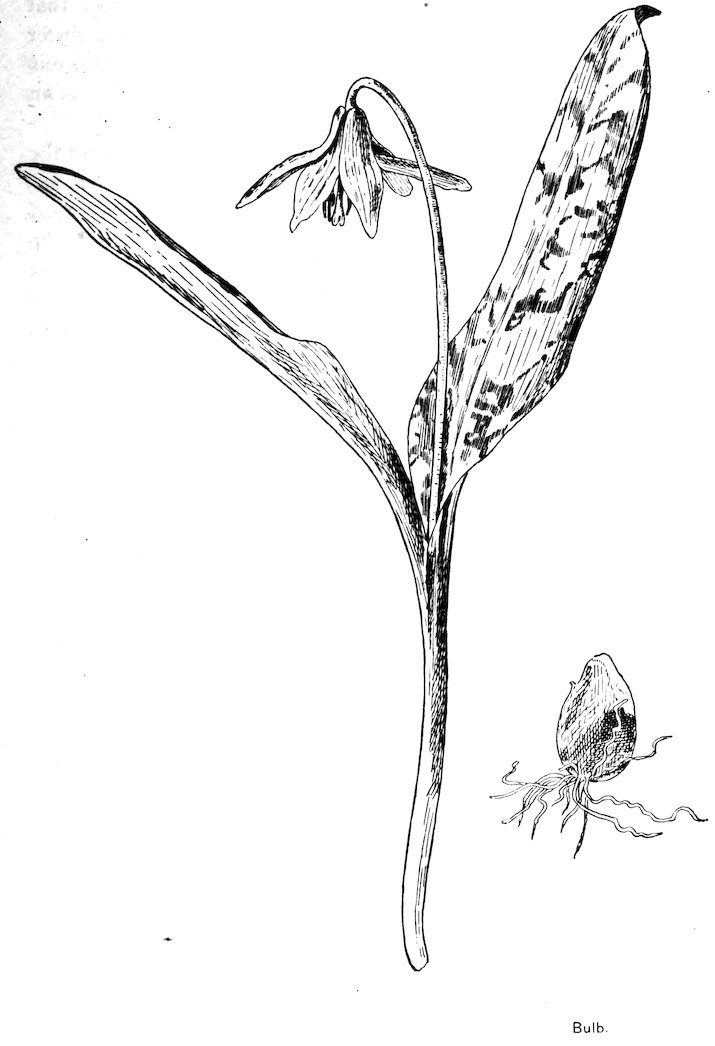
PLATE XXXVI
YELLOW ADDER’S TONGUE.—E. Americanum.
118Gray tells us that the generic name, Chelidonium, from the
ancient Greek for swallow, was given “because its flowers appear
with the swallows;” but if we turn to Gerarde we read
that the title was not bestowed “because it first springeth at the
coming in of the swallowes, or dieth when they go away, for as
we have saide, it may be founde all the yeare; but because some
holde opinion, that with this herbe the dams restore sight to
their young ones, when their eies be put out.”
Stem.—Low, two-leaved. Stem-leaves.—Opposite, deeply incised. Root-leaves.—Incised
or divided. Flowers.—Deep yellow, large, one or more at
the summit of the stem. Calyx.—Of two hairy sepals. Corolla.—Of four
petals. Stamens.—Many. Pistil.—One, with a two to four-lobed stigma.
In April or May, somewhat south and westward, the woods
are brightened, and occasionally the hill-sides are painted yellow,
by this handsome flower. In both flower and foliage the
plant suggests the celandine.
Stems.—Leafy above, erect. Leaves.—Broadly heart-shaped, toothed.
Flowers.—Yellow, veined with purple, otherwise much like those of the
common blue violet.
When beechen buds begin to swell,
And woods the blue-bird’s warble know,
The yellow violet’s modest bell
Peeps from the last year’s leaves below,
sings Bryant, in his charming, but not strictly accurate poem, for
the chances are that the “beechen buds” have almost burst into
foliage, and that the “bluebird’s warble” has been heard for
some time when these pretty flowers begin to dot the woods.
119
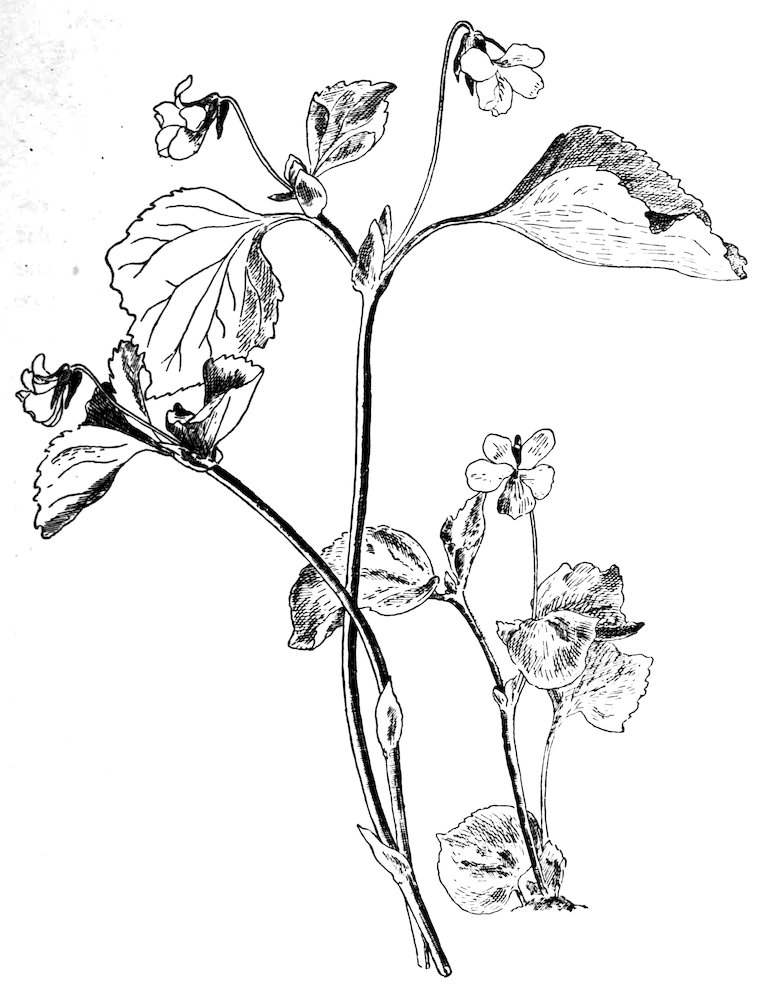
PLATE XXXVII
DOWNY YELLOW VIOLET.—V. pubescens.
120The lines which run:
Yet slight thy form, and low thy seat,
And earthward bent thy gentle eye,
Unapt the passing view to meet,
When loftier flowers are flaunting nigh,
would seem to apply more correctly to the round-leaved, V. rotundifolia,
than to the downy violet, for although its large, flat
shining leaves are somewhat conspicuous, its flowers are borne
singly on a low scape, which would be less apt to attract notice
than the tall, leafy flowering stems of the other.
Stem.—Slender, prostrate, or sometimes erect. Leaves.—Divided really
into three leaflets, but apparently into five by the parting of the lateral leaflets.
Flowers.—Yellow, growing singly from the axils of the leaves. Calyx.—Deeply
five-cleft, with bracts between each tooth, thus appearing ten-cleft.
Corolla.—Of five rounded petals. Stamens.—Many. Pistils.—Many in a
head.
From spring to nearly midsummer the roads are bordered
and the fields carpeted with the bright flowers of the common
cinquefoil. The passer-by unconsciously betrays his recognition
of some of the prominent features of the Rose family by often
assuming that the plant is a yellow-flowered wild strawberry.
Both of the English names refer to the pretty foliage, cinquefoil
being derived from the French cinque feuilles. The generic
name, Potentilla, has reference to the powerful medicinal properties
formerly attributed to the genus.
Stem.—Erect, shrubby, one to four feet high. Leaves.—Divided into
five to seven narrow leaflets. Flowers.—Yellow, resembling those of the
common cinquefoil.
121
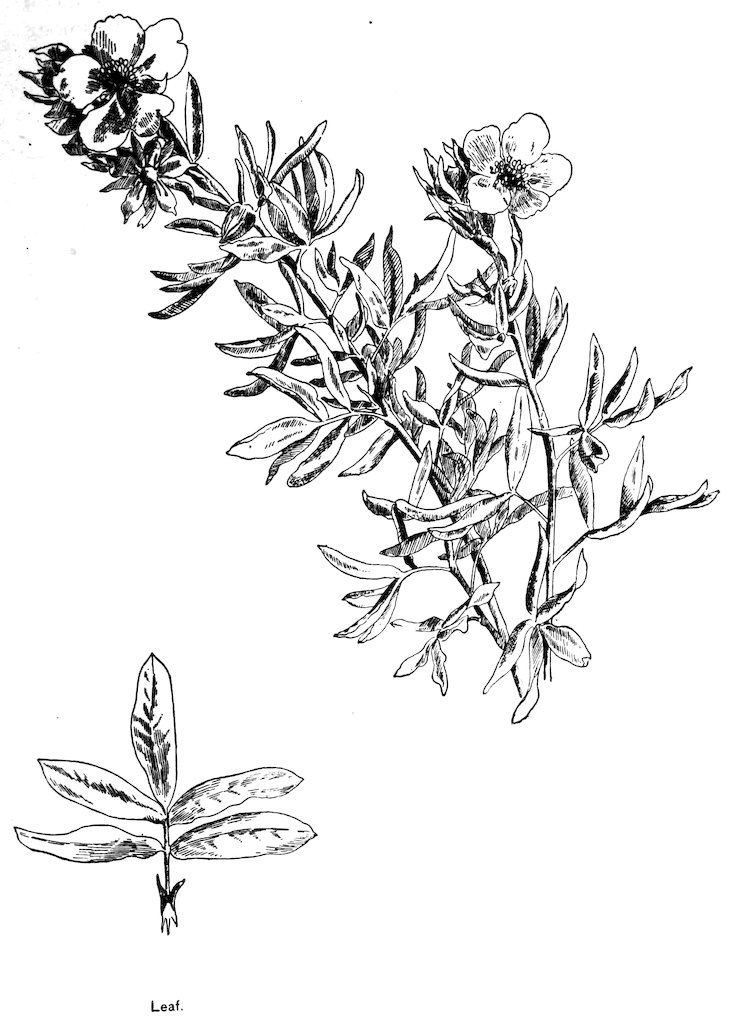
PLATE XXXVIII
SHRUBBY CINQUEFOIL.—P. fruticosa.
122Of all the cinquefoils perhaps this one most truly merits the
title five finger. Certainly its slender leaflets are much more
finger-like than those of the common cinquefoil. It is not a
common plant in most localities, but is very abundant among
the Berkshire Hills.
Stems.—Ascending, branched at the summit, white, woolly. Leaves.—Divided
into five wedge-oblong, deeply incised leaflets, which are green
above, white with silvery wool, beneath.
The silvery cinquefoil has rather large yellow flowers which
are found in dry fields throughout the summer as far south as
New Jersey.
Stem.—One to three feet high. Root-leaves.—Rounded, the larger ones
mostly heart-shaped, toothed, and long-stalked. Stem-leaves.—The lower
lyre-shaped, the upper lance-shaped, incised, set close to the stem. Flower-heads.—Yellow,
clustered, composed of both ray and disk-flowers.
A child would perhaps liken the flower of the golden ragwort
to a yellow daisy. Stain yellow the white rays of the daisy, diminish
the size of the whole head somewhat, and you have a pretty
good likeness of the ragwort. There need be little difficulty in
the identification of this plant—although there are several marked
varieties—for its flowers are abundant in the early year, at which
season but few members of the Composite family are abroad.
The generic name is from senex—an old man—alluding to
the silky down of the seeds, which is supposed to suggest the silvery
hairs of age.
Closely allied to the golden ragwort is the common groundsel,
S. vulgaris, which is given as food to caged birds. The
flower-heads of this species are without rays.
Scape.—Five to eight inches high, sheathed at its base by the stalks of
two to four large, oblong, conspicuous leaves. Flowers.—Greenish-yellow,
rather large, rarely solitary. Perianth.—Of six sepals. Stamens.—Six,
protruding. Pistil.—One, protruding. Fruit.—A blue berry.
123
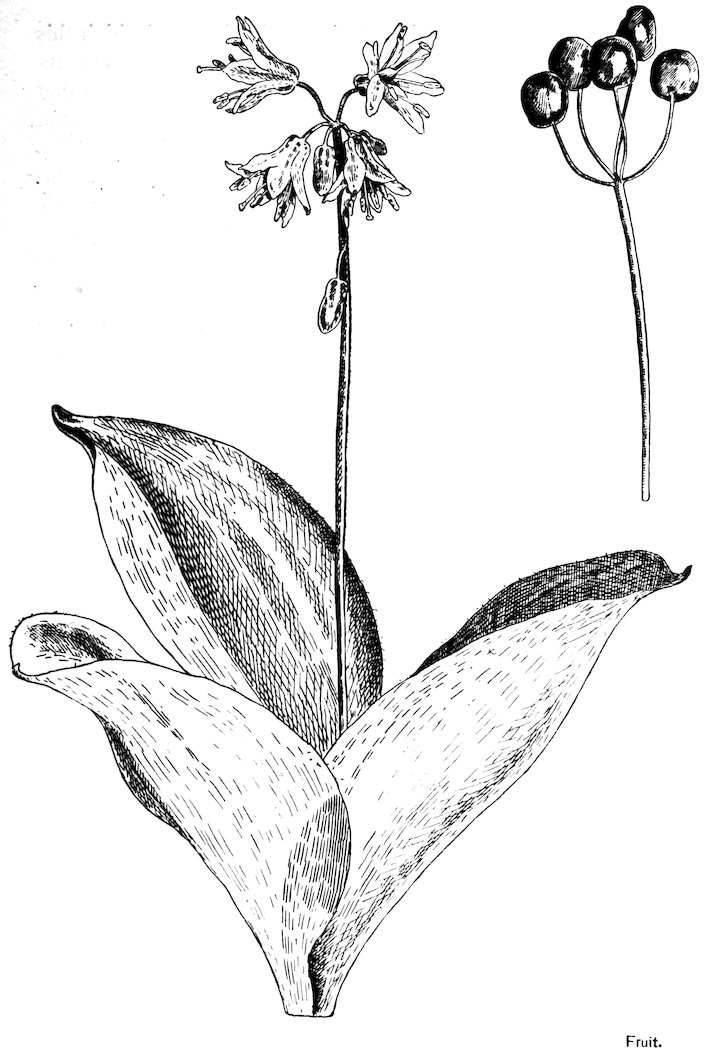
PLATE XXXIX
Clintonia borealis.
124When rambling through the cool, moist woods our attention
is often attracted by patches of great dark, shining, leaves; and
if it be late in the year we long to know the flower of which this
rich foliage is the setting. To satisfy our curiosity we must return
the following May or June, when we shall probably find that
a slender scape rises from its midst bearing at its summit several
bell-shaped flowers, which, without either high color or fragrance,
are peculiarly charming. It is hard to understand why this
beautiful plant has received no English name. As to its generic
title we cannot but sympathize with Thoreau. “Gray should
not have named it from the Governor of New York,” he complains;
“what is he to the lovers of flowers in Massachusetts?
If named after a man, it must be a man of flowers....
Name your canals and railroads after Clinton, if you please, but
his name is not associated with flowers.”
C. umbellata is a more Southern species, with smaller white
flowers, which are speckled with green or purplish dots.
Stem.—About two feet high, downy, leafy to the top, one to three-flowered.
Leaves.—Alternate, broadly oval, many-nerved and plaited.
Flowers.—Large, yellow. Perianth.—Two of the three brownish, elongated
sepals united into one under the lip; the lateral petals linear, wavy-twisted,
brownish; the pale yellow lip an inflated pouch. Stamens.—Two,
the short filaments of each bearing a two-celled anther. Stigma.—Broad,
obscurely three-lobed, moist and roughish.
The yellow lady’s slipper usually blossoms in May or June,
a few days later than its pink sister, C. acaule. Regarding its
favorite haunts, Mr. Baldwin[3] says: “Its preference is for
maples, beeches, and particularly butternuts, and for sloping or
hilly ground, and I always look with glad suspicion at a knoll
covered with ferns, cohoshes, and trilliums, expecting to see a
clump of this plant among them. Its sentinel-like habit of
choosing ‘sightly places’ leads it to venture well up on mountain
sides.”
The long, wavy, brownish petals give the flower an alert,
startled look when surprised in its lonely hiding-places.
125
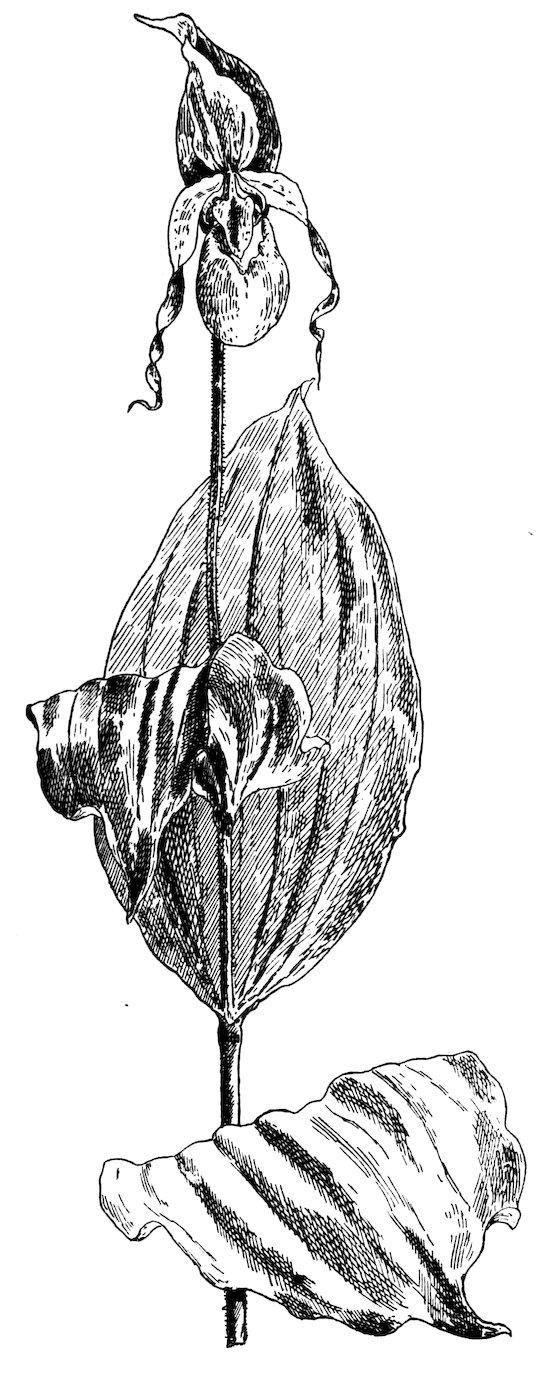
PLATE XL
SMALLER YELLOW LADY’S SLIPPER.—C. parviflorum.
126C. parviflorum, the small yellow lady’s slipper, differs from
C. pubescens in the superior richness of its color as well as in its
size. It also has the charm of fragrance.
One to three feet high. Leaves.—Twice or thrice-compound, leaflets
oblong to lance-shaped, toothed. Flowers.—Yellow, small, in compound
umbels.
This is one of the earliest members of the Parsley family to
appear. Its golden flower-clusters brighten the damp meadows
and the borders of streams in May or June and closely resemble
the meadow parsnip, Thaspium aureum, of which this species
was formerly considered a variety, of the later year.
The tall, stout, common wild parsnip, Pastinaca sativa, is
another yellow representative of this family in which white
flowers prevail, the three plants here mentioned being the only
yellow species commonly encountered. The common parsnip may
be identified by its grooved stem and simply compound leaves.
Its roots have been utilized for food at least since the reign of
Tiberius, for Pliny tells us that that Emperor brought them to
Rome from the banks of the Rhine, where they were successfully
cultivated.
Scape.—Slender, elongated. Leaves.—Long-stalked, oblong, floating.
Flowers.—Small, yellow, crowded over the narrow spike or spadix.
When we go to the bogs in May to hunt for the purple flower
of the pitcher-plant we are likely to chance upon the well-named
golden club. This curious-looking club-shaped object, which is
found along the borders of ponds, indicates its relationship to the
jack-in-the-pulpit, and still more to the calla lily, but unlike
them its tiny flowers are shielded by no protecting spathe.
Kalm tells us in his “Travels,” “that the Indians called the
plant Taw-Kee, and used its dried seeds as food.”
127
Stems.—One to two feet high. Leaves.—Oblong or lance-shaped, mostly
toothed, contracted into a half-clasping leaf-stalk. Flowers.—Bright yellow,
solitary or clustered. Calyx.—Of five sepals. Corolla.—Of five to
seven oblong petals. Stamens.—Indefinite in number, occasionally few.
Pistils.—Numerous in a head.
Many weeks after the marsh marigolds have passed away, just
such marshy places as they affected are brightly flecked with gold.
Wondering, perhaps, if they can be flowering for the second
time in the season, we wade recklessly into the bog to rescue,
not the marsh marigold, but its near relation, the spearwort,
which is still more closely related to the buttercup, as a little
comparison of the two flowers will show. This plant is especially
common at the North.
Root.—Tuberous, shaped somewhat like a cucumber, with a suggestion
of its flavor. Stem.—Slender, from one to three feet high, at first clothed
with wool. Leaves.—In two whorls on the flowering plants, the lower of
five to nine oblong, pointed leaves set close to the stem, the upper usually of
three or four much smaller ones. Flowers.—Greenish-yellow, small, clustered,
recurved, set close to the upper leaves. Perianth.—Of three sepals
and three petals, oblong and alike. Stamens.—Six, reddish-brown. Pistil.—With
three stigmas, long, recurved, and reddish-brown. Fruit.—A
purple berry.
One is more apt to pause in September to note the brilliant
foliage and purple berries of this little plant than to gather the
drooping inconspicuous blossoms for his bunch of wood-flowers
in June. The generic name is after the sorceress Medea, on account
of its supposed medicinal virtues, of which, however, there
seems to be no record.
The tuberous rootstock has the flavor, and something the
shape, of the cucumber, and was probably used as food by the
Indians. It would not be an uninteresting study to discover
which of our common wild plants are able to afford pleasant and
128nutritious food; in such a pursuit many of the otherwise unattractive
popular names would prove suggestive.
Stems.—Immersed, one to three feet long. Leaves.—Many-parted,
hair-like, bearing numerous bladders. Scape.—Six to twelve inches long.
Flowers.—Yellow, five to twelve on each scape. Calyx.—Two-lipped.
Corolla.—Two-lipped, spurred at the base. Stamens.—Two. Pistil.—One.
This curious water-plant may or may not have roots; in
either case it is not fastened to the ground, but is floated by
means of the many bladders which are borne on its finely
dissected leaves. It is commonly found in ponds and slow
streams, flowering throughout the summer. Thoreau calls it “a
dirty-conditioned flower, like a sluttish woman with a gaudy
yellow bonnet.”
The horned bladderwort, U. cornuta, roots in the peat-bogs
and sandy swamps. Its large yellow helmet-shaped flowers are
very fragrant, less than half a dozen being borne on each scape.
Leaves.—Floating or erect, roundish to oblong, with a deep cleft at their
base. Flowers.—Yellow, sometimes purplish, large, somewhat globular.
Calyx.—Of five or six sepals or more, yellow or green without. Corolla.—Of
numerous small, thick, fleshy petals which are shorter than the stamens
and resemble them. Stamens.—Very numerous. Pistil.—One, with a
disk-like, many-rayed stigma.
Bordering the slow streams and stagnant ponds from May
till August may be seen the yellow pond-lilies. These flowers
lack the delicate beauty and fragrance of the white water-lilies;
having, indeed, either from their odor, or appearance, or the form
of their fruit, won for themselves in England the unpoetic title
of “brandy-bottle.” Owing to their love of mud they have
also been called “frog-lilies.” The Indians used their roots
for food.
129
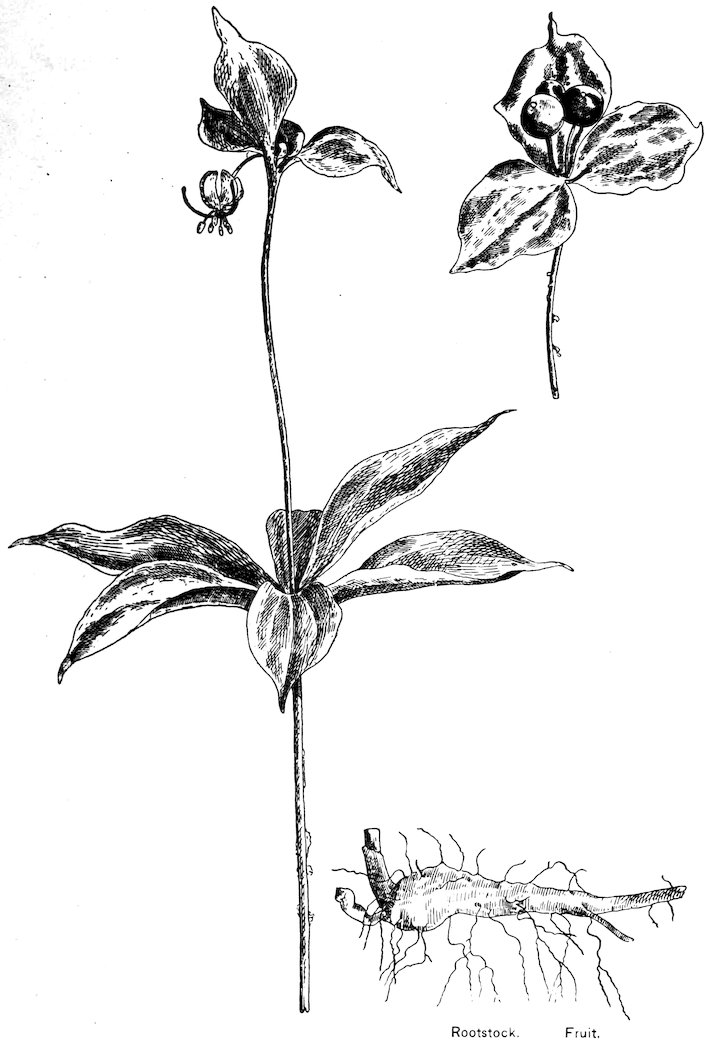
PLATE XLI
INDIAN CUCUMBER-ROOT.—M. Virginiana.
130
Stem.—Smooth. Leaves.—The lower lyre-shaped; the upper ovate,
toothed or deeply incised at their base. Flowers.—Yellow, growing in racemes.
Pod.—Linear, erect or slightly spreading.
As early as May we find the bright flowers of the winter-cress
along the roadside. This is probably the first of the yellow
mustards to appear.
Often several feet high. Stem.—Branching. Leaves.—The lower with
a large terminal lobe and a few small lateral ones. Flowers.—Yellow,
rather small, growing in a raceme. Pods.—Smooth, erect, appressed, about
half an inch long.
Many are familiar with the appearance of this plant who are
ignorant of its name. The pale yellow flowers spring from the
waste places along the roadside and border the dry fields throughout
the summer. The tall spreading branches recall the biblical
description: “It groweth up, and becometh greater than all
herbs, and shooteth out great branches; so that the fowls of the
air may lodge under the shadow of it.”
This plant is extensively cultivated in Europe, its ground
seeds forming the well-known condiment. The ancients used it
for medicinal purposes. It has come across the water to us, and
is a troublesome weed in many parts of the country.
One to three feet high. Leaves.—Rough, lyre-shaped. Flowers.—Yellow,
veiny, turning white or purplish; larger than those of the black mustard,
otherwise resembling them. Pod.—Often necklace-form by constriction
between the seeds.
This plant is a troublesome weed in many of our fields. It is
the stock from which the garden radish has been raised.
131
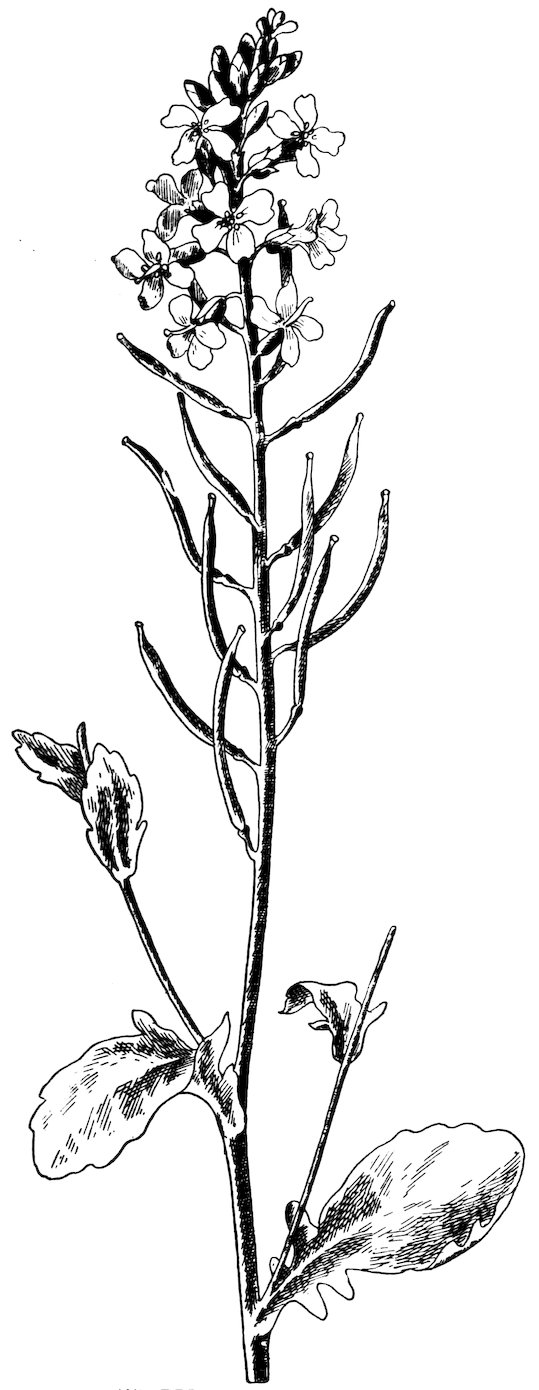
PLATE XLII
WINTER-CRESS.—B. vulgaris.
132
Stems.—Several, becoming branched, leafy. Leaves.—Earlier ones
roundish; the latter narrower and often cleft. Flower-heads.—Yellow,
composed entirely of strap-shaped flowers.
In some parts of the country these flowers are among the
earliest to appear. They are found in New England, as well as
south and westward.
The flowers of K. amplexicaulis appear later, and their
range is a little farther south. Near Philadelphia great masses
of the orange-colored blossoms and pale green stems and foliage
line the railway embankments in June.
Stem or Scape.—One or two feet high, naked or with a single leaf,
smooth, slender, forking above. Leaves.—From the root, oblong, often
making a sort of flat rosette, usually conspicuously veined with purple.
Flower-heads.—Yellow, composed entirely of strap-shaped flowers.
The loosely clustered yellow flower-heads of the rattlesnake-weed
somewhat resemble small dandelions. They abound in the
pine-woods and dry, waste places of early summer. The purple-veined
leaves, whose curious markings give to the plant its common
name, grow close to the ground and are supposed to be efficacious
in rattlesnake bites. Here again crops out the old
“doctrine of signatures,” for undoubtedly this virtue has been
attributed to the species solely on account of the fancied resemblance
between its leaves and the markings of the rattlesnake.
H. scabrum is another common species, which may be distinguished
from the rattlesnake-weed by its stout, leafy stem and unveined
leaves.
133
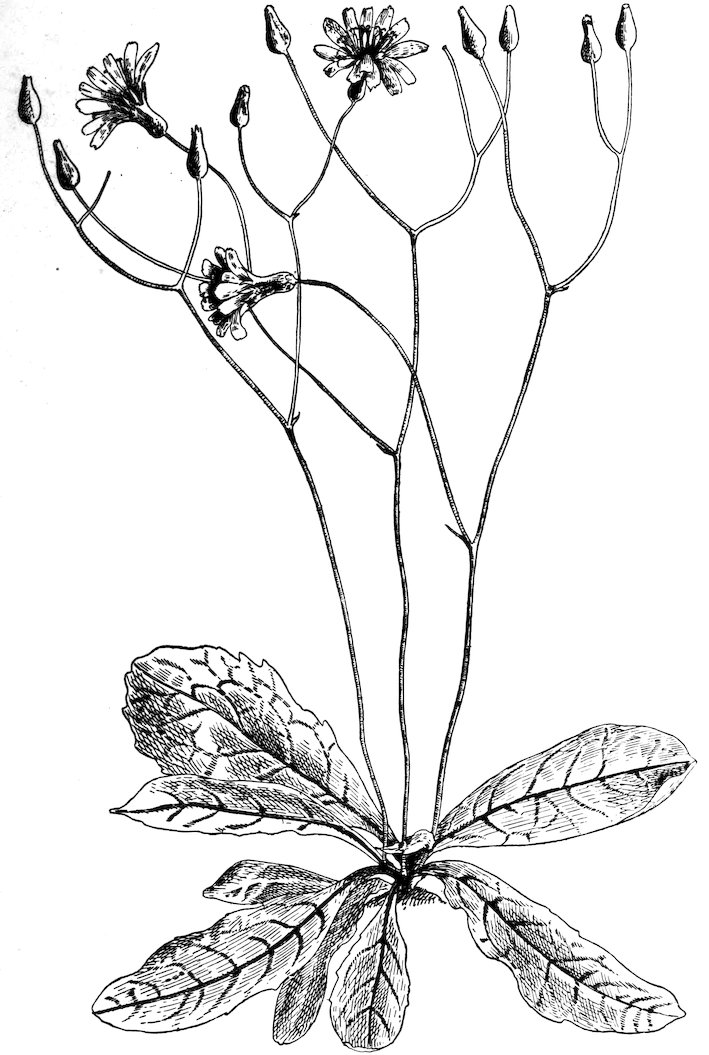
PLATE XLIII
RATTLESNAKE-WEED.—H. venosum.
134If Emerson’s definition of a weed, as a plant whose virtues
have not yet been discovered, be correct, we can hardly place the
dandelion in that category, for its young sprouts have been valued
as a pot-herb, its fresh leaves enjoyed as a salad, and its
dried roots used as a substitute for coffee in various countries and
ages. It is said that the Apache Indians so greatly relish it as
food, that they scour the country for many days in order to procure
enough to appease their appetites, and that the quantity
consumed by one individual exceeds belief. The feathery-tufted
seeds which form the downy balls beloved as “clocks” by country
children, are delicately and beautifully adapted to dissemination
by the wind, which ingenious arrangement partly accounts
for the plant’s wide range. The common name is a corruption
of the French dent de lion. There is a difference of opinion
as to which part of the plant is supposed to resemble a lion’s
tooth. Some fancy the jagged leaves gave rise to the name,
while others claim that it refers to the yellow flowers, which they
liken to the golden teeth of the heraldic lion. In nearly every
European country the plant bears a name of similar signification.
“Bushy, heath-like little shrubs, seldom a foot high.” (Gray.) Leaves.—Small,
oval or narrowly oblong, pressed close to the stem. Flowers.—Bright
yellow, small, numerous, crowded along the upper part of the branches.
Calyx.—Of five sepals, the two outer much smaller. Corolla.—Of five petals.
Stamens.—Nine to thirty. Pistil.—One, with a long and slender style.
In early summer many of the sand-hills along the New England
coast are bright with the yellow flowers of this hoary little
shrub. It is also found as far south as Maryland and near the
Great Lakes. Each blossom endures for a single day only. The
plant’s popular name is due to its economical habit of utilizing
sandy unproductive soil where little else will flourish.
An upright shrub from one to four feet high. Leaves.—Opposite, oblong,
taper-pointed. Flowers.—Yellow, sometimes much tinged with red,
clustered usually in threes, in the axils of the upper leaves and at the summit
of the stem. Calyx.—With slender awl-shaped lobes. Corolla.—Funnel-form,
five-lobed, the lower lobe larger than the others and of a deeper
yellow, with a small nectar-bearing gland at its base. Stamens.—Five.
Pistil.—One.
135
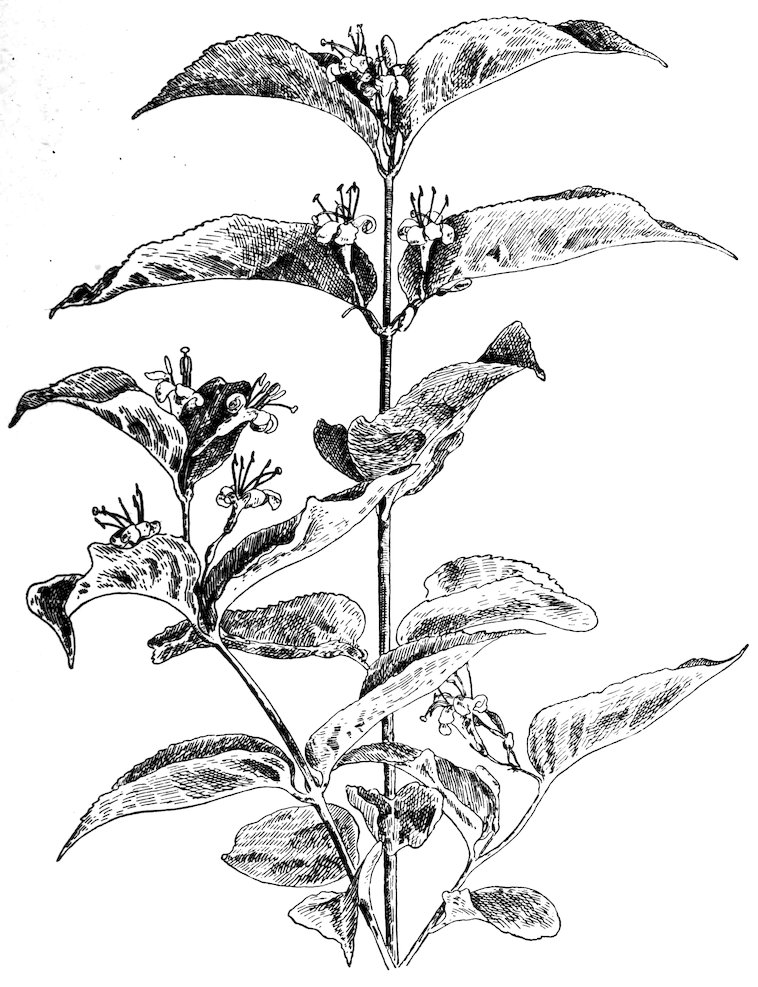
PLATE XLIV
BUSH-HONEYSUCKLE.—D. trifida.
136This pretty little shrub is found along our rocky hills and
mountains. The blossoms appear in early summer, and form a
good example of nectar-bearing flowers. The lower lobe of
the corolla is crested and more deeply colored than the others,
thus advising the bee of secreted treasure. The hairy filaments
of the stamens are so placed as to protect the nectar from injury
by rain. When the blossom has been despoiled and at the
same time fertilized, for the nectar-seeking bee has probably
deposited some pollen upon its pistil, the color of the corolla
changes from a pale to a deep yellow, thus giving warning to
the insect world that further attentions would be useless to
both parties.
Stem.—Low, erect, branching. Leaves.—Opposite, lance-shaped.
Flowers.—Small, greenish-yellow, solitary in the axils of the upper leaves.
Calyx.—Bell-shaped, four-cleft. Corolla.—Two-lipped, upper lip arched,
lower three-lobed and spreading at the apex. Stamens.—Four. Pistil.—One.
In the open woods, from June until September, we encounter
the pale yellow flowers of this rather insignificant little plant.
The cow wheat was formerly cultivated by the Dutch as food
for cattle. The Spanish name, Trigo de Vaca, would seem to
indicate a similar custom in Spain. The generic name, Melampyrum,
is from the Greek, and signifies black wheat, in reference
to the appearance of the seeds of some species when mixed
with grain. The flower would not be likely to attract one’s
attention were it not exceedingly common in some parts of the
country, flourishing especially in our more eastern woodlands.
Stem.—Two to five feet high. Leaves.—Whorled, lance-shaped. Flowers.—Yellow,
spotted with reddish-brown, bell-shaped, two to three inches
long. Perianth.—Of six recurved sepals, with a nectar-bearing furrow at
their base. Stamens.—Six, with anthers loaded with brown pollen. Pistil.—One,
with a three-lobed stigma.
What does the summer bring which is more enchanting than
a sequestered wood-bordered meadow hung with a thousand of
these delicate, nodding bells which look as though ready to
tinkle at the least disturbance and sound an alarum among the
flowers?
137
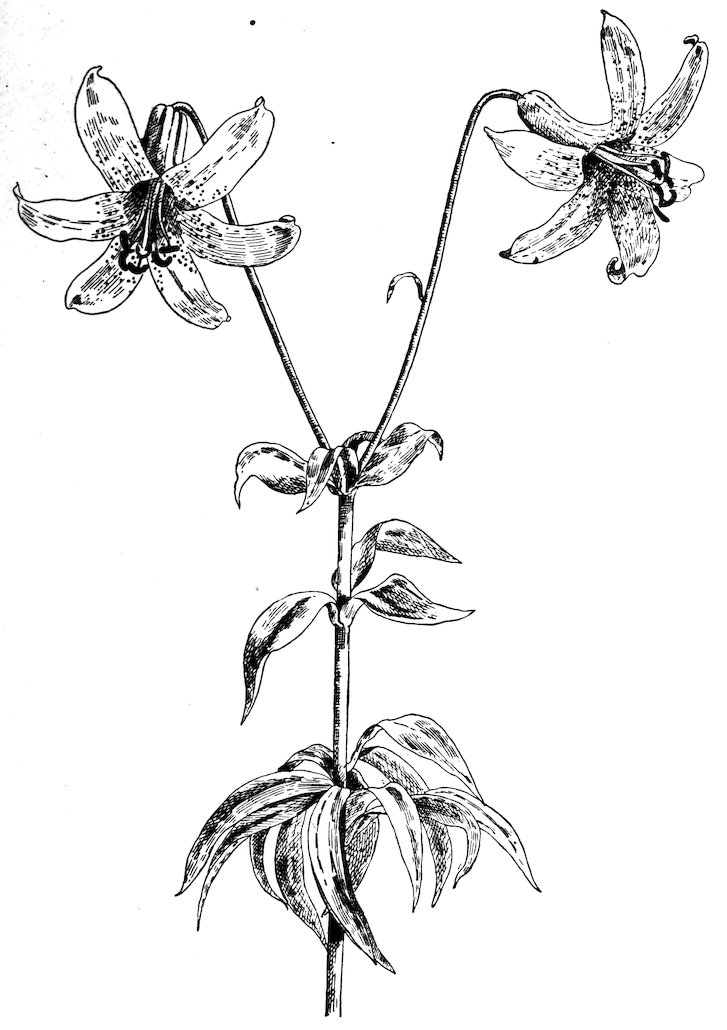
PLATE XLV
MEADOW LILY.—L. Canadense.
138These too are true “lilies of the field,” less gorgeous, less
imposing than the Turks’ caps, but with an unsurpassed grace and
charm of their own. “Fairy-caps,” these pointed blossoms are
sometimes called; “witch-caps,” would be more appropriate
still. Indeed they would make dainty headgear for any of the
dim inhabitants of Wonder-Land.
The growth of this plant is very striking when seen at its
best. The erect stem is surrounded with regular whorls of leaves,
from the upper one of which curves a circle of long-stemmed,
nodding flowers. They suggest an exquisite design for a church
candelabra.
Flowers.—Yellow, large, two and a half to three and a half inches across.
Calyx.—Of numerous sepals. Corolla.—Of ten or twelve petals. Stamens.—Numerous.
Pistil.—One, with numerous stigmas. Fruit.—Shaped like
a small pear, often with prickles over its surface.
This curious-looking plant is one of the only two representatives
of the Cactus family in the Northeastern States. It has
deep green, fleshy, prickly, rounded joints and large yellow
flowers, which are often conspicuous in summer in dry, sandy
places along the coast.
O. vulgaris, the only other species found in Northeastern
America, has somewhat smaller flowers, but otherwise so closely
resembles O. Rafinesquii as to make it difficult to distinguish
between the two.
Stem.—Slender, one or two feet high. Leaves.—Narrowly oblong,
whorled in fours, fives, or sixes. Flowers.—Yellow, spotted or streaked
with red, on slender, hair-like flower-stalks from the axils of the leaves.
Calyx.—Five or six-parted. Corolla.—Very deeply five or six-parted.
Stamens.—Four or five. Pistil.—One.
139
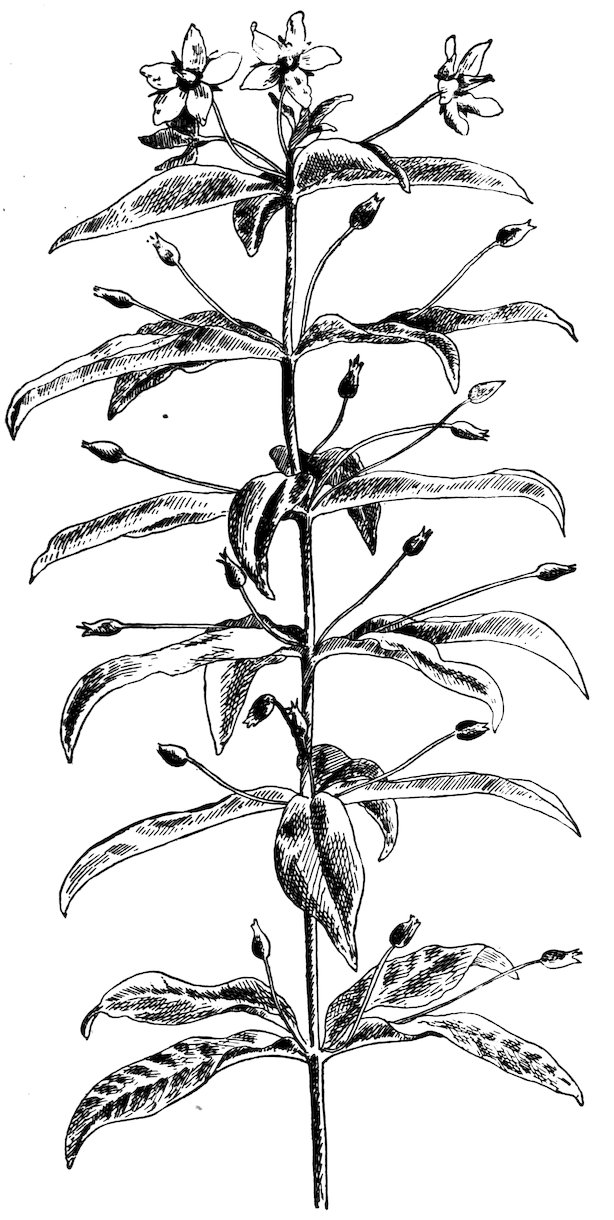
PLATE XLVI
FOUR-LEAVED LOOSESTRIFE.—L. quadrifolia.
140This slender pretty plant grows along the roadsides and attracts
one’s notice in June by its regular whorls of leaves and
flowers. Linnæus says that this genus is named after Lysimachus,
King of Sicily. Loosestrife is the English for Lysimachus;
but whether the ancient superstition that the placing
of these flowers upon the yokes of oxen rendered the beasts
gentle and submissive arose from the peace-suggestive title or
from other causes, I cannot discover.
The yellow loosestrife bears its flowers, which are similar to
those of L. quadrifolia, in a terminal raceme; it has opposite
lance-shaped leaves. Its bright yellow clusters border the
streams and brighten the marshes from June till August.
About one foot high. Leaves.—Set close to the stem, simple, lance-oblong.
Flowers.—Of two kinds: the earlier, more noticeable ones,
yellow, solitary, about one inch across; the later ones small and clustered,
usually without petals. Calyx.—(Of the petal-bearing flowers) of five
sepals. Corolla.—Of five early falling petals which are crumpled in the
bud. Stamens.—Numerous. Pistil.—One, with a three-lobed stigma.
These fragile bright yellow flowers are found in gravelly
places in early summer. Under the influence of the sunshine
they open once; by the next day their petals have fallen, and
their brief beauty is a thing of the past. On June 17th Thoreau
finds this “broad, cup-like flower, one of the most delicate yellow
flowers, with large spring-yellow petals, and its stamens laid one
way.”
In the Vale of Sharon a nearly allied rose-colored species
abounds. This is believed by some of the botanists who have
travelled in that region to be the Rose of Sharon which Solomon
has celebrated.
The name of frost-weed has been given to our plant because
of the crystals of ice which shoot from the cracked bark at the
base of the stem in late autumn.
141
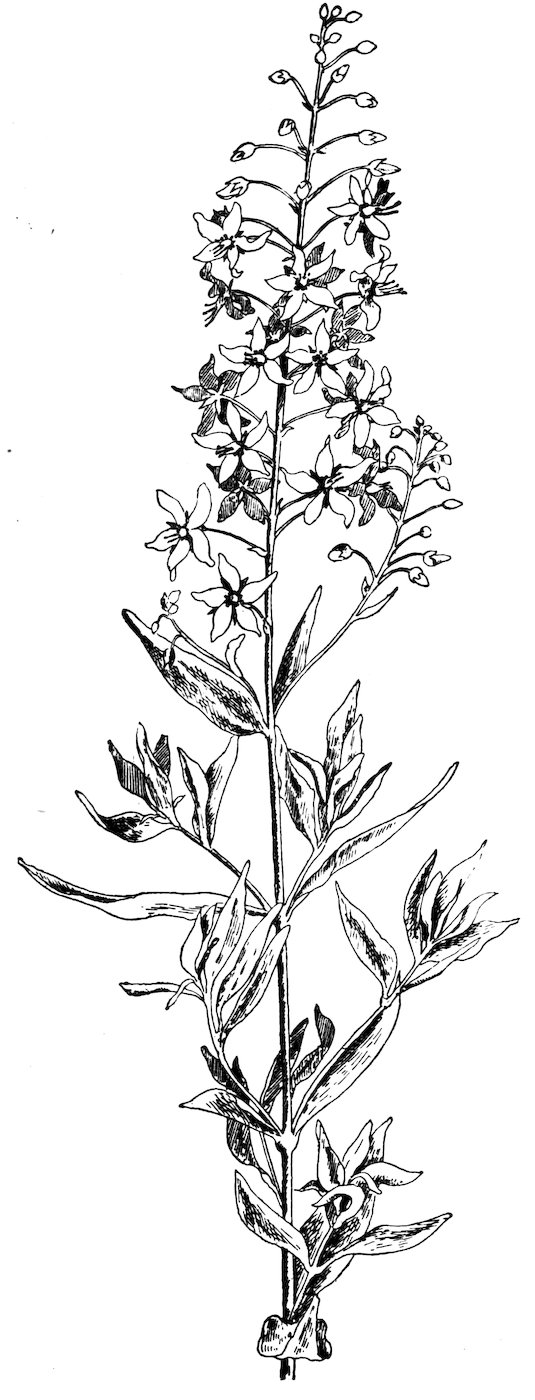
PLATE XLVII
YELLOW LOOSESTRIFE.—L. stricta.
142
Stem.—Erect, two to four feet high. Leaves.—Opposite, narrowly oval,
on fringed leaf-stalks. Flowers.—Yellow, on slender stalks from the axils
of the leaves. Calyx.—Deeply five-parted. Corolla.—Deeply five-lobed,
wheel-shaped, yellow, with a reddish centre. Stamens.—Five. Pistil.—One.
This plant is nearly akin to the yellow loosestrifes, but unfortunately
it has no English name. It abounds in low grounds
and thickets, putting forth its bright wheel-shaped blossoms early
in July.
A shrub. Leaves.—Oblong, toothed, in clusters from the axil of a thorn.
Flowers.—Yellow, in drooping racemes. Calyx.—Of six sepals, with from
two to six bractlets without. Corolla.—Of six petals. Stamens.—Six.
Pistil.—One. Fruit.—An oblong scarlet berry.
This European shrub has now become thoroughly wild and
very plentiful in parts of New England. The drooping yellow
flowers of May and June are less noticeable than the oblong
clustered berries of September, which light up so many overgrown
lanes, and often decorate our lawns and gardens as well.
The ancients extracted a yellow hair-dye from the barberry;
and to-day it is used to impart a yellow color to wool. Both its
common and botanical names are of Arabic origin.
Scapes.—Slender, few-flowered. Leaves.—Linear, grass-like, hairy.
Flowers.—Yellow. Perianth.—Six-parted, spreading, the divisions hairy
and greenish outside, yellow within. Stamens.—Six. Pistil.—One.
When our eyes fall upon what looks like a bit of evening sky
set with golden stars, but which proves to be only a piece of
shaded turf gleaming with these pretty flowers, we recall Longfellow’s
musical lines:
Spake full well in language quaint and olden,
One who dwelleth on the castled Rhine,
When he called the flowers so blue and golden,
Stars, which in earth’s firmament do shine.
The plant grows abundantly in open woods and meadows,
flowering in early summer.
143
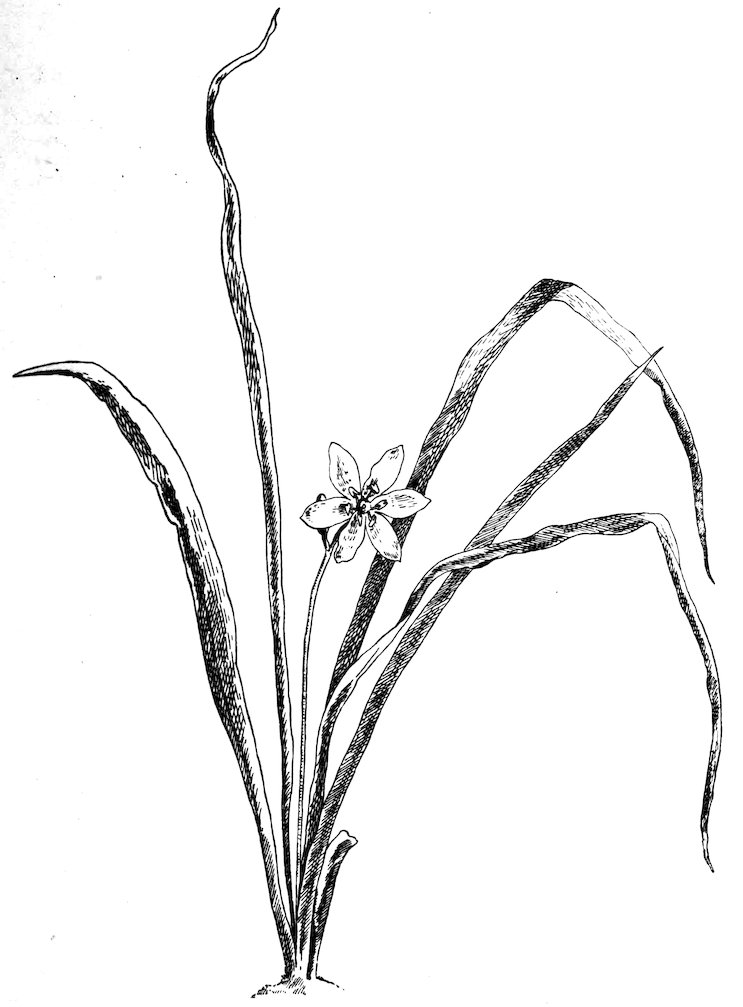
PLATE XLVIII
YELLOW STAR-GRASS.—H. erecta.
144
Two or three feet high. Stems.—Smooth and slender. Leaves.—Divided
into three rounded leaflets, somewhat pale with a whitish bloom, turning
black in drying. Flowers.—Papilionaceous, yellow, clustered in many
short, loose racemes.
This rather bushy-looking, bright-flowered plant is constantly
encountered in our rambles throughout the somewhat dry
and sandy parts of the country in midsummer. It is said that it
is found in nearly every State in the Union, and that it has been
used as a homœopathic remedy for typhoid fever. Its young
shoots are eaten at times in place of asparagus. Both the botanical
and common names refer to its having yielded an economical
but unsuccessful substitute for indigo.
Six to twelve inches high. Leaves.—Divided into three oblong leaflets.
Flowers.—Papilionaceous, yellow, small, in close heads.
Although this little plant is found in such abundance along
our New England roadsides and in many other parts of the
country as well, comparatively few people seem to recognize it
as a member of the clover group, despite a marked likeness in
the leaves and blossoms to others of the same family.
The name clover probably originated in the Latin clava-clubs,
in reference to the fancied resemblance between the three-pronged
club of Hercules and the clover leaf. The clubs of our
playing-cards and the trèfle (trefoil) of the French are probably
an imitation of the same leaf.
The nonesuch, Medicago lupulina, with downy, procumbent
stems, and flowers which grow in short spikes, is nearly allied to
the hop clover. In its reputed superiority as fodder its English
name is said to have originated. Dr. Prior says that for many
years this plant has been recognized in Ireland as the true shamrock.
145
A shrubby plant from one to two feet high. Leaves.—Lance-shaped.
Flowers.—Papilionaceous, yellow, growing in spiked racemes.
This is another foreigner which has established itself in Eastern
New York and Massachusetts, where it covers the barren
hill-sides with its yellow flowers in early summer. It is a common
English plant, formerly valued for the yellow dye which it
yielded. It is an undesirable intruder in pasture-lands, as it gives
a bitter taste to the milk of cows which feed upon it.
Two to four feet high. Stem.—Upright. Leaves.—Divided into three
toothed leaflets. Flowers.—Papilionaceous, yellow, growing in spike-like
racemes.
This plant is often found blossoming along the roadsides in
early summer. It was formerly called in England “king’s-clover,”
because, as Parkinson writes, “the yellowe flowers doe
crown the top of the stalkes.” The leaves become fragrant in
drying.
Stem.—Hairy, three to six inches high. Leaves.—Undivided, oval or
lance-shaped. Flowers.—Papilionaceous, yellow, but few in a cluster.
Pod.—Inflated, many-seeded, blackish.
The yellow flowers of the rattlebox are found in the sandy
meadows and along the roadsides during the summer. Both the
generic and English names refer to the rattling of the loose seeds
within the inflated pod.
146
Stem.—Smooth, erect, one to three feet high. Leaves.—Alternate, linear
or nearly so. Flowers.—Of two shades of yellow, growing in terminal racemes.
Calyx.—Five-parted. Corolla.—Pale yellow tipped with orange,
long-spurred, two-lipped, closed in the throat. Stamens.—Four. Pistil.—One.
The bright blossoms of butter-and-eggs grow in full, close
clusters which enliven the waste places along the roadside so
commonly, that little attention is paid to these beautiful and conspicuous
flowers. They would be considered a “pest” if they did
not display great discrimination in their choice of locality, usually
selecting otherwise useless pieces of ground. The common
name of butter-and-eggs is unusually appropriate, for the two
shades of yellow match perfectly their namesakes. Like nearly all
our common weeds, this plant has been utilized in various ways by
the country people. It yielded what was considered at one time
a valuable skin lotion, while its juice mingled with milk constitutes
a fly-poison. Its generic name, Linaria, and its English
title, toadflax, arose from a fancied resemblance between its leaves
and those of the flax.
Stem.—Three or four feet high. Leaves.—Divided into from six to nine
pairs of narrowly oblong leaflets. Flowers.—Yellow, in short clusters from
the axils of the leaves. Calyx.—Of five sepals. Corolla.—Of five slightly
unequal, spreading petals, usually somewhat spotted with reddish-brown.
Stamens.—Five to ten, unequal, some of them often imperfect. Pistil.—One.
Pod.—Long and narrow, slightly curved, flat.
This tall, striking plant, with clusters of yellow flowers which
appear in midsummer, grows abundantly along many of the New
England roadsides, and also far south and west, thriving best in
sandy soil. Although a member of the Pulse family its blossoms
are not papilionaceous.
147
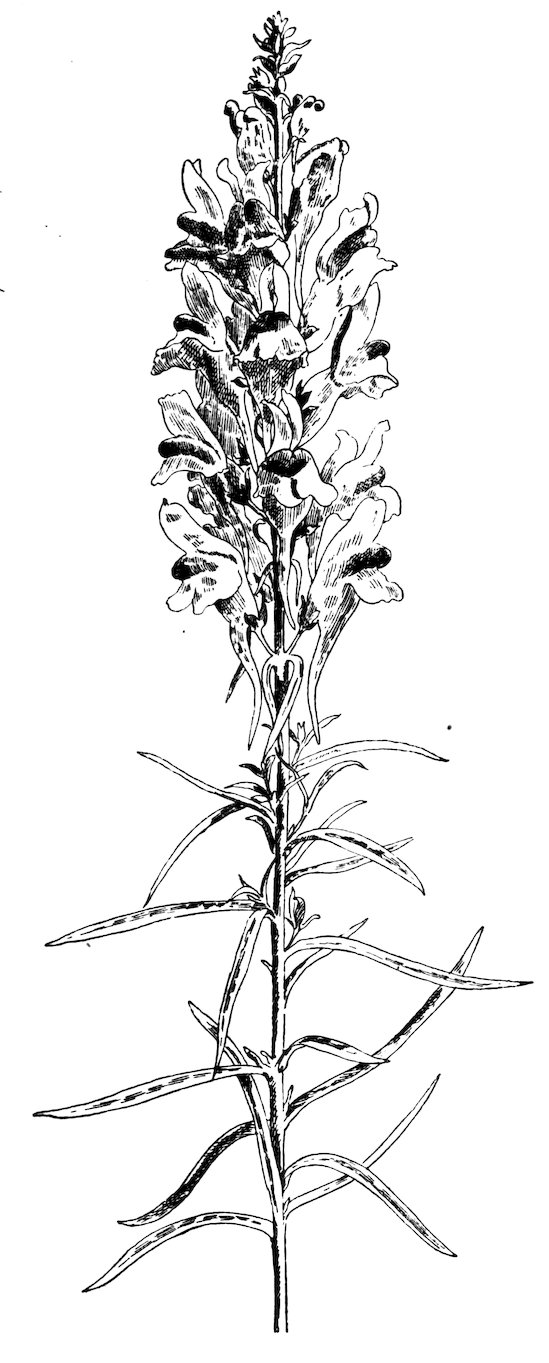
PLATE XLIX
BUTTER-AND-EGGS.—L. vulgaris.
148
Stems.—Spreading, eight inches to a foot long. Leaves.—Divided into
from ten to fifteen pairs of narrow delicate leaflets, which close at night
and are somewhat sensitive to the touch. Flowers.—Yellow, rather large
and showy, on slender stalks beneath the spreading leaves; not papilionaceous.
Calyx.—Of five sepals. Corolla.—Of five rounded, spreading,
somewhat unequal petals, two or three of which are usually spotted at the
base with red or purple. Stamens.—Ten, unequal, dissimilar. Pistil.—One,
with a slender style. Pod.—Flat.
The partridge-pea is closely related to the wild senna, and a
pretty, delicate plant it is, with graceful foliage, and flowers in
late summer which surprise us with their size, abounding in
gravelly, sandy places where little else will flourish, brightening
the railway embankments and the road’s edge. It is at home all
over the country south of Massachusetts and east of the Rocky
Mountains, but it grows with a greater vigor and luxuriance in
the south than elsewhere. The leaves can hardly be called sensitive
to the touch, yet when a branch is snapped from the
parent-stem or is much handled, the delicate leaflets will droop
and fold, displaying their curious mechanism.
Stem.—Much branched. Leaves.—Small, opposite, somewhat oblong,
with pellucid dots. Flowers.—Yellow, numerous, in leafy clusters. Calyx.—Of
five sepals. Corolla.—Of five bright yellow petals, somewhat spotted
with black. Stamens.—Indefinite in number. Pistil.—One, with three
spreading styles.
“Too well known as a pernicious weed which it is difficult
to extirpate,” is the scornful notice which the botany gives to
this plant whose bright yellow flowers are noticeable in waste
fields and along roadsides nearly all summer. Its rank, rapid
growth proves very exhausting to the soil, and every New England
farmer wishes it had remained where it rightfully belongs—on
the other side of the water.
149
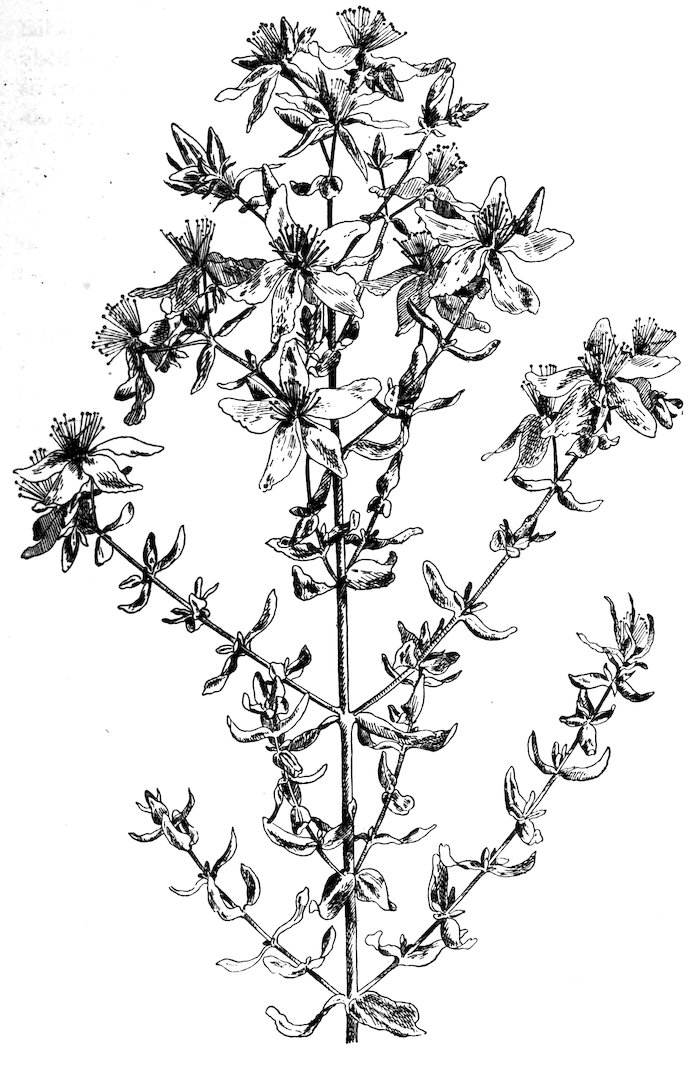
PLATE L
COMMON ST. JOHN’S-WORT.—H. perforatum.
150Perhaps more superstitions have clustered about the St. John’s-wort
than about any other plant on record. It was formerly
gathered on St. John’s eve, and was hung at the doors and windows
as a safeguard against thunder and evil spirits. A belief
prevailed that on this night the soul had power to leave the body
and visit the spot where it would be finally summoned from its
earthly habitation, hence the all-night vigils which were observed
at that time.
The wonderful herb whose leaf will decide
If the coming year shall make me a bride,
is the St. John’s-wort, and the maiden’s fate is favorably forecast
by the healthy growth and successful blossoming of the plant
which she has accepted as typical of her future.
In early times poets and physicians alike extolled its properties.
An ointment was made of its blossoms, and one of its early
names was “balm-of-the-warrior’s-wound.” It was considered
so efficacious a remedy for melancholia that it was termed “fuga
dæmonum.” Very possibly this name gave rise to the general
idea that it was powerful in dispelling evil spirits.
Stem.—Low, branched. Leaves.—Opposite, narrowly oblong, black-dotted.
Flowers.—Light-yellow. Calyx.—Of four sepals, the two outer
broad and leaf-like, the inner much smaller. Corolla.—Of four narrowly
oblong petals. Stamens.—Numerous. Pistil.—One, with two short styles.
From July till September these flowers may be found in the
pine-barrens of New Jersey and farther south and westward,
and on the island of Nantucket as well.
Stem.—Tall and stout, from three to five feet high. Leaves.—Oblong,
woolly. Flowers.—In a long dense spike. Calyx.—Five-parted. Corolla.—Yellow,
with five slightly unequal rounded lobes. Stamens.—Ten, the
three upper with white wool on their filaments. Pistil.—One.
151
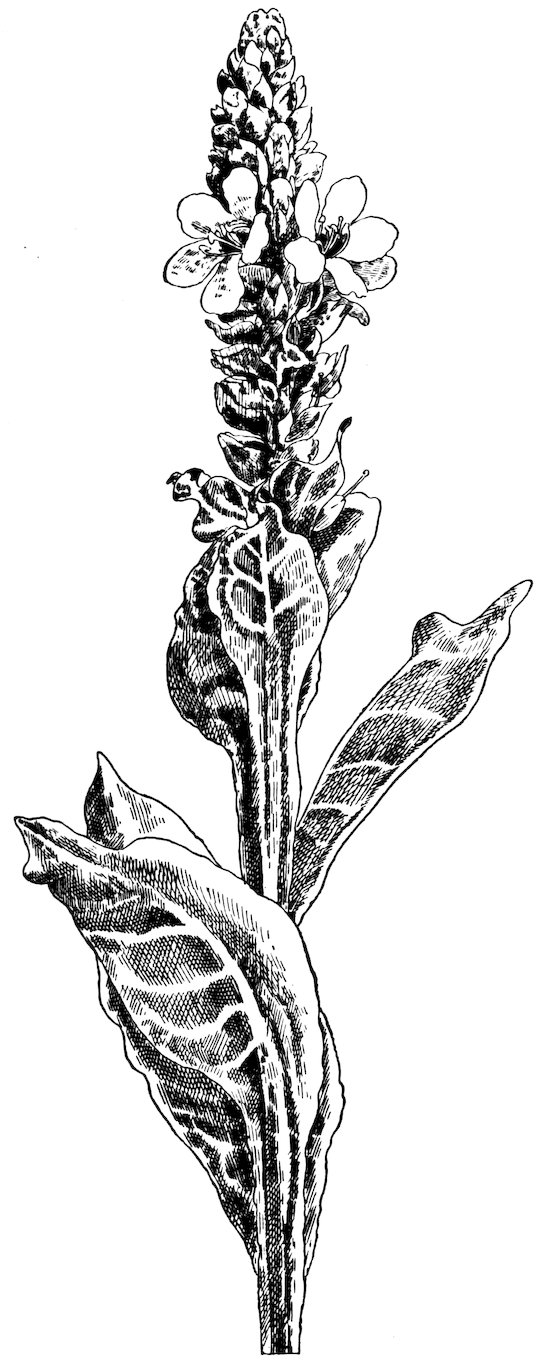
PLATE LI
COMMON MULLEIN.—V. Thapsus.
152The common mullein is a native of the island of Thapsos,
from which it takes its specific name. It was probably brought
to this country from Europe by the early colonists, notwithstanding
the title of “American velvet plant,” which it is rumored
to bear in England. The Romans called it “candelaria,” from
their custom of dipping the long dried stalk in suet and using it
as a funeral torch, and the Greeks utilized the leaves for lamp-wicks.
In more modern times they have served as a remedy for
the pulmonary complaints of men and beasts alike, “mullein tea”
being greatly esteemed by country people. Its especial efficacy
with cattle has earned the plant its name of “bullocks’ lungwort.”
A low rosette of woolly leaves is all that can be seen of the
mullein during its first year, the yellow blossoms on their long
spikes opening sluggishly about the middle of the second summer.
It abounds throughout our dry, rolling meadows, and its
tall spires are a familiar feature in the summer landscape.
Stem.—Tall and slender. Leaves.—Oblong, toothed, the lower sometimes
lyre-shaped, the upper partly clasping. Flowers.—Yellow or white,
tinged with red or purple, in a terminal raceme. Calyx.—Deeply five-parted.
Corolla.—Butterfly-shape, of five rounded, somewhat unequal lobes.
Stamens.—Five, with filaments bearded with violet wool and anthers loaded
with orange-colored pollen. Pistil.—One.
Along the highway from July till October one encounters a
slender weed on whose erect stem it would seem as though a
number of canary-yellow or purplish-white moths had alighted
for a moment’s rest. These are the fragile, pretty flowers of the
moth mullein, and they are worthy of a closer examination. The
reddened or purplish centre of the corolla suggests the probability
of hidden nectar, while the pretty tufts of violet wool borne
by the stamens are well fitted to protect it from the rain. A
little experience of the canny ways of these innocent-looking
flowers lead one to ask the wherefore of every new feature.
Stem.—Leafy, one to two feet high. Leaves.—The lower oblong to
lance-shaped, the upper passing into pointed bracts. Flowers.—Deep
orange color, with a slender spur and deeply fringed lip; growing in an oblong
spike.
153
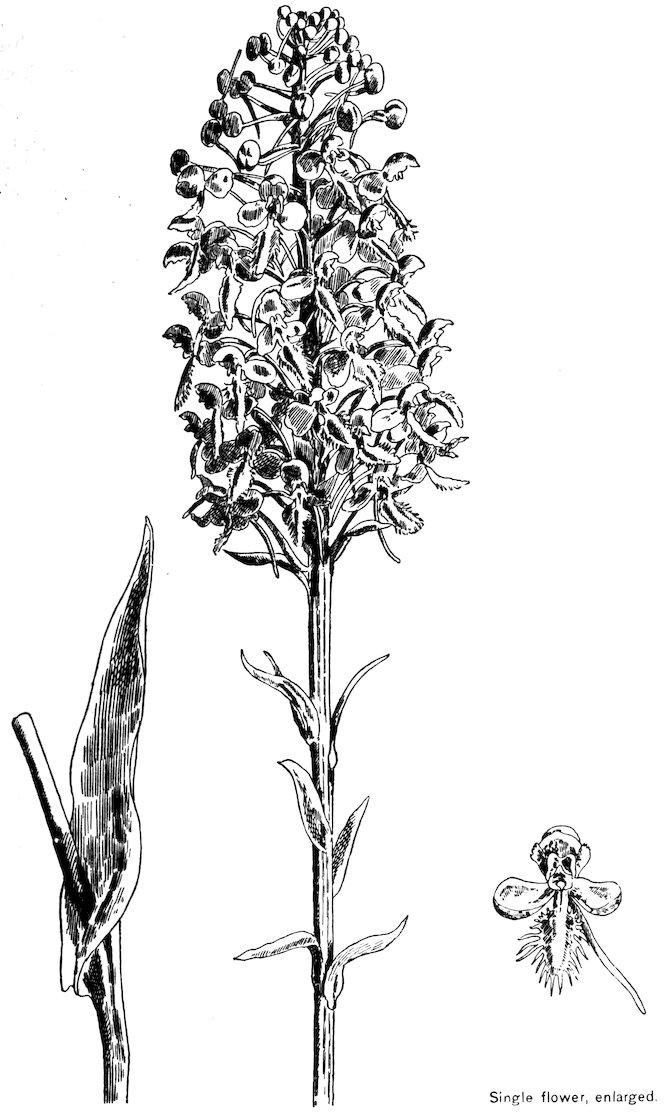
PLATE LII
YELLOW FRINGED ORCHIS.—H. ciliaris.
154Years may pass without our meeting this the most brilliant
of our orchids. Suddenly one August day we will chance upon
just such a boggy meadow as we have searched in vain a hundred
times, and will behold myriads of its deep orange, dome-like
spires erecting themselves in radiant beauty over whole acres
of land. The separate flowers, with their long spurs and deeply
fringed lips, will repay a close examination. They are well calculated,
massed in such brilliant clusters, to arrest the attention
of whatever insects may specially affect them. Although I have
watched many of these plants I have never seen an insect visit
one, and am inclined to think that they are fertilized by night
moths.
Mr. Baldwin declares: “If I ever write a romance of Indian
life, my dusky heroine, Birch Tree or Trembling Fawn, shall
meet her lover with a wreath of this orchis on her head.”
Impatiens pallida. Pale Touch-me-not.
Flowers.—Pale yellow, somewhat spotted with reddish-brown; common
northward.
Impatiens fulva. Spotted Touch-me-not.
Flowers.—Orange-yellow, spotted with reddish-brown; common southward.
Two to six feet high. Leaves.—Alternate, coarsely toothed, oval.
Flowers.—Nodding, loosely clustered, or growing from the axils of the
leaves. Calyx and Corolla.—Colored alike, and difficult to distinguish; of
six pieces, the largest one extended backward into a deep sac ending in a
little spur, the two innermost unequally two-lobed. Stamens.—Five, very
short, united over the pistil. Pistil.—One.
These beautiful plants are found along shaded streams and
marshes, and are profusely hung with brilliant jewel-like flowers
during the summer months. In the later year they bear those
closed inconspicuous blossoms which fertilize in the bud and are
called cleistogamous flowers. The jewel-weed has begun to appear
along the English rivers, and it is said that the ordinary
showy blossoms are comparatively rare, while the cleistogamous
ones abound. Does not this look almost like a determination on
the part of the plant to secure a firm foothold in its new environment
before expending its energy on flowers which, though
radiant and attractive, are quite dependent on insect-visitors for
fertilization and perpetuation?
155
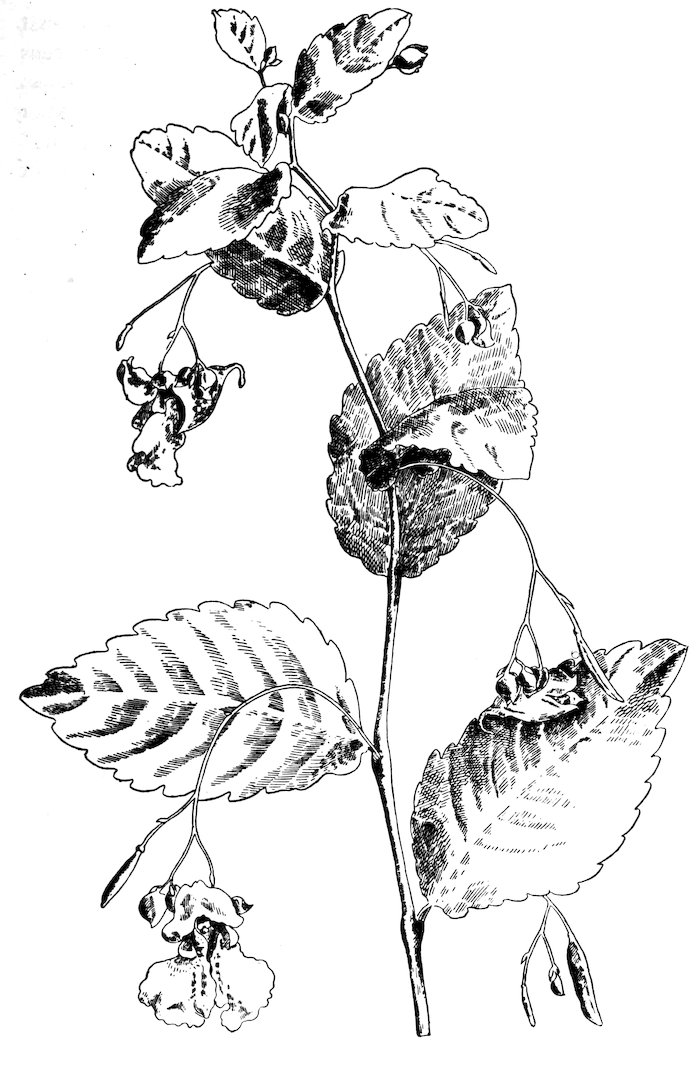
PLATE LIII
PALE JEWEL-WEED.—I. pallida.
156The name touch-me-not refers to the seed-pods, which burst
open with such violence when touched, as to project their seeds
to a comparatively great distance. This ingenious mechanism
secures the dispersion of the seeds without the aid of the wind or
animals. In parts of New York the plant is called “silver-leaf,”
from its silvery appearance when touched with rain or dew, or
when held beneath the water.
One or two feet high. Leaves.—Divided into several coarsely toothed
leaflets. Flowers.—Small, yellow, in slender spiked racemes. Calyx.—Five-cleft,
beset with hooked teeth. Corolla.—Of five petals. Stamens.—Five
to fifteen. Pistils.—One to four.
The slender yellow racemes of the agrimony skirt the woods
throughout the later summer. In former times the plant was
held in high esteem by town physician and country herbalist
alike. Emerson longed to know
Only the herbs and simples of the wood,
Rue, cinquefoil, gill, vervain, and agrimony.
Up to a recent date the plant has been dried and preserved by
country people and might be seen exposed for sale in the shops
of French villages. It has also been utilized in a dressing for
shoe-leather. When about to flower it yields a pale yellow dye.
Chaucer calls it egremoine. The name is supposed to be
derived from the Greek title for an eye-disease, for which the
juice of a plant similarly entitled was considered efficacious.
The crushed flower yields a lemon-like odor.
Stem.—Erect. Leaves.—Divided into three delicate clover-like leaflets.
Flowers.—Golden-yellow. Calyx.—Of five sepals. Corolla.—Of five
petals. Stamens.—Ten. Pistil.—One, with five styles.
All summer the small flowers of the yellow wood sorrel show
brightly against their background of delicate leaves. The plant
157varies greatly in its height and manner of growth, flourishing
abundantly along the roadsides. The small leaflets are open to
the genial influence of sun and air during the hours of daylight,
but at night they protect themselves from chill by folding one
against another.
This is a day-blooming species of the evening primrose, with
large, pale yellow blossoms and alternate oblong or narrowly
lance-shaped leaves, and of a much less rank habit. In early
summer our roadsides are illuminated with these flowers.
Œnothera pumila is also a diurnal species. Its loosely spiked
blossoms are much smaller than those of the sundrops.
Stout, erect, one to five feet high. Leaves.—Alternate, lance-shaped to
oblong. Flowers.—Pale yellow, in a leafy spike, opening at night. Calyx.—With
a long tube, four-lobed. Corolla.—Of four somewhat heart-shaped
petals. Stamens.—Eight, with long anthers. Pistil.—One, with a stigma
divided into four linear lobes.
Along the roadsides in midsummer we notice a tall, rank-growing
plant, which seems chiefly to bear buds and faded blossoms.
And unless we are already familiar with the owl-like tendencies
of the evening primrose, we are surprised, some dim
twilight, to find this same plant resplendent with a mass of fragile
yellow flowers, which are exhaling their faint delicious fragrance
on the evening air.
One brief summer night exhausts the vitality of these delicate
blossoms. The faded petals of the following day might serve as
a text for a homily against all-night dissipation, did we not
know that by its strange habit the evening primrose guards
against the depredations of those myriad insects abroad during
the day, which are unfitted to transmit its pollen to the pistil of
another flower.
We are impressed by the utilitarianism in vogue in this floral
158world, as we note that the pale yellow of these blossoms gleams
so vividly through the darkness as to advertise effectively their
whereabouts, while their fragrance serves as a mute invitation
to the pink night-moth, which is their visitor and benefactor.
Why they change their habits in the late year and remain open
during the day, I have not been able to discover.
One to three feet high. Leaves.—Opposite, large, ovate, toothed,
pointed. Flowers.—Yellowish, lemon-scented, clustered loosely. Calyx.—Two-lipped,
the upper lip three-toothed, the lower two-cleft. Corolla.—Elongated,
somewhat two-lipped, the four upper lobes nearly equal, the
lower large and long, toothed or fringed. Stamens.—Two (sometimes four,
the upper pair shorter), protruding, diverging. Pistil.—One, with a two-lobed
style.
In the damp rich woods of midsummer these strong-scented
herbs, with their loose terminal clusters of lemon-colored, lemon-scented
flowers are abundant. The plant was introduced into
England by the amateur botanist and flower-lover, Collinson,
after whom the species is named. The Indians formerly employed
it as an application to wounds.
Stem.—Stout and hairy, one to two feet high. Leaves.—Rough and
hairy, the upper long, narrow, set close to the stem; the lower broader,
with leaf-stalks. Flower-heads.—Composed of both ray and disk-flowers;
the former yellow, the latter brown and arranged on a cone-like receptacle.
By the middle of July our dry meadows are merry with
black-eyed Susans, which are laughing from every corner and
keeping up a gay midsummer carnival in company with the
yellow lilies and brilliant milkweeds. They seem to revel in
the long days of blazing sunlight, and are veritable salamanders
among the flowers. Although now so common in our eastern
fields they were first brought to us with clover-seed from the
West, and are not altogether acceptable guests, as they bid fair
to add another anxiety to the already harassed life of the New
England farmer.
159
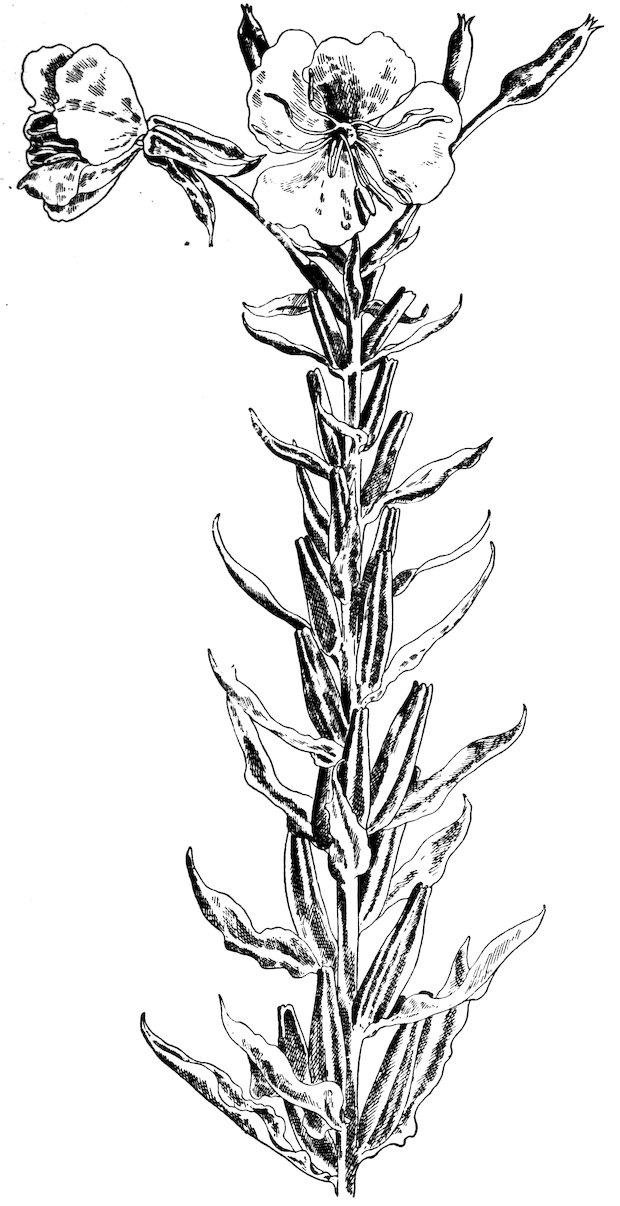
PLATE LIV
EVENING PRIMROSE.—Œ. biennis.
160
Two to seven feet high. Stem.—Smooth, branching. Leaves.—The
lower divided into lobed leaflets, the upper irregularly three to five-parted.
Flower-heads.—Yellow, rather large, composed of both ray and disk-flowers,
the former drooping and yellow, the later dull greenish and arranged on a
columnar receptacle.
This graceful, showy flower is even more decorative than the
black-eyed Susan. Its drooping yellow rays are from one to
two inches long. It may be found throughout the summer in
the low thickets which border the swamps and meadows.
Stem.—Silky, with long weak hairs when young. Leaves.—Alternate,
oblong. Flower-heads.—Golden-yellow, rather large, composed of both ray
and disk-flowers.
In dry places along the roadsides of Southern New York and
farther south, one can hardly fail to notice in late summer and
autumn the bright clusters of the golden aster.
C. falcata is a species which may be found in dry sandy soil
as far north as Massachusetts, with very woolly stems, crowded
linear leaves, and small, clustered flower-heads.
Flower-heads.—Golden-yellow, composed of both ray and disk-flowers.
About eighty species of golden-rod are native to the United
States: of these forty-two species can be found in our Northeastern
States. Many of them are difficult of identification, and
it would be useless to describe any but a few of the more conspicuous
forms.
161
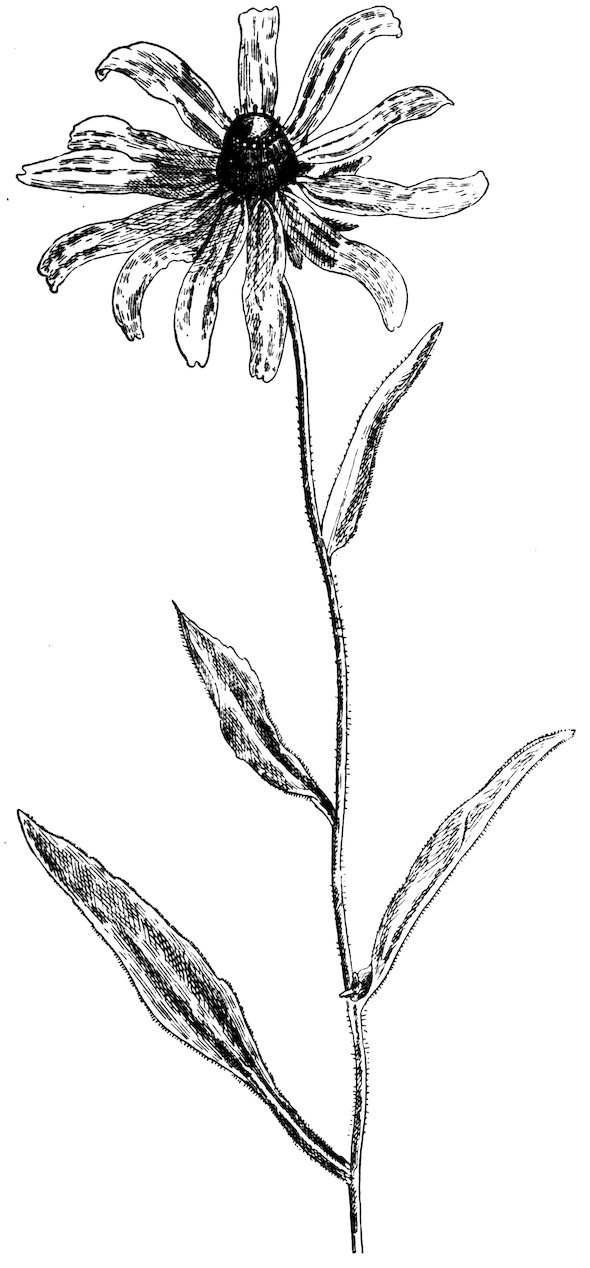
PLATE LV
BLACK-EYED SUSAN.—R. hirta.
162A common and noticeable species which flowers early in
August is S. Canadensis, with a tall stout stem from three to
six feet high, lance-shaped leaves, which are usually sharply
toothed and pointed, and small flower-heads clustered along the
branches which spread from the upper part of the stem.
Another early flowering species is S. rugosa. This is a lower
plant than S. Canadensis, with broader leaves. Still another is
the dusty golden-rod, S. nemoralis, which has a hoary aspect
and very bright yellow flowers which are common in dry fields.
S. lanceolata has lance-shaped or linear leaves, and flowers
which grow in flat-topped clusters, unlike other members of the
family; the information that this is a golden-rod often creates
surprise, as for some strange reason it seems to be confused with
the tansy.
The sweet golden-rod, S. odorata, is easily recognized by
its fragrant, shining, dotted leaves. S. cæsia, or the blue-stemmed,
is a wood-species and among the latest of the year,
putting forth its bright clusters for nearly the whole length of
its stem long after many of its brethren look like brown wraiths
of their former selves. The silver rod, S. bicolor, whose whitish
flowers are a departure from the family habit, also survives
the early cold and holds its own in the dry woods.
The only species native to Great Britain is S. Virga-aurea.
The generic name is from two Greek words which signify to
make whole, and refer to the healing properties which have been
attributed to the genus.
Stem.—Stout, three to five feet high. Leaves.—Alternate, large, woolly
beneath, the upper partly clasping. Flower-heads.—Yellow, large, composed
of both ray and disk-flowers.
163
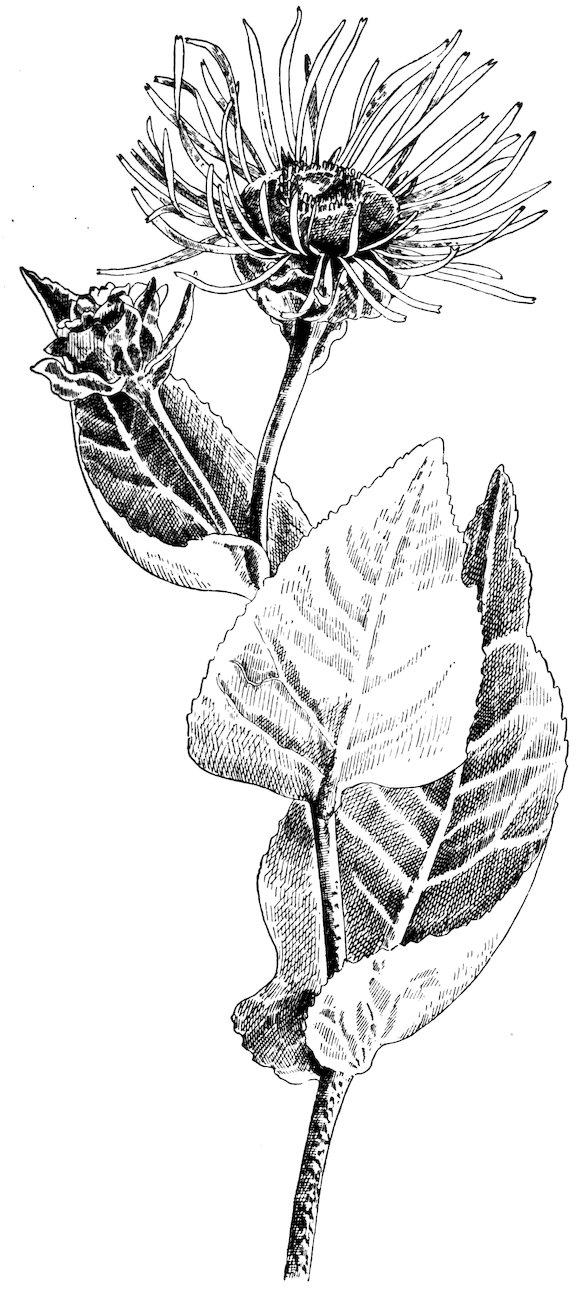
PLATE LVI
ELECAMPANE.—I. Helenium.
164When we see these great yellow disks peeping over the pasture
walls or flanking the country lanes, we feel that midsummer
is at its height. Flowers are often subservient courtiers, and
make acknowledgment of whatever debt they owe by that
subtlest of flatteries—imitation. Did not the blossoms of the
dawning year frequently wear the livery of the snow which had
thrown its protecting mantle over their first efforts? And these
newcomers—whose gross, rotund countenances so clearly betray
the results of high living—do not they pay their respects to their
great benefactor after the same fashion?—with the result that a
myriad miniature suns shine upward from meadow and roadside.
The stout, mucilaginous root of this plant is valued by farmers
as a horse-medicine, especially in epidemics of epizootic, one
of its common names in England being horse-heal.
In ancient times the elecampane was considered an important
stimulant to the human brain and stomach, and it was mentioned
as such in the writings of Hippocrates, the “Father of
Medicine,” over two thousand years ago.
The common name is supposed to be a corruption of ala
campania, and refers to the frequent occurrence of the plant in
that ancient province of Southern Italy.
Scape.—Five to fifteen inches high, branching. Leaves.—From the root,
toothed or deeply incised. Flower-heads.—Yellow, composed entirely of
strap-shaped flowers; smaller than those of the common dandelion.
From June till November we find the fall dandelion along
the New England roadsides, as well as farther south. While
the yellow flower-heads somewhat suggest small dandelions the
general habit of the plant recalls some of the hawkweeds.
Stem.—Rough or hairy, from three to ten feet high, branched above.
Leaves.—Lance-shaped, pointed, rough to the touch, set close to the stem.
Flower-heads.—Yellow, composed of both ray and disk-flowers.
165
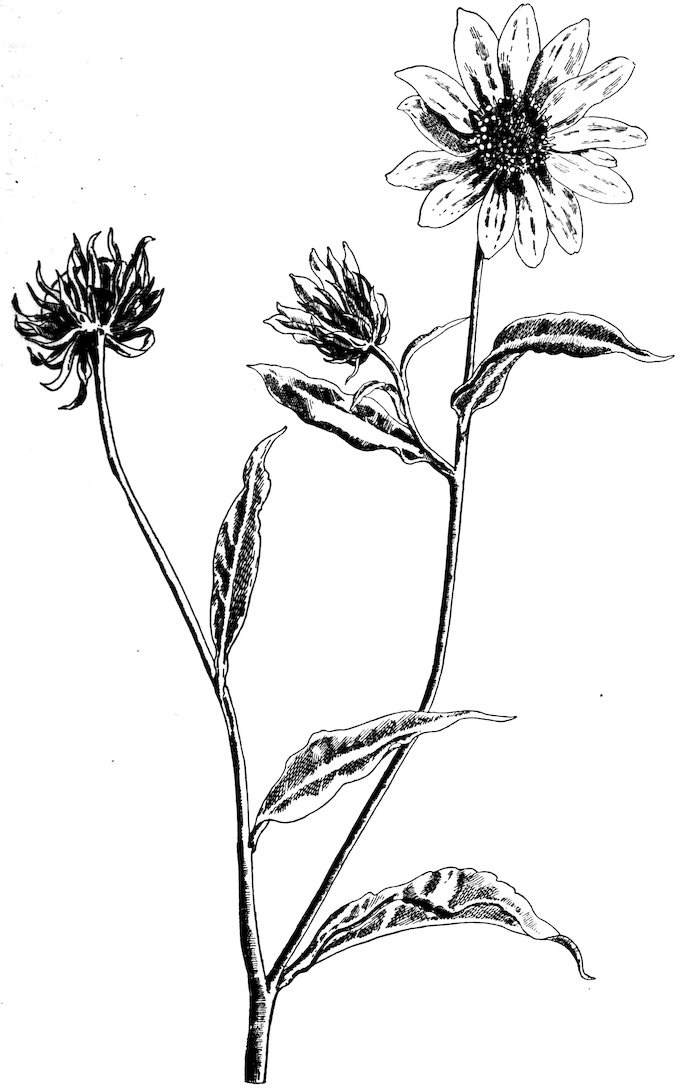
PLATE LVII
WILD SUNFLOWER.—H. giganteus.
166In late summer many of our lanes are hedged by this beautiful
plant, which, like other members of its family, lifts its yellow
flowers sunward in pale imitation of the great life-giver itself.
We have twenty-two different species of sunflower. H. divaricatus
is of a lower growth, with opposite, widely spreading leaves
and larger flower-heads. H. annuus is the garden species familiar
to all; this is said to be a native of Peru. Mr. Ellwanger
writes regarding it: “In the mythology of the ancient Peruvians
it occupied an important place, and was employed as a
mystic decoration in ancient Mexican sculpture. Like the lotus
of the East, it is equally a sacred and an artistic emblem, figuring
in the symbolism of Mexico and Peru, where the Spaniards
found it rearing its aspiring stalk in the fields, and serving in
the temples as a sign and a decoration, the sun-god’s officiating
handmaidens wearing upon their breasts representations of the
sacred flower in beaten gold.”
Gerarde describes it as follows: “The Indian Sun or the
golden floure of Peru is a plant of such stature and talnesse that
in one Sommer, being sowne of a seede in April, it hath risen up
to the height of fourteen foot in my garden, where one floure
was in weight three pound and two ounces, and crosse overthwart
the floure by measure sixteen inches broad.”
The generic name is from helios—the sun, and anthos—a
flower.
One to six feet high. Stem.—Angled, erect, branching. Leaves.—Alternate,
lance-shaped. Flower-heads.—Yellow, composed of both ray and
disk-flowers, the rays being somewhat cleft.
As far north as Connecticut we see masses of these bright
flowers bordering the streams and swamps in September.
Two to six feet high. Stem.—Branching. Leaves.—Opposite, three to
five-divided. Flower-heads.—Consisting of brownish-yellow tubular flowers,
with a leaf-like involucre beneath.
167
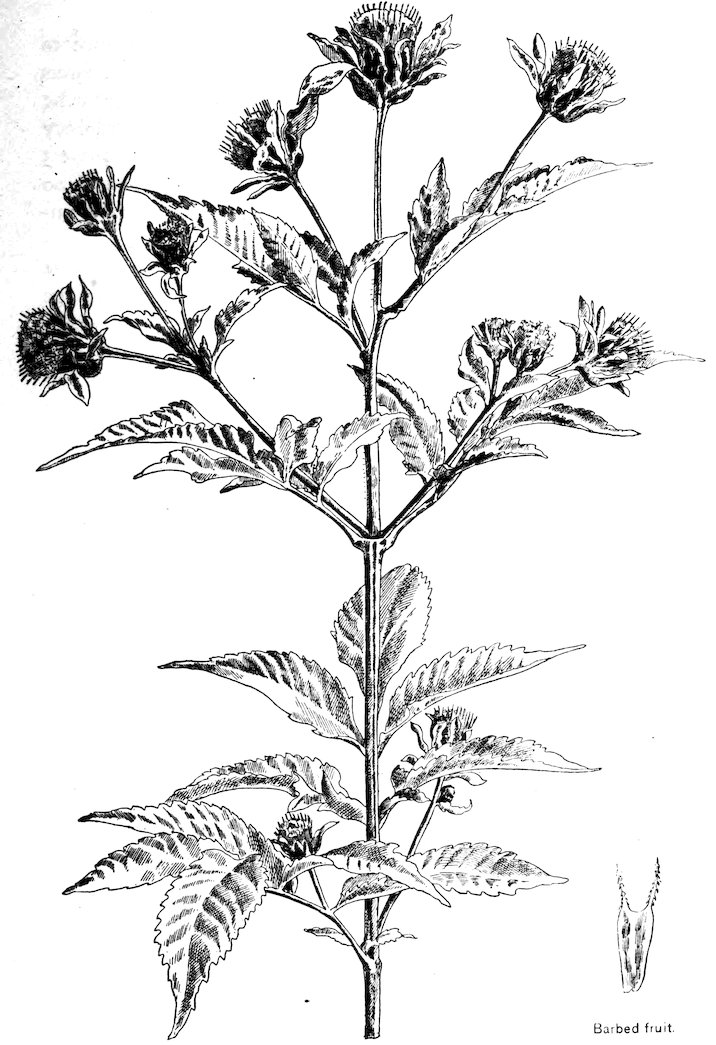
PLATE LVIII
STICK-TIGHT.—B. frondosa.
168If one were only describing the attractive wild flowers, the
stick-tight would certainly be omitted, as its appearance is not
prepossessing, and the small barbed seed-vessels so cleverly fulfil
their destiny in making one’s clothes a means of conveyance to
“fresh woods and pastures new” as to cause all wayfarers
heartily to detest them. “How surely the desmodium growing
on some cliff-side, or the bidens on the edge of a pool, prophesy
the coming of the traveller, brute or human, that will transport
their seeds on his coat,” writes Thoreau. But the plant is so
constantly encountered in late summer, and yet so generally unknown,
that it can hardly be overlooked.
The larger bur marigold, B. chrysanthemoides, does its best
to retrieve the family reputation for ugliness, and surrounds its
dingy disk-flowers with a circle of showy golden rays which
are strictly decorative, having neither pistils nor stamens, and
leaving all the work of the household to the less attractive but
more useful disk-flowers. Their effect is pleasing, and late into
the autumn the moist ditches look as if sown with gold through
their agency. The plant varies in height from six inches to two
feet. Its leaves are opposite, lance-shaped, and regularly toothed.
Stem.—Smooth, three to six feet high, usually branching. Leaves.—The
lower usually deeply incised, the upper narrowly oblong, incised, or entire.
Flowers.—Yellow, large, in a raceme or spike. Calyx.—Five-cleft. Corolla.—Two
inches long, somewhat tubular, swelling above, with five more
or less unequal, spreading lobes, woolly within. Stamens.—Four, in pairs,
woolly. Pistil.—One.
These large pale yellow flowers are very beautiful and striking
when seen in the dry woods of late summer. They are all
the more appreciated because there are few flowers abroad at
this season save the Composites, which are decorative and radiant
enough, but usually somewhat lacking in the delicate charm we
look for in a flower.
The members of this genus, which is named after Gerarde,
the author of the famous “Herball,” are supposed to be more
or less parasitic in their habits, drawing their nourishment from
the roots of other plants.
169
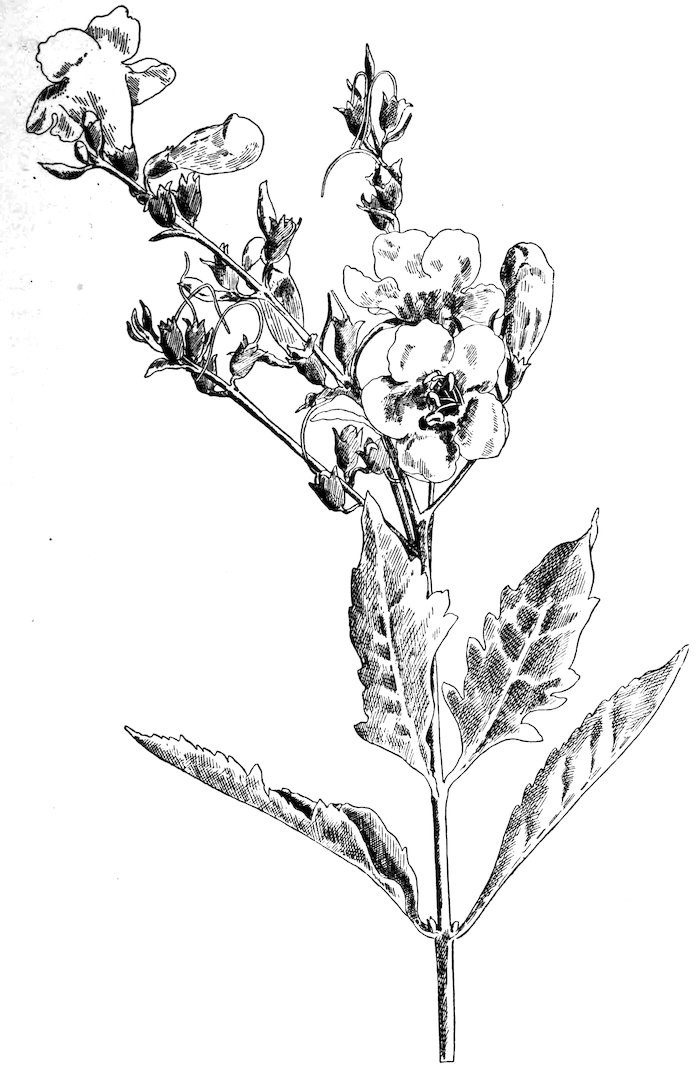
PLATE LIX
SMOOTH FALSE FOXGLOVE.—G. quercifolia.
170The downy false foxglove, G. flava, is usually a somewhat
lower plant, with a close down, a less-branched stem, more entire
leaves, and smaller, similar flowers.
Stem.—Two to four feet high. Leaves.—Divided into toothed leaflets.
Flower-heads.—Yellow, composed of tiny flowers which are nearly, if not
all, tubular in shape; borne in flat-topped clusters.
With the name of tansy we seem to catch a whiff of its
strong-scented breath and a glimpse of some New England
homestead beyond whose borders it has strayed to deck the
roadside with its deep yellow, flat-topped flower-clusters. The
plant has been used in medicine since the Middle Ages, and in
more recent times it has been gathered by the country people
for “tansy wine” and “tansy tea.” In the Roman Church
it typifies the bitter herbs which were to be eaten at the Paschal
season; and cakes made of eggs and its leaves are called “tansies,”
and eaten during Lent. It is also frequently utilized in
more secular concoctions.
The common name is supposed to be a corruption of the
Greek word for immortality.
A tall shrub. Leaves.—Oval, wavy-toothed, mostly falling before the
flowers appear. Flowers.—Honey-yellow, clustered, autumnal. Calyx.—Four-parted.
Corolla.—Of four long narrow petals. Stamens.—Eight.
Pistils.—Two. Fruit.—A capsule which bursts elastically, discharging its
large seeds with vigor.
171
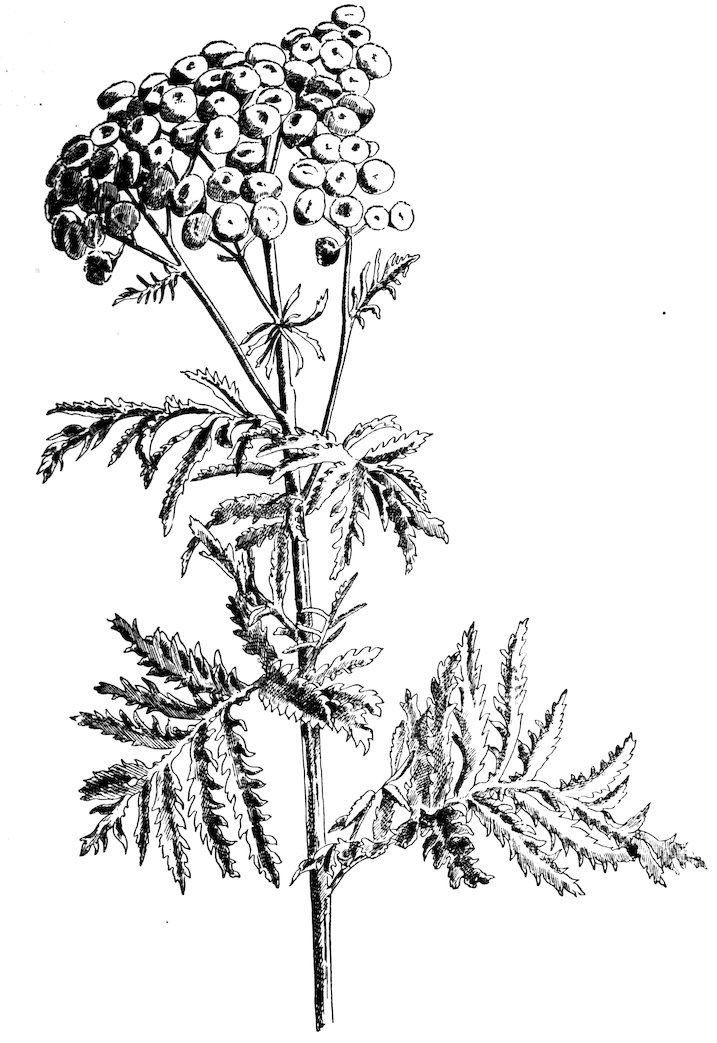
PLATE LX
TANSY.—T. vulgare.
172It seems as though the flowers of the witch-hazel were fairly
entitled to the “booby-prize,” of the vegetable world. Surely
no other blossoms make their first appearance so invariably late
upon the scene of action. The fringed gentian often begins to
open its “meek and quiet eye” quite early in September.
Certain species of golden-rod and aster continue to flower till
late in the year, but they began putting forth their bright clusters
before the summer was fairly over; while the elusively fragrant,
pale yellow blossoms of the witch-hazel need hardly be
expected till well on in September, when its leaves have fluttered
earthward and its fruit has ripened. Does the pleasure which
we experience at the spring-like apparition of this leafless yellow-flowered
shrub in the autumn woods arise from the same depraved
taste which is gratified by strawberries at Christmas, I
wonder? Or is it that in the midst of death we have a foretaste
of life; a prophecy of the great yearly resurrection which
even now we may anticipate?
Thoreau’s tastes in such directions were certainly not depraved,
and he writes: “The witch-hazel loves a hill-side with
or without woods or shrubs. It is always pleasant to come upon
it unexpectedly as you are threading the woods in such places.
Methinks I attribute to it some elfish quality apart from its fame.
I love to behold its gray speckled stems.” Under another date
he writes: “Heard in the night a snapping sound, and the fall
of some small body on the floor from time to time. In the
morning I found it was produced by the witch-hazel nuts on my
desk springing open and casting their seeds quite across my
chamber, hard and stony as these nuts were.”
The Indians long ago discovered the value of its bark for medicinal
purposes, and it is now utilized in many well-known
extracts. The forked branches formerly served as divining-rods
in the search for water and precious ores. This belief in its
mysterious power very possibly arose from its suggestive title,
which Dr. Prior says should be spelled wych-hazel, as it was
called after the wych-elm, whose leaves it resembles, and which
was so named because the chests termed in old times “wyches”
were made of its wood—
His hall rofe was full of bacon flytches,
The chambre charged was with wyches
Full of egges, butter, and chese.
[4]
Note.—The flowers of the American Woodbine and of the Fly Honeysuckle
(p. 228), and of the Golden Corydalis (p. 192) are also yellow.
173
Stem.—With rusty hairs, prostrate or trailing. Leaves.—Rounded,
heart-shaped at base, evergreen. Flowers.—Pink, clustered, fragrant.
Calyx.—Of five sepals. Corolla.—Five-lobed, salver-shaped, with a slender
tube which is hairy within. Stamens.—Ten. Pistil.—One, with a five-lobed
stigma.
Pink, small, and punctual,
Aromatic, low,
describes, but does scant justice to the trailing arbutus, whose
waxy blossoms and delicious breath are among the earliest
prophecies of perfume-laden summer. We look for these flowers
in April—not beneath the snow—where tradition rashly locates
them—but under the dead brown leaves of last year; and
especially among the pines and in light sandy soil. Appearing
as they do when we are eager for some tangible assurance that
—the Spring comes slowly up this way,
they win from many of us the gladdest recognition of the year.
In New England they are called Mayflowers, being peddled
about the streets of Boston every spring, under the suggestive
and loudly emphasized title of “Ply-y-mouth Ma-ayflowers!”
Whether they owe this name to the ship which is responsible
for so much, or to their season of blooming, in certain localities,
might remain an open question had we not the authority of
Whittier for attributing it to both causes. In a note prefacing
“The Mayflowers,” the poet says: “The trailing arbutus or
Mayflower grows abundantly in the vicinity of Plymouth, and
174was the first flower to greet the Pilgrims after their fearful
winter.” In the poem itself he wonders what the old ship had
Within her ice-rimmed bay
In common with the wild-wood flowers,
The first sweet smiles of May?
and continues—
Yet “God be praised!” the Pilgrim said,
Who saw the blossoms peer
Above the brown leaves, dry and dead,
“Behold our Mayflower here!”
God wills it, here our rest shall be,
Our years of wandering o’er,
For us the Mayflower of the sea
Shall spread her sails no more.
O sacred flowers of faith and hope,
As sweetly now as then,
Ye bloom on many a birchen slope,
In many a pine-dark glen.
So live the fathers in their sons,
Their sturdy faith be ours,
And ours the love that overruns
Its rocky strength with flowers.
If the poet’s fancy was founded on fact, and if our lovely and
wide-spread Mayflower was indeed the first blossom noted and
christened by our forefathers, it seems as though the problem of
a national flower must be solved by one so lovely and historic as
to silence all dispute. And when we read the following prophetic
stanzas which close the poem, showing that during another
dark period in our nation’s history these brave little blossoms,
struggling through the withered leaves, brought a message of
hope and courage to the heroic heart of the Quaker poet, our
feeling that they are peculiarly identified with our country’s
perilous moments is intensified:
The Pilgrim’s wild and wintry day
At shadow round us draws;
The Mayflower of his stormy bay
Our Freedom’s struggling cause.
But warmer suns erelong shall bring
To life the frozen sod;
And, through dead leaves of hope shall spring
Afresh the flowers of God!
175
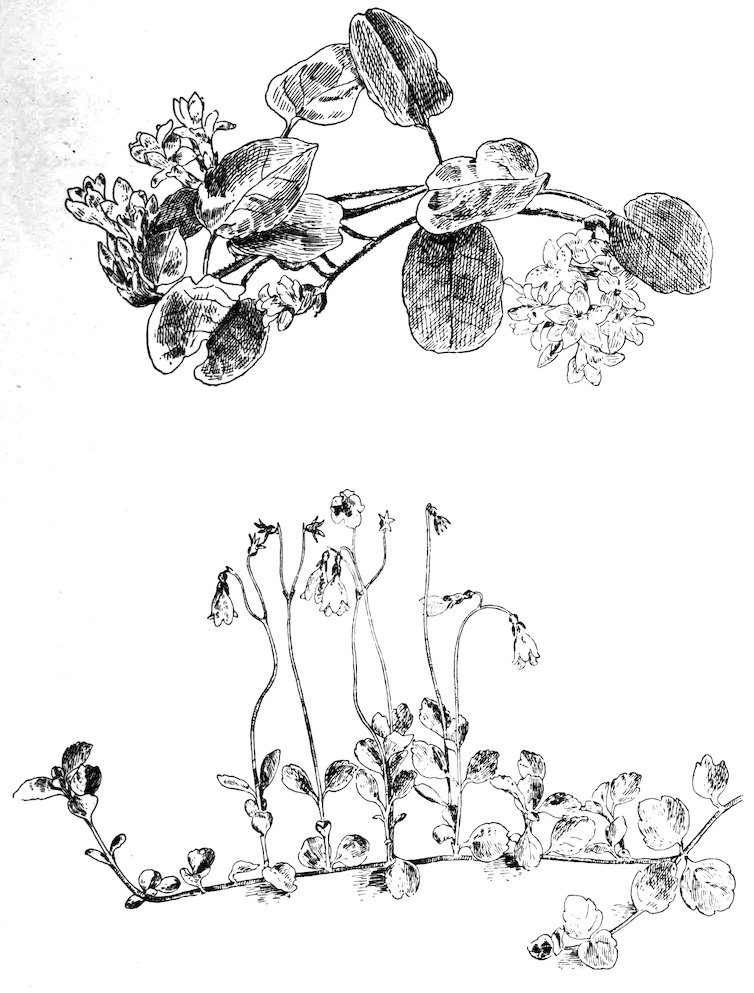
PLATE LXI
TRAILING ARBUTUS.—E. repens.
TWIN-FLOWER.—L. borealis.
176
Stem.—Slender, creeping and trailing. Leaves.—Rounded, shining and
evergreen. Flowers.—Growing in pairs, delicate pink, fragrant, nodding
on thread-like, upright flower-stalks. Calyx.—Five-toothed. Corolla.—Narrowly
bell-shaped, five-lobed, hairy within. Stamens.—Four, two shorter
than the others. Pistil.—One.
Whoever has seen
—beneath dim aisles, in odorous beds,
The slight Linnæa hang its twin-born heads,
[5]
will not soon forget the exquisite carpeting made by its nodding
pink flowers and dark shining leaves; or the delicious perfume
which actually filled the air and drew one’s attention to the spot
from which it was exhaled, tempting one to exclaim with Richard
Jefferies, “Sweetest of all things is wild-flower air!” That this
little plant should have been selected as “the monument of the
man of flowers” by the great Linnæus himself, bears testimony
to his possession of that appreciation of the beautiful which is
supposed to be lacking in men of long scientific training. I believe
that there is extant at least one contemporary portrait of
Linnæus in which he wears the tiny flowers in his buttonhole.
The rosy twin-blossoms are borne on thread-like, forking flower-stalks,
and appear in June in the deep, cool, mossy woods of the
North.
Stem.—Four-angled, with leaf-like bracts, rising from fleshy, fibrous
roots. Leaves.—Two, oblong, shining, three to six inches long. Flowers.—In
a loose spike, purple-pink, the lower lip white.
This flower not only charms us with its beauty when its
clusters begin to dot the rich May woods, but interests us as
being usually the first member of the Orchis family to appear
upon the scene; although it is claimed in certain localities that
the beautiful Calypso always, and the Indian moccason occasionally,
precedes it.
177
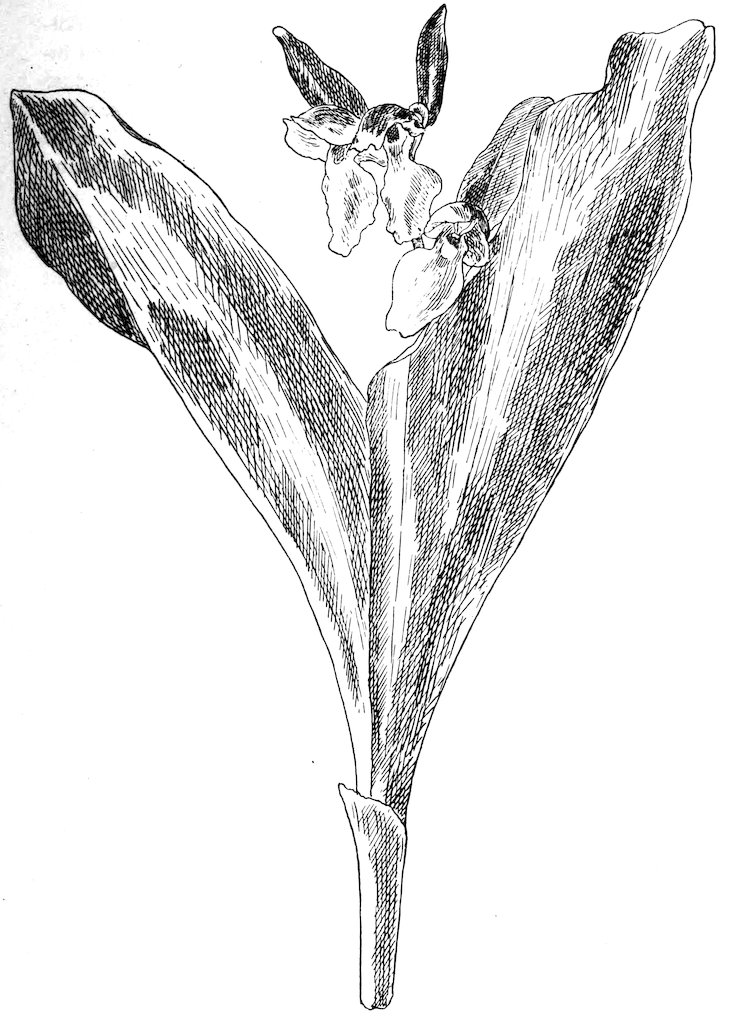
PLATE LXII
SHOWY ORCHIS.—O. spectabilis.
178A certain fascination attends the very name of orchid. Botanist
and unscientific flower-lover alike pause with unwonted interest
when the discovery of one is announced. With the former
there is always the possibility of finding some rare species, while
the excitement of the latter is apt to be whetted with the hope
of beholding a marvellous imitation of bee or butterfly fluttering
from a mossy branch with roots that draw their nourishment
from the air! While this little plant is sure to fail of satisfying
the hopes of either, it is far prettier if less rare than many of its
brethren, and its interesting mechanism will repay our patient
study. It is said closely to resemble the “long purples,” O.
mascula, which grew near the scene of Ophelia’s tragic death.
Stems.—Rather stout and zigzag, forking and diverging. Leaves.—Taper-pointed,
slightly clasping. Flowers.—Dull purplish-pink, hanging on
thread-like flower-stalks from the axils of the leaves. Perianth.—Somewhat
bell-shaped, of six distinct sepals. Stamens.—Six. Pistil.—One,
with a three-cleft stigma.
This plant presents a graceful group of forking branches and
pointed leaves. No blossom is seen from above, but on picking
a branch one finds beneath each of its outspread leaves one
or two slender, bent stalks from which hang the pink, bell-like
flowers. In general aspect the plant somewhat resembles its
relations, the Solomon’s seal, with which it is found blossoming
in the woods of May or June. The English title is a translation
of the generic name, Streptopus.
Stems.—Four to eight inches high. Leaves.—Those from the root narrowly
wedge-shaped, those on the stem lance-shaped, opposite. Flowers.—Bright
pink, clustered. Calyx.—Five-toothed. Corolla.—Of five petals.
Stamens.—Ten. Pistil.—One, with three styles.
179
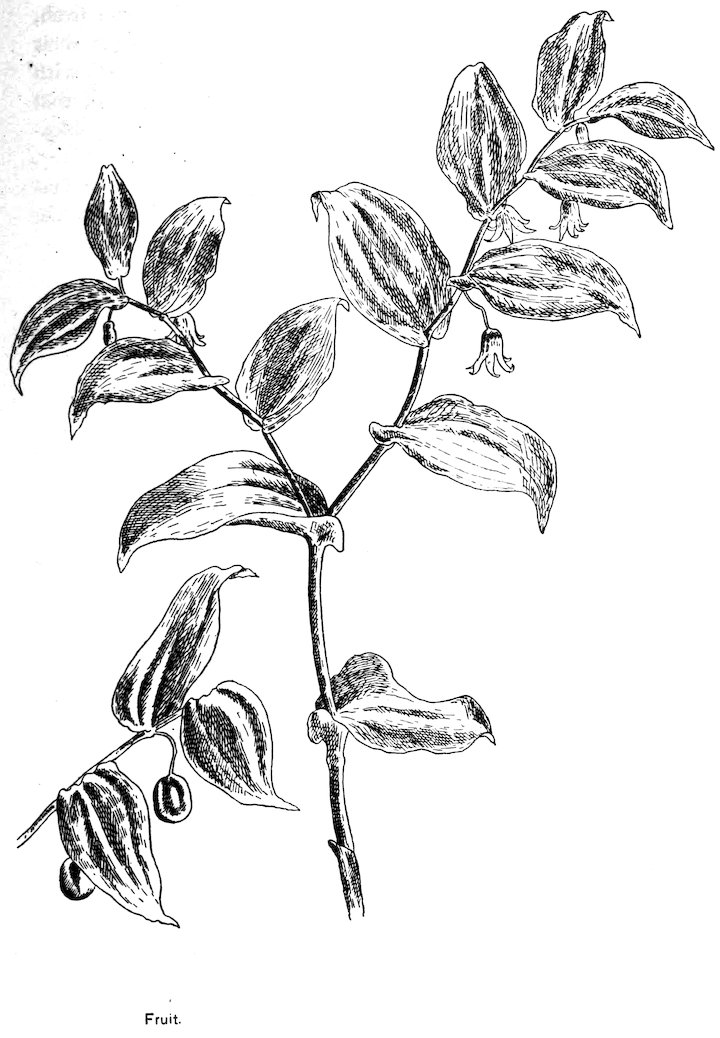
PLATE LXIII
TWISTED STALK.—S. roseus.
180When a vivid cluster of wild pinks gleams from some rocky
opening in the May woods, it is difficult to restrain one’s eagerness,
for there is something peculiarly enticing in these fresh,
vigorous-looking flowers. They are quite unlike most of their
fragile contemporaries, for they seem to be already imbued with
the glowing warmth of summer, and to have no memory of that
snowy past which appears to leave its imprint on so many blossoms
of the early year.
In waste places, from June until September or later, we find
the small clustered pink flowers, which open transiently in the
sunshine of the sleepy catchfly, S. antirrhina.
Scape.—Eight to twelve inches high, two-leaved at base, downy, one-flowered.
Leaves.—Two, large, many-nerved and plaited, sheathing at the base.
Flower.—Solitary, purple-pink. Perianth.—Of three greenish spreading
sepals, the two lateral petals narrow, spreading, greenish, the pink lip in the
shape of a large inflated pouch. Stamens.—Two, the short filaments each
bearing a two-celled anther. Stigma.—Broad, obscurely three-lobed, moist
and roughish.
Graceful and tall the slender, drooping stem,
With two broad leaves below,
Shapely the flower so lightly poised between,
And warm her rosy glow,
writes Elaine Goodale of the moccason-flower. This is a blossom
whose charm never wanes. It seems to be touched with
the spirit of the deep woods, and there is a certain fitness in its
Indian name, for it looks as though it came direct from the home
of the red man. All who have found it in its secluded haunts
will sympathize with Mr. Higginson’s feeling that each specimen
is a rarity, even though he should find a hundred to an acre.
Gray assigns it to “dry or moist woods,” while Mr. Baldwin
writes: “The finest specimens I ever saw sprang out of cushions
of crisp reindeer moss high up among the rocks of an exposed
hill-side, and again I have found it growing vigorously in
almost open swamps, but nearly colorless from excessive moisture.”
The same writer quotes a lady who is familiar with it in
the Adirondacks. She says: “It seems to have a great fondness
for decaying wood, and I often see a whole row perched like
birds along a crumbling log.” While I recall a mountain lake
where the steep cliffs rise from the water’s edge, here and there,
on a tiny shelf strewn with pine-needles, can be seen a pair of
large veiny leaves, above which, in early June, the pink balloon-like
blossom floats from its slender scape.
181
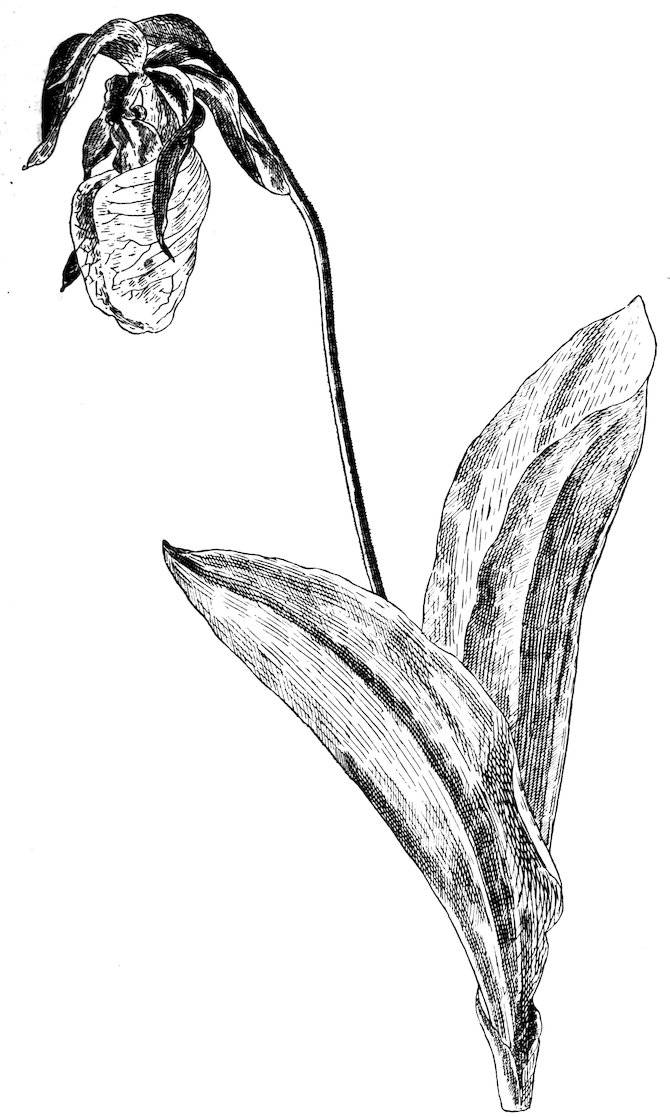
PLATE LXIV
PINK LADY’S SLIPPER.—C. acaule.
182
Scape.—Rising about one foot from a small solid bulb. Leaf.—Linear,
grass-like. Flowers.—Two to six on each scape, purple-pink, about one
inch broad, the lip as if hinged at its insertion, bearded toward the summit
with white, yellow, and purple hairs. The peculiarity of this orchid is that
the ovary is not twisted, and consequently the lip is on the upper instead of
the lower side of the flower.
One may hope to find these bright flowers growing side by
side with the glistening sundew in the rich bogs of early summer.
Mr. Baldwin assigns still another constant companion to
the Calopogon, an orchid which staggers under the terrifying
title of Pogonia ophioglossoides. The generic name of Calopogon
is from two Greek words signifying beautiful beard and has
reference to the delicately bearded lip.
A shrub from two to six feet high. Leaves.—Narrowly oblong, downy
underneath, usually appearing somewhat later than the flowers. Flowers.—Pink,
clustered. Calyx.—Minute. Corolla.—Funnel-shaped, with five
long recurved lobes. Stamens.—Five or ten, long, protruding noticeably.
Pistil.—One, long, protruding.
Our May swamps and moist woods are made rosy by masses
of the pink azalea which is often known as the wild honeysuckle,
although not even a member of the Honeysuckle family.
It is in the height of its beauty before the blooming of the laurel,
and heralds the still lovelier pageant which is even then in rapid
course of preparation.
183
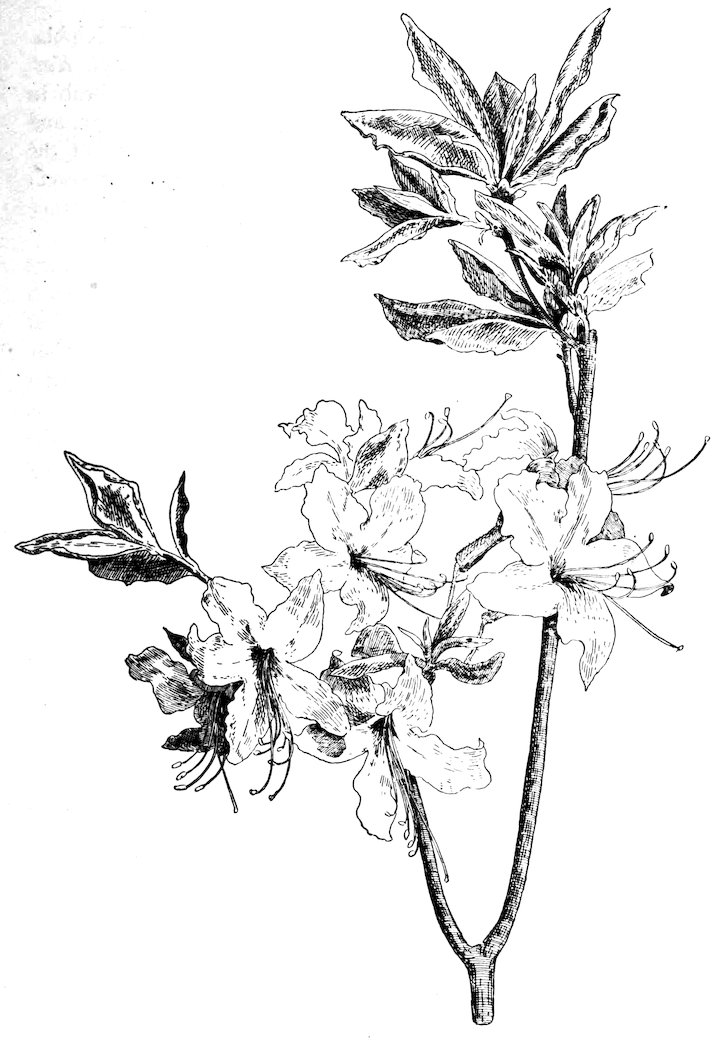
PLATE LXV
PINK AZALEA.—R. nudiflorum.
184In the last century the name of Mayflower was given to the
shrub by the Swedes in the neighborhood of Philadelphia.
Peter Kalm, the pupil of Linnæus, after whom our laurel, Kalmia,
is named, writes the following description of the shrub in
his “Travels,” which were published in English in 1771, and
which explain the origin of one of its titles: “Some of the
Swedes and Dutch call them Pinxter-bloem (Whitsunday-flower)
as they really are in bloom about Whitsuntide; and at a distance
they have some similarity to the Honeysuckle or ‘Lonicera.’...
Its flowers were now open and added a new ornament
to the woods.... They sit in a circle round the stem’s
extremity and have either a dark red or a lively red color; but
by standing for some time the sun bleaches them, and at last they
get to a whitish hue.... They have some smell, but I
cannot say it is very pleasant. However, the beauty of the
flower entitles them to a place in every flower-garden.” While
our pink azalea could hardly be called “dark red” under any
circumstances, it varies greatly in the color of its flowers.
The azalea is the national flower of Flanders.
A shrub from one to two feet high. Leaves.—Oblong, pale. Flowers.—Purplish-pink.
Calyx.—Small. Corolla.—Two-lipped, almost without
any tube. Stamens.—Ten, not protruding. Pistil.—One, not protruding.
In May, when sea-winds pierced our solitudes,
I found the fresh Rhodora in the woods,
Spreading its leafless blooms in a damp nook,
To please the desert and the sluggish brook.
The purple petals, fallen in the pool,
Made the black water with their beauty gay;
Here might the red-bird come his plumes to cool,
And court the flower that cheapens his array.
Rhodora! if the sages ask thee why
This charm is wasted on the earth and sky,
Tell them, dear, that if eyes were made for seeing,
Then Beauty is its own excuse for being;
Why thou wert there, O rival of the rose!
I never thought to ask, I never knew;
But in my simple ignorance, suppose
The self-same Power that brought me there, brought you.
[6]
185
A shrub from one to three feet high. Leaves.—Narrowly oblong, light
green. Flowers.—Deep pink, in lateral clusters. Calyx.—Five-parted.
Corolla.—Five-lobed, between wheel and bell-shaped, with stamens caught
in its depressions as in the mountain laurel. Stamens.—Ten. Pistil.—One.
This low shrub grows abundantly with the mountain laurel,
bearing smaller deep pink flowers at the same season, and narrower,
paler leaves. It is said to be the most poisonous of the
genus, and to be especially deadly to sheep, while deer are supposed
to feed upon its leaves with impunity.
Stems.—Slender, trailing, one to four feet long. Leaves.—Oblong, obtuse.
Flowers.—Pale pink, nodding. Calyx.—With short teeth. Corolla.—Four-parted.
Stamens.—Eight or ten, protruding. Fruit.—A large,
acid, red berry.
In the peat-bogs of our Northeastern States we may look in
June for the pink nodding flowers, and in late summer for the
large red berries of this well-known plant.
Stem.—Six to nine inches high, from a fibrous root. Leaves.—An oval
or lance-oblong one near the middle of the stem, and a smaller or bract-like
one near the terminal flower, occasionally one or two others, with a flower in
their axils. Flower.—Pale pink, sometimes white, sweet-scented, one inch
long, lip bearded and fringed.
Mr. Baldwin maintains that there is no wild flower of as
pure a pink as this unless it be the Sabbatia. Its color has also
been described as a “peach-blossom red.” As already mentioned,
the plant is found blossoming in bogs during the early
summer in company with the Calopogons and sundews. Its violet-like
fragrance greatly enhances its charm.
186
Stem.—Six inches to a foot high, sparingly branched above, leafy to the
top. Leaves.—Oblong-linear. Flowers.—Growing in round or oblong heads
which are somewhat clover-like in appearance, bright pink or almost red, occasionally
paler. Calyx.—Of five sepals, three of which are small and often
greenish, while the two inner ones are much larger and colored like the petals.
Corolla.—Of three petals connected with each other, the lower one
keel-shaped. Stamens.—Six or eight. Pistil.—One. (Flowers too difficult
to be analyzed by the non-botanist.)
This pretty little plant abounds in moist and also sandy
places, growing on mountain heights as well as in the salt meadows
which skirt the sea. In late summer its bright flower-heads
gleam vividly through the grasses, and from their form and color
might almost be mistaken for pink clover. Occasionally they
are comparatively pale and inconspicuous.
Stems.—Very leafy, six to nine inches high, with cleistogamous flowers
on underground runners. Leaves.—Lance-shaped or oblong. Flowers.—Purple-pink,
loosely clustered in a terminal raceme. Keel of Corolla.—Crested.
Stamens.—Eight. Pistil.—One.
Like its more attractive sister, the fringed polygala, this little
plant hides its most useful, albeit unattractive, blossoms in the
ground, where they can fulfil their destiny of perpetuating the
species without danger of molestation by thievish insects or any
of the distractions incidental to a more worldly career. Exactly
what purpose the little above-ground flowers, which appear
so plentifully in sandy soil in July, are intended to serve, it is
difficult to understand.
Flowering stems.—Three or four inches high, from long, prostrate or
underground shoots which also bear cleistogamous flowers. Leaves.—The
lower, small and scale-like, scattered, the upper, ovate, and crowded at the
summit. Flowers.—Purple-pink, rarely white, rather large. Keel of Corolla.—Conspicuously
fringed and crested. Stamens.—Six. Pistil.—One.
187
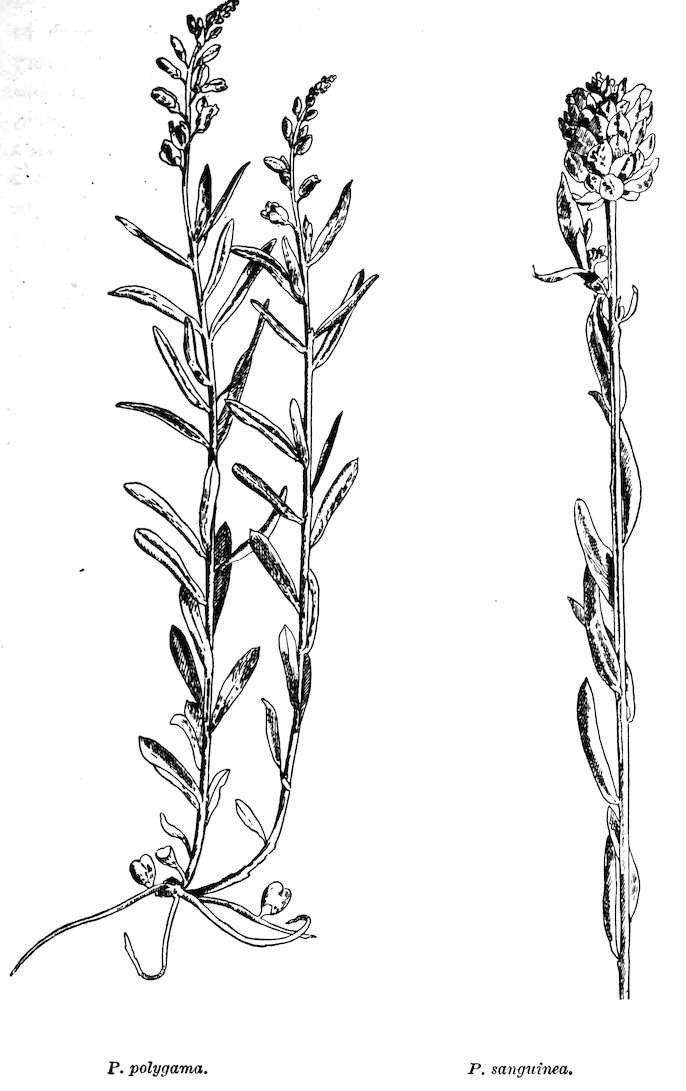
188“I must not forget to mention that delicate and lovely flower
of May, the fringed polygala. You gather it when you go for
the fragrant showy orchis—that is, if you are lucky enough to
find it. It is rather a shy flower, and is not found in every
wood. One day we went up and down through the woods looking
for it—woods of mingled oak, chestnut, pine, and hemlock,—and
were about giving it up when suddenly we came upon a
gay company of them beside an old wood-road. It was as if a
flock of small rose-purple butterflies had alighted there on the
ground before us. The whole plant has a singularly fresh and
tender aspect. Its foliage is of a slightly purple tinge and of
very delicate texture. Not the least interesting feature about
the plant is the concealed fertile flower which it bears on a subterranean
stem, keeping, as it were, one flower for beauty and
one for use.”
It seems unnecessary to tempt “odorous comparisons” by
endeavoring to supplement the above description of Mr. Burroughs.
Stems.—Three to ten inches high, almost winged at the angles, with
spreading opposite leaves and branches. Leaves.—Linear, nearly all whorled
in fours. Flowers.—Greenish or purplish-pink, growing in short, thick spikes
which terminate the branches.
There is something very moss-like in the appearance of this
little plant which blossoms in late summer. It is found near
moist places and salt marshes along the coast, being very common
in parts of New England.
Stems.—Erect, branching, two or three feet high. Leaves.—Opposite,
oval. Flowers.—Rose-color veined with deep pink, loosely clustered.
Calyx.—Five-parted. Corolla.—Small, bell-shaped, five-cleft. Stamens.—Five,
slightly adherent to the pistil. Pistil.—Two ovaries surmounted by
a large, two-lobed stigma. Fruit.—Two long and slender pods.
189
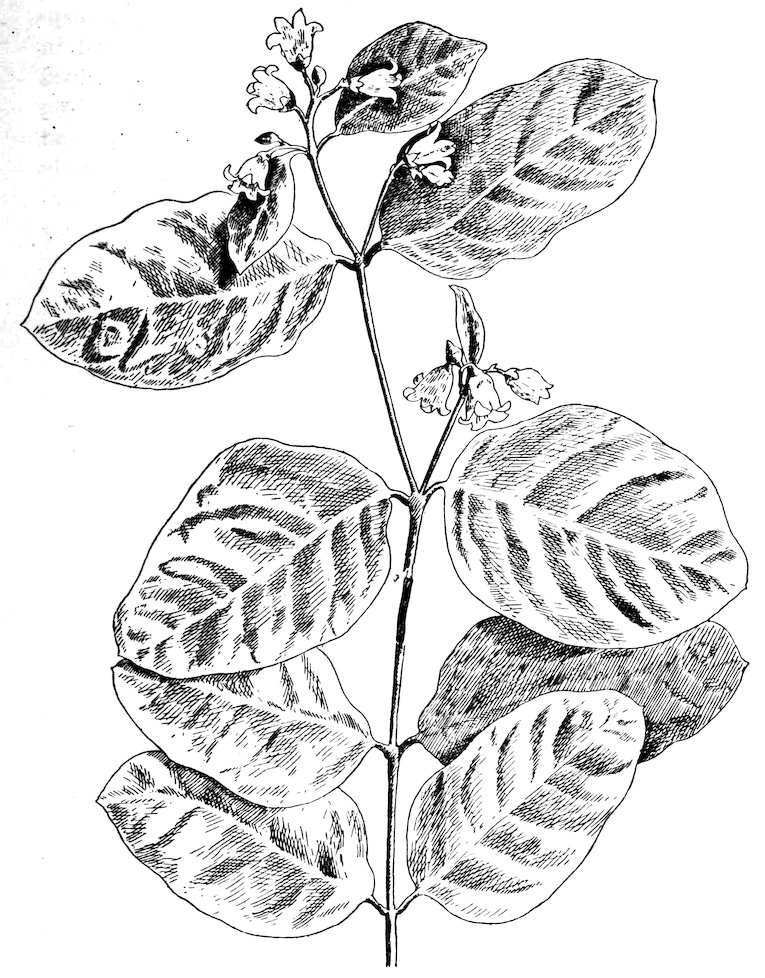
PLATE LXVII
SPREADING DOGBANE.—A. androsæmifolium.
190The flowers of the dogbane, though small and inconspicuous
are very beautiful if closely examined. The deep pink veining
of the corolla suggests nectar, and the insect-visitor is not misled,
for at its base are five nectar-bearing glands. The two long,
slender seed-pods which result from a single blossom seem inappropriately
large, often appearing while the plant is still in
flower. Rafinesque states that from the stems may be obtained
a thread similar to hemp which can be woven into cloth, from
the pods, cotton, and from the blossoms, sugar. Its generic and
one of its English titles arose from the belief, which formerly
prevailed, that it was poisonous to dogs. The plant is constantly
found growing in roadside thickets, with bright, pretty
foliage, and blossoms that appear in early summer.
Stem.—Twining or trailing. Leaves.—Somewhat arrow-shaped.
Flowers.—Pink. Calyx.—Of five sepals enclosed in two broad leafy bracts.
Corolla.—Five-lobed, bell-shaped. Stamens.—Five. Pistil.—One, with
two stigmas.
Many an unsightly heap of rubbish left by the roadside is
hidden by the delicate pink bells of the hedge bindweed, which
again will clamber over the thickets that line the streams and
about the tumbled stone-wall that marks the limit of the pasture.
The pretty flowers at once suggest the morning-glory, to
which they are closely allied.
The common European bindweed, C. arvensis, has white or
pinkish flowers, without bracts beneath the calyx, and a low procumbent
or twining stem. It has taken possession of many of
our old fields where it spreads extensively and proves troublesome
to farmers.
Stem.—Shrubby, three to five feet high; branching, branches bristly
and glandular. Leaves.—Three to five-lobed, the middle lobe prolonged.
Flowers.—Purplish-pink, large and showy, two inches broad. Calyx.—Five-parted.
Corolla.—Of five rounded petals. Stamens and Pistils.—Numerous.
Fruit.—Reddish, resembling the garden raspberry.
191
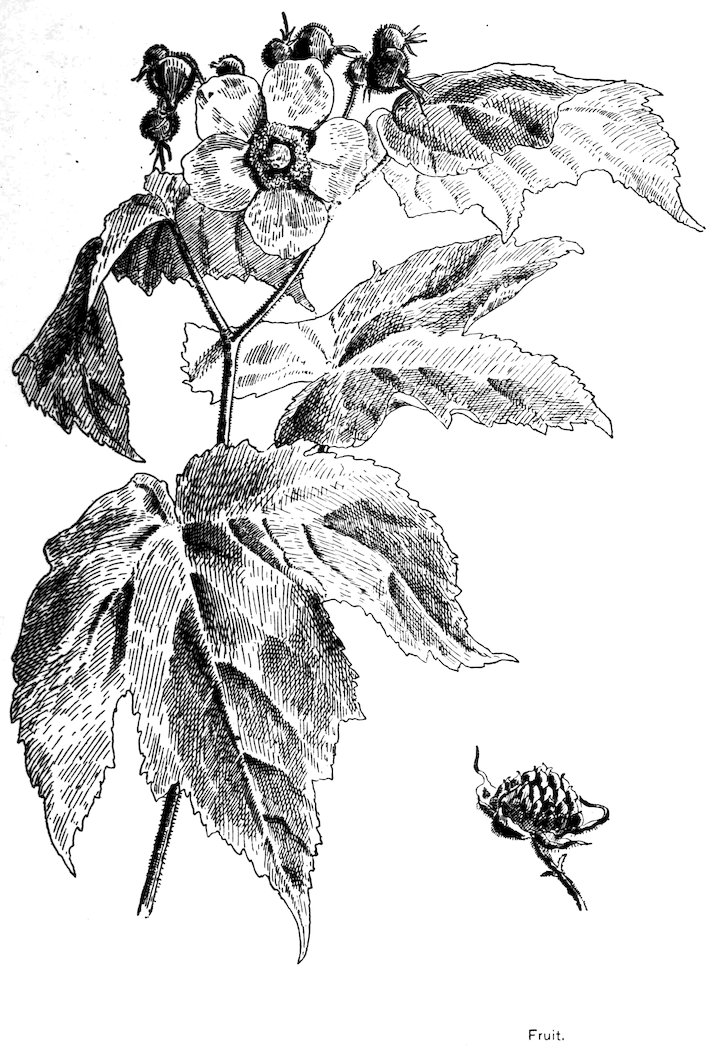
PLATE LXVIII
PURPLE-FLOWERING RASPBERRY.—R. odoratus.
192This flower betrays its relationship to the wild rose, and
might easily be mistaken for it, although a glance at the undivided
leaves would at once correct such an error. The plant is
a decorative one when covered with its showy blossoms, constantly
arresting our attention along the wooded roadsides in
June and July.
Stem.—Six inches to two feet high. Leaves.—Pale, divided into delicate
leaflets. Flowers.—Pink and yellow, in loose clusters. Calyx.—Of two
small, scale-like sepals. Corolla.—Pink, tipped with yellow; closed and
flattened, of four petals, with a short spur at the base of the upper petal.
Stamens.—Six, maturing before the pistil, thus avoiding self-fertilization.
Pistil.—One.
From the rocky clefts in the summer woods springs the pale
corydalis, its graceful foliage dim with a whitish bloom, and its
delicate rosy, yellow-tipped flowers betraying by their odd flat
corollas their kinship with the Dutchman’s breeches and squirrel
corn of the early year, as well as with the bleeding hearts of
the garden. Thoreau assigns them to the middle of May, and
says they are “rarely met with,” which statement does not coincide
with the experience of those who find the rocky woodlands
each summer abundantly decorated with their fragile clusters.
The generic name, Corydalis, is the ancient Greek title for the
crested lark, and said to refer to the crested seeds of this genus.
The specific title, glauca, refers to the pallor of leaves and stem.
The golden corydalis, C. aurea, is found on rocky banks
somewhat westward.
Stem.—Tall, stout, downy, with a milky juice. Leaves.—Generally
opposite or whorled, the upper sometimes scattered, large, oblong, pale,
minutely downy underneath. Flowers.—Dull, purplish-pink, clustered at
the summit and along the sides of the stem. (These flowers are too difficult
to be successfully analyzed by the non-botanist.) Calyx.—Five-parted, the
divisions small and reflexed. Corolla.—Deeply five-parted, the divisions
reflexed; above them a crown of five hooded nectaries, each containing an
incurved horn. Stamens.—Five, inserted on the base of the corolla, united
with each other and enclosing the pistils. Pistils.—Properly two, enclosed
by the stamens, surmounted by a large five-angled disk. Fruit.—Two pods,
one of which is large and full of silky-tufted seeds, the other often stunted.
This is probably the commonest representative of this striking
and beautiful native family. The tall, stout stems, large,
193pale leaves, dull pink clustered flowers which appear in July,
and later the puffy pods filled with the silky-tufted seeds beloved
of imaginative children, are familiar to nearly everyone who
spends a portion of the year in the country. The young sprouts
are said to make an excellent pot-herb; the silky hairs of the
seed-pods have been used for the stuffing of pillows and mattresses,
and can be mixed with flax or wool and woven to advantage;
while paper has been manufactured from the stout
stalks.
The four-leaved milkweed, A. quadrifolia, is the most delicate
member of the family, with fragrant rose-tinged flowers
which appear on the dry wooded hill-sides quite early in June,
and slender stems which are usually leafless below, and with one
or two whorls and one or two pairs of oval, taper-pointed leaves
above.
The swamp milkweed, A. incarnata, grows commonly in
moist places. Its very leafy stems are two or three feet high,
with narrowly oblong, pointed leaves. Its intense purple-pink
flowers gleam from the wet meadows nearly all summer. They
are smaller than those of the purple milkweed, A. purpurascens,
which abounds in dry ground, and which may be classed among
the deep pink or purple flowers according to the eye of the beholder.
Stem.—Forking, slightly hairy. Leaves.—Three, divided, the divisions
again dissected. Flowers.—Purple-pink, small. Calyx.—Of five sepals.
Corolla.—Of five petals. Stamens.—Ten. Pistil.—One, with five styles
which split apart in fruit.
From June until October many of our shaded woods and
glens are abundantly decorated by the bright blossoms of the
herb Robert. The reddish stalks of the plant have won it the
name of “red-shanks” in the Scotch Highlands. Its strong scent
is caused by a resinous secretion which exists in several of the
geraniums. In some species this resin is so abundant that the
stems will burn like torches, yielding a powerful and pleasant
perfume. The common name is said to have been given the
194plant on account of its supposed virtue in a disease which was
known as “Robert’s plague,” after Robert, Duke of Normandy.
In some of the early writers it is alluded to as the “holy herb of
Robert.”
In fruit the styles of this plant split apart with an elasticity
which serves to project the seeds to a distance, it is said, of
twenty-five feet.
Stems.—Slender, trailing, and prostrate. Leaves.—Divided into three
clover-like leaflets. Flowers.—Papilionaceous, purplish-pink, veiny. Pod.—Small,
rounded, flat, one-seeded.
The flowers of this plant often have the appearance of springing
directly from the earth amid a mass of clover leaves. They
are common in dry soil in the late summer and autumn, as are
the other members of the same genus.
L. reticulata is an erect, very leafy species with similar
blossoms, which are chiefly clustered near the upper part of the
stem. The bush clovers betray at once their kinship with the
tick-trefoils, but are usually found in more sandy, open places.
L. polystachya has upright wand-like stems from two to four
feet high. Its flowers grow in oblong spikes on elongated stalks.
Those of L. capitata are clustered in globular heads.
Stem.—Hairy, three to six feet high. Leaves.—Divided into three somewhat
oblong leaflets. Flowers.—Papilionaceous, dull purplish-pink, growing
in densely flowered racemes. Pod.—Flat, deeply lobed on the lower margin,
from one to three inches long, roughened with minute hooked hairs by means
of which they adhere to animals and clothing.
Great masses of color are made by these flowers in the bogs
and rich woods of midsummer. They are effective when seen in
the distance, but rather disappointing on closer examination,
and will hardly bear gathering or transportation. They are by
far the largest and most showy of the genus.
195
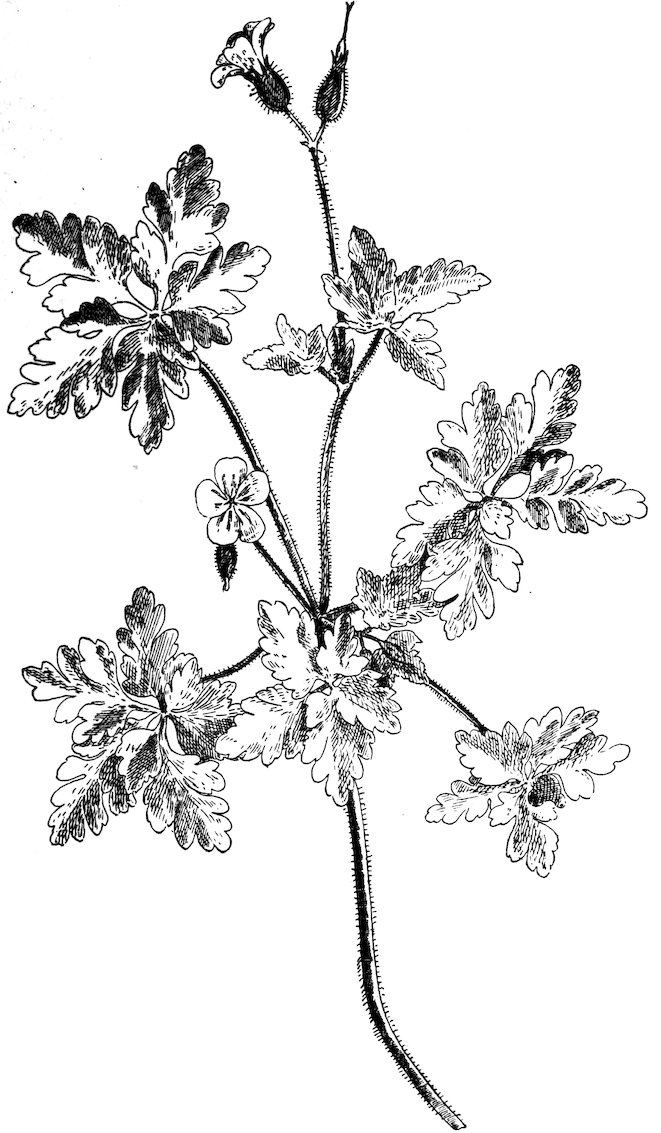
PLATE LXIX
HERB ROBERT.—G. Robertianum.
196
Scape.—About two feet long. Leaves.—Divided into three broad leaflets,
crowded at the summit of the flowerless stems. Flowers.—Papilionaceous,
purplish-pink, small, growing in an elongated raceme on a mostly leafless
scape.
This is a smaller, less noticeable plant than D. Canadense.
It flourishes abundantly in dry woods, where it often takes possession
in late summer to the exclusion of nearly all other flowers.
The flowers of D. acuminatum grow in an elongated raceme
from a stem about whose summit the leaves, divided into very
large leaflets, are crowded; otherwise it resembles D. nudiflorum.
D. Dillenii grows to a height of from two to five feet, with
erect leafy stems and medium-sized flowers. It is found commonly
in open woods.
Many of us who do not know these plants by name have
uttered various imprecations against their roughened pods.
Thoreau writes: “Though you were running for your life, they
would have time to catch and cling to your clothes.... These
almost invisible nets, as it were, are spread for us, and whole
coveys of desmodium and bidens seeds steal transportation out
of us. I have found myself often covered, as it were, with an
imbricated coat of the brown desmodium seeds or a bristling
chevaux-de-frise of beggar-ticks, and had to spend a quarter of
an hour or more picking them off in some convenient spot; and
so they get just what they wanted—deposited in another place.”
Stem.—Rather stout, swollen at the joints. Leaves.—Oval, opposite.
Flowers.—Pink or white, clustered. Calyx.—Of five united sepals. Corolla.—Of
five pinkish, long-clawed petals (frequently the flowers are
double). Stamens.—Ten. Pistil.—One, with two styles.
A cheery pretty plant is this with large, rose-tinged flowers
which are especially effective when double.
197
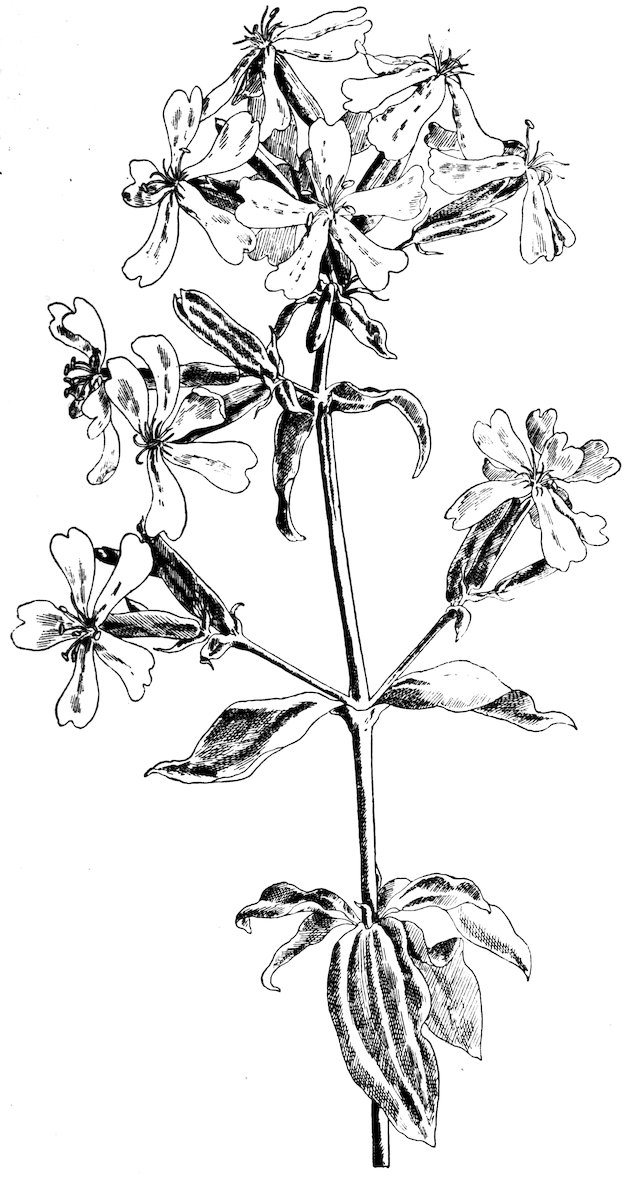
PLATE LXX
BOUNCING BET.—S. officinalis.
198Bouncing Bet is of a sociable turn and is seldom found far
from civilization, delighting in the proximity of farm-houses and
their belongings, in the shape of children, chickens, and cattle.
She comes to us from England, and her “feminine comeliness
and bounce” suggest to Mr. Burroughs a Yorkshire housemaid.
The generic name is from sapo—soap, and refers to the lather
which the juice forms with water, and which is said to have been
used as a substitute for soap.
Stems.—Very woolly. Leaves.—Alternate, oval, toothed. Flowers.—Small,
pink, in pyramidal clusters. Calyx.—Five-cleft. Corolla.—Of five
rounded petals. Stamens.—Numerous. Pistils.—Five to eight.
The pink spires of this shrub justify its rather unpoetic name
of steeple-bush. It is closely allied to the meadow-sweet (Pl.
XXVI.), blossoming with it in low grounds during the summer.
It differs from that plant in the color of its flowers and in the
woolliness of its stems and the lower surface of its leaves.
One or two feet high. Leaves.—Opposite, long and narrow, hairy.
Flowers.—Pink, with white dots, clustered. Calyx.—Five-toothed, cylindrical,
with awl-shaped bracts beneath. Corolla.—Of five small petals.
Stamens.—Ten. Pistil.—One, with two styles.
In July and August we find these little flowers in our eastern
fields. The generic name, which signifies Jove’s own flower,
hardly applies to these inconspicuous blossoms. Perhaps it was
originally bestowed upon D. caryophyllus, a large and fragrant
English member of the genus, which was the origin of our garden
carnation.
Stem.—Tall and slender. Leaves.—Lance-shaped, with a heart-shaped
base, sometimes whorled in threes. Flowers.—Deep purple-pink, crowded
and whorled in an interrupted spike. Calyx.—Five to seven-toothed, with
little processes between the teeth. Corolla.—Of five or six somewhat
wrinkled petals. Stamens.—Usually twelve, in two sets, six longer and six
shorter. Pistil.—One, varying in size in the different blossoms, being of
three different lengths.
199
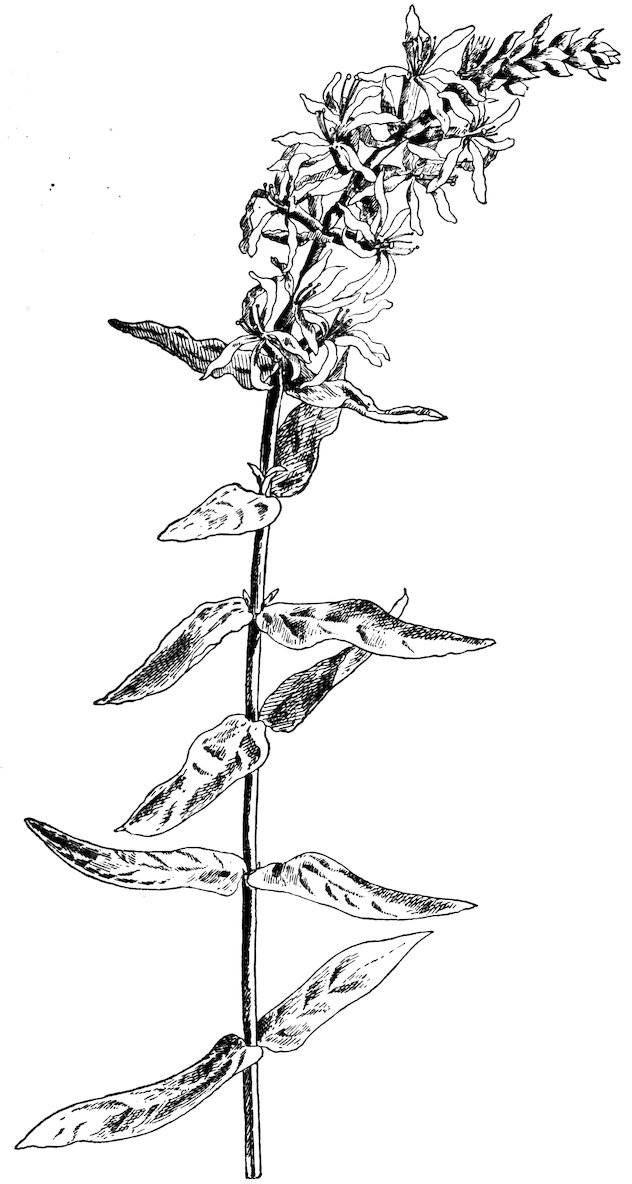
PLATE LXXI
PURPLE LOOSESTRIFE.—L. Salicaria.
200One who has seen an inland marsh in August aglow with
this beautiful plant, is almost ready to forgive the Old Country
some of the many pests she has shipped to our shores in view of
this radiant acquisition. The botany locates it anywhere between
Nova Scotia and Delaware. It may be seen in the perfection
of its beauty along the marshy shores of the Hudson and
in the swamps of the Wallkill Valley.
When we learn that these flowers are called “long purples,”
by the English country people, the scene of Ophelia’s tragic
death rises before us:
There is a willow grows aslant a brook,
That shows his hoar leaves in the glassy stream,
There with fantastic garlands did she come,
Of crow-flowers, nettles, daisies, and long purples
That liberal shepherds give a grosser name,
But our cold maids do dead men’s fingers call them.
Dr. Prior, however, says that it is supposed that Shakespeare
intended to designate the purple-flowering orchis, O. mascula,
which is said to closely resemble the showy orchis (Pl. LXII.)
of our spring woods.
The flowers of the purple loosestrife are especially interesting
to botanists on account of their trimorphism, which word
signifies occurring in three forms, and refers to the stamens and
pistils, which vary in size in the different blossoms, being of
three different lengths, the pollen from any given set of stamens
being especially fitted to fertilize a pistil of corresponding length.
Stem.—Square, with wing-like angles. Leaves.—Opposite, narrowly
oval. Flowers.—Purplish-pink, clustered. Calyx-tube.—Urn-shaped, four-cleft
at the apex. Corolla.—Of four large rounded petals. Stamens.—Eight,
with long curved anthers. Pistil.—One.
It is always a pleasant surprise to happen upon a bright patch
of these delicate deep-hued flowers along the marshes or in the
sandy fields of midsummer. Their fragile beauty is of that order
which causes it to seem natural that they should belong to a
genus which is the sole northern representative of a tropical family.
In parts of New England they grow in profusion, while in
Arkansas the plant is said to be a great favorite with the deer,
hence one of its common names. The flower has been likened
to a scarlet evening primrose, and there is certainly a suggestion
of the evening primrose in the four rounded, slightly heart-shaped
petals. The protruding stamens, with their long yellow anthers,
are conspicuous.
201
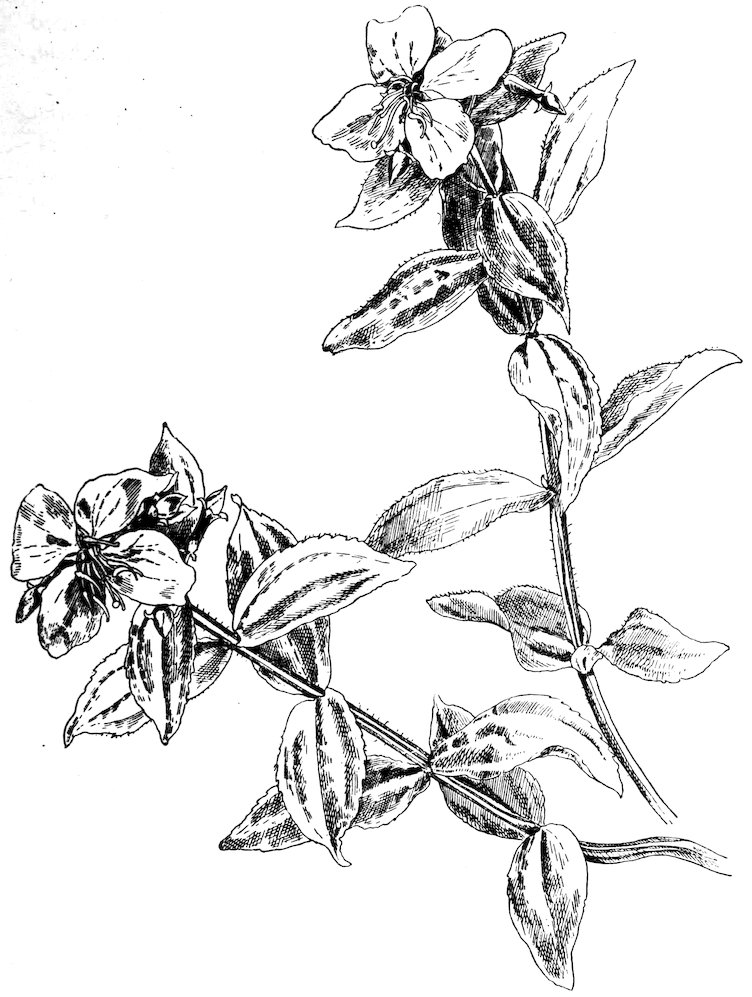
PLATE LXXII
MEADOW-BEAUTY.—R. Virginica.
202Of the plant in the late year, Thoreau writes: “The scarlet
leaves and stem of the rhexia, sometime out of flower, make almost
as bright a patch in the meadows now as the flowers did.
Its seed-vessels are perfect little cream-pitchers of graceful form.”
Stem.—Sticky, hairy, branching. Leaves.—Usually opposite, rounded,
lance-shaped. Flowers.—Deep purplish-pink, solitary or in racemes. Calyx.—Tubular,
slightly spurred at the base on the upper side, six-toothed at
the apex, usually with a slight projection between each tooth. Corolla.—Small,
of six unequal petals. Stamens.—Eleven or twelve, of unequal sizes,
in two sets. Pistil.—One, with a two-lobed stigma.
In the dry fields and along the roadsides of late summer this
plant is found in blossom. Its rather wrinkled purplish-pink
petals and unequal stamens suggest the flowers of the spiked
loosestrife, L. Salicaria, to which it is closely related.
Stem.—Slender, loosely branched. Leaves.—Opposite, oblong to lance-shaped,
the upper narrowly linear. Flowers.—Large, deep pure pink to
almost white. Calyx.—Usually five-parted, the lobes long and slender.
Corolla.—Usually five-parted, conspicuously marked with red and yellow in
the centre. Stamens.—Usually five. Pistil.—One, with two-cleft style.
The advancing year has few fairer sights to show us than a
salt meadow flushed with these radiant blossoms. They are so
abundant, so deep-hued, so delicate! One feels tempted to lie
down among the pale grasses and rosy stars in the sunshine of
the August morning and drink his fill of their beauty. How
often nature tries to the utmost our capacity of appreciation and
leaves us still insatiate! At such times it is almost a relief to
turn from the mere contemplation of beauty to the study of its
structure; it rests our overstrained faculties.
203
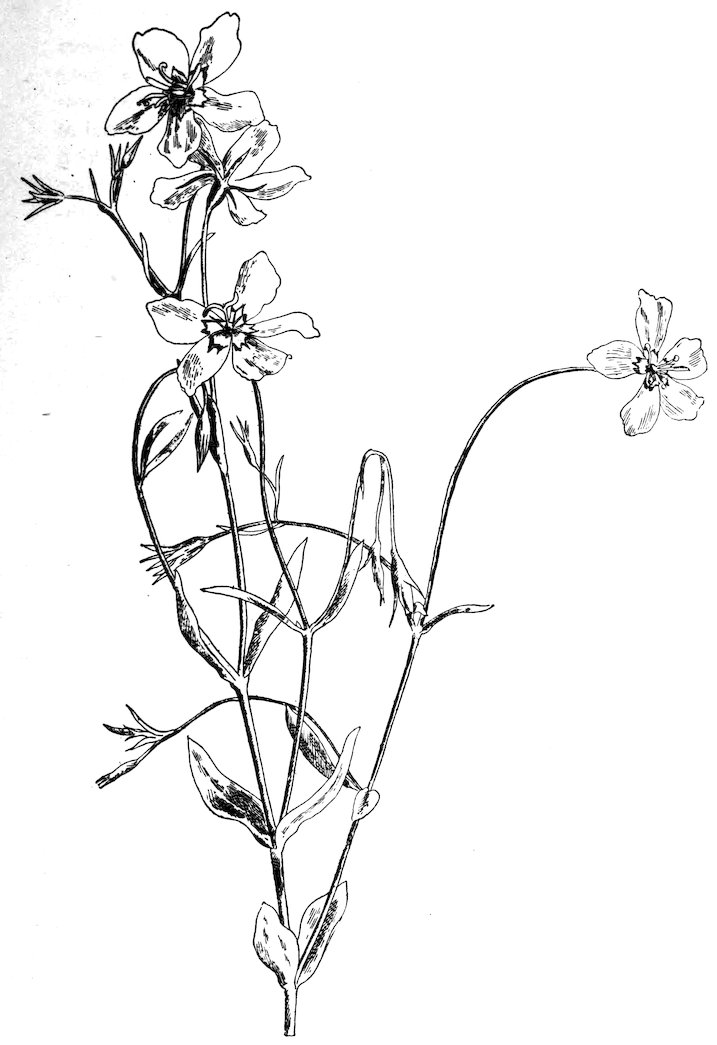
PLATE LXXIII
SEA PINK.—S. stellaris.
204The vivid coloring and conspicuous marking of these flowers
indicate that they aim to attract certain members of the insect
world. As in the fireweed the pistil of the freshly opened blossom
is curved sideways, with its lobes so closed and twisted as
to be inaccessible on their stigmatic surfaces to the pollen which
the already mature stamens are discharging. When the effete
anthers give evidence that they are hors de combat by their withered
appearance, the style erects itself and spreads its stigmas.
S. angularis is a species which may be found in rich soil inland.
Its somewhat heart-shaped, clasping, five-nerved leaves
and angled stem serve to identify it.
S. chloroides is a larger and peculiarly beautiful species which
borders brackish ponds along the coast. Its corolla is about two
inches broad and eight to twelve-parted.
Stem.—One or two feet high, often pinkish, later bright red. Leaves.—Opposite,
set close to the stem or clasping by a broad base. Flowers.—Pinkish
or flesh-color, small, closely clustered at the summit of the stem and
in the axils of the leaves. Calyx.—Of five sepals, often pinkish. Corolla.—Of
five petals. Stamens.—Nine, in three sets, the sets separated by
orange-colored glands. Pistil.—One, with three styles.
If one has been so unlucky, from the usual point of view, or
so fortunate, looking at the matter with the eyes of the flower-lover,
as to find himself in a rich marsh early in August, his eye
is likely to fall upon the small, pretty pinkish flowers and pale
clasping leaves of the marsh St. John’s-wort. A closer inspection
will discover that the foliage is dotted with the pellucid
glands, and that the stamens are clustered in groups after the
family fashion. Should the same marsh be visited a few weeks
later dashes of vivid color will guide one to the spot where the
little pink flowers were found. In their place glow the conspicuous
ovaries and bright leaves which make the plant very noticeable
in late August.
Elodes is a corruption from a Greek word which signifies
growing in marshes.
205
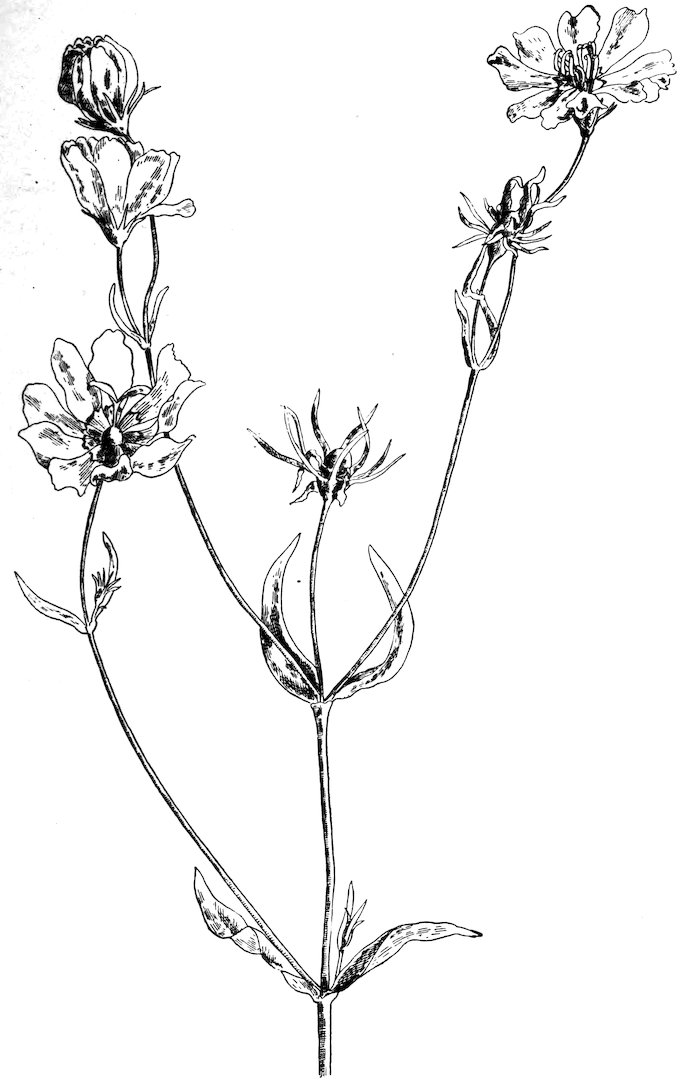
PLATE LXXIV
Sabbatia chloroides.
206
Stem.—Stout and tall, four to eight feet high. Leaves.—The lower
three-lobed, the upper oblong, whitish and downy beneath. Flowers.—Large
and showy, pink. Calyx.—Five-cleft, with a row of narrow bractlets
beneath. Corolla.—Of five large petals. Stamens.—Many, on a tube which
encloses the lower part of the style. Pistils.—Five, united into one, with
five stigmas which are like pin-heads.
When the beautiful rose mallow slowly unfolds her pink banner-like
petals and admits the eager bee to her stores of golden
pollen, then we feel that the summer is far advanced. As truly
as the wood anemone and the blood-root seem filled with the
essence of spring and the promise of the opening year, so does
this stately flower glow with the maturity and fulfilment of late
summer. Here is none of the timorousness of the early blossoms
which peep shyly out, as if ready to beat a hasty retreat should
a late frost overtake them, but rather a calm assurance that the
time is ripe, and that the salt marshes and brackish ponds are
only awaiting their rosy lining.
The marsh mallow, whose roots yield the mucilaginous substance
utilized in the well-known confection, is Althæa officinalis,
an emigrant from Europe. It is a much less common plant
than the Hibiscus, its pale pink flowers being found in some of
the salt marshes of New England and New York.
The common mallow, Malva rotundifolia, which overruns the
country dooryards and village waysides, is a little plant with
rounded, heart-shaped leaves and small purplish flowers. It is
used by the country people for various medicinal purposes and is
cultivated and commonly boiled with meat in Egypt. Job pictures
himself as being despised by those who had been themselves
so destitute as to “cut up mallows by the bushes ... for
their meat.”[7]
207
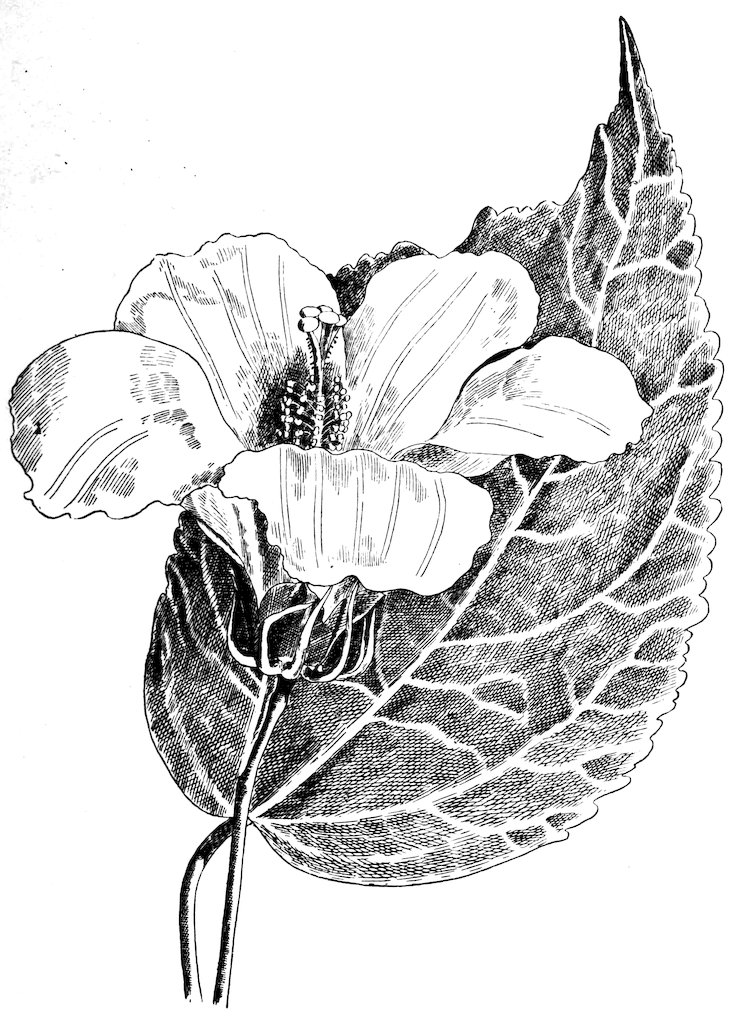
PLATE LXXV
ROSE MALLOW.—H. Moscheutos.
208
Stem.—Two to five feet high. Leaves.—Pale, thickish, oblong or lance-shaped,
toothed. Flower-heads.—Pink, small, in flat-topped clusters, composed
entirely of tubular flowers.
In the salt marshes where we find the starry sea pinks and
the feathery sea lavender, we notice a pallid-looking plant whose
pink flower-buds are long in opening. It is late summer or
autumn before the salt marsh fleabane is fairly in blossom.
There is a strong fragrance to the plant which hardly suggests
camphor, despite its specific title.
Three to five feet high. Stem.—Densely hairy, stout, branching.
Leaves.—Mostly opposite, lance-oblong, finely toothed. Flower.—Purplish,
pink, small, in the axils of the upper leaves, or in a leafy, short raceme.
Calyx.—Four or five-parted. Corolla.—Of four petals. Stamens.—Eight.
Pistil.—One, with a four-parted stigma.
The hairy willow-herb is found in waste places, blossoming
in midsummer. It is an emigrant from Europe.
Stem.—Four to seven feet high. Leaves.—Scattered, lance-shaped,
willow-like. Flowers.—Purplish-pink, large, in a long raceme. Calyx.—Four-cleft.
Corolla.—Of four petals. Stamens.—Eight. Pistil.—One,
with a four-lobed stigma.
In midsummer this striking plant begins to mass its deep-hued
blossoms along the roadsides and low meadows. It is supposed
to flourish with especial abundance in land that has newly
been burned over; hence, its common name of fireweed. Its
willow-like foliage has given it its other English title. The
likeness between the blossoms of this plant and those of the
evening primrose betray their kinship. When the stamens of
the fireweed first mature and discharge their pollen the still immature
style is curved backward and downward with its stigmas
closed. Later it straightens and lengthens to its full dimensions,
so spreading its four stigmas as to be in position to receive the
pollen of another flower from the visiting bee.
209
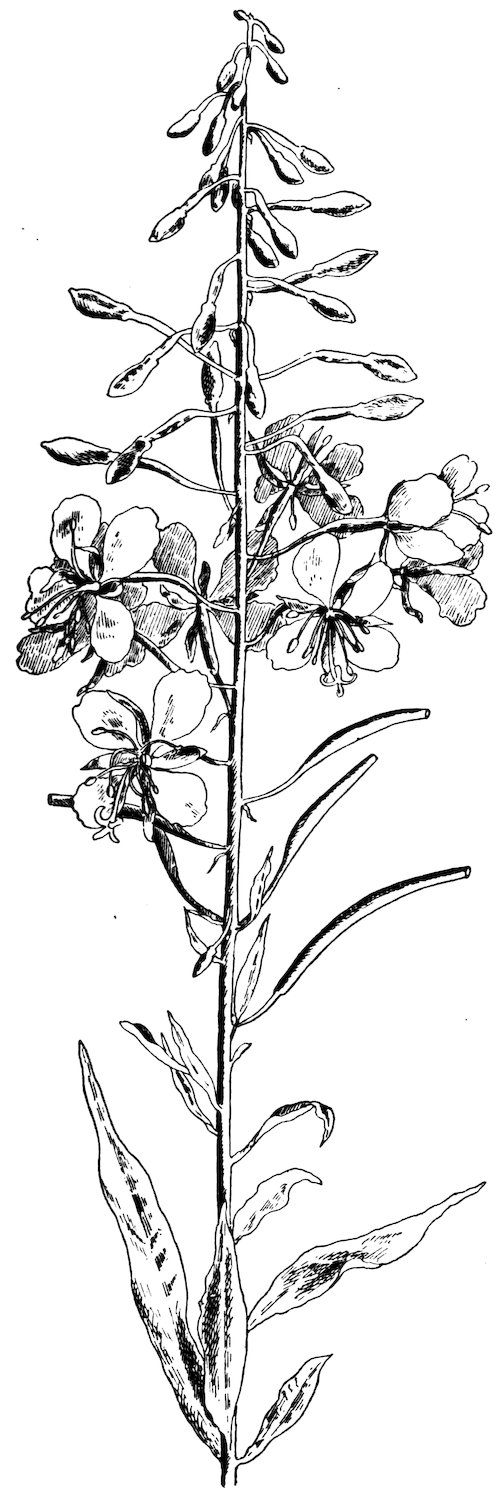
PLATE LXXVI
FIREWEED.—E. angustifolium.
210
One to three feet high. Leaves.—Rather large, lance-shaped, sharply
toothed. Flowers.—Pale pink, small, more or less nodding, resembling
in structure those of the hairy willow-herb. Pistil.—One, with a club-shaped
stigma.
This species is found in abundance in wet places in summer.
Stem.—One to four feet high, widely branching. Leaves.—Linear,
sharply pointed. Flowers.—Bright purplish-pink, rather large. Calyx.—Five-toothed.
Corolla.—One inch long, somewhat tubular, swelling above,
with five more or less unequal, spreading lobes, often downy and spotted
within. Stamens.—Four, in pairs, hairy. Pistil.—One.
In late summer and early autumn these pretty noticeable
flowers brighten the low-lying ground along the coast and in the
neighborhood of the Great Lakes. The sandy fields of New
England and Long Island are oftentimes a vivid mass of color
owing to their delicate blossoms. The plant varies somewhat
in the size of its flowers and in the manner of its growth.
The little seaside gerardia, G. maritima, is from four inches
to a foot high. Its smaller blossoms are also found in salt marshes.
The slender gerardia, G. tenuifolia, is common in mountainous
regions. The leaves of this species are exceedingly narrow.
Like the false foxglove (Pl. LIX.) and other members of this
genus, these plants are supposed to be parasitic in their habits.
Stem.—Stout and tall, two to twelve feet high, often dotted. Leaves.—In
whorls of three to six, oblong or oval, pointed, rough, veiny, toothed.
Flower-heads.—Purplish-pink, small, composed entirely of tubular blossoms,
with long protruding styles, growing in large clusters at or near the summit of
the stem.
211
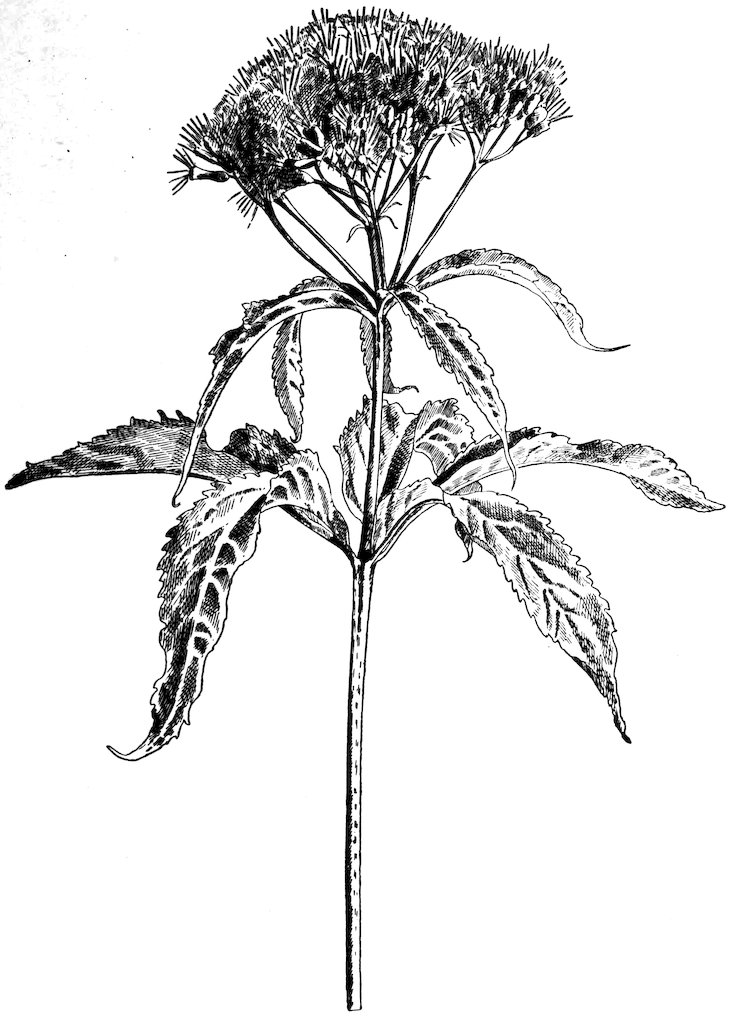
PLATE LXXVII
JOE-PYE-WEED.—E. purpureum.
212The summer is nearly over when the tall, conspicuous Joe-Pye-weed
begins to tinge with “crushed raspberry” the lowlands
through which we pass. In parts of the country it is nearly as
common as the golden-rods and asters which appear at about
the same season. With the deep purple of the iron-weed it gives
variety to the intense hues which herald the coming of autumn.
“Joe Pye” is said to have been the name of an Indian who
cured typhus fever in New England by means of this plant. The
tiny trumpet-shaped blossoms which make up the flower-heads
may have suggested the other common name.
One to four feet high. Stem.—Branching. Leaves.—Alternate, lance-shaped.
Flowers.—Bright pink, growing in thick, short, erect spikes.
Calyx.—Mostly five-parted, the divisions petal-like, pink. Corolla.—None.
Stamens.—Usually eight. Pistil.—One, with a two-cleft style.
In late summer this plant can hardly escape notice. Its
erect pink spikes direct attention to some neglected corner in
the garden or brighten the fields and roadsides. The rosy divisions
of the calyx persist till after the fruit has formed, pressing
closely against the dark seed-vessel within.
Erect, branching, four to twelve inches high. Leaves.—Linear, inconspicuous.
Flowers.—Rose-color, nodding, in very slender racemes. Calyx.—Five-parted.
Corolla.—None. Stamens.—Eight. Pistil.—One, with
three styles.
Under date of September 26th, Thoreau writes: “The
Polygonum articulatum, giving a rosy tinge to Jenny’s desert, is
very interesting now, with its slender dense racemes of rose-tinted
flowers, apparently without leaves, rising cleanly out of the sand.
It looks warm and brave, a foot or more high, and mingled with
deciduous blue curls. It is much divided, with many spreading,
slender-racemed branches, with inconspicuous linear leaves, reminding
me, both by its form and its colors, of a peach-orchard
in blossom, especially when the sunlight falls on it; minute rose-tinted
213flowers that brave the frosts, and advance the summer into
fall, warming with their color sandy hill-sides and deserts, like
the glow of evening reflected on the sand, apparently all flower
and no leaf. Rising apparently with clean bare stems from the
sand, it spreads out into this graceful head of slender, rosy racemes,
wisp-like. This little desert of less than an acre blushes
with it.”
Note.—The Moss Pink, Phlox subulata, with purple-pink flowers, and
Phlox glaberrima, with pink or whitish flowers, will be found in the Blue
and Purple section (p. 235). The Mountain Laurel (p. 57) and the American
Rhododendron (p. 60) are frequently found bearing pink flowers. At times
it has been difficult to determine whether certain flowers should be described
in the Pink or in the Purple section. The reader should bear this in mind,
consulting both in dubious cases.
214
Twelve to eighteen inches high. Stem.—Branching. Leaves.—Much-divided,
the leaflets lobed. Flowers.—Large, bright red, yellow within,
nodding. Calyx.—Of five red petal-like sepals. Corolla.—Of five petals
in the form of large hollow spurs, which are red without and yellow within.
Stamens.—Numerous. Pistils.—Five, with slender styles.
—A woodland walk,
A quest of river-grapes, a mocking thrush,
A wild-rose or rock-loving columbine,
Salve my worst wounds,
declares Emerson; and while perhaps few among us are able to
make so light-hearted and sweeping a claim for ourselves, yet
many will admit the soothing power of which the woods and
fields know the secret, and will own that the ordinary annoyances
of life may be held more or less in abeyance by one who
lives in close sympathy with nature.
About the columbine there is a daring loveliness which
stamps it on the memories of even those who are not ordinarily
minute observers. It contrives to secure a foothold in the most
precipitous and uncertain of nooks, its jewel-like flowers gleaming
from their lofty perches with a graceful insouciance which
awakens our sportsmanlike instincts and fires us with the ambition
to equal it in daring and make its loveliness our own. Perhaps
it is as well if our greediness be foiled and we get a tumble
for our pains, for no flower loses more with its surroundings
than the columbine. Indeed, these destructive tendencies which
are strong within most of us generally defeat themselves by decreasing
our pleasure in a blossom the moment we have ruthlessly
and without purpose snatched it from its environment. If we
honestly wish to study its structure, or to bring into our homes
for preservation a bit of the woods’ loveliness, its interest and
beauty are sure to repay us. But how many pluck every striking
flower they see only to toss it carelessly aside when they
reach their destination, if they have not already dropped it by
the way. Surely if in such small matters sense and self-control
were inculcated in children, more would grow up to the poet’s
standard of worthiness:
215
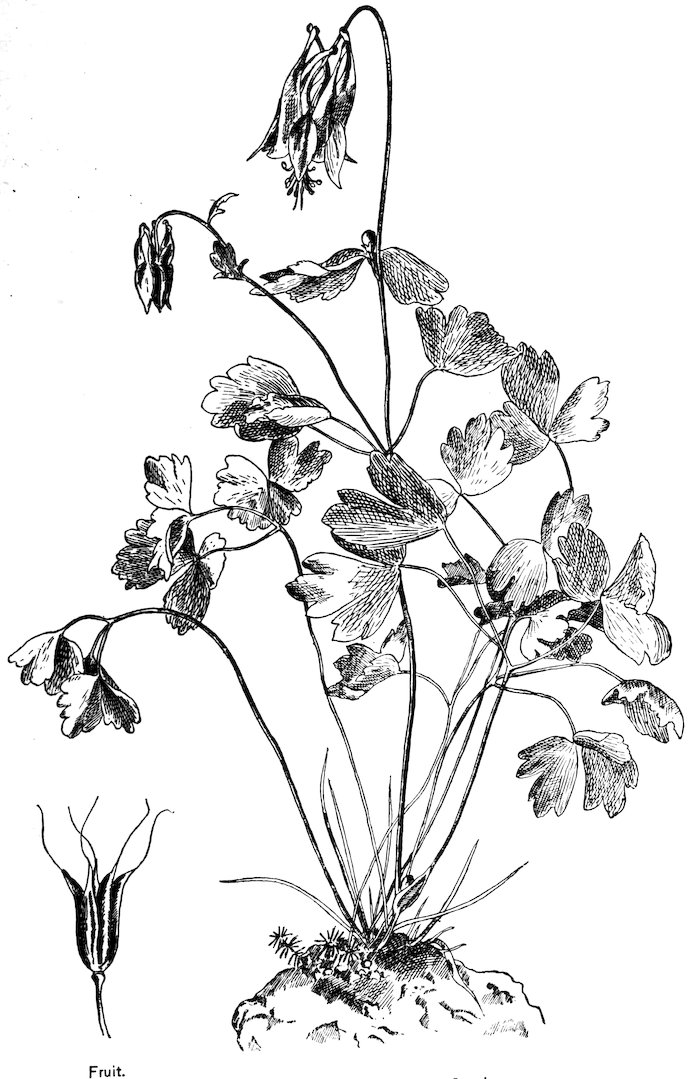
PLATE LXXVIII
WILD COLUMBINE.—A. Canadensis.
216Hast thou named all the birds without a gun?
Loved the wood-rose and left it on its stalk?
At rich men’s tables eaten bread and pulse?
Unarmed, faced danger with a heart of trust?
And loved so well a high behavior,
In man or maid, that thou from speech refrained,
Nobility more nobly to repay?
O, be my friend, and teach me to be thine!
[8]
The name of columbine is derived from colomba—a dove, but
its significance is disputed. Some believe that it was associated
with the bird-like claws of the blossom; while Dr. Prior maintains
that it refers to the “resemblance of its nectaries to the
heads of pigeons in a ring around a dish, a favorite device of
ancient artists.”
The meaning of the generic title is also doubtful. Gray derives
it from aquilegus—water-drawing, but gives no further explanation,
while other writers claim that it is from aquila, an
eagle, seeing a likeness to the talons of an eagle in the curved
nectaries.
Stem.—Stout, from a tuber-like rootstock. Leaves.—Broadly ovate, three
in a whorl a short distance below the flower. Flower.—Single, terminal,
usually purplish-red, occasionally whitish, pinkish, or greenish, on an erect
or somewhat inclined flower-stalk. Calyx.—Of three green spreading sepals.
Corolla.—Of three large lance-shaped petals. Stamens.—Six. Pistil.—One,
with three large spreading stigmas. Fruit.—A large, ovate, six-angled
reddish berry.
217
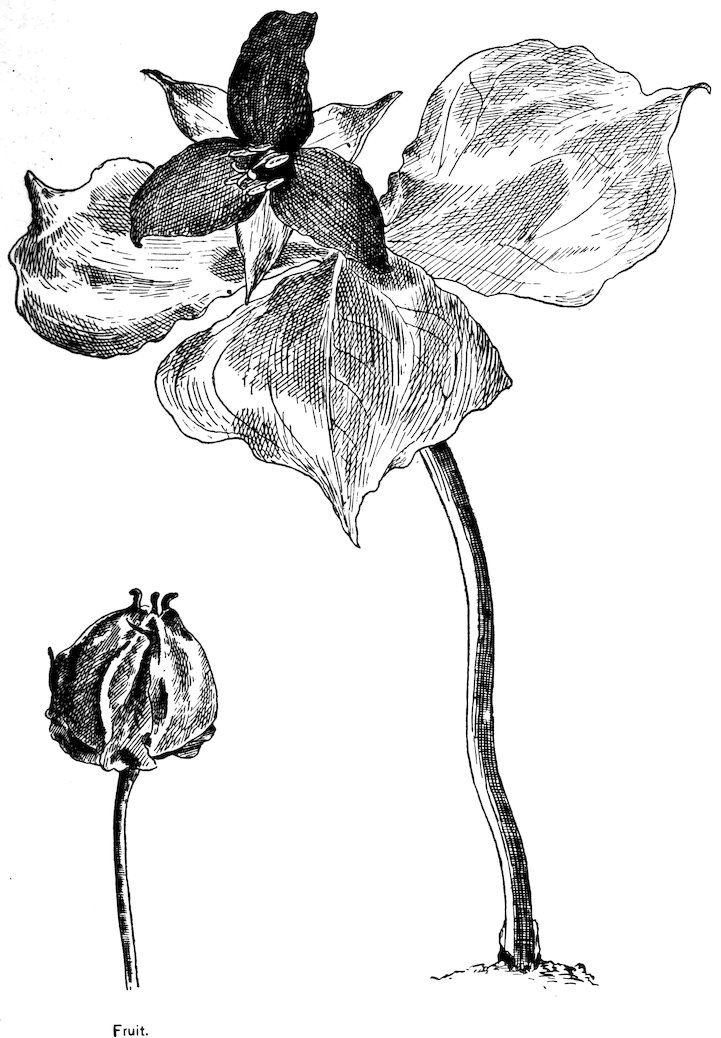
PLATE LXXIX
WAKE ROBIN.—T. erectum.
218This wake robin is one of the few self-assertive flowers of the
early year. Its contemporaries act as if somewhat uncertain as
to whether the spring had really come to stay, but no such lack
of confidence possesses our brilliant young friend, who almost
flaunts her lurid petals in your face, as if to force upon you the
welcome news that the time of birds and flowers is at hand.
Pretty and suggestive as is the common name, it is hardly appropriate,
as the robins have been on the alert for many days before
our flower unfurls its crimson signal. Its odor is most unpleasant.
Its reddish fruit is noticeable in the woods of late
summer.
The sessile trillium, T. sessile, has no separate flower-stalk,
its red or greenish blossom being set close to the stem-leaves.
Its petals are narrower, and its leaves are often blotched or
spotted. Its berry is globular, six-angled, and red or purplish.
The wake robins are native to North America, only one
species being found just beyond the boundaries in the Russian
territory.
Stems.—Clustered, five to twelve inches high. Leaves.—The lower ones
deeply incised, the upper less so. Flowers.—Yellow and red, growing in a
short dense spike. Calyx.—Of one piece split in front. Corolla.—Two-lipped,
the narrow upper lip arched, the lower three-lobed. Stamens.—Four.
Pistil.—One.
The bright flowers of the wood betony are found in our May
woods, often in the company of the columbine and yellow violet.
Near Philadelphia they are said to be among the very earliest
of the flowers, coming soon after the trailing arbutus. In
the later year the plant attracts attention by its uncouth spikes
of brown seed-pods.
Few wayside weeds have been accredited with greater virtue
than the ancient betony, which a celebrated Roman physician
claimed could cure forty-seven different disorders. The Roman
proverb, “Sell your coat and buy betony,” seems to imply that
the plant did not flourish so abundantly along the Appian Way
as it does by our American roadsides. Unfortunately we are
reluctantly forced to believe once more that our native flower is
219not identical with the classic one, but that it has received its
common name through some superficial resemblance to the original
betony or Betonica.
Stem.—Hairy, six inches to a foot high. Root-leaves.—Clustered, oblong.
Stem-leaves.—Incised, those among the flowers three to five-cleft, bright
scarlet toward the summit, showy. Flowers.—Pale yellow, spiked. Calyx.—Tubular,
flattened. Corolla.—Two-lipped, its upper lip long and narrow,
its lower short and three-lobed. Stamens.—Four, unequal. Pistil.—One.
——Scarlet tufts
Are glowing in the green like flakes of fire;
The wanderers of the prairie know them well,
And call that brilliant flower the painted cup.
[9]
But we need not go to the prairie in order to see this plant,
for it is equally abundant in certain low sandy New England
meadows as well as in the near vicinity of New York City.
Under date of June 3d, Thoreau graphically describes its appearance
near Concord, Mass.: “The painted cup is in its
prime. It reddens the meadow, painted-cup meadow. It is a
splendid show of brilliant scarlet, the color of the cardinal-flower,
and surpassing it in mass and profusion.... I do
not like the name. It does not remind me of a cup, rather of a
flame when it first appears. It might be called flame flower, or
scarlet tip. Here is a large meadow full of it, and yet very few
in the town have ever seen it. It is startling to see a leaf thus
brilliantly painted, as if its tip were dipped into some scarlet
tincture, surpassing most flowers in intensity of color.”
Stem.—Two to three feet high. Leaves.—Whorled or scattered, narrowly
lance-shaped. Flower.—Erect, orange-red or scarlet, spotted with purple.
Perianth.—Of six erect narrowly clawed sepals, with nectar-bearing furrows
at their base. Stamens.—Six. Pistil.—One, with three-lobed stigma.
Here and there in the shadowy woods is a vivid dash of color
made by some wild red lily which has caught a stray sunbeam
220in its glowing cup. The purple spots on its sepals guide the
greedy bee to the nectar at their base; we too can take the hint
and reap a sweet reward if we will, after which we are more in
sympathy with those eager, humming bees.
This erect, deep-hued flower is so different from its nodding
sister of the meadows, that we wonder that the two should be so
often confused. When seen away from its surroundings it has
less charm perhaps than either the yellow or the Turk’s cap lily;
but when it rears itself in the cool depths of its woodland home
we feel the uniqueness of its beauty.
Stem.—Three to seven feet high. Leaves.—Lance-shaped, the lower
whorled. Flowers.—Orange or scarlet, with purple spots within, three
inches long, from three to forty growing in pyramidal clusters. Perianth.—Of
six strongly recurved sepals. Stamens.—Six, with long anthers. Pistil.—One,
with a three-lobed stigma.
Consider the lilies of the field, how they grow;
They toil not, neither do they spin;
And yet I say unto you, that even Solomon in all his glory
Was not arrayed like one of these.
How they come back to us, the beautiful hackneyed lines,
and flash into our memories with new significance of meaning
when we chance suddenly upon a meadow bordered with these
the most gorgeous of our wild flowers.
We might doubt whether our native lilies at all resembled
those alluded to in the scriptural passage, if we did not know
that a nearly allied species grew abundantly in Palestine; for we
have reason to believe that lily was a title freely applied by many
Oriental poets to any beautiful flower.
Perhaps this plant never attains far inland the same luxuriance
of growth which is common to it in some of the New England
lowlands near the coast. Its radiant, nodding blossoms
are seen in great profusion as we travel by rail from New York
to Boston.
221
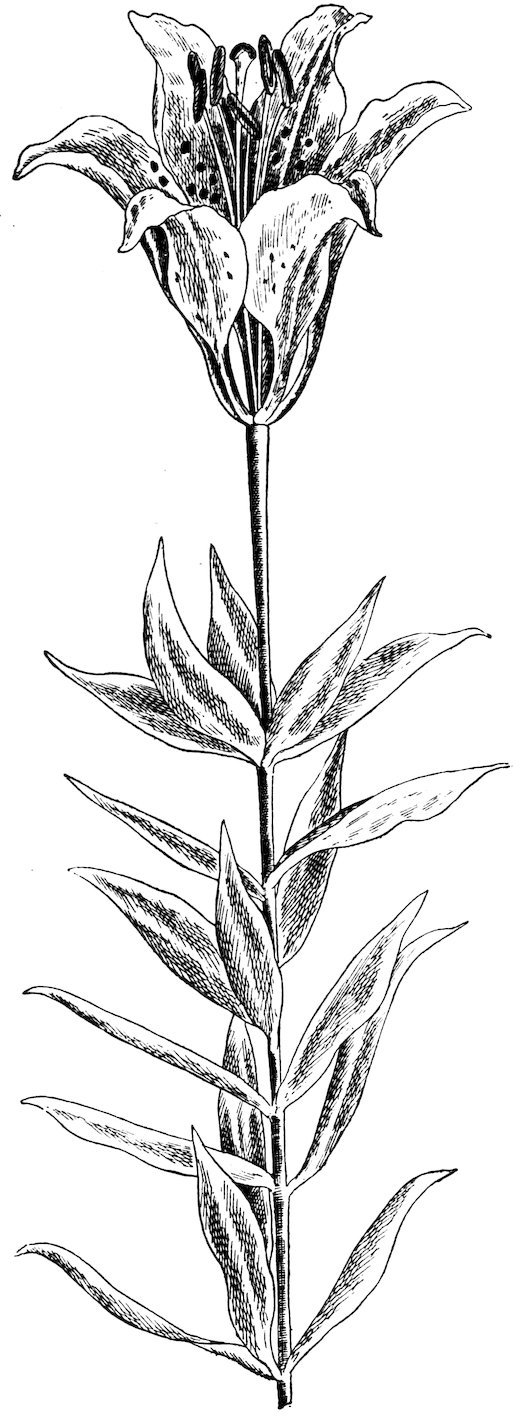
PLATE LXXX
WOOD LILY.—L. Philadelphicum.
222
Stem.—Clothed with soft hairs. Leaves.—Alternate, hairy, the upper
ones lance-shaped, clasping somewhat by a rounded or heart-shaped base.
Flowers.—Purplish-red, growing in a curved raceme-like cluster which
straightens as the blossoms expand. Calyx.—Five-parted. Corolla.—Funnel-form,
five-lobed. Stamens.—Five. Pistil.—One. Fruit.—A large
nutlet roughened with barbed or hooked prickles.
This coarse plant, whose disagreeable odor strongly suggests
mice, is not only a troublesome weed in pasture-land but a
special annoyance to wool-growers, as its prickly fruit adheres
with pertinacity to the fleece of sheep. Its common name is a
translation of its generic title and refers to the shape and texture
of the leaves. The dull red flowers appear in summer.
Stem.—Rough and hairy, one or two feet high, erect, very leafy, branching
at the summit, without milky juice. Leaves.—Linear to narrowly lance-shaped.
Flowers.—Bright orange-red, in flat-topped, terminal clusters,
otherwise closely resembling those of the common milkweed (p. 192.) Fruit.—Two
hoary erect pods, one of them often stunted.
Few if any of our native plants add more to the beauty of the
midsummer landscape than the milkweeds, and of this family no
member is more satisfying to the color-craving eye than the
gorgeous butterfly-weed, whose vivid flower-clusters flame from
the dry sandy meadows with such luxuriance of growth as to
seem almost tropical. Even in the tropics one hardly sees anything
more brilliant than the great masses of color made by
these flowers along some of our New England railways in July,
while farther south they are said to grow even more profusely.
Its gay coloring has given the plant its name of butterfly-weed,
while that of pleurisy-root arose from the belief that
the thick, deep root was a remedy for pleurisy. The Indians
used it as food and prepared a crude sugar from the flowers; the
young seed-pods they boiled and ate with buffalo-meat. The
plant is worthy of cultivation and is easily transplanted, as the
fleshy roots when broken in pieces form new plants. Oddly
enough, at the Centennial much attention was attracted by
a bed of these beautiful plants which were brought from Holland.
Truly, flowers like prophets are not without honor save
in their own country.
223
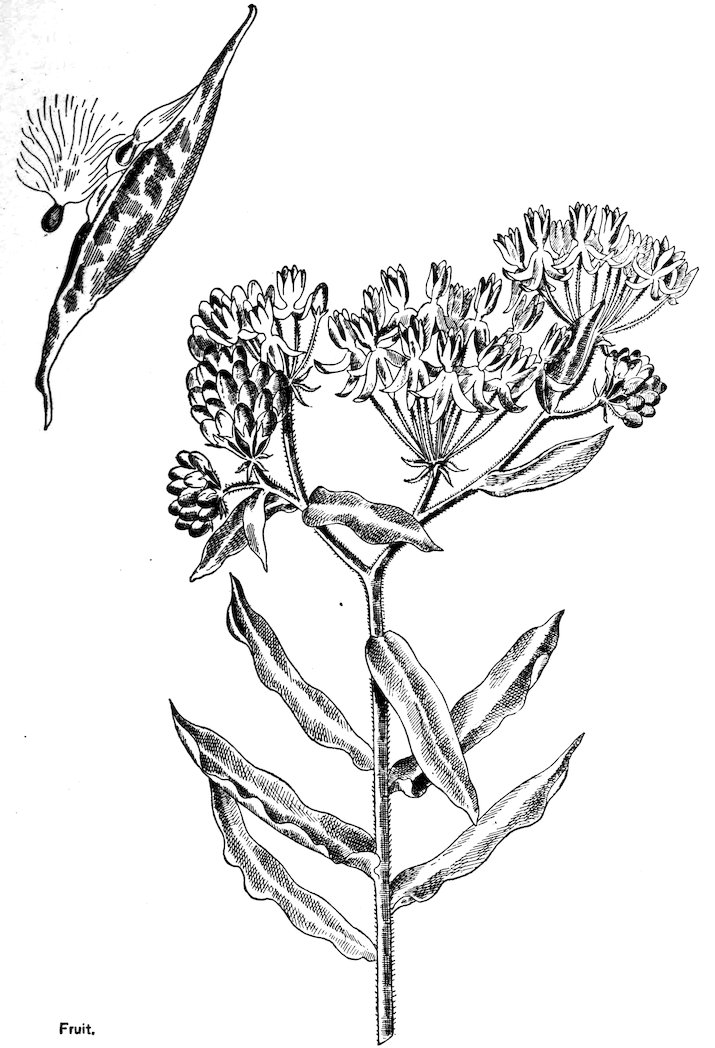
PLATE LXXXI
BUTTERFLY-WEED.—A. tuberosa.
224
Stem.—Hairy, erect. Leaves.—Hairy, oblong, close to the ground.
Flower-heads.—Orange-red, composed entirely of strap-shaped flowers,
clustered.
In parts of New York and of New England the midsummer
meadows are ablaze with the brilliant orange-red flowers of this
striking European weed. It is among the more recent emigrants
to this country and bids fair to become an annoyance to
the farmer, hence its not altogether inappropriate title of devil’s
paintbrush. In England it was called “Grimm the Collier,” on
account of its black hairs and after a comedy of the same title
which was popular during the reign of Queen Elizabeth. Both
its common and generic names refer to an ancient superstition
to the effect that birds of prey used the juice of this genus to
strengthen their eyesight.
Stem.—Square, erect, about two feet high. Leaves.—Opposite, ovate,
pointed, aromatic; those near the flowers tinged with red. Flowers.—Bright
red, clustered in a close round head. Calyx.—Reddish, five-toothed.
Corolla.—Elongated, tubular, two-lipped. Stamens.—Two, elongated,
protruding. Pistil.—One, with a two-lobed style, protruding.
We have so few red flowers that when one flashes suddenly
upon us it gives us a pleasant thrill of wonder and surprise.
Then red flowers know so well how to enhance their beauty by
seeking an appropriate setting. They select the rich green backgrounds
only found in moist, shady places, and are peculiarly
charming when associated with a lonely marsh or a mountain
brook. The bee balm especially haunts these cool nooks, and
its rounded flower-clusters touch with warmth the shadows of
the damp woods of midsummer. The Indians named the flower
O-gee-chee—flaming flower, and are said to have made a tea-like
decoction from the blossoms.
225
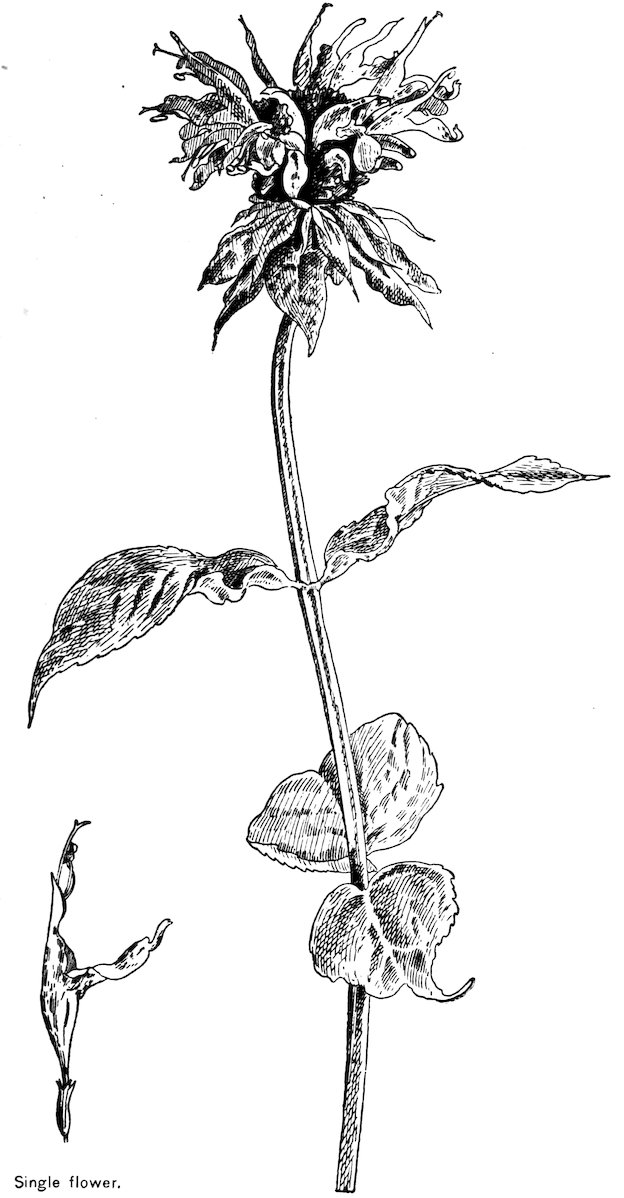
PLATE LXXXII
OSWEGO TEA.—M. didyma.
226
Stems.—Low, spreading. Leaves.—Opposite, ovate, set close to the
stem. Flowers.—Red, occasionally blue or white, growing singly from the
axils of the leaves. Calyx.—Five-parted. Corolla.—Five-parted, wheel-shaped.
Stamens.—Five, with bearded filaments. Pistil.—One.
This flower is found in sandy fields, being noted for its
sensitiveness to the weather. It folds its petals at the approach
of rain, and fails to open at all on a wet or cloudy day. Even
in fine weather it closes in the early afternoon and “sleeps” till
the next morning. Its ripened seeds are of value as food for
many songbirds. It was thought at one time to be serviceable
in liver complaints, which reputed virtue may have given rise to
the old couplet:
No ear hath heard, no tongue can tell
The virtues of the pimpernel.
Stem.—From two to four feet high. Leaves.—Alternate, narrowly
oblong, slightly toothed. Flowers.—Bright red, growing in a raceme.
Calyx.—Five-cleft. Corolla.—Somewhat two-lipped, the upper lip of two
rather erect lobes, the lower spreading and three-cleft. Stamens.—Five,
united into a tube. Pistil.—One, with a fringed stigma.
We have no flower which can vie with this in vivid coloring.
In late summer its brilliant red gleams from the marshes
or is reflected from the shadowy water’s edge with unequalled
intensity——
As if some wounded eagle’s breast
Slow throbbing o’er the plain,
Had left its airy path impressed
In drops of scarlet rain.
[10]
The early French Canadians were so struck with its beauty that
they sent the plant to France as a specimen of what the wilds of
the New World could yield. Perhaps at that time it received
its English name which likens it to the gorgeously attired dignitaries
of the Roman Church.
227
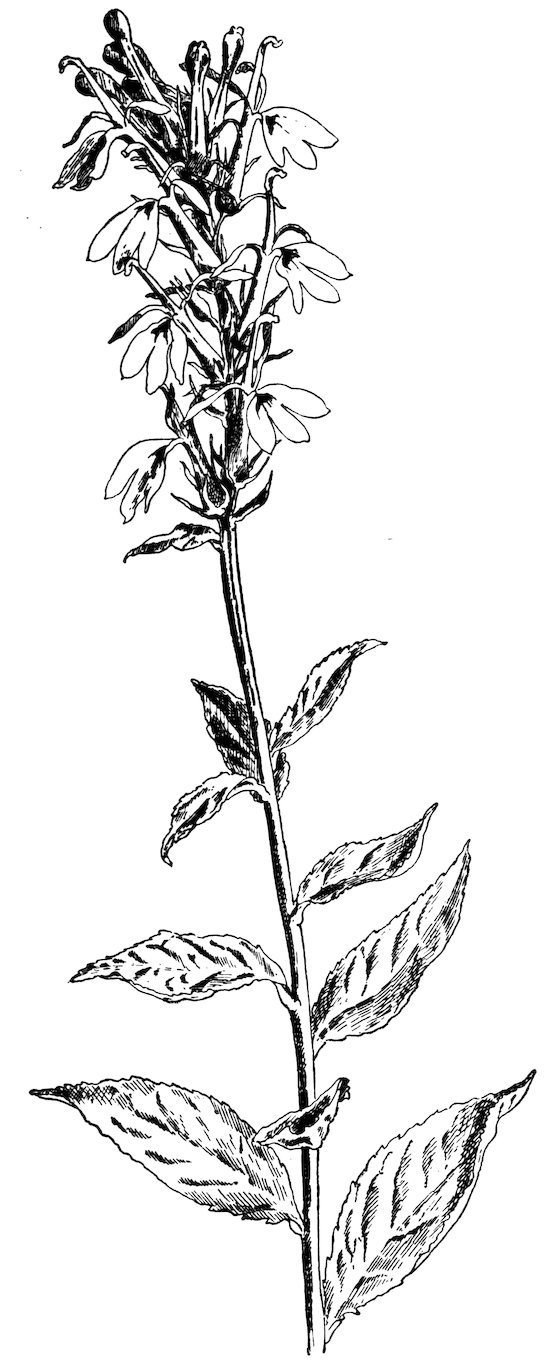
PLATE LXXXIII
CARDINAL-FLOWER.—L. cardinalis.
228
A twining shrub. Leaves.—Entire, opposite, oblong, the upper pairs
united around the stem. Flowers.—Deep red without, yellowish within;
in close clusters from the axils of the upper leaves. Calyx.—With very
short teeth. Corolla.—Trumpet-shaped, five-lobed. Stamens.—Five. Pistil.—One.
Fruit.—A red or orange berry.
Many of us are so familiar with these flowers in our gardens
that we have, perhaps, considered them “escapes” when we
found them brightening the pasture thicket where really they are
most at home, appearing at any time from May till October.
The fragrant woodbine, L. grata, is also frequently cultivated.
Its natural home is the rocky woodlands, where its sweet-scented
whitish or yellowish flowers appear in May. Its stamens
and style protrude conspicuously beyond the corolla-tube,
which is an inch in length.
The greenish or yellowish flowers of the fly honeysuckle, L.
ciliata, grow in pairs. They are found in the rocky woods of
May, on an erect, bushy shrub, the leaves of which are all distinct,
never meeting about the stem.
229
Scape.—Fuzzy, one-flowered. Leaves.—Rounded, three-lobed, from the
root. Flowers.—Blue, white, or pinkish. Calyx.—Of six to twelve petal-like
sepals; easily taken for a corolla, because directly underneath are three
little leaves which resemble a calyx. Corolla.—None. Stamens.—Usually
numerous. Pistils.—Several.
The liver-leaf puts forth her sister blooms
Of faintest blue—
soon after the late snows have melted. Indeed these fragile-looking,
enamel-like flowers are sometimes found actually beneath
the snow, and form one of the many instances which we
encounter among flowers, as among their human contemporaries,
where the frail and delicate-looking withstand storm and
stress far better than their more robust-appearing brethren.
We welcome these tiny newcomers with especial joy, not alone
for their delicate beauty, but because they are usually the first
of all the flowers upon the scene of action, if we rule out the
never-tardy skunk-cabbage. The rusty leaves of last summer
are obliged to suffice for the plant’s foliage until some little time
after the blossoms have appeared, when the young fresh leaves
begin to uncurl themselves. Some one has suggested that the
fuzzy little buds look as though they were still wearing their
furs as a protection against the wintry weather which so often
stretches late into our spring. The flowers vary in color from a
lovely blue to pink or white. They are found chiefly in the
woods, but occasionally on the sunny hill-sides as well.
The generic name, Hepatica, is from the Greek for liver, and
was probably given to the plant on account of the shape of its
leaf. Dr. Prior says that “in consequence of this fancied likeness
230it was used as a remedy for liver complaints, the common
people having long labored under the belief that nature indicated
in some such fashion the uses to which her creations
might be applied.”
Scape.—Slender, one-flowered. Leaves.—Heart-shaped, all from the
root. Flowers.—Varying from a pale blue to deep purple, borne singly on
a scape. Calyx.—Of five sepals extended into ears at the base. Corolla.—Of
five somewhat unequal petals, the lower one spurred at the base. Stamens.—Short
and broad, somewhat united around the pistil. Pistil.—One
with a club-shaped style and bent stigma.
Perhaps this is the best-beloved as well as the best known of
the early wild flowers. Whose heart has not been gladdened at
one time or another by a glimpse of some fresh green nook in
early May where
—purple violets lurk,
With all the lovely children of the shade?
It seems as if no other flower were so suggestive of the dawning
year, so associated with the days when life was full of promise.
Although I believe that more than a hundred species of violets
have been recorded, only about thirty are found in our country;
of these perhaps twenty are native to the Northeastern States.
Unfortunately we have no strongly sweet-scented species, none
—sweeter than the lids of Juno’s eyes
Or Cytherea’s breath,—
as Shakespeare found the English blossom. Prophets and warriors
as well as poets have favored the violet; Mahomet preferred
it to all other flowers, and it was chosen by the Bonapartes as
their emblem.
Perhaps its frequent mention by ancient writers is explained
by the discovery that the name was one applied somewhat indiscriminately
to sweet-scented blossoms.
231
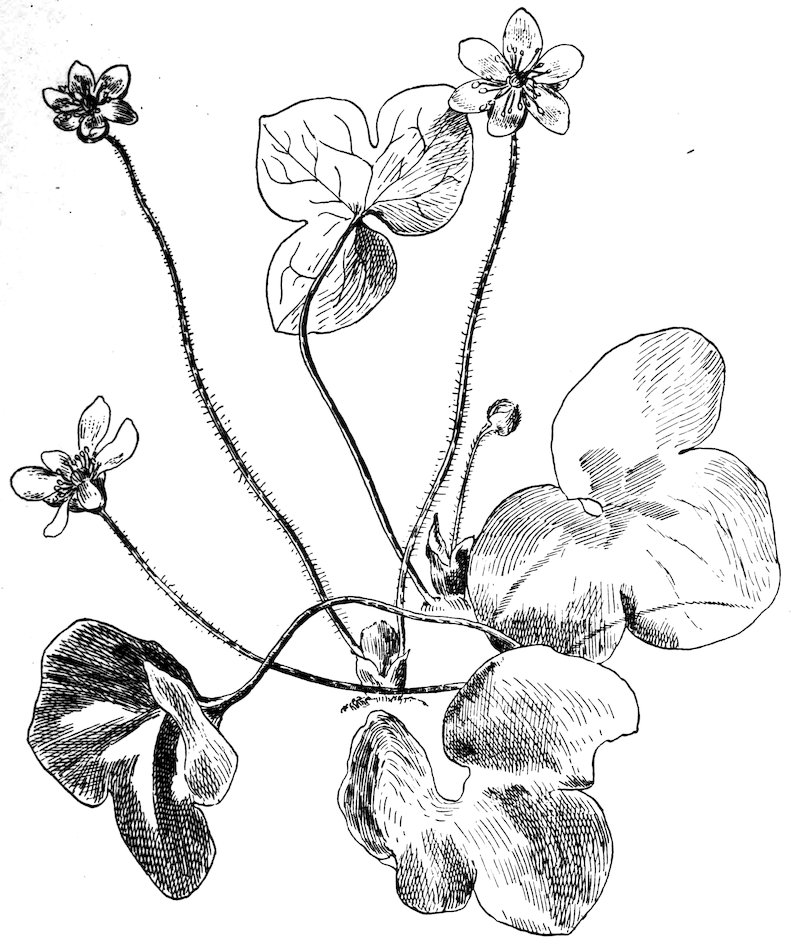
PLATE LXXXIV
LIVERWORT.—H. triloba.
232The bird-foot violet, V. pedata, unlike other members of the
family, has leaves which are divided into linear lobes. Its flower
is peculiarly lovely, being large and velvety. The variety, V. bicolor,
is especially striking and pansy-like, its two upper petals
being of a deeper hue than the others. It is found in the neighborhood
of Washington in abundance, and on the shaly soil of
New Jersey.
An interesting feature of many of these plants is their cleistogamous
flowers. These are small and inconspicuous blossoms,
which never open (thus guarding their pollen against all depredations),
but which are self-fertilized, ripening their seeds in the
dark. They are usually found near or beneath the ground, and
are often taken for immature buds.
Three to eight inches high. Stems.—Leafy. Leaves.—Heart-shaped,
wavy-toothed. Flowers.—Pale violet.
This is the commonest blue species of the leafy-stemmed violets.
It is found in wet, shady places from May till July.
Stem.—Erect, three to five inches high. Leaves.—Very small, opposite.
Flowers.—Small, delicate blue, lilac, or nearly white, with a yellowish eye.
Calyx.—Four-lobed. Corolla.—Salver-shaped, four-lobed, corolla-tube
long and slender. Stamens.—Four. Pistil.—One, with two stigmas.
No one who has been in the Berkshire Hills during the month
of May can forget the loveliness of the bluets. The roadsides,
meadows, and even the lawns, are thickly carpeted with the
dainty enamel-like blossoms which are always pretty, but which
seem to flourish with especial vigor and in great profusion in
this lovely region. Less plentiful, perhaps, but still common is
the little plant in grassy places far south and west, blossoming in
early spring.
233
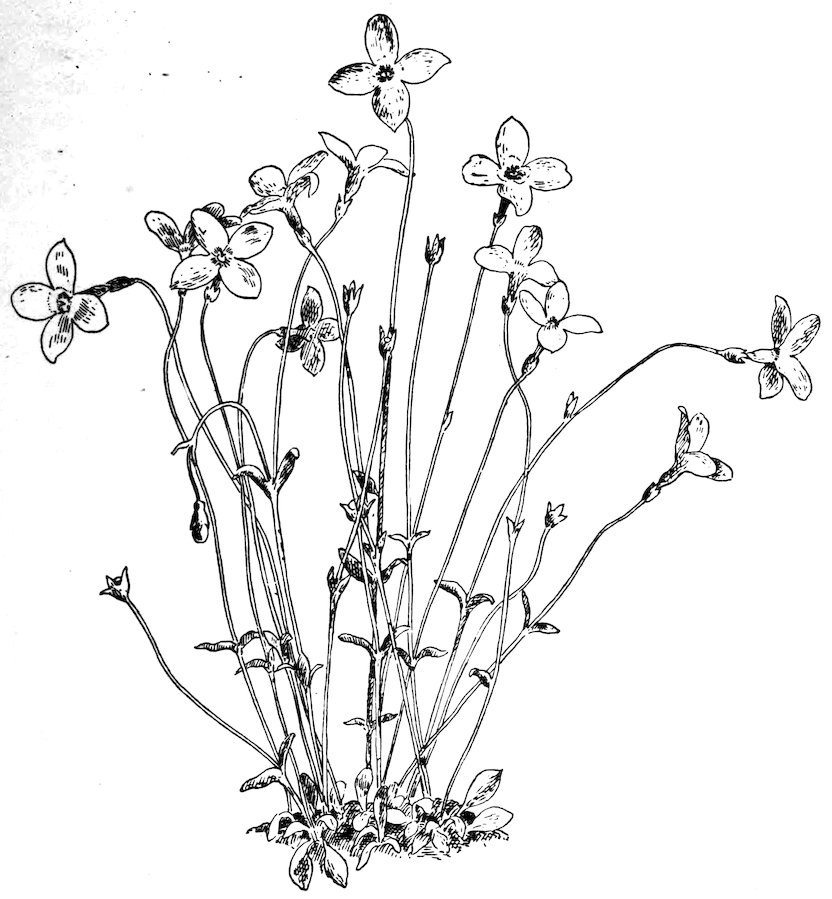
PLATE LXXXV
BLUETS.—H. cærulea.
234The flowers are among those which botanists term “dimorphous.”
This word signifies occurring in two forms, and refers
to the stamens and pistils, which vary in size, some flowers having
a tall pistil and short stamens, others tall stamens and a short
pistil. Darwin has proved, not only that one of these flowers
can seldom fully fertilize itself, but that usually the blossoms
with tall pistils must be fertilized with pollen from the tall stamens,
and that the short pistils are only acted upon by the short
stamens. With a good magnifier and a needle these two forms
can easily be studied. This is one of the many interesting safeguards
against close-fertilization.
One to two feet high. Stem.—Smooth, pale, erect. Leaves.—Oblong,
veiny. Flowers.—Blue, pinkish in bud, in raceme-like clusters which are
rolled up from the end and straighten as the flowers expand. Calyx.—Five-cleft.
Corolla.—Trumpet-shaped, one inch long, spreading. Stamens.—Five.
Pistil.—One.
These very lovely blossoms are found in moist places during
April and May in parts of New York as well as south and westward.
The English naturalist, Mr. Alfred Wallace, seeing them,
for the first time, in the vicinity of Cincinnati, writes in the
Fortnightly Review: “In a damp river-bottom, the exquisite
blue Mertensia Virginica was found. It is called here the ‘Virginian
cowslip,’ its drooping porcelain-blue bells being somewhat
of the size and form of those of the true cowslip.”
Six to twenty inches high. Stems.—Branching, slender. Leaves.—Opposite,
the lower oval, the upper ovate—lance-shaped, clasping by the heart-shaped
base. Flowers.—Blue and white, long-stalked, appearing whorled
in the axils of the upper leaves. Calyx.—Deeply five-cleft. Corolla.—Deeply
two-lipped, the upper lip two-cleft, the lower three-cleft. Stamens.—Four.
Pistil.—One.
Unfortunately these dainty flowers are not found farther
east than Western New York. From there they spread south
and westward, abounding so plentifully in the vicinity of Cincinnati
that the moist meadows are blue with their blossoms in
spring or early summer.
235
Stems.—Slender. Leaves.—Alternate, lance-oblong. Flowers.—Blue,
small, growing in a raceme. Calyx.—Five-lobed. Corolla.—Salver-shaped,
five-toothed. Stamens.—Five. Pistil.—One.
Along the banks of the stream, and in low wet places, we
may look for these exquisite little flowers. This plant is smaller
and less luxuriant than the European species, blossoming in early
summer.
Nine to eighteen inches high. Stems.—Spreading or ascending. Leaves.—Opposite,
oblong or lance-oblong, Flowers.—Pale lilac-purple, in a loose,
spreading cluster. Calyx.—With five slender teeth. Corolla.—With a five-parted
border, salver-shaped, with a long tube. Stamens.—Five, unequally
inserted in the tube of the corolla. Pistil.—One, with a three-lobed style.
We may search for these graceful, delicately tinted flowers in
the rocky woods of April and May.
Nearly allied to them is the wild sweet William, P. maculata,
the pink-purple blossoms of which are found along the streams
and in the rich woods of somewhat southern localities.
The beautiful moss pink, P. subulata, is also a member of
this genus. This little evergreen heath-like plant clothes the
dry hill-sides with a glowing mantle of purple-pink every spring,
Southern New York being probably its most northerly range in
our Eastern States. Great masses of these flowers may be seen
covering the rocks in the Central Park in May.
The pink or whitish clusters of P. glaberrima are found in
the open woods and prairies somewhat westward in July.
Stem.—Simple, hairy, producing offsets from the base. Root-leaves.—Somewhat
rounded or wedge-shaped. Stem-leaves.—Somewhat oblong,
lance-shaped, partly clasping. Flower-heads.—Rather large, on slender
flower-stalks, composed of both strap-shaped and tubular flowers, the former
(ray-flowers) bluish-purple, the latter (disk-flowers) yellow.
This is one of the earliest members of the Composite family
to make its appearance, that great tribe being usually associated
236with the late summer months. The flower might easily be taken
for a purple aster which had mistaken the season, or for a blue
daisy, as one of its common names suggests. E. Philadelphicus
is a later very similar species with smaller flower-heads.
Scape.—Slender, fleshy, three to five inches high, one-flowered. Leaves.—None.
Flower.—Pale purple, solitary, one inch long, with a delicate
fragrance. Calyx.—Five-cleft. Corolla.—Somewhat two-lipped, with two
yellow bearded folds in the throat. Stamens.—Four. Pistil.—One.
In April or May the odd pretty flower of the parasitic one-flowered
cancer-root is found in the damp woodlands.
Scape.—Five to nine inches high, several-flowered. Leaves.—Divided
into three clover-like leaflets. Flowers.—Violet-colored, clustered on the
scape. Calyx.—Of five sepals. Corolla.—Of five petals. Stamens.—Ten.
Pistil.—One, with five styles.
This little plant is found in somewhat open or rocky woods,
its lovely delicate flower-clusters appearing in May or June.
This species is more common southward, while the pink-veined
wood sorrel (Pl. XVII.) abounds in the cool woods of the North.
Scape.—Naked, one-flowered, about one foot high. Leaves.—Pitcher-shaped,
broadly winged, hooded. Flower.—Red-purple, large, nodding.
Calyx.—Of five colored sepals, with three bractlets at the base. Corolla.—Of
five fiddle-shaped petals which are arched over the greenish-yellow style.
Stamens.—Numerous. Pistil.—One, with a short style which expands at
the summit into a petal-like umbrella-shaped body, with five small hooked
stigmas.
237
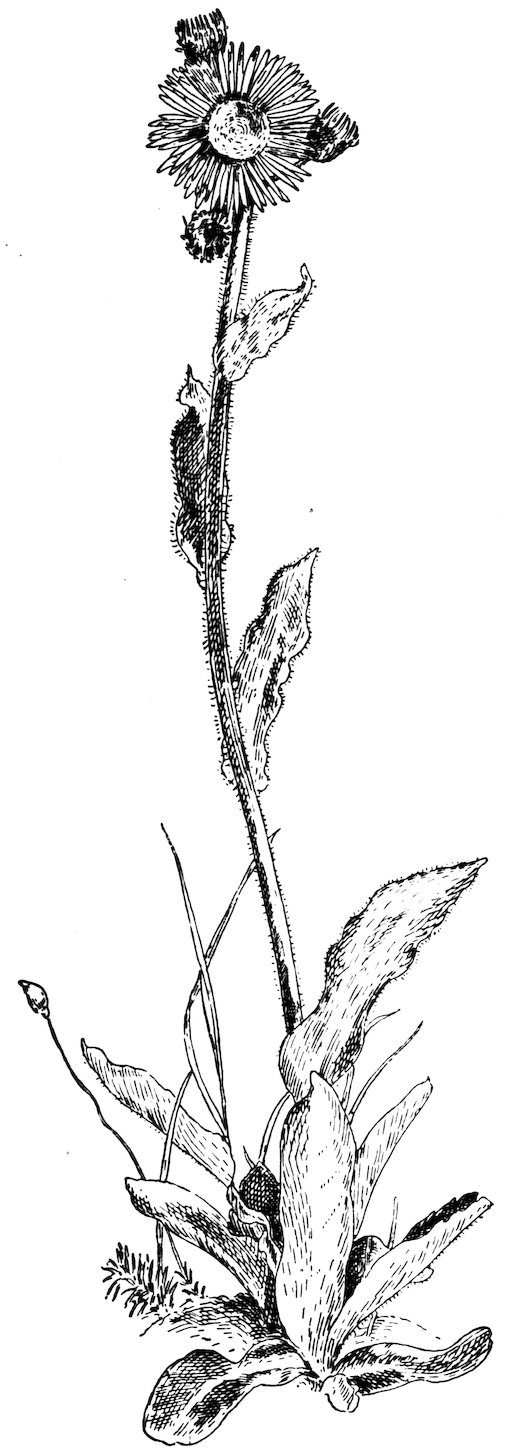
PLATE LXXXVI
ROBIN’S PLANTAIN.—E. bellidifolius.
238The large nodding flower of the pitcher-plant may be found
during June in the peat-bogs of New England as well as farther
south and west. It is less familiar to most people than the
curious pitcher-like leaves, which are usually partially filled with
water and drowned insects; part of their inner surface being
covered with a sugary exudation, below which, for a space, they
are highly polished, while on the lower portion grow the stiff
bristles which point downward. Insects attracted by the sugary
secretion find themselves prisoners, as they can seldom fight
their way through the opposing bristles, neither can they usually
escape by such a perpendicular flight as would be necessary from
the form of the cavity. The decomposed bodies of these unfortunates
are supposed to contribute to the nourishment of the
plant, as it is hardly probable that this elaborate contrivance
answers no special purpose.
Stem.—Erect, hairy. Leaves.—About five-parted, the divisions lobed
and cut. Flowers.—Pale pink-purple, rather large. Calyx.—Of five sepals.
Corolla.—Of five petals. Stamens.—Ten. Pistil.—With five styles,
which split apart at maturity so elastically as to discharge the seeds to some
distance.
In spring and early summer the open woods and shaded
roadsides are abundantly brightened with these graceful flowers.
They are of peculiar interest because of their close kinship with
the species, G. pratense, which first attracted the attention of
the German scholar, Sprengel, to the close relations existing between
flowers and insects. The beak-like appearance of its fruit
give the plant both its popular and scientific names, for geranium
is from the Greek for crane. The specific title, maculatum, refers
to the somewhat blotched appearance of the older leaves.
Stems.—Creeping and trailing. Leaves.—Small and kidney-shaped.
Flowers.—Bluish-purple, loosely clustered in the axils of the leaves. Calyx.—Five-toothed.
Corolla.—Two-lipped, the upper lip erect and two-cleft,
the lower spreading and three-cleft. Stamens.—Four. Pistil.—One, two-lobed
at the apex.
239
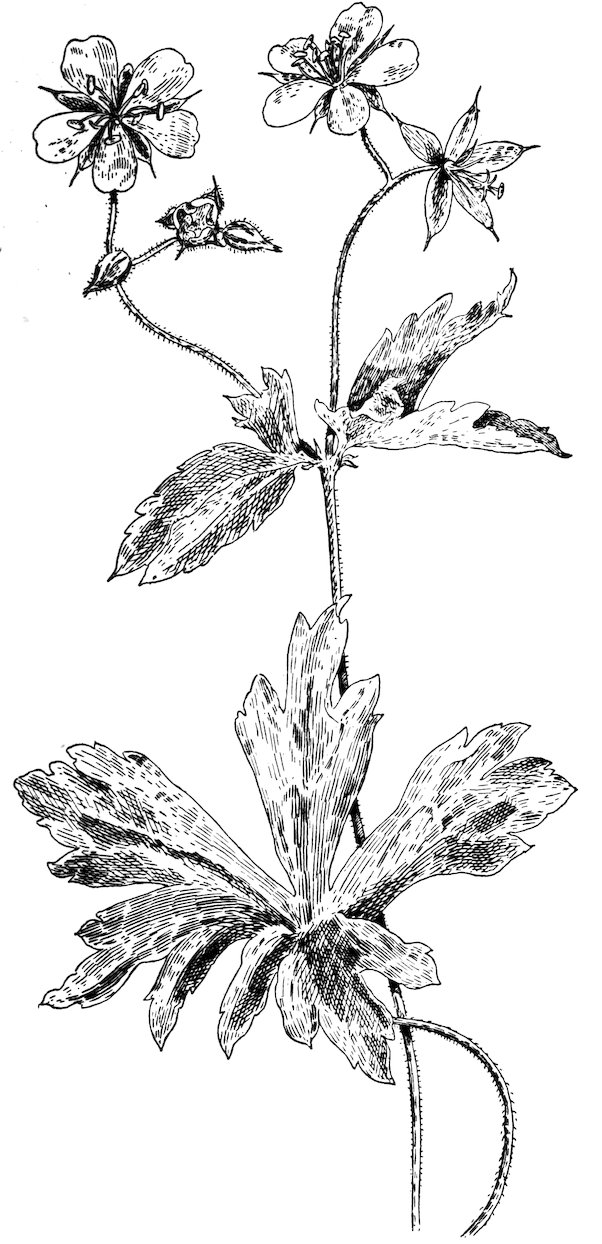
PLATE LXXXVII
WILD GERANIUM.—G. maculatum.
240As the pleasant aroma of its leaves suggest, this little plant
is closely allied to the catnip. Its common title of Gill-over-the-ground,
appeals to one who is sufficiently without interest in
pasture-land (for it is obnoxious to cattle) to appreciate the
pleasant fashion in which this little immigrant from Europe has
made itself at home here, brightening the earth with such a generous
profusion of blossoms every May. But it is somewhat of
a disappointment to learn that this name is derived from the
French guiller, and refers to its former use in the fermentation of
beer. Oddly enough the name of alehoof, which the plant has
borne in England and which naturally has been supposed to refer
to this same custom, is said by a competent authority (Professor
Earle, of Oxford) to have no connection with it, but to signify
another sort of hofe, hofe being the early English name for the
violet, which resembles these flowers in color.
The plant was highly prized formerly as a domestic medicine.
Gerarde claims that “boiled in mutton-broth it helpeth weake
and akeing backs.”
Six inches to five feet high. Leaves.—Divided or cut. Flowers.—Blue
or purplish, growing in terminal racemes. Calyx.—Of five irregular petal-like
sepals, the upper one prolonged into a spur. Corolla.—Of four irregular
petals, the upper pair continued backward in long spurs which are enclosed
in the spur of the calyx, the lower pair with short claws. Stamens.—Indefinite
in number. Pistils.—One to five, forming pods in fruit.
In April and May the bright blue clusters of the dwarf larkspur,
D. tricorne, are noticeable in parts of the country. Unfortunately
they are not found east of Western Pennsylvania.
The tall wand-like purplish racemes of the tall larkspur, D.
exaltatum, are found in July in the rich soil of Pennsylvania,
and much farther south and west as well.
Stem.—Erect, one to two feet high. Leaves.—Divided into seven to
eleven leaflets. Flowers.—Blue, papilionaceous, showy, in a long raceme.
Pod.—Broad, hairy.
In June and July the long bright clusters of the wild lupine
are very noticeable in many of our sandy fields. Its pea-like
241blossoms serve to easily identify it. Under date of June 8th,
Thoreau writes: “The lupine is now in its glory.... It
paints a whole hill-side with its blue, making such a field (if not
meadow) as Proserpine might have wandered in. Its leaf was
made to be covered with dewdrops. I am quite excited by
this prospect of blue flowers in clumps, with narrow intervals,
such a profusion of the heavenly, the Elysian color, as if these
were the Elysian fields.... That is the value of the lupine.
The earth is blued with it.”
Stem.—Slender, branching, from five to twelve inches high. Root-leaves.—Heart-shaped
or ovate, early withering. Stem-leaves.—Numerous, long
and narrow. Flowers.—Bright blue, nodding from hair-like stalks. Calyx.—Five-cleft,
the lobes awl-shaped. Corolla.—Bell-shaped, five-lobed. Stamens.—Five.
Pistil.—One, with three stigmas.
This slender, pretty plant, hung with its tremulous flowers,
springs from the rocky cliffs which buttress the river as well as
from those which crown the mountain. I have seen the west
shore of the Hudson bright with its delicate bloom in June, and
the summits of the Catskills tinged with its azure in September.
The drooping posture of these flowers protect their pollen from
rain or dew. They have come to us from Europe, and are identical,
I believe, with the celebrated Scotch bluebells.
Four to twelve inches high. Leaves.—Narrow and grass-like. Flowers.—Blue
or purple, with a yellow centre. Perianth.—Six-parted, the divisions
bristle-pointed. Stamens.—Three, united. Pistil.—One, with three thread-like
stigmas.
For the sun is no sooner risen with a burning heat,
But it withereth the grass,
And the flower thereof falleth,
And the grace of the fashion of it perisheth.
So reads the passage in the Epistle of James, which seems so
graphically to describe the brief life of this little flower, that we
242might almost believe the Apostle had had it in mind, were it to
be found in the East.
The blue-eyed grass belongs to the same family as the showy
fleur-de-lis and blossoms during the summer, being especially
plentiful in moist meadows. It is sometimes called “eye-bright,”
which name belongs by rights to Euphrasia officinalis.
Stem.—Somewhat hairy, three to twenty inches high. Leaves.—Toothed,
rounded, clasping by the heart-shaped base. Flowers.—Blue. Calyx.—Three,
four, or five-lobed. Corolla.—Wheel-shaped, five-lobed. Stamens.—Five.
Pistil.—One, with three stigmas.
We borrow from Mr. Burroughs’s “Bunch of Herbs” a description
of this little plant, which blossoms from May till August.
“A pretty and curious little weed, sometimes found growing in
the edge of the garden, is the clasping specularia, a relative of
the harebell and of the European Venus’s looking-glass. Its
leaves are shell-shaped, and clasp the stalk so as to form little
shallow cups. In the bottom of each cup three buds appear
that never expand into flowers, but when the top of the stalk is
reached, one and sometimes two buds open a large, delicate purple-blue
corolla. All the first-born of this plant are still-born
as it were; only the latest, which spring from its summit, attain
to perfect bloom.”
Stem.—Square, usually one or two feet high. Leaves.—Opposite, oblong,
lance-shaped or linear. Flowers.—Blue. Calyx.—Two-lipped, the
upper lip with a small, helmet-like appendage which at once identifies this
genus. Corolla.—Two-lipped, the upper lip arched, the lateral lobes mostly
connected with the upper lip, the lower lip spreading and notched at the
apex. Stamens.—Four, in pairs. Pistil.—One, with a two-lobed style.
The prettiest and most striking of this genus is the larger
skull-cap, S. integrifolia, whose bright blue flowers are about
one inch long, growing in terminal racemes. In June and July
they may be found among the long grass of the roadsides and
meadows. They are easily identified by the curious little appendage
on the upper part of the calyx, which gives to this
genus its common name.
243
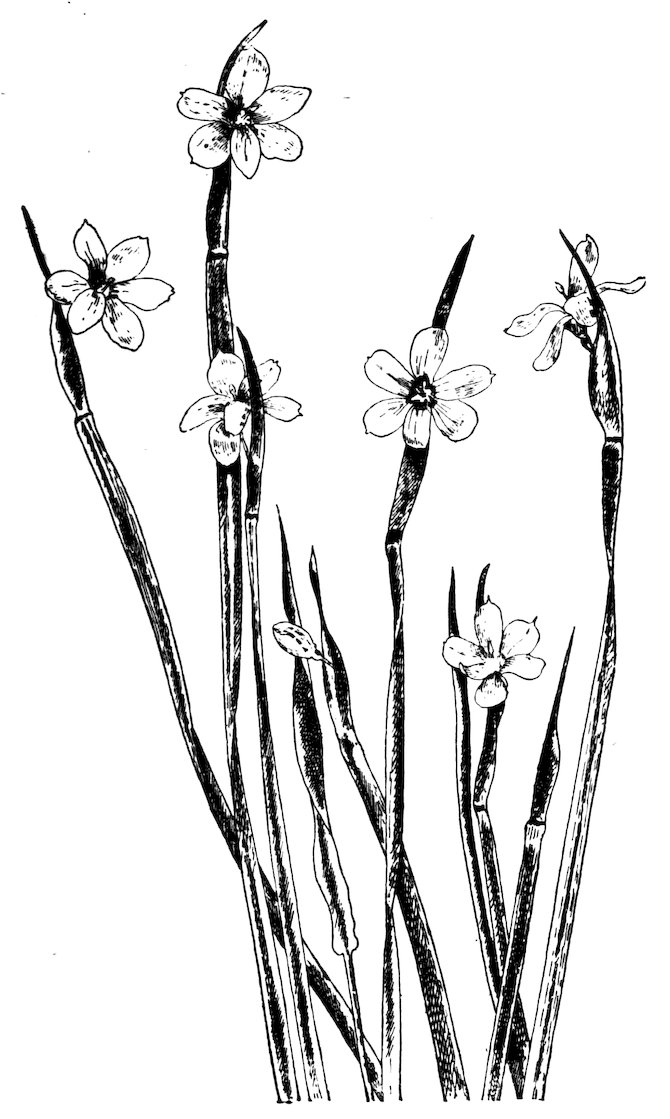
PLATE LXXXVIII
BLUE-EYED GRASS.—S. angustifolium.
244Perhaps the best-known member of the group is the mad-dog
skull-cap, S. lateriflora, which delights in wet places, bearing
small, inconspicuous flowers in one-sided racemes. This plant
is quite smooth, while that of S. integrifolia is rather downy.
It was formerly believed to be a sure cure for hydrophobia.
S. galericulata is usually found somewhat northward. Its
flowers are much larger than those of S. lateriflora, but smaller
than those of S. integrifolia. They grow singly from the axils
of the upper leaves.
Stem.—Stout, angled on one side, leafy, one to three feet high. Leaves.—Flat
and sword-shaped, with their inner surfaces coherent for about half
of their length. Flowers.—Large and showy, violet-blue, variegated with
green, yellow, or white; purple-veined. Perianth.—Six-cleft, the three
outer divisions recurved, the three inner smaller and erect. Stamens.—Three,
covered by the three overarching, petal-like divisions of the style.
Pistil.—One, with its style cleft into three petal-like divisions, each of
which bears its stigma on its inner surface.
Born in the purple, born to joy and pleasance,
Thou dost not toil nor spin,
But makest glad and radiant with thy presence
The meadow and the lin.
[11]
In both form and color this is one of the most regal of our
wild flowers, and it is easy to understand why the fleur-de-lis
was chosen as the emblem of a royal house, although the especial
flower which Louis VII. of France selected as his badge was probably
white.
It will surprise most of us to learn that the common name
which we have borrowed from the French does not signify
“flower-of-the-lily,” as it would if literally translated, but
“flower of Louis,” lis being a corruption of the name of the
king who first adopted it as his badge.
245
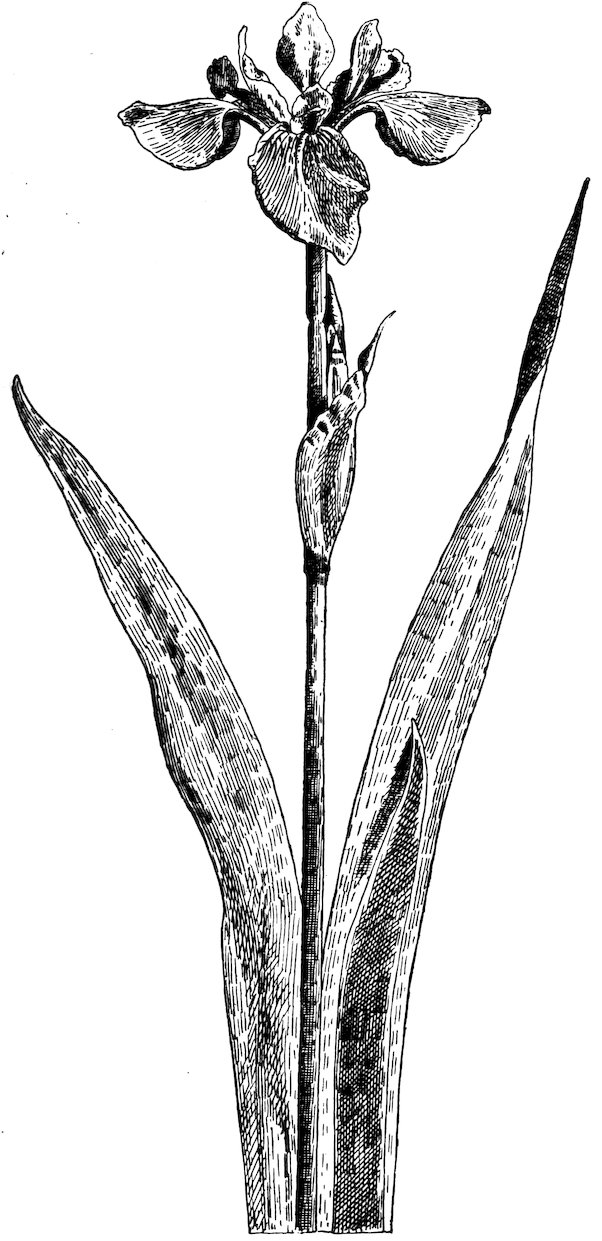
PLATE LXXXIX
FLEUR-DE-LIS.—I. versicolor.
246For the botanist the blue-flag possesses special interest. It
is a conspicuous example of a flower which has guarded itself
against self-fertilization, and which is beautifully calculated to
secure the opposite result. The position of the stamens is such
that their pollen could not easily reach the stigmas of the same
flower, for these are borne on the inner surface of the petal-like,
overarching styles. There is no prospect here of any seed being
set unless the pollen of another flower is secured. Now what are
the chances in favor of this? They are many: In the first
place the blossom is unusually large and showy, from its size and
shape alone almost certain to arrest the attention of the passing
bee; next, the color is not only conspicuous, but it is also one
which has been found to be especially attractive to bees; blue
and purple flowers being particularly sought by these insects.
When the bee reaches the flower he alights on the only convenient
landing-place, one of the recurved sepals; following the
deep purple veins which experience has taught him lead to the
hidden nectar, he thrusts his head below the anther, brushing off
its pollen, which he carries to another flower.
The rootstocks of the Florentine species of iris yield the
familiar “orris-root.”
The family name is from the Greek for rainbow, on account
of the rich and varied hues of its different members.
The plant abounds in wet meadows, the blossoms appearing
in June.
Stem.—Smooth, reclining at base, then erect, eight to fifteen inches high.
Leaves.—Mostly opposite, oblong, toothed. Flowers.—Blue, clustered in
the axils of the leaves. Calyx.—Four-parted. Corolla.—Wheel-shaped,
four-parted. Stamens.—Two. Pistil.—One.
Perhaps the prettiest of the blue Veronicas is the American
brooklime. Its clustered flowers make bright patches in moist
ground which might, at a little distance, be mistaken for beds
of forget-me-nots. It blossoms from June till August, and is
almost as common in wet ditches and meadows as its sister, the
common speedwell, is in dry and open places. Some of the
members of this genus were once believed to possess great medicinal
virtues, and won for themselves in Europe the laudatory
names of Honor and Praise.
247
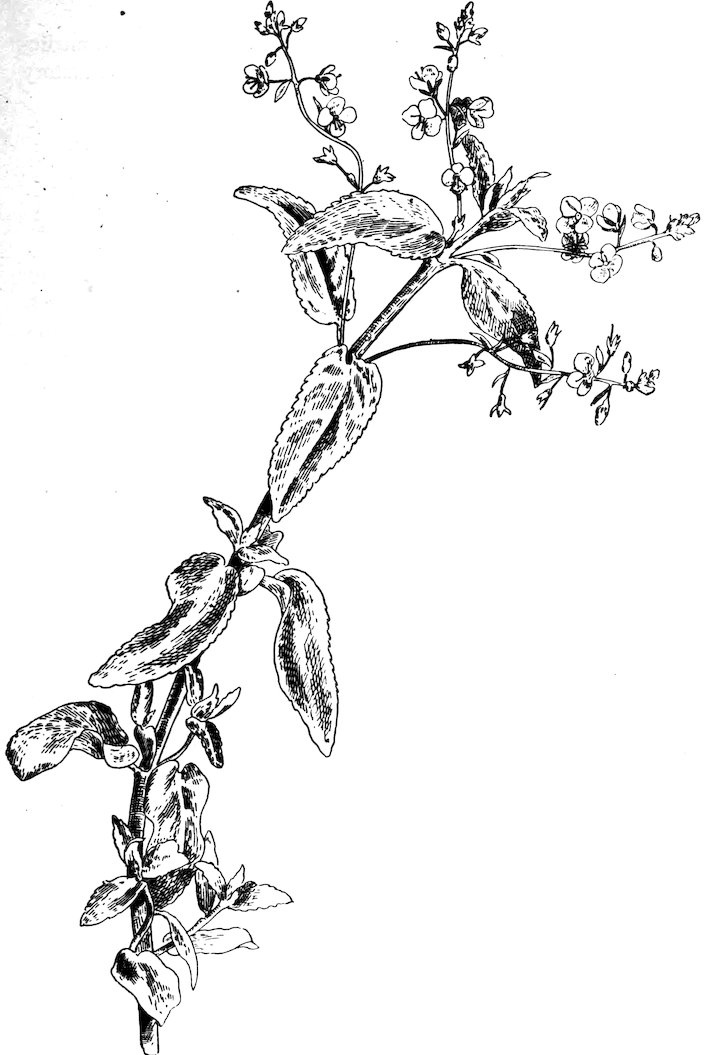
PLATE XC
AMERICAN BROOKLIME.—V. Americana.
248
The little speedwell’s darling blue
is noticeable during June and July, when clusters of these tiny
flowers brighten many a waste spot along the sunny roadsides.
This is a hairy little plant, with a stem which lies upon the
ground and takes root, thus spreading itself quickly over the
country.
Scape.—Sheathed, from a globular bulb, usually one-flowered. Leaf.—“Solitary,
linear, nerved, hidden in the sheaths of the scape, protruding
after flowering.” (Gray.) Flower.—Rose-purple, large, with a bearded
lip.
In some localities this beautiful flower is very plentiful.
Every June will find certain New England marshes tinged with
its rose-purple blossoms, while in other near and promising bogs
it may be sought vainly for years. At least it may be hoped for
in wet places as far south as North Carolina, its most favorite
haunt being perhaps a cranberry-swamp. Concerning it, Mr.
Burroughs writes: “Arethusa was one of the nymphs who attended
Diana, and was by that goddess turned into a fountain,
that she might escape the god of the river Alpheus, who became
desperately in love with her on seeing her at her bath. Our
Arethusa is one of the prettiest of the orchids, and has been pursued
through many a marsh and quaking-bog by her lovers.
She is a bright pink-purple flower an inch or more long, with
the odor of sweet violets. The sepals and petals rise up and
arch over the column, which we may call the heart of the flower,
as if shielding it. In Plymouth County, Mass., where the Arethusa
seems common, I have heard it called Indian pink.”
249
Habenaria fimbriata.
Leaves.—Oval or oblong; the upper, few, passing into lance-shaped
bracts. Flowers.—Purple, rather large; with a fan-shaped, three-parted
lip, its divisions fringed; with a long curving spur; growing in a spike.
Habenaria psycodes.
Leaves.—Oblong or lance-shaped, the upper passing into linear bracts.
Flowers.—Purple, fragrant, resembling those of H. fimbriata, but much
smaller, with a less fringed lip; growing in a spike.
We should search the wet meadows in early June if we wish
to be surely in time for the larger of the purple fringed orchises,
for H. fimbriata somewhat antedates H. psycodes, which is the
commoner species of the two and appears in July. Under date
of June 9th, Thoreau writes: “Find the great fringed orchis out
apparently two or three days, two are almost fully out, two or
three only budded; a large spike of peculiarly delicate, pale purple
flowers growing in the luxuriant and shady swamp, amid hellebores,
ferns, golden senecio, etc.... The village belle
never sees this more delicate belle of the swamp.... A
beauty reared in the shade of a convent, who has never strayed
beyond the convent-bell. Only the skunk or owl, or other inhabitant
of the swamp, beholds it.”
Stem.—Square, low, erect, branching Leaves.—Opposite, aromatic,
small. Flowers.—Purplish, small, whorled in the axils of the leaves. Calyx.—Two-lipped,
upper lip three-toothed, the lower two-cleft. Corolla.—Two-lipped,
upper erect, notched at apex, the lower spreading and three-cleft.
Fertile stamens.—Two. Pistil.—One, with a two-lobed style.
This well-known, strong-scented little plant is found throughout
the greater part of the country, blossoming in midsummer.
250Its taste and odor nearly resemble that of the true pennyroyal,
Mentha pulegium, of Europe.
Stem.—Square, one to two feet high. Leaves.—Opposite, oblong or lance-shaped.
Flowers.—Pale violet-purple, rarely white, growing singly from
the axils of the leaves. Calyx.—Five-angled, five-toothed, the upper tooth
largest. Corolla.—Tubular, two-lipped, the upper lip erect or spreading,
two-lobed, the lower spreading and three-lobed, the throat closed. Stamens.—Four.
Pistil.—One, with a two-lobed stigma.
From late July onward the monkey-flowers tinge the wet
fields and border the streams and ponds; not growing in the
water like the pickerel-weed, but seeking a hummock in the
swamp, or a safe foothold on the brook’s edge, where they can absorb
the moisture requisite to their vigorous growth.
The name is a diminutive of mimus—a buffoon, and refers to
the somewhat grinning blossom. The plant is a common one
throughout the eastern part of the country.
Stem.—Tall and upright. Leaves.—Opposite, the lower rounded and
lobed, the floral wedge-shaped at base and three-cleft. Flowers.—Pale
purple, in close whorls in the axils of the leaves. Calyx.—“With five
nearly equal teeth, which are awl-shaped, and when old rather spiny, pointed,
and spreading.” (Gray.) Corolla.—Two-lipped, the upper lip somewhat
arched and bearded, the lower three-lobed and spreading. Stamens.—Four,
in pairs. Pistil.—One, with a two-lobed style.
The tall erect stems, opposite leaves, and regular whorls of
closely clustered pale purple flowers help us to easily identify the
motherwort, if identification be needed, for it seems as though
such old-fashioned, time-honored plants as catnip, tansy, and
motherwort, which cling so persistently to the skirts of the old
homestead in whose domestic economy they once played so important
a part, should be familiar to us all.
251
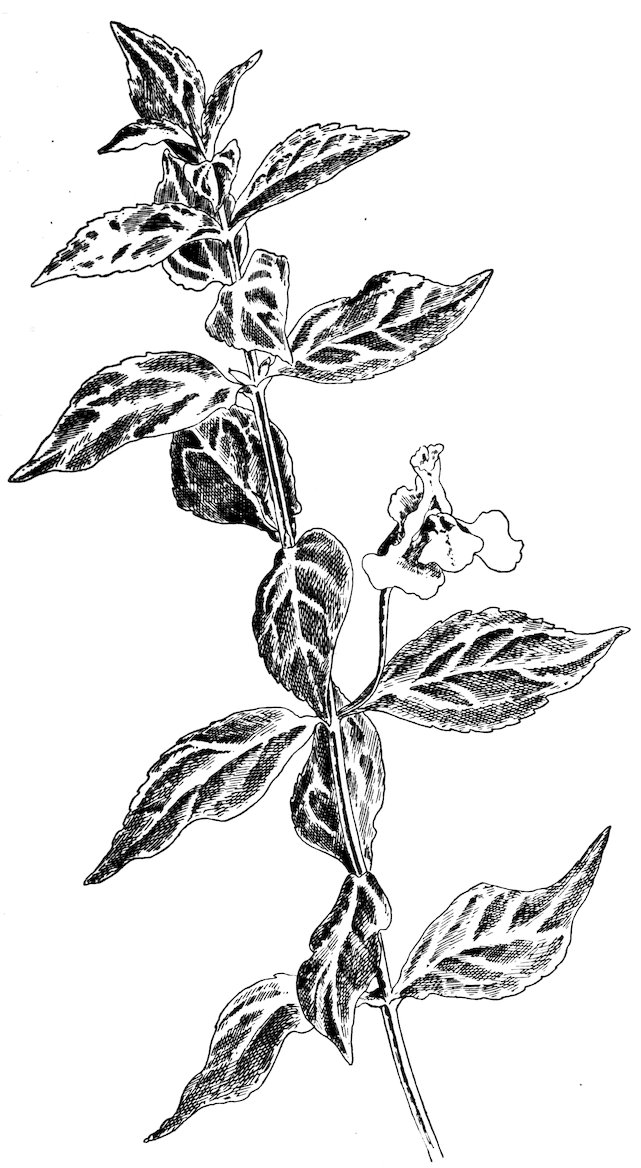
PLATE XCI
MONKEY-FLOWER.—M. ringens.
252
About two feet high. Leaves.—Opposite, long and narrow, pale green,
with silky hairs. Flowers.—Rose-purple, large, long-stalked. Calyx-lobes.—Five,
long and slender, exceeding the petals. Corolla.—Of five broad
petals. Stamens.—Ten. Pistil.—One, with five styles.
In many countries some of the most beautiful and noticeable
flowers are commonly found in grain-fields. England’s scarlet
poppies flood her farm-lands with glorious color in early summer;
while the bluets lighten the corn-fields of France. Our grain-fields
seem to have no native flower peculiar to them; but often
we find a trespasser of foreign descent hiding among the wheat
or straying to the roadsides in early summer, whose deep-tinted
blossoms secure an instant welcome from the flower-lover if not
from the farmer. “What hurte it doeth among corne! the
spoyle unto bread, as well in colour, taste, and unwholesomeness,
is better known than desired,” wrote Gerarde. The large dark
seeds fill the ground wheat with black specks, and might be
injurious if existing in any great quantity. Its former generic
name was Agrostemma, signifying crown of the fields. Its present
one of Lychnis, signifies a light or lamp.
Four to six feet high. Leaves.—Opposite, somewhat lance-shaped, the
lower often lobed and sometimes halberd-shaped at base. Flowers.—Purple,
small, in slender erect spikes. Calyx.—Five-toothed. Corolla.—Tubular,
somewhat unequally five-cleft. Stamens.—Two, in pairs. Pistil.—One.
Along the roadsides in midsummer we notice these slender
purple spikes, the appearance of which would be vastly improved
if the tiny blossoms would only consent to open simultaneously.
253
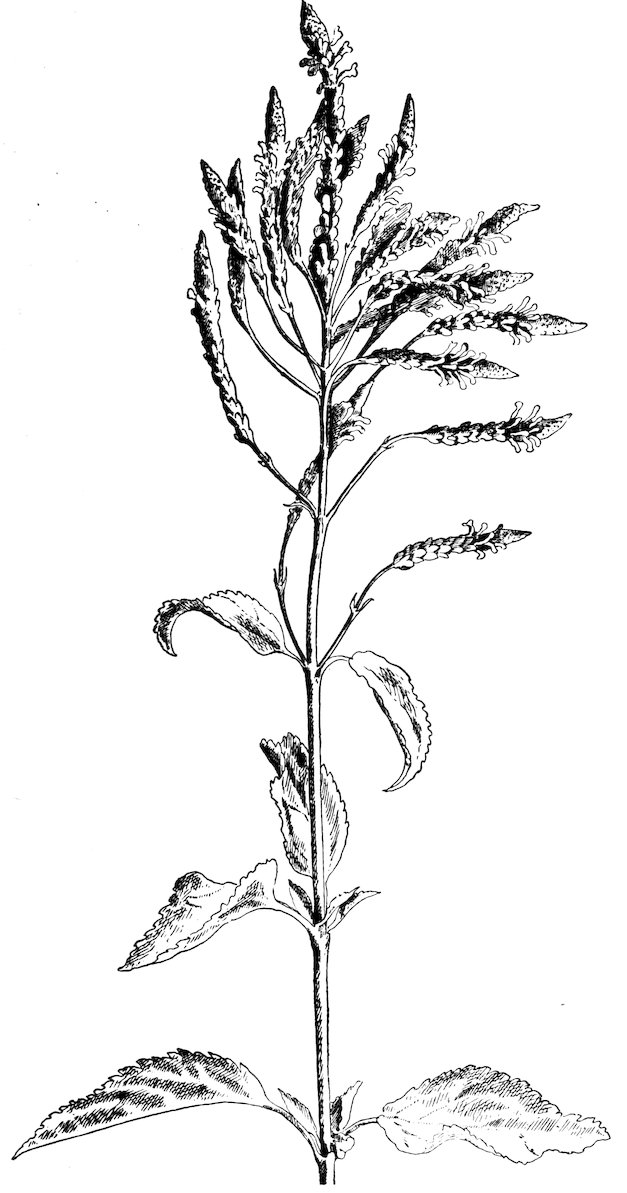
PLATE XCII
BLUE VERVAIN.—V. hastata.
254In earlier times the vervain was beset with classic associations.
It was claimed as the plant which Virgil and other poets
mention as being used for altar-decorations and for the garlands
of sacrificial beasts. It was believed to be the herba sacra of
the ancients, until it was understood that the generic title
Verbena was a word which was applied to branches of any description
which were used in religious rites. It certainly seems,
however, to have been applied to some especial plant in the time
of Pliny, for he writes that no plant was more honored among
the Romans than the sacred Verbena. In more modern times
as well the vervain has been regarded as an “herb of grace,” and
has been gathered with various ceremonies and with the invocation
of a blessing, which began as follows:
Hallowed be thou, Vervain,
As thou growest on the ground,
For in the Mount of Calvary
There thou was first found.
It was then supposed to be endued with especial virtue, and was
worn on the person to avert disaster.
The time-honored title of Simpler’s joy arose from the remuneration
which this popular plant brought to the “Simplers”—as
the gatherers of medicinal herbs were entitled.
Stem.—One or two feet high, clammy above. Leaves.—Opposite, oblong
to lance-shaped. Flowers.—Dull purple or partly whitish, showy, in a
slender open cluster. Calyx.—Five-parted. Corolla.—Tubular, slightly
dilated, the throat nearly closed by a bearded palate; two-lipped, the upper
lip two-lobed, the lower three-cleft. Stamens.—Four, one densely bearded
sterile filament besides. Pistil.—One.
These handsome, showy flowers are found in summer in dry or
rocky places. They are especially plentiful somewhat southward.
The white beard-tongue of more western localities is P. digitalis.
This is a very effective plant, which sometimes reaches
a height of five feet, having large inflated white flowers.
Stems.—Low. Leaves.—Opposite, oblong. Flowers.—Bluish-purple,
in a spike or head. Calyx.—Two-lipped, upper lip with three short teeth,
the lower two-cleft. Corolla.—Two-lipped, the upper lip arched, entire, the
lower spreading, three-cleft. Stamens.—Four. Pistil.—One, two-lobed at
the apex.
255
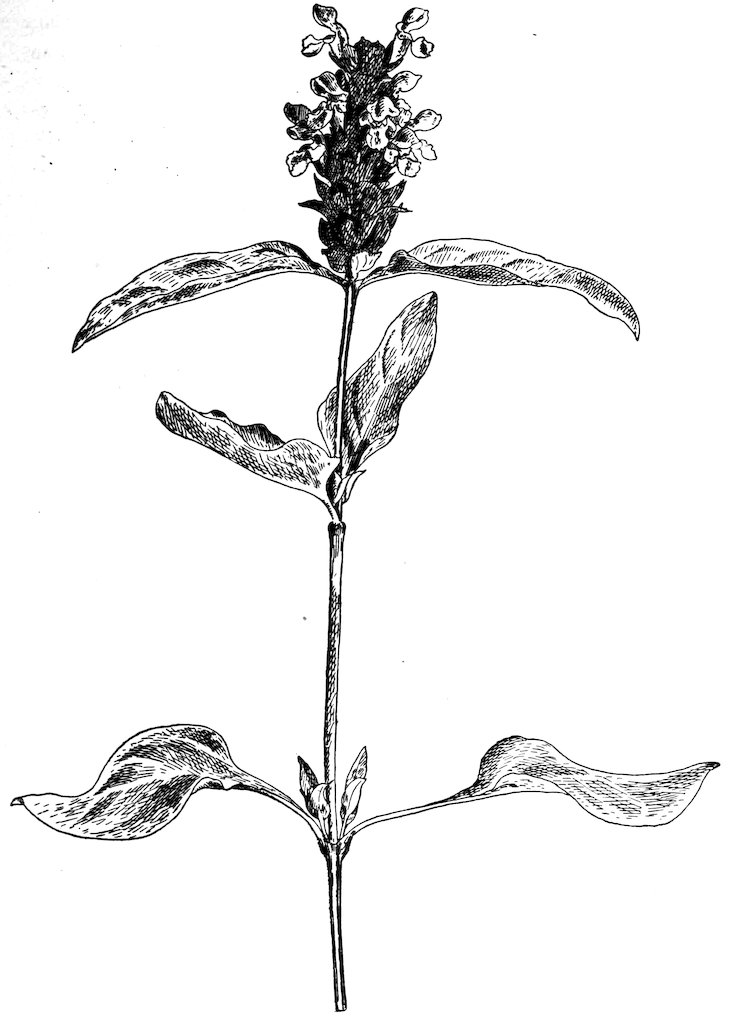
PLATE XCIII
SELF-HEAL.—B. vulgaris.
256Throughout the length and breadth of the country, from
June until September, the short, close spikes of the self-heal can
be found along the roadsides. The botanical name, Brunella,
is a corruption from Prunella, which is taken from the German
for quinsy, for which this plant was considered a certain cure.
It was also used in England as an application to the wounds received
by rustic laborers, as its common names, carpenter’s
herb, hook-heal, and sicklewort, imply. That the French had a
similar practice is proved by an old proverb of theirs to the effect
that “No one wants a surgeon who keeps Prunelle.”
Two to five feet high. Leaves.—Opposite, fragrant, toothed. Flowers.—Purple
or purplish, dotted, growing in a solitary, terminal head. Calyx.—Tubular,
elongated, five-toothed. Corolla.—Elongated, two-lipped. Stamens.—Two,
elongated. Pistil.—One, with style two-lobed at apex.
Although the wild bergamot is occasionally found in our
eastern woods, it is far more abundant westward, where it is
found in rocky places in summer. This is a near relative of the
bee balm (Pl. LXXXII.), which it closely resembles in its manner
of growth.
Stem.—Slender, branching. Leaves.—Lance-shaped to linear, the floral
ones heart-shaped and clasping, folding so as to enclose the flowers. Flowers.—Blue.
Calyx.—Of three unequal somewhat colored sepals, the two
lateral ones partly united. Corolla.—Of three petals, two large, rounded,
pale blue, one small, whitish, and inconspicuous. Stamens.—Six, unequal
in size, three small and sterile, with yellow cross-shaped anthers, three fertile,
one of which is bent inward. Pistil.—One.
The odd day-flower is so named because its delicate blossoms
only expand for a single morning. At the first glance there seem
to be but two petals which are large, rounded, and of a delicate
shade of blue. A closer examination, however, discovers still
another, so inconspicuous in form and color as to escape the
notice of the casual observer. This inequality recalls the quaint
tradition as to the origin of the plant’s generic name. There
were three brothers Commelin, natives of Holland. Two of
them were botanists of repute, while the tastes of the third had
a less marked botanical tendency. The genus was dedicated to
257the trio: the two large bright petals commemorating the brother
botanists, while the small and unpretentious one perpetuates the
memory of him who was so unwise as to take little or no interest
in so noble a science. These flowers appear throughout the summer
in cool woods and on moist banks.
Stems.—Slender, six to thirty inches high. Leaves.—Linear. Flowers.—Pale
blue or purple, small, in a long terminal raceme. Calyx.—Five-parted.
Corolla.—Two-lipped, with a slender spur, closed in the throat.
Stamens.—Four. Pistil.—One.
The slender spikes of the blue linaria flank the sandy roadsides
nearly all summer, and even in November we find a few
delicate blossoms still left upon the elongated stems. These
flowers have a certain spirituality which is lacking in their handsome,
self-assertive relation, butter-and-eggs.
Stems.—Mucilaginous, leafy, mostly upright. Leaves.—Linear, keeled.
Flowers.—Blue, clustered, with floral leaves as in the day-flower. Calyx.—Of
three sepals. Corolla.—Of three petals. Stamens.—Six, with bearded
filaments. Pistil.—One.
The flowers of the spiderwort, like those of the day-flower, to
which they are nearly allied, are very perishable, lasting only a
few hours. They are found throughout the summer, somewhat
south and westward. The genus is named in honor of Tradescant,
gardener to Charles I. of England.
Stem.—Stout, usually one-leaved. Leaves.—Arrow or heart-shaped.
Flowers.—Blue, fading quickly, with an unpleasant odor, growing in a dense
spike. Perianth.—Two-lipped, the upper lip three-lobed and marked with
a double greenish-yellow spot, the lower of three spreading divisions. Stamens.—Six,
three long and protruding, the three others, which are often imperfect,
very short and inserted lower down. Pistil.—One.
The pickerel-weed grows in such shallow water as the pickerel
seek, or else in moist, wet places along the shores of streams
258and rivers. We can look for the blue, closely spiked flowers
from late July until some time in September. They are often
found near the delicate arrow-head.
Stem.—Rough, bristly, erect, about two feet high. Leaves.—Alternate,
lance-shaped, set close to the stem. Flowers.—Bright blue, spiked on one
side of the branches, which are at first rolled up from the end, straightening
as the blossoms expand. Calyx.—Five-parted. Corolla.—Of five somewhat
unequal, spreading lobes. Stamens.—Five, protruding, red. Pistil.—One.
When the blueweed first came to us from across the sea it
secured a foothold in Virginia. Since then it has gradually
worked its way northward, lining the Hudson’s shores, overrunning
many of the dry fields in its vicinity, and making itself
at home in parts of New England. We should be obliged to
rank it among the “pestiferous” weeds were it not that, as a
rule, it only seeks to monopolize land which is not good for very
much else. The pinkish buds and bright blue blossoms with
their red protruding stamens make a valuable addition, from the
æsthetic point of view, to the bunch of midsummer field-flowers
in which hitherto the various shades of red and yellow have predominated.
Stem.—Usually somewhat climbing or twining. Leaves.—Heart-shaped,
the upper halberd-shaped or with ear-like lobes or leaflets at the base. Flowers.—Purple,
in small clusters. Calyx.—Five-parted. Corolla.—Five-parted,
wheel-shaped. Stamens.—Five, yellow, protruding. Pistil.—One.
Fruit.—A red berry.
259
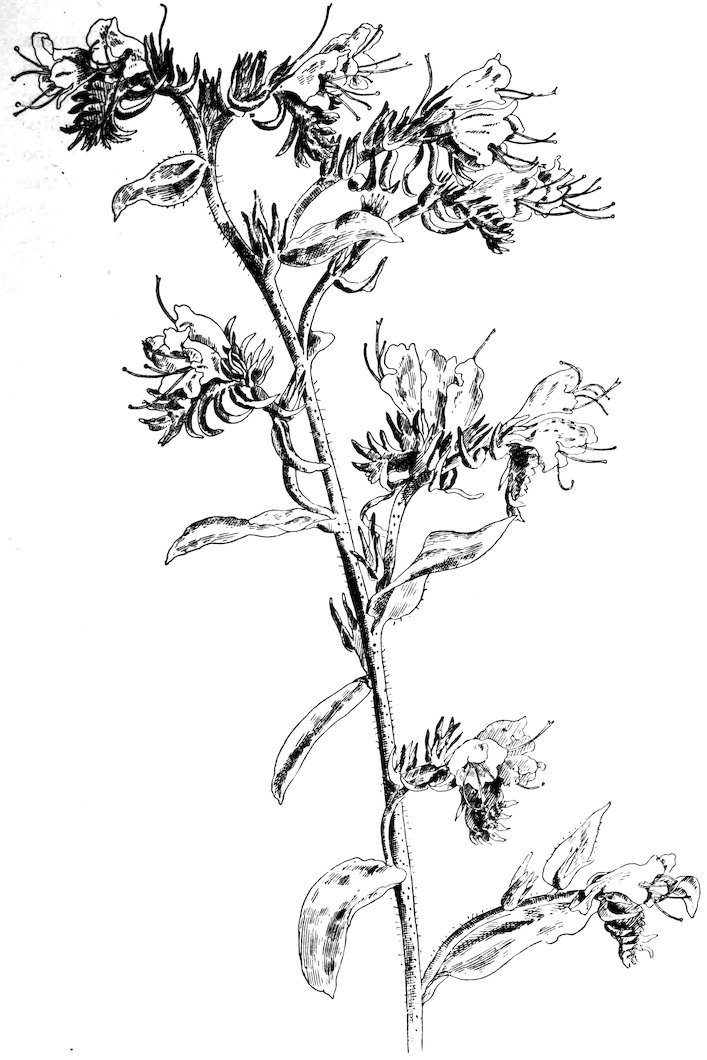
PLATE XCIV
BLUEWEED.—E. vulgare.
260The purple flowers, which at once betray their kinship with
the potato plant, and, in late summer, the bright red berries of
the nightshade, cluster about the fences and clamber over the
moist banks which line the highway. This plant, which was imported
from Europe, usually indicates the presence of civilization.
It is not poisonous to the touch, as is often supposed, and it is
doubtful if the berries have the baneful power attributed to them.
Thoreau writes regarding them: “The Solanum Dulcamara
berries are another kind which grow in drooping clusters. I do
not know any clusters more graceful and beautiful than these
drooping cymes of scented or translucent, cherry-colored elliptical
berries.... They hang more gracefully over the
river’s brim than any pendant in a lady’s ear. Yet they are
considered poisonous; not to look at surely.... But why
should they not be poisonous? Would it not be bad taste to
eat these berries which are ready to feed another sense?”
Stem.—Leafy, somewhat hairy, one to three feet high. Leaves.—Alternate,
ovate to lance-shaped, thin, irregularly toothed. Flowers.—Rather
large, light blue, spiked. Calyx.—Five-cleft, with a short tube. Corolla.—Somewhat
two-lipped, the upper lip of two rather erect lobes, the lower
spreading and three-cleft. Pistil.—One, with a fringed stigma.
The great lobelia is a striking plant which grows in low
ground, flowering in midsummer. In some places it is called
“High-Belia,” a pun which is supposed to reflect upon the less
tall and conspicuous species, such as the Indian tobacco, L. inflata,
which are found flowering at the same season.
If one of its blossoms is examined, the pistil is seen to be enclosed
by the united stamens in such a fashion as to secure self-fertilization,
one would suppose. But it is hardly probable that
a flower as noticeable as this, and wearing a color as popular as
blue, should have adorned itself so lavishly to no purpose. Consequently
we are led to inquire more closely into its domestic
arrangements. Our curiosity is rewarded by the discovery that
the lobes of the stigma are so tightly pressed together that they
can at first receive no pollen upon their sensitive surfaces. We
also find that the anthers open only by a pore at their tips, and
when irritated by the jar of a visiting bee, discharge their pollen
upon its body through these outlets. This being accomplished
the fringed stigma pushes forward, brushing aside whatever
pollen may have fallen within the tube. When it finally
projects beyond the anthers, it opens, and is ready to receive its
pollen from the next insect-visitor.
261
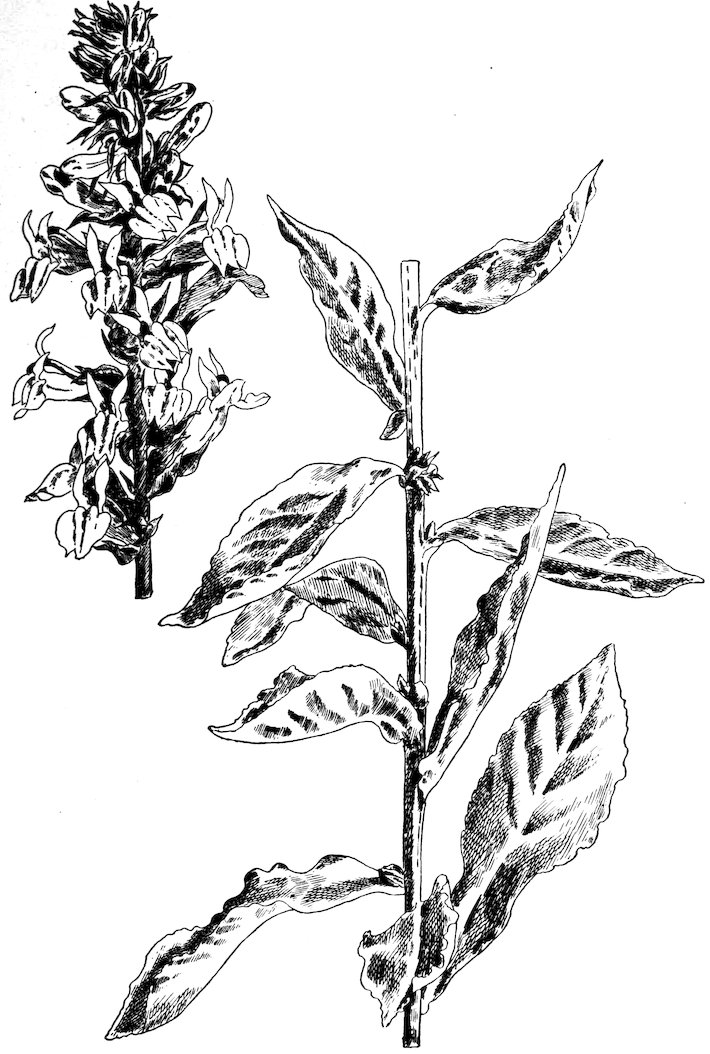
PLATE XCV
GREAT LOBELIA.—L. syphilitica.
262The genus is named after an early Flemish herbalist, de
l’Obel.
One to two feet high. Stem.—Branching from the root. Leaves.—Alternate,
ovate, or oblong, somewhat toothed. Flowers.—Blue or purple,
small, growing in a loose raceme, resembling in structure those of the great
lobelia. Pod.—Much inflated.
During the summer we note in the dry, open fields the blue
racemes of the Indian tobacco, and in the later year the inflated
pods which give it its specific name. The plant is said to be
poisonous if taken internally, and yields a “quack-medicine” of
some notoriety. The Indians smoked its dried leaves, which impart
to the tongue a peculiar tobacco-like sensation.
There are other species of lobelia which may be distinguished
by their narrower leaves and uninflated pods, and by their choice
of moist localities.
Stem.—Climbing and twining over plants and shrubs. Leaves.—Divided
into three somewhat four-sided leaflets. Flowers.—Papilionaceous, pale lilac,
or purplish, in nodding racemes. Pod.—One inch long.
Along the shadowy lanes which wind through the woods the
climbing members of the Pulse family are very abundant. During
the late summer and autumn the lonely wayside is skirted by
Vines, with clust’ring bunches growing;
Plants, with goodly burden bowing.
And in and out among this luxuriant growth twist the slender
stems of the ill-named hog pea-nut, its delicate lilac blossoms
nodding from the coarse stalks of the golden-rods and iron-weeds
or blending with the purple asters.
This plant bears flowers of two kinds: the upper ones are
perfect, but apparently useless, as they seldom ripen fruit; while
the lower or subterranean ones are without petals or attractiveness
of appearance, but yield eventually at least one large ripe seed.
263
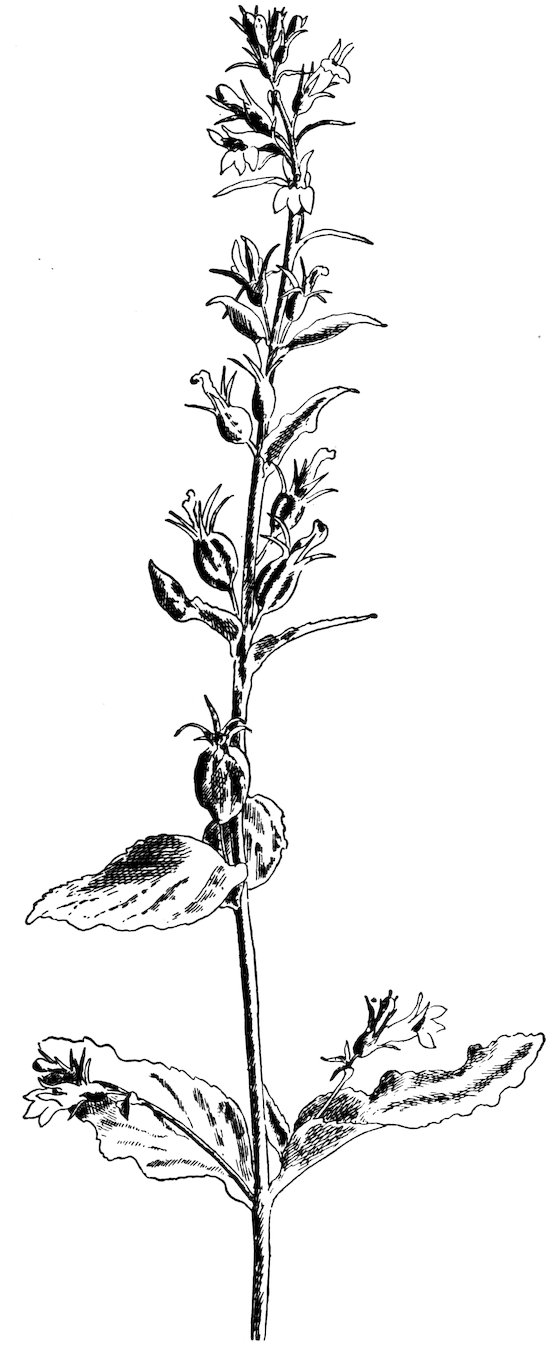
PLATE XCVI
INDIAN TOBACCO.—L. inflata.
264
About one foot high, or more. Stem.—Stout. Leaves.—Divided into
from three to five pairs of thick oblong leaflets. Flowers.—Papilionaceous,
large, purple, clustered.
The deep-hued flowers of this stout plant are commonly
found along the sand-hills of the seashore, and also on the shores
of the Great Lakes, blooming in early summer. Both flowers
and leaves are at once recognized as belonging to the Pulse family.
Stems.—Branched, one to six feet long, prostrate or climbing. Leaves.—Divided
into three leaflets, which are more or less prominently lobed toward
the base, the terminal two-lobed; or some or all without lobes. Flowers.—Purplish
or greenish, on long flower-stalks. Pod.—Linear, straight, or nearly
so.
This somewhat inconspicuous plant is found back of the sand-hills
along the coast, often in the neighborhood of the beach
pea, and climbing over river-banks, thickets, and fences as well.
It can usually be identified by its oddly lobed leaflets.
Leaves.—Divided into twenty to twenty-four leaflets, with slender tips.
Flowers.—Papilionaceous, blue turning purple, growing in close, many-flowered,
one-sided spikes.
This is an emigrant from Europe which is found in some of
our eastern fields and thickets as far south as New Jersey. It
usually climbs more or less by means of the tendril at the tip of
its divided leaves, and sometimes forms bright patches of vivid
blue over the meadows.
Another member of this genus is V. sativa, the common
vetch or tare, with purplish or pinkish flowers, growing singly
or in pairs from the axils of the leaves, which leaves are divided
into fewer and narrower leaflets than those of the blue vetch.
This species also takes possession of cultivated fields as well as of
waste places along the roadside.
265
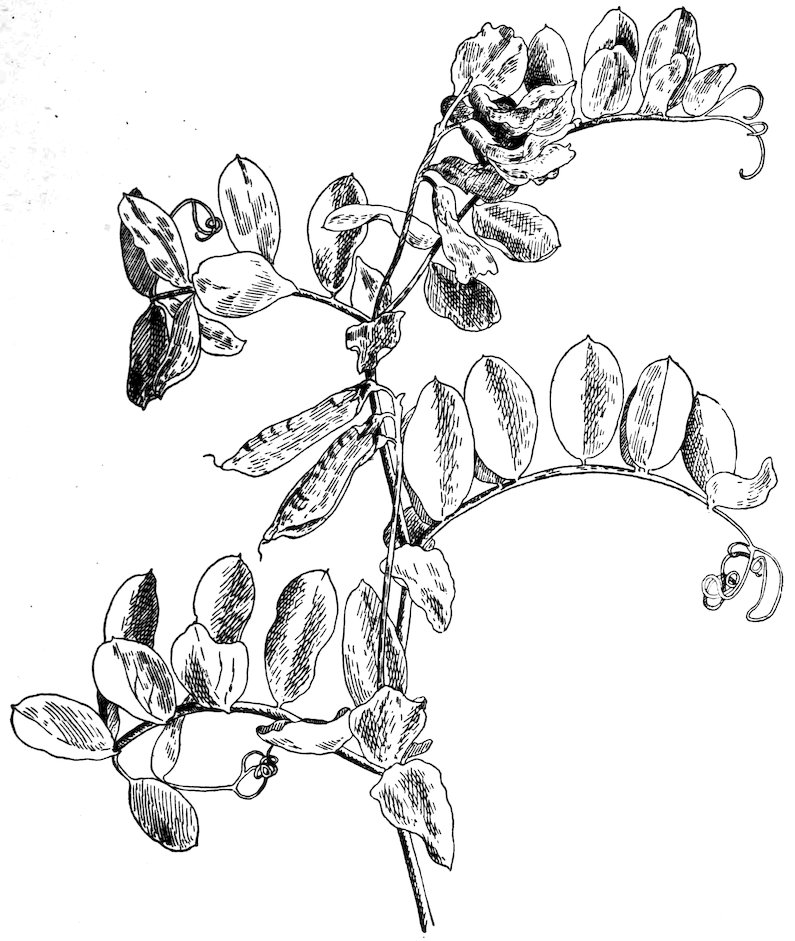
PLATE XCVII
BEACH PEA.—L. maritimus.
266
Stems.—Branching. Leaves.—The lower oblong or lance-shaped, partly
clasping, sometimes sharply incised, the floral ones minute. Flower-heads.—Blue,
set close to the stem, composed entirely of strap-shaped flowers;
opening at different times.
Oh, not in Ladies’ gardens,
My peasant posy!
Smile thy dear blue eyes,
Nor only—nearer to the skies—
In upland pastures, dim and sweet,—
But by the dusty road
Where tired feet
Toil to and fro;
Where flaunting Sin
May see thy heavenly hue,
Or weary Sorrow look from thee
Toward a more tender blue!
[12]
This roadside weed blossoms in late summer. It is extensively
cultivated in France, where the leaves are blanched and
used in a salad which is called “Barbe des Capucins.” The
roots are roasted and mixed with coffee both there and in England.
Horace mentions its leaves as part of his frugal fare, and Pliny
remarks upon the importance of the plant to the Egyptians, who
formerly used it in great quantities, and of whose diet it is still a
staple article.
Flower-heads.—Composed of blue or purple ray-flowers, with a centre of
yellow disk-flowers.
267
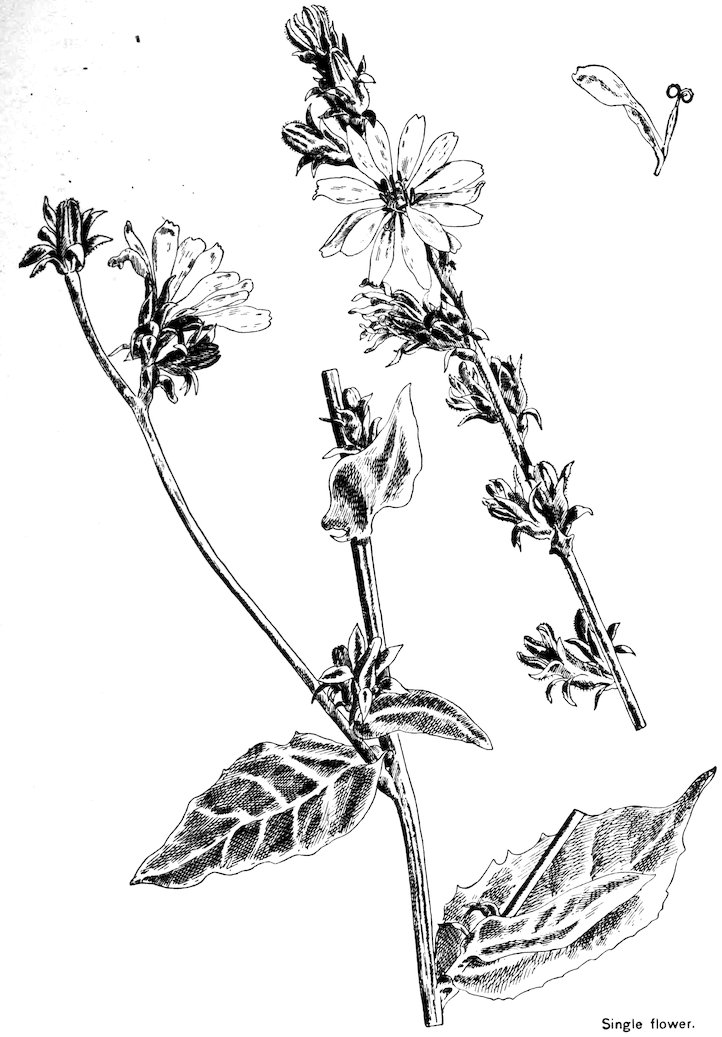
PLATE XCVIII
CHICORY.—C. Intybus.
268As about one hundred and twenty different species of aster
are native to the United States, and as fifty-four of these are
found in Northeastern America, all but a dozen being purple or
blue (i.e., with purple or blue ray-flowers), and as even botanists
find that it requires patient application to distinguish these
many species, only a brief description of the more conspicuous
and common ones is here attempted.
Along the dry roadsides in early August we may look for the
bright blue-purple flowers of A. patens. This is a low-growing
species, with rough, narrowly oblong, clasping leaves, and widely
spreading branches, whose slender branchlets are usually terminated
by a solitary flower-head.
Probably no member of the group is more striking than the
New England aster, A. Novæ Angliæ, whose stout hairy stem
(sometimes eight feet high), numerous lance-shaped leaves, and
large violet-purple or sometimes pinkish flower-heads, are conspicuous
in the swamps of late summer.
A. puniceus is another tall swamp-species, with long showy
pale lavender ray-flowers.
One of the most commonly encountered asters is A. cordifolius,
which is far from being the only heart-leaved species, despite
its title. Its many small, pale blue or almost white flower-heads
mass themselves abundantly along the wood-borders and
shaded roadsides.
Perhaps the loveliest of all the tribe is the seaside purple
aster, A. spectabilis, a low plant with narrowly oblong leaves
and large bright heads, the violet-purple ray-flowers of which
are nearly an inch long. This grows in sandy soil near the
coast and may be found putting forth its royal, daisy-like blossoms
into November.
Great Britain can claim but one native aster, A. Trifolium,
or sea-starwort as it is called. Many American species are cultivated
in English gardens under the general title of Michaelmas
daisies. The starwort of Italy is A. amellus. The Swiss species
is A. Alpinum.
This beautiful genus, like that of the golden-rod, is one of
the peculiar glories of our country. Every autumn these two
kinds of flowers clothe our roadsides and meadows with so regal
a mantle of purple and gold that we cannot but wonder if the
flowers of any other region combine in such a radiant display.
269
Stem.—Leafy, usually tall. Leaves.—Alternate, somewhat lance-oblong.
Flower-heads.—An intense red-purple, loosely clustered, composed entirely
of tubular flowers.
Along the roadsides and low meadows near the coast the
iron-weed adds its deep purple hues to the color-pageant of late
August. By the uninitiated the plant is often mistaken for an
aster, but a moment’s inspection will discover that the minute
flowers which compose each flower-head are all tubular in shape,
and that the ray or strap-shaped blossoms which an aster must
have are wanting. These flower-heads are surrounded by an
involucre composed of small scales which are tipped with a tiny
point and are usually of a purplish color also.
Stem.—Rather low, branching, clammy. Leaves.—Opposite, narrowly
oblong or lance-shaped, glutinous, with a balsamic odor. Flowers.—Purple,
occasionally pinkish, not usually clustered. Calyx.—Five-cleft, two-lipped.
Corolla.—Five-lobed, the three lower lobes more or less united. Stamens.—Four,
very long and curved, protruding. Pistil.—One, with a two-lobed style.
In the sandy fields of late summer this little plant attracts
notice by its many purple flowers. Its corolla soon falls and
exposes to view the four little nutlets of the ovary lying within
the enlarged calyx like tiny eggs in their nest. Its aromatic
odor is very perceptible, and the little glands with which it is
covered may be seen with the aid of a magnifier. The generic
name, Trichostema, signifies hairy stamens and alludes to the
curved hair-like filaments.
Stems.—Leafless, branching. Leaves.—From the root, somewhat oblong,
thick. Flowers.—Lavender-color or pale purple, tiny, scattered or
loosely spiked along one side of the branches. Calyx.—Dry, funnel-form.
Corolla.—Small, with five petals. Stamens.—Five. Pistil.—One, with
five, rarely three, styles.
In August many of the salt marshes are blue with the tiny
flowers of the sea lavender. The spray-like appearance of the
270little plant would seem to account for its name of rosemary,
which is derived from the Latin for sea-spray, but Dr. Prior
states that this name was given it on account of “its usually
growing on the sea-coast, and its odor.”
Blossoming with the lavender we often find the great rose
mallows and the dainty sea pinks. The marsh St. John’s-wort as
well is frequently a neighbor, and, a little later in the season, the
salt marsh fleabane.
Stem.—Simple, stout, hoary, two to five feet high. Leaves.—Alternate,
narrowly lance-shaped. Flower-heads.—Racemed along the upper part of
the stem, composed entirely of tubular flowers of a beautiful shade of rose-purple.
These showy and beautiful flowers lend still another tint to
the many-hued salt marshes and glowing inland meadows of the
falling year. Gray assigns them to dry localities from New
England to Minnesota and southward, while my own experience
of them is limited to the New England coast, where their stout
leafy stems and bright-hued blossoms are noticeable among the
golden-rods and asters of September. The hasty observer sometimes
confuses the plant with the iron-weed, but the two flowers
are very different in color and in their manner of growth.
About one foot high. Stem.—Much branched, reddish. Leaves.—Opposite,
aromatic, dotted, smooth, ovate, rounded or heart-shaped at base,
set close to the stem. Flowers.—Small, purple, lilac or white, clustered.
Calyx.—Five-toothed. Corolla.—Small, two-lipped, the upper lip erect,
usually notched, the lower three-cleft. Stamens.—Two, erect, protruding.
Pistil.—One, with a two-lobed style.
In late August or early September the delicate flowers of the
dittany brighten the dry, sterile banks which flank so many of
our roadsides. At a season when few plants are flowering save
the omnipresent members of the great Composite family these
dainty though unpretentious blossoms are especially attractive.
The plant has a pleasant fragrance.
271
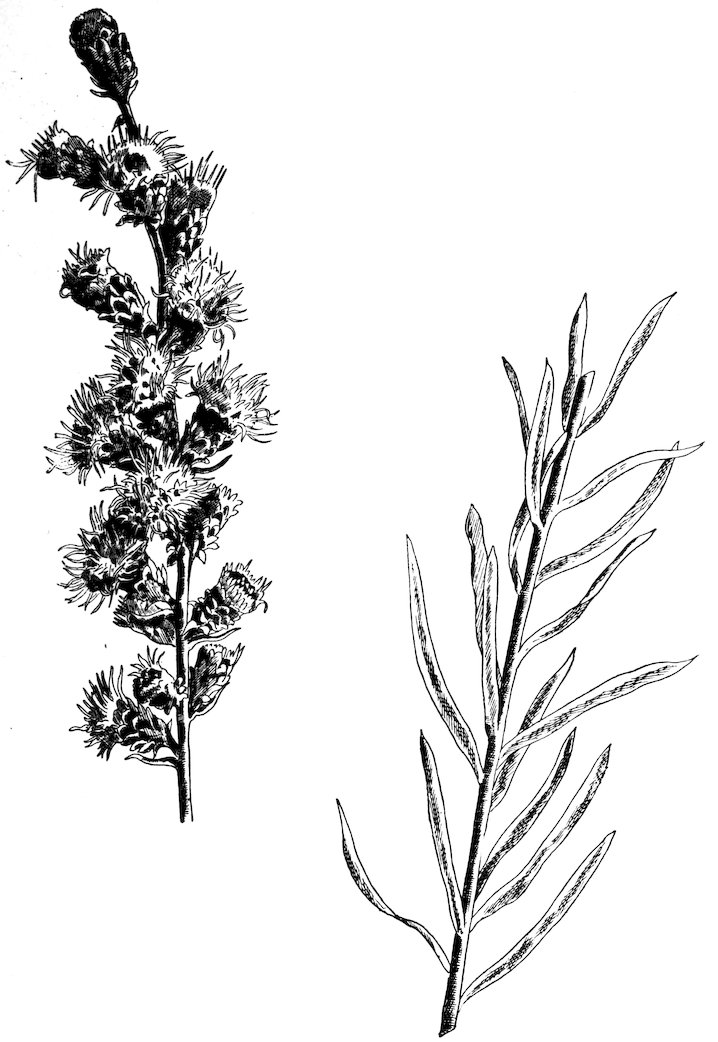
PLATE XCIX
BLAZING STAR.—L. scariosa.
272
Stem.—One to two feet high, upright, smooth. Leaves.—Opposite, narrowly
oval or lance-shaped. Flowers.—Blue to purple, clustered at the summit
of the stem and often in the axils of the leaves. Calyx.—Four or
five-cleft. Corolla.—Closed at the mouth, large, oblong. Stamens.—Four
or five. Pistil.—One, with two stigmas.
Few flowers adapt themselves better to the season than the
closed gentian. We look for it in September when the early
waning days and frost-suggestive nights prove so discouraging to
the greater part of the floral world. Then in somewhat moist,
shaded places along the roadside we find this vigorous, autumnal-looking
plant, with stout stems, leaves that bronze as the days
advance, and deep-tinted flowers firmly closed as though to
protect the delicate reproductive organs within from the sharp
touches of the late year.
To me the closed gentian usually shows a deep blue or even
purple countenance, although like the fringed gentian and so
many other flowers its color is lighter in the shade than in the
sunlight. But Thoreau claims for it a “transcendent blue,” “a
splendid blue, light in the shade, turning to purple with age.”
“Bluer than the bluest sky, they lurk in the moist and shady
recesses of the banks,” he writes. Mr. Burroughs also finds it
“intensely blue.”
Stem.—Slender, branching, one or two feet high. Leaves.—Opposite,
ovate, lance-shaped, partly clasping. Flowers.—Pale blue, smaller than
those of the closed gentian, in clusters of about five at the summit of stems
and branches. Calyx.—Four or five-cleft, small. Corolla.—Funnel-form,
four or five-lobed, its lobes bristle-pointed. Stamens.—Four or five. Pistil.—One,
with two stigmas.
Although the five-flowered gentian is far less frequently encountered
than the closed gentian, it is very common in certain
localities. Gray assigns it to “moist hills” and “along the
mountains to Florida.” I have found it growing in great abundance
on the Shawangunk Mountains in Orange County, N. Y.,
where it flowers in September.
273
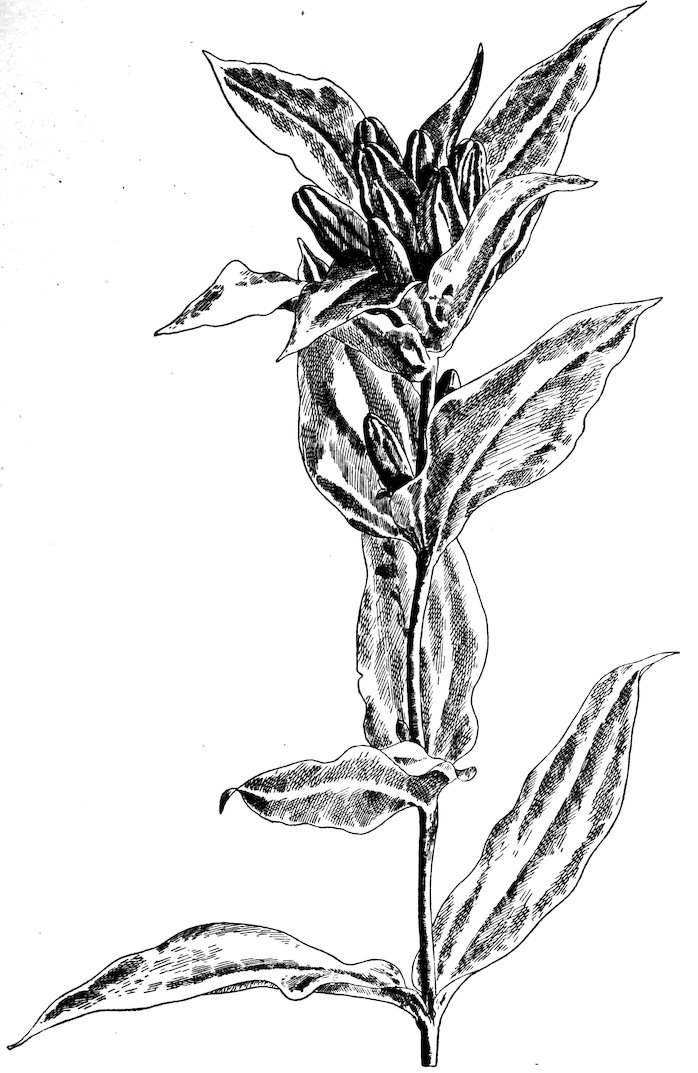
PLATE C
CLOSED GENTIAN.—G. Andrewsii.
274
Stem.—One to two feet high. Leaves.—Opposite, lance-shaped or narrowly
oval. Flowers.—Blue, large. Calyx.—Four-cleft, the lobes unequal.
Corolla.—Funnel-form, with four fringed, spreading lobes. Stamens.—Four.
Pistil.—One, with two stigmas.
In late September when we have almost ceased to hope for
new flowers we are in luck if we chance upon this
—blossom bright with autumn dew
whose
—sweet and quiet eye
Looks through its fringes to the sky,
Blue—blue—as if that sky let fall,
A flower from its cerulean wall;
[13]
for the fringed gentian is fickle in its habits, and the fact that we
have located it one season does not mean that we will find it in
the same place the following year; being a biennial, with seeds
that are easily washed away, it is apt to change its haunts from
time to time. So our search for this plant is always attended
with the charm of uncertainty. Once having ferreted out its
new abiding-place, however, we can satiate ourselves with its
loveliness, which it usually lavishes unstintingly upon the moist
meadows which it has elected to honor.
Thoreau describes its color as “such a dark blue! surpassing
that of the male bluebird’s back!” My experience has been
that the flowers which grow in the shade are of a clear pure
azure, “Heaven’s own blue,” as Bryant claims; while those
which are found in open, sunny meadows may be justly said to
vie with the back of the male bluebird. If the season has been
a mild one we shall perhaps find a few blossoms lingering into
November, but the plant is probably blighted by a severe frost,
although Miss Emily Dickinson’s little poem voices another
opinion:
But just before the snows
There came a purple creature
That ravished all the hill:
And Summer hid her forehead,
And mockery was still.
The frosts were her condition:
The Tyrian would not come
Until the North evoked it,
“Creator! shall I bloom?”
275
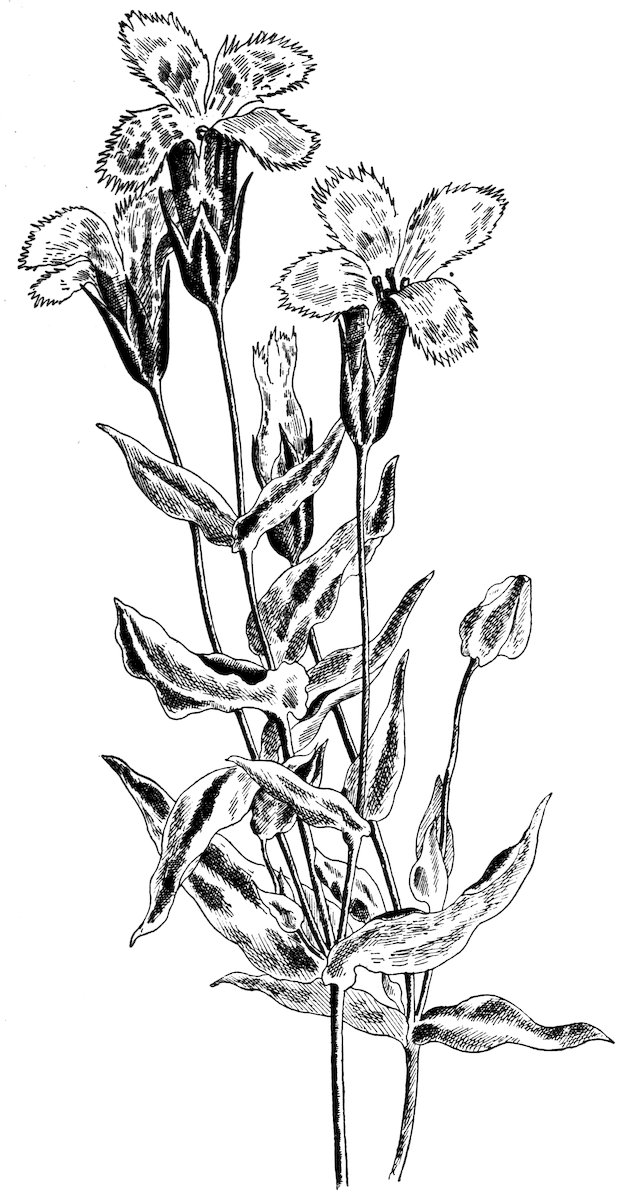
PLATE CI
FRINGED GENTIAN.—G. crinita.
276
Leaves.—Large, becoming one or two feet long; heart-shaped, appearing
later than the purple-mottled spathe and hidden flowers. Flowers.—Small
and inconspicuous; packed on the fleshy spike which is hidden within the
spathe.
If we are bold enough to venture into certain swampy places
in the leafless woods and brown cheerless meadows of March, we
notice that the sharply pointed spathes of the skunk cabbage
have already pierced the surface of the earth. Until I chanced
upon a passage in Thoreau’s Journal under date of October 31st,
I had supposed that these “hermits of the bog” were only
encouraged to make their appearance by the advent of those first
balmy, spring-suggestive days which occasionally occur as early
as February. But it seems that many of these young buds had
pushed their way upward before the winter set in, for Thoreau
counsels those who are afflicted with the melancholy of autumn
to go to the swamps, “and see the brave spears of skunk-cabbage
buds already advanced toward a new year.” “Mortal and human
creatures must take a little respite in this fall of the year,” he
writes. “Their spirits do flag a little. There is a little questioning
of destiny, and thinking to go like cowards to where the
weary shall be at rest. But not so with the skunk-cabbage. Its
withered leaves fall and are transfixed by a rising bud. Winter
and death are ignored. The circle of life is complete. Are
these false prophets? Is it a lie or a vain boast underneath the
skunk-cabbage bud pushing it upward and lifting the dead leaves
with it?”
277
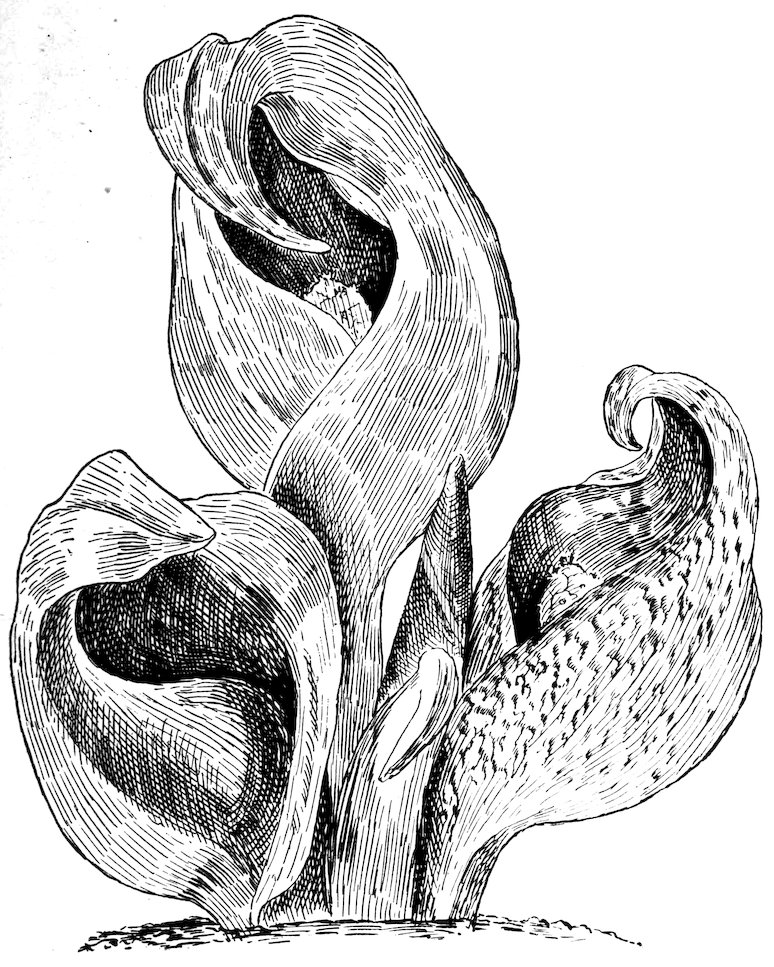
PLATE CII
SKUNK CABBAGE.—S. fœtidus.
278The purplish shell-like leaf, which curls about the tiny flowers
which are thus hidden from view, is a rather grewsome-looking
object, suggestive of a great snail when it lifts itself fairly above
its muddy bed. When one sees it grouped with brother-cabbages
it is easy to understand why a nearly allied species, which
abounds along the Italian Riviera, should be entitled “Cappucini”
by the neighboring peasants, for the bowed, hooded
appearance of these plants might easily suggest the cowled
Capuchins.
It seems unfortunate that our earliest spring flower (for such
it undoubtedly is) should possess so unpleasant an odor as to win
for itself the unpoetic title of skunk cabbage. There is also
some incongruity in the heading of the great floral procession of
the year by the minute hidden blossoms of this plant. That they
are enabled to survive the raw March winds which are rampant
when they first appear is probably due to the protection afforded
them by the leathery leaf or spathe. When the true leaves
unfold they mark the wet woods and meadows with bright
patches of rich foliage, which with that of the hellebore, flash
constantly into sight as we travel through the country in April.
It is interesting to remember that the skunk cabbage is nearly
akin to the spotless calla lily, the purple-mottled spathe of the
one answering to the snowy petal-like leaf of the other. Meehan
tells us that the name bear-weed was given to the plant by the
early Swedish settlers in the neighborhood of Philadelphia. It
seems that the bears greatly relished this early green, which
Meehan remarks “must have been a hot morsel, as the juice is
acrid, and is said to possess some narcotic power, while that of
the root, when chewed, causes the eyesight to grow dim.”
Leaves.—One or two on each plant, kidney or heart-shaped, fuzzy, long-stalked.
Flower.—Dull purplish-brown, solitary, close to the ground on a
short flower-stalk from the fork of the leaves. Calyx.—Three-cleft, bell-shaped.
Corolla.—None. Stamens.—Twelve. Pistil.—One, with a thick
style and six thick, radiating stigmas.
279
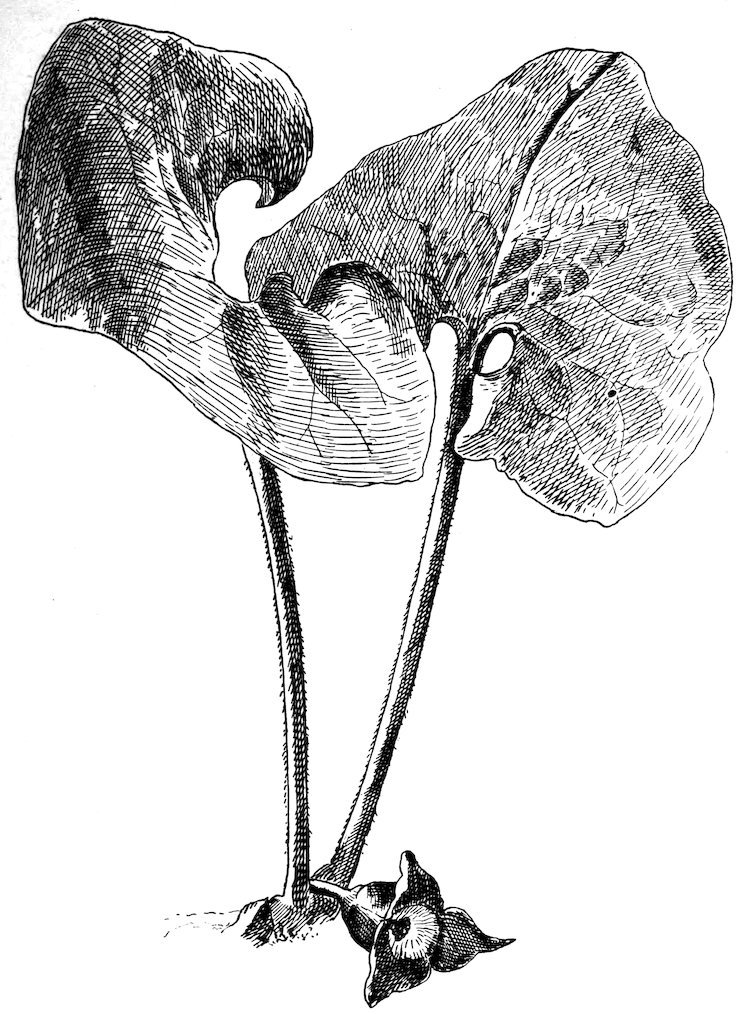
PLATE CIII
WILD GINGER.—A. Canadense.
280Certain flowers might be grouped under the head of “vegetable
cranks.” Here would be classed the evening primrose,
which only opens at night, the closed gentian, which never opens
at all, and the wild ginger, whose odd, unlovely flower seeks protection
beneath its long-stemmed fuzzy leaves, and hides its
head upon the ground as if unwilling to challenge comparison
with its more brilliant brethren. Unless already familiar with
this plant there is nothing to tell one when it has reached its
flowering season; and many a wanderer through the rocky woods
in early May quite overlooks its shy, shamefaced blossom.
The ginger-like flavor of the rootstock is responsible for its
common name. It grows wild in many parts of Europe and is
cultivated in England, where at one time it was considered a
remedy for headache and deafness.
Scape.—Terminated by a hood-like leaf or spathe. Leaves.—Generally
two, each divided into three leaflets. Flowers.—Small and inconspicuous,
packed about the lower part of the fleshy spike or spadix which is shielded
by the spathe. Fruit.—A bright scarlet berry which is packed upon the
spadix with many others.
These quaint little preachers, ensconced in their delicate pulpits,
are well known to all who love the woods in early spring.
Sometimes these “pulpits” are of a light green veined with a
deeper tint; again they are stained with purple. This difference
in color has been thought to indicate the sex of the flowers
within—the males are said to be shielded by the green, the
females by the purple, hoods. In the nearly allied cuckoo-pints
of England, matters appear to be reversed: these plants are called
“Lords and Ladies” by the children, the purple-tinged ones
being the “Lords,” the light green ones the “Ladies.” The
generic name, Arisæma, signifies bloody arum, and refers to
the dark purple stains of the spathe. An old legend claims that
these were received at the Crucifixion:
Beneath the cross it grew;
And in the vase-like hollow of the leaf,
Catching from that dread shower of agony
A few mysterious drops, transmitted thus
Unto the groves and hills their healing stains,
A heritage, for storm or vernal shower
Never to blow away.
281
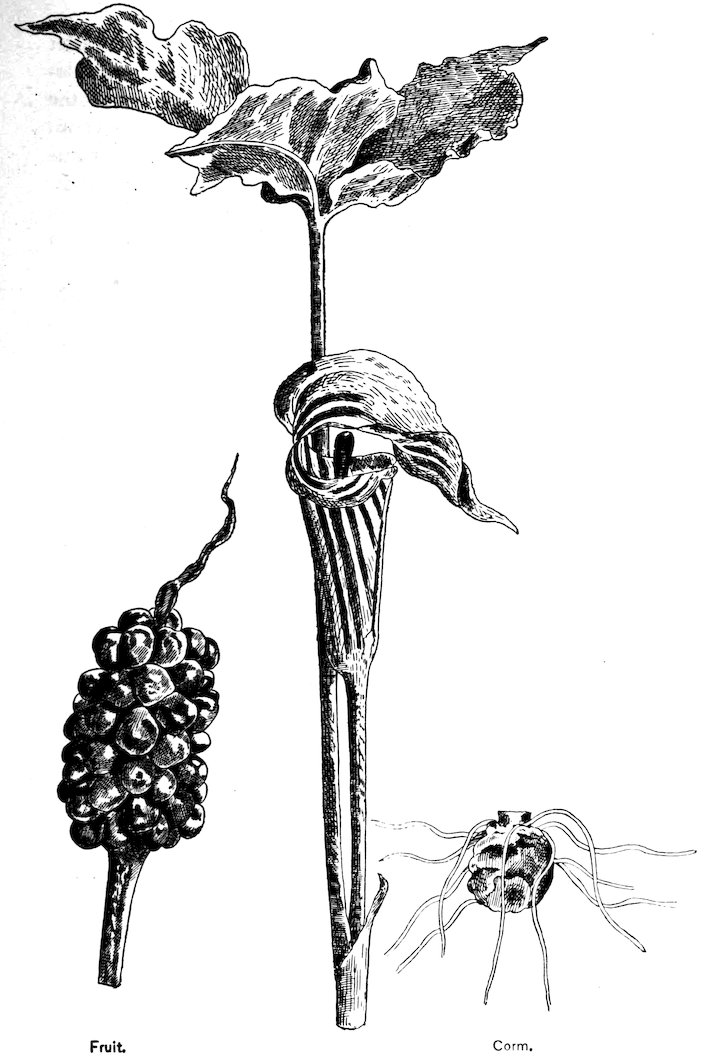
PLATE CIV
JACK-IN-THE-PULPIT.—A. triphyllum.
282The Indians were in the habit of boiling the bright scarlet
berries which are so conspicuous in our autumn woods and devouring
them with great relish; they also discovered that the
bulb-like base or corm, as it is called, lost its acridity on cooking,
and made nutritious food, winning for the plant its name
of Indian turnip. One of its more local titles is memory-root,
which it owes to a favorite school-boy trick of tempting others
to bite into the blistering corm with results likely to create a
memorable impression.
The English cuckoo-pint yielded a starch which was greatly
valued in the time of Elizabethan ruffs, although it proved too
blistering to the hands of the washerwomen to remain long in
use. Owing to the profusion with which the plant grows in
Ireland efforts have been made to utilize it as food in periods of
scarcity. By grating the corm into water, and then pouring off
the liquid and drying the sediment, it is said that a tasteless, but
nutritious, powder can be procured.
Stems.—Two to three feet high, glandular, more or less hairy. Leaves.—Heart-shaped,
with short, rounded lobes, wavy-toothed, mostly from the
root. Flowers.—Greenish or purplish, in long narrow clusters. Calyx.—Bell-shaped,
broad, five-cleft. Corolla.—Of five small petals. Stamens.—Five.
Pistil.—One, with two slender styles.
In May the slender clusters of the alum-root are found in the
rocky woods.
Stems.—One to two and a half feet high. Leaf.—Large, divided into
many lobed leaflets; often a smaller one at the base of the flower-cluster.
Flowers.—Yellowish-green, clustered at the summit of the stem, appearing
while the leaf is still small. Calyx.—Of six sepals, with three or four small
bractlets at base. Corolla.—Of six thick, somewhat kidney-shaped or
hooded petals, with short claws. Stamens.—Six. Pistil.—One. Fruit.—Bluish,
berry-like.
In the deep rich woods of early spring, especially westward,
may be found the clustered flowers and divided leaf of the blue
283cohosh. The generic name is from two Greek words signifying
stem and leaf, “the stems seeming to form a stalk for the great
leaf.” (Gray.)
One to two feet high. Leaves.—Divided into many smooth, lobed, pale,
drooping leaflets. Flowers.—Purplish and greenish, unisexual. Calyx.—Of
four or five petal-like sepals. Corolla.—None. Stamens.—Indefinite
in number, with linear yellowish anthers drooping on hair-like filaments
(stamens and pistils occurring on different plants). Pistils.—Four to fourteen.
The graceful drooping foliage of this plant is perhaps more
noticeable than the small flowers which appear in the rocky
woods in April or May.
Scape.—Low, from a solid bulb. Leaves.—Two, ovate, smooth. Flowers.—Purplish
or greenish, with thread-like reflexed petals and a large brown-purplish
lip an inch and a half long; growing in a raceme.
In the moist, rich woods of June we may look for these flowers.
The generic name is derived from two Greek words which
signify fat or shining, in reference to “the smooth or unctuous
leaves.” (Gray.)
Stems.—Slender, fleshy, branching, with small scales; purplish, yellowish
or brownish. Leaves.—None. Flowers.—Purplish, yellowish or brownish,
spiked or racemed, small, of two kinds, the upper sterile, the lower fertile.
These curious-looking plants abound in the shade of beech-trees,
drawing nourishment from their roots. The upper open
flowers are sterile; the lower ones, which never expand, accomplish
the continuance of their kind.
284
A low fleshy herb without green foliage; tawny, reddish, or whitish.
Flowers.—Resembling in structure those of the Indian pipe, but clustered
in a raceme.
The pine sap is a parasitic plant which is closely allied to
the Indian pipe (Pl. XXI.). Its clustered flowers are usually fragrant.
The plant is commonly of a somewhat tawny hue, but
occasionally one finds a bright red specimen. It flourishes in oak
or pine-woods from June till August.
Height.—Two to four feet. Leaves.—The lower cleft or toothed, the
uppermost oblong and undivided. Flower-heads.—Nodding, composed of
white or greenish strap-shaped flowers surrounded by a purplish involucre.
Height.—About two feet. Leaves.—Roughish, the lower lobed, the upper
oblong lance-shaped. Flower-heads.—Nodding, composed of greenish
or cream-colored strap-shaped flowers surrounded by a greenish or purple
involucre.
These plants are peculiarly decorative in late summer on account
of their graceful, drooping, bell-shaped flower-heads. The
flowers themselves almost escape notice, and their color is rather
difficult to determine, the purplish or greenish involucre being
the plants’ conspicuous feature.
The generic name is from the Greek, and signifies drooping
blossom.
Stem.—Twining and climbing over bushes. Leaves.—Divided into three
to seven narrowly oval leaflets. Flowers.—Papilionaceous, purplish or
chocolate-color, somewhat violet-scented, closely clustered in racemes.
In late summer the dark, rich flowers of the wild bean are
found in short, thick clusters among the luxuriant undergrowth
285and thickets of low ground. The plant is a climber, bearing
edible pear-shaped tubers on underground shoots, which give it
its generic name signifying a pear.
Rootstock.—Much branched, coral-like, toothed. Stem.—Nine to eighteen
inches high, without green foliage. Flowers.—Rather small, dull
brownish-purple or yellowish, sometimes mottled with red; growing in a
raceme.
In the dry summer woods one frequently encounters the dull
racemes of this rather inconspicuous little plant. It is often
found in the immediate neighborhood of the Indian pipe and
pine sap. Being, like them, without green foliage, it might be
taken for an allied species by the casual observer. This is one
of those orchids which are popularly considered unworthy to
bear the name, giving rise to so much incredulity or disappointment
in the unbotanical.