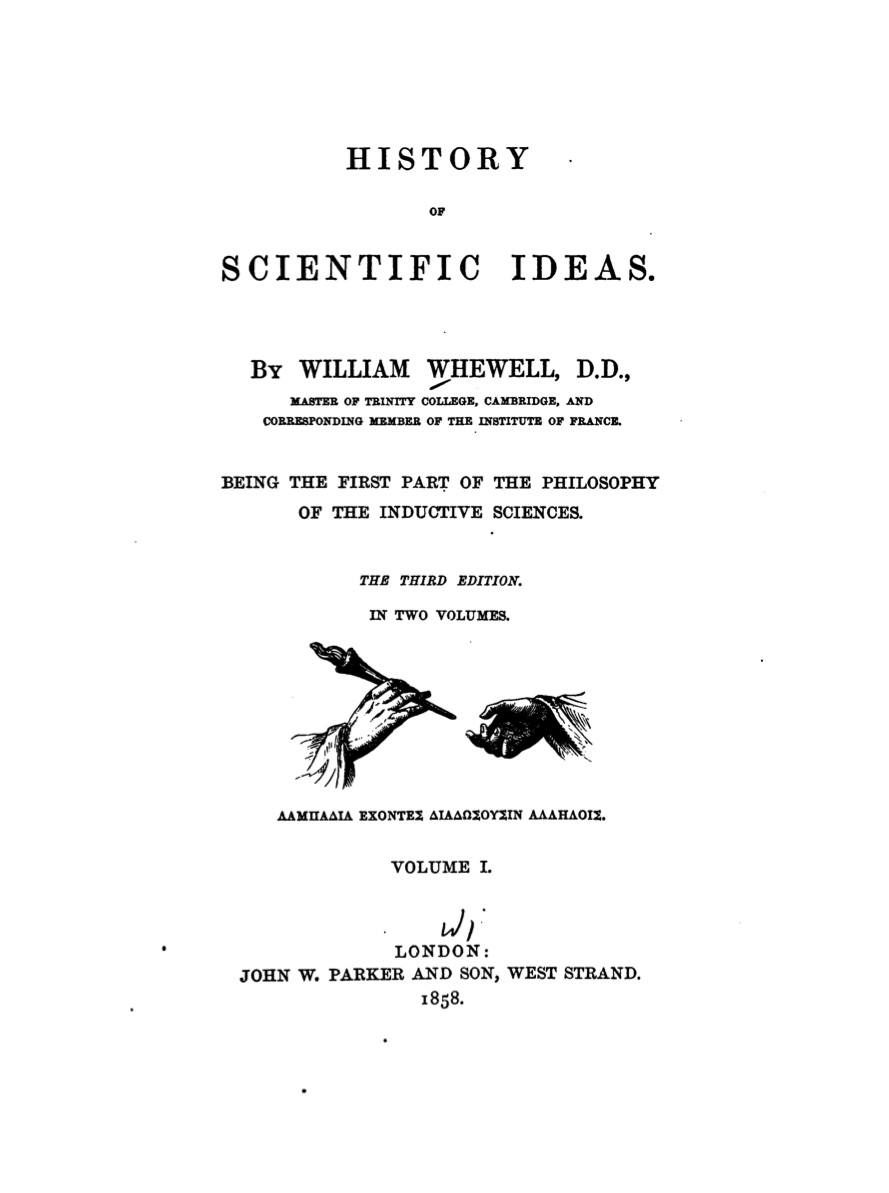
History of Scientific Ideas
by William Whewell
★★★★★No ratings yet
Language: English
Sign in to rate this book.
Sign in to shelve this book.
About this eBook
- Author
- Whewell, William, 1794-1866
- Title
- History of scientific ideas
- Original Publication
- United Kingdom: JOHN W. PARKER AND SON,1858.
- Credits
- Ed Brandon from materials generously provided by the Internet Archive
- Language
- English
- LoC Class
- Q: Science
- Subject
- Science -- Philosophy
- Category
- Text
- Project Gutenberg
- eBook-No. 69093
- Release Date
- October 4, 2022
- Copyright
- Public domain in the USA.
Contents
- 1.HISTORY OF SCIENTIFIC IDEA S. — PREFACE TO THIS EDITION. — CONTENTS OF THE FIRST VOLUME. — CONTENTS OF THE SECOND VOLUME.
- 2.Untitled
- 3.INTRODUCTION.
- 4.Untitled
- 5.BOOK I.
- 6.CHAPTER I. Of the Fundamental Antithesis of Philosophy. — Sect. 1.— Thoughts and Things. — Sect. 2.— Necessary and Experiential Truths. — Sect. 3.— Deduction and Induction. — Sect. 4.— Theories and Facts. — Sect. 5.— Ideas and Sensations. — Sect. 6.— Reflexion and Sensation. — Sect. 7.— Subjective and Objective. — Sect. 8.— Matter and Form. — Sect. 9.— Man the Interpreter of Nature. — Sect. 10.— The Fundamental Antithesis inseparable. — Sect. 11.— Successive Generalization.
- 7.CHAPTER II. Of Technical Terms.
- 8.CHAPTER III. Of Necessary Truths.
- 9.CHAPTER IV. Of Experience.
- 10.CHAPTER V. Of the Grounds of Necessary Truths.
- 11.CHAPTER VI. The Fundamental Ideas are not Derived from Experience.
- 12.CHAPTER VII. Of the Philosophy of the Sciences.
- 13.BOOK II.
- 14.Untitled
- 15.CHAPTER I. Of the Pure Sciences.
- 16.CHAPTER II. Of the Idea of Space.
- 17.CHAPTER III. Of some Peculiarities of the Idea of Space.
- 18.CHAPTER IV. Of the Definitions and Axioms which relate to Space.
- 19.CHAPTER V. Of some Objections which have been made to the Doctrines stated in the previous Chapter. 3
- 20.CHAPTER VI. Of the Perception of Space.
- 21.CHAPTER VII. Of the Idea of Time.
- 22.CHAPTER VIII. Of some Peculiarities of the Idea of Time.
- 23.CHAPTER IX. Of the Axioms which relate to Number.
- 24.CHAPTER X. Of the Perception of Time and Number.
- 25.NOTE TO CHAPTER X.
- 26.CHAPTER XI. Of Mathematical Reasoning.
- 27.CHAPTER XII. Of the Foundations of the Higher Mathematics.
- 28.CHAPTER XIII. The Doctrine of Motion.
- 29.CHAPTER XIV. Of the Application of Mathematics to the Inductive Sciences.
- 30.BOOK III.
- 31.CHAPTER I. Of the Mechanical Sciences.
- 32.CHAPTER II. Of the Idea of Cause.
- 33.CHAPTER III. Modern Opinions respecting the Idea of Cause.
- 34.CHAPTER IV. Of the Axioms which relate to the Idea of Cause.
- 35.CHAPTER V. Of the Origin of our Conceptions of Force and Matter.
- 36.CHAPTER VI. Of the Establishment of the Principles of Statics.
- 37.CHAPTER VII. Of the Establishment of the Principles of Dynamics.
- 38.CHAPTER VIII. Of the Paradox of Universal Propositions obtained from Experience.
- 39.CHAPTER IX. Of the Establishment of the Law of Universal Gravitation.
- 40.CHAPTER X. Of the general Diffusion of clear Mechanical Ideas.
- 41.BOOK IV.
- 42.CHAPTER I. Of the Idea of a Medium as commonly employed.
- 43.CHAPTER II. On Peculiarities in the Perceptions of the Different Senses. — Sect. I.— Prerogatives of Sight. — Sect. II.— Prerogatives of Hearing. — Sect. III.— The Paradoxes of Vision. — Sect. IV.— The Perception of Visible Figure.
- 44.CHAPTER III. Successive Attempts at the Scientific Application of the Idea of a Medium.
- 45.CHAPTER IV. Of the Measure of Secondary Qualities. — Sect. I.— Scales of Qualities in general. — Sect. II.— The Musical Scale. — Sect. III.— Scales of Colour. — Sect. IV.— Scales of Light. — Sect. V.— Scales of Heat. — Sect. VI.— Scales of other Qualities.
- 46.BOOK V.
- 47.BOOK V. — CHAPTER I. Attempts at the Scientific Application of the Idea of Polarity.
- 48.CHAPTER II. Of the Connexion of Polarities.
- 49.Untitled
- 50.BOOK VI.
- 51.CHAPTER I. Attempts to conceive Elementary Composition.
- 52.CHAPTER II. Establishment and Development of the Idea of Chemical Affinity.
- 53.CHAPTER III. Of the Idea of Substance.
- 54.NOTE TO CHAPTER III.
- 55.CHAPTER IV. Application of the Idea of Substance in Chemistry.
- 56.CHAPTER V. The Atomic Theory.
- 57.BOOK VII.
- 58.CHAPTER I. Explication of the Idea of Symmetry.
- 59.CHAPTER II. Application of the Idea of Symmetry to Crystals.
- 60.CHAPTER III. Speculations founded upon the Symmetry of Crystals.
- 61.BOOK VIII.
- 62.CHAPTER I. The Idea of Likeness as Governing the Use of Common Names.
- 63.CHAPTER II. The Methods of Natural History, as regulated by the Idea of Likeness. — Sect. I.— Natural History in general. — Sect. II.— Terminology. 5 — Sect. III. The Plan of the System. — Sect. IV.— Modes of framing Natural Systems. — Sect. V.— Gradation of Groups. — Sect. VI.— Nomenclature. — Sect. VII.— Diagnosis.
- 64.CHAPTER III. Application of the Natural History Method to Mineralogy.
- 65.CHAPTER IV. Of the Idea of Natural Affinity.
- 66.BOOK IX.
- 67.CHAPTER I. Analogy of Biology With Other Sciences.
- 68.CHAPTER II. Successive Biological Hypotheses. — Sect. I.— The Mystical School. — Sect. II.— The Iatrochemical School. — Sect. III.— The Iatromathematical School. — Sect. IV.— The Vital-Fluid School. — Sect. V.— The Psychical School.
- 69.CHAPTER III. Attempts to Analyse the Idea of Life.
- 70.CHAPTER IV. Attempts to form Ideas of separate Vital Forces, and first of Assimilation and Secretion. — Sect. I.— Course of Biological Research. — Sect. II.— Attempts to form a distinct Conception of Assimilation and Secretion. — Sect. III.— Attempts to conceive the forces of Assimilation and Secretion. — Sect. IV.— Attempts to conceive the Process of Generation.
- 71.CHAPTER V. Attempts to form Ideas of separate Vital Forces, continued .— Voluntary Motion.
- 72.CHAPTER VI. Of the Idea of Final Causes.
- 73.BOOK X.
- 74.CHAPTER I. Of Palætiological Sciences in General.
- 75.CHAPTER II. Of the Three Members of a Palætiological Science.
- 76.CHAPTER III. Of the Doctrine of Catastrophes and the Doctrine of Uniformity.
- 77.CHAPTER IV. Of the Relation of Tradition to Palætiology.
- 78.CHAPTER V. Of the Conception of a First Cause.
Community reviews
Sign in to write a review.
No reviews yet.