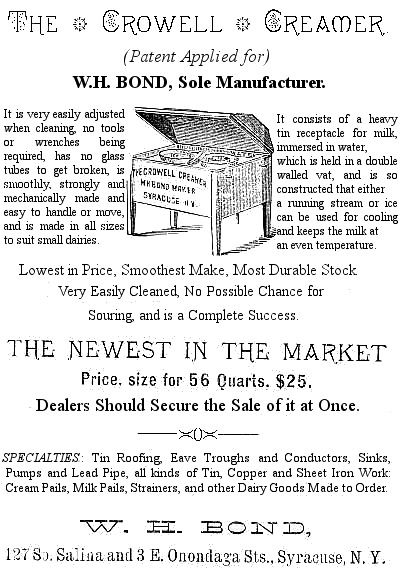
There really are but four systems of setting milk for cream,
notwithstanding the numerous inventions and devices. These are: 1.
Cooling in water; 2. cooling in air; 3. shallow setting; 4. deep
setting.
DEEP SETTING AND WATER COOLING.
Deep setting, whether in pails or pans, is always accompanied with
water and the use of ice. In many instances, however, where running
water is abundant, ice is dispensed with, and the pails are set in
pools or tanks, while the pans have water run around them, if not
under them. Under-cooling, however, is pretty well understood to be
a disadvantage, unless the vessel containing the milk is submerged
in water or nearly so. Ice is a good deal used, and the milk rapidly
run down in temperature. Some think this is the better as well as
the quicker way, if not the only way to get all the cream. Our only
objection to this rapid cooling is that it runs the temperature too
low, and, in our opinion, injures the keeping quality of the product.
EFFECT OF TOO LOW COOLING.
If run below 40 degrees, or the point where water begins to expand, all
cooling below that point lessens the difference in specific gravity
between the water and the fat globules, and operates diametrically in
the opposite direction to what is desired. The aim is to condense the
water, which is a good conductor, and leave the fat globules, which are
poor conductors, unchanged or but slightly contracted. In this way,
the heavier fluid settles and drives the light particles of fat upward
to rest on the surface. But, if we go below 40 degrees, we produce
the directly opposite effect and retard the rising of the cream. For
quality, we prefer the slower cooling in water, and think the longer
time given will secure all the cream available and in a purer condition.
BUTTERMILK FLAVOR.
If more cream or butter is obtained by rapid cooling, we think it is
because more particles of caseine are entangled in the cream and remain
in the butter when churned. This would of course make more weight for
market, but of inferior quality and sooner to go off flavor. But where
the butter is consumed fresh from the churn, this does not matter
so much; and if the particles of caseine give the butter a slight
buttermilk flavor, it pleases some palates that have been educated
to like it. We, however, prefer the sweet, delicate flavor of cream
butter, free from caseine or lactic acid. But, if one has a special
line of customers, he must please them, whatever the demand may be. If
the butter is thrown on the general market, and there is liable to be
delay in getting it into consumption, it cannot be made too pure, nor
retain its rosy flavor too long.
SHALLOW SETTING AND AIR COOLING.
Generally, in shallow setting, whether in large or small pans, cooling
the milk in air is depended upon. Formerly, an underground room, or
one in a shady place, was the only appliance usually resorted to for
cooling. But, of late years, some method of artificially cooling the
air by the use of ice is generally adopted. In some cases, the milk
room is made small, with low ceiling and double walls, so that a cake
of ice near the ceiling does the cooling. Usually, however, some sort
of refrigerator construction is resorted to, so that cool air from the
ice-house, or ice placed above the milk room, is introduced to regulate
the temperature and keep it steady. We prefer cooling in air, though
it may take a little more space and time. By this method, extremely
rapid cooling and low temperature are avoided, and no violence is done
to the milk or cream. Deep setting, it is true, exposes less surface
to the air; but if the milk is not submerged, the surface is likely to
be cooler than the air above, and to condense the vapor in it, which
falls with all its impurities on the surface of the cream. Any foulness
or bad odors are thus absorbed and go into the butter product. While
submerging obviates this objection and keeps out all impurities from
the air, it also prevents all escape of bad odors by evaporation.
Whatever that is objectionable may be in the milk is retained there. By
setting in open air, which should of course always be pure and sweet,
the air, being cooled down and used as a medium for cooling the milk,
takes up the exhalations of moisture and odor from the milk, and thus
purifies it. The colder medium is always the condenser and absorbent,
and it is only when the milk gets colder than the air above it that it
condenses the moisture in the air and absorbs its odor. This will never
occur where cold air is the cooling medium. The milk theoretically can
never get cooler than the air, while practically it remains a degree or
two warmer than the air.
OXYDIZING CREAM.
There is another advantage in using the air as a cooling medium. In
shallow setting, more surface is exposed and the air, coming in contact
with the surface, imparts to it a portion of its oxygen, which mingles
with the oils and develops that fine butter flavor so much relished by
most and which is a peculiarity of fine butter. Again, slow cooling
gives more time for this oxydation to go on, and thus "ripen" the cream
for churning without souring it. This leaves all the fine flavor in
it, unmixed with flavors resulting from acidification. But, where milk
is set deep for creaming—and especially where there is no exposure to
the air, as is the case in submerging—no butter flavor is developed,
and the cream has to be kept until sour before it is properly
oxydized. There is not a full development of butter flavor proper, but
development of flavor resulting from the mingling of lactic acid with
the oils. But without this exposure and acidification, the butter is
insipid and comparatively flavorless. Any subsequent exposure to the
air soon throws the butter off flavor, the oxygen mingling with the
fats alone while the cream is rising and still sweet. This development
of flavor by oxydation is not mere theory; it has been scientifically
demonstrated at Cornell University, New York, if not elsewhere, and
must sooner or later be generally accepted and butter making proceed on
a more rational and certain basis. But it is hard work to get people
out of old ruts, or to overcome fixed habits and prejudices. Really
scientific butter making, in which every step will be thoroughly
understood and deliberately taken, is a thing of the future. It will
come in time, and then our descendants will wonder why we were so
stupid and slow as not to see and adopt the simplest principles when
they were thrust into our very faces. But mind and judgment are matters
of growth, the same as everything else in this universe of being.
SKIMMING MILK.
So many improvements or inventions have been introduced in the
setting of milk for cream that the term "skimming" has become almost
a misnomer. In both deep and shallow setting, arrangements have been
made in several of the patent pans and cans for drawing out the milk
from the bottom and leaving the cream. Glass gauges are set in the
vessels so that the exact depth of the cream can be seen, and the milk
drawn down close to the cream or a small amount of the upper portion
of the milk left with the cream. In skimming with a skimmer or dipper,
many aim to take the upper portion of the milk, on the theory that
the separation is less perfect toward the top than it is lower down.
Especially may this be done where a dipper or skimmer without holes is
used. It is claimed by some careful experimenters and close observers
that this adds to the quantity of butter yielded without deteriorating
the quality.
WHEN TO SKIM.
Whether skimming off the cream or drawing off the milk be practiced,
the question arises as to the proper time for performing the operation.
The more general practice is to "skim" just as the milk gives
unmistakable signs of acidity, or thickens a very little on the bottom
of the pan or can. A few prefer to skim the cream sweet, and still
another few let the milk lopper. This wide divergence of opinion and
practice shows how very imperfectly is the real philosophy of butter
making understood; but, notwithstanding this, each one is usually very
tenacious in his belief as to the superiority of his own practice. A
few fancy butter makers say that the finest butter is made from sweet
cream, raised in cold air by shallow setting. It is insisted by them
that airing and oxydizing, and not souring, is what "ripens" cream and
fits it for easy churning, while this airing and oxydizing imparts
the fine aroma so much desired in the finest butter. This view of
the origin or development of flavor is sustained by experiments made
at Cornell University, at the suggestion or under the supervision of
Prof. L.B. Arnold. It is also claimed that the lack of flavor and the
short-keeping of sweet-cream butter churned from cream raised by deep
setting is due to its lack of oxygen, and that souring the cream thus
raised, before churning, both oxydizes it and imparts a ranker and
more positive flavor resulting from the effects of the lactic acid. We
think both propositions look reasonable, and we should like to see a
series of scientific experiments made to determine both the effects of
oxygen and the effects of lactic acid on the butter product of cream.
At present, theory and practice vary so widely with different butter
makers who turn out a high-priced butter for the market, that one is
led to doubt all theories and query whether the quality of butter does
not depend on something not yet known, which is independent of all
current theories and practices.
CHURNING.
And as to the proper time of churning, there is an equal divergence
of opinion and practice. One churns his cream sweet, another wants it
slightly changed, a third wants positive acidity in the cream, and
a fourth loppers the cream, while a fifth lets the cream stand even
twelve hours after loppering—and this extremely sour cream butter
sells for the very highest market price. So we are left all at sea,
so far as acidity is an element in butter making. Again, to further
illustrate these extremes, while a gentleman in Vermont is setting his
neighbors agog by raising cream in a vacuum, a Canada gentleman is
experimenting with an invention to raise cream by hydrostatic pressure
and get the fat of the milk so pure as to dispense with churning. We
hope both will succeed.
TEMPERATURES.
There is not so wide a difference in opinion and practice as regards
the temperature at which churning should be done in order to secure
the best results; yet there is quite a wide range—from 55 degrees to
65 degrees—or 10 degrees Fahrenheit. But only a few go as high as 65
degrees or as low as 55 degrees. The great majority favor 60 degrees
to 63 degrees as the proper range of temperature for different seasons
and conditions. Some favor 58 degrees to 60 degrees, and all appear
satisfied with results. It is not improbable that different degrees
of acidity in the cream require different degrees of temperature
for churning, and that sweet cream requires still another variation
of temperature. So the breed, condition of the cows, kind of feed,
quality of feed, character of the water drank, length of time the
cows have been in milk, and other considerations, require variations
in the temperature. Sure we are that the difference in conditions and
surroundings must explain some of the differences of opinions and
practices among butter makers.
WHAT MAKES THE BUTTER COME.
It is not known whether concussion or friction, or both, cause the
separation of the butter from the buttermilk in churning. But we
suspect that concussion is the real agent that produces the separation,
as we have really seen no churn that did not in some way produce more
or less concussion. All the churns we have seen used appeared to
produce good results, and we find every dairyman is satisfied with
the work of the churn he uses, whatever the kind, style or patent. We
cannot, therefore, recommend any style of churn as superior to another,
but we prefer the simple and less expensive forms, as not only costing
less but being easier to keep clean.
The churning should be steady and not violent. A too rapid or sudden
separation of the butter from the buttermilk is not desirable. It is
no recommend for a churn that it churns quick. Such a churn is apt to
injure the so-called grain of the butter and make it salvy and greasy.
The least churning that will separate the butter from the buttermilk is
the best.
WHEN TO STOP CHURNING.
The improved modern method, now in practice by the best butter makers
generally, is to stop the churn as soon as the butter is collected in
particles the size of wheat kernels. Just before this, when the first
signs of the separation of the butter is seen, the sides of the churn
are washed down with cold water—usually below 60 degrees, or about 55
degrees—to not only prevent waste, but to harden the butter and make
it easier to handle. When the granules are the size of wheat kernels,
the butter is drawn off or the butter taken out of the buttermilk, as
the case may be. If the butter is left in the churn, water is poured
in to float the butter, which is then gently agitated a moment and
the water drawn off. This operation is repeated until the water runs
clear. Sometimes one of the washings is in brine, which coagulates the
caseine into a soluble form and prepares it to be washed out afterward.
In this way, it is believed that purer, longer-keeping butter can be
made. In some cases, however, butter makers have customers who want a
buttermilk flavor in their butter. They, therefore, do not wash the
butter, or wash it very little. Such butter must be consumed at once,
as it will not keep.
WORKING.
By this method of retaining the butter in a granulated form, only
sufficient working is required to evenly work in the salt. The less
working the better.
SALTING.
The salt, after the butter is properly drained, can be carefully mixed
with the butter by stirring. When thoroughly incorporated, barely
pressing the butter together into a solid mass is all that is needed.
If one does not want butter very salty to the taste, it can be evenly
and nicely salted by completely wetting it with saturated brine, then
carefully pressing the granulated butter together and leaving in it as
much of the strong brine as will remain. We have seen butter salted in
this way, and it was very evenly and completely salted, having in it no
undissolved grains of salt, but it was not as salt to the taste as some
like.
About an ounce to the pound is good salting; but more or less salt must
be used to suit the taste of customers. None but refined salt should be
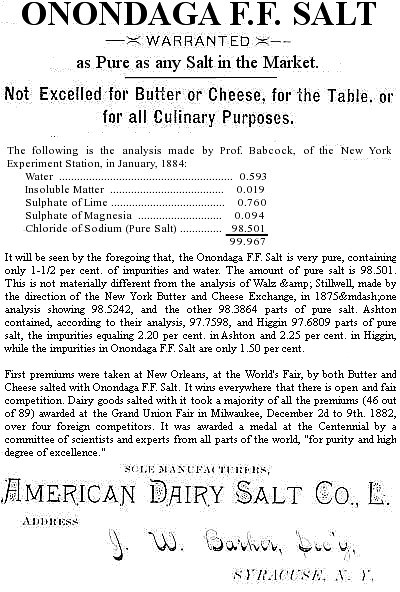
put into butter. No salt is better for this purpose than the Onondaga
F.F., which is American, and the cheapest salt fit for dairy use that
can be obtained.
The principal office of the salt in butter is to impart an agreeable
flavor, in conjunction with the natural aroma of fine butter; but it
is a fact that too much salt injures good flavor, and it may, to
some extent, be used to cover up or neutralize bad flavors. We do not
recommend its use for this latter purpose, preferring that the natural
flavor of butter from pure cream should be preserved.
SALT AS A PRESERVATIVE.
Salt does very little to preserve butter. It retards the decomposition
of the caseous and albuminous materials left in it; but if butter is
properly made of cream not mixed with loppered milk and is completely
washed with pure water, it is a fair question if butter will not keep
longer without salt than with it. There are instances on record where
butter has been kept sweet without salt for a long time. We half
suspect that, though salt at first retards decomposition, the salt
itself, in time, decomposes and becomes sodium and chlorine gas, or
enters into new combinations with the constituents of the butter, and
thus makes new compounds that do not in the least improve the flavor.
We have no positive evidence of this, but have had this suspicion
awakened by facts related about the keeping of butter and by a process
of general reasoning. It is true that salt is one of the most stable
compounds known, but we have proof that it can be resolved into its
original elements, when stronger affinities are presented for one or
both of them to unite with. It would not, therefore, be strange if such
decomposition sometimes follows when used in our food preparations.
PACKING BUTTER.
It is quite a knack to properly pack butter in large packages, and
the work needs to be carefully done. Some use it too violently, by
pounding it down, and thus making the butter greasy or oily. It should
be gently pressed together in the package in such a way as to leave
no spaces filled with air, for the air will surely mingle with the
surrounding butter and injure its flavor. A good way is to begin the
pressure at the center and work carefully toward the circumference, so
that all air may escape at the sides. In this way, perfect solidity of
the mass is secured, and it is left in the best condition for keeping,
so far as the packing is concerned.
PREPARING THE PACKAGE.
Before putting the butter in the package, the package should be soaked
in water, so as to remove the taste of the wood, and then thoroughly
soaked in saturated brine, so that the wood will not draw the salt from
the butter which comes in contact with it. If it does, the butter thus
deprived of salt will turn white, have a sickish flavor, and soon turn
rancid. It is a good idea to not only sprinkle a thin layer of salt
over the bottom of the package, but to rub the moist inner sides with
dairy salt, and thus make sure that there is salt enough in contact
with the wood to prevent its absorbing the salt from the butter.
CLOSING THE PACKAGE.
When a package is filled, a piece of thin muslin, cut so as to just fit
into the top of the package and completely cover the butter, should be
wet in cold water and carefully placed over the top, having the edges
pressed down close to the sides of the tub. Then the cloth should be
completely covered with a thin layer of salt; and if the salt is
moistened, so as to form of it a thick paste that will become air-tight
when it dries, it will do much to keep the top of the butter clean and
sweet—for the more nearly air tight the package is when completed the
better it is for the preservation of the butter. Then put on the cover,
and seal the whole as tightly as possible.
STORING.
Remove the package to a cool, sweet place, not above the temperature of
60 degrees, and set it so that it will absorb no moisture or odors from
the ground. Much butter is spoiled by keeping, because of neglecting
the temperature, and setting the bottom of the package directly on the
cellar bottom. If kept at a temperature above 60 degrees, butter will
surely go off flavor, and wood will as surely draw moisture from the
ground, if in contact with it, and become sour and musty, sooner or
later affecting the flavor of the butter within the package. Nothing is
to be lost, but all to be gained, by paying attention to these little
things.
STYLE OF PACKAGE.
Of course, where a maker has a special market for his butter, he will
put it up in such style and form of package as suits his customers.
He needs no other guide and would injure his business if he followed
one. But, for general market purposes, the 50 lb. tub is the best form.
The New York and Boston dealers like this because it is convenient
for the retailer, who can readily slip the tub off from the butter
for either weighing or cutting up for his customers. But aside from
these considerations, the Welsh tub is a very bad form of package for
keeping butter, as it is by no means air-tight nor anything approaching
it. Hence, butter sent to market in these tubs must soon be sold and go
into consumption, or there is material depreciation in quality and a
corresponding loss in price. The old-fashioned firkin, which could be
headed up and the butter covered with brine, is a much better package
for keeping butter. But, where butter is consumed as fast as it is
made, and fresh winter made butter supplies the demand through the cold
season, the keeping of butter for any considerable length of time is
not of so much consideration. We think it fortunate that this is so.