The problem of æsthetic satisfaction in symmetrical forms
is easily linked with the well-known theory of 'sympathetic reproduction.'
If there exists an instinctive tendency to imitate
visual forms by motor impulses, the impulses suggested by the
symmetrical form would seem to be especially in harmony with
the system of energies in our bilateral organism, and this harmony
may be the basis of our pleasure. But we should then
expect that all space arrangements which deviate from complete
symmetry, and thus suggest motor impulses which do not correspond
to the natural bilateral type would fail to give æsthetic
pleasure. Such, however, is not the case. Non-symmetrical
arrangements of space are often extremely pleasing.
This contradiction disappears if we are able to show that the
apparently non-symmetrical arrangement contains a hidden
symmetry, and that all the elements of that arrangement contribute
to bring about just that bilateral type of motor impulses
which is characteristic of geometrical symmetry. The question
whether or not this is the fact makes the leading problem of this
paper, and the answer to it must throw light on the value of the
theory itself.
An exhaustive treatment of our question would thus divide
itself into two parts; the first dealing with real (or geometrical)
symmetry, the second with apparent asymmetry; the first seeking
to show that there is a real æsthetic pleasure in geometrical
symmetry, and that this pleasure is indeed based on the harmony
of the motor impulses suggested by symmetry, with the
natural motor impulses of the human organism; the second
seeking to show in what manner æsthetically pleasing but
asymmetrical arrangements conform to the same principles.
Within these two groups of problems two general types of investigation
are seen to be required; experiment, and the analysis
of æsthetic objects.
The main question, as stated above, is of course whether
the theory can explain our pleasure in arrangements which
are completely or partly symmetrical. It is, however, an indispensible
preliminary to this question, to decide whether the
pleasure in symmetrical arrangements of space is indeed immediate
and original. If it were shown to be a satisfaction of expectation,
bred partly from the observation of symmetrical
forms in nature, partly from the greater convenience of symmetrical
objects in daily use, the whole question of a psychophysical
explanation would have no point. If no original
æsthetic pleasure is felt, the problem would be transformed to
a demand for the explanation of the various ways in which practical
satisfaction is given by symmetrical objects and arrangements.
The logical order, then, for our investigation would be:
First, the appearance of symmetry in the productions of primitive
life, as a (debatable) æsthetic phenomenon emerging from pre-æsthetic
conditions; secondly, the experimental study of real
symmetry; thirdly, the analysis of geometrical symmetry in
art, especially in painting and architecture, by means of which
the results of the preceding studies could be checked and confirmed.
Having once established a theory of the æsthetic significance
of real symmetry, we should next have to examine
asymmetrical, beautiful objects with reference to the relation of
their parts to a middle line; to isolate the elements which suggest
motor impulses; to find out how far it is possible to establish
a system of substitution of these psychological factors and how
far such substitution takes place in works of art—i.e., to what
extent a substitutional symmetry or balance is found in pleasing
arrangements. These investigations, again, would fall into the
two groups of experiment and analysis. The products of civilized
art are too complicated to admit of the complete analysis and
isolation of elements necessary to establish such a system of substitution
of psychological factors as we seek. From suggestions,
however, obtained from pleasing asymmetrical arrangements,
first, isolated elements may be treated experimentally, and secondly,
the results checked and confirmed by works of art.
With regard to the study of objects without a natural or
suggested middle line, as for instance sculpture, many types of
architecture, landscapes, gardens, room-arrangements, etc., we
may fitly consider it as a corollary to the study of asymmetrical
objects with artificial limits which do suggest a middle. If we
find, by the study of them, that a system of substitution of psychological
factors does obtain, the whole field can be covered
by the theory already propounded, and its application extended
to the minutest details. The hypothesis, having been so far
confirmed, may be then easily applied to the field of asymmetrical
objects without a natural middle line.
The set of problems here suggested to the student of symmetry
will not be fully followed out in this paper. The experimental
treatment of geometrical symmetry, the analysis of the
completely symmetrical products of civilized art, and the analysis
of all forms of asymmetry except asymmetry in pictures will be
omitted. If, however, the fact of an original æsthetic feeling for
symmetry is established by the study of primitive art, and the
theory of the balance of motor impulses through the substitution
of factors is established by the experimental treatment of isolated
elements, and further confirmed by the analysis of pictures, the
general argument may be taken as sufficiently supported. This
paper, then, will contain three sections: an introductory one on
symmetry in primitive art, and two main sections, one on experiments
in substitutional symmetry, and one on substitutional symmetry
or balance in pictures.
The question which this section will attempt to answer is
this: Is there in primitive art an original and immediate æsthetic
feeling for symmetry? This question depends on two
others which must precede it: To what extent does symmetry
actually appear in primitive art? and, How far must its presence
be accounted for by other than æsthetic demands?
For the purpose of this inquiry the word primitive may be
taken broadly as applying to the products of savage and half-savage
peoples of to-day, as well as to those of prehistoric races.
The expression primitive art, also, requires a word of explanation.
The primitive man seldom makes purely ornamental
objects, but, on the other hand, most of his articles of daily use
have an ornamental character. We have to consider primitive
art, therefore, as represented in the form and ornamentation of
all these objects, constituting practically an household inventory,
with the addition of certain drawings and paintings which do
not appear to serve a definite practical end. These last, however,
constitute only a small proportion of the material.
The method of the following outline treatment will be to
deduct from the object under consideration those symmetrical
elements which seem to be directly traceable to non-æsthetic
influences; such elements as are not thus to be accounted for
must be taken as evidence of a direct pleasure in, and desire
for symmetry on the part of primitive man. These possible
non-æsthetic influences may be provisionally suggested to be
the technical conditions of construction, the greater convenience
and hence desirability of symmetrical objects for practical use,
and the symmetrical character of natural forms which were
imitated.
The first great group of objects is given in primitive architecture.
Here is found almost complete unanimity of design,
the conical, hemispherical or beehive form being well-nigh
universal. The hut of the Hottentots, a cattle-herding, half-nomadic
people, is a good type of this. A circle of flexible
staves is stuck into the ground, bent together and fastened
at the top, and covered with skins. But this is the form of
shelter constructed with the greatest ease, suitable to the
demands of elastic materials, boughs, twigs, reeds, etc., and
giving the greatest amount of space with the least material.
There are, indeed, a few examples of the rectangular form of
dwelling among various primitive races, but these seem to be
more or less open to explanation by the theory advanced by
Mr. V. Mendeleff, of the U.S. Bureau of Ethnology. "In
his opinion the rectangular form of architecture which succeeds
the type under discussion, must have resulted from the circular
form by the bringing together within a limited area of many
houses.... This partition would naturally be built straight
as a two-fold measure of economy."2 This opinion is confirmed
by Mr. Cushing's observations among the Zuñi villages, where
the pueblos have circular forms on the outskirts. Thus the
shape of the typical primitive dwelling is seen to be fully accounted
for as the product of practical considerations alone. It
may therefore be dismissed as offering no especial points of
interest for this inquiry.
Next in the order of primitive development are the arts
of binding and weaving. The stone axe or arrow-head, for
example, was bound to a wooden staff, and had to be lashed with
perfect evenness,3 and when in time the material and method of
fastening changed, the geometrical forms of this careful binding
continued to be engraved at the juncture of blade and
handle of various implements. It should be noted, however,
that these binding-patterns, in spite of their superfluous character,
remained symmetrical.
On the great topic of symmetry in weaving, monographs
could be written. Here it is sufficient to recall4 that the absolutely
necessary technique of weaving in all its various forms
of interlacing, plaiting, netting, embroidering, etc., implies order,
uniformity, and symmetry. The chance introduction of a thread
or withe of a different color, brings out at once an ordered pattern
in the result; the crowding together or pressing apart of
elements, a different alternation of the woof, a change in the
order of intersection, all introduce changes by the natural necessities
of construction which have the effect of purpose. So
far, then, as the simple weaving is concerned, the æsthetic
demand for symmetry may be discounted. While it may be
operative, the forms can be explained by the necessities of construction,
and we have no right to assume an æsthetic motive.
The treatment of human and animal forms in weaving is,
however, indicative of a direct pleasure in symmetry. The
human form appears almost exclusively (much schematized) en
face. When in profile, as for instance in Mexican and South
American work, it is doubled—that is, two figures are seen face
to face. Animal figures, on the other hand, are much used as
row-ornaments in profile.5 It would seem that only the linear
conception of the row or band with its suggestions of movement
in one direction, justified the use of profile (e.g., in Peruvian
woven stuffs), since it is almost always seen under those conditions,
indicating that a limited rectangular space is felt as satisfactorily
filled only by a symmetrical figure.6 Moreover, and
still more confirmatory of this theory, even these row-pattern
profiles are immensely distorted toward symmetry, and every
'degradation' of form, to use Professor Haddon's term, is in
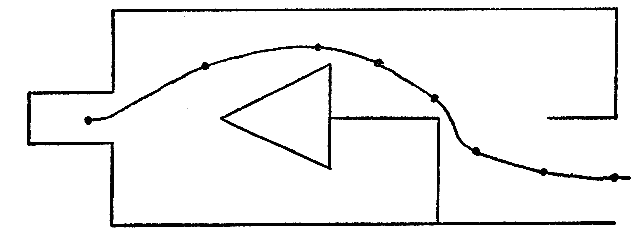
the direction of symmetry. (See Fig. 1.)

The shape of primitive pottery is conditioned by the following
influences: The shapes of utensils preceding clay,
such as skins, gourds, shells, etc., which have been imitated,
the forms of basket models, and the conditions of construction
(formation by the hands). For all these reasons, most of these
shapes are circular. The only (in the strict sense) symmetrical
shapes found are of unmistakably animal origin, and it is interesting
to notice the gradual return of these to the eurhythmic
form; puma, bird, frog, etc., gradually changing into head,
tail and leg excrescences, and then handles and nodes (rectangular panels),
upon a round bowl or jar L, as shown in the
figures. In fact, in ancient American pottery,7 at least, all the
symmetrical ornamentations can be traced to the opposition of
head and tail, and the sides between them, of these animal forms.
But beyond this there is no degradation of the broad outline of
the design. The head and tail, and sides, become respectively
handles and nodes—but the symmetry becomes only more
and more emphasized. And as in the case of textiles, the ornaments
of the rectangular spaces given by the nodes are strikingly
symmetrical. Many of these are from animal motives,
and nearly always heads are turned back over the body, tails
exaggerated, or either or both doubled, to get a symmetrical
effect. Although much of the symmetrical ornament, again, is
manifestly from textile models, its symmetrical character is so
carefully preserved against the suggestions of the circular form
that a direct pleasure in its symmetry may be inferred. (See
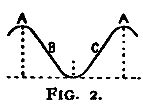
Figs. 2-7.)
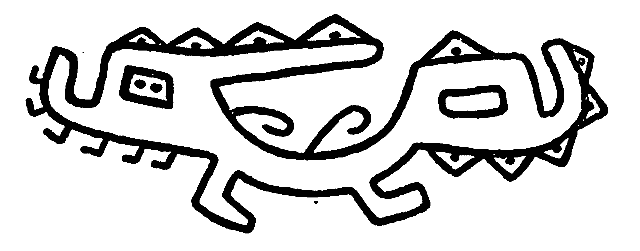
Fig. 2.
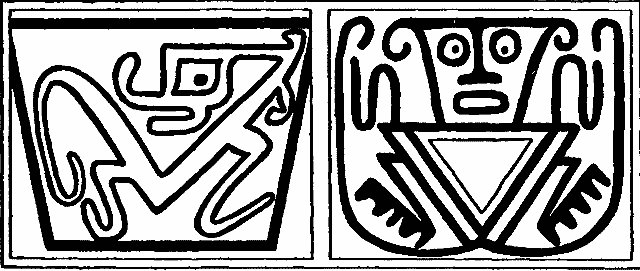
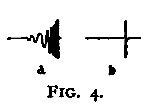
Figs. 3. AND 4.
The subject of drawing can be here only touched upon,
but the results of study go to show, in general, two main directions
of primitive expression: pictorial representation, aiming
at truth of life, and symbolic ornament. The drawings of
Australians, Hottentots and Bushmen, and the carvings of the
Esquimaux and of the prehistoric men of the reindeer period
show remarkable vigor and naturalness; while the ornamentation
of such tribes as the South Sea Islanders has a richness
and formal beauty that compare favorably with the decoration
of civilized contemporaries. But these two types of art do not
always keep pace with each other. The petroglyphs of the
North American Indians8 exhibit the greatest irregularity,
while their tattooing is extremely regular and symmetrical.
The Brazilian savage 9 draws freehand in a very lively and
grotesque manner, but his patterns are regular and carefully
developed. Again, not all have artistic talents in the same
direction. Dr. Schurtz, in his 'Ornamentik der Aino,'10 says:
"There are people who show a decided impulse for the direct
imitation of nature, and especially for the representation of
events of daily life, as dancing, hunting, fishing, etc. It is,
however, remarkable that a real system of ornamentation is
scarcely ever developed from pictorial representations of this
kind; that, in fact, the people who carry out these copies of
everyday scenes with especial preference, are in general less
given to covering their utensils with a rich ornamentive decoration."11
Drawing and ornament, as the products of different
tendencies, may therefore be considered separately.
The reason for the divergence of drawing and ornament
is doubtless the original motive of ornamentation, which is
found in the clan or totem ideas. Either to invoke protection
or to mark ownership, the totem symbol appears on all instruments
and utensils; it has been shown, indeed, that practically
all primitive ornament is based on totemic motives.12 Now,
since a very slight suggestion of the totem given by its recognized
symbol is sufficient for the initiated, the extreme of conventionalization
and degradation of patterns is allowable, and is
observed to take place. The important point to be noted in
this connection is, however, that all these changes are toward
symmetry. The most striking examples might be indefinitely
multiplied, and are to be found in the appended references
(see Figs. 8 and 9).
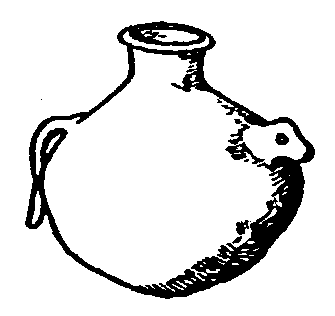
Fig. 5.
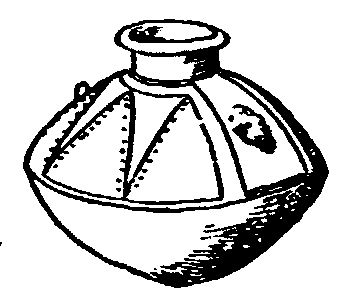
Fig. 6.
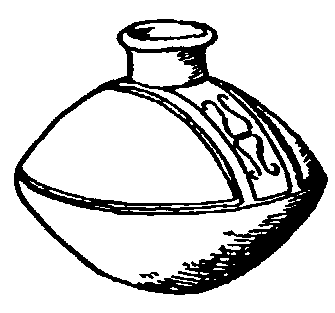
Fig. 7.
We may distinguish here, also, between the gradual disintegration
and degradation of pattern toward symmetry, as seen
in the examples just given, and the deliberate distortion of figures
for a special purpose. This is strikingly shown in the
decorative art of the Indians of the North Pacific coast. They
systematically represent their totem animals—their only decorative
motives—as split in symmetrical sections, and opened out
flat on the surface which is to be covered13 (see Fig. 11). Dr.
Boas argues that their purpose is to get in all the received symbols,
or to show the whole animal, but, however this may be,
every variation introduces symmetry even where it is difficult to
do so, as in the case, for instance, of bracelets, hat-brims, etc.
(Fig. 10). This may in some cases be due to the symmetrical
suggestions of the human body in tattooing,14 but it must be so in
comparatively few.

Fig. 8.
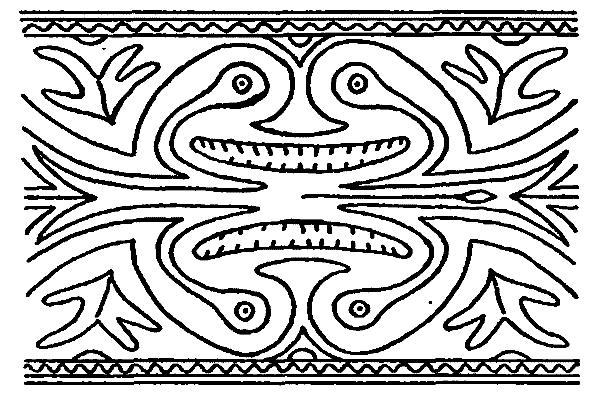
Fig. 9.
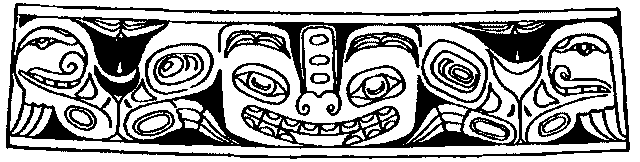
Fig. 10.
The primitive picture has for its object not only to impart
information, but to excite the very definite pleasure of recognition
of a known object. All explorers agree in their accounts
of the savage's delight in his own naïve efforts at picture making.
All such drawings show in varying degrees the same
characteristics; first of all, an entire lack of symmetry. In a
really great number of examples, including drawings and
picture-writing from all over the world, I have not found one
which showed an attempt at symmetrical arrangement. Secondly,
great life and movement, particularly in the drawings of
animals. Thirdly, an emphasis of the typical characteristics, the
logical marks, amounting sometimes to caricature. The primitive
man draws to tell a story, as children do. He gives with
real power what interests him, and puts in what he knows ought
to be there, even if it is not seen, but he is so engrossed by his
interest in the imitated object as to neglect entirely its relation
to a background.
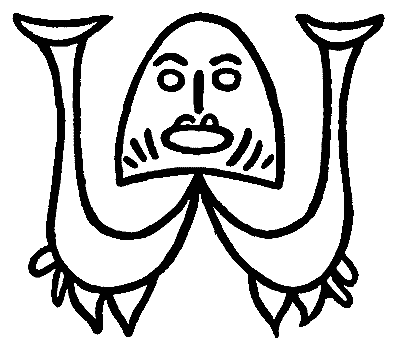
Fig. 11.
Now, this very antithesis of ornament and picture is enlightening
as to the dawn of æsthetic feeling, and the strongest
confirmation of our hypothesis of an original impulse to symmetry
in art. In the ornamentation of objects the content or
meaning of the design is already supplied by the merest hint of
the symbol which is the practical motive of all ornamentation.
The savage artist need, therefore, concern himself no more
about it, and the form of his design is free to take whatever
shape is demanded either by the conditions of technique and
the surface to be ornamented, or by the natural æsthetic impulse.
We have found that technical conditions account for
only a small part of the observed symmetry in pattern, and
the inference to a natural tendency to symmetry is clear. Pictorial
representation, on the other hand, is enjoyed by the
primitive man merely as an imitation, of which he can say,
'This is that animal'—to paraphrase Aristotle's Poetics. He
is thus constrained to reproduce the form as it shows meaning,
and to ignore it as form, or as his natural motor impulses would
make it.
To sum up the conclusions reached by this short survey of
the field of primitive art, it is clear that much of the symmetry
appearing in primitive art is due (1) to the conditions of construction,
as in the form of dwellings, binding-patterns, weaving
and textile patterns generally; (2) to convenience in use,
as in the shapes of spears, arrows, knives, two-handled baskets
and jars; (3) to the imitation of animal forms, as in the shapes
of pottery, etc. On the other hand (1) a very great deal of
symmetrical ornament maintains itself against the suggestions
of the shape to which it is applied, as the ornaments of baskets,
pottery, and all rounded objects; and (2) all distortion, disintegration,
degradation of pattern-motives, often so marked
as all but to destroy their meaning, is in the direction of geometrical
symmetry. In short it is impossible to account for more
than a small part of the marked symmetry of primitive art by
non-æsthetic influences, and we are therefore forced to conclude
an original tendency to create symmetry, and to take
pleasure in it. A strong negative confirmation of this is given,
as noted above, by the utter lack of symmetry of the only
branch of art in which the primitive man is fully preoccupied
with meaning to the neglect of shape; and by the contrast of
this with those branches of art in which attention to meaning is
at its minimum.
The question put at the beginning of this section must thus
be answered affirmatively. There is evidence of an original
æsthetic pleasure in symmetry.
A certain degree of original æsthetic pleasure in symmetry
may be considered to have been established by the preceding
section, and, without considering further the problems of real or
geometrical symmetry, it may now be asked whether the
pleasure aroused by the form of asymmetrical objects is not at
bottom also pleasure in symmetry; whether, in other words,
a kind of substitution of factors does not obtain in such objects,
which brings about a psychological state similar to that produced
by real symmetry.
The question what these substituted factors may be can perhaps
be approached by a glance at a few pictures which are accepted
as beautiful in form, although not geometrically symmetrical.
Let us take, for instance, several simple pictures
from among the well-known altar-pieces, all representing the
same subject, the Madonna Enthroned with Infant Christ, and
all of generally symmetrical outline. It seems, then, reasonable
to assume that if the variations from symmetry show constantly
recurring tendencies, they represent the chief factors in
such a substitutional symmetry or balance, supposing it to exist.
The following pictures are thus treated in detail, M. denoting
Madonna; C., Child; and Cn., Central Line. The numbers
refer to the collection of reproductions used exclusively in this
investigation, and further described in section IV.
1. 56, Martin Schöngauer: Madonna in Rose-arbor. M.
is seated exactly in Cn., C. on Right, turning to Right. M.
turns to Left, and her long hair and draperies form one long
unbroken line down to Left lower corner. All other details
symmetrical.
2. 867, Titian: Madonna. The picture is wider than it is
high. M. stands slightly to Right of Cn.; C. on Right. Both
turn slightly to Left, and the drapery of M. makes a long sweep
to Left. Also a deep perspective occupies the whole Left field.
3. 248, Raphael: Madonna (The Bridgewater Madonna).
M. sits in Cn., turning to Left; C. lies across her lap, head to
Left, but his face turned up to Right, and all the lines of his
body tending sharply down to Right.
In 1, all the elements of the picture are symmetrical except
the position of C. on the Right, and the long flowing line to
Left. In 2, there is a slightly greater variation. The mass of
the figures is to Right, and the C. entirely over against the deep
perspective and the flowing line on the Left, and the direction
of both faces toward that side. In 3, the greater part of C.'s
figure on Left is opposed by the direction of his lines and
movement to Right. Thus these three pictures, whether or not
they are considered as presenting a balance, at least show
several well-defined factors which detach themselves from the
general symmetrical scheme. (1) Interest in C. is opposed by
outward-pointing line; (2) greater mass, by outward-pointing
line, deep vista, and direction of attention; and (3) again
interest by direction of line and suggestion of movement.
This analysis of several æsthetically pleasing but asymmetrical
arrangements of space strongly suggests that the elements
of large size, deep perspective, suggested movement, and
intrinsic interest are in some way equivalent in their power to
arouse those motor impulses which we believe to constitute the
basis of æsthetic response. It is the purpose of these experiments
to follow up the lines of these suggestions, reducing them
to their simplest forms and studying them under exact conditions.
But before describing the instruments and methods of this
experimental treatment, I wish to speak of the articles on
the 'Æsthetics of Simple Form,' published as Studies from
the Harvard Psychological Laboratory, by Dr. Edgar Pierce.15
These articles, sub-entitled 'Symmetry' and 'The Functions
of the Elements' seem at first sight to anticipate the discussions
of this paper; but a short analysis shows that while
they point in the same direction, they nevertheless deal with
quite different questions and in a different manner. In the
statement of his problem, indeed, Dr. Pierce is apparently
treading the same path.
He says: "Can a feeling of symmetry, that is, of æsthetical
equality of the two halves, remain where the two sides are
not geometrically identical; and if so, what are the conditions
under which this can result—what variations of one side seem
æsthetically equal to the variations of the other side?" Some
preliminary experiments resulted in the conclusion that an unsymmetrical
and yet pleasing arrangement of a varied content
rests on the pleasure in unity, thus shutting out the Golden
Section choice, which depends on the pleasure in variety.
That is, the choices made will not in general follow the golden
section, but 'when the figure consists of two halves, the pleasure
must be a feeling of æsthetical symmetry.'
The final experiments were arrangements of lines and simple
figures on a square, black background in which the center
was marked by a white vertical line with a blue or a red line
on each side. On one side of these central lines a line was
fixed; and the subject had to place on the other side lines and
simple figures of different sizes and different colors, so as to
balance the fixed line. The results showed that lines of greater
length, or figures of greater area must be put nearer the center
than shorter or smaller ones—'A short line must be farther
than a long one, a narrow farther than a wide, a line farther
than a square; an empty interval must be larger than one filled,
and so on.' And for colors, "blue, maroon and green, the
dark colors, are the farthest out; white, red and orange, the
bright colors, are nearest the center. This means that a dark
color must be farther out than a bright one to compensate for a
form on the other side. The brightness of an object is then a
constant substitute for its distance in satisfying our feeling of
symmetry."
Now from these conclusions two things are clear. By his
extremely emphasized central line, and his explicit question to
the subjects, 'Does this balance?' the author has excluded
any other point of view than that of mechanical balance. His
central fulcrum is quite overpowering. Secondly, his inquiry
has dealt only with size and color, leaving the questions of
interest, movement, and perspective untouched. But just the
purpose of this experimental study is to seek for the different
and possibly conflicting tendencies in composition, and to approximate
to the conditions given in pictorial art. It is evident,
I think, that the two studies on symmetry will not trespass
on each other's territory. The second paper of Dr. Pierce,
on 'The Functions of the Elements,' deals entirely with the relation
of horizontal and vertical positions of the æsthetic object
and of the subject to æsthetic judgments, and has therefore no
bearing on this paper.
For his apparatus Dr. Pierce used a surface of black cloth
stretched over black rubber, 1 m. square. Now an investigation
which is to deal with complicated and varied relations, resembling
those of pictures, demands an instrument resembling them
also in the shape of the background. A rectangle 600 mm. broad
by 400 mm. high seemed to meet this requirement better than
the square of Dr. Pierce. Other parts, also, of his instrument
seemed unfitted for our purpose. The tin, 5 cm. broad and
confined to the slits across the center of the square, gave
not enough opportunity for movement in a vertical direction,
while the scale at the back was very inconvenient for reading.
To supply these lacks, a scale graduated in millimeters
was attached on the lower edge of the board, between a double
track in which ran slides, the positions of which could be
read on the scale. To the slides were attached long strips
of tin covered with black cloth. On these strips figures glued
to small clamps or clasps could be slipped up or down; this
arrangement of coördinates made it possible to place a figure
in any spot of the whole surface without bringing the hands
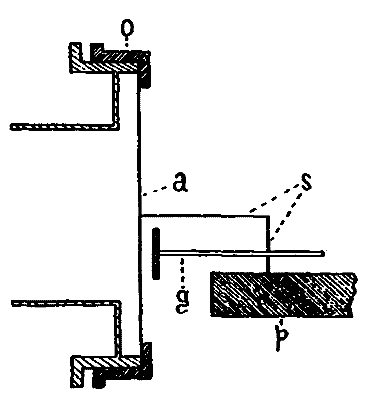
into the field of view. The experiments were made in a dark
room, in which the apparatus was lighted by an electric globe
veiled by white paper and hung above and behind the head
of the subject, so as not to be seen by him and to cast no
shadow: in this soft light of course the black movable strips
disappeared against the black background. A gray paper
frame an inch and a half wide was fitted to the black rectangle
to throw it up against the black depths of the dark room—thus
giving in all details the background of a picture to be composed.
The differences in method between the two sets of experiments
were fundamental. In Dr. Pierce's experiments the
figures were pulled from one side to the other of the half-square
in question, and the subject was asked to stop them where he
liked; in those of the writer the subject himself moved the
slides back and forth until a position was found æsthetically
satisfactory. The subject was never asked, Does this balance?
He was indeed requested to abstract from the idea of balance,
but to choose that position which was the most immediately
pleasing for its own sake, and so far as possible detached from
associations.
I have said that Dr. Pierce intentionally accentuated the
center. The conditions of pictorial composition suggest in general
the center only by the rectangular frame. Most of my experiments
were, therefore, made without any middle line; some
were repeated with a middle line of fine white silk thread, for
the purpose of ascertaining the effect of the enhanced suggestion
of the middle line.
But the chief difference came in the different treatment of
results. Dr. Pierce took averages, whereas the present writer
has interpreted individual results. Now, suppose that one tendency
led the subject to place the slide at 50 and another to place
it at 130 mm. from the center. The average of a large number
of such choices would be 90—a position very probably disagreeable
in every way. For such an investigation it was evident
that interpretation of individual results was the only
method possible, except where it could be conclusively shown
that the subjects took one and only one point of view. They
were always encouraged to make a second choice if they wished
to do so, as it often happened that one would say: 'I like both
of these ways very much.' Of course, individual testimony
would be of the highest importance, and a general grouping
into classes and indication of the majority tendency would be
the only way to treat the results statistically. And indeed in
carrying out the experiments this caution was found absolutely
necessary. In all but one or two of the sections, the taking of
averages would have made the numerical results absolutely
unintelligible. Only the careful study of the individual case,
comparison of various experiments on the same person to find
personal tendencies, and comparison of the different tendencies,
could give valuable results for the theory of symmetry.
The first question to be taken up was the influence of right
and left positions on choice. A long series of experiments was
undertaken with a line 80×10 mm. on one side and a line
160×10 mm. on the other, in which the positions of these were
reversed, and each in turn taken as fixed and variable, with a
view to determining the effect of right and left positions. No
definite conclusions emerged; and in the following experiments,
most of which have been made for both right and left positions,
the results will be treated as if made for one side alone, and,
where averages are taken, will be considered as indifferently
left or right.
The experiments of Dr. Pierce were made for only one position
of the fixed line—at 12 cm. distance from the center.
The characteristic of the following experiments is their reference
to all positions of the fixed line. For instance a fixed line,
10 cm. in length at 12 cm. distance from the center, might be
balanced by a line 5 cm. in length at 20 cm. distance. But
would the distance be in the same proportion for a given distance
of the fixed line of say 20 or 25 cm.? It is clear that
only a progressive series of positions of the fixed line would
suggest the changes in points of view or tendencies of choice of
the subject. Accordingly, for all the experiments the fixed line
or other object was placed successively at distances of 20, 40,
60 mm., etc., from the center; or at 40, 80 mm., etc., according
to the character of the object, and for each of these fixed
points the subject made one or two choices. Only an understanding
of the direction in which the variable series moved
gave in many cases an explanation for the choice.
Each choice, it should be added, was itself the outcome of
a long series of trials to find the most pleasing position. Thus,
each subject made only about ten choices in an hour, each of
which, as it appears in the tables, represents a large number of
approximations.
I have said that different tendencies or types of choice in
arrangement appeared. It will be convenient in the course of
explaining in detail the method of experiment, to discuss at the
same time the meaning of these types of choice.
From analysis of the pictures, the simplest suggestion of
balance appeared in the setting off against each other of objects
of different sizes;—an apparent equivalence of a large object
near the center with a small object far from the center;
thus inevitably suggesting the relations of the mechanical balance,
or lever, in which the heavy short arm balances the light
long arm. This was also the result of Dr. Pierce's experiments
for one position of his fixed line. The experiments which
follow, however, differ in some significant points from this
result. The instrument used was the one described in the preceding
section. On one side, in the middle of the vertical strip,
was placed the 'fixed' line, denoted by F., and the subject
moved the 'variable' line, denoted by V., until he found the
arrangement æsthetically pleasing. The experimenter alone
placed F. at the given reading, and read off the position of V.
After the choice F. was placed at the next interval, V. was
again tried in different positions, and so on. In the following
tables the successive positions of F. are given in the left column,
reading downward, and the corresponding positions of V. in
the right column. The different choices are placed together,
but in case of any preference the second choice is indicated.
The measurements are always in millimeters. Thus, F. 40,
V. 60, means that F. is 40 mm. to one side of the center, and
V. 60 mm. to the opposite side. F. 80×10, V. 160×10,
means that the white cardboard strips 80 mm.×10 mm., etc.,
are used. The minus sign prefixed to a reading means that
the variable was placed on the side of the fixed line. An X
indicates æsthetic dislike—refusal to choose. An asterisk (*)
indicates a second choice.
The following tables are specimen sets made by the subjects
C, O, and D.
| I. (a) F. 80×10, V. 160×10. |
|---|
| F. | V. |
|---|
| C. | O. | D. |
| 40 | 62, 120 | 166, 130 | 28, 24 |
| 80 | 70, 110 | 104, 102 | 80, 126 |
| 120 | 46, X | 70, 46 | 68,—44, 128* |
| 160 | 26, 96 | 50, 25 | 85, 196, —88* |
| 200 | 20, X | 55, X | —46, 230,* 220, —110* |
| |
| I. (b) F. 160×10, V. 80×10. |
|---|
| F. | V. |
|---|
| C. | O. | D. |
| 40 | 74, 64 | 60, 96 | 27, 34 |
| 80 | 76, 65 | 72, 87 | 55, 138 |
| 120 | 60, 56 | 48, 82 | 70, 174 |
| 160 | 29, 74 | 16, 77 | —114, 140, 138, 200 |
| 200 | 96, 36 | 25, 36 | 177, —146, —148, 230 |
Now, on Dr. Pierce's theory, the variable in the first set
should be nearer the center, since it is twice the size of the
fixed line;—but the choices V. 120, 166, 130 for F. 40; V.
110, 104, 102, 126 for F. 80; V. 128 for F. 120; V. 196 for
F. 160; V. 230, 220 for F. 200, show that other forces are at
work. If these variations from the expected were slight, or if
the presence of second choices did not show a certain opposition
or contrast between the two positions, they might disappear
in an average. But the position of F. 40, over against V. 120,
166, 130, is evidently not a chance variation. Still more striking
are the variations for I. (b). Here we should expect the
variable, being smaller, to be farther from the center. But for
F. 40, we have V. 27, 34; for F. 80, all nearer but two; for
F. 120, V. 60, 56, 48, 82, 70; for F. 160, V. 29, 74, 16, 77,
138, and for F. 200, V. 96, 36, 25, 36, 177—while several
positions on the same side of the center as the constant show a
point of view quite irreconcilable with mechanical balance.
II. (a) F. 2 LINES 80×10. V. SINGLE LINK 80×10.
| F. | V. |
|---|
| C. | O. | P. |
| 40- 60 | 58, 114* | 138, 20 | 96, 84 | 166 |
| 60- 80 | 48 | 40, 138* | 100, 56 | 150 |
| 80-100 | 64 | 70, 162* | 47, 87 | 128 |
| 100-120 | 70 to 80 | 60 | 53, 53 | X |
| 120-140 | 58 | 82 | 50, 48 | 35 |
| 140-160 | 74 | 95 to 100 | 22, 32 | 37 |
| 160-180 | 72 | 102 | X, X | 42 |
| 180-200 | 90 | X | X, X | 50 |
Here the variable should supposedly be the farther out; but
we have V. 58, 20 for F. 40-60; V. 48, 40, 56 for F. 60; V.
64, 70, 87 for F. 80; no larger choice for F. 100-120; indeed,
from this point on everything nearer, and very much nearer.
We can trace in these cases, more clearly perhaps than in the
preceding, the presence of definite tendencies. O and P, from
positions in accord with the mechanical theory, approach the
center rapidly; while C is seldom 'mechanical,' but very slowly
recedes from the center. The large number of refusals to
choose assures us that the subjects demand a definitely pleasant
arrangement—in other words, that every choice is the expression
of a deliberate judgment.
Taking again the experiments 1. (a) and 1. (b), and grouping
the results for nine subjects, C, O, A, S, H, G, D, and P,
we obtain the following general types of choice. The experiments
were repeated by each subject, so that we have eighteen
records for each position. I should note here that preliminary
experiments showed that near the frame the threshold of difference
of position was 10 mm., or more, while near the center it
was 4 or 5 mm.; that is, arrangements were often judged symmetrically
equal which really differed by from 4 to 10 mm., according
as they were near to or far from the center. In grouping
types of choice, therefore, choices lying within these limits
will be taken as belonging to the same type.
Exp. 1. (a) F.(80 X 10). V.(160 X 10).
| 1. F. 40. | V. 40.¹ |
|---|
| Types of Choice for V. |
| (1) | 24 | 24 | 25 | 28 |
| (2) | 40 | 42 | 45 | 45 | | 40 | 40 | 40 |
| (3) | 62 | 65 |
| (4) | 100 | 105 | 109 | 120 | 130 | 136 | | | | 120 |
| (5) | 166 | 180 | | 200 | 200 | 200 | 200 | 160 | 160 |
¹This table is obtained by taking from the full list, not given
here, of 1. (b) F. (160 X 10), V. (80 X 10), those positions of
160 X 10 where the variable 80 X 10 has been placed at or near
40, thus giving the same arrangement as for 1. (a).
It might be objected that a group 40-65 (2-3) would not be
larger than one of 100-136 (4), but the break between 45 and
62 shows the zones not continuous. Moreover, as said above,
the positions far from the center have a very large difference
threshold.
I. (a) 2. F. 80:—(1) 24, (2) 50, (3) 68 70, (4) 80 85 94 95
85, (5) 102 104 110 120 124 126 125* 132, (6) 187; also V.
80:—(2) 40 40, (4) 80, (5) 120 120, (6) 160 160.
I. (a) 3. F. 120:—(1) 44 46, (2) 64 48 70 70, (3) 85 95 97
91, (4) 113 113 118, (5) 168 169 178;—44, X; also V. 120:—(1) 40 40,
(3) 80 80 80, (4) 120 120, (5) 160 160.
I. (a) 4. F. 160:—(1) 25 26, (2) 40 50 57, (3) 82 85 95
100*, (4) 114 115 130, (5) 145 145 156 162, (6) 196, (7)—88*—150*—105.
I. (a) 5. F. 200:—(1) 20 23 28 36, (2) 55, (3) 108 124 130*,
(4) 171 189 199 195, (5) 220 230*, (6)—46—90—110*.
On comparing the different groups, we find that in 1 and 2
there is a decided preference for a position somewhat less than
half way between center and frame—more sharply marked for
1 than for 2. From 3 onward there is a decided preference
for the mechanical arrangement, which would bring the larger
strip nearer. Besides this, however, there are groups of variations,
some very near the center, others approaching to symmetry.
The maintenance of geometrical symmetry at a pretty constant
ratio is to be noted; as also the presence of positions on the
same side of the center as the fixed line. Before discussing the
significance of these groups we may consider the results of
Experiment II. (F. double line 80×10, V. single line 80×10)
without giving complete lists.
We notice therein, first of all, the practical disappearance
of the symmetrical choice; for F. 40-60, 60-80, 80-100, a
tendency, decreasing, however, with distance from the center,
to the mechanical arrangement; for F. 100-120, and all the
rest, not one mechanical choice, and the positions confined
almost entirely to the region 35-75. In some cases, however,
the mechanical choice for (1) 40-80, (2) 60-80, was one of two,
e.g., we have for (1) 20 and 138, for (3) 70 and 162; in the
last two cases the mechanical being the second choice.
Now the reversals of the mechanical choice occur for Exp.
I. in 1 and 2 (F. 40 and F. 80); that is, when the small fixed
line is near the center, the larger variable is distant. For Exp.
II. the reversals, which are much more marked, occur in all
cases beyond F. 40, F. 60 and F. 80; that is, when the double
constant line is far from the center, the single variable approaches.
If the mechanical theory prevailed, we should have
in Exp. I. the lines together in the center, and in Exp. II. both
near the fringe.
From the individual testimony, based both on I. (a) and I.
(b), it appears that subject M is perfectly uniform in mechanical
choice when the fixed line is the small line—i.e. when it
moves out, the larger is placed near the center; but when the
conditions of mechanical choice would demand that, as the
larger fixed line moves out, the small variable one should move
out farther, he regularly chooses the reverse. Nevertheless,
he insists that in just these cases he has a feeling of equilibrium.
A also takes the mechanical choice as the small fixed line
goes farther from the center; but when the fixed line is large
and leaves the center, he reverses the mechanical choice—evidently
because it would take the small line too far out. As he
says, 'he is always disturbed by too large a black space in the
center.'
G almost always takes the mechanical choice;—in one
whole set of experiments, in which the fixed line is the large
line, he reverses regularly.
H takes for F. (80×10) the mechanical choice only for the
positions F. 160 and F. 200—i.e., only when F. is very far
from the center and he wishes V. (160×10) nearer. For F.
(160×10) he makes six such choices out of ten, but for positions
F. 160 and F. 200 he has V. 44, 65 and 20.
S takes for F. (160×10) at F. 120, V. 185 and-70; says
of V. 185, which is also his choice for F. (160×10) at F. 80,
'I cannot go out further, because it is so hard to take in the
whole field.' For F. (160×10) at F. 200, he has V. 130 and
60; says of V. 60, 'Very agreeable elements in connection
with the relation of the two lines.'
C takes for F. (80×10) only one mechanical choice until
it is at F. 120. Then always mechanical, i.e., nearer center;
for F. (160×10) makes after the position F. 40 no mechanical
choice, i.e., V. is nearer center.
It is evident from the above tables and individual cases that
the reversals from the mechanical choice occur only when the
mechanical choice would bring both lines in the center, or both
near the edges, and the subjective testimony shows from what
point of view this appears desirable. The subjects wish 'to
take in the whole field,' they wish 'not to be disturbed by too
large a black space in the center'; and when, in order to cover
in some way the whole space, the small line is drawn in or the
large one pushed out, they have, nevertheless, a feeling of
equilibrium in spite of the reversal of mechanical balance.
Accepting for the present, without seeking a further psychological
explanation, the type of 'mechanical balance,' in
which amount of space is a substitute for weight, as the one
most often observed, we have to seek some point of view from
which this entire reversal is intelligible. For even the feeling
that 'the whole field must be covered' would hardly account
for an exact interchanging of positions. If size gives 'weight,'
why does it not always do so? A simple answer would seem
to be given by the consideration that we tend to give most attention
to the center of a circumscribed space, and that any object
in that center will get proportionately more attention than on the
outskirts. The small line near the center, therefore, would
attract attention by virtue of its centrality, and thus balance the
large line, intrinsically more noticeable but farther away.
Moreover, all the other moments of æsthetic pleasure, derived
from the even filling of the space, would work in favor of this
arrangement and against the mechanical arrangement, which
would leave a large black space in the middle.
The hypothesis, then, that the demand for the filling of the
whole space without large gaps anywhere enters into competition
with the tendency to mechanical balance, and that this tendency
is, nevertheless, reconciled with that demand through the
power of a central position to confer importance, would seem to
fit the facts. It is, of course, clear that neither 'mechanical
balance' nor the balance of 'central' with 'intrinsic' importance
have been yet accounted for on psychological grounds;
it is sufficient at this point to have established the fact of some
kind of balance between elements of different qualities, and to
have demonstrated that this balance is at least not always to be
translated into the 'mechanical' metaphor.
In the preceding experiments the element of size was isolated,
and it was sought to discover, in pleasing combinations of objects
of different sizes, the presence of some kind of balance and the
meaning of different tendencies of arrangement. The relative
value of the two objects was taken as determined on the assumption,
supported by common sense, that under like conditions a
large object is given more attention than a small one. If the
unequal objects seem to balance each other, then the only other
condition in which they differ, their distance from the center,
must be the cause of their balancing. Thus the influence of
relative position, being the only unknown quantity in this balance-equation,
is easily made out.
The following experiments will deal with the as yet quite
undetermined elements of suggested movement, perspective and
intrinsic interest. By combining objects expressing them, each
with another simple object of the same size, another equation
will be obtained in which there is only one unknown quantity,
the sizes of the objects being equal and the influence of relative
position being at least clearly indicated.
1. Movement.
The experiments on suggestion of movement were made by
C, O and P. Suggestions of movement in pictures are of two
kinds—given by lines pointing in a direction which the eye of
the spectator tends to follow, and by movement represented as
about to take place and therefore interpreted as the product of
internal energy. Thus, the tapering of a pyramid would give
the first kind of suggestion, the picture of a runner the second
kind. Translated into terms of experiment, this distinction would
give two classes dealing with (A) the direction of a straight line
as a whole, and (B) the expression of internal energy by a curve
or part of a line. In order to be able to change the direction of
a straight line at a given point, a strip of tin two inches long was
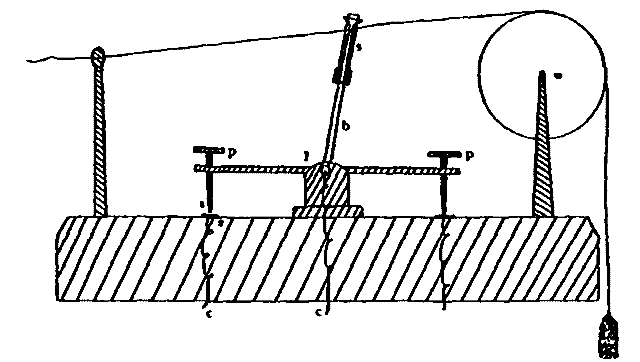
fastened by a pivot to the usual clasp which slipped up and
down on the vertical black strip. The tin strip could be moved
about the pivot by black threads fastened to its perforated ends.
A strip of cardboard glued upon it would then take its direction.
The first experiments, made with the usual 80×10 strip, proved
very disagreeable. The subject was much disturbed by the
blunt ends of the strip. The variable (pivoted) line was then
slightly pointed at the upper end, and in the final experiments,
in which both are oblique, both strips were pointed at each end.
In Exp. III. a line pointing at an angle from the perpendicular
was set over against a line of the same dimensions in the ordinary
position.
Exp. III. (a) F. (80×10) pointed up toward center at 145°, V. (80×10).
F. 40:—(1) 39 48 48, (2) 60 66 68, (3) 97 97, (4) 156* 168*.
F. 60:—(1) 45, (2) 60 62 65 68 90, (3) 90 94, (4) 117 128 152 155.
F. 80:—(1) 50 44*, (2) 74 76 77, (3) 94 100 106 113 115 116, (4) 123 124* 140 165* 169*.
F. 100:—(1) 36 58 60 65* 65 74 77 80 87, (2) 98 108 118, (3) 114* 168 186* 170 136*.
F. 120:—(1) 40 46 54 60 63 76 96 97 111, (2) 115 120 126* 137*, (3) 170 170*.
F. 140:—(1) 45 52 65 65 76 76 86 90, (2) 109 111, (3) 125 140*, (4) 168*.
F. 160:—(1) 38 50 50 60, (2) 80 90 96 98 98, (3) 176*.
F. 180:—(1) 21 23, (2) 54 70 84 90, (3) 100 100 108 114 120, (4) 130 145*.
F. 200:—(1) -2, (2) 33 37 50, (3) 106 110 to 120 115 120 130 132 138 142.
The most striking point about these groups is the frequency
of positions far from the center when F. also is far out. At F.
120, a position at which the mechanical choice usually prevails
if F. is smaller, a very marked preference indeed appears for
positions of V. nearer the center—in fact, there is only one
opposing (first) choice. Now, if it is not the wide space otherwise
left which pulls the variable in,—and we see from a note
that the subjects have no feeling of a large empty space in the
center,—it must be that F. has the same effect as if it were
really smaller than V., that is, mechanically 'light.' We see,
in fact, that the moment F. has passed the point, between 80
and 100, at which both lines close together in the center would
be disagreeable, the preference is marked for inner positions of
V., and I repeat that this cannot be for space-filling reasons,
from the testimony of F. 200 (3).
And this 'lightness' of the line pointed in at 45° is indeed
what we should have expected a priori since we found that
objective heaviness is balanced by a movement out from the
center on the mechanical principle. If movement out and objective
heaviness are in general alike in effect, then movement
in and objective lightness should be alike in effect, as we have
found to be the case from the preceding experiments. The inward-pointed
line does not actually move in, it is true, but it
strongly suggests the completion of the movement. It enters
into the 'mechanical' equation—it appears to balance—as if
it had moved.
The point, however, in which this 'lightness' of the inward-pointed
line differs from that of the small or short line is its
space-filling quality. It suggests movement in a certain direction,
and, while giving the mechanical effect of that movement
as completed, seems also in a sense to cover that space. We
see from F. 180 (3), (4), and 200 (3), that the subject does not
shrink from large spaces between the lines, and does not, as in
Exp. I. (a), 4 and 5, bring the variable, which in both cases is
evidently 'heavier,' to the center. This must be from the fact
that the empty space does not in this experiment feel empty—it
is filled with energy of the suggested movement. This view
is confirmed by the dislike which the subjects show to the position
F. 40; F., being 'lighter,' but the object of attention as close
to the center, might well balance V. far out. But as if the
whole variable field would be in that case 'overfilled,' the records
show 50 per cent. of refusals to choose for this position.
In brief, then, a straight line suggesting movements in a
certain direction has the effect, in the general scheme of mechanical
balance, of a static position in which this movement
has been carried out, with the added suggestion of the filling
of the space over which such movement is suggested.
A few additional experiments were made with a point on the
upper end of V. The groups of III. (a) are maintained almost
exactly: F. 120 is again strikingly 'mechanical'; after F. 120
there are only two mechanical choices out of nineteen; while
for F. 40, as in Exp. III. (a), out of six choices, four are
either refusals or question-marked.
Exp. IV. Both lines took oblique directions, and, to get a
pleasing effect, were pointed at both ends. They were of the
usual size, 80×10 mm., but 1 mm. broader to allow for the
effect of length given by the points. F. was fixed at 45°, as
in III. (a), on the points 40, 80, 120 and 160; V. moved also
on fixed points, 60, 100, 140, 180, for each position of F., but
on each point was adjusted at a pleasing angle. Thus, there
were four positions of V. to each of F., each with one or two
angular positions; V. was always in the first quadrant.
The numbers of the table give the angular degrees of V.
F. 40, V. 60:—(1) 10 12 38 44, (2) 50 57* 60, (3) 70.
V. 100:—(1) 15 15 30 30, (2) 50 55 50, (3) 69 70*.
V. 140:—(1) 12* 14 18 18, (2) 60 60 49, (3) 72.
V. 180:—(1) 12 10 38, (2) 60 50, (3) 75. [Many refusals at 140 and 180.]
F. 80, V. 60:—(1) 11, (2) 25 35 36*, (3) 45 48 55 58 60, (4) 69.
V. 100:—(1) 16 15, (2) 24 27 35 40, (3) 52, (4) 62 74*.
V. 140:—(1) 10 15 16, (2) 22 28, (3) 40 40 59 59, (4) 70.
V. 180:—(1) 14 8, (2) 28, (3) 41 46, (4) 68 79.
F. 120, V. 60: (1) 28, (2) 42 44 35, (3) 52 58 62 65 65.
V. 100:—(1) 9, (2) 23 25, (3) 38 40 40 42 58, (4) 68 70.
V. 140:—(1) 10, (2) 20 26 21* 24 29, (3) 34 42 42 44 55*, (4) 75.
V. 180:—(1) 17 26, (2) 40 42 46, (3) 62 64 70 70*.
F. 160, V. 60:—(1) 20 39, (2) 18, (3) 58 60 64 68 70.
V. 100:—(1) 23 25 30 38, (2) 44 44 49, (3) 55 58 65.
V. 140:—(1) 5, (2) 31 35 40 40 32, (3) 54 55 68.
V. 180:—(1) 50 50 58 60, (2) 75.
The tendency to mechanical balance would, according to
our previous analysis, lead the variable to take a direction
which, in its suggestion of motion inward, should be more or
less strong according as it were farther from or nearer to the
center than the fixed line. Such motion inward would, of
course, be more strongly suggested by an angle less than 45°
than by an angle greater than 45°, and it seems that the angles
chosen are in general in harmony with this expectation. For
the positions where F. is nearer the center than V. there is a
preponderance of the angles less than 45° (cf. F. 40 and F. 80,
V. 100 and 140; F. 120, V. 140, 180). When V. passes over
to a position farther from the center than F. (e.g., from F. 80,
V. 60, to F. 80, V. 100 and from F. 120, V. 60, to F. 120, V.
140) the change is marked. In every case where F. is farther
from the center than V. (i.e., F. 80, V. 60; F. 120, V. 60 and
V. 100; F. 160, V. 60, V. 100 and V. 140), there are to be
noticed a lack of the very small angles and a preponderance of
the middle and larger angles. F. 160, V. 140 and 180 seem
to be the only exceptions, which are easily explainable by a
dislike of the extremely small angle near the edge; for it
appears from the remarks of the subjects that there is always a
subconsciousness of the direction suggested by the lower pointed
end of the line. For the outer positions of both lines, a large
angle would leave the center empty, and a small one would be
disagreeable for the reason just given; and so we find, indeed,
for F. 160, V. 100, 140, 160, the middle position the favorite
one.
The representation of action may be translated into experimental
terms by expressing it as a line which changes its direction,
thus seeming to be animated by some internal energy.
The forms chosen were three curves 'bulging' from a straight
line in differing degrees, and two straight lines with projections.
C and O were the subjects. The results are given in outline.
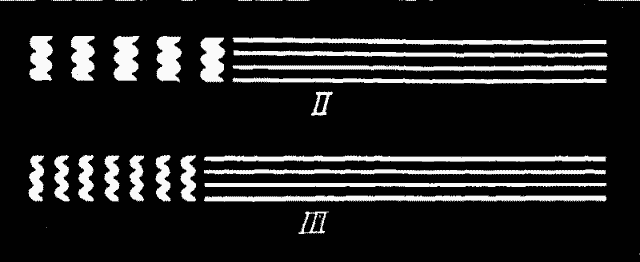
Exp. V. Curve I. See Fig. 12, I
(1) Curve out (turned away from center).
(a) F. (80×10), V. Curve.
About half the positions of V. are farther from the center
than F. O at first refuses to choose, then up to F. 120 puts V.
farther from the center than F. C has a set of positions of V.
nearer the center and several second choices farther than F.
(b) F. Curve, V. (80×10).
No position of V. nearer center than F. O puts line farther
out up to F. 160, then nearer than F. C has a set of nearly
symmetrical choices and another where V. is much farther out
than F.
(2) Curve in (turned toward center).
(a) F. (80×10), V. Curve.
C is absolutely constant in putting V. farther from center
than F. O, after F. 100, brings it slightly nearer.
(b) F. Curve, V. (80×10).
C, except for F. 40, invariably puts V. nearer center than
F. O moves between 90 and 135, putting V. farther to F.
100, nearly symmetrical at F. 100 and 120, and after F. 120,
from 100 to 135.
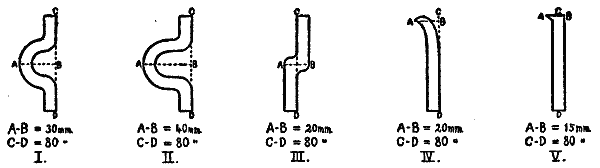
Fig. 12.
Exp. V. Curve II. See Fig. 12, II.
(1) Curve out.
(a) F. (80×10), V. Curve.
In every case but one V. is nearer center than F.
(b) F. Curve, V. (80×10).
C puts V. farther from center than F. O puts V. farther
or symmetrical up to F. 120, then nearer than F.
(2) Curve in.
(a) F. 80×10, V. Curve.
C has V. always farther from center than F., but a second
parallel set, omitting F. 40 (all second choices), of symmetrical
positions. O begins with V. farther from center, but from F.
120 has V. always nearer, though gradually receding from the
center.
(b) F. Curve. V. (80×10).
C, refusing for F. 40, continues his parallel sets, one with
V. always nearer than F., another with symmetrical positions.
O begins with V. nearer, changes at F. 120, and continues with
V. farther.
Recapitulating these results, grouping together the outward
and inward positions of the curves, and indicating the distance
of the line from the center by C.-L., and of the curve from the
center by C.-Cv., we have:
| Out. |
| Cv. I. | (a) Indeterminate. |
| (b) C.-Cv. < C.-L. (except where large gap would be left). |
|
| Cv. II. | (a) C.-Cv. < C.-L. (all cases but one). |
| (b) C.-Cv. < C.-L. (except where large gap would be left). |
| |
| In. |
| Cv. I. | (a) C.-Cv. > C.-L. (except a few cases to avoid gap). |
| (b) C.-Cv. > C.-L. (more than half of cases). |
| Cv. II. | (a) C.-Cv. > C.-L. (except a few cases to avoid gap). |
| (b) C.-Cv. > C.-L. (except a few cases to avoid gap). |
It is evident that in the great majority of cases when the
curve turns out it is placed nearer the center, when it turns in,
farther from the center, than the straight line. The numerical
differences for choices of the same type for the two curves are
slight, but regular, and the general tendencies are more sharply
marked for the line of greater curvature. When Curve II. is
'out,' it is usually nearer the center than Curve I. for the corresponding
positions of the straight line; when 'in' it is always
farther from the center than Curve I. The greater curvature
of II. has clearly produced this difference, and the effect of the
curvature in general is evidently to make its side 'lighter' when
turned toward the center, and 'heavier' when turned away.
Thus, all but the exceptions already noted seem to belong to
the mechanically balanced arrangement, in which the suggestion
of force working in the direction of the curve has the same
effect as, in Exp. IV., the direction of the line. The exceptions
noted, especially numerous choices of O, seem governed by
some fixed law. The evidence would seem to be overwhelming
that the reversals of the mechanical balance occur only where
the lines would be crowded together in the center or would
leave an empty gap there. The remaining exceptions—the
symmetrical choices mentioned, made by C—are explained by
him as follows. He says there are two ways of regarding the
curve, (1) as a striving in the direction of the 'bulge,' and (2)
as the expression of a power that presses together; and that the
usual choices are the result of the first point of view, the symmetrical
choices of the second. Naturally, a pressure bending
down the line would be conceived as working in a vertical direction,
and the line would be treated as another (80×10)—giving,
as is the case, symmetrical positions. Thus, we may consider
the principle of the suggestion of movement by a curve, as
giving the same effect as if the movement suggested had actually
taken place, to have been established, the positive evidence being
strong, and the exceptions accounted for. It is worth noting
that the curve-out series are always more irregular—the subject
repeating that it is always harder to choose for that position.
Probably the demands of space-filling come into sharper conflict
with the tendency to mechanical balance, which for the outward
curve would always widely separate the two lines.
Exp. V. Curve III. See Fig. 12, III.
A series with the upper end turned out from the center was
unanimously pronounced as ugly. The inward position only
appears in the results, which are given in full.
| (a) F. (80×10), V. CURVE. |
| F. | V. |
|---|
| | O. | | C. |
|---|
| 40 | | 106 | 126 | | 68 | 73 |
| 80 | | 106 | 128 | | 109 | 102 |
| 120 | | 140 | 88 | | 156 | 110* | 154 | 72* |
| 160 | | 104 | 66 | | 182 | 80 | 136* | 130* |
| 200 | | X | 52 | | 178 | 220* | 162 |
| |
| (b) F. CURVE, V. (80×10) |
| F. | V. |
|---|
| | O. | | C. |
|---|
| 40 | | 126 | 122 | | 73 | 80 |
| 80 | | 122 | 128 | | 66 | 112* | 40 |
| 120 | | 90 | 116 | | 97 | 156* | 55 | 105 |
| 160 | | 65 | 43 | | 120 | 182* | 87 | 134 |
| 200 | | 70 | 50 | | 148 | 66 |
This curve exemplifies the same principles as the preceding.
O takes the natural mechanical choice from (a) F. 40 to F. 120,
and from (b) F. 120 to F. 200. A mechanical choice, however,
for (a) F. 120 ff., and for (b) F. 40 to F. 120, would have
brought the lines too far apart in (a), and too near together in
(b), hence the reversal. C inclines always to the mechanical
choice, but recognizes the other point of view in his second
choices.
Exp. V. Curve IV. See Fig. 12, IV.
Curve in.
(a) F. (80×10), V. Curve.
C puts V. always further than F. and, even for F. 200, has
V. 230, X. O puts V. farther up to F. 120, then puts it
nearer than F., and always refuses to choose for F. 200.
(b) F. Curve, V. (80×10).
C always puts V. nearer than F. O puts V. farther for F.
40 and F. 80, beyond that, nearer than F.; but refuses to
choose once each for F. 40, and F. 200.
The same principles of choice appear. C maintains the
mechanical choice, and O reverses it only beyond (a) F. 120,
and up to (b) F. 120, to fill space well, showing his preference
for the mechanical choice by changing into it at an unusually
early point.
Exp. V. Curve V. See Fig. 12, V.
Curve in.
(a) F. (80×10), V. Curve.
C puts V. farther than F., except for F. 200, V. 125 and X.
O also, changing as usual at F. 120 to V. nearer than F.
(b) F. Curve, V. (80×10).
O puts V. always farther than F. O has V. farther for
F. 40 and F. 80, then nearer than F. Refuses to choose for
F. 200. Results exactly parallel with those of Curve IV.
Comparing all the results of this whole series of experiments
on the suggestion of movement, we may conclude that movement,
whether suggested by a whole line or part of a line, produces
in terms of mechanical balance the same effect that the
balanced object would produce after the completion of the suggested
motion. This tendency to balance, it appears, lies at
the basis of our preference; it often gives way, however, before
considerations of space-filling, when the figure which on the
scheme of mechanical balance is weaker, gains interest and so
'heaviness' by being brought nearer the center.
By intrinsic interest is meant the interest which would attach
to an object quite apart from its place in the space composition.
In a picture it would be represented by the interest in
an important person, in an unusual object, or in an especially
beautiful object, if that beauty were independent of the other
forms in the picture—as, for instance, a lovely face, or a
jeweled goblet, etc. When the question of the influence of
interest on composition came to be discussed, it was found very
difficult to abstract the form of the object from the content presented;
still more difficult to obtain an effect of interest at all
without the entrance of an element of form into the space arrangement.
Disembodied intellectual interest was the problem,
and the device finally adopted seemed to present, in as indifferent
a form as possible, a content whose low degree of
absolute interest was compensated for by constant change.
Stamps of various countries in black and white reproductions
and very small outline pictures on squares of the same size as
the stamps were taken as material. The figures were so small
in relation to the board that any influence on composition of the
lines composing them was impossible; the outline pictures, indeed,
gave to the eye which abstracted from their content an impression
scarcely stronger than the neighboring blank square.
The first set of experiments (VI.) had a small outline picture
on the side, and on the other a white paper square of the
same size. The necessary interest was given in the form of
novelty by changing the picture for every choice. The subjects
were M, G and D. The results were of the same type
for each subject and could therefore be averaged.
Exp. VI. (1).
(a) F. Picture, V. Blank. Eight choices for each.
M, Average: V. 17 mm. farther from center.
G, Average: V. 10 mm. farther from center. (Symmetrical
position beyond F. 120.)
D, Average: V. 25.8 mm. farther from center.
(b) F. Blank, V. Picture.
M, Average: V. 33 mm. nearer center.
G, Average: V. 4 mm. nearer center. (Symmetrical beyond
F. 120.)
D, Average: V. 30 mm. nearer center. (But V. farther
at F. 40.)
These results are practically unanimous. They show that
an object which possesses intrinsic interest acts like a mechanically
heavy object, being placed nearer the center than a blank.
Two marked deviations from the mechanical choice occur—although
they have not affected the average sufficiently to destroy
the general harmony of results. G, in both (a) and (b),
chooses symmetrical positions from F. 120 on. His notes
['(a) F. 140, V. 136, picture unimportant'; '(b) F. 120 and
ff., loses relation as they separate'; '(b) F. 160, picture makes
no impression'] show clearly that for positions wide apart the
picture, already a faint outline, becomes only a white square
like the other and is put into geometrical symmetry.
Exp. VI. (2), by G and D. A stamp on one side unchanged,
took the place of the blank; on the other side the stamp was
changed for each choice.
(a) F. unchanged stamp; V. changed stamp.
D. Two series, (1) V. always nearer center. (2) Same,
except F. 20, V. 52; F. 80, V. 94; F. 140, V. 152; F. 160,
V. 175.
G. Two series. (1) V. much farther from center up to
F. 140, then nearer. (2) V. farther throughout, except F. 160,
V. 121.
(b) F. changed stamp; V. unchanged stamp.
D. Two series. (1) V. farther up to F. 100, then symmetrical.
(2) V. farther up to F. 100, then symmetrical or nearer
center.
G. Two series. (1) V. farther up to F. 120, then symmetrical,
and beyond F. 140, nearer center. F. 140, V. 63.
(2) V. much farther up to F. 120, then nearer center, but more
nearly symmetrical than (1). A complete series of second
choices beginning at F. 40, V. slightly nearer center than F.
Analyzing results, we find the changed stamp, which has
the interest of novelty, nearly always nearer the center than the
unchanged. This would indicate a balance of the mechanical
type, in which the interest makes an object 'heavier.' The
exceptions are in (a) four choices of D, G to F. 140, and in (b),
D's choice beyond F. 200, and G's beyond F. 120. The deviations
are thus seen to be all of the same type: for positions of F.
near the center, when a mechanical choice would have brought
V. still nearer [(a)], it is instead put farther away; for positions
of F. far from the center, when a mechanical choice would
have put V. still farther away [(b)], it is instead brought near.
The exceptions are thus fully accounted for by the demand for
space-filling.
The experiments on suggestion of depth in the third dimension
were as follows. It was desired to contrast two objects
differing only with respect to the degree to which they
expressed the third dimension. Those objects that do express
the third dimension are, in general, views down streets, colonnades,
corridors, gates, etc., or, in landscape, deep valleys,
vistas between trees, distant mountains, etc. It is evident that
representations of products of human handiwork would be less
unnatural when isolated for experiment, and two pairs of pictures
were accordingly prepared as follows: There was drawn
on a square of 80 mm. the picture of the mouth of a railway
tunnel, closed tightly by an apparently massive door; and another
picture of identical form and surroundings, but showing
the rails entering at a slight curve, the deep blackness within,
and the small circle of light at the farther end. The second
pair consisted of the gateway of a baronial castle, with heraldic
bearings and closed iron-wrought doors; and the same gateway
open, showing a flagged pavement and an open court with
fountain beyond. The perspective effect was heightened by
all possible means for both pictures, and care was taken to have
the contrast of black and white the same for each pair, so that
to the half-shut eye, opened and closed forms seemed to have
the same tone.
The subjects were directed to try to feel the third dimension
as vividly as possible—to project themselves down the vistas,
as it were—and then to arrange the squares in the most pleasing
manner. The experiments were made by A, M, S, H and
D. Not all made the same number of repetitions, but as their
notes were unusually suggestive, I have made use of all the results,
and shall quote the notes for the most part verbatim:
Exp. VIII. F. Closed Tunnel. V. Open Tunnel.
| | F. | V. |
|---|
| Subject H. | 40 | 90 |
| | 60 | 57 |
| | 80 | 13 |
| | 100 | 12 |
| | 120 | 39 |
| | 140 | - 1 |
| | 160 | -32 |
| | 180 | -71, +50 |
Notes.—H finds that he neglects the closed tunnel almost
entirely, eye is constantly attracted to open tunnel, F. 180,
choice of evils. Position of closed tunnel makes the pictures
disagreeable. F. 80, V. 13, closed tunnel grows more uninteresting
as it goes out, while the open tunnel seems heavier than
ever. F. 140, V.-1, closed tunnel loses force and doesn't
gain weight. Open tunnel hangs together with the black field
beyond it.
| F. | V. |
|---|
| Subject S. | 40 | 85 | 95 |
| | 80 | 170 | 195 |
| | 60 | 160 | 180 |
| | 100 | 185 | 200 |
| | 120 | 185 | —35, 200 |
| | 140 | 85 | 20 |
| | 160 | 115 | 115 |
| | 180 | | 100 |
Notes.—F. 120, V. 185. After this there is too large a
black space between squares, and so a more central position
is taken, but there is the necessity of avoiding symmetry,
which is displeasing. F. 160, V. 115 is not symmetrical and
so is more pleasing. F. 60, V. 195:—the open tunnel holds
the eyes, while the other allows them to wander, and so it needs
a bigger field on each side. F. 80, V. 180:—a position close
together is possible, but it is hard to take them so except as one
picture, and that is also difficult. F. 100, V. 200:—there is
the same objection to any position which seems to be an acknowledgment
of similarity; that is, symmetrical position
seems to imply that they are alike, and so is disagreeable. F.
120, V.-35, 200:—now they can be close together because
the black tunnel harmonizes with the black to the right, and
seems to correspond in distance and depth, while the tunnel
'hangs together' with the black to the left. (Cf. H, F. 160,
V.—32.) F. 140, V. 20:—when they are together it is difficult
to apperceive the frame as a whole; but this position is not
far apart, and not disagreeable because the larger stretch of
black to the right again hangs together with the tunnel. F.
160, V. 115:—when the open tunnel was in the middle, the
closed one seemed to have no business at all, therefore the
open tunnel had to be moved over. The only position which
was not disagreeable.
SUBJECT G.
| F. | V. |
|---|
| (1) | (2) | (3) | (4)¹ | (5)¹ |
| 40 | 48 | 31 | 36 | 30 | 23 |
| 60 | 105 | 31 | 40 | 51 | 39 |
| 80 | 111 | 71 | 60 | 64 | 54 |
| 100 | 104 | 63 | 78 | 60 | 86 |
| 120 | 123 | 75 | 91 | 62 | 115 |
| 140 | 136 | 82 | 111 | 56 | 137 |
| 160 | 162 | 93 | 148 | 72 | 156 |
| 180 | 107 | 115 | 181 | 83 | 176 |
¹Second pair (Court).
Notes.—(1) All quite unsatisfactory. The arrangement
difficult to apperceive as a whole. Each picture taken by itself.
(2) The tunnel closed doesn't amount to much. (3) The significance
of the tunnel gives it weight. For F. 160, V. 148,
and F. 180, V. 180, relation difficult. (4) Court closed gets
weaker as gets farther from center. (5) At F. 100, begins to
lose relation between pictures, as if one were in one room, one
in another.
SUBJECT A.
| F. | V. |
|---|
| (1) | (2) | (3) | (4)² | (5)² |
| 40 | 70 | 66 | 140 | 59 | 130 |
| 60 | 80 | 73 | 159 | 62 | 138 |
| 80 | 103 | 71 | 120 | 77 | 134 |
| 100 | 113 | 94 | 108 | 93 | 100 |
| 120 | 119 | 88 | 96 | 96 | 63 |
| 140 | 108 | 92 | 60, 164 | 82 | 43 |
| 160 | 92 | 118 | 70 | 109 | 50 |
| 180 | 130 | 154 | 78 | 101 | 50 |
²Second pair (Court).
Notes.—(1) Difficult to apperceive together. From F. 140,
V. 108, depth is more strongly imagined. (3) Tunnel closed
has not much value. (5) F. 80, V. 134, taken with reference
both to frame and to the other picture—must not be symmetrical
nor too far out.
SUBJECT D.
| F. | | V. |
|---|
| | (1) | (2) | (3) |
| 40 | | 100 | 47 | 38 |
| 60 | | 75 | 60 | 68 |
| 80 | | 104 | 78 | 80 |
| 100 | | 148, -12 | 104 | 120 |
| 120 | | 159 | 166 | 160 |
| 140 | | 182 | 152, 84, 78 | 168 |
| 160 | | 193 | 184, -75 | 180 |
| 180 | | 200 | -95, 190 | 190 |
Note.—F. 100, V.-12; F. 140, V.-52; F. 160, V.
-75: they must be close together when on the same side.
| F. | V. |
|---|
| | (1) | (2)¹ |
| Subject M. | 40 | 55 | 50 |
| 60 | 56 | 74 |
| 80 | 64 | 84 |
| 100 | 86 | 102 |
| 120 | 93 | 111 |
| 140 | 124 | 130 |
| 160 | 134 | 146 |
| 180 | 144 | 178 |
¹Second pair (Court).
Note.—(1) Quite impossible to take both together; necessary
to keep turning from one to the other to get perception of
depth together with both.
The subjects agree in remarking on the lack of interest of
the closed tunnel, and the attractive power of the open tunnel,
and notes which emphasize this accompany choices where the
open tunnel is put uniformly nearer. (Cf. H, F. 180, V. 50;
F. 80, V. 13; G, (2), (3), (4), (5); A, (3), and F. 140.) As
a glance at the results shows that the open tunnel is placed on
the whole nearer the center, we may conclude that these choices
represent a mechanical balance, in which the open tunnel, or
depth in the third dimension, is 'heavier.'
But another point of view asserts itself constantly in the results
of S, and scatteringly in those of the others. Analyzing
at first only the results of S, we find that up to F. 140, with one
exception, he places the open tunnel much farther out than the
other; and from F. 140 on, nearer. He says, F. 120, V. 185,
'After this there is too large a black space'; that is, in bringing
the open tunnel in, he is evidently filling space. But why
does he put the open tunnel so far out? It seems that he is
governed by the desire for ease in the apperception of the two
objects. In his note for F. 80, V. 180, this point of view comes
out clearly. He thinks of the objects as being apperceived side
by side with the space about each (which apparently takes on
the character of its object), and then he seems to balance these
two fields. Cf. F. 60, V. 195: 'The closed tunnel allows the
eyes to wander, and so it needs a bigger field on each side.'
Evidently there is an implication here of the idea of balance.
Cf. also F. 120: 'The black tunnel harmonizes with the black
to the right, and seems to correspond in distance and depth,'
while the closed tunnel 'hangs together with the black on the
left.' In brief, the view of F. seems to be that the closed tunnel
is less interesting, and partly because it 'allows the eyes to
wander,' partly as compensation for the greater heaviness of the
open tunnel, it takes with it a larger space than the open tunnel.
It is on the whole better to put them apart, because it is more
difficult to apperceive them when close together, and so the
open tunnel in the earlier choices must, of course, go farther
from the center. When these points conflict with the necessity
of filling space, the open tunnel comes nearer the center. In
general, the notes which emphasize the difficulty of apperceiving
the two pictures as flat and deep together accompany choices
where the tunnel is put uniformly farther out, or symmetrically.
Cf. G, (1), (5); A, (1); M, F. 40, etc.
Thus we may continue to separate the two points of view,
that of mechanical balance and that of another kind of balance,
which we have known heretofore as 'space-filling,' made possible
by the power of the center to give 'weight,' but which seems
to be now more explicitly recognized as a balancing of 'fields.'
At this point we need repeat only, however, that the suggestion
of depth in the third dimension seems to confer 'weight,'
'heaviness,' 'balancing power' on its object.
Before making a general survey of the results of this chapter,
it is necessary to consider a type of choice which has been
up to this point consistently neglected—that in which the variable
has been placed on the same side of the center as the fixed
object. On the theory of balance, either in its simple mechanical
form or in its various disguises, this choice would at first
seem to be inexplicable. And yet the subjects usually took
special pleasure in this choice, when they made it at all. These
minus choices are confined to three or four subjects and to two
or three experiments. Exp. I. (a) and (b) show the largest
number. We have:
EXP. I. (a) F. (80×10); V. (160×10).
| F. | V. |
|---|
| 120 | - 44, |
| 160 | -150, | -105, | -88 |
| 200 | -94, | -46, | -110 |
(b) F. (160×10); V. (80×10).
| F. | V. |
|---|
| 120 | -70, | -80 |
| 160 | -114 |
| 200 | -155, | -146, | -148 |
It will be noticed that, with two exceptions, none of the
positions chosen are nearer than 70 mm. to the center, and that
most of them are much farther away. The two lines seem to
be more pleasing when they are pretty close together on the
same side. S, in I. (b) F. 120, V.-70, notes: 'If V. is nearer
O, there is a tendency to imagine a figure by the connection of
the ends of the two lines, which is disagreeable. 'The only
other minus choices were in Exp. VII., by S,, H, and D. S,
F. 120, V.-35, says: 'Now they can be close together,' and
H, F. 140, 160 and 180, V. -1, -32, -71, notes the same. So
also D, F. 100, V. -12; F. 140, V. -52; F. 160, V. -75; F. 180,
V. -95. It is evident from this insistence on the closeness together
of the objects, and this desire to form no figure, that the
two are taken as one, and set off against the blackness on the
other side. It seems as if this were not taken as empty space,
but acquired a meaning of its own. The association with
pictures in which the empty space is occupied by a deep vista
or an expanse of sky is almost irresistible. The case of Exp.
VII. seems a little different. S, at least, separates the two fields
as usual, but for him also the black space is living, 'corresponds
in distance and depth.' It is at least certain that there
is no subjective feeling of emptiness or of unoccupied energies
on the empty side. And it would seem that some influence
from the objects sweeps across the central field and vitalizes it.
The most natural view would seem to be that the ease of apperception
of the two objects together, and the tendency of the
eye movement to begin on the occupied side, and to sweep
across to the unoccupied, which we think of as deep, combine
to give a feeling of pleasure and of balance.
We have now reached a point from which a backward
glance can be cast upon the territory traversed. Experiment
with the isolated elements in pictorial composition has shown
that pleasing arrangements of these elements can be interpreted
by the formula of mechanical balance. This principle was obtained
by opposing two lines whose relative value (corresponding
to 'weight' in balance) was known; and it was found that their
relative positions corresponded to the relation of the arms of a
balance. Further opposition of lines, of which one was already
determined in 'weight,' showed the same variations and suggested
certain valuations of the undetermined lines on the
basis of this common term of weight. Thus, the line suggesting
movement out from the center fitted the formula if
taken as 'heavy' and vice versa, the line suggesting movement
in, if taken as 'light.' Similarly, objects of interest
and objects suggesting movement in the third dimension
were 'heavy' in the same interpretation. But this interpretation,
in its baldest form, fitted only a majority of the pleasing
arrangements; the minority, in which the consistent carrying
out of the lever principle would have left a large unoccupied
space in the center, exactly reversed it, bringing the 'light' element
to the center and the 'heavy' to the outer edge. Later
experiments showed that this choice implied a power in the
'lighter' objects, owing to their central position, to cover or
infuse with vitality the empty space about them, so that the principle
of balance seemed to maintain itself in one form or another.
All this does not go beyond the proof that all pleasing space
arrangements can be described in terms of mechanical balance.
But what is this mechanical balance? A metaphor, no matter
how consistently carried out, explains nothing. The fact that
a small object far from the center is usually opposed by a large
object near the center tells us nothing of the real forces involved.
Physical balance can be explained by principles of mechanics,
but no one will maintain that the visual representation of a long
line weighs more than that of a short one. Moreover, the elements
in the balance seem utterly heterogeneous. The movement
suggested by an idea—the picture of a man running—has
been treated as if equivalent to the movement actually made
by the eye in following a long line; the intrinsic interest—that is,
the ideal interest—of an object insignificant in form has been
equated to the attractive power of a perspective which has, presumably,
a merely physiological effect on the visual mechanism.
What justification can be given either of this heterogeneous
collection of elements or of the more or less arbitrary and external
metaphor by which they have been interpreted?
I believe that the required justification of both points of view
is given in the reduction of all elements to their lowest term—as
objects for the expenditure of attention. A large object and an
interesting object are 'heavy' for the same reason, because they
call out the attention; a deep perspective, because the eye
rests in it;—why, is another question. And expenditure of
effort is expenditure of attention; thus, if an object on the outskirts
of the field of vision requires a wide sweep of the eye
to take it in, it demands the expenditure of attention, and so is
felt as 'heavy.' It may be said that involuntary attention is
given to the object of intrinsic interest, while the uninteresting
object far on the outskirts needs a voluntary effort to perceive
it, and that the two attitudes cannot be treated as identical. To
this it may be answered that an object on the outskirts of a field
of view so definitely limited calls out of itself a reflex movement
of the eye toward it, as truly spontaneous as the impulse toward
the object of intrinsic interest. But what is 'the expenditure
of attention' in physiological terms? It is nothing more than
the measure of the motor impulses directed to the object of
attention. And whether the motor impulse appears as the tendency
to fixate an object or as the tendency to follow out the suggestions
of motion in the object, they reduce to the same physiological
basis. It may here be objected that our motor impulses
are, nevertheless, still heterogeneous, inasmuch as some are
toward the object of interest, and some along the line of movement.
But it must be said, first, that these are not felt in the
body, but transferred as values of weight to points in the picture—it
is the amount and not the direction of excitement that is
counted; and secondly, that even if it were not so, the suggested
movement along a line is felt as 'weight' at a particular
point.
From this point of view the justification of the metaphor of
mechanical balance is quite clear. Given two lines, the most
pleasing arrangement makes the larger near the center, and the
smaller far from it. This is balanced because the spontaneous
impulse of attention to the near, large line, equals in amount
the involuntary expenditure of attention to apprehend the small
farther one. And this expenditure of motor impulses is pleasing,
because it is the type of motor impulses most in harmony with
our own physical organism.
We may thus think of a space to be composed as a kind of
target, in which certain spots or territories count more or less,
both according to their distance from the center and according
to what fills them. Every element of a picture, in whatever way
it gains power to excite motor impulses, is felt as expressing
that power in the flat pattern. A noble vista is understood and
enjoyed as a vista, but it is counted in the motor equation, our
'balance,' as a spot of so much intrinsic value at such and such
a distance from the center. The skilful artist will fill his target
in the way to give the maximum of motor impulses with the perfection
of balance between them.
The experimental treatment of suggestions as to the elements
in pictorial composition has furnished an hypothesis for the basis
of our pleasure in a well-composed picture, and for the particular
function of each of the several elements. This hypothesis
may be expressed as follows: (1) The basis of æsthetic
pleasure in composition is a balance of motor impulses on the
part of the spectator; (2) this balance of motor impulses is
brought about by means of the elements, through the power
which they possess of drawing the attention with more or less
strength towards a certain field. But to the experimental working
out of an hypothesis must succeed a verification, in its application
to the masterpieces of civilized art. We have, then,
to ask whether there is in all great pictures a balance, i.e., an
equal distribution of attention on the two sides of the central
line suggested by the frame of the picture. It might be, for
instance, that a picture of pleasing composition would show,
when analyzed, all the attractions for attention on one side;
which would go far to impugn either our hypothesis of balance
as the basis of pleasure, or our attribution of particular functions
to the elements. But as this second matter may be considered
to have been sufficiently determined by the results of the preceding
section, the first question only remains: Is there a balance
of attention in a good picture—or rather, in the particular
good pictures known to the student of art?
This question could only be answered by the examination
of a large number of pictures of accepted merit, and it was also
desirable that they should be studied in a form which lent itself
to the easy comparison of one picture with another. These
conditions seemed to be best fulfilled by the collection of reproductions
in black and white known as the Classischer Bilderschatz,
published by F. Bruckmann, at Munich, which contains
over a thousand pictures arranged in schools. Of these a
thousand were taken—substantially the first thousand issued,
after the frescoes, triptych doors, panels, etc., which are evidently
parts of a larger whole, had been laid aside. In the following
discussion the pictures will be designated, when they are
not further described, by the numbers which they bear in this
collection.
The equations in the following discussion are based on a
system of exact measurement, corresponding to that followed
in the experimental section. This numerical treatment is pre-supposed
in all the general attributions of balance in the analysis
of single pictures. The method of measurement was
given by the conditions of viewing pictures, which are framed
and thus isolated from surrounding influences, and referred, as
compositions, to the middle line suggested by this emphasized
frame. An adjustable frame of millimeter paper, divided in
half vertically by a white silk thread, was fitted over the picture
to be measured, and measurements were made to left and to
right of this thread-line and, as required, vertically, by reference
to the millimeter frame divisions.
The main question, of course, to be answered by a statistical
examination of these thousand pictures refers to the existence
of balance, but many other problems of symmetry are also seen
to be closely involved; the relative frequency of the elements in
pictures of different types, and the result of their employment
in producing certain emotional effects, also the general types of
space arrangement as a whole, the feeling-tone belonging to
them, and the relation between content and shape. The first
question will not be treated in this paper in the statistical fulness
which was necessary to establish my conclusions in the investigation
itself, inasmuch as the tables were very extensive.
But examples of the tables, together with the full results, will
be given, and a sufficient amount of detailed discussion to
show my methods. The two other subjects, the use of the
elements and the types of composition, will be briefly treated.
I expect in other publications to go more closely into statistical
detail on these matters than is possible in a merely experimental
thesis.
In the beginning of the proposed statistical analysis a natural
objection must first be forestalled: it will be said, and
truly, that color also has its effect in bringing about balance,
and that a set of black and white reproductions, therefore, ignores
an important element. To this it may be answered, first,
that as a matter of fact the color scheme is, as it were, superimposed
upon the space-shape, and with a balance of its own,
all the elements being interdependent; and secondly, that the
black and white does render the intensity contrasts of the colors
very well, giving as light and dark, and thus as interesting
(= attractive) and the reverse, those factors in the scheme which
are most closely related to the complex of motor impulses.
After having compared, in European galleries, the originals of
very many of these reproductions with the equation of balance
worked out from the black and white, the writer has seldom
found an essential correction needed.
The pictures were first classified by subjects. This may
seem less logical than a division by types of arrangement. But
it really, for a majority, amounted to the same thing, as the
historical masterpieces of art mostly follow conventional arrangements;
thus the altarpieces, portraits, genre pictures, etc., were
mostly after two or three models, and this classification was of
great convenience from every other point of view. The preliminary
classification was as follows: (1) Religious, Allegorical
and Mythical Pictures; (2) Portraits; (3) Genre; (4) Landscape.
The historical pictures were so extremely few that they
were included in the religious, as were also all the allegorical
pictures containing Biblical persons. Some pictures, of which
Watteau's are representative, which hovered between genre and
landscape, were finally classified according as they seemed to
owe their interest to the figures or to the scenery. A preliminary
classification of space arrangements, still with reference
to content, showed three large general types: (1) A single subject
or group in the middle; (2) the same somewhat on one
side, with subordinate elements occupying the rest of the space;
(3) two objects or groups each occupying a well-defined center.
These were designated as Single Center, Single and Subordinate
Center, and Double Center pictures, or S.C., S. & S., and D.C.
They are in proportions of S.C. 79 per cent., S. & S. 5 percent.,
D.C. 16 per cent. The D.C. type is evidently already explicitly
balanced as regards shape and intrinsic interest, and is hence
of comparative unimportance to our problem. The S.C. will
show a balance, if at all, in more or less accessory factors; S.
& S., broadly, between interest and other factors. As logically
more important, this last group will be treated more fully. The
full classification of the thousand pictures by subjects is as
follows:
| | S.C. | D.C. | S.S. |
|---|
| Altarpieces | 78 | 70 | 7 | 1 |
| Madonna & Child | 47 | 47 | 0 | 0 |
| Holy Family | 67 | 40 | 14 | 13 |
| Adorations | 19 | 19 | 0 | 0 |
| Crucifixions | 23 | 21 | 0 | 2 |
| Descents f. Cross | 27 | 26 | 0 | 1 |
| Annunciations | 21 | 0 | 21 | 0 |
| Misc. Religious | 162 | 93 | 55 | 14 |
| Allegorical | 46 | 36 | 6 | 4 |
| Genre | 93 | 63 | 19 | 11 |
| Landscape | 88 | 65 | 22 | 1 |
| Portrait Groups | 64 | 42 | 17 | 5 |
| Relig. Single Fig. | 28 | 28 | 0 | 0 |
| Alleg. Single Fig. | 12 | 12 | 0 | 0 |
| Portrait Single Fig. | 207 | 207 | 0 | 0 |
| Genre Single Fig. | 18 | 18 | 0 | 0 |
The pictures of the first group, consisting of the Madonna
and Infant Christ surrounded by worshippers, and briefly
designated as Altarpieces, are good for detailed study because
they present a simple type, and it will be easy to show whether
the variations from symmetry are in the direction of balance or
not. A few examples will make this clear. The Madonna in
the S.C. pictures is invariably seated holding the Christ.
In the following descriptions M. will denote Madonna, C.
Child, Cn. central line. The elements, Size or Mass, Direction
of Motion or Attention, Direction of Line, Vista, and Interest,
will be set down as Ms., D., L., V., and I. A couple of examples
will show the method of describing and of drawing a conclusion
as to balance.
1. 969. Lorenzo Lotto, Madonna with St. Bernard and
St. Onofrius. C. is on one side turning to the same; M. leans
far to the other; hence interest in C., and direction of C.'s
attention are over against Mass of M. and direction of M.'s
attention; i.e., I. + D. = Ms. + D., and so far, balance. The
surrounding saints are insignificant, and we may make the
equation I. = Ms.
2. 368. Raffaelino di Francesco, Madonna Enthroned.
The C. is on Right facing front, M. turns away Left, hence
interest in C. is over against direction of M.'s attention. Moreover,
all the saints but one turn Left, and of two small vistas
behind the throne, the one on the Left is deeper. The superior
interest we feel in C. is thus balanced by the tendency of attention
to the opposite side, and we have I. = D. + V.
It is clear that the broad characteristics of the composition
can be symmetrically expressed, so that a classification of the
70 S.C. altarpieces can be made on a basis of these constant
elements, in the order of decreasing balance. Thus: Class
1, below, in which the C. is one side of the central line,
turned away from the center, the M. turned to the other,
balances in these broad lines, or I. + D. = D.; while in (9),
I. + D. + D. = (x), the constant elements work all on one side.
CLASSIFICATION OF ALTARPIECES.
| 1 | C. | one side | turned to | same, | M. | to other | 11 |
| 2 | " | " | " | other, | " | " | 8 |
| 3 | " | " | " | front, | " | " | 2 |
| 4 | " | " | " | other, | M. | front. | 9 |
| 5 | " | " | " | facing | M. | | 6 |
| 6 | " | " | " | front, | M. | front. | 7 |
| 7 | " | " | " | " | M. | turned to same. | 6 |
| 8 | " | " | " | to same | M. | turned front. | 7 |
| 9 | " | " | " | " | M. | turned to same, | 14 |
| 10 | " | in middle, | turned | front. | | 0 |
Thus the constant elements, understanding always that C.
has more interest than M., are as follows: For (1) I. + D. = D.;
(2) I. = D. + D.; (3) I. = D.; (4) I. = D.; (5) I. + D. = D.;
etc. These are in order of complete balance, but it will be seen
that from (7) on, while the factors are constant, the framework
is not balanced; e.g. in (9) both I. and D. work on the same
side. For these groups, therefore, the variations, if there is
balance, will be more striking. Eliminating the balancing elements
in the framework, the tables for the ten groups are:
| (1) I. + D. = D. | (2) I. = D. + D(M). | (3) I. = D. |
|---|
| 969. | I. = Ms. | 680. | I. = D. | 1094. | Ms. + I. = I. + D. |
| 601. | I. = Ms. | 735. | I. = D. | 33. | I. = I. + D |
| 49. | I. = Ms. + I. | 1121. | I. = D. |
| 634. | I. = Ms. + I. | 1035. | I. = D. | (4) I. = D. |
|---|
| 584. | I. = I. | 333. | I. = I. + D. | 775. | I. = D. |
| 686. | I. = I. | 80. | I. = I. + D. | 746. | I. = D. |
| 794. | I. = D. | 753. | I. = I. + D. | 1106. | I. = Ms. + D. |
| 164. | I. = D. | 1114. | I. = D. + L. | 781. | I. = Ms. + D. |
| 368. | I. = D. + V. | | 1131. | I. = I. + D. |
| 927. | I. = V. | | 517. | I. = I. + D. |
| 273. | I. = V. | | 327. | I. + Ms. = D. + V. |
| | 951. | I. + L. = D. + V. |
| | 715. | Unbalanced. |
| |
| (5) I. + D. = D. | (6) I. = | (7) I. + D. = |
|---|
| 43. | I. = I. | 854. | I. = Ms. | 725. | I. + D. = I. + L. |
| 711. | I. = I. | 1148. | I. = I. | 206. | I. + D. = I. + L. |
| 447. | I. = Ms. | 709. | I. = D. | 155. | I. + D. = D. + L. |
| 643. | I. = Ms. | 907. | I. = D. | 739. | I. + D. = L. |
| 777. | I. = Ms. + I. | 586. | I. = Ms. + I. | 331. | I. + D. = V. |
| 637. | I. = Ms. + I. | 137. | I. = Ms. + I. | 980. | Unbalanced. |
| | 187. | Unbalanced. |
| |
| (8) I. + D. = | (9) I. + (D. + D.) = | (10) 0. |
|---|
| 57. | I. + D. = Ms. | 835. | I. + D. = Ms + I. |
| 979. | I. + D. = I. + L. | 724. | I. + D. = Ms + L. |
| 134. | I. + D. = D. | 495. | I. + D. = Ms + L. |
| 106. | I. + D. = D. + V. | 182. | I. + D. = Ms + V. |
| 220. | I. + D. = L. | 817. | I. + D. = I. |
| 118. | I. + D. = V. + L. | 662. | I. + D. = I. |
| 157. | Unbalanced. | 806. | I. + D. = I. |
| | 1136. | I. + D. = I. + L. |
| | 865. | I. + D. = I. + V. |
| | 1023. | I. + D. = V. |
| | 531. | I. + D. = L. |
| | 553. | I. + D. = L. L. |
The most used element is I., in 100 per cent. of cases; the
least used, V., 13 per cent. D., in 91 per cent. of cases; Ms.,
26 per cent.; L., 19 per cent. 175, 433, unbalanced.
As seen in the table, a balance of elements is kept, except
in four cases which will be hereafter considered. In all cases
the balance is between the interest in C., sometimes plus D.,
(in the attention of the figures to C.), on the one side, and other
elements on the other. Very seldom are other salient points
found on the C. side. When the C. side is especially 'heavy,'
the number of opposing elements increases, and especially takes
the form of V. and L. [cf. (7), (8), (9)], which were observed
in the experimental chapter to be powerful in attracting attention.
For the fairly well-balancing framework—(i), (2), (3)
and (4)—Ms., I., and D. are much more often the opposing
elements.
The pictures listed as unbalanced are, with one exception,
among the oldest examples given; conceived in the most slavish
geometrical symmetry in which, indeed, the geometrical outline
almost hides the fact that the slight variations are all toward a
lack of balance.
There is but one S. & S. case (1054), Titian, The Madonna
of the House of Pesaro. In this, M. and C. are on a
high throne on the Right, other figures lower down on the
Left bearing a flag that leans back to the Left. All the lines
of the figures and of the massive architecture and the general
direction of attention bear down so strongly to Left that the
importance of the Right figures is balanced. We should have,
then, I. = I. + L. + D. The D.C. cases, seven in number,
are remarkably alike. Six have a vista separating the two
groups, in five remarkably deep and beautiful, as if to fix the
oscillating attention there. In all, M. and C., either in position
or by the direction of their lines, are nearer the Cn. than the
opposing figures, which are naturally less interesting, thus giving
an instance of the mechanical balance. Their general
equation, then, would be I. = M. or M. + L. Having shown
that the small variations from the general symmetrical type of
altar-pieces are invariably, except in primitive examples, in the
direction of substitutional symmetry, or balance, we may next
study the Madonna pictures, using the same classifications for
purposes of comparison.
MADONNA WITH INFANT CHRIST.
| (1) I. + D. = D. | (2) I. = D. + D. | (3) I. = D. | (4) I. = D. |
|---|
| 56. | I. = L. | 271. | I. = D. + L. | 144. | I. = D. | 668. | I. = D. + Ms. |
| 332. | I. = L. | 867. | I. = D. + V. + L. | 521. | I. = D. | 14. | I. = D. + I. |
| 633. | I. = D. | | 91. | I. = D. + V. |
| | 1111. | I. = D. + V. |
| | 1011. | I. = D. = L. |
| | 915. | I. = D. = L. |
| | 356. | I. = L. + D. + D. |
| | 296. | I. + Ms. = V. + L. |
| (5) I. + D. = D. | (6) I. = |
|---|
| 51. | I. = D. | 596. | I. = Ms. |
| 581. | I. = D. | 892. | I. = Ms. |
| 829. | I. = D. + I. | 224. | I. = I. + D. |
| 159. | I. = I. + D. | 908. | I. = D. + L. |
| 683. | I. = D. + L. |
| 1045. | I. = I. + L. | (7) I. + D. = |
|---|
| 745. | I. = I. + L. | 344. | I. + D. = Ms. |
| 734. | I. = D. + L. | 949. | I. + D. = Ms. + V. + L. |
| 404. | I. = D. + L. | 608. | I. + D. = L. |
| 248. | I. = L. | 524. | I. + D. = L. |
| 37. | I. = L. |
| 97. | I. = L. | (8) 0. |
|---|
| 363. | I. = V. + L. |
| 674. | I. = V. + L. | (9) I. + D. + D. = |
|---|
| 62. | I. = V. + L. | 361. | I. + D. = L. |
| 1142. | I. = V. + L. |
| 1018. | I. = V. + L. | (10) |
|---|
| 110. | I. + V. = Ms. + L. | 538. | I. = D. |
| 411. | I. + V. = Ms. + L. | 614. | I. + Ms. = V. |
| 771. | I. + Ms. = V. + L. | 34. | D. = Ms. + L. L. |
Most used element, I., 100 per cent.; least used, Ms., 21
per cent. D., 96 per cent.; L., 64 per cent.; V., 27 per cent.
The first thing to be noted, on comparing this table with
the preceding, is the remarkable frequency of the use of the
vista and the line. Among the altarpieces, the direction of
attention was the element most often opposed to the interesting
object; and next to that, another object of interest.
These two elements, however, here sink into comparative insignificance.
In general, balance is brought about through the
disposition of form rather than of interests. This appears in
comparing the numbers; against the use of L. in 19 per cent.
of the cases among the altarpieces, we have 64 per cent. among
the Madonna pictures; V. is used in the former cases 13 per
cent. of the times, in the latter 27 per cent. The reason for
this would appear to be that the lack of accessories in the
person of saints, worshippers, etc., and the consequent increase
in the size of M. and C. in the picture heightens the
effect of any given outline, and so makes the variations from
symmetry greater. This being the case, the compensations
would be stronger—and as we have learned that V. and L.
are of this character, we see why they are needed. None of
the M. and C., S.C. pictures fails to give a complete balance of
elements according to hypothesis. There are no well-defined
cases of S. & S. or D.C.
A study of the Madonna pictures of all types, then, results
in an overwhelming confirmation of the hypothesis of substitutional
symmetry. It may be objected that the generally symmetrical
framework of these pictures suggests a complete balance,
and the next step in our analysis would, therefore, be a
type of picture which is less bound by tradition to the same
form. The portrait would seem to combine this desideratum
with generally large and simple outlines, so that the whole surface
can be statistically reported with comparative ease. A
detailed analysis of a couple of portraits may justify the classification
adopted.
900. Anton Raphael Mengs, Self-Portrait. The head of
the painter is exactly in Cn., but is turned sharply to Right,
while his shoulders turn Left. His arm and hand are stretched
out down to Right, while his other hand, holding pencil, rests
on his portfolio to Left. Hence, the D. of attention plus that of
L. on Right, balances I. in implements, plus D. of body on
Left, or D. + L. = D. + I.
438. B. van der Helst, Portrait of Paul Potter. The head
of the subject is entirely to Left of Cn., his easel on Right.
His body is turned sharply to Right, and both hands, one holding
palette and brushes, are stretched down to Right. His
full face and frontward glance are on Left. Hence, Ms. + I. in
person balances I. in implements + D. of L., or Ms. + I. = I.
+ L.
It is seen that the larger elements in these pictures are the
directions of the head and body, and the position of the head,
with reference to Cn. The following classification is based on
this framework.
CLASSIFICATION OF PORTRAITS.
| A. Head in Cn. |
|---|
| I. | Body front, head front, | 6 |
| II. | Body turned, head turned other way, | 7 | D. = D. |
| III. | Body turned, head front, | 31 | D. = |
| IV. | Body front, head turned, | 1 | D. = |
| V. | Body turned, head turned same way, | 106 | D. + D. = |
| |
| B. Head not in Cn. |
|---|
| I. | Body turned to empty side, head to same, | 18 | Ms.=D. |
| II. | Body turned to empty side, head front, | 23 | Ms. = D. |
| III. | Body turned to empty side, head to other, | 3 | Ms. + D. = D. |
| IV. | Body front, head front, | 2 | Ms. = |
| V. | Body turned from empty side, head same way, | 10 | Ms. + D. = |
This is also in order of less complete balancing of the original
elements. The principal characteristics of the different
divisions are as follows:—
A.
I. (Symmetrical.) Most used element, L.; least used, V.
II. (Balanced, D. = D.) Most used element, L.; least used, V.
III. (D. = .) Most used element, Ms., in 74 per cent, of cases opposed to D.; in 30 per cent, of cases, D. of glance opposed to D. of body; least used, V. (1 per cent.).
IV. One case only.
V. (D. = .) Most used element, Ms., in 73 per cent. of cases opposed to D.; in 40 per cent. of cases, D. of glance opposed to D.; in 28 per cent. Ms. + D. of glance opposed to D.; least used element, V. (15 per cent.). I. 39 per cent.; L. 38 per cent.
B.
I. (Balanced, Ms. + I. = D.) Most used element (not counting those already included in equation), I., 55 per cent.; least used, V., 2 per cent.; L., 50 per cent. In 44 per cent., D. of glance opposed to D.
II. (Ms. + I. = D.) Most used element (not in equation), I., 52 per cent. Least used, V., 26 per cent. L., 43 per cent. In 21 per cent., D. of glance opposed to D.
III. (Ms. + I. + D. = D.) Three cases. Two cases V. on empty side.
IV. (Ms. + I. = .) Two cases. One case V. on empty side.
V. (Ms. + I. + D. = .) Most used element, L., 60 per cent.; least used, V., 10 per cent.; 33-1/3 per cent., D. of glance to empty side.
The portrait class is an especially interesting object for study,
inasmuch as while its general type is very simple and constant,
for this very reason the slightest variations are sharply felt, and
have their very strongest characteristic effect. We shall, therefore,
find that the five principal factors in composition express
themselves very clearly. The general type of the portrait composition
is, of course, the triangle with the head at the apex,
and this point is also generally in the central line—in 73 per
cent. of the whole number of cases, as is seen from the table.
All cases but one are longer than they are wide, most are half-length
or more. Nevertheless, great richness of effect is
brought about by emphasizing variations. For instance, the
body and head are, in the great majority of cases, turned in the
same way, giving the strongest possible emphasis to the direction
of attention—especially powerful, of course, where all the
interest is in the personality. But it is to be observed that the
very strongest suggestion of direction is given by the direction
of the glance; and in no case, when most of the other elements
are directed in one way, does the glance fail to come backward.
(Cf. A. II., V., and B. I., II., V.)
A. It is of especial value for our conclusions that that
division in which the constant elements are least balanced (V.)
is far the most numerous. Comparison of this with III. shows
that the principal element, direction of movement of head or
body, is balanced by the larger mass of the body or accessories.
Very significant, also, is the great increase in the use of V.
in this most irregular class (15 per cent. as against 1 per cent.
in III.). Three cases (214, 1087, 154, all A.V.,) fail to show
substitutional symmetry.
B. With the head on one side of Cn., of course the greatest
interest is removed to one side, and the element of direction
is brought in to balance. Again, with this decrease in symmetry,
we see the significant increase in the use of the especially
effective elements, V. and L. (Cf. B. I., II., III., IV.,
and especially V.) In fact, the use of the small deep vista is
almost confined to the class with heads not in the middle. The
direction of the glance also plays an important part. It is to be
noted that in B. I. and II., I. appears as the most frequently
used element, exclusive of the general equation, which is, of
course, between the mass of the body and interest of the face,
on one side, and the direction of suggested movement on the
other. This means that very often the direction of movement
alone is not sufficient to balance the powerful Ms. + I. of the
other side, and that the eye has to be attracted by a definite
object of interest. This is usually the hand, with or without an
implement—like the palette, etc., of our first examples—or a
jewel, vase, or bit of embroidery. This is very characteristic
of the portraits of Rembrandt and Van Dyck.
In general, it may be said that (1) portraits with the head in
the center of the frame show a balance between the direction
of suggested movement on one side, and mass or direction of
attention, or both together, on the other; while (2) portraits
with the head not in the center show a balance between mass
and interest on one side, and direction of attention, or of line,
or vista, or combinations of these, on the other. The hypothesis
of substitutional symmetry is thus completely confirmed.
Genre.
Still more unsymmetrical in their framework than portraits,
in fact the most unfettered type of all, are the genre pictures.
Being so irregular, they admit of no complete classification
based on constant elements in the framework, such as was
possible for the types already dealt with. A grouping, based
on types of composition, is indeed possible, as of triangles,
diagonals, etc., but as this begs the question of the relative
importance of line and direction of attention, and assumes that
the shape is all-important, it will not be made use of here. The
broad divisions and the relative use of the elements are given
as follows:
S.C. 63. Most frequent form (I. = or I. + D. =).
Most used element, I., 89 per cent.; least used, L., 44 per
cent.; D., 57 per cent.; Ms., 57 per cent.; V., 46 per cent.
D.C. 19. Most frequent form (I. + D. = I. + D.) Most
used element, I. (all cases); least used, L., 31 per cent.; V.,
47 per cent.; Ms., 63 per cent.; D., 42 per cent.
S.&S. 11. Most frequent form (I. or I. + Ms. = V. or V.
+). Most used element, I., 100 per cent.; least used, L.,
20 per cent.; V., 82 per cent.; Ms., 72 per cent.; D., 27 per
cent.
As these are pictures with a human interest, and, therefore
full of action and particular points of interest, it was to be expected
that I. would be in all forms the element most frequently
appearing. In compositions showing great variations from
geometrical symmetry, it was also to be expected that V. and
L., elements which have been little used up to this point, should
suddenly appear in very high percentages; for, as being the
most strikingly 'heavy' of the elements, they serve to compensate
for other variations combined. In general, however, the
balance is between the interesting side, which is also often the
most occupied (I. + Ms.), and the direction of suggestion to the
other side.
For the first time in this investigation the S. & S. and D.C.
types appear in appreciable numbers. It is of some significance
that the most irregular type of all, S. & S., in which the
weight of interest and of mass is overwhelmingly on one side,
should be invariably balanced by the third dimension (V.). As
these somewhat infrequent cases are especially enlightening for
the theory of substitutional symmetry, it is worth while to analyze
one in detail.
286. Pieter de Hooch, The Card-players, in Buckingham
Palace, portrays a group completely on the Right of Cn., all
facing in to the table between them. Directly behind them is a
high light window, screened, and high on the wall to the extreme
Right are a picture and hanging cloaks. All goes to emphasize
the height, mass and interest of the Right side. On the
Left, which is otherwise empty, is a door half the height of the
window, giving on a brightly lighted courtyard, from which
is entering a woman, also in light clothing. The light streams
in diagonally across the floor. Thus, with all the 'weight' on
the Right, the effect of this deep vista on the Left and of its
brightness is to give a complete balance, while the suggestion
of line from doorway and light makes, together with the central
figure, a roughly outlined V, which serves to bind together all
the elements. This matter of binding together of elements is
reserved for further discussion—the purpose of this detailed
description is only to show the extraordinary power of a single
element, vista, to balance a whole composition of others, and
its significance in the tables as an increasing accompaniment of
increasing variations from symmetry.
The D.C. cases, inasmuch as they always present a balance
of interest at least, are less valuable for our theory;
among the variations the larger side, Ms., is often balanced by
a vista, or, combining with the usual equation for genre pictures,
Ms. + I. + D. = V. + I. + D. There is only one picture which
cannot be schematized (263).
Landscape.
The landscape is another type of unfettered composition.
As it represents no action or single object or group of objects,
its parts are naturally more or less unconnected. It should,
therefore, be said that no picture was taken as D.C. unless
there was a distinct separation of the two sides. The typical
examples are analyzed in detail.
S.C. 912. J. van Ruysdael, Forest Landscape, in the
London National Gallery. In the Cn. is a stagnant pool,
backed on the Right by thick woods. A dead tree, white, very
prominent in the Right foreground, another at its foot sloping
down to Cn. On the Left a bank sloping down to Cn., a tree
at its foot; behind both, and seen also between the two central
trees, bright sky and clouds. Thus, there is on the Right,
Mass and Direction to Cn.; on the Left, Vista and Direction to
Cn.; Ms. + D. = V. + D.
D.C. 642. Hobbema, The Watermill, in Buckingham
Palace. On the Right, a bank sloping upward, a large cluster
of trees, a path leading down to Right lower corner. On the
Left, somewhat lower, the mill, and water in front of it, flowing
down to Left; clearest sky between mill and trees. Thus
Mass and Direction out are placed over against Interest (in
mill) and Direction out, plus possibly a hint of Vista, or Ms. +
D. = I. + D + V.
S.C. 65. Most frequent form, Ms. + I. = V. + L. Most
used element, V., 98 per cent.; least used, D., 22 per cent.
I. 73 per cent.; Ms. 66 per cent.; L. 31 per cent.
S. & S. One case. Ms. + I. + V. = V.
D.C. 22. Most frequent form, Ms. + I. or Ms. = V. or
V. + (almost invariable). Most used element, V., 100 per
cent.; least used, D., 0 per cent. Ms. 82 per cent.; I. 73
per cent.; L. 23 per cent.
It was, of course, to be expected that in pictures without
action there should be little suggestion of attention or of direction
of movement. What is less evident is the reason for the
high percentage of I. Of course, figures do appear in many examples,
and in most pictures some inanimate object is emphasized—as,
for instance, the mill in our second example. But
the most remarkable point of difference in these tables from the
preceding is the presence of V. in practically every example.
It is, of course, natural that somewhere in almost every picture
there should be a break to show the horizon line, for the sake
of variety, if for nothing else—but what is significant is the
part played by this break in the balancing of the picture. In
about two thirds of the examples the vista is enclosed by lines,
or masses, and when near the center, as being at the same time
the 'heaviest' part of the picture, serves as a fulcrum or center
to bind the parts—always harder to bring together than in the
other types of pictures—into a close unity. The most frequent
form of this arrangement, as seen by the table, is a diagonal,
which just saves itself by turning up at its far end. Thus the
mass, and hence usually the special interest of the picture, is on
the one side, on the other the vista and the sloping line of the
diagonal. In very few cases is the vista behind an attractive or
noticeable part of the picture, the fact showing that it acts in
opposition to the latter, leading the eye away from it, and thus
serving at once the variety and richness of the picture, and its
unity. A pure diagonal would have line and vista both working
at the extreme outer edge of the picture, and thus too strongly—unless,
indeed, balanced by very striking elements near the
other edge.
This function of the vista as a unifying element is of interest
in connection with the theory of Hildebrand,16 that the landscape
should have a narrow foreground and wide background, since
that is most in conformity with our experience. He adduces
Titian's Sacred and Profane Love as an example. But of the
general principle it may be said that not the reproduction of
nature, but the production of a unified complex of motor impulses,
is the aim of composition, and that this aim is best reached
by focusing the eye by a narrow background—i.e., vista.
No matter how much it wanders, it returns to that central spot
and is held there, keeping hold on all the other elements. Of
Hildebrand's example it may be said that the pyramidal composition
with the dark and tall tree in the center effectually accomplishes
the binding together of the two figures, so that a vista is
not needed. A wide background without that tree would leave
them rather disjointed.
Another interesting observation concerns the use of water in
landscapes. In nearly all appears an expanse of water, and in
four fifths of the cases it is either on the same side as the vista,
or in the same line with it. This is no doubt partly due to the
light-effects which can be got on the water, but it also greatly
reinforces the peculiar effect of the vista. That effect, as has
been repeatedly said, is to concentrate, to hold, to fixate vision.
The same thing is true of the horizontal line, as was shown by
some preliminary experiments not here reported. The contrast
to the ordinary trend of lines—particularly in a landscape—together
with the strong suggestion of quiet and repose, serve
to give the same concentrating effect to the horizontal lines as
to the vista.
In general, it may be said that balance in landscape is
effected between Mass and Interest on one side and Vista and
Line on the other; and that unity is given especially by the
use of Vista and the horizontal lines of water.
A survey of the subject-types remaining on the list of page
514 shows that they may quite well be grouped together with
those already examined; that is, the Holy Families, Adorations,
Crucifixions, and Annunciations are very symmetrical in type,
and present the same characteristics as the Altarpieces. The
Miscellaneous (mostly religious) pictures, the Descents, and the
Allegorical are, for the most part, freely composed, irregular,
full of action, and resemble the genre pictures. The Single
Figure pictures, Religious, Allegorical and Genre, and the Portrait
Groups, resemble the portraits. Therefore, it may be considered
that the existence of a perfect substitutional symmetry
has been established, inasmuch as it has been shown to be almost
invariably present in the types examined.
The experimental treatment of the isolated elements determined
the particular function of each in distributing attention in
the field of view. The object of large size claims attention, but
does not rivet it nor draw it out powerfully; the intrinsically
interesting object does excite it, but limits it to a comparatively
small field; the suggestion of movement or of attention on the
part of pictured objects carries the attention through the field of
its operation; the vista rivets the attention without powerfully
exciting it, and the line extending in a certain direction carries
the attention in the same way as does the suggestion of movement.
But the preceding statistical analysis has shown that
while all are possibly operative in a given picture, some are
given much more importance than others, and that in pictures
of different types different elements predominate.
The following table gives the distribution of the elements in
the single-center pictures already examined. The numbers
represent the per cent. of the whole number of balanced pictures
in which the given element appears once or more.
| S.C. | Ms. | I. | D. | V. | L. |
|---|
| Alt. p. | 26 | 100 | 91 | 13 | 31 |
| Mad. | 21 | 100 | 96 | 27 | 64 |
| Port. | 80 | 63 | 98 | 17 | 61 |
| Genre | 57 | 89 | 57 | 46 | 44 |
| Lands. | 66 | 73 | 22 | 98 | 31 |
It is seen that in those classes with a general symmetrical
framework, the altar and Madonna pictures, the elements of
interest and direction of attention are overwhelmingly predominant—which
is the more to be expected as they appear, of
course, as variations in a symmetry which has already, so to
speak, disposed of mass and line. They give what action there
is, and when they are very strongly operative, we see by page
516, (8) and (9) and note, that they are opposed by salient lines
and deep vistas, which act more strongly on the attention than
mass; compare further Mad., V. 27 per cent., L. 64 per cent.,
as against Alt., V. 13 per cent., L. 19 per cent., as confirming
the view that they are used in the more irregular and active
pictures. But I. keeps its predominance throughout the types,
except in the portraits, where, indeed, we should not expect it
to be so powerful, since the principal object of interest must
always be the portrait head, and that is in most cases in the
Cn., and therefore not counted. Yet I. has a respectable representation
even in the portrait table, showing that such objects
as jewels, embroideries, beautiful hands, etc., count largely
too in composition. Its greatest is in the genre table, where,
of course, human interests constitute the subject matter.
It is among the portraits that the direction of suggestion is
most operative. Since these pictures represent no action, it
must be given by those elements which move and distribute the
attention; in accordance with which we see that line also is unusually
influential. As remarked above, the altarpieces and
Madonna pictures, also largely without action, depend largely
for it on D., in the form of direction of attention (D. 91 per
cent.).
The vista, as said above, rivets and confines the attention.
We can, therefore, understand how it is that in the genre table
it suddenly appears very numerous. The active character of
these pictures naturally requires to be modified, and the vista
introduces a powerful balancing element, which is yet quiet;
or, it might be said, inasmuch as energy is certainly expended
in plunging down the third dimension, the vista introduces an
element of action of counterbalancing character. In the landscape
it introduces the principal element of variety. It is always
to be found in those parts of the picture which are opposed
to other powerful elements, and the 'heavier' the other side,
the deeper the vista. This is especially to be noted in all pictures
of the S. & S. type, where the one side is very 'heavy'
and the deep vista practically invariable on the other. Also in
D.C. pictures it serves as a kind of fulcrum, or unifying element,
inasmuch as it rivets the attention between the two detached
sides. (Cf. D.C. among Alt. and Mad.)
The direction of suggestion by means of the indication of a
line (L.), quite naturally is more frequent in the Madonna-picture
and Portrait classes. Both these types are of large simple
outline, so that L. would be expected to tell, but more or less
irregular, so that it would not appear on both sides, thus neutralizing
its action, as often in the symmetrical altarpieces. This
neutralizing explains why it has a comparatively small per cent.
in the landscape table, it having appeared in minor form all over
the field, but less often in large salient outline. It is worth noticing
that for the D.C. of both genre and landscape, the per cent.
drops appreciably. As it is, in a decided majority of cases,
combined with V.—the shape being more or less a diagonal
slope—it is clear that it acts as a kind of bond between the
two sides, carrying the attention without a break from one to
the other.
The element of mass requires less comment. It appears in
greatest number in those pictures which have little action, portraits
and landscapes, and which are yet not symmetrical—in
which last case mass is, of course, already balanced. In fact,
it must of necessity exert a certain influence in every unsymmetrical
picture, and so its percentage, even for genre pictures,
is large.
Thus we may regard the elements as both attracting attention
to a certain spot and dispersing it over a field. Those
types which are of a static character abound in elements which
disperse the attention; those which are of a dynamic character,
in those which make it stable. The ideal composition seems to
combine the dynamic and static elements—to animate, in short,
the whole field of view, but in a generally bilateral fashion.
The elements, in substitutional symmetry, are then simply
means of introducing variety and action. As a dance in which
there are complicated steps gives the actor and beholder a
varied and thus vivified 'balance,' and is thus more beautiful
than the simple walk, so a picture composed in substitutional
symmetry is more rich in its suggestions of motor impulse, and
thus more beautiful, than an example of geometrical symmetry.
The particular function of the elements which are substituted
for geometrical symmetry has been made clear; their presence
lends variety and richness to the balance of motor impulses.
But the natural motor response to stimulation has another characteristic
which belongs to us as individuals. The motor response
must be balanced, but also unified. In a picture, therefore,
there must be a large outline in which all the elements are
held together, corresponding to this requirement of unity. Now
this way of holding together, this manner of combination, may
vary; and I hope to show that it not only varies with the subject
and purpose of the picture, but bears a very close relation
thereto—that, in short, it is what determines the whole character
of the picture. Just what this relation is will appear in the
study of our material.
Examples of these types of composition may best be found
by analyzing a few very well-known pictures. We may begin
with the class first studied, the Altarpiece, choosing a picture
by Botticelli, in the Florence Academy (746). Under
an arch is draped a canopy held up by angels; under this,
again, sits the M. with the C. on her lap, on a throne, at the
foot of which, on each side, stand three saints. The outline of
the whole is markedly pyramidal—in fact, there are, broadly
speaking, three pyramids; of the arch, the canopy, and the
grouping. A second, much less symmetrical example of this
type, is given by another Botticelli in the Academy—Spring
(140). Here the central female figure, topped by the floating
Cupid, is slightly raised above the others, which, however, bend
slightly inward, so that a triangle, or pyramid with very obtuse
angle at the apex, is suggested; and the whole, which at first
glance seems a little scattered, is at once felt, when this is
grasped, as closely bound together.
Closely allied to this is the type of the Madonna of Burgomaster
Meyer, Holbein (725), in the Grand-Ducal Castle,
Darmstadt. It is true that the same pyramid is given by the
head of the M. against the shell-like background, and her
spreading cloak which envelops the kneeling donors. But still
more salient is the diamond form given by the descending rows
of these worshipping figures, especially against the dark background
of the M.'s dress. A second example, without the
pyramid backing, is found in Rubens' Rape of the Daughters
of Leucippus (88), in the Alte Pinakothek at Munich. Here
the diamond shape formed by the horses and struggling figures
is most remarkable—an effect of lightness which will be discussed
later in interpreting the types.
The famous Bull of Paul Potter (149), in the Royal Museum
at the Hague, furnishes a third type, the diagonal. High on
one side are grouped the herdsman, leaning on a tree which
fills up the sky on that side, and his three sheep and cow. The
head of the bull is turned toward this side, and his back and
hind leg slope down to the other side, as the ground slopes
away to a low distant meadow. The picture is thus divided by
an irregular diagonal. Somewhat more regular is the diagonal
of the Evening Landscape, by Cuyp (348), in the Buckingham
Palace, London. High trees and cliffs, horsemen and others,
occupy one side, and the mountains in the background, the
ground and the clouds, all slope gradually down to the other
side.
It is a natural transition from this type to the V-shape of the
landscapes by Aart van der Neer, Dutch Villages, 245 and
420, in the London National Gallery and in the Rudolphinum
at Prague, respectively. Here are trees and houses on each
side, gradually sloping to the center to show an open sky and
deep vista. Other examples, of course, show the opening not
exactly in the center.
In the Concert by Giorgione (758), in the Pitti Gallery,
Florence, is seen the less frequent type of the square. The
three figures turned toward each other with heads on the same
level make almost a square space-shape, although it might be
said that the central player gives a pyramidal foundation. This
last may also be said of Verrocchio's Tobias and the Archangels
in the Florence Academy, for the square, or rather rectangle,
is again lengthened by the pyramidal shape of the two central
figures. The unrelieved square, it may here be interpolated, is
not often found except in somewhat primitive examples. Still
less often observed is the oval type of Samson's Wedding feast,
Rembrandt (295), in the Royal Gallery, Dresden. Here one
might, by pressing the interpretation, see an obtuse-angled
double-pyramid with the figure of Delilah for an apex, but a few
very irregular pictures seem to fall best under the given classification.
Last of all it must be remarked that the great majority of
pictures show a combination of two or even three types; but
these are usually subordinated to one dominant type. Such,
for instance, is the case with many portraits, which are markedly
pyramidal, with the double-pyramid suggested by the position
of the arms, and the inverted pyramid, or V, in the landscape
background. The diagonal sometimes just passes over into the
V, or into the pyramid; or the square is combined with both.
It is, of course, not necessary at this point to show how it is
that such an apparently unsymmetrical shape as the diagonal,
alone or in combination with other forms, nevertheless produces
an effect of balance. In all these cases of the diagonal type
the mass or interest of the one side, or the direction of subordinate
lines backward to it, balances the impulse of the line
descending to the other side. The presence of balance or substitutional
symmetry is taken for granted in this treatment, having
been previously established, and only the modifications of
this symmetry are under consideration.
Now, in order to deal properly with the question of the relation
of the type of composition to the subject of the picture, complete
statistical information will be necessary. A table of the
pictures, classified by subjects and distributed under the heads
of the six major types, is accordingly subjoined.
| Pyramid. | Double-Pyr. | Diagonal. |
|---|
| S.C. | D.C. | S.S. | S.C. | D.C. | S.S. | S.C. | D.C. | S.S. |
|---|
| Altarpieces, | 49 | 0 | 1 | 10 | 4 | 0 | 1 | 0 | 0 |
| Mad. w. C., | 40 | 0 | 0 | 7 | 0 | 0 | 0 | 0 | 0 |
| Holy Family, | 25 | 0 | 4 | 0 | 0 | 1 | 2 | 2 | 2 |
| Adorations, | 19 | 0 | 0 | 0 | 0 | 0 | 0 | 0 | 0 |
| Crucifixions, | 11 | 0 | 0 | 7 | 0 | 1 | 0 | 0 | 1 |
| Desc. fr. Cross, | 12 | 0 | 0 | 3 | 0 | 0 | 1 | 0 | 0 |
| Annunciations, | 0 | 8 | 0 | 0 | 4 | 0 | 0 | 0 | 0 |
| Misc. Religious, | 55 | 16 | 3 | 4 | 4 | 0 | 10 | 7 | 5 |
| Allegorical, | 20 | 2 | 1 | 4 | 0 | 0 | 4 | 0 | 2 |
| Genre, | 25 | 4 | 4 | 5 | 0 | 0 | 18 | 2 | 1 |
| Landscape, | 8 | 2 | 1 | 3 | 0 | 0 | 25 | 6 | 0 |
| Port. Group, | 20 | 4 | 2 | 9 | 0 | 0 | 3 | 3 | 2 |
| Rel. Single Fig., | 20 | 0 | 0 | 2 | 0 | 0 | 2 | 0 | 0 |
| Alleg. S.F., | 7 | 0 | 0 | 2 | 0 | 0 | 3 | 0 | 0 |
| Portrait S.F., | 179 | 0 | 0 | 28 | 0 | 0 | 0 | 0 | 0 |
| Genre S.F., | 15 | 0 | 0 | 1 | 0 | 0 | 1 | 0 | 0 |
| |
| V-shaped. | Square. | Oval. |
|---|
| S.C. | D.C. | S.S. | S.C. | D.C. | S.S. | S.C. | D.C. | S.S. |
|---|
| Altarpieces, | 6 | 1 | 0 | 4 | 1 | 0 | 0 | 1 | 0 |
| Mad. w. C., | 0 | 0 | 0 | 0 | 0 | 0 | 0 | 0 | 0 |
| Holy Family, | 13 | 3 | 6 | 0 | 0 | 0 | 0 | 0 | 0 |
| Adorations, | 0 | 0 | 0 | 0 | 0 | 0 | 0 | 0 | 0 |
| Crucifixions, | 0 | 0 | 0 | 3 | 0 | 0 | 0 | 0 | 0 |
| Desc. fr. Cross, | 5 | 0 | 1 | 3 | 0 | 0 | 2 | 0 | 0 |
| Annunciations, | 0 | 1 | 0 | 0 | 8 | 0 | 0 | 0 | 0 |
| Misc. Religious, | 20 | 14 | 2 | 9 | 12 | 1 | 2 | 2 | 3 |
| Allegorical, | 3 | 2 | 1 | 3 | 1 | 0 | 3 | 1 | 0 |
| Genre, | 10 | 7 | 6 | 4 | 4 | 0 | 1 | 3 | 0 |
| Landscape, | 20 | 12 | 0 | 4 | 0 | 0 | 5 | 2 | 0 |
| Port. Group, | 10 | 7 | 1 | 0 | 3 | 0 | 0 | 0 | 0 |
| Rel. Single Fig., | 3 | 0 | 0 | 1 | 0 | 0 | 0 | 0 | 0 |
| Alleg. S.F., | 0 | 0 | 0 | 0 | 0 | 0 | 0 | 0 | 0 |
| Portrait S.F., | 0 | 0 | 0 | 0 | 0 | 0 | 0 | 0 | 0 |
| Genre S.F., | 1 | 0 | 0 | 0 | 0 | 0 | 0 | 0 | 0 |
What types are characteristic of the different kinds of pictures?
In order to answer this question we must ask first,
What are the different kinds of pictures? One answer, at least,
is at once suggested to the student on a comparison of the pictures
with their groupings according to subjects. All those
which represent the Madonna enthroned, with all variations,
with or without saints, shepherds or Holy Family, are very
quiet in their action; that is, it is not really an action at all
which they represent, but an attitude—the attitude of contemplation.
This is no less true of the pictures I have called
'Adorations,' in which, indeed, the contemplative attitude is
still more marked. On the other hand, such pictures as the
'Descents,' the 'Annunciations,' and very many of the 'miscellaneous
religious,' allegorical and genre pictures, portray
a definite action or event. Taking together, for instance, in
two groups of five each, the first ten classes in the table, we
find that they fall to the six types in the following proportion:
| P. | D.P. | Dg. | V. | Sq. | Ov. |
|---|
| I. | 66 | 13 | 05 | 13 | 03 | 0 |
| II. | 43 | 07 | 14 | 20 | 12 | 04 |
Inasmuch as II. contains also many 'contemplative' pictures,
while I. contains no 'active' ones, the contrast between
the proportions of the groups would really be sharper than the
figures indicate. But as it is, we see that the pyramid type is
characteristic of the 'contemplative' pictures in a much higher
degree. If the closely allied double-pyramid type is taken with
it, we have 79 per cent of the 'contemplative' to 50 per cent,
of the 'active' ones. This view is confirmed by contrasting the
'Adoration,' the most complete example of one group, with
the genre pictures, the most complete example of the other—and
here we see that in the first all are pyramidal, and in the
second only 26 per cent. A class which might be supposed to
suggest the same treatment in composition is that of the portraits—absolute
lack of action being the rule. And we find,
indeed, that no single type is represented within it except the
pyramid and double-pyramid, with 86 per cent. of the former.
Thus it is evident that for the type of picture which expresses
the highest degree of quietude, contemplation, concentration,
the pyramid is the characteristic type of composition.
But is it not also characteristic of the 'active' pictures,
since, as we see, it has the largest representation in that class
too? Perhaps it might be said that, inasmuch as all pictures
are really more 'quiet' than they are 'active,' so the type par
excellence is the pyramidal—a suggestion which is certainly
borne out by the table as a whole. But setting aside for the
moment the pyramid and its sub-variety, we see that the diagonal
V-shaped and square types are much more numerous in
the roughly outlined 'active' class. Taking, again, the genre
class as especially representative, we find 23 per cent. of the
diagonal type, and 25 per cent. of the V-shaped. We have
seen how closely allied are these two types, and how gradually
one passes over into the other, so that we may for the nonce
take them together as making up 47 per cent. of the whole.
The type of picture which expresses the highest degree of activity,
which aims to tell a story, has, then, for its characteristic
type the V and its varieties.
The landscape picture presents a somewhat different problem.
It cannot be described as either 'active' or 'passive,' inasmuch
as it does not express either an attitude or an event.
There is no definite idea to be set forth, no point of concentration,
as with the altarpieces and the portraits, for instance; and
yet a unity is demanded. An examination of the proportions
of the types shows at once the characteristic type.
| P. | D.P. | Dg. | V. | Sq. | Or. |
|---|
| Landscapes, | 13 | 03 | 35 | 36 | 05 | 08 |
It is now necessary to ask what must be the interpretation of
the use of these types of composition. Must we consider the
pyramid the expression of passivity, the diagonal or V, of activity?
But the greatly predominating use of the second for
landscapes would remain unexplained, for at least nothing can
be more reposeful than the latter. It may aid the solution of
the problem to remember that the composition taken as a whole
has to meet the demand for unity, at the same time that it allows
free play to the natural expression of the subject. The altarpiece
has to bring about a concentration of attention to express
or induce a feeling of reverence. This is evidently brought
about by the suggestion of the converging lines to the fixation
of the high point in the picture—the small area occupied by the
Madonna and Child—and by the subordination of the free play
of other elements. The contrast between the broad base and the
apex gives a feeling of solidity, of repose; and it seems not unreasonable
to suppose that the tendency to rest the eyes above
the center of the picture directly induces the associated mood of
reverence or worship. Thus the pyramidal form serves two
ends; primarily that of giving unity; and secondarily, by the
peculiarity of its mass, that of inducing the feeling-tone appropriate
to the subject of the picture.
Applying this principle to the so-called 'active' pictures,
we see that the natural movement of attention between the different
'actors' in the picture must be allowed for, while yet
unity is secured. And it is clear that the diagonal type is just
fitted for this. The attention sweeps down from the high side
to the low, from which it returns through some backward suggestion
of lines or interest in the objects of the high side.
Action and reaction—movement and return of attention—is
inevitable under the conditions of this type; and this it is which
allows the free play—which, indeed, constitutes and expresses
the activity belonging to the subject, just as the fixation of the
pyramid constitutes the quietude of the religious picture. Thus
it is that the diagonal composition is particularly suited to
portray scenes of grandeur, and to induce a feeling of awe in
the spectator, because only here can the eye rove in one large
sweep from side to side of the picture, recalled by the mass and
interest of the side from which it moves. The swing of the
pendulum is here widest, so to speak, and all the feeling-tones
which belong to wide, free movement are called into play. If,
at the same time, the element of the deep vista is introduced,
we have the extreme of concentration combined with the extreme
of movement; and the result is a picture in the 'grand
style'—comparable to high tragedy—in which all the feeling-tones
which wait on motor impulses are, as it were, while yet
in the same reciprocal relation, tuned to the highest pitch.
Such a picture is the Finding of the Ring, Paris Bordone
(1048), in the Venice Academy. All the mass and the interest
and the suggestion of attention is toward the right—the sweep
of the downward lines and of the magnificent perspective
toward the left—and the effect of the whole space-composition
is of superb largeness of life and feeling. With it may be
compared Titian's Presentation of the Virgin (107), also in the
Academy, Venice. The composition, from the figure moving
upward to one high on the right, to the downward lines, waiting
groups and deep vista on the left, is almost identical with
that of the Bordone. Neither is pure diagonal—that is, it
saves itself at last by an upward movement. Compare also the
two great compositions by Veronese, Martyrdom of St. Mark,
etc. (1091), in the Doge's Palace, Venice, and Esther before
Ahasuerus (566), in the Uffizi, Florence. In both, the mass,
direction of interest, movement and attention are toward the
left, while all the lines tend diagonally to the right, where a
vista is also suggested—the diagonal making a V just at the
end. Here, too, the effect is of magnificence and vigor.
If, then, the pyramid belongs to contemplation, the diagonal
to action, what can be said of the type of landscape? It is
without action, it is true, and yet does not express that positive
quality, that will not to act, of the rapt contemplation. The
landscape uncomposed is negative; and it demands unity. Its
type of composition, then, must give it something positive
besides unity. It lacks both concentration and action; but it
can gain them both from a space composition which shall
combine unity with a tendency to movement. And this is given
by the diagonal and V-shaped type. This type merely allows
free play to the natural tendency of the 'active' picture; but it
constrains the neutral, inanimate landscape. The shape itself
imparts motion to the picture: the sweep of line, the concentration
of the vista, the unifying power of the inverted triangle between
two masses, act, as it were, externally to the suggestion of
the object itself. There is always enough quiet in a landscape—the
overwhelming suggestion of the horizontal suffices for
that; it is movement that is needed for richness of effect; and,
as I have shown, no type imparts the feeling of movement so
strongly as the diagonal and V-shaped type of composition. It
is worth remarking that the perfect V, which is of course more
regular, concentrated, quiet, than the diagonal, is more frequent
than the diagonal among the 'Miscellaneous Religious'
pictures (that is, it is more needed), since after all, as has been
said, the final aim of all space composition is just the attainment
of repose. But the landscapes need energy, not repression;
and so the diagonal type is proportionately more numerous.
The square and oval types, as is seen from the table, are far
less often used. The oval, most infrequent of all, appears only
among the 'active' pictures, with the exception of landscape.
It usually serves to unite a group of people among whom there
is no one especially striking—or the object of whose attention
is in the center of the picture, as in the case of the Descent from
the Cross. It imparts a certain amount of movement, but an
equable and regular one, as the eye returns in an even sweep
from one side to the other.
The square type, although only three per cent. of the whole
number of pictures, suggests a point of view which has already
been touched on in the section on Primitive Art. The examples
fall into two classes: in the first, the straight lines
across the picture are unrelieved by the suggestion of any other
type; in the second, the pyramid or V is suggested in the background
with more or less clearness by means of architecture or
landscape. In the first class are found, almost exclusively,
early examples of Italian, Dutch and German art; in the second,
pictures of a later period. The rigid square, in short, is
found only at an early stage in the development of composition.
Moreover, all the examples are 'story' pictures, for the most
part scenes from the lives of the saints, etc. Many of them are
double-center—square, that is, with a slight break in the
middle, the grouping purely logical, to bring out the relations
of the characters. Thus, in the Dream of Saint Martin, Simone
Martini (325), a fresco at Assisi, the saint lies straight
across the picture with his head in one corner. Behind him on
one side, stand the Christ and angels, grouped closely together,
their heads on the same level. Compare also the Finding of
the Cross, Piero della Francesca (1088), a serial picture in two
parts, with their respective backgrounds all on the same level;
and most of the frescoes by Giotto at Assisi—in particular St.
Francis before the Sultan (1057), in which the actors are divided
into parties, so to speak.
These are all, of course, in one sense symmetrical—in the
weight of interest, at least—but they are completely amorphous
from an æsthetic point of view. The forms, that is, do not
count at all—only the meanings. The story is told by a clear
separation of the parts, and as, in most stories, there are two
principal actors, it merely happens that they fall into the two
sides of the picture. Interesting in connection with this is the
observation that, although the more anecdotal the picture the
more likely it is to be 'double-centered,' the later the picture
the less likely it is to be double-centered. Thus the square and
the double-center composition seem often to be found in the
same picture and to be, both, characteristic of early composition.
On the other hand, a rigid geometrical symmetry is also
characteristic, and these two facts seem to contradict each other.
But it is to be noted, first, that the rigid geometrical symmetry
belongs only to the Madonna Enthroned, and general Adoration
pieces; and secondly, that this very rigidity of symmetry in
details can coexist with variations which destroy balance. Thus,
in the Madonna Enthroned, Giotto (715), where absolute symmetry
in detail is kept, the Child sits far out on the right knee of
the Madonna. Compare also Madonna, Vitale di Bologna (157),
in which the C. is almost falling off M.'s arms to the right, her
head is bent to the right, and a monk is kneeling at the right
lower corner; also Madonna, Ottaviano Nelli (175)—all very
early pictures. Hence, it would seem that the symmetry of
these early pictures was not dictated by a conscious demand for
symmetrical arrangement, or rather for real balance, else such
failures would hardly occur. The presence of geometrical
symmetry is more easily explained as the product, in large part,
of technical conditions: of the fact that these pictures were
painted as altarpieces to fill a space definitely symmetrical in
character—often, indeed, with architectural elements intruding
into it. We may even venture to connect the Madonna pictures
with the temple images of the classic period, to explain why
it was natural to paint the object of worship seated exactly facing
the worshipper. Thus we may separate the two classes of
pictures, the one giving an object of worship, and thus taking
naturally, as has been said, the pyramidal, symmetrical shape,
and being moulded to symmetry by all other suggestions o
technique; the other aiming at nothing except logical clearness.
This antithesis of the symbol and the story has a most interesting
parallel in the two great classes of primitive art—the one symbolic,
merely suggestive, shaped by the space it had to fill, and
so degenerating into the slavishly symmetrical, the other descriptive,
'story-telling' and without a trace of space composition.
On neither side is there evidence of direct æsthetic feeling.
Only in the course of artistic development do we find the rigid,
yet often unbalanced, symmetry relaxing into a free substitutional
symmetry, and the formless narrative crystallizing into a
really unified and balanced space form. The two antitheses
approach each other in the 'balance' of the masterpieces of
civilized art—in which, for the first time, a real feeling for
space composition makes itself felt.
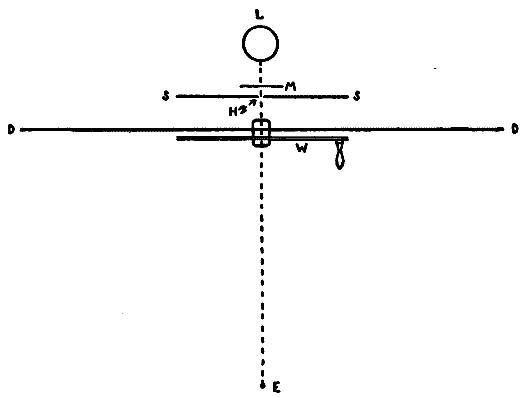
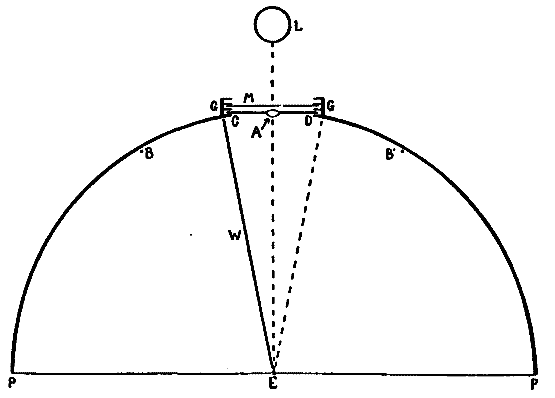
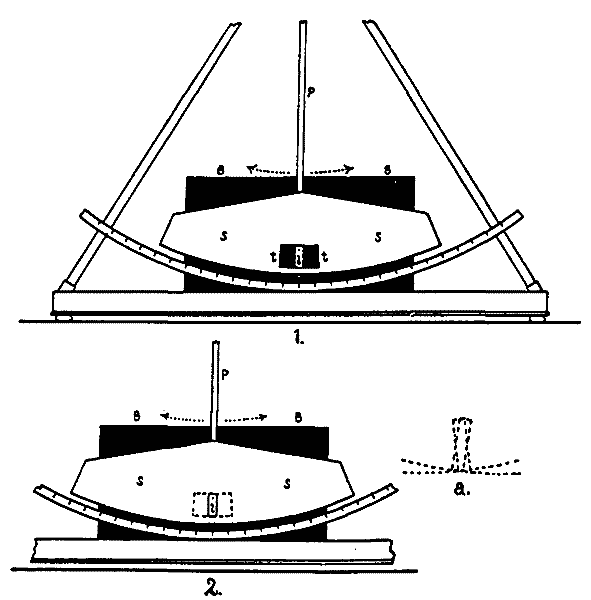
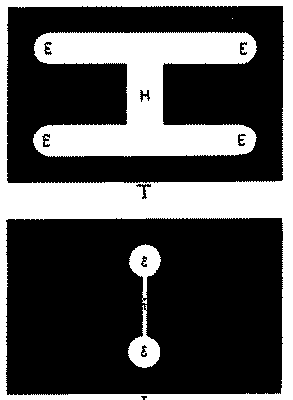
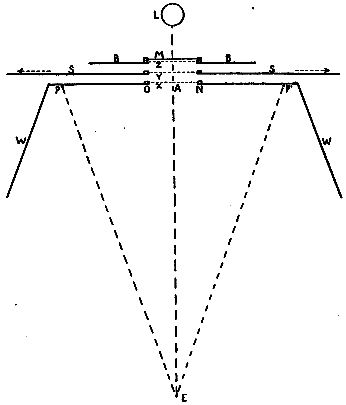
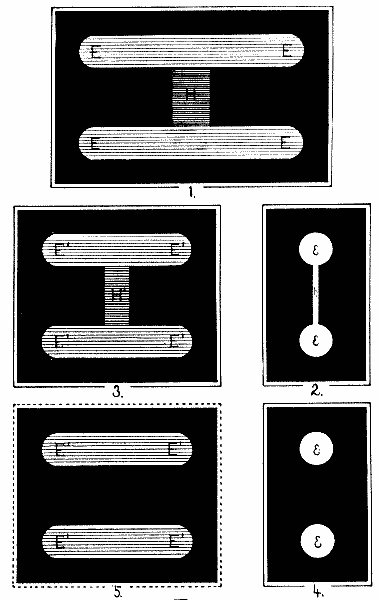
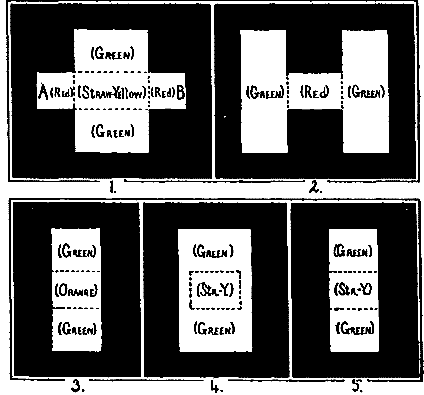
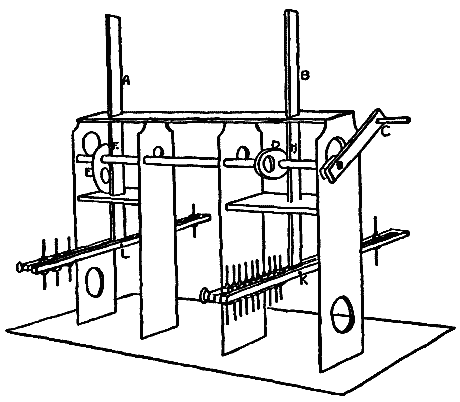
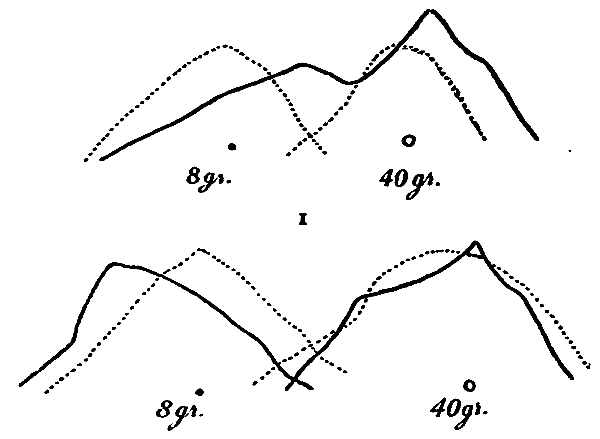
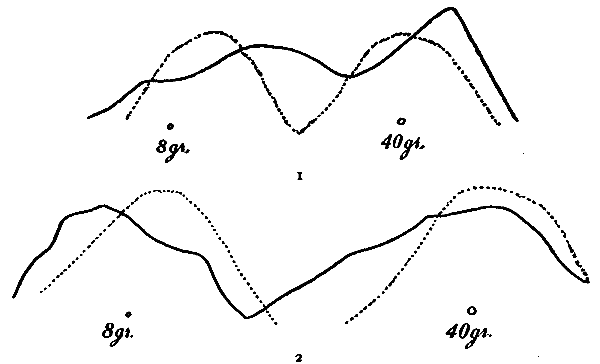
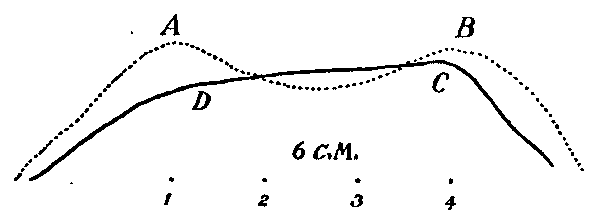
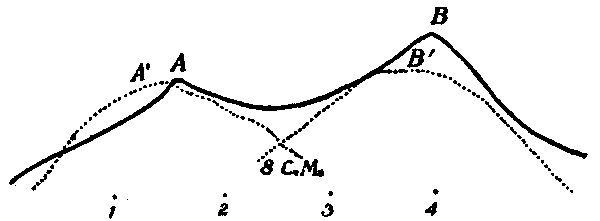
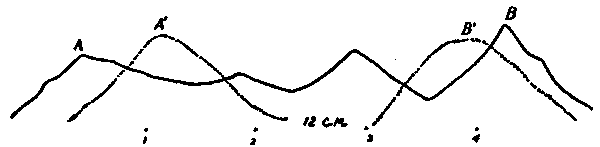
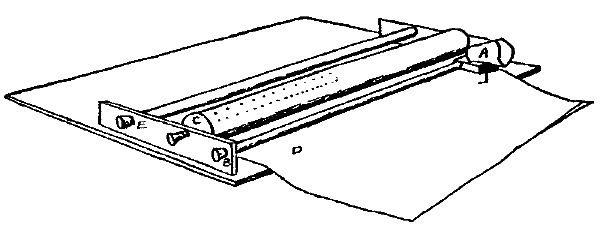
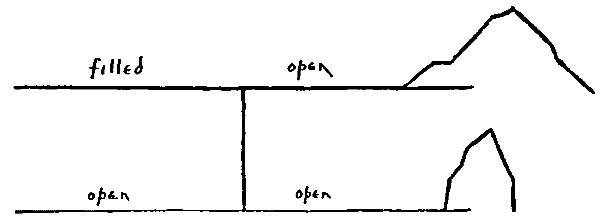
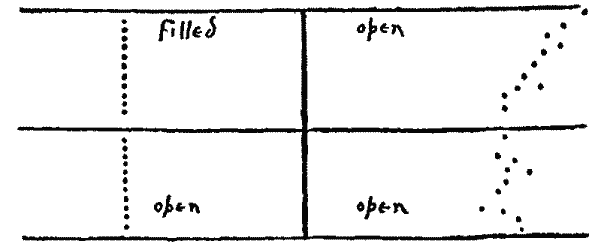
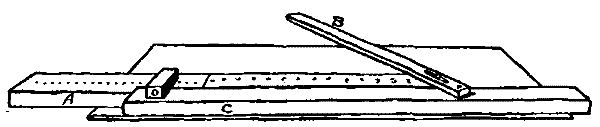
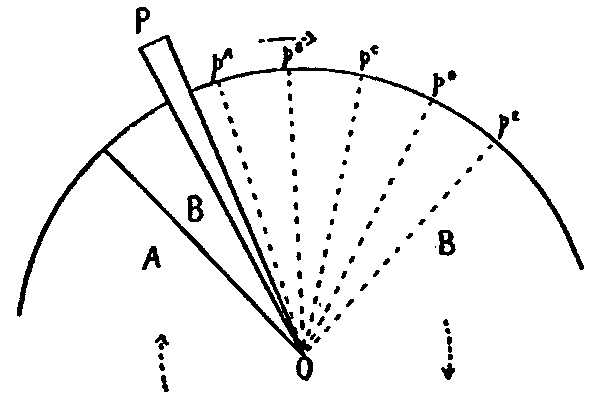
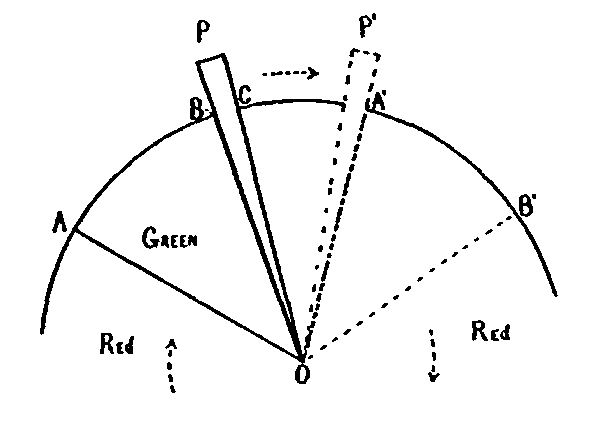
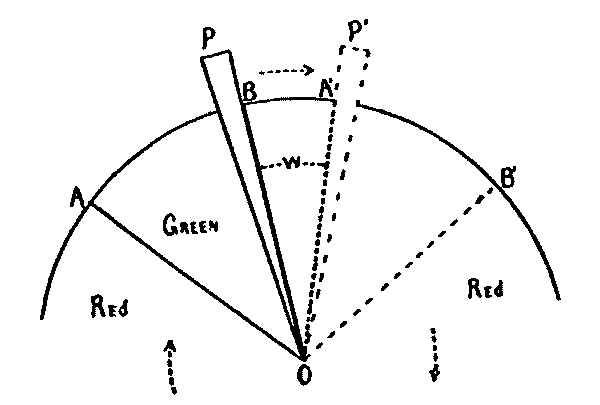
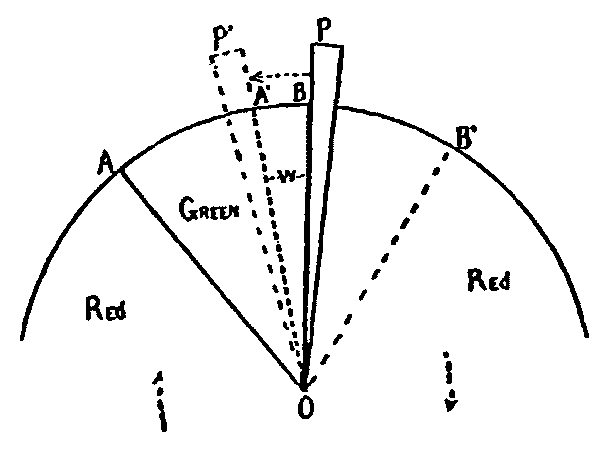
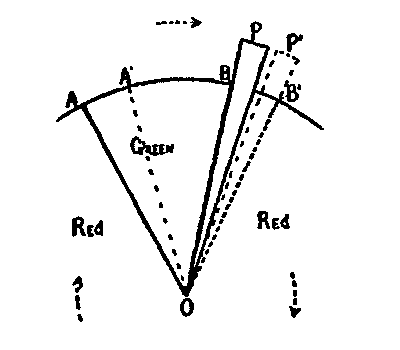
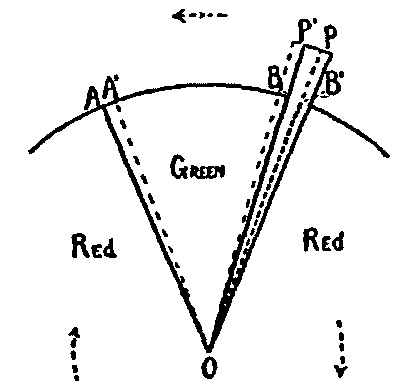


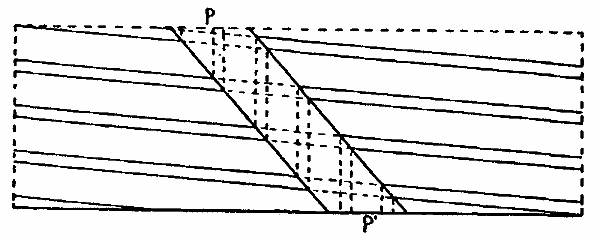
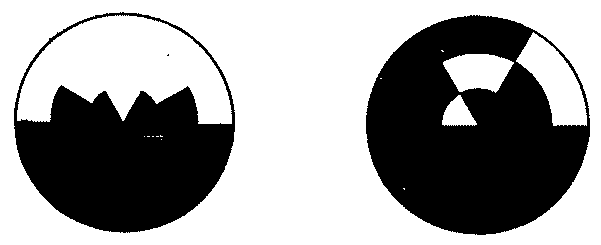
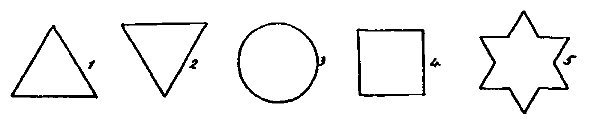
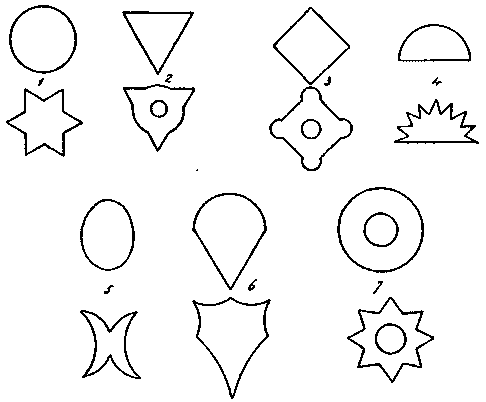
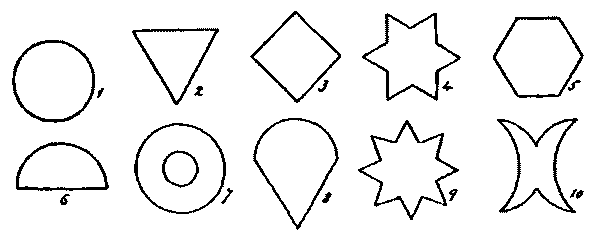


 ; another having that represented
in the symbol
; another having that represented
in the symbol
 and so on. Variations in
intensity were obtained by mounting a second series of contacts
on the same shaft and in alignment with those already
described. The number of these secondary contacts was less
than that of the primary connections, their teeth corresponding
to every second or third of those. The connections made by
these contacts were with a second loop, which also contained
within its circuit the telephone receiver by which the sounds
were produced. The rheostatic resistances introduced into this
second circuit were made to depart more or less from that of
the first, according as it was desired to introduce a greater or
slighter periodic accent into the series. This mechanism was
designed for the purpose of determining the characteristic
sequences of long and short elements in the rhythm group.
and so on. Variations in
intensity were obtained by mounting a second series of contacts
on the same shaft and in alignment with those already
described. The number of these secondary contacts was less
than that of the primary connections, their teeth corresponding
to every second or third of those. The connections made by
these contacts were with a second loop, which also contained
within its circuit the telephone receiver by which the sounds
were produced. The rheostatic resistances introduced into this
second circuit were made to depart more or less from that of
the first, according as it was desired to introduce a greater or
slighter periodic accent into the series. This mechanism was
designed for the purpose of determining the characteristic
sequences of long and short elements in the rhythm group.
 for
example. Variation, subordination, synthesis, are present in
every rhythmical sequence. The regular succession is interrupted
by variant groups; points of initiation in the form of
redundant syllables, points of finality in the form of syncopated
measures, are introduced periodically, making the rhythm form
a complex one, the full set of relations involved being represented
only by the complete succession of elements contained
between any one such point of initiation and its return.
for
example. Variation, subordination, synthesis, are present in
every rhythmical sequence. The regular succession is interrupted
by variant groups; points of initiation in the form of
redundant syllables, points of finality in the form of syncopated
measures, are introduced periodically, making the rhythm form
a complex one, the full set of relations involved being represented
only by the complete succession of elements contained
between any one such point of initiation and its return.
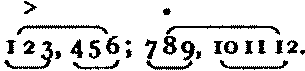

 is replaced
by
is replaced
by 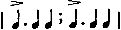 , for example) may
conceivably be hastened or retarded by other factors than that
of the simple rate of succession. The degrees of segregation
and accentuation which characterize the rhythmic unit are elements
which may thus affect the higher synthesis. Increase in
either of these directions gives greater definition to the rhythmic
figure and should tend to preserve the simple group in consciousness.
The latter relation was not made the subject of special
investigation in this research. The former was taken up at a
single point. The sounds were two in number, alternately accented
and unaccented, produced by hammer-falls of 7/8 and 1/8
inch respectively. These were given at three rates of succession,
and three different degrees of segregation were compared together.
In the following table is given, for six subjects, the
, for example) may
conceivably be hastened or retarded by other factors than that
of the simple rate of succession. The degrees of segregation
and accentuation which characterize the rhythmic unit are elements
which may thus affect the higher synthesis. Increase in
either of these directions gives greater definition to the rhythmic
figure and should tend to preserve the simple group in consciousness.
The latter relation was not made the subject of special
investigation in this research. The former was taken up at a
single point. The sounds were two in number, alternately accented
and unaccented, produced by hammer-falls of 7/8 and 1/8
inch respectively. These were given at three rates of succession,
and three different degrees of segregation were compared together.
In the following table is given, for six subjects, the
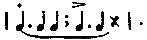 The pause at
the close of the group is indispensable, because on its presence
depends the maintenance of equivalence between the successive
three-groups. On the other hand, the introduction of a similar
pause at the close of a six-beat group is inadmissible, because
the subdivision is into three-beat groups, each of which is complete,
so that the addition of a final pause would utterly unbalance
the first and second members of the composite group,
which would then be represented by the following notation:
The pause at
the close of the group is indispensable, because on its presence
depends the maintenance of equivalence between the successive
three-groups. On the other hand, the introduction of a similar
pause at the close of a six-beat group is inadmissible, because
the subdivision is into three-beat groups, each of which is complete,
so that the addition of a final pause would utterly unbalance
the first and second members of the composite group,
which would then be represented by the following notation:
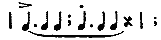 that is, a three-group would alternate
with a four-group, the elements of which present the same simple
time relations, and the rhythm, in consequence, would be
destroyed. The same conditions require or prevent the introduction
of a final pause in the case of the remaining rhythm
forms.
that is, a three-group would alternate
with a four-group, the elements of which present the same simple
time relations, and the rhythm, in consequence, would be
destroyed. The same conditions require or prevent the introduction
of a final pause in the case of the remaining rhythm
forms. etc.
An indication of this process of differentiation into major and minor phases appears
in the form of rhythm groups containing upwards of four
elements. In these the tendency is, as one observer expresses it,
'to consider the first two beats as a group by themselves, with the
others trailing off in a monotonous row behind.' As the series
of elements thus bound up as a unit is extended, the number of
beats which are crowded into the primary subgroup also increases.
When the attempt was made to unite eleven or twelve
reactions in a single group, the first four beats were thus taken
together, with the rest trailing off as before. It is evident that the
lowest groups with which attention concerned itself here were
composed of four beats, and that the actual form of the (nominally)
unitary series of eleven beats was as follows:
etc.
An indication of this process of differentiation into major and minor phases appears
in the form of rhythm groups containing upwards of four
elements. In these the tendency is, as one observer expresses it,
'to consider the first two beats as a group by themselves, with the
others trailing off in a monotonous row behind.' As the series
of elements thus bound up as a unit is extended, the number of
beats which are crowded into the primary subgroup also increases.
When the attempt was made to unite eleven or twelve
reactions in a single group, the first four beats were thus taken
together, with the rest trailing off as before. It is evident that the
lowest groups with which attention concerned itself here were
composed of four beats, and that the actual form of the (nominally)
unitary series of eleven beats was as follows:

 .
. on a basis of two-beat units, or into
  on a basis of three-beat units.
 one reactor says,
and his description may stand for all, "This deliberate introduction
of a third accent on the last beat is almost impossible
for me to keep. The single group is easy enough and rather
agreeable, but in a succession of groups the secondarily accented
third beat comes against the first of the next group with a very
disagreeable effect." This is the case where no pause intervenes
between the groups, in which case the rhythm is destroyed
by the suppression, in each alternate simple group, of the unaccented
phase; thus,
one reactor says,
and his description may stand for all, "This deliberate introduction
of a third accent on the last beat is almost impossible
for me to keep. The single group is easy enough and rather
agreeable, but in a succession of groups the secondarily accented
third beat comes against the first of the next group with a very
disagreeable effect." This is the case where no pause intervenes
between the groups, in which case the rhythm is destroyed
by the suppression, in each alternate simple group, of the unaccented
phase; thus,  alone is pleasant, because it becomes
 , but in combination with preceding and
succeeding groups it is disagreeable, because it becomes in reality
, but in combination with preceding and
succeeding groups it is disagreeable, because it becomes in reality
 , etc. A long pause between the groups destroys
this disagreeableness, since the lacking phase of the second
subgroup is then restored and the rhythm follows its normal
course.
, etc. A long pause between the groups destroys
this disagreeableness, since the lacking phase of the second
subgroup is then restored and the rhythm follows its normal
course. , is more difficult to
maintain than either the dactylic or the trochaic, and in a continuous
series tends to pass over into one of these, usually
the former. 'With sufficient pause,' the reactors report, 'to
allow the attitude to die away,' it is easily got. The same inability
to maintain this form in consciousness appears when a continuous
series of clicks is given, every third of which is louder
than the rest. Even when the beginning of the series is made
coincident with the initial phase of the amphibrachic group the
rhythmic type slips over into the dactylic, in spite of effort. In
this, as in the preceding type of reaction, if the interval separating
adjacent groups be lengthened, the rhythm is maintained
without trouble. The 'dying away' of the attitude lies really
in such an arrangement of the intervals as will formally complete
a phrase made up of simple two-beat units.
, is more difficult to
maintain than either the dactylic or the trochaic, and in a continuous
series tends to pass over into one of these, usually
the former. 'With sufficient pause,' the reactors report, 'to
allow the attitude to die away,' it is easily got. The same inability
to maintain this form in consciousness appears when a continuous
series of clicks is given, every third of which is louder
than the rest. Even when the beginning of the series is made
coincident with the initial phase of the amphibrachic group the
rhythmic type slips over into the dactylic, in spite of effort. In
this, as in the preceding type of reaction, if the interval separating
adjacent groups be lengthened, the rhythm is maintained
without trouble. The 'dying away' of the attitude lies really
in such an arrangement of the intervals as will formally complete
a phrase made up of simple two-beat units. ),
no more possess
rhythmically substitutionary values than does the opposition of
a single beat to an extended series (e.g.,
),
no more possess
rhythmically substitutionary values than does the opposition of
a single beat to an extended series (e.g.,  ) ,
apart
from this factor of temporal proportion. Those groups which
are identical in figure must also be uniform in duration if they
are to enter as substitutionary groups into a rhythmical sequence.
) ,
apart
from this factor of temporal proportion. Those groups which
are identical in figure must also be uniform in duration if they
are to enter as substitutionary groups into a rhythmical sequence.
 , or
, or
 .
. and
and
 .
. or
or
 but not either at the subjects'
preference), so that no material was there afforded for a determination
of the primacy of particular figures; but the results
must of course show any tendency which exists toward an increased
accentuation of the syncopated measure. It needs but a
cursory reference to the statements of these results in Pt. III.,
B, of this paper, to observe how constant and pronounced this
tendency is.
but not either at the subjects'
preference), so that no material was there afforded for a determination
of the primacy of particular figures; but the results
must of course show any tendency which exists toward an increased
accentuation of the syncopated measure. It needs but a
cursory reference to the statements of these results in Pt. III.,
B, of this paper, to observe how constant and pronounced this
tendency is. and
and  are demonstrably of shorter average duration than the
corresponding measures
are demonstrably of shorter average duration than the
corresponding measures and
and  ;
and the pause
occurring at the close of a syncopated line—such as that in the
middle of a catalectic trochaic tetrameter—should be found of
less value than that of the regular foot.
;
and the pause
occurring at the close of a syncopated line—such as that in the
middle of a catalectic trochaic tetrameter—should be found of
less value than that of the regular foot. .
. , with
an average ratio of 0.969:1.072. The original relation, however,
, with
an average ratio of 0.969:1.072. The original relation, however,