The paramount position of War Finance was brought vividly and
continuously before the whole people of the United States by the Liberty
Loan campaigns. This lesson was an old one though it was enforced by all
the improved methods of modern publicity. To Napoleon Bonaparte is
attributed the statement that three things are necessary to wage a
successful war: money, more money, and still more money.
It has been well said that:
"Perhaps the greatest surprise of the war to most people, even to those
who had studied political economy, has been the enormous expenditure of
money which a nation can incur, and the length of time which it can go
on fighting without complete exhaustion. This should not have been in
reality a surprise to anyone who had studied past history, for all
experience shows that lack of money itself has never prevented a nation
from continuing to fight, if it were determined to fight. The financial
condition of Revolutionary France at the commencement of Napoleon's
career was wretched in the extreme, yet France went on fighting for
nearly twenty years after that. The Balkan States can hardly be said
ever to have had great financial resources, and yet they fought, one
after the other, two severe wars, and are now fighting a third still
more severe and prolonged. The Boers in South Africa found no difficulty
in fighting the British Empire for three years with practically no
financial resources. The Mexicans recently managed to fight one another
for a good many years in the same way. Lastly, the Southern states in
our own Civil War fought for years a desperate and losing fight and were
ultimately beaten to the ground, not so much by a lack of money, as by
an actual lack of things to live on and fight with. In fact, all history
proves, and this war proves over again, that if what the Germans call
'the will to fight' exists lack of money will never stop a nation's
fighting, provided it possesses or can obtain its absolutely minimum
requirements of food, clothing, and munitions of war. It was Bismarck
who said: 'If you will give me a printing press, I will find you the
money.' In finding the money required for an exhausting war a nation is
driven to all sorts of desperate financial expedients which may very
seriously affect its economic life, but if a nation wants to continue
fighting and can produce, or be induced to produce, the things that are
absolutely necessary for life and warfare, the government will get hold
of those things somehow. If it cannot get them in any other way,
ultimately it will take them."
When the war opened England was in the strongest position of any of the
Allies. She was the greatest creditor nation in the world. That is, she
was able to purchase goods from foreign countries on easier terms than
her associates. Russia and Italy were debtor nations and had to borrow
even before the war in order to balance their foreign accounts. So these
members of the Entente had to be assisted in making purchases abroad.
England was able for a long time to keep up her exchange rate in New
York. This was done by the shipment of gold and by inducing the holders
of American securities in England to sell or lend such securities to
their government.
England was forced to act as the agent of other Powers who were fighting
with her. Until the United States came in, it was the greatest
industrial arsenal among the Allies. Large imports were naturally a
feature of this policy. The United States soon began to feel the result
of the changes in international credit. Exports almost doubled between
1912 and 1917, the figures being in millions, $2,399,000,000 and
$6,231,000,000, respectively.
Another side of the United States trade account to the world is
indicated by the following classified list of loans to January,
1917:
"Between August 1, 1914, and December 31, 1916, the loans raised in the
United States by foreign countries were estimated to reach
$2,325,900,000, of which $175,000,000 had been repaid. The net
indebtedness on January 1, 1917, was therefore $2,150,900,000. The loans
may be classified geographically as follows:
| Europe | $1,893,400,000 |
| Canada | 270,500,000 |
| Latin America | 157,000,000 |
| China | 5,000,000 |
| ——————— |
| Total foreign loans | $2,325,900,000 |
| Less amount paid, | 175,000,000 |
| ——————— |
| Net foreign indebtedness | $2,150,900,000 |
"The loans of the belligerent countries which
were floated in the United States up to the close
of 1916 are divided as follows:
| Great Britain | $908,400,000 | |
| France | 695,000,000 | |
| Russia | 160,000,000 | |
| Germany | 45,000,000 |
[1] |
| Canada | 270,500,000 | |
| ———————— |
| Total | $2,078,900,000 |
[2] |
A new pace in war finance was set by the United States when it became a
belligerent. It had to provide for an increase of taxation ascending
from the point of $3,000,000,000 in 1917 to over $8,000,000,000 in 1918.
The largest source of estimated revenue was from taxes on excess
profits, including war profits of $3,100,000,000, and the next was from
taxes on incomes, $1,482,186,000 from individuals, and $828,000,000 from
corporations. The New York Journal of Commerce shows by the following
table the difference between the old and the new system of taxation.
Exemptions under the new law were the same as under the old: $1,000 for
single persons and $2,000 for married, $200 additional allowed for each
dependent child under eighteen years of age:
| Incomes | Tax Under |
|---|
| Old | New |
|---|
| Law | Law |
|---|
| $2,500 | $10 | $30 |
| 3,000 | 20 | 60 |
| 3,500 | 30 | 90 |
| 4,000 | 40 | 120 |
| 4,500 | 60 | 150 |
| 5,000 | 80 | 180 |
| 5,500 | 105 | 220 |
| 6,000 | 130 | 260 |
| 6,500 | 155 | 330 |
| 7,000 | 180 | 400 |
| 7,500 | 205 | 470 |
| 8,000 | 235 | 545 |
| 8,500 | 265 | 620 |
| 9,000 | 295 | 695 |
| 9,500 | 325 | 770 |
| 10,000 | 355 | 845 |
| 12,500 | 530 | 1,320 |
| 15,000 | 730 | 1,795 |
| 20,000 | 1,180 | 2,895 |
| 25,000 | 1,780 | 4,240 |
| 30,000 | 2,380 | 5,595 |
| 35,000 | 2,980 | 7,195 |
| 40,000 | 3,580 | 8,795 |
| 45,000 | 4,380 | 10,645 |
| 50,000 | 5,180 | 12,495 |
| 55,000 | 5,980 | 14,695 |
| 60,000 | 6,780 | 16,895 |
| 70,000 | 8,880 | 21,895 |
| 80,000 | 10,980 | 27,295 |
| 100,000 | 16,180 | 39,095 |
| 150,000 | 31,680 | 70,095 |
| 200,000 | 49,180 | 101,095 |
| 300,000 | 92,680 | 165,095 |
| 500,000 | 192,680 | 207,095 |
| 1,000,000 | 475,180 | 647,095 |
| 5,000,000 | 3,140,180 | 3,527,095 |
The following estimated yield from other sources is given by the same
authority:
"Transportation—Freight, $75,000,000; express, $20,000,000;
passenger fares, $60,000,000; seats and berths, $5,000,000; oil by pipe
lines, $4,550,000.
"Beverages (liquors and soft drinks), $1,137,600,000; stamp taxes,
$32,000,000; tobacco cigars, $61,364,000; cigarettes, $165,240,000;
tobacco, 104,000,000; snuff, $9,100,000; papers and tubes, $1,500,000.
"Special Taxes.—Capital stock, $70,000,000; brokers, $1,765,000;
theaters, etc., $2,143,000; mail order sales, $5,000,000; bowling
alleys, billiard and pool tables, $2,200,000; shooting galleries,
$400,000; riding academies, $50,000; business license tax, $10,000,000;
manufacturers of tobacco, $69,000; manufacturers of cigars, $850,000;
manufacturers of cigarettes, $240,000; use of automobiles and motor
cycles, $72,920,000.
"Telegraph and telephone messages, $15,000,000; insurance, $12,000,000;
admissions (theaters, circuses, etc.), $100,000,000; club dues,
$9,000,000.
"Excise Taxes.—Automobiles, etc., $123,750,000; jewelry, sporting
goods, etc., $80,000,000; other taxes on luxuries at 10 percent.,
$88,760,000; other taxes on luxuries (apparel, etc., above certain
prescribed prices), at 20 percent., $181,095,000.
"Gasoline, $40,000,000; yachts and pleasure boats, $1,000,000."
"The income tax law levies on all citizens or residents of the United
States a normal tax of 12 percent. upon the amount of income in excess
of exemptions, except that on the first $4,000 of the taxable amount the
rate shall be 6 percent. The law also increases the surtaxes all along
the line. The advances by grades compared with the percentage under the
old law are: $5,000 to $7,500 incomes, increased from 1 to 2 percent.;
$7,500 to $10,000, from 2 to 3 percent.; $10,000 to $12,500, from 3 to 7
percent.; $12,500 to $15,000, from 4 to 7 percent.; $15,000 to $20,000,
from 5 to 10 percent.; $20,000 to $30,000, from 8 to 15 percent.;
$30,000 to $40,000, from 8 to 20 percent.; $40,000 to $50,000, from 12
to 25 percent.; $50,000 to $60,000, from 12 to 32 percent.; $60,000 to
$70,000, from 17 to 38 percent.; $70,000 to $80,000, from 17 to 42
percent.; $80,000 to $90,000, from 22 to 46 percent.; $90,000 to
$100,000, from 22 to 46 percent.; $100,000 to $150,000, from 27
to 50 percent.; $150,000 to $200,000, from 31 to 50 percent.; $200,000
to $250,000, from 37 to 52 percent.; $250,000 to $300,000, from 42 to 55
percent. The rate continues to increase, but on incomes of over
$5,000,000 the increase is only from 63 percent., under former law to 65
percent."
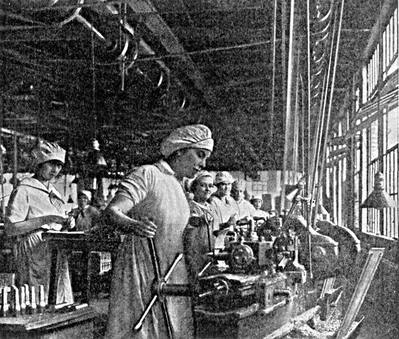
Copyright by International Film Service
Women Munition Workers in the International Fuse and Arms Works
Before entering the war, the United States was the great
arsenal of the Allies. After our entry, production of munitions increased, while
the man power in the industry diminished through enlistments and the draft.
Women took up the work and showed surprising ability.
Click for a larger image.
According to a calculation published in the New York World the war
revenue bill imposed a war tax of $80 on every man, woman and child in
the United States, or approximately $400 for each family. The amount
expected to be derived from each item is given in the following table:
| Individual income tax | $1,482,186,000 |
| Corporation income tax | 894,000,000 |
| Excess and war profits | 3,200,000,000 |
| Estate tax | 110,000,000 |
| Transportation | 164,550,000 |
| Telegraph and telephone | 16,000,000 |
| Insurance | 12,000,000 |
| Admissions | 100,000,000 |
| Club dues | 9,000,000 |
| Excise, luxury, and semi-luxury | 518,305,000 |
| Beverages | 1,137,600,000 |
| Stamp taxes—chiefly documentary | 32,000,000 |
| Tobacco and products | 341,204,000 |
| Special business and automobile-user's Taxes |
165,607,000 |
| ——————— |
| Total | $8,182,452,000 |
With the operation of this tax the people of the United States found it
no longer possible to speak in terms of opprobrium of the tax-ridden
people of Europe. The American income tax has a higher rate on large
incomes than that provided for under the English system. A man in the
United States with an income of $5,000,000 is taxed nearly 50
percent., more than in England. The New York Tribune published tables
printed below comparing the income tax rates of the United States with
those existing in France and in Great Britain.
A compilation made for the Wall Street Journal shows that the United
States income tax even with the increases made in 1918 was still far
lower than the English income tax:
"The great bulk, numerically, of incomes taxed in 1917 was in the field
reached by the lowering of the exemption in the 1917 law.... It is a
fact, however, that no one of these new taxpayers was called on to
contribute more than $40 to the government, as the rate was only 2
percent., while all other incomes paid a basic normal tax of 4 percent.
The lowest rate for normal tax in Great Britain is 2 shillings and 3
pence on the pound, or 11¼ percent., and the exemption is only
$600. The basic normal tax under the new English law is 6 shillings on
the pound, or 30 percent., on all incomes over $25,000.
"Actual rate, allowing for deductions, normal tax, and
surtaxes, based on taxes on incomes of heads of families.
Persons with no dependents pay more; those with more than one
pay less. $2,000 is exempted for heads of families, $1,000 for
bachelors. Below $4,000, 6 per cent. is the normal tax; above,
12 per cent. Surtaxes begin at $5,000."
| ————— United
States————— |
United Kingdom | France |
| Old Law | New Law |
Rate (per cent.) |
| Income | Amount | Rate (per cent.) | Amount | Rate
(per cent.) | Unearned | Earned | Rate (per cent.) |
| $2,500 | $10 | .40 | $30 | 1.20 |
11.25 | 8.44 | 1.25 |
| 3,000 | 20 | .67 | 60 | 2.00 |
14.84 | 11.87 | 1.67 |
| 3,500 | 30 | .86 | 90 | 2.57 |
16.24 | 12.96 | 2.07 |
| 4,000 | 46 | 1.00 | 120 | 3.00 |
18.16 | 14.53 | 2.44 |
| 4,500 | 60 | 1.33 | 150 | 3.33 |
18.75 | 15.00 | 2.86 |
| 5,000 | 80 | 1.60 | 180 | 3.60 |
18.75 | 15.00 | 3.20 |
| 5,500 | 105 | 1.91 | 220 | 4.00 |
22.50 | 18.75 | 3.48 |
| 6,000 | 130 | 2.16 | 260 | 4.33 |
22.50 | 18.75 | 3.71 |
| 6,500 | 155 | 2.38 | 330 |
5.08 | 22.50 | 18.75 | 3.90 |
| 7,000 | 180 | 2.57 | 400 |
5.71 | 22.50 | 18.75 | 4.07 |
| 7,500 | 205 | 2.73 | 470 |
6.27 | 22.50 | 18.75 | 4.21 |
| 8,000 | 235 | 2.93 | 545 |
6.81 | 26.25 | 22.50 | 4.34 |
| 8,500 | 265 | 3.12 | 620 |
7.29 | 26.25 | 22.50 | 4.53 |
| 9,000 | 295 | 3.28 | 695 |
7.72 | 26.25 | 22.50 | 4.69 |
| 9,500 | 325 | 3.42 | 770 | 8.11 |
26.25 | 22.50 | 4.84 |
| 10,000 | 355 | 3.55 | 845 |
8.45 | 26.25 | 22.50 | 4.98 |
| 12,500 | 530 | 4.24 | 1,320 |
10.56 | 30.00 | 26.25 | 5.53 |
| 15,000 | 730 | 4.87 | 1,795 |
11.97 | 32.08 | 32.08 | 6.07 |
| 20,000 | 1,180 | 5.90 | 2,895 |
14.48 | 34.06 | 34.06 | 6.99 |
| 25,000 | 1,780 | 7.12 | 4,245 |
16.98 | 35.75 | 35.75 | 7.84 |
| 30,000 | 2,380 | 7.93 | 5,595 |
18.65 | 37.29 | 37.29 | 8.41 |
| 35,000 | 2,980 | 8.51 | 7,195 |
20.56 | 38.75 | 38.75 | 8.99 |
| 40,000 | 3,580 | 8.95 | 8,795 |
21.99 | 39.84 | 39.84 | 9.43 |
| 45,000 | 4,380 | 9.73 | 10,645 |
23.66 | 40.97 | 40.97 | 9.77 |
| 50,000 | 5,180 | 10.36 | 12,495 |
24.99 | 41.88 | 41.88 | 10.05 |
| 55,000 | 5,980 | 10.87 | 14,695 |
26.72 | 42.84 | 42.84 | 10.27 |
| 60,000 | 6,780 | 11.30 | 16,895 |
28.16 | 43.65 | 43.65 | 10.45 |
| 70,000 | 8,880 | 12.69 | 21,895 |
31.26 | 44.91 | 44.91 | 10.75 |
| 80,000 | 10,980 | 13.72 | 27,295 |
34.12 | 45.86 | 45.86 | 10.96 |
| 100,000 | 16,180 | 16.18 | 39,095 |
39.10 | 47.19 | 47.19 | 11.27 |
| 150,000 | 31,680 | 21.12 | 70,095 |
46.73 | 48.96 | 48.96 | 11.68 |
| 200,000 | 49,180 | 24.59 | 101,095 |
50.55 | 49.84 | 49.84 | 11.89 |
| 300,000 | 92,680 | 30.89 | 165,095 |
55.03 | 50.73 | 50.73 | 12.09 |
| 500,000 | 192,680 | 38.54 | 297,095 |
59.42 | 51.44 | 51.44 | 12.25 |
| 1,000,000 | 475,180 | 47.52 | 647,095 |
64.71 | 51.97 | 51.97 | 12.38 |
| 5,000,000 | 3,140,000 | 62.80 |
3,527,095 | 70.54 | 52.39 | 52.39 | 12.48 |
[Pg 5]
"If the new normal tax in the United States were made uniformly 12
percent.—wiping out the 2 percent. discrimination of the 1917
law—a single man in this country with a salary of $1,500 a
year would be called on to pay $60 in income tax, as against an
English tax of $101.25. Assuming that the normal tax were raised to
12 percent. and the surtax and excess tax were left as at present,
an unmarried American with a salary of $10,000 would pay $1,430.20,
while the unmarried Englishman would pay $2,250. If the Englishman
derived his $10,000 income from rentals, his tax would be increased
to $2,625, while the American tax would be reduced to
$1,165—an Irish dividend on effort.
"According to a level where the British surtax becomes effective,
take a salary of $20,000. The English normal tax on this would be
$6,000 and the surtax $812.50 (figuring $5 to the pound), a total of
$6,812.50. At the suggested rate of 12 percent., the American's
normal tax would be $2,145.60 (rate applying to $20,000, less $1,000
exemption and $1,120 excess tax); the surtax would be $444 and the
excess tax $1,120; a total of $3,709.60. If the American cut
non-tax-free coupons for his income instead of working for it, his
tax would be reduced to $2,780, making it more than $600, less than
one-half the English tax. This, be it remembered, is figuring the
American normal tax at the supposititious rate of 12 percent.
"Going abruptly to an income of $1,000,000, the American normal tax
at 12 percent., would be $119,880, against an English normal tax of
$300,000. The increase in the American normal tax would be $79,960
over present rates. The American surtax at present rates would be
$435,300, as against a British surtax of $217,915; total American,
$555,180, English, $519,687.50. No account is taken in this
computation of any excess tax on the American income. With an income
of $3,000,000. the American normal tax at 12 percent. would be
$359,880, an increase of $239,960 over present rates. The surtax at
present rates would be $1,680,300, a total of $2,040,180, or nearly
70 percent., the rate on the last $1,000,000 being at 75 percent.
The corresponding British tax is, normal, $900,000, and surtax
$669,685; total, $1,569,685, or nearly 52 percent., the actual
maximum rate being 52½ percent. on all excess over $50,000.
"Expressed in tabular form, comparative results from a normal tax of
12 percent., combined with present surtax rates and assuming all
income up to $50,000 to be earned income for a single man, would be
as follows:
| Income | U.S. Tax |
Per Cent. | British Tax |
Per Cent. |
| $1,500 | $60.00 |
4.00 | $101.25 |
6.75 |
| 3,000 | 240.00 |
8.00 | 375.00 |
12.50 |
| 5,000 | 480.00 |
9.60 | 750.00 |
15.00 |
| 7,500 | 789.40 |
10.52 | 1,406.25 |
18.75 |
| 10,000 | 1,430.20 |
14.30 | 2,250.00 |
22.50 |
| 15,000 | 2,534.80 |
16.90 | 4,812.50 |
32.08 |
| 20,000 | 3,709.60 |
18.55 | 6,812.50 |
34.06 |
| 30,000 | 6,336.00 |
21.12 | 11,187.50 |
37.29 |
| 40,000 | 8,956.00 |
22.39 | 15,937.50 |
39.84 |
| 50,000 | 11,855.20 |
23.71 | 20,937.50 |
40.18 |
| 75,000 | 18,605.20 |
24.81 | 34,062.50 |
45.42 |
| 100,000 | 26,855.20 |
26.80 | 47,187.50 |
47.19 |
| 150,000 | 46,355.20 |
30.90 | 73,437.50 |
48.96 |
| 250,000 | 92,355.20 |
36.94 | 125,937.50 |
50.37 |
| 500,000 | 235,355.20 |
47.07 | 257,187.50 |
51.44 |
| 700,000 | 359,355.20 |
51.33 | 362,187.50 |
51.74 |
| 750,000 | 390,355.20 |
52.05 | 388,437.50 |
51.79 |
| 1,000,000 | 557,855.20 |
55.78 | 519,687.50 |
51.97 |
| 3,000,000 | 2,042,855.20 |
68.09 | 1,569,687.50 |
52.32 |
| 10,000,000 | 7,292,855.20 |
72.93 | 5,244,687.50 |
52.45 |
"With additional exemption of $1,000 for heads of families and $200 each
for dependent children, the United States figures in the table would be
reduced by $120 for the $1,000 exemption and $24 for each child. There
are similar deductions to be made in the English figures. Furthermore,
for incomes above $50,000, deduction for the excess tax has not been
figured exactly in order to avoid long computations. This would slightly
reduce the figure on the large incomes. But for demonstrative purposes,
the table gives a fairly accurate general comparison of the range of
taxes under the proposed English law and a tentative 12 percent. normal
rate under our law.
"It will be noticed that the rates would come together just below
$750,000. It is in the range between $5,000 and $500,000 incomes that
greatest divergence in rates occurs. The British tax takes its largest
jump between $10,000 and $15,000, where the surtax begins to operate.
The United States gradations are erratic and irregular, showing the
haphazard manner in which the steps of the surtax were applied."
The passing of the war tax bill was not altogether easy sailing; there
was plenty of criticism from the press throughout the country.
Republican editors and congressmen wondered why the bill did not contain
a tax on cotton, and one Pennsylvania congressman thought that the tax
levy should be at the rate of three dollars a bale. Senator Smoot of
Utah attacked the bill as a bunglesome measure.
The New York Jourial
Journal of Commerce called attention to the
discrimination between those whose income is in the form of services or
property and those who get it in cash:
"Take the case, for instance, of the salaried employee of a bank or
factory who receives $5,000 a year, out of which he pays his house rent
and his usual costs of living; contrast him with the case of a farmer
who owns his land and obtains the bulk of what he needs, both in
food, fuel, and other essentials, for himself and family in
produce or in goods obtained by trade at the neighboring village; the
situation becomes clear and shows why it is that the farming class pays
only a microscopic proportion of the income tax at the present time."
And the Democratic New York World agreed that the farmer "is not
carrying his share of the load of war taxation," and observes:
"An analysis of income tax returns for the fiscal year 1916, recently
published, shows that, although farmers are the most numerous class of
Americans engaged in gainful occupations, they were at the foot of the
list proportionately among income tax payers. Outside of the notorious
war profiteers, no element of our population has advantaged so greatly
by war as agriculturists; yet in the year of which we speak only one
farmer in four hundred paid a farthing's tax upon income. In this
respect preachers and teachers showed a higher percentage."
There was some demand for extending the income tax downwards to cover
smaller incomes, for example, we find the Council Bluffs' Nonpareil
contending:
"The men of more moderate income should be required to pay at least a
nominal income tax. This is a common country. It belongs to common
people. And common people will esteem it a privilege to contribute their
mites. One dollar per hundred on a thousand-dollar income would be both
reasonable and just."
The attitude of the New York press is indicated by the Evening Sun and
the Times. The New York Evening Sun (Rep.) said the committee "left
so many rough edges upon their work." In the opinion of this newspaper,
Mr. Kitchin "has given us a measure of class-taxation highly
accentuated, and yet has failed to suit the McAdoo group, the most
clear-minded adherents of the conscription-of-wealth idea. He has
produced a confused series of taxes beyond the practical power of the
ordinary busy citizen to master or comprehend, but has not combined
these into a harmonious system." The morning Sun even went so far as
to remark that "nothing that the Senate could do could make the Kitchin
measure worse than it is." Yet it by no means criticized all the
features of the bill. It objected to the proposed taxes on oil producers
as discouraging the production of oil, and styled the plan to tax
distributed corporation earnings at twelve percent. and undistributed
earnings at eighteen percent. "simply a fool tax," which "will help to
lock the wheels of every great industry in this country."
The foundation mistake of the bill, in the opinion of the New York
Times (Ind. Dem.) was the "attempt to assess taxes upon the smallest
possible number of persons and businesses, leaving a great majority of
the people free from a levy direct or indirect." The Times thought
that this policy was dictated by the desire "to leave the mass of voters
free from grounds of complaint against the party in power." It insisted
that there should be a consumption tax levying "upon the breakfast table
and upon the purchases of a great mass of people." Such necessities as
tea, coffee, cocoa, sugar, should bear a tax, in the opinion of this and
other newspapers. The number of those taxed was also kept comparatively
small by the retention of the old income exemption limits, namely,
$1,000 for bachelors and $2,000 for married men, with the normal tax
rate placed at only six percent. on incomes up to $5,000.
An outline of what was expected from the people of the country as a
financial contribution was given by Mr. Wilson in his May (1918) address
to Congress, when he decided to ask its members to remain in Washington
and prepare a new revenue bill. Mr. Wilson's call for immediate action
in behalf of both the public and the Treasury Department was a summons
to a universal duty in language which, it is remarked, "was never before
used in a tax speech." He said in part:
"We can not in fairness wait until the end of the fiscal year is at hand
to apprize our people of the taxes they must pay on their earnings of
the present calendar year, whose accountings and expenditures will then
be closed.
"We can not get increased taxes unless the country knows what they are
to be and practices the necessary economy to make them available.
Definiteness, early definiteness, as to what its tasks are to be is
absolutely necessary for the successful administration of the
treasury....
"The present tax laws are marred, moreover, by inequities which ought to
be remedied....
"Only fair, equitably distributed taxation of the widest incidence,
drawing chiefly from the sources which would be likely to demoralize
credit by their very abundance, can prevent inflation and keep
our industrial system free of speculation and waste.
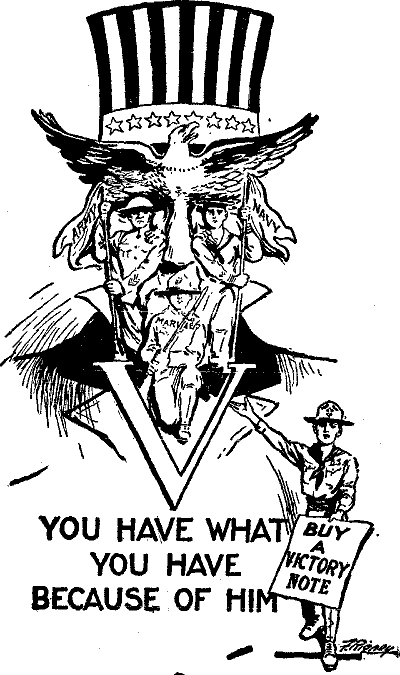
Poster for Boy Scouts Who Worked for the Victory Loan
"We shall naturally turn, therefore, I suppose, to war profits and
incomes and luxuries for the additional taxes. But the war profits and
incomes upon which the increased taxes will be levied will be the
profits and incomes of the calendar year 1918. It would be manifestly
unfair to wait until the early months of 1919 to say what they are to
be....
"Moreover, taxes of that sort will not be paid until the June of next
year, and the treasury must anticipate them....
"In the autumn a much larger sale of long-time bonds must be effected
than has yet been attempted....
"And how are investors to approach the purchase of bonds with any sort
of confidence or knowledge of their own affairs if they do not know what
taxes they are to pay and what economies and adjustments of their
business they must effect? I can not assure the country of a successful
administration of the treasury in 1918 if the question of further
taxation is to be left undecided until 1919."
Mr. Wilson's appeal for the practice of personal economy met with
widespread approval in England, as it did in the United States. The
Economist considered that his manifesto to the American people on this
subject was among the greatest documents that the war has produced.
National self-sacrifice had gone far, but not far enough. To attain Mr.
Wilson's standard of individual patriotism much was still needed, the
Economist says:
"We still have a very long way to go before we can attain to President
Wilson's standard of individual patriotism. From the outbreak of war to
the end of last year the small investor in this country has lent
£118,179,000 to the government. Moreover, in the first two months
of 1917 as much as £40,000,000 was contributed to war loans in one
form or another in the shape of small savings. That result represents a
great deal of patriotic saving, and reflects the highest credit on the
committee, as well as upon the Montagu committee, which devised so
suitable a form of investment as the 15s 6d certificate. But far more is
required. During the war loan campaign, war savings certificates brought
in £3,000,000 in a single week. That effort was, perhaps, too
great to be kept up; but it is hardly satisfactory that, in spite of the
hard work of the committee, and an enormous growth in the number of
active war savings associations all over the country, the weekly
receipts from the 15s 6d certificates have fallen back to the
£800,000 to £900,000 level which was reached last December.
This relapse may be partially accounted for by the late increase in the
cost of living, but there can be no doubt that much more might yet be
done by the masses of people of moderate means to whom the small
certificates appeal. Nor is there any evidence that the wealthier
classes, generally speaking, have done nearly as much, in the matter of
war self denial, as they might have done."
When it came to a question of taxing luxuries, the difficulty was to
decide what was a luxury. The situation perplexed Congress, for we find
one congressman in Pennsylvania who held that collar buttons and cuff
buttons were a necessity, while a representative from Texas asserted
that Texas could get along without either collar buttons and cuff
buttons and still be patriotic. A congressman from Oklahoma thought that
all kinds of buttons could be done away with, adding, "Before I came to
Congress I could use nails for my suspenders." Congressman from
agricultural states considered that automobiles and gasoline were not
luxuries but were really necessities, especially for farmers.
Many newspapers opposed anything like a luxury tax. We find the New York
Times advising the imposition of taxes on tea, sugar, coffee and
cocoa. These are good revenue producers but few politicians care to
interfere with the free breakfast table. The Wall Street Journal
approved of luxury taxes because they would be a means of enforcing
thrift. The Treasury's plan for imposing these taxes may be gathered
from the following condensed summary:
"Fifty percent. on the retail price of jewelry, including watches and
clocks, except those sold to army officers.
"Twenty percent. on automobiles, trailers and truck units, motor cycles,
bicycles automobile, motor cycle, and bicycle tires, and musical
instruments.
"A tax on all men's suits selling for more than $30, hats over $4,
shirts over $2, pajamas over $2, hosiery over 35 cents, shoes over $5,
gloves over $2, underwear over $3, and all neckwear and canes.
"On women's suits over $40, coats over $30, ready-made dresses over $35,
skirts over $15, hats over $10, shoes over $6, lingerie over $5, corsets
over $5. Dress goods—silk over $1.50 a square yard; cotton over 50
cents a square yard, and wool over $2 per square yard. All furs, boas
and fans.
"On children's clothing—on children's suits over $15, cotton
dresses over $3, linen dresses over $5, silk and wool dresses over $8,
hats $5, shoes $4, and gloves $2.
"On house furnishings, all ornamental lamps and fixtures, all table
linen, cutlery and silverware, china and cut glass; all furniture in
sets for which $5 or more is paid for each piece; on curtains over $2
per yard, and on tapestries, rugs, and carpets over $5 per square yard.
"On all purses, pocketbooks, handbags, brushes, combs and toilet
articles, and all mirrors over $2.
"Ten percent. on the collections from the sales of vending machines.
"Ten percent. on all hotel bills amounting to more than $2.50 per person
per day. Also the present 10 percent. tax on cabaret bills is made to
apply to the entire restaurant or café bill.
"Ten cents a gallon on all gasoline to be paid by the wholesale dealers.
"Ten percent. tax on wire leases.
"Graduated taxes on soft drinks. Mineral now taxed 1 cent a gallon to
pay 16 cents. Chewing gum now taxed 2 percent. of the selling price, to
pay 1 cent on each 5-cent package.
"Motion-picture shows and films: abolish the foot tax of ¼ and
½-cent a foot and substitute a tax of 5 percent. on the rentals
received by the producer, and double the tax rate on admissions.
"Double the present taxes on alcoholic beverages, tobacco and
cigarettes.
"Automobiles—a license tax on passenger automobiles graduated
according to horsepower.
"Double club membership dues.
"Household servants, made 25 percent. of the wages of one servant up to
100 percent. of the combined wages of four or more. Female servants,
each family exempted from tax on one servant. All additional servants
(female) from 10 to 100 percent. on all over four."
Heavy taxes on luxuries were anticipated but until these taxes were
considered it was hardly realized how much of the consumption in America
was concerned with articles that could be considered luxuries; for
example, the country imported $6,000,000 worth of foreign cigarette
papers. Pictures, statuary and other works of art were brought into the
country to the extent of $17,000,000. Over $2,000,000 worth of ivory was
imported every year; over $2,000,000 worth of mother-of-pearl and more
than $2,500,000 worth of bulbs and roots. Higher taxes were urged by the
financial experts, so we see a writer in Financial America emphasizing
the connection between the importation of luxuries and the need of
shipping:
"America can not spare ships to bring costly garments and furnishings
thousands of miles across the sea. For the war period these articles can
be replaced at home with materials that cost less labor and less money.
The money spent for domestic goods remains in America and maintains our
working population and our business and banking resources.
"We lack a sufficient market for our cotton crop, owing to the lack of
ships. Americans should wear more cotton. The money spent upon it
maintains the Southern planter and his family. Modern processes give it
the appearance of silk. It serves very well as carpets, curtains,
hangings, and furniture coverings. It should answer present needs for
such fabrics. A heavier tax on imports of these goods is indicated as a
means of revenue and war economy.
"Imported wearing apparel of silk pays 60 percent. duty and of wool 44
cents a pound and 60 percent. ad valorem. There is a graduated rate on
dress goods of these materials. Despite the tax, America spent
more on imported manufactures of silk in 1917 than ever, the total being
nearly $40,000,000. The same was true of woolen goods, amounting to
$23,000,000.
"Our imports of woolen carpets and rugs, most of them brought half way
round the world from oriental lands, were also larger. They cost us
$3,740,000, though America is a large producer of carpets and rugs, fine
as well as coarse. These imports paid ten cents a square foot and 40
percent. ad valorem. Evidently, it was not enough.
"We also spent $53,000,000 for imported cotton manufactures, including
cloth, laces, curtains, handkerchiefs, veils, and wearing apparel,
though America is the world's chief producer of cotton. A higher tariff
is indicated as a tax on those who insist on the foreign product.
"America has a large tobacco industry at home. We import tobacco in vast
quantities from every producing land to satisfy the whimsical and
varying tastes of connoisseurs. Our own tobacco is discouraged by those
who smoke it under the name of Turkish, Egyptian, Cuban, Dutch, Spanish,
and other foreign products, and pay a heavy price for the critical taste
which their vanity causes them to imagine they possess. Last year these
imports of leaf tobacco alone were valued at $26,000,000, or $10,000,000
more than in 1915. The war tax is five cents a pound added to eight
cents paid under the internal revenue act, or thirteen cents altogether.
There is also a duty of $1.85 to $2.50 a pound. To increase the tax
would encourage the industry in Kentucky, Virginia, Pennsylvania,
Connecticut, and other states, while saving our resources in ships and
keeping our money at home.
"In addition, America spent $7,000,000 for foreign-made cigars and
cigarettes last year. These purchases support foreign factories,
although our own factories use the same raw material which they import.
They have jumped nearly $3,000,000 in two years. Until the war is ended,
Americans should be satisfied with cigars 'made in America.' The present
war tax ranges from one tenth of a cent to one cent on each cigar,
according to value, in addition to a duty of $4.50 a pound and 25
percent. ad valorem. A higher tax would deprive the smoker of nothing
but a craving for the foreign label on his cigar box, unless he chose to
pay well for it. He can even get a Spanish name on his American-made
cigar.
"America spent $41,000,000 in 1917 to import diamonds, pearls, and other
precious stones and imitations, not set. They paid a war tax of only 3
percent. when made into jewelry. America could be content with beauty
less adorned to keep this $40,000,000 at home, or those who insist on
sending their money to African mine owners and Dutch cutters should pay
a larger tax.
"America last year had a tremendous bill for hides and skins of
$209,000,000, nearly two and a half times that of 1915. Much of it was
for the great necessities of the army. A good proportion of the rest was
unnecessary. These imports of raw material are free of duty and there is
no war tax on leather goods. Substitutes have been devised for many of
them. These should be encouraged by a tax on the unnecessary use of
leather in furnishings, decorations, toilet articles, hand bags, trunks,
high shoes, belts, hatbands, and many small articles. Substitutes for
these will be provided quickly enough if leather is lacking. A heavy tax
would help the movement. The tremendous military and other legitimate
demands for leather goods will keep the industry in thriving condition
without so much waste.
"For imported millinery materials America spent nearly $13,000,000 last
year, and we also spent $3,000,000 for mere feathers, tributes to
feminine vanity that filled up many ships needed for war use. The
greater part of this stuff came 10,000 miles from China and Japan. There
are plenty of substitutes that a high war tax would encourage, including
those provided by the American hen.
"Our imported glassware, on which there is no war tax, cost nearly
$2,000,000. It occupies large space aboard ship, owing to voluminous
packing that is necessary. Imported china, porcelain, earthenware, and
crockery cost America nearly $6,500,000."
In spite of the enormous cost of war operations, roseate views were
taken of the ability of the country to surmount the unusual
difficulties. Unprecedented taxes were being paid, heavy subscriptions
to the Liberty Loans were being collected and yet the business of the
country seemed to show a high degree of prosperity. This optimistic
outlook marks the following comment found in a circular published by the
First National Bank in Boston, after it had called attention to the
small number of failures reported throughout the country for August,
1918. No such low record had been reached since July, 1901:
"The steps that have been taken to curtail credits have resulted in
greater conservatism, and have had a beneficent effect, which is likely
to continue for some time after the present necessity disappears. The
business foundation is extremely sound. Figures of resources of savings
banks show that the subscriptions to the Liberty Loans have
brought only a trifling decrease in savings deposits. Evidently
subscribers are buying bonds with their current income rather than with
their savings. In other words, the Liberty Loans represent additions to
the savings of the country, and not merely transfers of investments."
It was prophesied that in spite of the enormous financial obligations
assumed by the United States normal conditions would soon be restored.
History shows, the circular goes on to say, that financial recovery from
devastation has been prompt and complete. Even the railway conditions at
this time were viewed optimistically. Such a competent authority as the
Wall Street Journal did not anticipate the financial troubles that
soon overtook railway administration under government control. It
thought that, by the end of the year, the existing debits on current
operations would probably be wiped out:
"Aggregate railroad earnings and expenses for July of all the important
roads in the country are in line with the individual statements of the
different roads already published in showing large increases in both
gross and net revenues. They also indicate, so far as one month's
operating results may be used to generalize from, that the railroads are
now on a self-supporting basis, if they are not actually returning a
profit to the government on current operation.
"Net operating income of these roads for the month of July (1918) was
$137,845,425 as compared with $92,599,620 in the same month of 1917. In
a recent statement from the Director-General's office the compensation
payable to the railroad companies for the use of their property by the
government was estimated at $650,000,000 for the first eight months of
the year, or at the rate of $81,250,000 a month. The net operating
income of the Class 1 roads as mentioned above exceeds this monthly
rental figure by $56,595,000."
Although called by other names, the United States has had issues of
Liberty Bonds on several occasions during a period of one hundred and
twenty-nine years, notably in the first years of the Republic and in the
Civil War. The first was floated in 1789, the year when the Federal
Government was established. Alexander Hamilton was Secretary of the
Treasury and on him devolved the duty of raising funds for the
government.
"Conditions being pressing, Hamilton, in
raising the necessary money, at first did not wait even for the
approval of Congress, but went to the Bank of New York, which he had
helped to found in 1784—the second bank in the United States
and the first in New York City—to raise the first necessary
money. At a meeting of the board of directors the new secretary of the
treasury asked for a loan of $200,000. It was promptly and unanimously
granted, the money to be advanced in five installments of $20,000 each
and ten of $10,000 each, at 6 percent. On the following day Hamilton
sent to the bank the first bond ever issued by the United States
Treasury—a bond of $20,000—on receipt of which the money
was paid over, so that the United States Treasury could show $20,000
cash on hand. In The Investor's Magazine, where these
facts were recently brought to light, we are further told that the bond
then issued is still carefully preserved by the bank which bought it.
Quite unlike the now familiar Liberty Bonds of 1917 and 1918, it was
executed with an ordinary quill pen, such as was in use in those times,
and signed in ink by the secretary. With its seal somewhat yellow with
age, the bond is still in an excellent state of preservation."
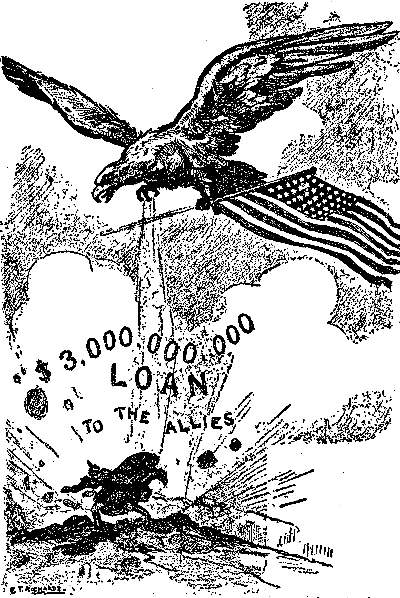
Richards in the Phila. North American
Dropping the First Bomb
America's financial reputation stood at a fairly high level after the
close of the Civil War. An era of unexampled production ensued
for more than five decades, yet there were many timorous souls who were
frightened at the thought of the United States being called upon to bear
the burden of the colossal loans. The surprising feature of the Liberty
Loans was the elasticity of the subscriptions. The subscribers for the
first three loans numbered respectively 4,500,000, 10,020,000,
17,000,000; in every case the records show over subscription. A graphic
statement of the nation's riches was presented by S. L. Frazier in the
Northwestern Banker, Des Moines, October, 1918:
"Our resources are well up toward
$300,000,000,000, or about equal to the combined resources of
France, England, and Germany. Our annual production is close to
$50,000,000,00, amounts that stagger the imagination. Why it would take
ten thousand years to count the dollars representing out
our country's
resources counting one each second, and working day and night and
Sundays."
The New York Tribune remarked, "If any learned professor of economics
had predicted that on top of ten billions of government loans in one
year a fourth Liberty Loan would reach nearly seven billions we know
what we all would have thought."
An official in the National City Bank of New York, Mr. G. E. Roberts, is
quoted by the New York Times as saying that the wealth-producing
equipment of the country had become greater than ever during the war. He
did not believe either that there would be any difficulty of the United
States being paid back for the money it had loaned foreign governments.
"We are going to be peculiarly situated in our foreign relations after
the war. We have paid off the greater part of what we owe abroad, and we
have lent to foreign governments some $7,000,000,000 or $8,000,000,000.
Including all loans by the time the war is over, probably there will be
annual interest payments coming to us amounting to $400,000,000 or
$500,000,000. How are we going to receive our pay? I am not questioning
the ability of our debtors to raise this amount from their people. I
have no doubt they can do it, but in what manner are they going to make
payment to us? They can't pay it in gold; they haven't the gold to do
it, and the total production of gold in the world outside of the United
States wouldn't be enough to do it. We won't want them to pay it in
goods, for that would interfere seriously with our home industries....
"There is only one way out, and that is by extending more credit to
them. We will have to capitalize the interest payments and reinvest them
abroad. And if we want to sell goods to them we will have to take their
bonds and stocks. In short, we will have to play the part that England
has played in the past, of steadily increasing our foreign investments."
While the great sums subscribed for the Fourth Loan by banks,
corporations, and individuals had a spectacular interest, observed the
New York World, it was the plain people who made the loan a
conspicuous success, and the twenty-one million subscribers mean in
effect the purchase of a new Liberty Bond by "every American family."
There were very good reasons on the part of the government for selecting
the definite periods at which the Liberty Loans were to be issued. There
were also very good reasons derived from experience by which the
government was guided in preparing for the loans. Prior to the fourth
loan Secretary McAdoo believed that it could be made to reach fully
one-fourth of the population of the country. Preparation for it was made
through publicity on a scale hitherto unprecedented. The Washington
correspondent of the New York Journal of Commerce, writing on July 31,
1918, said:
"The country will be appealed to, with new and striking film arguments,
with a great variety of poster slogans, and with a use of the press and
the platform such as has never been witnessed before in this country.
"There are to be nineteen days of actual campaign work. The great task
of organization and preparation is now going on. Artists have been
making posters, writers have been preparing arguments, and printing
presses in all parts of the country have been turning out many millions
of mottoes, cartoons, and slogans."
He added interesting data as to outstanding treasury certificates and
war expenses. The time chosen for the loan was probably as good, it
thought, as could have been selected, inasmuch as it would fall just
after the bulk of the crops had been harvested and when much of them had
been sold at good figures.
"War expenses for July were somewhat less than for June and May,
amounting to about $1,482,000,000 as compared with
$1,512,000,000, the record for June, and $1,508,000,000 for May, the
Treasury Department announced. The outlay for July, however, was
approximately the amount estimated in advance by the treasury, and
expenses for August probably will be higher, it was said.
"During July the government's daily outlay was about $48,000,000, an
average of $38,000,000 daily was for ordinary expenses of the army,
navy, shipping board, and other agencies, and $10,000,000 daily in loans
to the Allies. Total ordinary expenditures for the month were about
$1,157,000,000 and loans to the Allies $325,000,000.
"Receipts from sale of War Savings Stamps July 3rd passed the
half-billion dollar mark, of which $200,000,000 came in this month as a
result of the campaign on Thrift Day, June 28th.
"The government now is financing itself mainly through the sale of
certificates of indebtedness, in anticipation of the Fourth Liberty
Loan. More than $1,600,000,000 came in from this source in July. In
addition, the government received $491,000,000 from belated income and
excess profits taxes, and $97,000,000 from miscellaneous internal
revenue. Customs duties yielded only $14,000,000.
"Payments on the Third Liberty Loan now amount to $3,652,000,000,
leaving $524,000,000 to come in from the next installment payment."
Included in the Third Loan subscription total is $17,917,750 subscribed
by the United States Treasury. War Savings Stamps subscriptions totalled
$879,330,000 up to November 20, 1918.
THE LIBERTY LOANS—BY FEDERAL RESERVE DISTRICTS
|
|---|
| FIRST LOAN
(June, 1917—
3½ Per Cent.) |
SECOND LOAN
(Oct., 1917—
4 Per Cent.) | THIRD LOAN
(1918—
4¼ Per Cent.) |
FOURTH LOAN
(1918—
4¼ Per Cent.) |
|---|
| Boston | $332,447,600 | $476,950,050 | $354,537,250 | $632,221,850 |
| New York | 1,186,788,400 | 1,550,453,450 | 1,115,243,650 | 2,044,778,000 |
| Philadelphia | 232,309,250 | 380,350,250 | 361,963,500 | 598,763,650 |
| Cleveland | 286,148,700 | 486,106,800 | 405,051,150 | 702,059,800 |
| Richmond | 109,737,100 | 201,212,500 | 186,259,050 | 352,688,200 |
| Atlanta | 57,878,550 | 90,695,750 | 137,649,450 | 213,885,200 |
| Chicago | 357,195,950 | 585,853,350 | 608,878,600 | 969,209,000 |
| St. Louis | 86,134,700 | 184,280,750 | 199,835,900 | 296,388,550 |
| Minneapolis | 70,255,500 | 140,932,650 | 180,892,100 | 241,028,300 |
| Kansas City | 91,758,850 | 150,125,750 | 204,092,800 | 294,646,450 |
| Dallas | 48,948,350 | 77,899,850 | 116,220,650 | 145,944,450 |
| San Francisco | 175,623,900 | 292,671,150 | 287,975,000 | 459,000,000 |
| Total subscriptions | $3,035,226,850 | $4,617,532,300 | $4,176,516,850 | $6,989,047,000 |
| Total quotas | $2,000,000,000 | $3,000,000,000 | $3,000,000,000 | $6,000,000,000 |
| Total allotments | 2,000,000,000 | 3,808,766,150 | 4,176,516,850 | 6,989,047,000 |
| Total number of subscribers | 4,500,000 | 10,020,000 | 17,000,000 | 21,000,000 |
NEW YORK CITY SUBSCRIPTIONS
|
|---|
| Manhattan | $960,417,050 | $1,095,189,000 | $702,577,750 | $1,353,449,550 |
| Bronx | 404,700 | 1,015,500 | 5,112,350 | 5,751,800 |
| Brooklyn | 30,312,000 | 44,424,200 | 52,427,600 | 100,469,650 |
| Queens | 2,202,600 | 4,136,150 | 10,137,350 | 17,331,900 |
| Richmond | 679,600 | 1,373,700 | 3,386,800 | 5,075,750 |
| Total city subscriptions | $994,015,950 | $1,146,139,150 | $773,641,859 | $1,482,078,650 |
[Pg 13]
Some curious facts were brought out in the effort of the Liberty
Campaign propaganda to reach the individual investor. In the large
cities the organization was remarkably successful. In the smaller
communities it was a greater difficulty. In a suburb or a small town
everybody knows everybody else and the Liberty Loan Committee had hard
work in getting subscribers. Mr. A. W. Atwood of Princeton thinks that
the occupational and vocational classification of possible investors was
not tried. Widows and maiden ladies who had inherited $50,000 or $75,000
were not reached. Some of them who were patriotic came forward of their
own accord. The little town of Kircunkson in New York State exceeded its
quota many times and there was an item in the papers about it. The
success of the Liberty Loan in that town was due to the fact that it
contained a large sanitarium patronized by millionaires. Yet there were
no banks in the town and if their banking resources were used as a basis
their quota would have been very small indeed.
As to the assignment of quotas Mr. Atwood makes the point that it was
sometimes based on population, sometimes based on the amount of bank
resources. He thought that in small places it would be better to post up
a list of those who had subscribed and he even thought that if the
country made the effort it could ultimately raise a loan of
$100,000,000,000, his reason being the following:
"This country is approaching, as England has long ago, the position of
being a possessor of great accumulated wealth. One broker after another
is really nothing but a family investment agent. That is what it amounts
to. There are railroad magnates, bankers, steel kings, copper kings and
so on indefinitely. Hundreds of firms in the New York Stock Exchange are
nothing but channels for the investment of accumulated wealth and I do
not think we realize how much there is of that in this country."
One of the best methods of testing the influence of Liberty Loan
activities on the thrift of the country is used by Bradstreet's in its
examination of the annual report of the United States League of Building
and Loan Associations. These Associations, be it remembered, are not
patronized by capitalists but almost wholly by wage earners. During the
past fifteen years the membership of building and loan associations has
increased 150 percent. and since the war broke in 1914, the number of
members has extended 52 percent. The latest report shows a gain in
assets of 30 percent. over the amount indicated in 1914. The following
tables taken from Bradstreet's give detailed items of the financial
situation of these important organizations:
The following table gives membership and total assets of building and
loan associations for a fifteen-year period:
| Membership | Assets |
|---|
| 1902—03 | 1,530,707 | $577,228,014 |
| 1903—04 | 1,566,700 | 579,556,112 |
| 1904—05 | 1,631,046 | 600,342,586 |
| 1905—06 | 1,642,127 | 629,344,257 |
| 1906—07 | 1,699,714 | 673,129,198 |
| 1907—08 | 1,839,119 | 731,508,446 |
| 1908—09 | 1,920,257 | 784,175,753 |
| 1909—10 | 2,016,651 | 856,332,719 |
| 1910—11 | 2,169,893 | 931,867,175 |
| 1911—12 | 2,332,829 | 1,030,687,031 |
| 1912—13 | 2,518,442 | 1,136,949,465 |
| 1914—15 | 3,103,935 | 1,357,707,900 |
| 1915—16 | 3,334,899 | 1,484,205,875 |
| 1916—17 | 3,568,342 | 1,696,707,041 |
| 1917—18 | 3,838,612 | 1,769,142,175 |
The following table shows total membership
and total assets for States in which accurate
statistics are compiled by state supervisors.
The data for other States are consolidated
under the heading, "Other States,"
and the figures given are estimated:
| 1917—18 |
|---|
| Members | Assets | Increase |
|---|
| Pennsylvania | 677,911 | $324,265,393 | $25,438,326 |
| Ohio | 767,100 | 321,741,529 | 51,188,940 |
| New Jersey | 329,063 | 168,215,913 | 13,088,951 |
| Massachusetts | 247,725 | 126,695,037 | 13,389,130 |
| Illinois | 246,800 | 113,528,525 | 8,050,122 |
| New York | 199,571 | 86,072,829 | 6,442,948 |
| Indiana | 202,409 | 78,112,917 | 5,818,661 |
| Nebraska | 101,929 | 54,545,630 | 6,627,783 |
| California | 42,227 | 35,928,447 | 3,134,429 |
| Michigan | 69,041 | 35,659,360 | 4,279,888 |
| Kentucky | 62,846 | 27,085,282 | 1,272,372 |
| Missouri | 56,116 | 26,770,144 | 3,226,311 |
| Kansas | 66,442 | 26,000,167 | 2,446,058 |
| Louisiana | 47,793 | 25,911,928 | 1,362,683 |
| Dist. Columbia | 37,075 | 22,399,995 | 255,115 |
| Wisconsin | 50,612 | 19,887,368 | 3,013,526 |
| North Carolina | 37,400 | 17,608,000 | 1,703,230 |
| Washington | 46,318 | 14,444,177 | 2,366,450 |
| Arkansas | 21,053 | 10,583,447 | 409,439 |
| Iowa[3] | 33,035 | 9,638,852 | ........ |
| Minnesota | 22,020 | 8,979,642 | 626,537 |
| West Virginia | 21,500 | 8,119,131 | 369,564 |
| Colorado[3] | 10,200 | 6,688,983 | ........ |
| Maine | 14,959 | 6,671,239 | 233,961 |
| Oklahoma | 18,142 | 6,554,175 | 2,354,175 |
| Rhode Island | 11,499 | 5,938,436 | 577,906 |
| Connecticut | 14,900 | 4,869,748 | 610,423 |
| South Dakota | 5,857 | 3,603,836 | 89,286 |
| N. Hampshire | 8,554 | 3,336,072 | 322,812 |
| Tennessee | 5,166 | 3,207,754 | [4]112,865 |
| North Dakota | 5,785 | 2,837,118 | 90,308 |
| Texas | 7,156 | 2,314,927 | 372,489 |
| Montana | 4,239 | 1,849,935 | 209,906 |
| New Mexico | 3,545 | 1,469,276 | 72,660 |
| Vermont | 749 | 287,791 | 52,079 |
| Other States | 341,875 | 157,319,172 | 10,975,756 |
| ———— | ————— | ————— |
| Total | 3,838,612 | $1,769,142,175 | $170,514,039 |
[Pg 14]
[Pg 15]
Such was the success of the Liberty Loan campaign in appealing to all
classes of private investors, that it became an interesting speculation
whether the popular thrift habit would survive war conditions. It was
the general belief in finanical
financial
centers that the habit of saving had been promoted. Perhaps no better
illustration of the thrift habit could be presented than returns made by
the savings banks of Boston in October, 1918. At that date these banks
had $321,000,000 against $319,000,000 at the same date in 1917, the
previous banner total for the end of a banking year. It was estimated by
Mr. Ingalls Kimball, the New York Times annalist, that twenty million
separate individuals were saving by the method of subscribing to the
Liberty Loans, and, as more than $800,000,000 worth of War Saving stamps
had been sold, it was probable that nearly half the population of the
country was saving money in one of these new ways. As to the method of
continuing to encourage thrift, Mr. Kimball pointed out the value of the
experience derived from the Liberty Bond Campaign:
"The thrift machine set up by the Treasury was as follows: 1. small unit
government bonds; 2. non-interest-bearing Thrift Stamps; 3. War Savings
Stamps—a short-term obligation paying interest at maturity.
"This was the mechanism. What was the power that actuated the machine to
such wonderful effect? 1. salesmanship, including every modern device of
advertising; 2. distribution: (a) through retail stores; (b) through
employers, by partial payments (usually pay-roll deduction).
"From these simple elements was built up a campaign that induced the
people to save in a new and unaccustomed way at least twenty times as
much as they had ever before saved in the same time. None of the
elements was unimportant, but salesmanship, probably, contributed most.
The selling campaigns of the Liberty Loans and War Savings Stamps were
carried on by the largest and most effective selling organization ever
put together, under the direction of the ablest men in the United
States, and with an energy and devotion that were unimaginable. This
selling force was irresistible. Everybody bought because everybody was
asked, or begged, or told, to buy. Under the same stimulus almost
anything would have sold.
"Next in importance to the direct selling effort came distribution. For
the first time in the history of finance it has been made easy to save;
for the first time the great retail channels of distribution have been
thrown open to saving; for the first time millions of wage-earners have
learned the value and ease of 'Saving at the Source' by pay-envelope
deduction of a dollar or so a week toward a Liberty Bond."
Mr. Kimball questioned whether or not we are to lose the benefit of the
great lesson of thrift and whether some plan could be devised to make us
keep on saving. No problem of reconstruction seemed to him more
important than this, "yet in no one of the announced conferences on
reconstruction do I find mention of it." He then goes on to say:
"The greatest thrift lesson in the world is thrift, no matter what its
motive. A great many hundred thousand persons in this country have found
themselves this year possessed of $100 or more in one piece for the
first time in their lives; often without realization of how they got it.
Will that lesson last? Will the wage-earner, now that loan drives are
over, keep on saving, going weekly to the bank to put in his dollar. The
answer to these questions is, unfortunately, 'no.'
"It would be perfectly possible to continue the issue of War Savings
Stamps, and there are many advocates of this plan, but it is doubtful if
distribution could be permanently maintained on anything like its
present scale. Merchants and banks, with rare exceptions, would scarcely
continue to handle them, for the cost is not inconsiderable, and there
is no compensating commercial gain. In the postoffices alone their
continued sale would set up competition with the present postal savings
system, which would serve no good purpose and would be highly confusing.
"Can the savings banks successfully undertake this great task? I believe
they could. I believe a national savings bank, operating through
commercial banks, stores, and employers all over the United States,
making its investments through a small compact, very highly paid and
very efficient and very stringently supervised board of executives in
one city, supporting a vigorous, numerous, and far-flung selling
organization, similar in many respects to the industrial life
insurance organizations, could undertake this work and, were it possible
to act quickly enough, could keep the thrift movement going without
losing the amazing momentum which it has now acquired."
For a period of twenty-five months, from April, 1917, through April,
1919, the United States spent for war purposes more than $1,000,000 an
hour. All sorts of comparisons are used to make this figure seizable by
the imagination. For example, the whole sum, nearly $22,000,000,000, was
twenty times the whole of the pre-war debt. Indeed, it was nearly large
enough to pay the entire cost of our Government from 1791 up to the
outbreak of the European War. In addition to the actual war cost of our
own Government Congress paid to various associated governments the sum
of $8,850,000,000. As to how this enormous sum of money was spent,
two-thirds of the amount practically was spent upon the Army, and the
rate of expenditure for the Army was constantly advancing period by
period. Even after the termination of hostilities there was a very high
daily average owing to the building of ships for the Emergency Fleet
Corporation, the construction and operation of naval vessels, food,
clothing, pay and transportation of the Army. The Quartermaster's
Department had the largest proportion of expenditure.
The amount spent about equals the value of all the gold produced in the
whole world from the discovery of America up to the outbreak of the
European War. The pay for the Army during the period of warfare was
larger than the combined salaries of all of the public school principals
and teachers in the United States for five years, from 1912 to 1916.
Some of the money spent represents permanent assets. At the end of the
war there were large stocks of clothing on hand and large supplies of
standardized trucks. There were thousands of Liberty motors and service
planes that were available for other uses. Engineer, signal and medical
equipment still continued to have a value, but if the race for
militarism is maintained it is hard to see how the quantities of war
munitions can fail to escape the scrap heap in a few years' time.
Comparing the individual estimates of war expenditure, it is noteworthy
that the Austro-Hungarian Empire spent almost as much as the United
States. Of all the powers Germany spent the largest sum,
$39,000,000,000—one billion more than England.
The following is quoted from the Annalist for December, 1918:
"Money owed to a government by the nations of the world, with whom it is
in active commercial competition, is another line of fortifications in
defense of the frontier. Let us, then consider our debts and our
debtors, and how we both propose to pay. Our long-time loans may be
scheduled as follows:
| First Loan | $2,000,000,000 |
| Second Loan | 3,808,766,000 |
| Third Loan | 4,170,019,650 |
| Fourth Loan | 6,989,047,000 |
| ———————— |
| $16,967,832,650 |
"The totals of each of the above loans have changed substantially since
allotment, through conversions with a correspondingly increasing charge
on the service. However, the gross amount is substantially unchanged. Of
the old loans the Treasury statement of March 31 showed the following
totals:
| Consol. 2's of 1930 | $599,724,050 |
| 4's of 1925 | 118,489,900 |
| Panama Canal 2's, 1906 | 48,954,180 |
| Panama Canal 2's, 1908 | 5,947,400 |
| Panama Canal 3's, 1911 | 50,000,000 |
| Conversion 3's, 1946—7 | 28,894,500 |
| Postal Savings 2½'s, 1931—7 | 10,758,560 |
| Postal Savings 2½'s, 1938 | 302,140,000 |
| ——————— |
| $1,184,908,590 |
"The short-term loans in the shape of certificates of indebtedness and
War Savings Stamps at the present writing are as follows:
| 4½% certificates, Series E | $639,493,000 |
| 4½% certificates, Series 4F | 625,216,500 |
| 4½% certificates, Series 4G | 614,069,000 |
| ——————— |
| $1,878,778,500 |
"In addition to the above a series of certificates of indebtedness,
designated as TA, bearing interest at four per cent. and maturing July
15, 1919, was issued to a small amount in anticipation of next year's
income taxes. The sale proved to be slow, and further issuance was
discontinued and a new issue for the same purpose and of a similar
maturity bearing interest at 4½% per cent. was substituted. The
sale of these securities through the agency of the Federal Reserve Banks
is in the nature of a continuous operation, and no totals so far have
been announced.
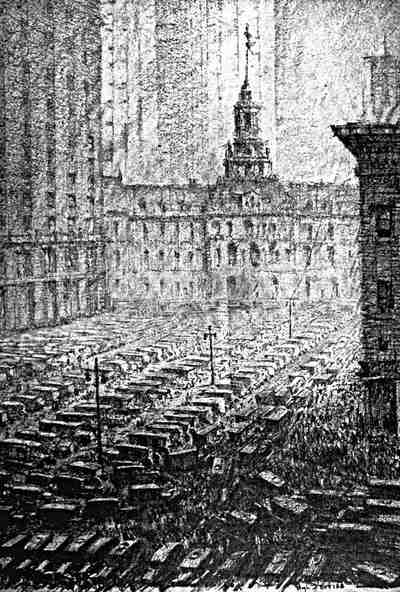
Detroit—City of Automobiles
Many thousands of standardized trucks were made
in Detroit during the war rush, the automobile having proved to the
be indispensable
to be
the fighting forces overseas.
Click for a larger image.
[Pg 18]
"The sale of War Savings Stamps and
certificates has increased the national debt by $1,257,000,000, or
within 400 million of the maximum under the first authorization. A
second series, however, amounting to two billion dollars, has been
authorized, so that the operation will probably continue into the coming
year. The Treasury for the fiscal year 1917—18 estimated receipts of
$663,200,000 from this source and about a billion for 1918—19. The first
estimate was out of line, owing to the difficulty in getting the plan
into smooth operation. Subsequent results have, however, justified the
average of expectations.
"The pre-war debt, in the light of recent figures, is almost negligible,
and the outstanding certificates in anticipation of taxes and the Fourth
Liberty Loan will be redeemed in due course by the flow of funds owing
to the Government in taxes and subscription payments. The problem of how
to deal with the eighteen-billion-dollar war debt is the vital question.
How much of this sum represents a charge on the coming generation and
how much an invaluable national asset?
"We have loaned abroad the following items:
| Great Britain | $3,745,000,000 |
| France | 2,445,000,000 |
| Italy | 1,160,000,000 |
| Russia | 325,000,000 |
| Belgium | 183,520,000 |
| Greece | 15,790,000 |
| Cuba | 15,000,000 |
| Serbia | 12,000,000 |
| Rumania | 6,666,666 |
| Liberia | 5,000,000 |
| Czechoslovak Republic | 7,000,000 |
| ——————— |
| [5]$7,919,976,666 |
"Here, then, are figures totaling nearly half of our war debts that are
not only self-supporting but also a double-edged weapon in the
international market. In the first place, they represent money spent at
home on American goods, from which the American manufacturer has taken
his toll of profit; and in the second place, they have put the world in
our debt to an extent that will be difficult to pay in the exchange of
goods.
"Imports of foreign commodities or even gold will take a decade to halve
the debt, for the gold can not be spared, nor do we wish it, and our
creditors will find it difficult to increase their exports to a point
capable of bringing about a balance in their favor. The imports from
Europe are bound to be offset by our own exports, some able economists
predicting a balance of a billion dollars in our favor for the next five
years. Regardless of the demands to be made upon us from this source, it
is probable that the peak-load of expenditure has been reached and the
period of readjustment and redemption set in.
"Charging off, then, our loans to the Allies as an asset, let us then
consider how we may best meet the bill due the American people. Vague
discussions of the creation of a huge sinking fund have been heard,
although for some reason or other, in history these operations have not
been entirely successful. Fortunately the bulk of our debt has an early
callable date, and the Treasury has recently come in for much applause
by advocating no more loans unless they be in the nature of a one-to
five-year currency. Experience teaches that the full benefit and effect
of war taxes are rarely felt until after the war. England, after the
Napoleonic wars, came back with a rapidity that astonished the Exchequer
itself. Taxes rolled up in such a volume and expenses dropped with
demobilization to such an extent that the Government found itself
anticipating the callable date in national debts by market purchases,
and even then it was found convenient gradually to reduce the scale of
taxation.
"Our experience after the Civil War was very similar to England's, and
the Treasury's surplus annually accumulated to a point that forced the
Government to buy back at high premiums the bonds it was not privileged
to call. This was true, though to a lesser degree, with the Spanish war
loan.
"It seems as though the two operations of liquidating our own debts and
the debt of Europe to the United States dovetailed perfectly into one
gradual and stupendous task. While Europe is paying her indebtedness to
us without interfering with the development of international trade by
the sale of foreign securities in our home market our buyers here must
receive the tools to operate with through the redemption and repurchase
of their Liberty Bonds. In this half of the deal safety, as usual, lies
in the middle course. It is hoped that taxes will be maintained at a
level that will infallibly provide funds for fixed redemptions with a
sufficient surplus to get a flying start by purchase around the present
low levels."
One year before the war England's position in regard to the balance of
trade was most favorable. Her imports were valued at $3,210,000,000 and
her exports at $2,560,000,000. But it was usually estimated that foreign
countries owed England about $1,610,000,000 annually for interest on
capital lent for shipping freights and for banking insurance and other
commissions. The total amount owed her, therefore was $4,170,000,000 as
against $3,210,000,000 which she owed for her imports. She had therefore
a favorable balance of about $960,000,000 which was lent abroad.
The war brought an enormous decrease in tonnage, and the excess of
imports over exports attained the figure of $1,950,000,000 a year.
Exceptional measures had to be taken to maintain the exchange rates with
the United States from whom the chief purchases were made. Large amounts
of gold were exported, but by June, 1915, there was a collapse in
American exchange. Drastic measures were used to induce the holders of
American securities in England to sell or lend those securities to the
Government. In this way exchange was kept up practically to the gold
point. This question of exchange and the position of England as the
director of the financial campaign of the Allies is illustrated from an
address given by Mr. R. H. Brand to the American Bankers Association, in
September, 1917:
"Of course no nation could permanently tolerate such unfavorable trade
balances as those from which the Allies in Europe are now suffering.
They can only do so now and keep their exchanges with the United States
steady by borrowing immense sums here. But the war itself is not
permanent, and the question is merely whether the present state of
affairs can be continued long enough to enable all the enemies of the
Central Powers to exert their full strength and win a final victory.
"You will no doubt all have noticed that the credits granted Great
Britain have been greater than those granted to any other Ally. The
reasons are simple, though they are not, I think, generally understood.
We have, in the first place, the largest war and munition program of any
Ally; in the second place, as I have shown above, we are, with the
exception of the United States, the greatest industrial arsenal among
the Allies; that necessarily involves large imports. We send a great
deal of steel from England to our Allies; we have to replace it by steel
from here. We make rifles for Russia; we have to import the steel to
make them. We send boots to Russia; we have to import the leather
needed. These examples might be multiplied many times. Thirdly, we
extend large credits in England to our Allies, some part of which they
may use anywhere in the world, and this part may ultimately come back on
the sterling exchange in New York. Lastly, it is well known that
neutrals who are owed money by England unfortunately find it convenient
to utilize the sterling exchange in New York in order to recoup
themselves in dollars. But so also do neutrals who are owed money by the
other Allies. So long as we maintain the sterling exchange this appears
to be inevitable, and the burden of financing both our own and our
Allies' trade tends to fall on that exchange. It is by our maintenance
of this sterling exchange that the continuance of our Allies' trade is
rendered possible. The maintenance of the sterling exchange means the
maintenance of the allied exchanges. All these factors together exert an
immense influence. If England had had only herself to finance since the
beginning of the war, and indeed even if she had only herself to finance
now, it is quite possible she would not have needed to borrow at all
abroad."
The extent of the withdrawal of productive power can only be judged by
figures. Of the 7,500,000 men serving in the British Army, 4,530,000
were contributed by Great Britain, 900,000 by the British dominions and
colonies; and the remaining 1,000,000 by India and the various British
African dependencies. Production went on to a remarkable degree, but
this production was largely for war purposes. It was secured by
recruiting female labor to an unheard of extent in the munition
factories. According to the London Economist, the financial side of
the British administration was anything but satisfactory. It speaks of
waste and faulty methods:
"On the financial side our record is by no means so satisfactory. We
have, it is true, poured out money like water, but much of it has been
raised by faulty methods, and the amount of it that has been wasted is
appalling to consider. In the matter of borrowing, our methods have
lately been greatly improved; and the recommendation of the Committee on
National Expenditure, that the system of raising money by bank credits
should be checked as far as possible, is being brought within the bounds
of practical politics by the great success of the War Savings
Committee's energetic and ingenious campaign for prompting the sale of
National War Bonds. Perhaps also we may claim some small share in that
success through the adoption of the principle so long advocated in these
columns of a lower rate for money at home combined with special terms
for money left here by foreigners. But successful borrowing, direct from
the investor, instead of in the shape of money manufactured by banks, is
a welcome, but not sufficient, improvement. We have to raise much more
money by taxation. We have also to do much more than has yet been done
to reduce the wicked waste of public money and support the efforts of
the Committee on National Expenditure to husband the resources of the
nation. A correspondent in a provincial town in which a Tank has
lately been busy asks: 'Is it not pathetic to see widows and children
scraping together their shillings and pennies to help the Government,
while we have tens of thousands of pounds being squandered by a
profligate Ministry of Munitions!'"
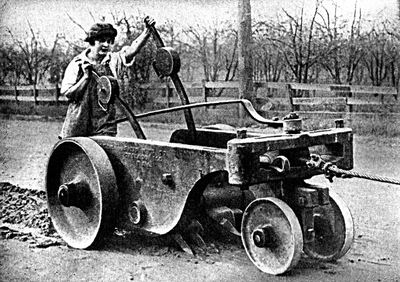
Copyright Underwood & Underwood
A Woman Doing Road Construction Work
Of the 7,500,000 men serving in the British Army, 4,530,000 were
contributed by Great Britain. Yet production was speeded up by
recruiting and training the labor of women.
Click for a larger image.
A thorny problem of all war finance is how to equalize as far as
possible the amount of money furnished by taxation with the amounts
borrowed. The proportion indicated in the last English war budget of
1918 was that between £842,000,000 raised by taxes and
2,000,000,000 sterling by fresh borrowing. Besides, war experience shows
that the parliamentary estimates in each year were always far below the
amount spent. In 1917 in Great Britain the shortage was upwards of
£400,000,000. According to the London Economist, no effective
steps were taken to stop the profligate extravagance by which public
money was poured out through the sieves of the war spending departments
into the pockets of innumerable manufacturers, middlemen and traders,
not to mention the ever growing sums allocated to the privy purses of
countless new bodies of officials. Each year, it says, there is a new
debt charge of some £120,000,000 and each year there is a constant
rise of prices in wages that enhances the cost of governmental goods and
services.
The amount raised by taxation, £842,000,000, seems enormously
large, but as the London Nation states:
"The enormous rise of prices only makes it represent half that amount in
actual purchasing power. Before the war our expenditure was 200
millions. If money had kept the same value, the taxation and other
public income for this year would only have been 420 millions, a little
more than twice the pre-war level. Would that have seemed so heroic an
effort for a patriotic nation? No. It can never be repeated too often
that a really rigorous taxation, begun in 1914 and carried on till now,
would have left us in a far sounder condition both for conducting the
war and for facing the peace finance. The money and the goods are there.
We get them. But we get them by crooked and expensive methods of
borrowing which inflate prices, oppress the poorer purchasers, put huge
war loot into the pockets of contractors and financiers, and fail to
restrain expenditure in luxuries."
There is much evidence to show that long before the war began financial
preparations were made in Germany for the great struggle. For a
considerable period prior to 1914, Germany and Russia had been engaged
in a contest to accumulate a gold supply. Russia, it is known, had begun
to withdraw the large balances which she kept in German, French and
English banks. In Germany the story was circulated that in 1913 the
Kaiser inquired of the governor of the Imperial Bank if the German banks
were equipped for war. Being told that they were not ready he is said to
have replied: "When I ask that question again I want a different
answer." The Imperial Bank of Germany became an active bidder at the
London gold auctions for the gold which arrived weekly from South
Africa, and its activity along these lines was shown by the increasing
of the German gold reserve in the bank vaults from $184,000,000 on
December 31, 1912, to $336,000,000, the amount it stood at a month
before the war began. In addition, the Imperial Bank collected for the
Government a sum of about thirty million dollars to be added to the same
amount said to be stored in the vaults of the Julius Thurm at Spandau,
and to be used as a war chest. Other European countries were increasing
their gold supplies, so it was not surprising that the New York markets
were called upon to export eighty-four million dollars of gold for six
months before the outbreak of the war. The entire gold production of the
world during the eighteen months ending on June 30, 1914, was
approximately $705,000,000. Of this amount, about two million dollars
was required for the arts, and one hundred and fifty million dollars
went to British India. This left about $350,000,000 to be applied to
monetary uses and the whole of this amount was absorbed by the four
great central banks of Germany, France, Russia and Austria-Hungary.
In order to resist raids on the German gold reserve a policy of note
issuing was adopted. The situation, as forecast by Mr. C. A. Conant in
September, 1914, in the New York Times, can be gathered from the
following extract:
"With the general suspension of gold payments at the central banks of
Europe, except at the Bank of England, the banks are in a position to
resist raids upon their gold and to lend their resources, as far as
sound banking policy permits, to the struggle of their Governments to
maintain national independence. In England, while the bank is still
paying gold for notes, the policy of keeping gold in circulation has
been abandoned, and the old limit of note issue, which was £5
($24.40), has been lowered to 10 shillings ($2.44) and £1 ($4.88).
"It is not the purpose of any of the European Powers, however, to carry
on the war by issues of paper money. The suspension of gold payments at
the banks and the issue of notes for small denominations, which are
legal tender in domestic transactions, is for the purpose of husbanding
the gold stock against needless runs and keeping it as a guaranty fund
of national solvency. It is the course which was adopted by France at
the time of the Franco-German War in 1870, but so prudently were the
affairs of the Bank of France conducted that the paper never fell more
than 2½ per cent. below its value in gold.
"A similar policy of reserve will probably be pursued by the banks of
France, Germany, and Russia in the present contest. The Government of
France has raised the maximum limit of the note circulation of the bank
by nearly $1,000,000,000, but the increase will not be used except as
additional currency may be required, owing to the restriction in other
forms of credit and the special demand for notes in the districts where
the armies are gathered.
"The suspension of specie payments does not convey to the banking
community quite the same doleful warning of the unlimited issue of paper
and its steady depreciation in gold which were conveyed by specie
suspension in the United States in 1861 or by Austria-Hungary and Russia
in the desperate contest of the Napoleonic wars. Monetary science is
better understood at the present time than in those days."
Among all the belligerent powers Germany occupied the unique position of
using the war as an excuse for not publishing national accounts. The
sole guide to her expenditure must be looked for in the credit votes
passed by the Reichstag. Using this method, it is estimated that Germany
spent about $30,000,000 a day. To cover this expenditure there was a
regular plan of national loan—in March and September. This was the
method followed in all the four years of the war. During the intervening
six months there was an issue of Treasury bills. The German people
were, apparently, schooled to these
regular demands with commendable promptness, but the Imperial Government
adopted a policy of inflation in the hope that a speedy victory would
bring fruits in the shape of an indemnity, and so the German people
would avoid being called upon to bear war burdens. Taxation was
introduced only reluctantly and at a later period, and merely for the
purpose of meeting so-called normal civil expenditure and interest on
war debt. The plan followed was to spare the middle classes as far as
possible from additional taxation charges.
The war loans have been, on paper, most successful. For example, the
seventh loan of September, 1917, yielded $3,000,000,000; the eighth loan
nearly $4,000,000,000. There was a large amount of ready money in the
country and besides this all stocks of raw material have been realized.
Large as the loans have been they have not been able to keep pace with
the increase of expenditure. Out of the total amount of $30,000,000,000
about $20,000,000,000 have been covered by long-term loans. Of course,
owing to the peculiar situation of Germany in relation to her allies,
which were dependent upon her financial support, these loans have been
raised by the German people themselves. The German Loan Bureaus were
criticized at the beginning of the war, and German figures show that
only about ten percent. of the national loans were involved in the Loan
Bureau scheme. These Loan Bureaus, it was announced, would continue
after the declaration of peace. According to the London Economist,
Germany followed an easy and sure policy of war finance, although the
same authority does not hesitate to use the terms "complete financial
ruin" in connection with German post-war finance.
The whole subject of German inflation is difficult to analyze. The
Economist works out a post-war expenditure of $5,000,000,000 a year
against a revenue of a billion and a half. Its estimate of German
inflation is contained in the following passage:
"To take note circulation alone is obviously misleading, particularly in
view of the violent efforts that have been made, especially during the
last year, to extend the use of the check, and in other ways to limit
as far as possible the use of notes. For what these figures are worth,
it may be said that the total note circulation of the country at the end
of June (1918), including Reichsbank notes, State Bank notes, Treasury
notes, and loan notes, stood at £1,030,000,000, as compared with
£109,300,000 on July 23, 1914. Reichbank
Reichsbank deposits, again, stood
on June 30, at £459,100,000, as compared with £47,600,000 on
July 23, 1914, while the deposits of the eight 'great' banks, even at
the end of 1917, stood at £800,000,000, as compared with
£250,000,000 at the end of 1914, £362,000,000 at the end of
1915, and £500,000,000 at the end of 1916."
In this connection it is interesting to give a summary of Germany's war
expenses as reported in the London Economist:
"In his comparison of German war finance with ours, the Chancellor, in
his Budget speech, made the following points: First, that German war
expenditure is now £6,250,000—almost the same as
ours—though our expenditure includes items (such as separation
allowances) which are not included in the German figures. Second, that
the whole amount of the German Votes of Credit (£6,200 millions)
has been added to their war debt, 'because their taxation has not
covered their peace expenditure in addition to their debt charge.'
Third, the total amount of new taxation levied by them since the
beginning of the war comes to £365 millions, against our
£1,044 millions. Fourth, in a year's time they will have a
deficit, comparing the revenue with the expenditure, of £385
millions at least. 'If that were our position,' the Chancellor added, 'I
should certainly think that bankruptcy was not far from the British
Government.' Fifth, with the exception of the war increment tax,
'scarcely any of the additional revenue has been obtained from the
wealthier classes in Germany'."
An extraordinary list of the gigantic war profits collected by Germany
was drawn up by A. Cheraband, the well known French critic. He estimated
that in three years Germany had spent $322.50 per head, France $444.00,
Great Britain $559.75. He presents a list of war profits made by
Germany. The "booty" he divided into movable and immovable property. In
the former category he includes the 212,000 square miles of territory
that had fallen into German clutches, and this he values at
$32,000,000,000, which, he says, is a conservative estimate. Turning to
the movable booty, he classifies it as follows:
- "Capture of 'Human Material.'—This consists of the
46,000,000 Allied subjects from whom the Germans obtain free labor.
- "Capture of War Material.—Guns, rifles, munitions,
vehicles, locomotives, railway trucks, and thousands of miles of
railway. The Belgian railway system alone is worth nearly $600,000,000.
- "Capture of Foodstuffs.—Everywhere the Germans have stolen
horses, cattle, corn, potatoes, sugar, alcohol, foodstuffs of every
kind, and crops grown by the forced labor drawn from the 46,000,000
Allied subjects whom they have enslaved.
- "Theft of Raw Materials.—Throughout the occupied territories
the Germans have appropriated coal, petroleum, iron, copper, bronze,
zinc, lead, etc., either in the mines or from private individuals;
textile materials, such as woolen and cotton. In the towns of northern
France alone the Germans stole $110,000,000 worth of wool.
- "Theft of Industrial Plant.—On a methodical plan throughout
the occupied territories, the motors, engines, machine-tools, steam and
electric hammers, steel-rolling mills, looms, models, and industrial
plant of all kinds have been carried off to Germany.
- "Thefts of Furniture.—The way in which furniture and
household goods were stolen and carried off is confessed by implication
in the following advertisement published in the Kölnische Zeitung
at the beginning of April, 1917:
"'Furniture moved from the zones of military operations in all directions
by Rettenmayer at Wiesbaden.'
"It is impossible to estimate the money value of the goods thus removed.
"Seizure of Works of Art.—The works of art collected for
centuries in museums, churches, and by private individuals in Poland,
Italy, Belgium, and France have been carried off by the Germans.
- "War Levies.—Scores of millions in money have been secured
by the Germans in the form of requisitions, fines, war levies, war
taxes, and forced loans.
- "Thefts of Coin, Jewels, and Securities.—In the occupied
regions, and especially wherever they have been obliged to evacuate
those regions, as, for instance, at Noyon, the Germans have emptied, by
order, the safes and strong boxes of private persons and of banks and
have carried off securities, jewels, and silver. In September and
October, 1917, they seized at one stroke the deposits of Allied subjects
in the Belgian banks amounting to $120,000,000.
"In view of the high prices of foodstuffs, coal, metals, petroleum, war
materials and machines, it is clear that the booty thus secured by the
Germans during the last three years in the occupied territories is
certainly worth several billion dollars."
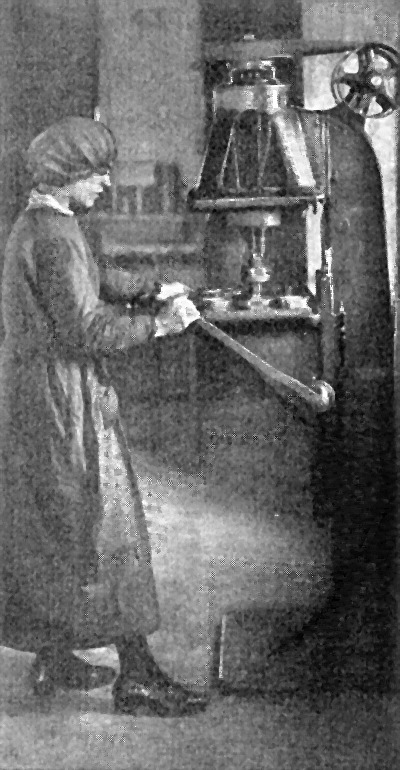
Photo by James M. Beck
A Woman Operating a Multiple Spindle Drill in an English Shell
Factory
"Since the war broke out," said M. Barriol, a
French celebrated actuary, "no less than 1,500,000 women have
been added to the ranks of wage earners in England, an increase of
fully 25 per cent."
It became commonplace after Germany's defeat was evident that her war
cost must include the cost of the destruction she had caused her
enemies. To estimate this was no easy matter. The attitude of the
Germans on the subject was indicated by their constantly expressed hope
that trade would recommence as usual and that they would be able to
start economic relations in a favorable position. So we find the Cologne
Chamber of Commerce beginning to prepare for peace by adopting a
resolution expressing the hope that the destruction of French and
Belgian industries would allow the rapid recovery of German power.
The Wall Street Journal used this statement as a guide to the
Allied Powers for measuring the kind of indemnity that would be imposed
upon Germany.
"One of the departments of the Government at Washington has in its files
a report of a German commission on industry after the war. Reading this,
one can understand the motive for what at one time looked like pure
vandalism. Vandalism it was, by descendants of the Vandals, but it was a
deliberate destruction of international competitors, killing the
workmen—and workwomen—and destroying plants and machinery
for the one purpose of removing competition. A physical injury to a
child helped to weaken future competition in the world's trade; and it
was upon the power gained thereby that Germany hoped to launch another
war for world domination....
"A peace that gives the cold-blooded perpetrators of these crimes an
advantage over their victims would not be equitable. If any must suffer,
let it be those who are guilty, but don't give them a start ahead of
their victims.
"In substance, that point should declare that Germany shall not profit
through the wrecking of any Allied industry. Except to admit necessary
foodstuffs, the blockade should not be lifted until every Allied country
from England to Serbia has been industrially rebuilt. One object of the
wholesale murder of civilians was to weaken industrially the enemy
countries. The greater proportionate loss of man-power in the Allied
countries should be met by restrictions on the entry of raw materials
into Germany. Every piece of stolen machinery should be returned before
her own industries are allowed to resume."
The soft plan of dealing with Germany's war cost was championed by
Secretary Daniels. The Springfield Republican and the New Republic
seemed to agree with the Manchester Guardian that Germany ought to to
to
be helped rather than punished, that the main thing was to set her on
her feet again.
"Representative papers like the New York Times, Syracuse Post-Standard,
Buffalo Express, and Sacramento Bee all insist that while we
might or perhaps should claim no war-expenses from Germany, 'we must
exact payment,' in the words of the Syracuse daily, 'to the last
penny for losses suffered through illegal warfare.' Germany's
submarine campaign cost us, according to this paper's figures,
375,000 tons of shipping and 775 civilian lives. If we take the
burden of payment for this property and these lives from the guilty
shoulders of Germany it would only be to 'pass it on to the innocent
shoulders of the American taxpayer,' which, the New York Times
declares, would be 'rank injustice'."
It is interesting also to note an attempt made by one of the expert
statiticians
statisticians
attached to the Guaranty Trust Company of New
York to estimate the total cost of the war at the close of the four-year
period. The five main Allies possessed, before the war, $406,000,000,000
for national work, a sum nearly four times as great as the national
wealth of the two Central Powers. In four years the seven leading
belligerents had spent $134,000,000,000. The only way to grasp the
meaning of this enormous sum is to contrast the cost of the World War
with all former wars. The total cost of wars that had taken place since
the American Revolution was $23,000,000,000; the World War costs
therefore, are six times greater. In these figures, staggering as they
are, it was comparatively easy to figure out the costs, debts and
interests of actual war expenditures. Much more complicated is the
problem of estimating the property value destroyed through military
operations on land and sea:
"The total area of the war zone is 174,000 square miles, of which the
Western theater of the war, in France and Belgium, stretches over an
area of 19,500 square miles, and it contains over 3,000 cities,
villages, and hamlets, great manufacturing and agricultural districts,
of which some have been totally annihilated and some heavily affected.
The estimate by the National Foreign Trade Council of the war losses,
which unfortunately does not go beyond 1916, is as follows:
"'Destruction of buildings and industrial machinery in Belgium,
$1,000,000,000, and in France $700,000,000. The destruction of
agricultural buildings and implements, of raw materials, of crops and
live stock, has been estimated at a sum of $780,000,000 in Belgium and
$680,000,000 in France. Roads were destroyed frequently by the
retreating troops and have been seriously damaged by heavy gun fire and
excessive use. The losses from destruction of railway bridges, etc.,
have been estimated in Belgium at $275,000,000 and in France at
$300,000,000.
"'In the Eastern theater of the War Germany has been invaded only in
eastern Prussia, where the agricultural population has been seriously
impaired. Heavy damage was inflicted upon bridges, roads, and
governmental property, including railroads. The direct cost to Germany
through the loss of agricultural products, of manufacturing
products, as well as in interest on investments abroad, of earnings from
shipping and banking houses, and profits of insurance and mercantile
houses engaged in business abroad has been enormous'."
The same expert goes on to figure out the economic value of the loss of
human life:
"Mr. M. Barriol, the celebrated actuary, gives the following figures as
the capital value of man: in the United States, $4,100; in Great
Britain, $4,140; in Germany, $3,380; in France, $2,900; in Russia,
$2,020; in Austria-Hungary, $2,020 or an average capital value for the
five foreign nations of $2,892.
"The number of men already lost is 8,509,000 killed and 7,175,000
permanently wounded, or a total of 15,684,000. Thus society has been
impoverished through the death and permanent disability of a part of its
productive man-power to the extent of $45,000,000,000.
"The loss of men, measured in terms of the capital value of the workers
withdrawn from industry, is offset in some degree by the enhancement of
the capital value of the remaining producers.... This loss of man-power
is also partly offset by the large contingents of women drawn into
industries. In England, out of a female population of 23,000,000, about
6,000,000 were engaged before the outbreak of the war in gainful
occupations. Since the war broke out no less than 1,500,000 women have
been added to the ranks of wage-earners, an increase of fully 25 per
cent. Moreover, about 400,000 women have shifted from non-essential
occupations to men's work. In the United States, approximately 1,266,000
women are now engaged in industrial work, either directly or indirectly
necessary to carry on the war.
"The physical and moral effects of the war, the moral strain to which
the nations have been subjected, the 'shell-shock' which has reacted
upon the population at home as well as upon the soliders
soldiers on the
battlefield, the undernourishment and starvation of children as well as
adults, all have resulted in a lowered vitality, the ill effects of
which, especially in the countries of the Central Powers, are already
seen in an increase of the death rate, in a spread of epidemics and
diseases that have taxed the medical resources of all countries.
The lowered vitality of the race, which is still further aggravated by
the millions of incapacitated soldiers and the premature and excessive
employment of children and women in the industries, will eventually make
for a lower standard of efficiency in all human activities, or a
retardation of human progress. Authoritative statements are to the
effect that in Belgium in the earlier period of the war, the deaths of
women and children far outnumbered those of men. Annual deaths among the
German civilian population have increased by a million above the normal.
"Besides the loss in actual population there is a loss of potential
population. Carefully compiled figures show that by 1919 the population
of Germany will be 7,500,000 less than it would have been under ordinary
circumstances. The people in Austria in 1919 will be 8 per cent. less in
numbers than in the year before the war. Hungary will be still worse
off; it will have a population of 9 per cent. lower than in pre-war
days."
The Carnegie Endowment for International Peace made public in November,
1919, an elaborate report on the cost of the World War in human life and
in property and the consequent economic losses. The chief conclusions
derived from this intensive study of all the conditions may be
summarized as follows:
All the wars of the nineteenth century from the Napoleonic down to the
Balkan wars of 1912—1913, show a loss of life of 4,449,300, according to
the report, while the known and presumed dead of the World War reached
9,998,771. (See Vol. III, pp. 403-5.) The monetary value of the
individuals lost to each country is estimated, the highest value on
human life being given to the United States, where each individual's
economic worth is placed at $4,720, with England next at $4,140; Germany
third, at $3,380; France and Belgium, each $2,900; Austria-Hungary at
$2,720, and Russia, Italy, Serbia, Greece, and the other countries at
$2,020.
With a loss of more than 4,000,000 the estimate puts Russia in the lead
in human economic loss, the total being more than $8,000,000,000;
Germany is next with $6,750,000,000; France, $4,800,000,000; England,
$3,500,000,000; Austria-Hungary, $3,000,000,000; Italy, $2,384,000,000;
Serbia, $1,500,000,000; Turkey, almost $1,000,000,000; Rumania,
$800,000,000; Belgium, almost $800,000,000; the United States slightly
more than $500,000,000; Bulgaria, a little more than $200,000,000;
Greece, $75,000,000; Portugal, $8,300,000, and Japan, $600,000. On this
basis the total in human life lost cost the world $33,551,276,280, and
the loss to the world in civilian population is placed at an equal
figure.
The attempt to determine property losses is the least satisfactory, as
it is the most difficult. The destruction and devastation in the invaded
areas of Belgium, France, Russian Poland, Serbia, Italy and parts of
Austria are probably incapable of exact determination, and it may well
be doubted if the exact losses will ever be known.
The total property loss on land is put at $29,960,000,000, one-third of
which was suffered by France alone, its loss being given as
$10,000,000,000, with Belgium next at $7,000,000,000, and the other
countries following as follows:
Italy, $2,710,000,000; Serbia, Albania, and Montenegro, $2,000,000,000;
The British Empire and Germany, each, $1,750,000,000; Poland,
$1,500,000,000; Russia, $1,250,000,000; Rumania, $1,000,000,000, and
East Prussia, Austria, and Ukraine together, the same amount.
Copyright by Central News Service
Launching the Quistconck at Hog Island
According to the report of the Carnegie Endowment the cargo loss at sea
was $3,800,000,000, the total tonnage and cargo loss being
$6,800,000,000. To offset the Allied loss in shipping, ship-building in
the United States was rushed at topmost speed.
Click for a larger image.
In the property losses on sea, that is, to shipping and cargo, the
report estimates that "the construction cost of the tonnage loss can
scarcely be estimated at less than $200 a ton, and the monetary loss
involved in the sinking of this 15,398,392 gross tons may, therefore, be
placed at about $3,000,000,000." To this is added loss of cargo, which
is estimated at $250 a ton, giving a cargo loss of $3,800,000,000, and a
total tonnage and cargo loss of $6,800,000,000.
Among the indirect costs of the war, loss of production is placed at
$45,000,000,000. In arriving at this figure an average of 20,000,000 men
are counted as having been withdrawn from production during the whole
period of the war, and their average yearly productive capacity is
placed at $500. War relief is another indirect cost which totalled up to
$1,000,000,000; and the loss to the neutral nations is given as
$1,750,000,000.
With the total direct costs of the war amounting to $186,336,637,097 and
the indirect costs to $151,612,542,560, the stupendous total of
$337,946,179,657 is reached. Finally, the report says:
"The figures presented in this summary are both incomprehensible and
appalling, yet even these do not take into account the effect of
the war on life, human vitality, economic well-being, ethics,
morality, or other phases of human relationships and activities which
have been disorganized and injured. It is evident from the present
disturbances in Europe that the real costs of the war cannot be measured
by the direct money outlays of the belligerents during the five years of
its duration, but that the very breakdown of modern economic society
might be the price exacted."
All of the great wars in European history have been followed by periods
of increased production and economic expansion. Experts are convinced
that the World War will prove no exception to the world's previous
experience. Wars have been the principal influence that have determined
the course of commodities and prices. In the Napoleonic Wars the index
number rose seventy-two points in twenty years, but during the four
years between 1914 and 1918 there was a rise of one hundred and eight
points in four and a half years, a movement which Edgar Crammond, widely
known British expert in economic and financial affairs, declared to be a
movement to which there was no precedent in point of rapidity or
magnitude. In an address outlined in the New York Journal of Commerce
this authority estimated the direct cost of the war to the Allies as
being roughly $145,000,000,000. The Central Powers had spent about
$60,000,000,000. The total cost in dollars he estimated at
$260,000,000,000. The upheaval caused by the war was manifested,
according to the same authority, in the rise of the cost of living and
in the universal increase of wages. Other economic consequences will be
more gradually unfolded. Prospects of fall in the price of commodities
and wages as the result of peace, he thinks, will be arrested for two
reasons: First, the vast increase in the amount of paper money; second,
the huge amount of public debts to the belligerents. He saw an
additional psychological cause in the attitude of the laboring classes
to maintain wages at a higher level than before the war and to improve
the standard of living.
Reduced production is sufficient to account for all the economic
disturbances that were produced during the war, according to the London
Statist, which says:
"It is enough to say that production is reduced almost to a minimum,
while consumption is going on at a most extravagant rate. Those who wish
to pose as economists without competent knowledge are telling the public
that all the evil is due to this, that, and the other thing—such,
for example, as inflation, the rise in prices, the enormous loans
raised, and several other fads. It is pure moonshine. The world is
impoverished, firstly, because so much of the world's manhood is
withdrawn from production to consumption; and, secondly, because
reduction in production is so serious that very little has been saved
either by the belligerents or the neutral countries of Europe, at all
events. International trade is really carried on by barter. It is true
that money is frequently paid. At the present time money has in some
markets to be paid because credit has been injured, and those who
possess wealth are not as willing as they used to be to trust to mere
credit."
The enormous advance of prices in England was synchronous with the issue
of currency notes to an excess of £700,000,000 beyond the gold
reserve. High officials in British administration ascribed this rise to
the increased consuming capacity. According to the British Board of
Trade a sovereign could purchase no more during the war time than eleven
shillings would just before the war started. A writer in the
Fortnightly Review, Mr. W. F. Ford, quotes Jevons' remark in his
classical book on money in explanation of the phenomenon. "A number of
bankers all trying to issue additional notes resemble a number of
merchants offering to sell corn for future delivery, and the value of
gold will be affected as the price of corn certainly is. We are too much
inclined to look upon the value of gold as a fixed datum line in
commerce, but in reality it is a very variable thing." Substitute today
the word Government for bankers and one can see the reason for the
upward rise in prices. This rise would take place apart from any
questions of war waste, profiteering, difficulties of transport by sea
or land or shortage of labor. All the countries involved have followed
the same policy of inflation. The operation is depicted in the following
passage:
"The inevitable result of extensive note issues by a number of
Governments was that prices were irresistibly impelled upwards
in all belligerent countries—apart from any questions of war
waste, profiteering, difficulties of transport by sea or land, or
shortage of labor. Belligerent countries became extraordinarily good
markets in which to sell goods; and a golden harvest was temptingly
displayed to neutral nations, in whose favor enormous trade balances
rapidly grew up. In large part these balances were met by payment in
gold.... But just as gold substitutes in the shape of paper money
swelled the currencies and increased prices in the belligerent
countries, so also the large quantities of gold coin sent to neutral
States in payment for goods supplied to the warring nations swelled the
currencies and increased prices in the neutral states themselves. The
withdrawal of gold set up a natural tendency for prices to fall in the
countries from which it had been exported; but not only was this
tendency overcome, but the upward movement of prices was continued by
the action of the several Governments in placing still further issues of
inconvertible paper money on their respective markets. The net results
have been that currencies have been inflated and prices forced up all
over the world, that inconvertible paper money is tending more and more
to drive out gold from the currencies of the states that issue it, and
that the gold so driven out is being absorbed into the currencies of the
neutral nations. Between August, 1914, and the date of her own
declaration of war, America increased the amount of her gold currency by
approximately £200,000,000 sterling. No real benefit has accrued.
"The currencies of the whole world have been artificially inflated to
the extent that, under the most favorable circumstances existing in any
part of the world, £5 are now needed to do the work in circulation
that before the war was accomplished by £3. The loss to people
with fixed incomes, the disturbance of trade, the potential labor
difficulties are stupendous. And as a result of purchasing war material
at excessively high prices, the dead weight of debt incurred by all the
countries at war is very much greater than it need have been had
currencies been kept within reasonable bounds."
In Great Britain £200,000,000 worth of new paper currency was
placed in circulation and there was a considerable expansion in the use
of banknotes, silver and copper coinage. Proposals were made that the
famous English Bank Act should be repealed and that excess issues of
banknotes should be made legal on the payment of a tax. But apart from
these theories of involving the banking system there was a good deal of
adverse criticism.
"Mr. Herbert Samuel made a masterly attack upon the vicious system of
War Finance, by which no less a sum than £196,170,000 is added to
the expenditure by bonuses and increases of wages, which, in their turn,
only force prices still higher and raise the cost of living. Lives have
been conscripted; incomes have been conscripted; the only thing which
has not been conscripted is labor. If the Government had at an early
stage of the war had the courage to fix wages, instead of prices, the
cost of living would then have been regulated by supply and demand. By
fixing prices of commodities, after they had risen to almost famine
figures, we have the maximum of loss and inconvenience, high wages, dear
food, and a war bill that increases day by day. Despite Mr. Bonar Law's
assurance that the bill of the year would not be so high as he expected,
we have the fact that we are spending over seven millions a day. The
satire of 'the cheap loaf' consists in its cost to the nation at large
of £45,000,000 a year. Bonuses to munition workers amount to
£40,000,000, bonuses to miners come to £20,000,000, to
railway workers £10,000,000, to potato growers £5,000,000.
Is this anything else but a system of gigantic corruption? In order that
artisans and agriculturists may be kept in good humor with the war, they
are bribed with bonsuses
bonuses and allowed to buy food at prices which are
partially paid by the rest of the community. If ever there was a case of
robbing Peter to pay Paul it is here."
Protests against war inflation were not confined to British specialists
in finance. What is inflation? As used by the more careful writers on
the subject today, it is taken to signify the increase of bank credits
not represented by any immediate addition to current wealth. For
example, if the Government borrows by an issue of bonds, such bonds
taken by the banks, and payment for them made in the form of bank credit
which is at once transferred to individuals who have furnished labor or
supplies, it is evident that there has been a net addition to the
purchasing power of the community not represented by any corresponding
addition to wealth whether of a saleable or available form. Mr. Delano,
a member of the Federal Reserve Board, said that the war had produced a
world inflation the like of which had never occurred before—"The
usual symptoms of such methods of inflation are the disappearance of
metallic money and the general advance in the prices of commodities." He
gives the following illustration of what has taken place in this
process of inflation:
"Prior to our entry into the war, when the European nations were buying
heavily in the United States, they paid largely in gold for what they
bought, and as a result about a billion dollars in gold coin came to
this country in the period of two and one-half years. The reason the
European nations were able to send us their gold was that they printed
paper money for their own use, releasing gold for us. But that gold
inflation in this country is one explanation of the general advance in
prices of all commodities, although undoubtedly it is not the only
explanation; for it must be freely admitted that prices have been
affected, first, by scarcity, occasioned by increased demand from Europe
for many articles produced by us; second, by reason of the fact that
increases in taxes and wages of labor have entered into the cost of
production and sale of all articles and account for a share of the
increased prices of commodities."
The United States had large experience with inflation during the Civil
War. Some $500,000,000 were in this way added to the cost of the war
which might have been avoided. A plain statement of the real incidents
of inflation is given by Mr. A. C. Miller of the Federal Reserve Board
in his Financial Mobilization for War, in the following passage:
"For let it not for a moment be overlooked that inflation, in its
effects, amounts to conscriptive taxation of the masses. It is, indeed,
one of the worst and the most unequal forms of taxation, because it
taxes men, not upon what they have or earn, but upon what they need or
consume. The only difference for the masses between this kind of
disguised and concealed taxation and taxes which are levied and
collected openly is that in the case of the latter the government gets
the revenue, while in the former case it borrows it, and those to whom
it is eventually repaid are not those, for the most part, who have been
mulcted for it. Inflation therefore produces a situation akin to double
taxation in that the great mass of the consuming public is hard hit by
the rise of prices induced by the degenerated borrowing policy and later
has to be taxed in order to produce the revenue requisite to sustain the
interest charge on the debt contracted and to repay the principal. The
active business and speculative classes can usually take care of
themselves in the midst of the confusion produced by inflation and
recoup themselves for their increasing outlays. Indeed inflation
frequently makes for an artificial condition of business prosperity.
That is why war times are frequently spoken of in terms of enthusiasm
by the class of business adventurers. But it is a prosperity that is
dear-bought and at the expense of the great body of plain living people.
It would be a monstrous wrong if in financing our present war we should
pursue methods that would land us in a sea of inflation in which the
great body of the American people, who are called upon to contribute the
blood of their sons to the war, were made the victims of a careless or
iniquitous financial policy."
One of the ways in which inflation was caused in the United States
during the war period was the plan adopted by the banks of financing the
loan directly by means of bank credits to the buyers. According to Mr.
Carl Snyder the banking officials roughly agree that on the first
Liberty Loan for $2,000,000,000 the banks may have loaned somewhere near
half the total and on the second loan even more. Of course, this means a
heavy expansion of bank credit. Economists are generally agreed that the
flooding of the country with paper money brings about an enormous rise
in prices. They differ chiefly in regard to the degree of inflation. The
most accepted statement of inflation is that prices vary directly as the
volume of the actual currency employed and its rate of turn over or
velocity, and inversely with the volume of trade. The effect of bank
credits is exactly that of an excessive issue of notes; that is, if they
are expanded more rapidly than the actual volume of business there is a
rise in prices, that is to say there is inflation.
The situation of the country during the war in regard to business was
put plainly by Mr. Snyder in the following words: "Railroads cannot haul
any more goods. The government is already stepping in to shut down on
shipments on certain lines of industry. We can not get any more coal
unless labor is drafted from other industries, and as a whole we cannot
get any more labor as is evident from the fantastic wages that are now
being paid. In a word, production and therefore the actual volume of
exchange is practically at the limit and has been for a year or more. No
expansion of bank credits can put this production any higher. It
follows, therefore, as a practical fact that any expansion of bank
loans now means inflation—to all practical intents dollar
for dollar." Because of the introduction of a billion dollars worth of
gold into the country, prices have risen nearly one hundred percent. The
expansion of bank credits increases the cost of living and the cost of
the war will be doubled.
Some bankers estimated that if the war lasted the expansion of bank
loans might reach $50,000,000,000. The progress of these loans was
encouraged by the cutting of the required metallic reserve under the new
Federal Reserve system and the system of book credits with the Federal
Reserve banks allowed to the banks that are members of the system. The
following is Mr. Snyder's description of the way the inflation was
encouraged.
"Every dollar of gold may become three dollars of Federal Bank credits
and each dollar of this may in turn become the basis of eight dollars of
credits for the Central Reserve cities, ten dollars for the smaller
cities and fifteen dollars for the country banks, which works out to a
practical average of ten dollars for all the banks in the Federal
Reserve system."
He then went on to speak of the possibilities of this inflation and
uttered a warning of the danger, because the only obstacle in the way
was the good sense and conservatism of the American banks. Some
authorities hold that a war cannot be fought without inflation. Mr.
Snyder thought that the United States with large ante-war income could
and should have tried the experiment. People want easy money and flush
times. If credit were contracted there would be tight money and a high
interest rate. Mr. McAdoo and the Administration at Washington feel
highly elated when they roll up five billion of statistics, half of
which are merely bank rolls. It seems not to matter that all this may
add two or three billion to the already swollen credit currency and that
the millions of poor people, small investors and life insurance holders
who cannot expand their income in any adequate way must pay the piper.
These are the millions who rarely have any voice in national affairs,
and all the more so because they are for the most part ignorant. It
seems an idle consequence that we may spend perhaps ten long weary years
of hard times, of falling prices, declining business and sharp distress,
paying for the orgy of inflated prices, waste and extravagance in which
we are now indulging.
Photo by Paul Thompson
Ship-building at Camden, N.J.
One of the financial effects of the war
was the transformation of the United States from a debtor to
a creditor nation. Immense private fortunes were made. In no
industry was there a greater boom than in ship-building.
The wide expansion of credit can be studied by making a comparison of
the gold holdings of the leading nations. For example, in 1914 just
before the outbreak of the war, the amount of cash held by all the banks
of the United States was estimated at about $1,639,000,000. Of
this amount about $913,000,000 was in the form of gold or gold
certificates. Upon this basis there rested a structure of credit
amounting to $21,351,000,000. In other words the gold basis of the
country's deposit credits amounted to 4.27 percent.
In 1916 the cash held was $1,911,000,000; about $1,140,000,000 was in
gold; and on this basis there rested a credit structure of
$28,250,000,000.
One of the financial effects of the war was the transformation of the
United States from a debtor to a creditor nation. The reconstruction
period in finance is certain to bring about a situation described by a
writer in the Wall Street Journal as one of the most interesting
developments known in financial history. Financial waste in emergency
measures was a superficial side of America's part in the World War. But
this writer considers that what happened during the war was not
altogether financial waste:
"A great upheaval took place in the world of finance. Credit resources
were brought to the fore and nations established on a financial basis of
far-reaching importance, but of a kind that had only a secondary place
before.
"The war has turned the United States from a debtor to a creditor
nation. Formerly we owed abroad something like $4,000,000,000, about
three-quarters of which sum we have bought back. Moreover, Europe now
owes us about $9,000,000,000—on private account; about
$2,000,000,000 in securities; in United States Government obligations
over $7,000,000,000. The world is under obligations to us in interest
alone of between $400,000,000 and $500,000,000 a year."
After the United States took an active part in the war large credits and
loans were made in behalf of other countries as the following excerpt
shows:
"A total appropriation of $7,000,000,000 has been made, $3,000,000,000
by the Act of April 24, 1917, and $4,000,000,000 by the Act of September
24, 1917. Under these authorizations credits have been established in
favor of the governments of Great Britain, France, Italy, Russia,
Belgium, and Serbia. These loans, up to January 17, 1918, are given in
the following table:
| Country | Loans and Credits | Loans | Balances Under |
|---|
| Agreed Upon | Made | Established Credits |
|---|
| Great Britain | $2,045,000,000 | $1,985,000,000 | $311,070,250
60,000,000 |
| France | 1,285,000,000 | 1,225,000,000 | 50,000,000
60,000,000 |
| Italy | 500,000,000 | 450,000,000 | 50,000,000 |
| Russia | 325,000,000 | 187,729,750 | 137,270,250 |
| Belgium | 77,400,000 | 75,400,000 | 2,000,000 |
| Serbia | 6,000,000 | 4,200,000 | 1,800,000 |
| Totals | $4,238,400,000 | $3,927,329,750 | $311,070,250 |
"On the basis of the requests being made on the Treasury, it is
estimated that credits aggregating approximately $500,000,000 per month
will be required to meet the urgent war needs of the foreign governments
receiving advances from the United States. At this rate approximately
the entire appropriation authorized by Congress will be accredited to
our Allies by the close of the present fiscal year (June 30, 1918).
"A significant feature of the loans floated in this country in the last
three and a half years has been the fact that many states and
municipalities which formerly went to London to sell their securities
have recently been financed through the United States. About
$150,000,000 of the Canadain
Canadian loans went to provinces and municipalities,
and many of the South American obligations were contracted for municipal
improvements. The neutral nations of Europe have also sought
accommodation in the American money market. Loans have been made to the
city of Dublin, Ireland, the London Water Board, and the French cities
of Paris, Bordeaux, Lyons, and Marseilles."
During the war gold almost ceased to be currency in all the Allied
countries. The Central Powers at the end of the struggle had
comparatively little. Of the total gold production the United States
produced about twenty-five percent., while the British Empire produced
nearly sixty-four. A writer in the Edinburgh Review proposed to take
the opportunity of creating a standard price for gold. For example, if
the standard price of gold were reduced to half, the prices of all
commodities would come down in sympathy. We must take advantage of the
fact that we are working with a paper currency, and all authorities
agree that financial stability is only secured by the backing of as much
gold as possible against paper securities and emergencies.
The plan involved an increase of the standard price. The success of the
scheme depends upon the concordant will of the United States and Great
Britain to adopt it as the following article suggests:
"Obviously if Great Britain or any other country alone attempted to
alter the standard price of gold, and therefore the value of the present
sovereign (or its equivalent), the currency would be debased,
instead of being enhanced. It would also in effect amount to a partial
repudiation of national debt. A standard ceases to be a standard if
one nation can arbitrarily alter it, but surely there can be no
argument against the creation of a new standard sanctioned by the whole
civilized world for their mutual advantage. If Great Britain and the
United States were to proclaim their desire to adopt my scheme it is
hardly likely that any country other than the Central Powers would fail
to welcome it. Spain, for instance, has increased her gold reserve to
about £80,000,000 and greatly enhanced the value of her currency
thereby. Would she fail to grasp the happy chance of making this
£120,000,000, and would any country continue to part with its gold
at £4 per ounce when it could get £6 or £8?"
Along with all other commodities, that cinderella of
finance—silver—had a share in the general rise in prices.
One of the reasons is the enormous falling off of silver production in
Mexico, where one-third of the total world supply is produced; another
is the great demand for silver. Prior to the war, the use of silver
plate by the wealthy classes had largely fallen off; but the war,
because of the rise in wages, brought about a largely increased demand
for silver to be used in ornaments:
"The war has brought into the market a vast number of new buyers for
ornaments, whose demand in the aggregate is estimated to more than
compensate for the falling off in the purchases by the wealthy classes
of silver plate. Wages everywhere, not merely in England, but
practically all over the world, have advanced, and particularly in
Western Europe; moreover, immense numbers of women, and even children,
are being employed who were not employed before, and those who were
employed before have a larger income, particularly amongst the wage
earning classes, than has been the case in this country for many years
past."
The use of silver in coinage, too, was notably increased. Gold
disappeared in countries where gold coins were used; paper money and
silver token money took its place. Another reason for the advance in
silver is connected with the demand for the metal in eastern countries.
According to the London Statist:
" ... About half the annual production of silver throughout the world is
absorbed by the East, meaning principally India and China. It has to be
borne in mind that prices in the East have advanced as well as in Europe
and the two Americas, and, consequently, more token money is required
there as well as here. Silver is the standard of value, and not token
money at all, in China; and in India, while gold is nominally the
standard of value, the rupee is the actual coin in which the Indian
natives, as distinct from mere government officials, reckon their
wealth. Now, as one result of the war, nearly all the governments forbid
the export of gold; consequently, India requires a steadily increasing
supply of silver, not merely to do the work that silver did before the
war, but, in addition, to supply the void created by the prohibition of
the export of gold."
The accompanying diagram showing how military operations in Europe
affected the average prices of fifty stocks, half industrial and half
railway, was published in the New York Times Annalist:
The wider black area shows the high and low average prices of the
twenty-five industrials included in the fifty, and the white area the
corresponding figures for the twenty-five rails. The lines begin at a
time when Germany was suffering severely from her failure at Verdun and
from losses in men and territory from the great Allied Somme offensive.
The subsequent rapid decline (November to February) embraces the period
of Bethmann-Hollweg's sensational peace offensive, followed a few weeks
later by Germany's intensified submarine warfare. The lowest point of
all (December, 1917) was reached after Germany's successful
counter-thrust for Cambrai, her "peace offensive" with the Bolsheviki at
Brest-Litovsk, and the taking over of our railroads by the
government.—Literary Digest, October 19, 1918.
A further indication of how military operations reacted on Stock
Exchange quotations was shown in the decided improvement that took place
since the end of July, 1918, after the Germans were pushed back in their
drive towards Paris. The most direct way of measuring this influence is
to take the quotations for the bonds and notes of the Allied Governments
dealt in at the New York Stock Exchange since 1915:
"The lowest quotations for these bond and note issues were reached in
1917, when the cause of the Allies assumed a gloomy appearance. The
depression was aggravated by the general decline of the entire
securities market in the later part of that year. Some recovery occurred
by the end of last year, but the beginning of 1918 saw them still
depressed. Last March, April, May and June, when the great
German drives were in progress, they showed little disposition to break,
but after the active participation of the American Army in the fighting
began and news came that the counter-offensive had assumed a decided and
successful phase, an assertion of strength took place in foreign
government bonds, carrying quotations 'not only to the highest of the
year, but in some instances to the best figures attained since they
first made their appearance in the American market.' The following
tabulation is presented by Bradstreet's as giving the range of prices
for the most prominent bonds and short-term notes of foreign countries
during 1917 and 1918, with the quotations for them on August 22nd:
| /——1917——\ | /——1918——\ | Aug. |
| High | Low | High | Low | 22 |
| Am. For. Sec. 5s. | 1919 | 977/8 | 90 | 98 | 94½ | 97½ |
| Anglo-French 5s. | 1920 | 95 | 817/8 | 95 | 88¼ | 94¾ |
| Canada 5s. | 1926 | 100 | 89 | 95 | 907/8 | 92 |
| Canada 5s. | 1931 | 100¼ | 87½ | 94 | 887/8 | 923/8 |
| Fr. Republic 5½s. | 1919 | 101 | 91½ | 99 | 94 | 987/8 |
| U. Kingdom 5s. | 1918 | 985/8 | 95½ | 100 | 97 | 997/8 |
| U. Kingdom 5½s. | 1919 | 987/8 | 93¼ | 99¼ | 95¼ | 98¾ |
| U. King. 5½s, new | 1919 | 1019/16 | 95¼ | 100 | 9¾ | 995/8 |
| U. Kingdom 5½s. | 1921 | 98½ | 84½ | 95¾ | 915/8 | 953/8 |
| French Cities |
| Paris 6s. | 1921 | 967/8 | 73½ | 921/8 | 815/8 | 917/8 |
| Bordeaux 6s. | 1919 | 967/8 | 74 | 95½ | 84 | 947/8 |
| Lyons 6s. | 1919 | 967/8 | 74 | 95½ | 84 | 94¾ |
| Marseilles 6s. | 1919 | 967/8 | 74 | 95½ | 84 | 94¾ |
| Russian Govern.[6] |
| External 6½% | | 98¾ | 45 | 64½ | 33 | 61 |
| External 5½% | 1921 | 985/8 | 36 | 60½ | 34½ | 57 |
"British issues, as shown above, declined least of all, 'and
consequently had less ground to regain in the rise,' Bradstreet's
adds:
"The feeling of confidence in England's credit has all along been a
factor in connection with its American obligations. This will doubtless
be strengthened by the announcement made this week that the United
Kingdom secured 5 per cent. notes, due September 1, 1918, will be paid
at their maturity on that date. There were originally $250,000,000 of
these notes, which were sold in our market in 1916; but the outstanding
issue has been reduced to about $180,000,000 by purchases in the market
for redemption. French obligations have been one of the chief features
of the advance. As will be seen from the above table, the French
Republic 5½ per cents., due 1919, have risen 6 points from the
low figures of the year. The 6 per cent. notes of the French cities,
Paris, Lyons, Bordeaux, and Marseilles, with rises of about 10 points
each, are conspicuous examples of the good effects following the
checking of the German advance and the counter-offensive launched by the
Allies and the American Army. No division of this part of the bond
market has, however, shown such a marked improvement as the Russian
external or dollar bonds, which though not listed at the Stock Exchange,
are dealt in extensively on the New York Curb market'."
Until the United States entered the war with Germany it had never been
realized that an enormous share of the economic wealth of the country was under German
control. Attorney-General Palmer, in an address at Detroit, estimated
this share to be about two billion dollars in money value, with an
economic and political value far greater:
"Furthermore, this structure was 'designed so to hold American industry
as to frustrate the organization of our resources in case of war.' With
two hundred American corporations controlled by the financial and
military power in Germany, we had a situation that 'might easily have
been fatal in America had it not been discovered in time.' When the war
began in 1914 the structure 'had become so large and powerful and was so
firmly entrenched in the industrial life of our country that its real
commanders in Germany cherished the hope that it would prove the
make-weight which would keep America out of the war, or, failing in
that, constitute a powerful ally of the German cause in our very
midst.'" Mr. Palmer added:
"'During the last twenty-five or thirty years Germany had built up upon
American soil a structure reaching into every part of the country and
stretching its arms across the seas to fasten upon Porto Rico, the
Virgin Islands, Hawaii, and the Philippines. Congress has declared that
all these enemy properties shall be managed and administered by the
Alien Property Custodian with all the powers of a common law trustee,
the proceeds to be distributed after the war in such manner as the
Congress may determine. This means that the final disposition of the
properties or the funds realized from their sale will be a topic for
discussion and a subject for settlement at the council table of the
nations at which permanent peace shall be restored to the world.
"'This being so, it seems to me to be an important part of our work to
capture the army which Germany skilfully and craftily planted midst the
busy wheels of American industry, and to break, never to be again
repaired, the industrial and commercial chain which Germany has
stretched across the American continent and our insular possessions. I
would let Germany understand now that her plan has dismally failed. I
would let her understand now that no matter how long she fights, or what
sacrifice she makes, or what price she pays, however much territory she
may occupy, or whatever worlds she may conquer, there is one place which
she will never soil again with the tramp of the marching legions of her
industrial army. That is the United States of America. I would divorce
utterly and forever all German capital from American industry'."