The recorded history of ancient Egypt which was, according to Herodotus,
known as Thebes, commences with the reign of Menes, or Menas, who is
supposed to have been its first king. He ascended the throne about 2320
B. C.
The growth of civilization among the early Egyptians was much more rapid
than among the people of any contemporary nation. Even in the days of
Abraham and Joseph they had attained to as high a degree of social
culture as during the most glorious periods of their career. In art and
science their advancement was especially marked.
In her infancy, Egypt contented herself with the pursuits of
agriculture, the chase, and, as the habits of the people became more
settled, the rearing of cattle.
The domestic oxen were usually of the hump-backed variety. But not only
were the ordinary domestic animals tamed and reared, but also animals
such as gazelles and oryxes.
Sheep, though, do not appear to have been generally eaten; in some parts
it was, indeed, unlawful to devour them.
Goats were kept, presumably for their milk, and kids were occasionally
allowed to browse on the vines in order to impart to their flesh a more
delicate flavor.
Pigs were generally looked upon as unclean, and therefore unfit for
food. The chroniclers show them as used for food at only one festival.
Those represented on the monuments were ugly in the extreme, with long
legs and necks, rough hair, and a crest of bristles running down the
back.
Beef and goose were more generally eaten than any other kind of animal
food. The flesh of the cow was, though, never consumed on account of its
supposedly sacred character.
The animals chiefly hunted were the gazelle, wild goat, auk, wild ox,
stag, wild sheep, hare, porcupine and even the hyena. The wild boar is
not represented on the monuments, but it probably thrived in ancient
Egypt, for the country was admirably suited to its habits, as is proved
by its tenancy there at the present date.
In lower Egypt, people were in the habit of drying and salting birds of
various kinds, such as geese, teal, quail, duck, and some of smaller
size.
Pigeons were also very plentiful and were much liked, and many of the
wading tribe, as for instance the ardea, were so highly esteemed as to
have been considered choice offerings for the gods.
The greatest favorite, however, was the Vulpanser, known to us as the
"Egyptian goose," which, with some others of the same genus, was caught
alive and tamed. They were also taken in a wild state to the poulterers'
shops to be displayed for immediate sale, and when not so disposed of
were then often salted and potted in earthenware jars.
According to Diodorus, the eggs of domestic birds were hatched by the
use of artificial heat furnished by manure.
Of the wild birds, the "sic sac," a small plover, was often mentioned.
The river of Egypt was noted for the excellent quality of its fish
(eaten both fresh and salted or dried), many varieties of which seem to
have been peculiar to it. "The Israelites remembered with regret the
fish which they did eat in Egypt freely."
The kinds most highly regarded were the oxyrhynchus, lepidotus and
lotus.
The oxyrhynchus is now believed to have been the mormyrus or the
"mizdeh" of the Arabs. It has a smooth skin and a long nose, pointed
downwards. In some districts it was held sacred to Athor.
The lepidotus may have been the salmo dentex or the binny (Cyprinis
lepidotus). As its name implies, its body was covered with long scales.
Its flesh was excellent.
The lotus, sacred in the region of Latopolis, is supposed by De Pauw to
be the perca nilotica.
Other varieties much liked were: The oulti, to modern palates the best
of all; the nefareh or Nile salmon, which occasionally attained the
weight of one hundred pounds; the sagbosa, a kind of herring; a species
of mullet, the shall, shilbeh byad, kilbel bahr, (the Nile dogfish) a
species of carp, eels, and turtles of the soft-shelled variety.
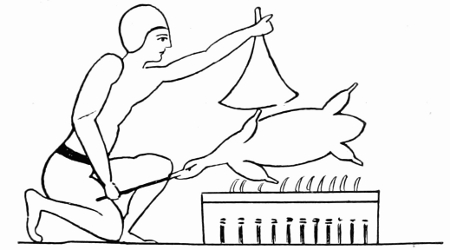
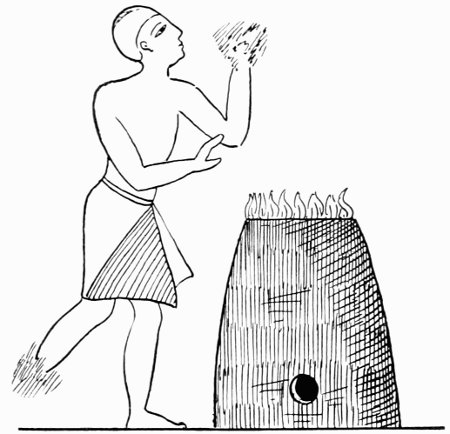
Roasting a goose over a fire of peculiar construction.
(From a tomb at Thebes.)
Eels were, though, considered unwholesome in summer (Ibid.).
Crocodiles were considered sacred in the neighborhood of Lake Moeris and
of Thebes, but were eaten by the natives of the southern frontier.
The many restrictions imposed by religion and custom on the diet of the
early Egyptians subjected them to much ridicule from the inhabitants of
contemporary nations, especially from the Greeks. Anaxandrides taunted
them in his verses.
The priests lived solely on oxen, geese, wine, bread and a few
vegetables. Mutton, pork and fish were expressly forbidden them. They
were also warned to abstain from beans, peas, lentils, onions, garlic
and leeks. On fast days they ate only bread and drank only water.
The people of the higher classes probably ate only two meals a day, as
was the custom with the early Greeks and Romans. The breakfast was
usually served at 10 or 11 a. m., and the dinner or supper in the
evening.
In the early ages, before men had acquired the art of smelting ore, many
of the culinary utensils of the Egyptians were either of stone or
earthenware.
Knives were made of flint or stone, and were of two kinds, one broad and
flat, the other narrow and pointed.
The skins of the goat and gazelle were fashioned into vessels for the
carrying of water, and pans, dishes and vases for kitchen purposes were
made of a red ware—sometimes of a light or yellow tint, sometimes of a
brilliant and polished appearance.
The Egyptians were acquainted with the use of glass at least as early as
the reign of Sesortasen II. (more than 3800 years ago), and made for it
bottles and other utensils. Some of the former were made from two
thicknesses of glass, enclosing between them bands of gold, alternating
with a set of blue, green or other color.
As the Egyptians advanced in social culture, the wealthier classes gave
more and more attention to the pleasures of the table. Banquets became
more general and increasingly more elaborate. The sums of money spent on
some of these entertainments were fabulous; they have never since been
equalled in their costly, wasteful magnificence.
The preparation of a big dinner was in those days a weighty undertaking,
for there were no big hotels to take the burden off the host's
shoulders. Game had to be procured, professionals engaged, extra
attendants hired, etc.
As all the meat used was freshly slaughtered, the kitchen and the
butcher's department presented an active appearance for many hours
previous to the feast.
In slaughtering, it was customary to take the ox or other animal into a
courtyard near the house, tie its legs together and throw it to the
ground, to be held in that position by one or more persons while the
butcher prepared to cut its throat, as nearly as possible from one ear
to the other, sometimes continuing the opening downwards along the neck,
the blood being received in a vase or basin to be utilized later in
cooking. The head was then taken off and the animal skinned, the
operators beginning with the leg and neck. The first joint removed was
the right foreleg or shoulder, the other parts following in succession
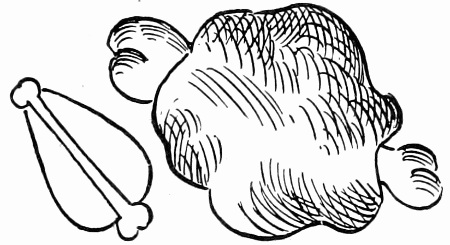
according to convenience. One of their most remarkable joints, still
seen in Egypt (although nowhere else) was cut from the leg and consisted
of the flesh covering the tibia, whose two extremities projected
slightly beyond it, as seen in the illustration.
The Tibia, a peculiar Egyptian joint.
Servants carried the joints to the kitchen on wooden trays. There they
were washed and prepared for the different processes of cooking. Then
the various cooks were kept busy scouring the utensils, attending to the
boiling, roasting, etc., pounding spice, making macaroni and performing
all the other details of kitchen work.
The head of the animal was usually given away in return for extra
services, such as the holding of the guests' sticks, but it was
occasionally eaten by the people of the higher classes, the assertion of
Herodotus to the contrary notwithstanding.
Geese and other tame and wild fowl were served up entire, and fish also
came to table deprived of only the tails and fins.
Vegetables were cooked in enormous quantities.
Bronze caldrons of various sizes were used for boiling. They were placed
over the fire on metal stands or tripods or supported on stones. Some of
the smaller vessels, used for stewing meats, were heated over pans of
charcoal. They resembled almost exactly the magoor of modern Egypt.
The mortars used for the pounding of spices were made of hard stone and
the pestles of metal.
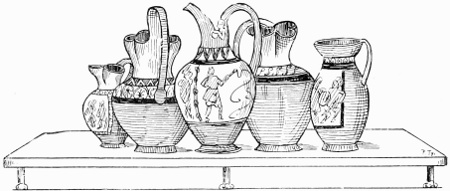
Most of the bowls, ewers, jugs, buckets, basins, vases and ladles used
in the kitchen were made of bronze alloyed with tin and iron. The usual
proportion of tin was 12 per cent. and iron 1 per cent., although
occasionally the amount of tin was as high as 15 (Ibid.) and as low as 6
per cent.
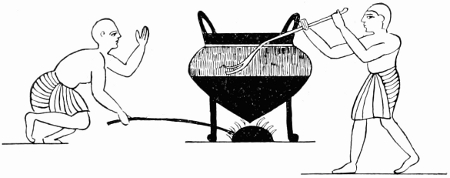
Slaves boiling meat and stirring fire.
Simpula, or ladles, were commonly made of bronze (often gilded), with
the curved summit of the handle, which served to suspend the ladle at
the side of the tureen or other vessel, terminating in the likeness of a
goose's head (a favorite Egyptian ornament).
Small strainers or collanders of bronze were also used, though for
kitchen purposes they were made of strong papyrus stalks or rushes.
The spoons were of various forms and made from ivory, wood and divers
metals. In some the handle ended in a hook, by which when required they
were suspended on nails. The handles of others were made to represent
men, women or animals. Many were ornamented with lotus flowers.
Skins were also used for holding wine and water.
The roasting was performed over fire burning in shallow pans. These were
regulated by slaves, who raised them with pokers and blew them with
bellows worked by the feet.
Though the Egyptians, except when impelled by the desire for extravagant
display, partook sparingly of all but one or two meats, they were fond
of a great variety of cakes and dainty confections. The more elaborate
forms of pastry were mixed with fruits and spirits, and shaped to
represent animals, birds and human beings.
The plainer rolls were generally mixed and shaped by hand and sprinkled
with seeds before baking. At other times, though, they were prepared
from a thinner mixture, first well kneaded in a large wooden bowl (the
feet often being used for this purpose), and then carried in vases to
the chief pastry cook, who formed it into a sort of macaroni upon a
metal pan over the fire, stirring the mixture with a wooden spatula,
whilst an assistant stood ready with two pointed sticks to remove it
when sufficiently cooked.
Wine and water were placed in porous jars and fanned until cool. The
water was purified by the use of paste of almonds (as it is, indeed, at
the present day).
In the meantime, the reception room had been arranged for the guests.
Chairs or stools were placed in rows or groups, extra carpets and mats
strewn about, flowers put in and around vases and the house decorated in
every other conceivable manner.
When guests began to arrive, they were first received in the vestibule
by the attendants, who presented them with bouquets, placed garlands of
lotus upon their heads and sometimes collars of lotus around their
necks. To those who had come from a distance, they offered water and
rinsed their feet. They then anointed their heads with sweet-smelling
unguents and offered them wine and other beverages. During these
proceedings the visitors were generally seated on the mats.
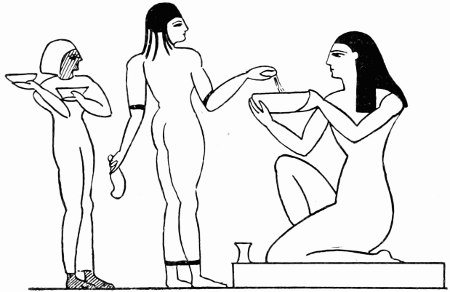
A black and white slave waiting upon a lady.
After having received these attentions, the ladies and gentlemen
intermingled and passed on to the main apartment, where the host and
hostess received them and begged them to take their seats on the chairs
and fauteuils which had been arranged for them. Here more refreshments
were handed around and more flowers offered, while the guests, generally
in couples, but sometimes in groups, conversed with one another. Music
was next commonly introduced, sometimes accompanied by dancing. The
performers in both acts were professionals and the dancing girls nearly
if not quite naked. Sometimes at the same party there would be two
bands, which we may suppose played alternately. Pet animals, such as
dogs, gazelles and monkeys, were also often present (Ibid.).
On some occasions the music, dancing and light refreshments constituted
the whole of the entertainment, but more generally the proceedings
described formed only the prelude to the more important part to follow.
The stone pictures show us round tables loaded with a great variety of
delicacies, such as joints of meat, geese, duck and waterfowl of
different kinds, cakes, pastry, fruits, etc., interspersed amongst the
guests.
These tables could be more accurately described as low stools supporting
round trays. The stool or pillar was often in the shape of a man,
usually a captive, who bore the slab on his head. The whole was made of
stone or some hard wood. It was not often covered with linen, but was
from time to time cleansed with a moist rag or cloth (Homer).
The dishes were probably handed round by the attendants and the guests
helped themselves with their hands, as knives and forks were then
unknown and the spoons that were manufactured do not seem to have been
used for eating. The guests took as much as they could hold in their
hands and, after eating, dipped them in water or wiped them in napkins
which, it will be observed, the waiters carried. Beer and wine were
supplied to quench the thirst.
As individual cups were not usually seen, the women were presented with
the desired beverage in silver vases, and the men with it in hand
goblets, which after being drained were returned to the attendant. Women
and men both imbibed freely and drunkenness was a universal and
fashionable habit of both sexes.
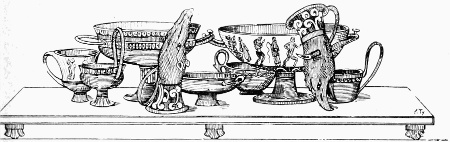
When the country was in the zenith of her power and magnificence, the
drinking goblets were of gold, silver, glass, porcelain, alabaster and
bronze. They varied also in form, some plain in appearance, others
beautifully engraved and studded with precious stones. Heads of animals
often adorned the handles, the eyes frequently composed of various
gems. Many were without handles, while others were so shaped as to more
properly come under the name of beakers and saucers. The beakers were
frequently made of alabaster with a round base, which prevented their
maintaining an upright position without additional support; and when
empty they were turned downwards upon their rims. The saucers, which
were of glazed pottery, were ornamented with lotus and fish carved or
molded on their concave surface.
Many of the vases have never yet been surpassed in daintiness of
ornamentation. The most remarkable were those fashioned from porcelain
which was made of a fine sand or grit, loosely fused and covered with a
thick silicious glaze of a blue, green, white, purple or yellow color.
The blue tints obtained have never been equalled in modern times.
Herodotus tells us that, after the heavier part of a banquet, it was the
custom to have a man carry round a coffin containing a wooden image in
exact imitation of a corpse. Showing this to each of the revelers, the
bearer would say: "Look upon this and then drink and enjoy yourself, for
when dead you will be like unto this." A rather weird observance, which
might be traced back to the death of Osiris.
If the phrases are correctly reported, we must suppose the figure,
brought in after the eating was ended and when the drinking began, was
for the purpose of stimulating the guests to still greater conviviality.
But if that were the case when Herodotus visited Egypt it must have been
originated with a very different intention. The Egyptians were too much
inclined to excesses in eating and drinking, both men and women
(Herodotus and Plutarch), and the priests probably endeavored to thus
check their too riotous mirth without personally interfering. Plutarch
said concerning it:
"The skeleton which the Egyptians appropriately introduce at their
banquets, exhorting the guests to remember that they shall soon be like
him, though he comes as an unwelcome and unseasonable boon companion,
is nevertheless in a certain degree seasonable, if he exhorts them not
to drink too deeply or indulge only in pleasures, but to cultivate
mutual friendship and affection and not to render life, which is short
in duration, long by evil deeds."
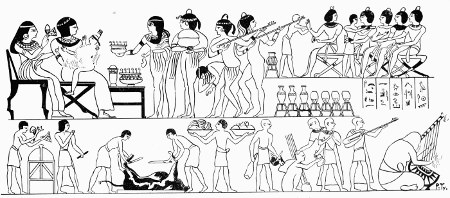
EGYPTIAN PARTY. (From a Tomb at Thebes.)
Host and hostess receiving presents. Dancing girls. Slaves waiting on
guests. Placing collars of lotus around their necks.
Slaves preparing
bouquets. Scribe. Butchers cutting up ox. Carrying trays of meat. Man
clapping hands and singing. Guitar player. Harpist.
Slave carrying head
and haunch. Stick custodian rewarded.
After the skeleton, there was sung a doleful song in honor of Maneros,
whose identity is clouded by traditional disputes.
Next, music and songs of more mirthful character were resumed. Sometimes
jugglers, male and female, were hired for the occasion. They amused
their audience with ball tossing, turning somersaults, leaping and
wrestling. Occasionally, games, resembling our draughts or checkers,
served to amuse those present (Ibid.), but as a rule the fumes of wine
prevented any such quiet occupation, and the festival in many cases
ended with a most riotous carousal.
The foregoing is probably a true picture of a banquet in ancient
Egypt—except that, according to some writers, the diners were seated on
the floor and ate from very low stools or tables.
Yet, in spite of all, the moral code of the early Egyptians was purer
than that of contemporary nations. And commerce and war carried abroad
the advanced thoughts, great learning and luxurious tastes of these
ancient people, to be the foundations in after years of divers
civilizations, amongst them our own.