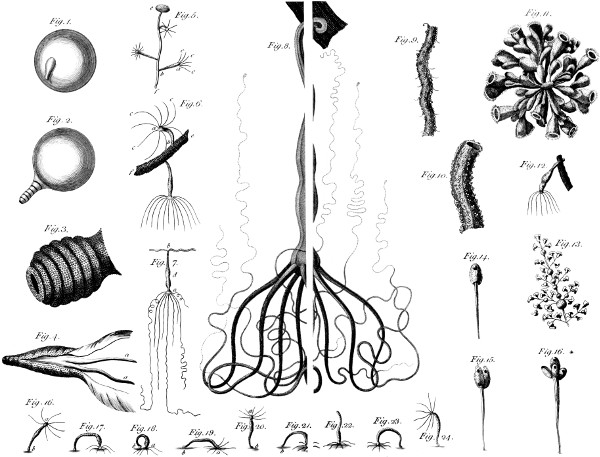
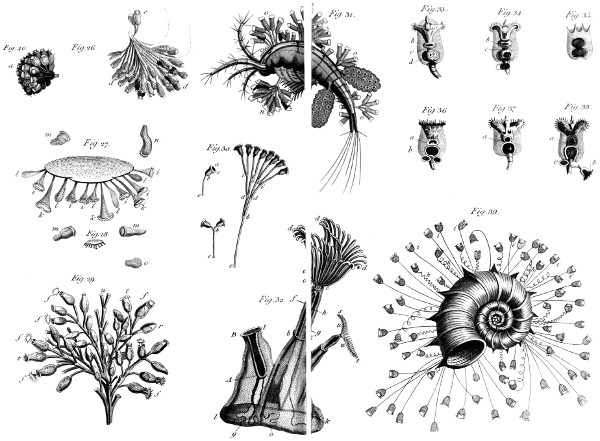
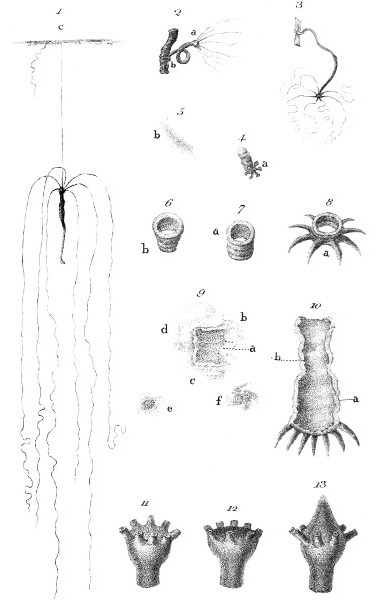
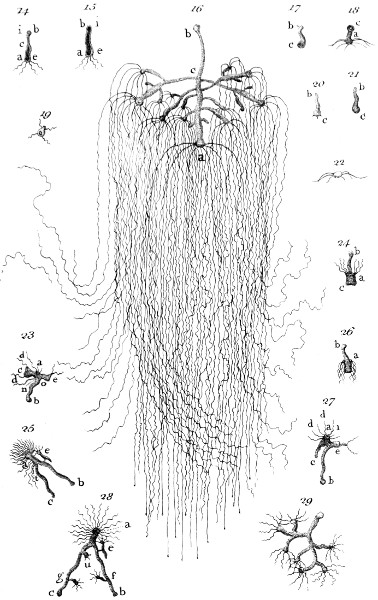
Our knowledge of the microscopic world is at present very
contracted, but we know enough to give us high conceptions of
its concealed wonders, and to fill us with profound astonishment
at the infinite variety of forms that are made recipient of life.
A few of the inhabitants of this minute world have been discovered.
The figure and apparent habits of life of these, resemble
so little those with which we are more acquainted, that it is
often difficult to find terms to express what is represented to the
eye.
Animalculum signifies a little animal, and therefore the term
might be applied to every animal which is considerably inferior
in size to ourselves. It has been customary, however, to distinguish
by the name of animalcula only such animals as are of a
size so diminutive, that their true figure cannot be discerned
without the assistance of glasses; and more especially it is applied
to such as are altogether invisible to the naked eye, and cannot
even be perceived to exist, but by the aid of microscopes.
By the help of magnifying glasses we are brought into a kind
of new world; and numberless animals are discovered, which,
from their minuteness, must otherwise for ever have escaped our
observation: and how many kinds of these invisibles there may
be, is yet unknown; as they are observed of all sizes, from those
which are barely invisible to the naked eye, to such as resist the
action of the microscope, as the fixed stars do that of the telescope,
and with the best magnifiers hitherto invented, appear only
as so many moving points.
The smallest living creatures our instruments can shew, are
those that inhabit the waters; for, though possibly animalcula
equally minute, or perhaps more so, may fly in the air, or creep
upon the earth, it is scarce possible to obtain a view of them;
whereas, water being transparent, and confining the creatures
within it, we are enabled, by applying a drop of it to our glasses,
to discover with ease a great part of its contents, and in a space
barely visible to the naked eye, often perceive a thousand little
creatures, all full of life and vigour.
By the animalcula infusoria are meant, not the larvæ of those
insects which in their first state are inhabitants of water, and
afterwards become winged insects, as the gnat, &c. Baker, and
many other writers on the subject, have often confounded these,
and hence entered into a train of reasoning contrary to fact and
experience. The animalcula infusoria take their name from their
being found in all kinds either of vegetable or animal infusions;
if seeds, herbs, or other vegetable substances, be infused in water,
it will soon be filled with an indefinite number of these minute
beings. There is a prodigious variety in their forms; some perfectly
resemble the bell-polype; others are round or oblong,
without any, at least apparent, members; some resemble a bulb
with a long taper tail; some are nearly spherical; the greater part
are vesicular and transparent. Those most generally found in
every drop of ditch water are mere inflated bladders, with a small
trace of intestines in the center; the next are a flat kind, with a
number of legs under the belly.
Motion seems to be their great delight; they pervade with
equal ease and rapidity, and in all forms and directions, the whole
dimensions of the drop, in which they find ample space for their
various progressions, sometimes darting straight forward, at other
times moving obliquely, then again circularly: they know how
to avoid with dexterity any obstacles that might obstruct their
progress. Hundreds may be seen in a drop of water in constant
action, yet never striking against each other. If at any time the
clusters prove so thick as to impede any of their motions, they
roll and tumble themselves over head, creep under the whole
range, force their way through the midst, or wheel round the
cluster, with surprizing swiftness; sometimes they will suddenly
change the direction in which they are moving, and take one diametrically
opposite thereto. By inclining the glass on which the
drop of water is laid, it may be made to move in any direction;
the animalcula in the drop will swim as easily against the stream
as with it.
If the water begin to evaporate, and the drop to grow smaller,
they flock impetuously towards the remaining part of the fluid;
an anxious desire of attaining this momentary respite of life is
very visible, as well as an uncommon agitation of the organs by
which they imbibe the water. These motions grow more languid
as the water fails, till at last they entirely cease.
Animalcula and insects will support a great degree of cold, but
both one and the other perish when it is carried beyond a certain
point. The same degree of heat that destroys the existence of
insects, is fatal to animalcula; as there are animalcula produced
in water at the freezing point, so there are insects which live in
snow.
If the smallest drop of urine be put into a drop of water
where these animalcula are roving about, apparently happy and
easy, they instantly fly to the other side, but the acid soon communicating
itself to this part, their struggles to escape are increased,
but the evil also increasing, they are thrown into convulsions,
and soon expire.
Among animalcula, as in every other part of nature, there is
constantly a certain proportion preserved between the size of the
individuals and their number. There are always fewest amongst
the larger kinds, but they increase in number as they diminish in
size, till of the last, or lowest to which our powers of magnifying
will reach, there are myriads to one of the larger. Like other
animals, they increase in size from their birth till they have attained
their full growth. When deprived of food, they grow
thin and perish; and different degrees of organization are to be
discovered in their structure.
The birth and propagation of these microscopic beings is as
regular as that of the largest animals of our globe; for though
their extreme minuteness prevents us, in most cases, from seeing
the germ from which they spring, yet we are well assured, from
numerous observations, that the manner in which they multiply
is regulated by constant and invariable laws.
It has been shewn that different species of the hydræ and vorticellæ
multiply and increase by natural divisions and subdivisions
of the parent’s body; this manner of propagation is very common
among the animalcula in infusions, though with many remarkable
varieties. Some multiply by a transverse division, a contraction
takes place in the middle, forming a kind of neck that becomes
smaller every instant, till they are enabled by a slight
degree of motion to separate from each other. These animalcula
in general studiously avoid each other; but when they are in the
labour of multiplication, and the division is in great forwardness,
it is not uncommon to see one of them precipitate itself on the
neck of the dividing animalculum, and thus accelerate the separation.
Another species, when it is on the point of multiplying, fixes
itself to the bottom of the infusion; it then forms an oblong
figure, afterwards becomes round, and begins to turn rapidly, as
if upon an internal center, continually changing the direction of
its rotatory motion; after some time, we may perceive two lines
on the spherule, forming a kind of cross; soon after which the
animalculum divides into four distinct beings, which grow, and
are again subdivided.
Some multiply by a longitudinal division, which in one kind
begins in the fore-part, and others in the hind-part; from another
kind a small fragment is seen to detach itself, which very soon
acquires the form of the parent animalculum. Lastly, some propagate
in the same manner as those we deem more perfect
animals.
From what has been said, it appears clearly that their motions
are not purely mechanical, but are produced by an internal spontaneous
principle, and that they must therefore be placed among
the class of living animals, for they possess the strongest marks,
and the most decided characters of animation; and consequently,
that there is no foundation for the supposition of a chaotic and
neutral kingdom, which can only have derived its origin from a
very transient and superficial view of these animalcula.
It may also be further observed, that as we see the motions of the
limbs, &c. of the more noble animals, viz. the human species, are
produced by the mechanical construction of the body and the action
of the soul thereon, and are forced by the ocular demonstration arising
from anatomical dissection, to acknowledge this mechanism
which is adapted to produce the various motions necessary to the
animal; and as when we have recourse to the microscope, we find
those pieces which had appeared to the naked eye as the primary
mechanical causes of the particular motions, to consist themselves
of lesser parts, which are the causes of motion, extension, &c. in
the larger; when the structure can therefore be traced no further
by the eye or glasses, we have no right to conclude, that the
parts which are invisible, are not equally the subject of mechanism:
for this would be only to assert in other words, that a thing
may exist because we see and feel it, and has no existence when
it is not the object of our senses.
The same train of reasoning may be applied to microscopic insects
and animalcula; we see them move, but because the muscles
and members which occasion these motions are invisible,
shall we infer that they have not muscles, with organs appropriated
to the motion of the whole and its parts? To say that they
exist not, because we cannot perceive them, would surely not be
a rational conclusion. Our senses are indeed given us, that we
may comprehend some effects; but then we have also a mind
with reason bestowed upon us, that from the things which we do
perceive with our senses, we may deduce the nature of those
causes and effects which are imperceptible to the corporeal
eye.
Messrs. Buffon, Needham, and Baron Münchhausen, have considered
this part of animated nature in so different a light from
other writers, that we cannot with propriety entirely pass them
over. Needham imagined that there was a vegetative force in
every microscopical point of water, and every visible filament of
which the whole vegetable contexture consists; that the several
species of microscopic animals may subside, resolve again into
gelatinous filaments, and again give lesser animals, and so on, till
they can be no further pursued by glasses. That agreeable to this
idea, every animal or vegetable substance advances as fast as it
can in its revolution, to return by a slow descent to one common
principle, whence its atoms may return again, and ascend to a
new life. That notwithstanding this, the specific seed of one
animal can never give another of a different species, on account
of the preparation it must receive to constitute it this specific
seed.
Buffon asserts, that what have been called spermatic animals,
are not creatures really possessing life, but something proper to
compose a living creature, distinguishing them by the name of
organic particles, and that the moving bodies which are to be
found in the infusions either of animal or vegetable substances,
are of the same nature.
Baron Münchhausen supposed that the seeds of mushrooms
were first animals, and then vegetables; and this, because he had
observed some of the globules in the infusions of mushrooms,
after moving some time, to begin to vegetate.
It might be sufficient in the first instance to observe, that
Messrs. Needham, and Buffon, by having recourse to a vegetative
force and organic particles, to account for the existence and explain
the nature of animalcula, and the difficulties of generation,
have substituted words in the place of things; and that we are no
gainers by the substitution, unless they explain the nature of
these powers. But to this we may add, that all those who have
examined the subject with accuracy and attention, as Bonnet,
De Saussure, Baker, Wrisberg, Spalanzani, Haller, Ellis, Müller,
Ledermüller, Corti, Rofredi, &c. disagree with the foregoing
gentlemen, proving that they had deceived themselves by inaccurate
experiments, and that one of them, Buffon, had not seen the
spermatic animals he supposed himself to be describing, insomuch
that Needham was at last induced to give up his favourite hypothesis.
Though we can by no means pretend to account for the appearance
of most animalcula, yet we cannot help observing, that
our ignorance of the cause of any phænomenon is no argument
against its existence. Though we are not, for instance, able to
account in a satisfactory manner for the origin of the native Americans,
yet we suppose Buffon himself would reckon it absurd to
maintain, that the Spaniards on their arrival there found only
ORGANIC PARTICLES moving about in disorder. The case is the
very same with the eels in paste, to whose animation he objects.
They are exceedingly small in comparison with us; but, with the
solar microscope, Baker has made them assume a more respectable
appearance, so as to have a diameter of an inch and an half, and
a proportionable length. They swam up and down very briskly;
the motion of their intestines was very visible; when the water
dried up they died with apparent agonies, and their mouths
opened very wide. Now, were we to find a creature of the size
of this magnified eel gasping in a place where water had lately
been, we certainly should never conclude it to be merely an
ORGANIC PARTICLE, or fortuitous assemblage of them, but a fish.
Why then should we conclude otherwise with regard to the eel
in its natural state, than that it is a little fish? In reasoning on
this subject, we ought ever to remember, that however essential
the distinction of bodies into great and small may appear to us,
they are not so to the Deity, with whom, as Baker well expresses
himself, “an atom is a world, and a world but as an atom.” Were
the Deity to exert his power a little, and give a natural philosopher
a view of a quantity of paste filled with eels, from each of
whose bodies the light was reflected as in the solar microscope;
our philosopher, instead of imagining them to be mere organic
particles, as the paste would appear like a little mountain, he
would probably look upon the whole as an assemblage of serpents,
and be afraid to come near them. Whenever, therefore,
we discover beings to appearance endued with a principle of self-preservation,
or whatever we make the characteristic of animals,
neither the smallness of their size, nor the impossibility of our
knowing how they came there, ought to cause us to doubt of
their being animated.
I shall here insert some extracts of the experiments made by
Ellis at the desire of Linnæus, and which are a full refutation of
those made by Needham and Münchhausen. By those he made
on the infusions of mushrooms in water, it appeared evidently
that the seeds were put in motion by minute animals, which
arose on the decomposition of the mushroom; these, by pecking
at the seeds, which are little round reddish bodies, moved them
about with great agility in a variety of directions, while the little
animals themselves were scarce visible till the food they had eaten
discovered them.
The ramified filaments, and jointed or coralloid bodies, which
the microscope discovers to us on the surface of most vegetable
and animal infusions, when they become putrid, and which were
supposed by Needham to be zoophytes, were found by Ellis to be
of that genus of fungi called mucor, many of which have been
figured by Michelius, and described by Linnæus. Their vegetation
is so quick, that they may be seen to grow and seed under
the eye of the observer. Other instances of similar mistakes in
Needham’s experiments may be seen in Ellis’s paper, Philos.
Trans. vol. lix. p. 138.
A species of mucor arises also from the bodies of insects putrefying
in water; this species sends forth a mass of transparent
filamentous roots, from whence arise hollow seed vessels; on the
top there is a hole, from which minute globules often issue in
abundance, and with considerable elastic force, which move about
in the water. It will however be found, with a little attention,
that the water is full of very minute animalcula, which attack
these seeds, and thus prolong their motion; but after a small
space of time they rise to the surface, and remain there without
any motion; a fresh quantity rises up, and floating to the edge of
the water, remains there inactive; but no appearance can be
observed of detached and separated parts becoming what are
called microscopic animalcula. Indeed, it is surprizing that
Needham should ever take the filaments of the moistened grains
for any thing else than a vegetable production, a true species of
mouldiness.
On the 25th of May, Fahrenheit’s thermometer 70°, Ellis
boiled a potatoe in the New River water, till it was reduced to
a mealy consistence. He put part of it, with an equal proportion
of the boiling liquor, into a cylindrical glass vessel, that held
something less than half a wine pint, and covered it close immediately
with a glass cover. At the same time he sliced an unboiled
potatoe, and, as near as he could judge, put the same
quantity into a glass vessel of the same kind, with the same proportion
of New River water not boiled, and covering it with
a glass cover, placed both vessels close to each other. On the
26th of May, twenty-four hours afterwards, he examined a small
drop of each by the first magnifier of Wilson’s microscope, whose
focal distance is reckoned at 1⁄50 part of an inch; and, to his amazement,
they were both full of animalcula of a linear shape, very
distinguishable, moving to and fro with great celerity; so that
there appeared to be more particles of animal than vegetable life
in each drop. This experiment he repeatedly tried, and always
found it to succeed in proportion to the heat of the circumambient
air; so that even in winter, if the liquors be kept properly
warm, at least in two or three days the experiment will succeed.
The animalcula are infinitely smaller than spermatic animals,
and of a very different shape; the truth of which every accurate
observer will soon be convinced of, whose curiosity may lead
him to compare them, and he is persuaded they will find they are
no way akin. Having learnt from M. De Saussure, of Geneva,
that he found one kind of these animalcula infusoria that increases
by dividing across into nearly two equal parts, and that
the infusion was made from hemp-seed, he procured a quantity
of this seed, some of it he put into New River water, some into
distilled water, and some into very hard pump water; the result
was, that in proportion to the heat of the weather, or the warmth
in which they were kept, there was an appearance of millions of
minute animalcula in all the infusions; and some time after some
oval ones made their appearance; these were much larger than
the first, which still continued. These wriggled to and fro in an
undulatory motion, turning themselves round very quick all the
time that they moved forwards.
Ellis found out by mere accident a method to make their fins
appear very distinctly, especially in the larger kind of animalcula,
which are common to most vegetable infusions, such as the terebella.
This has a longish body, with a cavity or groove at one
end, like a gimblet. By applying a small stalk of the horseshoe
geranium, the geranium zonale of Linnæus, fresh broken, to a
drop of water in which these animalcula are swimming, we shall
find that they will become instantly torpid, contracting themselves
into an oblong oval shape, with their fins extended like so
many bristles all round their bodies. The fins are in length about
half the diameter of the middle of their bodies. After lying in
this state of torpitude for two or three minutes, if a drop of
clean water be applied to them, they will recover their shape,
and swim about immediately, rendering their fins again invisible.
Before he discovered this expedient, he tried to kill them by
different kinds of salts and spirits; but though they were destroyed
by these means, their fins were so contracted, that he
could not distinguish them in the least.[118]
It is one of the wonders of the modern philosophy to have invented
means for bringing creatures so imperceptible as the various
animalcula under our cognizance and inspection. One
might well have deemed an object that was a thousand times too
little to be able to affect our sense, as perfectly removed from
human discovery; yet we have extended our sight over animals
to whom these would be mountains. The naked eye takes in
animal beings from the elephant to the mite; but below this,
commences a new order, reserved only for the microscope, which
comprehends all those from the mite, to those many millions of
times smaller; and this order cannot be said to be exhausted, if
the microscope be not arrived at its ultimate state of perfection.
In reality, the greater number of microscopic animalcula are of so
small a magnitude, that through a lens, whose focal distance is
the tenth part of an inch, they only appear as so many points;
that is, their parts cannot be distinguished, so that they appear
from the vertex of that lens under an angle not exceeding the
minute of a degree. If we investigate the magnitude of such an
object, it will be found nearly equal to 3⁄100000 of an inch long.
Supposing, therefore, these animalcula to be of a cubic figure,
that is, of the same length, breadth, and thickness, their magnitude
would be expressed by the cube of the fraction 3⁄100000, that
is, by the number 27⁄1000000000000000, that is, each animalculum is
equal to so many parts of a square inch. This contemplation of
animalcula has rendered the idea of indefinitely small bodies very
familiar to us; a mite was formerly thought the limit of littleness,
but we are not now surprized to be told of animals many
millions of times smaller than a mite; for, “there are in some
liquors animalcules so small, as, upon calculation, the whole
magnitude of the earth is not found large enough to be a third
proportional to these minute floating animals and the whales in
the ocean.”[119] These considerations are still further heightened,
by reflecting on the internal structure of animalcula, for each
must have all the proportion, symmetry and adjustment of that
organized texture, which is indispensably necessary for the several
functions of life, and each must be furnished with proper organs,
tubes, &c. for secreting the fluids, digesting its food, and propagating
its species.[120]
Having thus given a general idea of the properties of animalcula,
I now proceed to describe the various individuals, following
the arrangements of O. F. Müller,[121] and giving the discriminating
characters by which he has distinguished them; abridging,
enlarging, or altering the descriptions, to render them in some
instances more exact, in others less tedious, and upon the whole,
I hope, more interesting to the reader.
I. THOSE THAT HAVE NO EXTERNAL ORGANS.
1. Monas: punctiforme. A mere point.
2. Proteus: mutabile. Mutable, or changeable.
3. Volvox: sphæricum. Spherical.
4. Enchelis: cylindraceum. Cylindrical.
5. Vibrio: elongatum. Long.
Membranaceous.
6. Cyclidium: ovale. Oval.
7. Paramæcium: oblongum. Oblong.
8. Kolpoda: sinuatum. Crooked, or bent.
9. Gonium: angulatum. With angles.
10. Bursaria. Hollow like a purse.
II. THOSE THAT HAVE EXTERNAL ORGANS.
Naked, or not inclosed in a shell.
11. Cercaria: caudatum. With a tail.
12. Leucophra: ciliatum undique. Every part ciliated.
13. Trichoda: crinitum. Hairy.
14. Kerona: corniculatum. With horns.
15. Himantopus: cirratum. Cirrated, or curled.
16. Vorticella: ciliatum apice. The apex ciliated.
Covered with a shell.
17. Brachionus: ciliatum apice. The apex ciliated.
Vermis inconspicuus, simplissimus, pellucidus, punctiformis.
An invisible,[122] pellucid, simple, punctiform worm.
1. Monas Termo.
M. gelatinosa. Gelatinous mona.
Animalcules semblable a des points. Spallanzani Opusc. Phys. I.
Bullæ continuo motu. Bonanni Obs. p. 174.
Among the various animalcula which are discovered by the
microscope, this is the most minute, and the most simple; a small
jelly-like point, eluding the powers of the compound microscope,
and being but imperfectly seen by the single; these, and some
others of the mona kind, are so delicate and slender, that it is no
wonder they often escape the sight of many who have examined
infusions with attention; in a full light they totally disappear,
their thin and transparent forms blending as it were with the
water in which they swim.
Small drops of infused water are often so full of these, that it
is not easy to discover the least empty space, so that the water
itself appears changed into another substance less transparent,
but consisting of innumerable globular points, thick sown together;
which, though full of life, seem only a kind of inflated
bladders. In this a motion may be perceived, something similar
to that which is observed when the sun’s rays shine on the water,
the animalcula being violently agitated, or in a commotion like
unto a hive of bees. They are very common in ditch water, and
in almost all infusions, both of animal and vegetable substances.
2. Monas Atomus.
M. albida puncto, variabili instructa,
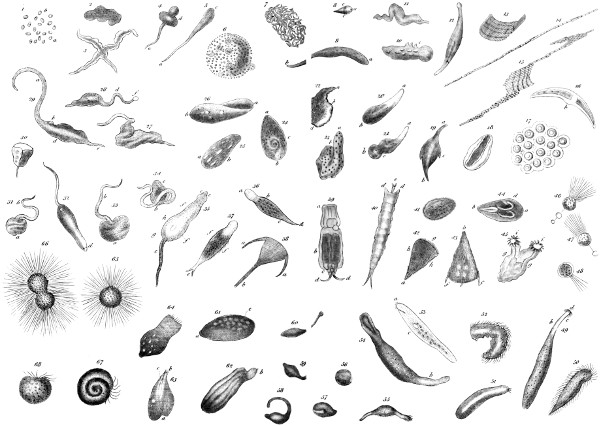
Plate XXV. Fig. 1. White mona, with a variable point.
This animalculum appears as a white point, which, when it is
highly magnified, is somewhat of an egg-shape; the smaller end
is generally marked with a black point; the situation of this is
sometimes varied, and found at the other end of the animalculum:
sometimes two black points are to be seen crossing the
middle of the body. It was found in sea water that had been
kept the whole winter; it was not, however, very fetid; there
were no other animalcula in the same water.
3. Monas Punctum.
M. nigra. A black mona.
A very minute point, solid, opake and black, round and long.
They are dispersed in the infusion, and move with a slow wavering
motion; were found in a fetid infusion of pears.
4. Monas Ocellus.
M. hyalina puncto centrali notata.
Transparent like talc, with a point in the middle.
The margin black, and a black point in the middle; it moves
irregularly, is found in ditches covered with conferva, and frequently
with the cyclidium milium, see No. 84.
5. Monas Lens.
M. hyalina. Transparent mona of the appearance
of talc.
This is among the number of the smaller animalcula, nearly of
a round figure, and so pellucid, that it is not possible to discover
the least vestige of intestines. Though they may often be seen
separate, yet they are more generally collected together, forming
a kind of vesicular or membranaceous mass. Contrary to the
custom of other animalcula, they seek the edges of the evaporating
water, the consequence of which is almost immediate death.
When the water is nearly evaporated, a few dark shades are perceived,
probably occasioned by the wrinkling of the body. A
slow tremulous motion, confined to one spot, may be perceived
at intervals; this in a little time becomes more lively, and soon
pervades the whole drop. Its motions are in general very quick:
two united together may sometimes be seen swimming among
the rest; while in this situation, they have been mistaken by some
writers for a different species, whereas it is the same generating
another by division. It is to be found in all water, though but
seldom in that which is pure; they are in great plenty in the
summer in ditch water, also in infusions of animal or vegetable
substances, made either of fresh or salt water, myriads being contained
in a drop; numbers of various sizes are to be found in the
filth of the teeth.[123]
The animalcula of this, and the first species are so numerous as
to exceed all calculation, though they are contained in a very
confined space.
6. Monas Mica.
M. circulo notata. Mona, marked with a
circle.
This lucid little point may be discovered with the third lens of
the common single microscope; when the magnifying power is
increased, it appears either of an oval or spherical figure, for it
assumes each of these at pleasure. It is transparent, and has a
small ellipse inscribed as it were within its circumference; this
ellipse is moveable, being sometimes in the middle, sometimes a
little towards the fore-part, at others, nearer the hind-part.
There is a considerable variety in its motions; it often turns
round for a long time in the same place; an appearance like two
kidneys may sometimes be perceived in the middle of the body,
and the animalculum is beautifully encompassed with a kind of
halo, arising most probably from invisible and vibrating fibrillæ.
They are to be found in the purest waters.
7. Monas Tranquilla.
M. ovata, hyalina, margine nigro.
Egg-shaped, transparent mona, with a black margin.
These animated points seem to be nearly fixed to one spot,
where they have a fluctuating or reeling motion. They are frequently
surrounded with a halo, and differ in their figure, being
sometimes rather spherical, at others quadrangular. The black
margin is not always to be found, and sometimes one would almost
be tempted to think it had a tail. They are found in urine
which has been kept for a time. The urine is covered, after it
has remained in the vessel, with a dark-coloured pellicle or film,
in which these animals live: although the urine was preserved for
several months, no new animalcula were observed therein. It
has been already shewn, that a drop of urine is in general fatal to
other animalcula, yet we find in this instance, that there are animated
beings of a peculiar kind, appropriated to, and living in it.
8. Monas Lamellula.
M. hyalina compressa. Flat transparent
mona.
This is mostly found in salt water. It is of a whitish colour,
more than twice as long as it is broad, transparent, with a dark
margin, the motion vacillatory; it often appears as if double.
9. Monas Pulvisculus.
M. hyalina, margini virente. Transparent
mona, with a green margin.
Little spherical pellucid grains of different sizes, the circumference
green, a green bent line passes through the middle of some,
probably indicating that they are near separating or dividing into
two distinct animalcula; sometimes three or four, at others, six,
seven, or even more, are collected together. They rove about
with a wavering motion; and are mostly found in the month of
March in marshy grounds.
10. Monas Uva.
M. hyalina gregaria. Transparent gregarious
mona.
It is not easy to decide on the nature of these little assemblages
of corpuscles, which sometimes consist of four, at others of five,
and frequently of many more: the corpuscles are of different
sizes, according to the number assembled in one group. When
collected in a heap, the only motion they have is a kind of revolution
or rotatory one. The smaller particles separate from the
larger, often dividing into as many portions as there are constituent
particles in the group; when separated, they revolve with
incredible swiftness. To try whether this was a group of animalcula
collected together by chance, or whether this was their
natural state, the following experiment was made. A single corpuscle
was taken the moment it was separated from the heap, and
placed in a glass by itself; it soon increased in size, and when it
had attained nearly the same bulk as the group from which it was
separated, the surface began to assume a wrinkled appearance,
which gradually changed till it became exactly similar to the
parent group. This new-formed group was again decomposed,
like the preceding one, and in a little time the separated particles
became as large as that from which they proceeded. It is found
in a variety of infusions.
Vermis inconspicuus, simplicissimus, pellucidus, mutabilis. An
invisible, very simple, pellucid worm, of a variable form.
11. Proteus Diffluens.
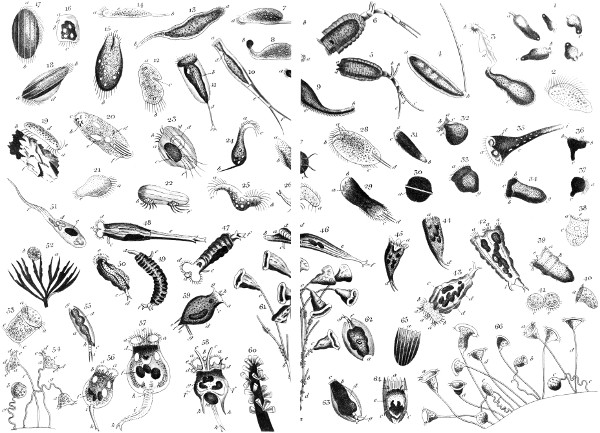
P. in ramulos diffluens, Plate XXV.
Fig. 2 and 3. Proteus, branching itself out in a variety of directions.
A very singular animalculum, appearing only as a grey mucous
mass; it is filled with a number of black globules of different
sizes, and is continually changing its figure. Being formed of a
gelatinous pellucid substance, the shape is easily altered, and it
pushes out branches of different lengths and breadths. The globules
which are within divide and pass immediately into the new
formed parts, always following the various changes of form in
the animalcula. The changes that are observed in the form of
this little creature, do not arise from any extraneous cause, but
are entirely dependent on its internal powers. It is to be met
with but very seldom; the indefatigable Müller only saw it
twice, although he examined such an immense variety of infusions.
It is to be found in fenny situations.
12. Proteus Tenax.
P. in spiculum diffluens, Plate XXV.
Fig. 4 and 5. Proteus, running out into a fine point.
A gelatinous pellucid body, stored with black molecules; it
changes its form like the preceding, but always in a regular order,
first extending itself out in a straight line, Fig. 5, the lower
part terminating in an acute bright point, a, without any intestines;
and the globules being all collected in the upper part, c,
it next draws the pointed end up towards the middle of the
body, swelling it into a round form. The contraction goes on
for some time, after which the lower part is swelled out as it is
represented in Fig. 4, d; the point a, is afterwards projected
from this ventricose part. It passes through five different forms
before it arrives at that which is seen, at Fig. 4. It scarcely
moves from one spot, only bending about sideways. It is to be
found in river water.
Volvox inconspicuus, simplicissimus, pellucidus, sphæricus. An
invisible, very simple, pellucid, spherical worm.
13. Volvox Punctum.
V. sphæricus, nigricans, puncto lucido.
Spherical, of a black colour, with a lucid point.
A small globule; one hemisphere is opake and black, the other
has a pellucid crystalline appearance; a vehement motion is observable
in the dark part. It moves in a tremulous manner, and
often passes through the drop, turning round as if upon an axis.
Many may be often seen joined together in their passage through,
the water; they sometimes move as in a little whirlpool, and
then separate. They are found in great numbers on the surface
of fetid sea water.
14. Volvox Granulum.
V. sphæricus, viridis, peripheria
hyalina. Spherical and green, the circumference of a bright
colour.
There seems to be a kind of green opake nucleus in this animalculum;
the circumference is transparent. It is to be found
generally in the month of June, in marshy places; it moves but
slowly.
15. Volvox Globulus.
V. globosus; postice subobscurus.
Globular volvox, the hind-part somewhat obscure.
This globular animalculum is ten times larger than the monas
lens; it verges sometimes a little towards the oval in its form.
The intestines are just visible, and make the hinder part of the
body appear opake; it has commonly a slow fluttering kind of
motion, but if it be disturbed, the motion is more rapid. It is
found in most infusions of vegetables.
16. Volvox Pilula.
V. sphæricus, interaneis immobilibus
virescentibus. Small round volvox, with immoveable green intestines.
This is a small transparent animalculum; its intestines are immoveable,
of a green colour, and are placed near the middle of
the body, the edges often yellow; a small obtuse incision may be
discovered on the edge, which is, perhaps the mouth of the animalculum.
This little creature appears to be encompassed with
a kind of halo or circle. If this be occasioned by the vibratory
motion of any fringe of hairs, they are invisible to the eye, even
when assisted by the microscope. It seems to have a kind of
rotatory motion, at one time slow, at another quick; and is to be
found in water where the lemna minor, or least ducks-meat,
grows, sometimes as late as the month of December.
17. Volvox Grandinella.
V. sphæricus, opacus, interaneis
immobilibus. Spherical and opake, with immoveable intestines.
This is much smaller than the preceding, and is marked with
several circular lines; no motion is to be perceived among the
interior molecules. It sometimes moves about in a straight line,
sometimes its course is irregular, at others it keeps in the same
spot with a tremulous motion.
18. Volvox Socialis.
V. sphæricus, moleculis crystallinis,
æqualibus distantibus. Spherical volvox, with crystalline molecules,
placed at equal distances from one another.
When very much magnified this animalculum seems to have
some relation to the vorticella socialis, as seen with the naked
eye. It consists of crystalline molecules, disposed in a sphere,
and filling up the whole circumference; they are all of an equal
size. Whether they are included in a common membrane, or
whether they are united by one common stalk, as in the vorticella
socialis, has not been discovered. We are also ignorant of the
exact figure of the little particles of which it is composed; when
a very large magnifying power is used, some black points may be
discerned in the center of the crystalline molecules. The motion
is sometimes rotatory, sometimes from right to left, and the contrary.
It is found where the chara vulgaris has been kept.
19. Volvox Sphæricula.
V. sphæricus, moleculis similaribus
rotundis. Pl. XXV. Fig. 6. Spherical volvox, with round molecules.
This spherule is formed of pellucid homogeneous points of different
sizes. It moves slowly about a quarter of a circle from
right to left, and then back again from left to right.
20. Volvox Lunula.
V. hemisphæricus, moleculis similaribus
lunatis. Plate XXV. Fig. 7. An hemispherical volvox, with
lunular molecules.
Is a small roundish transparent body, composed of innumerable
molecules, homogeneous, pellucid, and of the shape of the moon
in its first quarter, without any common margin. It is in a continual
two-fold motion; the one, of the whole mass turning slowly
round; the other, of the molecules one among the other. They
are found in marshy places in the beginning of spring.
21. Volvox Globator.
V. sphæricus membranaceus. Spherical
membranaceous volvox.
This is a transparent globule, of a greenish colour; the fœtus is
composed of smaller greenish globules. It becomes whiter and
brighter with age, moves slowly round its axis, and may be perceived
by the naked eye. But to the microscope the superficies
of this pellucid membrane appears covered with molecules, as if
it were granulated, which has occasioned some observers to imagine
it to be hairy; the round pellucid molecules that are fixed in
the center are generally largest in those that are young. The
exterior molecules may be wiped off, leaving the membrane
naked. When the young ones are of a proper size, the membrane
opens, and they pass through the fissure; after this the
mother melts away. They sometimes change their spherical
figure, the superficies being flattened in different places. Most
authors speak of finding eight lesser globules within the larger;
but Müller says, that he has counted thirty or forty of different
sizes. This wonderful capsulate situation of its progeny is
well known; indeed it often exhibits itself big with children and
grand-children.
Leeuwenhoeck was the first who noticed this curious animalculum,
and depicted it; a circumstance which has not been mentioned
by Baker and other microscopic writers, who have described
it. It may be found in great plenty in stagnant waters
in spring and summer, and in infusions of hemp-seed and tremella.
Baker describes it as follows: This singular minute water
animal, seen before the microscope, appears to be exactly
globular, without either head, tail, or fins. It moves in all directions,
forwards or backwards, up or down, rolling over and
over like a bowl, spinning horizontally like a top, or gliding
along smoothly without turning itself at all. Sometimes its motions
are very slow, at other times very swift; and when it
pleases, it can turn round as upon an axis very nimbly, without
moving out of its place. The body is transparent, except where
the circular spots are placed, which are probably its young. The
surface of the body in some is as it were dotted all over with
little points, and in others, as if granulated like shagreen. Baker
thought also that in general it appeared as if it was set round
with short moveable hairs. By another writer they are thus
described: These animalcula are at first very small, but grow so
large as to be discerned with the naked eye; they are of a yellowish
green colour, globular figure, and in substance membranaceous
and transparent. In the midst of this substance several
small globes may be perceived; each of these are smaller animalcula,
which have also their diaphanous membrane, and contain
within themselves still smaller generations, which may be distinguished
by the assistance of very powerful glasses. The larger
globules may be seen to escape from the parent, and then increase
in size, as has been already observed.
22. Volvox Morum.
V. membranaceus orbicularis, centro
moleculis sphæricis viridibus. Membranaceous orbicular, with
spherical green molecules in the center.
This animalculum has some resemblance to the volvox uva, but
is sufficiently distinguished by the surrounding bright orbicular
membrane: the middle part is full of clear green globules. The
globules seldom move, though a quivering motion may sometimes
be perceived at the center. It has a slow rotatory motion,
and is found amongst the lemna, in the months of October and
December.
23. Volvox Uva.
V. globosus, moleculis sphæricis virescentibus
nudis. Globular volvox, composed of green spherical globules,
which are not inclosed in a common membrane.
This animalculum seems to be a kind of medium between the
volvox pilula, No. 16, and the gonium pectorale, No. 114, being,
like the one, composed of green spherules, and in form, resembling
the other. It consists of a congeries of equal globules of a greenish
colour, with a bright spot in the middle; the whole mass is sometimes
of a spherical form, sometimes oval, without any common
membrane; a kind of halo may be perceived round it, but whether
this is occasioned by the motion of any invisible hairs has not
been discovered. The mass generally moves from right to left,
and from left to right; scarce any motion can be discovered in
the globules themselves. It was found in the month of August,
in water where the lemna polyrrhiza was growing. Two masses
of these globules have been seen joined together. They contain
from four to fifty of the globules, of which a solitary one may
now and then be found.
24. Volvox Vegetans.
V. ramulis simplicibus et dichitomis,
rosula globulari terminatis. A volvox with simple dichitomous
branches, terminating in a little bunch of globules.
It consists of a number of floccose opake branches, which are
invisible to the naked eye; at the apex of these there is a little
congeries of very minute oval pellucid corpuscles. Müller at first
thought it to be a species of microscopic and river sertularia; but
afterwards he found the bunches quitting the branches, and
swimming about in the water with a proper spontaneous motion.
Many old branches were found deserted of their globules, while
the younger branches were furnished with them. It was found
in river water in November 1779 and 1780.
Vermis inconspicuus, simplicissimus, cylindraceus. An invisible,
simple, cylindric worm.
25. Enchelis Viridis.
E. subcylindrica, antice oblique
truncata. Green enchelis, of a subcylindric figure, the fore-part
truncated.
This is an opake green, subcylindric animalculum, with an obtuse
tail, the fore-part terminating in an acute truncated angle;
the intestines obscure and indistinct. It is continually varying in
its motion, turning from right to left.
26. Enchelis Punctifera.
E. viridis, subcylindracea, antice
obtusa, postice acuminata, Plate XXV. Fig. 8. Green enchelis,
subcylindric, the fore-part obtuse, the hinder part pointed.
It is an opake animalculum, of a green colour; there is a small
pellucid spot in the fore-part a, in which two black points may
be seen; a kind of double band, c c, crosses the middle of the
body. The hinder part is pellucid and pointed; an incision is
discovered at the apex of the fore-part, which seems to be the
mouth. When in motion, the whole of it appears opake and
green. It is found in marshes.
27. Enchelis Deses.
E. viridis, cylindrica, subacuminata
gelatinosa. Green, cylindrical, gelatinous, the end somewhat
pointed.
The body is round, the colour a very dark green, so that it is
quite opake; the fore-part is bluntly rounded off, the hinder-part
is somewhat tapering, but finishes with a rounded end. From
its opacity, no internal parts can be discovered; there is a degree
of transparency near the ends. It is exceeding idle, moving very
slowly; to be found, though rarely, in an infusion of lemnæ.
28. Enchelis Similis.
E. obovato opaca, interaneis mobilibus.
Enchelis, of an egg-shape, opake with moveable intestines.
It is an opake body, with a pellucid margin; both extremities
are obtuse, but the upper one much more so than the under one;
it is filled with moveable spherules. Its motion is generally
quick, either to the right or the left; it is probably furnished
with hairs, because, when moving rapidly, the margin appears
striated. It is found in water that has been kept for months.
29. Enchelis Serotina.
E. ovato cylindracea, interaneis
immobilibus. Enchelis partly oval, partly cylindrical, the interior
parts immoveable.
An oval animalculum, round the fore-part smaller than the
hind-part, the margin of a black colour; it is replete with grey
vesicular molecules, and moves slowly.
30. Enchelis Nebulosa.
E. ovato-cylindracea, interaneis
manifestis mobilibus. Oval and cylindric enchelis, with visible
moveable intestines.
The body is shaped like an egg, the fore-part narrow, and
often filled with opake confused intestines; in moving, it elevates
the fore-part of the body. It is found in the same water
as the cyclidium glaucoma, No. 86, but is three times its size, and
considerably more scarce.
31. Enchelis Seminulum.
E. cylindracea æqualis. Enchelis
equally cylindric.
It is a cylindrical animalculum, twice as long as it is broad,
the fore and hind-part of the same size; the intestines in the
fore-part are pellucid, those in the hinder-part obscure. It moves
by ascending and descending alternately. It may be seen sometimes
swimming about with the extremities joined together.
Found in water that has been kept for some days.
32. Enchelis Intermedia.
E. cylindracea, hyalina, margine
nigricante. Cylindrical enchelis, transparent, with a blackish
margin.
This animalculum forms an intermediate kind between the monas
punctum, the enchelis seminulum, and the cyclidium milium. It
is one of the smallest among the animalcula. The body is transparent,
it has no visible intestines, the fore and hind-part are of
an equal size, the edge of a deeper colour than the rest of the
body; a point is to be seen in the middle of some of them; in
others, it is as if a line passed through the middle.
33. Enchelis Ovulum.
E. cylindrico-ovato hyalina. Egg-shaped
transparent enchelis.
A transparent, round, egg-shaped animalculum; nothing is discovered
withinside, even by the third magnifier; but, with an
increased power, some long foldings may be seen on the superficies,
and here and there a few bright molecules.
34. Enchelis Pirum.
E. inverse conica, postice hyalina.
Pear-form enchelis, the hinder-part transparent.
This enchelis is lively and pellucid, the fore-part is protuberant,
and filled with molecules, the hinder-part smaller and empty; it
has moveable molecular intestines. Its motion is rapid, passing
backwards and forwards through the diameter of the drop. When
at rest, it seems to have a little swelling, or tubercle, on the middle
of the body.
35. Enchelis Tremula.
E. ovato-cylindracea, gelatina.
Oval enchelis, cylindrical, gelatinous.
This is also to be placed amongst the most minute animalcula;
the end of it is rather pointed, and has a tremulous motion; it
almost induces one to think it has a tail. Two of these little
creatures may at times be perceived to adhere together. It was
found in an infusion with the paramæcia aurelia, No. 93, and
many other animalcula.
36. Enchelis Constricta.
E. obovata, crystallina, medio
coarctata. Sub-oval enchelis, crystalline, with a stricture in the
middle.
An animalculum of an oval shape, the middle part drawn in,
as if a string was tied round it. It is of a very small size, and is
found in salt water.
37. Enchelis Pulvisculus.
E. elliptica, interaneorum congerie
viridi. Of an elliptic shape, with a congeries of green intestines.
It is a round animalculum, pellucid, the fore-part obtuse, the
hind-part rather sharp, marked with green spots; myriads may
sometimes be seen wandering about in one drop; it is found
among the green matter on the sides of the vessels in which water
has been kept for some time.
38. Enchelis Fusus.
E. cylindracea, utraque extremitate
angustiore truncata. Cylindrical enchelis, both ends truncated.
The body is round and transparent, the fore and hind-part
smaller than the rest of the body, and equally so, the ends a little
truncated. In the inside a long and somewhat winding intestine,
a sky-coloured bright fluid, and some black molecules transversely
situated, may be discerned. The motions of this animalculum
are languid; it was found in pure water.
39. Enchelis Fritillus.
A cylindric enchelis, the fore-part
truncated.
This is one of the most transparent animalcula; the hinder-part
of an obtuse convexity, the fore-part truncated. Müller
suspects that there is a rotatory organ in the fore-part. No intestines
can be seen. It runs backwards and forwards through the
drop in a diametrical line, with a wavering motion; sometimes
turns round for a moment, but presently enters on its usual course.
Is found in an infusion of grass and hay.
40. Enchelis Caudata.
E. elongata, antice obtusa, postice
in caudam hyalinam attenuata, Plate XXV. Fig. 9. Enchelis
with a long body, the fore-part obtuse, the hinder-part diminishing
into a kind of tail.
The body is of a grey colour, pellucid, with globular molecules
divided from each other, and dispersed through the whole body;
the fore-part a, thick and obtuse, the hind-part b, crystalline and
small, the end truncated. It is but seldom met with.
41. Enchelis Epistomium.
E. cylindrico-elongata, apice
gracili subgloboso. Enchelis with a long cylindric body, the
fore-part slender and roundish.
It is among the smaller animalcula, the body is cylindrical and
bright, the hinder-part obtuse, the fore-part smaller, and terminating
in a globule; a black line may now and then be perceived
down the middle of it.
42. Enchelis Gemmata.
E. cylindracea, serie globulorum
duplici, in collum hyalinum producta. Enchelis with a cylindrical
body, the upper part prolonged into a transparent neck, a
double series of globules running down the body. Its motion is
slow, and generally in a straight line; it is found in ditch-water
where the lemna thrives.
43. Enchelis Retrograda.
E. hyalina, antice angustata,
apice globulari. Plate XXV. Fig. 11 and 12. Transparent enchelis,
the fore-part rather smaller, and terminating in a small globule.
It has a gelatinous transparent body; no visible intestines,
though a pellucid globule is discoverable near the hinder-part;
the body is thickest in the middle, and grows smaller towards
each end. It generally moves side-ways, sometimes in a retrograde
manner; and if it be obstructed in its motion, draws itself
up, as it is represented at Fig. 11.
44. Enchelis Festinans.
E. cylindrica oblonga, obtusa,
antice hyalina. Oblong cylindrical enchelis; the ends obtuse, the
fore-part transparent.
The body is round, of an equal size throughout, and both ends
obtuse; more than half the length is without any visible intestines,
the lower end full of vesicular, pellucid, minute globules;
a large globular vesicle is also to be found in the fore-part; it
moves quickly from one side to the other, in a reeling or staggering
manner. It was found in sea water.
45. Enchelis Farcimen.
E. cylindracea curvata utrinque
truncata. A cylindric enchelis, crooked and truncated at both
ends.
The body of this is cylindrical, about four times as long as
broad, even, truncated at both ends, the intestines opake, and not
to be distinguished from one another; it turns the extremities
opposite ways, so as to form the figure of an S. It is to be found
in water that has stood for some time, though but seldom. Joblot
found it in an infusion of corn centaury or blue-bottle; it
moves in an undulatory manner, but very slowly.
46. Enchelis Index.
E. inverse conica, apicis altero angulo
producto. Enchelis in the form of an inverted cone, one edge
of the apex produced out so as to form an angle with the other
part.
The body rather opake, of a grey colour, and of a long conical
figure; the lower end obtuse, the fore-part thick, one side of this
part projecting like a finger from the edge; two very small projections
proceed also sometimes from the lower end. This animalculum
has the power of retracting these projections, and making
both ends appear obtuse. It moves about but slowly, and was
found in water with the lemna minor, or least ducks-meat.
47. Enchelis Truncus.
E. cylindrica, subcapitata. Plate
XXV. Fig. 10. Cylindrical enchelis with a kind of head.
This is the largest of this kind of animalcula; the body is
cylindrical, mucose, grey, long and rather opake, the fore-part
globular, the hind-part obtuse. Something like three-teeth, c,
may be sometimes seen to proceed from one of the sides; it can
alter its shape considerably. Globules of different sizes may be
seen within the body. It rolls about slowly from right to left.
48. Enchelis Larva.
E. elongata, medio papillula utrinque
notata. A long enchelis, with two little nipples projecting from
the middle of the body, one on each side.
It is long, round, and filled with grey molecules; the fore-part
is obtuse and pellucid; a kind of neck or small contraction is
formed at some little distance from this end. The lower part
pointed; about the middle of the body there are two small projections.
49. Enchelis Spatula.
E. cylindrica striata, apice hyalino
spatulata. A cylindrical striated enchelis, the fore-part transparent,
and of the shape of a spatula.
This animalculum is perfectly cylindrical, very pellucid, of a
crystalline appearance; it is marked with very fine longitudinal
furrows, and has generally two transparent globules, one placed
below the middle, the other near the extremity of the body; on
the other side are five smaller ones, which are oval. The top is
dilated, with the corners rounded like the spatula, or instrument
for spreading plaisters. It has a wavering kind of motion,
folding the spatula variously, yet retaining its general form.
Müller mentions his seeing it once draw the spatula into the
body, and keep it there for two hours, when it again appeared.
50. Exchelis Pupula.
A cylindric enchelis, the fore-part
papillary.
The fore-part is protuberantly round, and rather opake, the
hind-part pellucid, both extremities obtuse, furnished with a papillary
finger-shaped head, the hinder part marked with a transparent
circle, or circular aperture. The fore-part filled up with
moveable molecules, which are more scarce in the hinder-part.
It has a rotatory motion on a longitudinal axis, and moves through
the water in an oblique direction. It is to be found in dunghill
water in November and December.
51. Enchelis Pupa.
E. ventricoso cylindrica, apice in papillam
producta. Enchelis forming a kind of ventricose cylinder,
with a small nipple proceeding from the apex.
It is not unlike the preceding animalculum, but is much larger;
the anterior end not so obtuse, the nipple gradually formed from
the fore-part, all but this end is opake, and filled with obscure
particles: it has no transparent circle, as was observed in the
enchelis pupula. Its motion is exceeding slow.
Vermis inconspicuus, simplicissimus, teres, elongatus. An invisible
worm, very simple, round, and rather long.
52. Vibrio Lineola.
V. linearis minutissimus. Very small
linear vibrio.
This is one of the most minute animalcula, surpassing in slenderness
the monas termo, No. 1. The greatest magnifier exhibits
little more than a tremulous motion of myriads of little oblong
obscure points. In a few days it almost fills the whole substance
of the water in vegetable infusions.
53. Vibrio Rugula.
V. linearis flexuosus. Vibrio like a
bent line.
Myriads of this species may be found; it is between the vibrio
lineola, just described, and the vibrio undula, No. 55. It appears
as a little line, which is sometimes drawn up in an undulated
shape, and moves backwards and forwards in a straight line, often
without bending the body at all.
54. Vibrio Bacillus.
V. linearis, æqualis utrinque truncata.
Linear vibrio, equally truncated at both ends.
This is an exceeding small creature, but visible with the third
lens; in a certain position of the light, transparent. It is gelatinous,
and not half so large as the monas lens, No. 5, though six,
and sometimes ten times longer; it is everywhere of an equal
size, and has no visible intestines; its action is languid, the serpentine
flexures of the body are with great difficulty perceived.
Müller made two infusions of hay in the same water, and at the
same time, in the one he put the hay whole, in the other it was
cut in small pieces; in the first there were none of the vibrio bacillus,
but many of the monas lens and kolpoda cucullus, No. 108;
in the latter, many of the vibrio bacillus, and few of the monæ.
55. Vibrio Undula.
V. filiformis flexuosus. A filiform
flexuous vibrio.
A perfect undulating little line, round, gelatinous, without any
visible intestines. It is never straight; when at rest it resembles
the letter V, when in motion the letter M, or a bending line like
that which geese form in their flight through the air; its motions
are so rapid, that the eye can scarce follow them. It generally
rests upon the top of the water, sometimes it fixes itself obliquely
by one extremity, and whirls itself round. This is the little
creature that Leeuwenhoeck says exceeds in slenderness the tail
of the animalculum seminale, which he has described in Fig. 5,
Epis. Phys. 41, being an hundred times less than a mustard-seed,
and on which he makes the following very just observation:
That as these very small animalcula can contract and variously
fold their little tails, we must conclude that tendons and muscles
are as necessary to them as to other animals; if to these we
add the organs of sensation, and those of the intestines, the mind
is lost in the astonishment which arises from the impression of
infinite, in the indefinitely small.
56. Vibrio Serpens.
V. filiformis, ambagibus in angulum
obtusum productis. A filiform vibrio, the windings or flexures
obtuse.
A slender gelatinous little animal, in the form of a long serpentine
line, all the bendings being nearly equal in size, and at
equal distances; it generally moves in a straight line; an intestine
may be discovered down the middle. It is to be found in river
water, but is not commonly to be met with.
57. Vibrio Spirillum.
V. filiformis, ambagibus in angulum
acutum tornatis. Filiform vibrio, twisted something like a spiral
wire or cork-screw, the bending acute.
It is an exceeding minute, singular creature, twisted in a spiral
form; the shape of these bendings remains the same even
when the animal is in motion, not occasioned by any internal
force, but are its natural shape. It moves generally in a straight
line, vibrating the hind and fore-parts. It was found in 1782, in
an infusion of the sonchus arvensis, or corn sow-thistle.
58. Vibrio Vermiculus.
V. tortuosus gelatinus. This little
vibrio is twisted and gelatinous.
The body is white, or rather of a milky appearance, cylindric,
long, the apex obtuse, rather growing smaller, and twisted towards
the hind-part. Its motion is languid and undulatory, like
that of the common worm; it sometimes moves quicker, but with
seeming labour. When it bends itself alternately from one side
to the other, a black long line may be discovered, sometimes
whole, sometimes broken: when at rest, it occasionally twists
into various folds. It may be observed easily with the first lens
of the single microscope, and is probably the same animalculum
mentioned by Leeuwenhoeck in all his works, as found in the
dung of frogs, and in the spawn of the male libellula. It is to be
found in marshy water in November, though but seldom.
59. Vibrio Intestinum.
V. gelatinosus, teres, antice angustatus.
This vibrio is gelatinous, round, the fore-part small.
It is cylindric, milk-coloured, and slender towards the top,
both ends obtuse; no traces of intestines to be discovered, though
four or five spherical eggs are perceived at the extremity of the
hind-part. It can draw the fore-part so much inwards as to
give it a truncated and dilated appearance, something like a spatula.
Its motion is slow and progressive. It is found in marshy
waters.
60. Vibrio Bipunctatus.
V. linearis, æqualis, utraque extremitate
truncata, globulis binis mediis. Linear vibrio, of an
equal size throughout, both ends truncated, and two small globules
in the middle of the body.
It is of a small size, and rather less than the following animalculum;
the body is of a pellucid talc-like appearance, the fore and
hind-part truncated; in the middle are two (sometimes there is
only one) pellucid globules, placed lengthwise. It most commonly
moves forward in a straight line; its movements are slow.
It was found in fetid salt water.
61. Vibrio Tripunctatus.
V. linearis, utrinque attenuatus,
globulis tribus, extremis minoribus. Linear vibrio, both the ends
smaller than the middle, furnished with three globular points, the
two which are at the extremities being smaller than that at the
middle.
The body is pellucid, talky, each of the ends rather tapering,
furnished with three pellucid globules, the middle one is the
largest; the space between these globules is generally filled with
a green matter; in some there is nothing of the green substance
near the extremities, but only about the middle. It seldom
moves far, and then its motion is rectilinear, backwards and forwards.
62. Vibrio Paxilifer.
V. flavescens paleis gregariis multifariam
ordinatis. Plate XXV. Fig. 13, 14, 15. Yellow, gregarious,
straw-like vibrio.
This is a wonderful animalculum, or rather a congeries of animalcula.
It is invisible to the naked eye, and consists of a
transparent membrane, with yellow intestines, and two or three
visible points; they are generally found collected together in
different parcels, from seven to forty in number, and ranged in a
variety of forms, sometimes in a straight line, as in Fig. 14, then
forming the concave Figure 13, at others, moving in a zig-zag
direction, as in Fig. 15; when at rest they are generally in a quadrangular
form, and found in great plenty with the ulva latissima,
or brown laver.
As this animalculum seems to have some affinity with the hair-like
animal of Baker, I think the reader will be better pleased to
see his description of it introduced in this place, than to have it
raised into a new and distinct species.
This little animal is extremely slender, and not uncommonly
one-hundred and fifty times longer than broad. Its resemblance
to an hair induced Baker to call it the hair-like insect. The body
or middle part, which is nearly straight, appears in some composed
of such parallel rings as the windpipe of land animals consists
of, but seems in others scaled, or rather made up of rings
that obliquely cross each other. Its two ends are bent or hooked,
pretty nearly in the same degree, but in a direction contrary
each to the other; and as no eyes can be discerned, it is difficult
to judge which is the head or tail. Its progressive motion differs
from that of all animals hitherto described; for, notwithstanding
the body is composed of many rings and joints, it seems
unable to bend them, or move directly forwards; but when it is
inclinable to change its quarters, it can move from right to left,
or left to right, and proceed at the same time backwards or forwards
obliquely; and this it performs by turning upon one end
as a center, and describing with the other the quarter of a circle;
then it does the same with the other end, and so alternately;
whereby its progression is in a diagonal line, or from corner to
corner. Of this any one may immediately be satisfied, who will
take the trouble of shifting the points of a pair of compasses in
that manner. All its motions are extremely slow, and require
much patience and attention in the observer. It has neither feet,
fins, nor hairs, but appears perfectly smooth and transparent,
with the head bending one way, and the tail another, so as to be
like a long Italic S; nor is any internal motion, or particularly
opake part, to be perceived, which may determine one to suppose
it either the stomach, or the intestines.
These creatures are so small, that millions of millions might be
contained in an inch square. When viewed singly, or separated
from one another, they are exceedingly transparent, and of a
lovely green; but, like all other transparent bodies, when numbers
of them are brought together they become opake, and lose
their green colour in proportion as the quantity increases, till at
last they appear entirely black.
Notwithstanding the extreme minuteness of these animalcula,
they seem to be fond of society; for, on viewing for some time a
parcel of them taken up at random, they will be seen to disperse
themselves in a kind of regular order. If a multitude of them be
put into a jar of water, they will form themselves into a regular
body, and ascend slowly to the top, where, after they have remained
some time exposed to the air, their green colour changes
to a beautiful sky-blue. When they are weary of this situation,
they form themselves into a kind of rope, which slowly descends
as low as they intend.
A small quantity of the substance containing these creatures
having been put into a jar of water, it so happened, that one part
descended immediately to the bottom, the other continuing to
float on the surface. After some time, each of these swarms of
animalcula exhibited a disposition to change its quarters. Both
armies, therefore, set out at the same time, the one proceeding
upwards, and the other downwards; so that after some hours
journey they met in the middle. A desire of knowing how they
would conduct themselves on this occasion, engaged the observer
to watch them carefully; and to his surprize, he saw the army
that was marching upwards open to the right and left, to make
room for those that were descending. Thus without confusion
or intermixture each held on its way, the ascending army marching
in two columns to the top, and the other proceeding in one
column to the bottom, as if each had been under the direction of
wise leaders.
63. Vibrio Lunula.
V. arcuatus, utraque extremitate æquali.
Plate XXV. Fig. 16. Bow-shaped vibrio, both ends of an equal
size.
The body resembles much the shape of the moon at the first
quarter; it is of a green colour, and has generally from seven to
ten globules disposed lengthwise; the smaller ones are of a very
pale colour, a pale green vacuity may sometimes be seen in the
middle: some little varieties may be observed amongst them,
which are not easily to be described; it will be enough to have
given the reader their general and distinguishing characteristics.
64. Vibrio Verminus.
V. linearis compressus, antice quam
postice angustior. Linear compressed vibrio, the fore-part narrower
than the hind-part.
A round transparent animalculum, or rather a long crystalline
membrane, the hind-part broader than the fore-part, the apex
subtruncated, the base obtuse, no perceptible intestines; in the
middle are two spherical vesicules, and a third towards the lower
edge. It moves quickly backwards and forwards with an undulatory
motion; they seem to be joined in a very singular manner,
and were found in great plenty in salt water that had been kept
several days, till it became fetid.
65. Vibrio Mallæus.
V. linearis basi globuli, apice linea
transversa. A linear vibrio, with a globule at the base, and
transverse line at the apex.
This is a white pellucid animalculum, resembling the letter T,
with a globule affixed to the base. It is in motion and at rest
every moment alternately; in the former case, it resembles the
letter V; in the latter, the letter T. They are found plentifully
in spring water.
66. Vibrio Acus.
V. linearis, colli, apice obtuso, cauda setacea.
Linear vibrio, with a neck, the upper extremity obtuse, the
lower one terminating in a setaceous tail.
This vibrio is of the shape of a sewing needle; the neck round,
partly transparent, and marked in the middle with a red point;
the trunk cylindrical, the edges obscure, the middle bright, and
nearly of a triangular appearance, the tail resembling a fine bristle.
A motion may be observed in the inside of this little creature.
It does not bend the body when in motion.
67. Vibrio Sagitta.
V. sublinearis, colli, apice truncato atro,
cauda setacea. Somewhat linear in its appearance, a well-marked
neck, the apex truncated and open, the tail setaceous.
The body is very long and flexible, broadest towards the middle,
which is also filled with grey molecules; the fore-part is
drawn out into a straight transparent neck, the upper end of it
thick and black. The motion of this animalculum seems to be
produced by the contraction and extension of the neck. It is
found in salt water.
68. Vibrio Gordius.
V. æqualis, caudæ apice tuberculato.
Vibrio of an equal size throughout, the tail terminated by a little
tubercle.
A round animalculum; the fore-part for about one-sixth of the
whole length is transparent, and furnished with a sky-coloured
alimentary tube; the lower part is bright and pointed, the middle
full of small globules; a small knob terminates the tail. Found
in an infusion made with salt water.
69. Vibrio Serpentulus.
V. æqualis utrinque subacuminatus.
This vibrio is of an equal size, rather pointed at both ends.
It is very similar to the vibrio anguillula, No. 71, differing
principally in the shape of the ends, which in this are furnished
with a long row of the most minute points. It does not adhere
to objects by the pointed tail. The body is of a whitish colour,
frequently convoluted, and drawn into different figures. Its motion
is serpentine, sometimes to be met with perfectly straight
and still, and is found in infusions of vegetables after some weeks
standing.
70. Vibrio Coluber.
V. filiformis, seta caudali geneculata.
Filiform vibrio, the tail setaceous, and bending up nearly to form
a right angle with the body.
In this vibrio, the mouth, the oesophagus, the molecules in the
intestines, and the twisting of them, are very conspicuous. The
tail is exceeding small, and bent so as to form a considerable angle
with the body. It is found in river water.
71. Vibrio Anguillula.
V. æqualis, subrigidus. Vibrio of
an equal size throughout, and somewhat hard.
This animalculum may be divided into four varieties, if not
distinct species: namely, 1. Anguillula aceti. 2. Anguillula
glutinis farinosi. 3. Anguillula aquæ dulcis; and 4. Anguillula
aquæ marinæ. These varieties I shall first describe, together with
the eels in blighted wheat, and then proceed with the rest of the
vibrio.
1. ANGUILLULA ACETI, OR VINEGAR EEL.
Plate XI. Fig. 7.
Chaos redivivum, Linn. Syst. Nat. 1326.[124] Leeuwenhoeck
Opera Omn. p. 3, n. 1, f, l, o. Joblot Observ. Micros. 1, p. 2, pl. 2.
Hooke’s Micrograph, p. 216, pl. 25, fig. 3. Borelli Observ. Micros.
1, p. 7. Power’s Micros. Observ. p. 32. Adams Micrograph. Illustr.
4th edition, p. 125, pl. 38, fig. 197, A, B, C, D. Rozier
Journal Physique, Mars 1775, Janv. & Mars 1776. Spallanzani
Opusc. Phys. part 1, p. 83.
This eel is both oviparous and viviparous; it is filiform, but in
other respects differs considerably from the paste eel. It is longer,
not near so large, the tail is smaller and more tapering; it
moves with much greater ease, and is more lively. In the tail of
this eel we may observe in miniature, what may be seen on a
much larger scale in that of the viper, viz. a small projection
somewhat resembling a tongue, which occasionally appears as
delineated in the figure at a b, and at other times adheres close to
the body. An alimentary duct may be easily discovered, but no
other intestines can be discerned, without deranging altogether
the organization of the animalculum. The pungent taste of vinegar
was formerly attributed to these animalcula, an opinion
which was soon exploded.
2. ANGUILLULA GLUTINIS FARINOSI, OR PASTE EEL.
Plate XI. Fig. 6, 8, 9, and 10.
Chaos redivivum, Linn. Syst. Nat. 1326. Ledermüller Micros.
Ergötzungen, p. 33, tab. 17. Baker Micros. made easy, p. 81.
Ibid. Empl. for the Micros. p. 244, pl. 10, no. 8 and 9. Rozier
Journal Physique, Mars 1775, Mars 1776. Adams Micrograph.
Illustr. 4th edition, p. 125, pl. 38, fig. 179.
The eels in paste have been more distinguished than most other
animalcula, as well on account of their many curious properties,
as the various speculations and theories to which they have given
rise. Four different species of eels may be found in paste; of the
first, I shall now give a particular description. The body is filiform
or like a thread, round, pellucid, replete with little grains in
the middle, both extremities very pellucid and empty, the fore-part
a little truncated, the hind-part terminating in a very short
bristly point. It is the same of every age and size. To be certain
of procuring this species of eels, boil some flower in water, to
which you have added a few drops of vinegar; provide an earthen
pot which has an hole at the bottom, and fill it with earth; then
put the paste in a piece of coarse cloth, and bury it in this earth; the
pot is to be exposed to the sun in the summer, or kept in a warm
place in the winter; by these means in ten or twelve days you will
very seldom fail of finding a large quantity of eels in the paste.
This eel, when at its full growth, is about one-tenth of an inch
long, and rather less than one-hundredth of an inch in diameter.
Fig. 6 represents one of these eels magnified about one-hundred
and twenty times, only compressed so much between two plates,
by means of an adjusting screw, as not only to prevent it from
moving, but to lengthen and flatten it in a small degree. At the
upper part there are two little moveable pieces or nipples, a a,
between which an empty space b is formed, that terminates in
the mouth; the hinder-part is round, but there projects from it a
short setaceous tail w; in the young eels the termination of the
tail is not so abrupt as in the present specimen, but it finishes by
a gradual diminution. There is probably a vent near z, for the
passage of the excrements; because when that part has been
gently pressed, two or three jets of a very subtile substance have
been observed to issue from it. If the pressure be increased, a
small bladder will be forced out, a further compression bursts the
bladder, and the intestines are forced through the opening.
A greater degree of magnifying power is necessary to obtain
an exact idea of the viscera of these eels. Fig. 10 represents the
alimentary duct further magnified, from its origin to the belly.
It is shewn here as separated from the animal, which is easily
effected; for nature, assisted by very little art, performs the operation.
The oesophagus, b c; Fig. 6 and 10, at its origin a a, is
very small, but soon grows larger, as at c, and forms a kind of
oblong bag, c d; the diameter of this increases till it comes to d,
where it swells out as at d e f; it then grows smaller till it comes
to g, when it again swells out at g k l. The part k l is the stomach.
M. Becli has shewn, that the alimentary duct of many
species of worms is formed of two bags, one of which is inclosed
within the other. It is the same with this animalculum; the
little vessel b c, that we have called the oesophagus, which is the
origin of the bag c d, enters into the same bag, and preserves its
form within it till it comes to m, from whence it is prolonged in
the form of a black line m n, which passes by the axis of the
duct e, and apparently terminates itself at the beginning of the
abdomen l. To this tube, near the center of the swelling g k l,
are fixed two small transparent bodies; that end of these which
is connected with the tube is round, the other end is pointed;
these small pieces cannot be discerned in every position of the
eel.
I shall now shew how this duct is to be forced out of the
eel. The body, when compressed, generally bursts either at the
head or tail, and always at that part which is least pressed;
hence when the mass of fluids contained in the body is forced
towards the anterior part, they meet with a resistance in passing
from the abdomen to the duct already described; the abdomen,
being forced by the fluids which are made to act against it,
bursts at the upper end, and the fluids, striking against the
neck, force it, with all its contents, out of the body, through an
opening at the anterior part; on lessening the pressure, the intestine
thus discharged will float in the water between the two
plates of glass.
Not to enter into a detail of those parts which have been supposed
by some writers to constitute the heart, &c. of these minute
animalcula, it will be sufficient here to describe those in which
motion may be discovered, and to leave the rest to future observations
on the subject. The parts which may be seen in motion
within these minute creatures are, 1. the small tube or duct,
from its origin at m, to the two appendages; 2. these appendages
themselves, h; 3. the remainder of the tube, from the appendages
to the insertion at the ventricle k; 4. in the swelling g k l. The
rest of this duct, from the beginning by the oesophagus b c, to
the second swelling, has no motion. There is a variety in the
motions of the first part of this duct, sometimes it dilates and
contracts, at other times it has an oscillatory motion. It is difficult
to gain a good view of the appendages; but when the position
of the little creature is favourable, they seem to have a two-fold
motion, by which the pointed ends approach to, and then
separate from, each other, and another by which they move up
and down. The part g k l moves backwards and forwards alternately;
the motion of each of these parts is independent of the
rest. These are the principal parts, whose motion is connected
with the life of the animal.
The other viscera that are contained in the body of the eel, and
which may be observed by the aid of the microscope, are, the
vessels which contain the food, those which are filled with a
transparent substance, and the womb or ovary. The first form
the abdomen and intestines; these are filled with a black substance,
which prevents their being properly and clearly distinguished;
these vessels, in their passage through the posterior part
of the body, form an empty space, in which we may perceive
that one side of the animalculum is occupied by the ovary q q q,
which runs from j to u x; it is at these two extremities of the
ovaries that the eggs begin to be formed, for the largest eggs are
always to be found in the middle, and the smallest at the ends,
as may be seen at j f and u x.
All the eels which bear eggs have two protuberances, y y,
formed on the exterior part near the center of the ovary; it appears
like a transparent semicircular membrane, but is really a
kind of hernia or bag, in which one or two eggs may be sometimes
seen; all the larger eels have this appendage, which also
bears the marks of having been burst. Now, as the younger eels
have not this appendage, nor any marks of a rupture, we may
reasonably conclude that it is from hence that the little eels issue
from the parent.
In the latter part of the year, and during the winter, these eels
are oviparous, and the young eels may be seen to proceed from
the egg; at other times they are viviparous; six live eels have
been seen at one time in the belly of the parent, twenty-two
eggs have been counted in the ovary. Müller suspected that
there was a difference of sex in some of these animalcula, but it
was left to M. Roffredi to afford the proof, and it was only from
a variety of repeated observations that he could allow himself to
be convinced of this truth. He continued his researches upon
the same subject on other microscopic eels, and has since been
able to distinguish the sexual parts of the vinegar eels.
The second species of paste eel is oviparous. It is easily distinguished
from the first kind by being much smaller; in Fig. 8,
is exhibited a magnified view of this eel. The conformation of
the alimentary duct and the intestines are in general nearly the
same, though an intelligent observer will find out some specific
differences. By the flexion of the intestines c c c, a void space is
left a little beyond the middle of the body, where the ovary, d d,
is situated. There is no exterior protuberance near this ovary, as
in the preceding one.
We meet with another eel in paste, which may with propriety
be called the common eel. It is often to be found in grains placed
in the earth, in which the germ is destroyed, in the roots and
stems of farinaceous plants, in the tremella of Adanson, and in
several species of conferva, as well as in several infusions. This
eel, when at its full growth is rather longer than the common
eel of blighted wheat; one of them is represented at Fig. 11.
They are easily distinguished from the eels of blighted wheat,
because they have no ranges of globules like it, by the two little
protuberances which are near the middle of the body, and by the
regular diminution of the tail. It is oviparous.
A very small species, represented at Fig. 9, may also be found
in paste; they may be distinguished from the young eels of the
larger sort by their vivacity and slenderness.
As the eels in paste are objects which are so often exhibited in
the microscope, it will be proper, before we leave this subject, to
inform the reader how he may procure the young eels from the
parent animalcula; a discovery which was originally made by
Mr. Sherwood, but more particularly pursued and described by
Baker. Take up a very small quantity of paste where these eels
abound on the point of a pin, or with a sharpened quill; lay it on
a slip of glass, and dilute it well with water; by these means, many
of them will become visible to the naked eye; then with the nib of
a pen cut to a very fine point, and shaved so thin as to be extremely
pliable, single out one of the largest eels, and insinuate the point
of the pen underneath it; remove it into a very small drop of
water, which you must have ready prepared on another slip of
glass. When thus confined, it may easily be cut asunder transversely,
by the help of a good eye and steady hand, with a lancet
or sharp penknife; or if the eye be deficient, a hand-magnifier
will enable almost any person to perform the operation. As soon
as the parts are separated, apply your object to the microscope,
and if the division has been made about the middle of the animal,
several oval bodies of different sizes will be seen to issue
forth. These are young anguillulæ of different degrees of maturity,
each of which is coiled up, and included in its proper membrane,
of so exquisite a fineness, as to be scarce discernible by
the greatest magnifier while it incloses the embryo animal.
The largest and most forward break immediately through this
delicate integument, unfold themselves, and wriggle about nimbly
in the water; others get out, uncoil, and move about more
slowly; and the least mature continue entirely without motion.
The uterus or vessel that contains all these oval bodies is composed
of many annula or ringlets, not unlike the aspera arteria of
land animals, and it seems to be considerably elastic; for as soon
as the operation is performed, the oval bodies are thrust out
with some degree of violence by the spring or action of this
bowel. An hundred or upwards of young ones have been seen
to issue from one single eel, whereby the prodigious increase of
them may be accounted for, as probably several such numerous
generations are produced in a short time. Hereby we also learn
that these creatures are not only like eels in shape, but are likewise
viviparous, as eels are generally supposed to be.
Few experiments are to be found more entertaining, or in
which there is so little risk of being disappointed; for they seem,
like earth-worms, to be all prolific, and you may be sure of success,
unless by accident you cut one that has already brought
forth all its young, or make your trials when the paste has been
kept a very long time, in which cases they have been found
unfruitful.
3. ANGUILLULA AQUÆ DULCIS, OR FRESH WATER EEL.
Corculum vermiculo simile, Linn. Amæn. (Mund. Invis.)
Anguille Vulgaire, Rozier Journal Physique, 1775. Mars, Nov.
1776. Ibid. Anguille du Bled Rachitique. Ibid. Anguille du Faux
Ergot. Spallanz. Opusc. Phys. part 2, p. 354, pl. 5, fig. 10.
The body of this is exceedingly transparent, with no visible
entrails, though a few transverse lines may be discovered on the
body. It is sometimes, though rarely, furnished with a long row
of little globules, and often with two small oval ones; the tail
terminates in a point. Müller says he found these eels in the sediment
which is formed by vegetables on the sides of vessels in
which water had been kept for some time.
4. ANGUILLULA AQUÆ MARINÆ, OR SALT WATER EEL.
This, when pressed between two plates of glass, appears to be
little more than a crystalline skin, with a kind of clay-coloured
intestines. The fore-part of the body is truncated, the lower
part drawn out to a fine point, the rest of the body is of an equal
size throughout. The younger ones are filled with pellucid molecular
intestines.
OF THE EELS IN BLIGHTED WHEAT.
Plate XI. Fig. 4 and 5.
These animalcula were discovered by Needham, and described
by him in a work entitled, New Microscopical Discoveries, and
afterwards more fully treated upon by Baker. They are not
lodged in those blighted, grains which are covered externally
with a soot-like dust, whose inside is often also little more
than a black powder; but abundance of ears may be observed in
some fields of corn, which have grains that appear blackish, as if
scorched: these, when opened, are found to contain a soft white
substance, that when attentively examined looks like a congeries
of threads or fibres lying as close as possible to each other in a
parallel direction, and much resembling the unripe down of some
thistles. This fibrous matter does not discover any signs of life
or motion, unless water be applied to it; the fibres then separate,
and prove themselves to be living creatures.
These eels are in general of a large size, and may be seen with
a common magnifying glass, being about one-thirtieth of an inch
in length, and one-hundred and fortieth broad. Fig. 5 represents
one of them magnified about one-hundred and twenty times;
they are in general of a bright chesnut colour, the extremity a b
is whiter and more transparent than the rest of the body. The
end a is rather round, the end c is pointed. A distinguishing
mark of these little creatures is a row of transparent globules,
which are placed at intervals through the whole length of the
body, beginning at b, where the transparency of the fore-part
ceases, and going on towards the extremity c. They are in diameter
rather less than one-third of the body. Another peculiar
mark is a small lunular space d, near the middle of the body.
This part is transparent, and is free from the coloured matter of
the intestines; there is a neck in the intestines near this space,
which confines them to one part of the body.
Great care should be taken by the observer, not to burst the
skin of the eels in disengaging them from the grain, for they
never break or burst of themselves; but if broke, visible intestines,
filled with a black matter, rush out of the body, from
which little black globules are disengaged; if the observation be
made immediately after these globules proceed from the eel, they
swim slowly about the water, though divested of any principle
of internal motion; but if the eels that are broke be left long in
the water, the same phænomena will take place, as in other
animal and vegetable infusions. The want of due attention to
these circumstances has been productive of many of the fanciful
positions of Needham, which were deduced from ill-conducted
experiments; and, consequently, when properly examined, are
found to be in a great measure false.
M. Roffredi sowed some of the grains of this wheat, which
sprang up; but the ear was either wholly or in a great measure
spoiled, being filled with these eels. He also found them in other
parts of the plant; in order to disengage them, the plant must be
soaked in water, and then compressed a little. At first sight
these eels seem to resemble the foregoing, but a more accurate
inspection shews that they have neither the same curious disposition
of the internal globules, nor the transparent place in the
middle of the body. The intestinal bag leaves indeed in these an
empty space, but it is of an undetermined form. The animalcula
from the plant are much more lively than those which are procured
from the dried grains.
The principal phænomena in this kind of blighted wheat is
probably owing to these animalcula, who prevent the regular
circulation of the sap. They increase in size in a certain proportion
to the plant, so that at last they may be observed with
great ease by the naked eye, being two-tenths of an inch long,
and nearly one-tenth in diameter. Fig. 4 represents one of these
magnified nearly in the same proportion as Fig. 5; a a a a, the
ovary, which may be traced almost from the lower extremity to
the middle of the body, where the body becomes so opake as to
prevent its being seen any further. The eggs, when arrived at
their full growth, are nearly of a cylindric shape, both ends
rounded; towards the extremity b there are two little protuberances
d d, through which the eggs are most probably extruded;
these protuberances are not always visible. The eggs are formed
of a fine transparent membrane; it covers the young eel, which is
folded curiously therein; these eggs may be frequently found in
the plant.
A most satisfactory view of these eels is obtained by examining
them with the solar microscope; it affords one of the most
surprizing and magnificent spectacles; two generations may be
often seen, one, which draws near the allotted period of its existence,
and another which only begins to enjoy the blessings of
life: some arrived at their full growth, and others quite small.
In some we may perceive the young animalcula in motion in the
eggs, in others, no such motion can be observed; with a variety
of other circumstances too tedious to enumerate, though they
afford great pleasure to the spectator.
One of the most remarkable circumstances in these animalcula
is the faculty they have of receiving again the powers of life,
after having lost them for a considerable time; for instance, when
some of these blighted grains, that have been preserved for many
years, have been soaked in water for ten or twelve hours, living
eels of this species have been found in it; if the water evaporate,
or begin to fail, they cease to move, but, on a fresh application,
will be again revived.[125]
It may be proper to notice here, that according to the observations
of Roffredi, those eels which have done laying of eggs
are incapable of being resuscitated upon being moistened; the
same seems to be also the case with those that are very young; it
is probable they must attain a certain age and degree of strength
before they are endowed with this wonderful faculty.
In the month of August, 1743, a small parcel of blighted wheat
was sent by Mr. Needham to Martin Folkes, Esq. President of
the Royal Society, with an account of his then new discovery;
which parcel the president was pleased to give to Mr. Baker, desiring
him to examine it carefully. In order so to do, he cut
open some of the grains that were become dry, took out the
fibrous matter, and applied water to it on a slip of glass, but
could discern no other motion than a separation of the fibres or
threads, which separation he imputed wholly to an elasticity in
the fibres; and perceiving no token of life, after watching them
with due care, and repeating the experiment till he was weary,
an account thereof was written to Needham, who, having by
trials of his own, found out the cause of this bad success, advised
him to steep the grains before he attempted to open them; on
doing which he was very soon convinced of his veracity, and entertained
with the pleasing sight of this wonderful phænomenon.
At different times after this, Baker made experiments with grains
of the same parcel, without being once disappointed. He soaked
a couple of grains in water for the space of thirty-six hours,
when, believing them sufficiently moistened, he cut one open,
and applying some of the fibrous substance to the microscope in
a drop of water, it separated immediately, and presented multitudes
of the anguillulæ without the least motion or sign of life;
but being taught by experience that they might notwithstanding
possibly revive, he left them for about four hours, and then examining
them again, found much the greatest number moving
their extremities pretty briskly, and in an hour or two after they
appeared as lively as these creatures usually are. Mr. Folkes
and some other friends were witnesses of this experiment. We
find an instance here that life may be suspended and seemingly
destroyed; that by an exhalation of the fluids necessary to a
living animal, the circulations may cease, all the organs and vessels
of the body may be shrunk up, dried, and hardened; and
yet, after a long while, life may begin anew to actuate the same
body, and all the animal motions and faculties may be restored,
merely by replenishing the organs and vessels with a fresh supply
of fluid. Here is a proof that the animalcula in the grains
of blighted wheat can endure having their bodies quite dried up
for the space of four years together, without being thereby deprived
of the property of resuscitation.
It appears plainly from the foregoing experiments, that when
the blighted grains of wheat have been kept a long time, and the
bodies of these animalcula are consequently become extremely
dry, the rigidity of their minute vessels requires to be relaxed
very gently, and by exceeding slow degrees; for we find that,
on the application of water immediately to the bodies of these
animalcula, when taken from the dry grains, they do not so certainly
revive, as they do if the grains themselves be either buried
in earth, or steeped in water for some time before they are
taken out: the reason of which most probably is, that too sudden
a relaxation bursts their delicate and tender organs, and thereby
renders them incapable of being any more employed to perform
the actions of life; and, indeed, there are always some dead ones
amongst the living, whose bodies appear bursten, or lacerated, as
well as others that lie extended and never come to life.
Some discretion is needful to adapt the time of continuing the
grains in water or earth to the age and dryness of them; for if
they be not opened before they have been too much or too long
softened, the animalculum will not only seem dead, but will really
be so. Of the two grains mentioned to have been four years old
when put to soak, one was opened after it had lain thirty-six
hours, and the event proved as already related; the other was suffered
to lie for above a week, on opening which, all the anguillulæ
near the husk were found dead, and seemingly in a decayed condition;
but great numbers issued alive from the middle, and moved
themselves briskly. Unless the husks be opened to let these creatures
out after being steeped, they all inevitably perish; and when
taken out and preserved in water, if the husks be left with them,
they will die in a few days; but otherwise, continue alive in water
for several months together; and, should the water evaporate, may
be revived again by giving them a fresh supply.
72. Vibrio Linter.
V. ventricoso-ovatus, collo brevissimo.
Ventricose oval vibrio, with a short neck.
This is one of the larger animalcula, of an egg-shape, pellucid,
inflated, somewhat depressed at top; the apex is prolonged into a
moveable crystalline neck, the belly is replete with pellucid molecules.
It is not very common, though occasionally to be found
among the lemnæ.
73. Vibrio Utriculus.
V. teres, antice angustatus truncatus,
postice ventricosus. Round vibrio, the fore-part narrow and
truncated, the lower ventricose.
It does not ill resemble a bottle in shape; the belly is replete
with molecular intestines, the neck bright and clear, the top truncated;
in some a pellucid point is visible at the bottom of the belly.
It is in an unceasing, vehement, and vacillatory motion, the neck
moving from one side to the other as fast as possible.
74. Vibrio Fasciola.
V. antice attenuatus, medio latiusculus,
postice acutus. Vibrio with a small fore-part, the middle a
little bigger, the hind-part acute.
This is a pellucid animalculum, in the middle are the intestines
in the form of points; an alimentary pipe, which lessens gradually
in size, is also perceptible. The motion of it is quick, darting
itself up and down in the water with great velocity. It is
found in water just loosened from the frost, and seldom elsewhere.
75. Vibrio Colymbus.
V. crassus, postice acuminatus, collo
subfalcato. Thick vibrio, sharpened at the end, the neck a little
bent.
It is larger than most of the vibrios, and not unlike a bird in
shape. The neck is round, shorter than the trunk, of an equal
size throughout, and of a bright appearance, the apex obtuse.
The trunk is thick, somewhat triangular, full of yellow molecules;
the fore-part broad, the hinder-part acute, the motion
slow.
76. Vibrio Strictus.
V. elongatus linearis, anticem versus
attenuatus, apice obtuso. Vibrio lengthened out almost to a line,
small towards the fore-part, the apex obtuse.
The body linear, being a bright membranaceous thread, without
any flexure; the hind-part somewhat thicker, round, and
filled with molecules, excepting just at the end, where there is a
small pellucid empty space. The apex is obtuse, and rather globose;
it has a power of contracting and drawing in the filiform
part.
77. Vibrio Anas.
V. oblongus, utroque fine attenuatus, collo
cauda longiore. Oblong vibrio, both ends attenuated, the neck
longer than the tail.
The trunk is oblong, opake, and filled with molecules. Both
the fore and the hind-part is prolonged into a pellucid talky
membrane, which the animalculum has a power of retracting at
pleasure. The tail is more acute than the neck. It is most generally
found in salt water; a species of them have been found in
river water, with a longer neck.
78. Vibrio Cygnus.
V. ventricosus, collo adunco. Corpulent
vibrio, with a crooked neck.
This animalculum is little more than a most pellucid line,
crooked at top, prominent in the middle, and sharp at the end;
the fore-part, or neck, is equal in length to the rest of the body,
and three times longer than the hind-part or tail; the intermediate
part swelling out, is full of dark-coloured molecules and pellucid
intestines. It is very small, and the most slothful of all those
which move and advance their necks.
79. Vibrio Anser.
V. ellipticus, collo longo, tuberculo dorsali.
Plate XXV. Fig. 27 and 29. Elliptical vibrio, with a long
neck, and a little lump on the back.
It is between the vibrio proteus and vibrio falx, and is distinguished
by the lump b, Fig. 29, on the back, placed behind the
neck; from this an even long neck, a, proceeds. The trunk, d, is
elliptic, round, and without any lateral inequality; full of molecules,
the hind-part, e, sharp and bright, the fore-part produced into
a bending neck that is longer than the body; the apex even and
whole, with blue canals passing between the marginal edges, occupying
the whole length of the neck; in one of them a vehement
descent of water to the beginning of the trunk is perceivable.
The motion of the body is slow, that of the neck is more lively
and flexuous, sometimes spiral. It is found in water where duck-weed
grows.
80. Vibrio Olor.
V. ellipticus, collo longissimo, apice nodoso.
Plate XXV. Fig. 28. Elliptical, with a very long neck,
and a knob on the apex.
The form of the body is elliptical and ventricose, the hind-part
somewhat sharp. It is membranaceous, dilatable, winding variously;
the hind-part is sometimes replete with darkish molecules.
The neck, d, is three or four times longer than the body, of an
equal size throughout, except a small degree of thickness at the
apex, f, very pellucid. The motion of its neck is very lively,
that of the body slow. It is found in water that has been kept
for a long time, and which has acquired a vegetable greenness.
81. Vibrio Falx.
V. gibbosus, postice obtusus, collo falcato.
A gibbous vibrio, the hind-part obtuse, the neck crooked.
The body is pellucid, elliptical, the fore-part lessening into a
little round bright neck, nearly of the same length as the trunk,
the hind-part obtuse. The trunk itself is rather rounding or
tending to the gibbous, and filled with very small molecules;
there are also two bright globules, one within the hind extremity,
the other in the middle of the body. The neck being immoveable,
the motions of the animalculum somewhat resemble those of
a scythe.
82. Vibrio Intermedius.
V. membranaceus, antice attenuatus,
postice subacutus. Membranaceous vibrio, the fore-part
small, the hinder part somewhat acute.
It seems to be an intermediate species between the preceding
vibrio and the fasciola, No. 74; it is a thin membrane, constantly
folded. The whole of it has a crystalline talky appearance, the
middle replete with grey particles of different sizes; it has all
round a distinct bright margin; the apex of the neck is truncated,
the tail obtuse.
Vermis inconspicuus, simplicissimus, pellucidus, complanatus,
orbicularis vel ovatus. A simple, invisible, flat, pellucid, orbicular
or oval worm.
83. Cyclidium Bulla.
C. orbiculare hyalinum. Orbicular
bright cyclidium.
A very pellucid white animalculum, or orbicular skin, the
edges a little darker than the rest. By the assistance of the compound
microscope, some globular intestines of a very crystalline
appearance are just perceptible. Its motion is slow and semicircular.
It is found occasionally in an infusion of hay.
84. Cyclidium Milium.
C. ellipticum crystallinum. Elliptic
and crystalline cyclidium.
It is very pellucid, of a crystalline splendour, membranaceous
and elliptical; a line may be perceived through the whole length
of it, a point in the fore-part, the hinder-part getting darker. Its
motion is swift, fluttering, and interrupted; probably both extremities
are ciliated.
85. Cyclidium Fluitans.
C. ovale crystallinum. Oval
crystalline cyclidium.
This is one of the smallest animalcula. The body of an oval,
or rather suborbicular shape, depressed, crystalline; two small
blue spaces may be discovered by the assistance of the microscope
at the sides of this little creature.
86. Cyclidium Glaucoma.
C. ovatum, interaneis ægre
conspicuis. Oval cyclidium, the intestines perceived with difficulty.
A pellucid oval body, with both ends plain, or an oval membrane,
with a distinct well-defined edge; the intestines are so
transparent that they can scarce be discerned, when it is empty;
when full, they are of a green colour, and there are dark globules
discoverable in the middle.
In plenty of water it moves swiftly in a circular and diagonal
direction; whenever it moves slowly it seems to be taking in
water, the intestines are then also in a violent commotion. Two
of the smaller ones may often be perceived cohering to each
other, and drawing one another by turns; nor are they separated
by death, for they remain united even when the water is evaporated.
Those who are not familiar with these kinds of observations,
may easily mistake the shade in a single one for a junction
of two, or the junction of two for a copulation, for they generate
by division.
87. Cyclidium Nigricans.
C. oblongiusculum, margine nigricans.
Oblong cyclidium, with a black margin.
It is very small, pellucid, and flat. With a small magnifier, it
may be mistaken for an enchelis.
88. Cyclidium Rostratium.
C. ovale, antice mucronatum.
An oval cyclidium, the fore-part pointed.
This is an oval, smooth, and very pellucid animalculum, with
the fore-part running out into an obtuse point; with this it seems
to feel and examine the bodies which it approaches. It is probably
ciliated, though the hairs have not been discovered.
The intestines are filled with a blue liquor, forming in a tube,
which, from the aperture to the middle of the body, is divided
into two legs or branches; beyond the middle there are two little
transverse blue lines. This colour sometimes vanishes, and then
they seem to be composed of vesicles.
89. Cyclidium Nucleus.
C. ovale, postice acuminatum.
An oval cyclidium, the hind-part pointed.
The body is pellucid, depressed, the fore-part obtusely convex,
the hind-part acute, the intestines vesicular, the fore and hind-part
on each side dark. It resembles a grape-seed.
90. Cyclidium Hyalinum.
C. ovatum, postice acutum.
Oval cyclidium, the hind-part acute.
This cyclidium is oval, flat, and bright, without any visible intestines,
the hinder-part somewhat smaller than the fore-part; it
has a tremulous kind of motion.
91. Cyclidium Pediculus.
C. ovale convexum, subtus planum.
An oval convex cyclidium, the bottom even. Trembley
Polyp. 1, p. 282.
This is a gelatinous white animalculum, the bottom gibbous
over the back, the extremities depressed and truncated, with one
end sometimes apparently cloven into two; perhaps this is the
aperture of the mouth. It is scarce ever seen but on the arms
and the body of the hydra pallida, upon which it runs as if it had
feet.
92. Cyclidium Dubium.
C. ovale, supra convexum, subtus
cavum. Oval cyclidium, the upper part convex, the under part
concave.
This is one of the larger species, the margin is pellucid, and
the inner part contains a great number of black molecules.
Vermis inconspicuus, simplex, pellucidus, membranaceus, oblongus.
An invisible, simple, membranaceous, flat, and pellucid
worm.
93. Paramæcium Aurelia. Volvox Terebella. Ellis.
P. compressum, versus anticem plicatum, postice acutum. Compressed
paramæcium, oblong, folded towards the fore-part, the
hinder-part acute.
This is rather a large animalculum, membranaceous, pellucid,
and four times longer than it is broad; the fore-part obtuse,
transparent, without intestines; the hind-part replete with molecules
of various sizes; the fold, which goes from the middle to
the apex is a striking characteristic of the species, forming a kind
of triangular aperture, and giving it somewhat the appearance of
a gimblet. Its motion is rectilinear, reeling or staggering, and
generally vehement.
They are frequently found cohering lengthwise; the lateral
edges of both bodies appear bright. They may also sometimes
be seen lying on one another alternately, at others, adhering by
the middle. They will live many months in the same water
without its being renewed. They are to be found in June in
ditches where there is plenty of duck-weed.
94. Paramæcium Chrysalis.
P. cylindraceum, versus anticam
plicatum, postice obtusum. Plate XXV. Fig. 26. Cylindrical
paramæcium, folded towards the fore-part, the hinder-part
obtuse.
It differs very little from the preceding, only the ends, a b, are
more obtuse, and the margins filled with black globules. It is an
inhabitant of salt water.
95. Paramæcium Versutum.
P. cylindraceum, postice incrassatum,
utraque extremitate obtusum. Cylindrical paramæcium,
the lower part thick, and both ends very obtuse.
An oblong, green, and gelatinous body, filled with molecules;
the lower-part thick, the fore-part smaller, both ends obtuse, and
may be seen to propagate by division. It is found in ditches.
96. Paramæcium Oviferum.
P. depressum, intus bullis ovalibus.
Plate XXV. Fig. 25. Depressed paramæcium, with large
oval molecules withinside.
A membranaceous, oval, oblong animalculum, grey and pellucid,
having many oval very pellucid corpuscles, a, dispersed about
the body, and many black grains towards b.
97. Paramæcium Marginatum.
P. depressum, griseum,
margine duplici. Plate XXV. Fig. 24. Depressed paramæcium,
grey, with a double margin.
This is one of the largest of the class, flat, elliptical, every part
filled with molecules, except in the lower end, b, where there is
a pellucid vesicle; this animalculum is surrounded by a broad
double margin; when expiring, a bright spiral intestine is observable.
a, the apex; b, the vesicle; c, the spiral intestine.
Vermis inconspicuus, simplicissimus, pellucidus, complanatus,
sinuatus. An invisible, very simple, pellucid, flat and crooked
worm.
98. Kolpoda Lamella.
K. elongata, membranacea, antice
curvata.
This animalculum resembles a long, narrow, and pellucid membrane,
the hind-part obtuse, narrower, and curved towards the
top; no intestines discoverable, only a ridge or fold going through
the middle. Its motion is reeling or staggering, and very singular,
moving to and fro on its edge, not on the flat side, as is
usual with most microscopic animals. It is found in water, but
is very seldom to be met with.
99. Kolpoda Gallinula.
K. oblonga, dorso antico membranaceo
hyalino. Oblong kolpoda, the back towards the fore-part
bright and membranaceous.
The apex rather bent; the belly oval, convex and striated. It
is found in fetid salt water.
100. Kolpoda Rostrum.
K. oblonga, antice uncinata. Oblong,
the fore-part hooked.
The fore-part is bent into a kind of hook; the hind-part is obtuse,
and everywhere filled with black molecules. One of the
edges from the fore-part to the middle, is often so blunted and
dilated, that the rest of the body appears quite smooth, and that
part thick and triangular. It has a slow and horizontal motion.
It is to be found, though but seldom, in water where the lemnæ
grow.
101. Kolpoda Ochrea.
K. elongata, membranacea, apice
attenuato, basi in angulum rectum producta. Long kolpoda,
membranaceous, the apex attenuated, the base bent in a right
angle to the body.
A large animalculum, long, and of a singular figure, depressed,
membranaceous, flexible; one edge nearly straight, the other
somewhat bent, filled with obscure molecules, and a few little
bladders dispersed here and there; the apex bright and small, the
base projecting like the human foot from the leg.
102. Kolpoda Mucronata.
K. membranacea dilatata, antice
angustata, altero margine incisa. Membranaceous, dilated
kolpoda, the fore-part smaller than the hind-part, with a small
incision at one side.
This animalculum is a dilated bright membrane; the apex an
obtuse point, with a broad marked border running entirely round
it; within the margin it is filled with grey molecules, a fleshy
disc on one side, which terminates in a splendid little point on
the other side the disc. It has a truncated appearance.
103. Kolpoda Triquetra.
K. obovata depressa, altero margine
retuso. Kolpoda nearly of an egg-shape, one edge turned
back.
This animalculum appears to consist of two membranes; the
upper side flattened, the lower convex; the apex is bent so as to
form a kind of shoulder. It was found in salt water.
104. Kolpoda Striata.
K. oblonga, subarcuata depressa,
candida, antice acuminata, postice rotundata. Oblong, somewhat
of a pear-shape, white, the fore-part pointed, the hind-part
round.
It is very pellucid and white, the upper part rather bent, and
terminating in a point, the lower part obtusely round; at the
apex or mouth there is a little black pellucid vesicle; when a
very great magnifying power is used, the body appears covered
with long streaks; the lower extremity is furnished, like many
other animalcula, with very small globules. It is to be found in
salt water.
105. Kolpoda Nucleus.
K. ovata, vertice acuto. Egg-shaped
kolpoda, with an acute vertex.
It is of an oval shape, the vertex pointed, of a brilliant transparency,
which renders the viscera visible; they consist of a
number of round diaphanous vesicles.
106. Kolpoda Meleagris.
K. mutabilis, antice uncinata,
postice complicata. Plate XXV. Fig. 22. Changeable, with the
fore-part like a hook, the hind-part folded up.
A most singular animalculum of the larger species; it has a
dilated membrane, with the finest folds, which it varies and bends
in a moment; the fore-part of the body to the middle is clear and
bright, the hind-part variously folded in transverse elevated plaits,
and full of molecules; the apex turned into a hook, the margin
sinuous, and beneath the apex denticulated with three or four
teeth; but in some which are more beautifully wrought, the edge
is obtusely notched, and set with still smaller notches; in the
hind-part there are twelve or more equal pellucid globules. It
moves sometimes in a straight, at other times in a crooked line,
a, the hooked apex; b, the denticulated margin; c, the series of
globules; d, the folded part at bottom.
107. Kolpoda Assimilis.
K. depressa, non plicatilis apice
uncinato, margine antico ad medium, usque crenulato postice,
dilatato acutiusculo. Depressed kolpoda, the apex turned in the
form of a small hook; the margin of the fore-part notched from
the top to the middle, the lower part swells out, then diminishes
again into a short point. It has an elliptic mass in the middle,
but is never folded like the preceding. It was found on the sea
coast.
108. Kolpoda Cucullus.
K. ovata, ventricosa, infra apicem
incisa. Plate XXV. Fig. 23. Egg-shaped, ventricose, with an incision
in the fore-part.
It is very pellucid, with a well-defined margin, filled with little
bright vesicles, differing in size, and of no certain number. Its
figure is commonly oval, the top bent into a kind of beak, seldom
an acute one, sometimes oblong, but most usually obtuse. Its
intestines are formed of from eight to twenty-four bright little
vesicles, not conspicuous in such as are young. Some have supposed
these to be animalcula which the kolpoda had swallowed,
but Müller is of opinion that they are its offspring. In
some only one crystalline vesicle occupies the middle of the body.
It moves in general with great vivacity, and in all directions.
When this creature is near death in consequence of the evaporation
of the water, it protrudes its offspring with violence. It is
found in infusions of vegetables, and in fetid hay. In some few
a transparent membranaceous substance may be perceived projecting
beyond the beak, and resembling an exuvia; the same may
also be observed in the enchelis and vibrio: it is, therefore, possible
that these animalcula cast their skin, as is the case with many
of the class of insects. a shews the cap or hood, b the incision.
109. Kolpoda Cucullulus.
K. oblonga, infra apicem oblique
incisa. Oblong kolpoda, with an oblique incision a little below
the apex.
A very pellucid crystalline animalculum; it is furnished with
several pellucid globules; there is a bending a little beneath the
top, which in some positions is very distinctly seen, in others not.
It was observed in an infusion of the sonchus arvensis.
110. Kolpoda Cucullio.
K. ovalis depressa, infra apicem
tantillum sinuata. Flat oval kolpoda, with a small degree of
bending beneath the apex.
This is an oval, or rather an elliptical kolpoda, membranaceous
and bright; flat on the upper side, and convex on the under; the
fore-part is clear, and from the middle to the hinder-part it is
filled with silver-like globules. It frequently stretches out the
fore-part, and folds it in different positions.
111. Kolpoda Ren.
K. crassa medio sinuata. This kolpoda
is thick, and carved in the middle.
The body is yellow, thick, and rather opake; curved a little,
in the middle, so as to have the appearance of a kidney; the
whole body is filled with molecules. Its motion is quick, fluctuating,
and interrupted. When the water in which it swims is
about to fail, it assumes an oval form, is compressed, and at last
bursts. It is found in an infusion of hay, generally about thirteen
hours after the infusion is made.
112. Kolpoda Pirum.
K. convexa, ovalis, apice in rostrum
producta. Plate XXV. Fig. 20 and 21. Convex kolpoda, oval,
the apex formed into a kind of beak.
The body is uniform and transparent, without any sensible
inequality; the neck rather long and a little bent; it is of a pale
colour, and furnished with obscure little globules. It propagates
by division. Fig. 20 represents this animalculum; Fig. 21, the
same dividing to form another; a, the fore-part; b, the hind-part;
c, where it is dividing.
113. Kolpoda Cuneus.
K. clavata, teres, apice dentata.
Clavated kolpoda, round, the apex dentated.
This is a large animalculum, the body white, gelatinous, without
any distinct viscera. It has a pellucid, bright, striated pustule
on one side of the fore-part; the apex is distinguished by
three or four teeth, the hinder-part is smaller than the fore-part,
with an obtuse termination, which it can bend into a spiral
form.
Vermis inconspicuus, simplicissimus, complanatus, angulatus.
An invisible, simple, smooth, angular worm.
114. Gonium Pectorale.
G. quadrangulare, pellucidum
moleculis sedecim sphæricis. Plate XXV. Fig. 17. This gonium
is quadrangular, pellucid, with sixteen spherical molecules.
These sixteen little oval bodies are nearly equal in size, of a
greenish colour, pellucid, and set in a quadrangular membrane,
like the jewels in the breast-plate of the high-priest, reflecting
light on both sides. Its animality is evinced by its spontaneous
motion, advancing alternately towards the right and left; these
little bodies seem oval when in motion, round when at rest; the
four interior ones are a little larger than the rest. It is found in
pure water.
115. Gonium Pulvinatum.
G. quadrangulare, opacum
pulvillis quatuor. Quadrangular, opake, with four little pillows.
This appears like a little quadrangular membrane, plain on both
sides; with a large magnifier it looks like a bolster, formed of
three or four cylindric pillows, flattened or sunk here and there.
Thus it appeared to Müller on the first examination; some days
after all the sides were plain, without any convexity, and divided
into little square spaces by lines crossing each other. It is found
upon dunghills.
116. Gonium Corrugatum.
G. quadrangulare, albidum,
medio correptum. Quadrangular gonium, white, sunk a little in
the middle.
It is somewhat of a square shape, very minute, without any
visible viscera, a little depressed in the middle. It is found in
various infusions; in some positions it appears streaked.
117. Gonium Rectangulum.
G. rectangulum, dorso arcuato.
This gonium is rectangular, the hind-part arched.
This differs but little from the preceding; the angle at the base
is a right one, the larger vesicle is transparent, the rest green.
118. Gonium Truncatum.
G. obtusangulum, postice arcuatum.
Gonium with obtuse corners, the hind-part arched.
Much larger than the foregoing, the fore-part is a straight line,
with which the sides form obtuse angles, the ends of the sides
being united by a curved line; the internal molecules are of a
dark green, there are two little bright vesicles in the middle; its
motion is languid. It is found chiefly in pure water, and that
but seldom.
Vermis simplicissimus, membranaceus, cavus. A very simple,
hollow, membranaceous worm.
119. Bursaria Truncatella.
B. ventricosa, apice truncata.
Ventricose bursaria, the top truncated.
An animalculum that is visible to the naked eye, white, oval,
and truncated at the top, where there is a large aperture descending
towards the base; most of them have four or five yellow eggs
at the bottom. It moves itself at pleasure from right to left, and
from left to right, ascending to the surface of the water in a right
line, and sometimes rolling about while descending.
120. Bursaria Bullina.
B. cymbæformis, antice labrata.
Boat-shaped bursaria, the fore-part formed into a lip.
A pellucid crystalline animalculum, furnished with splendid
globules of different sizes swimming about within it; the under-side
convex, the upper side hollow, the fore-part forming a kind
of lip.
121. Bursaria Hirundinella.
B. utrinque laciniata, extremitatibus
productis. Plate XXV. Fig. 19.
Bursaria with two small projecting wings, which give it somewhat
of the appearance of a bird, and it moves something like a
swallow. It is invisible to the naked eye, but by the microscope
appears to be a pellucid hollow membrane; no intestines are
visible. a, the head; b, the tail; c, one of the wings.
122. Bursaria Duplella.
B. elliptica, marginibus inflexis.
Plate XXV. Fig. 18. Elliptic bursaria with the edge bent in and
out.
A crystalline membrane folded up, without any visible intestines,
if we except a little congeries of points under one of the
folds. It was found among duck-weed.
123. Bursaria Globina.
B. sphærica, medio pellucentissima.
Spherical bursaria, very pellucid in the middle.
A subspheric hollow animalculum, the lower end furnished
with black molecules of various sizes, the fore-part with obscure
points, the rest entirely empty, and the middle very pellucid; it
moves slowly from right to left.
Vermis inconspicuus, pellucidus, caudatus. An invisible pellucid
worm with a tail.
124. Cercaria Gyrinus.
C. rotundata, cauda acuminata.
Round cercaria, with a sharp tail.
It has a white gelatinous body, without any traces of intestines;
the fore-part somewhat globular, the hind-part round,
long, and pointed; sometimes it appears a little compressed on
each side. When swimming, the tail is in a continual vibration,
like that of a tadpole. It seems very similar to the spermatic
animalcula.
125. Cercaria Gibba.
C. subovata, convexa, antice subacuta,
cauda tereti. Somewhat of an oval shape, convex, the
fore-part rather acute, the tail round.
It is a small animalculum, gelatinous, white, opake, and without
any visible intestines; the upper part convex or gibbous;
many of them were found in infusions of hay, as well as of other
vegetables.
126. Cercaria Inquieta.
C. mutabilis, convexa, cauda lævi.
Plate XXV. Fig. 31 and 32. Changeable convex cercaria, with
a smooth tail.
This animalculum so often changes the form of its body, that
it is not easy to describe it; it is sometimes spherical, sometimes
like a long cylinder, at other times of an oval figure, white and
gelatinous; the tail is filiform and flexible, the upper part vibrating
vehemently; no visible viscera; a pellucid globule may be
observed at the base, and two very small black points placed near
the top at d, Fig. 32; whether they be eyes to the animalculum
is not known. It was found in salt water. a, Fig. 31, the
body; b, the tail.
127. Cercaria Lemna.
C. mutabilis, subdepressa, cauda annulata.
Plate XXV. Fig. 33, 34, and 35. Mutable cercaria, somewhat
flattened, with an annulated tail.
This animalculum varies its form so much, that it might be
mistaken for the proteus of Baker, though, in fact, it is totally
different. The body sometimes appears of an oblong, sometimes
of a triangular, and sometimes of a kidney shape. The tail is
generally short, thick, and annulated, but sometimes long, flexible,
cylindric, and without rings; vibrating, when stretched out, with
so much velocity, that it appears as it were double. The intestines
are not very distinct; a small pellucid globule, which Müller
supposes to be its mouth, is observable at the apex; and two
black points not easily discovered, he thinks are its eyes; sometimes
it draws the tail entirely into the body. It walks slowly
after taking three or four steps, and extends the tail, erecting it
perpendicularly, shaking and bending it; in which state it very
much resembles a leaf of the lemna. Fig. 33, a, the body rather
spherical; b, the tail. Fig. 34, c, the triangular body; b, the
tail. Fig. 35, the body extended; e e, the eyes; f f, the intestines;
g, a large vesicle; h, a smaller one.
128. Cercaria Turbo.
C. globulosa, medio coarctata, cauda
uniseta. Plate XXV. Fig. 30. Globular cercaria, the middle contracted,
with a tail like a bristle.
Partly of an oval, and partly of a spherical shape, pellucid, and
of a talky appearance. It seems to be composed of two globular
bodies, the lowermost of which is the smallest; this figure is occasioned
by the contraction at the middle. There are two black
points, like eyes, even with a transverse line which crosses the
upper part of this little creature; several large globules may also
be discerned; the tail is sometimes quite straight, sometimes
turned back on the body. It is to be found among duck-weed.
129. Cercaria Poduria.
C. cylindracea, postice acuminata
subfissa. Plate XXV. Fig. 36 and 37. Cylindric cercaria, the
hind-part sharp and somewhat cloven.
It resembles the young ones of the podura[126] which live among
the lemnæ, is pellucid, and appears to consist of a head, trunk, and
tail; the head resembles that of a herring; the trunk is cylindric,
replete with black spiral intestines, and appears more or less extended,
at the will of the animal; nothing is to be discovered in
the hinder-part. The tail most commonly appears to be divided
into two bristles. The intestines are in a continual motion when
the body moves, and by reason of their various shades give it a
very rough appearance; some lateral hairs or cilia are likewise
to be perceived. When it moves, it revolves at the same time as
upon an axis. It is to be found in November and December, in
marshy places that are covered with the lemna. Fig. 36, a, the
head; b, the trunk; c, the tail; d, with one point; it is seen at e,
Fig. 37, with two points; f, the hairs on the side.
130. Cercaria Viridis.
C. cylindracea mutabilis, postice
accuminata fissa. Cylindrical cercaria, mutable, the lower end
sharp, and divided into two parts.
This animalculum in some of its states considerably resembles
the last, but has a much greater power of changing its shape. It
is naturally cylindrical, the lower end sharp, and divided into two
parts; but it sometimes contracts the head and tail so as to assume
a spherical figure, at other times it projects outwards. It is found
in the spring, in ditches of standing water.
131. Cercaria Setifera.
C. cylindracea, antice angustior,
postice acuminata. Cylindric cercaria, the fore-part smallest, the
hind-part pointed.
This is a small cercaria, the body rather opake, and of a round
figure. The upper part is bright, and smaller than the rest; the
trunk is more opake; the tail sharp, and near it a little row of
short hairs. It has a slow rotatory motion. It is found in salt
water, though but seldom.
132. Cercaria Hirta.
C. cylindrica, antice subtruncata,
postice obtusa, bimucronata. Cylindrical cercaria, the fore-part
somewhat truncated, the lower part obtuse, finishing with two
small points.
A cylindrical opake animalculum, with two small points at the
lower end, moveable, yet rigid, and placed at some distance;
when in motion, the body appears to be surrounded with rows of
small hairs separated a little from each other. It was observed
in salt water.
133. Cercaria Crumena.
C. cylindraceo-ventricosa, antice
oblique truncata, cauda lineari bicuspidata. Cylindrical, ventricose
cercaria, the fore-part obliquely truncated, the tail linear,
terminating with two diverging points.
The body is ventricose, cylindrical, thick, and wrinkled; the
lower part small, the upper part terminates in a small, straight
neck, like that of a pitcher; the tail terminates in two diverging
points.
134. Cercaria Catellus.
C. tripartita, cauda bisecta. Three-parted
cercaria, the tail divided into two parts.
This animalculum is more complex in its form than many
others; it has a moveable head, which is affixed to the body only
by a point; an abdomen, which is not so wide, but twice as long
as the head, replete with intestines; and a tail which is shorter
than the head, narrower than the belly, and terminating in two
bristles, which it can unite and separate at pleasure. It moves
with vivacity, though without going far from its own place.
135. Cercaria Catelina.
C. tripartita, cauda bicuspidata.
Cercaria distinguished into three parts, with a short forked tail.
It differs from the preceding in several respects, being larger,
the body thicker, and more cylindrical; the lower part truncated,
with two short diverging points projecting from the middle. It
was found in a ditch containing plenty of duck-weed.
136. Cercaria Lupus.
C. cylindrica, elongata, torosa cauda
spinis duabus. Plate XXV. Fig. 39. Cylindric cercaria, long,
the tail furnished with two spines.
This animalculum is larger than most of the cercarias, and in
some particulars resembles the vorticella. It is full of muscles,
capable of being contracted or extended; cylindric, composed of
a head, a trunk, and a tail; the head is larger than the body, the
apex turned down into a little hook; the tail is like the body,
but narrower, terminating in two very bright spines, which it extends
in different directions; sometimes it contracts itself into
one half its common size; and again extends itself as before. It
was found in water among duck-weed. a the head, b the trunk,
c the tail, d d the spines thereof.
137. Cercaria Vermicularis.
C. cylindrica annulata, proboscide
exsertili, cauda spina duplici. Plate XXV. Fig. 40. Cylindrical,
annulated, with a projecting proboscis, two small spines
for the tail.
It is a long, cylindrical, fleshy, mutable animalculum, divided
into eight or nine rings, or folding plaits; the apex either obtuse
or notched into two points; the hind-part rather acute, and terminating
in two pellucid thorns, between which a swelling is
sometimes perceived. It often projects a kind of cloven proboscis.
It is found in water where duck-weed grows. d d the points
of the fore-part, e the proboscis.
138. Cercaria Forcipata.
C. cylindrica, rugosa, proboscide
forcipata exsertili, cauda bicuspidata.
Cylindrical cercaria, wrinkled, with a forked proboscis, which
it can extend, or retract. It is found in marshy situations.
139. Cercaria Pleuronectes.
C. orbicularis, cauda uniseta.
Orbicular, the tail consisting of one bristle.
It is membranaceous, rather round, and white. In the fore-part
are two blackish points; the hind-part is furnished with a
slender sharp tail; it has orbicular intestines of different sizes in
the middle; the largest of them are bright. Its motion is staggering
or wavering; in swimming it keeps one edge of the lateral
membrane upwards; the other folded down. It is found in
water which has been kept for several months.
140. Cercaria Tripos.
C. subtriangularis, brachiis deflexis,
cauda recta. Plate XXV. Fig. 38. Cercaria somewhat of a triangular
form, two bent arms, and a straight tail.
The body is flat, pellucid, and triangular, having each angle of
the base or fore-part bent down into two linear arms; the apex
of the triangle is prolonged into a tail. It was found in salt
water; b, the tail; a a, the bent arms.
141. Cercaria Cyclidium.
C. ovalis, postice subemarginata,
cauda extersili. This is oval, the hind-part somewhat
notched, with a tail that it thrusts out at pleasure.
It has an oval, smooth, membranaceous, and pellucid body,
with a black margin. The tail is not fixed to the edge, but concealed
under it, and comes out from it at every motion, but in
such a manner, as to project but little from the edge. There is
also a kind of border to the hinder-part. Its intestines are very
pellucid vesicles. It is frequently found in pure water.
142. Cercaria Tenax.
C. membranacea, antice crassiuscula,
truncata, cauda triplo breviore. Membranaceous, the fore-part
rather thick, truncated, the tail three times shorter.
It is an oval, pellucid membrane, something larger than the
monas lens. The fore-edge is thick and truncated, the hinder-part
acute, and terminating in a short tail. It whirls about in
various directions with great velocity.
143. Cercaria Discus.
C. orbicularis, cauda curvata. A
small orbicular animalculum, with a bent tail.
144. Cercaria Orbis.
C. orbicularis, seta caudali duplici
longissima. Orbicular cercaria, with a tail consisting of two very
long bristles.
145. Cercaria Luna.
C. orbicularis, cauda lineari duplici
brevi. This is likewise orbicular, with two short spines for a tail;
the fore-part hollowed, so as to form a kind of crescent.
Vermis inconspicuus, pellucidus, undique ciliatus. An invisible
worm, pellucid, and everywhere ciliated.
146. Leucophra Conflictor.
L. sphærica, subopaca, interaneis
mobilibus. Spherical opake leucophra, with moveable intestines.
This animalculum, or rather a heap of animalcula, is larger
than most species of the vorticella; it is perfectly spherical, and
semi-transparent, of a yellow colour, the edges dark. It rolls at
intervals from right to left, but seldom removes from the spot
where it is first found. It is filled with a number of the most
minute molecules, which move as if they were in a violent conflict.
In proportion to the number of these little combatants,
which are accumulated either on one side or the other, the whole
mass rolls either to the right or left, the molecules going in the
same direction; it is then tranquil for a short time, but the conflict
soon becomes more violent, and the sphere moves the contrary
way in a spiral line. When the water begins to fail, they
assume an oblong, oval, or cylindric figure; the hind-part of some
being compressed into a triangular shape, and the transparent
part escaping as it were from the intestines, which continue to
move with the same violence till the water wholly fails, when the
molecules are spread into a shapeless mass, which also soon
vanishes, and the whole shoot into a form, having the appearance
of crystals of sal ammoniac, as figured by Baker. Empl. for the
Micros. Plate III. No. 3.
147. Leucophra Mamilla.
L. sphærica, opaca, papilla exsertili.
Sphærical opake leucophra, with a small papillary projection.
It is of a dark colour, and filled with globular molecules, the
short hairs are curved inwards; and it occasionally projects and
retracts a little white protuberance. It is not uncommon in
marshy water.
148. Leucophra Virescens.
L. cylindracea, opaca, postice
crassiore. Cylindrical, opake, leucophra, the lower part much
thicker than the upper part.
This is a large, pear-shaped, greenish coloured animalculum,
filled with opake molecules, and covered with short hairs; generally
moving in a straight line. It is found in salt water.
149. Leucophra Viridis.
L. ovalis opaca. Oval, opake
leucophra.
Though at first sight it may be taken for a variety of the leucophra
virescens; yet, on a further examination, it differs in many
particulars; it cannot lengthen and shorten itself as that does. It
is also much smaller. Sometimes it appears contracted in the
middle, as if it were about to be divided in two.
150. Leucophra Bursata.
L. viridis, ovalis, antice truncata.
Green oval leucophra, the fore-part truncated.
This is similar in many respects to the foregoing leucophra; it
is of a long oval shape, bulging in the middle, and filled with
green molecules; every where ciliated, except at the apex, which
is truncated, and shaped somewhat like a purse; the hairs larger,
and sometimes collected in minute fasciculi. It is to be found in
salt water.
151. Leucophra Posthuma.
L. globularis, opaca, reticulo
pellucenti. This is globular and opake, covered as it were with
a pellucid net. It was found in fetid salt water.
152. Leucophra Aurea.
L. ovalis, fulva, utraque extremitate
æquali obtusus. Oval yellow leucophra, both ends of it
equally obtuse.
The little hairs are discovered with difficulty; it has, in general,
a vehement rotatory motion.
153. Leucophra Pertusa.
L. ovalis, gelatinosa, apice truncato
obtusa altera latera suffossa. Oval gelatinous leucophra, the
apex obtusely truncated, one side sunk down.
Gelatinous, yellow, and small, without any molecules; the forepart
is truncated, the hind-part brought nearly to a point, with a
kind of oval hole on one side. It was found in salt water.
154. Leucophra Fracta.
L. elongata, sinuato angulata subdepressa.
Leucophra long, with sinuated angles, rather flat.
The body is white, gelatinous, and granulated; it changes its
form considerably.
155. Leucophra Dilatata.
L. complanata, mutabilis, marginibus
sinuatis. Smooth changeable leucophra, with a sinuated
edge.
A gelatinous membrane, with a few grey molecules in the forepart,
and a great number in the hinder-part; it is sometimes dilated
into a triangular form, with sinuated sides; at other times
the shape is more irregular and oblong.
156. Leucophra Scintillans.
L. ovalis, teres, opaca, viridis.
Oval, round, opake, green leucophra.
This animalculum is supposed to be ciliated, from its bright
twinkling appearance, which probably arises from the motion it
gives the water; it is nearly of an egg-shape. It was found in
December among the lemna minor.
157. Leucophra Vesiculifera.
L. ovata, interaneis vesicularibus.
Plate XXV. Fig. 41. Oval leucophra, with vesicular
intestines.
An animalculum that is a kind of mean between the orbicular
and oval, very pellucid, with a defined dark edge and inside, containing
some very bright vesicles, or bladders. The middle frequently
appears blue, and the vesicles seem as if set in a ground
of that colour. Müller could never perceive any of those rays
which are mentioned by Spallanzani; he confesses, however, that
he once saw an individual like this environed with very small
unequal shining rays.
158. Leucophra Globulifera.
L. crystallina, ovato-oblonga.
Crystalline leucophra, of an oblong oval shape.
The body is round, very pellucid, without molecular intestines,
though at one edge it has three little pellucid globules; it is
everywhere set with short hairs. It was found in a ditch where
the lemna minor grew.
159. Leucophra Pustulata.
L. ovato oblonga, postice oblique
truncata. An oblong oval leucophra, the lower end obliquely
truncated.
The body is white, gelatinous, and somewhat granulated; the
lower part truncated, as if an oblique section were made in an
egg near the bottom. It is covered with little erect shining
hairs; at the lower extremities a few bright pustules may be discovered.
It is found in marshy waters.
160. Leucophra Turbinata.
L. inverse conica, subopaca.
Leucophra in shape like an inverted cone, and rather opake.
It is a round pellucid body, somewhat of the shape of an acorn,
with a pellucid globule at the lower end. It was found in fetid
salt water.
161. Leucophra Acuta.
L. ovata, teres, apice acuto, mutabilis,
flaviscans. Oval leucophra, round, with the apex acute,
mutable, yellow.
This is gelatinous, thick, and capable of assuming different
shapes; the apex bright, and the rest of the body filled with innumerable
little spherules; sometimes it draws itself up into an
orbicular shape, at other times one edge is sinuated. It was
found in salt water.
162. Leucophra Notata.
L. ovata, teres, puncto marginali
atro. Oval leucophra, round, with a black point at the edge.
163. Leucophra Candida.
L. hyalina, oblonga, altera extremitate
attenuata, curvata. Leucophra of a talky appearance,
oblong, one end smaller than the other, and bent back.
The body membranaceous, flat, very white, with no visible intestines,
except two oval bodies which are with difficulty perceptible;
the whole edge is ciliated. Found in an infusion with salt
water.
164. Leucophra Nodulata.
L. ovato-oblonga, depressa,
serie nodulorum duplici. An oblong oval species of leucophra,
with a double row of little nodules.
165. Leucophra Signata.
L. oblonga, subdepressa. Oblong,
subdepressed leucophra, with a black margin, filled with
little molecular globules, but more particularly distinguished by a
curved line in the middle, something in the shape of a long S;
one end of which is at times bent into the form of a small spiral.
It is common in salt water, in the months of November and December.
166. Leucophra Trigona.
L. crassa, obtusa, angulata, flava.
Thick, obtuse, angular, and yellow leucophra.
A yellow, triangular mass, filled with unequal pellucid vesicles,
one of which is much larger than the rest, and the edge surrounded
with short fluctuating hairs. It was found in a marshy
situation, but is not common.
167. Leucophra Fluida.
L. subreniformis, ventricosa. Leucophra
somewhat of a kidney shape, but ventricose.
168. Leucophra Fluxa.
L. sinuata reniformis. Reniform,
sinuated leucophra.
169. Leucophra Armilla.
L. teres annularis. Round annular
leucophra.
170. Leucophra Cornuta.
L. inverse conica, viridis opaca.
Plate XXV. Fig. 42 and 43. An inverted cone, green, opake.
It bears some resemblance to the vorticella polymorpha, No. 290,
and the vorticella viridis, No. 283, and requires to be observed for
some time before its peculiar characters can be ascertained; the
body is composed of molecular vesicles, of a dark green colour;
for the most part it is like an inverted cone, the fore-part being
wide and truncated, with a little prominent horn or hook on
both sides; the hind-part conical, everywhere ciliated, the hairs
exceedingly minute; those in the fore-part are three times longer
than the latter, and move in a circular direction. The hinder-part
is pellucid, and sometimes terminates in two or three obtuse
pellucid projections. The animalculum will at one moment appear
oval, at another reniform, and ciliated at the fore-part; but
at another time the hairs are concealed. When the water evaporates,
it breaks or dissolves into molecular vesicles. It is found
late in the year in marshy grounds. Fig. 42, a, the hinder-part
pointed; g, the cilia; h h, the sides. Fig. 43, b, the hinder-part
obtuse; e, the fore-part; f, the horns.
171. Leucophra Heteroclita.
L. cylindrica, antice obtusa,
postice organo cristato duplici exsertili. Plate XXV. Fig. 44 and
45. Cylindrical leucophra, the fore-part obtuse, the hind-part
furnished with a double-tufted organ, which it can thrust in or
out at pleasure. To the naked eye it appears like a white point;
in the microscope, as a cylindrical body, the fore-part obtusely
round, the middle rather drawn in, the lower-part round, but
much smaller than the upper-part. With a large magnifying
power the whole body is found to be ciliated. The intestines are
very visible. It is represented in Fig. 44 as it generally appears;
a, the fore-part; b, the hind-part; d, the hooked intestines;
in Fig. 45, with the plumed organs; i i, the plumes; g g, the
sheaths from which they are projected.
Vermis inconspicuus, pellucidus, crinitus. An invisible, pellucid,
hairy worm.
172. Trichoda Grandinella.
T. sphærica, pellucida, superne
crinata. Spherical, pellucid, the upper-part hairy.
A most minute pellucid globule, the intestines scarce visible,
the top of its surface furnished with several short bristles, which
are not easily distinguished, as the animalculum has a power of
extending and withdrawing them in an instant. It is found in
pure water, and in infusions of vegetables.
173. Trichoda Cometa.
T. sphærica, antice crinita, globulo
appendente. Plate XXV. Fig. 46 and 47. Spherical, the fore-part
hairy, with an appendant globule.
It is a pellucid globule, replete with bright intestines, the fore-part
furnished with hairs, the hind-part with a pellucid appendant
globule.
174. Trichoda Granata.
T. sphærica, centro opaco peripheria
crinita. Plate XXV. Fig. 48. Spherical, with an opake
center, the periphery hairy.
It resembles the trichoda grandinella and trichoda cometa just
described. It has a darkish nucleus in the center; its intestines
are imperceptible; short hairs on the edge.
175. Trichoda Trochus.
T. subpiriformis, pellucida, antice
utrinque crinita. Trichoda somewhat of a pear-shape, pellucid,
each side of the fore-part distinguished by a little bunch of
hairs.
176. Trichoda Gyrinus.
T. ovalis, teres, crystallina, antice
crinita. Oval, round, crystalline trichoda, the front hairy.
It is one of the smallest among the trichoda, the body smooth
and free from hairs, except at the fore-part, where there are a
few. It is found in salt water.
177. Trichoda Sol.
T. globularis, undique radiata. Plate
XXV. Fig. 65 and 66. Globular trichoda, everywhere radiated.
This splendid creature constitutes a new genus, but as we know
of no more of the same kind, it is introduced here. It is a little
crystalline round corpuscle, the upper part convex; it is beset
with innumerable diverging rays, which are longer than the diameter
of the body, proceeding from every part of its surface: the
inside is full of molecules. The body contracts and dilates, but
the animalculum remains confined to the same spot. It was
found with other animalcula in water which had been kept for
three weeks. It propagates by division, and is represented as dividing
in Fig. 66.
178. Trichoda Solaris.
T. sphæroidea, peripheria crinita.
Spheroidal trichoda, with a few hairs round the circumference.
The body is orbicular, bright, and filled with globular intestines;
in many, a moveable substance, something like the letter S,
may be discovered; it has hairs, seldom exceeding seventeen in
number, which are disposed round the circumference, each of them
nearly equal in length to the diameter of the animalculum.
179. Trichoda Bomba.
T. mutabilis, antice pilis sparsis.
Plate XXV. Fig. 67 and 68. Changeable, with a few hairs dispersed
on the fore-part.
It is a thick animalculum, larger than the trichoda granata,
No. 174, and of a yellow colour; pellucid, and replete with
clay-like molecules; it is very lively, moving about with so much
velocity, as to elude the sharpest sight and most pertinacious
observer, and assuming various shapes, sometimes appearing spherical,
sometimes reniform, or kidney-shaped, sometimes as at
Fig. 67.
180. Trichoda Orbis.
T. orbicularis, antice emarginata crinita.
Orbicular, the fore-part notched and hairy.
It in some, respects resembles the former, but is larger. It is
composed of vesicular molecules; is of a spherical figure, smooth,
pellucid, and a little notched in the fore-part. The notched part
is filled with long hairs, but there are none on the rest of the
body.
181. Trichoda Urnula.
T. urceolaris, antice crinita. Plate
XXV. Fig. 64. This trichoda is in the form of a water pitcher,
the fore-part hairy.
A membranaceous pellucid animalculum, the hind-part obtuse,
the middle something broader, the fore-part truncated, filled with
vesicular black molecules; the hairs in the fore-part are even and
short. Its motion is slow.
182. Trichoda Diota.
T. urceolaris, antice angustata, ora
apicis utrinque crinita. Pitcher-shaped trichoda, the fore-part
smallest; the upper part of the mouth hairy at the edges.
The body is of a clay-colour, and filled with molecules; the
upper-part cylindrical and truncated, the lower part spherical.
183. Trichoda Horrida.
T. subconica antice latiuscula,
truncata postice obtusa, setis radiantibus cincta. Trichoda somewhat
of a conical form, the fore-part rather broad and truncated,
the lower-part obtuse, and the whole covered with radiating
bristles.
184. Trichoda Urinarium.
T. ovata, rostro brevissimo
crinito. Egg-shaped, with a short hairy beak.
185. Trichoda Semiluna.
T. Semiorbicularis, antice subtus
crinita. Semiorbicular, the fore-part hairy underneath.
A smooth pellucid animalculum, and shaped like a crescent.
186. Trichoda Trigona.
T. convexa, antice ciliata, postice
erosa. Plate XXV. Fig. 63. Convex, the fore-part ciliated, the
hind-part as it were gnawed off.
This is a triangular animalculum, a little convex on both sides,
the fore-part acute, the hind-part a little broader. A notch is
seen at a, in the hind-part; b, the ciliated fore-part; c, a tube.
187. Trichoda Tinea.
T. clavata, antice crinita, postice
grossa. This is clubbed, the fore-part hairy, the hind-part
large.
This animalculum is round, not very pellucid, narrow in the
fore-part, and resembling an inverted club; it is also like some of
the tinea.
188. Trichoda Nigra.
T. ovalis compressa, antice latior
crinita. Oval, compressed trichoda, the fore-part broader and
hairy.
The body is opake, when in violent motion it is black, when at
rest one side is pellucid; the middle of the fore-part is furnished
with little moveable hairs. It was found in salt water.
189. Trichoda Pubes.
T. ovato-oblonga gibba, antice depressa.
Plate XXV. Fig. 61 and 62. An egg-shaped oblong bunch,
the fore-part depressed.
An animalculum with a bunch above the hind-part, marked
with black spots, depressed towards the top, a little folded, and
somewhat convex underneath; at least this is its appearance
when in motion. Very minute hairs occupy the apex, but they
are seldom visible till the creature is in the agonies of death,
when it extends and moves them vehemently from an arched
chink at top, apparently endeavouring to draw in the last drop
of water. It is found in water where the duck-weed grows,
chiefly in December. b, the hairs; c, the black globules; a, the
projecting bunch.
190. Trichoda Floccus.
T. membranacea, antice subconica,
papillis tribus crinitis. Membranaceous trichoda, the fore-part
rather conical; three small papillæ project from the base,
which are set with hairs.
191. Trichoda Sinuata.
T. oblonga depressa, altero margine
sinuato crinita, postice obtusa. An oblong depressed trichoda,
one margin hollow and hairy, the lower end obtuse.
The intestines seem to be more lymphatic than molecular; it is
of a yellow colour, and the hollow edge ciliated. It was found
in river water.
192. Trichoda Præceps.
T. membranacea, sublunata, medio
protuberante, extorsum crinita. Membranaceous trichoda,
somewhat lunated, protuberant in the middle, a row of hairs on
the outside.
A pellucid membrane, the fore-part formed into a kind of neck,
one edge rising into a protuberance like a hump-back, the other
edge convex.
193. Trichoda Proteus.
T. ovalis, postice obtusa, collo
elongata retractile, apice crinito. Plate XXV. Fig. 56, 57, 58,
59, 60. Oval trichoda, the lower-part obtuse, with a long neck,
which it has a power of contracting or extending.
Baker in his Employment for the Microscope, p. 260-266,
dignifies this animalculum with the name of proteus, on account
of its assuming a great number of different shapes, so as scarce to
be known for the same animal in its various transformations;
and, indeed, unless it be carefully watched while passing from
one shape to another, it will often become suddenly invisible.
When water, wherein any kinds of vegetables have been infused,
or animals preserved, has stood quietly for some days or
weeks in a glass or other vessel, a slimy substance will be collected
about the sides, some of which being taken up with the
point of a penknife, placed on a slip of glass in a drop of water,
and viewed through the microscope, will, be found to harbour
several kinds of little animals that are seldom seen swimming
about at large. The insect we are treating of is one of these,
and was discovered in such slime-like matter taken from the side
of a glass jar, in which small fishes, water-snails, and other creatures
had been kept. Its body in substance and colour resembled
that of a snail; the shape thereof was somewhat elliptical,
but pointed at one end, whilst from the other proceeded a long,
slender, and finely proportioned neck, terminated with a head, of
a size perfectly suitable to the other parts of the animal.
194. Trichoda Versatilis.
T. oblonga, postice acuminata,
collo retractili, infra apicem crinito. Oblong trichoda, the hind-part
acute, with a neck that it can extend or contract at pleasure,
the under-part of the extremity of the neck hairy.
It resembles in some measure the trichoda proteus just described,
but the neck is shorter, the apex less spherical, and the
hinder part of the trunk acute. It lives in the sea.
195. Trichoda Gibba.
T. oblonga, dorso gibbera, ventre
excavata, antice ciliata, extremitatibus obtusis. Plate XXV.
Fig. 55. Oblong trichoda, with a bunch on the back, the belly
hollowed out, the fore-part ciliated, both ends obtuse.
The body is pellucid, the upper part swelled out, within it are
numerous obscure molecules, and three large globules, the ends
rather incline downwards; when the water begins to fail, a few
minute hairs may be discovered about the head and at the abdomen;
the body then becomes striated longitudinally.
196. Trichoda Foeta.
T. oblonga, dorso protuberante, antice
ciliata, extremitatibus obtusis. Oblong trichoda, with the
back protuberant, the fore-part ciliated, both ends obtuse.
The body is round and long, and when extended somewhat
resembles a rolling-pin in shape; both ends are obtuse, and one
shorter than the other; it can draw in the ends and swell out
the sides, so as to appear almost spherical.
197. Trichoda Patens.
T. elongata, teres, antice foveata,
fovæ marginibus ciliata. Plate XXV. Fig. 54. This trichoda is
long, round, in the fore-part it has a long hole, the edges of
which are ciliated.
It is a long cylindrical animalculum, filled with molecules; the
fore-part bright and clear, with a long opening, a, near the top,
which tapers to a point, and is beset with hairs. It is found of
different lengths in salt water.
198. Trichoda Patula.
T. ventricosa, subovata, antice canaliculata,
apice et caniculo crinito. Big-bellied, rather inclining
towards an oval figure, with a small tube at the fore-part, the
upper-end of which is covered with hairs.
199. Trichoda Foveata.
T. oblonga, latiuscula, antice corniculis
micantibus, postice mutica. Oblong trichoda, rather
broad, three little horns on the fore-part, the hinder-part beardless.
200. Trichoda Striata.
T. oblonga, altero margine cursum,
sinuata et ciliata, utraque extremitate obtusa. Oblong trichoda,
one edge rather curved, and also furnished with a row of
hairs; both extremities obtuse.
It is a splendid animalculum, of a fox colour, and at first sight
might be taken for a kolpoda. The body is oblong, the lower
end somewhat larger than the other, the body becoming smaller
at that part where the hairs commence; it has a set of streaks
which run from one end to the other, and at the abdomen a double
row of little eggs, lying in a transverse direction. It was
found in river water in December.
201. Trichoda Uvula.
T. planiuscula elongata, æqualis,
antice crinita. Plate XXV. Fig. 53. Rather flat and long, of an
equal size throughout, the fore-part hairy.
This animalculum is six times longer than broad, round, flexuous,
and of an equal size; the greater part filled with obscure
molecules; the fore-part, a, rather empty, distinguished by an
alimentary canal, and lucid globules near the middle, c; short
hairs occupy the margin of the fore-part, some are dispersed into
a chink near the canal. It is found in an infusion of hay and
other vegetables.
202. Trichoda Aurantia.
T. subsinuata, ovata, antice patula,
apice ad medium crinita. Trichoda somewhat sinuated,
oval, the fore-part broad, the apex hairy to the middle.
It is of a gold colour, pellucid, and filled with a variety of
vesicles.
203. Trichoda Ignita.
T. ovata, apice acuminata, subtus
fulcata, fulco crinito. Oval trichoda, the apex rather acute, the
under-part furrowed, the furrows hairy.
It is of a fine purple gold colour, somewhat of a reddish cast,
pellucid, splendid, with a number of globules of different sizes;
the fore-part small, the hind-part obtuse, and having a very large
opening, which appears to run through the body.
204. Trichoda Prisma.
T. ovata, subtus convexa, supra in
carinam compressa, antice angustior. Oval trichoda, the under
part convex, the upper part compressed into a kind of keel, the
fore-part small.
It is very small, and so transparent that it cannot easily be delineated;
its form is singular, and no hairs can be observed.
205. Trichoda Forceps.
T. ovalis, antice forcipata, cruribus
inæqualibus crinitis. Oval trichoda, with a pair of forceps at
the fore-part, with unequal hairy legs.
A large animalculum, somewhat depressed, of a pellucid yellow
colour, and filled with molecules; in the lower part there is a
black opake globule, the fore-part is divided into long lobes, one
of which is falciform and acute, the other dilated, and obliquely
truncated; both the apex and the edge of these are furnished
with hairs of different lengths; it can open, shut, or cross these
lobes at pleasure; by this motion of them it appears to suck in
the water. It was found about the winter solstice in water, covered
with lemnæ.
206. Trichoda Forfex.
T. ventrosa, antice forcipata, postice
papilla duplici instructa. Round and prominent trichoda,
the fore-part formed into a kind of forceps, and two small protuberances.
One of the forceps of this animalculum is twice as long as the
other, hooked, and ciliated. It was found in river water.
207. Trichoda Index.
T. obovata, margine antico subtus
crinito, alteroque apicis in degitum producto. Obovated trichoda,
the under part of the front of the margin hairy, the apex is formed
by the fore-part, projecting like the finger on a direction-post.
It was found in salt water.
208. Trichoda S.
T. striata, antice ciliata, extremitatibus in
oppositum flexis. Striated trichoda, the fore part ciliated, the
extremities bent in opposite directions.
A yellow animalculum, formed of two pellucid membranes,
striated longitudinally; the lower end is obliquely truncated.
209. Trichoda Navicula.
T. triquetra, antice truncata ciliata,
postice acuta prominula. Three-cornered trichoda, the
fore-part truncated and ciliated, the hind-part acute, and bent a
little upwards.
It has a crystalline appearance, rather broad, the under side
towards the hinder-part convex, the fore-part broad, the apex
nearly a straight line, the bent end pointed and turned upwards;
and a kind of longitudinal keel running down the middle.
210. Trichoda Succisa.
T. ovalis depressa, margine crinito,
postice in crura inæqualia erosa. Flattened oval trichoda, the
edge hairy, the hinder part hollowed out so as to form two unequal
legs.
211. Trichoda Sulcata.
T. ovato-ventricosa, apice acuminata,
fulco ventrali, utrinque crinito. Ovated ventricose trichoda,
the apex acute, with a furrow at the abdomen, and both
sides of it ciliated.
212. Trichoda Anas.
T. elongata, apice colli subtus crinito.
Plate XXV. Fig. 49. Long, the apex of the neck underneath
hairy.
A smooth animalculum, five times broader than it is long,
filled with darkish molecules; it has a bright neck, b c; under
the top of the neck at d a few unequal hairs are perceptible. Its
motions are languid. It is found in pure water.
213. Trichoda Barbata.
T. elongata, teres, subtus ab apice
ad medium crinita. Long trichoda, round, the under part from
the apex to the middle hairy.
This animalculum is round, somewhat linear, with both ends
obtuse; the fore-part narrower, forming as it were a kind of
neck, under which is a row of fluctuating hairs. The trunk is
full of grey molecules.
214. Trichoda Farcimen.
T. elongata, torulosa, setulis
cincta. Plate XXV. Fig. 50 and 52. Long and thick trichoda,
surrounded with small bristles.
The body is long, round, pellucid, and covered with very minute
hairs; it has also a great number of mucid vesicles about the
body.
215. Trichoda Crinita.
T. elongata, teres, undique ciliata,
subtus ad medium usque crinita. Long trichoda, round, everywhere
ciliated on the upper part, and the under part likewise
hairy as far as the middle.
216. Trichoda Angulus.
T. angulata, apice crinita. Angular,
the apex hairy.
This animalculum is long, more convex than most of the genus,
divided by a kind of articulation into two parts equal in breadth,
but of different lengths, the fore-part being shorter than the hind-part;
the apex furnished with short waving hair, indistinct molecules
withinside, no hair on the hind-part.
217. Trichoda Linter.
T. ovato oblonga, utraque extremitate
prominula. Plate XXV. Fig. 51. The shape of an oblong
egg, with prominences at both extremities.
Both extremities of the body are raised, so that the bottom becomes
convex, and the upper part depressed like a boat. It varies
in shape at different ages, and sometimes has a rotatory motion.
It is found in an infusion of old grass.
218. Trichoda Paxillus.
T. linearis depressa, antice truncata
crinitaque, postice obtusa. Linear flat trichoda, the fore-part
truncated and hairy, the hinder-part obtuse.
A long animalculum, full of grey molecules; the fore-part rather
smaller than the hind-part, and furnished with minute hairs.
It was found in salt water.
219. Trichoda Vermicularis.
T. elongata, cylindracea,
collo brevi, apice crinito. Plate XXVII. Fig. 1. Long cylindrical
trichoda, with a short neck, the apex hairy.
Gelatinous, the fore-part pellucid, the hind-part full of molecules.
It was found in river water. It is represented in different
appearances in the figure; a, the neck; b, the hairs; c, a
little vesicle in the hinder-part.
220. Trichoda Melitœa.
T. oblonga, ciliata, colli dilatabilis,
apice globoso, pilifero. Plate XXVII. Fig. 3. Oblong ciliated
trichoda, with a dilatable neck, the apex globular, and surrounded
with hairs, the edge is ciliated, and a kind of peristaltic motion
perceivable in it. It is found, in salt water, though but very
rarely. a, the neck; b, the globular apex; c, the body ciliated.
221. Trichoda Fimbriata.
T. obovata, apice crinita, postice
oblique truncata, serrata. Plate XXVII. Fig. 2. Obovated trichoda,
the apex hairy, the hinder-part obliquely truncated and
serrated.
222. Trichoda Camelus.
T. antice crinita, crassiuscula
medio utrinque emarginata. Thick, and the fore-part hairy, with
notches on the middle and each side.
The fore-part of the body is ventricose; the back divided by
an incision in the middle into two tubercles; the lower part of
the belly sinuated; its motions are languid. It is found, though
not often, in vegetable infusions.
223. Trichoda Augur.
T. oblonga, vertice truncata, antico
corporis margine, superne pedata, inferne setosa. The body is
oblong, depressed, pellucid, and filled with molecules; the vertex
truncated, the fore-part forming a small beak; underneath are
three feet; beyond these, towards the hinder-part, it is furnished
with bristles.
224. Trichoda Pupa.
T. cucullata, fronte crinita, cauda
inflexa, This trichoda is hooded, the front hairy, the tail inflected.
The body is rather round, pellucid and consists of three parts;
the head, which is broad, appears to be hooded, the top being
furnished with very small hairs; a transparent vesicle occupies
the lower region of the head; and over the breast from the base
of the head is suspended a production resembling the sheath of
the feet in the pupa of the gnat.
225. Trichoda Lunaris.
T. arcuata, teres, apice crinita,
cirro, caudali inflexo. Arched trichoda, round, the apex hairy,
the tail bent.
This animalculum is round and crystalline; the hind-part
somewhat smaller than the fore-part; the intestines are with
difficulty distinguished. The edge of the back and the part
near the tail are bright and clear. It bends itself into the form
of an arch.
226. Trichoda Bilunis.
T. arcuata, depressa, apice crinita,
cauda biseta. Arched flattened trichoda, the apex hairy, and two
little bristles proceeding from the tail.
227. Trichoda Rattus.
T. oblonga, carinata, antice crinita,
postice seta longissima. Plate XXVII. Fig. 4. Oblong trichoda,
with a kind of keel; the fore-part hairy, and a very long bristle
proceeding from the hinder-part. a, the mouth; b, a small knob
at the bending of the tail; c, the tail.
228. Trichoda Tigris.
T. subcylindrica, elongata, apice crinita,
cauda setis duabus longis. This trichoda is long, and somewhat
cylindrical, the apex hairy, the tail divided into two long
bristles.
It resembles the former, but differs in the form of the tail,
which consists of two bristles, and likewise in having a kind of
incision in the body, at some little distance from the apex.
229. Trichoda Pocillum.
T. oblonga, antice truncata, crinita,
cauda articulata, biseta. Plate XXVII. Fig. 5 and 6. Oblong
trichoda, the fore-part truncated and hairy, the tail articulated,
and divided into two bristles.
The body is cylindrical, pellucid, muscular, and capable of being
folded up; it appears double; the interior part is full of molecules,
with an orbicular muscular appendage which it can open and
shut, and this forms the mouth. The external part is membranaceous,
pellucid, dilated, and marked with transverse streaks; the
animalculum can protrude or withdraw the orbicular membrane
at pleasure. Some have four articulations in the tail, others five;
and it has two pair of bristles, or projecting parts, one placed
at the second joint, the other at the last. It has been frequently
found in marshes. In Fig. 6 it is seen with the mouth open; in
Fig. 5, with it shut, a a, the jaws; b b, the first bristles; c c, the
second pair; d, the spine at the tail.
230. Trichoda Clavus.
T. antice rotundata, crinita, postice
acuminato-caudata. The fore-part round and hairy, the hind-part
furnished with a sharp tail. This animalculum has a considerable
resemblance to a common nail.
231. Trichoda Cornuta.
T. supra convexa, subtus plana,
apice crinita, cauda lineari simplici. Trichoda with the upper
part convex, the under side plain, the apex hairy, the tail linear
and simple.
To these characters we may add, that the body is membranaceous,
elliptical, closely filled with molecules; the fore-part
lunated, the hinder-part round, and terminating in a tail as long
as the body.
232. Trichoda Gallina.
T. elongata, antice sinuata, fronte
crinita, cauda pilosa. Long trichoda, the fore-part sinuated, the
front hairy, the tail formed of small hairs.
It is of a grey colour, flat, with seven large molecules and globules
within it, the front obtuse, and set with hairs; the hinder-part
terminating in a tail formed of very fine hairs. It was found
in river water.
233. Trichoda Musculus.
T. ovalis, antice crinita, postice
subtus caudata. Plate XXVII. Fig. 7. Egg-shaped, the fore-part
hairy, the tail projecting from the under part.
A smooth egg-shaped animalculum, with a double margin or
line drawn underneath it; the fore-part narrow, and furnished
with short hairs, which are continually playing about; underneath
the hind-part is a small tail. It has molecular intestines,
and moves slowly. It is found in infusions of hay which have
been kept for some months, a, the head; b, the tail.
234. Trichoda Delphis.
T. clavata, fronte crinita, cauda
acuminata, subreflexa. Clubbed trichoda, the front hairy, the tail
small and rather bent upwards.
It is smooth and pellucid, having the fore-part dilated into a
semicircle, gradually decreasing in breadth towards the tail; the
front is hairy, the hairs standing as rays from the semicircular
edge; one of these edges is sometimes contracted. It is to be
found in river water.
235. Trichoda Delphinus.
T. oblonga, antice crinita, postice
cauda reflexa truncata. Plate XXVII. Fig. 8. Oblong, the
fore-part hairy; in the hind-part is the tail, which is turned
back, the end of it truncated.
A pellucid, smooth, egg-shaped animalculum; the hind-part
terminating in a tail about half the length of the body, dilated at
the upper end, truncated, and always bent upwards.
In the inside are vesicles of an unequal size; it moves sometimes
on its belly, sometimes on its side; the tail seldom varies
its position. It was found in hay which had been infused for
some months, a, the hairs on the fore-part; b, the tail.
236. Trichoda Clava.
T. clavata, fronte crinita, cauda reflexili.
Club trichoda, the fore-part hairy, the tail turned back.
The fore-part is thick, the hind-part narrow; both extremities
obtuse, pellucid, and replete with molecules; the hind-part bent
down towards the middle.
237. Trichoda Cuniculus.
T. oblonga, antice crinita, postice
subacuminata. Oblong, the fore-part hairy, the hind-part
rather acute, filled with molecules and black vesicles.
238. Trichoda Felis.
T. curvata, grossa, antice angustior,
postice in caudam attenuata, subtus longitudinaliter crinita.
Plate XXVII. Fig. 9. Curved trichoda, large, the fore-part small,
the hinder-part gradually diminishing into a tail; the under part
set longitudinally with hairs. a, the head; b, the tail; c, the
hairs.
239. Trichoda Piscis.
T. oblongata, antice crinita, postice
in caudam exquisitam attenuata. Plate XXVII. Fig. 13 and 14.
Oblong, the fore-part is hairy, the hind-part terminating in a very
slender tail. It is smooth, pellucid, much longer than broad, but
of nearly an equal breadth throughout, and filled with yellow
molecules; the fore-part obtuse, the hind-part exquisitely slender
and transparent; the upper side is convex. a, the fore-part;
b, the tail.
240. Trichoda Larus.
T. elongata, teres, crinita, cuspidi
caudali duplici. Long, round trichoda, surrounded with hairs,
the tail divided into two points. See Zoologia Danica.
241. Trichoda Longicauda.
T. cylindracea, antice truncata
et crinita, cauda elongata, biarticulata et biseta. Plate XXVII.
Fig. 10. Cylindrical trichoda, the fore-part truncated and surrounded
with hairs, the tail long, furnished with two bristles, and
having two joints. a, the hairs at the mouth; d, the oesophagus;
e, the articulation of the tail; f, the bristles.
242. Trichoda Fixa.
T. sphærica, peripheria crinita, pedicello
solitario. Spherical trichoda; this has the circumference set
with hairs, and a little solitary pedicle projecting from the body.
243. Trichoda Inquilinus.
T. vaginata, folliculo cylindrico
hyalino, pedicello intra folliculum retortili. Sheathed trichoda,
in a cylindrical transparent bag, having a little pedicle
bent back within the bag. See Zool. Dan. prodr. addend.
p. 281.
244. Trichoda Ingenita.
T. vaginata, folliculo depressa,
basi latiore sessilis. Sheathed trichoda, the bag depressed, the
base broadest.
The animalculum that is contained in this sheath is funnel-shaped,
with one or more hairs, proceeding from each side of the
mouth of the funnel. It can extend or contract itself freely in
the bag, fixing its tail to the base, without touching the sides.
It was found in salt water.
245. Trichoda Innata.
T. vaginata, folliculo cylindrico,
pedicello extra folliculum. Plate XXVII. Fig. 11. Trichoda
sheathed in a cylindrical bag, with a pedicle passing through and
projecting beyond it. These characters distinguish it sufficiently
from the preceding one. b, the animalculum in the sheath;
d, the tail.
246. Trichoda Transfuga.
T. latiuscula, antice crinita,
postice setosa, altero latere sinuata, altero mucronata. Broad trichoda,
the fore-part hairy, the hinder-part full of bristles; one
side sinuated, and the other pointed. See Zool. Dan. prod. addend.
p. 281.
247. Trichoda Ciliata.
T. ventricosa, postice crinibus pectinata.
Ventricose, the hinder-part covered with hair. See
Zool. Dan. Icon. Tab. 73, Fig. 13, 15.
248. Trichoda Bulla.
T. membranacea, lateribus inflexis,
antice et postice crinita. Membranaceous trichoda, the sides
bent inwards; the fore and hind-part are both furnished with
hairs.
249. Trichoda Pellionella.
T. cylindracea, antice crinita,
postice setosa. Cylindrical, the fore-part hairy, the hinder-part
furnished with bristles.
This trichoda is rather thick in the middle, and pellucid, with a
few molecules here and there, the sides obtuse, the fore-part ciliated
with very fine hairs, the hind part terminating in a kind of
bristles.
250. Trichoda Cyllidium.
T. ovata, apice hiante, basique
crinita. Plate XXVII. Fig. 15. Egg-shaped, the apex gaping,
the base hairy.
Pellucid, the hinder extremity filled with globules of various
sizes, the fore-part narrower, without any appearance of an external
organ. It vacillates upon the edge, commonly advancing
on its flat side, and continually drawing in water; it then gapes,
and opens into a very acute angle, almost to the middle of the
body; but this is done so instantaneously, that it is scarcely perceptible.
a, the mouth; b, the hairs or bristles, which it extends
when nearly expiring.
251. Trichoda Cursor.
T. ovata, antice crinita, postice
duplici pilorum strictorum et curvorum fasciculo. Oval trichoda,
the fore-part hairy, and the hinder-part also furnished with some
straight and curved hairs in two fascicles.
The body is flat and filled with molecules; in the fore-part is
an oblong empty space, into which we may sometimes see the
water sucked in.
252. Trichoda Pulex.
T. ovata, antice incisa, fronte et basi
crinita. Plate XXVII. Fig. 12. Egg-shaped, with an incision in
the fore-part; the front and base hairy. a, the anterior part;
b, the posterior part; c, the incision.
253. Trichoda Lynceus.
T. subquadrata, rostro adunco,
ore crinito. Plate XXVII. Fig. 16. Nearly square, with a crooked
beak, the mouth hairy.
At first sight it does not seem very dissimilar to some of the
monoculi. The body is membranaceous, and appears compressed,
stretched out into a beak above, the lower part truncated; under
the beak is a little bundle of hairs; the lower edge bends in and
out, and is surrounded with a few bristles. The intestines are
beautifully visible, and a small bent tube goes from the mouth to
them in the middle of the body; these, as well as the tube, are in
frequent agitation. There is likewise another tube between the
fore and hind edge filled with a blue liquor. a, the beak; b, the
mouth; c, the base.
254. Trichoda Erosa.
T. orbicularis, antice emarginata,
altero latere crinita, postice setosa. Orbicular trichoda, the fore-part
notched; one side furnished with hairs, the hinder-part with
bristles.
255. Trichoda Rostrata.
T. depressa, mutabilis, flavescens,
ciliis longis setisque pediformibus. Depressed trichoda, mutable,
yellow, with long ciliated hairs, and feet tapering to a point.
The figure of the body is generally triangular; the apex formed
into an obtuse beak, which the animalculum sometimes draws in,
so that it appears quite round; the feet are four in number, one
of them is longer than the rest; both feet and hairs are within
the margin. It is found in water where duck-weed has been
kept.
256. Trichoda Lagena.
T. teres, ventricosa, rostro producta,
postice setosa. Round ventricose trichoda, with a long
neck, and the lower end set with bristles.
257. Trichoda Charon.
T. cymbiformis fulcata, antice et
postice crinita. Plate XXVII. Fig. 17 and 18. Boat-shaped trichoda
with furrows, the fore and hind-parts both hairy.
The body is oval; it resembles a boat as well in its motion as
shape; the upper part is hollowed, the under part furrowed and
convex; the stern round, with several hairs proceeding from it.
It was found in salt water. Fig. 17, a, the head; b, the tail.
Fig. 18, d, a pellucid bubble that is sometimes to be perceived.
258. Trichoda Cimex.
T. ovalis, marginibus lucidis, antice
et postice crinita. Plate XXVII. Fig. 19. Oval trichoda, with a
lucid margin, both the fore and hind-part hairy.
It is about the size of the trichoda lynceus, No. 253, has an
oval body, with a convex back, flat belly, and an incision in the
margin of the fore-part, the edges of which incision appear to be
in motion. Its intestines are pellucid and ill-defined. When it
meets with any obstacles in swimming, it makes use of four small
bristles, which are fixed to the under side, as feet. a, the hairs
in the fore-part; b, the bristles at the hind-part; d, the back;
e, two small projecting hairs; f, the substance to which the animalculum
has affixed itself.
259. Trichoda Cicada.
T. ovalis, marginibus obscuris, antice
et subtus crinita, postice mutica. Oval trichoda, with an
obscure margin, the fore-part covered with hairs on the under
side, and the hinder-part beardless.
It does not differ considerably from the preceding, though
Müller has pointed out some shades by which they may be discriminated.
Vermis inconspicuus corniculatus. An invisible worm with
horns.
260. Kerona Rastellum.
K. orbicularis membranacea, nasuta,
corniculis in tota pagina. Membranaceous, orbicular kerona,
with one projecting point, the upper surface covered with
small horns. There are three rows of horns on the back, which
nearly occupy the whole of it. It was found in river water.
261. Kerona Lyncaster.
K. subquadrata, rostro obtuso,
disco corniculis micantibus. This species of kerona is rather
square, and its disc furnished with shining horns. See Zool.
Dan. prod. add. p. 281.
262. Kerona Histrio.
K. oblonga, antice punctis mucronatis
nigris, postice pinnulis longitudinalibus instructa. Plate XXVII.
Fig. 20.
It is an oblong membrane, pellucid, with four or five black
points in the fore-part, which are continually changing their situation,
thick set with small globules in the middle, among which
four larger ones are sometimes perceived, these are probably eggs;
in the middle space of the hind-part are some longitudinal strokes
resembling bristles, which, however, do not seem to project beyond
the body. b, the horns; c, some hairs; d, a solitary horn;
e, a large globule; f, some bristles.
263. Kerona Cypris.
K. obovata, versus postica superne sinuata,
antice crinita. Plate XXVII. Fig. 21. Egg-shaped, towards
the hind-part sinuated, the fore-part hairy.
This animalculum is compressed, and somewhat of a pear-shape;
the fore-part broad and blunt; the front is furnished with short
hairs or little vibrating points inserted under the edge a, shorter
in the hind-part e, partly extended straight, and partly bent
down, having a retrograde motion. It is found in water which is
covered with lemna.
264. Kerona Haustrum.
K. orbiculata, corniculis mediis,
antice membranacea ciliata, postice setosa. Orbicular kerona,
with the horns in the middle, the fore-part membranaceous and
ciliated, and several bristles at the hinder-part.
265. Kerona Haustellum.
Differs from the preceding only
in having the hinder-part without any bristles.
266. Kerona Patella.
K. univalvis, antice emarginata corniculata,
postice setis flexilibus pendulis. Plate XXVII. Fig. 22
and 23. Kerona with a univalved shell, orbicular, crystalline;
the fore-part somewhat notched; the fleshy body lies in the middle
of the shell; above and below are hairs or horns of different
lengths jutting out beyond the shell, and acting instead of feet
and oars, some of which are bent; the superior ones constitute
a double transverse row. a, the fore-part; b, the horns; d, a
lunated figure in the shell; c, a pulpous body; f, bristles at the
hinder-part.
267. Kerona Vannus.
K. ovalis subdepressa, margine altero
flexo, opposito ciliato, corniculis anticis, setisque posticis. Oval
and rather flat kerona, with one edge bent, the opposite one
ciliated, the front furnished with horns, and the hind-part with
bristles.
268. Kerona Pullaster.
K. ovata, antice sinuata, fronte
crestata, basi crinita. Plate XXVII. Fig. 24 and 25. Oval, the
fore-part sinuated, a crest on the front, the base hairy.
It agrees in many respects with the trichoda pulex, No. 252;
but the upper part is pellucid, without any black molecules; the
front truncated, the whole surface of the head covered with hair,
and the fore-part sinuous. a, the horns; b, the hairs at the hinder-part;
c, the cilia of the front.
269. Kerona Mytillus.
K. subclavata, utraque extremitate
latiori, hyalina ciliata. Plate XXVII. Fig. 29. Rather clubbed,
broad at both extremities, clear and ciliated.
A large animalculum, the fore and hind-part rounded, very pellucid
and white, dark in the middle, with black intestines, intermixed
with a few pellucid vesicles; both extremities appear as if
composed of two thin plates. The fore-part is ciliated, the hairs
short, lying within the margin; it is also ornamented with two
small horns, erected from an obscure mass; with these it agitates
the water, forming a little whirlpool. The hind-part is likewise
ciliated, and furnished with two bristles, extending beyond the
margin. a, the horns; b, the fore-part ciliated; c, the hind-part;
d, projecting bristles.
270. Kerona Lepus.
K. ovata, apice crinito, basi setosa.
Egg-shaped, the fore-part hairy, the base furnished with bristles.
The body is egg-shaped, compressed, pellucid, and crowned with
short waving hairs, the base terminating with bristles.
271. Kerona Silurus.
K. oblonga, antice et postice crinita,
dorso ciliato. Oblong, the fore and hind-part hairy, the back
ciliated.
An oval smooth animalculum, somewhat crooked and opake,
with a fascicle of vibrating hair on the fore-part; it has a sharp tail,
furnished with unequal rows of moveable hairs, producing a rotatory
motion; in the inside are some partly lucid, and partly opake
points. The figure varies from oval to oblong, the filaments of
the conferva are often entangled in the tail.
272. Kerona Calvitium.
R. latiuscula, oblonga, antice corniculis
micantibus. Rather broad, oblong, with glittering horns
on the fore-part.
The body is rather broad and flat, both sides obtuse, filled with
black molecules, and there is a dark spot near the hinder-part,
where there are likewise a few short bristles. The interjacent
vesicles are pellucid; no hairs on the fore-part, but instead thereof
two little moveable horns, and from three to five moveable black
points. It is found in the infusions of vegetables.
273. Kerona Pustulata.
K. ovalis convexa, postice altero
margine sinuata, utraque extremitate crinita, corniculisque anticis.
Oval, convex, kerona, one edge of the hinder-part sinuated, both
ends set with hairs, and some horns placed on the fore-part. This
animalculum was found in salt water.
Vermis inconspicuus, pellucidus, cirratus. A pellucid, invisible,
cirrated[127] worm.
274. Himantopus Acarus.
H. ventrosus, postice cirratus,
antice acuminatus. Plate XXVII. Fig. 27. Round and prominent
himantopus, the hinder-part cirrated, the fore-part sharp.
It is a lively, conical, ventricose animalculum, full of black
molecules, the fore-part bright and transparent. The apex, which
has long hairs on the under part set like rays, is more or less attenuated,
at the will of the little creature; four locks of long and
crooked hair, or feet, proceed from the belly; and it is continually
moving these and the other hairs in various directions. It is found,
though seldom, where the lemna grows. a, the apex; b, the
ciliated part; c, the feet.
275. Himantopus Ludio.
H. cirrata, supra crinita, cauda
sursum extensa. Plate XXVII. Fig. 26. Curled himantopus,
the upper part hairy, the tail extended upwards.
This is a lively and diverting animalculum, smooth, pellucid,
full of small points, the fore-part clubbed and a little bent, the
hind-part narrow; the base obliquely truncated, and terminating
in a tail stretched out transversely. The top of the head, and the
middle of the back b, are furnished with long vibrating hairs;
three moveable and flexible curls a, are suspended from the side
of the head, at a distance from each other. When the animalculum
is at rest, its tail is curled; but when in motion, it is drawn
tight, and extended upwards, frequently appearing as if it were
cleft, as at f.
276. Himantopus Sannio.
H. incurvata, supra ciliata, infra
crinita. Crooked himantopus, the upper part ciliated, the under
part hairy.
This very much resembles the himantopus ludio, the cilia are
longer than the hairs, and are continually vibrating; it has two
moveable curls hanging on the side of the head. Is found, though
seldom, in water where the lemna grows.
277. Himantopus Volutator.
H. lunatus, antice cirratus.
Lunated himantopus, the fore-part hairy.
A very lively animalculum, often turning round in a circular
direction. Its shape is that of a crescent, with some crystalline
points; the convex part is furnished with a row of hairs, which
are longest towards the tail, and underneath are four feet.
278. Himantopus Larva.
H. elongatus, medio cirratus.
Long himantopus, cirrated in the middle.
The body is rather depressed and long; the hinder-parts acute,
and generally curved, pellucid, and filled with granular molecules.
Its motion resembles that of the himantopus ludio, No. 275,
but its figure, and the situation of its parts are different.
279. Himantopus Charon.
H. cymbæformis fulcata, in
fovea ventrali cirrata. Boat-shaped furrowed himantopus, the
hollow part of the belly cirrated.
An oval pellucid membrane, the fore-part hairy, furrowed longitudinally,
each side bent up, so as to form an intermediate hollow
place, or belly, filled with grey molecules; beneath the
middle it has several bent diverging rows of hairs; no hairs on
the hinder-part. It is found in sea water, but rarely.
280. Himantopus Corona.
H. semiorbiculata, depressa, in
utraque pagina cirrata. Semiorbicular himantopus, flattened,
both sides cirrated.
A membranaceous lamina, very thin, pellucid, crystalline, and
semilunar; the edge of the base is thick set with molecular intestines;
the fore-part furnished with short hairs, or a kind of
mane; towards the hind-part are three equal curved hairs, or
spines.
Vermis contractilis, nudus, ciliis rotatoriis. A naked worm,
with rotatory cilia, capable of contracting and extending itself.
281. Vorticella Cincta.
V. trapeziformis, nigro-viridis,
opaca. Plate XXVII. Fig. 30. This vorticella is in the form of
a trapezium, of a blackish green colour, and opake.
It is of an irregular shape, sometimes assuming an oval figure,
and appearing as if girt round with a transverse keel, a. It is
invisible to the naked eye, ciliated on every side; the hairs all
moveable, and longer on one side than the other.
282. Vorticella Sphæroida.
V. cylindrico-globosa, uniformis,
opaca. A globous cylinder, uniform and opake.
To the naked eye this appears also little more than a point,
but the microscope exhibits it as a globular mass of a dark green
colour. It occasions a vehement motion in the surrounding
water, which is probably effected by some very short hairs,
which are perceptible.
283. Vorticella Viridis.
V. cylindracea, uniformis, viridis
opaca. Plate XXVII. Fig. 31. Cylindrical, uniform, green, and
opake.
This vorticella is visible to the naked eye, appearing like a minute
green point; but the microscope discovers it to be nearly
cylindrical, of a dark green colour, a little thicker at the fore-part
a, than the hinder-part b, and both extremities obtuse. It
appears to be totally destitute of limbs; notwithstanding which,
it keeps the water in constant motion; so that it has probably
some invisible rotatory instrument. It does not change its figure.
Its motion is sometimes circular, at others, in a straight line. At
c, some short hairs are visible.
284. Vorticella Lunifera.
V. viridis, postice lunata, medio
margine mucronato. Green vorticella, the hinder part lunated,
with a point in the middle projecting from the edge.
The fore-part obtuse, the base broad, and hollowed away like
a crescent, with a protuberance in the middle of the concave part
shorter than the horns or points of the crescent; the fore-part is
ciliated. It is found in salt water.
285. Vorticella Bursata.
V. viridis, apertura truncata,
papillaque centrali. Plate XXVII. Fig. 32. Green vorticella, the
aperture truncated, with a central papillary projection.
Round and prominent, filled with molecules; the fore-part
truncated, and both sides of it pellucid; in the center of the aperture
there is a prominent papilla or nipple, which when the animalculum
is at rest, appears notched; the edge of the aperture is
surrounded with cilia; these are sometimes all erect, shining, and
in motion, or part bent back and quiescent, and part in motion;
sometimes a few of them are collected together, and turned back
like little hooks, one on each side. It is found in salt water.
a, the cilia; b, the projecting papilla; c, the pellucid space at the
fore-part.
286. Vorticella Varia.
V. cylindrica, truncata, opaca, nigricans.
Cylindrical, truncated, opake, blackish-coloured vorticella,
the fore-part ciliated.
287. Vorticella Sputarium.
V. ventrosa, apertura orbiculari,
ciliis longis raris excentricis. Round and prominent,
with an orbicular aperture, and long hairs radiating as from a
center.
This is one of the most singular of the microscopic animalcula;
when viewed sidewise, it is sometimes nearly cylindrical, but
somewhat tapering towards the hinder-part, and having a broad
pellucid edge; viewed from the top, it has sometimes a broad face
or disc furnished with radiating hairs, the under part contracted
into a globular shape, of a dark green colour, and filled with
small grains. It was found in October with the lesser lemna.
288. Vorticella Nigra.
V. trochiformis nigra. Plate XXVII.
Fig. 36 and 37. Top-shaped black vorticella.
This may be seen with the naked eye, appearing like a black
point swimming on the surface of the water; the microscope exhibits
it as a minute conical body, opake, obtuse, and ventricose
at one extremity, and acute at the other. When it extends the
extremities, two small white hooks become visible; by the assistance
of these it moves in the water, and it is probable from
some circumstances that they inclose a rotatory organ. It moves
continually in a vacillating manner on the top of the water. It
is found in August, in meadows that are covered with water.
a, the rotatory organ; b, the two small hooks; c, the acute end.
289. Vorticella Multiformis.
V. viridis, opaca, varia,
vesiculis sparsis. Green, opake, variable vorticella, with vesicles
scattered about the body.
The vesicles of this vorticella are larger; in other respects it so
much resembles the preceding one, that a further description is
unnecessary. It is found in salt water.
290. Vorticella Polymorpha.
V. multiformis, viridis,
opaca. Plate XXVII. Fig. 33, 34, 35. Many-shaped vorticella,
green, opake.
To the naked eye it appears like a green point, moving with
great agility; but, when viewed through a microscope, it assumes
such a variety of forms, that they can neither be exhibited
to the eye by drawings, nor described by words; it is truly one of
the wonders of nature, astonishing the mind, fatiguing the eye,
and continually exciting the beholder to ask,
“Quo teneam vultus mutantem protea nodo?”
The body is granulous, and a series of pellucid points is sometimes
to be observed, as at b b.
Fig. 33, 34, 35, represent this vorticella in three different forms;
a, the fore-part; g, the hind-part; c, the fore-part simple; d, the
fore-part turned in or doubled.
291. Vorticella Cucullus.
V. elongata, teres, apertura
oblique truncata. This vorticella is long, round, the aperture or
mouth obliquely truncated.
This being visible to the naked eye, may likewise be ranked
among the larger vorticellæ. The body is somewhat conical,
of a dingy red colour; its shape has been compared to that of a
grenadier’s cap.
292. Vorticella Utriculata.
V. Viridis, ventricosa, productilis,
antice truncata. Green vorticella, the belly round and
prominent, capable of being lengthened or shortened; the fore-part
truncated, much in the shape of a common water-bottle;
the neck is sometimes very long, at others, very short, and filled
with green molecules.
293. Vorticella Ocreata.
V. subcubica, infra in angulum
obtusum producta. This vorticella is somewhat of a cubical figure,
the under part bent in an obtuse angle.
It is a very singular animalculum, in shape somewhat resembling
the lower part of a boot; the apex of the upper part or leg
is truncated and ciliated, the heel pointed, and the foot round.
It is to be found in rivers, though very rarely.
294. Vorticella Valga.
V. cubica, infra divaricata. Cubical
vorticella, the lower part divaricated.
This is as broad as long, and filled with grey molecules, the
apex truncated and ciliated; both angles of the base projecting
outwards, one somewhat like a wart, the other like a finger. It
is found in marshy waters.
295. Vorticella Papillaris.
V. ventricosa, antice truncata,
papilla caudali et laterali hyalina. Big-belled vorticella,
the fore-part truncated, with a papillary tail, and a splendid papillary
excrescence on the side. It is found in marshes where the
conferva nitida grows.
296. Vorticella Sacculus.
V. cylindracea, apertura repanda,
margine reflexo. Cylindrical vorticella, the aperture broad
and flat, the edge turned down.
A thick animalculum, of an equal diameter everywhere, and
filled with molecules; the edge of the mouth is bent back, the
hinder-part obtuse, sometimes notched and contracted, with cilia
on both sides of the mouth.
297. Vorticella Cirrata.
V. ventrosa, apertura sinuata,
cirro utrinque ventrali. Big-bellied vorticella, the aperture sinuated,
two tufts of hair on each side of the belly. It is found in
ditch water.
298. Vorticella Nasuta.
V. cylindracea, crateris medio
mucrone prominente. Plate XXVII. Fig. 38, 39. Cylindrical,
with a prominent point in the middle of the cup.
An animalculum that is invisible to the naked eye; but the
microscope discovers it to be furnished with a rotatory organ,
which encompasses the middle of the body.
It is pellucid, cylindrical, of an unequal size; the fore-part, a,
truncated and ciliated, and a triangular prominence, e, in the middle
of the aperture; the hind-part is obtuse, with a point on each
side of the middle of the body. This is the appearance of the little
creature when in motion; but when the water is nearly exhaled,
some further parts of its structure are rendered visible;
two rotatory organs are now observable; one on the fore-part,
and the other encompassing the middle of the body, h h; the hairs
of the latter are in vehement motion. Other fascicles of moving
hair may likewise be observed, and the variegated and quick
motion of this apparatus is very surprizing, especially if the animalculum
be big with young, moving at the same time within the
mother.
299. Vorticella Stellina.
V. orbicularis, disco moleculari,
peripheria ciliata. Orbicular vorticella, with a molecular disc,
and ciliated margin.
300. Vorticella Discina.
V. orbicularis, margine ciliato,
subtus convexo-ansata. Plate XXVI. Fig. 8, 9, 10. Orbicular
vorticella, the edge ciliated, with a kind of convex handle on the
under-side.
301. Vorticella Scyphina.
V. craterformis, crystallina,
medio spærula opaca. Bowl-shaped vorticella, crystalline, with
an opake spherule in the middle.
302. Vorticella Albina.
V. cylindrica, postice acuminata.
The fore-part cylindrical, the hinder-part tapering, and ending
nearly in a point.
303. Vorticella Fritillina.
V. cylindrica vacua, apice
truncata, ciliis prælongis. Empty cylindrical vorticella, the apex
truncated.
304. Vorticella Truncatella.
V. cylindrica, differta,
apice truncata, cyliis breviusculis. Cylindrical vorticella, stuffed
or filled, the apex truncated, with very short cilia.
This is one of the larger kind of animalcula; the body is crystalline,
and replete with black molecules; the skin is perfectly
smooth and colourless, the hinder extremity rounded, and the
anterior truncated; at this extremity there is a large opening
thickly ciliated, which serves as a mouth.
305. Vorticella Limacina.
V. cylindrica, truncata, ciliis
bigeminis. Plate XXVII. Fig. 60. Cylindrical truncated vorticella,
with two pair of cilia.
306. Vorticella Fraxinina.
V. gregaria, cylindracea, oblique
truncata, ciliis bigeminis, apice margine fissa. Gregarious
cylindrical vorticella, obliquely truncated, with two pair of cilia,
and a fissure or notch at the upper edge.
The greater part of the body is cylindrical; the hinder-part
rather tapering, and filled with opake molecules; towards the
upper end it is transparent; within the edge, at the top are two
small tubercles, from each side of which proceed a pair of small
hairs.
307. Vorticella Crategaria.
V. composita, floribus muticis
globosis; tentaculis binis, stirpe ramosa, Plate XXII. Fig. 40.
Compound, with globous naked florets, two tentacules, and a
branched stem. For an ample description of this animalculum,
see page 400.
308. Vorticella Hamata.
V. bursæformis, margine aperturæ
aculeis rigidis. Plate XXVII. Fig. 40. Purse-formed; the
edge of its aperture or mouth set with rigid points.
It is not ciliated, nor have any hairs been discovered upon it;
the body is granulated, the fore-part broad and truncated, the
hinder-part obtuse, and capable of being contracted or extended.
a, the rigid points.
309. Vorticella Crateriformis.
V. subquadrata, ciliorum
fasciculis etiam postice. Plate XXVII. Fig. 40, 41. Approaching
somewhat to a square figure, with fascicles of cilia
even at the hinder-part.
A lively animalculum, pellucid, round, longer than it is broad,
with convex sides; the head is situated at the large end, the skin
smooth, and some traces of intestines may be discovered with
difficulty. There is a considerable opening surrounded with hair
at the larger end, and the filaments composing it are in continual
motion. Two of them are sometimes seen joined together, as at
Fig. 41, and full of small spherules; in this state they draw each
other alternately different ways, the surface is smooth and the
hairs invisible. e, moveable cilia.
310. Vorticella Canaliculata.
V. dilatata, pellucida, latere
inciso. Dilated, pellucid, with an incision in the side.
To the naked eye it appears as so many white points adhering
to the sides of the glass; when magnified, the anterior part is
narrower than the hind one; in the side a kind of incision may
be perceived, and the hind-part is a little notched towards the
middle; it is furnished with a rotatory organ, with which it excites
a continual whirling motion in the water.
311. Vorticella Versatilis.
V. elongata spiculiformis,
mox urceolaris. Long spear-formed vorticella, but which often
changes its shape into a pitcher-like form.
A pellucid, gelatinous animalculum, of a greenish colour, furnished
with small radii, particularly about the circumference,
which gives it the appearance of a minute water hedge-hog.
312. Vorticella Ampulla.
V. folliculo ampulaceo, pellucido,
capite bilobo. Plate XXVI. Fig. 4 and 5. This vorticella
is contained in a pellucid bottle-shaped bag, the head divided into
two lobes.
Little more need be said to enable the reader to know this animalculum,
if he should meet with it, than to observe that the
bag is nearly in the shape of the common water-bottle, and that
the animalculum is sometimes to be observed at the bottom of it,
sometimes nearly filling it.
313. Vorticella Folliculata.
V. oblonga, folliculo cylindraceo
hyalino. Oblong vorticella, in a bright cylindrical bag.
This animalculum is gelatinous and cylindrical; when at its
greatest extension, the base appears attenuated, and the apex
truncated.
314. Vorticella Larva.
V. cylindrica, apertura lunata,
spinis caudalibus binis. Cylindrical, the aperture somewhat in
the shape of a crescent, two small thorny points projecting from
the hinder-part.
The head, the trunk, and the tail, may be easily distinguished
from each other. It is of a clay-colour, the aperture ciliated;
with a globular projection at times appearing to proceed from it.
315. Vorticella Sacculata.
V. inverse conica, apertura
lunata, trunco postice bidentato, cauda elongata biphylla. Plate
XXVII. Fig. 42 and 43. This vorticella is in the shape of an
inverted cone, with an aperture the figure of a crescent; the
lower part of the trunk is notched, forming as it were two teeth;
the tail biphyllous.
Each of these parts is surrounded with a loose bright skin, the
head is divided from the trunk by a deep incision. a a a, small
points projecting from the head; b, the cilia; c and d d, the interior
parts; Fig. 42, l, the little horn at the bottom of the trunk.
316. Vorticella Aurita.
V. cylindrico-ventrosa, apertura
mutica, ciliis utrinque rotantibus cauda, articulata biphylla. Cylindrical
and big-bellied, the aperture destitute of hairs, both sides
of it are furnished with rotatory cilia, the tail biphyllous.
317. Vorticella Tremula.
V. inverse conica, apertura lobata
spinulosa, cauda brevi unicuspi. Somewhat of a conical
shape; the mouth being divided into two parts which are set with
small spines, and a point projects from the tail.
It is a pellucid crystalline ventricose animalculum, within the
body on one side, there is a large clay-coloured oval mass, and a
pellucid oval substance adjacent to it; the tail is articulated and
very short.
318. Vorticella Serita.
V. inverse conica, apertura spinosa
integra, cauda brevi bicuspi. Somewhat of the shape of a
cone, the aperture set with spines, the tail short and divided into
two points.
The body is muscular, pellucid, folding variously; the fore-part
truncated; round the margin of the aperture are rows of hairs,
but it has also stiffer hairs or spines continually vibrating, with
which it draws in both animate and inanimate substances. It has
some resemblance to the larger vorticella rotatoria, but is easily
distinguished from it by its horned spiny aperture, and simple rotatory
organ.
319. Vorticella Lacinulata.
V. inverse conica, apertura
lobata, setis binis caudalibus. Plate XXVII. Fig. 45. Shaped like
an inverted cone, the aperture lobated, the tail small and furnished
with two bristles, d.
The body is pellucid, cylindrical, and muscular; the apex about
a third part down, drawn into a little neck; in the middle is a
little lamina or triangular point; another of these is discovered
when the aperture faces the observer, which makes it appear like
a small flower. The hind-part, when in motion, is a little bent;
it terminates in two minute bristles, which are seen sometimes
united, at other times diverging. When the animalculum is
swimming, its rotatory organ, a, may be seen; molecular intestines
are visible; it moves with velocity in an oblique direction.
It is found in pure water.
320. Vorticella Constricta.
V. elliptico-ventricosa, apertura
integra, cauda annulata biphylla. Elliptical ventricose vorticella,
the aperture or mouth undivided, the tail annulated and
forked.
There are two kinds of this vorticella; viz. one of a pale yellow,
the other of a white colour; the head, the tail, and the
trunk, are fully distinguished; a substance in motion has been
perceived, which has been supposed to be the heart; they move
by fixing their tail to the glass upon the stage of the microscope,
and extending their body as much as possible; they then fix the
fore-part to the place where they intend to move, and draw the
hinder-part to it, proceeding thus alternately. They sometimes
turn round about upon one of the points of their tail, at other
times they spring forwards with a jerk. When at rest they open
their mouths very wide; the lips are ciliated, in some of them
two black globules are discovered.
321. Vorticella Togata.
V. subquadrata, apertura integra,
spinis caudalibus binis, plerumque unitis. Square vorticella, the
aperture not divided, the tail consisting of two long spines, which
are sometimes so united as to appear as one.
The body is convex, of a dark colour, and filled with molecules;
the middle part is pellucid, the hinder-part rather broader
than the fore-part; the latter is ciliated, and the tail formed of
two very thin pellucid spines, which are somewhat curved and
much longer than the body.
322. Vorticella Longiseta.
V. elongata, compressa, setis
caudalibus binis longissimis. Long vorticella, flat, the tail formed
of two very long bristles.
The fore-part sinuated, and set with minute cilia; the two
bristles which constitute the tail are long, but one is longer than
the other.
323. Vorticella Rotatoria.
V. cylindrica, pedicello collari,
cauda longa quadracuspi. Plate XXVI. Fig. 1, 2, 3, 6, 7, 11,
12, 14, 15, 16, 17, 18, 19, 20, 21, 22, 23, and Plate XXVII.
Fig. 46, 47, 48, and 49. Cylindrical vorticella, with a little foot
projecting from the neck, a long tail furnished with four points.
Brachionus corpore conico subæquali. Hill Hist. Anim. Brachionus
corpore conico toruloso. Ibid. Brachionus. Pallas
Zooph. 50. Joblot Micros, part 2, p. 77, pl. 10, fig. 18; and p.
96, pl. 5, A B C D E K. Adams’s Microgr. Illustr. p. 148, pl. 40,
fig. 255. Leeuwenhoeck Contin. Arc. Nat. p. 386, fig. 1, 2.
Baker’s Micros. made easy, p. 91-93, pl. 8, fig. 6, 7, 8. Ibid.
Empl. for the Micr. p. 267-294, pl. 11, fig. 1 to 13. Spallanz.
Opusc. Phys. 2, p. 301, 315, pl. 4, fig. 3, 4, and 5. Rozier Journal
Physique, 1775, p. 220.
This animalculum has long been known by the name of the
wheel animal; in the description of which no person appears to
have succeeded so well as Baker; and to him every writer has
since referred for an ample account of this curious little being.
What I shall now say on the subject will be chiefly extracted
from the same source of information, with such alterations and
additions as appear to be necessary to render his account more
complete.
I shall begin with observing, that Müller’s wheel animal differs
in some respects from that of Baker’s; first, with regard to the
rotatory organs which are extended on the back like ears; secondly,
the two little splendid substances within the body; and
thirdly, the two black points near the top of the head, which are
probably the creature’s eyes.
This little animal is found in rain water that has stood for some
days in leaden gutters; in the hollows of lead on the tops of
houses; or in the slime and sediment left in rain water; they are
also sometimes to be met with in ditches and amongst duck-weed.
It has been called the wheel animal, because it is furnished
with a pair of instruments, which in figure and motion resemble
wheels. It appears only as a living creature when immersed in
water; notwithstanding which, it may be kept for many months
out of water, and in a state of perfect dryness, without losing the
principle of life. When dry, it is of a globular form, about the
size of a grain of sand, and without any apparent signs of life.
If it be put into water, in the space of half an hour a languid
motion begins, the globule turns itself about, lengthens itself by
slow degrees, and becomes very lively; in a short time it protrudes
its wheels, and swims about in search of food; or else,
fixing itself by its tail, brings the food to it by its rotatory organs,
which throw the whole circumjacent fluid into a violent commotion;
when its hunger is satisfied, it generally becomes quiescent,
and sometimes resumes its globular form.
If the water that is found standing in gutters of lead, or the
sediment it has left behind, has any appearance of a red or a dark
brown colour, little doubt need be entertained of its containing
these animalcula. In the summer season, if a small quantity of
this dust be put into water, and placed under a microscope, it
seldom fails of discovering a great number of minute reddish globules,
which are, in fact, the animals themselves. It will be best
to view them first with the third or fourth magnifiers, and afterward
apply those possessing greater powers.
The motions of this little creature somewhat resemble those of
a caterpillar; like many of those insects, removing itself from
place to place by first fixing the tail to some substance, then extending
the whole body, fixing the head, and afterward drawing
the tail to it; by these alternate actions it moves with some degree
of swiftness.
This animal frequently changes its appearance, and assumes a
very different form; for, the snout being drawn inwards, the
fore-part becomes clubbed, and immediately dividing, exhibits to
our view two circular instruments set with minute hairs, that
move very briskly, sometimes in a rotatory, at other times in a
kind of trembling or vibratory manner. An aperture or mouth is
also perceived between the two semicircles; whilst in this state,
the animal may often be perceived swimming about in pursuit of
food.
The most distinguishing parts of this animalculum are, the
head, the thorax, and the abdomen. It differs from any other
creature hitherto described in the wonderful form and structure
of its head; the sudden changes of which from one form to another
are equally surprizing and singular; from being of a very
taper form, it becomes almost instantaneously as broad as any
part of its body, and protrudes an amazingly curious machinery
formed to procure its food.
The circular bodies which project from the animal have much
the resemblance of wheels, appearing to turn round with considerable
velocity, by which means a very rapid current of water is
brought from a great distance to its mouth. As these wheels are
very transparent, the edges excepted, which are set with fibrillæ,
as cogs to a wheel, it is difficult to determine how the rotatory
motions are performed, or whether their figure be flat, concave,
or conical; be this as it may, they are protruded from a couple of
tubular cases, into which they can be again withdrawn, at the
will and pleasure of the animal. They do not always turn the
same way, nor with the same degree of velocity, sometimes moving
in opposite directions, at other times both one way. The
figure varies according to the degree of their protrusion, as well
as from other circumstances. They appear occasionally like minute
oblong squares, rising from the periphery of a circle; at
other times they terminate in sharp points, and sometimes they
are curved, bending the same way like so many hooks; now and
then the ends appear clubbed, or in resemblance like a number of
small mallets.
When the fore-part of this creature is first seen to open or divide,
the parts, which when fully protruded resemble wheels,
seem only like a couple of semicircles, the edges of which are set
with little spiculæ, having a nimble, and continually vibrating
motion upwards and downwards, for the purpose of agitating the
water, each wheel being in this case doubled, or like a round
piece of paper folded in the middle.
When the wheels are in motion, the head appears very large in
proportion to the size of the animal; and though it is then everywhere
transparent, yet a ring or circle, more particularly distinguished
by its brightness, may be perceived about the middle of
the forehead, from whence many vessels are seen to originate.
The thorax or breast is united to the head by a short annular
circle or neck; the size of the thorax is nearly one-sixth part of
the whole animalculum. In it the heart is distinctly seen; being
placed nearly in the center, the diastole and systole cannot fail to
attract the eye of every attentive observer; the alternate dilatation
and contraction is very perceptible through the back of the
animal, being performed with great strength and vigour. It
appears to be composed of two semilunar parts, which in the
time of contraction approach each other laterally, and form between
them a figure somewhat like a horse-shoe, whose upper
side is flat, the under one convex. In the diastole, these two
parts separate; the separation begins exactly in the middle of the
lower part next the tail. In each of the semilunar parts there is
a cavity, which closes when they come together; and opens when
they separate.
The motion of the heart is communicated to all the other parts
of the thorax, and indeed through the whole animal. It is necessary
however to remark, that this motion is sometimes suspended,
or at least quite imperceptible, for two or three minutes,
after which it re-commences, and goes on with the same vigour
and regularity as before. From the under part of the thorax a
small transparent horn proceeds, which cannot be seen unless the
insect turns on its back or side.
Below the thorax there is an annular circle that joins the thorax
to the abdomen; this is considerably the largest part of the
animal, and contains the stomach and viscera. When full of
food, the intestines are opake, and of a crimson colour, extending
from the thorax quite through the abdomen and a great part of
the tail, exhibiting a fine view of the peristaltic motion, or those
gradual contractions and dilatations of the intestines, which propel
their contents downwards. Numerous ramifications of vessels,
both longitudinal and transverse, surround the intestines.
The abdomen is not only capable of contraction, but also admits
of such a degree of extension, as to form a case for all the other
parts of the body. The tail extends from a joint at the lower
part of the belly to the posterior extremity; it is of a tapering
form, and consists generally of three joints; when the animal is
inclined to fix itself to any thing by the tail, it thrusts out four,
sometimes six, little hooks from the extreme part; these are
placed in pairs, one at the very extremity itself, the other two a
little way up the sides; the three pair are seldom seen at the
same time. The wheels appear to be the organs used by the
animal to assist it in swimming.
All the actions of this creature seem to imply sagacity and
quickness of sensation; at the least touch or motion in the water,
they instantly draw in their wheels. Baker conjectures that they
have eyes lodged near the wheels, because while they are in the
globular or maggot state, their motions are slow and stumbling;
but after the wheels are protruded, they are performed with great
regularity, swiftness, and steadiness. Can we sufficiently admire
the wonderful contrivance in the apparatus of this animal? a
being so diminutive, as not to exceed in size a grain of sand!
Plate XXVI. Fig. 17, represents the wheel animal in what Baker
calls the maggot state; while in this form small spiculæ are
seen to dart out near the anterior part; the snout is sometimes
more, at other times less acute than in this delineation. a, a
small horn near the thorax.
Fig. 15 represents its manner of moving from place to place,
while in the maggot state. a, the projecting horn.
Fig. 12 exhibits it with the two semicircular parts, a a, protruded,
and in the posture in which it places itself, when preparing
to swim about, or going to set its wheels in motion.
Fig. 1 shews the head at its full extent, and a couple of small
bodies, a a, on the top of it, armed with small teeth, b, like those
of the balance-wheel of a watch.
At Fig. 18 the interior parts are more particularly exhibited.
a, the circle from which many vessels originate; b, the thorax or
breast, joined to the head by the neck, c; the part which is supposed
to be the heart is plainly seen at d; the abdomen, f, is separated
from the breast by a ring, e; g, the tail.
Fig. 19 exhibits the animal not fully extended, though with its
wheels in motion.
Fig. 20 shews it with its side towards the eye; in this position
one of the wheels, a, appears to lie considerably below the other.
Fig. 6 and 16 represent two of these creatures in the postures
in which they are frequently seen when the wheels are not protruded,
but with the fibrillæ, a b, vibrating quickly.
Fig. 2 exhibits the animal with the body nearly drawn into the
abdomen; at Fig. 21, the body still further drawn in; at Fig. 22,
as it appears with the tail partly drawn in; at Fig. 23, in a globular
form, but still adhering by the tail.
Sometimes, when in the maggot form, it rolls its head and tail
together, without drawing them into the body; as represented at
Fig. 14.
Baker has also described three other species, one of which, differing
only from the preceding in having a very long tail, is represented
at Fig. 7.
Fig. 11 is another kind, with crustaceous spiculæ, b, at the fore-part;
within this, at c, an opake oval body may be seen, which
has been taken for an egg.
Fig. 3 is another kind; it has two projecting points, a a, from
the tail, and the head furnished with a number of fibrillæ, b b.
Fig. 13 represents another species, described by Spallanzani.
Plate XXVII. Fig. 46, 47, 48, 49, represent the wheel animals
seen and delineated by Müller. a, the head; b, the eyes; c, a
small horn; d, the rotatory organ; e, the tail; f, the points of
the tail.
324. Vorticella Furcata.
V. cylindrica, apertura integra,
cauda longiuscula bifida. Cylindrical vorticella, the aperture undivided,
the tail rather long, and divided into two parts.
A cylindric body with a rotatory organ, consisting of a row of
hairs at the apex; the tail is divided into two parts turning a
little inwards. When at rest, it joins the segments of the tail;
but opens them when in motion. It is generally found in common
water.
325. Vorticella Catulus.
V. cylindracea, apertura mutica,
cauda perbrevi, reflexa, bicuspi. Plate XXVII. Fig. 50. Cylindrical
vorticella, the aperture plain, the tail short, bent back, and
divided into two points.
It is a little thick muscular animalculum, folding itself up; of
an equal breadth throughout, the body disfigured by longitudinal
folds winding in various directions; the anterior part or head is
connected to the body by a little neck, and it occasionally exhibits
a very minute rotatory organ. The tail, e, is short, terminating
in two very small bristles, d, which are exposed or
concealed at pleasure; the intestines ill-defined. Its motion is
rotatory, but in different directions. It is commonly found in
marshy waters.
326. Vorticella Canicula.
V. cylindracea, apertura mutica,
cauda brevi, articulata, bicuspi. Cylindrical vorticella, the
aperture plain, with a short articulated tail divided into two
pointed parts.
327. Vorticella Felis.
V. caudata, cylindracea, mutica,
cauda spinis duabus longis terminata. With a tail, cylindrical,
beardless, the tail terminating in two long spines.
The body is large, the apex of an equal thickness, obtuse, with
rotatory filaments; the tail acute, with two pellucid spines, in
length about one-third part of the body, alternately separating
from and approaching each other.
328. Vorticella Stentorea.
V. caudata, elongata, tubæformis
limbo ciliato. Long-tailed vorticella, trumpet-shaped,
the arms furnished with rows of short hairs. See this fully described
by the name of hydra stentorea, in page 392.
329. Vorticella Socialis.
V. caudata, aggregata, clavata;
disco obliquo. A description of this vorticella has also been
given, as hydra socialis, in page 395.
330. Vorticella Flosculosa.
V. caudata, aggregata, oblongo-ovata,
disco dilatato pellucido. Plate XXVII. Fig. 51 and
52. With a tail aggregated, of an oblong oval shape, with a dilated
pellucid disc.
To the naked eye it appears as a yellow globule, adhering to
the ceratophyllum, or common horn-wort, Fig. 52, a, like a little
flower; or a heap of yellow eggs, b. With the assistance of the
microscope they are discovered to be a congeries of vorticellæ, constituting
a sphere from a mouldy center. They contract or extend
their bodies either when alone or associated, and excite a vortex in
the water by means of the disc. When they quit the society, and
act singly, their parts may be more readily distinguished, and will
be found to consist of a head, abdomen, and tail. The head is
often drawn back so far into the abdomen, that it cannot be seen,
exhibiting only a projecting, broad kidney-shaped disc. The abdomen,
Fig. 51, d, is oblong, oval, and pellucid, replete with obscure
intestines, amongst which are one or two remarkable black
oval spots, e; the tail, f, is sharp, twice as long as the abdomen,
either rough and annulated, or altogether smooth.
331. Vorticella Citrina.
V. simplex, multiformis, orificio
contractili, pedunculo æquali. Plate XXVII. Fig. 53. Simple,
many-shaped, with an orifice admitting of contraction, and equal-sized
foot-stalk.
The head is full of molecules, round, everywhere of an equal
size, and very pellucid; both sides of the orifice are ciliated, and
each has a rotatory motion, appearing sometimes without the
edge of the mouth, as at a a; at other times within it. No distinct
intestines or internal motion are perceivable. Its motion is
different from most of this genus, but not easily described; at c c
are small feet. It is found in stagnant water.
332. Vorticella Piriformis.
V. simplex, obovata, pedicello
minimo retractili. Simple, somewhat oval, with a very
small retractile foot, which it can draw within itself.
333. Vorticella Tuberosa.
V. simplex, turbinata, apice
bituberculata.
Simple vorticella, the upper part broad, the under part small,
with two projections at the anterior end, furnished with a number
of fibrillæ, which produce a current of water by their vibration,
and thus collect food for the animal. Baker has delineated
it in Plate XIII. No. 10, 11, 12, of his Employment for
the Microscope.
334. Vorticella Ringens.
V. simplex, obovata, pedunculo
minimo, orificio contractili. Simple, somewhat of an oval
shape, with a small pedicle, and an orifice which it contracts or
dilates.
The small head, or rather body of this little creature is pear-shaped,
pellucid, the middle of the aperture convex, both sides
ciliated, the pedicle four times shorter than the body; it can contract
the orifice to an obtuse point.
335. Vorticella Inclinans.
V. simplex, deflexa, pedunculo
brevi, capitulo retractili. Simple, bent, with a short pedicle,
and small retractile head.
This has a pellucid pendulous little head; the anterior part
truncated, occasionally contracting itself twice as short as the
pedicle; its shape resembles that of a tobacco-pipe.
336. Vorticella Vaginata.
V. simplex, erecta, ovato-truncata,
pedunculo vaginato. Simple vorticella, erect, of the shape
of a truncated egg; the pedicle is contained in a sheath.
For the 337th, 338th, and 339th, the author refers to the Zool.
Dan. he terms them, vorticella cyathina, vorticella putrina, vorticella
patellina.
340. Vorticella Globularia.
V. simplex, sphærica, pedunculo
retortili. Simple, spherical, with a twisted pedicle.
This animalculum has a small spherical head, the aperture of
the mouth ciliated; the pedicle four times longer than the body,
which it contracts into a spiral form. It is frequent among the
cyclopa quadricorni.
341. Vorticella Lunaris.
V. simplex, hemisphærica, pedunculo
retortili. Plate XXVII. Fig. 54. Simple, hemispherical,
with a twisted pedicle.
The small head of this animalculum is goblet-shaped, the margin
of the orifice protuberant, ciliated on both sides, with undulating
hairs; the pedicle eight or ten times the length of the body.
The pedicle extends itself as often as the mouth is opened, but is
twisted up spirally when it is shut; and these motions are frequently
repeated in a short space of time, a a, the head when
expanded; b, when shut; c, the undulated edge; d d, the cilia
erect; e, when horizontal; f, the pedicle when straight; g, when
bent in a spiral form.
342. Vorticella Convallaria.
V. simplex, campanulata,
pedunculo retortili. This animalculum, the bell-animal of Baker,
has been fully described in page 407.
343. Vorticella Nutans.
V. simplex, turbinata, pedunculo
retortili. Simple, with a twisted turbinated pedicle.
The pedicle is simple, and twists itself spirally; is extremely
slender, with a kind of cap on its head; the margin white and
round, and appearing as if encompassed with a lucid ring; the
head diminishes towards the base. It is transparent.
344. Vorticella Nebulifera.
V. simplex, ovata, pedunculo
reflexili. Plate XXVII. Fig. 66. Simple, egg-shaped, the pedicle
bent back.
The body is narrow at the base, open and truncated at the top;
the margin apparently surrounded with a ring; but, when the
aperture is shut, the animalculum is egg-shaped, with a simple
setaceous pedicle, considerably longer than the body, and generally
much bent back. a a a, the head open; b, partly closed;
c, quite shut; d, the stalk when straight; and at e, when bent.
345. Vorticella Annularis.
V. simplex, truncata, pedunculo
apice retortili. Simple, truncated, with a pedicle twisted at
the end.
This is visible to the naked eye; when contracted, it appears
to be annulated; the head is an inverted cone, convex when the
mouth is shut, but truncated when it is open, and with a protuberant
edge; the pedicle is simple, very long and thick, whiter at
the top than any other part, and formed into a little head; the
apex is twisted spirally.
346. Vorticella Acinosa.
An ample description of this
animalculum, under the title of vorticella umbellaria, has been
given in page 402.
347. Vorticella Fasciculata.
V. simplex, viridis, campanulata,
margine reflexo, pedunculo retortili. Simple, green, bell-shaped,
the margin or edge turned back, the pedicle twisted.
The head is bell-shaped, green, opake, narrow at bottom, pellucid.
It has a rotatory organ, which may sometimes be seen
projecting beyond the aperture; there is a little head at the apex,
and the pedicle is twisted and very slender. A congealed green
mass, which is often swimming about in ditches, is composed of
myriads of these animalcula, which are invisible to the eye, but
when magnified, appear like a bundle of green flowers.
348. Vorticella Hians.
V. simplex, citriformis, pedunculo
retortili. This may be classed among the most minute. The
head resembles a citron, the apex is truncated, the base narrow;
a gaping cleft is observable descending from the apex, to one-third
of the body.
349. Vorticella Bellis.
V. simplex, hemispherica, margine
contractili. Simple, hemispherical, with a margin which it
can contract at pleasure.
The body is of a yellow colour, much resembling the flower
of a daisy; the head scarcely pellucid; the internal part quite
filled; it is abundantly ciliated round the margin, moving in a
rotatory manner.
The foot or pedicle is long, slender, and pellucid; it is divided
into two parts, with small knobs on the top of each; the base adheres
to a bulb, the under-part is covered with small scales.
350. Vorticella Gemella.
V. simplex, sphærica, capitulo
gemino. Simple, spherical, with a double head.
The pedicle is long, and constantly furnished with two small
heads at its apex; these are bright and clear.
351. Vorticella Pyraria.
The distinguishing characters of
this animalculum will be found at page 400.
352. Vorticella Anastatica.
A full description of this
vorticella has also been given at page 397.
353. Vorticella Digitalis.
At page 406 the reader will
likewise meet with an account of the v. digitalis.
354. Vorticella Polypina.
V. composita, ovato-truncata,
pedunculo reflexili ramosissimo. Plate XXVII. Fig. 61. Compound
vorticella, oval, truncated, with a bending branching
stalk.
When viewed with a small magnifier, they appear like so
many little trees; the upper part or heads are egg-shaped, the top
truncated, the lower part filled with intestines; the branches are
thick set with little knobs. a, the trunk; b b b, the branches;
c c, the head when extended; d, the small knobs on the branches.
355. Vorticella Racemosa.
V. composita, pedunculo rigido,
pedicellis ramosissimis longis. Compound, rigid pedicle,
with small branched long feet.
To the naked eye it appears like the vorticella socialis, described
in page 395, but is distinguished from it by always adhering
to the sides of the vessel in which it is placed. With the
microscope, a long very slender pedicle is discovered sticking to
the sides of the vessels, from which proceed an innumerable
quantity of crystalline pellucid pearls, which, together with the
stalk, are variously agitated in the water. They sometimes move
separately, at other times together, are sometimes drawn down
to the root, and in a moment expanded again.
Vermis contractilis, testa tectus, ciliis rotatoriis. A worm capable
of contracting, covered with a shell, and furnished with
rotatory cilia.
356. Brachionus Striatus.
B. univalvis, testa ovata striata,
apice sexdentata, basi integra, cauda nulla. Plate XXVII. Fig. 64
and 65. Univalved brachionus, the shell oval and striated, six
notches or teeth round the upper edge, the base whole or even,
without a tail.
The shell is oblong, pellucid, and capable of altering its figure.
The apex, a, is truncated, with six small teeth on the edge of it,
twelve longitudinal streaks down the back, the base obtuse and
smooth. The teeth are occasionally either protruded or retracted;
on the other side of the shell, towards the tail, there are two little
spines or horns, c.
The animalculum itself is muscular, pellucid, and crystalline,
often of a yellow colour; from the apex it now and then puts
forth three little bundles of playing hairs, the two lateral ones
shorter than the middle one; a forked deglutatory muscle, e, is
perceptible; and on the under side, when the apex is drawn in,
two rigid points may be discovered. It is found in sea water.
357. Brachionus Squamula.
B. univalvis, testa orbicularis,
apice truncata quadridentata, basi integra, cauda nulla. Univalved
brachionus, with an orbicular shell; the apex truncated,
and having four teeth, the base smooth, no tail.
358. Brachionus Pala.
B. univalvis, testa oblonga excavata,
apice quadridentata, basi integra, cauda nulla. Univalved brachionus,
with an oblong excavated shell, four long teeth at the
apex, the base smooth, no tail. It is of a yellow colour.
359. Brachionus Bipalium.
B. univalvis, testa oblonga inflexa,
apice decemdentata, basi integra, cauda spuria. Univalved
brachionus, the shell oblong and inflected, ten teeth at the apex,
the base smooth, and a spurious tail.
360. Brachionus Patina.
B. univalvis, testa orbiculari integra,
cauda mutica. Univalved brachionus, with an orbicular
shell, the edges regular, and having a long beardless tail.
The patina is extremely bright and splendid; it has a large
body, a crystalline and nearly circular shell, without either incision
or teeth, though towards the apex it falls in so as to form a
smooth notch; the body is affixed to the middle of the shell; a
double glittering organ, with ciliated edges, is projected from the
apex; both these organs are of a conical figure, appearing to stand
on a pellucid substance, which is divided into two lobes; between
these and the rotatory organ there is a silver-coloured crenulated
membrane; two small claws may be discovered near the mouth.
It is reckoned as one of the rarer species of vorticella, and is
found in stagnant waters in the month of May.
361. Brachionus Clypeatus.
B. univalvis, testa oblonga,
apice emarginata, basi integra, cauda mutica. Univalved brachionus,
the shell oblong, the apex notched, the base smooth, and
the tail naked.
362. Brachionus Lamellaris.
B. univalvis, testa producta,
apice integra, basi tricorni, cauda bipili. Univalved brachionus,
the shell extending considerably beyond the body; the
base divided into three small horns, with two hairs at the end of
the tail.
363. Brachionus Patella.
B. univalvis, testa ovata, apice
bidentata, basi emarginata, cauda biseta. Brachionus with a univalve
oval shell, two teeth at the apex, the base notched; two
bristles at the tail.
The shell plain, oval, orbicular, crystalline, with the anterior
part terminating in two acute points on both sides, though the
intervening space is commonly filled up with the head of the
animal. The head, the tail, and the trunk are very distinct; the
bottom of the trunk is terminated in a semicircle, the fore-part
marked with two transverse lines; it occupies the disc of the
shell. The intestines are indistinct, and the tail affixed to
the trunk; it is short, annulated, flexible, the middle projecting
beyond the shell, the apex diverging into two very fine bristles;
it fastens itself by these, and whirls about with the body erect;
the rotatory cilia are not perceptible without great difficulty.
It is found in marshy water all the winter.
364. Brachionus Bractea.
B. univalvis, testa suborbiculari,
apice lunata, basi integra, cauda spina duplici. Univalved
brachionus, the shell rather orbicular, lunated apex, smooth base,
and the tail furnished with two spines.
365. Brachionus Plicatilis.
B. univalvis, testa oblonga,
apice crenulata, basi emarginata. Univalved brachionus, with
an oblong shell, the apex hairy, and the base notched.
366. Brachionus Ovalis.
B. bivalvis, testa depressa, apice
emarginata, basi incisa, cauda cirro duplici. Bivalved brachionus,
with a flattened shell, the apex notched, a hollow part at the
base, the tail formed of two tufts of hair.
367. Brachionus Tripos.
B. bivalvis, testa apice mutica,
basi tricorni, cauda duplici. Plate XXVII. Fig. 59. Bivalved, the
apex of the shell beardless, three horns at the base, and double
tail.
The body is pellucid, nearly triangular, bivalved, and open on
the back of the animalculum; from the orifice proceed two little
laminæ larger than the rotatory cilia; at the bottom are three or
four rigid points, e f e, and a moveable tail, g, between them,
divided into two filaments, which the little creature opens and
shuts at pleasure; by these it fixes itself to objects. a a, the lateral
cilia; b, two small laminæ; c, a deglutatory muscle; d, an
opake mass.
368. Brachionus Dentatus.
B. bivalvis, testa arcuata,
apice et basi utrinque dentata, cauda spina duplici. Bivalved
brachionus, with an arched shell; the apex and the base are both
toothed, and the tail formed of two spines.
369. Brachionus Mucronatus.
B. bivalvis, subquadrata,
apice et basi utrinque mucronata, cauda spina duplici. Bivalved,
somewhat of a square form; the base and apex pointed; the tail
consisting of two spines.
370. Brachionus Uncinatus.
B. bivalvis, testa ovali, apice
integra, basi mucronata, cauda rugosa biseta. Plate XXVII. Fig.
55. Bivalved brachionus, with an oval shell, the apex even, the
base pointed, two thick bristles for the tail.
This is one of the smallest bivalved animalcula, muscular, the
apex and anterior part round, the hinder part straight, terminating
in a point, furnished with a hook on the fore-part, a small rotatory
organ, a long tail composed of joints, and divided at the end into
two bristles. It can open its shell both at the fore and hind-part.
a, the shell when close; c, the posterior point; d, the animalculum;
h, the tail; i, the bristles.
371. Brachionus Cirratus.
B. capsularis, testa apice producta,
basi curti bicorni, cauda biseta. Larger than the preceding,
ventricose, somewhat pellucid, the head conical, with a bundle of
hairs on both sides; it has likewise a rotatory organ.
372. Brachionus Passus.
B. capsularis, testa cylindracea,
frontis cirris binis pendulis, setaque caudali unica. Capsular brachionus,
in a cylindric shell, with two long pendulous locks of
hair proceeding from the front; the tail consists of a single
bristle.
373. Brachionus Quadratus.
B. capsularis, testa quadrangula,
apice bidentata, basi bicorni, cauda nulla. Capsular brachionus,
in a quadrangular shell, with two small teeth at the apex,
two horns proceeding from the base, and no tail.
374. Brachionus Impressus.
B. capsularis, testa quadrangula,
apice integra, basi obtusi emarginata, cauda flexuosa. Capsular
brachionus, the shell quadrangular, a smooth undivided
apex; obtuse base; notched margin, and a flexuous tail.
375. Brachionus Urceolaris.
For a full description of
this animalculum, being the same as the vorticella urceolaris, the
reader will please to refer to page 408. Views of the animal in
its different positions will be found in Plate XXII. Fig. 36, 37, 38,
and in Plate XXVII. Fig. 56 and 57. Fig. 56, a a, are the two
fibrillæ; b, the head; f, the intestines; i, the aperture from
which the tail is protruded; i k, the tail; at the end, k, is a cleft,
enabling the animal to affix itself more firmly to any substance.
Fig. 57, at a c a, are seen the fibrillæ; d shews the moveable intestine,
supposed to be the heart or lungs; f, the intestines;
h i k, the tail.
376. Brachionus Bakeri.
B. capsularis, testa ventricosa,
apice quadridentata, basi bicorni, cauda longa bicuspi. Plate
XXVII. Fig. 58. Capsular brachionus, the shell ventricose, four
teeth at the apex, two horns at the base, and a long tail terminating
in two short points.
This differs considerably from the foregoing in the shape of the
shell, from each side of which there is a curved projection, f f,
inclining towards the tail, nearly of the same length with it, and
terminating in a point, h h. The upper part also of the shell is
of a different form, having in general four longer spiculæ, and
two shorter ones. From the head two arms or branches, e e, are
frequently extended; the circular end of each is furnished with a
tuft of little hairs, which sometimes move in a vibratory manner,
at other times have a rotatory motion. The eggs are either affixed
to the tail, or the curved part of the shell; they have from
one to five hanging from them. Müller has likewise discovered
in this animalculum two small feelers, and a kind of tongue.
a a, the rotatory organs; b, the tongue; c c, the feelers; d d, a
ciliated part on the side of the shell; g, the heart or lungs;
m k, the tail; at the extremity, k, two sharp points.
377. Brachionus Patulus.
B. capsularis, testa ventrosa,
apice octodentata, basi lunata quadricorni, cauda brevi bicuspi.
Capsular brachionus, the shell ventricose, eight teeth at the apex,
the base lunated or hollowed into the form of a crescent, and
furnished with four horns; the tail short, with two small points
at the end.
378. Fig. A A A. An animalculum found in ditch water in the
month of September, represented in three different forms which
it assumed.
379. Fig. B B B. A species of testaceous wheel-animal; a, its
appearance when protruded; b, when in the shell; c, another
appearance of the same.
380. Fig. C, shews one of the same species; and
381. Fig. D, exhibits another of the same kind; they both
appear as protruded from the shell. The above are all drawn as
they were found adhering to a vegetable substance.
382. Fig. E E E. Several appearances of an animalculum found
in stagnant water in September, about the one-hundredth part of
an inch in length; it moved slowly, and there appeared a wheel-like
motion in certain fibrillæ in the head. The double-forked
part of the tail had a similar motion to the tail of the pulex aquaticus;
the intestines appeared of different colours, as brown, yellow,
and reddish, and had a quick irregular motion; the external
parts were very transparent.
383. Fig. F F F F. Several animalcula in a drop of water from
a leaden cistern; of different sizes, but apparently of the same
species. They moved either end foremost, without any undulating
motion, but very uniform and slow; each end appeared alike,
and very transparent; the middle clear, brown, with a blackish
list nearly the whole length of the animal. The large one, a, lay
sometime bent, as in the drawing, the others, both when in motion
and at rest continuing quite straight. Some of the very small
ones were transparent; others appeared as at b and c.[128]
Having in this and the preceding chapter described an extensive
variety of those minute and wonderful productions of nature,
the hydræ, vorticellæ, and animalcula infusoria, I shall take my
leave of the subject with remarking, that though by the assistance
of the microscope myriads of animated beings, roving in the
smallest drop of water as if it were a sea, have been exhibited to
the astonished eyes of attentive observers, it surely cannot be
deemed an unreasonable supposition, that the Adorable Creator,
who has filled the immensity of extent with suns and
worlds, has also peopled every particle of fluid with beings far
more minute than any apparatus of ours can perceive; and however
insignificant many of the smaller parts of the creation may
appear to the uninformed bulk of mankind, there cannot exist a
doubt, but that they were all, collectively and individually,
formed for the wisest purposes; and, though in many instances
these designations are to us incomprehensible, let us not on
that account rashly withhold our admiration. These sentiments
are beautifully enforced in the following expressive lines of
Thomson:
Gradual from these what num’rous kinds descend,
Evading ev’n the microscopic eye!
Full nature swarms with life; one wond’rous mass
Of animals, or atoms organized,
Waiting the vital breath, when parent heaven
Shall bid his spirit blow. The hoary fen,
In putrid streams, emits the living cloud
Of pestilence. Thro’ subterranean cells,
Where searching sun-beams scarce can find a way,
Earth animated heaves. The flowery leaf
Wants not its soft inhabitants. Secure,
Within its winding citadel, the stone
Holds multitudes. But chief the forest boughs,
That dance unnumber’d to the playful breeze,
The downy orchard, and the melting pulp
Of mellow fruit, the nameless nations feed
Of evanescent insects. Where the pool
Stands mantled o’er with green, invisible,
Amid the floating verdure, millions stray.
Each liquid too, whether it pierces, soothes,
Inflames, refreshes, or exalts the taste,
With various forms abounds. Nor is the stream
Of purest crystal, nor the lucid air,
Tho’ one transparent vacancy it seems,
Void of their unseen people. These, conceal’d
By the kind art of forming heaven, escape
The grosser eye of man:————
Let no presuming impious railer tax
Creative Wisdom, as if aught was form’d
In vain, or not for admirable ends.
Shall little haughty Ignorance pronounce
His works unwise, of which the smallest part
Exceeds the narrow vision of her mind?
As if upon a full-proportion’d dome,
On swelling columns heav’d, the pride of art!
A critic fly, whose feeble ray scarce spreads
An inch around, with blind presumption bold,
Should dare to tax the structure of the whole.
And lives the man, whose universal eye
Has swept at once th’ unbounded scheme of things;
Mark’d their dependance so, and firm accord,
As with unfaultering accent to conclude
That this availeth nought? Has any seen
The mighty chain of beings lessening down
From infinite perfection to the brink
Of dreary nothing, desolate abyss!
From which astonish’d thought, recoiling, turns?
Till then alone let zealous praise ascend,
And hymns of holy wonder, to that Power,
Whose wisdom shines as lovely on our minds,
As on our smiling eyes his servant sun.