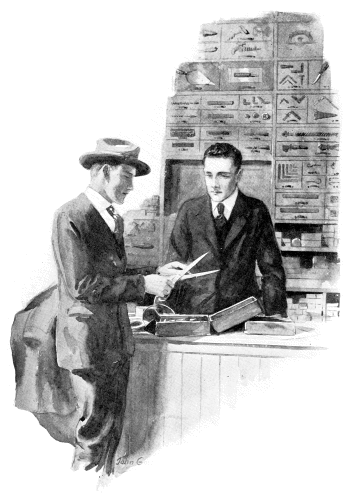
There followed three such strenuous months that everything had to go by
the board, except business; and I cannot with any clearness remember
everything that took place.
We started our profit-sharing plan, as arranged on June 1, the beginning
of my fiscal year. I had thought we had so thoroughly threshed out the
plan that it would work like a charm; but two months had barely passed
before friction started. Larsen felt he ought to get a larger percentage
of the profits than his salary called for, because he went out selling,
and said that he thereby created business which no one else could get
and he did his regular work besides. Whenever the boy Jimmie made a
suggestion of any kind he, at the same time, added that he ought to have
a special extra bonus for that suggestion, if it was any good. I talked
the matter over with Jock, and finally we straightened it out, but I
have not the time to tell you how we satisfied the warring elements.
I would also like to tell in detail of the starting of the new chain
garage plan. In three months it was already working well in Farmdale,
and negotiations had been completed for the second garage in
Hartleyville. We had struck an awful lot of snags in starting this plan.
How to handle the store, and at the same time study automobile
accessories, had been some job, but Fred Barlow and Charlie Martin were
certainly live wires, and they could think up more ways of doing a thing
than I ever dreamed of.
I remember once reading something by Elbert Hubbard in which he said
that every business required a pessimist, an optimist, and a grouch. I
believed we would succeed, for old Barlow was certainly the pessimist in
the bunch, and whenever Charlie or Fred went to him with any new idea
they wanted to "pull off" in connection with the garage chain plan he
acted like a brake to their enthusiasm—or, as he put it, kept them down
to Mother Earth.
Charlie's father had oodles of money, and was the principal director of
the idea, and he was the grouch. Charlie used to say that his dad never
believed anything until he actually saw it.
"If I were to go to him," said Charlie, "and say to him, 'Dad, I made a
hundred dollars to-day,' he would say, 'Show it to me,' and, if I did
show it to him, he would then ask me if I had planned what I was going
to do with it to make it earn more money. If I had told him I had, he
would then say that either the investment I had planned was safe enough
but didn't pay enough dividend—or else that it wasn't safe, although it
paid a good dividend. I'd hate to have a disposition like Dad's,"
laughed Charlie, "and yet Dad's a good old scout, and he must believe in
the plan, else he wouldn't back it the way he is doing."
Charlie, Fred and I were the optimists, I guess.
I had to thank old Barlow for doing me one good turn, for, during all
the excitement I had completely forgotten to make my payment to the
president of the bank, Mr. Blickens. It was the monthly payment of
fifty dollars to apply against the mortgage on my farm. Jock had
repeatedly told me to be sure not to get behind with that or I might
lose my farm. The very morning after the payment was due I had a
telephone call from Blickens, asking me to go to see him. I went, and he
reminded me I hadn't made my payment. I said I would write out my check
there and then, but he said, "I don't think it is at all satisfactory."
"You must take up the mortgage at once or I shall foreclose," he added
in that acid tone of his.
"But, Mr. Blickens, you couldn't do that!"
"Couldn't?" he snapped. "You don't know what I could do." He pulled out
his watch and said, "It's ten now—you must take up that note by twelve
or I shall foreclose."
Old Barlow was in the bank as I came out of the president's office, and
he evidently noticed I was feeling disturbed, for as I left the bank he
followed me and put his arm around my shoulders in such a kindly way
that I just told him the whole story.
He screwed his mouth a little, a habit he had when thinking quickly.
Then "Come back to the bank," he said, shortly. He wrote out a check for
cash, drew the money and gave it to me, saying, "Give that to him."
We entered Blickens' office together. He looked surprised to see old man
Barlow, too. "What do you want?" he snarled.
"Nothing," smiled Barlow, "only I just wondered if you couldn't give
young Black here a little longer on that note. He's all right. Would you
give him a little longer if I endorsed his note?"
"Look here, Mr. Barlow," snapped Blickens, "you've interfered once or
twice in my business. I told Black that I'd give him till twelve o'clock
to take up that mortgage. If he is going around whining after I have
helped him, I'll give him no time at all. He must pay the money right
here and now—or I'll foreclose at once."
"Pay him, Dawson," said Barlow, quietly.
"I won't accept a check—it isn't legal tender, and his check wouldn't
be any good either."
By this time I had pulled out the roll of money, and say, it did me good
to see Blickens' eyes. They stuck out of his head so far you could have
knocked them off with a stick. He fairly gurgled with disappointment,
but there was nothing else to do but take his medicine, which he did
none too graciously.
I gave Barlow a demand note, with the farm as collateral, to cover the
loan he had made me. I felt safer; but it wasn't my fault that I hadn't
lost my farm. What a lot of trouble borrowing money gets one into!
When I got home from this episode, which had started me so unpleasantly,
but which had finished so well for me, I found a letter from Larry
Friday, in which he said that he found he had been stung badly on the
store, and he didn't know whether he would be able to carry it on or
not. He hoped, however, before the note matured, to find some of the
money, but would see eventually that I got paid back what I would have
to pay. I felt positively sick.
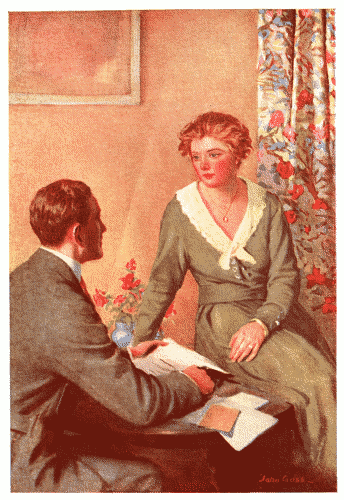
I was sitting by Betty's bedside when I read the letter, and she noticed
my face change.
"What is it, boy dear?"
I silently passed the letter over to her and waited for her to say, "I
told you so." Some women are wonderful—aren't they? She said nothing of
the sort, but patted my hand and said:
"Too bad, but never mind, dear, I'd much sooner you'd lose a few dollars
because you've such a big heart, than have you make a lot of money by
being like Blickens."
I realized that I would have to set to and save every penny I could to
apply against that note when it came due. There was still a month to get
together whatever money I could, but it was going to spoil some selling
plans I had wanted to try for the store. Never again, would I endorse a
note for any man! I have certainly learned my lesson. But why, oh why,
couldn't I have profited by other people's experience instead of having
to learn business methods by my own? The tuition fee in the school of
experience is mighty high.
Now, I must tell you the dreadful scare we had a few nights later. At
eleven-thirty at night—just as I was impatiently walking the floor of
our little sitting-room, while the doctor was upstairs with Betty, I
heard the fire engine dash past the end of the street. At the same time
I saw a huge tongue of flame shoot above the house, with the
accompaniment of a dull roar. The flame was in the direction of my
store, and, of course, my first thought was that my store had caught
fire again—or that Stigler had fired it.
For the last few months Stigler had been acting queerly. He used to
stand across the road from my store and nervously bite his finger nails.
Then he would unconsciously rub his forehead in a slow methodical way.
After a time he would return to his own store, would gaze into the
windows and mutter incoherently to himself. I felt that Stigler had for
some time been on the verge of a nervous breakdown. Business had been
going very badly with him, I knew, because a jobbing house from which I
bought had stopped his credit.
During the previous three weeks he had been selling goods at ridiculous
prices. Not satisfied with normal cuts, he in many cases had sold goods
below cost. It had worried me, and I had told Barlow, who had said to
let him alone, as a price cutter was a hog and would eventually finish
by cutting his own business throat, and he had advised me to keep clear
of Stigler, as he (Stigler) attributed all his misfortunes to my
competition—and he hadn't forgiven me for winning Betty.
Well, to get back to that fatal night. I saw the nurse in the corridor,
so I told her that I would be home again in a few minutes, and not to
tell Mrs. Black that there was a fire. I then grabbed my hat and ran
down the street.
I found it was not my store, but Stigler's. It was a most horrible, but
fascinating, sight. The body of the store was blazing like a furnace.
The bright red glow from it shone across the road and its light, dancing
upon the faces of the crowd watching the fire, made an eerie sight.
Little tongues of fire were already shooting out of the upstairs
windows, while one side of the roof was well alight. Little running
streams of flame kept playing backwards and forwards across it, and,
even while I watched, there was another roar and part of the roof
collapsed.
I knew the fireman who was holding the horses' heads. "Some fire," I
said to him in an undertone.
"You bet it is," he replied curtly; "the beggar set it himself."
"Nonsense!" I said incredulously.
"The place has been saturated with gasoline. A fire couldn't catch like
that in so brief a time. It will be a pretty serious matter for Stigler,
believe me."
My brain was in a whirl with the roar and crash of the fire, the light
glowing all around. The knowledge that Stigler had fired his own store
and the fact that I was the man he had openly blamed for his misfortune
gave me an impression of deep apprehension. Yet somehow I felt sorry for
Stigler, for, while he had all the time been competing with me, I had
never competed with him; although, goodness knows, I probably would have
done so had it not been for the wiser council of Barlow.
While I stood there, wondering and anxious, I felt some one near me.
Why, I don't know, but my feeling of apprehension was now accompanied by
intense horror. I wanted to turn and see who it was—and yet I
positively dreaded to. In a moment I heard a voice hiss in my ear:
"I hope yer satisfied now. That's your work. You—you were the cause of
that. You've been the ruin of an honest man, but yer sha'n't live to
enjoy yer victory—"
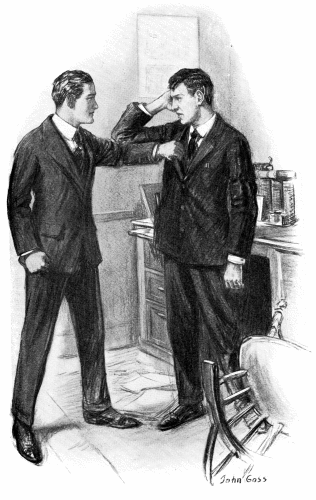
I turned and saw Stigler—his face chalky white—his blood-shot eyes
wide and staring; a little saliva trickling from the corner of his
mouth. Just then another crash came and a flame shot skyward. It played
upon his face and gave him the appearance of some evil spirit. I put my
hands up just as he leaped toward me. I felt his fingers tightening
around my throat. I tried to shout, but couldn't—only beating my fists
upon his face.
It was over as quickly as it started, for the crowd instantly tore him
from me. At last my scattered wits recalled what had happened, and I saw
Stigler being marched away shrieking and laughing crazily.
Two good souls took hold of me, one by each arm, and led me away from
the scene of the fire. After a few minutes I regained my self-control,
and remembered what was taking place at home. I asked my friends to go
that far with me. As we reached the end of our street a policeman came
to me and said, "Can you tell me anything about Stigler?"
"Not to-night," I replied.
"Will you report to the police station in the morning? We'll probably
want you."
"What for?"
"Well, Stigler has just died." . . .
Poor Stigler—he had been his own worst enemy and had paid a heavier
price than any one else would have demanded of him!
My thoughts were really sad as I opened the door of my home—home? yes,
indeed! For as soon as I entered the house I knew it was a dearer home
than it had ever been.
The doctor was downstairs, smiling.
"Tell me, doctor, quick—what is it?"
"Well, Daddy," he said kindly, "would you like to see your little boy?"
"How's Betty?" was my answer to him.
"Doing splendidly."
"Can I?—"
"Don't look so worried. This thing is happening every day, all over the
country."
THE END
SMILES, A ROSE OF THE CUMBERLANDS
By Eliot Harlow Robinson
Author of "Man Proposes"
Cloth decorative, 12mo, illustrated, $1.50
Smiles was not a native of the Cumberlands, and her parentage is one
of the interesting mysteries of the story. Young Dr. MacDonald saw more
in her than the mere untamed, untaught child of the mountains and when,
due to the death of her foster parents a guardian became necessary, he
was selected. Smiles developed into a charming, serious-minded young
woman, and the doctor's warm friend, Dr. Bently, falls in love with her.
We do not want to detract from the pleasure of reading this story by
telling you how this situation was met, either by Smiles or Dr.
MacDonald—but there is a surprise or two for the reader.
Press opinions on "Man Proposes":
"Readers will find not only an unusually interesting story, but one of
the most complicated romances ever dreamed of. Among other things the
story gives a splendid and realistic picture of high social life in
Newport, where many of the incidents of the plot are staged in the major
part of the book."—The Bookman.
"It is well written; the characters are real people and the whole book
has 'go.' "—Louisville Post.
ROLLO'S JOURNEY TO WASHINGTON
By Richard D. Ware
Illustrated with unique woodcuts by Robert Seaver. Price $1.00
The boy of yesterday—the man of today—knows the Rollo books, and is
familiar with the method by which the mind of young Master Mollycoddle
was improved by the guidance and precepts of his father and Uncle
George. Those who survived such a course of purification and still live
will enjoy this story of Rollo's journey to our national capital.
The book is about the Great War which has caused so many tears of
sorrow, and the author's only desire is to replace those bitter tears
with tears of mirth.
TWEEDIE, THE STORY OF A TRUE HEART
By Isla May Mullins
Author of "The Blossom Shop Stories," etc.
Cloth decorative, 12mo, illustrated, $1.50
The Carlton family—lovable old Professor Carlton, and his rather wilful
daughter Ruth—twenty-three years old and with decided ideas as to her
future—decide to move to the country in order to have more time to
devote to writing.
Many changes come to them while in the country, the greatest of which is
Tweedie—a simple, unpretentious little body who is an optimist through
and through—but does not know it. In a subtle, amusing way Tweedie
makes her influence felt. At first some people would consider her a
pest, but would finally agree with the Carlton family that she was
"Unselfishness Incarnate." It is the type of story that will entertain
and amuse both old and young.
The press has commented on Mrs. Mullins' previous books as follows:
"Frankly and wholly romance is this book, and lovable—as is a fairy
tale properly told. And the book's author has a style that's all her
own, that strikes one as praiseworthily original throughout."—Chicago
Inter-Ocean.
"A rare and gracious picture of the unfolding of life for the young
girl, told with a delicate sympathy and understanding that must touch
alike the hearts of young and old."—Louisville (Ky.) Times.
THE AMBASSADOR'S TRUNK
By George Barton
Author of "The World's Greatest Military Spies and Secret Service
Agents," "The Mystery of the Red Flame," "The Strange Adventures of
Bromley Barnes," etc.
Cloth decorative, 12mo, illustrated, $1.50
Mr. Barton is master of the mystery story, and in this absorbing
narrative the author has surpassed his best previous successes.
"It would be difficult to find a collection of more interesting tales of
mystery so well told. The author is crisp, incisive and inspiring. The
book is the best of its kind in recent years and adds to the author's
already high reputation."—New York Tribune.
"The story is full of life and movement, and presents a variety of
interesting characters. It is well proportioned and subtly strong in its
literary aspects and quality. This volume adds great weight to the claim
that Mr. Barton is among America's greatest novelists of the romantic
school; and in many ways he is regarded as one of the most versatile and
interesting writers."—Boston Post.
ONLY HENRIETTA
By Lela Horn Richards
Author of "Blue Bonnet—Debutante," etc.
Cloth decorative, 12mo, illustrated, $1.50
When her mother dies Henrietta goes to live with Mrs. Lovell, who knew
her father years ago in the little Vermont town. Mrs. Lovell determines
to do what she can to secure for Henrietta the place in society and the
inheritance that is rightfully hers. The means employed and the success
attained—but that's the story.
"Only Henrietta" is written in the happy vein that has secured for Mrs.
Richards a host of friends and admirers, and is sure to duplicate the
earlier successes achieved for the young people by the Blue Bonnet
Series.
"The chief charm of the book is that it contains so much of human nature
and it is a book that will gladden the hearts of many girl readers
because of its charming air of comradeship and reality."—The
Churchman, Detroit, Mich.
THE BUSINESS CAREER OF PETER FLINT
By Harold Whitehead
Assistant Professor of Business Method, The College of Business
Administration, Boston University, author of "Dawson Black, Retail
Merchant", "Principles of Salesmanship," etc.
Illustrated, cloth, 12mo, $1.50
The public demand for these stories compelled the author to continue
them so long that, were they all published in book form, they would
constitute a set of several volumes. By careful and scrutinizing
editorial work the author has recast the very best of this material for
book publication, the result being a story that is virile, compelling
and convincing as it leads the reader through the maze of business
entanglements.
A New York business man wrote: "I have read with much interest the
'Career of Peter Flint,' appearing in the Evening Sun.
"Having come to New York fresh from college twelve years ago, I
appreciate fully Peter's experience. I want to say that I think your
knowledge of human nature almost uncanny."
Selections from
The Page Company's
List of Fiction
WORKS OF ELEANOR H. PORTER
Each, one volume, cloth decorative, 12mo, illustrated, $1.50
POLLYANNA: The GLAD Book (430,000)
POLLYANNA GROWS UP: The Second GLAD Book
(220,000)
When the story of Pollyanna told in The Glad Book was ended, a great
cry of regret for the vanishing "Glad Girl" went up all over the
country—and other countries, too. Now Pollyanna appears again, just as
sweet and joyous-hearted, more grown up and more lovable.
The GLAD Book Calendar
THE POLLYANNA CALENDAR
(This calendar is issued annually; the calendar for the new year being
ready about Sept. 1st of the preceding year.
Decorated and printed in colors. $1.50
MISS BILLY (22nd printing)
Cloth decorative, with a frontispiece in full color from a painting by
G. Tyng. $1.50
MISS BILLY'S DECISION (15th printing)
Cloth decorative, with a frontispiece in full color from a painting by
Henry W. Moore. $1.50
MISS BILLY—MARRIED (12th printing)
Cloth decorative, with a frontispiece in full color from a painting by
W. Haskell Coffin. $1.50
SIX STAR RANCH (20th Printing)
Cloth decorative, 12mo, illustrated by R. Farrington Elwell. $1.50
CROSS CURRENTS
Cloth decorative, illustrated. $1.25
THE TURN OF THE TIDE
Cloth decorative, illustrated. $1.35
"A very beautiful book showing the influence that went to the developing
of the life of a dear little girl into a true and good woman."—Herald
and Presbyter, Cincinnati, Ohio.
WORKS OF L. M. MONTGOMERY
THE FOUR ANNE BOOKS
Each, one volume, cloth decorative, 12mo, illustrated, $1.50
ANNE OF GREEN GABLES (45th printing)
ANNE OF AVONLEA (30th printing)
CHRONICLES OF AVONLEA (8th printing)
ANNE OF THE ISLAND (15th printing)
"It has been well worth while to watch the growing up of Anne, and the
privilege of being on intimate terms with her throughout the process has
been properly valued."—New York Herald.
Each, one volume, cloth decorative, 12mo, illustrated, $1.50
THE STORY GIRL (10th printing)
KILMENY OF THE ORCHARD (13th printing)
THE GOLDEN ROAD (6th printing)
"It is a simple, tender tale, touched to higher notes, now and then, by
delicate hints of romance, tragedy and pathos."—Chicago
Record-Herald.
NOVELS BY ISLA MAY MULLINS
Each, one volume, cloth decorative, 12mo, illustrated, $1.50
THE BLOSSOM SHOP: A Story of the South
ANNE OF THE BLOSSOM SHOP: Or, the Growing Up of Anne Carter
ANNE'S WEDDING
THE MT. BLOSSOM GIRLS
"In the writing of the book the author is at her best as a story teller.
The humor that ripples here and there, the dramatic scenes that stir,
and the golden thread of romance that runs through it all, go to make a
marked success. It is a fitting climax to the series."—Reader.
NOVELS BY DAISY RHODES CAMPBELL
THE FIDDLING GIRL
Cloth decorative, illustrated $1.50
THE PROVING OF VIRGINIA
Cloth decorative, illustrated $1.50
THE VIOLIN LADY
Cloth decorative, illustrated $1.50
"The author's style remains simple and direct, as in her preceding
books, and her frank affection for her attractive heroine will be shared
by many others."—Boston Transcript.
NOVELS BY MARY ELLEN CHASE
THE GIRL FROM THE BIG HORN COUNTRY
Cloth 12mo, illustrated by E. Farrington Elwell. $1.50
VIRGINIA, OF ELK CREEK VALLEY
Cloth 12mo, illustrated by E. Farrington Elwell. $1.50
"This story is fascinating, alive with constantly new and fresh
interests and every reader will enjoy the novel for its freshness, its
novelty and its inspiring glimpses of life with nature."—The Editor.
NOVELS BY MRS. HENRY BACKUS
THE CAREER OF DOCTOR WEAVER
Cloth decorative, illustrated by William Van Dresser. $1.50
THE ROSE OF ROSES
Cloth decorative, with a frontispiece in full color. $1.50
The author has achieved a thing unusual in developing a love story which
adheres to conventions under unconventional circumstances.
A PLACE IN THE SUN
Cloth decorative, illustrated by William Van Dresser. $1.50
"A novel of more than usual meaning."—Detroit Free Press.
"A stirring story of America of to-day, which will be enjoyed by young
people with the tingle of youth in their veins."—Zion's Herald,
Boston.
NOVELS BY MARGARET R. PIPER
SYLVIA'S EXPERIMENT: The Cheerful Book
Cloth decorative, with a frontispiece in full color from a painting by
Z. P. Nikolaki $1.50
"An atmosphere of good spirits pervades the book; the humor that now and
then flashes across the page is entirely natural, and the characters are
well individualized."—Boston Post.
SYLVIA OF THE HILL TOP: The Second Cheerful Book
Cloth decorative, with a frontispiece in full color from a painting by
Gene Pressler $1.50
"There is a world of human nature and neighborhood contentment and
quaint quiet humor in Margaret R. Piper's second book of good
cheer."—Philadelphia North American.
"The bright story is told with freshness and humor, and the experiment
is one that will appeal to the imagination of all to whom the festival
of Christmas is dear."—Boston Herald, Boston, Mass.
SYLVIA ARDEN DECIDES: The Third Cheerful Book
Cloth decorative, with a frontispiece in full color from a painting by
Haskell Coffin $1.50
"It is excellently well done and unusually interesting. The incidents
follow one another in rapid succession and are kept up to the right
pitch of interest."—N. Y. American.
"Its ease of style, its rapidity, its interest from page to page, are
admirable; and it shows that inimitable power—the storyteller's gift of
verisimilitude. Its sureness and clearness are excellent, and its
portraiture clear and pleasing."—The Reader.
"It is an extremely well told story, made up of interesting situations
and the doings of life-like people, and you will find it very easy to
follow the fortunes of the different characters through its varied
scenes."—Boston Herald.
Transcriber's Note: The vacuum cleaner advertisement in Chapter XXXVII
has been moved to a more appropriate location in the text, and some
trademark notation in the advertisements which could not be accurately
reproduced in this electronic format has been removed. In addition, the
following typographical errors, which were present in the original
printed edition, have been corrected for this electronic edition.
A missing quotation mark has been added after "from the coil" in the
List of Illustrations.
In Chapter VI, "$22,000,00" was changed to "$22,000.00".
In Chapter VII, "Myrick" was changed to "Myricks" in two places.
In Chapter IX, "anybody else for them,." was changed to "anybody else for
them."
In Chapter XIV, "Buy why?" was changed to "But why?"
In Chapter XI, a comma was changed to a period after "told me about
Stigler".
In Chapter XVIII, in the advertisements beginning "STIGLER'S SATURDAY
SPECIAL" and "At eight o'clock Monday", a period was added after "per
cent".
In Chapter XXVI, "matetr off my mind" was changed to "matter off my
mind".
In Chapter XXVII, a missing quotation mark was added after "so
thoroughly earned."
In Chapter XXXI, a missing quotation mark was added after "people get
the money" and "people pasing them" was changed to "people passing
them".
In Chapter XXXII, "Edison domniates" was changed to "Edison dominates".
In Chapter XXXV, "Merchants' Assocation" was changed to "Merchants'
Association".
In Chapter XXXVII, "jovialty" was changed to "joviality".
In Chapter XXXVIII, "if ye sell $45,000.00 worth of goods next year" was
changed to "if ye sell $40,000.00 worth of goods next year".
In Chapter XLI, an extraneous quotation mark was deleted after "if a
fellow's got the money; but—" and "success somes" was changed to
"success comes".