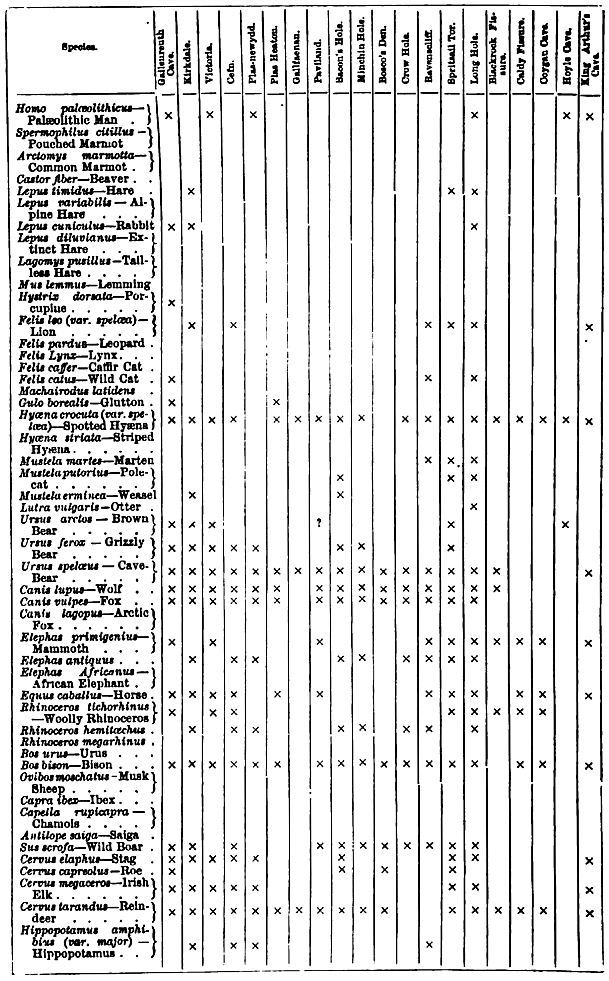
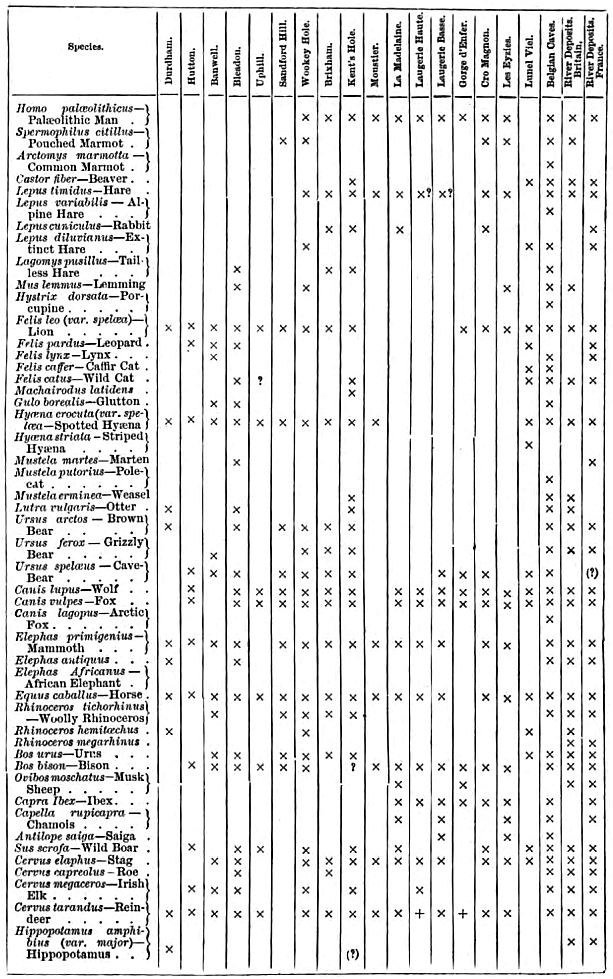
Relation of Pleistocene to Prehistoric Period.—Magnitude of the Interval.—Animals.—Physical
changes.—Excavation and filling up
of Valleys: Fisherton; Freshford.—Comparison of Deposits in
Valleys with those of Caves.—Differences of Mineral Condition.—The
Pleistocene Caves of Germany: Gailenreuth; Kühloch.—Of
Great Britain.—The Caves of Yorkshire: Kirkdale.—Of Derbyshire:
The Dream Cave.—Of North Wales, near St. Asaph.—Of
South Wales, in counties of Glamorgan, Caermarthen, Pembroke.—Of
Monmouth.—Of Gloucestershire.—Of Somersetshire: Uphill,
Banwell, Bleadon, Sandford Hill, Wookey Hole.—The District of
Mendip higher in Pleistocene age than now.—The condition of
bones gnawed by Hyænas.—The Caves of Devonshire: Oreston;
Brixham; Kent’s Hole.—The probable age of the Machairodus of
Kent’s Hole.—Those of Ireland, Shandon.
We have seen, in the fifth and sixth chapters, that the
caves offer valuable information as to the prehistoric
ethnology of Europe, and that they prove the ancient
neolithic population to stand directly related to the
Basque and Celtic elements in the present inhabitants of
Britain, France, and Spain. We shall discover in the
course of this and the following chapters that no such
continuity can be made out between the palæolithic
man of the pleistocene age and any of the races now
living in our quarter of the world; and we shall see
that he is separated from his neolithic successor by
an interval of time, the length of which cannot be
measured in terms of years. Before the pleistocene
group of caves be examined, it will be necessary to
define the relation that exists between the prehistoric
and the pleistocene periods.
The prehistoric mammalia consist, as we have seen
(p. 136), with the solitary exception of the Irish elk, of
the wild animals at present living in Europe, together
with the domestic species and varieties introduced by
man, probably from central Asia. In the rest of this
work we shall have to deal, not merely with the wild
animals at present inhabiting Europe, but also with
those which have either become extinct, or have migrated
to Asia, America, or Africa. Besides this addition to
the European fauna in the pleistocene age, the total
absence of the domestic animals is a most important
feature. The dog, goat, sheep, Celtic short-horn, and
domestic swine are conspicuous by their absence: the
reputed association of their remains with those of the
pleistocene mammals being due, in all the cases which
I have examined in France and Britain, to a confusion
between distinct strata in the same cave or river-deposit,
which are respectively of pleistocene and prehistoric or
historic ages. Thus in the excavations in the gravel
underneath London, the Celtic short-horn and goat of
the superficial strata are very generally mixed with the
reindeer and mammoth of the pleistocene gravels below,
by the collectors, and the names of the domestic animals
have crept into the pleistocene lists. None of the domestic
animals have been recorded from any carefully explored
strata of that age in any part of Europe.
The following late pleistocene species were unknown
in Britain in the prehistoric age:—
Glutton.
Spotted hyæna.
Panther.
Lion.
Lynx.
Felis Caffer.
Musk-sheep.
Bison.
Hippopotamus.
Lemming.
Pouched marmot.
Tailless hare.
Lepus diluvianus.
Arvicola Gulielmi.
Cave-bear.
Rhinoceros hemitœchus.
R. tichorhinus.
Elephas antiquus.
Mammoth.
The glutton, lynx, bison, and lemming, still live in
Europe, the spotted hyæna, Felis Caffer, and hippopotamus
are peculiar to Africa, the lion to Africa and Asia,
and the last seven species are extinct. The Machairodus
cultridens and Rhinoceros megarhinus probably disappeared
in an early stage of the pleistocene. It may
reasonably be inferred, from the migration and extinction
of so many species between the close of the pleistocene
and beginning of the historic period, that the interval
was of considerable length; for it would be impossible
for such changes to have taken place in a short time.
The same sharp line of demarcation exists between
the two faunas on the continent. The panther, Felis
Caffer, lynx, spotted hyæna, musk-sheep, hippopotamus,
and the extinct group disappeared. The African elephant
forsook Spain and Sicily, the striped hyæna the south of
France, before the prehistoric period; while the Elephas
meridionalis and pigmy hippopotamus of Sicily, and
the pigmy elephant and gigantic dormouse of Malta,
became extinct. Speaking in general terms, the wild
fauna of Europe, as we have it now, dates from the
beginning of the prehistoric age, and consists merely of
those animals which were able to survive the changes
by which their pleistocene congeners were banished or
destroyed. The arrival of the domestic animals under
the care of man in the neolithic age, and their extension
over the whole of Europe in a wild or semi-wild state,
coupled with the disappearance of the wild species mentioned
above, constitutes a change in the mammal life
at least as important as any of those which define the
meiocene from the pleiocene, or the pleiocene from the
pleistocene periods.
The magnitude of the interval between the two
periods may also be gathered from the great changes
which have taken place in physical geography. In
nearly every valley in Great Britain, certain areas to
be mentioned presently excepted, are strata of sand
and gravel, proved to be of pleistocene age by their
fossil mammals, and by their fluviatile shells to have
been deposited by rivers. They occur at various heights,
forming sometimes terraces, and at others isolated
patches, which were accumulated when the river flowed
at their level, and before the valleys were cut down to
their present depth. Those at Fisherton near Salisbury,
described by Sir Charles Lyell, Mr. Prestwich, Mr. John
Evans,175 and others, may be taken as an example.
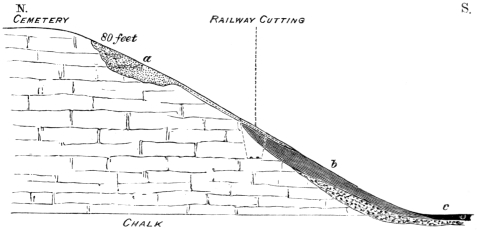
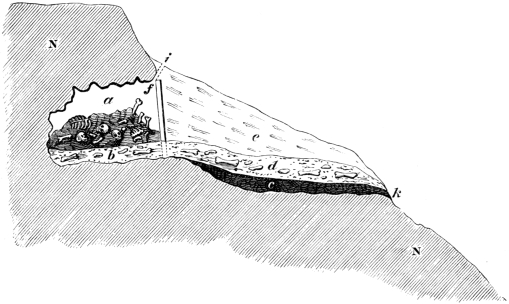
Fig. 74.—Section of Valley-gravels at Fisherton. (Evans.)
The valley through which the river Wily flows is
excavated in the chalk (Fig. 74), and on its northern side
fluviatile deposits occur at two levels, represented in
the accompanying section. One patch of gravel, about
twelve feet thick, a, lies about eighty feet above the
present level of the Wily; while a second, b, consisting
of clayey brickearth or loam, with seams of gravel, and
fluviatile shells, sweeps down from a lower point to the
bottom of the valley, and passes under the river. From
the deposit a, Dr. Blackmore obtained many rudely-chipped
implements, of the same palæolithic type as
those found with the extinct mammalia in the gravel
beds at Amiens and Abbeville in the valley of the
Somme. In the deposit b, fossil mammalia were met
with belonging to the following animals:—
Spotted hyæna.
Lion.
Reindeer.
Stag.
Bison.
Urus.
Musk-sheep.
Wild boar.
Horse.
Woolly rhinoceros.
Mammoth.
Lemming.
Pouched marmot.
Hare.
Dr. Blackmore subsequently discovered a flint implement
along with these animals, of the same type as those
previously met with in the deposit a.
A horizontal stretch of alluvium, c, deposited by the
floods, occupies the present bottom of the valley. In
this section it is plain that the gravels and brickearth at
a and b were deposited by a river, which formerly flowed
at those levels. In other words, the valley of the Wily was
excavated during the time that the pleistocene strata a
and b were being formed, while palæolithic man and
the extinct animals were living in the neighbourhood.
The position also of b below the present bottom of the
valley proves that the latter then was deeper than it is
now. The prehistoric alluvium, c, represents the last
stage in the history of the valley in which it is beginning
to be filled with the deposits of floods. While it was
being accumulated none of the animals of a and b were
living in the district except the hare, urus, stag, horse,
and wild boar.
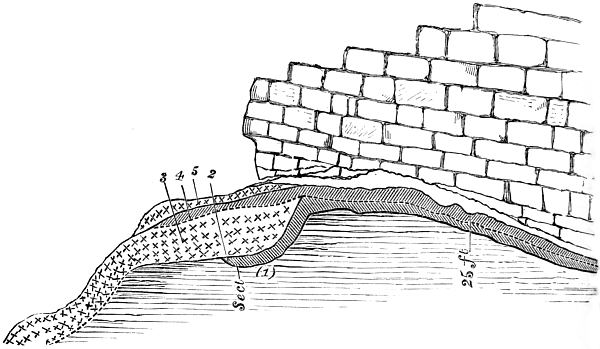
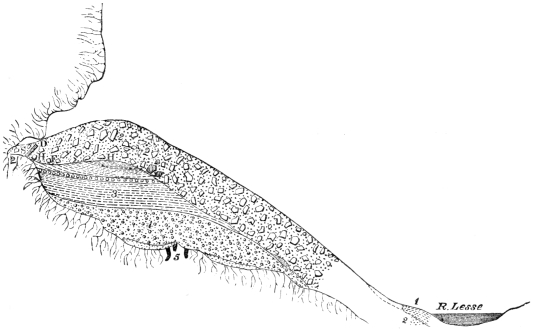
A somewhat similar section is exposed in the valley of
the Avon at Freshford, near Bath, in a railway cutting,
at a height of about thirty-five feet above the river. A
thick mass of gravel abuts directly against a cleft of inferior
oolite (Fig. 75), and gradually dies down to the alluvium.
In it Mr. Charles Moore discovered the remains of the
musk-sheep, and the Rev. H. H. Winwood those of the
mammoth, bison, horse, and reindeer. In this case the
pleistocene strata occupied the side of one of the valleys
which had been deepened since the time of their deposit.
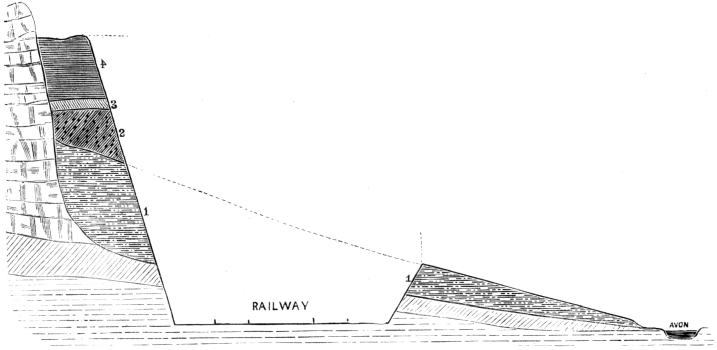
Fig. 75.—Section of Valley-gravels at Freshford, Bath.
4, Red loam, 5ft. 6in.; 3, Oolitic wash, 1ft.; 2, Clay with flints, 4ft. 10in.; 1, Gravel with fossil mammals, 8ft.
The alluvium in the neighbourhood of Bath contains
in its lower portion a layer of peat, with bones of the
Celtic short-horn (Bos longifrons), stag, roe, horse, goat,
and pig; and in its upper part are old refuse heaps,
proved to be Roman by the coins and ware, which
are also met with at various points underneath the
surface soil, and sometimes at considerable depths.
It is, therefore, of prehistoric and historic age, and since
it is found only in the valley bottoms, we may conclude
that the present courses of the rivers along the sides
of which it is found date back from the prehistoric age;
while their ancient courses are marked by the fluviatile
deposits with the extinct mammalia standing at various
levels, the higher being the older. In the section at
Fisherton we have evidence that the river flowed at a
lower level in the pleistocene age than in the prehistoric,
and in that at Freshford that the lower portion of the
valley had been excavated after the pleistocene strata
had been formed. One or other of these physical changes
is to be traced in nearly all river valleys.176 We may
conclude that both imply a considerable lapse of time,
because similar changes are now produced with extreme
slowness. In the pleistocene river deposits, which lie
scattered about at various heights on the valley sides,
we seek in vain for neolithic implements, or domestic
animals. In the low-lying alluvia, and accumulations
of peat, we seek equally in vain for traces of palæolithic
man, or of the extinct mammalia, except the
Irish elk.
We may also gather, from the localization of the prehistoric
alluvia close to the present streams, that the
time represented by its accumulation is insignificant
in comparison with the long lapse of ages implied by
the pleistocene gravels and brickearths, that were deposited
at various heights during the excavation of the
valleys. The general surface of the valleys has undergone
but little change since history began, and the
excavation by the rivers has been so small as to have
escaped accurate measurement. The alluvia represent
the principal work done since the close of the pleistocene
period.
The most important testimony that the interval between
the two periods was very long, is offered by the
climatal change, and the severance of Britain from the
continent. The arctic severity of the pleistocene winter
in these latitudes had passed away before the prehistoric
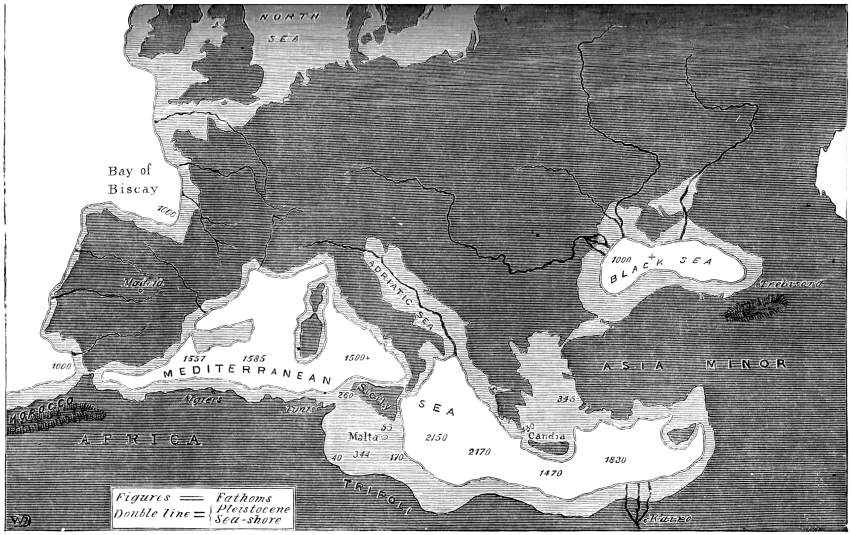
age, and the pleistocene valleys of the North Sea, St.
George’s Channel, the British, and Irish Channels had
been depressed beneath the waves of the sea before any
prehistoric strata yet known had been deposited. The
evidence that these changes actually took place must be
referred to the two following chapters.
If these valley deposits be compared with the contents
of some of the bone caves, such, for example, as
those of the Victoria Cave (compare Figs. 74 and 75
with Figs. 20, 21, 29), it will be seen that they present
the same section. The pleistocene gravels and brick-earths
of the one correspond with the lower strata of the
other, and contain the same extinct animals. The prehistoric
alluvium of the one is represented by the layer
containing neolithic bronze or iron implements, as well
as the same animals; while the historic strata are
represented in both by the superficial accumulations.
The only difference indeed between the one and the
other is, that in the former the strata of the three
periods are spread over a wide area, while in the
latter they are super-imposed in vertical order, the
pleistocene below, the prehistoric in the middle, and
the historic on the surface.
The prehistoric, and the historic strata in caves differ
from the pleistocene in their physical constitution. They
are darker in colour, and more loosely stratified, and
contain bones in a more friable and less mineralized
condition, and are more free from stalagmite.
The use of fossil bones for medicinal purposes led, as
I have already mentioned in the first chapter, to the
exploration of caves, which were first scientifically examined
in Germany towards the close of the eighteenth
century. They abound in all the limestone plateaux,
especially in the region of Franconia, and in that of the
Hartz. Among them the most interesting, perhaps, is
that of Gailenreuth, explored by Esper, Rosenmüller,
Goldfuss, Buckland, Lord Enniskillen, and Sir Philip
Egerton. It penetrates a lofty cliff, that forms a side of
the deep gorge which the river Weissent has cut in the
rock, at a point about three hundred feet above the
water level.
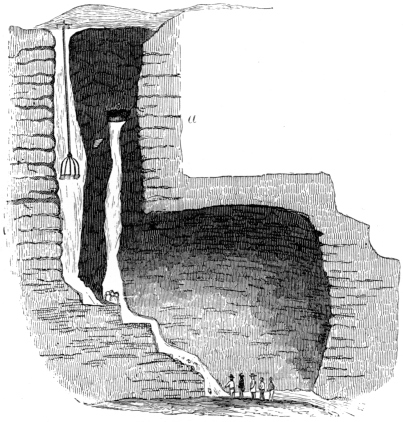
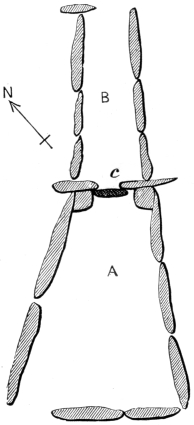
The entrance, Dr. Buckland177 writes, is about seven
feet high and twelve feet broad, and within it a short
passage leads into two chambers (Fig. 76, A and B),178 hung
with stalactites, and with the floors covered by a dense
stalagmitic pavement, that has been more or less broken
up by repeated diggings. These floors are perfectly
horizontal, the level of that of B being considerably
below that of A. They rest on an accumulation of
reddish grey loam, containing pebbles, and angular
limestone blocks, and vast quantities of the bones and
teeth of the animals formerly living in the district. The
depth of this ossiferous deposit has not been ascertained,
but in the further end of the chamber B, it has been
proved to be more than twenty-five feet thick.
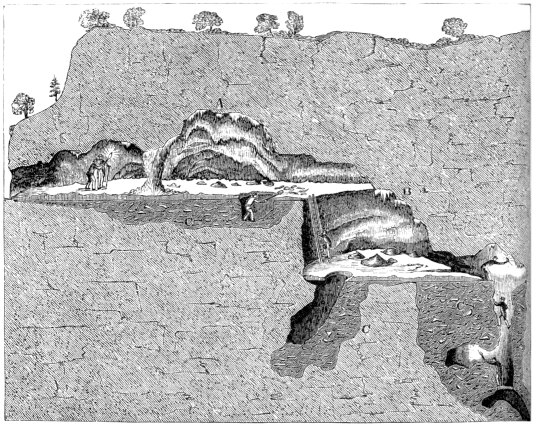
Fig. 76.—Section of Gailenreuth Cave. (Buckland.)
The remains of the animals lie scattered in the wildest
confusion; sometimes being completely matted together,
but more generally each bone is enveloped in earth.
They belong to the lion, the cave variety of the spotted
hyæna, the cave-bear, grizzly bear, mammoth, Irish elk,
and reindeer, as well as to those species which are still
to be found in Germany, such as the glutton, brown bear,
wolf, fox, and stag.
It is very difficult to account for such an accumulation
as this, but it was probably introduced through
the present entrance, and thence into the chamber B,
passing from the higher to the lower levels. The teeth-marks
on the bones show that some of the animals
had formed the prey of the hyænas, but had they
introduced all the bones there would have been distinct
strata marking the floors of occupation, as in
Wookey Hole (Fig. 88). Moreover, no perfect skulls,
such as those of the bears, would have escaped their
powerful teeth. The pebbles in the loam bear testimony
to the passage of a current of water. And if
we suppose that the cave was subject to floods, such
as those in the water-caves described in the second
chapter, the scattering of the bones through the loam
may be explained. This, however, could not have
happened had the cave then opened on the face of
a nearly vertical cliff, and the only condition under
which it would have been possible is, that the present
entrance should have been directly connected with a
stream flowing from the surface, that is to say, over the
space now occupied by the gorge of the Weissent. If
this view, advanced by Dr. Buckland, be accepted, the
remoteness of the date of the filling up of the cave may
be measured by the fact, that since that time the gorge
has been cut down by the Weissent to a depth of more
than 300 feet.
The stream by which the contents of the cave were
introduced had a course probably analogous to that of
Dalebeck (Fig. 6) and the remains of the animals were
caught up from the surface, and accumulated in the
subterranean chambers which it traversed. Their abundance
offers no obstacle to this view, since wild animals
frequent their drinking places in vast numbers, and fall
a prey to the carnivora which lurk near the streams,
and very many tumble into the natural pitfalls, or swallow-holes,
so universal in limestone districts.
Very many other caves occur in the neighbourhood,
most of them, such as those of Zahnloch, celebrated for
the abundance of fossil teeth, Mokas, Rabenstein, and
others, of which the cave of Kühloch alone demands
notice.
The cave of Kühloch is situated opposite to the castle
of Rabenstein, in the gorge of the Esbach, at about thirty
feet from the bottom. Its exterior presents a lofty arch
in a nearly perpendicular cliff, about thirty feet wide and
twenty feet high, and the entrance gradually leads into
two large chambers “both of which terminate in a close
round end, or cul-de-sac, at the distance of about 100
feet from the entrance. It is intersected by no fissures,
and has no lateral communications connecting it with
any other caverns, except one small hole close to its
mouth, and which opens also to the valley.” The first
thirty feet present a steep slope towards the entrance.
Dr. Buckland describes the contents of the chambers in
the following words:179—
“It is literally true that in this single cavern (the size
and proportions of which are nearly equal to those of
the interior of a large church) there are hundreds of
cart-loads of black animal dust entirely covering the
whole floor, to a depth which must average at least six
feet, and which, if we multiply this depth by the length
and breadth of the cavern, will be found to exceed 5,000
cubic feet. The whole of this mass has been again and
again dug over in search of teeth and bones, which it
still contains abundantly, though in broken fragments.
The state of these is very different from that of the
bones we find in any of the other caverns, being of a
black, or, more properly speaking, dark umber colour
throughout, like the bones of mummies, and many of them
readily crumbling under the finger into a soft dark powder
resembling mummy powder, and being of the same
nature with the black earth in which they are embedded.
The quantity of animal matter accumulated on this floor
is the most surprising, and the only thing of the kind
I ever witnessed; and many hundred—I may say thousand—individuals
must have contributed their remains to
make up this appalling mass of the dust of death. It
seems in great part to be derived from comminuted and
pulverized bone; for the fleshy parts of animal bodies
produce by their decomposition so small a quantity of
permanent earthy residuum, that we must seek for the
origin of this mass principally in decayed bones. The
cave is so dry, that the black earth lies in the state of
loose powder, and rises in dust under the feet; it also
retains so large a proportion of its original animal matter
that it is occasionally used by the peasants as an enriching
manure for the adjacent meadows. I have stated
that the total quantity of animal matter that lies within
this cavern cannot be computed at less than 5,000 cubic
feet; now allowing two cubic feet of dust and bones for
each individual animal, we shall have in this single
vault the remains of at least 2,500 bears, a number
which may have been supplied in the space of 1,000
years by a mortality at the rate of two and a half per
annum.”
Dr. Buckland’s explanation, that the cave was inhabited
by bears for long generations, is probably true. The
absence of pebbles and silt show that water had no
share in the introduction of the remains; their preservation
is due to the dryness of the cave, and to its
proximity to the outer atmosphere.
The famous caves of Sundwig, Schartsfeld, and Bauman’s
Hole, belong to the same class as Gailenreuth, and
offer no differences which need be described.
These explorations establish the fact that, in the
antediluvian age which we now term pleistocene, the
lion, the cave-bear and grizzly bear, and cave-hyæna
abounded in Germany, and that they sought as their
prey not merely the wild animals now living in that
region, but the reindeer, mammoth, woolly rhinoceros,
and Irish elk. All the discoveries in the German caves
from the date of the exploration of Gailenreuth have
merely verified this conclusion without adding any new
fact of importance.
These discoveries in the German caves led to the
exploration of those in our country. Dr. Buckland
visited Gailenreuth in 1816, and in 1821 applied the
result of his knowledge gained in Germany to the investigation
of the famous cavern of Kirkdale.180
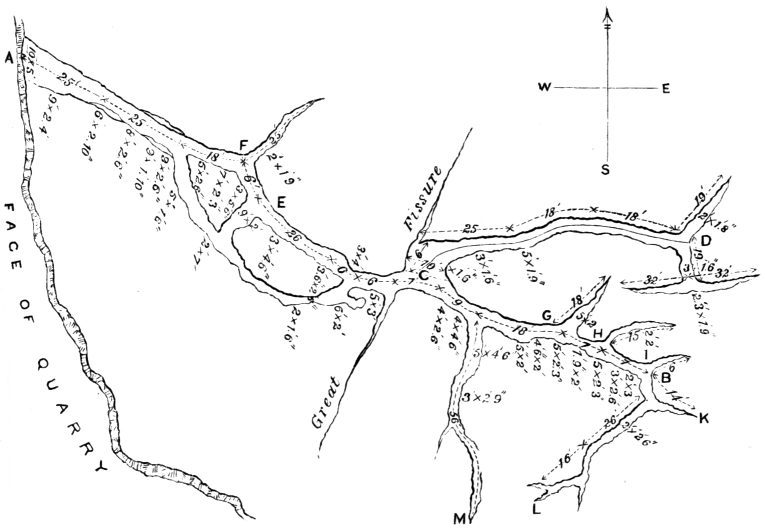
Fig. 77.—Plan of Kirkdale Cave. (Taylor.)
The cave of Kirkdale (Figs. 77, 78) was discovered in
a quarry in the vale of Pickering, about twenty-five
miles to the NN.E. of York, at a point where the dale
of Holmbeck joins Kirkdale. The entrance, eighty feet
above the valley bottom and twenty feet from the surface
of the plateau above, was about three feet high and six
feet wide, and led into a passage from five to ten feet
wide, which ran nearly horizontally into the rock, and
branched off into smaller ramifications. Its general form
and size may be gathered from the examination of the
accompanying woodcuts, which were published by Mr.
Taylor in “Macmillan’s Magazine,” in September 1862.
The roof was for the most part free from stalactite, and
there was no continuous coating of stalagmite on the
floor, but merely here and there a few calcareous bosses
termed “cows’ paps” by the workmen.
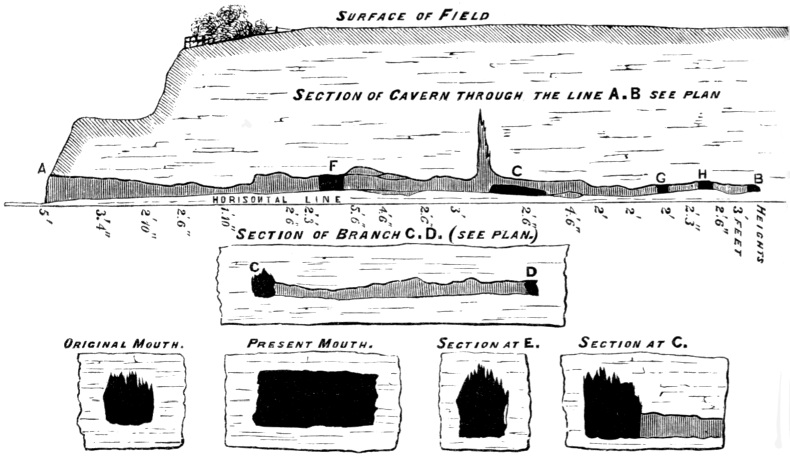
Fig. 78.—Sections of Kirkdale Cave. (Taylor.)
A layer of fine red loam covered the bottom, in the
lower portions of which were large numbers of gnawed
and broken bones, and teeth, for the most part of the
same species as those formed in the German caves. In
some places they were lying in little confused heaps,
and in others, where the loam was thin, were exposed
to the calcareous drip and cemented into a mass, their
upper portions projecting through the stalagmite “like
the legs of pigeons through pie-crust,” and their irregular
distribution resembling that of the fragments scattered
on the floor of a dog-kennel.
The remains of the animals were incredibly abundant,
when the small space in which they were packed was
taken into consideration. Those of the hyæna are estimated
by Dr. Buckland as belonging to between two or
three hundred individuals of all ages. The lion and the
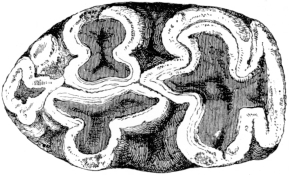
cave-bear, the wild boar, the hippopotamus (Fig. 79) an
extinct kind of elephant (E. antiquus), and the rhinoceros
named by Dr. Falconer R. hemitœchus, the reindeer,
and Irish elk are also represented, but the species
of most common occurrence are the bison and the horse.
With a few exceptions all the bones with marrow were
broken, and scarred by teeth, while the solid and marrowless
were more or less perfect.
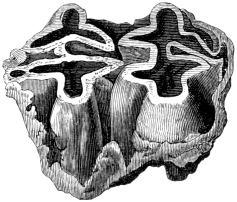
Fig. 79.—Molar of Hippopotamus. (Buckland.)
Dr. Buckland’s method of solving the problem of the
introduction of remains of so many and different animals
into so small a space,
is a model of scientific analysis.
He argues from the
abundance of the remains of
the hyæna, and from the
correspondence of their teeth
with the marks on the bones,
and from the quantity of
their coprolites, that the cave
was inhabited by many generations
of those animals, and
that the gnawed fragments were relics of their prey. The
hyænas of the present day inhabit caves strewn with the
bones of their prey, which are crushed by their powerful
jaws into the same form as those of Kirkdale. He further
demonstrated the truth of his conclusion by the crucial
experiment of subjecting the leg-bone of an ox to a
spotted hyæna from the Cape of Good Hope, in Wombwell’s
Menagerie. “I was able,” he writes,181 “to observe
the animal’s mode of proceeding in the destruction of
bones: the shin-bone of an ox being presented to this
hyæna, he began to bite off with his molar teeth large
fragments from its upper extremity, and swallowed
them whole as fast as they were broken off. On his
reaching the medullary cavity, the bone split into
angular fragments, many of which he caught up greedily
and swallowed entire: he went on cracking it till he had
extracted all the marrow, licking out the lowest portion
of it with his tongue: this done, he left untouched the
lower condyle, which contains no marrow, and is very
hard. The state and form of this residuary fragment
are precisely like those of similar bones at Kirkdale;
the marks of teeth on it are very few, as the bone usually
gave off a splinter before the large conical teeth had
forced a hole through it; these few, however, entirely
resemble the impressions we find on the bones at Kirkdale;
the small splinters also in form and size, and
manner of fracture, are not distinguishable from the
fossil ones. I preserve all the fragments and the gnawed
portions of this bone, for the sake of comparison by the
side of those I have from the antediluvian den in Yorkshire:
there is absolutely no difference between them,
except in point of age. The animal left untouched the
solid bones of the tarsus and carpus, and such parts of
the cylindrical bones as we find untouched at Kirkdale,
and devoured only the parts analogous to those which are
there deficient. The keeper, pursuing this experiment
to its final result, presented me the next morning with
a large quantity of album græcum, disposed in balls,
that agree entirely in size, shape, and substance with
those that were found in the den at Kirkdale. The
power of his jaws far exceeded any animal force of the
kind I ever saw exerted, and reminded me of nothing
so much as of a miner’s crushing mill, or the scissors
with which they cut off bars of iron and copper in the
metal foundries.”
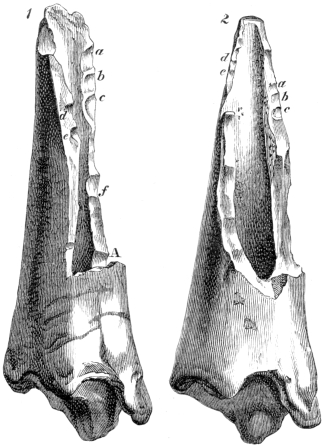
Fig. 80.—Leg-bones gnawed by Hyænas—1, of Ox in Menagerie; 2, of Bison in Kirkdale. (Buckland.)
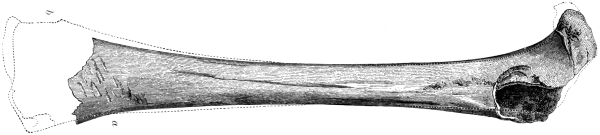
The exact correspondence of one of the fragments of
the tibia of an ox, gnawed by the Cape hyæna, with the
corresponding bone of the bison from Kirkdale, may be
gathered from a comparison of the two figured in
Fig. 80, in which the teeth-marks a, b, and c, are very
distinct. The same kind of identity runs through the
whole series of bones gnawed by the living and fossil
hyænas.
Dr. Buckland’s conclusion, that the Kirkdale cave was
the den of the spotted hyænas (H. crouta) that preyed
upon the animals of Yorkshire in ancient times, and
that it was undisturbed down to the time of its exploration,
cannot be disputed. The tread of the hyænas in
their passage to and fro had polished some of the bones
and jaws scattered on the floor, and the polished surfaces
were uppermost, the rest of the fragments being rough.
And Prof. Phillips informs me that the leg-bone of a
ruminant was discovered wedged into a small fissure
in the floor, with that portion which was within reach of
the hyæna’s teeth gnawed away, while the rest was
uninjured. The hyæna had lost his bone in the fissure,
and was only able to nibble the end which projected.
In these incidents we have a vivid picture of an hyæna’s
den in Yorkshire during the pleistocene age, with the
contents left in their natural order and not rearranged
by the passage of water.
The Victoria cave near Settle, in Yorkshire, described
in the third chapter, has also been occupied by hyænas.
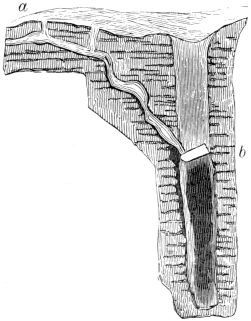
The Dream-cave, near Wirksworth,182 in Derbyshire,
contrasts with that of Kirkdale in the perfect state of
the bones which it contains. It was discovered in 1822,
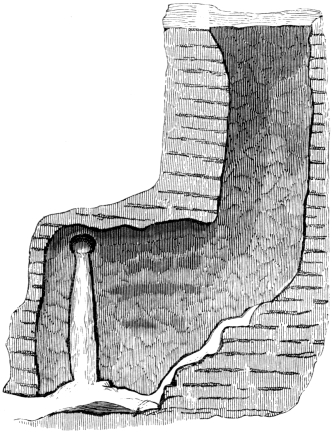
in following a vein of lead (Fig. 81). The miners
suddenly broke into a hollow, c, filled with red earth
and stones, and as they continued their shaft downwards
the sides continually closed upon them until the roof of
a cave was revealed. A nearly perfect skeleton of the
rhinoceros was discovered in the earth, as well as bones
of the horse, reindeer, and urus. After a large quantity
of the earth had been removed, the surface soil, i, at a little
distance began to sink, and ultimately a vertical shaft
was found to connect the cave with the surface. Into
this the animals had fallen, just as at the present time
sheep and oxen frequently perish in similar natural pitfalls
in the limestone strata.
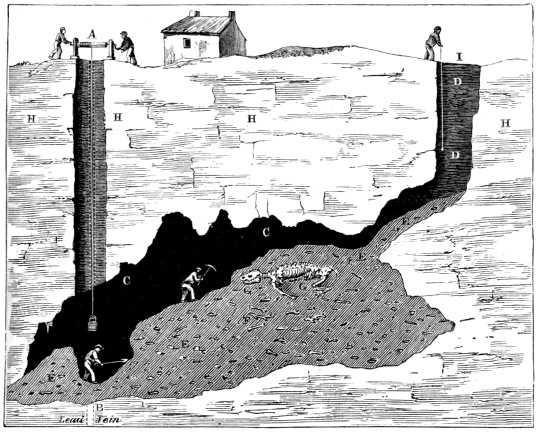
Fig. 81.—The Dream-cave, Wirksworth. (Buckland.)
| A |
Shaft following lead-vein. |
| B |
Supposed continuation of lead-vein. |
| C |
Cave. |
| D |
Swallow-hole. |
| E |
Ossiferous loam. |
| F |
Antler of deer. |
| G |
Rhinoceros. |
| H |
Limestone. |
| I |
Natural entrance. |
Other caves and fissures in Derbyshire have yielded
remains of the extinct animals: those of Balleye, near
Wirksworth, and of Doveholes, near Chaple-en-le-Frith,
the mammoth, and a small cave in Hartle Dale, near
Castleton, explored by Mr. Pennington and myself in
1872, the mammoth and the woolly rhinoceros.
The ossiferous caves and fissures at Cefn, near St.
Asaph, in the mountain limestone that forms the south
side of the Vale of Clwyd, were first described in 1833,183
by the Rev. Edward Stanley, afterwards Bishop of Norwich,
who explored that which Mr. E. Lloyd had discovered
about half-way down the vertical cliff, in the
grounds of Cefn Hall. It consists of a narrow passage,
turning on itself, and communicating with the surface of
the cliff by two entrances, which were completely blocked
up with red silt, containing a vast quantity of bones in
very bad preservation. The bottom has not yet been
reached. In one portion I found, in 1872, a deposit of
comminuted bone with scarcely any mixture of loam,
that rose in clouds of dust as it was disturbed. The
animals belonged to the same class as those of Germany,
the cave-bear, spotted hyæna, and reindeer, as well as
the hippopotamus, Elephas antiquus and Rhinoceros
hemitœchus of the Kirkdale cave. Pebbles derived from
the boulder clay, and rounded waterworn fragments of
bone, showed that the contents had been introduced into
this cave by a stream. Some of the remains, which
were marked with teeth, may have been introduced by
the hyænas. The flint-flakes found with the human
skull and cut antlers of stag, already referred to in the
fifth chapter, were discovered in the lower entrance.
The same group of animals has been obtained by Mrs.
Williams Wynn, the Rev. D. R. Thomas, and myself out
of a horizontal cave at the head of the defile leading
down from Cefn to Pont Newydd, in which the remains
are embedded in a stiff clay, consisting of rearranged
boulder clay, and are in the condition of waterworn
pebbles. From it I have identified the brown, grizzly,
and cave-bear. A further examination by the Rev. D.
R. Thomas, and Prof. Hughes, has recently resulted in
the discovery of rude implements of felstone, and a tooth
which has been identified by Prof. Busk as a human
molar of unusual size.184
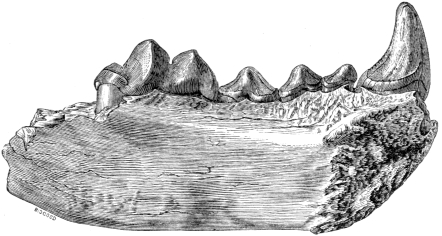
Fig. 82.—Left Lower Jaw of Glutton, Plas Heaton Cave.
A third cave in the neighbourhood at Plas Heaton,
explored in 1870 by Mr. Heaton and Prof. Hughes, furnished
the remains of the cave-bear, spotted hyæna, bison,
and reindeer, and a remarkably fine specimen of the lower
jaw of a glutton (Fig. 82), which I have described in the
“Geological Journal” (vol. xxvii. p. 406). In a fourth
cave, at Gallfaenan, the bear and reindeer were discovered.
It is evident from the presence of numerous
bones gnawed by hyænas in these caves, that the valleys
of the Clwyd and the Elwy were the favourite haunts
of that animal in the pleistocene age.
The earliest cavern explored in South Wales is that
of Crawley Rocks,185 Oxwich Bay, about twelve miles from
Swansea. It was discovered in quarrying the mountain
limestone in 1792, and contained the remains of the
elephant, rhinoceros, ox, stag, and hyæna. It was completely
destroyed before Dr. Buckland identified these
animals in the collection of Miss Talbot of Penrice Castle.186
The line of cliffs, bounding the rocky peninsula of
Gower, contains the cave of Paviland, described in the
seventh chapter (p. 232), as well as the group explored by
Colonel Wood of Start Hall, from the year 1848187 to the
present time, Bacon Hole, Minchin Hole, Bosco’s Den,
Devil’s Hole, Crow Hole, Raven’s Cliff, Spritsail Tor, and
Long Hole, which are described by the late Dr. Falconer.
The Rhinoceros hemitœchus was met with in comparative
abundance, and in association with the woolly rhinoceros,
mammoth, and E. antiquus. In Bosco’s Den there
were no less than 750 shed antlers of reindeer; and in
Long Hole, many flint-flakes were discovered in 1860
underneath the stalagmite, and in association with the
extinct mammalia, which prove, as Dr. Falconer points
out, that man inhabited that district in the pleistocene
age.
These caves and fissures were at all levels in the cliff,
and in some the bottoms were covered with a stratum of
marine sand with sea shells, which showed that they
had been washed by the sea before they had been filled
by the ossiferous débris. Most of them had probably
been filled by streams in the same manner as Gailenreuth
and Wirksworth. They abound on the coast
merely because a clear section has been worn by the
waves. A straight cut through the rocks in any part of
the district would probably show them to occur in equal
abundance inland.
The patches of limestone on the opposite side of Caermarthen
Bay, in the neighbourhood of Tenby, also
contain ossiferous caverns. The Rev. G. N. Smith,188 of
Gumfriston, has made a fine collection of bones and
teeth of mammoth and hyæna, from a fissure in the
Blackrock Quarry, close to Tenby, from a fissure in the
cliff on Caldy Island, and from the Coygan cave in an
outlier of limestone, near Pendine, and has discovered
flakes of flint and of a peculiar hornstone in the “tunnel
cave” termed the Hoyle, underneath stalagmite, in a
stratum containing bones of the bear and reindeer.
With the exception of the fissure in the Blackrock
Quarry none of these have been fully explored. On a
visit to Tenby, in 1872, I obtained many flint flakes, and
bones broken by man, from the breccia in the Hoyle;
and from a fissure on Caldy Island, numerous bones and
teeth of young wolves, which represented a whole litter,
and two metatarsals of bison, cemented together into a
compact mass.
The discovery of mammoth, rhinoceros, horse, Irish
elk, bison, wolf, lion, and bear, on so small an island as
Caldy, indicates that a considerable change has taken
place in the relation of the land to the sea in that district
since those animals were alive. It would have
been impossible for so many and so large animals to
have obtained food on so small an island. It may
therefore be reasonably concluded that, when they
perished in the fissures, Caldy was not an island, but
a precipitous hill, overlooking the broad valley now
covered by the waters of the Bristol Channel, but then
affording abundant pasture. The same inference may
also be drawn from the vast numbers of animals found
in the Gower caves, which could not have been supported
by the scant herbage of the limestone hills of that district.
We must, therefore, picture to ourselves a fertile
plain occupying the whole of the Bristol Channel, and
supporting herds of reindeer, horses, and bisons, many
elephants and rhinoceroses, and now and then being
traversed by a stray hippopotamus, which would
afford abundant prey to the lions, bears, and hyænas
inhabiting all the accessible caves, as well as to their
great enemy and destroyer man. We shall see in the
ninth chapter that the elevation of the whole district
above its present level is part of the general elevation
of north-western Europe, and no mere small or local
phenomenon.
King Arthur’s cave,189 on the side of a beautifully
wooded knoll, overlooking the valley of the Wye, near
Whitchurch, in Monmouthshire, explored by the Rev.
W. S. Symonds in 1871, is a hyæna den, like that of
Kirkdale, containing the gnawed remains of the lion,
Irish elk, mammoth, woolly rhinoceros, and reindeer.
Flint flakes, however, occurred in the undisturbed strata,
which prove that it was also the resort of man. Mr.
Symonds believes that the sand and gravel inside were
deposited by the Wye, at a time when it flowed 300
feet above its present course, or before the valley was
cut down to that depth. If this conclusion be true, the
date of the occupation must be separated from the present
day by a vast interval, which is only to be measured
by the subsequent erosion of the valley by the slow
operation of the subaerial agents, running water, ice,
snow, and carbonic acid.
The only remains of the mammoth which I have
examined belong to young individuals, and consist of the
second and third milk-molars, a fact which I have very
generally observed in hyænas’ dens. The older mammoths
would not fall an easy prey to so cowardly an
animal. The cave had also been inhabited by man after
the pleistocene age, for coarse pottery of the neolithic
kind, and flint flakes, were dug out of an upper stratum,
while I was watching the excavation, in company with
the Rev. W. S. Symonds, and the “Wanderers” field club.
The outliers of mountain limestone, on the southern
side of the Bristol Channel, have long been known for
their ossiferous caverns and fissures. From a fissure in
Durdham Down,190 near Bristol, Mr. J. S. Miller obtained
fragments of bones, about the year 1820, and among
them Dr. Buckland notices the fossil joint of the hind-leg
of a horse, the astragalus being held in natural position,
between the tibia and the calcaneum, by stalagmite.
Subsequently a large series of animals of the same
species as those of Gower were discovered in it by Mr.
Stutchbury, and are preserved in the Bristol Museum.
The caves of the Mendip Hills were known to contain
bones as early as the middle of the eighteenth century,
when that of Hutton,191 near Weston-super-Mare, was discovered
in working the ochre and calamine which fills
some of the fissures. The miners having opened an
ochre pit, south of the little village of Hutton, discovered
a fissure in the limestone full of good ochre, which they
followed to a depth of eight yards, until it led into a
cavern, the floor of which was formed of ochre, with large
quantities of white bones on the surface, and scattered
through its mass. Dr. Calcott describes the bones as
projecting from the sides, roof, and floor of the excavation
in such quantities as to resemble the contents of a
charnel-house. Subsequently it was fully explored by
the Rev. D. Williams, and Mr. Beard, of Banwell.
We owe the exploration of the neighbouring caves
of Banwell, Sandford Hill, Bleadon, Goat’s Hole, in
Burrington Combe, and Uphill,192 to the joint labours of
the two above-mentioned gentlemen, extending over
the period which elapsed between 1821 and 1860. The
vast quantity of remains which they obtained can only
be realized by a visit to the Museum of the Somerset
Archæological and Natural History Society, at Taunton.193
They belong to the same species as those already mentioned
from the caves of South Wales. The fauna of the
Mendip is, however, characterized by the great number
of lions, and by a few fragments of the glutton. Of the
former animal, Mr. Ayshford Sanford and myself have
met with sufficient remains to figure nearly every portion
of the skeleton, and the skulls prove that it was
not a tiger, as it is considered to be by some naturalists,
but a true lion, differing in no respect, except in its large
size, from those now living in Asia and Africa.
All these caverns consist of chambers at various levels
more or less connected with fissures, and, from the perfect
condition of the bones they must have been inaccessible
to the bone-destroying hyæna. Their contents
were introduced, as is suggested by Dr. Buckland, from
the surface by streams falling into swallow-holes (see
Fig. 81), which have now, under the changed physical
conditions, ceased to flow.
The extraordinary quantity of remains preserved in
one cave may be, to some extent, verified by a visit to
that at Banwell. It consists of two large chambers,
the upper one filled with thousands of bones of bison,
horse, and reindeer, taken out of the red silt which
originally filled it to the roof; the lower one full
of the undisturbed contents, from which the bones
project in the wildest confusion. This accumulation
has been introduced by water, through a vertical fissure
which opened on the surface. It is evident, from
the very nearly perfect skulls of wolf and bear which
were discovered, that the cave was not used as a den
by the hyænas. They are, however, proved to have
been living close by at the time, since their skulls, and
the gnawed antlers of reindeer, have been discovered
inside. They were probably swept in by the stream
along with the other bones.
The Cave of Uphill,194 discovered in 1826, by some
workmen, and explored by the Rev. D. Williams, merits
especial notice, from the peculiar conditions under which
the remains of the extinct animals occurred. Like the
other caves of the Mendips, it consists of fissures opening
into chambers. In the upper part of one of these
fissures were the remains of rhinoceros, hyæna, bear,
horse, bison, and wild boar, imbedded in loam which
rested on two large masses of limestone that had fallen
so as to block up the fissure. Below this were no remains
of the extinct animals, and the fissure ultimately
led into a cave opening upon the line of cliffs. This
latter had been inhabited within historic times, since
many bones of sheep, or goat, and pieces of pottery,
were met with, as well as a coin of the Emperor Julian.
In this case, owing to the extraordinary accident of the
fissure being blocked up by a fall of stone, the pleistocene
accumulation is vertically above the historic; and
had the barrier given way, Mr. Williams would undoubtedly
have discovered the remains of the extinct
mammalia, lying in a heap above the comparatively
modern historic stratum. It seems to me very probable
that some such accident may have caused the occurrence
of the pleiocene machairodus in the Kent’s Hole cavern,
in association with the pleistocene mammalia. In the
long lapse of ages between the pleistocene and the present
day, such accidents would be likely to occur in some
few caverns, and we might expect to find remains of
widely different ages, in certain exceptional cases, lying
side by side, or even the older resting vertically over the
newer. At all events we must conclude, that superposition,
or association, cannot be rigidly enforced as
tests of relative age in all ossiferous caverns.
The Hyæna-den of Wookey Hole,195 near Wells, on the
south side of the Mendips, which I explored with the
Rev. J. Williamson in 1859, and in the following years
with Messrs. Willett, Parker, and Ayshford Sanford, is
worthy of a more detailed notice, because it was among
the first caverns in this country in which works of art
were found under conditions that proved the co-existence
of man with the extinct mammalia.
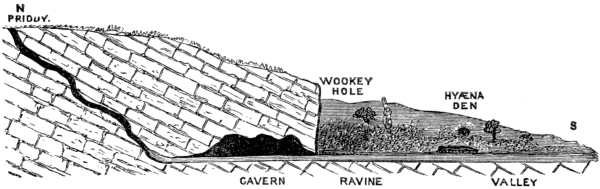
The ravine in which it was discovered, in 1852, is one
of the many which pierce the dolomitic conglomerate,
or petrified sea-beach, of the Triassic age, resting at the
foot of the cliffs from which it was torn by the waves,
and overlying the lower slopes of the Mendips (see
Fig. 1). Open to the south, it runs almost horizontally
into the mountain-side, until closed abruptly northwards
by a perpendicular wall of rock, 200 feet or more in
height, ivy-covered, and affording a dwelling-place to
innumerable jackdaws. Out of a cave at its base, in
which Dr. Buckland discovered pottery and human teeth,
flows the river Axe, in a canal cut in the rock. In
cutting this passage, that the water might be conveyed
to a large paper-mill close by, the mouth of the hyæna-den
was intersected in 1852, and from that time up to
December 1859 it was undisturbed save by rabbits and
badgers, and even they did not penetrate far into the
interior, or make deep burrows. Close to the mouth of
the cave the workmen (employed in making this canal)
found more than 300 Roman coins, among which were
those of Allectus and of Commodus. When the Rev. J.
Williamson and myself began our exploration, about
twelve feet of the entrance of the cave had been cut
away, and large quantities of the earth, stones, and animal
remains had been used in the formation of an embankment
for the stream which runs past the present entrance of
the cave.
According to the testimony of the workmen, the bones
and teeth formed a layer about twelve inches in thickness,
which rested immediately upon the conglomerate-floor,
while they were comparatively scarce in the overlying
mass of stones and red earth. The workmen state
also that at the time of the discovery of the cave the hillside
presented no concavity to mark its presence. So completely
was the cave filled with débris up to the very roof,
that we were compelled to cut our way into it. Of the
stones scattered irregularly through the matrix of red
earth, some were angular, others water-worn; all are
derived from the decomposition of the dolomitic conglomerate
in which the cave is hollowed. Near the
entrance, and at a depth of five feet from the roof, were
three layers of peroxide of manganese, full of bony
splinters, and, passing obliquely up towards the southern
side of the cave and over a ledge of rock that rises
abruptly from the floor: further inwards they became
interblended one with another, and at a distance of
fifteen feet from the entrance were barely visible. In
and between these the animal remains were found in
the greatest abundance.
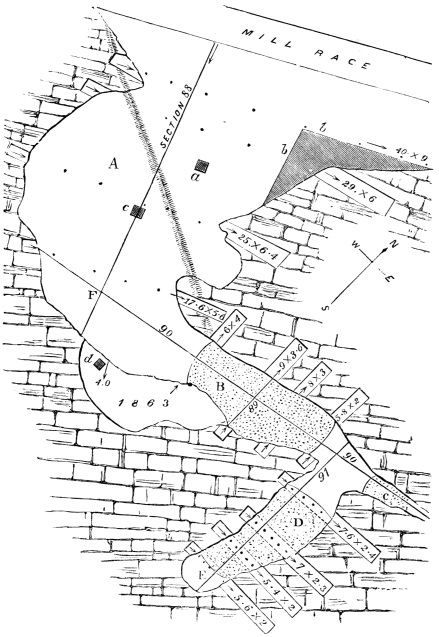
Fig. 83.—Plan of Hyæna-den at Wookey Hole.
Right lines = sections; dotted areas = bone-beds; shaded areas = ashes and implements.
While cutting our way inwards (Figs. 83 and 88), we
found an angular piece of flint, which had evidently been
chipped by human agency, and a water-worn fragment
of a belemnite, which probably had been derived from
the neighbouring marlstone rocks. Bones and teeth of
the woolly rhinoceros, reindeer, stag, Irish elk, mammoth,
hyæna, cave-bear, lion, wolf, fox, and horse rewarded
our labours; and frogs’ remains, cemented together by
stalagmite, were abundant at the mouth. The teeth
preponderated greatly over the bones, and the great bulk
were those of the horse. The hyæna-teeth also were
very numerous, and in all stages of growth, from the
young unworn to the old tooth worn down to the very
gums. Those of the mammoth had belonged to a young
animal, and one had not been used at all. The hollow
bones were completely smashed and splintered, and
scored with tooth-marks, while the solid carpal, tarsal,
and sesamoid bones were uninjured, as in the Kirkdale
Cave. The organic remains were in all stages of decay,
some crumbling to dust at the touch, while others were
perfectly preserved and had lost very little of their
gelatine.
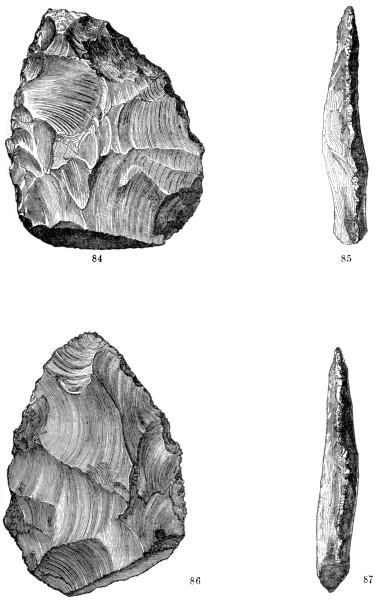
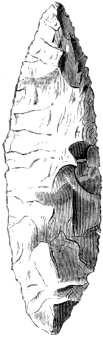
Figs. 84, 85, 86, 87.—Four Views of Flint Implements found in the Hyæna-den at Wookey Hole, near Wells.
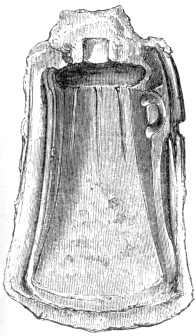
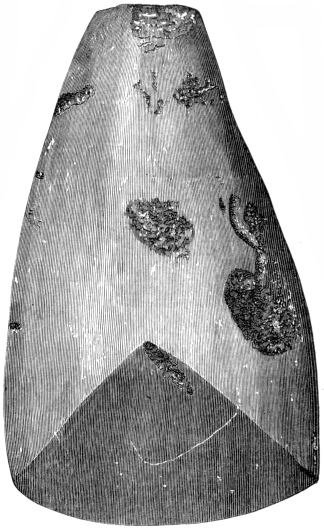
In 1860 we resumed our excavations; and, in addition
to the above remains, found satisfactory evidence of
the former presence of man in the cave. Our search
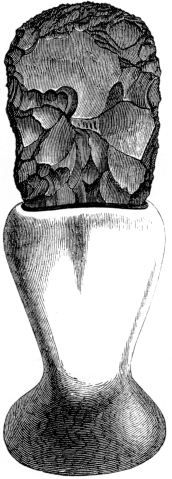
was rewarded by one oval implement of white flint, of
rude workmanship (Figs. 84, 85, 86, 87), one chert
arrow-head, a roughly-chipped and a round flattened
piece of chert, together with various splinters of flint,
which had apparently been knocked off in the manufacture
of some implement. Two rudely-fashioned bone
arrow-heads were also found, which unfortunately were
subsequently lost by the photographer to whom they
were sent; they resembled in shape an equilateral
triangle with the angles at the base bevelled off. All
were found in and around the same spot, in contact
with some hyæna-teeth, between the dark bands of
manganese, at a depth of four feet from the roof, and
at a distance of twelve feet from the present entrance
(Fig. 83, a).
That there might be no mistake about the accuracy
of the observations, I examined every shovelful of débris
as it was thrown out by the workman; while the
exact spot where they were excavating was watched by
my colleague. The figured implement was picked out
of the undisturbed matrix by him; the rest were found
by me in the earth thrown out from the same place.
The lines of peroxide of manganese must have been
accumulated on the old floors of the cave, because they
were associated with numerous splinters and gnawed
animal remains; and there can be no doubt that the latter
were introduced by the hyænas. Those animals have
a peculiar habit, as Dr. Buckland proved by experiment,
of gnawing similar bones in precisely the same way;
and a comparison of the relics of the meals of the hyænas
in the Zoological Gardens with those in the cave, shows
that the latter have passed between the jaws of a like
animal that once inhabited Somersetshire. Coprolites of
the same animal were very abundant, and in some places
formed a greyish-white layer of phosphate of lime.
There were also other equally unmistakeable traces of
the animal in fragments of bone, polished by their
tread, as in the Kirkdale cave. It is, therefore, only
reasonable to suppose that these remains of animals were
brought into the cave from time to time by hyænas,
and left on the floors. That they were not introduced
by water is proved by the preservation of the delicate
processes and points of bone, which would certainly have
been broken in transitu. Since, then, the implements,
which, beyond doubt, had been fashioned by man, were
underneath one of these old floors, it was certain that
man was contemporary in the district with the hyæna
and the animals on which it preyed, and the fact that
they were found only on one spot implies that they
were deposited by the hand of man. To suppose that
a savage would take the trouble to excavate a trench
twenty-four feet long—for twelve feet of the former
mouth of the cave had been cut away—with miserable
implements, and consequently with great labour, and
having excavated it again to fill it up to the very roof,
is little less than absurd. Nor could such an operation
take place in such a deposit, without the stratification of
the layers being destroyed. The absence of pottery and
human bones precludes the idea of the cave ever having
been a place of sepulture, such as Aurignac or Bruniquel.
This discovery, therefore, of itself stamps the contemporaneity
of man with the extinct mammalia, and following
close on the similar discoveries in Brixham cave, to be
mentioned presently, puts the question beyond all doubt.
In April 1861 we resumed our excavations; and, as
we made our way inwards, found that the cave began to
narrow, and ultimately to bifurcate, one branch extending
vertically upwards, while the other appeared to
extend almost horizontally to the right hand. As we
reached the middle constricted passage, the teeth became
fewer, while the stones were of larger size than any that
we had hitherto discovered. The great majority of the
gnawed antlers of deer were found at this part, also the
posterior half of a cervine skull, the right upper jaw of
wolf, and, what is more remarkable, a stone with one of
its surfaces coated with a deposit apparently of stalagmite:
this, however, was much lighter than stalagmite,
and not so good a conductor of heat; and, on analysis,
I found that it consisted of phosphate of lime, with a
little carbonate, and a very small portion of peroxide of
manganese. Doubtless the surface of the stone, covered
with phosphate of lime, formed part of the ancient floor
of the cave, and hence was coated with album græcum;
while the lower part, being imbedded in the earth on the
floor, was not so coated. This deposit may, perhaps,
explain the absence of round balls of coprolite, which,
assuming that the cave at the time was more damp than
that at Kirkdale, would be trodden down on the floor
by the hyænas, instead of presenting a rounded form.
The stone also itself exhibits tooth-marks underneath
the coating of album græcum, and probably was gnawed
by the hyænas, like the antlers, for amusement. This
discovery proves that violent watery action had but
small share, if any, in filling the cave; for in that case
the soft covering would have been removed from the
stone. Similar evidence is offered by the wonderful
preservation of some of the more delicate fragments of
bone, such as the palatine process of the maxilla of the
wolf.
The section made in cutting this passage presented
irregular layers of peroxide of manganese, full of bony
splinters, and each more or less covered by a layer of
bones in various stages of decay. These layers were
absent from the upper portion of the passage. There
were masses of prisms of calc-spar scattered confusedly
through the matrix. After excavating the vertical
branch as far as we dared (for the large stones in it
made the task dangerous), we were compelled to leave
off, having penetrated altogether only thirty-four feet
from the entrance. No flint implements rewarded our
search this year. Teeth were far more numerous than
bones, probably because they are more durable as well
as because of their rejection by the hyænas. One jaw
was bitten in two, and the fragments found about a foot
apart in the undisturbed matrix, just as they had been
dropped from the mouth of the hyæna.
In the spring of 1862 Mr. Parker, Mr. Willett, and
myself resolved to verify the association of articles of
man’s handiwork along with the extinct mammalia, by
cleaning out the cave, which was courteously placed at
our disposal by the owner, Mr. Hodgekinson.
Our first task was to clear the contents out of the
portion of the cave nearest the mouth, or the antrum
(Fig. 83, A), and as we excavated onwards many traces
of the presence of man were met with. A wide area on
the left-hand side (b), where the roof and floor of the
cave gradually met together, furnished innumerable fragments
of charcoal, and many flint implements associated
with the remains of the horse, rhinoceros, and hyæna.
One fragment of bone in particular, belonging to the
rhinoceros, had been calcined, and its carbonized condition
bore unmistakeable testimony that it had been
burnt while the animal juices were present. There were
many other bones also burnt, which indicated the place
where fires had been kindled, and food cooked. As we
dug our way forward we met with a third area (c), that
furnished flint and chert implements under the same conditions
of deposit as that which tempted us to carry on
our excavations. Its relation to the old floors of hyæna-occupation
is shown by the dark lines over the area c
in Fig. 88. At last the large open chamber (A) was
cleared; it measured about thirty feet wide by six feet
high, and it extended forty feet inwards. On the left
there was a small upward-turning passage, very nearly
blocked up with a mass of stalagmite; at the farther
end a vertical fissure extended upwards (F), to the surface.
This fissure has subsequently been proved to extend
downwards to the right, and will doubtless furnish
large quantities of animal remains to future explorers.
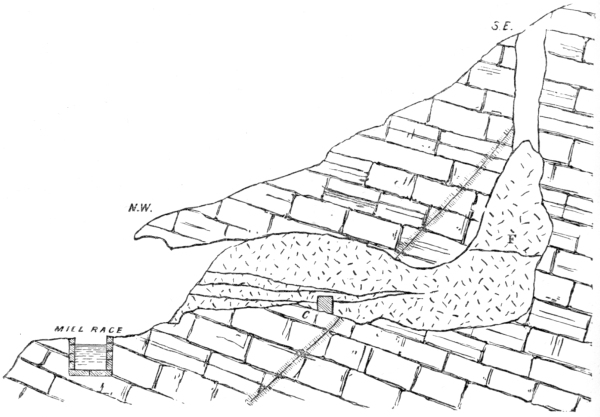
Fig. 88.—Section through
A of
Fig. 83, showing contents of Hyæna-den.
c = flint implements; thick lines above = old floors.
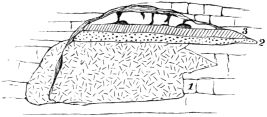
Fig. 89.—Transverse Section through
B of
Fig. 83.
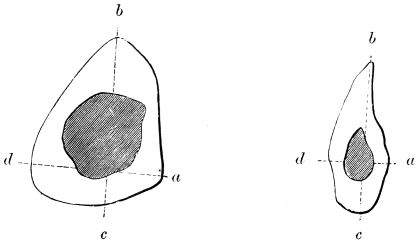
1 = red earth; 2 = bone-bed; 3 = dark earth.
The large chamber now turned abruptly to the left,
and we gradually worked our way into a small horizontal
passage about four feet high. Here there was an
interval of from three to four inches between the roof
and contents, traversed by stalactites, which in some
places formed a smooth undulating drapery with stony
tassels, and in others tiny pillars extending down to the
débris, and, as it were, propping up the roof. These
pedestals (see Fig. 15) gradually expanded into round
plates of stalagmite, which sometimes met and formed a
continuous crust. In some places an infiltration of carbonate
of lime had cemented organic remains, stones,
and earth into a hard mass, which had to be broken up
with gunpowder before it could be removed out of the
cave. The excitement of extracting from these blocks
their treasures was of the very keenest, for we could not
tell what a stroke of the hammer would reveal. Sometimes
an elephant’s tooth suddenly came to light, at
others a hyæna’s jaw, or a rhinoceros’ tooth, or the
antler of a reindeer, or the canine of a bear. The bones
were so numerous that they scarcely attracted attention.
In one fragment of this breccia, now in the Brighton
Museum, are a tusk and carpal of mammoth, the right
ulna of the woolly rhinoceros, and an antler of reindeer.
In a second, two shoulder-blades and two haunch bones
of the woolly rhinoceros, with a coprolite and lower jaw
of cave hyæna. As the men removed the large blocks
they were brought to the mouth of the cave to be
broken up by our smaller instruments. Presently the
passage narrowed to about six feet, and presented the
following section (Fig. 89). On the floor of the cave
there was a layer of red earth two feet in thickness,
and, as usual, containing a few organic remains and
many stones (Fig. 89, 1). Upon this rested a most
remarkable accumulation of bones, and teeth, matted
and compacted together, from three to four inches thick,
and extending horizontally from one side of the passage
to the other (Fig. 89, 2). Next came a layer of dark
red earth (Fig. 89, 3), loose and friable, three to four
inches thick, supporting in its surface a few rounded
stalagmites, and a few stalactitic pillars, that spanned
the interval of from three to four inches between it and
the roof. This bone-bed was about seven feet wide and
fourteen feet long, affording, therefore, a square area of
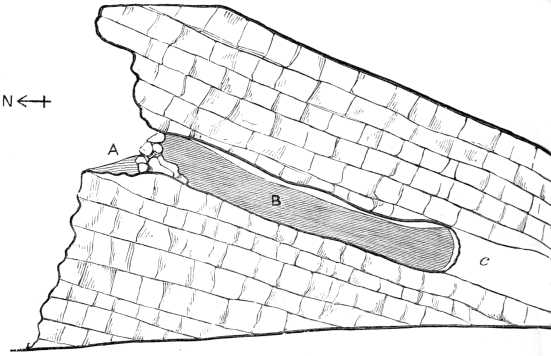
ninety-eight feet (see dotted area B Fig. 83, and in Fig. 90). The enormous quantity of the remains of animals
present cannot fairly be estimated even by the large
number preserved, because most of the bones were as
soft as wet mortar. The five hundred and fifty specimens
obtained must be looked upon merely as a small
fraction of the whole.
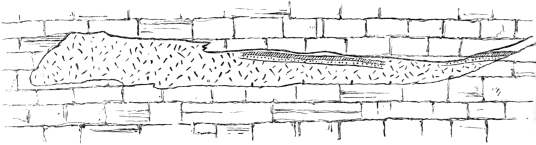
Fig. 90.—Longitudinal Section through
B and
C of
Fig. 83, showing bone-beds.
Dotted area = bone-bed.
We presently passed beyond the bone-bed, and found
that the passage bifurcated (Fig. 83, C and D), the
smaller branch going straight forwards and gently upwards
(Fig. 90), while the larger stretched at right
angles from it and passed gently downwards. In the
former there was a second bone-bed similar in every
respect to that already described, which continued
undiminished in thickness until it rested directly on
the floor. It afforded a square area of about fifteen
feet. The passage was about sixteen inches high and
three feet wide, and gradually narrowed until at a
distance of twelve feet from the bifurcation a stalactite
six inches long reached the floor and formed a vertical
bar, as if to forbid another ingress. When this had
been explored as far as we could crawl, the larger branch
(Fig. 83, D, and Fig. 91) engaged our attention, and we
soon discovered a third layer of bones of the same character
as the others, and in the same position, excepting
that in some places it was in immediate contact with
the roof. In width it was six, in length fourteen, and
in square area eighty-four feet. From its further end to
the termination of the passage there was not the slightest
vestige of bones or teeth, and a stiff grey clay rested on
a horizontal layer of sand on the floor. Here the passage
suddenly turned upwards until it became so small
and barren that it was not worth our while to pursue it
farther. It doubtless rises to the surface, like the large
fissure opposite the entrance of the cave shown in Fig. 88.196
The exploration was resumed the following year by
Mr. Ayshford Sanford and myself, and yielded vast
quantities of fossil remains. We cleared out the space
marked 1863 in the plan, and discovered a flint implement
at the point marked d, in Fig. 83. My friend the
late Mr. Wickham Flower has also worked the cave,
more particularly at the right-hand side of the entrance
chamber.
The ashes and implements were found in positions,
near the mouth of the cave, where man himself may
have placed them (see Figs. 83, 88), with the exception
of the flint implement at d, and an ash of bone imbedded
in the earthy matrix between the canine tooth
and a coprolite of the hyæna, and cemented to a
fragment of dolomitic conglomerate. This was found
far in the cave, either at the entrance of the passage
B, or in the middle of the passage D. The latter
passage yielded the only rolled flint without traces of
man’s handiwork. The materials out of which the implements
were made were used pretty equally. All
those, like Fig. 84, were of flint; all those chipped into
a rounded form and flat-oval in section of chert from
the Upper Greensand; while the flakes consisted of
both used indifferently. Besides these three typical
forms, which were most abundant, is a fourth, in form
roughly pyramidal, with a smooth and flat base, and a
cutting edge all round. Of these we found but two
examples, both consisting of chert. In form they are
exactly similar to several hundreds found in a British
village at Stanlake, in Berkshire, and to those I discovered
in a cemetery of the same age at Yarnton, near
Oxford. They strongly resemble a cast I have of one
found by M. Lartet in the cave of Aurignac. Were it
not for this similarity, I should look upon them as
cores from which flakes had been struck. The rest
are mere splinters, irregular in form, and probably
made in the manufacture of the various flint and chert
implements. All the flint implements have been altered
in colour and structure, either by heat or, as is
more probable, by some chemical action. Without exception,
the old surfaces present a waxy lustre (by the
absence of which forgeries are easily detected), the colour
is of a uniform milk-white, and the ordinary conchoidal
fracture is replaced by that of porcelain. Some are not
harder than chalk. I have met with weathered and calcined
flints in Sussex in which similar changes are
observable, and in which the difference in the results of
chemical action and heat can hardly be detected. The
chert implements, on the other hand, show no traces of
any such changes, but are similar in colour and structure
to the rocks from which they came—the Upper Greensand
of the Blackdown Hills.
All the fragments of calcined bone, with the exception
of one already mentioned, were found near the entrance
(see Fig. 83, b), and in a place more suitable for a fire than
any other in the cave. I can identify none of them as
human. The coarse texture, the structure, and the
thickness of one indicate a fragment of a long bone of the
rhinoceros.197 All resemble many splinters strewn about
in other parts of the cave, which are not calcined, but
were evidently introduced by the hyænas. The calcination
may therefore be due to the accident of their lying
upon the surface at the time the fire was kindled.
The remains obtained in 1862–3 from three to four
thousand in number, afford a vivid picture of the animal
life of the time in Somerset. They belong to the following
animals, the numbers representing the jaws and
teeth only, and the implements:—
| Man |
35 |
| Cave-Hyæna |
467 |
| Cave-Lion |
15 |
| Cave-Bear |
27 |
| Grizzly Bear |
11 |
| Brown Bear |
11 |
| Wolf |
7 |
| Fox |
8 |
| Mammoth |
30 |
| Woolly Rhinoceros |
233 |
| Rhinoceros hemitœchus |
2 |
| Horse |
401 |
| The Great Urus |
16 |
| Bison |
30 |
| The Irish Elk |
35 |
| Reindeer |
30 |
| Red Deer |
2 |
| Lemming |
1 |
The remains of these animals were so intermingled
that they must have been living together at the same
time. They lie large with small, the more with the less
dense, and are not in the least degree sorted by water.
There is no evidence of the hyæna succeeding to the
cave-bear, or the reindeer to the urus, or that the bears
came here to die, as in some of the German caves, or
that the herbivores fell, or were swept into open fissures,
and left their remains, as in the caves of Hutton and
Plymouth. On the contrary, the numerous jaws and
teeth of hyæna, and the marks of those teeth upon nearly
every one of the specimens, show that they alone introduced
the remains that were found in such abundance.
And they preyed not merely upon horses, uri,
and other herbivores, but upon one another (Figs. 92, 93), and they even overcame the cave-bear and
lion in their full prime. Some of the bones of the
larger animals, and in particular a leg-bone of a
gigantic urus, have been broken short across and not
bitten through—a circumstance which points towards
one of the causes of the vast accumulation of bones in so
small a cave. It is well known that wolves and hyænas
at the present day are in the habit of hunting in packs,
and of forcing their prey over precipices. The Wookey
ravine is admirably situated for this mode of hunting,
and would not fail to destroy any animal forced into it
from the hill-side. It is therefore very probable that
the hyænas sometimes caught their prey in this manner.
They would not have dared to attack the bears and lions
unless these had been disabled.
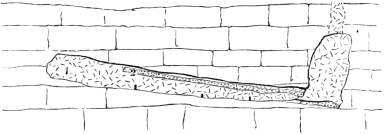
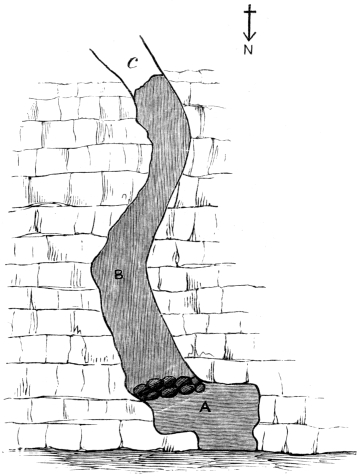
Fig. 91.—Longitudinal Section through
D of
Fig. 83.
Dotted area = bone-bed.
But if all the remains of the animals were introduced
by the hyænas, they certainly in some cases do not
occupy the exact position in which they were left by
those animals. One of the bone layers (Fig. 91)
for instance, actually touched the roof. This, indeed,
has been used as an argument in favour of their having
been introduced by water, from some unknown repository.
But if this hypothesis be admitted, we are landed
in the following dilemma: either the introducing current
of water must have passed down the vertical passages,
or upwards through the horizontal mouth of the
cave. In the former case the three bone layers would
not have been found in the narrow passages, but would
have been swept out into the wide chamber, where the
force of the hypothetical current must have abated. In
the latter case the great bulk of the remains would have
been found in the chamber, and not in the smaller passages.
Moreover, the absence of marks of transport by
water, and especially of that sorting action which water
as a conveying agent always manifests, renders the view
of their being so introduced untenable. On the other
hand, the horizontality of the layers of bone, and the
presence of sand and of red earth, imply that water was
an agent in re-arranging the bones and in introducing
some of the contents of the cave. The only solution of
the difficulty that I can hazard is the occurrence of floods
from time to time, during the occupation of the hyænas,
similar to those which now take place in the caverns of the
neighbourhood. A few years ago, the outlet of the Axe
in the great cave was partially blocked up, and the water
rose to a height of upwards of sixteen feet, leaving a
horizontal deposit of red earth of the same nature as that
in the hyæna-den. Now if we suppose that similar floods
were caused by an obstruction in the ravine below the
hyæna-den, it may have been flooded, just as the upper
galleries of the great cave, and the water laden with
sediment might have elevated the layers of matted bone,
and some of the scattered remains on the surface, while
the current was insufficient to disturb the stones, or to
affect to any extent the deposits of former floods. The
buoyancy of the organic remains is not required to be
greater, on this hypothesis, than in that of their having
been introduced by a current through the vertical passages.
Some of the wet bones taken straight from the
cave were sufficiently light to be carried down by the
current of the Axe.
All these facts taken together enable us to form a clear
idea of the condition of things at the time the hyæna-den
was inhabited. The hyænas were the normal occupants
of the cave, and thither they brought their prey.
We can realize those animals pursuing elephants and
rhinoceroses along the slopes of the Mendip, till they
scared them into the precipitous ravine, or watching until
the strength of a disabled bear or lion ebbed away sufficiently
to allow of its being overcome by their cowardly
strength. Man appeared from time to time on the scene,
a miserable savage armed with bow and spear, unacquainted
with metals, but defended from the cold by coats
of skin.198 Sometimes he took possession of the den and
drove out the hyænas; for it is impossible for both to
have lived in the same cave at the same time. He
kindled his fires at the entrance, to cook his food, and
to keep away the wild animals; then he went away,
and the hyænas came to their old abode. While all
this was taking place there were floods from time to time
until eventually the cave was completely blocked up
with their deposits.
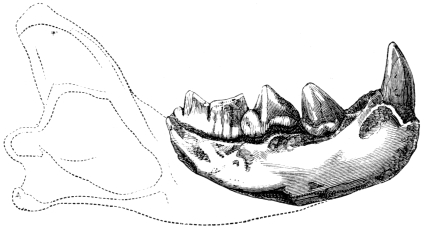
Fig. 92.—Gnawed jaw of Hyæna, from Hyæna-den at Wookey (1/2).
Dotted outline = portion eaten.
The winter cold at the time must have been very
severe to admit of the presence of the reindeer and
lemming.
When we reflect on the vast quantities of the remains
of the animals buried in the caves of so limited an area
as the Mendip Hills, it is evident that there must have
been abundance of food to have enabled them to live
in the district. The great marsh now extending from
Wells to the sea, and cutting off the Mendips from the
fertile region to the south, was probably a rich valley at a
higher level than at present, joining the westward plains
now submerged under the Bristol Channel. An elevation
of from 100 to 300 feet would produce the physical
conditions necessary for the sustenance of the herbivora
found in the caves both in South Wales and Somersetshire.
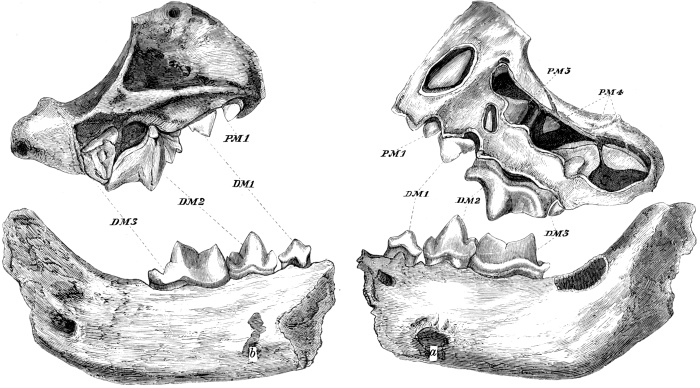
Fig. 93.—A and B, upper and lower jaws of Hyæna-whelp, Wookey.
The remains of the animals which have been eaten by
the cave-hyæna, may be recognized by the following
characters. All are more or less scored by teeth, and
the only perfect bones are those which are solid, or of
very dense texture. The skulls are represented merely
by the harder portions. That of the woolly rhinoceros,
for example, by the hard pedestal which supports the
anterior horn (see Fig. 30). Several of these pedestals
occurred in the Wookey hyæna-den. The lower jaws
also have lost their angle and coronoid process, and are
gnawed to the pattern of the shaded portion of Fig. 92,
the less succulent part bearing the teeth being rejected.
This holds good of the jaws of all the animals so persistently,
that out of more than two hundred from
Wookey there was only one exception. The jaw of the
glutton (Fig. 82), from Plas
Heaton, is also gnawed to
the same shape, and one of
those of the cave-bear from
the cavern of Lherm, considered
by M. Garrigou to
have been fashioned by the
hand of man into an implement,
seems to me, after a
careful comparison in company
with Dr. Falconer, referable
solely to the gnawing
of the hyæna. In Fig. 92, the lower jaw of an
adult hyæna is represented,
and in Fig. 93 (1) the upper
and lower jaws of a hyæna-whelp.
In the latter the
teeth marks a and b are remarkably
distinct.199
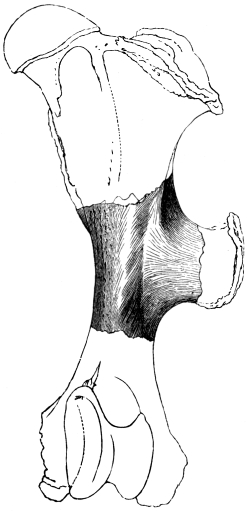
Fig. 94.—Left Thigh-bone of Woolly Rhinoceros gnawed by Hyænas; Shaded parts left. (Wookey Hole.)
The marrow-containing
bones are also universally
splintered away, until either
the articular ends alone are left, as in Fig. 80, or in
some cases, as in that of the femur of woolly rhinoceros
(Fig. 94), the dense central portion bearing the
third trochanter is preserved. This fragment is extremely
abundant in nearly all the hyæna-caves in
this country. From the invariable habit of the hyæna
leaving the bones of its prey in fragments of this
kind, their dens are characterized by the absence of
perfect long-bones and skulls, and consequently, when
these occur in a cave it is certain proof that it was not
occupied by these animals. In a great many caves,
however, the gnawed fragments are associated with the
perfect bones, as, for example, at Banwell, a circumstance
that may be accounted for by the untouched carcases
and the gnawed fragments being swept in from the
surface by a stream falling into a swallow-hole. In all
hyæna-dens also are large quantities of album græcum,
as well as fragments of bone more or less polished by
the friction of the hyæna’s feet.
The ossiferous caves on the south coast of Devonshire,
explored during the last fifty years, are by far the most
important in this country, since they were the first which
were scientifically examined, and the first which established
the co-existence of man with the extinct mammalia.
We owe the full details of their history to the labours
of the distinguished cave-hunter Mr. Pengelly, F.R.S.,200
whose writings are freely used in the following account.
The first intimation of the presence of fossil bones in
the district was furnished by Mr. Whidbey, the engineer
in charge of the construction of the Plymouth breakwater,
who discovered numerous bones and teeth, imbedded
in clayey loam, in some cavernous fissures at Oreston,
which were brought before the Royal Society by Sir
Everard Home in 1817. Thus Dr. Buckland’s researches
in Kirkdale were anticipated by four years. From time
to time, since that date, several other fissures and
caves close by have furnished remains of rhinoceros,
mammoth, hyæna, lion, and other animals. Among the
bones and teeth originally sent up by Mr. Whidbey are
several which were identified by Prof. Busk,201 as belonging
to the Rhinoceros megarhinus, a species that is
vastly abundant in the pleiocene strata of northern Italy
and is also represented in the early pleistocene forest-bed
of Norfolk and Suffolk, and in the lower brickearths of
the valley of the Thames at Grays and Crayford. This
is the only case on record of the discovery of the animal
in a cavern deposit.
The cavernous fissures in the neighbourhood of Yealmpton,202
about seven miles east-south-east from Plymouth,
explored by Mr. Bellamy and Colonel Mudge, R.A., F.R.S.
in 1835–6, contained the remains of the hyæna and
rhinoceros, and the other animals more usually associated
with them. They were probably filled, as in the case
of Oreston, mainly by the streams which introduced the
pebbles. They may, however, from time to time have
been inhabited by the hyænas, although the presence of
three skulls of that animal forbids the supposition that
they dragged in all the fossil bones.
The series of fissures accidentally discovered in 1858,
in quarrying the rock which overlooks the little fishing
town of Brixham, known as the Windmill cave, was
selected by the late Dr. Falconer,203 as a spot in which
thorough investigation would be likely to decide the then
doubtful question of the co-existence of man with the
extinct mammalia. Kent’s Hole had been disturbed by
repeated diggings, and the results might be viewed with
suspicion. He, therefore, urged the importance of a
systematic examination of this virgin cave with such
effect, that it was undertaken by the Royal and Geological
Societies, and a committee was appointed, comprising,
amongst others, Dr. Falconer, Prof. Ramsay, Mr.
Prestwich, Sir Charles Lyell, Prof. Owen, Mr. Godwin-Austen,
and Mr. Pengelly. To the superintendence of
the last is mainly due the minute care with which the
exploration was conducted. The remains have been
identified by Dr. Falconer and Prof. Busk. The work
was commenced in July 1858, and completed in the
summer of 1859.204
The cave consists of three principal galleries, with
diverging passages, running in the direction of the joints
from north to south, and from east to west, communicating
with the surface at four points. The following is
the general section (Fig. 95) of the deposits in descending
order.
(A.) On the floor was a layer of stalagmite, varying
from a few inches to upwards of a foot in thickness,
and containing only twenty-five bones, among which
were the humerus of a bear, and the antler of a reindeer.
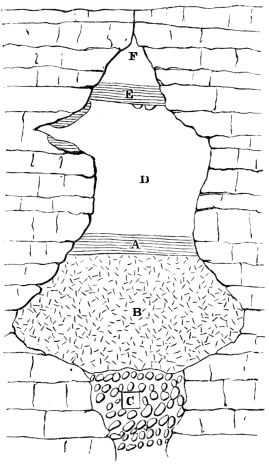
Fig. 95.—Diagram of Deposits in Brixham Cave. (Pengelly.)
(B.) Reddish cave-earth with fragments and blocks
of limestone, and of stalagmite, generally averaging from
two to four feet. In it
1,102 bones were discovered
irregularly scattered
through its mass, and
belonging to mammoth,
woolly rhinoceros, lion,
cave, grizzly, and brown
bears, reindeer, and others.
They varied in state of
preservation, and some
were scored and marked
by teeth. Associated with
these, thirty-six rude flint
implements were met with,
of indisputable human
workmanship, and of the
same general order as
those figured by the Rev.
J. MacEnery from Kent’s
Hole. Among them was
one lanceolate implement
with rounded point and unworked butt end, considered
by Mr. John Evans, F.R.S., of the type of those usually
found in the valley gravels.205 There was, therefore, the
most conclusive evidence that man inhabited the neighbourhood,
either before or during the time of the accumulation
of B, and before those physical changes took
place by which the red silt ceased to be deposited, or
the stalagmite above began to be formed.
(C.) At the bottom of the cave-earth was a deposit of
gravel, principally of rounded pebbles and devoid of
fossils.
The early history of the cave, as shown by these deposits,
is given by Mr. Prestwich, in the report presented
to the Royal Society, as follows:—
“Looking at all the phenomena of Brixham cave,
the conclusion your reporter has arrived at is, that the
formation of the cave commenced and was carried on
simultaneously with the excavation of the valley; that
the small streams flowing down the upper tributary
branches of the valley entered the western openings of
the cave and, traversing the fissures in the limestone,
escaped by lower openings in the chief valley, just as
the Grotto d’Arcy was formed by an overflow from the
cave taking a short cut through the limestone hills,
round which the river winds. These tributary streams
brought in the shingle bed (Fig. 95, C), which fills the
bottom of the fissure. It was only during occasional
droughts, when the streams were dry, that the cave seems
to have been frequented by animals, their remains being
very scarce in that bed, while indications of man are comparatively
numerous. As the excavation of the valley
proceeded, the level of the stream was lowered and became
more restricted to the valley-channel. The cave
consequently became drier, and was more resorted to by
predatory animals, who carried in their prey to devour,
and was less frequented by man. At the same time with
the periodical floods, which there is every reason to believe,
from other investigations, were so great during the quaternary
period, the cave would long continue to be subject
to inundations, the muddy waters of which deposited
the silt forming the cave-earth, burying progressively the
bones left from season to season by succeeding generations
of beasts of prey. By the repetition at distant
intervals of these inundations, and by the accumulation
during the intervening periods of fresh crops of bones,
the bone-bearing cave-earth, B, was gradually formed.
During this time the occasional visits of man are indicated
by the rare occurrence of a flint implement, lost,
probably, as he groped his way through the dark passages
of the cave. As the valley became deeper, and as
with the change of climate at the close of the (pleistocene)
quaternary period the floods became less, so did
the cave become drier and more resorted to by animals.
At last it seems to have become a place for permanent
resort for bears; their remains in all stages of growth,
including even sucking cubs, were met with in the upper
part of the cave-earth, in greater numbers than were the
bones of any other animals. These animals resorted
especially to the darker and more secluded flint-knife
gallery, where 221 out of 366 of their determinable bones
were found, whereas only twenty-six were met with in
the reindeer gallery.
“Finally, as the cave became out of the reach of the
flood waters, the drippings from the roof, which up to
this period had, with the single exception before mentioned,
been lost in the accumulating cave-earth, or deposited
in thin calcareous incrustations on the exposed
bones, now commenced that deposit of stalagmite which
sealed up and preserved undisturbed the shingle and
cave-earth deposited under former and different conditions.
The cave, however, still continued to be the
occasional resort of beasts of prey; for sparse remains of
the reindeer, together with those of the bear and rhinoceros,
were found in the stalagmite floor. After a time
the falling in of the roof at places (and any earthquake
movement may have detached blocks from it), and the
external surface weathering, stopped up some parts of the
cave, and closed its entrances with an accumulation of
débris. From that time it ceased to be accessible, except
to the smaller rodents and burrowing animals, and
so remained unused and untrodden until its recent discovery
and exploration.”206
Mr. Pengelly points out207 an episode in the history of
the cave, between the formation and the filling up with
its present contents, which is of considerable importance,
viewed in relation to the deposits in Kent’s Hole. Over
the empty space in D, of Fig. 95, is an ancient stalagmite
floor, E, constituting the present ceiling, and shutting off
D from the true roof above, E. At the time this was
formed, the cave must have been filled up to that level
with débris, fragments of which are set in the inferior
portion of the calcareous sheet. Subsequently, and before
the present contents, A and B, were introduced, the
whole of this material has been swept away, probably
by an unusual flood similar to that alluded
to in the second chapter in the Clapham cave. The
pieces of stalagmite in the cave-earth are, probably,
some of the relics of the older floor. This filling up,
re-excavating, and re-filling with its present contents,
are phenomena which considerably complicate the problems
offered not merely by Brixham cave, but also by
those of Kent’s Hole.
Two other caverns in the neighbourhood of Brixham,
the “Ash Hole” and “Bench,” have also yielded the
remains of the reindeer, hyæna, and several other
pleistocene species, and are fully described by Mr.
Pengelly, in his essays contributed to the Devonshire
Association.208
The celebrated cave of Kent’s Hole,209 known from time
immemorial, was first found to contain fossil bones by
Mr. Northmore, and Sir W. C. Trevelyan in 1824, and
was subsequently explored by the Rev. J. MacEnery
in the five following years, during which he met with
flint implements in association with the extinct animals
in the undisturbed strata, and obtained the teeth of
the sabre-toothed feline, named by Prof. Owen Machairodus
latidens, which has never before or since been
discovered in any other cavern in Britain. His manuscripts
unfortunately were not used until they passed
into the hands of Mr. Vivian, of Torquay, who published
an abstract in 1859. Subsequently they were published
in full by Mr. Pengelly, in 1869. The discovery of the
flint implements, verified by Mr. Godwin Austen in
1840, and six years later also by a committee of the
Torquay Natural History Society, was received with incredulity
by the scientific world, until the result of the
exploration of the Brixham cave had placed the fact of
the co-existence of man with the extinct mammalia
beyond all doubt. In 1864 a committee210 was appointed
by the British Association for the carrying on the investigation,
which from that time to the present has been
conducted under the careful supervision of Mr. Pengelly.
The cave consists of two parallel series of chambers
and galleries, an eastern and a western, which penetrate
the low cliff of Devonian limestone in the direction of
the joints, with a northern and southern entrance, very
nearly at the same level, “about fifty feet apart, from
180 to 190 feet above the level of mean tide, and about
seventy feet above the bottom of the valley immediately
adjacent.” The largest chamber of the eastern series is
sixty-two feet from east to west, and fifty-three from
north to south. The extent of the cave has not yet been
ascertained.
The contents, examined with the minutest care (on
Mr. Pengelly’s method, see Appendix I.), were found to
be arranged in the following order.
(A.) The surface was composed of dark earth varying
in thickness from a few inches to a foot, on which rested
large blocks of limestone, fallen from the roof. It contained
mediæval remains, Roman pottery, and combs
fashioned out of bone, similar to those discovered in the
Victoria and Dowkerbottom caves in Yorkshire, which
prove that the cave was frequented during the historic
period. A barbed iron spear-head, a bronze spear-head,
other bronze articles, and polished stone celts, establish
the fact that it was also used during the iron, bronze,
and neolithic ages. This stratum contained the broken
bones of the short-horn (Bos longifrons), goat, and
horse, large quantities of charcoal, and was to a great
extent a refuse-heap like that in the Victoria cave.

Fig. 96.—Lanceolate Implement from Kent’s Hole (1/1). (Evans.)
211
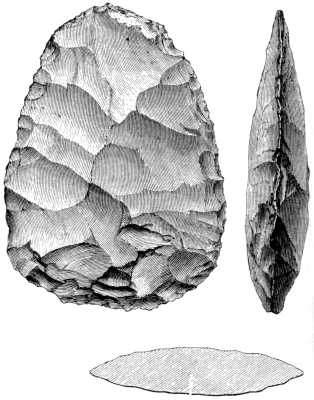
Fig. 97.—Oval Implement from Kent’s Hole (1/1) (Evans.)
(B.) Below this was a stalagmite floor, varying in
thickness from one to three feet, covering
(C.) The red earth, with stones, bones of the extinct
animals, and flint implements, associated together
in the greatest confusion, as well as large lumps of
stalagmite and of breccia, which had been torn out of a
pre-existent floor. In the “vestibule,” near one of the
entrances, a black layer beneath the stalagmite, composed,
to a great extent, of charcoal, indicated the
position of the fire-places, and contained a vast number
of rude unpolished palæolithic implements. There were
also local stalagmitic bands. The flint implements were
met with at various depths, and consist of three distinct
types: the lanceolate, Fig. 96, the oval, with edge carefully
chipped for cutting, Fig. 97, and the flake (see
Fig. 106). Besides these a few implements have been
discovered of the same shape as those found in the gravel
beds; in outline and section roughly triangular, and
tapering to a point from a blunt base, which was probably
intended to be held in the hand.212 Several articles
of bone and antler were also met with, comprising an
awl, or piercer, a needle with the eye large enough to
admit small packthread, and three harpoon-heads, one of
which is barbed on both sides (Fig. 98), the others being
merely barbed on one side (Fig. 99). A rounded pebble
of coarse red sandstone, battered into a cheese-like form,
by being used as a hammer (Fig. 100), was also found.
All these articles bring the palæolithic inhabitants of
Kent’s Hole into relation with those of the caves and
rock-shelters of the south of France, to be described in
the next chapter.
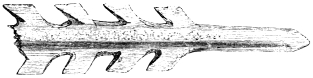
Fig. 98.—Harpoon from Kent’s Hole (1/1). (Evans.)

Fig. 99.—Harpoon-head from Kent’s Hole (1/1). (Evans.)
(D.) The cave-earth rested on a compact, dark red
breccia composed of angular fragments of limestone and
pebbles of sandstone embedded in a sandy calcareous
paste, identical in constitution with the fragments of the
older breccia discovered in the cave-earth. It has furnished
bones of bears, and four flint implements. The
cave-earth, C, and the breccia, E, seem to stand to one
another in an inverse ratio as regards thickness: where
the former was thin, the latter was sometimes as much
as twelve feet thick. From this relation, as well as from
the imbedded fragments of the latter, it may be concluded
that the former is the more modern, and that in
the interval between their accumulation the latter had
been, to a considerable extent, broken up.
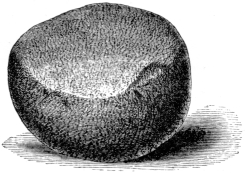
Fig. 100.—Hammer-stone (1/2). (Evans.)
There is very good reason for the belief, that before
any of the present cave-earth was introduced, Kent’s
Hole had been filled nearly to the roof by an older
cave accumulation, now represented by the undisturbed
breccia and the included fragments. In a portion
of the cave termed the “gallery,” there is a sheet of
stalagmite, extending overhead from wall to wall, and
constituting a ceiling that reaches from wall to wall,
without further support than that offered by its own
cohesion. Above it, in the limestone rock, there is a
considerable alcove. This branch of the cavern, therefore,
is divided into three stories or flats, that below the
floor occupied with cave-earth, that between the floor
and the ceiling entirely unoccupied, and that above the
ceiling also without a deposit of any kind. For such a
sheet of stalagmite to have been formed it is absolutely
necessary for the cave to have been filled up to its level
with materials of some kind, just as it is necessary for
the formation of a film of ice that it should be crystallized
from the surface of water. We may, therefore, infer
that Kent’s Hole, like Brixham, was originally filled up
to the level of the ceiling (see Fig. 95, E), then that the
contents were swept out, with the exception of the
breccia, and lastly, that the present cave-earth was
introduced. The occurrence of the remains of bear, and
of flint implements, in this breccia also proves that man
and bears were living in the district, while it was being
accumulated, probably by the action of the floods to
which, from time to time, the cave was subjected. All
the flint implements in the breccia are of the ruder and
larger form which is presented by those from the pleistocene
deposits of the Somme, Seine, and the rivers of the
south and east of England.
While engaged in the identification of the mammals
in 1869, with Mr. W. A. Sanford, I detected splinters
of bears’ canines, from the cave-earth, remarkable for
their density, crystalline structure, and semi-conchoidal
fracture, which were in the same mineral state as
those from the older breccia. One of these had been
fashioned into a flake after its mineralization, and presented
an edge chipped by use. The tooth from which
it was struck was, probably, imbedded and mineralized
in the older breccia, then washed out of it, and afterwards
chosen for the manufacture of an implement. It
was already fossil and altered in structure in the palæolithic
age.
The most remarkable animal discovered in the cave,
by the Rev. J. MacEnery, is the Machairodus latidens,213
or large lion-like animal, armed with double-edged
canines, in shape like the blade of a sabre, and with two
serrated edges. Five canines and two incisors were dug
out of the cave-earth, C, in the Wolf’s Passage, along
with vast quantities of bones and teeth of the mammoth,
rhinoceros, Irish elk, horse, and hyæna. One of the
canines is represented in Figs. 101, 102, which are taken
from one of the original plates drawn for Dr. Buckland,
and now in the Museum of the Torquay Natural History
Society. The two incisors, Figs. 103, 104, 105, are
also characterised by their serrated edges. A third was
discovered by the exploration committee in the same
spot, in 1872, scarcely to be distinguished from that in
Figs. 103, 104, which finally dispelled the scepticism of
some eminent naturalists as to whether any of these
teeth had been obtained in the cave by the Rev. J. MacEnery.
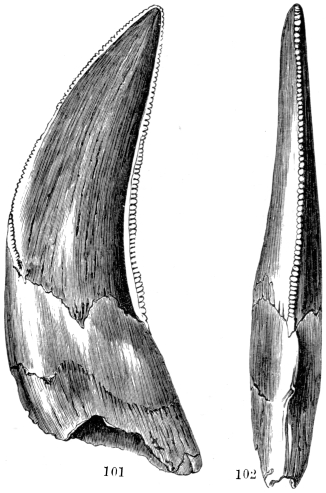
Figs. 101, 102.—Upper Canine of Machairodus, Kent’s Hole (1/1). (MacEnery.)
The Machairodus latidens has been found in pleistocene
strata in two localities in France: in a deposit of
diluvium, near Puy, by M. Aymard, and in the cavern
of Baume in the Jura, considered by M. Lartet to be of
preglacial age.214 In the latter it was associated with the
horse, ox, wild-boar, elephant, a non-tichorine species
of rhinoceros, the cave-bear, and the spotted hyæna. In
the autumn of 1873, I met with proof that the animal
also lived in France in the pleiocene period. M. Lortet,
the Director of the Museum of Natural History, at
Lyons, called my attention to a canine, in the Palais des
Beaux Arts, which coincides exactly in all its dimensions
with one of those from Kent’s Hole. It was found at
Chagny (Saône et Loire) near Dijon, along with Mastodon
arvernensis, the Etruscan or megarhine species of
rhinoceros, horse, beaver and hyæna, somewhat resembling
that from the Crag (Hyæna antiqua) of Suffolk
described by Mr. Lankester. The species, therefore, is
pleiocene, and it belongs to a genus which is widely
distributed in the meiocene strata of Europe and North
America, as well as in the pleiocene of Europe.
To what era in the complicated history of Kent’s Hole
is this animal to be assigned? The more ancient, or the
more modern? The evidence on this point is, to a certain
extent, contradictory. On the one hand it is a pleiocene
species, belonging to a group of animals that inhabited
Europe before the lowering of the temperature caused
the invasion of the arctic mammalia from the north and
the east: it is moreover of a distinctly southern type.
In the teeth marks on the incisors, Figs. 103, 104, 105,
as well as on the canines, we have unmistakeable traces
of the presence of the hyæna; and since the spotted
hyæna abounds in the cave, to its teeth the marks in
question may probably be referred. It seems, therefore,
probable that the animal inhabited Devonshire during
an early stage of the pleistocene period, before the arctic
invaders had taken full possession of the valley of
the English Channel, and of the low grounds which
now lie within the 100-fathom line off the Atlantic
shore of Western France. There must necessarily have
been a swinging to and fro of animal life over the
great, fertile low-lying region, which is now submerged
(see Map, Fig. 126); and before the temperature of
France had been sufficiently lowered to exterminate or
drive out the southern forms, it is most natural to
suppose that in warm seasons some of the southern
mammalia would find their way northwards, and especially
a formidable carnivore such as the machairodus.
The extreme rarity of its remains forbids the hypothesis
that it was a regular inhabitant of Britain during the
pleistocene age.
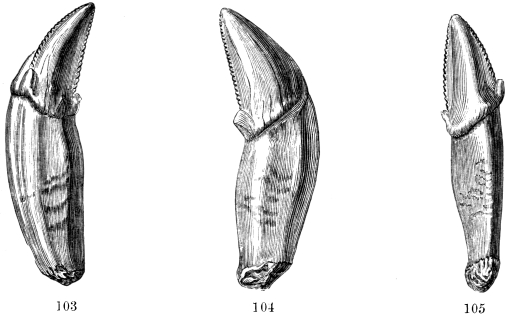
Figs. 103, 104, 105.—Incisors of Machairodus, Kent’s Hole (1/1). (MacEnery.)
215
On the other hand, the recent discovery of a second
incisor in the uppermost portion of the cave-earth, in
July 1872, in the same condition as the remains usually
found, and associated with the bones and teeth of hyæna,
horse, and bear, is considered by Sir Charles Lyell and
Mr. Pengelly proof of the animal having lived during the
deposition of the later cave-earth, or in the later stage
of the pleistocene. The condition of a bone, however, is
a very fallacious guide to its antiquity, and although the
fragments of the older contents of the cave are in a different
mineral state, it is improbable that the ossiferous
contents of so large a cave should have been mineralized
exactly in the same way. Nor is an appeal to its perfect
state conclusive, since several teeth of bear, which I have
examined from the breccia, are equally perfect.
The view of the high antiquity of machairodus in
Kent’s Hole derives support from the discovery of Rhinoceros
megarhinus at Oreston, a species which is very
abundant in the Italian pleiocene strata, and not uncommon
in those of France,—a species with its headquarters
in the south, but ranging as far north as Norfolk
in the early stage of the pleistocene age, represented by
the forest bed of Cromer, and that lived in the valley
of the Thames, while the gravel-beds of Crayford and
Grays Thurrock were being deposited by the ancient
river. The occurrence of either of these animals in a
cave is exceptional, and the presence of both in caves on
the edge of the great plain extending southwards from
the present coastline of Devon, seems to me to imply
that both were open during the early stage of the pleistocene,
while the pleiocene mammalia were retreating
before the southward advance of the mammoth, woolly
rhinoceros, spotted hyæna, reindeer, and their congeners,
at a time anterior to the lowering of the temperature
that culminated in the glacial period. For these reasons
it seems to me probable that the machairodus belongs
to an early rather than a late stage in the history of
Kent’s Hole.
There is an important point of resemblance between
the mode of the occurrence of the machairodus in Kent’s
Hole, and of the megarhine rhinoceros at Oreston. The
remains of both were met with only in one spot, and
were not scattered through the chambers and passages.
It may have happened that in the physical changes
which those caves have undergone, both were preserved
in a fissure like that described in the Uphill cave
(p. 294), and that subsequently they dropped down and
became imbedded in a newer deposit. In fixing the age
of strata in caves it seems to me that the zoological
evidence is of far greater weight than that of mere
position, which may be the result of accidental circumstances.
The caves of Ireland would probably afford as rich a
fauna as those of Britain, had they been explored with
equal care. In one at Shandon, near Dungarvan, Waterford,
remains of the brown bear (U. arctos) reindeer,
horse, and mammoth were discovered in 1859, by Mr.
Brenan.216 The first of these animals became extinct in
Ireland before the historic period, while it survived in
Britain at least as late as the Roman occupation.
The cave-bear is also recorded by Dr. Carte,217 from the
same place, but the thigh bone assigned to it seems to
me to belong to the brown, or common species. The
mammoth, so abundant in Britain, has only been discovered
in two other localities in Ireland, at Whitechurch
near Dungarvan, and at Magherry near Belturbet.218
The range of these animals over Great Britain and
Ireland in the pleistocene age enables us to realize the
ancient physical geography, which will be treated in the
next and following chapters as part of the general question
of the physical condition of north-western Europe
at that time.