ILLUSTRATIONS — BOOK IV— Continued RELIGIOUS ESTABLISHMENTS, FESTIVALS, AND CUSTOMS OF MEWĀR — CHAPTER 19 — Influence of the Priesthood. — Weighing of Princes against Gold. — Grants to Brāhmans and Devotees. — Tithes, Temples. — Political Influence of Brāhmans. — Tithes levied by Brāhmans. — Privileges of Saivas and Jains. — Worship of Siva. — The Temple of Eklinga. — Priestly Functions of the Mewār Rānas. — Privileges of Jains. — Absence of Intolerance. — Grant of Rāna Rāj Singh. — The Jain Retreat. — Nāthdwāra. — The Mughals and Krishna Worship. — The Image of Krishna removed to Mewār. Founding of Nāthdwāra. — Benefactions to Nāthdwāra. — Rights of Sanctuary. — Violation of Sanctuary. — Endowments of Nāthdwāra. — Food offered to Deities. — Lands dedicated to the Shrine. — Grants to the High Priest. — Effects of Krishna-worship on the Rājputs. — CHAPTER 20 — Krishna. — Sun and Moon Worship. — The Forms of Krishna. — The Rāsmandal Dance. — The Songs of Jayadeva. — The Rāsmandal Dance. — Govardhana. — Cave Worship of Krishna. — Krishna a Dragon-Slayer. — Parallels to Krishna in other Mythologies. — The Annakūta Festival. — Interruption of Worship. — Seven Forms of Krishna. — The Pontiff of Nāthdwāra. — APPENDIX — No. I — No. II — No. III — No. IV — No. V — No. VI — No. VII — No. VIII — No. IX — No. X — No. XI — No. XII — CHAPTER 21 — The Importance of Mythology. — The Aboriginal Tribes. — Comparative Study of Festivals. — Analogies to Rājput Customs in Northern Europe. — Festivals in Mewār. Naurātri Festival. — The Repose of Vishnu. — Spring Festival, Vasant Panchami. — Bhān Saptami Festival. — Sun Worship. — Sun Worship at Udaipur. — The Spring Hunt. — The Phāg or Holi Festival. — Chait. — Sītala’s Festival. — Birthday of the Rana. — New Year’s Day. The Festival of Flowers. — The Festival of Flowers. — Ganggor Festival. — The Bathing of the Goddess. — The Agastya Festival. — The Goddess Ganga. — The Aghori Ascetics. — Affinities of Hindu to other Mythologies. — The Birth of Rāma. — The Festival of Kamadeva. — Festivals in the month Baisākh: April-May. — Savitrivrata Festival. — Festivals in the month Jeth: May-June. — The Aranya-Shashthi Festival. — Festivals in the month Āsārh: June-July. — Festivals in the month Sāwan: July-August. — The Tij. — The Nāgpanchami Festival: Serpent Worship. — The Rākhi Festival. — Festivals in the month Bhādon: August-September. — Ancestor Worship. — CHAPTER 22 — Khadga Sthapana, Sword Worship. — The Dasahra Festival. — The Toran Arch. — Gates. — Ganesa. — Analogies to Western Customs. Oaths by the Sword. — The Magic Sword of Mewār. — The Birth of Kumāra. — The Winter Season. — Karttika. — The Diwāli, or Festival of Lamps. — Festival of Yama. — The Annakūta Festival. — The Jaljātra Festival. — The Makara Sankrānti Festival. — Mitra Saptami, Bhāskara Saptami Festivals. — Phallicism. — Siva and the Sun. — Festivals in Honour of Vishnu. — The Argonauts. — Egyptian Influence on Hindu Mythology. — Wide Extension of Hindu Mythology. — CHAPTER 23 — The Character of the Rājput. Influence of Custom. — Rājput Morals. — Variety of Customs due to Environment. — Treatment of Women by the Rājputs. — The Seclusion of Women. — The Chief of Sādri and his Wife. — Devotion of Rājput Women. — The Tale of Dewaldai. — War with Prithirāj. — Jaswant Singh and his Wife. — The Tale of Sanjogta. — The Queen of Ganor. — Rāja Jai Singh and his Wife. — A Courageous Rājput Woman. — The Wedding of Sādhu. — Nāgor taken by Stratagem. — Influence of Women on Rājput Society. — CHAPTER 24 — The Immolation of Women. — The Origin of Infanticide. — Infanticide. — Johar. — Position of Rājput Women. — Rājput Character. — Introduction of Melons, Grapes, Tobacco, Opium: the Use of Opium. — Pledge by eating Opium. — Hunting and other Sports. — Wrestling. — Armouries. — Bagpipes. — Literature among the Rajputs. Observatories. — Household Furniture. — Dress. — Cookery, Medicine. — Superstitions. — PERSONAL NARRATIVE OF THE AUTHOR — CHAPTER 25 — Leaving Udaipur. — Pallāna. — Rām Singh and the Rāja of Narsinghgarh. The Oswāl Mahājans. — Mānikchand. — The Rāja of Narsinghgarh. — Sagacity of Elephants. Usarwās. — Wolves. — The Banās River. The Fairy Gift Legend. — Samecha. — Terrace Cultivation. — Samecha Town. Rājpūt Bhūmias. — A Jain Temple. — Temple of Māma Devi. — Memorial of Prithirāj and Tāra Bāi. — Meeting with the Mers. — CHAPTER 26 — The Mer Tribe. — Prithirāj attacks the Mers. — Character of the Mers. — The Merwāra Battalion. — Marriage Customs. — Oaths, Food, Omens. — The Chief of Gokulgarh. — The Chief of Ghānērāo. — The Chief of Rūpnagar. — Godwār. — Nādol. — Remains at Nādol. — Inscriptions and Coins. — Indara. — Construction of Villages. — Pāli. — The Commerce of Pāli. — Chāran and Bhāt Carriers. — Pungiri Temple. — Khānkāni. — Bhāt Customs. Coercion by Threat of Human Sacrifice. — Jhālamand. — The Chief of Pokaran. — The Chief of Nīmāj. — CHAPTER 27 — City and Fort of Jodhpur. — Reception by the Rāja. — Rāja Mān Singh. — Descent of the Rāthors. — Deonāthji, the High Priest. — Accession of Rāja Mān Singh. — Insanity of Rāja Mān Singh. — British Control of Mārwār. Restoration and Policy of Rāja Mān Singh. — Maladministration of Rāja Mān Singh. — Interview with Rāja Mān Singh. — Mandor. Rāthor Cenotaphs. — Ancestor Worship. Sati. — The Walls of Mandor. — Thāna Pir. — Images of Heroes. — Taintīs Kula Devata Ra Thān. — An Atīt Hermit. — The Rāja visits the Author. — Taking Leave of the Rāja. — CHAPTER 28 — Nāndla. — Bīsalpur. — Pachkalia, Bīchkalia. — Pīpār. — Legend of the Sāmpu Lake. — Lākha Phulāni. — Mādreo. — Bharūnda. — Indāwar. — Merta. — The Battlefield. — The Sons of Ajīt Singh. — Effects of Adoption. — Battle between Bakhta Singh and Rāja Rām Singh, A.D. 1752. — The Death of the Mīthri Chief. — Battle of Merta, about A.D. 1756. — Resistance of Bijai Singh. — Devotion of the Mertias. — Bijai Singh returns to Nāgor. — The Assassination of Jai Āpa Sindhia, A.D. 1759. — CHAPTER 29 — Mahādaji Sindhia, A.D. 1759-94. Battle of Lālsot, A.D. 1787. — Battle of Pātan, June 20, 1790. — Battle of Merta, September 1790 A.D. — British Policy towards the Rajputs. — Jharāu. — Cenotaph of a Thākur. — Alniawās. — Govindgarh. — Fox-hunting: Hyaenas. — Pushkar Lake. — The Brahma Temple. — Bhartrihari. — CHAPTER 30 — Ajmer. — Arhāi din ka jhonpra Mosque. — Ajmer Fort. — The Bīsal Tālāb. — Anasāgar Lake. — Return March to Udaipur. — Deolia. — Dābla. — Banera. — Bhīlwāra. — Māndalgarh. — Pur. — Garnets. — Rāsmi, on the Banās River. — Merta. — Ahār. — APPENDIX — No. I — No. II — No. III — No. IV — No. V — No. VI — No. VII
xxix
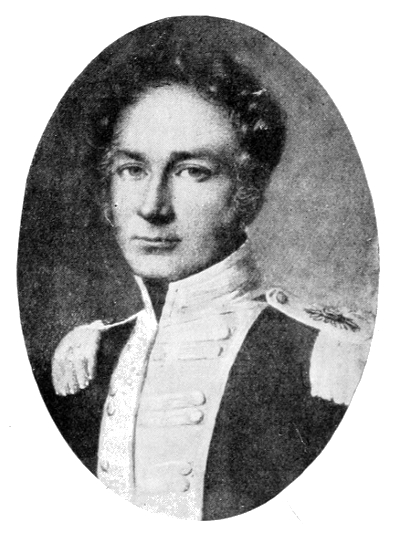
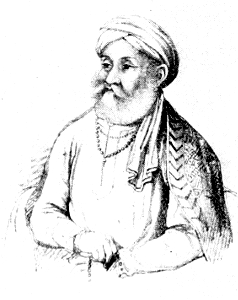
| Portrait of Colonel James Tod |
Frontispiece |
| |
TO FACE PAGE |
| |
| Kanhaiya and Rādha |
630 |
| |
| Columns of Temples at Chandrāvati |
670 |
| |
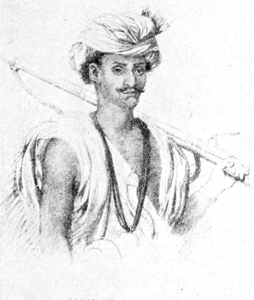
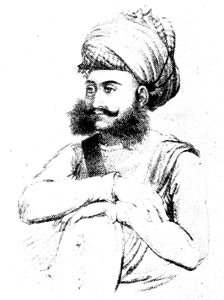
| Portraits of a Rājputni, a Rājput, a Gūsāīn, etc. |
708 |
| |
| Valley of Udaipur |
760 |
| |
| Citadel of the Hill Fortress of Kūmbhalmer |
776 |
| |
| Jain Temple in the Fortress of Kūmbhalmer |
780 |
| |
| Ruins in Kūmbhalmer |
782 |
| |
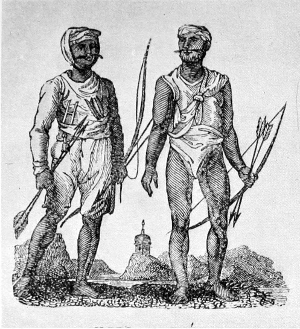
| Koli and Bhīl; Chāran or Bard |
788 |
| |
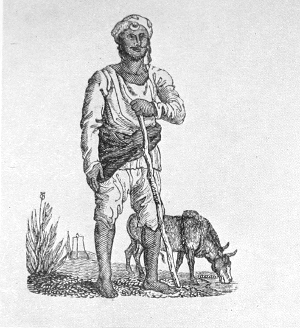
| Jāt Peasant of Mārwār. Rājput Foot Soldier of Mārwār |
812 |
| |
| Town and Fort of Jodhpur |
820 |
| |
| Rock Sculptures at Mandor; Chāmunda, Kankāli |
842 |
| |
| Rock Sculptures at Mandor; Mallināth, Nāthji |
844 |
| |
| Rock Sculptures at Mandor; Rāmdeo Rāthor, Pābuji, etc. |
846 |
| |
| Rock Sculptures at Mandor; Gūga the Chauhān, Harbuji Sānkhla |
848 |
| |
| Rock Sculptures at Mandor; Mehaji Mangalia |
850 |
| |
| Paiks of Mārwār |
860 |
| |
| Durga Dās; Mahārāja Sher Singh of Rian |
866 |
| |
| The Sacred Lake of Pushkar in Mārwār |
892 |
| |
| Ancient Jain Temple at Ajmer |
896 |
| |
| Fortress and Town of Ajmer |
900 |
| |
| Castle of Bhinai |
904 |
| |
| Source of the Berach River, and Hunting Seat of the Rāna |
910 |
| |
| Bridge of Nūrābād |
914 |
| |
| The late Mahārāja Sir Sumer Singh, of Jodhpur (b. 1901; d. 1918), and his brother, the present Mahārāja Ummed Singh (b. 1903) |
928 |
| |
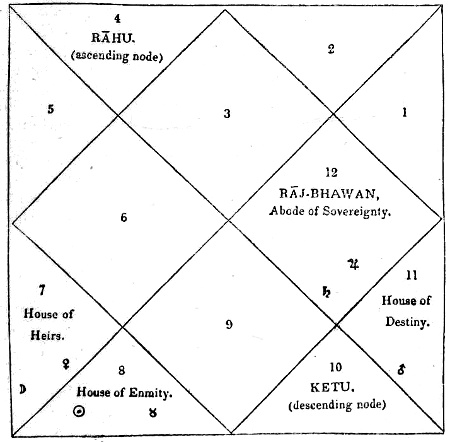
| Horoscope of Rāja Abhai Singh |
Page 1019 |
589ANNALS AND ANTIQUITIES
OF RAJASTHAN
—In all ages the ascendancy of the
hierarchy is observable; it is a tribute paid to religion through
her organs. Could the lavish endowments and extensive immunities
of the various religious establishments in Rajasthan be
assumed as criteria of the morality of the inhabitants, we should
be authorized to assign them a high station in the scale of excellence.
But they more frequently prove the reverse of their
position; especially the territorial endowments, often the fruits
of a death-bed repentance,
[1] which, prompted by superstition or
fear, compounds for past crimes by posthumous profusion,
although vanity not rarely lends her powerful aid. There is
scarcely a State in Rajputana in which one-fifth of the soil is not
assigned for the support of the temples, their ministers, the
secular Brahmans, bards, and [508] genealogists. But the evil
was not always so extensive; the abuse is of modern growth.
—An anecdote related of the
Rajas of Marwar and Amber, always rivals in war, love, and folly,
590will illustrate the motives of these dismemberments. During the
annual pilgrimage to the sacred lake of Pushkar, it is the custom
for these lords of the earth to weigh their persons against all that
is rare, in gold, gems, and precious cloths; which are afterwards
distributed to the priests.
[2] The Amber chief had the advantage
of a full treasury and a fertile soil, to which his rival could oppose
a more extended sway over a braver race; but his country was
proverbially poor, and at Pushkar, the weight of the purse ranks
above the deeds of the sword. As these princes were suspended
in the scale, the Amber Raja, who was balanced against the more
costly material, indirectly taunted his brother-in-law on the
poverty of his offerings, who would gladly, like the Roman, have
made up the deficiency with his sword. But the Marwar prince
had a minister of tact, at whose suggestion he challenged his
rival (of Amber) to equal him in the magnitude of his gift to the
Brahmans. On the gage being accepted, the Rathor exclaimed,
“Perpetual charity (
sasan)
[3] of all the lands held by the Brahmans
in Marwar!” His unreflecting rival had commenced the
redemption of his pledge, when his minister stopped the
half-uttered vow, which would have impoverished the family
for ever; for there were ten Brahmans in Amber who followed
secular employments, cultivating or holding lands in usufruct,
to one in Marwar. Had these lords of the earth been left to their
misguided vanity, the fisc of each state would have been seriously
curtailed.
—The Brahmans, Sannyasis,
and Gosains are not behind those professional flatterers, the
Bards; and many a princely name would have been forgotten
but for the record of the gift of land. In Mewar, the lands in
sasan, or religious grants, amount in value to one-fifth of the
591revenue of the State, and the greater proportion of these has
arisen out of the prodigal mismanagement of the last century.
The dilapidated state of the country, on the general pacification
in
A.D. 1818, afforded a noble opportunity to redeem in part these
alienations, without the penalty of denunciation attached to the
resumer of sacred charities. But death, famine, and exile, which
had left but few of the grantees in a capacity to return and
reoccupy the lands, in vain coalesced to restore the fisc of Mewar.
The Rana dreaded a “sixty thousand [509] years’ residence in
hell,” and some of the finest land of his country is doomed to
remain unproductive. In this predicament is the township of
Menal,
[4] with 50,000 bighas (16,000 acres), which with the exception
of a nook where some few have established themselves,
claiming to be descendants of the original holders, are condemned
to sterility, owing to the agricultural proprietors and the rent-receiving
Brahmans being dead; and apathy united to superstition
admits their claims without inquiry.
The antiquary, who has dipped into the records of the dark
period in European church history, can have ocular illustration
in Rajasthan of traditions which may in Europe appear questionable.
The vision of the Bishop of Orleans,[5] who saw Charles
Martel in the depths of hell, undergoing the tortures of the damned,
for having stripped the churches of their possessions, “thereby
rendering himself guilty of the sins of all those who had endowed
them,” would receive implicit credence from every Hindu, whose
ecclesiastical economy might both yield and derive illustration
from a comparison, not only with that of Europe, but with the
more ancient Egyptian and Jewish systems, whose endowments,
as explained by Moses and Ezekiel, bear a strong analogy to his
592own. The disposition of landed property in Egypt, as amongst
the ancient Hindus, was immemorially vested in the cultivator;
and it was only through Joseph’s ministry in the famine that
“the land became Pharaoh’s, as the Egyptians sold every man
his field.”[6] And the coincidence is manifest even in the tax
imposed on them as occupants of their inheritance, being one-fifth
of the crops to the king, while the maximum rate among the
Hindus is a sixth.[7] The Hindus also, in visitations such as that
which occasioned the dispossession of the ryots of Egypt, can
mortgage or sell their patrimony (bapota). Joseph did not attempt
to infringe the privileges of the sacred order when the whole of
Egypt became crown-land, “except the lands of the priests,
which became not Pharaoh’s”; and these priests, according to
Diodorus, held for themselves and the sacrifices no less than
one-third of the lands of Egypt. But we learn from [510] Herodotus,
that Sesostris, who ruled after Joseph’s ministry, restored
the lands to the people, reserving the customary tax or tribute.[8]
The prelates of the middle ages of Europe were often completely
feudal nobles, swearing fealty and paying homage as did
the lay lords.[9] In Rajasthan, the sacerdotal caste not bound
to the altar may hold lands and perform the duties of vassalage:[10]
but of late years, when land has been assigned to religious establishments,
no reservation has been made of fiscal rights, territorial
or commercial. This is, however, an innovation; since, formerly,
princes never granted, along with territorial assignments,
the prerogative of dispensing justice, of levying transit duties, or
exemption from personal service of the feudal tenant who held
on the land thus assigned. Well may Rajput heirs exclaim with
the grandson of Clovis, “our exchequer is impoverished, and our
riches are transferred to the clergy.”[11] But Chilperic had the
courage to recall the grants of his predecessors, which, however,
the pious Gontram re-established. Many Gontrams could be
found, though but few Chilperics, in Rajasthan: we have, indeed,
593one in Jograj,[12] the Rana’s ancestor, almost a contemporary of
the Merovingian king, who not only resumed all the lands of the
Brahmans, but put many of them to death, and expelled the
rest his dominions.[13]
It may be doubted whether vanity and shame are not sufficient
in themselves to prevent a resumption of the lands of the Mangtas
or mendicants, as they style all those ‘who extend the palm,’
without the dreaded penalty, which operates very slightly on
the sub-vassal or cultivator, who, having no superfluity, defies
their anathemas when they attempt to wrest from him, by virtue
of the crown-grant, any of his long-established rights. By these,
the threat of impure transmigration is despised; and the Brahman
may spill his blood on the threshold of his dwelling or in
the field in dispute, which will be relinquished by the owner but
with his life. The Pat Rani, or chief queen, on the death of
Prince Amra, the heir-apparent, in 1818, bestowed a grant of
fifteen bighas of land, in one of the central districts, on a Brahman
who had assisted in the funeral rites of her son. With grant in
hand [511], he hastened to the Jat proprietor, and desired him
to make over to him the patch of land. The latter coolly replied
that he would give him all the prince had a right to, namely the
tax. The Brahman threatened to spill his own blood if he did
not obey the command, and gave himself a gash in a limb; but
the Jat was inflexible, and declared that he would not surrender
his patrimony (bapota) even if he slew himself.[14] In short, the
594ryot of Mewar would reply, even to his sovereign, if he demanded
his field, in the very words of Naboth to Ahab, king of Israel,
when he demanded the vineyard contiguous to the palace:
“The Lord forbid it me that I should give the inheritance of my
fathers unto thee.”
—But the tithes, and other small and legally
established rights of the hierarchy, are still religiously maintained.
The village temple and the village priest are always
objects of veneration to the industrious husbandman, on whom
superstition acts more powerfully than on the bold marauding
Rajput, who does not hesitate to demand salvamenta (
rakhwali)
from the lands of Kanhaiya or Eklinga. But the poor ryot of
the nineteenth century of Vikrama has the same fears as the
peasants of Charlemagne, who were made to believe that the
ears of corn found empty had been devoured by infernal spirits,
reported to have said they owed their feast to the non-payment
of tithes.
[15]—The political influence of
the Brahmans is frequently exemplified in cases alike prejudicial
to the interests of society and the personal welfare of the sovereign.
The latter is often surrounded by lay-Brahmans as confidential
servants, in the capacities of butler, keeper of the wardrobe, or
seneschal,
[16] besides the Guru or domestic chaplain, who to the
duty of ghostly comforter sometimes joins that of [512] astrologer
595and physician, in which case God help the prince!
[17] These
Gurus and Purohits, having the education of the children, acquire
immense influence, and are not backward in improving “the
greatness thrust upon them.” They are all continually importuning
their prince for grants of land for themselves and the
shrines they are attached to; and every chief, as well as every
influential domestic, takes advantage of ephemeral favour to
increase the endowments of his tutelary divinity. The Peshwas
of Satara are the most striking out of numerous examples.
In the dark ages of Europe the monks are said to have prostituted
their knowledge of writing to the forging of charters in
their own favour: a practice not easily detected in the days of
ignorance.[18] The Brahmans, in like manner, do not scruple to
employ this method of augmenting the wealth of their shrines;
and superstition and indolence combine to support the deception
596There is not a doubt that the grand charter of Nathdwara was a
forgery, in which the prince’s butler was bribed to aid; and
report alleges that the Rana secretly favoured an artifice which
regard to opinion prevented him from overtly promulgating.
Although the copper-plate had been buried under ground, and
came out disguised with a coating of verdigris, there were marks
which proved the date of its execution to be false. I have seen
charters which, it has been gravely asserted, were granted by
Rama upwards of three thousand years ago! Such is the origin
assigned to one found in a well at the ancient Brahmpuri, in the
valley of the capital. If there be sceptics as to its validity, they
are silent ones; and this copper-plate of the brazen age [513] is
worth gold to the proprietor.[19] A census[20] of the three central
districts of Mewar discovered that more than twenty thousand
acres of these fertile lands, irrigated by the Berach and Banas
rivers, were distributed in isolated portions, of which the mendicant
castes had the chief share, and which proved fertile sources
of dispute to the husbandman and the officers of the revenue.
From the mass of title-deeds of every description by which these
lands were held, one deserves to be selected, on account of its
being pretended to have been written and bestowed on the
incumbent’s ancestor by the deity upwards of three centuries
ago, and which has been maintained as a bona-fide grant of
Krishna[21] ever since. By such credulity and apathy are the
Rajput States influenced: yet let the reader check any rising
feeling of contempt for Hindu legislation, and cast a retrospective
glance at the page of European church history, where he will
observe in the time of the most potent of our monarchs that the
clergy possessed one-half of the soil:[22] and the chronicles of
France will show him Charlemagne on his death-bed, bequeathing
two-thirds of his domains to the church, deeming the remaining
third sufficient for the ambition of four sons. The same dread
of futurity, and the hope to expiate the sins of a life, at its
597close, by gifts to the organs of religion, is the motive for these
unwise alienations, whether in Europe or in Asia. Some of these
establishments, and particularly that at Nathdwara, made a
proper use of their revenues in keeping up the Sada-Brat, or
perpetual charity, though it is chiefly distributed to religious
pilgrims: but among the many complaints made of the misapplication
of the funds, the diminution of this hospitable right
is one; while, at other shrines, the avarice of the priests is
observable in the coarseness of the food dressed for sacrifice and
offering.
—Besides the crown-grants to the
greater establishments, the Brahmans received petty tithes from
the agriculturist, and a small duty from the trader, as
mapa or
metage, throughout every township, corresponding with the
scale of the village-chapel. An inscription found by the author
at the town of Palod,
[23] and dated nearly seven centuries back,
affords a good specimen of the claims of the village [514] priesthood.
The following are among the items. The
serana, or a
ser, in every
maund, being the fortieth part of the grain of the
unalu, or summer-harvest; the
karpa, or a bundle from every
sheaf of the autumnal crops, whether
makai (Indian corn),
bajra
or
juar (maize) [millet], or the other grains peculiar to that
season.
[24]They also derive a tithe from the oil-mill and sugar-mill, and
receive a kansa or platter of food on all rejoicings, as births,
marriages, etc., with charai, or the right of pasturage on the
village common; and where they have become possessed of
landed property they have halma, or unpaid labour in man and
beasts, and implements, for its culture: an exaction well known
in Europe as one of the detested corvées of the feudal system of
France,[25] the abolition of which was the sole boon the English
husbandman obtained by the charter of Runymede. Both the
chieftain and the priest exact halma in Rajasthan; but in that
country it is mitigated, and abuse is prevented, by a sentiment
unknown to the feudal despot of the middle ages of Europe, and
598which, though difficult to define, acts imperceptibly, having its
source in accordance of belief, patriarchal manners, and clannish
attachments.
—I shall now briefly consider
the privileges of the Saivas and Jains—the orthodox and heterodox
sects of Mewar; and then proceed to those of Vishnu, whose
worship is the most prevalent in these countries, and which I am
inclined to regard as of more recent origin.
—Mahadeva, or Iswara, is the tutelary
divinity of the Rajputs in Mewar; and from the early annals of
the dynasty appears to have been, with his consort Isani, the sole
object of Guhilot adoration. Iswara is adored under the epithet
of Eklinga,
[26] and is either worshipped in his monolithic symbol,
or as Iswara Chaumukhi, the quadriform divinity, represented
by a bust with four faces. The sacred bull, Nandi, has his altar
attached to all the shrines of Iswara, as was that of Mneves or
Apis to those of the Egyptian Osiris. Nandi has occasionally
his separate shrines, and there is one in the valley of Udaipur
which has the reputation of being oracular as regards the seasons.
The bull was the steed of Iswara, and [515] carried him in battle;
he is often represented upon it, with his consort Isani, at full
speed. I will not stop to inquire whether the Grecian fable of
the rape of Europa
[27] by the tauriform Jupiter may not be derived,
with much more of their mythology, from the Hindu pantheon;
whether that pantheon was originally erected on the Indus, or
599the Ganges, or the more central scene of early civilization, the
banks of the Oxus. The bull was offered to Mithras by the
Persian, and opposed as it now appears to Hindu faith, he formerly
bled on the altars of the Sun-god, on which not only the Baldan,
[28]
‘offering of the bull,’ was made, but human sacrifices.
[29] We do
not learn that the Egyptian priesthood presented the kindred of
Apis to Osiris, but as they were not prohibited from eating beef,
they may have done so.
—The shrine of Eklinga is situated in
a defile about six [twelve] miles north of Udaipur. The hills
towering around it on all sides are of the primitive formation,
and their scarped summits are clustered with honeycombs.
[30]
There are abundant small springs of water, which keep verdant
numerous shrubs, the flowers of which are acceptable to the
deity; especially the
kaner or oleander, which grows in great
600luxuriance on the Aravalli. Groves of bamboo and mango were
formerly common, according to tradition; but although it is
deemed sacrilege to thin the groves of Bal,
[31] the bamboo has been
nearly destroyed: there are, however, still many trees sacred to
the deity scattered around. It would be difficult to convey a
just [516] idea of a temple so complicated in its details. It is of
the form commonly styled pagoda, and, like all the ancient
temples of Siva, its
sikhara, or pinnacle, is pyramidal. The
various orders of Hindu sacred architecture are distinguished by
the form of the
sikhara, which is the portion springing from and
surmounting the perpendicular walls of the body of the temple.
The
sikhara of those of Siva is invariably pyramidal, and its
sides vary with the base, whether square or oblong. The apex
is crowned with an ornamental figure, as a sphinx, an urn, a
ball, or a lion, which is called the
kalas. When the
sikhara is
but the frustum of a pyramid, it is often surmounted by a row
of lions, as at Bijolia. The fane of Eklinga is of white marble
and of ample dimensions. Under an open-vaulted temple
supported by columns, and fronting the four-faced divinity, is
the brazen bull Nandi, of the natural size; it is cast, and of
excellent proportions. The figure is perfect, except where the
shot or hammer of an infidel invader has penetrated its hollow
flank in search of treasure. Within the quadrangle are miniature
shrines, containing some of the minor divinities.
[32] The high-priest
of Eklinga, like all his order, is doomed to celibacy, and
601the office is continued by adopted disciples. Of such spiritual
descents they calculate sixty-four since the Sage Harita, whose
benediction obtained for the Guhilot Rajput the sovereignty of
Chitor, when driven from Saurashtra by the Parthians.
The priests of Eklinga are termed Gosain or Goswami, which
signifies ‘control over the senses’! The distinguishing mark
of the faith of Siva is the crescent on the forehead:[33] the hair is
braided and forms a tiara round the head, and with its folds a
chaplet of the lotus-seed is often entwined. They smear the
body with ashes, and use garments dyed of an orange hue. They
bury their dead in a sitting [517] posture, and erect tumuli over
them, which are generally conical in form.[34] It is not uncommon
for priestesses to officiate in the temple of Siva. There is a
numerous class of Gosains who have adopted celibacy, and who
yet follow secular employments both in commerce and arms.
The mercantile Gosains[35] are amongst the richest individuals in
India, and there are several at Udaipur who enjoy high favour,
and who were found very useful when the Mahrattas demanded
a war-contribution, as their privileged character did not prevent
their being offered and taken as hostages for its payment. The
Gosains who profess arms, partake of the character of the knights
of St. John of Jerusalem. They live in monasteries scattered
over the country, possess lands, and beg, or serve for pay when
called upon. As defensive soldiers, they are good. Siva, their
patron, is the god of war, and like him they make great use of
intoxicating herbs, and even of spirituous liquors. In Mewar
they can always muster many hundreds of the Kanphara[36] Jogi,
or ‘split-ear ascetics,’ so called from the habit of piercing the ear
and placing therein a ring of the conch-shell, which is their battle-trumpet.
602Both Brahmans and Rajputs, and even Gujars, can
belong to this order, a particular account of whose internal
discipline and economy could not fail to be interesting. The
poet Chand gives an animated description of the body-guard of the
King of Kanauj, which was composed of these monastic warriors.
—The Ranas of Mewar,
as the diwans, or vicegerents of Siva, when they visit the temple
supersede the high priest in his duties, and perform the ceremonies,
which the reigning prince does with peculiar correctness and
grace.
[37]—The shrine of Eklinga is endowed with
twenty-four large villages from the fisc, besides parcels of land
from the chieftains; but the privileges of the tutelary divinity
have been waning since Kanhaiya fixed his residence amongst
them; and as the priests of Apollo complained that the god
was driven from the sacred mount [518] Govardhana, in Vraj, by
the influence of those of Jupiter
[38] with Shah Jahan, the latter
may now lament that the day of retribution has arrived, when
propitiation to the Preserver is deemed more important than to
the Destroyer. This may arise from the personal character of
the high priests, who, from their vicinity to the court, can scarcely
avoid mingling in its intrigues, and thence lose in character:
even the Ranis do not hesitate to take mortgages on the estates
of Bholanath.
[39] We shall not further enlarge on the immunities
to Eklinga, or the forms in which they are conveyed, as these
will be fully discussed in the account of the shrine of Krishna;
but proceed to notice the privileges of the heterodox Jains—the
Vidyavan
[40] or Magi of Rajasthan. The numbers and power of
603these sectarians are little known to Europeans, who take it for
granted that they are few and dispersed. To prove the extent
of their religious and political power, it will suffice to remark
that the pontiff of the Khadatara-gachchha,
[41] one of the many
branches of this faith, has 11,000 clerical disciples scattered over
India; that a single community, the Osi or Oswal,
[42] numbers
100,000 families; and that more than half [519] of the mercantile
wealth of India passes through the hands of the Jain laity.
Rajasthan and Saurashtra are the cradles of the Buddhist or
Jain faith, and three out of their five sacred mounts, namely,
Abu, Palitana,
[43] and Girnar, are in these countries. The officers
604of the State and revenue are chiefly of the Jain laity, as are the
majority of the bankers, from Lahore to the ocean. The chief
magistrate and assessors of justice, in Udaipur and most of the
towns of Rajasthan, are of this sect; and as their voluntary
duties are confined to civil cases, they are as competent in these
as they are the reverse in criminal cases, from their tenets forbidding
the shedding of blood. To this leading feature in their
religion they owe their political debasement: for Kumarpal, the
last king of Anhilwara of the Jain faith, would not march his
armies in the rains, from the unavoidable sacrifice of animal life
that must have ensued. The strict Jain does not even maintain
a lamp during that season, lest it should attract moths to their
destruction.
—The period of sectarian intolerance
is now past; and as far as my observation goes, the ministers of
Vishnu, Siva, and Buddha view each other without malignity;
which feeling never appears to have influenced the laity of either
sect, who are indiscriminately respectful to the ministers of all
religions, whatever be their tenets. It is sufficient that their
office is one of sanctity, and that they are ministers of the Divinity,
who, they say, excludes the homage of none, in whatever tongue
or whatever manner he is sought; and with this spirit of entire
toleration, the devout missionary, or Mulla, would in no country
meet more security or hospitable courtesy than among the
Rajputs. They must, however, adopt the toleration they would
find practised towards themselves, and not exclude, as some of
them do, the races of Surya and Chandra from divine mercy, who,
with less arrogance, and more reliance on the compassionate
nature of the Creator, say, he has established a variety of paths
by which the good may attain beatitude.
Mewar has, from the most remote period, afforded a refuge to
605the followers of the Jain faith, which was the religion of Valabhi,
the first capital of the Rana’s ancestors, and many monuments
attest the support this family has granted to its [520] professors
in all the vicissitudes of their fortunes. One of the best preserved
monumental remains in India is a column most elaborately
sculptured, full seventy feet in height, dedicated to Parsvanath,
in Chitor.[44] The noblest remains of sacred architecture, not in
Mewar only, but throughout Western India, are Buddhist or
Jain:[45] and the many ancient cities where this religion was
fostered, have inscriptions which evince their prosperity in these
countries, with whose history their own is interwoven. In fine,
the necrological records of the Jains bear witness to their having
occupied a distinguished place in Rajput society; and the
privileges they still enjoy, prove that they are not overlooked.
It is not my intention to say more on the past or present history
of these sectarians, than may be necessary to show the footing
on which their establishments are placed; to which end little is
required beyond copies of a few simple warrants and ordinances
in their favour.[46] Hereafter I may endeavour to add something
to the knowledge already possessed of these deists of Rajasthan,
whose singular communities contain mines of knowledge hitherto
inaccessible to Europeans. The libraries of Jaisalmer in the
desert, of Anhilwara, the cradle of their faith, of Cambay, and
other places of minor importance, consist of thousands of volumes.
These are under the control, not of the priests alone, but of
communities of the most wealthy and respectable amongst the
laity, and are preserved in the crypts of their temples, which
precaution ensured their preservation, as well as that of the
statues of their deified teachers, when the temples themselves
were destroyed by the Muhammadan invaders, who paid more
deference to the images of Buddha than those of Siva or Vishnu.
The preservation of the former may be owing to the natural
formation of their statues; for while many of Adinath, of Nemi,
and of Parsva have escaped the hammer, there is scarcely an
606Apollo or a Venus, of any antiquity, entire, from Lahore to
Rameswaram. The two arms of these theists sufficed for their
protection; while the statues of the polytheists have met with
no mercy.
—No. V.
[47] is the translation of a
grant by the celebrated Rana Raj Singh, the gallant and successful
opponent of Aurangzeb in many a battle. It is at once of a
general and special nature, containing a confirmation of the old
privileges of the sect, and a mark of favour to a priest of some
distinction, called Mana. It is well known [521] that the first
law of the Jains, like that of the ancient Athenian lawgiver
Triptolemus, is, “Thou shalt not kill,” a precept applicable to
every sentient thing. The first clause of this edict, in conformity
thereto, prohibits all innovation upon this cherished principle;
while the second declares that even the life which is forfeited to
the laws is immortal (
amara) if the victim but passes near their
abodes. The third article defines the extent of
saran, or sanctuary,
the dearest privilege of the races of these regions. The
fourth article sanctions the tithes, both on agricultural and
commercial produce; and makes no distinction between the
Jain priests and those of Siva and Vishnu in this source of income,
which will be more fully detailed in the account of Nathdwara.
The fifth article is the particular gift to the priest; and the whole
closes with the usual anathema against such as may infringe the
ordinance.
—The edicts Nos. VI. and VII.,
[48] engraved
on pillars of stone in the towns of Rasmi and Bakrol, further
illustrate the scrupulous observances of the Rana’s house towards
the Jains; where, in compliance with their peculiar doctrine,
the oil-mill and the potter’s wheel suspend their revolutions for
the four months in the year when insects most abound.
[49] Many
others of a similar character could be furnished, but these remarks
may be concluded with an instance of the influence of the Jains
on Rajput society, which passed immediately under the Author’s
607eye. In the midst of a sacrifice to the god of war, when the
victims were rapidly falling by the scimitar, a request preferred
by one of them for the life of a goat or a buffalo on the point of
immolation, met instant compliance, and the animal, become
amara or immortal, with a garland thrown round his neck, was
led off in triumph from the blood-stained spot.
—This is the most celebrated of the fanes of the
Hindu Apollo. Its etymology is ‘the portal (
dwara) of the god’
(
nath), of the same import as his more ancient shrine of Dwarka
[50]
at the ‘world’s end.’ Nathdwara is twenty-two [thirty] miles
N.N.E. of Udaipur, on the right bank of the Banas. Although
the principal resort of the followers of Vishnu, it has nothing
very remarkable in its structure or situation. It owes its celebrity
entirely to the image of Krishna, said to [522] be the same that
has been worshipped at Mathura ever since his deification, between
eleven and twelve hundred years before Christ.
[51] As
containing the representative of the mildest of the gods of Hind,
Nathdwara is one of the most frequented places of pilgrimage,
though it must want that attraction to the classical Hindu which
the caves of Gaya, the shores of the distant Dwarka, or the
pastoral Vraj,
[52] the place of the nativity of Krishna, present to
his imagination; for though the groves of Vindra,
[53] in which
608Kanhaiya disported with the Gopis, no longer resound to the
echoes of his flute; though the waters of the Yamuna
[54] are daily
polluted with the blood of the sacred kine, still it is the holy land
of the pilgrim, the sacred Jordan of his fancy, on whose banks
he may sit and weep, as did the banished Israelite of old, the
glories of Mathura, his Jerusalem!
It was in the reign of Aurangzeb that the pastoral divinity was
exiled from Vraj, that classic soil which, during a period of two
thousand eight hundred years, had been the sanctuary of his
worshippers. He had been compelled to occasional flights
during the visitations of Mahmud and the first dynasties of Afghan
invaders; though the more tolerant of the Mogul kings not only
reinstated him, but were suspected of dividing their faith between
Kanhaiya and the prophet. Akbar was an enthusiast in the
mystic poetry of Jayadeva, which paints in glowing colours the
loves of Kanhaiya and Radha, in which lovely personification
the refined Hindu abjures all sensual interpretation, asserting
its character of pure spiritual love.[55]
—Jahangir, by birth half
a Rajput, was equally indulgent to the worship of Kanhaiya:
but Shah Jahan, also the son of a Rajput princess, inclined to
the [523] doctrines of Siva, in which he was initiated by Siddhrup
the Sannyasi. Sectarian animosity is more virulent than faiths
totally dissimilar. Here we see Hindu depressing Hindu: the
followers of Siva oppressing those of Kanhaiya; the priests of
Jupiter driving the pastoral Apollo from the Parnassus of Vraj.
At the intercession, however, of a princess of Udaipur, he was
replaced on his altar, where he remained till Aurangzeb became
emperor of the Moguls. In such detestation did the Hindus hold
609this intolerant king, that in like manner as they supposed the
beneficent Akbar to be the devout Mukund in a former birth,
so they make the tyrant’s body enclose the soul of Kalyavana
the foe of Krishna, ere his apotheosis, from whom he fled to
Dwarka, and thence acquired the name of Ranchhor.
[56]—When Aurangzeb proscribed Kanhaiya, and
rendered his shrines impure throughout Vraj, Rana Raj Singh
“offered the heads of one hundred thousand Rajputs for his
service,” and the god was conducted by the route of Kotah and
Rampura to Mewar. An omen decided the spot of his future
residence. As he journeyed to gain the capital of the Sesodias
the chariot-wheel sunk deep into the earth and defied extrication;
upon which the Saguni (augur) interpreted the pleasure of the
god, that he desired to dwell there. This circumstance occurred
at an inconsiderable village called Siarh, in the fief of Delwara,
one of the sixteen nobles of Mewar. Rejoiced at this decided
manifestation of favour, the chief hastened to make a perpetual
gift of the village and its lands, which was speedily confirmed by
the patent of the Rana.
[57] Nathji (
the god) was removed from
his car, and in due time a temple was erected for his reception,
when the hamlet of Siarh became the town of Nathdwara, which
now contains many thousand inhabitants of all denominations,
who, reposing under the especial protection of the god, are exempt
from every mortal tribunal. The site is not uninteresting, nor
devoid of the means of defence. To the east it is shut in by a
cluster of hills, and to the westward flows the Banas, which nearly
bathes the extreme points of the hills. Within these bounds is
the sanctuary (
saran) of Kanhaiya, where the criminal is free from
pursuit; nor dare the rod of justice appear on the mount, or the
foot of the pursuer pass the stream; neither within it can blood
be spilt, for the pastoral Kanhaiya delights not in offerings of
610this kind [524].
[58] The territory contains within its precincts
abundant space for the town, the temple, and the establishments
of the priests, as well as for the numerous resident worshippers,
and the constant influx of votaries from the most distant regions,
From Samarcand, by Oxus, Temir’s throne,
Down to the golden Chersonese,
who find abundant shelter from the noontide blaze in the groves
of tamarind, pipal, and semal,[59] where they listen to the mystic
hymns of Jayadeva. Here those whom ambition has cloyed,
superstition unsettled, satiety disgusted, commerce ruined, or
crime disquieted, may be found as ascetic attendants on the
mildest of the gods of India. Determined upon renouncing the
world, they first renounce the ties that bind them to it, whether
family, friends, or fortune, and placing their wealth at the disposal
of the deity, stipulate only for a portion of the food dressed for
him, and to be permitted to prostrate themselves before him till
their allotted time is expired. Here no blood-stained sacrifice
scares the timid devotee; no austerities terrify, or tedious ceremonies
fatigue him; he is taught to cherish the hope that he has
only to ask for mercy in order to obtain it; and to believe that
the compassionate deity who guarded the lapwing’s nest[60] in the
611midst of myriads of combatants, who gave beatitude to the
courtesan[61] who as the wall crushed her pronounced the name of
‘Rama,’ will not withhold it from him who has quitted the
world and its allurements that he may live only in his presence,
be fed by the food prepared for himself, and yield up his last sigh
invoking the name of Hari. There [525] have been two hundred
individuals at a time, many of whom, stipulating merely for food,
raiment, and funeral rites, have abandoned all to pass their days
in devotion at the shrine: men of every condition, Rajput
merchant, and mechanic; and where sincerity of devotion is the
sole expiation, and gifts outweigh penance, they must feel the
road smooth to the haven of hope.
—The dead stock of Krishna’s
shrine is augmented chiefly by those who hold life “unstable as
the dew-drop on the lotus”; and who are happy to barter “the
wealth of Ormuz and of Ind” for the intercessional prayers of the
high priest, and his passport to Haripur, the heaven of Hari.
From the banks of the Indus to the mouths of the Ganges, from
the coasts of the Peninsula to the shores of the Red Sea, the gifts
of gratitude or of fear are lavishly poured in; and though the
unsettled aspect of the last half-century curtailed the transmission
of the more bulky but least valuable benefactions, it less affected
the bills of exchange from the successful sons of commerce, or
the legacies of the dead. The safe arrival of a galleon from
Sofala or Arabia produced as much to the shrine as to the insurance
office, for Kanhaiya is the Saint Nicholas of the Hindu
navigator, as was Apollo to the Grecian and Celtic sailors, who
purchased the charmed arrows of the god to calm the troubled
612sea.
[62] A storm accordingly yields in proportion to its violence,
or to the nerve of the owner of the vessel. The appearance of a
long-denied heir might deprive him of half his patrimony, and
force him to lament his parent’s distrust in natural causes; while
the accidental mistake of touching forbidden food on particular
fasts requires expiation, not by flagellation or seclusion, but by
the penance of the purse.
There is no donation too great or too trifling for the acceptance
of Krishna, from the baronial estate to a patch of meadowland;
from the gemmed coronet to adorn his image, to the widow’s
mite; nor, as before observed, is there a principality [526] in
India which does not diminish its fisc to add to his revenues.
What effect the milder rites of the shepherd-god have produced
on the adorers of Siva we know not, but assuredly Eklinga, the
tutelary divinity of Mewar, has to complain of being defrauded
of half his dues since Kanhaiya transferred his abode from the
Yamuna to the Banas; for the revenues assigned to Kanhaiya,
who under the epithet of ‘Yellow mantle’[63] has a distinguished
niche in the domestic chapel of the Rana, far exceed those of the
Avenger. The grants or patents of Hindupati,[64] defining the
613privileges and immunities of the shrine, are curious documents.[65]
—The extension of the sanctuary beyond
the vicinage of the shrine became a subject of much animadversion;
and in delegating judicial authority over the whole of the
villages in the grant to the priests, the Rana committed the
temporal welfare of his subjects to a class of men not apt to be
lenient in the collection of their dues, which not unfrequently led
to bloodshed. In alienating the other royalties, especially the
transit duties, he was censured even by the zealots. Yet, however
important such concessions, they were of subordinate value
to the rights of sanctuary, which were extended to the whole of
the towns in the grant, thereby multiplying the places of refuge
for crime, already too numerous.
—In all ages and countries the rights
of sanctuary have been admitted, and however they may be
abused, their institution sprung from humane motives. To
check the impulse of revenge and to shelter the weak from oppression
are noble objects, and the surest test of a nation’s independence
is the extent to which they are carried. From the remotest
times
saran has been the most valued privilege of the Rajputs,
the lowest of whom deems his house a refuge against the most
powerful. But we merely propose to discuss the sanctuary of
holy places, and more immediately that of the shrine of Kanhaiya.
When Moses, after the Exodus, made a division of the lands of
Canaan amongst the Israelites, and appointed “six cities to be
the refuge of him who had slain unwittingly, from the avenger
of blood,”
[66] the intention was not to afford facilities for eluding
justice, but to check the hasty impulse of revenge; for the slayer
was only to be protected “until he stood before the congregation
for judgment, or until the death of the high-priest” [527],
which event appears to have been considered as the termination
of revenge.
[67] The infraction of political sanctuary (
saran torna)
614often gives rise to the most inveterate feuds; and its abuse by
the priests is highly prejudicial to society. Moses appointed
but six cities of refuge to the whole Levite tribe; but the Rana
has assigned more to one shrine than the entire possessions of
that branch of the Israelites who had but forty-two cities, while
Kanhaiya has forty-six.
[68] The motive of sanctuary in Rajasthan
may have been originally the same as that of the divine legislator;
but the privilege has been abused, and the most notorious criminals
deem the temple their best safeguard. Yet some princes have
been found hardy enough to violate, though indirectly, the
sacred
saran. Zalim Singh of Kotah, a zealot in all the observances
of religion, had the boldness to draw the line when selfish
priestcraft interfered with his police; and though he would not
demand the culprit, or sacrilegiously drag him from the altar,
he has forced him thence by prohibiting the admission of food,
and threatening to build up the door of the temple. It was
thus the Greeks evaded the laws, and compelled the criminal’s
surrender by kindling fires around the sanctuary.
[69] The towns
of Kanhaiya did not often abuse their privilege; but the Author
once had to interpose, where a priest of Eklinga gave asylum
to a felon who had committed murder within the bounds of his
domain of Pahona. As this town, of eight thousand rupees
annual revenue belonging to the fisc, had been gained by a forged
charter, the Author was glad to seize on the occasion to recommend
its resumption, though he thereby incurred the penalty for seizing
church land, namely “sixty thousand years in hell.” The unusual
occurrence created a sensation, but it was so indisputably
just that not a voice was raised in opposition.
—Let us revert to the endowments
of Nathdwara. Herodotus
[70] furnishes a powerful instance of
615the estimation in which sacred offerings were held by the nations
of antiquity. He observes that these were transmitted from the
remotest nations of Scythia to Delos in Greece; a range far less
extensive than the offerings to the [528] Dewal of Apollo in
Mewar. The spices of the isles of the Indian archipelago; the
balmy spoils of Araby the blest; the nard or frankincense of
Tartary; the raisins and pistachios of Persia; every variety of
saccharine preparation, from the shakkarkhand (sugar-candy)
of the celestial empire, with which the god sweetens his evening
repast, to the more common sort which enters into the
peras
of Mathura, the food of his infancy;
[71] the shawls of Kashmir,
the silks of Bengal, the scarfs of Benares, the brocades of Gujarat,
... the flower and choice
Of many provinces from bound to bound,
all contribute to enrich the shrine of Nathdwara. But it is with
the votaries of the maritime provinces of India that he has most
reason to be satisfied; in the commercial cities of Surat, Cambay,
Muskat-mandavi, etc., etc., where the Mukhyas, or comptrollers
deputed by the high priest, reside, to collect the benefactions,
and transmit them as occasion requires. A deputy resides on
the part of the high priest at Multan, who invests the distant
worshippers with the initiative cordon and necklace. Even from
Samarkand the pilgrims repair with their offerings; and a sum,
seldom less than ten thousand rupees, is annually transmitted
by the votaries from the Arabian ports of Muscat, Mocha, and
Jiddah; which contribution is probably augmented not only
by the votaries who dwell at the mouths of the Volga[72] [529],
616but by the Samoyede[73] of Siberia. There is not a petty retailer
professing the Vishnu creed who does not carry a tithe of his
617trade to the stores: and thus caravans of thirty and forty cars,
double-yoked, pass twice or thrice annually by the upper road
to Nathdwara. These pious bounties are not allowed to moulder
in the bhandars: the apparel is distributed with a liberal hand
as the gift of the deity to those who evince their devotion; and
the edibles enter daily into the various food prepared at the
shrine.
—It has been remarked by the celebrated
Goguet
[74] that the custom of offering food to the object of divine
homage had its origin in a principle of gratitude, the repast being
deemed hallowed by presenting the first portion to him who
gave it, since the devotee was unable to conceive aught more
acceptable than that whereby life is sustained. From the earliest
period such offerings have been tendered; and in the burnt-offering
(
hom) of Abel, of the firstling of the flock, and the first
portion of the repast presented by the Rajput to Annadeva
[75]
‘the nourisher,’ the motive is the same. But the
parsad (such
is the denomination of the food sacred to Kanhaiya) is deemed
unlucky, if not unholy; a prejudice arising from the heterogeneous
sources whence it is supplied—often from bequests of the dead.
The Mukhyas [530] of the temple accordingly carry the sacred
food to wheresoever the votaries dwell, which proves an irresistible
stimulus to backward zeal, and produces an ample return. At
618the same time are transmitted, as from the god, dresses of honour
corresponding in material and value with the rank of the receiver:
a diadem, or fillet of satin and gold, embroidered; a
dagla, or
quilted coat of gold or silver brocade for the cold weather; a
scarf of blue and gold; or if to one who prizes the gift less for its
intrinsic worth than as a mark of special favour, a fragment of
the garland worn on some festival by the god; or a simple necklace,
by which he is inaugurated amongst the elect.
[76]—It has been mentioned that
the lands of Mewar appropriated to the shrine are equal in value
to a baronial appanage, and, as before observed, there is not a
principality in India which does not assign a portion of its domain
or revenue to this object. The Hara princes of Kotah and Bundi
are almost exclusive worshippers of Kanhaiya, and the regent
Zalim Singh is devoted to the maintenance of the dignity of the
establishment. Everything at Kotah appertains to Kanhaiya.
The prince has but the usufruct of the palace, for which £12,000
are annually transmitted to the shrine. The grand lake east
of the town, with all its finny tenants, is under his especial protection;
[77]
and the extensive suburb adjoining, with its rents,
lands, and transit duties, all belong to the god. Zalim Singh
moreover transmits to the high priest the most valuable shawls,
broadcloths, and horses; and throughout the long period of predatory
warfare he maintained two Nishans,
[78] of a hundred firelocks
each, for the protection of the
temple.temple. His favourite son
also, a child of love, is called Gordhandas, the ‘slave of Gordhan,’
one of the many titles of Kanhaiya. The prince of Marwar went
mad from the murder of the high priest of Jalandhara, the epithet
619given to Kanhaiya in that State; and the Raja of Sheopur,
[79]
the last of the Gaurs, lost his sovereignty by abandoning the
worship of Har for that of Hari. The ‘slave’ of Radha
[80] (such
was the name of this prince) almost lived in the temple, and used
to dance before the statue. Had he upheld the rights of him
who wields [531] the trident, the tutelary deity of his capital,
Sivapur, instead of the unwarlike divinity whose unpropitious
title of Ranchhor should never be borne by the martial Rajput,
his fall would have been more dignified, though it could not have
been retarded when the overwhelming torrent of the Mahrattas
under Sindhia swept Rajwara.
[81]—A distinction is made between
the grants to the temple and those for the personal use of the
pontiff, who at least affects never to apply any portion of the
former to his own use, and he can scarcely have occasion to do
so; but when from the stores of Apollo could be purchased the
spices of the isles, the fruits of Persia, and the brocades of Gujarat,
we may indulge our scepticism in questioning this forbearance:
but the abuse has been rectified, and traffic banished from the
temple. The personal grant (Appendix, No.
XI.) to the high
priest ought alone to have sufficed for his household expenditure,
being twenty thousand rupees per annum, equal to £10,000 in
Europe. But the ten thousand towns of Mewar, from each of
which he levied a crown, now exist only in the old rent-roll, and
the heralds of Apollo would in vain attempt to collect their tribute
from two thousand villages.
The Appendix, No. XII., being a grant of privileges to a minor
shrine of Kanhaiya, in his character of Muralidhar or ‘flute-player,’
contains much information on the minutiae of benefactions,
and will afford a good idea of the nature of these revenues.
—The predominance
620of the mild doctrines of Kanhaiya over the dark rites of Siva,
is doubtless beneficial to Rajput society. Were the prevention
of female immolation the sole good resulting from their prevalence,
that alone would conciliate our partiality; a real worshipper
of Vishnu should forbid his wife following him to the pyre, as
did recently the Bundi prince. In fact, their tenderness to
animal life is carried to nearly as great an excess as with the
Jains, who shed no blood. Celibacy is not imposed upon the
priests of Kanhaiya, as upon those of Siva: on the contrary,
they are enjoined to marry, and the priestly office is hereditary
by descent. Their wives do not burn, but are committed, like
themselves, to the earth. They inculcate tenderness towards
all beings; though whether this feeling influences the mass, must
depend on the soil which receives the seed, for the outward
ceremonies of religion cost far less effort than the practice or
essentials. I have often [532] smiled at the incessant aspirations
of the Macchiavelli of Rajasthan, Zalim Singh, who, while he
ejaculated the name of the god as he told his beads, was inwardly
absorbed by mundane affairs; and when one word would have
prevented a civil war, and saved his reputation from the stain of
disloyalty to his prince, he was, to use his own words, “at fourscore
years and upwards, laying the foundation for another
century of life.” And thus it is with the prince of Marwar, who
esteems the life of a man or a goat of equal value when prompted
by revenge to take it. Hope may silence the reproaches of conscience,
and gifts and ceremonies may be deemed atonement for
a deviation from the first principle of their religion—a benevolence
which should comprehend every animated thing. But fortunately
the princely worshippers of Kanhaiya are few in number: it
is to the sons of commerce we must look for the effects of these
doctrines; and it is my pride and duty to declare that I have
known men of both sects, Vaishnava and Jain, whose integrity
was spotless, and whose philanthropy was unbounded.
621
—Hari, Krishna, familiarly Kanhaiya,
[1] was of the
celebrated tribe of Yadu, the founder of the fifty-six tribes
[2]
who obtained the universal sovereignty of India, and descended
from Yayati, the third son
[3] of Swayambhuva Manu,
[4] or ‘The
Man, Lord of the earth,’ whose daughter Ila
[5] (
Terra) was espoused
by Budha (Mercury), son of Chandra
[6] (the Moon), whence the
Yadus are styled Chandravansi, or ‘children of the moon.’
Budha was therefore worshipped as the great [533] ancestor
(
Pitrideva) of the lunar race; and previous to the apotheosis of
Krishna, was adored by all the Yadu race. The principal shrine
of Budha was at Dwarka, where he still receives adoration as
Budha Trivikrama.
[7] Kanhaiya lived towards the conclusion
of the brazen age, calculated to have been about 1100 to 1200
years before Christ.
[8] He was born to the inheritance of Vraj,
622the country of the Suraseni, comprehending the territory round
Mathura for a space of eighty miles, of which he was unjustly
deprived in his infancy by his relative Kansa. From its vicinity
to Delhi we may infer either that there was no lord paramount
amongst the Yadus of this period, or that Krishna’s family held
as vassals of Hastinapur, then, with Indraprastha or Delhi, the
chief seat of Yadu power. There were two princes named Surasen
amongst the immediate predecessors of Krishna: one, his grandfather,
the other eight generations anterior. Which of these
was the founder of Suryapur on the Yamuna, the capital of the
Yadus,
[9] we know not, but we may assume that the first gave his
name to the region around Mathura, described by Arrian as the
country of the Suraseni. Alexander was in India probably about
eight centuries after the deification of Krishna, and it is satisfactory
to find that the inquiries he instituted into the genealogy
of the dynasty then ruling on the [534] Yamuna correspond very
closely with those of the Yadus of this distant period; and combined
with what Arrian says of the origin of the Pandus, it appears
indisputable that the descendants of this powerful branch of the
Yadus ruled on the Yamuna when the Macedonian erected the
623altars of Greece on the Indus. That the personage whose epithets
of Krishna-Syam designate his colour as ‘the Black Prince,’ was
in fact a distinguished chief of the Yadus, there is not a shadow
of doubt; nor that, after his death, they placed him among the
gods as an incarnation of Vishnu or the Sun; and from this period
we may induce the Hindu notion of their Trinity. Arrian
[10]
enumerates the names of Boudyas (Βουδύας) and Kradeuas
(Κραδεύας) amongst the early ancestors of the tribe then in
power, which would alone convince us that Alexander had access
to the genealogies of the Puranas; for we can have little hesitation
in affirming these to be Budha and Kroshti, ancestors of
Krishna; and that “Mathora and Cleisobora, the chief cities
of the Suraseni,” are the Mathura and Suryapur occupied by the
descendants of Sursen.
[11] Had Arrian afforded as many hints for
discussing the analogy between the Hindu and Grecian Apollos
as he has for the Hercules of Thebes and India, we might have
come to a conclusion that the three chief divinities
[12] of Egypt,
Greece, and India had their altars first erected on the Indus,
Ganges, and Jumna.
—The earliest objects of adoration in
these regions were the sun and moon, whose names designated
the two grand races, Surya and Chandra of Indu. Budha, son
of Indu, married Ila, a grandchild of Surya, from which union
sprung the Indu race. They deified their ancestor Budha, who
continued to be the chief object of adoration until Krishna:
hence the worship of Balnath
[13] and Budha
[14] were coeval. That
the Nomadic tribes of Arabia, as well as those of Tartary and
India, adored the same objects, we learn from the earliest writers;
and Job, the probable contemporary of Hasti, the founder of the
first capital of the Yadus on the Ganges, boasts in the midst of
his griefs that he had always remained uncorrupted by the
Sabaeism which surrounded him. “If I beheld the sun when it
shined, or the moon walking in brightness, and my mouth had
kissed my hand, this also were an iniquity to be punished by the
624judge, for I should have denied the [535] God that is above.”
[15]
That there were many Hindus who, professing a pure monotheism
like Job, never kissed the hand either to Surya or his herald
Budha, we may easily credit from the sublimity of the notions of
the ‘One God,’ expressed both by the ancients and moderns,
by poets and by princes, of both races;
[16] but more especially by
the sons of Budha, who for ages bowed not before graven images,
and deemed it impious to raise a temple to
The Spirit in whose honour shrines are weak.
Hence the Jains, the chief sect of the Buddhists,[17] so called from
adoring the spirit (Jina), were untinctured with idolatry until
the apotheosis of Krishna,[18] whose mysteries superseded the
simpler worship of Budha. Neminath (the deified Nemi) was
the pontiff of Budha, and not only the contemporary of Krishna,
but a Yadu, and his near relation; and both had epithets denoting
their complexion; for Arishta, the surname of Nemi, has the
same import as Syam and Krishna, ‘the black,’ though the latter
is of a less Ethiopic hue than Nemi.[19] It was anterior to this
schism amongst the sons of Budha that the creative power was
degraded under sensual forms, when the pillar rose to Bal or
Surya in Syria and on the Ganges: and the serpent, “subtlest
beast of all the field,” worshipped as the emblem of wisdom
(Budha), was conjoined with the symbol of the creative power,
as at the shrine of Eklinga, where the brazen serpent is wreathed
round the lingam.[20] Budha’s descendants, the Indus, preserved
625the Ophite sign of their race, when Krishna’s followers adopted
the eagle as his symbol. These, with the adorers of Surya, form
the three idolatrous classes of India, not confined to its modern
[536] restricted definition, but that of antiquity, when Industhan
or Indu-Scythia extended from the Ganges to the Caspian. In
support of the position that the existing polytheism was unknown
on the rise of Vaishnavism, we may state, that in none of the
ancient genealogies do the names of such deities appear as proper
names in society, a practice now common; and it is even recorded
that the rites of magic, the worship of the host of heaven, and
of idols, were introduced from Kashmir, between the periods of
Krishna and Vikrama. The powers of nature were personified,
and each quality, mental and physical, had its emblem, which
the Brahmans taught the ignorant to adopt as realities, till the
pantheon become so crowded that life would be too short to
acquire even the nomenclature of their ‘thirty-three millions
of gods.’[21] No object was too high or too base, from the glorious
Orb to the Rampi, or paring-knife of the shoemaker. In illustration
of the increase of polytheism, I shall describe the seven forms
under which Krishna is worshipped, whose statues are established
in the various capitals of Rajasthan, and are occasionally brought
together at the festival of Annakuta at Nathdwara.
The international wars of the Suryas and the Yadu races, as
described in the Ramayana and Mahabharata, are lost between
allegory and literal interpretation. The Suryas, or Saivas, were
depressed; and the Indus, who counted ‘fifty-six’ grand
tribes, under the appellations of Takshak, ‘serpent,’ Aswa,
‘horse,’ Sasa, ‘hare,’ etc., etc., had paramount sway. Krishna’s
schism produced a new type, that of the eagle, and the wars of
626the schismatics were depicted under their respective emblems,
the eagle and serpent, of which latter were the Kauravas and
Takshaks,[22] the political adversaries of the Pandus, the relatives
of Krishna. The [537] allegory of Krishna’s eagle pursuing the
serpent Budha, and recovering the books of science and religion
with which he fled, is an historical fact disguised: namely, that
of Krishna incorporating the doctrines of Budha with his own
after the expulsion of the sect from India. Dare we further
attempt to lift the veil from this mystery, and trace from the seat
of redemption of lost science its original source?[23] The Gulf of
Cutch, the point where the serpent attempted to escape, has been
from time immemorial to the present day the entrepôt for the
commerce of Sofala, the Red Sea, Egypt, and Arabia. There
627Budha Trivikrama, or Mercury, has been and is yet invoked by
the Indian mariners, especially the pirates of Dwarka. Did
Budha or Mercury come from, or escape to the Nile? Is he the
Hermes of Egypt to whom the ‘four books of science,’ like the
four Vedas[24] of the Hindus, were sacred? The statues of Nemi,[25]
the representative of Budha, exactly resemble in feature the bust
of young Memnon.[26]
I have already observed that Krishna, before his own deification,
worshipped his great ancestor Budha; and his temple at
Dwarka rose over the ancient shrine of the latter, which yet
stands. In an inscription from the cave of Gaya their characters
are conjoined: “Hari who is Budha.” According to
Western mythology, Apollo and Mercury exchanged symbols,
the caduceus for the lyre; so likewise in India their characters
intermingle: and even the Saiva propitiates Hari as the mediator
and disposer of the ‘divine spark’ (jyoti) to its reunion with the
‘parent-flame’:—thus, like Mercury, he may be said to be the
conveyer of the souls of the dead. Accordingly in funeral
lamentation his name only is invoked, and Hari-bol! Hari-bol!
is emphatically pronounced by those conveying the corpse to its
final abode. The vahan (qu. the Saxon van?) or celestial car of
Krishna, in which the souls (ansa) of the just are conveyed to
Suryamandal, the ‘mansion of the sun,’ is painted like himself,
blue (indicative of space, or as Ouranos), with the eagle’s head;
and here he partakes of the Mercury of the [538] Greeks, and of
Oulios, the preserver or saviour, one of the titles of Apollo at Delos.[27]
628—The Tatar nations, who are all of
Indu race, like the Rajputs and German tribes, adored the moon
as a male divinity, and to his son, Budha, they assign the same
character of mediator. The serpent is alike the symbol of the
Budha of the Hindus, the Hermes of the Egyptians, and the
Mercury of Greece: and the allegory of the dragon’s teeth, the
origin of letters, brought by Cadmus from Egypt, is a version of
the Hindu fable of Kanhaiya (Apollo) wresting the Vedas (secrets)
from Budha or wisdom (Hermes), under his sign, the serpent or
dragon. We might still further elucidate the resemblance, and
by an analysis of the titles and attributes of the Hindu Apollo,
prove that from the Yamuna may have been supplied the various
incarnations of this divinity, which peopled the pantheons of
Egypt, Greece, and Rome. As Nomios, who attended the herds
of Admetus, we have Nonita,
[28] the infantine appellation of
Kanhaiya, when he pastured the kine of Kesava in the woods
of Vindra, whence the ceremony of the sons of princes assuming
the crook, and on particular days tending the flocks.
[29] As
Muralidhara, or the ‘flute-holder,’ Kanhaiya is the god of music;
and in giving him the shepherd’s reed instead of the
vina or lyre,
we may conjecture that the simple bamboo (
bans) which formed
the first flute (
bansli) was in use before the
chahtara,
[30] the Grecian
cithara,
[31] the first invented lyre of Apollo. Thus from the six-wired
629instrument of the Hindus we have the Greek cithara, the
English cithern, and the Spanish guitar of modern [539] days.
The Greeks, following the Egyptians, had but six notes, with
their lettered symbols; and it was reserved for the Italians to
add a seventh. Guido Aretine, a monk in the thirteenth century,
has the credit of this. I, however, believe the Hindus numbered
theirs from the heavenly bodies—the Sun, Moon, Mercury, Venus,
Mars, Jupiter, Saturn,—hence they had the regular octave, with
its semi-tones: and as, in the pruriency of their fancy, they
converted the ascending and descending notes into
grahas, or
planetary bodies, so they may have added them to the harmonious
numbers, and produced the
nauragini, their
nine modes of music.
[32]
Could we affirm that the hymns composed and set to music by
Jayadeva, nearly three thousand years ago,
[33] and still chanted in
honour of the Apollo of Vraj, had been handed down with the
sentiments of these mystic compositions (and Sir W. Jones
sanctions the idea), we should say, from their simplicity, that
the musicians of that age had only the diatonic scale; but we
have every reason to believe, from the very elaborate character
of their written music, which is painful and discordant to the
ear from its minuteness of subdivision, that they had also the
chromatic scale, said to have been invented by Timotheus in the
time of Alexander, who might have carried it from the banks of
the Indus.
—In the mystic dance, the Rasmandal,
yet imitated on the annual festival sacred to the sun-god Hari,
he is represented with a radiant crown in a dancing attitude,
playing on the flute to the nymphs encircling him, each holding
a musical instrument.
630In song and dance about the sacred hill;
Mystical dance, which yonder starry sphere
Of planets and of fixed in all her wheels
Resembles nearest; mazes intricate,
Eccentric, intervolved, yet regular
Then most, when most irregular they seem;
And in their motions harmony divine
So smooths her charming tones that God’s own ear
Listens delighted.
Milton, Paradise Lost, Book v. 619-27.
These nymphs are also called the nauragini, from raga, a mode
of song over which each presides, and naurasa, or ‘nine passions,’
excited by the powers [540] of harmony. May we not in this
trace the origin of Apollo and the sacred nine? In the manner
described above, the rasmandal is typical of the zodiacal phenomena;
and in each sign a musical nymph is sculptured in alto-relievo,
in the vaulted temples dedicated to the god,[34] or in secular
edifices by way of ornament, as in the triumphal column of
Chitor. On the festival of the Janam,[35] or ‘birth-day,’ there is
a scenic representation of Kanhaiya and the Gopis: when are
rehearsed in the mellifluous accents of the Ionic land of Vraj,
the songs of Jayadeva, as addressed by Kanhaiya to Radha and
her companions. A specimen of these, as translated by that
elegant scholar, Sir W. Jones, may not be considered inappropriate
here.
—I have had occasion to remark elsewhere,
[36]
that the Rajput bards, like the heroic Scalds of the north,
lose no opportunity of lauding themselves; of which Jayadeva,
the bard of the Yadus, has set an eminent example in the opening
of ‘the songs of Govinda.’
“If thy soul be delighted with the remembrance of Hari, or
sensible to the raptures of love, listen to the voice of Jayadeva,
whose notes are both sweet and brilliant.”
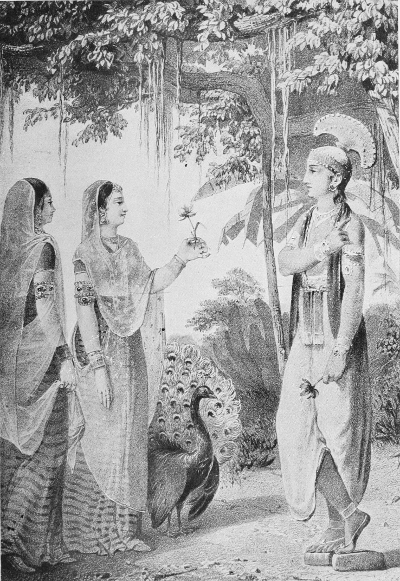
KANHAIYA AND RĀDHA.
To face page 630.
631The poet opens the first interview of Krishna and Radha with
an animated description of a night in the rainy season, in which
Hari is represented as a wanderer, and Radha, daughter of the
shepherd Nanda, is sent to offer him shelter in their cot.[37] Nanda
thus speaks to Radha: “The firmament is obscured by clouds;
the woodlands are black with Tamala trees; that youth who
roves in the forest will be fearful in the gloom of night; go, my
daughter, bring the wanderer to my rustic mansion. Such was
the command of Nanda the herdsman, and hence arose the love
of Radha and Madhava.”[38]
The poet proceeds to apostrophize Hari, which the Hindu
bard terms rupaka, or ‘personal description’:
“Oh thou who reclinest on the bosom of Kamala, whose ears
flame with gems, and whose locks are embellished with sylvan
flowers; thou, from whom the [541] day-star derived his effulgence,
who slewest the venom-breathing Kaliya, who beamedst
like a sun on the tribe of Yadu, that flourished like a lotus;
thou, who sittest on the plumage of Garuda, who sippest nectar
from the radiant lips of Padma, as the fluttering chakora drinks
the moonbeams; be victorious, O Hari.”
Jayadeva then introduces Hari in the society of the pastoral
nymphs of Vraj, whom he groups with admirable skill, expressing
the passion by which each is animated towards the youthful
prince with great warmth and elegance of diction. But Radha,
indignant that he should divide with them the affection she
deemed exclusively her own, flies his presence. Hari, repentant
and alarmed, now searches the forest for his beloved, giving vent
at each step to impassioned grief. “Woe is me! she feels a
sense of injured honour, and has departed in wrath. How will
she conduct herself? How will she express her pain in so long
a separation? What is wealth to me? What are numerous
attendants? What the pleasures of the world? How can I
invite thee to return? Grant me but a sight of thee, oh! lovely
Radha, for my passion torments me. O God of love! mistake
me not for Siva. Wound me not again. I love already but too
passionately; yet have I lost my beloved. Brace not thy bow,
thou conqueror of the world! My heart is already pierced by
arrows from Radha’s eyes, black and keen as those of the antelope.”
632Radha relents and sends a damsel in quest of Hari, whom she
finds in a solitary arbour on the banks of the Yamuna. She
describes her mistress as animated by the same despair which
controls him:
“Her face is like a water-lily veiled in the dew of tears, and
her eyes are as moons eclipsed. She draws thy picture and
worships it, and at the close of every sentence exclaims, ‘O
Madhava, at thy feet am I fallen!’ Then she figures thee standing
before her: she sighs, she smiles, she mourns, she weeps.
Her abode, the forest—herself through thy absence is become
a timid roe, and love is the tiger who springs on her, like Yama,
the genius of death. So emaciated is her beautiful body, that
even the light garland which waves o’er her bosom is a load.
The palm of her hand supports her aching temple, motionless as
the crescent rising at eve. Thus, O divine healer, by the nectar
of thy love [542] must Radha be restored to health; and if thou
refusest, thy heart must be harder than the thunder-stone.”[39]
The damsel returns to Radha and reports the condition of
Hari, mourning her absence: “Even the hum of the bee distracts
him. Misery sits fixed in his heart, and every returning
night adds anguish to anguish.” She then recommends Radha
to seek him. “Delay not, O loveliest of women; follow the
lord of thy heart. Having bound his locks with forest flowers,
he hastens to yon arbour, where a soft gale breathes over the
banks of Yamuna, and there pronouncing thy name, he modulates
his divine reed. Leave behind thee, O friend, the ring which
tinkles on thy delicate ankle when thou sportest in the dance.
Cast over thee thy azure mantle and run to the shady bower.”
But Radha, too weak to move, is thus reported to Hari by
the same fair mediator: “She looks eagerly on all sides in hope
of thy approach: she advances a few steps and falls languid to
the ground. She weaves bracelets of fresh leaves, and looking
at herself in sport, exclaims, behold the vanquisher of Madhu!
Then she repeats the name of Hari, and catching at a dark blue
cloud,[40] strives to embrace it, saying, ‘It is my beloved who
approaches.’”
633Midnight arrives, but neither Hari nor the damsel returns,
when she gives herself up to the frenzy of despair, exclaiming:
“The perfidy of my friend rends my heart. Bring disease and
death, O gale of Malaya! receive me in thy azure wave, O sister
of Yama,[41] that the ardour of my heart may be allayed.”
The repentant Hari at length returns, and in speech well
calculated to win forgiveness, thus pleads his pardon:
“Oh! grant me a draught of honey from the lotus of thy
mouth: or if thou art inexorable, grant me death from the
arrows of thine eyes; make thy arms my chains: thou art my
ornament; thou art the pearl in the ocean of my mortal birth!
Thine eyes, which nature formed like blue water-lilies, are become
through thy resentment like petals of the crimson lotus! Thy
silence affects me; oh! speak with the voice of music, and let
thy sweet accents allay my ardour” [543].
“Radha with timid joy, darting her eyes on Govinda while she
musically sounded the rings of her ankles and the bells of her
zone,[42] entered the mystic bower of her beloved. His heart was
agitated by her sight, as the waves of the deep are affected by
the lunar orb.[43] From his graceful waist flowed a pale yellow
robe,[44] which resembled the golden dust of the water-lily scattered
over its blue petals.[45] His locks interwoven with blossoms, were
like a cloud variegated by the moonbeam. Tears of transport
gushed in a stream from the full eyes of Radha, and their watery
glances beamed on her best beloved. Even shame, which had
before taken its abode in their dark pupils, was itself ashamed,[46]
and departed when the fawn-eyed Radha gazed on the bright
face of Krishna.”
634The poet proceeds to describe Apollo’s bower on the sable
Yamuna, as ‘Love’s recess’; and sanctifies it as
... The ground
Where early Love his Psyche’s zone unbound.
[47]
In the morning the blue god aids in Radha’s simple toilet.
He stains her eye with antimony “which would make the blackest
bee envious,” places “a circle of musk on her forehead,” and
intertwines “a chaplet of flowers and peacock’s feathers in her
dark tresses,” replacing “the zone of golden bells.” The bard
concludes as he commenced, with an eulogium on the inspirations
of his muse, which it is evident were set to music. “Whatever
is delightful in the modes of music, whatever is graceful in the
fine strains of poetry, whatever is exquisite in the sweet art of
love, let the happy and wise learn from the songs of Jayadeva.”
—This mystic dance, the
rasmandal,
appears analogous to the Pyrrhic dance, or the fire-dance of the
Egyptians. The movements of those who personate the deity
and his fair companions are full [544] of grace, and the dialogue
is replete with harmony.
[48] The Chaubes
[49] of Mathura and Vindravana
have considerable reputation as vocalists; and the effect
of the modulated and deep tones of the adult blending with the
clear treble of the juvenile performers, while the time is marked
by the cymbal or the soothing monotony of the tabor, accompanied
occasionally by the
murali or flute, is very pleasing.
635—We have a Parnassus in Govardhana, from
which sacred hill the god derives one of his principal epithets,
Gordhan or Gordhannath, ‘God of the mount of wealth.’
[50] Here
he first gave proofs of miraculous power, and a cave in this hill
was the first shrine, on his apotheosis, whence his miracles and
oracles were made known to the Yadus. From this cave (
gupha)
is derived another of his titles—Guphnath, ‘Lord of the cave,’
distinct from his epithet Gopinath, ‘Lord of the Gopis,’
[51] or pastoral
nymphs. On the annual festival held at Govardhana, the sacred
mount is purified with copious oblations of milk, for which all
the cows of the district are in requisition.
—The worship of Krishna in ancient
days, like that of Apollo amongst the Greeks, was chiefly celebrated
in caves, of which there were many scattered over India. The
most remarkable were those of Govardhana in Vraj; Gaya in
Bihar; Gopnath on the shores of Saurashtra; and Jalandhara
[52]
on the Indus. In these dark and mysterious retreats superstition
had her full influence over the votaries who sought the commands
and deprecated the wrath of the deity: but, as the Mukhya told
the author, “the age of oracles and miracles is past”; and the
new wheel, which was miraculously furnished each revolving
year to supply the place of that which first indicated his desire
to abide at Nathdwara, is no longer forthcoming. The old one,
which was the signal of his wish, is, however, preserved as a relic,
and greatly reverenced. The statue now worshipped at Nathdwara,
as the representative of ‘the god of the mount’ [545], is
said to be the identical image raised in the cave of Govardhana,
and brought thence by the high priest Balba.
[53]636—As the destroyer of Kaliyanag,
‘the black serpent,’ which infested the waters of the Yamuna,
Kanhaiya has the character of the Pythic Apollo. He is represented
dragging the monster from the ‘black stream,’ and
bruising him with his foot. He had, however, many battles with
his hydra-foe ere he vanquished him, and he was once driven by
Kalayavana from Vraj to Dwarka, whence his title of Ranchhor.
Here we have the old allegory of the schismatic wars of the
Buddhists and Vaishnavas.
—Diodorus informs
us that Kan was one of the titles of the Egyptian Apollo as the
sun; and this is the common contraction for Kanhaiya, whose
colour is a dark cerulean blue (nila): and hence his name Nilanath,
who, like the Apollo of the Nile, is depicted with the human
form and eagle-head, with a lotus in his hand. S and H are permutable
letters in the Bhakha, and Syam or Sham, the god of the
Yamuna, may be the Ham or Hammon of Egypt. Hari accompanied
Rama to Lanka, as did the Egyptian Apollo, Rameses-Sesostris,
on his expedition to India: both were attended in their
expedition by an army of Satyrs, or tribes bearing the names of
different animals: and as we have the Aswas, the Takshaks, and
the Sasas of the Yadu tribes, typified under the horse, the serpent,
and the hare, so the races of Surya, of which Rama was the head,
may have been designated Riksh and Hanuman, or bears and
monkeys. The distance of the Nile from the Indian shore forms
no objection; the sail spread for Ceylon could waft the vessel
to the Red Sea, which the fleets of Tyre, of Solomon, and Hiram
covered about this very time. That the Hindus navigated the
ocean from the earliest ages, the traces of their religion in the
isles of the Indian archipelago sufficiently attest; but on this
subject we have already said enough.
The coincidence between the most common epithets of the
Apollos of Greece and India, as applied to the sun, are peculiarly
striking. Hari, as Bhannath, ‘the lord of beams,’ is Phoebus,
and his heaven is Haripur (Heliopolis), or ‘city of Hari.’[54] Helios
(Ἥλιος) was a title of Apollo, whence the Greeks had their
637Elysium, the Haripur or Bhanthan (the abode of the sun), the
highest of the [546] heavens or abodes of bliss of the martial
Rajput. Hence the eagle (the emblem of Hari as the sun)[55] was
adopted by the western warrior as the symbol of victory.
The Di Majores of the Rajput are the same in number and
title as amongst the Greeks and Romans, being the deities who
figuratively preside over the planetary system. Their grades of
bliss are therefore in unison with the eccentricity of orbit of the
planet named. On this account Chandra or Indu, the moon,
being a mere satellite of Ila, the earth, though probably originating
the name of the Indu race, is inferior in the scale of blissful
abodes to that of his son Budha or Mercury, whose heliacal
appearance gave him importance even with the sons of Vaivasvata,
the sun. From the poetic seers of the martial races we learn
that there are two distinct places of reward; the one essentially
spiritual, the other of a material nature. The bard inculcates
that the warrior who falls in battle in the fulfilment of his duty,
“who abandons life through the wave of steel,” will know no
“second birth,” but that the unconfined spark (jyotis) will reunite
to the parent orb. The doctrine of transmigration through a
variety of hideous forms may be considered as a series of purgatories.
The Greeks and Celts worshipped Apollo under the title of
Carneios,[56] which “selon le scholiaste de Théocrite” is derived
from Carnos, “qui ne prophétisoit que des malheurs aux Héraclides
lors de leur incursion dans le Péloponnèse. Un d’eux
appelé Hippotés, le tua d’un coup de flèche.” Now one of the
titles of the Hindu Apollo is Karna, ‘the radiant’; from karna,
‘a ray’: and when he led the remains of the Harikulas in company
638with Baldeva (the god of strength), and Yudhishthira, after the
great international war, into the Peloponnesus of Saurashtra,
they were attacked by the aboriginal Bhils, one of whom slew
the divine Karna with an arrow. The Bhils claim to be of
Hayavansa, or the race of Haya, whose chief seat was at Maheswar
on the Nerbudda: the assassin of Karna would consequently
be Hayaputra, or descendant of Haya[57] [547].
The most celebrated of the monuments commonly termed
Druidic, scattered throughout Europe, is at Carnac in Brittany,
on which coast the Celtic Apollo had his shrines, and was propitiated
under the title of Karneios, and this monument may be
considered at once sacred to the manes of the warriors and the
sun-god Karneios. Thus the Roman Saturnalia, the carnivale,
has a better etymology in the festival to Karneios, as the sun,
than in the ‘adieu to flesh’ during the fast. The character of
this festival is entirely oriental, and accompanied with the
licentiousness which belonged to the celebration of the powers
of nature. Even now, although Christianity has banished the
grosser forms, it partakes more of a Pagan than a Christian
ceremony.
—Of the festivals of Krishna the
Annakuta is the most remarkable;
[58] when the seven statues were
brought from the different capitals of Rajasthan, and mountains
(
kuta) of food (
anna) piled up for their repast, at a given signal
are levelled by the myriads of votaries assembled from all parts.
About eighty years ago, on a memorable assemblage at the
Annakuta, before warfare had devastated Rajasthan, and circumscribed
the means of the faithful disciples of Hari, amongst
the multitude of Vaishnavas of every region were almost all the
Rajput princes; Rana Arsi of Mewar, Raja Bijai Singh of Marwar,
Raja Gaj Singh of Bikaner, and Bahadur Singh of Kishangarh.
Rana Arsi presented to the god a
tora, or massive golden anklet-chain
set with emeralds: Bijai Singh a diamond necklace worth
639twenty-five thousand rupees: the other princes according to
their means. They were followed by an old woman of Surat,
with infirm step and shaking head, who deposited four coppers
in the hand of the high-priest, which were received with a gracious
smile, not vouchsafed to the lords of the earth. “The Rand is
in luck,” whispered the chief of Kishangarh to the Rana. Soon
afterwards the statue of Hari was brought forth, when the same
old woman placed at its feet a bill of exchange for seventy thousand
rupees. The mighty were humbled, and the smile of the Gosain
was explained. Such gifts, and to a yet greater amount, are, or
were, by no means uncommon from the sons of commerce, who
are only known to belong to the flock from the distinguishing
necklace of the sect.
[59]—The predatory system which
reduced these countries to a state of the most degraded anarchy,
greatly diminished the number of pilgrimages to Nathdwara [548];
and the gods of Vraj had sufficient prescience to know that they
could guard neither their priests nor followers from the Pathan
and Mahratta, to whom the crown of the god, or the
nathna
(nose-jewel) of Radha, would be alike acceptable: nor would they
have scrupled to retain both the deities and priests as hostages
for such imposition as they might deem within their means.
Accordingly, of late years, there had been no congress of the gods
of Vraj, who remained fixtures on their altars till the halcyon
days of
A.D. 1818 permitted their liberation.
[60]—The seven statues of Kanhaiya
were brought together by the high-priest Balba, who established
640the festival of the Annakuta. They remained in the same
sanctuary until the time of Girdhari, the grandson of Balba,
who having seven sons, gave to each a rupa or statue, and whose
descendants continue in the office of priest. The names and
present abodes of the gods are as follows:
Nathji, the god, or Gordhannath, god of the mount
Nathdwara.
| 1. Nonita |
Nathdwara. |
| 2. Mathuranath |
Kotah. |
| 3. Dwarkanath |
Kankroli.[61] |
| 4. Gokulnath, or Gokulchandrama |
Jaipur. |
| 5. Yadunath |
Surat. |
| 6. Vitthalnath[62] |
Kotah. |
| 7. Madan Mohana |
Jaipur. |
Nathji is not enumerated amongst the forms; he stands
supreme.
Nonita, or Nonanda, the juvenile Kanhaiya, has his altar
separate, though close to Nathji. He is also styled Balamukund,
‘the blessed child,’[63] and is depicted as an infant with pera[64] or
comfit-ball in his hand. This image, which was one of the
penates of a former age, and which, since the destruction of the
shrines of [549] Krishna by the Islamites, had lain in the Yamuna,
attached itself to the sacerdotal zone (Janeo) of the high-priest
Balba, while he was performing his ablutions, who, carrying it
home, placed it in a niche of the temple and worshipped it: and
Nonanda yet receives the peculiar homage of the high-priest and
his family as their household divinity. Of the second image,
Mathuranath, there is no particular mention: it was at one time
at Khamnor in Mewar, but is now at Kotah.
Balkrishna, the third son, had Dwarkanath, which statue, now
at Kankroli in Mewar, is asserted to be the identical image that
641received the adoration of Raja Amaraka, a prince of the solar
race who lived in the Satya Yuga, or silver age. The ‘god of
the mount’ revealed himself in a dream to his high-priest, and
told him of the domicile of this his representative at Kanauj.
Thither Balba repaired, and having obtained it from the Brahman,
appointed Damodardas Khatri to officiate at his altar.
The fourth statue, that of Gokulnath, or Gokul Chandrama
(i.e. the moon of Gokul), had an equally mysterious origin, having
been discovered in a deep ravine on the banks of the river; Balba
assigned it to his brother-in-law. Gokul is an island on the
Jumna,[65] a few miles below Mathura, and celebrated in the early
history of the pastoral divinity. The residence of this image
at Jaipur does not deprive the little island of its honours as a
place of pilgrimage; for the ‘god of Gokul’ has an altar on the
original site, and his rites are performed by an aged priestess,
who disowns the jurisdiction of the high-priest of Nathdwara,
both in the spiritual and temporal concerns of her shrine; and
who, to the no small scandal of all who are interested in Apollo,
appealed from the fiat of the high-priest to the British court of
justice. The royal grants of the Mogul emperors were produced,
which proved the right to lie in the high-priest, though a long
period of almost undisturbed authority had created a feeling of
independent control in the family of the priestess, which they
desired might continue. A compromise ensued, when the Author
was instrumental in restoring harmony to the shrines of Apollo.
The fifth, Yadunath, is the deified ancestor of the whole Yadu
race. This image, now at Surat, formerly adorned the shrine
of Mahaban near Mathura which was destroyed by Mahmud [550].
The sixth, Vitthalnath, or Pandurang,[66] was found in the Ganges
at Benares, Samvat 1572 (A.D. 1516), from which we may judge
of their habit of multiplying divinities.
The seventh, Madan Mohana, ‘he who intoxicates with desire,’
the seductive lover of Radha and the Gopis, has his rites performed
by a female. The present priestess of Mohana is the
mother of Damodara, the supreme head of all who adore the
Apollo of Vraj.
642—I am not aware of the precise
period of Balba Acharya, who thus collected the seven images
of Krishna now in Rajasthan; but he must have lived about
the time of the last of the Lodi kings, at the period of the conquest
of India by the Moguls (
A.D. 1526). The present pontiff, Damodara,
as before said, is his lineal descendant; and whether in addressing
him verbally or by letter he is styled Maharaja or ‘great prince.’
[67]
As the supreme head of the Vishnu sect his person is held
to be Ansa, or ‘a portion of the divinity’; and it is maintained
that so late as the father of the present incumbent, the god
manifested himself and conversed with the high-priest. The
present pontiff is now about thirty years of age. He is of a
benign aspect, with much dignity of demeanour: courteous, yet
exacting the homage due to his high calling: meek, as becomes
the priest of Govinda, but with the finished manners of one accustomed
to the first society. His features are finely moulded, and
his complexion good. He is about the middle size, though as
he rises to no mortal, I could not exactly judge of his height.
When I saw him he had one only daughter, to whom he is much
attached. He has but one wife, nor does Krishna allow polygamy
to his priest. In times of danger, like some of his prototypes in
the dark ages of Europe, he poised the lance, and found it more
effective than spiritual anathemas, against those who would first
adore the god, and then plunder him. Such were the Mahratta
chiefs, Jaswant Rao Holkar and Bapu Sindhia. Damodara
accordingly made the [551] tour of his extensive diocese at the
head of four hundred horse, two standards of foot, and two field-pieces.
He rode the finest mares in the country; laid aside his
643pontificals for the quilted dagla, and was summoned to matins
by the kettle-drum instead of the bell and cymbal. In this he
only imitated Kanhaiya, who often mixed in the ranks of battle,
and “dyed his saffron robe in the red-stained field.” Had
Damodara been captured on one of these occasions by any marauding
Pathan, and incarcerated, as he assuredly would have been,
for ransom, the marauder might have replied to the Rana, as did
the Plantagenet king to the Pope, when the surrender of the
captive church-militant bishop was demanded, “Is this thy son
Joseph’s coat?” But, notwithstanding this display of martial
principle, which covered with a helmet the shaven crown, his
conduct and character are amiable and unexceptionable, and he
furnishes a striking contrast to the late head of the Vishnu establishments
in Marwar, who commenced with the care of his master’s
conscience, and ended with that of the State; meek and unassuming
till he added temporal[68] to spiritual power, which
developed unlimited pride, with all the qualities that too often
wait on “a little brief authority,” and to the display of which
he fell a victim. Damodara,[69] similarly circumstanced, might
have evinced the same failings, and have met the same end;
but though endeavours were made to give him political influence
at the Rana’s court, yet, partly from his own good sense, and
partly through the dissuasion of the Nestor of Kotah (Zalim
Singh), he was not entrained in the vortex of its intrigues, which
must have involved the sacrifice of wealth and the proper dignity
of his station [552].
644
Grant of the Rathor Rani, the Queen-Mother of Udaipur, on the
death of her Son, the Heir-Apparent, Prince Amra.
Siddh Sri Bari[a4.20.1] Rathorji to the Patels and inhabitants of
Girwa.[a4.20.2] The four bighas of land, belonging to the Jat Roga,
have been assigned to the Brahman Kishna on the Anta Samya
(final epoch) of Lalji.[a4.20.3] Let him possess the rents thereof.[a4.20.4] The
dues for wood and forage (khar lakar) contributions (barar) are
renounced by the State in favour of the Brahmans.
Samvat 1875, Amavas 15th of Asoj, A.D. 1819.
Grant held by a Brahman of Birkhera.
“A Brahman’s orphan was compelled by hunger to seek
sustenance in driving an oil-mill; instead of oil the receptacle
was filled with blood. The frightened oilman demanded of the
child who he was; ‘A Brahman’s orphan,’ was the reply.
Alarmed at the enormity of his guilt in thus employing the son
of a priest, he covered the palm of his hand with earth, in which
he sowed the tulasi seed,[5] and went on a pilgrimage to Dwarka.
645He demanded the presence (darsana) of the god; the priests
pointed to the ocean, when he plunged in, and had an interview
with Dwarkanath, who presented him with a written order on
the Rana for forty-five bighas of land. He returned and threw
the writing before the Rana, on the steps of the temple of Jagannath.
The Rana read the writing of the god, placed it on his
head, and immediately made out the grant. This is three hundred
and fifty years ago, as recorded by an inscription on stone, and
his descendant, Kosala, yet enjoys it.”
(A true Translation.) J. Tod.
The Palod inscription is unfortunately mislaid; but in searching
for it, another was discovered from Aner, four miles south-west
of the ancient Morwan, where there is a temple to the four-armed
divinity (Chaturbhuja), endowed in Samvat 1570, by
Rana Jagat Singh [553]. On one of the pillars of the temple is
inscribed a voluntary gift made in Samvat 1845, and signed by
the village Panch, of the first-fruits of the harvest, namely, two
sers and a half (five pounds weight) from each khal[6] of the spring,
and the same of the autumnal harvests.
Sri Amra Sing (II.) etc., etc.
Whereas the shrine of Sri Pratap-Iswara (the God of Fortune)
has been erected in the meadows of Rasmi, all the groves and
trees are sacred to him; whoever cuts down any of them is an
offender to the State, and shall pay a fine of three hundred rupees,
and the ass[7] shall be the portion of the officers of government
who suffer it.
Pus. 14, Samvat 1712 (A.D. 1656).
Maharana Sri Raj Singh, commanding.
To the Nobles, Ministers, Patels,[8] Patwaris,[8] of the ten thousand
[villages] of Mewar (das sahas Mewar-ra), according to your
stations—read!
1. From remote times, the temples and dwellings of the Jains
646have been authorized; let none therefore within their boundaries
carry animals to slaughter—this is their ancient privilege.
2. Whatever life, whether man or animal, passes their abode
for the purpose of being killed, is saved (amara).[9]
3. Traitors to the State, robbers, felons escaped confinement,
who may fly for sanctuary (saran) to the dwellings (upasra)[10] of
the Yatis,[11] shall not there be seized by the servants of the court.
4. The kunchi[12] (handful) at harvest, the mutthi (handful) of
kirana, the charity lands (dholi), grounds, and houses, established
by them in the various towns, shall be maintained.
5. This ordinance is issued in consequence of the representation
of the Rikh[13] Mana, to whom is granted fifteen bighas of adhan[14]
land, and twenty-five of maleti.[14] The same quantity of each
kind in each of the districts of Nimach and Nimbahera.—Total
in three districts, forty-five bighas of adhan, and seventy-five
of mal[15] [554].
On seeing this ordinance, let the land be measured and assigned,
and let none molest the Yatis, but foster their privileges. Cursed
be he who infringes them—the cow to the Hindu—the hog and
corpse to the Musalman.
(By command.)
Samvat 1749, Magh sudi 5th, A.D. 1693. Sah Dyal (Minister).
Maharaja Chhattar Singh (one of the Rana’s sons), commanding.
In the town of Rasmi, whoever slays sheep, buffaloes, goats,
or other living thing, is a criminal to the State; his house, cattle,
and effects shall be forfeited, and himself expelled the village.
(By command).
Pus Sudi 14, Samvat 1705, A.D. 1649. The Pancholi Damaka Das.
647
Maharana Jai Singh to the inhabitants of Bakrol; printers,
potters, oilmen, etc., etc., commanding.
From the 11th Asarh (June) to the full moon of Asoj (September),
none shall drain the waters of the lake; no oil-mill shall
work, or earthen vessel be made, during these the four rainy
months.[16]
Maharana Sri Jagat Singh II., commanding.
The village of Siarh in the hills, of one thousand rupees yearly
rent, having been chosen by Nathji (the god) for his residence,
and given up by Rana Raghude,[17] I have confirmed it. The
Gosain[18] and his heirs shall enjoy it for ever.
Samvat 1793, A.D. 1737.
Siddh Sri Maharaja Dhiraj, Maharana Sri Bhim Singhji,
commanding.
The undermentioned towns and villages were presented to
Sriji[19] by copper-plate. The revenues (hasil),
[20] contributions
(barar), taxes, dues (lagat-be-lagat), trees, shrubs, foundations and
boundaries (nim-sim), shall all belong to Sriji. If of my seed,
none will ever dispute this [555].
The ancient copper-plate being lost, I have thus renewed it.
648Here follows a list of thirty-four entire towns and villages,
many from the fisc, or confirmations of the grants of the chiefs,
besides various parcels of arable land, from twenty to one hundred
and fifty bighas, in forty-six more villages, from chiefs of every
class, and patches of meadowland (bira) in twenty more.
Sri Maharana Bhima Singhji, commanding.
To the towns of Sriji, or to the [personal] lands of the Gosainji,[21]
no molestation shall be offered. No warrants or exactions shall
be issued or levied upon them. All complaints, suits, or matters,
in which justice is required, originating in Nathdwara, shall be
settled there; none shall interfere therein, and the decisions of
the Gosainji I shall invariably confirm. The town and transit
duties[22] (of Nathdwara and villages pertaining thereto), the assay
(parkhai)[22] fees from the public markets, duties on precious
metals (kasoti),[4.a.22] all brokerage (dalali), and dues collected at the
four gates; all contributions and taxes of whatever kind, are
presented as an offering to Sriji; let the income thereof be placed
in Sriji’s coffers.
All the products of foreign countries imported by the Vaishnavas,[23]
whether domestic or foreign, and intended for consumption
at Nathdwara,[24] shall be exempt from duties. The right of
sanctuary (saran) of Sriji, both in the town and in all his other
villages,[25] will be maintained: the Almighty will take cognisance
of any innovation. Wherefore, let all chiefs, farmers of duties,
beware of molesting the goods of Nathji (the god), and wherever
such may halt, let guards be provided for their security, and let
each chief convey them through his bounds in safety. If of my
blood, or if my servants, this warrant will be obeyed for ever and
for ever. Whoever resumes this grant will be a caterpillar in hell
during 60,000 years.
649By command—through the chief butler (Paneri) Eklingdas:
written by Surat Singh, son of Nathji Pancholi, Magh sudi 1st,
Samvat 1865; A.D. 1809.
Personal grant to the high-priest, Damodarji Maharaj.
6000
Swasti Sri, from the abode at Udaipur, Maharana Sri Bhim
Singhji, commanding [556].
To all the chieftains, landholders, managers of the crown and
deorhi[26] lands, to all Patels, etc., etc., etc. As an offering to the
Sri Gosainji two rupees have been granted in every village throughout
Mewar, one in each harvest—let no opposition be made
thereto. If of my kin or issue, none will revoke this—the an
(oath of allegiance) be upon his head. By command, through
Parihara Mayaram, Samvat 1860, Jeth sudi 5th Mangalwar;
A.D. 1804.
At one side of the patent, in the Rana’s own hand, “An
offering to Sri Girdhariji[27] Maharaj—If of my issue none will
disobey—who dares, may the Almighty punish!”
Maharana Bhim Singh, commanding.
To the Mandir (minster) of Sri Murali Manohar (flute delighting),
situated on the dam of the lake at Mandalgarh, the following grant
has been made, with all the dues, income, and privileges, viz.:
1. The hamlet called Kotwalkhera, with all thereto appertaining.
2. Three rupees’ worth of saffron monthly from the transit
duty chabutra.[28]
3. From the police-office of Mandalgarh:
Three tunics (baga) for the idol on each festival, viz.
Ashtami, Jaljatra, and Vasant Panchami.[29]
Five rupees’ worth of oil[30] on the Jaljatra, and two and a
half in the full moon of Karttik [Oct.-Nov.].
6504. Both gardens under the dam of the lake, with all the fruits
and flowers thereof.
5. The Inch[31] on all the vegetables appertaining to the prince.
6. Kunchi and dalali, or the handful at harvest, and all
brokerage.
7. The income arising from the sale of the estates is to be
applied to the repairs of the temple and dam.
Margsir [Nov.-Dec.] Sudi 1, Samvat 1866; A.D. 1810 [557].
—It has been observed by that
philosophical traveller, Dr. Clarke, that, “by a proper attention
to the vestiges of ancient superstition, we are sometimes enabled
to refer a whole people to their original ancestors, with as much,
if not more certainty, than by observations made upon their
language; because the superstition is engrafted upon the stock,
but the language is liable to change.”
[1] Impressed with the
justness, as well as the originality of the remark, I shall adopt
it as my guide in the observations I propose to make on the
religious festivals and superstitions of Mewar. However important
may be the study of military, civil, and political history,
the science is incomplete without mythological history; and he
is little imbued with the spirit of philosophy who can perceive
in the fables of antiquity nothing but the extravagance of a
fervid imagination. Did no other consequence result from the
study of mythology than the fact that, in all ages and countries,
man has desecrated his reason, and voluntarily reduced himself
below the level of the brutes that perish, it must provoke inquiry
into the cause of this degradation. Such an investigation would
develop, not only the source of history, the handmaid of the arts
and sciences, but the origin and application of the latter, in a theogony
typical of the seasons, their changes, and products. Thus
mythology may be considered the parent of all history.
—With regard, however, to the rude
tribes who still inhabit the mountains and fastnesses of India,
651and who may be regarded as the aborigines of that country, the
converse of this doctrine is more probable. Not their language
only, but [558] their superstitions, differ from those of the Rajputs:
though, from a desire to rise above their natural condition, they
have engrafted upon their own the most popular mythologies of
their civilized conquerors, who from the north gradually spread
themselves over the continent and peninsula, even to the remote
isles of the Indian Ocean. Of the primitive inhabitants we may
enumerate the Minas, the Meras, the Gonds, the Bhils, the
Sahariyas, the Savaras, the Abhiras, the Gujars, and those who
inhabit the forests of the Nerbudda, the Son, the Mahanadi,
the mountains of Sarguja, and the lesser Nagpur; many of whom
are still but little removed from savage life, and whose dialects
are as various as their manners. These are content to be called
the ‘sons of the earth,’
[2] or ‘children of the forest,’
[3] while their
conquerors, the Rajputs, arrogate celestial descent.
[4] How soon
after the flood the Suryas, or sun-worshippers, entered India
Proper, must ever remain uncertain.
[5] It is sufficient that they
were anterior in date to the Indus, or races tracing their descent
from the moon (
Ind); as the migration of the latter from the
central lands of Indo-Scythia was antecedent to that of the
Agnikulas, or fire-worshippers, of the Snake race, claiming
Takshak as their original progenitor. The Suryas,
[6] who migrated
both to the East and West, as population became redundant in
these fertile regions, may be considered the Celtic, as the Indu-Getae
may be accounted the Gothic, races of India.
[7] To attempt
to discriminate these different races, and mark the shades which
once separated them, after a system of priestcraft has amalgamated
the mass, and identified their superstitions, would be
652fruitless; but the observer of ancient customs may, with the
imperfect guidance of peculiar rites, discover things, and even
names, totally incongruous with the Brahmanical system, and
which could never have originated within the Indus or Atak,—the
Rubicon of Gangetic antiquaries, who fear to look beyond
that stream for the origin of tribes. A residence amongst the
Rajputs would lead to a disregard of such boundaries, either to
the moral or physical man, as the annals of Mewar abundantly
testify.
—Sir Wm. Jones remarks,
“If the festivals of the old Greeks, Persians, Romans [559],
Egyptians, and Goths could be arranged with exactness in the
same form with the Indian, there would be found a striking
resemblance among them; and an attentive comparison of them
all might throw great light on the religion, and perhaps on the
history, of the primitive world.”
—In treating
of the festivals and superstitions of the Rajputs, wherever there
may appear to be a fair ground for supposing an analogy with
those of other nations of antiquity, I shall not hesitate to pursue
it. The proper names of many of the martial Rajputs would
alone point out the necessity of seeking for a solution of them
out of the explored paths; and where Sanskrit derivation cannot
be assigned, as it happens in many instances, we are not, therefore,
warranted in the hasty conclusion that the names must
have been adopted since the conquests of Mahmud or Shihabu-d-din,
events of comparatively modern date. Let us at once admit
the hypothesis of Pinkerton,—the establishment of an original
Indu-Getic or Indo-Scythic empire, “extending from the Caspian
to the Ganges”; or if this conjecture be too extensive or too
vague, let us fix the centre of this Madhya-Bhumi in the fertile
region of Sogdiana;
[8] and from the lights which modern history
affords on the many migrations from this nursery of mankind,
653even since the time of Muhammad, let us form an opinion of those
which have not been recorded, or have been conveyed by the
Hindus only in imperfect allegory; and with the aid of ancient
customs, obsolete words, and proper names, trace them to Indo-Scythic
colonies grafted on the parent stock. The Puranas
themselves bear testimony to the incorporation of Scythic tribes
with the Hindus, and to the continual irruptions of the Saka,
the Pahlavas, the Yavanas,
[9] the Turushkas, names conspicuous
amongst the races of Central Asia, and recorded in the pages of
the earliest Western historians. Even so early as the period of
Rama, when furious international wars were carried on between
the military and sacerdotal classes for supremacy, we have the
names of these tribes recorded as auxiliaries [560] to the priesthood;
who, while admitting them to fight under the banners of
Siva, would not scruple to stamp them with the seal of Hinduism.
In this manner, beyond a doubt, at a much later period than the
events in the Ramayana, these tribes from the North either forced
themselves among, or were incorporated with, ‘the races of the
sun.’ When, therefore, we meet with rites in Rajputana and in
ancient Scandinavia, such as were practised amongst the Getic
nations on the Oxus, why should we hesitate to assign the origin
of both to this region of earliest civilization? When we see
the ancient Asii, and the Iutae, or Jutes, taking omens from the
white steed of Thor, shut up in the temple at Upsala; and in like
manner, the Rajput of past days offering the same animal in
sacrifice to the sun, and his modern descendant taking the omen
from his neigh, why are we to refuse our assent to the common
origin of the superstition practised by the Getae of the Oxus?
Again, when we find the ‘homage to the sword’ performed by
all the Getic races of antiquity in Dacia, on the Baltic, as well as
by the modern Rajput, shall we draw no conclusion from this
testimony of the father of history, who declares that such rites
654were practised on the Jaxartes in the very dawn of knowledge?
[10]
Moreover, why hesitate to give Eastern etymologies for Eastern
rites, though found on the Baltic? The antiquary of the
North (Mallet) may thus be assisted to the etymon of ‘Tir-sing,’
the enchanted sword of Angantýr, in
tir, ‘water,’ and
singh,
‘a lion’;
i.e. in water or spirit like a lion; for even
pani,
the common epithet for water, is applied metaphorically to
‘spirit.’
[11]It would be less difficult to find Sanskrit derivations for many
of the proper names in the Edda, than to give a Sanskrit analysis
of many common amongst the Rajputs, which we must trace to
an Indo-Scythic root:[12] such as Eyvorsél, Udila, Attitai, Pujun,
Hamira,[13] and numerous other proper names of warriors. Of
tribes: the Kathi, Rajpali, Mohila, Sariaspah, Aswaria (qu.
Assyrian?), Banaphar, Kamari, Silara, Dahima, etc. Of mountains:
Drinodhar, Arbuda, Aravalli, Aravindha (the root ara,
or mountain, being Scythic, and the expletive adjunct Sanskrit),
‘the hill of Budha,’ ‘of strength,’ ‘of limit.’ To all such as
cannot be [561] resolved into the cognate language of India, what
origin can we assign but Scythic?[14]
—In a memoir prepared
for me by a well-informed public officer in the Rana’s court, on
the chief festivals celebrated in Mewar, he commenced with those
following the autumnal equinox, in the month Asoj or Aswini,
655opening with the Nauratri, sacred to the god of war. Their fasts
are in general regulated by the moon; although the most remarkable
are solar, especially those of the equinoxes and solstices, and
the Sankrantis, or days on which the sun enters a new sign. The
Hindu solar year anciently commenced on the winter solstice,
in the month Pausha, and was emphatically called ‘the morning
of the gods’; also Sivaratri, or night of Siva, analogous, as has
been before remarked, to the ‘mother night,’ which ushered in
the new year of the Scandinavian Asi, and other nations of Asiatic
origin dwelling in the north.
—They term the summer solstice in the
month of Asarh, ‘the night of the gods,’ because Vishnu (as the
sun) reposes during the four rainy months on his serpent couch.
The lunar year of 360 days was more ancient than the solar, and
656commenced with the month of Asoj or Aswini: “the moon being
at the full when that name was imposed on the first lunar station
of the Hindu ecliptic.”
[15]According to another authority, the festivals commenced on
Amavas, or the Ides of Chait, near which the vernal equinox falls,
the opening of the modern solar year; when, in like manner as
at the commencement of the lunar year in Asoj, they [562]
dedicate the first nine days of Chait (also called Nauratri) to
Iswara and his consort Isani.
Having thus specified both modes of reckoning for the opening
of the solar and lunar years, I shall not commence the abstract
of the festivals of Mewar with either, but follow the more ancient
division of time, when the year closed with the winter solstice
in the month of Pus, consequently opening the new year with
Magh. By this arrangement, we shall commence with the spring
festivals, and let the days dedicated to mirth and gaiety follow
each other; preferring the natural to the astrological year,
which will enable us to preserve the analogy with the northern
nations of Europe, who also reckoned from the winter solstice.
The Hindu divides the year into six seasons, each of two months;
namely, Vasanta, Grishma, Varsha, Sarad, Sisira, Sita; or spring,
summer, rainy, sultry, dewy, and cold.
It is not, however, my intention to detail all the fasts and
festivals which the Rajput of Mewar holds in common with the
Hindu nation, but chiefly those restricted to that State, or such
as are celebrated with local peculiarity, or striking analogies to
those of Egypt, Greece, or Scandinavia. The goddess who presides
over mirth and idleness preferred holding her court amidst
the ruins of Udaipur to searching elsewhere for a dwelling. This
determination to be happy amidst calamity, individual and
national, has made the court proverbial in Rajwara, in the adage,
‘sat bara, aur nau teohara,’ i.e. nine holidays out of seven days.
Although many of these festivals are common to India, and their
maintenance is enjoined by religion, yet not only the prolongation
and repetition of some, but the entire institution of others, as
well as the peculiar splendour of their solemnization, originate
with the prince; proving how much individual example may
influenceinfluence the manners of a nation.
657—By the arrangement we
have adopted, the lovely Vasanti, goddess of the spring, will
usher in the festivals of Mewar. In 1819 her rites were celebrated
in the kalends of January, and even then, on the verge of the
tropic, her birth was premature.
The opening of the spring being on the 5th of the month
Magha, is thence called the Vasant panchami, which in 1819 fell on
the 30th of January; consequently the first of Pus (the antecedent
month), the beginning of the old Hindu [563] year, or ‘the
morning of the gods,’ fell on the 25th of December. The Vasant
continues forty days after the panchami, or initiative fifth, during
which the utmost license prevails in action and in speech; the
lower classes regale even to intoxication on every kind of stimulating
confection and spirituous beverage, and the most respectable
individuals, who would at other times be shocked to utter
an indelicate allusion, roam about with the groups of bacchanals,
reciting stanzas of the warmest description in praise of the powers
of nature, as did the conscript fathers of Rome during the Saturnalia.
In this season, when the barriers of rank are thrown
down, and the spirit of democracy is let loose, though never
abused, even the wild Bhil, or savage Mer, will leave his forest or
mountain shade to mingle in the revelries of the capital; and
decorating his ebon hair or tattered turban with a garland of
jessamine, will join the clamorous parties which perambulate the
streets of the capital. These orgies are, however, reserved for the
conclusion of the forty days sacred to the goddess of nature.
—Two days following the initiative
fifth is the Bhan saptami or ‘seventh [day] of the sun,’ also
called ‘the birth of the sun,’ with various other metaphorical
denominations.
[16] On this day there is a grand procession of the
Rana, his chiefs and vassals, to the Chaugan, where the sun is
worshipped. At the Jaipur court, whose princes claim descent
from Kusa, the second son of Rama, the Bhan saptami is peculiarly
sacred. The chariot of the sun, drawn by eight horses, is taken
from the temple dedicated to that orb, and moved in procession:
a ceremony otherwise never observed but on the inauguration of
a new prince.
658—In the mythology of the Rajputs, of which we
have a better idea from their heroic poetry than from the legends
of the Brahmans, the sun-god is the deity they are most anxious
to propitiate; and in his honour they fearlessly expend their
blood in battle, from the hope of being received into his mansion.
Their highest heaven is accordingly the Bhanuthan or Bhanuloka,
the ‘region of the sun’: and like the Indu-Scythic Getae, the
Rajput warrior of the early ages sacrificed the horse in his honour,
[17]
and dedicated to him the first day of the week, namely, Adityawar,
contracted to Itwar, also called Thawara
[18] [564].
The more we attend to the warlike mythology of the north,
the more apparent is its analogy with that of the Rajputs, and
the stronger ground is there for assuming that both races inherited
their creed from the common land of the Yuti of the
Jaxartes. What is a more proper etymon for Scandinavian, the
abode of the warriors who destroyed the Roman power, than
Skanda, the Mars or Kumara of the Rajputs? perhaps the origin
of the Cimbri, derived by Mallet from koempfer, ‘to fight.’
Thor, in the eleventh fable of the Edda, is denominated Asa-Thor,[19]
the ‘lord Thor,’ called the Celtic Mars by the Romans.
The chariot of Thor is ignobly yoked compared with the car of
Surya; but in the substitution of the he-goats for the seven-headed
horse Saptasva we have but the change of an adjunct
depending on clime, when the Yuti migrated from the plains of
Scythia, of which the horse is a native, to Yutland, of whose
mountains the goat was an inhabitant prior to any of the race of
Asi. The northern warrior makes the palace of the sun-god
Thor the most splendid of the celestial abodes, “in which are
659five hundred and forty halls”: vying with the Suryamandala,
the supreme heaven of the Rajput. Whence such notions of the
Aswa races of the Ganges, and the Asi of Scandinavia, but from
the Scythic Saka, who adored the solar divinity under the name
of ‘Gaeto-Syrus,’[20] the Surya of the Sachha Rajput; and as,
according to the commentator on the Edda, “the ancient people
of the north pronounced the th as the English now do ss,” the
sun-god Thor becomes Sor, and is identified still more with Surya
whose worship no doubt gave the name to that extensive portion
of Asia called Συρία, as it did to the small peninsula of the Sauras,
still peopled by tribes of Scythic origin. The Sol of the Romans
has probably the same Celto-Etrurian origin; with those tribes
the sun was the great object of adoration, and their grand festival,
the winter solstice, was called Yule, Hiul, Houl, “which even at
this day signifies the Sun, in the language of Bas-Bretagne and
Cornwall.”[21] On the conversion of the descendants of these
Scythic Yeuts, who, according to [565] Herodotus, sacrificed the
horse (Hi) to the sun (El), the name of the Pagan jubilee of the
solstice was transferred to the day of Christ’s nativity, which
is thus still held in remembrance by their descendants of the
north.[22]
—At Udaipur the sun has universal
precedence; his portal (
Suryapol) is the chief entrance to the
city; his name gives dignity to the chief apartment or hall
(
Suryamahall) of the palace; and from the balcony of the sun
(
Suryagokhra) the descendant of Rama shows himself in the dark
monsoon as the sun’s representative. A huge painted sun of
gypsum in high relief, with gilded rays, adorns the hall of audience,
and in front of it is the throne. As already mentioned, the sacred
standard bears his image,
[23] as does that Scythic part of the regalia
called the
changi, a disc of black felt or ostrich feathers, with a
660plate of gold to represent the sun in its centre, borne upon a pole.
The royal parasol is termed
kirania, in allusion to its shape, like
a ray (
kiran) of the orb. The last day but one of the month of
Magha is called Sivaratri (night of Siva), and is held peculiarly
sacred by the Rana, who is styled the Regent of Siva. It is a
rigid fast, and the night is passed in vigils, and rites to the phallic
representative of Siva.
—The merry month of Phalgun is ushered
in with the Aheria, or spring-hunt.
[24] The preceding day the Rana
distributes to all his chiefs and servants either a dress of green,
or some portion thereof, in which all appear habited on the
morrow, whenever the astrologer has fixed the hour for sallying
forth to slay the boar to Gauri, the Ceres of the Rajputs: the
Aheria is therefore called the Mahurat ka shikar, or the chase
fixed astrologically. As their success on this occasion is ominous
of future good, no means are neglected to secure it, either by
scouts previously discovering the lair, or the desperate efforts of
the hunters to slay the boar when roused. With the sovereign
and his sons all the chiefs sally forth, each on his best steed, and
all animated by the desire to surpass each other in acts of prowess
and dexterity. It is very rare that in some one of the passes or
recesses of the valley the hog is not found; the spot is then
surrounded by the [566] hunters, whose vociferations soon start
the
dukkara,
[25] and frequently a drove of hogs. Then each cavalier
impels his steed, and with lance or sword, regardless of rock,
ravine, or tree, presses on the bristly foe, whose knowledge of the
country is of no avail when thus circumvented, and the ground
soon reeks with gore, in which not unfrequently is mixed that of
horse or rider. On the last occasion there occurred fewer casualties
than usual; though the Chondawat Hamira, whom we
nicknamed the ‘Red Riever,’ had his leg broken, and the second
661son of Sheodan Singh, a near relation of the Rana, had his neighbour’s
lance driven through his arm. The young chief of Salumbar
was amongst the distinguished of this day’s sport. It would
appal even an English fox-hunter to see the Rajputs driving their
steeds at full speed, bounding like the antelope over every barrier—the
thick jungle covert, or rocky steep bare of soil or vegetation,—with
their lances balanced in the air, or leaning on the
saddle-bow slashing at the boar.
The royal kitchen moves out on this occasion, and in some
chosen spot the repast is prepared, of which all partake, for the
hog is the favourite food of the Rajput, as it was of the heroes
of Scandinavia. Nor is the munawwar piyala, or invitation cup,
forgotten; and having feasted, and thrice slain their bristly
antagonist, they return to the capital, where fame had already
spread their exploits—the deeds done by the barchhi (lance) of
Padma,[26] or the khanda (sword) blow of Hamira,[27] which lopped
the head of the foe of Gauri. Even this martial amusement, the
Aheria, has a religious origin. The boar is the enemy of Gauri of
the Rajputs; it was so held of Isis by the Egyptians, of Ceres by
the Greeks, of Freya by the north-man, whose favourite food was
the hog: and of such importance was it deemed by the Franks,
that the second chapter of the Salic law is entirely penal with
regard to the stealers of swine. The heroes of the Edda, even in
Valhalla, feed on the fat of the wild boar Saehrimner, while “the
illustrious father of armies fattens his wolves Geri and Freki, and
takes no other nourishment himself than the interrupted quaffing
of wine”: quite the picture of Har, the Rajput god of war, and
his sons the Bhairavas, Krodha, and Kala, metaphorically called
the ‘sons of slaughter.’ We need hardly repeat that the cup
of the Scandinavian god of war, like that of the Rajputs, is the
human skull (khopra) [567].[28]
—As Phalgun advances, the bacchanalian
mirth increases; groups are continually patrolling the
streets, throwing a crimson powder at each other, or ejecting a
solution of it from syringes, so that the garments and visages of
all are one mass of crimson. On the 8th, emphatically called
662the Phag, the Rana joins the queens and their attendants in the
palace, when all restraint is removed and mirth is unlimited.
But the most brilliant sight is the playing of the Holi on horseback,
on the terrace in front of the palace. Each chief who chooses to
join has a plentiful supply of missiles, formed of thin plates of
mica or talc, enclosing this crimson powder, called
abira, which
with the most graceful and dextrous horsemanship they dart at
each other, pursuing, caprioling, and jesting. This part of it
much resembles the Saturnalia of Rome of this day, when similar
missiles are scattered at the Carnivâle. The last day or Punon
ends the Holi, when the Nakkaras from the Tripolia summon all
the chiefs with their retinues to attend their prince, and accompany
him in procession to the Chaugan, their Champ de Mars.
In the centre of this is a long
sala or hall, the ascent to which is
by a flight of steps: the roof is supported by square columns
without any walls, so that the court is entirely open. Here,
surrounded by his chiefs, the Rana passes an hour, listening to
the songs in praise of Holika, while a scurrilous
kavya or couplet
from some wag in the crowd reminds him, that exalted rank is
no protection against the license of the spring Saturnalia; though
‘the Diwan of Eklinga’ has not to reproach himself with a
failure of obedience to the rites of the goddess, having fulfilled
the command ‘to multiply,’ more than any individual in his
kingdom.
[29] While the Rana and his chiefs are thus amused above,
the buffoons and itinerant groups mix with the cavalcade, throw
powder in their eyes, or deluge their garments with the crimson
solution. To resent it would only expose the sensitive party to
be laughed at, and draw upon him a host of these bacchanals: so
that no alternative exists between keeping entirely aloof or
mixing in the fray [568].
[30]663On the last day, the Rana feasts his chiefs, and the camp
breaks up with the distribution of khanda nariyal, or swords and
coco-nuts, to the chiefs and all “whom the king delighteth to
honour.” These khandas are but ‘of lath,’ in shape like the
Andrea Ferrara, or long cut-and-thrust, the favourite weapon
of the Rajput. They are painted in various ways, like Harlequin’s
sword, and meant as a burlesque, in unison with the character
of the day, when war is banished, and the multiplication,[31] not
the destruction, of man is the behest of the goddess who rules the
spring. At nightfall, the forty days conclude with ‘the burning
of the Holi,’ when they light large fires, into which various
substances, as well as the crimson abira, are thrown, and around
which groups of children are dancing and screaming in the streets
like so many infernals. Until three hours after sunrise of the
new month of Chait, these orgies are continued with increased
vigour, when the natives bathe, change their garments, worship,
and return to the rank of sober citizens; and princes and chiefs
receive gifts from their domestics.[32]
—The first of this month is the Samvatsara (vulg.
Chamchari), or anniversary of the death of the Rana’s father, to
whose memory solemn rites are performed both in the palace and
at Ara, the royal cemetery, metaphorically termed Mahasati, or
place of ‘great faith.’ Thither the Rana repairs, and offers
oblations to the manes of his father; and after purifying in the
Gangabheva, a rivulet which flows through the middle of ‘the
abode of silence,’ he returns to the palace.
On the 3rd, the whole of the royal insignia proceeds to Bedla,
the residence of the Chauhan chief (one of the Sixteen), within
the valley of the capital, in order to convey the Rao to court.
The Rana advances to the Ganesa Deori[33] to receive him; when,
664after salutation, the sovereign and his chief return to the great
hall of assembly, hand in hand, but that of the Chauhan above
or upon his sovereign’s. In this ceremony we have another
singular memorial of the glorious days of Mewar, when almost
every chieftain established by deeds of devotion a right to the
eternal gratitude of their princes; the decay of whose [569]
power but serves to hallow such reminiscences. It is in these
little acts of courteous condescension, deviations from the formal
routine of reception, that we recognize the traces of Rajput
history; for inquiry into these customs will reveal the incident
which gave birth to each, and curiosity will be amply repaid, in a
lesson at once of political and moral import. For my own part,
I never heard the kettledrum of my friend Raj Kalyan strike at
the sacred barrier, the Tripolia, without recalling the glorious
memory ofmemory of his ancestor at the Thermopylae of Mewar;[34] nor
looked on the autograph lance, the symbol of the Chondawats,
without recognizing the fidelity of the founder of the clan;[35] nor
observed the honours paid to the Chauhans of Bedla and Kotharia,
without the silent tribute of applause to the manes of their
sires.
—Chait badi sat, or ‘7th of [the dark fortnight]
Chait,’ is in honour of the goddess Sitala, the protectress
of children: all the matrons of the city proceed with their
offerings to the shrine of the goddess, placed upon the very
pinnacle of an isolated hill in the valley. In every point of
view, this divinity is the twin-sister of the Mater Montana,
[36] the
guardian of infants amongst the Romans, the Grecian or Phrygian
Cybele.
—This is also the Rana’s birthday,
[37] on
which occasion all classes flock with gifts and good wishes that
“the king may live for ever”; but it is in the penetralia of the
Rawala, where the profane eye enters not, that the greatest
festivities of this day are kept.
—Chait Sudi 1st (15th
of the month) is the opening of the luni-solar year of Vikramaditya.
Ceremonies, which more especially appertain to the Nauratri of
Asoj, are performed on this day; and the sword is worshipped
665in the palace. But such rites are subordinate to those of the fair
divinity, who still rules over this the smiling portion of the year.
Vasanti has ripened into the fragrant Flora, and all the fair of
the capital, as well as the other sex, repair to the gardens and
groves, where parties assemble, regale, and swing, adorned with
chaplets of roses, jessamine, or oleander, when the Naulakha
gardens may vie with the Tivoli of Paris. They return in the
evening to the city.
—The Rajput Floralia ushers in the
rites of the beneficent Gauri, which continue nine days, the
number sacred to the creative [570] power. These vie with
the Cerealia of Rome, or the more ancient rites of the goddess
of the Nile: I shall therefore devote some space to a particular
account of them.
[38]—Among the many remarkable festivals of
Rajasthan, kept with peculiar brilliancy at Udaipur, is that in
honour of Gauri, or Isani, the goddess of abundance, the Isis of
Egypt, the Ceres of Greece. Like the Rajput Saturnalia, which
it follows, it belongs to the vernal equinox, when nature in
these regions proximate to the tropic is in the full expanse of her
charms, and the matronly Gauri casts her golden mantle over
the beauties of the verdant Vasanti.
[39] Then the fruits exhibit
their promise to the eye; the koil fills the ear with melody; the
air is impregnated with aroma, and the crimson poppy contrasts
with the spikes of golden grain, to form a wreath for the beneficent
Gauri.
Gauri is one of the names of Isa or Parvati, wife of the greatest
of the gods, Mahadeva or Iswara, who is conjoined with her in
these rites, which almost exclusively appertain to the women.
The meaning of Gauri is ‘yellow,’ emblematic of the ripened
harvest, when the votaries of the goddess adore her effigies, which
are those of a matron painted the colour of ripe corn; and though
her image is represented with only two hands, in one of which
she holds the lotos, which the Egyptians regarded as emblematic
of reproduction, yet not unfrequently they equip her with the
warlike conch, the discus, and the club, to denote that the goddess,
whose gifts sustain life, is likewise accessary to the loss of it:
uniting, as Gauri and Kali, the characters of life and death, like
666the Isis and Cybele of the Egyptians. But here she is only seen
as Annapurna, the benefactress of mankind. The rites commence
when the sun enters Aries (the opening of the Hindu year), by a
deputation to a spot beyond the city, “to bring earth for the
image of Gauri.”[40] When this is formed, a smaller one of Iswara
is made, and they are placed together; a small trench is then
excavated, in which barley is sown; the ground is irrigated and
artificial heat supplied till the grain germinates, when the females
join hands and dance round it, invoking the blessings of Gauri on
their husbands.[41] The young corn is then taken up, distributed,
and presented by the females to the men, who wear it in their
turbans. Every wealthy family has its image, or at least every
purwa or subdivision of the city. These and other [571] rites
known only to the initiated having been performed for several
days within doors, they decorate the images, and prepare to
carry them in procession to the lake. During these days of
preparation, nothing is talked of but Gauri’s departure from the
palace; whether she will be as sumptuously apparelled as in the
year gone by; whether an additional boat will be launched on
the occasion; though not a few forget the goddess altogether
in the recollection of the gazelle eyes (mrig-nayani) and serpentine
locks (nagini-zulf)[42] of the beauteous handmaids who are
selected to attend her. At length the hour arrives, the martial
nakkaras give the signal “to the cannonier without,” and speculation
is at rest when the guns on the summit of the castle of
Eklinggarh announce that Gauri has commenced her excursion
to the lake.
—The cavalcade assembles on
the magnificent terrace, and the Rana, surrounded by his nobles,
leads the way to the boats, of a form as primitive as that which
conveyed the Argonauts to Colchis. The scenery is admirably
adapted for these fêtes, the ascent being gradual from the margin
of the lake, which here forms a fine bay, and gently rising to the
crest of the ridge on which the palace and dwellings of the chiefs
are built. Every turret and balcony is crowded with spectators,
667from the palace to the water’s edge; and the ample flight of
marble steps which intervene from the Tripolia, or triple portal,
to the boats, is a dense mass of females in variegated robes, whose
scarfs but half conceal their ebon tresses adorned with the rose
and the jessamine. A more imposing or more exhilarating sight
cannot be imagined than the entire population of a city thus
assembled for the purpose of rejoicing; the countenance of
every individual, from the prince to the peasant, dressed in
smiles. Carry the eye to heaven, and it rests on ‘a sky without
a cloud’: below is a magnificent lake, the even surface of the
deep blue waters broken only by palaces of marble, whose arched
piazzas are seen through the foliage of orange groves, plantain,
and tamarind; while the vision is bounded by noble mountains,
their peaks towering over each other, and composing an immense
amphitheatre. Here the deformity of vice intrudes not; no
object is degraded by inebriation: no tumultuous disorder or
deafening clamour, but all await patiently, with eyes directed
to the Tripolia, the appearance of Gauri. At length the procession
is seen winding down the steep, and in the midst [572], borne on a
pat,
[43] or throne, gorgeously arrayed in yellow robes, and blazing
with ‘barbaric pearl and gold,’ the goddess appears; on either
side the two beauties wave the silver
chamara over her head,
while the more favoured damsels act as harbingers, preceding
her with wands of silver: the whole chanting hymns. On her
approach, the Rana, his chiefs and ministers rise and remain
standing till the goddess is seated on her throne close to the
water’s edge, when all bow, and the prince and court take their
seats in the boats. The females then form a circle around the
goddess, unite hands, and with a measured step and various
graceful inclinations of the body, keeping time by beating the
palms at particular cadences, move round the image singing
hymns, some in honour of the goddess of abundance, others on
love and chivalry; and embodying little episodes of national
achievements, occasionally sprinkled with
double entendre, which
excites a smile and significant nod from the chiefs, and an inclination
of the head of the fair choristers. The festival being entirely
female, not a single male mixed in the immense groups, and even
Iswara himself, the husband of Gauri, attracts no attention, as
appears from his ascetic or mendicant form begging his dole
668from the bounteous and universal mother. It is taken for
granted that the goddess is occupied in bathing all the time
she remains, and ancient tradition says death was the penalty
of any male intruding on these solemnities; but the present
prince deems them so fitted for amusement, that he has even
instituted a second Ganggor. Some hours are thus consumed,
while easy and good-humoured conversation is carried on. At
length, the ablutions over, the goddess is taken up, and conveyed
to the palace with the same forms and state. The Rana and
his chiefs then unmoor their boats, and are rowed round the
margin of the lake, to visit in succession the other images of
the goddess, around which female groups are chanting and
worshipping, as already described, with which ceremonies the
evening closes, when the whole terminates with a grand display
of fireworks, the finale of each of the three days dedicated to
Gauri.
Considerable resemblance is to be discerned between this
festival of Gauri and that in honour of the Egyptian Diana[44] at
Bubastis, and Isis at Busiris, within the [573] Delta of the Nile, of
which Herodotus says: “They who celebrate those of Diana
embark in vessels; the women strike their tabors, the men
their flutes; the rest of both sexes clap their hands, and join
in chorus. Whatever city they approach, the vessels are brought
on shore; the women use ungracious language, dance, and indelicately
throw about their garments.”[45] Wherever the rites
of Isis prevailed, we find the boat introduced as an essential
emblem in her worship, whether in the heart of Rajasthan, on
the banks of the Nile, or in the woods of Germany. Bryant[46]
669furnishes an interesting account from Diodorus and Curtius,
illustrated by drawings from Pocock, from the temple of Luxor,
near Carnac, in the Thebaid, of ‘the ship of Isis,’ carrying an
ark; and from a male figure therein, this learned person thinks
it bears a mysterious allusion to the deluge. I am inclined to
deem the personage in the ark Osiris, husband of Isis, the type of
the sun arrived in the sign of Aries (of which the ram’s heads
ornamenting both the prow and stem of the vessel are typical),
the harbinger of the annual fertilizing inundation of the Nile:
evincing identity of origin as an equinoctial festival with that of
Gauri (Isis) of the Indu-Scythic races of Rajasthan.
The German Suevi adored Isis, and also introduced a ship in
her worship, for which Tacitus[47] is at a loss to account, and with
his usual candour says he has no materials whence to investigate
the origin of a worship denoting the foreign origin of the tribe.
This Isis of the Suevi was evidently a form of Ertha, the chief
divinity of all the Saxon races, who, with her consort Teutates
or Hesus[48] (Mercury), were the chief deities of both the Celtic
and early Gothic races: the [574] Budha and Ila of the Rajputs;
in short, the earth,[49] the prolific mother, the Isis of Egypt, the
Ceres of Greece, the Annapurna (giver of food) of the Rajputs.
On some ancient temples dedicated to this Hindu Ceres we have
sculptured on the frieze and pedestal of the columns the emblem
of abundance, termed the kamakumbha, or vessel of desire, a
vase of elegant form, from which branches of the palm are gracefully
pendent. Herodotus says that similar water-vessels, filled
670with wheat and barley, were carried in the festival of Isis; and
all who have attended to Egyptian antiquities are aware that the
god Canopus is depicted under the form of a water-jar, or Nilometer,
whose covering bears the head of Osiris.
—To render the analogy perfect between
the vessels emblematic of the Isis of the Nile and the Ganges,
there is a festival sacred to the sage Agastya, who presides over
the star Canopus, when the sun enters Virgo (Kanya). The
kamakumbha is then personified under the epithet kumbhayoni,
and the votary is instructed to pour water into a sea-shell, in
which having placed white flowers and unground rice, turning
his face to the south, he offers it with this incantation: “Hail,
Kumbhayoni, born in the sight of Mitra and Varuna (the sun
and water divinities), bright as the blossom of the kusa (grass),
who sprung from Agni (fire) and the Maruts.” By the prefix
of Ganga (the river) to Gauri, we see that the Ganggor festival
is essentially sacred to a river-goddess, affording additional proof
of the common origin of the rites of the Isis of Egypt and
India.
The Egyptians, according to Plutarch, considered the Nile as
flowing from Osiris, in like manner as the Hindu poet describes
the fair Ganga flowing from the head of Iswara, which Sir W.
Jones thus classically paints in his hymn to Ganga:
Above the reach of mortal ken,
On blest Coilasa’s top, where every stem
Glowed with a vegetable gem,
Mahesa stood, the dread and joy of men;
While Parvati, to gain a boon,
Fixed on his locks a beamy moon,
And hid his frontal eye in jocund play,
With reluctant sweet delay;
All nature straight was locked in dim eclipse,
Till Brahmins pure, with hallowed lips
And warbled prayers, restored the day,
When Ganga from his brow, with heavenly fingers prest,
Sprang radiant, and descending, graced the caverns of the west [575].
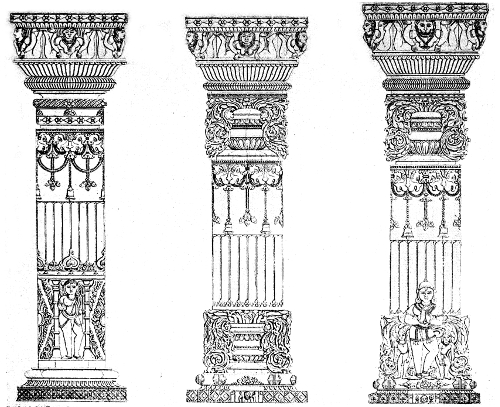
COLUMNS OF TEMPLES AT CHANDRĀVATI.
To face page 670.
—Ganga, the river-goddess, like the Nile,
is the type of fertility, and like that celebrated stream, has her
source amidst the eternal glaciers of Chandragiri or Somagiri
(the mountains of the moon); the higher peaks of the gigantic
671Himalaya, where Parvati is represented as ornamenting the
tiara of Iswara “with a beamy moon.” In this metaphor, and
in his title of Somanatha (lord of the moon), we again have
evidence of Iswara, or Siva, after representing the sun, having
the satellite moon as his ornament.
[50] His Olympus, Kailasa, is
studded with that majestic pine, the cedar; thence he is called
Kedarnath, ‘lord of the cedar-trees.’
[51] The mysteries of Osiris
and those of Eleusis
[52] were of the same character, commemorative
of the first germ of civilization, the culture of the earth, under a
variety of names, Ertha, Isis, Diana, Ceres, Ila. It is a curious
fact that in the terra-cotta images of Isis, frequently excavated
about her temple at Paestum,
[53] she holds in her right hand an
exact representation of the Hindu lingam and yoni combined;
and on the Indian expedition to Egypt, our Hindu soldiers
deemed themselves amongst the altars of their own god Iswara
(Osiris), from the abundance of his emblematic representatives.
—In the festival of Ganggor, as before
mentioned, Iswara yields to his consort Gauri, and occupies an
unimportant position near her at the water’s edge, meanly clad,
smoking intoxicating herbs, and, whether by accident or design,
holding the stalk of an onion in full blossom as a mace or club—a
plant regarded by some of the Egyptians with veneration, and
held by the Hindus generally in detestation: and why they
should on such an occasion thus degrade Iswara, I know not.
Onion-juice is reluctantly taken when prescribed medicinally, as
a powerful stimulant, by those who would reject spirituous
liquors; and there are classes, as the Aghori, that worship
Iswara in his most degraded form, who will not only devour raw
flesh, but that of man; and to whom it is a matter of perfect
672indifference whether the victim was slaughtered or died a natural
death.death. For the honour of humanity, such monsters are few in
number; but that they practise [576] these deeds I can testify,
from a personal visit to their haunts, where I saw the cave of
one of these Troglodyte monsters, in which by his own command
he was inhumed; and which will remain closed, until curiosity
and incredulity greater than mine may disturb the bones of the
Aghori of Abu.
The ὠμοφαγία, or eating raw flesh with the blood, was a part
of the secret mysteries of Osiris, in commemoration of the happy
change in the condition of mankind from savage to civilized life,
and intended to deter by disgust the return thereto.[54]
The Buddhists pursued this idea to excess; and in honour of
Adiswara, the First, who from his abode of Meru taught them
the arts of agriculture, they altogether abandoned that type of
savage life, the eating of the flesh of animals,[55] and confined themselves
to the fruits of the earth. With these sectarian anti-idolaters,
who are almost all of Rajput descent, the beneficent
Lakshmi, Sri, or Gauri, is an object of sincere devotion.
—But we must close
this digression; for such is the affinity between the mythology
of India, Greece, and Egypt, that a bare recapitulation of the
numerous surnames of the Hindu goddess of abundance would
lead us beyond reasonable limits; all are forms of Parvati or
Durga Mata, the Mater Montana of Greece and Rome, an epithet
of Cybele or Vesta (according to Diodorus), as the guardian
goddess of children, one of the characters of the Rajput ‘Mother
of the Mount,’ whose shrine crowns many a pinnacle in Mewar;
and who, with the prolific Gauri, is amongst the amiable forms
of the universal mother, whose functions are more varied and
extensive than her sisters of Egypt and of Greece. Like the
Ephesian Diana, Durga wears the crescent on her head. She is
also ‘the turreted Cybele,’ the guardian goddess of all places
of strength (
durga),
[56] and like her she is drawn or carried by the
lion. As Mata Janavi, ‘the Mother of Births,’ she is Juno
673Lucina: as Padma, ‘whose throne is the lotos,’ she is the fair
Isis of the Nile: as Tripura,
[57] ‘governing the three worlds,’ and
Atmadevi, ‘the Goddess of Souls,’ she is the Hecate Triformis
of the Greeks. In short, her power is manifested under every
form from the birth, and all the [577] intermediate stages until
death; whether Janavi, Gauri, or the terrific Kali, the Proserpine
or Kalligeneia of the West.
Whoever desires to witness one of the most imposing and
pleasing of Hindu festivals, let him repair to Udaipur, and behold
the rites of the lotus-queen Padma, the Gauri of Rajasthan.
Chait (Sudi) 8th, which, being after the Ides, is the 23rd of
the month, is sacred to Devi, the goddess of every tribe; she is
called Asokashtami, and being the ninth night (nauratri) from
the opening of their Floralia, they perform the homa, or sacrifice
of fire. On this day a grand procession takes place to the Chaugan,
and every Rajput worships his tutelary divinity.
—Chait (Sudi) 9th is the anniversary
of Rama, the grand beacon of the solar race, kept with great
rejoicings at Udaipur. Horses and elephants are worshipped,
and all the implements of war. A procession takes place to the
Chaugan, and the succeeding day, called the Dasahra or tenth,
is celebrated in Asoj.
—The last days of spring are
dedicated to Kamadeva, the god of love. The scorching winds
of the hot season are already beginning to blow, when Flora
droops her head, and “the god of love turns anchorite”; yet
the rose continues to blossom, and affords the most fragrant
chaplets for the Rajputnis, amidst all the heats of summer. Of
this the queen of flowers, the jessamine (
chameli), white and
yellow, the mogra,
[58] the champaka, that flourish in extreme heat,
the ladies form garlands, which they twine in their dark hair,
weave into bracelets, or wear as pendent collars. There is no
city in the East where the adorations of the sex to Kamadeva are
more fervent than in ‘the city of the rising sun’ (Udayapura).
On the 13th and 14th of Chait they sing hymns handed down
by the sacred bards:
“Hail, god of the flowery bow:[59] hail, warrior with a fish on
674thy banner! hail, powerful divinity, who causeth the firmness
of the sage to forsake him!”
“Glory to Madana, to Kama,[60] the god of gods; to Him by
whom Brahma [578], Vishnu, Siva, and Indra are filled with
emotions of rapture!”—Bhavishya Purana.[61]
—There is but one
festival in this month of any note, when the grand procession
denominated the ‘Nakkara ki aswari’ (from the equestrians being
summoned, as already described, by the grand kettledrums from
the Tripolia), takes place; and this is against the canons of the
Hindu church, being instituted by the present Rana in S. 1847, a
memorable year in the calendar. It was in this year, on the 2nd
of Baisakh, that he commanded a repetition of the rites of Gauri, by
the name of the Little Ganggor; but this act of impiety was marked
by a sudden rise of the waters of the Pichola, the bursting of the
huge embankment, and the inundation of the lake’s banks, to the
destruction of one-third of the capital: life, property, mansions,
trees, all were swept away in the tremendous rush of water, whose
ravages are still marked by the site of streets and bazaars now
converted into gardens or places of recreation, containing thousands
of acres within the walls, subdivided by hedges of the cactus, the
natural fence of Mewar, which alike thrives in the valley or covers
the most barren spots of her highest hills. But although the superstitious
look grave, and add that a son was also taken from him
on this very day, yet the Rana persists in maintaining the fête
he established; the barge is manned, he and his chiefs circumnavigate
the Pichola, regale on ma’ajun, and terrify Varuna
(the water-god) with the pyrotechnic exhibitions.
Although the court calendar of Udaipur notices only those
festivals on which State processions occur, yet there are many
minor fêtes, which are neither unimportant nor uninteresting.
We shall enumerate a few, alike in Baisakh, Jeth, and Asarh,
which are blank as to the Nakkara Aswari.
—On the 29th Baisakh there is a fast
common to India peculiar to the women, who perform certain
rites under the sacred fig-tree (the
vata or
pipal), to preserve
675them from widowhood; and hence the name of the fast Savitri-vrata.
[62]—On the 2nd of Jeth,
when the sun is in the zenith, the Rajput ladies commemorate
the birth of the sea-born goddess Rambha, the queen of the naiads
or Apsaras,
[63] whose birth, like that of Venus, was from the froth
of the waters; and [579] hence the Rajput bards designate all
the fair messengers of heaven by the name of Apsaras, who
summon the ‘chosen’ from the field of battle, and convey him
to the ‘mansion of the sun.’
[64]—On the 6th of Jeth the ladies
have another festival called the Aranya Shashthi, because on this
day those desirous of offspring walk in the woods (aranya) to
gather and eat certain herbs. Sir W. Jones has remarked the
analogy between this and the Druidic ceremony of gathering the
mistletoe (also on the Shashthi, or 6th day of the moon), as a
preservative against sterility.
—Asarh, the initiative
month of the periodical rains, has no particular festivity at Udaipur,
though in other parts of India the Rathayatra, or procession of
the car of Vishnu or Jagannatha (lord of the universe) is well
known: this is on the 2nd and the 11th, ‘the night of the gods,’
when Vishnu (the sun) reposes four months.
—Sawan, classically
Sravana. There are two important festivals, with processions,
in this month.
—The third, emphatically called ‘the Tij’ (third),
is sacred to the mountain goddess Parvati, being the day on which,
after long austerities, she was reunited to Siva: she accordingly
declared it holy, and proclaimed that whoever invoked her on
that day should possess whatever was desired. The Tij is
676accordingly reverenced by the women, and the husbandman of
Rajasthan, who deems it a most favourable day to take possession
of land, or to reinhabit a deserted dwelling. When on the expulsion
of the predatory powers from the devoted lands of Mewar,
proclamations were disseminated far and wide, recalling the
expatriated inhabitants, they showed their love of country by
obedience to the summons. Collecting their goods and chattels,
they congregated from all parts, but assembled at a common
rendezvous to make their entry to the
bapota, ‘land of their sires,’
on the Tij of Sawan. On this fortunate occasion, a band of
three hundred men, women, and children, with colours flying,
drums beating, the females taking precedence with brass vessels
of water on their heads, and chanting the
suhaila (song of joy),
entered the town of Kapasan, to revisit their desolate dwellings
[580], and return thanks on their long-abandoned altars to
Parvati
[65] for a happiness they had never contemplated.
Red garments are worn by all classes on this day, and at
Jaipur clothes of this colour are presented by the Raja to all the
chiefs. At that court the Tij is kept with more honour than at
Udaipur. An image of Parvati on the Tij, richly attired, is borne
on a throne by women chanting hymns, attended by the prince
and his nobles. On this day, fathers present red garments and
stuffs to their daughters.
—The 5th is the
Nagpanchami, or day set apart for the propitiation of the chief
of the reptile race, the Naga or serpent. Few subjects have more
occupied the notice of the learned world than the mysteries of
Ophite worship, which are to be traced wherever there existed
a remnant of civilization, or indeed of humanity; among the
savages of the savannahs
[66] of America, and the magi of Fars,
with whom it was the type of evil,—their Ahrimanes.
[67] The
Nagas, or serpent-genii of the Rajputs, have a semi-human
structure, precisely as Diodorus describes the snake-mother of
677the Scythae, in whose country originated this serpent-worship,
engrafted on the tenets of Zardusht, of the Puranas of the priesthood
of Egypt, and on the fables of early Greece.
[68] Dupuis,
Volney, and other expounders of the mystery, have given an
astronomical solution to what they deem a varied ramification
of an ancient fable, of which that of Greece, ‘the dragon guarding
the fruits of Hesperides,’ may be considered the most elegant
version. Had these learned men seen those ancient sculptures
in India, which represent ‘the fall,’ they might have changed
their opinion. The traditions of the Jains or Buddhists (originating
in the land of the Takshaks,
[69] or Turkistan) assert the creation
of the human species in pairs, called
jugal, who fed off the ever-fructifying
kalpa-vriksha, which possesses all the characters of
the Tree of Life, like it bearing
Ambrosial fruit of vegetable gold;
which was termed amrita, and rendered them immortal. A
drawing, brought by [581] Colonel Coombs, from a sculptured
column in a cave temple in the south of India, represents the
first pair at the foot of this ambrosial tree, and a serpent entwined
among the heavily laden boughs, presenting to them some of the
fruit from his mouth. The tempter appears to be at that part
of his discourse, when
... his words, replete with guile,
Into her heart too easy entrance won:
Fixed on the fruit she gazed.
This is a curious subject to be engraved on an ancient pagan
temple; if Jain or Buddhist, the interest would be considerably
enhanced. On this festival, at Udaipur, as well as throughout
India, they strew particular plants about the threshold, to prevent
the entrance of reptiles.
—This festival, which is held on the last
day of Sawan, was instituted in honour of the good genii, when
Durvasas the sage instructed Salono (the genius or nymph presiding
over the month of Sawan) to bind on
rakhis, or bracelets, as charms
to avert evil. The ministers of religion and females alone are
privileged to bestow these charmed wrist-bands. The ladies of
678Rajasthan, either by their handmaids or the family priests, send
a bracelet as the token of their esteem to such as they adopt as
brothers, who return gifts in acknowledgement of the honour.
The claims thus acquired by the fair are far stronger than those
of consanguinity: for illustration of which I may refer to an
incident already related in the annals of this house.
[70] Sisters also
present their brothers with clothes on this day, who make an
offering of gold in return.
[71]This day is hailed by the Brahmans as indemnifying them for
their expenditure of silk and spangles, with which they decorate
the wrists of all who are likely to make a proper return.
—On the
3rd there is a grand procession to the Chaugan; and the 8th, or
Ashtami, is the birth of Krishna, which will be described at large
in an account of Nathdwara. There are several holidays in this
month, when the periodical [582] rains are in full descent; but that
on the last but one (Sudi 14, or 29th) is the most remarkable.
—On this day
[72] commences the worship of
the ancestorial manes (the Pitrideva, or
father-gods) of the Rajputs,
which continues for fifteen days. The Rana goes to the cemetery
at Ara, and performs at the cenotaph of each of his forefathers
the rites enjoined, consisting of ablutions, prayers, and the hanging
of garlands of flowers, and leaves sacred to the dead, on their
monuments. Every chieftain does the same amongst the altars
of the ‘great ancients’ (
bara burha); or, if absent from their
estates, they accompany their sovereign to Ara.
679
—The festival in which
this imposing rite occurs is the Nauratri,
[1] sacred to the god of war,
commencing on the first of the month Asoj. It is essentially
martial, and confined to the Rajput, who on the departure of the
monsoon finds himself at liberty to indulge his passion whether
for rapine or revenge, both which in these tropical regions are
necessarily suspended during the rains. Arguing from the order
of the passions, we may presume that the first objects of emblematic
worship were connected with war [583], and we accordingly
find the highest reverence paid to arms by every nation of
antiquity. The Scythic warrior of Central Asia, the intrepid
Gete, admitted no meaner representative of the god of battle than
his own scimitar.
[2] He worshipped it, he swore by it; it was
buried with him, in order that he might appear before the martial
divinity in the other world as became his worshipper on earth:
for the Gete of Transoxiana, from the earliest ages, not only
believed in the soul’s immortality, and in the doctrine of rewards
and punishments hereafter, but, according to the father of history,
he was a monotheist; of which fact he has left a memorable
proof in the punishment of the celebrated Anacharsis, who, on
his return from a visit to Thales and his brother philosophers of
Greece, attempted to introduce into the land of the Saka (Sakatai)
the corrupted polytheism of Athens.
If we look westward from this the central land of earliest
680civilization, to Dacia, Thrace, Pannonia, the seats of the
Thyssagetae or western Getae, we find the same form of adoration
addressed to the emblem of Mars, as mentioned by Xenophon
in his memorable retreat, and practised by Alaric and his Goths,
centuries afterwards, in the Acropolis of Athens. If we transport
ourselves to the shores of Scandinavia, amongst the Cimbri and
Getae of Jutland, to the Ultima Thule, wherever the name of
Gete prevails, we shall find the same adoration paid by the Getic
warrior to his sword.
The Frisian Frank also of Gothic race, adhered to this worship,
and transmitted it with the other rites of the Getic warrior of the
Jaxartes; such as the adoration of the steed, sacred to the sun,
the great god of the Massagetae, as well as of the Rajput, who
sacrificed it at the annual feast, or with his arms and wife burnt
it on his funeral pile. Even the kings of the ‘second race’ kept
up the religion of their Scythic sires from the Jaxartes, and the
bones of the war-horse of Chilperic were exhumed with those
of the monarch. These rites, as well as those long-cherished
chivalrous notions, for which the Salian Franks have ever been
conspicuous [584], had their birth in Central Asia; for though
contact with the more polished Arab softened the harsh character
of the western warrior, his thirst for glory, the romantic charm
which fed his passion, and his desire to please the fair, he inherited
from his ancestors on the shores of the Baltic, which were colonized
from the Oxus. Whether Charlemagne addressed his sword as
Joyeuse,[3] or the Scandinavian hero Angantýr as the enchanted
blade Tyrfing (Hialmar’s bane), each came from one common
origin, the people which invented the custom of Khadga Sthapana,
or ‘adoration of the sword.’ But neither the falchion ‘made
by the dwarfs for Suafurlama,’ nor the redoubled sword of
Bayard with which he dubbed the first Francis,—not even the
enchanted brand of Ariosto’s hero, can for a moment compare
with the double-edged khanda (scimitar) annually worshipped
by the chivalry of Mewar. Before I descant on this monstrous
blade, I shall give an abstract of the ceremonies on each of the
nine days sacred to the god of war.
—On the 1st of Asoj, after fasting,
ablution, and prayer on the part of the prince and his household,
the double-edged khanda is removed from the hall of arms
681(
ayudhsala), and having received the homage (
puja) of the court,
it is carried in procession to the Kishanpol (gate of Kishan),
where it is delivered to the Raj Jogi,
[4] the Mahants, and band of
Jogis assembled in front of the temple of Devi ‘
the goddess,’
adjoining the portal of Kishan.
[5] By these, the monastic militant
adorers of Hara, the god of battle, the brand emblematic of the
divinity is placed
[6] on the altar before the image of his divine
consort. At three in the afternoon the nakkaras, or grand kettle-drums,
proclaim from the Tripolia
[7] the signal for the assemblage
of the chiefs with their retainers; and the Rana and his cavalcade
proceed direct to the stables, when a buffalo is sacrificed in honour
of the war-horse. Thence the procession moves to the temple of
Devi, where the Raja Krishan (
Godi) has proceeded. Upon this,
the Rana seats himself close to the Raj Jogi, presents two pieces
of [585] silver and a coco-nut, performs homage to the sword
(
khadga), and returns to the palace.
Asoj 2nd. In similar state he proceeds to the Chaugan, their
Champ de Mars, where a buffalo is sacrificed; and on the same
day another buffalo victim is felled by the nervous arm of a
Rajput, near the Toranpol, or triumphal gate. In the evening
the Rana goes to the temple of Amba Mata, the universal mother,
when several goats and buffaloes bleed to the goddess.
The 3rd. Procession to the Chaugan, when another buffalo
is offered; and in the afternoon five buffaloes and two rams are
sacrificed to Harsiddh Mata.[8]
On the 4th, as on every one of the nine days, the first visit is
to the Champ de Mars: the day opens with the slaughter of a
buffalo. The Rana proceeds to the temple of Devi, when he
worships the sword, and the standard of the Raj Jogi, to whom,
as the high-priest of Siva, the god of war, he pays homage, and
682makes offering of sugar, and a garland of roses. A buffalo having
been previously fixed to a stake near the temple, the Rana sacrifices
him with his own hand, by piercing him from his travelling
throne (raised on men’s shoulders and surrounded by his vassals)
with an arrow. In the days of his strength, he seldom failed
almost to bury the feather in the flank of the victim; but on the
last occasion his enfeebled arm made him exclaim with Prithiraj,
when, captive and blind, he was brought forth to amuse the Tartar
despot, “I draw not the bow as in the days of yore.”
On the 5th, after the usual sacrifice at the Chaugan, and an
elephant fight, the procession marches to the temple of Asapurna
(Hope); a buffalo and a ram are offered to the goddess adored
by all the Rajputs, and the tutelary divinity of the Chauhans.
On this day the lives of some victims are spared at the intercession
of the Nagar-Seth, or chief-magistrate,[9] and those of his
faith, the Jains.
On the 6th, the Rana visits the Chaugan, but makes no sacrifice.
In the afternoon, prayers and victims to Devi; and in the
evening the Rana visits Bhikharinath, the chief of the Kanphara
Jogis, or split-ear ascetics.ascetics.
The 7th. After the daily routine at the Chaugan, and sacrifices
to Devi (the goddess of destruction), the chief equerry is
commanded to adorn the steeds with their new caparisons, and
lead them to be bathed in the lake. At night, the sacred fire
(hom) is kindled, and a buffalo and a ram are sacrificed to Devi;
the Jogis [586] are called up and feasted on boiled rice and sweetmeats.
On the conclusion of this day, the Rana and his chieftains
visit the hermitage of Sukharia Baba, an anchorite of the Jogi sect.
8th. There is the homa, or fire-sacrifice in the palace. In the
afternoon, the prince, with a select cavalcade, proceeds to the
village of Samina, beyond the city walls, and visits a celebrated
Gosain.[10]
9th. There is no morning procession. The horses from the
royal stables, as well as those of the chieftains, are taken to the
683lake, and bathed by their grooms, and on returning from purification
they are caparisoned in their new housings, led forth, and
receive the homage of their riders, and the Rana bestows a largess
on the master of the horse, the equerries, and grooms. At three
in the afternoon, the nakkaras having thrice sounded, the whole
State insignia, under a select band, proceed to Mount Matachal,
and bring home the sword. When its arrival in the court of the
palace is announced, the Rana advances and receives it with due
homage from the hands of the Raj Jogi, who is presented with a
khilat; while the Mahant, who has performed all the austerities
during the nine days, has his patra[11] filled with gold and silver
coin. The whole of the Jogis are regaled, and presents are made
to their chiefs. The elephants and horses again receive homage,
and the sword, the shield, and spear are worshipped within the
palace. At three in the morning the prince takes repose.
The 10th, or Dasahra,[12] is a festival universally known in India,
and respected by all classes, although entirely military, being
commemorative of the day on which the deified Rama commenced
his expedition to Lanka for the redemption of Sita;[13] the ‘tenth
of Asoj’ is consequently deemed by the Rajput a fortunate day
for warlike enterprise. The day commences with a visit from
the [587] prince or chieftain to his spiritual guide. Tents and
carpets are prepared at the Chaugan or Matachal mount, where
the artillery is sent; and in the afternoon the Rana, his chiefs,
and their retainers repair to the field of Mars, worship the khejra
tree,[14] liberate the nilkanth or jay (sacred to Rama), and return
amidst a discharge of guns.
68411th. In the morning, the Rana, with all the State insignia,
the kettledrums sounding in the rear, proceeds towards the
Matachal mount, and takes the muster of his troops, amidst
discharges of cannon, tilting, and display of horsemanship. The
spectacle is imposing even in the decline of this house. The
hilarity of the party, the diversified costume, the various forms,
colours, and decorations of the turbans, in which some have the
heron plume, or sprigs from some shrub sacred to the god of war;
the clusters of lances, shining matchlocks, and black bucklers,
the scarlet housings of the steeds, and waving pennons, recall
forcibly the glorious days of the devoted Sanga, or the immortal
Partap, who on such occasions collected round the black changi
and crimson banner of Mewar a band of sixteen thousand of his
own kin and clan, whose lives were their lord’s and their country’s.
The shops and bazaars are ornamented with festoons of flowers
and branches of trees, while the costliest cloths and brocades are
extended on screens, to do honour to their prince; the toran (or
triumphal arch) is placed before the tent, on a column of which
he places one hand as he alights, and before entering makes
several circumambulations. All present offer their nazars to the
prince, the artillery fires, and the bards raise ‘the song of praise,’
celebrating the glories of the past; the fame of Samra, who fell
with thirteen thousand of his kin on the Ghaggar; of Arsi and
his twelve brave sons, who gave themselves as victims for the
salvation of Chitor; of Kumbha, Lakha, Sanga, Partap, Amra,
Raj, all descended of the blood of Rama, whose exploits, three
thousand five hundred years before, they are met to celebrate.
The situation of Matachal is well calculated for such a spectacle,
as indeed is the whole ground from the palace through the Delhi
portal to the mount, on which is erected one of the several castles
commanding the approaches to the city. The fort is dedicated
to Mata, though it would not long remain stable (achal) before a
battery of thirty-six pounders. The guns are drawn up about
the termination of the slope of the natural glacis; the Rana
and his court remain on horseback [588] half up the ascent; and
while every chief or vassal is at liberty to leave his ranks, and
“witch the world with noble horsemanship,” there is nothing
tumultuous, nothing offensive in their mirth.
The steeds purchased since the last festival are named, and
as the cavalcade returns, their grooms repeat the appellations
685of each as the word is passed by the master of the horse; as Baj
Raj, ‘the royal steed’; Hayamor, ‘the chief of horses’; Manika,
‘the gem’; Bajra, ‘the thunderbolt,’ etc., etc. On returning
to the palace, gifts are presented by the Rana to his chiefs. The
Chauhan chief of Kotharia claims the apparel which his prince
wears on this day, in token of the fidelity of his ancestor to the
minor, Udai Singh, in Akbar’s wars. To others, a fillet or
balaband for the turban is presented; but all such compliments
are regulated by precedent or immediate merit.
—Thus terminates the Nauratri festival sacred
to the god of war, which in every point of view is analogous to
the autumnal festival of the Scythic warlike nations, when these
princes took the muster of their armies, and performed the same
rites to the great celestial luminary.
[15] I have presented to the
antiquarian reader these details, because it is in minute particulars
that analogous customs are detected. Thus the temporary
toran, or triumphal arch, erected in front of the tent at Mount
Mataehala would scarcely claim the least notice, but that we
discover even in this emblem the origin of the triumphal arches
of antiquity, with many other rites which may be traced to the
Indo-Scythic races of Asia. The
toran in its original form consisted
of two columns and an architrave, constituting the number
three, sacred to Hara, the god of war. In the progress of the
arts the architrave gave way to the Hindu arch, which consisted
of two or more ribs without the keystone, the apex being the
perpendicular junction of the archivaults; nor is the arc of the
toran semicircular, or any segment of a circle, but with that
graceful curvature which stamps with originality one of the arches
of the Normans, who may have brought it from their ancient
seats on the Oxus, whence it may also have been [589] carried
within the Indus. The cromlech, or trilithic altar in the centre
686of all those monuments called Druidic, is most probably a
toran,
sacred to the Sun-god Belenus, like Har, or Balsiva, the god of
battle, to whom as soon as a temple is raised the
toran is erected,
and many of these are exquisitely beautiful.
—An interesting essay might be written on portes and
torans, their names and attributes, and the genii presiding as
their guardians. Amongst all the nations of antiquity, the
portal has had its peculiar veneration: to pass it was a privilege
regarded as a mark of honour. The Jew Haman, in the true
Oriental style, took post at the king’s gate as an inexpugnable
position. The most pompous court in Europe takes its title from
its
porte, where, as at Udaipur, all alight. The Tripolia, or triple
portal, the entry to the magnificent terrace in front of the Rana’s
palace, consists, like the Roman arcs of triumph, of three arches,
still preserving the numeral sacred to the god of battle, one of
whose titles is Tripura, which may be rendered Tripoli, or lord
of the three places of abode, or cities, but applied in its extensive
sense to the three worlds, heaven, earth, and hell. From the
Sanskrit
Pola we have the Greek πύλη,
a gate, or pass; and in
the guardian or
Polia, the πυλωρός or porter; while to this
langue mère our own language is indebted, not only for its portes
and porters, but its doors (
dwara).
[16] Pylos signified also a pass;
so in Sanskrit these natural barriers are called
Palas, and hence
the poetical epithet applied to the aboriginal mountain tribes of
Rajasthan, namely, Palipati and Palindra, ‘lords of the pass.’
[17]—One of the most important of the Roman divinities
was Janus, whence Januae, or portals, of which he was the
guardian.
[18] A resemblance between the Ganesa of the Hindu
pantheon and the Roman Janus has been pointed out by Sir W.
Jones, but his analogy extended little beyond nominal similarity.
The fable of the birth of Ganesa furnishes us with the origin of
the worship of Janus, and as it has never been given, I shall
transcribe it from the bard Chand. Ganesa is the chief of the
genii
[19] attendant on the god of war, and was expressly formed by
687Uma, the Hindu Juno, to guard the entrance of her caverned
retreat in the [590] Caucasus, where she took refuge from the
tyranny of the lord of Kailasa (Olympus), whose throne is fixed
amidst eternal snows on the summit of this peak of the gigantic
Caucasus (
Koh-khasa).
[20]“Strife arose between Mahadeo and the faithful Parvati: she
fled to the mountains and took refuge in a cave. A crystal
fountain tempted her to bathe, but shame was awakened; she
dreaded being seen. Rubbing her frame, she made an image of
man; with her nail she sprinkled it with the water of life, and
placed it as guardian at the entrance of the cave.” Engrossed
with the recollection of Parvati,[21] Siva went to Karttikeya[22] for
tidings of his mother, and together they searched each valley and
recess, and at length reached the spot where a figure was placed
at the entrance of a cavern. As the chief of the gods prepared to
explore this retreat, he was stopped by the Polia. In a rage he
struck off his head with his discus (chakra), and in the gloom
discovered the object of his search. Surprised and dismayed,
she demanded how he obtained ingress: “Was there no guardian
at the entrance?” The furious Siva replied that he had cut
off his head. On hearing this, the mountain-goddess was enraged,
and weeping, exclaimed, “You have destroyed my child.” The
god, determined to recall him to life, decollated a young elephant,
replaced the head he had cut off, and naming him Ganesa, decreed
that in every resolve his name should be the first invoked.
688Invocation of the Bard to Ganesa.
“Oh, Ganesa! thou art a mighty lord; thy single tusk[23] is
beautiful, and demands the tribute of praise from the Indra of
song.[24] Thou art the chief of the human race; the destroyer of
unclean spirits; the remover of fevers, whether daily or tertian.
Thy bard sounds thy praise; let my work be accomplished!”
Thus Ganesa is the chief of the Di minores of the Hindu
pantheon, as the etymology of the word indicates,[25] and like Janus,
was entrusted with the gates of heaven [591]; while of his right
to preside over peace and war, the fable related affords abundant
testimony. Ganesa is the first invoked and propitiated[26] on
every undertaking, whether warlike or pacific. The warrior
implores his counsel; the banker indites his name at the commencement
of every letter; the architect places his image in the
foundation of every edifice; and the figure of Ganesa is either
sculptured or painted at the door of every house as a protection
against evil. Our Hindu Janus is represented as four-armed, and
holding the disk (chakra), the war-shell, the club, and the lotos.
Ganesa is not, however, bifrons, like the Roman guardian of
portals. In every transaction he is adi, or the first, though the
Hindu does not, like the Roman, open the year with his name.
I shall conclude with remarking that one of the portes of every
Hindu city is named the Ganesa Pol, as well as some conspicuous
entrance to the palace: thus Udaipur has its Ganesa dwara,
who also gives a name to the hall, the Ganesa deori; and his
shrine will be found on the ascent of every sacred mount, as at
Abu, where it is placed close to a fountain on the abrupt face
about twelve hundred feet from the base. There is likewise a
hill sacred to him in Mewar called Ganesa Gir, tantamount to the
Mons Janiculum of the eternal city. The companion of this
divinity is a rat, who indirectly receives a portion of homage, and
with full as much right as the bird emblematic of Minerva.[27]
689We have abandoned the temple of the warlike divinity (Devi),
the sword of Mars, and the triumphal toran, to invoke Ganesa.
It will have been remarked that the Rana aids himself to dismount
by placing his hand on one of the columns of the toran, an act
which is pregnant with a martial allusion, as are indeed the entire
ceremonials of the “worship of the sword.”
—It
might be deemed folly to trace the rites and superstitions of so
remote an age and nation to Central Asia; but when we find the
superstitions of the Indo-Scythic Getae prevailing within the
Indus, in Dacia, and on the shores of the Baltic, we may assume
their common origin; for although the worship of arms has
prevailed among all warlike tribes, there is a peculiar respect
paid to the sword amongst the Getic races. The Greeks and
Romans paid devotion to their arms, and swore by them. The
Greeks brought their habits from ancient Thrace, where the
custom existed of presenting as the greatest gift that peculiar
kind of sword called
acinaces,
[28] which we dare not derive from
the Indo-Scythic or Sanskrit
asi, a [592] sword. When Xenophon,
[29]
on his retreat, reached the court of Seuthes, he agreed to
attach his corps to the service of the Thracian. His officers on
introduction, in the true Oriental style, presented their
nazars,
or gifts of homage, excepting Xenophon, who, deeming himself
too exalted to make the common offering, presented his sword,
probably only to be touched in recognition of his services being
accepted. The most powerful oath of the Rajput, next to his
sovereign’s throne (
gaddi ka an), is by his arms,
ya silah ka an,
‘by this weapon!’ as, suiting the action to the word, he puts
his hand on his dagger, never absent from his girdle.
Dhal,
tarwar, ka an, ‘by my sword and shield!’ The shield is deemed
the only fit vessel or salver on which to present gifts; and accordingly
at a Rajput court, shawls, brocades, scarfs, and jewels are
always spread before the guest on bucklers.
[30]In the Runic “incantation of Hervor,” daughter of Angantýr,
at the tomb of her father, she invokes the dead to deliver the
enchanted brand Tyrfing, or “Hjalmr’s bane,” which, according
690to Getic custom, was buried in his tomb; she adjures him and
his brothers “by all their arms, their shields, etc.” It is depicted
with great force, and, translated, would deeply interest a Rajput,
who might deem it the spell by which the Khanda of Hamira,
which he annually worships, was obtained.
Hervor—“Awake, Angantýr! Hervor, the only daughter of
thee and Suafu, doth awaken thee. Give me out of the tomb
the tempered sword which the dwarfs made for Suafurlama.
“Can none of Eyvors’[31] sons speak with me out of the habitations
of the dead? Hervardur,[31] Hurvardur?”[31]
The tomb at length opens, the inside of which appears on fire,
and a reply is sung within:
Angantýr—“Daughter Hervor, full of spells to raise the dead,
why dost thou call so? I was not buried either by father or
friends; two who lived after me got Tyrfing, one of whom is
now in possession thereof [593].”
Hervor—“The dead shall never enjoy rest unless Angantýr
deliver me Tyrfing, that cleaveth shields, and killed Hjalmr.”[32]
Angantýr—“Young maid, thou art of manlike courage, who
dost rove by night to tombs, with spear engraven with magic
spells,[33] with helm and coat of mail, before the door of our hall.”
Hervor—“It is not good for thee to hide it.”
Angantýr—“The death of Hjalmr[34] lies under my shoulders;
it is all wrapt up in fire: I know no maid that dares to take this
sword in hand.”
Hervor—“I shall take in hand the sharp sword, if I may
691obtain it. I do not think that fire will burn which plays about
the site of deceased men.”[35]
Angantýr—“Take and keep Hjalmr’s bane: touch but the
edges of it, there is poison in them both;[36] it is a most cruel
devourer of men.”[37]
—Tradition has hallowed the
two-edged sword (
khanda) of Mewar, by investing it with an
origin as mysterious as “the bane of Hjalmr.” It is supposed
to be the enchanted weapon fabricated by Viswakarma,
[38] with
which the Hindu Proserpine girded the founder of the race, and
led him forth to the conquest of Chitor.
[39] It remained the great
heirloom of her princes till the sack of Chitor by the Tatar Ala,
when Rana Arsi and eleven of his brave sons devoted themselves
at the command of the guardian goddess of their race, and their
capital falling into the hands of the invader, the last scion of
Bappa became a fugitive amidst the mountains of the west. It
was then the Tatar inducted the Sonigira Maldeo [594], as his
lieutenant, into the capital of the Guhilots. The most celebrated
of the poetic chronicles of Mewar gives an elaborate description
of the subterranean palace in Chitor, in one of whose entrances
the dreadful sacrifice was perpetuated to save the honour of
Padmini and the fair of Chitor from the brutalized Tatars.
[40] The
curiosity of Maldeo was more powerful than his superstition, and
he determined to explore these hidden abodes, though reputed
to be guarded by the serpent genii attendant on Nagnaicha, the
692ancient divinity of its Takshak founders.
[41] Whether it was
through the identical caverned passage, and over the ashes of
those martyred Kaminis,
[42] that he made good his way into those
rock-bound abodes, the legend says not; but though
In darkness, and with dangers compassed round,
And solitude,
the intrepid Maldeo paused not until he had penetrated to the
very bounds of the abyss, where in a recess he beheld the snaky
sorceress and her sister crew seated round a cauldron, in which
the materials of their incantation were solving before a fire that
served to illume this abode of horror. As he paused, the reverberation
of his footsteps caused the infernal crew to look athwart
the palpable obscure of their abode, and beholding the audacious
mortal, they demanded his intent. The valiant Sonigira replied
that he did not come as a spy,
With purpose to explore or to disturb
The secrets of their realm,
but in search of the enchanted brand of the founder of the Guhilots.
Soon they made proof of Maldeo’s hardihood. Uncovering
the cauldron, he beheld a sight most appalling: amidst divers
fragments of animals was the arm of an infant. A dish of this
horrid repast was placed before him, and a silent signal made for
him to eat. He obeyed, and returned the empty platter: it was
proof sufficient of his worth to wear the enchanted blade, which,
drawn forth from its secret abode, was put into the hand of
Maldeo, who bowing, retired with the trophy [595].
Rana Hamira recovered this heirloom of his house, and with
it the throne of Chitor, by his marriage with the daughter of the
693Sonigira, as related in the annals.[43] Another version says it was
Hamira himself who obtained the enchanted sword, by his
incantations to Charani Devi, or the goddess of the bards, whom
he worshipped.
—We shall conclude this account of the
military festival of Mewar with the birth of Kumara, the god of
war, taken from the most celebrated of their mythological poems,
the Ramayana, probably the most ancient book in the world.
[44]
“Mena, daughter of Meru, became the spouse of Himavat, from
whose union sprung the beauteous Ganga, and her sister Uma.
Ganga was sought in marriage by all the celestials; while Uma,
after a long life of austerity, was espoused by Rudra.”
[45] But
neither sister was fortunate enough to have offspring, until Ganga
became pregnant by Hutasana (regent of fire), and “Kumara,
resplendent as the sun, illustrious as the moon, was produced
from the side of Ganga.” The gods, with Indra at their head,
carried him to the Krittikas
[46] to be nursed, and he became their
joint care. “As he resembled the fire in brightness, he received
the name of Skanda, when the immortals, with Agni (fire) at
their head, anointed him as general of the armies of the gods.”
[47]—“Thus
(the bard Valmiki speaks), oh! Rama, have I related the
story of the production of Kumar.”
694This is a very curious relic of ancient mythology, in which we
may trace the most material circumstances of the birth of the
Roman divinity of war. Kumara (Mars) was the son of Jahnavi
(Juno), and born, like the Romans, without sexual intercourse,
but by the agency of Vulcan (regent of fire). Kumara has the
peacock (sacred to Juno likewise) as his companion; and as the
Grecian goddess is feigned to have her car drawn by peacocks,
so Kumara (the evil-striker)[48] has a peacock for his steed [596].
Ganga, ‘the river goddess,’ has some of the attributes of
Pallas, being like the Athenian maid (Ganga never married) born
from the head of Jove. The bard of the silver age makes her
fall from a glacier of Kailasa (Olympus) on the head of the father
of the gods, and remain many years within the folds of his tiara
(jata), until at length being liberated, she was precipitated into
the plains of Aryavarta. It was in this escape that she burst
her rocky barrier (the Himalaya), and on the birth of Kumara
exposed those veins of gold called jambunadi, in colour like the
jambu fruit, probably alluding to the veins of gold discovered in
the rocks of the Ganges in those distant ages.
—The last day of the month Asoj ushers
in the Hindu winter (
sarad rit). On this day, nothing but white
vestments and silver (
chandi) ornaments are worn, in honour of
the moon (Chandra), who gives his
[49] name to the
Pale and common drudge
’Tween man and man.
695This year there was an entire intercalary month: such are called
Laund. There is a procession of all the chiefs to the Chaugan;
and on their return, a full court is held in the great hall, which
breaks up with ‘obeisance to the lamp’ (jot ka mujra), whose
light each reverences; when the candles are lit at home, every
Rajput, from the prince to the owner of a “skin (charsa) of
land,” seated on a white linen cloth, should worship his tutelary
divinity, and feed the priests with sugar and milk.
—This month is peculiarly sacred to Lakshmi, the
goddess of wealth, the Juno Moneta of the Romans. The 13th
is called the Dhanteras, or thirteenth [day] of wealth, when gold
and silver coin are worshipped, as the representatives of the
goddess, by her votaries of all classes, but especially by the
mercantile [597]. On the 14th, all anoint with oil, and make
libations thereof to Yama, the judge of departed spirits. Worship
(puja) is performed to the lamp, which represents the god
of hell, and is thence called Yamadiwa, ‘the lamp of Pluto’;
and on this day partial illumination takes place throughout the
city.
—On the Amavas, or Ides of
Karttik, is one of the most brilliant fètes of Rajasthan, called
the Diwali, when every city, village, and encampment exhibits a
blaze of splendour. The potters’ wheels revolve for weeks before
solely in the manufacture of lamps (diwa), and from the palace
to the peasant’s hut every one supplies himself with them, in
proportion to his means, and arranges them according to his
fancy. Stuffs, pieces of gold, and sweetmeats are carried in
trays and consecrated at the temple of Lakshmi, the goddess
of wealth, to whom the day is consecrated. The Rana on this
occasion honours his prime minister with his presence to dinner;
and this chief officer of the State, who is always of the mercantile
caste, pours oil into a terra-cotta lamp, which his sovereign
holds; the same libation of oil is permitted by each of the near
relations of the minister. On this day, it is incumbent upon
every votary of Lakshmi to try the chance of the dice, and from
their success in the Diwali, the prince, the chief, the merchant,
and the artisan foretell the state of their coffers for the ensuing
year.
Lakshmi, though on this festival depicted under the type of
riches, is evidently the beneficent Annapurna in another garb,
696for the agricultural community place a corn-measure filled with
grain and adorned with flowers as her representative; or, if they
adorn her effigies, they are those of Padma, the water-nymph,
with a lotos in one hand, and the pasa (or fillet for the head) in
the other. As Lakshmi was produced at “the Churning of the
Ocean,” and hence called one of the “fourteen gems,” she is
confounded with Rambha, chief of the Apsaras, the Venus of the
Hindus. Though both were created from the froth (sara) of the
waters (ap),[50] they are as distinct as the representations of riches
and beauty can be. Lakshmi became the wife of Vishnu, or
Kanhaiya, and is placed at the feet of his marine couch when he
is floating on the chaotic waters. As his consort, she merges
into the character of Sarasvati, the goddess of eloquence, and
here we have the combination of Minerva and Apollo. As of
Minerva, the owl [598] is the attendant of Lakshmi;[51] and when
we reflect that the Egyptians, who furnished the Grecian pantheon,
held these solemn festivals, also called “the feast of
lamps,” in honour of Minerva at Sais, we may deduce the origin
of this grand Oriental festival from that common mother-country
in Central Asia, whence the Diwali radiated to remote China, the
Nile, the Ganges, and the shores of the Tigris; for the Shab-i-barat
of Islam is but “the feast of lamps” of the Rajputs. In all
these there is a mixture of the attributes of Ceres and Proserpine,
of Plutus and Pluto. Lakshmi partakes of the attributes of
both the first, while Kuvera,[52] who is conjoined with her, is Plutus:
as Yama is Pluto, the infernal judge. The consecrated lamps
and the libations of oil are all dedicated to him; and “torches
and flaming brands are likewise kindled and consecrated, to burn
the bodies of kinsmen who may be dead in battle in a foreign
land, and light them through the shades of death to the mansion
of Yama.”[53]
—To the infernal god Yama, who is “the
son of the sun,” the second day following the Amavas, or Ides of
Karttika, is also sacred; it is called the Bhratri dvitiya, or ‘the
brothers’ second,’ because the river-goddess Yamuna on this day
697entertained her brother (
bhratri) Yama, and is therefore consecrated
to fraternal affection. At the hour of curfew (
godhuli),
[54]
when the cattle return from the fields, the cow is worshipped,
the herd having been previously tended. From this ceremony
no rank is exempted on the preceding day, dedicated to Krishna:
prince and peasant all become pastoral attendants on the cow,
as the form of Prithivi,
[55] or the earth.
—The 1st (Sudi), or 16th of Karttika,
is the grand festival of Annakuta, sacred to the Hindu Ceres,
which will be described with its solemnities at Nathdwara. There
is a State procession, horse-races, and elephant-fights at the
Chaugan; the evening closes with a display of fireworks.
—The 14th (Sudi), or 29th, is another
solemn festival in honour of Vishnu. It is called the Jaljatra,
from being performed on the water (
jal). The Rana, chiefs,
ministers, and citizens go in procession to the lake, and adore the
“spirit of the waters,” on which floating lights are placed, and
the whole surface is illuminated by a grand display of pyrotechny.
On this day “Vishnu rises from his slumber of four [599]
months”;
[56] a figurative expression to denote the sun’s emerging
from the cloudy months of the periodical flood.
—The next day (the Punim,
or last day of Karttika), being the Makara sankranti, or autumnal
equinox, when the sun enters the zodiacal sign Makara,
[57] or Pisces,
the Rana and chiefs proceed in state to the Chaugan, and play
at ball on horseback. The entire last half of the month Karttika,
from Amavas (the Ides) to the Punim, is sacred to Vishnu; who
is declared by the Puranas to represent the sun, and whose
worship, that of water, and the floating-lights placed thereon—all
objects emblematic of fecundity—carry us back to the point
whence we started—the adoration of the powers of nature: clearly
proving all mythology to be universally founded on an astronomical
basis.
698—In the remaining
months of Aghan, or Margsir, and Pus, there are no festivals in
which a state procession takes place, though in each there are
marked days, kept not only by the Rajputs, but generally by
the Hindu nation; especially that on the 7th of Aghan, which
is called Mitra Saptami, or 7th of Mithras, and like the Bhaskara
Saptami or the 7th of Magha, is sacred to the sun as a form
of Vishnu. On this seventh day occurred the descent of the
river-goddess (Ganga) from the foot of Vishnu; or the genius of
fertilization, typified under the form of the river-goddess, proceeding
from the sun, the vivifying principle, and impended over
the head of Iswara, the divinity presiding over generation, in
imitation of which his votary pours libations of water (if possible
from the sacred river Ganga) over his emblem, the lingam or
phallus: a comparison which is made by the bard Chand in an
invocation to this god, for the sake of contrasting his own inferiority
“to the mighty bards of old.”
“The head of Is[58] is in the skies; on his crown falls the ever-flowing
stream (Ganga); but on his statue below, does not his
votary pour the fluid from his patra?”
—No satisfactory etymology has ever been assigned
for the phallic emblem of generation, adored by Egyptian, Greek,
Roman, and even by the Christian, which may be from the same
primeval language that formed the Sanskrit.
Phalisa is the ‘fructifier,’ from phala, ‘fruit,’ and Isa, ‘the
god.’[59] Thus the type of Osiris can have a definite interpretation,
still wanting to the lingam of Iswara [600]. Both deities presided
over the streams which fertilized the countries in which they
received divine honours: Osiris over the Nile, from ‘the mountains
of the moon,’ in Ethiopia,[60] Iswara over the Indus[61] (also
called the Nil), and the Ganges from Chandragiri, ‘the mountains
of the moon,’ on a peak of whose glaciers he has his throne.
699—Siva occasionally assumes the attributes
of the sun-god; they especially appertain to Vishnu, who alone
is styled “immortal, the one, creator, and uncreated”; and in
whom centre all the qualities (
gunan), which have peopled the
Hindu pantheon with their ideal representatives. The bard
Chand, who has embodied the theological tenets of the Rajputs
in his prefatory invocation to every divinity who can aid his
intent, apostrophizes Ganesa, and summons the goddess of
eloquence (Sarasvati) “to make his tongue her abode”; deprecates
the destroying power, “him whom wrath inhabits,” lest
he should be cut off ere his book was finished; and lauding
distinctly each member of the triad (
trimurti), he finishes by
declaring them one, and that “whoever believes them separate,
hell will be his portion.” Of this One the sun is the great visible
type, adored under a variety of names, as Surya, Mitra, Bhaskar,
Vivasvat, Vishnu, Karna, or Kana, likewise an Egyptian epithet
for the sun.
[62]
The emblem of Vishnu is Garuda, or the eagle,[63] and the Sun-god
both of the Egyptians and Hindus is typified with the bird’s
head. Aruna (the dawn), brother of Garuda, is classically styled
the charioteer of Vishnu, whose two sons, Sampati and Jatayu,
attempting in imitation of their father to reach the sun, the wings
of the former were burnt and he fell to the earth: of this the
Greeks may have made their fable of Icarus.[64]
—In the chief zodiacal phenomena,
observation will discover that Vishnu is still the object of
worship. The Phuladola,
[65] or Floralia, in the vernal equinox, is
so called from the image of Vishnu being carried in a
dola, or ark,
covered with garlands of flowers (
phula). Again, in the month
of Asarh, the commencement of [601] the periodical rains, which
700date from the summer solstice, the image of Vishnu is carried on
a car, and brought forth on the first appearance of the moon, the
11th of which being the solstice, is called “the night of the gods.”
Then Vishnu reposes on his serpent-couch until the cessation of
the flood on the 11th of Bhadon, when “he turns on his side.”
[66]The 4th is also dedicated to Vishnu under his infantine appellation
Hari (Ἥλιος), because when a child “he hid himself in the
moon.” We must not derogate from Sir W. Jones the merit of
drawing attention to the analogy between these Hindu festivals
on the equinoxes, and the Egyptian, called the entrance of Osiris
into the moon, and his confinement in an ark. But that distinguished
writer merely gives the hint, which the learned Bryant
aids us to pursue, by bringing modern travellers to corroborate
the ancient authorities: the drawings of Pocock from the sun
temple of Luxor to illustrate Plutarch, Curtius, and Diodorus.
Bryant comes to the same conclusion with regard to Osiris
enclosed in the ark, which we adopt regarding Vishnu’s repose
during the four months of inundation, the period of fertilization.
I have already, in the rites of Annapurna, the Isis of the Egyptians,
noticed the crescent form of the ark of Osiris, as well as the ram’s-head
ornaments indicative of the vernal equinox, which the
Egyptians called Phamenoth, being the birthday of Osiris, or the
sun; the Phag, or Phalgun month of the Hindus; the Phagesia
of the Greeks, sacred to Dionysus.[67]
—The expedition of Argonauts in search of the
golden fleece is a version of the arkite worship of Osiris, the
Dolayatra of the Hindus: and Sanskrit etymology, applied to
the vessel of the Argonauts, will give the sun (
argha) god’s (
natha)
entrance into the sign of the Ram. The Tauric and Hydra foes,
with which Jason had to contend before he obtained the fleece
of Aries, are the symbols of the sun-god, both of the Ganges and
the Nile; and this fable, which has occupied almost every pen
of antiquity, is clearly astronomical, as the names alone of the
701Arghanath, sons of Apollo, Mars, Mercury, Sol, Arcus or Argus,
[68]
Jupiter, Bacchus, etc., sufficiently testify, whose voyage is entirely
celestial.
—If it be destined
that any portion of the veil which covers these ancient mysteries
[602], connecting those of the Ganges with the Nile, shall be
removed, it will be from the interpretation of the expedition of
Rama, hitherto deemed almost as allegorical as that of the
Arghanaths. I shall at once assume an opinion I have long
entertained, that the western coast of the Red Sea was the Lanka
of the memorable exploit in the history of the Hindus. If
Alexander from the mouths of the Indus ventured to navigate
those seas with his frail fleet of barks constructed in the Panjab,
what might we not expect from the resources of the King of
Kosala, the descendant of Sagara, emphatically called the sea-king,
whose “60,000 sons” were so many mariners, and who has
left his name as a memorial of his marine power at the island
(
Sagar) at the embouchure of the main arm of the Ganges, and
to the ocean itself, also called Sagara? If the embarkation of
Ramesa and his heroes for the redemption of Sita had been from
the Gulph of Cutch, the grand emporium from the earliest ages,
the voyage of Rama would have been but the prototype of that
of the Macedonians; but local tradition has sanctified Rameswaram,
the southern part of the peninsula, as the rendezvous of
his armament. The currents in the Straits of Manar, curiosity,
or a wish to obtain auxiliaries from this insular kingdom, may
have prompted the visit to Ceylon; and hence the vestiges there
found of this event. But even from this “utmost isle, Taprobane,”
the voyage across the Erythrean Sea is only twenty-five
degrees of longitude, which with a flowing sail they would run
down in ten or twelve days. The only difficulty which occurs is
in the synchronical existence of Rama and the Pharaoh
[69] of
Moses, which would tend to the opposite of my hypothesis, and
show that India received her Phallic rites, her architecture, and
symbolic mythology from the Nile, instead of planting them
there.
“Est-ce l’Inde, la Phénicie, l’Éthiopie, la Chaldée, ou l’Égypte,
702qui a vu naître ce culte? ou bien le type en a-t-il été fourni aux
habitans de ces contrées, par une nation plus ancienne encore?”
asks an ingenious but anonymous French author, on the origin
of the Phallic worship.[70] Ramesa, chief of the Suryas, or sun-born
race, was king of the city designated from his mother,
Kausalya, of which Ayodhya was the capital. His sons were
Lava and Kusa, who originated the races we may term the Lavites
and Kushites, or Kushwas of India.[71] Was then Kausalya [603]
the mother of Ramesa, a native of Aethiopia,[72] or Kusadwipa,
‘the land of Cush’? Rama and Krishna are both painted blue
(nila), holding the lotus, emblematic of the Nile. Their names
are often identified. Ram-Krishna, the bird-headed divinity,
is painted as the messenger of each, and the historians of both
were contemporaries. That both were real princes there is no
doubt, though Krishna assumed to be an incarnation of Vishnu,
as Rama was of the sun. Of Rama’s family was Trisankha,[73]
mother of the great apostle of Buddha, whose symbol was the
serpent; and the followers of Buddha assert that Krishna and
this apostle, whose statues are facsimiles of those of Memnon,
were cousins. Were the Hermetic creed and Phallic rites therefore
received from the Ethiopic Cush? Could emblematic relics
be discovered in the caves of the Troglodytes, who inhabited the
range of mountains on the Cushite shore of the Arabian straits,
akin to those of Ellora and Elephanta,[74] whose style discloses
physical, mythological, as well as architectural affinity to the
Egyptian, the question would at once be set at rest.
I have derived the Phallus from Phalisa, the chief fruit. The
Greeks, who either borrowed it from the Egyptians or had it
from the same source, typified the Fructifier by a pineapple, the
703form of which resembles the Sitaphala,[75] or fruit of Sita, whose
rape by Ravana carried Rama from the Ganges over many
countries ere he recovered her.[76] In like manner Gauri, the Rajput
Ceres, is typified under the coco-nut, or sriphala,[77] the chief of
fruit, or fruit sacred to Sri, or Isa (Isis), whose other elegant
emblem of abundance, the kamakumbha, is drawn with branches
of the palmyra,[78] or coco-tree, gracefully pendent from the vase
(kumbha).
The Sriphala[79] is accordingly presented to all the votaries of
Iswara and Isa on the conclusion of the spring-festival of Phalguna,
the Phagesia of the Greeks, the [604] Phamenoth of the Egyptian,
and the Saturnalia of antiquity; a rejoicing at the renovation
of the powers of nature; the empire of heat over cold—of light
over darkness.[80]
704The analogy between the goddess of the spring Saturnalia,
Phalguni, and the Phagesia of the Greeks, will excite surprise;
the word is not derived from (φαγεῖν) eating, with the Rajput
votaries of Holika, as with those of the Dionysia of the Greeks;
but from phalguni, compounded of guna, ‘quality, virtue, or
characteristic,’ and phala, ‘fruit’; in short, the fructifier.
From φαλλός,[81] to which there is no definite meaning, the
Egyptian had the festival Phallica, the Holika of the Hindus.
Phula and phala, flower and fruit, are the roots of all, Floralia
and Phalaria, the Phallus of Osiris, the Thyrsus of Bacchus, or
Lingam of Iswara, symbolized by the Sriphala, or Ananas, the
‘food of the gods,’[82] or the Sitaphala of the Helen of Ayodhya.
From the existence of this worship in Congo at this day, the
author already quoted asks if it may not have originated in
Ethiopia, “qui, comme le témoignent plusieurs écrivains de
l’antiquité, a fourni ses dieux à l’Égypte.“ On the first of the
five complementary days called ”ἠπαγόμεναι ἡμέραι” preceding
New Year’s Day, the Egyptians celebrated the birth of the
sun-god Osiris, in a similar manner as the Hindus do their solstitial
festival, “the morning of the gods,” the Hiul of Scandinavia;
on which occasion, “on promenait en procession une figure
d’Osiris, dont le Phallus était triple”; a number, he adds, expressing
“la pluralité indéfinie.” The number three is sacred to
Iswara, chief of the Trimurti or Triad, whose statue adorns the
junction (sangam) of all triple streams; hence called Triveni,
who is [605] Trinetra, or ‘three-eyed,’ and Tridanta, or ‘god of
the trident’; Triloka, ‘god of the triple abode, heaven, earth,
and hell’; Tripura, of the triple city, to whom the Tripoli or
triple gates are sacred, and of which he has made Ganesa the
Janitor, or guardian. The grotesque figure placed by the Hindus
during the Saturnalia in the highways, and called Nathurama
705(the god Rama), is the counterpart of the figure described by
Plutarch as representing Osiris, “ce soleil printanier,” in the
Egyptian Saturnalia or Phamenoth. Even Ramisa and Ravana
may, like Osiris and Typhon, be merely the ideal representatives
of light and darkness; and the chaste Sita, spouse of the Surya
prince, the astronomical Virgo, only a zodiacal sign.[83]
—That a system of
Hinduism pervaded the whole Babylonian and Assyrian empires,
Scripture furnishes abundant proofs, in the mention of the various
types of the sun-god Balnath, whose pillar adorned “every
mount” and “every grove”; and to whose other representative,
the brazen calf (
nandi), the 15th of each month (
amavas)
[84] was
especially sacred. It was not confined to these celebrated regions
of the East, but was disseminated throughout the earth; because
from the Aral to the Baltic, colonies were planted from that
central region,
[85] the cradle of the Suryas and the Indus, whose
branches (
sakha),
[86] the Yavan, the Aswa, and the Meda, were the
progenitors of the Ionians, the Assyrians, and the Medes;
[87]
while in later times, from the same teeming region, the Galati
and Getae,
[88] the Kelts and Goths, carried modifications of the
system to the shores of Armorica and the Baltic, the cliffs of
Caledonia, and the remote isles of the German Ocean. The
monumental circles sacred to the sun-god Belenus at once existing
in that central region,
[89] in India,
[90] and throughout Europe, is
706conclusive. The apotheosis of the patriarch Noah, whom the
Hindu styles Manu-Vaivaswata, ‘
the man, son of the sun,’
may have originated the Dolayatra of the Hindus, the ark of
Osiris [606], the ship of Isis amongst the Suevi, in memory of
“the forty days” noticed in the traditions of every nation of the
earth.
The time may be approaching when this worship in the East,
like the Egyptian, shall be only matter of tradition; although
this is not likely to be effected by such summary means as were
adopted by Cambyses, who slew the sacred Apis and whipped his
priests, while their Greek and Roman conquerors adopted and
embellished the Pantheon of the Nile.[91] But when Christianity
reared her severe yet simple form, the divinities of the Nile, the
Pantheon of Rome, and the Acropolis of Athens, could not abide
her awful majesty. The temples of the Alexandrian Serapis
were levelled by Theophilus,[92] while that of Osiris at Memphis
became a church of Christ. “Muni de ses pouvoirs, et escorté
d’une foule de moines, il mit en fuite les prêtres, brisa les idoles,
démolit les temples, ou y établit des monastères.”[93] The period
for thus subverting idolatry is passed: the religion of Christ is
not of the sword, but one enjoining peace and goodwill on earth.
But as from him “to whom much is given,” much will be required,
the good and benevolent of the Hindu nations may have ulterior
advantages over those Pharisees who would make a monopoly
even of the virtues; who “see the mote in their neighbour’s eye,
but cannot discern the beam in their own.” While, therefore,
we strive to impart a purer taste and better faith, let us not
imagine that the minds of those we would reform are the seats
of impurity, because, in accordance with an idolatry coeval with
the flood, they continue to worship mysteries opposed to our
own modes of thinking [607].
707
—The
manners of a nation constitute the most interesting portion of
its history, but a thorough knowledge of them must be the fruit
of long and attentive observation: an axiom which applies to
a people even less inaccessible than the Rajputs. The importance
and necessity of such an illustration of the Rajput character,
in a work like the present, call for and sanction the attempt,
however inadequate the means. Of what value to mankind
would be the interminable narrative of battles, were their moral
causes and results passed by unheeded? Although both the
Persian and Hindu annalists not unfrequently unite the characters
of moralist and historian, it is in a manner unsuitable to the
subject, according to the more refined taste of Europe. In the
poetic annals of the Rajput, we see him check his war-chariot,
and when he should be levelling his javelin, commence a discourse
upon ethics; or when the battle is over, the Nestor or Ulysses of
the host converts his tent into a lyceum, and delivers lectures
on morals or manners. But the reflections which should follow,
and form the corollary to each action, are never given; and
even if they were, though we might comprehend the moral
movements of a nation, we should still be unable to catch the
minute shades of character that complete the picture of domestic
life, and which are to be collected from those familiar sentiments
uttered in social intercourse, when the mind unbends and nature
throws aside the trammels of education and of ceremony. Such
a picture would represent the manners, which are continually
undergoing modifications, in contradistinction to the morals of
society; the latter, having a fixed creed for their basis, are
definite and unchangeable. The
chal of the Rajput, like the
mores of the Romans, or
costumi of modern Italy, is significant
alike of mental and external habit. In the moral point of view
it is the path chalked out for him by the sages of antiquity [608];
in the personal, it is that which custom has rendered immutable.
Kaisi buri chal men chalta, ‘in what a bad path does he march!’
says the moralist:
Bap, Dada ki chal chhori, ‘he abandons
708the usages of his ancestors,’ says the stickler for custom, in
Rajasthan.
[1]—The grand features of morality are few, and
nearly the same in every nation not positively barbarous. The
principles contained in the Decalogue form the basis of every
code—of Manu and of Muhammad, as well as of Moses. These
are grand landmarks of the truth of divine history; and are confirmed
by the less important traits of personal customs and
religious rites, which nations the most remote from each other
continue to hold in common. The Koran we know to have been
founded on the Mosaic law; the Sastra of Manu, unconsciously,
approaches still more to the Jewish Scriptures in spirit and intention;
and from its pages might be formed a manual of moral
instruction, which, if followed by the disciples of the framer,
might put more favoured societies to the blush.
—As it has been
observed in a former part of this work, the same religion governing
all must tend to produce a certain degree of mental uniformity.
The shades of moral distinction which separate these races are
almost imperceptible: while you cannot pass any grand natural
barrier without having the dissimilarity of customs and manners
forced upon your observation. Whoever passes from upland
Mewar, the country of the Sesodias, into the sandy flats of Marwar,
the abode of the Rathors, would feel the force of this remark.
Innovations proceeding from external causes, such as conquest
by irreligious foes, and the birth of new sects and schisms, operate
important changes in manners and customs. We can only
pretend, however, to describe facts which are obvious, and those
which history discloses, whence some notions may be formed of
the prevailing traits of character in the Rajput; his ideas of
virtue and vice, the social intercourse and familiar courtesies of
Rajasthan, and their recreations, public and private.
“The manners of a people,” says the celebrated Goguet,
“always bear a proportion to the progress they have made in
the arts and sciences.” If by this test we trace the analogy
between past and existing manners amongst the Rajputs, we
must conclude at once that they have undergone a decided
709deterioration. Where can we look for sages like those whose
systems of philosophy were the [609] prototypes of those of
Greece: to whose works Plato, Thales, and Pythagoras were
disciples? Where shall we find the astronomers, whose knowledge
of the planetary system yet excites wonder in Europe, as
well as the architects and sculptors, whose works claim our admiration,
and the musicians, “who could make the mind oscillate
from joy to sorrow, from tears to smiles, with the change of
modes and varied intonation.”[2] The manners of those days
must have corresponded with this advanced stage of refinement,
as they must have suffered from its decline: yet the homage
paid by Asiatics to precedent has preserved many relics of
ancient customs, which have survived the causes that produced
them.
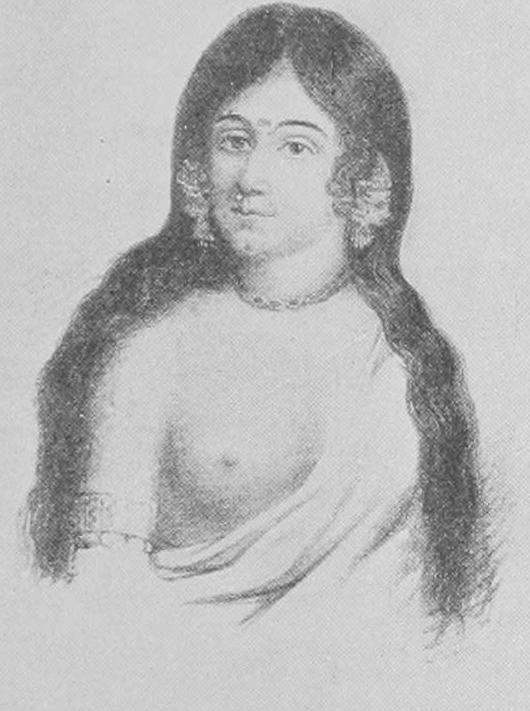
A RAJPOOTNI,
Returned from Batlang in the Jumna.
PORTRAITS OF A RĀJPUTNI, A RĀJPUT, A MEWĀTI AND GUSĀĪN.
To face page 708.
—It is universally admitted
that there is no better criterion of the refinement of a nation
than the condition Of the fair sex therein. As it is elegantly
expressed by Comte Ségur,
“Leur sort est une boussole sûreune boussole sûre pour
le premier regard d’un étranger qui arrive dans un pays inconnu.”[3]
Unfortunately, the habitual seclusion of the higher classes of
females in the East contracts the sphere of observation in regard
to their influence on society; but, to borrow again from our
ingenious author,
“les hommes font les lois, les femmes font
les mœurs”; and their incarceration in Rajasthan by no means
lessens the application of the adage to that country. Like the
magnetic power, however latent, their attraction is not the less
certain.
“C’est aux hommes à faire des grandes choses, c’est
aux femmes à les inspirer,” is a maxim to which every Rajput
cavalier would subscribe, with whom the age of chivalry is not
fled, though ages of oppression have passed over him. He knows
there is no retreat into which the report of a gallant action will
not penetrate, and set fair hearts in motion to be the object of
his search. The bards, those chroniclers of fame, like the Jongleurs
of old, have everywhere access, to the palace as to the hamlet;
and a brilliant exploit travels with all the rapidity of a comet,
and clothed with the splendid decorations of poetry, from the
710Indian desert to the valley of the Jumna. If we cannot paint
the Rajput dame as invested with all the privileges which Ségur
assigns to the first woman,
“compagne de l’homme et son égale,
vivant par lui, pour lui, associée à son bonheur, à ses plaisirs,
à la puissance qu’il exerçait sur ce vaste univers,” she is
far removed from the condition which demands commiseration
[610].
—Like the ancient German or Scandinavian,
the Rajput consults her in every transaction; from her
ordinary actions he draws the omen of success, and he appends
to her name the epithet of
devi, or ‘godlike.’ The superficial
observer, who applies his own standard to the customs of all
nations, laments with an affected philanthropy the degraded
condition of the Hindu female, in which sentiment he would find
her little disposed to join. He particularly laments her want of
liberty, and calls her seclusion imprisonment. Although I
cordially unite with Ségur, who is at issue with his compatriot
Montesquieu on this part of discipline, yet from the knowledge
I do possess of the freedom, the respect, the happiness, which
Rajput women enjoy, I am by no means inclined to deplore
their state as one of captivity. The author of the
Spirit of Laws,
with the views of a closet philosopher, deems seclusion necessary
from the irresistible influence of climate on the passions; while
the chivalrous Ségur, with more knowledge of human nature,
draws the very opposite conclusion, asserting all restraints to
be injurious to morals. Of one thing we are certain, seclusion
of females could only originate in a moderately advanced stage
of civilization. Amongst hunters, pastors, and cultivators, the
women were required to aid in all external pursuits, as well as
internal economy. The Jews secluded not their women, and
the well, where they assembled to draw water, was the place
where marriages were contracted, as with the lower classes in
Rajputana. The inundations of the Nile, each house of whose
fertile valleys was isolated, is said to have created habits of
secluding women with the Egyptians; and this argument might
apply to the vast valleys of the Indus and Ganges first inhabited,
and which might have diffused example with the spread of population.
Assuredly, if India was colonized from the cradle of nations,
Central Asia, they did not thence bring these notions within the
Indus; for the Scythian women went to the opposite extreme,
711and were polyandrists.
[4] The desire of eradicating those impure
habits, described by Herodotus, that the slipper at the tent-door
should no longer be a sign, may have originated the opposite
extreme in a life of entire seclusion. Both polygamy and polyandry
originated in a mistaken view of the animal economy,
and of the first great command to people the earth: the one
was general amongst all the nations [611] of antiquity; the
other rare, though to be found in Scythia, India, and even amongst
the Natchez, in the new world; but never with the Rajput, with
whom monogamy existed during the patriarchal ages of India,
as amongst the Egyptians.
[5] Of all the nations of the world who
have habituated the female to a restricted intercourse with
society, whether Grecian, Roman, Egyptian, or Chinese, the
Rajput has given least cause to provoke the sentiment of pity;
for if deference and respect be proofs of civilization, Rajputana
must be considered as redundant in evidence of it. The uxoriousness
of the Rajput might be appealed to as indicative of the
decay of national morals; “
chez les barbares (says Ségur)
les
femmes ne sont rien: les mœurs de ces peuples s’adoucissent-t’-elles,
on compte les femmes pour quelque chose: enfin, se
corrompent-elles, les femmes sont tout”; and whether from this
decay, or the more probable and amiable cause of seeking, in
their society, consolation for the loss of power and independence,
the women are nearly everything with the Rajput.
It is scarcely fair to quote Manu as an authority for the proper
treatment of the fair sex, since many of his dicta by no means
tend to elevate their condition. In his lengthened catalogue of
things pure and impure he says, however, “The mouth of a
woman is constantly pure,”[6] and he ranks it with the running
waters and the sunbeam; he suggests that their names should
be “agreeable, soft, clear, captivating the fancy, auspicious,
ending in long vowels, resembling words of benediction.”[7]
712“Where females are honoured” (says Manu), “there the
deities are pleased; but where dishonoured, there all religious
rites become useless”: and he declares, “that in whatever
house a woman not duly honoured pronounces an imprecation,
that house, with all that belongs to it, shall utterly perish.”[8]
“Strike not, even with a blossom, a wife guilty of a hundred
faults,”[9] says another sage: a sentiment so delicate, that Reginald
de Born, the prince of troubadours, never uttered any more
refined.
However exalted the respect of the Rajput for the fair, he
nevertheless holds that
Nothing lovelier can be found
In woman, than to study household good [612].
—In the most tempestuous
period of the history of Mewar, when the Ranas broke asunder
the bonds which united them to the other chiefs of Rajasthan,
and bestowed their daughters on the foreign nobles incorporated
with the higher class of their own kin, the chief of Sadri, so often
mentioned, had obtained a princess to wife. There was a hazard
to domestic happiness in such unequal alliance, which the lord
713of Sadri soon experienced. To the courteous request, “Ranawatji,
fill me a cup of water,” he received a contemptuous refusal,
with the remark, that “The daughter of a hundred kings would
not become cup-bearer to the chieftain of Sadri.”—“Very well,”
replied the plain soldier, “you may return to your father’s house,
if you can be of no use in mine.” A messenger was instantly
sent to the court, and the message, with every aggravation, was
made known; and she followed on the heels of her messenger.
A summons soon arrived for the Sadri chief to attend his sovereign
at the capital. He obeyed; and arrived in time to give his
explanation just as the Rana was proceeding to hold a full court.
As usual, the Sadri chief was placed on his sovereign’s right hand,
and when the court broke up, the heir-apparent of Mewar, at a
preconcerted sign, stood at the edge of the carpet, performing
the menial office of holding the slippers of the chief. Shocked
at such a mark of extreme respect, he stammered forth some
words of homage, his unworthiness, etc.; to which the Rana
replied, “As my son-in-law, no distinction too great can be
conferred: take home your wife, she will never again refuse
you a cup of water” [613].
[10]Could authority deemed divine ensure obedience to what is
considered a virtue in all ages and countries, the conjugal duties
of the Rajputs are comprehended in the following simple text:
“Let mutual fidelity continue to death; this, in few words,
may be considered as the supreme law between husband and wife.”[11]
—That this law governed the
714Rajputs in past ages, as well as the present, in as great a degree
as in other stages of society and other countries, we cannot doubt.
Nor will the annals of any nation afford more numerous or more
sublime instances of female devotion, than those of the Rajputs;
and such would never have been recorded, were not the incentive
likely to be revered and followed. How easy would it be to cite
examples for every passion which can actuate the human mind!
Do we desire to see a model of unbounded devotion, resignation,
and love, let us take the picture of Sita, as painted by the Milton
of their silver age, than which nothing more beautiful or sentimental
may be culled even from Paradise Lost. Rama was
about to abandon his faithful wife for the purpose of becoming
a Vana-prastha or hermit, when she thus pours out her ardent
desire to partake of his solitude.
A woman’s bliss is found, not in the smile
Of father, mother, friend, nor in herself:
Her husband is her only portion here,
Her heaven hereafter. If thou indeed
Depart this day into the forest drear,
I will precede, and smooth the thorny way.
A gay recluse
On thee attending, happy shall I feel
Within the honey-scented grove to roam,
For thou e’en here canst nourish and protect;
And therefore other friend I cannot need.
To-day most surely with thee will I go,
And thus resolved, I must not be deny’d.
Roots and wild fruit shall be my constant food;
Nor will I near thee add unto thy cares,
Nor lag behind, nor forest-food refuse,
But fearless traverse every hill and dale.
Thus could I sweetly pass a thousand years;
But without thee e’en heaven would lose its charms [614].
Pleased to embrace thy feet, I will reside
In the rough forest as my father’s house.
Void of all other wish, supremely thine,
Permit me this request—I will not grieve,
I will not burden thee—refuse me not.
But shouldst thou, Raghuvu, this prayer deny
Know, I resolve on death.
Vide Ward, On the History, Literature, and Mythology of the Hindus,
ed. 1815, ii. p. 308 ff. [Cp. Manu, vi. 2 ff.]
715The publication of Mr. Wilson’s specimens of the Hindu drama
has put the English public in possession of very striking features
of ancient Hindu manners, amongst which conjugal fidelity and
affection stand eminently conspicuous. The Uttara Rama
Charitra, the Vikrama and Urvasi, and the Mudra Rakshasa,
contain many instances in point. In the latter piece occurs an
example, in comparatively humble life, of the strong affection
of a Hindu wife. Chandana Das, like Antonio in the Merchant
of Venice, is doomed to die, to save his friend. His wife follows
him to the scene of execution, with their only child, and the
succeeding dialogue ensues:
- Chand.
- Withdraw, my love, and lead our boy along.
- Wife.
- Forgive me, husband,—to another world
-
- Thy steps are bound, and not to foreign realms,
-
- Whence in due time thou homeward wilt return;
-
- No common farewell our leave-taking now
-
- Admits, nor must the partner of thy fate
-
- Leave thee to trace thy solitary way.
- Chand.
- What dost thou mean?
- Wife.
- To follow thee in death.
- Chand.
- Think not of this—our boy’s yet tender years
-
- Demand affectionate and guardian care.
- Wife.
- I leave him to our household gods, nor fear
-
- They will desert his youth:—come, my dear boy,
-
- And bid thy sire a long and last farewell.
—The annals of no nation on earth record
a more ennobling or more magnanimous instance of female
loyalty than that exemplified by Dewaldai, mother of the
Bannaphar brothers, which will at once illustrate the manners
of the Rajput fair, and their estimation and influence in society.
The last Hindu emperor of Delhi, the chivalrous Prithiraj of
the Chauhan race, had abducted the daughter of the prince of
Sameta. Some of the wounded who had covered his retreat
were assailed and put to death by Parmal, the Chandel prince of
Mahoba.[12] In order to avenge this insult, the emperor had no
sooner conveyed his bride to Delhi than he invaded the territory
of the Chandel, whose troops were cut to pieces at Sirswa,[13] the
716advanced post of his kingdom. While [615] pursuing his success,
the Chandel called a council, and by the advice of his queen
Malandevi demanded a truce of his adversary, on the plea of the
absence of his chieftains Alha and Udala. The brother of the
bard of Mahoba was the envoy, who found the Chauhan ready
to cross the Pahuj. He presented his gifts, and adjured him,
“as a true Rajput, not to take them at such disadvantage.”
The gifts were accepted, and the Chauhan pledged himself, “albeit
his warriors were eager for the fight,” to grant the truce demanded;
and having dismissed the herald, he inquired of his own bard, the
prophetic Chand, the cause of the disaffection which led to the
banishment of the Bannaphar; to which he thus replies: “Jasraj
was the leader of the armies of Mahoba when his sovereign was
defeated and put to flight by the wild race of Gonds; Jasraj
repulsed the foe, captured Garha their capital, and laid his head
at his sovereign’s feet. Parmal returning with victory to Mahoba,
in gratitude for his service, embraced the sons of Jasraj, and
placed them in his honours and lands, while Malandevi the queen
made no distinction between them and her son.” The fief of
the young Bannaphar[14] chieftains was at the celebrated fortress
Kalanjar, where their sovereign happening to see a fine mare
belonging to Alha, desired to possess her, and being refused, so
far forgot past services as to compel them to abandon the country.
On retiring they fired the estates of the Parihara chief who had
instigated their disgrace. With their mother and families they
repaired to Kanauj, whose monarch received them with open
arms, assigning lands for their maintenance. Having thus
premised the cause of banishment, Chand conducts us to Kanauj,
at the moment when Jagnakh the bard was addressing the exiles
on the dangers of Mahoba.
—“The Chauhan is encamped on the
plains of Mahoba; Narsingh and Birsingh have fallen, Sirswa is
given to the flames, and the kingdom of Parmal laid waste by
the Chauhan. For one month a truce has been obtained: while
to you I am sent for aid in his griefs. Listen, O sons of Bannaphar;
sad have been the days of Malandevi since you left Mahoba!
Oft she looks towards Kanauj; and while she recalls you to
717mind, tears gush from her eyes and she exclaims, ‘The fame of
the Chandel is departing’; but when gone, O sons of Jasraj,
great will be your self-accusing sorrow: yet, think of Mahoba.”
“Destruction to Mahoba! Annihilation to the Chandel who,
without fault [616], expelled us our home: in whose service fell
our father, by whom his kingdom was extended. Send the
slanderous Parihara—let him lead your armies against the heroes
of Delhi. Our heads were the pillars of Mahoba; by us were
the Gonds expelled, and their strongholds Deogarh and Chandbari
added to his sway. We maintained the field against the Jadon,
sacked Hindaun,[15] and planted his standard on the plains of
Katehr.[16] It was I (continued Alha) who stopped the sword of
the conquering Kachhwaha[17]—The amirs of the Sultan fled
before us.—At Gaya we were victorious, and added Rewa[18] to
his kingdom. Antarved[19] I gave to the flames, and levelled to
the ground the towns of Mewat.[20] From ten princes did Jasraj
bring spoil to Mahoba. This have we done; and the reward is
exile from our home! Seven times have I received wounds in
his service, and since my father’s death gained forty battles;
and from seven has Udala conveyed the record of victory[21] to
Parmal. Thrice my death seemed inevitable. The honour of
his house I have upheld—yet exile is my reward!”
The bard replies—“The father of Parmal left him when a
child to the care of Jasraj. Your father was in lieu of his own;
the son should not abandon him when misfortune makes him call
on you. The Rajput who abandons his sovereign in distress will
be plunged into hell. Then place on your head the loyalty of
your father. Can you desire to remain at Kanauj while he is in
718trouble, who expended thousands in rejoicings for your birth?
Malandevi (the queen), who loves you as her own, presses your
return. She bids me demand of Dewaldai fulfilment of the oft-repeated
vow, that your life and Mahoba, when endangered, were
inseparable. The breaker of vows, despised on earth, will be
plunged into hell, there to remain while sun and moon endure.”
Dewaldai heard the message of the queen. “Let us fly to
Mahoba,” she [617] exclaimed. Alha was silent, while Udala said
aloud, “May evil spirits seize upon Mahoba!—Can we forget
the day when, in distress, he drove us forth?—Return to Mahoba—let
it stand or fall, it is the same to me; Kanauj is henceforth
my home.”
“Would that the gods had made me barren,” said Dewaldai,
“that I had never borne sons who thus abandon the paths of
the Rajput, and refuse to succour their prince in danger!” Her
heart bursting with grief, and her eyes raised to heaven, she
continued: “Was it for this, O universal lord, thou mad’st me
feel a mother’s pangs for these destroyers of Bannaphar’s fame?
Unworthy offspring! the heart of the true Rajput dances with
joy at the mere name of strife—but ye, degenerate, cannot be
the sons of Jasraj—some carl must have stolen to my embrace,
and from such ye must be sprung.” The young chiefs arose,
their faces withered in sadness. “When we perish in defence
of Mahoba, and covered with wounds, perform deeds that will
leave a deathless name; when our heads roll in the field—when
we embrace the valiant in fight, and treading in the footsteps
of the brave, make resplendent the blood of both lines, even in
the presence of the heroes of the Chauhan, then will our mother
rejoice.”
The envoy having, by this loyal appeal of Dewaldai, attained
the object of his mission, the brothers repair to the monarch of
Kanauj,[22] in order to ask permission to return to Mahoba; this
is granted, and they are dismissed with magnificent gifts, in which
the bardic herald participated;[23] and the parting valediction was
719“preserve the faith of the Rajputs.” The omens during the
march were of the worst kind: as Jagnakh expounded them,
Alha with a smile replied, “O bard, though thou canst dive into
the dark recesses of futurity, to the brave all omens are happy,[24]
even though our heroes shall fall, and the fame of the Chandel
must depart; thus in secret does my soul assure me.” The
saras[25] was alone on the right—the eagle as he flew dropped his
prey—the chakwa[26] “separated“separated from his mate—drops fell from
the eyes of the warlike steed—the siyal[27] sent forth sounds of
lamentation; spots were seen on the disc of the sun” [618].
The countenance of Lakhan fell;[28] these portents filled his soul
with dismay: but Alha said, “though these omens bode death,
yet death to the valiant, to the pure in faith, is an object of desire
not of sorrow. The path of the Rajput is beset with difficulties,
rugged, and filled with thorns; but he regards it not, so it but
conducts to battle.”—“To carry joy to Parmala alone occupied
their thoughts: the steeds bounded over the plain like the swift-footed
deer.” The brothers, ere they reached Mahoba, halted
to put on the saffron robe, the sign of “no quarter” with the
Rajput warrior. The intelligence of their approach filled the
Chandela prince with joy, who advanced to embrace his defenders,
and conduct them to Mahoba; while the queen Malandevi came
to greet Dewaldai, who with the herald bard paid homage, and
returned with the queen to the city. Rich gifts were presented,
gems resplendent with light. The queen sent for Alha, and
extending her hands over his head, bestowed the asis[29] (blessing)(blessing)
as kneeling he swore his head was with Mahoba, and then waved
a vessel filled with pearls over his head, which were distributed
to his followers.[30]
720The bardic herald was rewarded with four villages. We are
then introduced to the Chauhan camp and council, where Chand
the bard is expatiating on the return of the Bannaphars with the
succours of Kanauj. He recommends his sovereign to send a
herald to the Chandel to announce the expiration of the truce,
and requiring him to meet him in the field, or abandon Mahoba.
According to the bard’s advice, a dispatch was transmitted to
Parmal, in which the cause of war was recapitulated—the murder
of the wounded; and stating that, according to Rajput faith,
he had granted seven days beyond the time demanded, “and
although so many days had passed since succour had arrived
from Kanauj, the lion-horn had not yet sounded (singhnad)”:
adding, “if he abandon all desire of combat, let him proclaim
his vassalage to Delhi, and abandon Mahoba.”
Parmal received the hostile message in despair; but calling
his warriors around him, he replied to the herald of the Chauhan,
that “on the day of the sun, the first of the month, he would join
him in strife” [619].
“On the day sacred to Sukra (Friday), Prithiraj sounded the
shell, while the drums thrice struck proclaimed the truce concluded.[31]
The standard was brought forth, around which the
warriors gathered; the cup circulated, the prospect of battle
filled their souls with joy. They anointed their bodies with
fragrant oils, while the celestial Apsaras with ambrosial oils and
heavenly perfumes anointed their silver forms, tinged their eyelids,
and prepared for the reception of heroes.[32] The sound of the
war-shell reached Kailas; the abstraction of Iswara was at an
end—joy seized his soul at the prospect of completing his chaplet
of skulls (mundamala). The Yoginis danced with joy, their faces
sparkled with delight, as they seized their vessels to drink the
blood of the slain. The devourers of flesh, the Palankashas, sung
721songs of triumph at the game of battle between the Chauhan and
Chandel.”
In another measure, the bard proceeds to contrast the occupations
of his heroes and the celestials preparatory to the combat,
which descriptions are termed rupaka. “The heroes gird on
their armour, while the heavenly fair deck their persons. They
place on their heads the helm crowned with the war-bell (viragantha),
these adjust the corset; they draw the girths of the war-steed,
the fair of the world of bliss bind the anklet of bells; nets
of steel defend the turban’s fold, they braid their hair with golden
flowers and gems; the warrior polishes his falchion—the fair
tints the eyelid with anjan;[33] the hero points his dagger, the fair
paints a heart on her forehead; he braces on his ample buckler—she
places the resplendent orb in her ear; he binds his arms
with a gauntlet of brass—she stains her hands with the henna.
The hero decorates his hand with the tiger-claw[34]—the Apsaras
ornaments with rings and golden bracelets; the warrior shakes
the ponderous lance—the heavenly fair the garland of love[35] to
decorate those who fall in the fight; she binds on a necklace
of pearls, he a mala of the tulasi.[36] The warrior strings his
bow—the fair assume their killing [620] glances. Once more
the heroes look to their girths, while the celestial fair prepare
their cars.”
After the bard has finished his rupaka, he exclaims, “Thus
says Chand, the lord of verse; with my own eyes have I seen
what I describe.” It is important to remark, that the national
faith of the Rajput never questions the prophetic power of their
chief bard, whom they call Trikala, or cognoscent of the past,
the present, and the future—a character which the bard has
enjoyed in all ages and climes; but Chand was the last whom
they admitted to possess supernatural vision.
722We must now return to Mahoba, where a grand council had
assembled at a final deliberation; at which, shaded by screens,
the mother of the Bannaphars, and the queen Malandevi, were
present. The latter thus opens the debate: “O mother of Alha,
how may we succeed against the lord of the world?[37] If defeated,
lost is Mahoba; if we pay tribute, we are loaded with
shame.” Dewaldai recommends hearing seriatim the opinions
of the chieftains, when Alha thus speaks: “Listen, O mother,
to your son; he alone is of pure lineage who, placing loyalty on
his head, abandons all thoughts of self, and lays down his life for
his prince; my thoughts are only for Parmal. If she lives she
will show herself a woman, or emanation of Parvati.[38] The
warriors of Sambhar shall be cut in pieces. I will so illustrate
the blood of my fathers, that my fame shall last for ever. My
son Indal, O prince! I bequeath to you, and the fame of Dewaldai
is in your keeping.”
The queen thus replies: “The warriors of the Chauhan are
fierce as they are numerous; pay tribute, and save Mahoba.”
The soul of Udala inflamed, and turning to the queen, “Why
thought you not thus when you slew the defenceless? but then
I was unheard. Whence now your wisdom? thrice I beseeched
you to pardon. Nevertheless, Mahoba is safe while life remains
in me, and in your cause, O Parmal! we shall espouse celestial
brides.”
“Well have you spoken, my son,” said Dewaldai, “nothing
now remains but to make thy parent’s milk resplendent by thy
deeds. The call of the peasant driven [621] from his home meets
the ear, and while we deliberate, our villages are given to the
flames.” But Parmal replied: “Saturn[39] rules the day, to-morrow
we shall meet the foe.” With indignation Alha turned
to the king: “He who can look tamely on while the smoke
ascends from his ruined towns, his fields laid waste, can be no
Rajput—he who succumbs to fear when his country is invaded,
his body will be plunged into the hell of hells, his soul a wanderer
in the world of spirits for sixty thousand years; but the warrior
723who performs his duty will be received into the mansion of the
sun, and his deeds will last for ever.”
But cowardice and cruelty always accompany each other,
nor could all the speeches of the brothers “screw his courage to
the sticking place.” Parmal went to his queen, and gave fresh
vent to his lamentation. She upbraided his unmanly spirit, and
bid him head his troops and go forth to the fight. The heroes
embraced their wives for the last time, and with the dawn performed
their pious rites. The Bannaphar offered oblations to the
nine planets, and having adored the image of his tutelary god,
he again put the chain round his neck;[40] then calling his son
Indal, and Udala his brother, he once more poured forth his vows
to the universal mother “that he would illustrate the name of
Jasraj, and evince the pure blood derived from Dewaldai, whene’er
he met the foe.”—“Nobly have you resolved,” said Udala, “and
shall not my kirwan[41] also dazzle the eyes of Sambhar’s lord?
shall he not retire from before me?”—“Farewell, my children,”
said Dewaldai, “be true to your salt, and should you lose your
heads for your prince, doubt not you will obtain the celestial
crown.” Having ceased, the wives of both exclaimed, “What
virtuous wife survives her lord? for thus says Gauriji,[42] ‘the
woman, who survives her husband who falls in the field of battle,
will never obtain bliss, but wander a discontented ghost in the
region of unhallowed spirits.’”
This is sufficient to exhibit the supreme influence of women,
not only on, but also in society.
The extract is taken from the Bardic historian, when Hindu
customs were pure, and the Chauhan was paramount sovereign
of India. It is worth while to compare it with another written
six centuries after the conquest by the Muhammadans; although
six dynasties—namely, Ghazni, Ghor, Khilji [622], Sayyid, Lodi,
and Mogul, numbering more than thirty kings, had intervened,
yet the same uncontrollable spirit was in full force, unchangeable
even in misfortune. Both Hindu and Persian historians expatiate
with delight on the anecdote; but we prefer the narrative of the
ingenuous Bernier, under whose eye the incident occurred.
724—In the civil war for empire
amongst the sons of Shah Jahan, when Aurangzeb opened his
career by the deposal of his father and the murder of his brothers,
the Rajputs, faithful to the emperor, determined to oppose him.
Under the intrepid Rathor Jaswant Singh, thirty thousand
Rajputs, chiefly of that clan, advanced to the Nerbudda, and with
a magnanimity amounting to imprudence, they permitted the
junction of Murad with Aurangzeb, who, under cover of artillery
served by Frenchmen, crossed the river almost unopposed.
Next morning the action commenced, which continued throughout
the day. The Rajputs behaved with their usual bravery;
but were surrounded on all sides, and by sunset left ten thousand
dead on the field.
[43] The Maharaja retreated to his own country,
but his wife, a daughter of the Rana of Udaipur, “disdained (says
Ferishta) to receive her lord, and shut the gates of the castle.”
Bernier, who was present, says, “I cannot forbear to relate
the fierce reception which the daughter of the Rana gave to her
husband Jeswunt Singh [Jessom Seingue], after his defeat and
flight. When she heard he was nigh, and had understood what
had passed in the battle; that he had fought with all possible
courage; that he had but four or five hundred men left; and at
last, no longer able to resist the enemy, had been forced to retreat;
instead of sending some one to condole him in his misfortunes,
she commanded in a dry mood to shut the gates of the castle, and
not to let this infamous man enter; that he was not her husband;
that the son-in-law of the great Rana could not have so mean a
soul; that he was to remember, that being grafted into so
illustrious a house, he was to imitate its virtue; in a word, he
was to vanquish, or to die. A moment after, she was of another
humour; she commands a pile of wood to be laid, that she might
725burn herself; that they abused her; that her husband must
needs be dead; that it could not be otherwise. And a little
while after, she was seen to change countenance, to [623] fall into
a passion, and break into a thousand reproaches against him. In
short, she remained thus transported eight or nine days, without
being able to resolve to see her husband, till at last her mother
coming, brought her in time to herself, composed by assuring her
that as soon as the Raja had but refreshed himself he would raise
another army to fight Aurangzeb, and repair his honour. By
which story one may see,” says Bernier, “a pattern of the
courage of the women in that country”; and he adds this philosophical
corollary on this and the custom of satis, which he had
witnessed: “There is nothing which opinion, prepossession,
custom, hope, and the point of honour, may not make men do or
suffer.”[44]
—The romantic history of the Chauhan
emperor of Delhi abounds in sketches of female character; and
in the story of his carrying off Sanjogta, the princess of Kanauj,
we have not only the individual portrait of the Helen of her
country, but in it a faithful picture of the sex. We see her, from
the moment when, rejecting the assembled princes, she threw the
“garland of marriage” round the neck of her hero, the Chauhan,
abandon herself to all the influences of passion—mix in a combat
of five days’ continuance against her father’s array, witness his
overthrow, and the carnage of both armies, and subsequently,
by her seductive charms, lulling her lover into a neglect of every
princely duty. Yet when the foes of his glory and power invade
India, we see the enchantress at once start from her trance of
pleasure, and exchanging the softer for the sterner passions, in
accents not less strong because mingled with deep affection, she
conjures him, while arming him for the battle, to die for his fame,
declaring that she will join him in “the mansions of the sun.”
Though it is difficult to extract, in passages sufficiently condensed,
what may convey a just idea of this heroine, we shall attempt it
in the bard’s own language, rendered into prose. He announces
the tidings of invasion by the medium of a dream, which the
Chauhan thus relates:
726“‘This night, while in the arms of sleep, a fair, beautiful as
Rambha, rudely seized my arm; then she assailed you, and
while you were struggling, a mighty elephant,[45] infuriated, and
hideous as a demon, bore down upon me. Sleep fled—nor
Rambha nor demon remained—but my heart was panting, and
[624] my quivering lips muttering Har! Har![46] What is decreed
the gods only know.’
“Sanjogta replied, ‘Victory and fame to my lord! O, sun
of the Chauhans, in glory, or in pleasure, who has tasted so deeply
as you? To die is the destiny not only of man but of the gods:
all desire to throw off the old garment; but to die well is to live
for ever. Think not of self, but of immortality; let your sword
divide your foe, and I will be your ardhanga[47] hereafter.’
“The“The king sought the bard, who expounded the dream, and the
Guru wrote an incantation, which he placed in his turban. A
thousand brass vessels of fresh milk were poured in libations to
the sun and moon. Ten buffaloes were sacrificed to the supporters
of the globe, and gifts were made to all. But will offerings of
blood or libations of milk arrest what is decreed? If by these
man could undo what is ordained, would Nala or the Pandus
have suffered as they did?”
While the warriors assemble in council to consult on the best
mode of opposing the Sultan of Ghazni, the king leaves them to
deliberate, in order to advise with Sanjogta. Her reply is
curious:
“Who asks woman for advice? The world deems their
understanding shallow; even when truths issue from their lips,
none listen thereto. Yet what is the world without woman?
We have the forms of Sakti[48] with the fire of Siva; we are at once
thieves and sanctuaries; we are vessels of virtue and of vice—of
knowledge and of ignorance. The man of wisdom, the
astrologer, can from the books calculate the motion and course
of the planets; but in the book of woman he is ignorant: and
this is not a saying of to-day, it ever has been so: our book has
not been mastered, therefore, to hide their ignorance, they say,
727in woman there is no wisdom! Yet woman shares your joys and
your sorrows. Even when you depart from the mansion of the
sun, we part not. Hunger and thirst we cheerfully partake with
you; we are as the lakes, of which you are the swans; what are
when absent from our bosoms?”
The army having assembled, and all being prepared to march
against the Islamite, in the last great battle which subjugated
India, the fair Sanjogta armed her lord for the encounter. InIn
vain she sought the rings of his corslet; her eyes were [625] fixed
on the face of the Chauhan, as those of the famished wretch who
finds a piece of gold. The sound of the drum reached the ear of
the Chauhan; it was as a death-knell on that of Sanjogta: and
as he left her to head Delhi’s heroes, she vowed that henceforward
water only should sustain her. “I shall see him again in the
region of Surya, but never more in Yoginipur.”[49] Her prediction
was fulfilled: her lord was routed, made captive and slain; and,
faithful to her vow, she mounted the funeral pyre.
—Were we called upon to give a pendant
for Lucretia, it would be found in the queen of Ganor.
[50] After
having defended five fortresses against the foe, she retreated to
her last stronghold on the Nerbudda, and had scarcely left the
bark, when the assailants arrived in pursuit. The disheartened
defenders were few in number, and the fortress was soon in
possession of the foe, the founder of the family now ruling in
Bhopal. The beauty of the queen of Ganor was an allurement
only secondary to his desire for her country, and he invited her
to reign over it and him. Denial would have been useless, and
would have subjected her to instant coercion, for the Khan
awaited her reply in the hall below; she therefore sent a message
of assent, with a complimentary reflection on his gallant conduct
and determination of pursuit; adding, that he merited her hand
for his bravery, and might prepare for the nuptials, which should
be celebrated on the terrace of the palace. She demanded two
hours for unmolested preparation, that she might appear in
appropriate attire, and with the distinction her own and his rank
demanded.
728Ceremonials, on a scale of magnificence equal to the shortness
of the time, were going on. The song of joy had already stifled
the discordant voice of war, and at length the Khan was summoned
to the terrace. Robed in the marriage garb presented to him by
the queen, with a necklace and aigrette of superb jewels from the
coffers of Ganor, he hastened to obey the mandate, and found that
fame had not done justice to her charms. He was desired to be
seated, and in conversation full of rapture on his side, hours were
as minutes while he gazed on the beauty of the queen. But
presently his countenance fell—he complained of heat; punkas
and water were brought, but they availed him not, and he began
to tear the bridal garments from his frame, when the queen thus
addressed him [626]: “Know, Khan, that your last hour is
come; our wedding and our death shall be sealed together. The
vestments which cover you are poisoned; you had left me no
other expedient to escape pollution.” While all were horror-struck
by this declaration, she sprung from the battlements into
the flood beneath. The Khan died in extreme torture, and was
buried on the road to Bhopal; and, strange to say, a visit to his
grave has the reputation of curing the tertian of that country.[51]
—We may give another anecdote
illustrative of this extreme delicacy of sentiment, but without
so tragical a conclusion. The celebrated Raja Jai Singh of Amber
729had espoused a princess of Haraoti, whose manners and garb,
accordant with the simplicity of that provincial capital, subjected
her to the badinage of the more refined court of Amber,
whose ladies had added the imperial costume to their own native
dress. One day being alone with the prince, he began playfully
to contrast the sweeping jupe of Kotah with the more scanty
robe of the belles of his own capital; and taking up a pair of
scissors, said he would reduce it to an equality with the latter.
Offended at such levity, she seized his sword, and assuming a
threatening attitude, said, “that in the house to which she had
the honour to belong, they were not habituated to jests of this
nature; that mutual respect was the guardian, not only of
happiness but of virtue”; and she assured him, that if he ever
again so insulted her, he would find that the daughter of Kotah
could use a sword more effectively than the prince of Amber the
scissors; adding, that she would prevent any future scion of
her house from being subjected to similar disrespect, by declaring
such intermarriages
talak, or forbidden, which interdict I believe
yet exists.
[52]—I will append an anecdote
related by the celebrated Zalim Singh, characteristic of the
presence of mind, prowess, and physical strength of the Rajput
women. To attend and aid in the minutiae of husbandry is by
no means uncommon with them, as to dress and carry the meals
of their husbands to the fields is a general practice. In the jungle
which skirts the knolls of Pachpahar, a huge bear assaulted a
Rajputni as she was carrying her husband’s dinner. As he
approached with an air of gallantry upon his hind-legs, doubting
whether the food or herself [627] were the intended prey, she
retreated behind a large tree, round the trunk of which Bruin,
still in his erect attitude, tried all his powers of circumvention
to seize her. At length, half exhausted, she boldly grasped his
paws, and with so vigorous a hold that he roared with pain, while
in vain, with his short neck, did he endeavour to reach the powerful
hand which fixed him. While she was in this dilemma, a
Pardesi (a foreign soldier of the State) happened to be passing
730to the garrison of Gagraun, and she called out to him in a voice
of such unconcern to come and release her for a time, that he
complied without hesitation. She had not retired, however,
above a dozen yards ere he called loudly for her return, being
scarcely able to hold his new friend; but laughingly recommending
perseverance, she hastened on, and soon returned with her
husband, who laid the monster prostrate with his matchlock,
and rescued the Pardesi from his unpleasing predicament.
[53]Such anecdotes might be multiplied ad infinitum; but I will
conclude with one displaying the romantic chivalry of the Rajput,
and the influence of the fair in the formation of character; it
is taken from the annals of Jaisalmer, the most remote of the
States of Rajasthan, and situated in the heart of the desert, of
which it is an oasis.
—Raningdeo was lord of Pugal, a fief
of Jaisalmer; his heir, named Sadhu, was the terror of the
desert, carrying his raids even to the valley of the Indus, and on
the east to Nagor. Returning from a foray, with a train of
captured camels and horses, he passed by Aurint, where dwelt
Manik Rao, the chief of the Mohils, whose rule extended over
1440 villages. Being invited to partake of the hospitality of
the Mohil, the heir of Pugal attracted the favourable regards of
the old chieftain’s daughter:
She loved him for the dangers he had passed;
for he had the fame of being the first riever of the desert. Although
betrothed to the heir of the Rathor of Mandor, she signified
her wish to renounce the throne to be the bride of the chieftain
of Pugal; and in spite of the dangers he provoked, and contrary
to the Mohil chief’s advice, Sadhu, as a gallant Rajput, dared
not reject the overture, and he promised “to accept the coco,”[54]
if sent in form to Pugal [628]. In due time it came, and the
nuptials were solemnized at Aurint. The dower was splendid;
gems of high price, vessels of gold and silver, a golden bull, and a
train of thirteen dewadharis,[55] or damsels of wisdom and penetration.
731Arankanwal, the slighted heir of Mandor, determined on
revenge, and with four thousand Rathors planted himself in
the path of Sadhu’s return, aided by the Sankhla Mehraj, whose
son Sadhu had slain. Though entreated to add four thousand
Mohils to his escort, Sadhu deemed his own gallant band of seven
hundred Bhattis sufficient to convey his bride to his desert abode,
and with difficulty accepted fifty, led by Meghraj, the brother
of the bride.
The rivals encountered at Chondan, where Sadhu had halted
to repose; but the brave Rathor scorned the advantage of
numbers, and a series of single combats ensued, with all the forms
of chivalry. The first who entered the lists was Jaitanga, of
the Pahu clan, and of the kin of Sadhu. The enemy came upon
him by surprise while reposing on the ground, his saddle-cloth
for his couch, and the bridle of his steed twisted round his arm;
he was soon recognized by the Sankhla, who had often encountered
his prowess, on which he expatiated to Arankanwal, who sent an
attendant to awake him; but the gallant Panch Kalyan (for
such was the name of his steed) had already performed this
service, and they found him upbraiding white-legs[56] for treading
upon him. Like a true Rajput, “toujours prêt,” he received the
hostile message, and sent the envoy back with his compliments,
and a request for some amal or opium, as he had lost his own
supply. With all courtesy this was sent, and prepared by the
domestics of his antagonist; after taking which he lay down
to enjoy the customary siesta. As soon as he awoke, he prepared
for the combat, girt on his armour, and having reminded Panch
Kalyan of the fields he had won, and telling him to bear him well
that day, he mounted and advanced. The son of Chonda admiring
his sang-froid, and the address with which he guided his steed,
commanded Jodha Chauhan, the leader of his party, to encounter
the Pahu. “Their two-edged swords soon clashed in combat”;
but the gigantic Chauhan fell beneath the Bhatti, who, warmed
732with the fight, plunged amidst his foes, encountering all he
deemed worthy of his assault.
The fray thus begun, single combats and actions of equal
parties followed, the [629] rivals looking on. At length Sadhu
mounted: twice he charged the Rathor ranks, carrying death
on his lance; each time he returned for the applause of his bride,
who beheld the battle from her car. Six hundred of his foes
had fallen, and nearly half his own warriors. He bade her a last
adieu, while she exhorted him to the fight, saying, “she would
witness his deeds, and if he fell, would follow him even in death.”
Now he singled out his rival Arankanwal,[57] who was alike eager
to end the strife, and blot out his disgrace in his blood. They
met: some seconds were lost in a courteous contention, each
yielding to his rival the first blow, at length dealt out by Sadhu
on the neck of the disappointed Rathor. It was returned with
the rapidity of lightning, and the daughter of the Mohil saw the
steel descend on the head of her lover. Both fell prostrate to
the earth: but Sadhu’s soul had sped; the Rathor had only
swooned. With the fall of the leaders the battle ceased; and
the fair cause of strife, Karamdevi, at once a virgin, a wife, and
a widow, prepared to follow her affianced. Calling for a sword,
with one arm she dissevered the other, desiring it might be conveyed
to the father of her lord—“tell him such was his daughter.”
The other she commanded to be struck off, and given, with her
marriage jewels thereon, to the bard of the Mohils. The pile
was prepared on the field of battle; and taking her lord in her
embrace, she gave herself up to the devouring flames. The dissevered
limbs were disposed of as commanded; the old Rao of
Pugal caused the one to be burnt, and a tank was excavated on
the spot, which is still called after the heroine, “the lake of
Karamdevi.”
This encounter took place in S. 1462, A.D. 1406. The brunt
of the battle fell on the Sankhlas, and only twenty-five out of
three hundred and fifty left the field with their leader, Mehraj,
himself severely wounded. The rejected lover had four brothers
dangerously hurt; and in six months the wounds of Arankanwal
opened afresh: he died, and the rites to the manes of these rivals
733in love, the chhamasa[58] of Sadhu, and the duadasa[59] of Arankanwal,
were celebrated on the same day.
Without pausing to trace the moral springs of that devotion
which influenced the Mohila maiden, we shall relate the sequel
to the story (though out of place)[60] in illustration of the prosecution
of feuds throughout Rajasthan. The fathers [630] now took
up the quarrel of their sons; and as it was by the prowess of the
Sankhla vassal of Mandor that the band of Sadhu was discomfited,
the old Rao, Raningdeo, drew together the lances of Pugal, and
carried destruction into the fief of Mehraj. The Sankhlas yield in
valour to none of the brave races who inhabit the “region of
death”; and Mehraj was the father of Harbuji Sankhla, the
Palladin of Marudes, whose exploits are yet the theme of the
erratic bards of Rajasthan. Whether he was unprepared for the
assault, or overcome by numbers, three hundred of his kin and
clan moistened the sand-hills of the Luni with their blood. Raningdeo,
flushed with revenge and laden with spoil, had reached
his own frontier, when he was overtaken by Chonda of Mandor,
alike eager to avenge the loss of his son Arankanwal, and this
destructive inroad on his vassal. A desperate conflict ensued,
in which the Rao of Pugal was slain; and the Rathor returned
in triumph to Mandor.
Unequal to cope with the princes of Mandor, the two remaining
sons of Raningdeo, Tana and Mera, resolved to abandon their
faith, in order to preserve the point of honour, and “to take up
their father’s feud.”[61] At this period the king, Khizr Khan,[62]
was at Multan; to him they went, and by offers of service and
an open apostacy, obtained a force to march against Chonda,
who had recently added Nagor to his growing dominions. While
the brothers were thus negotiating, they were joined by Kilan,
the third son of their common sovereign, the Rawal of Jaisalmer,
who advised the use of chal, which with the Rajput means indifferently
stratagem or treachery, so that it facilitates revenge.
With the ostensible motive of ending their feuds, and restoring
tranquillity to their borderers, whose sole occupation was watching,
734burning, and devastating, Kilan offered a daughter in
marriage to Chonda, and went so far as to say, that if he suspected
aught unfair, he would, though contrary to custom and his own
dignity, send the Bhatti princess to Nagor. This course being
deemed the wisest, Chonda acquiesced in his desire “to extinguish
the feud (wair bujhana).”
—Fifty covered chariots were prepared
as the nuptial cortège, but which, instead of the bride and
her handmaids, contained the bravest men of Pugal.
[63] These
were preceded by a train of horses led by Rajputs, of whom seven
hundred also attended the camels laden with baggage, provisions,
and gifts, while a small armed [631] retinue brought up the rear.
The king’s troops, amounting to one thousand horse, remained
at a cautious distance behind. Chonda left Nagor to meet the
cavalcade and his bride, and had reached the chariots ere his
suspicions were excited. Observing, however, some matters
which little savoured of festivity, the Rathor commenced his
retreat. Upon this the chiefs rushed from their chariots and
camels, and the royal auxiliaries advancing, Chonda was assailed
and fell at the gate of Nagor; and friend and foe entering the
city together, a scene of general plunder commenced.
Once more the feud was balanced; a son and a father had
fallen on each side, and the petty Rao of Pugal had bravely maintained
the wair against the princes of Mandor. The point of
honour had been carried to the utmost bound by both parties,
and an opportunity of reconciliation was at hand, which prevented
the shadow of disgrace either to him who made or him
who accepted the overture. The Rathors dreaded the loss of
the recent acquisition, Nagor, and proposed to the Bhattis to
seal their pacification with the blood of their common foe. United,
they fell on the spoil-encumbered Tatars, whom they slew to a
man.[64] Their father’s feud thus revenged, the sons of Raningdeo
(who, as apostates from their faith, could no longer hold Pugal
in fief, which was retained by Kilan, who had aided their revenge)
retired amongst the Aboharia Bhattis, and their descendants are
now styled Momin Musalman Bhatti.
735From such anecdotes it will be obvious wherein consists the
point of honour with the Rajputs; and it is not improbable that
the very cause which has induced an opinion that females can
have no influence on the lords of the creation, namely, their
seclusion, operates powerfully in the contrary way.
—In spite of this
seclusion, the knowledge of their accomplishments and of their
personal perfections, radiates wherever the itinerant bard can
travel. Though invisible themselves, they can see; and accident
often favours public report, and brings the object of renown
within the sphere of personal observation: as in the case of Sadhu
and the Mohila maiden. Placed behind screens, they see the
youths of all countries, and there are occasions when permanent
impressions are made, during tournaments and other martial
exercises. Here we have just seen that the passion of the [632]
daughter of the Mohil was fostered at the risk of the destruction
not only of her father’s house, but also that of her lover; and as
the fourteen hundred and forty towns, which owned the sway
of the former, were not long after absorbed into the accumulating
territory of Mandor, this insult may have been the cause
of the extirpation of the Mohils, as it was of the Bhattis of
Pugal.
The influence of women on Rajput society is marked in every
page of Hindu history, from the most remote periods. What
led to the wars of Rama? the rape of Sita. What rendered
deadly the feuds of the Yadus? the insult to Draupadi. What
made prince Nala an exile from Narwar? his love for Damayanti.
What made Raja Bhartari abandon the throne of Avanti? the
loss of Pingali. What subjected the Hindu to the dominion of
the Islamite? the rape of the princess of Kanauj. In fine, the
cause which overturned kingdoms, commuted the sceptre to the
pilgrim’s staff, and formed the groundwork of all their grand
epics, is woman. In ancient, and even in modern times, she had
more than a negative in the choice of a husband, and this choice
fell on the gallant and the gay. The fair Draupadi was the prize
of the best archer, and the Pandu Bhima established his fame,
and bore her from all the suitors of Kampila. The princess of
Kanauj, when led through ranks of the princes of Hind, each
hoping to be the object of her choice, threw the marriage-garland
(barmala) over the neck of the effigy of the Chauhan, which her
736father in derision had placed as porter at the gate. Here was
incense to fame and incentive to gallantry![65]
In the same manner, as related in another part of this work,
did the princess of Kishangarh invite Rana Raj Singh to bear her
from the impending union with the emperor of the Moguls; and
abundant other instances could be adduced of the free agency
of these invisibles.
It were superfluous to reason on the effects of traditional
histories, such as these, on the minds and manners of the females of
Rajasthan. They form the amusement of their lives, and the
grand topic in all their conversaziones; they read them with
the Purohit, and they have them sung by the itinerant bard or
Dholi minstrel [633], who disseminates them wherever the Rajput
name extends. The Rajput mother claims her full share in the
glory of her son, who imbibes at the maternal fount his first
rudiments of chivalry; and the importance of this parental
instruction cannot be better illustrated than in the ever-recurring
simile, “make thy mother’s milk resplendent”; the full force
of which we have in the powerful, though overstrained expression
of the Bundi queen’s joy on the announcement of the heroic
death of her son: “the long-dried fountain at which he fed,
jetted forth as she listened to the tale of his death, and the marble
pavement, on which it fell, rent asunder.” Equally futile would
it be to reason on the intensity of sentiment thus implanted in
the infant Rajput, of whom we may say without metaphor, the
shield is his cradle, and daggers his playthings; and with whom
the first commandment is, “avenge thy father’s feud”; on
which they can heap text upon text, from the days of the great
Pandu moralist Vyasa to the not less influential bard of their
nation, the Trikala Chand.
737
—We now proceed to consider
another trait of Rajput character, exemplified in the practice of
female immolation, and to inquire whether religion, custom, or
affection has most share in such sacrifice. To arrive at the
origin of this rite, we must trace it to the recesses of mythology,
where we shall discover the precedent in the example of Sati,
who to avenge an insult to Iswara, in her own father’s omission
to ask her lord to an entertainment, consumed herself in the
presence of the assembled gods. With this act of fealty (sati)
the name of Daksha’s daughter has been identified; and her
regeneration and reunion to her husband, as the mountain-nymph
Mena, or Parvati, furnish the incentive to similar [634] acts.
In the history of these celestial beings, the Rajputni has a memorable
lesson before her, that no domestic differences can afford
exemption from this proof of faith: for Jupiter and Juno were
not more eminent examples of connubial discord than Mena and
Siva, who was not only alike unfaithful, but more cruel, driving
Mena from his Olympus (Kailas), and forcing her to seek refuge
in the murky caverns of Caucasus. Female immolation, therefore,
originated with the sun-worshipping Saivas, and was common
to all those nations who adored this the most splendid object of
the visible creation. Witness the Scythic Gete or Jat warrior of
the Jaxartes, who devoted his wife, horse, arms, and slaves, to
the flames; the “giant Gete” of Scandinavia, who forgot not
on the shores of the Baltic his Transoxianian habits; and the
Frisian Frank and Saxon descended from him, who ages after
omitted only the female. Could we assign the primary cause
of a custom so opposed to the first law of nature with the same
certainty that we can prove its high antiquity, we might be
enabled to devise some means for its abolition. The chief characteristic
of Satiism is its expiating quality: for by this act of
faith, the Sati not only makes atonement for the sins of her
husband, and secures the remission of her own, but has the joyful
assurance of reunion to the object whose beatitude she procures.
Having once imbibed this doctrine, its fulfilment is powerfully
aided by that heroism of character inherent to the Rajputni;
though we see that the stimulant of religion requires no aid even
738in the timid female of Bengal, who, relying on the promise of
regeneration, lays her head on the pyre with the most philosophical
composure.
Nothing short of the abrogation of the doctrines which pronounce
such sacrifices exculpatory can be effectual in preventing
them; but this would be to overturn the fundamental article of
their creed, the notion of metempsychosis. Further research
may disclose means more attainable, and the sacred Shastras are
at once the surest and the safest. Whoever has examined these
is aware of the conflict of authorities for and against cremation;
but a proper application of them (and they are the highest who
give it not their sanction) has, I believe, never been resorted to.
Vyasa, the chronicler of the Yadus, a race whose manners were
decidedly Scythic, is the great advocate for female sacrifice: he
(in the Mahabharata) pronounces the expiation perfect. But
Manu inculcates no such doctrine [635]; and although the state
of widowhood he recommends might be deemed onerous by the
fair sex of the west, it would be considered little hardship in the
east. “Let her emaciate her body, by living voluntarily on pure
flowers, roots, and fruit; but let her not, when her lord is deceased,
even pronounce the name of another man.” Again he says, “A
virtuous wife ascends to heaven, if, after the decease of her lord,
she devote herself to pious austerity; but a widow, who slights her
deceased husband by marrying again, brings disgrace on herself
here below, and shall be excluded from the seat of her lord.”[1]
These and many other texts, enjoining purity of life and
manners to the widow, are to be found in this first authority, but
none demanding such a cruel pledge of affection. Abstinence
from the common pursuits of life, and entire self-denial, are
rewarded by “high renown in this world, and in the next the
abode of her husband”; and procure for her the title of “sadhwi,
or the virtuous.” These are deemed sufficient pledges of affection
by the first of sages.[2] So much has been written on this subject
that we shall not pursue it further in this place; but proceed to
consider a still more inhuman practice, infanticide.
739Although custom sanctions, and religion rewards, a Sati, the
victim to marital selfishness, yet, to the honour of humanity,
neither traditionary adage nor religious text can be quoted in
support of a practice so revolting as infanticide. Man alone, of
the whole animal creation, is equal to the task of destroying his
offspring [636]: for instinct preserves what reason destroys.
The wife is the sacrifice to his egotism, and the progeny of her
own sex to his pride; and if the unconscious infant should escape
the influence of the latter, she is only reserved to become the
victim of the former at the period when life is most desirous of
extension. If the female reasoned on her destiny, its hardships
are sufficient to stifle all sense of joy, and produce indifference to
life. When a female is born, no anxious inquiries await the
mother—no greetings welcome the newcomer, who appears an
740intruder on the scene, which often closes in the hour of its birth.
But the very silence with which a female birth is accompanied
forcibly expresses sorrow; and we dare not say that many
compunctious visitings do not obtrude themselves on those
who, in accordance with custom and imagined necessity, are
thus compelled to violate the sentiments of nature. Families
may exult in the Satis which their cenotaphs portray,[3] but
none ever heard a Rajput boast of the destruction of his infant
progeny.
—What are the causes, we may ask,
sufficiently powerful to induce the suppression of a feeling which
every sentient being has in common for its offspring? To
suppose the Rajput devoid of this sentiment would argue his
deficiency in the ordinary attributes of humanity: often is he
heard to exclaim, “Accursed the day when a woman child was
born to me!” The same motive which studded Europe with
convents, in which youth and beauty were immured until liberated
by death, first prompted the Rajput to infanticide: and, however
revolting the policy, it is perhaps kindness compared to
incarceration. There can be no doubt that monastic seclusion,
practised by the Frisians in France, the Langobardi in Italy, and
the Visigoths in Spain, was brought from Central Asia, the cradle
of the Goths.
[4] It is, in fact, a modification of the same feeling
which characterizes the Rajput and the ancient German warrior—the
dread of dishonour to the fair: the former raises the poniard
741to the breast of his wife rather than witness her captivity, and he
gives the opiate to the infant, whom, if he cannot portion and
marry to her equal, he dare not see degraded [637].
—Although religion nowhere authorizes this barbarity,
the laws which regulate marriage amongst the Rajputs
powerfully promote infanticide. Not only is intermarriage prohibited
between families of the same clan (
khanp), but between
those of the same tribe (
got); and though centuries may have
intervened since their separation, and branches thus transplanted
may have lost their original patronymic, they can never be regrafted
on the original stem: for instance, though eight centuries
have separated the two grand subdivisions of the Guhilots, and
the younger, the Sesodia, has superseded the elder, the Aharya,
each ruling distinct States, a marriage between any of the branches
would be deemed incestuous: the Sesodia is yet brother to the
Aharya, and regards every female of the race as his sister. Every
tribe has therefore to look abroad, to a race distinct from its own,
for suitors for the females. Foreign war, international feuds,
or other calamities affect tribes the most remote from each other;
nor can war or famine thin the clans of Marwar, without diminishing
the female population of Amber: thus both suffer in a twofold
degree. Many virtuous and humane princes have endeavoured
to check or mitigate an evil, in the eradication of which every
parental feeling would co-operate. Sumptuary edicts alone can
control it; and the Rajputs were never sufficiently enamoured
of despotism to permit it to rule within their private dwellings.
The plan proposed, and in some degree followed by the great
Jai Singh of Amber, might with caution be pursued, and with
great probability of success. He submitted to the prince of
every Rajput State a decree, which was laid before a convocation
of their respective vassals, in which he regulated the
daeja or
dower, and other marriage expenditure, with reference to the
property of the vassal, limiting it to one year’s income of the
estate. This plan was, however, frustrated by the vanity of
the Chondawat of Salumbar, who expended on the marriage of
his daughter a sum even greater than his sovereign could have
afforded; and to have his name blazoned by the bards and
genealogists, he sacrificed the beneficent views of one of the
wisest of the Rajput race. Until vanity suffers itself to be
controlled, and the aristocratic Rajput submit to republican
742simplicity,
[5] the evils arising from nuptial profusion will not cease.
Unfortunately, those who could check it find their interest in
stimulating it, namely, the whole class of Mangtas [638] (mendicants),
bards, minstrels, jugglers, Brahmans who assemble on these
occasions, and pour forth their epithalamiums in praise of the
virtue of liberality. The Bardais are the grand recorders of fame,
and the volume of precedent is always recurred to, in citing the
liberality of former chiefs; while the dread of their satire (
visarva,
literally ‘poison’)
[6] shuts the eyes of the chiefs to consequences,
and they are only anxious to maintain the reputation of their
ancestors, though fraught with future ruin. “The Dahima
emptied his coffers” (says Chand, the pole-star of the Rajputs)
“on the marriage of his daughter with Prithiraj; but he filled
them with the praises of mankind.” The same bard retails every
article of these
daejas or ‘dowers,’ which thus become precedents
for future ages; and the “
lakh pasarna,”
[7] then established for
the chief bardai, has become a model to posterity. Even now
the Rana of Udaipur, in his season of poverty, at the recent
marriage of his daughters bestowed “the gift of a lakh” on the
chief bard; though the articles of gold, horses, clothes, etc., were
included in the estimate, and at an undue valuation, which
rendered the gift not quite so precious as in the days of the
Chauhan. Were bonds taken from all the feudal chiefs, and a
penal clause inserted, of forfeiture of their fief by all who exceeded
a fixed nuptial expenditure, the axe would be laid to the root,
the evil would be checked, and the heart of many a mother (and
we may add father) be gladdened, by preserving at once the point
of honour and their child. When ignorance declaims against
the gratuitous love of murder amongst these brave men, our
contempt is excited equally by its short-sighted conclusions, and
the affected philanthropy which overlooks all remedy but the
“
sic volo.” Sir John Shore,
[8] when acting on the suggestions of
743the benevolent Duncan for the suppression of this practice
amongst the Rajkumars, judged more wisely as a politician, and
more charitably in his estimate of human motives. “A prohibition,”
says he, “enforced by the denunciation of the severest
temporal penalties, would have had little efficacy in abolishing a
custom which existed in opposition to the feelings of humanity
and natural affection”; but “the sanction of that religion which
the Rajkumars professed was appealed to in aid of the ordinances
of civil authority; and an engagement binding themselves to
desist from the barbarous practice was prepared, and circulated
for signature amongst the Rajkumars.” It may well be doubted
how far this influence could extend, when the root of the evil [639]
remained untouched, though not unseen, as the philanthropic
Duncan pointed out in the confession of the Rajkumars: “all
unequivocally admitted it, but all did not fully acknowledge its
atrocity; and the only reason they assigned for the inhuman
practice was the great expense of procuring suitable matches for
their daughters, if they allowed them to grow up.” The Rajkumar
is one of the Chauhan sakha, chief of the Agnikulas, and in
proportion to its high and well-deserved pretensions on the score of
honour, it has more infanticides than any other of the “thirty-six
royal races.” Amongst those of this race out of the pale of
feudalism, and subjected to powers not Rajput, the practice is
fourfold greater, from the increased pressure of the cause which
gave it birth, and the difficulty of establishing their daughters
in wedlock. Raja Jai Singh’s enactment went far to remedy
this. Conjoin his plan with Mr. Duncan’s, provide dowers, and
infanticide will cease. It is only by removing the cause that the
consequences can be averted.
[9]As to the almost universality of this practice amongst the
Jarejas, the leading cause, which will also operate to its continuance,
has been entirely overlooked. The Jarejas were
Rajputs, a subdivision of the Yadus; but by intermarriage with
the Muhammadans, to whose faith they became proselytes, they
lost their caste. Political causes have disunited them from the
Muhammadans, and they desire again to be considered as pure
Rajputs; but having been contaminated, no Rajput will intermarry
with them. The owner of a hyde of land, whether Sesodia,
744Rathor, or Chauhan, would scorn the hand of a Jareja princess.
Can the “sic volo” be applied to men who think in this fashion?
—Having thus pointed out the causes of the sacrifice of
widows and of infants, I shall touch on the yet more awful rite
of Johar, when a whole tribe may become extinct, of which
several instances have been recorded in the annals of Mewar.
To the fair of other lands the fate of the Rajputni must appear
one of appalling hardship. In each stage of life death is ready
to claim her; by the poppy at its dawn, by the flames in riper
years; while the safety of the interval depending on the uncertainty
of war, at no period is her existence worth a twelve-month’s
purchase. The loss of a battle, or the capture of a city,
is a signal to avoid captivity and its horrors, which to the Rajputni
are worse than death. To the doctrines of Christianity
Europe owes the boon of protection to the helpless and the fair,
who are [640] comparatively safe amidst the vicissitudes of war;
to which security the chivalry of the Middle Ages doubtless contributed.
But it is singular that a nation so refined, so scrupulous
in its ideas with regard to females, as the Rajput, should not have
entered into some national compact to abandon such proof of
success as the bondage
[10] of the sex. We can enter into the feeling,
and applaud the deed, which ensured the preservation of their
honour by the fatal johar, when the foe was the brutalized Tatar.
But the practice was common in the international wars of the
Rajputs; and I possess numerous inscriptions (on stone and on
brass) which record as the first token of victory the captive wives
of the foeman. When “the mother of Sisera looked out of the
window, and cried through the lattice, Why tarry the wheels of
his chariot—have they not sped? have they not divided the prey;
to every man a damsel or two?”
[11] we have a perfect picture of
the Rajput mother expecting her son from the foray.
The Jewish law with regard to female captives was perfectly
analogous to that of Manu; both declare them “lawful prize,”
and both Moses and Manu establish rules sanctioning the marriage
of such captives with the captors. “When a girl is made captive
by her lover, after a victory over her kinsman,” marriage “is
permitted by law.”[12] That forcible marriage in the Hindu law
745termed Rakshasa, namely, “the seizure of a maiden by force
from her house while she weeps and calls for assistance, after her
kinsman and friends have been slain in battle,”[13] is the counterpart
of the ordinance regarding the usage of a captive in the
Pentateuch,[14] excepting the “shaving of the head,” which is the
sign of complete slavery with the Hindu.[15] When Hector, anticipating
his fall, predicts the fate which awaits Andromache, he
draws a forcible picture of the misery of the Rajput; but the
latter, instead of a lachrymose and enervating harangue as he
prepared for the battle with the same chance of defeat, would
have spared her the pain of plying the “Argive loom” by her
death. To prevent such degradation, the brave [641] Rajput
has recourse to the johar, or immolation of every female of the
family: nor can we doubt that, educated as are the females of
that country, they gladly embrace such a refuge from pollution.
Who would not be a Rajput in such a case? The very term
widow (rand) is used in common parlance as one of reproach.[16]
Manu commands that whoever accosts a woman shall do so
746by the title of “sister,”[17] and that “way must be made for her,
even as for the aged, for a priest, a prince, or a bridegroom”;
and in the admirable text on the laws of hospitality, he ordains
that “pregnant women, brides, and damsels shall have food
before all the other guests”[18]; which, with various other texts,
appears to indicate a time when women were less than now
objects of restraint; a custom attributable to the paramount
dominion of the Muhammadans, from whose rigid system the
Hindus have borrowed. But so many conflicting texts are to be
found in the pages of Manu, that we may pronounce the compilation
never to have been the work of the same legislator:
from whose dicta we may select with equal facility texts tending
to degrade as to exalt the sex. For the following he would meet
with many plaudits: “Let women be constantly supplied with
ornaments at festivals and jubilees, for if the wife be not elegantly
attired, she will not exhilarate her husband. A wife gaily
adorned, the whole house is embellished.”[19] In the following
text he pays an unequivocal compliment to her power: “A
female is able to draw from the right path in this life, not a fool
only, but even a sage, and can lead him in subjection to desire
or to wrath.” With this acknowledgment from the very fountain
of authority, we have some ground for asserting that les
femmes font les mœurs, even in Rajputana; and that though
immured and invisible, their influence on society is not less
certain than if they moved in the glare of open day.
—Most erroneous ideas have been
formed of the Hindu female from the pictures drawn by those
who never left the banks of the Ganges. They are represented
[642] as degraded beings, and that not one in many thousands
can even read. I would ask such travellers whether they know
the name of Rajput, for there are few of the lowest chieftains
whose daughters are not instructed both to read and write;
though the customs of the country requiring much form in
epistolary writing, only the signature is made to letters. But
of their intellect, and knowledge of mankind, whoever has had
to converse with a Rajputni guardian of her son’s rights, must
draw a very different conclusion.
[20] Though excluded by the
747Salic law of India from governing, they are declared to be fit
regents during minority; and the history of India is filled with
anecdotes of able and valiant females in this capacity.
[21]—The more prominent traits of character
will be found disseminated throughout the annals; we shall
therefore omit the customary summaries of nationalities, those
fanciful debtor and creditor accounts, with their balanced amount,
favourable or unfavourable according to the disposition of the
observer; and from the anecdotes through these pages leave
the reader to form his own judgement of the Rajput. High
courage, patriotism, loyalty, honour, hospitality, and simplicity
are qualities which must at once be conceded to them; and if
we cannot vindicate them from charges to which human nature
in every clime is obnoxious; if we are compelled to admit the
deterioration of moral dignity, from the continual inroads of,
and their consequent collision with, rapacious conquerors; we
must yet admire the quantum of virtue which even oppression
and bad example have failed to banish. The meaner vices of
deceit and falsehood, which the delineators of national character
attach to the Asiatic without distinction, I deny to be universal
with the Rajputs, though some tribes may have been obliged
from position to use these shields of the weak against continuous
oppression. Every court in Rajasthan has [643] its characteristic
epithet; and there is none held more contemptible than the affix
748of
jhutha darbar, ‘the lying court,’ applied to Jaipur; while the
most comprehensive measure of praise is the simple epithet of
sachha,
[22] ‘the truth-teller.’ Again, there are many shades
between deceit and dissimulation: the one springs from natural
depravity; the other may be assumed, as with the Rajput, in
self-defence. But their laws, the mode of administering them,
and the operation of external causes, must be attentively considered
before we can form a just conclusion of the springs which
regulate the character of a people. We must examine the
opinions of the competent of past days, when political independence
yet remained to the Rajputs, and not found our judgment
of a nation upon a superficial knowledge of individuals.
To this end I shall avail myself of the succinct but philosophical
remarks of Abu-l-fazl, the wise minister of the wise Akbar, which
are equally applicable to mankind at large, as to the particular
people we are treating of. “If,” he says, speaking of the Hindus,
“a diligent investigator were to examine the temper and disposition
of the people of each tribe, he would find every individual
differing in some respect or other. Some among them are
virtuous in the highest degree, and others carry vice to the
greatest excess. They are renowned for wisdom, disinterested
friendship, obedience to their superiors, and many other virtues:
but, at the same time, there are among them men whose hearts
are obdurate and void of shame, turbulent spirits, who for the
merest trifle will commit the greatest outrages.”
[23]Again: “The Hindus are religious, affable, courteous to
strangers, cheerful, enamoured of knowledge, lovers of justice,
able in business, grateful, admirers of truth, and of unbounded
fidelity in all their dealings. Their character shines brightest in
adversity. Their soldiers (the Rajputs) know not what it is to
fly from the field of battle; but when the success of the combat
becomes doubtful, they dismount from their horses, and throw
away their lives in payment of the debt of valour.”[24]
I shall conclude this chapter with a sketch of their familiar
habits, and a few of their indoor and outdoor recreations.
—To Babur, the founder of the Mogul dynasty, India is
749indebted for the introduction [644] of its melons and grapes;
and to his grandson Jahangir for tobacco.
[25] For the introduction
of opium we have no date, and it is not even mentioned in the
poems of Chand.
[26] This pernicious plant has robbed the Rajput
of half his virtues; and while it obscures these, it heightens his
vices, giving to his natural bravery a character of insane ferocity,
and to the countenance, which would otherwise beam with
intelligence, an air of imbecility. Like all stimulants, its effects
are magical for a time; but the reaction is not less certain: and
the faded form or amorphous bulk too often attest the debilitating
influence of a drug which alike debases mind and body. In the
more ancient epics we find no mention of the poppy-juice as now
used, though the Rajput has at all times been accustomed to his
madhava ra piyala, or ‘intoxicating cup.’ The essence,
[27] whether
of grain, of roots, or of flowers, still welcomes the guest, but is
secondary to the opiate.
Amal lar khana, ‘to eat opium together,’
is the most inviolable pledge; and an agreement ratified by this
ceremony is stronger than any adjuration. If a Rajput pays a
visit, the first question is,
amal khaya? ‘have you had your
opiate?’—
amal khao, ‘take your opiate.’ On a birthday, when
all the chiefs convene to congratulate their brother on another
‘knot to his years,’ the large cup is brought forth, a lump of
opiate put therein, upon which water is poured, and by the aid
of a stick a solution is made, to which each helps his neighbour,
not with a glass, but with the hollow of his hand held to his mouth.
To judge by the wry faces on this occasion, none can like it, and
to get rid of the nauseous taste, comfit-balls are handed round.
It is curious to observe the animation it inspires; a Rajput is
750fit for nothing without his
amal, and I have often dismissed their
men of business to refresh their intellects by a dose, for when its
effects are dissipating they become mere logs [645].
[28] Opium to
the Rajput is more necessary than food, and a suggestion to the
Rana to tax it highly was most unpopular. From the rising
generation the author exacted promises that they would resist
initiation in this vice, and many grew up in happy ignorance of
the taste of opium. He will be the greatest friend to Rajasthan
who perseveres in eradicating the evil. The valley of Udaipur
is a poppy garden, of every hue and variety, whence the Hindu
Sri may obtain a coronet more variegated than ever adorned
the Isis of the Nile.
—A pledge once given by the Rajput,
whether ratified by the “eating opium together,” “an exchange
of turbans,” or the more simple act of “giving the right hand,”
is maintained inviolable under all circumstances.
—Their grand hunts have been
described. The Rajput is fond of his dog and his gun. The
former aids him in pulling down the boar or hare, and with the
stalking-horse he will toil for hours after the deer. The greater
751chieftains have their
ramnas or preserves, where poaching would
be summarily punished, and where the slaughter of all kinds of
beasts, elk, hog, hyena, tiger, boar, deer, wild-dog, wolf, or hare,
is indiscriminate. Riding in the ring with the lance in tournaments,
without the spike, the point being guarded; defence of
the sword against the lance, with every variety of “noble horsemanship,”
such as would render the most expert in Europe an
easy prey to the active Rajput, are some of the chief exercises.
Firing at a mark with a matchlock, in which they attain remarkable
accuracy of aim; and in some parts of the country throwing
a dart or javelin from horseback, are favourite amusements. The
practice of the bow is likewise a main source of pastime, and in
the manner there adopted it requires both dexterity and strength
[29]
[646]. The Rajput is not satisfied if he cannot bury his arrow either
in the earthern target, or in the buffalo, to the feather. The use
of the bow is hallowed; Arjuna’s bow in the “great war,” and
that of the Chauhan king, Prithiraj, with which the former gained
Draupadi and the latter the fair Sanjogta, are immortalized like
that of Ulysses. In these martial exercises the youthful Rajput
is early initiated, and that the sight of blood may be familiar,
he is instructed, before he has strength to wield a sword, to
practise with his boy’s scimitar on the heads of lambs and kids.
His first successful essay on the animals ‘
ferae naturae’ is a source
of congratulation to his whole family.
[30] In this manner the spirit
of chivalry is continually fed, for everything around him speaks
of arms and strife. His very amusements are warlike; and the
dance and the song, the burthen of which is the record of his
successful gallantry, so far from enervating, serve as fresh incitements
to his courage.
—The exhibition of the Jethis, or wrestlers,
[31] is
another mode of killing time. It is a state concern for every
prince or chief to entertain a certain number of these champions
752of the glove. Challenges are sent by the most celebrated from
one court to another; and the event of the
akhara, as the arena
is termed, is looked to with great anxiety.
—No prince or chief is without his
silah-khana, or
armoury, where he passes hours in viewing and arranging his
arms. Every favourite weapon, whether sword, matchlock,
spear, dagger, or bow, has a distinctive epithet. The keeper of
the armoury is one of the most confidential officers about the
person of the prince. These arms are beautiful and costly. The
sirohi,
[32] or slightly curved blade, is formed like that of Damascus,
and is the greatest favourite of all the variety of sabres throughout
Rajputana. The long cut-and-thrust, like the Andrea
Ferrara, is not uncommon; nor the
khanda, or double-edged
sword. The matchlocks both of Lahore and the country are
often highly finished and inlaid with mother-of-pearl and gold:
those of Bundi are the best. The shield of the rhinoceros-hide
offers the best resistance, and is often ornamented with animals,
beautifully painted, and enamelled in gold and silver. The bow
is of buffalo-horn, and the arrows of reed, and barbed in a variety
of fashions, as the crescent, the trident, the snake’s tongue, and
other fanciful forms.
Sheodān Singh. Music.—The Maharaja Sheodan Singh
(whose family are heirs presumptive to the throne) was one of
my constant visitors; and the title of ‘adopted brother,’ which
he conferred upon me, allowed him to make his visits unreasonably
long. The Maharaja had many excellent qualities. He
was the best shot in Mewar; he was well read in the classic
literature of his nation; deeply versed in the secrets of the
chronicles, not only of Mewar but of all Rajwara; conversant
with all the mysteries of the bard, and could improvise on every
occasion. He was a proficient in musical science [647], and could
discourse most fluently on the whole theory of Sangita, which
comprehends vocal and instrumental harmony. He could explain
each of the ragas, or musical modes, which issued from the five
mouths of Siva and his consort Mena, together with the almost
endless variations of the ragas, to each of which are allotted six
753consorts or raginis. He had attached to his suite the first vocalists
of Mewar, and occasionally favoured me by letting them sing at
my house. The chief cantatrice had a superb voice, a contralto
of great extent, and bore the familiar appellation of ‘Catalani.’
Her execution of all the basant or ‘spring-songs,’ and the megh
or ‘cloud-songs’ of the monsoon, which are full of melody, was
perfect. But she had a rival in a singer from Ujjain, and we
made a point of having them together, that emulation might
excite to excellence. The chieftain of Salumbar, the chief of
the Saktawats, and others, frequently joined these parties, as
well as the Maharaja: for all are partial to the dance and the
song, during which conversation flows unrestrained. Saadatu-lla,
whose execution on the guitar would have secured applause even
at the Philharmonic, commanded mute attention when he played
a tan or symphony, or when, taking any of the simple tappas of
Ujjain as a theme, he wandered through a succession of voluntaries.
In summer these little parties were held on the terrace or the
house-top, where carpets were spread under an awning, while
the cool breezes of the lake gave life after the exhaustion of a
day passed under 96° of Fahrenheit. The subjects of their songs
are various, love, glory, satire, etc. I was invited to similar
assemblies by many of the chiefs; though none were so intellectual
as those of the Maharaja. On birthdays or other festivals the
chief Bardai often appears, or the bard of any other tribe who may
happen to be present. Then all is mute attention, broken only by
the emphatic “wah, wah!” the measured nod of the head, or fierce
curl of the moustache, in token of approbation or the reverse.[33]
The Maharaja’s talents for amplification were undoubted,
and by more than one of his friends this failing was attributed to
his long residence at the court of Jaipur, whose cognomen will
not have been forgotten. He had one day been amusing us with
feats of his youth, his swimming from island to island, and [648]
bestriding the alligators for an excursion.[34] Like Tell, he had
754placed a mark on his son’s head and hit it successfully. He
could kill an eagle on the wing, and divide a ball on the edge
of a knife, the knife itself unseen. While running on in this
manner, my features betraying some incredulity, he insisted on
redeeming his word. A day was accordingly appointed, and
though labouring under an ague, he came with his favourite
matchlocks. The more dangerous experiment was desisted from,
and he commenced by dividing the ball on the knife. This he
placed perpendicularly in the centre of an earthen vessel filled
with water; and taking his station at about twenty paces, perforated
the centre of the vessel, and allowed you to take up the
fragments of the ball; having previously permitted you to load
the piece, and examine the vessel, which he did not once approach
himself. Another exhibition was striking an orange from a pole
without perforating it. Again, he gave the option of loading to
a bystander, and retreating a dozen paces, he knocked an orange
off untouched by the ball, which, according to a preliminary
proviso, could not be found: the orange was not even discoloured
by the powder. He was an adept also at chess[35] and chaupar,
and could carry on a conversation by stringing flowers in a peculiar
manner. If he plumed himself upon his pretensions, his vanity
was always veiled under a demeanour full of courtesy and grace;
and Maharaja Sheodan Singh would be esteemed a well-bred and
well-informed man at the most polished court of Europe.
Every chief has his band, vocal and instrumental; but Sindhia,
some years since, carried away the most celebrated vocalists of
Udaipur. The Rajputs are all partial to music. The tappa is
the favourite measure. Its chief character is plaintive simplicity;
and it is analogous to the Scotch, or perhaps still more to the
Norman.[36]
755The Rana, who is a great patron of the art, has a small band
of musicians, whose only instrument is the shahna, or hautboy.
They played their national [649] tappas with great taste and
feeling; and these strains, wafted from the lofty terrace of the
palace in the silence of the night, produced a sensation of delight
not unmixed with pain, which its peculiarly melancholy character
excites. The Rana has also a few flute or flageolet players, who
discourse most eloquent music. Indeed, we may enumerate this
among the principal amusements of the Rajputs; and although
it would be deemed indecorous to be a performer, the science
forms a part of education.[37]
Who that has marched in the stillness of night through the
mountainous regions of Central India, and heard the warder
sound the turai from his turreted abode, perched like an eyrie
on the mountain-top, can ever forget its graduated intensity of
sound, or the emphatic ham! ham! “all’s well,”“all’s well,” which follows
the lengthened blast of the cornet reverberating in every
recess.[38]
—A species of bagpipe, so common to all the Celtic
races of Europe, is not unknown to the Rajputs. It is called the
mashak,
[39] but is only the rudiment of that instrument whose
756peculiar influence on the physical, through the moral agency of
man, is described by our own master-bard. They have likewise
the double flageolet; but in the same ratio of perfection to that
of Europe as the
mashak to the heart-stirring pipe of the north.
As to their lutes, guitars, and all the varieties of tintinnabulants
(as Dr. Johnson would call them), it would fatigue without interesting
the reader to enumerate them.
—We now come
to the literary attainments of the lords of Rajasthan, of whom
there is none without sufficient clerkship to read his grant or
agreement for
rakhwali or blackmail; and none either so ignorant,
or so proud, as the boasted ancestral wisdom of England, whose
barons could not even sign their names to the great charter of
their liberties. The Rana of Udaipur has unlimited command
of [650] his pen, and his letters are admirable; but we may
say of him nearly what was remarked of Charles the Second—“he
never wrote a foolish thing, and seldom did a wise one.”
The familiar epistolary correspondence of the princes and nobles
of Rajasthan would exhibit abundant testimony of their powers
of mind: they are sprinkled with classical allusions, and evince
that knowledge of mankind which constant collision in society
must produce. A collection of these letters, which exist in the
archives of every principality, would prove that the princes of
this country are upon a par with the rest of mankind, not only
in natural understanding, but, taking their opportunities into
account, even in its cultivation. The prince who in Europe
could quote Hesiod and Homer with the freedom that the Rana
does on all occasions Vyasa and Valmiki, would be accounted a
prodigy; and there is not a divine who could make application
of the ordinances of Moses with more facility than the Rana of
those of their great lawgiver Manu. When they talk of the
wisdom of their ancestors, it is not a mere figure of speech. The
instruction of their princes is laid down in rules held sacred, and
must have been far more onerous than any system of European
university education, for scarcely a branch of human knowledge
is omitted. But the cultivation of the mind, and the arts of
polished life, must always flourish in the ratio of a nation’s
757prosperity, and from the decline of the one, we may date the
deterioration of the other with the Rajput. The astronomer
has now no patron to look to for reward; there is no Jai Singh
to erect such stupendous observatories as he built at Delhi,
Benares, Ujjain, and at his own capital;
[40] to construct globes
and armillary spheres, of which, according to their own and our
system, the Kotah prince has two, each three feet in diameter.
The same prince (Jai Singh) collated De la Hire’s tables with
those of Ulugh Beg, and presented the result to the last emperor
of Delhi, worthy the name of the Great Mogul. To these tables
he gave the name of
Zij Muhammad Shahi. It was Jai Singh
who, as already mentioned, sought to establish sumptuary laws
throughout the nation, to regulate marriages, and thereby prevent
infanticide; and who left his name to the capital he founded,
the first in Rajasthan.
But we cannot march over fifty miles of country without
observing traces of the genius, talent, and wealth of past days:
though—whether the more abstruse sciences, or the lighter arts
which embellish life—all are now fast disappearing [651]. Whether
in the tranquillity secured to them by the destruction of their
predatory foes, these arts and sciences may revive, and the nation
regain its elevated tone, is a problem which time alone can solve.
—In their household economy, their
furniture and decorations, they remain unchanged during the
lapse of a thousand years. No chairs, no couches adorn their
sitting apartments, though the painted and gilded ceiling may
be supported by columns of serpentine, and the walls one mass
of mirrors, marble, or china;—nothing but a soft carpet, hidden
by a white cloth, on which the guests seat themselves according
to rank. In fine, the quaint description of the chaplain to the
first embassy which England sent to India, more than two hundred
years ago, applies now, as it probably will two hundred years
hence. “And now for the furniture the greatest men have in
them [their houses], it is
curta supellex, very little, they (the
rooms) being not beautified with hangings, nor with anything
besides to line their walls; for they have no chairs, stools, couches,
758tables, beds enclosed with canopies, or curtains, in any of their
rooms. And the truth is, that if they had them, the extreme
heat would forbid the use of many of them; all their bravery
is upon their floors, on which they spread most excellent carpets.”
[41]—It were useless to expatiate on dress, either male or
female, the fashion varying in each province and tribe, though
the texture and materials are everywhere the same: cotton in
summer, and quilted chintz or broadcloth in winter. The ladies
have only three articles of parure; the ghaghra, or ‘petticoat’;
the kanchuli, ‘or corset’; and the dopatta, or ‘scarf,’ which is
occasionally thrown over [652] the head as a veil. Ornaments
are without number. For the men, trousers of every shape and
calibre, a tunic girded with a ceinture, and a scarf, form the wardrobe
of every Rajput. The turban is the most important part
of the dress, and is the unerring mark of the tribe; the form and
759fashion are various, and its decorations differ according to time
and circumstances. The balaband, or ‘silken fillet,’ was once
valued as the mark of the sovereign’s favour, and was tantamount
to the courtly “orders” of Europe. The colour of the turban
and tunic varies with the season; and the changes are rung upon
crimson, saffron, and purple, though white is by far the most
common. Their shoes are mere slippers, and sandals are worn
by the common classes. Boots are yet used in hunting or war,
made of chamois leather, of which material the warrior often
has a doublet, being more commodious, and less oppressive,
than armour. The dagger or poniard is inseparable from the
girdle.
—The culinary art will be discussed elsewhere,
together with the medical, which is very low, and usurped
by empyrics, who waste alike the purse and health of the ignorant
by the sale of aphrodisiacs, which are sought after with great
avidity. Gums, metals, minerals, all are compounded, and for
one preparation, while the author was at Udaipur, 7000 rupees
(nearly £1000) were expended by the court-physician.
—Their superstitions, incantations, charms, and
phylacteries against danger, mental or bodily, will appear more
appropriately where the subject is incidently introduced [653].
760

VALLEY OF UDAIPUR.
To face page 760.
—
October 11, 1819.—Two years had nearly
sped since we entered the valley of Udaipur, the most diversified
and most romantic spot on the continent of India. In all this
time none of us had penetrated beyond the rocky barrier which
formed the limit of our horizon, affording the vision a sweep of
six miles radius. Each hill and dale, tower and tree, had become
familiar to us; every altar, cenotaph, and shrine had furnished
its legend, till tradition was exhausted. The ruins were explored,
their inscriptions deciphered, each fantastic pinnacle had a
name, and the most remarkable chieftains and servants of the
court had epithets assigned to them, expressive of some quality
or characteristic. We had our ‘Red Reaver,’ our ‘Roderic Dhu,’
and a ‘Falstaff,’ at the court; our ‘Catalani,’ our ‘Vestris,’ in
the song or the ballet. We had our palace in the city, our cutter
on the lake, our villa in the woods, our fairy-islands in the waters;
streams to angle in, deer to [654] shoot, much, in short, to please
the eye and gratify the taste:—yet did ennui intrude, and all
panted to escape from the “happy valley,” to see what was in
the world beyond the mountains. In all these twenty moons,
the gigantic portals of Debari, which guard the entrance of the
Girwa,
[1] had not once creaked on their hinges for our egress;
and though from incessant occupation I had wherewithal to
lessen the
taedium vitae, my companions not having such resources,
761it was in vain that, like the sage Imlac, I urged them not to feel
dull in this “blissful captivity”: the scenery had become
hideous, and I verily believe had there been any pinion-maker
in the capital of the Sesodias, they would have essayed a flight,
though it might have terminated in the lake. Never did Rasselas
sigh more for escape. At length the day arrived, and although
the change was to be from all that constitutes the enchantments
of vision, from wood and water, dale and mountain, verdure and
foliage, to the sterile plains of the sandy desert of Marwar, it was
sufficient that it was change. Our party was composed of Captain
Waugh, Lieutenant Carey, and Dr. Duncan, with the whole of
the escort, consisting of two companies of foot and sixty of
Skinner’s Horse, all alike delighted to quit the valley where each
had suffered more or less from the prevalent fevers of the monsoon,
during which the valley is peculiarly unhealthy, especially
to foreigners, when the wells and reservoirs overflow from the
springs which break in, impregnated with putrid vegetation and
mineral poisons, covering the surface with a bluish oily fluid.
The art of filtrating water to free it from impurities is unknown
to the Rajputs, and with some shame I record that we did not
make them wiser, though they are not strangers to the more
simple process, adopted throughout the desert, of using potash
and alum; the former to neutralize the salt and render the
water more fit for culinary purposes; the latter to throw down
the impurities held suspended. They also use an alkaline nut
in washing, which by simply steeping emits a froth which is a
good substitute for soap.
[2]On the 12th October, at five A.M., our trumpet sounded to horse,
and we were not slow in obeying the summons; the “yellow
boys” with their old native commandant looking even more
cheerful than usual as we joined them. Skinner’s Horse[3] wear
a jamah or tunic of yellow broadcloth, with scarlet turbans and
cincture. Who [655] does not know that James Skinner’s men
are the most orderly in the Company’s service, and that in every
762other qualification constituting the efficient soldier, they are
second to none? On another signal which reverberated from
the palace, where the drums announced that the descendant of
Surya was no sluggard, we moved on through the yet silent
capital towards the gate of the sun, where we found drawn
up the quotas of Bhindar, Delwara, Amet, and Bansi, sent as
an honorary guard by the Rana, to escort us to the frontiers.
As they would have been an incumbrance to me and an inconvenience
to the country, from their laxity of discipline, after
chatting with their leader, during a sociable ride, I dismissed
them at the pass, with my respects to the Rana and their several
chieftains. We reached the camp before eight o’clock, the
distance being only thirteen miles. The spot chosen (and where
I afterwards built a residence) was a rising ground between the
villages of Merta and Tus, sprinkled with trees, and for a space
of four miles clear of the belt of forest which fringes the granite
barriers of the valley. It commanded an entire view of the
plains in the direction of Chitor, still covered, excepting a patch
of cultivation here and there, with jungle. The tiger-mount, its
preserves of game, and the mouldering hunting-seats of the
Rana and his chieftains, were three miles to the north; to the
south, a mile distant, we had the Berach River, abounding in
trout; and the noble lake whence it issues, called after its founder
the Udai Sagar, was not more than three to the west. For several
reasons it was deemed advisable to choose a spot out of the valley;
the health of the party, though not an unimportant, was not a
principal motive for choosing such a distance from the court.
The wretchedness in which we found it rendered a certain degree
of interference requisite, and it was necessary that they should
shake this off, in order to preserve their independence. It was
dreaded lest the aid requested by the Rana, from the peculiar
circumstances on our first going amongst them, might be construed
as a precedent for the intrusion of advice on after occasions.
The distance between the court and the agent of the British
Government was calculated to diminish this impression, and
obliged them also to trust to their own resources, after the
machine was once set in motion. On the heights of Tus our
tents were pitched, the escort paraded, and St. George’s flag
displayed. Here camels, almost wild, were fitted for the first
time with the pack-saddle, lamenting in discordant gutturals
763the [656] hardship of their fate, though luckily ignorant of the
difference between grazing whither they listed in the happy valley,
and carrying a load in “the region of death,” where they would
only find the thorny mimosa or prickly phog[4] to satisfy their
hunger.
—
October 13.—There being no greater trial of patience
than the preparations for a march after a long halt, we left the
camp at daybreak amidst the most discordant yells from the
throats of a hundred camels, which drowned every attempt to
be heard, while the elephants squeaked their delight in that
peculiar treble which they emit when happy. There was one
little fellow enjoying himself free from all restraints of curbs or
pack-saddles, and inserting his proboscis into the sepoy’s baggage,
whence he would extract a bag of flour, and move off, pursued by
the owner; which was sure to produce shouts of mirth to add
to the discord. This little representative of Ganesa was only
eight years old, and not more than twelve hands high. He was
a most agreeable pet, though the proofs he gave of his wisdom
in trusting himself amidst the men when cooking their dinners,
were sometimes disagreeable to them, but infinitely amusing to
those who watched his actions. The rains having broken up
unusually late, we found the boggy ground, on which we had to
march, totally unable to bear the pressure of loaded cattle; even
the ridges, which just showed their crests of quartz above the
surface, were not safe. Our route was over a fine plain well
wooded and watered, soil excellent, and studded with numerous
large villages; yet all presenting uniformly the effects of warfare
and rapine. The landscape, rendered the more interesting by
our long incarceration in the valley, was abstractedly pleasing.
On our left lay the mountains enclosing the capital, on one of
whose elevated peaks are the ruins of Ratakot, overlooking all
around; while to the east the eye might in vain seek for a boundary.
We passed Deopur, once a township of some consequence, and
forming part of the domain of the Bhanej,
[5] Zalim Singh, the
764heir of Marwar, whose history, if it could be given here, would
redeem the nobles of Rajputana from the charge of being of uncultivated
intellect. In listening to [657] his biography, both
time and place were unheeded; the narrator, my own venerable
Guru,
[6] had imbibed much of his varied knowledge from this
accomplished chieftain, to whom arms and letters were alike
familiar. He was the son of Raja Bijai Singh and a princess of
Mewar: but domestic quarrels made it necessary to abandon the
paternal for the maternal mansion, and a domain was assigned
by the Rana, which put him on a footing with his own children.
Without neglecting any of the martial amusements and exercises
of the Rajput, he gave up all those hours, generally devoted to
idleness, to the cultivation of letters. He was versed in philosophical
theology, astronomy, and the history of his country;
and in every branch of poesy, from the sacred canticles of Jayadeva
to the couplets of the modern bard, he was an adept. He
composed and improvised with facility, and his residence was
the rendezvous for every bard of fame. That my respected tutor
did not overrate his acquirements, I had the best proof in his
own, for all which (and he rated them at an immeasurable distance
compared with the subject of his eulogy) he held himself indebted
to the heir of Marwar, who was at length slain in asserting his
right to the throne in the desert.
—After a four hours’ march, picking our way amidst
swamps and treacherous bogs, we reached the advanced tents
at Pallana. Like Deopur, it presented the spectacle of a ruin,
a corner of which held all its inhabitants; the remains of temples
and private edifices showed what it had once been. Both towns
formerly belonged to the fisc of the Rana, who, with his usual
improvidence, on the death of his nephew included them in the
grant to the temple of Kanhaiya. I found at my tents the
minister’s right hand, Ram Singh Mehta; Manikchand, the
Diwan or factotum of the chieftain of Bhindar; and the ex-Raja
765of Narsinghgarh, now an exile at Udaipur.
[7] The first was a
fine specimen of the non-militant class of these countries, and
although he had seldom passed the boundaries of Mewar, no
country could produce a better specimen of a courteous gentleman:
his figure tall, deportment easy, features regular and handsome,
complexion fair, with a fine slightly-curled beard and mustachios
jet black. Ram Singh, without being conceited, is aware that
nature has been indulgent to him, and without any foppery he
pays great attention to externals. He is always elegantly attired,
and varies with good taste the colours of his turban and ceinture,
though his loose tunics are always white; the aroma of the
itr
is the only mark of the dandy about him: and this forms no
criterion [658], as our red coats attest, which receive a sprinkling
at every visit. With his dagger and pendent tassel, and the
balaband or purple cordon (the Rana’s gift) round his turban,
behold the servant “whom the king delighteth to honour.” As
he has to support himself by paying court to the Rana’s sister,
the queens, and other fair influentials behind the curtain, his
personal
attraits are no slight auxiliaries. He is of the Jain faith,
and of the tribe of Osi, which now reckons one hundred thousand
families, all of Rajput origin, and descendants of the Agnikula
stock. They proselytized in remote antiquity, and settling at
the town of Osi in Marwar, retain this designation, or the still
more common one of Oswal. It was from the Pramara and
Solanki branches of the Agnikula race that these assumed the
doctrines of Buddha or Jaina: not however from the ranks of
the Brahmans, but, as I firmly believe, from that faith, whatever
it was, which these Scythic or Takshak tribes brought from
beyond the Indus. In like manner we found the Chauhan (also
an Agnikula) regenerated by the Brahmans on Mount Abu;
while the fourth tribe, the Parihara (ancient sovereigns of Kashmir),
have left traces in the monuments of their capital, Mandor, that
they espoused the then prevailing faith of Rajasthan, namely,
that of Buddha.
[8]—Manikchand, also of the Jain faith, but of a
different tribe (the Sambhari), was in all the reverse of Ram Singh.
766He was tall, thin, rather bent, and of swarthy complexion, and
his tongue and his beads were in perpetual motion. He had
mixed in all the intrigues of the last quarter of a century, and,
setting Zalim Singh of Kotah aside, had more influenced events
than any individual now alive. He was the organ of the Saktawats,
and the steward and counsellor of the head of this clan,
the Bhindar chief; and being accordingly the irreconcilable foe
of the Chondawats, had employed all the resources of his talents
and his credit to effect their humiliation. To this end, he has
leagued with Sindis, Pathans, and Mahrattas, and would not have
scrupled to coalesce with his Satanic Majesty, could he thereby
have advanced their revenge: in pursuance of which he has been
detained in confinement as a hostage, put to torture from inability
to furnish the funds he would unhesitatingly promise for
aid, and all the while sure of death if he fell into the hands of his
political antagonists. His talent and general information made
him always a welcome guest: which was wormwood to the
Chondawats, who laid claim to a monopoly of patriotism, and
stigmatized the Saktawats as the destroyers [659] of Mewar,
though in truth both were equally blind to her interests in their
contests for supremacy. He was now beyond fifty, and appeared
much older; but was cheerful, good-humoured, and conversant
in all the varied occurrences of the times. He at length completely
established himself in the Rana’s good graces, who gave
his elder son a confidential employment. Had he lived, he would
have been conspicuous, for he had all the talent of his father,
with the personal adjuncts possessed by Ram Singh; but being
sensitive and proud, he swallowed poison, in consequence it was
said of the severity of an undeserved rebuke from his father, and
died generally regretted. I may here relate the end of poor
Manika. It was on the ground we had just quitted that he
visited me for the last time, on my return from the journey just
commenced. He had obtained the contract for the whole transit
duties of the State, at the rate of 250,000 rupees per annum.
Whether from the corruption of his numerous deputy collectors,
his own cupidity, or negligence, he professed his inability to
fulfil the contract by nearly a sixth of the amount, though from
his talents and promises, a perfect establishment of this important
department, which had been taken from others on his account,
was expected. It was difficult to judge charitably of his assertions,
767without giving occasion to his enemies to put a wrong
construction on the motives. He pitched his tent near me, and
requested an interview. He looked very disconsolate, and
remarked, that he had seven several times left his tent, and as
often turned back, the bird of omen having each time passed
him on the adverse side; but that at length he had determined
to disregard it, as having forfeited confidence, he was indifferent
to the future. He admitted the profligacy of his inferiors, whom
he had not sufficiently superintended, and took his leave, promising
by assiduity to redeem his engagements, though his past
character for intrigue made his asseverations doubtful. Again
failing to make good his promises, or, as was surmised, having
applied the funds to his own estate, he took saran with the Raja
of Shahpura; where, mortified in all probability by the reflection
of the exultation of his rivals over his disgrace, and having lost
the confidence of his own chief when he obtained that of the
Rana, he had recourse to the usual expedient of these countries
when “perplexed in the extreme,”—took poison and died.
—The last of the trio of visitors on
this occasion, the Raja of Narsinghgarh, is now, as before stated,
in exile. He is of the tribe of Umat, one of thirty-six divisions
[660] of the Pramaras,
[9] settled during fifteen generations in Central
India, and giving the name of Umatwara to the petty sovereignty
of which Narsinghgarh is the capital. Placed in the very heart
of the predatory hordes, the Pindaris and Mahrattas occupied
almost every village that owned their sway, and compelled him
to the degradation of living under Holkar’s orange standard,
which waved over the battlements of his abode. To one or other
of the great Mahratta leaders, Sindhia and Holkar, all the petty
princes were made tributary dependents, and Umatwara had
early acknowledged Holkar, paying the annual sum of eighty
thousand rupees: but this vassalage did not secure the Raja from
the ravages of the other spoliators, nor from the rapacity of the
myrmidons of his immediate lord paramount. In 1817, when
768these countries, for the first time in many centuries, tasted the
blessings of peace, Umatwara was, like Mewar, a mass of ruins,
its fertile lands being overgrown with the thorny
mimosa or the
useful
kesula. The Raja partook of the demoralization around
him; he sought refuge in opium and arak from his miseries, and
was totally unfitted to aid in the work of redemption when happier
days shone upon them. His son Chain Singh contrived to escape
these snares, and was found in every respect competent to cooperate
in the work of renovation, and through the intervention
of the British agent (Major Henley), an arrangement was effected
by which the Raja retired on a stipend and the son carried on
the duties of government in his name.
[10]It was unfortunate for these ancient races, that on the fortunate
occasion presented in 1817-18, when both Sindhia and Holkar
aimed at the overthrow of our power (the one treacherously cloaking
his views, the other disclosing them in the field), our policy
did not readily grasp it, to rescue all these States from ruin and
dependence. Unfortunately, their peculiar history was little
known, or it would have been easily perceived that they presented
the exact materials we required between us and the entire
occupation of the country. But there was then a strong notion
afloat of a species of balance of power, and it was imagined that
these demoralized and often humiliated Mahrattas were the
fittest materials to throw into the scale—against I know not what,
except ourselves: for assuredly the day of our reverses will be a
jubilee to them, and will level every spear that they can bring
against our existence. They would merit contempt if they acted
[661] otherwise. Can they cease to remember that the orange
flag which waved in triumph from the Sutlej to the Kistna has
been replaced by the cross of St. George? But the snake which
flutters in tortuous folds thereon, fitting crest for the wily Mahratta,
is only scathed, and may yet call forth the lance of the red cross
knight to give the coup de grace.[11] Let it then be remembered
that, both as regards good policy and justice, we owe to these
States—independence.
To what does our interference with Umatwara tend, but to
realize the tribute of Holkar; to fix a millstone round their necks,
769which, notwithstanding the comparative happiness they enjoy,
will keep them always repining, and to secure which will make
our interference eternal. Had a due advantage been taken of
the hostilities in 1817, it might have obviated these evils by sending
the predatory sovereign of half a century’s duration to a
more restricted sphere. It may be said that it is easy to devise
plans years after the events which immediately called for them:
these not only were mine at the time, but were suggested to the
proper authorities; and I am still disposed to think my views
correct.
After chatting some time with the two chiefs described, and
presenting them with itr and pan,[12] they took leave.
Nāthdwāra.—October 14.—Marched at daybreak, and found
the route almost impracticable for camels, from the swampy
nature of the soil. The country is much broken with irregular
low ridges of micaceous schist, in the shape of a chine or hog’s
back, the crest of which has throughout all its length a vein of
quartz piercing the slate, and resembling a back-bone; the
direction of these veins is uniformly N.N.E., and the inclination
about 75° to the east. Crossed the Nathdwara ridge, about four
hundred feet in height, and, like the hills encircling the valley,
composed of a brown granite intersected with protruding veins
of quartz, incumbent on blue compact slate. The ascent was a
mile and a half east of the town, and on the summit, which is
table-land, there are two small lakes, whence water-courses conduct
streams on each side of the road to supply the temple and
the town. There are noble trees planted on either side of these
rivulets, forming a delightful shade. As we passed through the
town to our encampment on the [662] opposite side of the Banas
River, the inhabitants crowded the streets, shouting their grateful
acknowledgments to the power which had redeemed the sacred
precincts of Kanhaiya from the scenes of turpitude amidst which
they had grown up. They were all looking forward with much
pleasure to the approaching festival of Annakuta.
770October 15.—Halted to allow the baggage to join, which,
partly from the swamps and partly from the intractable temper
of the cattle, we have not seen since we parted company at Merta.
Received a visit from the Mukhya of the temple, accompanied
by a pilgrim in the person of a rich banker of Surat. A splendid
quilted cloak of gold brocade, a blue scarf with a deep border of
gold, and an embroidered band for the head, were brought to me
as the gift of the god through his high-priest, in testimony of my
zeal. I was also honoured with a tray of the sacred food, which
consisted of all the dried fruits, spices, and aromatics of the East.
In the evening I had a portion of the afternoon repast, consisting
of a preparation of milk; but the days of simplicity are gone, and
the Apollo of Vraj has his curds adulterated with rose-water and
amber. Perhaps, with the exception of Lodi, where is fabricated
the far-famed Parmesan, whose pastures maintain forty thousand
kine, there is no other place known which possesses more than
the city of the Hindu Apollo, though but a tenth of that of Lodi.
But from the four thousand cows, the expenditure of milk and
butter for the votaries of Kanhaiya may be judged. I was entertained
with the opinions of the old banker on the miraculous and
oracular power of the god of Nathdwara. He had just been
permitted to prostrate himself before the car which conveyed the
deity from the Yamuna, and held forth on the impiety of the age,
in withholding the transmission of the miraculous wheels from
heaven, which in former days came once in six months. The
most devout alone are permitted to worship the chariot of
Kanhaiya. The garments which decorate his representative are
changed several times a day, to imitate the different stages of
his existence, from the youthful Bala to the conqueror of Kansa;
or, as the Surat devotee said in broken English, “Oh, sir, he be
much great god; he first of all; and he change from de balak,
or child, to de fierce chief, with de bow and arrow a hees hands”;
while the old Mukhya, whose office it is to perambulate the whole
continent of India as one of the couriers of Kanhaiya, lifted up
his eyes as he ejaculated, “Sri Krishna! Sri Krishna!” I gave
him a paper [663] addressed to all officers of the British Government
who might pass through the lands of the church, recommending
the protection of the peacocks and pipal trees, and to forbear
polluting the precincts of the god with the blood of animals. To
avoid offending against their prejudices in this particular, I
771crossed the river, and killed our fowls within our own sanctuary,
and afterwards concealed the murder by burying the feathers.
—October 16.—There is
nothing so painful as sitting down inactive when the mind is
bent upon an object. Our escort was yet labouring in the swamps,
and as we could not be worse off than we were, we deemed it
better to advance, and accordingly decamped in the afternoon,
sending on a tent to Usarwas; but though the distance was only
eight miles we were benighted, and had the comfort to find old
Fateh, “the victorious,” floundering with his load in a bog, out
of which he was picking his way in a desperate rage. It is
generally the driver’s fault when such an accident occurs: for
if there be but a foot’s breadth of sound footing, so sensible is the
animal, that he is sure to avoid danger if left to his own discretion
and the free use of his proboscis, with which he thumps the
ground as he cautiously proceeds step by step, giving signals to
his keeper of the safety or the reverse of advancing, as clearly as
if he spoke. Fateh’s signals had been disregarded, and he was
accordingly in a great passion at finding himself abused, and kept
from his cakes and butter, of which he had always thirty pounds’
weight at sunset. The sagacity of the elephant is well known,
and was in no instance better displayed than in the predicament
above described. I have seen the huge monster in a position
which to him must have been appalling; but, with an instinctive
reliance on others, he awaited in tolerable patience the arrival
of materials for his extrication, in the shape of fascines and logs
of wood, which being thrown to him, he placed deliberately in
front, and making a stout resistance with head, teeth, and foot,
pressing the wood, he brought up one leg after the other in a most
methodical and pioneer-like manner, till he delivered himself
from his miry prison. Fateh did not require such aid; but,
aware that the fault was not his, he soon indignantly shook the
load off his back, and left them to get it out in any manner they
chose.
—Waited to aid in reloading, and it being already
dusk, pushed on with my dog Belle, who, observing a couple of
animals, darted off into the jungles, and led me after her as fast
as the devious paths in such a savage scene would permit. But
I [664] soon saw her scampering down the height, the game, in
the shape of two huge wolves, close at her heels, and delighted to
772find rescue at hand. I have no doubt their retreat from my
favourite greyhound was a mere ruse de guerre to lead her beyond
supporting distance, and they had nearly effected their object:
they went off in a very sulky and leisurely manner. In my
subaltern days, when with the subsidiary force in Gohad, I
remember scouring the tremendous ravines near the Antri Pass
to get a spear at a wolf, my companion (Lieut. now Lieut.-Col.
T. D. Smith) and myself were soon surrounded by many scores
of these hungry animals, who prowled about our camp all night,
having carried off a child the night before. As we charged in
one direction, they gave way; but kept upon our quarters without
the least fear, and seemingly enjoyed the fun. I do not
recollect whether it excited any other feeling than mirth. They
showed no symptom of ferocity, or desire to make a meal of us;
or a retreat from these ravines, with their superior topographical
knowledge, would doubtless have been difficult.
—We passed the
Banas River, just escaping from the rock-bound barriers, our
path almost in contact with the water to the left. The stream
was clear as crystal, and of great depth; the banks low and
verdant, and fringed with wood. It was a lovely, lonely spot,
and well deserved to be consecrated by legendary tale. In
ancient times, ere these valleys were trod by the infidel Tatar,
coco-nuts were here presented to the genius of the river, whose
arm appeared above the waters to receive them; but ever since
some unhallowed hand threw a stone in lieu of a coco-nut, the
arm has been withdrawn.
[13] Few in fact lived, either to supply or
keep alive the traditions which lend a charm to a journey through
these wild scenes, though full of bogs and wolves. We reached
our journey’s end very late, and though no tents were up, we
had the consolation to spy the cook in a snug corner with a leg
of mutton before some blazing logs, round which he had placed
the wall of a tent to check the force of the mountain air. We
all congregated round the cook’s fire, and were infinitely happier
in the prospect before us, and with the heavens for our canopy,
than with all our accustomed conveniences and fare. Every one
this day had taken his own road, and each had his adventure
to relate. Our repast was delicious; nor did any favourable
773account reach us of tents or other luxuries to mar our enjoyments,
till midnight, when the fly of the doctor’s tent arrived, of which
we availed ourselves as a protection against the heavy dews of
[665] the night; and though our bivouac was in a ploughed field,
and we were surrounded by wild beasts in a silent waste, they
proved no drawbacks to the enjoyment of repose.
Halted the 17th, to collect the dislocated baggage; for
although such scenes, seasoned with romance, might do very well
for us, our followers were ignorant of the name of Ann Radcliffe
or other conjurers; and though admirers of tradition, like myself,
preferred it after dinner. Usarwas is a valuable village, but now
thinly inhabited. It was recently given by the Rana, with his
accustomed want of reflection, to a Charan bard, literally for an
old song. But even this folly was surpassed on his bestowing the
township of Sesoda,[14] in the valley in advance, the place from
which his tribe takes its appellation, on another of the fraternity,
named Kishna, his master bard, who has the art to make his
royal patron believe that opportunity alone is wanting to render
his name as famed as that of the illustrious Sanga, or the immortal
Partap. I received and returned the visit of an ascetic
Sannyasi, whose hermitage was perched upon a cliff not far from
our tents. Like most of his brethren, he was intelligent, and had
a considerable store of local and foreign legends at command.
He was dressed in a loose orange-coloured anga or tunic, with a
turban of the same material, in which was twisted a necklace of
the lotus-kernel;[15] he had another in his hand, with which he
repeated the name of the deity at intervals. He expressed his
own surprise and the sentiments of the inhabitants at the tranquillity
they enjoyed, without any tumultuary cause being discoverable;
and said that we must be something more than
human. This superstitious feeling for a while was felt as well by
the prince and the turbulent chief, as by the anchorite of Usarwas.
—
October 18.—Marched at daybreak to Samecha,
distance twelve miles. Again found our advanced elephant and
774breakfast-tent in a swamp: halted to extricate him from his
difficulties. The road from Nathdwara is but a footpath, over
or skirting a succession of low broken ridges, covered with prickly
shrubs, as the Khair, the Karil, and Babul.
[16] At the village of
Gaon Gura, midway in the morning’s journey, we entered the
alpine valley called the Shera Nala. The village of Gura is
placed in the opening or break in the range through which the
river flows, whose serpentine meanderings indicate the only road
up this majestic valley. On the banks, or in its bed, which we
frequently crossed, lay [666] the remainder of this day’s march.
The valley varies in breadth, but is seldom less than half a mile,
the hills rising boldly from their base; some with a fine and even
surface covered with mango trees, others lifting their splintered
pinnacles into the clouds. Nature has been lavish of her beauties
to this romantic region. The
gular or wild fig, the
sitaphal or
custard-apple, the peach or
aru badam (almond-peach),
[17] are indigenous
and abundant; the banks of the stream are shaded by
the withy, while the large trees, the useful mango and picturesque
tamarind, the sacred pipal and bar, are abundantly scattered
with many others, throughout. Nor has nature in vain appealed
to human industry and ingenuity to second her intents.
—From the margin of the stream on each
side to the mountain’s base they have constructed a series of
terraces rising over each other, whence by simple and ingenious
methods they raise the waters to irrigate the rich crops of sugar-cane,
cotton, and rice, which they cultivate upon them. Here
we have a proof that ingenuity is the same, when prompted by
necessity, in the Jura or the Aravalli. Wherever soil could be
found, or time decomposed these primitive rocks, a barrier was
raised. When discovered, should it be in a hollow below, or on
the summit of a crag, it is alike greedily seized on: even there
water is found, and if you leave the path below and ascend a
hundred feet above the terraces, you will discover pools or
reservoirs dammed in with massive trees, which serve to irrigate
such insulated spots, or serve as nurseries to the young rice-plants.
Not unfrequently, their labour is entirely destroyed,
and the dykes swept away by the periodical inundations; for
we observed the high-water mark in the trees considerably up the
775acclivity. The rice crop was abundant, and the
juar [millet] or
maize was thriving, but scanty; the standard autumnal crop
which preceded it, the
makai, or ‘Indian corn,’ had been entirely
devoured by the locust. The sugar-cane, by far the most valuable
product of this curious region, was very fine but sparingly
cultivated, from the dread of this insect, which for the last three
years had ravaged the valley. There are two species of locusts,
which come in clouds, darkening the air, from the desert: the
pharka and the
tiri are their names;
[18] the first is the great enemy
of our incipient prosperity. I observed a colony some time ago
proceeding eastward with a rustling, rushing sound, like a distant
torrent, or the wind in a forest at the fall of the leaf. We have
thus to struggle against natural and artificial obstacles to the
rising energies of the country; and dread of the
pharkas deters
speculators [667] from renting this fertile tract, which almost
entirely belongs to the fisc. Its natural fertility cannot be better
demonstrated than in recording the success of an experiment,
which produced five crops, from the same piece of ground, within
thirteen months. It must, however, be understood that two of
these are species of millet, which are cut in six weeks from the
time of sowing. A patch of ground, for which the cultivator
pays six rupees rent, will produce sugar-cane six hundred rupees
in value: but the labour and expense of cultivation are heavy,
and cupidity too often deprives the husbandman of the greater
share of the fruits, ninety rupees having been taken in arbitrary
taxes, besides his original rent.
The air of this elevated region gave vigour to the limbs, and
appetite to the disordered stomach. There was an exhilarating
fraîcheur, which made us quite frantic; the transition being from
96° of Fahrenheit to English summer heat. We breakfasted in a
verdant spot under the shade of a noble fig-tree fanned by the
cool breezes from the mountains.
—Samecha consists of three
separate hamlets, each of about one hundred houses. It is
situated at the base of a mountain distinctively termed Rana
Pag, from a well-known path, by which the Ranas secured their
retreat to the upland wilds when hard pushed by the Moguls.
776It also leads direct to the capital of the district, avoiding the
circuitous route we were pursuing. Samecha is occupied by the
Kumbhawats, descendants of Rana Kumbha, who came in a
body with their elders at their head to visit me, bringing the famed
kakri[19] of the valley (often three feet in length), curds, and a kid
as gifts. I rose to receive these Rajaputras, the Bhumias or
yeomen of the valley; and though undistinguishable in dress
from the commonest cultivator, I did homage to their descent.
Indeed, they did not require the auxiliaries of dress, their appearance
being so striking as to draw forth the spontaneous exclamation
from my friends, “what noble-looking fellows!” Their
tall and robust figures, sharp aquiline features, and flowing beards,
with a native dignity of demeanour (though excepting their
chiefs, who wore turbans and scarfs, they were in their usual
labouring dresses, immense loose breeches and turbans), compelled
respect and admiration. Formerly they gave one hundred
matchlocks for garrison duty at Kumbhalmer; but the Mahrattas
have pillaged and impoverished them. These are the real allodial
tenants of the land, performing personal local service, and paying
an annual quit-rent. I conciliated their good opinion by [668]
talking of the deeds of old days, the recollection of which a Rajput
never outlives. The assembly under the fig-tree was truly
picturesque, and would have furnished a good subject for Gerard
Dow. Our baggage joined us at Samecha; but many of our
camels were already worn out by labouring through swamps, for
which they are by nature incapacitated.
October 19.—Marched to Kelwara, the capital of this mountainous
region, and the abode of the Ranas when driven from
Chitor and the plains of the Banas; on which occasion these
valleys received and maintained a great portion of the population
of Mewar. There is not a rock or a stream that has not some
legend attached to it, connected with these times. The valley
presents the same features as already described. Passed a cleft
in the mountain on the left, through which a stream rushes,
called the “elephant’s pool”; a short cut may be made by the
foot passenger to Kelwara, but it is too intricate for any unaccustomed
to these wilds to venture. We could not ascertain
the origin of the “elephant’s pool,” but it is most likely connected
with ancient warfare. Passed the village of Murcha, held by a
777Rathor chieftain. On the margin of a small lake adjoining the
village, a small and very neat sacrificial altar attracted my regard;
and not satisfied with the reply that it was sati ka makan, ‘the
place of faith,’ I sent to request the attendance of the village
seer. It proved to be that of the ancestor of the occupant: a
proof of devotion to her husband, who had fallen in the wars
waged by Aurangzeb against this country; when, with a relic of
her lord, she mounted the pyre. He is sculptured on horseback,
with lance at rest, to denote that it is no churl to whom the record
is devoted.
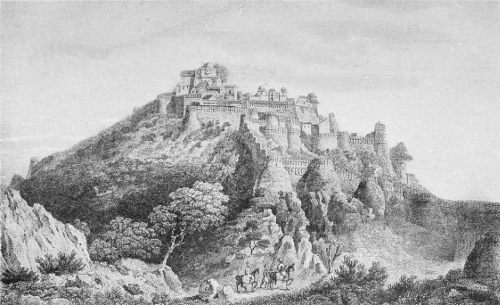
CITADEL OF THE HILL FORTRESS OF KŪMBHALMER.
To face page 776.
Near the “elephant’s pool,” and at the village of Kherli, two
roads diverge: one, by the Bargula nal or pass, conducts direct
to Nathdwara; the other, leading to Rincher, and the celebrated
shrine of the four-armed god,[20] famed as a place of pilgrimage.
The range on our left terminating abruptly, we turned by Uladar
to Kelwara, and encamped in a mango-grove, on a tableland half
a mile north of the town. Here the valley enlarges, presenting
a wild, picturesque, and rugged appearance. The barometer
indicated about a thousand feet of elevation above the level of
Udaipur, which is about two thousand above the sea: yet we
were scarcely above the base of the alpine cliffs which towered
around us on all sides. It was the point of divergence for the
waters, which, from the numerous fountains in [669] these uplands,
descended each declivity, to refresh the arid plains of
Marwar to the west, and to swell the lakes of Mewar to the east.
Previous to the damming of the stream which forms that little
ocean, the Kankroli lake, it is asserted that the supply to the
west was very scanty, nearly all flowing eastward, or through the
valley; but since the formation of the lake, and consequent
saturation of the intermediate region, the streams are ever
flowing to the west. The spot where I encamped was at least
five hundred feet lower than Aret pol, the first of the fortified
barriers leading to Kumbhalmer, whose citadel rose more than
seven hundred feet above the terre-pleine of its outworks beneath.
Kūmbhalmer Fort. Mahārāja Daulat Singh.—The Maharaja
Daulat Singh, a near relative of the Rana, and governor of
Kumbhalmer, attended by a numerous suite, the crimson standard,
trumpets, kettledrums, seneschal, and bard, advanced several
miles to meet and conduct me to the castle. According to
778etiquette, we both dismounted and embraced, and afterwards
rode together conversing on the affairs of the province, and the
generally altered condition of the country. Daulat Singh, being
of the immediate kin of his sovereign, is one of the Babas or
infants of Mewar, enumerated in the tribe called Ranawat, with
the title of Maharaja. Setting aside the family of Sheodan
Singh, he is the next in succession to the reigning family. He is
one of the few over whom the general demoralization has had
no power, and remains a simple-minded straightforward honest
man; blunt, unassuming, and courteous. His rank and character
particularly qualify him for the post he holds on this western
frontier, which is the key to Marwar. It was in February 1818
that I obtained possession of this place (Kumbhalmer), by
negotiating the arrears of the garrison. Gold is the cheapest,
surest, and most expeditious of all generals in the East, amongst
such mercenaries as we had to deal with, who change masters
with the same facility as they would their turban. In twenty-four
hours we were put in possession of the fort, and as we had not
above one-third of the stipulated sum in ready cash, they without
hesitation took a bill of exchange, written on the drum-head, on
the mercantile town of Pali in Marwar: in such estimation is
British faith held, even by the most lawless tribes of India! Next
morning we saw them winding down the western declivity, while
we quietly took our breakfast in an old ruined temple. During
this agreeable employment, we were joined by Major Macleod,
of the artillery, sent by General Donkin to report on the facilities
of reducing the place by siege, and [670] his opinion being, that
a gun could not be placed in position in less than six weeks, the
grilling spared the European force in such a region was well worth
the £4000 of arrears. My own escort and party remained in
possession for a week, until the Rana sent his garrison. During
these eight days our time was amply occupied in sketching and
deciphering the monumental records of this singularly diversified
spot. It would be vain to attempt describing the intricacies of
approach to this far-famed abode, whose exterior is delineated
by the pencil. A massive wall, with numerous towers and
pierced battlements, having a strong resemblance to the Etruscan,
encloses a space of some miles extent below, while the pinnacle
or sikhara rises, like the crown of the Hindu Cybele, tier above
tier of battlements, to the summit, which is crowned with the
779Badal Mahall, or ‘cloud-palace’ of the Ranas. Thence the
eye ranges over the sandy deserts and the chaotic mass of
mountains, which are on all sides covered with the cactus, which
luxuriates amidst the rocks of the Aravalli. Besides the Aret[21]
pol, or barrier thrown across the first narrow ascent, about one
mile from Kelwara, there is a second called the Halla[22] pol,
intermediate to the Hanuman[23] pol, the exterior gate of the fortress,
between which and the summit there are three more, viz. the
gate of victory, the sanguinary gate, and that of Rama, besides
the last, or Chaugan[24] pol. The barometer stood, at half-past
seven A.M., 26° 65´; thermometer 58° Fahr. at the Aret pol: and
on the summit at nine, while the thermometer rose to 75°, the
barometer had only descended 15´, and stood at 26° 50´,[25] though
we had ascended full six hundred feet.
—Admitting the last range as our guide, the peak
of Kumbhalmer will be 3353
[26] feet above the level of the ocean.
Hence I laid down the positions of many towns far in the desert.
Here were subjects to occupy the pencil at least for a month; but
we had only time for one of the most interesting views, the Jain
temple before the reader, and a sketch of the fortress itself, both
finished on the spot. The design of this temple is truly classic.
It consists only of the sanctuary, which has a vaulted dome and
colonnaded portico all round. The architecture is undoubtedly
Jain, which is as distinct in character from the Brahmanical
as their religion. There is a chasteness and simplicity in this
specimen of monotheistic worship, affording a wide contrast to
the elaborately sculptured shrines of the Saivas, and [671] other
polytheists of India. The extreme want of decoration best
attests its antiquity, entitling us to attribute it to that period
when Samprati Raja, of the family of Chandragupta, was paramount
sovereign over all these regions (two hundred years before
Christ);
[27] to whom tradition ascribes the most ancient monuments
780of this faith, yet existing in Rajasthan and Saurashtra.
The proportions and forms of the columns are especially distinct
from the other temples, being slight and tapering instead of
massive, the general characteristic of Hindu architecture; while
the projecting cornices, which would absolutely deform shafts
less slight, are peculiarly indicative of the Takshak architect.
[28]
Samprati was the fourth prince in descent from Chandragupta,
of the Jain faith, and the ally of Seleucus, the Grecian sovereign
of Bactriana. The fragments of Megasthenes, ambassador from
Seleucus, record that this alliance was most intimate; that the
daughter of the Rajput king was married to Seleucus, who, in
return for elephants and other gifts, sent a body of Greek soldiers
to serve Chandragupta. It is curious to contemplate the possibility,
nay the probability, that the Jain temple now before the
reader may have been designed by Grecian artists, or that the
taste of the artists among the Rajputs may have been modelled
after the Grecian. This was our temple of Theseus in Mewar.
A massive monolithic emblem of black marble of the Hindu
Pitrideva had been improperly introduced into the shrine of the
worshippers of the “spirit alone.” Being erected on the rock,
and chiselled from the syenite on which it stands, it may bid
defiance to time. There was another sacred structure in its
vicinity, likewise Jain, but of a distinct character; indeed,
offering a perfect contrast to that described. It was three stories
in height; each tier was decorated with numerous massive low
columns, resting on a sculptured panelled parapet, and sustaining
the roof of each story, which, being very low, admitted but a
broken light to break the pervading gloom. I should imagine
that the sacred architects of the East had studied effect equally
with the preservers of learning and the arts in the dark period of
Europe, when those monuments, which must ever be her pride,
arose on the ruins of paganism. How far the Saxon or Scandinavian
pagan contributed to the general design of such structures
may be doubted; but that their decorations, especially the
781grotesque, have a powerful resemblance to the most ancient
Hindu-Scythic, there is no question, as I shall hereafter more
particularly point out [672].
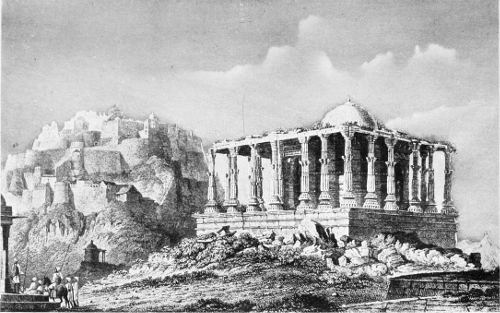
JAIN TEMPLE.
In the Fortress of Kūmbhalmer.
To face page 780.
Who, that has a spark of imagination, but has felt the indescribable
emotion which the gloom and silence of a Gothic
cathedral excites? The very extent provokes a comparison
humiliating to the pigmy spectator, and this is immeasurably
increased when the site is the mountain pinnacle, where man and
his works fade into nothing in contemplating the magnificent
expanse of nature. The Hindu priest did not raise the temple
for heterogeneous multitudes: he calculated that the mind
would be more highly excited when left to its solitary devotions,
amidst the silence of these cloistered columns, undisturbed save
by the monotony of the passing bell, while the surrounding gloom
is broken only by the flare of the censer as the incense mounts
above the altar.
—It would present no distinct picture
to the eye were I to describe each individual edifice within the
scope of vision, either upwards towards the citadel, or below.
Looking down from the Jain temple towards the pass, till the
contracting gorge is lost in distance, the gradually diminishing
space is filled with masses of ruin. I will only notice two of the
most interesting. The first is dedicated to Mama Devi, ‘the
mother of the gods,’ whose shrine is on the brow of the mountain
overlooking the pass. The goddess is placed in the midst of her
numerous family, including the greater and lesser divinities.
They are all of the purest marble, each about three feet in height,
and tolerably executed, though evidently since the decline of
the art, of which very few good specimens exist executed within
the last seven centuries. The temple is very simple and primitive,
consisting but of a long hall, around which the gods are ranged,
without either niche or altar.
The most interesting portion of this temple is its court, formed
by a substantial wall enclosing a tolerable area. The interior
of this wall had been entirely covered with immense tables of
black marble, on which was inscribed the history of their gods,
and, what was of infinitely greater importance, that of the mortal
princes who had erected the tablets in their honour. But what
a sight for the antiquary! Not one of the many tables was
entire; the fragments were strewed about, or placed in position
782to receive the flesh-pots of the sons of Ishmael, the mercenary
Rohilla Afghan [673].[29]
—On quitting the temple
of Mama Devi, my attention was attracted by a simple monumental
shrine on the opposite side of the valley, and almost
in the gorge of the pass. It was most happily situated, being
quite isolated, overlooking the road leading to Marwar, and
consisted of a simple dome of very moderate dimensions, supported
by columns, without any intervening object to obstruct
the view of the little monumental altar arising out of the centre
of the platform. It was the Sybilline temple of Tivoli in miniature.
To it, over rock and ruin, I descended. Here repose the
ashes of the Troubadour of Mewar, the gallant Prithiraj and his
heroine wife, Tara Bai, whose lives and exploits fill many a page
of the legendary romances of Mewar.
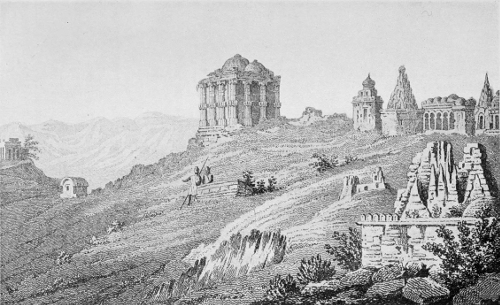
RUINS IN KŪMBHALMER.
To face page 782.
This fair ‘star’ (tara) was the daughter of Rao Surthan, the
chieftain of Badnor. He was of the Solanki tribe, the lineal
descendant of the famed Balhara kings of Anhilwara. Thence
expelled by the arms of Ala in the thirteenth century, they
migrated to Central India, and obtained possession of Tonk-Toda
and its lands on the Banas, which from remote times
had been occupied (perhaps founded) by the Taks, and hence
bore the name of Taksilanagar, familiarly Takatpur and Toda.[30]
Surthan had been deprived of Toda by Lila the Afghan, and now
783occupied Badnor at the foot of the Aravalli, within the bounds
of Mewar. Stimulated by the reverses of her family, and by the
incentives of its ancient glory, Tara Bai, scorning the habiliments
and occupations of her sex, learned to guide the war-horse, and
throw with unerring aim the arrow from his back, even while at
speed. Armed with the bow and quiver, and mounted on a fiery
Kathiawar, she joined the cavalcade in their unsuccessful
attempts to wrest Toda from the Afghan. Jaimall, the third son
of Rana Raemall, in person made proposals for her hand.
“Redeem Toda,” said the star of Badnor, “and my hand is
thine.” He assented to the terms: but evincing a rude determination
to be possessed of the prize ere he had earned it, he was
slain by the indignant father. Prithiraj, the brother of the
deceased, was then in exile in Marwar; he had just signalized
his valour, and ensured his father’s forgiveness, the redemption
of Godwar,[31] and the [674] catastrophe at Badnor determined
him to accept the gage thrown down to Jaimall. Fame and the
bard had carried the renown of Prithiraj far beyond the bounds
of Mewar; the name alone was attractive to the fair, and when
thereto he who bore it added all the chivalrous ardour of his
prototype, the Chauhan, Tara Bai, with the sanction of her father,
consented to be his, on the simple asseveration that “he would
restore to them Toda, or he was no true Rajput.” The anniversary
of the martyrdom of the sons of Ali was the season chosen
for the exploit.[32] Prithiraj formed a select band of five hundred
cavaliers, and accompanied by his bride, the fair Tara, who
insisted on partaking his glory and his danger, he reached Toda
at the moment the ta’aziya or bier containing the martyr-brothers
was placed in the centre of the chauk or ‘square.’ The prince,
Tara Bai, and the faithful Sengar chief, the inseparable companion
of Prithiraj, left their cavalcade and joined the procession as it
passed under the balcony of the palace in which the Afghan was
putting on his dress preparatory to descending. Just as he had
asked who were the strange horsemen that had joined the throng,
the lance of Prithiraj and an arrow from the bow of his Amazonian
bride stretched him on the floor. Before the crowd recovered
from the panic, the three had reached the gate of the town, where
their exit was obstructed by an elephant. Tara Bai with her
784scimitar divided his trunk, and the animal flying, they joined
their cavalcade, which was close at hand.
The Afghans were encountered, and could not stand the attack.
Those who did not fly were cut to pieces; and the gallant
Prithiraj inducted the father of his bride into his inheritance. A
brother of the Afghans, in his attempt to recover it, lost his life.
The Nawab Mallu Khan then holding Ajmer determined to
oppose the Sesodia prince in person; who, resolved upon being the
assailant, advanced to Ajmer, encountered his foe in the camp
at daybreak, and after great slaughter entered Garh Bitli, the
citadel, with the fugitives. “By these acts,” says the chronicle,
“his fame increased in Rajwara: one thousand Rajputs, animated
by the same love of glory and devotion, gathered round the
nakkaras of Prithiraj. Their swords shone in the heavens, and
were dreaded on the earth; but they aided the defenceless.”
Another story is recorded and confirmed by Muhammadan
writers as to the result, though they are ignorant of the impulse
which prompted the act. Prithiraj on some [675] occasion
found the Rana conversing familiarly with an ahadi[33] of the
Malwa king, and feeling offended at the condescension, expressed
himself with warmth. The Rana ironically replied: “You are
a mighty seizer of kings; but for me, I desire to retain my land.”
Prithiraj abruptly retired, collected his band, made for Nimach,
where he soon gathered five thousand horse, and reaching Dipalpur,
plundered it, and slew the governor. The king on hearing
of the irruption left Mandu at the head of what troops he could
collect; but the Rajput prince, in lieu of retreating, rapidly
advanced and attacked the camp while refreshing after the
march. Singling out the royal tent, occupied by eunuchs and
females, the king was made captive, and placed on an express
camel beside the prince, who warned the pursuers to follow
peaceably, or he would put his majesty to death; adding that
he intended him no harm, but that after having made him “touch
his father’s feet,” he should restore him to liberty. Having
carried him direct to Chitor and to his father’s presence, he
turned to him saying, “Send for your friend the ahadi, and ask
785him who this is?” The Malwa king was detained a month
within the walls of Chitor, and having paid his ransom in horses,
was set at liberty with every demonstration of honour.[34] Prithiraj
returned to Kumbhalmer, his residence, and passed his life in
exploits like these from the age of fourteen to twenty-three, the
admiration of the country and the theme of the bard.
It could not be expected that long life would be the lot of one
who thus courted distinction, though it was closed neither by
shot nor sabre, but by poison, when on the eve of prosecuting
his unnatural feud against his brother Sanga, the place of whose
retreat was made known by his marriage with the daughter of
the chieftain of Srinagar, who had dared to give him protection
in defiance of his threats.
At the same time he received a letter from his sister, written
in great grief, complaining of the barbarous treatment of her lord,
the Sirohi prince, from whose tyranny she begged to be delivered
and to be restored to the paternal roof; since whenever he had
indulged too freely in the ‘essence of the flower,’ or in opium, he
used to place her under the bedstead, and leave her to sleep on
the floor. Prithiraj instantly departed, reached Sirohi at midnight,
scaled the palace, and interrupted the repose of Pabhu
Rao by placing his poniard at his throat. His wife, notwithstanding
his cruelty, complied with his humiliating appeal for
mercy, and begged his life, which was granted on condition of
his standing as a suppliant with his wife’s [676] shoes on his head,
and touching her feet, the lowest mark of degradation. He
obeyed, was forgiven, and embraced by Prithiraj, who became
his guest during five days. Pabhu Rao was celebrated for a confection,
of which he presented some to his brother at parting.
He partook of it as he came in sight of Kumbhalmer; but on
reaching the shrine of Mama Devi was unable to proceed. Here
he sent a message to the fair Tara to come and bid him farewell;
but so subtle was the poison, that death had overtaken him ere
she descended from the citadel. Her resolution was soon formed;
the pyre was erected, and with the mortal remains of the chivalrous
Prithiraj in her embrace, she sought “the regions of the sun.”
786Such the end of the Sesodia prince, and the star of Badnor.
From such instances we must form our opinion of the manners
of these people. But for the poisoned confection of the chief
of Sirohi, Prithiraj would have had the glory of opposing himself
to Babur, instead of his heroic brother and successor, Sanga.[35]
Whether, from his superior ardour of temperament, and the love
of military glory which attracted similarly constituted minds to
his fortunes, he would have been more successful than his brother,
it is futile to conjecture.
The Frontier of Mārwār.—October 20.—Halted till noon, that
the men might dress their dinners, and prepare for the descent
into “the region of death,” or Marwar. The pass by which we
had to gain it was represented as terrific; but as both horse and
elephant, with the aid of the hatchet, will pick their way wherever
man can go, we determined to persevere. Struck the camp at
noon, when the baggage filed off, halting ourselves till three;
the escort and advanced tents, and part of the cuisine being
ordered to clear the pass, while we designed to spend the night
midway, in a spot forming the natural boundary of Mewar and
Marwar, reported to be sufficiently capacious. Rumour had not
magnified the difficulties of the descent, which we found strewed
with our baggage, arresting all progress for a full hour. For
nearly a mile there was but just breadth sufficient to admit the
passage of a loaded elephant, the descent being at an angle of 55°
with the horizon, and streams on either side rushing with a
deafening roar over their rugged beds. As we gained a firmer
footing at the base of this first descent, we found that the gallant
Manika, the gift of my friend the Bundi prince, had missed his
footing and rolled down the steep, breaking the cantle of the
saddle; a little farther appeared the cook, hanging in dismay
over the scattered implements of his art, his camel remonstrating
against the [677] replacing of his kajavas or panniers. For
another mile it became more gentle, when we passed under a
tower of Kumbhalmer, erected on a scarped projection of the
rock, full five hundred feet above us. The scenery was magnificent;
the mountains rising on each side in every variety of form,
and their summits, as they caught a ray of the departing sun,
reflecting on our sombre path a momentary gleam from the
masses of rose-coloured quartz which crested them. Noble
787forest trees covered every face of the hills and the bottom of the
glen, through which, along the margin of the serpentine torrent
which we repeatedly crossed, lay our path. Notwithstanding
all our mishaps, partly from the novelty and grandeur of the
scene, and partly from the invigorating coolness of the air, our
mirth became wild and clamorous: a week before I was oppressed
with a thousand ills; and now I trudged the rugged path, leaping
the masses of granite which had rolled into the torrent.
There was one spot where the waters formed a pool or dah.
Little Carey determined to trust to his pony to carry him across,
but deviating to the left, just as I was leaping from a projecting
ledge, to my horror, horse and rider disappeared. The shock
was momentary, and a good ducking the only result, which in the
end was the luckiest thing that could have befallen him. On
reaching the Hathidarra, or ‘barrier of the elephant’ (a very
appropriate designation for a mass of rock serving as a rampart
to shut up the pass), where we had intended to remain the night,
we found no spot capacious enough even for a single tent. Orders
accordingly passed to the rear for the baggage to collect there,
and wait the return of day to continue the march. The shades
of night were fast descending, and we proceeded almost in utter
darkness towards the banks of the stream, the roar of whose
waters was our guide, and not a little perplexed by the tumultuous
rush which issued from every glen, to join that we were seeking.
Towards the termination of the descent the path became wider,
and the voice of the waters of a deeper and hoarser tone, as they
glided to gain the plains of Marwar. The vault of heaven, in
which there was not a cloud, appeared as an arch to the perpendicular
cliffs surrounding us on all sides, and the stars beamed
with peculiar brilliancy from the confined space through which
we viewed them. As we advanced in perfect silence, fancy busily
at work on what might befall our straggling retinue from the
ferocious tiger or plundering mountaineer, a gleam of light
suddenly flashed upon us on emerging from the brushwood, and
disclosed a party of dismounted cavaliers seated round their
night-fires under some magnificent fig-trees [678].[36]
—Halted, and called a council of war
to determine our course: we had gained the spot our guides had
assigned as the only fitting one for bivouac before we reached the
788plains beyond the mountains; it afforded shade from the dews,
and plenty of water. The munitions de bouche having gone on
was a good argument that we should follow; but darkness and
five miles more of intricate forest, through a path from which
the slightest deviation, right or left, might lead us into the jaws
of a tiger, or the toils of the equally savage Mer, decided us to
halt. We now took another look at the group above-mentioned.
Though the excitement of the morning was pretty well chilled
by cold and hunger (poor sharpeners of the imagination), it was
impossible to contemplate the scene before us without a feeling
of the highest interest. From twenty-five to thirty tall figures,
armed at all points, were sitting or reposing in groups round their
watch-fires, conversing and passing the pipe from hand to hand,
while their long black locks, and motley-fashioned turbans, told
that they belonged to Marudesa. A rude altar, raised in honour
of some “gentle blood” shed by the murky mountaineer, served
as a place of rest for the chief of the party, distinguished by the
gold band in his turban, and his deer-skin doublet. I gave the
usual salutation of “Rama, Rama,” to the chief and his party,
and inquired after the health of their chieftain of Ghanerao, to
whose courtesy I found I owed this mark of attention. This
was the boundary between the two States of Marwar and Mewar,
since the district of Godwar was lost by the latter about fifty
years ago. The spot has been the scene of many a conflict, and
a closer approach disclosed several other altars raised in honour
of the slain; each represented a cavalier mounted on his war-steed,
with his lance poised, denoting that in such attitude he
fell in defending the pass, or redeeming the cattle from the
plundering mountain Mer. A square tablet placed on each contained
the date on which he gained “the mansions of the sun.”
Midnight being past, and bringing no hope of our appetites
growing by what they might feed upon, Dr. Duncan and Captain
Waugh took the jhul, or broadcloth-housing, from the elephant,
and rolling themselves in it, followed the example of the chieftain
and reposed upon the ashes of the brave, on an altar adjoining
the one he occupied. I soon left them in happy forgetfulness of
tigers, Meras, hunger, and all the fatigues of the day, and joined
the group to listen to the tale with which they enlivened the
midnight hour. This I can repeat, but it would have required
the pencil of a master to paint the scene. It was a subject for
789Salvator Rosa; though I should [679] have been perfectly
satisfied with one of Captain Waugh’s delineations, had he been
disposed at that moment to exert the pictorial art. Several of
my friends had encountered the mountaineer on this very spot;
and these humble cenotaphs, covering the ashes of their kin,
recalled events not likely to be repeated in these halcyon days,
when the names of Bhil and Mer cease to be the synonyms of
plunderer. As there may be no place more appropriate for a
sketch of the mountaineers, the reader may transport himself to
the glen of Kumbhalmer, and listen to the history of one of the
aboriginal tribes of Rajasthan [680].
(The Foresters of Rājputana.)
To face page 788.
—The Mer or Mera is the mountaineer of Rajputana,
and the country he inhabits is styled Merwara, or ‘the
region of hills.’ The epithet is therefore merely local, for the
Mer is but a branch of the Mina or Maina, one of the aborigines
of India. He is also called Merot and Merawat; but these
terminations only more correctly define his character of mountaineer.
[1]
Merwara is that portion of the Aravalli chain between
Kumbhalmer and Ajmer, a space of about ninety miles in length,
and varying in breadth from six to twenty. The general character
of this magnificent rampart, in the natural and physical geography
of Rajputana, is now sufficiently familiar. It rises from three to
four thousand feet above the level of the sea, and abounds with a
variety of natural productions. In short, I know no portion of
the globe which would yield to the scientific traveller more
abundant materials for observation than the alpine Aravalli.
The architectural antiquary might fill his portfolio, and natural
history would receive additions to her page in every department,
790and especially in botany and zoology.
[2] I [681] should know no
higher gratification than to be of a scientific party to anatomize
completely this important portion of India. I would commence
on the Gujarat, and finish on the Shaikhawat frontier. The
party should consist of a skilful surveyor, to lay down on a large
scale a topographical chart of the mountains; several gentlemen
thoroughly versed in natural history; able architectural and
landscape draughtsmen, and the antiquary to transcribe ancient
inscriptions, as well as to depict the various races. The “Aravalli
delineated,” by the hand of science, would form a most instructive
and delightful work.
A minute account of the Mer, his habits and his history, would
be no unimportant feature: but as this must be deferred, I will,
in the meanwhile, furnish some details to supply the void.
The Mers are a branch of the Chitas, an important division of
the Minas.[3] I shall elsewhere enter at large into the history of
this race, which consists of as many branches as their conquerors,
the Rajputs. All these wild races have the vanity to mingle
their pedigree with that of their conquerors, though in doing so
they stigmatize themselves. The Chita-Minas accordingly claim
descent from a grandson of the last Chauhan emperor of Delhi.
Anhul and Anup were the sons of Lakha, the nephew of the
Chauhan king. The coco-nut was sent from Jaisalmer, offering
princesses of that house in marriage: but an investigation into
their maternal ancestry disclosed that they were the issue of a
791Mina concubine: and their birth being thus revealed, they became
exiles from Ajmer, and associates with their maternal relatives.
Anhul espoused the daughter of a Mina chieftain, by whom
he had Chita, whose descendants enjoy almost a monopoly of
power in Merwara. The sons of Chita, who occupied the northern
frontier near Ajmer, became Muhammadans about fifteen generations
ago, when Duda, the sixteenth from the founder of the race,
was created Dawad Khan by the Hakim of Ajmer; and as
Hathun was his residence, the “Khan of Hathun” signified the
chief of the Merots. Chang, Jhak, and Rajosi are the principal
towns adjoining Hathun. Anup also took a Mina wife, by whom
he had Barar, whose descendants have continued true [682] to
their original tenets. Their chief places are Barar, Berawara,
Mandila, etc. Though the progeny of these Minas may have been
improved by the infusion of Rajput blood, they were always
notorious for their lawless habits, and for the importance attached
to them so far back as the period of Bisaldeo, the celebrated prince
of Ajmer, whom the bard Chand states to have reduced them to
submission, making them “carry water in the streets of Ajmer.”
Like all mountaineers, they of course broke out whenever the
hands of power were feeble. In the battle between the Chauhans
of Ajmer and the Parihars of Mandor, a body of four thousand
Mer bowmen served Nahar Rao, and defended the pass of the
Aravalli against Prithiraj in this his first essay in arms. Chand
thus describes them:[4] “Where hill joins hill, the Mer and Mina
thronged. The Mandor chief commanded that the pass should
be defended—four thousand heard and obeyed, each in form as
the angel of death—men who never move without the omen,
whose arrow never flies in vain—with frames like India’s bolt—faithful
to their word, preservers of the land and the honour[5] of
Mandor; whose fortresses have to this day remained unconquered—who
bring the spoils of the plains to their dwellings. Of these
in the dark recesses of the mountains four thousand lay concealed,
their crescent-formed arrows beside them. Like the envenomed
serpent, they wait in silence the advance of the foe.
792—“Tidings reached the Chauhan
that the manly Mina, with bow in hand, stood in the mountain’s
gorge. Who would be bold enough to force it? his rage was like
the hungry lion’s when he views his prey. He called the brave
Kana, and bade him observe those wretches as he commanded
him to clear the pass. Bowing he departed, firm as the rock on
which he trod. He advanced, but the mountaineer (Mer) was
immovable as Sumeru. Their arrows, carrying death, fly like
Indra’s bolts—they obscure the sun. Warriors fall from their
steeds, resounding in their armour as a tree torn up by the blast.
Kana quits the steed; hand to hand he encounters the foe; the
feathery shafts, as they strike fire, appear like birds escaping
from the flames. The lance flies through the breast, appearing
at the back [683], like a fish escaping through the meshes of a
net. The evil spirits dance in the mire of blood. The hero of
the mountain
[6] encountered Kana, and his blow made him reel;
but like lightning it was returned, and the mountaineer fell: the
crash was as the shaking of Sumeru. At this moment Nahar
arrived, roaring like a tiger for his prey: he called aloud to
revenge their chief, his brother,
[7] and fresh vigour was infused
into their souls. On the fall of the mountain-chief, the Chauhan
commanded the ‘hymn of triumph’
[8] to be sounded; it startled
the mountaineer, but only to nerve his soul afresh. In person
the Chauhan sought his foe. The son of Somesa is a bridegroom.
His streaming standards flutter like the first falls of rain in Asarh,
and as he steps on the bounds which separate Mandor from
Ajmer, ‘Victory! victory!’ is proclaimed. Still the battle
rages. Elephants roar, horses neigh, terror stalks everywhere.
The aids of Girnar
[9] and of Sind now appeared for Mandor,
bearing banners of every colour, varied as the flowers of the
spring. Both arrays were clad in mail; their eyes and their
finger-nails alone were exposed; each invoked his tutelary protector
as he wielded the
dodhara.
[10] Prithiraj was refulgent as
Indra; the Parihar’s brightness was as the morning star; each
was clad in armour of proof, immovable as gods in mortal form.
The sword of the Chauhan descended on the steed of the Parihar;
793but as he fell, Nahar sprung erect, and they again darted on
each other, their warriors forming a fortress around the persons
of their lords. Then advanced the standards of the Pramar,
like a black rolling cloud, while the lightnings flashed from his
sword. Mohana, the brother of Mandor, received him; they
first examined each other—then joining in the strife, the helm
of the Pramar was cleft in twain. Now advanced Chawand, the
Dahima; he grasped his iron lance,
[11]—it pierced the Parihar,
and the head appeared like a serpent looking through the door
in his back. The flame (
jyot) united with the fire from which it
sprung, while the body fell on its parent earth. By his devotion
the sins of his life were forgiven. Nobly did the tiger (Nahar)
of Mandor meet the lion of the world. He called aloud, ‘Hold
your ground as did Bal Raja of old.’ Again the battle rages—Durga
gluts herself with blood [684]—the air resounds with the
clash of arms and the rattling of banners—the Aswar
[12] rains on
the foe—Khetrpal
[13] sports in the field of blood—Mahadeva fills
his necklace—the eagle gluts itself on the slain—the mien of
the warriors expands as does the lotos at the sunbeam—the
war-song resounds—with a branch of the tulasi on the helm,
adorned in the saffron robe, the warriors on either side salute
each other.” The bard here exclaims, “But why should I
enlarge on this encounter?”—but as this digression is merely
for breathing time, we shall not follow him, the object being
to introduce the mountain Mer, whom we now see
hors de
combat.
—Admitting the exaggeration of the
poet, the Mer appears to have been in the twelfth century what
he is in the nineteenth, a bold, licentious marauder. He maintained
himself throughout the whole of the Mogul domination,
alternately succumbing and depredating; and since the Mahrattas
crippled these countries, the Mer had regained all his consequence,
and was rapidly encroaching upon his Rajput suzerain. But
when in 1821 their excesses made it imperative to reduce their
holds and fastnesses, they made no stand against the three
battalions of sepoys sent against them, and the whole tract was
794compelled to obedience; not, however, till many of the descendants
of Chita and Barar had suffered both in person and property.
[14]
The facility with which we reduced to entire subjection this
extensive association of plunderers, for centuries the terror of
these countries, occasioned no little astonishment to our allies.
The resistance was indeed contemptible, and afforded a good
argument against the prowess of those who had tolerated the
existence of a gang at once so mischievous and weak. But this
was leaping to a conclusion without looking beneath the surface,
or to the moral and political revolution which enervated the arms
of Mer and Mahratta, Pindari and Pathan. All rose to power
from the common occupation of plunderers, aided by the national
jealousies of the Rajputs. If the chieftains of Mewar leagued
to assault the mountaineers, they found refuge and support in
Marwar; and as their fortresses at all times presented a sanctuary,
their Rawats or leaders obtained consequence amongst all parties
by granting it. Every Mer community, accordingly, had a
perfect understanding with the chieftain whose lands were contiguous
to their own, and who enjoyed rights granted by the
Rana over these nominal subjects. These rights were all of a
feudal nature, as
rakhwali or ‘blackmail’ [685], and those petty
proofs of subordination, entitled in the feudal law of Europe
“petit serjanterie.” The token might be a colt, a hawk, or a
bullock, and a
nazarana, or pecuniary acknowledgement, perhaps
only of half-a-crown on the chieftain’s birthday, or on the Rajput
Saturnalia, the Holi. But all these petty causes for assimilation
between the Rajput and the lawless Mer were overlooked, as well
as the more powerful one which rendered his arms of no avail.
Every door was hermetically sealed against him; wherever he
looked he saw a foe—the magical change bewildered him; and
when their Khan and his adherents were assailed while in fancied
security, and cut off in a midnight attack, his self-confidence
was annihilated—he saw a red-coat in every glen, and called
aloud for mercy.
—A corps of these mountaineers, commanded
by English officers, has since been formed, and I have
no doubt may become useful.
[15] Notwithstanding their lawless
795habits, they did not neglect agriculture and embanking, as
described in the valley of Shera Nala, and a district has been
formed in Merwara which in time may yield a lakh of rupees
annually to the state.
—Some of their customs are so curious,
and so different from those of their lowland neighbours, that we
may mention a few. Leaving their superstitions as regards
omens and auguries, the most singular part of their habits, till
we give a detailed sketch of the Minas hereafter, I will notice
the peculiarity of their notions towards females. The Mer,
following the customary law handed down from his rude ancestry,
and existing long before the written law of Manu, has no objection
to a widow as a wife. This contract is termed
nata, and his
civilized master levies a fine or fee of a rupee and a quarter for
the licence, termed
kagli. On such marriage the bridegroom
must omit in the
maur, or nuptial coronet, the graceful palmyra
leaf, and substitute a small branch of the sacred pipal wreathed
in his turban. Many of the forms are according to the common
Hindu ritual. The
sat-phera, or seven perambulations round
the jars filled with grain, piled over each other—the
ganth-jora, or
uniting the garments—and the
hathleva, or junction of hands of
bride and bridegroom, are followed by the Mers. Even the
northern clans, who are converts to Islam, return to their ancient
habits on this occasion, and have a Brahman priest to officiate.
I discovered, on inquiring into the habits of the Mers, that they
are not the only race which did not refuse to wed a widow, and
that both Brahmans and Rajputs have from ancient times been
accustomed not to consider it derogatory [686].
[16] Of the former,
the sacerdotal class, the Nagda
[17] Brahmans, established at this
town long before the Guhilots obtained power in Mewar. Of
the Rajputs, they are all of the most ancient tribes, now the
allodial vassals or Bhumias of Rajputana, as the Chinana, Kharwar,
Uten, Daya, names better known in the mystic page of the
796chronicle than now, though occasionally met with in the valleys
of the Aravalli. But this practice, so little known, gives rise to
an opinion, that many of the scrupulous habits regarding women
are the inventions of the priests of more modern days. The
facilities for separation are equally simple. If tempers do not
assimilate, or other causes prompt them to part, the husband
tears a shred from his turban, which he gives to his wife, and
with this simple bill of divorce, placing two jars filled with water
on her head, she takes whatever path she pleases, and the first
man who chooses to ease her of her load becomes her future
lord. This mode of divorce is practised not only amongst all
the Minas, but by Jats, Gujars, Ahirs, Malis, and other Sudra
tribes.
Jehar le aur nikali, ‘took the jar and went forth,’ is a
common saying amongst the mountaineers of Merwara.
—Their invocations and imprecations are
peculiar. The Chita or northern Mer, since he became acquainted
with the name of the prophet, swears by ‘Allah,’ or by his first
proselyte ancestor, ‘Duda Dawad Khan,’ or the still more ancient
head of the races, ‘
Chita, Barar ka an‘. The southern Mers
also use the latter oath: “By my allegiance to Chita and Barar”;
and they likewise swear by the sun, ‘
Suraj ka Sagun,’ and ‘
Nath
ka Sagun’; or their ascetic priest, called the Nath. The
Muhammadan Mer will not now eat hog; the southron refuses
nothing, though he respects the cow from the prejudices of those
around him, and to please the Nath or Jogi, his spiritual guide.
The partridge and the
maloli,
[18] or wag-tail, are the chief birds of
omen with him, and the former ‘clamouring’ on the left, when
he commences a foray, is a certain presage of success. To conclude;
colonies of the Mers or Meras will be found as far north as
the Chambal, and even in the peninsula of Saurashtra. Merwara
is now in subjection to the Rana of Mewar, who has erected small
forts amidst the most influential communities to overawe them.
The whole tract has been assessed; the chiefs of the districts
being brought to the Rana’s presence presented
nazarana, swore
fidelity, and received according to their rank gold bracelets or
turbans. It was an era in the annals of Mewar to see the accumulated
arms of Merwara piled upon the [687] terrace of the palace
at the capital; but these measures were subsequent to our sojourn
797in the glen of Kumbhalmer, from which we have yet to issue to
gain Marwar.
—October 21.—All hailed the return
of daylight with reverence. Captain Waugh and the Doctor
uncoiled from the elephant’s jhul, and I issued from my palki,
which had proved a welcome retreat against the chills of the
night air. By thirst and hunger our appetite for the picturesque
was considerably abated, and the contemplation of the spot
where we had bivouaced in that philosophical spirit of silence,
which all have experienced who have made a long march before
breakfast, lost much of its romantic interest. Nevertheless,
could I have consulted merely my own wishes, I would have
allowed my friends and escort to follow the canteen, and have
pursued an intricate path which branched off to the right, to
have had the chance of an interview with the outlaw of Gokulgarh.
This petty chieftain, who enjoyed the distinctive epithet of
outlaw (barwatia), was of the Sonigira clan (a branch of the
Chauhans), who for centuries were the lords of Jalor. He was
a vassal of Marwar, now sovereign of Jalor, and being expelled
for his turbulence by his prince, he had taken post in the old
ruined castle of Gokulgarh, on a cliff of the Aravalli, and had
become the terror of the country. By his knowledge of the
intricacies of the mountains, he eluded pursuit; and his misdeeds
being not only connived at, but his spoils participated by
the chief of Deogarh, in whose fief was his haunt, he was under
no apprehension of surprise. Inability either to seize the Barwatia,
or drive him from his retreat, formed a legitimate excuse for the
resumption of Gokulgarh, and the dues of ‘blackmail’ he derived
from its twelve dependent villages. The last act of the Sonigira
was most flagrant; he intercepted in the plains of Godwar a
marriage procession, and made captives the bridegroom and
bride, whom he conveyed to Gokulgarh, where they long languished
for want of ransom. A party was formed to lie in wait
for him; but he escaped the snare, and his retreat was found
empty. Such was the state of society in these districts. The
form of outlawry is singular in this country, where the penal
laws are satisfied with banishment, even in cases of treason,
instead of the sanguinary law of civilization. The criminal
against whom the sentence of exile is pronounced being called
into his prince’s presence, is clad in black vestments, and placed
798upon a black steed, his arms and shield all of the same sombre
hue of mourning and [688] disgrace; he is then left to gain the
frontier by himself. This custom is very ancient: the Pandu
brothers were ‘Barwatias’[19] from the Jumna three thousand years
ago. The Jaisalmer annals relate the solemnity as practised
towards one of their own princes; and the author, in the domestic
dissensions of Kotah, received a letter from the prince, wherein
he demands either that his rights should be conceded, or that
the government would bestow the “black garment,” and leave
him to his fate.
—Conversing on these and similar
subjects with my Marwari friends, we threaded our way for five
miles through the jungles of the pass, which we had nearly cleared,
when we encountered the chieftain of Ghanerao at the head of
his retinue, who of his own accord, and from a feeling of respect
to his ancient sovereign the Rana, advanced thus far to do me
honour. I felt the compliment infinitely the more, as it displayed
that spirit of loyalty peculiar to the Rajput, though the step was
dangerous with his jealous sovereign, and ultimately was prejudicial
to him. After dismounting and embracing, we continued
to ride to the tents, conversing on the past history of the province,
of his prince, and the Rana, after whom he affectionately inquired.
Ajit Singh is a noble-looking man, about thirty years of age, tall,
fair, and sat his horse like a brave Rathor cavalier. Ghanerao
is the chief town of Godwar, with the exception of the commercial
Pali, and the garrison-post Desuri. From this important district
the Rana could command four thousand Rathors holding lands
on the tenure of service, of whom the Ghanerao chief, then one
of the sixteen nobles of Mewar, was the head. Notwithstanding
the course of events had transferred the province, and consequently
his services, from the Rana of Udaipur to the Raja of
Jodhpur, so difficult is it to eradicate old feelings of loyalty and
attachment, that the present Thakur preferred having the sword
of investiture bound on him by his ancient and yet nominal
suzerain, rather than by his actual sovereign. For this undisguised
mark of feeling, Ghanerao was denuded of its walls,
which were levelled to the ground; a perpetual memento of
disgrace and an incentive to vengeance: and whenever the day
arrives that the Rana’s herald may salute him with the old motto,
799“Remember Kumbhalmer,” he will not be deaf to the call. To
defend this post was the peculiar duty of his house, and often
have his ancestors bled in maintaining it against the Mogul.
Even now [689], such is the inveteracy with which the Rajput
clings to his honours, that whenever the Ghanerao chief, or any
of his near kin, attend the Rana’s court, he is saluted at the porte,
or at the champ de Mars, by a silver mace-bearer from the Rana,
with the ancient war-cry, “Remember Kumbhalmer,” and he
still receives on all occasions of rejoicing a khilat from that
prince. He has to boast of being of the Rana’s blood, and is
by courtesy called “the nephew of Mewar.” The Thakur
politely invited me to visit him; but I was aware that compliance
would have involved him in difficulties with his jealous prince,
and made excuses of fatigue, and the necessity of marching next
morning, the motives of which he could not misunderstand.
Our march this morning was but short, and the last two miles
were in the plains of Marwar, with merely an occasional rock.
Carey joined us, congratulating himself on the ducking which
had secured him better fare than we had enjoyed in the pass of
Kumbhalmer, and which fastened both on Waugh and myself
violent colds. The atmospheric change was most trying: emerging
from the cold breezes of the mountains to 96° of Fahrenheit,
the effect was most injurious: it was 58° in the morning of our
descent into the glen. Alas! for my surviving barometer!
Mahesh, my amanuensis, who had been entrusted with it, joined
us next day, and told me the quicksilver had contrived to escape;
so I lost the opportunity of comparing the level of the desert
with the plains of Marwar.
—
October 27.—Halted to collect the
scattered baggage, and to give the men rest; the day was nearly
over before the whole came up, each party bringing lamentable
reports of the disastrous descent. I received a visit from the
chief of Rupnagar, who, like the Thakur of Ghanerao, owes a
divided allegiance to the courts on each side the mountains.
His castle, which gives him rank as one of the most conspicuous
of the second grade of the Rana’s nobles, was visible from the
camp, being placed on the western face of the mountains, and
commanding a difficult passage across them. From thence he
looks down upon Desuri and his ancient patrimony, now transferred
with Godwar to the Rathor prince; and often has he
800measured his lance with the present occupants to retain his ancient
bhum, the right derived from the cultivating proprietor of the
soil. The chief of Rupnagar is of the Solanki race, a lineal
descendant of the sovereigns of Nahrwala, and the inheritor [690]
of the war-shell of the celebrated monarch Siddhraj,
[20] one of the
most powerful who ever sat on an eastern throne, and who occupied
that of Anhilwara from
A.D. 1094, during half a century, celebrated
as a patron of literature and the arts. When in the
thirteenth century this State was destroyed, the branches found
refuge, as already described, in Mewar; for the ancestor of
Rupnagar was brother to the father of “the star of Badnor,”
and was invested with the estate and lands of Desuri by the same
gallant prince who obtained her hand by the recovery of her
father’s estates. The anecdote is worthy of relation, as showing
that the Rajput will stop at nothing “to obtain land.” The
intestine feuds amongst Rana Raemall’s sons, and his constant
warfare with the kings of Delhi and Malwa, made his authority
very uncertain in Godwar. The Mina and Mer possessed themselves
of lands in the plains, and were supported by the Madrecha
descendant of the once independent Chauhan sovereigns of Nadol,
the ancient capital of this region. Sand, the Madrecha, had
obtained possession of Desuri, the garrison town. To expel him,
the prince had recourse to Sada, the Solanki, whose son was
married to the daughter of the Madrecha. The bribe for the
reward of this treachery was to be the grant in perpetuity of
Desuri and its lands. Sada’s son readily entered into the scheme;
and to afford facilities for its execution he went with his wife
to reside at Desuri. It was long before an opportunity offered;
but at length the marriage of the young Madrecha to the daughter
of Sagra the Balecha was communicated to the Solanki by his
son; who told his father “to watch the smoke ascending from
the tower of Desuri,” as the signal for the attempt to get possession.
Anxiously did Sand watch from his castle of Sodhgarh
the preconcerted sign, and when the volume of black smoke
ascended, he rushed down from the Aravalli at the head of his
retainers. The mother-in-law of the young Solanki sent to know
why he should make a smoke as if he were burning a corpse,
when her son must be returning with his bride. Soon she heard
the clash of arms; the Solankis had entered and fired the town,
801and the bridal party appeared before success was attained. Spears
and swords were plied. “’Ware the bull!” (
sand), said the
Madrecha, as he encountered his foe. “My name is the lion
(
singh) who will [691] devour the bull,” replied the Solanki.
The contest was fierce, but the Madrechas were slain, and in the
morn Prithiraj was put in possession of Desuri. He drew out a
grant upon the spot, inserting in it a curse against any of Sesodia
blood who might break the bond which had restored the Rathor
authority in Godwar. Although seventeen generations have
passed since this event, the feud has continued between the
descendants of the lion of Sodhgarh and the bull of Desuri, though
the object of dissension is alienated from both.
The Chief of Ghānērāo. The Rājputs of Mewār and Mārwār
compared.—I could well have dispensed with visits this day, the
thermometer being 96°; I was besides devoured with inflammatory
cold; but there was no declining another polite visit
of the chieftain of Ghanerao. His retinue afforded a good opportunity
of contrasting the Sesodia Rajput of fertile Mewar with
the Rathors of Marwar, and which on the whole would have been
favourable to the latter, if we confined our view to those of the
valley of Udaipur, or the mountainous region of its southern limit,
where climate and situation are decidedly unfavourable. There
the Rajput may be said not only to deteriorate in muscular form
and strength, but in that fairness of complexion which distinguishes
him from the lower orders of Hindus. But the danger
of generalizing on such matters will be apparent when it is known
that there is a cause continually operating to check and diminish
the deteriorating principle arising from the climate and situation
(or, as the Rajput would say, from the hawa pani, ‘air and
water’) of these unhealthy tracts; namely, the continual influx
of the purest blood from every region in Rajputana: and the
stream which would become corrupt if only flowing from the
commingling of the Chondawats of Salumbar and the Jhalas of
Gogunda (both mountainous districts), is refreshed by that of
the Rathors of Godwar, the Chauhans of Haraoti, or the Bhatti
of the desert. I speak from conviction, the chieftains above
mentioned affording proofs of the evil resulting from such repeated
intermarriages; for, to use their own adage, “a raven will produce
a raven.” But though the personal appearance of the
chieftain of Gogunda might exclude him from the table of the
802sixteen barons of Mewar, his son by a Rathor mother may be
exhibited as a redeeming specimen of the Jhalas, and one in every
way favourable of the Rajput of Mewar. On such occasion,
also, as a formal visit, both chieftain and retainers appear under
every advantage of dress and decoration; for even the form of
the turban may improve the contour of the face, though [692]
the Mertias of Ghanerao have nothing so decidedly peculiar in
this way as those of other clans.
After some discourse on the history of past days, with which,
like every respectable Rajput, I found him perfectly conversant,
the Ghanerao chief took his leave with some courteous and
friendly expressions. It is after such a conversation that the
mind disposed to reflection will do justice to the intelligence of
these people: I do not say this with reference to the baron of
Ghanerao, but taking them generally. If by history we mean
the relation of events in succession, with an account of the leading
incidents connecting them, then are all the Rajputs versed in
this science; for nothing is more common than to hear them
detail their immediate ancestry or that of their prince for many
generations, with the events which have marked their societies.
It is immaterial whether he derives this knowledge from the
chronicle, the chronicler, or both: it not only rescues him from
the charge of ignorance, but suggests a comparison between him
and those who constitute themselves judges of nationalities by
no means unfavourable to the Rajput.
—October 28.—Marched at daybreak. The Thakur
sent a confidential vassal to accompany me through his domain.
We could now look around us, as we receded from the Alpine
Aravalli, with nothing to obstruct the vision, over the fertile
plains of Godwar. We passed near Ghanerao, whose isolated
portals, without tower or curtain to connect them, have a most
humiliating appearance. It is to Raja Bhim, some twenty years
ago, that their chieftains owe this degradation, in order to lessen
their ability to recover the province for its ancient master the
Rana. It was indeed one of the gems of his crown, as it is the
only dazzling one in that of Marwar. While we marched over
its rich and beautiful plains, well watered, well wooded, and
abounding in fine towns, I entered into conversation with the
Rana’s envoy, who joined me on the march. Kishandas has
already been mentioned as one of the few men of integrity and
803wisdom who had been spared to be useful to his country. He
was a mine of ancient lore, and his years, his situation, and his
character gave force to his sentiments of determined independence.
He was as quick as touchwood, which propensity occasionally
created a wordy war between me and my friend, who knew
my respect for him. “Restore us Godwar,” was his abrupt
salutation as he joined me on the march: to which, being a little
vexed, as the point could not be agitated by our government, I
said in reply, “Why did you [693] let them take it?—where has
the Sesodia sword slept this half century?” Adding, “God
Almighty never intended that the region on this side the mountains
should belong to Mewar;—nature’s own hand has placed
the limit between you.” The old envoy’s blood was roused as
he exclaimed, “Even on this principle Godwar is ours, for
nature has marked our limit by stronger features than mountains.
Observe, as you advance, and you will find to the further limit
of the province every shrub and flower common to Mewar; pass
that limit but a few yards, and they are lost:
“Ānwal, ānwal Mewār:
Bāwal, bāwal Mārwār.
“Wherever the anwal puts forth its yellow blossoms, the land is
of right ours; we want nothing more. Let them enjoy their
stunted babuls, their karil, and the ak; but give us back our
sacred pipal, and the anwal of the border.”[21] In truth, the transition
is beyond credence marked: cross but a shallow brook, and
you leave all that is magnificent in vegetation; the pipal, bar,
and that species of the mimosa resembling the cypress, peculiar
to Godwar, are exchanged for the prickly shrubs, as the wild
caper, jawas, and many others, more useful than ornamental, on
which the camel browses.[22] The argument was, however, more
ingenious than just, and the old envoy was here substituting the
effect for the cause; but he shall explain in his own words why
Flora should be permitted to mark the line of demarcation instead
of the rock-enthroned (Durga) Cybele. The legend now repeated
is historical, and the leading incidents of it have already been
touched upon;[23] I shall therefore condense the Pancholi’s description
804into a summary analysis of the cause why the couplet of the
bard should be deemed “confirmation strong” of the bounds of
kingdoms. These traditionary couplets, handed down from
generation to generation, are the most powerful evidence of the
past, and they are accordingly employed to illustrate the Khyats,
or annals, of Rajputana. When, towards the conclusion of the
fourteenth century, the founder of the Chondawats repaid the
meditated treachery of Ranmall of Mandor by his death, he took
possession of that capital and the entire country of the Rathors
(then but of small extent), which he held for several years. The
heir of Mandor became a fugitive, concealing himself in the fastnesses
of the Aravalli, with little hope that [694] his name (Jodha)
would become a patronymic, and that he would be honoured as
the second founder of his country: that Mandor itself should be
lost in Jodhpur. The recollection of the feud was almost extinct;
the young Rana of Chitor had passed the years of Rajput minority,
and Jodha continued a fugitive in the wilds of Bhandak-parao,
with but a few horse in his train, indebted to the resources of
some independents of the desert for the means of subsistence.
He was discovered in this retreat by a Charan or bard, who,
without aspiring to prophetic powers, revealed to him that the
intercession of the queen-mother of Chitor had determined the
Rana to restore him to Mandor. Whether the sister of Jodha,
to give éclat to the restoration, wished it to have the appearance
of a conquest, or whether Jodha, impatient for possession, took
advantage of circumstances to make his entrance one of triumph,
and thereby redeem the disgrace of a long and humiliating exile,
it is difficult to decide; for while the annals of Mewar make the
restoration an act of grace, those of Marwar give it all the colours
of a triumph. Were the point worthy of discussion, we should
say both accounts were correct. The Rana had transmitted the
recall of Chonda from Mandor, but concealed from him the
motive, and while Jodha even held in his possession the Rana’s
letter of restoration, a concatenation of circumstances, in which
“the omen” was predominant, occurred to make him anticipate
his induction by a measure more consonant to the Rajput, a
brilliant coup de main. Jodha had left his retreat in the Run[34]
to make known to Harbuji Sankhla, Pabuji, and other rievers
805of the desert, the changes which the bard had communicated.
While he was there, intelligence was brought that Chonda, in
obedience to his sovereign’s command, had proceeded to Chitor.
That same night “the bird of omen perched on Jodha’s lance,
and the star which irradiated his birth shone bright upon it.”
The bard of Mandor revealed the secret of heaven to Jodha, and
the heroes in his train: “Ere that star descends in the west,
your pennon will wave on the battlements of Mandor.” Unless,
however, this “vision of glory” was merely mental, Jodha’s
star must have been visible in daylight; for they could never
have marched from the banks of the Luni, where the Sankhla
resided, to Mandor, between its rising and setting. The elder son
of Chonda had accompanied his father, and they had proceeded
two coss in their [695] journey, when a sudden blaze appeared in
Mandor: Chonda pursued his route, while his son Manja returned
to Mandor. Jodha was already in possession; his an had been
proclaimed, and the two other sons of Chonda had fallen in its
defence. Manja, who fled, was overtaken and slain on the
border. These tidings reached Chonda at the pass of the Aravalli;
he instantly returned to Mandor, where he was met by Jodha,
who showed him the letters of surrender for Mandor, and a command
that he should fix with him the future boundary of each
State. Chonda thought that there was no surer line of demarcation
than that chalked out by the hand of nature; and he accordingly
fixed that wherever the “yellow blossom” was found, the
land should belong to his sovereign, and the bard was not slow in
perpetuating the decree. Such is the origin of
Ānwal, ānwal Mewār:
Bāwal, bāwal Mārwār.
The brave and loyal founder of the Chondawats, who thus
sacrificed his revenge to his sovereign’s commands, had his
feelings in some degree propitiated by this arrangement, which
secured the entire province of Godwar to his prince: his son
Manja fell, as he touched the region of the anwalas, and this cession
may have been in ‘mundkati,’ the compromise of the price of
blood. By such traditional legends, not less true than strange,
and to which the rock sculptures taken from Mandor bear evidence,
even to the heroes who aided Jodha in his enterprise, the anwal
of the Rajputs has been immortalized, like the humble broom of
806the French, whose planta-genesta has distinguished the loftiest
name in chivalry, the proudest race emblazoned on the page of
heraldry.
Notwithstanding the crops had been gathered, this tract contrasted
favourably with Mewar, although amidst a comparative
prosperity we could observe the traces of rapine; and numerous
stories were rehearsed of the miseries inflicted on the people by
the rapacious followers of Amir Khan. We crossed numerous
small streams flowing from the Aravalli, all proceeding to join
the “Salt River,” or Luni. The villages were large and more
populous; yet was there a dulness, a want of that hilarity which
pervaded the peasantry of Mewar, in spite of their misfortunes.
The Rajputs partook of the feeling, the cause of which a little
better acquaintance with their headquarters soon revealed.
Mewar had passed through the period [696] of reaction, which in
Marwar was about to display itself, and was left unfortunately
to its own control, or with only the impulse of a long suppressed
feeling of revenge in the bosom of its prince, and the wiles of a
miscreant minister, who wished to keep him in durance, and the
country in degradation.
—It creates a refreshing sensation to find the camp
pitched in a cool and shaded spot; and at Nadol
[35] we had this
satisfaction. Here again there was no time for recreation, for
there was abundant, nay, overwhelming matter both for the pen
and the pencil; but my readers must be satisfied with the imperfect
delineations of the first. Nadol is still a place of some
consequence, though, but for its temples, we should not have
supposed it to have been the capital of a province. With its
neighbour, Narlai, five miles to the westward, it was the abode
of a branch of the Chauhans of Ajmer, established at a very early
period. From Nadol sprung the Deoras of Sirohi, and the
Sonigiras of Jalor. The former still maintain their ground, in
spite of all attempts of the Rathors; but the Sonigira, who was
immortalized by his struggle against the second Ala, is blotted
from the list of independent States; and this valuable domain,
consisting of three hundred and sixty towns, is now incorporated
with Jodhpur.
There is no spot in Rajputana that does not contain some
record of the illustrious Chauhan; and though every race has
807had its career of glory, the sublimity of which, the annals of the
Sesodias before the reader sufficiently attest, yet with all my
partiality for those with whom I long resided, and with whose
history I am best acquainted, my sense of justice compels me to
assign the palm of martial intrepidity to the Chauhan over all
the “royal races” of India. Even the bards, to whatever family
they belong, appear to articulate the very name as if imbued with
some peculiar energy, and dwell on its terminating nasal with
peculiar complacency. Although they had always ranked high
in the list of chivalry, yet the seal of the order was stamped on
all who have the name of Chauhan, since the days of Prithiraj,
the model of every Rajput, and who had a long line of fame to
maintain. Of the many names familiar to the bard is Guga of
Bhatinda, who with forty-seven sons “drank of the stream of
the sword” on the banks of the Sutlej, in opposing Mahmud.[36]
This conqueror proceeded through the desert to the attack of
Ajmer, the chief abode of this race, where his arms were disgraced,
the invader wounded, and forced to relinquish his enterprise [697].
In his route to Nahrwala and Somnath he passed Nadol,[37] whose
prince hesitated not to measure his sword even with Mahmud.
I was fortunate enough to obtain an inscription regarding this
prince, the celebrated Lakha, said to be the founder of this
branch from Ajmer, of which it was a fief—its date S. 1039
(A.D. 983).[38] The fortress attributed to Lakha is on the declivity
808of a low ridge to the westward of the town, with square towers
of ancient form, and built of a very curious conglomerate of
granite and gneiss, of which the rock on which it stands is composed.
There was a second inscription, dated S. 1024 (A.D. 968),
which made him the contemporary of the Rana’s ancestor,
Sakti Kumar of Aitpur, a city also destroyed, more probably
by the father of Mahmud. The Chauhan bards speak in very
lofty terms of Rao Lakha, who “collected transit dues from the
further gate of Anhilwara, and levied tribute from the prince
of Chitor.”
—It is impossible to do full justice to the
architectural remains, which are well worthy of the pencil. Here
everything shows that the Jain faith was once predominant,
and that their arts, like their religion, were of a character quite
distinct from those of Siva. The temple of Mahavira, the
last of their twenty-four apostles, is a very fine piece of
architecture. Its vaulted roof is a perfect model of the most
ancient style of dome in the East; probably invented anterior
to the Roman. The principle is no doubt the same as the
first substitute of the arch, and is that which marked the genius
of Caesar in his bridge over the Rhone, and which appears
over every mountain torrent of the ancient Helvetii, from
whom he may have borrowed it.
[39] The principle is that of a
horizontal instead of a radiating pressure. At Nadol the stones
are placed by a gradual projection one over the other, the
apex being closed by a circular key-stone. The angles of
all these projections being rounded off, the spectator looking
up can only describe the vault as a series of gradually diminishing
amulets or rings converging to the apex. The effect is
very pleasing, though it furnishes a strong argument that the
Hindus first became acquainted with the perfect arch through
their conquerors. The
toran, in front of the altar of Mahavira,
is exquisitely sculptured, as well as several statues of marble,
discovered about one hundred and fifty years ago in the bed of
the river, when it changed its course. It is not unlikely that
they were buried during Mahmud’s invasion. But [698] the
809most singular structure of Nadol is a reservoir, called the
chana
ki baoli, from the cost of it being paid by the return of a single
grain of pulse (
chana). The excavation is immense; the descent
is by a flight of grey granite steps, and the sides are built up from
the same materials by piling blocks upon blocks of enormous
magnitude, without the least cement.
—My acquisitions here were considerable.
Besides copies of inscriptions made by my Sanskrit scribes,
I obtained two originals on brass. Of one of these, dated S. 1218,
the memorial of Alandeva, I append a translation,
[40] which may
be considered curious as a formula of endowment of the Jains.
I likewise procured several isolated MS. leaves of very great
value, relative to the thirty-six royal races, to the ancient geography
of India, and to the founding of ancient cities; also a
catalogue of longevity of plants and animals, and an extract
from a work concerning the descendants of Srenika and Samprati,
the potent princes of the Jain faith between Mahavira and
Vikrama. However meagre these fragments may be, I have
incorporated their contents into my mosaic. I also made valuable
additions to my collection of medals, for I obtained coins of
Mahmud, Balban, and Ala, surnamed Khuni, or ‘the sanguinary’;
and another of a conqueror equally meriting that title, Nadir
Shah. But these were of little consequence compared with what
one of my envoys brought from Narlai—a small bag full of
curious hieroglyphical (if I may so use the term) medals of the
Chauhan princes.
[41] One side represents a warrior on horseback,
compounded out of a character to which I have applied the above
term; on some there was a bull; while others, retaining the
original reverse, have on the obverse the titles of the first Islamite
conquerors, in the same manner as the currency of France bears
the effigies of Louis XVI. and the emblems of the Republic.
Whoever will pay a visit to Nadol will find his labour amply
rewarded; I had only leisure to glean a few of these relics, which
yet formed a rich harvest. Narlai, Bali, Desuri, Sadri, all
ancient seats of the Jains, will yield medals, MSS., and rare
specimens of the architectural art. From Abu to Mandor, the
810antiquary might fill many portfolios, and collect matter for
volumes of the ancient history of this people, for this is the cradle
of their faith. That I was enabled to obtain so much during a
rapid march through the country arose partly from previous
[699] knowledge, partly from the extent of my means, for I had
flying detachments to the right and left of my route, consisting
of intelligent natives of each city, accompanied by pandits for
deciphering, and others for collecting whatever was the object of
research; who, at the close of each day, brought me the fruits
of their inquiries. When any remarkable discovery was made,
I followed it up in person, or by sending those in whom I could
confide. This is not mentioned from a spirit of egotism, but to
incite others to the pursuit by showing the rewards which await
such research.
—October 29.—Camp at Indara, eleven miles. This
small town, placed on the north bank of one of the nameless
feeders of the ‘salt river,’ is the boundary of Godwar; here the
reign of the yellow anwal terminates, and here commences Marusthali,
or ‘the region of death.’ The transition is great. We can
look back upon fertility, and forward on aridity, which does not,
however, imply sterility: for that cunning artist, nature, compensates
the want of verdure and foliage to the inhabitants of the
desert by many spontaneous bounties. An entire race of cucurbitaceous
plants is the eleemosynary equivalent for the mango and
exotics of the central lands of Rajputana; while indigenous
poverty sends forth her commercial sons from Osi, Pali, and
Pokaran, to bring wealth from the Ganges and the Kistna, to the
Luni, or to the still more remote oasis, Jaisalmer. From Indara
everything assumed a new character: the sand, of which we had
before scarcely a sprinkling, became occasionally heavy; the
shallow beds of the numerous streams were white with saline
incrustations; and the vegetable creation had been gradually
diminishing, from the giant race of the sacred fig-tree with leaf
“broad as Amazonian targe,” to the dwarfish shrubs of the
desert. At once the satiric stanza of the bard of a more favoured
region was brought to my mind, and as I repeated it to my old
friend the Rana’s envoy, he enjoyed the confession, and afresh
urged his wish that nature should decide the question of their
boundaries:
811Āk ra jhonpra,
Phog ra vār,
Bājra ri roti,
Motham hari dāl,
Dekho ho Raja, teri Marwar.
‘Huts of the āk,
Barriers of thorns,
Bread of maize,
Lentils of the vetch,
Behold Raja, your Marwar!’ [700].
—The villages are of a construction
totally distinct from anything we have seen, and more approaching
the wigwam of the western world. Every commune is
surrounded with a circumvallation of thorns, kanta ka kot, and
the stacks of bhus, or ‘chaff,’ which are placed at intervals, give
it the appearance of a respectable fortification. These bhus
stacks are erected to provide provender for the cattle in scanty
rainy seasons, when the parched earth denies grass, or full crops
of maize. They are erected to the height of twenty or thirty
feet, coated with a cement of earth and cow-dung, and with a
sprinkling of thorns, to prevent the fowls of the air from reposing
in them. In this manner, with a little fresh coating, they will
exist ten years, being only resorted to on emergencies, when the
kine may be said to devour the village walls. Their appearance
is a great relief to the monotony of the march through the desert;
which, however, cannot strictly be said to commence till you
cross the Luni.
—
October 30.—A long march of twenty-one miles, in which
there was little to record, brought us to Pali, the great commercial
mart of western Rajwara. Like everything else in these regions
it bore the marks of rapine; and as in the civil wars of this State
its possession was of great importance to either party, the fortifications
were razed at the desire of the inhabitants, who did not
admire the noise of war within their gates. From the same
feeling, when it was proposed to gird the sister mart, Bhilwara,
with walls, the opposition to it was universal. The remnants of
the walls lend it an air of desolation.
[42] The town is overrated at
ten thousand houses. As an emporium its reputation is of ancient
812date: and, politically, it is connected with the establishment of
the reigning family in these regions. A community of Brahmans
then held Pali in grant from the princes of Mandor: whence comes
a numerous class, termed Paliwal, who follow mercantile pursuits.
It was in S. 1212 (
A.D. 1156) that Siahji, the founder of the Rathor
dynasty and son to the emperor of Kanauj, passed Pali on his
return from a pilgrimage from Dwarka to the Ganges. The
Brahmans sent a deputation to relieve them from two great
enemies to their repose, namely, the Minas of the Aravalli, and
the lions, which had become very numerous. Siahji relieved
them from both; but the opportunity “to acquire land” was
too good to be lost, and on the festival of the Holi he put the
leading Brahmans to death, and took possession of Pali.
—Commerce, in these regions, is the
basis of liberty: even despotism is [701] compelled to leave it
unrestrained. Pali, like Bhilwara, Jhalrapatan, Rani, and other
marts, enjoys the right of electing its own magistrates, both for
its municipal regulations, and the arbitration of all matters connected
with commercial pursuits. It was commerce which freed
Europe from the bondage of feudality; and the towns above
cited only require the same happy geographical position, to play
the part of the Hanse towns of Europe. Like Bhilwara, Pali has
its own currency, which, amidst universal deterioration, it has
retained undebased. From remote times, Pali has been the
connecting link between the sea-coast and northern India. Commercial
houses established at Muskat-Mandavi, Surat, and
Navanagar transmit the products of Persia, Arabia, Africa, and
Europe, receiving those of India and Thibet. To enumerate all
the articles, it would be necessary to name the various products
of each: from the coast, elephants’ teeth, rhinoceros’ hides,
copper, tin, pewter, dates dried and moist,
[43] of which there is an
immense consumption in these regions; gum-arabic, borax, coco-nuts,
broad-cloths, striped silks, called
patang; various dyes,
particularly the
kermes or crimson; drugs, especially the oxides
of arsenic and quicksilver; spices, sandal-wood, camphor, tea,
momiai or mummy,
[44] which is much sought after in medicine, and
813green glass (
kanch). From Bahawalpur, soda (
sajji),
[45] the dyes
called
al[46] and
majith,
[47] matchlocks, dried fruits, asafoetida,
Multan chintzes, and wood for household furniture. From
Kotah and Malwa, opium and chintzes. From Jaipur, various
cloths and sugars. From Bhuj, swords and horses.
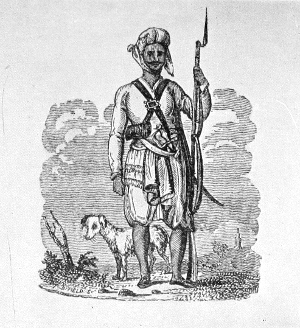
RĀJPUT FOOT-SOLDIER OF MĀRWĀR.
To face page 812.
The exports of home production are the two staple articles
of salt and woollens; to which we may add coarse cotton cloths,
and paper made in the town of Pali. The lois, or blankets, are
disseminated throughout India, and may be had at from four
to sixty rupees per pair; scarfs and turbans are made of the same
material, but not for exportation. But salt is the chief article
of export, and the duties arising therefrom equal half the land
revenue of the country. Of the agars, or ‘salt lakes,’ Pachbhadra,
Phalodi, and Didwana are the principal, the first being several
miles in circuit [702].
The commercial duties of Pali yielded 75,000 rupees annually,
a large sum in a poor country like Marwar.
—The Charans and Bhats, or bards
and genealogists, are the chief carriers of these regions: their
sacred character overawes the lawless Rajput chief; and even
the savage Koli and Bhil, and the plundering Sahariya of the
desert, dread the anathema of these singular races, who conduct
the caravans through the wildest and most desolate regions.
The traveller avails himself of such convoy who desires to proceed
to the coast by Jalor, Bhinmal, Sanchor, and Radhanpur, whence
he may pursue his route to Surat, or Muskat-Mandavi.
—To the east of Pali about ten miles, there
is an isolated hill, called Pungiri, ‘the hill of virtue,’ which is
crowned with a small temple, said to have been conveyed by a
Buddhist magician from Palitana in Saurashtra. Wherever this
ancient and numerous sect exists, magical skill is always asserted.
814Here we found our old friend, Gough, who had been rambling to
the south-west amongst Sahariya, Khosas,
[48] and all the wild beings
of these uncivilized tracts, in search of new breeds of horses.
Halted to enjoy his society.
Kairla, 30th.
Rohat, 31st.
—November 1.—Khankani, on the north bank of
the Luni. There was nothing to arrest attention between Pali
and the Luni: all is flat and lonely in the thirty miles which
intervene. Our halts were at Kairla, which has two small salt
lakes, whence its name; in fact, this superabundant product,
khar, or salt, gives its name to streams and towns. Both Kairla
and Rohat, the intermediate places of halt, are feudal estates,
and both chiefs had been involved in the recent civil dissensions:
Rohat was under the ban.
—Here
I had an exemplification of the vulgar adage, “two of a trade,”
etc. Pema Naik, the leader of one of the largest
tandas, or
caravans, which frequent the desert for salt, had left his convoy,
and with his brethren came to exhibit his wounds and fractures
received in a fray with the leaders of another caravan. Both
were Bhats; Pema was the head of the Bamania Bhats, so called
from the place of their abode, and he counted forty thousand
beasts of burthen under his control. Shama had no distinctive
epithet: he had no home separate from [703] his
tanda. His
little State when not in motion was on the highways; hence those
who dwell entirely with their cattle are styled
upapanti, ‘on the
road.’ Shama had taken advantage of the greater portion of
Pema’s caravan being detached to revenge an ancient feud;
and had shown himself quite an adept in club-law, as the broken
heads of his opponents disclosed. To reconcile them was impossible;
and as the case was to be decided, not by the scales
of abstract justice but by calculating which contributed most in
duties, Pema by this summary process, more than from sympathy
to his wounded honour, gained a victory by the exclusion of his
rival. As before observed, these classes take advantage of their
sacred character amongst the Rajputs to become the general
815carriers of the country: but the advantage which might result
to the State from the respect paid to them is neutralized by their
avarice and constant evasion of the payment of all established
duties. A memorable example of this kind occurred during the
reign of Amra the First with the ancestor of this same Pema.
The Rana would not submit to the insolent demands of the Bhats,
when they had recourse to one of the most sanguinary sacrifices
ever recorded—the threat alone of which is generally sufficient
to extort acquiescence and concession. But the firmness of Amra
has been recorded: and he braved them. Collecting the elder
portion of their community, men, women, and youths of both
sexes, they made a sacrifice to the number of eighty souls with
their daggers in the court of the palace. The blood of the victims
was on the Rana’s head.
[49] It was a species of excommunication,
which would have unsettled a weaker reason; for the Rajput
might repose after the murder of a Brahman, but that of the
prophetic Vates would rise against him here and hereafter. For
once they encountered a mind too strong to be shaken; Amra
banished the whole fraternity of Bamania Bhats from his
dominions, and the town of Bamani reverted to the fisc. The
edict remained uncancelled until these days, when amongst the
industrious of all classes whom the proclamations
[50] brought once
more to Mewar, came Pema and his brethren. Although tradition
had preserved the causes of their exile, it had made no alteration
in their sentiments and opinions, and the dagger was always
at hand, to be sheathed in their own flesh whenever provocation
called it from the girdle. Pema beset the Rana in all his rides,
demanding a reduction [704] or rather abolition of duties for his
tanda; and at length he took up a position on the terrace fronting
the ‘balcony of the sun,’ threatening a
chandni,
[51] for such is the
816term applied to this suicidal revenge. The Rana, who had not
the nerve of his ancestor, sent to me to beseech my interference:
with his messenger, one from me returned to invite the Bhats to
a settlement. They came, as fine, robust, intrepid a set as I
ever saw. We soon came to issue: I urged that duties must be
paid by all who chose to frequent the passes of Mewar, and that
they would get nothing by their present silly mode of endeavouring
to obtain remission; that if they would give a written agreement
to abide by the scale of duties laid down, they should receive
exemption for five hundred out of the forty thousand bullocks
of their
tanda, and be reinducted into Bamani; if not, there were
daggers (showing them some on the table), and they might begin
as soon as they pleased. I added that, in addition to Rana
Amra’s penalty of banishment, I would recommend confiscation
of their entire caravan. Pema was no fool: he accepted Bamani,
and the
muafi for five hundred, and that day received his
gold bracelets and clothes of investiture for Bamani from the
Rana.
—
November 2.—Jhalamand, ten miles. Although
within one march of Jodhpur, we were obliged to make an intermediate
halt, in order to arrange the ceremonials of reception;
a grave matter with all the magnates of the East, who regulate
all such affairs by slavish precedent and ancestral wisdom. On
such a novel occasion as the reception of an English envoy at
this desert court, they were a good deal puzzled how to act. They
could very well comprehend how an ambassador direct from
majesty should be received, and were not unfamiliar with the
formula to be observed towards a viceregal legation. But the
present case was an anomaly: the Governor of all India, of course,
could appear only as the first servant of a commercial body,
which, with whatever privileges invested, never could be made to
rank with royalty or its immediate emanation. Accordingly, this
always proved a clog to our diplomatic missions, until the diffusion
of our power from the Indus to the ocean set speculation at rest
on the formalities of reception of the Company’s ambassadors.
On the other hand, the eternal rotation of military adventurers
enjoying ephemeral power, such as the commanders of the myrmidons
of Sindhia and Holkar, compelled all the Rajput princes
to forgo much of their dignity; and men like Amir Khan, Jean
Baptiste, or Bapu Sindhia, who but a [705] short time ago would
817have deemed themselves honoured with a seat in the ante-chamber,
claimed equality of reception with princes. Each made it a
subject for boasting, how far he had honoured himself by the
humiliation of the descendant of the emperor of Kanauj, or the
scion of Rama. At the same time, as the world is always deceived
by externals, it was difficult to concede a reception less distinguished
than that granted to the leader of a Mahratta horde;
and here their darling precedent was available. To what distance
did the Raja send the
istikbal to meet Amir Khan? what was the
rank of the chieftains so deputed? and to what point did the
“offspring of the sun” condescend to advance in person to
receive this “lord of the period”? All these, and many similar
questions, were propounded through the Wakil, who had long
been with me, to his sovereign, to whose presence he proceeded
in order that they might be adjusted, while I halted at Jhalamand,
only five miles from the capital. However individually we may
despise these matters, we have no option, as public servants, but
to demand the full measure of honour for those we represent.
As the present would also regulate future receptions, I was compelled
to urge that the Raja would best consult his own dignity
by attending to that of the government I represented, and distinctly
signified that it could never be tolerated that he should
descend to the very foot of his castle to honour Amir Khan, and
await the English envoy almost on the threshold of his palace.
It ended, as such matters generally do in those countries, by a
compromise: it was stipulated that the Raja should receive the
mission in his
palki or litter, at the central barrier of descent.
[52]
These preliminaries being arranged, we left Jhalamand in the
afternoon, that we might not derange the habits of slumber of
those who were to conduct us to the capital. About half-way
we were met by the great feudatory chieftains of Pokaran and
Nimaj, then lords of the ascendant, and the joint advisers of their
sovereign. We dismounted, embraced, complimented each other
in the customary phraseology; then remounted, and rode together
until we reached the tents, where, after I had requested them to
be the bearers of my homage to their sovereign, we mutually
saluted and parted.
818—Salim Singh
[53] was the name of the lord
of Pokaran, the most wealthy and the [706] most powerful of
all the baronies of Marwar. His castle and estate (wrested from
Jaisalmer) are in the very heart of the desert; the former is
strong both by position and art. It is a family which has often
shaken the foundation of the throne of Marwar. During four
generations have its bold and turbulent chiefs made the most
resolute of these monarchs tremble. Deo Singh, the great grandfather
of the present chief, used to sleep in the hall of the royal
palace, with five hundred of his Champawats, of which clan he
is the chief. “The throne of Marwar is within the sheath of
my dagger,” was the boast, as elsewhere mentioned, of this
haughty noble to his sovereign. His son, Sabal Singh, followed
his father’s steps, and even dethroned the great Bijai Singh: a
cannon-shot relieved the prince from this terror of his reign.
Sawai Singh, his son and successor, acted the same part towards
Raja Bhim, and was involved in the civil wars which commenced
in 1806, when he set up the pretender, Dhonkal Singh. The
catastrophe of Nagor, in which Amir Khan acted the assassin of
the Champawat and all his associates, relieved Raja Man from
the evil genius of his house; and the honours this prince heaped
on the son of the Champawat, in giving him the first office in
the State, were but a trap to ensnare him. From this he escaped,
or his life and the honours of Pokaran would have been
lost together. Such is a rapid sketch of the family of the
chief who was deputed to meet me. He was about thirty-five
years of age; his appearance, though not prepossessing, was
dignified and commanding. In person he was tall, but more
powerful than athletic; his features were good, but his complexion
was darker than in general amongst the chieftains of
Marwar.
—His companion, and associate in the
councils of his prince, was in every point of personal appearance
the reverse of this portrait. Surthan Singh was chief of the
Udawats, a clan which can muster four thousand swords, all
residing on the land skirting the Aravalli; and of which his
819residence Nimaj,
[54] Raepur, and Chandawal are the principal fiefs.
Surthan was a fine specimen of the Rajput; his figure tall and
graceful; his complexion fair; his deportment manly and mild;
in short, he was a thorough gentleman in appearance, understanding,
and manners.
It would be impossible to relate here all the causes which
involved him in the catastrophe from which his coadjutor escaped.
It was the misfortune of Surthan to have been associated with
Salim Singh; but his past services to his prince amply counterbalanced
this party bias. It was he who prevented his sovereign
from [707] sheathing a dagger in his heart on the disgraceful day
at Parbatsar; and he was one of the four chieftains of all Marwar
who adhered to his fortunes when beset by the united force of
Rajputana. He was also one of the same four who redeemed
the spoils of their country from the hands of the multitudinous
array which assaulted Jodhpur in 1806, and whose fate carried
mourning into every house of Rajasthan.[55] The death of Surthan
Singh was a prodigal sacrifice, and caused a sensation of universal
sorrow, in which I unfeignedly participated. His gallant bearing
was the theme of universal admiration; nor can I give a better
or a juster idea of the chivalrous Rajput than by inserting a
literal translation of the letter conveying the account of his
death, about eight months after my visit to Jodhpur.
“Jodhpur, 2d Asarh, or 28th June 1820.
“On the last day of Jeth (the 26th June), an hour before daybreak,
the Raja sent the Aligols,[56] and all the quotas of the chiefs,
to the number of eight thousand men, to attack Surthan Singh.
They blockaded his dwelling in the city, upon which for three
watches they kept up a constant fire of great guns and small arms.
Surthan, with his brother Sur Singh, and his kindred and clan,
after a gallant defence, at length sallied forth, attacked the
foreigners sword in hand, and drove them back. But who can
oppose their prince with success? The odds were too great,
820and both brothers fell nobly. Nagoji and forty of the bravest
of the clan fell with the Thakur brothers, and forty were severely
wounded. Eighty, who remained, made good their retreat with
their arms to Nimaj.[57] Of the Raja’s troops, forty were killed
on the spot, and one hundred were wounded. Twenty of the
townsfolk suffered in the fray.
“The Pokaran chief, hearing of this, saddled; but the Maharaja
sent Sheonath Singh of Kuchaman, the chief of Bhadrajan,
and others, to give him confidence, and induce him to stay; but
he is most anxious to get away. My nephew and fifteen of my
followers were slain on this occasion. The Nimaj chief fell as
became a Rathor. The world exclaims ‘applause,’ and both
Hindu and Turk say he met [708] his death nobly. Sheonath
Singh, Bakhtawar Singh, Rup Singh, and Anar Singh,[58] performed
the funeral rites.”
Such is the Rajput, when the point of honour is at stake!
Not a man of his clan would have surrendered while their chief
lived to claim their lives; and those who retreated only preserved
them for the support of the young lord of the Udawats [709]!
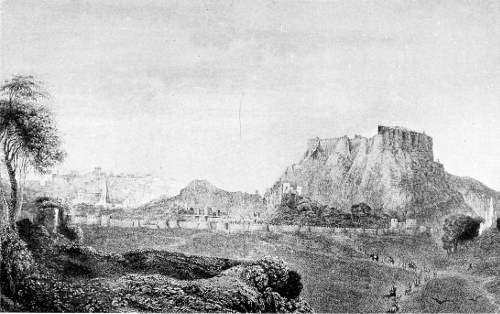
TOWN AND FORT OF JODHPUR.
(From the south-east.)
To face page 820.
—The sand, since we crossed the Luni,
had become gradually heavier, and was quite fatiguing as we
approached the capital of “the region of death”; but the
Marwaris and the camels appeared to move through it as briskly
as our men would on the plains of the Ganges. The view before
the reader will give a more correct idea of the ‘city of Jodha’
than the most laboured description. The fort is erected on a
mole projecting from a low range of hills, so as to be almost
isolated, while, being higher than the surrounding objects, it is
not commanded. This table-ridge (mountain we can scarcely
term it, since its most elevated portion is not more than three
hundred feet in height) is a curious feature in these regions of
821uninterrupted aridity. It is about twenty-five miles in length,
and, as far as I could determine from a bird’s-eye view and from
report, between two and three in breadth, the capital being placed
on the highest part at the southern extremity, and may be said
to be detached from it. The northern point, which is the highest,
and on which the palace is built, is less than three hundred feet.
Everywhere it is scarped, but especially at this point, against
which the batteries of the League
[1] were directed in 1806, at least
a hundred and twenty feet of perpendicular height. Strong walls
and numerous round and square towers encircle the crest of the
hill, encompassing a space of great extent, as may be judged from
the dimensions of the base, said to be four miles in circuit. Seven
barriers are thrown across the circuitous ascent, each having
immense portals and their separate guards. There are two small
lakes under the walls: the Rani Talab, or ‘Queen’s Lake,’ to the
east; and the Gulab Sagar, or ‘Rose-water Sea,’ to the south,
from [710] which the garrison draws up water in buckets. There
is also inside a
kund, or reservoir, about ninety feet in depth,
excavated from the rock, which can be filled from these tanks;
and there are likewise wells within, but the water is brackish.
Within are many splendid edifices, and the Raja’s residence is a
succession of palaces, each prince since the founder having left
memorials of his architectural taste. The city to the eastward
of the citadel is encompassed by a strong wall, three coss, or
nearly six miles, in extent, on which a hundred and one bastions
or towers are distributed; on the rampart are mounted several
rahkalas[2] or swivels. There are seven gates to the capital, each
bearing the name of the city to which it leads. The streets are
very regular, and adorned with many handsome edifices of freestone,
of which the ridge is composed. The number of families
some years ago was stated to be 20,000, probably 80,000 souls,
an estimate far too great for the present day.
[3] The Gulab Sagar
is the favourite lounge of the inhabitants, who recreate amongst
its gardens; and, strange to say, the most incomparable pomegranates
(
anar) are produced in it, far superior even to those of
Kabul, which they resemble in the peculiarity of being
be-dana,
822‘without grain’: rather a misnomer for a fruit, the characteristic
of which is its granulations; but this is in contradistinction to
those of India, which are all grain and little pulp. The anars of
the Kagli-ka-bagh, or ‘Ravens’ Garden,’ are sent to the most
remote parts as presents. Their beautiful ruby tint affords an
abundant resource for metaphor to the Rajput bard, who describes
it as “sparkling in the ambrosial cup.”[4]
—On the 4th the Raja received us with
due form, advancing beyond the second gate of descent; when,
after salutations and greetings, he returned according to etiquette.
Giving him time to make his arrangements, we advanced slowly
through lines of his clansmen to the upper area, where a display
of grandeur met our view for which we were totally unprepared,
and far eclipsing the simple and unostentatious state of the Rana.
Here everything was imitative of the imperial court of Delhi,
where the Rathor, long pre-eminent, had “the right hand of the
king of the world.” Lines of gold and silver mace-bearers
deafened us with the titles of “Raj-Raj-Iswara!” ‘the king,
the lord of kings!’ into whose presence, through mazes of intricate
courts filled with his chivalry, all hushed into that mysterious
silence which is invariably observed on such occasions, we were
at length ushered [711].
—The King of Maru arose from his throne,
and advanced a few paces, when he again courteously received
the envoy and suite, who were here introduced. The hall of
reception was of great extent: from its numerous square columns
it is styled Sahas stambha, ‘the thousand-columned hall.’ They
were more massive than elegant; and being placed in parallel
rows, at not more than twelve feet from each other, they gave
an air of cumbrous, if not clumsy grandeur to an immense apartment,
the ceiling of which was very low. About the centre, in a
niche or recess, the royal gaddi or ‘cushion’ was placed, over
which was raised a richly embroidered canopy, supported by
silver-gilt columns. On the Rana’s right hand were placed those
whom the king honoured, the chieftains of Pokaran and Nimaj,
who would have been less at their ease had they known that all
the distinctions they then enjoyed were meshes to ensnare them.
Several other chieftains and civil officers, whose names would but
little interest the reader, were placed around. The wakil, Bishan
823Ram, was seated near me, almost in front of the Raja. The
conversation was desultory and entirely complimentary; affording,
however, abundant opportunity to the Raja to display his
proficiency in that mixed language, the Hindustani, which he
spoke with great fluency and much greater purity than those who
resided about the court at Delhi. In person the Raja is above
the common height, possessing considerable dignity of manner,
though accompanied by the stiffness of habitual restraint. His
demeanour was commanding and altogether princely; but there
was an entire absence of that natural majesty and grace which
distinguished the prince of Udaipur, who won without exertion
our spontaneous homage. The features of Raja Man are good:
his eye is full of intelligence; and though the ensemble of his
countenance almost denotes benevolence, yet there is ever and
anon a doubtful expression, which, with a peculiarly formed
forehead, gave a momentary cast of malignity to it. This might
have been owing to that deep dissimulation, which had carried
him through a trial of several years’ captivity, during which he
acted the maniac and the religious enthusiast, until the assumed
became in some measure his natural character.
The biography of Man Singh would afford a remarkable picture
of human patience, fortitude, and constancy, never surpassed in
any age or country. But in this school of adversity he also took
lessons of cruelty: he learned therein to master or rather disguise
his passions; and though he showed not the ferocity of the tiger,
he acquired [712] the still more dangerous attribute of that
animal—its cunning. At that very time, not long after he had
emerged from his seclusion, while his features were modelled into
an expression of complaisant self-content, indicative of a disdain
of human greatness, he was weaving his web of destruction for
numberless victims who were basking in the sunshine of his
favour. The fate of one of them has been already related.[5]
—The Rathor, like many other dynasties
not confined to the East, claims celestial descent. Of their Bhat,
we may say what Gibbon does of the Belgic genealogist who
traced the illustrious house of Este from Romulus, that “he riots
in all the lust of fiction, and spins from his own bowels a lineage
of some thousand years.” We are certain that there were
sovereigns of Kanauj in the fifth century, and it is very probable
824that they ruled there prior to the era of Christianity. But this is
accounted nothing by these lovers of antiquity, who never stop
short of Swayambhuva,
[6] and the ark, in which the antediluvian
records of the Rathors may have been preserved with those of
the De Courcys. But we will not revert to those “happy times,
when a genealogical tree would strike its root into any soil, and
the luxuriant plant could flourish and fructify without a seed of
truth.” Then the ambition of the Rathor for a solar pedigree
could be gratified without difficulty.
But it requires neither Bhat nor bard to illustrate its nobility:
a series of splendid deeds which time cannot obliterate has
emblazoned the Rathor name on the historical tablet. Where
all these races have gained a place in the temple of fame, it is
almost invidious to select; but truth compels me to place the
Rathor with the Chauhan, on the very pinnacle. The names of
Chonda and Jodha are sufficient to connect Siahji, the founder,
a scion of Kanauj, with his descendant, Raja Man:[7] the rest
Were long to tell; how many battles fought;
How many kings destroyed, and kingdoms won.
Let us, therefore, put forth our palm to receive the itr from his
august hand, and the pan, acknowledged by a profound salaam,
and bringing the right hand to my cocked hat, which etiquette
requires we should “apply to the proper use:—’tis for the head,”
even in the presence. At all the native courts the head is covered,
and the en bas left bare. It would be sadly indecorous to walk
in soiled boots over their [713] delicate carpets, covered with
white linen, the general seat. The slippers are left at the door,
and it is neither inconvenient nor degrading to sit in your socks.
The Raja presented me with an elephant and horse caparisoned,
an aigrette, necklace, brocades, and shawls, with a portion according
to rank to the gentlemen who accompanied me.
On the 6th I paid the Raja another visit, to discuss the affairs
of his government. From a protracted conversation of several
hours, at which only a single confidential personal attendant of
the prince was present, I received the most convincing proofs of
his intelligence, and minute knowledge of the past history, not of
his own country alone, but of India in general. He was remarkably
825well read; and at this and other visits he afforded me much
instruction. He had copies made for me of the chief histories of
his family, which are now deposited in the library of the Royal
Asiatic Society. He entered deeply into the events of his personal
history, and recounted many of the expedients he was obliged to
have recourse to in order to save his life, when, in consequence of
the murder of his Guru (not only his spiritual but his temporal
guide, counsellor, and friend), he relinquished the reins of power,
and acquiesced in their assumption by his son. The whole transaction
is still involved in mystery, which the Raja alone can
unravel. We must enter so far into the State secrets of the court
as to disclose the motive for such an act as the destruction of
the brave Surthan, and introduce to the reader another high
priest of the Rajputs as a pendant for the oracle of the Apollo of
Nathdwara.
The parricidal murder of Raja Ajit has been the destruction of
Marwar, and even “unto the third and fourth generation”
Providence would seem to have visited the act with its vengeance.
The crown, which in a few years more would have been transmitted
by nature’s law, was torn from the brow of this brave
prince, who has redeemed his lost inheritance from Aurangzeb,
by the unhallowed arm of his eldest son Abhai Singh; instigated
thereto by an imperial bribe of the viceroyalty of Gujarat. His
brother, Bakhta Singh, was made almost independent in Nagor
by the concession of Abhai and the sanad and titles of his
sovereign; and the contests between their issue have moistened
the sands of Marwar with the richest blood of her children. Such
is the bane of feudal dominion—the parent of the noblest deeds
and the deepest crimes.
—Raja Man, accordingly, came to
the throne with all the advantages and [714] disadvantages of
such a state of things; and he was actually defending his existence
in Jalor against his cousin and sovereign, when an unexpected
event released him from his perils, and placed him on the throne.
Bhim Singh had destroyed almost every branch of the blood-royal,
which might have served as a nucleus for those intestine
wars which desolated the country, and young Man, the sole intervening
obstacle to the full accomplishment of his wishes, was
reduced to the last extremity, and on the eve of surrendering
himself and Jalor to this merciless tyrant, when he was relieved
826from his perilous situation. He attributed his escape to the
intercession of the high priest of Marwar, the spiritual leader of
the Rathors. This hierarch bore the title of divinity, or Nathji:
his praenomen of Deo or Deva was almost a repetition of his title;
and both together, Deonath, cannot be better rendered than by
‘Lord God.’ Whether the intercession of this exalted personage
was purely of a moral nature, as asserted, or whether Raja Bhim
was removed from this vain world to the heaven of Indra by
means less miraculous than prayer is a question on which various
opinions are entertained; but all agree that nothing could have
been better timed for young Man, the sole victim required to fill
up the measure of Bhim’s sanguinary policy. When suicide was
the sole alternative to avoid surrender to the fangs of this Herod
of the Desert, the high priest, assuming the mantle of prophecy,
pronounced that no capitulation was inscribed in the book of
fate—whose page revealed brighter days for young Man. Such
prophets are dangerous about the persons of princes, who seldom
fail to find the means to prevent their oracles from being demented.
A dose of poison, it is said, was deemed a necessary
adjunct to render efficacious the prayers of the pontiff; and
they conjointly extricated the young prince from a fate which
was deemed inevitable, and placed him on the regal cushion of
Marwar. The gratitude of Raja Man had no limits—no honours,
no grants were sufficient to mark his sense of obligation. The
royal mantle was hallowed by the tread of this sainted being;
and the throne itself was exalted when Deonath condescended
to share it with his master, who, while this proud priest muttered
forth his mysterious benedictions, with folded hands stood before
him to receive the consecrated garland. Lands in every district
were conferred upon the Nath, until his estates, or rather those
of the church of which he was the head, far exceeded in extent
those of the proudest nobles of the land, his income [715]
amounting to a tenth of the revenues of the State. During the
few years he held the keys of his master’s conscience, which were
conveniently employed to unlock the treasury, he erected no less
than eighty-four mandirs, or places of worship, with monasteries
adjoining them, for his well-fed lazy chelas or disciples, who
lived at free quarters on the labour of the industrious. Deonath
was a striking example of the identity of human nature, under
whatever garb and in whatever clime; whether under the cowl
827or the coronet, in the cold clime of Europe, or in the deserts of
India. This Wolsey of Marudes exercised his hourly-increasing
power to the disgust and alienation of all but his infatuated
prince. He leagued with the nominal minister, Induraj, and
together they governed the prince and country. Such characters,
when exceeding the sphere of their duties, expose religion to
contempt. The degradation which the haughty grandees of
Marwar experienced made murder in their eyes a venial offence,
provoked as they were by the humiliations they underwent
through the influence of this arrogant priest, whose character
may be given in the language of Gibbon, merely substituting
Deonath of Marwar for Paul of Samosata: “His ecclesiastical
jurisdiction was venal and rapacious; he extorted frequent
contributions from the most opulent of the faithful, and converted
to his own use a considerable part of the public revenue.
His council chamber and his throne, the splendour with which
he appeared in public, the suppliant crowd who solicited his
attention, and the perpetual hurry of business in which he was
involved, were circumstances much better suited to the state of
a civil magistrate than to the humility of a primitive bishop.”
[8]
But his “full-blown pride” at length burst under him. Sequestrations
from the estates of the chief barons of Maru became frequent
in order to swell his rent-roll for the support of his establishments;
his retinue on ordinary occasions surpassed that of any chieftain,
and not unfrequently he was attended by the whole insignia of
the State—the prince attending on such ceremonies. On these
occasions the proud Rajput felt that he folded his hands, not to
his sovereign, but to his sovereign’s sovereign; to a vindictive
and vainglorious priest, who, amidst the mummeries and artifices
of religious rites, gratified an inordinate vanity, while he mortified
their pride and diminished their revenues. The hatred of such
men is soon followed by their vengeance; and though they
would not dye their own daggers in his blood, they soon found
agents in a race who know not mercy, the myrmidons of [716]
that villain Amir Khan, under whose steel, and within the precincts
of the palace, Deonath fell a victim. It has been surmised
that Raja Man was privy to the murder; that if he did not
command or even sanction it, he used no means to prevent it.
There are but two in this life who can reveal this mystery—the
828Raja, and the
bourreau en chéf of Rajasthan, the aforesaid Amir
Khan.
The murder of the high priest was but a prolongation of the
drama, in which we have already represented the treacherous
destruction of the chieftain of Pokaran and his kindred; and
the immolation of Krishna Kunwari, the Helen of Rajasthan.
The attack on the gallant Surthan, who conducted us from
Jhalamand to the capital, sprung from the seed which was
planted so many years back; nor was he the last sacrifice:
victim after victim followed in quick succession until the Caligula
of the Desert, who could “smile and stab,” had either slain
or exiled all the first chieftains of his State. It would be a
tedious tale to unravel all these intrigues; yet some of them
must be told, in order to account for the ferocity of this
man, now a subordinate ally of the British Government in the
East.
—It was in
A.D. 1804
[9] that Raja
Man exchanged the defence of Jalor for the throne of Jodhpur.
His predecessor, Raja Bhim, left a widow pregnant; she concealed
the circumstance, and when delivered, contrived to convey
the child in a basket to Sawai Singh of Pokaran. During two
years he kept the secret: he at length convened the Marwar
chieftains, with whose concurrence he communicated it to Raja
Man, demanding the cession of Nagor and its dependencies as a
domain for this infant, named Dhonkal Singh, the heir-apparent
of Marwar. The Raja promised compliance if the mother confirmed
the truth of the statement. Whether her personal fears
overcame her maternal affection, or the whole was an imposture
of Pokaran, she disclaimed the child. The chiefs, though not
satisfied, were compelled to appear contented with the result of
this appeal; and for some years the matter seemed at rest. But
this calm was only the presage of a storm, which shook to its
base the political edifice of Marwar, and let loose upon her cities
a torrent of predatory foes; it dethroned her prince, and, what
the planner could not have contemplated, involved his own
destruction. The effects of this treachery have for ever destroyed
all confidence between the chief and the entire feudal interest.
The Pokaran chief, after failing to establish the [717] claims of
Dhonkal Singh as pretender to the throne, sent him for safety
829to the Shaikhawat chief of Khetri,
[10] one of the independent nobles
of the Jaipur family. Here he left him till an opportunity again
arrived to bring him upon the scene, which was afforded by the
contest between the princes of Marwar and Jaipur for the hand
of the Rana’s daughter. This rivalry, the effects of which are
already related, and which brought into conflict all the northern
powers of India, was, in fact, only the under-plot of the deep-laid
policy of Sawai. When once the gauntlet was thrown down
for the hand of this fair lady, the Pokaran chief stepped in with
the pretended son of Raja Bhim, whose cause, from the unpopularity
of Raja Man, soon brought to his standard almost all
the feudality of Marwar. The measures which followed, and
the catastrophe, the death of Krishna Kunwari, have already
been related.
[11] The assassination of the chief of Pokaran was
simultaneous with these events; and it was shortly after that
the murder of the pontiff Deonath took place.
—After being relieved from all
external foes by his own strength of mind, and the aid of a few
friends whom no reverse could estrange from him, Raja Man
either fell, or affected to fall, into a state of mental despondency
bordering on insanity. Suspicious of every one, he would only
eat from the hands of his wife, who prepared his food herself;
he became sullen and morose; he neglected public business;
and finally withdrew entirely from the world. The attempt to
rouse him from this real or pretended stupor was fruitless; he
did nothing but lament the death of Deonath, and pour forth
prayers to the deity. In this state, he was easily induced to
associate his son in the government, and he bestowed upon him
with his own hand the tika of command. Chhattar Singh was
the name of the prince, who was still in his minority; thoughtless,
and of dissolute habits, he soon gave himself up to the guidance
of a junta of the chiefs, who proclaimed Akhai Chand, of the
mercantile caste, the chief civil minister of the State.
—Such was the condition of Marwar from A.D. 1809
to 1817. At this period the progress of events made the English
arbiters of the destinies of Rajasthan. The regent of Marwar
sent an ambassador to treat; but before the treaties were ratified
and exchanged the young regent was dead. Various causes were
830assigned [718] for his death: by some his dissolute habits, occasioning
premature decay; by others, with more probability, the
dagger of an indignant Rajput, the honour of whose daughter
he had clandestinely attempted. Upon this event, and the
change of political circumstances, the chiefs had no alternative
but to turn to the secluded prince. If but one half is true that
I have heard, and from authority of high credit, the occupations
of the years which the Raja passed between the murder of the
priest and the death of his son might be deemed an atonement
for the deepest crimes. When messengers announced the fate
of his son, and that State necessity recalled him to the helm of
affairs, he appeared unable to comprehend them. He had so
long acted the maniac that he had nearly become one: his beard
was never touched, and his hair, clotted and foul, gave him an
expression of idiocy; yet throughout these long years he was
resolutely tenacious of life. The party who governed the son
and the State had their own menials to wait upon him, and many
were the attempts to poison him by their means; in avoiding
which his simulated madness was so perfect that they deemed
he had “a charmed life.” But he had one faithful servant, who
throughout this dreadful trial never forsook him, and who carried
him food in his turban to replace that which was suspected.
When by degrees he was led to understand the emergency, and
the necessity of leaving his prison, he persevered in his apparent
indifference to everything earthly, until he gathered information
and the means for a terrible reaction. The treaty with the
English put the ball at his foot: he very soon perceived that he
might command a force to put down disorder—such was even
volunteered; but with admirable penetration he trusted to the
impression of this knowledge amongst his chiefs, as a sufficient
auxiliary. By disseminating it, he paralysed that spirit which
maintained rights in the soil of Marwar nearly concurrent with
those of the sovereign. No higher compliment could be paid to
British ascendancy than the sentiments of Raja Man and his
nobles; and no better illustration is on record of the opinion of
our power than that its name alone served the Raja’s purpose
in subjugating men, who, scarcely knowing fear, yet reposing
partly on our justice, though mainly on the utter hopelessness of
resisting us, were deprived of all moral courage.
In refusing the aid of a mere physical force, the Raja availed
831himself of another weapon; for by this artifice he threw the
chiefs off their guard, who confided in his [719] assumed desire
to forget the past. Intrigues for power and patronage seemed
to strengthen this confidence; and Salim Singh of Pokaran, the
military Maire du palais or Bhanjgarh, and Akhai Chand, retained
as civil prime minister, were opposed by Jodhraj Singwi, who
headed the aspirants to supplant them. The Raja complained
of their interested squabbles, but neither party dreamed that
they were fostered by him to cloak his deep-laid schemes. Akhai
Chand had been minister throughout the son’s administration;
the political and pecuniary transactions of the State were known
chiefly to him; to cut him off would have been poor revenge,
and Raja Man was determined not only to extract from him all
the knowledge of State matters transacted during his seclusion,
but to make himself master of his coffers, and neither would have
been attained by simple murder. Akhai Chand was not blind
to the dangers of his position; he dreaded the appui his sovereign
derived from the English, and laboured to inspire the Raja with
distrust of their motives. It suited his master’s views to flatter
this opinion; and the minister and his adherents were lulled into
a fatal security.
—Such were the schemes
concocting when I visited this court, which were revealed by
succeeding events. At this time the Raja appeared in a state
of mental depression, involved in difficulties, cautious, fearful
of a false step, and surrounded by the satellites of the miscreant
Akhai Chand, who, if he could no longer incarcerate his person,
endeavoured to seal up the mind of his prince from all communication
with those who might stimulate him to exertion. But all
his arts only served to entangle him in the web then weaving for
his life. The Raja first made him the means of destroying the
most powerful of his chieftains, Surthan being the primary sacrifice
to his sanguinary proscription; many others followed, until the
best of the feudal chieftains sought refuge from his fury in exile,
and found the saran (sanctuary) they sought in the surrounding
States, the majority in Mewar. The day of vengeance at length
arrived, and the minister and his partisans were transferred from
their position at the helm of the State to a dungeon. Deceived
with hopes of life, and compelled by the application of some
summary methods of torture, Akhai Chand gave in a schedule
832of forty lakhs of property, of which the Raja realized a large
portion, and then dismissed him to the other world. Nagoji, the
kiladar,
[12] and Mulji Dandal, both favourites and advisers of the
Raja’s [720] late son, returned on the strength of a general amnesty,
and forgot they had been traitors. The wealth which prodigality
had heaped upon them, consisting of many of the crown jewels,
being recovered, their worldly accounts were settled by a cup of
poison, and their bodies thrown over the battlements. Success,
and the taste of blood, whetted rather than appeased the appetite
of Raja Man. He was well seconded by the new minister, Fateh
Raj, the deadly opponent of Akhai Chand, and all the clan of
Champawats, whom he deemed the authors of the murder of his
brother Induraj, slain at the same time with Deonath. Each
day announced a numerous list of victims, either devoted to
death, or imprisoned and stripped of their wealth. The enormous
sum of a crore of rupees has been stated as the amount of the
confiscations.
All these atrocities occurred within six months after my visit
to this court, and about eighteen from the time it was received
into protective alliance with the British Government. The
anomalous condition of all our connexions with the Rajput
States has already been described: and if illustration of those
remarks be required, it is here in awful characters. We had tied
up our own hands: “internal interference” had been renounced,
and the sequestration of every merchant’s property, who was
connected with the Mehta faction, and the exile of the nobles,
had no limit but the will of a bloodthirsty and vindictive tyrant.
The objects of his persecution made known everywhere the unparalleled
hardships of their case, and asserted that nothing but
respect for the British Government prevented their doing themselves
justice. In no part of the past history of this State could
such proscription of the majority of the kin and clan of the prince
have taken place. The dread of our intervention, as an umpire
favourable to their chief, deprived them of hope; they knew that
if we were exasperated there was no saran to protect them. They
had been more than twelve months in this afflicting condition
when I left the country; nor have I heard that anything has been
done to relieve them, or to adjust these intestine broils. It is
abandoning them to that spirit of revenge which is a powerful
833ingredient in their nature, and held to be justifiable by any means
when no other hope is left them. In all human probability, Raja
Man will end his days by the same expedient which secured him
from the fury of his predecessor.[13]
—Having lifted the mantle
which veiled the future, my reader must forget all that [721] has
been said to the disadvantage of Raja Man, and see only the
dignified, the courteous, and the well-instructed gentleman and
prince. I cannot think that the Raja had coolly formed to himself
the plan of the sanguinary measures he subsequently pursued,
and which it would require a much more extended narrative to
describe. We discoursed freely on past history, in which he was
well read, as also in Persian, and his own native dialects. He
presented me with no less than six metrical chronicles of his house;
of two, each containing seven thousand stanzas, I made a rough
translation. In return, I had transcribed and sent to him Ferishta’s
great
History of the Mahomedan Power in India, and
Khulasatu-t-tawarikh,
[14]
a valuable epitome of the history of Hindustan. I
little imagined that I should then have to exhibit him otherwise
than his demeanour and instructive discourse made him appear
to me. In our graver conversation I was amused with a
discourse on the rules of government, and instructions for the
guidance of ambassadors, which my better acquaintance with
Chand discovered to be derived from that writer. He carried me,
accompanied by a single domestic, to various apartments in the
palace, whence he directed my view across the vast plains of the
desert, whose monarch I envied not. The low hills in the vicinity
alone broke the continuity of this arid region, in which a few
isolated nim trees were thinly scattered, to remind one of the
absence of all that is grand in vegetation. After a visit of several
hours, I descended to my tent, and found my friends, Captain
Waugh and Major Gough, just returned from a successful chase
of an antelope, which, with the aid of some Rohilla greyhounds,
they had run down. I attributed their success to the heavy
834sands, on which I have witnessed many pulled down by dogs of
little speed; but the secret was revealed on this animal being
sent to the
cuisinier. On depriving him of his hide, between it
and the flesh the whole carcase was covered with a large, inert,
amorphous white maggot. The flesh was buried in the sands,
and no venison appeared again on my table while in India.
[15]—November 8.—I set out early this
morning to ramble amidst the ruins of the ancient capital, Mandor,
an important link in the chain of archaeological research, before
the panchranga, or ‘five-coloured banner’ of Maru was prostrated
to the crescent. Attended by an escort provided by the Raja,
I left the perambulator behind; but as the journey occupied an
hour and a quarter, and at a very slow pace, the distance must be
under five miles. I proceeded through the Sojat gate, to [722]
gain the road leading to Nagor; shortly after which I passed the
Maha Mandir, or ‘Grand Minster,’ the funds for the erection of
which were provided by Raja Man on his escape from ruin at
Jalor. I skirted the range, gradually decreasing in height for
three miles, in a N.N.E. direction. We then altered our course
to N.N.W., and entered the gorge of the mountains which envelop
all that is hallowed of the relics of the princes of this house. The
pass is narrow; the cliffs are almost perpendicular, in which are
numerous caves, the abodes of ascetics. The remains of fortifications
thrown across, to bar the entrance of the foe to the ancient
capital of the Pariharas, are still visible: a small stream of pure
and sweet water issues from this opening, and had a watercourse
under an archway. After proceeding a little farther, the interval
widened, and passing through the village, which does not exceed
two hundred houses, our attention was attracted by a line of
lofty temples, rising in graduated succession. These proud
monuments proved to be the cenotaphs of the Rathors, erected
on the spots where the funeral pyre consumed the crowned heads
of Maru, who seldom burnt alone, but were accompanied by all
that made life agreeable or poisoned its enjoyment. The small
brook already mentioned flows past the southern extremity of
835the chief line of monuments, which extend from south to north.
At the former point stands that of Rao Maldeo, the gallant
opponent of Sher Shah, the brave usurper of the throne of the
Moguls. The farther point terminates with that of Maharaja
Ajit Singh; while the princes in regular succession, namely, Sur
Singh, Udai Singh, Gaj Singh, and Jaswant Singh, fill up the
interval.
These dumb recorders of a nation’s history attest the epochs
of Marwar’s glory, which commenced with Maldeo, and ended
with the sons of Ajit. The temple-monument of Maldeo, which
yet throws into shade the still more simple shrines of Chonda,
and Jodha, contrasted with the magnificent mausoleum of Raja
Ajit, reads us a lesson on the advancement of luxurious pomp in
this desert State. The progression is uniform, both in magnitude
and elegance, from Maldeo’s who opposed on equal terms the
Afghan king (whose memorable words, “I had nearly lost the
throne of India for a handful of barley,”[16] mark at once the
gallantry and the poverty of those whom he encountered), to the
last great prince Ajit. Even that of Raja Gaj is plain, compared
to his successor’s. These monuments are all erected of a very
close-grained freestone, of a dark brown or red [723] tint, with
sufficient hardness to allow the sculptor to indulge his fancy.
The style of architecture, or rather the composition, is mixed,
partaking both of the Saivite and the Buddhist; but the details
are decidedly Jain, more especially the columns, which are of the
same model as those in Kumbhalmer. I speak more especially
of those of Rajas Jaswant and Ajit, drawings of which, on a large
scale, executed by the Raja’s chief architect, I brought to Europe;
but which it would be too expensive to have engraved. They are
raised on immense terraces, faced with large blocks of well-polished
freestone. That of Jaswant is somewhat ponderous and massive;
but Ajit’s rises with great elegance and perfect symmetry of
proportion.
On ascending the terrace you enter through a lofty vaulted
porch supported by handsome columns to the sanctum, which is
a pyramidal temple, four stories in height, in the Saivite style,
836crowned by the sikhar and kalas, elsewhere described. The
sculptural ornaments are worthy of admiration, both for their
design and effect; and the numerous columns on the basement,
and different stages of ascent, give an air of so much majesty
that one might deem these monuments more fitting sepulture for
the Egyptian Cheops than a shrine—over what? not even the
ashes of the desert king, which were consigned in an urn to the
bosom of the Ganges. If the foundations of these necrological
monuments have been equally attended to with the superstructure,
they bid fair to convey to remote posterity the recollection of as
conspicuous a knot of princely characters as ever followed each
other in the annals of any age or country. Let us place them in
juxtaposition with the worthies of Mewar and the illustrious scions
of Timur, and challenge the thrones of Europe to exhibit such a
contemporaneous display of warriors, statesmen, or scholars.
| Mewar. |
|
Marwar. |
|
Delhi. |
| Rana Sanga |
|
Rao Maldeo |
|
Babur and Sher Shah. |
|
Rao Sur Singh |
|
Humayun. |
| Rana Partap |
|
Raja Udai Singh |
|
Akbar. |
Rana Amra I.
Rana Karan |
} |
Raja Gaj Singh |
{ |
Jahangir and
Shah Jahan. |
| Rana Raj |
|
Raja Jaswant Singh |
|
Aurangzeb. |
Rana Jai Singh
Rana Amra II. |
} |
Raja Ajit Singh |
{ |
All the competitors for the throne after Farrukhsiyar [724]. |
From Maldeo to Udai le gros the first Raja (hitherto Raos) of
Marwar, and the friend of Akbar, to Jaswant, the implacable foe
of Aurangzeb, and Ajit, who redeemed his country from oppression,
all were valiant men and patriotic princes.
“Where were the lions’ cubs,” I asked of my conductor, “the
brave sons of Ajit, who erected this monument to his manes, and
who added provinces to his dominions?” He pointed to two
sheds, where the kriya karma[17] was performed; there was
No funeral urn
To mark their obsequies:
837but these lowly sheds told, in more forcible, more emphatic
language, the cause of this abrupt transition from grandeur to
humility than pen ever wrote; and furnished the moral epilogue
to the eventful drama of the lives of these kings of the desert.
Abhai Singh’s parricidal hand bereft his father of life; yet though
his career was one splendid tissue of success and honour, leaving
his dominions more than doubled, the contentions of his issue
with that of his brother Bakhta Singh, alike accessory, it is said,
to the crime, have entailed endless misery upon Marwar, and left
them not the power, if they had the inclination, to house his
ashes. In the same line with the parricide and his brave brother
is the humble monument of the great Bijai Singh, whose life till
towards its close was a continued tide of action. I could not
avoid an exclamation of surprise: “Shame to the country,” I
said, “that has neglected to enshrine the ashes of a name equal
to the proudest!” His three sons, amongst them Zalim Singh,
with the sketch of whom this narrative opened, have their shrines
close to his; and but a few yards removed are those of Raja
Bhim, and his elder brother Guman (who died in his minority),
the father of the reigning prince, Raja Man. The last, which
closed the line, pertained to Chhattar Singh, who, in all probability,
was saved by death from the murder of his parent. I passed it
in disgust, asking who had been so foolish as to entomb his ashes
better than those of some of the worthies of his race? I found
that it was the act of maternal fondness.
—The Amavas (the Ides) and the
Sankrantis (when the sun enters a new sign of the Zodiac) of
every month are sacred to the Pitrideva, on which days it is
incumbent on the reigning prince to “give water” to his ancestors.
But the ignorance of my conductor deprived me of much information
which I anticipated [725]; and had I not been pretty well
read in the chronicles of the Rathors, I should have little enjoyed
this visit to a “nation’s dust.” They related one fact, which was
sufficient to inspire horror. No less than sixty-four females
accompanied the shade of Ajit to the mansion of the sun. But
this is twenty short of the number who became Satis when Raja
Budh Singh of Bundi was drowned! The monuments of this
noble family of the Haras are far more explicit than those of the
Rathors, for every such Sati is sculptured on a small altar in the
centre of the cenotaph: which speaks in distinct language the all-powerful
838motive, vanity, the principal incentive to these tremendous
sacrifices. Budh Singh was a contemporary of Ajit, and one
of the most intrepid generals of Aurangzeb; the period elapsed
is about one hundred and twenty years. Mark the difference!
When his descendant, my valued friend, the Rao Raja Bishan
Singh, died in 1821, his last commands were that none should give
such a proof of their affection. He made me guardian of his
infant heir;—in a few days I was at Bundi, and his commands
were religiously obeyed.
In this account are enumerated the monumental relics below
the fort. Upon the mountain, and beyond the walls of the
fortress of Mandor, are the dewals of Rao Ranmall, Rao Ganga,
and Chonda, who conquered Mandor from the Parihars. Within
a hundred yards of this trio of worthies of this house is a spot
set apart for the queens who die natural deaths. But this is
anticipating; let me in form conduct my readers step by step
from the cemetery of the Rathors to the Cyclopean city of the
Parihars.
Whoever has seen Cortona, Volterra, or others of the ancient
Tuscan cities can form a correct idea of the walls of Mandor,
which are precisely of the same ponderous character. It is
singular that the ancient races of India, as well as of Europe (and
whose name of Pali is the synonym of Galati or Keltoi) should,
in equal ignorance of the mechanical arts, have piled up these
stupendous monuments, which might well induce their posterity
to imagine “there were giants in those days.” This western
region, in which I include nearly all Rajputana and Saurashtra,
has been the peculiar abode of these “pastor kings,” who have
left their names, their monuments, their religion and sacred
character as the best records of their supremacy. The Rajpali,
or ‘Royal Pastors,’ are enumerated as one of the thirty-six royal
races of ancient days: the city of Palitana, ‘the abode of the
Pali,’ in Saurashtra (built [726] at the foot of Mount Satrunjaya,
sacred to Buddha), and Pali in Godwar, are at once evidences of
their political consequence and the religion they brought with
them; while the different nail-headed characters are claimed by
their descendants, the sectarian Jains of the present day.[18] There
is scarcely an ancient city in Rajputana whence I have not
839obtained copies of inscriptions from columns and rocks, or medals,
gold, silver, and copper, bearing this antique character. All are
memorials of these races, likewise termed Takshak, the Scythic
conquerors of India, ancestors of many of the Rajputs, whose
history the antiquary will one day become better acquainted
with. The Parihara, it will be recollected, is one of the four
Agnikulas: races who obtained a footing in India posterior to
the Suryas and Indus. I omitted, however, to mention, in the
sketch of the Pariharas, that they claim Kashmir as the country
whence they migrated into India: the period is not assigned, but
it was when the schismatic wars between the Saivites and
Buddhists were carrying on; and it would appear that the
former found proselytes and supporters in many of these Agnikulas.
But of the numerical extent of the followers of this faith we
have this powerful evidence, namely, that three-fourths of the
mercantile classes of these regions are the descendants of the
martial conquerors of India, and that seven out of the ten and a
half niyats or tribes, with their innumerable branches, still profess
the Jain faith, which, beyond controversy, was for ages paramount
in this country.
—Let us now ascend the paved causeway
to this gigantic ruin, and leave the description of the serpentine
Nagda, which I threaded to its source in the glen of Panchkunda,
till our return. Half-way up the ascent is a noble
baoli, or
‘reservoir,’ excavated from the solid rock, with a facing of cut
stone and a noble flight of steps: on which, however, two
enormous
gulars[19] or wild fig-trees have taken root, and threaten
it with premature destruction. This memorial bears the name
of Nahar Rao, the last of the Parihars.
[20] As I looked up to the
stupendous walls,
Where time hath leant his hand, but broke his scythe,
I felt the full force of the sentiment of our heart-stricken Byron:
there is a power
And magic in the ruined battlement,
For which the palace of the present hour
Must yield its pomp, and wait till ages are its dower.
840Ages have rolled away since these were raised, and ages will yet
roll on, and find [727] them immovable, unchanged. The immense
blocks are piled upon, and closely fitted to, each other
without any cement, the characteristic of all the Etruscan cities
termed Cyclopean. We might indeed smuggle a section of
Mandor into the pages of Micali,[21] amongst those of Todi or
Volterra, without fear of detection. The walls, following the
direction of the crest of the ridge, are irregular; and having been
constructed long before artillery was thought of, the Parihar or
Pali engineer was satisfied with placing the palace on the most
commanding eminence, about the centre of the fortress. The
bastions or towers are singularly massive, and like all the most
antique, their form is square. Having both fever and ague upon
me, I was incapable of tracing the direction of the walls, so as to
form any correct judgement of the space they enclose; but
satisfied with gaining the summit, I surveyed the ruin from the
site of the palace of the Parihars. The remains, though scanty,
are yet visible; but the materials have been used in the construction
of the new capital Jodhpur, and in the cenotaphs
described. A small range of the domestic temples of the palace,
and some of the apartments, are yet distinctly to be traced; the
sculptured ornaments of their portals prove them to have been
the work of a Takshak or Buddhist architect. Symbolical figures
are frequently seen carved on the large blocks of the walls, though
probably intended merely as guides to the mason. These were
chiefly Buddhist or Jain: as the quatre-feuille, the cross; though
the mystic triangle, and triangle within a triangle ✡[22] (a sign of
the Saivites, only, I believe), was also to be seen. The chief
memorials of the Parihara are a gateway and magnificent Toran,
or triumphal arch, placed towards the south-east angle of the
castle. It is one mass of sculpture; but the pencil was wanting,
841and I had not leisure even to bring away a rude resemblance of
this memento of some victory of the ancient lords of Mandor.
—A little distance to the northward of my position
is the Than or ‘station’ of a Muhammadan saint, a disciple of
the celebrated Khwaja Kutab, whose shrine at Ajmer is celebrated.
This of Thana Pir,
[23] as they call him, was a place of great
resort to the unsanctified Kafirs, the mercenary Sindis and
Afghans, who long prowled about these regions in quest of [728]
prey, or plunder, or both. Nearly in the same direction, beyond
the walls, are the cenotaphs of the early Rathors and the Satis
already mentioned; but tradition’s voice is mute as to the spot
which contains the ashes of the Parihars. To the east and north-east,
nature has formed at once a barrier to this antique castle,
and a place of recreation for its inhabitants; a lengthened chasm
in the whole face, appearing like a dark line, were it not for the
superb foliage of gular, mango, and the sacred bar and pipal,
which rise above the cleft, planted about the fountain and perpendicular
cliffs of the Nagda, and which must have proved a
luxurious retreat to the princes of Mandor from the reverberation
of the sun’s rays on the rock-built palace; for there is but a
scanty brushwood scattered over the surface, which is otherwise
destitute of all vegetation.
Let us now descend by the same causeway to the glen of
Panchkunda, where there is much to gratify both the lover of the
picturesque and the architectural antiquary. At the foot of the
causeway, terminated by a reservoir of good water, are two gateways,
one conducting to the gardens and their palaces erected by
the Rathors; the other, to the statues of the Paladins of the
desert. Leaving both for a moment, I pursued the ‘serpentine’
rivulet to its fountain, where
Couched among fallen columns, in the shade
Of ruined walls that had survived the names
Of those who reared them,
I reposed in meditative indolence, overwhelmed with the recollections
such scenes inspire. In a recess or cave is a rude altar
sanctified by the name of Nahar Rao, the famed king of Mandor,
who met in equal combat the chivalrous Chauhan in the pass of
842the Aravalli.[24] A Nai, or barber, performs worship to the manes
of this illustrious Rajput, in whose praise Chand is most eloquent.
Whence the choice of a barber as a priest I know not; but as he
has the universal care of the material portion of the Rajput, being
always chosen as the cook, so there may be reasons for his having
had an interest in the immaterial part in olden days, the tradition
of which may have been lost. There is a piece of sculpture containing
nine figures, said to represent Ravana, who came from
“th’utmost isle Taprobane,”[25] to marry the daughter of the
sovereign of Mandor. There was a lengthened legend to account
for the name of Nagda, or, ‘serpentine,’ being applied to the
[729] rivulet, but it is too long to relate. We must therefore quit
the fountain, where the gallant Prithiraj and his fair bride, the
cause of strife between the Chauhans and Pariharas, may have
reposed, and visit the most remarkable relic within the precincts
of this singular place.
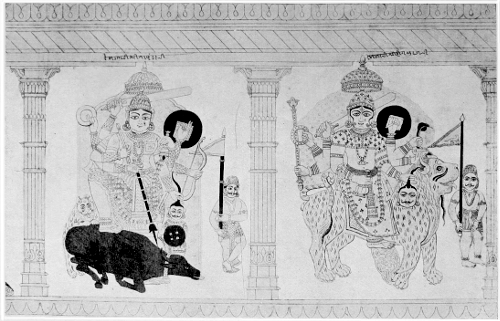
CHĀMUNDA. KANKĀLI.
Rock Sculptures at Mandor.
To face page 842.
—A short distance from the foot of the
causeway, an archway opens into an enclosed court or area, in
the retired part of which, and touching the mountain, is an
extensive saloon; the roof is supported by a triple row of columns,
of that light form peculiar to the Jains. Here are displayed, in
all “the pomp and circumstance of war,” the statues of the
knights-errant of the desert, armed cap-à-pie, bestriding steeds
whose names are deathless as their riders’, all in the costume of
the times in which they lived. They are cut out of the rock, but
entirely detached from it, and larger than life. Though more
conspicuous for strength than symmetry, the grim visages of
these worthies, apparently frowning defiance, each attended by
his pandu or squire, have a singularly pleasing effect. Each
chieftain is armed with lance, sword, and buckler, with quiver
and arrows, and poniard in his girdle. All are painted; but
whether in the colours they were attached to, or according to the
fancy of the architect, I know not. Before, however, entering
this saloon, we pass a huge statue of Ganesa, placed as the
guardian of the portal, having on each side the two Bhairavas,
sons of the god of war. Then appears the statue of Chamunda
843(the goddess of destruction), and that of the terrific mother,
Kankali, treading on the black demon Bhainsasur, in whose flank
her tiger-courser has buried his bloodthirsty tongue: in each of
her eight arms she holds a weapon of destruction. The black
Bhairon (son of Time), with a sable flag, bearing argent a horse
courant, marshals the way through the field of blood to his
mother. Between her and the heroes whose lives passed “in
devotion to the sword,” is a statue of the Nathji, or ‘spiritual
guide’ of the Rathors: in one hand he holds his
mala or ‘chaplet’;
in the other his
chhari or ‘patriarchal rod,’ for the guidance of
his flock. Mallinath
[26] heads the procession, mounted on a white
charger, with a lance over his shoulder, to which is attached a
flag; his quiver resting on his horse’s right flank, and his mistress,
Padmavati, with a platter of food welcoming him from the raid,
and who accompanied him when slain to Suryaloka, or ‘the
mansion of the sun.’
Then follows Pabuji,[27] mounted on his famous charger ‘Black
Caesar’ (Kesar [730] Kali), whose exploits are the theme of the
itinerant bard and showman, who annually goes his round, exhibiting
in pictorial delineations, while he recites in rhyme, the
deeds of this warrior to the gossiping villagers of the desert.
Next comes Ramdeo[28] Rathor, a name famed in Marudesa,
and in whose honour altars are raised in every Rajput village in
the country.
Then we have the brave Harbuji Sankhla,[29] to whom Jodha
was indebted for protection in his exile, and for the redemption
of Mandor when seized by the Rana of Chitor.
Guga,[30] the Chauhan, who with his forty-seven sons fell defending
the passage of the Sutlej on Mahmud’s invasion. Mehaji
Mangalia brings up the rear, a famous chieftain of the Guhilot
844race. It would be tedious to relate any of the exploits of these
worthies.
—Another saloon, of similar
architecture and still greater dimensions, adjoins that just
described; it is termed Taintis kula
[31] devata ra than, or ‘abode
of the (tutelary) divinities of the thirty-three races’: in short,
the Pantheon of the Rajputs. The statues are of gypsum, or
stone covered with that substance; they are of large proportions.
First, is the creator, Brahma; then Surya, ‘the sun-god,’ with
his seven-headed steed; then the monkey-faced deity, Hanuman;
Rama, and his beloved Sita; Kanhaiya, in the woods of Vraj,
surrounded by the Gopis; and a most grave figure of Mahadeva,
with a bull in his hand. These six, with the goddesses of life and
death, and of wisdom, constitute the eight chief divinities of the
Hindus; whose qualities and attributes, personified, form an
assemblage for which St. Peter’s and the Vatican to boot would
be a confined dwelling.
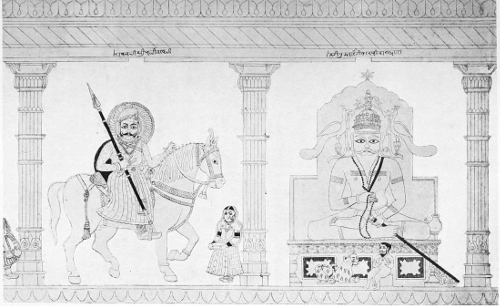
MALLINĀTH. NĀTHJI.
Rock Sculptures at Mandor.
To face page 844.
Palace and Gardens.—I now retired to the palace and gardens
built by Raja Ajit; of which, however superb, it is impossible for
the pen to give a definite idea. Suites of colonnaded halls, covered
with sculpture of easy and even graceful execution, some with
screens of lattice-work to secure the ladies from the public gaze,
are on the lower range; while staircases lead to smaller apartments
intended for repose. The gardens, though not extensive,
as may be supposed, being confined within the adamantine walls
reared by the hand of Nature, must be delightfully cool even in
summer. Fountains, reservoirs, and water-courses, are everywhere
interspersed; and though [731] the thermometer in the open
air was 86°,[32] the cold within doors (if this be not a solecism, considering
that there were no doors) was excessive. Some attention
was paid to its culture; besides many indigenous shrubs, it
boasted of some exotics. There was the golden champa,[33] whose
845aroma is overpowering, and if laid upon the pillow will produce
headache; the pomegranate, at once “rich in flower and fruit”;
the apple of Sita, or Sitaphala, which, from similitude of taste,
we call the custard-apple; a delicious species of the plantain,
whose broad, verdant, glossy leaf alone inspires the mind with
the sensation of coolness; the mogra;[34] the chameli, or jessamine;
and the queen of flowers, the barahmasha,[35] literally the ‘twelve-month,’
because it flowers throughout the year. It is a delightful
spot, and I felt a peculiar interest in it. Let the reader imagine
the picture of a solitary Englishman scribbling amidst the ruins
of Mandor: in front a group of venerable mango-trees; a little
further an enormous isolated tamarind, “planted by the hand of
a juggler in the time of Nahar Rao, the last of the Pariharas,
before whom he exhibited this proof of legerdemain,” and, as the
legend goes, from whose branches the juggler met his death:[36]
amidst its boughs the long-armed tribe, the allies of Rama, were
skipping and chattering unmolested; while beneath, two Rathor
Rajputs were stretched in sleep, their horses dozing beside them,
standing as sedately as the statue of ‘Black Caesar’: a grenadier
Sepoy of my escort parading by a camp-basket, containing the
provender of the morning, completes the calm and quiet scene.
—On the summit of the rock, across the narrow
valley, several
guphas, or caves, the abode of the hermit Atit,
[37]
were in sight. How the brains of these ascetics can stand the
heat and confined air is a wonder, though, if they possessed any
846portion of that which is supposed to be necessary to the guidance
of the machine, they would scarcely occupy such a position, nor
consequently, the world’s attention.
Mais tout est vanité, a cause
which has produced ten times the number of saints that piety
has, and ten times of ten these troglodyte philosophers. Having
walked out on the terrace or house-top of the palace, to catch a
sunbeam and scare away an ague which tormented me, I discovered
one of these animals coiled up on a heap of bat’s dung
[732], in a corner of an apartment of the palace. He was dreadfully
emaciated, and but for the rolling of a pair of eyes in a visage
covered with hair, there was nothing which betokened animation,
much less humanity. There was none but the bat to dispute his
reign, or “the spider which weaves its web in this palace of the
Caesars.” I had no inclination to disturb the process of ratiocination,
or to ask to which sect of philosophers belonged this
Diogenes of Mandor, who might, if he had utterance, have desired
me to walk downstairs, and not intercept the sunbeam for whose
warmth we were competitors. The day was now nearly departed,
and it was time for me to return to my friends in camp. I finished
the evening by another visit to the knights of the desert; and
inscribing my name on the foot of ‘Black Caesar,’ bade adieu to
the ancient Mandor.

RĀMDEO RĀTHOR. PĀBUJI, MOUNTED ON KESAR KĀLI.
Rock Sculptures at Mandor.
To face page 846.
November 13.—The Raja having invited us to a dinner at the
palace, we sallied forth, belted and padded, to partake of Rajput
hospitality. He had made a request which will appear somewhat
strange—that we would send our cuisine, as the fare of the desert
might prove unpalatable; but this I had often seen done at
Sindhia’s camp, when joints of mutton, fowls, and fricassees
would diversify the provender of the Mahratta. I intimated that
we had no apprehension that we should not do justice to the gastronomy
of Jodhpur; however, we sent our tables, and some
claret to drink long life to the king of Marudes. Having paid our
respects to our host, he dismissed us with the complimentary wish
that appetite might wait upon us, and, preceded by a host of gold
and silver sticks, we were ushered into a hall, where we found the
table literally covered with curries, pillaus, and ragouts of every
kind, in which was not forgotten the haria mung Mandor ra, the
‘green pulse of Mandor,’ the favourite dish, next to rabri or maize-porridge,
of the simple Rathor. Here, however, we saw displayed
the dishes of both the Hindu and Musulman, and nearly all were
847served in silver. The curries were excellent, especially those of
the vegetable tribes made of the pulses, the kakris or cucumbers,
and of a miniature melon not larger than an egg, which grows
spontaneously in these regions, and is transported by kasids, or
runners, as presents, for many hundreds of miles around. The
hall was an entire new building, and scarcely finished; it is
erected on the northern projection of the rock, where the escarpment
is most abrupt, and looks down upon the site of the batteries
of the league of 1806. It is called the Man mahall [733], and, like
the hall of audience, its flat roof is supported by numerous massive
hewn columns. The view from it to the east is extensive, and we
were told that the pinnacle of Kumbhalmer, though eighty miles
distant, has been seen, in those clear days of the monsoon when
the atmosphere is purified, after heavy showers, from the sand
which is held suspended. Great care was taken that our meal
should be uninterrupted, and that we should not be the lions to
an hour’s amusement of the court. There was but one trivial
occurrence to interrupt the decorum and attention of all present,
and that was so slight that we only knew it after the entertainment
was over. One of the menials of the court, either from
ignorance or design, was inclined to evince contumely or bad
breeding. It will be considered perhaps a singular circumstance
that the Hindu should place before a European the vessels from
which he himself eats: but a little fire purifies any metallic vessels
from all such contamination; and on this point the high-blooded
Rajput is less scrupulous than the bigoted Muhammadan, whom
I have seen throw on the ground with contempt a cup from which
his officer had drunk water on a march. But of earthenware
there can be no purification. Now there was a handsome china
bowl, for which some old dowager fancier of such articles would
have almost become a supplicant, which having been filled with
curds to the Sudra Farangis could no longer be used by the prince,
and it was brought by this menial, perhaps with those words, to
my native butler. Kali Khan, or, as we familiarly called him,
‘the black lord,’ was of a temper not to be trifled with; and as the
domestic held it in his hand, saying, “Take it, it is no longer of
any use to us,” he gave it a tap with his hand which sent it over
the battlements, and coolly resuming his work, observed, “That
is the way in which all useless things should be served”; a hint
which, if reported to Raja Man, he seems to have acted on: for
848not many months after, the minister, Akhai Chand, who dreaded
lest European influence should release his master from his faction
and thraldom, was treated by him in the same manner as the
china bowl by Kali Khan.
—
November 16.[38]—This day had
been fixed for the Raja’s visits to the envoy. In order to display
his grandeur, he sent his own suite of tents, which were erected
near mine [734]. They were very extensive, modelled in every way
after those of the Emperors of Delhi, and lined throughout with
the royal colour, crimson: but this is an innovation, as will
appear from the formulas yet preserved of his despatches, “from
the foot of the throne, Jodhpur.” The tent, in fact, was a palace
in miniature, the whole surrounded by walls of cloth, to keep at
a distance the profane vulgar. The
gaddi, or royal cushion and
canopy, was placed in the central apartment. At three, all was
noise and bustle in the castle and town; nakkaras were reverberating,
trumpets sounding the alarm, that the King of Maru
was about to visit the Farangi Wakil. As soon as the flags and
pennant were observed winding down ‘the hill of strife’ (Jodhagir),
I mounted, and with the gentlemen of my suite proceeded
through the town to meet the Raja. Having complimented him
en route, we returned and received him at the tents. The escort
drawn up at the entrance of the tent presented arms, the officers
saluting; a mark of attention which gratified him, as did the
soldier-like appearance of the men. Hitherto, what he had seen
of regulars belonging to the native powers was not calculated to
give him a favourable impression of foot-soldiers, who are little
esteemed by the equestrian order of Rajputana. His visit continued
about an hour, when the shields were brought in, with
jewels, brocades, shawls, and other finery, in all nineteen trays,
being two less than I presented to the Rana of Udaipur. I likewise
presented him with some arms of English manufacture, a
telescope, and smaller things much valued by the Rajputs. After
the final ceremony of perfumes, and itr-pan (which are admirable
hints when you wish to get rid of a tiresome guest, though not so
in this instance), the exterior wall was removed, and showed the
caparisoned elephant and horses, which were part of the khilat.
At the door of the tent we made our salaam, when the Raja gave
me his hand, which, by the by, was his first salutation on receiving
849me. It is an ancient Rajput custom, and their bards continually
allude to extending the right hand—“
dextra extenta.”
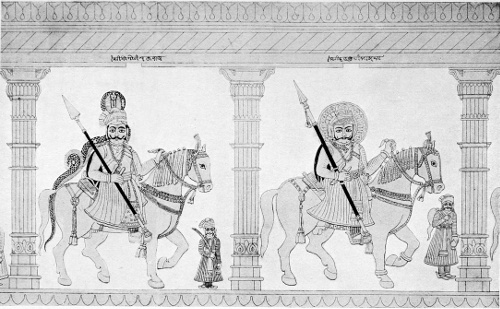
GŪGA THE CHAUHĀN. HARBUJI SĀNKHLA.
Rock Sculptures at Mandor.
To face page 848.
—
November 17.[39]—I went to take
leave of the Raja: I had a long and interesting conversation on
this our last interview. I left him in the full expectation that his
energy of character would surmount the difficulties by which he was
surrounded, though not without a struggle, and condign punishment
to some of the miscreants, the misleaders of his son, the assassins
of his minister and high priest, and consequently the authors
of his humiliating and protracted incarceration [735]. Whether
the first gratification of vengeance provoked his appetite, or
whether the torrent of his rage, once impelled into motion, became
too impetuous to be checked, so that his reason was actually
disturbed by the sufferings he had undergone, it is certain he grew
a demoniac; nor could any one, who had conversed with the
bland, the gentlemanly, I might say gentle, Raja Man, have
imagined that he concealed under this exterior a heart so malignant
as his subsequent acts evinced. But the day of retribution must
arrive; the men who wrote that dignified remonstrance, which
is given in another place,
[40] will not tamely bear their wrongs, and
as they dare not levy war against their prince, who reposes under
British protection, the dagger will doubtless find a way to reach
him even in “the thousand-columned hall” of Jodhpur.
Besides the usual gifts at parting, which are matter of etiquette,
and remain untouched by the individual, I accepted as a personal
token of his favour, a sword, dagger, and buckler, which had
belonged to one of his illustrious ancestors. The weight of the
sword, which had often been “the angel of death,” would convince
any one that it must have been a nervous arm which carried
it through a day. With mutual good wishes, and a request for a
literary correspondence, which was commenced but soon closed,
I bade adieu to Raja Man and the capital of Marwar [736].
850
—
November 19.—We broke ground for Nandla, distant
six miles. The first two miles from the capital was through deep
sand; for the remainder of the journey the red sandstone protruded,
which gives some relief to the footing of the traveller.
About half-way we passed a small sheet of water, called after the
mother of the pretender, Dhonkal Singh, the Shaikhawat Talao.
This lady has constructed a dharmsala, or ‘hall for travellers,’
on its bank, where she has erected a statue of Hanuman, and a
pillar to commemorate her own good works. Not a shrub of any
magnitude occurs, for even the stunted khair
[1] is rare in this plain
of sand; which does not, however, appear unfavourable to the
moth,
[2] a vetch on which they feed the cattle. Near the village
we crossed the Jogini, the same stream which we passed between
Jhalamand and the capital, and which, joined by the Nagda from
Mandor, falls into the Luni. The only supply of water for Nandla
is procured from two wells dug on the margin of the stream. The
water is abundant, and only four feet from the surface, but
brackish. There are a hundred and twenty-five houses in Nandla,
which is in the fief of the chieftain of Ahor. A few cenotaphs are
on the banks of a tank, now dry. I went to look at them, but
they contained names “unknown to fame.”
—Bisalpur, the next place, is distant six estimated
coss of the country, and [737] thirteen miles one furlong by the
perambulator: heavy sand the whole way. Nevertheless we saw
traces of the last autumnal crop of bajra and juar, two species of
millet, which form the chief food of the people of the desert;
and the vetch was still in heaps. Bisalpur is situated on a rising
ground; the houses are uniform in height and regularly built,
and coated with a compost of mud and chaff, so that its appearance
is picturesque. It is protected by a circumvallation of
thorns, the kanta-ka-kot and the stacks of chaff, as described at
Indara. They are pleasing to the eye, as is everything in such
a place which shows the hand of industry. There was an ancient
city here in former days, which was engulfed by an earthquake,
851though part of a gateway and the fragment of a wall still mark
its site. No inscriptions were observed. The water is obtained
from a lake.
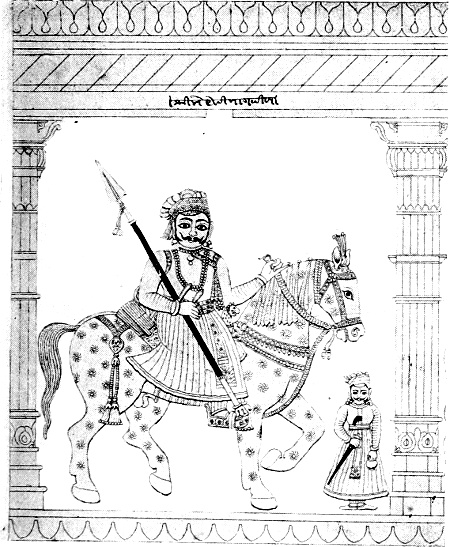
MEHAJI MANGALIA.
Rock Sculptures at Mandor.
To face page 850.
—November 21.—Pachkalia, or Bichkalia,
five coss (11 miles 5 furlongs): crossed and encamped on the
Jojri. The soil improving, of a brown sandy texture. Wheat
and barley of excellent quality are grown on the banks of the
river. It was a relief to meet once more a babul or a nim tree;
even our Godwar cypress reared its head on the margin of the
Jojri. Although now only containing a hundred houses, this
was once a place of some importance. I found a defaced inscription,
in which “the son of Sonang, S. 1224,” was still legible;
but the mercenary Pathans have ruined the harvest of the
antiquary. The village is a grant in fee to a Bhatti chieftain.
Water is obtained from wells excavated on the margin of the
river.
—
November 22.—Pipar, four coss (8 miles 2 furlongs).
Pursued the course of the river, the most extended arm of the
Luni, coming from the hills near Parbatsar, on the frontiers of
Jaipur. Its course is marked by the trees already mentioned.
The soil, a mixture of black earth and sand, is termed
dhamani.
Pipar is a town of 1500 houses, one-third of which are inhabited
by the Oswals of the Jain faith, the chief merchants of all their
country. There are also about two hundred families of Mahesris,
or merchants of the Saiva caste. Pipar carries on a considerable
traffic, and has a chintz manufactory, which employs thirty
families. It is in the grant of the feudal chief of Nimaj, whose
death has been already related. A cenotaph, dedicated to one
of his ancestors, has been half destroyed by the Goths of India.
Pipar is celebrated in the traditions of the desert as one of the
cities [738] founded by Gandharvasen, the Pramara monarch of
Avanti, prior to the Christian era.
[3] The only inscription I discovered
was in a temple of the sea-goddess Lakshmi. It bore
the names of Bijai Singh and Delanji, Rajputs of the Guhilot
race, with the ancient title of Rawal. It was a happy confirmation
of the most ancient chronicle of Mewar, which divides the
Guhilots into twenty-four
sakha or branches, of which one is
called ‘Piparia,’ doubtless from their having conquered this
tract from the Takshak Pramara.
852There is an abundance of wells, from sixty to eighty feet in
depth. Of one recently excavated, I obtained the following
details of the strata, which may be gratifying to the geologist.
The first twenty feet are composed entirely of that kind of earth
called dhamani, chiefly decomposed sandstone with a mixture
of black earth, in which occurs a stratum of bluish clay mixed
with particles of quartz: this earth is called morar in Marwar,
and morand in Jaipur. It was then necessary to cut through a
rock of red granite[4] for thirty feet; then several feet of an almost
milk-white steatite, succeeded by stalactitic concretions of sandstone
and quartz.
—Good water is also obtained from
a lake called the Sampu, which is connected with the tradition of
the foundation of Pipar. A Brahman of the Pali tribe, whose
name was Pipa, was in the habit of carrying milk to a deity of
the Serpent (Takshak) race, whose retreat was on the banks of
this lake, and who deposited two pieces of gold in return for the
Paliwal’s offering. Being compelled to go to Nagor, he gave
instructions to his son to perform his charitable office; but the
youth, deeming it a good opportunity to become master of the
treasure, took a stick with him, and when the serpent issued
forth for his accustomed fare, he struck him violently; but the
snake being “scotched, not killed,” retreated to his hole. The
young Brahman related his adventure to his mother; when
the good woman, dreading the vengeance of the serpentine
deity, prepared a servant and bullock to convey her son to his
father at Nagor. But what was her horror in the morning,
when she went to call the youth, to find, instead of him, the
huge serpent coiled up in his bed! Pipa, on his return, was
inconsolable; but stifling his revenge, he propitiated the serpent
with copious libations of milk. The scaly monster was conciliated,
and revealed the stores he guarded to Pipa, commanding
him to raise a monument which would transmit a knowledge
of the event to future ages [739]. Hence Pipar arose from
Pipa the Pali, and the name of the lake Sampu, from his benefactor
the ‘serpent’ (sampa). All these allegorical tales regard
the Takshak races, the followers of the religion of Buddha or
Jaina, and their feuds with the Brahmanical sects. It is evident
that Pipa the Pali worshipped both; and the very name
853induces a belief that the whole Paliwal caste are converts from
Buddhism.
[5]—There is a kund or fountain, called after
Lakha Phulani, who ruled in ancient times at Phulra, in the
farther corner of the desert, but carried his arms even to the
ocean. Wherever I have travelled, tradition is loud in praise
of Phulani, from the source of the Luni to its embouchure in the
Delta of the Indus.
[6]—November 23.—Madreo, five coss (10 miles 2 furlongs).
Roads good; soil as yesterday, but the country very desolate;
only stunted shrubs since we removed from the margin of the
river. This is a moderate-sized village, with a tank of good water.
—November 24.—Bharunda, four coss, or eight miles.
The face of the country now changes materially; our route was
over a low undulating ridge of sandstone, in which the stunted
shrubs of this region find a bed. At one time the elevation was
sufficiently great to allow the chasm through which the road
passed to be dignified with the name of the Ghasuria Pass, in
which a party of the Raja’s men is posted for defence, and
the levy of transit duties. Bharunda is in the fief of Gopal
Singh, the chief of Kuchaman, one of the most conspicuous
of the Mertia clan. It consists of one hundred and fifty
houses; the cultivators are Jats, as are those of all the preceding
villages.
I paid a visit to the humble cenotaphs of Bharunda; one of
854them bore the name of Badan Singh, a sub-vassal of Kuchaman,
who was slain in the heroic charge against De Boigne’s brigades,
in the patriot field of Merta. His name claims the admiration
of all who esteem loyalty and patriotism, the inherent virtues of
the chivalrous Rajput. Raja Bijai Singh had resumed Bharunda,
when the Thakur [740] retired to the adjacent court of Jaipur,
where he was well received according to the hospitable customs
of the Rajput, and had risen to favour at the period when the
Mahrattas invaded his bapota, ‘the land of his fathers.’ Resentment
was instantly sacrificed at the altar of patriotism; he put
himself at the head of one hundred and fifty horse, and flew to
his sovereign’s and his country’s defence. Unhappily, the whole
Mahratta army interposed between him and his countrymen.
To cut their way through all impediments was the instant resolve
of Badan and his brave companions. They fell sword in hand
upon a multitude; and, with the exception of a few, who forced
their way (amongst whom was the chief whose monument is referred
to), they were cut to pieces. Badan Singh lived to reach his
ancient estate, which was restored to his family in token of his
sovereign’s gratitude for the gallant deed. It is valued at seven
thousand rupees annual rent, and has attached to it, as a condition,
the service of defending this post. There was another small
altar erected to the manes of Partap, who was killed in the defence
of this pass against the army of Aurangzeb.
—
November 25.—Indawar, five coss (10 miles 2 furlongs).
This place consists of two hundred houses; the cultivators
are Jats. I have said little of these proprietors of the soil,
a sturdy, independent, industrious race, who “venerate the
plough,” and care little about the votaries of Mars or their concerns,
so that they do not impose excessive taxes on them. They
are a stout, well-built, though rather murky race. The village
is assigned to the ex-prince of Sind, who derives his sole support
from the liberality of the princes of Marwar. He is of the tribe
called Kalhora,
[7] and claims descent from the Abbassides of Persia.
His family has been supplanted by the Talpuris, a branch of the
855Numris (the foxes) of Baluchistan, who now style themselves
Afghans, but who are in fact one of the most numerous of the
Getae or Jat colonies from Central Asia. But let us not wander
from our subject.
I will beg the reader to descend seventy or eighty feet with
me to view the stratification of Indawar. First, three feet of good
soil; five feet of red sandy earth, mixed with particles of quartz;
six feet of an unctuous indurated clay;[8] [741]—then follows a
sand-rock, through which it was necessary to penetrate about
sixty feet; this was succeeded by twenty feet of almost loose
sand, with particles of pure quartz embedded; nodules and
stalactitic concretions of sandstone, quartz, and mica, agglutinated
together by a calcareous cement. The interior of the well throughout
this last stratum is faced with masonry: the whole depth is
more than sixty-five cubits, or forty yards. At this depth a
spring of excellent water broke in upon the excavators, which
supplies Indawar.
—November 26.—Merta, four coss (9 miles 1 furlong).
The whole march was one extended plain; the Aravalli towering
about twenty-five miles to our right. To the west a wide waste,
consisting of plains gently undulating, and covered with grass
and underwood. Natural sterility is not the cause of this desert
aspect, for the soil is rich; but the water is far beneath the
surface, and they cannot depend upon the heavens. Juar, moth,
and sesamum were cultivated to a considerable extent in the
immediate vicinity of the villages, but the product had this season
been scanty. The appearance of the town is imposing, its site
being on a rising ground. The spires of the mosque which was
erected on the ruins of a Hindu temple by the tyrant Aurangzeb
overtop the more ponderous and unaspiring mandirs which
surround it. Notwithstanding, this monarch was the object of
universal execration to the whole Hindu race, more especially
to the Rathors (whose sovereign, the brave Jaswant, together
with his elder son, he put to death by poison, and kept Ajit twenty
long years from his birthright, besides deluging their fields with
the richest blood of his nobles); still, such is Hindu toleration,
that a marble is placed, inscribed both in Hindi and Persian,
to protect the mosque from violence. This mark of liberality
proceeded from the pretender Dhonkal Singh, as if with a view
856of catching golden opinions from the demoralized Pathans, by
whose aid he hoped to regain his rights. But how was he deceived!
His advances were met by the foul assassination, at one fell
swoop, of all his party, by the chief of these mercenaries, Amir
Khan.
Merta was founded by Rao Duda of Mandor, whose son, the
celebrated Maldeo, erected the castle, which he called Malkot.[9]
Merta, with its three hundred and sixty townships, became the
appanage of his son Jaimall, and gave its name of Mertia to the
bravest of the brave clans of the Rathors. Jaimall [742] was
destined to immortalize his name beyond the limits of Maru.
Distrusted by his father, and likely to be deserving of suspicion,
from the very ruse to which Sher Shah acknowledged he owed
his safety, he was banished from Marwar. He was hospitably
received by the Rana, who assigned to the heir of Mandor the
rich district of Badnor, equalling his own in extent, and far richer
in soil than the plains he had abandoned. How he testified his
gratitude for this reception, nobler pens than mine have related.
The great Akbar claimed the honour of having with his own
hand sealed his fate: he immortalized the matchlock with which
he effected it, and which was also the theme of Jahangir’s praise,
who raised a statue in honour of this defender of Chitor and the
rights of its infant prince.[10] Abu-l-fazl, Herbert, the chaplain
to Sir T. Roe, Bernier, all honoured the name of Jaimall; and
the chivalrous Lord Hastings, than whom none was better able
to appreciate Rajput valour, manifested his respect by his desire
to conciliate his descendant, the present brave baron of Badnor.[11]
The town of Merta covers a large space of ground, and is enclosed
with a strong wall and bastions, composed of earth to the westward,
but of freestone to the east. All, however, are in a state
of decay, as well as the town itself, which is said to contain twenty
thousand houses. Like most Hindu towns, there is a mixture of
magnificence and poverty; a straw or mud hut adjoins a superb
house of freestone, which “shames the meanness” of its neighbour.
The castle is about a gun-shot to the south-west of the
857town, and encloses an area of a mile and a half. Some small
sheets of water are on the eastern and western faces. There are
plenty of wells about the town, but the water has an unpleasant
taste, from filtering through a stiff clay. There are but two
strata before water is found, which is about twenty-five feet from
the surface: the first a black mould, succeeded by the clay, incumbent
on a loose sand, filled with quartzose pebbles of all hues,
and those stalactitic concretions which mark, throughout the
entire line from Jodhpur to Ajmer, the stratum in which the
springs find a current. There are many small lakes around the
town, as the Dudasar, or ‘lake (sar) of Duda’; the Bejpa, the
Durani, the Dangolia, etc.
—The plain of Merta is one continuous sepulchre,
covered with altars to the manes of the warriors who, either in
the civil wars which have distracted this State [743], or in the
more patriotic strife with the southron Goths, have drenched it
with their blood. It is impossible to pass over this memorable
field without a reference to these acts; but they would be unintelligible
without going to the very root of dissension, which
not only introduced the Mahratta to decide the intestine broils
of the Rajput States, but has entailed a perpetuity of discord
on that of Marwar. I have already succinctly related the parricidal
murder of Raja Ajit, which arose out of the politics of the
imperial court, when the Sayyids of Barha
[12]—the Warwicks of
the East—deposed the Emperor Farrukhsiyar, and set up a
puppet of their own. With his daughter (whose marriage with
the emperor originated, as already recorded, the first grant of
land to the East-India Company), he retired to his dominions,
leaving his son Abhai Singh at court, and refusing his sanction
to the nefarious schemes of the Sayyids. They threatened
destruction to Marwar, declaring to the son of Ajit that the only
mode of averting its ruin was his own elevation, and his subservience
to their views, which object could only be obtained by
his father’s deposal and death. Even the reasoning resorted to,
as well as the dire purpose of the miscreants, is preserved, and
may serve as an illustration of Rajput feeling. When Abhai
Singh refused or hesitated, he was asked, “
Ma bap ka sakha, ya
zamin ka sakha?” which, though difficult to render with accuracy,
may be translated: “Are you a branch (
sakha) of the land or
858of your parents?” As before said, land is all in all to the Rajput;
it is preferred to everything: Abhai’s reply may therefore be
inferred. Immediate installation was to be the reward of his
revenging the Sayyids. That nature could produce from the
same stock two such monsters as the brothers who effected the
deed, is, perhaps, hardly conceivable, and would, probably, not
be credited, were not the fact proved beyond doubt. I should
desire, for the honour of the Rajput race, whose advocate and
apologist I candidly avow myself, to suppress the atrocious
record: but truth is dearer even than Rajput character. Of
the twelve sons of Ajit, Abhai Singh and Bakhta Singh were the
two elder; both were by the same mother, a princess of Bundi.
To Bakhta Singh, who was with his father, the eldest brother
wrote, promising him the independent sovereignty of Nagor
(where they then were), with its five hundred and fifty-five townships,
as the price of murdering their common sire. Not only
was the wretch unstartled by the proposition, but he executed
the deed with his own hands, under circumstances of unparalleled
atrocity. His [744] mother always dreaded the temperament
and disposition of Bakhta, who was bold, haughty, impetuous,
with a perpetual thirst for action; and she cautioned her husband
never to admit him into his presence after dusk, or when unattended.
But the Raja, whose physical strength was equal to
his bravery, ridiculed her fears, observing, “Is he not my child?
Besides, a slap on the face from me would annihilate the stripling.”
Upon receiving the note from his brother, Bakhta, after taking
leave of his father, concealed himself in a chamber adjoining that
where his parents reposed. When all was still the murderer stole
to the bed in which lay the authors of his existence, and from a
pallet, on which were placed the arms of Ajit, he seized his sword,
and coolly proceeded to exhaust those veins which contained
the same blood that flowed in his own. In order that nothing
might be wanting to complete the deed of horror, the mother
was awakened by the blood of her lord moistening her bosom.
Her cries awoke the faithful Rajputs who lay in the adjacent
apartments, and who, bursting into the chamber, discovered their
prince and father dead: “Treason had done its worst.” The
assassin fled to the roof of the palace, barring the gates behind
him, which resisted all attempts to force them until morning,
when he threw into the court below the letter of his brother,
859exclaiming, “This put the Maharaja to death, not I.” Abhai
Singh was now their sovereign; and it is the actual occupant of
the throne whom the Rajput deems entitled to his devotion.
Eighty-four Satis took place on this dire occasion, the parent of
these unnatural regicidal and parricidal sons leading the funeral
procession. So much was Ajit beloved, that even men devoted
themselves on his pyre. Such was the tragical end of the great
Ajit, lamented by his chiefs, and consecrated by the bard, in
stanzas in honour of him and in execration of the assassins; which
afford proof of the virtuous independence of the poetic chronicler
of Rajasthan.
Bakhta, Bakhta, bāhira,
Hindwāni ro sevro
Turkāni ka sāl?
“Oh Bakhta, in evil hour
Why slew you Ajmāl,
The pillar of the Hindu,
The lance of the Turk?” [745]
[14]
—Bakhta Singh obtained Nagor; and
Abhai Singh was rewarded with the viceroyalty of Gujarat,
which gift he repaid by aiding in its partition, and annexing the
rich districts of Bhinmal, Sanchor, and others, to Marwar; on
which occasion he added Jalor to the domain of his brother
Bakhta, or, as the bard styles him, bad-bakhta, ‘the unfortunate.’
This additional reward of parricide has been the cause of all the
civil wars of Marwar.
We may slightly notice the other sons of Ajit, whose issue
affected the political society of Rajputana. Of these,
Devi Singh was given for adoption to Maha Singh, head of
the Champawat clan, he having no heirs. Devi Singh then held
Bhinmal, but which he could not retain against the Koli tribes
around him, and Pokaran was given in exchange. Sabal Singh,
Sawai Singh, and Salim Singh (whose escape from the fate of the
chieftain of Nimaj has been noticed) are the lineal issue of this
adoption.
860Anand Singh, another son of Ajit, was in like manner adopted
into the independent State of Idar, and his issue are heirs-presumptive
to the throne of Marwar.
—From these races we derive the knowledge
of a curious fact, namely, that the issue of the younger
brother maintains a claim, though adopted into a foreign and
independent State; while all such claims are totally extinguished
by adoption into a home clan. Under no circumstances could
the issue of Devi Singh sit on the gaddi of Marwar; when
adopted into the Champawat clan, he surrendered all claims
derived from his birth, which were merged into his vassal
rank. Still the recollection must give weight and influence;
and it is evident from the boast of the haughty Devi Singh,
when his head was on the block, that there is danger in these
adoptions.
Abhai Singh died, leaving a memorial of his prowess in the
splendid additions he made to his territories from the tottering
empire of Delhi. He was succeeded by his son Ram Singh, on
whose accession his uncle Bakhta sent his aged foster-mother,
an important personage in Rajwara, with the tika and gifts,and gifts, and other symbols of congratulation. Ram Singh, who had
all the impetuosity of his race, received the lady-ambassador
with no friendly terms, asking her if his uncle had no better
messenger to salute his new sovereign. He refused the gifts,
and commanded her to tell his uncle to surrender Jalor. The
offended dame [746] extenuated nothing of the insolence of the
message. The reply was, however, courteous, implying that
both Jalor and Nagor were at his disposal. The same sarcastic
spirit soon precipitated matters between them in the following
manner.
Kusal Singh of Awa, the premier noble of Marwar, and of all
the clans of Champawat, more brave than courtly, was short in
stature, sturdy, boorish, and blunt; he became the object of his
young sovereign’s derision, who used to style him the gurji
gandhak, or ‘turnspit dog,’ and who had once the audacity to
say, “Come, gurji”; when he received the laconic reproof:
“Yes; the gurji that dare bite the lion.”

PAIKS OF MĀRWĀR
To face page 860.
Brooding over this merited retort, he was guilty of another
sarcasm, which closed the breach against all reconciliation.
Seated one day in the garden of Mandor, he asked the same chief
861the name of a tree. “The champa,” was the reply, “and the
pride of the garden, as I am of your Rajputs.” “Cut it down
instantly,” said the prince; “root it out; nothing which bears
the name of champa shall exist in Marwar.”
Kaniram of Asop, the chief of the next most powerful clan,
the Kumpawat, was alike the object of this prince’s ridicule.
His countenance, which was not “cast in nature’s finest mould,”
became a butt for his wit, and he would familiarly say to him,
‘ao budha bandar,’ “Come along, old monkey.” Boiling with
rage, the chief observed, “When the monkey begins to dance,
you will have some mirth.” Leaving the court, with his brother
chieftain of Awa, they collected their retainers and families, and
marched to Nagor. Bakhta Singh was absent, but being advised
by his locum tenens of his visitors, and of their quarrel with his
nephew, he lost no time in joining them. It is said he expostulated
with them, and offered himself as mediator; but they
swore never again to look in the face of Ram Singh as their
sovereign. They offered to place Bakhta Singh on the gaddi of
Jodha; and threatened, if he refused, to abandon Marwar. He
played the part of our Richard for a short time; but the habitual
arrogance of his nephew soon brought matters to a crisis. As
soon as he heard that the two leaders of all his vassals were
received by his uncle, he addressed him, demanding the instant
surrender of Jalor. Again he had the courtly reply: “He dare
not contend against his sovereign; and if he came to visit him,
he would meet him with a vessel of water.”[15] War, a [747]
horrid civil war, was now decided on; the challenge was given
and accepted, and the plains of Merta were fixed upon to determine
this mortal strife, in which brother was to meet brother,
and all the ties of kin were to be severed by the sword. The
Mertia clans, the bravest, as they are the most loyal and devoted,
of all the brave clans of Maru, united to a man under the
sovereign’s standard; the chiefs of Rian, Budsa, Mihtri, Kholar,
Bhorawar, Kuchaman, Alniawas, Jusari, Bokri, Bharunda, Irwa,
Chandarun, collected around them every vassal who could wield
a brand. Most of the clans of Jodha, attracted by the name of
862swamidharma, ‘fidelity to their lord,’ united themselves to the
Mertias; though a few, as Ladnun, Nimbi, were on the adverse
side; but the principal leaders, as Khairwa, Govindgarh, and
Bhadrajun, were faithful to their salt. Of the services of others,
Ram Singh’s insolence deprived him. Few remained neuter.
But these defections were nothing to the loss of a body of five
thousand Jareja auxiliaries, whom his connexion with a daughter
of the prince of Bhuj brought to his aid. When the tents were
moved outside the capital, an incident occurred which, while it
illustrates the singular character of the Rajput, may be regarded
as the real cause of the loss of sovereignty to Ram Singh. An
inauspicious raven had perched upon the kanat, or wall of the
tent in which was the Jareja queen, who, skilled in the art of the
suguni[16] (augur), determined to avert it. Like all Rajputnis,
who can use firearms on occasion, she seized a matchlock at
hand, and, ere he “thrice croaked,” she shot him dead. The
impetuous Raja, enraged at this instance of audacity and disrespect,
without inquiry ordered the culprit to be dragged before
him; nor was his anger assuaged when the name of the Rani
was given. He reviled her in the grossest terms: “Tell the
Rani,” he said, “to depart my dominions, and to return from
whence she came.” She entreated and conjured him, by a regard
to his own safety, to revoke the decree; but all in vain; and
with difficulty could she obtain a short interview, but without
effecting any change in her obdurate lord. Her last words
were, “With my exile from your presence, you will lose the
crown of Marwar.” She marched that instant, carrying with her
the five thousand auxiliaries whose presence must have ensured
his victory.
The Udawat clans, led by their chiefs of Nimaj, Raepur, and
Raus, with all [748] the Karansots under the Thakur of Khinwasar,
united their retainers with the Champawats and Kumpawats
under the banners of Bakhta Singh.
—Ram
Singh’s array fell far short of his rival’s since the defection
of the Jarejas; yet, trusting to the name of sovereign as “a
tower of strength,” he boldly marched to the encounter, and
when he reached the hostile field encamped near the Ajmer gate
of Merta. His rival was not long behind, and marshalled his
863clans within three miles of the northern portal, called the gate
of Nagor. The spot he chose had a sacred character, and was
called Mataji ka Than, where there was a shrine of the Hindu
Hecate, with a fountain said to have been constructed by the
Pandavas.
Bakhta Singh commenced the battle. Leaving his camp
standing, he advanced against his nephew and sovereign, whom
he saluted with a general discharge of his artillery. A vigorous
cannonade was continued on both sides throughout the day,
without a single man seeking a closer encounter. It is no wonder
they paused ere the sword was literally drawn. Here was no
foreign foe to attack; brother met brother, friend encountered
friend, and the blood which flowed in the veins of all the combatants
was derived from one common fountain. The reluctance
proceeded from the στοργή, the innate principle of natural
affection. Evening advanced amidst peals of cannon, when an
incident, which could only occur in an army of Rajputs, stopped
the combat. On the banks of the Bejpa lake, the scene of strife,
there is a monastery of Dadupanti ascetics, built by Raja Sur
Singh. It was nearly midway between the rival armies, and the
shot fell so thick amidst these recluses that they fled in a body,
leaving only the old patriarch. Baba (father) Kishandeo disdained
to follow his disciples, and to the repeated remonstrances
from either party to withdraw, he replied, that if it was his fate
to die by a shot he could not avert it; if not, the balls were
innoxious: but although he feared not for himself, yet his
gardens and monastery were not “charmed,” and he commanded
them to fight no longer on that ground. The approach of night,
and the sacred character of the old abbot Dadupanti, conspired
to make both parties obey his commands, and they withdrew to
their respective encampments.
The dawn found the armies in battle-array, each animated
with a deadly determination. It was Raja Ram’s turn to open
this day’s combat, and he led the van against his uncle. Burning
with the recollection of the indignities he had [749] suffered, the
chief of Awa, determined to show that “the cur could bite,” led
his Champawats to the charge against his sovereign. Incited by
loyalty and devotion “to the gaddi of Marwar,” reckless who was
its occupant, the brave Mertias met his onset steel in hand. The
ties of kin were forgotten, or if remembered, the sense of the
864unnatural strife added a kind of frenzy to their valour, and
confirmed their resolution to conquer or die. Here the Mertia,
fighting under the eye of this valiant though intemperate prince,
had to maintain his ancient fame, as “the first sword of Maru.”
There his antagonist, the Champawat, jealous of this reputation,
had the like incentive, besides the obligation to revenge the insults
offered to his chief. The conflict was awful: the chieftains of
each valiant clan met hand to hand, singling out each other by
name. Sher Singh, chief of all the Mertias, was the first who
sealed his devotion by his death. His place was soon filled by
his brother, burning for vengeance. Again he cheered on his
Mertias to avenge the death of their lord, as he propelled his
steed against the chief of the Champawats. They were the sons
of two sisters of the Jaipur house, and had hitherto lived in amity
and brotherly love, now exchanged for deadly hate. They
encountered, when the “cur” bit the dust, and was borne from
the field. The loss of their leaders only inflamed the vassals on
both sides, and it was long before either yielded a foot of ground.
But numbers, and the repeated charges of Bakhta Singh who
led wherever his nephew could be found, at length prevailed;
though not until the extinction of the clan of Mertia, who,
despising all odds, fought unto the death. Besides their head
of Rian, there fell the sub-vassals of Irwa, Sewara, Jusari,
and Mithri, with his three gallant sons, and almost all their
retainers.
—There is nothing more chivalrous
in the days of Edward and Cressy than the death of the heir
of Mithri, who, with his father and brothers, sealed his fealty with
his blood on this fatal field. He had long engaged the hand of a
daughter of a chief of the Narukas, and was occupied with the
marriage rites, when tidings reached him of the approach of the
rebels to Merta. The knot had just been tied, their hands had
been joined—but he was a Mertia—he unlocked his hand from
that of the fair Naruki, to court the Apsaras in the field of battle.
In the bridal vestments, with the nuptial coronet (
maur) encircling
his forehead, he took his station with his clan in the second day’s
fight, and “obtained a bride in Indra’s [750] abode.”
[17] The
865bards of Maru dwell with delight on the romantic glory of the
youthful heir of Mithri, as they repeat in their Doric verse,
Kānān moti bulbula
Gal sonē ki māla
Assi kos khariya āya
The paraphernalia here enumerated are very foreign to the
cavalier of the west: “with pearls shining in his ears, and a
golden chaplet round his neck, a space of eighty coss came the
heir of Mithri.”
The virgin bride followed her lord from Jaipur, but instead of
being met with the tabor and lute, and other signs of festivity,
wail and lamentation awaited her within the lands of Mithri,
where tidings came of the calamity which at once deprived this
branch of the Mertias of all its supporters. Her part was soon
taken; she commanded the pyre to be erected; and with the
turban and tora[19] which adorned her lord on this fatal day, she
followed his shade to the mansions of the sun. I sought out the
cenotaph of this son of honour in the blood-stained field; but
the only couronne immortelle I could wreathe on the sandy plain
was supplied by the Bardai, whose song is full of martial fire as
he recounts the gallantry of Kunwar Mithriwala.
The Mertias, and their compeers on the side of the prince,
made sad havoc amongst their opponents; and they still maintain
that it was owing to the artillery alone that they were
defeated. Their brave and loyal leader, Sher Singh of Rian, had
fruitlessly endeavoured to recall his brother-in-law from the path
of treason, but ineffectually; he spoke with sarcasm of his means
to supplant Ram Singh by his uncle. The reply of the old baron
of Awa is characteristic: “At least I will turn the land upside
down”; to which Sher Singh rejoined, angrily, he would do his
best to prevent him. Thus they parted; nor did they meet
again till in arms at Merta.
In surveying this field of slaughter, the eye discerns no point
d’appui, no village or key of position, to be the object of a struggle:
nothing to obstruct the doubly-gorged falconet, which has no
866terrors for the uncontrollable valour of the Rathor; it perceives
but a level plain, extended to the horizon, and now covered with
the memorials of this day’s strife. Here appears the colonnaded
mausoleum, with its airy cupola; there the humble altar, with
its simple record of the name, clan, and sakha of him whose ashes
repose beneath, with the date of the event [751], inscribed in rude
characters. Of these monumental records I had copies made of
about a score; they furnish fresh evidence of the singular character
of the Rajput.
Ram Singh retired within the walls of the city, which he
barricaded; but it being too extensive to afford the chance of
defence against the enemy, he formed the fatal resolution of
calling to his aid the Mahrattas, who were then rising into notice.
At midnight he fled to the south; and at Ujjain found the
Mahratta leader, Jai Apa Sindhia, with whom he concerted
measures for the invasion of his country. Meantime his uncle
being master of the field, repaired, without loss of time, to the
capital, where he was formally enthroned; and his an was proclaimed
throughout Marwar. As skilful as he was resolute,
he determined to meet on his frontier the threatened invasion,
and accordingly advanced to Ajmer, in order to interpose
between the Mahrattas and Jaipur, whose prince, Isari Singh,[20]
was father-in-lawfather-in-law to his rival. He wrote him a laconic epistle,
requiring him either instantly to unite with him in attacking
the Mahrattas, or declare himself his foe. The Jaipur prince
had many powerful reasons for not supporting Raja Bakhta, but
he at the same time dreaded his enmity. In this extremity, he
had recourse to an expedient too common in cases of difficulty.
Concerting with his wife, a princess of Idar (then ruled by one of
the sons of Ajit), the best mode of extrication from his difficulties,
he required her aid to revenge the foul murder of Ajit, and to
recover his son’s right. “In either case,” said he, “the sword
must decide, for he leaves me no alternative: against him I
have no hopes of success; and if I march to the aid of an assassin
and usurper, I lose the good opinion of mankind.” In short,
he made it appear that she alone could rescue him from his perils.
It was therefore resolved to punish one crime by the commission
of another. Isari Singh signified his assent; and to lull all
suspicion, the Rathorni was to visit her uncle in his camp on the
867joint frontier of the three States of Mewar, Marwar, and Amber.
A poisoned robe was the medium of revenge. Raja Bakhta,
soon after the arrival of his niece, was declared in a fever; the
physician was summoned: but the man of secrets, the Vaidya,
declared he was beyond the reach of medicine, and bade him
prepare for other scenes. The intrepid Rathor, yet undismayed,
received the tidings even with a jest: “What, Suja,” said he,
“no cure? Why do you take my lands and eat their produce,
if you cannot combat my maladies? What is your art good for?”
The Vaidya excavated a [752] small trench in the tent, which he
filled with water; throwing into it some ingredient, the water
became gelid. “This,” said he, “can be effected by human
skill; but your case is beyond it: haste, perform the offices
which religion demands.” With perfect composure he ordered
the chiefs to assemble in his tent; and having recommended to
their protection, and received their promise of defending the
rights of his son, he summoned the ministers of religion into his
presence. The last gifts to the church, and these her organs,
were prepared; but with all his firmness, the anathema of the
Satis, as they ascended the funeral pyre on which his hand had
stretched his father, came into his mind; and as he repeated
the ejaculation, “May your corpse be consumed in foreign land!”
he remembered he was then on the border. The images which
crossed his mental vision it is vain to surmise: he expired as he
uttered these words; and over his remains, which were burnt
on the spot, a cenotaph was erected, and is still called Bura Dewal,
the ‘Shrine of Evil.’
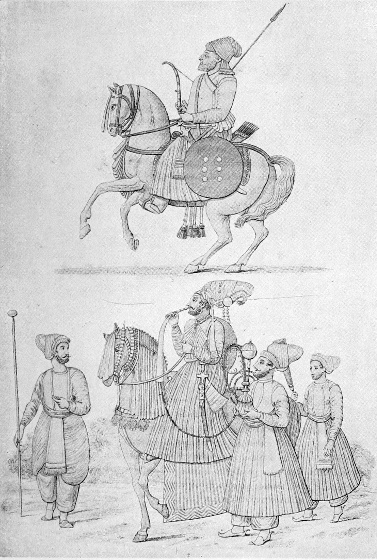
(1) DURGA DAS. (2) MAHARAJA SHER SINGH OF RIAN.
To face page 866.
But for that foul stain, Raja Bakhta would have been one of
the first princes of his race. It never gave birth to a bolder;
and his wisdom was equal to his valour. Before the commission
of that act, he was adored by his Rajputs. He was chiefly
instrumental in the conquests made from Gujarat; and afterwards,
in conjunction with his brother, in defeating the imperial
viceroy, Sarbuland.[21] His elevation could not be called a usurpation,
since Ram Singh was totally incapacitated, through his
868ungovernable passions, for sovereign sway; and the brave barons
of Marwar, “all sons of the same father with their prince,” have
always exercised the right of election, when physical incapacity
rendered such a measure requisite. It is a right which their
own customary laws, as well as the rules of justice, have rendered
sacred. According to this principle, nearly all the feudality of
Maru willingly recognized, and swore to maintain, the claims of
his successor, Bijai Singh. The Rajas of Bikaner and Kishangarh,
both independent branches of this house, gave in their
assent. Bijai Singh was accordingly proclaimed and installed
at Marot, and forthwith conducted to Merta.
The ex-prince, Ram Singh, accompanied Jai Apa to the siege
of Kotah, and subsequently through Mewar, levying contributions
as they passed to Ajmer. Here a dispute occurred between
the brave Rathor and Sindhia, whose rapacious spirit for plunder
received a severe reproof: nevertheless they crossed the frontier
[753], and entered Marwar. Bijai Singh, with all the hereditary
valour of his race, marched to meet the invaders, at the
head of nearly all the chivalry of Maru, amounting to 200,000
men.
—The first day both armies
encountered, they limited their hostility to a severe cannonade
and partial actions, the inhabitants of Merta supplying the combatants
with food, in which service many were killed; even the
recluse Dadupantis ran the risk in this patriotic struggle, and
several of the old patriarch’s disciples suffered. The second
day passed in the same manner, with many desperate charges
of cavalry, in which the Mahrattas invariably suffered, especially
from a select body of 5000 select horse, all cased in armour, which
nothing could withstand. The superior numerical strength of
Ram Singh and his allies compelled Bijai Singh not to neglect
the means of retreat. Throughout the first and second days’
combat, the cattle of the train had been kept yoked; on the
third, they had carried them to a small rivulet in the rear to
water. It was at the precise moment of time when the legion
of cuirassiers were returning from a charge which had broken to
pieces the Mahratta line, as they approached their friends, the
word ‘
daga’ spread like wildfire; they were mistaken for Ram
Singh’s adherents, and a murderous shower of grape opened
upon the flower of their own army, who were torn to pieces ere
869the fatal error was discovered. But such was the impression
which this band of heroes had just made on the Mahrattas, that
they feared to take advantage of this disaster. A feeling of
horror pervaded the army of Bijai Singh, as the choice of their
chivalry conveyed the slain and the wounded to the camp. A
council of war was summoned, and the aid of superstition came
to cool that valour which the Mahrattas, in spite of their numbers,
could never subdue. The Raja was young—only twenty years
of age; and being prudent as well as brave, he allowed experience
to guide him. The Raja of Bikaner, of the same kin and clan,
took the lead, and advised a retreat. In the accident related,
he saw the hand of Providence, which had sent it to serve as a
signal to desist. The Raja had a great stake to lose, and doubtless
deemed it wise to preserve his auxiliaries for the defence of
his own dominions. It was a case which required the energy of
Bakhta: but the wavering opinion of the council soon spread
throughout the camp, and was not unobserved by the enemy;
nor was it till Bikaner marched off with his aid, towards the
close of the day, that any advantage was taken of it [754]. Then
Ram Singh at the head of a body of Rajputs and Mahrattas
poured down upon them, and ‘
sauve qui peut’ became the order
of the day. To gain Merta was the main object of the discomfited
and panic-struck Rathors; but many chiefs with their vassals
marched direct for their estates. The guns were abandoned to
their fate, and became the first proud trophy the Mahrattas
gained over the dreaded Rajputs. The Raja of Kishangarh, also
a Rathor, followed the example of his brother prince of Bikaner,
and carried off his bands. Thus deserted by his dispirited and
now dispersed barons, the young prince had no alternative but
flight, and at midnight he took the route of Nagor. In the darkness
he mistook the road, or was misled into that of Rain, whose
chieftain was the companion of his flight. Calling him by name,
Lal Singh, he desired him to regain the right path; but the
orders of a sovereign at the head of a victorious army, and those
of a fugitive prince, are occasionally received, even amongst
Rajputs, with some shades of distinction. The chief begged permission,
as he was near home, to visit his family and bring them
with him. Too dignified to reply, the young prince remained
silent and the Thakur of Rain
[22] loitered in the rear. The Raja
870reached Kajwana, with only five of his cuirassiers (
silahposh) as
an escort. Here he could not halt with safety; but as he left
the opposite barrier, his horse dropped down dead. He mounted
another belonging to one of his attendants, and gained Deswal,
three miles farther. Here the steeds, which had been labouring
throughout the day under the weight of heavy armour, in addition
to the usual burden of their riders, were too jaded to proceed;
and Nagor was still sixteen miles distant. Leaving his worn-out
escort, and concealing his rank, he bargained with a Jat to convey
him before break of day to the gate of Nagor for the sum of five
rupees. The peasant, after stipulating that the coin should be
bijaishahis,
[23] ‘the new currency,’ which still remains the standard,
the common car of husbandry was brought forth, on which the
king of Maru ascended, and was drawn by a pair of Nagori oxen.
The royal fugitive was but little satisfied with their exertions,
though their pace was good, and kept continually urging them,
with the customary cry of “
hank! hank!“ The honest Jat,
conscious that his cattle did their best, at length lost all temper.
Repeating the sounds ”
hank! hank!” “Who are you,” asked
he, “that are hurrying on at this rate? It were more becoming
[755] that such a sturdy carl should be in the field with Bijai
Singh at Merta, than posting in this manner to Nagor. One would
suppose you had the southrons (
dakkhinis) at your heels. Therefore
be quiet, for not a jot faster shall I drive.” Morning broke,
and Nagor was yet two miles distant: the Jat, turning round to
view more attentively his impatient traveller, was overwhelmed
with consternation when he recognized his prince. He leaped
from the vehicle, horror-struck that he should have been sitting
‘on the same level’ with his sovereign, and absolutely refused
to sin any longer against etiquette. “I pardon the occasion,”
said the prince mildly; “obey.” The Jat resumed his seat,
nor ceased exclaiming
hank! hank! until he reached the gate of
Nagor. Here the prince alighted, paid his price of conveyance,
and dismissed the Jat of Deswal, with a promise of further recompense
hereafter. On that day the enemy invested Nagor, but
not before Bijai Singh had dispatched the chief of Harsor to
defend the capital, and issued his proclamations to summon the
ban of Marwar.
871—During six months he defended
himself gallantly in Nagor, against which the desultory Mahrattas,
little accustomed to the operations of a siege, made no impression,
while they suffered from the sallies of their alert antagonist.
Encouraged by their inactivity, the young prince, imbued with
all the native valour of his race, and impelled by that decisive
energy of mind which characterized his father, determined upon
a step which has immortalized his memory. He resolved to cut
his way through the enemy, and solicit succours in person. He
had a dromedary corps five hundred strong. Placing on these
a devoted band of one thousand Rajputs, in the dead of night
he passed the Mahratta lines unobserved, and made direct for
Bikaner. Twenty-four hours sufficed to seat him on the same
gaddi with its prince, and to reveal to him the melancholy fact,
that here he had no hopes of succour. Denied by a branch of
his own house, he resorted to a daring experiment upon the
supporter of his antagonist. The next morning he was on
his way, at the head of his dromedary escort, to the capital
of the Kachhwahas, Jaipur. The “ships of the desert” soon
conveyed him to that city. He halted under the walls, and sent
a messenger to say that in person he had come to solicit his
assistance.
Isari Singh, the son and successor of the great Sawai Jai Singh,
had neither the talents of his father, nor even the firmness which
was the common inheritance [756] of his race. He dreaded the
rival Rathor; and the pusillanimity which made him become
the assassin of the father, prompted him to a breach of the sacred
laws of hospitality (which, with courage, is a virtue almost inseparable
from a Rajput soul), and make a captive of the son.
But the base design was defeated by an instance of devotion and
resolution, which will serve to relieve the Rajput character from
the dark shades which the faithful historian is sometimes forced
to throw into the picture. Civil war is the parent of every crime,
and severs all ties, moral and political; nor must it be expected
that Rajputana should furnish the exception to a rule, which
applies to all mankind in similar circumstances. The civil wars
of England and France, during the conflicts of the White
and Red Roses, and those of the League, will disclose scenes
which would suffice to dye with the deepest hues an entire
dynasty of the Rajputs. Let such deeds as the following
872be placed on the virtuous side of the account, and the crimes
on the opposite side be ascribed to the peculiarities of their
condition.
—The devoted sacrifice of Sher Singh,
the chief of the Mertia clan, has already been recorded. When
victory declared against the side he espoused, the victorious
Bakhta Singh resumed the estates of Rian from his line, and
conferred them on a younger branch of the family. Jawan Singh
was the name of the individual, and he was now with the chosen
band of the son of his benefactor, soliciting succour from the king
of the Kachhwahas. He had married the daughter of the chief
of Achrol, one of the great vassals of Jaipur, who was deep in
the confidence of his sovereign, to whom he imparted his design
to seize the person of his guest and suppliant at the interview he
had granted. Aware that such a scheme could not be effected
without bloodshed, the Achrol chieftain, desirous to save his
son-in-law from danger, under an oath of secrecy revealed the
plot, in order that he might secure himself. The Jaipur prince
came to the ‘Travellers’ hall’ (dharmsala), where the Rathor
had alighted; they embraced with cordiality, and seated themselves
on the same gaddi together. While compliments were yet
passing, the faithful Mertia, who, true to his pledge, had not
even hinted to his master the danger that threatened him, placed
himself immediately behind the Jaipur prince, sitting, as if
accidentally, on the flowing skirt of his robe. The Raja, turning
round to the leader of “the first of the swords of Maru,” remarked
“Why, Thakur, have you taken a seat in the background to-day?”
“The day requires it, Maharaja” [757], was the laconic reply:
for the post of the Mertias was the sovereign’s right hand. Turning
to his prince, he said, “Arise, depart, or your life or liberty
is endangered.” Bijai Singh arose, and his treacherous host made
an attempt to follow, but felt his design impeded by the position
the loyal chief had taken on his garment, whose drawn dagger
was already pointed to his heart, where he threatened to sheathe
it if any hindrance was offered to the safe departure of his sovereign,
to whom he coolly said, as the prince left the astonished assembly,
“Send me word when you are mounted.” The brave Bijai Singh
showed himself worthy of his servant, and soon sent to say,
“He now only waited for him”: a message, the import of which
was not understood by the treacherous Kachhwaha. The leader
873of the Mertias sheathed his dagger—arose—and coming in front
of the Raja, made him a respectful obeisance. The Jaipur prince
could not resist the impulse which such devotion was calculated
to produce; he arose, returned the salutation, and giving vent
to his feelings, observed aloud to his chiefs, “Behold a picture of
fidelity! It is in vain to hope for success against such men
as these.”
—Foiled in all his endeavours,
Bijai Singh had no resource but to regain Nagor, which he effected
with the same celerity as he quitted it. Six months more passed
away in the attempt to reduce Nagor; but though the siege was
fruitless, not so were the efforts of his rival Ram Singh in other
quarters, to whom almost all the country had submitted: Marot,
Parbatsar, Pali, Sojat had received his flag; and besides the
capital and the town he held in person, Jalor, Siwana, and Phalodi
were the only places which had not been reduced. In this
extremity, Bijai Singh listened to an offer to relieve him from
these multiplied difficulties, which, in its consequences, alienated
for ever the brightest gem in the crown of Marwar.
—A Rajput
and an Afghan, both foot-soldiers on a small monthly pay,
offered, if their families were provided for, to sacrifice themselves
for his safety by the assassination of the Mahratta commander.
Assuming the garb of camp-settlers, they approached the headquarters,
feigning a violent quarrel. The simple Mahratta chief
was performing his ablutions at the door of his tent, and as
they approached they became more vociferous, and throwing a
bundle of statements of account on the ground, begged he would
decide between them. In this manner they came nearer and
nearer, and as he listened to their story, one plunged his dagger in
his side, exclaiming, “This for Nagor!” and “This for Jodhpur!”
said his companion [758], as he repeated the mortal blow. The
alarm was given; the Afghan was slain; but the Rajput called
out “Thief!” and mingling with the throng, escaped by a drain
into the town of Nagor.
[24] Though the crime was rewarded, the
874Rathor refused to see the criminal. The siege continued, but in
spite of every precaution, reinforcements both of men and provisions
continued to be supplied. It ill suited the restless Mahratta
to waste his time in these desert regions, which could be
employed so much more profitably on richer lands: a compromise
ensued, in which the cause of Ram Singh was abandoned, on
stipulating for a fixed triennial tribute, and the surrender of the
important fortress and district of Ajmer in full sovereignty to
the Mahratta, in
mundkati, or compensation for the blood of Jai
Apa. The monsoon was then approaching; they broke up,
and took possession of this important conquest, which, placed
in the very heart of these regions, may be called the key of
Rajputana.
The cross of St. George now waves over the battlements of
Ajmer,[25] planted, if there is any truth in political declarations,
not for the purpose of conquest, or to swell the revenues of British
India, but to guard the liberties and the laws of these ancient
principalities from rapine and disorder. It is to be hoped that
this banner will never be otherwise employed, and that it may
never be execrated by the brave Rajput.
The deserted Ram Singh continued to assert his rights with
the same obstinacy by which he lost them; and for which he
staked his life in no less than eighteen encounters against his
uncle and cousin. At length, on the death of Isari Singh of Jaipur,
having lost his main support, he accepted the Marwar share of
the Salt Lake of Sambhar, and Jaipur relinquishing the other half,
he resided there until his death [759].
875
—Mahadaji
Sindhia succeeded to the command of the horde led by
his relation, Jai Apa. He had the genius to discover that his
southron horse would never compete with the Rajputs, and he
set about improving that arm to which the Mahrattas finally
owed success. This sagacious chief soon perceived that the
political position of the great States of Rajasthan was most
favourable to his views of establishing his power in this quarter.
They were not only at variance with each other, but, as it has
already appeared, were individually distracted with civil dissensions.
The interference of the Rana of Udaipur had obtained
for his nephew, Madho Singh, the
gaddi of Jaipur; but this
advantage was gained only through the introduction of the
Mahrattas, and the establishment of a tribute, as in Marwar.
This brave people felt the irksomeness of their chains, and wished
to shake them off. Madho Singh’s reign was short; he was
succeeded by Partap, who determined to free himself from this
badge of dependence.
[1] Accordingly, when Mahadaji Sindhia
invaded his country, at the head of a powerful army, he called
on the Rathors for aid. The cause was their own; and they
jointly determined to redeem what had been lost. As the bard
of the Rathors observes, they [760] forgot all their just grounds
of offence
[2] against the Jaipur court, and sent the flower of their
chivalry under the chieftain of Rian, whose fidelity has been so
recently recorded. At Tonga (the battle is also termed that of
Lalsot), the rival armies encountered. The celebrated Mogul
chiefs, Ismail Beg and Hamdani, added their forces to those of
the combined Rajputs, and gained an entire victory, in which
876the Rathors had their full share of glory. The noble chief of
Rian formed his Rathor horse into a dense mass, with which he
charged and overwhelmed the flower of Sindhia’s army, composed
of the regulars under the celebrated De Boigne.
[3] Sindhia was
driven from the field, and retired to Mathura; for years he did not
recover the severity of this day. The Rathors sent a force under
the Dhaibhai, which redeemed Ajmer, and annulled their tributary
engagement.
—The genius of General
Comte de Boigne ably seconded the energetic Sindhia. A
regular force was equipped, far superior to any hitherto known,
and was led into Rajputana to redeem the disgrace of Tonga.
The warlike Rathors determined not to await the attack within
their own limits, but marched their whole force to the northern
frontier of Jaipur, and formed a junction with the Kachhwahas
at the town of Patan (
Tuarvati).
[4] The words of the war-song,
which the inspiring bards repeated as they advanced, are still
current in Marwar; but an unlucky stanza, which a juvenile
Charan had composed after the battle of Tonga, had completely
alienated the Kachhwahas from their supporters, to whom they
could not but acknowledge their inferiority:
Ūdhalti Amber né rākhi Rāthorān.
“The Rathors guarded the petticoats of Amber.”
[5]
877This stanza was retained in recollection at the battle of Patan;
and if universal [761] affirmation may be received as proof, it
was the cause of its loss, and with it that of Rajput independence.
National pride was humbled: a private agreement was entered
into between the Mahrattas and Jaipurians, whereby the latter,
on condition of keeping aloof during the fight, were to have their
country secured from devastation. As usual, the Rathors charged
up to the muzzles of De Boigne’s cannon, sweeping all before
them: but receiving no support, they were torn piecemeal by
showers of grape and compelled to abandon the field. Then, it
is recorded, the brave Rathor showed the difference between
fighting on parbhum, or ‘foreign land,’ and on his own native
soil. Even the women, it is averred, plundered them of their
horses on this disastrous day; so heart-broken had the traitorous
conduct of their allies rendered them. The Jaipurians paid
dearly for their revenge, and for the couplet which recorded it:
Ghoro, joro, pagri,
Mūcham Khag Mārwār,
Pānch rakam mel līdha
“Horse, shoes, turban,
Mustachio, sword [of] Marwar,
Five things surrendered were
At Patan by the Rathor.”
Both these “ribald strains” are still the taunt of either race:
by such base agencies are thrones overturned, and heroism
rendered abortive!
When the fatal result of the battle of Patan was communicated
to Raja Bijai Singh, he called a council of all his nobles, at which
the independent branches of his family, the Rajas of Bikaner,
Kishangarh, and Rupnagarh, assisted, for the cause was a common
one. The Raja gave it as his own opinion, that it was better to
878fulfil the terms of the former treaty, on the murder of Jai Apa,
acknowledge the cancelled tribute, and restore Ajmer, which they
had recovered by a coup de main. His valorous chieftains opposed
the degrading suggestion, and unanimously recommended that
they should again try the chances of war ere they signed their
humiliation. Their resolution swayed the prince, who issued his
summons to every Rathor in his dominions to assemble under their
Raja’s banner, once more planted on the ensanguined plains of
Merta. A fine army was embodied; not a Rathor who could
wield a sword but brought it for service in the cause of his country;
and full thirty thousand men assembled on the 10th September
1790, determined to efface the recollections of Patan [762].
—There was one miscreant
of Rathor race, who aided on this occasion to rivet his country’s
chains, and his name shall be held up to execration—Bahadur
Singh, the chief of Kishangarh. This traitor to his suzerain and
race held, jointly with his brother of Rupnagarh, a domain of two
hundred and ten townships: not a fief emanating from Marwar,
but all by grant from the kings; still they received the
tika, and
acknowledged the supremacy of the head of Jodhpur. The
brothers had quarrelled; Bahadur despoiled his brother of his
share, and being deaf to all offers of mediation, Bijai Singh
marched and re-inducted the oppressed chief into his capital,
Rupnagarh. The fatal day of Patan occurred immediately after;
and Bahadur, burning with revenge, repaired to De Boigne, and
conducted him against his native land. Rupnagarh, it may be
supposed, was his first object, and it will afford a good proof of
the efficiency of the artillery of De Boigne, that he reduced it in
twenty-four hours. Thence he proceeded to Ajmer, which he
invested: and here the proposal was made by the Raja for its
surrender, and for the fulfilment of the former treaty. Mahadaji
in person remained at Ajmer, while his army, led by Lakwa,
Jiwa-dada, Sudasheo Bhao, and other Mahratta leaders of horse,
with the brigades of De Boigne and eighty pieces of cannon,
advanced against the Rathors. The Mahrattas, preceding by
one day’s march the regulars under De Boigne, encamped at
Natria. The Rathor army was drawn out on the plains of Merta,
one flank resting on the village of Dangiwas. Five miles separated
the Rathors from the Mahrattas; De Boigne was yet in the rear,
his guns being deep sunk in the sandy bed of the Luni. Here a
879golden opportunity was lost, which could never be regained, of
deciding ‘horse to horse’ the claims of supremacy; but the evil
genius of the Rathor again intervened: and as he was the victim
at Patan to the jealousy of the Kachhwaha, so here he became
the martyr to a meaner cause, the household jealousies of the civil
ministers of his prince. It is customary in all the Rajput States,
when the sovereign does not command in person, to send one of
the civil ministers as his representative. Him the feudal chiefs
will obey, but not one of their own body, at least without some
hazard of dissension. Khub Chand Singwi, the first minister,
was present with the Raja at the capital: Gangaram Bhandari
and Bhimraj Singwi were with the army. Eager to efface the
disgrace of Patan, the two great Rathor leaders, Sheo Singh of
Awa, and Mahidas of Asop, who had sworn to free their country
or die in the [763] attempt, demanded a general movement against
the Mahrattas. This gallant impatience was seconded by all the
other nobles, as well as by a successful attack on the foragers of
the enemy, in which the Mahrattas lost all their cattle. But it
was in vain they urged the raging ardour of their clans, the policy
of taking advantage of it, and the absence of De Boigne, owing
to whose admirable corps and well-appointed park the day at
Patan was lost; Bhimraj silenced their clamour for the combat
by producing a paper from the minister Khub Chand commanding
them on their allegiance not to engage until the junction of Ismail
Beg, already at Nagor. They fatally yielded obedience. De
Boigne extricated his guns from the sands of Alniawas, and joined
the main body. That night the Bikaner contingent, perceiving
the state of things, and desirous to husband their resources to
defend their own altars, withdrew. About an hour before day-break,
De Boigne led his brigade to the attack, and completely
surprised the unguarded Rajputs.
[7] They were awoke by showers
of grape-shot, which soon broke their position: all was confusion;
the resistance was feeble. It was the camp of the irregular
infantry and guns which broke, and endeavoured to gain Merta;
and the civil commanders took to flight. The alarm reached the
more distant quarters of the brothers-in-arms, the chiefs of Awa
and Asop. The latter was famed for the immense quantity of
opium he consumed; and with difficulty could his companion
awake him, with the appalling tidings, “The camp has fled, and
880we are left alone!” “Well, brother, let us to horse.” Soon the
gallant band of both was ready, and twenty-two chiefs of note
drank opium together for the last time. They were joined by the
leaders of other clans; and first and foremost the brave Mertias
of Rian, of Alniawas, Irwa, Chanod, Govindgarh; in all four
thousand Rathors. When mounted and formed in one dense
mass, the Awa chieftain shortly addressed them: “Where can
we fly, brothers? But can there be a Rathor who has ties stronger
than shame (
laj)? If any one exist who prefers his wife and
children to honour, let him retire.” Deep silence was the only
reply to this heroic appeal; and as the hand of each warrior was
raised to his forehead, the Awa chief gave the word “Forward!”
They soon came up with De Boigne’s brigade, well posted, and
defended by eighty pieces of cannon. “Remember Patan!”
was the cry, as, regardless of showers of grape, this heroic band
charged up to the cannon’s mouth, driving everything before
them, cutting [764] down the line which defended the guns, and
passing on to assault the Mahrattas, who were flying in all directions
to avoid their impetuous valour. Had there been a reserve
at this moment, the day of Merta would have surpassed that of
Tonga. But here the skill of De Boigne, and the discipline of
his troops, were an overmatch for valour unsustained by discipline
and discretion. The Rathor band had no infantry to secure their
victory; the guns were wheeled round, the line was re-formed,
and ready to receive them on their return. Fresh showers of shot
and grape met their thinned ranks; scarcely one of the four
thousand left the field. The chiefs of Asop, Irwa, Chanod,
Govindgarh, Alniawas, Morira, and others of lesser note, were
among the slain; and upon the heaps of wounded, surrounded
by his gallant clan, lay the chief of Awa, pierced with seven-and-twenty
wounds. He had lain insensible twenty-four hours, when
an old servant, during the night, searched for and found him on
the field. A heavy shower had fallen, which increased the
miseries of the wounded. Blind and faint, the Thakur was
dragged out from the bodies of the slain. A little opiate revived
him; and they were carrying him off, when they were encountered
by Lakwa’s harkaras in search of chiefs of note; the wounded
Thakur was conveyed to the headquarters at Merta. Lakwa
sent a surgeon to sew up his wounds; but he disdained the
courtesy, and refused all aid, until the meanest of his wounded
881vassals was attended to. This brave man, when sufficiently
recovered, refused all solicitation from his sympathizing foes that
the usual rejoicing might be permitted, and that he would shave
and perform the ablutions after sickness, till he could see his
sovereign. The Raja advanced from his capital to meet him,
and lavished encomiums on his conduct. He now took the bath,
preparatory to putting on the honorary dress; but in bathing
his wounds opened afresh, and he expired.
Bhimraj Singwi received at Nagor, whither he had fled, a letter
of accusation from his sovereign, on which he swallowed poison;
but although he was indirectly the cause of the defeat, by his
supineness, and subsequent disgraceful flight, it was the minister
at the capital whose treason prevented the destruction of the
Mahrattas: Khub Chand was jealous of Bhimraj; he dreaded
being supplanted by him if he returned from Merta crowned with
success; and he therefore penned the dispatch which paralysed
their energies, enjoining them to await the junction of Ismail
Beg [765].
Thus, owing to a scurrilous couplet of a bard, and to the
jealousy of a contemptible court-faction, did the valiant Rathors
lose their independence—if it can be called lost—since each of
these brave men still deems himself a host, when “his hour should
come” to play the hero. Their spirit is not one jot diminished
since the days of Tonga and Merta.[8]
882—By a careful investigation
of the circumstances which placed those brave races in their
present political position, the paramount protecting power may
be enabled to appreciate them, either as allies or as foes; and it
will demonstrate more effectually than mere opinions, from whatever
source, how admirably qualified they are, if divested of
control, to harmonize, in a very important respect, with the
British system of government in the East. We have nothing
to dread from them, individually or collectively; and we may
engage their very hearts’ blood in our cause against whatever foes
may threaten us, foreign or domestic, if we only exert our interference
when mediation will be of advantage to them, without
offence to [766] their prejudices. Nor is there any difficulty in
the task; all honour the peacemaker, and they would court even
arbitration if once assured that we had no ulterior views. But
our strides have been rapid from Calcutta to Rajputana, and it
883were well if they credit what the old Nestor of India (Zalim Singh
of Kotah) would not, who, in reply to all my asseverations that
we wished for no more territory, said, “I believe you think so;
but the time will come when there will be but one
sikka[9] throughout
India. You stepped in, Maharaj, at a lucky time, the
phut[10]
was ripe and ready to be eaten, and you had only to take it bit
by bit. It was not your power, so much as our disunion, which
made you sovereigns, and will keep you so.” His reasoning is
not unworthy of attention, though I trust his prophecy may never
be fulfilled.
—November 28.—Camp at Jharau, five coss (11 miles).
On leaving Merta, we passed over the ground sacred to “the four
thousand,” whose heroic deeds, demonstrating at once the
Rajput’s love of freedom and his claim to it, we have just related.
We this day altered our course from the N.N.E., which would
have carried us, had we pursued it, to the Imperial city, for a
direction to the southward of east, in order to cross our own
Aravalli and gain Ajmer. The road was excellent, the soil very
fair; but though there were symptoms of cultivation near the
villages, the wastes were frightfully predominant; yet they are
not void of vegetation: there is no want of herbage or stunted
shrubs. The Aravalli towered majestically in the distant horizon,
fading from our view towards the south-east, and intercepted by
rising grounds.
The Mirage.—We had a magnificent mirage this morning: nor
do I ever recollect observing this singularly grand phenomenon
on a more extensive scale, or with greater variety of form. The
morning was desperately cold; the thermometer, as I mounted
my horse, a little after sunrise, stood at 32°, the freezing-point,
with a sharp biting wind from the north-east. The ground was
blanched with frost, and the water-skins, or bihishtis mashaks,
were covered with ice at the mouth. The slender shrubs, especially
the milky ak, were completely burnt up; and as the weather had
been hitherto mild, the transition was severely felt, by things
animate and inanimate [767].
884It is only in the cold season that the mirage is visible; the
sojourners of Maru call it the siya-kot, or ‘castles in the air.’[11] In
the deep desert to the westward, the herdsmen and travellers
through these regions style it chitram, ‘the picture’; while
about the plains of the Chambal and Jumna they term it disasul,
‘the omen of the quarter.’ This optical deception has been
noticed from the remotest times. The prophet Isaiah alludes to
it when he says, “and the parched ground shall become a pool”;[12]
which the critic has justly rendered, “and the shārābh[13] shall
become real water.” Quintus Curtius, describing the mirage in
the Sogdian desert, says that “for the space of four hundred
furlongs not a drop of water is to be found, and the sun’s heat,
being very vehement in summer, kindles such a fire in the sands,
that everything is burnt up. There also arises such an exhalation,
that the plains wear the appearance of a vast and deep sea”;
which is an exact description of the chitram of the Indian desert.
But the shārābh and chitram, the true mirage of Isaiah, differ
from that illusion called the siya-kot; and though the traveller
will hasten to it, in order to obtain a night’s lodging, I do not
think he would expect to slake his thirst there.
When we witnessed this phenomenon at first, the eye was
attracted by a lofty opaque wall of lurid smoke, which seemed to
be bounded by, or to rise from, the very verge of the horizon.
By slow degrees the dense mass became more transparent, and
assumed a reflecting or refracting power: shrubs were magnified
into trees; the dwarf khair appeared ten times larger than the
gigantic amli of the forest. A ray of light suddenly broke the
885line of continuity of this yet smoky barrier; and, as if touched
by the enchanter’s wand, castles, towers, and trees were seen in
an aggregated cluster, partly obscured by magnificent foliage.
Every accession of light produced a change in the chitram, which
from the dense wall that it first exhibited had now faded into a
thin transparent film, broken into a thousand masses, each mass
being a huge lens; until at length the [768] too vivid power of
the sun dissolved the vision: castles, towers, and foliage melted,
like the enchantment of Prospero, into “thin air.”
I had long imagined that the nature of the soil had some effect
in producing this illusory phenomenon; especially as the chitram
of the desert is seen chiefly on those extensive plains productive
of the sajji, or alkaline plant, whence by incineration the natives
produce soda,[14] and whose base is now known to be metallic. But
I have since observed it on every kind of soil. That these lands,
covered with saline incrustations, tend to increase the effect of
the illusion, may be concluded.[15] But the difference between the
sarāb or chitram, and the siya-kot or disasul is, that the latter is
never visible but in the cold season, when the gross vapours
cannot rise; and that the rarefaction, which gives existence to
the other, destroys this, whenever the sun has attained 20° of
elevation. A high wind is alike adverse to the phenomenon, and
it will mostly be observed that it covets shelter, and its general
appearance is a long line which is sure to be sustained by some
height, such as a grove or village, as if it required support. The
first time I observed it was in the Jaipur country; none of the
party had ever witnessed it in the British provinces. It appeared
like an immense walled town with bastions, nor could we give
credit to our guides, when they talked of the siya-kot, and assured
us that the objects were merely “castles in the air.” I have
since seen, though but once, this panoramic scene in motion, and
nothing can be imagined more beautiful.
It was at Kotah, just as the sun rose, whilst walking on the
terraced roof of the garden-house, my residence. As I looked
towards the low range which bounds the sight to the south-east,
the hills appeared in motion, sweeping with an undulating or
rotatory movement along the horizon. Trees and buildings were
886magnified, and all seemed a kind of enchantment. Some minutes
elapsed before I could account for this wonder; until I determined
that it must be the masses of a floating mirage, which had
attained its most attenuated form, and being carried by a gentle
current of air past the tops and sides of the hills, while it was itself
imperceptible, made them appear in motion.
But although this was novel and pleasing, it wanted the
splendour of the scene of this morning, which I never saw equalled
but once. This occurred at Hissar, where I went to visit a beloved
friend—gone, alas! to a better world [769],—whose ardent
and honourable mind urged me to the task I have undertaken.
It was on the terrace of James Lumsdaine’s house, built amidst
the ruins of the castle of Firoz, in the centre of one extended
waste, where the lion was the sole inhabitant, that I saw the
most perfect specimen of this phenomenon: it was really sublime.
Let the reader fancy himself in the midst of a desert plain, with
nothing to impede the wide scope of vision, his horizon bounded
by a lofty black wall encompassing him on all sides. Let him
watch the first sunbeam break upon this barrier, and at once, as
by a touch of magic, shiver it into a thousand fantastic forms,
leaving a splintered pinnacle in one place, a tower in another, an
arch in a third; these in turn undergoing more than kaleidoscopic
changes, until the “fairy fabric” vanishes. Here it was emphatically
called Harchand Raja ki puri, or ‘the city of Raja
Harchand,’ a celebrated prince of the brazen age of India.[16] The
power of reflection shown by this phenomenon cannot be better
described than by stating that it brought the very ancient
Agroha,[17] which is thirteen miles distant, with its fort and bastions,
close to my view.
The difference then between the mirage and the siya-kot is,
887that the former exhibits a horizontal, the latter a columnar or
vertical stratification; and in the latter case, likewise, a contrast
to the other, its maximum of translucency is the last stage of its
existence. In this stage, it is only an eye accustomed to the
phenomenon that can perceive it at all. I have passed over the
plains of Meerut with a friend who had been thirty years in India,
and he did not observe a siya-kot then before our eyes: in fact
so complete was the illusion, that we only saw the town and fort
considerably nearer. Monge gives a philosophical account of
this phenomenon in Napoleon’s campaign in Egypt; and Dr.
Clarke perfectly describes it in his journey to Rosetta, when
“domes, turrets, and groves were seen reflected on the glowing
surface of the plain, which appeared like a vast lake extending
itself between the city and travellers.” It is on reviewing this
account that a critic has corrected the erroneous translation of
the Septuagint; and further dilated upon it in a review of
Lichtenstein’s travels in Southern Africa,[18] who exactly describes
our siya-kot, of the magnifying and reflecting powers of which he
gives a [770] singular instance. Indeed, whoever notices, while
at sea, the atmospheric phenomena of these southern latitudes,
will be struck by the deformity of objects as they pass through
this medium: what the sailors term a fog-bank is the first stage
of our siya-kot. I observed it on my voyage home; but more
especially in the passage out. About six o’clock on a dark
evening, while we were dancing on the waste, I perceived a ship
bearing down with full sail upon us so distinctly, that I gave the
alarm, in expectation of a collision; so far as I recollect, the helm
was instantly up, and in a second no ship was to be seen. The
laugh was against me—I had seen the “flying Dutchman,”[19]
according to the opinion of the experienced officer on deck; and
I believed it was really a vision of the mind: but I now feel
convinced it was either the reflection of our own ship in a passing
cloud of this vapour, or a more distant object therein refracted.
But enough of this subject: I will only add, whoever has a desire
to see one of the grandest phenomena in nature, let him repair
to the plains of Merta or Hissar, and watch before the sun rises
888the fairy palace of Harchand, infinitely grander and more imposing
than a sunrise upon the alpine Helvetia, which alone may
compete with the chitram of the desert.
—Jharau is a thriving village appertaining
to a sub-vassal of the Mertia chief of Rian. There was a
small sheet of water within a musket-shot to the left of the village,
on whose margin, peeping through a few nims and the evergreen
jhal,
[20] was erected an elegant, though small
chhatri, or cenotaph,
of an ancestor of the possessor. The Thakur is sculptured on
his charger, armed at all points; and close beside him, with folded
hands, upon the same stone, his faithful partner, who accompanied
the warrior to Indra’s abode. It bore the following
epitaph: “On the 2d Margsir, S. 1689 (
A.D. 1633), Maharaja
Jaswant Singh attacked the enemy’s (Aurangzeb’s) army, in
which battle Thakur Harankarna Das, of the Mertia clan, was
slain. To him was erected this shrine, in the month of Margsir,
S. 1697.”
Water from wells is about thirty-five cubits from the surface;
the strata as follows: four cubits of mixed sand and black earth;
five of kankar, or calcareous concretions; twenty of stiff clay
and sand; six of indurated clay, with particles of quartz and
mica [771].
—
November 29.—Alniawas, five coss. Half-way,
passed the town of Rian, so often mentioned as the abode of the
chief of the Mertia clan. It is large and populous, and surrounded
by a well-constructed wall of the calcareous concrete already
described, here called
morar, and which resists the action of the
monsoon. The works have a most judicious slope. The Thakur’s
name is Badan Singh, one of the eight great barons of Maru.
The town still bears the name of
Sher Singh ka Rian, who so
gallantly defended to the death the rights of his young sovereign
Ram Singh against his uncle. A beautiful landscape is seen from
the high ground on which the town stands, in the direction of the
mountains; the intermediate space being filled with large villages,
relieved by foliage, so unusual in these regions. Here I had a
proof of the audacity of the mountaineers of the Aravalli, in an
inscription on a cenotaph, which I copied: “On Monday the 3d
Magh, S. 1835 (
A.D. 1779), Thakur Bhopal Singh fell at the foot
of his walls, defending them against the Mers, having first, with
889his own hand, in order to save her honour, put his wife to death.”
[21]
Such were the Mers half a century ago, and they had been increasing
in boldness ever since. There was scarcely a family on
either side the range, whose estates lay at its foot, whose cenotaphs
do not bear similar inscriptions, recording the desperate raids of
these mountaineers; and it may be asserted that one of the
greatest benefits we conferred on Rajputana was the conversion
of this numerous banditti, occupying some hundred towns, into
peaceful, tax-paying subjects. We can say, with the great
Chauhan king, Bisiladeva, whose monument still stands in Firoz’s
palace at Delhi, that we made them “carry water in the streets
of Ajmer”; and, still more, deposit their arms on the Rana’s
terrace at Udaipur. We have, moreover, metamorphosed a
corps of them from breakers, into keepers, of the public peace.
Between Rian and Alniawas we crossed a stream, to which the
name of the Luni[22] is also given, as well as to that we passed
subsequently. It was here that De Boigne’s guns are said to have
stuck fast.
The soundings of the wells at Rian and Alniawas presented
the same results as [772] at Jharau, with the important exception
that the substratum was steatite, which was so universal in the
first part of my journey from Jodhpur.
Alniawas is also a fief of a Mertia vassal. It is a considerable
town, populous, and apparently in easy circumstances. Here
again I observed a trait of devotion, recorded on an altar “to the
memory of Suni Mall,” who fell when his clan was exterminated
in the charge against the rival Champawats, at Merta, in the
civil wars.
—November 30.—Govindgarh, distance three coss,
or six miles. The roads generally good, though sometimes heavy;
the soil of a lighter texture than yesterday. The castle and town
of Govinda belong to a feudatory of the Jodha clan; its founder,
890Govind, was grandson to Udai le gros; or, as Akbar dubbed him,
the “Mota Raja,” from his great bulk. Of this clan is the chief
of Khairwa, having sixteen townships in his fief: Banai, and
Masuda, with its “fifty-two townships,” both now in Ajmer;
having for their present suzerain the “Sarkar Company
Bahadur”; though in lapses they will still go to Jodhpur, to be
made “belted knights.” These places are beyond the range;
but Pisangan, with its twelve villages; Bijathal, and other fiefs
west of it, also in Ajmer, might at all events be restored to their
ancient princes, which would be considered as a great boon.
There would be local prepossessions to contend with, on the part
of the British officers in charge of the district; but such objections
must give way to views of general good.
—This was another desperately cold
morning; being unprovided with a great-coat, I turned the
dagla, or ‘quilted brocade tunic,’ sent me by the high priest of
Kanhaiya, to account. We had some capital runs this morning
with the foxes of Maru, which are beautiful little animals, and
larger than those of the provinces. I had a desperate chase after
a hyaena on the banks of the Luni, and had fully the speed of
him; but his topographical knowledge was too much for me,
and he at length led me through a little forest of reeds or rushes,
with which the banks of the river are covered for a great depth.
Just as I was about giving him a spear, in spite of these obstacles,
we came upon a blind nullah or ‘dry rivulet,’ concealed by the
reeds; and Bajraj (the royal steed) was thrown out, with a
wrench in the shoulder, in the attempt to clear it: the jhirak
laughed at us.
We crossed a stream half a mile west of Govindgarh, called
the Sagarmati [773], which, with another, the Sarasvati, joining
it, issues from the Pushkar lake. The Sagarmati is also called
the Luni; its bed is full of micaceous quartzose rock. The
banks are low, and little above the level of the country. Though
water is found at a depth of twelve cubits from the surface, the
wells are all excavated to the depth of forty, as a precautionary
measure against dry seasons. The stratification here was—one
cubit sand; three of sand and soil mixed; fifteen to twenty of
yellow clayish sand; four of morar, and fifteen of steatite and
calcareous concretions, with loose sand, mixed with particles of
quartz.
891—December 1.—Lake of Pushkar, four coss: the
thermometer stood at the freezing-point this morning:—heavy
sands the whole way. Crossed the Sarasvati near Nand; its
banks were covered with bulrushes, at least ten feet in height—many
vehicles were lading with them for the interior, to be used
for the purposes of thatching—elephants make a feast among
them. We again crossed the Sarasvati, at the entrance of the
valley of Pushkar, which comes from Old (burha) Pushkar, four
miles east of the present lake, which was excavated by the last
of the Pariharas of Mandor. The sand drifted from the plains
by the currents of air has formed a complete bar at the mouth of
the valley, which is about one mile in breadth; occasionally the
tibas, or sand-hills, are of considerable elevation. The summits
of the mountains to the left were sparkling with a deep rose-coloured
quartz, amidst which, on the peak of Nand, arose a
shrine to ‘the Mother.’ The hills preserve the same character:
bold pinnacles, abrupt sides, and surface thinly covered. The
stratification inclines to the west; the dip of the strata is about
twenty degrees. There is, however, a considerable difference in
the colour of the mountains: those on the left have a rose tint;
those on the right are of greyish granite, with masses of white
quartz about their summits.
Pushkar is the most sacred lake in India; that of Mansarovar
in Tibet may alone compete with it in this respect. It is placed
in the centre of the valley, which here becomes wider, and affords
abundant space for the numerous shrines and cenotaphs with
which the hopes and fears of the virtuous and the wicked amongst
the magnates of India have studded its margin. It is surrounded
by sand-hills of considerable magnitude, excepting on the east,
where a swamp extends to the very base of the mountains. The
form of the lake may be called an irregular ellipse. Around its
margin, except towards the marshy outlet, is a display of [774]
varied architecture. Every Hindu family of rank has its niche
here, for the purposes of devotional pursuits when they could abstract
themselves from mundane affairs. The most conspicuous
are those erected by Raja Man of Jaipur, Ahalya Bai, the Holkar
queen, Jawahir Mall of Bharatpur, and Bijai Singh of Marwar.
The cenotaphs are also numerous. The ashes of Jai Apa, who
was assassinated at Nagor, are superbly covered; as are those of
his brother Santaji, who was killed during the siege of that place.
892—By far the most conspicuous edifice is
the shrine of the creator Brahma, erected, about four years ago,
by a private individual, if we may so designate Gokul Parik, the
minister of Sindhia; it cost the sum of 130,000 rupees (about
£15,000), though all the materials were at hand, and labour could
be had for almost nothing. This is the sole tabernacle dedicated
to the
One God which I ever saw or have heard of in India.
[23]
The statue is quadrifrons; and what struck me as not a little
curious was that the
sikhar, or pinnacle of the temple, is surmounted
by a cross. Tradition was here again at work. Before
creation began, Brahma assembled all the celestials on this very
spot, and performed the
Yajna; around the hallowed spot walls
were raised, and sentinels placed to guard it from the intrusion
of the evil spirits. In testimony of the fact, the natives point
out the four isolated mountains, placed towards the cardinal
points, beyond the lake, on which, they assert, rested the
kanats,
or cloth-walls of inclosure. That to the south is called Ratnagir,
or ‘the hill of gems,’ on the summit of which is the shrine of
Savitri. That to the north is Nilagir, or ‘the blue mountain.’
East, and guarding the valley, is the Kuchhaturgir; and to the
west, Sonachaura, or ‘the golden.’ Nandi, the bull-steed of
Mahadeva, was placed at the mouth of the valley, to keep away
the spirits of the desert; while Kanhaiya himself performed this
office to the north. The sacred fire was kindled: but Savitri,
the wife of Brahma, was nowhere to be found, and as without a
female the rites could not proceed, a young Gujari took the place
of Savitri; who, on her return, was so enraged at the indignity,
that she retired to the mountain of gems, where she disappeared.
On this spot a fountain gushed up, still called by her name; close
to which is her shrine, not the least attractive in the precincts
of Pushkar. During these rites, Mahadeva, or, as he is called,
Bholanath, represented always in a state of stupefaction from
the use of intoxicating [775] herbs, omitted to put out the sacred
fire, which spread, and was likely to involve the world in combustion;
when Brahma extinguished it with the sand, and hence
the
tibas of the valley. Such is the origin of the sanctity of
893Pushkar. In after ages, one of the sovereigns of Mandor, in the
eagerness of the chase, was led to the spot, and washing his hands
in the fountain, was cured of some disorder. That he might
know the place again, he tore his turban into shreds, and suspended
the fragments to the trees, to serve him as guides to the spot—there
he made the excavation. The Brahmans pretend to have
a copper-plate grant from the Parihara prince of the lands about
Pushkar; but I was able to obtain only a Persian translation
of it, which I was heretical enough to disbelieve. I had many
grants brought me, written by various princes and chiefs, making
provision for the prayers of these recluses at their shrines.

THE SACRED LAKE OF PUSHKAR IN MARWĀR.
To face page 892.
The name of Bisaladeva, the famed Chauhan king of Ajmer,
is the most conspicuous here; and they still point out the residence
of his great ancestor, Ajaipal, on the Nagpahar, or ‘serpent-rock,’
directly south of the lake, where the remains of the fortress of
the Pali or Shepherd-king are yet visible. Ajaipal was, as his
name implies, a goatherd, whose piety, in supplying one of the
saints of Pushkar with daily libations of goats’ milk, procured
him a territory. Satisfied, however, with the scene of his early
days, he commenced his castle on the serpent-mount; but his
evil genius knocking down in the night what he erected in the
day, he sought out another site on the opposite side of the range:
hence arose the far-famed Ajamer.[24] Manika Rae is the most
conspicuous connecting link of the Chauhan Pali kings, from the
goatherd founder to the famed Bisaladeva.[25] Manika was slain
in the first century of the Hijra, when “the arms of Walid conquered
to the Ganges”; and Bisaladeva headed a confederacy
894of the Hindu kings, and chased the descendants of Mahmud
from Hindustan, the origin of the recording column at Delhi.
Bisaladeva, it appears from inscriptions, was the contemporary
of Rawal Tejsi, the monarch of Chitor, and grandfather of
the Ulysses of Rajasthan, the brave Samarsi, who fell with
13,000 of his kindred in aid of the last Chauhan Prithiraj,
who, according to the genealogies of this race, is the fourth
in descent from Bisaladeva. If this is not sufficient proof of
the era of this king, be it known that Udayaditya, the prince
of the Pramaras (the period of [776] whose death, or A.D.
1096, has now become a datum),[26] is enumerated amongst the
sovereigns who serve under the banners of the Chauhan of
Ajmer.
—The ‘serpent-rock’ is also famed as being one
of the places where the wandering Bhartrihari, prince of Ujjain,
lived for years in penitential devotion; and the slab which served
as a seat to this royal saint has become one of the objects of
veneration. If all the places assigned to this brother of Vikrama
were really visited by him, he must have been one of the greatest
tourists of antiquity, and must have lived to an antediluvian old
age. Witness his castle at Sehwan, on the Indus; his cave at
Alwar; his thans at Abu, and at Benares. We must, in fact,
give credit to the couplet of the bards, “the world is the Pramara’s.”
There are many beautiful spots about the serpent-mount, which,
as it abounds in springs, has from the earliest times been the
resort of the Hindu sages, whose caves and hermitages are yet
pointed out, now embellished with gardens and fountains. One
of the latter issuing from a fissure in the rock is sacred to the
Muni Agastya, who performed the very credible exploit of drinking
up the ocean.
St. George’s banner waved on a sand-hill in front of the cross
on Brahma’s temple, from which my camp was separated by the
lake; but though there was no defect of legendary lore to amuse
us, we longed to quit “the region of death,” and hie back to our
own lakes, our cutter, and our gardens.
Ajmer.—December 2.—Ajmer, three coss. Proceeded up the
valley, where lofty barriers on either side, covered with the milky
thor (cactus),[27] and the “yellow anwla of the border,” showed they
895were but the prolongation of our own Aravalli. Granite appeared
of every hue, but of a stratification so irregular as to bid defiance
to the geologist. The higher we ascended the valley, the loftier
became the sand-hills, which appeared to aspire to the altitude
of their granitic neighbours. A small rill poured down the valley;
there came also a cold blast from the north, which made our
fingers tingle. Suddenly we changed our direction from north
to east, and ascending the mountain, surveyed through a gap
in the range the far-famed Daru-I-Khair. The view which thus
suddenly burst upon us was magnificent. A noble plain, with
trees, and the expansive lake of Bisaladeva, lay at our feet, while
‘the fortress of the goatherd’ crowned the crest of a majestic
isolated hill. The point of descent affords a fine field for the
mineralogist; on [777] each side, high over the pass, rise peaks
of reddish granite, which are discovered half-way down the descent
to be reposing on a blue micaceous slate, whose inclination is
westward, at an angle of about 25° with the horizon. The formation
is the same to the southward, but the slate there is more
compact, and freer from mica and quartz. I picked up a fragment
of black marble; its crystals were large and brilliant.
Passed through the city of Ajmer, which, though long a regal
abode, does not display that magnificence we might have expected,
and, like all other towns of India, exhibits poverty and ease in
juxtaposition. It was gratifying to find that the finest part was
rising, under the auspices of the British Government and the
superintendent of the province, Mr. Wilder. The main street,
when finished, will well answer the purpose intended—a place
of traffic for the sons of commerce of Rajasthan, who, in a body,
did me the honour of a visit: they were contented and happy at
the protection they enjoyed in their commercial pursuits. With
the prosperity of Bhilwara, that of Ajmer is materially connected;
and having no interests which can clash, each town views the
welfare of the other as its own: a sentiment which we do not
fail to encourage.encourage.
Breakfasted with Mr. Wilder,[28] and consulted how we could
best promote our favourite objects—the prosperity of Ajmer and
Bhilwara [778].
896
—Ajmer has been too long the haunt of Moguls and
Pathans, the Goths and Vandals of Rajasthan, to afford much
scope to the researches of the antiquary. Whatever time had
spared of the hallowed relics of old, bigotry has destroyed, or
raised to herself altars of materials, whose sculptured fragments
serve now as disjointed memorials of two distinct and distant
eras: that of the independent Hindu, and that of the conquering
Muhammadan, whose idgahs and mosques, mausoleums and
country-seats, constructed from the wrecks of aboriginal art,
are fast mouldering to decay. The associations they call forth
afford the only motive to wish their preservation; except one
“relic of nobler days and noblest arts,” which, though impressed
with this double character, every spectator must desire to rescue
from the sweeping sentence—the edifice before the reader, a visit to
which excited these reflections. Let us rather bless than execrate
the hand, though it be that of a Turk, which has spared, from
whatever motive, one of the most perfect, as well as the most
ancient, monuments of Hindu architecture. It is built on the
western declivity of the fortress, and called Arhai din ka jhonpra,
or, ‘the shed of two and a half days,’ from its having occupied
(as tradition tells) its magical builders only this short period.
The skill of the Pali or Takshak architect, the three sacred mounts
of these countries abundantly attest: nor had he occasion for
any mysterious arts, besides those of masonry, to accomplish
them. In discussing the cosmogony of the Hindus, we have had
occasion to convert their years into days; here we must reverse
the method, and understand (as in [779] interpreting the sacred
prophecies of Scripture) their days as meaning years. Had it,
indeed, been of more humble pretensions, we might have supposed
the monotheistic Jain had borrowed from the Athenian legislator
Cecrops, who ordained that no tomb should consist of more work
than ten men could finish in three days; to which Demetrius,
the Phalerian, sanctioned the addition of a little vessel to contain
the ghost’s victuals.
[1]
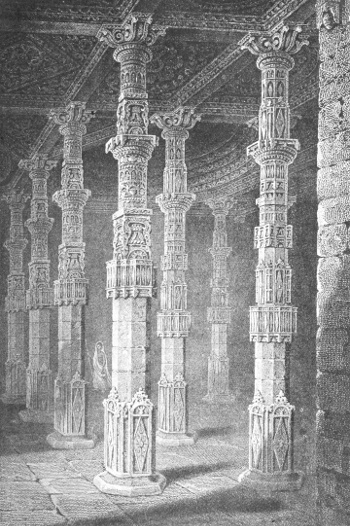
ANCIENT JAIN TEMPLE AT AJMER.
To face page 896.
897—The temple is surrounded by
a superb screen of Saracenic architecture, having the main front
and gateway to the north. From its simplicity, as well as its
appearance of antiquity, I am inclined to assign the screen to
the first dynasty, the Ghorian sultans, who evidently made use
of native architects. The entrance arch is of that wavy kind,
characteristic of what is termed the Saracenic, whether the term
be applied to the Alhambra of Spain, or the mosques of Delhi;
and I am disposed, on close examination, to pronounce it Hindu.
[2]
The entire façade of this noble entrance, which I regret I cannot
have engraved, is covered with Arabic inscriptions. But, unless
my eyes much deceived me, the small frieze over the apex of the
arch contained an inscription in Sanskrit,
[3] with which Arabic
has been commingled, both being unintelligible. The remains
of a minaret still maintain their position on the right flank of the
gate, with a door and steps leading to it for the muazzin to call
the faithful to prayers. A line of smaller arches of similar form
composes the front of the screen. The design is chaste and
beautiful, and the material, which is a compact limestone of a
yellow colour, admitting almost of as high a polish as the
jaune
antique, gave abundant scope to the sculptor. After confessing
and admiring the taste of the Vandal architect, we passed under
the arch to examine the more noble production of the Hindu.
Its plan is simple, and consonant with all the more ancient temples
of the Jains. It is an extensive saloon, the ceiling supported by
a quadruple range of columns, those of the centre being surmounted
by a range of vaulted coverings; while the lateral
portion, which is flat, is divided into compartments of the most
elaborate sculpture. But the columns are most worthy of attention;
they are unique in design, and with the exception of the
cave-temples, probably amongst the oldest now existing in India.
On examining them, ideas entirely novel, even in Hindu [780]
898art, are developed. Like all these portions of Hindu architecture,
their ornaments are very complex, and the observer will not fail
to be struck with their dissimilarity; it was evidently a rule in
the art to make the ornaments of every part unlike the other,
and which I have seen carried to great extent. There may be
forty columns but no two are alike. The ornaments of the base
are peculiar, both as to form and execution; the lozenges, with
the rich tracery surmounting them, might be transferred, not
inappropriately, to the Gothic cathedrals of Europe. The projections
from various parts of the shaft (which on a small scale
may be compared to the corresponding projections of the columns
in the Duomo at Milan), with the small niches still containing the
statues, though occasionally mutilated, of the Pontiffs of the Jains,
give them a character which strengthens the comparison, and
which would be yet more apparent if we could afford to engrave
the details.
[4] The elegant Kamakumbha, the emblem of the Hindu
Ceres, with its pendent palmyra-branches, is here lost, as are
many emblematical ornaments, curious in design and elegant
in their execution. Here and there occurs a
richlyrichly carved corbeille,
which still further sustains the analogy between the two systems
of architecture; and the capitals are at once strong and delicate.
The central vault, which is the largest, is constructed after the
same fashion as that described at Nadol; but the concentric
annulets, which in that are plain, in this are one blaze of ornaments,
which with the whole of the ceiling is too elaborate and complicated
for description. Under the most retired of the compartments,
and nearly about the centre, is raised the mimbar, or
pulpit, whence the Mulla enunciates the dogma of Muhammad,
“there is but one God”: and for which he dispossessed the Jain,
whose creed was like his own, the unity of the Godhead. But
this is in unison with the feeling which dictated the external
metamorphosis. The whole is of the same materials as already
described, from the quarries of the Aravalli close at hand, which
are rich in every mineral as well as metallic production:—
I ask’d of Time for whom those temples rose,
That prostrate by his hand in silence lie;
899His lips disdain’d the myst’ry to disclose,
And borne on swifter wing, he hurried by!
The broken columns whose? I ask’d of Fame:
(Her kindling breath gives life to works sublime;)
With downcast looks of mingled grief and shame,
She heaved the uncertain sigh, and follow’d Time [781].
Wrapt in amazement o’er the mouldering pile,
I saw Oblivion pass with giant stride;
And while his visage wore Pride’s scornful smile,
Haply thou know’st, then tell me, whose I cried,
Whose these vast domes that ev’n in ruin shine?
I reck not whose, he said: they now are mine.
Shall we abandon them to cold ‘oblivion’; or restore them
to a name already mentioned, Samprati, or Swampriti, the Shah
Jahan[5] of a period two centuries before the Christian era, and
to whom the shrine in Kumbhalmer is ascribed? Of one thing
there is no doubt, which is, that both are Jain, and of the most
ancient models: and thus advertised, the antiquary will be able
to discriminate between the architectural systems of the Saivas
and the Jains, which are as distinct as their religions.
Having alluded to the analogy between the details in the
columns and those in our Gothic buildings (as they are called),
and surmised that the Saracenic arch is of Hindu origin; I may
further, with this temple and screen before us, speculate on the
possibility of its having furnished some hints to the architects
of Europe. It is well known that the Saracenic arch has crept
into many of those structures called Gothic, erected in the twelfth
and thirteenth centuries, when a more florid style succeeded to
the severity of the Saxon or Romans; but I believe it has been
doubted whence the Saracens obtained their model; certainly
it was neither from Egypt nor Persia. The early caliphs of
Baghdad, who were as enlightened as they were powerful, kept
alive the light of science when Europe was in darkness; and
the most accomplished noble who accompanied our Cœur de Lion,
though “brave as his sword,” was a clown compared to the
infidel Saladin, in mind as well as manners. The influence of
these polished foes on European society it would be superfluous
to descant upon. The lieutenants of these caliphs, who penetrated
900from the Delta of the Indus to the Ganges from four to
five centuries prior to this event, when Walid’s arms triumphed
simultaneously on the Indus and the Ebro, produced no trifling
results to the arts. This very spot, Ajmer, according to traditional
couplets and the poetic legends of its ancient princes, the
Chauhans, was visited by the first hostile force which Islam sent
across the Indus, and to which Manika Rae fell a sacrifice. What
ideas might not this Jain temple have afforded to [782] “the
Light of Ali,” for Roshan Ali is the name preserved of him who,
“in ships landing at Anjar,” marched through the very heart
of India, and took Garh Bitli, the citadel of Ajmer, by assault.
The period is one of total darkness in the history of India, save
for the scattered and flickering rays which emanate from the
chronicles of the Chauhans and Guhilots. But let us leave the
temple, and slightly describe the castle of Manika Rae, on whose
battlements an infidel’s arrow of Roshan’s army reached the
heir of the Chauhan; since which Lot, for such was his name,
has been adopted amongst the lares and penates of this celebrated
race. This was the first Rajput blood which the arms of conversion
shed, and the impression must have been strong to be thus
handed down to posterity.
The mind, after all, retires dissatisfied: with me it might be
from association. Even the gateway, however elegant, is unsuitable
to the genius of the place. Separately considered, they
are each magnificent; together, it is as if a modern sculptor were
(like our actors of the last age) to adorn the head of Cato with
a peruke. I left this precious relic, with a malediction upon all the
spoilers of art—whether the Thane who pillaged Minerva’s portico
at Athens, or the Turk who dilapidated the Jain temple at Ajmer.[6]
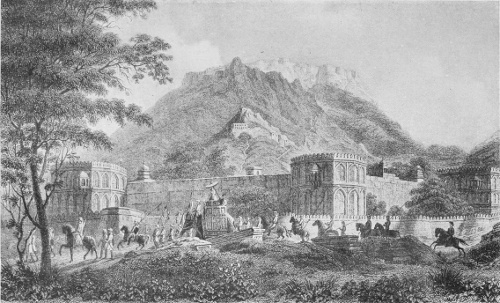
FORTRESS AND TOWN OF AJMER.
To face page 900.
—The reader will see as much of this far-famed
fortress as I did: for there was nothing to induce me to climb
the steep, where the only temple visible was a modern-looking
whitewashed mosque, lifting its dazzling minarets over the dingy
antique towers of the Chauhan: “he who seven times captured
the sultan, and seven times released him.” The hill rises majestically
from its base to the height of about eight hundred feet; its
crest encircled by the ancient wall and towers raised by Ajaipal—
901There was a day when they were young and proud,
Banners on high, and battles passed below;
But they who fought are in a bloody shroud,
And those which waved are shredless dust ere now,
And the bleak battlements shall bear no future blow;
[7]
unless the Cossack should follow the track of Roshan Ali or
Mahmud, and try to tear the British flag from the kunguras of
Ajmer. On the north side a party of the superintendent’s were
unlocking the latent treasures in the bowels of the mountain.
The vein is of lead; a sulphuret, or galena [783].[8]
—I have already mentioned the lake, called
after the excavator, the Bisal Talab. It is about eight miles in
circumference, and besides the beauty it adds to the vale of Ajmer,
it has a source of interest in being the fountain of the Luni, which
pursues its silent course until it unites with the eastern arm of
the Delta of the Indus: the point of outlet is at the northern
angle of the Daulat Bagh, ‘the gardens of wealth,’ built by
Jahangir for his residence when he undertook to conquer the
Rajputs. The water is not unwholesome, and there are three
outlets at this fountainhead for the escape of the water fitting
its periodical altitudes. The stream at its parent source is thence
called the Sagarmati. It takes a sweep northward by Bhaonta
and Pisangan, and close to where we crossed it, at Govindgarh,
it is joined by the Sarasvati from Pushkar; when the united
waters (at whose sangam, or confluence, there is a small temple
to the manes) are called the Luni.
The gardens erected on the embankment of the lake must
have been a pleasant abode for “the king of the world,” while
his lieutenants were carrying on the war against the Rana: but the
imperial residence of marble, in which he received the submissions
of that prince, through his grandson, and the first ambassador
sent by England to the Mogul, are now going fast to decay.
The walks on which his majesty last paraded, in the state-coach
sent by our James the First, are now overgrown with shrubs.
The stratification of the rock, at the point of outlet, would
902interest the geologist, especially an extensive vein of mica, adjoining
another of almost transparent quartz.
—Eastward of this lake about a mile is another
named the Anasagar, after the grandson of Bisaldeo, who has
left the reputation of great liberality, and a contrast with Visala.
The vestiges of an island are yet seen in the lake, and upon its
margin; but the materials have been carried away by the Goths.
There are two small buildings on the adjacent heights, called
“the annulets of Khwaja Kutb,” and some other saint.
Such are the wonders in the environs of Daru-l-Khair, “celebrated
in the history of the Moguls, as well as of the Hindus.”
But my search for inscriptions to corroborate the legends of the
Chauhans proved fruitless. I was, however, fortunate enough to
add to my numismatic treasures some of the currency of these
ancient kings, which give interest to a series of the same description,
all appertaining [784] to the Buddhists or Jains. The
inscription occupying one side is in a most antique character,
the knowledge of which is still a desideratum: the reverse bears
the effigies of a horse, the object of worship to the Indo-Scythic
Rajput.[9] It is not improbable that the Agnikula Chauhan may
have brought these letters with him from higher Asia. Researches
in these countries for such monuments may yet discover how far
this conjecture is correct. At Pushkar I also found some very
ancient coins. Had the antiquary travelled these regions prior
to the reign of Aurangzeb he would have had a noble field to
explore: many coins were destroyed by this bigot, but many
were buried underground, which time or accident may disclose.
He was the great foe of Rajput fame; and well might the bard,
in the words of the Cambrian minstrel, bid
Ruin seize thee, ruthless king.
They did repay his cruelties by the destruction of his race. In
one short century from this tyrant, who grasped each shore of
the peninsula, the Mogul power was extinct; while the oppressed
Rajputs are again on the ascendant. But the illiterate and
mercenary Afghan, “the descendant of the lost tribes of Israel,”[10]
if we credit their traditions, may share the iniquity with Aurangzeb:
903for they fulfilled literally a duty which their supposed forefathers
pertinaciously refused, and made war against every graven image.
Had they even spared us a few of the monsters, the joint conceptions
of the poet and the sculptor, I might have presented some
specimens of griffins (gras)[11] and demons almost of a classical
taste: but the love of mischief was too strong even to let these
escape: the shoe was applied to the prominent features of everything
which represented animation.
By a medium of several meridian observations, I made the
latitude of Ajmer 26° 19´ north; its longitude, by time and
measurement from my fixed meridian, Udaipur, 74° 40´, nearly
the position assigned to it by the father of Indian geography,
the justly celebrated Rennell.[12]
—December 5.—At daybreak we left
the towers of Manika Rae, enveloped in mist, and turned our
horses’ heads to the southward, on our return to Udaipur. While
at Ajmer, I received accounts of the death of the prince of Kotah,
and did intend to proceed direct to that capital, by Shahpura
and Bundi; but my presence was desired by the Rana to repair
the dilapidations which only two months’ absence had [785]
occasioned in the political fabric which I had helped to reconstruct.
Other interesting objects intervened: one, a visit to the
new castle of Bhimgarh, erecting in Merwara to overawe the
Mers; the other to compose the feuds which raged between the
sectarian merchants of the new mart, Bhilwara, and which
threatened to destroy all my labour. We made two marches to
Bhinai, in which there was nothing to record. Bhinai is the
residence of a Rathor chieftain, whose position is rather peculiar.
Being placed within the district of Ajmer, and paying an annual
quit-rent to the British, he may consider the Company as his
sovereign; but although this position precludes all political
subordination to the chief of the race, the tie would be felt and
acknowledged, on a lapse, in the anxiety for the usual tika of
recognition to his successor, from the Raja of Marwar. I argue
on knowledge of character and customs; though it is possible
this individual case might be against me.
904The castle of Bhinai is a picturesque object in these level
plains; it is covered with the cactus, or prickly pear, so abundant
on the east side of the Aravalli. This was anciently the residence
of a branch of the Parihara princes of Mandor, when held as a
fief of the Chauhans of Ajmer; and from it originated a numerous
mixed class, called the Parihara Minas, a mixture of Rajput and
aboriginal blood.
—December 6.—Deolia, near the northern bank of the
Khari, the present boundary of Ajmer and Mewar. From Ajmer
to Deolia the direction of the road is S.S.E., and the distance
forty miles. This important district in the political geography
of Rajputana, which, with the posts of Nimach and Mhow, is
the connecting link between the British dominions on the Jumna
and in the Deccan, was obtained by cession from Sindhia in 1818.
A glance at the map is sufficient to show its importance in our
existing connexion with Rajputana. The greatest breadth of
the district is between the Aravalli west and the Banas east,
and measures about eight miles. The greatest length is between
the city of Ajmer and Jhak, a post in Merwara, measuring about
forty miles. The narrowest portion is that where we now are,
Deolia, whence the Kishangarh frontier can be seen over a neck
of land of about twelve miles in extent. Within these bounds
a great portion of the land is held by feudal chieftains paying a
quit-rent, which I believe is fixed. I had to settle a frontier dispute
at Deolia, regarding the right of cultivating in the bed of the
Khari, which produces very good melons. The soil of Ajmer
cannot [786] be called rich, and is better adapted for the lighter
than the richer grains. Marks of war and rapine were visible
throughout.
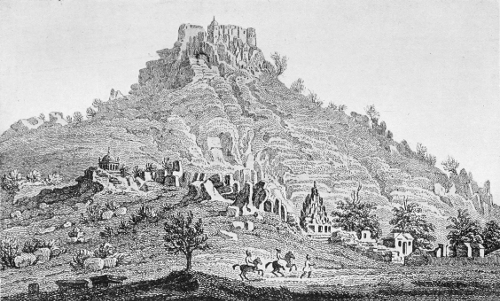
CASTLE OF BHINAI.
To face page 904.
—December 7.—This town was a sub-fee of Banera;
but the vassal, a Rathor, had learned habits of insubordination
during Mahratta influence, which he could not or would not throw
aside. In these he was further encouraged by his connexion by
marriage with the old ruler of Kotah, who had exemplified his
hostility to the Dabla vassal’s liege lord by besieging his castle
of Banera. Having so long disobeyed him, his Rajput blood
refused to change with the times; and though he condescended,
at the head of his twenty retainers, to perform homage on stated
days, and take his allotted position in the Banera darbar, he
refused to pay the quit-rent, to which numerous deeds proved
905his suzerain had a right. Months passed away in ineffectual
remonstrances; it was even proposed that he should hold the
inferior dependencies free of quit-rent, but pay those of Dabla.
All being in vain, the demand was increased to the complete
surrender of Dabla; which elicited a truly Rajput reply: “His
head and Dabla were together.” This obstinacy could not be
tolerated; and he was told that though one would suffice, if
longer withheld both might be required. Like a brave Rathor,
he had defended it for months against a large Mahratta force,
and hence Dabla was vauntingly called “the little Bharatpur.”
Too late he saw his error, but there was no receding; and though
he at length offered a nazarana, through the mediation of the
Kotah wakil, of 20,000 rupees, to obtain the Rana’s investiture,
it was refused and a surrender was insisted on. Being an important
frontier-post, it was retained by the Rana, and compensation
was made to Banera. Every interest was made for him
through the Nestor of Kotah, but in vain; his obstinacy offered
an example too pernicious to admit of the least retrocession, and
Dabla was forthwith incorporated with the appanage of the heir-apparent,
Jawan Singh.
Almost the whole of this, the Badnor division, of 360 townships,
is occupied by Rathors, the descendants of those who
accompanied Jaimall to Mewar: the proportion of feudal to
fiscal land therein is as three to one. It is a rich and fertile
tract, and it is to be hoped will maintain in ease and independence
the brave men who inhabit it, and who have a long time been
the sport of rapine.
I received a visit from the chief vassal of the Badnor chief,
then at the capital; and as I found it impossible to visit Merwara,
I subsequently deputed Captain [787] Waugh who was hospitably
received and entertained at Badnor. He hunted, and played
the Holi with the old baron, who shows at all times the frankness
of his race: but it being the period of the Saturnalia, he was
especially unreserved; though he was the greatest stickler for
etiquette amongst my many friends, and was always expatiating
on the necessity of attending to the gradations of rank.
—
December 8.—The castle of Banera is one of the most
imposing feudal edifices of Mewar, and its lord one of the greatest
of its chieftains. He not only bears the title of Raja, but has
all the state-insignia attached thereto. His name happens to
906be the same as that of his sovereign—his being Raja Bhim, the
prince’s Rana Bhim,—to whom he is nearly related, and but for
blind chance might have been lord of all the Sesodias. It may
be recollected that the chivalrous antagonist of Aurangzeb, the
heroic Rana Raj, had two sons, twins, if we may so term sons
simultaneously born, though by different mothers. The incident
which decided the preference of Jai Singh to Bhim has been
related;
[13] the circumstance of the latter’s abandoning his country
to court fortune under the Imperial standard—his leading his
Rajput contingent amongst the mountains of Kandahar—and his
death by dislocation of the spine, through urging his horse at
speed amongst the boughs of a tree. The present incumbent of
Banera is the descendant of that Raja Bhim, who was succeeded
in the honours of his family by his son Suraj, killed whilst heading
his contingent at the storm of Bijapur. The infant son of Suraj
had four districts assigned to him, all taken from his suzerain,
the Rana. In such esteem did the emperor hold the family,
that the son of Suraj was baptized Sultan. He was succeeded
by Sardar Singh, who, on the breaking up of the empire, came
under the allegiance of his rightful sovereign the Rana. Rae
Singh and Hamir Singh complete the chain to my friend Raja
Bhim, who did me the honour to advance two miles from Banera
to welcome and conduct me to his castle. Here I had a good
opportunity of observing the feudal state and manners of these
chiefs within their own domains during a visit of three hours
at Banera. I was, moreover, much attached to Raja Bhim,
who was a perfectly well-bred and courteous gentleman, and
who was quite unreserved with me. From his propinquity to
the reigning family, and from his honours and insignia being the
gift of the king’s, he had been an object of jealousy to the court,
which tended much to retard the restoration [788] of his authority
over his sub-vassals of Banera; the chief of Dabla is one instance
of this. I found little difficulty in banishing the discord between
him and his sovereign, who chiefly complained of the Banera
kettle-drums beating, not only as he entered the city, but as far
as the Porte—the sacred Tripolia; and the use of Chamar
[14] in
his presence. It was arranged that these emblems of honour,
emanating from the great foes of Mewar, should never be obtruded
907on the eye or ear of the Rana; though within his own domain
the Banera chieftain might do as he pleased. This was just;
and Raja Bhim had too much good sense not to conciliate his
“brother and cousin,” Rana Bhim, by such a concession, which
otherwise might have been insisted upon. The estate of Banera
is in value 80,000 rupees of annual rent, one-half of which is in
subinfeudations, his vassals being chiefly Rathors. The only
service performed by Raja Bhim is the contributing a quota for
the commercial mart of Bhilwara, with the usual marks of subordination,
personal duty and homage to the Rana. His estate
is much impoverished from its lying in the very track of the freebooters;
but the soil is excellent, and time will bring hands to
cultivate it, if we exercise a long and patient indulgence.
The ‘velvet cushion’ was spread in a balcony projecting
from the main hall of Banera; here the Raja’s vassals were
mustered, and he placed me by his side on the gaddi. There
was not a point of his rural or domestic economy upon which he
did not descant, and ask my advice, as his “adopted brother.”
I was also made umpire between him and my old friend the baron
of Badnor, regarding a marriage settlement, the granddaughter of
the latter being married to the heir of Banera. I had, besides,
to wade through old grants and deeds to settle the claims between
the Raja and several of his sub-vassals; a long course of disorder
having separated them so much from each other as to
obliterate their respective rights. All these arbitrations were
made without reference to my official situation, but were forced
upon me merely by the claims of friendship; but it was a matter
of exultation to be enabled to make use of my influence for the
adjustment of such disputes, and for restoring individual as well
as general prosperity. My friend prepared his gifts at parting;
I went through the forms of receiving, but waived accepting them:
which may be done without any offence to delicacy. I have been
highly gratified to read the kind reception he gave to the respected
Bishop Heber, in his tour through Mewar. I wonder, however,
that this discerning and elegant-minded man did not [789] notice
the peculiar circumstance of the Raja’s teeth being fixed in with
gold wire, which produces rather an unpleasant articulation.[15]
908Banera adjoins the estates of the Rathors, and is no great
distance from those of the Sangawats and Jagawats, which lie
at the base of the Aravalli. All require a long period of toleration
and unmolested tranquillity to emerge from their impoverished
condition. My friend accompanied me to my tents,
when I presented to him a pair of pistols, and a telescope with
which he might view his neighbours on the mountains: we
parted with mutual satisfaction, and I believe, mutual regret.
—
December 9.—I encamped about half-a-mile from
our good town of Bhilwara, which was making rapid strides to
prosperity, notwithstanding drawbacks from sectarian feuds;
with which, however, I was so dissatisfied, that I refused every
request to visit the town until such causes of retardation were
removed. I received a deputation from both parties at my tents,
and read them a lecture for their benefit, in which I lamented the
privation of the pleasure of witnessing their unalloyed prosperity.
Although I reconciled them to each other, I would not confide
in their promises until months of improvement should elapse.
They abided by their promise, and I fulfilled mine when the death
of the Bundi prince afforded an opportunity,
en route to that
capital, to visit them. My reception was far too flattering to
describe, even if this were the proper place. The sentiments they
entertained for me had suffered no diminution when Bishop
Heber visited the town. But his informant (one of the merchants),
when he said it ought to have been called Tod-ganj, meant that
it was so intended, and actually received this appellation: but
it was changed, at my request, and on pain of withdrawing my
entire support from it. The Rana, who used to call it himself
in conversation “
Tod Sahib ki basti,” would have been gratified;
but it would have been wrong to avail myself of his partiality.
In all I was enabled to do, from my friendship, not from my
official character, I always feared the dangers to his independence
from such precedent for interference.
[16]—December 10.—I deviated from the direct course
homewards (to Udaipur) to visit this beautiful spot, formerly the
head of a flourishing district; but all was dilapidated. The first
revenue derived from Mandal was expended on the repairs of the
dam of its lake, which irrigates a great extent of rice-land. The
Goths had felled [790] most of the fine trees which had ornamented
909its dam and margin; and several garden-houses, as well as that
on the island in the lake, were in ruins. Not many years ago a
column of victory, said to have been raised by Bisaladeva of Ajmer,
in consequence of a victory over the Guhilots, graced this little
isle. Mandal is now rising from its ruins, and one of the exiles
was so fortunate as to find a vessel containing several pieces of
gold and ornaments, in excavating the ruins of his ancient abode,
though not buried by him. It involved the question of manorial
rights, of which the Rana waived the enforcement, though he
asserted them. To-day I passed between Pansal and Arja, the
former still held by a Saktawat, the latter now united to the fisc.
I have already related the feud between the Saktawats and the
Purawats in the struggle for Arja, which is one of the most compact
castles in Mewar, with a domain of 52,000 bighas, or 12,000
acres, attached to it, rendering it well worth a contest; but the
Saktawat had no right there, say the Purawats; and in fact it is
in the very heart of their lands.
—December 11.—This is one of the oldest towns of Mewar,
and if we credit tradition, anterior in date to Vikrama. We
crossed the Kotasari to and from Mandal, passing by the tin and
copper mines of Dariba, and the Purawat estate of Pitawas.
Pur means, par eminence, ‘the city,’ and anciently the title was
admissible; even now it is one of the chief fiscal towns. It is
in the very heart of the canton, inhabited by the Babas, or
‘infants’ of Mewar, embracing a circle of about twenty-five miles
diameter. The broken chain of mountains, having Banera on
the northern point and Gurla to the south, passes transversely
through this domain, leaving the estate of Bagor, the residence of
Sheodan Singh, west, and extending to the S.E. to Mangrop,
across the Berach. The policy which dictated the establishment
of an isolated portion of the blood-royal of Mewar in the very
centre of the country was wise; for the Babas rarely or ever mix
with the politics of the feudatory chieftains, home or foreign.
They are accordingly entrusted with the command of all garrisons,
and head the feudal quotas as the representative of their sovereign.
They have a particular seat at court, the Baba ka Ol being distinct
from the chieftains’, and in front. Though they inhabit the
lands about Pur, it is not from these they derive their name, but
as descendants from Puru, one of the twenty-five sons of Rana
Udai Singh, that blot in the scutcheon of Mewar [791].
910—About a mile east of Pur there is an isolated hill of
blue slate, in which I found garnets embedded. I have no doubt
persevering adventurers would be rewarded; but though I tried
them with the hammer, I obtained none of any value. They are
also to be obtained on the southern frontier of Kishangarh and
Ajmer, about Sarwar. I received the visits of the ‘infants’ of
Gurla and Gadarmala, both most respectable men, and enjoying
good estates, with strong castles, which I passed the next day.
—December 12.—We had a long
march through the most fertile lands of Mewar, all belonging to
the Rana’s personal domain. The progress towards prosperity
is great; of which Rasmi, the head of a tappa or subdivision of a
district, affords evidence, as well as every village. On our way
we were continually met by peasants with songs of joy, and our
entrance into each village was one of triumph. The Patels and
other rustic officers, surrounded by the ryots, came out of the
villages; while the females collected in groups, with brass vessels
filled with water gracefully resting on their heads, stood at the
entrance, their scarfs half covering their faces, chaunting the
suhela; a very ancient custom of the Hindu cultivator on receiving
the superior, and tantamount to an acknowledgment of
supremacy. Whether vanity was flattered, or whether a better
sentiment was awakened, on receiving such tokens of gratitude,
it is not for me to determine: the sight was pleasing, and the
custom was general while I travelled in Mewar. The females
bearing the kalas on their heads, were everywhere met with.
These were chiefly the wives and daughters of the cultivators,
though not unfrequently those of the Rajput sub-vassals. The
former were seldom very fair, though they had generally fine
eyes and good persons. We met many fragments of antiquity
at Rasmi. Captain Waugh and the doctor were gratified with
angling in the Banas for trout; but as the fish would not rise to
the fly, I set the net, and obtained several dozens: the largest
measured seventeen inches, and weighed seventy rupees, or
nearly two pounds.
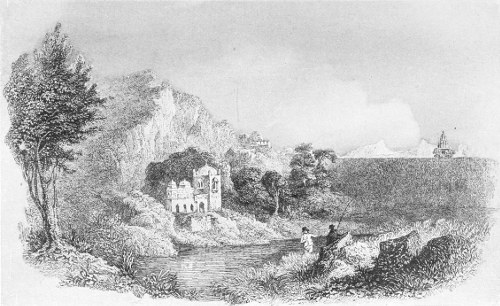
SOURCE OF THE BERACH RIVER, AND HUNTING SEAT OF THE RĀNA.
To face page 910.
—December 16.—After an absence of two months we
terminated our circuitous journey, and encamped on the ground
whence we started, all rejoiced at the prospect of again entering
“the happy valley.” We made four marches across the duab,
watered by the Berach and Banas rivers; the land naturally rich,
911and formerly boasting some large towns, but as yet only disclosing
the germs of [792] prosperity. There is not a more fertile
tract in India than this, which would alone defray the expenses
of the court if its resources were properly husbanded. But years
must first roll on, and the peasant must meet with encouragement,
and a reduction of taxation to the lowest rate; and the
lord-paramount must alike be indulgent in the exaction of his
tribute. Our camels were the greatest sufferers in the march
through the desert, and one-half were rendered useless. I
received a deputation conveying the Rana’s congratulation on
my return ‘home,’ with a letter full of friendship and importunities
to see me; but the register of the heavens—an oracle
consulted by the Rajput as faithfully as Moore’s Almanack by
the British yeoman—showed an unlucky aspect, and I must
needs halt at Merta, or in the valley, until the signs were more
favourable to a re-entry into Udaipur. Here we amused ourselves
in chalking out the site of our projected residence on the
heights of Tus, and in fishing at the source of the Berach. Of
this scene I present the reader with a view; and if he allows his
imagination to ascend the dam which confines the waters of the
lake, he may view the Udaisagar, with its islets; and directing
his eye across its expanse, he may gain a bird’s-eye view of the
palace of the Kaisar of the Sesodias. The dam thrown across a
gorge of the mountains is of enormous magnitude and strength,
as is necessary, indeed, to shut in a volume of water twelve miles
in circumference. At its base, the point of outlet, is a small
hunting-seat of the Rana’s, going to decay for want of funds to
repair it, like all those on the Tiger Mount and in the valley.
Nor is there any hope that the revenues, burthened as they are
with the payment of a clear fourth in tribute, can supply the
means of preventing further dilapidation.
December 19.—Tired of two days’ idleness, we passed through
the portals of Debari on our way to Ar, to which place the
Rana signified his intention of advancing in person, to receive
and conduct me ‘home’: an honour as unlooked-for and unsolicited
as it was gratifying. Udaipur presents a most imposing
appearance when approached from the east. The palace of the
Rana, and that of the heir-apparent, the great temple, and the
houses of the nobles, with their turrets and cupolas rising in airy
elegance, afford a pleasing contrast with the heavy wall and
912pierced battlements of the city beneath. This wall is more
extensive than solid. To remedy this want of strength, a chain
of fortresses has [793] been constructed, about gunshot from it,
commanding every road leading thereto, which adds greatly to
the effect of the landscape. These castellated heights contain
places of recreation, one of which belongs to Salumbar; but all
wear the same aspect of decay.
—Ar, or Ahar,
[17] near which we encamped, is sacred to the
manes of the princes of Udaipur, and contains the cenotaphs of
all her kings since the valley became their residence; but as they
do not disdain association, either in life or death, with their
vassals, Ar presents the appearance of a thickly crowded cemetery,
in which the mausoleums of the Ranas stand pre-eminent in “the
place of great faith.”
[18] The renowned Amra Singh’s is the most
conspicuous; but the cenotaphs of all the princes, down to the
father of Rana Bhim, are very elegant, and exactly what such
structures ought to be; namely, vaulted roofs, supported by
handsome columns raised on lofty terraces, the architraves of
enormous single blocks, all of white marble, from the quarries of
Kankroli. There are some smaller tombs of a singularly elaborate
character, and of an antiquity which decides the claims of Ar to
be considered as the remains of a very ancient city. The ground
is strewed with the wrecks of monuments and old temples, which
have been used in erecting the sepulchres of the Ranas. The
great city was the residence of their ancestors, and is said to have
been founded by Asaditya upon the site of the still more ancient
capital of Tambavatinagari, where dwelt the Tuar ancestors of
Vikramaditya, before he obtained Avinti, or Ujjain. From
Tambavatinagari its name was changed to Anandpur, ‘the happy
city,’ and at length to Ahar, which gave the patronymic to the
Guhilot race, namely, Aharya. The vestiges of immense mounds
still remain to the eastward, called the Dhul-kot, or ‘fort,’
destroyed by ‘ashes’ (
dhul) of a volcanic eruption. Whether the
lakes of the valley owe their origin to the same cause which is
said to have destroyed the ancient Ahar, a more skilful geologist
must determine. The chief road from the city is cut through this
mound; and as I had observed fragments of sculpture and
pottery on the excavated sides, I commenced a regular opening
of the mound in search of medals, and obtained a few with the
913effigies of an animal, which I fancied to be a lion, but others the
gadha, or ass, attributed to Gandharvasen, the brother of Vikrama,
who placed this impress on his coins, the reason of which is given
in a long legend.
[19] My impious intentions were soon checked by
some designing knaves about the Rana, and I would not offend
[794] superstition. But the most superficial observer will pronounce
Ar to have been an ancient and extensive city, the walls
which enclose this sepulchral abode being evidently built with
the sculptured fragments of temples. Some shrines, chiefly Jain,
are still standing, though in the last stage of dilapidation, and
they have been erected from the ruins of shrines still older, as
appears from the motley decorations, where statues and images
are inserted with their heads reversed, and Mahavira and Mahadeva
come into actual contact: all are in white marble. Two
inscriptions were obtained; one very long and complete, in the
nail-headed character of the Jains; but their interpretation is
yet a desideratum. A topographical map of this curious valley
would prove interesting, and for this I have sufficient materials.
The Teli-ki-Sarai would not be omitted in such a map, as adding
another to the many instances I have met with, among this industrious
class, to benefit their fellow-citizens. The ‘Oilman’s
Caravanserai’ is not conspicuous for magnitude; but it is remarkable,
not merely for its utility, but even for its elegance of
design. It is equi-distant from each of the lakes. The Teli-ka-Pul,
or ‘Oilman’s Bridge,’ at Nurabad, is, however, a magnificent
memorial of the trade, and deserves preservation; and as I shall
not be able now to describe the region (Gwalior) where it stands,
across the Asan, I will substitute it for the Sarai, of which I have
no memorial.
[20] These Telis (oilmen) perambulate the country
914with skins of oil on a bullock, and from hard-earned pence erect
the structures which bear their name. India owes much to
individual munificence.
The planets were adverse to my happy conjunction with the
Sun of the Hindus: and it was determined that I should pass
another day amongst the tombs of Ahar; but I invoked upon
my own devoted head all the evil consequences, as in this case I
was the only person who was threatened. To render this opposition
to the decree less noxious, it was agreed that I should make
my entrée by the southern, not by the eastern porte, that of the
sun. The Rana came, attended by his son, his chiefs, his
ministers, and, in fact, all the capital in his train. The most
hearty welcomes were lavished upon us all. “Rama! Rama!
Tod Sahib!” (the Hindu greeting) resounded from a thousand
throats, while I addressed each chief by name. It was not a
meeting of formality, but of well-cemented friendship. My
companions, Captain Waugh and Dr. Duncan, were busy interchanging
smiles and cordial greetings, when the Rana, requesting
our presence at the palace next day [795], bade us adieu. He
took the direct road to his palace, while we, to avoid evil spirits,
made a detour by the southern portal, to gain our residence, the
garden of Rampiyari.
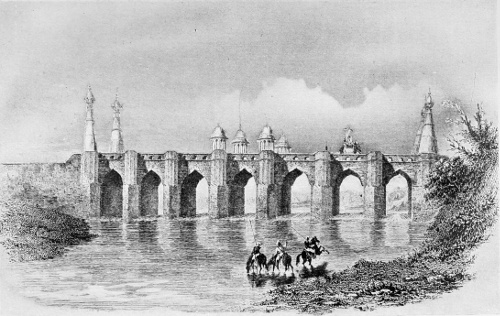
BRIDGE OF NŪRĀBĀD.
To face page 914.
Translations of Inscriptions, chiefly in the Nail-headed character
of the Takshak Races and Jains, fixing eras in Rajput history.[1]
Memorial of a Gete or Jit prince of the fifth century, discovered
1820, in a temple at Kunswa, near the Chumbul river, south
of Kotah.
May the Jit’ha be thy protector! What does this Jit’h
resemble? which is the vessel of conveyance across the waters
915of life, which is partly white, partly red? Again, what does it
resemble, where the hissing-angered serpents dwell? What may
this Jit’ha be compared to, from whose root the roaring flood
descends? Such is the Jit’haJit’ha; by it may thou be preserved (1).
The fame of Raja Jit I now shall tell, by whose valour the
lands of Salpoora (2) are preserved. The fortunes of Raja Jit
are as flames of fire devouring his foe. The mighty warrior Jit
Salindra (2) is beautiful in person, and from the strength of his
arm esteemed the first amongst the tribes of the mighty; make
resplendent, as does the moon the earth, the dominions of Salpoori.
The whole world praises the Jit prince, who enlarges the
renown of his race, sitting in the midst of haughty warriors, like
the lotos in the waters, the moon of the sons of men. The foreheads
of the princes of the earth worship the toe of his foot.
Beams of light irradiate his countenance, issuing from the gems
of his arms of strength. Radiant is his array; his riches abundant;
his mind generous and profound as the ocean. Such is he
of Sarya (3) race, a tribe renowned amongst the tribes of the
mighty, whose princes were ever foes to treachery, to whom the
earth surrendered her fruits, and who added the lands of their
foes to their own. By sacrifice, the mind of this lord of men has
been purified; fair are his territories, and fair is the Fortress
of Tak’hya (4). The string of whose bow is dreaded, whose
wrath is the reaper of the field of combat; but to his dependents
he is as the pearl on the neck; who makes no account of the
battle, though streams of blood run through the field. As does
the silver lotos bend its head before the fierce rays of the sun, so
does his foe stoop to him, while the cowards abandon the field [796].
From this lord of men (Narpati) Salindra sprung Devangli,
whose deeds are known even at this remote period.
From him was born Sumbooka, and from him Degali, who
married two wives of Yadu race (5), and by one a son named
Vira Narindra, pure as a flower from the fountain.
Amidst groves of amba, on whose clustering blossoms hang
myriads of bees, that the wearied traveller might repose, was this
edifice erected. May it, and the fame of its founder, continue
while ocean rolls, or while the moon, the sun, and hills endure.
Samvat 597.—On the extremity of Malwa, this minster (Mindra)
was erected, on the banks of the river Taveli, by Salichandra (6),
son of Virachandra.
Whoever will commit this writing to memory, his sins will be
obliterated. Carved by the sculptor Sevanarya, son of Dwarasiva,
and composed by Butena, chief of the bards.
916Note 1.—In the prologue to this valuable relic, which superficially
viewed would appear a string of puerilities, we have conveyed
in mystic allegory the mythological origin of the Jit or
Gete race. From the members of the chief of the gods Iswara
or Mahadeva, the god of battle, many races claim birth: the
warrior from his arms; the Charun from his spine; the prophetic
Bhat (Vates) from his tongue; and the Gete or Jit derive theirs
from his tiara, which, formed of his own hair, is called Jit’ha.
In this tiara, serpents, emblematic of Time (kal) and Destruction,
are wreathed; also implicative that the Jits, who are of
Takshac, or the serpent race, are thereby protected. The “roaring
flood” which descends from this Jit’ha is the river goddess,
Ganga, daughter of Mena, wife of Iswara. The mixed colour of
his hair, which is partly white, partly of reddish (panduranga)
hue, arises from his character of Ard’hnari, or Hermaphroditus.
All these characteristics of the god of war must have been brought
by the Scythic Gete from the Jaxartes, where they worshipped
him as the Sun (Balnat’h) and as Xamolscis (Yama, vulg. Jama)
the infernal divinity.
The 12th chapter of the Edda, in describing Balder the second
son of Odin, particularly dwells on the beauty of his hair, whence
“the whitest of all vegetables is called the eyebrow of Balder, on the
columns of whose temples there are verses engraved, capable of recalling
the dead to life.”
How perfectly in unison is all this of the Jits of Jutland and
the Jits of Rajast’han. In each case the hair is the chief object
of admiration; of Balnath as Balder, and the magical effect of
the Runes is not more powerful than that attached by the chief
of the Scalds of our Gete prince at the end of this inscription,
fresh evidences in support of my hypothesis, that many of the
Rajpoot races and Scandinavians have a common origin—that
origin, Central Asia.
Note 2.—Salpoora is the name of the capital of this Jit
prince, and his epithet of Sal-indra is merely titular, as the Indra,
or lord of Sal-poori, ‘the city of Sal,’ which the fortunate discovery
of an inscription raised by Komarpal, king of Anhulwarra
(Nehrwalla of D’Anville), dated S. 1207, has enabled me to place
“at the base of the Sewaluk Mountains.” In order to elucidate
this point, and to give the full value to this record of the Jit
princes of the Punjab, I append (No. V.) a translation of the Nehrwalla
conqueror’s inscription, which will prove beyond a doubt
that these Jit princes of Salpoori in the Punjab were the leaders
of that very colony of the Yuti from the Jaxartes, who in the
fifth century, as recorded by De Guignes, crossed the Indus and
possessed themselves of the Punjab; and strange to say, have
again risen to power, for the Sikhs (disciples) of Nanuk are almost
all of Jit origin.
Note 3.—Here this Jit is called of Sarya Sac’ha, branch or
ramification of the Saryas: a very ancient race which is noticed
by the genealogists synonymously with the Sariaspa, one of
the thirty-six royal races, and very probably the same as the
Sarwya of the Komarpal Charitra, with the distinguished epithet
“the flower of the martial races” (Sarwya c’shatrya tyn Sar).
917Note 4.—“The fortress of Takshac.” Whether this Takshacnagari,
or castle of the Tâk, is the [797] stronghold of
Salpoori, or the name given to a conquest in the environs of
the place, whence this inscription, we can only surmise, and
refer the reader to what has been said of Takitpoora. As I have
repeatedly said, the Tâks and Jits are one race.
Note 5.—As the Jits intermarried with the Yadus at this
early period, it is evident they had forced their way amongst
the thirty-six royal races, though they have again lost this rank.
No Rajpoot would give a daughter to a Jit, or take one from
them to wife.
Note 6.—Salichandra is the sixth in descent from the first-named
prince, Jit Salindra, allowing twenty-two years to each
descent = 132—S. 597, date of ins. = S. 465-56 = A.D. 409; the
period of the colonization of the Punjab by the Getes, Yuti, or
Jits, from the Jaxartes.[2]
Translation of an inscription in the Nail-headed character relative
to the Jit race, discovered at Ram Chundrapoora, six miles
east of Boondee, in digging a well. It was thence conveyed,
and deposited by me in the Museum of the Royal Asiatic
Society.
To my foe, salutation! This foe of the race of Jit, Cathida (1),
how shall I describe, who is resplendent by the favour of the
round bosom of Roodrani (2), and whose ancestor, the warrior
Tukhya (3), formed the garland on the neck of Mahadeva.
Better than this foe on the earth’s surface, there is none; therefore
to him I offer salutation. The sparkling gems on the coronets
of kings irradiate the nail of his foot.
Of the race of Botena (4) Raja T’hot was born; his fame
expanded through the universe.
918Pure in mind, strong in arm, and beloved by mankind, such
was Chandrasen (5). How shall he be described, who broke
the strength of his foe, on whom when his sword swims in fight,
he appears like a magician. With his subjects he interchanged
the merchandise of liberality, of which he reaped the fruits.
From him whose history is fair, was born Kritika, the deeds
of whose arm were buds of renown, forming a necklace of praise
in the eyes of mankind. His queen was dear to him as his own
existence—how can she be described? As the flame is inseparable
from the fire, so was she from her lord—she was the light issuing
from the sun—her name Goon-newasa (6), and her actions
corresponded with her name. By her he had two sons, like gems
set in bracelets, born to please mankind. The eldest was named
Sookunda, the younger Deruka. Their fortunes consumed
their foes: but their dependents enjoyed happiness. As the
flowers of Calp-vricsha are beloved by the gods, so are these
brothers by their subjects, granting their requests, and increasing
the glory of the race, whence they sprung.—[A useless descriptive
stanza left out (7).]
Deruka had a son, Kuhla, and his was Dhunika, whose
deeds ascended high—who could fathom the intentions of mankind—whose
mind was deep as the ocean—whose ever-hungry faulchion
expelled from their mountains and forests the Meena
tribes, leaving them no refuge in the three wolds, levelling their
retreats to the ground. His quiver was filled with crescent-formed
arrows—his sword the climber (vela) (8), of which pearls
are the fruit. With his younger brother Dewaka he reverences
gods and Brahmins—and with his own wealth perfumed a sacrifice
to the sun [798].
For the much-beloved’s (his wife) pleasure this was undertaken.
Now the river of ease, life and death, is crossed over, for this
abode will devour the body of the foe, into which the west wind
wafts the fragrant perfume from the sandal-covered bosom of
Lacshmi (9); while from innumerable lotos the gale from the east
comes laden with aroma, the hum of the bees as they hang clustering
on the flowers of the padhul is pleasing to the ear.
So long as Soomeru stands on its base of golden sands, so long
may this dwelling endure. So long as the wind blows on the
koonjeris (10), supporters of the globe, while the firmament endures,
or while Lacshmi (11) causes the palm to be extended, so long
may his praise and this edifice be stable.
Kuhla (12) formed this abode of virtue, and east thereof a
temple to Iswara. By Achil, son of the mighty prince Yasooverma (13),
has its renown been composed in various forms of
speech.
Note 1.—Qu. if this Jit is from (da, the mark of the genitive
case) Cathay? the land of the Cat’hae foes of Alexander, and
probably of the Cathi of the Saurashtra peninsula, alike Scythic
as the Jit, and probably the same race originally?
919Note 2.—Roodrani, an epithet of the martial spouse of
Harar-Siva, the god of war, whom the Jit in the preceding inscription
invokes.
Note 3.—Here we have another proof of the Jit being of
Takshac race; this at the same time has a mythological reference
to the serpent (takhya), which forms the garland of the warlike
divinities.
Note 4.—Of this race I have no other notice, unless it should
mean the race (cula) was from Butan.
Note 5.—Chandrasen is celebrated in the history of the
Pramaras as the founder of several cities, from two of which,
Chandrabhaga, at the foot of the central plateau of India, in
Northern Malwa, and Chandravati, the ruins of which I discovered
at the foot of the Aravulli near Aboo, I possess several
valuable memoria, which will, ere long, confirm the opinions I
have given of the Takshac architect.
Note 6.—The habitation of virtues.
Note 7.—This shows these foresters always had the same
character.
Note 8.—Vela is the climber or ivy, sacred to Mahadeva.
Note 9.—Lacshmi, the apsara or sea-nymph, is feigned residing
amongst the waters of the lotos-covered lake. In the hot
weather the Rajpoot ladies dip their corsets into an infusion of
sandal-wood, hence the metaphor.
Note 10.—Koonjiris are the elephants who support the eight
corners of the globe.
Note 11.—Lacshmi is also dame Fortune, or the goddess of
riches, whence this image.
Note 12.—Kuhl is the fifth in descent from the opponent of
the Jit.
Note 13.—Without this name this inscription would have
been but of half its value. Fortunately various inscriptions on
stone and copper, procured by me from Oojein, settled the era of
the death of this prince in S. 1191, which will alike answer for
Achil, his son, who was most likely one of the chieftains of Kuhla,
who appears to have been of the elder branch of the Pramaras,
the foe of the Jit invaders [799].
Inscription in the Nail-headed character of the Mori Princes of
Cheetore, taken from a column on the banks of the lake
Mansurwur, near that city.
By the lord of waters may thou be protected! What is there
920which resembles the ocean? on whose margin the red buds of
honey-yielding trees are eclipsed by swarms of bees, whose beauty
expands with the junction of numerous streams. What is like
the ocean, inhaling the perfume of the Paryata (1), who was compelled
to yield as tribute, wine, wealth, and ambrosia (2)? Such
is the ocean!—may he protect thee.
Of a mighty gift, this is the memorial. This lake enslaves the
minds of beholders, over whose expanse the varied feathered
tribe skim with delight, and whose banks are studded with every
kind of tree. Falling from the lofty-peaked mountain, enhancing
the beauty of the scene, the torrent rushes to the lake. The
mighty sea-serpent (3), o’erspent with toil in the churning of
the ocean, repaired to this lake for repose.
On this earth’s surface was Maheswara (4), a mighty prince,
during whose sway the name of foe was never heard; whose
fortune was known to the eight quarters (5); on whose arm
victory reclined for support. He was the light of the land. The
praises of the race of Twast’ha (6) were determined by Brahma’s
own mouth.
Fair, filled with pride, sporting amidst the shoals of the lotos,
is the swan fed by his hand, from whose countenance issue rays of
glory: such was Raja Bheem (7), a skilful swimmer in the
ocean of battle, even to where the Ganges pours in her flood (8)
did he go, whose abode is Avanti (9). With faces resplendent
as the moon, on whose lips yet marked with the wound of their
husband’s teeth, the captive wives of his foes, even in their
hearts does Raja Bheem dwell. By his arm he removed the
apprehensions of his enemies; he considered them as errors to
be expunged. He appeared as if created of fire. He could
instruct even the navigator (10) of the ocean.
From him was descended Raja Bhoj (11). How shall he be
described; he, who in the field of battle divided with his sword
the elephant’s head, the pearl from whose brain (12) now adorns
his breast; who devours his foe as does Rahoo (13) the sun or
moon, who to the verge of space erected edifices in token of
victory?
From him was a son whose name was Maun, who was surcharged
with good qualities, and with whom fortune took up her
abode. One day he met an aged man: his appearance made him
reflect that his frame was as a shadow, evanescent; that the
spirit which did inhabit it was like the seed of the scented Kadama (14);
that the riches of royalty were brittle as a blade of grass;
and that man was like a lamp exposed in the light of day. Thus
ruminating, for the sake of his race who had gone before him,
and for the sake of good works, he made this lake, whose waters
are expansive and depth unfathomable. When I look on this
ocean-like lake, I ask myself, if it may not be this which is destined
to cause the final doom (15).
The warriors and chiefs of Raja Maun (16) are men of skill
and valour—pure in their lives and faithful. Raja Maun is a
921heap of virtues—the chief who enjoys his favour may court all
the gifts of fortune. When the head is inclined on his lotos foot,
the grain of sand which adheres becomes an ornament thereto.
Such is the lake, shaded with trees, frequented by birds, which
the man of fortune, Sriman Raja Maun, with great labour formed.
By the name of its lord (Maun), that of the lake (surwur) is known
to the world. By him versed in the alankara, Pushha, the son
of Naga Bhut, these stanzas have been framed. Seventy had
elapsed beyond seven hundred years (Samvatisir), when the lord of
men, the King of Malwa (17) formed this lake. By Sevadit,
grandson of Khetri Karug, were these lines cut [800].
Note 1.—The Paryata is also called the Har-singar, or ‘ornament
of the neck,’ its flowers being made into collars and bracelets.
Its aroma is very delicate, and the blossom dies in a few hours.
Note 2.—Imrita, the food of the immortals, obtained at
the churning of the ocean. The contest for this amongst the
gods and demons is well known. Vrishpati, or Sookra, regent
of the planet Venus, on this occasion lost an eye; and hence this
Polyphemus has left the nickname of Sookracharya to all who
have but one eye.
Note 3.—His name Matolae.
Note 4.—A celebrated name in the genealogies of the Takshac
Pramara, of which the Mori is a conspicuous Sac’ha or branch.
He was the founder of the city of Maheswar, on the southern bank
of the Nehrbudda, which commands the ford leading from Awinti
and Dhar (the chief cities of the Mori Pramaras) to the Dekhan.
Note 5.—The ancient Hindu divided his planisphere into
eight quarters, on which he placed the Koonjerries or elephants,
for its support.
Note 6.—Twastha, or Takshac, is the celebrated Nagvansa
of antiquity. All are Agniculas. Cheetore, if erected by the
Takshac artist, has a right to the appellation Herbert has so
singularly assigned it, namely, Tacsila, built by the Tâk; it
would be the Tâk-sillā-nagar, the ‘stone fort of the Takshac,’
alluded to in No. 1.
Note 7.—Raja Bheem, the lord of Avanti or Oojein, the king
of Malwa, is especially celebrated in the Jain annals. A son of
his led a numerous colony into Marwar, and founded many cities
between the Looni river and the Aravulli mountains. All
became proselytes to the Jain faith, and their descendants, who are
amongst the wealthiest and most numerous of these mercantile
sectarians, are proud of their Rajpoot descent; and it tells when
they are called to responsible offices, when they handle the sword
as well as the pen.
Note 8.—Ganga-Sagur, or the Island at the mouth of the
Ganges, is specified by name as the limit of Bheem’s conquests.
His memoria may yet exist even there.
Note 9.—Avanti-Nat’h, Lord of Avanti or Oojein.
922Note 10.—Paryataca, a navigator.
Note 11.—Raja Bhoj. There is no more celebrated name
than this in the annals and literature of the Rajpoots; but there
were three princes of the Pramara race who bore it. The period
of the last Raja Bhoj, father of Udyadit, is now fixed, by various
inscriptions discovered by me, A.D. 1035, and the dates of the two
others I had from a leaf of a very ancient Jain MS., obtained at
the temple of Nadole, namely, S. 631 and 721, or A.D. 575 and
665. Abulfazil gives the period of the first Bhoj as S. 545; but,
as we find that valuable MS. of the period of the last Bhoj confirmed
by the date of this inscription of his son Maun, namely,
S. 770, we may put perfect confidence in it, and now consider
the periods of the three, namely, S. 631, 721, and 1091—A.D. 567,
665, and 1035—as fixed points in Rajpoot chronology.
Note 12.—In the head of that class of elephants called
Bhadra, the Hindoo says, there is always a large pearl.
Note 13.—The monster Rahoo of the Rajpoot, who swallows
the sun and moon, causing eclipses, is Fenris, the wolf of the
Scandinavians. The Asi carried the same ideas West, which
they taught within the Indus.
Note 14.—Kadama is a very delicate flower, that decays
almost instantaneously.
Note 15.—Maha-pralaya!
Note 16.—The MS. annals of the Rana’s family state that
their founder, Bappa, conquered Cheetore from Maun Mori.
This inscription is therefore invaluable as establishing the era of
the conquest of [801] Cheetore by the Gehlotes, and which was
immediately following the first irruption of the arms of Islam,
as rendered in the annals of Mewar.
Note 17.—As Raja Maun is called King of Malwa, it is
evident that Cheetore had superseded both Dhar and Awinti as
the seat of power. A palace of Maun Mori is still shown as one
of the antiquities in Cheetore.[3]
Inscription in the Devanagari character, discovered in January
1822 in Puttun Somnat’h, on the coast of the Saurashtra
peninsula, fixing the era of the sovereigns of Balabhi, the
‘Balhara kings of Nehrwalla.’
Adoration to the Lord of all, to the light of the universe(1).
Adoration to the form indescribable; Him! at whose feet all
kneel.
In the year of Mohummud 662, and in that of Vicrama 1320,
923and that of Srimad Balabhi 945, and the Siva-Singa Samvat 151,
Sunday, the 13th (badi) of the month Asar (2).
The chiefs of Anhulpoor Patun obeyed by numerous princes
(here a string of titles), Bhataric Srimad Arjuna Deva (3), of
Chauluc race, his minister Sri Maldeva, with all the officers of
government, together with Hormuz of Belacool, of the government
of Ameer Rookn-oo-Din, and of Khwaja Ibrahim of
Hormuz, son of the Admiral (Nakhoda) Noor-oo-Din Feeroz,
together with the Chaura chieftains Palookdeva, Ranik Sri
Someswadeva, Ramdeva, Bheemsing, and all the Chauras and
other tribes of rank being assembled (4);
Nansi Raja, of the Chaura race, inhabiting Deo Puttun (5),
assembling all the merchants, established ordinances for the
repairs and the support of the temples, in order that flowers, oil,
and water should be regularly supplied to Rutna-iswara (6),
Choul-iswara (7), and the shrine of Pulinda Devi (8), and the rest,
and for the purpose of erecting a wall round the temple of Somnat’h,
with a gateway to the north. Keelndeo, son of Modula, and
Loonsi, son of Johan, both of the Chaura race, together with the
two merchants, Balji and Kurna, bestowed the weekly profits
of the market for this purpose. While sun and moon endure,
let it not be resumed. Feeroz is commanded to see this order
obeyed, and that the customary offerings on festivals are continued,
and that all surplus offerings and gifts be placed in the
treasury for the purposes afore-named. The Chaura chiefs
present, and the Admiral Noor-oo-Din, are commanded to see
these orders executed on all classes. Heaven will be the lot of
the obedient; hell to the breaker of this ordinance.[4]
Note 1.—The invocation, which was long, has been omitted
by me. But this is sufficient to show that Bal-nat’h, the deity
worshipped in Puttun Somnat’h, ‘the city of the lord of the
Moon,’ was the sun-god Bal. Hence the title of the dynasties
which ruled this region, Bal-ca-Rae, ‘the princes of Bal,’ and
hence the capital Balicapoor, ‘the city of the sun,’ familiarly
written Balabhi, whose ruins, as well as this inscription, rewarded
a long journey. The Rana’s ancestors, the Suryas, or ‘sun-worshippers,’
gave their name to the peninsula Saurashtra, or
Syria, and the dynasties of Chaura, and Chauluc, or Solanki,
who succeeded them on their expulsion by the Parthians, retained
the title of Balicaraes, corrupted by Renaudot’s Arabian
travellers into Balhara [802].
Note 2.—The importance of the discovery of these new eras
has already been descanted on in the annals. S. 1320-945, the
date of this inscription = 375 of Vicrama for the first of the Balabhi
era; and 1320-151 gives S. 1169 for the establishment of the
Sevasinga era—established by the Gohils of the island of Deo,
of whom I have another memorial, dated 927 Balabhi Samvat.
The Gohils, Chauras, and Gehlotes are all of one stock.
924Note 3.—Arjuna-Deva, Chaluc, was prince of Anhulpoor or
Anhulwarra, founded by Vanraj Chaura in S. 802—henceforth
the capital of the Balica-raes after the destruction of Balabhi.
Note 4.—This evinces that Anhulwarra was still the emporium
of commerce which the travellers of Renaudot and Edrisi describe.
Note 5.—From this it is evident that the Islandic Deo was
a dependent fief of Anhulwarra.]
Note 6.—The great temple of Somnath.
Note 7.—The tutelary divinity of the Chauluc race.
Note 8.—The goddess of the Bhil tribes.
Inscription from the ruins of Aitpoor.[6]
In Samvatsir 1034, the 16th of the month Bysak, was erected
this dwelling[7] of Nanukswami.
From Anundpoor came he of Brahmin[8] race (may he flourish),
Muhee Deva Sri Goha Dit, from whom became famous on the
earth the Gohil tribe:
2. Bhoj.
3. Mahindra.
4. Naga.
5. Syeela.
6. Aprajit.
7. Mahindra, no equal as a warrior did then exist on the earth’s surface.
8. Kalbhoj was resplendent as the sun.[9]
9. Khoman, an unequalled warrior; from him
10. Bhirtrpad, the Tiluk of the three worlds; and from whom was
11. Singji; whose Ranee Maha Lakmee, of the warlike race
of Rashtra (Rahtore), and from her was born:
12. Sri Ullut. To him who subdued the earth and became
its lord, was born Haria Devi: her praise was known in Hurspoora;
and from her was born a mighty warrior in whose arm
victory reposed; the Khetri of the field of battle, who broke the
confederacy of his foes, and from the tree of whose fortune riches
were the fruit: an altar of learning; from him was
13. Nirvahana. By the daughter of Sri Jaijah, of Chauhana race, was born
14. Salvahana.
925Such were their (the princes whose names are given) fortunes
which I have related. From him was born [803],
15. Secti Koomar. How can he be described?—He who
conquered and made his own the three qualifications (sacti);[10]
whose fortunes equalled those of Bhirtrpad. In the abode of
wealth Sri Aitpoor, which he had made his dwelling, surrounded
by a crowd of princes; the kulpdroom to his people; whose foot-soldiers
are many; with vaults of treasure—whose fortunes have
ascended to heaven—whose city derives its beauty from the intercourse
of merchants; and in which there is but one single evil,
the killing darts from the bright eyes of beauty, carrying destruction
to the vassals of the prince.[11]
Inscription of Kumar Pal Solanki, in the Mindra of Brimha, in Cheetore, recording his conquest of Salpoori, in the Punjab.
To him who takes delight in the abode of waters; from whose
braided locks ambrosial drops continually descend; even this
Mahadeva, may he protect thee!
He of Chaulac tribe, having innumerable gems of ancestry,
flowing from a sea of splendour, was Moolraj, sovereign of the earth.
What did he resemble, whose renown was bright as a fair
sparkling gem, diffusing happiness and ease to the sons of the
earth? Many mighty princes there were of his line; but none
before had made the great sacrifice.
Generations after him, in the lapse of many years, was Sid
Raj, a name known to the world; whose frame was encased in
the riches of victory, and whose deeds were sounded over the
curtain of the earth; and who, by the fire of his own frame and
fortune, heaped up unconsumable wealth.
After him was Kumar Pal Deo. What was he like, who by
the strength of his invincible mind crushed all his foes; whose
commands the other sovereigns of the earth placed on their fore-heads;
who compelled the lord of Sacambhari to bow at his feet:
926who in person carried his arms to Sewaluk, making the mountain
lords to bow before him, even in the city of Salpoori?
On the mountain Chutterkote ... ar, the lord of men, in
sport placed this [writing] amidst the abode of the gods: even on
its pinnacle did he place it. Why? That it might be beyond
the reach of the hands of fools!
As Nissa-Nath, the lord who rules the night, looking on the
faces of the fair Kamunis below, feels envious of their fairness,
and ashamed of the dark spots on his own countenance, even so
does Chutterkote blush at seeing this (Prasishta) on her pinnacle.
Samvat 1207 (month and day broken off) [804].[12]
Inscriptions on copper-plates found at Nadole relative
to the Chohan princes.
The treasury of knowledge of the Almighty (Jina) cuts the
knots and intentions of mankind. Pride, conceit, desire, anger,
avarice. It is a partition to the three[13] worlds. Such is Mahavira:[14]
may he grant thee happiness!
In ancient times the exalted race of Chohan had sovereignty
to the bounds of ocean; and in Nadole swayed Lacshman, Raja.
He had a son named Lohia; and his Bulraj, his Vigraha Pal;
from him sprung Mahindra Deva; his son was Sri Anhula, the
chief amongst the princes of his time, whose fortunes were known
to all. His son was Sri Bal Presad; but having no issue, his
younger brother, Jaitr Raj, succeeded. His son was Prithwi
Pal, endued with strength and fiery qualities; but he having no
issue, was succeeded by his younger brother Jul; he by his
brother Maun Raja, the abode of fortune. His son was Alandeva.[15]
When he mounted the throne, he reflected this world
was a fable: that this frame, composed of unclean elements, of
flesh, blood, and dust, was brought to existence in pain. Versed
in the books of faith, he reflected on the evanescence of youth,
resembling the scintillation of the fire-fly;[16] that riches were as
the dew-drop on the lotos-leaf, for a moment resembling the
pearl, but soon to disappear. Thus meditating, he commanded
927his servants, and sent them forth to his chieftains, to desire them
to bestow happiness on others, and to walk in the paths of faith.
In Samvat 1218, in the month of Sawun the 29th,[17] performing
the sacrifice to fire, and pouring forth libations to the dispeller of
darkness, he bathed the image of the omniscient, the lord of
things which move and are immovable, Sudasiva, with the panchamrit[18]
and made the gifts of gold, grain, and clothes to his spiritual
teacher, preceptor, and the Brahmins to their hearts’ desire.
Taking til in his hand, with rings on his finger of the cusa (grass),
holding water and rice in the palm of his hand, he made a gift of
five moodras monthly in perpetuity to the Sandera Gatcha[19] for
saffron, sandal-wood, and ghee for the service of the temple of
Mahavira in the white market (mandra) of the town. Hence this
copper-plate. This charity which I have bestowed will continue
as long as the Sandera Gatcha exist to receive, and my issue to
grant it.
To whoever may rule hereafter I touch their hands, that it
may be perpetual. Whoever bestows charity will live sixty
thousand years in heaven; whoever resumes it, the like in hell!
Of Pragvavansa,[20] his name Dhurnidhur, his son Kurmchund
being minister, and the sastri Munorut Ram, with his sons Visala
and Sridhara, by writing this inscription made his name resplendent.
By Sri Alan’s own hand was this copper-plate
bestowed. Samvat 1218 [805].[21]
TREATY between the Honourable the English East-India
Company and Maharana Bheem Sing, Rana of Oudeepoor,
concluded by Mr. Charles Theophilus Metcalfe on the part of
the Honourable Company, in virtue of full powers granted
by his Excellency the Most Noble the Marquis of Hastings,
K.G., Governor-General, and by Thakoor Ajeet Sing on the
part of the Maharana, in virtue of full powers conferred by
the Maharana aforesaid.
First Article.—There shall be perpetual friendship, alliance,
and unity of interests between the two states, from generation to
generation, and the friends and enemies of one shall be the friends
and enemies of both.
Second Article.—The British Government engages to protect
the principality and territory of Oudeepoor.
Third Article.—The Maharana of Oudeepoor will always act
in subordinate co-operation with the British Government, and
acknowledge its supremacy, and will not have any connection
with other chiefs or states.
928Fourth Article.—The Maharana of Oudeepoor will not enter
into any negotiation with any chief or state without the knowledge
and sanction of the British Government; but his usual
amicable correspondence with friends and relations shall continue.
Fifth Article.—The Maharana of Oudeepoor will not commit
aggressions upon any one; and if by accident a dispute arise
with any one, it shall be submitted to the arbitration and award
of the British Government.
Sixth Article.—One-fourth of the revenue of the actual territory
of Oudeepoor shall be paid annually to the British Government
as tribute for five years; and after that term three-eighths
in perpetuity. The Maharana will not have connection with any
other power on account of tribute, and if any one advance claims
of that nature, the British Government engages to reply to them.
Seventh Article.—Whereas the Maharana represents that
portions of the dominions of Oudeepoor have fallen, by improper
means, into the possession of others, and solicits the restitution
of those places: the British Government from a want of accurate
information is not able to enter into any positive engagement
on this subject; but will always keep in view the renovation of
the prosperity of the state of Oudeepoor, and after ascertaining
the nature of each case, will use its best exertions for the accomplishment
of the object, on every occasion on which it may be
proper to do so. Whatever places may thus be restored to the
state of Oudeepoor by the aid of the British Government, three-eighths
of their revenues shall be paid in perpetuity to the British
Government.
Eighth Article.—The troops of the state of Oudeepoor shall
be furnished according to its means, at the requisition of the
British Government.
Ninth Article.—The Maharana of Oudeepoor shall always be
absolute ruler of his own country, and the British jurisdiction
shall not be introduced into that principality.
Tenth Article.—The present treaty of ten articles having been
concluded at Dihlee, and signed and sealed by Mr. Charles Theophilus
Metcalfe and Thakoor Ajeet Sing Buhadoor [806], the
ratifications of the same, by his Excellency the Most Noble the
Governor-General, and Maharana Bheem Sing, shall be mutually
delivered within a month from this date.
Done at Dihlee, this thirteenth day of January, A.D. 1818.
(Signed) C. T. METCALFE (L.S.).
THAKOOR AJEET SING (L.S.)
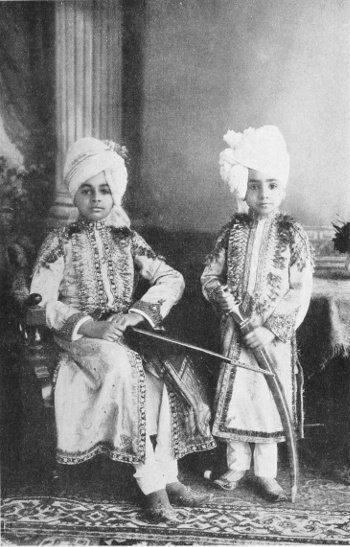
THE LATE MAHĀRĀJA SIR SUMER SINGH, OF JODHPUR (b. 1901; d. 1918),
AND HIS BROTHER, THE PRESENT MAHĀRĀJA UMMED SINGH (b. 1903).
To face page 928.