BOOK II HISTORY OF THE RĀJPUT TRIBES — CHAPTER 1 — The Purānas. — Deluge Legend. — Meru, Sumeru. — CHAPTER 2 — Puranic Genealogies. — Neglect of History by the Hindus. — The Priestly Office. — Relations of Rajputs with Brahmans. — Dates of the Genealogies. — The Herakles Legend. — CHAPTER 3 — Princes of the Solar Line. — Solar and Lunar Genealogies. — Harischandra. — Sagara. — Ambarisha. — Krishna. — CHAPTER 4 — Ayodhya. — Mithila. — Other Kingdoms. — Dwarka. — Surpur. — Hastinapura. — Kanauj. — Kalanjar. — Kerala. — Pandya. — Chaul. — Anga. — Recapitulation. — CHAPTER 5 — The Suryavansa or Solar Line. — Chandravansa or the Lunar Line. — The Pandava Family. — The Asvamedha. — Jarasandha. — Chandragupta Maurya. — Sunga, Kanva Dynasties. — Recapitulation. — CHAPTER 6 — Rajputs and Mongols. — Mongol Origin. — Mongol and Hindu Traditions. — Scythian Traditions. — The Scythian Descent of the Rajputs. — Jāts and Getae. — The Aswa. — The Asvamedha. — Personal Habits, Dress. — Theogony. — Religious Rites. — Customs of War. — Rajput Religion. — Bards. — War Chariots. — Position of Women. — Gaming. — Omens, Auguries. — Love of Strong Drink. — Funeral Ceremonies. — Sati. — Cairns, Pillars. — Worship of Arms. The Sword. — Initiation to Arms. — Asvamedha, the Horse Sacrifice. — The Asvamedha Ceremonies. — Sacred Trees. — CHAPTER 7 — Solar and Lunar Races. — Grahilot or Guhilot. — Yadu, Yādava. — Tuar, Tonwar, Tomara. — Rāthor. — Kachhwāha. — Agnikulas, Pramāra. — Chahuman or Chauhan. — The Agnikunda Fire-pit. — Chalukya or Solanki. — Bāghels. — Pratihāra or Parihāra. — Chāwara or Chaura. — Tāk or Takshak. — Jat, Jāt. — Hun or Hūn. — Kāthi. — Bāla. — Jhāla Makwāna. — Jethwa, Jaithwa, Kamāri. — Sarwaiya or Sariaspa. — Silār or Salār. — Dabhi. — Gaur. — Dor or Doda. — Gaharwār. — Chandel. — Bargūjar. — Sengar. — Sakarwāl. — Bais. — Dahia. — Joiya, Johya. — Mohil. — Nikumbha. — Rājpāli. — Dahariya. — Dahima. — CHAPTER 8 — Distinctions between the Rājput States. — Alliances with the British.
23
—Being desirous of epitomizing the chronicles of
the martial races of Central and Western India, it was essential to
ascertain the sources whence they draw, or claim to draw, their
lineage. For this purpose I obtained from the library of the
Rana of Udaipur their sacred volumes, the Puranas, and laid
them before a body of pandits, over whom presided the learned
Jati Gyanchandra. From these extracts were made of all the
genealogies of the great races of Surya and Chandra, and of facts
historical and geographical.
Most of the Puranas[1] contain portions of historical as well as
geographical knowledge; but the Bhagavat, the Skanda, the
Agni, and the Bhavishya are the chief guides. It is rather
fortunate than to be regretted that their chronologies do not
perfectly agree. The number of princes in each line varies, and
names are transposed; but we recognize distinctly the principal
features in each, affording the conclusion that they are the
productions of various writers, borrowing from some common
original source [21].
24—The Genesis
[2] of India commences with an
event described in the history of almost all nations, the deluge,
which, though treated with the fancy peculiar to the orientals, is
not the less entitled to attention. The essence of the extract
from the Agni Purana is this: “When ocean quitted his bounds
and caused universal destruction by Brahma’s command, Vaivaswata
[3]
Manu (Noah), who dwelt near the Himalaya
[4] mountains
was giving water to the gods in the Kritamala river, when a small
fish fell into his hand. A voice commanded him to preserve it.
The fish expanded to an enormous size. Manu, with his sons
and their wives, and the sages, with the seed of every living thing,
entered into a vessel which was fastened to a horn on the head of
the fish, and thus they were preserved.”
Here, then, the grand northern chain is given to which the
abode of the great patriarch of mankind approximated. In the
Bhavishya it is stated, that “Vaivaswata (sun-born) Manu ruled
at the mountain Sumeru. Of his seed was Kakutstha Raja,
who obtained sovereignty at Ayodhya,[5] and his descendants
filled the land and spread over the earth.”
I am aware of the meaning given to Sumeru, that thus the
Hindus designated the north pole of the earth. But they had
also a mountain with this same appellation of pre-eminence of
Meru, ‘the hill,’ with the prefix Su, ‘good, sacred’: the Sacred
Hill.
—In the geography of the Agni Purana, the
term is used as a substantial geographical limit;
[6] and some of
25the rivers flowing from the mountainous ranges, whose relative
position with Sumeru are there defined, still retain their ancient
appellations. Let us not darken the subject, by supposing only
allegorical meanings attached to explicit points. In the distribution
of their seven dwipas, or continents, though they interpose
seas of curds, milk, or wine, we should not reject strong and
evident facts, because subsequent ignorant interpolators filled
up the page with puerilities [22].
This sacred mountain (Sumeru) is claimed by the Brahmans
as the abode of Mahadeva,[7] Adiswar,[8] or Baghes[9]; by the Jains,
as the abode of Adinath,[10] the first Jiniswara, or Jain lord. Here
they say he taught mankind the arts of agriculture and civilized
life. The Greeks claimed it as the abode of Bacchus; and hence
the Grecian fable of this god being taken from the thigh of Jupiter,
confounding meros (thigh) with the meru (hill) of this Indian
deity. In this vicinity the followers of Alexander had their
Saturnalia, drank to excess of the wine from its indigenous vines,
and bound their brows with ivy (vela)[11] sacred to the Baghes of the
east and west, whose votaries alike indulge in ‘strong drink.’
These traditions appear to point to one spot, and to one
individual, in the early history of mankind, when the Hindu and
the Greek approach a common focus; for there is little doubt
that Adinath, Adiswara, Osiris, Baghes, Bacchus, Manu, Menes
designate the patriarch of mankind, Noah.
The Hindus can at this time give only a very general idea of
the site of Meru; but they appear to localize it in a space of
which Bamian, Kabul, and Ghazni would be the exterior points.
The former of these cities is known to possess remains of the
26religion of Buddha, in its caves and colossal statues.[12] The
Paropamisan Alexandria is near Bamian; but the Meru and
Nyssa[13] of Alexander are placed more to the eastward by the
Greek writers, and according to the cautious Arrian between
the Cophas and Indus. Authority localizes it between Peshawar
and Jalalabad, and calls it Merkoh, or Markoh,[14] "a bare rock
2000 feet high [23] with caves to the westward, termed Bedaulat
by the Emperor Humayun from its dismal appearance."[15] This
27designation, however, of Dasht-i Bedaulat, or ‘unhappy plain,’
was given to the tract between the cities beforementioned [24].
The only scope of these remarks on Sumeru is to show that
28the Hindus themselves do not make India within the Indus the
cradle of their race, but west, amidst the hills of Caucasus,[16]
whence the sons of Vaivaswata, or the ‘sun-born,’ migrated
eastward to the Indus and Ganges, and founded their first establishment
in Kosala, the capital, Ayodhya, or Oudh.
Most nations have indulged the desire of fixing the source
whence they issued, and few spots possess more interest than
this elevated Madhya-Bhumi, or ‘central region’ of Asia, where
the Amu, Oxus, or Jihun, and other rivers, have their rise, and in
which both the Surya and Indu[17] races (Sakha) claim the hill,[18]
29sacred to a great patriarchal ancestor, whence they migrated
eastward.
The Rajput tribes could scarcely have acquired some of their
still existing Scythic habits and warlike superstitions on the
burning plains of Ind.Ind. It was too hot to hail with fervent adoration
the return of the sun from his southern course to enliven the
northern hemisphere. This should be the religion of a colder
clime, brought from their first haunts, the sources of the Jihun
and Jaxartes. The grand solstitial festival, the Aswamedha, or
sacrifice of the horse (the type of the sun), practised by the
children of Vaivaswata, the ‘sun-born,’ was most probably
simultaneously introduced from Scythia into the plains of Ind,
and west, by the sons of Odin, Woden, or Budha, into Scandinavia,
where it became the Hi-el or Hi-ul,[19] the festival of the winter
solstice; the grand jubilee of northern nations, and in the first
ages of Christianity, being so near the epoch of its rise, gladly
used by the first fathers of the church to perpetuate that
event[20][25].
—The chronicles of the Bhagavat and Agni,
containing the genealogies of the Surya (sun) and Indu (moon)
races, shall now be examined. The first of these, by calculation,
brings down the chain to a period six centuries subsequent to
Vikramaditya (A.D. 650), so that these books may have been
remodelled or commented on about this period: their fabrication
cannot be supposed.
Although portions of these genealogies by Sir William Jones,
Mr. Bentley, and Colonel Wilford, have appeared in the volumes of
the Asiatic Researches, yet no one should rest satisfied with the
inquiries of others, if by any process he can reach the fountain-head
himself.
If, after all, these are fabricated genealogies of the ancient
30families of India, the fabrication is of ancient date, and they are
all they know themselves upon the subject. The step next in
importance to obtaining a perfect acquaintance with the genuine
early history of nations, is to learn what those nations repute
to be such.
Doubtless the original Puranas contained much valuable
historical matter; but, at present, it is difficult to separate a
little pure metal from the base alloy of ignorant expounders and
interpolators. I have but skimmed the surface: research, to
the capable, may yet be rewarded by many isolated facts and
important transactions, now hid under the veil of ignorance and
allegory.
—The Hindus, with the decrease
of intellectual power, their possession of which is evinced
by their architectural remains, where just proportion and elegant
mythological device are still visible, lost the relish for the beauty
of truth, and adopted the monstrous in their writings as well as
their edifices. But for detection and shame, matters of history
would be hideously distorted even in civilized Europe; but in
the East, in the moral decrepitude of ancient Asia, with no judge
to condemn, no public to praise, each priestly expounder may
revel in an unfettered imagination, and reckon his admirers in
proportion to the mixture of the marvellous
[1] [26]. Plain historical
truths have long ceased to interest this artificially fed people.
If at such a comparatively modern period as the third century
before Christ, the Babylonian historian Berosus composed his
fictions, which assigned to that monarchy such incredible antiquity,
it became capable of refutation from the many historians
of repute who preceded him. But on the fabulist of India we
have no such check. If Vyasa himself penned these legends as
now existing, then is the stream of knowledge corrupt from the
fountain-head. If such the source, the stream, filtering through
ages of ignorance, has only been increased by fresh impurities.
It is difficult to conceive how the arts and sciences could advance,
31when it is held impious to doubt the truth of whatever has been
handed down, and still more to suppose that the degenerate could
improve thereon. The highest ambition of the present learned
priesthood, generation after generation, is to be able to comprehend
what has thus reached them, and to form commentaries
upon past wisdom; which commentaries are commented on ad
infinitum. Whoever dare now aspire to improve thereon must
keep the secret in his own breast. They are but the expounders
of the olden oracles; were they more they would be infidels.
But this could not always have been the case.
With the Hindus, as with other nations, the progress to the
heights of science they attained must have been gradual; unless
we take from them the merit of original invention, and set them
down as borrowers of a system. These slavish fetters of the
mind must have been forged at a later period, and it is fair to
infer that the monopoly of science and religion was simultaneous.
What must be the effect of such monopoly on the impulses and
operations of the understanding? Where such exists, knowledge
could not long remain stationary; it must perforce retrograde.
Could we but discover the period when religion[2] ceased to be a
profession [27] and became hereditary (and that such there was
these very genealogies bear evidence), we might approximate the
era when science attained its height.
—In the early ages of these Solar and Lunar
dynasties, the priestly office was not hereditary in families; it
was a profession; and the genealogies exhibit frequent instances
of branches of these races terminating their martial career in the
32commencement of a religious sect, or
gotra, and of their descendants
reassuming their warlike occupations. Thus, of the ten
sons of Ikshwaku,
[3] three are represented as abandoning worldly
affairs and taking to religion; and one of these, Kanina, is said to
be the first who made an
agnihotra, or pyreum, and worshipped
fire, while another son embraced commerce. Of the Lunar line
and the six sons of Pururavas, the name of the fourth was Raya;
“from him the fifteenth generation was Harita, who with his
eight brothers took to the office of religion, and established the
Kausika Gotra, or tribe of Brahmans.”
From the twenty-fourth prince in lineal descent from Yayati,
by name Bharadwaja, originated a celebrated sect, who still
bear his name, and are the spiritual teachers of several Rajput
tribes.
Of the twenty-sixth prince, Manava, two sons devoted themselves
to religion, and established celebrated sects, viz. Mahavira,
whose descendants were the Pushkar Brahmans; and Sankriti,
whose issue were learned in the Vedas.Vedas. From the line of Ajamidha
these ministers of religion were continually branching off.
In the very early periods, the princes of the Solar line, like the
Egyptians and Romans, combined the offices of the priesthood
with kingly power, and this whether Brahmanical or Buddhist.[4]
Many of the royal line, before and subsequent to Rama, passed
great part of their lives as ascetics; and in ancient sculpture and
drawings the head is as often adorned with the braided lock of
the ascetic as with the diadem of royalty.[5]
The greatest monarchs bestowed their daughters on these
royal hermits and sages [28]. Ahalya, the daughter of the powerful
Panchala,[6] became the wife of the ascetic Gautama. The
sage Jamadagni espoused the daughter of Sahasra[7] Arjuna, of
33Mahishmat,[8] king of the Haihaya tribe, a great branch of the
Yadu race.
Among the Egyptians, according to Herodotus [ii. 37, 141], the
priests succeeded to sovereignty, as they and the military class
alone could hold lands; and Sethos, the priest of Vulcan, caused
a revolution, by depriving the military of their estates.
We have various instances in India of the Brahmans from
Jamadagni to the Mahratta Peshwa, contesting for sovereignty;
power[9] and homage being still their great aim, as in the days of
Vishvamitra[10] and Vasishtha, the royal sages [29] whom “Janaka
34sovereign of Mithila, addressed with folded hands in token of
superiority.”
—But this deference for
the Brahmans is certainly, with many Rajput classes, very weak.
In obedience to prejudice, they show them outward civility; but,
unless when their fears or wishes interfere, they are less esteemed
than the bards.
The story of the King Vishvamitra of Gadhipura[11] and the
Brahman Vasishtha, which fills so many sections of the first book
of the Ramayana,[12] exemplifies, under the veil of allegory, the
35contests for power between the Brahmanical and military classes,
and will serve to indicate the probable period when the castes
became immutable. Stripped of its allegory, the legend appears to
point to a time when the division of the classes was yet imperfect;
though we may infer, from the violence of the struggle, that it was
the last in which Brahmanhood could be obtained by the military.
Vishvamitra was the son of Gadhi (of the race of Kausika), King
of Gadhipura, and contemporary of Ambarisha, King of Ayodhya
or Oudh, the fortieth prince from Ikshwaku; consequently about
two hundred years anterior to Rama. This event therefore,
whence we infer that the system of castes was approaching perfection,
was probably about one thousand four hundred years
before Christ.
—If proof can be given that these
genealogies existed in the days of Alexander, the fact would be
interesting. The legend in the Puranas, of the origin of the
Lunar race, appears to afford this testimony.
Vyasa, the author of the grand epic the Mahabharata, was son
of Santanu (of the race of Hari),[13] sovereign of Delhi, by Yojanagandha,
a fisherman’s daughter,[14] [30] consequently illegitimate.
He became the spiritual father, or preceptor, of his nieces, the
daughters of Vichitravirya, the son and successor of Santanu.
—Vichitravirya had no male offspring.
Of his three daughters, one was named Pandaia
[15]; and Vyasa,
36being the sole remaining male branch of the house of Santanu,
took his niece, and spiritual daughter, Pandaia, to wife, and
became the father of Pandu, afterwards sovereign of Indraprastha.
Arrian gives the story thus: "It is further said that he
[Herakles][16] had a very numerous progeny of children born to
37him in India ... [31] but that he had only one daughter.[17] The
name of this child was Pandaia, and the land in which she was
born, and with the sovereignty of which Herakles entrusted her,
was called after her name Pandaia" (Indika, viii.).
This is the very legend contained in the Puranas, of Vyasa
(who was Hari-kul-es, or chief of the race of Hari) and his spiritual
daughter Pandaia, from whom the grand race the Pandavas, and
from whom Delhi and its dependencies were designated the
Pandava sovereignty.
Her issue ruled for thirty-one generations in direct descents,
or from 1120 to 610 before Christ; when the military minister,[18]
connected by blood, was chosen by the chiefs who rebelled against
the last Pandu king, represented as “neglectful of all the cares
of government,” and whose deposition and death introduced a
new dynasty.
Two other dynasties succeeded in like manner by the usurpation
of these military ministers, until Vikramaditya, when the
Pandava sovereignty and era of Yudhishthira were both overturned.
38Indraprastha remained without a sovereign, supreme power
being removed from the north to the southern parts of India, till
the fourth, or, according to some authorities, the eighth century
after Vikrama, when the throne of Yudhishthira was once more
occupied by the Tuar tribe of Rajputs, claiming descents from the
Pandus. To this ancient capital, thus refounded, the new
appellation of Delhi was given; and the dynasty of the founder,
Anangpal, lasted to the twelfth century, when he abdicated in
favour of his grandson,[19] Prithiviraja, the last imperial Rajput
sovereign of India, whose defeat and death introduced the
Muhammadans.
This line has also closed with the pageant of a prince, and a
colony returned from the extreme west is now the sole arbiter of
the thrones of Pandu and Timur.
Britain has become heir to the monuments of Indraprastha
raised by the descendants of Budha and Ila; to the iron pillar of
the Pandavas, "whose pedestal[20] [32] is fixed in hell"; to the
columns reared to victory, inscribed with characters yet unknown;
to the massive ruins of its ancient continuous cities, encompassing a
space still larger than the largest city in the world, whose mouldering
domes and sites of fortresses,[21] the very names of which are
39lost, present a noble field for speculation on the ephemeral nature
of power and glory. What monument would Britain bequeath
to distant posterity of her succession to this dominion? Not
one: except it be that of a still less perishable nature, the monument
of national benefit. Much is in our power: much has been
given, and posterity will demand the result.
—Vyasa gives but fifty-seven princes
of the Solar line, from Vaivaswata Manu to Rama; and no list
which has come under my observation exhibits more than fifty-eight,
for the same period, of the Lunar race. How different
from the Egyptian priesthood, who, according to Herodotus,
gave a list up to that period of three hundred and thirty
[1]
sovereigns from their first prince, also the ‘sun-born
[2] Menes!’
Ikshwaku was the son of Manu, and the first who moved to
the eastward, and founded Ayodhya.
Budha (Mercury) founded the Lunar line; but we are not told
who established their first capital, Prayag,[3] though we are authorized
to infer that it was founded by Puru, the sixth in descent
from Budha [33].
A succession of fifty-seven princes occupied Ayodhya from
Ikshwaku to Rama. From Yäyati’s sons the Lunar races descend
40in unequal lengths. The lines from Yadu,[4] concluding with
Krishna and his cousin Kansa, exhibit fifty-seven and fifty-nine
descents from Yayati; while Yudhishthira,[5] Salya,[6] Jarasandha,[7]
and Vahurita,[8] all contemporaries of Krishna and Kansa, are
fifty-one, forty-six, and forty-seven generations respectively, from
the common ancestor Yayati.
—There is a wide difference
between the Solar and the Yadu branches of the Lunar lines;
yet is that now given fuller than any I have met with. Sir
William Jones’s lists of the Solar line give fifty-six, and of the
Lunar (Budha to Yudhishthira) forty-six, being one less in each
than in the tables now presented; nor has he given the important
branch terminating with Krishna. So close an affinity between
lists, derived from such different authorities as this distinguished
character and myself had access to, shows that there was some
general source entitled to credit.
Mr. Bentley’s[9] lists agree with Sir William Jones’s, exhibiting
fifty-six and forty-six respectively for the last-mentioned Solar
and Lunar races. But, on a close comparison, he has either
copied them or taken from the same original source; afterwards
transposing names which, though aiding a likely hypothesis,
will not accord with their historical belief.
Colonel Wilford’s[10] Solar list is of no use; but his two dynasties
of Puru and Yadu of the Lunar race are excellent, that part of the
line of Puru, from Jarasandha to Chandragupta, being the only
correct one in print.
It is surprising Wilford did not make use of Sir William Jones’s
Solar chronology; but he appears to have dreaded bringing
down Rama to the period of Krishna, as he is known to have
preceded by four generations ‘the Great War’ of the Yadu races.
It is evident that the Lunar line has reached us defective. It
is supposed so by their genealogists; and Wilford would have
41increased the error by taking it as the standard, and reducing
the Solar to conform thereto.
Mr. Bentley’s method is therefore preferable; namely, to
suppose eleven princes omitted in the Lunar between Janmejaya
and Prachinvat. But as there is no [34] authority for this, the
Lunar princes are distributed in the tables collaterally with the
Solar, preserving contemporaneous affinity where synchronisms
will authorise. By this means all hypothesis will be avoided, and
the genealogies will speak for themselves.
There is very little difference between Sir William Jones’s and
Colonel Wilford’s lists, in that main branch of the Lunar race,
of which Puru, Hastin, Ajamidha, Kuru, Santanu, and Yudhishthira
are the most distinguished links. The coincidence is
so near as to warrant a supposition of identity of source; but
close inspection shows Wilford to have had a fuller supply, for
he produces new branches, both of Hastin’s and Kuru’s progeny.
He has also one name (Bhimasena) towards the close, which is in
my lists, but not in Sir William Jones’s; and immediately following
Bhimasena, both these lists exhibit Dilipa, wanting in my
copy of the Bhagavat, though contained in the Agni Purana:
proofs of the diversity of the sources of supply, and highly gratifying
when the remoteness of those sources is considered. There
is also in my lists Tansu, the nineteenth from Budha, who is not
in the lists either of Sir William Jones or Wilford. Again;
Wilford has a Suhotra preceding Hastin, who is not in Sir William
Jones’s genealogies.[11]
Again; Jahnu is made the successor to Kuru; whereas the
Purana (whence my extracts) makes Parikshit the successor,
who adopts the son of Jahnu. This son is Viduratha, who has a
place in all three. Other variations are merely orthographical.
A comparison of Sir William Jones’s Solar genealogies with my
tables will yield nearly the same satisfactory result as to original
authenticity. I say Sir William Jones’s list, because there is no
other efficient one. We first differ at the fourth from Ikshwaku.
In my list this is Am-Prithu, of which he makes two names,
Anenas and Prithu. Thence to Purukutsa, the eighteenth, the
difference is only in orthography. To Irisuaka, the twenty-third
in mine, the twenty-sixth in Sir William Jones’s list, one name is
above accounted for; but here are two wanting in mine, Trasadasyu
42and Haryaswa. There is, also, considerable difference in
the orthography of those names which we have in common.
Again; we differ as to the successors of Champa, the twenty-seventh,
the founder of Champapur in Bihar. In Sir William’s,
Sadeva succeeds, and he is followed by Vijaya; but my authorities
state these both to be sons of Champa, and that Vijaya, the [35]
younger, was his successor, as the elder, Sadeva, took to religious
austerity. The thirty-third and thirty-sixth, Kesi and Dilipa,
are not noticed by Sir William Jones; but there is a much more
important person than either of these omitted, who is a grand
link of connexion, and affording a good synchronism of the
earliest history. This is Ambarisha, the fortieth, the contemporary
of Gadhi, who was the founder of Gadhipura or Kanauj.
Nala, Sarura, and Dilipa (Nos. 44, 45, 54 of my lists) are all
omitted by Sir William Jones.
This comparative analysis of the chronologies of both these
grand races cannot fail to be satisfactory. Those which I furnish
are from the sacred genealogies in the library of a prince who
claims common origin with them, and are less liable to interpolation.
There is scarcely a chief of character for knowledge
who cannot repeat the genealogy of his line. The Prince of
Mewar has a peculiarly retentive memory in this way. The professed
genealogists, the Bhats, must have them graven on their
memory, and the Charanas (the encomiasts) ought to be well
versed therein.
The first table exhibits two dynasties of the Solar race of
Princes of Ayodhya and Mithila Des, or Tirhut, which latter I have
seen nowhere else. It also exhibits four great and three lesser
dynasties of the Lunar race; and an eighth line is added, of the
race of Yadu, from the annals of the Bhatti tribe at Jaisalmer.
Ere quitting this halting-place in the genealogical history of
the ancient races, where the celebrated names of Rama, Krishna,
and Yudhishthira close the brazen age of India, and whose issue
introduce the present iron age, or Kali Yuga, I shall shortly refer
to the few synchronic points which the various authorities admit.
Of periods so remote, approximations to truth are the utmost
to be looked for; and it is from the Ramayana and the Puranas
these synchronisms are hazarded.
—The first commences with a celebrated name of
the Solar line, Harischandra, son of Trisanku, still proverbial for
43his humility.
[12] He is the twenty-fourth,
[13] and declared contemporary
of Parasurama, who slew the celebrated Sahasra-Arjuna
[14]
of [36] the Haihaya (Lunar) race, Prince of Mahishmati on the
Nerbudda. This is confirmed by the Ramayana, which details
the destruction of the military class and assumption of political
power by the Brahmans, under their chief Parasurama, marking
the period when the military class ‘lost the umbrella of royalty,’
and, as the Brahmans ridiculously assert, their purity of blood.
This last, however, their own books sufficiently contradict, as the
next synchronism will show.
—This synchronism we have in Sagara, the thirty-second
prince of the Solar line, the contemporary of Talajangha, of
the Lunar line, the sixth in descent from Sahasra Arjuna, who had
five sons preserved from the general slaughter of the military class
by Parasurama, whose names are given in the Bhavishya Purana.
Wars were constantly carried on between these great rival
races, Surya and Indu, recorded in the Puranas and Ramayana.
The Bhavishya describes that between Sagara and Talajangha
44“to resemble that of their ancestors, in which the Haihayas
suffered as severely as before.” But that they had recovered all
their power since Parasurama is evident from their having completely
retaliated on the Suryas, and expelled the father[15] of
Sagara from his capital of Ayodhya. Sagara and Talajangha
appear to have been contemporary with Hastin of Hastinapura,
and with Anga, descended from Budha, the founder of Angadesa,[16]
or Ongdesa, and the Anga race.
—The Ramayana affords another synchronism;
namely, that Ambarisha of Ayodhya, the fortieth prince of the
Solar line, was the contemporary of Gadhi, the founder of Kanauj,
and of Lomapada the Prince of Angadesa.
—The last synchronism is that of Krishna and Yudhishthira,
which terminates the [37] brazen, and introduces the Kali
Yuga or iron age. But this is in the Lunar line; nor have we
any guide by which the difference can be adjusted between the
appearance of Rama of the Solar and Krishna of the Lunar races.
Thus of the race of Krostu we have Kansa, Prince of Mathura,
the fifty-ninth, and his cousin Krishna, the fifty-eighth from
Budha; while of the line of Puru, descending through Ajamidha
and Dvimidha, we have Salya, Jarasandha, and Yudhishthira,
the fifty-first, fifty-third, and fifty-fourth respectively.
The race of Anga gives Prithusena as one of the actors and
survivors of the Mahabharata, and the fifty-third from Budha.
Thus, taking an average of the whole, we may consider fifty-five
princes to be the number of descents from Budha to Krishna
45and Yudhishthira; and, admitting an average of twenty years
for each reign, a period of eleven hundred years; which being
added to a like period calculated from thence to Vikramaditya,
who reigned fifty-six years before Christ, I venture to place the
establishment in India Proper of these two grand races, distinctively
called those of Surya and Chandra, at about 2256 years
before the Christian era; at which period, though somewhat
later, the Egyptian, Chinese, and Assyrian monarchies are generally
stated to have been established,[17] and about a century and
a half after that great event, the Flood.
Though a passage in the Agni Purana indicates that the line of
Surya, of which Ikshwaku was the head, was the first colony
which entered India from Central Asia, yet we are compelled to
place the patriarch Budha as his contemporary, he being stated
to have come from a distant region, and married to Ila, the sister
of Ikshwaku.
Ere we proceed to make any remarks on the descendants of
Krishna and Arjuna, who carry on the Lunar line, or of the
Kushites and Lavites, from Kusa and Lava, the sons of Rama,
who carry on that of the Sun, a few observations on the chief
kingdoms established by their progenitors on the continent of
India will be hazarded in the ensuing Chapter [38].
—Ayodhya
[1] was the first city founded by the race of
Surya. Like other capitals, its importance must have risen by
46slow degrees; yet making every allowance for exaggeration, it
must have attained great splendour long anterior to Rama. Its
site is well known at this day under the contracted name of
Oudh, which also designates the country appertaining to the
titular wazir of the Mogul empire; which country, twenty-five
years ago, nearly marked the limits of Kosala, the pristine
kingdom of the Surya race. Overgrown greatness characterized
all the ancient Asiatic capitals, and that of Ayodhya was immense.
Lucknow, the present capital, is traditionally asserted to have been
one of the suburbs of ancient Oudh, and so named by Rama, in
compliment to his brother Lakshman.
—Nearly coeval in point of time with Ayodhya was
Mithila,
[2] the capital of a country of the same name, founded by
Mithila, the grandson of Ikshwaku.
The name of Janaka,[3] son of Mithila, eclipsed that of the founder
and became the patronymic of this branch of the Solar race.
—These are the two chief capitals of the
kingdoms of the Solar line described in [39] this early age; though
there were others of a minor order, such as Rohtas, Champapura,
[4]
etc., all founded previously to Rama.
By the numerous dynasties of the Lunar race of Budha many
kingdoms were founded. Much has been said of the antiquity
of Prayag; yet the first capital of the Indu or Lunar race appears
47to have been founded by Sahasra Arjuna, of the Haihaya tribe.
This was Mahishmati on the Nerbudda, still existing in Maheswar.[5]
The rivalry between the Lunar race and that of the Suryas
of Ayodhya, in whose aid the priesthood armed, and expelled
Sahasra Arjuna from Mahishmati, has been mentioned. A small
branch of these ancient Haihayas[6] yet exist in the line of the
Nerbudda, near the very top of the valley at Sohagpur, in Baghelkhand,
aware of their ancient lineage; and, though few in number,
are still celebrated for their valour.[7]
—Kusasthali Dwarka, the capital of Krishna, was
founded prior to Prayag, to Surpur, or Mathura. The Bhagavat
attributes the foundation of the city to Anrita, the brother of
Ikshwaku, of the Solar race, but states not how or when the
Yadus became possessed thereof.
The ancient annals of the Jaisalmer family of the Yadu stock
give the priority of foundation to Prayag, next to Mathura, and
last to Dwarka. All these cities are too well known to require
description; especially Prayag, at the confluence of the Yamuna
and Ganges. The Prasioi were the descendants of Puru[8] of
Prayag, visited by Megasthenes, ambassador of Seleucus, and the
principal city of the Yadus, ere it sent forth the four branches
from Satwata. At Prayag resided the celebrated Bharat, the
son of Sakuntala.
In the Ramayana the Sasavindus[9] (another Yadu race) are
inscribed as allied with the Haihayas in the wars with the race of
Surya; and of this race was Sisupal[10] (the founder of Chedi[11]),
one of the foes of Krishna [40].
48—We are assured by Alexander’s historians that the
country and people round Mathura, when he invaded India, were
termed Surasenoi. There are two princes of the name of Sursen
in the immediate ancestry of Krishna; one his grandfather, the
other eight generations
anterior.anterior. Which of these founded the
capital Surpur,
[12] whence the country and inhabitants had their
appellation, we cannot
say.say. Mathura and Cleisobara are mentioned
by the historians of Alexander as the chief cities of the
Surasenoi. Though the Greeks sadly disfigure names, we cannot
trace any affinity between Cleisobara and Surpur.
49—The city of Hastinapura was built by Hastin
a name celebrated in the Lunar dynasties. The name of this
city is still preserved on the Ganges, about forty miles south of
Hardwar,
[13] where the Ganges breaks through the Siwalik mountains
and enters the plains of India. This mighty stream, rolling
its masses of waters from the glaciers of the Himalaya, and joined
by many auxiliary streams, frequently carries destruction before
it. In one night a column of thirty feet in perpendicular height
has been known to bear away all within its sweep, and to such an
occurrence the capital of Hastin is said to have owed its ruin.
[14]
As it existed, however, long after the Mahabharata, it is surprising
it is not mentioned by the historians of Alexander, who invaded
India probably about eight centuries after that event. In
this abode of the sons of Puru resided Porus, one of the two
princes of that name, opponents of Alexander, and probably
Bindusara the son of Chandragupta, surmised to be the Abisares
[15]
and Sandrakottos of Grecian authorities. Of the two princes
named Porus mentioned by Alexander’s [41] historians, one
resided in the very cradle of the Puru dynasties; the abode of
the other bordered on the Panjab: warranting an assertion that
the Pori of Alexander were of the Lunar race, and destroying
all the claims various authors
[16] have advanced on behalf of the
princes of Mewar.
[17]
Hastin sent forth three grand branches, Ajamidha, Dvimidha,
and Purumidha. Of the two last we lose sight altogether; but
Ajamidha’s progeny spread over all the northern parts of India,
in the Panjab and across the Indus. The period, probably one
thousand six hundred years before Christ.
50From Ajamidha,[18] in the fourth generation, was Bajaswa, who
obtained possessions towards the Indus, and whose five sons gave
their name, Panchala, to the Panjab, or space watered by the
five rivers. The capital founded by the younger brother, Kampila,
was named Kampilnagara.[19]
The descendants of Ajamidha by his second wife, Kesini,
founded another kingdom and dynasty, celebrated in the heroic
history of Northern India. This is the Kausika dynasty.
—Kusa had four sons, two of whom, Kusanabha and
Kusamba, are well known to traditional history, and by the still
surviving cities founded by them. Kusanabha founded the city of
Mahodaya on the Ganges, afterwards changed to Kanyakubja, or
Kanauj, which maintained its celebrity until the Muhammadan
invasion of Shihabu-d-din (
A.D. 1193), when this overgrown city
was laid prostrate for ever. It was not unfrequently called
Gadhipura, or the ‘city of Gadhi.’ This practice of multiplying
names of cities in the east is very destructive to history.
Abu-l Fazl has taken from Hindu authorities an account of
Kanauj; and could we admit the authority of a poet on such
subjects, Chand, the bard of Prithwiraja,
[20] would afford materials.
Ferishta states it in the early ages to have been twenty-five
coss [42] (thirty-five miles) in circumference, and that
there were thirty thousand shops for the sale of the areca or
beetle-nut only;
[21] and this in the sixth century, at which
period the Rathor dynasty, which terminated with Jaichand,
in the twelfth, had been in possession from the end of the fifth
century.
Kusamba also founded a city, called after his own name
51Kausambi.[22] The name was in existence in the eleventh century;
and ruins might yet exist, if search were made on the shores of
the Ganges, from Kanauj southward.
The other sons built two capitals, Dharmaranya and Vasumati;
but of neither have we any correct knowledge.
Kuru had two sons, Sudhanush and Parikhshita. The descendants
of the former terminated with Jarasandha, whose capital was
Rajagriha (the modern Rajmahal) on the Ganges, in the province
of Bihar.[23] From Parikhshita descended the monarchs Santanu
and Balaka: the first producing the rivals of the Great War,
Yudhishthira and Duryodhana; the other the Balakaputras.
Duryodhana, the successor to the throne of Kuru, resided at
the ancient capital, Hastinapura; while the junior branch,
Yudhishthira, founded Indraprastha, on the Yamuna or Jumna,
which name in the eighth century was changed to Delhi.
The sons of Balaka founded two kingdoms: Palibothra, on
the lower Ganges; and Aror,[24] on the eastern bank of the Indus,
founded by Sahl [43].
52One great arm of the tree of Yayati remains unnoticed, that of
Uru or Urvasu, written by others Turvasu. Uru was the father
of a line of kings who founded several empires. Virupa, the
eighth prince from Uru, had eight sons, two of whom are particularly
mentioned as sending forth two grand shoots, Druhyu and
Bhabru. From Druhyu a dynasty was established in the north.
Aradwat, with his son Gandhara, is stated to have founded a
State: Prachetas is said to have become king of Mlecchhades, or
the barbarous regions. This line terminated with Dushyanta,
the husband of the celebrated Sakuntala, father of Bharat, and
who, labouring under the displeasure of some offended deity, is
said by the Hindus to have been the cause of all the woes which
subsequently befell the race. The four grandsons of Dushyanta,
Kalanjar, Keral, Pand, and Chaul, gave their names to countries.
—Kalanjar is the celebrated fortress in Bundelkhand,
so well known for its antiquities, which have claimed considerable
notice.
—Of the second, Kerala, it is only known that in the list
of the thirty-six royal races in the twelfth century, the Kerala
makes one, but the capital is unknown.
[25]53—The kingdom founded by Pand may be that on the
coast of Malabar, the Pandu-Mandal of the Hindus, the Regia
Pandiona of the geographers of the west, and of which, probably,
Tanjore is the modern capital.
[26]
—Chaul
[27] is in the Saurashtra peninsula, and on the
coast, towards Jagat Khunt, ‘the world’s end,’ and still retains its
appellation.
—The other shoot from Bhabru became celebrated.
The thirty-fourth prince, Anga, founded the kingdom of Angadesa,
of which Champapuri
[28] was the [44] capital, established about
the same time with Kanauj, probably fifteen hundred years
before Christ. With him the patronymic was changed, and the
Anga race became famous in ancient Hindu history; and to this
day Un-des still designates the Alpine regions of Tibet bordering
on Chinese Tartary.
Prithusena terminates the line of Anga; and as he survived
the disasters of the Great War, his race probably multiplied in
those regions, where caste appears never to have been introduced.
—Thus have we rapidly reviewed the dynasties
of Surya and Chandra, from Manu and Budha to Rama, Krishna,
Yudhishthira, and Jarasandha; establishing, it is hoped, some
new points, and perhaps adding to the credibility of the whole.
The wrecks of almost all the vast cities founded by them are
yet to be traced in ruins. The city of Ikshwaku and Rama, on
the Sarju; Indraprastha, Mathura, Surpura, Prayag on the
Yamuna; Hastinapura, Kanyakubja, Rajagriha on the Ganges;
Maheswar on the Nerbudda; Aror on the Indus; and Kusasthali
54Dwarka on the shore of the Indian Ocean. Each has left some
memorial of former grandeur: research may discover others.
There is yet an unexplored region in Panchala; Kampilanagara
its capital, and those cities established west of the Indus by
the sons of Bajaswa.
Traces of the early Indo-Scythic nations may possibly reward
the search of some adventurous traveller who may penetrate into
Transoxiana, on the sites of Cyropolis, and the most northern
Alexandria; in Balkh, and amidst the caves of Bamian.
The plains of India retain yet many ancient cities, from whose
ruins somewhat may be gleaned to add a mite to knowledge; and
where inscriptions may be found in a character which, though
yet unintelligible, will not always remain so in this age of discovery.
For such let the search be general, and when once a key
is obtained, they will enlighten each other. Wherever the races
of Kuru, Uru, and Yadu have swayed, have been found ancient
and yet undeciphered characters.
Much would reward him who would make a better digest of
the historical and geographical matter in the Puranas. But we
must discard the idea that the history of Rama, the Mahabharata
of Krishna and the five Pandava[29] brothers, are [45] mere allegory:
an idea supported by some, although their races, their
cities, and their coins still exist. Let us master the characters
on the columns of Indraprastha, of Prayag and Mewar, on the
rocks of Junagarh,[30] at Bijolli, on the Aravalli, and in the Jain
55temples scattered over India, and then we shall be able to arrive
at just and satisfactory conclusions.
Having investigated the line from Ikshwaku to Rama, and that
from Budha (the parent and first emigrant of the Indu[1] race,
from Saka Dwipa, or Scythia, to Hindustan) to Krishna and
Yudhishthira, a period of twelve hundred years, we proceed to
the second division and second table of the genealogies.
—From Rama all the tribes
termed Suryavansa, or ‘Race of the Sun,’ claim descent, as the
present princes of Mewar, Jaipur, Marwar, Bikaner, and their
numerous clans; while from the Lunar (Indu) line of Budha and
Krishna, the families of Jaisalmer and Cutch (the Bhatti
[2] and
Jareja races), extending throughout the Indian desert from the
Sutlej to the ocean, deduce their pedigrees.
Rama preceded Krishna: but as their historians, Valmiki and
Vyasa, who wrote the events they witnessed, were contemporaries,
it could not have been by many years [46].
The present table contains the dynasties which succeeded these
great beacons of the Solar and Lunar races, and are three in
number.[3]
1. The Suryavansa, descendants of Rama.Rama.
2. The Induvansa, descendants of Pandu through Yudhishthira.
3. The Induvansa, descendants of Jarasandha, monarch of
Rajagriha.
The Bhagavat and Agni Puranas are the authorities for the
56lines from Rama and Jarasandha; while that of Pandu is from
the Raja Tarangini and Rajavali.
The existing Rajput tribes of the Solar race claim descent from
Lava and Kusa, the two elder sons of Rama; nor do I believe
any existing tribes trace their ancestry to his other children, or
to his brothers.
From the eldest son, Lava, the Ranas of Mewar claim descent:
so do the Bargujar tribe, formerly powerful within the confines
of the present Amber, whose representative now dwells at Anupshahr
on the Ganges.
From Kusa descend the Kachhwaha[4] princes of Narwar and
Amber, and their numerous clans. Amber, though the first in
power, is but a scion of Narwar, transplanted about one thousand
years back, whose chief, the representative of the celebrated
Prince Nala, enjoys but a sorry district[5] of all his ancient possessions.
The house of Marwar also claims descent from this stem, which
appears to originate in an error of the genealogists, confounding
the race of Kusa with the Kausika of Kanauj and Kausambi.
Nor do the Solar genealogists admit this assumed pedigree.
The Amber prince in his genealogies traces the descent of the
Mewar[6] family from Rama to Sumitra, through Lava, the eldest
brother, and not through Kusa,[7] as in some copies of the Puranas,
and in that whence Sir William Jones had his lists [47].
Mr. Bentley, taking this genealogy from the same authority
as Sir William Jones, has mutilated it by a transposition, for
57which his reasons are insufficient, and militate against every
opinion of the Hindus. Finding the names Vrihadbala and
Vridasura, declared to be princes contemporary with Yudhishthira,
he transposes the whole ten princes of his list intervening
between Takshak[8] and Bahuman.[9]
Bahuman,[10] or ‘the man with arms’ (Darazdasht or Longimanus)
is the thirty-fourth prince from Rama; and his reign
must be placed nearly intermediate between Rama and Sumitra,
or his contemporary Vikrama, and in the sixth century from
either.
Sumitra concludes the line of Surya or Rama from the Bhagavat
Purana. Thence it is connected with the present line of
Mewar, by Jai Singh’s authorities; which list has been compared
with various others, chiefly Jain, as will be related in the annals
of Mewar.
It will be seen that the line of Surya exhibits fifty-six princes,
from Lava, the son of Rama, to Sumitra, the last prince given in
the Puranas. Sir William Jones exhibits fifty-seven.
To these fifty-six reigns I should be willing to allow the average
of twenty years, which would give 1120 from Rama to Sumitra,
who preceded by a short period Vikramaditya; and as 1100 have
been already calculated to have preceded the era of Rama and
Yudhishthira, the inference is, that 2200 years elapsed from
Ikshwaku, the founder of the Solar line, to Sumitra.
—From the Raja Tarangini
and Rajavali the Induvansa family (descendants of Pandu
through Yudhishthira) is supplied. These works, celebrated in
Rajwara as collections of genealogies and historical facts, by the
58Pandits Vidyadhara and Raghunath, were compiled under the
eye of the most learned prince of his period, Sawai Jai Singh of
Amber, and give the various dynasties which ruled at Indraprastha,
or Delhi, from Yudhishthira to Vikramaditya; and
although barren of events, may be considered of value in filling up
a period of entire darkness [48].
The Tarangini commences with Adinath[11] or Rishabhdeva,[12]
being the Jain[13] theogony. Rapidly noticing the leading princes
of the dynasties discussed, they pass to the birth of the kings
Dhritarashtra and Pandu, and their offspring, detailing the
causes of their civil strife, to that conflict termed the Mahabharata
or Great War.
—The origin of every family, whether
of east or west, is involved in fable. That of the Pandu
[14] is
entitled to as much credence as the birth of Romulus, or other
founders of a race.
Such traditions[15] were probably invented to cover some great
disgrace in the Pandu family, and have relation to the story
already related of Vyasa, and the debasement of this branch of
the Harikulas. Accordingly, on the death of Pandu, Duryodhana,
nephew of Pandu (son of Dhritarashtra, who from blindness
could not inherit), asserted their illegitimacy before the assembled
kin at Hastinapura. With the aid, however, of the priesthood,
and the blind Dhritarashtra, his nephew, Yudhishthira, elder son
of Pandu, was invested by him with the seal of royalty, in the
capital, Hastinapura.
Duryodhana’s plots against the Pandu and his partisans were
59so numerous that the five brothers determined to leave for a
while their ancestral abodes on the Ganges. They sought shelter
in foreign countries about the Indus, and were first protected by
Drupada, king of Panchala, at whose capital, Kampilanagara,
the surrounding princes had arrived as suitors for the hand of his
daughter, Draupadi.[16] But the prize was destined for the exiled
Pandu, and the skill of Arjuna in archery obtained him the fair,
who “threw round his neck the (barmala) garland of marriage.”
The disappointed princes indulged their resentment against the
exile; but by Arjuna’s bow they suffered the fate of Penelope’s
suitors, and the Pandu brought home his bride, who became the
wife in common of the five brothers: manners[17] decisively
Scythic [49].
The deeds of the brothers abroad were bruited in Hastinapura
and the blind Dhritarashtra’s influence effected their recall. To
stop, however, their intestine feuds, he partitioned the Pandu
sovereignty; and while his son, Duryodhana, retained Hastinapura,
Yudhishthira founded the new capital of Indraprastha; but
shortly after the Mahabharata he abdicated in favour of his grand-nephew,
Parikshita, introducing a new era, called after himself,
which existed for eleven hundred years, when it was overturned,
and Indraprastha was conquered by Vikramaditya Tuar of Ujjain,
of the same race, who established an era of his own.
On the division of the Pandu sovereignty, the new kingdom
of Indraprastha eclipsed that of Hastinapura. The brothers
reduced to obedience the surrounding[18] nations, and compelled
their princes to sign tributary engagements (paenama).[19]
Yudhishthira, firmly seated on his throne, determined to
60signalize his reign and paramount sovereignty, by the imposing
and solemn rites of Asvamedha[20] and Rajasuya.
—In these magnificent ceremonies, in which
princes alone officiate, every duty, down to that of porter, is performed
by royalty.
The ‘Steed of Sacrifice’ was liberated under Arjuna’s care,
having wandered whither he listed for twelve months; and none
daring to accept this challenge of supremacy, he was reconducted
to Indraprastha, where, in the meanwhile, the hall of sacrifice was
prepared, and all the princes of the land were summoned to
attend.
The hearts of the Kurus[21] burned with envy at the assumption
of supremacy by the Pandus, for the Prince of Hastinapura’s
office was to serve out the sacred food [50].
The rivalry between the races burst forth afresh; but Duryodhana,
who so often failed in his schemes against the safety of his
antagonists, determined to make the virtue of Yudhishthira the
instrument of his success. He availed himself of the national
propensity for play, in which the Rajput continues to preserve
his Scythic[22] resemblance. Yudhishthira fell into the snare
prepared for him. He lost his kingdom, his wife, and even his
personal liberty and that of his brothers, for twelve years, and
became an exile from the plains of the Yamuna.
The traditional history of these wanderers during the term of
probation, their many lurking places now sacred, the return
to their ancestral abodes, and the grand battle (Mahabharata)
which ensued, form highly interesting episodes in the legends of
Hindu antiquity.
To decide this civil strife, every tribe and chief of fame, from
the Caucasus to the ocean, assembled on Kurukshetra, the field
61on which the empire of India has since more than once been
contested[23] and lost.
This combat was fatal to the dominant influence of the “fifty-six
tribes of Yadu.” On each of its eighteen days’ combat, myriads
were slain; for “the father knew not the son, nor the disciple his
preceptor.”
Victory brought no happiness to Yudhishthira. The slaughter
of his friends disgusted him with the world, and he determined
to withdraw from it; previously performing, at Hastinapura,
funeral rites for Duryodhana (slain by the hands of Bhima),
whose ambition and bad faith had originated this exterminating
war. “Having regained his kingdom, he proclaimed a new era,
and placing on the throne of Indraprastha, Parikshita, grandson
to Arjuna, retired to Dwarka with Krishna and Baldeva: and
since the war to the period of writing, 4636 years have elapsed.”[24]
Yudhishthira, Baldeva, and Krishna, having retired with the
wreck of this ill-fated struggle to Dwarka, the two former had
soon to lament the death of Krishna, slain by one of the aboriginal
tribes of Bhils; against whom, from their shattered condition,
they were unable to contend. After this event, Yudhishthira,
with [51] Baldeva and a few followers, entirely withdrew from
India, and emigrating northwards, by Sind, to the Himalayan
mountains, are there abandoned by Hindu traditional history,
and are supposed to have perished in the snows.[25]
62From Parikshita, who succeeded Yudhishthira, to Vikramaditya,
four[26] dynasties are given in a continuous chain, exhibiting
sixty-six princes to Rajpal, who, invading Kumaon, was slain by
Sukwanti. The Kumaun conqueror seized upon Delhi, but was
soon dispossessed by Vikramaditya, who transferred the seat of
imperial power from Indraprastha to Avanti, or Ujjain, from
which time it became the first meridian of the Hindu astronomy.
Indraprastha ceased to be a regal abode for eight centuries,
when it was re-established by Anangpal,[27] the founder of the Tuar
race, claiming descent from the Pandus. Then the name of Delhi
superseded that of Indraprastha.
63"Sukwanti, a prince from the northern mountains of Kumaun,
ruled fourteen [52] years, when he was slain by Vikramaditya;[28]
and from the Bharat to this period 2915 years have elapsed."[29]
Such a period asserted to have elapsed while sixty-six princes
occupied the throne, gives an average of forty-four years to each;
which is incredible, if not absolutely impossible.
In another passage the compiler says: “I have read many
books (shastras), and all agreed to make one hundred princes,
all of Khatri[30] race, occupy the throne of Delhi from Yudhishthira
to Prithwiraja, a period of 4100 years,[31] after which the Ravad[32]
race succeeded.”
It is fortunate for these remnants of historical data that they
have only extended the duration of reigns, and not added more
heads. Sixty-six links are quite sufficient to connect Yudhishthira
and Vikramaditya.
We cannot object to the “one hundred princes” who fill the
space assigned from Yudhishthira to Prithwiraja, though there
is no proportion between the number which precedes and that
which follows Vikramaditya, the former being sixty-six, the latter
only thirty-four princes, although the period cannot differ half
a century.
Let us apply a test to these one hundred kings, from Yudhishthira
to Prithwiraja: the result will be 2250 years.
This test is derived from the average rate of reigns of the chief
dynasties of Rajasthan, during a period of 633[33] to 663[34] years,
or from Prithwiraja to the present date.
| 64 |
| Of Mewar |
34[35] princes, or 19 years to each reign. |
| Of Marwar |
28 princes, or 23¼ ” ” |
| Of Amber |
29 princes, or 22½ ” ” |
| Of Jaisalmer |
28 princes, or 23¼ ” ” |
giving an average of twenty-two years for each reign [53].
It would not be proper to ascribe a longer period to each reign,
and it were perhaps better to give the minimum, nineteen, to
extended dynasties; and to the sixty-six princes from Yudhishthira
and Vikramaditya not even so much, four revolutions[36] and
usurpations marking this period.
—The remaining line, that of Jarasandha, taken
from the Bhagavat, is of considerable importance, and will afford
scope for further speculation.
Jarasandha was the monarch of Rajagriha,[37] or Bihar, whose
son Sahadeva, and grandson Marjari, are declared to have been
contemporaries of the Mahabharata, and consequently coeval
with Parikshita, the Delhi sovereign.
The direct line of Jarasandha terminates in twenty-three
descents with Ripunjaya, who was slain, and his throne assumed
by his minister, Sanaka, whose dynasty terminated in the fifth
generation with Nandivardandhana. Sanaka derived no personal
advantage from his usurpation, as he immediately placed his son,
Pradyota, on the throne. To these five princes one hundred and
thirty-eight years are assigned.
A new race entered Hindustan, led by a conqueror termed
Sheshnag, from Sheshnagdesa,[38] who ascended the Pandu throne,
65and whose line terminates in ten descents with Mahanandin, of
spurious birth. This last prince, who was also named Baikyat,
carried on an exterminating warfare against the ancient Rajput
princes of pure blood, the Puranas declaring that since the dynasty
of Sheshnag the princes were Sudras. Three hundred and sixty
years are allotted to these ten princes.
—A fourth dynasty commenced with
Chandragupta Maurya, of the same Takshak race.
[39] The Maurya
dynasty consisted of ten princes, who are stated to have passed
away in one hundred and thirty-seven years. [322-185
B.C.]
—The fifth dynasty of eight princes
were from Sringides, and are said to have ruled one hundred and
twelve years, when a prince of Kanvades deprived the last of life
and kingdom. Of these eight princes, four were of pure blood,
when Kistna, by a Sudra woman, succeeded. The dynasty of
Kanvades terminates in twenty-three generations with Susarman
[40]
[54].
—Thus from the Great War six successive
dynasties are given, presenting a continuous chain of eighty-two
princes, reckoning from Sahadeva, the successor of Jarasandha,
to Susarman.
To some of the short dynasties periods are assigned of moderate
length: but as the first and last are without such data, the test
66already decided on must be applied; which will yield 1704 years,
being six hundred and four after Vikramaditya, whose contemporary
will thus be Basdeva, the fifty-fifth prince from Sahadeva
of the sixth dynasty, said to be a conqueror from the country of
Katehr [or Rohilkhand]. If these calculations possess any value,
the genealogies of the Bhagavat are brought down to the close of
the fifth century following Vikramaditya. As we cannot admit
the gift of prophecy to the compilers of these books, we may infer
that they remodelled their ancient chronicles during the reign of
Susarman, about the year of Vikrama 600, or A.D. 546.
With regard to calculations already adduced, as to the average
number of years for the reigns of the foregoing dynasties, a comparison
with those which history affords of other parts of the
world will supply the best criterion of the correctness of the
assumed data.
From the revolt of the ten tribes against Rehoboam[41] to the
capture of Jerusalem, a period of three hundred and eighty-seven
years, twenty kings sat on the throne of Judah, making each reign
nineteen and a half years; but if we include the three anterior
reigns of Saul, David, and Solomon, prior to the revolt, the result
will be twenty-six and a half years each.
From the dismemberment of the Assyrian[42] empire under
Sardanapalus, nearly nine hundred years before Christ, the three
consequent confluent dynasties of Babylonia, Assyria, and Media
afford very different results for comparison.
The Assyrian preserves the medium, while the Babylonish and
Median run into extremes. Of the nine princes who swayed
Babylon, from the period of its separation from, till its reunion
to Assyria, a space of fifty-two years, Darius, who ruled Media
sixty [thirty-six] years [55], outlived the whole. Of the line of
Darius there were but six princes, from the separation of the
kingdoms to their reunion under Cyrus, a period of one hundred
and seventy-four years, or twenty-nine to each reign.
The Assyrian reigns form a juster medium. From Nebuchadnezzar
to Sardanapalus we have twenty-two years to a reign;
but from thence to the extinction of this dynasty, eighteen.
The first eleven kings, the Heraclidae of Lacedaemon, commencing
67with Eurysthenes (1078 before Christ), average thirty-two
years; while in republican Athens, nearly contemporary,
from the first perpetual archon until the office became decennial
in the seventh Olympiad, the reigns of the twelve chief magistrates
average twenty-eight years and a half.
Thus we have three periods, Jewish, Spartan, and Athenian,
each commencing about eleven hundred years before Christ, not
half a century remote from the Mahabharata; with those of
Babylonia, Assyria, and Media, commencing where we quit the
Grecian, in the eighth century before the Christian era, the Jewish
ending in the sixth century.
However short, compared with our Solar and Lunar dynasties,
yet these, combined with the average reigns of existing Hindu
dynasties, will aid the judgment in estimating the periods to be
assigned to the lines thus afforded, instead of following the improbable
value attached by the Brahmans.
From such data, longevity appears in unison with climate and
simplicity of life: the Spartan yielding the maximum of thirty-two
to a reign, while the more luxurious Athens gives twenty-eight
and a half. The Jews, from Saul to their exile “to the waters
of Babylon,” twenty-six and a half. The Medes equal the Lacedaemonians,
and in all history can only be paralleled by the
princes of Anhilwara, one of whom, Chawand, almost equalled
Darius.[43]
Of the separated ten tribes, from the revolt to the captivity,
twenty kings of Israel passed away in two centuries, or ten years
each.
The Spartan and Assyrian present the extremes of thirty-two
and eighteen, giving a medium of twenty-five years to a reign.
The average result of our four Hindu dynasties, in a period of
nearly seven hundred years, is twenty-two years.
From all which data, I would presume to assign from twenty
to twenty-two years to each reign in lines of fifty princes [56].
If the value thus obtained be satisfactory, and the lines of
dynasties derived from so many authorities correct, we shall
arrive at the same conclusion with Mr. Bentley; who, by the
more philosophical process of astronomical and genealogical
68combination, places Yudhishthira’s era in the year 2825 of the
world; which being taken from 4004 (the world’s age at the birth
of Christ) will leave 1179 before Christ for Yudhishthira’s era,
or 1123 before Vikramaditya.[44]
—Having thus brought down the genealogical
history of the ancient martial races of India, from the earliest
period to Yudhishthira and Krishna, and thence to Vikramaditya
and the present day, a few observations on the races invading
India during that time, and now ranked amongst the thirty-six
royal races of Rajasthan, affording scope for some curious analogies,
may not be inopportune.
The tribes here alluded to are the Haihaya or Aswa, the Takshak,
and the Jat or Getae; the similitude of whose theogony, names
in their early genealogies, and many other points, with the Chinese,
Tatar, Mogul, Hindu, and Scythic races, would appear to warrant
the assertion of one common origin.
Though the periods of the passage of these tribes into India
cannot be stated with exactitude, the regions whence they migrated
may more easily be ascertained.
—Let us compare the origin of the Tatars and
Moguls, as given by their historian, Abulghazi, with the races we
have been treating of from the Puranas.
Mogol was the name of the Tatarian patriarch. His son was
Aghuz,[1] the founder of all the races of those northern regions,
called Tatars and Mogol [57]. Aghuz had six sons.[2] First, Kun,[3]
‘the sun,’ the Surya of the Puranas; secondly, Ai,[4] ‘the moon,’
69the Indu of the Puranas. In the latter, Ai, we have even the
same name [Ayus] as in the Puranas for the Lunar ancestor. The
Tatars all claim from Ai, ‘the moon,’ the Indus of the Puranas.
Hence with them, as with the German tribes, the moon was always
a male deity. The Tatar Ai had a son, Yulduz. His son was
Hyu, from whom[5] came the first race of the kings of China. The
Puranic Ayus had a son, Yadu (pronounced Jadon); from whose
third son, Haya, the Hindu genealogist deduces no line, and
from whom the Chinese may claim their Indu[5] origin. Il Khan
(ninth from Ai) had two sons: first, Kian; and secondly, Nagas;
whose descendants peopled all Tatary. From Kian, Jenghiz
Khan claimed descent.[6] Nagas was probably the founder of the
Takshak, or Snake race[7] of the Puranas and Tatar genealogists,
the Tak-i-uk Moguls of De Guignes.
Such are the comparative genealogical origins of the three
races. Let us compare their theogony, the fabulous birth assigned
by each for the founder of the Indu race.
—1. The Puranic. “Ila (the
earth), daughter of the sun-born Ikshwaku, while wandering in the
forests was encountered by Budha (Mercury), and from the rape
of Ila sprung the Indu race.”
2. The Chinese account of the birth of Yu (Ayu), their first
monarch. “A star[8] (Mercury or Fo) struck his mother while
journeying. She conceived, and gave to the world Yu, the
founder of the first dynasty which reigned in China. Yu divided
China into nine provinces, and began to reign 2207[9] years before
Christ” [58].
Thus the Ai of the Tatars, the Yu of the Chinese, and the Ayus
70of the Puranas, evidently indicate the great Indu (Lunar) progenitor
of the three races. Budha (Mercury), the son of Indu
(the moon), became the patriarchal and spiritual leader; as Fo,
in China; Woden and Teutates,[10] of the tribes migrating to
Europe. Hence it follows that the religion of Buddha must be
coeval with the existence of these nations; that it was brought
into India Proper by them, and guided them until the schism of
Krishna and the Suryas, worshippers of Bal, in time depressed
them, when the Buddha religion was modified into its present mild
form, the Jain.[11]
—Let us contrast with these the origin of
the Scythic nations, as related by Diodorus;
[12] when it will be
observed the same legends were known to him which have been
handed down by the Puranas and Abulghazi.
"The Scythians had their first abodes on the Araxes.[13] Their
origin was from a virgin born of the earth[14] of the shape of a
woman from the waist upwards, and below a serpent (symbol
of Budha or Mercury); that Jupiter had a son by her, named
Scythes,[15] whose name the nation adopted. Scythes had two
sons, Palas and Napas (qu. the Nagas, or Snake race, of the Tatar
genealogy?), who were celebrated for their great actions, and who
divided the countries; and the nations were called after them,
the Palians (qu. Pali?)[16] and Napians. They led their forces as
far as the Nile on Egypt, and subdued many nations. They
enlarged the empire of the Scythians as far as the Eastern ocean,
71and to the Caspian and lake Moeotis. The nation had many kings,
from whom the Sacans (Sakae), the Massagetae (Getae or Jats), the
Ari-aspians (Aswas of Aria), and many other races. They overran
Assyria and Media[17] [59], overturning the empire, and transplanting
the inhabitants to the Araxes under the name of Sauro-Matians."[18]
As the Sakae, Getae, Aswa, and Takshak are names which
have crept in amongst our thirty-six royal races, common with
others also to early civilization in Europe, let us seek further
ancient authority on the original abodes.
Strabo[19] says: "All the tribes east of the Caspian are called
Scythic. The Dahae[20] next the sea, the Massagetae (great Gete)
and Sakae more eastward; but every tribe has a particular name.
All are nomadic: but of these nomads the best-known are the
Asii,[21] the Pasiani, Tochari, Sacarauli, who took Bactria from the
Greeks. The Sakae[22] (‘races’) have made in Asia irruptions
similar to those of the Cimmerians; thus they have been seen to
possess themselves of Bactria, and the best district of Armenia,
called after them Sakasenae."[23]
Which of the tribes of Rajasthan are the offspring of the Aswa
and Medes, of Indu race, returned under new appellations, we
72shall not now stop to inquire, limiting our hypothesis to the fact
of invasions, and adducing some evidence of such being simultaneous
with migrations of the same bands into Europe. Hence
the inference of a common origin between the Rajput and early
races of Europe; to support which, a similar mythology, martial
manners and poetry, language, and even music and architectural
ornaments, may be adduced.[24]
Of the first migrations of the Indu-Scythic Getae, Takshak,
and Asii, into India, that of Sheshnag (Takshak), from Sheshnagdes
(Tocharistan?) or Sheshnag, six centuries, by calculation,
before Christ, is the first noticed by the Puranas.[25] About this
period a grand irruption of the same races conquered Asia Minor,
and [60] eventually Scandinavia; and not long after the
Asii and Tochari overturned the Greek kingdom of Bactria, the
Romans felt the power of the Asi,[26] the Chatti, and Cimbri, from
the Baltic shore.
“If we can show the Germans to have been originally Scythae
or Goths (Getes or Jits), a wide field of curiosity and inquiry is
open to the origin of government, manners, etc.; all the antiquities
of Europe will assume a new appearance, and, instead of
being traced to the bands of Germany, as Montesquieu and the
greatest writers have hitherto done, may be followed through
long descriptions of the manners of the Scythians, etc., as given
by Herodotus. Scandinavia was occupied by the Scythae five
hundred years before Christ. These Scythians worshipped
Mercury (Budha), Woden or Odin, and believed themselves his
progeny. The Gothic mythology, by parallel, might be shown
73to be Grecian, whose gods were the progeny of Coelus and Terra
(Budha and Ella).[27] Dryads, satyrs, fairies, and all the Greek
and Roman superstition, may be found in the Scandinavian
creed. The Goths consulted the heart of victims, had oracles,
had sibyls, had a Venus in Freya, and Parcae in the Valkyrie.”[28]
—Ere we proceed to trace
these mythological resemblances, let us adduce further opinions
in proof of the position assumed of a common origin of the tribes
of early Europe and the Scythic Rajput.
The translator of Abulghazi, in his preface, observes: "Our
contempt for the Tatars would lessen did we consider how nearly
we stand related to them, and that our ancestors originally came
from the north of Asia, and that our customs, laws, and way of
living were formerly the same as theirs. In short, that we are
no other than a colony of Tatars.
"It was from Tatary those people came, who, under the successive
names of Cymbrians,[29] Kelts, and Gauls, possessed all the
northern part of Europe. What were the Goths, Huns, Alans,
Swedes, Vandals, Franks, but swarms of the same hive? The
Swedish chronicles bring the Swedes[30] from Cashgar, and [61] the
affinity between the Saxon language and Kipchak is great; and
the Keltick language still subsisting in Britany and Wales is a
demonstration that the inhabitants are descended from Tatar
nations."
74From between the parallels of 30° and 50° of north latitude,
and from 75° to 95° of east longitude, the highlands of Central
Asia, alike removed from the fires of the equator and the cold of
the arctic circle, migrated the races which passed into Europe and
within the Indus. We must therefore voyage up the Indus,
cross the Paropanisos, to the Oxus or Jihun, to Sakatai[31] or
Sakadwipa, and from thence and the Dasht-i Kipchak conduct
the Takshaks, the Getae, the Kamari, the Chatti, and the Huns,
into the plains of Hindustan.
We have much to learn in these unexplored regions, the abode
of ancient civilisation, and which, so late as Jenghiz Khan’s
invasion, abounded with large cities. It is an error to suppose
that the nations of Higher Asia were merely pastoral; and De
Guignes, from original authorities, informs us that when the Su
invaded the Yueh-chi or Jats, they found upwards of a hundred
cities containing the merchandise of India, and with the currency
bearing the effigies of the prince.
Such was the state of Central Asia long before the Christian
era, though now depopulated and rendered desert by desolating
wars, which have raged in these countries, and to which Europe
can exhibit no parallel. Timur’s wars, in more modern times,
against the Getic nation, will illustrate the paths of his ambitious
predecessors in the career of destruction.
If we examine the political limits of the great Getic nation in
the time of Cyrus, six centuries before Christ, we shall find them
little circumscribed in power on the rise of Timur, though twenty
centuries had elapsed [62].
—At this period (
A.D. 1330), under the last
prince of Getic race, Tughlak Timur Khan, the kingdom of
Chagatai
[32] was bounded on the west by the Dasht-i Kipchak, and
75on the south by the Jihun, on which river the Getic Khan, like
Tomyris, had his capital. Kokhand, Tashkent, Utrar,
[33] Cyropolis,
and the most northern of the Alexandrias, were within the bounds
of Chagatai.
The Getae, Jut, or Jat, and Takshak races, which occupy
places amongst the thirty-six royal races of India, are all from
the region of Sakatai. Regarding their earliest migrations, we
shall endeavour to make the Puranas contribute; but of their
invasions in more modern times the histories of Mahmud of Ghazni,
and Timur abundantly acquaint us.
From the mountains of Jud[34] to the shores of Makran,[35] and
along the Ganges, the Jat is widely spread; while the Takshak
name is now confined to inscriptions or old writings.
Inquiries in their original haunts, and among tribes now under
different names, might doubtless bring to light their original
designation, now best known within the Indus; while the Takshak
or Takiuk may probably be discovered in the Tajik, still in his
ancient haunts, the Transoxiana and Chorasmia of classic authors;
the Mawaru-n-nahr of the Persians; the Turan, Turkistan, or
Tocharistan of native geography; the abode of the Tochari,
Takshak, or Turushka invaders of India, described in the Puranas
and existing inscriptions.
The Getae had long maintained their independence when
Tomyris defended their liberty against Cyrus. Driven in successive
wars across the Sutlej, we shall elsewhere show them preserving
their ancient habits, as desultory cavaliers, under the Jat
leader of Lahore, in pastoral communities in Bikaner, the Indian
76desert and elsewhere, though they have lost sight of their early
history. The transition from pastoral to agricultural pursuits is
but short, and the descendant of the nomadic Getae of Transoxiana
is now the best husbandman on the plains of Hindustan[36] [63].
The invasion of these Indu-Scythic tribes, Getae, Takshaks,
Asii, Chatti, Rajpali,[37] Huns, Kamari, introduced the worship of
Budha, the founder of the Indu or Lunar race.
Herodotus says the Getae were theists,[38] and held the tenets
of the soul’s immortality; so with the Buddhists.
Before, however, touching on points of religious resemblance
between the Asii, Getae, or Jut of Scandinavia (who gave his
name to the Cimbric Chersonese) and the Getae of Scythia and
India, let us make a few remarks on the Asii or Aswa.
—To the Indu race of Aswa (the descendants of
Dvimidha and Bajaswa), spread over the countries on both sides
the Indus, do we probably owe the distinctive appellation of
Asia. Herodotus
[39] says the Greeks denominated Asia from the
wife of Prometheus; while others deduce it from a grandson of
Manes, indicating the Aswa descendants of the patriarch Manu.
Asa,
[40] Sakambhari,
[41] Mata,
[42] is the divinity Hope, ‘mother-protectress
of the Sakha,’ or races. Every Rajput adores Asapurna,
‘the fulfiller of desire’; or, as Sakambhari Devi (goddess protectress),
she is invoked previous to any undertaking.
The Aswas were chiefly of the Indu race; yet a branch of the
Suryas also bore this designation. It appears to indicate their
celebrity as horsemen.[43] All of them worshipped the horse, which
they sacrificed to the sun. This grand rite, the Asvamedha, on
77the festival of the winter solstice, would alone go far to exemplify
their common Scythic origin with the Getic Saka, authorising the
inference of Pinkerton, “that a grand Scythic nation extended
from the Caspian to the Ganges.”
—The Asvamedha was practised on the
Ganges and Sarju by the Solar princes [64], twelve hundred years
before Christ, as by the Getae in the time of Cyrus; “deeming it
right,” says Herodotus [i. 216] “to offer the swiftest of created
to the chief of uncreated beings”: and this worship and sacrifice
of the horse has been handed down to the Rajput of the present
day. A description of this grand ceremony shall close these
analogies.
The Getic Asii carried this veneration for the steed, symbolic
of their chief deity the sun, into Scandinavia: equally so of all
the early German tribes, the Su, Suevi, Chatti, Sucimbri, Getae,
in the forests of Germany, and on the banks of the Elbe and Weser.
The milk-white steed was supposed to be the organ of the gods,
from whose neighing they calculated future events; notions
possessed also by the Aswa, sons of Budha (Woden), on the
Yamuna and Ganges, when the rocks of Scandinavia and the
shores of the Baltic were yet untrod by man. It was this omen
which gave Darius Hystaspes[44] (hinsna, ‘to neigh,’ aspa, ‘a horse’)
a crown. The bard Chand makes it the omen of death to his
principal heroes. The steed of the Scandinavian god of battle
was kept in the temple of Upsala, and always “found foaming
and sweating after battle.” “Money,” says Tacitus, “was only
acceptable to the German when bearing the effigies of the horse.”[45]
In the Edda we are informed that the Getae, or Jats, who
entered Scandinavia, were termed Asi, and their first settlement
As-gard.[46]
Pinkerton rejects the authority of the Edda and follows
Torfaeus, who “from Icelandic chronicles and genealogies concludes
Odin to have come into Scandinavia in the time of Darius
Hystaspes, five hundred years before Christ.”
78This is the period of the last Buddha, or Mahavira, whose era
is four hundred and seventy-seven years before Vikrama, or five
hundred and thirty-three before Christ.
The successor of Odin in Scandinavia was Gotama; and
Gautama was the successor of the last Buddha, Mahavira,[47] who
as Gotama, or Gaudama, is still adored from the Straits of Malacca
to the Caspian Sea.
“Other antiquaries,” says Pinkerton, “assert another Odin,
who was put as the supreme deity one thousand years before
Christ” [65].
Mallet admits two Odins, but Mr. Pinkerton wishes he had
abided by that of Torfaeus, in 500 A.C.
It is a singular fact that the periods of both the Scandinavian
Odins should assimilate with the twenty-second Buddha [Jain
Tirthakara], Neminath, and twenty-fourth and last, Mahavira;
the first the contemporary of Krishna, about 1000 or 1100 years,
the last 533, before Christ. The Asii, Getae, etc., of Europe
worshipped Mercury as founder of their line, as did the Eastern
Asi, Takshaks, and Getae. The Chinese and Tatar historians
also say Buddha, or Fo, appeared 1027 years before Christ. “The
Yuchi, established in Bactria and along the Jihun, eventually
bore the name of Jeta or Yetan,[48] that is to say, Getae. Their
empire subsisted a long time in this part of Asia, and extended
even into India. These are the people whom the Greeks knew
under the name of Indo-Scythes. Their manners are the same
as those of the Turks.[49] Revolutions occurred in the very heart
of the East, whose consequences were felt afar.”[50]
The period allowed by all these authorities for the migration
of these Scythic hordes into Europe is also that for their entry
into India.
The sixth century is that calculated for the Takshak from
Sheshnagdesa; and it is on this event and reign that the Puranas
declare, that from this period “no prince of pure blood would be
79found, but that the Sudra, the Turushka, and the Yavan, would
prevail.”
All these Indu-Scythic invaders held the religion of Buddha:
and hence the conformity of manners and mythology between the
Scandinavian or German tribes and the Rajputs increased by
comparing their martial poetry.
Similarity of religious manners affords stronger proofs of
original identity than language. Language is eternally changing—so
are manners; but an exploded custom or rite traced to its
source, and maintained in opposition to climate, is a testimony
not to be rejected.
—When Tacitus informs us that the
first act of a German on rising was ablution, it will be conceded
this habit was not acquired in [66] the cold climate of Germany,
but must have been of eastern
[51] origin; as were “the loose
flowing robe; the long and braided hair, tied in a knot at the top
of the head”; with many other customs, personal habits, and
superstitions of the Scythic Cimbri, Juts, Chatti, Suevi, analogous
to the Getic nations of the same name, as described by Herodotus,
Justin, and Strabo, and which yet obtain amongst the Rajput
Sakhae of the present day.
Let us contrast what history affords of resemblance in religion
or manners. First, as to religion.
—Tuisto (Mercury) and Ertha (the earth) were the
chief divinities of the early German tribes. Tuisto
[52] was born of
the Earth (Ila) and Manus (Manu). He is often confounded
with Odin, or Woden, the Budha of the eastern tribes, though
they are the Mars and Mercury of these nations.
80—The Suiones or Suevi, the most powerful
Getic nation of Scandinavia, were divided into many tribes, one
of whom, the Su (Yueh-chi or Jat), made human sacrifices in their
consecrated groves
[53] to Ertha (Ila), whom all worshipped, and
whose chariot was drawn by a cow.
[54] The Suevi worshipped Isis
(Isa, Gauri, the Isis and Ceres of Rajasthan), in whose rites the
figure of a ship is introduced; “symbolic,” observes Tacitus,
“of its foreign origin.”
[55] The festival of Isa, or Gauri, wife of
Iswara, at Udaipur, is performed on the lake, and appears to be
exactly that of Isis and Osiris in Egypt, as described by Herodotus.
On this occasion Iswara (Osiris), who is secondary to his wife, has
a stalk of the onion in blossom in his hand; a root detested by
the Hindus generally, though adored by the Egyptians.
—They sung hymns in praise of Hercules, as
well as Tuisto or Odin, whose banners and images they carried
to the field; and fought in clans, using the feram or javelin, both
in close and distant combat. In all maintaining [67] the resemblance
to the Harikula, descendants of Budha, and the Aswa,
offspring of Bajaswa, who peopled those regions west of the
Indus, and whose redundant population spread both east and
west.
The Suevi, or Suiones, erected the celebrated temple of Upsala,
in which they placed the statues of Thor, Woden, and Freya, the
triple divinity of the Scandinavian Asii, the Trimurti of the Solar
and Lunar races. The first (Thor, the thunderer, or god of war)
is Hara, or Mahadeva, the destroyer; the second (Woden) is
Budha,[56] the preserver; and the third (Freya) is Uma, the creative
power.
The grand festival to Freya was in spring, when all nature
revived; then boars were offered to her by the Scandinavians,
and even boars of paste were made and swallowed by the
peasantry.
As Vasanti, or spring personified, the consort of Hara is
worshipped by the Rajput, who opens the season with a grand
81hunt,[57] led by the prince and his vassal chiefs, when they chase,
slay, and eat the boar. Personal danger is disregarded on this
day, as want of success is ominous that the Great Mother will
refuse all petitions throughout the year.
Pinkerton, quoting Ptolemy (who was fifty years after Tacitus),
says there were six nations in Yeutland or Jutland, the country
of the Juts, of whom were the Sablingii (Suevi,[58] or Suiones), the
Chatti and Hermandri, who extended to the estuary of the Elbe
and Weser. There they erected the pillar Irmansul to “the god
of war,” regarding which Sammes[59] observes: “some will have
it to be Mars his pillar, others Hermes Saul, or the pillar of Hermes
or Mercury”; and he naturally asks, “how did the Saxons come
to be acquainted with the Greek name of Mercury?”
Sacrificial pillars are termed Sula in Sanskrit; which, conjoined
with Hara,[60] the Indian god of war, would be Harsula. The
Rajput warrior invokes Hara with his trident (trisula) to help
him in battle, while his battle-shout is ‘mar! mar!’ The
Cimbri, one of the most celebrated of the six tribes of Yeutland,
derive their name from their fame as warriors [68].[61]
Kumara[62] is the Rajput god of war. He is represented with
seven heads in the Hindu mythology: the Saxon god of war has
six.[63] The six-headed Mars of the Cimbri Chersonese, to whom
was raised the Irmansul on the Weser, was worshipped by the
Sakasenae, the Chatti, the Siebi or Suevi, the Jotae or Getae, and
the Cimbri, evincing in name, as in religious rites, a common
origin with the martial warriors of Hindustan.
—The religion of the martial Rajput, and the
rites of Hara, the god of battle, are little analogous to those of
82the meek Hindus, the followers of the pastoral divinity, the
worshippers of kine, and feeders on fruits, herbs, and water.
The Rajput delights in blood: his offerings to the god of battle
are sanguinary, blood and wine. The cup (kharpara) of libation
is the human skull. He loves them because they are emblematic
of the deity he worships; and he is taught to believe that Hara
loves them, who in war is represented with the skull to drink
the foeman’s blood, and in peace is the patron of wine and women.
With Parbati on his knee, his eyes rolling from the juice of the
phul (ardent spirits) and opium, such is this Bacchanalian divinity
of war. Is this Hinduism, acquired on the burning plains of
India? Is it not rather a perfect picture of the manners of the
Scandinavian heroes?
The Rajput slays buffaloes, hunts and eats the boar and deer,
and shoots ducks and wild fowl (kukkut); he worships his horse,
his sword, and the sun, and attends more to the martial song of
the bard than to the litany of the Brahman. In the martial
mythology and warlike poetry of the Scandinavians a wide field
exists for assimilation, and a comparison of the poetical remains
of the Asi of the east and west would alone suffice to suggest a
common origin.
—In the sacred Bardai of the Rajput we have the bard
of our Saxon ancestry; those reciters of warlike poetry, of whom
Tacitus says, “with their barbarous strains, they influence their
minds in the day of battle with a chorus of military virtue.”
A comparison, in so extensive a field, would include the whole
of their manners and religious opinions, and must be reserved for
a distinct work.[64] The Valkyrie [69], or fatal sisters of the Suevi
or Siebi, would be the twin sisters of the Apsaras, who summon the
Rajput warrior from the field of battle, and bear him to “the
mansion of the sun,” equally the object of attainment with the
children of Odin in Scandinavia, and of Budha and Surya in the
83plains of Scythia and on the Ganges, like the Elysium[65] of the
Heliadae of Greece.
In the day of battle we should see in each the same excitements
to glory and contempt of death, and the dramatis personae of the
field, both celestial and terrestrial, move and act alike. We should
see Thor, the thunderer, leading the Siebi, and Hara (Siva) the
Indian Jove, his own worshippers (Sivseva); in which Freya,
or Bhavani, and even the preserver (Krishna) himself, not
unfrequently mingle.
—The war chariot is peculiar to the Indu-Scythic
nations, from Dasaratha,
[66] and the heroes of the Mahabharata, to
the conquest of Hindustan by the Muhammadans, when it was
laid aside. On the plains of Kurukshetra, Krishna became
charioteer to his friend Arjun; and the Getic hordes of the
Jaxartes, when they aided Xerxes in Greece, and Darius on the
plains of Arbela,
[67] had their chief strength in the war chariot.
The war chariot continued to be used later in the south-west
of India than elsewhere, and the Kathi,[68] Khuman, Kumari of
84Saurashtra have to recent times retained their Scythic habits, as
their monumental stones testify, expressing their being slain
from their cars [70].
—In no point does resemblance more
attach between the ancient German and Scandinavian tribes, and
the martial Rajput or ancient Getae, than in their delicacy towards
females.
“The Germans,” says Tacitus [Germania, viii.], “deemed the
advice of a woman in periods of exigence oracular.” So does the
Rajput, as the bard Chand often exemplifies; and hence they
append to her name the epithet Devi (or contracted De), ‘god-like.’
“To a German mind,” says Tacitus, “the idea of a woman
led into captivity is insupportable”; and to prevent this the
Rajput raises the poignard against the heart which beats only for
him, though never to survive the dire necessity. It is then they
perform the sacrifice ‘johar,’ when every sakha (branch) is cut
off: and hence the Rajput glories in the title of Sakha-band, from
having performed the sakha; an awful rite, and with every
appearance of being the sacaea of the Scythic Getae, as described
by Strabo.[69]
85—In passion for play at games of chance, its extent
and dire consequences, the Rajput, from the earliest times, has
evinced a predilection, and will stand comparison with the Scythian
and his German offspring. The German staked his personal
liberty, became a slave, and was sold as the property of the
winner. To this vice the Pandavas owed the loss of their
sovereignty and personal liberty, involving at last the destruction
of all the Indu [71] races; nor has the passion abated. Religion
even consecrates the vice; and once a year, on ‘the Festival of
Lamps’ (Diwali), all propitiate the goddess of wealth and fortune
(Lakshmi) by offering at her shrine.
Destitute of mental pursuits, the martial Rajput is often
slothful or attached to sensual pleasures, and when roused, reckless
on what he may wreak a fit of energy. Yet when order and
discipline prevail in a wealthy chieftainship, there is much of that
patriarchal mode of life, with its amusements, alike suited to the
Rajput, the Getae of the Jihun, or Scandinavian.
—Divination by lots, auguries, and omens
by flights of birds, as practised by the Getic nations described by
Herodotus, and amongst the Germans by Tacitus, will be found
amongst the Rajputs, from whose works
[70] on this subject might
have been supplied the whole of the Augurs and Aruspices,
German or Roman.
—Love of liquor, and indulgence in it to
excess, were deep-rooted in the Scandinavian Asi and German
tribes, and in which they showed their Getic origin; nor is the
86Rajput behind his brethren either of Scythia or Europe. It is
the free use of this and similar indulgences, prohibited by ordinances
which govern the ordinary Hindu, that first induced me to
believe that these warlike races were little indebted to India.
The Rajput welcomes his guest with the munawwar piyala, or
‘cup of request,’ in which they drown ancient enmities. The
heroes of Odin never relished a cup of mead more than the Rajput
his madhu;[71] and the bards of Scandinavia and Rajwara are alike
eloquent in the praise of the bowl, on which the Bardai exhausts
every metaphor, and calls it ambrosial, immortal.[72] “The bard,
as he sipped the ambrosia, in which sparkled the ruby seed of the
pomegranate, rehearsed the glory of the race of the fearless.[73]
May the king live for ever, alike bounteous in gifts to the bard
and the foe!” Even in the heaven of Indra, the Hindu warrior’s
paradise, akin to Valhalla [72], the Rajput has his cup, which is
served by the Apsaras, the twin sister of the celestial Hebe of
Scania. “I shall quaff full goblets amongst the gods,” says the
dying Getic warrior;[74] “I die laughing”: sentiments which
would be appreciated by a Rajput.
A Rajput inebriated is a rare sight: but a more destructive
and recent vice has usurped much of the honours of the ‘invitation
cup,’ which has been degraded from the pure ‘flower’[75]
to an infusion of the poppy, destructive of every quality. Of this
pernicious habit we may use the words which the historian of
German manners applies to the tribes of the Weser and Elbe, in
respect to their love of strong drink: “Indulge it, and you need not
employ the terror of your arms; their own vices will subdue them.”
87The cup of the Scandinavian worshippers of Thor, the god of
battle, was a human skull, that of the foe, in which they showed
their thirst of blood; also borrowed from the chief of the Hindu
Triad, Hara, the god of battle, who leads his heroes in the ‘red
field of slaughter’ with the khopra[76] in his hand, with which he
gorges on the blood of the slain.
Hara is the patron of all who love war and strong drink, and is
especially the object of the Rajput warrior’s devotion: accordingly
blood and wine form the chief oblations to the great god of
the Indus. The Gosains,[77] the peculiar priests of Hara, or Bal,
the sun, all indulge in intoxicating drugs, herbs, and drinks.
Seated on their lion, leopard, or deer skins, their bodies covered
with ashes, their hair matted and braided, with iron tongs to
feed the penitential fires, their savage appearance makes them fit
organs for the commands of the blood and slaughter. Contrary,
likewise, to general practice, the minister of Hara, the god of war,
at his death is committed to the earth, and a circular tumulus is
raised over him; and with some classes of Gosains, small tumuli,
whose form is the frustrum of a cone, with lateral steps, the apex
crowned with a cylindrical stone [73].[78]
—In the last rites for the dead, comparison
will yield proofs of original similarity. The funeral ceremonies
of Scandinavia have distinguished the national eras, and
the ‘age of fire’ and ‘the age of hills,’
[79] designated the periods
when the warrior was committed to mother earth or consumed
on the pyre.
Odin (Budha) introduced the latter custom, and the raising
of tumuli over the ashes when the body was burned; as also the
practice of the wife burning with her deceased lord. These
88manners were carried from Sakadwipa, or Saka Scythia, “where
the Geta,” says Herodotus [v. 5], “was consumed on the pyre
or burned alive with her lord.” With the Getae, the Siebi or
Suevi of Scandinavia, if the deceased had more than one wife,
the elder claimed the privilege of burning.[80] Thus, “Nanna was
consumed in the same fire with the body of her husband, Balder,
one of Odin’s companions.” But the Scandinavians were anxious
to forget this mark of their Asiatic origin, and were not always
willing to burn, or to make “so cruel and absurd a sacrifice to the
manes of their husbands, the idea of which had been picked up
by their Scythian ancestors, when they inhabited the warmer
climates of Asia, where they had their first abodes.”[81]
“The Scythic Geta,” says Herodotus [iv. 71], “had his horse
sacrificed on his funeral pyre; and the Scandinavian Geta had
his horse and arms buried with him, as they could not approach
Odin on foot.”[82] The Rajput warrior is carried to his final abode
armed at all points as when alive, his shield on his back and brand
in hand; while his steed, though not sacrificed, is often presented
to the deity, and becomes a perquisite of the priest.
—The burning of the dead warrior, and female immolation,
or Sati, are well-known rites, though the magnificent cenotaphs
raised on the spot of sacrifice are little known or visited by Europeans;
than which there are no better memorials of the rise and
decline of the States of the Rajput heptarchy. It is the son who
raises the mausoleum to the memory of his father; which last
token of respect, or laudable vanity, is only limited by the means
of the treasury. It is commemorative [74] of the splendour of
his reign that the dome of his father should eclipse that of his
predecessor. In every principality of Rajwara, the remark is
applicable to chieftains as well as princes.
Each sacred spot, termed ‘the place of great sacrifice’ (Mahasati),
is the haunted ground of legendary lore. Amongst the
altars on which have burned the beauteous and the brave, the
harpy[83] takes up her abode, and stalks forth to devour the hearts
89of her victims. The Rajput never enters these places of silence
but to perform stated rites, or anniversary offerings of flowers
and water to the manes (pitri-deva[84]) of his ancestors.
Odin[85] guarded his warriors’ final abode from rapine by means
of “wandering fires which played around the tombs”; and the
tenth chapter of the Salic law is on punishments against “carrying
off the boards or carpets of the tombs.” Fire and water are
interdicted to such sacrilegious spoliators.
The shihaba,[86] or wandering meteoric fires, on fields of battle
and in the places of ‘great sacrifice,’ produce a pleasing yet
melancholy effect; and are the source of superstitious dread and
reverence to the Hindu, having their origin in the same natural
cause as the ‘wandering fires of Odin’; the phosphorescent
salts produced from animal decomposition.
The Scandinavian reared the tumulus over the ashes of the
dead; so did the Geta of the Jaxartes, and the officiating priests
of Hara, the Hindu god of battle.
The noble picture drawn by Gibbon of the sepulture of the
Getic Alaric is paralleled by that of the great Jenghiz Khan.
When the lofty mound was raised, extensive forests were planted,
to exclude for ever the footsteps of man from his remains.
The tumulus, the cairn, or the pillar, still rises over the Rajput
who falls in [75] battle; and throughout Rajwara these sacrificial
monuments are found, where are seen carved in relief the
warrior on his steed, armed at all points; his faithful wife (Sati)
90beside him, denoting a sacrifice, and the sun and moon on either
side, emblematic of never-dying fame.
—In Saurashtra, amidst the Kathi, Khuman,
Bala, and others of Scythic descent, the Paliya, or Jujhar (sacrificial
pillars), are conspicuous under the walls of every town, in
lines, irregular groups, and circles. On each is displayed in rude
relief the warrior, with the manner of his death, lance in hand,
generally on horseback, though sometimes in his car; and on the
coast ‘the pirates of Budha’
[87] are depicted boarding from the
shrouds. Amidst the Khuman of Tatary the Jesuits found stone
circles, similar to those met with wherever the Celtic rites prevailed;
and it would require no great ingenuity to prove an
analogy, if not a common origin, between Druidic circles and the
Indo-Scythic monumental remains. The trilithon, or seat, in
the centre of the judicial circle, is formed by a number sacred to
Hara, Bal, or the sun, whose priest expounds the law.
—The devotion of the Rajput
is still paid to his arms, as to his horse. He swears ‘by the steel,’
and prostrates himself before his defensive buckler, his lance, his
sword, or his dagger.
The worship of the sword (asi) may divide with that of the
horse (aswa) the honour of giving a name to the continent of Asia.
It prevailed amongst the Scythic Getae, and is described exactly
by Herodotus [iv. 62]. To Dacia and Thrace it was carried by
Getic colonies from the Jaxartes, and fostered by these lovers of
liberty when their hordes overran Europe.
The worship of the sword in the Acropolis of Athens by the
Getic Attila, with all the accompaniments of pomp and place,
forms an admirable episode in the history of the decline and fall
of Rome; and had Gibbon witnessed the worship of the double-edged
sword (khanda) by the prince of Mewar and all his chivalry,
he might even have embellished his animated account of the
adoration of the scymitar, the symbol of Mars.
—Initiation to military fame was the same
with the [76] German as with the Rajput, when the youthful
candidate was presented with the lance, or buckled with the
sword; a ceremony which will be noticed when their feudal
91manners are described; many other traits of character will then
be depicted. It would be easy to swell the list of analogous
customs, which even to the objects of dislike in food
[88] would
furnish comparison between the ancient Celt and Rajput; but
they shall close with the detail of the most ancient of rites.
—There are some things,
animate and inanimate, which have been common objects of
adoration amongst the nations of the earth, the sun, the moon,
and all the host of heaven; the sword; reptiles, as the serpent;
animals, as the noblest, the horse. This last was not worshipped
as an abstract object of devotion, but as a type of that glorious
orb which has had reverence from every child of nature. The
plains of Tatary, the sands of Libya, the rocks of Persia, the valley
of the Ganges, and the wilds of Orinoco, have each yielded votaries
alike ardent in devotion to his effulgence:
Of this great world both eye and soul.
His symbolic worship and offerings varied with clime and habit;
and while the altars of Bal in Asia, of Belenus among the Celts
of Gaul and Britain, smoked with human sacrifices, the bull[89]
bled to Mithras in Babylon, and the steed was the victim to Surya
on the Jaxartes and Ganges.
The father of history says that the great Getae of Central Asia
deemed it right to offer the swiftest of created to the swiftest of
non-created beings. It is fair to infer that the sun’s festival with
the Getae and Aswa nations of the Jaxartes, as with those of
Scandinavia, was the winter solstice, the Sankrant of the Rajput
92and Hindu in general. Hi, Haya, Hywor, Aswa denote the
steed in Sanskrit and its dialects. In Gothic, hyrsa; Teutonic,
hors; Saxon, horse. The grand festival of the German tribes of
the Baltic was the Hiul, or Hiel (already commented on), the
Asvamedha[90] of the children of Surya, on the Ganges.
—The ceremonies of the Asvamedha
are too expensive, and attended with too great risk, to be attempted
by modern princes. Of its fatal results we have many historical
records, from the first dawn of Indian history to the last of its
princes, Prithwiraja. The Ramayana, the Mahabharata, and the
poems of Chand all illustrate this imposing rite and its effects.
[91]The Ramayana affords a magnificent picture of the Asvamedha.
Dasaratha, monarch of Ayodhya, father of Rama, is represented
as commanding the rite: “Let the sacrifice be prepared, and the
horse[92] liberated from the north bank of the Sarju!”[93] A year
being ended, and the horse having returned from his wanderings,[94]
The sacrificial ground was prepared on the spot of liberation.
93Invitations were sent to all surrounding monarchs to repair
to Ayodhya: King Kaikeya,[95] the king of Kasi,[96] Lomapada of
Angadesa,[97] Kosala of Magadhadesa,[98] with the kings of Sindhu,[99]
Sauvira,[100] and Saurashtra [78].[101]
d
When the sacrificial pillars are erected, the rites commence.
This portion of the ceremony, termed Yupochchraya, is thus
minutely detailed: "There were twenty-one yupas, or pillars,[102]
of octagonal shape, each twenty-one feet in height and four feet
in diameter, the capitals bearing the figure of a man, an elephant,
or a bull. They were of the various sorts of wood appropriated
to holy rites, overlaid with plates of gold and ornamented cloth,
and adorned with festoons of flowers. While the yupas were
erecting, the Adhvaryu, receiving his instructions from the Hotri,
or sacrificing priest, recited aloud the incantations.
94"The sacrificial pits were in triple rows, eighteen in number,
and arranged in the form of the eagle. Here were placed
the victims for immolation; birds, aquatic animals, and the
horse.
"Thrice was the steed of King Dasaratha led round the sacred
fire by Kosala, and as the priests pronounced the incantations he
was immolated[103] amidst shouts of joy.
"The king and queen, placed by the high priest near the horse,
sat up all night watching the birds; and the officiating priest,
having taken out the hearts, dressed them agreeably to the holy
books. The sovereign of men smelled the smoke of the offered
hearts, acknowledging his transgressions in the order in which
they were committed.
"The sixteen sacrificing priests then placed (as commanded in
the ordinances) on the fire the parts of the horse. The oblation
of all the animals was made on wood, except that of the horse,
which was on cane.
“The rite concluded with gifts of land to the sacrificing priests
and augurs; but the holy men preferring gold, ten millions of
jambunada[104] were bestowed on them” [79].
Such is the circumstantial account of the Asvamedha, the
most imposing and the earliest heathen rite on record. It were
superfluous to point out the analogy between it and similar rites
of various nations, from the chosen people to the Auspex of
Rome and the confessional rite of the Catholic church.
The Sankrant,[105] or Sivaratri (night of Siva), is the winter
solstice. On it the horse bled to the sun, or Balnath.
95The Scandinavians termed the longest night the ‘mother
night,’[106] on which they held that the world was born. Hence
the Beltane, the fires of Bal or Belenus; the Hiul of northern
nations, the sacrificial fires on the Asvamedha, or worship of the
sun, by the Suryas on the Ganges, and the Syrians (Σύροι) and
Sauromatae on the shores of the Mediterranean.
The altars of the Phoenician Heliopolis, Balbee[107] or Tadmor,[108]
were sacred to the same divinity as on the banks of Sarju, or
Balpur, in Saurashtra, where "the horses of the sun ascended
from his fountain (Surya-kund)," to carry its princes to conquest.
From Syria came the instructors of the Celtic Druids, who
made human sacrifices, and set up the pillar of Belenus on the
hills of Cambria and Caledonia.
When “Judah did evil in the sight of the Lord, and built
them high places, and images, and groves, on every high hill and
under every tree,” the object was Bal, and the pillar (the lingam)
was his symbol. It was on his altar they burned incense, and
“sacrificed unto the calf on the fifteenth[109] day of the month”
(the sacred Amavas of the Hindus). The calf of Israel is the
bull (nandi) of Balkesar or Iswara; the Apis of the Egyptian
Osiris [80].
—The ash was sacred to the sun-god in the west.
The asvattha (or pipal)
[110] is the ‘chief of trees,’ say the books
96sacred to Bal in the East: and death, or loss of limb, is incurred
by the sacrilegious mutilator of his consecrated groves,
[111] where a
pillar is raised bearing the inhibitory edict.
We shall here conclude the analogy between the Indo-Scythic
Rajput races and those of early Europe. Much more might be
adduced; the old Runic characters of Scandinavia, the Celtic,
and the Osci or Etruscan, might, by comparison with those found
in the cave temples and rocks in Rajasthan and Saurashtra, yield
yet more important evidence of original similarity; and the very
97name of German (from wer, bellum)[112] might be found to be derived
from the feud (vair) and foe-man (vairi) of the Rajput.
If these coincidences are merely accidental, then has too much
been already said; if not, authorities are here recorded, and
hypotheses founded, for the assistance of others [81].
Having discussed the ancient genealogies of the martial races
of Rajasthan, as well as the chief points in their character and
religion analogous to those of early Europe, we proceed to the
catalogue of the Chhattis Rajkula, or ‘thirty-six royal races.’[1]
The table before the reader presents, at one view, the authorities
on which this list is given: they are as good as abundant.
The first is from a detached leaf of an ancient work, obtained
from a Yati of a Jain temple at the old city of Nadol, in Marwar.
The second is from the poems of Chand,[2] the bard of the last
Hindu king of Delhi. The third is from an estimable work
98contemporary with Chand’s, the Kumarpal Charitra[3] or “History
of the Monarchy of Anhilwara Patan.” The fourth list is from
the Khichi bard.[4] The fifth, from a bard of Saurashtra.
From every one of the bardic profession, from all the collectors
and collections of Rajasthan, lists have been received, from which
the catalogue No. 6 has been formed, admitted by the genealogists
to be more perfect than any existing document. From it, therefore,
in succession, each race shall have its history rapidly
sketched; though, as a text, a single name is sufficient to fill
many pages.
The first list is headed by an invocation to Mata Sakambhari
Devi, or mother-goddess, protectress of the races (sakha) [the
mother of vegetation].
Each race (sakha) has its Gotracharya,[5] a genealogical creed,
describing [82] the essential peculiarities, religious tenets, and
pristine locale of the clan. Every Rajput should be able to
repeat this; though it is now confined to the family priest or the
genealogist. Many chiefs, in these degenerate days, would be
astonished if asked to repeat their gotracharya, and would refer
to the bard. It is a touchstone of affinities, and guardian of the
laws of intermarriage. When the inhibited degrees of propinquity
have been broken, it has been known to rectify the mistake,
where, however, “ignorance was bliss.”[6]
| LIST OF THE THIRTY-SIX ROYAL |
| RACES OF RAJASTHAN.—Om! Sakambhari Mata |
| ANCIENT MSS.[t.1] |
CHAND BARDAI.[t.2] |
| |
Ikshwaku. |
|
Ravya or Surya. |
| |
Surya. |
|
Sahsa or Soma. |
| |
Soma or Chandra. |
|
Yadu. |
| |
Yadu. |
|
Kakustha. |
| 5 |
Chahuman (Chauhan). |
5 |
Pramara. |
| |
Pramara. |
|
Chauhan. |
| |
Chalukya or Solanki. |
|
Chalukya. |
| |
Parihara. |
|
Chandak. |
| |
Chawara. |
|
Silar. |
| 10 |
Dudia. |
10 |
Abhira. |
| |
Rathor. |
|
Makwahana. |
| |
Gohil. |
|
Gohil. |
| |
Dabhi. |
|
Chapotkat. |
| |
Makwahana. |
|
Parihara. |
| 15 |
Norka. |
15 |
Rathor. |
| |
Aswaria. |
|
Deora. |
| |
Salar or Silara. |
|
Tak. |
| |
Sinda. |
|
Sindhu. |
| |
Sepat. |
|
Ananga. |
| 20 |
Hun or Hūn. |
20 |
Patak. |
| |
Kirjal. |
|
Pritihara. |
| |
Haraira. |
|
Didiota. |
| |
Rajpali. |
|
Karitpal. |
| |
Dhanpali. |
|
Kotpala. |
| 25 |
Agnipali. |
25 |
Hul. |
| |
Bala. |
|
Gaur. |
| |
Jhala. |
|
Nikumbha. |
| |
Bhagdola. |
|
Rajpalaka. |
| |
Motdan. |
|
Kani. |
| 30 |
Mohor. |
30 |
Kalchorak or Kurkara. |
| |
Kagair. |
|
|
| |
Karjeo. |
|
|
| |
Chadlia. |
|
|
| |
Pokara. |
|
|
| |
Nikumbha. |
|
|
| 36 |
Salala. |
|
|
| KUMAR PAL CHARITRA.[t.3] |
| Sanskrit Edition—MSS. |
Gujarati Dialect—MSS. |
| |
Ikshwaku. |
|
Gotchar Gohil. |
| |
Soma. |
|
Ani Gohil. |
| |
Yadu. |
|
Kathi. |
| |
Pramara. |
|
Kaser. |
| 5 |
Chauhan. |
5 |
Nikumbha. |
| |
Chalukya. |
|
Barbeta. |
| |
Chandak. |
|
Bawariya. |
| |
Silar (Raj Tilak) |
|
Maru. |
| |
Chapotkat. |
|
Makwahana. |
| 10 |
Pritihara. |
10 |
Dahima. |
| |
Sakranka. |
|
Dudia. |
| |
Kurpala. |
|
Bala. |
| |
Chandal. |
|
Baghel. |
| |
Ohil. |
|
Yadu. |
| 15 |
Palaka. |
15 |
Jethwa. |
| |
Maurya. |
|
Jareja. |
| |
Makwahana. |
|
Jat. |
| |
Dhanpala. |
|
Solanki. |
| |
Rajpalaka. |
|
Pramara. |
| 20 |
Dahya. |
20 |
Kaba. |
| |
Turandalika. |
|
Chawara. |
| |
Nikumbha. |
|
Chaurasima. |
| |
Hun. |
|
Khant. |
| |
Bala. |
|
Khyera. |
| 25 |
Harial. |
25 |
Rawali. |
| |
Mokar. |
|
Masania. |
| |
Pokara. |
|
Palani. |
| |
|
|
Hala. |
| |
|
|
Jhala |
| |
|
30 |
Daharia. |
| |
|
|
Baharia. |
| |
|
|
Sarweya "Chhattrya |
| |
|
|
tin Sar." |
| |
|
|
Parihara. |
| |
|
|
Chauhan. |
| KHICHI BARD.[t.4] |
CORRECTED LIST BY THE AUTHOR. |
| |
Guhilot. |
|
Ikshwaku, Kakutstha, or Surya. |
| |
Pramara. |
|
Anwai, Indu, Som, or Chandra. |
| |
Chauhan. |
|
Grahilot or Guhilot |
24 |
Sakha. |
| |
Solanki. |
|
Yadu. |
4 |
|
| |
Rathor. |
5 |
Tuar. |
17 |
|
| |
Tuar. |
|
Rathor. |
13 |
|
| |
Bargujar. |
|
Kushwaha or Kachhwaha. |
|
|
| |
Parihara. |
|
Pramara. |
35 |
|
| |
Jhala. |
|
Chahuman or Chauhan. |
26 |
|
| 10 |
Yadu. |
10 |
Chalukya or Solanki. |
16 |
|
| |
Kachhwaha. |
|
Parihara. |
12 |
|
| |
Gaur. |
|
Chawara. |
Single. |
| These subdivide: the |
|
Tak, Tāk, or Takshak. |
|
|
| following do not, and are |
|
Jat or Geta. |
|
|
| called Yaka, or single. |
15 |
Hun or Hūn. |
|
|
| |
Sengar. |
|
Kathi. |
|
|
| |
Bala. |
|
Bala. |
|
|
| 15 |
Kharwar. |
|
Jhala. |
2 |
|
| |
Chawara. |
|
Jethwa or Kamari. |
|
|
| |
Dahima. |
20 |
Gohil. |
|
|
| |
Dahya. |
|
Sarweya. |
|
|
| |
Bais. |
|
Silar. |
|
|
| 20 |
Gaharwal. |
|
Dabhi. |
|
|
| |
Nikumbha. |
|
Gaur |
5 |
|
| |
Dewat. |
25 |
Doda or Dor. |
|
|
| |
Johya. |
|
Gaharwal. |
|
|
| |
Sikarwal. |
|
Bargujar |
3 |
|
| 25 |
Dabhia. |
|
Sengar. |
Single. |
| |
Doda. |
|
Sikarwal. |
do. |
|
| |
Maurya. |
30 |
Bais |
do. |
|
| |
Mokara. |
|
Dahia. |
|
|
| |
Abhira. |
|
Johya. |
|
|
| 30 |
Kalchorak (Haya race). |
|
Mohil. |
|
|
| |
Agnipala. |
|
Nikumbha. |
|
|
| |
Aswaria or Sarja. |
|
Rajpali. |
|
|
| |
Hul. |
36 |
Dahima. |
do. |
|
| |
Manatwal. |
|
|
|
|
| |
Malia. |
|
Extra. |
|
|
| 36 |
Chahil. |
|
Hul. |
|
|
| |
|
|
Daharya. |
|
|
99Most of the kula (races) are divided into numerous branches[7]
(sakha), and these sakha subdivided into innumerable clans
(gotra),[8] the most important of which shall be given. A few of
the kula never ramified: these are termed eka, or ‘single’; and
nearly one-third are eka.
A table of the ‘eighty-four’ mercantile tribes, chiefly of
Rajput origin, shall also be furnished, in which the remembrance
of some races are preserved which would have perished. Lists
of the aboriginal, the agricultural and the pastoral tribes are also
given to complete the subject.
—In the earlier ages there were but
two races, Surya and Chandra, to which were added the four
Agnikulas
[9]; in all six. The others are subdivisions of Surya
and Chandra, or the sakha of Indo-Scythic origin, who found no
difficulty in obtaining a place (though a low one), before the
Muhammadan era, amongst the thirty-six regal races of Rajasthan.
The former we may not unaptly consider as to the time, as the
Celtic, the latter as the Gothic, races of India. On the generic
terms Surya and Chandra, I need add nothing [83].
—
Pedigree[10] of the Suryavansi Rana, of
royal race, Lord of Chitor, the ornament of the thirty-six royal
races.By universal consent, as well as by the gotra of this race, its
princes are admitted to be the direct descendants of Rama, of the
Solar line. The pedigree is deduced from him, and connected
100with Sumitra, the last prince mentioned in the genealogy of the
Puranas.
As the origin and progressive history of this family will be
fully discussed in the “Annals of Mewar,” we shall here only
notice the changes which have marked the patronymic, as well
as the regions which have been under their sway, from Kanaksen,
who, in the second century, abandoned his native kingdom,
Kosala, and established the race of Surya in Saurashtra.
On the site of Vairat, the celebrated abode of the Pandavas
during exile, the descendant of Ikshwaku established his line, and
his descendant Vijaya, in a few generations, built Vijayapur.[11]
They became sovereigns, if not founders, of Valabhi, which
had a separate era of its own, called the Valabhi Samvat, according
with S. Vikrama 375.[12] Hence they became the Balakaraes, or
kings of Valabhi; a title maintained by successive dynasties of
Saurashtra for a thousand years after this period, as can be
satisfactorily proved by genuine history and inscriptions.
Gajni, or Gaini, was another capital, whence the last prince,
Siladitya (who was slain), and his family, were expelled by
Parthian invaders in the sixth century.
A posthumous son, called Grahaditya, obtained a petty
sovereignty at Idar. The change was marked by his name
becoming the patronymic, and Grahilot, vulgo Guhilot, designated
the Suryavansa of Rama.
With reverses and migration from the wilds of Idar to Ahar,[13]
the Guhilot was changed to Aharya, by which title the race continued
to be designated till the twelfth century, when the elder
brother, Rahup, abandoned his claim to "the [84] throne of Chitor,"
obtained[14] by force of arms from the Mori,[15] and settled at Dungarpur,
101which he yet holds, as well as the title Aharya; while the
younger, Mahup, established the seat of power at Sesoda, whence
Sesodia set aside both Aharya and Guhilot.
Sesodia is now the common title of the race; but being only
a subdivision, the Guhilot holds its rank in the kula.
The Guhilot kula is subdivided into twenty-four sakha,[16] or
ramifications, few of which exist:
| 1. | Aharya | | At Dungarpur. |
| 2. | Mangalia | | In the Deserts. |
| 3. | Sesodia | | Mewar. |
| 4. | Pipara | | In Marwar. |
| 5. | Kalam |  | In few numbers, and mostly now unknown. |
| 6. | Gahor |
| 7. | Dhornia |
| 8. | Goda |
| 9. | Magrasa |
| 10. | Bhimla |
| 11. | Kamkotak |
| 12. | Kotecha |
| 13. | Sora |
| 14. | Uhar |
| 15. | Useba |
| 16. | Nirrup |
| 17. | Nadoria |
 |
Almost extinct. |
| 18. | Nadhota |
| 19. | Ojakra |
| 20. | Kuchhra |
| 21. | Dosadh |
| 22. | Betwara |
| 23. | Paha |
| 24. | Purot[85] |
—The Yadu was the most illustrious of all the
tribes of Ind, and became the patronymic of the descendants
of Budha, progenitor of the Lunar (Indu) race. Yudhishthira
and Baladeva, on the death of Krishna and their expulsion from
Delhi and Dwaraka, the last stronghold of their power, retired
by Multan across the Indus. The two first are abandoned by
102tradition; but the sons of Krishna, who accompanied them after
an intermediate halt in the further Duab
[17] of the five rivers,
eventually left the Indus behind, and passed into Zabulistan,
[18]
founded Gajni, and peopled these countries even to Samarkand.
The annals of Jaisalmer, which give this early history of their
founder, mix up in a confused manner[19] the cause of their being
again driven back into India; so that it is impossible to say
whether it was owing to the Greek princes who ruled all these
countries for a century after Alexander, or to the rise of
Islamism.
Driven back on the Indus, they obtained possession of the
Panjab and founded Salivahanpur. Thence expelled, they retired
across the Sutlej and Ghara into the Indian deserts; whence
expelling the Langahas, the Johyas, Mohilas, etc., they founded
successively Tanot, Derawar, and Jaisalmer,[20] in S. 1212,[21] the
present capital of the Bhattis, the lineal successors of Krishna.
Bhatti was the exile from Zabulistan, and as usual with the
Rajput races on any such event in their annals, his name set aside
the more ancient patronymic, Yadu. The Bhattis subdued all
the tracts south of the Ghara; but their power has been greatly
circumscribed since the arrival of the Rathors. The Map defines
their existing limits, and their annals will detail their past
history.
Jāreja, Jādeja is the most important tribe of Yadu race next
to the Bhatti. Its history is similar. Descended from Krishna,
and migrating simultaneously with the remains of the Harikulas,
there is the strongest ground for believing that their range was not
so wide as that of the elder branch, but that they settled themselves
in the valley of the Indus, more especially on the west shore
in Seistan; and in nominal and armorial distinctions, even in
Alexander’s time, they retained the marks of their ancestry [86].
Sambos, who brought on him the arms of the Grecians, was in
103all likelihood a Harikula; and the Minnagara of Greek historians
Samanagara (‘city of Sama’), his capital.[22]
The most common epithet of Krishna, or Hari, was Shama or
Syama, from his dark complexion. Hence the Jareja bore it as a
patronymic, and the whole race were Samaputras (children of
Sama), whence the titular name Sambos of its princes.[23]
The modern Jareja, who, from circumstances has so mixed
with the Muhammadans of Sind as to have forfeited all pretensions
to purity of blood, partly in ignorance and partly to cover disgrace,
says that his origin is from Sham, or Syria, and of the stock
of the Persian Jamshid: consequently, Sam has been converted
into Jam[24]; which epithet designates one of the Jareja petty
governments, the Jam Raj.
These are the most conspicuous of the Yadu race; but there
are others who still bear the original title, of which the head is
the prince of the petty State of Karauli on the Chambal.
This portion of the Yadu stock would appear never to have
strayed far beyond the ancient limits of the Suraseni,[25] their
ancestral abodes. They held the celebrated Bayana; whence
expelled, they established Karauli west, and Sabalgarh east, of
the Chambal. The tract under the latter, called Yaduvati, has
been wrested from the family by Sindhia. Sri Mathura[26] is an
independent fief of Karauli, held by a junior branch.
The Yadus, or as pronounced in the dialects Jadon, are
scattered over India, and many chiefs of consequence amongst
the Mahrattas are of this tribe.
There are eight sakha of the Yadu race:
| 1. |
Yadu |
|
Chief Karauli. |
| 2. |
Bhatti |
|
Chief Jaisalmer. |
| 3. |
Jareja |
|
Chief Cutch Bhuj. |
| 4. |
Samecha |
|
Muhammadans in Sind. |
| 1045. |
Madecha |
┐ |
|
| 6. |
Bidman |
├ |
Unknown [87]. |
| 7. |
Badda |
│ |
|
| 8. |
Soha |
┘ |
|
| 1. | Yadu | | Chief Karauli. |
| 2. | Bhatti | | Chief Jaisalmer. |
| 3. | Jareja | | Chief Cutch Bhuj. |
| 4. | Samecha | | Muhammadans in Sind. |
| 5. | Madecha |  | Unknown [87]. |
| 6. | Bidman |
| 7. | Badda |
| 8. | Soha |
—The Tuar, though acknowledged as
a subdivision of the Yadu, is placed by the best genealogists
as one of the ‘thirty-six,’ a rank to which its celebrity justly
entitles it.
We have in almost every case the etymon of each celebrated
race. For the Tuar we have none; and we must rest satisfied
in delivering the dictum of the Bardai, who declares it of Pandu
origin.
If it had to boast only of Vikramaditya, the paramount lord of
India, whose era, established fifty-six years before the Christian,
still serves as the grand beacon of Hindu chronology, this alone
would entitle the Tuar to the highest rank. But it has other
claims to respect. Delhi, the ancient Indraprastha, founded by
Yudhishthira, and which tradition says lay desolate for eight
centuries, was rebuilt and peopled by Anangpal Tuar, in S. 848
(A.D. 792), who was followed by a dynasty of twenty princes,
which concluded with the name of the founder, Anangpal, in
S. 1220 (A.D. 1164),[27] when, contrary to the Salic law of the Rajputs,
he abdicated (having no issue) in favour of his grandchild,
the Chauhan Prithviraja.
The Tuar must now rest on his ancient fame; for not an independent
possession remains to the race[28] which traces its lineage
to the Pandavas, boasts of Vikrama, and which furnished the
last dynasty, emperors of Hindustan.
It would be a fact unparalleled in the history of the world,
could we establish to conviction that the last Anangpal Tuar was
the lineal descendant of the founder of Indraprastha; that the
issue of Yudhishthira sat on the throne which he erected, after a
lapse of 2250 years.years. Universal consent admits it, and the fact is
105as well established as most others of a historic nature of such a
distant period: nor can any dynasty or family of Europe produce
evidence so strong as the Tuar, even to a much less remote
antiquity.
The chief possessions left to the Tuars are the district of
Tuargarh, on the right bank of the Chambal towards its junction
with the Jumna, and the small [88] chieftainship of Patan Tuarvati
in the Jaipur State, and whose head claims affinity with the
ancient kings of Indraprastha.
—A doubt hangs on the origin of this justly celebrated
race. The Rathor genealogies trace their pedigree to Kusa, the
second son of Rama; consequently they would be Suryavansa.
But by the bards of this race they are denied this honour; and
although Kushite, they are held to be the descendants of Kasyapa,
of the Solar race, by the daughter of a Daitya (Titan). The progeny
of Hiranyakasipu is accordingly stigmatized as being of
demoniac origin. It is rather singular that they should have succeeded
to the Lunar race of Kusanabha, descendants of Ajamidha,
the founders of Kanauj. Indeed, some genealogists maintain the
Rathors to be of Kusika race.
The pristine locale of the Rathors is Gadhipura, or Kanauj,
where they are found enthroned in the fifth century; and though
beyond that period they connect their line with the princes of
Kosala or Ayodhya, the fact rests on assertion only.
From the fifth century their history is cleared from the mist
of ages, which envelops them all prior to this time; and in the
period approaching the Tatar conquest of India, we find them
contesting with the last Tuar and Chauhan kings of Delhi, and the
Balakaraes of Anhilwara, the right to paramount importance
amidst the princes of Ind. The combats for this phantom supremacy
destroyed them all. Weakened by internal strife, the
Chauhan of Delhi fell, and his death exposed the north-west
frontier. Kanauj followed; and while its last prince, Jaichand,
found a grave in the Ganges, his son sought an asylum in Marusthali,
‘the regions of death.’[29] Siahji was this son; the founder
of the Rathor dynasty in Marwar, on the ruins of the Pariharas of
Mandor. Here they brought their ancient martial spirit, and a
more valiant being exists not than can be found amongst the sons
of Siahji. The Mogul emperors were indebted for half their
106conquests to the Lakh Tarwar Rathoran, ‘the 100,000 swords of
the Rathors’; for it is beyond a doubt that 50,000 of the blood
of Siahji have been embodied at once. But enough of the noble
Rathors for the present.
The Rathor has twenty-four sakha: Dhandal, Bhadel, Chachkit,
Duharia, Khokra, Badara, Chajira, Ramdeva, Kabria, Hatundia,
Malavat, Sunda, Katecha, Maholi, Gogadeva, Mahecha, Jaisingha,
Mursia, Jobsia, Jora, etc., etc.[30] [89].
Rathor Gotracharya.—Gotama[31] Gotra (race),—Mardawandani
Sakha (branch),—Sukracharya Guru (Regent of the planet Venus,
Preceptor),—Garupata Agni,[32]—Pankhani Devi (tutelary goddess,
winged).[33]
—The Kachhwaha race
[34] is descended from Kusa,
the second son of Rama. They are the Kushites
[35] as the Rajputs
of Mewar are the Lavites of India. Two branches migrated from
Kosala: one founded Rohtas on the Son, the other established
a colony amidst the ravines of the Kuwari, at Lahar.
[36] In the
course of time they erected the celebrated fortress of Narwar, or
Nirwar, the abode of the celebrated Raja Nala, whose descendants
continued to hold possession throughout all the vicissitudes of
the Tatar and Mogul domination, when they were deprived of
107it by the Mahrattas, and the abode of Nala is now a dependency
of Sindhia.
In the tenth century a branch emigrated and founded Amber,
dispossessing the aborigines, the Minas, and adding from the
Rajput tribe Bargujar, who held Rajor and large possessions
around. But even in the twelfth century the Kachhwahas were
but principal vassals to the Chauhan king of Delhi; and they
have to date their greatness, as the other families (especially the
Ranas of Mewar) of Rajasthan their decline, from the ascent of
the house of Timur to the throne of Delhi. The map shows the
limits of the sway of the Kachhwahas, including their branches,
the independent Narukas of Macheri, and the tributary confederated
Shaikhavats. The Kachhwaha subdivisions have been
mislaid;[37] but the present partition into Kothris (chambers), of
which there are twelve, shall be given in their annals.
—1st
Pramara. There are four races to
whom the Hindu genealogists have given Agni, or the element
of fire, as progenitor. The Agnikulas are therefore the sons of
Vulcan, as the others are of Sol,
[38] Mercurius, and Terra [90].
The Agnikulas are the Pramara, the Parihara, the Chalukya
or Solanki, and the Chauhan.[39]
That these races, the sons of Agni, were but regenerated, and
converted by the Brahmans to fight their battles, the clearest
interpretations of their allegorical history will disclose; and,
108as the most ancient of their inscriptions are in the Pali character,
discovered wherever the Buddhist religion prevailed, their being
declared of the race of Tasta or Takshak,[40] warrants our asserting
the Agnikulas to be of this same race, which invaded India about
two centuries before Christ. It was about this period that
Parsvanatha the twenty-third Buddha,[41] appeared in India; his
symbol, the serpent. The legend of the snake (Takshak) escaping
with the celebrated work Pingala, which was recovered by
Garuda, the eagle of Krishna, is purely allegorical; and descriptive
of the contentions between the followers of Parswanatha,
figured under his emblem, the snake, and those of Krishna,
depicted under his sign, the eagle.
The worshippers of Surya probably recovered their power on
the exterminating civil wars of the Lunar races, but the creation
of the Agnikulas is expressly stated to be for the preservation of
the altars of Bal, or Iswara, against the Daityas, or Atheists.
The celebrated Abu, or Arbuda, the Olympus of Rajasthan,
was the scene of contention between the ministers of Surya and
these Titans, and their relation might, with the aid of imagination,
be equally amusing with the Titanic war of the ancient poets of
the west [91]. The Buddhists claim it for Adinath, their first
Buddha; the Brahmans for Iswara, or, as the local divinity styled
Achaleswara.[42] The Agnikunda is still shown on the summit of
Abu, where the four races were created by the Brahmans to fight
the battles of Achaleswara and polytheism, against the monotheistic
Buddhists, represented as the serpents or Takshaks. The
probable period of this conversion has been hinted at; but of the
109dynasties issuing from the Agnikulas, many of the princes
professed the Buddhist or Jain faith, to periods so late as the
Muhammadan invasion.
The Pramara, though not, as his name implies, the ‘chief
warrior,’ was the most potent of the Agnikulas. He sent forth
thirty-five sakha, or branches, several of whom enjoyed extensive
sovereignties. ‘The world is the Pramar’s,’ is an ancient saying,
denoting their extensive sway; and the Naukot[43] Marusthali
signified the nine divisions into which the country, from the
Sutlej to the ocean, was partitioned amongst them.
Maheswar, Dhar, Mandu, Ujjain, Chandrabhaga, Chitor, Abu,
Chandravati, Mhau Maidana, Parmavati, Umarkot, Bakhar,
Lodorva, and Patan are the most conspicuous of the capitals
they conquered or founded.
Though the Pramara family never equalled in wealth the
famed Solanki princes of Anhilwara, or shone with such lustre as
the Chauhan, it attained a wider range and an earlier consolidation
of dominion than either, and far excelled in all, the Parihara,
the last and least of the Agnikulas, which it long held tributary.
Maheswar, the ancient seat of the Haihaya kings, appears to
have been the first seat of government of the Pramaras. They
subsequently founded Dharanagar, and Mandu on the crest of
the Vindhya hills; and to them is even attributed the city of
Ujjain, the first meridian of the Hindus, and the seat of Vikrama.
There are numerous records of the family, fixing eras in their
history of more modern times; and it is to be hoped that the
interpretation of yet undeciphered inscriptions may carry us
back beyond the seventh century.
The era[44] of Bhoj, the son of Munja, has been satisfactorily
settled; and an [92] inscription[45] in the nail-headed character,
carries it back a step further,[46] and elicits an historical fact of
infinite value, giving the date of the last prince of the Pramaras
of Chitor, and the consequent accession of the Guhilots.
110The Nerbudda was no limit to the power of the Pramaras.Pramaras.
About the very period of the foregoing inscription, Ram Pramar
held his court in Telingana, and is invested by the Chauhan Bard,
Chand, with the dignity of paramount sovereign of India, and
head of a splendid feudal[47] association, whose members became
independent on his death. The Bard makes this a voluntary act
of the Pramaras; but coupled with the Guhilots’ violent acquisition
of Chitor, we may suppose the successor of Ram was unable
to maintain such supremacy.
While Hindu literature survives the name of Bhoj Pramara
and ‘the nine gems’ of his court cannot perish; though it is
difficult to say which of the three[48] princes of this name is particularly
alluded to, as they all appear to have been patrons of science.science.
Chandragupta, the supposed opponent of Alexander, was a
Maurya, and in the sacred genealogies is declared of the race of
Takshak. The ancient inscriptions of the Pramars, of which the
Maurya is a principal branch, declare it of the race of Tasta and
Takshak, as does that now given from the seat of their power, Chitor.[49]
Salivahana, the conqueror of Vikramaditya, was a Takshak,
and his era set aside that of the Tuar in the Deccan.
Not one remnant of independence exists to mark the greatness
of the Pramaras: ruins are the sole records of their power. The
111prince of Dhat,[50] in the Indian [93] desert, is the last phantom of
royalty of the race; and the descendant of the prince who protected
Humayun, when driven from the throne of Timur, in
whose capital, Umarkot, the great Akbar was born, is at the foot
of fortune’s ladder; his throne in the desert, the footstool of the
Baloch, on whose bounty he is dependent for support.
Among the thirty-five sakha of the Pramaras the Vihal was
eminent, the princes of which line appear to have been lords of
Chandravati, at the foot of the Aravalli. The Rao of Bijolia,
one of the sixteen superior nobles of the Rana’s court, is a Pramara
of the ancient stock of Dhar, and perhaps its most respectable
representative.
Thirty-Five Sakha of the Pramaras
Mori [or Maurya].—Of which was Chandragupta, and the
princes of Chitor prior to the Guhilot.
Sodha.—Sogdoi of Alexander, the princes of Dhat in the
Indian desert.
Sankhla.—Chiefs of Pugal, and in Marwar.
Khair.—Capital Khairalu.
Umra and Sumra.—Anciently in the desert, now Muhammadans.
Vihal, or Bihal.—Princes of Chandravati.
Mepawat.—Present chief of Bijolia in Mewar.
Balhar.—Northern desert.
Kaba.—Celebrated in Saurashtra in ancient times, a few yet
in Sirohi.
Umata.—The princes of Umatwara in Malwa, there established
for twelve generations. Umatwara is the largest tract left to
the Pramaras. Since the war in 1817, being under the British
interference, they cannot be called independent.
| Rehar | | Girasia petty chiefs in Malwa. |
| Dhunda |
| Sorathia |
| Harer[51] |
112Besides others unknown; as Chaonda, Khejar, Sagra, Barkota,
Puni, Sampal, Bhiba, Kalpusar, Kalmoh, Kohila, Papa, Kahoria,
Dhand, Deba, Barhar, Jipra, Posra, Dhunta, Rikamva, and
Taika. Many of these are proselytes to Islamism, and several
beyond the Indus [94].
—On this race so much has been said
elsewhere,
[52] that it would be superfluous to give more than a
rapid sketch of them here.
This is the most valiant of the Agnikulas, and it may be
asserted not of them only, but of the whole Rajput race. Actions
may be recorded of the greater part of each of the Chhattis-kula,
which would yield to none in the ample and varied pages of
history; and though the ‘Talwar Rathoran’ would be ready to
contest the point, impartial decision, with a knowledge of their
respective merits, must assign to the Chauhan the van in the
long career of arms.
Its branches (sakha) have maintained all the vigour of the
original stem; and the Haras, the Khichis, the Deoras, the
Sonigiras, and others of the twenty-four, have their names
immortalised in the song of the bard.
The derivation of Chauhan is coeval with his fabulous birth:
‘the four-handed warrior’ (Chatur-bhuja Chatur-bahu Vira).
All failed when sent against the demons, but the Chauhan, the
last creation of the Brahmans to fight their battles against
infidelity.
A short extract may be acceptable from the original respecting
the birth of the Chauhan, to guard the rites of our Indian Jove
on this Olympus, the sacred Abu: “the Guru of mountains, like
Sumer or Kailas, which Achaleswara made his abode. Fast but
one day on its summit, and your sins will be forgiven; reside
there for a year, and you may become the preceptor of mankind.”
—Notwithstanding the sanctity of
Abu, and the little temptation to disturb the anchorites of Bal,
“the Munis, who passed their time in devotion, whom desire
never approached, who drew support from the cow, from roots,
fruits, and flowers,” yet did the Daityas, envying their felicity,
render the sacrifice impure, and stop in transit the share of the
gods. “The Brahmans dug the pit for burnt-sacrifice to the
113south-west (nairrit); but the demons
[53] raised storms which
darkened the air and filled it with clouds of sand, showering
ordure, blood, bones and flesh, with every impurity, on their
rites. Their penance was of no avail.”
Again they kindled the sacred fire; and the priests, assembling
round the Agnikunda,[54] prayed for aid to Mahadeo [95]. "From
the fire-fountain a figure issued forth, but he had not a warrior’s
mien. The Brahmans placed him as guardian of the gate, and
thence his name, Prithivi-dwara.[55] A second issued forth, and
being formed in the palm (challu) of the hand was named Chalukya.
A third appeared and was named Pramara.[56] He had the blessing
of the Rishis, and with the others went against the demons, but
they did not prevail. Again Vasishtha,[57] seated on the lotus,
prepared incantations; again he called the gods to aid: and, as
he poured forth the libation, a figure arose, lofty in stature, of
elevated front, hair like jet, eyes rolling, breast expanded, fierce,
terrific, clad in armour, quiver filled, a bow in one hand and a
brand in the other, quadriform (Chaturanga),[58] whence his name,
Chauhan.
“Vasishtha prayed that his hope[59] might be at length fulfilled,
as the Chauhan was despatched against the demons. Sakti-devi[60]
on her lion, armed with the trident, descended, and bestowed her
blessing on the Chauhan, and as Asapurna, or Kalika, promised
always to hear his prayer. He went against the demons; their
leaders he slew. The rest fled, nor halted till they reached the
depths of hell. Anhal slew the demons. The Brahmans were
made happy; and of his race was Prithwiraja.”[61]
114The genealogical tree of the Chauhans exhibits thirty-nine
princes, from Anhal, the first created Chauhan, to Prithwiraja,
the last of the Hindu emperors of India.[62] But whether the chain
is entire we cannot say. The inference is decidedly against its
being so; for this creation or regeneration is assigned to an age
centuries anterior to Vikramaditya: and we may safely state
these converts to be of the Takshak race, invaders of India at a
very early period.
Ajaipal is a name celebrated in the Chauhan chronicles, as the
founder of the fortress of Ajmer, one of the earliest establishments
of Chauhan power.[63]
Sambhar,[64] on the banks of the extensive salt lake of the same
name, was probably anterior to Ajmer, and yielded an epithet
to the princes of this race, who [96] were styled Sambhari Rao.
These continued to be the most important places of Chauhan
power, until the translation of Prithwiraja to the imperial throne
of Delhi threw a parting halo of splendour over the last of its
independent kings. There were several princes whose actions
emblazon the history of the Chauhans. Of these was Manika
Rae, who first opposed the progress of the Muhammadan arms.
Even the history of the conquerors records that the most obstinate
opposition which the arms of Mahmud of Ghazni encountered
was from the prince of Ajmer,[65] who forced him to retreat, foiled
and disgraced, from this celebrated stronghold, in his destructive
route to Saurashtra.
The attack on Manika Rae appears to have been by Kasim, the
general of Walid, on the close of the first century of the Hegira.[66]
The second attack was at the end of the fourth century. A third
was during the reign of Bisaladeva, who headed a grand confederacy
115of the Rajput princes against the foes of their religion.
The celebrated Udayaditya Pramar is enumerated amongst the
chiefs acting in subserviency to the Chauhan prince on this
occasion, and as his death has been fixed by unerring records in
A.D. 1096, this combination must have been against the Islamite
king Maudud, the fourth from Mahmud; and to this victory is the
allusion in the inscription on the ancient pillar of Delhi.[67] But
these irruptions continued to the captivity and death of the last
of the Chauhans, whose reign exhibits a splendid picture of
feudal manners.
The Chauhans sent forth twenty-four branches, of whom the
most celebrated are the existing families of Bundi and Kotah, in
the division termed Haravati. They have well maintained the
Chauhan reputation for valour. Six princely brothers shed their
blood in one field, in the support of the aged Shah Jahan against his
rebellious son Aurangzeb, and of the six but one survived his wounds.
The Khichis[68] of Gagraun and Raghugarh, the Deoras of Sirohi,
the Sonigiras of Jalor, the Chauhans of Sui Bah and Sanchor, and
the Pawechas of Pawagarh, have all immortalized themselves by
the most heroic and devoted deeds. Most of these families yet
exist, brave as in the days of Prithwiraja.
Many chiefs of the Chauhan race abandoned their faith to
preserve their lands, the Kaimkhani,[69] the Sarwanis, the Lowanis,
the Kararwanis, and the Bedwanas [97], chiefly residing in Shaikhavati,
are the most conspicuous. No less than twelve petty
princes thus deserted their faith: which, however, is not contrary
to the Rajput creed; for even Manu says, they may part with
wife to preserve their land. Isaridas, nephew of Prithwiraja, was
the first who set this example.
Twenty-four Sakha of the Chauhans.—Chauhan, Hara, Khichi,
Sonigira, Deora, Pabia, Sanchora, Goelwal, Bhadauria, Nirwan,
Malani, Purbia, Sura, Madrecha, Sankrecha, Bhurecha, Balecha,
Tasera, Chachera, Rosia, Chanda, Nikumbha, Bhawar, and
Bankat.[70]
116—Though we cannot trace the history of
this branch of the Agnikulas to such periods of antiquity as the
Pramara or Chauhan, it is from the deficiency of materials, rather
than any want of celebrity, that we are unable to place it, in this
respect, on a level with them. The tradition of the bard makes
the Solankis important as princes of Sura on the Ganges, ere
the Rathors obtained Kanauj.
[71] The genealogical test
[72] claims
Lohkot, said to be the ancient Lahore, as a residence, which
makes them of the same Sakha (Madhwani) as the Chauhans.
Certain it is, that in the eighth century we find the Langahas
[73]
and Togras inhabiting Multan and the surrounding country, the
chief opponents of the Bhattis on their establishment in the
desert. They were princes of Kalyan, on the Malabar coast,
[74]
which city still exhibits vestiges of ancient grandeur. It was
from Kalyan that a scion of the Solanki tree was taken, and
engrafted on the royal stem of the Chawaras of Anhilwara Patan.
It was in S. 987 (A.D. 931) that Bhojraj, the last of the Chawaras,
and the Salic law of India were both set aside, to make way
for the young Solanki, Mulraj,[75] who ruled Anhilwara for the space
of fifty-eight years. During the reign of his son and successor,
Chamund Rae,[76] Mahmud of Ghazni carried his desolating arms into
the kingdom of Anhilwara. With its wealth he raised those [98]
magnificent trophies of his conquest, among which the ‘Celestial
117Bride’ might have vied with anything ever erected by man as
a monument of folly.[77] The wealth abstracted, as reported in
the history of the conquerors, by this scourge of India, though
deemed incredible, would obtain belief, if the commercial riches
of Anhilwara could be appreciated. It was to India what Venice
was to Europe, the entrepôt of the products of both the eastern
and western hemispheres. It fully recovered the shock given by
Mahmud and the desultory wars of his successors; and we find
Siddharaja Jayasingha,[78] the seventh from the founder, at the
head of the richest, if not the most warlike, kingdom of India.
Two-and-twenty principalities at one time owned his power, from
the Carnatic to the base of the Himalaya Mountains; but his
unwise successor drew upon himself the vengeance of the Chauhan,
Prithwiraja, a slip of which race was engrafted, in the person of
Kumarapala, on the genealogical tree of the Solankis;[79] and it is
a curious fact that this dynasty of the Balakaraes alone gives us
two examples of the Salic law of India being violated. Kumarapala,
installed on the throne of Anhilwara, ‘tied round his head
the turban of the Solanki.’ He became of the tribe into which
he was adopted. Kumarapala, as well as Siddharaja, was the
patron of Buddhism;[80] and the monuments erected under them
and their successors claim our admiration, from their magnificence
and the perfection of the arts; for at no period were they more
cultivated than at the courts of Anhilwara.
The lieutenants of Shihābu-d-din disturbed the close of Kumarapal’s
reign; and his successor, Balo Muldeo, closed this dynasty
in S. 1284 (A.D. 1228), when a new dynasty, called the Vaghela
(descendants of Siddharaja) under Bīsaldeo, succeeded.[81] The
dilapidations from religious persecution were repaired; Somnath,
renowned as Delphos of old, rose from its ruins, and the kingdom
118of the Balakaraes was attaining its pristine magnificence, when,
under the fourth prince, Karandeva, the angel of destruction
appeared in the shape of Alau-d-din, and the kingdom of Anhilwara
was annihilated. The lieutenants of the Tatar despot of Delhi
let loose the spirit of intolerance and avarice on the rich cities
and fertile plains of Gujarat and Saurashtra. In contempt of
their faith, the altar of an Islamite Darvesh was placed in contact
with the shrine of Adinath, on the [99] most accessible of their
sacred mounts:[82] the statues of Buddha [the Jain Tirthankaras]
were thrown down, and the books containing the mysteries of
their faith suffered the same fate as the Alexandrian library.
The walls of Anhilwara were demolished; its foundations excavated,
and again filled up with the fragments of their ancient
temples.[83]
The remnants of the Solanki dynasty were scattered over the
land, and this portion of India remained for upwards of a century
without any paramount head, until, by a singular dispensation
of Providence, its splendour was renovated, and its foundations
rebuilt, by an adventurer of the same race from which the Agnikulas
were originally converts, though Saharan the Tak hid his
name and his tribe under his new epithet of Zafar Khan, and as
Muzaffar ascended the throne of Gujarat, which he left to his son.
This son was Ahmad, who founded Ahmadabad, whose most
splendid edifices were built from the ancient cities around it.[84]
—Though the stem of the Solankis was thus uprooted,
yet was it not before many of its branches (Sakha), like their own
indigenous bar-tree, had fixed themselves in other soils. The
most conspicuous of these is the Baghela
[85] family, which gave its
119name to an entire division of Hindustan; and Baghelkhand has
now been ruled for many centuries by the descendants of Siddharaja.
Besides Bandhugarh, there are minor chieftainships still in
Gujarat of the Baghela tribe. Of these, Pethapur and Tharad
are the most conspicuous. One of the chieftains of the second
class in Mewar is a Solanki, and traces his line immediately from
Siddharaja: this is the chief of Rupnagar,[86] whose stronghold commands
one of the passes leading to Marwar, and whose family
annals would furnish a fine picture of the state of border-feuds.
Few of them, till of late years, have died natural deaths.
The Solanki is divided into sixteen branches [100].
- 1. Baghela—Raja of Baghelkhand (capital Bandhugarh), Raos of Pitapur, Tharad, and
Adalaj, etc.
- 2. Birpura—Rao of Lunawara.
- 3. Bahala—Kalyanpur in Mewar, styled Rao, but serving the chief of Salumbar.
- 4. Bhurta[87] ┐ In Baru, Tekra, and Chahir, in Jaisalmer.
- 5. Kalacha[87] ┘
- 6. Langaha—Muslims about Multan.
- 7. Togra—Muslims in the Panjnad.
- 8. Brika— ” ”
- 9. Surki—In Deccan.
- 10. Sarwaria[88]—Girnar in Saurashtra.
- 11. Raka—Toda in Jaipur.
- 12. Ranakia—Desuri in Mewar.
- 13. Kharara—Alota and Jawara, in Malwa.
- 14. Tantia—Chandbhar Sakanbari.[89]
- 15. Almecha—No land.
- 16. Kalamor—Gujarat.[90]
—Of this, the last and least of the
120Agnikulas, we have not much to say. The Pariharas never
acted a conspicuous part in the history of Rajasthan. They are
always discovered in a subordinate capacity, acting in feudal
subjection to the Tuars of Delhi or the Chauhans of Ajmer; and
the brightest page of their history is the record of an abortive
attempt of Nahar Rao to maintain his independence against
Prithwiraja. Though a failure, it has immortalized his name,
and given to the scene of action,
[91] one of the passes of the Aravalli,
a merited celebrity. Mandor
[91] (classically Maddodara) was the
capital of the Parihars, and was the chief city of Marwar which
owned the sway of this tribe prior to the invasion and settlement
of the Rathors. It is placed five miles northward of the modern
[101] Jodhpur, and preserves some specimens of the ancient Pali
character, fragments of sculpture and Jain temples.
The Rathor emigrant princes of Kanauj found an asylum with
the Parihars. They repaid it by treachery, and Chonda, a name
celebrated in the Rathor annals, dispossessed the last of the
Parihars, and pitched the flag of the Rathors on the battlements
of Mandor. The power of the Parihars had, however, been much
reduced previously by the princes of Mewar, who not only abstracted
much territory from them, but assumed the title of its
princes—Rana.[92]
The Parihara is scattered over Rajasthan, but I am unaware
of the existence of any independent chieftainship there. At the
confluence of the Kuhari, the Sind, and the Chambal, there is a
colony of this race, which has given its name to a commune of
twenty-four villages, besides hamlets, situated amidst the ravines
of these streams. They were nominally subjects of Sindhia;
but it was deemed requisite for the line of defence along the
Chambal that it should be included within the British demarcation,
by which we incorporated with our rule the most notorious
body of thieves in the annals of Thug history.
The Parihars had twelve subdivisions, of which the chief were
121the Indha and Sindhal: a few of both are still to be found about
the banks of the Luni.[93]
—This tribe was once renowned in the
history of India, though its name is now scarcely known, or only
in the chronicles of the bard. Of its origin we are in ignorance.
It belongs neither to the Solar nor Lunar race, and consequently
we may presume it to be of Scythic origin.
[94] The name is unknown
in Hindustan, and is confined, with many others originating
from beyond the Indus, to the peninsula of Saurashtra. If
foreign to India proper, its establishment must have been at a
remote period, as we find individuals of it intermarrying with the
Suryavansa ancestry of the present princes of Mewar, when this
family were the lords of Valabhi.
The capital of the Chawaras was the insular Deobandar, on
the coast of Saurashtra, and the celebrated temple of Somnath,
with many others on this coast, dedicated to Balnath, or the sun,
is attributed to this tribe of the Sauras,[95] or [102] worshippers of
the sun; most probably the generic name of the tribe as well as
of the peninsula.[96]
By a natural catastrophe, or as the Hindu superstitious
chroniclers will have it, as a punishment for the piracies of the
prince of Deo, the element whose privilege he abused rose and
overwhelmed his capital. As all this coast is very low, such an
occurrence is not improbable; though the abandonment of Deo
might have been compelled by the irruptions of the Arabians,
who at this period carried on a trade with these parts, and the
plunder of some of their vessels may have brought this punishment
on the Chawaras. That it was owing to some such political
122catastrophe, we have additional grounds for belief from the annals
of Mewar, which state that its princes inducted the Chawaras into
the seats of the power they abandoned on the continent and peninsula
of Saurashtra.
At all events, the prince of Deo laid the foundation of Anhilwara
Patan in S. 802 (A.D. 746), which henceforth became the
capital city of this portion of India, in lieu of Valabhipura, which
gave the title of Balakaraes to its princes, the Balhara of the
earlier Arabian travellers, and following them, the geographers
of Europe.[97]
Vana Raja (or, in the dialects, Banraj) was this founder, and
his dynasty ruled for one hundred and eighty-four years, when,
as related in the sketch of the Solanki tribe, Bhojraj, the seventh
from the founder, was deposed by his nephew.[98] It was during
this dynasty that the Arabian travellers[99] visited this court, of
which they have left but a confused picture. We are not, however,
altogether in darkness regarding the Chawara race, as in
the Khuman Raesa, one of the chronicles of Mewar, mention
is made of the auxiliaries under a leader named Chatansi, in
the defence of Chitor against the first attack on record of the
Muhammadans.
When Mahmud of Ghazni invaded Saurashtra and captured
its capital, Anhilwara, he deposed its prince, and placed upon the
throne, according to Ferishta, a prince of the former dynasty,
renowned for his ancient line and purity of blood, and who is
styled Dabichalima; a name which has puzzled all European
commentators. Now the Dabhi was a celebrated tribe, said by
some to be a branch of the [103] Chawara, and this therefore may
be a compound of Dabhi Chawara, or the Chaurasima, by some
called a branch of the ancient Yadus.[100]
123This ancient connexion between the Suryavansi chiefs and the
Chawaras, or Sauras, of Saurashtra, is still maintained after a
lapse of more than one thousand years; for although an alliance
with the Rana’s family is deemed the highest honour that a Hindu
prince can obtain, as being the first in rank in Rajasthan, yet is
the humble Chawara sought out, even at the foot of fortune’s
ladder, whence to carry on the blood of Rama. The present
heir-apparent of a line of ‘one hundred kings,’ the prince Jawān
Singh [1828-38], is the offspring of a Chawara mother, the daughter
of a petty chieftain of Gujarat.
It were vain to give any account of the present state of the
families bearing this name. They must depend upon the fame
of past days; to this we leave them.
—Takshak appears to be the generic term of
the race from which the various Scythic tribes, the early invaders
of India, branched off. It appears of more ancient application
than Getae, which was the parent of innumerable sakha. It
might not be judicious to separate them, though it would be
speculative to say which was the primitive title of the races called
Scythic, after their country, Sakatai or Sakadwipa, the land of
the great Getae.
Abulghazi makes Taunak[101] the son of Turk or Targetai, who
appears to be the Turushka of the Puranas, the Tukyuks of the
Chinese historians, the nomadic Tokhari of Strabo, who aided to
overturn the Greek kingdom of Bactria, and gave their name to
124the grand division of Asia, Tokharistan[102] or Turkistan: and there
is every appearance of that singular race, the Tajik,[103] still
scattered over these [104] regions, and whose history appears a
mystery, being the descendants of the Takshak.
It has been already observed, that ancient inscriptions in the
Pali or Buddhist character have been discovered in various parts
of Rajasthan, of the race called Tasta, Takshak, and Tak, relating
to the tribes, the Mori [or Maurya], Pramara, their descendants.
Naga and Takshak are synonymous appellations in Sanskrit for
the snake, and the Takshak is the celebrated Nagvansa of the
early heroic history of India. The Mahabharata describes, in its
usual allegorical style, the wars between the Pandavas of Indraprastha
and the Takshaks of the north. The assassination of
Parikshita by the Takshak, and the exterminating warfare carried
on against them by his son and successor, Janamejaya, who at
last compelled them to sign tributary engagements, divested of
its allegory,[104] is plain historical fact.
125When Alexander invaded India, he found the Paraitakai, the
mountain (pahar) Tak, inhabiting the Paropamisos range; nor
is it by any means unlikely that Taxiles,[105] the ally of the Macedonian
king, was the chief (es) of the Taks; and in the early
history of the Bhatti princes of Jaisalmer, when driven from
Zabulistan, they dispossessed the Taks on the Indus, and established
themselves in their land, the capital of which was called
Salivahanpura; and as the date of this event is given as 3008 of
the Yudhishthira era, it is by no means unlikely that Salivahana,
or Salbhan (who was a Takshak), the conqueror of the Tuar
Vikrama, was of the very family dispossessed by the Bhattis,
who compelled them to migrate to the south.
The calculated period of the invasion of the Takshaks, or
Nagvansa, under Sheshnag, is about six or seven centuries before
the Christian era, at which very [105] period the Scythic invasion
of Egypt and Syria, “by the sons of Togarmah riding on horses”
(the Aswas, or Asi), is alike recorded by the prophet Ezekiel and
Diodorus. The Abu Mahatma calls the Takshaks “the sons of
Himachal,” all evincing Scythic descent; and it was only eight
reigns anterior to this change in the Lunar dynasties of India,
that Parsvanath, the twenty-third Buddha [Jain Tirthankara],
introduced his tenets into India, and fixed his abode in the holy
mount Sarnet.[106]
126Enough of the ancient history of the Tak; we will now descend
to more modern times, on which we shall be brief. We have
already mentioned the Takshak Mori [or Maurya] as being lords
of Chitor from a very early period; and but a few generations
after the Guhilots supplanted the Moris, this palladium of Hindu
liberty was assailed by the arms of Islam. We find amongst the
numerous defenders who appear to have considered the cause of
Chitor their own, “the Tak from Asirgarh.”[107] This race appears to
have retained possession of Asir for at least two centuries after this
event, as its chieftain was one of the most conspicuous leaders in
the array of Prithwiraja. In the poems of Chand he is called the
“standard-bearer, Tak of Asir.”[108]
This ancient race, the foe of Janamejaya and the friend of
Alexander, closed its career in a blaze of splendour. The celebrity
of the kings of Gujarat will make amends for the obscurity
of the Taks of modern times, of whom a dynasty of fourteen kings
followed each other in succession, commencing and ending with
the proud title of Muzaffar. It was in the reign of Muhammad,[109]
son of the first Tughlak, that an accident to his nephew Firoz
proved the dawn of the fortunes of the Tak; purchased, however,
with the change of name and religion. Saharan the Tak was the
first apostate of his line, who, under the name of Wajihu-l-mulk,
concealed both his origin and tribe. His son, Zafar Khan, was
raised by his patron Firoz to the government of Gujarat, about the
period when Timur invaded India. Zafar availed himself of the
weakness of his master and the distraction of the times, and
mounted the throne of Gujarat under the name of [106] Muzaffar.[110]
He was assassinated by the hand of his grandson, Ahmad, who
changed the ancient capital, Anhilwara, for the city founded by
himself, and called Ahmadabad, one of the most splendid in the
east. With the apostasy of the Tak,[111] the name appears to have
127been obliterated from the tribes of Rajasthan; nor has my
search ever discovered one of this name now existing.
—In all the ancient catalogues of the thirty-six royal
races of India the Jat has a place, though by none is he ever
styled ‘Rajput’; nor am I aware of any instance of a Rajput’s
intermarriage with a Jat.
[112] It is a name widely disseminated
over India, though it does not now occupy a very elevated place
amongst the inhabitants, belonging chiefly to the agricultural
classes.
In the Panjab they still retain their ancient name of Jat. On
the Jumna and Ganges they are styled Jāts, of whom the chief
of Bharatpur is the most conspicuous. On the Indus and in
Saurashtra they are termed Jats. The greater portion of the
husbandmen in Rajasthan are Jats; and there are numerous
tribes beyond the Indus, now proselytes to the Muhammadan
religion, who derive their origin from this class.
Of its ancient history sufficient has been already said. We
will merely add, that the kingdom of the great Getae, whose
capital was on the Jaxartes, preserved its integrity and name
from the period of Cyrus to the fourteenth century, when it was
converted from idolatry to the faith of Islam. Herodotus [iv.
93-4] informs us that the Getae were theists and held the tenet
of the soul’s immortality; and De Guignes,[113] from Chinese authorities,
asserts that at a very early period they had embraced the
religion of Fo or Buddha.
The traditions of the Jats claim the regions west of the Indus
as the cradle of the race, and make them of Yadu extraction;
thus corroborating the annals of the Yadus, which state their
migration from Zabulistan, and almost inducing us to [107] dispense
with the descent of this tribe from Krishna, and to pronounce
128it an important colony of the Yueh-chi, Yuti, or Jats.
Of the first migration from Central Asia of this race within the
Indus we have no record; it might have been simultaneous with
the Takshak, from the wars of Cyrus or his ancestors.
It has been already remarked that the Jat divided with the
Takshak the claim of being the parent name of the various tribes
called Scythic, invaders of India; and there is now before the
author an inscription of the fifth century applying both epithets
to the same prince,[114] who is invested moreover with the Scythic
quality of worshipping the sun. It states, likewise, that the
mother of this Jat prince was of Yadu race: strengthening their
claims to a niche amongst the thirty-six Rajkulas, as well as their
Yadu descent.
The fifth century of the Christian era, to which this inscription
belongs, is a period of interest in Jat history. De Guignes, from
original authorities, states the Yueh-chi or Jats to have established
themselves in the Panjab in the fifth and sixth centuries,
and the inscription now quoted applies to a prince whose capital
is styled Salindrapura in these regions; and doubtless the Salivahanpur[115]
where the Yadu Bhattis established themselves on the
expulsion of the Tak.
129How much earlier than this the Jat penetrated into Rajasthan
must be left to more ancient inscriptions to determine: suffice
it that in A.D. 440 we find him in power.[116]
When the Yadu was expelled from Salivahanpura, and forced
to seek refuge [108] across the Sutlej among the Dahia and Johya
Rajputs of the Indian desert, where they founded their first
capital, Derawar, many from compulsion embraced the Muhammadan
faith; on which occasion they assumed the name of Jat,[117]
of which at least twenty different offsets are enumerated in the
Yadu chronicles.
That the Jats continued as a powerful community on the east
bank of the Indus and in the Panjab, fully five centuries after
the period our inscription and their annals illustrate, we have the
most interesting records in the history of Mahmud, the conqueror
of India, whose progress they checked in a manner unprecedented
in the annals of continental warfare. It was in 416 of the Hegira
(A.D. 1026) that Mahmud marched an army against the Jats, who
had harassed and insulted him on the return from his last expedition
against Saurashtra. The interest of the account authorizes
its being given from the original.
“The Jats inhabited the country on the borders of Multan,
along the river that runs by the mountains of Jud.[118] When
Mahmud reached Multan, finding the Jat country defended by
great rivers, he built fifteen hundred boats,[119] each armed with six
iron spikes projecting from their prows, to prevent their being
130boarded by the enemy, expert in this kind of warfare. In each
boat he placed twenty archers, and some with fire-balls of naphtha
to burn the Jat fleet. The monarch having determined on their
extirpation, awaited the result at Multan. The Jats sent their
wives, children, and effects to Sind Sagar,[120] and launched four
thousand, or, as others say, eight thousand boats well armed to
meet the Ghaznians. A terrible conflict ensued, but the projecting
spikes sunk the Jat boats while others were set on fire. Few
escaped from this scene of terror; and those who did, met with
the more severe fate of captivity.”[121]
Many doubtless did escape; and it is most probable that the
Jat communities, on whose overthrow the State of Bikaner was
founded, were remnants of this very warfare [109].
Not long after this event the original empire of the Getae was
overturned, when many fugitives found a refuge in India. In
1360 Togultash Timur was the great Khan of the Getae nation;
idolaters even to this period. He had conquered Khorasan,
invaded Transoxiana (whose prince fled, but whose nephew,
Amir Timur, averted its subjugation), gained the friendship of
Togultash, and commanded a hundred thousand Getae warriors.
In 1369, when the Getic Khan died, such was the ascendancy
obtained by Timur over his subjects, that the Kuriltai, or general
assembly, transferred the title of Grand Khan from the Getic to
the Chagatai Timur. In 1370 he married a Getic princess, and
added Khokhand and Samarkand to his patrimony, Transoxiana.
Rebellions and massacres almost depopulated this nursery of
mankind, ere the Getae abandoned their independence; nor was
it till 1388, after six invasions, in which he burnt their towns,
brought away their wealth, and almost annihilated the nation,
that he felt himself secure.[122]
131In his expedition into India, having overrun great part of
Europe, “taken Moscow, and slain the soldiers of the barbarous
Urus,” he encountered his old foes “the Getae, who inhabited
the plains of Tohim, where he put two thousand to the sword,
pursuing them into the desert and slaughtering many more near
the Ghaggar.”[123]
Still the Jat maintained himself in the Panjab, and the most
powerful and independent prince of India at this day is the Jat
prince of Lahore, holding dominion over the identical regions
where the Yueh-chi colonized in the fifth century, and where the
Yadus, driven from Ghazni, established themselves on the ruins
of the Taks. The Jat cavalier retains a portion of his Scythic
manners, and preserves the use of the chakra or discus, the weapon
of the Yadu Krishna in the remote age of the Bharat.
—Amongst the Scythic tribes who have secured
for themselves a niche with the thirty-six races of India, is the
Hun. At what period this race, so well known by its ravages
and settlement in Europe, invaded India, we know not.
[124] Doubtless
it was in the society of many others yet found in the peninsula
of [110] Saurashtra, as the Kathi, the Bala, the Makwana, etc.
It is, however, confined to the genealogies of that peninsula; for
although we have mention of the Hun in the chronicles and inscriptions
of India at a very early period, he failed to obtain a
place in the catalogue of the northern bards.
The earliest notice of the tribe is in an inscription[125] recording
the power of a prince of Bihar, who, amidst his other conquests,
“humbled the pride of the Huns.” In the annals of the early
history of Mewar, in the catalogue of princes who made common
cause with this the chief of all the Rajputs, when Chitor was
assailed in the first irruption of the Muhammadans, was Angatsi,
132lord of the Huns, who led his quota on this occasion. De Guignes[126]
describes Angat as being the name of a considerable horde of
Huns or Moguls; and Abulghazi says that the Tartar tribe who
guarded the great wall of China were termed Angatti, who had
a distinct prince with high pay and honour. The countries inhabited
by the Hiong-nou and the Ou-huon, the Turks and Moguls,
called ‘Tatar’ from Tatan,[127] the name of the country from the
banks of the Irtish along the mountains of Altai to the shores of
the Yellow Sea, are described at large by the historian of the
Huns: following whom and other original sources, the historian
of the Fall of Rome has given great interest to his narrative of
their march into Europe. But those who are desirous to learn
all that relates to the past history and manners of this people,
must consult that monument of erudition and research, the
Geography of Malte-Brun.[128]
D’Anville,[129] quoting Cosmas the traveller, informs us that the
White Huns (λευκοὶ Ούννοι)[130] occupied the north of India; and it
is most probable a colony of these found their way into Saurashtra
and Mewar.
It is on the eastern bank of the Chambal, at the ancient Barolli,
that tradition assigns a residence to the Hun; and one of the
celebrated temples at that place, called the Singar Chaori, is the
marriage hall of the Hun prince, who is also declared to have been
possessed of a lordship on the opposite bank, occupying the [111]
site of the present town of Bhainsror. In the twelfth century
the Hun must have possessed consequence, to occupy the place
he holds in the chronicle of the princes of Gujarat. The race is
not extinct. One of the most intelligent of the living bards of
India assured the author of their existence; and in a tour where
he accompanied him, redeemed his pledge, by pointing out the
133residence of some in a village on the estuary of the Mahi, though
degraded and mixed with other classes.[131]
We may infer that few convulsions occurred in Central Asia,
which drove forth these hordes of redundant population to seek
subsistence in Europe, without India participating in such overflow.
The only singular circumstance is, by what means they
came to be recognized as Hindus, even though of the lowest class.
Sudra we cannot term them; for although the Kathi and the
Bala cannot be regarded as, or classed with Rajputs, they would
scorn the rank of Sudra.
—Of the ancient notices of this people much has been
already said, and all the genealogists, both of Rajasthan and
Saurashtra, concur in assigning it a place amongst the royal races
of India. It is one of the most important tribes of the western
peninsula, and which has effected the change of the name from
Saurashtra to Kathiawar.
Of all its inhabitants the Kathi retains most originality: his
religion, his manners, and his looks, all are decidedly Scythic. He
occupied, in the time of Alexander, that nook of the Panjab near
the confluent five streams. It was against these Alexander
marched in person, when he nearly lost his life, and where he left
such a signal memorial of his vengeance. The Kathi can be
traced from these scenes to his present haunts. In the earlier
portion of the Annals of Jaisalmer mention is made of their conflicts
with the Kathi; and their own traditions[132] fix their settlement
in the peninsula from the south-eastern part of the valley
of the Indus, about the eighth century.
In the twelfth century the Kathi were conspicuous in the wars
with Prithwiraja, there being several leaders of the tribe attached
134to his army, as well as to that of [112] his rival, the monarch of
Kanauj.[133] Though on this occasion they acted in some degree of
subservience to the monarch of Anhilwara, it would seem that
this was more voluntary than forced.
The Kathi still adores the sun,[134] scorns the peaceful arts, and
is much less contented with the tranquil subsistence of industry
than the precarious earnings of his former predatory pursuits.
The Kathi was never happy but on horseback, collecting his
blackmail, lance in hand, from friend and foe.
We will conclude this brief sketch with Captain Macmurdo’s
character of this race. “The Kathi differs in some respects from
the Rajput. He is more cruel in his disposition, but far exceeds
him in the virtue of bravery;[135] and a character possessed of more
energy than a Kathi does not exist. His size is considerably
larger than common, often exceeding six feet. He is sometimes
seen with light hair and blue-coloured eyes. His frame is athletic
and bony, and particularly well adapted to his mode of life. His
countenance is expressive, but of the worst kind, being harsh,
and often destitute of a single mild feature.”[136]
—All the genealogists, ancient and modern, insert the
Bala tribe amongst the Rajkulas. The birad, or ‘blessing,’ of
the bard is
Tatta Multan ka rao,
[137] indicative of their original abodes
on the Indus. They lay claim, however, to descent from the
Suryavansi, and maintain that their great ancestor, Bala or Bapa,
was the offspring of Lava, the eldest son of Rama; that their first
settlement in Saurashtra was at the ancient Dhank, in more
remote periods called Mungi Paithan; and that, in conquering
the country adjacent, they termed it Balakshetra (their capital
Valabhipura), and assumed the title of Balarae. Here they
claim identity with the Guhilot race of Mewar: nor is it impossible
135that they may be a branch of this family, which long held
power in Saurashtra.
[138] Before the Guhilots adopted the worship
of Mahadeo, which period is indicated in their annals, the chief
object of their adoration was the sun, giving them that Scythic
resemblance to which the Balas have every appearance of claim
[113].
The Balas on the continent of Saurashtra, on the contrary,
assert their origin to be Induvansa, and that they are the Balakaputras
who were the ancient lords of Aror on the Indus. It
would be presumption to decide between these claims; but I
would venture to surmise that they might be the offspring of
Salya, one of the princes of the Mahabharata, who founded
Aror.
The Kathis claim descent from the Balas: an additional proof
of northern origin, and strengthening their right to the epithet
of the bards, ‘Lords of Multan and Tatta.’ The Balas were of
sufficient consequence in the thirteenth century to make incursions
on Mewar, and the first exploit of the celebrated Rana Hamir
was his killing the Bala chieftain of Chotila.[139] The present chief
of Dhank is a Bala, and the tribe yet preserves importance in the
peninsula.
—This tribe also inhabits the Saurashtra
peninsula. It is styled Rajput, though neither classed with the
Solar, Lunar, nor Agnikula races; but though we cannot directly
prove it, we have every right to assign to it a northern origin.
It is a tribe little known in Hindustan or even Rajasthan, into
which latter country it was introduced entirely through the medium
of the ancient lords of Saurashtra, the present family of Mewar;
a sanction which covers every defect. A splendid act of self-devotion
of the Jhala chief, when Rana Partap was oppressed
with the whole weight of Akbar’s power, obtained, with the
gratitude of this prince, the highest honours he could confer,—his
daughter in marriage, and a seat on his right hand. That it
was the act, and not his rank in the scale of the thirty-six tribes,
which gained him this distinction, we have decided proof in later
times, when it was deemed a mark of great condescension that
the present Rana should sanction a remote branch of his own
136family bestowing a daughter in marriage on the Jhala ruler of
Kotah.
[140] This tribe has given its name to one of the largest
divisions of Saurashtra, Jhalawar, which possesses several towns
of importance. Of these Bankaner, Halwad, and Dhrangadra
are the principal.
Regarding the period of the settlement of the Jhalas tradition
is silent, as also on their early history: but the aid of its quota
was given to the Rana against the [114] first attacks of the
Muhammadans; and in the heroic history of Prithwiraja we
have ample and repeated mention of the Jhala chieftains who
distinguished themselves in his service, as well as in that of his
antagonist, and the name of one of these, as recorded by the bard
Chand, I have seen inscribed on the granite rock of the sacred
Girnar, near their primitive abodes, where we leave them. There
are several subdivisions of the Jhala, of which the Makwana is the
principal.
—This is an ancient tribe, and by all
authorities styled Rajput; though, like the Jhala, little known
out of Saurashtra, to one of the divisions of which it has given
its name, Jethwar. Its present possessions are on the western
coast of the peninsula: the residence of its prince, who is styled
Rana, is Porbandar.
In remote times their capital was Ghumli, whose ruins attest
considerable power, and afford singular scope for analogy, in
architectural device, with the style termed Saxon of Europe.[141]
The bards of the Jethwas run through a long list of one hundred
and thirty crowned heads, and in the eighth century have chronicled
the marriage of their prince with the Tuar refounder of Delhi.
At this period the Jethwa bore the name of Kamar; and Sahl
Kamar is reported to be the prince who was driven from Ghumli,
in the twelfth century, by invaders from the north. With this
change the name of Kamar was sunk, and that of Jethwa assumed,
137which has induced the author to style them Kamari;[142] and as they,
with the other inhabitants of this peninsula, have all the appearance
of Scythic descent, urging no pretensions to connexion with
the ancient races of India, they may be a branch of that celebrated
race, the Cimmerii of higher Asia, and the Cimbri of Europe.
Their legends are as fabulous as fanciful. They trace their
descent from the monkey-god Hanuman, and confirm it by
alleging the elongation of the spine of their princes, who bear the
epithet of Puncharia, or the ‘long-tailed,’ Ranas of Saurashtra.
But the manners and traditions of this race will appear more fully
in the narrative of the author’s travels amongst them.
Gohil.[143]—This was a distinguished race: it claims to be Suryavansi,
and with some pretension. The first residence of the
Gohils was Juna Khergarh, near the bend of the Luni in Marwar.[144]
How long they had been established here we know not. They
took it from one of the aboriginal Bhil chiefs named Kherwa, and
had been in possession of it for twenty generations when expelled
by the [115] Rathors at the end of the twelfth century. Thence
migrating to Saurashtra, they fixed at Piramgarh;[145] which being
destroyed, one branch settled at Bhagwa, and the chief marrying
the daughter of Nandanagar or Nandod,[146] he usurped or obtained
his father-in-law’s estates; and twenty-seven generations are
enumerated, from Sompal to Narsingh, the present Raja of
Nandod. Another branch fixed at Sihor, and thence founded
Bhaunagar and Gogha. The former town, on the gulf of the
Mahi, is the residence of the Gohils, who have given their name,
Gohilwar, to the eastern portion of the peninsula of Saurashtra.
The present chief addicts himself to commerce, and possesses
ships which trade to the gold coast of Sofala.
—Of this race tradition has left us only
the knowledge that it once was famous; for although, in the
catalogues of the bard, it is introduced as the “essence of the
Khatri race,”
[147] we have only a few legends regarding its present
138degradation. Its name, as well as this epithet of the bard,
induces a belief that it is a branch of the Aswas, with the prefix
of
sar, denoting ‘essence,’ or priority. But it is useless to speculate
on a name.
—Like the former, we have here but the shade
of a name; though one which, in all probability, originated the
epithet Larike, by which the Saurashtra peninsula was known to
Ptolemy and the geographers of early Europe. The tribe of Lar
was once famous in Saurashtra, and in the annals of Anhilwara
mention is made of Siddharaja Jayasingha having extirpated
them throughout his dominions. Salar, or Silar, would therefore
be distinctively
the Lar.
[148] Indeed, the author of the Kumarpal
Charitra styles it Rajtilak, or ‘regal prince’; but the name only
now exists amongst the mercantile classes professing the faith
of Buddha [Jainism]: it is inserted as one of the eighty-four.
The greater portion of these are of Rajput origin.
—Little can be said of this tribe but that it was once
celebrated in Saurashtra. By some it is called the branch of the
Yadu, though all the genealogists give it distinct importance. It
now possesses neither territory nor numbers.
[149]—The Gaur tribe was once respected in Rajasthan,
though it never there attained to any considerable eminence.
The ancient kings of Bengal were of this race, and gave their
name to the capital, Lakhnauti [116].
We have every reason to believe that they were possessors of
the land afterwards occupied by the Chauhans, as they are styled
in all the old chronicles the ‘Gaur of Ajmer.’ Repeated mention is
made of them in the wars of Prithwiraja, as leaders of considerable
renown, one of whom formed a small State in the centre of India,
which survived through seven centuries of Mogul domination,
till it at length fell a prey indirectly to the successes of the British
over the Mahrattas, when Sindhia in 1809 annihilated the power
of the Gaur and took possession of his capital, Sheopur.[150] A
139petty district, yielding about £5000 annually, is all this rapacious
head of a predatory government has left to the Gaur, out of about
twelve lacs of annual revenue. The Gaur has five sakha: Untahar,
Silhala, Tur, Dusena, and Budana.[151]
—We have little to say of this race. Though
occupying a place in all the genealogies, time has destroyed all
knowledge of the past history of a tribe, to gain a victory over
whom was deemed by Prithwiraja worthy of a tablet.
[152]—The Gaharwar Rajput is scarcely known to his
brethren in Rajasthan, who will not admit his contaminated
blood to mix with theirs; though, as a brave warrior, he is
entitled to their fellowship. The original country of the Gaharwar
is in the ancient kingdom of Kasi.
[153] Their great ancestor was
Khortaj Deva, from whom Jasaunda, the seventh in descent, in
consequence of some grand sacrificial rites performed at Vindhyavasi,
gave the title of Bundela to his issue. Bundela has now
usurped the name of Gaharwar, and become the appellation of
the immense tract which its various branches inhabit in Bundelkhand,
on the ruins of the Chandelas, whose chief cities, Kalanjar,
Mohini, and Mahoba, they took possession of.
[154]—The Chandela, classed by some of the genealogists
amongst the thirty-six tribes, were powerful in the twelfth century,
possessing the whole of the regions between [117] the Jumna
and Nerbudda, now occupied by the Bundelas and Baghelas.
140Their wars with Prithwiraja, forming one of the most interesting
of his exploits, ended in the humiliation of the Chandela,
and prepared the way for their conquest by the Gaharwars;
the date of the supremacy of the Bundela Manvira was about
A.D. 1200. Madhukar Sah, the thirteenth in descent from him,
founded Orchha on the Betwa, by whose son, Birsingh Deva,
considerable power was attained. Orchha became the chief of
the numerous Bundela principalities; but its founder drew upon
himself everlasting infamy, by putting to death the wise Abu-l
Fazl,
[155] the historian and friend of the magnanimous Akbar, and
the encomiast and advocate of the Hindu race.
From the period of Akbar the Bundelas bore a distinguished
part in all the grand conflicts, to the very close of the monarchy:
nor, amongst all the brave chiefs of Rajasthan, did any perform
more gallant or faithful services than the Bundela chieftains of
Orchha and Datia. Bhagwan of Orchha commanded the advanced
guard of the army of Shah Jahan. His son, Subhkarana,
was Aurangzeb’s most distinguished leader in the Deccan, and
Dalpat fell in the war of succession on the plains of Jajau.[156] His
descendants have not degenerated; nor is there anything finer
in the annals of the chivalry of the West, than the dignified and
heroic conduct of the father of the present chief.[157] The Bundela
is now a numerous race, while the name Gaharwar remains in their
original haunts.
—This race is Suryavansi, and the only one, with the
exception of the Guhilot, which claims from Lava, the elder son
141of Rama. The Bargujar held considerable possessions in Dhundhar,
[158]
and their capital was the hill fortress of Rajor
[159] in the
principality of Macheri. Rajgarh and Alwar were also their [118]
possessions. The Bargujars were expelled these abodes by the
Kachhwahas. A colony found refuge and a new residence at
Anupshahr on the Ganges.
—Of this tribe little is known, nor does it appear ever
to have obtained great celebrity. The sole chieftainship of the
Sengars is Jagmohanpur on the Jumna.
[160]—This tribe, like the former, never appears to have
claimed much notice amidst the princes of Rajasthan; nor is
there a single independent chieftain now remaining, although
there is a small district called after them, Sakarwar, on the right
bank of the Chambal, adjoining Jaduvati, and like it now incorporated
in the province of Gwalior, in Sindhia’s dominions. The
Sakarwal is therefore reduced to subsist by cultivation, or the
more precarious employment of his lance, either as a follower of
others, or as a common depredator. They have their name from
the town of Sikri (Fatehpur), which was formerly an independent
principality.
[161]—The Bais has obtained a place amongst the thirty-six
races, though the author believes it but a subdivision of the
Suryavansi, as it is neither to be met with in the lists of Chand,
nor in those of the Kumarpal Charitra. It is now numerous, and
has given its name to an extensive district, Baiswara in the Duab,
or the land between the Ganges and Jumna.
[162]—This is an ancient tribe, whose residence was the
banks of the Indus, near its confluence with the Sutlej; and
although they retain a place amongst the thirty-six royal races,
we have not the knowledge of any as now existing. They are
142mentioned in the annals of the Bhattis of Jaisalmer, and from
name as well as from locale, we may infer that they were the
Dahae of Alexander.
[163]—This race possessed the same haunts as the
Dahia, and are always coupled with them. They, however,
extended across the Ghara into the northern desert of India,
and in ancient chronicles are entitled ‘Lords of Jangaldesa,’ a
tract which comprehended Hariana, Bhatner, and Nagor. The
author possesses a work relative to this tribe, like the Dahia,
now extinct.
[164]—We have no mode of judging of the pretensions of
this race to the place it is allowed to occupy by the genealogists.
All that can be learned of its past history is, that it inhabited
a considerable tract so late as the foundation of the present State
of Bikaner, the Rathor founders of which expelled, if not extirpated,
the Mohil. With the Malan, Malani, and Mallia, also extinct,
it may [119] claim the honour of descent from the ancient
Malloi, the foes of Alexander, whose abode was Multan. (
Qu.
Mohilthan?)
[165]—Of this race, to which celebrity attaches in all the
genealogies, we can only discover that they were proprietors of
the district of Mandalgarh prior to the Guhilots.
[166]—It is difficult to discover anything regarding this
race, which, under the names of Rajpali, Rajpalaka, or simply
Pala, are mentioned by all the genealogists; especially those of
Saurashtra, to which in all probability it was confined. This
tends to make it Scythic in origin; the conclusion is strengthened
by the derivation of the name, meaning ‘royal shepherd’: it
was probably a branch of the ancient Pali.
[167]—The Kumarpal Charitra is our sole authority for
143classing this race with the thirty-six. Of its history we know
nothing. Amongst the princes who came to the aid of Chitor,
when first assailed by the arms of Islam, was ‘the lord of Debal,
Dahir, Despati.’
[168] From the ignorance of the transcriber of the
Guhilot annals,
Delhi is written instead of
Debal; but we not
only have the whole of the names of the Tuar race, but Delhi was
not in existence at this time. Slight as is the mention of this
prince in the Chitor annals, it is nevertheless of high value, as
stamping them with authenticity; for this Dahir was actually
the despot of Sind, whose tragical end in his capital Debal is
related by Abu-l Fazl. It was in the ninety-ninth year of the
Hegira that he was attacked by Muhammad bin Kasim, the
lieutenant of the Caliph of Bagdad, and treated with the greatest
barbarity.
[169] Whether this prince used Dahir as a proper name,
or as that of his tribe, must be left to conjecture.
—The Dahima has left but the wreck of a great name.
[170]
Seven centuries have swept away all recollection of a tribe who
once afforded one of the proudest themes for the song of the bard.
The Dahima was the lord of Bayana, and one of the most powerful
vassals of the Chauhan emperor, Prithwiraja. Three brothers of
this house held the highest offices under this monarch, and the
period during which the elder, Kaimas, was his minister, was the
brightest in the history of the Chauhan: but he fell a victim to
a blind jealousy. Pundir, the second brother [120], commanded
the frontier at Lahore. The third, Chawand Rae, was the
principal leader in the last battle, where Prithwiraja fell, with the
whole of his chivalry, on the banks of the Ghaggar. Even the
historians of Shihabu-d-din have preserved the name of the
gallant Dahima, Chawand Rae, whom they style Khandirai; and
to whose valour, they relate, Shihabu-d-din himself nearly fell a
sacrifice. With the Chauhan, the race seems to have been
extinguished. Rainsi, his only son, was by this sister of Chawand
Rae, but he did not survive the capture of Delhi. This marriage
144forms the subject of one of the books of the bard, who never was
more eloquent than in the praise of the Dahima.
[171]Bagri, Mer, Kaba, Mina, Bhil, Sahariya, Thori, Khangar,
Gond, Bhar, Janwar, and Sarad.
Agricultural and Pastoral Tribes
Abhira or Ahir, Goala, Kurmi or Kulumbi, Gujar, and Jat
Rajput Tribes to which no Sakha is assigned
Jalia, Peshani, Sohagni, Chahira, Ran, Simala, Botila, Gotchar,
Malan, Uhir, Hul, Bachak, Batar, Kerach, Kotak, Busa, and
Bargota.
Catalogue of the Eighty-Four Mercantile Tribes
Sri Sri Mal, Srimal, Oswal, Bagherwal, Dindu, Pushkarwal,
Mertawal, Harsora, Surawal, Piliwal, Bhambu, Kandhelwal,
Dohalwal, Kederwal, Desawal, Gujarwal, Sohorwal, Agarwal,
Jaelwal, Manatwal, Kajotiwal, Kortawal, Chehtrawal, Soni,
Sojatwal, Nagar, Mad, Jalhera, Lar, Kapol, Khareta, Barari,
Dasora, Bambarwal, Nagadra, Karbera, Battewara, Mewara,
Narsinghpura, Khaterwal, Panchamwal, Hanerwal, Sirkera,
Bais, Stukhi, Kambowal, Jiranwal, Baghelwal, Orchitwal, Bamanwal,
Srigur, Thakurwal, Balmiwal, Tepora, Tilota, Atbargi,
145Ladisakha, Badnora, Khicha, Gasora, Bahaohar, Jemo, Padmora,
Maharia, Dhakarwal, Mangora, Goelwal, Mohorwal, Chitora,
Kakalia, Bhareja, Andora, Sachora, Bhungrawal, Mandahala,
Bramania, Bagria, Dindoria, Borwal, Sorbia, Orwal, Nuphag, and
Nagora. (One wanting.)
Having thus taken a review of the tribes which at various
times inhabited and still inhabit Hindustan, the subject must
be concluded.
In so extensive a field it was impossible to introduce all that
could have been advanced on the distinctive marks in religion
and manners; but this deficiency will be remedied in the annals
of the most prominent races yet ruling, by which we shall prevent
repetition.
The same religion governing the institutions of all these tribes
operates to counteract that dissimilarity in manners, which would
naturally be expected amidst so great a variety, from situation
or climate; although such causes do produce a material difference
in external habit. Cross but the elevated range which divides
upland Mewar from the low sandy region of Marwar, and the
difference of costume and manners will strike the most casual
observer. But these changes are only exterior and personal; the
mental character is less changed, because the same creed, the
same religion (the principal former and reformer of manners),
guides them all.
—We have the same
mythology, the same theogony, the same festivals, though commemorated
with peculiar distinctions. There are niceties in
thought, as in dress, which if possible to communicate would
excite but little interest; when the tie of a turban and the fold
of a robe are, like Masonic symbols, distinguishing badges of
tribes. But it is in their domestic circle that manners are best
seen [122]; where restraint is thrown aside, and no authority
controls the freedom of expression. But does the European seek
access to this sanctum of nationality ere he gives his debtor and
creditor account of character, his balanced catalogue of virtues and
vices? He may, however, with the Rajput, whose independence
of mind places him above restraint, and whose hospitality
146and love of character will always afford free communication to
those who respect his opinions and his prejudices, and who are
devoid of that overweening opinion of self, which imagines that
nothing can be learned from such friendly intercourse. The
personal dissimilarity accordingly arises from locale; the mental
similarity results from a grand fixed principle, which, whatever
its intrinsic moral effect, whatever its incompatibility with the
elevated notions we entertain, has preserved to these races, as
nations, the enjoyment of their ancient habits to this distant
period. May our boasted superiority in all that exalts man
above his fellows, ensure to our Eastern empire like duration;
and may these notions of our own peculiarly favoured destiny
operate to prevent us from laying prostrate, in our periodical
ambitious visitations, these the most ancient relics of civilization
on the face of the earth. For the dread of their amalgamation
with our empire will prevail, though such a result would be
opposed not only to their happiness, but to our own stability.
—With our present system of alliances,
so pregnant with evil from their origin, this fatal consequence
(far from desired by the legislative authorities at home)
must inevitably ensue. If the wit of man had been taxed to
devise a series of treaties with a view to an ultimate rupture,
these would be entitled to applause as specimens of diplomacy.
There is a perpetual variation between the spirit and the letter
of every treaty; and while the internal independence of each
State is the groundwork, it is frittered away and nullified by
successive stipulations, and these positive and negative qualities
continue mutually repelling each other, until it is apparent that
independence cannot exist under such conditions. Where discipline
is lax, as with these feudal associations, and where each
subordinate vassal is master of his own retainers, the article of
military contingents alone would prove a source of contention.
By leading to interference with each individual chieftain, it would
render such aid worse than useless. But this is a minor consideration
to the tributary pecuniary stipulation which, unsettled
and undetermined, leaves a door open to a [123] system of espionage
into their revenue accounts—a system not only disgusting, but
contrary to treaty, which leaves ‘internal administration’ sacred.
These openings to dispute, and the general laxity of their
governments coming in contact with our regular system, present
147dangerous handles for ambition: and who so blind as not to know
that ambition to be distinguished must influence every viceregent
in the East? While deeds in arms and acquisition of territory
outweigh the meek éclat of civil virtue, the periodical visitations
to these kingdoms will ever be like the comet’s,
Foreboding change to princes.
Our position in the East has been, and continues to be, one in
which conquest forces herself upon us. We have yet the power,
however late, to halt, and not anticipate her further orders to
march. A contest for a mud-bank has carried our arms to the
Aurea Chersonesus, the limit of Ptolemy’s geography. With the
Indus on the left, the Brahmaputra to the right, the Himalayan
barrier towering like a giant to guard the Tatarian ascent, the
ocean and our ships at our back, such is our colossal attitude!
But if misdirected ambition halts not at the Brahmaputra, but
plunges in to gather laurels from the teak forest of Arakan, what
surety have we for these Hindu States placed by treaty within
the grasp of our control?
But the hope is cherished, that the same generosity which
formed those ties that snatched the Rajputs from degradation
and impending destruction, will maintain the pledge given in
the fever of success, “that their independence should be sacred”;
that it will palliate faults we may not overlook, and perpetuate
this oasis of ancient rule, in the desert of destructive revolution,
of races whose virtues are their own, and whose vices are the
grafts of tyranny, conquest, and religious intolerance.[1]
To make them known is one step to obtain for them, at least,
the boon of sympathy; for with the ephemeral power of our
governors and the agents of government, is it to be expected that
the rod will more softly fall when ignorance of their history prevails,
and no kind association springs from a knowledge of their
martial achievements and yet proud bearing, their generosity,
courtesy, and extended hospitality? These are Rajput virtues
yet extant amidst all their revolutions, and which have survived
ages of Muhammadan bigotry and power; though to the honour
of the virtuous and magnanimous few among the crowned heads
148of eight centuries, both Tatar and Mogul, there were some great
souls [124]; men of high worth, who appeared at intervals to
redeem the oppression of a whole preceding dynasty.
The high ground we assumed, and the lofty sentiments with
which we introduced ourselves amongst the Rajputs, arrogating
motives of purity, of disinterested benevolence, scarcely belonging
to humanity, and to which their sacred writings alone yielded a
parallel, gave such exalted notions of our right of exerting the
attributes of divinity, justice, and mercy, that they expected
little less than almighty wisdom in our acts; but circumstances
have throughout occurred in each individual State, to show we
were mere mortals, and that the poet’s moral:
’Tis distance lends enchantment to the view,
was true in politics. Sorrow and distrust were the consequences—anger
succeeded; but the sense of obligation is still too powerful
to operate a stronger and less generous sentiment. These
errors may yet be redeemed, and our Rajput allies yet be retained
as useful friends: though they can only be so while in the enjoyment
of perfect internal independence, and their ancient
institutions.
“No political institution can endure,” observes the eloquent
historian of the Middle Ages, “which does not rivet itself to the
heart of men by ancient prejudices or acknowledged merit. The
feudal compact had much of this character. In fulfilling the
obligations of mutual assistance and fidelity by military service,
the energies of friendship were awakened, and the ties of moral
sympathy superadded to those of positive compact.”
We shall throw out one of the assumed causes which give
stability to political institutions; ‘acknowledged merit,’ which
never belonged to the loose feudal compact of Rajwara; but the
absence of this strengthens the necessary substitute, ‘ancient
prejudices,’ which supply many defects.
Our anomalous and inconsistent interference in some cases,
and our non-interference in others, operate alike to augment the
dislocation induced by long predatory oppression in the various
orders of society, instead of restoring that harmony and continuity
which had previously existed. The great danger, nay,
the inevitable consequence of perseverance in this line of conduct,
will be their reduction to the same degradation with our other
149allies, and their ultimate incorporation with our already too
extended dominion [125].
It may be contended, that the scope and tenor of these alliances
were not altogether unfitted for the period when they were formed,
and our circumscribed knowledge; but was it too late, when this
knowledge was extended, to purify them from the dross which
deteriorated the two grand principles of mutual benefit, on which
all were grounded, viz. ‘perfect internal independence’ to them,
and ‘acknowledged supremacy’ to the protecting power? It
will be said, that even these corner-stones of the grand political
fabric are far from possessing those durable qualities which the
contracting parties define, but that, on the contrary, they are
the Ormuzd and Ahrimanes, the good and evil principles of contention.
But when we have superadded pecuniary engagements
of indefinite extent, increasing in the ratio of their prosperity,
and armed quotas or contingents of their troops, whose loose
habits and discipline would ensure constant complaint, we may
certainly take credit for having established a system which must
compel that direct interference, which the broad principle of each
treaty professes to check.
The inevitable consequence is the perpetuation of that denationalising
principle, so well understood by the Mahrattas,
‘divide et impera.’ We are few; to use an Oriental metaphor,
our agents must ‘use the eyes and ears of others.’ That mutual
dependence, which would again have arisen, our interference will
completely nullify. Princes will find they can oppress their
chiefs, chiefs will find channels by which their sovereign’s commands
may be rendered nugatory, and irresponsible ministers
must have our support to raise these undefined tributary supplies;
and unanimity, confidence, and all the sentiments of gratitude
which they owe, and acknowledge to be our due, will gradually
fade with the national degradation. That our alliances have this
tendency cannot be disputed. By their very nature they transfer
the respect of every class of subjects from their immediate
sovereign to the paramount authority and its subordinate agents.
Who will dare to urge that a government, which cannot support
its internal rule without restriction, can be national? that without
power unshackled and unrestrained by exterior council or
espionage, it can maintain self-respect, the corner-stone of every
virtue with States as with individuals? This first of feelings
150these treaties utterly annihilate. Can we suppose such denationalised
allies are to be depended upon in emergencies? or, if allowed
to retain a spark of their ancient moral inheritance, that it [126]
will not be kindled into a flame against us when opportunity
offers, instead of lighting up the powerful feeling of gratitude
which yet exists towards us in these warlike communities?
Like us they were the natural foes of that predatory system
which so long disturbed our power, and our preservation and theirs
were alike consulted in its destruction. When we sought their
alliance, we spoke in the captivating accents of philanthropy;
we courted them to disunite from this Ahrimanes of political
convulsion. The benevolent motives of the great mover of these
alliances we dare not call in question, and his policy coincided
with the soundest wisdom. But the treaties might have been
revised, and the obnoxious parts which led to discord, abrogated,
at the expense of a few paltry lacs of tribute and a portion of
sovereign homage. It is not yet too late. True policy would
enfranchise them altogether from our alliance; but till then let
them not feel their shackles in the galling restraint on each internal
operation. Remove that millstone to national prosperity, the
poignant feeling that every increased bushel of corn raised in
their long-deserted fields must send its tithe to the British granaries.
Let the national mind recover its wonted elasticity, and
they will again attain their former celebrity. We have the power
to advance this greatness, and make it and its result our own; or,
by a system unworthy of Britain, to retard and even quench it
altogether.[2]
Never were their national characteristics so much endangered
as in the seducing calm which followed the tempestuous agitations
in which they had so long floated; doubtful, to use their
own figurative expression, whether ‘the gift of our friendship,
151or our arms,’ were fraught with greater evil. The latter they
could not withstand; though it must never be lost sight of, that,
like ancient Rome when her glory was fading, we use ‘the arms
of the barbarians’ to defend our conquests against them! Is
the mind ever stationary? are virtue and high notions to be
acquired from contact and example? Is there no mind above
the level of £10 monthly pay in all the native legions of the three
presidencies of India? no Odoacer, no Sivaji, [127] again to
revive? Is the book of knowledge and of truth, which we hold
up, only to teach them submission and perpetuate their weakness?
Can we without fresh claims expect eternal gratitude,
and must we not rationally look for reaction in some grand impulse,
which, by furnishing a signal instance of the mutability
of power, may afford a lesson for the benefit of posterity?
Is the mantle of protection, which we have thrown over these
warlike races, likely to avert such a result? It might certainly,
if imbued with all those philanthropic feelings for which we took
credit, act with soporific influence, and extinguish the embers of
international animosity. ‘The lion and the lamb were to drink
from the same fountain’; they were led to expect the holy
Satya Yug, when each man reposed under his own fig-tree, which
neither strife nor envy dared approach.
When so many nations are called upon, in a period of great
calamity and danger, to make over to a foreigner, their opposite
in everything, their superior in most, the control of their forces
in time of war, the adjudication of their disputes in time of peace,
and a share in the fruits of their renovating prosperity, what must
be the result; when each Rajput may hang up his lance in the
hall, convert his sword to a ploughshare, and make a basket of
his buckler? What but the prostration of every virtue? It
commences with the basis of the Rajput’s—the martial virtues;
extinguish these and they will soon cease to respect themselves.
Sloth, low cunning and meanness will follow. What nation ever
maintained its character that devolved on the stranger the
power of protection! To be great, to be independent, its martial
spirit must be cherished; happy if within the bounds of moderation.
Led away by enthusiasm, the author experienced the
danger of interference, when observing but one side of the picture—the
brilliant lights which shone on their long days of darkness,
not calculating the shade which would follow the sudden glare.
152On our cessation from every species of interference alone
depends their independence or their amalgamation—a crisis
fraught with danger to our overgrown rule.
Let Alexander’s speech to his veterans, tired of conquest and
refusing to cross the Hyphasis, be applied, and let us not reckon
too strongly on our empire of opinion: “Fame never represents
matters truly as they are, but on the contrary magnifies everything.
This is evident; for our own reputation and glory, though
founded on solid truth, is yet more obliged to rumour than
reality.”[3]
We may conclude with the Macedonian conqueror’s reasons
for showing the [128] Persians and his other foreign allies so
much favour: “The possession of what we got by the sword is
not very durable, but the obligation of good offices is eternal.
If we have a mind to keep Asia, and not simply pass through it,
our clemency must extend to them also, and their fidelity will
make our empire everlasting. As for ourselves, we have more
than we know what to do with, and it must be an insatiable,
avaricious temper which desires to continue to fill what already
runs over.”[4] [129]
BOOK III SKETCH OF A FEUDAL SYSTEM IN RĀJASTHĀN — CHAPTER 1 — Feudalism in Rājasthān. — The Tribal System. — Influence of Muhammadans and Mahrattas. — Origin of Feuds. — Evidence from Mewar. — Evidence from Inscriptions. — Books of Grants. — Noble Origin of the Rājput Race. — The Rāthors of Mārwār. — The Kachhwāhas of Amber. — The Sesodias of Mewār. — Pride of Ancestry. — Armorial Bearings. — The Tribal Palladium. — Banners. — Influence of Caste. — Estates of Chief and Fiscal Land. — Revenues and Rights of the Crown. — Mines and Minerals. — Barār. — Khar-Lakar. — CHAPTER 2 — Legislative Authority. — Panchāyats. — Rozīna. — Military Service. — Knight’s Fee or Single Horsemen. — Limitations of Service. — Escuage or Scutage. — Inefficiency of this Form of Government. — Rivalry of the Chondāwat and Saktāwat Sub-clans. — Akbar’s Policy towards the Rājputs. — Alliances between Moguls and Rājputs. — Rājputs in the Imperial Service. — Results of Feudalism. — Employment of Mercenaries. — General Duties of the Pattāwat, or Vassal Chief of Rājasthān. — Obligations of a Vassal. — CHAPTER 3 — Feudal Incidents. — Relief. — Fine paid on Succession. — Renunciation of Reliefs. — Fine of Alienation. — Tenants of the Crown may Alienate. — Escheats and Forfeitures. — Aids. — Wardship. — Marriage. — Duration of Grants. — Classes of Landholders. — Girāsia. — Whether Resumable. — Nobility: Introduction of Foreign Stocks. — Kāla Pattas. — Exogamy. — Bhūmia, the Allodial Proprietor. — Feudal Militia. — Rajas of Banera and Shāhpura. — Form and Substance of Grant. — Division of Pattas, or Sub-infeudation. — Provision for Chief’s Relations. — Charsa. — Brotherhood. — CHAPTER 4 — Rakhwāli. — Basāi, Slavery. — Slavery due to Gambling. — Private Feuds—Composition. — Amargarh-Shāhpura Feud. — Rajput Pardhans or Premiers. — The Chief of Pokaran. — Premiers in Kotah and Jaisalmer. — CHAPTER 5 — Adoption. — The Case of Deogarh. — Reflections. — Rajput Loyalty and Patriotism. — Gallant Services to the Empire. — APPENDIX — No. I — No. II — No. III — No. IV — No. V — No. VI — No. VII — No. VIII — No. IX — No. X — No. XI — No. XII — No. XIII — No. XIV — No. XV — No. XVI — No. XVII — No. XVIII — No. XIX — No. XX
153
—It is more than doubtful whether any
code of civil or criminal jurisprudence ever existed in any of
these principalities; though it is certain that none is at this day
discoverable in their archives. But there is a martial system
peculiar to these Rajput States, so extensive in its operation as
to embrace every object of society. This is so analogous to the
ancient feudal system of Europe, that I have not hesitated to
hazard a comparison between them, with reference to a period
when the latter was yet imperfect. Long and attentive observation
enables me to give this outline of a system, of which there
exists little written evidence. Curiosity originally, and subsequently
a sense of public duty (lest I might be a party to injustice),
co-operated in inducing me to make myself fully acquainted with
the minutiae of this traditionary theory of government; and
incidents, apparently trivial in themselves, exposed parts of a
widely-extended system, which, though now disjointed, still
continue to regulate the actions of extensive communities, and
lead to the inference, that at one period it must have attained a
certain degree of perfection.
Many years have elapsed since I first entertained these opinions,
long before any connexion existed between these States and the
British Government; when their geography was little known to
us, and their history still less so. At that period I frequently
travelled amongst them for amusement, making these objects
subservient thereto, and laying the result freely before my Government.
154I had [130] abundant sources of intelligence to guide me
in forming my analogies; Montesquieu, Hume, Millar, Gibbon[1]:
but I sought only general resemblances and lineaments similar
to those before me. A more perfect, because more familiar
picture, has since appeared by an author,[2] who has drawn aside
the veil of mystery which covered the subject, owing to its being
till then but imperfectly understood. I compared the features of
Rajput society with the finished picture of this eloquent writer,
and shall be satisfied with having substantiated the claim of these
tribes to participation in a system, hitherto deemed to belong
exclusively to Europe. I am aware of the danger of hypothesis,
and shall advance nothing that I do not accompany by incontestable
proofs.
—The leading features of government
amongst semi-barbarous hordes or civilized independent tribes
must have a considerable resemblance to each other. In the
same stages of society, the wants of men must everywhere be
similar, and will produce the analogies which are observed to
regulate Tatar hordes or German tribes, Caledonian clans, the
Rajput Kula (race), or Jareja Bhayyad (brotherhood). All the
countries of Europe participated in the system we denominate
feudal; and we can observe it, in various degrees of perfection
or deterioration, from the mountains of Caucasus to the Indian
Ocean. But it requires a persevering toil, and more discriminating
judgement than I possess, to recover all these relics of civilization:
yet though time, and still more oppression, have veiled
the ancient institutions of Mewar, the mystery may be penetrated,
and will discover parts of a system worthy of being rescued from
oblivion.
—Mahratta cunning,
engrafted on Muhammadan intolerance, had greatly obscured
these institutions. The nation itself was passing rapidly away:
the remnant which was left had become a matter of calculation,
and their records and their laws partook of this general
decay. The nation may recover; the physical frame may be
renewed; but the
morale of the society must be recast. In this
chaos a casual observer sees nothing to attract notice; the theory
of government appears, without any of the dignity which now
marks our regular system. Whatever does exist is attributed
155to fortuitous causes—to nothing systematic: no fixed principle
is discerned, and none is admitted; it is deemed a mechanism
without a plan. This opinion is hasty. Attention to distinctions,
though often merely nominal [131], will aid us in discovering the
outlines of a picture which must at some period have been more
finished; when real power, unrestrained by foreign influence,
upheld a system, the plan of which was original. It is in these
remote regions, so little known to the Western world, and where
original manners lie hidden under those of the conquerors, that
we may search for the germs of the constitutions of European
States.
[3] A contempt for all that is Asiatic too often marks our
countrymen in the East: though at one period on record the
taunt might have been reversed.
In remarking the curious coincidence between the habits,
notions, and governments of Europe in the Middle Ages, and those
of Rajasthan, it is not absolutely necessary we should conclude
that one system was borrowed from the other; each may, in
truth, be said to have the patriarchal form for its basis. I have
sometimes been inclined to agree with the definition of Gibbon,
who styles the system of our ancestors the offspring of chance
and barbarism. “Le système féodal, assemblage monstrueux de
tant de parties que le tems et l’hazard ont réunies, nous offre un
objet très compliqué: pour l’étudier il faut le décomposer.”[4]
This I shall attempt.
The form, as before remarked, is truly patriarchal in these
156States, where the greater portion of the vassal chiefs, from the
highest of the sixteen peers to the holders of a charsa[5] of land,
claim affinity in blood to the sovereign.[6]
The natural seeds are implanted in every soil, but the tree did
not gain [132] maturity except in a favoured aspect. The perfection
of the system in England is due to the Normans, who
brought it from Scandinavia, whither it was probably conveyed
by Odin and the Sacasenae, or by anterior migrations, from Asia;
which would coincide with Richardson’s hypothesis, who contends
that it was introduced from Tatary. Although speculative
reasoning forms no part of my plan, yet when I observe analogy
on the subject in the customs of the ancient German tribes, the
Franks or Gothic races, I shall venture to note them. Of one
thing there is no doubt—knowledge must have accompanied the
tide of migration from the east: and from higher Asia emerged
in the Asi, the Chatti, and the Cimbric Lombard, who spread
the system in Scandinavia, Friesland, and Italy.
—“It has been very common,” says the
enlightened historian of the Feudal System in the Middle Ages,
“to seek for the origin of feuds, or at least for analogies to them,
in the history of various countries; but though it is of great
importance to trace the similarity of customs in different parts of
the world, we should guard against seeming analogies, which
vanish away when they are closely observed. It is easy to find
partial resemblances to the feudal system. The relation of patron
and client in the republic of Rome has been deemed to resemble
it, as well as the barbarians and veterans who held frontier lands
on the tenure of defending them and the frontier; but they were
157bound not to an individual, but to the state. Such a resemblance
of fiefs may be found in the Zamindars of Hindustan and the
Timariots of Turkey. The clans of the Highlanders and Irish
followed their chieftain into the field: but their tie was that of
imagined kindred and birth, not the spontaneous compact of
vassalage.”
[7]I give this at length to show, that if I still persist in deeming
the Rajput system a pure relation of feuds, I have before my eyes
the danger of seeming resemblances. But grants, deeds, charters,
and traditions, copies of all of which will be found in the Appendix,
will establish my opinions. I hope to prove that the tribes in the
northern regions of Hindustan did possess the system, and that
it was handed down, and still obtains, notwithstanding seven
centuries of paramount sway of the Mogul and Pathan dynasties,
altogether opposed to them except in this feature of government
where there was an original similarity. In some of these States—those
least affected by conquest—the system remained freer
from innovation. It is, however, from Mewar chiefly that I shall
deduce my examples, as its internal [133] rule was less influenced
by foreign policy, even to the period at which the imperial power
of Delhi was on the decline.
—As in Europe, for a length of time,
traditionary custom was the only regulator of the rights and
tenures of this system, varying in each State, and not unfrequently
(in its minor details) in the different provinces of one
State, according to their mode of acquisition and the description
of occupants when required. It is from such circumstances that
the variety of tenure and customary law proceeds. To account
for this variety, a knowledge of them is requisite; nor is it until
every part of the system is developed that it can be fully understood.
The most trifling cause is discovered to be the parent of
some important result. If ever these were embodied into a code
(and we are justified in assuming such to have been the case),
the varied revolutions which have swept away almost all relics
of their history were not likely to spare these. Mention is made
of several princes of the house of Mewar who legislated for their
country; but precedents for every occurring case lie scattered
in formulas, grants, and traditionary sayings. The inscriptions
still existing on stone would alone, if collected, form a body of
158laws sufficient for an infant community; and these were always
first committed to writing, and registered ere the column was
raised. The seven centuries of turmoil and disaster, during which
these States were in continual strife with the foe, produced many
princes of high intellect as well as valour. Sanga Rana, and his
antagonist, Sultan Babur, were revived in their no less celebrated
grandsons, the great Akbar and Rana Partap: the son of the
latter, Amra, the foe of Jahangir, was a character of whom the
proudest nation might be vain.
—The pen has recorded, and tradition
handed down, many isolated fragments of the genius of these
Rajput princes, as statesmen and warriors, touching the political
division, regulations of the aristocracy, and commercial and
agricultural bodies. Sumptuary laws, even, which append to a
feudal system, are to be traced in these inscriptions; the annulling
of monopolies and exorbitant taxes; the regulation of transit
duties; prohibition of profaning sacred days by labour; immunities,
privileges, and charters to trades, corporations, and
towns; such as would, in climes more favourable to liberty, have
matured into a league, or obtained for these branches a voice in
the councils of the State. My search for less perishable documents
than parchment when I found the cabinet of the prince
contained them not, was unceasing; but though the bigoted
Muhammadan destroyed [134] most of the traces of civilization
within his reach, perseverance was rewarded with a considerable
number. They are at least matter of curiosity. They will
evince that monopolies and restraints on commerce were well
understood in Rajwara, though the doctrines of political economy
never gained footing there. The setting up of these engraved
tablets or pillars, called Seoras,
[8] is of the highest antiquity.
Every subject commences with invoking the sun and moon as
witnesses, and concludes with a denunciation of the severest
penalties on those who break the spirit of the imperishable bond.
Tablets of an historical nature I have of twelve and fourteen
hundred years’ antiquity, but of grants of land or privileges
about one thousand years is the oldest. Time has destroyed
many, but man more. They became more numerous during the
last three centuries, when successful struggles against their foes
produced new privileges, granted in order to recall the scattered
159inhabitants. Thus one contains an abolition of the monopoly of
tobacco;
[9] another, the remission of tax on printed cloths, with
permission to the country manufacturers to sell their goods free
of duty at the neighbouring towns. To a third, a mercantile
city, the abolition of war contributions,
[10] and the establishment
of its internal judicial authority. Nay, even where good manners
alone are concerned, the lawgiver appears, and with an amusing
simplicity:
[11] “From the public feast none shall attempt to carry
anything away.” “None shall eat after sunset,” shows that a
Jain obtained the edict. To yoke the bullock or other animal for
any work on the sacred Amavas,
[12] is also declared punishable.
Others contain revocations of vexatious fees to officers of the
crown; “of beds and quilts
[13]”; “the seizure of the carts, implements,
or cattle of the husbandmen,”
[14]—the sole boon in our own
Magna Charta demanded for the husbandman. These and several
others, of which copies are annexed, need not be repeated. If
even from such memoranda a sufficient number could be collected
of each prince’s reign up to the olden time, what more could we
desire to enable us to judge of the genius of their princes, the
wants and habits of the people, their acts and occupations?
The most ancient written customary law of France is
A.D. 1088,
[15]
at which time Mewar was in high [135] prosperity; opposing, at
the head of a league far more powerful than France could form
for ages after, the progress of revolution and foreign conquest.
Ignorance, sloth, and all the vices which wait on and result from
continual oppression in a perpetual struggle for existence of ages’
duration, gradually diminished the reverence of the inhabitants
themselves for these relics of the wisdom of their forefathers.
In latter years, they so far forgot the ennobling feeling and respect
for ‘the stone which told’ their once exalted condition, as to
convert the materials of the temple in which many of these stood
into places of abode. Thus many a valuable relic is built up in
the castles of their barons, or buried in the rubbish of the fallen
pile.
160—We have, however, the books of grants to the
chiefs and vassals, and also the grand rent-roll of the country.
These are of themselves valuable documents. Could we but
obtain those of remoter periods, they would serve as a commentary
on the history of the country, as each contains the detail of
every estate, and the stipulated service, in horse and foot, to be
performed for it. In later times, when turbulence and disaffection
went unpunished, it was useless to specify a stipulation of
service that was nugatory; and too often the grants contained
but the names of towns and villages, and their value; or if they
had the more general terms of service, none of its details.
[16] From
all these, however, a sufficiency of customary rules could easily
be found to form the written law of fiefs in Rajasthan. In
France, in the sixteenth century, the variety of these customs
amounted to two hundred and eighty-five, of which only sixty
[17]
were of great importance. The number of consequence in Mewar
which have come to my observation is considerable, and the most
important will be given in the Appendix. Were the same plan
pursued there as in that ordinance which produced the laws of
Pays Coutumiers
[18] of France, viz. ascertaining those of each
district, the materials are ready.
Such a collection would be amusing, particularly if the traditionary
were added to the engraved laws. They would often
appear jejune, and might involve contradictions; but we should
see the wants of the people; and if ever our connexion (which God
forbid!) should be drawn closer, we could then legislate without
offending national customs or religious prejudices. Could this,
by any instinctive [136] impulse or external stimulus, be effected
by themselves, it would be the era of their emersion from long
oppression, and might lead to better notions of government, and
consequent happiness to them all.
—If we compare the antiquity
and illustrious descent of the dynasties which have ruled, and
some which continue to rule, the small sovereignties of Rajasthan,
with many of celebrity in Europe, superiority will often attach
to the Rajput. From the most remote periods we can trace
nothing ignoble, nor any vestige of vassal origin. Reduced in
161power, circumscribed in territory, compelled to yield much of
their splendour and many of the dignities of birth, they have not
abandoned an iota of the pride and high bearing arising from a
knowledge of their illustrious and regal descent. On this principle
the various revolutions in the Rana’s family never encroached;
and the mighty Jahangir himself, the Emperor of the
Moguls, became, like Caesar, the commentator on the history of
the tribe of Sesodia.
[19] The potentate of the twenty-two Satrapies
of Hind dwells with proud complacency on this Rajput king
having made terms with him. He praises heaven, that what
his immortal ancestor Babur, the founder of the Mogul dynasty,
failed to do, the project in which Humayun had also failed, and
in which the illustrious Akbar, his father, had but partial success,
was reserved for him. It is pleasing to peruse in the commentaries
of these conquerors, Babur and Jahangir, their sentiments
with regard to these princes. We have the evidence of Sir
Thomas Roe, the ambassador of Elizabeth to Jahangir, as to the
splendour of this race: it appears throughout their annals and
those of their neighbours.
—The Rathors can boast a splendid
pedigree; and if we cannot trace its source with equal certainty
to such a period of antiquity as the Rana’s, we can, at all events,
show the Rathor monarch wielding the sceptre at Kanauj, at the
time the leader of an unknown tribe of the Franks was paving
the way towards the foundation of the future kingdom of France.
Unwieldy greatness caused the sudden fall of Kanauj in the
twelfth century, of which the existing line of Marwar is a renovated
scion.
[20]—Amber is a branch of the once
illustrious and ancient [137] Nishadha, now Narwar, which produced
the ill-fated prince whose story
[21] is so interesting. Revolution
and conquest compelled them to quit their ancestral abodes.
Hindustan was then divided into no more than four great kingdoms.
By Arabian
[22] travellers we have a confused picture of
162these States. But all the minor States, now existing in the west,
arose about the period when the feudal system was approaching
maturity in France and England.
The others are less illustrious, being the descendants of the
great vassals of their ancient kings.
—Mewar exhibits a marked difference
from all the other States in her policy and institutions. She was
an old-established dynasty when these renovated scions were in
embryo. We can trace the losses of Mewar, but with difficulty
her acquisitions; while it is easy to note the gradual aggrandisement
of Marwar and Amber, and all the minor States. Marwar
was composed of many petty States, whose ancient possessions
formed an allodial vassalage under the new dynasty. A superior
independence of the control of the prince arises from the peculiarity
of the mode of acquisition; that is, with rights similar to the
allodial vassals of the European feudal system.
—The poorest Rajput of this day retains all
the pride of ancestry, often his sole inheritance; he scorns to
hold the plough, or to use his lance but on horseback. In these
aristocratic ideas he is supported by his reception amongst his
superiors, and the respect paid to him by his inferiors. The
honours and privileges, and the gradations of rank, amongst the
vassals of the Rana’s house, exhibit a highly artificial and refined
state of society. Each of the superior rank is entitled to a banner,
kettle-drums preceded by heralds and silver maces, with peculiar
gifts and personal honours, in commemoration of some exploit
of their ancestors.
—The martial Rajputs are not strangers
to armorial bearings,
[23] now so indiscriminately used in Europe.
163The great banner of Mewar exhibits a golden sun [138] on a crimson
field; those of the chiefs bear a dagger. Amber displays the
panchranga, or five-coloured flag. The lion rampant on an
argent field is extinct with the State of Chanderi.
[24]In Europe these customs were not introduced till the period
of the Crusades, and were copied from the Saracens; while the
use of them amongst the Rajput tribes can be traced to a period
anterior to the war of Troy. In the Mahabharat, or great war,
twelve hundred years before Christ, we find the hero Bhishma
exulting over his trophy, the banner of Arjuna, its field adorned
with the figure of the Indian Hanuman.[25] These emblems had a
religious reference amongst the Hindus, and were taken from their
mythology, the origin of all devices.
—Every royal house has its palladium,
which is frequently borne to battle at the saddle-bow of the
prince. Rao Bhima Hara, of Kotah, lost his life and protecting
deity together. The late celebrated Khichi
[26] leader, Jai Singh,
never took the field without the god before him. ‘Victory to
Bajrang’ was his signal for the charge so dreaded by the Mahratta,
and often has the deity been sprinkled with his blood and that of
the foe. Their ancestors, who opposed Alexander, did the same,
and carried the image of Hercules (
Baldeva) at the head of their
array.
[27]—The custom (says Arrian) of presenting banners as
an emblem of sovereignty over vassals, also obtained amongst
the tribes of the Indus when invaded by Alexander. When he
conquered the Saka and tribes east of the Caspian, he divided
the provinces amongst the princes of the ancient families, for
which they paid homage, engaged to serve with a certain quota
of troops, and received from his own hand a banner; in all of
which he followed the customs of the country. But in these we
see only the outline of the system; we must descend to more
164modern days to observe it more minutely. A grand picture is
drawn of the power of Mewar, when the first grand irruption of
the Muhammadans occurred in the first century of their era;
when “a hundred
[28] kings, its allies and dependents, had their
thrones raised in Chitor,” for its defence and their own individually
[139], when a new religion, propagated by the sword of conquest,
came to enslave these realms. This invasion was by
Sind and Makran; for it was half a century later ere ‘the light’
shone from the heights of Pamir
[29] on the plains of the Jumna and
Ganges.
From the commencement of this religious war in the mountains
westward of the Indus, many ages elapsed ere the ‘King of
the Faith’ obtained a seat on the throne of Yudhishthira. Chand,
the bard, has left us various valuable memorials of this period,
applicable to the subject historically as well as to the immediate
topic. Visaladeva, the monarch whose name appears on the
pillar of victory at Delhi, led an army against the invader, in
which, according to the bard, “the banners of eighty-four princes
were assembled.” The bard describes with great animation the
summons sent for this magnificent feudal levy from the heart of
Antarbedi,[30] to the shores of the western sea, and it coincides with
the record of his victory, which most probably this very army
obtained for him. But no finer picture of feudal manners exists
than the history of Prithwiraja, contained in Chand’s poems.
It is surprising that this epic should have been allowed so long
to sleep neglected: a thorough knowledge of it, and of others of
the same character, would open many sources of new knowledge,
and enable us to trace many curious and interesting coincidences.[31]
165In perusing these tales of the days that are past, we should be
induced to conclude that the Kuriltai of the Tatars, the Chaugan
of the Rajput, and the Champ de Mars of the Frank, had one
common origin.
—Caste has for ever prevented the inferior
classes of society from being incorporated with this haughty
noblesse. Only those of pure blood in both lines can hold fiefs
of the crown. The highest may marry the daughter of a Rajput,
whose sole [140] possession is a ‘skin of land’:
[32] the sovereign
himself is not degraded by such alliance. There is no moral blot,
and the operation of a law like the Salic would prevent any
political evil resulting therefrom. Titles are granted, and even
fiefs of office, to ministers and civil servants not Rajputs; they
are, however, but official, and never confer hereditary right.
These official fiefs may have originally arisen, here and in Europe,
from the same cause; the want of a circulating medium to pay the
offices. The Mantris
[33] of Mewar prefer estates to pecuniary
stipend, which gives more consequence in every point of view.
All the higher offices—as cup-bearer, butler, stewards of the
household, wardrobe, kitchen, master of the horse—all these are
enumerated as ministerialists
[34] at the court of Charlemagne in
the dark ages of Europe, and of whom we have the duplicates.
These are what the author of the Middle Ages designates as
“improper feuds.”
[35] In Mewar the prince’s architect, painter,
physician, bard, genealogist, heralds, and all the generation of
the foster-brothers, hold lands. Offices are hereditary in this
patriarchal government; their services personal. The title
even appends to the family, and if the chance of events deprive
them of the substance, they are seldom left destitute. It is not
uncommon to see three or four with the title of pardhan or
premier.
[36]166But before I proceed further in these desultory and general
remarks, I shall commence the chief details of the system as
described in times past, and, in part, still obtaining in the
principality of the Rana of Mewar.Mewar. As its geography and
distribution are fully related in their proper place, I must
refer the reader to that for a preliminary understanding of its
localities.
—The local disposition of the
estates was admirably contrived. Bounded on three sides, the
south, east, and west, by marauding barbarous tribes of Bhils,
Mers, and Minas, the circumference of this circle was subdivided
into estates for the chiefs, while the khalisa, or fiscal land, the
best and richest, was in the heart of the country, and consequently
well protected [141]. It appears doubtful whether the khalisa
lands amounted to one-fourth of those distributed in grant to the
chiefs. The value of the crown demesne as the nerve and sinew
of sovereignty, was well known by the former heads of this house.
To obtain any portion thereof was the reward of important services;
to have a grant of a few acres near the capital for a garden
was deemed a high favour; and a village in the amphitheatre or
valley, in which the present capital is situated, was the ne plus
ultra of recompense. But the lavish folly of the present prince,
out of this tract, twenty-five miles in circumference, has not
preserved a single village in his khalisa. By this distribution,
and by the inroads of the wild tribes in the vicinity, or of Moguls
and Mahrattas, the valour of the chiefs were kept in constant
play.
The country was partitioned into districts, each containing
from fifty to one hundred towns and villages, though sometimes
exceeding that proportion. The great number of Chaurasis[37]
leads to the conclusion that portions to the amount of eighty-four
had been the general subdivision. Many of these yet remain:
167as the ‘Chaurasi’ of Jahazpur and of Kumbhalmer: tantamount
to the old ‘hundreds’ of our Saxon ancestry. A circle of posts
was distributed, within which the quotas of the chiefs attended,
under ‘the Faujdar of the Sima’ (vulgo Sim), or commander of
the border. It was found expedient to appoint from court this
lord of the frontier, always accompanied by a portion of the royal
insignia, standard, kettle-drums, and heralds, and being generally a
civil officer, he united to his military office the administration of
justice.[38] The higher vassals never attended personally at these
posts, but deputed a confidential branch of their family, with
the quota required. For the government of the districts there
were conjoined a civil and a military officer: the latter generally
a vassal of the second rank. Their residence was the chief place
of the district, commonly a stronghold.
The division of the chiefs into distinct grades, shows a highly
artificial state of society.
First class.—We have the Sixteen, whose estates were from
fifty thousand to one hundred thousand rupees and upwards, of
yearly rent. These appear in the [142] presence only on special
invitation, upon festivals and solemn ceremonies, and are the
hereditary councillors of the crown.[39]
Second class, from five to fifty thousand rupees. Their duty
is to be always in attendance. From these, chiefly, faujdars and
military officers are selected.[39]
Third class is that of Gol[39] holding lands chiefly under five
thousand rupees, though by favour they may exceed this limit.
They are generally the holders of separate villages and portions
of land, and in former times they were the most useful class to the
prince. They always attended on his person, and indeed formed
his strength against any combination or opposition of the higher
vassals.
Fourth class.—The offsets of the younger branches of the
Rana’s own family, within a certain period, are called the babas,
literally ‘infants,’ and have appanages bestowed on them. Of
168this class are Shahpura and Banera; too powerful for subjects.[40]
They hold on none of the terms of the great clans, but consider
themselves at the disposal of the prince. These are more within
the influence of the crown. Allowing adoption into these houses,
except in the case of near kindred, is assuredly an innovation;
they ought to revert to the crown, failing immediate issue, as did
the great estate of Bhainsrorgarh, two generations back. From
these to the holder of a charsa, or hide of land, the peculiarity of
tenure and duties of each will form a subject for discussion.
—I need not here expatiate
upon the variety of items which constitute the revenues of the
prince, the details of which will appear in their proper place.
The land-tax in the khalisa demesne is, of course, the chief source
of supply; the transit duties on commerce and trade, and those
of the larger towns and commercial marts, rank next. In former
times more attention was paid to this important branch of income,
and the produce was greater because less shackled. The
liberality on the side of the crown was only equalled by the
integrity of the merchant, and the extent to which it was carried
would imply an almost Utopian degree of perfection in their
mutual qualities of liberality and honesty; the one, perhaps,
generating the other. The remark of a merchant recently, on
the vexatious train of duties and espionage attending their
collection, is not merely figurative: "our ancestors tied their
invoice to the horns of the oxen
[42] at the first frontier post of
customs, and no intermediate questions [143] were put till we
passed to the opposite or sold our goods, when it was opened
and payment made accordingly; but now every town has its
rights." It will be long ere this degree of confidence is restored
on either side; extensive demand on the one is met by fraud and
evasion on the other, though at least one-half of these evils have
already been subdued.
—The mines were very productive in
former times, and yielded several lacs to the princes of Mewar.
[43]
169The rich tin mines of Jawara produced at one time a considerable
proportion of silver. Those of copper are abundant, as is also
iron on the now alienated domain on the Chambal; but lead least
of all.
[44]The marble quarries also added to the revenue; and where
there is such a multiplicity of sources, none are considered too
minute to be applied in these necessitous times.
—
Barar is an indefinite term for taxation, and is connected
with the thing taxed: as
ghanim-barar,
[45] ‘war-tax’;
ghar
ginti-barar,
[46] ‘house-tax’;
hal-barar, ‘plough-tax’;
neota-barar,
‘marriage-tax’; and others, both of old and new standing.
The war-tax was a kind of substitute for the regular mode of
levying the rents on the produce of the soil; which was rendered
very difficult during the disturbed period, and did not accord
with the wants of the prince. It is also a substitute in those
mountainous regions, for the
jarib,
[47] where the produce bears
no proportion to the cultivated surface; sometimes from poverty
of soil, but often from the reverse, as in Kumbhalmer, where the
choicest crops are produced on the cultivated terraces, and on the
sides of its mountains, which abound with springs, yielding the
richest canes and cottons, and where experiment has proved
that four crops can be raised in the same patch of soil within the
year.
The offering on confirmation of estates (or fine on renewal) is
now, though a very small, yet still one source of supply; as is
the annual and triennial payment of the quit-rents of the Bhumia
chiefs. Fines in composition of offences may also be mentioned:
and they might be larger, if more activity were introduced in the
detection of offenders [144].
These governments are mild in the execution of the laws;
170and a heavy fine has more effect (especially on the hill tribes)
than the execution of the offender, who fears death less than the
loss of property.
—The composition for ‘wood and forage’ afforded
a considerable supply. When the princes of Mewar were oftener
in the tented field than in the palace, combating for their preservation,
it was the duty of every individual to store up wood
and forage for the supply of the prince’s army. What originated
in necessity was converted into an abuse and annual demand.
The towns also supplied a certain portion of provisions; where
the prince halted for the day these were levied on the community;
a goat or sheep from the shepherd, milk and flour from the farmer.
The maintenance of these customs is observable in taxes, for the
origin of which it is impossible to assign a reason without going
into the history of the period; they scarcely recollect the source
of some of these themselves. They are akin to those known
under the feudal tenures of France, arising from exactly the same
causes, and commuted for money payments; such as the
droit
de giste et de chevauche.
[48] Many also originated in the perambulations
of these princes to visit their domains;
[49] a black year in the
calendar to the chief and the subject. When he honoured the
chief by a visit, he had to present horses and arms, and to entertain
his prince, in all which honours the cultivators and merchants
had to share. The duties on the sale of spirits, opium, tobacco,
and even to a share of the garden-stuff, affords also modes of
supply [145].
[50]
—During the period still called ‘the good
times of Mewar,’ the prince, with the aid of his civil council, the
four ministers of the crown and their deputies, promulgated all
the legislative enactments in which the general rights and wants
of the community were involved. In these the martial vassals
171or chiefs had no concern: a wise exclusion, comprehending also
their immediate dependents, military, commercial, and agricultural.
Even now, the little that is done in these matters is
effected by the civil administration, though the Rajput Pardhans
have been too apt to interfere in matters from which they ought
always to be kept aloof, being ever more tenacious of their own
rights than solicitous for the welfare of the community.
—The neglect in the legislation of late years was
supplied by the self-constituted tribunals, the useful panchayats,
of which enough has been said to render further illustration
unnecessary. Besides the resident ruler of the district, who was
also a judicial functionary, there was, as already stated, a special
officer of the government in each frontier thana, or garrison post.
He united the triple occupation of embodying the quotas, levying
the transit duties, and administering justice, in which he was
aided at the chabutra
[1] or court, by assembling the Chauthias or
assessors of justice. Each town and village has its chauthia, the
members of which are elected by their fellow-citizens, and remain
as long as they conduct themselves impartially in disentangling
the intricacies of complaints preferred to them.
They are the aids to the Nagarseth, or chief magistrate, an
hereditary office in every large city in Rajasthan. Of this
chauthia the Patel and Patwari[2] are generally members. The
former of these, like the Dasaundhi of the Mahrattas, resembles
in his duties the decanus of France and the tithing-man in England.
The chauthia and panchayat of these districts are analogous to
the assessors of [146] justice called scabini[3] in France, who held
the office by election or the concurrence of the people. But these
are the special and fixed council of each town; the general
panchayats are formed from the respectable population at large,
and were formerly from all classes of society.
The chabutras, or terraces of justice, were always established
in the khalisa, or crown demesne. It was deemed a humiliating
intrusion if they sat within the bounds of a chief. To ‘erect the
flag’ within his limits, whether for the formation of defensive
posts or the collection of duties, is deemed a gross breach of his
172privileged independence, as to establish them within the walls of
his residence would be deemed equal to sequestration. It often
becomes necessary to see justice enforced on a chief or his dependent,
but it begets eternal disputes and disobedience, till at
length they are worried to compliance by rozina.
—When delay in these matters, or to the general
commands of the prince, is evinced, an officer or herald is deputed
with a party of four, ten, or twenty horse or foot, to the fief of
the chief, at whose residence they take up their abode; and
carrying, under the seal, a warrant to furnish them with specified
daily (rozina) rations, they live at free quarters till he is quickened
into compliance with the commands of the prince. This is the
only accelerator of the slow movements of a Rajput chieftain in
these days, whether for his appearance at court or the performance
of an act of justice. It is often carried to a harassing excess, and
causes much complaint.
In cases regarding the distribution of justice or the internal
economy of the chief’s estates, the government officers seldom
interfere. But of their panchayats I will only remark, that their
import amongst the vassals is very comprehensive; and when
they talk of the ‘panch,’ it means the ‘collective wisdom.’ In
the reply to the remonstrance of the Deogarh vassals,[4] the chief
promises never to undertake any measure without their deliberation
and sanction.
On all grand occasions where the general peace or tranquillity
of the government is threatened, the chiefs form the council of
the sovereign. Such subjects are always first discussed in the
domestic councils of each chief; so that when the [147] witenagemot
of Mewar was assembled, each had prepared himself by
previous discussion, and was fortified by abundance of advice.
To be excluded the council of the prince is to be in utter
disgrace. These grand divans produce infinite speculation, and
the ramifications which form the opinions are extensive. The
council of each chief is, in fact, a miniature representation of the
sovereign’s. The greater sub-vassals, his civil pardhan, the
mayor of the household, the purohit,[5] the bard, and two or three
of the most intelligent citizens, form the minor councils, and all
are separately deliberating while the superior court is in discussion.
Thus is collected the wisdom of the magnates of Rajwara.
173—In Mewar, during the days of her glory and
prosperity, fifteen thousand horse, bound by the ties of fidelity
and service, followed their prince into the field, all supported by
lands held by grant; from the chief who headed five hundred of
his own vassals, to the single horseman.
—A knight’s fee in these
States varies. For each thousand rupees of annual rent, never
less than two, and generally three horsemen were furnished; and
sometimes three horse and three foot soldiers, according to the
exigencies of the times when the grant was conferred. The
different grants
[6] appended will show this variety, and furnish
additional proof that this, and all similar systems of policy, must
be much indebted to chance for the shape they ultimately take.
The knight’s fee, when William the Conqueror partitioned England
into sixty thousand such portions, from each of which a soldier’s
service was due, was fixed at £20. Each portion furnished its
soldier or paid escuage. The knight’s fee of Mewar may be said
to be two hundred and fifty rupees, or about £30.
—In Europe, service was so restricted
that the monarch had but a precarious authority. He could
only calculate upon forty days’ annual service from the tenant
of a knight’s fee. In Rajasthan it is very different: “at home
and abroad, service shall be performed when demanded”; such
is the condition of the tenure.
For state and show, a portion of the greater vassals[7] reside at
the capital for [148] some months, when they have permission to
retire to their estates, and are relieved by another portion. On
the grand military festival the whole attend for a given time; and
when the prince took the field, the whole assembled at their own
charge; but if hostilities carried them beyond the frontier they
were allowed certain rations.
—Escuage or scutage, the phrase in
Europe to denote the amercement
[8] for non-attendance, is also
known and exemplified in deeds. Failure from disaffection,
turbulence, or pride, brought a heavy fine; the sequestration of
the whole or part of the estate.
[9] The princes of these States
174would willingly desire to see escuage more general. All have
made this first attempt towards an approximation to a standing
army; but, though the chiefs would make compensation to get
rid of some particular service, they are very reluctant to renounce
lands, by which alone a fixed force could be maintained. The
rapacity of the court would gladly fly to scutages, but in the
present impoverished state of the fiefs, such if injudiciously levied
would be almost equivalent to resumption; but this measure is
so full of difficulty as to be almost impracticable.
—Throughout Rajasthan
the character and welfare of the States depend on that of the
sovereign: he is the mainspring of the system—the active power
to set and keep in motion all these discordant materials; if he
relax, each part separates, and moves in a narrow sphere of its
own. Yet will the impulse of one great mind put the machine
in regular movement, which shall endure during two or three
imbecile successors, if no fresh exterior force be applied to check
it. It is a system full of defects; yet we see them so often
balanced by virtues, that we are alternately biassed by these
counteracting qualities; loyalty and patriotism, which combine
a love of the institutions, religion, and manners of the country,
are the counterpoise to systematic evil. In no country has the
system ever proved efficient. It has been one of eternal excitement
and irregular action; inimical to order, and the repose
deemed necessary after conflict for recruiting the national strength.
The absence of an external foe was but the signal for disorders
within, which increased to a terrific height in the feuds of the
two great rival factions of Mewar, the clans of [149] Chondawat
[10]
and Saktawat,
[11] as the weakness of the prince augmented by the
abstraction of his personal domain, and the diminution of the
services of the third class of vassals (the Gol), the personal retainers
of the crown; but when these feuds broke out, even with
the enemy at their gates, it required a prince of great nerve and
talent to regulate them. Yet is there a redeeming quality in the
175system, which, imperfect as it is, could render such perilous
circumstances but the impulse to a rivalry of heroism.
—When
Jahangir had obtained possession of the palladium of Mewar, the
ancient fortress of Chitor, and driven the prince into the wilds and
mountains of the west, an opportunity offered to recover some
frontier lands in the plains, and the Rana with all his chiefs was
assembled for the purpose. But the Saktawats asserted an equal
privilege with their rivals to form the vanguard;
[12] a right which
their indisputable valour (perhaps superior to that of the other
party) rendered not invalid. The Chondawats claimed it as an
hereditary privilege, and the sword would have decided the
matter but for the tact of the prince. “The harawal to the clan
which first enters Untala,” was a decision which the Saktawat
leader quickly heard; while the other could no longer plead his
right, when such a gauntlet was thrown down for its maintenance.
Untala is the frontier fortress in the plains, about eighteen
miles east of the capital, and covering the road which leads from
it to the more ancient one of Chitor. It is situated on a rising
ground, with a stream flowing beneath its walls, which are of
solid masonry, lofty, and with round towers at intervals.[13] In
the centre was the governor’s house, also fortified. One gate
only gave admission to this castle.
The clans, always rivals in power, now competitors in glory,
moved off at the same time, some hours before daybreak—Untala
the goal, the harawal the reward! Animated with hope—a
barbarous and cruel foe the object of their prowess—their wives
and families spectators, on their return, of the meed of enterprise;
the bard [150], who sang the praise of each race at their outset,
demanding of each materials for a new wreath, supplied every
stimulus that a Rajput could have to exertion.
The Saktawats made directly for the gateway, which they
reached as the day broke, and took the foe unprepared; but the
walls were soon manned, and the action commenced. The
Chondawats, less skilled in topography, had traversed a swamp,
which retarded them—but through which they dashed, fortunately
meeting a guide in a shepherd of Untala. With more
foresight than their opponents, they had brought ladders. The
176chief led the escalade, but a ball rolled him back amidst his
vassals; it was not his destiny to lead the harawal! Each party
was checked. The Saktawat depended on the elephant he rode,
to gain admission by forcing the gate; but its projecting spikes
deterred the animal from applying its strength. His men were
falling thick around him, when a shout from the other party
made him dread their success. He descended from his seat,
placed his body on the spikes, and commanded the driver, on
pain of instant death, to propel the elephant against him. The
gates gave way, and over the dead body of their chief his clan
rushed to the combat! But even this heroic surrender of his
life failed to purchase the honour for his clan. The lifeless corpse
of his rival was already in Untala, and this was the event
announced by the shout which urged his sacrifice to honour and
ambition. When the Chondawat chief fell, the next in rank and
kin took the command. He was one of those arrogant, reckless
Rajputs, who signalized themselves wherever there was danger,
not only against men but tigers, and his common appellation
was the Benda Thakur (‘mad chief’) of Deogarh. When his
leader fell, he rolled the body in his scarf; then tying it on his
back, scaled the wall, and with his lance having cleared the way
before him he threw the dead body over the parapet of Untala,
shouting, “The vanguard to the Chondawat! we are first in!”
The shout was echoed by the clan, and the rampart was in their
possession nearly at the moment of the entry of the Saktawats.
The Moguls fell under their swords: the standard of Mewar was
erected in the castle of Untala, but the leading of the vanguard
remained with the Chondawats[14] [151].
This is not the sole instance of such jealousies being converted
177into a generous and patriotic rivalry; many others could be
adduced throughout the greater principalities, but especially
amongst the brave Rathors of Marwar.
It was a nice point to keep these clans poised against each
other; their feuds were not without utility, and the tact of the
prince frequently turned them to account. One party was certain
to be enlisted on the side of the sovereign, and this alone counter-balanced
the evil tendencies before described. To this day it
has been a perpetual struggle for supremacy; and the epithets
of ‘loyalist’ and ‘traitor’ have been alternating between them
for centuries, according to the portion they enjoyed of the
prince’s favour, and the talents and disposition of the heads of the
clans to maintain their predominance at court. The Saktawats
are weaker in numbers, but have the reputation of greater
bravery and more genius than their rivals. I am inclined, on the
whole, to assent to this opinion; and the very consciousness of
this reputation must be a powerful incentive to its preservation.
When all these governments were founded and maintained on
the same principle, a system of feuds, doubtless, answered very
well; but it cannot exist with a well-constituted monarchy.
Where individual will controls the energies of a nation, it must
eventually lose its liberties. To preserve their power, the princes
of Rajasthan surrendered a portion of theirs to the emperors of
Delhi. They made a nominal surrender to him of their kingdoms
receiving them back with a sanad, or grant, renewed on each
lapse: thereby acknowledging him as lord paramount. They
received, on these occasions, the khilat of honour and investiture,
consisting of elephants, horses, arms, and jewels; and to their
hereditary title of ‘prince’ was added by the emperor, one of
dignity, mansab.[15] Besides this acknowledgment of supremacy,
they offered nazarana[16] and homage, especially on the festival
of Nauroz (the new year), engaging to attend the royal presence
when required, at the head of a stipulated number of their vassals.
The emperor presented them with a royal standard, kettle-drums,
and other insignia, which headed the array of each prince. Here
we have all the chief incidents of a great feudal sovereignty.
Whether the Tatar sovereigns borrowed these customs from their
178princely vassals, or brought them from the highlands of Asia, from
the Oxus [152] and Jaxartes, whence, there is little doubt, many
of these Sachha Rajputs originated, shall be elsewhere considered.
—The splendour of such an
array, whether in the field or at the palace, can scarcely be conceived.
Though Humayun had gained the services of some of
the Rajput princes, their aid was uncertain. It was reserved for
his son, the wise and magnanimous Akbar, to induce them to
become at once the ornament and support of his throne. The
power which he consolidated, and knew so well to wield, was
irresistible; while the beneficence of his disposition, and the
wisdom of his policy, maintained what his might conquered. He
felt that a constant exhibition of authority would not only be
ineffectual but dangerous, and that the surest hold on their
fealty and esteem would be the giving them a personal interest
in the support of the monarchy.
—Akbar determined to
unite the pure Rajput blood to the scarcely less noble stream
which flowed from Aghuz Khan, through Jenghiz, Timur, and
Babur, to himself, calculating that they would more readily yield
obedience to a prince who claimed kindred with them, than to
one purely Tatar; and that, at all events, it would gain the
support of their immediate kin, and might in the end become
general. In this supposition he did not err. We are less acquainted
with the obstacles which opposed his first success than
those he subsequently encountered; one of which neither he nor
his descendants ever overcame in the family of Mewar, who could
never be brought to submit to such alliance.
Amber, the nearest to Delhi and the most exposed, though
more open to temptation than to conquest, in its then contracted
sphere, was the first to set the example.[17] Its Raja Bhagwandas
gave his daughter to Humayun;[18] and subsequently this practice
became so common, that some of the most celebrated emperors
were the offspring of Rajput princesses. Of these, Salim, called
after his accession, Jahangir; his ill-fated son, Khusru; Shah
179Jahan;[19] Kambakhsh,[20] the favourite of his father; Aurangzeb,
and his rebellious son Akbar, whom his Rajput kin would have
placed on the throne had his genius equalled their power, are
the most prominent instances. Farrukhsiyar, when the empire
began to totter, furnished the last instance of a Mogul sovereign
[153] marrying a Hindu princess,[21] the daughter of Raja
Ajit Singh, sovereign of Marwar.
These Rajput princes became the guardians of the minority
of their imperial nephews, and had a direct stake in the empire,
and in the augmentation of their estates.
—Of the four hundred and
sixteen Mansabdars, or military commanders of Akbar’s empire,
from leaders of two hundred to ten thousand men, forty-seven
were Rajputs, and the aggregate of their quotas amounted to
fifty-three thousand horse:
[22] exactly one-tenth of the united Mansabdars
of the empire, or five hundred and thirty thousand horse.
[23]
Of the forty-seven Rajput leaders, there were seventeen whose
mansabs were from one thousand to five thousand horse, and
thirty from two hundred to one thousand.
The princes of Amber, Marwar, Bikaner, Bundi, Jaisalmer,
Bundelkhand, and even Shaikhawati, held mansabs of above
one thousand; but Amber only, being allied to the throne, had
the dignity of five thousand.
The Raja Udai Singh of Marwar, surnamed the Fat, chief of
180the Rathors, held but the mansab of one thousand, while a scion
of his house, Rae Singh of Bikaner, had four thousand. This is
to be accounted for by the dignity being thrust upon the head
of that house. The independent princes of Chanderi, Karauli,
Datia, with the tributary feudatories of the larger principalities,
and members of the Shaikhawat federation, were enrolled on the
other grades, from four to seven hundred. Amongst these we
find the founder of the Saktawat clan, who, quarrelling with his
brother, Rana Partap of Mewar, gave his services to Akbar. In
short it became general, and what originated in force or persuasion,
was soon coveted from interested motives; and as nearly
all the States submitted in [154] time to give queens to the empire,
few were left to stigmatize this dereliction from Hindu principle.
Akbar thus gained a double victory, securing the good opinions
as well as the swords of these princes in his aid. A judicious
perseverance would have rendered the throne of Timur immovable,
had not the tolerant principles and beneficence of Akbar,
Jahangir, and Shah Jahan been lost sight of by the bigoted and
bloodthirsty Aurangzeb; who, although while he lived his commanding
genius wielded the destinies of this immense empire at
pleasure, alienated the affections, by insulting the prejudices,
of those who had aided in raising the empire to the height on
which it stood. This affection withdrawn, and the weakness of
Farrukhsiyar substituted for the strength of Aurangzeb, it fell
and went rapidly to pieces. Predatory warfare and spoliation
rose on its ruins. The Rajput princes, with a short-sighted
policy, at first connived at, and even secretly invited the tumult;
not calculating on its affecting their interests. Each looked to
the return of ancient independence, and several reckoned on
great accession of power. Old jealousies were not lessened by the
part which each had played in the hour of ephemeral greatness;
and the prince of Mewar, who preserved his blood uncontaminated,
though with loss of land, was at once an object of respect
and envy to those who had forfeited the first pretensions[24] of a
Rajput. It was the only ovation the Sesodia[25] had to boast for
centuries of oppression and spoliation, whilst their neighbours
181were basking in court favour. The great increase of territory of
these princes nearly equalled the power of Mewar, and the dignities
thus acquired from the sons of Timur, they naturally wished
should appear as distinguished as his ancient title. Hence, while
one inscribed on his seal “The exalted in dignity, a prince amongst
princes, and king of kings,”[26] the prince of Mewar preserved his
royal simplicity in “Maharana Bhima Singh, son of Arsi.” But
this is digression.
—It would be difficult to say what would
be the happiest form of government for these States without reference
to their neighbours. Their own feudal customs would seem
to have worked well. The experiment of centuries has secured
[155] to them political existence, while successive dynasties of
Afghans and Moguls, during eight hundred years, have left but
the wreck of splendid names. Were they to become more monarchical,
they would have everything to dread from unchecked
despotism, over which even the turbulence of their chiefs is a
salutary control.
Were they somewhat more advanced towards prosperity, the
crown demesne redeemed from dissipation and sterility, and the
chiefs enabled to bring their quotas into play for protection and
police, recourse should never be had to bodies of mercenary
troops, which practice, if persevered in, will inevitably change
their present form of government. This has invariably been the
result, in Europe as well as Rajasthan, else why the dread of
standing armies?
—Escuage is an approximating
step. When Charles VII. of France
[27] raised his companies of
ordnance, the basis of the first national standing army ever
embodied in Europe, a tax called ‘taille’ was imposed to pay
them, and Guienne rebelled. Kotah is a melancholy instance of
subversion of the ancient order of society. Mewar made the
experiment from necessity sixty years ago, when rebellion and
invasion conjoined; and a body of Sindis were employed, which
completed their disgust, and they fought with each other till
almost mutually exterminated, and till all faith in their prince
was lost. Jaipur had adopted this custom to a greater extent;
but it was an ill-paid band, neither respected at home nor feared
182abroad. In Marwar the feudal compact was too strong to tolerate
it, till Pathan predatory bands, prowling amidst the ruins of
Mogul despotism, were called in to partake in each family broil;
the consequence was the weakening of all, and opening the door
to a power stronger than any, to be the arbiter of their fate.
—“The
essential principle of a fief was a mutual contract of support
and fidelity. Whatever obligations it laid upon the vassal of
service to his lord, corresponding duties of protection were imposed
by it on the lord towards his vassal. If these were transgressed
on either side, the one forfeited his land, the other his
signiory or rights over it.”
[28] In this is comprehended the very
foundation of feudal policy, because in its simplicity we recognize
first principles involving mutual preservation. The best [156]
commentary on this definition of simple truth will be the sentiments
of the Rajputs themselves in two papers: one containing
the opinions of the chiefs of Marwar on the reciprocal duties of
sovereign and vassal;
[29] the other, those of the sub-vassals of
Deogarh, one of the largest fiefs in Rajasthan, of their rights, the
infringement of them, and the remedy.
[30]If, at any former period in the history of Marwar, its prince
had thus dared to act, his signiory and rights over it would not
have been of great value; his crown and life would both have
been endangered by these turbulent and determined vassals. How
much is comprehended in that manly, yet respectful sentence:
“If he accepts our services, then he is our prince and leader;
if not, but our equal, and we again his brothers, claimants of and
laying claim to the soil.” In the remonstrance of the sub-vassals
of Deogarh, we have the same sentiments on a reduced scale.
In both we have the ties of blood and kindred, connected with
and strengthening national policy. If a doubt could exist as to
the principle of fiefs being similar in Rajasthan and in Europe,
it might be set at rest by the important question long agitated by
the feodal lawyers in Europe, “whether the vassal is bound to
follow the standard of his lord against his own kindred or against
his sovereign”: which in these States is illustrated by a simple
and universal proof. If the question were put to a Rajput to
whom his service is due, whether to his chief or his sovereign, the
183reply would be, Raj ka malik wuh, pat[31] ka malik yih: ‘He is the
sovereign of the State, but this is my head’: an ambiguous phrase,
but well understood to imply that his own immediate chief is
the only authority he regards.
This will appear to militate against the right of remonstrance
(as in the case of the vassals of Deogarh), for they look to the
crown for protection against injustice; they annihilate other
rights by admitting appeal higher than this. Every class looks
out for some resource against oppression. The sovereign is the
last applied to on such occasions, with whom the sub-vassal has
no bond of connexion. He can receive no favour, nor perform
any service, but through his own immediate superior; and presumes
not to question (in cases not personal to himself) the propriety
of his chief’s actions, adopting implicitly his feelings [157]
and resentments. The daily familiar intercourse of life is far too
engrossing to allow him to speculate, and with his lord he lives
a patriot or dies a traitor. In proof of this, numerous instances
could be given of whole clans devoting themselves to the chief
against their sovereign;[32] not from the ties of kindred, for many
were aliens to blood; but from the ties of duty, gratitude, and
all that constitutes clannish attachment, superadded to feudal
obligation. The sovereign, as before observed, has nothing to do
with those vassals not holding directly from the crown; and
those who wish to stand well with their chiefs would be very slow
in receiving any honours or favours from the general fountain-head.
The Deogarh chief sent one of his sub-vassals to court
on a mission; his address and deportment gained him favour, and
his consequence was increased by a seat in the presence of his
sovereign. When he returned, he found this had lost him the
favour of his chief, who was offended, and conceived a jealousy
both of his prince and his servant. The distinction paid to the
latter was, he said, subversive of his proper authority, and the
vassal incurred by his vanity the loss of estimation where alone
it was of value.
—The attempt to define all the obligations
of a vassal would be endless: they involve all the duties of
kindred in addition to those of obedience. To attend the court
184of his chief; never to absent himself without leave; to ride with
him a-hunting; to attend him at the court of his sovereign or to
war, and even give himself as a hostage for his release; these are
some of the duties of a vassal.
—I shall now proceed to compare the more
general obligations of vassals, known under the term of ‘Feudal
Incidents’ in Europe, and show their existence in Rajasthan.
These were six in number: 1. Reliefs; 2. Fines of alienation;
3. Escheats; 4. Aids; 5. Wardship; 6. Marriage [158].
—The first and most essential mark of a feudal relation
exists in all its force and purity here: it is a perpetually recurring
mark of the source of the grant, and the solemn renewal of the
pledge which originally obtained it. In Mewar it is a virtual
and
bona fide surrender of the fief and renewal thereof. It is
thus defined in European polity: “A relief
[1] is a sum of money
due from every one of full age taking a fief by descent.” It was
arbitrary, and the consequent exactions formed a ground of discontent;
nor was the tax fixed till a comparatively recent period.
By Magna Charta reliefs were settled at rates proportionate
to the dignity of the holder.[2] In France the relief was fixed by
the customary laws at one year’s revenue.[3] This last has long
been the settled amount of nazarana, or fine of relief, in Mewar.
185—On the demise of a chief, the prince
immediately sends a party, termed the
zabti (sequestrator), consisting
of a civil officer and a few soldiers, who take possession of
the State in the prince’s name. The heir sends his prayer to
court to be installed in the property, offering the proper relief.
This paid, the chief is invited to repair to the presence, when he
performs homage, and makes protestations of service and fealty;
he receives a fresh grant, and the inauguration terminates by the
prince girding him with a sword, in the old forms of chivalry.
It is an imposing ceremony, performed in a full assembly of the
court, and one of the few which has never been relinquished.
The fine paid, and the brand buckled to his side, a steed, turban,
plume, and dress of honour given to the chief, the investiture
[4]
is [159] complete; the sequestrator returns to court, and the
chief to his estate, to receive the vows and congratulations of
his vassals.
[5]
In this we plainly perceive the original power (whether exercised
or not) of resumption. On this subject more will appear
in treating of the duration of grants. The kharg bandhai, or
‘binding of the sword,’ is also performed when a Rajput is fit to
bear arms; as amongst the ancient German tribes, when they
put into the hands of the aspirant for fame a lance. Such are the
substitutes for the toga virilis of the young Roman. The Rana
himself is thus ordained a knight by the first of his vassals in
dignity, the chief of Salumbar.
—In the demoralization of all those
States, some of the chiefs obtained renunciation of the fine of
186relief, which was tantamount to making a grant in perpetuity,
and annulling the most overt sign of paramount sovereignty.
But these and many other important encroachments were made
when little remained of the reality, or when it was obscured by
a series of oppressions unexampled in any European State.
It is in Mewar alone, I believe, of all Rajasthan, that these
marks of fealty are observable to such an extent. But what
is remarked elsewhere upon the fiefs being movable, will support
the doctrine of resumption though it might not be practised: a
prerogative may exist without its being exercised.
—Rajasthan never attained this refinement
indicative of the dismemberment of the system; so vicious
and self-destructive a notion never had existence in these States.
Alienation does not belong to a system of fiefs: the lord would
never consent to it, but on very peculiar occasions.
In Cutch, amongst the Jareja[6] tribes, sub-vassals may alienate
their estates; but this privilege is dependent on the mode of
acquisition. Perhaps the only knowledge we have in Rajasthan
of alienation requiring the sanction of the lord paramount, is in
donations for pious uses: but this is partial. We see in the remonstrance
of the Deogarh vassals the opinion they entertained
of their lord’s alienation of their sub-fees to strangers, and without
the Rana’s consent; which, with a similar train of conduct, produced
sequestration of his fief till they were reinducted [160].
—The agricultural tenants,
proprietors of land held of the crown, may alienate their rights
upon a small fine, levied merely to mark the transaction. But
the tenures of these non-combatants and the holders of fees are
entirely distinct, and cannot here be entered on, further than to
say that the agriculturist is, or was, the proprietor of the soil;
the chief, solely of the tax levied thereon. But in Europe the
alienation of the
feudum paternum was not good without the
consent of the kindred in the line of succession.
[7] This would
involve sub-infeudation and frerage, which I shall touch on
distinctly, many of the troubles of these countries arising therefrom.
187—The fiefs which were only to descend
in lineal succession reverted to the crown on failure of heirs, as
they could not be bequeathed by will. This answers equally well
for England as for Mewar. I have witnessed escheats of this
kind, and foresee more, if the pernicious practice of unlimited
adoption do not prevent the Rana from regaining lands, alienated
by himself at periods of contention. Forfeitures for crimes
must, of course, occur, and these are partial or entire, according
to the delinquency.
In Marwar, at this moment, nearly all the representatives of
the great fiefs of that country are exiles from their homes: a
distant branch of the same family, the prince of Idar, would have
adopted a similar line of conduct but for a timely check from the
hand of benevolence.[8]
There is, or rather was, a class of lands in Mewar appended to
the crown, of which it bestowed life-rents on men of merit. These
were termed Chhorutar, and were given and taken back, as the
name implies; in contradistinction to grants which, though originating
in good behaviour, not only continued for life but descended
in perpetuity. Such places are still so marked in the rent-roll,
but they are seldom applied to the proper purpose.
—Aids, implying ‘free gifts,’ or ‘benevolences,’ as they
were termed in a European code, are well known. The barar
(war-tax) is well understood in Mewar, and is levied on many
occasions for the necessities of the prince or the head of a clan.
It is a curious fact, that the dasaundh, or ‘tenth,’ in Mewar, as in
Europe, was the [161] stated sum to be levied in periods of emergency
or danger. On the marriage of the daughters of the prince,
a benevolence or contribution was always levied: this varied.
A few years ago, when two daughters and a granddaughter were
married to the princes of Jaisalmer, Bikaner, and Kishangarh, a
schedule of one-sixth, to portion the three, was made out; but
it did not realize above an eighth. In this aid the civil officers
of government contribute equally with the others. It is a point
of honour with all to see their sovereign’s daughters married,
and for once the contribution merited the name of benevolence.
188But it is not levied solely from the coffers of the rich; by the
chiefs it is exacted of their tenantry of all classes, who, of course,
wish such subjects of rejoicing to be of as rare occurrence as
possible.
“These feudal aids are deserving of our notice as the commencement
of taxation, of which they long answered the purpose,
till the craving necessities and covetous policy of kings established
for them more durable and onerous burthens.”[9]
The great chiefs, it may be assumed, were not backward, on
like occasions, to follow such examples, but these gifts were more
voluntary. Of the details of aids in France we find enumerated,
“paying the relief of the suzerain on taking possession of his
lands”;[10] and by Magna Charta our barons could levy them on
the following counts: to make the baron’s eldest son a knight,
to marry his eldest daughter, or to redeem his person from captivity.
The latter is also one occasion for the demand in all these
countries. The chief is frequently made prisoner in their predatory
invasions, and carried off as a hostage for the payment of a
war contribution. Everything disposable is often got rid of on
an occasion of this kind. Cœur de Lion would not have remained
so long in the dungeons of Austria had his subjects been Rajputs.
In Amber the most extensive benevolence, or barar,[11] is on the
marriage of the Rajkumar, or heir apparent.
—This does exist, to foster the infant vassal during
minority; but often terminating, as in the system of Europe, in
the nefarious act of defrauding a helpless infant, to the pecuniary
benefit of some court favourite. It is accordingly [162] here
undertaken occasionally by the head of the clan; but two strong
recent instances brought the dark ages, and the purchase of
wardships for the purpose of spoliation, to mind. The first was
in the Deogarh chief obtaining by bribe the entire management
of the lands of Sangramgarh, on pretence of improving them for
the infant, Nahar Singh, whose father was incapacitated by
derangement. Nahar was a junior branch of the clan Sangawat,
a subdivision of the Chondawat clan, both Sesodias of the Rana’s
blood. The object, at the time, was to unite them to Deogarh,
though he pleaded duty as head of the clan. His nomination of
young Nahar as his own heir gives a colouring of truth to his
189intentions; and he succeeded, though there were nearer of kin,
who were set aside (at the wish of the vassals of Deogarh and
with the concurrence of the sovereign) as unfit to head them or
serve him.
Another instance of the danger of permitting wardships,
particularly where the guardian is the superior in clanship and
kindred, is exemplified in the Kalyanpur estate in Mewar. That
property had been derived from the crown only two generations
back, and was of the annual value of ten thousand rupees. The
mother having little interest at court, the Salumbar chief, by
bribery and intrigue, upon paying a fine of about one year’s rent,
obtained possession—ostensibly to guard the infant’s rights;
but the falsehood of this motive was soon apparent. There were
duties to perform on holding it which were not thought of. It
was a frontier post, and a place of rendezvous for the quotas to
defend that border from the incursions of the wild tribes of the
south-west. The Salumbar chief, being always deficient in the
quota for his own estate, was not likely to be very zealous in his
muster-roll for his ward’s, and complaints were made which
threatened a change. The chief of Chawand was talked of as
one who would provide for the widow and minor, who could not
perform the duties of defence.
The sovereign himself often assumes the guardianship of
minors; but the mother is generally considered the most proper
guardian for her infant son. All others may have interests of
their own; she can be actuated by his welfare alone. Custom,
therefore, constitutes her the guardian; and with the assistance
of the elders of the family, she rears and educates the young chief
till he is fit to be girded with the sword [163].[12]
The Faujdar, or military manager, who frequently regulates
the household as well as the subdivisions of the estate, is seldom
of the kin or clan of the chief: a wise regulation, the omission of
which has been known to produce, in these maires du palais on a
small scale, the same results as will be described in the larger.
This officer, and the civil functionary who transacts all the
pecuniary concerns of the estate, with the mother and her family,
are always considered to be the proper guardians of the minor.
‘Blood which could not inherit,’ was the requisite for a guardian
190in Europe,[13] as here; and when neglected, the results are in both
cases the same.
—Refinement was too strong on the side of the
Rajput to admit this incident, which, with that of wardship
(both partial in Europe), illustrated the rapacity of the feudal
aristocracy. Every chief, before he marries, makes it known to
his sovereign. It is a compliment which is expected, and is
besides attended with some advantage, as the prince invariably
confers presents of honour, according to the station of the
individual.
No Rajput can marry in his own clan; and the incident was
originated in the Norman institutes, to prevent the vassal marrying
out of his class, or amongst the enemies of his sovereign.[14]
Thus, setting aside marriage (which even in Europe was only
partial and local) and alienation, four of the six chief incidents
marking the feudal system are in force in Rajasthan, viz. relief,
escheats, aids, and wardships.
—I shall now endeavour to combine all the
knowledge I possess with regard to the objects attained in granting
lands, the nature and durability of these grants, whether for life
and renewable, or in perpetuity. I speak of the rules as understood
in Mewar. We ought not to expect much system in what
was devoid of regularity, even according to the old principles of
European feudal law, which, though now reduced to some fixed
principles, originated in, and was governed by, fortuitous circumstances;
and after often changing its character, ended in
despotism, oligarchy, or democracy.
—There are two classes of Rajput
landholders in Mewar, though the one greatly exceeds the other
in number. One is the Girasia Thakur, or lord; the other the
Bhumia. The Girasia chieftain is he who holds (
giras) by grant
(
patta) of the [164] prince, for which he performs service with
specified quotas at home and abroad, renewable at every lapse,
when all the ceremonies of resumption,
[15] the fine of relief,
[16] and the
investiture take place.
The Bhumia does not renew his grant, but holds on prescriptive
191possession. He succeeds without any fine, but pays a small
annual quit-rent, and can be called upon for local service in the
district which he inhabits for a certain period of time. He is the
counterpart of the allodial proprietor of the European system,
and the real zamindar of these principalities. Both have the
same signification; from bhum and zamin, ‘land’: the latter
is an exotic of Persian origin.
—Girasia is from
giras, ‘a subsistence’; literally and
familiarly ‘a mouthful.’ Whether it may have a like origin with
the Celtic word
gwas,
[17] said to mean ‘a servant,’
[18] and whence the
word vassal is derived, I shall leave to etymologists to decide,
who may trace the resemblance to the
girasia, the vassal chieftain
of the Rajputs. All the chartularies or pattas
[19] commence,
"To ...
giras has been ordained."
—It has always been a subject of doubt
whether grants were resumable at pleasure, or without some
delinquency imputable to the vassal. Their duration in Europe
was, at least, the life of the possessor, when they reverted
[20] to
the fisc. The whole of the ceremonies in cases of such lapse are
decisive on this point in Mewar. The right to resume, therefore,
may be presumed to exist; while the non-practice of it, the
formalities of renewal being gone through, may be said to render
the right a dead letter. But to prove its existence I need only
mention, that so late as the reign of Rana Sangram,
[21] the fiefs of
Mewar were actually movable; and little more than a century
and a half has passed since this practice ceased. Thus a Rathor
would shift, with family, chattels, and retainers, from the north
into the wilds of Chappan;
[22] while the Saktawat relieved would
192occupy the plains at the foot of the Aravalli;
[23] or a Chondawat
would exchange his [165] abode on the banks of the Chambal
with a Pramara or Chauhan from the table-mountain, the eastern
boundary of Mewar.
[24]Since these exchanges were occurring, it is evident the fiefs
(pattas) were not grants in perpetuity. This is just the state of
the benefices in France at an early period, as described by Gibbon,
following Montesquieu: “Les bénéfices étoient amovibles; bientôt
ils les rendirent perpétuels, et enfin héréditaires.”[25] This is
the precise gradation of fiefs in Mewar; movable, perpetual, and
then hereditary. The sons were occasionally permitted to succeed
their fathers;[26] an indulgence which easily grew into a right,
though the crown had the indubitable reversion. It is not, however,
impossible that these changes[27] were not of ancient authority,
but arose from the policy of the times to prevent infidelity.
We ought to have a high opinion of princes who could produce
an effect so powerful on the minds of a proud and turbulent
nobility. The son was heir to the title and power over the
vassals’ personals and movables, and to the allegiance of his
father, but to nothing which could endanger that allegiance.
A proper apportioning and mixture of the different clans was
another good result to prevent their combinations in powerful
families, which gave effect to rebellion, and has tended more than
external causes to the ruin which the State of Mewar exhibits.
193—Throughout the
various gradations of its nobility, it was the original policy to
introduce some who were foreign in country and blood. Chiefs of
the Rathor, Chauhan, Pramara, Solanki, and Bhatti tribes were
intermingled. Of these several were lineal descendants of the
most ancient races of the kings of Delhi and Anhilwara Patan;
[28]
and from these, in order to preserve the purity of blood, the
princes of Mewar took their wives, when the other princes of
Hind assented to [166] the degradation of giving daughters in
marriage to the emperors of Delhi. The princes of Mewar never
yielded in this point, but preserved their ancient manners amidst
all vicissitudes. In like manner did the nobles of the Rana’s
blood take daughters from the same tribes; the interest of this
foreign race was therefore strongly identified with the general
welfare, and on all occasions of internal turmoil and rebellion
they invariably supported their prince. But when these wise
institutions were overlooked, when the great clans increased
and congregated together, and the crown demesne was impoverished
by prodigality, rebellions were fostered by Mahratta
rapacity, which were little known during the lengthened paramount
sway of the kings of Delhi. This foreign admixture
will lead us to the discussion of the different kinds of grants:
a difference, perhaps, more nominal than real, but exhibiting a
distinction so wide as to imply grants resumable and irresumable.
—It is elsewhere related that two great clans,
descendants of the Ranas Rae Mall and Udai Singh, and their
numerous scions, forming subdivisions with separate titles or
patronymics, compose the chief vassalage of this country.
—Chondawat and Saktawat are the stock; the
former is subdivided into ten, the latter into about six clans.
Rajputs never intermarry with their own kin: the prohibition
has no limit; it extends to the remotest degree. All these clans
are resolvable into the generic term of ‘the race’ or Kula Sesodia.
A Sesodia man and woman cannot unite in wedlock—all these
are therefore of the blood royal; and the essayists on population
would have had a fine field in these quarters a century ago, ere
constant misery had thinned the country, to trace the numerous
194progeny of Chonda and Sakta in the Genesis
[29] of Mewar. The
Bhat’s genealogies would still, to a certain extent, afford the same
means.
Descent gives a strength to the tenure of these tribes which
the foreign nobles do not possess; for although, from all that
has been said, it will be evident that a right of reversion and
resumption existed (though seldom exercised, and never but in
cases of crime), yet the foreigner had not this strength in the soil,
even though of twenty generations’ duration. The epithet of
kala patta, or ‘black grant,’ attaches to the foreign grant, and is
admitted by the holder, from which the kinsman thinks himself
exempt. It is virtually a grant resumable; nor can the possessors
feel that security which the other widely affiliated aristocracies
afford [167]. When, on a recent occasion, a revision of
all the grants took place, the old ones being called in to be renewed
under the sign-manual of the reigning prince, the minister himself
visited the chief of Salumbar, the head of the Chondawats, at his
residence at the capital, for this purpose. Having become
possessed of several villages in the confusion of the times, a
perusal of the grant would have been the means of detection;
and on being urged to send to his estate for it, he replied, pointing
to the palace, “My grant is in the foundation of that edifice”:
an answer worthy of a descendant of Chonda, then only just of
age. The expression marks the spirit which animates this people,
and recalls to mind the well-known reply of our own Earl Warenne,
on the very same occasion, to the quo warranto of Edward: “By
their swords my ancestors obtained this land, and by mine will I
maintain it.”
Hence it may be pronounced that a grant of an estate is for
the life of the holder, with inheritance for his offspring in lineal
descent or adoption, with the sanction of the prince, and resumable
for crime or incapacity:[30] this reversion and power of
resumption being marked by the usual ceremonies on each lapse
195of the grantee, of sequestration (zabti), of relief (nazarana), of
homage and investiture of the heir. Those estates held by
foreign nobles differ not in tenure; though, for the reasons
specified, they have not the same grounds of security as the
others, in whose welfare the whole body is interested, feeling the
case to be their own: and their interests, certainly, have not
been so consulted since the rebellions of S. 1822,[31] and subsequent
years. Witness the Chauhans of Bedla and Kotharia (in the
Udaipur valley), and the Pramar of the plateau of Mewar, all
chiefs of the first rank.
The difficulty and danger of resuming an old-established grant
in these countries are too great to be lightly risked. Though in
all these estates there is a mixture of foreign Rajputs, yet the
blood of the chief predominates; and these must have a leader
of their own, or be incorporated in the estates of the nearest of
kin. This increase might not be desirable for the crown, but the
sub-vassals cannot be turned [168] adrift; a resumption therefore
in these countries is widely felt, as it involves many. If crime or
incapacity render it necessary, the prince inducts a new head of
that blood; and it is their pride, as well as the prince’s interest,
that a proper choice should be made. If, as has often occurred,
the title be abolished, the sub-vassals retain their sub-infeudations,
and become attached to the crown.
Many estates were obtained, during periods of external commotion,
by threats, combination, or the avarice of the prince—his
short-sighted policy, or that of his ministers—which have been
remedied in the late reorganization of Mewar; where, by retrograding
half a century, and bringing matters as near as possible
to the period preceding civil dissension, they have advanced at
least a century towards order.
—It is stated in the historical
annals of this country that the ancient clans, prior to Sanga
Rana,
[32] had ceased, on the rising greatness of the subsequent new
division of clans, to hold the higher grades of rank; and had, in
fact, merged into the general military landed proprietors of this
country under the term
bhumia, a most expressive and comprehensive
name, importing absolute identity with the soil:
bhum
meaning ‘land,’ and being far more expressive than the newfangled
196word, unknown to Hindu India, of
zamindar, the ‘land-holder’
of Muhammadan growth. These Bhumias, the scions
of the earliest princes, are to be met with in various parts of
Mewar; though only in those of high antiquity, where they were
defended from oppression by the rocks and wilds in which they
obtained a footing; as in Kumbhalmer, the wilds of Chappan,
or plains of Mandalgarh, long under the kings, and where their
agricultural pursuits maintained them.
Their clannish appellations, Kumbhawat, Lunawat, and
Ranawat, distinctly show from what stem and when they branched
off; and as they ceased to be of sufficient importance to visit the
court on the new and continually extending ramifications, they
took to the plough. But while they disdained not to derive a
subsistence from labouring as husbandmen, they never abandoned
their arms; and the Bhumia, amid the crags of the alpine Aravalli
where he pastures his cattle or cultivates his fields, preserves the
erect mien and proud spirit of his ancestors, with more tractability,
and less arrogance and folly, than his more [169] courtly but now
widely separated brethren, who often make a jest of his industrious
but less refined qualifications.[33] Some of these yet
possess entire villages, which are subject to the payment of a
small quit-rent: they also constitute a local militia, to be called
in by the governor of the district, but for which service they are
entitled to rations or peti.[34] These, the allodial[35] tenantry of our
197feudal system, form a considerable body in many districts, armed
with matchlock, sword, and shield. In Mandalgarh, when their
own interests and the prince’s unite (though the rapacity of
governors, pupils of the Mahratta and other predatory schools,
have disgusted these independents), four thousand Bhumias
could be collected. They held and maintained without support
the important fortress of that district, during half a century of
turmoil, for their prince. Mandalgarh is the largest district of
Mewar, and in its three hundred and sixty towns and villages
many specimens of ancient usage may be found. The Solanki
held largely here in ancient days, and the descendant of the
princes of Patan still retains his Bhum and title of Rao.[36]
—All this feudal militia pay a quit-rent to the
crown, and perform local but limited service on the frontier
garrison; and upon invasion,
[37] when the
Kher is called out, the
whole are at the disposal of the prince on furnishing rations
only. They assert that they ought not to pay this quit-rent and
perform service also; but this may be doubted, since the sum
is so small. To elude it, they often performed service under
some powerful chief, where faction or court interest [170] caused
it to be winked at. To serve without a
patta is the great object
of ambition.
Ma ka bhum, ‘my land,’ in their Doric tongue, is a
favourite phrase.
[38]198Circumstances have concurred to produce a resemblance even
to the refined fiction of giving up their allodial property to have
it conferred as a fief. But in candour it should be stated, that
the only instances were caused by the desire of being revenged
on the immediate superiors of the vassals. The Rathor chief of
Dabla held of his superior, the Raja of Banera, three considerable
places included in the grant of Banera. He paid homage, an
annual quit-rent, was bound to attend him personally to court,
and to furnish thirty-five horse in case of an invasion. During
the troubles, though perfectly equal to their performance, he
was remiss in all these duties. His chief, with returning peace,
desired to enforce the return to ancient customs, and his rights
so long withheld; but the Rathor had felt the sweets of entire
independence, and refused to attend his summons. To the
warrant he replied, “his head and Dabla were together”; and
he would neither pay the quit-rent nor attend his court. This
refractory spirit was reported to the Rana; and it ended in Dabla
being added to the fisc, and the chief’s holding the rest as a vassal
of the Rana, but only to perform local service. There are many
other petty free proprietors on the Banera estate, holding from
small portions of land to small villages; but the service is limited
and local in order to swell the chief’s miniature court. If they
accompany him, he must find rations for them and their steeds.
So cherished is this tenure of Bhum, that the greatest chiefs
are always solicitous to obtain it, even in the villages wholly
dependent on their authority: a decided proof of its durability
above common grants. The various modes in which it is acquired,
and the precise technicalities which distinguished its
tenure, as well as the privileges attached to it, are fully developed
in translations of different deeds on the subject [171].[39]
—We have also, amongst the
nobility of Mewar, two who hold the independent title of prince
or raja, one of whom is by far too powerful for a subject. These
are the Rajas of Banera and Shahpura, both of the blood royal.
The ancestor of the first was the twin-brother of Rana Jai Singh;
the other, a Ranawat, branched off from Rana Udai Singh.
They have their grants renewed, and receive the khilat of
investiture; but they pay no relief, and are exempt from all
but personal attendance at their prince’s court, and the local
199service of the district in which their estates are situated. They
have hitherto paid but little attention to their duties, but this
defect arose out of the times. These lands lying most exposed
to the imperial headquarters at Ajmer, they were compelled to
bend to circumstances, and the kings were glad to confer rank
and honour on such near relations of the Rana’s house. He
bestowed on them the titles of Raja, and added to the Shahpura
chief’s patrimony a large estate in Ajmer, which he now holds
direct of the British Government, on payment of an annual tribute.
—To give a proper idea of the
variety of items forming these chartularies, I append several
[40]
which exhibit the rights, privileges, and honours, as well as the
sources of income, while they also record the terms on which they
are granted. Many royalties have been alienated in modern times
by the thoughtless prodigality of the princes; even the grand
mark of vassalage, the fine of relief, has been forgiven to one or two
individuals; portions of transit duties, tolls on ferries, and other
seignorial rights; coining copper currency; exactions of every kind,
from the levy of toll for night protection of merchandise and for the
repairs of fortifications, to the share of the depredations of the common
robber, will sufficiently show the demoralization of the country.
—Many years ago, when
the similarity of the systems first struck my attention, I took
one of the grants or pattas of a great vassal of Jaipur, and dissected
it in all its minutiae, with the aid of a very competent
authority who had resided as one of the managers of the chief.
This document, in which the subdivision of the whole clan is
detailed, materially aided me in developing the system [172].
The court and the household economy of a great chieftain is
a miniature representation of the sovereign’s: the same officers,
from the pardhan, or minister, to the cup-bearer (paniyari), as
well as the same domestic arrangements. He must have his
shish-mahall,[41] his bari-mahall,[42] and his mandir,[43] like his prince.
200He enters the dari-sala, or carpet hall, the minstrel[44] preceding
him rehearsing the praises of his family; and he takes his seat
on his throne, while the assembled retainers, marshalled in lines
on the right and left, simultaneously exclaim, “Health to our
chief!” which salutation he returns by bowing to all as he passes
them. When he is seated, at a given signal they all follow the
example, and shield rattles against shield as they wedge into
their places.
We have neither the kiss nor individual oaths of fidelity
administered. It is sufficient, when a chief succeeds to his patrimony,
that his ‘an’[45] is proclaimed within his sim or boundary.
Allegiance is as hereditary as the land: “I am your child; my
head and sword are yours, my service is at your command.”
It is a rare thing for a Rajput to betray his Thakur, while the
instances of self-devotion for him are innumerable: many will
be seen interspersed in these papers. Base desertion, to their
honour be it said, is little known, and known only to be execrated.
Fidelity to the chief, Swamidharma, is the climax of all the virtues.
The Rajput is taught from his infancy, in the song of the bard,
to regard it as the source of honour here, and of happiness hereafter.
The poet Chand abounds with episodes on the duty and
beauty of fidelity; nor does it require a very fervid imagination
to picture the affections which such a life is calculated to promote,
when the chief is possessed of the qualities to call them forth.
At the chase his vassals attend him: in the covert of the forest,
the ground their social board, they eat their repast together,
from the venison or wild boar furnished by the sport of the day;
nor is the cup neglected. They are familiarly admitted at all
times to his presence, and accompany him to the court of their
mutual sovereign. In short, they are inseparable.[46]
Their having retained so much of their ancient manners and
customs, during [173] centuries of misery and oppression, is the
best evidence that those customs were riveted to their very souls.
The Rajput of character is a being of the most acute sensibility;
201where honour is concerned, the most trivial omission is often
ignorantly construed into an affront.
—In all the large estates the
chief must provide for his sons or brothers, according to his
means and the number of immediate descendants. In an estate
of sixty to eighty thousand rupees of annual rent, the second
brother might have a village of three to five thousand of rent.
This is his patrimony (bapota): he besides pushes his fortune
at the court of his sovereign or abroad. Juniors share in proportion.
These again subdivide, and have their little circle of
dependents. Each new family is known by the name of the
founder conjoined to that of his father and tribe: Man Meghsinghgot
Saktawat; that is, ‘Man, family of Megh, tribe Saktawat.’
The subdivisions descend to the lowest denomination.
—
Charsa, a ‘hide of land,’ or about sufficient to
furnish an equipped cavalier. It is a singular coincidence that
the term for the lowest subdivision of land for military service
should be the same amongst the Rajputs as in the English system.
Besides being similar in name, it nearly corresponds in actual
quantity. From the beginning of the Anglo-Saxon government
the land was divided into hides, each comprehending what could
be cultivated by a single plough.
[47] Four hides constituted one
knight’s fee,
[48] which is stated to be about forty acres. The Charsa
may have from twenty-five to thirty bighas; which are equal
to about ten acres—the Saxon hide.
For what these minor vassals held to be their rights on the
great pattawats, the reader is again referred to the letter of protest
of the inferior pattawats of the Deogarh estate—it may aid
his judgement; and it is curious to observe how nearly the
subject of their prayer to the sovereign corresponded with the
edict of Conrad of Italy,[49] in the year 1037, which originated in
202disagreements between the great lords and their vassals on the
subject of sub-infeudations [174].
The extent to which the subdivision before mentioned is carried
in some of the Rajput States, is ruinous to the protection and
general welfare of the country. It is pursued in some parts till
there is actually nothing left sufficiently large to share, or to
furnish subsistence for one individual: consequently a great
deprivation of services to the State ensues. But this does not
prevail so much in the larger principalities as in the isolated
tributary Thakurats or lordships scattered over the country; as
amongst the Jarejas of Cutch, the tribes in Kathiawar, and
the small independencies of Gujarat bordering on the greater
western Rajput States. This error in policy requires to be
checked by supreme authority, as it was in England by Magna
Charta,[50] when the barons of those days took such precautions
to secure their own seignorial rights.
—The system in these countries of minute subdivision
of fiefs is termed
bhayyad,
[51] or brotherhood, synonymous
to the tenure by frerage of France, but styled only an approximation
to sub-infeudation.
[52] "Give me my
bat (share)," says
the Rajput, when he attains to man’s estate, ‘the bat of the
bhayyad,’ the portion of the frerage; and thus they go on clipping
and paring till all are impoverished. The ‘customs’ of France
[53]
preserved the dignities of families and the indivisibility of a feudal
homage, without exposing the younger sons of a gentleman to
beggary and dependence. It would be a great national benefit
if some means could be found to limit this subdivision, but it is
an evil difficult of remedy. The divisibility of the Cutch and
Kathiawar frerage, carried to the most destructive extent, is productive
of litigation, crime, and misery. Where it has proper
limits it is useful; but though the idea of each rood supporting
its man is very poetical, it does not and cannot answer in practice.
Its limit in Mewar we would not undertake to assert, but the
vassals are careful not to let it become too small; they send the
extra numbers to seek their fortunes abroad. In this custom,
and the difficulty of finding
daejas, or dowers, for their daughters,
203we have the two chief causes of infanticide amongst the Rajputs,
which horrible practice was not always confined to the female.
The author of the Middle Ages exemplifies ingeniously the
advantages of sub-[175]infeudation, by the instance of two
persons holding one knight’s fee; and as the lord was entitled
to the service of one for forty days, he could commute it for the
joint service of the two for twenty days each. He even erects
as a maxim on it, that “whatever opposition was made to the
rights of sub-infeudation or frerage, would indicate decay in the
military character, the living principle of feudal tenure”;[54]
which remark may be just where proper limitation exists, before
it reaches that extent when the impoverished vassal would descend
to mend his shoes instead of his shield. Primogeniture is the
corner-stone of feudality, but this unrestricted sub-infeudation
would soon destroy it.[55] It is strong in these States; its rights
were first introduced by the Normans from Scandinavia. But
more will appear on this subject and its technicalities, in the
personal narrative of the author.
—I now proceed to another point of striking
resemblance between the systems of the east and wrest, arising from
the same causes—the unsettled state of society, and the deficiency
of paramount protection. It is here called
rakhwali,
[1] or ‘preservation’;
the
salvamenta of Europe.
[2] To a certain degree it
always existed in these States; but the interminable predatory
204warfare of the last half century increased it to so frightful an
extent that superior authority was required to redeem the abuses
it had occasioned. It originated in the necessity of protection;
and the modes of obtaining it, as well as the compensation [176]
when obtained, were various. It often consisted of money or
kind on the reaping of each harvest: sometimes in a multiplicity
of petty privileges and advantages, but the chief object
was to obtain
bhum: and here we have one solution of the constituted
bhumia,
[3] assimilating, as observed, to the allodial proprietor.
Bhum thus obtained is irrevocable; and in the eager
anxiety for its acquisition we have another decided proof of
every other kind of tenure being deemed resumable by the crown.
It was not unfrequent that application for protection was
made to the nearest chief by the tenants of the fisc; a course
eventually sanctioned by the Government, which could not refuse
assent where it could not protect. Here, then, we revert to first
principles; and ‘seignorial rights’ may be forfeited, when they
cease to yield that which ought to have originated them, viz.
benefit to the community. Personal service at stated periods,
to aid in the agricultural[4] economy of the protector, was sometimes
stipulated, when the husbandmen were to find implements
and cattle,[5] and to attend whenever ordered. The protected
calls the chief ‘patron’; and the condition may not unaptly be
compared to that of personal commendation,[6] like salvamenta,
founded on the disturbed state of society. But what originated
thus was often continued and multiplied by avarice, and the
spirit of rapine, which disgraced the Rajput of the last half
century, though he had abundance of apologies for ‘scouring
the country.’ But all salvamenta and other marks of vassalage,
obtained during these times of desolation, were annulled in the
settlement which took place between the Rana and his chiefs,
in A.D. 1818[7] [177].
205But the crown itself, by some singular proceeding, possesses,
or did possess, according to the Patta Bahi, or Book of Grants,
considerable salvamenta right, especially in the districts between
the new and ancient capitals, in sums of from twenty to one
hundred rupees in separate villages.
To such an extent has this rakhwali[8] been carried when protection
was desired, that whole communities have ventured their
liberty, and become, if not slaves, yet nearly approaching the
condition of slaves, to the protector. But no common visitation
ever leads to an evil of this magnitude. I mention the fact merely
to show that it does exist; and we may infer that the chief, who
has become the arbiter of the lives and fortunes of his followers,
must have obtained this power by devoting all to their protection.
The term thus originated, and probably now (with many others)
written for the first time in English letters in this sense, is Basai.
206—Slavery is to be found in successive stages of
society of Europe, but we have no parallel in Rajwara (at least
in name) to the agricultural serfs and
villains of Europe; nor is
there any intermediate term denoting a species of slavery between
the
Gola[9] of the Hindu chief’s household and the free Rajput
but the singular one of
basai, which must be explained, since it
cannot be translated. This class approximates closely to the
tributarii and
coloni, perhaps to the
servi, of the Salic Franks,
“who were cultivators of the earth, and subject to residence
upon their master’s estate, though not destitute of property or
civil rights.”
[10] Precisely the condition of the cultivator in Haraoti
who now tills for a taskmaster the fields he formerly owned, degraded
to the name of
hali,
[11] a ploughman.
“When small proprietors,” says Hallam, “lost their lands by
mere rapine, we may believe their liberty was hardly less endangered.”
The hali of Haraoti knows the bitter truth of this
inference, which applies to the subject immediately before us,
[178] the basai. The portion of liberty the latter has parted
with, was not originally lost through compulsion on the part of
the protector, but from external violence, which made this
desperate remedy necessary. Very different from the hali of
Kotah, who is servile though without the title—a serf in condition
but without the patrimony; compelled to labour for
subsistence on the land he once owned; chained to it by the
double tie of debt and strict police; and if flight were practicable,
the impossibility of bettering his condition from the anarchy
around would render it unavailing. This is not the practice
under the patriarchal native government, which, with all its
faults, retains the old links of society, with its redeeming sympathies;
but springs from a maire du palais, who pursued an
unfeeling and mistaken policy towards this class of society till
of late years. Mistaken ambition was the origin of the evil; he
saw his error, and remedied it in time to prevent further mischief
to the State. This octogenarian ruler, Zalim Singh of Kotah,
is too much of a philosopher and politician to let passion overcome
207his interests and reputation; and we owe to the greatest
despot a State ever had the only regular charter which at present
exists in Rajasthan, investing a corporate body with the election
of their own magistrates and the making of their own laws, subject
only to confirmation; with all the privileges which marked
in the outset the foundation of the free cities of Europe, and that
of boroughs in England.
It is true that, in detached documents, we see the spirit of
these institutions existing in Mewar, and it is as much a matter
of speculation, whether this wise ruler promulgated this novelty
as a trap for good opinions, or from policy and foresight alone:
aware, when all around him was improving, from the shackles
of restraint being cast aside, that his retention of them must be
hurtful to himself. Liberality in this exigence answered the
previous purpose of extortion. His system, even then, was good
by comparison; all around was rapine, save in the little oasis
kept verdant by his skill, where he permitted no other oppression
than his own.
This charter is appended[12] as a curiosity in legislation, being
given thirty years ago. Another, for the agriculturists’ protection,
was set up in A.D. 1821. No human being prompted either;
though the latter is modelled from the proceedings in Mewar,
and may have been intended, as before observed, to entrap
applause.
In every district of Haraoti the stone was raised to record this
ordinance [179].
Gola—Das (Slaves).—Famine in these regions is the great cause
of loss of liberty: thousands were sold in the last great famine.
The predatory system of the Pindaris and mountain tribes aided
to keep it up. Here, as amongst the Franks, freedom is derived
through the mother. The offspring of a goli[13] or dasi must be a
slave. Hence the great number of golas in Rajput families,
whose illegitimate offspring are still adorned in Mewar, as our
Saxon slaves were of old, with a silver ring round the left ankle,
instead of the neck. They are well treated, and are often amongst
the best of the military retainers;[14] but are generally esteemed in
proportion to the quality of the mother, whether Rajputni,
Muslim, or of the degraded tribes: they hold confidential places
208about the chiefs of whose blood they are. The great-grandfather
of the late chief of Deogarh used to appear at court with three
hundred golas[15] on horseback in his train, the sons of Rajputs,
each with a gold ring round his ankle: men whose lives were his
own. This chief could then head two thousand retainers, his own
vassals.[16]
—Tacitus
[17] describes the baneful
effects of gambling amongst the German tribes, as involving
personal liberty; their becoming slaves, and being subsequently
sold by the winner. The Rajput’s passion for gaming, as remarked
in the history of the tribes, is strong; and we can revert
to periods long anterior to Tacitus, and perhaps before the woods
of Germany were peopled with the worshippers of Tuisto, for the
antiquity of this vice amongst the Rajput warriors, presenting a
highly interesting picture of its pernicious effects. Yudhishthira
having staked and lost the throne of India to Duryodhana, to
recover it hazarded the beautiful and virtuous Draupadi. By
the loaded dice of his foes she became the
goli of the Kaurava, who,
triumphing in his pride, would have unveiled her in public; but
the deity presiding over female modesty preserved her from the
rude gaze of the assembled host; the miraculous scarf lengthened
as he withdrew it, till tired, he desisted at the instance of superior
interposition. Yudhishthira, not satisfied with this, staked
twelve years of his personal liberty, and became an exile from
the haunts of Kalindi, a wanderer in the wilds skirting the distant
ocean [180].
The illegitimate sons of the Rana are called das, literally
‘slave’: they have no rank, though they are liberally provided
209for. Basai signifies ‘acquired slavery’; in contradistinction to
gola, ‘an hereditary slave.’ The gola can only marry a goli: the
lowest Rajput would refuse his daughter to a son of the Rana of
this kind. The basai can redeem[18] his liberty: the gola has no
wish to do so, because he could not improve his condition nor
overcome his natural defects. To the basai nothing dishonourable
attaches: the class retain their employments and caste, and
are confined to no occupation, but it must be exercised with the
chief’s sanction. Individuals reclaimed from captivity, in gratitude
have given up their liberty: communities, when this or
greater evils threatened, have done the same for protection of
their lives, religion, and honour. Instances exist of the population
of towns being in this situation. The greater part of the
inhabitants of the estate of Bijolli are the basai of its chief, who
is of the Pramara tribe: they are his subjects; the Rana, the
paramount lord, has no sort of authority over them. Twelve
generations have elapsed since his ancestor conducted this little
colony into Mewar, and received the highest honours and a large
estate on the plateau of its border, in a most interesting country.[19]
The only badge denoting the basai is a small tuft of hair on the
crown of the head. The term interpreted has nothing harsh in
it, meaning ‘occupant, dweller, or settler.’ The numerous towns
in India called Basai have this origin: chiefs abandoning their
ancient haunts, and settling[20] with all their retainers and chattels
in new abodes. From this, the town of Basai near Tonk (Rampura),
derived its name, when the Solanki prince was compelled
to abandon his patrimonial lands in Gujarat; his subjects of all
210classes accompanying him voluntarily, in preference to submitting
to foreign rule. Probably the foundation of Bijolli was
similar; though only the name of Basai now attaches to the
inhabitants. It is not uncommon [181], in the overflowing of
gratitude, to be told, “You may sell me, I am your basai.”[21]
—In a state of society such as
these sketches delineate, where all depends on the personal
character of the sovereign, the field for the indulgence of the
passions, and especially of that most incident to the uncontrollable
habits of such races—revenge—must necessarily be great. Private
feuds have tended, with the general distraction of the times, to
desolate this country. Some account of their mode of prosecution,
and the incidents thence arising, cannot fail to throw additional
light on the manners of society, which during the last
half-century were fast receding to a worse than semi-barbarous
condition, and, aided by other powerful causes, might have
ended in entire annihilation. The period was rapidly advancing,
when this fair region of Mewar, the garden of Rajasthan, would
have reverted to its primitive sterility. The tiger and the wild
boar had already become inmates of the capital, and the bats
flitted undisturbed in the palaces of her princes. The ante-courts,
where the chieftains and their followers assembled to
grace their prince’s cavalcade, were overgrown with dank shrubs
and grass, through which a mere footpath conducted the ‘descendant
of a hundred kings’ to the ruins of his capital.
In these principalities the influence of revenge is universal.
Not to prosecute a feud is tantamount to an acknowledgement of
self-degradation; and, as in all countries where the laws are
insufficient to control individual actions or redress injuries, they
have few scruples as to the mode of its gratification. Hence
211feuds are entailed with the estates from generation to generation.
To sheathe the sword till ‘a feud is balanced’ (their own idiomatic
expression), would be a blot never to be effaced from the
escutcheon.
In the Hindu word which designates a feud we have another
of those striking coincidences in terms to which allusion has
already been made: vair is ‘a feud,’ vairi, ‘a foe.’ The Saxon
term for the composition of a feud, wergild, is familiar to every
man. In some of these States the initial vowel is hard, and [182]
pronounced bair. In Rajasthan, bair is more common than vair,
but throughout the south-west vair only is used. In these we
have the original Saxon word war,[22] the French guer. The Rajput
wergild is land or a daughter to wife. In points of honour the
Rajput is centuries in advance of our Saxon forefathers, who had
a legislative remedy for every bodily injury, when each finger
and toe had its price.[23] This might do very well when the injury
was committed on a hind, but the Rajput must have blood for
blood. The monarch must be powerful who can compel acceptance
of the compensation, or mund-kati.[24]
The prosecution of a feud is only to be stopped by a process
which is next to impracticable; namely, by the party injured
volunteering forgiveness, or the aggressor throwing himself as a
suppliant unawares on the clemency of his foe within his own
domains: a most trying situation for each to be placed in, yet
212not unexampled, and revenge in such a case would entail infamy.
It was reserved for these degenerate days to produce such an
instance.
—The Raja of Shahpura, one of
the most powerful of the chiefs of Mewar, and of the Rana’s
blood, had a feud with the Ranawat chief, the Bhumia proprietor
of Amargarh. Ummeda,
[25] the chief of Shahpura, held two
estates: one was the grant of the kings of Delhi, the other of his
own sovereign, and each amounting to £10,000
[26] of annual rent,
besides the duties on commerce. His estate in Mewar was in
the district of Mandalgarh, where also lay his antagonist’s; their
bounds were in common and some of the lands were intermixed:
this led to disputes, threats, and blows, even in the towns of their
fathers, between their husbandmen. The Bhumia Dilel was
much less powerful; he was lord of only ten villages, not yielding
above £1200 a year; but they were compact and well managed,
and he was [183] popular amongst his brethren, whose swords
he could always command. His castle was perched on a rock,
and on the towers facing the west (the direction of Shahpura)
were mounted some swivels: moreover a belt of forest surrounded
it, through which only two or three roads were cut, so that surprise
was impossible. Dilel had therefore little to fear, though his
antagonist could bring two thousand of his own followers against
him. The feud burned and cooled alternately; but the Raja’s
exposed villages enabled Dilel to revenge himself with much
inferior means. He carried off the cattle, and sometimes the
opulent subjects, of his foe, to his donjon-keep in Amargarh for
ransom. Meanwhile the husbandmen of both suffered, and
agriculture was neglected, till half the villages held by Ummeda
in Mandalgarh became deserted. The Raja had merited this by
his arrogance and attempts to humble Dilel, who had deserved
more of the sympathies of his neighbours than his rival, whose
tenants were tired of the payments of
barchi-dohai.
[27]213Ummeda was eccentric, if the term be not too weak to characterize
acts which, in more civilized regions, would have subjected
him to coercion. He has taken his son and suspended him
by the cincture to the pinnacle of his little chapel at Shahpura,
and then called on the mother to come and witness the sight.
He would make excursions alone on horseback or on a swift
camel, and be missing for days. In one of these moods he and
his foe Dilel encountered face to face within the bounds of Amargarh.
Dilel only saw a chief high in rank at his mercy. With
courtesy he saluted him, invited him to his castle, entertained
him, and pledged his health and forgiveness in the munawwar
piyala:[28] they made merry, and in the cup agreed to extinguish
the remembrance of the feud.
Both had been summoned to the court of the sovereign. The
Raja proposed that they should go together, and invited him to
go by Shahpura. Dilel accordingly saddled his twenty steeds,
moved out his equipage, and providing himself with fitting
raiment, and funds to maintain him at the capital, accompanied
the Raja to receive the return of his hospitality. They ate from
the same platter,[29] drank of the same cup and enjoyed the song
and dance. They even went together to [184] their devotions,
to swear before their deity what they had pledged in the cup—oblivion
of the past. But scarcely had they crossed the threshold
of the chapel, when the head of the chief of Amargarh was rolling
on the pavement, and the deity and the altar were sprinkled with
his blood! To this atrocious and unheard-of breach of the laws
of hospitality, the Raja added the baseness of the pilferer, seizing
on the effects of his now lifeless foe. He is said, also, with all the
barbarity and malignity of long-treasured revenge, to have
kicked the head with his foot, apostrophising it in the pitiful
language of resentment. The son of Dilel, armed for revenge,
collected all his adherents, and confusion was again commencing
its reign. To prevent this, the Rana compelled restitution of
the horses and effects; and five villages from the estate of the
Raja were the mund-kati (wergild) or compensation to the son of
Dilel. The rest of the estate of the murderer was eventually
sequestrated by the crown.
214The feuds of Arja and Sheogarh are elsewhere detailed, and
such statements could be multiplied. Avowal of error and
demand of forgiveness, with the offer of a daughter in marriage,
often stop the progress of a feud, and might answer better than
appearing as a suppliant, which requires great delicacy of contrivance.[30]
Border disputes[31] are most prolific in the production
of feuds, and the Rajput lord-marchers have them entailed on
them as regularly as their estates. The border chiefs of Jaisalmer
and Bikaner carry this to such extent that it often involved both
states in hostilities. The vair and its composition in Mandalgarh
will, however, suffice for the present to exemplify these things.
—It would not be difficult,
amongst the
Majores Domus Regiae of these principalities, to
find parallels to the
Maires du Palais of France. Imbecility in
the chief, whether in the east or west, must have the same consequences;
and more than one State in India will present us with
the joint appearance of the phantom and the substance of royalty.
The details of [185] personal attendance at court will be found
elsewhere. When not absent on frontier duties, or by permission
at their estates, the chiefs resided with their families at the
capital; but a succession of attendants was always secured, to
keep up its splendour and perform personal service at the palace.
In Mewar, the privileges and exemptions of the higher class are
such as to exhibit few of the marks of vassalage observable at
other courts. Here it is only on occasion of particular festivals
and solemnities that they ever join the prince’s cavalcade, or
attend at court. If full attendance is required, on the reception
of ambassadors, or in discussing matters of general policy, when
215they have a right to hear and advise as the hereditary council
(
panchayat) of the State, they are summoned by an officer, with
the prince’s
juhar,
[32] and his request. On grand festivals the great
nakkaras, or kettle-drums, beat at three stated times; the third
is the signal for the chief to quit his abode and mount his steed.
Amidst all these privileges, when it were almost difficult to
distinguish between the prince and his great chiefs, there are
occasions well understood by both, which render the superiority
of the former apparent: one occurs in the formalities observed
on a lapse; another, when at court in personal service, the chief
once a week mounts guard at the palace with his clan. On these
occasions the vast distance between them is seen. When the
chief arrives in the grand court of the palace with his retainers, he
halts under the balcony till intimation is given to the prince, who
from thence receives his obeisance and duty. This over, he
retires to the great
darikhana, or hall of audience, appropriated
for these ceremonies, where carpets are spread for him and his
retainers. At meals the prince sends his compliments, requesting
the chief’s attendance at the
rasora[33] or ‘feasting hall,’ where with
other favoured chiefs he partakes of dinner with the prince. He
sleeps in the hall of audience, and next morning with the same
formalities takes his leave. Again, in the summons to the
presence from their estates, instant obedience is requisite. But
in this, attention to their rank is studiously shown by
ruqa,
written by the private secretary, with the sign-manual of the
prince attached, and sealed with the private finger-ring. For
the inferior grades, the usual seal of state entrusted to the minister
is used.
But these are general duties. In all these States some great
court favourite [186], from his talents, character, or intrigue,
holds the office of premier. His duties are proportioned to his
wishes, or the extent of his talents and ambition; but he does not
interfere with the civil administration, which has its proper
minister. They, however, act together. The Rajput premier
is the military minister, with the political government of the
216fiefs; the civil minister is never of this caste. Local customs
have given various appellations to this officer. At Udaipur he is
called bhanjgarh; at Jodhpur, pardhan; at Jaipur (where they
have engrafted the term used at the court of Delhi) musahib; at
Kotah, kiladar, and diwan or regent. He becomes a most important
personage, as dispenser of the favours of the sovereign.
Through him chiefly all requests are preferred, this being the
surest channel to success. His influence, necessarily, gives him
unbounded authority over the military classes, with unlimited
power over the inferior officers of the State. With a powerful
body of retainers always at his command, it is surprising we have
not more frequently our ‘mayors of Burgundy and Dagoberts,’[34]
our ‘Martels and Pepins,’ in Rajasthan.
We have our hereditary Rajput premiers in several of these
States: but in all the laws of succession are so regulated that
they could not usurp the throne of their prince, though they
might his functions.
When the treaty was formed between Mewar and the British
Government, the ambassadors wished to introduce an article of
guarantee of the office of pardhan to the family of the chief noble
of the country, the Rawat of Salumbar. The fact was, as stated,
that the dignity was hereditary in this family; but though the
acquisition was the result of an act of virtue, it had tended much
towards the ruin of the country, and to the same cause are to be
traced all its rebellions.
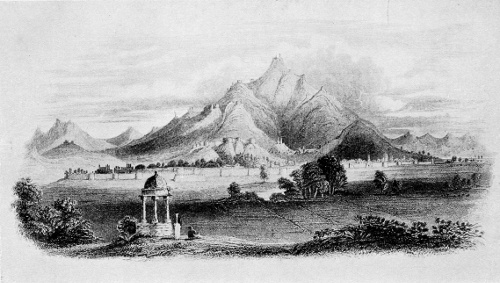
SALUMBAR.
To face page 216.
The ambassador was one of the elders of the same clan, being
the grand uncle of the hereditary pardhan. He had taken a most
active share in the political events of the last thirty years, and had
often controlled the councils of his prince during this period,
217and actually held the post of premier himself when stipulating [187]
for his minor relative. With the ascendancy he exercised over the
prince, it may be inferred that he had no intention of renouncing
it during his lifetime; and as he was educating his adopted heir
to all his notions of authority, and initiating him in the intrigues of
office, the guaranteed dignity in the head of his family would have
become a nonentity,[35] and the Ranas would have been governed
by the deputies of their mayors. From both those evils the times
have relieved the prince. The crimes of Ajit had made his dismissal
from office a point of justice, but imbecility and folly will
never be without ‘mayors.’
When a Rana of Udaipur leaves the capital, the Salumbar
chief is invested with the government of the city and charge of
the palace during his absence. By his hands the sovereign is
girt with the sword, and from him he receives the mark of inauguration
on his accession to the throne. He leads, by right, the
van in battle; and in case of the siege of the capital, his post is
the surajpol,[36] and the fortress which crowns it, in which this
family had a handsome palace, which is now going fast to decay.
It was the predecessor of the present chief of Salumbar who
set up a pretender and the standard of rebellion; but when
foreign aid was brought in, he returned to his allegiance and the
defence of the capital. Similar sentiments have often been
awakened in patriotic breasts, when roused by the interference
of foreigners in their internal disputes. The evil entailed on the
State by these hereditary offices will appear in its annals.
218In Marwar the dignity is hereditary in the house of Awa; but
the last brave chief who held it became the victim of a revengeful
and capricious sovereign,[37] [188] who was jealous of his exploits;
and dying, he bequeathed a curse to his posterity who
should again accept the office. It was accordingly transferred
to the next in dignity, the house of Asop. The present chief,
wisely distrusting the prince whose reign has been a series of
turmoils, has kept aloof from court. When the office was jointly
held by the chiefs of Nimaj and Pokaran, the tragic end of the
former afforded a fine specimen of the prowess and heroism of
the Rathor Rajput. In truth, these pardhans of Marwar have
always been mill-stones round the necks of their princes; an evil
interwoven in their system when the partition of estates took
place amidst the sons of Jodha in the infancy of this State. It
was, no doubt, then deemed politic to unite to the interests of the
crown so powerful a branch, which when combined could always
control the rest; but this gave too much equality.
—Deo Singh, the great-grandfather of the
Pokaran chief alluded to, used to sleep in the great hall of the
palace with five hundred of his clan around him. “The throne
of Marwar is in the sheath of my dagger,” was the repeated boast
of this arrogant chieftain. It may be anticipated that either he
or his sovereign would die a violent death. The lord of Pokaran
was entrapped, and instant death commanded; yet with the
sword suspended over his head, his undaunted spirit was the
same as when seated in the hall, and surrounded by his vassals.
“Where, traitor, is now the sheath that holds the fortunes of
Marwar?” said the prince. The taunt recoiled with bitterness
when he loftily replied, “With my son at Pokaran I have left it.”
No time was given for further insult; his head rolled at the steps
of the palace; but the dagger of Pokaran still haunts the imaginations
of these princes, and many attempts have been made to get
possessed of their stronghold on the edge of the desert.
[38] The
narrow escape of the present chief will be related hereafter, with
the sacrifice of his friend and coadjutor, the chief of Nimaj.
219—In Kotah and Jaisalmer
the power of the ministers is supreme. We might describe their
situation in the words of Montesquieu. "The Pepins kept their
princes in a state of imprisonment in the palace, showing them
once a year to the people. On this occasion they made such
ordinances as were directed [189] by the mayor; they also
answered ambassadors, but the mayor framed the answer."
[39]
Like those of the Merovingian race, these puppets of royalty
in the east are brought forth to the Champ de Mars once a year,
at the grand military festival, the Dasahra. On this day, presents
provided by the minister are distributed by the prince. Allowances
for every branch of expenditure are fixed, nor has the prince
the power to exceed them. But at Kotah there is nothing parsimonious,
though nothing superfluous. On the festival of the birth
of Krishna, and other similar feasts, the prince likewise appears
abroad, attended by all the insignia of royalty. Elephants with
standards precede; lines of infantry and guns are drawn up;
while a numerous cavalcade surrounds his person. The son of the
minister sometimes condescends to accompany his prince on
horseback; nor is there anything wanting to magnificence, but
the power to control or alter any part of it. This failing, how
humiliating to a proud mind, acquainted with the history of his
ancestors and imbued with a portion of their spirit, to be thus
muzzled, enchained, and rendered a mere pageant of state! This
chain would have been snapped, but that each link has become
adamantine from the ties this ruler has formed with the British
Government. He has well merited our protection; though we
never contemplated to what extent the maintenance of these ties
would involve our own character. But this subject is connected
with the history of an individual who yields to none of the many
extraordinary men whom India has produced, and who required
but a larger theatre to have drawn the attention of the world.
His character will be further elucidated in the Annals of
Haravati [190].
220
—The hereditary principle, which perpetuates in these
States their virtues and their vices, is also the grand preservative
of their political existence and national manners: it is an imperishable
principle, which resists time and innovation: it is this which
made the laws of the Medes and Persians, as well as those of the
Rajputs, unalterable. A chief of Mewar, like his sovereign,
never dies: he disappears to be regenerated. ‘
Le roi est mort,
vive le roi!’ is a phrase, the precise virtue of which is there well
understood. Neither the crown nor the greater fiefs are ever
without heirs. Adoption is the preservative of honours and titles;
the great fiefs of Rajasthan can never become extinct.
[1] But,
however valuable this privilege, which the law of custom has made
a right, it is often carried to the most hurtful and foolish extent.
They have allowed the limit which defined it to be effaced, and
each family, of course, maintains a custom, so soothing to vanity,
as the prospect of having their names revived in their descendants.
This has resulted from the weakness of the prince and the misery
of the times. Lands were bestowed liberally which yielded
nothing to their master, who, in securing a nominal obedience
and servitude, had as much as the times made them worth when
given; but with returning prosperity and old customs, these
great errors have become too visible. Adoptions are often made
during the life of the incumbent when without prospect of issue.
The chief and his wife first agitate the subject in private; it is
then confided to the little council of the fief, and when propinquity
and merit unite, they at once petition the prince to confirm
their wishes, which are generally acceded to. So many interests
are to be consulted on this occasion, that the blind partiality of
the chief to any particular object is always counterpoised by the
elders of the clan, who must have a pride in seeing a proper Thakur
[2]
at their head, and who prefer the nearest of kin, to prevent
the disputes which would be attendant on neglect in this
point [191].
221On sudden lapses, the wife is allowed the privilege, in conjunction
with those interested in the fief, of nomination, though
the case is seldom left unprovided for: there is always a presumptive
heir to the smallest sub-infeudation of these estates.
The wife of the deceased is the guardian of the minority of the
adopted.
—The chief of Deogarh, one of the sixteen
Omras
[3] of Mewar, died without issue. On his death-bed he
recommended to his wife and chiefs Nahar Singh for their adoption.
This was the son of the independent chieftain of Sangramgarh,
already mentioned. There were nearer kin, some of the
seventh and eighth degrees, and young Nahar was the eleventh.
It was never contemplated that the three last gigantic
[4] chieftains
of Deogarh would die without issue, or the branches, now claimants
from propinquity, would have been educated to suit the
dignity; but being brought up remote from court, they had been
compelled to seek employment where obtainable, or to live on
the few acres to which their distant claim of birth restricted
them. Two of these, who had but the latter resource to fly to,
had become mere boors; and of two who had sought service
abroad by arms, one was a cavalier in the retinue of the prince,
and the other a hanger-on about court: both dissipated and
unfitted, as the frerage asserted, ‘to be the chieftains of two
thousand Rajputs, the sons of one father.’
[5] Much interest and
intrigue were carried on for one of these, and he was supported
by the young prince and a faction. Some of the senior Pattawats
of Deogarh are men of the highest character, and often lamented
the sombre qualities of their chief, which prevented the clan
having that interest in the State to which its extent and rank
entitled it. While these intrigues were in their infancy, they
adopted a decided measure; they brought home young Nahar
from his father’s residence, and ‘bound round his head the
turban of the deceased.’ In his name the death of the late chief
was announced. It was added, that he hoped to see his friends
222after the stated days of
matam or mourning; and he performed
all the duties of the son of Deogarh, and lighted the funeral pyre.
When these proceedings were reported, the Rana was highly
and justly incensed. The late chief had been one of the rebels
of S. 1848;[6] and though pardon had been [192] granted, yet this
revived all the recollection of the past, and he felt inclined to
extinguish the name of Sangawat.[7]
In addition to the common sequestration, he sent an especial
one with commands to collect the produce of the harvest then
reaping, charging the sub-vassals with the design of overturning
his lawful authority. They replied very submissively, and artfully
asserted that they had only given a son to Gokuldas, not an
heir to Deogarh; that the sovereign alone could do this, and that
they trusted to his nominating one who would be an efficient
leader of so many Rajputs in the service of the Rana. They
urged the pretensions of young Nahar, at the same time leaving
the decision to the sovereign. Their judicious reply was well
supported by their ambassador at court, who was the bard of
Deogarh, and had recently become, though ex officio, physician
to the prince.[8] The point was finally adjusted, and Nahar was
brought to court, and invested with the sword by the hand of
the sovereign, and he is now lord of Deogarh Madri, one of the
richest and most powerful fiefs[9] of Mewar.Mewar. Madri was the
ancient name of the estate; and Sangramgarh, of which Nahar
was the heir, was severed from it, but by some means had reverted
to the crown, of which it now holds. The adoption of Nahar by
Gokuldas leaves the paternal estate without an immediate heir;
and his actual father being mad, if more distant claims are not
admitted, it is probable that Sangramgarh will eventually revert
to the fisc.
223—The system of feuds must have attained considerable
maturity amongst the Rajputs, to have left such traces,
notwithstanding the desolation that has swept the land: but
without circumspection these few remaining customs will become
a dead letter. Unless we abstain from all internal interference,
we must destroy the links which connect the prince and his
vassals; and, in lieu of a system decidedly imperfect, we should
leave them none at all, or at least not a system of feuds, the only
one they can comprehend. Our friendship has rescued them
from exterior foes, and time will restore the rest. With the
dignity and [193] establishments of their chiefs, ancient usages
will revive; and
nazarana (relief),
kharg bandhai (investiture),
dasaundh (aids or benevolence, literally ‘the tenth’), and other
incidents, will cease to be mere ceremonies. The desire of every
liberal mind, as well as the professed wish of the British Government,
is to aid in their renovation, and this will be best effected
by not meddling with what we but imperfectly understand.
[10]
We have nothing to apprehend from the Rajput States if raised
to their ancient prosperity. The closest attention to their history
proves beyond contradiction that they were never capable of
uniting, even for their own preservation: a breath, a scurrilous
stanza of a bard, has severed their closest confederacies. No
national head exists amongst them as amongst the Mahrattas;
and each chief being master of his own house and followers, they
are individually too weak to cause us any alarm.
No feudal government can be dangerous as a neighbour; for
defence it has in all countries been found defective; and for
aggression, totally inefficient. Let there exist between us the
most perfect understanding and identity of interests; the foundation-step
to which is to lessen or remit the galling, and to us
224contemptible tribute, now exacted, enfranchise them from our
espionage and agency, and either unlock them altogether from
our dangerous embrace, or let the ties between us be such only
as would ensure grand results: such as general commercial
freedom and protection, with treaties of friendly alliance. Then,
if a Tatar or a Russian invasion threatened our eastern empire,
fifty thousand Rajputs would be no despicable allies.[11]
—Let us call to mind what they
did when they fought for Aurangzeb: they are still unchanged,
if we give them the proper stimulus. Gratitude, honour, and
fidelity, are terms which at one time were the foundation of all
the virtues of a Rajput. Of the theory of these sentiments he
is still enamoured; but, unfortunately, for his happiness, the
times have left him but little scope for the practice [194] of them.
Ask a Rajput which is the greatest of crimes? he will reply,
‘
gunchhor,’ ‘forgetfulness of favours.’ This is his most powerful
term for ingratitude. Gratitude with him embraces every
obligation of life, and is inseparable from
swamidharma, ‘fidelity
to his lord.’ He who is wanting in these is not deemed fit to live,
and is doomed to eternal pains in Pluto’s
[12] realm hereafter.
[13]“It was a powerful feeling,” says an historian[14] who always
identifies his own emotions with his subject, “which could make
the bravest of men put up with slights and ill-treatment at the
hand of their sovereign, or call forth all the energies of discontented
exertion for one whom they never saw, and in whose character
there was nothing to esteem. Loyalty has scarcely less
tendency to refine and elevate the heart than patriotism itself.”
That these sentiments were combined, the past history of the
Rajputs will show;[15] and to the strength of these ties do they
225owe their political existence, which has outlived ages of strife.
But for these, they would have been converts and vassals to the
Tatars, who would still have been enthroned in Delhi. Neglect,
oppression, and religious interference, sunk one of the greatest
monarchies of the world;[16] made Sivaji a hero, and converted the
peaceful husbandmen of the Kistna and Godavari into a brave
but rapacious soldier.
We have abundant examples, and I trust need not exclaim with
the wise minister of Akbar, “who so happy as to profit by them?”[17]
The Rajput, with all his turbulence, possesses in an eminent
degree both loyalty and patriotism; and though he occasionally
exhibits his refractory spirit to his [195] father and sovereign,[18]
we shall see of what he is capable when his country is threatened
with dismemberment, from the history of Mewar, and the reign
of Ajit Singh of Marwar. In this last we have one of the noblest
examples history can afford of unbounded devotion. A prince,
whom not a dozen of his subjects had ever seen, who had been
concealed from the period of his birth throughout a tedious
minority to avoid the snares of a tyrant,[19] by the mere magic of
a name kept the discordant materials of a great feudal association
226in subjection, till, able to bear arms, he issued from his concealment
to head these devoted adherents, and reconquer what they
had so long struggled to maintain. So glorious a contest, of
twenty years’ duration, requires but an historian to immortalize
it. Unfortunately we have only the relation of isolated encounters,
which, though exhibiting a prodigality of blood and
acts of high devotion, are deficient in those minor details which
give unity and interest to the whole.
—Let us take the Rajput character
from the royal historians themselves, from Akbar, Jahangir,
Aurangzeb. The most brilliant conquests of these monarchs
were by their Rajput allies; though the little regard the latter
had for opinion alienated the sympathies of a race, who when
rightly managed, encountered at command the Afghan amidst
the snows of Caucasus, or made the furthest Cheronese tributary
to the empire. Assam, where the British arms were recently
engaged, and for the issue of which such anxiety was manifested
in the metropolis of Britain, was conquered by a Rajput prince,
[20]
whose descendant is now an ally of the British Government.
But Englishmen in the east, as elsewhere, undervalue everything
not national. They have been accustomed to conquest,
not reverses: though it is only by studying the character of those
around them that the latter can be avoided and this superiority
maintained. Superficial observers imagine that from lengthened
predatory spoliation the energy of the Rajput has fled: an idea
which is at once erroneous and dangerous. The vices now manifest
from oppression will disappear [196] with the cause, and with
reviving prosperity new feelings will be generated, and each
national tie and custom be strengthened. The Rajput would
glory in putting on his saffron robes[21] to fight for such a land, and
for those who disinterestedly laboured to benefit it.
227Let us, then, apply history to its proper use. We need not
turn to ancient Rome for illustration of the dangers inseparable
from wide dominion and extensive alliances. The twenty-two
Satrapies of India, the greater part of which are now the appanage
of Britain, exhibited, even a century ago, one of the most splendid
monarchies history has made known, too extensive for the genius
of any single individual effectually to control. Yet was it held
together, till encroachment on their rights, and disregard to their
habits and religious opinions, alienated the Rajputs, and excited
the inhabitants of the south to rise against their Mogul oppressors.
‘Then was the throne of Aurangzeb at the mercy of a Brahman,
and the grandson[22] of a cultivator in the province of Khandesh
held the descendants of Timur pensioners on his bounty’ [197].
228
PAPERS REFERRED TO IN THE SKETCH OF A
FEUDAL SYSTEM IN RAJASTHAN
BEING
Literal Translations from Inscriptions and Original
Documents, most of which are in the Author’s Possession
Translation of a Letter from the expatriated Chiefs[1] of Marwar to
the Political Agent of the British Government, Western Rajput
States.
After compliments.
We have sent to you a confidential person, who will relate what
regards us. The Sarkar Company are sovereigns of Hindustan,
and you know well all that regards our condition. Although
there is nothing which respects either ourselves or our country
hid from you, yet is there matter immediately concerning us
which it is necessary to make known.
Sri Maharaja and ourselves are of one stock, all Rathors. He
is our head, we his servants: but now anger has seized him, and
we are dispossessed of our country. Of the estates, our patrimony
and our dwelling, some have been made khalisa,[2] and those
who endeavour to keep aloof expect the same fate. Some under
the most solemn pledge of security have been inveigled and
suffered death, and others imprisoned. Mutasadis,[3] officers of
229state, men of the soil and those foreign to it, have been seized,
and the most unheard-of deeds and cruelties inflicted, which we
cannot even write. Such a spirit has possessed his mind as never
was known to any former prince of Jodhpur. His forefathers
have reigned for generations; our forefathers were their ministers
and advisers, and whatever was performed was by the collective
wisdom of the council of our chiefs. Before the face of his ancestors,
our own ancestors have slain and been slain; and in performing
services to the kings,[4] they made the State of Jodhpur
what it is. Wherever Marwar was concerned, there our fathers
were to be found, and with their lives preserved the land. Sometimes
our head was a minor; even then by the wisdom of our
fathers and their services, the land was kept firm under our feet,
and thus has it descended from generation to generation. Before
his eyes (Raja Man’s) we have performed good service: when
at that perilous time the host of Jaipur[5] surrounded [198] Jodhpur
on the field we attacked it; our lives and fortunes were at stake,
and God granted us success; the witness is God Almighty.
Now, men of no consideration are in our prince’s presence; hence
this reverse. When our services are acceptable, then is he our lord;
when not, we are again his brothers and kindred, claimants and
laying claim to the land.
He desires to dispossess us; but can we let ourselves be dispossessed?
The English are masters of all India. The chief of ——
sent his agent to Ajmer; he was told to go to Delhi. Accordingly
Thakur —— went there, but no path was pointed out. If
the English chiefs will not hear us, who will? The English allow
no one’s lands to be usurped, and our birthplace is Marwar—from
Marwar we must have bread. A hundred thousand Rathors—where
are they to go to? From respect to the English alone
have we been so long patient, and without acquainting your
government of our intentions, you might afterwards find fault;
therefore we make it known, and we thereby acquit ourselves to
you. What we brought with us from Marwar we have consumed,
and even what we could get on credit; and now, when want
must make us perish, we are ready and can do anything.[6]
The English are our rulers, our masters. Sri Man Singh has
seized our lands; by your government interposing these troubles
may be settled, but without its guarantee and intervention we can
have no confidence whatever. Let us have a reply to our petition.
230We will wait it in patience; but if we get none, the fault will not
be ours, having given everywhere notice. Hunger will compel
man to find a remedy. For such a length of time we have been
silent from respect to your government alone: our own Sarkar
is deaf to complaint. But to what extreme shall we wait? Let
our hopes be attended to. Sambat 1878, Sawan sudi duj.
(August 1821.)
True Translation:
(Signed) James Tod.
Remonstrance of the Sub-Vassals of Deogarh against their chief,
Rawat Gokul Das.
1. He respects not the privileges or customs established of old.
2. To each Rajput’s house a charas[7] or hide of land was
attached: this he has resumed.
3. Whoever bribes him is a true man: who does not, is a
thief.
4. Ten or twelve villages established by his pattayats[8] he has
resumed, and left their families to starve.
5. From time immemorial sanctuary (saran) has been esteemed
sacred: this he has abolished.
6. On emergencies he would pledge his oath to his subjects
(ryots), and afterwards plunder them.
7. In old times, it was customary when the presence of his
chiefs and kindred was required, to invite them by letter: a fine
is now the warrant of summons: thus lessening their dignity.
8. Such messengers, in former times, had a taka[9] for their
ration (bhatta); now he imposes two rupees [199].
9. Formerly, when robberies occurred in the mountains within
the limits of Deogarh, the loss was made good: now all complaint
is useless, for his faujdar[10] receives a fourth of all such plunder.
The Mers[11] range at liberty; but before they never committed
murder: now they slay as well as rob our kin; nor is there any
redress, and such plunder is even sold within the town of Deogarh.
10. Without crime, he resumes the lands of his vassals for the
231sake of imposition of fines; and after such are paid, he cuts down
the green crops, with which he feeds his horses.
11. The cultivators[12] on the lands of the vassals he seizes by
force, extorts fines, or sells their cattle to pay them. Thus cultivation
is ruined and the inhabitants leave the country.
12. From oppression the town magistrates[13] of Deogarh have
fled to Raepur. He lays in watch to seize and extort money from
them.
13. When he summons his vassals for purposes of extortion
and they escape his clutches, he seizes on their wives and families.
Females, from a sense of honour, have on such occasions thrown
themselves into wells.
14. He interferes to recover old debts, distraining the debtor
of all he has in the world: half he receives.
15. If any one have a good horse, by fair means or foul he
contrives to get it.
16. When Deogarh was established, at the same time were our
allotments: as is his patrimony, so is our patrimony.[14] Thousands
have been expended in establishing and improving them, yet our
rank, privileges, and rights he equally disregards.
17. From these villages, founded by our forefathers, he, at
will, takes four or five skins of land and bestows them on
foreigners; and thus the ancient proprietors are reduced to
poverty and ruin.
18. From of old, all his Rajput kin had daily rations, or portions
of grain: for four years these rights have been abolished.
19. From ancient times the pattayats formed his council;
now he consults only foreigners. What has been the consequence?
the whole annual revenue derived from the mountains
is lost.
20. From the ancient Bhum[15] of the Frerage[16] the mountaineers
carry off the cattle, and instead of redeeming them, this faujdar
sets the plunderers up to the trick of demanding rakhwali.[17]
21. Money is justice, and there is none other: whoever has
money may be heard. The bankers and merchants have gone
abroad for protection, but he asks not where they are.
22. When cattle are driven off to the hills, and we do ourselves
justice and recover them, we are fined, and told that the mountaineers
have his pledge. Thus our dignity is lessened. Or if
232we seize one of these marauders, a party is sent to liberate him,
for which the faujdar [200] receives a bribe. Then a feud ensues
at the instigation of the liberated Mer, and the unsupported
Rajput is obliged to abandon his patrimony.[18] There is neither
protection nor support. The chief is supine, and so regardless
of honour, that he tells us to take money to the hills and redeem
our property. Since this faujdar had power, ‘poison has been
our fate.’ Foreigners are all in all, and the home-bred are set
aside. Deccanis and plunderers enjoy the lands of his brethren.
Without fault, the chiefs are deprived of their lands, to bring
which into order time and money have been lavished. Justice
there is none.
Our rights and privileges in his family are the same as his in
the family of the Presence.[19] Since you[20] entered Mewar, lands
long lost have been recovered. What crimes have we committed
that at this day we should lose ours?
We are in great trouble.[21]
Maharaja Sri Gokuldas to the four ranks (char misl) of Pattayats
of Deogarh, commanding. Peruse.
Without crime no vassal shall have his estate or charsas disseized.
Should any individual commit an offence, it shall be
judged by the four ranks (char misl), my brethren, and then
punished. Without consulting them on all occasions I shall
never inflict punishment.[22] To this I swear by Sri Nathji. No
departure from this agreement shall ever occur. S. 1874; the
6th Pus.
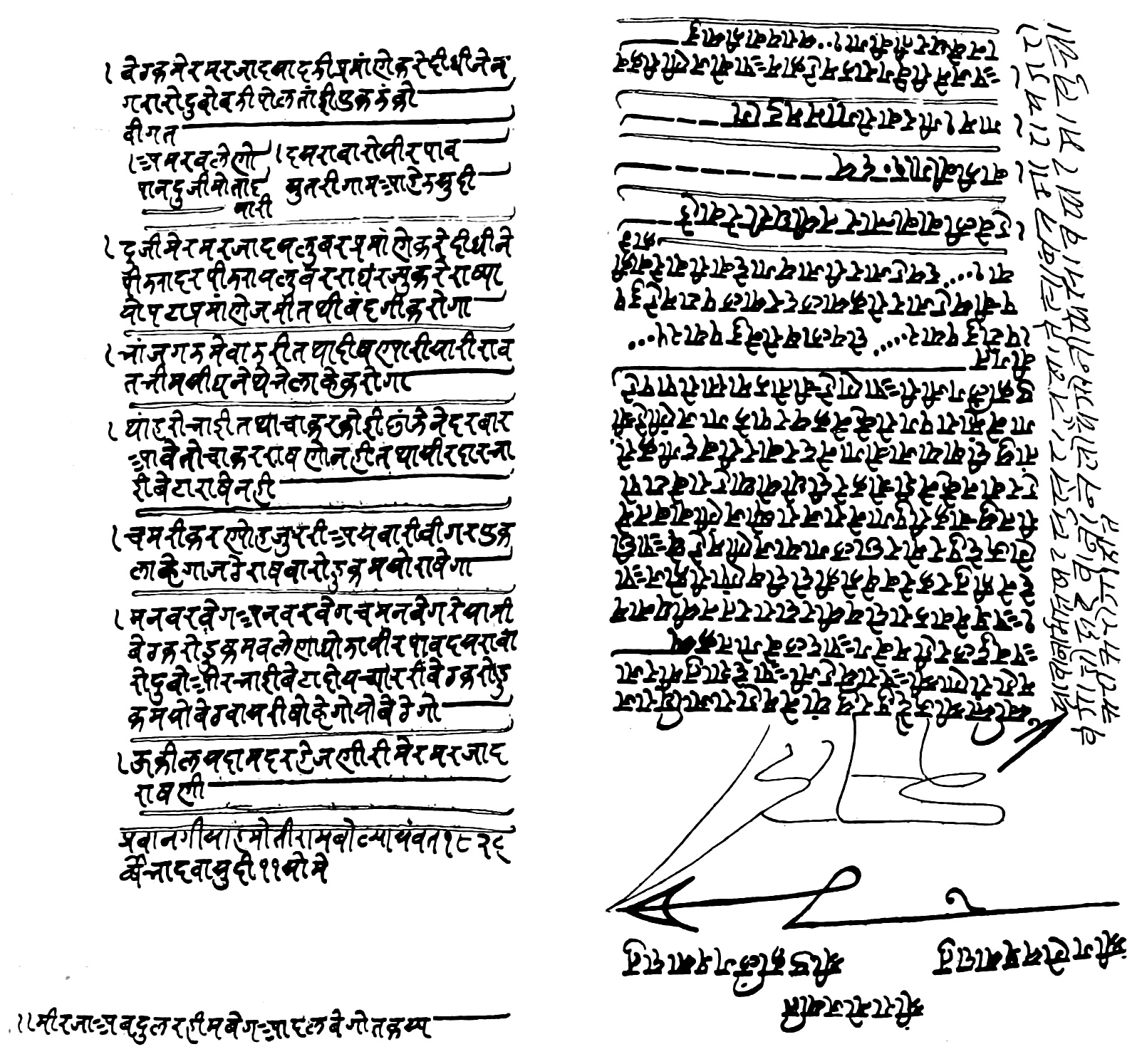
REPRODUCTION OF SANSKRIT GRANT.
To face page 232.
233
Grant from Maharana Ari Singh, Prince of Mewar, to the Sindi
Chief, Abdu-l Rahim Beg.
Sri Maharaja Dhiraj Maharana Ari Singh to Mirza Abdu-l
Rahim Beg Adilbegot, commanding.
Now some of our chiefs having rebelled and set up the impostor
Ratna Singh, brought the [201] Deccani army and erected
batteries against Udaipur, in which circumstances your services
have been great and tended to the preservation of our sovereignty:
therefore, in favour towards you, I have made this grant, which
your children and children’s children shall continue to enjoy.
You will continue to serve faithfully; and whoever of my race
shall dispossess you or yours, on him be Eklingji and the sin of the
slaughter of Chitor.
1st. In estates, 200,000 rupees.
2nd. In cash annually, 25,000.
3rd. Lands outside the Debari gate, 10,000.
4th. As a residence, the dwelling-house called Bharat Singh’s.
5th. A hundred bighas of land outside the city for a garden.
6th. The town of Mithun in the valley, to supply wood and
forage.
7th. To keep up the tomb of Ajmeri Beg, who fell in action,
one hundred bighas of land.
8th. A seat in Darbar and rank in all respects equal to the
chieftain of Sadri.[24]
9th. Your kettle-drums (Nakkara) to beat to the exterior gate,
but with one stick only.
10th. Amar Balaona,[25] and a dress of honour on the Dasahra[26]
festival.
23411th. Drums to beat to Ahar. All other privileges and rank
like the house of Salumbar.[27] Like that house, yours shall be
from generation to generation; therefore according to the valuation
of your grant you will serve.
12th. Your brothers or servants, whom you may dismiss, I
shall not entertain or suffer my chief to entertain.
13th. The Chamars[28] and Kirania[29] you may use at all times
when alone, but never in the Presence.
14th. Munawwar Beg, Anwar Beg, Chaman Beg, are permitted
seats in front of the throne; Amar Balaona, and honorary dresses
on Dasahra, and seats for two or three other relatives who may
be found worthy the honour.
15th. Your agent (Vakil) shall remain at court with the privileges
due to his rank.
By command:
Sah Moti Ram Bolia,
S. 1826 (A.D. 1770) Bhadon (August) sudi 11 Somwar (Monday).
Grant of the Patta of Bhainsror to Rawat Lal Singh, one of the sixteen great vassals of Mewar.
Maharaja Jagat Singh to Rawat Lal Singh Kesarisinghgot,[30]
commanding.
Now to you the whole Pargana of Bhainsror[31] is granted as
Giras, viz. [202]:
| Town of Bhainsror |
3000 |
1500 |
| Fifty-two others (names uninteresting), besides one in the valley of the capital. Total value |
62,000 |
31,000[32] |
With two hundred and forty-eight horse and two hundred
and forty-eight foot, good horse and good Rajputs, you will
perform service. Of this, forty-eight horse and forty-eight foot
are excused for the protection of your fort; therefore with two
hundred foot and two hundred horse you will serve when and
wherever ordered. The first grant was given in Pus, S. 1798,
when the income inserted was over-rated. Understanding this, the
Presence (huzur) ordered sixty thousand of annual value to be
attached to Bhainsror.
235
Grant from Maharana Sangram Singh of Mewar to his Nephew,
the Prince Madho Singh, heir-apparent to the principality of
Jaipur.
| |
Sri Ramjayati |
|
| |
(Victory to Rama). |
|
| |
| Sri Ganesh Prasad |
|
Sri Ekling Prasad |
| (By favour of Ganesh). |
|
(By favour of Eklinga). |
Maharaja Dhiraj Maharana Sri Sangram Singh, Adisatu, commanding.
To my nephew, Kunwar Madho Singhji, giras (a fief)
has been granted, viz.:
The fief (patta) of Rampura; therefore, with one thousand
horse and two thousand foot, you will perform service during six
months annually; and when foreign service is required, three
thousand foot and three thousand horse.
While the power of the Presence is maintained in these districts
you will not be dispossessed.
By command:
Pancholi Raechand andand Mehta Mul Das.
S. 1785 (A.D. 1729); Chait sudi 7th; Mangalwar (Tuesday).
Addressed in the Rana’s own hand.
To my nephew Madho Singh[35] [203]. My child, I have given
you Rampura: while mine, you shall not be deprived of it.
Done.
236
Grant of Bhum Rakhwali (Salvamenta) from the village of Dongla to Maharaja Khushhal Singh.
S. 1806 (A.D. 1750), the first of Sawan (July).
1st. A field of one hundred and fifty-one bighas, of which
thirty-six are irrigated.
2nd. One hundred and two bighas of waste and unirrigated,
viz.:
Six bighas cultivated by Govinda the oilman.
Three, under Hira and Tara the oilmen.
Seventeen cultivated by the mason Hansa, and Lal
the oilman.
Four bighas of waste and forest land (parti, aryana)
which belonged to Govinda and Hira, etc., etc.;
and so on enumerating all the fields composing the
above aggregate.
| Pieces of money |
12. |
| Grain |
24 maunds. |
| On the festivals of Rakhi, Diwali, and Holi, one copper coin from each house. |
| Serana |
at harvest. |
| Shukri from the Brahmans. |
| Transit duties for protection of merchandise, viz., a pice on every cart-load, and half a pice for each bullock. |
| Two platters on every marriage feast. |
Grant of Bhum by the Inhabitants of Amli to Rawat Fateh
Singh of Amet. S. 1814 (A.D. 1758)
The Ranawats Sawant Singh and Subhag Singh had Amli in
grant; but they were oppressive to the inhabitants, slew the
Patels Jodha and Bhagi, and so ill-treated the Brahmans, that
Kusal and Nathu sacrificed themselves on the pyre. The inhabitants
demanded the protection of the Rana, and the pattayats
were changed; and now the inhabitants grant in rakhwali one
hundred and twenty-five bighas as bhum to Fateh Singh[36] [204].
237
Grant of Bhum by the Inhabitants of the Town of Dongla to Maharaja Zorawar Singh, of Bhindar.
To Sri Maharaja Zorawar Singh, the Patels, traders, merchants,
Brahmans, and united inhabitants of Dongla, make agreement.
Formerly the ‘runners’ in Dongla were numerous: to preserve
us from whom we granted bhum to the Maharaja. To wit:
One well, that of Hira the oilman.
One well, that of Dipa the oilman.
One well, that of Dewa the oilman.
In all, three wells, being forty-four bighas of irrigated (piwal),
and one hundred and ninety-one bighas of unirrigated (mal) land.
Also a field for juar.
Customs or Dignities (Maryad) attached to the Bhum.
1st. A dish (kansa) on every marriage.
2nd. Six hundred rupees ready cash annually.
3rd. All Bhumias, Girasias, the high roads, passes from raids
and ‘runners,’ and all disturbances whatsoever, the Maharaja
must settle.
When the Maharaja is pleased to let the inhabitants of Dongla
reinhabit their dwellings, then only can they return to them.[37]
Written by the accountant Kacchia, on the full moon of Jeth,
S. 1858, and signed by all the traders, Brahmans, and towns-people.
Grant of Bhum by the Prince of Mewar to an inferior Vassal.
Maharana Bhim Singh to Baba Ram Singh, commanding.
Now a field of two hundred and twenty-five bighas in the city
of Jahazpur, with the black orchard (sham bagh) and a farm-house
(nohara) for cattle, has been granted you in bhum.
Your forefathers recovered for me Jahazpur and served with
fidelity; on which account this bhum is renewed. Rest assured
no molestation shall be offered, nor shall any pattayat interfere
with you.
- One serana.[38]
- Two halmas [205].[39]
- 238Offerings of coco-nuts on the Holi and Dasahra festivals.
- From every hundred bullock-loads[40] of merchandise, twelve annas.
- From every hundred and twenty-five ass-loads, six annas.
- From each horse sold within Jahazpur, two annas.
- From each camel sold, one anna.
- From each oil-mill, one pula.
- From each iron mine (madri), a quarter rupee.
- From each distillation of spirits, a quarter rupee.
- From each goat slain, one pice.
- On births and marriages,[41] five platters (kansa).
- The handful (inch) from every basket of greens.
- With every other privilege attached to bhum.
| Irrigated land (piwal) |
51 |
bighas. |
| Unirrigated land (mal) |
110 |
" |
| Mountain land (magra) |
40 |
" |
| Meadow land (bira) |
25 |
" |
| |
226 |
bighas. |
- Asarh (June) S. 1853 (A.D. 1797).
239
Charter of Privileges and Immunities granted to the town of Jhalrapatan, engraved on a Pillar in that City.
S. 1853 (A.D. 1797), corresponding with the Saka 1718, the sun
being in the south, the season of cold, and the happy month of
Kartika,[42] the enlightened half of the month, being Monday the
full moon.
Maharaja Dhiraj Sri Ummed Singh Deo,[43] the Faujdar[44] Raj
Zalim Singh [206] and Kunwar Madho Singh, commanding. To
all the inhabitants of Jhalrapatan, Patels,[45] Patwaris,[46] Mahajans,[47]
and to all the thirty-six castes, it is written.
At this period entertain entire confidence, build and dwell.
Within this abode all forced contributions and confiscations
are for ever abolished. The taxes called Bhalamanusi,[48] Anni,[49]
and Rekha Barar,[50] and likewise all Bhetbegar,[51] shall cease.
To this intent is this stone erected, to hold good from year to
year, now and evermore. There shall be no violence in this
territory. This is sworn by the cow to the Hindu and the hog to
the Musalman: in the presence of Captain Dilel Khan, Chaudhari
Sarup Chand, Patel Lalo, the Mahesri Patwari Balkishan, the
architect Kalu Ram, and the stone-mason Balkishan.
Parmo[52] is for ever abolished. Whoever dwells and traffics
within the town of Patan, one half of the transit duties usually
levied in Haravati are remitted; and all mapa (meter’s) duties
are for ever abolished.
Abolitions, Immunities, Prohibitions, etc. etc. Inscription
in the Temple of Lachhmi Narayan at Akola.
In former times tobacco was sold in one market only. Rana
Raj Singh commanded the monopoly to be abolished. S. 1645.
Rana Jagat Singh prohibited the seizure of the cots and quilts
by the officers of his government from the printers of Akola.
240
Privileges and Immunities granted to the Printers of Calico
and Inhabitants of the Town of Great Akola in Mewar.
Maharana Bhim Singh, commanding, to the inhabitants of
Great Akola.
Whereas the village has been abandoned from the assignments
levied by the garrison of Mandalgarh, and it being demanded of
its population how it could again be rendered prosperous, they
unanimously replied: "Not to exact beyond the dues and
contributions (dand dor) established of yore; to erect the pillar
promising never to exact above half the produce of the crops, or
to molest the persons of those who thus paid their dues."
The Presence agreed, and this pillar has been erected. May
Eklinga look to him who breaks this command. The hog to the
Musalman and the cow to the Hindu.
Whatever contributions (dand) parmo,[53] puli,[54] heretofore levied
shall be paid [207].
All crimes committed within the jurisdiction of Akola to be
tried by its inhabitants, who will sit in justice on the offender
and fine him according to his faults.
On Amavas[55] no work shall be done at the well[56] or at the oil-mill,
nor printer put his dye-pot on the fire.[57]
Whoever breaks the foregoing, may the sin of the slaughter of
Chitor be upon him.
This pillar was erected in the presence of Mehta Sardar Singh,
Sanwal Das, the Chaudharis Bhopat Ram and Daulat Ram, and
the assembled Panch of Akola.
Written by the Chaudhari Bhopji, and engraved by the stonecutter
Bhima.
Prohibition against Guests carrying away Provisions from the
Public Feast.[58]
Sri Maharana Sangram Singh to the inhabitants of Marmi.
On all feasts of rejoicing, as well as those on the ceremonies
241for the dead, none shall carry away with them the remains of
the feast. Whoever thus transgresses shall pay a fine to the
crown of one hundred and one rupees. S. 1769 (A.D. 1713), Chait
Sudi 7th.
Maharana Sangram Singh to the merchants and bankers of
Bakrol.
The custom of furnishing quilts (sirak)[59] of which you complain
is of ancient date. Now when the collectors of duties, their
officers, or those of the land revenue stop at Bakrol, the merchants
will furnish them with beds and quilts. All other servants will
be supplied by the other inhabitants.
Should the dam of the lake be in any way injured, whoever
does not aid in its repair shall, as a punishment, feed one hundred
and one Brahmans. Asarh 1715, or June A.D. 1659 [208].
Warrant of the Chief of Bijolli to his Vassal, Gopaldas Saktawat.
Maharaja Mandhata to Saktawat Gopaldas, be it known.
At this time a daily fine of four rupees is in force against you.
242Eighty are now due; Ganga Ram having petitioned in your
favour, forty of this will be remitted. Give a written declaration
to this effect—that with a specified quota you will take the field;
if not, you will stand the consequences.
Viz.: One good horse and one matchlock, with appurtenances
complete, to serve at home and abroad (des pardes), and to run
the country[60] with the Kher.
When the levy (kher) takes the field, Gopaldas must attend
in person. Should he be from home, his retainers must attend,
and they shall receive rations from the presence. Sawan sudi
das (August 10) S. 1782.
Maharaja Udaikaran to the Saktawat Shambhu Singh. Be
it known.
I had annexed Gura to the fisc, but now, from favour, restore
it to you. Make it flourish, and serve me at home and abroad,
with one horse, and one foot soldier.
When abroad you shall receive rations (bhatta) as follows:
| Flour |
3 lb. |
| Pulse |
4 ounces. |
| Butter (ghi) |
2 pice weight. |
| Horses’ feed |
4 seers at 22 takas each seer, of daily allowance. |
243If for defence of the fort you are required, you will attend with
all your dependents, and bring your wife, family, and chattels;
for which, you will be exempted from two years of subsequent
service. Asarh 14, S. 1834 [209].
Bhum in Mundkati, or Compensation for Blood, to Jeth
Singh Chondawat.
The Patel’s son went to bring home his wife with Jeth’s Rajputs
as a guard. The party was attacked, the guard killed, and there
having been no redress for the murder, twenty-six bighas have
been granted in mundkati[61] (compensation).
Rawat Megh Singh to his natural brother, Jamna Das, a patta
(fief) has been granted, viz.:
| The village of Rajpura, value |
Rupees |
401 |
| A garden of mogra flowers[62] |
|
11 |
| |
Rupees |
412 |
Serve at home and abroad with fidelity: contributions and
aids pay according to custom, and as do the rest of the vassals.
Jeth 14th, S. 1874.
Charter given by the Rana of Mewar, accepted and signed by all his
Chiefs; defining the duties of the contracting Parties.
Siddh Sri Maharana Dhiraj, Maharana Bhim Singh, to all the
nobles my brothers and kin, Rajas, Patels, Jhalas, Chauhans,
Chondawats, Panwars, Sarangdeots, Saktawats, Rathors, Ranawats,
etc., etc.
Now, since S. 1822 (A.D. 1776), during the reign of Sri Ari
Singhji,[63] when the troubles commenced, laying ancient usages
aside, undue usurpations of the land have been made: therefore
244on this day, Baisakh badi 14th, S. 1874 (A.D. 1818), the Maharana
assembling all his chiefs, lays down the path of duty in new
ordinances.
1st. All lands belonging to the crown obtained since the
troubles, and all lands seized by one chief from another, shall be
restored.
2nd. All Rakhwali,[64] Bhum, Lagat,[65] established since the
troubles, shall be renounced.
3rd. Dhan,[66] Biswa,[67] the right of the crown alone, shall be
renounced.
4th. No chiefs shall commit thefts or violence within the
boundaries of their estates. They shall entertain no Thugs,[68]
foreign thieves or thieves of the country, as Moghias,[68] Baoris,[68]
Thoris:[68] but those who shall adopt peaceful habits may remain;
but should any return to their old pursuits, their heads shall
instantly be taken off. All property stolen shall be made good
by the proprietor of the estate within the limits of which it is
plundered [210].
5th. Home or foreign merchants, traders, Kafilas,[69] Banjaras,[70]
who enter the country, shall be protected. In no wise shall they
be molested or injured, and whoever breaks this ordinance, his
estate shall be confiscated.
6th. According to command, at home or abroad service must
be performed. Four divisions (chaukis) shall be formed of the
chiefs, and each division shall remain three months in attendance
at court, when they shall be dismissed to their estates. Once a
year, on the festival of the Dasahra,[71] all the chiefs shall assemble
with their quotas ten days previous thereto, and twenty days
subsequent they shall be dismissed to their estates. On urgent
occasions, and whenever their services are required, they shall
repair to the Presence.
2457th. Every Pattawat holding a separate patta from the
Presence shall perform separate service. They shall not unite
or serve under the greater Pattawats: and the sub-vassals of all
such chiefs shall remain with and serve their immediate Pattawat.[72]
8th. The Maharana shall maintain the dignities due to each
chief according to his degree.
9th. The Ryots shall not be oppressed: there shall be no new
exactions or arbitrary fines. This is ordained.
10th. What has been executed by Thakur Ajit Singh and
sanctioned by the Rana, to this all shall agree.[73]
11th. Whosoever shall depart from the foregoing, the Maharana
shall punish. In doing so the fault will not be the Rana’s. Whoever
fails, on him be the oath (an) of Eklinga and the Maharana.
[Here follow the signatures of all the chieftains of rank in
Mewar, which it is needless to insert] [211].
246
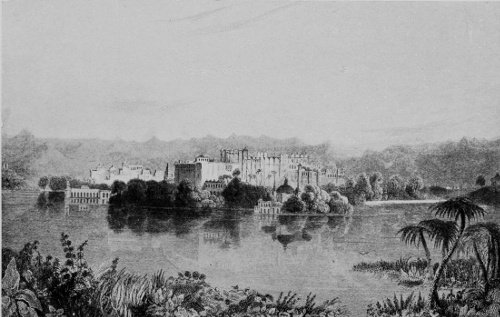
PALACE OF UDAIPUR.
To face page 247.
BOOK IV ANNALS OF MEWĀR — CHAPTER 1 — Titles of Mewār Chiefs: descent from the Sun. — Stability of Mewār State. — Origin of the Rājputs. — Sources of the History. — Kanaksen. — Titles of the Chiefs. — Legend of Kanaksen. — Invaders of Saurāshtra. — The Fountain of the Sun. — CHAPTER 2 — The Refugee Queen. — The Legend of Goha. — The Marriage of Bappa. — Oghna Panarwa. — The Question of Dates. — CHAPTER 3 — Connexion of the Rānas with Persia. — CHAPTER 4 — Samarsi, Samar Singh. — Khumān I. — The Muhammadan Invasion, A.D. 644-55. — Mahmūd’s Invasion. — Attack on Chitor. — The Muster of the Clans. — The Defeat of the Enemy. — Khumān II. — Bhartribhat III. — CHAPTER 5 — Samar Singh, Samarsi: The Tuars of Delhi. — Prithiraj. — The Death of Samar Singh. — Gallant Resistance of the Rājputs. — Karan Singh I.: Ratan Singh. — Rāhup. — CHAPTER 6 — Lakhamsi: Lachhman Singh. — Bhīm Singh: Padmini. — The Siege of Chitor. — The Johar. — The Conquests of Alāu-d-dīn. — The Flight of Rāna Ajai Singh. — Mewār occupied by the Musalmāns: The Exploit of Hamīr. — Rāna Hamīr Singh, A.D. 1301-64. — The Inaugural Foray. — Chitor under a Musalmān Garrison. — Resistance of Hamīr Singh. — The Recovery of Chitor. — The Power of Rāna Hamīr Singh. — Public Works. — Kshetra or Khet Singh, A.D. 1364-82. — Laksh Singh, A.D. 1382-97. — CHAPTER 7 — Chonda renounces his Birthright. — Rāna Mokala, A.D. 1397-1433. — Rāthor Influence in Mewār. — Raghudeva, the Mewār Hero. — The Expulsion of the Rāthor Party. — Death of Rāo Ranmall. — The Revenge of Chonda. — Harbuji Sānkhla. — Mokal, A.D. 1397-1433. — Lāl Bāi. — Assassination of Rāna Mokal. — Rāna Kūmbha, A.D. 1433-68. — Suja and the Tiger. — CHAPTER 8 — Rāna Kūmbha, A.D. 1433-68. — The Tower of Victory. — The Fortresses of Mewār. — Temples. — Mīra Bāi. — The Assassination of Rāna Kūmbha, A.D. 1468. — Rāna Uda, A.D. 1468-73. — Banishment of the Chārans. — Rāna Rāemall, A.D. 1473-1508. — The Sons of Rāna Rāemall. — Retirement of Sanga. — The Adventures of Prithirāj. — Prithirāj recalled. — Interview between Prithirāj and Sūrajmall. — Prithirāj poisoned: Death of Rāna Rāemall. — CHAPTER 9 — The Administration and Wars of Rāna Sanga. — Invasions from Central Asia. — Character of Bābur. — The Battle of Khānua, March 16, 1527. — The Death of Rāna Sanga. — Evils resulting from Polygamy. — Appearance of Rāna Sanga. — Rāna Ratan Singh II., A.D. 1527-31. — Death of Rāna Ratan Singh. — Rāna Bikramajīt, A.D. 1531-35. — The Attack by Bahādur, Sultān of Gujarāt. — Crowning of a New Rāna. — The Johar. — The Rākhi. — Restoration of Bikramajīt. — Death of Rāna Bikramajīt. — CHAPTER 10 — Rāna Banbīr Singh, A.D. 1535-37. — The Escape of Udai Singh, the Heir. — The Boyhood of Udai Singh. — Installation of Rāna Udai Singh, A.D. 1537-72. — The Dauna, a Recognition of Legitimacy. — Deposition of Rāna Banbīr Singh. — Rāna Udai Singh, A.D. 1537-72. — His Character. — Birth of Akbar. — Defeat and Flight of Humāyūn, A.D. 1540. — Early Years of Akbar. — Akbar’s Struggle for the Empire. — Comparison of Akbar with Rāna Udai Singh. — Akbar besieges Chitor, September, A.D. 1567. — Jaimall and Patta. — The Sin of the Capture of Chitor. — Escape of Rāna Udai Singh: Foundation of Udaipur. — Death of Rāna Udai Singh. — Jagmall proclaimed Rāna. — Jagmall deposed in favour of Rāna Partāp Singh. — CHAPTER 11 — Rāna Partāp Singh, A.D. 1572-97. — Rāna Partāp Singh resists the Moguls. — The Vow of Rāna Partāp Singh. — Akbar attacks Rāna Partāp Singh, A.D. 1576. — Rāna Partāp Singh deserted by Rājput Princes. — Rāja Mān Singh and Rāna Partāp Singh. — Salīm’s Campaign, A.D. 1576. — Battle of Haldīghāt or Gogūnda, June 18, 1576. — The Escape of Rāna Partāp Singh. — Siege of Kumbhalmer. — Further Imperialist Advance. — Submission of Rāna Partāp Singh. — Rally of Rāna Partāp Singh. — The Nauroza. — Akbar and Rajput Ladies. — Adventures of Rāna Partāp Singh. — Mewār left in Peace by the Imperialists. — The Last Days of Rāna Partāp. — CHAPTER 12 — Rāna Amar Singh I., A.D. 1597-1620. — The Administration of Rāna Amar Singh. — Jahāngīr attacks Mewār. — Chief of Salūmbar intervenes. — Defeat of the Imperialists. — Jahāngīr establishes Sagra as Rāna. — Conquests of Rāna Amar Singh I. — Sakta and the Saktāwats. — Renewed Attack by Jahāngīr. Battle of Khāmnor. — Treatment of the Rāna by Jahāngīr. — Character of Rāna Amar Singh. — CHAPTER 13 — Rāna Karan Singh II., A.D. 1620-28. — Terms between Rāna Karan Singh and Jahāngīr. — Sesodias in the Imperial Service. — Revolt and Death of Bhīm Singh. — Death of Rāna Karan Singh. — Rāna Jagat Singh I., A.D. 1628-52. — Erection of Buildings at Udaipur. — Rāna Rāj Singh, A.D. 1652-80. — Princes contemporary with Aurangzeb. — Rāna Rāj Singh defies Aurangzeb. — The Imposition of the Jizya or Capitation Tax. — Letter of Remonstrance to Aurangzeb. — Aurangzeb attacks Mewār. — The Advance of Prince Akbar. — Diversion made by the Rājputs. — Plan to dethrone Aurangzeb. — Overtures for Peace. — Cruel Treatment of Rāja of Golkonda. — The Rājsamund Lake. — The Famine of A.D. 1662. — CHAPTER 14 — Rāna Jai Singh, A.D. 1680-98. — Treaty between Rāna Jai Singh and Aurangzeb. — The Jaisamund Lake. — Rana Jai Singh and his heir Amar Singh. — Rebellion of Amar Singh. — Rāna Amar Singh II., A.D. 1698-1710. — Breach between the Rājputs and the Mughal Empire. — Rājput Apostates. — Shāh Alam Bahādur Shāh, Emperor, A.D. 1707-12. — The Rise of the Sikhs. — Sacrifice of the Right of Primogeniture. — Farrukhsīyar, Emperor, A.D. 1712-19. — Marriage of Farrukhsīyar: Grant to the British. — The Jizya Reimposed. — Rāna Amar Singh asserts Rājput Independence. — Death of Rāna Amar Singh. — CHAPTER 15 — Rāna Sangrām Singh II., A.D. 1710-34. — Deposition of Farrukhsīyar: Nizāmu-l-mulk. — Murder of Farrukhsīyar, May 16, 1719. — Accession of Rafiu-d-darajāt. — Accession of Roshan-Akhtar Muhammad Shah, A.D. 1719-48. — The Policy of Mewār. — Anecdotes of Rāna Sangrām Singh II. — Rāna Jagat Singh II., A.D. 1734-51. Difficulties of Rājput Combination. — League of Nizamu-l-mulk with Rājputs and Marāthas. — Marātha Raids. The Campaign of Nādir Shāh. — Plunder and Massacre at Delhi. — Results to the Rājputs. — The Coming of the Marāthas. — The Rājput Coalition. — Bājirāo visits Mewār. Negotiations with the Marāthas. — Right of Primogeniture. — Death of Rāna Jagat Singh II., A.D. 1751. — CHAPTER 16 — Rāna Partāp Singh II., A.D. 1751-54. — Rāna Rāj Singh II., A.D. 1754-61. — Rāna Arsi Arsi Singh II., A.D. 1761-73. — Malhār Rāo Holkar invades Mewār. Famine, A.D. 1764. — Civil War in Mewār. Revolt of Ratan Singh. — Zālim Singh of Kotah. — Battle at the Sipra, and Siege of Udaipur, A.D. 1769. — Amar Chand, Minister of Mewār. — Cessions made to Sindhia. — Ratan Singh defeated. — Assassination of Rāna Ari Singh, A.D. 1773. — Rāna Hamīr Singh II., A.D. 1773-78. — Outbreak of the Sindis. — Revolt of the Chief of Begūn. — Recapitulation. — CHAPTER 17 — Rāna Bhīm Singh, A.D. 1778-1828. — Feud of Chondāwats and Saktāwats. — Battle of Lālsot, May 1787. — Defeat of the Rājputs. Murder of Somji. — Aid sought from Sindhia. — Negotiations by Zālim Singh. — Zālim Singh and Sindhia at Udaipur. — Sindhia’s Instructions to Ambaji. — Anarchy in Mewār. — Death of Mahādaji Sindhia, January 12, 1794. — Contest of Ambaji and Lakwa. — George Thomas. — Pillage in Mewār. — Daulat Rāo Sindhia reduces Mewār. — Lakwa Dāda Marātha Viceroy. — Holkar defeated at Indore. Plunder of Nāthdwāra: image removed. — The Inroad of Holkar. — Mewār Quarrels. — Holkar plunders Udaipur. — Sindhia and Holkar in Mewār. — Holkar saves Mewār from Sindhia. — Holkar protects Mewār Interests. — The Tragedy of Krishna Kunwāri. — Battle of Parbatsar. Defeat of the Mārwār Forces. — Nawāb Amīr Khān. — The Tragedy of Krishna Kunwāri. — Fate of the Murderers. — Amīr Khan rewarded by the British. — Ruin of Mewār by the Marāthas. — Bāpu Sindhia Sūbahdār of Mewār. — CHAPTER 18 — Degraded Condition of the Rājputs. — Alliances with the British. — Treaty with Mewār. — Cession of Kumbhalmer. — Arrival of the Author as Agent. — The Palace at Udaipur. — Political Divisions of Mewār. — Desolation of Mewār. — The Condition of Udaipur. — Reorganization of the State. — Form of Civil Government. — Incapacity of the Rāna. — Relations of the Rāna with his Nobles. — Return of the Exiles. — Attraction of Capital. — Trade at Bhīlwāra. — Reform of the Nobility. — Negotiations with the Chiefs. — Enforcement of the Treaty. — The Case of Arja. — Badnor and Amet. — Hamīra of Badesar. — The Case of Āmli. — The Landed System. — The Bhūmia. — Occupiers’ Rights in the Land. — Proprietary Rights in Land. — Village Officials: the Patel. — Modes of Collecting Rents. — Improvement in the Condition of the People. — Mines and Minerals. — The Feudal Lands.
247
We now proceed to the history of the States of Rajputana,
and shall commence with the Annals of Mewar, and its princes.
—These are
styled Ranas, and are the elder branch of the Suryavansi, or
‘children of the sun.’ Another patronymic is Raghuvansi,
derived from a predecessor of Rama, the focal point of each scion
of the solar race. To him, the conqueror of Lanka,
[1] the genealogists
endeavour to trace the solar lines. The titles of many of
these claimants are disputed; but the Hindu tribes yield unanimous
suffrage to the prince of Mewar as the legitimate heir to
the throne of Rama, and style him Hindua Suraj, or ‘Sun of the
Hindus.’
[2] He is universally allowed to be the first of the ‘thirty-six
royal tribes’; nor has a doubt ever been raised respecting
his purity of descent. Many of these tribes
[3] have been swept
away by time; and the genealogist, who abhors a vacuum in his
mystic page, fills up their place with others, mere scions of some
ancient but forgotten stem.
—With the exception of Jaisalmer,
Mewar is the only dynasty of these races
[3] which has outlived
eight centuries of foreign domination, in the same lands where
248[212] conquest placed them. The Rana still possesses nearly the
same extent of territory which his ancestors held when the conqueror
from Ghazni first crossed the ‘blue waters’
[4] of the Indus
to invade India; while the other families now ruling in the northwest
of Rajasthan are the relics of ancient dynasties driven from
their pristine seats of power, or their junior branches, who have
erected their own fortunes. This circumstance adds to the
dignity of the Ranas, and is the cause of the general homage
which they receive, notwithstanding the diminution of their
power. Though we cannot give the princes of Mewar an ancestor
in the Persian Nushirwan, nor assert so confidently as Sir Thomas
Roe his claims to descent from the celebrated Porus,
[5] the opponent
of Alexander, we can carry him into the regions of antiquity
more remote than the Persian, and which would satisfy the most
fastidious in respect to ancestry.
—In every age and clime we observe the
same eager desire after distinguished pedigree, proceeding from
a feeling which, though often derided, is extremely natural. The
Rajaputras are, however, scarcely satisfied with discriminating
their ancestors from the herd of mankind. Some plume themselves
on a celestial origin, whilst others are content to be demi-celestial;
and those who cannot advance such lofty claims,
rather than acknowledge the race to have originated in the
ordinary course of nature, make their primeval parent of demoniac
extraction; accordingly, several of the dynasties who cannot
obtain a niche amongst the children of the sun or moon, or trace
their descent from some royal saint, are satisfied to be considered
the offspring of some Titan (
Daitya). These puerilities are of
modern fabrication, in cases where family documents have been
lost, or emigration has severed branches from the parent stock;
who, increasing in power, but ignorant of their birth, have had
recourse to fable to supply the void. Various authors, borrowing
from the same source, have assigned the seat of Porus to the Rana’s
249family; and coincidence of name has been the cause of the
family being alternately elevated and depressed. Thus the
incidental circumstance of the word Rhamnae being found in
Ptolemy’s geography, in countries bordering on Mewar, furnishes
our ablest geographers
[6] with a reason [213] for planting the
family there in the second century; while the commentators
[7]
on the geography of the Arabian travellers of the ninth and tenth
centuries
[8] discover sufficient evidence in “the kingdom of Rahmi,
always at war with the Balhara sovereign,” to consider him (notwithstanding
Rahmi is expressly stated “not to be much considered
for his birth or the antiquity of his kingdom”) as the
prince of Chitor, celebrated in both these points.
The translator of the Periplus of the Erythrean Sea, following
D’Anville,[9] makes Ozene (Ujjain) the capital of a Porus,[10] who sent
an embassy to Augustus to regulate their commercial intercourse,
and whom he asserts to be the ancestor of the Rana. But to
show how guarded we should be in admitting verbal resemblance
to decide such points, the title of Rana is of modern adoption,
even so late as the twelfth century; and was assumed in consequence
of the victorious issue of a contest with the Parihara
prince of Mandor, who bore the title of Rana, and who surrendered
it with his life and capital to the prince of Mewar. The latter
substituted it for the more ancient appellation of Rawal;[11] but
it was not till the thirteenth century that the novel distinction
was generally recognized by neighbouring powers. Although we
250cannot for a moment admit the Rahmi, or even the Rhamnae of
Ozene, to be connected with this family, yet Ptolemy appears
to have given the real ancestor in his Baleokouroi, the Balhara
monarchs of the Arabian travellers, the Valabhiraes of Saurashtra,
who were the ancestors of the princes of Mewar.[12]
Before we proceed, it is necessary to specify the sources whence
materials were obtained for the Annals of Mewar, and to give some
idea of the character they merit as historical data [214].
—For many years previous to sojourning
at the court of Udaipur, sketches were obtained of the genealogy
of the family from the rolls of the bards. To these was added
a chronological sketch, drawn up under the eye of Raja Jai Singh
of Amber, with comments of some value by him, and which served
as a ground-work. Free access was also granted to the Rana’s
library, and permission obtained to make copies of such MSS. as
related to his history. The most important of these was the
Khuman Raesa,
[13] which is evidently a modern work founded upon
ancient materials, tracing the genealogy to Rama, and halting at
conspicuous beacons in this long line of crowned heads, particularly
about the period of the Muhammadan irruption in the tenth
century, the sack of Chitor by Alau-d-din in the thirteenth
century, and the wars of Rana Partap with Akbar, during whose
reign the work appears to have been recast.
The next in importance were the Rajvilas, in the Vraj Bhakha,
by Man Kabeswara;[14] and the Rajratnakar,[15] by Sudasheo Bhat:
both written in the reign of Rana Raj Singh, the opponent of
Aurangzeb: also the Jaivilas, written in the reign of Jai Singh,
son of Raj Singh. They all commence with the genealogies of the
251family, introductory to the military exploits of the princes whose
names they bear.
The Mamadevi Prasistha is a copy of the inscriptions[16] in the
temple of ‘the Mother of the Gods’ at Kumbhalmer. Genealogical
rolls of some antiquity were obtained from the widow of an
ancient family bard, who had left neither children nor kindred to
follow his profession. Another roll was procured from a priest
of the Jains residing in Sandrai, in Marwar, whose ancestry had
enjoyed from time immemorial the title of Guru, which they held
at the period of the sack of Valabhipura in the fifth century,
whence they emigrated simultaneously with the Rana’s ancestors.
Others were obtained from Jain priests at Jawad in Malwa.
Historical documents possessed by several chiefs were readily
furnished, and extracts were made from works, both Sanskrit
and Persian, which incidentally mention the family. To these
were added traditions or biographical anecdotes furnished in conversation
by the Rana, or men of intellect amongst his chiefs [215],
ministers, or bards, and inscriptions calculated to reconcile dates;
in short, every corroborating circumstance was treasured up
which could be obtained by incessant research during sixteen
years. The Commentaries of Babur and Jahangir, the Institutes
of Akbar, original grants, public and autograph letters of the
emperors of Delhi and their ministers, were made to contribute
more or less; yet, numerous as are the authorities cited, the
result may afford but little gratification to the general reader,
partly owing to the unpopularity of the subject, partly to the
inartificial mode of treating it.
—At least ten genealogical lists, derived from the
most opposite sources, agree in making Kanaksen the founder of
this dynasty; and assign his emigration from the most northern
of the provinces of India to the peninsula of Saurashtra in S. 201,
or
A.D. 145. We shall, therefore, make this the point of outset;
though it may be premised that Jai Singh, the royal historian
and astronomer of Amber, connects the line with Sumitra (the
fifty-sixth descendant from the deified Rama), who appears to
have been the contemporary of Vikramaditya,
B.C.B.C. 56.
The country of which Ayodhya (now Oudh) was the capital,
and Rama monarch, is termed, in the geographical writings of the
Hindus, Kosala; doubtless from the mother of Rama, whose
252name was Kausalya.[17] The first royal emigrant from the north
is styled, in the Rana’s archives, Kosala-putra, ‘son of Kosala.’
—Rama had two sons, Lava and Kusa:
from the former the Rana’s family claim descent. He is stated
to have built Lahore, the ancient Lohkot;
[18] and the branch from
which the princes of Mewar are descended resided there until
Kanaksen emigrated to Dwarka. The difficulty of tracing these
races through a long period of years is greatly increased by the
custom of changing the appellation of the tribe, from conquest,
locality, or personal celebrity. Sen
[19] seems to have been the
martial termination for many generations: this was followed by
Dit, or Aditya, a term for the ‘sun.’ The first change in the
name of the tribe was on their expulsion from Saurashtra, when
for the generic term of Suryavansi was substituted the particular
appellation of Guhilot. This name was maintained till another
event dispersed the family, and when they settled in [216] Ahar,
[20]
Aharya became the appellative of the branch. This continued
till loss of territory and new acquisitions once more transferred
the dynasty to Sesoda,
[21] a temporary capital in the western mountains.
The title of Ranawat, borne by all descendants of the
blood royal since the eventful change which removed the seat of
government from Chitor to Udaipur, might in time have superseded
that of Sesodia, if continued warfare had not checked the
increase of population; but the Guhilot branch of the Suryavansi
still retain the name of Sesodia.
Having premised thus much, we must retrograde to the darker
ages, through which we shall endeavour to conduct this celebrated
dynasty, though the clue sometimes nearly escapes from our
hands in these labyrinths of antiquity.[22] When it is recollected
253to what violence this family has been subjected during the last
eight centuries, often dispossessed of all but their native hills and
compelled to live on their spontaneous produce, we could scarcely
expect that historical records should be preserved. Chitor was
thrice sacked and destroyed, and the existing records are formed
from fragments, registers of births and marriages, or from the
oral relations of the bards.
—By what route Kanaksen, the first
emigrant of the solar race, found his way into Saurashtra from
Lohkot, is uncertain: he, however, wrested dominion from a
prince of the Pramara race, and founded Birnagara in the second
century (
A.D. 144). Four generations afterwards, Vijayasen,
whom the prince of Amber calls Nushirwan, founded Vijayapur,
supposed to be where Dholka now stands, at the head of the
Saurashtra peninsula.
[23] Vidarba was also founded by him, the
name of which was afterwards changed to Sihor. But the most
celebrated was the capital, Valabhipura, which for years baffled
all search, till it was revealed in its now humbled condition as
Walai, ten miles west [217] of Bhaunagar. The existence of this
city was confirmed by a celebrated Jain work, the Satrunjaya
Mahatma.
[24] The want of satisfactory proof of the Rana’s emigration
from thence was obviated by the most unexpected discovery
of an inscription of the twelfth century, in a ruined temple on the
tableland forming the eastern boundary of the Rana’s present
territory, which appeals to the ‘walls of Valabhi’ for the truth
of the action it records. And a work written to commemorate
the reign of Rana Raj Singh opens with these words: “In the
west is Sorathdes,
[25] a country well known: the barbarians invaded
it, and conquered Bal-ka-nath;
[26] all fell in the sack of Valabhipura,
except the daughter of the Pramara.” And the Sandrai
254roll thus commences: “When the city of Valabhi was sacked,
the inhabitants fled and founded Bali, Sandrai, and Nadol in
Mordar des.”
[27] These are towns yet of consequence, and in all
the Jain religion is still maintained, which was the chief worship
of Valabhipura when sacked by the ‘barbarian.’ The records
preserved by the Jains give
S.B. 205 (
A.D. 524) as the date of this
event.
[28]The tract about Valabhipura and northward is termed Bal,
probably from the tribe of Bala, which might have been the
designation of the Rana’s tribe prior to that of Grahilot; and
most probably Multan, and all these regions of the Kathi, Bala,
etc., were dependent on Lohkot, whence emigrated Kanaksen;
thus strengthening the surmise of the Scythic descent of the
Ranas, though now installed in the seat of Rama. The sun was
the deity of this northern tribe, as of the Rana’s ancestry, and
the remains of numerous temples to this grand object of Scythic
homage are still to be found scattered over the peninsula; whence
its name, Saurashtra, the country of the Sauras, or Sun-worshippers;
the Surastrene or Syrastrene of ancient geographers; its
inhabitants, the Suros (Σύρων) of Strabo.[29]
Besides these cities, the MSS. give Gayni[30] as the last refuge
255of the family [218] when expelled Saurashtra. One of the poetic
chronicles thus commences: “The barbarians had captured
Gajni. The house of Siladitya was left desolate. In its defence
his heroes fell; of his seed but the name remained.”
—These invaders were Scythic, and
in all probability a colony from the Parthian kingdom, which
was established in sovereignty on the Indus in the second century,
having their capital at Saminagara, where the ancient Yadu ruled
for ages: the Minnagara
[31] of Arrian, and the Mankir of the
Arabian geographers. It was by this route, through the eastern
portion of the valley of the Indus, that the various hordes of Getae
or Jats, Huns, Kamari, Kathi, Makwahana, Bala and Aswaria,
had peopled this peninsula, leaving traces still visible. The
period is also remarkable when these and other Scythic hordes
were simultaneously abandoning higher Asia for the cold regions
256of Europe and the warm plains of Hindustan. From the first to
the sixth century of the Christian era, various records exist of
these irruptions from the north. Gibbon, quoting De Guignes,
mentions one in the second century, which fixed permanently in
the Saurashtra peninsula; and the latter, from original authorities,
describes another of the Getae or Jats, styled by the Chinese
Yueh-chi, in the north of India.
[32] But the authority directly in
point is that of Cosmas, surnamed Indikopleustes, who was in
India during the reign of Justinian, and that of the first monarch
of the Chinese dynasty of Leam.
[33] Cosmas [219] had visited
Kalyan, included in the Balhara kingdom; and he mentions the
Ephthalites, or White Huns, under their king Golas, as being
established on the Indus at the very period of the invasion of
Valabhipura.
[34]Arrian, who resided in the second century at Barugaza
(Broach), describes a Parthian sovereignty as extending from
the Indus to the Nerbudda.[35] Their capital has already been
mentioned, Minnagara. Whether these, the Abtelites[36] of Cosmas,
were the Parthian dynasty of Arrian, or whether the Parthians
were supplanted by the Huns, we must remain in ignorance, but
to one or the other we must attribute the sack of Valabhipura.
257The legend of this event affords scope for speculation, both as
regards the conquerors and the conquered, and gives at least a
colour of truth to the reputed Persian ancestry of the Rana: a
subject which will be distinctly considered. The solar orb, and
its type, fire, were the chief objects of adoration of Siladitya of
Valabhipura. Whether to these was added that of the lingam,
the symbol of Balnath (the sun), the primary object of worship
with his descendants, may be doubted. It was certainly confined
to these, and the adoption of ‘strange gods’ by the Suryavansi
Guhilot is comparatively of modern invention.[37]
—There was a fountain (
Suryakunda)
‘sacred to the sun’ at Valabhipura, from which arose,
at the summons of Siladitya (according to the legend) the seven-headed
horse Saptasva, which draws the car of Surya, to bear
him to battle. With such an auxiliary no foe could prevail;
but a wicked minister revealed to the enemy the secret of annulling
this aid, by polluting the sacred fountain with blood. This
accomplished, in vain did the prince call on Saptasva to save
him from the strange and barbarous foe: the charm was broken,
and with it sunk the dynasty of Valabhi. Who the ‘barbarian’
was that defiled with blood of kine [220] the fountain of the sun,
[38]
whether Getae, Parthian, or Hun, we are left to conjecture. The
Persian, though he venerated the bull, yet sacrificed him on the
258altar of Mithras;
[39] and though the ancient Guebre purifies with
the urine
[40] of the cow, he will not refuse to eat beef; and the
iniquity of Cambyses, who thrust his lance into the flank of the
Egyptian Apis, is a proof that the bull was abstractedly no object
of worship. It would be indulging a legitimate curiosity, could
we by any means discover how these ‘strange’ tribes obtained
a footing amongst the Hindu races; for so late as seven centuries
ago we find Getae, Huns, Kathi, Ariaspas, Dahae, definitively
settled, and enumerated amongst the Chhattis rajkula. How
much earlier the admission, no authority states; but mention
is made of several of them aiding in the defence of Chitor, on the
first appearance of the faith of Islam upwards of eleven hundred
years ago.
—Of the prince’s family, the queen Pushpavati
alone escaped the sack of Valabhi, as well as the funeral
pyre, upon which, on the death of Siladitya, his other wives were
sacrificed. She was a daughter of the Pramara prince of Chandravati
[221], and had visited the shrine of the universal mother,
Amba-Bhavani, in her native land, to deposit upon the altar of
the goddess a votive offering consequent to her expectation of
offspring. She was on her return, when the intelligence arrived
which blasted all her future hopes, by depriving her of her lord,
and robbing him, whom the goddess had just granted to her
prayers, of a crown. Excessive grief closed her pilgrimage.
Taking refuge in a cave in the mountains of Malia, she was delivered
of a son. Having confided the infant to a Brahmani of
Birnagar named Kamlavati, enjoining her to educate the young
prince as a Brahman, but to marry him to a Rajputni,
[1] she
259mounted the funeral pile to join her lord. Kamlavati, the
daughter of the priest of the temple, was herself a mother, and
she performed the tender offices of one to the orphan prince, whom
she designated Goha, or ‘cave-born.’
[2] The child was a source
of perpetual uneasiness to its protectors: he associated with
Rajput children, killing birds, hunting wild animals, and at the
age of eleven was totally unmanageable: to use the words of the
legend, “How should they hide the ray of the sun?”
—At this period Idar was governed by a
chief of the savage race of Bhil; his name, Mandalika.
[3] The
young Goha frequented the forests in company with the Bhils,
whose habits better assimilated with his daring nature than those
of the Brahmans. He became a favourite with the Vanaputras,
or ‘children of the forest,’ who resigned to him Idar with its
woods and mountains. The fact is mentioned by Abu-l Fazl,
[4]
and is still repeated by the bards, with a characteristic version of
the incident, of which doubtless there were many. The Bhils
having determined in sport to elect a king, the choice fell on
Goha; and one of the young savages, cutting his finger, applied
the blood as the tīka of sovereignty to his forehead. What was
done in sport was confirmed by the old forest chief. The sequel
fixes on Goha the stain of ingratitude, for he slew his benefactor,
and no motive is assigned in the legend for the deed. Goha’s
name became the patronymic of his descendants, who were
styled Guhilot, classically Grahilot, in time softened to Gehlot.
We know very little concerning these early princes but that
they dwelt in this mountainous region for eight generations;
when the Bhils, tired of a foreign rule, assailed Nagaditya, the
eighth prince, while hunting, and deprived him of life and Idar.
The descendants of Kamlavati (the Birnagar Brahmani), who
retained the office of priest in the family, were again the preservers
of the line of Valabhi. The infant Bappa, son of Nagaditya
[222], then only three years old, was conveyed to the fortress
of Bhander,[5] where he was protected by a Bhil of Yadu descent.
260Thence he was removed for greater security to the wilds of Parasar.
Within its impervious recesses rose the three-peaked (trikuta)
mountain, at whose base was the town of Nagindra,[6] the abode
of Brahmans, who performed the rites of the ‘great god.’ In this
retreat passed the early years of Bappa, wandering through these
Alpine valleys, amidst the groves of Bal and the shrines of the
brazen calf.
The most antique temples are to be seen in these spots—within
the dark gorge of the mountain, or on its rugged summit—in the
depths of the forest, and at the sources of streams, where sites of
seclusion, beauty, and sublimity alternately exalt the mind’s
devotion. In these regions the creative power appears to have
been the earliest, and at one time the sole, object of adoration,
whose symbols, the serpent-wreathed phallus (lingam), and its
companion, the bull, were held sacred even by the ‘children of
the forest.’ In these silent retreats Mahadeva continued to rule
triumphant, and the most brilliant festivities of Udaipur were
those where his rites are celebrated in the nine days sacred to
him, when the Jains and Vaishnavas mix with the most zealous
of his votaries; but the strange gods from the plains of the
Yamuna and Ganges have withdrawn a portion of the zeal of the
Guhilots from their patron divinity Eklinga, whose diwan,[7] or
viceregent, is the Rana. The temple of Eklinga, situated in one
of the narrow defiles leading to the capital, is an immense structure,
though more sumptuous than elegant. It is built entirely
of white marble, most elaborately carved and embellished; but
lying in the route of a bigoted foe, it has undergone many dilapidations.
The brazen bull, placed under his own dome, facing the
sanctuary of the phallus, is nearly of the natural size, in a recumbent
posture. It is cast (hollow) of good shape, highly polished
and without flaw, except where the hammer of the Tatar had
opened a passage in the hollow flank in search of treasure[8] [223].
—Tradition has preserved numerous
261details of Bappa’s
[9] infancy, which resembles the adventures of
every hero or founder of a race. The young prince attended the
sacred kine, an occupation which was honourable even to the
‘children of the sun,’ and which they still pursue: possibly a
remnant of their primitive Scythic habits. The pranks of the
royal shepherd are the theme of many a tale. On the Jhal
Jhulni, when swinging is the amusement of the youth of both
sexes, the daughter of the Solanki chief of Nagda and the village
maidens had gone to the groves to enjoy this festivity, but they
were unprovided with ropes. Bappa happened to be at hand,
and was called by the Rajput damsels to forward their sport.
He promised to procure a rope if they would first have a game at
marriage. One frolic was as good as another, and the scarf of
the Solankini was united to the garment of Bappa, the whole of
the village lasses joining hands with his as the connecting link;
and thus they performed the mystical number of revolutions
round an aged tree. This frolic caused his flight from Nagda,
and originated his greatness, but at the same time burthened him
with all these damsels; and hence a heterogeneous issue, whose
descendants still ascribe their origin to the prank of Bappa round
the old mango-tree of Nagda. A suitable offer being shortly
after made for the young Solankini’s hand, the family priests of
the bridegroom, whose duty it was, by his knowledge of palmistry,
to investigate the fortunes of the bride, discovered that she was
already married: intelligence which threw the family into the
greatest consternation.
[10] Though Bappa’s power over his brother
shepherds was too strong to create any dread of disclosure as to
his being the principal in this affair, yet was it too much to expect
that a secret, in which no less than six hundred of the daughters
of Eve were concerned, could long remain such? Bappa’s mode
of swearing his companions to secrecy is preserved. Digging a
small pit, and taking a pebble in his hand, “Swear,” cried he,
262“secrecy and obedience to me in good and in evil; that you will
reveal to me all that you hear, and failing, desire that the good
deeds of your forefathers may, like this pebble (dropping it into
the pit) fall into the Washerman’s well.”
[11] They took the oath.
The Solanki chief, however, heard that [224] Bappa was the
offender, who, receiving from his faithful scouts intimation of his
danger, sought refuge in one of the retreats which abound in these
mountains, and which in after-times proved the preservation of
his race. The companions of his flight were two Bhils: one of
Undri, in the valley of the present capital; the other of Solanki
descent, from Oghna Panarwa, in the western wilds. Their
names, Baleo and Dewa, have been handed down with Bappa’s;
and the former had the honour of drawing the tika of sovereignty
with his own blood on the forehead of the prince, on the occasion
of his taking the crown from the Mori.
[12] It is pleasing to trace,
through a series of ages, the knowledge of a custom still ‘honoured
in the observance.’ The descendants of Baleo of Oghna and the
Undri Bhil still claim the privilege of performing the tika on the
inauguration of the descendants of Bappa.
—Oghna Panarwa is the sole spot in India which
enjoys a state of natural freedom. Attached to no State, having
no foreign communications, living under its own patriarchal head,
its chief, with the title of Rana, whom one thousand hamlets
scattered over the forest-crowned valleys obey, can, if requisite,
appear at ‘the head of five thousand bows.’ He is a Bhumia Bhil
of mixed blood, from the Solanki Rajput, on the old stock of pure
(ujla) Bhils, the autochthones (if such there be of any country)
of Mewar. Besides making the tika of blood from an incision
in the thumb, the Oghna chief takes the prince by the arm and
seats him on the throne, while the Undri Bhil holds the salver
of spices and sacred grains of rice
[13] used in making the tika.
But the solemnity of being seated on the throne of Mewar is
so expensive, that many of these rites have fallen into disuse.
Jagat Singh was the last prince whose coronation was conducted
with the ancient magnificence of this princely house. It cost
the sum of ninety lakhs of rupees (£1,125,000), nearly one entire
year’s revenue of the State in the days of its prosperity, and which,
taking into consideration the comparative value of money, would
amount to upwards of four millions sterling[14] [225].
To resume the narrative: though the flight of Bappa and its
cause are perfectly natural, we have another episode; when the
bard assuming a higher strain has recourse to celestial machinery
for the dénouement of this simple incident: but “an illustrious
race must always be crowned with its proper mythology.” Bappa
who was the founder of a line of a ‘hundred kings,’ feared as a
monarch, adored as more than mortal, and, according to the
legend, ‘still living’ (charanjiva), deserves to have the source of
his pre-eminent fortune disclosed, which, in Mewar, it were sacrilege
to doubt. While he pastured the sacred kine in the valleys
of Nagindra, the princely shepherd was suspected of appropriating
the milk of a favourite cow to his own use. He was distrusted
and watched, and although indignant, the youth admitted that
they had reason to suspect him, from the habitual dryness of the
brown cow when she entered the pens at even.[15] He watched,
and traced her to a narrow dell, when he beheld the udder spontaneously
pouring its stores amidst the shrubs. Under a thicket
264of cane a hermit was reposing in a state of abstraction, from which
the impetuosity of the shepherd soon roused him. The mystery
was revealed in the phallic symbol of the ‘great God,’ which daily
received the lacteal shower, and raised such doubts of the veracity
of Bappa.
No eye had hitherto penetrated into this natural sanctuary of
the rites of the Hindu Creator, except the sages and hermits of
ancient days (of whom this was the celebrated Harita),[16] whom
this bounteous cow also fed.
Bappa related to the sage all he knew of himself, received his
blessing, and retired; but he went daily to visit him, to wash his
feet, carry milk to him, and gather such wild flowers as were
acceptable offerings to the deity. In return he received lessons
of morality, and was initiated into the mysterious rites of Siva:
and at length he was invested with the triple cordon of faith
(tin parwa zunnar)[17] by the hands of the sage, who became his
spiritual guide, and bestowed on his pupil the title of [226]
‘Regent (Diwan) of Eklinga.’ Bappa had proofs that his attentions
to the saint and his devotions to Eklinga were acceptable,
by a visit from his consort, ‘the lion-born goddess.’ From her
hand he received the panoply of celestial fabrication, the work of
Viswakarma (the Vulcan of Eastern mythology), which outvies
all the arms ever forged for Greek or Trojan. The lance, bow,
quiver, and arrows; a shield and sword (more famed than
Balisarda)[18] which the goddess girded on him with her own hand:
the oath of fidelity and devotion was the ‘relief’ of this celestial
investiture. Thus initiated into the mysteries of ‘the first’
(adi), admitted under the banners of Bhavani, Harita resolved
to leave his pupil to his fortunes, and to quit the worship of the
symbol for the presence of the deity in the mansions above. He
informed Bappa of his design, and commanded him to be at the
sacred spot early on the following morn; but Bappa showed his
materiality by oversleeping himself, and on reaching the spot the
sage had already made some progress in his car, borne by the
265Apsaras, or celestial messengers. He checked his aerial ascent
to give a last token of affection to his pupil; and desiring him to
reach up to receive his blessing, Bappa’s stature was extended to
twenty cubits; but as he did not reach the car, he was commanded
to open his mouth, when the sage did what was recorded
as performed, about the same period, by Muhammad, who spat
into the mouth of his favourite nephew, Husain, the son of Ali.
Bappa showed his disgust and aversion by blinking, and the projected
blessing fell on his foot, by which squeamishness he obtained
only invulnerability by weapons instead of immortality.
The saint was soon lost in the cerulean space. Thus marked as
the favourite of heaven, and having learned from his mother that
he was nephew to the Mori prince of Chitor, he ‘disdained a
shepherd’s slothful life,’ and with some companions from these
wilds quitted his retreat, and for the first time emerged into the
plains. But, as if the brand of Bhavani was insufficient, he met
with another hermit in the forest of the Tiger Mount,[19] the famed
Gorakhnath, who presented to him the double-edged sword,[20]
which, with the proper incantation, could ‘sever rocks.’ With
this he opened the road to fortune leading to the throne of
Chitor [227].
Chitor was at this period held by the Mori prince of the Pramar
race, the ancient lords of Malwa, then paramount sovereigns of
Hindustan: but whether this city was then the chief seat of
power is not known. Various public works, reservoirs, and
bastions, yet retain the name of this race.
Bappa’s connexion with the Mori[21] obtained him a good reception;
266he was enrolled amongst the sawants or leaders, and a
suitable estate conferred upon him. The inscription of the Mori
prince’s reign, so often alluded to, affords a good idea of his power,
and of the feudal manners of his court. He was surrounded by a
numerous nobility, holding estates on the tenure of military
service, but whom he had disgusted by his neglect, and whose
jealousy he had provoked by the superior regard shown to Bappa.
A foreign foe appearing at this time, instead of obeying the
summons to attend, they threw up their grants, and tauntingly
desired him to call on his favourite.[22]
Bappa undertook the conduct of the war, and the chiefs, though
dispossessed of their estates, accompanied him from a feeling of
shame. The foe was defeated and driven out of the country; but
instead of returning to Chitor, Bappa continued his course to the
ancient seat of his family, Gajni, expelled the ‘barbarian’ called
Salim, placed on the throne a chief of the Chaura tribe,[23] and
returned with the discontented nobles. Bappa, on this occasion,
is said to have married the daughter of his enemy. The nobles
quitted Chitor, leaving their defiance with their prince. In vain
were the spiritual preceptor (Guru) and foster-brother (Dhabhai)
sent as ambassadors: their only reply was, that as they had
‘eaten his salt,’ they would forbear their vengeance for twelve
months. The noble deportment of Bappa won their esteem, and
they transferred to him their service and homage. With the
temptation of a crown, the gratitude of the Grahilot was given
to the winds. On return they assaulted and carried Chitor, and,
in the words of the chronicle, “Bappa took Chitor from the Mori
and became himself the mor (crown) of the land”: he obtained
by universal consent the title of ‘sun of the Hindus (Hindua
suraj), preceptor of princes (Raj Guru), and universal lord
(Chakravartin)’ [228].
He had a numerous progeny, some of whom returned to their
ancient seats in Saurashtra, whose descendants were powerful
chieftains in that tract so late as Akbar’s reign.[24] Five sons went
to Marwar, and the ancient Gohils ‘of the land of Kher,’ expelled
267and driven to Gohilwal,[25] have lost sight of their ancestry, and
by a singular fatality are in possession of the wreck of Valabhipura,
ignorant of its history and their connexion with it, mixing
with Arabs and following marine and mercantile pursuits; and
the office of the bard having fallen into disrepute, they cannot
trace their forefathers beyond Kherdhar.[26]
The close of Bappa’s career is the strangest part of the legend,
and which it might be expected they would be solicitous to suppress.
Advanced in years, he abandoned his children and his
country, carried his arms west to Khorasan, and there established
himself, and married new wives from among the ‘barbarians,’ by
whom he had a numerous offspring.[27]
Bappa had reached the patriarchal age of one hundred when
he died. An old volume of historical anecdotes, belonging to the
chief of Delwara, states that he became an ascetic at the foot of
Meru, where he was buried alive after having overcome all the
kings of the west, as in Ispahan, Kandahar, Kashmir, Irak, Iran,
Turan, and Kafiristan; all of whose daughters he married, and
by whom he had one hundred and thirty sons, called the Nausshahra
Pathans. Each of these founded a tribe, bearing the
name of the mother. His Hindu children were ninety-eight in
number, and were called Agni-upasi Suryavansi, or ‘sunborn
fire-worshippers.’ The chronicles also record that (in like manner
as did the subjects of the Bactrian king Menander, though from
a different motive) the subjects of Bappa quarrelled for the disposal
of his remains. The Hindu wished the fire to consume
them; the ‘barbarian’ to commit them to earth; but on raising
the pall while the dispute was raging, innumerable flowers of
the lotus were found in the place of the remains of mortality:
these were conveyed and planted in the lake. This is precisely
what is related of the end of the Persian Nushirwan[28] [229].
268—Having thus briefly sketched the
history of the founder of the Guhilot dynasty in Mewar, we must
now endeavour to establish the epoch of this important event in
its annals. Although Bappa Rawal was nine generations after
the sack of Valabhipura, the domestic annals give S. 191 (
A.D.
135) for his birth; which the bards implicitly following, have
vitiated the whole chronology. An important inscription
[29] in a
character little known, establishes the fact of the Mori dynasty
being in possession of Chitor in S. 770 (
A.D. 714). Now the annals
of the Rana’s house expressly state Bappa Rawal to be the nephew
of the Mori prince of Chitor; that at the age of fifteen he was
enrolled amongst the chieftains of his uncle, and that the vassals
(before alluded to), in revenge for the resumption of their grants
by the Mori, dethroned him and elevated as their sovereign the
youthful Bappa. Notwithstanding this apparently irreconcilable
anachronism, the family traditions accord with the inscription,
except in date. Amidst such contradictions the development of
the truth seemed impossible. Another valuable inscription of
S. 1024 (
A.D. 968), though giving the genealogy from Bappa to
Sakti Kumar and corroborating that from Chitor, and which
furnished convincing evidence, was not sanctioned by the prince
or his chroniclers, who would admit nothing as valid that militated
against their established era 191 for the birth of their founder.
After six years’ residence and unremitting search amid ruins,
archives, inscriptions, traditions, and whatever could throw
light upon this point, the author quitted Udaipur with all these
doubts in his mind, for Saurashtra, to prosecute his inquiries in
the pristine abodes of the race. Then it was that he was rewarded,
beyond his most sanguine expectations, by the discovery of an
inscription which reconciled these conflicting authorities and
removed every difficulty. This marble, found in the celebrated
temple of Somnath,
[30] made mention of a distinct era, viz. the
269Valabhi Samvat, as being used in Saurashtra; which era was three
hundred and seventy-five years subsequent to Vikramaditya.
[31]
On the sack of Valabhi thirty thousand families abandoned
this ‘city of a hundred temples,’ and led by their priests found a
retreat for themselves and their faith [230] in Mordardes (Marwar),
where they erected the towns of Sandrai and Bali, in which latter
we recognise the name of the city whence they were expelled. The
religion of Valabhi, and consequently of the colonists, was the
Jain; and it was by a priest descended from the survivors of
this catastrophe, and still with their descendants inhabiting
those towns, that these most important documents were furnished
to the author. The Sandrai roll assigns the year 305
(Valabhi era) for the destruction of Valabhi: another, also from
Jain authority, gives 205; and as there were but nine princes
from Vijayasen, the founder, to its fall, we can readily believe
the first a numerical error. Therefore 205 + 375 = 580 S. Vikrama
(A.D. 524), for the invasion of Saurashtra by ‘the barbarians from
the north,’ and sack of Valabhipura.
Now if from 770, the date of the Mori tablet, we deduct 580,
there remains 190; justifying the pertinacity with which the
chroniclers of Mewar adhered to the date given in their annals
for the birth of Bappa, viz. 191: though they were ignorant that
this period was dated from the flight from Valabhipura.
Bappa, when he succeeded to the Mori prince, is said to have
been fifteen years old; and his birth being one year anterior to
the Mori inscription of 770 + 14 = S.V. 784 (A.D. 728),[32] is the period
for the foundation of the Guhilot dynasty in Mewar: since which,
during a space of eleven hundred years, fifty-nine princes lineally
descended from Bappa have sat on the throne of Chitor.
Though the bards and chroniclers will never forgive the temerity
which thus curtails the antiquity of their founder, he is yet
placed in the dawn of chivalry, when the Carlovingian dynasty
270was established in the west, and when Walid, whose bands
planted ‘the green standard’ on the Ebro, was ‘commander of
the faithful.’
From the deserted and now forgotten ‘city of the sun,’ Aitpur,
the abode of wild beasts and savage Bhils, another memorial[33] of
the princes of Mewar was obtained. It relates to the prince
Sakti Kumar. Its date is S. 1024 (A.D. 968), and it contains the
names of fourteen of his ancestors in regular succession. Amongst
these is Bappa, or Saila. When compared with the chronicles
and [231] family archives, it was highly gratifying to find that,
with the exception of one superfluous name and the transposition
of others, they were in perfect accordance.
Hume says, “Poets, though they disfigure the most certain
history by their fictions, and use strange liberties with truth,
when they are the sole historians, as among the Britons, have
commonly some foundation for their wildest exaggerations.”
The remark is applicable here; for the names which had been
mouldering for nine centuries, far from the abode of man, are the
same they had worked into their poetical legends. It was at this
exact epoch that the arms of Islam, for the first time, crossed
the Indus. In the ninety-fifth year of the Hegira,[34] Muhammad
bin Kasim, the general of the Caliph Walid, conquered Sind, and
penetrated (according to early Arabian authors) to the Ganges;
and although Elmacin mentions only Sind, yet other Hindu
States were at this period convulsed from the same cause: witness
the overthrow of Manikrae of Ajmer, in the middle of the eighth
century, by a foe ‘coming in ships,’ Anjar specified as the point
where they landed. If any doubt existed that it was Kasim who
advanced to Chitor[35] and was defeated by Bappa, it was set at rest
by finding at this time in Chitor ‘Dahir,[36] the prince of Debil.’
271Abu-l Fazl[37] records, from Arabian authorities, that Dahir was lord
of Sind, and resided at his capital, Debal, the first place captured
by Kasim in 95. His miserable end, and the destruction of his
house, are mentioned by the historian, and account for the son
being found with the Mori prince of Chitor.
Nine princes intervened between Bappa and Sakti Kumar, in
two centuries (twenty-two years to each reign): just the time
which should elapse from the founder, who ‘abandoned his
country for Iran,’ in S. 820, or A.D. 764. Having thus established
four epochs in the earlier history of the family, viz.—Kanaksen’Kanaksen’,
A.D. 144; 2, Siladitya, and sack of Valabhi, A.D. 524; 3, Establishment
in Chitor and Mewar, A.D. 720; 4, Sakti Kumar, A.D.
1068;[38] we may endeavour to relieve this narrative by the notices
which regard their Persian descent [232].
—Historic truth has, in all
countries, been sacrificed to national vanity: to its gratification
every obstacle is made to give way; fictions become facts, and
even religious prejudices vanish in this mirage of the imagination.
What but this spurious zeal could for a moment induce any
genuine Hindu to believe that, only twelve centuries ago, ‘an
eater of beef’ occupied the chair of Rama, and enjoyed by universal
acclaim the title of ‘Sun of the Hindus’; or that the most
ancient dynasty in the world could owe its existence to the last
of the Sassanian kings:
[1] that a slip from such a tree could be surreptitiously
grafted on that majestic stem, which has flourished
from the golden to the iron age, covering the land with its
branches? That there existed a marked affinity in religious
rites between the Rana’s family and the Guebres, or ancient
Persians, is evident. With both, the chief object of adoration
was the sun; each bore the image of the orb on their banners.
The chief day in the seven
[2] was dedicated to the sun; to it is
272sacred the chief gate of the city, the principal bastion of every
fortress. But though the faith of Islam has driven away the fairy
inhabitants from the fountains of Mithras, that of Surya has still
its devotees on the summit of Chitor, as at Valabhi: and could
we trace with accuracy their creeds to a distant age, we might
discover them to be of one family, worshipping the sun at the
fountains of the Oxus and Jaxartes.
The darkest period of Indian history is during the six centuries
following Vikramaditya, which are scarcely enlightened by a ray
of knowledge: but India was undergoing great changes, and
foreign tribes were pouring in from the north. To this period,
the sixth century, the genealogies of the Puranas are brought
down, which expressly declare (adopting the prophetic spirit to
conceal [233] the alterations and additions they then underwent)
that at this time the genuine line of princes would be extinct, and
that a mixed race would rule conjointly with foreign barbarians;
as the Turushka, the Mauna,[3] the Yavan,[4] the Gorind, and
273Garddhabin.[5] There is much of truth in this; nor is it to be
doubted that many of the Rajput tribes entered India from the
north-west regions about this period. Gor and Gardhaba have
the same signification; the first is Persian; the second its version
in Hindi, meaning the ‘wild ass,’ an appellation of the Persian
monarch Bahram, surnamed Gor from his partiality to hunting
that animal. Various authorities state Bahramgor being in India
in the fifth century, and his having there left progeny by a princess
of Kanauj. A passage extracted by the author from an ancient
Jain MS. indicates that “in S. 523 Raja Gardhabela, of Kakustha,
or Suryavansa, ruled in Valabhipura.” It has been surmised
that Gardhabela was the son of Bahramgor, a son of whom is
stated to have obtained dominion at Patan; which may be borne
in mind when the authorities for the Persian extraction of the
Rana’s family are given.[6]
The Hindus, when conquered by the Muhammadans, naturally
wished to gild the chains they could not break. To trace a
common, though distant, origin with the conquerors was to
remove some portion of the taint of dishonour which arose from
giving their daughters in marriage to the Tatar emperors of Delhi;
and a degree of satisfaction was derived from assuming that the
blood thus corrupted once flowed from a common fountain[7] [234].
274Further to develop these claims of Persian descent, we shall
commence with an extract from the Upadesa Prasād, a collection
of historic fragments in the Magadhi dialect. "In Gujardes
(Gujarat) there are eighty-four cities. In one of these, Kaira,
resided the Brahman Devaditya, the expounder of the Vedas.
He had an only child, Subhaga (of good fortune) by name, at
once a maiden and a widow. Having learned from her preceptor
the solar incantation, incautiously repeating it, the sun appeared
and embraced her, and she thence became pregnant.[8] The
affliction of her father was diminished when he discovered the
parent; nevertheless [as others might be less charitable] he sent
her with a female attendant to Valabhipura, where she was delivered
of twins, male and female. When grown up the boy was
sent to school; but being eternally plagued about his mysterious
birth, whence he received the nickname of Ghaibi (‘concealed’),
in a fit of irritation he one day threatened to kill his mother if she
refused to disclose the author of his existence. At this moment
the sun revealed himself: he gave the youth a pebble, with which
it was sufficient to touch his companions in order to overcome
them. Being carried before the Balhara prince, who menaced
Ghaibi, the latter slew him with the pebble, and became himself
sovereign of Saurashtra, taking the name of Siladitya[9] (from
sila, ‘a stone or pebble,’ and aditya, ‘the sun’): his sister was
married to the Raja of Broach." Such is the literal translation
of a fragment totally unconnected with the history of the Rana’s
family, though evidently bearing upon it. The father of Siladitya,
according to the Sandrai roll and other authorities of that period,
is Suraj (the sun) Rao, though two others make a Somaditya
intervene[10] [235].
275Let us see what Abu-l Fazl says of the descent of the Ranas
from Nushirwan: “The chief of the State was formerly called
Rāwal, but for a long time past has been known as Rāna. He is
of the Ghelot clan, and pretends to descent from Noshirwān the
Just. An ancestor of this family through the vicissitudes of
fortune came to Berār and was distinguished as the chief of Narnālah.
About eight hundred years previous to the present time[11]
Narnālah was taken by the enemy and many were slain. One
Bāpa, a child, was carried by his mother from this scene of desolation
to Mewār, and found refuge with Rājah Mandalīkh, a Bhīl.”[12]
The work which has furnished all the knowledge which exists
on the Persian ancestry of the Mewar princes is the Maasiru-l-Umara,
or that (in the author’s possession) founded on it, entitled
Bisatu-l-Ghanim, or ‘Display of the Foe,’ written in A.H. 1204[13]
[A.D. 1789]. The writer of this work styles himself Lachhmi
Narayan Shafik Aurangabadi, or ‘the rhymer of Aurangabad.’Aurangabad.’
He professes to give an account of Sivaji, the founder of the
Mahratta empire; for which purpose he goes deep into the lineage
of the Ranas of Mewar, from whom Sivaji was descended,[14] quoting
276at length the Maasiru-l-Umara, from which the following is a
literal translation: "It is well known that the Rajas of Udaipur
are exalted over all the princes of Hind. Other Hindu princes,
before they can succeed to the throne of their fathers, must
receive the khushka, or tilak of regality and investiture, from
them. This type of sovereignty is received with humility and
veneration. The khushka of these princes is made with human
blood: their title is Rana, and they deduce [236] their origin
from Noshirwan-i-Adil (i.e. the Just), who conquered the countries
of ——,[15] and many parts of Hindustan. During his lifetime his
son Noshizad, whose mother was the daughter of Kaiser of Rum,[16]
quitted the ancient worship and embraced the ‘faith[17] of the
Christians,’ and with numerous followers entered Hindustan.
Thence he marched a great army towards Iran, against his father
Noshirwan; who despatched his general, Rambarzin,[18] with
277numerous forces to oppose him. An action ensued, in which
Noshizad was slain; but his issue remained in Hindustan, from
whom are descended the Ranas of Udaipur. Nushirwan had a
wife from the Khakhan[19] of China, by whom he had a son called
Hormuz, declared heir to the throne shortly before his death.
As according to the faith of the fire-worshippers[20] it is not customary
either to bury or to burn the dead, but to leave the corpse
exposed to the rays of the sun, so it is said the body of Nushirwan
has to this day suffered no decay, but is still fresh."
I now come to the account of Yazd, "the son of Shahriyar,
the son of Khusru Parves, the son of Hormuz, the son of Nushirwan.
"Yazd was the last king of Ajam. It is well known he fought
many battles with the Muhammadans. In the fifteenth year of
the caliphat, Rustam, son of Ferokh, a great chief, was slain in
battle by Saad-bin-wakas, who commanded for Omar, which
was the death-blow to the fortunes of the house of Sassan: so
that a remnant of it did not remain in A.H. 31, when Iran was
seized by the Muhammadans. This battle had lasted four days
when Rustam Ferokzad was slain by the hand of Hilkal, the son
of Al Kumna, at Saad’s command [237]; though Firdausi asserts
by Saad himself. Thirty thousand Muslims were slain, and the
same number of the men of Ajam. To count the spoils was a
torment. During this year (the thirty-first), the sixteenth of the
prophet,[21] the era of the Hegira was introduced. In A.H. 17 Abu
Musa of Ashur seized Hormuz, the son of the uncle of Yazdegird,
whom he sent with Yazdegird’s daughter to Imam Husain, and
another daughter to Abubakr.
"Thus far have I[22] extracted from the history of the fire-worshippers.
He who has a mind to examine these, let him do
so. The people of the religion of Zardusht have a full knowledge
278of all these events, with their dates; for the pleasure of their
lives is the obtaining accounts of antiquity and astronomical
knowledge, and their books contain information of two and three
thousand years. It is also told, that when the fortunes of Yazdegird
were on the wane, his family dispersed to different regions.
The second daughter, Shahr Banu, was married to Imam Husain,[23]
who, when he fell a martyr (shahid), an angel carried her to
heaven. The third daughter, Banu, was seized by a plundering
Arab and carried into the wilds of Chichik, thirty coss from
Yazd. Praying to God for deliverance, she instantly disappeared;
and the spot is still held sacred by the Parsis, and named
‘the secret abode of perfect purity.’ Hither, on the twenty-sixth
of the month Bahman, the Parsis yet repair to pass a month
in pilgrimage, living in huts under indigenous vines skirting the
rock, out of whose fissures water falls into a fountain below: but
if the unclean approach the spring, it ceases to flow.
“Of the eldest daughter of Yazdegird, Maha Banu, the Parsis
have no accounts; but the books of Hind give evidence to her
arrival in that country, and that from her issue is the tribe Sesodia.
But, at all events, this race is either of the seed of Nushishad,
the son of Nushirwan, or of that of the daughter of Yazdegird.”[24]
Thus have we adduced, perhaps, all the points of evidence for
the supposed Persian origin of the Rana’s family. The period
of the invasion of Saurashtra by Nushishad, who mounted the
throne A.D. 531, corresponds well with the sack of Valabhi, A.D.
524 [238]. The army he collected in Laristan to depose his father
might have been from the Parthians, Getae, Huns, and other
Scythic races then on the Indus, though it is unlikely, with such
an object in view as the throne of Persia, that he would waste his
strength in Saurashtra. Khusru Parvez, grandson of Nushirwan
279the great, and who assumed this title according to Firdausi,
married Marian, the daughter of Maurice, the Greek emperor of
Byzantium. She bore him Shirauah (the Siroes of the early
Christian writers), who slew his father. It is difficult to separate
the actions of the two Nushirwans, and still more to say which
of them merited the epithet of adil, or ‘just.’
According to the ‘Tables’ in Moreri,[25] Nushishad, son of Khusru
the Great, reigned from A.D. 531 to 591. This is opposed to the
Maasiru-l-Umara, which asserts that he was slain during his
rebellion. Siroes, son of Khusru (the second Nushirwan) by his
wife Marian, alternately called the friend and foe of the Christians,
did raise the standard of revolt, and met the fate attributed to
Nushishad; on which Yazdegird, his nephew, was proclaimed.
The crown was intended for Shirauah’s younger brother, which
caused the revolt, during which the elder sought refuge in India.
These revolutions in the Sassanian house were certainly simultaneous
with those which occurred in the Rana’s, and no barrier
existed to the political intercourse at least between the princely
worshippers of Surya and Mithras. It is, therefore, curious to
speculate even on the possibility of such a pedigree to a family
whose ancestry is lost in the mists of time; and it becomes
interesting when, from so many authentic sources, we can raise
testimonies which would furnish, to one even untinctured with
the love of hypothesis, grounds for giving ancestors to the Ranas
in Maurice of Byzantium and Cyrus (Khusru) of Persia [239]. We
have a singular support to these historic relics in a geographical
fact, that places on the site of the ancient Valabhi a city called
Byzantium, which almost affords conclusive proof that it must
have been the son of Nushirwan who captured Valabhi and Gajni,
and destroyed the family of Siladitya; for it would be a legitimate
occasion to name such conquest after the city where his Christian
mother had had birth.[26] Whichever of the propositions we adopt
at the command of the author of The Annals of Princes, namely,
“that the Sesodia race is of the seed of Nushishad, son of Nushirwan,
or of that of Mahabanu, daughter of Yazdegird,” we arrive
at a singular and startling conclusion, viz. that the ‘Hindua
280Suraj, descendant of a hundred kings,’ the undisputed possessor
of the honours of Rama, the patriarch of the Solar race, is the
issue of a Christian princess: that the chief prince amongst the
nations of Hind can claim affinity with the emperors of ‘the
mistress of the world,’ though at a time when her glory had
waned, and her crown had been transferred from the Tiber to the
Bosphorus.
But though I deem it morally impossible that the Ranas should
have their lineage from any male branch of the Persian house, I
would not equally assert that Mahabanu, the fugitive daughter
of Yazdegird, may not have found a husband, as well as sanctuary,
with the prince of Saurashtra; and she may be the Subhagna
(mother of Siladitya), whose mysterious amour with the ‘sun’[27]
compelled her to abandon her native city of Kaira. The son of
Marian had been in Saurashtra, and it is therefore not unlikely
that her grandchild should there seek protection in the reverses
of her family.
The Salic law is here in full force, and honours, though never
acquired by the female, may be stained by her; yet a daughter
of the noble house of Sassan might be permitted to perpetuate
the line of Rama without the reproach of taint.[28]
We shall now abandon this point to the reader, and take leave
281of Yazdegird,[29] the last of the house of Sassan, in the words of the
historian of Rome: “Avec lui, on voit périr pour jamais la gloire
et l’empire des Perses. Les rochers du Mazendaran et les sables
du Kerman, furent les seuls[30] asiles que les vainqueurs laissèrent
aux sectateurs de Zoroastre”[31] [240].
—Having established Bappa on the throne
of Chitor S. 784 (
A.D. 728), we will proceed to glean from the annals,
from the period of his departure for Iran, S. 820 (
A.D. 764) to
another halting point—the reign of Samarsi, S. 1249 (
A.D. 1193);
[1]
an important epoch, not only in the history of Mewar, but to the
whole Hindu race; when the diadem of sovereignty was torn
from the brow of the Hindu to adorn that of the Tatar. We
shall not, however, overleap the four intervening centuries, though
we may not be able to fill up the reigns of the eighteen princes
[2]
whose “banner at this time was a golden sun on a crimson field,”
[3]
and several of whose names yet live recorded “with an iron pen
on the rock” of their native abodes.
An intermediate period, from Bappa to Samarsi, that of Sakti
Kumar, is fixed by the Aitpur inscription in S. 1024 (A.D. 968);
282and from the more perishable yet excellent authority of an ancient
Jain MS. the era of Allat, the ancestor of Sakti Kumar, was S. 922
(A.D. 866), four generations anterior. From Bappa’s departure
for Iran, in A.D. 764, to the subversion of Hindu dominion in the
reign of Samarsi, in A.D. 1193, we find recorded an intermediate
Islamite invasion. This was during the reign of Khuman,
between A.D. 812 and 836, which event forms the chief subject
of the Khuman-Raesa, the most ancient of the poetic chronicles
of Mewar [241].
As the history of India at this period is totally dark, we gladly
take advantage of the lights thus afforded. By combining these
facts with what is received as authentic, though scarcely less
obscure or more exact than these native legends, we may furnish
materials for the future historian. With this view, let us take
a rapid sketch of the irruptions of the Arabians into India, from
the rise of Islamism to the foundation of the Ghaznivid empire,
which sealed the fate of the Hindus. The materials are but
scanty. El-Makin, in his history of the Caliphs, passes over
such intercourse almost without notice. Abu-l-Fazl, though not
diffuse, is minute in what he does say, and we can confide in his
veracity. Ferishta has a chapter devoted to this subject, which
merits a better translation than yet exists.[4] We shall, however,
in the first place, touch on Bappa’s descendants, till we arrive at
the point proper for the introduction of the intended sketch.
Of the twenty-four tribes of Guhilot, several issued from the
founder, Bappa. Shortly after the conquest of Chitor, Bappa proceeded
to Saurashtra and married the daughter of Yusufgol,
prince of the island of Bandardiva.[5] With his bride he conveyed
283to Chitor the statue of Vyanmata, the tutelary goddess of her
race, who still divides with Eklinga the devotion of the Guhilot
princes. The temple in which he enshrined this islandic goddess
yet stands on the summit of Chitor, with many other monuments
assigned by tradition to Bappa. This princess bore him Aparajit,
who from being born in Chitor was nominated successor to the
throne, to the exclusion of his less fortunate elder brother, Asil
(born of the daughter of the Kaba (Pramara) prince of Kalibao near
Dwaraka), who, however, obtained possessions in Saurashtra, and
founded a race called the Asila Guhilots,[6] whose descendants were
so numerous, even in Akbar’s reign, as to [242] be supposed able to
bring into the field fifty thousand men at arms. We have nothing
important to record of the actions of Aparajit, who had two sons,
Kalbhoj[7] and Nandkumar. Kalbhoj succeeded Aparajit, and
his warlike qualities are extolled in an inscription discovered
by the author in the valley of Nagda. Nandkumar slew Bhimsen
Dor (Doda), and possessed himself of Deogarh in the Deccan.
—Khuman succeeded Kalbhoj. His name is remarkable
in the history of Mewar. He came to the throne at the
284beginning of the ninth century, when Chitor was assailed by
another formidable invasion of Muhammadans. The chief object
of the Khuman Raesa is to celebrate the defence made on this
occasion, and the value of this Raesa consists in the catalogue of
the princes who aided in defending this bulwark of the Hindu
faith. The bard, in an animated strain, makes his sovereign on
this occasion successfully defend the ‘crimson standard’ of
Mewar, treat with contempt the demand for tribute, and after
a violent assault, in which the ‘barbarian’ is driven back, follow
and discomfit him in the plan, carrying back the hostile leader,
Mahmud, captive. With this event, which introduces the name
of Mahmud two centuries before the conqueror of Ghazni, we will
pause, and resume the promised sketch of the intercourse of Arabia
and Hindustan at this period.
—The first intimation
of the Moslems attempting the invasion of India is during the
caliphat of Omar, who built the port of Bassorah at the mouth of
the Tigris, chiefly to secure the trade of Gujarat and Sind; into
which latter country a powerful army penetrated under Abul
Aas,
[8] who was killed in battle at Aror. The Caliph Osman,
who succeeded Omar, sent to explore the state of India, while
he prepared an army to invade it in person: a design which he
never fulfilled. The generals of the Caliph Ali made conquests
in Sind, which they abandoned at Ali’s death. While Yazid was
governor of Khorasan several attempts were made on India, as
also during the caliphat of Abdu-l Malik, but without any lasting
[243] results. It was not till the reign of Walid
[9] that any
successful invasion took place. He not only finally conquered
Sind and the adjoining continent of India, but rendered tributary
all that part of India on this side the Ganges.
[10] What an exalted
idea must we not form of the energy and rapidity of such conquests,
when we find the arms of Islam at once on the Ganges
and the Ebro, and two regal dynasties simultaneously cut off,
that of Roderic, the last of the Goths of Andaloos, and Dahir
Despati in the valley of the Indus. It was in
A.H. 99 (
A.D. 712,
S. 774) that Muhammad bin Kasim vanquished and slew Dahir,
286prince of Sind, after numerous conflicts. Amongst the spoils
of victory sent to the caliph on this occasion were the daughters
of the subjugated monarch, who were the cause of Kasim’s destruction,
[11]
when he was on the eve of carrying the war against
Raja [244] Harchand of Kanauj. Some authorities state that
he actually prosecuted it; and as Sind remained a dependency
of the caliphat during several successive reigns, the successor of
Kasim may have executed his plans. Little is said of India from
this period to the reign of Al-Mansur, except in regard to the
rebellion of Yazid in Khorasan, and the flight of his son to Sind.
The eight sovereigns, who rapidly followed, were too much engaged
with the Christians of the west and the Huns on the Caspian to
think of India. Their armies were then in the heart of France,
which was only saved from the Koran by their overthrow at
Tours by Charles Martel.
GUHILOT AND CONTEMPORARY PRINCES
[13]
Guhilot
Princes |
Eras. |
Caliphs of Baghdad
and
Kings of Ghazni. |
Eras. |
Remarks. |
| Samvat. |
Christian. |
A.H. |
A.D. |
|
| |
|
|
|
Caliphs of Baghdad. |
|
|
|
| Bappa, |
born |
769 |
713 |
Walid (7th Ummaiya Caliph) |
86 to 96 |
705 to 715 |
Conquered India to the Ganges. |
| ——— |
obtained Chitor |
784 |
728 |
Omar II. (9th do.) |
99 to 102 |
718 to 721 |
Sindi conquered. The Mori prince Chitor attacked by Muhammad (son of Kasim), the General of Omar. |
| ——— |
governs Mewar |
|
|
Hasham (10th do.) |
104 to 125 |
723 to 742 |
Battle of Tours, A.D. 732, and defeat of the Caliph’s army, under Abdulrahman, by Charles Martel. |
| ——— |
abandons Chitor |
820 |
764 |
Al-Mansur Abbasi (2nd do.) |
136 to 158 |
754 to 775 |
Final conquest of Sind, and the name of its capital, Aror, changed to Mansura. Bappa, founder of the Guhilot race in Mewar, retires to Iran. |
| Aparajit, Kalbhoj |
|
|
Harunu-r-rashid (5th do.) |
170 to 193 |
786 to 809 |
Partition of the caliphat amongst Harun’s sons. The second, Al-Mamun, obtains Zabulistan, Sind, and India, and ruled them till A.D. 813, when he became Caliph. |
| Khuman |
868 to 892 |
812 to 836 |
Al-Mamun (7th do.) |
198 to 218 |
813 to 833 |
Invasion and attack on Chitor from Zabulistan. |
| Bhartaribhat. |
|
|
|
|
|
|
| Singhji. |
|
|
|
|
|
|
| Allat. |
|
|
|
|
|
|
| Narabahan. |
|
|
Kings of Ghazni. |
|
|
|
| Salivahan. |
|
|
|
|
|
|
| Sakti Kumar |
1024 |
968 |
Alptigin |
350 |
957 |
Inscription of Sakti-kumar from ruins of Aitpur. |
| Amba Pasao. |
|
|
|
|
|
|
| Naravarman |
|
|
Sabuktigin |
367 |
977 |
Invasion of India. |
| Jasuvarman [or Kirtivarman] |
|
|
Mahmud |
387 to 418 |
997 to 1027 |
Invasions of India, destruction of Aitpur. |
Al-Mansur, when only the lieutenant of the Caliph Abbas, held
the government of Sind and of India, and made the island of
Bakhar on the Indus, and the adjacent Aror,[14] the ancient capital,
his residence, naming it Mansura; and it was during his government
that Bappa Rawal abandoned Chitor for Iran.
The celebrated Harunu-r-rashid, contemporary of Charlemagne,
in apportioning his immense empire amongst his sons,
gave to the second, Al-Mamun, Khorasan, Zabulistan, Kabulistan,
Sind, and Hindustan.[15] Al-Mamun, on the death of Harun, deposed
his brother, and became caliph in A.H. 198 or A.D. 813, and
ruled to 833, the exact period of the reign of Khuman, prince of
Chitor. The domestic history brings the enemy assailant of
Chitor from Zabulistan; and as the leader’s name is given
Mahmud Khorasan Pat, there can be little doubt that it is an
error arising from ignorance of the copyist, and should be
Mamun.
287—Within twenty years after this event,
the sword of conquest and conversion was withdrawn from India,
and Sind was the only province left to Mutawakkil (
A.D. 850 [847-861]),
the grandson of Harun, for a century after whom the throne
of Baghdad, like that of ancient Rome, was sold by her praetorians
to the highest bidder. From this time we find no mention whatever
of Hindustan, or even of Sind, until Sabuktigin,
[16] governor
of Khorasan, hoisted the standard of independent sovereignty
at Ghazni. In
A.H. 365 (
A.D. 974) he carried his arms [245] across
the Indus, forcing the inhabitants to abandon the religion of their
ancestors, and to read the Koran from the altars of Bal and
Krishna. Towards the close of this century he made his last
invasion, accompanied by his son, the celebrated Mahmud,
destined to be the scourge of the Hindu race, who early imbibed
the paternal lesson inculcating the extirpation of infidels. Twelve
several visitations did Mahmud make with his Tatar hordes,
sweeping India of her riches, destroying her temples and architectural
remains, and leaving the country plunged in poverty
and ignorance. From the effect of these incursions she never
recovered; for though she had a respite of a century between
Mahmud and the final conquest, it was too short to repair what
it had cost ages to rear: the temples of Somnath, of Chitor, and
Girnar are but types of the magnificence of past times. The
memorial of Sakti Kumar proves him to have been the contemporary
of Sabuktigin, and to one of his son’s visitations is attributed
the destruction of the ‘city of the sun’ (Aitpur),
[17] his
capital.
—Having thus condensed the little information
afforded by Muhammadan historians of the connexion
between the caliphs of Baghdad and princes of Hind, from the
first to the end of the fourth century of the Hegira, we shall revert
to the first recorded attack on the Mori prince of Chitor, which
brought Bappa into notice. This was either by Yazid or Muhammad
bin Kasim from Sind.
[18] Though in the histories of the
caliphs we can only expect to find recorded those expeditions
288which were successful, or had some lasting results, there are
inroads of their revolted lieutenants or their frontier deputies,
which frequently, though indistinctly, alluded to in Hindu annals,
have no place in Muhammadan records. Throughout the period
mentioned there was a stir amongst the Hindu nations, in which
we find confusion and dethronement from an unknown invader,
who is described as coming sometimes by Sind, sometimes by sea,
and not unfrequently as a demon and magician; but invariably
as
mlechchha, or ‘barbarian.’
[19] From S. 750 to S. 780 (
A.D. 694
to [246] 724), the annals of the Yadus, the Chauhans, the Chawaras,
and the Guhilots, bear evidence to simultaneous convulsions in
their respective houses at this period. In S. 750 (
A.H. 75) the
Yadu Bhatti was driven from his capital Salpura in the Panjab,
across the Sutlej into the Indian desert; the invader named
Farid. At the same period Manika Rae, the Chauhan prince of
Ajmer, was assailed and slain.
[20]289—The first of the Khichi princes who
occupied the Duab of Sindsagar in the Panjab, as well as the
ancestor of the Haras established in Golkonda, was expelled at the
same time. The invader is treated in the genuine Hindu style as a
Danava, or demon, and is named Ghairaram
[21] (
i.e. restless), from
Kujliban,
[22] a term geographically given to a portion of the
Himalaya mountains about the glaciers of the Ganges. The
ancestor of the founder of Patan was expelled from his petty
islandic dominion on the coast of Saurashtra at the same time.
This is the period when Yazid was the caliph’s lieutenant in
Khorasan, and when the arms of Walid conquered to the Ganges;
nor is there a doubt that Yazid or Kasim was the author of all
these revolutions in the Hindu dynasties. We are supported in
this by the names of the princes contained in the catalogue who
aided to defend Chitor and the Mori prince on this occasion. It
is evident that Chitor was, alternately with Ujjain, the seat of
sovereignty of the Pramara at this period, and, as it became the
rallying point of the Hindus, that this race was the first in consequence.
[23]
We find the prince of Ajmer, and the quotas of
290Saurashtra and Gujarat [247]; Angatsi, lord of the Huns; Busa,
the lord of the North; Sheo, the prince of the Jarejas; the Johya,
lord of Jangaldes; the Aswaria, the Sepat, the Kulhar, the Malan,
the Ohir, the Hul, and many others, having nothing of the Hindu
in name, now extinct. But the most conspicuous is ‘Dahir
Despati from Debal.’ This is erroneously written Delhi, the seat
of the Tuars; whereas we recognize the name of the prince of
Sind, slain by Kasim, whose expatriated son doubtless found
refuge in Chitor.
[24]
—This attack on the Mori prince was
defeated chiefly through the bravery of the youthful Guhilot.
The foe from Kujliban, though stated to have advanced by
Mathura, retreated by Saurashtra and Sind, pursued by Bappa.
He found the ancient seat of his ancestors, Gajni,
[25] still in the
possession of the ‘Asur’: a term as well as
mlechchha, or ‘barbarian,’
always given to the Islamite at this period. Salim, who
held Gajni, was attacked and forced to surrender, and Bappa inducted
291into this stronghold of his ancestors a nephew of his own.
It is no less singular than honourable to their veracity that the
annals should record the fact, so contrary to their religion, of
Bappa having married the daughter of the conquered Salim; and
we have a right to infer that it was from the influence acquired
by this union that he ultimately abandoned the sovereignty of
Mewar and the title of ‘Hindua Suraj’ to become the founder of
the ‘one hundred and thirty tribes of Naushahra [248] Pathans’
of the west. It is fair to conclude from all these notices regarding
the founder of the Guhilot race in Chitor that he must have
abjured his faith for that of Islam; and it is probable (though
the surmise must ever remain unproved) that, under some new
title applicable to such change, we may have, in one of the early
distinguished leaders of ‘the Faith,’ the ancestor of the Guhilots.
—Let us now proceed to the next irruption of the
Islamite invaders in the reign of Khuman, from A.D. 812 to 836.
Though the leader of this attack is styled ‘Mahmud Khorasan
Pat,’ it is evident from the catalogue of Hindu princes who came
to defend Chitor that this ‘lord of Khorasan’ was at least two
centuries before the son of Sabuktigin; and as the period is in
perfect accordance with the partition of the caliphat by Harun
amongst his sons, we can have no hesitation in assigning such
invasion to Mamun, to whose share was allotted Khorasan,
Sind, and the Indian dependencies. The records of this period
are too scanty to admit of our passing over in silence even a
barren catalogue of names, which, as texts, with the aid of collateral
information, may prove of some benefit to the future
antiquarian and historian.
"From Gajni came the Guhilot; the Tak from Asir; from
Narlai the Chauhan; the Chalukya from Rahargarh; from Setubandha
the Jarkhera; from Mandor the Khairavi; from Mangrol
the Makwahana; from Jethgarh the Joria; from Taragarh the
Rewar; the Kachhwaha from Narwar; from Sanchor the
Kalam; from Junagarh the Dasanoh; from Ajmer the Gaur;
from Lohadargarh the Chandano; from Dasaundi the Dor; from
Delhi the Tuar; from Patan the Chawara, preserver of royalty
(Rajdhar); from Jalor the Sonigira; from Sirohi the Deora;
from Gagraun the Khichi; the Jadon from Junagarh; the Jhala
from Patri; from Kanauj the Rathor; from Chotiala the Bala;
from Piramgarh the Gohil; from Jaisalgarh the Bhatti; the
292Busa from Lahore; the Sankhla from Roneja; the Sehat from
Kherligarh; from Mandalgarh the Nikumbha; the Bargujar
from Rajor; from Karangarh the Chandel; from Sikar the
Sikarwal; from Umargarh the Jethwa; from Pali the Bargota;
from Khantargarh the Jareja; from Jirga the Kherwar; from
Kashmir the Parihara."
Of the Guhilot from Gajni we have said enough; nor shall we
comment on the Tak, or his capital, Asir, which now belongs to
the British Government. The Chauhan, who came from Narlai,
was a celebrated branch of the Ajmer [249] house, and claims the
honour of being the parent of the Sonigiras of Jalor and the
Deoras of Sirohi. Nadol is mentioned by Ferishta as falling a
prey to one of Mahmud’s invasions, who destroyed its ancient
temples; but from erroneous punctuation it is lost in the translation
as Bazule.[26] Of Rahargarh and the Jarkhera from Setubandha
(on the Malabar coast) nothing is known.[27] Of the Khairavi
from Mandor we can only say that it appears to be a branch of the
Pramaras (who reckoned Mandor one of the nine strongholds,
‘Nau-kot,’ under its dominion), established anterior to the Pariharas,
who at this period had sovereignty in Kashmir. Both the
Dor and his capital, Dasaundi, are described in ancient books as
situated on the Ganges below Kanauj.
It is a subject of regret that the annals do not mention the
name of the Tuar prince of Delhi, which city could not have been
refounded above a century when this call was made upon its aid.
Abu-l Fazl, Ferishta, their translators, and those who have followed
them have been corrected by the Edinburgh Review, whose
critical judgment on this portion of ancient history is eminently
good. I possess the original Hindu record used by Abu-l Fazl,
which gives S. 829 for the first Anangpal instead of S. 429; and
293as there were but nineteen princes who intervened until his dynasty
was set aside by the Chauhan, it requires no argument to support
the four instead of eight centuries. The former will give the just
average of twenty-one years to a reign. The name of Anangpal
was titular in the family, and the epithet was applied to the last
as to the first of the race.
The name of the Chawara prince of Patan (Anhilwara) being
recorded amongst the auxiliaries of Khuman, is another satisfactory
proof of the antiquity of this invasion; for this dynasty
was extinct, and succeeded by the Solankis, in S. 998 (A.D. 942),
fifty years prior to Mahmud of Ghazni, who captured Patan
during the reign of Chawand, the second Solanki prince.[28]
The Sonigira, who came from Jalor, is a celebrated branch of
the Chauhan race, but we are ignorant of the extent of time that
it held this fortress: and as nothing can invalidate the testimonies
afforded by the names of the Chawara of [250] Patan, the Kachhwaha
of Narwar, the Tuar of Delhi, and the Rathor from Kanauj,
there can be no hesitation at pointing out the anachronisms of
the chronicle, which states the Deora from Sirohi, the Khichi
from Gagraun, or the Bhatti from Jaisalgarh, amongst the levies
on this occasion; and which we must affirm to be decided interpolations,
the two first being at that period in possession of the
Pramara, and the latter not erected for three centuries later.
That the Deoras, the Khichis, and the Bhattis came to the aid
of Khuman, we cannot doubt; but the copyist, ignorant even of
the names of the ancient capitals of these tribes, Chhotan, Sindsagar,
and Tanot, substituted those which they subsequently
founded.
The Jadon (Yadu) from Junagarh (Girnar) was of the race of
Krishna, and appeared long to have held possession of this territory;
and the names of the Khengars, of this tribe, will remain
as long as the stupendous monuments they reared on this sacred
hill. Besides the Jadon, we find Saurashtra sending forth the
Jhalas, the Balas, and the Gohils to the aid of the descendant of
the lord of Valabhipura, whose paramount authority they once
all acknowledged, and who appeared to have long maintained
influence in that distant region.
Of the tribe of Busa, who left their capital, Lahore, to succour
294Chitor, we have no mention, further than the name being enumerated
amongst the unassigned tribes of Rajputs.[29] Ferishta frequently
notices the princes of Lahore in the early progress of
Islamism, though he does not tell us the name of the tribe. In the
reign of the caliph Al-Mansur, A.H. 143 (A.D. 761), the Afghans of
Kirman and Peshawar, who, according to this authority, were a
Coptic colony expelled from Egypt,[30] had increased in such numbers
as to abandon their residence about the ‘hill of Sulaiman,’ and
crossing the Indus, wrested possessions from the Hindu princes
of Lahore. This frontier warfare with a tribe which, though it
had certainly not then embraced the faith of Islam, brought to
their succour the forces of the caliph in Zabulistan, so that in five
months seventy battles were fought with varied success; but
the last, in which the Lahore prince carried his arms to Peshawar,[31]
produced a peace. Hence arose a union of interests between
them and the hill tribe of Gakkhar, and all the Kohistan west of
the Indus was ceded to them [251] on the condition of guarding
this barrier into Hindustan against invasion. For this purpose
the fortress of Khaibar was erected in the chief pass of the Koh-i-Daman.
For two centuries after this event Ferishta is silent
on this frontier warfare, stating that henceforth Hindustan was
only accessible through Sind. When Aliptigin first crossed the
Indus, the prince of Lahore and the Afghans still maintained this
alliance and united to oppose him. Jaipal was then prince of
Lahore; and it is on this event that Ferishta, for the first time,
mentions the tribe of Bhatti,[32] “at the advice of whose prince
he conferred the command of the united forces on an Afghan
chief,” to whom he assigned the provinces of Multan and Lamghan.
From this junction of interests the princes of Lahore
enjoyed comparative security, until Sabuktigin and Mahmud
compelled the Afghans to serve them: then Lahore was captured.
The territory dependent upon Lahore, at this period, extended
from Sirhind to Lamghan, and from Kashmir to Multan.
Bhatinda divided with Lahore the residence of its princes. Their
first encounter was at Lingham, on which occasion young Mahmud
first distinguished himself, and as the historian says, “the eyes
295of the heavens were obscured at seeing his deeds.”[33] A tributary
engagement was the result, which Jaipal soon broke; and being
aided by levies from all the princes of Hindustan, marched an
army of one hundred thousand men against Sabuktigin, and
was again defeated on the banks of the Indus. He was at length
invested and taken in Bhatinda by Mahmud, when he put himself
to death.[34] The successors of Jaipal are mentioned merely
as fugitives, and always distinct from the princes of Delhi. It is
most probable that they were of the tribe termed Busa in the
annals of Mewar, possibly a subdivision of another; though
Ferishta calls the prince of Lahore a Brahman.
The Sankhla from Roneja. Both tribe and abode are well
known: it is a subdivision of the Pramara. Harbuji Sankhla
was the Paladin of Marwar, in which Roneja was situated.
The Sehat from Kherligarh was a northern tribe, dwelling
about the Indus, and though entirely unknown to the modern
genealogists of India, is frequently mentioned in the early history
of the Bhattis, when their possessions extended on both sides of
the Hyphasis. As intermarriages between the Bhattis and Sehats
are [252] often spoken of, it must have been Rajput. It most
probably occupied the province of Swat, the Suvat of D’Anville,
a division of the province of Ashthanagar, where dwelt the Assakenoi
of Alexander; concerning which this celebrated geographer
says, “Il est mention de Suvat comme d’un canton du pays
d’Ash-nagar dans la même géographie turque” (Ecl. p. 25).
The whole of this ground was sacred to the Jadon tribe from the
most remote antiquity, from Multan, the hills of Jud, to Aswinikot
(the Tshehin-kote of D’Anville), which, built on the point of confluence
of the Choaspes of the Greeks with the Indus, marks the
spot where dwelt the Assakenoi, corroborated by the Puranas,
which mention the partition of all these territories amongst the
sons of Bajaswa, the lord of Kampilnagara, the grand subdivision
of the Yadu race. In all likelihood the Sehat, who came
to the aid of Khuman of Chitor, was a branch of these Assakenoi,
the opponents of Alexander.[35] The modern town of Dinkot
296appears to occupy the site of Aswinikot, though D’Anville feels
inclined to carry it into the heart of Bajaur and place it on the
rock (silla) Aornos.[36] Such the Sehat; not improbably the Soha,
one of the eight subdivisions of the Yadu.[37] When, in S. 785,
the Bhatti chief Rao Tanu was driven across the Sutlej, the
Sehats are mentioned with other tribes as forming the army of
Husain Shah, with the Barahas, the Judis, and Johyas (the
Juds and Jinjohyas of Babur), the Butas, and the ‘men of
Dud.’
The Chandel, from Karangarh, occupied the tracts now termed
Bundelkhand.
We shall pass over the other auxiliary tribes and conclude with
the Parihar, who came from Kashmir on this occasion; a circumstance
entirely overlooked in the dissertation on this tribe;[38]
nor does this isolated fact afford room for further discussion on a
race which expelled the Pramaras from Mandor.
Such aids, who preserved Khuman when assailed by the
‘Khorasan Pat,’ fully demonstrate the antiquity of the annals,
which is further attested by inscriptions. Khuman fought twenty-four
great battles, and his name, like that of Caesar, became a
family distinction. At Udaipur, if you make a false step, or
even sneeze, you hear the ejaculation of ‘Khuman aid you!’
Khuman, by the advice of the Brahmans, resigned the gaddi to
his younger son, Jograj; but again resumed [253] it, slaying his
advisers and execrating the name of Brahman, which he almost
exterminated in his own dominions. Khuman was at length
slain by his own son, Mangal; but the chiefs expelled the parricide,
who seized upon Lodorwa in the northern desert, and there
established the Mangalia Guhilots.
—Bhartribhat (familiarly Bhato) succeeded.
In his reign, and in that of his successor, the territory dependent
on Chitor was greatly increased. All the forest tribes, from the
banks of the Mahi to Abu, were subjugated, and strongholds
erected, of which Dharangarh and Ujargarh still remain to maintain
them. He established no less than thirteen
[39] of his sons in
297independent possessions in Malwa and Gujarat, and these were
distinguished as the Bhatera Guhilots.
We shall now leap over fifteen generations; which, though
affording a few interesting facts to the antiquary, would not
amuse the general reader. We will rest satisfied with stating
that the Chauhans of Ajmer and the Guhilots of Chitor were
alternately friends and foes; that Durlabh Chauhan was slain by
Bersi Rawal in a grand battle fought at Kawaria, of which the
Chauhan annals state ‘that their princes were now so powerful
as to oppose the chief of Chitor.’ Again, in the next reign, we
find the renowned Bisaldeo, son of Durlabh, combining with
Rawal Tejsi of Chitor to oppose the progress of Islamite invasion:
facts recorded by inscriptions as well as by the annals. We may
close these remarks on the fifteen princes, from Khuman to
Samarsi, with the words of Gibbon on the dark period of Guelphic
annals: “It may be presumed that they were illiterate and
valiant; that they plundered in their youth, and reared churches
in their old age; that they were fond of arms, horses, and hunting”;
and, we may add, continued bickering with their vassals
within when left unemployed by the enemy from without [254].
Although the whole of this chain of ancestry, from Kanaksen
in the second, Vijaya the founder of Valabhi in the fourth, to
Samarsi in the thirteenth century, cannot be discriminated with
perfect accuracy, we may affirm, to borrow a metaphor, that “the
two extremities of it are riveted in truth”: and some links have
at intervals been recognized as equally valid. We will now
extend the chain to the nineteenth century.
—Samarsi was
born in S. 1206.
[1] Though the domestic annals are not silent on
his acts, we shall recur chiefly to the bard of Delhi
[2] for his character
298and actions, and the history of the period. Before we proceed,
however, a sketch of the political condition of Hindustan
during the last of the Tuar sovereigns of Delhi, derived from this
authority and in the bard’s own words, may not be unacceptable.
"In Patan is Bhola Bhim the Chalukya, of iron frame.
[3] On the
mountain Abu, Jeth Pramara, in battle immovable as the star
of the north. In Mewar is Samar Singh, who takes tribute from
the mighty, a wave of iron in the path of Delhi’s foe. In the
midst of all, strong in his own strength, Mandor’s prince, the
arrogant Nahar Rao, the might of Maru, fearing none. In Delhi
the chief of all [255] Ananga, at whose summons attended the
princes of Mandor, Nagor, Sind, Jalwat,
[4] and others on its confines,
Peshawar, Lahore, Kangra, and its mountain chiefs, with Kasi,
[5]
Prayag,
[6] and Garh Deogir. The lords of Simar
[7] were in constant
danger of his power." The Bhatti, since their expulsion from
Zabulistan, had successively occupied as capitals, Salivahanapur
in the Panjab, Tanot, Derawar, which last they founded, and the
ancient Lodorwa, which they conquered in the desert; and at the
period in question were constructing their present residence,
Jaisalmer. In this nook they had been fighting for centuries
299with the lieutenants of the Caliph at Aror, occasionally redeeming
their ancient possessions as far as the city of the Tak on the Indus.
Their situation gave them little political interest in the affairs of
Hindustan until the period of Prithiraj, one of whose principal
leaders, Achales, was the brother of the Bhatti prince. Anangpal,
from this description, was justly entitled to be termed the paramount
sovereign of Hindustan; but he was the last of a dynasty
of nineteen princes, who had occupied Delhi nearly four hundred
years, from the time of the founder Bilan Deo, who, according to
a manuscript in the author’s possession, was only an opulent
Thakur when he assumed the ensigns of royalty in the then
deserted Indraprastha, taking the name of Anangpal,
[8] ever after
titular in the family. The Chauhans of Ajmer owed at least
homage to Delhi at this time, although Bisaldeo had rendered it
almost nominal; and to Someswar, the fourth in descent, Anangpal
was indebted for the preservation of this supremacy against
the attempts of Kanauj, for which service he obtained the Tuar’s
daughter in marriage, the issue of which was Prithiraj, who when
only eight years of age was proclaimed successor to the Delhi
throne.
—Jaichand of Kanauj and Prithiraj bore the same
relative situation to Anangpal; Bijaipal, the father of the former,
as well as Someswar, having had a daughter of the Tuar to wife.
This originated the rivalry between the Chauhans and Rathors,
which ended in the destruction of both. When Prithiraj mounted
the throne of Delhi, Jaichand not only refused to acknowledge
his supremacy, but set forth his own claims to this distinction.
In these he was supported by the prince of Patan [256] Anhilwara
(the eternal foe of the Chauhans), and likewise by the Parihars
of Mandor. But the affront given by the latter, in refusing
to fulfil the contract of bestowing his daughter on the young
Chauhan, brought on a warfare, in which this first essay was but
the presage of his future fame. Kanauj and Patan had recourse
to the dangerous expedient of entertaining bands of Tatars,
through whom the sovereign of Ghazni was enabled to take
advantage of their internal broils.
300Samarsi, prince of Chitor, had married the sister of Prithiraj,
and their personal characters, as well as this tie, bound them to
each other throughout all these commotions, until the last fatal
battle on the Ghaggar. From these feuds Hindustan never was
free. But unrelenting enmity was not a part of their character:
having displayed the valour of the tribe, the bard or Nestor of
the day would step in, and a marriage would conciliate and maintain
in friendship such foes for two generations. From time
immemorial such has been the political state of India, as represented
by their own epics, or in Arabian or Persian histories:
thus always the prey of foreigners, and destined to remain so.
Samarsi had to contend both with the princes of Patan and
Kanauj; and although the bard says “he washed his blade in
the Jumna,” the domestic annals slur over the circumstance of
Siddharaja-Jayasingha having actually made a conquest of
Chitor; for it is not only included in the eighteen capitals enumerated
as appertaining to this prince, but the author discovered a
tablet[9] in Chitor, placed there by his successor, Kumarpal, bearing
the date S. 1206, the period of Samarsi’s birth. The first
occasion of Samarsi’s aid being called in by the Chauhan emperor
was on the discovery of treasure at Nagor, amounting to seven
millions of gold, the deposit of ancient days. The princes of
Kanauj and Patan, dreading the influence which such sinews of
war would afford their antagonist, invited Shihabu-d-din to aid
their designs of humiliating the Chauhan, who in this emergency
sent an embassy to Samarsi. The envoy was Chand Pundir, the
vassal chief of Lahore, and guardian of that frontier. He is conspicuous
from this time to the hour “when he planted his lance at
the ford of the Ravi,” and fell in opposing the passage of Shihabu-d-din.
The presents he carries, the speech with which he greets
the Chitor prince, his reception, reply, and dismissal are all preserved
by [257] Chand. The style of address and the apparel
of Samarsi betoken that he had not laid aside the office and
ensigns of a ‘Regent of Mahadeva.’ A simple necklace of the
seeds of the lotus adorned his neck; his hair was braided, and he
is addressed as Jogindra, or chief of ascetics. Samarsi proceeded
to Delhi; and it was arranged, as he was connected by marriage
with the prince of Patan, that Prithiraj should march against
this prince, while he should oppose the army from Ghazni. He
301(Samarsi) accordingly fought several indecisive battles, which gave
time to the Chauhan to terminate the war in Gujarat and rejoin
him. United, they completely discomfited the invaders, making
their leader prisoner. Samarsi declined any share of the discovered
treasure, but permitted his chiefs to accept the gifts
offered by Chauhan. Many years elapsed in such subordinate
warfare, when the prince of Chitor was again constrained to use
his buckler in defence of Delhi and its prince, whose arrogance
and successful ambition, followed by disgraceful inactivity, invited
invasion with every presage of success. Jealousy and
revenge rendered the princes of Patan, Kanauj, Dhar, and the
minor courts indifferent spectators of a contest destined to overthrow
them all.
—The bard gives a good description
of the preparations for his departure from Chitor, which he was
destined never to see again. The charge of the city was entrusted
to a favourite and younger son, Karna: which disgusted the
elder brother, who went to the Deccan to Bidar, where he was
well received by an Abyssinian chief,
[10] who had there established
himself in sovereignty. Another son, either on this occasion or
on the subsequent fall of Chitor, fled to the mountains of Nepal,
and there spread the Guhilot line.
[11] It is in this, the last of the
books of Chand, termed
The Great Fight, that we have the character
of Samarsi fully delineated. His arrival at Delhi is hailed
with songs of joy as a day of deliverance. Prithiraj and his court
advance seven miles to meet him, and the description of the
greeting of the king of Delhi and his sister, and the chiefs on either
side who recognize ancient friendships, is most animated. Samarsi
reads his brother-in-law an indignant lecture on his unprincely
inactivity, and throughout the book divides attention with him.
In the planning of the campaign, and march towards the
Ghaggar to meet the foe [258], Samarsi is consulted, and his
opinions are recorded. The bard represents him as the Ulysses
of the host: brave, cool, and skilful in the fight; prudent, wise,
and eloquent in council; pious and decorous on all occasions;
beloved by his own chiefs, and reverenced by the vassals of the
Chauhan. In the line of march no augur or bard could better
302explain the omens, none in the field better dress the squadrons
for battle, none guide his steed or use his lance with more address.
His tent is the principal resort of the leaders after the march
or in the intervals of battle, who were delighted by his eloquence
or instructed by his knowledge. The bard confesses that his
precepts of government are chiefly from the lips of Khuman;[12]
and of his best episodes and allegories, whether on morals, rules
for the guidance of ambassadors, choice of ministers, religious or
social duties (but especially those of the Rajput to the sovereign),
the wise prince of Chitor is the general organ.
On the last of three days’ desperate fighting Samarsi was slain,
together with his son Kalyan, and thirteen thousand of his household
troops and most renowned chieftains.[13] His beloved Pirtha,
on hearing the fatal issue, her husband slain, her brother captive,
the heroes of Delhi and Chitor “asleep on the banks of the Ghaggar,
in the wave of the steel,” joined her lord through the flame, nor
waited the advance of the Tatar king, when Delhi was carried
by storm, and the last stay of the Chauhans, Prince Rainsi, met
death in the assault. The capture of Delhi and its monarch, the
death of his ally of Chitor, with the bravest and best of their
troops, speedily ensured the further and final success of the Tatar
arms; and when Kanauj fell, and the traitor to his nation met
his fate in the waves of the Ganges, none were left to contend with
Shihabu-d-din the possession of the regal seat of the Chauhan.
Scenes of devastation, plunder, and massacre commenced, which
lasted through ages; during which nearly all that was sacred in
religion or celebrated in art was destroyed by these ruthless and
barbarous invaders. The noble Rajput, with a spirit of constancy
and enduring courage, seized every opportunity to turn upon his
oppressor. By his perseverance and valour he wore out entire
dynasties of foes, alternately yielding ‘to his fate,’ or restricting
the circle of conquest. Every road in Rajasthan was moistened
with torrents of blood of the [259] spoiled and the spoiler. But
all was of no avail; fresh supplies were ever pouring in, and
dynasty succeeded dynasty, heir to the same remorseless feeling
which sanctified murder, legalized spoliation, and deified destruction.
303In these desperate conflicts entire tribes were swept away
whose names are the only memento of their former existence and
celebrity.
—What nation on earth
would have maintained the semblance of civilization, the spirit
or the customs of their forefathers, during so many centuries
of overwhelming depression but one of such singular character
as the Rajput? Though ardent and reckless, he can, when
required, subside into forbearance and apparent apathy, and
reserve himself for the opportunity of revenge. Rajasthan
exhibits the sole example in the history of mankind of a people
withstanding every outrage barbarity can inflict, or human
nature sustain, from a foe whose religion commands annihilation,
and bent to the earth, yet rising buoyant from the pressure, and
making calamity a whetstone to courage. How did the Britons
at once sink under the Romans, and in vain strive to save their
groves, their druids, or the altars of Bal from destruction! To
the Saxons they alike succumbed; they, again, to the Danes;
and this heterogeneous breed to the Normans. Empire was lost
and gained by a single battle, and the laws and religion of the
conquered merged in those of the conquerors. Contrast with
these the Rajputs; not an iota of their religion or customs have
they lost, though many a foot of land. Some of their States have
been expunged from the map of dominion; and, as a punishment
of national infidelity, the pride of the Rathor, and the glory of
the Chalukya, the overgrown Kanauj and gorgeous Anhilwara,
are forgotten names! Mewar alone, the sacred bulwark of
religion, never compromised her honour for her safety, and still
survives her ancient limits; and since the brave Samarsi gave
up his life, the blood of her princes has flowed in copious streams
for the maintenance of this honour, religion, and independence.
—Samarsi had several sons;
[14]
but Karna was his heir, and during his minority his mother, Kuramdevi,
a princess of Patan, nobly maintained what his father left.
She headed her Rajputs and gave battle
[15] in person to Kutbu-d-din,
304near [260] Amber, when the viceroy was defeated and wounded.
Nine Rajas, and eleven chiefs of inferior dignity with the title of
Rawat, followed the mother of their prince.
Karna (the radiant) succeeded in S. 1249 (A.D. 1193); but he
was not destined to be the founder of a line in Mewar.[16] The
annals are at variance with each other on an event which gave the
sovereignty of Chitor to a younger branch, and sent the elder into
the inhospitable wilds of the west, to found a city[17] and perpetuate
a line.[18] It is stated generally that Karna had two sons,
Mahup and Rahup; but this is an error: Samarsi and Surajmall
were brothers: Karna was the son of the former and Mahup was
his son, whose mother was a Chauhan of Bagar. Surajmall had a
son named Bharat, who was driven from Chitor by a conspiracy.
He proceeded to Sind, obtained Aror from its prince, a Musalman,
and married the daughter of the Bhatti chief of Pugal, by whom
he had a son named Rahup. Kama died of grief for the loss of
Bharat and the unworthiness of Mahup, who abandoned him to
live entirely with his maternal relations, the Chauhans.
The Sonigira chief of Jalor had married the daughter of Karna,
305by whom he had a child named Randhol,[19] whom by treachery he
placed on the throne of Chitor, slaying the chief Guhilots. Mahup
being unable to recover his rights, and unwilling to make any
exertion, the chair of Bappa Rawal would have passed to the
Chauhans but for an ancient bard of the house. He pursued his
way to Aror, held by old Bharat as a fief of Kabul. With the
levies of Sind he marched to claim the right abandoned by Mahup
and at Pali encountered and defeated the Sonigiras. The retainers
of Mewar flocked to his standard, and by their aid he
enthroned himself in Chitor. He sent for his father and mother,
Ranangdevi, whose dwelling on the Indus was made over to a
younger brother, who bartered his faith for Aror, and held it as
a vassal of Kabul.
—Rahup obtained Chitor in S. 1257 (
A.D. 1201), and
shortly after sustained the attack of Shamsu-d-din, whom he met
and overcame in a battle at Nagor. Two [261] great changes
were introduced by this prince; the first in the title of the tribe,
to Sesodia; the other in that of its prince, from Rawal to Rana.
The puerile reason for the former has already been noticed;
[20] the
cause of the latter is deserving of more attention. Amongst the
foes of Rahup was the Parihar prince of Mandor: his name Mokal,
with the title of Rana. Rahup seized him in his capital and
brought him to Sesoda, making him renounce the rich district
of Godwar and his title of Rana, which he assumed himself, to
denote the completion of his feud. He ruled thirty-eight years
in a period of great distraction, and appears to have been well
calculated, not only to uphold the fallen fortunes of the State,
but to rescue them from utter ruin. His reign is the more remarkable
by contrast with his successors, nine of whom are
‘pushed from their stools’ in the same or even a shorter period
than that during which he upheld the dignity.
From Rahup to Lakhamsi [Lakshman Singh], in the short
space of half a century, nine princes of Chitor were crowned, and
at nearly equal intervals of time followed each other to ‘the
mansions of the sun.’ Of these nine, six fell in battle. Nor did
they meet their fate at home, but in a chivalrous enterprise to
redeem the sacred Gaya from the pollution of the barbarian.
306For this object these princes successively fell, but such devotion
inspired fear, if not pity or conviction, and the bigot renounced
the impiety which Prithimall purchased with his blood, and until
Alau-d-din’s reign, this outrage to their prejudices was renounced.
But in this interval they had lost their capital, for it is stated as
the only occurrence in Bhonsi’s[21] reign that he [262] “recovered
Chitor” and made the name of Rana be acknowledged by all.
Two memorials are preserved of the nine princes from Rahup to
Lakhamsi, and of the same character: confusion and strife
within and without. We will, therefore, pass over these to
another grand event in the vicissitudes of this house, which
possesses more of romance than of history, though the facts are
undoubted.
307
—Lakhamsi
[1] succeeded his father
in S. 1331 (
A.D. 1275), a memorable era in the annals, when Chitor,
the repository of all that was precious yet untouched of the arts
of India, was stormed, sacked, and treated with remorseless
barbarity by the Pathan [Khilji] emperor, Alau-d-din. Twice
it was attacked by this subjugator of India. In the first siege
it escaped spoliation, though at the price of its best defenders:
that which followed is the first successful assault and capture of
which we have any detailed account.
—Bhimsi was the uncle of the young
prince, and protector during his minority. He had espoused the
daughter of Hamir Sank (Chauhan) of Ceylon, the cause of woes
unnumbered to the Sesodias. Her name was Padmini,
[2] a title
bestowed only on the superlatively fair, and transmitted with
renown to posterity by tradition and the song of the bard. Her
beauty, accomplishments, exaltation, and destruction, with other
incidental circumstances, constitute the subject of one of the most
popular traditions of Rajwara. The Hindu bard recognizes the
fair, in preference to fame and love of conquest, as the motive for
the attack of Alau-d-din, who [263] limited his demand to the
possession of Padmini; though this was after a long and fruitless
siege. At length he restricted his desire to a mere sight of this
extraordinary beauty, and acceded to the proposal of beholding
her through the medium of mirrors. Relying on the faith of the
Rajput, he entered Chitor slightly guarded, and having gratified
his wish, returned. The Rajput, unwilling to be outdone in confidence,
accompanied the king to the foot of the fortress, amidst
many complimentary excuses from his guest at the trouble he
thus occasioned. It was for this that Ala risked his own safety,
relying on the superior faith of the Hindu. Here he had an
308ambush; Bhimsi was made prisoner, hurried away to the Tatar
camp, and his liberty made dependent on the surrender of
Padmini.
—Despair reigned in Chitor when this fatal
event was known, and it was debated whether Padmini should be
resigned as a ransom for their defender. Of this she was informed,
and expressed her acquiescence. Having provided wherewithal
to secure her from dishonour, she communed with two chiefs of
her own kin and clan of Ceylon, her uncle Gora, and his nephew
Badal, who devised a scheme for the liberation of their prince
without hazarding her life or fame. Intimation was dispatched
to Ala that on the day he withdrew from his trenches the fair
Padmini would be sent, but in a manner befitting her own and
his high station, surrounded by her females and handmaids; not
only those who would accompany her to Delhi, but many others
who desired to pay her this last mark of reverence. Strict commands
were to be issued to prevent curiosity from violating the
sanctity of female decorum and privacy. No less than seven
hundred covered litters proceeded to the royal camp. In each
was placed one of the bravest of the defenders of Chitor, borne by
six armed soldiers disguised as litter-porters. They reached the
camp. The royal tents were enclosed with
kanats (walls of cloth);
the litters were deposited, and half an hour was granted for a
parting interview between the Hindu prince and his bride. They
then placed their prince in a litter and returned with him, while
the greater number (the supposed damsels) remained to accompany
the fair to Delhi.
[3] But Ala had no intention to permit
Bhimsi’s return, and was becoming jealous of the long interview
he enjoyed, when, instead of the prince and Padmini, the devoted
band issued from their litters: but Ala was too well guarded.
Pursuit was ordered, while these covered the retreat till they
perished to a man. A fleet horse was in reserve for [264] Bhimsi,
on which he was placed, and in safety ascended the fort, at whose
outer gate the host of Ala was encountered. The choicest of the
heroes of Chitor met the assault. With Gora and Badal at their
head, animated by the noblest sentiments, the deliverance of
their chief and the honour of their queen, they devoted themselves
309to destruction, and few were the survivors of this slaughter
of the flower of Mewar. For a time Ala was defeated in his object,
and the havoc they had made in his ranks, joined to the dread
of their determined resistance, obliged him to desist from the
enterprise.
Mention has already been made of the adjuration,“by the
sin of the sack of Chitor.” Of these sacks they enumerate three
and a half. This is the ‘half’; for though the city was not
stormed, the best and bravest were cut off (sakha). It is described
with great animation in the Khuman Raesa. Badal was but a
stripling of twelve, but the Rajput expects wonders from this
early age. He escaped, though wounded, and a dialogue ensues
between him and his uncle’s wife, who desires him to relate
how her lord conducted himself ere she joins him. The stripling
replies: “He was the reaper of the harvest of battle; I followed
his steps as the humble gleaner of his sword. On the gory
bed of honour he spread a carpet of the slain; a barbarian
prince his pillow, he laid him down, and sleeps surrounded by
the foe.” Again she said: "Tell me, Badal, how did my love
(piyar) behave?" “Oh! mother, how further describe his
deeds when he left no foe to dread or admire him?” She smiled
farewell to the boy, and adding, “My lord will chide my delay,”
sprung into the flame.
Alau-d-din, having recruited his strength, returned to his
object, Chitor. The annals state this to have been in S. 1346
(A.D. 1290), but Ferishta gives a date thirteen years later.[4] They
had not yet recovered the loss of so many valiant men who had
sacrificed themselves for their prince’s safety, and Ala carried on
his attacks more closely, and at length obtained the hill at the
southern point, where he entrenched himself. They still pretend
to point out his trenches; but so many have been formed by
subsequent attacks that we cannot credit the assertion. The
poet has found in the disastrous issue of this siege admirable
materials for his song. He represents the Rana, after an arduous
day, stretched on his pallet, and during a night of watchful
anxiety, pondering on the means by which he might preserve from
the general destruction one at least of his twelve sons; when a
voice [265] broke on his solitude, exclaiming, “Main bhukhi
310ho”;[5] and raising his eyes, he saw, by the dim glare of the
chiragh,[6] advancing between the granite columns, the majestic
form of the guardian goddess of Chitor. “Not satiated,” exclaimed
the Rana, “though eight thousand of my kin were late
an offering to thee?” “I must have regal victims; and if
twelve who wear the diadem bleed not for Chitor, the land will
pass from the line.” This said, she vanished.
On the morn he convened a council of his chiefs, to whom he
revealed the vision of the night, which they treated as the dream
of a disordered fancy. He commanded their attendance at midnight;
when again the form appeared, and repeated the terms
on which alone she would remain amongst them. “Though
thousands of barbarians strew the earth, what are they to me?
On each day enthrone a prince. Let the kirania,[7] the chhatra
and the chamara,[7] proclaim his sovereignty, and for three days
let his decrees be supreme: on the fourth let him meet the foe
and his fate. Then only may I remain.”
Whether we have merely the fiction of the poet, or whether
the scene was got up to animate the spirit of resistance, matters
but little, it is consistent with the belief of the tribe; and that
the goddess should openly manifest her wish to retain as her tiara
the battlements of Chitor on conditions so congenial to the warlike
and superstitious Rajput was a gage readily taken up and
fully answering the end. A generous contention arose amongst
the brave brothers who should be the first victim to avert the
denunciation. Arsi urged his priority of birth: he was proclaimed,
the umbrella waved over his head, and on the fourth
day he surrendered his short-lived honours and his life. Ajaisi,
the next in birth, demanded to follow; but he was the favourite
son of his father, and at his request he consented to let his brothers
precede him. Eleven had fallen in turn, and but one victim
remained to the salvation of the city, when the Rana, calling
his chiefs around him, said, “Now I devote myself for Chitor.”
—But another awful sacrifice was to precede this
act of self-devotion in that horrible rite, the
Johar,
[8] where the
311females are immolated to preserve them from pollution or captivity.
The funeral pyre was lighted within the ‘great subterranean
retreat,’
[9] in chambers impervious to the light [266] of
day, and the defenders of Chitor beheld in procession the queens,
their own wives and daughters, to the number of several thousands.
The fair Padmini closed the throng, which was augmented
by whatever of female beauty or youth could be tainted by Tatar
lust. They were conveyed to the cavern, and the opening closed
upon them, leaving them to find security from dishonour in the
devouring element.
A contest now arose between the Rana and his surviving son;
but the father prevailed, and Ajaisi, in obedience to his commands,
with a small band passed through the enemy’s lines, and reached
Kelwara in safety. The Rana, satisfied that his line was not
extinct, now prepared to follow his brave sons; and calling
around him his devoted clans, for whom life had no longer any
charms, they threw open the portals and descended to the plains,
and with a reckless despair carried death, or met it, in the crowded
ranks of Ala. The Tatar conqueror took possession of an inanimate
capital, strewed with brave defenders, the smoke yet issuing
from the recesses where lay consumed the once fair object of his
desire; and since this devoted day the cavern has been sacred:
no eye has penetrated its gloom, and superstition has placed as
its guardian a huge serpent, whose ‘venomous breath’ extinguishes
the light which might guide intruders to ‘the place of
sacrifice.’
—Thus fell, in A.D. 1303, this
celebrated capital, in the round of conquest of Alau-d-din, one
of the most vigorous and warlike sovereigns who have occupied
312the throne of India. In success, and in one of the means of
attainment, a bigoted hypocrisy, he bore a striking resemblance
to Aurangzeb; and the title of ‘Sikandaru-s-Sani,’ or the second
Alexander, which he assumed and impressed on his coins, was no
idle vaunt. The proud Anhilwara, the ancient Dhar and Avanti,
Mandor and Deogir, the seats of the Solankis, the Pramaras, the
Pariharas and Taks, the entire Agnikula race, were overturned
for ever by Ala. Jaisalmer, Gagraun, Bundi, the abodes of the
Bhatti, the Khichi, and the Hara, with many of minor importance,
suffered all the horrors of assault from this foe of the race, though
destined again to raise their heads. The Rathors of Marwar and
the [267] Kachhwahas of Amber were yet in a state of insignificance:
the former were slowly creeping into notice as the
vassals of the Pariharas, while the latter could scarcely withstand
the attacks of the original Mina population. Ala remained in
Chitor some days, admiring the grandeur of his conquest; and
having committed every act of barbarity and wanton dilapidation
which a bigoted zeal could suggest, overthrowing the temples
and other monuments of art, he delivered the city in charge to
Maldeo, the chief of Jalor, whom he had conquered and enrolled
amongst his vassals. The palace of Bhim and the fair Padmini
alone appears to have escaped the wrath of Ala; it would be
pleasing could we suppose any kinder sentiment suggested the
exception, which enables the author of these annals to exhibit
the abode of the fair of Ceylon.
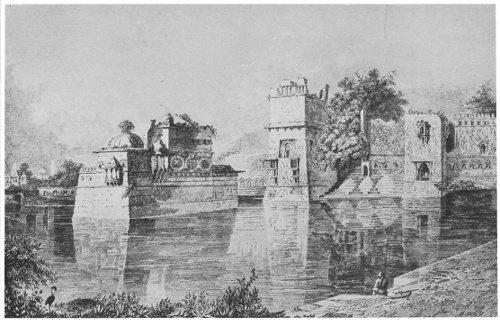
PALACE OF RĀNA BHĪM AND PADMINI.
To face page 312.
—The survivor of Chitor, Rana
Ajaisi, was now in security at Kelwara, a town situated in the
heart of the Aravalli mountains, the western boundary of Mewar,
to which its princes had been indebted for twelve centuries of
dominion. Kelwara is at the highest part of one of its most extensive
valleys, termed the Shero Nala, the richest district of this
Alpine region. Guarded by faithful adherents, Ajaisi cherished
for future occasion the wrecks of Mewar. It was the last behest
of his father that when he attained ‘one hundred years’ (a
figurative expression for dying) the son of Arsi, the elder brother,
should succeed him. This injunction, from the deficiency of the
qualities requisite at such a juncture in his own sons, met a ready
compliance. Hamir was this son, destined to redeem the promise
of the genius of Chitor and the lost honours of his race, and whose
birth and early history fill many a page of their annals. His
313father, Arsi, being out on a hunting excursion in the forest of
Ondua, with some young chiefs of the court, in pursuit of the
boar entered a field of maize, when a female offered to drive out
the game. Pulling one of the stalks of maize, which grows to the
height of ten or twelve feet, she pointed it, and mounting the
platform made to watch the corn, impaled the hog, dragged him
before the hunters, and departed. Though accustomed to feats of
strength and heroism from the nervous arms of their countrywomen,
the act surprised them. They descended to the stream
at hand, and prepared the repast, as is usual, on the spot. The
feast was held, and comments were passing on the fair arm which
had transfixed the boar, when a ball of clay from a sling fractured
a limb of the prince’s steed. Looking in the direction whence
it [268] came, they observed the same damsel, from her elevated
stand,
[10] preserving her fields from aerial depredators; but seeing
the mischief she had occasioned she descended to express her
regret and then returned to her pursuit. As they were proceeding
homewards after the sports of the day, they again encountered
the damsel, with a vessel of milk on her head, and leading
in either hand a young buffalo. It was proposed, in frolic, to
overturn her milk, and one of the companions of the prince
dashed rudely by her; but without being disconcerted, she
entangled one of her charges with the horse’s limbs and brought
the rider to the ground. On inquiry the prince discovered that
she was the daughter of a poor Rajput of the Chandano tribe.
[11]
He returned the next day to the same quarter and sent for her
father, who came and took his seat with perfect independence
close to the prince, to the merriment of his companions, which
was checked by Arsi asking his daughter to wife. They were yet
more surprised by the demand being refused. The Rajput, on
going home, told the more prudent mother, who scolded him
heartily, made him recall the refusal, and seek the prince. They
were married, and Hamir was the son of the Chandano Rajputni.
[12]
314He remained little noticed at the maternal abode till the catastrophe
of Chitor. At this period he was twelve years of age, and had
led a rustic life, from which the necessity of the times recalled him.
—Mewar
was now occupied by the garrisons of Delhi, and Ajaisi
had besides to contend with the mountain chiefs, amongst whom
Munja Balaicha was the most formidable, who had, on a recent
occasion, invaded the Shero Nala, and personally encountered
the Rana, whom he wounded on the head with a lance. The
Rana’s sons, Sajansi and Ajamsi, though fourteen and fifteen, an
age at which a Rajput ought to indicate his future character,
proved of little aid in the emergency. Hamir was summoned,
and accepted the feud against Munja, promising to return successful
or not at all. In a few days he was seen entering the pass of
Kelwara with Munja’s head at his saddle-bow. Modestly placing
the trophy at his uncle’s feet, he exclaimed: “Recognize the
head of your foe!” Ajaisi ‘kissed his beard,’
[13] and observing
that fate had stamped empire on his forehead, impressed [269] it
with a tika of blood from the head of the Balaicha. This decided
the fate of the sons of Ajaisi; one of whom died at Kelwara, and
the other, Sajansi, who might have excited a civil war, was sent
from the country.
[14] He departed for the Deccan, where his issue
was destined to avenge some of the wrongs the parent country
had sustained, and eventually to overturn the monarchy of
Hindustan; for Sajansi was the ancestor of Sivaji, the founder of
the Satara throne, whose lineage
[15] is given in the chronicles of
Mewar.
315—Hamir succeeded in S. 1357
(A.D. 1301), and had sixty-four years granted to him to redeem
his country from the ruins of the past century, which period had
elapsed since India ceased to own the paramount sway of her
native princes. The day on which he assumed the ensigns of rule
he gave, in the tika daur, an earnest of his future energy, which
he signalized by a rapid inroad into the heart of the country of
the predatory Balaicha, and captured their stronghold Pusalia.
We may here explain the nature of this custom of a barbaric
chivalry.
—The tika daur signifies the foray of
inauguration, which obtained from time immemorial on such
events, and is yet maintained where any semblance of hostility
will allow its execution. On the morning of installation, having
previously received the tika of sovereignty, the prince at the head
of his retainers makes a foray into the territory of any one with
whom he may have a feud, or with whom he may be indifferent
as to exciting one; he captures a stronghold or plunders a town,
and returns with the trophies. If amity should prevail with all
around, which the prince cares not to disturb, they have still a
mock representation of the custom. For many reigns after the
Jaipur princes united their fortunes to the throne of Delhi their
frontier town, Malpura, was the object of the tika daur of the
princes of Mewar.
—“When Ajmall
[16] went
another road,” as the bard figuratively describes the demise of
Rana Ajaisi, “the son of Arsi unsheathed the sword, thence never
stranger to his hand.” Maldeo remained with the royal garrison
at Chitor,
[17] but Hamir [270] desolated their plains, and left to his
enemies only the fortified towns which could safely be inhabited.
He commanded all who owned his sovereignty either to quit
their abodes, and retire with their families to the shelter of the
hills on the eastern and western frontiers, or share the fate of the
public enemy. The roads were rendered impassable from his
parties, who issued from their retreats in the Aravalli, the security
316of which baffled pursuit. This destructive policy of laying waste
the resources of their own country, and from this asylum attacking
their foes as opportunity offered, has obtained from the time
of Mahmud of Ghazni in the tenth, to Muhammad, the last
who merited the name of Emperor of Delhi, in the eighteenth
century.
—Hamir made Kelwara
[18] his residence,
which soon became the chief retreat of the emigrants from
the plains. The situation was admirably chosen, being covered
by several ranges, guarded by intricate defiles, and situated at the
foot of a pass leading over the mountain into a still more inaccessible
retreat (where Kumbhalmer now stands),
[19] well watered and
wooded, with abundance of pastures and excellent indigenous
fruits and roots. This tract, above fifty miles in breadth, is
twelve hundred feet above the level of the plains and three thousand
above the sea, with a considerable quantity of arable land,
and free communication to obtain supplies by the passes of the
western declivity from Marwar, Gujarat, or the friendly Bhils,
of the west, to whom this house owes a large debt of gratitude.
On various occasions the communities of Oghna and Panarwa
furnished the princes of Mewar with five thousand bowmen,
supplied them with provisions, or guarded the safety of their
families when they had to oppose the foe in the field. The elevated
plateau of the eastern frontier presented in its forests and
dells many places of security; but Ala
[20] traversed these in person,
destroying as he went: neither did they possess the advantages
of climate and natural productions arising from the elevation of
the other. Such was the state of Mewar: its places of strength
occupied by the foe, cultivation and peaceful objects neglected
from the persevering hostility of Hamir, when a proposal of
marriage came from the Hindu governor of Chitor, which was
immediately accepted, contrary to the [271] wishes of the prince’s
advisers.
—Whether this was intended as a snare
317to entrap him, or merely as an insult, every danger was scouted
by Hamir which gave a chance to the recovery of Chitor. He
desired that ‘
the coco-nut[21] might be retained’ coolly remarking
on the dangers pointed out, "My feet shall at least tread in the
rocky steps in which my ancestors have moved. A Rajput should
always be prepared for reverses; one day to abandon his abode
covered with wounds, and the next to reascend with the
maur
(crown) on his head." It was stipulated that only five hundred
horse should form his suite. As he approached Chitor, the five
sons of the Chauhan advanced to meet him, but on the portal of
the city no toran,
[22] or nuptial emblem, was suspended. He, however,
accepted the unsatisfactory reply to his remark on this
indication of treachery, and ascended for the first time the ramp
of Chitor. He was received in the ancient halls of his ancestors
by Rao Maldeo, his son Banbir, and other chiefs,
with folded
hands. The bride was brought forth, and presented by her father
without any of the solemnities practised on such occasions; ‘the
knot of their garments tied and their hands united,’ and thus they
were left. The family priest recommended patience, and Hamir
318retired with his bride to the apartments allotted for them. Her
kindness and vows of fidelity overcame his sadness upon learning
that he had married a widow. She had been wedded to a chief
of the Bhatti tribe, shortly afterwards slain, and when she was
so young as not to recollect even his appearance. He ceased to
lament the insult when she herself taught him how it might be
avenged, and that it might even lead to the recovery of Chitor.
It is a privilege possessed by the bridegroom to have one specific
favour complied with as a part of the dower (
daeja), and Hamir
was instructed by his bride to ask for Jal, one of the civil [272]
officers of Chitor, and of the Mehta tribe. With his wife so obtained,
and the scribe whose talents remained for trial, he returned
in a fortnight to Kelwara. Khetsi was the fruit of this marriage,
on which occasion Maldeo made over all the hill tracts to Hamir.
Khetsi was a year old when one of the penates (Khetrpal)
[23] was
found at fault, on which she wrote to her parents to invite her to
Chitor, that the infant might be placed before the shrine of the
deity. Escorted by a party from Chitor, with her child she
entered its walls; and instructed by the Mehta, she gained over
the troops who were left, for the Rao had gone with his chief
adherents against the Mers of Madri. Hamir was at hand.
Notice that all was ready reached him at Bagor. Still he met
opposition that had nearly defeated the scheme; but having
forced admission, his sword overcame every obstacle, and the
oath of allegiance (
an) was proclaimed from the palace of his
fathers.
The Sonigira on his return was met with ‘a salute of arabas,’[24]
and Maldeo himself carried the account of his loss to the Khilji
king Mahmud, who had succeeded Ala. The ‘standard of the
sun’ once more shone refulgent from the walls of Chitor, and was
the signal for return to their ancient abodes from their hills and
hiding-places to the adherents of Hamir. The valleys of Kumbhalmer
and the western highlands poured forth their ‘streams of
men,’ while every chief of true Hindu blood rejoiced at the prospect
of once more throwing off the barbarian yoke. So powerful
was this feeling, and with such activity and skill did Hamir follow
up this favour of fortune, that he marched to meet Mahmud,
319who was advancing to recover his lost possessions. The king
unwisely directed his march by the eastern plateau, where numbers
were rendered useless by the intricacies of the country. Of the
three steppes which mark the physiognomy of this tract, from the
first ascent from the plain of Mewar to the descent at Chambal,
the king had encamped on the central, at Singoli, where he was
attacked, defeated, and made prisoner by Hamir, who slew Hari
Singh, brother of Banbir, in single combat. The king suffered a
confinement of three months in Chitor, nor was liberated till he
had surrendered Ajmer, Ranthambor, Nagor, and Sui Sopur,
besides paying fifty lakhs of rupees and one hundred elephants.
Hamir would exact no promise of cessation from further inroads,
but contented himself with assuring him that from such he
should be prepared to defend Chitor, not within, but without the
walls [273].[25]
Banbir, the son of Maldeo, offered to serve Hamir, who assigned
the districts of Nimach, Jiran, Ratanpur, and the Kerar to maintain
the family of his wife in becoming dignity; and as he gave
the grant he remarked: “Eat, serve, and be faithful. You were
once the servant of a Turk, but now of a Hindu of your own faith;
for I have but taken back my own, the rock moistened by the
blood of my ancestors, the gift of the deity I adore, and who will
maintain me in it; nor shall I endanger it by the worship of a
fair face, as did my predecessor.” Banbir shortly after carried
Bhainsror by assault, and this ancient possession guarding the
Chambal was again added to Mewar. The chieftains of Rajasthan
rejoiced once more to see a Hindu take the lead, paid willing
homage, and aided him with service when required.
—Hamir was the sole Hindu
prince of power now left in India: all the ancient dynasties were
320crushed, and the ancestors of the present princes of Marwar and
Jaipur brought their levies, paid homage, and obeyed the summons
of the prince of Chitor, as did the chiefs of Bundi, Gwalior, Chanderi,
Raesin, Sikri, Kalpi, Abu, etc.
Extensive as was the power of Mewar before the Tatar occupation
of India, it could scarcely have surpassed the solidity
of sway which she enjoyed during the two centuries following
Hamir’s recovery of the capital. From this event to the next
invasion from the same Cimmerian abode, led by Babur, we have
a succession of splendid names recorded in her annals, and though
destined soon to be surrounded by new Muhammadan dynasties,
in Malwa and Gujarat as well as Delhi, yet successfully opposing
them all. The distracted state of affairs when the races of Khilji,
Lodi, and Sur alternately struggled for and obtained the seat of
dominion, Delhi, was favourable to Mewar, whose power was
now so consolidated that she not only repelled armies from her
territory, but carried war abroad, leaving tokens of victory at
Nagor, in Saurashtra, and to the walls of Delhi.
—The subjects of Mewar must have enjoyed not
only a long repose, but high prosperity during this period, judging
from their magnificent public works, when a triumphal [274] column
must have cost the income of a kingdom to erect, and which ten
years’ produce of the crown-lands of Mewar could not at this
time defray. Only one of the structures prior to the sack of
Chitor was left entire by Ala, and is yet existing, and this was
raised by private and sectarian hands. It would be curious if the
unitarian profession of the Jain creed was the means of preserving
this ancient relic from Ala’s wrath.
[26] The princes of this house
were great patrons of the arts, and especially of architecture;
and it is a matter of surprise how their revenues, derived chiefly
from the soil, could have enabled them to expend so much on
these objects and at the same time maintain such armies as are
enumerated. Such could be effected only by long prosperity
and a mild, paternal system of government; for the subject had
his monuments as well as the prince, the ruins of which may yet
be discovered in the more inaccessible or deserted portions of
Rajasthan. Hamir died full of years, leaving a name still
321honoured in Mewar, as one of the wisest and most gallant of her
princes, and bequeathing a well-established and extensive power
to his son.
—Khetsi succeeded in
S. 1421 (
A.D. 1365) to the power and to the character of his father.
He captured Ajmer and Jahazpur from Lila Pathan, and reannexed
Mandalgarh, Dasor, and the whole of Chappan (for the first
time) to Mewar. He obtained a victory over the Delhi monarch
Humayun
[27] at Bakrol; but unhappily his life terminated in a
family broil with his vassal, the Hara chief of Bumbaoda, whose
daughter he was about to espouse.
—Lakha Rana, by this assassination,
mounted the throne in Chitor in S. 1439 (
A.D. 1373). His first act
was the entire subjugation of the mountainous region of Merwara,
and the destruction of its chief stronghold, Bairatgarh, where he
erected Badnor. But an event of much greater importance than
settling his frontier, and which most powerfully tended to the
prosperity of the country, was the discovery of the tin and silver
mines of Jawara, in the tract wrested by Khetsi from the Bhils
of Chappan.
[28] Lakha Rana has the merit of having first worked
them, though their existence is superstitiously alluded to so early
as the period of the founder. It is said the ‘seven metals’ (
haft-dhat)
[29]
were formerly [275] abundant; but this appears figurative.
We have no evidence for the gold, though silver, tin,
copper, lead, and antimony were yielded in abundance (the first
two from the same matrix), but the tin that has been extracted
for many years past yields but a small portion of silver.
[30] Lakha
Rana defeated the Sankhla Rajputs of Nagarchal,
[31] at Amber.
He encountered the emperor Muhammad Shah Lodi, and on one
322occasion defeated a royal army at Badnor; but he carried the
war to Gaya, and in driving the barbarian from this sacred place
was slain.
[32] Lakha is a name of celebrity, as a patron of the arts
and benefactor of his country. He excavated many reservoirs
and lakes, raised immense ramparts to dam their waters, besides
erecting strongholds. The riches of the mines of Jawara were
expended to rebuild the temples and palaces levelled by Ala. A
portion of his own palace yet exists, in the same style of architecture
as that, more ancient, of Ratna and the fair Padmini;
and a minster (
mandir) dedicated to the creator (Brahma), an
enormous and costly fabric, is yet entire. Being to ‘the One,’
and consequently containing no idol, it may thus have escaped the
ruthless fury of the invaders.
Lakha had a numerous progeny, who have left their clans
called after them, as the Lunawats and Dulawats, now the sturdy
allodial proprietors of the Alpine regions bordering on Oghna,
Panarwa, and other tracts in the Aravalli.[33] But a circumstance
which set aside the rights of primogeniture, and transferred the
crown of Chitor from his eldest son, Chonda, to the younger,
Mokal, had nearly carried it to another line. The consequences
of making the elder branch a powerful vassal clan with claims to
the throne, and which have been the chief cause of its subsequent
prostration, we will reserve for another chapter [276].
If devotion to the fair sex be admitted as a criterion of civilization,
the Rajput must rank high. His susceptibility is extreme,
and fires at the slightest offence to female delicacy, which he
never forgives. A satirical impromptu, involving the sacrifice
323of Rajput prejudices, dissolved the coalition of the Rathors and
Kachhwahas, and laid each prostrate before the Mahrattas, whom
when united they had crushed: and a jest, apparently trivial,
compromised the right of primogeniture to the throne of Chitor,
and proved more disastrous in its consequences than the arms
either of Moguls or Mahrattas.
—Lakha Rana was advanced
in years, his sons and grandsons established in suitable domains,
when ‘the coco-nut came’ from Ranmall, prince of Marwar, to
affiance his daughter with Chonda, the heir of Mewar. When
the embassy was announced, Chonda was absent, and the old
chief was seated in his chair of state surrounded by his court.
The messenger of Hymen was courteously received by Lakha,
who observed that Chonda would soon return and take the gage;
“for,” added he, drawing his fingers over his moustaches, “I
don’t suppose you send such playthings to an old greybeard like
me.” This little sally was of course applauded and repeated;
but Chonda, offended at delicacy being sacrificed to wit, declined
accepting the symbol which his father had even in jest supposed
might be intended for him: and as it could not be returned
without gross insult to Ranmall, the old Rana, incensed at his
son’s obstinacy, agreed to accept it himself, provided Chonda
would swear to renounce his birthright in the event of his having
a son, and be to the child but the ‘first of his Rajputs.’ He
swore by Eklinga to fulfil his father’s wishes.
—Mokalji was the issue of this
union, and had attained the age of five when the Rana resolved
to signalize his finale by a raid against the enemies of their faith
[277], and to expel the ‘barbarian’ from the holy land of Gaya.
In ancient times this was by no means uncommon, and we have
several instances in the annals of these States of princes resigning
‘the purple’ on the approach of old age, and by a life of austerity
and devotion, pilgrimage and charity, seeking to make their
peace with heaven “for the sins inevitably committed by all who
wield a sceptre.” But when war was made against their religion
by the Tatar proselytes to Islam, the Sutlej and the Ghaggar
were as the banks of the Jordan—Gaya, their Jerusalem, their
holy land; and if there destiny filled his cup, the Hindu chieftain
was secure of beatitude,
[1] exempted from the troubles of ‘second
324birth’;
[2] and borne from the scene of probation in celestial cars
by the Apsaras,
[3] was introduced at once into the ‘realm of the
sun.’
[4] Ere, however, the Rana of Chitor journeyed to this
bourne, he was desirous to leave his throne unexposed to civil
strife. The subject of succession had never been renewed; but
discussing with Chonda his warlike pilgrimage to Gaya, from
which he might not return, he sounded him by asking what estates
should be settled on Mokal. “The throne of Chitor,” was the
honest reply; and to set suspicion at rest, he desired that the ceremony
of installation should be performed previous to Lakha’s
departure. Chonda was the first to pay homage and swear obedience
and fidelity to his future sovereign: reserving, as the recompense
of his renunciation, the first place in the councils, and
stipulating that in all grants to the vassals of the crown, his
symbol (the lance) should be superadded to the autograph of the
prince. In all grants the lance of Salumbar
[5] still precedes the
monogram of the Rana.
[6]The sacrifice of Chonda to offended delicacy and filial respect
was great, for he had all the qualities requisite for command.
Brave, frank, and skilful, he conducted all public affairs after his
father’s departure and death, to the benefit of the minor and the
State. The queen-mother, however, who is admitted as the
natural guardian of her infant’s rights on all such occasions, felt
umbrage and discontent at her loss of power; forgetting that,
but for Chonda, she would never [278] have been mother to the
Rana of Mewar. She watched with a jealous eye all his proceedings;
but it was only through the medium of suspicion she could
accuse the integrity of Chonda, and she artfully asserted that,
under colour of directing state affairs, he was exercising absolute
sovereignty, and that if he did not assume the title of Rana, he
would reduce it to an empty name. Chonda, knowing the purity
of his own motives, made liberal allowance for maternal solicitude;
but upbraiding the queen with the injustice of her suspicions,
325and advising a vigilant care to the rights of Sesodias, he retired
to the court of Mandu, then rising into notice, where he was
received with the highest distinctions, and the district of Halar[7]
was assigned to him by the king.
—His departure was the signal for
an influx of the kindred of the queen from Mandor. Her brother
Jodha (who afterwards gave his name to Jodhpur) was the first,
and was soon followed by his father, Rao Ranmall, and numerous
adherents, who deemed the arid region of Maru-des, and its rabri,
or maize porridge, well exchanged for the fertile plains and
wheaten bread of Mewar.
—With his grandson on his knee,
the old Rao “would sit on the throne of Bappa Rawal, on whose
quitting him for play, the regal ensigns of Mewar waved over the
head of Mandor.” This was more than the Sesodia nurse
[8] (an
important personage in all Hindu governments) could bear, and
bursting with indignation, she demanded of the queen if her kin
was to defraud her own child of his inheritance. The honesty of
the nurse was greater than her prudence. The creed of the Rajput
is to ‘obtain sovereignty,’ regarding the means as secondary
and this avowal of her suspicions only hastened their designs.
The queen soon found herself without remedy, and a remonstrance
to her father produced a hint which threatened the existence of her
offspring. Her fears were soon after augmented by the assassination
of Raghudeva, the second brother of Chonda, whose estates
were Kelwara and Kawaria. To the former place, where he
resided aloof from the court, Rao Ranmall sent a dress of honour,
which etiquette requiring him to put on when presented, the
prince was assassinated in the act. Raghudeva was so much
beloved for his virtues, courage, and manly beauty, that his [279]
murder became martyrdom, and obtained for him divine honours,
and a place amongst the
Di Patres (
Pitrideva) of Mewar. His
image is on every hearth, and is daily worshipped with the
Penates. Twice in the year his altars receive public homage
from every Sesodia, from the Rana to the serf.
[9]326—In this extremity the
queen-mother turned her thoughts to Chonda, and it was not
difficult to apprise him of the danger which menaced the race,
every place of trust being held by her kinsmen, and the principal
post of Chitor by a Bhatti Rajput of
Jaisalmer.Jaisalmer. Chonda, though
at a distance, was not inattentive to the proverbially dangerous
situation of a minor amongst the Rajputs. At his departure he
was accompanied by two hundred Aherias or huntsmen, whose
ancestors had served the princes of Chitor from ancient times.
These had left their families behind, a visit to whom was the
pretext for their introduction to the fort. They were instructed
to get into the service of the keepers of the gates, and, being
considered more attached to the place than to the family, their
object was effected. The queen-mother was counselled to cause
the young prince to descend daily with a numerous retinue to give
feasts to the surrounding villages, and gradually to increase the
distance, but not to fail on the ‘festival of lamps’
[10] to hold the
feast (
got) at Gosunda.
[11]
These injunctions were carefully attended to. The day
arrived, the feast was held at Gosunda; but the night was
closing in, and no Chonda appeared. With heavy hearts the
nurse, the Purohit,[12] and those in the secret moved homeward,
and had reached the eminence called Chitori, when forty horsemen
passed them at the gallop, and at their head Chonda in disguise,
who by a secret sign paid homage as he passed to his younger
327brother and sovereign. Chonda and [280] his band had reached
the Rampol,[13] or upper gate, unchecked. Here, when challenged,
they said they were neighbouring chieftains, who, hearing of the
feast at Gosunda, had the honour to escort the prince home.
The story obtained credit; but the main body, of which this was
but the advance, presently coming up, the treachery was apparent.
Chonda unsheathed his sword, and at his well-known shout the
hunters were speedily in action. The Bhatti chief, taken by
surprise, and unable to reach Chonda, launched his dagger at and
wounded him, but was himself slain; the guards at the gates
were cut to pieces, and the Rathors hunted out and killed without
mercy.
—The end of Rāo Ranmall was more
ludicrous than tragical. Smitten with the charms of a Sesodia
handmaid of the queen, who was compelled to his embrace, the
old chief was in her arms, intoxicated with love, wine, and opium,
and heard nothing of the tumult without. A woman’s wit and
revenge combined to make his end afford some compensation for
her loss of honour. Gently rising, she bound him to his bed with
his own Marwari turban:
[14] nor did this disturb him, and the
messengers of fate had entered ere the opiate allowed his eyes to
open to a sense of his danger. Enraged, he in vain endeavoured
to extricate himself; and by some tortuosity of movement he
got upon his legs, his pallet at his back like a shell or shield of
defence. With no arms but a brass vessel of ablution, he levelled
to the earth several of his assailants, when a ball from a matchlock
extended him on the floor of the palace. His son Jodha was in
the lower town, and was indebted to the fleetness of his steed for
escaping the fate of his father and kindred, whose bodies strewed
the
terre-pleine of Chitor, the merited reward of their usurpation
and treachery.
—But Chonda’s revenge was not yet
satisfied. He pursued Rao Jodha, who, unable to oppose him,
took refuge with Harbuji Sankhla, leaving Mandor to its fate.
This city Chonda entered by surprise, and holding it till his sons
Kantatji and Manjaji arrived with reinforcements, the Rathor
treachery was repaid by their keeping possession of the capital
during twelve years. We might here leave the future founder
328of Jodhpur, had not this feud led to the junction of the rich [281]
province of Godwar to Mewar, held for three centuries and again
lost by treachery. It may yet involve a struggle between the
Sesodias and Rathors.
[15]“Sweet are the uses of adversity.” To Jodha it was the first
step in the ladder of his eventual elevation. A century and a
half had scarcely elapsed since a colony, the wreck of Kanauj,
found an asylum, and at length a kingdom, taking possession of
one capital and founding another, abandoning Mandor and
erecting Jodhpur. But even Jodha could never have hoped that
his issue would have extended their sway from the valley of the
Indus to within one hundred miles of the Jumna, and from the
desert bordering on the Sutlej to the Aravalli mountains: that
one hundred thousand swords should at once be in the hands of
Rathors, ‘the sons of one father’ (ek Bap ke Betan).
If we slightly encroach upon the annals of Marwar, it is owing
to its history and that of Mewar being here so interwoven, and
the incidents these events gave birth so illustrative of the national
character of each, that it is, perhaps, more expedient to advert
to the period when Jodha was shut out from Mandor, and the
means by which he regained that city, previous to relating the
events of the reign of Mokal.
—Harbuji Sankhla, at once a soldier and a
devotee, was one of those Rajput cavaliers ‘
sans peur et sans
reproche,’ whose life of celibacy and perilous adventure was
mingled with the austere devotion of an ascetic; by turns aiding
with his lance the cause which he deemed worthy, or exercising
an unbounded hospitality towards the stranger. This generosity
had much reduced his resources when Jodha sought his protection.
It was the eve of the
Sada-bart, one of those hospitable rites which,
in former times, characterized Rajwara. This ‘perpetual charity’
supplies food to the stranger and traveller, and is distributed not
only by individual chiefs and by the government, but by subscriptions
of communities. Even in Mewar, in her present
impoverished condition, the offerings to the gods in support of
their shrines and the establishment of the
Sada-bart were simultaneous.
Hospitality is a virtue pronounced to belong more
peculiarly to a semi-barbarous condition. Alas! for refinement
329and ultra-civilization, strangers to the happiness enjoyed by
Harbuji Sankhla. Jodha, with one hundred and twenty followers,
came to solicit the ‘stranger’s fare’: but unfortunately it was
too late, the
Sada-bart had been distributed. In this exigence,
Harbuji recollected that there was a wood [282] called
mujd,
[16]
used in dyeing, which among other things in the desert regions
is resorted to in scarcity. A portion of this was bruised, and
boiled with some flour, sugar, and spices, making altogether a
palatable pottage; and with a promise of better fare on the
morrow, it was set before the young Rao and his followers, who,
after making a good repast, soon forgot Chitor in sleep. On
waking, each stared at his fellow, for their mustachios were dyed
with their evening’s meal; but the old chief, who was not disposed
to reveal his expedient, made it minister to their hopes by giving
it a miraculous character, and saying “that as the grey of age
was thus metamorphosed into the tint of morn
[17] and hope, so
would their fortunes become young, and Mandor again be theirs.”
Elevated by this prospect, they enlisted Harbuji on their side.
He accompanied them to the chieftain of Mewa, “whose stables
contained one hundred chosen steeds.” Pabuji, a third independent
of the same stamp, with his ‘coal-black steed,’ was
gained to the cause, and Jodha soon found himself strong enough
to attempt the recovery of his capital. The sons of Chonda were
taken by surprise: but despising the numbers of the foe, and
ignorant who were their auxiliaries, they descended sword in
hand to meet the assailants. The elder[18] son of Chonda with
330many adherents was slain; and the younger, deserted by the
subjects of Mandor, trusted to the swiftness of his horse for
escape; but being pursued, was overtaken and killed on the
boundary of Godwar. Thus Jodha, in his turn, was revenged,
but the ‘feud was not balanced.’ Two sons of Chitor had
fallen for one chief of Mandor. But wisely reflecting on the
original aggression, and the superior power of Mewar, as well as
his being indebted for his present success to foreign aid, Jodha
sued for peace, and offered as the mundkati, or ‘price of blood,’
and ‘to quench the feud,’ that the spot where Manja fell should
be the future barrier of the two States. The entire province of
Godwar was comprehended in the cession, which for three centuries
withstood every contention, till the internal dissensions
of the last half century, which grew out of the cause by which [283]
it was obtained, and the change of succession in Mewar severed
this most valuable acquisition.[19]
Who would imagine, after such deadly feuds between these
rival States, that in the very next succession these hostile frays
were not only buried in oblivion, but that the prince of Marwar
abjured ‘his turban and his bed’ till he had revenged the
assassination of the prince of Chitor, and restored his infant heir
to his rights? The annals of these States afford numerous
instances of the same hasty, overbearing temperament governing
all; easily moved to strife, impatient of revenge, and steadfast
in its gratification. But this satisfied, resentment subsides. A
daughter of the offender given to wife banishes its remembrance,
and when the bard joins the lately rival names in the couplet,
each will complacently curl his mustachio over his lip as he hears
his ‘renown expand like the lotus,’ and thus ‘the feud is
extinguished.’ Thus have they gone on from time immemorial,
and will continue, till what we may fear to contemplate. They
have now neither friend nor foe but the British. The Tatar
invader sleeps in his tomb, and the Mahratta depredator is
muzzled and enchained. To return.
331—Mokal, who obtained the throne by
Chonda’s surrender of his birthright, was not destined long to
enjoy the distinction, though he evinced qualities worthy of
heading the Sesodias. He ascended the throne in S. 1454 (
A.D.
1398), at an important era in the history of India; when Timur,
who had already established the race of Chagatai in the kingdoms
of Central Asia, and laid prostrate the throne of Byzantium,
turned his arms towards India. But it was not a field for his
ambition; and the event is not even noticed in the annals of
Mewar: a proof that it did not affect their repose. But they
record an attempted invasion by the king of Delhi, which is
erroneously stated to have been by Firoz Shah. A grandson of
this prince had indeed been set up, and compelled to flee from
the arms of Timur, and as the direction of his flight was Gujarat,
it is not unlikely that the recorded attempt to penetrate by the
passes of Mewar may have been his [284]. Be this as it may,
the Rana Mokal anticipated and met him beyond the passes
of the Aravalli, in the field of Raepur, and compelled him to
abandon his enterprise. Pursuing his success, he took possession
of Sambhar and its salt lakes, and otherwise extended and
strengthened his territory, which the distracted state of the
empire consequent to Timur’s invasion rendered a matter of
little difficulty. Mokal finished the palace commenced by
Lakha, now a mass of ruins; and erected the shrine of Chaturbhuja,
‘the four-armed deity,’
[20] in the western hills.
—Besides three sons, Rana Mokal had a daughter,
celebrated for her beauty, called Lal Bai, or ‘the ruby.’ She
was betrothed to the Khichi chieftain of Gagraun, who at the
Hathleva
[21] demanded the pledge of succour on foreign invasion.
Dhiraj, the son of the Khichi, had come to solicit the stipulated
aid against Hoshang of Malwa, who had invested their capital.
The Rana’s headquarters were then at Madri, and he was employed
in quelling a revolt of the mountaineers, when Dhiraj
arrived and obtained the necessary aid. Madri was destined to be
the scene of the termination of Mokal’s career: he was assassinated
by his uncles, the natural brothers of his father, from an unintentional
offence, which tradition has handed down in all its details.
332—Chacha and Mera were the
natural sons of Khetsi Rana (the predecessor of Lakha); their
mother a fair handmaid of low descent, generally allowed to be a
carpenter’s daughter. ‘The fifth sons of Mewar’ (as the natural
children are figuratively termed) possess no rank, and though
treated with kindness, and entrusted with confidential employments,
the sons of the chiefs of the second class take precedence
of them, and ‘sit higher on the carpet.’ These brothers had the
charge of seven hundred horse in the train of Rana Mokal at
Madri. Some chiefs at enmity with them, conceiving that they
had overstepped their privileges, wished to see them humiliated.
Chance procured them the opportunity: which, however, cost
their prince his life. Seated in a grove with his chiefs around
him, he inquired the name of a particular tree. The Chauhan
chief, feigning ignorance, whispered him to ask either of the
brothers; and not perceiving their scope, he artlessly did so.
“Uncle, what tree is this?” The sarcasm thus prompted they
considered as reflecting on their birth (being sons [285] of the
carpenter’s daughter), and the same day, while Mokal was at
his devotions, and in the act of counting his rosary, one blow
severed his arm from his body, while another stretched him
lifeless. The brothers, quickly mounting their steeds, had the
audacity to hope to surprise Chitor, but the gates were closed
upon them.
—Though the murder of Mokal
is related to have no other cause than the sarcasm alluded to,
the precautions taken by the young prince Kumbha,
[22] his successor,
would induce a belief that this was but the opening of a
deep-laid conspiracy. The traitors returned to the stronghold
near Madri, and Kumbha trusted to the friendship and good
feeling of the prince of Marwar in this emergency. His confidence
was well repaid. The prince put his son at the head of a force,
and the retreat of the assassins being near his own frontier, they
were encountered and dislodged. From Madri they fled to Pai,
where they strengthened a fortress in the mountains named
Ratakot; a lofty peak of the compound chain which encircles
Udaipur, visible from the surrounding country, as are the remains
of this stronghold of the assassins. It would appear that their
333lives were dissolute, for they had carried off the virgin daughter
of a Chauhan, which led to their eventual detection and punishment.
Her father, Suja, had traced the route of the ravishers,
and, mixing with the workmen, found that the approaches to the
place of their concealment were capable of being scaled. He
was about to lay his complaint before his prince, when he met the
cavalcade of Kumbha and the Rathor. The distressed father,
‘covering his face,’ disclosed the story of his own and daughter’s
dishonour. They encamped till night at Delwara, when, led by
the Chandana, they issued forth to surprise the authors of so
many evils.
—Arrived at the base of the rock, where
the parapet was yet low, they commenced the escalade, aided
by the thick foliage. The path was steep and rugged, and in the
darkness of the night each had grasped his neighbour’s skirt for
security. Animated by a just revenge, the Chauhan (Suja) led
the way, when on reaching a ledge of the rock the glaring eyeballs
of a tigress flashed upon him. Undismayed, he squeezed the
hand of the Rathor prince who followed him, and who on perceiving
the object of terror instantly buried his poignard in her
heart. This omen was superb. They soon reached the summit.
Some had ascended the parapet; others were scrambling over,
when the minstrel [286] slipping, fell, and his drum, which was to
have accompanied his voice in singing the conquest, awoke by
its crash the daughter of Chacha. Her father quieted her fears
by saying it was only “the thunder and the rains of Bhadon”:
to fear God only and go to sleep, for their enemies were safe at
Kelwa. At this moment the Rao and his party rushed in.
Chacha and Mera had no time to avoid their fate. Chacha was
cleft in two by the Chandana, while the Rathor prince laid Mera
at his feet, and the spoils of Ratakot were divided among the
assailants.
—Kumbha succeeded his father
in S. 1475 (
A.D. 1419);
[1] nor did any symptom of dissatisfaction
334appear to usher in his reign, which was one of great success
amidst no common difficulties. The bardic historians
[2] do as
much honour to the Marwar prince, who had made common
cause with their sovereign in revenging the death of his father,
as if it had involved the security of his crown; but this was a
precautionary measure of the prince, who was induced thus to
act from several motives, and, above all, in accordance with
usage, which stigmatizes the refusal of aid when demanded:
besides ‘Kumbha was the nephew of Marwar.’
It has rarely occurred in any country to have possessed successively
so many energetic princes as ruled Mewar through
several centuries. She was now in the middle path of her glory,
and enjoying the legitimate triumph of seeing the foes of her
religion captives on the rock of her power. A century had
elapsed since the bigot Ala had wreaked his vengeance on the
different monuments of art. Chitor had recovered the sack, and
new defenders had sprung up in the place [287] of those who had
fallen in their ‘saffron robes,’ a sacrifice for her preservation.
All that was wanting to augment her resources against the
storms which were collecting on the brows of Caucasus and the
shores of the Oxus, and were destined to burst on the head of his
grandson Sanga, was effected by Kumbha; who with Hamir’s
energy, Lakha’s taste for the arts, and a genius comprehensive
as either and more fortunate, succeeded in all his undertakings,
and once more raised the ‘crimson banner’ of Mewar upon the
banks of the Ghaggar, the scene of Samarsi’s defeat. Let us
contrast the patriarchal Hindu governments of this period with
the despotism of the Tatar invader.
From the age of Shihabu-d-din, the conqueror of India, and
his contemporary Samarsi, to the time we have now reached,
two entire dynasties, numbering twenty-four emperors and one
empress, through assassination, rebellion, and dethronement,
had followed in rapid succession, yielding a result of only nine
years to a reign. Of Mewar, though several fell in defending
their altars at home or their religion abroad, eleven princes
suffice to fill the same period.
It was towards the close of the Khilji dynasty that the satraps
335of Delhi shook off its authority and established subordinate
kingdoms: Bijapur and Golkonda in the Deccan; Malwa,
Gujarat, Jaunpur in the east; and even Kalpi had its king.
Malwa and Gujarat had attained considerable power when
Kumbha ascended the throne. In the midst of his prosperity
these two States formed a league against him, and in S. 1496
(A.D. 1440) both kings, at the head of powerful armies, invaded
Mewar. Kumbha met them on the plains of Malwa bordering
on his own State, and at the head of one hundred thousand horse
and foot and fourteen hundred elephants, gave them an entire
defeat, carrying captive to Chitor Mahmud the Khilji sovereign
of Malwa.
Abu-l Fazl relates this victory, and dilates on Kumbha’s
greatness of soul in setting his enemy at liberty, not only without
ransom but with gifts.[3] Such is the character of the Hindu: a
mixture of arrogance, political blindness, pride, and generosity.
To spare a prostrate foe is the creed of the Hindu cavalier, and
he carries all such maxims to excess. The annals, however, state
that Mahmud was confined six months in Chitor; and that the
trophies of conquest were retained we have evidence from Babur,
who mentions receiving from the son of his opponent, Sanga, the
crown of the Malwa king.
—But there is a more durable [288]
monument than this written record of victory: the triumphal
pillar in Chitor, whose inscriptions detail the event, “when,
shaking the earth, the lords of Gujarkhand and Malwa, with
armies overwhelming as the ocean, invaded Medpat.” Eleven
years after this event Kumbha laid the foundations of this
column, which was completed in ten more: a period apparently
too short to place “this ringlet on the brow of Chitor, which
makes her look down upon Meru with derision.” We will leave
it, with the aspiration that it may long continue a monument of
the fortune of its founders.
[4]It would appear that the Malwa king afterwards united his
336arms with Kumbha, as, in a victory gained over the imperial
forces at Jhunjhunu, when ‘he planted his standard in Hissar,’
the Malwa troops were combined with those of Mewar. The
imperial power had at this period greatly declined: the Khutba
was read in the mosques in the name of Timur, and the Malwa
king had defeated, single-handed, the last Ghorian sultan of
Delhi.
—Of eighty-four fortresses for the
defence of Mewar, thirty-two were erected by Kumbha. Inferior
only to Chitor is that stupendous work called after him Kumbhalmer,
[5]
‘the hill of Kumbha,’ from its natural position, and
the works he raised, impregnable to a native army. These works
were on the site of a more ancient fortress, of which the mountaineers
long held possession. Tradition ascribes it to Samprati
Raja, a Jain prince in the second century, and a descendant of
Chandragupta;
[6] and the ancient Jain temples appear to confirm
the tradition. When Kumbha captured Nagor he brought away
the gates, with the statue of the god Hanuman, who gives his
name to the gate which he still guards. He also erected a citadel
on a peak of Abu, within the fortress of the ancient Pramara,
where he often resided. Its magazine and alarm-tower still
bear Kumbha’s name; and in a rude temple the bronze effigies
of Kumbha and his father still receive divine honours.
[7] Centuries
have passed since the princes of Mewar had influence here, but
the incident marks the vivid remembrance of their condition.
He fortified the passes between the western frontier and Abu,
and erected the fort Vasanti near the present Sirohi, and that of
Machin, to defend the Shero Nala and Deogarh against the Mers
of Aravalli. He re-established Ahor and other smaller [289]
forts to overawe the Bhumia
[8] Bhil of Jharol and Panarwa, and
defined the boundaries of Marwar and Mewar.
—Besides these monuments of his genius, two consecrated
to religion have survived: that of Kumbha Sham, on
Abu, which, though worthy to attract notice elsewhere, is here
eclipsed by a crowd of more interesting objects; the other, one
337of the largest edifices existing, cost upwards of a million sterling,
towards which Kumbha contributed eighty thousand pounds.
It is erected in the Sadri pass leading from the western descent
of the highlands of Mewar, and is dedicated to Rishabhadeva.
[9]
Its secluded position has preserved it from bigoted fury, and its
only visitants now are the wild beasts who take shelter in its
sanctuary. Kumbha Rana was also a poet: but in a far more
elevated strain than the troubadour princes, his neighbours, who
contented themselves with rehearsing their own prowess or
celebrating their lady’s beauty. He composed a
tika, or appendix
to the ‘Divine Melodies,’
[10] in praise of Krishna. We can pass
no judgment on these inspirations of the royal bard, as we are
ignorant whether any are preserved in the records of the house:
a point his descendant, who is deeply skilled in such lore, might
probably answer.
—Kumbha married a daughter of the Rathor of
Merta, the first of the clans of Marwar. Mira Bai
[11] was the most
celebrated princess of her time for beauty and romantic piety.
Her compositions were numerous, though better known to the
worshippers of the Hindu Apollo than to the ribald bards. Some
of her odes and hymns to the deity are preserved and admired.
Whether she imbibed her poetic piety from her husband, or
338whether from her he caught the sympathy which produced the
‘sequel to the songs of Govinda,’ we cannot determine. Her
history is a romance, and her excess of devotion at every shrine
of the favourite deity with the fair of Hind, from the Yamuna to
‘the world’s end,’
[12] gave rise to many [290] tales of scandal.
Kumbha mixed gallantry with his warlike pursuits. He carried
off the daughter of the chief of Jhalawar, who had been betrothed
to the prince of Mandor: this renewed the old feud, and the
Rathor made many attempts to redeem his affianced bride. His
humiliation was insupportable, when through the purified atmosphere
of the periodical rains “the towers of Kumbhalmer became
visible from the castle of Mandor, and the light radiated from the
chamber of the fair through the gloom of a night in Bhadon,
[13] to
the hall where he brooded o’er his sorrows.” It was surmised
that this night-lamp was an understood signal of the Jhalani,
who pined at the decree which ambition had dictated to her
father, in consigning her to the more powerful rival of her affianced
lord. The Rathor exhausted every resource to gain access to the
fair, and had once nearly succeeded in a surprise by escalade,
having cut his way in the night through the forest in the western
and least guarded acclivity: but, as the bard equivocally remarks,
"though he cut his way through the
jhal (brushwood), he could
not reach the
Jhalani."
—Kumbha had
occupied the throne half a century; he had triumphed over the
enemies of his race, fortified his country with strongholds, embellished
it with temples, and with the superstructure of her fame
had laid the foundation of his own—when, the year which should
have been a jubilee was disgraced by the foulest blot in the annals;
and his life, which nature was about to close, terminated by the
poignard of an assassin—that assassin, his son!
—This happened in S. 1525 (
A.D. 1469).
Uda was the name of the parricide, whose unnatural ambition,
and impatience to enjoy a short lustre of sovereignty, bereft of
life the author of his existence. But such is the detestation
which marks this unusual crime that, like that of the Venetian
traitor, his name is left a blank in the annals, nor is Uda known
but by the epithet
Hatyara, ‘the murderer.’ Shunned by his
kin, and compelled to look abroad for succour to maintain him
339on the throne polluted by his crime, Mewar in five years of
illegitimate rule lost half the consequence which had cost so many
to acquire. He made the Deora prince independent in Abu, and
bestowed Sambhar, Ajmer, and adjacent districts on the prince
of Jodhpur
[14] as the price of his friendship. But, a prey to remorse,
he felt that he [291] could neither claim regard from, nor
place any dependence upon, these princes, though he bribed them
with provinces. He humbled himself before the king of Delhi,
offering him a daughter in marriage to obtain his sanction to his
authority; “but heaven manifested its vengeance to prevent
this additional iniquity, and preserve the house of Bappa Rawal
from dishonour.” He had scarcely quitted the divan (
diwankhana),
on taking leave of the king, when a flash of lightning
struck the
Hatyara to the earth, whence he never arose.
[15] The
bards pass over this period cursorily, as one of their race was the
instrument of Uda’s crime.
—There has always been a jealousy
between the Mangtas, as they term all classes ‘who extend the
palm,’ whether Brahmans, Yatis, Charans, or Bhats; but since
Hamir, the Charan influence had far eclipsed the rest. A Brahman
astrologer predicted Kumbha’s death through a Charan, and as
the class had given other cause of offence, Kumbha banished
the fraternity his dominions, resuming all their lands: a strong
measure in those days, and which few would have had nerve to
attempt or firmness to execute. The heir-apparent, Raemall,
who was exiled to Idar for what his father deemed an impertinent
curiosity,
[16] had attached one of these bards to his suite, whose
ingenuity got the edict set aside, and his race restored to their
lands and the prince’s favour. Had they taken off the Brahman’s
head, they might have falsified the prediction which unhappily
was too soon fulfilled.
[17]340—Raemall succeeded in S. 1530
(A.D. 1474) by his own valour to the seat of Kumbha. He had
fought and defeated the usurper, who on this occasion fled to the
king of Delhi and offered him a daughter of Mewar. After his
death in the manner described, the Delhi monarch, with Sahasmall
[292] and Surajmall, sons of the parricide, invaded Mewar, encamping
at Siarh, now Nathdwara. The chiefs were faithful to their
legitimate prince, Raemall, and aided by his allies of Abu and
Girnar, at the head of fifty-eight thousand horse and eleven
thousand foot, he gave battle to the pretender and his imperial
ally at Ghasa. The conflict was ferocious. ‘The streams ran
blood,’ for the sons of the usurper were brave as lions; but the
king was so completely routed that he never again entered Mewar.
Raemall bestowed one daughter on Surji (Yadu), the chief of
Girnar; and another on the Deora, Jaimall of Sirohi, confirming
his title to Abu as her dower. He sustained the warlike reputation
of his predecessors, and carried on interminable strife with
Ghiyasu-d-din of Malwa, whom he defeated in several pitched
battles, to the success of which the valour of his nephews, whom
he had pardoned, mainly contributed. In the last of these
encounters the Khilji king sued for peace, renouncing the pretensions
he had formerly urged.[18] The dynasty of Lodi next
enjoyed the imperial bauble, and with it Mewar had to contest
her northern boundary.
—Raemall had three sons, celebrated
341in the annals of Rajasthan: Sanga, the competitor of Babur,
Prithiraj, the Rolando of his age, and Jaimall. Unhappily for
the country and their father’s repose, fraternal affection was
discarded for deadly hate, and their feuds and dissensions were a
source of constant alarm. Had discord not disunited them, the
reign of Raemall would have equalled any of his predecessors.
As it was, it presented a striking contrast to them: his two elder
sons banished; the first, Sanga, self-exiled from perpetual fear
of his life, and Prithiraj, the second, from his turbulence; while
the youngest, Jaimall, was slain through his intemperance. A
sketch of these feuds will present a good picture of the Rajput
character, and their mode of life when their arms were not required
against their country’s foes.
Sanga[19] and Prithiraj were the offspring of the Jhali queen;
Jaimall was by another mother. What moral influence the name
he bore had on Prithiraj we can surmise only from his actions,
which would stand comparison with those of his prototype [293]
the Chauhan of Delhi, and are yet the delight of the Sesodia.
When they assemble at the feast after a day’s sport, or in a sultry
evening spread the carpet on the terrace to inhale the leaf or take
a cup of kusumbha,[20] a tale of Prithiraj recited by the bard is the
highest treat they can enjoy. Sanga, the heir-apparent, was a
contrast to his brother. Equally brave, his courage was tempered
by reflection; while Prithiraj burned with a perpetual thirst for
action, and often observed “that fate must have intended him
to rule Mewar.” The three brothers, with their uncle, Surajmall,
were one day discussing these topics, when Sanga observed that,
though heir to ‘the ten thousand towns’ of Mewar, he would
waive his claims, and trust them, as did the Roman brothers, to
the omen which should be given by the priestess of Charani Devi
at Nahra Magra,[21] the ‘Tiger’s Mount.’ They repaired to her
abode. Prithiraj and Jaimall entered first, and seated themselves
on a pallet: Sanga followed and took possession of the panther
hide of the prophetess; his uncle, Surajmall, with one knee
resting thereon. Scarcely had Prithiraj disclosed their errand,
when the sibyl pointed to the panther-hide[22] as the decisive omen
342of sovereignty to Sanga, with a portion to his uncle. They received
the decree as did the twins of Rome. Prithiraj drew his
sword and would have falsified the omen, had not Surajmall
stepped in and received the blow destined for Sanga, while the
prophetess fled from their fury. Surajmall and Prithiraj were
exhausted with wounds, and Sanga fled with five sword-cuts and
an arrow in his eye, which destroyed the sight for ever. He made
for the sanctuary of Chaturbhuja, and passing Sivanti, took
refuge with Bida (Udawat), who was accoutred for a journey, his
steed standing by him. Scarcely had he assisted the wounded heir
of Mewar to alight when Jaimall galloped up in pursuit. The
Rathor guarded the sanctuary, and gave up his life in defence of
his guest, who meanwhile escaped.
—Prithiraj recovered from his wounds;
and Sanga, aware of his implacable enmity, had recourse to many
expedients to avoid discovery. He, who at a future period leagued
a hundred thousand men against the descendant of Timur, was
compelled to associate with goat-herds, expelled the peasant’s
abode as too stupid [294] to tend his cattle, and, precisely like our
Alfred the Great, having in charge some cakes of flour, was reproached
with being more desirous of eating than tending them.
A few faithful Rajputs found him in this state, and, providing him
with arms and a horse, they took service with Rao Karamchand,
Pramar, chief of Srinagar,
[23] and with him ‘ran the country.’
After one of these raids, Sanga one day alighted under a banian
tree, and placing his dagger under his head, reposed, while two
of his faithful Rajputs, whose names are preserved,
[24] prepared his
repast, their steeds grazing by them. A ray of the sun penetrating
the foliage, fell on Sanga’s face, and discovered a snake, which,
feeling the warmth, had uncoiled itself and was rearing its crest
over the head of the exile:
[25] a bird of omen
[26] had perched itself
343on the crested serpent, and was chattering aloud. A goat-herd
named Maru, ‘versed in the language of birds,’ passed at the
moment Sanga awoke. The prince repelled the proffered homage
of the goat-herd, who, however, had intimated to the Pramara
chief that he was served by ‘royalty.’
[27] The Pramara kept the
secret, and gave Sanga a daughter to wife, and protection till the
tragical end of his brother called him to the throne.
—When the Rana heard of the
quarrel which had nearly deprived him of his heir, he banished
Prithiraj, telling him that he might live on his bravery and maintain
himself with strife. With but five horse
[28] Prithiraj quitted
the paternal abode, and made for Bali in Godwar. These dissensions
following the disastrous conclusion of the last reign,
paralysed the country, and the wild tribes of the west and the
mountaineers of the Aravalli so little respected the garrison of
Nadol (the chief town of Godwar), that they carried their depredations
to the plains. Prithiraj halted at Nadol, and having to
procure some necessaries pledged a ring to the merchant who had
sold it to him; the merchant recognized the prince, and learning
the cause of his disguise, proffered his services in the scheme
which the prince had in view for the restoration of order in Godwar,
being determined to evince to his father that he had resources
independent of birth. The Minas were the aboriginal proprietors
of all these regions; the Rajputs were interlopers and conquerors.
A Rawat of this tribe had regained their ancient haunts, and held
his petty court at the [295] town of Narlai in the plains, and was
even served by Rajputs. By the advice of Ojha, the merchant,
Prithiraj enlisted himself and his band among the adherents of
the Mina. On the Aheria, or ‘hunter’s festival,’ the vassals have
leave to rejoin their families. Prithiraj, who had also obtained
leave, rapidly retraced his steps, and despatching his Rajputs
to dislodge the Mina, awaited the result in ambush at the gate of
the town. In a short time the Mina appeared on horseback, and
in full flight to the mountains for security, Prithiraj pursued,
overtook, and transfixed him with his lance to a kesula tree, and
setting fire to the village, he slew the Minas as they sought to
escape the flames. Other towns shared the same fate, and all the
344province of Godwar, with the exception of Desuri, a stronghold
of the Madrecha Chauhans, fell into his power. At this time
Sada Solanki, whose ancestor had escaped the destruction of
Patan and found refuge in these mountainous tracts, held Sodhgarh.
He had espoused a daughter of the Madrecha, but the grant
of Desuri and its lands
[29] in perpetuity easily gained him to the
cause of Prithiraj.
Prithiraj having thus restored order in Godwar, and appointed
Ojha and the Solanki to the government thereof, regained the
confidence of his father; and his brother Jaimall being slain at
this time, accelerated his forgiveness and recall. Ere he rejoins
Raemall we will relate the manner of this event. Jaimall was
desirous to obtain the hand of Tara Bai, daughter of Rao Surthan,[30]
who had been expelled Toda by the Pathans. The price of her
hand was the recovery of this domain: but Jaimall, willing to
anticipate the reward, and rudely attempting access to the fair,
was slain by the indignant father. The quibbling remark of the
bard upon this event is that "Tara was not the star (tara) of his
destiny." At the period of this occurrence Sanga was in concealment,
Prithiraj banished, and Jaimall consequently looked to
as the heir of Mewar. The Rana, when incited to revenge, replied
with a magnanimity which deserves to be recorded, "that he who
had thus dared to insult the honour of a [296] father, and that
father in distress, richly merited his fate"; and in proof of his
disavowal of such a son he conferred on the Solanki the district
of Badnor.
—This event led to the recall of Prithiraj,
who eagerly took up the gage disgraced by his brother. The
adventure was akin to his taste. The exploit which won the
hand of the fair Amazon, who, equipped with bow and quiver,
subsequently accompanied him in many perilous enterprises,
will be elsewhere related.
345Surajmall (the uncle), who had fomented these quarrels, resolved
not to belie the prophetess if a crown lay in his path. The
claims acquired from his parricidal parent were revived when
Mewar had no sons to look to. Prithiraj on his return renewed
the feud with Surajmall, whose ‘vaulting ambition’ persuaded
him that the crown was his destiny, and he plunged deep into
treason to obtain it. He joined as partner in his schemes Sarangdeo,
another descendant of Lakha Rana, and both repaired to
Muzaffar, the sultan of Malwa.[31] With his aid they assailed the
southern frontier, and rapidly possessed themselves of Sadri,
Bataro, and a wide tract extending from Nai to Nimach, attempting
even Chitor. With the few troops at hand Raemall descended
to punish the rebels, who met the attack on the river Gambhir.[32]
The Rana, fighting like a common soldier, had received two-and-twenty
wounds, and was nearly falling through faintness, when
Prithiraj joined him with one thousand fresh horse, and reanimated
the battle. He selected his uncle Surajmall, whom he soon
covered with wounds. Many had fallen on both sides, but neither
party would yield; when worn out they mutually retired from
the field, and bivouacked in sight of each other.
—It will show the
manners and feelings so peculiar to the Rajput, to describe the
meeting between the rival uncle and nephew,—unique in the
details of strife, perhaps, since the origin of man. It is taken
from a MS. of the Jhala chief who succeeded Surajmall in Sadri.
Prithiraj visited his uncle, whom he found in a small tent reclining
on a pallet, having just had ‘the barber’ (nai) to sew up his
wounds. He rose, and met his nephew with the customary
respect, as if nothing unusual had occurred; but the exertion
caused some of the wounds to open afresh, when the following
dialogue ensued:
Prithiraj.—“Well, uncle, how are your wounds?”
Surajmall.—“Quite healed, my child, since I have the pleasure
of seeing you” [297].
Prithiraj.—"But, uncle (kaka), I have not yet seen the
Diwanji.[33] I first ran to see you, and I am very hungry; have
you anything to eat?"
346Dinner was soon served, and the extraordinary pair sat down
and ‘ate off the same platter’;[34] nor did Prithiraj hesitate to
eat the pan,[35] presented on his taking leave.
Prithiraj.—“You and I will end our battle in the morning,
uncle.”
Surajmall.—“Very well, child; come early!”
They met; but Sarangdeo bore the brunt of the conflict, receiving
thirty-five wounds. During “four gharis[36] swords and
lances were plied, and every tribe of Rajput lost numbers that
day”; but the rebels were defeated and fled to Sadri, and
Prithiraj returned in triumph, though with seven wounds, to
Chitor. The rebels, however, did not relinquish their designs,
and many personal encounters took place between the uncle and
nephew: the latter saying he would not let him retain “as much
land of Mewar as would cover a needle’s point”; and Suja[37]
retorting, that he would allow his nephew to redeem only as
much “as would suffice to lie upon.” But Prithiraj gave them
no rest, pursuing them from place to place. In the wilds of
Batara they formed a stockaded retreat of the dhao tree,[38] which
abounds in these forests. Within this shelter, horses and men
were intermingled: Suja and his coadjutor communing by the
night-fire in their desperate plight, when their cogitations were
checked by the rush and neigh of horses. Scarcely had the
pretender exclaimed “This must be my nephew!” when Prithiraj
dashed his steed through the barricade and entered with his troops.
All was confusion, and the sword showered its blows indiscriminately.
The young prince reached his uncle, and dealt him a blow
which would have levelled him, but for the support of Sarangdeo,
who upbraided him, adding that “a buffet now was more than a
score of wounds in former days”: to which Suja rejoined, “only
when dealt by my nephew’s hand.” Suja demanded a parley;
and calling on the prince to stop the combat, he continued: "If
I am killed, it matters not—my children are Rajputs, they will
run the [298] country to find support; but if you are slain, what
347will become of Chitor? My face will be blackened, and my name
everlastingly reprobated."
The sword was sheathed, and as the uncle and nephew embraced,
the latter asked the former, "What were you about,
uncle, when I came?"—“Only talking nonsense, child, after
dinner.” "But with me over your head, uncle, as a foe how
could you be so negligent?"—“What could I do? you had
left me no resource, and I must have some place to rest my
head!” There was a small temple near the stockade, to which
in the morning Prithiraj requested his uncle to accompany him
to sacrifice to Kali,[39] but the blow of the preceding night prevented
him. Sarangdeo was his proxy. One buffalo had fallen, and a
goat was about to follow, when the prince turned his sword on
Sarangdeo. The combat was desperate; but Prithiraj was the
victor, and the head of the traitor was placed as an offering on
the altar of Time. The Gaunda[40] was plundered, the town of
Batara recovered, and Surajmall fled to Sadri, where he only
stopped to fulfil his threat, “that if he could not retain its lands
he would make them over to those stronger than the king”;[41]
and having distributed them amongst Brahmans and bards, he
finally abandoned Mewar. Passing through the wilds of Kanthal,[42]
he had an omen which recalled the Charani’s prediction:
“a wolf endeavouring in vain to carry off a kid defended by
maternal affection.” This was interpreted as ‘strong ground for
a dwelling.’ He halted, subdued the aboriginal tribes, and on
this spot erected the town and stronghold of Deolia, becoming
lord of a thousand villages, which have descended to his offspring,
who now enjoy them under British protection. Such was the
origin of Partabgarh Deolia.[43]
348—Prithiraj was
poisoned by his brother-in-law, of Abu, whom he had punished
for maltreating his sister, and afterwards confided in. His death
was soon followed by that of Rana Raemall, who, though not
equal to his predecessors, was greatly respected, and maintained
the dignity of his station amidst no ordinary calamities [299].
[44]
Rāna Sanga or Sangrām Singh; A.D. 1508-27.—Sangram,
better known in the annals of Mewar as Sanga (called Sanka by the
Mogul historians),[1] succeeded in S. 1565 (A.D. 1509). With this
prince Mewar reached the summit of her prosperity. To use
their own metaphor, “he was the kalas[2] on the pinnacle of her
glory.” From him we shall witness this glory on the wane; and
though many rays of splendour illuminated her declining career,
they served but to gild the ruin.
The imperial chair, since occupied by the Tuar descendant of
the Pandus, and the first and last of the Chauhans, and which had
been filled successively by the dynasties of Ghazni and Ghor, the
Khilji and Lodi, was now shivered to pieces, and numerous petty
thrones were constructed of its fragments. Mewar little dreaded
these imperial puppets, “when Amurath to Amurath succeeded,”
and when four kings reigned simultaneously between Delhi and
Benares.[3] The kings of Malwa, though leagued with those of
Gujarat, conjoined to the rebels, could make no impression on
Mewar when Sanga led her heroes. Eighty thousand horse, seven
Rajas of the highest rank, nine Raos, and one hundred and four
chieftains bearing the titles of Rawal and Rawat, with five
hundred war elephants, followed him into the field. The princes
of Marwar and Amber[4] did him homage, and the Raos of Gwalior
349Ajmer, Sikri, Raesen,[5] Kalpi, Chanderi [300], Bundi, Gagraun,
Rampura, and Abu, served him as tributaries or held of him in
chief.
Sanga did not forget those who sheltered him in his reverses.
Karamchand of Srinagar had a grant of Ajmer and the title of
Rao for his son Jagmall, the reward of his services in the reduction
of Chanderi.
—In a short space
of time, Sanga entirely allayed the disorders occasioned by the
intestine feuds of his family; and were it permitted to speculate
on the cause which prompted a temporary cession of his rights
and his dignities to his more impetuous brother, it might be
discerned in a spirit of forecast, and of fraternal and patriotic
forbearance, a deviation from which would have endangered the
country as well as the safety of his family. We may assume this,
in order to account for an otherwise pusillanimous surrender of
his birthright, and being in contrast to all the subsequent heroism
of his life, which, when he resigned, was contained within the
wreck of a form. Sanga organized his forces, with which he
always kept the field, and ere called to contend with the descendant
of Timur, he had gained eighteen pitched battles against
the kings of Delhi and Malwa. In two of these he was opposed
by Ibrahim Lodi in person, at Bakrol and Ghatoli, in which last
battle the imperial forces were defeated with great slaughter,
leaving a prisoner of the blood royal to grace the triumph of
Chitor. The Pilakhal (yellow rivulet) near Bayana became the
northern boundary of Mewar, with the Sind River to the east,—touching
Malwa to the south, while his native hills were an
impenetrable barrier to the west. Thus swaying, directly or by
control, the greater part of Rajasthan, and adored by the Rajputs
for the possession of those qualities they hold in estimation,
Sanga was ascending to the pinnacle of distinction; and had
not fresh hordes of Usbeks and Tatars from the prolific shores of
the Oxus and Jaxartes again poured down on the devoted plains
350of Hindustan, the crown of the Chakravartin
[6] might again have
encircled the brow of a Hindu, and the banner of supremacy
been transferred from Indraprastha to the battlements of Chitor.
But Babur arrived at a critical time to rally the dejected followers
of the Koran, and to collect them around his own victorious
standard.
—From the earliest recorded
periods of her history, India has been the prey of [301] the more
hardy population from the central regions of Asia. From this
fact we may infer another, namely, that its internal form of
government was the same as at the present day, partitioned into
numerous petty kingdoms, of tribes and clans, of a feudal federation,
a prey to all the jealousies inseparable from such a condition.
The historians of Alexander bear ample testimony to such form
of government, when the Panjab alone possessed many sovereigns,
besides the democracies of cities. The Persians overran it, and
Darius the Mede accounted India the richest of his satrapies.
The Greeks, the Parthians have left in their medals the best
proofs of their power; the Getae or Yuti followed; and from the
Ghori Shihabu-d-din to the Chagatai Babur, in less than three
centuries, five invasions are recorded, each originating a dynasty.
Sanga’s opponent was the last, and will continue so until the rays
of knowledge renovate the ancient nursery of the human race,—then
may end the anomaly in the history of power, of a handful
of Britons holding the succession to the Mede, the Parthian, and
the Tatar. But, however surprise may be excited at witnessing
such rapidity of change, from the physical superiority of man
over man, it is immeasurably heightened at the little moral
consequence which in every other region of the world has always
attended such concussions. Creeds have changed, races have
mingled, and names have been effaced from the page of history;
but in this corner of civilization we have no such result, and the
Rajput remains the same singular being, concentrated in his
prejudices, political and moral, as in the days of Alexander,
desiring no change himself, and still less to cause any in others.
Whatever be the conservative principle, it merits a philosophic
analysis; but more, a proper application and direction, by those
to whom the destinies of this portion of the globe are confided;
351for in this remote spot there is a nucleus of energy, on which may
accumulate a mass for our support or our destruction.
To return: a descendant of the Turushka of the Jaxartes, the
ancient foe of the children of Surya and Chandra, was destined
to fulfil the prophetic Purana which foretold dominion “to the
Turushka, the Yavan,” and other foreign races in Hind; and
the conquered made a right application of the term Turk, both
as regards its ancient and modern signification, when applied to
the conquerors from Turkistan. Babur, the opponent of Sanga,
was king of Ferghana, and of Turki race. His dominions were on
both sides the Jaxartes, a portion of ancient [302] Sakatai, or
Sakadwipa (Scythia), where dwelt Tomyris the Getic queen
immortalized by Herodotus, and where her opponent erected
Cyropolis, as did in after-times the Macedonian his most remote
Alexandria. From this region did the same Getae, Jat, or Yuti,
issue, to the destruction of Bactria, two centuries before the
Christian era, and also five subsequent thereto to found a kingdom
in Northern India. Again, one thousand years later, Babur
issued with his bands to the final subjugation of India. As
affecting India alone, this portion of the globe merits deep attention;
but as the officina gentium, whence issued those hordes of
Asii, Jats, or Yeuts (of whom the Angles were a branch), who
peopled the shores of the Baltic, and the precursors of those
Goths who, under Attila and Alaric, altered the condition of
Europe, its importance is vastly enhanced.[7] But on this occasion
it was not redundant population which made the descendant of
Timur and Jenghiz abandon the Jaxartes for the Ganges, but unsuccessful
ambition: for Babur quitted the delights of Samarkand
as a fugitive, and commenced his enterprise, which gave him the
throne of the Pandus, with less than two thousand adherents.
—The Rajput prince had a worthy
antagonist in the king of Ferghana. Like Sanga, he was trained
in the school of adversity, and like him, though his acts of personal
heroism were even romantic, he tempered it with that discretion
which looks to its results. In A.D. 1494, at the tender age of
twelve, he succeeded to a kingdom; ere he was sixteen he
defeated several confederacies and conquered Samarkand, and in
two short years again lost and regained it. His life was a tissue
352of successes and reverses; at one moment hailed lord of the chief
kingdoms of Transoxiana; at another flying, unattended, or
putting all to hazard in desperate single combats, in one of which
he slew five champions of his enemies. Driven at length from
Ferghana, in despair he crossed the Hindu-Kush, and in 1519
the Indus. Between the Panjab and Kabul he lingered seven
years, ere he advanced to measure his sword with Ibrahim of
Delhi. Fortune returned to his standard; Ibrahim was slain,
his army routed and dispersed, and Delhi and Agra opened their
gates to the fugitive king of Ferghana. His reflections on success
evince it was his due: “Not to me, O God! but to thee, be the
victory!” says the chivalrous Babur. A year had elapsed in
possession of Delhi, ere he ventured against the most powerful of
his antagonists, Rana Sanga of Chitor.

RUINS OF THE FORTRESS OF BAYĀNA.
To face page 352.
With all Babur’s qualities as a soldier, supported by the hardy
clans of the ‘cloud mountains’ (Belut Tagh) [303] of Karateghin,[8]
353the chances were many that he and they terminated their career
on the ‘yellow rivulet’ of Bayana. Neither bravery nor skill
saved him from this fate, which he appears to have expected.
What better proof can be desired than Babur’s own testimony to
the fact, that a horde of invaders from the Jaxartes, without
support or retreat, were obliged to entrench themselves to the
teeth in the face of their Rajput foe, alike brave and overpowering
in numbers? To ancient jealousies he was indebted for
not losing his life instead of gaining a crown, and for being
extricated from a condition so desperate that even the frenzy
of religion, which made death martyrdom in “this holy
war,” scarcely availed to expel the despair which so infected
his followers, that in the bitterness of his heart he says “there
was not a single person who uttered a manly word, nor an
individual who delivered a courageous opinion.”
—Babur advanced from
Agra and Sikri to oppose Rana Sanga, in full march to attack
him at the head of almost all the princes of Rajasthan. Although
the annals state some points which the imperial historian has
not recorded, yet both accounts of the conflict correspond in all
the essential details. On the 5th of Kartik, S. 1584
[9] (
A.D. 1528),
according to the annals, the Rana raised the siege of Bayana,
and at Khanua encountered the advanced guard of the Tatars,
amounting to fifteen hundred men, which was entirely destroyed;
the fugitives carrying to the main body the accounts of the
disaster, which paralysed their energies, and made them entrench
for security, instead of advancing with the confidence of victory.
Reinforcements met the same fate, and were pursued to the
camp. Accustomed to reverses, Babur met the check without
dismay, and adopted every precaution [304] that a mind fertile
in expedients could suggest to reassure the drooping spirits of his
troops. He threw up entrenchments, in which he placed his
artillery, connecting his guns by chains, and in the more exposed
parts
chevaux de frise, united by leather ropes: a precaution
354continued in every subsequent change of position. Everything
seemed to aid the Hindu cause: even the Tatar astrologer
asserted that as Mars was in the west, whoever should engage
coming from the opposite quarter should be defeated. In this
state of total inactivity, blockaded in his encampment, Babur
remained near a fortnight, when he determined to renounce his
besetting sin, and merit superior aid to extricate himself from his
peril: the
naïveté of his vow must be given in his own words.
[10]
355But the destruction of the wine flasks would appear only to have
added to the existing consternation, and made him, as a last
resort, appeal to their faith. Having addressed them in a speech
of [305] manly courage, though bordering on despair, he seized
the happy moment that his exhortation elicited, to swear them
on the Koran to conquer or perish.
[11] Profiting by this excitement,
he broke up his camp, to which he had been confined
nearly a month, and marched in order of battle to a position two
miles in advance, the Rajputs skirmishing up to his guns. Without
356a regular circumvallation, his movable pallisadoes and guns
chained, he felt no security. The inactivity of Sanga can scarcely
escape censure, however we may incline to palliate it by supposing
that he deemed his enemy in the toils, and that every day’s delay
brought with it increased danger to him. Such reasoning would
be valid, if the heterogeneous mass by which the prince of Mewar
was surrounded had owned the same patriotic sentiments as
himself: but he ought to have known his countrymen, nor
overlooked the regulating maxim of their ambition,
get land.
Delay was fatal to this last coalition against the foes of his race.
Babur is silent on the point to which the annals ascribe their
discomfiture, a negotiation pending his blockade at Khanua; but
these have preserved it, with the name of the traitor who sold
the cause of his country. The negotiation
[12] had reached this
point, that on condition of Babur being left Delhi and its dependencies,
the Pilakhal at Bayana should be the boundary of their
respective dominions, and even an annual tribute was offered to
the Rana [306]. We can believe that in the position Babur then
was, he would not scruple to promise anything. The chief of
Raesen, by name Salehdi, of the Tuar tribe, was the medium of
communication, and though the arrangement was negatived,
treason had effected the salvation of Babur.
On March 16 the attack commenced by a furious onset on the
centre and right wing of the Tatars, and for several hours the
conflict was tremendous. Devotion was never more manifest on
the side of the Rajput, attested by the long list of noble names
amongst the slain as well as the bulletin of their foe, whose
artillery made dreadful havoc in the close ranks of the Rajput
cavalry, which could not force the entrenchments, nor reach
the infantry which defended them. While the battle was still
doubtful, the Tuar traitor who led the van (harawal) went over
to Babur, and Sanga was obliged to retreat from the field, which
in the onset promised a glorious victory, himself severely wounded
and the choicest of his chieftains slain: Rawal Udai[13] Singh of
357Dungarpur, with two hundred of his clan; Ratna of Salumbar,
with three hundred of his Chondawat kin; Raemall Rathor,
son of the prince of Marwar, with the brave Mertia leaders Khetsi
and Ratna; Ramdas the Sonigira Rao; Uja the Jhala; Gokuldas
Pramara; Manikchand and Chandrbhan, Chauhan chiefs of
the first rank in Mewar; besides a host of inferior names.[14] Hasan
Khan of Mewat, and a son of the last Lodi king of Delhi, who
coalesced with Sanga, were amongst the killed.[15] Triumphal
pyramids were raised of the heads of the slain, and on a hillock
which overlooked the field of battle a tower of skulls was erected;
and the conqueror assumed the title of Ghazi, which has ever
since been retained by his descendants.
—Sanga retreated towards the hills
of Mewat, having announced his fixed determination never to
re-enter Chitor but with victory. Had his life been spared to
his country, he might have redeemed the pledge; but the year
of his defeat was the last of his existence, and he died at Baswa,
[16]
on the frontier of Mewat, not without suspicion of poison. It is
painful to record the surmise that his ministers prompted the
deed, and the cause is one which would fix a deep stain on the
country; namely, the purchase by regicide of inglorious ease
and stipulated safety, in [307] preference to privations and
dangers, and to emulating the manly constancy of their prince,
who resolved to make the heavens his canopy till his foe was
crushed—a determination which was pursued with the most
resolute perseverance by some of his gallant successors.
—Polygamy is the fertile
source of evil, moral as well as physical, in the East. It is a
relic of barbarism and primeval necessity, affording a proof that
358ancient Asia is still young in knowledge. The desire of each
wife,
[17] that her offspring should wear a crown, is natural; but
they do not always wait the course of nature for the attainment
of their wishes, and the love of power too often furnishes instruments
for any deed, however base. When we see, shortly after
the death of Sanga, the mother of his second son intriguing with
Babur, and bribing him with the surrender of Ranthambhor and
the trophy of victory, the crown of the Malwa king, to supplant
the lawful heir, we can easily suppose she would not have scrupled
to remove any other bar. On this occasion, however, the suspicion
rests on the ministers alone. That Babur respected and
dreaded his foe we have the best proof in his not risking another
battle with him; and the blame which he bestows on himself
for the slackness of his pursuit after victory is honourable to
Sanga, who is always mentioned with respect in the commentaries
of the conqueror: and although he generally styles him the
Pagan, and dignifies the contest with the title of “the holy war,”
yet he freely acknowledges his merit when he says, “Rana Sanga
attained his present high eminence by his own valour and his
sword.”
—Sanga Rana was of the middle
stature, but of great muscular strength; fair in complexion,
with unusually large eyes, which appear to be peculiar to his
descendants.
[18] He exhibited at his death but the fragments of
a warrior: one eye was lost in the broil with his brother; an
arm in an action with the Lodi king of Delhi, and he was a cripple
owing to a limb being broken by a cannon-ball in another [308];
while he counted eighty wounds from the sword or the lance
on various parts of his body. He was celebrated for energetic
359enterprise, of which his capture of Muzaffar, king of Malwa, in
his own capital, is a celebrated instance; and his successful
storm of the almost impregnable Ranthambhor, though ably
defended by the imperial general Ali, gained him great renown.
He erected a small palace at Khanua, on the line which he determined
should be the northern limit of Mewar; and had he been
succeeded by a prince possessed of his foresight and judgment,
Babur’s descendants might not have retained the sovereignty of
India. A cenotaph long marked the spot where the fire consumed
the remains of this celebrated prince. Sanga had seven
sons, of whom the two elder died in non-age. He was succeeded
by the third son,
—Ratna (S. 1586,
A.D.
1530) possessed all the arrogance and martial virtue of his race.
Like his father, he determined to make the field his capital, and
commanded that the gates of Chitor never should be closed,
boasting that “its portals were Delhi and Mandu.” Had he been
spared to temper by experience the exuberance of youthful
impetuosity, he would have well seconded the resolution of his
father, and the league against the enemies of his country and
faith. But he was not destined to pass the age always dangerous
to the turbulent and impatient Rajput, ever courting strife if it
would not find him. He had married by stealth the daughter
of Prithiraj of Amber, probably before the death of his elder
brothers made him heir to Chitor. His double-edged sword, the
proxy of the Rajput cavalier, represented Ratna on this occasion.
[19]
Unfortunately it was kept but too secret; for the Hara prince of
Bundi,
[20] in ignorance of the fact, demanded and obtained her to
wife, and carried her to his capital. The consequences are
attributable to the Rana alone, for he ought, on coming to the
throne, to have espoused her; but his vanity was flattered at
the mysterious transaction, which he deemed would prevent all
application for the hand of his ‘affianced’ (
manga). The
bards of Bundi are rather pleased to record the power of their
360princes, who dared to solicit and obtain the hand of the ‘bride’
of Chitor. The princes of Bundi had long been attached to the
Sesodia house: and from the period when their common ancestors
fought together on the banks of the Ghaggar against [309] Shihabu-d-din,
they had silently grown to power under the wing of Mewar,
and often proved a strong plume in her pinion. The Hara inhabited
the hilly tract on her eastern frontier, and though not
actually incorporated with Mewar, they yet paid homage to her
princes, bore her ensigns and titles, and in return often poured
forth their blood. But at the tribunal of Ananga,
[21] the Rajput
scattered all other homage and allegiance to the winds. The
maiden of Amber saw no necessity for disclosing her secret or
refusing the brave Hara, of whom fame spoke loudly, when
Ratna delayed to redeem his proxy.
—The unintentional offence sank
deep into the heart of the Rana, and though he was closely
connected with the Hara, having married his sister, he brooded
on the means of revenge, in the attainment of which he sacrificed
his own life as well as that of his rival. The festival of the Aheria
[22]
(the spring hunt), which has thrice been fatal to the princes of
Mewar, gave the occasion, when they fell by each other’s weapons.
Though Ratna enjoyed the dignity only five years, he had the
satisfaction to see the ex-king of Ferghana, now founder of the
Mogul dynasty of India, leave the scene before him, and without
the diminution of an acre of land to Mewar since the fatal day of
Bayana. Rana Ratna was succeeded by his brother,
—Bikramajit,
[23] in S. 1591
(
A.D. 1535). This prince had all the turbulence, without the
redeeming qualities of character, which endeared his brother to
his subjects; he was insolent, passionate, and vindictive, and
utterly regardless of that respect which his proud nobles rigidly
exacted. Instead of appearing at their head, he passed his time
amongst wrestlers and prize-fighters, on whom and a multitude
361of ‘paiks,’ or foot soldiers, he lavished those gifts and that approbation,
to which the aristocratic Rajput, the equestrian order
of Rajasthan, arrogated exclusive right. In this innovation he
probably imitated his foes, who had learned the superiority of
infantry, despised by the Rajput, who, except in sieges, or when
‘they spread the carpet and hamstrung their steeds,’ held the
foot-soldier very cheap. The use of artillery was now becoming
general, and the [310] Muslims soon perceived the necessity of
foot for their protection: but prejudice operated longer upon
the Rajput, who still curses ‘those vile guns,’ which render of
comparatively little value the lance of many a gallant soldier;
and he still prefers falling with dignity from his steed to descending
to an equality with his mercenary antagonist.
An open rupture was the consequence of such innovation, and
(to use the figurative expression for misrule) ‘Papa Bai ka
Raj’[24] was triumphant; the police were despised; the cattle
carried off by the mountaineers from under the walls of Chitor;
and when his cavaliers were ordered in pursuit, the Rana was
tauntingly told to send his paiks.
—Bahadur, sultan
of Gujarat, determined to take advantage of the Rajput divisions,
to revenge the disgrace of the defeat and captivity of his predecessor
Muzaffar.
[25] Reinforced by the troops of Mandu, he
marched against the Rana, then encamped at Loicha, in the
Bundi territory. Though the force was overwhelming, yet with
the high courage which belonged to his house, Bikramajit did not
hesitate to give battle; but he found weak defenders in his
mercenary paiks, while his vassals and kin not only kept aloof,
but marched off in a body to defend Chitor, and the posthumous
son of Sanga Rana, still an infant.
362There is a sanctity in the very name of Chitor, which from
the earliest times secured her defenders; and now, when threatened
again by ‘the barbarian,’ such the inexplicable character
of the Rajput, we find the heir of Surajmall abandoning
his new capital of Deolia, to pour out the few drops which
yet circulated in his veins in defence of the abode of his
fathers.
‘The son of Bundi,’ with a brave band of five hundred
Haras, also came; as did the Sonigira and Deora Raos of Jalor
and Abu, with many auxiliaries from all parts of Rajwara. This
was the most powerful effort hitherto made by the sultans of
Central India, and European artillerists[26] are recorded in these
[311] annals as brought to the subjugation of Chitor. The
engineer is styled ‘Labri Khan of Fringan,’ and to his skill
Bahadur was indebted for the successful storm which ensued.
He sprung a mine at the ‘Bika rock,’ which blew up forty-five
cubits of the rampart, with the bastion where the brave Haras
were posted. The Bundi bards dwell on this incident, which
destroyed their prince and five hundred of his kin. Rao Durga,
with the Chondawat chieftains Sata and Dudu and their vassals,
bravely defended the breach and repelled many assaults; and,
to set an example of courageous devotion, the queen-mother
Jawahir Bai, of Rathor race, clad in armour, headed a sally in
which she was slain. Still the besiegers gained ground, and the
363last council convened was to concert means to save the infant
son of Sanga from this imminent peril.
—But Chitor can only be defended by
royalty, and again they had recourse to the expedient of crowning
a king, as a sacrifice to the dignity of the protecting deity of Chitor.
Baghji, prince of Deolia, courted the insignia of destruction; the
banner of Mewar floated over him, and the golden sun from its
sable field never shone more refulgent than when the
changi[27]
was raised amidst the shouts of her defenders over the head of the
son of Surajmall.
—The infant, Udai Singh, was placed in safety
with Surthan, prince of Bundi,
[28] the garrison put on their saffron
robes, while materials for the
johar were preparing. There was
little time for the pyre. The bravest had fallen in defending the
breach, now completely exposed. Combustibles were quickly
heaped up in reservoirs and magazines excavated in the rock,
under which gunpowder was strewed. Karnavati, mother of
the prince, and sister to the gallant Arjun Hara, led the procession
of willing victims to their doom, and thirteen thousand females
were thus swept at once from the record of life. The gates
were thrown open, and the Deolia chief, at the head of the
survivors, with a blind and impotent despair, rushed on his
fate [312].
Bahadur must have been appalled at the horrid sight on viewing
his conquest;[29] the mangled bodies of the slain, with hundreds
in the last agonies from the poniard or poison, awaiting death as
less dreadful than dishonour and captivity.[30] To use the emphatic
364words of the annalist, “the last day of Chitor had arrived.”
Every clan lost its chief, and the choicest of their retainers;
during the siege and in the storm thirty-two thousand Rajputs
were slain. This is the second sakha of Chitor.
Bahadur had remained but a fortnight, when the tardy advance
of Humayun with his succours warned him to retire.[31] According
to the annals, he left Bengal at the solicitation of the queen
Karnavati; but instead of following up the spoil-encumbered
foe, he commenced a pedantic war of words with Bahadur,
punning on the word ‘Chitor.’ Had Humayun not been so
distant, this catastrophe would have been averted, for he was
bound by the laws of chivalry, the claims of which he had acknowledged,
to defend the queen’s cause, whose knight he had become.
The relation of the peculiarity of a custom analogous to the taste
of the chivalrous age of Europe may amuse. When her Amazonian
sister the Rathor queen was slain, the mother of the
infant prince took a surer method to shield him in demanding
the fulfilment of the pledge given by Humayun when she sent
the Rakhi to that monarch.
—‘The festival of the bracelet’ (
Rakhi) is in spring,
and whatever its origin, it is one of the few when an intercourse
of gallantry of the most delicate nature is established between
the fair sex and the cavaliers of Rajasthan. Though the bracelet
may be sent by maidens, it is only on occasions of urgent necessity
or danger. The Rajput dame bestows with the Rakhi the title
of adopted brother; and while its acceptance secures to her all
the protection of a
cavalière servente, scandal itself never suggests
any other tie to his devotion. He may hazard his life in her
cause, and yet never receive a smile in reward, for he cannot
even see the fair object who, as brother of her adoption, has constituted
him her defender. But there is a charm in the mystery
of such connexion, never endangered by close observation, and
the loyal to the fair may well attach a value [313] to the public
recognition of being the Rakhi-band Bhai, the ‘bracelet-bound
brother’ of a princess. The intrinsic value of such pledge is
365never looked to, nor is it requisite it should be costly, though it
varies with the means and rank of the donor, and may be of
flock silk and spangles, or gold chains and gems. The acceptance
of the pledge and its return is by the
kachhli, or corset, of simple
silk or satin, of gold brocade and pearls. In shape or application
there is nothing similar in Europe, and as defending the most
delicate part of the structure of the fair, it is peculiarly appropriate
as an emblem of devotion. A whole province has often accompanied
the Kachhli, and the monarch of India was so pleased with
this courteous delicacy in the customs of Rajasthan, on receiving
the bracelet of the princess Karnavati, which invested him with
the title of her brother, and uncle and protector to her infant
Udai Singh, that he pledged himself to her service, “even if the
demand were the castle of Ranthambhor.” Humayun proved
himself a true knight, and even abandoned his conquests in
Bengal when called on to redeem his pledge and succour Chitor,
and the widows and minor sons of Sanga Rana.
[32] Humayun
had the highest proofs of the worth of those courting his protection;
he was with his father Babur in all his wars in India,
and at the battle of Bayana his prowess was conspicuous, and is
recorded by Babur’s own pen. He amply fulfilled his pledge,
expelled the foe from Chitor, took Mandu by assault, and, as
some revenge for her king’s aiding the king of Gujarat, he sent
for the Rana Bikramajit, whom, following their own notions of
366investiture, he girt with a sword in the captured citadel of his
foe.
[33]The Muhammadan historians, strangers to their customs, or
the secret motives which caused the emperor to abandon Bengal,
ascribe it to the Rana’s solicitation; but we may credit the annals,
which are in unison with the chivalrous notions of the Rajputs,
into which succeeding monarchs, the great Akbar, his son [314]
Jahangir, and Shah Jahan, entered with delight; and even
Aurangzeb, two of whose original letters to the queen-mother of
Udaipur are now in the author’s possession, and are remarkable
for their elegance and purity of diction, and couched in terms
perfectly accordant with Rajput delicacy.[34]
—Bikramajit, thus restored to his
capital, had gained nothing by adversity; or, to employ the words
of the annalist, “experience had yielded no wisdom.” He renewed
all his former insolence to his chiefs, and so entirely threw aside
his own dignity, and, what is of still greater consequence, the
reverence universally shown to old age, as to strike in open court
Karamchand of Ajmer, the protector of his father Sanga in his
misfortunes. The assembly rose with one accord at this indignity
to their order; and as they retired, the Chondawat leader
Kanji, the first of the nobles, exclaimed, “Hitherto, brother
chiefs, we have had but a smell of the blossom, but now we
shall be obliged to eat the fruit”; to which the insulted Pramara
added, as he hastily retired, “To-morrow its flavour will be
known.”
Though the Rajput looks up to his sovereign as to a divinity,
and is enjoined implicit obedience by his religion, which rewards
him accordingly hereafter, yet this doctrine has its limits, and
precedents are abundant for deposal, when the acts of the prince
may endanger the realm. But there is a bond of love as well as
of awe which restrains them, and softens its severity in the
paternity of sway; for these princes are at once the father and
king of their people: not in fiction, but reality—for he is the
367representative of the common ancestor of the aristocracy—the
sole lawgiver of Rajasthan.
—Sick of these minors (and they
had now a third in prospect), which in a few years had laid prostrate
the throne of Mewar, her nobles on leaving their unworthy
prince repaired to Banbir, the natural son of the heroic Prithiraj,
and offered “to seat him on the throne of Chitor.” He had the
virtue to resist the solicitation; and it was only on painting the
dangers which threatened the country, if its chief at such a period
had not their confidence, that he gave his consent. The step
between the deposal and death of a king is necessarily short [315],
and the cries of the females, which announced the end of Bikramajit,
were drowned in the acclamations raised on the elevation
of the changi over the head of the bastard Banbir.
—A few hours of sovereignty
sufficed to check those ‘compunctious visitings’ which assailed
Banbir ere he assumed its trappings, with which he found himself
so little encumbered that he was content to wear them for life.
Whether this was the intention of the nobles who set aside the
unworthy son of Sanga, there is abundant reason to doubt; and
as he is subsequently branded with the epithet of ‘usurper’ it
was probably limited, though unexpressed, to investing him with
the executive authority during the minority of Udai Singh.
Banbir, however, only awaited the approach of night to remove
with his own hands the obstacle to his ambition.
—Udai Singh was about
six years of age. “He had gone to sleep after his rice and milk,”
when his nurse was alarmed by screams from the rawala,
[1] and the
Bari
[2] coming in to take away the remains of the dinner, informed
her of the cause, the assassination of the Rana. Aware that one
murder was the precursor of another, the faithful nurse put her
368charge into a fruit basket and, covering it with leaves, she delivered
it to the Bari, enjoining him to escape with it from the
fort. Scarcely had she time to substitute her own infant in the
room of the prince, when Banbir, entering, inquired for him.
Her lips refused their office; she pointed to the cradle, and beheld
the murderous steel buried in the heart of her babe [316]. The
little victim to fidelity was burnt amidst the tears of the rawala,
the inconsolable household of their late sovereign, who supposed
that their grief was given to the last pledge of the illustrious Sanga.
The nurse (
Dhai) was a Rajputni of the Khichi tribe, her name
Panna, or ‘the Diamond.’ Having consecrated with her tears
the ashes of her child, she hastened after that she had preserved.
But well had it been for Mewar had the poniard fulfilled its intention,
and had the annals never recorded the name of Udai
Singh in the catalogue of her princes.
The faithful barber was awaiting the nurse in the bed of the
Berach River, some miles west of Chitor, and fortunately the
infant had not awoke until he descended the city. They departed
for Deolia, and sought refuge with Singh Rao, the successor to
Baghji, who fell for Chitor; who dreading the consequence of
detection, they proceeded to Dungarpur. Rawal Askaran then
ruled this principality, which, as well as Deolia, was not only a
branch, but the elder branch, of Chitor. With every wish to
afford a shelter, he pleaded the danger which threatened himself
and the child in such a feeble sanctuary. Pursuing a circuitous
route through Idar, and the intricate valleys of the Aravalli, by
the help and with the protection of its wild inmates, the Bhils, she
gained Kumbhalmer. The resolution she had formed was bold
as it was judicious. She demanded an interview with the governor,
Asa Sah his name, of the mercantile tribe of Depra,[3] and a follower
of the theistical tenets of the Jains. The interview being granted,
she placed the infant in his lap, and bid him “guard the life of
his sovereign.” He felt perplexed and alarmed: but his mother,
who was present, upbraided him for his scruples. “Fidelity,”
said she, “never looks at dangers or difficulties. He is your
master, the son of Sanga, and by God’s blessing the result will
be glorious.” Having thus fulfilled her trust, the faithful Panna
369withdrew from Kumbhalmer to avoid the suspicion which a
Rajputni about a Srawak’s[4] child would have occasioned, as the
heir of Chitor was declared to be the nephew of the Depra.
—Suspicions were often excited
regarding Asa’s nephew; once, especially, on the anniversary
(samvatsara) of the governor’s father, when “the Rajput guests
being in one rank, and the men of wealth in another, young Udai
seized a vessel of curds, which no intreaty could prevail on him
to relinquish, deriding their threats” [317]. Seven years elapsed
before the secret transpired; at length self-revealed, from the
same independent bearing. On occasion of a visit from the
Sonigira chief, Udai was sent to receive him, and the dignified
manner in which he performed the duty convinced the chief
‘he was no nephew to the Sah.’ Rumour spread the tale, and
brought not only the nobles of Mewar, but adjacent chiefs, to
hail the son of Sanga Rana. Sahidas of Salumbar, the representative
of Chonda, Jaga of Kelwa, Sanga of Bagor, all chiefs of the
clans of Chondawat; the Chauhans of Kotharia and Bedla, the
Pramar of Bijolia Akhiraj (Sonigira), Prithiraj of Sanchor, and
Lunkaran Jethawat, repaired to Kumbhalmer, when all doubt
was removed by the testimony of the nurse, and of her coadjutor
in the preservation of the child.
—A court was
formed, when the faithful Asa Sah resigned his trust and placed
the prince of Chitor ‘in the lap of the Kotharia Chauhan,’ as
the ‘great ancient’
[5] among the nobles of Mewar, who was
throughout acquainted with the secret, and who, to dissipate the
remaining scruples which attached to the infant’s preservation,
‘ate off the same platter with him.’ The Sonigira Rao did not
hesitate to affiance to him his daughter, and it was accepted
by his advisers, notwithstanding the interdict of Hamir to any
intermarriage with the Sonigira, since the insult of giving the
widow to his bed. Udai received the tika of Chitor in the
castle of Kumbha, and the homage of nearly all the chiefs of
Mewar.
The tidings soon reached the usurper, who had not borne his
370faculties meekly since his advancement; but having seized on
the dignity, he wished to ape all the customs of the legitimate
monarchs of Chitor, and even had the effrontery to punish as an
insult the refusal of one of the proud sons of Chonda to take the
dauna from his bastard hand.
—The
dauna, or
daua,
is a portion of the dish of which the prince partakes, sent by his
own hand to whomsoever he honours at the banquet. At the
rasora, or refectory, the chiefs who are admitted to dine in the
presence of their sovereign are seated according to their rank.
The repast is one of those occasions when an easy familiarity
is permitted, which, though unrestrained, never exceeds the
bounds [318] of etiquette, and the habitual reverence due to their
father and prince. When he sends, by the steward of the kitchen,
a portion of the dish before him, or a little from his own
kansa,
or plate, all eyes are guided to the favoured mortal, whose good
fortune is the subject of subsequent conversation. Though, with
the diminished lustre of this house, the
dauna may have lost its
former estimation, it is yet received with reverence; but the
extent of this feeling, even so late as the reign of Arsi Rana, the
father of the reigning prince, the following anecdote will testify.
In the rebellion during this prince’s reign, amongst the ancient
customs which became relaxed, that of bestowing the
dauna
was included; and the Rana conferring it on the Rathor prince
of Kishangarh, the Bijolia chief, one of the sixteen superior nobles
of Mewar, rose and left the presence, observing, “Neither the
Kachhwaha nor the Rathor has a right to this honour, nor can we,
who regard as sanctified even the leavings of your repast, witness
this degradation; for the Thakur of Kishangarh is far beneath
me.” To such extent is this privilege even yet carried, and such
importance is attached from habit to the personal character of the
princes of Mewar, that the test of regal legitimacy in Rajasthan
is admission to eat from the same plate (
kansa) with the Rana:
and to the refusal of this honour to the great Man Singh of Amber
may be indirectly ascribed the ruin of Mewar.
[6]It may therefore be conceived with what contempt the
haughty nobility of Chitor received the mockery of honour from
the hand of this ‘fifth son of Mewar’; and the Chondawat chief
had the boldness to add to his refusal, “that an honour from the
371hand of a true son of Bappa Rawal became a disgrace when proffered
by the offspring of the handmaid Sitalseni.” The defection soon
became general, and all repaired to the valley of Kumbhalmer
to hail the legitimate son of Mewar. A caravan of five hundred
horses and ten thousand oxen, laden with merchandise from
Cutch, the dower of Banbir’s daughter, guarded by one thousand
Gaharwar Rajputs, was plundered in the passes: a signal intimation
of the decay of his authority, and a timely supply to the
celebration of the nuptials of Udai Rana with the daughter of
the Rao of Jalor. Though the interdict of Hamir was not forgotten,
it was deemed that the insult given by Banbir Sonigira was
amply effaced by his successor’s redemption of the usurpation
of Banbir Sesodia. The marriage was solemnized at Bali, within
the limits of Jalor, and the [319] customary offerings were sent
or given by all the princes of Rajasthan. Two chiefs only, of
any consequence, abstained from attending on their lawful prince
on this occasion, the Solanki of Maholi and Maloji of Tana. In
attacking them, the bastard was brought into conflict; but
Maloji was slain and the Solanki surrendered.
—Deserted by all, Banbir
held out in the capital; but his minister admitted, under the garb
of a reinforcement with supplies, a thousand resolute adherents
of the prince: the keepers of the gates were surprised and slain,
and the
an of Udai Singh was proclaimed. Banbir was even
permitted to retire with his family and his wealth. He sought
refuge in the Deccan, and the Bhonslas of Nagpur are said to
derive their origin from this spurious branch of Chitor.
[7]—Rana Udai Singh ascended
the throne in S. 1597 (
A.D. 1541-2). Great were the rejoicings on
the restoration of this prince. ‘The song of joy,’
[8] which was
composed on the occasion, is yet a favourite at Udaipur, and
on the festival of Isani (the Ceres of Rajasthan), the females still
chant in chorus the ‘farewell to Kumbhalmer.’
[9] But the evil days
of Mewar which set in with Sanga’s death, and were accelerated
by the fiery valour of Ratna and the capricious conduct of Bikramajit,
were completed by an anomaly in her annals: a coward
succeeding a bastard to guide the destinies of the Sesodias. The
372vices of Ratna and his brother were virtues compared to this
physical defect, the consequences of which destroyed a great
national feeling, the opinion of its invincibility.
—“Woe to the land where a minor rules or a
woman bears sway!” exclaims the last of the great bards
[10] of
Rajasthan; but where both were united, as in Mewar, the
measure of her griefs was full. Udai Singh had not one quality
of a sovereign; and wanting martial virtue, the common heritage
of his race, he was destitute of all. Yet he might have slumbered
life away in inglorious repose during the reign of Humayun, or
the contentions of the Pathan usurpation; but, unhappily for
Rajasthan, a prince was then rearing who forged fetters for the
Hindu race which enthralled them for ages; and though the
corroding hand of time left but their fragments, yet even now,
though emancipated, they bear the indelible marks of the manacle;
not like the galley slave’s, physical and exterior, but deep mental
scars, never to be effaced. Can a nation which has run its long
career of glory be [320] regenerated? Can the soul of the Greek
or the Rajput be reanimated with the spark divine which defended
the kunguras
[11] of Chitor or the pass of Thermopylae? Let history
answer the question.
—In the same year that the song of joy was
raised in the cloud-capped
[12] palace of Kumbhalmer for the
deliverance of Udai Singh, the note of woe was pealed through
the walls of Umarkot, and given to the winds of the desert, to
proclaim the birth
[13] of an infant destined to be the greatest
monarch who ever swayed the sceptre of Hindustan. In an oasis
of the Indian desert, amidst the descendants of the ancient Sogdoi
[14]
of Alexander, Akbar first saw the light; his father a fugitive, the
diadem torn from his brows, its recovery more improbable than
was its acquisition by Babur. The ten years which had elapsed
since Humayun’s accession were passed in perpetual strife with
his brothers, placed according to custom in subordinate governments.
Their selfish ambition met its reward; for with the fall
of Humayun their own was ensured, when Sher Shah displaced
the dynasty of Chagatai for his own, the Pathan (or Sur).
373—From the field of
battle at Kanauj, where Humayun left his crown, his energetic
opponent gave him no respite, driving him before him from Agra
to Lahore. Thence, with his family and a small band of adherents,
alternately protected and repelled by Hindu chieftains, he reached
the valley of Sind, where he struggled to maintain himself amidst
the greatest privations, attempting in succession each stronghold
on the Indus, from Multan to the ocean. Foiled in every object,
his associates made rebels by distress, he abandoned them for
the more dubious shelter of the foes of his race. Vain were his
solicitations to Jaisalmer and Jodhpur; and though it cannot
be matter of wonder that he found no commiseration from either
Bhatti or Rathor, we must reprobate the unnational conduct of
Maldeo, who, the Mogul historian says, attempted to make him
captive. From such inhospitable treatment the royal exile
escaped by again plunging into the desert, where he encountered,
along with the tender objects of his solicitude, hardships of the
most appalling description, until sheltered by the Sodha prince
of Umarkot. The high courage and the virtues of this monarch
increase that interest in his sufferings which royalty in distress
never fails to awaken by its irresistible influence [321] upon our
sympathies; and they form an affecting episode in the history
of Ferishta.
[15] Humayun, though more deeply skilled in the
374mysteries of astrology than any professed seer of his empire,
appears never to have enjoyed that prescience which, according
to the initiated in the science, is to be obtained from accurate
observation:
And coming events cast their shadows before;
for, could he, by any prophetic power, have foreseen that the
cloud which then shaded his fortunes, was but the precursor of
glory to his race, he would have continued his retreat from the
sheltering sand-hills of Umarkot with very different sentiments
from those which accompanied his flight into Persia [322].
—Humayun educated the young Akbar
375in the same school of adversity in which he had studied under
Babur. Between the Persian court and his ancient patrimony
in Transoxiana, Kandahar, and Kashmir, twelve years were
passed in every trial of fortune. During this short period, India,
always the prize of valour, had witnessed in succession six
[16]
kings descended from the Pathan ‘Lion’ (
sher), of whom the
last, Sikandar, was involved in the same civil broils which brought
the crown to his family. Humayun, then near Kashmir, no
sooner observed the tide of events set counter to his foe, than he
crossed the Indus and advanced upon Sirhind, where the Pathan
soon appeared with a tumultuous array. The impetuosity of
young Akbar brought on a general engagement, which the veterans
deemed madness. Not so Humayun, who gave the command to
his boy, whose heroism so excited all ranks, that they despised
the numbers of the enemy, and gained a glorious victory. This
was the presage of his future fame; for Akbar was then but
twelve years of age,
[17] the same period of life at which his grandfather,
Babur, maintained himself on the throne of Farghana.
Humayun, worthy of such a son and such a sire, entered Delhi in
triumph; but he did not long enjoy his recovered crown. His
death will appear extraordinary, according to the erroneous
estimate formed of Eastern princes: its cause was a fall from
the terrace of his library;
[18] for, like every individual of his race,
he was not merely a patron of literature, but himself a scholar.
Were we to contrast the literary acquirements of the Chagatai
princes with those of their contemporaries of Europe, the balance
of lore would be found on the side of the Asiatics, even though
Elizabeth and Henry IV. of France were in the scale. Amongst
the princes from the Jaxartes are historians, poets, astronomers,
founders of systems of government and religion, warriors, and
great captains, who claim our respect and admiration.
—Scarcely had Akbar been
seated on the throne, when Delhi and Agra were wrested from
him, and a nook of the Panjab constituted all his empire: but by
the energetic valour of the great Bairam Khan, his lost sovereignty
was regained with equal rapidity, and established by the wisdom
376of this Sully
[19] of Hindustan on a rock. Kalpi, Chanderi, Kalanjar,
all Bundelkhand and Malwa, were soon attached to the empire,
and at the early age of eighteen Akbar assumed the uncontrolled
[323] direction of the State. He soon turned his attention
towards the Rajputs; and whether it was to revenge the inhospitality
of Maldeo towards his father, he advanced against
the Rathors, and stormed and took Merta, the second city in
Marwar. Raja Biharimall [or Bahar Mall] of Amber anticipated
the king, enrolled himself and son Bhagwandas amongst his
vassals, gave the Chagatai a daughter to wife, and held his country
as a fief of the empire. But the rebellions of the Usbek nobles,
and the attempts of former princes to regain their lost power,
checked for a time his designs upon Rajasthan. These matters
adjusted, and the petty sovereigns in the East (to whom the
present monarch of Oudh is as Alexander) subjected to authority,
he readily seized upon the provocation which the sanctuary given
to Baz Bahadur of Malwa and the ex-prince of Narwar afforded,
to turn his arms against Chitor.
[20]—Happy the
country where the sovereignty is in the laws, and where the
monarch is but the chief magistrate of the State, unsubjected to
those vicissitudes which make the sceptre in Asia unstable as a
pendulum, kept in perpetual oscillation by the individual passions
of her princes; where the virtues of one will exalt her to the
summit of prosperity, as the vices of a successor will plunge her
into the abyss of degradation. Akbar and Udai Singh furnish
the corollary to this self-evident truth.
The Rana was old enough to philosophize on ‘the uses of
adversity’; and though the best of the ‘great ancients’ had
fallen in defence of Chitor, there were not wanting individuals
capable of instilling just and noble sentiments into his mind:
but it was of that common character which is formed to be
377controlled by others; and an artful and daring concubine stepped
in, to govern Udai Singh and Mewar.
Akbar was not older when he came to the throne[21] of Delhi
than Udai Singh when he ascended that of Mewar. Nor were
his hopes much brighter; but the star which beamed upon his
cradle in the desert, conducted to his aid such counsellors as the
magnanimous Bairam, and the wise and virtuous Abu-l Fazl.
Yet it may be deemed hardly fair to contrast the Rajput with
the Mogul: the one disciplined into an accurate knowledge of
human nature, by experience of the [324] mutability of fortune;
the other cooped up from infancy in a valley of his native hills,
his birth concealed, and his education restricted.[22]
Akbar was the real founder of the empire of the Moguls, the
first successful conqueror of Rajput independence: to this end
his virtues were powerful auxiliaries, as by his skill in the analysis
of the mind and its readiest stimulant to action, he was enabled
to gild the chains with which he bound them. To these they
became familiarized by habit, especially when the throne exerted
its power in acts gratifying to national vanity, or even in ministering
to the more ignoble passions. But generations of the martial
races were cut off by his sword, and lustres rolled away ere his
conquests were sufficiently confirmed to permit him to exercise
the beneficence of his nature, and obtain by the universal acclaim
of the conquered, the proud epithet of Jagad Guru, or ‘guardian
of mankind.’ He was long ranked with Shihabu-d-din, Ala, and
other instruments of destruction, and with every just claim; and,
like these, he constructed a Mimbar[23] for the Koran from the
altars of Eklinga. Yet he finally succeeded in healing the wounds
his ambition had inflicted, and received from millions that meed
of praise which no other of his race ever obtained.
The absence of the kingly virtues in the sovereign of Mewar
filled to the brim the bitter cup of her destiny. The guardian
goddess of the Sesodias had promised never to abandon the rock
of her pride while a descendant of Bappa Rawal devoted himself
to her service. In the first assault by Ala, twelve crowned heads
378defended the ‘crimson banner’ to the death. In the second,
when conquest led by Bajazet[24] came from the south, the chieftain
of Deolia, a noble scion of Mewar, “though severed from her
stem,” claimed the crown of glory and of martyrdom. But on
this, the third and grandest struggle, no regal victim appeared
to appease the Cybele of Chitor, and win her to retain its ‘kunguras’[25]
as her coronet. She fell! the charm was broken; the
mysterious tie was severed for ever which connected [325] Chitor
with perpetuity of sway to the race of Guhilot. With Udai Singh
fled the “fair face” which in the dead of night unsealed the eyes
of Samarsi, and told him “the glory of the Hindu was departing”:[26]
with him, that opinion, which for ages esteemed her walls
the sanctuary of the race, which encircled her with a halo of glory,
as the palladium of the religion and the liberties of the Rajputs.
To traditions such as these, history is indebted for the noblest
deeds recorded in her page; and in Mewar they were the covert
impulse to national glory and independence. For this the
philosopher will value the relation; and the philanthropist as
being the germs or nucleus of resistance against tyrannical
domination. Enveloped in a wild fable, we see the springs of
their prejudices and their action: batter down these adamantine
walls of national opinion, and all others are but glass. The once
invincible Chitor is now pronounced indefensible. “The abode
of regality, which for a thousand years reared her head above all
the cities of Hindustan,” is become the refuge of wild beasts,
which seek cover in her temples; and this erst sanctified capital
is now desecrated as the dwelling of evil fortune, into which the
entrance of her princes is solemnly interdicted.
—Ferishta mentions
but one enterprise against Chitor, that of its capture; but
the annals record another, when Akbar was compelled to relinquish
the undertaking.
[27] The successful defence is attributed to the
379masculine courage of the Rana’s concubine queen, who headed
the sallies into the heart of the Mogul camp, and on one occasion
to the emperor’s headquarters. The imbecile Rana proclaimed
that he owed his deliverance to her; when the chiefs, indignant
at this imputation on their courage, conspired and put her to
death. Internal discord invited Akbar to reinvest Chitor; he
had just attained his twenty-fifth year, and was desirous of the
renown of capturing it. The site of the royal Urdu,
[28] or camp,
is still pointed out. It extended from the village of Pandauli
[29]
along the high road to Basai, a distance of ten miles. The headquarters
of Akbar are yet marked by a pyramidal column of
marble, to which tradition has assigned the [326] title of Akbar
ka diwa, or ‘Akbar’s lamp.’
[30] Scarcely had Akbar sat down
before Chitor, when the Rana was compelled (say the annals) to
quit it; but the necessity and his wishes were in unison. It
lacked not, however, brave defenders. Sahidas, at the head of a
numerous band of the descendants of Chonda, was at his post,
380‘the gate of the sun’; there he fell resisting the entrance of the
foe, and there his altar stands, on the brow of the rock which was
moistened with his blood. Rawat Duda of Madri led ‘the sons
of Sanga.’
[31] The feudatory chiefs of Bedla and Kotharia,
descended from Prithiraj of Delhi—the Pramar of Bijolia—the
Jhala of Sadri—inspired their contingents with their brave
example: these were all home chieftains. Another son of Deolia
again combated for Chitor, with the Sonigira Rao of Jalor—Isaridas
Rathor, Karamchand Kachhwaha,
[32] with Duda Sadani,
[33]
and the Tuar prince of Gwalior, were distinguished amongst the
foreign auxiliaries on this occasion.
—But the names which shine brightest in
this gloomy page of the annals of Mewar, which are still held
sacred by the bard and the true Rajput, and immortalized by
Akbar’s own pen, are Jaimall of Badnor and Patta of Kelwa,
both of the sixteen superior vassals of Mewar. The first was a
Rathor of the Mertia house, the bravest of the brave clans of
Marwar; the other was head of the Jagawats, another grand
shoot from Chonda. The names of Jaimall and Patta are ‘as
household words,’ inseparable in Mewar, and will be honoured
while the Rajput retains a shred of his inheritance or a spark of
his ancient recollections. Though deprived of the stimulus which
would have been given had their prince been a witness of their
deeds, heroic achievements such as those already recorded were
conspicuous on this occasion; and many a fair form threw the
buckler over the scarf, and led the most desperate sorties [327].
When Salumbar[34] fell at the gate of the sun, the command
devolved on Patta of Kelwa. He was only sixteen:[35] his father
had fallen in the last shock, and his mother had survived but to
rear this the sole heir of their house. Like the Spartan mother
of old, she commanded him to put on the ‘saffron robe,’ and to
die for Chitor: but surpassing the Grecian dame, she illustrated
381her precept by example; and lest any soft ‘compunctious
visitings’ for one dearer than herself might dim the lustre of
Kelwa, she armed the young bride with a lance, with her descended
the rock, and the defenders of Chitor saw her fall, fighting
by the side of her Amazonian mother. When their wives and
daughters performed such deeds, the Rajputs became reckless of
life. They had maintained a protracted defence, but had no
thoughts of surrender, when a ball struck Jaimall, who took the
lead on the fall of the kin of Mewar. His soul revolted at the
idea of ingloriously perishing by a distant blow. He saw there
was no ultimate hope of salvation, the northern defences being
entirely destroyed, and he resolved to signalize the end of his
career. The fatal Johar was commanded, while eight thousand
Rajputs ate the last ‘bira’[36] together, and put on their saffron
robes; the gates were thrown open, the work of destruction
commenced, and few survived ‘to stain the yellow mantle’
by inglorious surrender. Akbar entered Chitor, when thirty
thousand of its inhabitants became victims to the ambitious
thirst of conquest of this ‘guardian of mankind.’ All the heads
of clans, both home and foreign, fell, and seventeen hundred of
the immediate kin of the prince sealed their duty to their country
with their lives. The Tuar chief of Gwalior appears to have been
the only one of note who was reserved for another day of glory.[37]
Nine queens, five princesses (their daughters), with two infant
sons, and the families of all the chieftains not at their estates,
perished in the flames or in the assault of this ever memorable
day. Their divinity had indeed deserted them; for it was on
Adityawar, the day of the sun,[38] he shed for the last time a ray of
glory on Chitor. The rock of their strength was despoiled; the
temples, the palaces dilapidated: and, to complete her humiliation
and his triumph, Akbar bereft her of all the symbols of [328]
regality: the nakkaras,[39] whose reverberations proclaimed, for miles
382around, the entrance and exit of her princes; the candelabras
from the shrine of the ‘great mother,’ who girt Bappa Rawal with
the sword with which he conquered Chitor; and, in mockery of her
misery, her portals, to adorn his projected capital, Akbarabad.[40]
Akbar claimed the honour of the death of Jaimall by his own
hand: the fact is recorded by Abu-l Fazl, and by the emperor
Jahangir, who conferred on the matchlock which aided him to
this distinction the title of Sangram.[41] But the conqueror of
Chitor evinced a more exalted sense, not only of the value of his
conquest, but of the merits of his foes, in erecting statues to the
names of Jaimall and Patta at the most conspicuous entrance of
his palace at Delhi; and they retained that distinction even
when Bernier was in India.[42]
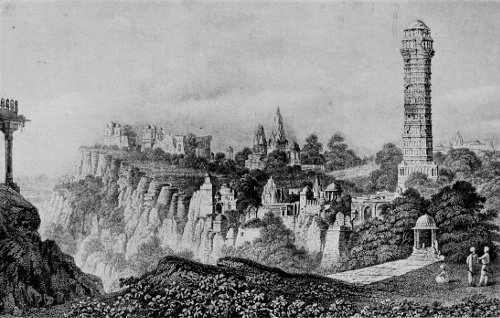
—When the Carthaginian
gained the battle of Cannae, he measured his success by the
bushels of rings taken from the fingers of the equestrian Romans
383who fell in that memorable field. Akbar estimated his, by the
quantity of cordons (
zunnar) of [329] distinction taken from the
necks of the Rajputs, and seventy-four mans and a half
[43] are the
recorded amount. To eternize the memory of this disaster, the
numerals ‘74½’ are
talak, or accursed.
[44] Marked on the banker’s
letter in Rajasthan it is the strongest of seals, for ‘the sin of the
slaughter of Chitor’
[45] is thereby invoked on all who violate a
letter under the safeguard of this mysterious number. He would
be a fastidious critic who stopped to calculate the weight of these
cordons of the Rajput cavaliers, probably as much over-rated
as the trophies of the Roman rings, which are stated at three and
a half bushels. It is for the moral impression that history deigns
to note such anecdotes, in themselves of trivial import. So long
as ‘74½’ shall remain recorded, some good will result from the
calamity, and may survive when the event which caused it is
buried in oblivion.
—When
Udai Singh abandoned Chitor, he found refuge with the Gohil in
the forests of Rajpipli. Thence he passed to the valley of the
384Giro in the Aravalli, in the vicinity of the retreat of his great
ancestor Bappa, ere he conquered Chitor. At the entrance of this
valley, several years previous to this catastrophe, he had formed
the lake, still called after him Udai Sagar, and he now raised a
dyke between the mountains which dammed up another mountain
stream. On the cluster of hills adjoining he raised the small
palace called Nauchauki, around which edifices soon arose, and
formed a city to which he gave his own name, Udaipur,
[46] henceforth
the capital of Mewar.
—Four years had Udai Singh survived
the loss of Chitor, when he expired at Gogunda, at the early
age of forty-two; yet far too long for his country’s honour and
welfare. He left a numerous issue of twenty-five legitimate sons,
whose descendants, all styled Ranawat, pushed aside the more
ancient stock, and form that extensive clan distinctively termed
the Babas, or ‘infants,’ of Mewar, whether Ranawats, Purawats,
or Kanawats. His last act was to entail with a barren sceptre
contention upon his children; for, setting aside the established
laws of primogeniture, he proclaimed his favourite son Jagmall
his successor.
—In Mewar there is no interregnum:
even the ceremony of matam (mourning) is held at the [330]
house of the family priest while the palace is decked out for
rejoicing. On the full moon of the spring month of Phalgun,
while his brothers and the nobles attended the funeral pyre,
Jagmall took possession of the throne in the infant capital,
Udaipur: but even while the trumpets sounded, and the heralds
called aloud “May the king live for ever!” a cabal was formed
round the bier of his father.
—It will be
borne in mind that Udai Singh espoused the Sonigira princess;
and the Jalor Rao, desirous to see his sister’s son have his right,
demanded of Kistna, the ‘great ancient’ of Mewar and the leader
of the Chondawats, how such injustice was sanctioned by him.
“When a sick man has reached the last extreme and asks for
milk to drink, why refuse it?” was the reply; with the addition:
“The Sonigira’s nephew is my choice, and my stand by Partap.”
Jagmall had just entered the Rasora, and Partap was saddling
385for his departure, when Rawat Kistna entered, accompanied by
the ex-prince of Gwalior. Each chief took an arm of Jagmall,
and with gentle violence removed him to a seat in front of the
‘cushion’ he had occupied; the hereditary premier remarking,
“You had made a mistake, Maharaj; that place belongs to your
brother”: and girding Partap with the sword (the privilege of
this house), thrice touching the ground, hailed him king of Mewar.
All followed the example of Salumbar. Scarcely was the ceremony
over, when the young prince remarked, it was the festival of the
Aheria, nor must ancient customs be forgotten: “Therefore to
horse, and slay a boar to Gauri,
[47] and take the omen for the
ensuing year.” They slew abundance of game, and in the mimic
field of war, the nobles who surrounded the gallant Partap anticipated
happier days for Mewar [331].
—Partap
[1] succeeded to the
titles and renown of an illustrious house, but without a capital,
without resources, his kindred and clans dispirited by reverses:
yet possessed of the noble spirit of his race, he meditated the
recovery of Chitor, the vindication of the honour of his house,
and the restoration of its power. Elevated with this design, he
hurried into conflict with his powerful antagonist, nor stooped
to calculate the means which were opposed to him. Accustomed
to read in his country’s annals the splendid deeds of his forefathers,
and that Chitor had more than once been the prison of
their foes, he trusted that the revolutions of fortune might co-operate
with his own efforts to overturn the unstable throne of
Delhi. The reasoning was as just as it was noble; but whilst
he gave loose to those lofty aspirations which meditated liberty
to Mewar, his crafty opponent was counteracting his views by a
scheme of policy which, when disclosed, filled his heart with
386anguish. The wily Mogul arrayed against Partap his kindred in
faith as well as blood. The princes of Marwar, Amber, Bikaner,
and even Bundi, late his firm ally, took part with Akbar and
upheld despotism. Nay, even his own brother, Sagarji,
[2] deserted
him, and received, as the price of his treachery, the ancient capital
of his race, and the title which that possession conferred
[332].
—But the magnitude of the
peril confirmed the fortitude of Partap, who vowed, in the words
of the bard, “to make his mother’s milk resplendent”; and he
amply redeemed his pledge. Single-handed, for a quarter of a
century did he withstand the combined efforts of the empire;
at one time carrying destruction into the plains, at another flying
from rock to rock, feeding his family from the fruits of his native
hills, and rearing the nursling hero Amra, amidst savage beasts
and scarce less savage men, a fit heir to his prowess and revenge.
The bare idea that “the son of Bappa Rawal should bow the
head to mortal man,” was insupportable; and he spurned every
overture which had submission for its basis, or the degradation
of uniting his family by marriage with the Tatar, though lord
of countless multitudes.
The brilliant acts he achieved during that period live in every
valley; they are enshrined in the heart of every true Rajput,
and many are recorded in the annals of the conquerors. To
recount them all, or relate the hardships he sustained, would be
to pen what they would pronounce a romance who had not
traversed the country where tradition is yet eloquent with his
exploits, or conversed with the descendants of his chiefs, who
387cherish a recollection of the deeds of their forefathers, and melt,
as they recite them, into manly tears.[3]
Partap was nobly supported; and though wealth and fortune
tempted the fidelity of his chiefs, not one was found base enough
to abandon him. The sons of Jaimall shed their blood in his
cause, along with the successors of Patta—the house of Salumbar
redoubled the claims of Chonda to fidelity; and these five lustres
of adversity are the brightest in the chequered page of the history
of Mewar. Nay, some chiefs, attracted by the very desperation
of his fortunes, pressed to his standard, to combat and die with
Partap. Amongst these was the Delwara chief, whose devotion
gained him the prince’s ‘right hand.’
—To commemorate the desolation
of Chitor, which the bardic historian represents as a ‘widow’
despoiled of the ornaments to her loveliness, Partap interdicted
to himself and his successors every article of luxury or pomp,
until the insignia of her glory should be redeemed. The gold
and silver dishes were laid aside [333] for
pattras[4] of leaves;
their beds henceforth of straw, and their beards left untouched.
But in order more distinctly to mark their fallen fortune and
stimulate to its recovery, he commanded that the martial
nakkaras,
which always sounded in the van of battle or processions, should
follow in the rear. This last sign of the depression of Mewar
still survives; the beard is yet untouched by the shears; and
even in the subterfuge by which the patriot king’s behest is set
aside, we have a tribute to his memory: for though his descendant
eats off gold and silver, and sleeps upon a bed, he places the
leaves beneath the one and straw under the other.
[5]Often was Partap heard to exclaim, “Had Udai Singh never
been, or none intervened between him and Sanga Rana, no
388Turk should ever have given laws to Rajasthan.” Hindu society
had assumed a new form within the century preceding: the
wrecks of dominion from the Jumna and Ganges had been silently
growing into importance; and Amber and Marwar had attained
such power, that the latter single-handed coped with the imperial
Sher Shah; while numerous minor chieftainships were attaining
shape and strength on both sides the Chambal. A prince of
commanding genius alone was wanting, to snatch the sceptre of
dominion from the Islamite. Such a leader they found in Sanga,
who possessed every quality which extorts spontaneous obedience,
and the superiority of whose birth, as well as dignity, were admitted
without cavil, from the Himalaya to Rameswaram.[6]
These States had powerful motives to obey such a leader, in the
absence of whom their ancient patrimony was lost; and such
they would have found renewed in Sanga’s grandson, Partap,
had Udai Singh not existed, or had a less gifted sovereign than
Akbar been his contemporary.
With the aid of some chiefs of judgment and experience,
Partap remodelled his government, adapting it to the exigencies
of the times and to his slender resources. New grants were
issued, with regulations defining the service required. Kumbhalmer,
now the seat of government, was strengthened, as well
as Gogunda and other mountain fortresses; and, being unable
to keep the field in the plains [334] of Mewar, he followed the
system of his ancestors, and commanded his subjects, on pain of
death, to retire into the mountains. During the protracted
contest, the fertile tracts watered by the Banas and the Berach,
from the Aravalli chain west to the eastern tableland, were be
chiragh, ‘without a lamp.’
Many tales are related of the unrelenting severity with which
Partap enforced obedience to this stern policy. Frequently,
with a few horse, he issued forth to see that his commands were
obeyed. The silence of the desert prevailed in the plains; grass
had usurped the place of the waving corn; the highways were
choked with the thorny babul,[7] and beasts of prey made their
abode in the habitations of his subjects. In the midst of this
desolation, a single goatherd, trusting to elude observation, disobeyed
his prince’s injunction, and pastured his flock in the
389luxuriant meadows of Untala, on the banks of the Banas. After
a few questions, he was killed and hung up in terrorem. By such
patriotic severity Partap rendered ‘the garden of Rajasthan’ of
no value to the conqueror, and the commerce already established
between the Mogul court and Europe, conveyed through Mewar
from Surat and other ports, was intercepted and plundered.
—Akbar took
the field against the Rajput prince, establishing his headquarters
at Ajmer. This celebrated fortress, destined ultimately to be one
of the twenty-two subahs of his empire and an imperial residence,
had admitted for some time a royal garrison. Maldeo of Marwar,
who had so ably opposed the usurper Sher Shah, was compelled
to follow the example of his brother prince, Bhagwandas of Amber,
and to place himself at the footstool of Akbar: only two years
subsequent to Partap’s accession, after a brave but fruitless
resistance in Merta and Jodhpur, he sent his son, Udai Singh, to
pay homage to the king.
[8] Akbar received him at Nagor, on his
route to Ajmer, on which occasion the Raos of Mandor were made
Rajas; and as the heir of Marwar was of uncommon bulk, the
title by which he was afterwards known in Rajasthan was Mota
Raja,
[9] and henceforth the descendants of the kings of Kanauj
had the ‘right hand’ of the emperor of the Moguls. But the
Rathor was greater in his native pride than with all the accession
of dignity or power which accrued on his sacrifice of Rajput
principles [335]. Udai ‘le gros’ was the first of his race who
gave a daughter in marriage to a Tatar. The bribe for which
he bartered his honour was splendid; for four provinces,
[10] yielding
£200,000 of annual revenue, were given in exchange for Jodh
Bai,
[11] at once doubling the fisc of Marwar. With such examples
390as Amber and Marwar, and with less power to resist the temptation,
the minor chiefs of Rajasthan, with a brave and numerous vassalage,
were transformed into satraps of Delhi, and the importance
of most of them was increased by the change. Truly did the
Mogul historian designate them “at once the props and the ornaments
of the throne.”
—But these were
fearful odds against Partap: the arms of his countrymen thus
turned upon him, derived additional weight from their self-degradation,
which kindled into jealousy and hatred against the
magnanimous resolution they wanted the virtue to imitate.
When Hindu prejudice was thus violated by every prince in
Rajasthan (that of Bundi alone excepted
[12]), the Rana renounced
all alliance with those who were thus degraded; and in order to
carry on the line, he sought out and incorporated with the first
class of nobles of his own kin the descendants of the ancient
princes of Delhi, of Patan, of Marwar, and of Dhar. To the
eternal honour of Partap and his issue be it told, that to the very
close of the monarchy of the Moguls, they not only refused such
alliance with the throne, but even with their brother princes of
Marwar and Amber. It is a proud triumph of virtue to record,
from the autograph letters of the most powerful of their princes,
Bakhta Singh and Jai Singh, that whilst they had risen to greatness
from the surrender of principle, as Mewar had decayed from
her adherence to it, they should, even while basking in court
favour, solicit, and that humbly, to be readmitted to the honour
of matrimonial intercourse—‘to be purified,’ ‘to be regenerated,’
‘to be made Rajputs’: and that this was granted only on
condition of their abjuring the contaminating practice which
had disunited them for more than a century; with the additional
stipulation, that the issue of marriage with the house [336]
of Mewar should be the heirs to those they entered: conditions
which the decline of the empire prevented from being
broken.
—An anecdote illustrative
of the settled repugnance of this noble family to sully
the purity of its blood may here be related, as its result had a
391material influence on its subsequent condition. Raja Man, who
had succeeded to the throne of Amber, was the most celebrated of
his race, and from him may be dated the rise of his country.
This prince exemplified the wisdom of that policy which Babur
adopted to strengthen his conquest; that of connecting his
family by ties of marriage with the Hindus. It has been already
related, that Humayun espoused a daughter of Bhagwandas,
consequently Raja Man was brother-in-law to Akbar.
[13] His
courage and talents well seconded this natural advantage, and
he became the most conspicuous of all the generals of the empire.
To him Akbar was indebted for half his triumphs. The Kachhwaha
bards find a delightful theme in recounting his exploits,
from the snow-clad Caucasus to the shores of the ‘golden Chersonese.’
[14]
Let the eye embrace these extremes of his conquests,
Kabul and the Paropanisos of Alexander, and Arakan (a name
now well known) on the Indian Ocean; the former reunited, the
latter subjugated, to the empire by a Rajput prince and a Rajput
army. But Akbar knew the master-key to Hindu feeling, and by
his skill overcame prejudices deemed insurmountable, and many
are the tales yet told of their blind devotion to their favourite
emperor.
Raja Man was returning from the conquest of Sholapur to
Hindustan when he invited himself to an interview with Partap,
then at Kumbhalmer, who advanced to the Udaisagar to receive
him. On the mound which embanks this lake a feast was prepared
392for the prince of Amber. The board was spread, the Raja
summoned, and Prince Amra appointed to wait upon him; but
no Rana appeared, for whose absence apologies alleging headache
were urged by his son, with the request [337] that Raja Man
would waive all ceremony, receive his welcome, and commence.
The prince, in a tone at once dignified and respectful, replied:
"Tell the Rana I can divine the cause of his headache; but the
error is irremediable, and if he refuses to put a plate (kansa)
before me, who will?" Further subterfuge was useless. The
Rana expressed his regret; but added, that “he could not eat
with a Rajput who gave his sister to a Turk, and who probably
ate with him.” Raja Man was unwise to have risked this disgrace:
and if the invitation went from Partap, the insult was ungenerous
as well as impolitic; but of this he is acquitted. Raja Man left
the feast untouched, save the few grains of rice he offered to Anndeva,[15]
which he placed in his turban, observing as he withdrew: “It
was for the preservation of your honour that we sacrificed our
own, and gave our sisters and our daughters to the Turk; but
abide in peril, if such be your resolve, for this country shall not
hold you”; and mounting his horse he turned to the Rana, who
appeared at this abrupt termination of his visit, “If I do not
humble your pride, my name is not Man”: to which Partap
replied, “he should always be happy to meet him”; while
some one, in less dignified terms, desired he would not forget to
bring his ‘Phupha’ [father’s sister’s husband], Akbar. The
ground was deemed impure where the feast was spread: it was
broken up and lustrated with the water of the Ganges, and the
chiefs who witnessed the humiliation of one they deemed apostate,
bathed and changed their vestments, as if polluted by his presence.
Every act was reported to the emperor, who was exasperated at
the insult thus offered to himself, and who justly dreaded the
revival of those prejudices he had hoped were vanquished; and
it hastened the first of those sanguinary battles which have
immortalised the name of Partap: nor will Haldighat be forgotten
while a Sesodia occupies Mewar, or a bard survives to
relate the tale.
—Prince Salim, the heir of
393Delhi,
[16] led the war, guided by the counsels of Raja Man and the
distinguished apostate son of Sagarji, Mahabat Khan. Partap
trusted to his native hills and the valour of twenty-two thousand
Rajputs to withstand the son of Akbar. The divisions of the
royal army encountered little opposition at the exterior defiles
by which they penetrated the western side of the [338] Aravalli,
concentrating as they approached the chief pass which conducted
to the vulnerable part of this intricate country.
—The range to
which Partap was restricted was the mountainous region around,
though chiefly to the west of the new capital. From north to
south, Kumbhalmer to Rakhabhnath,
[17] about eighty miles in
length; and in breadth, from Mirpur west to Satola east, about
the same. The whole of this space is mountain and forest, valley
and stream. The approaches to the capital from every point to
the north, west, and south are so narrow as to merit the term of
defile; on each side lofty perpendicular rocks, with scarcely
breadth for two carriages abreast, across which are those ramparts
of nature termed
Col in the mountain scenery of Europe, which
occasionally open into spaces sufficiently capacious to encamp a
large force. Such was the plain of Haldighat, at the base of a
neck of mountain which shut up the valley and rendered it almost
inaccessible.
[18] Above and below the Rajputs were posted, and
on the cliffs and pinnacles overlooking the field of battle, the
faithful aborigines, the Bhil, with his natural weapon the bow and
arrow, and huge stones ready to roll upon the combatant enemy.
At this pass Partap was posted with the flower of Mewar, and
glorious was the struggle for its maintenance. Clan after clan
followed with desperate intrepidity, emulating the daring of their
prince, who led the crimson banner into the hottest part of the
field. In vain he strained every nerve to encounter Raja Man;
but though denied the luxury of revenge on his Rajput foe, he
394made good a passage to where Salim commanded. His guards
fell before Partap, and but for the steel plates which defended
his howda, the lance of the Rajput would have deprived Akbar
of his heir. His steed, the gallant Chetak, nobly seconded his
lord, and is represented in all the historical drawings of this
battle with one foot raised upon the elephant of the Mogul, while
his rider has his lance propelled against his foe. The conductor,
destitute of the means of defence, was slain, when the infuriated
animal, now without control, carried off Salim. On this spot
the carnage was immense: the Moguls eager to defend Salim;
the heroes of Mewar to second their prince, who had already
received seven wounds [339].[19] Marked by the ‘royal umbrella,’
which he would not lay aside, and which collected the might of
the enemy against him, Partap was thrice rescued from amidst
the foe, and was at length nearly overwhelmed, when the Jhala
chief gave a signal instance of fidelity, and extricated him with
the loss of his own life. Mana seized upon the insignia of Mewar,
and rearing the ‘gold sun’ over his own head, made good his way
to an intricate position, drawing after him the brunt of the
battle, while his prince was forced from the field. With all his
brave vassals the noble Jhala fell; and in remembrance of the
deed his descendants have, since the day of Haldighat, borne the
regal ensigns of Mewar, and enjoyed ‘the right hand of her
princes.’[20] But this desperate valour was unavailing against
such a force, with a numerous field artillery and a dromedary
corps mounting swivels; and of twenty-two thousand Rajputs
assembled on that day for the defence of Haldighat, only eight
thousand quitted the field alive.[21]
—Partap, unattended, fled
on the gallant Chetak, who had borne him through the day, and
who saved him now by leaping a mountain stream when closely
pursued by two Mogul chiefs, whom this impediment momentarily
395checked. But Chetak, like his master, was wounded; his
pursuers gained upon Partap, and the flash from the flinty rock
announced them at his heels, when, in the broad accents of his
native tongue, the salutation Ho! nila ghora ra aswar, ‘Ho! rider
of the blue horse,’ made him look back, and he beheld but a single
horseman: that horseman his brother.
Sakta, whose personal enmity to Partap had made him a
traitor to Mewar, beheld from the ranks of Akbar the ‘blue
horse’ flying unattended. Resentment was extinguished, and a
feeling of affection, mingling with sad and humiliating recollections,
took possession of his bosom. He joined in the pursuit,
but only to slay the pursuers, who fell beneath his lance; and
now, for the first time in their lives, the brothers embraced in
friendship. Here Chetak fell, and as the Rana unbuckled his
caparison to place it upon Ankara, presented to him by his
brother, the noble steed expired. An altar was raised, and yet
marks the spot, where Chetak[22] died; and the entire scene may
be seen painted on the walls of half the houses of the capital [340].
The greeting between the brothers was necessarily short; but
the merry Sakta, who was attached to Salim’s personal force,
could not let it pass without a joke; and inquiring “how a man
felt when flying for his life?” he quitted Partap with the assurance
of reunion the first safe opportunity. On rejoining Salim,
the truth of Sakta was greatly doubted when he related that
Partap had not only slain his pursuers, but his own steed, which
obliged him to return on that of the Khorasani. Prince Salim
pledged his word to pardon him if he related the truth; when
Sakta replied, “The burthen of a kingdom is on my brother’s
shoulders, nor could I witness his danger without defending him
from it.” Salim kept his word, but dismissed the future head of
the Saktawats. Determined to make a suitable nazar on his
introduction, he redeemed Bhainsror by a coup de main, and
joined Partap at Udaipur, who made him a grant of the conquest,
which long remained the chief abode of the Saktawats;[23] and
396since the day when this, their founder, preserved the life of his
brother and prince against his Mogul pursuers, the birad of the
bard to all of his race is Khorasani Multani ka Agal, ‘the
barrier to Khorasan and Multan,’ from which countries were the
chiefs he slew.
On the 7th of Sawan, S. 1632 (July, A.D. 1576), a day ever
memorable in her annals, the best blood of Mewar irrigated the
pass of Haldighat. Of the nearest kin of the prince five hundred
were slain: the exiled prince of Gwalior, Ramsah, his son Khanderao,
with three hundred and fifty of his brave Tuar clan, paid
the debt of gratitude with their lives. Since their expulsion by
Babur they had found sanctuary in Mewar, whose princes
diminished their feeble revenues to maintain inviolable the rites
of hospitality.[24] Mana, the devoted Jhala, lost one hundred and
fifty of his vassals, and every house of Mewar mourned its chief
support.
—Elate with victory, Salim left the
hills. The rainy season had set in, which impeded operations,
and obtained for Partap a few months of repose; but with the
spring the foe returned, when he was again defeated,
[25] and took
post in Kumbhalmer, which was invested by the Koka, Shahbaz
Khan. He here made a gallant and [341] protracted resistance,
and did not retire till insects rendered the water of the Naugun
well, their sole resource, impure.
[26] To the treachery of the
Deora chief of Abu, who was now with Akbar, this deed is imputed.
Partap thence withdrew to Chawand,
[27] while Bhan, the
Sonigira chief, defended the place to the last, and was slain in
the assault. On this occasion also fell the chief bard of Mewar,
who inspired by his deeds, as well as by his song, the spirit of
resistance to the ‘ruthless king,’ and whose laudatory couplets
on the deeds of his lord are still in every mouth. But the spirit
of poesy died not with him, for princes and nobles, Hindu and
397Turk, vied with each other in exalting the patriot Partap, in
strains replete with those sentiments which elevate the mind of
the martial Rajput, who is inflamed into action by this national
excitement.
—On the fall of Kumbhalmer, the
castles of Dharmeti and Gogunda were invested by Raja Man.
Mahabat Khan took possession of Udaipur; and while a prince
of the blood
[28] cut off the resources furnished by the inhabitants
of Oghna Panarwra, Khan Farid invaded Chappan, and approached
Chawand from the south. Thus beset on every side,
dislodged from the most secret retreats, and hunted from glen
to glen, there appeared no hope for Partap: yet, even while his
pursuers deemed him panting in some obscure lurking-place, he
would by mountain signals reassemble his bands, and assail them
unawares and often unguarded. By a skilful manœuvre, Farid,
who dreamed of nothing less than making the Rajput prince
his prisoner, was blocked up in a defile and his force cut off to
a man. Unaccustomed to such warfare, the mercenary Moguls
became disgusted in combating a foe seldom tangible; while the
monsoon swelled the mountain streams, filling the reservoirs
with mineral poisons and the air with pestilential exhalations.
The periodical rains accordingly always brought some respite to
Partap.
Years thus rolled away, each ending with a diminution of his
means and an increase to his misfortunes. His family was his
chief source of anxiety: he dreaded their captivity, an apprehension
often on the point of being realised. On one occasion
they were saved by the faithful Bhils of Kava, who carried them
in wicker baskets and concealed them in the tin mines of Jawara,
where they guarded [342] and fed them. Bolts and rings are
still preserved in the trees about Jawara and Chawand, to which
baskets were suspended, the only cradles of the royal children of
Mewar, in order to preserve them from the tiger and the wolf.
Yet amidst such complicated evils the fortitude of Partap remained
unshaken, and a spy sent by Akbar represented the
Rajput and his chiefs seated at a scanty meal, maintaining all
the etiquette observed in prosperity, the Rana bestowing the
dauna to the most deserving, and which, though only of the wild
fruit of the country, was received with all the reverence of better
398days. Such inflexible magnanimity touched the soul of Akbar,[29]
and extorted the homage of every chief in Rajasthan; nor could
those who swelled the gorgeous train of the emperor withhold
their admiration. Nay, these annals have preserved some
stanzas addressed by the Khankhanan,[30] the first of the satraps
of Delhi, to the noble Rajput, in his native tongue, applauding his
valour and stimulating his perseverance: “All is unstable in
this world: land and wealth will disappear, but the virtue of a
great name lives for ever. Patta[31] abandoned wealth and land,
but never bowed the head: alone, of all the princes of Hind, he
preserved the honour of his race.”
But there were moments when the wants of those dearer than
his own life almost excited him to frenzy. The wife of his bosom
was insecure, even in the rock or the cave; and his infants, heirs
to every luxury, were weeping around him for food: for with
such pertinacity did the Mogul myrmidons pursue them, that
“five meals have been prepared and abandoned for want of
opportunity to eat them.” On one occasion his queen and his
son’s wife were preparing a few cakes from the flour of the meadow
grass,[32] of which one was given to each; half for the present, the
rest for a future meal. Partap was stretched beside them pondering
on his misfortunes, when a piercing cry from his daughter
roused him from reflection: a wild cat had darted on the reserved
portion of food, and the agony of hunger made her shrieks insupportable.
Until that moment his fortitude had been unsubdued.
He had beheld his sons and his kindred fall around
him on the field without emotion—“For this the Rajput was
born”; but the lamentation of his children for food “unmanned
him.” He cursed the name of royalty, if only to be enjoyed on
such conditions, and he demanded of Akbar a mitigation of his
hardships [343].
—Overjoyed at this indication
of submission, the emperor commanded public rejoicings,
and exultingly showed the letter to Prithiraj, a Rajput compelled
to follow the victorious car of Akbar. Prithiraj was the younger
399brother of the prince of Bikaner,
[33] a State recently grown out of
the Rathors of Marwar, and which, being exposed in the flats of
the desert, had no power to resist the example of its elder, Maldeo.
Prithiraj was one of the most gallant chieftains of the age, and
like the Troubadour princes of the west, could grace a cause
with the soul-inspiring effusions of the muse, as well as aid it
with his sword: nay, in an assembly of the bards of Rajasthan,
the palm of merit was unanimously awarded to the Rathor
cavalier. He adored the very name of Partap, and the intelligence
filled him with grief. With all the warmth and frankness of his
nature, he told the king it was a forgery of some foe to the fame
of the Rajput prince. “I know him well,” said he; “for your
crown he would not submit to your terms.” He requested and
obtained permission from the king to transmit by his courier a
letter to Partap, ostensibly to ascertain the fact of his submission,
but really with the view to prevent it. On this occasion he
composed those couplets, still admired, and which for the effect
they produced will stand comparison with any of the
sirventes of
the Troubadours of the west.
[34]"The hopes of the Hindu rest on the Hindu; yet the Rana
forsakes them. But for Partap, all would be placed on the same
level by Akbar; for our chiefs have lost their valour and our
females their honour. Akbar is the broker in the market of our
race: all has he purchased but the son of Uda; he is beyond his
price. What true Rajput would part with honour for nine days
(nauroza); yet how many have bartered it away? Will Chitor
come to this market, when all have disposed of the chief article
of the Khatri? Though Patta has squandered away wealth,
yet this treasure has he preserved. Despair has driven man to
this mart, to witness their dishonour: from such infamy the
descendant of Hamir alone has been preserved. The world asks,
whence the concealed aid of Partap? None but the soul of
manliness and his sword: with it, well has he maintained the
Khatri’s pride. This broker in the market [344] of men will one
day be overreached; he cannot live for ever: then will our race
come to Partap, for the seed of the Rajput to sow in our desolate
400lands. To him all look for its preservation, that its purity may
again become resplendent."
—This effusion of the Rathor was
equal to ten thousand men; it nerved the drooping mind of
Partap, and roused him into action: for it was a noble incentive
to find every eye of his race fixed upon him.
—The allusion of the princely poet in the phrase,
“bartering their honour on the Nauroza,” requires some explanation.
The Nauroza, or ‘New Year’s Day,’ when the sun enters
Aries, is one of great festivity among the Muhammadan princes
of the East; but of that alluded to by Prithiraj we can form an
adequate idea from the historian Abu-l Fazl.
[35]It is not New Year’s Day, but a festival especially instituted
by Akbar, and to which he gave the epithet Khushroz, ‘day of
pleasure,’ held on the ninth day (nauroza), following the chief
festival of each month. The court assembled, and was attended
by all ranks. The queen also had her court, when the wives of
the nobles and of the Rajput vassal princes were congregated.
But the Khushroz was chiefly marked by a fair held within the
precincts of the court, attended only by females. The merchants’
wives exposed the manufactures of every clime, and the ladies
of the court were the purchasers.[36] “His majesty is also there in
disguise, by which means he learns the value of merchandise, and
hears what is said of the state of the empire and the character of
the officers of government.” The ingenuous Abu-l Fazl thus
401softens down the unhallowed purpose of this day; but posterity
cannot admit that the great Akbar was to obtain these results
amidst the Pushto jargon of the dames of Islam, or the mixed
Bhakha of the fair of [345] Rajasthan. These ‘ninth day fairs’
are the markets in which Rajput honour was bartered, and to
which the brave Prithiraj makes allusion.[37]
—It is scarcely to be credited that
a statesman like Akbar should have hazarded his popularity or
his power, by the introduction of a custom alike appertaining to
the Celtic races of Europe as to these the Goths of Asia;
[38] and
that he should seek to degrade those whom the chances of war
had made his vassals, by conduct so nefarious and repugnant to
the keenly cherished feelings of the Rajput. Yet there is not a
shadow of doubt that many of the noblest of the race were dishonoured
on the Nauroza; and the chivalrous Prithiraj was only
preserved from being of the number by the high courage and
virtue of his wife, a princess of Mewar, and daughter of the
founder of the Saktawats. On one of these celebrations of the
402Khushroz, the monarch of the Moguls was struck with the beauty
of the daughter of Mewar, and he singled her out from amidst the
united fair of Hind as the object of his passion. It is not improbable
that an ungenerous feeling united with that already
impure, to despoil the Sesodias of their honour, through a princess
of their house under the protection of the sovereign. On retiring
from the fair, she found herself entangled amidst the labyrinth
of apartments by which egress was purposely ordained, when
Akbar stood before her: but instead of acquiescence, she drew
a poniard from her corset, and held it to his breast, dictating,
and making him repeat, the oath of renunciation of the infamy
to all her race. The anecdote is accompanied in the original
with many dramatic circumstances. The guardian goddess of
Mewar, the terrific Mata, appears on her tiger in the subterranean
passage of this palace of pollution, to strengthen her mind by a
solemn denunciation [346], and her hand with a weapon to
protect her honour. Rae Singh, the elder brother of the princely
bard, had not been so fortunate; his wife wanted either courage
or virtue to withstand the regal tempter, and she returned to
their dwelling in the desert despoiled of her chastity, but loaded
with jewels; or, as Prithiraj expresses it: “She returned to her
abode, tramping to the tinkling sound of the ornaments of gold
and gems on her person; but where, my brother, is the moustache
[39]
on thy lip?”
—It is time to return to the
Aravalli, and to the patriot prince Partap. Unable to stem the
torrent, he had formed a resolution worthy of his character; he
determined to abandon Mewar and the blood-stained Chitor (no
longer the stay of his race), and to lead his Sesodias to the Indus,
plant the ‘crimson banner’ on the insular capital of the Sogdoi,
and leave a desert between him and his inexorable foe. With his
family, and all that was yet noble in Mewar, his chiefs and vassals,
a firm and intrepid band, who preferred exile to degradation, he
descended the Aravalli, and had reached the confines of the desert,
when an incident occurred which made him change his measures,
and still remain a dweller in the land of his forefathers. If the
historic annals of Mewar record acts of unexampled severity,
403they are not without instances of unparalleled devotion. The
minister of Partap, whose ancestors had for ages held the office,
placed at his prince’s disposal their accumulated wealth, which,
with other resources, is stated to have been equivalent to the
maintenance of twenty-five thousand men for twelve years.
The name of Bhama Sah is preserved as the saviour of Mewar.
With this splendid proof of gratitude, and the sirvente of Prithiraj
as incitements, he again “screwed his courage to the sticking-place,”
collected his bands, and while his foes imagined that he
was endeavouring to effect a retreat through the desert, surprised
Shahbaz in his camp at Dawer, whose troops were cut in pieces.
The fugitives were pursued to Amet, the garrison of which shared
the same fate. Ere they could recover from their consternation,
Kumbhalmer was assaulted and taken; Abdulla and his garrison
were put to the sword, and thirty-two fortified posts in like manner
carried by surprise, the troops being put to death without mercy.
To use the words of the annals: "Partap made a desert of Mewar;
he made an [347] offering to the sword of whatever dwelt in its
plains": an appalling but indispensable sacrifice. In one short
campaign (S. 1586, A.D. 1530), he had recovered all Mewar, except
Chitor, Ajmer, and Mandalgarh; and determining to have a
slight ovation in return for the triumph Raja Man had enjoyed
(who had fulfilled to the letter his threat, that Partap should
“live in peril”), he invaded Amber, and sacked its chief mart of
commerce, Malpura.
Udaipur was also regained; though this acquisition was so
unimportant as scarcely to merit remark. In all likelihood it
was abandoned from the difficulty of defending it, when all around
had submitted to Partap; though the annals ascribe it to a generous
sentiment of Akbar, prompted by the great Khankhanan,
whose mind appears to have been captivated by the actions of
the Rajput prince.[40] An anecdote is appended to account for
Akbar’s relaxation of severity, but it is of too romantic a nature
even for this part of their annals.
—Partap was indebted
to a combination of causes for the repose he enjoyed during the
latter years of his life; and though this may be ascribed principally
to the new fields of ambition which occupied the Mogul arms, we
are authorized also to admit the full weight of the influence that
404the conduct of the Hindu prince exerted upon Akbar, together
with the general sympathy of his fellow-princes, who swelled the
train of the conqueror, and who were too powerful to be regarded
with indifference.
Repose was, however, no boon to the noblest of his race. A
mind like Partap’s could enjoy no tranquillity while, from the
summit of the pass which guarded Udaipur, his eye embraced the
Kunguras of Chitor, to which he must ever be a stranger. To a
soul like his, burning for the redemption of the glory of his race,
the mercy thus shown him, in placing a limit to his hopes, was
more difficult of endurance than the pangs of fabled Tantalus.
Imagine the warrior, yet in manhood’s prime, broken with fatigues
and covered with scars, from amidst the fragments of basaltic
ruin[41] (fit emblem of his own condition!), casting a wistful eye to
[348] the rock stained with the blood of his fathers; whilst in the
‘dark chamber’ of his mind the scenes of glory enacted there
appeared with unearthly lustre. First, the youthful Bappa, on
whose head was the ‘mor he had won from the Mori’:[42] the
warlike Samarsi, arming for the last day of Rajput independence,
to die with Prithiraj on the banks of the Ghaggar: again, descending
the steep of Chitor, the twelve sons of Arsi, the crimson banner
floating around each, while from the embattled rock the guardian
goddess looked down on the carnage which secured a perpetuity
of sway. Again, in all the pomp of sacrifice, the Deolia chiefs,
Jaimall and Patta; and like the Pallas of Rajasthan, the Chondawat
dame, leading her daughter into the ranks of destruction:
examples for their sons’ and husbands’ imitation. At length
clouds of darkness dimmed the walls of Chitor: from her battlements
405‘Kungura Rani’[43] had fled; the tints of dishonour began
to blend with the visions of glory; and lo! Udai Singh appeared
flying from the rock to which the honour of his house was united.
Aghast at the picture his fancy had portrayed, imagine him turning
to the contemplation of his own desolate condition, indebted
for a cessation of persecution to the most revolting sentiment that
can assail an heroic mind—compassion; compared with which
scorn is endurable, contempt even enviable: these he could
retaliate; but for the high-minded, the generous Rajput, to be
the object of that sickly sentiment, pity, was more oppressive
than the arms of his foe.
—A premature decay assailed
the pride of Rajasthan; a mind diseased preyed on an exhausted
frame, and prostrated him in the very summer of his days. The
last moments of Partap were an appropriate commentary on his
life, which he terminated, like the Carthaginian, swearing his successor
to eternal conflict against the foes of his country’s independence.
But the Rajput prince had not the same joyful assurance
that inspired the Numidian Hamilcar; for his end was clouded
with the presentiment that his son Amra would abandon his
fame for inglorious repose. A powerful sympathy is excited by
the picture which is drawn of this final scene. The dying hero
is represented in a lowly dwelling; his chiefs, the faithful companions
of many a glorious day, awaiting round his pallet the
dissolution of their prince, when a groan of mental anguish made
Salumbar inquire [349], “What afflicted his soul that it would
not depart in peace?” He rallied: “It lingered,” he said,
“for some consolatory pledge that his country should not be
abandoned to the Turk”; and with the death-pang upon him,
he related an incident which had guided his estimate of his son’s
disposition, and now tortured him with the reflection that for
personal ease he would forgo the remembrance of his own and
his country’s wrongs.
On the banks of the Pichola, Partap and his chiefs had constructed
a few huts[44] (the site of the future palace of Udaipur),
406to protect them during the inclemency of the rains in the day of
their distress. Prince Amra, forgetting the lowliness of the
dwelling, a projecting bamboo of the roof caught the folds of
his turban and dragged it off as he retired. A hasty emotion,
which disclosed a varied feeling, was observed with pain by
Partap, who thence adopted the opinion that his son would never
withstand the hardships necessary to be endured in such a cause.
“These sheds,” said the dying prince, “will give way to sumptuous
dwellings, thus generating the love of ease; and luxury with its
concomitants will ensue, to which the independence of Mewar,
which we have bled to maintain, will be sacrificed: and you,
my chiefs, will follow the pernicious example.” They pledged
themselves, and became guarantees for the prince, “by the throne
of Bappa Rawal,” that they would not permit mansions to be
raised till Mewar had recovered her independence. The soul
of Partap was satisfied, and with joy he expired.
Thus closed the life of a Rajput whose memory is even now
idolized by every Sesodia, and will continue to be so, till renewed
oppression shall extinguish the remaining sparks of patriotic
feeling. May that day never arrive! yet if such be her destiny,
may it, at least, not be hastened by the arms of Britain!
It is worthy the attention of those who influence the destinies
of States in more favoured climes, to estimate the intensity of
feeling which could arm this prince to oppose the resources of a
small principality against the then most powerful empire of the
world, whose armies were more numerous and far more efficient
than any ever led by the Persian against the liberties of Greece.
Had Mewar possessed her Thucydides or her Xenophon, neither
the wars of the Peloponnesus nor the retreat of the ‘ten thousand’
would have yielded more diversified incidents for [350] the historic
muse, than the deeds of this brilliant reign amid the many vicissitudes
of Mewar. Undaunted heroism, inflexible fortitude, that
which ‘keeps honour bright,’ perseverance,—with fidelity such
as no nation can boast, were the materials opposed to a soaring
ambition, commanding talents, unlimited means, and the fervour
of religious zeal; all, however, insufficient to contend with one
unconquerable mind. There is not a pass in the alpine Aravalli
407that is not sanctified by some deed of Partap,—some brilliant
victory or, oftener, more glorious defeat. Haldighat is the
Thermopylae of Mewar; the field of Dawer her Marathon.
—Of the seventeen sons
of Partap, Amra, who succeeded him, was the eldest. From the
early age of eight to the hour of his parent’s death, he had been
his constant companion and the partner of his toils and dangers.
Initiated by his noble sire in every act of mountain strife, familiar
with its perils, he entered on his career
[1] in the very flower of
manhood, already attended by sons able to maintain whatever
his sword might recover of his patrimony.
Akbar, the greatest foe of Mewar, survived Partap nearly
eight years.[2] The vast field in which he had to exert the resources
of his mind, necessarily withdrew him from a scene where
even success ill repaid the sacrifices made to attain it. Amra
was left in perfect repose during the remainder of this monarch’s
life, which it was not wisdom to disturb by the renewal of a
contest against the colossal power of the Mogul. An extended
reign of more than half a century permitted Akbar to consolidate
the vast empire he had erected, and to model the form of his
[351] government, which displays, as handed down by Abu-l
Fazl, an incontestable proof of his genius as well as of his natural
beneficence. Nor would the Mogul lose, on being contrasted
with the contemporary princes of Europe: with Henry IV. of
France, who, like himself, ascended a throne weakened by dissension;
with Charles V., alike aspiring to universal sway: or
the glorious queen of our own isle, who made advances to Akbar
and sent him an embassy.[3] Akbar was fortunate as either Henry
408or Elizabeth in the choice of his ministers. The lofty integrity,
military genius, and habits of civil industry, for which Sully was
distinguished, found their parallel in Bairam; and if Burleigh
equalled in wisdom, he was not superior in virtue to Abu-l Fazl,
nor possessed of his excessive benevolence. Unhappily for
Mewar, all this genius and power combined to overwhelm her.
It is, however, a proud tribute to the memory of the Mogul
that his name is united with that of his rival Partap in numerous
traditionary couplets honourable to both; and if the Rajput
bard naturally emblazons first on his page that of his own hero,
he admits that none other but Akbar can stand a comparison
with him; thereby confirming the eulogy of the historian of his
race, who, in summing up his character, observes that, “if he
sometimes did things beneath the dignity of a great king, he never
did anything unworthy of a good man.” But if the annalist of
the Bundi State can be relied upon, the very act which caused
Akbar’s death will make us pause ere we subscribe to these testimonies
to the worth of departed greatness, and, disregarding
the adage of only speaking good of the dead, compel us to institute,
in imitation of the ancient Egyptians, a posthumous
inquest on the character of the monarch of the Moguls. The
Bundi records are well worthy of belief, as diaries of events were
kept by her princes, who were of the first importance in this and
the succeeding reigns: and they may be more likely to throw a
light upon points of character of a tendency to disgrace the
Mogul king, than the historians of his court, who had every
reason to withhold such. A desire to be rid of the great Raja
Man of Amber, to whom he was so much indebted, made the
emperor descend [352] to act the part of the assassin. He prepared
a ma’ajun, or confection, a part of which contained poison;
but, caught in his own snare, he presented the innoxious portion
to the Rajput and ate that drugged with death himself.[4] We
have a sufficient clue to the motives which influenced Akbar to
a deed so unworthy of him, and which were more fully developed
in the reign of his successor; namely, a design on the part of
Raja Man to alter the succession, and that Khusru, his nephew,
should succeed instead of Salim. With such a motive, the aged
emperor might have admitted with less scruple the advice which
prompted an act he dared not openly undertake, without exposing
409the throne in his latter days to the dangers of civil contention,
as Raja Man was too powerful to be openly assaulted.
—Let us return to
Mewar. Amra remodelled the institutions of his country, made
a new assessment of the lands and distribution of the fiefs, apportioning
the service to the times. He also established the gradation
of ranks such as yet exists, and regulated the sumptuary laws
even to the tie of a turban,
[5] and many of these are to be seen
engraved on pillars of stone in various parts of the country.
The repose thus enjoyed realized the prophetic fears of Partap,
whose admonitions were forgotten. Amra constructed a small
palace on the banks of the lake, named after himself ‘the abode
of immortality,’[6] still remarkable for its Gothic contrast to the
splendid marble edifice erected by his successors, now the abode
of the princes of Mewar.
—Jahangir had been four years on
the throne, and having overcome all internal dissension, resolved
to signalize his reign by the subjugation of the only prince who
had disdained to acknowledge the paramount power of the Moguls;
and assembling the royal forces, he put them in motion for Mewar.
Amra, between the love of ease and reputation, wavered as to
the conduct he should adopt; nor were sycophants wanting who
Counselled ignoble ease and peaceful sloth,
Not peace:
and dared to prompt his following the universal contagion, by
accepting the imperial farman. In such a state of mind the
chiefs found their prince, when [353] they repaired to the new
abode to warn him, and prepare him for the emergency. But
the gallant Chondawat, recalling to their remembrance the dying
behest of their late glorious head, demanded its fulfilment. All
resolved to imitate the noble Partap,
... preferring
Hard liberty before the easy yoke
Of servile pomp.
—A magnificent mirror of
410European fabrication adorned the embryo palace. Animated
with a noble resentment at the inefficacy of his appeal to the
better feelings of his prince, the chieftain of Salumbar hurled ‘the
slave of the carpet’
[7] against the splendid bauble, and starting
up, seized his sovereign by the arm and moved him from the
throne. “To horse, chiefs!” he exclaimed, “and preserve from
infamy the son of Partap.” A burst of passion followed the
seeming indignity, and the patriot chief was branded with the
harsh name of traitor; but with his sacred duty in view, and
supported by every vassal of note, he calmly disregarded the
insult. Compelled to mount his steed, and surrounded by the
veterans and all the chivalry of Mewar, Amra’s passion vented
itself in tears of indignation. In such a mood the cavalcade
descended the ridge, since studded with palaces, and had reached
the spot where the temple of Jagannath now stands, when he
recovered from this fit of passion; the tear ceased to flow, and
passing his hand over his moustache,
[8] he made a courteous
salutation to all, entreating their forgiveness for this omission of
respect; but more especially expressing his gratitude to Salumbar,
he said, “Lead on, nor shall you ever have to regret your
late sovereign.” Elevated with every sentiment of generosity
and valour, they passed on to Dawer, where they encountered
the royal army led by the brother of the Khankhanan, as it
entered the pass, and which, after a long and sanguinary combat,
they entirely defeated.
[9]—The honours of the day are chiefly
attributed to the brave Kana, uncle to the Rana, and ancestor
of that numerous clan called after him Kanawats. A truce
followed this battle, but it was of short duration; for another
and yet more murderous conflict took place in the spring of 1666,
in the pass of the sacred Ranpur [354], where the imperial army,
under its leader Abdulla, was almost exterminated;
[10] though
with the loss of the best and bravest of the chiefs of Mewar,
411whose names, however harsh, deserve preservation.
[11] A feverish
exultation was the fruit of this victory, which shed a hectic flush
of glory over the declining days of Mewar, when the crimson
banner once more floated throughout the province of Godwar.
—Alarmed at these successive
defeats, Jahangir, preparatory to equipping a fresh army
against Mewar, determined to establish a new Rana, and to instal
him in the ancient seat of power, Chitor, thus hoping to withdraw
from the standard of Amra many of his adherents. The experiment
evinced at least a knowledge of their prejudices; but, to
the honour of Rajput fidelity, it failed. Sagra, who abandoned
Partap and went over to Akbar, was selected;
[12] the sword of investiture
was girded on him by the emperor’s own hands, and
under the escort of a Mogul force he went to reign amidst the
ruins of Chitor. Her grandeur, even in desolation, is beautifully
depicted at this very period by the chaplain to the embassy from
Elizabeth to Jahangir, the members composing which visited
the capital of the Sesodias in their route to Ajmer.
[13]For seven years Sagra had a spurious homage paid to him
amidst this desolation, the ruined pride of his ancestors. But
412it is gratifying to record, that not even by this recreant son of
Chitor could the impressions formed in contemplating such scenes
be resisted; and Sagra, though flinty as the rock to a brother and
nephew, could not support the silent admonition of the altars of
the heroes who had fallen in her defence. The triumphal column
raised for victory over a combination of [355] kings, was a perpetual
memento of his infamy; nor could he pass over one
finger’s breadth of her ample surface, without treading on some
fragment which reminded him of their great deeds and his own
unworthiness. We would be desirous of recording, that a nobler
remembrancer than ‘coward conscience,’ animated the brother of
Partap to an act of redeeming virtue; but when the annals tell us,
that “the terrific Bhairon (the god of battle) openly manifested his
displeasure,” it is decisive that it was not less the wish for greatness,
than the desire to be “without the illness should attend it”; and
sending for his nephew, he restored to him Chitor, retiring to the
isolated Kandhar.[14] Some time after, upon going to court, and
being upbraided by Jahangir, he drew his dagger and slew himself
in the emperor’s presence: an end worthy of such a traitor.[15]
—Amra took possession of
the seat of his ancestors; but wanting the means to put it in
defence, the acquisition only served to increase the temporary
exultation. The evil resulting from attaching so much consequence
to a capital had been often signally manifested; as to
harass the enemy from their mountains, and thereby render his
conquests unavailing, was the only policy which could afford
the chance of independence. With Chitor the Rana acquired, by
surrender or assault, possession of no less than eighty of the chief
towns and fortresses of Mewar: amongst them Untala, at whose
capture occurred the patriotic struggle between the clans of
Chondawat and Saktawat for the leading of the vanguard, elsewhere
related.
[16] On this memorable storm, besides the leaders
413of the rival bands, five of the infant clan Saktawat, consisting
but of sixteen brave brothers, with three of the house of Salumbar,
perished, struggling for the immortality promised by the bard.
We may here relate the rise of the Saktawats, with which is
materially connected the future history of Mewar.
—Sakta was the second of the twenty-four
sons of Udai Singh. When only five years of age, he discovered
that fearless temperament which marked his manhood
[356]. The armourer having brought a new dagger to try its
edge by the usual proof on thinly spread cotton, the child asked
the Rana “if it was not intended to cut bones and flesh,” and
seizing it, tried it on his own little hand. The blood gushed on
the carpet, but he betrayed no symptom of pain or surprise.
Whether his father admitted the tacit reproof of his own want
of nerve, or that it recalled the prediction of the astrologers,
who, in casting Sakta’s horoscope, had announced that he was
to be “the bane of Mewar,” he was incontinently commanded
to be put to death, and was carried off for this purpose, when
saved by the Salumbar chief, who arrested the fiat, sped to the
Rana, and begged his life as a boon, promising, having no heirs,
to educate him as the future head of the Chondawats. The
Salumbar chief had children in his old age, and while wavering
between his own issue and the son of his adoption, the young
Sakta was sent for to court by his brother Partap. The brothers
for a considerable time lived on the most amicable footing, unhappily
interrupted by a dispute while hunting, which in time
engendered mutual dislike. While riding in the ring, Partap
suddenly proposed to decide their quarrel by single combat,
“to see who was the best lancer.” Not backward, Sakta replied,
“Do you begin”; and some little time was lost in a courteous
struggle for the first spear, when, as they took their ground and
agreed to charge together, the Purohit
[17] rushed between the
combatants and implored them not to ruin the house. His
appeal, however, being vain, there was but one way left to prevent
the unnatural strife: the priest drew his dagger, and plunging
it in his breast, fell a lifeless corpse between the combatants.
Appalled at the horrid deed, ‘the blood of the priest on their
head,’ they desisted from their infatuated aim. Partap, waving his
hand, commanded Sakta to quit his dominions, who bowing retired,
414and carried his resentments to Akbar. Partap performed with the
obsequies of this faithful servant many expiatory rites, and made an
irrevocable grant of Salera to his son, still enjoyed by his descendants,
while a small column yet identifies the spot of sacrifice to
fidelity. From that hour to the memorable day when the founder
of the Saktawats gained the birad of the race ‘
Khurasan Multan
ka Aggal,’ on the occasion of his saving his sovereign flying from
the field, the brothers had never beheld each other’s face [357].
Sakta had seventeen sons, all of whom, excepting the heir
of Bhainsror,[18] attended his obsequies. On return from this rite
they found the gates barred against them by Bhanji, now chief
of the Saktawats, who told them “there were too many mouths,”
and that they must push their fortunes elsewhere while he attended
his sovereign with the quota of Bhainsror. They demanded their
horses and their arms, if such were his pleasure; and electing
Achal as their head (whose wife was then pregnant), they took
the route to Idar, which had recently been acquired by a junior
branch of the Rathors of Marwar.[19] They had reached Palod
when the pangs of childbirth seized the wife of Achal; and being
rudely repulsed by the Sonigira vassal of Palod, who refused her
shelter at such a moment, they sought refuge amidst the ruins
of a temple.[20] It was the shrine of Mata Janavi, ‘the mother of
births,’ the Juno Lucina of the Rajputs. In a corner of the
sanctuary they placed the mother of a future race; but the rain,
which fell in torrents, visibly affected the ruin. A beam of
stone gave way, which but for Bala would have crushed her:
he supported the sinking roof on his head till the brothers cut
down a babul tree, with which they propped it and relieved him.
In this retreat Asa (Hope) was born, who became the parent of
an extensive branch known as the Achalis Saktawats.
The ‘Great Mother’ was propitious. The parent of ‘Hope’
was soon enabled to resume her journey for Idar, whose chief
received them with open arms, and assigned lands for their
415support. Here they had been some time when the Rana’s prime
minister passed through Idar from a pilgrimage to Satrunjaya.[21]
A violent storm would have thrown down the tent in which was
his wife, but for the exertion of some of the brothers; and the
minister, on learning that it was to the near kin of his sovereign
he was indebted for this kindness, invited them to Udaipur,
taking upon him to provide for them with their own proper head,
which they declined without a special invitation. This was not
long wanting; for Amra [358] was then collecting the strength
of his hills against the king, and the services of the band of
brothers, his kinsmen, were peculiarly acceptable. The first act
of duty, though humble, is properly recorded, as ennobled by the
sentiment which inspired it, and the pictured scene is yet preserved
of Bala and Jodha collecting logs of wood for a night fire
in the mountain bivouac for their kinsman and sovereign. In
the more brilliant exploit which followed Bala took the lead,
and though the lord of Bhainsror was in camp, it was Bala who
obtained the leading of the vanguard: the commencement of
that rivalry of clanship from whence have resulted some of the
most daring, and many of the most merciless deeds in the history
of Mewar. The right to lead in battle belonged to the Chondawats,
and the first intimation the chieftain had of his prince’s
inconsiderate insult was from the bard incessantly repeating the
‘birad’ of the clan, until ‘the portal of the ten thousand’ of
Mewar deemed him mad. “Not so,” replied he; “but it is, perhaps,
the last time your ears may be gratified with the watchword of
Chonda, which may to-morrow be given as well as the Harawal to the
Saktawats.” An explanation followed, and the assault of Untala
ensued, which preserved the rights of the Chondawats, though nobly
contested by their rivals. The vassal of Bakrol carried the tidings
of the successful assault to the Rana, who arrived in time to receive
the last obeisance of Bala, whose parting words to his prince
were seized on by the bard and added to the birad of the clan:
and although, in sloth and opium, they now “lose and neglect the
creeping hours of time,” yet whenever a Saktawat chief enters
the court of his sovereign, or takes his seat amongst his brother
chiefs, the bards still salute him with the dying words of Bala:
416"Dūna dātār.
Chauguna junjhār,
Khurāsān Multān ka āggāl."
[22]
Then passing the hand over his moustache, for a moment the
escalade of Untala flits before his vision, where Bala, Achalis,
Jodha, Dilla, and Chaturbhan, five of the seventeen sons of Sakta,
fell for the maintenance of the post of honour [359]. Bhanji
soon after performed a service which obtained him the entire
favour of his prince, who, returning from Ratlam, was insulted
by the Rathors of Bhindar, which was punished by the Saktawat,
who took the town by assault, expelling the aggressors. Amra
added it to his fief of Bhainsror, and since the latter was bestowed
on the rival clan, Bhindar has continued the chief residence of
the leader of the Saktawats. Ten chiefs[23] have followed in regular
417succession, whose issue spread over Mewar, so that in a few generations
after Sakta, their prince could muster the swords of ten
thousand Saktawats; but internal feuds and interminable
spoliation have checked the progress of population, and it might
be difficult now to assemble half that number of the ‘children
of Sakta’ fit to bear arms.
—To
return. These defeats alarmed Jahangir, who determined to
equip an overwhelming force to crush the Rana. To this end he
raised the imperial standard at Ajmer, and assembled the expedition
under his immediate inspection, of which he appointed his
son Parvez commander, with instructions on departure “that if
the Rana or his elder son Karan should repair to him, to receive
them with becoming attention, and to offer no molestation to
the country.”
[24] But the Sesodia prince little thought of submission:
on the contrary, flushed with success, he gave the
royal army the meeting at a spot oft moistened with blood, the
pass of Khamnor,
[25] leading into the heart of the hills. The
imperial army was disgracefully beaten, and fled, pursued with
great havoc, towards Ajmer. The Mogul historian admits it
to have been a glorious day for Mewar. He describes Parvez
entangled in the passes, dissensions in his camp, his supplies cut
off, and under all [360] these disadvantages attacked; his precipitate
flight and pursuit, in which the royal army lost vast
numbers of men.
[26] But Jahangir in his diary slurs it over, and
418simply remarks: “Fearing that Khusrau’s affair might be prolonged,
I ordered my son Parwīz to leave some of the Sardārs
to look after the Rānā, and to come to Agra with Āsaf Khān and
a body of those nearly connected with him in the service.”
[27]This son, tutored by the great Mahabat Khan, fared no better
than Parvez; he was routed and slain. But the Hydra was
indestructible; for every victory, while it cost the best blood of
Mewar, only multiplied the number of her foes. Seventeen
pitched battles had the illustrious Rajput fought since the death
of his father: but the loss of his experienced veterans withered
the laurels of victory, nor had he sufficient repose either to
husband his resources or to rear his young heroes to replace
them. Another and yet more mighty army was assembled
under Prince Khurram, the ablest of the sons of Jahangir, and
better known in history as Shah Jahan, when emperor of the
Moguls.
Again did the Rana with his son Karan collect the might of
their hills; but a handful of warriors was all their muster to meet
the host of Delhi, and the ‘crimson banner,’ which for more than
eight hundred years had waved in proud independence over the
heads of the Guhilots, was now to be abased to the son of Jahangir.
The Emperor’s own pen shall narrate the termination of this
strife.
"My chief object, after my visit to the Khwāja [the tomb of
Mu’īnu-d-dīn Chishti, the saint of Ajmer] was to put a stop to
the affair of the rebel Rānā. On this account I determined to
remain myself at Ajmīr and send on Bābā Khurram, my fortunate
son. This idea was a very good one, and on this account, on
the 6th of Day [tenth month of the solar year] at the hour fixed
on, I dispatched him in happiness and triumph. I presented
him with a qabā (outer coat) of gold brocade with jewelled flowers
and pearls round the flowers, a brocaded turban with strings of
pearls, a gold woven sash with chains of pearls, one of my private
elephants called Fath Gaj, with trappings, a splendid horse, a
419jewelled sword, with a phūl katāra (dagger). In addition to the
men first appointed to this duty under the leadership of Khān
A’zam, I sent 12,000 more horse with my son, and honoured their
khil’at (wearing robes of honour) leaders."[28]
On 14th Isfandārmuz [twelfth month of the solar year] "a
representation came from my son Bābā Khurram that the elephant
‛Ālam Gumān [‘arrogant of the earth’], of which the Rānā was
very fond, together with seventeen ‛Ālamgumān other elephants,
had fallen into the hands of the victorious army."[29] Jahāngīr
rode this elephant on the second day of the New Year, which began
on 21st March 1614.[30]
"In the month of Bahman [eleventh solar month] there came
pieces of good news, one after the other. The first was that the
Rānā Amar Singh had elected for obedience and service to the
Court. The circumstances of this affair are these. Sultān
Khurram, by dint of placing a great many posts, especially in
some places where most people said it was impossible to place
them on account of the badness of the air and water and the wild
nature of the localities, and by dint of moving the royal forces
one after another in pursuit, without regard to the heat or excessive
rain, and making prisoners of the inhabitants of that
region, brought matters with the Rānā to such a pass that it
became clear to him that if this should happen to him again he
must either fly the country or be made prisoner. Being without
remedy, he chose obedience and loyalty, and sent to my fortunate
son his maternal uncle Subhkaran, with Haridās Jhālā, who was
one of the two men in his confidence, and petitioned that if that
fortunate son would ask forgiveness for his offences and tranquillize
his mind, and obtain for him the auspicious sign-manual
(panja,[31] the mark of the Emperor’s five fingers), he would himself
420wait on my son, and would send his son and successor, Karan
Singh, or he, after the manner of other Rājas, would be enrolled
among the servants of the Court and do service. He also begged
that he himself might be excused from coming to Court on account
of his old age. Accordingly, my son sent them in company with
his own Dīwān, Mullā Shukru-llah, whom after the conclusion of
this business I dignified with the title of Afzal Khān, and Sundar
Dās, his major-domo, who, after the matter was settled, was
honoured with the title of Rāy Rayān, to the exalted Court, and
represented the circumstances. My lofty mind was always
desirous, as far as possible, not to destroy the old families. The
real point was that as Rānā Amar Singh and his fathers, proud
in the strength of the hilly country and their abodes, had never
seen or obeyed any of the kings of Hindustan, this should be
brought about in my reign. At the request of my son, I forgave
the Rānā’s offences, and gave a gracious farmān that should
satisfy him, and impressed on it the mark of my auspicious palm.
I also wrote a farmān of kindness to my son that if he could
arrange to settle the matter I should be much pleased. My son
also sent them [perhaps the uncle and Haridās, or the farmāns]
with Mullā Shukru-llah and Sundar Dās to the Rānā to console
him and make him hopeful of the royal favour. They gave him
the gracious farmān with the sign-manual of the auspicious hand,
and it was settled that on Sunday, the 26th of the month Bahman,
he and his sons should come and pay their respects to my
son."[32]
"In the end of this month, when I was employed in hunting
in the environs of Ajmīr, Muhammad Beg, an attendant on my
fortunate son Sultān Khurram, came and brought a report from
that son, and stated that the Rānā had come with his sons and
paid his respects to the prince: the details would be made known
by the report. I immediately turned the face of supplication
to the Divine Court, and prostrated myself in thanksgiving. I
presented a horse, an elephant, and a jewelled dagger to the
aforesaid Muhammad Khān, and honoured him with the title of
Zu-l-faqār Khān [‘Lord of the sword’]."[33]
"From the report it appeared that on Sunday the 26th Bahman,
the Rānā paid his respects to my fortunate son with the
politeness and ritual that servants pay their respects, and produced
421as offerings a famous large ruby that was in his house,
with some decorated articles and seven elephants, some of them
fit for the private stud, and which had not fallen into our hands,
and were the only ones left him, and nine horses. My son also
behaved to him with perfect kindness. When the Rānā clasped
his feet and asked forgiveness for his faults, he took his hand
and placed it on his breast, and consoled him in such a manner
as to comfort him. He presented him with a superb dress of
honour, a jewelled sword, a horse with a jewelled saddle, and a
private elephant with silver housings, and as there were not more
than 100 men with him who were worthy of complete robes of
honour, he gave 100 sarupā [dresses] and 50 horses and 12 jewelled
khapwā [daggers]. As it is the custom of the Zamīndārs[34] that
the son who is the heir-apparent should not go with his father
to pay his respects to a king or prince,[35] the Rānā observed this
custom, and did not bring with him Karan, the son who had
received the tīkā [forehead mark of inauguration]. As the hour
(fixed by astrology) of his departure of that son of lofty fortune
from that place was the end of that same day, he gave him leave,
so that, having himself gone, he might send Karan to pay his
respects. To him also he gave a superb dress of honour, a jewelled
sword and dagger, a horse with a gold saddle, and a special elephant,
and on the same day, taking Karan in attendance, he
proceeded towards the illustrious Court."[36]
"In my interview with Sultan Khurram on his arrival at Ajmer,[37]
he represented that if it was my pleasure he would present the
prince Karan, whom I accordingly desired him to bring. He
arrived, paid his respects, and his rank was commanded to be, at
the request of my son, immediately on my right hand, and I rewarded
him with suitable khilats. As Karan, owing to the rude life he
had led in his native hills, was extremely shy, and unused to the
pageantry and experience of a court, in order to reconcile and
give him confidence I daily gave him some testimonies of my
422regard and protection, and in the second day of his service I gave
him a jewelled dagger, and on the third a choice steed of Irak
with rich caparisons; and on the same day, I took him with me
to the queen’s court, when the queen, Nur Jahan, made him
splendid khilats, elephant and horse caparisoned, sword, etc.
The same day I gave him a rich necklace of pearls, another day
an elephant, and it was my wish to give him rarities and choice
things of every kind. I gave him three royal hawks and three
gentle falcons trained to the hand,[38] coat of mail, chain and plate
armour, and two rings of value; and, on the last day of the
month, carpets, state cushions, perfumes, vessels of gold, and a
pair of the bullocks of Gujarat.[39]
"10th year.[40] At this time I gave prince Karan leave to return
to his jagir;[41] when I bestowed on him an elephant, horse, and
a pearl necklace valued at 50,000 rupees (£5000); and from the
day of his repairing to my court to that of his departure, the
value of the various gifts I presented him exceeded ten lakhs of
rupees (£125,000), exclusive of one hundred and ten horses, five
elephants, or what my son Khurram gave him. I sent Mubarik
Khan along with [364] him, by whom I sent an elephant, horse,
etc., and various confidential messages to the Rana.
"On the 8th Safar[42] of the 10th year of the H. 1024 Karan
was elevated to the dignity of a Mansabdar[43] of five thousand,
when I presented him with a bracelet of pearls, in which was a
ruby of great price.
"24th Muharram,[44] 10th year (A.D. 1615), Jagat Sing, son of
Karan, aged twelve years, arrived at court and paid his respects,
and presented the arzis of his father and grandfather, Rana
Amra Singh. His countenance carried the impression of his
423illustrious extraction,[45] and I delighted his heart with presents and
kindness.
424"On the 10th Shaban,[46] Jagat Singh had permission to return
to his house. At his departure I presented him with 20,000
rupees, a horse, elephant, and khilats [365]; and to Haridas
Jhala, preceptor of Prince Karan, 5000 rupees, a horse, and
khilat; and I sent by him six golden images[47] to the Rana.
"28th Rabiu-l-Ākhir,[48] 11th year. The statues of the Rana and
Karan, sculptured in white marble, I desired should have inscribed
the date in which they were prepared and presented, and commanded
they should be placed in the gardens at Agra.[49]
"In the 11th year of my reign an arzi from Itimad Khan
acquainted me that Sultan Khurram had entered the Rana’s
country, and that prince and his son had both exchanged visits
with my son; and that from the tribute, consisting of seven
elephants, twenty-seven saddle horses, trays of jewels, and
ornaments of gold, my son took three horses and returned all the
rest, and engaged that Prince Karan and fifteen hundred Rajput
horse should remain with him in the wars.
"In the 13th year Prince Karan repaired to my court, then at
Sindla, to congratulate me on my victories and conquest of the
Deccan, and presented 100 mohars,[50] 1000 rupees, nazarana, and
effects in gold and jewels to the amount of 21,000 rupees, hardy
425elephants and horses; the last I returned, but kept the rest, and
next day presented him a dress of honour; and from Fatehpur
gave him his leave, with elephant, horse, sword, and dagger, and
a horse for his father.
"14th year of my reign. On the 17th Rabiu-l-awwal,[51] 1029 H.,
I received intelligence of the death of Rana Amra Singh.[52] To
Jagat Singh, his grandson, and Bhim Singh, his son, in attendance,
I gave khilats, and dispatched Raja Kishordas[53] with the farman
conferring benefits and with the dignity of Rana, the khilat of
investiture, choice horses, and a letter of condolence suitable
to the occasion to Prince Karan. 7th Shawwal.[54] Biharidas
Brahman I dispatched with a [366] farman to Rana Karan,
desiring that his son with his contingent should attend me."
—To have generalized this
detail of the royal historian would have been to lessen the interest
of this important period in the annals of Mewar. Jahangir
merits to have his exultation, his noble and unostentatious
conduct, described by his own pen, the extreme minuteness of
which description but increases the interest. With his self-gratulation,
he bears full testimony to the gallant and long-protracted
resistance of the Rajputs; and while he impartially,
though rather erroneously, estimates their motives and means
of opposition, he does Amra ample justice in the declaration, that
he did not yield until he had but the alternative of captivity or
exile; and with a magnanimity above all praise, he records the
Rajput prince’s salvo for his dignity, “that he would hold himself
excused from attending in person.” The simple and naïve
declaration of his joy, "his going abroad on ‛Alam Guman,"
the favourite elephant of the Rana which had been captured, on
learning his submission, is far stronger than the most pompous
testimony of public rejoicing. But there is a heart-stirring
philanthropy in the conduct of the Mogul which does him immortal
honour; and in commanding his son “to treat the
illustrious one according to his heart’s wishes,” though he so
long and so signally had foiled the royal armies, he proved himself
worthy of the good fortune he acknowledges, and well shows his
426sense of the superiority of the chief of all the Rajputs, by placing
the heir of Mewar, even above all the princes of his own house,
‘immediately on his right hand.’ Whether he attempts to relieve
the shyness of Karan, or sets forth the princely appearance of
Jagat Singh, we see the same amiable feeling operating to lighten
the chains of the conquered. But the shyness of Karan deserved
a worthier term: he felt the degradation which neither the
statues raised to them, the right hand of the monarch, the dignity
of a ‘commander of five thousand,’ or even the restoration of the
long-alienated territory could neutralize, when the kingdom to
which he was heir was called a fief (jagir), and himself, ‘the
descendant of a hundred kings,’ a vassal (jagirdar) of the empire,
under whose banner, which his ancestors had so signally opposed,
he was now to follow with a contingent of fifteen hundred Rajput
horse.
Seldom has subjugated royalty met with such consideration;
yet, to a lofty mind like Amra’s, this courteous condescension
but increased the severity of endurance [367]. In the bitterness
of his heart he cursed the magnanimity of Khurram, himself of
Rajput blood[55] and an admirer of Rajput valour, which circumstance
more than the force of his arms had induced him to surrender;
for Khurram demanded but the friendship of the Rajput
as the price of peace, and to withdraw every Muhammadan from
Mewar if the Rana would but receive the emperor’s farman
outside of his capital. This his proud soul rejected; and though
he visited Prince Khurram as a friend, he spurned the proposition
of acknowledging a superior, or receiving the rank and titles
awaiting such an admission. The noble Amra, who—
Rather than be less,
Cared not to be at all—
took the resolution to abdicate[56] the throne he could no longer
hold but at the will of another. Assembling his chiefs, and
427disclosing his determination, he made the tīka on his son’s forehead;
and observing that the honour of Mewar was now in his
hands, forthwith left the capital and secluded himself in the
Nauchauki:[57] nor did he from that hour cross its threshold, but
to have his ashes deposited with those of his fathers.
—All comment is superfluous
on such a character as Rana Amra. He was worthy of Partap
and his race. He possessed all the physical as well as mental
qualities of a hero, and was the tallest and strongest of all the
princes of Mewar. He was not so fair as they usually are, and
he had a reserve bordering upon gloominess, doubtless occasioned
by his reverses, for it was not natural to him; he was beloved
by his chiefs for the qualities they most esteem, generosity and
valour, and by his subjects for his justice and kindness, of which
we can judge from his edicts, many of which yet live on the
column or the rock [368].
—Karan, or Karna (the
radiant), succeeded to the last independent king of Mewar, S. 1677,
A.D. 1621. Henceforth we shall have to exhibit these princely
‘children of the sun’ with diminished lustre, moving as satellites
round the primary planet; but, unaccustomed to the laws of
its attraction, they soon deviated from the orbit prescribed, and
in the eccentricity of their movements occasionally displayed
their unborrowed effulgence. For fifteen hundred years we have
traced each alternation of the fortune of this family, from their
establishment in the second, to their expulsion in the fifth century
from Saurashtra by the Parthians; the acquisition and loss of
Idar; the conquest and surrender of Chitor; the rise of Udaipur
428and abasement of the red flag to Jahangir; and we shall conclude
with not the least striking portion of their history, their unity of
interests with Britain.
Karan was deficient neither in courage nor conduct; of both
he had given a decided proof, when, to relieve the pecuniary
difficulties of his father, with a rapidity unparalleled, he passed
through the midst of his foes, surprised and plundered Surat,
and carried off a booty which was the means of protracting the
evil days of his country. But for the exercise of the chief virtue
of the Rajput, he [369] had little scope throughout his reign, and
fortunately for his country the powerful esteem and friendship
which Jahangir and Prince Khurram evinced for his house, enabled
him to put forth the talents he possessed to repair past disasters.
He fortified the heights round the capital, which he strengthened
with a wall and ditch, partly enlarged the noble dam which
retains the waters of the Pichola, and built that entire portion of
the palace called the Rawala, still set apart for the ladies of the
court.
—When Rana
Amra made terms with Jahangir, he stipulated, as a salvo for his
dignity and that of his successors, exemption from all personal
attendance; and confined the extent of homage to his successors
receiving, on each lapse of the crown, the farman or imperial
decree in token of subordination, which, more strongly to mark
their dependent condition, the Rana was to accept without the
walls of his capital; accordingly, though the heirs-apparent of
Mewar
[1] attended the court, they never did as Rana. Partly to
lessen the weight of this sacrifice to independence, and partly to
exalt the higher grade of nobles, the princes of the blood-royal
of Mewar were made to rank below the Sixteen, a fictitious diminution
of dignity which, with similar acts peculiar to this house,
enhanced the self-estimation of the nobles, and made them brave
every danger to obtain such sacrifices to the ruling passion of the
Rajput, a love of distinction.
[2] It is mentioned by the emperor
429that he placed the heir-apparent of Mewar immediately on his
right hand, over all the princes of Hindustan; consequently the
superior nobles of Mewar, who were all men of royal descent,
deemed themselves, and had their [370] claims admitted, to rank
above their peers at other courts, and to be seated almost on an
equality with their princes.
[3]

RĀJMAHALL.
To face page 428.
—The Sesodia chieftains were
soon distinguished amongst the Rajput vassals of the Mogul, and
had a full share of power. Of these Bhim, the younger brother
of Karan, who headed the quota of Mewar, was conspicuous, and
became the chief adviser and friend of Sultan Khurram, who well
knew his intrepidity. At his son’s solicitation, the emperor
conferred upon him the title of Raja, and assigned a small principality
on the Banas for his residence, of which Toda was the
capital. Ambitious of perpetuating a name, he erected a new
city and palace on the banks of the river, which he called Rajmahall,
and which his descendants held till about forty years ago.
The ruins of Rajmahall
[4] bear testimony to the architectural taste
430of this son of Mewar, as do the fallen fortunes of his descendant
to the instability of power: the lineal heir of Raja Bhim serves
the chief of Shahpura on half a crown a day!
—Jahangir, notwithstanding
his favours, soon had a specimen of the insubordinate spirit of
Bhim. Being desirous to separate him from Sultan Khurram,
who aspired to the crown in prejudice to his elder brother Parvez,
he appointed Bhim to the government of Gujarat, which was
distinctly refused. Detesting Parvez, who, it will be recollected,
invaded Mewar, and was foiled for his cruelty on this occasion,
Bhim advised his friend at once to throw off the mask, if he
aspired to reign. Parvez was slain,
[5] and Khurram manifested his
guilt by flying to arms [371]. He was secretly supported by a
strong party of the Rajput interest, at the head of which was
Gaj Singh of Marwar, his maternal grandfather, who cautiously
desired to remain neutral. Jahangir advanced to crush the
incipient revolt; but dubious of the Rathor (Gaj Singh), he gave
the van to Jaipur, upon which the prince furled his banners and
determined to be a spectator. The armies approached and were
joining action, when the impetuous Bhim sent a message to the
Rathor either to aid or oppose them. The insult provoked him
to the latter course, and Bhim’s party was destroyed, himself
slain,
[6] and Khurram and Mahabat Khan compelled to seek refuge
431in Udaipur. In this asylum he remained undisturbed: apartments
in the palace were assigned to him; but his followers little
respecting Rajput prejudices, the island became his residence,
on which a sumptuous edifice was raised, adorned with a lofty
dome crowned with the crescent. The interior was decorated
with mosaic, in onyx, cornelian, jaspers, and agates, rich Turkey
carpets, etc.; and that nothing of state might be wanting to
the royal refugee, a throne was sculptured from a single block of
serpentine, supported by quadriform female Caryatidae. In the
court a little chapel was erected to the Muhammadan saint Madar,
[7]
and here the prince with his court resided, every wish anticipated,
till a short time before his father’s death, when he retired into
Persia.
[8]Such was Rajput gratitude to a prince who, when the chances
of war made him victor over them, had sought unceasingly to
mitigate the misery attendant on the loss of independence! It
is pleasing to record to the honour of this calumniated race, that
these feelings on the part of Karan were not transient; and that
so far from expiring with the object,
The debt immense of endless gratitude.
was transmitted as an heirloom to his issue; and though two
centuries have fled, during which Mewar had suffered every
432variety of woe, pillaged by Mogul [372], Pathan, and Mahratta,
yet the turban of Prince Khurram, the symbol of fraternity,[9] has
been preserved, and remains in the same folds as when transferred
from the head of the Mogul to that of the Rajput prince. The
shield is yet held as the most sacred of relics, nor will the lamp
which illumines the chapel of Madar want oil while the princes of
Udaipur have wherewithal to supply it.[10]
—Rana Karan had enjoyed eight
years of perfect tranquillity when he was gathered to his fathers.
The sanctuary he gave Prince Khurram had no apparent effect
on Jahangir, who doubtless believed that the Rana did not
sanction the conduct of his brother Bhim. He was succeeded
by his son Jagat Singh, ‘the lion of the world,’ in S. 1684 (A.D.
1628).
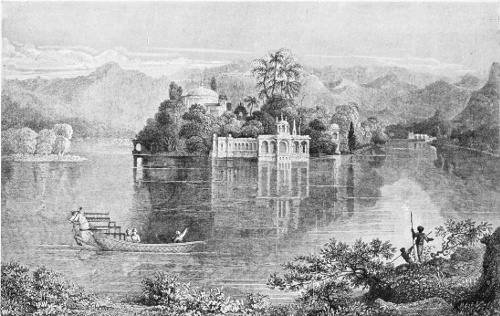
JAGMANDIR PALACE, UDAIPUR.
To face page 432.
—The Emperor Jahangir died
shortly after his accession [October 28, 1627], and while Khurram
was in exile. This event, which gave the throne to the friend of
his house, was announced to him by the Rana, who sent his
brother and a band of Rajputs to Surat to form the cortege of
the emperor, who repaired directly to Udaipur; and it was in
the Badal Mahall (‘the cloud saloon’) of his palace that he was
first saluted by the title of ‘Shah Jahan,’ by the satraps and
tributary princes of the empire.
[11] On taking leave, the new
monarch restored five alienated districts, and presented the Rana
433with a ruby of inestimable value, giving him also permission to
reconstruct the fortifications of Chitor.
[12]The twenty-six years during which Jagat Singh occupied the
throne passed in uninterrupted tranquillity: a state unfruitful
to the bard, who flourishes only amidst agitation and strife.
This period was devoted to the cultivation of the peaceful arts,
especially architecture; and to Jagat Singh Udaipur is indebted
for those magnificent works which bear his name, and excite our
astonishment, after all the disasters we have related, at the
resources he found to accomplish them [373].
—The palace on the lake
(covering about four acres), called the Jagniwas, is entirely his
work, as well as many additions to its sister isle, on which is the
Jagmandir.
[13] Nothing but marble enters into their composition;
columns, baths, reservoirs, fountains, all are of this material,
often inlaid with mosaics, and the uniformity pleasingly diversified
by the light passing through glass of every hue. The apartments
are decorated with historical paintings in water-colours, almost
meriting the term fresco from their deep absorption in the wall,
though the darker tints have blended with and in part obscured
the more delicate shades, from atmospheric causes. The walls,
both here and in the grand palace, contain many medallions, in
considerable relief, in gypsum, portraying the principal historical
events of the family, from early periods even to the marriage
pomp of the present Rana. Parterres of flowers, orange and
lemon groves, intervene to dispel the monotony of the buildings,
shaded by the wide-spreading tamarind and magnificent evergreen
khirni;
[14] while the graceful palmyra and coco wave their plumelike
branches over the dark cypress or cooling plantain. Detached
colonnaded refectories are placed on the water’s edge for the
chiefs, and extensive baths for their use. Here they listened to
the tale of the bard, and slept off their noonday opiate amidst
434the cool breezes of the lake, wafting delicious odours from myriads
of the lotus-flower which covered the surface of the waters; and
as the fumes of the potion evaporated, they opened their eyes
on a landscape to which not even its inspirations could frame an
equal: the broad waters of the Pichola, with its indented and
well-wooded margin receding to the terminating point of sight,
at which the temple of Brahmpuri opened on the pass of the
gigantic Aravalli, the field of the exploits of their forefathers.
Amid such scenes did the Sesodia princes and chieftains recreate
during two generations, exchanging the din of arms for voluptuous
inactivity.
Jagat Singh was a highly respected prince, and did much to
efface the remembrance of the rude visitations of the Moguls.
The dignity of his character, his benevolence of address and
personal demeanour, secured the homage of all who had access
to him, and are alike attested by the pen of the emperor, the
ambassador of England, and the chronicles of Mewar. He had
the proud satisfaction [374] of redeeming the ancient capital
from ruin; rebuilding the “chaplet bastion,[15] restoring the portals,
and replacing the pinnacles on the temples of Chitrakot.” By a
princess of Marwar he left two sons, the eldest of whom succeeded.
—Raj Singh (the royal lion)
mounted the throne in S. 1710 (
A.D. 1654). Various causes over
which he had no control combined, together with his personal
character, to break the long repose his country had enjoyed. The
emperor of the Moguls had reached extreme old age, and the
ambition of his sons to usurp his authority involved every Rajput
in support of their individual pretensions. The Rana inclined to
Dara,
[16] the legitimate heir to the throne, as did nearly the whole
Rajput race; but the battle of Fatehabad
[17] silenced every
pretension, and gave the lead to Aurangzeb, which he maintained
by the sacrifice of whatever opposed his ambition. His father,
brothers, nay, his own offspring, were in turn victims to that
thirst for power which eventually destroyed the monarchy of the
Moguls.
435The policy introduced by their founder, from which Akbar,
Jahangir, and Shah Jahan had reaped so many benefits, was
unwisely abandoned by the latter, who of all had the most powerful
reasons for maintaining those ties which connected the Rajput
princes with his house. Historians have neglected to notice the
great moral strength derived from this unity of the indigenous
races with their conquerors; for during no similar period was
the empire so secure, nor the Hindu race so cherished, as during
the reigns of Jahangir and Shah Jahan: the former born from a
Rajput princess of Amber, and the latter from the house of
Marwar. Aurangzeb’s unmixed Tatar blood brought no Rajput
sympathies to his aid; on the contrary, every noble family shed
their best blood in withstanding his accession, and in the defence
of Shah Jahan’s rights, while there was a hope of success. The
politic Aurangzeb was not blind to this defect, and he tried to
remedy it in his successor; for both his declared heir, Shah Alam,
and Azam, as well as his favourite grandson,[18] were the offspring
of Rajputnis; but, uninfluenced himself by such predilections,
his bigotry outweighed his policy, and he visited the Rajputs
with an unrelenting and unwise persecution [375].
We shall pass the twice-told tale of the struggle for power
which ended in the destruction of the brothers, competitors with
Aurangzeb: this belongs to general history, not to the annals of
Mewar; and that history is in every hand,[19] in which the magnanimity
of Dara,[20] the impetuosity of Murad, and the activity of
Suja met the same tragical end.
—It has seldom occurred
that so many distinguished princes were contemporary as during
the reign of Aurangzeb. Every Rajput principality had a head
above mediocrity in conduct as in courage. Jai Singh of Amber,
436surnamed ‘the Mirza Raja’; Jaswant Singh of Marwar, with the
Haras of Bundi and Kotah; the Rathors of Bikaner, and
Bundelas of Orchha and Datia, were men whose prejudices,
properly consulted, would have rendered the Mogul power indissoluble:
but he had but one measure of contumely for all,
which inspired Sivaji with designs of freedom to Maharashtra,
and withdrew every sentiment of support from the princes of
Rajasthan. In subtlety and the most specious hypocrisy, in that
concentration of resolve which confides its deep purpose to none,
in every qualification of the warrior or scholar,
[21] Aurangzeb had
437no superior amongst the many distinguished [376] of his race;
but that sin by which ‘angels fell’ had steeped him in an ocean
of guilt, and not only neutralized his natural capacities, but
converted the means for unlimited power into an engine of self-destruction.
438“This hypocrisy,” says the eloquent Orme,
[22]
“encreased with his power, and in order to palliate to his Mahomedan
subjects the crimes by which he had become their sovereign,
he determined to enforce the conversion of the Hindoos
by the severest penalties, and even threatned the sword; as if
the blood of his subjects were to wash away the stains, with
which he was imbrued by the blood of his family.... Labour
left the field and industry the loom, until the decrease of the
revenues drew representations from the governors of the provinces;
which induced Aurungzebe to substitute a capitation
tax
[23] as the ballance of the account between the two religions.”
The same historian justly characterizes this enactment as one so
contrary to all notions of sound policy, as well as of the feelings
of humanity, that “reflection seeks the motive with amazement.”
In this amazement we might remain, nor seek to develop the
motive, did not the ample page of history in all [377] nations
disclose that in the name of religion more blood has been shed,
and more atrocity committed, than by the united action of the
whole catalogue of the passions. Muhammad’s creed was based
on conversion, which, by whatever means effected, was a plenary
atonement for every crime. In obedience thereto Aurangzeb
acted; but though myriads of victims who clung to their faith
were sacrificed by him at the fiat of this gladiatorial prophet, yet
nor these, nor the scrupulous fulfilment of fanatic observances,
could soothe at the dread hour the perturbations of the ‘still
small voice’ which whispered the names of father, brother, son,
bereft by him of life. Eloquently does he portray these terrors
in his letters to his grandson on his death-bed, wherein he says,
"Whichever way I look, I see only the divinity"—and that an
offended divinity [378].
[24]439—Raj Singh had signalized
his accession by the revival of the warlike Tika-daur, and plundered
440Malpura, which though on the Ajmer frontier, Shah Jahan, when
advised to vengeance, replied “it was only a folly of his nephew.”
[25]
An appeal to his gallantry made him throw down the gauntlet
to Aurangzeb in the plenitude of his power, when the valour of
the Sesodias again burst forth in all the splendour of the days of
Partap; nor did the contest close till after a series of brilliant
victories, and with the narrow escape from captivity of the
Xerxes of Hindustan. The Mogul demanded the hand of the
princess of Rupnagar, a junior branch of the Marwar house, and
sent with the demand (a compliance with which was contemplated
441as certain) a cortège of two thousand horse to escort the fair to
court. But the haughty Rajputni, either indignant at such
precipitation or charmed with the gallantry of the Rana, who
had evinced his devotion to the fair by measuring his sword with
the head of her house, rejected with disdain the proffered alliance,
and, justified by brilliant precedents in the romantic history of
her nation, she entrusted her cause to the arm of the chief of the
Rajput race, offering herself as the reward of protection. The
family priest (her preceptor) deemed his office honoured by being
the messenger of her wishes, and the billet he conveyed is incorporated
in the memorial of this reign. “Is the swan to be
the mate of the stork: a Rajputni, pure in blood, to be wife to
the monkey-faced barbarian!” concluding with a threat of self-destruction
if not saved from dishonour. This appeal, with other
powerful motives, was seized on with avidity by the Rana as a
pretext to throw away the scabbard, in order to illustrate the
opening of a warfare, in which he determined to put all to the
hazard in defence of his country and his faith. The issue was an
omen of success to his warlike and [379] superstitious vassalage.
With a chosen band he rapidly passed the foot of the Aravalli
and appeared before Rupnagar, cut up the imperial guards, and
bore off the prize to his capital. The daring act was applauded
by all who bore the name of Rajput, and his chiefs with joy
gathered their retainers around the ‘red standard,’ to protect
the queen so gallantly achieved.
—The annalist of
Rajputana is but an indifferent chronologist, and leaves us
doubtful of the exact succession of events at this period. It was
not, however, till the death of those two powerful princes, Jaswant
Singh of Marwar and Jai Singh of Amber, both poisoned by
command of the tyrant, the one at his distant government of
Kabul, the other in the Deccan, that he deemed himself free to
put forth the full extent of his long-concealed design, the imposition
of the
jizya or capitation tax on the whole Hindu race. But
he miscalculated his measures, and the murder of these princes,
far from advancing his aim, recoiled with vengeance on his head.
Foiled in his plot to entrap the infant sons of the Rathor by the
self-devotion of his vassals,
[26] the compound treachery evinced that
442their only hope lay in a deadly resistance. The mother of Ajit,
the infant heir of Marwar, a woman of the most determined
character, was a princess of Mewar, and she threw herself upon
the Rana as the natural guardian of his rights, for sanctuary
(
saran) during the dangers of his minority. This was readily
yielded, and Kelwa assigned as his residence, where under the
immediate safeguard of the brave Durgadas Ajit resided,
[27] while
she nursed the spirit of resistance at home. A union of interests
was cemented between these the chief States of Rajputana, for
which they never before had such motive, and but for repeated
instances of an ill-judged humanity, the throne of the Moguls
might have been completely overturned [380].
—On the promulgation
of that barbarous edict, the
jizya, the Rana remonstrated by
letter, in the name of the nation of which he was the head, in a
style of such uncompromising dignity, such lofty yet temperate
resolve, so much of soul-stirring rebuke mingled with a boundless
and tolerating benevolence, such elevated ideas of the Divinity
with such pure philanthropy, that it may challenge competition
with any epistolary production of any age, clime, or condition.
[28]
443In this are contained the true principles of Christianity, and to
the illustrious Gentile, and such as acted as he did, was pointed
444that golden sentence of toleration, "Those [381] who have not
the law, yet do by nature the things contained in the law, shall
be a law unto themselves."
—This letter, the sanctuary afforded
Ajit, and (what the historical parasite of the Mogul’s life dared
not indite
[29]) the carrying off of his betrothed, made him pour out
all the phials of his wrath against the devoted Mewar, and his
preparations more resembled those for the conquest of a potent
kingdom than the subjugation of a Rajput
zamindar,[30] a vassal of
that colossal empire on whose surface his domain was but a
speck. In the very magnitude of these, the Suzerain of Hindustan
paid the highest tribute of praise to the tributary Rajput, for he
denuded the very extremities of his empire to assemble a host
which he deemed must prove irresistible. Akbar was recalled
from his province, Bengal; Azam from the distant Kabul; and
even Muazzam (the Mogul’s heir) from the war in the Deccan.
445With this formidable array
[31] the emperor entered Mewar, and
soon reduced the low countries, which experience had taught
them were indefensible, the inhabitants previously retiring with
their effects to the hills.
[32] Chitor, Mandalgarh, Mandasor, Jiran,
and many other strongholds were obtained after the usual form
of opposition, and garrisoned by the Moguls. Meanwhile the
Rana was animating the might of the Aravalli, where he meditated
a resistance proportioned to the peril which threatened every
cherished prejudice of his race: not the mere defence of dominion
or dignity, but a struggle,
pro aris et focis, around which rallied
every Rajput with the most deadly determination. Even the
primitive races of the western wilds, “the Palindas
[33] and Palipats
[33]
(
lord of the passes), with thousands of bows, and hearts
devoted in the cause of Hindupat,”
[34] assembled round the red
banner of Mewar. The Rana divided his forces into three bodies
[382]. His eldest son, Jai Singh, was posted on the crest of the
Aravalli, ready to act on the invaders from either side of the
mountains. Prince Bhim was to the west, to keep up the communications
with the outlets to Gujarat; while the Rana, with
the main body, took post in the Nai defile, unassailable by the
enemy, and hanging on his left flank, ready to turn it, and cut
off all retreat the moment the Imperialists entered the mountains.
Aurangzeb advanced to Debari, but instead of entering the
valley of which it was the gorge, he halted, and by the advice of
Tahawwar Khan
[35] sent on Prince Akbar with fifty thousand men
to the capital. This caution of the wily monarch saved him
from the ably planned scheme of the Rajput prince, who evinced
a thorough knowledge
[36] of the topography of this intricate and
446romantic portion of his domain. The Girwa, emphatically ‘the
Circle,’ from which the valley of the capital is named, has this
form to the eye when viewing it from thence as a centre. It is,
however, an irregular ellipse of about fourteen miles in length
from south to north, and about eleven in breadth from east to
west, the capital being situated towards the extremity of the
transverse axis, having only the lake Pichola between it and the
base of the Aravalli. The mountains of this circular (
girwa)
valley, ranging from eight to twelve hundred feet in height, are
of primitive formation, and raise their fantastic pinnacles in
every diversity of shape over each other. To the westward the
grand chain rises two thousand feet above the plains, and might
be termed the chord, of which the Girwa is an irregular segment
of a circle, less in height, and far less compound in character.
Towards the plains east, it has three practicable passes; one, the
more northern, by Delwara; the other (central), by Debari; a
third, leading to the intricacies of Chappan, that of Nai. Of
these three passes the emperor chose the most practicable, and
encamped near the Udaisagar lake, on the left of its entrance.
—Prince Akbar advanced.
“Not a soul interrupted his progress to the city. Palaces,
gardens, lakes, and isles met his eye, but no living thing: all was
silence.” Akbar encamped. Accustomed to this desertion from
the desire of the people to avoid a licentious soldiery, and lulled
into a hardy security, he was surprised [383] by the heir of Mewar.
Some were praying, some feasting, some at chess: “they came
to steal and yet fell asleep,” says the annalist, and were dispersed
with terrific and unrelenting slaughter. Cut off from the possibility
of a junction with the emperor by a movement of a part
of the Rana’s personal force, Akbar attempted a retreat to the
plains of Marwar by the route of Gogunda. It was a choice of
evils, and he took the worst. The allodial vassals of the mountains,
with the Bhil auxiliaries, outstripped his retreat, and
blocked up farther egress in one of those long-extended valleys
termed
Nal, closed by a natural rampart or
Col, on which they
447formed
abbatis of trees, and manning the crests on each side,
hurled destruction on the foe; while the prince, in like manner,
blocked up the entrance and barred retrogression. Death
menaced them in every form. For several days they had only
the prospect of surrender to save them from famine and a justly
incensed foe, when an ill-judged humanity on the part of Jai
Singh saved them from annihilation. He admitted overtures,
confided in protestations to renounce the origin of the war, and
gave them guides to conduct them by the defile of Jhilwara, nor
did they halt till protected by the walls of Chitor.
[37]448Another body of the Imperialists, under the celebrated Dilir
Khan,[38] who [384] entered by the Desuri Pass from Marwar (probably
with a view of extricating Prince Akbar), were allowed to
advance unopposed, and when in the long intricate gorge were
assailed by Bikram Solanki[39] and Gopinath Rathor[40] (both nobles
of Mewar), and after a desperate conflict entirely destroyed. On
each occasion a vast booty fell into the hands of the Rajputs.
So ably concerted was this mountain warfare, that these defeats
were the signal for a simultaneous attack by the Rana on Aurangzeb,
who, with his son Azam, watched at Debari the result of the
operations under Akbar and Dilir. The great home-clans had
more than their wonted rivalry to sustain them, for the gallant
Durgadas with the Rathor swords (talwār Rāthorān) whetted by
an accumulation of wrongs, were to combat with them against
their common oppressor; and nobly did they contest the palm of
glory. The tyrant could not withstand them: his guns, though
manned by Franks, could not protect him against the just cause
and avenging steel of the Rajput, and he was beaten and compelled
to disgraceful flight, with an immense loss in men and
equipment. The Rana had to lament many brave leaders, home
and auxiliary; and the imperial standard, elephants, and state
equipage fell into his hands, the acquisition of Mohkam and the
Saktawats. This glorious encounter occurred in the spring month
of Phalgun, S. 1737, March A.D. 1681 [1680].
The discomfited forces formed a junction under the walls of
Chitor, whence the emperor dictated the recall of his son, Prince
Muazzam, from the Deccan, deeming it of greater moment to
regain lost importance in the north than to prevent the independence
of Sivaji. Meanwhile the activity of Sawaldas (descended
from the illustrious Jaimall) cut off the communication between
Chitor and Ajmer, and alarmed the tyrant for his personal safety.
Leaving, therefore, this perilous warfare to his sons Azam and
Akbar, with instructions how to act till reinforced,—foiled in his
449vengeance and personally disgraced, he abandoned Mewar, and
at the head of his guards repaired to Ajmer. Thence he detached[41]
Khan Rohilla, with twelve thousand men, against Sawaldas,
with supplies and equipments for his sons. The Rathor, joined
by the troops of Marwar, gave him the meeting at Pur Mandal,
and defeated the Imperialists with great loss, driving them back
on Ajmer [385].
—While the Rana, his heir and
auxiliaries, were thus triumphant in all their operations, Prince
Bhim with the left division was not idle, but made a powerful
diversion by the invasion of Gujarat, captured Idar, expelling
Hasan and his garrison, and proceeding by Birnagar, suddenly
appeared before Patan, the residence of the provincial satrap,
which he plundered. Siddhpur, Modasa,
[42] and other towns shared
the same fate; and he was in full march to Surat, when the benevolence
of the Rana, touched at the woes of the fugitives, who
came to demand his forbearance, caused him to recall Bhim in
the midst of his career.
Contrary to the Rajput character, whose maxim is parcere
subjectis, they were compelled by the utter faithlessness of Aurangzeb
(chiefly vulnerable through his resources) to retaliate his
excesses; and Dayal Sah, the civil minister, a man of high
courage and activity, headed another flying force, which ravaged
Malwa to the Nerbudda and Betwa. Sarangpur, Dewas, Sironj,
Mandu, Ujjain, and Chanderi were plundered, and numerous
garrisons put to the sword; and, to use the words of the Chronicle,
“husbands abandoned their wives and children, and whatever
could not be carried off was given to the flames.” For once they
avenged themselves, in imitation of the tyrant, even on the
religion of their enemies: “the Kazis were bound and shaved,
and the Korans thrown into wells.” The minister was unrelenting
and made Malwa a desert, and from the fruits of his incursions
repaired the resources of his master. Flushed with success,
he formed a junction with the heir of Mewar, and gave battle to
Azam near Chitor. On this occasion the flower of Mewar, with
the Rathor and Khichi auxiliaries,[43] were engaged, and obtained
450a glorious victory, the Mogul prince being defeated and pursued
with great slaughter to Ranthambhor, which he entered. This
was a just revenge, for it was Azam who surprised Chitor the year
preceding. In Mewar the contest terminated with the expulsion
of the Imperialists from the country; when the Rana, in support
of the rights of the minor prince of Marwar, united his arms to
the forces of that state, and opened the campaign at Ghanerao,
the chief town of [386] Godwar. The heroic mother of the infant
Rathor prince, a daughter of Mewar, had, since the death of her
husband, well supported his rights, having resisted every aggression
and regained many lost advantages over their antagonist.
Prince Bhim commanded the Sesodias, who formed a junction
with the Rathors, and gave battle to the royal forces led by
Akbar and Tahawwar Khan, whom they entirely defeated.
The victory is chiefly attributed to a stratagem of a Rajput chief,
who, having carried off five hundred camels from the Imperialists,
conceived the idea of fixing torches to them and letting them
loose in the royal camp; and, in the confusion produced by the
charge of such a body, the Rajputs assaulted them.
—On their continued successes,
the Rana and his allies meditated the project of dethroning the
tyrant and setting up his son Akbar. The pernicious example
of his father towards Shah Jahan was not lost upon Akbar, who
favourably received the overture; but he wanted the circumspection
which characterized Aurangzeb, whose penetration
defeated the scheme when on the eve of execution.
[44] Already
had the Rajput armies united with Akbar, and the astrologer had
fixed the day which was to exalt him; but the revealer of secrets
baffled his own prediction by disclosing it to the emperor. Aurangzeb,
attended only by his guards at Ajmer, had recourse to
the same artifice which raised him to empire, in order to ward
off this danger. Akbar was but one day’s march distant; his
elder sons, Muazzam and Azam, yet far off. Not a moment was
to be lost: he penned a letter to his son, which by a spy was
451dropped in the tent of the Rajput leader Durgadas.
[45] In this he
applauded a pretended scheme by which Akbar was to fall upon
them when they engaged the emperor. The same scheme had
saved Sher Shah in this country from Maldeo, and has more
recently been put in practice, and with like success, in the war with
Sivaji. It succeeded. The Rajputs detached themselves from
the prince who had apparently betrayed them. Tahawwar Khan,
in despair, lost his life in an attempt to assassinate the emperor,
[46]
and before the artifice was discovered, the reinforcements under
Muazzam and Azam arrived, and Aurangzeb was saved. The
Rajputs still offered
saran (refuge) to Akbar; but aware of his
father’s vigour of character, he deemed himself unsafe in his
vicinage, and accepted the escort of five hundred Rajputs led by
Durgadas [387], who cut their way through every opposition by
the defiles of Mewar and Dungarpur, and across the Nerbudda,
to the Mahratta leader Sambhaji, at Palargarh, whence he was
shortly after conveyed in an English ship to Persia.
[47]—“The escape of Acbar” (observes an
historian,
[48] who appreciated the importance of the transactions
of this period) “to Sambagee, oppressed Aurengzebe with as
much anxiety, as formerly the phantom of his brother Sujah
amongst the Pitans; and the consequence of their alliance
452became a nearer care than the continuance of the war against
the Rajpoots, whose gallant activity prevented a speedy decision
by the sword; but the dignity of the throne forbad any overtures
of peace to a resistance which had attempted the deposal, if not
the life, of the monarch. A Rajpoot officer, who had long served
with distinction under Delire Khan, solved the difficulty: he
quitted the army on the pretence of retiring to his own country
and visited the Rana as from courtesy on his journey. The
conversation turned on the war, which the Rajpoot perhaps really
lamented, and he persuaded the Rana that although Aurengzebe
would never condescend to make, he might accept overtures
of peace: upon which he was empowered by the Rana to tender
them.”
[49] The domestic annals confirm this account, and give
the name of this mediator, Raja Shyam Singh of Bikaner; but
the negotiation was infamously protracted to the rains, the period
when operations necessarily cease, and by which time Aurangzeb
had recruited his broken forces, and was again enabled to take
the field; and it was concluded “without assertion or release of
the capitation tax, but with the surrender of the districts taken
from Chitor, and the State of Jodhpur was included in the treaty.”
How correctly this elegant historian had obtained a knowledge
of those events, a translation of the treaty evinces.
[50] But these
453occurrences belong to the succeeding reign, for the Rana died
about this period,
[51] from wounds and vexation.
—Once more we claim
the reader’s admiration on behalf of another patriot prince of
Mewar, and ask him to contrast the indigenous Rajput with the
emperor of the Moguls [388]; though to compare them would be
manifestly unjust, since in every moral virtue they were antipodes
to each other. Aurangzeb accumulated on his head more crimes
than any prince who ever sat on an Asiatic throne. With all
the disregard of life which marks his nation, he was never betrayed,
even in the fever of success, into a single generous action;
and, contrary to the prevailing principle of our nature, the
moment of his foe’s submission was that chosen for the malignant
completion of his revenge: witness his scourging the prostrate
King of Golkonda.
[52] How opposite to the beneficence of the
Rajput prince, who, when the most efficient means of self-defence
lay in the destruction of the resources of his enemy, feeling for
the miseries of the suffering population of his persecutor, recalled
his son in the midst of victory! As a skilful general and gallant
soldier, in the defence of his country, he is above all [389] praise.
As a chivalrous Rajput, his braving all consequences when called
upon to save the honour of a noble female of his race, he is without
parallel. As an accomplished prince and benevolent man, his
dignified letter of remonstrance to Aurangzeb on the promulgation
of the capitation edict, places him high in the scale of moral
as well as intellectual excellence; and an additional evidence
of both, and of his taste for the arts, is furnished by the formation
of the inland lake, the Rajsamund, with a slight account of which,
and the motives for its execution, we shall conclude the sketch of
this glorious epoch in the annals of Mewar.
454—This great national work is twenty-five
miles north of the capital, and is situated on the declivity
of the plain about two miles from the base of the Aravalli. A
small perennial stream, called the Gomati or ‘serpentine,’
[53]
flowing from these mountains, was arrested in its course, and
confined by an immense embankment, made to form the lake
called after himself, Rajsamund, or ‘royal sea.’ The
band or
dam forms an irregular segment of a circle, embracing an extent
of nearly three miles, and encircling the waters on every side
except the space between the north-west and north-east points.
This barrier, which confines a sheet of water of great depth, and
about twelve miles in circumference, is entirely of white marble,
with a flight of steps of the same material, throughout this extent,
from the summit to the water’s edge; the whole buttressed by an
enormous rampart of earth, which, had the projector lived, would
have been planted with trees to form a promenade. On the south
side are the town and fortress built by the Rana, and bearing his
name, Rajnagar; and upon the embankment stands the temple
of Kankroli, the shrine of one of the seven forms (
sarup) of
Krishna. The whole is ornamented with sculpture of tolerable
execution for the age; and a genealogical sketch of the founder’s
family is inscribed in conspicuous characters. One million one
hundred and fifty thousand pounds sterling,
[54] contributed by the
Rana, his chiefs and opulent subjects, was expended on this work,
of which the material was from the adjacent quarries. But,
magnificent, costly, and useful as it is, it derives its chief beauty
from the benevolent motive to which it owes its birth: to alleviate
the miseries of a starving population, and make their employment
conducive to national benefit, during one of those awful visitations
[390] of providence, famine, and pestilence with which these
states are sometimes afflicted.
—It was in S. 1717,
[55] only seven years
after the accession of Raj Singh, that these combined evils reached
Mewar, less subject to them, owing to its natural advantages,
than any other State in India;
[56] and on Tuesday the 8th of Pus,
455Hasti Nakshatra (constellation of the elephant), as fixed by the
astrologer, the first stone was laid. "The chief of Mewar, deeply
meditating on this extreme distress, determined to raise a monument,
by which the wretched might be supported and his own
name perpetuated. This was seven years in constructing, and
at its commencement and termination all the rites of sacrifice
and oblation were observed.
"The Rana went to implore favour at the temple of the ‘four-armed’;
for though Asarh[57] was over, not a drop of rain fell
from the heavens; and, in like manner, the months of Sawan[57]
and Bhadon[57] passed away. For want of water the world was
in despair, and people went mad with hunger. Things unknown
as food were eaten. The husband abandoned the wife, the wife
the husband—parents sold their children—time increased the
evil; it spread far and wide: even the insects died: they had
nothing to feed on. Thousands of all ages became victims to
hunger. Those who procured food to-day, ate twice what nature
required. The wind was from the west, a pestilential vapour.
The constellations were always visible at night, nor was there a
cloud in the sky by day, and thunder and lightning were unknown.
Such portents filled mankind with dread. Rivers, lakes, and
fountains were dried up. Men of wealth meted out the portions
of food. The ministers of religion forgot their duties. There
was no longer distinction of caste, and the Sudra and Brahman
were undistinguishable. Strength, wisdom, caste, tribe, all were
abandoned, and food alone was the object. The Charbaran[58]
threw away every symbol of separation; all was lost in hunger.
Fruits, flowers, every vegetable thing, even trees were stripped
of their bark, to appease the cravings [391] of hunger: nay, man
ate man! Cities were depopulated. The seed of families was
lost, the fishes were extinct, and the hope of all extinguished."[59]
456Such is the simple yet terrific record of this pestilence, from
which Mewar was hardly freed, when Aurangzeb commenced the
religious warfare narrated, with all its atrocities, still further to
devastate this fair region. But a just retribution resulted from
this disregard to the character and prejudices of the Rajputs,
which visited the emperor with shame, and his successors with
the overthrow of their power.
—Rana Jai Singh took possession
of the
Gaddi[1] in S. 1737 (
A.D. 1681). A circumstance occurred
at his birth, which as descriptive of manners may deserve notice.
A few hours only intervened between his entrance into the world
and that of another son called Bhim. It is customary for the
father to bind round the arm of the new-born infant a root of
that species of grass called the
amardub, the ‘imperishable’
dub,
well known for its nutritive properties and luxuriant vegetation
under the most intense heat.
[2] The Rana first attached the
ligature round the arm of the youngest, apparently an oversight,
though in fact from superior affection for his mother. As the
boys approached to manhood, the Rana, apprehensive that this
preference might create dissension, one day drew his sword, and
placing it in the hand of Bhim (the elder), said, it was better to
use it at once on his brother, than hereafter to endanger the
safety of the State. This [392] appeal to his generosity had an
instantaneous effect, and he not only ratified, ‘by his father’s
throne,’
[3] the acknowledgment of the sovereign rights of his
brother, but declared, to remove all fears, “he was not his son
if he again drank water within the pass of Debari”; and, collecting
his retainers, he abandoned Udaipur to court Fortune where
she might be kinder. The day was sultry, and on reaching the
barrier he halted under the shade of a sacred fig-tree to bestow a
last look upon the place of his birth. His cup-bearer (
Paniyari)
brought his silver goblet filled from the cool fountain, but as he
457raised it to his lips, he recollected that his vow was incomplete
while within the portal; he poured the libation on the earth in
the name of the Supreme, and casting the cup as an offering to
the deity of the fountain, the huge gates closed upon the valley.
He proceeded to Bahadur Shah, who conferred upon him the
dignity (
mansab) of a leader of three thousand five hundred horse,
with the Bawana, or fifty-two districts for their support: but
quarrelling with the imperial general, he was detached with his
contingent west of the Indus, where he died.
[4]—Let us return
to Jai Singh (the lion of victory). He concluded a treaty with
Aurangzeb, conducted by Prince Azam and Dilir Khan, who
took every occasion to testify his gratitude for the clemency of
Rana Raj Singh, when blockaded in the defiles of the Aravalli.
At this conference, the Rana was attended by ten thousand horse
and forty thousand foot, besides the multitude collected from
the mountains to view the ceremony, above one hundred thousand
souls, who set up a shout of joy at the prospect of revisiting the
plains, which disconcerted Azam, while Dilir expatiated on the
perils from which the Rana’s generosity had liberated him.
Azam, who said he was no stranger to the Rana’s illustrious house,
concluded a treaty on the spot, in which, as a salvo for the imperial
dignity, a nominal fine and surrender of three districts were
inserted for aiding Akbar’s rebellion, and a hint that the regal
colour (crimson) of his tents and umbrella [393] should be discontinued.
That advantages were gained by the Rana, we may
infer from Dilir’s sons being left as hostages for Azam’s good
faith; a fact we learn from his farewell address to the Rana!
“Your nobles are rude, and my children are the hostages of your
safety; but if at the expense of their lives I can obtain the entire
458restoration of your country, keep your mind at ease, for there
was friendship between your father and me.”
—But all other protection than what
his sword afforded was futile; and though Dilir’s intentions were
noble, he had little control over events: in less than five years
after his accession, the Rana was again forced to fly the plains
for the inaccessible haunts of Kamori. Yet, in spite of these
untoward circumstances and uninterrupted warfare, such were
the resources of this little State that the Rana completed a work
which perpetuates his name. He threw a dam across a break in
the mountains, the channel of an ever-flowing stream, by which
he formed the largest lake in India,
[5] giving it his own name, the
Jaisamund, or sea of victory. Nature had furnished the hint
for this undertaking, for there had always existed a considerable
volume of water; but the Rana had the merit of uniting these
natural buttresses, and creating a little sea from the Dhebar pool,
its ancient appellation. The circumference cannot be less than
thirty miles, and the benefits to cultivation, especially in respect
to the article of rice, which requires perpetual irrigation, were
great. On this huge rampart he erected a palace for his favourite
queen, Komaladevi, a princess of the Pramara race, familiarly
known as the Ruthi Rani, or ‘testy queen.’
—Domestic unhappiness
appears to have generated in the Rana inaptitude to state
affairs; and, unluckily, the favoured queen estranged him from
his son. Amra, a name venerated in Mewar, was that of the
heir of Jai Singh. His mother was of the Bundi house, a family
which has performed great services to, and brought great calamities
upon, the ancient sovereigns of Mewar. To the jealousies of
the rival queens, one of them mother to the heir, the other the
favourite of the sovereign, are attributed dissensions, which at
such a juncture were a greater detriment than the loss of a battle,
and which afford another illustration, if any were wanting, of
the impolicy of polygamy. The annals of Mewar seldom exhibit
those unnatural contentions for power, from which no other
Hindu State was exempt; this was owing to the wholesome
regulation of not investing the princes of the blood with any [394]
459political authority; and establishing as a counterpoise to natural
advantages an artificial degradation of their rank, which placed
them beneath the sixteen chief nobles of the State; which, while
it exalted these in their own estimation, lessened the national
humiliation, when the heirs-apparent were compelled to lead
their quota in the arrière-ban of the empire.
—Rana Jai Singh, who had evinced
such gallantry and activity in the wars of Aurangzeb, now secluded
himself with Komala in the retreat of Jaisamund, leaving Amra
under the guidance of the Pancholi
[6] minister, at the capital.
But he having personally insulted this chief officer of the State,
in consequence of receiving a rebuke for turning loose an infuriated
elephant in the town, the Rana left his retreat, and
visiting Chitor in his tour, arrived at Udaipur. Amra awaited
not his father’s arrival, but adding his mother’s resentments to
a feeling of patriotic indignation at the abasement his indolence
produced, fled to Bundi, took up arms, and, joined by many of
his own nobles and Hara auxiliaries, returned at the head of ten
thousand men. Desirous of averting civil war, the Rana retired
to Godwar beyond the Aravalli, whence he sent the Ghanerao
chieftain, the first feudatory of that department, to expostulate
with his son. But Amra, supported by three-fourths of the
nobles, made direct for Kumbhalmer to secure the State treasure,
saved by the Depra governor for his sovereign. A failure in
this project, the knowledge that the Rathors fostered the quarrel
with a view to obtain Godwar, and the determination of the few
chiefs yet faithful
[7] to the Rana, to defend the Jhilwara pass to
the last, made the prince listen to terms, which were ratified at
the shrine of Eklinga, whereby the Rana was to return to the
capital, and the prince to abide in exile at the new palace during
the life of his father, which closed twenty years after his accession.
Had he maintained the reputation he established in his early
years, the times were well calculated for the redemption of his
country’s independence; but documents which yet exist afford
little reason to doubt that in his latter years a state of indolence,
460having all the effects of imbecility, supervened, and but for the
formation of ‘the victorious sea,’ would have left his name a
blank in the traditional history of Mewar.
—Amra II., who succeeded
in S. 1756 (A.D. 1700), had much of the gallantry [395] and
active turn of mind of his illustrious namesake; but the degrading
conflict with his father had much impaired the moral strength of
the country, and counteracted the advantages which might have
resulted from the decline of the Mogul power. The reigns of Raj
Singh and Jai Singh illustrate the obvious truth, that on the
personal character of the chief of a feudal government everything
depends. The former, infusing by his talent and energy patriotic
sentiments into all his subordinates, vanquished in a series of
conflicts the vast military resources of the empire, led by the
emperor, his sons, and chosen generals; while his successor, heir
to this moral strength, and with every collateral aid, lowered her
to a stage of contempt from which no talent could subsequently
raise her.
Amra early availed himself of the contentions amongst the
sons of Aurangzeb to anticipate events, and formed a private
treaty[8] with the Mogul heir-apparent, Shah Alam, when commanded
461to the countries west of the Indus, on which occasion
[396] the Mewar contingent[9] accompanied him, and fought
several gallant actions under a Saktawat chieftain.
—It is
important to study the events of this period, which involved the
overthrow of the Mogul power, and originated that form of
society which paved the way to the dominion of Britain in these
distant regions. From such a review a political lesson of great
value may be learned, which will show a beacon warning us
against the danger of trusting to mere physical power, unaided
462by the latent, but more durable support of moral influence.
When Aurangzeb neglected the indigenous Rajputs, he endangered
the keystone of his power; and in despising opinion,
though his energetic mind might for a time render him independent
of it, yet long before his death the enormous fabric reared by
Akbar was tottering to its foundation: demonstrating to conviction
that the highest order of talent, either for government or
war, though aided by unlimited resources, will not suffice for the
maintenance of power, unsupported by the affections of the
governed. The empire of Aurangzeb was more extensive than
that of Britain at this day—the elements of stability were incomparably
more tenacious: he was associated with the Rajputs
by blood, which seemed to guarantee a respect for their opinions;
he possessed the power of distributing the honours and emoluments
of the state, when a service could be rewarded by a province,
[10]
drawing at will supplies of warriors from the mountains
of the west, as a check on his indigenous subjects, while these
left the plains of India to control the Afghan amidst the snows of
Caucasus. But the most devoted attachment and most faithful
service were repaid by insults to their habits, and the imposition
of an obnoxious tax; and to the jizya, and the unwise pertinacity
with which his successors adhered to it, must be directly ascribed
the overthrow of the monarchy. No condition was exempted
from this odious and impolitic assessment, which was deemed by
the tyrant a mild substitute for the conversion he once meditated
of the entire Hindu race to the creed of Islam.
[11]463—An abandonment of their faith was the
Rajput’s surest road to the tyrant’s favour [397], and an instance
of this dereliction in its consequences powerfully contributed to
the annihilation of the empire. Rao Gopal, a branch of the
Rana’s family, held the fief of Rampura, on the Chambal,
[12] and
was serving with a select quota of his clan in the wars of the
Deccan, when his son, who had been left at home, withheld the
revenues, which he applied to his own use instead of remitting
them to his father. Rao Gopal complained to the emperor; but
the son discovered that he could by a sacrifice not only appease
Aurangzeb, but attain the object of his wishes: he apostatized
from his faith, and obtained the emperor’s forgiveness, with the
domain of Rampura. Disgusted and provoked at such infurious
conduct, Rao Gopal fled the camp, made an unsuccessful attempt
to redeem his estate, and took refuge with Rana Amra, his
suzerain. This natural asylum granted to a chief of his own kin
was construed by the tyrant into a signal of revolt, and Azam
was ordered to Malwa to watch the Rana’s motions: conduct
thus characterized in the memoirs of a Rajput chieftain,
[13] one of
the most devoted to Aurangzeb, and who died fighting for his
son. “The emperor showed but little favour to his faithful and
most useful subjects the Rajputs, which greatly cooled their
ardour in his service.” The Rana took up arms, and Malwa
joined the tumult; while the first irruption of the Mahrattas
across the Nerbudda,
[14] under Nima Sindhia, compelled the emperor
to detach Raja Jai Singh to join Prince Azam. Amidst
these accumulated troubles, the Mahrattas rising into importance,
the Rajput feudatories disgusted and alienated, his sons and
grandsons ready to commit each individual pretension to the
decision of the sword, did Aurangzeb, after a reign of terror of
half a century’s duration, breathe his last on the 28th Zilqa’da,
A.D.
1707 [February 21], at the city bearing his name—Aurangabad.
464—At his
death his second son Azam assumed the imperial dignity, and
aided by the Rajput princes of Datia and Kotah,
[15] who had
always served in his division, he marched to Agra to contest the
legitimate claims of his eldest brother Muazzam, who was advancing
from Kabul supported by the contingents of Mewar and
Marwar, and all western Rajwara. The battle of Jajau
[16] [398]
was fatal to Azam, who with his son Bedarbakht and the princes
of Kotah and Datia was slain, when Muazzam ascended the
throne under the title of Shah Alam Bahadur Shah. This prince
had many qualities which endeared him to the Rajputs, to whom
his sympathies were united by the ties of blood, his mother being
a Rajput princess.
[17] Had he immediately succeeded the beneficent
Shah Jahan, the race of Timur, in all human probability,
would have been still enthroned at Delhi, and might have presented
a picture of one of the most powerful monarchies of Asia.
But Aurangzeb had inflicted an incurable wound on the mind of
the Hindu race, which for ever estranged them from his successors;
nor were the virtues of Bahadur, during the short lustre of his
sway, capable of healing it. The bitter fruit of a long experience
had taught the Rajputs not to hope for amelioration from any
graft of that stem, which, like the deadly Upas, had stifled the
vital energies of Rajasthan, whose leaders accordingly formed a
league for mutual preservation, which it would have been madness
to dissolve merely because a fair portion of virtue was the inheritance
of the tyrant’s successor. They had proved that no
act of duty or subserviency could guarantee them from the
infatuated abuse of power, and they were at length steeled
against every appeal to their loyalty, replying with a trite adage,
which we may translate ‘
quem Deus vult perdere, prius dementat,’—of
common application with the Rajput in such a predicament.
—The emperor was soon made to perceive
the little support he had in future to expect from the Rajputs.
Scarcely had he quashed the pretensions of Kambakhsh, his
youngest brother, who proclaimed himself emperor in the Deccan,
than he was forced to the north, in consequence of an insurrection
465of the Sikhs of Lahore. This singular race, the disciples (
sikhs)
of a teacher called Nanak, were the descendants of the Scythic
Getae,
[18] or Jat, of Transoxiana, who so early as the fifth century
were established in the tract watered by the five arms (
Panjab)
of the Indus. Little more than a century has elapsed since their
conversion from a spurious Hinduism to the doctrines of the
sectarian Nanak, and their first attempt to separate themselves,
in temporal as well as spiritual matters, from all control, and they
are now the sole independent power within the limits [399] of the
Mogul monarchy. On this occasion
[19] the princes of Amber and
Marwar visited the emperor, but left his camp without permission,
and, as the historian
[20] adds, manifested a design to struggle for
independence. Such was the change in their mutual circumstances
that the Mogul sent the heir-apparent to conciliate and
conduct them to him; but they came at the head of all their
native bands, when “they were gratified with whatever their
insolence demanded”:
[21] a splenetic effusion of the historian,
which well paints their altered position. From the royal
urdu,
[22]
or camp, they repaired to Rana Amra at Udaipur, where a triple
league was formed, which once more united them to the head of
their nation. This treaty of unity of interests against the common
foe was solemnized by nuptial engagements, from which those
princes had been excluded since the reigns of Akbar and Partap.
To be readmitted to this honour was the basis of this triple
alliance, in which they ratified on oath the renunciation of all
connexion, domestic or political, with the empire. It was,
moreover, stipulated that the sons of such marriage should be
heirs, or if the issue were females, that they should never be
dishonoured by being married to a Mogul.
—But this remedy, as
will be seen, originated a worse disease; it was a sacrifice of the
rights of primogeniture (clung to by the Rajputs with extreme
pertinacity), productive of the most injurious effects, which
466introduced domestic strife, and called upon the stage an umpire
not less baneful than the power from whose iron grasp they were
on the point of freeing themselves: for although this treaty laid
prostrate the throne of Babur, it ultimately introduced the
Mahrattas as partisans in their family disputes, who made the
bone of contention their own.
The injudicious support afforded by the emperor to the apostate
chief of Rampura first brought the triple federation into action.
The Rana, upholding the cause of Himmat Singh, made an
attack on Rampura, which the apostate usurper Ratan Singh,
now Raj Muslim Khan, defeated, and was rewarded for [400] it
by the emperor.[23] But the same report conveyed to the king
“that the Rana determined to lay waste his country, and retire
to the hills,”[24] which was speedily confirmed by the unwelcome
intelligence that Sawaldas, an officer of the Rana’s, had attacked
Firoz Khan, the governor of Pur Mandal, who was obliged to
retreat with great loss to Ajmer;[25] on which occasion this loyal
descendant of the illustrious Jaimall lost his life.[26] The brave
Durgadas, who conveyed the rebellious Akbar through all opposition
to a place of refuge, again appeared upon the stage—his
own prince being unable to protect him, he had found a safe
asylum at Udaipur, and had the sum of five hundred rupees
daily paid for his expenditure—a princely liberality. But the
result of this combination was reserved for the following reigns,
Shah Alam being carried off by poison,[27] ere he could correct the
disorders which were rapidly breaking up the empire from the
Hindu-Kush to the ocean. Had his life been spared, his talents
for business, his experience, and courteous manners might have
retarded the ruin of the monarchy, which the utter unworthiness
of his successor sunk beyond the power of man to redeem. Every
467subsequent succession was through blood; and the sons of Shah
Alam performed the part for which they had so many great
examples. Two brothers,[28] Sayyids, from the town of Barha in the
Duab, were long the Warwicks of Hindustan, setting up and
plucking down its puppet kings at their pleasure; they had
elevated Farrukhsiyar when the triumvirs of Rajasthan commenced
their operations.
—Giving loose to long-suppressed
resentment, the Rajputs abandoned the spirit of
toleration which it would have been criminal to preserve; and
profiting by the lessons of their tyrants, they overthrew the
mosques built on the sites of their altars, and treated the civil
and religious officers of the government with indignity. Of these
every town in Rajasthan had its
mulla to proclaim the name of
Muhammad, and its
kazi for the administration of justice,—branches
of government [401] entirely wrested from the hands of
the native princes,
[29] abusing the name of independence. But for
a moment it was redeemed, especially by the brave Rathors, who
had made a noble resistance, contesting every foot of land since
the death of Jaswant Singh, and now his son Ajit entirely expelled
the Moguls from Marwar. On this occasion the native forces of
the triple alliance met at the salt lake of Sambhar, which was
made the common boundary of their territory, and its revenues
were equally divided amongst them.
The pageant of an emperor, guided by the Sayyids, or those
who intrigued to supplant their ministry, made an effort to
oppose the threatening measures of the Rajputs; and one of
them, the Amiru-l-umara,[30] marched against Raja Ajit, who
received private instructions from the emperor to resist his
commander-in-chief, whose credit was strengthened by the
means taken to weaken it, which engendered suspicions of
treachery. Ajit leagued with the Sayyids, who held out to the
Rathor an important share of power at court, and agreed to pay
tribute and give a daughter in marriage to Farrukhsiyar.
468—This marriage
yielded most important results, which were not confined to the
Moguls or Rajputs, for to it may be ascribed the rise of the British
power in India. A dangerous malady,
[31] rendering necessary a
surgical operation upon Farrukhsiyar, to which the faculty of
the court were unequal, retarded the celebration of the nuptials
between the emperor and the Rajput princess of Marwar, and
even threatened a fatal termination. A mission from the British
merchants at Surat was at that time at court, and, as a last
resource, the surgeon attached to it was called in, who cured
the malady, and made the emperor happy in his bride.
[32] His
gratitude was displayed with oriental magnificence. The emperor
desired Mr. Hamilton to name [402] his reward, and to the
disinterested patriotism of this individual did the British owe
the first royal grant or farman, conferring territorial possession
and great commercial privileges. These were the objects of the
mission, which till this occurrence had proved unsuccessful.
This gorgeous court ought to have been, and probably was,
impressed with a high opinion of the virtuous self-denial of the
inhabitants of Britain; and if history has correctly preserved the
transaction, some mark of public gratitude should have been
forthcoming from those who so signally benefited thereby. But
to borrow the phraseology of the Italian historian, “Obligations
which do not admit of being fully discharged are often repaid
with the coin of ingratitude”: the remains of this man rest in
the churchyard of Calcutta, without even a stone to mark the
spot![33]
469—This marriage, which promised a
renewal of interests with the Rajputs, was soon followed by the
revival of the obnoxious jizya. The character of this tax, though
much altered from its original imposition by Aurangzeb, when
it was at once financial and religious, was held in unmitigated
abhorrence by the Hindus from the complex association; and
although it was revived chiefly to relieve pecuniary wants, it
kindled a universal feeling of hatred amongst all classes, and
quenched the little zeal which the recent marriage had inspired
in the Rajputs of the desert. The mode and channel of its
introduction evinced to them that there was no hope that the
intolerant spirit which originally suggested it would ever be
subdued. The weak Farrukhsiyar, desirous of snapping the
leading-strings of the Sayyids, recalled to his court Inayatu-lla
Khan,
[34] the minister of Aurangzeb, and restored to him his office
of Diwan, who, to use the words of the historian of the period,
"did not consult the temper of the times, so very different from
the reign of Aurangzeb, and the revival of the
jizya came with
him." Though by no means severe in its operation, not amounting
to three-quarters per cent on annual income,
[35]—from which
the lame, the blind, and very poor were exempt,—it nevertheless
raised a general spirit of hostility, particularly from its retaining
the insulting distinction of a ‘tax on infidels.’ Resistance to
taxation appears to be a universal feeling, in which even the
Asiatic forgets the divine right of sovereignty, and which throws
us back on the pervading spirit of selfishness which [403] governs
human nature. The
tamgha,
[36] or stamp tax, which preceded the
jizya, would appear to have been as unsatisfactory as it was
general, from the solemnity of its renunciation by Babur on the
field of battle after the victory over infidels, which gave him the
crown of India; and though we have no record of the jizya being
its substitute, there are indications which authorize the inference.
470—Rana Amra
was not an idle spectator of these occurrences; and although the
spurious thirst for distinction so early broke up the alliance by
detaching Ajit, he redoubled his efforts for personal independence,
and with it that of the Rajput nation. An important document
attests this solicitude, namely, a treaty
[37] with the emperor, in
which the second article stipulates emancipation from the galling
jizya. It may be well to analyse this treaty, which attests the
471altered condition of both parties. Its very title marks the
subordination of the chief of the Rajputs; but while this is
headed a ‘Memorandum of Requests,’ the eighth article discloses
the effective means of the Rana, for there he assumes an
air of protection towards the emperor. In the opening stipulation
for the
mansab of 7000, the [404] mind reverts to the great Amra,
who preferred abdication to acknowledgment of a superior; but
opinion had undergone a change as great as the mutual relations
of the Rajputs. In temporal dignities other States had risen to
an equality with Mewar, and all had learned to look on the Mogul
as the fountain of honour. The abolition of the jizya, freedom
from religious restraint, control over the ancient feudatories of
his house, and the restoration of all sequestrations, distinguish
the other articles, and amply attest the improving attitude of
Mewar, and the rapid decay of the Mogul empire. The Mahrattas
under Raja Sahu
[38] were successfully prosecuting their peculiar
system in the south, with the same feelings which characterized
the early Gothic invaders of Italy; strangers to settled government,
they imposed the taxes of
chauth and
desmukhi,
[39] the
fourth
and
tenth of all territorial income, in the countries they overran.
The Jat tribes west of the Chambal likewise bearded their
oppressors in this reign, by hoisting the standard of independence
at the very threshold of their capital; and from the siege of
Sinsini (mentioned in this treaty) to the last storm of Bharatpur,
they maintained the consequence thus assumed.
—This treaty was the last act of
Rana Amra’s life; he died in A.D. 1716 [1710], leaving the reputation
of an active and high-minded prince, who well upheld his
station and the prosperity of his country, notwithstanding the
anarchy of the period. His encouragement of agriculture and
protection of manufactures are displayed in the edicts engraved
on pillars, which will hand down his name to posterity. His
memory is held in high veneration; nor do the Rajputs admit
the absolute degradation of Mewar till the period of the second
prince in succession to Amra [405].
472
—Sangram Singh (the
lion of battle) succeeded; a name renowned in the annals of
Mewar, being that of the opponent of the founder of the Moguls.
He ascended the throne about the same time with Muhammad
Shah,
[1] the last of the race of Timur who deserved the name of
emperor of India. During the reign of Sangram, from
A.D. 1716
to 1734, this mighty empire was dismembered; when, in lieu of
one paramount authority, numerous independent governments
started up, which preserved their uncertain existence until the
last revolution, which has given a new combination to these
discordant materials—Muhammadan, Mahratta, and Rajput, in
the course of one century under the dominion of a handful of
Britons! Like the Satraps of the ancient Persian, or the Lieutenants
of Alexander, each chief proclaimed himself master of the
province, the government of which was confided to his loyalty
and talents; and it cannot fail to diminish any regret at the
successive prostration of Bengal, Oudh, Haidarabad, and other
less conspicuous States, to remember that they were founded in
rebellion, and erected on ingratitude; and that their rulers were
destitute of those sympathies, which could alone give stability
to their ephemeral greatness, by improving the condition of their
subjects. With the Mahrattas the case is different: their emergence
to power claims our admiration, when tyranny transformed
the industrious husbandman, and the minister of religion, into
a hardy and enterprising soldier, and a skilful functionary of
government. Had their ambition been restrained within legitimate
bounds, it would have been no less gratifying than politically
and morally just that the family of Sivaji should have retained
its [406] authority in countries which his active valour wrested
from Aurangzeb. But the genius of conquest changed their
natural habits; they devastated instead of consolidating; and
in lieu of that severe and frugal simplicity, and that energy of
enterprise, which were their peculiar characteristics, they became
distinguished for mean parsimony, low cunning, and dastardly
depredation. Had they, retaining their original character, been
content with their proper sphere of action, the Deccan, they
473might yet have held the sovereignty of that vast region, where
their habits and language assimilated them with the people.
But as they spread over the north they encountered national
antipathies, and though professing the same creed, a wider
difference in sentiment divided the Mahratta from the Rajput,
than from the despots of Delhi, whose tyrannical intolerance was
more endurable, because less degrading, than the rapacious
meanness of the Southron. Rajasthan benefited by the demolition
of the empire: to all but Mewar it yielded an extension of
power. Had the national mind been allowed to repose, and
its energies to recruit, after so many centuries of demoralization,
all would have recovered their strength, which lay in the opinions
and industry of the people, a devoted tenantry and brave vassalage,
whom we have so often depicted as abandoning their habitations
and pursuits to aid the patriotic views of their princes.
—The short reign
of Farrukhsiyar was drawing to a close; its end was accelerated
by the very means by which that monarch hoped to emancipate
himself from the thraldom of the Sayyids, against whose authority
the faction of Inayatu-lla was but a feeble counterpoise, and
whose arbitrary habits, in the re-establishment of the jizya, lost
him even the support of the father of his queen. It was on this
occasion that the celebrated Nizamu-l-mulk,
[2] the founder of the
Haidarabad State, was brought upon the stage: he then held the
unimportant charge of the district of Moradabad; but possessed
of high talents, he was bought over, by the promise of the government
of Malwa, to further the views of the Sayyids. Supported
by a body of ten thousand Mahrattas, these makers of kings soon
manifested their displeasure by the deposal of Farrukhsiyar, who
was left without any support but that of the princes of Amber
and Bundi. Yet they would never have abandoned him had he
hearkened to their counsel to take the field, and trust his cause
to them: but, cowardly and infatuated, he refused to quit the
walls of his palace, and threw [407] himself upon the mercy of
his enemies, who made him dismiss the faithful Rajputs and
“admit a guard of honour of their troops into the citadel.”
[3]474—Farrukhsiyar hoped
for security in the inviolability of the harem—but he found no
sanctuary even there: to use the words of the Mogul memoir,
"night advanced, and day, like the fallen star of the emperor,
sunk in darkness. The gates of the citadel were closed upon his
friends: the Wazir and Ajit Singh remained within. This night
was dreadful to the inhabitants of the city; no one knew what
was passing in the palace, and the troops under the Amiru-l-umara,
with ten thousand Mahrattas, remained under arms: morning
came, and all hope was extinguished by the royal band (Naubat)
announcing the deposal of Farrukhsiyar, in the proclamation of
Rafiu-d-darajat, his successor." The interval between the deposal
and the death of an Asiatic prince is short, and even while
the heralds vociferated “long live the king!” to the new puppet,
the bowstring was on the neck of the contemptible Farrukhsiyar.
475—The first act of the new reign
(A.D. 1719) was one of conciliation towards Ajit Singh and the
Rajputs, namely, the abrogation of the jizya; and the Sayyids
further showed their disposition to attach them by conferring the
important office of Diwan on one of their own faith: Raja Ratan
Chand was accordingly inducted into the ministry in lieu of
Inayatu-lla.
—Three
phantoms of royalty flitted across the scene in a few months,
till Roshan-Akhtar, the eldest son of Bahadur Shah, was [408]
enthroned with the title of Muhammad Shah (
A.D. 1720), during
whose reign of nearly thirty years the empire was completely
dismembered,
[4] and Mahrattas from the south disputed its spoils
with the Afghan mountaineers. The haughty demeanour of the
Sayyids disgusted all who acted with them, especially their
coadjutor the Nizam,
[5] of whose talents, displayed in restoring
Malwa to prosperity, they entertained a dread. It was impossible
to cherish any abstract loyalty for the puppets they established,
and treason lost its name, when the Nizam declared for independence,
which the possession of the fortresses of Asir and
Burhanpur enabled him to secure. The brothers had just cause
for alarm. The Rajputs were called upon for their contingents,
[6]
476and the princes of Kotah and Narwar gallantly interposed their
own retainers to cut off the Nizam from the Nerbudda, on which
occasion the Kotah prince was slain. The independence of the
Nizam led to that of Oudh. Saadat Khan was then but the
commandant of Bayana, but he entered into the conspiracy to
expel the Sayyids, and was one of those who drew lots to assassinate
the Amiru-l-umara. The deed was put into execution on
the march to reduce the Nizam, when Haidar Khan buried his
poniard in the Amir’s heart.
[7] The emperor then in camp, being
thus freed, returned against the Wazir, who instantly set up
Ibrahim and marched against his opponents. The Rajputs
wisely remained neutral, and both armies met. The decapitation
of Ratan Chand was the signal for the battle, which was obstinate
and bloody; the Wazir was made prisoner, and subjected to the
bowstring. For the part Saadat Khan acted in the conspiracy
he was honoured with the title of Bahadur Jang, and the government
of Oudh. The Rajput princes paid their respects to the
[409] conqueror, who confirmed the repeal of the
jizya, and as the
reward of their neutrality the Rajas of Amber and Jodhpur, Jai
Singh and Ajit, were gratified, the former with the government
of the province of Agra, the last with that of Gujarat and Ajmer,
of which latter fortress he took possession. Girdhardas
[8] was
made governor of Malwa to oppose the Mahrattas, and the Nizam
was invited from his government of Haidarabad to accept the
office of wazir of the empire.
—The policy of Mewar was too isolated
for the times; her rulers clung to forms and unsubstantial
homage, while their neighbours, with more active virtue, plunged
into the tortuous policy of the imperial court, and seized every
opportunity to enlarge the boundaries of their States: and while
Amber appropriated to herself the royal domains almost to the
Jumna; while Marwar planted her banner on the battlements
of Ajmer, dismembered Gujarat, and pushed her clans far into
the desert, and even to ‘the world’s end’;
[9] Mewar confined
her ambition to the control of her ancient feudatories of Abu,
477Idar, and the petty States which grew out of her, Dungarpur and
Banswara. The motive for this policy was precisely the same
which had cost such sacrifices in former times; she dreaded
amalgamating with the imperial court, and preferred political
inferiority to the sacrifice of principle. The internal feuds of her
two great clans also operated against her aggrandizement; and
while the brave Saktawat, Jeth Singh, expelled the Rathor from
Idar, and subdued the wild mountaineers even to Koliwara, the
conquest was left incomplete by the jealousy of his rival, and he
was recalled in the midst of his success. From these and other
causes an important change took place in the internal policy of
Mewar, which tended greatly to impair her energies. To this
period none of the vassals had the power to erect places of strength
within their domains, which, as already stated, were not fixed,
but subject to triennial change; their lands were given for
subsistence, their native hills were their fortresses, and the
frontier strongholds defended their families in time of invasion.
As the Mogul power waned, the general defensive system was
[410] abandoned, while the predatory warfare which succeeded
compelled them to stud their country with castles, in order to
shelter their effects from the Mahratta and Pathan, and in later
times to protect rebels.
Rana Sangram ruled eighteen [twenty-four] years; under him
Mewar was respected, and the greater portion of her lost territory
was regained. His selection of Biharidas Pancholi evinced his
penetration, for never had Mewar a more able or faithful minister,
and numerous autograph letters of all the princes of his time
attest his talent and his worth as the oracle of the period. He
retained his office during three reigns: but his skill was unable
to stem the tide of Mahratta invasion, which commenced on the
death of Sangram.
—Tradition has preserved
many anecdotes of Sangram, which aid our estimate of Rajput
character, whether in the capacity of legislators or the more
retired sphere of domestic manners. They uniformly represent
this Rana as a patriarchal ruler, wise, just, and inflexible,
[10] steady
in his application to business, regulating public and private
478expenditure, and even the sumptuary laws, which were rigidly
adhered to, and on which the people still expatiate, giving homely
illustrations of the contrast between them and the existing
profusion. The Chauhan of Kotharia, one of the highest class
of chieftains, had recommended an addition to the folds of the
court robe, and as courtesy forbids all personal denial, his wish
was assented to, and he retired to his estate pluming himself on
his sovereign’s acquiescence. But the Rana, sending for the
minister, commanded the sequestration of two villages of Kotharia,
which speedily reaching the ears of the chief, he repaired to court,
and begged to know the fault which had drawn upon him this
mark of displeasure. “None, Raoji; but on a minute calculation
I find the revenue of these two villages will just cover the
expense of the superfluity of garment which obedience to your
wishes will occasion me, and as every iota of my own income is
appropriated, I had no other mode of innovating on our ancient
costume than by making you bear the charge attending a compliance
with your suggestion.” It will readily be believed, that the
Chauhan prayed the [411] revocation of this edict, and that he
was careful for the future of violating the sumptuary laws of his
sovereign.
On another occasion, from lapse of memory or want of consideration,
he broke the laws he had established, and alienated a
village attached to the household. Each branch had its appropriate
fund, whether for the kitchen, the wardrobe, the privy
purse, the queens; these lands were called thua, and each had
its officer, or thuadar, all of whom were made accountable for
their trust to the prime minister; it was one of these he had
alienated. Seated with his chiefs in the rasora, or banqueting-hall,
there was no sugar forthcoming for the curds, which has a
place in the dinner carte of all Rajputs, and he chid the superintendent
for the omission. “Anndata” (giver of food), replied
the officer, "the minister says you have given away the village
set apart for sugar."—“Just,” replied the Rana, and finished his
repast without further remark, and without sugar to his curds.
Another anecdote will show his inflexibility of character, and
his resistance to that species of interference in state affairs which
is the bane of Asiatic governments. Sangram had recently
emancipated himself from the trammels of a tedious minority,
during which his mother, according to custom, acted a conspicuous
479part in the guardianship of her son and the State. The
chieftain of Dariawad had his estate confiscated: but as the
Rana never punished from passion or pardoned from weakness,
none dared to plead his cause, and he remained proscribed from
court during two years, when he ventured a petition to the queen-mother
through the Bhandarins,[11] for the reversion of the decree,
accompanied with a note for two lakhs of rupees,[12] and a liberal
donation to the fair mediators. It was the daily habit of the
Rana to pay his respects to his mother before dinner, and on one
of these visits she introduced the Ranawat’s request, and begged
the restoration of the estate. It was customary, on the issue of
every grant, that eight days should elapse from the mandate to
the promulgation of the edict, to which eight official seals[13] were
attached; but on the present occasion the Rana commanded
the execution of the deed at once, and to have it ere he left the
Rawala. On its being brought, he [412] placed it respectfully in
his mother’s hands, begging her to return the note to the Ranawat;
having made this sacrifice to duty, he bowed and retired.
The next day he commanded dinner an hour earlier, without the
usual visit to the Rawala: all were surprised, but none so much
as the queen-mother—the day passed—another came—still no
visit, and to a confidential message, she received a ceremonious
reply. Alarmed for the loss of her son’s affections, she pondered
on the cause, but could find none, except the grant—she entreated
the minister’s interference; he respectfully intimated that he
was interdicted from the discussion of State affairs but with his
sovereign—she had recourse to other expedients, which proving
alike fruitless, she became sullen, punished her damsels without
cause, and refused food: Sangram still remained obdurate. She
talked of a pilgrimage to the Ganges, and befitting equipage and
escort were commanded to attend her—the moment of departure
was at hand, and yet he would not see her. She repaired by
Amber on her route to Mathura, to worship the Apollo of Vraj,[14]
when the great Raja Jai Singh (married to the Rana’s sister)[15]
480advanced, and conducted her to his new city of Jaipur, and to
evince his respect “put his shoulder to the travelling litter or
palki,” and promised to return with her and be a suppliant to his
brother-in-law for the restoration of his regard. She made a
tour of the sacred places, and on return accepted the escort of
the Prince of Amber. The laws of hospitality amongst the
Rajputs are rigid: the Rana could not refuse to his guest the
request for which he had left his capital: but averse to owing
reconciliation to external intercession, and having done enough
for the suppression of intrigue, he advanced to meet the cortège
when within one march of Udaipur, as if to receive the Amber
prince; but proceeding direct to his [413] mother’s tents, he
asked her blessing, and having escorted her to the palace, returned
to greet and conduct his brother prince; all the allusion he made
to the subject was in the simple but pithy expression, “family
quarrels should be kept in the family.”
Another anecdote shows him as the vigilant shepherd watching
over the safety of his flock. As he sat down to dinner, tidings
arrived of an invasion of the Malwa Pathans, who had rifled several
villages at Mandasor, carrying the inhabitants into captivity.
Pushing the platter from him, he ordered his armour, and the
nakkara to beat the assemblage of his chieftains. With all speed
a gallant band formed on the terrace below, but they prevailed
on the Rana to leave the punishment of the desultory aggression
to them, as unworthy of his personal interference. They departed:
481several hours after, the chief of Kanor arrived, having
left a sick-bed, and with a tertian come in obedience to his sovereign’s
summons. Vain was his prince’s dissuasion to keep him
back, and he joined the band as they came up with the invaders.
The foe was defeated and put to flight, but the sick chieftain fell
in the charge, and his son was severely wounded by his side. On
the young chief repairing to court he was honoured with a bira[16]
from the Rana’s own hand, a distinction which he held to be an
ample reward for his wounds, and testimonial of the worth of his
father. The existence of such sentiments are the strongest tests
of character.
On another occasion, some parasite had insinuated suspicions
against the chief of the nobles, the Rawat of Salumbar, who had
just returned victorious in action with the royal forces at Malwa,
and had asked permission to visit his family on his way to court.
The Rana spurned the suspicion, and to show his reliance on the
chief, he dispatched a messenger for Salumbar to wait his arrival
and summon him to the presence. He had reached his domain,
given leave to his vassals as they passed their respective abodes,
dismounted, and reached the door of the Rawala, when the
herald called aloud, “The Rana salutes you, Rawatji, and
commands this letter.” With his hand on the door where his
wife and children awaited him, he demanded his horse, and simply
leaving his ‘duty for his mother,’ he [414] mounted, with half
a dozen attendants, nor loosed the rein until he reached the
capital. It was midnight; his house empty; no servants; no
dinner; but his sovereign had foreseen and provided, and when
his arrival was announced, provender for his cattle, and vessels
of provision prepared in the royal kitchen, were immediately sent
to his abode. Next morning Salumbar attended the court. The
Rana was unusually gracious, and not only presented him with
the usual tokens of regard, a horse and jewels, but moreover a
grant of land. With surprise he asked what service he had
performed to merit such distinction, and from a sentiment becoming
the descendant of Chonda solemnly refused to accept it;
observing, that even if he had lost his head, the reward was
482excessive; but if his prince would admit of his preferring a
request, it would be, that in remembrance of his sovereign’s
favour, when he, or his, in after times, should on the summons
come from their estate to the capital, the same number of dishes
from the royal kitchen should be sent to his abode: it was
granted, and to this day his descendants enjoy the distinction.
These anecdotes paint the character of Sangram far more forcibly
than any laboured effort. His reign was as honourable to himself
as it was beneficial to his country, in whose defence he had fought
eighteen actions; but though his policy was too circumscribed,
and his country would have benefited more by a surrender of
some of those antique prejudices which kept her back in the
general scramble for portions of the dilapidated monarchy of the
Moguls, yet he was respected abroad, as he was beloved by his
subjects, of whose welfare he was ever watchful, and to whose
wants ever indulgent. Rana Sangram was the last prince who
upheld the dignity of the gaddi of Bappa Rawal; with his death
commenced Mahratta ascendancy, and with this we shall open
the reign of his son and successor.
—Jagat Singh II., the eldest of the four sons of
Sangram, succeeded S. 1790 (
A.D. 1734). The commencement of
his reign was signalized by a revival of the triple alliance formed
by Rana Amra, and broken by Raja Ajit’s connexion with the
Sayyids and the renewal of matrimonial ties with the empire,
the abjuration whereof was the basis of the treaty. The present
engagement, which included all the minor states, was formed at
Hurra, a town in Mewar on the Ajmer frontier, where the confederate
princes met at the head of their vassals. To insure
unanimity, the Rana was invested with paramount control, and
headed the forces which were [415] to take the field after the
rains, already set in.
[17] Unity of interests was the chief character
483of the engagement, had they adhered to which, not only the
independence, but the aggrandisement, of Rajasthan, was in
their power, and they might have alike defied the expiring efforts
of Mogul tyranny, and the Parthian-like warfare of the Mahratta.
They were indeed the most formidable power in India at this
juncture; but difficult as it had ever proved to coalesce the
Rajputs for mutual preservation, even when a paramount superiority
of power, both temporal and spiritual, belonged to the
Ranas, so now, since Amber and Marwar had attained an equality
with Mewar, it was found still less practicable to prevent the
operation of the principles of disunion. In fact, a moment’s
reflection must discover that the component parts of a great
feudal federation, such as that described, must contain too many
discordant particles—too many rivalries and national antipathies—ever
cordially to amalgamate. Had it been otherwise, the
opportunities were many and splendid for the recovery of Rajput
freedom; but though individually enamoured of liberty, the
universality of the sentiment prevented its realization: they
never would submit to the control required to work it out, and
this, the best opportunity which had ever occurred, was lost.
A glance at the disordered fragments of the throne of Akbar will
show the comparative strength of the Rajputs.
—Nizamu-l-mulk
484had completely emancipated himself from his
allegiance, and signalized his independence, by sending the head
of the imperial general, who [416] ventured to oppose it, as that
of a traitor, to the emperor. He leagued with the Rajputs, and
instigated Bajirao to plant the Mahratta standard in Malwa and
Gujarat. In defending the former, Dayya Bahadur fell;
[18] and
Jai Singh of Amber, being nominated to the trust, delegated it
to the invader, and Malwa was lost. The extensive province of
Gujarat soon shared the same fate; for in the vacillating policy
of the court, the promise of that government to the Rathors had
been broken, and Abhai Singh, son of Ajit, who had expelled
Sarbuland Khan
[19] after a severe contest, following the example
of his brother prince of Amber, connived with the invaders, while
he added its most northern districts to Marwar. In Bengal,
Behar, and Orissa, Shujau-d-daula, and his deputy Allahwirdi
Khan,
[20] were supreme, and Safdar Jang
[21] (son of Saadat Khan)
was established in Oudh. The basest disloyalty marked the rise
of this family, which owed everything to Muhammad Shah. It
was Saadat Khan who invited Nadir Shah, whose invasion gave
the final stab to the empire; and it was his son, Safdar Jang, who,
when commandant of the artillery (
mir-i-atish), turned it against
his sovereign’s palace, and then conveyed it to Oudh. Of the
Diwans of Bengal we must speak only with reverence; but,
whether they had any special dispensation, their loyalty to the
descendant of Farrukhsiyar has been very little more distinguished
than that of the satraps enumerated, though the original tenure
of Bengal is still apparent, and the feudal obligation to the
suzerain of Delhi manifested, in the homage of
petite serjanterie,
in transmitting with the annual fine of relief (one hundred mohars)
the spices of the eastern archipelago. Yet of all those who
gloried in the title of
fidwi padshah-i-ghazi, the only ‘slave of the
victorious king,’ who has been generous to him in the day of his
distress, is the Diwan of Bengal, better known as the English
485East India Company. In the hour of triumph they rescued the
blind and aged descendants of the illustrious Babur from a state
of degradation and penury, and secured to him all the dignity
and comfort which his circumstances could lead him to hope;
and the present state of his family, contrasted with the thraldom
and misery endured while fortune favoured the Mahratta, is
splendid. Yet perhaps the most acute stroke of fortune to this
fallen monarch was when the British governor of India lent his
aid to the descendant of the rebellious Safdar Jang to mount the
throne of Oudh, and to assume, in lieu of the title of wazir of the
empire, that of king. We can [417] appreciate and commiserate
the feeling; for the days of power were yet too recent
[22] for Akbar
Sani (the second) to receive such intelligence without a shock,
or without comparing his condition with him whose name he bore.
It is well to pause upon this page of eastern history, which is full
of instruction; since by weighing the abuses of power, and its
inevitable loss through placing a large executive trust in the
hands of those who exercised it without sympathy towards the
governed, we may at least retard the day of our decline.
—The Mahratta
establishments in Malwa and Gujarat constituted a nucleus for
others to form upon, and like locusts, they crossed the Nerbudda
in swarms; when the Holkars, the Sindhias, the Puars, and other
less familiar names, emerged from obscurity; when the plough
[23]
was deserted for the sword, and the goat-herd
[24] made a lance of
his crook. They devastated, and at length settled upon, the
lands of the indigenous Rajputs. For a time the necessity of
unity made them act under one standard, and hence the vast
masses under the first Bajirao, which bore down all opposition,
and afterwards dispersed themselves over those long-oppressed
regions. It was in
A.D. 1735 that he first crossed the Chambal
[25]
and appeared before Delhi, which he blockaded, when his retreat
was purchased by the surrender of the
chauth, or fourth of the
486gross revenues of the empire. The Nizam, dreading the influence
such pusillanimous concession might exert upon his rising power,
determined to drive the Mahrattas from Malwa, where, if once
fixed, they would cut off his communications with the north.
He accordingly invaded Malwa, defeated Bajirao in a pitched
battle, and was only prevented from following it up by Nadir
Shah’s advance, facilitated by the Afghans, who, on becoming
independent in Kabul, laid open the frontiers of Hindustan.
[26] In
this emergency, “great hopes were placed on the valour of the
Rajputs”; but the spirit of devotion in this brave race, by whose
aid the Mogul power was made and maintained, was irretrievably
alienated, and not one of those high families, who had throughout
been so lavish of their blood in its defence, would obey the summons
to the royal standard, when the fate of India was decided
on the plains of Karnal.
[27] A sense [418] of individual danger
brought together the great home feudatories, when the Nizam
and Saadat Khan (now Wazir) united their forces under the
imperial commander; but their demoralized levies were no
match for the Persian and the northern mountaineer. The
Amiru-l-umara was slain, the Wazir made prisoner, and Muhammad
Shah and his kingdom were at Nadir’s disposal. The
disloyalty of the Wazir filled the capital with blood, and subjected
his sovereign to the condition of a captive. Jealous of the
Nizam, whose diplomatic success had obtained him the office of
Amiru-l-umara, he stimulated the avarice of the conqueror by
exaggerating the riches of Delhi, and declared that he alone could
furnish the ransom negotiated by the Nizam. Nadir’s love of
gold overpowered his principle; the treaty was broken, the keys
of Delhi were demanded, and its humiliated emperor was led in
triumph through the camp of the conqueror, who, on March 8,
A.D. 1739, took possession of the palace of Timur, and coined
money bearing this legend:
King over the kings of the world
Is Nadir, king of kings, and lord of the period.
—The accumulated wealth of
India contained in the royal treasury, notwithstanding the lavish
expenditure during the civil wars, and the profuse rewards
487scattered by each competitor for dominion, was yet sufficient to
gratify even avarice itself, amounting in gold, jewels, and plate
to forty millions sterling, exclusive of equipages of every denomination.
But this enormous spoil only kindled instead of satiating
the appetite of Nadir, and a fine of two millions and a half was
exacted, and levied with such unrelenting rigour and cruelty on
the inhabitants, that men of rank and character could find no
means of escape but by suicide. A rumour of this monster’s
death excited an insurrection, in which several Persians were
killed. The provocation was not lost: the conqueror ascended
a mosque,
[28] and commanded a general massacre, in which thousands
were slain. Pillage accompanied murder; whilst the
streets streamed with blood, the city was fired, and the dead
were consumed in the conflagration of their late habitations. If
a single ray of satisfaction could be felt amidst such a scene of
horror, it must have been when Nadir commanded the minister
of the wretch who was the author of [419] this atrocity, the
infamous Saadat Khan, to send, on pain of death, an inventory
of his own and his master’s wealth; demanding meanwhile the
two millions and a half, the original composition settled by the
Nizam, from the Wazir alone. Whether his ‘coward conscience’
was alarmed at the mischief he had occasioned, or mortification
at discovering that his ambition had ‘o’erleaped itself,’ and
recoiled with vengeance on his own head, tempted the act, it is
impossible to discover, but the guilty Saadat became his own
executioner. He swallowed poison;
[29] an example followed by
his diwan, Raja Majlis Rae, in order to escape the rage of the
offended Nadir. By the new treaty, all the western provinces,
Kabul, Tatta, Sind, and Multan, were surrendered and united to
Persia, and on the vernal equinox, Nadir, gorged with spoil,
commenced his march from the desolated Delhi.
[30] The philosophic
488comment of the native historian on these events is so
just, that we shall transcribe it verbatim. “The people of
Hindustan at this period thought only of personal safety and
gratification; misery was disregarded by those who escaped it,
and man, centred wholly in self, felt not for his kind. This
selfishness, destructive of public and private virtue, was universal
in Hindustan at the invasion of Nadir Shah; nor have the people
become more virtuous since, and consequently neither more
happy nor more independent.”
—At this eventful era in the political
history of India, the Rajput nation had not only maintained
their ground amidst the convulsions of six centuries under the
paramount sway of the Islamite, but two of the three chief
States, Marwar and [420] Amber, had by policy and valour
created substantial States out of petty principalities, junior
branches
[31] from which had established their independence, and
489still enjoy it under treaty with the British Government. Mewar
at this juncture was defined by nearly the same boundaries as
when Mahmud of Ghazni invaded her in the tenth century,
though her influence over many of her tributaries, as Bundi,
Abu, Idar, and Deolia, was destroyed. To the west, the fertile
district of Godwar carried her beyond her natural barrier, the
Aravalli, into the desert; while the Chambal was her limit to
the east. The Khari separated her from Ajmer, and to the
south she adjoined Malwa. These limits comprehended one
hundred and thirty miles of latitude and one hundred and forty
of longitude, containing 10,000 towns and villages, with upwards
of a million sterling of revenue, raised from a fertile soil by an
excellent agricultural population, a wealthy mercantile community,
and defended by a devoted vassalage. Such was this little
patriarchal State after the protracted strife which has been related;
we shall have to exhibit her, in less than half a century, on the
verge of annihilation from the predatory inroads of the Mahrattas.
—In order to mark with exactitude
the introduction of the Mahrattas into Rajasthan, we must revert
to the period
[32] when the dastardly intrigues of the advisers of
Muhammad Shah surrendered to them as tribute the
chauth, or
fourth of his revenues. Whether in the full tide of successful
invasion, these spoilers deemed any other argument than force
to be requisite in order to justify their extortions, they had in
this surrender a concession of which the subtle Mahrattas were
well capable of availing themselves; and as the Mogul claimed
sovereignty over the whole of Rajasthan, they might plausibly
urge their right of
chauth, as applicable to all the territories
subordinate to the empire.
—The rapidity with which these desultory
bands flew from conquest to conquest appears to have alarmed
the Rajputs, and again brought about a coalition, which, with
the characteristic peculiarity of all such contracts, was commenced
by matrimonial alliances. On this occasion, Bijai Singh,
the heir of Marwar, was affianced to the Rana’s daughter, who
at the same time reconciled the princes [421] of Marwar and
Amber, whose positions at the court of the Mogul often brought
their national jealousies into conflict, as they alternately took
the lead in his councils: for it was rare to find both in the same
490line of politics. These matters were arranged at Udaipur.
[33] But
as we have often had occasion to observe, no public [422] or
491general benefit ever resulted from these alliances, which were
obstructed by the multitude of petty jealousies inseparable from
clanship; even while this treaty was in discussion, the fruit of
the triple league formed against the tyranny of Aurangzeb was
about to show its baneful influence, as will presently appear.
—When
Malwa was acquired by the Mahrattas, followed by the cession of
the
chauth, their leader, Bajirao, repaired to Mewar, where his
visit created great alarm.
[34] The Rana desired to avoid a personal
492interview, and sent as his ambassadors [423], the chief of Salumbar
and his prime minister, Biharidas. Long discussions followed as
493to the mode of Bajirao’s reception, which was settled to be on the
same footing as the Raja of Banera,
[35] and that he should be seated
in front of the throne. A treaty followed, stipulating an annual
494tribute, which remained in force during ten years,
[36] when grasping
at the whole they despised a part, and the treaty became a
nullity.
[37] The dissensions which arose soon after, in consequence
of the Rajput engagements, afforded the opportunity sought for
to mix in their internal concerns.
—It may be recollected that in the
family engagements formed by Rana Amra there was an obligation
to invest the issue of such marriage with the rights of primogeniture;
and the death of Sawai Jai Singh
[38] of Amber, two
years after Nadir’s invasion, brought that stipulation into effect.
His eldest son, Isari Singh, was proclaimed Raja, but a strong
party supported Madho Singh, the Rana’s nephew, and the
stipulated, against the natural order of succession. We are
[424] left in doubt as to the real designs of Jai Singh in maintaining
his guarantee, which was doubtless inconvenient; but that
Madho Singh was not brought up to the expectation is evident,
from his holding a fief of the Rana Sangram, who appropriated
the domain of Rampura for his support, subject to the service
of one thousand horse and two thousand foot, formally sanctioned
by his father, who allowed the transfer of his services. On the
other hand, the letter of permission entitles him
Kshema, ‘prosperous,’
an epithet only applied to the heir-apparent of Jaipur.
Five years, however, elapsed before any extraordinary exertions
were made to annul the rights of Isari Singh, who led his vassals
to the Sutlej in order to oppose the first invasion of the Duranis.
[39]
It would be tedious to give even an epitome of the intrigues for
the development of this object, which properly belong to the
annals of Amber, and whence resulted many of the troubles of
Rajputana. The Rana took the field with his nephew, and was
met by Isari Singh,
[40] supported by the Mahrattas; but the
Sesodias did not evince in the battle of Rajmahall that gallantry
which must have its source in moral strength: they were defeated
and fled. The Rana vented his indignation in a galling sarcasm;
495he gave the sword of state to a common courtesan to carry in
procession, observing “it was a woman’s weapon in these degenerate
times”: a remark the degrading severity of which
made a lasting impression in the decline of Mewar. Elated with
this success, Isari Singh carried his resentments and his auxiliaries,
under Sindhia, against the Haras of Kotah and Bundi, who
supported the cause of his antagonist. Kotah stood a siege and
was gallantly defended, and Sindhia (Apaji) lost an arm:
[41] on
this occasion both the States suffered a diminution of territory,
and were subjected to tribute. The Rana, following the example
of the Kachhwahas, called in as auxiliary Malhar Rao Holkar,
and engaged to pay sixty-four lakhs of rupees (£800,000) on the
deposal of Isari Singh. To avoid degradation this unfortunate
prince resolved on suicide, and a dose of poison gave Madho Singh
the
gaddi, Holkar his bribe, and the Mahrattas a firm hold upon
Rajasthan. Such was the cause of Rajput abasement; the
moral force of the vassals was lost in a contest unjust in all its
associations, and from this period we have only the degrading
spectacle of civil strife and predatory spoliation till the existing
treaty of
A.D. 1817 [425].
—In S. 1808 (
A.D.
1752) Rana Jagat Singh died. Addicted to pleasure, his habits
of levity and profusion totally unfitted him for the task of governing
his country at such a juncture; he considered his elephant
fights
[42] of more importance than keeping down the Mahrattas.
Like all his family, he patronized the arts, greatly enlarged the
palace, and expended £250,000 in embellishing the islets of the
Pichola. The villas scattered over the valley were all erected
by him, and many of those festivals devoted to idleness and
dissipation, and now firmly rooted at Udaipur, were instituted by
Jagat Singh II.
496
—Partap II. succeeded in
A.D. 1752. Of the history of this prince, who renewed the most
illustrious name in the annals of Mewar, there is nothing to record
beyond the fact, that the three years he occupied the throne were
marked by so many Mahratta invasions
[1] and war contributions.
By a daughter of Raja Jai Singh of Amber he had a son, who
succeeded him.
—Rana Raj Singh II. was
as little entitled to the name he bore as his predecessor. During
the seven years he held the dignity at least seven shoals of the
Southrons overran Mewar,
[2] and so exhausted this country, that
the Rana was compelled to ask pecuniary aid from the Brahman
collector of the tribute, to enable him to marry the Rathor
chieftain’s daughter. On his death the order of succession retrograded,
devolving on his uncle [426],
—Rana Arsi, in S. 1818,
A.D. 1762. The levity of Jagat Singh, the inexperience of his
successors Partap and Raj Singh, with the ungovernable temper
of Rana Arsi, and the circumstances under which he succeeded
to power, introduced a train of disorders which proved fatal to
Mewar. Until this period not a foot of territory had been alienated.
The wisdom of the Pancholi ministers, and the high
respect paid by the organ of the Satara government, for a while
preserved its integrity; but when the country was divided by
factions, and the Mahrattas, ceasing to be a federate body,
prowled in search of prey under leaders, each having an interest
of his own, they formed political combinations to suit the ephemeral
purposes of the former, but from which they alone reaped
advantage. An attempt to depose Partap and set up his uncle
Nathji introduced a series of rebellions, and constituted Malhar
Rao Holkar, who had already become master of a considerable
497portion of the domain of Mewar, the umpire in their family
disputes.
—The
ties of blood or of princely gratitude are feeble bonds if political
expediency demands their dissolution; and Madho Singh, when
firmly established on the throne of Amber, repaid the immense
sacrifices by which the Rana had effected it by assigning his fief
of Rampura, which he had not a shadow of right to alienate, to
Holkar: this was the first limb severed from Mewar.
[3] Holkar
had also become the assignee of the tribute imposed by Bajirao,
but from which the Rana justly deemed himself exempt, when
the terms of all further encroachment in Mewar were set at nought.
On the plea of recovering these arrears, and the rent of some
districts
[4] on the Chambal, Malhar, after many threatening
letters, invaded Mewar, and his threats of occupying the capital
were only checked by draining their exhausted resources of six
hundred thousand pounds.
[5] In the same year
[6] a famine afflicted
them, when flour and tamarinds were equal in value, and were
sold at the rate of a rupee for one pound and a half. Four years
subsequent to this, civil war broke out and continued to influence
all posterior proceedings, rendering [427] the inhabitants of this
unhappy country a prey to every invader until 1817, when they
tasted repose under British protection.
—The real cause
of this rebellion must ever remain a secret: for while some
regard it as a patriotic effort on the part of the people to redeem
themselves from foreign domination, others discover its motive
in the selfishness of the hostile clans, who supported or opposed
the succession of Rana Arsi. This prince is accused of having
unfairly acquired the crown, by the removal of his nephew Raj
Singh; but though the traditional anecdotes of the period furnish
498strong grounds of suspicion, there is nothing which affords a
direct confirmation of the crime. It is, however, a public misfortune
when the line of succession retrogrades in Mewar: Arsi
had no right to expect the inheritance he obtained, having long
held a seat below the sixteen chief nobles; and as one of the
‘infants’ (
babas) he was incorporated with the second class of
nobles with an appanage of only £3000 per annum. His defects
of character had been too closely contemplated by his compeers,
and had kindled too many enmities, to justify expectation that
the adventitious dignity he had attained would succeed in obliterating
the memory of them; and past familiarity alone destroyed
the respect which was exacted by sudden greatness. His insolent
demeanour estranged the first of the home nobility, the Sadri
chieftain,
[7] whose ancestor at Haldighat acquired a claim to the
perpetual gratitude of the Sesodias, while to an unfeeling pun on
a personal defect of Jaswant Singh of Deogarh is attributed the
hatred and revenge of this powerful branch of the Chondawats.
These chiefs formed a party which eventually entrained many of
lesser note to depose their sovereign, and immediately set up a
youth called Ratna Singh, declared to be the posthumous son of
the last Rana by the daughter of the chief of Gogunda, though
to this hour disputes run high as to whether he was really the son
of Raj Singh, or merely the puppet [428] of a faction. Be the
fact as it may, he was made a rallying point for the disaffected,
who soon comprehended the greater portion of the nobles, while
out of the ‘sixteen’ greater chiefs five
[8] only withstood the
499defection: of these, Salumbar, the hereditary premier, at first
espoused, but soon abandoned, the cause of the Pretender; not
from the principle of loyalty which his descendants take credit
for, but from finding the superiority of intellect of the heads of
the rebellion
[9] (which now counted the rival Saktawats) too
powerful for the supremacy he desired. Basant Pal, of the
Depra tribe, was invested with the office of Pardhan to the
Pretender. The ancestor of this man accompanied Samarsi in
the twelfth century from Delhi, where he held a high office in the
household of Prithiraj, the last emperor of the Hindus, and it is a
distinguished proof of the hereditary quality of official dignity
to find his descendant, after the lapse of centuries, still holding
office with the nominal title of Pardhan. The Futuri
[10] (by which
name the court still designates the Pretender) took post with his
faction in Kumbhalmer; where he was formally installed, and
whence he promulgated his decrees as Rana of Mewar. With
that heedlessness of consequences and the political debasement
which are invariable concomitants of civil dissension, they had
the meanness to invite Sindhia to their aid, with a promise of a
reward of more than one million sterling
[11] on the dethronement
of Arsi.
—This contest first brought into notice
one of the most celebrated Rajput chiefs of India, Zalim Singh
of Kotah, who was destined to fill a distinguished part in the
annals of Rajasthan, but more especially in Mewar, where his
political sagacity first developed itself. Though this is not the
proper place to delineate his history, which will occupy a subsequent
portion of the work, it is impossible to trace the events
with which he was so closely connected without adverting slightly
to the part he acted in these scenes. The attack on Kotah, of
which his father was military governor (during the struggle to
place Madho Singh on the throne of Amber), by Isari Singh, in
conjunction with Sindhia, was the first avenue to his distinguished
career, leading to an acquaintance with the Mahratta chiefs,
which linked him with their policy for more than half a century
[429]. Zalim having lost his prince’s favour, whose path in love
500he had dared to cross, repaired, on his banishment from Kotah,
to the Rana, who, observing his talents, enrolled him amongst
his chiefs, and conferred on him, with the title of Raj Rana, the
lands of Chitarkhera for his support. By his advice the Mahratta
leaders, Raghu Paigawala and Daula Miyan, with their bands,
were called in by the Rana, who, setting aside the ancient Pancholi
ministry, gave the seals of office to Agarji Mehta. At this
period (S. 1824,
A.D. 1768), Mahadaji Sindhia was at Ujjain,
whither the conflicting parties hastened, each desirous of obtaining
the chieftain’s support. But the Pretender’s proposals had been
already entertained, and he was then encamped with Sindhia on
the banks of the Sipra.
[12]—The
Rana’s force, conducted by the chief of Salumbar, the Rajas of
Shahpura and Banera, with Zalim Singh and the Mahratta
auxiliaries, did not hesitate to attack the combined camp, and
for a moment they were victorious, driving Mahadaji and the
Pretender from the field, with great loss, to the gates of Ujjain.
Here, however, they rallied, and being joined by a fresh body of
troops, the battle was renewed with great disadvantage to the
Rajputs, who, deeming the day theirs, had broken and dispersed
to plunder. The chiefs of Salumbar, Shahpura, and Banera
were slain, and the auxiliary Daula Miyan, Raja Man (ex-prince
of Narwar), and Raj Kalyan, the heir of Sadri, severely wounded.
Zalim Singh had his horse killed under him, and being left wounded
on the field, was made prisoner, but hospitably treated by Trimbak
Rao, father to the celebrated Ambaji. The discomfited troops
retreated to Udaipur while the Pretender’s party remained with
Sindhia, inciting him to invest that capital and place Ratna on
the throne. Some time, however, elapsed before he could carry
this design into execution; when at the head of a large force the
Mahratta chief gained the passes and besieged the city. The
Rana’s cause now appeared hopeless. Bhim Singh of Salumbar,
uncle and successor to the chief slain at Ujjain, with the Rathor
chief of Badnor (descendant of Jaimall), were the only nobles of
high rank who defended their prince and capital in this emergency;
but the energies of an individual saved both.
—Amra Chand Barwa, of the
501mercantile class, had held office in the preceding reigns, when his
influence retarded the progress of evils which no human means
could avert. He was now displaced, and little solicitous of
recovering his [430] transient power, amidst hourly increasing
difficulties, with a stubborn and unpopular prince, a divided
aristocracy, and an impoverished country. He was aware also
of his own imperious temper, which was as ungovernable as his
sovereign’s, and which experienced no check from the minor
Partap, who regarded him as his father. During the ten years
he had been out of office, mercenaries of Sind had been entertained
and established on the forfeited lands of the clans, perpetuating
discontent and stifling every latent spark of patriotism. Even
those who did not join the Pretender remained sullenly at their
castles, and thus all confidence was annihilated. A casual
incident brought Amra forward at this critical juncture. Udaipur
had neither ditch nor walls equal to its defence. Arsi was
engaged in fortifying Eklinggarh, a lofty hill south of the city,
[13]
which it commanded, and attempting to place thereon an enormous
piece of ordnance, but it baffled their mechanical skill to
get it over the scraggy ascent. Amra happened to be present
when the Rana arrived to inspect the proceedings. Excuses
were made to avert his displeasure, when turning to the ex-minister,
he inquired what time and expense ought to attend the
completion of such an undertaking. The reply was, “A few
rations of grain and some days”: and he offered to accomplish
the task, on condition that his orders should be supreme in the
valley during its performance. He collected the whole working
population, cut a road, and in a few days gave the Rana a salute
from Eklinggarh. The foster-brother of the Rana had succeeded
the Jhala chieftain, Raghu Deo, in the ministerial functions. The
city was now closely invested on every side but the west, where
communications were still kept open by the lake, across which
the faithful mountaineers of the Aravalli, who in similar dangers
never failed, supplied them with provisions. All defence rested
on the fidelity of the mercenary Sindis, and they were at this
very moment insolent in their clamours for arrears of pay. Nor
were the indecisive measures daily passing before their eyes
calculated to augment their respect, or stimulate their courage.
Not satisfied with demands, they had the audacity to seize the
502Rana by the skirt of his robe as he entered the palace, which was
torn in the effort to detain him. The haughtiness of his temper
gave way to this humiliating proof of the hopelessness of his
condition; and while the Dhabhai (foster-brother) counselled
escape by water to the mountains, whence he might gain Mandalgarh,
the Salumbar chief confessed his inability to offer any
advice [431] save that of recourse to Amra Chand. He was
summoned, and the uncontrolled charge of their desperate affairs
offered to his guidance. He replied that it was a task of which
no man could be covetous, more especially himself, whose administration
had formerly been marked by the banishment of
corruption and disorder, for that he must now call in the aid of
these vices, and assimilate the means to the times. “You know
also,” he added, "my defect of temper, which admits of no
control. Wherever I am, I must be absolute—no secret advisers,
no counteraction of measures. With finances ruined, troops
mutinous, provisions expended, if you desire me to act, swear
that no order, whatever its purport, shall be countermanded,
and I may try what can be done: but recollect, Amra ‘the just’
will be the unjust, and reverse his former character." The Rana
pledged himself by the patron deity to comply with all his demands,
adding this forcible expression: "Should you even send
to the queen’s apartment and demand her necklace or
nathna,
[14]
it shall be granted." The advice of the Dhabhai encountered the
full flood of Amra’s wrath. “The counsel is such as might be
expected from your condition. What will preserve your prince
at Mandalgarh if he flies from Udaipur, and what hidden resources
have you there for your support? The project would suit you,
who might resume your original occupation of tending buffaloes
and selling milk, more adapted to your birth and understanding
than state affairs; but these pursuits your prince has yet to
learn.” The Rana and his chiefs bent their heads at the bold
bearing of Amra. Descending to the terrace, where the Sindi
leaders and their bands were assembled, he commanded them to
follow him, exclaiming, “Look to me for your arrears, and as for
your services, it will be my fault if you fail.” The mutineers,
who had just insulted their sovereign, rose without reply, and in
a body left the palace with Amra, who calculated their arrears
503and promised payment the next day. Meanwhile he commanded
the bhandars (repositories) to be broken open, as the keeper of
each fled when the keys of their trust were demanded. All the
gold and silver, whether in bullion or in vessels, were converted
into money—jewels were pledged—the troops paid and satisfied,
ammunition and provisions laid in—a fresh stimulus supplied,
the enemy held at defiance, and the siege prolonged during six
months [432].
The Pretender’s party had extended their influence over a
great part of the crown domain, even to the valley of Udaipur;
but unable to fulfil the stipulation to Sindhia, the baffled Mahratta,
to whom time was treasure, negotiated with Amra to raise
the siege, and abandon the Pretender on the payment of seventy
lakhs. But scarcely was the treaty signed, when the reported
disposition of the auxiliaries, and the plunder expected on a
successful assault, excited his avarice and made him break his
faith, and twenty lakhs additional were imposed. Amra tore
up the treaty, and sent back the fragments to the faithless Mahratta
with defiance. His spirit increased with his difficulties, and
he infused his gallantry into the hearts of the most despairing.
Assembling the Sindis and the home-clans who were yet true to
their prince, he explained to them the transaction, and addressed
them in that language which speaks to the souls of all mankind,
and to give due weight to his exhortation, he distributed amongst
the most deserving, many articles of cumbrous ornament lying
useless in the treasury. The stores of grain in the city and
neighbourhood, whether public or private, were collected and
sent to the market, and it was proclaimed by beat of drum that
every fighting man should have six months’ provision on application.
Hitherto grain had been selling at little more than a pound
for the rupee, and these unexpected resources were matter of
universal surprise, more especially to the besiegers.[15] The Sindis,
having no longer cause for discontent, caught the spirit of the
brave Amra, and went in a body to the palace to swear in public
never to abandon the Rana, whom their leader, Adil Beg,[16] thus
504addressed: “We have long eaten your salt and received numerous
favours from your house, and we now come to swear never to
abandon you. Udaipur is our home, and we will fall with it.
We demand no further pay, and when our grain is exhausted, we
will feed on the beasts, and when these fail we will thin the ranks
of the Southrons and die sword in hand.” Such were the sentiments
that Amra had inspired, the expression of which extorted
tears from the Rana—a sight so unusual with this stern prince,
as to raise frantic shouts from the Sindis and his Rajputs. The
enthusiasm spread and was announced to Sindhia with all its
circumstances by a general discharge of cannon on his advanced
[433] posts. Apprehensive of some desperate display of Rajput
valour, the wary Mahratta made overtures for a renewal of the
negotiation. It was now Amra’s turn to triumph, and he replied
that he must deduct from the original terms the expense they
had incurred in sustaining another six months’ siege. Thus
outwitted, Sindhia was compelled to accept sixty lakhs, and
three-and-a-half for official expenses.[17]
—Thirty-three lakhs in jewels and
specie, gold and silver plate, and assignments on the chiefs, were
immediately made over to Sindhia, and lands mortgaged for the
liquidation of the remainder. For this object the districts of
Jawad, Jiran, Nimach, and Morwan were set aside to be superintended
by joint officers of both governments, with an annual
investigation of accounts. From S. 1825 to S. 1831 [
A.D. 1768-74]1768-74]
no infringement took place of this arrangement; but in the latter
year Sindhia dismissed the Rana’s officers from the management,
and refused all further settlement; and with the exception of a
temporary occupation on Sindhia’s reverse of fortune in S. 1851
[
A.D. 1794], these rich districts have remained severed from
Mewar. In S. 1831 [
A.D. 1774] the great officers of the Mahratta
federation began to shake off the trammels of the Peshwa’s
authority; and Sindhia retained for the State of which he was
the founder, all these lands except Morwan, which was made
over to Holkar, who the year after the transaction demanded of
the Rana the surrender of the district of Nimbahera, threatening,
in the event of non-compliance, to repeat the part his predatory
505coadjutor Sindhia had just performed. The cession was unavoidable.
Thus terminated, in S. 1826 [A.D. 1769], the siege of Udaipur,
with the dislocation of these fine districts from Mewar. But let
it be remembered that they were only mortgaged:[18] and although
the continued degradation of the country from the same causes
has prevented their redemption, the claim to them has never
been abandoned. Their recovery was stipulated by the ambassadors
of the Rana in the treaty of A.D. 1817 with the British
Government; but our total ignorance of the past transactions
of these countries, added to our amicable relations with Sindhia
[434], prevented any pledge of the reunion of these districts; and
it must ever be deeply lamented that, when the treacherous and
hostile conduct of Sindhia gave a noble opportunity for their
restoration, it was lost, from policy difficult to understand, and
which must be subject to the animadversions of future historians
of that important period in the history of India. It yet remains
for the wisdom of the British Government to decide whether half
a century’s abeyance, and the inability to redeem them by the
sword, render the claim a dead letter. At all events, the facts
here recorded from a multiplicity of public documents, and
corroborated by living actors[19] in the scene, may be useful at
some future day, when expedience may admit of their being
reannexed to Mewar.
—Amra’s defence of the capital, and
the retreat of the Mahrattas, was a deathblow to the hopes of
the Pretender, who had obtained not only many of the strongholds,
but a footing in the valley of the capital. Rajnagar,
Raepur, and Untala were rapidly recovered; many of the nobles
returned to the Rana and to their allegiance; and Ratna was
left in Kumbhalmer with the Depra minister, and but three of the
sixteen principal nobles, namely Deogarh, Bhindir, and Amet.
These contentions lasted till S. 1831 [A.D. 1774], when the chiefs
above named also abandoned him, but not until their rebellion
had cost the feather in the crown of Mewar. The rich province
of Godwar, the most fruitful of all her possessions, and containing
506the most loyal of her vassalage, the Ranawats, Rathors, and
Solankis, was nearly all held on tenure of feudal service, and
furnished three thousand horse besides foot, a greater number
than the aggregate of the Chondawats. This district, which
was won with the title of Rana from the Parihara prince of
Mandor, before Jodhpur was built, and whose northern boundary
was confirmed by the blood of the Chondawat chief in the reign
of Jodha, was confided by the Rana to the care of Raja Bijai
Singh of Jodhpur, to prevent its resources being available to
the Pretender, whose residence, Kumbhalmer, commanded the
approach to it: and the original treaty yet exists in which the
prince of Marwar binds himself to provide and support a body
of three thousand men for the Rana’s service, from its revenues.
—This province
might have been recovered; but the evil genius of Arsi Rana at
this time led him to Bundi to [435] hunt at the spring festival (the
Aheria), with the Hara prince, in spite of the prophetic warning
of the suttee, who from the funeral pile denounced a practice
which had already thrice proved fatal to the princes of Mewar.
[20]
Rana Arsi fell by the hand of the Bundi prince, and Godwar,
withheld from his minor successor, has since remained severed.
The Bundi heir, who perpetrated this atrocious assassination, was
said to be prompted by the Mewar nobles, who detested their
sovereign, and with whom, since the late events, it was impossible
they could ever unite in confidence. Implacable in his disposition,
he brooded over injuries, calmly awaiting the moment to avenge
them. A single instance will suffice to evince this, as well as the
infatuation of Rajput devotion. The Salumbar chief, whose
predecessor had fallen in support of the Rana’s cause at the battle
of Ujjain, having incurred his suspicions, the Rana commanded
him to eat the
pan (betel leaf) presented on taking leave. Startled
at so unusual an order, he remonstrated, but in vain; and with
the conviction that it contained his death-warrant he obeyed,
observing to the tyrant, “My compliance will cost you and your
family dear”: words fulfilled with fearful accuracy, for to this
and similar acts is ascribed the murder of Arsi, and the completion
507of the ruin of the country. A colour of pretext was afforded to
the Bundi chief in a boundary dispute regarding a patch of land
yielding only a few good mangoes; but, even admitting this as a
palliative, it could not justify the inhospitable act, which in the
mode of execution added cowardice to barbarity: for while both
were pursuing the boar, the Bundi heir drove his lance through
the heart of the Rana. The assassin fell a victim to remorse, the
deed being not only disclaimed, but severely reprobated by his
father, and all the Hara tribe. A cenotaph still stands on the
site of the murder, where the body of Arsi was consumed, and
the feud between the houses remains unappeased.
—Rana Arsi left two sons,
Hamir and Bhim Singh. The former, a name of celebrity in their
annals, succeeded in S. 1828 (A.D. 1772) to the little enviable title
of Rana. With an ambitious mother, determined to control
affairs during his minority, a state pronounced by the bard
peculiarly dangerous to a Rajput dynasty,—and the vengeful
competition of the Salumbar chief (successor to the murdered
noble), who was equally resolved to take the lead, combined with
an unextinguishable enmity to the Saktawats, who supported
the policy of the queen-mother [436], the demoralization of Mewar
was complete: her fields were deluged with blood, and her soil
was the prey of every paltry marauder.
—The mercenary Sindis, who, won by
the enthusiasm of Amra, had for a moment assumed the garb of
fidelity, threw it off at their prince’s death, taking possession of
the capital, which it will be remembered had been committed to
the charge of the Salumbar chief, whom they confined and were
about to subject to the torture of the hot iron
[21] to extort their
arrears of pay, when he was rescued from the indignity by the
unlooked-for return of Amra from Bundi. This faithful minister
determined to establish the rights of the infant prince against all
other claimants for power. But he knew mankind, and had
attained, what is still more difficult, the knowledge of himself.
Aware that his resolution to maintain his post at all hazards,
and against every competitor, would incur the imputation of
self-interest, he, like our own Wolsey, though from far different
motives, made an inventory of his wealth, in gold, jewels, and
plate, even to his wardrobe, and sent the whole in trays to the
508queen-mother. Suspicion was shamed and resentment disarmed
by this proceeding; and to repeated entreaties that he would
receive it back he was inflexible, with the exception of articles of
apparel that had already been in use. This imperious woman
was a daughter of Gogunda. She possessed considerable talents,
but was ruled by an artful
intrigante, who, in her turn, was
governed by a young
homme d’affaires, then holding an inferior
office, but who subsequently acted a conspicuous part; slew and
was slain, like almost all who entered into the politics of this
tempestuous period. The queen-mother, now supported by the
Chondawats, opposed the minister, who maintained himself by
aid of the Sindis, kept the Mahrattas from the capital, and protected
the crown land; but the ungrateful return made to his
long-tried fidelity rendered his temper ungovernable. Rampiyari
[22]
(such the name of the
intrigante) repaired on one occasion
to the office of the minister, and in the name of the regent queen
reviled him for some supposed omission. Amra, losing all temper
at this intrusion, applied to the fair abigail the coarsest epithets
used to her sex, bidding her begone as a Kothi ki Rand (a phrase
we shall not translate), which was reported with exaggeration to
the queen, who threw herself into a litter and set off to the Salumbar
chief. Amra, anticipating [437] an explosion, met the
cavalcade in the street, and enjoined her instant return to the
palace. Who dared disobey? Arrived at the door of the
Rawala, he made his obeisance, and told her it was a disgrace to
the memory of her lord that she should quit the palace under
any pretext; that even the potter’s wife did not go abroad for
six months after her husband’s death, while she, setting decorum
at defiance, had scarcely permitted the period of mourning to
elapse. He concluded by saying he had a duty to perform, and
that he would perform it in spite of all obstacles, in which, as it
involved her own and her children’s welfare, she ought to cooperate,
instead of thwarting him. But Baiji Raj (the royal
mother) was young, artful, and ambitious, and persevered in her
hostility till the demise of this uncompromising minister shortly
after, surmised to be caused by poison. His death yielded a
flattering comment on his life: he left not funds sufficient to
cover the funeral expenses, and is, and will probably continue,
the sole instance on record in Indian history of a minister
509having his obsequies defrayed by subscription among his fellow-citizens.
The man who thus lived and thus died would have done honour
to any, even the most civilized, country, where the highest incentives
to public virtue exist. What, therefore, does not his
memory merit, when amongst a people who, through long oppression,
were likely to hold such feelings in little estimation, he
pursued its dictates from principle alone, his sole reward that
which the world could not bestow, the applause of the monitor
within? But they greatly err who, in the application of their
own overweening standard of merit, imagine there is no public
opinion in these countries; for recollections of actions like this (of
which but a small portion is related) they yet love to descant
upon, and an act of vigour and integrity is still designated Amrachanda;[23]
evincing that if virtue has few imitators in this country,
she is not without ardent admirers.
—In S. 1831 (
A.D. 1775) the
rebellion of the Begun chief, head of a grand division of the
Chondawats, the Meghawat, obliged the queen-mother to call
upon Sindhia for his reduction, who recovered the crown lands
he had usurped, and imposed on this refractory noble a fine of
twelve lakhs of rupees, or £100,000 [438] sterling.
[24] But instead
of confining himself to punishing the guilty, and restoring the
lands to the young Rana, he inducted his own son-in-law Berji
Tap into the districts of Ratangarh Kheri and Singoli; and at
the same time made over those of Irnia, Jath, Bichor, and Nadwai
to Holkar, the aggregate revenue of which amounted to six lakhs
annually. Besides these alienations of territory, the Mahrattas
levied no less than four grand war contributions in S. 1830-31,
[25]
while in S. 1836
[26] their rapacity exacted three more. Inability
510to liquidate these exorbitant demands was invariably a signal
for further sequestration of land. Amidst such scenes of civil
strife and external spoliation, one Mahratta following another
in the same track of rapine, Hamir died before he had attained
even Rajput majority,
[27] in S. 1834 (
A.D. 1778).
—We may here briefly recapitulate the diminution
of territory and wealth in Mewar from the period of the first
Mahratta visitation in
A.D. 1736, to the death of Hamir. It were
a waste of time to enumerate the rapacious individuals who
shared in the spoils of this devoted country. We may be content
to say their name was ‘legion.’ These forty years were surcharged
with evil. The Mogul princes observed at least the forms
of government and justice, which occasionally tempered their
aggressions; the Mahrattas were associations of vampires, who
drained the very life-blood wherever the scent of spoil attracted
them. In three payments we have seen the enormous sum of one
crore and eighty-one lakhs,
[28] upwards of two millions English
money, exacted from Mewar, exclusive of individual contributions
levied on chiefs, ministers, and the Pretender’s party: and a
schedule drawn up by the reigning prince of contributions levied
up to his own time, amounts to £5,000,000 sterling. Yet the
land would eventually have reimbursed [439] these sums, but the
penalty inflicted for deficiencies of payment renders the evil
irremediable; for the alienated territory which then produced
an annual revenue of twenty-eight lakhs,
[29] or £323,000 sterling,
exceeds in amount the sum-total now left, whether fiscal or feudal,
in the present impoverished state of the country.
511
—Rana Bhim Singh (the
reigning prince), who succeeded his brother in S. 1834 (A.D. 1778),
was the fourth minor in the space of forty years who inherited
Mewar; and the half century during which he has occupied the
throne has been as fruitful in disaster as any period of her history
already recorded. He was but eight years of age on his accession,
and remained under his mother’s tutelage long after his minority
had expired. This subjection fixed his character; naturally defective
in energy, and impaired by long misfortune, he continued
to be swayed by faction and intrigue. The cause of the Pretender,
though weakened, was yet kept alive; but his insignificance
eventually left him so unsupported, that his death is not even
recorded [440].
—In S. 1840 (
A.D. 1784)
the Chondawats reaped the harvest of their allegiance and made
the power thus acquired subservient to the indulgence of ancient
animosities against the rival clan of Saktawat. Salumbar with
his relatives Arjun Singh
[1] of Kurabar and Partap Singh
[2] of
Amet, now ruled the councils, having the Sindi mercenaries under
their leaders Chandan and Sadik at their command. Mustering
therefore all the strength of their kin and clans, they resolved on
the prosecution of the feud, and invested Bhindar, the castle of
Mohkam the chief of the Saktawats, against which they placed
their batteries.
Sangram Singh, a junior branch of the Saktawats, destined to
play a conspicuous part in the future events of Mewar, was then
rising into notice, and had just completed a feud with his rival
the Purawat, whose abode, Lawa,[3] he had carried by escalade;
and now, determined to make a diversion in favour of his chief,
he invaded the estate of Kurabar, engaged against Bhindar, and
512was driving off the cattle, when Salim Singh the heir of Kurabar
intercepted his retreat, and an action ensued in which Salim[4]
was slain by the lance of Sangram. The afflicted father, on
hearing the fate of his son, ‘threw the turban off his head,’
swearing never to replace it till he had tasted revenge. Feigning
a misunderstanding with his own party he withdrew from the
siege, taking the road to his estate, but suddenly abandoned it
for Sheogarh, the residence of Lalji the father of Sangram. The
castle of Sheogarh, placed amidst the mountains and deep forests
of Chappan, was from its difficulty of access deemed secure
against surprise; and here Sangram had placed the females and
children of his family. To this point Arjun directed his revenge,
and found Sheogarh destitute of defenders save the aged chief;
but though seventy summers had whitened his head, he bravely
met the storm, and fell in opposing the foe; when the children
of Sangram were dragged [441] out and inhumanly butchered,
and the widow[5] of Lalji ascended the pyre. This barbarity
aggravated the hostility which separated the clans, and together
with the minority of their prince and the yearly aggressions of
the Mahrattas, accelerated the ruin of the country. But Bhim
Singh, the Chondawat leader, was governed by insufferable
vanity, and not only failed in respect to his prince, but offended
the queen regent. He parcelled out the crown domain from
Chitor to Udaipur amongst the Sindi bands, and whilst his
sovereign was obliged to borrow money to defray his marriage at
Idar, this ungrateful noble had the audacity to disburse upwards
of £100,000 on the marriage of his own daughter. Such conduct
determined the royal mother to supplant the Chondawats, and
calling in the Saktawats to her aid, she invested with power the
chiefs of Bhindar and Lawa. Aware, however, that their isolated
authority was insufficient to withstand their rivals, they looked
abroad for support, and made an overture to Zalim Singh of
Kotah, whose political and personal resentments to the Chondawats,
513as well as his connexion by marriage with their opponents,
made him readily listen to it. With his friend the Mahratta,
Lalaji Belal, he joined the Saktawats with a body of 10,000 men.
It was determined to sacrifice the Salumbar chief, who took post
in the ancient capital of Chitor, where the garrison was composed
chiefly of Sindis, thus effacing his claim to his prince’s gratitude,
whom he defied, while the pretender still had a party in the other
principal fortress, Kumbhalmer.
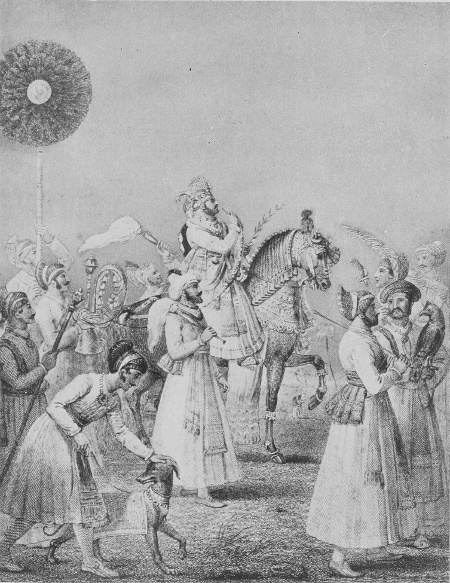
MAHĀRĀJA BHĪM SINGH, PRINCE OF UDAIPUR.
To face page 512.
—Such was the state of things,
when the ascendancy of Mahadaji Sindhia received a signal check
from the combined forces of Marwar and Jaipur; and the battle
of Lalsot, in which the Mahratta chief was completely defeated,
was the signal for the Rajputs to resume their alienated territory.
[6]
Nor was the Rana backward on the occasion, when there appeared
a momentary gleam of the active virtue of past days. Maldas
Mehta was civil minister, with Mauji Ram as his deputy, both
men of talent and energy. They first effected the reduction of
Nimbahera and the smaller garrisons of Mahrattas in its vicinity,
who from a sense of common danger assembled their detachments
in Jawad, which was also invested. Sivaji Nana, the governor,
capitulated, and was allowed to march out with his [442] effects.
At the same time, the ‘sons of the black cloud’
[7] assembling,
drove the Mahrattas from Begun, Singoli, etc., and the districts
on the plateau; while the Chondawats redeemed their ancient
fief of Rampura, and thus for a while the whole territory was
recovered. Elated by success, the united chiefs advanced to
Chardu on the banks of the Rarkia, a streamlet dividing Mewar
from Malwa, preparatory to further operations. Had these been
confined to the maintenance of the places they had taken, and
which had been withheld in violation of treaties, complete success
might have crowned their efforts; but in including Nimbahera
in their capture they drew upon them the energetic Ahalya Bai,
the regent-queen of the Holkar State, who unluckily for them
was at hand and who coalesced with Sindhia’s partisans to check
514this reaction of the Rajputs. Tulaji Sindhia and Sri Bhai, with
five thousand horse, were ordered to support the discomfited
Siva Nana, who had taken refuge in Mandasor, where he rallied
all the garrisons whom the Rajputs had unwisely permitted to
capitulate.
—On Tuesday, the
4th of Magh S. 1844,
[8] the Rana’s troops were surprised and
defeated with great slaughter, the minister slain, the chiefs of
Kanor and Sadri with many others severely wounded, and the
latter made prisoner.
[9] The newly made conquests were all
rapidly lost, with the exception of Jawad, which was gallantly
maintained for a month by Dip Chand, who, with his guns and
rockets, effected a passage through the Mahrattas, and retired
with his garrison to Mandalgarh. Thus terminated an enterprise
which might have yielded far different results but for a misplaced
security. All the chiefs and clans were united in this patriotic
struggle except the Chondawats, against whom the queen-mother
and the new minister, Somji, had much difficulty to contend for
the establishment of the minor’s authority. At length overtures
were made to Salumbar, when the fair Rampiyari was employed
to conciliate the obdurate chief, who condescended to make his
appearance at Udaipur and to pay his respects to the prince.
He pretended to enter into the views of the minister and to
coalesce in his plans; but this was only a web to ensnare his
victim, whose talent had diminished his authority, and was a
bar to the prosecution of [443] his ambitious views. Somji was
seated in his bureau when Arjun Singh of Kurabar and Sardar
Singh
[10] of Badesar entered, and the latter, as he demanded how
he dared to resume his fief, plunged his dagger into the minister’s
breast. The Rana was passing the day at one of the villas in
the valley called the Sahelia Bari, ‘the garden of nymphs,’
attended by Jeth Singh of Badnor, when the brothers
[11] of the
515minister suddenly rushed into the presence to claim protection
against the murderers. They were followed by Arjun of Kurabar,
who had the audacity to present himself before his sovereign with
his hands yet stained with the blood of Somji. The Rana, unable
to punish the insolent chief, branding him as a traitor, bade him
begone; when the whole of the actors in this nefarious scene,
with their leader Salumbar, returned to Chitor. Sheodas and
Satidas, brothers to the murdered minister, were appointed to
succeed him, and with the Saktawats fought several actions
against the rebels, and gained one decisive battle at Akola, in
which Arjun of Kurabar commanded. This was soon balanced
by the defeat of the Saktawats at Kheroda. Every triumph was
attended with ruin to the country. The agriculturist, never
certain of the fruits of his labour, abandoned his fields, and at
length his country; mechanical industry found no recompense,
and commerce was at the mercy of unlicensed spoliation. In a
very few years Mewar lost half her population, her lands lay
waste, her mines were unworked, and her looms, which formerly
supplied all around, forsaken. The prince partook of the general
penury; instead of protecting, he required protection; the
bonds which united him with his subjects were snapped, and each
individual or petty community provided for itself that defence
which he could not give. Hence arose a train of evils: every
cultivator, whether fiscal or feudal, sought out a patron, and
[444] entered into engagements as the price of protection. Hence
every Rajput who had a horse and lance, had his clients; and
not a camel-load of merchandise could pass the abode of one of
these cavaliers without paying fees. The effects of such disorder
516were felt long after the cause ceased to exist, and claims difficult
to adjust arose out of these licentious times, for the having
prescriptive right was deemed sufficient to authorize their continuance.
[12]
Here were displayed the effects of a feudal association,
where the powers of government were enfeebled. These feuds
alone were sufficient to ruin the country; but when to such
internal ills shoals of Mahratta plunderers were added, no art is
required to describe the consequences.
—The Rana and his advisers at
length determined to call in Sindhia to expel the rebellious
Chondawats from the ancient capital; a step mainly prompted
by Zalim Singh (now Regent of Kotah), who with the Rana’s
ministers was deputed to the Mahratta chieftain, then enjoying
himself at the sacred lake of Pushkar.
[13] Since the overthrow of
Lalsot he had reorganized his brigades under the celebrated De
Boigne,
[14] through whose conduct he had redeemed his lost influence
in Rajputana by the battles of Merta and Patan, in which the
brave Rathors, after acts of the most devoted gallantry, were
completely overthrown. Sindhia’s plans coincided entirely with
the object of the deputation, and he readily acquiesced in the
Rana’s desire. This event introduced on the political stage
some of the most celebrated men of that day, whose actions offer
a fair picture of manners, and may justify our entering a little
into details.
[15]—Zalim Singh had for some years
become regent of Kotah, and though to maintain himself in
power, and the State he controlled in an attitude to compel the
respect of surrounding foes, was no slight task, yet he found the
field too contracted for his ambition, and his secret views had
long been directed to permanent influence in Mewar. His skill
in reading character convinced him that the Rana would be no
517bar to his wishes, the attainment of which, by giving him the
combined resources of Haraoti and Mewar, would bestow the
lead in Rajasthan. The Jaipur court he disregarded, whose
effeminate army he had himself defeated single-handed [445]
with the Kotah troops, and the influence he established amongst
the leading chiefs of Marwar held out no fear of counteraction
from that quarter. The stake was high, the game sure, and
success would have opened a field to his genius which might have
entirely altered the fate of Hindustan; but one false move was
irretrievable, and instead of becoming the arbitrator of India,
he left only the reputation of being the Nestor of Rajputana.
The restriction of the Rana’s power was the cloak under which
he disguised all his operations, and it might have been well for
the country had his plans succeeded to their full extent. To
re-establish the Rana’s authority, and to pay the charges of the
reduction of Chitor, he determined that the rebels chiefly should
furnish the means, and that from them and the fiscal lands,
mostly in their hands, sixty-four lakhs should be levied, of which
three-fifths should be appropriated to Sindhia, and the remainder
to replenish the Rana’s treasury. Preliminaries being thus
arranged, Zalim was furnished with a strong corps under Ambaji
Inglia; while Sindhia followed, hanging on the Marwar frontier,
to realize the contributions of that State. Zalim Singh and
Ambaji moved towards Chitor, levying from the estates of those
obnoxious to Zalim’s views. Hamirgarh, whose chief, Dhiraj
Singh, a man of talent and courage, was the principal adviser of
Bhim Singh, the Salumbar chief, was besieged, and stood several
assaults during six weeks’ vigorous operations, when the destruction
of the springs of the wells from the concussion of the guns
compelled its surrender, and the estate was sequestrated. The
force continued their progress, and after a trifling altercation at
Basai, a Chondawat fief, also taken, they took up a position at
Chitor, and were soon after joined by the main body under
Sindhia.
—Zalim, to gratify
Mahadaji’s vanity, who was desirous of a visit from the Rana,
which even the Peshwa considered an honour, proceeded to
Udaipur to effect this object; when the Rana, placing himself
under his guidance, marched for this purpose, and was met at
the Tiger Mount, within a few miles of his capital, by Sindhia,
518who received the Rana, and escorted him to the besieging army.
But in this short interval, Ambaji, who remained with the army
at Chitor, intrigued with the rebel Chondawat to supplant the
predominant influence of his friend Zalim Singh, and seized the
opportunity of his absence to counteract him, by [446] communicating
his plans to Salumbar; aware that, unless he broke with
Zalim, he could only hope to play a secondary part under him.
Though the ulterior views of Zalim were kept to his own breast,
they could not escape the penetration of the crafty Mahratta;
his very anxiety to hide them furnished Ambaji with the means
of detection. Had Zalim possessed an equal share of meanness
with his political antagonist, he might have extricated himself
from the snare; but once overreached, he preferred sinking to
grasping at an unworthy support. Bhim Singh (Salumbar)
privately negotiated with Ambaji the surrender of Chitor, engaging
to humble himself before the Rana, and to pay a contribution of
twenty lakhs, levied on the clans, provided Zalim Singh was
ordered to retire. This suggestion, apparently founded on the
rebellious chief’s antipathy to Zalim, but in reality prompted by
Ambaji, ensured the approbation, as it suited the views, of all
parties, but especially Sindhia, who was desirous of repairing to
Poona. Zalim, the sole obstacle to this arrangement, furnished
to his enemies the means of escape from the dilemma, and lost
the opportunity of realizing his long-cherished scheme of wielding
the united resources of Mewar and Haraoti. Zalim had always
preserved a strict amity with Ambaji wherever their interests did
not clash, and his regard had the cement of gratitude to the
Mahratta, whose father Trimbakji had saved Zalim’s life and
procured his liberty, when left wounded and a prisoner at the
battle of Ujjain. On Zalim’s return with the Rana, Ambaji
touched on the terms of Bhim Singh’s surrender, hinting that
Zalim’s presence was the sole obstacle to this desirable result;
who, the more to mask his views, which any expressed reluctance
to the measure might expose, went beyond probability in asseverations
of readiness to be no bar to such arrangement, even so far
as to affirm that, besides being tired of the business from the
heavy expense it entailed on him, he had his prince’s wish for
his return to Kotah. There is one ingredient in Zalim’s character,
which has never been totally merged in the vices acquired
from the tortuous policy of a long life, and which in the vigour
519of youth had full sway—namely, pride, one of the few virtues
left to the Rajput, defrauded of many others by long oppression.
But Zalim’s pride was legitimate, being allied to honour, and it
has retained him an evident superiority through all the mazes of
ambition. Ambaji skilfully availed himself of this defect in his
friend’s political character. "A pretty [447] story, indeed!—you
tell this to me! it might find credit with those who did not
know you." The sarcasm only plunged him deeper into asseveration.
“Is it then really your wish to retire?” “Assuredly.”
“Then,” retorted the crafty Ambaji, “your wish shall be gratified
in a few minutes.” Giving him no time to retract, he called for
his horse and galloped to Sindhia’s tent. Zalim relied on Sindhia
not acceding to the proposition; or if he did, that the Rana, over
whom he imagined he had complete influence, would oppose it.
His hopes of Sindhia rested on a promise privately made to leave
troops under his authority for the restoration of order in Mewar;
and a yet stronger claim, the knowledge that without Zalim he
could not realize the stipulated sums for the expulsion of the
Chondawat from Chitor. Ambaji had foreseen and prepared a
remedy for these difficulties, and upon their being urged offered
himself to advance the amount by bills on the Deccan. This
argument was irresistible; money, and the consequent prosecution
of his journey to Poona, being attained, Sindhia’s engagements
with Zalim and the Rana ceased to be a matter of importance.
He nominated Ambaji his lieutenant, with the command
of a large force, by whose aid he would reimburse himself for the
sums thus advanced. Having carried his object with Sindhia,
Ambaji proceeded direct from his tent to that of the Rana’s
ministers, Sheodas and Satidas, with whom, by the promise of
co-operation in their views, and perfect subserviency to the
Rana’s interests, he was alike successful. Ambaji, with the
rapidity necessary to ensure success, having in a few hours accomplished
his purpose, hastened back to Zalim, to acquaint him
that his wish to retire had met with general acquiescence; and
so well did he manage, that the Rana’s mace-bearer arrived at
the same moment to announce that the khilat of leave awaited
his acceptance. Zalim being thus outwitted, the Salumbar chief
descended from Chitor, and touched the Rana’s feet. Sindhia
pursued his march to the Deccan, and Ambaji was left sole
arbiter of Mewar. The Saktawats maintained the lead at court,
520and were not backward in consigning the estates of their rivals
to the incubus now settled on the country: while the mortified
Zalim, on his retreat, recorded his expenses, to be produced on
some fitting occasion.
—Ambaji remained eight
years in Mewar, reaping its revenues and amassing those hoards
of wealth which subsequently gave him the lead in Hindustan,
and enabled him nearly to assert his independence. Yet, although
he accumulated [448] £2,000,000 sterling from her soil,
[16] exacting
one-half of the produce of agricultural industry, the suppression
of feuds and exterior aggressions gave to Mewar a degree of
tranquillity and happiness to which she had long been a stranger.
The instructions delivered to Ambaji were—
A schedule (pandhri)[17] for the twenty lakhs stipulated was
made and levied; twelve from the Chondawat estates and eight
from the Saktawats; and the sum of sixty lakhs was awarded,
besides the expense of Ambaji’s army, when the other specified
objects should be attained. Within two years the pretender
was expelled Kumbhalmer, Jahazpur was recovered from a
rebellious Ranawat, and the crown-lands[18] were redeemed from
521the nobles; the personal domain of the Rana, agricultural and
commercial, still realized nearly fifty lakhs of rupees. After
these services, though Godwar was still unredeemed, the Bundi
feud unappeased, and the lands mortgaged to the Mahrattas
were not restored, Ambaji assumed the title of Subahdar of
Mewar, and identified himself with the parties of the day. Yet
so long as he personally upheld the interests of the Rana, his
memory is done justice to, notwithstanding he never conformed
to the strict letter of his engagements. The Rana’s ministers,
fearing lest their brother’s fate should be theirs in the event of the
Chondawats again attaining power, and deeming their own and
their sovereign’s security dependent on Ambaji’s presence, made
a subsidiary engagement with him, and lands to the amount of
75,000 rupees monthly, or eight lakhs annually, were appropriated
for his force; but so completely were the resources of the [449]
country diverted from their honest use, that when, in S. 1851, a
marriage was negotiated between the Rana’s sister and the prince
of Jaipur, the Rana was obliged to borrow £50,000 from the
Mahratta commander to purchase the nuptial presents. The
following year was marked by a triple event—the death of the
queen-mother, the birth of a son and heir to the Rana, and the
bursting of the embankment of the lake, which swept away a
third of the city and a third of its inhabitants. Superstition
attributed this catastrophe to the Rana’s impiety, in establishing
a new festival[19] to Gauri, the Isis of Rajasthan.
—Ambaji, who was this year nominated
by Sindhia his viceroy in Hindustan, left Ganesh Pant as his
lieutenant in Mewar, with whom acted the Rana’s officers, Sawai
and Shirji Mehta;
[20] who applied themselves to make the most of
their ephemeral power with so rapacious a spirit, that Ambaji
was compelled to displace Ganesh Pant and appoint the celebrated
Rae Chand. To him they would not yield, and each party formed
a nucleus for disorder and misrule. It would be uninteresting
522and nauseating to the reader to carry him through all the scenes
of villainy which gradually desolated this country; for whose
spoil pilfering Mahrattas, savage Rohillas, and adventurous
Franks were all let loose. The now humbled Chondawats, many
of whose fiefs were confiscated, took to horse, and in conjunction
with lawless Sindis scoured the country. Their estates were
attacked, Kurabar was taken, and batteries were placed against
Salumbar, whence the Sindis fled and found refuge in Deogarh.
In this exigence, the Chondawats determined to send an envoy
to Ambaji, who was then engaged in the siege of Datia; and
Ajit Singh, since prominent in the intrigues of Mewar, was the
organ of his clan on this occasion. For the sum of ten lakhs the
avaricious Mahratta agreed to recall his deputy from Mewar,
[21]
to renounce Sheodas and the Saktawats, and lend his support to
the Chondawats. The Salumbar chief again took the lead at
court, and with Agarji Mehta
[22] as minister, the Saktawats [450]
523were attacked, the stipulated ten lakhs raised from their estates,
and two fiefs of note, Hintha and Semari, confiscated [451].
524—The death of
Mahadaji Sindhia,
[23] and the accession of his nephew Daulatrao,
his murder of the Shenvi Brahmans, and his quarrels with the
Bais (‘princesses,’ wives of the deceased Sindhia), all occurred at
this time, and materially influenced the events in Mewar. The
power of Ambaji as Subahdar of Hindustan was strengthened by
the minority of Sindhia, although contested by Lakwa and the
Bais, supported by the Khichi prince, Durjan Sal, and the Datia
Raja, who fought and died for the princesses. Lakwa wrote to
the Rana to throw off Ambaji’s yoke and expel his lieutenant;
while Ambaji commanded his deputy to eject the Shenvi
[24] Brahmans,
525supporters of Lakwa, from all the lands in Mewar. To
this end Ganesh Pant called on the Rana’s ministers and chiefs,
who, consulting thereon, determined to play a deep game; and
while they apparently acquiesced in the schemes of Ganesh, they
wrote the Shenvis to advance from Jawad and attack him,
promising them support. They met at Sawa; Nana was defeated
with the loss of his guns, and retired on Chitor. With a feint of
support, the Chondawats made him again call in his garrison and
try another battle, which he also lost and fled to Hamirgarh;
then, uniting with his enemies, they invested the place with
15,000 men. Nana bravely maintained himself, making many
sallies, in one of which both the sons of Dhiraj Singh, the chief
of Hamirgarh, were slain. Shortly after, Nana was relieved by
some battalions of the new raised regulars sent by Ambaji under
Gulab Rao Kadam, upon which he commenced his retreat on
Ajmer. At Musamusi he was forced to action, and success had
nearly crowned the efforts of the clans, when a horseman, endeavouring
to secure a mare, calling out [452], "
Bhagi! bhagi!"
“She flies! she flies!” the word spread, while those who caught
her, exclaiming "
Milgayi! milgayi!" “She is taken!” but
equally significant with ‘going over’ to the enemy, caused a
general panic, and the Chondawats, on the verge of victory,
disgraced themselves, broke and fled. Several were slain, among
whom was the Sindi leader Chandan. Shahpura opened its gates
to the fugitives led by the Goliath of the host, the chief of Deogarh.
[25]
It was an occasion not to be lost by the bards of the
rival clan, and many a ribald stanza records this day’s disgrace.
Ambaji’s lieutenant, however, was so roughly handled that
several chiefs redeemed their estates, and the Rana much of the
fisc, from Mahratta control.
—Mewar now became the arena
on which the rival satraps Ambaji and Lakwa contested the
526exalted office of Sindhia’s lieutenancy in Hindustan. Lakwa was
joined by all the chiefs of Mewar, his cause being their own; and
Hamirgarh, still held by Nana’s party, was reinvested. Two
thousand shot had made a practicable breach, when Bala Rao
Inglia, Bapu Sindhia, Jaswant Rao Sindhia, a brigade under the
European ‘Mutta field,’
[26] with the auxiliary battalions of Zalim
Singh of Kotah, the whole under the command of Ambaji’s son,
arrived to relieve the lieutenant. Lakwa raised the siege, and
took post with his allies under the walls of Chitor; whilst the
besieged left the untenable Hamirgarh, and joined the relief at
Gosunda. The rival armies were separated only by the Berach
river, on whose banks they raised batteries and cannonaded each
other, when a dispute arose in the victor camp regarding the pay
of the troops, between Bala Rao (brother of Ambaji) and Nana,
and the latter withdrew and retreated to Sanganer. Thus
disunited, it might have been expected that these congregated
masses would have dissolved, or fallen upon each other, when
the Rajputs might have given the
coup de grâce to the survivors;
but they were Mahrattas, and their politics were too complicated
to end in simple strife: almost all the actors in these scenes lived
to contest with, and be humiliated by, the British.
—The defection of Nana equalized the parties;
but Bala Rao, never partial to fighting, opportunely recollected
a debt of gratitude to Lakwa, to whose clemency he owed his
life when taken by storm in Gugal Chapra. He also wanted
money [453] to pay his force, which a private overture to Lakwa
secured. They met, and Bala Rao retired boasting of his gratitude,
to which, and the defection of Nana, soon followed by that
of Bapu Sindhia, the salvation of Lakwa was attributed. Sutherland
[27]
with a brigade was detached by Ambaji to aid Nana: but
a dispute depriving him of this reinforcement, he called in a
partisan of more celebrity, the brave George Thomas.
[28] Ambaji’s
527lieutenant and Lakwa were once more equal foes, and the Rana,
his chiefs and subjects being distracted between these conflicting
bands, whose leaders alternately paid their respects to him, were
glad to obtain a little repose by espousing the cause of either
combatant, whose armies during the monsoon encamped for six
weeks within sight of each other.
[29]—Durjan Sal (Khichi), with the nobles of
Mewar, hovered round Nana’s camp with five thousand horse
to cut off his supplies; but Thomas escorted the convoys from
Shahpura with his regulars, and defied all their efforts. Thomas
at length advanced his batteries against Lakwa, on whose position
a general assault was about taking place, when a tremendous
storm, with torrents of rain which filled the stream, cut off his
batteries from the main body, burst the gates of Shahpura, his
point d’appui, and laid the town in ruins.
[30] Lakwa seized the
moment, and with the Mewar chiefs stormed and carried the
isolated batteries, capturing fifteen pieces of cannon; and the
Shahpura Raja, threatened at once by his brother-nobles and
the vengeance of heaven, refused further provision to Nana, who
was compelled to abandon his position and retreat to Sanganer.
The discomfited lieutenant vowed vengeance against the estates
of the Mewar chieftains, and after the rains, being reinforced by
Ambaji, again took the field. Then commenced a scene of
carnage, pillage, and individual defence. The whole of the
Chondawat estates under the Aravalli range were laid waste,
their castles assaulted, some taken and destroyed, and heavy
sums levied on all. Thomas besieged Deogarh and Amet, and
both fought and paid. Kasital and Lasani were captured, and
the latter razed for its gallant resistance. Thus they were proceeding
in the work of destruction, when Ambaji [454] was
dispossessed of the government of Hindustan, to which Lakwa
was nominated,
[31] and Nana was compelled to surrender all the
fortresses and towns he held in Mewar.
528—From this period must
be dated the pretensions of Sindhia to consider Mewar as tributary
to him. We have traced the rise of the Mahrattas, and the
progress of their baneful influence in Mewar. The abstractions
of territory from S. 1826 to 1831 [A.D. 1769-74], as pledges for
contributions, satisfied their avarice till 1848 [A.D. 1791], when
the Salumbar rebellion brought the great Sindhia to Chitor,
leaving Ambaji as his lieutenant, with a subsidiary force, to
recover the Rana’s lost possessions. We have related how these
conditions were fulfilled; how Ambaji, inflated with the wealth
of Mewar, assumed almost regal dignity in Hindustan, assigning
the devoted land to be governed by his deputies, whose contest
with other aspirants made this unhappy region the stage for
constant struggles for supremacy; and while the secret policy
of Zalim Singh stimulated the Saktawats to cling to Ambaji, the
Chondawats gave their influence and interest to his rival Lakwa.
The unhappy Rana and the peasantry paid for this rivalry; while
Sindhia, whose power was now in its zenith, fastened one of his
desultory armies on Mewar, in contravention of former treaties,
without any definite views, or even instructions to its commander.
It was enough that a large body should supply itself without
assailing him for prey, and whose services were available when
required.
—Lakwa, the new viceroy,
marched to Mewar: Agarji Mehta was appointed minister to
the Rana, and the Chondawats again came into power. For the
sum of six lakhs Lakwa dispossessed the Shahpura of Jahazpur,
for the liquidation of which thirty-six of its towns were mortgaged.
Zalim Singh, who had long been manœuvring to obtain Jahazpur,
administered to the necessities of the Mahratta, paid the note of
hand, and took possession of the city and its villages. A contribution
of twenty-four lakhs was imposed throughout the country,
and levied by force of arms, after which first act of the new
viceroy he quitted Mewar for Jaipur, leaving Jaswant Rao Bhao
as his deputy. Mauji Ram, the deputy of Agarji (the Rana’s
minister), determined to adopt the European mode of discipline,
now become general amongst all the native powers of India. But
when the chiefs were [455] called upon to contribute to the
support of mercenary regulars and a field-artillery, they evinced
their patriotism by confining this zealous minister. Satidas was
529once more placed in power, and his brother Sheodas recalled
from Kotah, whither he had fled from the Chondawats, who now
appropriated to themselves the most valuable portions of the
Rana’s personal domain.
—The battle of Indore,
[32] in
A.D. 1802, where at least
150,000 men assembled to dispute the claim to predatory empire,
wrested the ascendancy from Holkar, who lost his guns, equipage,
and capital, from which he fled to Mewar, pursued by Sindhia’s
victorious army led by Sadasheo and Bala Rao. In his flight he
plundered Ratlam, and passing Bhindar, the castle of the Saktawat
chief, he demanded a contribution, from which and his
meditated visit to Udaipur, the Rana and his vassal were saved
by the activity of the pursuit. Failing in these objects, Holkar
retreated on Nathdwara, the celebrated shrine of the Hindu
Apollo.
[33] It was here this active soldier first showed symptoms
of mental derangement. He upbraided Krishna, while prostrate
before his image, for the loss of his victory; and levied three
lakhs of rupees on the priests and inhabitants, several of whom
he carried to his camp as hostages for the payment. The portal
(
dwara) of the god (
Nath) proving no bar either to Turk or equally
impious Mahratta, Damodarji, the high priest, removed the god
of Vraj from his pedestal and sent him with his establishment to
Udaipur for protection. The Chauhan chief of Kotharia (one of
the sixteen nobles), in whose estate was the sacred fane, undertook
the duty, and with twenty horsemen, his vassals, escorted the
shepherd god by intricate passes to the capital. On his return
he was intercepted by a band of Holkar’s troops, who insultingly
desired the surrender of their horses. But the descendant of the
illustrious Prithiraj preferred death to dishonour: dismounting,
he hamstrung his steed, commanding his vassals to follow his
example; and sword in hand courted his fate in the unequal
conflict, in which he fell, with most of his gallant retainers.
There are many such isolated exploits in the records of this
eventful period, of which the Chauhans of Kotharia had their full
share. Spoil, from whatever source, being welcome to these depredators,
Nathdwara
[34] remained long abandoned; and Apollo, after
530six months’ residence at Udaipur, finding [456] insufficient protection,
took another flight to the mountains of Ghasyar, where the
high priest threw up fortifications for his defence; and spiritual
thunders being disregarded, the pontiff henceforth buckled on
the armour of flesh, and at the head of four hundred cavaliers
with lance and shield, visited the minor shrines in his extensive
diocese.
—To return to Holkar. He pursued his
route by Banera and Shahpura, levying from both, to Ajmer,
where he distributed a portion of the offerings of the followers of
Krishna amongst the priests of Muhammad at the mosque of
Khwaja Pir. Thence he proceeded towards Jaipur. Sindhia’s
leaders on reaching Mewar renounced the pursuit, and Udaipur
was cursed with their presence, when three lakhs of rupees were
extorted from the unfortunate Rana, raised by the sale of household
effects and the jewels of the females of his family. Jaswant
Rao Bhao, the Subahdar of Mewar, had prepared another schedule
(pandhri), which he left with Tantia, his deputy, to realize. Then
followed the usual scene of conflict—the attack of the chieftain’s
estates, distraining of the husbandman, seizure of his cattle, and
his captivity for ransom, or his exile.
—The celebrated Lakwa, disgraced by his
prince, died at this time
[35] in sanctuary at Salumbar; and Bala
Rao, brother to Ambaji, returned, and was joined by the Saktawats
and the minister Satidas, who expelled the Chondawats for
their control over the prince. Zalim Singh, in furtherance of his
schemes and through hatred of the Chondawats, united himself
to this faction, and Devi Chand, minister to the Rana, set up
by the Chondawats, was made prisoner. Bala Rao levied and
destroyed their estates with unexampled ferocity, which produced
a bold attempt at deliverance. The Chondawat leaders assembled
at the Chaugan (the
Champ de Mars) to consult on their safety.
The insolent Mahratta had preceded them to the palace, demanding
the surrender of the minister’s deputy, Mauji Ram. The
Rana indignantly refused them—the Mahratta importuned,
threatened, and at length commanded his troops to advance to
the palace, when the intrepid minister pinioned the audacious
plunderers, and secured his adherents (including their old enemy,
Nana Ganesh), Jamalkar, and Uda Kunwar. The latter, a
531notorious villain, had an elephant’s chain put round his neck,
while Bala Rao was confined in a bath. The [457] leaders thus
arrested, the Chondawats sallied forth and attacked their camp
in the valley, which surrendered; though the regulars under
Hearsey
[36] retreated in a hollow square, and reached Gadarmala in
safety. Zalim Singh determined to liberate his friend Bala Rao
from peril; and aided by the Saktawats under the chiefs of
Bhindar and Lawa, advanced to the Chaija Pass, one of the
defiles leading to the capital. Had the Rana put these chiefs to
instant death, he would have been justified, although he would
have incurred the resentment of the whole Mahratta nation.
Instead of this, he put himself at the head of a motley levy of
six thousand Sindis, Arabs, and Gosains, with the brave Jai
Singh and a band of his gallant Khichis, ever ready to poise the
lance against a Mahratta. They defended the pass for five days
against a powerful artillery. At length the Rana was compelled
to liberate Bala Rao, and Zalim Singh obtained by this interference
possession of the fortress and entire district of Jahazpur.
A schedule of war contribution, the usual finale to these events,
followed Bala’s liberation, and no means were left untried to
realize the exaction, before Holkar, then approaching, could
contest the spoil.
—This chief, having recruited his
shattered forces, again left the south.
[37] Bhindar felt his resentment
for non-compliance with his demands on his retreat after the
battle of Indore; the town was nearly destroyed, but spared for two
lakhs of rupees, for the payment of which villages were assigned.
Thence he repaired to Udaipur, being met by Ajit Singh, the
Rana’s ambassador, when the enormous sum of forty lakhs, or
£500,000, was demanded from the country, of which one-third
was commanded to be instantly forthcoming. The palace was
denuded of everything which could be converted into gold; the
females were deprived of every article of luxury and comfort: by
which, with contributions levied on the city, twelve lakhs were
532obtained; while hostages from the household of the Rana and
chief citizens were delivered as security for the remainder, and
immured in the Mahratta camp. Holkar then visited the Rana.
Lawa and Badnor were attacked, taken, and restored on large
payments. Deogarh alone was mulcted four and a half lakhs.
Having devastated Mewar during eight months, Holkar [458]
marched to Hindustan,
[38] Ajit Singh accompanying him as the
Rana’s representative; while Bala Ram Seth was left to levy
the balance of the forty lakhs. Holkar had reached Shahpura
when Sindhia entered Mewar, and their camps formed a junction
to allow the leaders to organize their mutual plans of hostility
to the British Government. These chieftains, in their efforts to
cope with the British power, had been completely humiliated,
and their resources broken. But Rajasthan was made to pay
the penalty of British success, which riveted her chains, and it
would be but honest, now we have the power, to diminish that
penalty.
—The rainy season of
A.D. 1805
found Sindhia and Holkar encamped in the plains of Badnor,
desirous, but afraid, to seek revenge in the renewal of war. Deprived
of all power in Hindustan, and of the choicest territory
north and south of the Nerbudda, with numerous discontented
armies now let loose on these devoted countries, their passions
inflamed by defeat, and blind to every sentiment of humanity,
they had no alternative to pacify the soldiery and replenish their
own ruined resources but indiscriminate pillage. It would
require a pen powerful as the pencil of Salvator Rosa to paint
the horrors which filled up the succeeding ten years, to which
the author was an eye-witness, destined to follow in the train of
rapine, and to view in the traces of Mahratta camps
[39] the desolation
533and political annihilation of all the central States of India,
[40]
several of which aided the British in their early struggle for
dominion, but were now allowed to fall without a helping hand,
the scapegoats of our successes. Peace between the Mahrattas
and British was, however, doubtful, as Sindhia made the restoration
of the rich provinces of Gohad and Gwalior a
sine qua non:
and unhappily for their legitimate ruler, who [459] had been
inducted into the seat of his forefathers, a Governor-General
(Lord Cornwallis) of ancient renown, but in the decline of life,
with views totally unsuited to the times, abandoned our allies,
and renounced all for peace, sending an ambassador
[41] to Sindhia
to reunite the bonds of ‘perpetual friendship.’
—The Mahratta leaders
were anxious, if the war should be renewed, to shelter their
families and valuables in the strongholds of Mewar, and their
respective camps became the rendezvous of the rival factions.
Sardar Singh, the organ of the Chondawats, represented the
Rana at Sindhia’s court, at the head of whose councils Ambaji
had just been placed.
[42] His rancour to the Rana was implacable,
from the support given in self-defence to his political antagonist,
Lakwa, and he agitated the partition of Mewar amongst the great
Mahratta leaders. But whilst his baneful influence was preparing
this result, the credit of Sangram Saktawat with Holkar
counteracted it. It would be unfair and ungallant not to record
that a fair suitor, the Baiza Bai,
[43] Sindhia’s wife, powerfully
534contributed to the Rana’s preservation on this occasion. This
lady, the daughter of the notorious Sarji Rao, had unbounded
power over Sindhia. Her sympathies were awakened on behalf
of the supreme head of the Rajput nation, of which blood she
had to boast, though she was now connected with the Mahrattas.
Even the hostile clans stifled their animosities on this occasion,
and Sardar Singh Chondawat left Sindhia’s camp to join his rival
Sangram with Holkar, and aided by the upright Kishandas
Pancholi, united in their remonstrances, asking Holkar if he had
given his consent to sell Mewar to Ambaji. Touched by the
picture of the Rana’s and their country’s distresses, Holkar swore
it should not be; advised unity amongst themselves, and caused
the representatives of the rival clans ‘to eat opium together.’
Nor did he stop here, but with the envoys repaired to Sindhia’s
tents, descanted on the Rana’s high descent, ‘the master of their
master’s master,’
[44] urging that it did not become them to overwhelm
him, and that they should even renounce the mortgaged
lands which their fathers had too long unjustly held, himself
setting the example by the restitution of [460] Nimbahera. To
strengthen his argument, he expatiated with Sindhia on the
policy of conciliating the Rana, whose strongholds might be
available in the event of a renewal of hostilities with the British.
Sindhia appeared a convert to his views, and retained the envoys
in his camp. The Mahratta camps were twenty miles apart,
and incessant torrents of rain had for some days prevented all
intercourse. In this interim, Holkar received intelligence that
Bhairon Bakhsh, as envoy from the Rana, was in Lord Lake’s
camp negotiating for the aid of British troops, then at Tonk, to
drive the Mahrattas from Mewar. The incensed Holkar sent
for the Rana’s ambassadors, and assailed them with a torrent of
reproach; accusing them of treachery, he threw the newspaper
containing the information at Kishandas, asking if that were
the way in which the Mewaris kept faith with him? “I cared
not to break with Sindhia in support of your master, and while
combating the Farangis (Franks), when all the Hindus should be
535as brothers, your sovereign the Rana, who boasts of not acknowledging
the supremacy of Delhi, is the first to enter into arms
with them. Was it for this I prevented Ambaji being fastened
on you?” Kishandas here interrupted and attempted to
pacify him, when Alikar Tantia, Holkar’s minister, stopped him
short, observing to his prince, “You see the faith of these Rangras;
[45]
they would disunite you and Sindhia, and ruin both.
Shake them off: be reconciled to Sindhia, dismiss Sarji Rao, and
let Ambaji be Subahdar of Mewar, or I will leave you and take
Sindhia into Malwa.” The other councillors, with the exception
of Bhao Bhaskar, seconded this advice: Sarji Rao was dismissed;
and Holkar proceeded northward, where he was encountered and
pursued to the Panjab by the British under the intrepid and
enterprising Lake, who dictated terms to the Mahratta at the
altars of Alexander.
[46]—Holkar had the generosity
to stipulate, before his departure from Mewar, for the security of
the Rana and his country, telling Sindhia he should hold him
personally amenable to him if Ambaji were permitted to violate
his guarantee. But in his misfortunes this threat was disregarded,
and a contribution of sixteen lakhs was levied immediately on
Mewar; Sadasheo Rao, with Baptiste’s
[47] brigade, was detached
from the camp in June 1806, for the double purpose of levying it,
and driving from [461] Udaipur a detachment of the Jaipur
prince’s troops, bringing proposals and preliminary presents for
this prince’s marriage with the Rana’s daughter.
—It would be imagined that
the miseries of Rana Bhim were not susceptible of aggravation,
and that fortune had done her worst to humble him; but his
536pride as a sovereign and his feelings as a parent were destined to
be yet more deeply wounded. The Jaipur cortège had encamped
near the capital, to the number of three thousand men, while the
Rana’s acknowledgments of acceptance were dispatched, and
had reached Shahpura. But Raja Man of Marwar also advanced
pretensions, founded on the princess having been actually betrothed
to his predecessor; and urging that the throne of Marwar,
and not the individual occupant, was the object, he vowed
resentment and opposition if his claims were disregarded. These
were suggested, it is said, by his nobles to cloak their own views;
and promoted by the Chondawats (then in favour with the Rana),
whose organ, Ajit, was bribed to further them, contrary to the
decided wishes of their prince.
Krishna Kunwari (the Virgin Krishna) was the name of the
lovely object, the rivalry for whose hand assembled under the
banners of her suitors (Jagat Singh of Jaipur and Raja Man of
Marwar), not only their native chivalry, but all the predatory
powers of India; and who, like Helen of old, involved in destruction
her own and the rival houses. Sindhia having been denied
a pecuniary demand by Jaipur, not only opposed the nuptials,
but aided the claims of Raja Man, by demanding of the Rana the
dismissal of the Jaipur embassy: which being refused, he advanced
his brigades and batteries, and after a fruitless resistance,
in which the Jaipur troops joined, forced the pass, threw a corps
of eight thousand men into the valley, and following in person,
encamped within cannon-range of the city. The Rana had now
no alternative but to dismiss the nuptial cortège, and agree to
whatever was demanded. Sindhia remained a month in the
valley, during which an interview took place between him and
the Rana at the shrine of Eklinga [462].[48]
537—The heralds
of Hymen being thus rudely repulsed and its symbols intercepted,
the Jaipur prince prepared to avenge his insulted pride and
disappointed hopes, and accordingly arrayed a force such as had
not assembled since the empire was in its glory. Raja Man
eagerly took up the gauntlet of his rival, and headed ‘the swords
of Maru.’ But dissension prevailed in Marwar, where rival
claimants for the throne had divided the loyalty of the clans,
introducing there also the influence of the Mahrattas. Raja
Man, who had acquired the sceptre by party aid, was obliged to
maintain himself by it, and to pursue the demoralizing policy of
the period by ranging his vassals against each other. These
nuptials gave the malcontents an opportunity to display their
long-curbed resentments, and following the example of Mewar,
they set up a pretender, whose interests were eagerly espoused,
and whose standard was erected in the array of Jaipur; the
prince at the head of 120,000 men advancing against his rival,
who with less than half the number met him at Parbatsar, on
their mutual frontier. The action was short, for while a heavy
cannonade opened on either side, the majority of the Marwar
nobles went over to the pretender. Raja Man turned his poniard
against himself: but some chiefs yet faithful to him wrested the
weapon from his hand, and conveyed him from the field. He
was pursued to his capital, which was invested, besieged, and
gallantly defended during six months. The town was at length
taken and plundered, but the castle of Jodha ‘laughed a siege
to scorn’; in time with the aid of finesse, the mighty host of
Jaipur, which had consumed the forage of these arid plains for
twenty miles around, began to crumble away; intrigue spread
through every rank, and the siege ended in pusillanimity and
flight. The Xerxes of Rajwara, the effeminate Kachhwaha,
alarmed at length for his personal safety, sent on the spoils of
538Parbatsar and Jodhpur to his capital; but the brave nobles of
Marwar, drawing the line between loyalty and patriotism, and
determined that no trophy of Rathor degradation should be
conveyed by the Kachhwahas from Marwar, attacked the cortège
and redeemed the symbols of their disgrace. The colossal array
of the invader was soon dismembered, and the ‘lion of the
world’ (Jagat Singh), humbled and crestfallen [463], skulked
from the desert retreat of his rival, indebted to a partisan corps
for safety and convoy to his capital, around whose walls the
wretched remnants of this ill-starred confederacy long lagged
in expectation of their pay, while the bones of their horses and
the ashes of their riders whitened the plain, and rendered it a
Golgotha.
[49]
—By the aid of one of the most notorious
villains India ever produced, the Nawab Amir Khan,
[50] the pretender’s
party was treacherously annihilated. This man with
his brigade of artillery and horse was amongst the most efficient
of the foes of Raja Man; but the
auri sacra fames not only made
him desert the side on which he came for that of the Raja, but
for a specific sum offer to rid him of the pretender and all his
associates. Like Judas, he kissed whom he betrayed, took
service with the pretender, and at the shrine of a saint of his own
faith exchanged turbans with their leaders; and while the too
credulous Rajput chieftains celebrated this acquisition to their
party in the very sanctuary of hospitality, crowned by the dance
and the song, the tents were cut down, and the victims thus
enveloped, slaughtered in the midst of festivity by showers of
grape.
Thus finished the under-plot; but another and more noble
victim was demanded before discomfited ambition could repose,
or the curtain drop on this eventful drama. Neither party
539would relinquish his claim to the fair object of the war; and the
torch of discord could be extinguished only in her blood. To
the same ferocious Khan is attributed the unhallowed suggestion,
as well as its compulsory execution. The scene was now changed
from the desert castle of Jodha to the smiling valley of Udaipur,
soon to be filled with funereal lamentation.
—Krishna Kunwari Bai, the
‘Virgin Princess Krishna,’ was in her sixteenth year: her
mother was of the Chawara race, the ancient kings of Anhilwara.
Sprung from the noblest blood of Hind, she added beauty of face
and person to an engaging demeanour, and was justly proclaimed
the ‘flower of Rajasthan.’ When the Roman father pierced
the bosom of the dishonoured Virginia, appeased virtue applauded
the deed. When Iphigenia was led to the sacrificial altar, the
salvation of her country yielded a noble consolation. The votive
victim of Jephthah’s success had [464] the triumph of a father’s
fame to sustain her resignation, and in the meekness of her
sufferings we have the best parallel to the sacrifice of the lovely
Krishna: though years have passed since the barbarous immolation,
it is never related but with a faltering tongue and moistened
eyes, ‘albeit unused to the melting mood.’
The rapacious and bloodthirsty Pathan, covered with infamy,
repaired to Udaipur, where he was joined by the pliant and subtle
Ajit. Meek in his demeanour, unostentatious in his habits;
despising honours, yet covetous of power,—religion, which he
followed with the zeal of an ascetic, if it did not serve as a cloak,
was at least no hindrance to an immeasurable ambition, in the
attainment of which he would have sacrificed all but himself.
When the Pathan revealed his design, that either the princess
should wed Raja Man, or by her death seal the peace of Rajwara,
whatever arguments were used to point the alternative, the Rana
was made to see no choice between consigning his beloved child
to the Rathor prince, or witnessing the effects of a more extended
dishonour from the vengeance of the Pathan, and the storm of
his palace by his licentious adherents—the fiat passed that
Krishna Kunwari should die.
But the deed was left for women to accomplish—the hand of
man refused it. The Rawala[51] of an Eastern prince is a world
within itself; it is the labyrinth containing the strings that move
540the puppets which alarm mankind. Here intrigue sits enthroned,
and hence its influence radiates to the world, always at a loss to
trace effects to their causes. Maharaja Daulat Singh,[52] descended
four generations ago from one common ancestor with the Rana,
was first sounded ‘to save the honour of Udaipur’; but,
horror-struck, he exclaimed, “Accursed the tongue that commands
it! Dust on my allegiance, if thus to be preserved!”
The Maharaja Jawandas, a natural brother, was then called
upon; the dire necessity was explained, and it was urged that no
common hand could be armed for the purpose. He accepted the
poniard, but when in youthful loveliness Krishna appeared
before him, the dagger fell from his hand, and he returned more
wretched than the victim. The fatal purpose thus revealed,
the shrieks of the frantic mother reverberated through the palace,
as she implored mercy, or execrated the murderers of her child,
who alone was resigned to her fate. But death was arrested, not
averted [465]. To use the phrase of the narrator, "she was
excused the steel—the cup was prepared,"—and prepared by
female hands! As the messenger presented it in the name of
her father, she bowed and drank it, sending up a prayer for his
life and prosperity. The raving mother poured imprecations on
his head, while the lovely victim, who shed not a tear, thus
endeavoured to console her: “Why afflict yourself, my mother,
at this shortening of the sorrows of life? I fear not to die! Am
I not your daughter? Why should I fear death? We are
marked out for sacrifice[53] from our birth; we scarcely enter the
world but to be sent out again; let me thank my father that I
have lived so long!”[54] Thus she conversed till the nauseating
541draught refused to assimilate with her blood. Again the bitter
potion was prepared. She drained it off, and again it was rejected;
but, as if to try the extreme of human fortitude, a third
was administered; and, for the third time, Nature refused to
aid the horrid purpose. It seemed as if the fabled charm, which
guarded the life of the founder of her race,[55] was inherited by the
Virgin Krishna. But the blood-hounds, the Pathan and Ajit,
were impatient till their victim was at rest; and cruelty, as if
gathering strength from defeat, made another and a fatal attempt.
A powerful opiate was presented—the kusumbha draught.[56] She
received it with a smile, wished the scene over, and drank it. The
desires [466] of barbarity were accomplished. ‘She slept!’[57] a
sleep from which she never awoke.
The wretched mother did not long survive her child; nature
was exhausted in the ravings of despair; she refused food; and
her remains in a few days followed those of her daughter to the
funeral pyre.
Even the ferocious Khan, when the instrument of his infamy,
Ajit, reported the issue, received him with contempt, and spurned
him from his presence, tauntingly asking “if this were the boasted
Rajput valour?” But the wily traitor had to encounter language
far more bitter from his political adversary, whom he
detested. Sangram Saktawat reached the capital only four days
after the catastrophe—a man in every respect the reverse of
Ajit; audaciously brave, he neither feared the frown of his
542sovereign nor the sword of his enemy. Without introduction he
rushed into the presence, where he found seated the traitor Ajit.
“Oh dastard! who hast thrown dust on the Sesodia race, whose
blood which has flowed in purity through a hundred ages has now
been defiled! this sin will check its course for ever; a blot so
foul in our annals that no Sesodia[58] will ever again hold up his
head! A sin to which no punishment were equal. But the end
of our race is approaching! The line of Bappa Rawal is at an
end! Heaven has ordained this, a signal of our destruction.”
The Rana hid his face with his hands, when turning to Ajit, he
exclaimed, "Thou stain on the Sesodia race, thou impure of
Rajput blood, dust be on thy head as thou hast covered us all
with shame. May you die childless, and your name die with
you![59] Why this indecent haste? Had the Pathan stormed
the city? Had he attempted to violate the sanctity of the
Rawala? And though he had, could you not die as Rajputs,
like your ancestors? Was it thus they gained a name? Was
it thus our race became renowned—thus they opposed the might
of kings? Have you forgotten the Sakhas of Chitor? But
whom do I address—not Rajputs? Had the honour of your
females been endangered, had you sacrificed them all and rushed
sword in hand on the enemy, your name would have lived, and
the Almighty would have secured the seed of Bappa Rawal. But
to owe preservation [467] to this unhallowed deed! You did
not even await the threatened danger. Fear seems to have
deprived you of every faculty, or you might have spared the
blood of Sriji,[60] and if you did not scorn to owe your safety to
deception, might have substituted some less noble victim! But
the end of our race approaches!"
—The traitor to manhood, his sovereign,
and humanity, durst not reply. The brave Sangram is now dead,
but the prophetic anathema has been fulfilled. Of ninety-five
children, sons and daughters, but one son (the brother of Krishna)
[61]
is left to the Rana; and though his two remaining daughters
have been recently married to the princes of Jaisalmer and
Bikaner, the Salic law, which is in full force in these States,
543precludes all honour through female descent. His hopes rest
solely on the prince, Javana Singh,
[62] and though in the flower of
youth and health, the marriage bed (albeit boasting no less than
four young princesses) has been blessed with no progeny.
[63]The elder brother of Javana[64] died two years ago. Had he
lived he would have been Amra the Third. With regard to Ajit,
the curse has been fully accomplished. Scarcely a month after,
his wife and two sons were numbered with the dead; and the
hoary traitor has since been wandering from shrine to shrine,
performing penance and alms in expiation of his sins, yet unable
to fling from him ambition; and with his beads in one hand,
Rama! Rama! ever on his tongue, and subdued passion in his
looks, his heart is deceitful as ever. Enough of him: let us
exclaim with Sangram, “Dust on his head,”[65] which all the waters
of the Ganges could not purify from the blood of the virgin
Krishna, but
rather would the multitudinous sea incarnadine [468].
—His coadjutor, Amir
Khan, is now linked by treaties “in amity and unity of interests”
544with the sovereigns of India; and though he has carried mourning
into every house of Rajasthan, yet charity might hope forgiveness
would be extended to him, could he cleanse himself from this
deed of horror—‘throwing this pearl away, richer than all his
tribe!’ His career of rapine has terminated with the caresses of
the blind goddess, and placed him on a pinnacle to which his
sword would never have traced the path. Enjoying the most
distinguished post amongst the foreign
chieftainschieftains of Holkar’s
State, having the regulars and park under his control, with large
estates for their support, he added the epithet of traitor to his
other titles, when the British Government, adopting the leading
maxim of Asiatic policy,
divide et impera, guaranteed to him the
sovereignty of these districts on his abandoning the Mahrattas,
disbanding his legions, and surrendering the park. But though
he personally fulfilled not, nor could fulfil, one single stipulation,
this man, whose services were not worth the pay of a single
sepoy—who fled from his camp
[66] unattended, and sought personal
protection in that of the British commander—claimed and
obtained the full price of our pledge, the sovereignty of about
one-third of his master’s dominions; and the districts of Sironj,
Tonk, Rampura, and Nimbahera, form the domain of the Nawab
Amir Khan, etc., etc., etc.!! This was in the fitful fever of
success, when our arms were everywhere triumphant. But were
the viceroy of Hind to summon the forty tributaries
[67] now covered
by the aegis of British protection to a meeting, the murderer of
Krishna would still occupy a place (though low) in this illustrious
divan. Let us hope that his character being known, he would
feel himself ill at ease; and let us dismiss him likewise in the
words of Sangram, “Dust on his head!”
The mind sickens at the contemplation of these unvarying
scenes of atrocity; but this unhappy State had yet to pass
through two more lustres of aggravated sufferings (to which the
author of these annals was an eye-witness) before their [469]
termination, upon the alliance of Mewar with Britain. From the
545period of the forcing of the passes, the dismissal of the Jaipur
embassy by Sindhia, and the murder of Krishna Kunwari, the
embassy of Britain was in the train of the Mahratta leader, a
witness of the evils described—a most painful predicament—when
the hand was stretched out for succour in vain, and
the British flag waved in the centre of desolation, unable
to afford protection. But this day of humiliation is past,
thanks to the predatory hordes who goaded us on to their destruction;
although the work was incomplete, a nucleus being
imprudently left in Sindhia for the scattered particles again
to form.
—In the spring of 1806, when
the embassy entered the once-fertile Mewar, from whose native
wealth the monuments the pencil will portray were erected,
nothing but ruin met the eye—deserted towns, roofless houses,
and uncultured plains. Wherever the Mahratta encamped,
annihilation was ensured; it was a habit; and twenty-four hours
sufficed to give to the most flourishing spot the aspect of a desert.
The march of destruction was always to be traced for days afterwards
by burning villages and destroyed cultivation. Some
satisfaction may result from the fact, that there was scarcely an
actor in these unhallowed scenes whose end was not fitted to his
career. Ambaji was compelled to disgorge the spoils of Mewar,
and his personal sufferings made some atonement for the ills he
had inflicted upon her. This satrap, who had almost established
his independence in the fortress and territory of Gwalior, suffered
every indignity from Sindhia, whose authority he had almost
thrown off. He was confined in a mean tent, manacled, suffered
the torture of small lighted torches applied to his fingers, and even
attempted suicide to avoid the surrender of his riches; but the
instrument (an English penknife) was inefficient: the surgeon to
the British embassy sewed up the wounds, and his coffers were
eased of fifty-five lakhs of rupees! Mewar was, however, once
more delivered over to him; he died shortly after. If report be
correct, the residue of his treasures was possessed by his ancient
ally, Zalim Singh. In this case, the old politician derived the
chief advantage of the intrigues of S. 1848, without the crimes
attendant on the acquisition.
Sindhia’s father-in-law, when expelled that chief’s camp,
according to the treaty, enjoyed the ephemeral dignity of minister
546to the Rana, when he abstracted the most valuable records,
especially those of the revenue [470].
Kumbhalmer was obtained by the minister Satidas from
Jaswant Rao Bhao for seventy thousand rupees, for which
assignments were given on this district, of which he retained
possession. Amir Khan in A.D. 1809 led his myrmidons to the
capital, threatening the demolition of the temple of Eklinga if
refused a contribution of eleven lakhs of rupees. Nine were
agreed to, but which by no effort could be raised, upon which
the Rana’s envoys were treated with indignity, and Kishandas[68]
wounded. The passes were forced, Amir Khan entering by
Debari, and his coadjutor and son-in-law, the notorious Jamshid,
by the Chirwa, which made but a feeble resistance. The ruffian
Pathans were billeted on the city, subjecting the Rana to personal
humiliation, and Jamshid[69] left with his licentious Rohillas in the
capital. The traces of their barbarity are to be seen in its ruins.
No woman could safely venture abroad, and a decent garment or
turban was sufficient to attract their cupidity.
—In S. 1867 (
A.D. 1811)
Bapu Sindhia arrived with the title of Subahdar, and encamped
in the valley, and from this to 1814 these vampires, representing
Sindhia and Amir Khan, possessed themselves of the entire fiscal
domain, with many of the fiefs, occasionally disputing for the
spoils; to prevent which they came to a conference at the Dhaula
Magra (the white hill), attended by a deputation
[70] from the
Rana, when the line of demarcation was drawn between the
spoilers. A schedule was formed of the towns and villages yet
inhabited, the amount to be levied from each specified, and three
and a half lakhs adjudged to Jamshid, with the same sum to
Sindhia; but this treaty was not better kept than the former
ones. Mewar was rapidly approaching dissolution, and every
547sign of civilization fast disappearing; fields laid waste, cities in
ruins, inhabitants exiled, chieftains demoralized, the prince and
his family destitute of common comforts. Yet had Sindhia the
audacity to demand compensation for the loss of his tribute
stipulated to Bapu Sindhia [471],
[71] who rendered Mewar a desert,
carrying her chiefs, her merchants, her farmers, into captivity
and fetters in the dungeons of Ajmer, where many died for want
of ransom, and others languished till the treaty with the British,
in
A.D. 1817, set them free.
—The history of the Rana’s
family has now been traced through all the vicissitudes of its
fortunes, from the second to the nineteenth century, whilst
contending for existence, alternately with Parthians, Bhils,
Tartars, and Mahrattas, till at length it has become tributary
to Britain. The last chapter portrays the degraded condition
of their princes, and the utter desolation of their country, in a
picture which embodied the entire Rajput race. An era of repose
at length dawned upon them. The destruction of that vast
predatory system, under the weight of which the prosperity of
these regions had so long been repressed, was effected by one
short campaign in 1817; which if less brilliant than that of 1803,
is inferior to none in political results. The tardy policy of the
last-named period, at length accomplished, placed the power of
Britain in the East on an expugnable position, and rescued the
Rajputs from a progressing destruction.
—To prevent the recurrence of this
predatory system it was deemed politic to unite all these settled
States, alike interested with ourselves in its overthrow, in one
grand confederation. Accordingly the Rajput States were
548invited to shelter [472] under our protecting alliance; and with
one exception (Jaipur), they eagerly embraced the invitation.
The ambassadors of the various governments followed each other
in quick succession to Delhi, where the treaties were to be negotiated,
and in a few weeks all Rajputana was united to Britain by
compacts of one uniform character;
[1] insuring to them external
protection with internal independence, as the price of acknowledged
supremacy, and a portion of revenue to the protecting
government. By this comprehensive arrangement, we placed a
most powerful barrier between our territories and the strong
natural frontier of India; and so long as we shall respect their
established usages, and by contributing to the prosperity of the
people preserve our motives from distrust, it will be a barrier
impenetrable to invasion.
—Of all the princes who obtained succour
at this momentous crisis in the political history of India, none
stood more in need of it than the Rana of Udaipur. On January
16, 1818, the treaty was signed, and in February an envoy was
nominated; who immediately proceeded to the Rana’s court,
to superintend and maintain the newly formed relations.
[2] The
right wing of the grand army
[3] had already preceded him to
compel the surrender of such territory as was unjustly held by
the lawless partisans of Sindhia, and to reduce to obedience the
refractory nobles, to whom anarchy was endeared from long
familiarity. The strongholds in the plains as Raepur, Rajnagar,
etc., soon surrendered; and the payment of the arrears of the
garrison of Kumbhalmer put this important fortress in our
possession.
In his passage from Jahazpur, which guards the range on the
east to Kumbhalmer on the Aravalli west, a space of 140 miles,
the limits of Mewar, only two thinly peopled towns were seen
549which acknowledged the Rana’s authority. All was desolate;
even the traces of the footsteps of man were effaced. The babul
(mimosa [acacia] Arabica), and gigantic reed, which harboured
the boar and the tiger, grew upon the highways; and every
rising ground displayed a mass of ruin. Bhilwara, the commercial
entrepôt of Rajputana, which ten years before contained six
thousand [473] families, showed not a vestige of existence. All
was silent in her streets—no living thing was seen except a
solitary dog, that fled in dismay from his lurking-place in the
temple, scared at the unaccustomed sight of man.[4]
—An envoy was dispatched by the
Rana to congratulate the Agent, who joined him in the British
camp at Nathdwara; and while he returned to arrange the
formalities of reception, the Agent obtained the cession of Kumbhalmer;
which, with the acquisitions before mentioned, paved
the way for a joyful reception. The prince, Javan Singh, with
all the State insignia, and a numerous cortège, advanced to
receive the mission, and conduct it to the capital. A spot was
fixed on in a grove of palmyras, about two miles from the city,
where carpets were spread, and where the prince received the
Agent and suite in a manner at once courteous and dignified.
[5]
Of him it might have been said, in the language applied by
Jahangir to the son of Rana Amra—“His countenance carried
the impression of his illustrious extraction.”
—We entered the city
[6] by the
gate of the sun; and through a vista of ruin the mission was
inducted into its future residence, once the abode of the fair
Rampiyari.
[7] Like all the mansions of Rajputana, it was a
quadrangular pile, with an open paved area, the suites of apartments
carried round the sides, with latticed or open corridors
550extending parallel to each suite. Another deputation with the
mehmani, consisting of a hundred trays of sweetmeats, dried
fruits, and a purse of one thousand rupees for distribution amongst
the domestics, brought the Rana’s welcome upon our arrival in
his capital, and fixed the next day for our introduction at court.
At four in the afternoon, a deputation, consisting of the
officiating prime minister, the representative of the Chondawats,
with mace-bearers and a numerous escort, came to announce the
Rana’s readiness to receive the mission; which, with all the
‘pomp and circumstance’ peculiar to these countries, was
marshalled in front of the residency, thronged by crowds of
well-dressed [474] inhabitants, silently gazing at the unusual
sight.[8] The grand Nakkaras having announced the Rana in
court, the mission proceeded through streets which everywhere
presented marks of rapine, hailed by the most enthusiastic
greetings. “Jai! jai! Farangi ka Raj!” “Victory, victory
to the English Government!” resounded from every tongue. The
bards were not idle; and the unpoetic name of the Agent was
hitched into rhyme. Groups of musicians were posted here and
there, who gave a passing specimen of the tappas[9] of Mewar;
and not a few of the fair, with brazen ewers of water on their
heads, welcomed us with the suhelia, or songs of joy. Into each
of these vessels the purse-bearer dropped a piece of silver; for
neither the songs of the suhelia, the tappas of the minstrel, nor
encomiastic stave of the bard, are to be received without some
acknowledgement that you appreciate their merit and talents,
however you may doubt the value they put upon your own. As
we ascended the main street leading to the Tripolia, or triple
portal, which guards the sacred enclosure, dense masses of people
obstructed our progress, and even the walls of the temple of
Jagannath were crowded. According to etiquette, we dismounted
at the Porte, and proceeded on foot across the ample terrace; on
which were drawn up a few elephants and horse, exercising for
the Rana’s amusement.
—The palace is a most imposing pile,
551of a regular form, built of granite and marble, rising at least a
hundred feet from the ground, and flanked with octagonal towers,
crowned with cupolas. Although built at various periods,
uniformity of design has been very well preserved; nor is there
in the East a more striking or majestic structure. It stands upon
the very crest of a ridge running parallel to, but considerably
elevated above, the margin of the lake. The terrace, which is
at the east and chief front of the palace, extends throughout its
length, and is supported by a triple row of arches from the declivity
of the ridge. The height of this arcaded wall is fully
fifty feet; and although all is hollow beneath, yet so admirably
is it constructed, that an entire range of stables is built on the
extreme verge of the terrace, on which the whole personal force
of the Rana, elephants, horse, and foot, are often assembled.
From this terrace the city and the valley lay before the spectator,
whose vision is bounded only by the [475] hills shutting out the
plains; while from the summit of the palace nothing obstructs
its range over lake and mountain.
A band of Sindis guarded the first entrance to the palace;
and being Saturday, the Saktawats were on duty in the great hall
of assembly. Through lines of Rajputs we proceeded till we
came to the marble staircase, the steps of which had taken the
form of the segment of an ellipse, from the constant friction of
the foot; an image of Ganesha guarded the ascent to the interior
of the palace, and the apartment, or landing, is called Ganesha
deori, from the Rajput Janus. After proceeding through a
suite of saloons, each filled with spectators, the herald’s voice
announced to ‘the lord of the world’ that the English envoy
was in his presence; on which he arose, and advanced a few paces
in front of the throne, the chieftains standing to receive the
mission. Everything being ruled by precedent, the seat allotted
for the envoy was immediately in front and touching the royal
cushion (gaddi): being that assigned to the Peshwa in the height
of Mahratta prosperity, the arrangement, which was a subject
of regular negotiation, could not be objected to. The apartment
chosen for the initiatory visit was the Surya mahall, or ‘hall of
the sun,’ so called from a medallion of the orb in basso-rilievo
which decorates the wall. Close thereto is placed the Rana’s
throne, above which, supported by slender silver columns, rises
a velvet canopy. The Gaddi, or throne, in the East is but a huge
552cushion, over which is thrown an embroidered velvet mantle.
The chiefs of the higher grade, or ‘the Sixteen,’ were seated,
according to their rank, on the right and left of the Rana; next
and below these were the princes Amra and Javan Singh; and at
right angles (by which the court formed three sides of a square),
the chiefs of the second rank. The civil officers of the State were
near the Rana in front, and the seneschal, butler, keeper of the
wardrobe, and other confidential officers and inferior chieftains,
formed a group standing on the extreme edge of the carpet.
The Rana’s congratulations were hearty and sincere: in a few
powerful expressions he depicted the miseries he had experienced,
the fallen condition of his State, and the gratitude he felt to the
British Government which had interposed between him and
destruction; and which for the first moment of his existence
allowed him to sleep in peace. There was an intense earnestness
in every word he uttered, which, delivered with great fluency of
speech and dignity of manner, inspired deep respect and sympathy.
The Agent said that the Governor-General was no stranger to
the [476] history of his illustrious family, or to his own immediate
sufferings; and that it was his earnest desire to promote, by
every means in his power, the Rana’s personal dignity and the
prosperity of his dominions. After conversing a few minutes,
the interview was closed with presents to the Agent and suite:
to the former a caparisoned elephant and horse, jewelled aigrette,
and pearl necklace, with shawls and brocades; and with the
customary presentation of essence of rose and the pan leaf the
Rana and court rising, the envoy made his salaam and retired.
In a short time the Rana, attended by his second son, ministers,
and a select number of the chiefs, honoured the envoy with a
visit. The latter advanced beyond his residence to meet the
prince, who was received with presented arms by the guard, the
officers saluting, and conducted to his throne, which had been
previously arranged. Conversation was now unrestrained, and
questions were demanded regarding everything which appeared
unusual. After sitting half an hour, the Agent presented the
Rana with an elephant and two horses, caparisoned with silver
and gilt ornaments and velvet embroidered housings, with twenty-one
shields[10] of shawls, brocades, muslins, and jewels; to prince
Amra, unable from sickness to attend his father, a horse and
553eleven shields; and to his brother, the second prince, Javan
Singh, a horse and nine shields; to the ministers and chiefs
according to rank: the whole entertainment costing about 20,000
rupees, or £2000. Amidst these ceremonials, receiving and
returning visits of the Rana, his chiefs, his ministers, and men
of influence and information commercial and agricultural, some
weeks passed in silent observation, and in the acquisition of
materials for action.[11]
—For the better comprehension
of the internal relations, past and present, of Mewar [477], a
sketch is presented, showing the political divisions of the tribes
and the fiscal domain, from which a better idea may be formed
of Rajput feudal economy than from a chapter of dissertation.
The princes of Mewar skilfully availed themselves of their natural
advantages in the partition of the country. The mountain-barriers
east and west were allotted to the chiefs to keep the
mountaineers and foresters in subjection, whose leading passes
554were held by a lord-marcher, and the quotas of his quarter; and
while strong forts guarded the exposed northern and southern
entrances, the crown-land lay in the centre, the safest and the
richest. The exterior, thus guarded by a cordon of feudal levies
composed of the quotas of the greater fiefs; the minor and most
numerous class of vassals, termed gol, literally ‘the mass,’ and
consisting of ten thousand horse, each holding directly of the
crown independent of the greater chiefs, formed its best security
against both external aggression and internal commotions.
—Such is a picture of the feudal economy
of Mewar in the days of her renown; but so much had it been
defaced through time and accident, that with difficulty could the
lineaments be traced with a view to their restoration: her institutions
a dead letter, the prince’s authority despised, the nobles
demoralized and rebellious, internal commerce abandoned, and
the peasantry destroyed by the combined operation of war,
pestilence, and exile. Expression might be racked for phrases
which could adequately delineate the miseries all classes had
endured. It is impossible to give more than a sketch of the state
of the das sahas Mewar, ‘the ten thousand townships’ which
once acknowledged her princes, and of which above three thousand
still exist. All that remained to them was the valley of the
capital; and though Chitor and Mandalgarh were maintained
by the fidelity of the Rana’s servants, their precarious revenues
scarcely sufficed to maintain their garrisons. The Rana was
mainly indebted to Zalim Singh of Kotah for the means of subsistence;
for in the struggle for existence his chiefs thought only
of themselves, of defending their own estates, or buying off their
foes; while those who had succumbed took to horse, scoured the
country, and plundered without distinction. Inferior clanships
declared themselves independent of their superiors, who in their
turn usurped the crown domain, or by bribing the necessities of
their prince, obtained his patent for lands, to which, as they
yielded him nothing, he became indifferent. The crown-tenants
purchased of these chiefs the protection (rakhwali) which the
[478] Rana could not grant, and made alienations of the crown
taxes, besides private rights of the community, which were often
extorted at the point of the lance. Feuds multiplied, and the
name of each clan became the watchword of alarm or defiance
to its neighbour: castles were assaulted, and their inmates, as
555at Sheogarh and Lawa, put to the sword; the Meras and Bhils
descended from their hills, or emerged from their forests, and
planted ambuscades for the traveller or merchant, whom they
robbed or carried to their retreats, where they languished in
durance till ransomed. Marriage processions were thus intercepted,
and the honeymoon was passed on a cliff of the Aravalli,
or in the forests on the Mahi. The Rajput, whose moral energies
were blunted, scrupled not to associate and to divide the spoil
with these lawless tribes, of whom it might be said, as of the
children of Ishmael, “Their hands were against every man, and
every man’s hand against them.” Yet notwithstanding such
entire disorganization of society, external commerce was not
stagnant; and in the midst of this rapine, the produce of Europe
and Kashmir would pass each other in transit through Mewar,
loaded it is true by a multiplicity of exactions, but guarded by
those who scorned all law but the point of honour, which they were
paid for preserving.
—The capital will serve as a specimen
of the country. Udaipur, which formerly reckoned fifty thousand
houses within the walls, had not now three thousand occupied,
the rest were in ruin, the rafters being taken for firewood. The
realization of the spring harvest of 1818, from the entire fiscal
land, was about £4000! Grain sold for seven sers the rupee,
though thrice the quantity was procurable within the distance
of eighty miles. Insurance from the capital to Nathdwara
(twenty-five miles) was eight per cent. The Kotharia chief,
whose ancestors are immortalized for fidelity, had not a horse
to conduct him to his prince’s presence, though his estates were
of fifty thousand rupees annual value. All were in ruins; and
the Rana, the descendant of those patriot Rajputs who opposed
Babur, Akbar, and Aurangzeb, in the days of Mogul splendour,
had not fifty horse to attend him, and was indebted for all the
comforts he possessed to the liberality of Kotah.
—Such was the chaos from which
order was to be evoked. But the elements of prosperity, though
scattered, were not extinct; and recollections of the past, deeply
engraved in the national mind, became available to reanimate
their moral and physical existence. To call these forth demanded
only the exertion of moral [479] interference, and every other was
rejected. The lawless freebooter, and even the savage Bhil, felt
556awed at the agency of a power never seen. To him moral opinion
(compared with which the strength of armies is nought) was
inexplicable, and he substituted in its stead another invisible
power—that of magic: and the belief was current throughout
the intricate region of the West, that a single individual could
carry an army in his pocket, and that our power could animate
slips of paper cut into the figures of armed men, from which no
precaution could guard their retreats. Accordingly, at the mere
name of the British power, rapine ceased, and the inhabitants of
the wilds of the West, the ‘forest lords,’ who had hitherto
laughed at subjection, to the number of seven hundred villages,
put each the sign of the dagger to a treaty, promising abstinence
from plunder and a return to industrious life—a single individual
of no rank the negotiator. Moreover, the treaty was religiously
kept for twelve months; when the peace was broken, not by
them, but against them.
To the Rajput, the moral spectacle of a Peshwa marched into
exile with all the quietude of a pilgrimage, effected more than
twenty thousand bayonets, and no other auxiliary was required
than the judicious use of the impressions from this and other
passing events, to relay the foundations of order and prosperity—by
never doubting the issue, success was insured. The British
force, therefore, after the reduction of the plans enumerated, was
marched to cantonments; the rest was left for time and reason
to accomplish.
—Before proceeding further, it
may be convenient to sketch the form of civil government in
Mewar, and the characters of its most conspicuous members:
the former we shall describe as it was when the machine was in
regular action; it will be found simple, and perfectly suited to
its object.
There are four grand officers of the government:
- 1. The Pardhan, or prime minister.
- 2. Bakhshi, commander of the forces.
- 3. Suratnama, keeper of the records.
- 4. Sahai, keeper of the signet.[12]
The first, the Pardhan, or civil premier, must be of the non-militant
557tribe. The whole of the territorial and financial arrangements
are vested in him. He [480] nominates the civil governors
of districts, and the collectors of the revenue and custom; and
has fourteen thuas, or departments, under him, which embrace
all that relates to expenditure.
2. The Bakhshi must also be of a non-militant tribe, and one
different from the Pardhan. His duties are mixed civil and
military. He takes the musters, and pays mercenaries, or rations,
to the feudal tenants when on extra service, and he appoints a
deputy to accompany all expeditions, or to head frontier-posts,
with the title of Faujdar, or commander. The royal insignia,
the standard, and kettle-drums accompany him, and the highest
nobles assemble under the general control of this civil officer,
never under one of their own body. From the Bakhshi’s bureau
all patents are issued, as also all letters of sequestration of feudal
land.
The Bakhshi has four secretaries:
- 1. Draws out deeds.
- 2. Accountant.
- 3. Recorder of all patents or grants.
- 4. Keeps duplicates.
3. The Suratnama[13] is the auditor and recorder of all the
household expenditure and establishments, which are paid by
his cheques. He has four assistants also, who make a daily report,
and give a daily balance of accounts.
4. The Sahai. He is secretary both for home and foreign
correspondence. He draws out the royal grants or patents of
estates, and superintends the deeds of grant on copper-plate to
religious establishments. Since the privilege appertaining to
Salumbar, of confirming all royal grants with his signet the lance,
has fallen into desuetude, the Sahai executes this military autograph.[14]
To all decrees, from the daily stipend to the patta, or patent of
an estate, each minister must append his seal, so that there is a
complete system of check. Besides these, the higher officers of
government, there are thirty-six karkhanas, or inferior officers,
558appointed directly by the Rana, the most conspicuous of which
are the justiciary,[15] the keepers of the register-office, of the mint,
of the armoury, of the regalia, of the jewels, of the wardrobe,
of the stables, of the kitchen, of the band, of the seneschalsy,
and of the seraglio.
There was no want of aspirants to office, here hereditary; but
it was vain to look [481] amongst the descendants of the virtuous
Pancholi, or the severe Amrachand, and the prediction of the
former, “Dust will cover the head of Mewar when virtue wanders
in rags,” was strictly fulfilled. There appeared no talent, no
influence, no honesty; yet the deficiency was calculated to excite
sorrow rather than surprise; to stimulate exertion on their
behalf, rather than damp the hope of improvement; though all
scope for action, save in the field of intrigue, was lost, and talent
was dormant for want of exercise.
—The Rana’s character was little calculated
to supply his minister’s deficiencies. Though perfectly
versed in the past history of his country, its resources, and their
management; though able, wise, and amiable, his talents were
nullified by numerous weak points. Vain shows, frivolous
amusements, and an ill-regulated liberality alone occupied him;
and so long as he could gratify these propensities, he trusted
complacently to the exertions of others for the restoration of
order and his proper authority. He had little steadiness of
purpose, and was particularly obnoxious to female influence. It
is scarcely to be wondered that he coveted repose, and was little
desirous to disturb the only moment his existence had presented
of enjoying it, by inviting the turmoils of business. No man,
however, was more capable of advising: his judgment was good,
but he seldom followed its dictates; in short, he was an adept
in theory, and a novice in practice. The only man about the
court at once of integrity and efficiency was Kishandas, who had
long acted as ambassador, and to whose assiduity the sovereign
and the country owed much; but his services were soon cut off
by death.
Such were the materials with which the work of reform commenced.
The aim was to bring back matters to a correspondence
with an era of their history, when the rights of the prince, the
559vassal, and the cultivator, were alike well defined—that of Amra
Singh.
—The first point to effect
was the recognition of the prince’s authority by his nobles; the
surest sign of which was their presence at the capital, where some
had never been, and others only when it suited their convenience
or their views. In a few weeks the Rana saw himself surrounded
by a court such as had not been known for half a century. It
created no small curiosity to learn by what secret power they were
brought into each other’s presence. Even the lawless Hamira,
who but a short while before had plundered the marriage dower
of the Hari queen [482] coming from Kotah, and the chief of the
Sangawat clan, who had sworn “he might bend his head to woman,
but never to his sovereign,” left their castles of Badesar and
Deogarh, and “placing the royal rescript on their heads,” hastened
to his presence; and in a few weeks the whole feudal association
of Mewar was embodied in the capital.
—To recall the exiled population was a
measure simultaneous with the assembling of the nobles; but
this was a work requiring time: they had formed ties, and incurred
obligations to the societies which had sheltered them,
which could not at once be disengaged or annulled. But wherever
a subject of Mewar existed, proclamations penetrated, and satisfactory
assurances were obtained, and realized to an extent which
belied in the strongest manner the assertion that patriotism is
unknown to the natives of Hindustan. The most enthusiastic
and cheering proofs were afforded that neither oppression from
without, nor tyranny within, could expel the feeling for the
bapota, the land of their fathers. Even now, though time has
chastened the impressions, we should fear to pen but a tithe of
the proofs of devotion of the husbandman of Mewar to the
solum
natale: it would be deemed romance by those who never contemplated
humanity in its reflux from misery and despair to the
‘sweet influences’ of hope; he alone who had witnessed the day
of trouble, and beheld the progress of desolation—the standing
corn grazed by Mahratta horse—the rifled towns devoted to the
flames—the cattle driven to the camp, and the chief men seized
as hostages for money never to be realized—could appreciate
their deliverance. To be permitted to see these evils banished, to
behold the survivors of oppression congregated from the most
560distant provinces, many of them strangers to each other, and
the aged and the helpless awaiting the lucky day to take possession
of their ruined abodes, was a sight which memory will not part
with. Thus on the 3rd of Sawan (July),
[16] a favourite day with
the husbandman, three hundred of all conditions, with their
waggons and implements of labour, and preceded by banners and
music, marched into Kapasan;
[17] and Ganesha was once again
invoked as they reconsecrated their dwellings, and placed his
portrait as the Janus of the portals. On the same day, and within
eight months subsequent to the signature of the treaty, above
three hundred towns and villages were simultaneously reinhabited;
and the land, which for many years had been a stranger to the
plough-share, was broken up. Well might [483] the superstitious
fancy that miracles were abroad; for even to those who beheld
the work in progression it had a magical result, to see the waste
covered with habitations, and the verdant corn growing in the
fields where lately they had roused the boar from his retreat!
It was a day of pride for Britain! By such exertions of her power
in these distant lands her sway is hallowed. By Britain alone
can this fair picture be defaced; the tranquillity and independence
she has conferred, by her alone may be disturbed!
—To these important preliminary
measures, the assembly of the nobles and recall of the population,
was added a third, without which the former would have been
nugatory. There was no wealth, no capital, to aid their patriotism
and industry. Foreign merchants and bankers had abandoned
the devoted land; and those who belonged to it partook of her
poverty and her shame. Money was scarce, and want of faith and
credit had increased the usury on loans to a ruinous extent. The
Rana borrowed at thirty-six per cent; besides twenty-five to
forty per cent discount for his barats, or patents empowering
collection on the land; a system pursued for some time even
after his restoration to authority. His profusion exceeded even
the rapidity of renovation; and the husbandman had scarcely
broken up his long-waste fields, when a call was made by the
harpies of the State for an advance on their produce, while he
himself had been compelled to borrow at a like ruinous rate for
561seed and the means of support, to be paid by expectations. To
have hoped for the revival of prosperity amidst such destitution,
moral and pecuniary, would have been visionary. It was as
necessary to improve the one as to find the other; for poverty
and virtue do not long associate, and certainly not in Mewar.
Proclamations were therefore prepared by the Rana, inviting
foreign merchants and bankers to establish connexions in the
chief towns throughout the country; but as in the days of
demoralization little faith was placed in the words of princes,
similar ones were prepared by the Agent, guaranteeing the stipulations,
and both were distributed to every commercial city in India.
The result was as had been foreseen: branch banks were everywhere
formed, and mercantile agents fixed in every town in the
country, whose operations were only limited by the slow growth
of moral improvement. The shackles which bound external
commerce were at once removed, and the multifarious posts for
the collections of transit duties abolished; in lieu of which chain
of stations, all levies on goods in transit were confined to the
frontiers. The scale of duties [484] was revised; and by the
abolition of intermediate posts, they underwent a reduction of
from thirty to fifty per cent. By this system, which could not
for some time be comprehended, the transit and custom duties
of Mewar made the most certain part of the revenue, and in a
few years exceeded in amount what had ever been known.
—The chief commercial mart, Bhilwara,
which showed not a vestige of humanity, rapidly rose from ruin,
and in a few months contained twelve hundred houses, half of
which were occupied by foreign merchants. Bales of goods, the
produce of the most distant lands, were piled up in the streets
lately overgrown with grass, and a weekly fair was established
for the home manufactures. A charter of privileges and immunities
was issued, exempting them from all taxation for the
first year, and graduating the scale for the future; calculated
with the same regard to improvement, by giving the mind the full
range of enjoying the reward of its exertions. The right of
electing their own chief magistrates and the assessors of justice,
was above all things indispensable, so as to render them as independent
as possible of the needy servants of the court. A
guard was provided by the government for their protection, and
a competent authority nominated to see that the full extent of
562their privileges, and the utmost freedom of action, were religiously
maintained. The entire success of this plan may at once be
recorded to prevent repetition. In 1822, Bhilwara contained
nearly three thousand dwellings, which were chiefly inhabited by
merchants, bankers, or artisans. An entire new street had been
constructed in the centre of the town, from the duties levied,
and the shops and houses were rented at a moderate rate; while
many were given up to the proprietors of their sites, returning
from exile, on their paying the price of construction. But as
there is no happiness without alloy, so even this pleasing picture
had its dark shades to chasten the too sanguine expectation of
imparting happiness to all. Instead of a generous emulation, a
jealous competition checked the prosperity of Bhilwara: the base
spirit of exclusive monopoly desired a distinction between the
native and the stranger-merchant, for which they had a precedent
in the latter paying an addition to the town-duty of metage
(
mapa). The unreasonableness of this was discussed, and it was
shown to be more consonant to justice that he who came from
Jaisalmer, Surat, Benares, or Delhi, should pay less than the
merchant whose domicile was on the spot. When at length the
parties acquiesced in this opinion, and were intreated and promised
to know [485] none other distinction than that of ‘inhabitant of
Bhilwara,’ sectarian differences, which there was less hope of
reconciling, became the cause of disunion. All the Hindu merchants
belong either to the Vaishnava or Jain sects; consequently
each had a representative head, and ‘the Five’ for the adjudication
of their internal arrangements; and these, the wise men of
both parties, formed the general council for the affairs of Bhilwara.
But they carried their religious differences to the judgement-seat,
where each desired pre-eminence. Whether the point in dispute
hinged on the interpretation of law, which with all these sects is
of divine origin, or whether the mammon of unrighteousness was
the lurking cause of their bickerings, they assuredly did much
harm, for their appeals brought into play what of all things was
least desired, the intrigues of the profligate dependents of the
court. It will be seen hereafter,
[18] in visits to Bhilwara, how these
disputes were in some degree calmed. The leaders on both sides
were distinctly given to understand they would be made to leave
the place. Self-interest prevented this extremity; but from the
563withdrawing of that active interference (which the state of the
alliance did not indeed warrant, but which humanity interposed
for their benefit) together with the effect of appeals to the court,
it is to be apprehended that Bhilwara may fail to become what
it was intended to be, the chief commercial mart of Central India.
[19]—Of the three measures simultaneously
projected and pursued for the restoration of prosperity, the
industrious portion has been described. The feudal interest
remains, which was found the most difficult to arrange. The
agricultural and commercial classes required only protection and
stimulus, and we could repay the benefits their industry conferred
by the lowest scale of taxation, which, though in fact equally
beneficial to the government, was constructed as a boon. But
with the feudal lords there was no such equivalent to offer in
return for the sacrifices many had to make for the re-establishment
of society. Those who were well inclined, like Kotharia, had
everything to gain, and nothing left to surrender; while those
who, like Deogarh, Salumbar, or Badnor, had preserved their
power by foreign aid, intrigue, or prowess, dreaded the high price
they might be called upon to pay [486] for the benefit of security
which the new alliance conferred. All dreaded the word ‘restitution,’
and the audit of half a century’s political accounts; yet the
adjustment of these was the corner-stone of the edifice, which
anarchy and oppression had dismantled. Feuds were to be
appeased, a difficult and hazardous task; and usurpations, both
on the crown and each other, to be redeemed. ‘To bring the
wolf and the goat to drink from the same vessel,’ was a task of
less difficulty than to make the Chondawat and Saktawat labour
in concert for the welfare of the prince and the country. In fine,
a better idea cannot be afforded of what was deemed the hopelessness
564of success than the opinion of Zorawar Singh, the chief of
the latter clan, who had much to relinquish: “Were Parameswara
(the Almighty) to descend, he could not reform Mewar.” We
judged better of them than they did of each other.
—It were superfluous to detail all
the preparatory measures for the accomplishment of this grand
object; the meetings and adjournments, which only served to
keep alive discontent. On the 27th of April, the treaty with the
British Government was read, and the consequent change in their
relations explained. Meanwhile, a charter, defining the respective
rights of the crown and of the chiefs, with their duties to the
community, was prepared, and a day named for a general assembly
of the chieftains to sanction and ratify this engagement. The
1st of May was fixed: the chiefs assembled; the articles, ten in
number, were read and warmly discussed; when with unmeaning
expressions of duty, and objections to the least prominent, they
obtained through their speaker, Gokuldas of Deogarh, permission
to reassemble at his house to consider them, and broke up with
the promise to attend next day. The delay, as apprehended, only
generated opposition, and the 2nd and 3rd passed in inter-communications
of individual hope and fear. It was important to
put an end to speculation. At noon, on the 4th of May, the grand
hall was again filled, when the Rana, with his sons and ministers,
took their seats. Once more the articles were read, objections
raised and combated, and midnight had arrived without the
object of the meeting being advanced, when an adjournment,
proposed by Gokuldas, till the arrival of the Rana’s plenipotentiary
from Delhi, met with a firm denial; and the Rana gave him liberty
to retire, if he refused his testimony of loyalty. The Begun
chief, who had much to gain, at length set the example, followed
by the chiefs of Amet and Deogarh, and in succession by all the
sixteen nobles, who also signed as the proxies of their [487]
relatives, unable from sickness to attend. The most powerful
of the second grade also signed for themselves and the absent of
their clans, each, as he gave in his adhesion, retiring; and it was
three in the morning of the 5th of May ere the ceremony was over.
The chief of the Saktawats, determined to be conspicuous, was
the last of his own class to sign. During this lengthened and
painful discussion of fifteen hours’ continuance, the Rana conducted
himself with such judgment and firmness, as to give
565sanguine hopes of his taking the lead in the settlement of his
affairs.
—This preliminary adjusted, it was
important that the stipulations of the treaty
[20] should be rigidly
if not rapidly effected. It will not be a matter of surprise, that
some months passed away before the complicated arrangements
arising out of this settlement were completed; but it may afford
just grounds for gratulation, that they were finally accomplished
without a shot being fired, or the exhibition of a single British
soldier in the country, nor, indeed, within one hundred miles of
Udaipur. ‘Opinion’ was the sole and all-sufficient ally effecting
this political reform. The Rajputs, in fact, did not require the
demonstration of our physical strength; its influence had reached
far beyond Mewar. When the few firelocks defeated hundreds of
the foes of public tranquillity, they attributed it to ‘the strength
of the Company’s salt,’
[21] the moral agency of which was proclaimed
the true basis of our power. ‘Sachha Raj’ was the
proud epithet applied by our new allies to the British Government
in the East; a title which distinguished the immortal Alfred,
‘the upright.’
It will readily be imagined that a reform, which went to touch
566the entire feudal association, could not be accomplished without
harassing and painful discussions [488], when the object was the
renunciation of lands, to which in some cases the right of inheritance
could be pleaded, in others, the cognisance of successful
revenge, while to many prescriptive possession could be asserted.
It was the more painful, because although the shades which
marked the acquisition of such lands were varied, no distinction
could be made in the mode of settlement, namely, unconditional
surrender. In some cases, the Rana had to revoke his own grants,
wrung either from his necessities or his weakness; but in neither
predicament could arguments be adduced to soften renunciation,
or to meet the powerful and pathetic and often angry appeals to
justice or to prejudice. Counter-appeals to their loyalty, and
the necessity for the re-establishment of their sovereign’s just
weight and influence in the social body, without which their own
welfare could not be secured, were adduced; but individual views
and passions were too absorbing to bend to the general interest.
Weeks thus passed in interchange of visits, in soothing pride, and
in flattering vanity by the revival of past recollections, which
gradually familiarized the subject to the mind of the chiefs, and
brought them to compliance. Time, conciliation, and impartial
justice, confirmed the victory thus obtained; and when they were
made to see that no interest was overlooked, that party views
were unknown, and that the system included every class of society
in its beneficial operation, cordiality followed concession. Some
of these cessions were alienations from the crown of half a century’s
duration. Individual cases of hardship were unavoidable without
incurring the imputation of favouritism, and the dreaded revival
of ancient feuds, to abolish which was indispensable, but required
much circumspection. Castles and lands in this predicament
could therefore neither be retained by the possessor nor returned
to the ancient proprietor without rekindling the torch of civil war.
The sole alternative was for the crown to take the object of contention,
and make compensation from its own domain. It would
be alike tedious and uninteresting to enter into the details of these
arrangements, where one chief had to relinquish the levy of
transit duties in the most important outlet of the country, asserted
to have been held during seven generations, as in the case of the
chief of Deogarh. Of another (the Bhindar chief) who held forty-three
towns and villages, in addition to his grant; of Amet, of
567Badesar, of Dabla, of Lawa, and many others who held important
fortresses of the crown independent of its will; and other claims,
embracing every right [489] and privilege appertaining to feudal
society; suffice it, that in six months the whole arrangements
were effected.
—In the painful and protracted discussions
attendant on these arrangements, powerful traits of national
character were developed. The castle and domain of Arja half
a century ago belonged to the crown, but had been usurped by
the Purawats, from whom it was wrested by storm about fifteen
years back by the Saktawats, and a patent sanctioning possession
was obtained, on the payment of a fine of £1000 to the Rana.
Its surrender was now required from Fateh Singh, the second
brother of Bhindar, the head of this clan; but being regarded as
the victorious completion of a feud, it was not easy to silence their
prejudices and objections. The renunciation of the forty-three
towns and villages by the chief of the clan caused not half the
excitation, and every Saktawat seemed to forgo his individual
losses in the common sentiment expressed by their head: “Arja
is the price of blood, and with its cession our honour is surrendered.”
To preserve the point of honour, it was stipulated that it should
not revert to the Purawats, but be incorporated with the fisc,
which granted an equivalent; when letters of surrender were
signed by both brothers, whose conduct throughout was manly
and confiding.
—The Badnor and Amet chiefs, both of the
superior grade of nobles, were the most formidable obstacles to
the operation of the treaty of the 4th of May. The first of these,
by name Jeth Singh (
the victorious [
chief]
lion), was of the Mertia
clan, the bravest of the brave race of Rathor, whose ancestors
had left their native abodes on the plains of Marwar, and accompanied
the celebrated Mira Bai on her marriage with Rana
Kumbha. His descendants, amongst whom was Jaimall, of
immortal memory, enjoyed honour in Mewar equal to their birth
and high deserts. It was the more difficult to treat with men
like these, whose conduct had been a contrast to the general
license of the times, and who had reason to feel offended, when
no distinction was observed between them and those who had
disgraced the name of Rajput. Instead of the submission expected
from the Rathor, so overwhelmed was he from the magnitude
568of the claims, which amounted to a virtual extinction of his
power, that he begged leave to resign his estates and quit the
country. In prosecution of this design, he took post in the chief
hall of the palace, from which no entreaties could make him
move;
[22] until the Rana, to [490] escape his importunities, and
even restraint, obtained his promise to abide by the decision of the
Agent. The forms of the Rana’s court, from time immemorial,
prohibit all personal communication between the sovereign and
his chiefs in matters of individual interest, by which indecorous
altercation is avoided. But the ministers, whose office it was to
obtain every information, did not make a rigid scrutiny into the
title-deeds of the various estates previous to advancing the claims
of the crown. This brave man had enemies, and he was too
proud to have recourse to the common arts either of adulation or
bribery to aid his cause. It was a satisfaction to find that the
two principal towns demanded of him were embodied in a grant
of Sangram Singh’s reign; and the absolute rights of the fisc,
of which he had become possessed, were cut down to about
fifteen thousand rupees of annual revenue. But there were other
points on which he was even more tenacious than the surrender
of these. Being the chief noble of the fine district of Badnor,
which consisted of three hundred and sixty towns and villages,
chiefly of feudal allotments (many of them of his own clan), he
had taken advantage of the times to establish his influence over
them, to assume the right of wardship of minors, and secure those
services which were due to the prince, but which he wanted the
power to enforce. The holders of these estates were of the third
class of vassals or
gol (the mass), whose services it was important
to reclaim, and who constituted in past times the most efficient
force of the Ranas, and were the preponderating balance of their
authority when mercenaries were unknown in these patriarchal
states. Abundant means towards a just investigation had been
previously procured; and after some discussion, in which all
admissible claims were recognized, and argument was silenced by
incontrovertible facts, this chieftain relinquished all that was
demanded, and sent in, as from himself, his written renunciation
to his sovereign. However convincing the data by which his
proper rights and those of his prince were defined, it was to feeling
569and prejudice that we were mainly indebted for so satisfactory
an adjustment. An appeal to the name of Jaimall, who fell
defending Chitor against Akbar,
[23] and the contrast of his ancestor’s
loyalty and devotion with his own contumacy, acted as a talisman,
and wrung tears from his eyes and the deed from his hand. It
will afford some idea of the difficulties encountered, as well as the
invidiousness of the task of arbitrating such matters, to give his
own comment verbatim: "I remained faithful when his own
kin deserted him, and was [491] one of four chiefs who alone of
all Mewar fought for him in the rebellion; but the son of Jaimall
is forgotten, while the ‘plunderer’ is his boon companion, and
though of inferior rank, receives an estate which elevates him
above me"; alluding to the chief of Badesar, who plundered
the queen’s dower. But while the brave descendant of Jaimall
returned to Badnor with the marks of his sovereign’s favour, and
the applause of those he esteemed, the ‘runner’ went back to
Badesar in disgrace, to which his prince’s injudicious favour
further contributed.
—Hamira of Badesar was of the second
class of nobles, a Chondawat by birth. He succeeded to his
father Sardar Singh, the assassin of the prime minister even in
the palace of his sovereign;
[24] into whose presence he had the
audacity to pursue the surviving brother, destined to avenge
him.
[25] Hamira inherited all the turbulence and disaffection, with
the estates, of his father; and this most conspicuous of the many
lawless chieftains of the times was known throughout Rajasthan
as Hamira ‘the runner’ (
daurayat). Though not entitled to hold
570lands beyond thirty thousand annually, he had become possessed
to the amount of eighty thousand, chiefly of the fisc or
khalisa,
and nearly all obtained by violence, though since confirmed by
the prince’s patent. With the chieftain of Lawa (precisely in the
same predicament), who held the fortress of Kheroda and other
valuable lands, Hamira resided entirely at the palace, and obtaining
the Rana’s ear by professions of obedience, kept possession,
while chiefs in every respect his superiors had been compelled to
surrender; and when at length the Saktawat of Lawa was forbid
the court until Kheroda and all his usurpations were yielded up,
the son of Sardar displayed his usual turbulence, ‘curled his
moustache’ at the minister, and hinted at the fate of his predecessor.
Although none dared to imitate him, his stubbornness
was not without admirers, especially among his own clan; and
as it was too evident that fear or favour swayed the Rana, it was
a case for the Agent’s interference, the opportunity for which
was soon afforded. When [492] forced to give letters of surrender,
the Rana’s functionaries, who went to take possession, were
insulted, refused admittance, and compelled to return. Not a
moment could be lost in punishing this contempt of authority;
and as the Rana was holding a court when the report arrived, the
Agent requested an audience. He found the Rana and his chiefs
assembled in ‘the balcony of the sun,’ and amongst them the
notorious Hamira. After the usual compliments, the Agent asked
the minister if his master had been put in possession of Syana.
It was evident from the general constraint, that all were acquainted
with the result of the deputation; but to remove responsibility
from the minister, the Agent, addressing the Rana as if he were
in ignorance of the insult, related the transaction, and observed
that his government would hold him culpable if he remained at
Udaipur while his highness’s commands were disregarded. Thus
supported, the Rana resumed his dignity, and in forcible language
signified to all present his anxious desire to do nothing which was
harsh or ungracious; but that, thus compelled, he would not
recede from what became him as their sovereign. Calling for a
bira, he looked sternly at Hamira, and commanded him to quit
his presence instantly, and the capital in an hour; and, but for
the Agent’s interposition, he would have been banished the
country. Confiscation of his whole estate was commanded, until
renunciation was completed. He departed that night; and,
571contrary to expectation, not only were all the usurpations surrendered,
but, what was scarcely contemplated by the Agent,
the Rana’s flag of sequestration was quietly admitted into the
fortress of Badesar.
[26]—One more anecdote may suffice. The
lands and fortress of Amli had been in the family of Amet since
the year 27, only five years posterior to the date to which these
arrangements extended; their possession verged on half a century.
The lords of Amet were of the Sixteen, and were chiefs of the clan
Jagawat. The present representative enjoyed a fair character:
he could, with the chief of Badnor, claim the succession of the
loyal; for Partap and Jaimall, their respective ancestors, were
rivals and martyrs on that memorable day when the genius of
Chitor abandoned the Sesodias. But the heir of Amet had not
this alone [493] to support his claims; for his predecessor Partap
had lost his life in defending his country against the Mahrattas,
and Amli had been his acquisition. Fateh Singh (such was his
name) was put forward by the more artful of his immediate kin,
the Chondawat interest; but his disposition, blunt and impetuous,
was little calculated to promote their views: he was an honest
Rajput, who neither could nor cared to conceal his anger, and at
a ceremonious visit paid him by the Agent, he had hardly sufficient
control over himself to be courteous, and though he said nothing,
his eyes, inflamed with opium and disdain, spoke his feelings.
He maintained a dogged indifference, and was inaccessible to
argument, till at length, following the example of Badnor, he was
induced to abide by the Agent’s mediation. He came attended
by his vassals, who anxiously awaited the result, which an unpremeditated
incident facilitated. After a long and fruitless
expostulation, he had taken refuge in an obstinate silence; and
seated in a chair opposite to the envoy, with his shield in front,
placed perpendicularly on his knees, and his arms and head
572reclined thereon, he continued vacantly looking on the ground.
To interrupt this uncourteous silence in his own house, the envoy
took a picture, which with several others was at hand, and placing
it before him, remarked, "That chief did not gain his reputation
for
swamidharma[27] (loyalty) by conduct such as yours." His
eyes suddenly recovered their animation and his countenance
was lighted with a smile, as he rapidly uttered, “How did you
come by this—why does this interest you?” A tear started in
his eye as he added, "This is my father!"—“Yes,” said the
Agent, "it is the loyal Partap on the day he went forth to meet
his death; but his name yet lives, and a stranger does homage to
his fame."—“Take Amli, take Amli,” he hurriedly repeated,
with a suppressed tone of exultation and sorrow, “but forget not
the extent of the sacrifice.” To prolong the visit would have
been painful to both, but as it might have been trusting too much
to humanity to delay the resumption, the Agent availed himself
of the moment to indite the
chhorchitthi[28] of surrender for the
lands.
With these instances, characteristic of individuals and the
times, this sketch of the introductory measures for improving the
condition of Mewar may be closed. To enter more largely in
detail is foreign to the purpose of the work; nor is it requisite
for the comprehension of the unity of the object, that a more
minute dissection of the parts should be afforded. Before, however,
we exhibit the [494] general results of these arrangements,
we shall revert to the condition of the more humble, but a most
important part of the community, the peasantry of Mewar; and
embody, in a few remarks, the fruits of observation or inquiry,
as to their past and present state, their rights, the establishment
of them, their infringement, and restitution. On this subject
much has been necessarily introduced in the sketch of the feudal
system, where landed tenures were discussed; but it is one on
which such a contrariety of opinion exists, that it may be desirable
to show the exact state of landed tenures in a country, where
Hindu manners should exist in greater purity than in any other
part of the vast continent of India.

FACSIMILE OF NATIVE DRAWING OF PARTĀB SINGH AND RĀĒMALL.
To face page 572.
—The ryot (cultivator) is the proprietor of
the soil in Mewar. He compares his right therein to the
akshay
573duba,
[29] which no vicissitudes can destroy. He calls the land his
bapota, the most emphatic, the most ancient, the most cherished,
and the most significant phrase his language commands for
patrimonial
[30] inheritance. He has nature and Manu in support
of his claim, and can quote the text, alike compulsory on prince
and peasant, “cultivated land is the property of him who cut
away the wood, or who cleared and tilled it,”
[31] an ordinance
binding on the whole Hindu race, and which no international
wars, or conquest, could overturn. In accordance with this
principle is the ancient adage, not of Mewar only but all Rajputana,
Bhog ra dhanni Raj ho: bhum ra dhanni ma cho: ‘the
government is owner of the rent, but I am the master of the
land.’ With the toleration and benevolence of the race the
conqueror is commanded “to respect the deities adored by the
conquered, also their virtuous priests, and to establish the laws
of the conquered nation as declared in their books.”
[32] If it were
deemed desirable to recede to the system of pure Hindu agrarian
law, there is no deficiency of materials. The customary laws
contained in the various reports of able men, superadded to the
general ordinances of Manu, would form a code at once simple
and efficient: for though innovation from foreign conquest has
placed many principles in abeyance, and modified others, yet he
has observed to little purpose [495] who does not trace a uniformity
of design, which at one time had ramified wherever the
574name of Hindu prevailed: language has been modified, and
terms have been corrupted or changed, but the primary pervading
principle is yet perceptible; and whether we examine the systems
of Khandesh, the Carnatic, or Rajasthan, we shall discover the
elements to be the same.
If we consider the system from the period described by Arrian,
Curtius, and Diodorus, we shall see in the government of townships
each commune an ‘imperium in imperio’; a little republic,
maintaining its municipal legislation independent of the monarchy,
on which it relies for general support, and to which it pays the
bhog, or tax in kind, as the price of this protection; for though
the prescribed duties of kings are as well defined by Manu[33] as
by any jurisconsult in Europe, nothing can be more lax than the
mutual relations of the governed and governing in Hindu monarchies,
which are resolved into unbounded liberty of action. To
the artificial regulation of society, which leaves all who depend
on manual exertion to an immutable degradation, must be
ascribed these multitudinous governments, unknown to the rest
of mankind, which, in spite of such dislocation, maintain the
bonds of mutual sympathies. Strictly speaking, every State
presents the picture of so many hundred or thousand minute
republics, without any connexion with each other, giving allegiance
(an) and rent (bhog) to a prince, who neither legislates for
them, nor even forms a police for their internal protection. It
is consequent on this want of paramount interference that, in
matters of police, of justice, and of law, the communes act for
themselves; and from this want of paternal interference only
have arisen those courts of equity, or arbitration, the panchayats.
But to return to the freehold ryot of Mewar, whose bapota is
the watan and the miras of the peninsula—words of foreign
growth, introduced by the Muhammadan conquerors; the first
(Persian) is of more general use in Khandesh; the other (Arabic)
575in the Carnatic. Thus the great Persian moralist Saadi exemplifies
its application: "If you desire to succeed to your father’s
inheritance (miras), first obtain his wisdom" [496].
While the term bapota thus implies the inheritance or patrimony,
its holder, if a military vassal, is called Bhumia, a term
equally powerful, meaning one actually identified with the soil
(bhum), and for which the Muhammadan has no equivalent but
in the possessive compound watandar, or mirasdar. The Caniatchi[34]
of Malabar is the Bhumia of Rajasthan.
The emperors of Delhi, in the zenith of their power, bestowed
the epithet zamindar upon the Hindu tributary sovereigns: not
out of disrespect, but in the true application of their own term
Bhumia Raj, expressive of their tenacity to the soil; and this
fact affords additional evidence of the proprietary right being in
the cultivator (ryot), namely, that he alone can confer the freehold
land, which gives the title of Bhumia, and of which both past
history and present usage will furnish us with examples. When
the tenure of land obtained from the cultivator is held more valid
than the grant of the sovereign, it will be deemed a conclusive
argument of the proprietary right being vested in the ryot. What
should induce a chieftain, when inducted into a perpetual fief, to
establish through the ryot a right to a few acres in bhum, but
the knowledge that although the vicissitudes of fortune or of
favour may deprive him of his aggregate signiorial rights, his
claims, derived from the spontaneous favour of the commune,
can never be set aside; and when he ceases to be the lord, he
becomes a member of the commonwealth, merging his title of
Thakur, or Signior, into the more humble one of Bhumia, the
allodial tenant of the Rajput feudal system, elsewhere discussed.[35]
Thus we have touched on the method by which he acquires this
distinction, for protecting the community from violence; and if
left destitute by the negligence or inability of the government, he
is vested with the rights of the crown, in its share of the bhog or
rent. But when their own land is in the predicament called
galita, or reversions from lapses to the commune, he is ‘seised’ in
576all the rights of the former proprietor; or, by internal arrangements,
they can convey such right by cession of the commune.
—The privilege attached to the
bhum,
[36] and
acquired from the community by the protection afforded to it,
is the most powerful argument for the recognition of its original
rights. The Bhumia, thus vested, may at pleasure drive his own
plough [497], the right to the soil. His
bhum is exempt from the
jarib (measuring rod); it is never assessed, and his only sign of
allegiance is a quit-rent, in most cases triennial, and the tax of
kharlakar,
[37] a war imposition, now commuted for money. The
State, however, indirectly receives the services of these allodial
tenants, the yeomen of Rajasthan, who constitute, as in the
districts of Kumbhalmer and Mandalgarh, the landwehr, or local
militia. In fact, since the days of universal repose set in, and
the townships required no protection, an arrangement was made
with the Bhumias of Mewar, in which the crown, foregoing its
claim of quit-rent, has obtained their services in the garrisons
and frontier stations of police at a very slight pecuniary sacrifice.
Such are the rights and privileges derived from the ryot
cultivator alone. The Rana may dispossess the chiefs of Badnor,
or Salumbar, of their estates, the grant of the crown—he could
not touch the rights emanating from the community; and thus
the descendants of a chieftain, who a few years before might have
followed his sovereign at the head of one hundred cavaliers,
would descend into the humble foot militia of a district. Thousands
are in this predicament: the Kanawats, Lunawats, Kumbhawats,
and other clans, who, like the Celt, forget not their
claims of birth in the distinctions of fortune, but assert their
propinquity as “brothers in the nineteenth or thirtieth degree
to the prince” on the throne. So sacred was the tenure derived
from the ryot, that even monarchs held lands in bhum from their
subjects, for an instance of which we are indebted to the great
poetic historian of the last Hindu king. Chand relates, that
when his sovereign, the Chauhan, had subjugated the kingdom of
Anhilwara[38] from the Solanki, he returned to the nephew of the
577conquered prince several districts and seaports, and all the bhum
held by the family. In short, the Rajput vaunts his aristocratic
distinction derived from the land; and opposes the title of
‘Bhumia Raj,’ or government of the soil, to the ‘Bania Raj,’ or
commercial government, which he affixes as an epithet of contempt
to Jaipur: where “wealth accumulates and men decay.”
In the great ‘register of patents’ (patta bahi) of Mewar we
find a species of [498] bhum held by the greater vassals on particular
crown lands; whether this originated from inability of
ceding entire townships to complete the estate to the rank of the
incumbent, or whether it was merely in confirmation of the grant
of the commune, could not be ascertained. The benefit from
this bhum is only pecuniary, and the title is ‘bhum rakhwali’[39]
or land [in return for] ‘preservation.’ Strange to say, the crown
itself holds ‘bhum rakhwali’ on its own fiscal demesnes consisting
of small portions in each village, to the amount of ten thousand
rupees in a district of thirty or forty townships. This species,
however, is so incongruous that we can only state it does exist:
we should vainly seek the cause for such apparent absurdity, for
since society has been unhinged, the oracles are mute to much
of antiquated custom.
—We shall close these remarks
with some illustrative traditions and yet existing customs, to
substantiate the ryot’s right in the soil of Mewar. After one of
those convulsions described in the annals, the prince had gone
to espouse the daughter of the Raja of Mandor, the (then) capital
of Marwar. It is customary at the moment of hathleva, or the
junction of hands, that any request preferred by the bridegroom
to the father of the bride should meet compliance, a usage which
has yielded many fatal results; and the Rana had been prompted
on this occasion to demand a body of ten thousand Jat cultivators
to repeople the deserted fisc of Mewar. An assent was given to
the unprecedented demand, but when the inhabitants were thus
despotically called on to migrate, they denied the power and
refused. “Shall we,” said they, "abandon the lands of our
inheritance (bapota), the property of our children, to accompany
a stranger into a foreign land, there to labour for him? Kill us
you may, but never shall we relinquish our inalienable rights."
The Mandor prince, who had trusted to this reply, deemed himself
578exonerated from his promise, and secured from the loss of so
many subjects: but he was deceived. The Rana held out to
them the enjoyment of the proprietary rights escheated to the
crown in his country, with the lands left without occupants by
the sword, and to all, increase of property. When equal and
absolute power was thus conferred, they no longer hesitated to
exchange the arid soil of Marwar for the garden of Rajwara; and
the descendants of these Jats still occupy the flats watered by
the Berach and Banas [499].
In those districts which afforded protection from innovation,
the proprietary right of the ryot will be found in full force; of this
the populous and extensive district of Jahazpur, consisting of one
hundred and six townships, affords a good specimen. There are
but two pieces of land throughout the whole of this tract the
property of the crown, and these were obtained by force during
the occupancy of Zalim Singh of Kotah. The right thus unjustly
acquired was, from the conscientiousness of the Rana’s civil
governor, on the point of being annulled by sale and reversion,
when the court interfered to maintain its proprietary right to
the tanks of Loharia and Itaunda, and the lands which they
irrigate, now the bhum of the Rana.[40] This will serve as an
illustration how bhum may be acquired, and the annals of Kotah
will exhibit, unhappily for the ryots of that country, the almost
total annihilation of their rights, by the same summary process
which originally attached Loharia to the fisc.
The power of alienation being thus proved, it would be superfluous
to insist further on the proprietary right of the cultivator
of the soil.
—Besides the ability to alienate as
demonstrated, all the overt symbols which mark the proprietary
right in other countries are to be found in Mewar; that of entire
conveyance by sale, or temporary by mortgage; and numerous
instances could be adduced, especially of the latter. The fertile
lands of Horla, along the banks of the Khari, are almost all
mortgaged, and the registers of these transactions form two
579considerable volumes, in which great variety of deeds may be
discovered: one extended for one hundred and one years;
[41]
when redemption was to follow, without regard to interest on the
one hand; or the benefits from the land on the other, but merely
by repayment of the sum borrowed. To maintain the interest
during abeyance, it is generally stipulated that a certain portion
of the harvest shall be reserved for the mortgagee—a fourth, a
fifth, or
gugri—a share so small as to be valued only as a mark of
proprietary recognition.
[42] The mortgagees were chiefly of the
commercial classes of the large frontier towns; in [500] many
cases the proprietor continues to cultivate for another the lands
his ancestor mortgaged four or five generations ago, nor does he
deem his right at all impaired. A plan had been sketched to
raise money to redeem these mortgages, from whose complex
operation the revenue was sure to suffer. No length of time or
absence can affect the claim to the
bapota, and so sacred is the
right of absentees, that land will lay sterile and unproductive
from the penalty which Manu denounces on all who interfere
with their neighbour’s rights: “for unless there be an especial
agreement between the owner of the land and the seed, the fruits
belong clearly to the land-owner”; even “if seed conveyed by
water or by wind should germinate, the plant belongs to the land-owner,
the mere sower takes not the fruit.”
[43] Even crime and the
extreme sentence of the law will not alter succession to property,
either to the military or cultivating vassal; and the old Kentish
adage, probably introduced by the Jats from Scandinavia, who
under Hengist established that kingdom of the heptarchy,
namely:
The father to the bough,
And the son to the plough
580is practically understood by the Jats and Bhumias[44] of Mewar,
whose treason is not deemed hereditary, nor a chain of noble acts
destroyed because a false link was thrown out. We speak of the
military vassals—the cultivator cannot aspire to so dignified a
crime as treason.
—The officers of the townships are
the same as have been so often described, and are already too
familiar to those interested in the subject to require illustration.
From the Patel, the Cromwell of each township, to the village
gossip, the ascetic Sannyasi, each deems his office, and the land
he holds in virtue thereof in perpetuity, free of rent to the State,
except a small triennial quit-rent,
[45] and the liability, like every
other branch of the State, to two war taxes.
[46]Opinions are various as to the origin and attributes of the
Patel, the most important personage in village sway, whose
office is by many deemed foreign to the pure Hindu system, and
to which language even his title is deemed alien. But there is
no doubt that both office and title are of ancient growth, and even
etymological rule proves the Patel to be head (pati) of the community.[47]
The office of Patel [501] of Mewar was originally
elective: he was ‘primus inter pares,’ the constituted attorney
or representative of the commune, and as the medium between
the cultivator and the government, enjoyed benefits from both.
Besides his bapota, and the serano, or one-fortieth of all produce
from the ryot, he had a remission of a third or fourth of the rent
from such extra lands as he might cultivate in addition to his
patrimony. Such was the Patel, the link connecting the peasant
with the government, ere predatory war subverted all order:
581but as rapine increased, so did his authority. He became the
plenipotentiary of the community, the security for the contribution
imposed, and often the hostage for its payment, remaining
in the camp of the predatory hordes till they were paid off. He
gladly undertook the liquidation of such contributions as these
perpetual invaders imposed. To indemnify himself, a schedule
was formed of the share of each ryot, and mortgage of land, and
sequestration of personal effects followed till his avarice was
satisfied. Who dared complain against a Patel, the intimate of
Pathan and Mahratta commanders, his adopted patrons? He
thus became the master of his fellow-citizens; and, as power
corrupts all men, their tyrant instead of their mediator. It was
a system necessarily involving its own decay; for a while glutted
with plenty, but failing with the supply, and ending in desolation,
exile, and death. Nothing was left to prey on but the despoiled
carcase; yet when peace returned, and in its train the exile ryot
to reclaim the bapota, the vampire Patel was resuscitated, and
evinced the same ardour for supremacy, and the same cupidity
which had so materially aided to convert the fertile Mewar to a
desert. The Patel accordingly proved one of the chief obstacles
to returning prosperity; and the attempt to reduce this corrupted
middle-man to his original station in society was both difficult
and hazardous, from the support they met in the corrupt officers
at court, and other influences ‘behind the curtain.’ A system
of renting the crown lands deemed the most expedient to advance
prosperity, it was incumbent to find a remedy for this evil. The
mere name of some of these petty tyrants inspired such terror
as to check all desire of return to the country; but the origin of
the institution of the office and its abuses being ascertained, it
was imperative, though difficult, to restore the one and banish
the other. The original elective right in many townships was
therefore returned to the ryot, who nominated new Patels [502],
his choice being confirmed by the Rana, in whose presence investiture
was performed by binding a turban on the elected, for
which he presented his nazar. Traces of the sale of these offices
in past times were observable; and it was deemed of primary
importance to avoid all such channels for corruption, in order
that the ryot’s election should meet with no obstacle. That the
plan was beneficial there could be no doubt; that the benefit
would be permanent, depended, unfortunately, on circumstances
582which those most anxious had not the means to control: for it
must be recollected, that although “personal aid and advice
might be given when asked,” all internal interference was by
treaty strictly, and most justly, prohibited.
After a few remarks on the mode of levying the crown-rents,
we shall conclude the subject of village economy in Mewar, and
proceed to close this too extended chapter with the results of
four years of peace and the consequent improved prosperity.
—There are two methods of levying
the revenues of the crown on every description of corn—
kankut
and
batai, for on sugar-cane, poppy, oil, hemp, tobacco, cotton,
indigo, and garden stuffs, a money payment is fixed, varying
from two to six rupees per bigha. The
kankut[48] is a conjectural
assessment of the standing crop, by the united judgement of the
officers of government, the Patel, the Patwari, or registrar, and
the owner of the field. The accuracy with which an accustomed
eye will determine the quantity of grain on a given surface is
surprising: but should the owner deem the estimate overrated,
he can insist on
batai, or division of the corn after it is threshed;
the most ancient and only infallible mode by which the dues
either of the government or the husbandman can be ascertained.
In the
batai system the share of the government varies from
one-third to two-fifths of the spring harvest, as wheat and barley;
and sometimes even half, which is the invariable proportion of the
autumnal crops. In either case,
kankut or
batai, when the shares
are appropriated, those of the crown may be commuted to a
money payment at the average rate of the market. The
kut is
the most liable to corruption. The ryot bribes the collector,
who will underrate the crop; and when he betrays his duty, the
shahnah, or watchman, is not likely to be honest: and as the
makai, or Indian corn, the grand autumnal crop of Mewar, is
eaten green, the crown may be defrauded of half its dues. The
system is one of uncertainty, from which eventually the ryot
derives no advantage, though it [503] fosters the cupidity of
patels and collectors; but there was a
barar, or tax, introduced
to make up for this deficiency, which was in proportion to the
quantity cultivated, and its amount at the mercy of the officers.
Thus the ryot went to work with a mill-stone round his neck;
instead of the exhilarating reflection that every hour’s additional
583labour was his own, he saw merely the advantage of these harpies,
and contented himself with raising a scanty subsistence in a
slovenly and indolent manner, by which he forfeited the ancient
reputation of the Jat cultivator of Mewar.
—Notwithstanding
these and various other drawbacks to the prosperity of the country,
in an impoverished court, avaricious and corrupt officers, discontented
Patels, and bad seasons, yet the final report in May
1822 could not but be gratifying when contrasted with that of
February 1818. In order to ascertain the progressive improvement,
a census had been made at the end of 1821, of the three
central fiscal districts
[49] watered by the Berach and Banas. As
a specimen of the whole, we may take the
tappa or subdivision of
Sahara. Of its twenty-seven villages, six were inhabited in 1818,
the number of families being three hundred and sixty-nine, three-fourths
of whom belonged to the resumed town of Amli. In 1821
nine hundred and twenty-six families were reported, and every
village of the twenty-seven was occupied, so that population had
almost trebled. The number of ploughs was more than trebled,
and cultivation quadrupled; and though this, from the causes
described, was not above one-third of what real industry might
have effected, the contrast was abundantly cheering. The same
ratio of prosperity applied to the entire crown demesne of Mewar.
By the recovery of Kumbhalmer, Raepur, Rajnagar, and Sadri-Kanera
from the Mahrattas; of Jahazpur from Kotah; of the
usurpations of the nobles; together with the resumption of all
the estates of the females of his family, a task at once difficult and
delicate;
[50] and by the subjugation of the mountain districts of
Merwara, a thousand towns and villages were united to form the
fiscal demesne of the Rana, composing twenty-four districts of
various magnitudes, divided, as in ancient times, and with the
primitive [504] appellations, into portions tantamount to the
584tithings and hundreds of England, the division from time immemorial
amongst the Hindus.
[51] From these and the commercial
duties
[52] a revenue was derived sufficient for the comforts, and even
the dignities of the prince and his court, and promising an annual
increase in the ratio of good government: but profusion scattered
all that industry and ingenuity could collect; the artificial wants
of the prince perpetuated the real necessities of the peasant, and
this, it is to be feared, will continue till the present generation
shall sleep with their forefathers.
Abstract of the Fiscal Revenues of Mewar in the years
1818-19-20-21-22.
| |
| Spring harvest of |
1818 |
Rs. 40,000 |
|
|
| ” |
1819 |
451,281 |
|
|
| ” |
1820 |
659,100 |
|
|
| ” |
1821 |
1,018,478 |
|
|
| ” |
1822 |
936,640 |
{ |
The active superintendence of the British Agent being almost entirely withdrawn. |
Abstract of Commercial Duties included in the above.
| In 1818 |
Nominal |
|
|
| 1819 |
Rs. 96,683 |
|
|
| 1820 |
165,108 |
|
|
| 1821 |
220,000 |
|
|
| 1822 |
217,000 |
{ |
Farmed for three years, from 1822, for 750,000 rupees, which was assigned by the Rana for the liquidation of tribute fallen in arrear. |
—There are sources of wealth in Mewar
yet untouched, and to which her princes owe much of their
power. The tin mines of Jawara and Dariba alone, little more
than half a century ago, yielded above three lakhs annually;
[53]
585besides rich copper mines in various parts. From such, beyond
a doubt, much of the wealth of Mewar was extracted, but the
miners are now dead, and the mines filled with water. An
attempt was made to work them, but it was so unprofitable that
the design was soon abandoned.
Nothing will better exemplify the progress of prosperity than
the comparative population of some of the chief towns before,
and after, four years of peace:
| |
No. of houses in 1818. |
No. of houses in 1822. |
| Udaipur |
|
3,500 |
|
|
10,000 |
|
| Bhilwara |
|
not one |
|
|
2,700 |
|
| Pur |
|
200 |
|
|
1,200 |
|
| Mandal |
|
80 |
|
|
400 |
|
| Gosunda |
|
60 |
|
|
350 [505] |
|
—The feudal lands, which were then double
the fiscal, did not exhibit the like improvement, the merchant
and cultivator residing thereon not having the same certainty
of reaping the fruits of their industry; still great amelioration
took place, and few were so blind as not to see their account in
it.
[54] The earnestness with which many requested the Agent to
back their expressed intentions with his guarantee to their
communities of the same measure of justice and protection as the
fiscal tenants enjoyed was proof that they well understood the
benefits of reciprocal confidence; but this could not be tendered
without danger. Before the Agent left the country he greatly
withdrew from active interference, it being his constant, as it
was his last impressive lesson, that they should rely upon themselves
if they desired to retain a shadow of independence. To
give an idea of the improved police, insurance which has been
described as amounting to eight per cent in a space of twenty-five
miles became almost nominal, or one-fourth of a rupee per cent
from one frontier to the other. It would, however, have been
quite Utopian to have expected that the lawless tribes would
remain in that stupid subordination which the unexampled state
586of society imposed for a time (as described in the opening of these
transactions), when they found that real restraints did not follow
imaginary terrors. Had the wild tribes been under the sole
influence of British power, nothing would have been so simple as
effectually, not only to control, but to conciliate and improve
them; for it is a mortifying truth, that the more remote from
civilization, the more tractable and easy was the object to manage,
more especially the Bhil.
[55] But these children of nature were
incorporated in the demesnes of the feudal chiefs, who when they
found our system did not extend to perpetual control, returned to
their old habits of oppression: this provoked retaliation, which
to subdue requires more power than the Rana yet possesses, and,
in the anomalous state of our alliances, will always be an embarrassing
task to whosoever may exercise political control.
In conclusion, it is to be hoped that the years of oppression
that have swept the land will be held in remembrance by the
protecting power, and that neither petulance nor indolence will
lessen the benevolence which restored life to Mewar, or mar the
picture of comparative happiness it created.
587The Sixteen chief Nobles of Mewar, their Titles, Names, Clans, Tribes, Estates,
number of Villages in each, and their Value.
| Titles. |
Names. |
Clan. |
Tribe. |
Estate. |
Number of Villages. |
Value, A.D. 1760. |
Remarks |
| Raj |
Chandan Singh |
Jhala |
Jhala |
Sadri |
127 |
100,000 |
|
These estates are all diminished one-half in nominal amount; and their revenues still more. |
| Rao |
Partap Singh |
Chauhan |
Chauhan |
Bedia |
80 |
100,000 |
| Rao |
Mohkam Singh |
Chauhan |
Chauhan |
Kotharia |
65 |
80,000 |
| Rawat |
Padma Singh |
Chondawat |
Sesodia |
Salumbar |
85 |
84,000 |
Would realize this if cultivated. |
| Thakur |
Zorawar Singh |
Rathor |
Mertia |
Ghanerao |
100 |
100,000 |
This chief ceases to be one of the 16 since the Rana lost the province of Godwar. |
| Rao |
Keshodas |
—— |
Pramar |
Bijolia |
40 |
45,000 |
Would realize this if cultivated. |
| Rawat |
Gokuldas |
Sangawat |
Sesodia |
Deogarh |
125 |
80,000 |
Would realize more if cultivated. |
| Rawat |
Maha Singh |
Meghawat |
Sesodia |
Begun |
150 |
200,000 |
This includes usurpations—now seized by Sindhia. The estate would realize 70,000 if cultivated. |
| Raj |
Kalyan Singh |
Jhala |
Jhala |
Delwara |
125 |
100,000 |
Would realize two-thirds if cultivated. |
| Rawat |
Salim Singh |
Jagawat |
Jagawat |
Amet |
60 |
60,000 |
Do., do. |
| Raj |
Chhattar Sal |
Jhala |
Jhala |
Gogunda |
50 |
50,000 |
Would realize this if cultivated. |
| Rawat |
Fateh Singh |
Sarangdevot |
Sesodia |
Kanor |
50 |
95,000 |
Would realize half if cultivated. |
| Maharaja |
Zorawar Singh |
Saktawat |
Sesodia |
Bhindar |
64 |
64,000 |
Would realize this if cultivated. |
| Thakur |
Jeth Singh |
Mertia |
Rathor |
Badnor |
80 |
80,000 |
Do., do. |
| Rawat |
Salim Singh |
Saktawat |
Sesodia |
Bansi |
40 |
40,000 |
|
These chiefs have lost all influence and half their their estates. |
| Rao |
Surajmall Singh |
Chauhan |
Chauhan |
Parsoli |
40 |
40,000 |
| Rawat |
Kesari Singh |
Kishanawat |
Sesodia |
Bhainsror |
60 |
60,000 |
 |
These chiefs have taken rank on the depression of the above—they never appear at court on the same day. |
| Rawat |
Jawan Singh |
Kishanawat |
Sesodia |
Kurabar |
35 |
35,000 |
Note.—The inferior grades possessed estates to a still larger amount, conjointly yielding a revenue of thirty lakhs of rupees;
and as each thousand rupees of estate furnished on emergency three horses completely equipped, the feudal interest could supply
nine thousand horse besides foot, of which they make little account. [Accounts of the present condition of these nobles will be
found in Erskine ii. A. under the headings of their estates.]
588Printed by R. & R. Clark, Limited, Edinburgh.
There are references in all three volumes to Genealogical Tables in Volume I,
which were not reprinted in this Crooke edition.
The spelling of names and places is variable, as noted in the Editor’s
introduction to Volume I, as the system of transliteration underwent
many changes in the intervening century. The use of macrons was not yet
introduced in James Tod’s day. This text, with very few exceptions, follows
the text as printed.
Hyphenation of compound words follows the text, with the rare exception
of when it occurs on a line break and the preponderance of other instances
provides clear guidance.
Errors deemed most likely to be the printer’s have been corrected, and
are noted here.
The sole footnote on p. 311 had no reference in the text. Based on the
content of the note, the reference has been inserted at the end of the
first paragraph on the page.
The correction to note 2 was made in order to close a
quotation beginning with ‘cloud of war’, but lacking a closing quote.
Earlier editions supplied the resolution.
Errors deemed most likely to be the printer’s have been corrected, and
are noted here.
This list contains issues in the main text. References are to the page
and line in the original.
| x.36 |
Imperial Gazetteer of India[,] |
Added. |
| xlvii.15 |
Muntakhab[at/u-t]-tawārikh |
Replaced. |
| lx.26 |
the least suspicious kind of historical evidence[.] |
Added. |
| 9.24 |
in the respective historical portions[.] |
Added. |
| 29.5 |
the burning plains of Ind[.] |
Added. |
| 32.18 |
were learned in the Vedas[.] |
Added. |
| 48.5 |
other eight generations anterior[.] |
Added. |
| 48.7 |
inhabitants had their appellation, we cannot say[.] |
Added. |
| 55.22 |
descendants of Rama[.] |
Added. |
| 104.33 |
after a lapse of 2250 years[.] |
Added. |
| 110.1 |
the power of the Pramaras[.] |
Added. |
| 110.13 |
to have been patrons of science[.] |
Added. |
| 166.4 |
the principality of the Rana of Mewar[.] |
Added. |
| 222.23 |
and most powerful fiefs of Mewar[.] |
Added. |
| 235.19 |
Pancholi Raechand a[m/n]d Mehta Mul Das |
Replaced. |
| 251.36 |
the contemporary of Vikramaditya, [A/B].C. 56. |
Replaced. |
| 271.10 |
1[,] Kanaksen |
Added. |
| 275.16 |
‘the rhymer of Aurangabad.[’] |
Added. |
| 326.5 |
by a Bhatti Rajput of Jaisalmer[.] |
Added. |
| 496.17 |
Rāna Ar[s]i Singh II. |
Inserted. |
| 504.25 |
From S. 1825 to S. 1831 [A.D. 1768-74[)/]] |
Replaced. |
| 544.9 |
the foreign chieft[ia/ai]ns |
Transposed. |
The following list contains issues corrected or noted in the footnote
text. The reference is to the original page and note, and the line within the note
(which may appear on a later page).
| lx.1.2 |
(Smith, EHI, 387, note; IA, i. 269 ff., iii. 17 ff., xxxii. 167 f.[)] |
Added. |
| 25.3.1 |
Baghes, ‘the tiger lord.[’] |
Added. |
| 128.2.6 |
and said to be built by Puru.[’/”] |
Replaced. |
| 156.1.11 |
‘household.[”/’] |
Replaced. |
| 166.1.3 |
smaller units being called Byālisa, 42, or Ch[a]ubīsa, 24 |
Restored. |
| 166.1.4 |
Supplemental Glossary, 178 ff.[)] |
Added. |
| 176.1.13 |
1i. 319.[)] |
Added. |
| 184.1.8 |
Art. ‘Relief,[’] |
Added. |
| 201.3.7 |
the fief of his vassal without his consent.[’/”] |
Replaced. |
| 241.1.7 |
et les seconds de le régaler quand i[t/l] passait par leur bourg. |
Replaced. |
| 255.1.3 |
the name of Min[n]agara was changed |
Removed. |
| 262.2.6 |
Mers in Porbandar (Wilberforce-Bell, Hist. of Kathiawad, 53) |
Added. |
| 265.3.4 |
(Census Report, Rajputana, 1911, i. 255[)]. |
Added. |
| 297.1.7 |
‘cloud of war rolled from Himachal[’] |
Added. |
| 333.1.3 |
Maharana Kumbha: Sovereign, Soldier, Scholar, Ajmer, 1917, p. 2[)]. |
Added. |
| 381.1.2 |
calcined shell-li[n/m]e |
Replaced. |
| 386.2.5 |
upon [s/t]heir refusal to intermarry |
Replaced. |
| 398.3.1 |
A colloqu[ai/ia]l contraction for Partap. |
Transposed. |
| 435.1.3 |
J[u/a]dunath Sarkar |
Replaced. |
| 468.2.11 |
(Scott’s History of Aurangzeb’s Successors, vol. i. p. 132). |
Added. |
| 469.3.1 |
‘a royal grant[’] |
Added. |
| 491.1.64 |
Your favour was received by the Pandit Pardhan[)] |
Removed. |
| 496.2.2 |
in 1814, Ranaji Burtia[:/;] in 1813 |
Replaced. |
| 509.2.2 |
on the liquidation of the contribution[,/.] |
Replaced. |
| 563.1.5 |
since he left De[hl/lh]i |
Transposed. |
| 573.1.1 |
[[]Cynodon dactylon] |
Opening bracket added. |
Transcription of the plate on p.
10.
Each feature on the plate is summarized below, including both the original
transliteration from Tod’s original text and the version used by Crooke in
the text of this edition.
Section thro’ Central India in 25° N. Lat. from Aboo [Abu] to Bundelkhund [Bundelkhand].
Plateau of Central India——Trap formation
Mt. Aboo [Mt. Abu]
Aravalli Mountains
Oodipoor [Udaipur]
Jawud [E]
Ruttunghur
Rampoora [Rampura]
Chumbul R. [Chambal R.]
Kotah
Parbatty R. [Parbati R.]
Shahabad [F]
Sinde R.
Kunneadanna [H]
Betwa R.
Kotra [I]
| A. B. | The isolated Aboo 24 miles Circumference at base_____Granite and Gneis. |
| C. D. | The Aravalli Chain._______Granite reposing on compact blue slate. |
| D. E. | Plains of Mewar. |
| E. F. | Patar or Plateau of Central India.__________Trap |
| F. G. | Valley of the Sinde. |
| G. H. | Table Mountain the Eastern limit of Rajpootna, structure doubtful. |
| H. I. | Plains of the Betwa, Bundelkhund. |