White is more capable of receiving all sorts of colours, than the
surface of any body whatever, that is not transparent. To prove it, we
shall say, that any void space is capable of receiving what another
space, not void, cannot receive. In the same manner, a white surface,
like a void space, being destitute of any colour, will be fittest to
receive such as are conveyed to it from any other enlightened body, and
will participate more of the colour than black can do; which latter,
like a broken vessel, is not able to contain any thing.
That opake body will shew its colour more perfect and beautiful, which
has near it another body of the same colour.
Polished and glossy surfaces shew least of their genuine colour. This is
exemplified in the grass of the fields, and the leaves of trees, which,
being smooth and glossy, will reflect the colour of the sun, and the
air, where they strike, so that the parts which receive the light do not
shew their natural colour.
Those objects that are the least smooth and polished shew their natural
colours best; as we see in cloth, and in the leaves of such grass or
trees as are of a woolly nature; which, having no lustre, are exhibited
to the eye in their true natural colour; unless that colour happen to
be confused by that of another body casting on them reflexions of an
opposite colour, such as the redness of the setting sun, when all the
clouds are tinged with its colour.
Although the mixture of colours may be extended to an infinite variety,
almost impossible to be described, I will not omit touching slightly
upon it, setting down at first a certain number of simple colours to
serve as a foundation, and with each of these mixing one of the others;
one with one, then two with two, and three with three, proceeding in
this manner to the full mixture of all the colors together: then I would
begin again, mixing two of these colours with two others, and three with
three, four with four, and so on to the end. To these two colours we
shall put three; to these three add three more, and then six, increasing
always in the same proportion.
I call those simple colours, which are not composed, and cannot be made
or supplied by any mixture of other colours. Black and White are not
reckoned among colours; the one is the representative of darkness, the
other of light: that is, one is a simple privation of light, the other
is light itself. Yet I will not omit mentioning them, because there is
nothing in painting more useful and necessary; since painting is but an
effect produced by lights and shadows, viz. chiaro-scuro. After Black
and White come Blue and Yellow, then Green, and Tawny or Umber, and then
Purple and Red. These eight colours are all that Nature produces. With
these I begin my mixtures, first Black and White, Black and Yellow,
Black and Red; then Yellow and Red: but I shall treat more at length of
these mixtures in a separate work
[52], which will be of great utility,
nay very necessary. I shall place this subject between theory and
practice.
The first of all simple colours is White, though philosophers will not
acknowledge either White or Black to be colours; because the first is
the cause, or the receiver of colours, the other totally deprived of
them. But as painters cannot do without either, we shall place them
among the others; and according to this order of things, White will
be the first, Yellow the second, Green the third, Blue the fourth,
Red the fifth, and Black the sixth. We shall set down White for the
representative of light, without which no colour can be seen; Yellow for
the earth; Green for water; Blue for air; Red for fire; and Black for
total darkness.
If you wish to see by a short process the variety of all the mixed, or
composed colours, take some coloured glasses, and, through them, look
at all the country round: you will find that the colour of each object
will be altered and mixed with the colour of the glass through which it
is seen; observe which colour is made better, and which is hurt by the
mixture. If the glass be yellow, the colour of the objects may either
be improved, or greatly impaired by it. Black and White will be most
altered, while Green and Yellow will be meliorated. In the same manner
you may go through all the mixtures of colours, which are infinite.
Select those which are new and agreeable to the sight; and following
the same method you may go on with two glasses, or three, till you have
found what will best answer your purpose.
This green, which is made of copper, though it be mixed with oil, will
lose its beauty, if it be not varnished immediately. It not only fades,
but, if washed with a sponge and pure water only, it will detach from
the ground upon which it is painted, particularly in damp weather;
because verdegris is produced by the strength of salts, which easily
dissolve in rainy weather, but still more if washed with a wet sponge.
If you mix with the Verdegris some Caballine Aloe, it will add to it a
great degree of beauty. It would acquire still more from Saffron, if it
did not fade. The quality and goodness of this Aloe will be proved by
dissolving it in warm Brandy. Supposing the Verdegris has already been
used, and the part finished, you may then glaze it thinly with this
dissolved Aloe, and it will produce a very fine colour. This Aloe may
be ground also in oil by itself, or with the Verdegris, or any other
colour, at pleasure.
After you have made a drawing of your intended picture, prepare a good
and thick priming with pitch and brickdust well pounded; after which
give it a second coat of white lead and Naples yellow; then, having
traced your drawing upon it, and painted your picture, varnish it with
clear and thick old oil, and stick it to a flat glass, or crystal, with
a clear varnish. Another method, which may be better, is, instead of the
priming of pitch and brickdust, take a flat tile well vitrified, then
apply the coat of white and Naples yellow, and all the rest as before.
But before the glass is applied to it, the painting must be perfectly
dried in a stove, and varnished with nut oil and amber, or else with
purified nut oil alone, thickened in the sun
[53].
Stretch your canvass upon a frame, then give it a coat of weak size, let
it dry, and draw your outlines upon it. Paint the flesh colours first;
and while it is still fresh or moist, paint also the shadows, well
softened and blended together. The flesh colour may be made with white,
lake, and Naples yellow. The shades with black, umber, and a little
lake; you may, if you please, use black chalk. After you have softened
this first coat, or dead colour, and let it dry, you may retouch over it
with lake and other colours, and gum water that has been a long while
made and kept liquid, because in that state it becomes better, and does
not leave any gloss. Again, to make the shades darker, take the lake and
gum as above, and ink
[55]; and with this you may shade or glaze many
colours, because it is transparent; such as azure, lake, and several
others. As for the lights, you may retouch or glaze them slightly with
gum water and pure lake, particularly vermilion.
For those colours which you mean should appear beautiful, prepare a
ground of pure white. This is meant only for transparent colours: as
for those that have a body, and are opake, it matters not what ground
they have, and a white one is of no use. This is exemplified by painted
glasses; when placed between the eye and clear air, they exhibit most
excellent and beautiful colours, which is not the case, when they have
thick air, or some opake body behind them.
When a transparent colour is laid upon another of a different nature,
it produces a mixed colour, different from either of the simple ones
which compose it. This is observed in the smoke coming out of a chimney,
which, when passing before the black soot, appears blueish, but as it
ascends against the blue of the sky, it changes its appearance into a
reddish brown. So the colour lake laid on blue will turn it to a violet
colour; yellow upon blue turns to green; saffron upon white becomes
yellow; white scumbled upon a dark ground appears blue, and is more or
less beautiful, as the white and the ground are more or less pure.
We are to consider here in what part any colour will shew itself in its
most perfect purity; whether in the strongest light or deepest shadow,
in the demi-tint, or in the reflex. It would be necessary to determine
first, of what colour we mean to treat, because different colours differ
materially in that respect. Black is most beautiful in the shades;
white in the strongest light; blue and green in the half-tint; yellow
and red in the principal light; gold in the reflexes; and lake in the
half-tint.
All objects which have no gloss, shew their colours better in the
light than in the shadow, because the light vivifies and gives a true
knowledge of the nature of the colour, while the shadows lower, and
destroy its beauty, preventing the discovery of its nature. If, on the
contrary, black be more beautiful in the shadows, it is because black is
not a colour.
The lighter a colour is in its nature, the more so it will appear when
removed to some distance; but with dark colours it is quite the reverse.
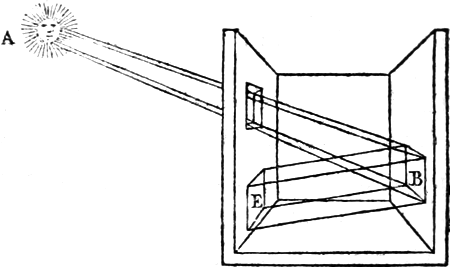
If A be the light, and B the object receiving it in a direct line, E
cannot receive that light, but only the reflexion from B, which we shall
suppose to be red. In that case, the light it produces being red, it
will tinge with red the object E; and if E happen to be also red before,
you will see that colour increase in beauty, and appear redder than B;
but if E were yellow, you will see a new colour, participating of the
red and the yellow.
As the quality of colours is discovered to the eye by the light, it is
natural to conclude, that where there is most light, there also the true
quality of the colour is to be seen; and where there is most shadow
the colour will participate of, and be tinged with the colour of that
shadow. Remember then to shew the true quality of the colour in the
light parts only
[56].
The colour which is between the light and the shadow will not be so
beautiful as that which is in the full light. Therefore the chief beauty
of colours will be found in the principal lights
[57].
This is very observable in draperies, where the light folds casting a
reflexion, and throwing a light on other folds opposite to them, make
them appear in their natural colour. The same effect is produced by gold
leaves casting their light reciprocally on each other. The effect is
quite contrary if the light be received from an object of a different
colour
[58].
The colour of the shadows of an object can never be pure if the body
which is opposed to these shadows be not of the same colour as that on
which they are produced. For instance, if in a room, the walls of which
are green, I place a figure clothed in blue, and receiving the light
from another blue object, the light part of that figure will be of a
beautiful blue, but the shadows of it will become dingy, and not like a
true shade of that beautiful blue, because it will be corrupted by the
reflexions from the green wall; and it would be still worse if the walls
were of a darkish brown.
Colours placed in shadow will preserve more or less of their original
beauty, as they are more or less immersed in the shade. But colours
situated in a light space will shew their natural beauty in proportion
to the brightness of that light. Some say, that there is as great
variety in the colours of shadows, as in the colours of objects shaded
by them. It may be answered, that colours placed in shadow will shew
less variety amongst themselves as the shadows are darker. We shall
soon convince ourselves of this truth, if, from a large square, we look
through the open door of a church, where pictures, though enriched with
a variety of colours, appear all clothed in darkness.
It is very possible that all the different colours may be changed into
that of a general shadow; as is manifest in the darkness of a cloudy
night, in which neither the shape nor colour of bodies is distinguished.
Total darkness being nothing but a privation of the primitive and
reflected lights, by which the form and colour of bodies are seen; it is
evident, that the cause being removed the effect ceases, and the objects
are entirely lost to the sight.
White is not a colour, but has the power of receiving all the other
colours. When it is placed in a high situation in the country, all its
shades are azure; according to the fourth proposition[59], which says,
that the surface of any opake body participates of the colour of any
other body sending the light to it. Therefore white being deprived of
the light of the sun by the interposition of any other body, will remain
white; if exposed to the sun on one side, and to the open air on the
other, it will participate both of the colour of the sun and of the air.
That side which is not opposed to the sun, will be shaded of the colour
of the air. And if this white were not surrounded by green fields all
the way to the horizon, nor could receive any light from that horizon,
without doubt it would appear of one simple and uniform colour, viz.
that of the air.
The light of the fire tinges every thing of a reddish yellow; but this
will hardly appear evident, if we do not make the comparison with the
daylight. Towards the close of the evening this is easily done; but more
certainly after the morning twilight; and the difference will be clearly
distinguished in a dark room, when a little glimpse of daylight strikes
upon any part of the room, and there still remains a candle burning.
Without such a trial the difference is hardly perceivable, particularly
in those colours which have most similarity; such as white and yellow,
light green and light blue; because the light which strikes the blue,
being yellow, will naturally turn it green; as we have said in another
place[60], that a mixture of blue and yellow produces green. And if to
a green colour you add some yellow, it will make it of a more beautiful
green.
The painter, who is to represent objects at some distance from the eye,
ought merely to convey the idea of general undetermined masses, making
choice, for that purpose, of cloudy weather, or towards the evening, and
avoiding, as was said before, to mark the lights and shadows too strong
on the extremities; because they would in that case appear like spots of
difficult execution, and without grace. He ought to remember, that the
shadows are never to be of such a quality, as to obliterate the proper
colour, in which they originated; if the situation of the coloured body
be not in total darkness. He ought to mark no outline, not to make the
hair stringy, and not to touch with pure white, any but those things
which in themselves are white; in short, the lightest touch upon any
particular object ought to denote the beauty of its proper and natural
colour.
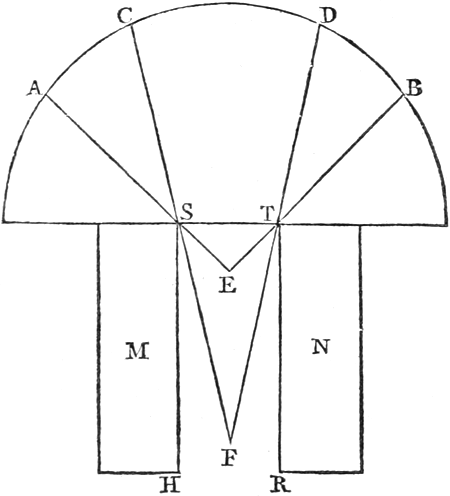
The painter ought to know, that if any white object is placed between
two walls, one of which is also white, and the other black, there will
be found between the shady side of that object and the light side, a
similar proportion to that of the two walls; and if that object be
blue, the effect will be the same. Having therefore to paint this
object, take some black, similar to that of the wall from which the
reflexes come; and to proceed by a certain and scientific method, do as
follows. When you paint the wall, take a small spoon to measure exactly
the quantity of colour you mean to employ in mixing your tints; for
instance, if you have put in the shading of this wall three spoonfuls
of pure black, and one of white, you have, without any doubt, a mixture
of a certain and precise quality. Now having painted one of the walls
white, and the other dark, if you mean to place a blue object between
them with shades suitable to that colour, place first on your pallet the
light blue, such as you mean it to be, without any mixture of shade,
and it will do for the lightest part of your object. After which take
three spoonfuls of black, and one of this light blue, for your darkest
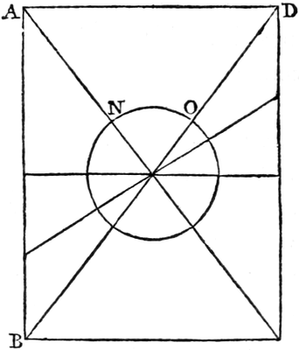
shades. Then observe whether your object be round or square: if it be
square, these two extreme tints of light and shade will be close to each
other, cutting sharply at the angle; but if it be round, draw lines
from the extremities of the walls to the centre of the object, and put
the darkest shade between equal angles, where the lines intersect upon
the superficies of it; then begin to make them lighter and lighter
gradually to the point N O, lessening the strength of the shadows as
much as that place participates of the light A D, and mixing that colour
with the darkest shade A B, in the same proportion.
Blue and green are not simple colours in their nature, for blue is
composed of light and darkness; such is the azure of the sky, viz.
perfect black and perfect white. Green is composed of a simple and a
mixed colour, being produced by blue and yellow.
Any object seen in a mirror, will participate of the colour of that body
which serves as a mirror; and the mirror in its turn is tinged in part
by the colour of the object it represents; they partake more or less of
each other as the colour of the object seen is more or less strong than
the colour of the mirror. That object will appear of the strongest and
most lively colour in the mirror, which has the most affinity to the
colour of the mirror itself.
Of coloured bodies, the purest white will be seen at the greatest
distance, therefore the darker the colour, the less it will bear
distance.
Of different bodies equal in whiteness, and in distance from the eye,
that which is surrounded by the greatest darkness will appear the
whitest; and on the contrary, that shadow will appear the darkest that
has the brightest white round it.
Of different colours, equally perfect, that will appear most excellent,
which is seen near its direct contrary. A pale colour against red, a
black upon white (though neither the one nor the other are colours),
blue near a yellow; green near red; because each colour is more
distinctly seen, when opposed to its contrary, than to any other similar
to it.
Any thing white seen in a dense air full of vapours, will appear larger
than it is in reality.
The air, between the eye and the object seen, will change the colour
of that object into its own; so will the azure of the air change the
distant mountains into blue masses. Through a red glass every thing
appears red; the light round the stars is dimmed by the darkness of the
air, which fills the space between the eye and the planets.
The true colour of any object whatever will be seen in those parts which
are not occupied by any kind of shade, and have not any gloss (if it be
a polished surface).
I say, that white terminating abruptly upon a dark ground, will cause
that part where it terminates to appear darker, and the white whiter.
Your window must be open to the sky, and the walls painted of a reddish
colour. The summertime is the best, when the clouds conceal the sun, or
else your walls on the south side of the room must be so high, as that
the sun-beams cannot strike on the opposite side, in order that the
reflexion of those beams may not destroy the shadows.
The window which gives light to a painting-room, ought to be made of
oiled paper, without any cross bar, or projecting edge at the opening,
or any sharp angle in the inside of the wall, but should be slanting by
degrees the whole thickness of it; and the sides be painted black.
The shadows of any colour whatever must participate of that colour more
or less, as it is nearer to, or more remote from the mass of shadows;
and also in proportion to its distance from, or proximity to the mass of
light.
To any white body receiving the light from the sun, or the air, the
shadows should be of a blueish cast; because white is no colour, but a
receiver of all colours; and as by the fourth proposition[61] we learn,
that the surface of any object participates of the colours of other
objects near it, it is evident that a white surface will participate of
the colour of the air by which it is surrounded.
That shade will be the darkest which is produced by the whitest surface;
this also will have a greater propensity to variety than any other
surface; because white is not properly a colour, but a receiver of
colours, and its surface will participate strongly of the colour of
surrounding objects, but principally of black or any other dark colour,
which being the most opposite to its nature, produces the most sensible
difference between the shadows and the lights.
When one white body terminates on another of the same colour, the white
of these two bodies will be either alike or not. If they be alike, that
object which of the two is nearest to the eye, should be made a little
darker than the other, upon the rounding of the outline; but if the
object which serves as a ground to the other be not quite so white, the
latter will detach of itself, without the help of any darker termination.
Of two objects equally light, one will appear less so if seen upon a
whiter ground; and, on the contrary, it will appear a great deal lighter
if upon a space of a darker shade. So flesh colour will appear pale upon
a red ground, and a pale colour will appear redder upon a yellow ground.
In short, colours will appear what they are not, according to the ground
which surrounds them.
Amongst the figures which compose an historical picture, those which are
meant to appear the nearest to the eye, must have the greatest force;
according to the second proposition
[62] of the third book, which says,
that colour will be seen in the greatest perfection which has less air
interposed between it and the eye of the beholder; and for that reason
the shadows (by which we express the relievo of bodies) appear darker
when near than when at a distance, being then deadened by the air which
interposes. This does not happen to those shadows which are near the
eye, where they will produce the greatest relievo when they are darkest.
Observe, that where the shadows end, there be always a kind of
half-shadow to blend them with the lights. The shadow derived from any
object will mix more with the light at its termination, in proportion as
it is more distant from that object. But the colour of the shadow will
never be simple: this is proved by the ninth proposition[63], which
says, that the superficies of any object participates of the colours of
other bodies, by which it is surrounded, although it were transparent,
such as water, air, and the like: because the air receives its light
from the sun, and darkness is produced by the privation of it. But as
the air has no colour in itself any more than water, it receives all the
colours that are between the object and the eye. The vapours mixing
with the air in the lower regions near the earth, render it thick, and
apt to reflect the sun’s rays on all sides, while the air above remains
dark; and because light (that is, white) and darkness (that is, black),
mixed together, compose the azure that becomes the colour of the sky,
which is lighter or darker in proportion as the air is more or less
mixed with damp vapours.
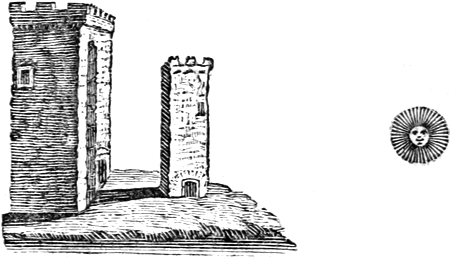
The shadows of bodies produced by the redness of the setting sun,
will always be blueish. This is accounted for by the eleventh
proposition[64], which says, that the superficies of any opake body
participates of the colour of the object from which it receives the
light; therefore the white wall being deprived entirely of colour, is
tinged by the colour of those bodies from which it receives the light,
which in this case are the sun and the sky. But because the sun is red
towards the evening, and the sky is blue, the shadow on the wall not
being enlightened by the sun, receives only the reflexion of the sky,
and therefore will appear blue; and the rest of the wall, receiving
light immediately from the sun, will participate of its red colour.
The colour of any object will appear more or less distinct in proportion
to the extent of its surface. This proportion is proved, by observing
that a face appears dark at a small distance, because, being composed of
many small parts, it produces a great number of shadows; and the lights
being the smallest part of it, are soonest lost to the sight, leaving
only the shadows, which being in a greater quantity, the whole of the
face appears dark, and the more so if that face has on the head, or at
the back, something whiter.
Where the shadows terminate upon the lights, observe well what parts
of them are lighter than the others, and where they are more or less
softened and blended; but above all remember, that young people have
no sharp shadings: their flesh is transparent, something like what we
observe when we put our hand between the sun and eyes; it appears
reddish, and of a transparent brightness. If you wish to know what
kind of shadow will suit the flesh colour you are painting, place one
of your fingers close to your picture, so as to cast a shadow upon it,
and according as you wish it either lighter or darker, put it nearer or
farther from it, and imitate it.
It happens very often that the shadows of an opake body do not retain
the same colour as the lights. Sometimes they will be greenish, while
the lights are reddish, although this opake body be all over of one
uniform colour. This happens when the light falls upon the object (we
will suppose from the East), and tinges that side with its own colour.
In the West we will suppose another opake body of a colour different
from the first, but receiving the same light. This last will reflect
its colour towards the East, and strike the first with its rays on the
opposite side, where they will be stopped, and remain with their full
colour and brightness. We often see a white object with red lights, and
the shades of a blueish cast; this we observe particularly in mountains
covered with snow, at sun-set, when the effulgence of its rays makes the
horizon appear all on fire.
Whatever object you intend to represent is to be supposed situated in
a particular light, and that entirely of your own choosing. If you
imagine such objects to be in the country, and the sun be overcast,
they will be surrounded by a great quantity of general light. If the
sun strikes upon those objects, then the shadows will be very dark,
in proportion to the lights, and will be determined and sharp; the
primitive as well as the secondary ones. These shadows will vary from
the lights in colour, because on that side the object receives a
reflected light hue from the azure of the air, which tinges that part;
and this is particularly observable in white objects. That side which
receives the light from the sun, participates also of the colour of
that. This may be particularly observed in the evening, when the sun
is setting between the clouds, which it reddens; those clouds being
tinged with the colour of the body illuminating them, the red colour
of the clouds, with that of the sun, casts a hue on those parts which
receive the light from them. On the contrary, those parts which are not
turned towards that side of the sky, remain of the colour of the air,
so that the former and the latter are of two different colours. This
we must not lose sight of, that, knowing the cause of those lights and
shades, it be made apparent in the effect, or else the work will be
false and absurd. But if a figure be situated within a house, and seen
from without, such figure will have its shadows very soft; and if the
beholder stands in the line of the light, it will acquire grace, and do
credit to the painter, as it will have great relief in the lights, and
soft and well-blended shadows, particularly in those parts where the
inside of the room appears less obscure, because there the shadows are
almost imperceptible: the cause of which we shall explain in its proper
place.
Do not make the boundaries of your figures with any other colour than
that of the back-ground, on which they are placed; that is, avoid making
dark outlines.
The extremities of objects which are at some distance, are not seen
so distinctly as if they were nearer. Therefore the painter ought to
regulate the strength of his outlines, or extremities, according to the
distance.
The boundaries which separate one body from another, are of the nature
of mathematical lines, but not of real lines. The end of any colour
is only the beginning of another, and it ought not to be called a
line, for nothing interposes between them, except the termination of
the one against the other, which being nothing in itself, cannot be
perceivable; therefore the painter ought not to pronounce it in distant
objects.
One of the principal parts of painting is the nature and quality of
back-grounds, upon which the extremities of any convex or solid body
will always detach and be distinguished in nature, though the colour of
such objects, and that of the ground, be exactly the same. This happens,
because the convex sides of solid bodies do not receive the light in the
same manner with the ground, for such sides or extremities are often
lighter or darker than the ground. But if such extremities were to be
of the same colour as the ground, and in the same degree of light,
they certainly could not be distinguished. Therefore such a choice in
painting ought to be avoided by all intelligent and judicious painters;
since the intention is to make the objects appear as it were out of the
ground. The above case would produce the contrary effect, not only in
painting, but also in objects of real relievo.
All solid bodies will appear to have a greater relief, and to come
more out of the canvass, on a ground of an undetermined colour, with
the greatest variety of lights and shades against the confines of such
bodies (as will be demonstrated in its place), provided a proper
diminution of lights in the white tints, and of darkness in the shades,
be judiciously observed.
The back-grounds of any flat surfaces which are uniform in colour and
quantity of light, will never appear separated from each other; vice
versâ, they will appear separated if they are of different colours or
lights.
The shadows or lights which surround figures, or any other objects, will
help the more to detach them the more they differ from the objects; that
is, if a dark colour does not terminate upon another dark colour, but
upon a very different one; as white, or partaking of white, but lowered,
and approximated to the dark shade.
No colour appears uniform and equal in all its parts unless it terminate
on a ground of the same colour. This is very apparent when a black
terminates on a white ground, where the contraste of colour gives more
strength and richness to the extremities than to the middle.
What is fine is not always beautiful and good: I address this to such
painters as are so attached to the beauty of colours, that they regret
being obliged to give them almost imperceptible shadows, not considering
the beautiful relief which figures acquire by a proper gradation and
strength of shadows. Such persons may be compared to those speakers
who in conversation make use of many fine words without meaning, which
altogether scarcely form one good sentence.
If you mean that the proximity of one colour should give beauty to
another that terminates near it, observe the rays of the sun in the
composition of the rainbow, the colours of which are generated by the
falling rain, when each drop in its descent takes every colour of that
bow, as is demonstrated in its place
[65].
If you mean to represent great darkness, it must be done by contrasting
it with great light; on the contrary, if you want to produce great
brightness, you must oppose to it a very dark shade: so a pale yellow
will cause red to appear more beautiful than if opposed to a purple
colour.
There is another rule, by observing which, though you do not increase
the natural beauty of the colours, yet by bringing them together they
may give additional grace to each other, as green placed near red, while
the effect would be quite the reverse, if placed near blue.
Harmony and grace are also produced by a judicious arrangement of
colours, such as blue with pale yellow or white, and the like; as will
be noticed in its place.
Let the colours of which the draperies of your figures are composed,
be such as to form a pleasing variety, to distinguish one from the
other; and although, for the sake of harmony, they should be of the
same nature[66], they must not stick together, but vary in point of
light, according to the distance and interposition of the air between
them. By the same rule, the outlines are to be more precise, or lost, in
proportion to their distance or proximity.
All reflected colours are less brilliant and strong, than those which
receive a direct light, in the same proportion as there is between the
light of a body and the cause of that light.
An opake surface will partake most of the genuine colour of the body
nearest to it, because a great quantity of the species of colour will
be conveyed to it; whereas such colour would be broken and disturbed if
coming from a more distant object.
Reflexes will partake, more or less, both of the colour of the object
which produces them, and of the colour of that object on which they are
produced, in proportion as this latter body is of a smoother or more
polished surface, than that by which they are produced.
The surface of any opake body placed in shadow, will participate of the
colour of any other object which reflects the light upon it. This is
very evident; for if such bodies were deprived of light in the space
between them and the other bodies, they could not shew either shape or
colour. We shall conclude then, that if the opake body be yellow, and
that which reflects the light blue, the part reflected will be green,
because green is composed of blue and yellow.
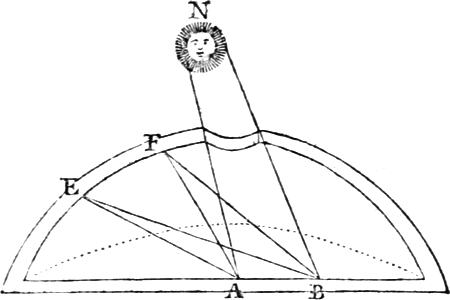
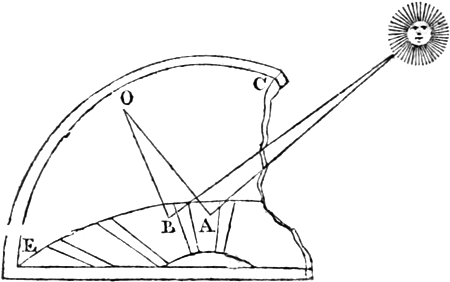
No colour reflected upon the surface of another body, will tinge that
surface with its own colour alone, but will be mixed by the concurrence
of other colours also reflected on the same spot. Let us suppose A to
be of a yellow colour, which is reflected on the convex C O E, and that
the blue colour B be reflected on the same place. I say that a mixture
of the blue and yellow colours will tinge the convex surface; and that,
if the ground be white, it will produce a green reflexion, because it is
proved that a mixture of blue and yellow produces a very fine green.
When two lights strike upon an opake body, they can vary only in two
ways; either they are equal in strength, or they are not. If they be
equal, they may still vary in two other ways, that is, by the equality
or inequality of their brightness; they will be equal, if their distance
be the same; and unequal, if it be otherwise. The object placed at
an equal distance, between two equal lights, in point both of colour
and brightness, may still be enlightened by them in two different
ways, either equally on each side, or unequally. It will be equally
enlightened by them, when the space which remains round the lights shall
be equal in colour, in degree of shade, and in brightness. It will be
unequally enlightened by them when the spaces happen to be of different
degrees of darkness.
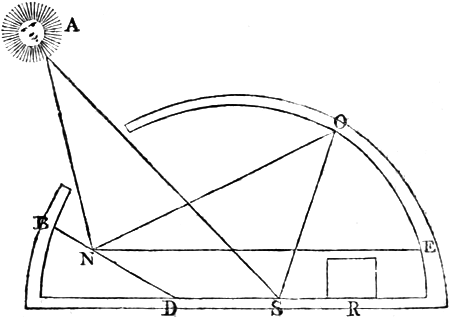
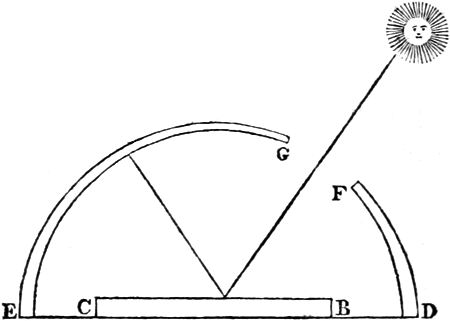
It happens very seldom that the reflexes are of the same colour with
the body from which they proceed, or with that upon which they meet.
To exemplify this, let the convex body D F G E be of a yellow colour,
and the body B C, which reflects its colour on it, blue; the part of
the convex surface which is struck by that reflected light, will take a
green tinge, being B C, acted on by the natural light of the air, or the
sun.
The lights upon the flesh colours, which are reflected by the light
striking upon another flesh-coloured body, are redder and more lively
than any other part of the human figure; and that happens according
to the third proposition of the second book
[67], which says, the
surface of any opake body participates of the colour of the object
which reflects the light, in proportion as it is near to or remote
from it, and also in proportion to the size of it; because, being
large, it prevents the variety of colours in smaller objects round it,
from interfering with, and discomposing the principal colour, which
is nearer. Nevertheless it does not prevent its participating more of
the colour of a small object near it, than of a large one more remote.
See the sixth proposition
[68] of perspective, which says, that large
objects may be situated at such a distance as to appear less than small
ones that are near.
Black draperies will make the flesh of the human figure appear whiter
than in reality it is
[69]; and white draperies, on the contrary, will
make it appear darker. Yellow will render it higher coloured, while red
will make it pale.
Of all reflexions of the same shape, size, and strength, that will be
more or less strong, which terminates on a ground more or less dark.
The surface of those bodies will partake most of the colour of the
object that reflects it, which receive that reflexion by the most nearly
equal angles.
Of the colours of objects reflected upon any opposite surface by equal
angles, that will be the most distinct which has its reflecting ray the
shortest.
Of all colours, reflected under equal angles, and at equal distance upon
the opposite body, those will be the strongest, which come reflected by
the lightest coloured body.
That object will reflect its own colour most precisely on the opposite
object, which has not round it any colour that clashes with its own; and
consequently that reflected colour will be most confused which takes its
origin from a variety of bodies of different colours.
That colour which is nearest the opposed object, will tinge it the most
strongly; and vice versâ: let the painter, therefore, in his reflexes
on the human body, particularly on the flesh colour, mix some of the
colour of the drapery which comes nearest to it; but not pronounce it
too distinctly, if there be not good reason for it.
When, on account of some particular quality of the air, you can no
longer distinguish the difference between the lights and shadows of
objects, you may reject the perspective of shadows, and make use only
of the linear perspective, and the diminution of colours, to lessen the
knowledge of the objects opposed to the eye; and this, that is to say,
the loss of the knowledge of the figure of each object, will make the
same object appear more remote.
The eye can never arrive at a perfect knowledge of the interval between
two objects variously distant, by means of the linear perspective alone,
if not assisted by the perspective of colours.
The air will participate less of the azure of the sky, in proportion as
it comes nearer to the horizon, as it is proved by the third and ninth
proposition
[70], that pure and subtile bodies (such as compose the air)
will be less illuminated by the sun than those of thicker and grosser
substance: and as it is certain that the air which is remote from the
earth, is thinner than that which is near it, it will follow, that the
latter will be more impregnated with the rays of the sun, which giving
light at the same time to an infinity of atoms floating in this air,
renders it more sensible to the eye. So that the air will appear lighter
towards the horizon, and darker as well as bluer in looking up to the
sky; because there is more of the thick air between our eyes and the
horizon, than between our eyes and that part of the sky above our heads.
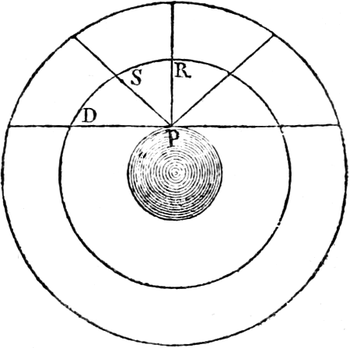
For instance: if the eye placed in P, looks through the air along the
line P R, and then lowers itself a little along P S, the air will begin
to appear a little whiter, because there is more of the thick air in
this space than in the first. And if it be still removed lower, so as to
look straight at the horizon, no more of that blue sky will be perceived
which was observable along the first line P R, because there is a much
greater quantity of thick air along the horizontal line P D, than along
the oblique P S, or the perpendicular P R.
The natural colour of any visible object will be diminished in
proportion to the density of any other substance which interposes
between that object and the eye.
Let the colours vanish in proportion as the objects diminish in size,
according to the distance.
The local colour of such objects as are darker than the air, will appear
less dark as they are more remote; and, on the contrary, objects lighter
than the air will lose their brightness in proportion to their distance
from the eye. In general, all objects that are darker or lighter than
the air, are discoloured by distance, which changes their quality, so
that the lighter appears darker, and the darker lighter.
Local colours are entirely lost at a greater or less distance, according
as the eye and the object are more or less elevated from the earth. This
is proved by the seventh proposition
[71], which says, the air is more
or less pure, as it is near to, or remote from the earth. If the eye
then, and the object are near the earth, the thickness of the air which
interposes, will in a great measure confuse the colour of that object to
the eye. But if the eye and the object are placed high above the earth,
the air will disturb the natural colour of that object very little. In
short, the various gradations of colour depend not only on the various
distances, in which they may be lost; but also on the variety of lights,
which change according to the different hours of the day, and the
thickness or purity of the air, through which the colour of the object
is conveyed to the eye.
Among several colours of the same nature, that which is the nearest to
the eye will alter the least; because the air which interposes between
the eye and the object seen, envelopes, in some measure, that object.
If the air, which interposes, be in great quantity, the object seen
will be strongly tinged with the colour of that air; but if the air be
thin, then the view of that object, and its colour, will be very little
obstructed.
Whatever be the colour of distant objects, the darkest, whether natural
or accidental, will appear the most tinged with azure. By the natural
darkness is meant the proper colour of the object; the accidental one is
produced by the shadow of some other body.
The first part of any colour which is lost by the distance, is the
gloss, being the smallest part of it, as a light within a light. The
second that diminishes by being farther removed, is the light, because
it is less in quantity than the shadow. The third is the principal
shadows, nothing remaining at last but a kind of middling obscurity.
The azure of the sky is produced by the transparent body of the air,
illumined by the sun, and interposed between the darkness of the expanse
above, and the earth below. The air in itself has no quality of smell,
taste, or colour, but is easily impregnated with the quality of other
matter surrounding it; and will appear bluer in proportion to the
darkness of the space behind it, as may be observed against the shady
sides of mountains, which are darker than any other object. In this
instance the air appears of the most beautiful azure, while on the other
side that receives the light, it shews through that more of the natural
colour of the mountain.
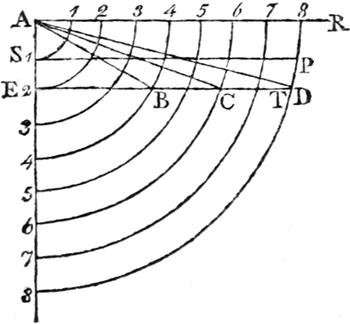
The same colour being placed at various distances and equal elevation,
the force and effect of its colouring will be according to the
proportion of the distance which there is from each of these colours
to the eye. It is proved thus: let C B E D be one and the same colour.
The first, E, is placed at two degrees of distance from the eye A; the
second, B, shall be four degrees, the third, C, six degrees, and the
fourth, D, eight degrees; as appears by the circles which terminate upon
and intersect the line A R. Let us suppose that the space A R, S P, is
one degree of thin air, and S P E T another degree of thicker air. It
will follow, that the first colour, E, will pass to the eye through one
degree of thick air, E S, and through another degree, S A, of thinner
air. And B will send its colour to the eye in A, through two degrees of
thick air, and through two others of the thinner sort. C will send it
through three degrees of the thin, and three of the thick sort, while
D goes through four degrees of the one, and four of the other. This
demonstrates, that the gradation of colours is in proportion to their
distance from the eye
[72]. But this happens only to those colours which
are on a level with the eye; as for those which happen to be at unequal
elevations, we cannot observe the same rule, because they are in that
case situated in different qualities of air, which alter and diminish
these colours in various manners.
In any place where the light diminishes in a gradual proportion till it
terminates in total darkness, the colours also will lose themselves and
be dissolved in proportion as they recede from the eye.
The principal colours, or those nearest to the eye, should be pure and
simple; and the degree of their diminution should be in proportion to
their distance, viz. the nearer they are to the principal point, the
more they will possess of the purity of those colours, and they will
partake of the colour of the horizon in proportion as they approach to
it.
Of all the colours which are not blue, those that are nearest to black
will, when distant, partake most of the azure; and, on the contrary,
those will preserve their proper colour at the greatest distance, that
are most dissimilar to black.
The green therefore of the fields will change sooner into blue than
yellow, or white, which will preserve their natural colour at a greater
distance than that, or even red.
The colour will not be subject to any alteration when the distance and
the quality of air have a reciprocal proportion. What it loses by the
distance it regains by the purity of the air, viz. if we suppose the
first or lowest air to have four degrees of thickness, and the colour to
be at one degree from the eye, and the second air above to have three
degrees. The air having lost one degree of thickness, the colour will
acquire one degree upon the distance. And when the air still higher
shall have lost two degrees of thickness, the colour will acquire as
many upon the distance; and in that case the colour will be the same
at three degrees as at one. But to be brief, if the colour be raised
so high as to enter that quality of air which has lost three degrees
of thickness, and acquired three degrees of distance, then you may be
certain that that colour which is high and remote, has lost no more than
the colour which is below and nearer; because in rising it has acquired
those three degrees which it was losing by the same distance from the
eye; and this is what was meant to be proved.
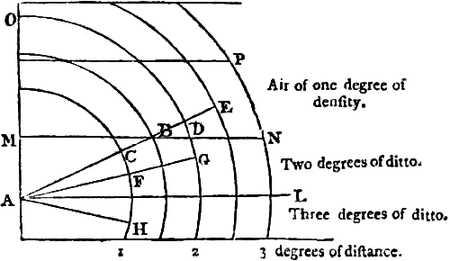
It may happen that a colour does not alter, though placed at different
distances, when the thickness of the air and the distance are in the
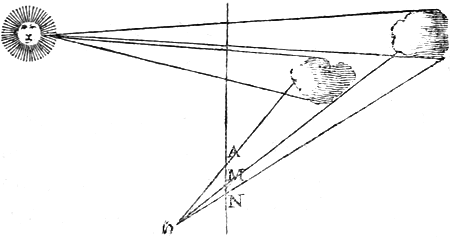
same inverse proportion. It is proved thus: let A be the eye, and H
any colour whatever, placed at one degree of distance from the eye, in
a quality of air of four degrees of thickness; but because the second
degree above, A M N L, contains a thinner air by one half, which air
conveys this colour, it follows that this colour will appear as if
removed double the distance it was at before, viz. at two degrees of
distance, A F and F G, from the eye; and it will be placed in G. If that
is raised to the second degree of air A M N L, and to the degree O M, P
N, it will necessarily be placed at E, and will be removed from the eye
the whole length of the line A E, which will be proved in this manner
to be equal in thickness to the distance A G. If in the same quality of
air the distance A G interposed between the eye and the colour occupies
two degrees, and A E occupies two degrees and a half, it is sufficient
to preserve the colour G, when raised to E, from any change, because the
degree A C and the degree A F being the same in thickness, are equal
and alike, and the degree C D, though equal in length to the degree F
G, is not alike in point of thickness of air; because half of it is
situated in a degree of air of double the thickness of the air above:
this half degree of distance occupies as much of the colour as one
whole degree of the air above would, which air above is twice as thin
as the air below, with which it terminates; so that by calculating the
thickness of the air, and the distances, you will find that the colours
have changed places without undergoing any alteration in their beauty.
And we shall prove it thus: reckoning first the thickness of air, the
colour H is placed in four degrees of thickness, the colour G in two
degrees, and E at one degree. Now let us see whether the distances are
in an equal inverse proportion; the colour E is at two degrees and a
half of distance, G at two degrees, and H at one degree. But as this
distance has not an exact proportion with the thickness of air, it is
necessary to make a third calculation in this manner: A C is perfectly
like and equal to A F; the half degree, C B, is like but not equal to A
F, because it is only half a degree in length, which is equal to a whole
degree of the quality of the air above; so that by this calculation we
shall solve the question. For A C is equal to two degrees of thickness
of the air above, and the half degree C B is equal to a whole degree of
the same air above; and one degree more is to be taken in, viz. B E,
which makes the fourth. A H has four degrees of thickness of air, A G
also four, viz. A F two in value, and F G also two, which taken together
make four. A E has also four, because A C contains two, and C D one,
which is the half of A C, and in the same quality of air; and there is
a whole degree above in the thin air, which all together make four. So
that if A E is not double the distance A G, nor four times the distance
A H, it is made equivalent by the half degree C B of thick air, which is
equal to a whole degree of thin air above. This proves the truth of the
proposition, that the colour H G E does not undergo any alteration by
these different distances.
Many painters will represent the objects darker, in proportion as they
are removed from the eye; but this cannot be true, unless the objects
seen be white; as shall be examined in the next chapter.
The air tinges objects with its own colour more or less in proportion to
the quantity of intervening air between it and the eye, so that a dark
object at the distance of two miles (or a density of air equal to such
distance), will be more tinged with its colour than if only one mile
distant.
It is said, that, in a landscape, trees of the same species appear
darker in the distance than near; this cannot be true, if they be of
equal size, and divided by equal spaces. But it will be so if the
first trees are scattered, and the light of the fields is seen through
and between them, while the others which are farther off, are thick
together, as is often the case near some river or other piece of water:
in this case no space of light fields can be perceived, but the trees
appear thick together, accumulating the shadow on each other. It also
happens, that as the shady parts of plants are much broader than the
light ones, the colour of the plants becoming darker by the multiplied
shadows, is preserved, and conveyed to the eye more strongly than that
of the other parts; these masses, therefore, will carry the strongest
parts of their colour to a greater distance.
The darker the mountain is in itself, the bluer it will appear at a
great distance. The highest part will be the darkest, as being more
woody; because woods cover a great many shrubs, and other plants,
which never receive any light. The wild plants of those woods are also
naturally of a darker hue than cultivated plants; for oak, beech, fir,
cypress, and pine trees are much darker than olive and other domestic
plants. Near the top of these mountains, where the air is thinner and
purer, the darkness of the woods will make it appear of a deeper azure,
than at the bottom, where the air is thicker. A plant will detach very
little from the ground it stands upon, if that ground be of a colour
something similar to its own; and, vice versâ, that part of any white
object which is nearest to a dark one, will appear the whitest, and
the less so as it is removed from it; and any dark object will appear
darker, the nearer it is to a white one; and less so, if removed from it.
There are some situations which, though light, appear dark, and in
which objects are deprived both of form and colour. This is caused by
the great light which pervades the intervening air; as is observable
by looking in through a window at some distance from the eye, when
nothing is seen but an uniform darkish shade; but if we enter the house,
we shall find that room to be full of light, and soon distinguish
every small object contained within that window. This difference of
effect is produced by the great brightness of the air, which contracts
considerably the pupil of the eye, and by so doing diminishes its
power. But in dark places the pupil is enlarged, and acquires as much
in strength, as it increases in size. This is proved in my second
proposition of perspective
[73].
The termination and shape of the parts in general are very little seen,
either in great masses of light, or of shadows; but those which are
situated between the extremes of light and shade are the most distinct.
Perspective, as far as it extends in regard to painting, is divided into
three principal parts; the first consists in the diminution of size,
according to distance; the second concerns the diminution of colours in
such objects; and the third treats of the diminution of the perception
altogether of those objects, and of the degree of precision they ought
to exhibit at various distances.
The azure of the sky is produced by a mixture composed of light and
darkness[74]; I say of light, because of the moist particles floating
in the air, which reflect the light. By darkness, I mean the pure air,
which has none of these extraneous particles to stop and reflect the
rays. Of this we see an example in the air interposed between the eye
and some dark mountains, rendered so by the shadows of an innumerable
quantity of trees; or else shaded on one side by the natural privation
of the rays of the sun; this air becomes azure, but not so on the side
of the mountain which is light, particularly when it is covered with
snow.
Among objects of equal darkness and equal distance, those will appear
darker that terminate upon a lighter ground, and vice versâ[75].
That object which is painted with the most white and the most black,
will shew greater relief than any other; for that reason I would
recommend to painters to colour and dress their figures with the
brightest and most lively colours; for if they are painted of a dull
or obscure colour, they will detach but little, and not be much seen,
when the picture is placed at some distance; because the colour of every
object is obscured in the shades; and if it be represented as originally
so all over, there will be but little difference between the lights and
the shades, while lively colours will shew a striking difference.
There is another kind of perspective called aerial, because by the
difference of the air it is easy to determine the distance of different
objects, though seen on the same line; such, for instance, as buildings
behind a wall, and appearing all of the same height above it. If in your
picture you want to have one appear more distant than another, you must
first suppose the air somewhat thick, because, as we have said before,
in such a kind of air the objects seen at a great distance, as mountains
are, appear blueish like the air, by means of the great quantity of air
that interposes between the eye and such mountains. You will then paint
the first building behind that wall of its proper colour; the next in
point of distance, less distinct in the outline, and participating, in a
greater degree, of the blueish colour of the air; another which you wish
to send off as much farther, should be painted as much bluer; and if you
wish one of them to appear five times farther removed beyond the wall,
it must have five times more of the azure. By this rule these buildings
which appeared all of the same size, and upon the same line, will be
distinctly perceived to be of different dimensions, and at different
distances.
Of objects receding from the eye the smallest will be the first lost
to the sight; from which it follows, that the largest will be the last
to disappear. The painter, therefore, ought not to finish the parts of
those objects which are very far off, but follow the rule given in the
sixth book[76].
How many, in the representation of towns, and other objects remote from
the eye, express every part of the buildings in the same manner as if
they were very near. It is not so in nature, because there is no sight
so powerful as to perceive distinctly at any great distance the precise
form of parts or extremities of objects. The painter therefore who
pronounces the outlines, and the minute distinction of parts, as several
have done, will not give the representation of distant objects, but by
this error will make them appear exceedingly near. Again, the angles
of buildings in distant towns are not to be expressed (for they cannot
be seen), considering that angles are formed by the concurrence of two
lines into one point, and that a point has no parts; it is therefore
invisible.
Objects appear smaller than they really are when they are distant from
the eye, and because there is a great deal of air interposed, which
weakens the appearance of forms, and, by a natural consequence, prevents
our seeing distinctly the minute parts of such objects. It behoves
the painter therefore to touch those parts slightly, in an unfinished
manner; otherwise it would be against the effect of Nature, whom he has
chosen for his guide. For, as we said before, objects appear small on
account of their great distance from the eye; that distance includes a
great quantity of air, which, forming a dense body, obstructs the light,
and prevents our seeing the minute parts of the objects.
As the air is thicker nearer the earth, and becomes thinner as it rises,
look, when the sun is in the east, towards the west, between the north
and south, and you will perceive that the thickest and lowest air will
receive more light from the sun than the thinner air, because its beams
meet with more resistance.
If the sky terminate low, at the end of a plain, that part of it nearest
to the horizon, being seen only through the thick air, will alter and
break its natural colour, and will appear whiter than over your head,
where the visual ray does not pass through so much of that gross air,
corrupted by earthy vapours. But if you turn towards the east, the air
will be darker the nearer it approaches the earth; for the air being
thicker, does not admit the light of the sun to pass so freely.
It is evident that the air is in some parts thicker and grosser than in
others, particularly that nearest to the earth; and as it rises higher,
it becomes thinner and more transparent. The objects which are high and
large, from which you are at some distance, will be less apparent in the
lower parts; because the visual ray which perceives them, passes through
a long space of dense air; and it is easy to prove that the upper parts
are seen by a line, which, though on the side of the eye it originates
in a thick air, nevertheless, as it ascends to the highest summit of its
object, terminates in an air much thinner than that of the lower parts;
and for that reason the more that line or visual ray advances from the
eye, it becomes, in its progress from one point to another, thinner and
thinner, passing from a pure air into another which is purer; so that a
painter who has mountains to represent in a landscape, ought to observe,
that from one hill to another, the tops will appear always clearer than
the bases. In proportion as the distance from one to another is greater,
the top will be clearer; and the higher they are, the more they will
shew their variety of form and colour.
The parts that are near in the fore-ground should be finished in a bold
determined manner; but those in the distance must be unfinished, and
confused in their outlines.
That part of any object which is nearest to the luminary from which it
receives the light, will be the lightest.
The representation of an object in every degree of distance, loses
degrees of its strength; that is, in proportion as the object is more
remote from the eye it will be less perceivable through the air in its
representation.
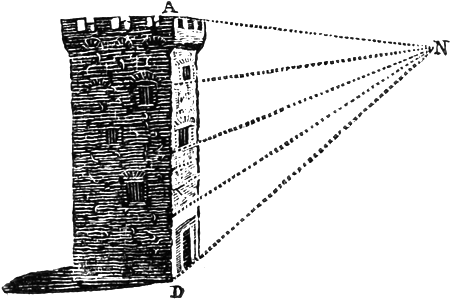
That part of a building seen through a thick air, will appear less
distinct than another part seen through a thinner air. Therefore the
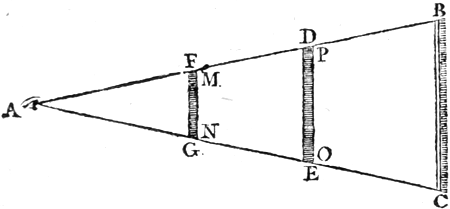
eye, N, looking at the tower A D, will see it more confusedly in the
lower degrees, but at the same time lighter; and as it ascends to the
other degrees it will appear more distinct, but somewhat darker.
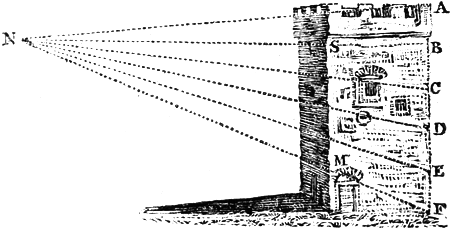
Buildings or towns seen through a fog, or the air made thick by smoke or
other vapours, will appear less distinct the lower they are; and, vice
versâ, they will be sharper and more visible in proportion as they are
higher. We have said, in Chapter cccxxi. that the air is thicker the
lower it is, and thinner as it is higher. It is demonstrated also by
the cut, where the tower, A F, is seen by the eye N, in a thick air,
from B to F, which is divided into four degrees, growing thicker as they
are nearer the bottom. The less the quantity of air interposed between
the eye and its object is, the less also will the colour of the object
participate of the colour of that air. It follows, that the greater
the quantity of the air interposed between the eye and the object seen,
is, the more this object will participate of the colour of the air.
It is demonstrated thus: N being the eye looking at the five parts of
the tower A F, viz. A B C D E, I say, that if the air were of the same
thickness, there would be the same proportion between the colour of
the air at the bottom of the tower and the colour of the air that the
same tower has at the place B, as there is in length between the line
M and F. As, however, we have supposed that the air is not of equal
thickness, but, on the contrary, thicker as it is lower, it follows,
that the proportion by which the air tinges the different elevations of
the tower B C F, exceeds the proportion of the lines; because the line M
F, besides its being longer than the line S B, passes by unequal degrees
through a quality of air which is unequal in thickness.
The inferior or lower extremities of distant objects are not so apparent
as the upper extremities. This is observable in mountains and hills,
the tops of which detach from the sides of other mountains behind. We
see the tops of these more determined and distinctly than their bases;
because the upper extremities are darker, being less encompassed by
thick air, which always remains in the lower regions, and makes them
appear dim and confused. It is the same with trees, buildings, and
other objects high up. From this effect it often happens that a high
tower, seen at a great distance, will appear broad at top, and narrow at
bottom; because the thin air towards the top does not prevent the angles
on the sides and other different parts of the tower from being seen,
as the thick air does at bottom. This is demonstrated by the seventh
proposition[77], which says, that the thick air interposed between
the eye and the sun, is lighter below than above, and where the air is
whiteish, it confuses the dark objects more than if such air were blueish
or thinner, as it is higher up. The battlements of a fortress have the
spaces between equal to the breadth of the battlement, and yet the space
will appear wider; at a great distance the battlements will appear
very much diminished, and being removed still farther, will disappear
entirely, and the fort shew only the straight wall, as if there were no
battlements.
The smallest parts are those which, by being removed, lose their
appearance first; this may be observed in the gloss upon spherical
bodies, or columns, and the slender parts of animals; as in a stag, the
first sight of which does not discover its legs and horns so soon as its
body, which, being broader, will be perceived from a greater distance.
But the parts which disappear the very first, are the lines which
describe the members, and terminate the surface and shape of bodies.
This happens because the smallest parts are lost first; the second, in
point of size, are also lost at a somewhat greater distance, and so on
successively; the parts by degrees melting away, the perception of the
object is diminished; and at last all the parts, and the whole, are
entirely lost to the sight
[78]. Colours also disappear on account of
the density of the air interposed between the eye and the object.
It is evident that the similitude of all objects placed before us,
large as well as small, is perceptible to our senses through the iris
of the eye. If through so small an entrance the immensity of the sky
and of the earth is admitted, the faces of men (which are scarcely any
thing in comparison of such large objects), being still diminished by
the distance, will occupy so little of the eye, that they become almost
imperceptible. Besides, having to pass through a dark medium from the
surface to the Retina in the inside, where the impression is made,
the colour of faces (not being very strong, and rendered still more
obscure by the darkness of the tube) when arrived at the focus appears
dark. No other reason can be given on that point, except that the speck
in the middle of the apple of the eye is black, and, being full of a
transparent fluid like air, performs the same office as a hole in a
board, which on looking into it appears black; and that those things
which are seen through both a light and dark air, become confused and
obscure.
Buildings seen afar off in the morning or in the evening, when there
is a fog, or thick air, shew only those parts distinctly which are
enlightened by the sun towards the horizon; and the parts of those
buildings which are not turned towards the sun remain confused and
almost of the colour of the fog.
Of a building near the eye the top parts will appear more confused than
the bottom, because there is more fog between the eye and the top than
at the base. And a square tower, seen at a great distance through a fog,
will appear narrower at the base than at the summit. This is accounted
for in Chapter cccxiii. which says, that the fog will appear whiter and
thicker as it approaches the ground; and as it is said before[79],
that a dark object will appear smaller in proportion as it is placed on
a whiter ground. Therefore the fog being whiter at bottom than at top,
it follows that the tower (being darkish) will appear narrower at the
base than at the summit.
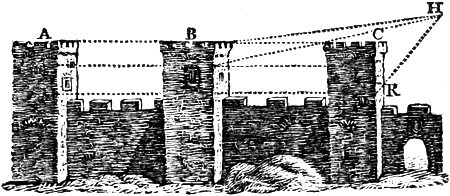
Amongst objects situated in a fog, thick air, vapour, smoke, or at a
distance, the highest will be the most distinctly seen: and amongst
objects equal in height, that placed in the darkest fog, will be most
confused and dark. As it happens to the eye H, looking at A B C, three
towers of equal height; it sees the top C as low as R, in two degrees of
thickness; and the top B, in one degree only; therefore the top C will
appear darker than the top of the tower B.
Objects seen through a fog will appear larger than they are in reality,
because the aerial perspective does not agree with the linear, viz. the
colour does not agree with the magnitude of the object[80]; such a fog
being similar to the thickness of air interposed between the eye and the
horizon in fine weather. But in this case the fog is near the eye, and
though the object be also near, it makes it appear as if it were as far
off as the horizon; where a great tower would appear no bigger than a
man placed near the eye.
The nearer the air is to water, or to the ground, the thicker it
becomes. It is proved by the nineteenth proposition of the second
book[81], that bodies rise in proportion to their weight; and it
follows, that a light body will rise higher than another which is heavy.
Of different objects equal in magnitude, form, shade, and distance from
the eye, those will appear the smaller that are placed on the lighter
ground. This is exemplified by observing the sun when seen behind a tree
without leaves; all the ramifications seen against that great light
are so diminished that they remain almost invisible. The same may be
observed of a pole placed between the sun and the eye.
Parallel bodies placed upright, and seen through a fog, will
appear larger at top than at bottom. This is proved by the ninth
proposition[82], which says, that a fog, or thick air, penetrated by
the rays of the sun, will appear whiter the lower they are.
Things seen afar off will appear out of proportion, because the parts
which are the lightest will send their image with stronger rays than the
parts which are darkest. I have seen a woman dressed in black, with a
white veil over her head, which appeared twice as large as her shoulders
covered with black.