HIPPOCRATES
Ἢν γὰρ παρῇ φιλανθρωπίη πάρεστι καὶ φιλοτεχνίη.
Where the love of man is, there also is love of this Art.
Παραγγελίαι, i.e. Precepts (Hippocratic Collection), § 6
INTRODUCING MEDICAL PRINCIPLES TO
STUDENTS AND NON-MEDICAL READERS
BY
CHARLES SINGER M.A., M.D., D.LITT., OXFORD
FELLOW OF THE ROYAL COLLEGE OF PHYSICIANS OF LONDON
LECTURER ON THE HISTORY OF MEDICINE
IN THE UNIVERSITY OF LONDON
Scire potestates herbarum usumque medendi
Maluit et mutas agitare inglorius artes
It was his part to learn of the power of Medicine
and of the manner of healing and, heedless of
glory, to exercise that quiet art.
Virgil, Aeneid xii, 396-7
NEW YORK
OXFORD UNIVERSITY PRESS
AMERICAN BRANCH
1928
COPYRIGHT, 1928 By Oxford University Press
AMERICAN BRANCH
PRINTED IN THE UNITED STATES OF AMERICA
PREFACE
The position that Medical Science has now assumed
in the social polity demands that all educated men
and women should have some knowledge of the subject,
whether they have had a medical training or no.
In these pages the author seeks to place before the
reader, who is without special knowledge, some account
of Medicine as a Science. For this purpose the historical
method is peculiarly suited, since it recapitulates, in
some measure, the actual stages through which each
learner must pass. Though the story told here opens
with Greek times, the narrative of the earlier period is
so condensed that more than half the book is devoted
to modern Medicine, which is presented as a natural
outgrowth of an ancient tradition. An attempt has been
made to keep the account as simple and as elementary as
possible and to make the smallest demands on the
scientific equipment of the reader. The slight divergence,
in some matters, of the interests of American and
of English readers, has been held in mind, so that, it is
hoped, the book may be useful to both classes.
Throughout the work two particular aims have been
steadily kept in view: first, to stress the principles of
Medicine rather than the details of practice; second, to
treat of those principles in as small a space as may be.
For ‘principles’ the author has substituted at times the
word ‘Philosophy.’ He would, however, beseech the
timid reader to take no alarm at a word, for he employs
the term ‘Philosophy’ in a time-honored fashion, and
he undertakes not to plunge deep into the labyrinth of
Metaphysic. The Philosophy of Medicine stands
here for the disinterested study of the theory of the
subject, without reference to its application to particular
instances.
Certain omissions in the book are justified by the
author’s forthcoming publication of a history of the
biological sciences treated along somewhat similar lines.
It has thus, for example, seemed superfluous to include
here any but casual references to such highly important
topics as the study of hereditary characters or the experimental
investigation of developmental defects. It is,
however, the duty of the author to direct attention to
certain other omissions necessitated by the compression
of the work into a small compass. The history of
Medicine, as here treated, is essentially a history of
ideas. The personal element has been kept wholly in
the background and very little space has been allotted
to biographical matter. Nor do the limits of the book
permit any discussion of the status of medical men, and
very little even of their training. On this account many
who in their day were remarkable rather for the influence
they exerted than for the advances in knowledge
which they initiated find no commemoration here. This
line of treatment has involved omission of reference to
those teachers to whom the author himself owes most,
Sir William Osler and Sir Clifford Allbutt.
A work on Medicine must be colored, in some degree,
by its author’s conception of the nature of Life. On
this theme there are divers views, for the full discussion
of which there is here no place. The author professes
himself, however, an adherent of a school of thought
that is not, at present, greatly in fashion. He ranges
himself as a vitalist under the banner of Aristotle
and as a follower in the goodly company of Harvey,
Hunter and Virchow, of Claude Bernard and Johannes
Müller. He believes that there is a principle in living
things that cannot be expressed in chemical or physical
terms. He believes that this principle works to an
intelligible end, that it is an Entelechy, an indwelling
purposiveness, and that it is as real a thing as anything
that is.
They are right who hold ‘soul’ to be not independent of
body and yet not a kind of body. ‘Soul’ is not body but
something pertaining to the body and dwelling therein,
and, what is more, specific to each body. Our forebears
erred in seeking to fit the ‘soul’ into a body without regard
to the nature and qualities of the body, for the association of
‘soul’ and body is by no means thus at random. And so
indeed we might expect, for the ‘Entelechy’ of each being
comes naturally to be developed in the potentiality of each
being, that is to say in the matter proper to it. Whence is
manifest that the ‘soul’ is a certain ‘Entelechy’, a notion
or form of that which has capacity to be endowed with
‘soul’. Aristotle, Περὶ Ψυχῆς, II, § 2.
The author is well aware that this conception is
neither useful nor helpful for physiological research in
the present state of our knowledge. That is a very good
reason for excluding it, as the vitalist Claude Bernard
excluded it, from the physiological laboratory. But it is
not a good reason for abandoning a point of view which
does something to make existence intelligible. On the
contrary, turning from the physiological laboratory to
the living being as a whole, it is just the indwelling
purposiveness that is, before all things, most worthy of
consideration. Every function, every structure, every
instinct, habit, or reflex, every mental activity that is
related to health—and which is not?—may throw some
light thereon. It appears to the author that the scientific
method is by far the mightiest weapon that has as
yet come within man’s grasp, for the illumination of
these multitudinous entities. The searching accuracy
and power of that superb instrument, wielded by human
reason in the quest of human health, is the theme of
this volume. And yet, notwithstanding its triumphs,
the experimental method, as applied in the separate
sciences, has, of its nature, certain limitations with reference
to living beings in general and living human
beings in particular.
It is the business of each of the sciences—it is indeed
an essential part of the method of Science—to separate
a circumscribed part of the Universe for consideration
in and for itself. Men of Science must thus perforce
become Chemists, Physicists, Astronomers, Botanists,
Cytologists, Statisticians, and the like. In this respect
modern Science differs most profoundly from medieval
Scientia and from ancient Philosophia. ‘Specialization’
follows modern Science as shadow follows substance.
The new method has triumphed wonderfully in these
last centuries and it is mere folly and obscurantism to
seek to place intellectual stumbling-blocks in its path.
Nor must we be afraid of shadows. The author does
plead, however, that, while the Man of Science must,
from the very nature of his method, cut off part of his
universe of experience from all other parts, he should
bear in mind, when not employed on his special task,
that he has so cut off and isolated his special experience,
of deliberate and set intent. To bear this fact in mind
should not mean and must not mean that Science fails
to influence our view of the world as a whole, but it
should mean and must mean the basing of our view of
the world as a whole on experience as a whole, and not
on an artificially separated fragment of experience. For
Man is neither a walking test-tube, nor a living anatomy,
nor a colony of cells, nor a self-repairing machine that
carries its own spare parts, nor a mere summation of
the factors of heredity and environment, nor, for that
matter, is he a disembodied spirit. But he is a being
with a purpose. Of that purpose he, of his nature, can
know very little, since it is a part of that through which
he knows. Yet some glimpse of that purpose, though
seen through a mist and ever so dimly, we may perhaps
gain from the view-point on which the stony tracks of
the separate sciences do ultimately converge. If the
separate sciences did not so conspire to one end, why
should we ever bother our heads or weary our limbs
over their steep ascents? Are there not rosier paths that
we might tread?
Throughout this book, then, the ideal kept in view
is the description of Medicine as a Rational Discipline
involving many and perhaps all the sciences. Medicine
is not now and never has been followed wholly in the
scientific spirit. But it is the story of the scientific
elements in Medicine which is here to be told, and
other aspects are passed over with a silence which must
not be interpreted as the silence of contempt.
No two men undertaking the task here outlined would
make quite the same selections or allot emphasis in
quite the same manner. Doubtless the author has erred
by omission and by commission, through ignorance
and through misconception, but he hopes that he has
never erred through prejudice. The ideas that he recounts
are those that present themselves to him as the
most important and fruitful within the range of scientific
Medicine, and he is prepared to revise his opinions both
on matters of fact and on matters of stress. He will therefore
be very grateful for any corrections or suggestions.
The number of names mentioned in the book has
been reduced to the utmost limit that has seemed feasible.
In recounting many episodes one name has often been
taken as an example or type, and thus perhaps sometimes
an injustice has been done to other workers, no
less important but perhaps less typical. When modern
times and living persons are reached the selection becomes
not only difficult but also delicate, but the reader
must remember that the names are not always chosen
for their eminence but sometimes rather as typifying
the various movements that have to be discussed. There
is a further complication in that an attempt is here made
to bring history right up to date. Very few names of
living men are mentioned, though the work of many
living men is discussed. Though the author has
sought to refrain from passing any judgment on such
latter-day conclusions the value of which does not seem
to him clearly and firmly established, yet even this course
in itself implies a judgment, and one in which he is
even more likely to err than in other topics of which
the book treats. Nevertheless, some such judgment
seems necessary to make the book a coherent whole.
There are several from whom the author has had
help in the writing of this book. Mrs. Singer has
criticized every detail, and has considerably modified
its form. No English writer on the History of Medicine
can fail to refer to the great work of Lt.-Col. Fielding
H. Garrison of the United States Army and of the
Library of Congress at Washington. The author of
this book owes much to Lt.-Col. Garrison’s splendid
bibliography, but even more to constant correspondence,
carried on now through a good many years, with
the man who made it. He owes a similar debt to a very
old-standing friendship with Dr. E. T. Withington of
Oxford, to whom he takes the liberty of dedicating this
book. Professor Graham Wallas, Emeritus Professor
of Sociology in the University of London, and Professor
J. C. Drummond, Professor of Biochemistry in the
University of London, have both read the book in
proof, and have made a number of suggestions and
corrections. Help on special points has been given by
Dr. Clark-Kennedy of Corpus Christi College, Cambridge,
Dr. Raymond Crawfurd, Registrar of the
Royal College of Physicians of London, Dr. J. W.
Eyre, Professor of Bacteriology in the University of
London, the Rev. Father J. R. Fletcher, who has the
unusual distinction of being both a Priest and a Physician,
Dr. K. Franklin of the Pharmacological Laboratory
in the University of Oxford, and Dr. William
Robson, Lecturer in Law in the University of London,
as well as by the author’s pupils Dr. Ivor Hart, Dr. J. F.
Prendergast, Dr. Dorothy M. Turner and Mr. F.
Prescott, M.Sc. To all of these the author would tender
his grateful thanks.
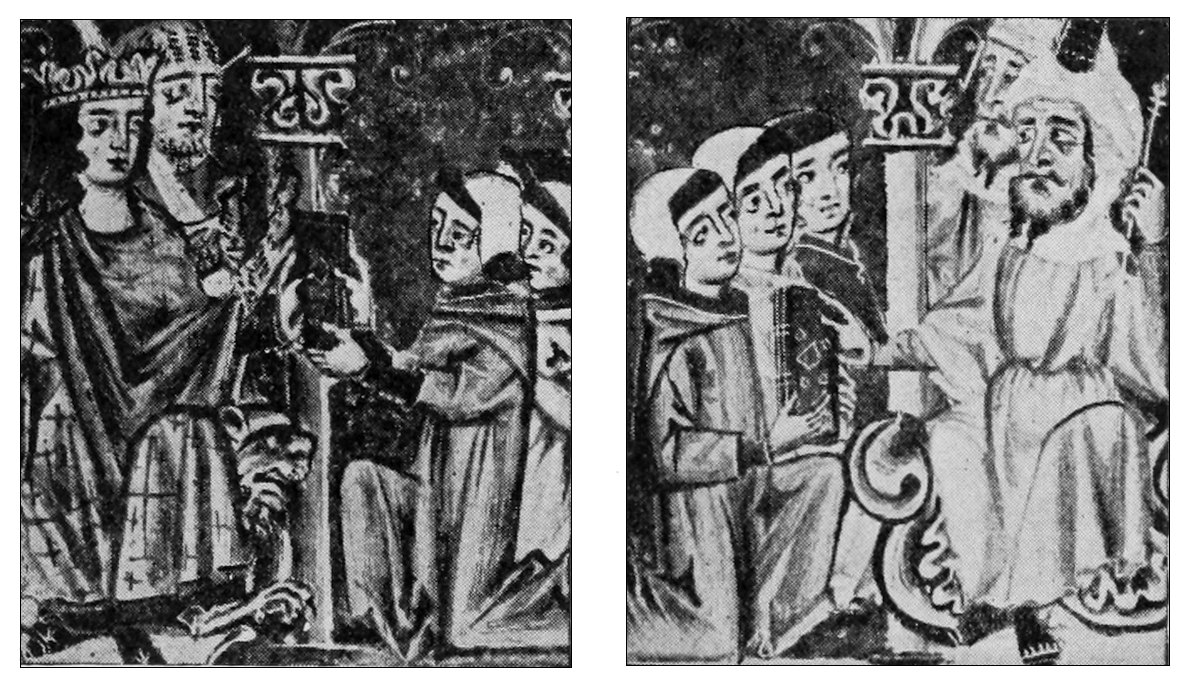
A Jewish translator receiving an Arabic medical volume from an Eastern potentate (right) and handing it, translated into Latin, to a Western monarch (left)
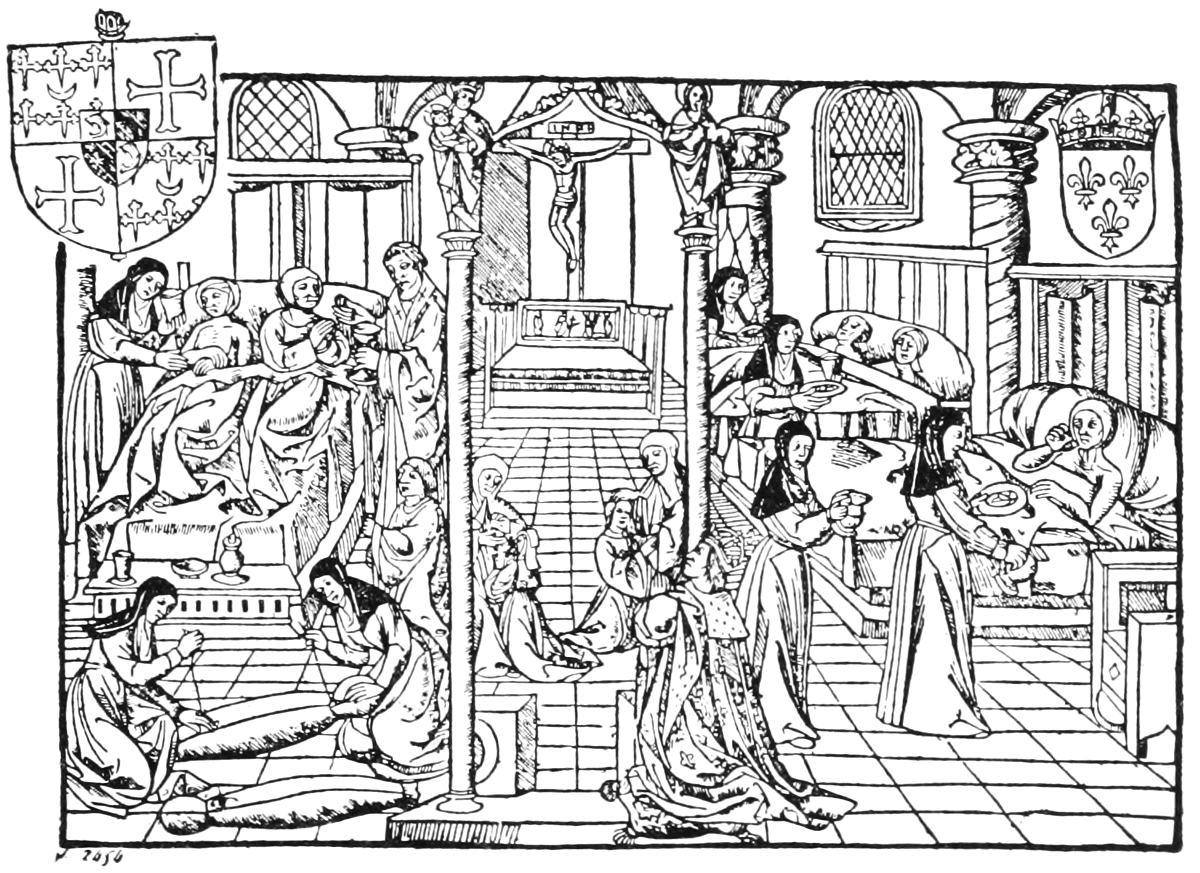
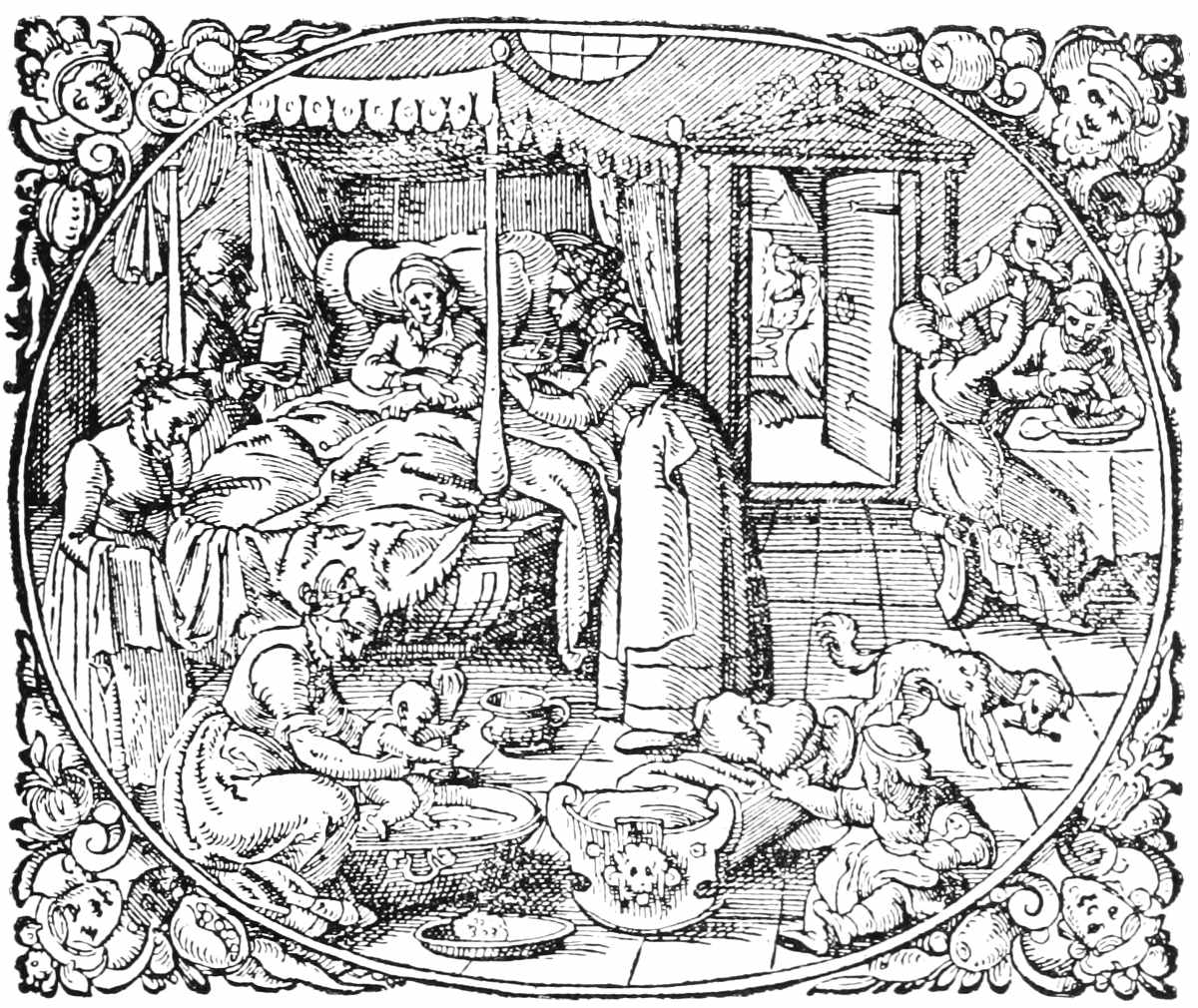
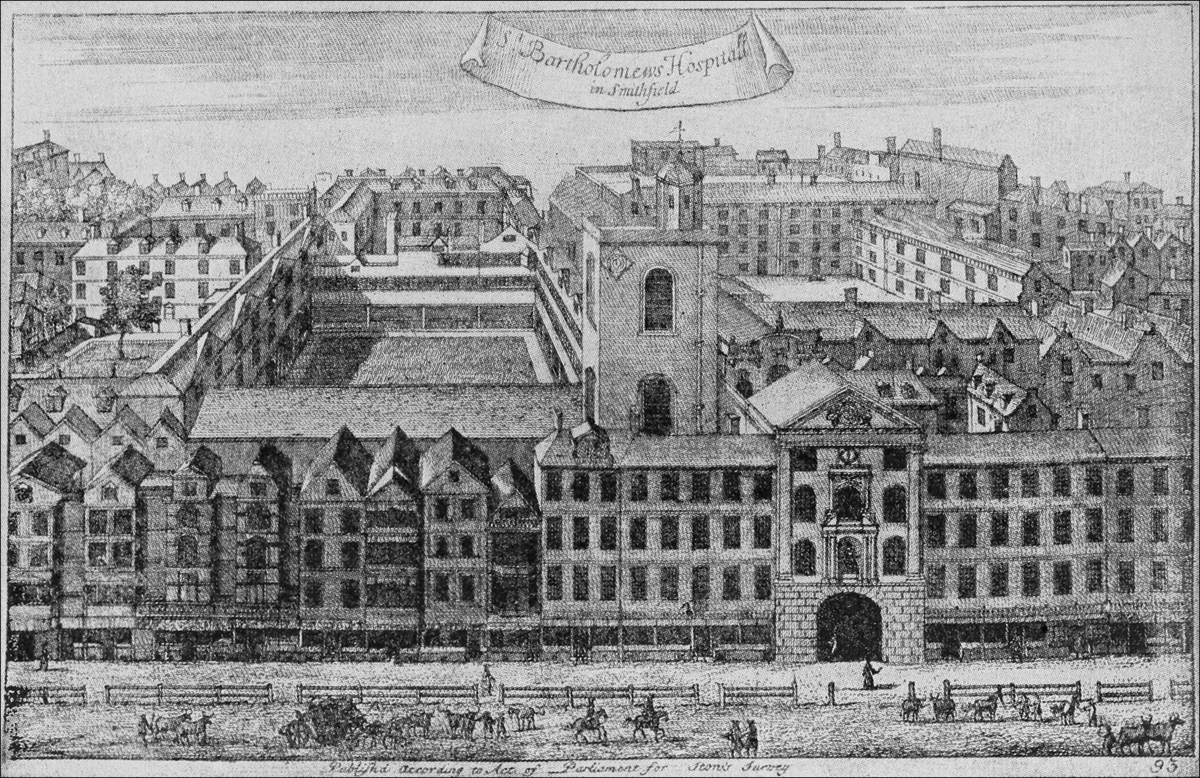
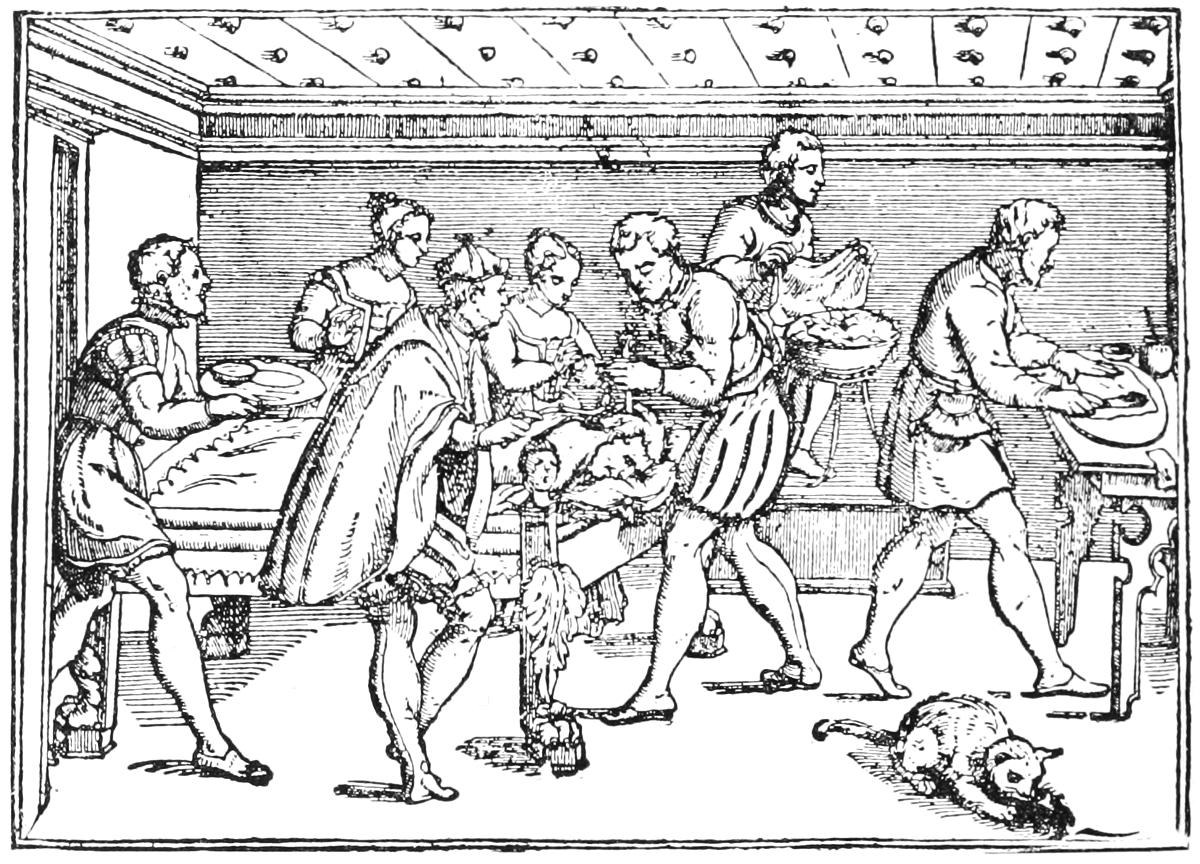
A ward in a hospital at Paris in the sixteenth century. Reproduced, by kind permission of M. Édouard Champion, from D. L. MacKay, Les hôpitaux et la Charité à Paris au XIIIe siècle
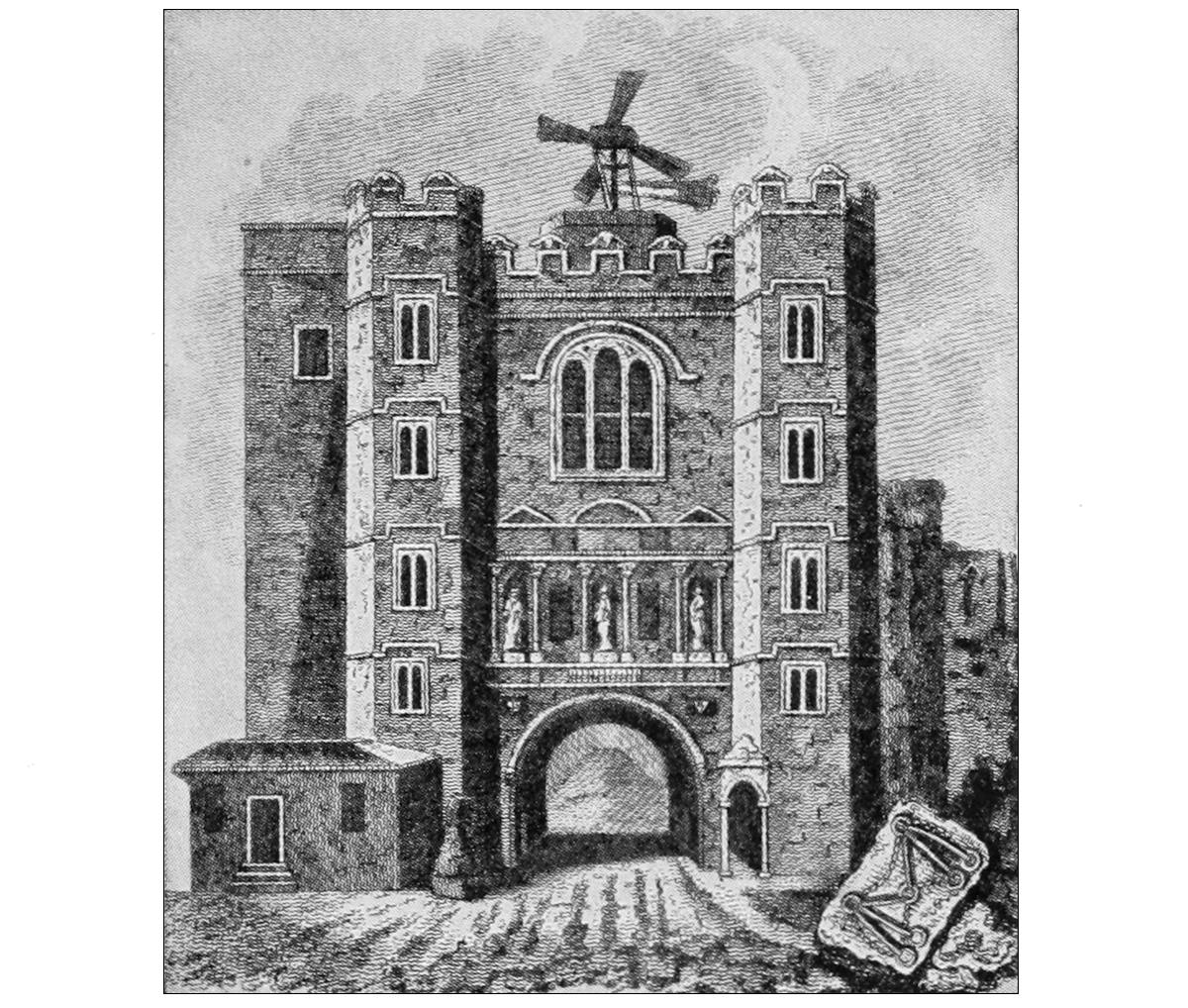
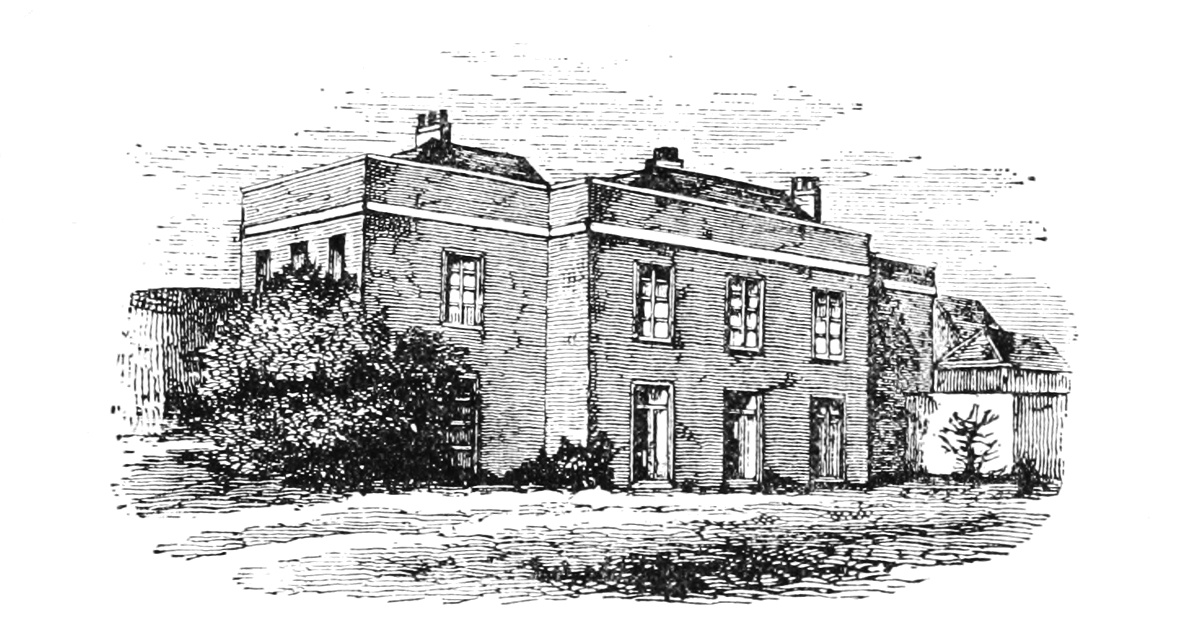
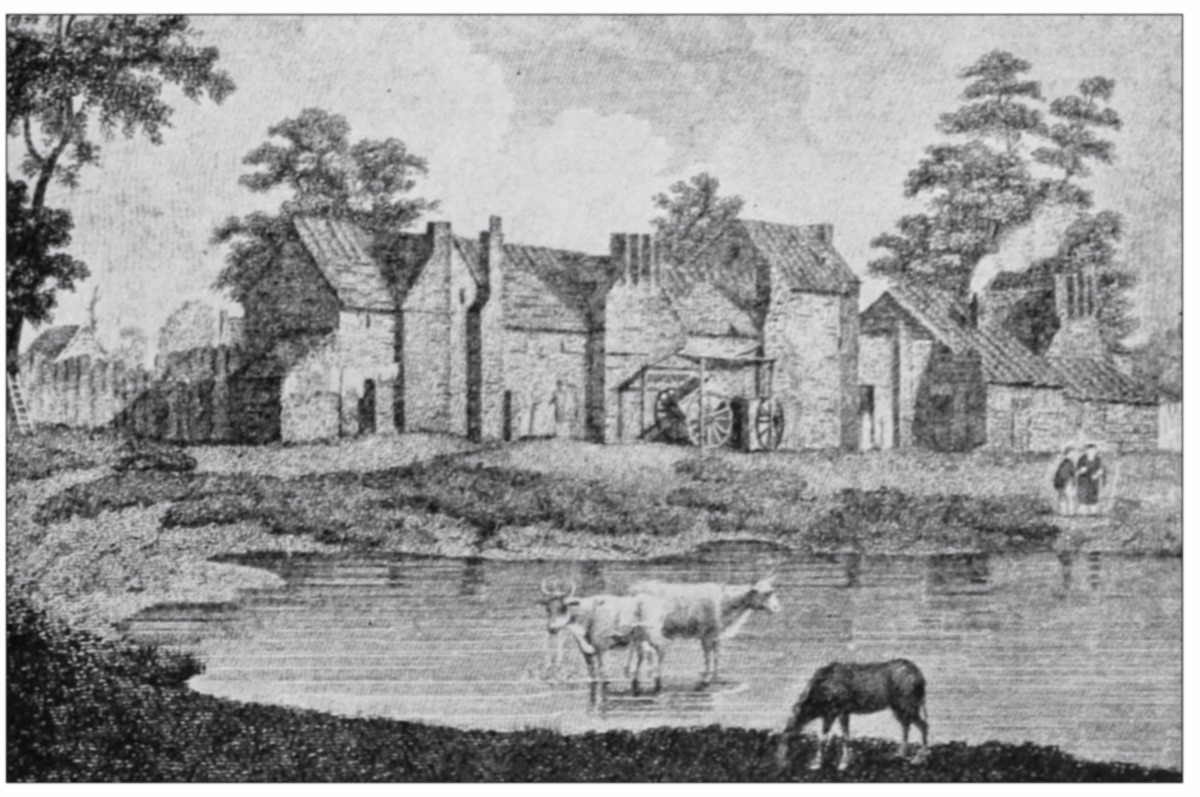
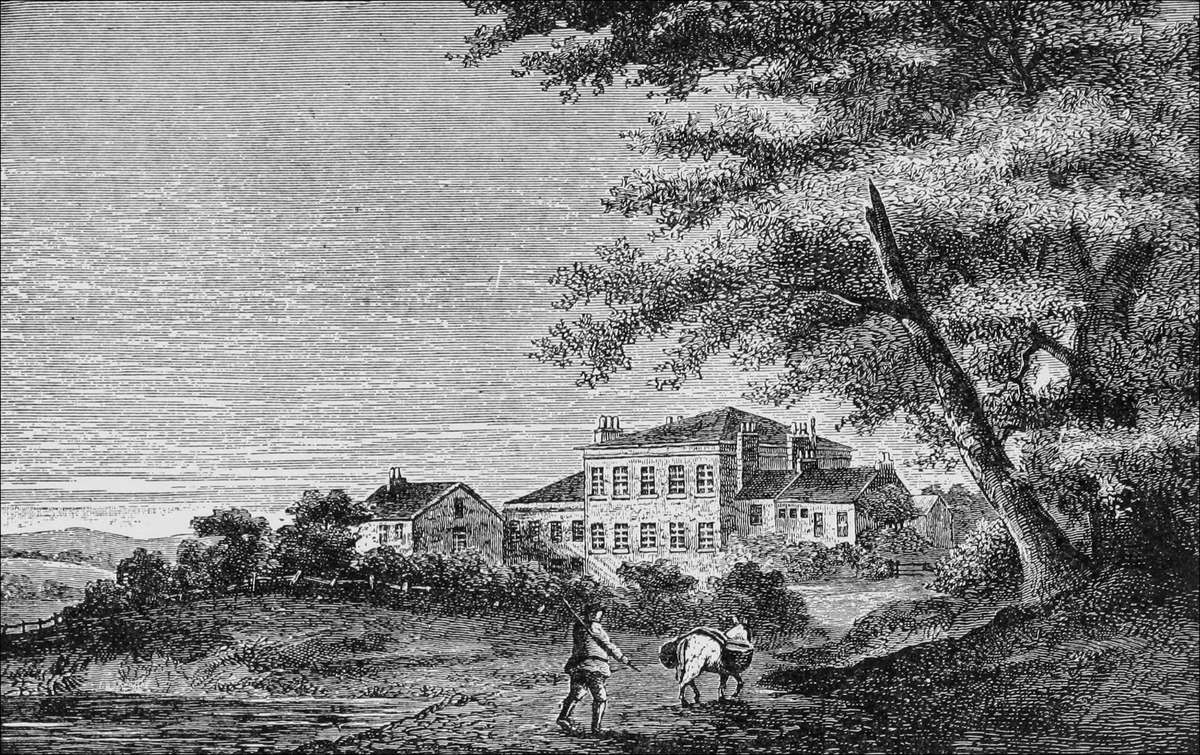
John Hunter’s country house at Earl’s Court, Kensington, before its demolition in 1886. Reproduced, by the kind permission of Mrs. George Martin, from The Asclepiad, VIII
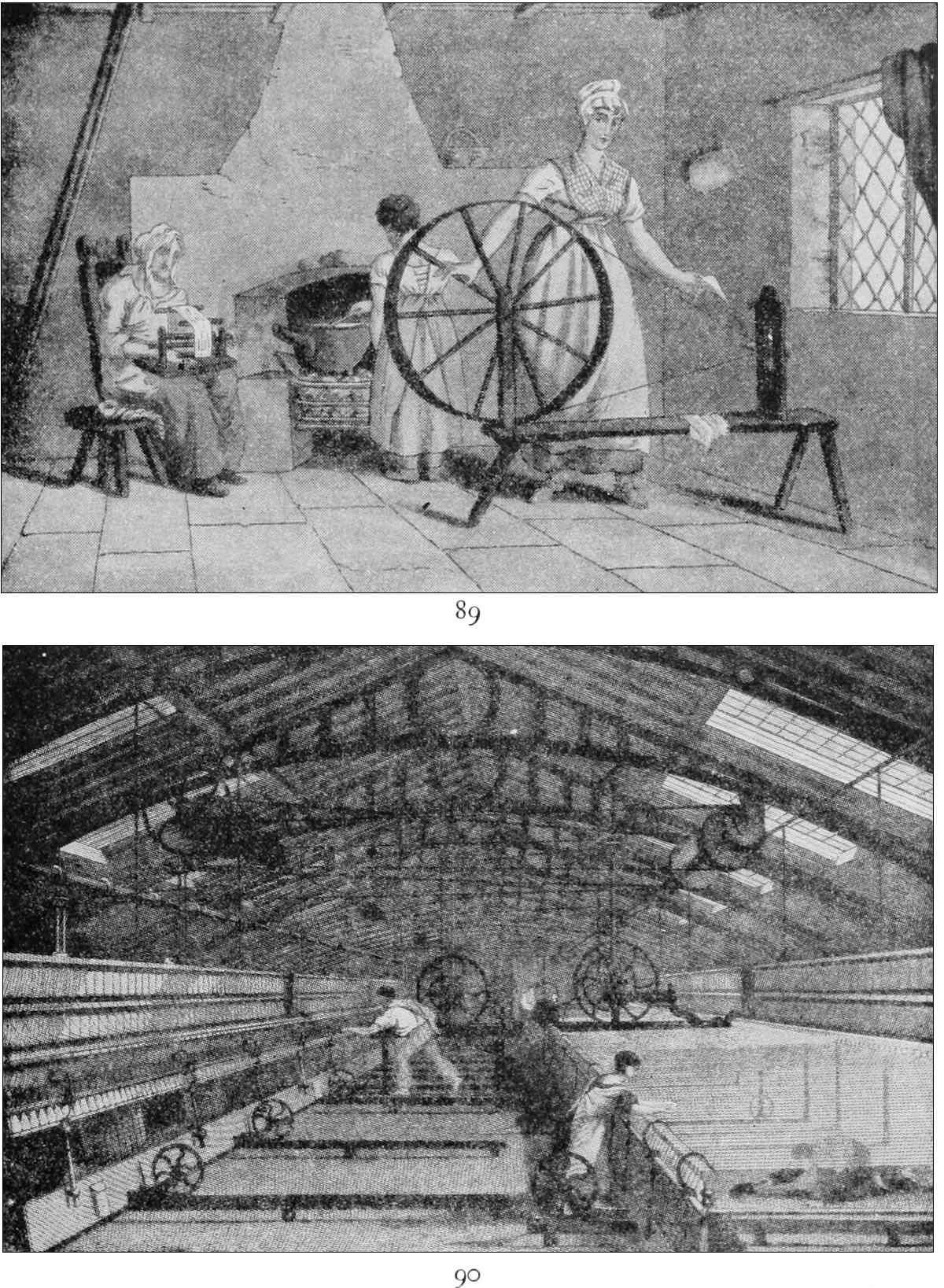
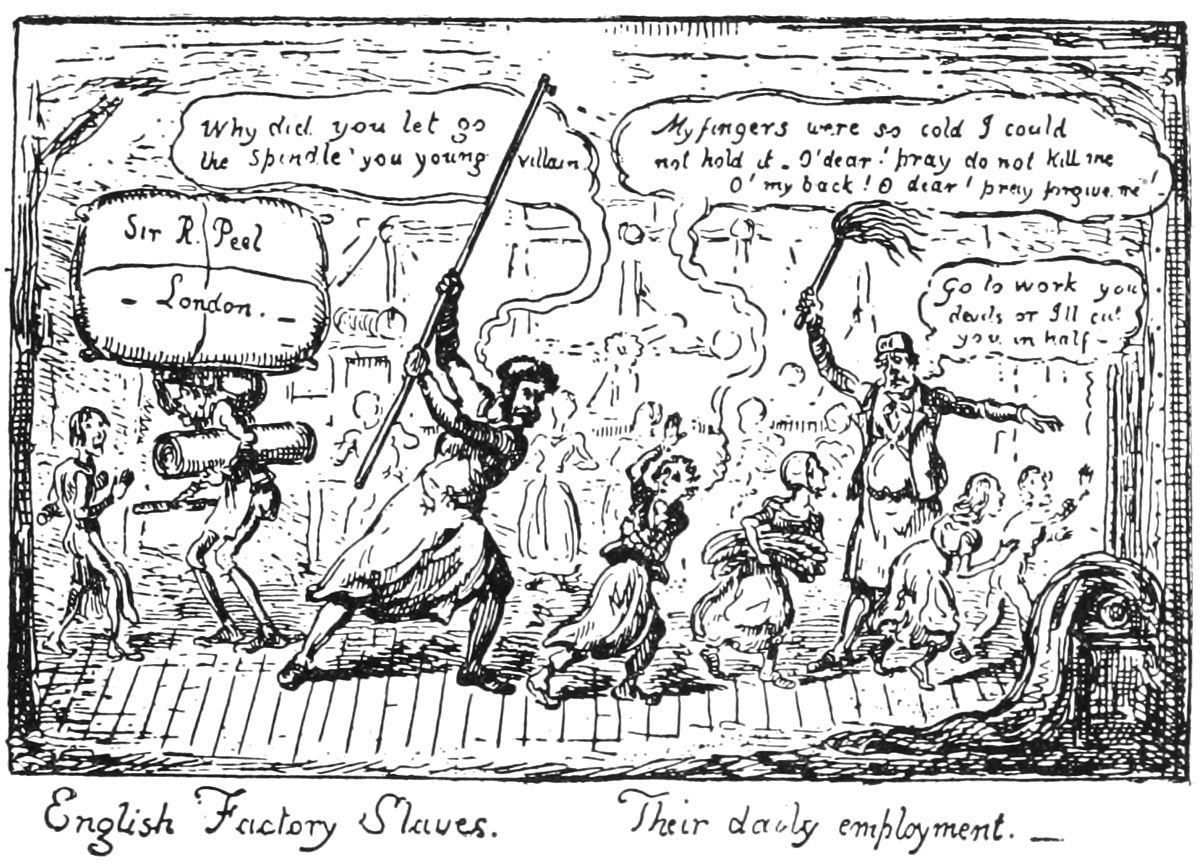
Illustrating the textile trade from home industry to factory work with the consequent break-up of the family as the labour unit. The upper picture from a drawing by George Walker, the lower from Economic Botany: The Cotton Manufacture
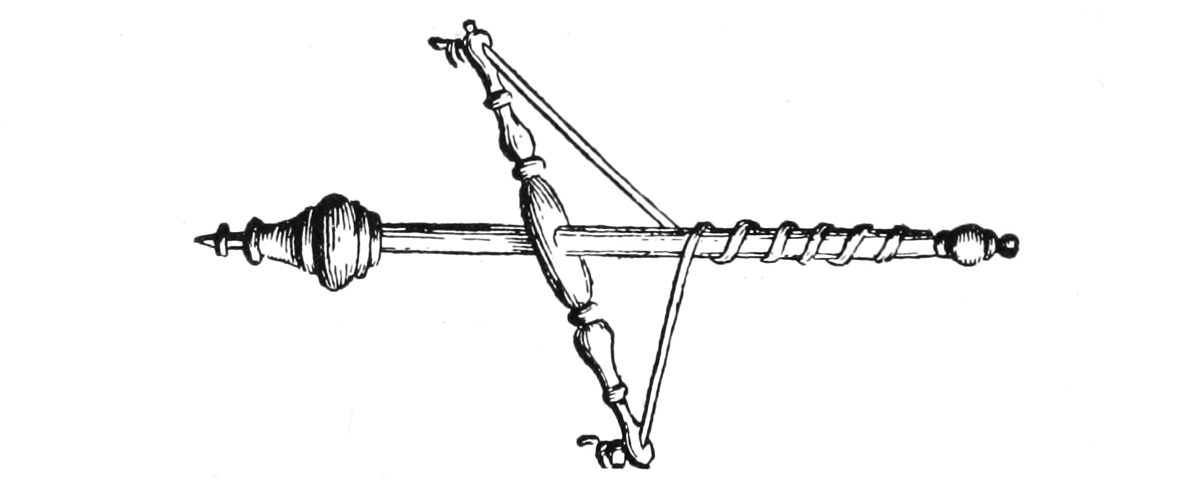
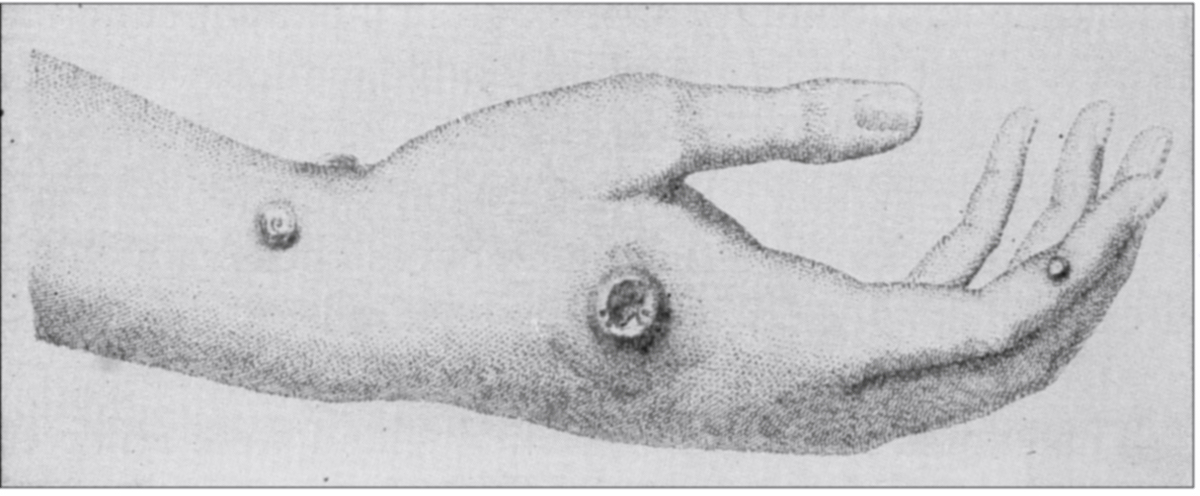
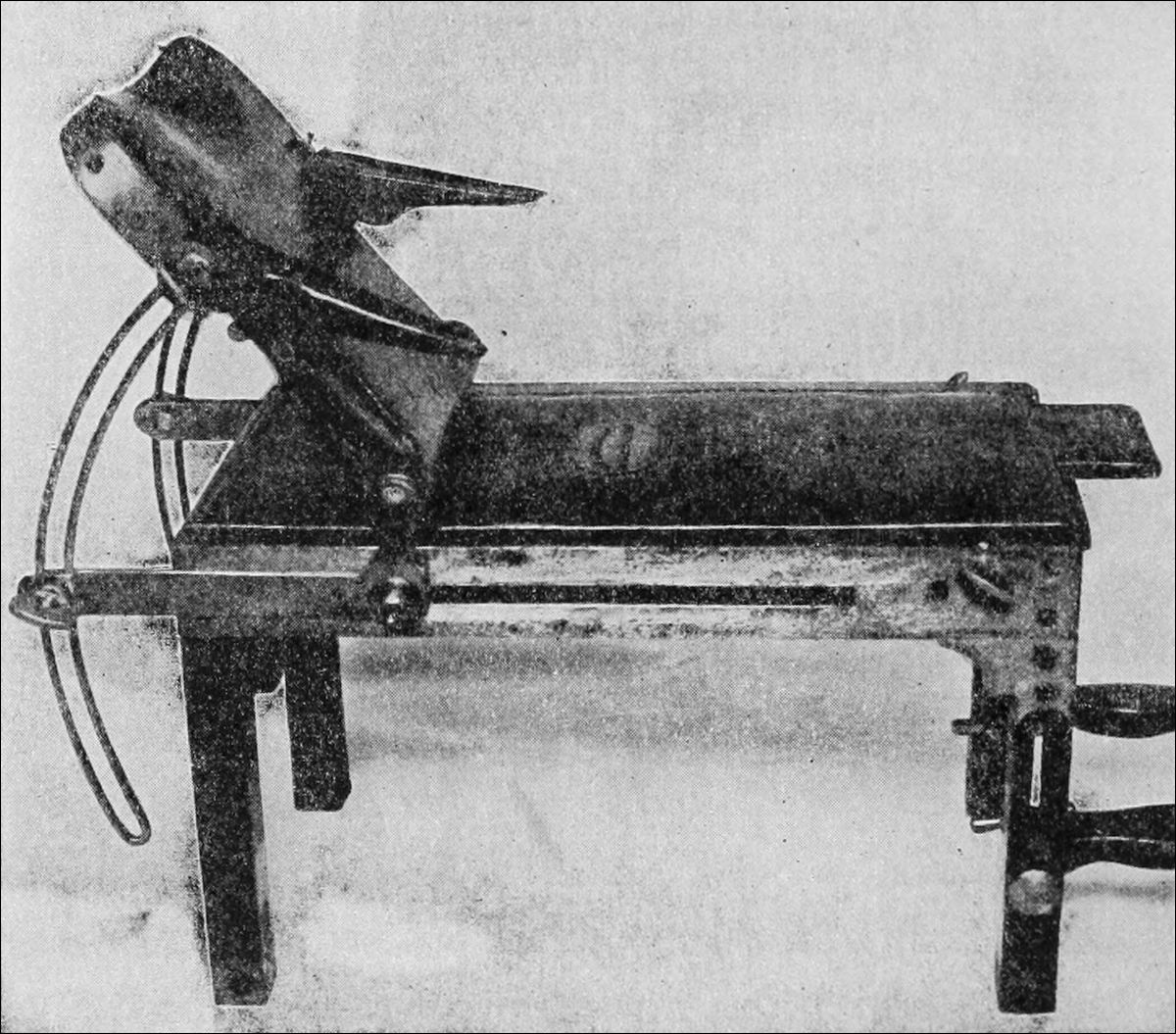
Screw used in the eighteenth and the early nineteenth century to secure analgesia. Reproduced, by the kind permission of Mrs. George Martin, from The Asclepiad, VII
Operating table used by Lord Lister in the Glasgow Royal Infirmary. Reproduced, by kind permission of Messrs. Jackson, Wylie & Co., from Lister and the Lister Ward in the Royal Infirmary of Glasgow
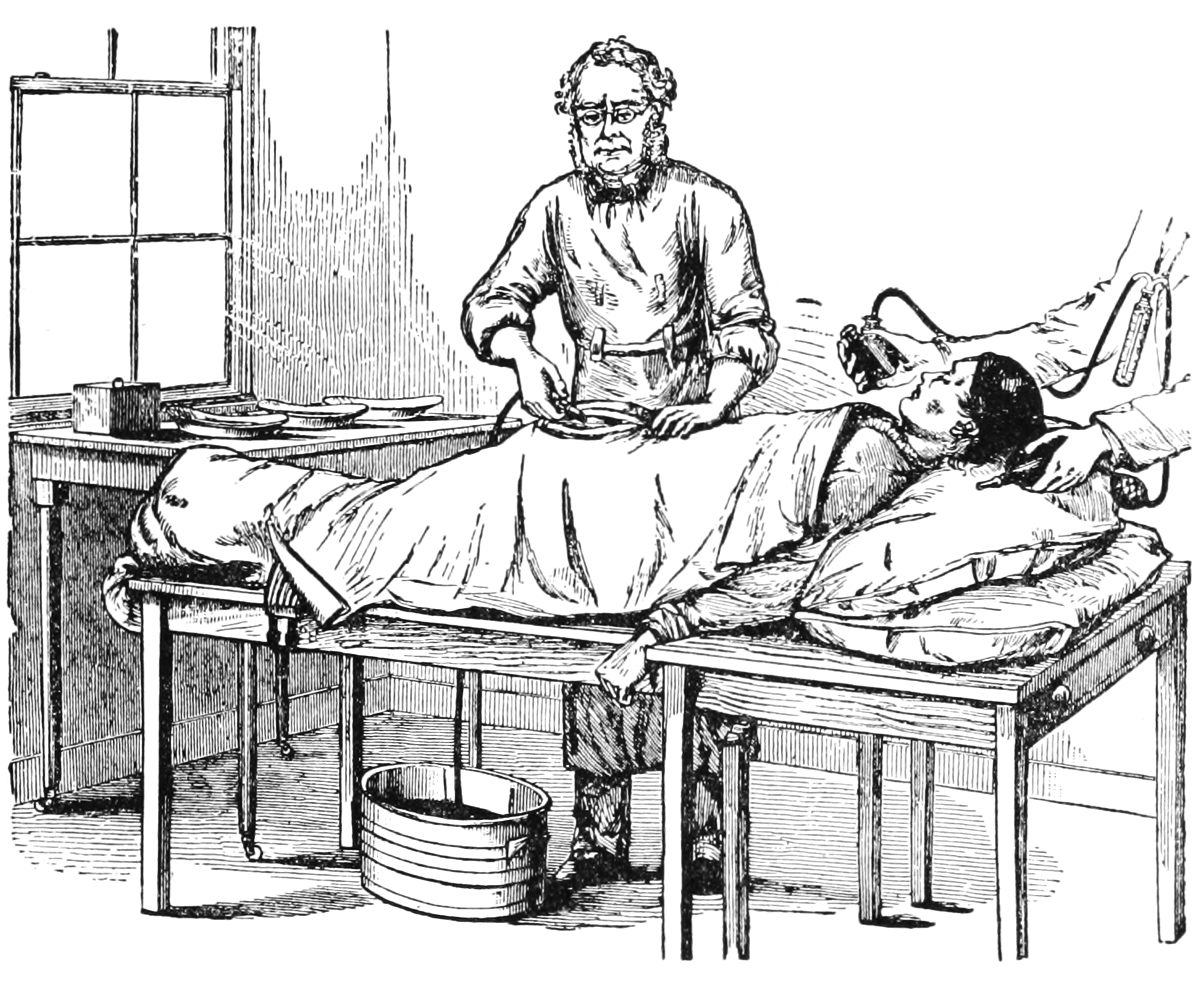
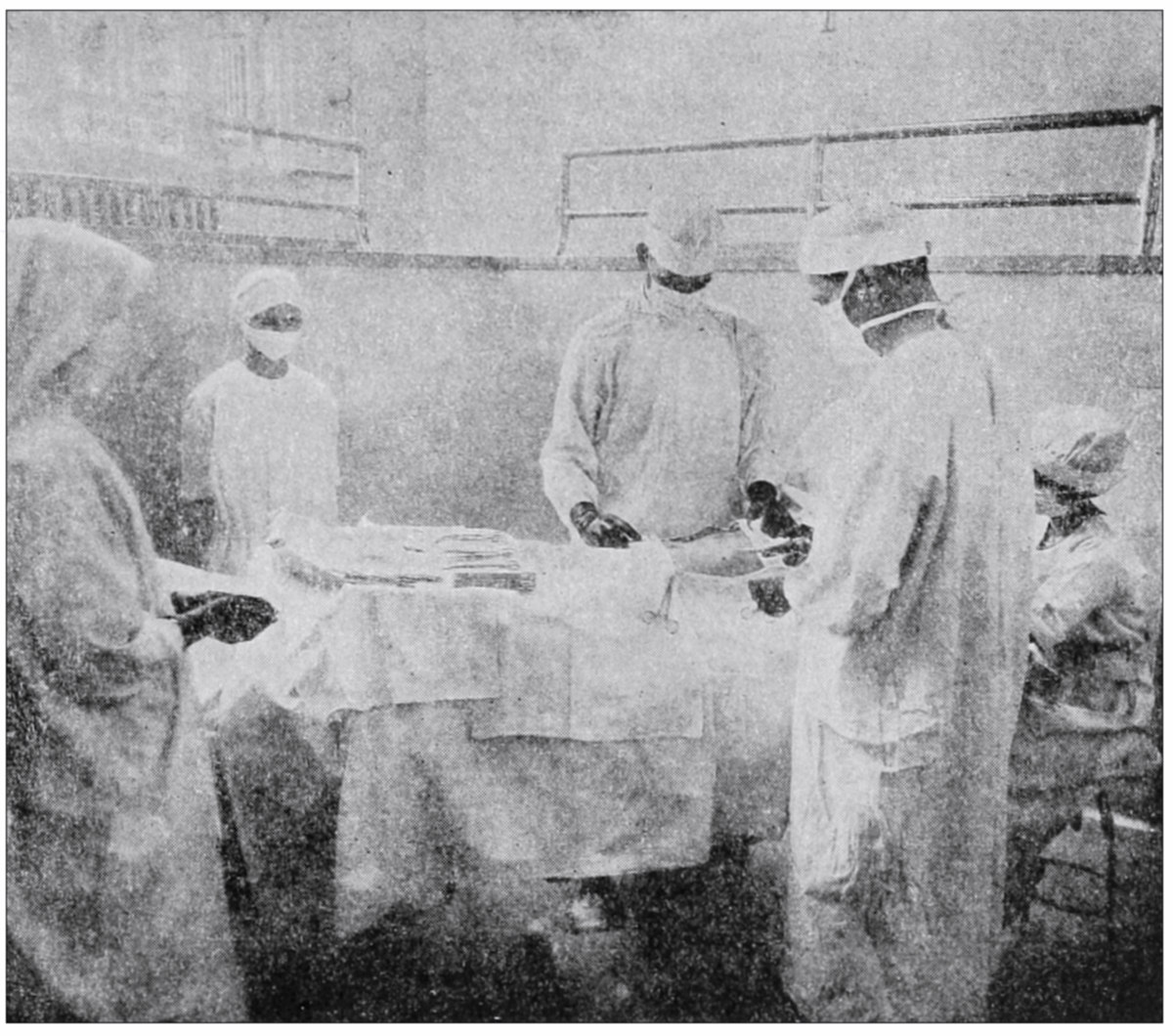
An abdominal operation under modern conditions. Reproduced, by kind permission of W. B. Saunders’ Company, Philadelphia, from The Operating Room, St. Mary’s Hospital, Rochester, Minnesota
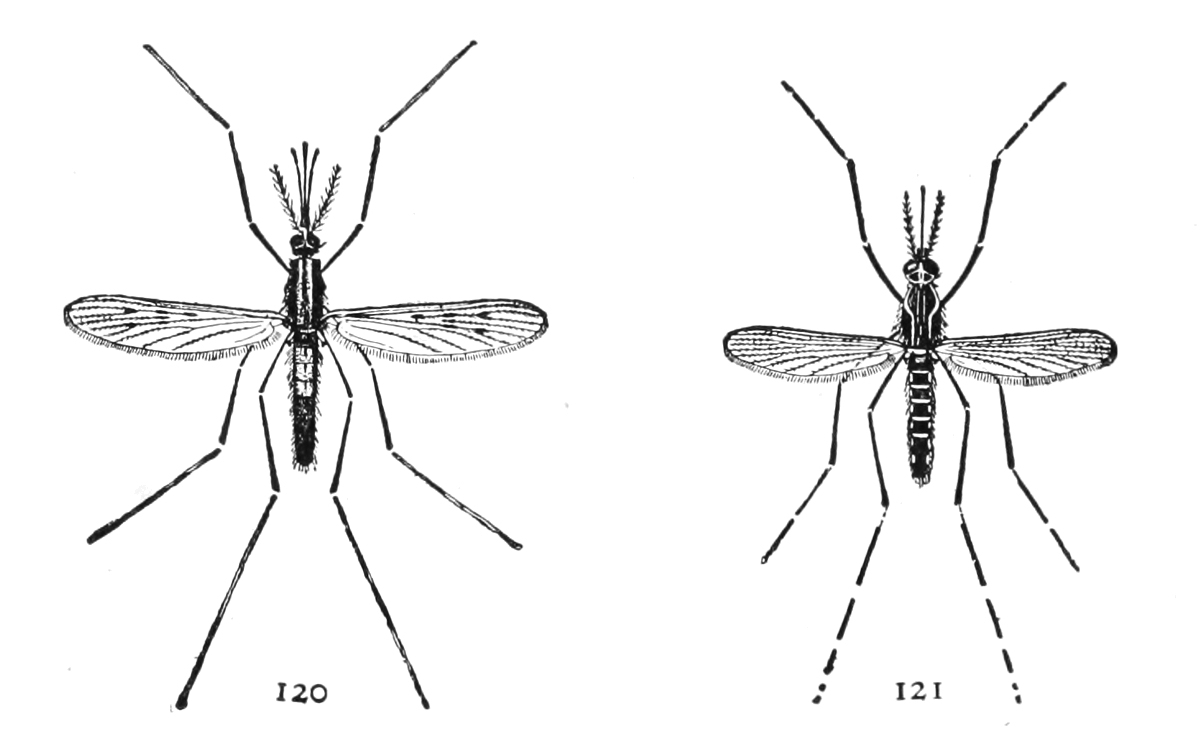
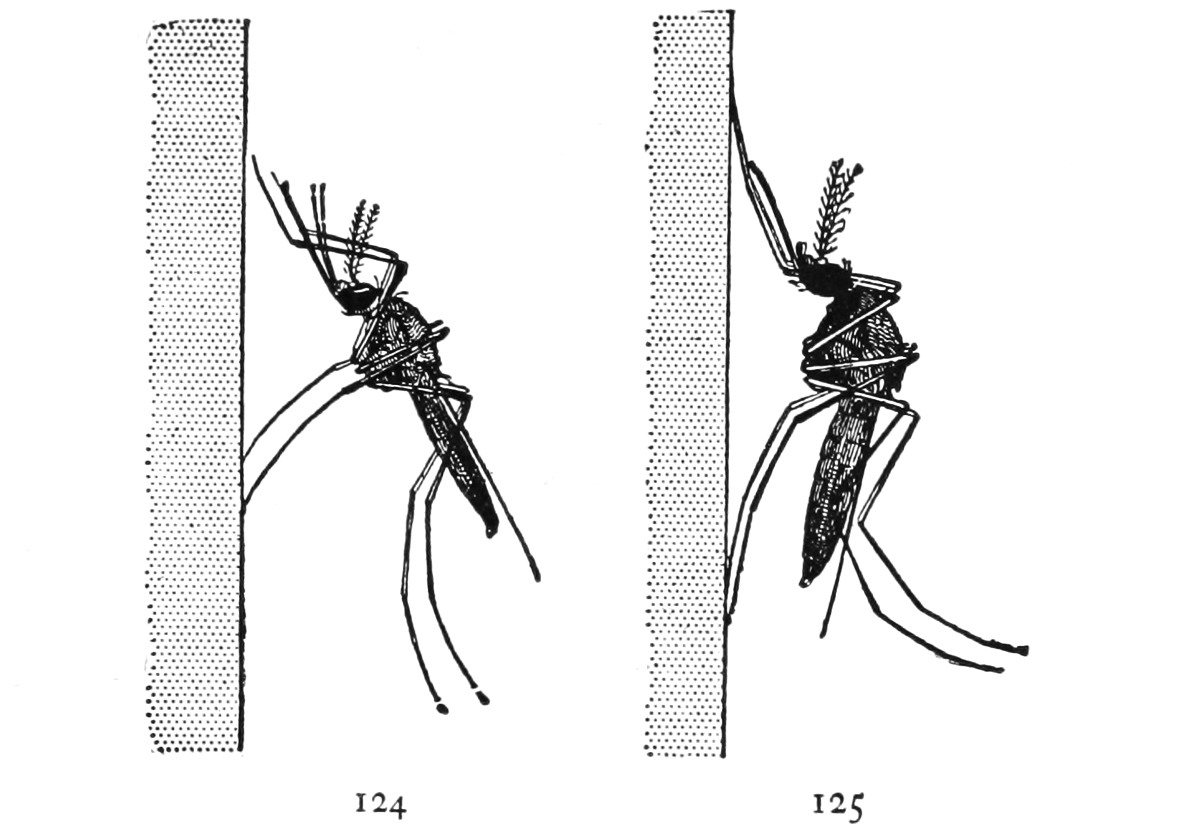
A common Malaria-carrying mosquito and a Yellow Fever-carrying mosquito. Reproduced, by kind permission of the British Museum (Natural History), from Edwards, Mosquitoes and their Relation to Disease
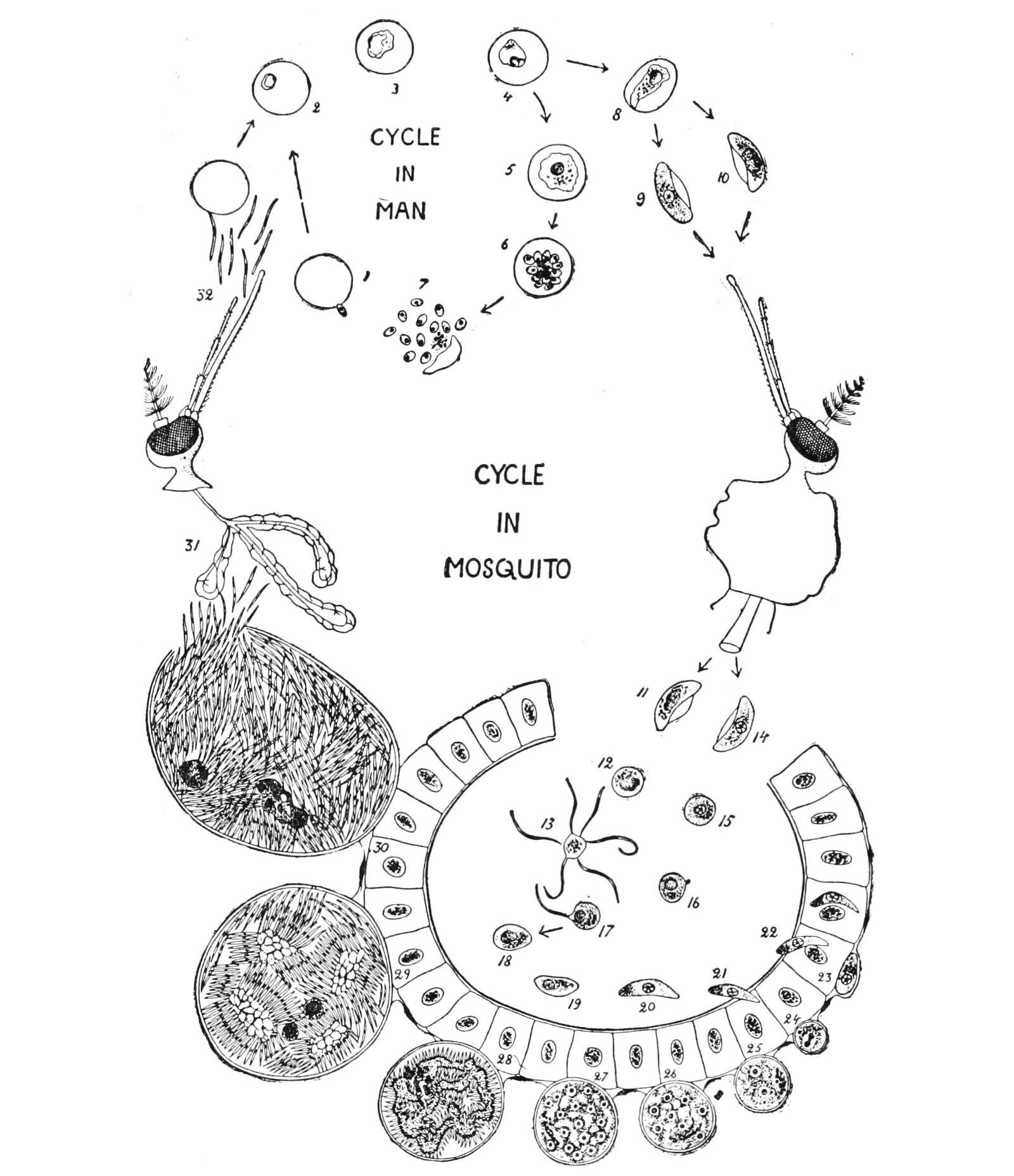
The Life-History of the Parasite of Malaria. Reproduced, by kind permission of Messrs. Baillière, Tindall & Cox, from C. M. Wenyon’s Protozoology, vol. II
A Malaria-carrying mosquito and a common gnat. Reproduced, by kind permission of the British Museum (Natural History), from Edwards, Mosquitoes and their Relation to Disease
‘The Retreat’ near York. Reproduced, by permission of Messrs. Kegan Paul, Trench, Trubner & Co., from Tuke, Chapters in the History of the Insane in the British Isles, 1882
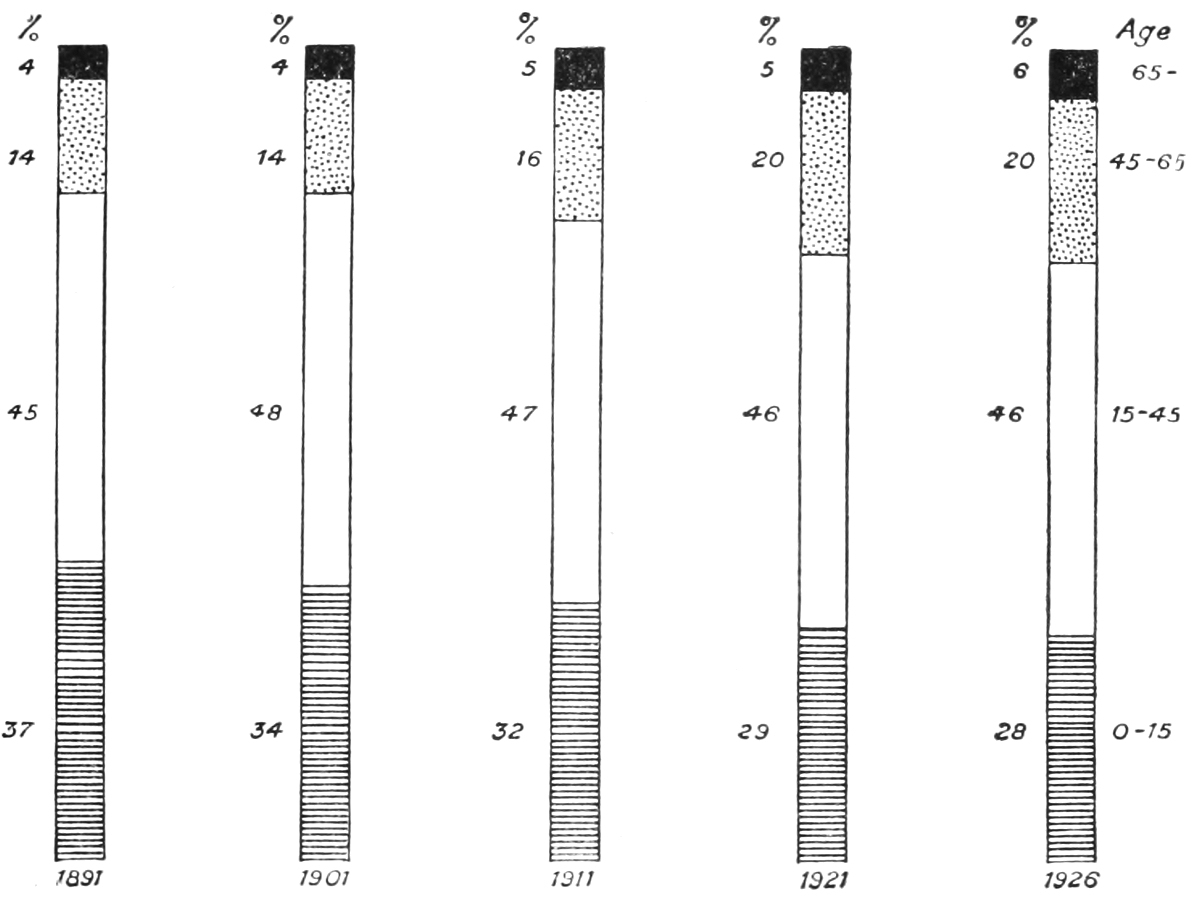
Diagram illustrating alteration in Age-distribution of the population of England and Wales. Reproduced, by kind permission of the authors, from Carr-Saunders & Caradog Jones, Social Structure of England and Wales (Clarendon Press)
I ANCIENT GREECE (TO ABOUT 300 B.C.) — § 1. Origins of Greek Medicine. — § 2. The Hippocratic Physician. — § 3. Hippocratic Practice. — § 4. Aristotle.
Scientific Medicine began with the Greeks. The
Greeks not only started scientific Medicine upon its
course, but also provided the substantial basic elements
of our anatomy, physiology and pathology, and above
all, perhaps, our conception of the bodily ‘constitution’,
‘habit’ or ‘temperament’. It is from the Greeks that
we derive almost all our medical nomenclature. When
to this we add that our medical traditions are inherited
through a direct and continuous chain from the Greek
practitioners, it becomes evident that the debt that
Medicine owes to this marvellous people is great indeed.
Now this debt has become associated with two or
three great figures. The names Hippocrates, Aristotle,
Galen, are familiar to all. Yet it is not always
recognized that these men were but the representatives
of a widely extended and long-lasting system. Greek
Medicine was, in fact, like modern Medicine, the
result of centuries of carefully recorded, collated and
progressive research. Greek Medicine first assumed a
scientific aspect with the Ionian and Italo-Greek philosophers
at the very beginning of the sixth century B.C.
It continued to make important advances until the
death of Galen at the very end of the second century
of the Christian era. Thus the life-span of progressive
and scientific Medicine among the Greeks was no less
than eight hundred years. With the most tolerant use
of the words ‘scientific’ and ‘progressive’, we can hardly
place the beginnings of modern Medicine in Europe
before the end of the fifteenth century. Thus our own
system has only been developing its characteristic
features for some four and a half centuries, which is but
little more than half the course that Greek science ran.
It is evident, therefore, that we may have much to
learn from the Greeks, not indeed in matters of actual
fact or observation—for nearly all that is directly useful
in their writings has been absorbed long ago into our
medical literature—but in spirit and method. From
a study of the character and course of Greek medical
science we can gain hints of the snares and pitfalls and
catastrophes into which the Art of Medicine may at
times be led. Further, by study of the practice of
Medicine under conditions so different from ours, we
learn something of what is truly permanent in the Art of
Healing. Lastly, by tracing the growth of the Science
of Medicine, as it arose among the Greeks and as it
died in the hands of their less worthy descendants, we
may take alike example and warning. We may learn
to distinguish the healthy and vigorous growth of a
science from the stunted and deformed products that
are often acclaimed, even in our own times, as Wisdom’s
final word to Man.
It has been said that, ‘save the blind forces of Nature,
nothing lives or moves which is not Greek in origin’.
The saying needs modification, for there is a thing
which still lives and moves that is not Greek in origin,
a blind force which is not a blind force of Nature. It
is the force of Superstition, of that age-old belief that
Nature will give us something for nothing, which is
expressed by the word ‘Magic’. The Greeks were no
more free from that contemptible fallacy than are the
men of our own days. But the greatest of the Greeks
stood wholly above such folly, and we can watch the
Greek mind gradually lifting itself from that primeval
mental attitude which is older than any known culture,
older perhaps than any known race, the attitude of
Nature-Worship, or ‘Animism’. To give an idea of
how the ‘sweet reasonableness’ of the Greek mind
gradually dissipated the animistic fog, a few words
must be said about the history of the Greeks. Without
that amount of history it would seem a miracle that
Man ever became reasonable at all.
The Medicine we call Greek might be described as
the system which prevailed in ancient times in that half
of the Mediterranean area which lies east and south of
the Italian Peninsula.
Up to about 1000 B.C. most of the coast-lands of
this Mediterranean area were inhabited by that very
remarkable people, the Minoans. These have left some
extraordinary remains, the full significance of which has
not yet been revealed. The general development of the
Minoan civilization has, however, been clearly outlined
by modern archaeological investigation. This has
resulted in an entirely new interpretation of the story
which Homer tells in the Iliad. The siege of Troy represents
an attack by the invading Greeks on one of the
last Minoan strongholds. About 1000 B.C. the whole
Eastern Mediterranean basin was being overrun by the
Greek tribes coming in from the north. These Greeks
were no pure race, but a mixed multitude of invaders
who came along several lines of advance. As always
happens in such invasions, the conquered were not exterminated,
but mingled with the invaders. Thus the
Greeks, as they advanced, absorbed much of the culture
and outlook of the civilization that they submerged.
In considering the history of Rational Medicine we
are concerned chiefly with two main invading streams
of Greek tribes: that of the Dorians, who passed towards
Crete and towards the Island of Cos and the
opposite peninsula of Cnidus, and that of the Ionians,
who colonized most of the remaining part of western
Asia Minor. These two peoples were, between them,
responsible for the main intellectual output of the
Greeks of those early days. The medical system which
they initiated first took shape in western Asia Minor,
and thence became diffused over the whole of the Greek
world. The Greek system of Medicine which thus
arose in Asia Minor had various roots, as indeed the
Medicine of a mixed people, living under very complex
social conditions, was bound to have.
Firstly, there was the submerged civilization of the
conquered Minoan folk. It is probable that the cult
of the serpent—so constantly associated with Aesculapius
and still used as a medical emblem—was of
Minoan origin, for the serpent was a symbol much
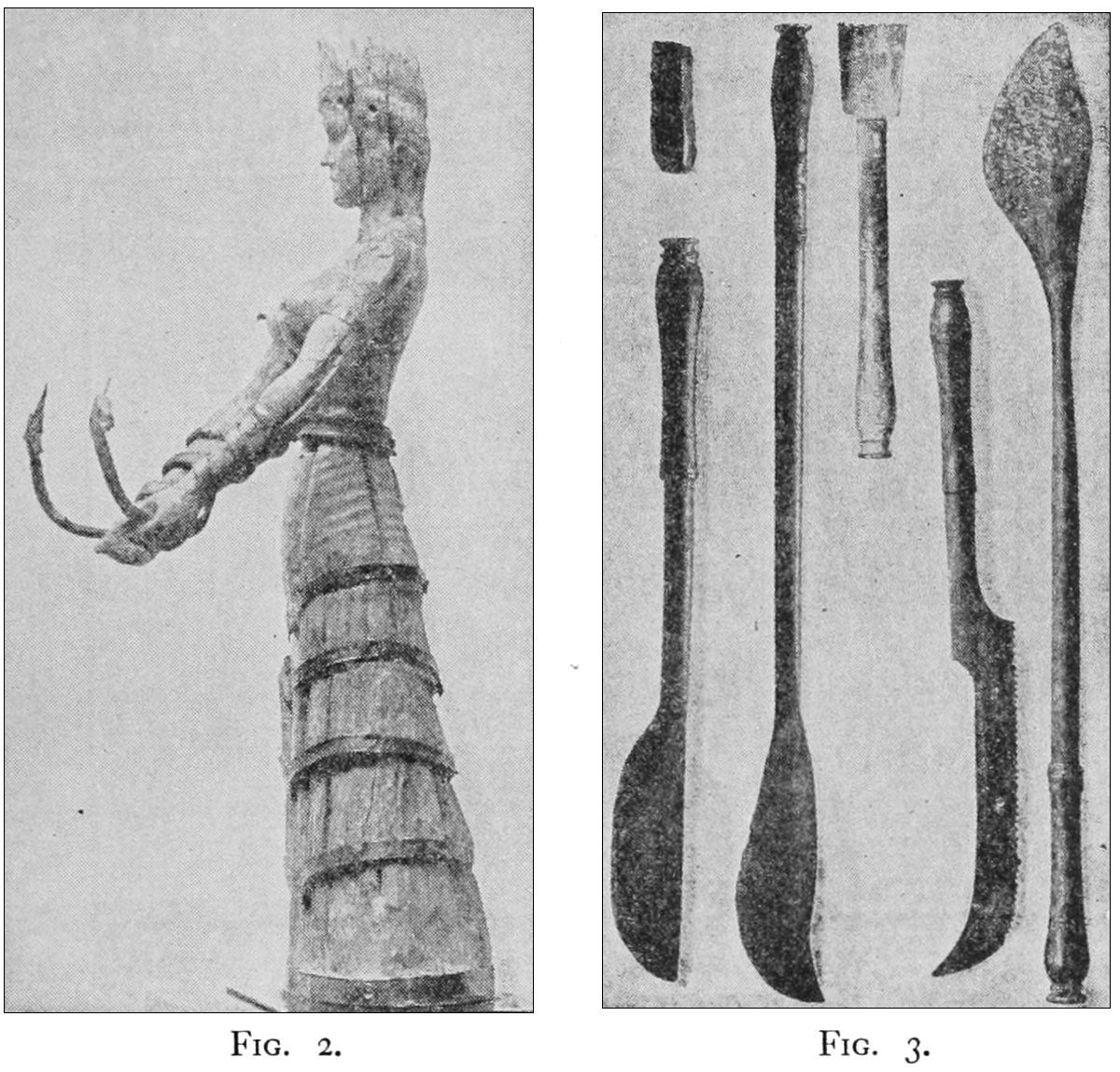
used in the Minoan religion (Fig. 2). It is probable
too that some of the hygienic ideas of the Greeks were
derived from the same source, for the Minoans had
an excellent system of drainage. We can, however, say
little on this head because the interpretation of the
Minoan records is still hidden from us.
Fig. 2. IVORY AND GOLD MINOAN STATUETTE of a votaress
in a state of ecstasy. In either hand she holds a serpent, illustrating the
importance attached to this animal in the Minoan cult. From the Museum
of Fine Arts, Boston, U.S.A.
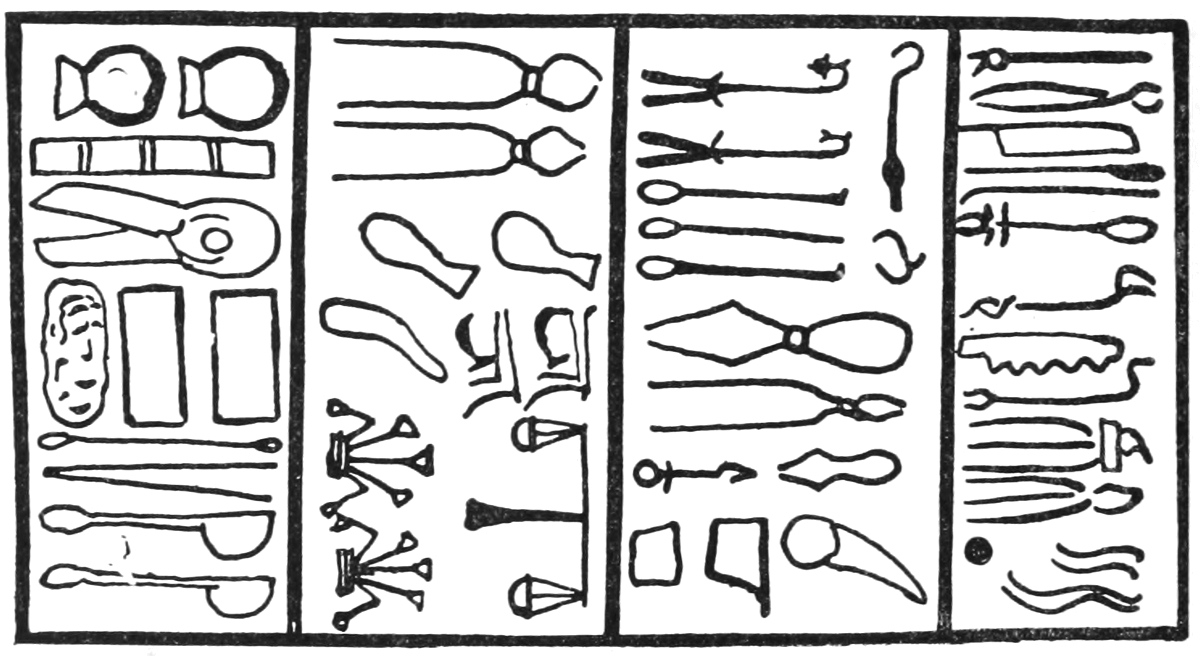
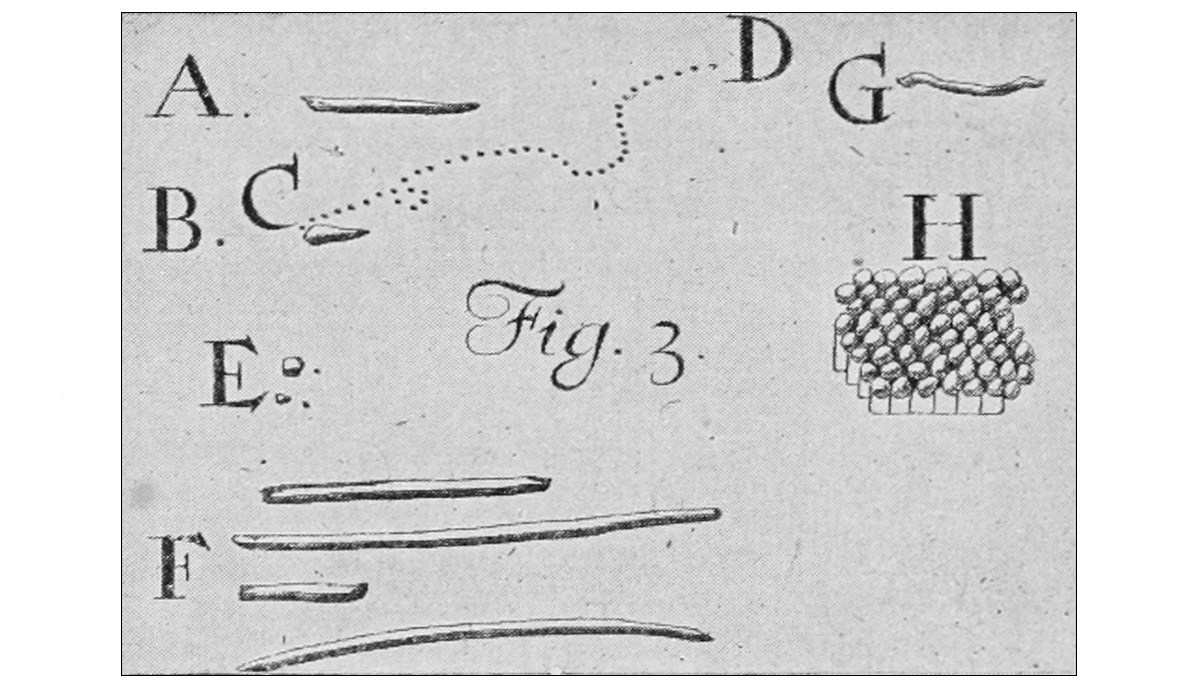
Fig. 3. SURGICAL INSTRUMENTS recovered from Babylonian
sites. There are here represented three knives, a saw and a trephine.
These instruments, which illustrate the state of surgery in the ancient
Mesopotamian civilization, are in the possession of Professor Meyer-Steineg
of Jena, by whose permission they are here reproduced.
Secondly, we have to remember that the shores of
Asia Minor lie on the outskirts of the great civilization
which had grown up in the valley of the Tigris
and the Euphrates. The Greeks drew from that source
much of their more superstitious beliefs, as well as
some, at least, of their scientific method. On the one
hand, the demoniac theories that bulk so largely in
later Greek medicine doubtless came from Assyria and
Babylonia. The Medicine of the New Testament, for
instance, with its casting out of devils, is of Mesopotamian
origin. But, on the other hand, the Mesopotamian
peoples had for long ages laid up a great
treasury of observation, notably of astronomical data
which were often applied to astrological ends. There
was also some knowledge of anatomy derived from the
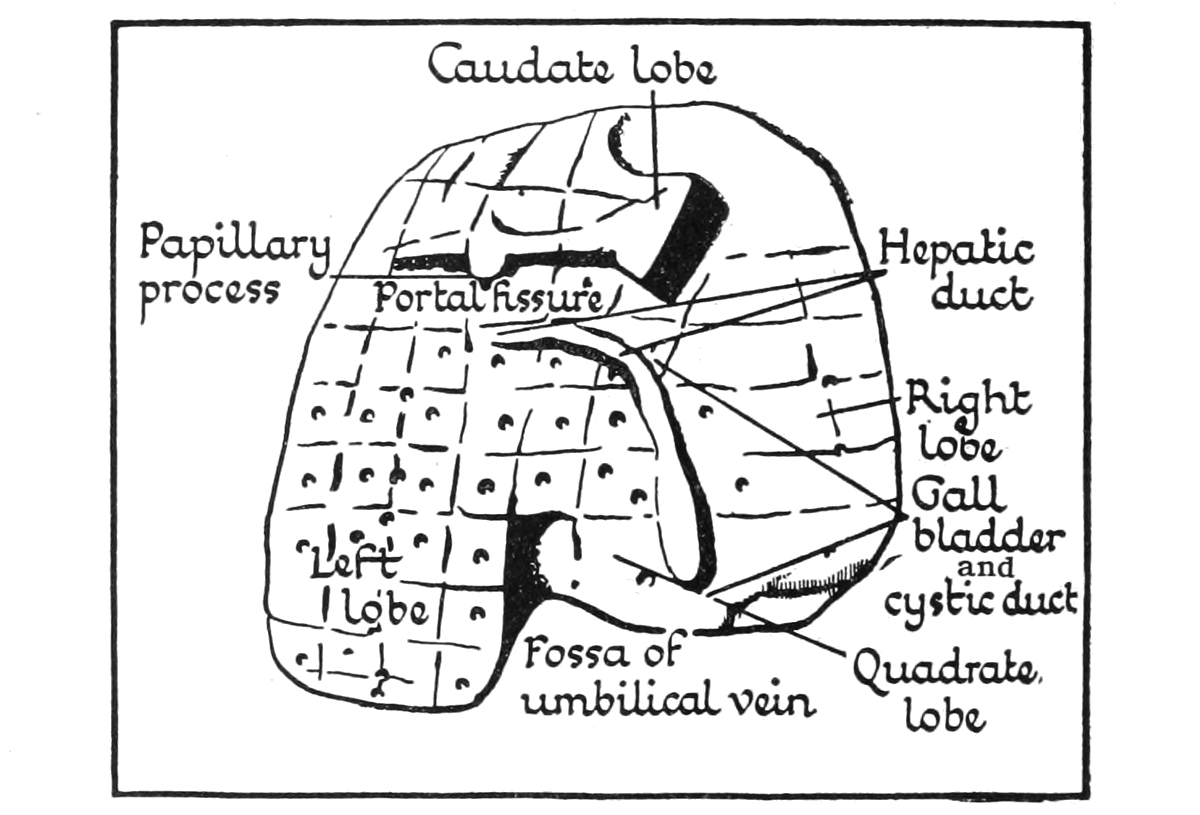
entrails of animals used in divination (Fig. 4). Working
on the basis of these records, the Greeks were able to
erect a scientific method which appears as a prominent
feature in their intellectual life in later centuries. Moreover,
there was in Mesopotamia a standardization of
both medical and surgical procedure which the nimble-witted
Greeks were quick to adopt (Fig. 3). On its
lower and less intelligent side, however, the Mesopotamian
material was made to minister to Greek superstition
and especially to astrological belief.
Fig. 4. CLAY MODEL OF SHEEP’S LIVER used for instruction
in divination in a Babylonian temple school. The object is now in the
British Museum. It is covered with cuneiform writing, the nature and
contents of which fix its date as about 2000 B.C. The writing is here omitted
for the sake of simplicity.
Various parts of the liver have their Babylonian technical terms and can
be identified with parts recognized by modern anatomists. Some of these
modern terms are written on our drawing.
To each hole in the original model an inscription containing a forecast is
assigned. The diviner made his forecast by comparing an actual liver with
this clay model at each point corresponding to a hole. His forecast was
elaborated according to the state of the liver at all these points.
Thirdly, to the Egyptian civilization the Greek debt
was also considerable. Many drugs were derived from
Egypt and others were suggested by Egyptian practice.
The basis of Greek medical ethics, too, can be
traced to Egypt. Some of the practical devices of Greek
Medicine, such as the forms of the surgical instruments,
were of Egyptian origin. Nor can we neglect the statement
made by the Greeks themselves, that mathematical
knowledge—the test and index of all scientific
growth—came to them first from Egypt. Lastly, we
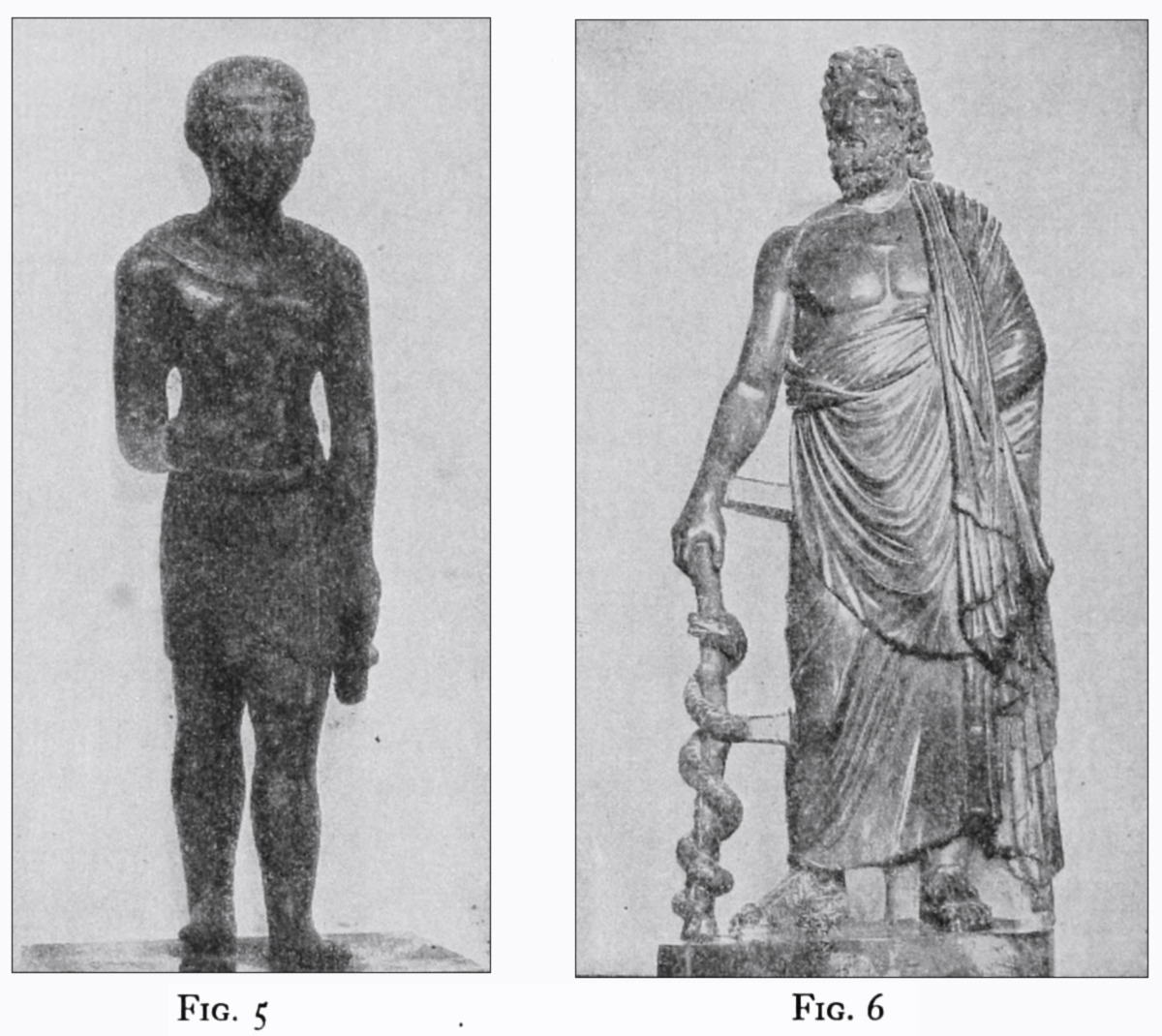
note that the Egyptians deified a physician, Imhotep
(Fig. 5), in exactly the way that the Greeks deified their
physician Aesculapius (Fig. 6). Both Imhotep and
Aesculapius were, in fact, historic personages, and their
evolution into gods presents many interesting parallels.
Fig. 5. IMHOTEP, originally a physician, subsequently deified as an
Egyptian god of Medicine. From a statuette in the British Museum.
Fig. 6. AESCULAPIUS, originally a physician, subsequently deified
as a Greek god of Medicine. He holds a staff, around which a serpent
twines. From a statue in the Capitoline Museum at Rome.
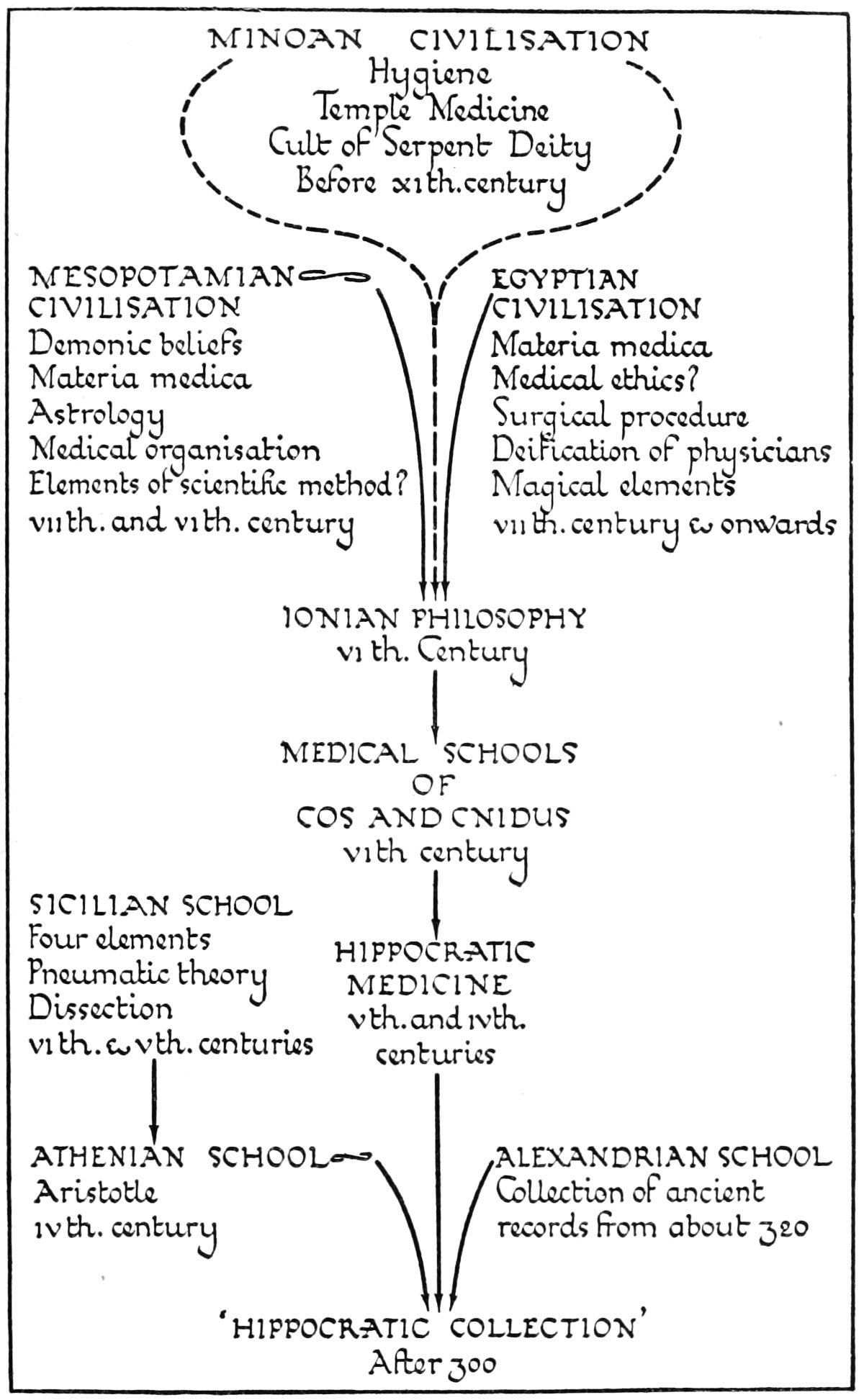
The Greeks of western Asia Minor, thus drawing
material from many sources, came to develop, towards
the end of the seventh century B.C., a philosophical
system from which the whole of their Science may be
said to be a natural growth. Factors in this development
were the medical schools of Cos, where Hippocrates
was born, and of the opposite peninsula, Cnidus.
These schools were in active operation by the sixth
century B.C. By the middle of the fifth century they
were important elements in the growing complexity of
Greek life. Much of the so-called Hippocratic Collection,
which contains the earliest Greek medical writings that
have survived, must have been put together somewhere
in the fourth century B.C., though its final recension is
certainly later (Fig. 7). In that final recension Persian
and Indian elements were also included, though to what
degree is still very uncertain.
Fig. 7. SCHEME ILLUSTRATING SOME OF THE SOURCES OF
HIPPOCRATIC MEDICINE
But the picture of the development of Greek Medicine
is not yet complete. Although we inherit the
scientific spirit from the Greeks, and although they set
a standard for all time of the purest and most disinterested
type of medical practice, they are also in part
responsible for some of the basest forms of medical
jugglery that have afflicted and still afflict mankind.
The medicine of the physicians was only one of their
medical systems. There was a far lower form which
gradually passed into the hands of the priests. The
temple jugglery of Greece is ancestor, both by imitation
and by direct tradition, of much medieval and modern
medical miracle-mongering.
Furthermore, in ancient as in modern times, all
medical men were not equally pure in aim or scientific
in method. The practice of some Greek physicians was
more than flavored with magic. In justice, also, it
must be said that not all priests were mere charlatans,
and that there are traces of scientific method in the
treatment of patients in the temples. There was,
indeed, a relation between the practice of some of the
physicians among the Greeks and that of some of their
priestly magicians. We shall not attempt to determine
the actual extent and nature of this relationship. For
our purpose it is enough that the two systems were
quite distinct in their most typical developments.
The temple system of Greek Medicine was associated
from an early date with a deity, Asklepios, or, to give
him his better-known Latin name, Aesculapius. Numerous
representations of him have come down to us, and
in them we see him gradually molded to a particular
type. He becomes at last an aged man of noble,
benevolent and dreamy aspect, holding in his hand
a staff around which a serpent twines (Fig. 6). The
cult of the god Aesculapius was carried on at numerous
sites. The best known, both from literature and excavation,
is Epidaurus. The conditions there are typical
of those in other Aesculapian centers.
Epidaurus is about thirty miles from Athens. It lies
between two considerable ranges of hills, and the
country bears still, in its customs and place-names, some
remnants of the ancient cult. One tradition tells that
a certain maiden, Koronis, being with child by Apollo,
brought forth the infant Aesculapius on the mountain
above Epidaurus. There is still a village named Koroni
hard by. She fled to conceal her shame and left the
child on the mountain, where it was tended by a goat
and watched over by a dog. The infant performed
various miracles which we need not pursue, though the
temple arose on the site where he is said to have wrought
them. One of his miracles, however, has a wider interest
and is worth recounting. A certain Hippolytus,
falsely accused of impure relations with his stepmother,
was slain by the gods in answer to the curses of his
father, Theseus. Raised from the dead by the wonder-working
Aesculapius, he reappears in legend at the
Arician grove in Italy. ‘There’, says a Greek chronicler
of the second century A.D., ‘he became a king and
devoted a precinct to Artemis, where, down to my
time, the prize for the victor in single combat was the
priesthood of the goddess. The contest was open to
no freeman, but only to runaway slaves.’
The son slain by his father and then rising from the
dead; the runaway slave seeking sanctuary with Artemis
in her grove, allowed his liberty and elevated to
the priesthood there; the priesthood held only so long as
the priest can guard it in mortal combat against the
next runaway slave; this succession of slave kings and
priestly murders has touched the imagination of the
poets and artists in ancient and in modern times. The
sacred grove of Artemis stood by the side of the lake
of Nemi:
The still glassy lake that sleeps
Beneath Aricia’s trees—
Those trees in whose dim shadow
The ghastly priest doth reign,
The priest who slew the slayer
And shall himself be slain.
It is a picture utterly out of accord with the general
trend of classical mythology. Long ago scholars saw
therein a remnant of a submerged faith, that ancient
‘Nature worship’ which survived among the Greeks,
and survives with us. From this incident is named
the great classical work of Anthropology, The Golden
Bough. By this story and by all that it implies, by all
that learning has drawn out of it and associated with
it, the history of Medicine comes into contact with the
brooding spirit of savage man. Into that dark realm we
shall not enter in this volume.
History is the tale of the spirit of Man unfolding
itself. This process is always slow, often imperceptible,
sometimes retrograde, yet over long periods of time it
is sure. Where no evolution of the spirit can be traced
true history cannot be written, wherefore no man can
write a history of human folly. Irrational man, driven
by disease and fear of death, exhibits the same follies
in all ages. The medical follies and superstitions of our
own days are as in those when Aesculapius claimed
men’s allegiance. His garments and his names are
changed, his temples are transformed, his priests assume
other titles, but his face is the same, and he works
the same wonders with about the same frequency. It is
of Rational Medicine that we have henceforth to speak.
We turn to the other side of the picture. Nothing
could be in greater contrast to the orgies of the savage,
the dark ways of the magician, or the charlatanry of the
priests, than the serene spirit of wisdom which pervades
the best Greek Medicine. The finest presentation
of that system is to be found in a group of about
a hundred works that have been associated together
since antiquity under the name of Hippocrates. It is
known as the Hippocratic Collection.
It will naturally be asked, ‘Which of these works is
by the man whose name they bear?’ To that question,
alas, no definite answer can be given. There is no single
work which we can state with certainty to be the composition
of the Father of Medicine. The books of which
the Collection is composed are the work of a number of
authors, belonging to different schools, holding various
and often contradictory views, living in widely separated
parts of the Greek world and writing at dates
divided from each other, in the most extreme cases, by
perhaps five or six centuries. Of the finest books of
this collection we can but say that they contain nothing
inconsistent with a Hippocratic origin, that their
ethical standpoint is in accord with the Hippocratic
ideal, and that they are the work of physicians of great
intellectual power and experience.
If we ask what is known about Hippocrates himself,
and if we seek information rather than entertainment,
our answer will be almost as meager. Hippocrates is
no mythical figure, for he is mentioned with high
respect by his younger contemporary, Plato. He was
the son of a physician, and was born at Cos about
460 B.C. The most active period of his life thus
began about 420 B.C. His death is placed between
377 and 359—the latter would make him 101, an
appropriate age for a great physician. He led a wandering
life, and is heard of at Cos, Thasos, Athens, in
Thrace and elsewhere, and lastly in Thessaly, where his
grave was long shown. Among his pupils were his two
sons, and his son-in-law. Of the work of the latter we
have a fragment preserved both by Aristotle and in
the Hippocratic Collection itself.
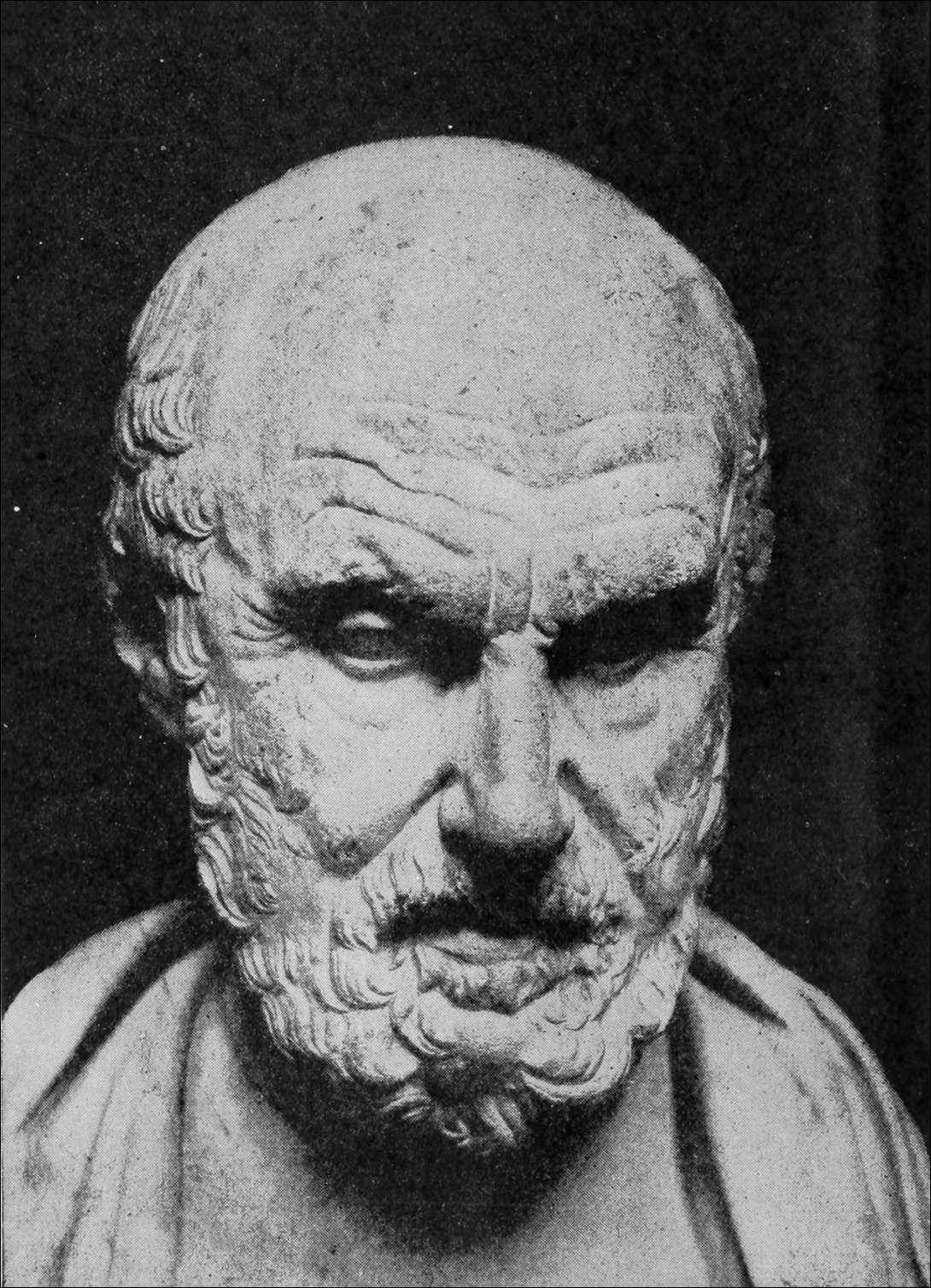
That is all that is known about the Father of Medicine.
We have not even his portrait. Yet we have
something far better; we have an idealized representation
of what the Greek would wish his physician to be.
It is a noble bust to which the name of Hippocrates was
early attached. Many copies exist (see Frontispiece).
The calm, righteous and dignified presence which it
portrays has stamped itself on the consciousness and
conscience of those who follow the Art of Healing. To
that gracious figure the medical man will continue to
pay homage.
If critical examination has dealt thus hardly with the
Hippocratic writings and with Hippocrates himself,
what has been left which we may surely derive from the
Greek medical system? The answer is that Medicine
has from the Greeks two great things: the picture of
a man and the institution of a method.
The man is Hippocrates himself. His figure, gaining
in dignity what it loses in clearness, stands for all time
as that of the ideal physician, for the ideal is there and
is clearly set forth in these great writings, whether we
discern the details of his earthly features or no. Calm
and effective, humane and observant, prompt and
cautious, at once learned and willing to learn, eager
alike to get and give knowledge, unmoved save by the
fear lest his knowledge may fail to benefit others—both
the sick and their servants the physicians,—incorruptible
and pure in mind and body, the figure of the
greatest of physicians has gained, not lost, by time. In
all ages he has been held by medical men in a reverence
comparable only to that which has been felt towards
the founders of the great religions by their followers.
The figure of the Hippocratic physician has been of
incalculable spiritual value to the medical profession in
the twenty-three centuries that have passed since his
death.
So much for the man. We turn now to the method.
The method of Hippocratic medicine is that known
to-day as the experimental or better experiential. It was
employed among the Greeks for centuries after the
death of Hippocrates. Then came a time when a social
and philosophical upheaval prevented its further prosecution.
For the thousand years that followed the break-up
of the Roman Empire the medical practice of Europe
was at best a corrupted imitation and misunderstanding
of the Hippocratic teaching; at worst it descended to a
low level of Animism and Magic. Then there was
a rally. Slowly—very slowly at first—the foundations
of Modern Science were laboriously laid. Among
the first elements in this scientific Renaissance was the
recovery of the Hippocratic works.
In the centuries that followed this Renaissance the
very words of the Hippocratic Collection were taught in
the medical schools in a spirit that was anything but
that of Hippocrates. Gradually, however, a better
understanding crept into men’s minds. The spirit of
those writings and their methods and observations
came now rightly to be exalted above the works themselves.
The works themselves were wisely dropped
from the medical curriculum. They are no longer used
in any medical school. But if we turn again to contemplate
the Hippocratic treatises, we may recognize in
them the modern process of careful record of data and
cautious inference from them—that collation of experience
from various sources obtained by various methods
with which we are now so familiar. We may even see
in full force the actual process of case-taking, bed
side instruction and clinical lecture. These methods
are practised much in the way in which we know them,
and are set forth with a conciseness and beauty of
language and a loftiness of ethical tone which have not
since been surpassed. To such a collection medical
men must always return. No part of it is more impressive
than the so-called Hippocratic Oath.
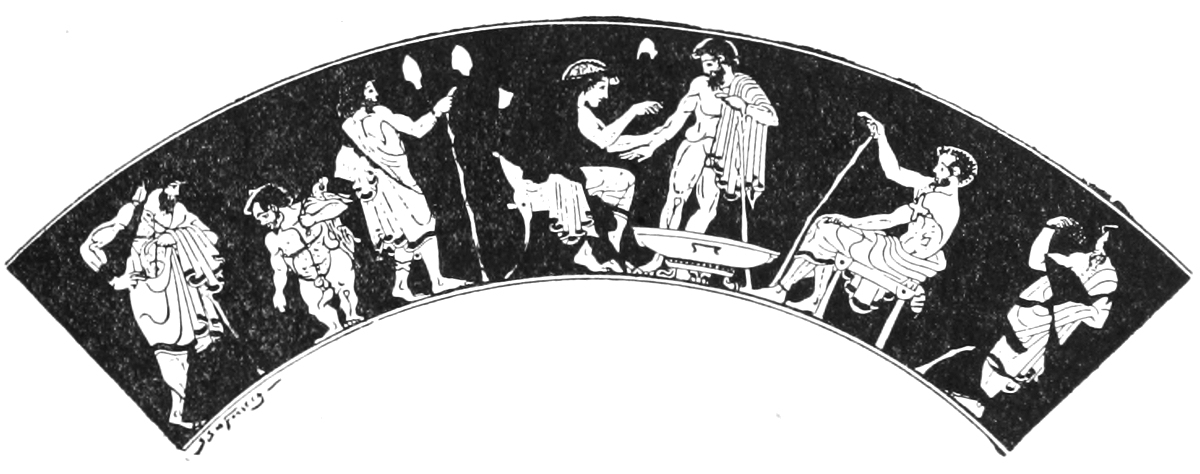
Fig. 8. A GREEK CLINIC OF ABOUT 400 B.C., when Hippocrates
was in his prime. From a vase painting.
The physician sits in the center. He holds a lancet in his right hand, seizes
the patient’s right arm with his left and is bleeding him from a vein at the
bend of the elbow. The blood falls into a large basin on the floor. Above
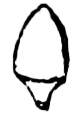
the physician’s head are suspended three cupping vessels, shaped thus:
To the right sits a patient awaiting his turn to interview the physician.
His left arm is bandaged. Behind this patient stands a figure smelling a flower
as a preventive against infection. Behind the physician stands a man
wounded in the left leg, which is bandaged. Back to back to this last figure
is a dwarf with a disproportionately large head. His body exhibits deformities
typical of the developmental disease now known as Achondroplasia. In
addition to his other deformities, we note that his muscular body is hairy,
and that the bridge of his nose is sunken. On his back he carries a hare
which is almost as tall as himself. Talking to the dwarf is a man leaning on
a long staff, who has the remains of a bandage round his chest.
The Hippocratic Oath, in its present form, is of
very much later date than Hippocrates. Yet parts of it
may be even earlier than he, and some suggestion of
the Oath is, perhaps, to be seen in the contents of
Egyptian papyri of the second millennium B.C. It need
hardly be said that the late date of the Oath by no
means removes the interest of this grand ethical monument.
No passage better reflects the spirit of the
Hippocratic physicians. The oath is clearly designed
for a youth entering on his apprenticeship to such a one.
‘I swear by Apollo the healer, invoking all the gods and goddesses
to be my witnesses, that I will fulfil this Oath and this
written Covenant to the best of my ability and judgement.
‘I will look upon him who shall have taught me this Art even
as one of my own parents. I will share my substance with him,
and I will supply his necessities, if he be in need. I will regard
his offspring even as my own brethren, and I will teach them this
Art, if they would learn it, without fee or covenant. I will impart
this Art by precept, by lecture and by every mode of teaching,
not only to my own sons but to the sons of him who has taught
me, and to disciples bound by covenant and oath, according to the
Law of Medicine.
‘The regimen I adopt shall be for the benefit of the patients
according to my ability and judgement, and not for their hurt or
for any wrong. I will give no deadly drug to any, though it be
asked of me, nor will I counsel such, and especially I will not
aid a woman to procure abortion. Whatsoever house I enter,
there will I go for the benefit of the sick, refraining from all
wrongdoing or corruption, and especially from any act of seduction,
of male or female, of bond or free. Whatsoever things I see
or hear concerning the life of men, in my attendance on the sick
or even apart therefrom, which ought not to be noised abroad, I
will keep silence thereon, counting such things to be as sacred
secrets. Pure and holy will I keep my Life and my Art.
‘If I fulfil this Oath and confound it not, be it mine to enjoy
Life and Art alike, with good repute among all men at all
times. If I transgress and violate my oath, may the reverse be
my lot.’
Among the most remarkable features of the Hippocratic
Collection is the feeling of contact with the patient
which most of its works convey. This is naturally a
special characteristic of the surgical works. One treatise,
which bears the title On wounds of the head, has always
drawn attention as bespeaking especial ingenuity and
experience. The description of trephining is of peculiar
interest, because the practice was known in prehistoric
times and is still employed by savage and semi-civilized
peoples. The process recommended for cases of fracture
of the skull and injury to the underlying structures
resembles, in many details, the modern surgical procedure.
‘When it is necessary to trephine a patient, make up your mind
and judge as follows. If you have had charge of the case from the
first, do not trephine the bone down to the membrane at once,
for it is not desirable that the membrane be long exposed, lest
it end by becoming rotten and fungous. There is also another
danger, to wit that you wound the membrane with the saw
during the operation, if you try to remove the bone by trephining
immediately down to the membrane. Therefore, when the bone
is almost sawn through and is already loose, cease trephining
and allow the bone to come away of itself. While trephining,
often remove the instrument and dip it in cold water. If you
do not do this, the trephine, becoming heated by the circular
motion and heating and drying the bone, may burn it and cause
an unduly large piece of the bone round the sawing to come
away.’
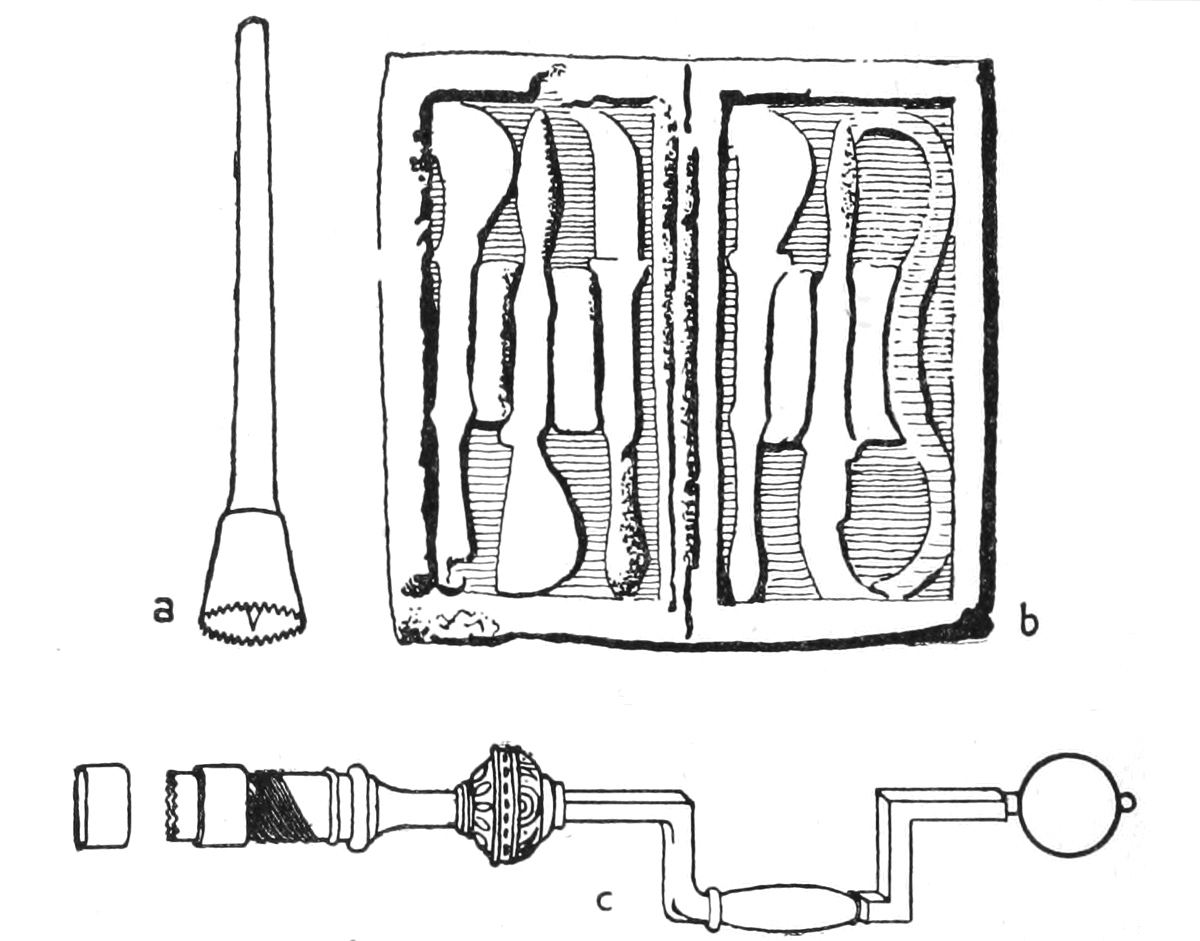
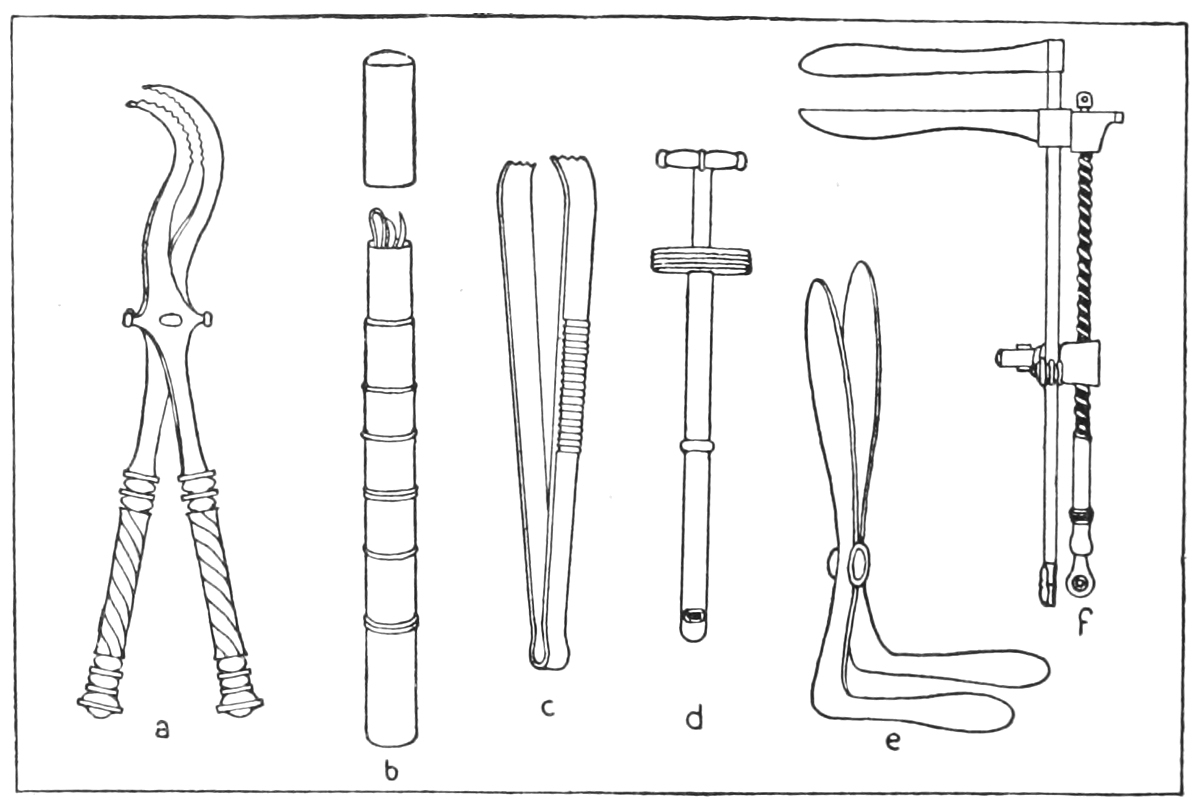
Fig. 9. INSTRUMENTS USED BY GREEK SURGEONS.
a Simplest form of trephine. It has central pin and serrated edge. The
point is held against the skull and the staff twirled between the hands.
(Cf. Fig. 112.) It could also be rotated by a crosspiece and thong, as in
Fig. 22. b Case of scalpels from a bas-relief in the temple of Aesculapius on
the Acropolis at Athens. c Trephining instrument of type still in use. The
carpenter’s ‘center bit’ was known in antiquity, and was probably adapted
to the trephine. a and c represent sixteenth-century instruments of ancient
type. No ancient trephines of Greek origin are known, though a specimen
has come down to us from Mesopotamia, see Fig. 3.
So much for a normal case which comes to the physician’s
hands directly after the accident. But in less
fortunate cases he is not called in so early, and the
wound suppurates before he can bring his Art to bear
upon it. In such a case he is advised:
‘Saw the bone immediately to the membrane with a serrated
trephine (Fig. 9, a and c), frequently removing the trephine and
testing with the probe all round along the track, for the bone is sawn
through much more quickly if it is already suppurating and penetrated
by the pus. The bone, however, often happens to be thin
in places. Therefore be on your guard not to apply the trephine
at random, but fix it in the bone where it appears thickest, frequently
making an examination and trying to raise the bone by
moving it. And after removing it, continue such treatment as may
appear advantageous to the wound, according to circumstances.’
Among the works of the Hippocratic Collection is
a lecture note-book known by the title Concerning the
things in the Surgery. It is written in very abbreviated
style and consists of mere headings. Nevertheless, our
attention is arrested by its startling modernness, when
we read such a category as this:
‘Operative requisites in the surgery: the patient; the operator;
assistants; instruments; the light, where and how placed; the
patient’s person and apparatus. The operator, whether seated or
standing, should be placed conveniently to the part being
operated upon and to the light. Each of the two kinds of
light, ordinary or artificial, may be used in two ways, direct or
oblique.’
Or again, such details as:
‘The nails [of the operator] neither to exceed nor come short
of the finger-tips. Practise using the finger-ends. Practise all
operations with each hand and with both together, your object
being to attain ability, speed, painlessness, elegance and readiness.
Let those who look after the patient present the part for operation
as you want it, and hold fast the rest of the body so as to be
all steady, keeping silence and obeying their superior.’
Are we not here reminded of an up-to-date operator
and operating theater?
In the Hippocratic Collection the physician attends
cases of every type, and does not refuse to do his best
for a case because the use of an instrument is demanded.
He is thus no ‘specialist’. But the mass of his practice
lay with cases to which instrumental treatment was inapplicable.
In cases in which surgical intervention was
not justified the Hippocratic physician adopted for the
most part what is called an ‘expectant’ line of treatment.
Realizing that, in general, the tendency of the
body is to recover, he contented himself with ‘waiting on
Nature’. This does not by any means imply that he
was helpless, for much could be done by nursing, regimen
and diet to aid the patient in that conflict which he
alone must fight out. For the conduct of that great
battle wise and useful directions are recorded. But believing
in the healing power of Nature—the famous
phrase is used in the Hippocratic writings—the physician
was none too eager to administer drugs. In the
state of knowledge of the day this reluctance was well-judged.
Nevertheless the Hippocratic drugs, though
neither numerous nor complex, were some of them very
efficient, and their judicious if reluctant use at the right
juncture saved many a life.
The Aphorisms is the most famous book with which
the name of Hippocrates is associated, and is as likely
as any of the Collection to be by Hippocrates himself.
It consists of a series of very brief generalizations.
Many of these have been confirmed by the clinical
experience of later ages. Some have passed into medical
commonplaces, others have become popular proverbs.
The style of the work suggests an aged physician reflecting
on the experience of a lifetime. Among modern
medical writings its closest analogue is perhaps the
Commentaries of the great English physician, William
Heberden the elder (1710-1801), which was commenced
by him after the age of seventy, occupied the
last twenty years of his life, contained a summary of the
whole of his vast experience, and was published by his
son after his death. If the Aphorisms is similarly a work
of the old age of Hippocrates it may be dated about
380 B.C. A few extracts give a good idea of the nature
of the book.
‘Life is short and Art is long; the Crisis is fleeting, Experiment
risky, Decision difficult. Not only must the physician be ready
to do his duty, but the patient, the attendants, the external circumstances
must conduce to the cure.’
‘Old persons bear fasting most readily, next adults, and young
people yet less; least of all children, and of these least again those
who are particularly lively.’
‘If in any illness sleep does harm, it is a symptom of deadly
import.’
‘When sleep puts an end to delirium, it is a good sign.’
‘Weariness without cause indicates disease.’
‘If there be a painful affection in any part of the body, and
yet no suffering, there is mental disorder.’
‘To eat heartily after a long illness without putting on flesh is
a bad portent.’
‘Food or drink slightly inferior in itself, but more pleasant,
should be preferred to that better itself, but less pleasant.’
‘The old have fewer illnesses than the young, but if any become
chronic with them they generally carry it with them to the grave.’
‘Those naturally very fat are more liable to sudden death than
the thin.’
‘The dry seasons are more healthy than the rainy, and attended
by less mortality.’
‘Cold sweats in conjunction with an acute fever indicate death,
but with a milder fever only prolonged sickness.’
‘Convulsions supervening on a wound are deadly.’ (Tetanus,
cp. p. 267.)
‘Those attacked by tetanus either die within four days, or if
they get through these they recover’ (compare pp. 257 and 267).
‘Phthisis comes on mostly from eighteen to thirty-five years
of age.’
‘It is fatal for a woman in pregnancy to be attacked by one
of the acute diseases.’
‘In cases of jaundice, hardening of the liver is a bad sign.’
‘We should observe the appearance of the eyes in sleep. If any
of the white show through the eyelids when closing, this is a bad
sign and very dangerous, unless it be due to diarrhoea or taking
a purgative.’
‘An attack of delirium with laughter is less dangerous than
with despondency.’
‘Apoplexy is commonest between the ages of forty and sixty.’
‘If you give the same nutriment to a patient in a fever and to
a person in health, the patient’s disease is aggravated by what
adds strength to the healthy man.’
The chief clinical achievement of the Hippocratic
Collection lies in the descriptions of actual cases. These
descriptions are not only without parallel during nearly
2,000 years, but they are models of what succinct clinical
records should be. They are clear and short, they give
all the leading features and yet they show no attempt
to prejudge the importance of any particular feature.
The records of these cases illustrate the Greek genius
for seizing the essential. The writer does not betray the
least wish to exalt his own skill. He seeks merely to
put the data before the reader for his guidance under
like circumstances. It is a reflex of the spirit of honesty
in which these men worked that in the great majority
of the cases they record death ensued. Two of these
remarkable descriptions may be given:
‘The woman with quinsy, who lodged with Aristion; her
complaint began in the tongue; voice inarticulate; tongue red
and parched. First day, shivered, then became heated. Third
day, rigor, acute fever; reddish and hard swelling on both sides
of neck and chest; extremities cold and livid; respiration elevated;
drink returned by the nose; she could not swallow; alvine and
urinary discharges suppressed. Fourth day, all symptoms exacerbated.
Fifth day, died.’
This was a case of Diphtheria. The quinsy, the paralysis
of the palate leading to return of the food through
the nose, and the difficulty with speech and swallowing
are typical results of this affection which was here complicated
by a spread of the septic processes into the neck
and chest, a not uncommon event in the disease. The
rapid onset of the conditions is rather unusual, but may
be explained if we regard the case as a mild and unnoticed
diphtheria, subsequently complicated by paralysis
and by secondary septic infection, for which reason
she came under observation.
‘In Thasos, the wife of Delearces, who lodged on the plain,
through sorrow was seized with an acute and shivering fever.
From first to last she always wrapped herself up in her bedclothes;
kept silent, fumbled, picked, bored, and gathered hairs
[from the clothes]; tears and again laughter; no sleep; bowels
irritable but passed nothing; when urged drank a little; urine
thin and scanty; to the touch the fever was slight; coldness of the
extremities. Ninth day, talked much incoherently, and again
sank into silence. Fourteenth day, breathing rare, large and
spaced, and again hurried. Seventeenth day, after stimulation of
the bowels she passed even drinks, nor could retain anything;
totally insensible; skin parched and tense. Twentieth day, much
talk, and again became composed, then voiceless; respiration
hurried. Twenty-first day, died. Her respiration throughout was
rare and large; she was totally insensible; always wrapped up in
her bedclothes; throughout either much talk, or complete silence.’
We have here a description of low muttering delirium,
a common end of continued fevers, as, for instance,
Typhoid. It resembles the condition known to physicians
as the ‘typhoid state’. Incidentally the case contains
a reference to a type of breathing common among
the dying. The respiration becomes deep and slow, as it
sinks gradually into quietude and becomes rarer and
rarer until it seems to cease altogether, and then it
slowly becomes more rapid and so on alternately. This
type of breathing is known to physicians as ‘Cheyne-Stokes’
respiration, in commemoration of two distinguished
Irish physicians of the last century who brought
it to the attention of medical men. In our own time
it has been partially explained on a physiological basis.
We may note that there is another and even better
pen-picture of Cheyne-Stokes respiration in the Hippocratic
Collection. We read of one ‘Philescos who lived by
the wall and who took to his bed on the first day of acute
fever.’ About the middle of the sixth day he died, and
the physician notes that ‘the respiration throughout was
like that of a person recollecting himself and was large and
rare’. Cheyne-Stokes breathing is admirably described
as ‘that of a person recollecting himself’.
Immense and, as some may think, overwhelming importance
is laid by the Hippocratic writings upon the art
of ‘Prognosis’, that is of predicting the course which the
disease will take. The work to which the title Prognostics
is attached represents a very lofty standard of practice.
We quote from it a description of the signs of death
to which the name of Hippocratic facies has become attached.
It is imitated by Shakespeare in his description
of the death of Falstaff in Henry V (Act II, Scene 3).
‘You should observe thus in acute diseases; first the countenance
of the patient, if it be like those of persons in health, and
especially if it be like itself, for this is best of all. But the opposite
are the worst, such as these: a sharp nose, hollow eyes,
collapsed temples; the ears cold, contracted, and their lobes
turned out; the skin about the forehead rough, stretched and
parched; the colour of the face greenish, dusky, livid or leaden.
‘If the countenance be such at the beginning of the disease, and
if this cannot be accounted for by the symptoms, inquiry
must be made whether the patient has been sleepless, whether his
bowels have been very loose, or whether he has wanted food.
If any of these be confessed, the danger is to be reckoned so far
the less, and it will become obvious in a day and night whether or
no the appearance come of these. But if no such cause exist
and if the symptoms do not subside in this time, be it known for
certain that the end is at hand.’
These glimpses will give some idea of Rational Medicine
in the making. In the fourth century B.C. Medicine
emerges as a definite part of the scientific consciousness.
Rational Medicine is now in being.
During the fourth century B.C. there lived and worked
one whose thought has stamped itself on the whole
subsequent course of the biological and medical sciences,
and indeed of all Science.
Aristotle (384-322 B.C.) was a provincial Greek and
son of a Macedonian physician. At seventeen he became
a pupil of Plato at Athens. After Plato’s death in
347 Aristotle crossed the Aegean to reside in Asia
Minor. The main part of his biological observations
was made during his stay there. In 342 B.C., at the
request of King Philip of Macedon, Aristotle became
tutor to Philip’s son, Alexander the Great. He remained
in Macedon for seven years. About 336, when
Alexander departed for the invasion of Asia, Aristotle returned
to Athens, where he taught for the rest of his
life. He died in 322 B.C., a few months after his pupil
Alexander.
Aristotle was the great codifier of ancient Science.
On him all subsequent biological development, including
that of modern times, is surely based. In his wonderful
biological works, which are still read by naturalists,
he discusses many problems current to this very day.
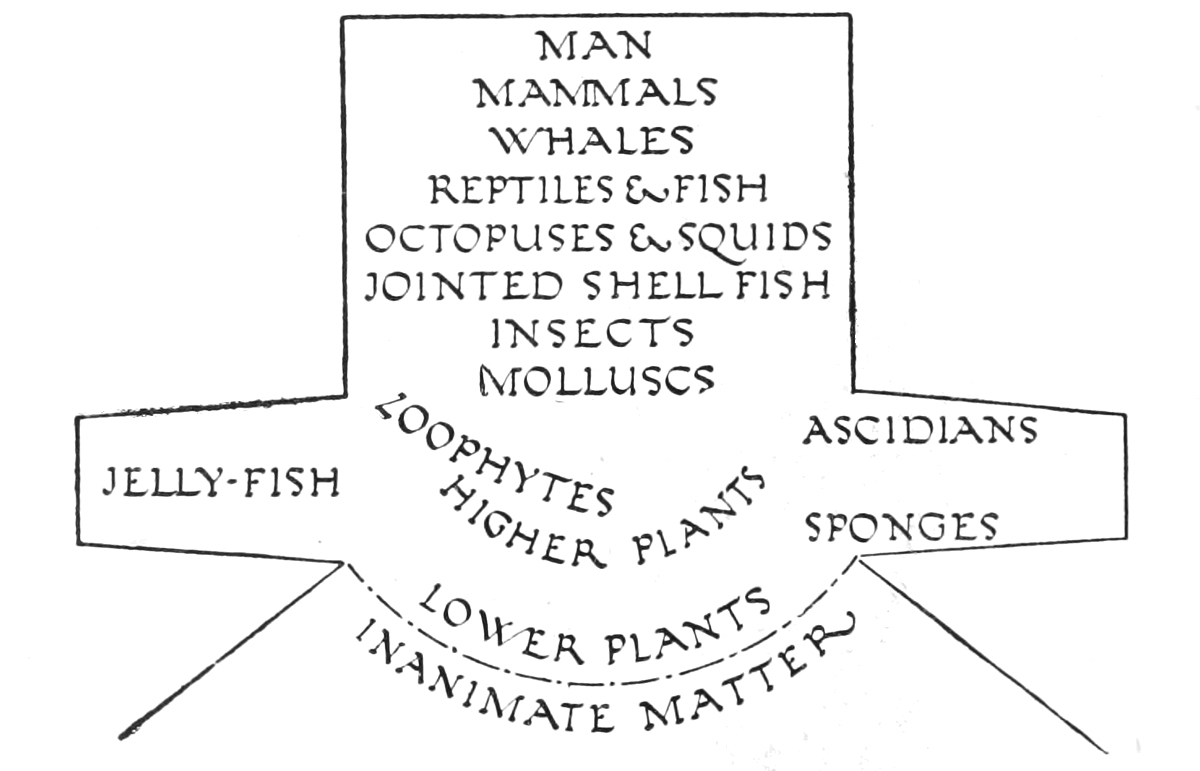
He laid the basis of the doctrine of Organic Evolution
in his teaching concerning the Scala Naturae ‘Ladder
of Nature’ (Fig. 10). He developed coherent theories
of Generation and Heredity. He founded Comparative
Anatomy and he dissected many animals. He did not,
however, anatomize the human body.
Fig. 10. The Ladder of Nature according to Aristotle.
Aristotle gave good descriptions of some organs, regarded
from the standpoint of Comparative Anatomy.
These descriptions he sometimes illustrated by drawings,
the first anatomical figures of which we have a
record. In some cases these drawings can be restored
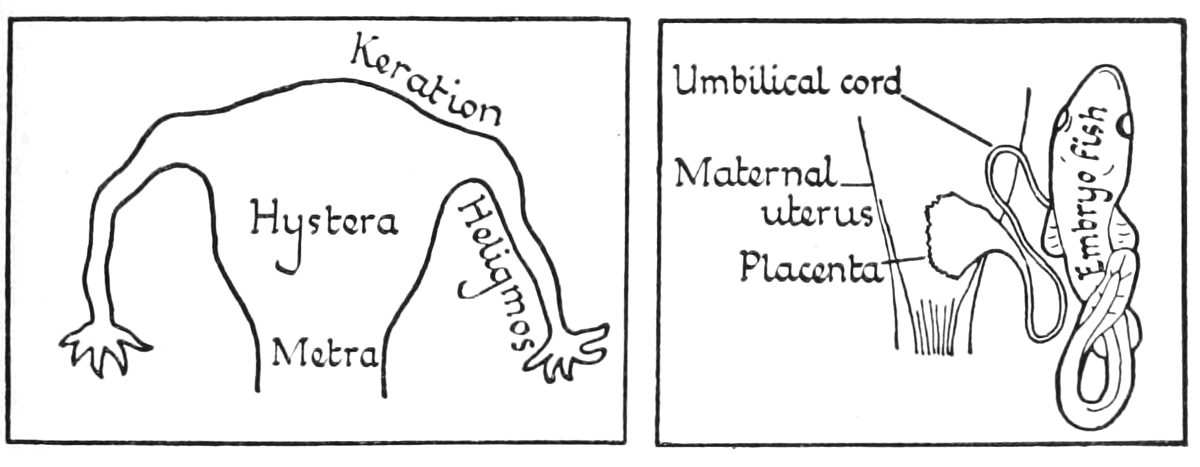
with confidence. Thus, he gave an account of the
uterus, the nomenclature of which has been retained in
more or less modified form to our own time (Fig. 11).
Among the best anatomical descriptions given by Aristotle
is that of the ruminant stomach. Perhaps his most
extraordinary anatomical feat is his account of the development
of the dogfish Mustelus laevis, which he
showed was attached to its mother’s womb in a way very
similar to the embryo of a mammal (Fig. 12). This
raised the admiration of the greatest modern morphologist,
Johannes Müller (1807-58, pp. 211-13), and would
in itself be sufficient to establish the claim of Aristotle
to a place in the front rank of observing naturalists.
Aristotle gave fairly accurate descriptions of the
branches of the great veins and of the superficial vessels
of the arm of mammals. He realized that the arteries
are usually accompanied by veins. He described the
generative and digestive organs of cephalopod Molluscs,
and many other parts of many other animals.
Fig. 11. The womb with the names of its parts as given by Aristotle.
These names remain, in various forms, in modern anatomy.
Fig. 12. Embryo dogfish, Mustelus laevis, after Johannes Müller. The
little creature is shown attached to the wall of its mother’s womb, somewhat
after the manner of a mammal.
Something should be said of the errors of Aristotle.
Though an excellent Naturalist, he was in general much
weaker in Physiology. Thus, he made no proper distinction
between arteries and veins. He failed to trace
any adequate relations between the sense organs, the
nerves, and the brain. His refusal to attach great importance
to the brain is remarkable. Primacy he placed
with the heart, which he regarded also as the seat of the
intelligence. This was contrary not only to the medical
opinion of his day, but also to the popular view, voiced,
for instance, by Aristophanes in his play The Clouds,
written about 400 B.C., where we read of a man who
had concussion of the brain. Moreover, Aristotle’s
teacher Plato placed the seat of thought and feeling in
the brain. From all we know of Aristotle, it seems probable
that he did not take up this attitude without evidence.
It seems likely that he had experimented on the
brain and found it devoid of sensation. Hence his view,
opposed to current belief, that it is not associated with
thought. Aristotle regarded the brain simply as an
agent for cooling the heart, and preventing it from
being over-heated. This cooling process, he considered,
was effected by the secretion of phlegm (pituita), an
idea still preserved in our anatomical term the pituitary
body.
The views of Aristotle have had a vast influence in
determining the direction of medical thought. For
more than two thousand years Aristotelian philosophy,
in more or less corrupted form, constituted the main
intellectual food of mankind. Without some knowledge
of the biological verdicts of Aristotle, it is impossible to
understand the course taken by Rational Medicine.
The influence of Aristotle is specially evident in certain
basic biological conceptions.
The problem of the nature of Generation is one in
which Aristotle never ceased to take an interest.
Among the methods by which he sought to solve it was
embryological investigation. His most important embryological
researches were made upon the chick. His
choice was most fortunate, and the chick has remained,
to this day, the classical subject of embryological research.
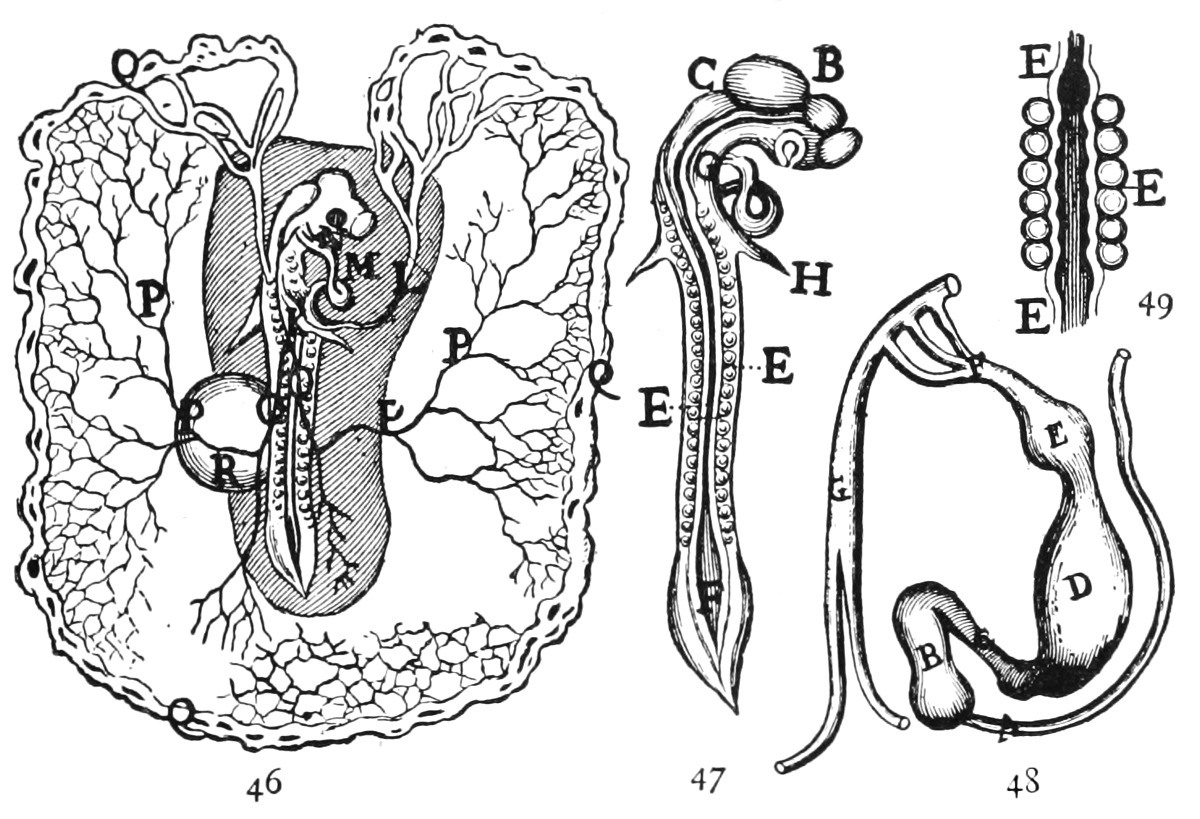
Aristotle asserts that the first signs of life in
the hen’s egg are noticeable on the third day, the heart
being visible as a palpitating blood-spot. As it develops,
two meandering blood-vessels extend to the surrounding
tunics. A little later, he observes, the body becomes
distinguishable, at first very small and white, the head
being clearly distinguished and the eyes very large
(Figs. 46-7, p. 117). To follow the main features of
the later stages was a comparatively easy task.
Aristotle was greatly impressed by these phenomena.
He lays stress on the early appearance of the heart in
the embryo. Corresponding to the general gradational
view that he had formed of Nature, he held that the
most primitive and fundamentally important organs
make their appearance before the others. Among the
organs all give place to the heart, which he considered
the first to live and the last to die. In the heart, as we
have seen, he placed the seat of the intelligence.
Thus, not only in his account of the ‘Ladder of
Nature’, but also in his theories of individual development,
Aristotle exhibits some approach to evolutionary
doctrine. This is somewhat obscured, however, by his
peculiar view of the nature of procreation. On this
topic his general conclusion is that the material substance
of the embryo is contributed by the female, but
that this is mere passive formable material, almost as
though it were the soil in which the embryo grows. The
male, by giving the principle of life, the soul (psyche),
contributes the essential generative agency. But this
soul is not material, and it is not, therefore, theoretically
necessary for anything material to pass from male to
female. The material which does in fact pass with the
semen of the male is, as the older philosophers would
have said, an accident, not an essential. The essential
contribution of the male is not matter but form and
principle.
The female then only provides the material, the male
the soul, the form, the principle, that which makes life.
Aristotle was thus prepared to accept instances of fertilization
without material contact, i.e., in effect, parthenogenesis
or ‘virgin birth’. In the centuries that
came after him such instances were not infrequently
adduced, and this doctrine was given a special turn by
Christian theologians. Belief in the ‘accidental’ character
of the material contribution of the male was common
among men of science till the nineteenth century. The
general attitude as to the nature of fertilization set
forth, for instance, by William Harvey (1578-1657,
pp. 111-14) in his book, On the Generation of Animals,
published in London in A.D. 1651, is practically identical
with the views of Aristotle published in Athens about
350 B.C., just 2,000 years earlier. It is of great interest
to note that very recent embryological research goes
some way to confirm this view of Aristotle. Without
any intervention of the male sexual element, it is possible
so to stimulate the egg mechanically as to produce
a perfect animal which is thus fatherless from the first.
The male element is indeed unnecessary and, in fact,
transmits only hereditary characters.
We must say something concerning Aristotle’s conceptions
of the nature of Life itself. He was before all
things a ‘vitalist’. For him the distinction between
living and not-living substance is to be sought not in
material constitution, but in the presence or absence
of something that he calls psyche, which we may translate
‘Soul’. His teaching on this topic had the
profoundest influence on subsequent anatomical and
physiological thought.
Aristotle’s theory as to the relation of this Soul to
material things is a difficult and complicated subject.
Its adequate discussion would take us beyond our
theme. He holds, however, that the Soul is related to
the idea of form. In living things the soul is that which
gives form. It is the pervasion by the soul that leads to
the determinate development of the body and its parts.
This activity of the Soul, under the Aristotelian term
Entelechy (which we may perhaps translate ‘the indwelling
perfectability’ or ‘purposiveness’, see Preface),
has an important place in modern biological theory,
which has, indeed, swung definitely in the direction
of the Aristotelian position.
Aristotle defines Life, existing in Matter, as ‘the
power of self-nourishment and of independent growth
and decay’. Of the Soul, the principle of Life, he distinguishes
three orders or types, the lowest vegetative,
or nutritive and reproductive, next the animal or sensitive,
and highest the rational or intellectual soul. The
last, he at first held, was peculiar to man, but later he
modified this view.
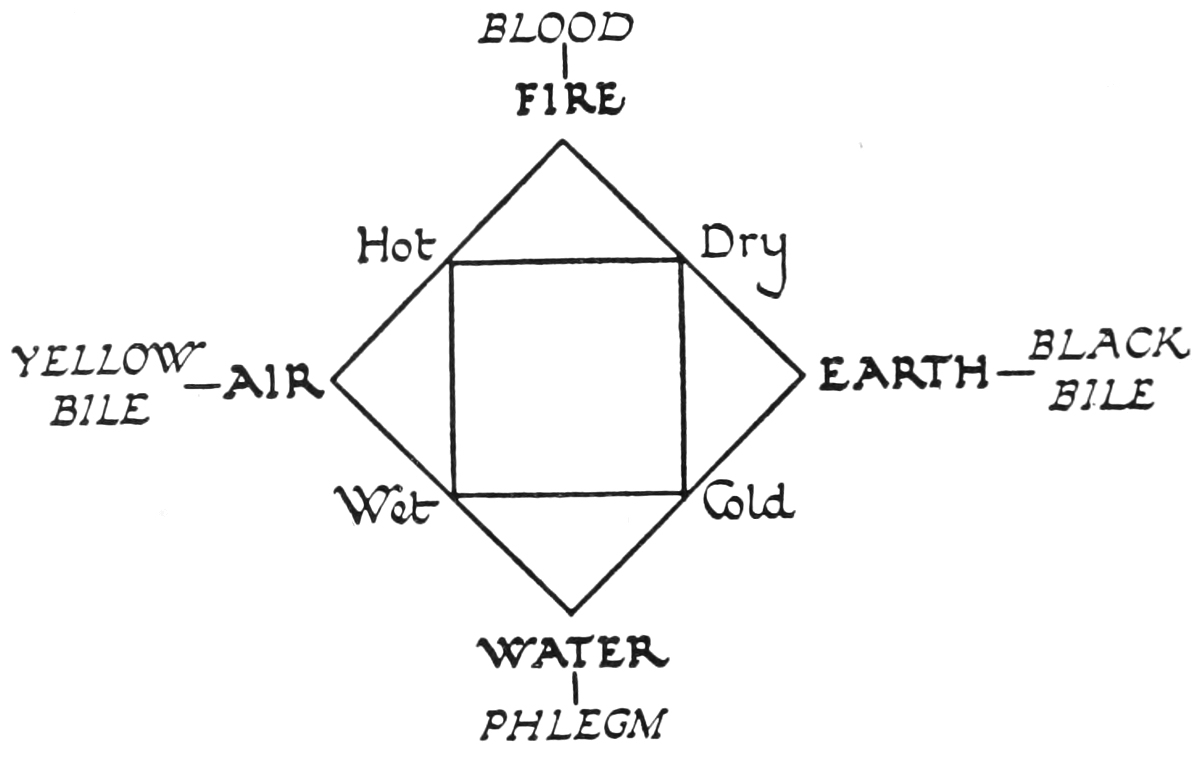
Fig. 13. The four Elements in association with the four Humors
and the four Qualities.
The history of the reception of Aristotle’s science
by later ages is very strange to modern eyes. Of all
Aristotle’s scientific teachings, men clung most firmly
for many centuries not to his finely thought-out biological
conceptions, but to a doctrine of the constitution of
matter of which the modern student hears nothing.
Aristotle, following more ancient writers, held that
there were four primary and opposite fundamental
Qualities, the hot and the cold, the wet and the dry.
These met in binary combination to constitute the
four Essences or Existences which entered in varying
proportions into the constitution of all Matter. The
four Essences, or, to give them their usual name, Elements,
were earth, air, fire, and water. Thus, water was
wet and cold, fire hot and dry, and so forth. With this
theory later writers combined the somewhat similar
Hippocratic doctrine which held that the body was
composed of the four ‘Humors’ or liquids: blood, phlegm,
black bile (melancholy), and yellow bile (choler). Some
of the Hippocratic physicians had associated excess of
the Humors with various types of bodily constitution.
Their followers made much of the ‘temperaments’ resulting
therefrom, and according to the prevailing
humor they distinguished the sanguine, phlegmatic,
melancholy or choleric temperament (Fig. 34, p. 97).
These conceptions, now departed altogether from
our scientific discipline, still persist embedded in our
language. Poetry still uses such ideas as the ‘raging of
the elements’ and ‘elemental forces’. We may yet
speak of a ‘fiery nature’ or an ‘aerial spirit’. We know
what is meant by a sanguine or a phlegmatic temperament,
and a melancholy or choleric disposition, and such
words conjure up real pictures in our minds (Fig. 34).
Until it began to be undermined by Robert Boyle
(1627-91) and others in the seventeenth century, the
doctrine of the four elements persisted in its entirety,
while ideas and terms derived from the old humoral
pathology can, in fact, be traced in the medicine of the
twentieth century.
The biological activity of the school of Aristotle was
continued after his death by his pupil Theophrastus
(372-287 B.C.). Especially the writings on plants of
Theophrastus are instinct with a thoroughly scientific
spirit, and are rightly regarded as the basic documents
of the science of Botany. Nevertheless, his works had
little effect or influence on his contemporaries and
successors. With Theophrastus the purely biological
school of Aristotle may be said to come to an end. The
biological sciences ceased, for many centuries, to be
studied for their own sake and became mere handmaidens
of Medicine. Neither mistress nor servant was
the better for the change.
II THE HEIRS OF GREECE (300 B.C. TO A.D. 200.) — § 1. The Alexandrian School. — § 2. Medical Teaching in the Roman Empire. — § 3. Medical Services of the Roman Empire. — § 4. Roman Hospitals. — § 5. Galen. — § 6. The Final Medical Synthesis of Antiquity.
Soon after Aristotle, about 300 B.C., a great medical
school was founded at Alexandria in Egypt. That
country had been conquered by Alexander the Great,
after whom the town was named. On Alexander’s
death, Egypt came under the rule of one of his generals,
Ptolemy, who established a dynasty which became
extinct with the famous Queen Cleopatra, thirty years
before the Christian era. Alexandria was a favorite
residence of this Greek dynasty and became more
Greek than Egyptian. Ptolemy and his successors
were patrons of learning, and at the Alexandrian school
remarkable anatomical and physiological researches
were made. These were the work of Greek physicians
who, in the tradition of their people, were only too
wont to associate their discoveries with sweeping
theoretical generalizations, often on very inadequate
bases.
The two earliest medical teachers at Alexandria were
also the greatest, Herophilus of Chalcedon, who
flourished about 300 B.C., and his slightly younger
contemporary Erasistratus of Chios. Herophilus may
be regarded as the father of Anatomy, Erasistratus as
the father of Physiology.
Herophilus was probably the first to dissect the
human body in public. He recognized the brain as the
central organ of the nervous system and regarded it as
the seat of the intelligence, thus reversing the verdict of
Aristotle on the primacy of the heart. He was the first
to grasp the nature of the nerves, which he distinguished
as connected with motion and sensation (Fig. 98),
though he did not separate them clearly from tendons
and sinews. He greatly extended the knowledge of the
parts of the brain. Certain parts of the brain still bear
titles which are translations of those which he gave
them. He also made the first clear distinction between
arteries and veins.
At the time of the institution of the Alexandrian
medical school, and for long after, there flourished that
view of the structure of the world known as atomic,
propounded by the philosopher Democritus (c. 400 B.C.).
The chief exponent of the theory was Epicurus (342-270),
whose philosophy was of the order which we
should now call ‘materialistic’. For it the only ultimate
realities were atoms and ‘the void’, and everything was
ultimately expressible in these terms. Epicurean philosophy
was not without its reactions on Medicine at
Alexandria, where its leading exponent was Erasistratus
of Chios.
Erasistratus was essentially a rationalist and professed
himself a foe to all mysticism. In the last resort,
however, he had to invoke the idea of Nature as a great
artist acting as an external power, shaping the body
according to the ends to which it must act. This is in
contrast with Aristotle’s view of the ‘soul’ as an
Entelechy (p. 33), an innate and inherent factor. Erasistratus
sought to express his views in atomic terms,
but, to make physiology intelligible, he added a conception,
Pneumatism, found also among older thinkers.
Pneumatism is the belief that the phenomena of life
are associated with the existence of a subtle vapor,
‘pneuma’ or spirit, which permeates the organism, and
causes its movements. This subtle vapor is held to
have some affinities with the air we breathe. Pneumatism
is, in fact, a primitive attempt to explain the
phenomena of respiration.
Erasistratus observed that every organ is equipped
with a threefold system of ‘vessels’, vein, artery, and
nerve, which divide to the very limits of vision, and he
considered that the process of division continues beyond
those limits. The minute divisions of these vessels,
plaited together, he believed to make up the tissues.
Veins, arteries, and nerves are, for him, made of minute
tubes of the same nature as themselves, through which
they are nourished. Blood and two kinds of pneuma
are the essential sources of nourishment and movement.
The blood is carried by veins. Air, on the other
hand, is taken in by the lungs and passes to the heart,
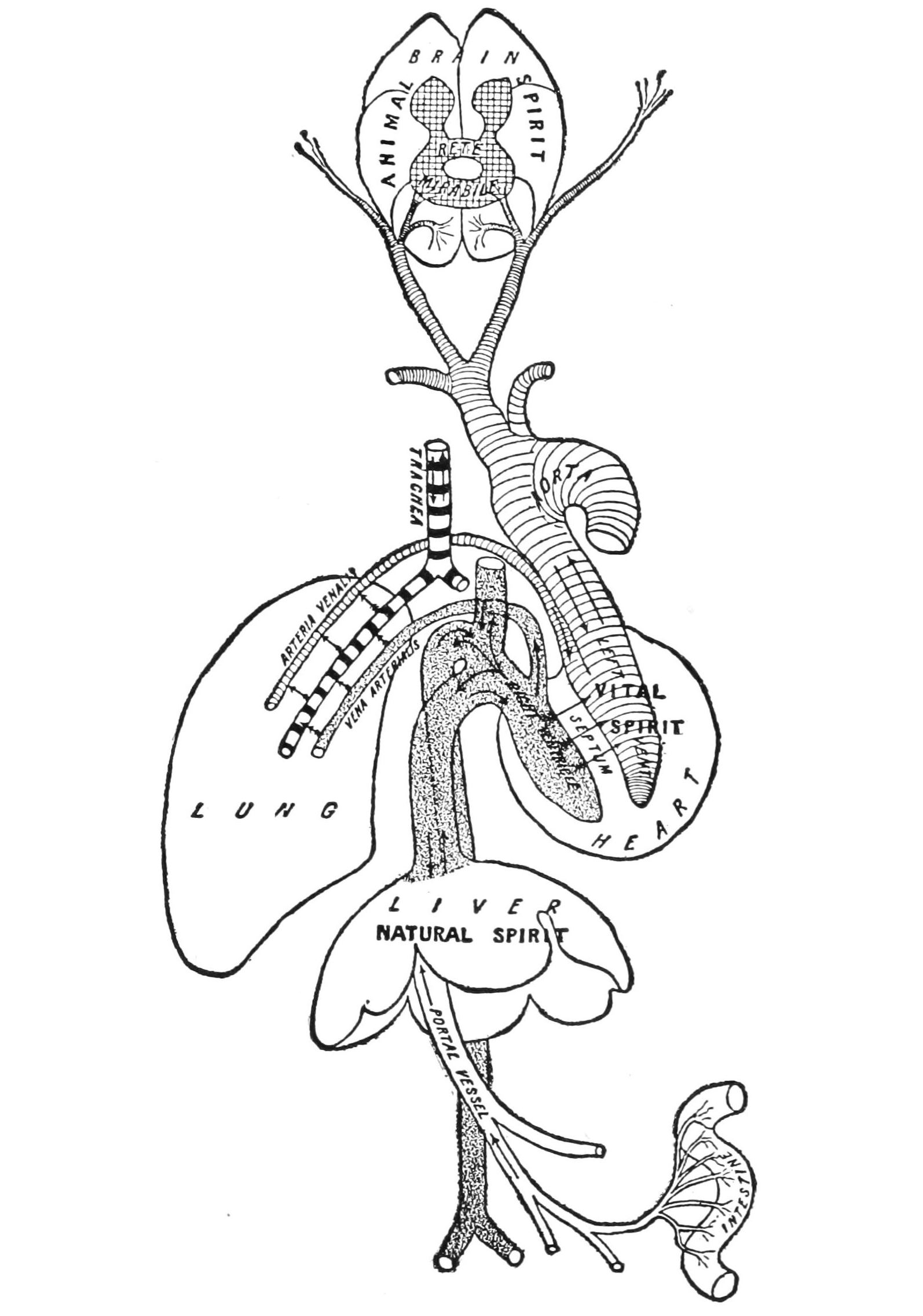
where it becomes changed into a peculiar pneuma, the
Vital Spirit, which is sent to the various parts of the
body by the arteries. This spirit is carried to the brain,
in the cavities or ‘ventricles’ of which it is further
changed to a second kind of pneuma, the Animal Spirit.
The animal spirit is conveyed to different parts of the
body by the nerves, which are hollow.
In the brain Erasistratus observed the convolutions,
noted that they were more elaborate in man than in
animals, and associated this complexity with the higher
intelligence of man. He distinguished between the
main parts of the brain, the ‘cerebrum’ and ‘cerebellum’
(Fig. 100, p. 210), and gave a detailed description of
the ‘cerebral ventricles’ or cavities within the brain and
of the ‘meninges’ or membranes that cover the brain.
He considered that the cerebral ventricles were filled
with Animal Spirit. (Compare Galen’s scheme, p. 58.)
Erasistratus attained to a clear view of the action
of muscles in producing movement. He regarded the
shortening of muscles as due to distension by Animal
Spirit conveyed to the muscles by the nerves. We may
note that similar theories as to the nature of muscular
action were again set forth, on theoretical grounds, in
the seventeenth century by Descartes (1596-1650,
pp. 127-8) and by Borelli (1608-79, pp. 129-30), but
were rebutted by the experiments of Swammerdam
(1637-80, p. 123). We may recall that we are still
in the dark as to the mechanism of contraction of
muscle fiber, the structure of which was first revealed
by Leeuwenhoek (1632-1723, Figs. 55-56A, p. 121).
Erasistratus considered the chief cause of disease to be
excess of blood or Plethora. Diseases thus caused differ
according to their site. Among them are coughing of
blood, epilepsy, pneumonia, tonsillitis, &c. Most of
these diseases could be treated by diminishing the local
supply of blood by starvation. Among his contemporaries
and successors blood-letting was an habitual
practice applied to almost every condition. Erasistratus
employed it but rarely, and his followers banned
it altogether. He was consistently opposed to violent
remedies. Among the therapeutic measures which
he favored were regulated exercise, diet, and the
vapor bath.
Erasistratus complained that many physicians of his
time were not interested in Hygiene. He therefore
wrote a treatise on the subject. Though he regarded
Hygiene as a means of substituting prevention for cure,
this did not prevent him from being extremely careful
and precise in his treatment of cases.
After the first generation or two, the activity of the
Alexandrian medical school flagged, though the city
long remained a great teaching center, and minor
medical advances were made. Surgery (cf. Fig. 14)
seems to have languished less than Medicine. The stagnation
in medical matters at Alexandria is in contrast to
the continued activity there in Mathematics, Astronomy,
Mechanics and Geography.
With the absorption of Egypt into the Roman
Empire in 50 B.C. and the extinction of the Ptolemaic
dynasty by the death of Cleopatra in 30 B.C., Alexandria
ceased to have great scientific importance. The
school continued for centuries with restricted activity
and devoid of all originality. Intellectually, it had become
subordinate to the Metropolis. Rome was now
mistress of the world and the future of Medicine must be
considered from the point of view of the Roman Empire.
Fig. 14. INSCRIBED TABLET OF ABOUT 100 B.C. from the
wall of the temple of Kom-Ombos in Upper Egypt. The temple itself was
built by Ptolemy VII (181-146 B.C.), but the carving is later. It is
divided into four partitions. These illustrate the surgical instruments in
use in Egypt during Alexandrian times.
In the partition to the extreme left can be seen two cupping-glasses
(cf. Fig. 8), a case of instruments (cf. Fig. 15), a pair of shears, a sponge,
a probe, a pair of fine forceps, and two knives (cf. Fig. 9).
In the next partition to the right can be seen two large forceps, two bags
or flasks, a strigil, two magic eyes, a pair of scales, and two growing plants.
In the next partition to the right can be seen several hooks of different
forms, several knives, and two or three pairs of forceps.
In the partition to the extreme right can be seen a bifid probe, a pair of
tongs, a long-bladed knife, probes, a double hook, a saw, a cautery, and
several objects probably intended to represent bandages.
The original native Roman medical system was quite
devoid of scientific elements and was that of a people of
the lower culture. Interwoven, as is all primitive Medicine,
with ideas that trespass on the domains of religion
and magic, it possessed that multitude of ‘specialist
deities’ which was so characteristic of the Roman cults.
The entire external aspect of Roman medicine was
changed by the advent of Greek science. Yet, notwithstanding
the large medical field that the Western
Empire provided, and the wide acceptance of Greek
medicine by the upper classes, it is remarkable that the
Latin-speaking peoples produced no eminent physician.
At first scientific medical education at Rome was
entirely a matter of private teaching. The earliest important
scientific teacher there was the Greek Asclepiades
of Bithynia (died c. 40 B.C.), a contemporary of
the poet Lucretius and, like him, an Epicurean. Asclepiades,
like Erasistratus, imported the atomic view of
Democritus into Medicine. He deeply influenced the
course of later medical thought, ridiculed the Hippocratic
attitude of relying on the ‘healing power of nature’
which he regarded as a mere ‘meditation on death’,
and urged that active measures were needed for the process
of cure to be ‘seemly, swift and sure’. He founded
a regular school at Rome which continued after him.
At first the school was the mere personal following of
the physician, who took his pupils and apprentices
round with him on his visits. At a later stage such
groups combined to form societies or colleges, where
problems of the art were debated. Towards the end of
the reign of Augustus (27 B.C.-14 A.D.) or the beginning
of that of Tiberius (14 A.D.-37 A.D.), these societies constructed
for themselves a meeting-place on the Esquiline
Hill. Finally the emperors built halls or auditoria for
the teaching of Medicine. The professors at first received
only the pupils’ fees. It was not until the time
of the Emperor Vespasian (reigned A.D. 70-9) that
medical teachers were given a salary at the public
expense. The system was extended by later emperors.
Thus Rome became a center of medical instruction.
After a time subsidiary centers were established in
other Italian towns. From Italy the custom spread
and we meet traces of such schools at the half-Greek
Marseilles as well as at Bordeaux, Arles, Nîmes, Lyons,
and Saragossa. For the most part these provincial
schools produced workaday medical men, few of whose
writings have come down to us. They were perhaps
largely training-places for the army surgeons. That
class seldom had scientific interests, though Dioscorides,
one of the most prominent physicians of
antiquity, one who earned the respect of Galen and
has deeply influenced the modern pharmacopoeia,
served in the army under Nero. His book is, in fact,
an extremely useful though ill-arranged compendium
of drugs. Dioscorides wrote in Greek, and his work
was not translated into Latin until the sixth century
of our era.
The earliest scientific medical work in Latin is the
De re medica of Celsus, which was prepared about
A.D. 30. It is in many ways the most readable and well-arranged
ancient medical work that we have. It is,
however, not an original work but a compilation from
the Greek, and the sole surviving part of a complete
encyclopaedia of knowledge. Many of its phrases are
closely reminiscent of the Hippocratic Collection. The
ethical tone is high and the general line of treatment
sensible and humane. Celsus, though almost forgotten
in the Middle Ages, was the first classical medical
writer to be printed (A.D. 1476).
The treatise of Celsus opens with an interesting
account of the History of Medicine. It then passes on
to deal with diet and the general principles of therapeutics
and pathology, next it discusses internal disease,
and then turns to external diseases. The last part of
the work is devoted to surgery, and is perhaps the most
valuable of the whole.
Celsus professes himself a follower of Asclepiades of
Bithynia (p. 41), but, unlike his master, he by no means
despises the Hippocratic expectant method of ‘waiting
on the disease’. In many matters we are struck with
his boldness as a surgeon. Thus he describes plastic
operations on the face and mouth, and the removal of
polypus from the nose. He tells too of the very dangerous
operation for extirpating a goiter (p. 303), and
of cutting for stone. He gives an excellent account of
what might be thought the modern operation for
removal of tonsils. Noteworthy also is his description
of dental practice which includes the wiring of loose
teeth and an account of a dental mirror. An idea of
the surgical instruments in use in his time can be obtained
from those recovered from Pompeii (Fig. 15).
Fig. 15. ROMAN SURGICAL INSTRUMENTS of the first
century A.D. found at Pompeii.
a. Forceps, probably for extracting teeth.
b. Small pocket-case of instruments containing sharp spoon, probe, &c.
c. Fine-toothed forceps.
d. Trocar and cannula for tapping fluids confined in cavities.
e. Speculum for examining orifices and cavities.
f. Instrument for dilating wounds that they may be more fully examined.
If, in Medicine itself, the Roman achieved but few
advances, in the organization of medical service, and
especially in the department which deals with public
health, his position is far more noteworthy. All Latin
writers on architecture give much attention to the
orientation, position and drainage of buildings. From
an early date sanitation and public health drew the
attention of statesmen. Considering the dread of the
neighborhood of marshes on the part of these practical
sanitarians of Ancient Rome, and in view of modern
knowledge of the mosquito-borne character of Malaria
(pp. 284-5), it entertaining to find the mosquito net
ridiculed by the poets Horace, Juvenal and Propertius!
Sanitation was a feature of Roman life. Rome was
already provided with cloacae or subterranean sewers in
the age of the Tarquins (6th cent. B.C.). The Cloaca
Maxima itself, the main drain of Rome, which is still
in use, dates back to that period.
The antiquity of hygienic ideas is seen in an interdict,
by a law of about 450 B.C., against burials within the
city walls and in the instructions issued to the town
officials to attend to the cleanliness of the streets and to
the distribution of water. Among these ancient laws
we may note one attributed to the first king of Rome,
which directed the opening of the body in the hope of
extracting a living child in the case of a woman dying in
pregnancy. It is the origin of the so-called ‘Caesarean
section’ on the living mother, the method by which
Caesar himself is said to have been brought into the
world. At the date of these decrees physicians in Rome
were either slaves or in an entirely subordinate position.
Their status was improved by Julius Caesar (102-44
B.C.), who conferred citizenship on all who practised
Medicine at Rome, in order to induce physicians to
settle there.
Fig. 16. AQUEDUCT OF NERO. This structure, when complete, conveyed part of the water-supply of Rome.
(From an engraving by Piranesi.)
The finest monument to the Roman care for the
public health stands yet for all to see in the remains
of the fourteen great aqueducts which supplied the city
with 300,000,000 gallons of potable water daily. No
modern city is better equipped (Fig. 16).
Under the early Empire a definite public medical
service was constituted. Public physicians were appointed
to the various towns and institutions. A statute
of the Emperor Antoninus of about the year A.D. 160
regulates the appointment of these physicians, whose
main duty was to attend to the poor. In the code of the
Emperor Justinian (A.D. 533) is an article urging them
to give this service cheerfully rather than the more
subservient attendance on the wealthy. Their salaries
were fixed by the municipal councillors. They were
encouraged to undertake the training of pupils. Inscriptions
attest the respect in which these state physicians
were held in many towns.
It is in connection with the army that we see the
Roman medical system at its best. There was an adequate
supply of military medical attendants who were
well organized (Fig. 17). The defects of the Roman
army medical system were, however, absence of any
elastic scheme for the ranking of medical officers, and
complete subordination of the medical to the combatant
officer. These facts are of a piece with the general
Roman indifference to theoretical science, and explain
why the Roman army surgeons made no additions to
knowledge. The social status of the medical staff in
the Roman military hierarchy was that of the non-commissioned
personnel, which included accountants,
registrars and secretaries.
Fig. 17. ROMAN ADVANCED DRESSING-STATION.
(From Trajan’s column.)
To the left two Roman soldiers assist a wounded comrade. To the right a
Roman military surgeon bandages the wounded thigh of a friendly ally.
The costume of the surgeon is almost identical with that of the soldiers,
though he carries a case for ‘first aid’ slung over his shoulder.
The great contribution of Rome to Medicine—and
it is a very great one—is the hospital system. It is a
scheme that naturally arose out of the Roman genius for
organization and is connected with the Roman military
system. Among the Greeks, iatreia, ‘surgeries’, were
well known; they were, however, the private property
of the medical man. Larger institutions were connected
with Aesculapian temples and there is evidence of some
degree of scientific medical treatment in these places.
In the Republican period the Romans were no better off
and, despite the vast numbers of slaves, there was no
provision for them when sick. A temple to Aesculapius
had been established on an island of the Tiber in
Republican times. It became the custom to expose the
sick and worn-out slaves on this island of Aesculapius,
to avoid the trouble of treating them. The Emperor
Claudius (A.D. 41-54) decreed that such slaves were
free, and that, if they recovered, they need not return to
the control of their masters. Thus, the island became
a place of refuge for the sick poor. We may regard it
as an early form of public hospital (Fig. 18).
Later writers speak of valetudinaria, ‘infirmaries’, for
such persons, and give humane directions for their
management. Such valetudinaria were in use even by
free Romans. The excavations at Pompeii show that
a physician’s house might even be built somewhat on
the lines of a modern ‘nursing home’. It was probably
in the provinces that private institutions first developed
into subventioned public hospitals.
This development of public hospitals naturally early
affected military life. At first, sick soldiers had been
sent home for treatment. As the Roman frontiers
spread ever wider this became impossible and military
hospitals were founded at important strategic points.
The sites of several such military hospitals have been
excavated. The best explored is near Düsseldorf and
was founded about A.D. 100.
From the military valetudinarium it was no great
step to the construction of similar institutions for the
numerous Imperial officials and their families in the
provincial towns. Motives of benevolence, too, gradually
came in, and public hospitals were founded in many
localities. The idea passed on to Christian times, and
the pious foundation of hospitals for the sick and outcast
in the Middle Ages is to be traced back to these Roman
valetudinaria. The first charitable institution of this
kind, concerning which we have clear information, was
established at Rome in the fourth century by a Christian
lady of whom we learn from St. Jerome. The plan of
such a hospital projected at St. Gall in the early years of
the ninth century has survived. It reminds us, in many
respects, of the early Roman military hospitals. These
medieval hospitals for the sick must naturally be distinguished
from the even more numerous ‘spitals’ for
travellers and pilgrims, the idea of which may perhaps
be traced back to the rest-houses along the strategic
roads of the Empire.
Fig. 18. ISLAND OF ST. BARTHOLOMEW IN THE TIBER AT ROME. (From an engraving by Piranesi.)
The island was the site of a temple to Aesculapius used as a refuge for worn-out slaves. It is the first known public hospital.
The entire island is carved in the form of a ship. On its prow can be discerned the head of Aesculapius and his staff and serpent.
The Latin culture, as we have seen, did not adapt
itself easily to the prosecution of scientific Medicine.
Long after Greece had ceased to exist as an independent
state such medical writings as appeared were usually
in the Greek rather than in the Latin language. This is
true to the end, and the end came, so far as creative
science is concerned, with the second half of the second
century. The scene is then, and for centuries to come,
mainly occupied by the huge overshadowing figure of
Galen.
Galen of Pergamum (A.D. 130-200) devoted himself
to medicine from an early age, and in his twenty-first
year we hear of him studying anatomy at Smyrna. To
extend his knowledge of drugs he made long journeys
to Asia Minor. Later he proceeded to Alexandria,
where he improved his anatomical equipment, and
here, he tells us, he examined a human skeleton. His
direct practical acquaintance with human anatomy was
limited to that skeleton, for dissection of the human
body was no longer carried on in his time. Thus, his
physiology and anatomy were derived mainly from
animal sources.
The general medical standpoint of the Galenic is not
unlike that of the Hippocratic writings, but the noble
vision of the lofty-minded, pure-souled physician has
utterly passed away. In its place we have an acute,
contentious fellow of prodigious industry, who is frequently
satisfied with a purely verbal explanation. Yet
he is an ingenious physiologist, acquainted with the
internal parts, so far as this is possible from a devotion
to dissection of animals, equipped with all the learning
of the schools of Pergamum, Smyrna and Alexandria,
and rich with the experience of a vast practice at Rome.
Galen is essentially an ‘efficient’ man. He has the grace
to acknowledge constantly his indebtedness to the
Hippocratic writings.
Some of Galen’s works are, however, mere drug-lists,
little superior to those of Dioscorides (p. 43). With the
depression of the intelligence that corresponded with
the break-up of the Roman Empire, it was these that
were chiefly studied and distributed in the West.
The Greek medical writers after Galen were but his
imitators and abstractors, and they usually imitated and
abstracted Galen at his worst. Through some of them
Galen’s works reached the West at a very early period
in the Middle Ages.
We now turn to the theoretical content of the vast
mass of Galenic writings. These set forth a medical
system of which the substance is based on the Hippocratic
Collection and the form derived from Aristotle.
This synthesis, in more or less corrupted form, provided
the theoretical basis of medical practice for the
next fifteen hundred years. Galen’s view of the human
body may be examined under two aspects, which we
describe as (a) philosophical and (b) descriptive.
First as to the philosophical aspect. Galen’s voluminous
works are saturated with the theory that all structures
in the body have been formed by the Creator for
a known and intelligible end. In the anatomical works,
masses of explanation, based on this view, dilute the
often imperfect accounts of structures. Thus, following
the Aristotelian principle that Nature makes nought
in vain, Galen seeks to justify, the form and structure
of every organ—nay, of every part of every organ—with
reference to the functions for which he believes
it is destined. To do this is to claim that in every
work of Creation—of which Man’s body is a type—and
in every detail of such work, we can demonstrate
God’s design along known principles. It is to claim,
in fact, a complete knowledge of the Laws of Nature.
No modern man of science, however intoxicated with
his own achievements, has as yet arrogated such powers
to himself. To conceive that such claims should be
made by a pious, theistically minded author, the reader
must think himself back into a very different philosophical
environment from that to which we are nowadays
accustomed.
The prevailing philosophy of Galen’s world was the
Stoic. Now in the world of the Stoic philosopher all
things were determinate, and they were determined by
forces acting wholly outside Man. The type and origin
of that determination the Stoic sought in the heavens,
and found in the majestic and overwhelming procession
of the stars. The recurring phenomena of the spheres
typified, foreshadowed, nay, exhibited and controlled,
the cycle of man’s life. Man dwelt in a finite world,
bounded by a definite frontier—the sphere of the fixed
stars. Within that spherical frontier all things worked
by rule—and that rule was the rule of the heavenly
bodies. Astrology had become one of the dogmas of
the Stoic creed.
To such a world Galen’s determination was in itself
no strange thought. Yet Galen’s view was far from
being wholly in accord with Stoicism. Though a determinism,
it was a determinism of perfection in which all
was fixed by a wise and far-seeing God, and was a
reflection of His perfection. Now such a scheme did
not ill fit the new creed which was just beginning to
raise its head and was destined to replace Stoicism and
all the other pagan schemes. Galen’s thought, in fact,
made a special appeal to the Christian point of view,
and this is, doubtless, the reason that his works have
been preserved in larger bulk than those of any other
pagan writer. The Galenic standpoint appealed equally
to the theological bias of Islam, whose medical knowledge
was based almost entirely on Galen.
We may now turn from the philosophical to the descriptive
bases of Galen’s medical system, namely to
his Anatomy and Physiology.
We may begin with the bones. These Galen had
studied on an actual human skeleton at Alexandria.
He divided them into long bones with a central canal
and flat bones without such a canal. He had a fairly
good idea of the bones of the skull. He regarded
the teeth as bones, and he gives a good description of
their origin. He recognized twenty-four vertebrae terminated
by the sacrum. Galen gives accurate elementary
descriptions of the vertebrae, of the ribs, of the
breastbone, of the collar-bone, and of the bones of the
limbs. He divides joints or junctions of bones into
two main orders, those with movement and those without
movement, and the titles that he gives to his main
divisions have survived in our modern nomenclature.
As regards the muscular system there can be little
doubt that Galen’s work was in large part of a really
pioneer character. Throughout his works the muscles
are perhaps the structures that he describes most accurately.
His writings contain frequent references to form
and function of muscles of various animals. Thus, the
dissection of the muscles of the orbit and larynx was
performed on the ox, and the muscles of the tongue
are described from the ape. Occasionally he indicates
that he is aware of the differences between certain of the
muscles he is describing from those of man. For his
investigation of muscles Galen used particularly the
Barbary ape (Macacus inuus), a creature anatomically
near enough to man for a knowledge of its detailed
structure to be applicable to human Surgery. (Figs. 19 and 20.)
Fig. 19. DISSECTION OF HAND OF MAN.
Fig. 20. DISSECTION OF HAND OF BARBARY APE.
The ape’s hand shows all the main muscular and tendinous structures present in the human hand, though the proportional
development differs somewhat. The same is true of other parts of the body. Galen’s anatomy, drawn
from the Barbary ape, was thus quite serviceable for many surgical procedures. Apart from proportion, the most
obvious anatomical difference in the hands of the two species is the position of attachment of the small severed
muscle indicated by the asterisk in both cases.
Galen’s description of the brain and of the vascular
system is inferior to his account of the bones and
muscles. His account of the nervous system, other
than the brain, occupies an intermediate position. His
account of the origin of nerves from the brain has left
its traces even in modern descriptive anatomy.
Finally we may turn to Galen’s theory of the working
of the human body, that is to his Physiology.
The basic principle of life in the Galenic physiology
was a spirit or pneuma drawn from the general World-spirit
in the act of breathing. It entered the body
through the windpipe or trachea and so passed to the
lung and thence, through the arteria venalis—which we
now call the ‘pulmonary vein’—to the left ventricle of
the heart, where it encountered the blood (Fig. 21). But
what was the origin of the blood? To this question his
answer was ingenious, and the errors that it involved
remained till the time of Harvey (Fig. 43, p. 113).
Galen believed that food-substance from the intestines
was carried as ‘Chyle’ by the portal vein to the
liver. There it was converted into blood and endowed
with a particular pneuma, the Natural Spirit, which
bestowed the power of growth and nutrition. Part of
this lower-grade blood was carried from the liver to the
right ventricle, where it gave off impurities by way of
the vena arterialis, our ‘pulmonary artery,’ to the lungs,
whence they were exhaled in the breath. The venous
blood, thus continuously purified, ebbed to and fro in
the veins for purposes of ordinary nutrition. A very
small part of this venous blood passed through invisible
pores in the muscular septum to the left ventricle.
There it mixed with air drawn in from the lung
by way of the arteria venalis, our ‘pulmonary vein’.
From this mixture was produced a higher-grade blood,
the arterial blood, instinct with the principle of life and
charged with a second kind of pneuma, the Vital Spirit.
Blood containing this second kind of pneuma ebbed to
and fro in the arteries endowing the various organs with
function. Such as reached the brain became there
charged with the noblest essence of all, the third
pneuma, the Animal Spirit or breath of the soul. The
Animal Spirit was carried from the brain by the nerves—believed
to be hollow—and through them initiated
the higher functions of the organism, including motion
and sensation (Fig. 21).
Among Galen’s most remarkable efforts are the investigations
he made of the physiology of the nervous
system. He tells of his experiments on the spinal cord.
Injury to the cord between the first and second vertebrae
caused, he observed, instantaneous death. Section
between the third and fourth produced arrest of
breathing. Below the sixth vertebra it gave rise to paralysis
of the chest muscles, breathing being then carried
on only by the diaphragm. If the lesion was lower the
paralysis was confined to the lower limbs, bladder, and
intestines. The physiology of the spinal cord is worked
out most ably and in very considerable detail.
Galen established no school, nor had he any definite
followers. His self-satisfaction and love of controversy
were not of the kind that would endear him to disciples.
On his death in A.D. 200 the active prosecution of anatomical
and physiological inquiry ceased absolutely.
The curtain descends at once, and, for the subject we
are discussing, the Dark Ages have begun.
Rational medicine in the pagan world descends into
darkness as surely and even more abruptly than Philosophy.
The whole system is soon to be overwhelmed.
Alexandria has long been in decline. A mob, fanatically
Christian, has destroyed her school and library, with
all the hoarded wisdom of the pagan past. Men of the
new faith fix their eyes on the wrath to come and the
glory after it. In the race for salvation, who will pause
to consider this miserable tenement of clay? Antiquity
is no more. A new age has begun.
Fig. 21. GALEN’S PHYSIOLOGICAL SYSTEM.
III THE MIDDLE AGES (FROM ABOUT A.D. 200 TO ABOUT A.D. 1500.) — § 1. The Period of Depression in Europe. — § 2. Arabic Medicine. — § 3. The Medieval Awakening. — § 4. The Universities. — § 5. Medieval Anatomy, Surgery and Internal Medicine. — § 6. Medieval Hospitals and Hygiene.
The observational period of Antiquity closed with
Galen. The centuries that follow exhibit progressive
deterioration of the intellect. For that deterioration
many causes have been assigned. An important factor
was certainly the philosophical outlook of later paganism.
Men lacked a motive for living. Their view of
the World was dreary and without hope. It is sometimes
alleged that the advent of Christianity was a
factor in the decay of Science, but Science was, in fact,
in headlong decay before Christianity was in a position
to have any real effect on pagan thought.
Christianity came to the ancient world as a protest
and a revulsion against the prevailing and extremely
pessimistic pagan outlook. Christianity brought men
something for which to live. It was natural that it
should oppose the philosophical basis of pagan thought.
In this sense Christianity was certainly anti-scientific.
Early Christian thought exhibits an aversion to the view
which places the whole of man’s fate under the dominion,
the inescapable tyranny, of Natural Law. It
is, however, essential to remember that the early
Church, in developing this opposition, was not dealing
with living observational Science. The conflict was
simply with a philosophical tradition which contained
dead, non-progressive and misunderstood scientific
elements.
For some eight centuries from the time that Christianity
finally replaced Paganism in the Roman Empire—from
about A.D. 400 to about A.D. 1200—such remains
of classical learning and classical science as survived
were in monastic keeping. It was only in the
monasteries that there were any who cared at all for
these things, and it was only in the monasteries that
manuscripts could be either written or preserved. We
cannot be sufficiently grateful to the monks for having
succeeded in preserving even as much as they did.
Nevertheless, whether we consider what they saved or
what they lost of medical literature, we can express no
high opinion of either monastic taste or monastic judgment.
The curse of the Science of Medicine, as of all
sciences, has always been the so-called ‘practical man’,
who will consider only the immediate end of his art,
without regard to the knowledge on which it is based.
Monkish medicine had no thought save for the immediate
relief of the patient. All theoretical knowledge
was permitted to lapse. Anatomy and Physiology
perished. Prognosis was reduced to an absurd rule
of thumb. Botany became a drug-list. Superstitious
practices crept in, and Medicine deteriorated into a
collection of formulae, punctuated by incantations,
which became less understood and further removed
from their originals at each copying. Medicine remained
surrounded by sacred associations (Fig. 22),
but the scientific stream, which is its life-blood, was
dried up at its source.
Fig. 22. EARLIEST KNOWN REPRESENTATION OF ST.
LUKE AS A PHYSICIAN. From a seventh-century painting in the
underground basilica of Saints Felix and ‘Adauctus’ at Rome. St. Luke,
as an Evangelist, holds a scroll between his hands; as a Physician he carries
suspended from his left arm a bag containing four instruments, one of
which is a lancet. The head is tonsured like a monk’s. By courtesy of Rev.
Father J. R. Fletcher.
Fig. 23. PICTURE OF TREPHINING from a thirteenth-century
manuscript. The surgeon is using a well-known and primitive form of
drill, the mode of action of which will be understood by the accompanying
diagram, shown as Fig. 24.
There was just one area in the Latin West where a
slightly higher standard prevailed. In the South of
Italy the Greek tongue still continued for centuries to
be spoken and written. Though civilization had sadly
deteriorated with the disorders of the times, yet there
remained here and there in that region a slightly higher
intellectual standard than prevailed elsewhere in
Europe. Moreover, about the same time as the Norman
Conquest in England, there was a Norman Conquest
of South Italy also. The strong arm of the Norman
administrator might wield the weapon of a tyrant, but
at least it brought order where there had been anarchy.
Learning under the Normans could lift a timid head.
Notably at the town of Salerno, not far from Naples,
there arose something resembling a medical school. At
Salerno in the eleventh century there was a certain
amount of translation of medical works from Greek into
Latin. The choice of works for translation was very
poor, but it was something that enough mental energy
existed for the effort.
Fig. 24. Figure to illustrate the mode of action of the instrument used
by the surgeon in Fig. 23. The twist of the thong causes rapid rotation of
the axis. The rotating point is pressed on the skull and gradually penetrates
it. From a drawing of the sixteenth century.
Salerno differed too from other centers of learning of
the time in that instruction was not entirely under
monastic auspices (Fig. 25). Some, at least, of the Salernitan
physicians were laymen. At the time of the
Norman conquest of Salerno, the school was stimulated
by the advent of a wanderer from the East, Constantine
by name (died 1087). This man brought with him medical
works in Arabic which he was able to translate into
rude Latin. The Latin versions prepared by Constantine,
corrupt, confused, barbarous, often almost incomprehensible,
were yet a better intellectual fare than that
on which the torpid mind of Europe had long fed.
The Salernitan medical writings of the eleventh and
twelfth centuries exhibit some faint-hearted attempts
to return to Nature. Constantine was but the harbinger
of the great ‘Arabian revival’ the further origins of
which we must now seek to trace.
Fig. 25. SCENE AT A SIEGE OF SALERNO from a manuscript
prepared in South Italy early in the thirteenth century. An archer transfixes
two of the defenders through the cheeks. A medicus is aiding one of
them. Two nurses, bearing drugs and dressings, attend the medicus. It
illustrates the existence of lay physicians at Salerno at this date. The
medicus is not tonsured.
Barbarian incursions sapped and finally destroyed
the Western Roman Empire. The influence of those
incursions on the Eastern Empire was less dramatic.
It is true that the intellectual outlook of the East
Roman or Byzantine Empire was no less modified, in
the course of time, than was that of the West. In the
absence, however, of any collapse of the system of
government, the ancient Greek learning or rather the
documentary casing in which it was enshrined, was
better preserved than were the Latin traditions. Men
in the Eastern Empire could still read the ancient
Greek medical works in the language in which they
had been written, and, if their reading was unintelligent,
it was at least persistent. Moreover, heretical Christian
sects on the confines of the East Roman Empire prepared
for themselves translations of many of the ancient
Greek authors. One of these heretical sects, the Nestorians,
exhibited great missionary activity. It was
perhaps on this account that the Nestorians prepared
translations of many Greek medical works into their
own language, Syriac.
In the seventh century, Islam arose and soon swept
over vast areas that had erstwhile belonged to the
Emperor of the East. The territory occupied by the
Nestorians in the Near East came early under Moslem
rule. The Moslems, at first indifferent to infidel learning,
came gradually to appreciate it. In the ninth century
a great and united Moslem Empire was established
with its center at Bagdad. The need for translation of
Greek scientific works into Arabic, the common language
of Islam, now asserted itself. One after another
the medical writings that had been turned into Syriac
were translated into Arabic, and Greek Science in
general and Greek Medicine in particular were thus
spread far and wide in the Moslem world.
Greek science in the Arabic version came in time
to be better understood by Arabic-speaking students
than it had been by any since Galen. Nor were the
Arabic-speaking peoples content to rest on the texts
that had thus descended to them from antiquity. A
considerable number of Arabic writers produced works
of their own, some not wholly devoid of originality.
Unfortunately these men were without effective anatomical
or physiological basis for their medical knowledge,
though many of them were acute clinical observers,
and, even from the modern point of view, some of
their works are not wholly contemptible. Thus Rhazes
(860-932), a native of Basra on the Persian Gulf, wrote
a work containing the first known description of
Measles, which he carefully distinguishes from Small-pox.
The Persian Avicenna (980-1036) composed a
vast encyclopaedia of medical knowledge, the so-called
Canon, which served as the main text-book of Medicine
both among the Arabic-speaking peoples and in the
Latin West until the seventeenth century. The Jew,
Isaac of Kairouan (852-952), composed a treatise on
fevers which was the best account of the subject available
in Europe during the entire Middle Ages. The
Moor, Albucasis (11th cent.), left a text-book of surgery
which was an important element in the revival of the
subject in Italy and France.
These are only prominent members of a vast school
of writers who flourished in Arabic-speaking countries
between the ninth and thirteenth centuries. The bulk
and number of their writings is portentous. Many of
their works were translated into Latin, often by Jewish
translators (Fig. 26). These Latin translations caused
a reawakening of the intellect of Europe, and provided
the staple reading in the medieval universities throughout
the Middle Ages.
Fig. 26. A JEWISH TRANSLATOR receiving an Arabic medica
volume from an Eastern potentate (right) and handing it, translated into
Latin, to a Western monarch (left). From a thirteenth-century manuscript.
The Spanish peninsula had been inundated by the
Islamic tide as early as the eighth century. After a
while the waters began to recede. The speech and culture
of Islam had become stamped upon the natives of
the peninsula, and were only gradually replaced by the
Latin civilization and dialect which we now call Spanish.
During the centuries of Islamic retreat, there was thus
a bilingual population in the peninsula, so that access
to the Arabic learning became possible. The translations
that were to have influence on Europe were always
into Latin. To make or to obtain such translations
many adventurous spirits journeyed from Christian
Europe into Spain, or sometimes into Sicily where conditions
were very similar. These men were aided in
their work by native Jews or by Mohammedans. The
heretical company which they kept, together with the
strange and mysterious material which they brought
back with them, earned them a reputation as magicians.
The memory, for instance, of Michael Scot is connected
with the Black Art, and has been presented by Sir
Walter Scott in his poem The Lay of the Last Minstrel.
The wizard Michael Scot (died 1235) journeyed in
both Spain and Sicily, learned Arabic and Hebrew, and
had commerce with Mohammedans and Jews. He
turned a number of Arabic works into Latin, and, in
particular, he prepared versions of the biological works
of Aristotle (pp. 28-33) which, though corrupt and
second-hand, had much influence in determining the
direction of medical thought during the Middle Ages.
There was a large class of such translators and commentators
who made Arabic Medicine accessible to the
West. This Arabic-Latin literature is generally characterized
by the qualities most often associated with the
words medieval and scholastic. It is extremely verbose
and almost wholly devoid of the literary graces. An
immense amount of attention is paid to the mere arrangement
of the material, which often occupies its authors
more than the ideas that are to be conveyed.
Great stress is laid on argument, especially in the form of
the syllogism, while observation of Nature is entirely in
the background. Above all, there is a constant appeal to
the authority of the ancient masters, especially Aristotle
and Galen. Lip service is often paid to Hippocrates,
but his spirit is absent from these windy discussions.
When the Latin translations from the Arabic reached
the readers for whom they were intended, they were
eagerly studied. The texts were, however, by no means
permitted to remain in their pristine state, but were
submitted to exactly the same process to which their
Arabic authors had themselves subjected their Aristotelian
and Galenic models. The Christian writers of
the West treated the Latin translations of Rhazes, of
Avicenna, of Isaac and of Albucasis (p. 67), as subjects
for commentary. Their works were expanded,
annotated, castigated again and again, and without any
new inflow of ideas. The result is a progressive elaboration
of form and deterioration of content throughout
the centuries. Vast masses of argument, rebuttal, refutation
and confirmation drowned again the human
spirit which hardly recovered from its submersion until
the sixteenth century.
Nevertheless, when these translations were new to
Europe, and especially in the thirteenth century, they
caused much stir. In this awakening a large part was
played by the Universities. These were established in
numbers during the thirteenth and the following centuries.
University life gradually came to exercise a
profound effect on social, political and intellectual
conditions. In most of the Universities Medical
Faculties grew up. The medical teaching was entirely
theoretical and there was no clinical instruction, though
at the beginning of the fourteenth century some advance
was made by the introduction of brief and superficial
anatomical demonstrations (p. 74).
As a type of Medieval University, we may take
Bologna, which was an important center of learning
from a very early date (Fig. 27). As the Universities
multiplied, they began to some extent to ‘specialize’.
Bologna had appeared first as a Law School and continued
to develop along the same line. In the second half
of the thirteenth century it was by far the most important
seat of legal learning in Europe.
An organized Medical Faculty existed there as far
back as 1156. The teaching at Bologna, as in other
medical schools, consisted entirely of readings of Latin
translations from Arabic which were becoming ever
more accessible. Yet it was at Bologna that public dissection
was first practised. The early advent of dissection
has often impressed the historian. There was still
no botany worthy of the name, no zoology, hardly any
naturalistic art, no experimental science, no systematic
record of observation in any department. Yet dissection
had become recognized at Bologna by the end of
the first quarter of the fourteenth century. The question
is why men, so little interested in Nature and
Nature’s ways, should have lent themselves to so repellent
a process as dissection of the human body? The
answer is that the earliest reason for examining the
human body was simply the gathering of evidence for
legal processes. As time went on, post-mortem examination
passed into anatomical study. But still dissection
did no more, and was asked to do no more, than verify
Avicenna—whom nobody doubted. It was, in fact,
little but an aid to the memory of students.
At Bologna we can trace the rise of a surgical school
beginning about the end of the twelfth century.
Prominent among its early surgeons was William of
Saliceto (1215?-1280?). He wrote a very able treatise
on Surgery, containing a section on Anatomy. The
anatomical portion is borrowed from the current
Arabian anatomies, but contains some evidence of direct
access to the dead human body. He includes in his
work a good description of trephining the skull (Fig. 23).
A most interesting contemporary of William of
Saliceto was Thaddeus of Florence (1223-1303), who
also taught at Bologna. This man perceived the importance
of access to Greek sources, as distinct from
Graeco-Arabic, and he encouraged the preparation of
good Latin translations of medical works direct from
the Greek. He stamped his personality on the whole
development of Medicine at Bologna, and he is bound
up with the beginning of dissection. But if Medicine
owed a debt to Thaddeus for introducing better texts
and better Anatomy, he did grave harm to the subject
in another direction. The scholastic and argumentative
form assumed by medieval Medicine is largely due to
him, and it is to the assumption of this form that we
owe the almost complete absence of scientific advance
between the thirteenth and sixteenth centuries.
Fig. 27. MEDIEVAL BOLOGNA, from a mural painting of about 1500 in the town-hall of the city.
The city contained a number of towers, nearly all of which have now been destroyed.
At the very end of the thirteenth century there came
to Bologna a Norman student, Henri de Mondeville
(about 1270-1320). In 1301 he settled at the famous
Medical School at Montpellier in Southern France,
and thus transplanted to France the medical, surgical
and anatomical traditions of Bologna. Those
traditions were of Arabic origin, and mainly borrowed
from Avicenna.
Contemporary with de Mondeville was one whose
method of teaching shines as a good deed in a naughty
world. Mondino di Luzzi (c. 1270-1326) was a pupil
of Thaddeus and a fellow-student of Henri de Mondeville.
He worked systematically at Anatomy and dissected
the human body in public. His treatise on
Anatomy, written in 1316, is the first modern work
on the subject. Those who preceded him incorporated
their anatomical work in larger treatises on Surgery,
and do not refer directly to their own anatomical experiences.
With Mondino this is changed. His work
is essentially a practical manual of the subject and he is
with justice called the ‘Restorer of Anatomy’. He had
read widely among the Arabian anatomists, and naturally
borrowed from them. Nevertheless, his work contains
a considerable number of references to actual
anatomical procedure. Moreover, he deals not only
with Anatomy in our modern sense, but also includes
Physiology and much discussion of the application of
anatomical and physiological principles to Medicine
and Surgery. His book thus gives a good deal of insight
into the scientific knowledge of the day.
Fig. 28. AN ANATOMICAL LECTURE AT PADUA in the fifteenth
century, from a contemporary Italian woodcut.
The professor stands in his ‘chair’, a great pulpit or ‘cathedra’, reading
from his book—hence the English academic titles ‘Reader’ and ‘Lecturer’
or ‘Lector’ (that is, ‘one who reads’). The body is dissected by a menial,
whose work is guided by an assistant, who, with wand, points out (Latin
demonstrat, hence our modern title Demonstrator) the lines of incision.
Students in academic dress stand around, but do not themselves dissect.
We would emphasize the fact that Mondino dissected
in person. In this respect he was wiser than his
successors until the time of Vesalius. As dissection
gained formal inclusion in the curriculum, the professor
became more haughty, further removed from the object
of his study. Leaving his position by the body, where
he might demonstrate to his students, he ascended his
high professorial chair, a great elevated structure provided
with steps and a reading-desk. From there he
read from his text-book while a junior colleague pointed
out the line of incision and a menial performed the actual
dissection (Fig. 28). All was thus done at third-hand
and according to the written word. We are in the
scholastic period, and must not expect any frequent appeal
to Nature. Having once got into his chair, it took
a good deal to persuade the professor to descend from
that dignified position. Thus, it is saying much for
Mondino that he was his own demonstrator. He took
the first and perhaps the greatest step. It was two
centuries and more before the next step was taken.
Most typical of medieval surgeons was Guy de
Chauliac (1300-68), who studied at Montpellier, Paris,
and Bologna, and practised at Montpellier and afterwards
at Avignon, where he was a member of the
Papal Court. He was a man of much learning, and
his Great Surgery became the standard treatise on the
subject during the later Middle Ages. It fixed medieval
practice. It is to be found in scores of manuscripts and
was frequently translated and printed. Among the
good points of his practice is his acceptance of responsibility
for certain operations, such as those for rupture
and for cataract, which at that time were usually left
to wandering charlatans who regarded themselves as
specialists. A famous passage in his work describes
the use of a narcotic inhalation frequently used during
the Middle Ages and into modern times. Of such a
narcotic it is written that:
I’ll imitate the pities of old surgeons
To this lost limb, who, ere they show their art,
Cast one asleep, then cut the diseased part.
(Thomas Middleton, Women beware women. First acted 1622.)
The general character of Internal Medicine during the
later Middle Ages was below that of Surgery. Modern
clinical Medicine is firmly based on such sciences as
Physiology, Pharmacology, Pathology, Biochemistry
and Epidemiology. In the Middle Ages and far
beyond, Physiology was still that of Galen, which had
lost in exactness what it had gained in bulk from the
Arabic and Latin commentators. Pathology was still
that of the four humors. The knowledge of drugs
was empirical, and the sciences of Pharmacology and
Biochemistry as yet were not; while the medieval conception
of the nature of epidemics was the very perversion
of reason and common sense. Nevertheless, as
we shall see, the Middle Ages ultimately succeeded in
instituting a limited number of effective preventive
measures.
Undoubtedly an important development of medieval
Medicine is its hospital system. The public hospital
arose in pagan antiquity out of the Temples of Aesculapius
and the military valetudinaria (p. 49). The conception
was seized on by Christianity and developed
beyond all knowledge. In the early Christian centuries,
hospitalia, ‘guest chambers’ or ‘guest houses’, were set
aside for the numerous hospites, or ‘pilgrims’. Similar
buildings under the same title came to be instituted
for the care of orphans, the aged, the blind, and other
victims of fortune. Thus arose the medieval hospital
system, of which ours is the direct outgrowth.
In matters of Hygiene the Middle Ages are a byword.
The health conditions of a medieval town were
far below those of the same town under the Roman
Empire. Water-supply was deficient, drains were
absent, streets and houses filthy and overcrowded,
rooms unventilated. Nevertheless, there is one important
hygienic conception for which our own age
owes a considerable debt to that which preceded it.
Despite their scientific acumen in many departments,
it is yet true to say that among the physicians of classical
antiquity we find no consistent view of the transmission
of infection by contact. Indeed the whole idea of infection
was effectively absent from them, so that preventive
measures based upon it could not be developed.
It was reserved for the Middle Ages to conceive serious
official measures against the spread of epidemics.
These measures were consciously derived from the leper
ritual of the Bible with its fundamental concept of
isolation.
Fig. 29. A HOSPITAL WARD in sixteenth century Paris.
In the left aisle, a nun folds the hands of a dying patient, while a
priest gives the Sacrament to another in the same bed. In front,
nuns sew shrouds. The right aisle is more cheerful. Nuns minister
to two patients in one bed, while a convalescent, fortunate
in having a bed to himself, vigorously takes nourishment. In
the centre nuns receive postulants and a royal founder kneels in
prayer.
During the early centuries of the Christian era,
Leprosy, which had till then been confined to the East,
crept along the Mediterranean littoral and thence northward
throughout Europe. The disease was from the
first regarded as contagious, and various regulations
were introduced to isolate and separate the unfortunate
sufferers. The medieval treatment of lepers is one of
the dark incidents of man’s inhumanity to man. The
leper was banished from human society. He was
declared legally dead. He was excluded even from
church or allowed to attend only in special seats where
a special basin of holy water was assigned to him. How
rigorously this segregation from the ranks of free
people was carried out by law is well known. The cruel
edicts were, however, effective. In the course of centuries
it freed Europe from Leprosy, of which it is
said there were at one time some 20,000 cases in
France alone. Thus about one person in 200 would
have been a leper, and the burden of the leper on the
community was comparable to that, let us say, of the
feeble-minded and insane with us.
Leper inspection, the regular examination of all suspects
and carriers of leprosy, became a most elaborate
business. It was entrusted to a special branch of the
civil service and was gradually freed from ecclesiastical
control.
This preventive method of combating a chronic
disease, which, as we know now, has a very low infectivity,
had a peculiar and unlooked-for result. The
meticulous system of warding off the contagion of
leprosy so occupied the attention of physicians that
they came to see allied conditions in the same light. So
it was that in the thirteenth century the general concept
became current of disease as contagious. A number
of other diseases besides leprosy were recognized
as infectious. Among these were Plague, fevers with
obvious rashes, Phthisis, Granular Conjunctivitis, the
Itch and Erysipelas. Municipal authorities were from
time to time ordered to put patients suffering from one
or other such diseases outside the city gates. They
were forbidden to traffic in articles of food and drink
and were placed under restrictions not unlike those of
lepers. The devastating epidemic of the Black Death
of 1347-8 brought restrictions of this order into special
force. Thus the Black Death had somewhat the same
effect on the health administration of the day that the
Cholera outbreaks of the thirties of the nineteenth century
had upon modern Europe. The health service
began to be put into more efficient order.
In the later Middle Ages there were actually instances
in which the Pest was averted or successfully
combated by these means. This seems to have been
the case of Milan and Venice between the years 1370
and 1374. At that time the Plague was again advancing
through Europe. The most drastic regulations were
invoked to prevent infected persons from entering the
cities, and these regulations came into force well in
advance of the disease.
There is one incident in this medieval attempt to
prevent Plague that has left a mark on our language.
The Republic of Ragusa, on the eastern side of the
Adriatic, adopted and extended the regulations that had
been so successful at Venice. A landing-station was
established far from the city and the harbor. There
incoming suspects had to spend thirty days in the open
air and sunlight, and any who had traffic with them
were isolated. The period of thirty days was spoken
of as the Trentina. Later this was found to be not long
enough. The thirty days became forty days, the Quarantina,
whence we have the word Quarantine. The
system of quarantine gradually spread through Europe.
It was accompanied by very drastic destruction, by
burning, of all goods belonging to the infected.
These attempts to arrest epidemic disease were
sometimes successful and the elaboration of quarantine
measures was among the few advances with which we
may credit the Middle Ages. The fact that we can now
dispense with quarantine must not blind us to its value
in conditions other than our own.
IV THE REBIRTH OF SCIENCE (FROM ABOUT 1500 TO ABOUT 1700) — § 1. The Anatomical Awakening. — § 2. The Anatomical Reaction on Surgery. — § 3. The Renaissance of Internal Medicine. — § 4. The First Physical Synthesis. — § 5. The Revival of Physiology. — § 6. Microscopic Analysis of the Animal Body. — § 7. From Alchemy to Chemistry. — § 8. The Medical Theorists. — ( a ) Iatrophysics. — ( b ) Iatrochemistry. — ( c ) Vitalism.
During the Middle Ages beliefs about physiology
were always based on Galen. They were frequently
confused and often the result of a misunderstanding of
his work. In the fifteenth century, however, took place
the so-called Renaissance or Revival of Learning.
Greek works which had been trickling in since the
thirteenth century began to be recovered more rapidly,
and to be more accurately studied. The first step towards
any improvement on the views of Galen was
naturally a proper understanding of what he had really
said. For that there was needed a better knowledge of
Greek than had been possessed by the Middle Ages.
In the fifteenth century Greek scholarship made great
advances and there was enthusiasm for classical learning.
Accurate translations of the Greek works of Galen
were made. The printing press was invented about
the middle of the fifteenth century. Towards its end
printed copies of the improved translations began to
appear. So it came about that the Revival of Learning
produced a revival of the ancient scientific knowledge.
This scientific revival led to a new interest in Anatomy.
During the Middle Ages the occasional dissections
at the Universities were merely supposed
to illustrate Avicenna and Galen (Fig. 28 and p. 72).
Dissection became much more widely practised in
the fifteenth century, but it was nearly the middle of the
sixteenth century before any real and open discussion
of Galen’s views took place in the Universities.
There were, moreover, other influences at work.
Along with the revival of learning there was also a
renaissance of art. Some of the great Renaissance artists—Michelangelo,
Raphael and Dürer among them—began
to study the human form very closely. They
soon found that to represent it accurately some knowledge
of Anatomy, and especially of the bones and
muscles, was needed. The artists, therefore, began also
to dissect. Among these great artists were some who
took more than a purely artistic interest in the structure
and workings of the body. Of these the most important
for us was Leonardo da Vinci (1452-1518). He was
a man of enormously powerful and inquiring mind,
and his achievements in science are at least as remarkable
as his works of art. He had determined to write
a text-book of anatomy and physiology. Though he did
not publish it, many of his beautifully illustrated note-books
on these subjects have survived.
Leonardo was the first to question the views of
Galen. He made careful first-hand investigations on
the bodies of men and animals, and performed many
physiological experiments. Though a man of the most
lofty genius, centuries ahead of his time, yet his outlook
is, in many respects, typical of his age. His interest
in anatomical investigation is therefore not surprising,
for such inquiries were then astir. It happened that he
was particularly interested in the heart and blood-vessels.
He reached the correct conclusion that, contrary
to Galen, the branches of the air-tubes in the lungs
do not come into relation with the heart, but, after
branching and gradually diminishing in size, they finally
end blindly. He inflated the lungs with air and found
that, whatever the force used, air could not be driven
from the air-tubes into the heart. He therefore inferred
quite correctly that Galen’s arteria venalis (our ‘pulmonary
vein’) did not convey air to the heart, as the followers
of Galen believed.
Leonardo then turned to examine the structure and
form of the heart itself. He prepared more accurate
drawings of it than had been made by any before him,
making sections and dissections and examining its
valves (Fig. 30). Ultimately he succeeded in grasping
the nature and action of the valves at the root of the
great arteries as they arise from the heart, and he verified
his view by remarkable experiments. He proved
that the valves allowed the blood to pass in only one direction,
and prevented its regurgitation. Yet Leonardo
gives no complete or clear description of the action of the
heart. He could not emancipate himself from the old
idea of the passage of the blood from the right ventricle
through the septum into the left ventricle (Fig. 21),
though he sometimes seems doubtful about it.
Fig. 30. DRAWING OF DISSECTION OF THE HEART by
Leonardo da Vinci. The modern names of some of the more important
parts have been added.
It must be remembered that Leonardo did not publish
his researches. It is only recently that his note-books
have become fully accessible. But although Leonardo’s
work remained in manuscript, it must not be assumed
that his views were wholly without effect on his contemporaries.
At any rate, soon after his time the questions
that he had raised concerning the heart and
blood-vessels were attracting others and were generally
regarded as forming an important problem needing
solution.
The task of writing an anatomical text-book based
on direct observation, to which Leonardo did but put
his hand, was achieved by one who was only four years
old at the time when the great artist died. The central
place in the unfolding drama is occupied by Andreas
Vesalius of Brussels (1514-64). This extraordinary
man studied first at the University of Louvain and
afterwards at Paris. Anatomical instruction at these
Universities had not improved much, if at all, on that
of the Middle Ages. Vesalius soon tired of hearing
long passages of Galen read out by the professor. He
therefore resolved to go to northern Italy, where newer
methods were being practised. Padua was the place
of his choice. He immediately made his mark there,
and was himself appointed professor when only twenty-four
years of age. He established a scientific tradition
at Padua which that University has retained to this day.
No sooner was Vesalius settled at Padua than he
applied himself with unparalleled diligence to lecturing
and research. Students crowded to hear him (Fig. 31).
To aid them he issued, in 1538, a short guide to anatomy
and physiology. An examination of this shows
that his physiological views were still those of Galen
and Aristotle. After its issue Vesalius found that
Galen and Aristotle were by no means always to be
trusted. The realization of this led him constantly to
doubt any statement by them. His scepticism was
sometimes excessive, but it led him to put every statement
made by his predecessors to the test of experience.
This gives his later work an epoch-making value.
Fig. 31. TITLE-PAGE of the work On the Fabric of the Human Body,
by Vesalius, published in 1543.
It shows a dissection scene at Padua. In the center stands Vesalius dissecting
a female body. At the head of the table stands an articulated skeleton.
At its foot are dissecting instruments. Eager students throng around. In the
foreground attendants are squabbling. On one side an attendant holds a monkey,
one on the other a dog, for Vesalius had often to resort to animal in lieu
of human anatomy. Shut off by a bar are members of the lay public. Gallants,
grey-bearded scholars, monks, and an enthusiastic bookworm may be
discerned among them. Other observers crowd in from every vantage point,
even from the windows in the roof. The naked man to the left has been
used by Vesalius to demonstrate the surface markings of the underlying
organs. The whole scene is busy and vigorous in the extreme. It should
be contrasted with the academic calm of Fig. 28 drawn fifty years earlier.
During the next four years Vesalius had ampler
opportunities to dissect than he had yet encountered.
He devoted a fiery energy to the preparation of his
great work. The Fabric (that is ‘workings’, compare
German ‘Fabrik’) of the Human Body was printed in
1543, a magnificent and beautifully illustrated volume.
It is a landmark in the History of Science, and a wonderfully
full record of a prodigious number of accurately
recorded discoveries and investigations made by a single
observer.
The masterpiece of Vesalius is not only the foundation
of modern Medicine as a science, but the first
great positive achievement of Science itself in modern
times. As such it ranks with another work that appeared
in the same year, the treatise of Nicholas Copernicus,
On the Revolutions of the Celestial Spheres. The
work of Copernicus removed the Earth from the center
of the Universe; that of Vesalius revealed the real
structure of man’s body. Between the two they destroyed
for ever the medieval theories on the subjects
of which they treat. But the work of Copernicus is
one of close and subtle reasoning, still retaining many
medieval elements, and is hardly a great exposition of
what we now call the ‘Experimental Method’. The
work of Vesalius far more nearly resembles a modern
scientific monograph than does the treatise of Copernicus.
The achievement of Vesalius was very well received
by the scientific world. Nevertheless, soon after its
publication, Vesalius resigned his professorship to take
up the position of a court physician to the Emperor
Charles V, the great monarch of the age. He was then
only twenty-nine years old, but his scientific career was
closed.
The edition of the Fabric was soon exhausted, and
the demand for more copies was met by imitations of
the work by other hands. At last, in 1555, Vesalius
was induced to issue a second edition. This contains
certain changes in point of view that are important
for the subsequent development of physiology. Vesalius
now no longer merely hints his doubts as to the
character of Galen’s physiology; he openly asserts that
he is unable to verify its fundamental bases.
We may take a single instance of this new outspokenness.
In his description of the septum of the
heart, he had written in the first edition:
‘The septum of the ventricles of the heart is very dense. It
abounds with pits on both sides. Of these pits none, so far as the
senses can perceive, penetrate from the right to the left ventricle.
We are thus forced to wonder at the art of the Creator, by which
the blood passes from right to left ventricle through pores which
elude the sight.’ (Compare Fig. 21, p. 59.)
This passage is altered to something quite different in
the second edition, where he writes:
‘Although sometimes these pits are conspicuous, yet none, so
far as the senses can perceive, passes from the right to the left
ventricle. I have not come across even the most hidden channels
by which the septum of the ventricles is pierced. Yet such channels
are described by teachers of Anatomy, who have absolutely
decided that the blood is taken from the right to the left ventricle.
I, however, am in great doubt as to the action of the heart in this
part.’
He further sets forth his whole policy with reference
to Galen’s view in the following interesting passage:
‘In considering the structure of the heart and the use of its
parts, I bring my words for the most part into agreement with
the teachings of Galen; not because I think these on every point
in harmony with the truth, but because, in referring at times to
new uses and purposes for the parts, I still distrust myself. Not
long ago I would not have dared to diverge a hair’s breadth from
Galen’s opinion. But the septum is as thick, dense and compact
as the rest of the heart. I do not, therefore, see how even the
smallest particle can be transferred from the right to the left
ventricle through it. When these and other facts are considered,
many doubtful matters arise concerning the blood-vessels.’
The work terminates with a little chapter On the
dissection of living animals. We note that this, while
dealing skilfully with the methods of physiological
experiment, does not exhibit any very marked advance
on the views of Galen.
Among the experiments on living animals that Vesalius
enumerates are excision of the spleen, the loss of
which he showed was consistent with life; and the cutting
of the nerves that supply the organ of voice, with
resultant loss of that faculty. He demonstrated that
longitudinal section of a muscle interferes little with its
function, but cross section produces disability in proportion
to the injury. Such experiments had been performed
by Galen, who had also reached the same conclusion
as Vesalius, that it is through the spinal cord that
the brain acts on the various muscles of the limbs and
trunk. Vesalius repeated Galen’s experiments on section
of the spinal cord (p. 58). The most striking of his
experiments were those on respiration. Here he showed
that, even though the chest-wall be pierced, the animal
may be kept alive if the lungs are continuously aerated
by means of a bellows, and that a flagging heart may be
revived by similar means.
The work of Vesalius at once placed the knowledge
of the human body in a new position. It cannot be said
that he completed the task of describing the naked-eye
structure of the human body. Yet he went so far towards
this that no dramatic improvement has since
been made upon his methods. It is a fair statement that
the whole of modern Descriptive Anatomy may be
treated as a comment and correction and amplification
of Vesalius. His work moreover stimulated a host of
investigators.
Fig. 32. SKELETON from the anatomical work of
Vesalius, 1543.
It is beautifully and dramatically posed, and the drawing is remarkably
accurate. The figure leans against a tomb, contemplating a skull. In the
front left-hand corner of the top of the tomb is a part of the bony structure
which supports the organ of voice (H).
The inscription on the tomb may be translated ‘Man’s spirit lives. The
rest is Death’s portion’.
The inscription at the top may be translated: ‘A delineation from the
side of the bones of the human body, freed from the other structures which
they support and placed in their correct positions.’
The immediate effect of the new knowledge of
Anatomy was an improvement in Surgery. The Wars
of Religion of the sixteenth and seventeenth centuries
were fierce and prolonged, and the army surgeons of
the time had much experience of the treatment of
wounds. The most prominent of the military practitioners
was the Frenchman, Ambroise Paré (1517-90).
He perceived the importance of anatomical knowledge
and adapted his discoveries to the needs of Surgery.
Paré did much to elevate the surgeon’s profession from
a despised handicraft to a position equal to that of other
branches of the healing art.
Apart from the introduction of anatomical discipline
into Surgery, Paré’s four contributions to the surgical
art were, firstly, his discovery that gunshot wounds are
not ‘poisonous’ as had theretofore been thought, and
that therefore they do not require the application of
boiling oil, but are best healed by soothing applications;
secondly, the cognate doctrine that bleeding
after amputations should be arrested, not by the terrible
method of indiscriminate use of the red-hot cautery,
but by simple ligature; thirdly, his advocacy of the
method of turning the child in its mother’s womb
before delivery in certain abnormal cases; and fourthly,
his ingenious devising of artificial limbs (Fig. 33).
None of these four was without precedent. Nevertheless,
the eminence, skill, and wide experience of Paré
were the main factor in the spread of these practices.
But the greatest of all Paré’s contributions to surgery
was the service of his own personality, the example of his
steadfast efforts to increase his knowledge of human
anatomy and his skill in the art, and his constant
emphasis on the surgeon’s duty to exert his utmost
efforts to avoid or relieve the patient’s suffering.
Fig. 33. ARTIFICIAL ARMS AND HANDS, designed and figured
by Ambroise Paré, and used by him for wounded soldiers from about 1560
onwards.
In a famous passage Paré describes how he, a ‘freshwater
soldier’, on his first campaign, watched the other
surgeons following the old rule of treating all gunshot
wounds with boiling oil. At first he formed his practice
on theirs. The theory was that gunshot wounds contained
a poison, which the boiling oil was believed to
drive out. Paré tells of his agitation when one evening,
his supplies having run out, men had to be treated without
the boiling oil. Next morning he was astonished
to find that every man whose wounds had been treated
only with a salve had rested fairly comfortably, while all
who had undergone the customary treatment were, as
we may well believe, in great pain. ‘Then I resolved
within myself never so cruelly to burn poor wounded
men.’ Another saying of the shrewd old surgeon is
the famous adage ‘I dressed him and God cured him.’
Paré’s works were frequently reprinted and translated
into various European languages, including
English. They exercised the widest influence on surgical
craft in the sixteenth and seventeenth centuries.
Like Vesalius, he is an example and type of a large
class. In every country surgeons arose who made an
effort to utilize the new anatomical knowledge.
Internal Medicine lagged behind Surgery at this
period. The anatomical reforms of Vesalius were unaccompanied
by any commensurate advance in physiological
knowledge, and without a scientific Physiology
there can be no science of Internal Medicine. The
practice of the physicians thus remained in effect that
of the Middle Ages. The ruling idea was still that of
the ‘four humors’ corresponding to the four ‘temperaments’
(Fig. 13, p. 34, and compare Fig. 34, p. 97).
There are, however, three respects in which we see
an improvement of the physician’s art during the sixteenth
and first half of the seventeenth century.
Firstly, there was some improvement in the medical
texts that were habitually read. More reliable translations
were now available. Notably the great Hippocratic
works became more widely disseminated. They
formed a substitute for the old texts translated or mistranslated
from the Arabic.
Secondly, the extension of geographical knowledge
and the formation of settlements and colonies brought
new drugs upon the market. These were often a mixed
blessing, for some of the drugs were useless and others
dangerous. Nevertheless, to this process Medicine owes
several important contributions, among them Ipecacuanha,
Cinchona (p. 326), and, by no means least,
Tobacco (Fig. 35). Apart from the amenities introduced
by Tobacco, it was for long of great value as a
narcotic drug. Moreover, there was a corresponding
advance in Botany. The movement was cursed with
the ‘practical’ spirit, and only those plants thought to
have an application as drugs were exactly figured and
described. Nevertheless, the beautifully illustrated
herbals of the sixteenth and seventeenth centuries
exercised, by the care and accuracy of their execution,
an exemplary influence on the development of Biological
Science in general and of Medical Science in
particular.
Thirdly, there was some advance in the knowledge
of the natural history of infectious disease. A rational
theory of the nature of infection was placed before the
public as early as 1546 by the Veronese physician,
Girolamo Fracastoro (1483-1553). He regarded infection
as due to the passage of minute bodies from the
infector to the infected. These hypothetical minute
bodies had the power of self-multiplication. The conception
bore a superficial resemblance to the modern
germ theory of disease. An important contribution to
the conception of epidemics was also made by the
French physician Guillaume de Baillou (1538-1616),
who reintroduced the old Hippocratic idea of ‘Epidemic
Constitution’, i.e. that particular seasons and
particular years are of their nature subject to particular
diseases. The idea was extended and developed by the
English physician Thomas Sydenham (1624-89), and
it still has its value.
Fig. 34. FIGURE ILLUSTRATING THE ‘FOUR TEMPERAMENTS’,
from the Guild Book of the Barber-Surgeons of York, now in
the British Museum. The figure was prepared about 1500. Above, to the left,
is the Melancholy man, and to the right the Sanguine. Below to the left is
the Choleric man, and to the right the Phlegmatic. On the scroll work is
written in English ‘Ther ar the iiij umors, thath ar oderwysse calde the iiij
complecconis thath ar resceuid un to the iiij elementis, Hafyng the kynd of
humors’, which may be rendered ‘There are the 4 humors, that are otherwise
called the 4 complexions, that are received unto the 4 elements, having
the nature of humors’. For the theory compare Fig. 13, p. 34.
In connection with their epidemiological work these
three men, Fracastoro, de Baillou, and Sydenham, made
significant additions to the knowledge of particular
infectious conditions. Thus, during the sixteenth and
seventeenth centuries there arose an exact body of
teaching concerning acute infectious diseases which was
the necessary prelude to the introduction of more effective
preventive measures at a later date. To one infectious
disease we may refer more particularly.
During the Middle Ages there had smouldered in
various districts an obscure disease, sometimes more or
less dimly distinguished under various specific names,
but most frequently confused with Leprosy. Towards
the end of the fifteenth century this disease, which was
still imperfectly distinguished in men’s minds from
Leprosy, broke out in epidemic and virulent form all
over Europe. It caused great destruction of life and
developed everywhere as a problem of national importance.
Various titles were given it, such as ‘pox,’
‘the French disease’, ‘the Spanish disorder’. Only
tardily was it recognized that the disease was usually of
venereal origin. Not till 1530, on the suggestion of
Fracastoro, did it receive its modern cognomen Syphilis.
From the time of its recognition, Syphilis has been
pursued by a portentous mass of literature, the mere
sifting and verification of which is a formidable task.
Alarm, misunderstanding, religious feeling, false modesty,
wilful misrepresentation, and change in type
of the disease itself have all contributed their quota of
obscurantism and fable to a naturally difficult subject
(Figs. 35 and 36). Fracastoro did something to bring
order out of the confusion. To him also we owe the first
good scientific descriptions of several other destructive
diseases, among which Typhus fever, now known to be
conveyed by lice (p. 258), takes a prominent place.
Fig. 35. THE EARLIEST PICTURE showing the use of Tobacco.
From a work on Brazil, printed in Paris in 1558. In the center of a native
hut stands an Indian suffering from Syphilis. Behind him, on the left, a
man smokes a huge cigar over him as a curative measure. Right and
left his arms are held by two figures who seek to suck the poison out of him.
Another offers him a curative plant. Behind him is a ‘hammock’—the word
is of American-Indian origin and means ‘tobacco-bed’. Above his head
are a monkey, a parrot, and a bale of tobacco.
De Baillou (1538-1616) first described Whooping
Cough, and was the first to use the word Rheumatism
in the modern sense. He was moreover the first, since
Hippocrates, to distinguish between Rheumatism and
Gout. De Baillou’s works deeply influenced Sydenham,
who held very similar epidemiological views, and uses a
somewhat similar vocabulary (p. 100).
We have seen how the knowledge of Anatomy forwarded
Surgery, while, with the lag in Physiology,
Internal Medicine remained in a backward state. It is
well to recall however that a knowledge of Anatomy
and Physiology will not, of themselves, make a man a
scientific physician. The object which presents itself
to a physician is neither a living anatomy nor a physiological
model. It is a sick and suffering patient. The
physician’s first task is to examine exactly the phenomena
of sickness and suffering, and in doing this the
first demand on his knowledge will be the history and
fate of others who have endured like sickness and
suffering. When he has ranged these instances in his
mind he may turn, for explanation and relief, to the
resources suggested by other sciences, Anatomy and
Physiology among them. But all the Anatomy and
Physiology in the world will not aid the practitioner
who is unacquainted with the natural history of disease.
This is the truth that was firmly seized by Thomas
Sydenham.
The Natural History of Disease was a subject which
Sydenham pursued with lifelong devotion. Before
his time the phenomena of disease had been classified,
subdivided, discussed, and treated with all the
subtlety and skill of scholastic thought. Men had now
and again shaken themselves free from the shackles of
the medieval system, and had here and there corrected
the views of Galen or amplified the limited achievements
of their predecessors. Yet none before Sydenham
had set himself to consider all the actual cases of
disease that lay before him as a subject of scientific
description and analysis. That was the great achievement
of the ‘English Hippocrates’. We should not find
it easy to point to any important discovery to associate
with his name. But he did more than discover. He
initiated a new mode of approach. He was the founder
of modern Clinical Medicine.
In 1666 Thomas Sydenham published his classic work,
The Method of Treating Fevers, dedicated to his friend
Robert Boyle, ‘the Father of Chemistry’ (pp. 124-6).
The book opens with the almost Hippocratic phrase
‘A disease, in my opinion, how prejudicial soever its
cause may be to the body, is no more than a vigorous
effort of Nature to throw off the morbific matter, and
thus recover the patient’. We have here the healing
power of Nature of Hippocrates (p. 21), which had
been obscured and overlaid in the twenty centuries
which lay between the two great physicians. The works
of Sydenham may reasonably be regarded as the first
great commentary on the Hippocratic theme. Sydenham
set well on its way the conception of infectious
conditions as specific entities, a conception which has
since been illuminated by the germ theory of disease
(p. 224 ff.).
Fig. 36. Allegorical picture illustrating the venereal plague Syphilis.
From a work printed in Germany in 1496. The Virgin sits enthroned
on clouds, crowning a crusader, who kneels at her right hand. The Holy
Child on her knee sends forth the plague of Syphilis as a scourge on mankind.
Two women, spotted with the rash of the disease, kneel in supplication
before her on her left. In the foreground of the picture lies a corpse dead
of the disease, the speckled ravages of which may be seen upon it.
Manifestations of the Human Spirit are not accustomed
to confine themselves exactly within the convenient
limits of the centuries. Nevertheless, it happens
that in the History of Science the year 1600 does, in
fact, correspond to something of the character of a real
change in the current attitude to Nature. That year
really ushers in the era of physical experiment. The
last of the great transitional thinkers who mark the
waning of Renaissance philosophy was Giordano
Bruno, the martyr of science.
Giordano Bruno (1548-1600), who was no practical
scientist, had eagerly incorporated into his often fantastic
philosophy the ill-worked-out conclusions of
Copernicus (p. 88). Nominally adopting the Copernican
theory, he modified it fundamentally. Copernicus,
having placed the Sun at the center of the World,
and made the Earth and other planets circle round it,
had still left the stars at a fixed and definite distance, as
had the ancient astronomers. The limitation of the
sphere of the fixed stars was obnoxious to Giordano,
and he removed the boundaries of the Universe to an
infinite distance, in accordance with the principles of his
philosophy. The change may seem unimportant save
for astronomy, but, in fact, it came to influence every
department of scientific thought, for the endlessness
of Nature is implicit in the modern scientific attitude.
Giordano was burned at the stake at Rome, after
seven years’ imprisonment, in 1600. In the same year
the experimental era was ushered in with the work of
William Gilbert (1544-1603), On the Magnet, in which
he not only demonstrates experimentally the properties
of magnets but also shows that the Earth itself is a
magnet. In the same year, too, Tycho Brahe (1546-1601)
handed over the torch to Johannes Kepler.
Tycho was the last of the older astronomers who
worked on the Aristotelian view of circular and uniform
movements of heavenly bodies. Kepler was the
real founder of the modern astronomical system. The
period from 1600 onward lies with new men, Galileo
(1564-1642) and Kepler (1571-1630) among astronomers
and physicists, Harvey (1578-1657) among
biologists, Descartes (1596-1650) among philosophers.
The seventeenth century opened with an extraordinary
wealth of scientific discovery. As we glance
at the mass of fundamental work produced during that
period, we perceive the major departments of Science,
as we know them to-day, becoming clearly differentiated.
The acceptance of Observation and Experiment
as the only method of eliciting the Laws of Nature
reaches an ever-widening circle. Even to enumerate
the names of the seventeenth-century pioneers would
be a formidable task. The sciences penetrated to the
Universities and influenced the curricula. The number
of scientific men became so large and so influential that
separate organizations were formed by them in the
interests of their studies. It is the age of the foundation
of the ‘Academies’, of which the English Royal Society
is a type.
From the multitude of workers on these subjects we
can but select a few names. In the first half of the century
Galileo and Kepler are the main exponents of
natural law. Descartes takes his place here as the first
since antiquity who sought to explain the phenomenal
universe on a unitary basis. In the second half of the
period comes the mighty figure of Newton, whose researches
ushered in that phase in our story in which we
live to-day.
The early training of Galileo Galilei had been
scholastic and Aristotelian. By 1590, however, he had
begun to doubt, and was making experiments on the
rate of acceleration of falling bodies. His conclusions
were demonstrated in 1591 from the leaning tower of
Pisa. By that famous experiment he showed, in the
most public manner, the error of the Aristotelian view
that the rate of fall was a function not of the weight of
the object but of the period of fall. Revolutionary also
was Galileo’s work of 1604. In that year a new star
appeared in the constellation Serpentarius. He demonstrated
that this star was situated beyond the planets
and among the remote heavenly bodies. Now this
remote region was regarded in the Aristotelian scheme
as absolutely changeless. Although new stars had been
previously noticed, they had been considered to belong
to the lower and less perfect regions nearer to earth.
To the same lower region, according to the then
current theory, belonged such temporary and rapidly
changing bodies as meteors and comets. But Galileo
had attacked the incorruptible and unchangeable
heavens.
In 1609 Galileo made accessible two instruments
that were to have a deep influence on the subsequent
development of Science, the Telescope and Microscope.
It is with the former instrument that his name is most
frequently associated. His first discoveries made by
means of the Telescope were issued in 1610. That year
was crowded with important observations especially on
the inner planets and notably on Venus. It had been
rightly claimed in criticizing the Copernican hypothesis
that, if the planets resemble the Earth in revolving
round the Sun, only such parts of them should be luminous
as are exposed to the Sun’s rays. In other words,
they should exhibit phases like the Moon. Such phases
in Venus were now actually observed by Galileo. In the
following year he described sunspots and traced them
round the Sun’s disk.
We need not follow the further astronomical observations
of Galileo, nor need we discuss the contest with
the older school on which he embarked. It is sufficient
to remind ourselves that the appearance of a new star,
the behavior of the rings of Saturn, the observations of
the phases of Venus and of the Sun’s spots, struck a
blow at the Aristotelian astronomy comparable to that
delivered against the Aristotelian physics by the falling
weights from the leaning tower of Pisa. Aristotelian
astronomy demanded heavens eternally changeless.
Here were changes and new appearances in the heavens,
clearly visible to all who would see.
During these years too, Galileo was laying firm the
foundations of the science of Mechanics. Out of his
mechanical researches came a new way of looking at
the objects of Nature which has profoundly influenced
the entire subsequent course of science. That way is
best expressed in Galileo’s own words, which place him
among the philosophers whose thought influences all
those who deal with scientific themes.
‘As soon as I form a conception of a material or corporeal substance,
I simultaneously feel the necessity of conceiving that it
has boundaries and is of some shape or other; that relatively to
others it is great or small; that it is in this or that place, in this or
that time; that it is in motion or at rest; that it touches, or does
not touch, another body; that it is unique, rare, or common; nor
can I, by any act of imagination, disjoin it from these qualities.
But I do not find myself absolutely compelled to apprehend it as
necessarily accompanied by such conditions as that it must be
white or red, bitter or sweet, sonorous or silent, smelling sweetly
or disagreeably; and if the senses had not pointed out these
qualities language and imagination alone could never have
arrived at them. Therefore I think that these tastes, smells,
colors, &c., with regard to the object in which they appear to
reside, are nothing more than mere names. They exist only in
the sensitive body, for when the living creature is removed all
these qualities are carried off and annihilated, although we have
imposed particular names upon them, and would fain persuade
ourselves that they truly and in fact exist. I do not believe that
there exists anything in external bodies for exciting tastes, smells
and sounds, &c., except size, shape, quantity, and motion. If
ears, tongues, and noses were removed, I am of opinion that
shape, quantity, and motion would remain, but there would be
an end of smells, tastes, and sounds, which abstractedly from
the living creature I take to be mere words.’
This passage is a veritable Charter of Science. From
Galileo’s day to ours, men of science have occupied
themselves in measuring size, shape, quantity, and
motion, the ‘primary qualities’, and expressing their
knowledge in that measured form. They have relegated
colors, smells, tastes, sounds, and other sense-impressions
to the position of ‘secondary qualities’, and
have tried to express them, when they express them at
all, in terms of the primary qualities. We need not
enter on the philosophical discussion as to how far the
primary qualities are in truth more real than the secondary,
but it is a fact that, since the time of Galileo,
Science has come to be regarded more and more widely
as an exact process. Science is Measurement. It is a
conception that has affected the medical no less than
the other sciences, and it is a conception that Medicine,
for good or ill, owes to Galileo.
Fig. 37. SANCTORIUS IN HIS BALANCE. Sanctorius was able to
eat and even to sleep in his balance, counterpoised by a weight working on
the principle of the steelyard. He was thus able to test his weight under
various conditions, and notably to estimate the amount of the ‘insensible’
perspiration. His were the first experiments on ‘Metabolism’ (see p. 108).
The first to apply Galilean principles of measurement
to biological matters was Sanctorius (1561-1636),
a professor at Padua. He described a thermometer
for use in taking the temperature of the human body
(Figs. 39 and 40), and an apparatus for comparing the
rate of pulse beats (Fig. 41). Both these he modified
from devices suggested by Galileo (Fig. 38). It is an
indication of the transitional character of the Science
of the time that he describes these instruments in a
commentary on a medieval translation of the Canon of
Avicenna (p. 67). He also sought to compare the
weight of the body at different times and in different
circumstances. In the process of doing this, he demonstrated
that the body loses weight by mere exposure,
a process which he ascribed to ‘insensible perspiration’
(Fig. 37). By these experiments he laid the foundation
of the modern study of ‘Metabolism’ (p. 220).
Fig. 38. The principle of Galileo’s thermometer. A tube ending in
a bulb A is inverted over a mercury bath B. If the temperature fall the air
in A will contract and mercury be drawn up into the tube. If the temperature
rise the air in A will expand and mercury be driven out of the tube. The
height of the mercury can be read on the scale SS. The reading will not be
accurate because the instrument is, in fact, also a barometer, since the
mercury in B is exposed to the atmospheric pressure, which will therefore
affect the rise in the tube.
Fig. 39. The application of the same system by Sanctorius who used
a curved tube.
Fig. 40 is not, as might be thought, a man trying to swallow a centipede,
but the adaptation of the instrument of Sanctorius as a clinical thermometer.
Fig. 41. Galileo’s simple and effective ‘pulsimeter’. It consists only
of a weight suspended on a thread. This thread is held in the hand and
the weight made to oscillate as a pendulum. As the thread is shortened
the oscillations increase in frequency. The process is continued until the
pendulum oscillates to time with the pulse. The length of the free thread
is then read off on the accompanying scale. It was used by Sanctorius.
While Sanctorius was engaged in this pioneer work
at Padua, the movement that Vesalius had inaugurated
there was making further conquests in the purely biological
line. Vesalius had been succeeded at Padua by
a series of anatomists of great eminence. Perhaps the
most prominent among these was Jerome Fabricius
(1537-1619), usually called ‘of Aquapendente’, after
the small Tuscan village where he was born. This
Fabricius of Aquapendente taught at Padua for over
fifty years, from 1565 till his death at eighty-two in
1619. He made many contributions to the advancement
of anatomy, most of which had physiological
bearings. Thus, he was the effective founder of modern
embryology and the author of the first illustrated work
on that subject, in which he describes the formation
of the chick in the egg. He was the first to give accurate
figures of the structure of the eye. He developed the
mechanics of muscular motion. He added to his qualities
as an observer the power of attracting younger men.
In spite of all his powers, however, Fabricius never
shook himself free from ancient views, and especially
he was steeped in the theories of Aristotle and Galen.
This backward-looking habit prevented his work from
being as important as it might otherwise have been. In
connection with the circulation, for instance, he made
a striking discovery, but wholly failed to draw out its
most important lesson.
Fig. 42. DISSECTION OF A VEIN in the thigh and leg from a work
On the Valves of the Veins, published by Fabricius in 1603 at Padua. These
valves prevent the passage of the blood in any direction except toward the
heart. They may be seen at the points P, Q, R, S,
and T.
In 1600 he published his book, On the Valves of the
Veins. In it he says that these structures are so placed
that their mouths are always directed toward the heart
(Fig. 42), yet he never gets an inkling that the effect of
these valves must be to prevent blood flowing into the
veins except toward the heart. He is too set on the
old Galenic physiology to permit such a revolutionary
thought. The real importance of Fabricius is, therefore,
not so much as an investigator but rather as a teacher,
a capacity in which he shone above all other physiologists
for generations to come. He would deserve our
remembrance if only as the master of the discoverer of
the circulation of the blood, William Harvey.
The Englishman, William Harvey (1578-1657),
after education at Cambridge, went to Padua in 1599,
when Fabricius was at the height of his powers. Returning
to England in 1602, he set up in practice
in London. During the years which followed, he was
dissecting and experimenting very industriously, and
by 1615 had reached a clear conception of the circulation
of the blood (Fig. 43), though he did not publish
his discovery till some thirteen years later.
To discuss the actual steps by which Harvey made
his discovery would be beyond our scope. He had,
however, been well trained in experimenting on living
animals by Fabricius, and had read widely in anatomical
literature. He was of a contemplative turn of mind and
his quiet and cautious temper, united with his enthusiasm
and skill as an experimenter, provided a superb
mental equipment for a life of scientific investigation.
Harvey, early in his work, reached two fundamental
conceptions concerning the vascular system. He perceived
that the valves in the veins would permit the
blood to pass only towards the heart (Fig. 43), while
those in the great arteries arising from the heart would
permit the blood to pass only away from the heart. In
connection with the movement of the blood, Harvey’s
crucial point is that it must be continuous, and always
in one direction. This really clinches the matter, for
consider the capacity of the heart. Let us suppose that
either ventricle holds but 2 ounces of blood. The pulse
beats 72 times a minute and 72 × 60 times an hour.
In the course of one hour, therefore, the left ventricle
will throw into the aorta, or the right ventricle into
the pulmonary artery, no less than 72 × 60 × 2 = 8,640
ounces = 38 stones 8 lb. In other words, in one hour
the ventricle will throw into the great artery more than
three times the body weight of a heavy man. Where
can all this blood come from? Whither can it all go?
It cannot come from the ingested food and drink, for
no one could consume so much in one hour! It cannot
reach and remain in the tissues, for they would
soon all burst and ooze with blood! The solution of
the puzzle, Harvey came to see, is that it is the same
blood that is always being pumped into the arteries,
and the same blood that is always coming back through
the veins. In other words the blood circulates, a fact
which Harvey proceeded to demonstrate with convincing
thoroughness (Fig. 43).
Fig. 43. DIAGRAM TO ILLUSTRATE THE NATURE OF THE
CIRCULATION OF THE BLOOD. Leaving the left ventricle, when the
walls of that cavity contract, the blood is forced through the valves into the
great artery known as the aorta. From the aorta it passes into smaller and ever
smaller arteries, finally reaching the systemic capillaries or the portal capillaries.
After travelling through one or other capillary network it enters a vein.
Thence it passes into larger and ever larger veins, until it ultimately enters
the great vein known as the vena cava that opens into the right auricle. It has
now completed the Greater Circulation. As the right auricle contracts the
blood passes through the valves between the right auricle and right ventricle
into the right ventricle. From there it enters the Lesser Circulation, passing
into the great pulmonary artery, which conducts it to the lung. In the lung
the pulmonary artery breaks up into branches and finally into capillaries.
Through these the blood travels until it reaches a tributary of the pulmonary
vein and finally the pulmonary vein itself. The pulmonary vein empties its
blood into the left auricle. From the left auricle the blood passes at last into
the left ventricle from which it started, having traversed both the Greater
and the Lesser Circulations.
To understand the change which Harvey wrought in the conception of
the workings of the body, this description and diagram should be compared
with the description and diagram on pages 56-59.
We may note that, though Harvey demonstrated
the existence of the circulation, he was never able to
follow it throughout, for he did not see the capillary
vessels by which the blood is conveyed from the terminal
branches of the arteries to the smallest tributaries
of the veins. These were first demonstrated by Malpighi
(p. 116).
The knowledge of the circulation of the blood has
been the basis of the whole of modern Physiology and
with it of the whole of modern rational Medicine. The
attitude of Galen and Aristotle towards the heart and
the great vessels passed into the shadow. The blood,
it was seen, is a carrier always going round and round
on the same beat. What it carries, and why, how and
where it takes up its loads, and how, where, and why it
parts with them, these are questions the answering of
which has been the main task of Physiology in the centuries
that have followed. As each of the questions has
obtained a more and more rational answer, so clinical
Medicine has always made a step forward, and has come
to approach more nearly to a true science. Thus it is
that the work of Harvey lies at the back of almost every
important medical advance.
Fig. 44. THE VALVES in the superficial veins as seen in the bandaged
arms of living men, from William Harvey’s great work on the Circulation
of the Blood, printed in 1628. The bandage is seen on the upper arm in each
case, and the valves are indicated, as in life, by nodes or swellings in the
veins. If a finger is pressed along the vein from one valve to another
as from node O to node H in a direction away from the heart, the vein from
O to H will be emptied of blood. It will remain empty, since the valve at O
does not permit the passage of blood away from the heart, but only towards
it. This observation was Harvey’s starting point for his great discovery.
The compound microscope was first made into an
effective instrument by Galileo. It was, as it were, a
by-product of his invention of the telescope. With that
instrument he had seen enough to convince himself
that the movement of the Sun round the Earth was but
an appearance. At the very time that Harvey was giving
his first course of lectures securely in London, Galileo’s
teaching was attracting the unwelcome attention
of the Inquisition in Rome.
Galileo’s microscopes, however, were far less satisfactory
than his telescopes. For optical reasons which
we need not discuss, these early compound microscopes
failed to give a clear picture. With any high degree of
magnification, the image was always blurred and distorted.
More than three centuries were to pass before
a better compound system was introduced. But about
1650 a way was found of constructing and mounting
simple lenses of very high power. Many of the most
important microscopical discoveries of the second half
of the seventeenth century were, therefore, made with
a simple lens. This was notably the case with much of
the work of the great investigators Malpighi and
Leeuwenhoek (Fig. 49 A).
Fig. 45. LUNGS OF FROG, showing the capillary vessels from a figure
by Malpighi in the rare first edition of his work On the Lungs, published
at Bologna in 1661. A is the part of the larynx, B is the opening of the larynx
into the trachea or air-tube leading to the lung. The letters EEE represent
the outer surface of the lung and exhibit the network of capillary vessels.
On the other side the sack-like lung has been laid open, and is viewed from
the inside. The letters HHH are placed upon veins on the inner surface of
the lung. These arise from capillaries which are indicated between the veins.
Marcello Malpighi (1628-94) was born in the year
in which Harvey’s work was published. He became
a professor at Bologna, having early developed great
skill in minute investigation. His first work, which
appeared in 1661, supplied the element missing in the
investigations of Harvey, for he describes the actual
passage of blood from the arteries to the veins through
the ‘capillary’ blood-vessels (Fig. 45). Harvey, who did
not use a microscope, knew nothing of the capillaries.
The object which yielded up the secret was the lung of
the frog. This organ in the frog happens to be almost
transparent, is very simple in structure, and is furnished
on its surface with particularly conspicuous capillary
vessels. Malpighi could hardly have selected an object
better suited for this particular research. This important
discovery of his drew the attention of scientific
men in England. The Royal Society soon entered
into correspondence with him, and during the remainder
of his life undertook the publication of his researches.
In 1673 Malpighi published in London his work On the Formation
of the Chick in the Egg. Thirteen years later, in 1686, he published
extensions and corrections of this work. Our figures are taken from
the later work.
Fig. 46 is the whole embryonic area, at about the end of the second day
of incubation. The embryo itself is seen with its large head containing the
three ‘cerebral vesicles’ (which are the rudiments of the brain), the large
eye, the protuberant coiled heart (NM), from which vessels pass to the
‘vascular area’. The segmented vertebral column is well seen, as well as the
vessels forming a network as they meander over the vascular area.
Fig. 47 exhibits the embryo more enlarged and in greater detail.
Fig. 48 is an enlarged figure of the heart; the part D will ultimately
form the ventricle, B the auricle, and A the vena cava. At F the aorta sends
forth three branches which unite again. The nature of these branches was not
understood in Malpighi’s time. They have been explained in modern times
by embryologists working under the inspiration of evolutionary theory as
having once furnished the blood-supply to the gills of a fish-like ancestor.
Fig. 49 is a part of the segmented vertebral column still more enlarged.
Fig. 49a. ONE OF LEEUWENHOEK’S MICROSCOPES. To understand
the figure turn the book at right angles to the line of print. The object
to be examined—here the tail of a small eel—is placed in water in the test-tube
B. This test-tube is held firmly by two springs in the frame A. The
microscope itself is simply a flat metal plate D, into which is let a very minute
lens, the setting of which is shown above the letter D (when the head of the
eel is downwards). The lens is focused by means of a fine screw which moves
the whole plate.
The contributions of Malpighi to biological knowledge
were very numerous and important. The study of
early development, embryology as it is now called, was
greatly extended by him. The later stages of embryological
development had been investigated by Fabricius
(p. 110) and some additions to the subject had been
made by Harvey. Malpighi, applying his microscope
to the earlier germ of the animal body, described in detail
the development of the organs, notably of the heart
and the nervous system (Figs. 46-49). He also demonstrated
the minute structure of the skin, spleen and liver,
in all of which there are anatomical structures that still
bear his name. He investigated microscopically the
structure and physiology of insects and plants, and his
figures of the cell-walls of the latter are good and clear.
Figs. 50-53 illustrate the blood corpuscles and circulation after
Leeuwenhoek.
Fig. 50. Oval blood corpuscles of salmon showing nuclei.
Fig. 51. Human red blood corpuscles.
Fig. 52. Drawing of human red blood corpuscles for comparison with
Leeuwenhoek’s figures.
Fig. 53. Capillary network in web of frog’s foot. A, C and E are arterioles,
B, D and F are venules.
A most remarkable contemporary microscopist was
the Dutchman, Anthony van Leeuwenhoek (1632-1723).
Without medical or scientific training, desultory
and secretive in his mode of working, he was
withal an observer of genius and a very shrewd investigator.
During his long and industrious life he
made a series of disconnected discoveries which for
originality and importance have been surpassed by no
other microscopic observer. He improved and extended
the knowledge of the capillary circulation of which
Malpighi was the discoverer (Fig. 53), he gave figures of
the blood corpuscles (Figs. 50-1), of spermatozoa and of
fibres of muscles (Figs. 55-56a), and advanced the knowledge
of embryology. He always worked with a simple
microscope, using lenses of exceedingly short focal
length (Fig. 49A). It is astounding that, with such
an instrument, he saw and figured bacteria as early as
1683 (Fig. 54).
Fig. 54. THE FIRST REPRESENTATION OF BACTERIA. They
were figured by Leeuwenhoek in the Philosophical Transactions of the Royal
Society of London in 1683.
Figs. 55-56A. Drawings of the structure of muscle
made about 1682 by Leeuwenhoek.
Fig. 55 shows a muscle teased up into bundles of fibres, magnified.
Fig. 56 is a more magnified view of a bundle of fibres. The cut fibres are
shown at the end.
Fig. 56A is a very highly magnified view of a single fibre showing very
clearly the striations that are very characteristic of voluntary muscle.
The short life of a second Dutch microscopist of
the seventeenth century, Jan Jacobz Swammerdam
(1637-80), was abbreviated yet further, as regards
scientific achievement, by his insanity. In his brief
working period he produced his Bible of Nature which,
alone of the scientific writings of his age, is still consulted
by modern naturalists for the unique beauty and accuracy
of its figures. He extended the knowledge of embryology
and he made a series of physiological experiments
which involved the very modern physiological
device known as the ‘nerve-muscle preparation’. He is
thus the founder of an important department of Physiology.
Swammerdam showed that, during contraction,
a muscle does not increase in bulk, and that therefore
the nerve brings nothing to it in the way of the hypothetical
‘nervous fluid’ in which many then believed
(Fig. 63). He applied the same reasoning to the heart
(Figs. 57-60). Swammerdam was perhaps the first to see
the blood corpuscles. Like several of his contemporaries
and followers, he made injection preparations of much
beauty and delicacy. His great work was not published
till after his death. The copper plates that he had prepared
for it were found and purchased by Boerhaave
(p. 140), who produced them at his own expense.
These microscopists and several others in the seventeenth
century did much to explore the minute structure
of the animal body. Their revelations showed at
once an unexpected complexity of all the parts, and an
unexpected resemblance of some of those parts which
appear diverse to the naked eye. Thus, the structure of
the body came to be subjected to a process that we may
call ‘microscopic analysis’. For long after the time of
these classical microscopists no effective improvements
were made in the microscope, and the progress of microscopic
analysis lay almost dormant. With the improvements
in the microscope of the nineteenth century, the
method was taken up again with triumphant results.
Figs. 57-60. Experiments by Swammerdam to illustrate
the nature of muscular contraction.
Fig. 57 is the simplest form of what physiologists call a ‘nerve-muscle
preparation’. It is merely a living muscle dissected away from the body,
but with its nerve still attached. In the experiment the two tendons of the
muscle are held by the two hands. An assistant pinches the nerve with
forceps. The muscle thereon contracts and draws the two hands together.
Fig. 58 shows the muscle passed through a glass tube. Its two tendons are
fastened by two pins. When the nerve is pinched the pins are drawn towards
each other, and the muscle, in contracting, fills the middle of the tube.
Fig. 59 shows the nerve-muscle preparation enclosed within a tube. This
tube has a narrow neck in which, at e, is a drop of water. The other end of
the tube is closed by a cork. The nerve may be squeezed by pulling the
thread c c, which passes through the cork and drags the nerve into a narrow
wire loop.
Fig. 60 is a similar experiment with the heart, which contracts and
expands spontaneously and needs no irritation.
The experiments 59 and 60 show that during ‘contraction’ no new
substance passes into the muscle, since it does not then increase in size. This
gives the death-blow to the conception of a ‘nervous fluid’ passing into the
muscle to cause contraction by distending it.
During the sixteenth and the first part of the seventeenth
century the basic science of Mechanics had
been placed on a firm footing by Galileo. Astronomy,
with Galileo and Kepler, had made the great break with
the past. Anatomy and Physiology had put on their
modern dress. Chemical knowledge, however, remained
peculiarly backward. Many advances, it is true,
had been made in technical processes, but investigations
designed to throw light on theory were mostly
prosecuted by the band of dupes and charlatans who,
since the Middle Ages, had been seeking the Philosopher’s
Stone. The old theory of the four elements,
earth, air, fire, and water (p. 34), formed an ill basis
for experiment. Some philosophers, it is true, had put
forward crude atomic theories, but they had little experimental
evidence to adduce. Nevertheless even the
alchemists had made some advance and had, for instance,
perfected a system of weighing.
The great defect of the ancient view of matter was
that it contained no definite conception of the nature
of a pure substance. Metals, for instance, were regarded,
like other substances, as a mixture in certain
proportions of the four elements of Aristotle (p. 34).
Thus, the transmutation of one metal or one substance
into another by distillation did not seem an absurdity,
or even a task of special theoretical difficulty.
The main agent in changing the chemical outlook
was Robert Boyle (1627-91). He was a member of
a small association of scientific men, the Invisible College,
which met first in London, then in Oxford, and
finally in 1663 was incorporated by Royal Charter as
the Royal Society. These men were satisfied that the
only way to learn anything effective about Nature was
by observation and experiment. From their discussions
all purely speculative views were excluded. They
agreed to meet together solely to compare experiences,
to demonstrate experiments, and to draw immediate
deductions. None of them was more active in these
matters than Boyle.
The actual chemical and physical discoveries of
Boyle were very numerous, but his great achievement,
the real service he rendered to learning in general and
to medicine in particular, was his introduction of a new
spirit into Chemistry. Under him that study was no
longer prosecuted for purely practical ends; it was set
free from the mystic factor in Alchemy and it was
loosed from the chains which bound it to Medicine, to
the disadvantage of both. Chemistry thus became an
independent science, the principles of which were to be
ascertained by experiment, and its truths pursued for
their own sake.
Boyle demonstrated that the air is a material substance
and has weight. By means of his air-pump, he
proved clearly that this substance is necessary for the
support of respiration (Fig. 63). The law of the compressibility
of gases is still known by his name. Most
important of all Boyle’s contributions to chemical theory
was his adumbration of the conception of a chemical
element in our modern sense, and his view, which he
borrowed from another philosopher, of the atomic
structure of matter.
Under the inspiration of Boyle and his colleagues,
chemical works of the second half of the seventeenth
century exhibit in general a positive, cautious, experimental
spirit, and show a great contrast to the mystical
and obscure writings of the first half of the century,
which have much affinity with Alchemy. A fine exponent
of this new spirit was John Mayow (1645-79),
who was prevented by an early death from fulfilling
all his promise. He was the first to recognize clearly
that there is a substance or principle in air which is
concerned at once with combustion, respiration, and
the conversion of venous into arterial blood. In this
sense he was the discoverer of Oxygen (Figs. 74 and 75).
Fig. 61. ONE OF ROBERT BOYLE’S AIR-PUMPS. A cat has
been placed in the receiver. It shows signs of asphyxia as soon as the air is
exhausted by the pump.
The great advances in the physical and biological
sciences, instituted during the sixteenth and seventeenth
century, left the old medical theories derelict. We have
already traced the wrecking of the Galenic physiology.
With its destruction, the old ideas concerning the three
types of spirit, natural, vital, and animal, went by the
board. The doctrine of the circulation of the blood
(p. 113) and the investigations of the new Chemistry
accorded ill with the old humoral pathology, which
ascribed all disease to excess or defect of one of the
four humors, blood, phlegm, bile, and melancholy
(p. 34). Numerous fresh theories arose, of which the
more important can be classed under the three headings
Iatrophysics, Iatrochemistry, and Vitalism.
The physical discoveries of Galileo and the demonstrations
of Sanctorius (p. 108) and of Harvey (p. 111)
gave a great impetus to the attempt to explain the
workings of the animal body on purely mechanical
grounds. The writers who took this point of view are
known as the Iatrophysicists. One of the earliest and
most impressive exponents of physiological theory along
these lines was the French philosopher René Descartes
(1596-1650). His work on the subject appeared posthumously
in 1662. It is important as the first modern
book entirely devoted to the subject of Physiology.
Descartes had not himself any extensive practical
knowledge of the subject with which he was dealing.
On theoretical grounds he set forth a very complicated
apparatus which he believes to be a model of animal
structure. Subsequent investigation failed to confirm
his findings, and his work soon passed into oblivion.
For a time, however, it attracted much attention and
many followers. A strong point in his theory is the great
stress laid upon the nervous system, and its power of co-ordinating
the different bodily activities. Thus stated,
his view may seem not far from the modern standpoint,
though in fact he was grotesquely wrong in detail. An
important part of his theory is the complete separation
of Man from all the other animals. Man, according to
him, differs from all other animals by his possession of
a soul, which is situated in a structure in the brain
known to physiologists as the ‘pineal body’! Animals,
he held, have no soul, and all their actions and movements,
even those which seem to express pain or fear, are
purely automatic. It is the modern theory of ‘behaviorism’
with man excluded! (Figs. 62 and 63.)
Fig. 62. DESCARTES’ conception of the relation of a sensory impression
and a motor impulse. The image of the object ABC passes to the eye and
is formed on the retina. Owing to the optical properties of the eye, it is there
inverted. The image is inverted yet again within the brain, where it passes
to the pineal gland H at the point b. The position and character of the image
formed on the retina determines the nature and distribution of its effect on
the pineal body. According to the nature and distribution of that effect is
the result on the nerve, and through it, by the passage of nervous fluid, on the
muscles. The movement in the nerve is initiated at the point c. The relation
between b and c is an insoluble mystery in which is wrapped up the very
nature of the soul. (From the posthumous work of Descartes on Physiology.)
Fig. 63. DIAGRAM OF DESCARTES to illustrate his theory of
nervous action. P R and q s are nerves which supply the muscles of the
eye T and V V. Descartes held that these nerves were hollow and provided
with valves, which can be seen at the point at which the P R and q s
first branch. These valves were partly controlled by little fibrils (which can
be seen in the main stems of P R and q s and in certain of their branches).
These valves control the movement of the fluid within the hollow spaces of
the nerves. Additional complication is lent to the scheme by the fact that
P R and q s intercommunicate at certain points. The view of Descartes,
and all such theories of nervous fluid, were destroyed by the experiment of
Swammerdam (Figs. 57-60), which, however, long remained unpublished.
More lasting was the achievement of Giovanni Alfonso
Borelli (1608-79), an eminent mathematician
who was professor at several Italian universities and
the friend of Galileo and Malpighi. Stirred, like
Descartes, by the success of Galileo in giving a mathematical
expression to mechanical events, Borelli attempted
to do the same with the animal body. In this
undertaking he was, in fact, very successful. That department
of Physiology which treats of muscular movement
on mechanical principles was effectively founded
and largely developed by him. Here his mathematical
and physical training was specially useful. He endeavored,
with some success, to extend mechanical
principles to such movements as the flight of birds and
the swimming of fish. When he came to an analysis
of some of the other activities of the body, such as
the action of the heart, or the movements of the intestines,
he was less successful, and he naturally failed
altogether in his attempt to introduce mechanical ideas
in explanation of what we now know to be chemical
processes, such as digestion in the stomach.
Undeterred by Borelli’s failure, other writers sought
to find mechanical explanations of physical processes.
As is usual in such cases, the amount of theory was
inversely proportional to the amount of knowledge.
The views of some of the later ‘Iatrophysicists’ became
very fantastic. Belated representatives of the school are
the writers of the great French Encyclopédie (1751-72),
and notably its main author, the man of letters, Denis
Diderot (1713-84).
Fig. 64. DIAGRAMS FROM BORELLI, showing one of his attempts
to analyse the movements of the muscles, in this case of the arm, according
to the principles of the science of Mechanics as expounded by Galileo. The
figure should be considered in conjunction with Fig. 65 opposite.
Just as there were some who sought to explain all
animal activity on a mechanical basis so others resorted
to chemical interpretation. These may be termed
Iatrochemists. The most prominent was Franciscus
Sylvius (1614-72), professor of Medicine at Leyden.
That university had become, in the second half of the
seventeenth century, the most progressive scientific
center north of the Alps. It was the seat of the first University
laboratory, built at the instigation of Sylvius.
Sylvius devoted much attention to the study of
salts. He recognized that they were the result of the
union of acids and bases, and he attained to the idea of
chemical affinity—an important advance. He looked
at the phenomena of life also from the chemical point
of view. Well abreast of the anatomical knowledge of
his day, and accepting the broader lines of mechanistic
advance in Biology, such as the circulation of the blood
and the mechanics of muscular motion, Sylvius sought
to interpret other activities in chemical terms. His
position and abilities as a teacher gave his views wide
currency and he and his pupils occupy a large part of
the field of medical theory until well into the eighteenth
century.
Under the influence of this school, almost all forms
of vital activity were expressed in terms of ‘acid
and alkali’ and of ‘fermentation’. The latter process
was assumed to be of a chemical order, and no clear distinction
was made between changes that are brought
about by ‘unorganized’ ferments, such as gastric juice
or rennet, and changes that are brought about by the
action of micro-organisms, such as alcoholic fermentation
or leavening by yeast. Nevertheless, the school
of Sylvius and its immediate successors added considerably
to our knowledge of physiological processes,
notably by their examination of the body fluids, especially
the digestive fluids such as the saliva, and the
secretions of the stomach and of the pancreas.
Fig. 65. DIAGRAM OF MUSCULAR ACTION involved in lifting
a weight in the hand. It illustrates how muscular movement may sometimes
be resolved into terms of the lever. In practice, however, it is usually necessary
to involve a whole system of levers, pulleys, resistances, &c., as Borelli
clearly perceived. (Compare Fig. 64.)
Yet another school of medical theorists arose under
the leadership of the German chemist and physician,
George Ernest Stahl (1660-1734). Stahl is best remembered
as the author of the famous theory of
phlogiston, a hypothetical substance with which bodies
were supposed to part during the process of burning
(p. 151). He is important in the history of science for
his success in grouping chemical phenomena and therefore
in systematizing the study of the subject. For
our purpose, however, Stahl stands as the protagonist
of that view of the nature of the organism which now
goes under the term Vitalism. Though expressed by
him in obscure and mystical language, it is, in effect, a
return to the Aristotelian position and a denial of the
view of Descartes. To Descartes the animal body was a
machine. To Stahl the word machine expressed exactly
what the animal body was not. The phenomena characteristic
of the living body are, he considered, not
governed by physical and chemical laws, but by laws
of a wholly different kind. These laws are the laws of
the sensitive soul. The sensitive soul of Stahl is, in its
ultimate analysis, not dissimilar to the psyche of Aristotle
(p. 32). Stahl held that the immediate instruments,
the natural slaves of this sensitive soul, were
chemical processes and his Physiology develops along
lines of which Aristotle could know nothing. This does
not, however, alter the fact of his hypothesis being an
essentially vitalistic one of Aristotelian origin.
The language and the theories of the Iatrophysicists,
the Iatrochemists, and the Vitalists of the seventeenth
and eighteenth centuries have long been discarded by
men of science in the form in which they were originally
propounded. Nevertheless, they represent three
attitudes to the activities of living things which have
present and current meaning. Each seems to present
some aspect of truth. Whether some physiological
thinker will combine all three aspects into one coherent
whole, it is for the future to decide. Yet it is certain
that all three lines of approach remain of value, and the
stimulus provided by each of the three inspires investigation
at the present day. In this sense we enter on the
period of modern Medicine in the seventeenth century.
In this sense the foundations of modern rational
Medicine may be said to have been laid by Borelli,
Sylvius and Stahl, with Galileo, Boyle and Harvey
standing behind them.
V THE PERIOD OF CONSOLIDATION (FROM ABOUT 1700 TO ABOUT 1825) — § 1. The Reign of Law. — § 2. The Rise of Clinical Teaching. — § 3. Physiology passes to the Modern Stage. — § 4. Some Physiological Advances. — § 5. Discovery of the Nature of the Air. — § 6. Morbid Anatomy becomes a Science. — § 7. Clinical Methods and Instruments. — § 8. Surgery and Obstetrics. — § 9. The Beginnings of the Science of Vital Statistics. — § 10. Military, Naval, and Prison Medicine. — § 11. The Industrial Revolution. — § 12. Control and Recognition of Epidemic Diseases.
During the sixteenth and seventeenth centuries the
human mind cast off its medieval vestments and, having
refreshed itself at the spring of Antiquity, turned to array
itself in the garments of the New Philosophy. The
advent of new ideas and new knowledge had been very
rapid. The method of Research had been determined by
Galileo at the beginning of the seventeenth century. The
meaning of Research was determined by a second great
investigator, Newton, at the end of the same century.
The change wrought in the thought of their time
by Vesalius, Galileo, Harvey and their like was quantitative
rather than qualitative. They discovered new
laws of Nature, but the discovery of such new laws was
hardly unprecedented. Law had been traced in the
heavens from of old. The rules of planetary and stellar
motion had been gradually developed from the simple
astronomical theories of the ancients. The great astronomers
of the sixteenth and seventeenth centuries did
not hesitate to appeal to the records and doctrines of
medieval writers, for new mathematical relationships
of the heavenly bodies had been elicited even during
the Middle Ages. In the sixteenth century Astronomy
under Tycho (died 1601) put her house in order for
the ‘Great Instauration’ of the coming age. And then
Galileo startled the world (1604) with that new star
of his (p. 104), among the most remote heavenly bodies
in the very region held by the Aristotelian and Platonic
schemes to be utterly changeless. The Revolution in
Thought had begun, though no new order had been
established.
By 1618 Kepler had enunciated his ‘three laws of
planetary motion’, bringing these movements into an
intelligible relation with each other. Then the experimental
philosophers set forth to establish terrestrial
mechanics. They determined the mode of action of
gravitation, and Galileo came near to the ‘three laws
of motion’ which we call Newton’s. But it was Newton
who first affirmed them clearly and succeeded in linking
them with Kepler’s laws of planetary motion. Before
Newton, no man had shown or perceived that rule by
which the natural succession of earthly phenomena is
in relation to that of the heavenly bodies. Nay, Faith
and Reason alike would have been against such a view.
To prove that the relationship amounted to identity,
to move men’s minds to see that the force that causes
the stone to fall is that which keeps the planets in their
path, this was Newton’s unique achievement. It was
Newton who first enunciated a law whose writ ran alike
in the Heavens and on the Earth. With Newton the
Universe acquired an independent rationality, and
the whole cosmology of Aristotle, of Galen, and of
the Middle Ages lay in the dust.
When Newton had completed his work, the Gravitation
of the Earth and of the Heavens was seen to be
one, and all the Mechanism of the Universe lay spread
before him. The vision was set forth in his Principia
(1687). It established a view of the structure and
working of the Universe which has survived to our
own generation.
And now as to the change wrought in men’s minds.
It was something more than a Revolution. It was the
establishment of a New Order. Newton conceived a
working Universe wholly independent of the Spiritual
Order. As to how far his vision is philosophically
tenable and as to how far he realized its nature, these
are matters which we need not discuss here. There can,
however, be no doubt that Newton utterly destroyed the
very foundations of medieval thought. With Newton
there sets in the last stage of ‘scientific determinism’.
During the two centuries and a half since the Principia
appeared, Science has developed prodigiously
along the lines into which Newton led her. In reliance
on the universality of Natural Law, the stars in their
courses have been paced, weighed, measured, analysed.
The same process, directed to our own planet, has
traced its history, determined its composition, demonstrated
its relation to other bodies. Physicist and
chemist have suggested a structure in terrestrial matter
similar to that of the stars and suns. The world has
been reduced to a unitary system. Wherever men have
sought Law, they have found Law. With search skilful
enough and patient enough, Law has ever emerged. It
has been the Age of the Reign of Law.
It is true that in our own time philosophers in general
have come to see that these Laws of Nature are within
us as much as without; that they are, in part at least,
the result of the structure of our minds. This is a point
of view, however, which has not affected, and perhaps
will not affect, the working man of science. His constant
occupation, since the days of Newton, has been
the pursuit of Law, and he has always been satisfied
that Law has only to be sought in order to be found.
This conception has affected the medical and biological
sciences very deeply. Thus the influence of the Newtonian
philosophy is as traceable in them as it is in the
astronomical and physical sciences. Galileo showed
men of science that weighing and measuring are worth
while. Newton convinced a large proportion of them
that weighing and measuring are the only investigations
that are worth while. The question as to whether
this view is ultimately true or philosophically justifiable
does not need discussion at the moment. The point,
for our immediate purpose, is that the view has been
and is very widely held.
The eighteenth century dawned with the refreshing
breeze of Newtonian philosophy blowing through it.
During the previous two hundred years there had been
an immense amount of new and fruitful research along
diverse lines. Chemistry and Mechanics, Botany and
Comparative Anatomy, Descriptive Anatomy and
Experimental Physiology, Epidemiology and Microscopic
Analysis, all had yielded startling results. The
new generation was bewildered with the very mass and
novelty of the material. The Biologists of the time
must have been well nigh hopeless of reducing their
vast accumulations to order, when they contemplated
the beauty and symmetry of the mathematical relations
that Newton and his followers had introduced into
Cosmic conceptions. Thus the eighteenth century is
a period for Biology of pause and consolidation during
which attempts were made to introduce unitary conceptions
into the mass of accumulated material. It
was, moreover, a period of consolidation not only of
ideas but also of teaching. These tasks at first turned
men’s minds away from the immediate accumulation
of further knowledge. So it is that the first half of
the eighteenth century exhibits something of a gap in
the progress of Research. The medical field is largely
filled by two great figures, Boerhaave and Haller.
Until the seventeenth century there was no systematic
clinical teaching. The Universities gave medical
degrees on the basis of a spoken disputation. No contact
with the patient was demanded. The first effective
attempt to change this was at Leyden, where about
1636 clinical teaching was instituted. Owing to this,
and to the fact that, as at Padua, students of every
religious denomination were accepted, Leyden became
much frequented by foreign and especially by Protestant
students. The attractions of the place were increased
by Sylvius (pp. 131-2) who, in the second half
of the seventeenth century, added laboratory instruction
to his clinical teaching. Leyden had several eminent
anatomists, while its botanic garden and museums
added to the practical character of the medical instruction
that it offered.
Hermann Boerhaave (1668-1738) was first appointed
as a teacher at Leyden in 1701. At once the medical
school attained a front rank reputation which rapidly
came to surpass even that of Padua. Boerhaave had
very few beds at his disposal, but never did man
make better use of his opportunities. Besides clinical,
chemical, botanical and anatomical instruction he
followed such of his patients as died into the post-mortem
room and there demonstrated to his students
the relation of lesions to symptoms. He is thus the
introducer of the method of medical instruction still
in vogue in our modern medical schools.
Boerhaave was a man of wide culture. He rescued
and published the plates of the priceless Bible of Nature
of Swammerdam (p. 121). He brought to Leyden the
best anatomist of his age, Bernard Siegfried Albinus
(1697-1770). With him Boerhaave edited in superb
form the collected works of Vesalius (1725, p. 85 ff.).
The edition exhibits remarkable prevision of the
scientific needs of the scholarship of our own time. To
Albinus, and indirectly to Boerhaave, we owe the most
beautiful of all works on muscular anatomy (1747), a
book still in current use (Fig. 66). Apart from his
clinical ability and acumen Boerhaave was a skilled
chemist, botanist, and anatomist.
With all these accomplishments Boerhaave was
better able than any man of his time to achieve something
like a medical synthesis, to bring all the sciences
to the service of the patient. Taking one thing with
another, considering his influence as a teacher, his
clinical acumen, his power of inspiring younger workers,
his wide learning, his balanced vision, his eagerness for
new knowledge, his sanity, his humanity, his generosity,
and his prophetic power, Boerhaave must be
regarded as the greatest physician of modern times.
To him the debt of British Medicine, and through it
of British well-being, is quite incalculable. Through
his pupils he is the real founder of the Edinburgh
Medical School, and through it of the best medical
teaching in the English-speaking countries of the
world. The success of the Edinburgh school, founded
while the great Leyden professor was still in his prime,
can be ascribed to two causes which are perhaps
reducible to one—the inspiration of Boerhaave.
These two causes are, firstly, the enthusiasm of its
early teachers, and, secondly, the concentration of all
the medical teaching, both clinical and subsidiary, in
one great university school.
Fig. 66. TWO PLATES FROM BERNARD SIEGFRIED ALBINUS. Anatomical Plates
of the Muscles of Man, Leyden, 1747. These are the most beautiful and among the most accurate
anatomical figures ever published.
The only figure in the eighteenth century whose
influence is comparable to that of Boerhaave is his pupil,
the Swiss Albrecht von Haller (1708-77), one of the
most accomplished men of all time. In actual scientific
achievement Haller stands, indeed, far above his
master. He achieved distinction as poet, botanist, anatomist,
and novelist, carried on a prodigious correspondence,
was an exceedingly learned bibliographer, and
perhaps the most voluminous of all scientific authors.
His special distinction, however, is as a physiologist.
Haller’s great work, Elements of the Physiology of the
Human Body (1759-66), marks the modernization of
the subject of which it treats. Of the highest importance
were his researches on the Mechanics of Respiration,
on the formation of bone, and on the development
of the embryo. He did good work on the action of the
digestive juices. His most important contributions,
however, are his conceptions of the nature of living
substance and of the action of the nervous system.
These conceptions formed the main background of
biological thinking for a hundred years, and are still
integral parts of physiological doctrine.
All departments of Medicine must be influenced by
the views we may hold on the nature and action of the
nervous system, just as all parts of the body are influenced
and indeed are linked together by that system.
Thus the growth in knowledge of the physiology of the
nervous system is extremely important to us if we would
gain a true idea of the progress of Rational Medicine.
When we look into the history of nervous Physiology
before Haller, we shall be struck by the smallness
of the observational foundation of a vast speculative
structure. That we may be the more charitable in our
judgment of such fanciful developments, we may recall
that the Mind is so constructed that it can take little
interest in the accumulation of instances unless it can
adduce general laws therefrom. Theory is thus as
necessary to practice as practice to theory. The earlier
doctrines of the nature of nervous action are, however,
so unlike those we now hold that we can afford to pass
over them lightly. They consist of speculations on
the topic of the seat of the soul, together with explanations
which suppose the passage either of a fluid
or of some chemical change down the nerves. Haller
was the first to construct a theory of the nervous
system that has an appearance of modernity.
During the seventeenth century the favorite doctrine
of nervous action supposed the existence of a nervous
fluid. This, it was held, passed down the nerves to
inflate or extend the muscle fibers. Inflation was supposed
to shorten the fibers and so the muscle came to
contract. An exquisite experiment by Swammerdam
with his nerve-muscle preparation had disproved this
(p. 123). But Swammerdam’s work was unknown till
published by Boerhaave in 1736, and so the matter
stood till Haller’s time.
Haller concentrated the problem on an investigation
of the fibers. A muscle fiber, he pointed out, had in
itself a tendency to shorten with any stimulus, and
afterward to expand again to its normal length. This
capacity for contraction Haller, following a predecessor,
called irritability. He recognized the existence of
‘irritability’ as an element in the movement of the
viscera, and notably of the heart, and of the intestines.
The feature of ‘irritability’ is that a very slight stimulus
produces a movement altogether out of proportion to
itself, and that it would continue to do this repeatedly
so long as the fiber remained alive.
But besides the force inherent in a muscle fiber
Haller showed that there was another force which comes
to it from without, is carried from the central nervous
system by the nerves, and is the power by which
muscles are normally called into action. This force, like
that of irritability, is independent of the will, and like
it can be called into action after the death of the animal.
Haller thus distinguished the inherent muscular force
from the nerve force. Both these forces he further distinguished
from the natural tendency to contraction
and expansion, under changing conditions of humidity,
pressure and so on, of all tissues, living or dead.
Haller, having dealt with the question of movement,
turned to that of feeling. He was able to show that the
tissues are not themselves capable of sensation, but that
the nerves are the sole channels or instruments of this
process. He showed how all the nerves are gathered
together into the brain, and he believed that they
tended to its central part. These views he supported
by experiments and observations involving injuries or
stimulation to the nerves and different parts of the
brain. He ascribed special importance to the cortex, but
the central parts of the brain he regarded as the essential
seat of the living principle, the Soul.
Throughout his discussion Haller never falters in
his display of the rational spirit. He develops no mystical
or obscure themes, and, although his view of the
nature of Soul may lack clarity, he separates such conceptions
sharply from those which he is able to deduce
from actual experience. He is essentially a modern
physiological thinker, and certain of his themes were
developed by workers who come on the frontiers of
what we have called the ‘period of consolidation’.
Among these workers we would select the Scottish
surgeon Sir Charles Bell (1774-1842), who in 1811
showed that of the two roots from the spinal cord by
which all the nerves of the body arise one root conveys
only sensory elements while the other conveys only
motor elements (Fig. 98, p. 208). By this discovery
Bell not only completed the views of Haller on the
central nervous system, but also brought them within
the range of practical Medicine.
Haller provided a philosophical basis to physiological
conceptions. There were, however, other
workers of the time who added to the knowledge of
actual workings of the animal body. First among these,
both in time and eminence, stands the English country
clergyman Stephen Hales.
The Rev. Stephen Hales (1677-1761) was by temper
a biologist, but he had received a training in Mathematics
and Physics. With this ideal equipment, he proceeded
to investigate the Dynamics of the Circulation.
His method consisted in applying the principle of the
pressure gauge or manometer to living things. By
tying tubes into the arteries and veins of animals, he was
able to record and measure the blood-pressure. He
thus laid the foundation of an important mode of studying
the diagnosing disease. He extended his exact
investigations into most of the mechanical aspects of
the circulation. He computed the circulation rate and
he estimated the actual velocity of the blood in veins,
arteries, and capillary vessels. He made a very important
contribution by showing that the capillary vessels
are liable to constriction and dilatation, a knowledge
that has since become not only important for physiological
theory but of primary significance to the practising
physician (p. 309). He began to explore the wonderful
mechanism of the heart by which that organ adjusts
itself to its needs of output. He exhibited his versatility
by important contributions to many other departments,
as, for instance, his discoveries on Respiration, his improvements
in Ventilation (Fig. 67), and his campaign
for Temperance. All his work is characterized by simplicity
and directness, the supreme marks of his genius.
Fig. 67. WINDMILL VENTILATOR designed by the Rev. Stephen
Hales, and erected by order of the Aldermen of the City of London, in 1752,
on the roof of Dick Whittington’s Gate at Newgate Prison. From a print
in the British Museum.
In the meantime considerable progress was made in
the knowledge of the digestive processes. The French
naturalist, René Antoine de Réaumur (1683-1757),
best remembered for his thermometer (1731) and for
his superb work on insects (1734-42), made a series of
experiments on gastric digestion in birds (1752). By an
ingenious contrivance he succeeded in obtaining gastric
juice in a pure state. He was able to demonstrate its
power to dissolve food substances in a test-tube kept at
body temperature. This was important, since many
believed that the process of solution was the result of a
churning process induced mechanically by the muscles of
the stomach-wall. Réaumur thus gave the death-blow
to the Iatrophysical conception of digestion (p. 130).
The investigation of gastric digestion was further
pursued by a versatile Italian, the Abbé Lazaro Spallanzani
(1729-99), who showed that the churning action
is an aid, but not an essential, to the process of digestion
(1782). He proved that digestion was not of the nature
of putrefaction and differed essentially from the fermentation
of wine. Spallanzani thus improved on the view
of Sylvius (p. 132), and took a step towards that solution
of the natures of putrefaction, fermentation, and digestion
which was finally provided by Pasteur (p. 225).
He showed that the gastric juice was secreted by the
stomach itself, and not introduced into it from other
organs. A suspicion that the gastric juice contained a
free acid crossed his mind. He observed that it curdled
milk and so began our knowledge of a separate ferment,
that of ‘rennet’. Spallanzani’s results may be summarized
by saying that he showed that gastric juice had a solvent
power sui generis, and that this power or faculty was of a
different order from putrefaction or vinous fermentation.
The phase of digestive physiology represented by
Réaumur and Spallanzani was brought to a close by
the English physician William Prout (1785-1850), who
demonstrated in 1823 the existence of free Hydrochloric
Acid in the stomach. He showed that the presence
of this acid was necessary for gastric digestion,
but that the actual process of solution of food was the
work of another agent. The matter was at last brought
into the range of medical practice by an American
Army Surgeon, William Beaumont (1785-1853), who,
in the ten years ending 1833, had the opportunity to
investigate gastric juice in a man who, having been
shot in the stomach, had a permanent fistula. Through
this the juice could be obtained and the lining membrane
of the stomach examined at will.
Experiments illustrating the effects of metallic contacts on the nerves
and muscles of frogs’ legs. From A. Galvani, On Electric Forces, 1792.
Fig. 68. Contact is established between water in two dishes. In one lies
the end of the nerve with the spinal cord and vertebral column attached. In
the other are the feet of the frog.
Fig. 69 shows contact by a metal bar with two damp mats on one of which
lies the spinal cord and on the other are the feet.
Fig. 70 shows a broken contact which can be completed by bringing the
metal rods together.
An important department of Physiology was opened
by the extension of the knowledge of electric phenomena
to the living body. Static electricity had been
studied since the beginning of the seventeenth century.
Luigi Galvani (1737-98) of Bologna, while investigating
the susceptibility of nerves to irritation, showed
that nervous action could be induced by electrical
phenomena (1791). He was, as a matter of fact, producing
an electrical current. Many thought at the time
that a new kind of ‘animal electricity’ had been produced
and they dubbed it ‘galvanism’.
Alessandro Volta (1745-1827) of Pavia, deviser of
the ‘Voltaic pile’ (Figs. 71-3), had long been working
at electricity. He was able to demonstrate (1800) that
galvanism is without any essential animal relationship,
and showed that a muscle can be thrown into continuous
contraction by repeating electric stimulations.
Humbug and misunderstanding in connection with
the electrical relations of living tissues were rife, and it
was not till after the period we are now considering that
electricity came to take a place in rational Medicine.
The change came with E. Du Bois-Reymond (1818-96),
who took the matter up scientifically about the
middle of the nineteenth century (1843 onwards). He
showed that a nervous impulse is accompanied by the
passage along the nerve of a change of electrical
potential. It should be added that, despite all the work
since done upon the nervous system, this is still the
only physical accompaniment of a nerve impulse that
has been detected.
Figs. 71, 72, and 73. From an article by Volta, On the Electricity
excited by the mere Contact of Substances of different kinds, published
in 1800.
Fig. 71 is the famous ‘Couronne de tasses’. It consists of a series of vessels
containing salt water, in which are steeped plates of alternate silver A and zinc
Z. The plates are connected by strips of metal aaa. If the first and the last
cup be connected by a conductor, a current flows from one to the other.
Fig. 72 is a simple voltaic pile, consisting of alternate disks of silver and
zinc, sandwiched between wet strips of leather. The pile is held by glass
rods mmm. From the lowermost disk a strip of metal passes to a vessel
containing salt water. A current will pass from the uppermost disk to the
vessel if the two are connected by a conductor.
Fig. 73 is a similar apparatus with two piles connected by a metal plate c c,
and two vessels bb. A current will pass between the two vessels bb if they
are joined by a conductor.
The seventeenth century saw advances in the knowledge
of the air. Boyle (1654, p. 124) had shown by
means of his air-pump that air was a material substance
and could be weighed. By exhausting the air from a
vessel in which an animal had been placed, he showed
that it was this material substance and no ether, spirit,
or other mysterious entity which supported respiration.
Mayow (1668, p. 126) proved that a part only of the air
was necessary for life, and later that this same part was
removed equally by respiration and combustion (Figs. 74-5).
His work was forgotten for a hundred years.
The great theorists, Stahl, Boerhaave and Haller, knew
him not, and Stahl’s doctrine of phlogiston set back the
hands of the clock. No advance was made till the work
of Joseph Black (1728-99) which appeared soon after
the middle of the eighteenth century.
Figs. 74 and 75, illustrating the chemistry of burning and breathing,
from a work issued by Mayow in 1674. The experiments show the essential
similarity of the two processes in their effect upon the air.
Fig. 74. A candle is burning and a piece of inflammable material is being
ignited in a glass vial by a burning-glass, the mouth of which is under the
surface of the water. The air can, if desired, be changed or sampled through
the attached tube.
Fig. 75. A mouse confined under a glass cover. The air under this cover
communicates with that in the vessel below, and can be cut off more or less
completely by means of a more or less porous diaphragm.
Black was a cautious investigator and his success was
due to the accuracy of his measurements. He was aware
of the fact that chalk, when heated, is transformed into
quicklime (equation 1, p. 152), thereby losing its power
of effervescing with acids, but gaining the power of
absorbing water (equation 2). In modern nomenclature,
the changes are:
(1) CaCO3 = CaO + CO
(2) CaO + HO = Ca(OH)2
The first achievement of Black was to show that in
the process of heating the chalk lost weight (equation 1).
This was a blow at the phlogiston theory, for it had
been supposed that quicklime consisted of chalk plus
phlogiston, and that the phlogiston was conveyed to
it during the heating. Black now showed that if slaked
lime be treated with a mild alkali, such as the carbonate
of sodium, it is changed back to the state in which it
was before heating, in fact into chalk, while the mild
alkali is converted into a caustic alkali. As we now
express it:
(3) Ca(OH)2 + Na2CO3 = CaCO3 + 2NaOH
Black’s triumph consisted essentially in showing
that reactions (1) and (3) were indefinitely reversible
and that the same amount of CaCO3 could always be extracted
from (3) as was put into (1). Moreover, he
showed that a definite amount of chalk, whether heated
into quicklime or not, neutralized an equal weight of
acid, the only difference being that the neutralization
took place with effervescence and loss of weight if the
chalk were unheated, and without effervescence or loss
of weight if the chalk were first heated into quicklime.
Thus:
(4) Unheated CaCO3 + 2HCl = CaCl2 + H2O + CO2
(5) Heated CaO + 2HCl = CaCl2 + H2O
The substance given off by the chalk in (1), absorbed
by it in (3), and produced by the reaction (4), he named
fixed air. We now call it Carbon dioxide. The conversion
of caustic lime into ordinary chalk by exposure,
CaO + CO2 = CaCO3, proves that Carbon dioxide is a
normal constituent of the atmosphere. Black learned
something of its properties, and his work is also of
very great importance as the first detailed quantitative
study of a chemical reaction and its reversal. The
properties of Carbon dioxide were further investigated
(1766) by Henry Cavendish (1731-1810).
The next advance in the chemistry of the air was
made by the English Unitarian Divine, Joseph Priestley
(1733-1804). A series of important observations was
made by him in the seventies and eighties of the eighteenth
century. He showed that green growing plants
would make respired air again respirable, and that they
gave off a respirable gas. In 1774 he prepared Oxygen
by heating certain oxides, though, still hampered by
the phlogiston theory, he failed to recognize the nature
of the oxygen he had produced. The conclusions of his
striking experiments on blood, which he showed to
depend on this same agent for its changes from venous
to arterial, were similarly vitiated.
Fig. 76. APPARATUS from Joseph Priestley’s Experiments and Observations
on different Kinds of Air, Birmingham, 1774. In the background
can be seen an experiment on the effect of combustion on confined air.
There are also two cylinders inverted over water in which green plants are
growing. In one of them the growing plant has given off a gas (oxygen)
which Priestley showed could support both combustion and respiration.
In the foreground under a bell-jar are some mice on which Priestley performed
respiratory experiments.
The real passage to the modern point of view in our
knowledge of the air was made by the brilliant French
chemist Antoine Laurent Lavoisier (1743-94). He
made an extensive quantitative investigation of the
changes during breathing (Fig. 77), burning, and
calcination. In the course of these he discovered the
true composition of respired air, and showed how both
Carbon dioxide and water are normal products of the
act of breathing. If clear grasp of the implication of
discovery be made the test, Lavoisier must be regarded
as the discoverer of Oxygen.
Cavendish (1731-1810) had already discovered the
composition of water (1785). Lavoisier concluded that
water and Carbon dioxide are produced by the process
of oxidation in the lungs, and that it is this oxidization
process, and not any innate quality of a mysterious
character in the body or in the blood, that is responsible
for the bodily heat. Lavoisier introduced much of the
chemical nomenclature that we still employ. So far
as respiration is concerned, subsequent research has
added much to his standpoint. In the purely chemical
aspect, however, it has altered little, though we now
know that the tissues and not the lungs are the seat
of oxidation.
Fig. 77. LAVOISIER in his laboratory making experiments on breathing.
To the right Madame Lavoisier sits at a table, taking notes. Lavoisier stands
behind, directing. To the left is the subject of the experiment. His face is
covered with a mask provided with a valve. He is breathing into the
apparatus. An assistant feels his pulse while a second assistant collects the
respired air in a bell-jar inverted over a trough.
From a contemporary sketch.
The main intellectual movement of the seventeenth
and eighteenth centuries had been focused, so far as
Medicine was concerned, on the manner of working
of the animal body, the department that we now term
Physiology. It was necessary to obtain clear concepts
of the action of the body in health before venturing
into discussion of its action in disease. Towards the
end of the seventeenth century, an industrious compiler
had put together all the then published records of post-mortem
examinations up to his time. During the first
part of the eighteenth century many practitioners in
Physic and in Surgery published isolated cases or
groups of cases connected with particular diseases.
Boerhaave regularly attended post-mortem examinations
(p. 140). No general pathological principles had,
however, yet been elicited on a scientific basis. The
theories of disease such as those of Boerhaave were
perforce still mainly speculative, for there were no extensive
records of the correlation of symptoms during
life with the appearances of the organs of the body after
death, the subject we now call ‘Morbid Anatomy’.
This gap was first effectively bridged by Morgagni.
Giovanni Battista Morgagni (1682-1771) was professor
at Padua for no less than fifty-six years. During
this time he performed an enormous number of post-mortem
examinations, and made important contributions
to Descriptive Anatomy. In his seventy-ninth
year, eleven years before his death, there emerged
from his enormous experience his work On the sites
and causes of disease. This classical treatise may still
be read with profit. Its leading feature is the very
careful way in which actual cases are recorded. The
life-history of the patient, the history of his disease, the
events in connection with his final illness and death, are
all recounted with detail and care. The condition of
the organs at the post-mortem examination is minutely
described and an attempt is made to explain how the
symptoms were the result of the lesions. Morgagni
is justly said to have introduced the ‘anatomical concept’
into the practice of medicine. This concept is one
of the main elements in modern diagnosis, and a modern
physician, in reflecting on a case, considers first whether
he is able to express the symptoms in terms of lesion.
There are many lesions of great importance and frequent
occurrence which Morgagni was the first to
describe.
The task which Morgagni had undertaken was
worthily continued by the Scot, Matthew Baillie (1761-1823),
nephew, pupil, and heir of William Hunter
(p. 165). Baillie was a successful London practitioner.
He followed a new and convenient method in arranging
his work according to organs instead of by symptoms,
as Morgagni had done. Baillie performed post-mortem
examinations on several men of eminence, among them
Dr. Johnson, whose lung he describes (see Fig. 78).
The task of naked-eye pathological anatomy, effectively
begun by Morgagni, was effectively completed
by Karl Rokitansky of Vienna (1804-78). His work
(1842-6) was based on an experience extending over
30,000 post-mortems! Though disfigured by a bizarre
theory, it left but few gaps for subsequent workers.
From now on, the science of Pathology was to be
prosecuted in a new spirit and with new instruments.
Even in his own day Rokitansky was something of an
anachronism, with his pure naked-eye anatomy hardly
ever involving experimental evidence on the one hand
or the findings of the microscope on the other.
Fig. 78. PART OF THE LUNG OF DR. SAMUEL JOHNSON,
from a drawing published by Matthew Baillie. Johnson was a fat, unwieldy
man, with a great barrel chest, who suffered for many years from shortness
of breath. These are common associations with the pathological condition
known as Emphysema, in which the lungs, which are normally of fine
spongy texture, become full of abnormally large cavities, so that, as Baillie
remarks, they come ‘to resemble the air cells of the lungs of amphibious
animals’ (cf. Fig. 45, p. 116). In the figure B represents the external part of
the lung and A its cut surface. On the cut surface the large cellular structure
can be seen. The very dark points are the orifices of cut branches of the
pulmonary vessels.
The great teachers of the earlier eighteenth century,
though better equipped as regards knowledge than
their predecessors, had hardly any better means of
diagnosis. Pulse-measurers and thermometers such as
those of Sanctorius and Galileo (p. 109) had proved
impracticable by the bedside. The microscope had not
yet entered into Clinical Medicine. Chemical analysis
as applied to disease had proved, as yet, of little value.
The first efficient instrument of precision to merit
clinical adoption was the ‘pulse watch’, by Sir John
Floyer (1649-1734), an English provincial physician. It
was introduced as early as 1707 as a ‘Physician’s Pulse
Watch’ and was an instrument constructed to go for just
one minute. At that time the making of a twenty-four
hours watch with a seconds-hand presented great
mechanical difficulties. Floyer’s invention was not
widely adopted at the time. Attempts were also made
to introduce a thermometer into practice, but again the
construction of suitable instruments proved impossible.
Effective pulse watches and clinical thermometers
did not penetrate into the general practice of Medicine
till well into the nineteenth century. Two instrumental
advances of first-class importance to Medicine
were, however, introduced during the later eighteenth
century. These were the methods of Percussion and
Stethoscopy.
Percussion of the surface of the body yields notes
of varying degrees of resonance. Its application has
proved of great value to the physician in outlining the
position of the organs and of lesions, especially those
of the chest. It was invented by Leopold Auenbrugger
(1722-1809), a Viennese physician who first introduced
it in 1761. Like the thermometer, it was very
slow in entering the general practice of Medicine.
Auenbrugger deserves great credit for his invention,
but he did not work out its application with anything
like the completeness that the Breton physician, René
Théophile Hyacinthe Laënnec (1781-1826), applied to
his ‘stethoscope’ (1819). Laënnec’s instrument was of
the uni-tubular type that is now seldom seen. At first,
indeed, he used a mere roll of paper. His idea was
rapidly diffused into every country.
But Laënnec did far more than introduce a useful
and convenient device into Medicine. He explored
with extraordinary skill the physical signs in the chest
which correspond to a large number of diseases. The
major part of our chest-lore and much of the technique
and nomenclature of chest examination come direct
from him. Despite continual bad health and the shortness
of his life, Laënnec’s brilliance and devotion to
duty at a hospital in Paris enabled him to transmit
his views and methods to many other physicians,
both French and foreign. He is unquestionably among
the greatest physicians of all time. Clinical medicine
assumes with him a completely modern aspect. In
reading his work one feels that, had he been called in
consultation by a medical man of our own day, the two
would have been able to understand each other perfectly,
after only a little adjustment and explanation.
Figs. 79-82. LAËNNEC’S WOODEN STETHOSCOPE,
from his work of 1819, On Instrumental Auscultation.
Fig. 79 is the complete instrument.
Fig. 80 is the instrument in section.
Fig. 81 is the ear-piece unscrewed.
Fig. 82 is the detachable chest-piece terminating in a thin metal tube.
During the eighteenth century the improved knowledge
of Normal and Pathological Anatomy was a great
aid to the surgeon. The technique of Surgery was certainly
improved. Operations were now being performed
with success that could not before have been attempted.
Nevertheless few important new principles were introduced
until long after the nineteenth century had
dawned. It is indeed probable that as a means of life-saving
Surgery had an almost inappreciable effect on
vital statistics until the advent of Anaesthesia and Antiseptics.
Even the greatest surgeon of the eighteenth
century, John Hunter, introduced no fundamental new
surgical principles. True, the names of many surgeons
of the period have become associated with operations
invented or introduced by them, but it was not till
after the advent of antiseptic methods that these were
practised with full success. There are but two surgical
matters in which advances of great significance can be
said to have been made. These were the treatment of
Venereal Disease and the treatment of Labor.
Syphilis, which existed in Europe in the later Middle
Ages, had usually been confused with Leprosy and
other conditions (p. 98). Its treatment by Mercury had
been practised at least as early as the fifteenth century,
perhaps as an inheritance from the Arabic-speaking
physicians. During the sixteenth and seventeenth
centuries various other remedies were tried (Fig. 33);
much quackery arose around them. In the eighteenth
century the accumulated experience of generations
returned again to Mercury. Satisfactory methods of
administration were evolved and the treatment became
standardized. It hardly changed until the twentieth
century.
Fig. 83. LYING-IN SCENE in the sixteenth century from a contemporary
work on midwifery. Drinking and feasting is going on in the room
where, in addition to the patient, there are two men, five women, and two
children. A dog chews a bone on the floor, cooking is in progress in the
adjoining room. Food and drink is being forced on the unfortunate patient
herself. The whole scene, which is intended to portray an upper-class
household, suggests carousal, disorder, and dirt, as well as ignorance of the
most elementary principles of hygiene.
The treatment and care of women in Labor made
considerable progress during the period of which we
are treating. We have seen how there were advances
even during the sixteenth century (p. 93) by such
a writer as Paré. Works on obstetrics intended for
women were often printed in the sixteenth century in
France, England and Germany. Scientific obstetric
works were produced especially in France in the second
half of the seventeenth century. The obstetric forceps
was known, but was still a family secret. At the time
and for long after, there was a great objection on the
part of pregnant women to treatment by men. The
midwives were for the most part ignorant, dirty, unskilful
and superstitious, and the loss of life and health
that resulted from their mishandling was enormous.
The objection to the ‘man midwife’ was only gradually
overcome, though his advent was unquestionably
attended by a fall in the mortality. About the middle
of the eighteenth century, moreover, the obstetric
forceps came into wider use. One of the ablest and
most successful of the obstetric physicians was
William Hunter (1718-83), the brother of John
Hunter.
Early obstetric instruments.
Fig. 84 is the very dangerous and brutal Speculum matricis used to force
open the mouth of the womb in cases of difficult labor. A similar instrument
has been used since antiquity to dilate wounds.
Fig. 85 is an even more terrible and powerful instrument, the Apertorium,
provided with a sharp edge by means of which the mouth of the womb
was violently cut or torn.
In the seventeenth century less heroic measures began to be used, and the
obstetric forceps was introduced.
Fig. 86 shows a pair of obstetric forceps as used in the seventeenth century.
The instrument is the direct ancestor of that now in use, which, however,
is a vast improvement upon it. The obstetric forceps was invented by
a member of an hereditary family of man midwives, at the beginning of the
seventeenth century. The nature of the instrument was long kept a secret.
This particular instrument was found by accident in 1813, having been
hidden under the floor by a member of the family of the inventor.
Despite the absence of any great new principle in the
surgery of the period, there can be no doubt that a
new spirit was introduced by John Hunter (1728-93).
His complex and interesting character demands
better treatment than it has yet received. As an
investigator his powers were superb, but, like Leonardo,
he was handicapped at every turn by literary
incoherence. Nevertheless, with him Surgery begins
to appear, at last, as a real Science and not as a mere
applied Art. Hunter brought to bear on the subject
a mind stored with ideas drawn from Comparative
Anatomy and Pathology. Quick to detect analogy,
shrewd in his scientific judgments, tireless and unsparing
of himself in his pursuit of truth, a victim of
disease self-inflicted in the service of science to which
he was tragically a martyr in his death, he shows as a
heroic figure, rendered no less heroic by some very human
failings. Fully to appreciate so incoherent a writer,
it is unfortunately necessary to wade through many
works written in his own clumsy and ill-arranged manner.
To gain any real idea of this great personality we
must consult the writings of his contemporary colleagues.
So far as actual advances are concerned, two may be
connected with Hunter’s name. Firstly, in the treatment
of the deadly condition known as ‘Aneurysm’ he
introduced a method of operation which is still in
vogue. Secondly, he enormously improved the method
of making and ordering a museum. His monument
is the Hunterian Museum in London, based on his
specimens of which many may still be seen there.
The museums of Natural History, as now constituted
in all civilized countries, have been influenced by,
if they have not been derived from, that which he literally
gave his life’s blood to found. He was right when
he said musingly in his illness, ‘You will not easily
find another John Hunter.’
Fig. 87. JOHN HUNTER’S COUNTRY HOUSE at Earl’s Court,
Kensington, before its demolition in 1886. This house was in the country
in Hunter’s day, though its site is now a busy part of London. For many
years he used it as a laboratory and menagerie, and much of his best work
was done there.
Attempts to combat widespread disease and to improve
the public health are to be found in the history
of all civilizations, both ancient and modern. Nevertheless,
the rational method cannot come into operation
until it has exact data upon which to work. Such data
may be numerically expressed, a fact first appreciated
by the versatile English physician and inventor, Sir
William Petty (1623-87), who is usually regarded as
the father of the science of Political Economy. In 1662,
and on many subsequent occasions, he joined a friend in
issuing Natural and Political Observations upon the Bills
of Mortality of London. In this work he endeavored
to deduce population, death-rates, disease prevalence,
and other matters of vital statistics from the crude
figures of the day. He was fully aware of the imperfection
of his materials, and on this account he urged the
necessity of providing a system and a government
department for the collection of trustworthy statistics.
In his Political Arithmetick (1683), the basic work of
modern Economics, he displays ideas of a very modern
character. Among these is his view that the true wealth
of a country is to be sought in its efficient man power.
A number of Petty’s fellow members of the Royal
Society began to take interest in statistics. Chief
among these was Edmund Halley, the astronomer
(1656-1742). Toward the end of the century (1693)
Halley produced a mass of statistics on the chances of
life at various ages, designed for the estimation of the
price of annuities. During the eighteenth century
numerous writers devoted themselves to similar investigations.
An important contributor to the mathematical
basis of vital statistics was the French Huguenot and
friend of Newton, Abraham de Moivre (1667-1754).
His Doctrine of Chances (1715) and his Annuities upon
Lives (1725) are important contributions to the subject.
His celebrated hypothesis that among a body
of persons over a certain age the successive annual decrease
by death may be esteemed as nearly equal (that
‘the decrements of life are in arithmetical progression’)
was under discussion for a century, but is now accepted.
In 1761 a Prussian clergyman, J. P. Süssmilch
(1707-82), produced an extraordinary theological
work, The Divine Ordinance manifested in the Human
Race through Birth, Death, and Propagation. Its object
was to exhibit God’s design in the constancy of the
numerical relationships of vital statistics. Despite the
motive—somewhat unpromising for a scientific treatise—the
work is of great historic and scientific importance,
for it was based upon a vast mass of statistics and
showed a great advance in method. It stressed the importance
of accurate data and the necessity for numerous
observations, if reliable conclusions were to be
drawn. From the time of the publication of the work of
Süssmilch, the statistical study of population advanced
rapidly. The basis of statistics was greatly improved by
the introduction of the census system which was put into
action in England in 1801.
The science of vital statistics was placed on a firm
foundation by the Belgian astronomer Lambert Quetelet
(1796-1874). His principal work, On Man and on
the Development of his Faculties, An Essay on Social
Physics, contains an account of his statistical researches
on the development of the physical and intellectual
qualities of man and on the ‘average man’ both physically
and intellectually considered. He followed this
in 1848 by his treatise, On the Social System and the Laws
which govern it. In it he shows how the numbers representing
the individual qualities of man may be grouped
round the numbers referring to the average man in a
way corresponding to the principles of the theory of
probabilities. This conception, elaborated and further
analyzed, has formed the basis of all subsequent researches
in vital statistics.
The eighteenth century saw some of Petty’s principles
put into practice. There was, as yet, but one
section of public life in which scientific principles of
preventive medicine could be applied. Only in the
Army and Navy were the sufferers from disease under
adequate control and observation, and only there were
proper statistics of sickness and health available. Thus,
many of the most important movements in Preventive
Medicine during the eighteenth century, both in
England and other countries, were initiated by naval
and military surgeons.
Among military medical reformers an important
place is taken by a Scottish pupil of Boerhaave, Sir John
Pringle (1707-82). He had a large military experience
in the British army, occupied a position of great influence,
and was able to get many of his views and reforms
generally accepted. Pringle was among the first to see
the importance of ordinary putrefactive processes in the
production of disease, and quite the first to apply these
principles in hospitals and camps. Important conclusions
on these matters were published in his Experiments
upon Septic and Antiseptic Substances, with Remarks
relating to their Use in the Theory of Medicine,
which appeared in 1750. He identified ‘gaol fever’ or
typhus with ‘hospital fever’. He laid down important
rules for the hygiene of camps which involved avoidance
of marshes, proper drainage, and adequate latrines.
His most permanent service was probably his suggestion
that army hospitals should be regarded as neutral, and
be mutually protected by belligerents. This great
physician is a good illustration of the ‘new humanity’
which came into public life in the eighteenth century.
In much of that movement one may feel the influence
of that most humane of physicians, Hermann Boerhaave
(pp. 140-1).
Hardly less important than the work of Pringle for
the Army was that of his brother Scot, James Lind
(1716-94), for the Navy. Lind was a pupil’s pupil of
Boerhaave. He had a long naval experience and in
1753 wrote an important work on Scurvy, then a very
common and fatal disease at sea. He demonstrated how
this might be prevented by the adequate use of fresh
fruit or, when this was not available, of lemon juice.
Fresh water had always been a difficulty of sea voyages.
Lind arranged for sea-water to be distilled for the purpose.
He introduced rules for the prevention of typhus
on ships, and made great improvements in naval
hygiene. His essay of 1757 On the most effectual means
of preserving the Health of Seamen is a classic. He also
wrote an important Essay on Diseases of Europeans in
Hot Climates, which opened the campaign for the conquest
of the tropics (p. 270).
Lind, like Pringle, is one of a type that is very fully
represented in the eighteenth century. A worthy representative
of that school was Captain James Cook (1728-79),
the explorer, who adopted Lind’s principles. He
established a record in one of his voyages to the South
Seas. The voyage lasted three and a half years, and
many hardships had to be endured, but out of 118 men
only one died, and he was consumptive when he embarked
from England. Of a different type was the Manchester
health reformer, Thomas Percival (1740-1804),
who worked to introduce the reforms of Pringle and Lind
into civilian life. The work of Percival leads on naturally
to Southwood Smith and Chadwick (pp. 193-5).
The eighteenth century was essentially a period of
individual effort. The time was not yet ripe for public
action on a large scale in matters of Hygiene. Pringle,
Lind, and Percival had, however, their humanitarian
parallels among prison reformers. Scientific attempts to
improve the ventilation and sanitation of prisons had
been instituted by the Rev. Stephen Hales (pp. 146-7).
None brought greater devotion to the task than John
Howard (1726-90), a native of London who spent
his vigorous powers in investigating the prison system.
His researches extended to the hospital, quarantine and
prison systems of France, Flanders, Holland, Germany,
Italy, Greece and Turkey (Fig. 88). His reports were
directly instrumental in the improvement of the hygiene
both of prisons and hospitals, as well as in the institution
of special fever hospitals in many countries. Some
aspects of Howard’s work were carried on by the great
Quaker philanthropist Elizabeth Fry (1780-1845),
others came within the field of activity of Southwood
Smith and Chadwick (pp. 193-5).
The eighteenth-century humanitarian movement was
active and had many able representatives in the United
States. Foremost among them was Benjamin Franklin
(1706-90), while in the ranks of Medicine none takes
a higher place than Benjamin Rush of Philadelphia
(1745-1813). Rush was particularly revolted by public
punishments, to the abolition of which he devoted much
energy. In matters of Hygiene Rush was ahead of
his time. He wrote on the hygiene of troops and laid
special stress on fresh air and cleanliness of body and
mind as an aid to health. He had a peculiar horror and
repulsion for alcoholic intemperance. He was responsible
for the first systematic work on insanity published
in America. He left a fine account of a Yellow Fever
epidemic at Philadelphia, and he approached the truth
in his view that the disease arose in Philadelphia itself
and was not brought as an infection from without.
Fig. 88. AN EIGHTEENTH-CENTURY QUARANTINE STATION (Naples).
From John Howard’s An Account of the principal Lazarettos in Europe, Warrington, 1789.
During the eighteenth century the character of
English civilization became modified by a factor which
has since profoundly influenced all civilized countries.
There was a rapid increase in the number and size of
the towns. The main cause of this was the transformation
of Industry by the use of mechanical power. The
change that resulted in the life and outlook of the
people was very profound. These changes and the
causes that gave rise to them are usually spoken of
as the ‘Industrial Revolution’. That revolution had
effects that were both wider and deeper than followed
any other such single upheaval in history. With the
mechanical elements that were at the back of the
Industrial Revolution, such as the improvements in
transport, the invention of industrial machinery (Fig. 90),
the enclosure of common land, the new position
of agriculture, we are not here directly concerned.
What does affect our story is the increasing urbanization
of the population, which began early in the
eighteenth century, increased rapidly soon after the
middle of the eighteenth century, and has progressed
continuously ever since. In this matter England is but
a type, for all other civilized countries followed in her
wake, though at a somewhat later date.
Along with the growth of towns and the increased
population there was an increased demand for food.
The country became better cultivated and better
drained, and there were many improvements in agriculture.
Thus, certain diseases began to diminish,
notably Malaria, essentially a disease of undrained and
ill-cultivated lands. The expulsion of this disease, as of
Typhus, was the work of the nineteenth century (p. 283).
It is often assumed that the physical evils of life became
accentuated by the rise of the great towns. Nevertheless,
investigation shows that the opposite has been
the case. During the eighteenth century men and women
began to crowd into the great towns from the country.
They were, in fact, right in their choice, for their
chances of life there were greater than upon the land.
In the rural districts infamous housing conditions,
an overcrowding beyond anything which we now
encounter, exposure to weather, uncertainty and fluctuation
in the prices of commodities, low wages, unpassability
of roads in winter time, inaccessibility of medical
aids, combined to render life, and especially child life,
more precarious than in urban areas.
Figs. 89 and 90 illustrate the passage of the textile trade from home
industry to factory work with the consequent break-up of the family as the
labor unit. Textiles were the first important articles of commerce to be
thus affected, but others rapidly followed. The pictures are typical of the
Industrial Revolution.
The improvement of hygienic conditions in the
towns began in England soon after the middle of the
eighteenth century. Westminster obtained an Improvement
Act in 1762, Birmingham in 1765, the City
of London in 1766, Manchester in 1776, and most of the
other provincial towns soon followed. As a result of
such Acts noisome streams which were but open drains
were covered in, the streets were paved and lighted, and
the sewers improved. There were still many glaring
defects of sanitation which have occupied and still
occupy reformers, but by the end of the eighteenth
century the general appearance of a street in one of
the more advanced cities was much what it now is. The
change from the medieval conditions of a century before
was at least as great as the changes that have since taken
place.
Fig. 91 shows how the population of England and Wales started to
increase rapidly about 1750, with the beginning of the Industrial Revolution.
The chart covers a period in which statistics were not exact. The figures
for it have had to be estimated, but they are probably accurate as round
numbers. The census returns are available from 1801.
1910-12
Age
1730-9
1740-9
1750-9
1760-9
1770-9
1780-9
1790-9
Males
Females
10
36·9
37·0
37·3
36·9
36·7
37·5
38·2
—
—
20
29·1
28·9
29·2
29·3
29·4
29·9
28·4
42·35
46·71
30
23·7
23·5
23·8
24·1
24·1
24·9
24·4
33·87
37·94
40
19·6
19·2
19·4
19·6
19·5
19·5
19·5
26·03
29·67
50
16·1
15·8
15·7
16·1
15·9
15·7
15·8
19·09
22·17
60
12·2
12·4
12·1
11·9
11·9
12·0
11·9
13·09
15·39
70
9·4
8·6
8·7
8·5
8·3
8·7
8·5
8·17
9·57
80
5·9
5·7
5·7
5·7
5·7
6·3
6·2
4·79
5·39
Showing the expectations of life in
London for each decade from 1730-1800,
with recent data for comparison.
Age
1730-9
1740-9
1750-9
1760-9
1770-9
1780-9
1790-9
1911-12
10-20
6·5
5·9
5·9
7·1
8·2
7·1
6·5
—
20-30
17·5
17·6
17·2
17·9
17·3
16·4
15·1
3·7
30-40
27·1
26·3
26·1
25·2
25·0
23·9
23·7
6·2
40-50
36·6
38·6
35·9
36·3
35·5
35·4
34·3
11·7
50-60
45·5
47·9
45·7
42·1
45·0
44·7
44·6
21·1
60-70
61·4
63·4
63·7
64·4
62·8
64·7
64·1
40·3
70-80
83·7
98·3
96·4
101·8
105·0
101·7
104·4
87·3
80-90
143·1
150·4
151·0
153·0
152·7
153·0
155·1
181·9
Showing the death-rates at Age groups in London
for each decade from 1730-1800,
with recent data for comparison.
Fig. 91A. TABLES showing that vital conditions in the eighteenth century did not deteriorate but
improved with the Industrial Revolution.
But if the streets had improved there was much
under and around them which would horrify us now.
Water-supply, as in London, was usually drawn mainly
from surface wells and rivers. In most towns a continuous
water-supply was unknown. Even when water
mains existed, the supply to the houses was limited.
Thus, even in the early nineteenth century London
houses had a water-supply only three times a week, and
then only for a few hours at a time. The water mains
were often defective, and there was not always that clear
distinction between a water main and a sewer that we
now regard as desirable. Floods were a constant trouble
in all riverside towns. Cesspools were in use even in
London as late as the middle of the nineteenth century,
and water-closets did not become general, even in the
better houses, until about 1828. The methods of disposal
of sewage hardly bear relation. In London the
sewage simply polluted the rivers.
The improvement of such conditions as these could
only be made by State action. The eighteenth century
did well where individual activity was concerned. It
was reserved for Southwood Smith (p. 193) and Chadwick
(p. 194) to introduce into the sphere of practical
political action the truth, set forth by Bentham (pp. 190-2),
that all factors which influence the health of
the country must be the concern of the Legislature.
We gladly pass from this darker picture to the Hospital
and Dispensary Movement which took its rise about
the middle of the eighteenth century. Many of the
great hospitals both in England and in Continental
countries were either founded or rebuilt about this
time. Thus, the London Hospital was rebuilt in 1752,
St. Bartholomew’s in 1730-53. Between 1700 and
1825 no less than 154 hospitals and dispensaries were
founded in the British Isles. Though defective from
the modern point of view, yet under the influence of
the sanitary reformers, Hales (p. 146), Pringle (p. 169),
Lind (p. 170), and Percival (pp. 170-1), these were
incomparably better equipped, better ventilated and
better found than such institutions would have been
at the beginning of the eighteenth century. The notes
of the industrious Howard (p. 171) give us a very complete
picture of them, and one that is more favorable
than might, perhaps, have been expected.
A defect of the hospitals of the time was certainly
the nursing. This, however, was somewhat better in
the Lying-in-Hospitals, where the services of a higher
type of woman were available and where ladies served
on the committee of management. The general state
of the hospitals remained much the same until transformed
by the changes in surgery and nursing in the
second half of the nineteenth century, though a number
of special fever hospitals and pest-houses were established.
Something must be said of the more prevalent
diseases of the Industrial Revolution. Stress is often
laid on the effect of urban conditions on child life. Yet
there can be little doubt that historically the movement
has been beneficial to it. This comes out well
in the death-rates. Thus, in England in the period
around 1740, before the industrial revolution had begun,
about 75 per cent. of children born died before
the age of five. In the period around 1800, when the
industrial revolution had set in, the percentage of
deaths had fallen to about 41. In the period 1915-24
it was about 14. Among the most characteristic
diseases of children is Rickets. It is very difficult to
trace the early history of this disease, but its incidence
seems to have been very high about 1700, and to have
fallen progressively throughout the eighteenth century.
This fall, it has been suggested, was due to agricultural
improvements which led to better supplies of
better-fed meat. It was these improvements and better
supplies that, in their turn, made the big towns possible.
We have already spoken of Scurvy on ships. It was,
however, well known on land, especially in winter when
green vegetables were not to be had. Lind (p. 170)
in 1753 found it common in the land population. The
advances in agriculture removed it altogether from
the land diseases during the eighteenth century.
Fig. 92. ST. BARTHOLOMEW’S HOSPITAL AT SMITHFIELD, LONDON, in 1720.
Fig. 93. A VIEW OF THE PEST HOUSE in Tothill Fields, London,
in 1796. From a print in the British Museum.
Over one department of public health there was
State supervision during the eighteenth century. The
ports were guarded against the introduction of Epidemic
Diseases, and especially against Plague. Throughout
the eighteenth and early nineteenth century there
was Plague in the Near East which extended at times
to various parts of Europe. It was epidemic in Russia
in 1709 and some 150,000 died of it. In 1719 it spread
to Eastern Central Europe. One historic outbreak was
at Marseilles and Toulon in 1720, when 90,000 died.
The outbreak caused great alarm in England, but did
not reach this country, nor has there since been any
outbreak here. Quarantine is now regarded as antiquated,
vexatious, inhumane, expensive, and ineffectual.
It seems probable, however, that during the
eighteenth century, when drastically enforced, as in
France with the Marseilles epidemic, it had indeed the
effect of keeping the disease within bounds. Incidentally,
it led to the foundation of many plague hospitals
or Lazarettos, of the conduct of some of which Howard
(p. 171 and Fig. 88) speaks well.
During the eighteenth century Small-pox was never
absent from this country. From time to time the disease
became epidemic, and there were grave and fatal outbreaks.
Thus, in 1774 there was an outbreak of small-pox
at Chester. Next year an investigation was made
of the degree to which the population had suffered. It
was then found that before the outbreak there were in
Chester only 15 per cent. who had not already had the
disease. The incidence on those unprotected by a
previous attack was 53 per cent., with a death-rate of
about 17 per cent. of those actually infected and of
about 9 per cent. of the entire unprotected population.
With the certainty of contracting small-pox before
their eyes, men sought a way of getting it in a mild
form. Outbreaks of small-pox varied greatly in virulence,
and infection with a mild form would lead to
protection from a graver one. In the East a method of
direct inoculation of the disease from a patient suffering
from a slight attack was widely in vogue from an early
date. The practice attracted little attention in Europe
until Lady Mary Wortley Montagu (1689-1762)
studied it at Constantinople. It was then soon taken
up in England, and became recognized on the Continent.
The efforts of Lady Mary in England were reflected
on the other side of the Atlantic. The famous Puritan
leaders, Increase Mather (1639-1723) and Cotton
Mather (1663-1728), turning from their exploits
against the witches, ardently urged the operation. In
England the learned Dr. Richard Mead (1673-1754),
an eminent and far-seeing physician who exercised very
great influence on the medical world in his day, published
in 1747 a work in which he supported the practice
of inoculation with all the weight of his authority.
During the subsequent half-century the practice
spread widely. The operation was largely in the hands
of specialists who were not always medical men.
Such was the state of affairs when the country practitioner
Edward Jenner (1749-1823) came upon the
scene. In 1796 a dairymaid became infected with a
disease of the udders of cows, distantly resembling
small-pox. She developed pustules on her hand. Jenner
inserted a little of the matter from one of these into the
arm of a boy of eight, who developed typical cow-pox.
Jenner next inoculated this boy with small-pox, which,
however, failed to develop. The evidence, so far as it
went, was complete. It is an entire justification of what
might seem nowadays to be a reckless experiment, that
at that time inoculation of small-pox was a normal and
effective defensive procedure. The disease of cows has
since become known as Vaccinia, and the process of
inoculating it as Vaccination.
Fig. 94. HAND OF DAIRYMAID infected with cow-pox from a
cow’s udder. From Edward Jenner, Inquiry into the Causes and Effects of
the Variolae vaccinae, a Disease discovered in some of the Western Counties
of England, particularly Gloucestershire, and known by the name of the Cow
Pox, London, 1798.
The discovery of vaccination, important though it be,
is a mere trifle compared to the train of new work and
new thought that has been opened out by it. The whole
study of Immunity, which has now become an independent
science, arises from it. The work of Pasteur
(p. 225), Lister (p. 239), and Koch (p. 234), and a large
part of modern therapy, are among the achievements of
this movement.
Besides Plague and Small-pox, many other epidemic
diseases became more clearly understood during the
period we are considering. Among these was Scarlet
Fever, the history of which is particularly interesting
for the variations which it has shown in virulence. It
first became clearly recognizable as a mild disease without
prominent symptoms about 1650. Good observers
in the half-century that followed considered it a new
disease. In England it continued to be of little importance
till about 1748, when it began to be associated
with grave throat symptoms and to be confused with
Diphtheria. This phase continued for about ten years.
The virulence then dropped and the disease continued
of slight consequence till 1785. It then grew virulent
again and remained so till about 1808. The malignancy
then fell again and remained low for about thirty years.
It rose about 1837 and from then till 1884 it was one
of the great killing diseases, especially of childhood.
Since then, the mortality from it has steadily decreased.
During most of its history Scarlet Fever has been
liable to greater or less confusion with Diphtheria.
The clinical distinction was first clearly made in 1826 by
Pierre Bretonneau of Tours (1771-1862), who gave
Diphtheria its present name. The same French physician
performed the first successful tracheotomy in a
case of Diphtheria. He is also known for pioneer work
in the recognition of Typhoid Fever.
VI PERIOD OF SCIENTIFIC SUBDIVISION (FROM ABOUT 1825 ONWARDS) — § 1. Origins and Implications of Scientific Specialization. — § 2. The Revolution in Preventive Medicine. — (a) Preventive Medicine in Britain. — (b) Preventive Medicine in the United States. — § 3. The Transition to a Physiological Synthesis. — (a) Anatomy and Embryology in the Earlier Nineteenth Century. — (b) Chemical Physiology in the Earlier Nineteenth Century. — (c) Nervous Physiology in the Earlier Nineteenth Century. — § 4. The Experimental Foundations of Modern Medicine. — (a) The Work of Johannes Müller. — (b) The Work of Claude Bernard. — (c) The Work of Karl Ludwig. — § 5. The Cell Theory and Cellular Pathology. — § 6. Establishment of the Doctrine of the Germ Origin of Disease. — § 7. Anaesthesia. — § 8. The Revolution in Surgery. — § 9. Some Modern Surgical Advances. — § 10. Bacteriology becomes a special Science. — § 11. Some Important Bacteriological Results. — § 12. The Study of Immunity. — § 13. Some Practical Applications of Immunity. — § 14. The Conquest of the Tropics. — (a) Yellow Fever. — (b) Malaria. — § 15. The Changed View of Insanity. — § 16. The New Movement in Psychology. — § 17. The Revolution in Nursing. — § 18. Some Modern Physiological Concepts of Clinical Import. — (a) Ductless Glands and Internal Secretions. — (b) Nervous Integration. — (c) Vitamins. — § 19. Knowledge of the Eye and its Disorders. — § 20. Investigation of the Nature and Action of Drugs. — (a) Entry of Vegetable Drugs into the Pharmacopoeia. — (b) Active Principles. — (c) The Alkaloids. — (d) The Glucosides. — (e) The Study of Pharmacology. — (f) Chemotherapy. — § 21. Interpretation of Collective Medical Data.
We have seen how the philosophy of Newton, with its
implication, the Reign of Law, which is the Uniformity
of Nature, has come to pervade scientific thought
(p. 137). Now, before Newton as after him, there were
certain natural divisions of scientific activity corresponding,
in some degree, to the types and faculties of
men. Since Science first began there have been Mathematicians,
Biologists, Physical Experimenters, because
in fact the particular powers which enable a man to
reach distinction in one of these departments are of less
value in the others. Until the period of which we are
now to treat, investigators were accustomed to explore
at large within these great departments. Such specialist
professions as Actuarial Calculators, Economic Entomologists,
Physical Chemists, or, in the department of
Medicine, Medical Statisticians, Aural Surgeons, or
Vaccine Therapists—familiar to us now—were unknown
and undreamt of then. This subdivision is a new
thing, and is a characteristic product of the period of
which we have now to treat. The subdivisions, unlike
those of old, are largely artificial. Thus, the Aural Surgeon
who deals with the organ of hearing cannot be
separated clearly by his training, his powers and faculties,
his operative skill, nor even perhaps by his field of
work, from the Stomatologist who deals with the mouth,
or the Rhinologist who deals with the nose. Nevertheless
these minute subdivisions are convenient and beneficent
in medical as in other departments. The question
of scientific specialization is so important and characteristic
that we must examine it a little farther.
It is often thought that, since no man can compass
all knowledge, this scientific subdivision is merely an
attempt to compass a part of that growing mass of
knowledge which is becoming progressively less compassable
in its entirety. The movement, however, both
in origin and development, is less simple than this, for
there never was a time when a man could know all that
was known about his world. In this respect our own
age is even as other ages. Were the view philosophically
tenable—which it is not—that Science becomes
yearly less comprehensible, our outlook would be
gloomy indeed. For since there is no evidence of any
increase in the mental capacity of the human race—at
least in historic time—such a view would imply a progressive
diminution in the number of those competent
to treat any wide scientific area, and a corresponding
progressive separation from each other of minds with
scientific insight. Fortunately such conditions do not
prevail; the view that they do is simply due to a gross,
yet widespread, misconception of the nature of Science.
Equally fallacious is the idea, which has become
diffused by the existence of scientific specialization
itself, that the progress of any science is to be measured
by the mass of observations that its votaries
have succeeded in accumulating. This is far from
being the case. The advance of a science is measured
by the degree with which it succeeds in bringing
a multiplicity of observations under general laws.
Judged by this standard, we should probably rate
very highly, for example, the present state of what is
called Demography, the study of the life conditions of
communities, while we should rank much less highly,
for example, the present state of the study of Aural
Surgery. Yet, for one publication on Demography
there must be many on Aural Surgery. In the one
case, however, the accumulation of knowledge follows
a well-directed and rational scheme. In the other it is
prompted and occasioned by the immediate needs of
individual sufferers. This must not be considered as
derogatory to those whose task it is to treat the sufferers.
The point is that the one department, of its nature,
exhibits the rational spirit better than does the other.
Since Rational Medicine is the subject that we treat
here, we shall select for discussion those departments
which best illustrate its spirit. This does not imply,
and is not meant to imply, any belittlement of the less
fortunate departments. On the contrary, the less any
scientific department has succeeded in eliciting general
laws, the more necessary it is that those most capable
for the prosecution of such advance should devote
their attention to that department. It may, indeed,
reasonably be urged that a leading defect in our scientific
organization is that men of scientific insight crowd
to just those studies where their special powers have
already been best exhibited.
In previous chapters, dealing with more remote
times, we have been able to place our facts in historic
perspective. Despite the enormous mass of scientific
literature dating from the seventeenth, eighteenth, and
early nineteenth centuries, there is no real obstacle to
selecting what is most important in it. True, it is beyond
the power of any one student to examine all this
literature at first hand, but it has been arranged and indexed,
posterity has passed its verdict, and the historian
can find his way through the thicket. It is also true that
important advances are sometimes forgotten, as happened
to Mayow’s discovery of Oxygen in the seventeenth
century (pp. 126, 151), which was repeated by
Priestley a hundred years later (p. 154). But the fact
that we know of such neglected discoveries shows that,
however unjust the fates may have been to Mayow, yet
his influence has not been underestimated by later historians.
The History of Science, therefore, can up to
a certain point be written along the same lines as
political or economic history.
The face of affairs changes, however, when we pass
into a period which differs for different topics, but may
be roughly defined as beginning somewhere between
about 1820 and about 1870. We then begin to encounter
the very questions with which men of Science
are occupied in our own time. Since many of these
questions still remain unsettled, it is impossible for the
historian to say with certainty which are the most fruitful
lines of work. The most he can hope to do is to distinguish
the most influential and stimulating thinkers
and observers from those who have been less so, and to
say something about the ideas with which the more
important schools of thought were instinct.
When we look into the origin of the system of specialization,
whether in Medicine or in any other
department of Science, we shall find certain philosophical
tendencies at work of which the modern man
of Science is the heir, though often the unconscious and
sometimes the ungrateful and even the misunderstanding
heir. Neither men of Science nor medical men
are always philosophers, or at least not always consciously
so. Nevertheless, they are as surely influenced
by the streams of thought of their time as they are by
their heredity and their physical environment. The
general tendencies of Medicine in this or in any other
age cannot be interpreted without some reference to the
intellectual atmosphere in which it has arisen and in
which it has flourished.
The intellectual atmosphere in which scientific
specialism arose was that of the so-called ‘Utilitarian
Philosophy’. Many of the dicta of that school, which
came into prominence toward the end of the eighteenth
century, are still used as part of the language of men
of Science and others. ‘The greatest happiness of the
greatest number’ is a formula launched upon our common
speech by Joseph Priestley (1733-1804, p. 154).
The pursuit of such happiness as the main object of
human activity is taught by the ‘Utilitarian’ philosophy,
a word coined by the English political and social
thinker, Jeremy Bentham (1748-1832). To Bentham,
the founder of that philosophy, we owe such useful
additions to our language as ‘codification’ and ‘international’,
and these, together with ‘utilitarian’, give us
some clue to the character and mode of his thought. It
is probable that no thinker had a larger share than
Bentham in ushering in the era of the subdivision of
the sciences.
Bentham made a sustained attempt to draw a parallel
between the physical and the social sciences, and this
gave him a special influence over medical thinkers and
especially over those that dealt with the public health.
His pupil, John Stuart Mill (1806-73), speaks of his
master’s mode of working as ‘the chemical method’. It
is thus not remarkable that Bentham should exert a
profound influence on Medicine, both directly and indirectly.
The peculiarly logical, uncompromising and
perhaps un-English character of his mind, while it prevented
him, fortunately for himself, from taking an
active share in the task of government, did not prevent
him from influencing those who did. Specifically, he
is the direct begetter of our modern system of organization
of the Science of Preventive Medicine.
Fig. 95. A CARTOON OF THE EARLY NINETEENTH CENTURY
illustrating the condition of children in the factories of the time. A
bale is directed to Sir Robert Peel. This is the first Baronet (1750-1830),
father of the statesman. Peel the elder was a cotton-spinner who imported
from the London workhouses deserted children whom he treated well, but
used to work his factories in Lancashire. He was a Member of Parliament
and in 1802 carried the Act which was the forerunner of all factory legislation,
An Act for the Preservation of the Health and Morals of Apprentices and others,
employed in Cotton and other Mills.
Of all the many changes in Medicine and Medical
thought that the Period of Scientific Subdivision has
witnessed, none have been more revolutionary than
those in the department which deals with Preventive
Medicine. Great and important reforms were introduced
during the course of the eighteenth century.
These, however, even when the result of legislation,
were the outcome of the effort of individuals, or were
concerned with the Army and Navy (p. 169). In the
period that follows, the Public Health becomes a
general political, legislative, and administrative matter,
and ‘Prevention’ becomes its watchword. The public
consciousness—moralists will call it the public conscience—had
been aroused, and has never again entirely
slept. The chief agent in the awakening process,
the intellectual force at its back, was and is Jeremy
Bentham.
Rational Medicine has, in general, no national frontiers.
To it men of all the national units have made
important contributions. But the care of the Public
Health in the period on which we now enter, being
an affair of legislation and administration, has developed
along national lines and it is difficult to discuss it save
on a national basis. It is a source of justifiable national
pride that Britain has, from the first and throughout,
been the leader of the Public Health movement. But
while we lose little and gain much by telling the story
from the British point of view, it has still to be remembered
that, just as Rational Medicine has, fortunately,
no spiritual frontiers, so, unfortunately, sickness and
suffering have no physical frontiers. Epidemics pass
the most scientifically constructed boundaries upon the
surface of the map, and without a passport. In our time
this evident proposition has obtained, at least, formal
recognition. International health legislation has at last
appeared. A future historian of Rational Medicine will
be able to write his chapter on the Public Health from
the point of view of Humanity at large. The historian
who has the misfortune to be born too early must still
content himself with treating the subject along national
lines.
If Bentham be the spiritual father of Public Health
legislation, the protagonists whose names must be associated
with the development of the movement along
practical lines in England are Thomas Southwood
Smith (1788-1861) and Edwin Chadwick (1800-90).
Thomas Southwood Smith was a Unitarian minister,
and long combined this office with that of physician.
Settling in London in 1820 he came under the influence
of Bentham. By his essay on The Use of the Dead
to the Living he did something to remove the odium
attached to dissection. The scandals of the time and
the common sense of the ‘utilitarians’ (p. 190) led to the
passing of the Anatomy Act of 1832. Thus by a proper
legal process bodies became available for dissection by
medical students. Bentham died just before this Act
became law and by his will left his body to Southwood
Smith to be the subject of dissection and of an anatomical
lecture.
Southwood Smith’s services to the spread of interest
in Public Health were very numerous. He circulated
a simple and popular Philosophy of Health (1835). He
served on a board of inquiry as to the condition of
children in factories (1832, cp. Fig. 191), and he was
especially useful to the Poor Law Commissioners by
reason of his exceptional knowledge of fevers. He was
the founder of a ‘Health of Towns Association’ (1840),
and of another association for ‘improving the Dwellings
of the Industrial Classes’ (1842). In 1848 he became a
member of a new government department, the ‘General
Board of Health’ (p. 195). His official reports on
Quarantine (1845), Cholera (1850), Yellow Fever
(1852), and on the results of sanitary improvement
(1854), were of world-wide use.
Edwin Chadwick (1800-90), who was not a medical
man, introduced to public notice what he called the
‘sanitary idea’, a conception that colored the whole
of his extraordinarily active life. He sat on Government
Commissions on Poor Law, on Police, and on the
investigation of the condition of factory children. One
of his Reports (1833), issued while he and the century
were both in the early thirties, recommended a system
of inspection with a view to limiting children’s hours
of work. The current system of pensions and of trade
instruction to soldiers and sailors is the descendant of
a scheme of Chadwick’s devising. An item in the
evidence attached to one of his Reports is the public
provision of open spaces for recreation, a topic of
current interest at the moment of writing.
At the time of the accession of Queen Victoria in
1837 Chadwick was agitating for the appointment of
a Sanitary Commission. Two years later, as a result of
a grave epidemical outbreak in London, the Commission
was appointed. Its reports, which drew wide attention
at the time, have had a large share in determining
the general course of health legislation in the ninety
years that have since elapsed. The scientific basis of
health legislation can only be determined if proper vital
statistics be available. The Registration Act of 1838,
under a developed form of which we still live and die,
was in essence his work. If we search into the history
of any department of the scientific treatment of the
Public Health, we shall always ultimately work back
either to Southwood Smith or to Chadwick and through
them to Bentham.
Among the most important documents for which
Chadwick was responsible was the Parliamentary
General Report on the Sanitary Condition of the Labouring
Population of Great Britain (1842). It came to fruit in
1848 with the Public Health Act, which established a
new governmental department, the ‘General Board of
Health’ (p. 196). The same year saw the passage of the
Nuisances Removal and Diseases Prevention Act, by
which summary action in such matters was rendered
possible on the complaint of specially authorized local
authorities. Just as the Board came into action there
was an outbreak of Cholera in England, of which 54,000
persons died. The statistics available under the new
system made possible the deduction that the infection is
conveyed by drinking-water and led to suitable precautions.
This is one of the many instances in which the
practice of prevention of a germ-borne disease preceded
any knowledge of its organic cause, or indeed any
direct knowledge of disease germs at all.
The first town in England to appoint a Medical
Officer of Health was Liverpool. The City of London
followed in 1848, when Simon took office. After
Southwood Smith and Chadwick, Sir John Simon
(1816-1904) was the foremost figure in the history of
the Public Health of this country. He later became
medical officer to the ‘General Board of Health’.
The work of this Board—together with its medical
officer—was taken over, for political and administrative
reasons, by the Privy Council. The medical department
of the Privy Council became in 1871 part of
the Local Government Board, the medical functions of
which were absorbed by the new Ministry of Health
in 1917.
To Simon are due the abolition of urban cesspits and
improvement of the system of sewers, and the institution
of sanitary inspectors and legislation concerning
housing and overcrowding. One important result of
these measures was that it became possible to abandon
the cruel and wasteful system of quarantine that had
been of value in the eighteenth century. Simon’s plan,
which was gradually adopted, was to trust to the same
preventive methods for foreign as for native infections.
This was, of course, only possible with an efficient
sanitary service such as he succeeded in instituting.
Such measures were aided by laboratory investigations,
begun by a small staff. At first largely occupied with
examinations in connection with actual outbreaks, its
scientific functions rapidly grew. Working on a wider
basis, these functions have been performed for the
nation since 1911 under the direction of the Medical
Research Council.
Fig. 96. Annual death-rate in London per thousand living over
a period of 85 years.
It will be seen that the curve begins definitely to take a downward trend
about 1870. It has been falling ever since. It is now less than half of what it
was sixty years ago. This fall is largely, though not entirely, due to decrease
in infant mortality. Some of the more important epidemics are indicated.
Typhus disappears as an important cause of death in the forties and Cholera
and Small-pox in the sixties. Since then the death-rate has been considerably
influenced by Influenza outbreaks.
In the United States the history of the national
Public Health Service has been very different from that
of the English system. The same philosophical tendencies
have been at the basis of the American as of the
English system. In the United States, however, the
National Service has been linked with the Army and
Navy in a manner quite foreign to British traditions.
The Federal health system had its origin in the old
Marine Hospital Service, first authorized by Congress
in 1798. This enabled the President to appoint medical
officers at ports and elsewhere for the purpose of giving
medical treatment to disabled merchant seamen. The
funds were obtained by a tax on those employed on
American vessels.
The first marine hospital under the Act was at Norfolk,
Va., in 1800. In 1802 a marine hospital was built
for the port of Boston, and from time to time hospitals
were built at other important seaports. To provide for
the relief of seamen on inland waters Congress passed
in 1837 an Act for the appointment of a board of advisory
medical officers of the Army. A number of
hospitals were established on its advice.
The evolution of public health functions from this
service was along natural lines. The medical officers,
in providing care for the American merchant marine,
were often the first physicians to diagnose such diseases
as Cholera, Yellow Fever, Small-pox and the like, which
were being imported into the United States. In the
epidemics of Cholera which occurred in certain ports
of the United States the marine hospitals and their
medical officers were utilized for the relief of those
suffering from the disease. During the Civil War the
marine hospitals, together with the medical officers,
were used by the military authorities, both North and
South, for the care of the military forces.
Not until 1878 did Congress authorize any extensive
use of the Marine Hospital Service as a Federal Health
Service. An Act of 1878 gave broad powers to the Service
to co-operate with State and local health authorities
in the control of disease, especially of Yellow Fever. In
1890 Congress decided to utilize the Marine Hospital
Service as the Federal Health agency for the prevention
of inter-State spread of Cholera, Yellow Fever, Small-pox
and Plague. In 1893 the powers of the Marine
Hospital Service in this regard were extended to cover
all infectious and contagious diseases, in co-operation
with State and local health agencies.
The efficiency of the Marine Hospital Corps in the
control of epidemic diseases became widely recognized.
In 1889 Congress passed an Act which made possible
the further organization of the Marine Hospital Corps,
and provided that the officers be commissioned in grades
similar to those of the medical department of the United
States Army. An Act of 1875 had already provided that
the Surgeon-General (supervising surgeon) should be appointed
by the President, with the consent of the Senate.
In 1893 the Marine Hospital Service was organized
into the Federal Health Service. Congress continued to
impose additional health functions upon the Service,
and in 1902 changed its name to the ‘Public Health and
Marine Hospital Service’ and made it a health service
in name as well as function. The larger part of its
duties, up to this time, had been the combating of epidemics,
especially those of Yellow Fever, which from
time to time swept the country. With the threat of
Bubonic Plague in 1900 at San Francisco, the Marine
Hospital Service was placed in charge of control
methods and succeeded in preventing any extensive
spread of the disease.
In addition to the quarantine and hospital functions,
the activities of the Service soon came to include research
and educational work. In 1902 Congress
authorized the establishment of the Hygienic Laboratory
for investigating Cholera, Yellow Fever, and other
conditions. The Laboratory grew rapidly and is now
a very important research institution, equipped for
carrying on pathological, zoological, pharmacological,
bacteriological, chemical, and physiological work.
From the control of epidemics, the Public Health
and Marine Hospital Service began to develop control
measures for the more common contagious and infectious
diseases, such as Typhoid Fever, Diphtheria,
and Scarlet Fever. The history of the wonderful control
of Typhoid Fever which has taken place in the
United States within the past twenty years is a part of
the history of the Public Health Service in co-operation
with State and local health agencies. Typhoid fever,
which formerly took a toll of more than 50,000 lives
annually, is responsible for the death of a mere fraction
of this number at the present day.
The development of health functions of the Public
Health and Marine Hospital Service continued until
Congress in 1912 changed the name to its present one,
the ‘United States Public Health Service’, and at the
same time gave it broad powers to investigate the diseases
of man and the pollution of navigable streams and lakes.
During the courses of Federal development the
separate States of the Union were not devoid of protagonists
of State intervention in matters of public health.
Among these was Lemuel Shattuck (1793-1859), who,
like Chadwick, was no medical man, but a student
of social problems. Under the influence of Chadwick
he drafted in 1850 the Report of the Massachusetts Sanitary
Commission. This publication set forth a complete
scheme of Public Health organization. The formation
of the first State Board of Health in Massachusetts was,
however, delayed till 1869. In this matter Massachusetts
was, in fact, anticipated by Louisiana, which
obtained a State Board of Health in 1855, and by New
York City, which obtained a Board of Health in 1866.
Most of the States followed in the seventies. The
seventies and eighties were the decades in which the
general principles suggested by the work of Pasteur
and Koch were put into effect. The working hypothesis
of sanitarians of the time was that filth and ill-drainage
were direct factors in the production of
epidemic disease. The view is now untenable, but there
was unquestionably an immense improvement in health
conditions resulting both directly and indirectly from
the improved drainage, water-supply, housing, and the
like that the agitation had stimulated.
As the bacteriological discoveries of the time became
generally accepted, they were widely applied on
American soil to the administrative control of disease,
notably by the New York Department of Health under
Hermann M. Biggs. That body, in 1892, instituted
a bacteriological laboratory, the scope of which has
steadily increased. Its work in connection with Diphtheria
is elsewhere discussed (pp. 265-6).
To follow into our own time the development of
factory legislation, vital statistics, school medical service,
local health authorities, municipal laboratories and
clinics, methods of food inspection, would be to write
a text-book of Public Health Administration. In all
these developments we see working the rational spirit
in the peculiarly English field of Preventive Medicine.
The spirit of Rational Medicine cannot function, however,
without material upon which to work. The basis,
the elementary matter, as it were, of that material, is
the conception we form of the nature of the bodily processes.
Such a conception it is the function of Physiology
to provide and to Physiology we therefore now turn.
Fig. 97. THE OLD DREADNOUGHT HOSPITAL SHIP.
A ‘Seamen’s Hospital Society’ was founded in England in 1817. Its first
hospital was the Grampus, an old 50 gun ship moored off Greenwich. This
was succeeded in 1830 by the Dreadnought, 104 guns, and this in 1857 by the
Caledonia, 120 guns, renamed Dreadnought. In 1870 this last wooden Dreadnought
was broken up and the patients were transferred to a building on shore
close by. The darkness, damp, ill-ventilation, noisiness and septic character
of a wooden ship made it thoroughly unsuitable for hospital purposes.
In 1899 the ‘Seamen’s Hospital Society’ established a special Hospital and
School for Tropical Diseases such as are peculiarly common among seamen.
Modern developments in physiological knowledge
introduce an important period in the History of Medicine,
for the study of the functions of the body is a
natural portal of entry to the study of the perversions
and suspensions of those functions that we call disease.
The general character of physiological thought during
the modern period may perhaps be described as the
‘synthetic study of the animal body’. The study has
become synthetic because organs have not been studied
so much in and for themselves as in relation to other
organs. There has been, in fact, during the period, an
increasing consciousness of the integration of the organs
into one organic whole, the entire process being under
the control of the nervous system, the various parts of
which are themselves integrated (p. 308). This movement
has, to some extent, mitigated the ever growing
evils of scientific specialization.
Let us first glance at the state of anatomical knowledge
in the early and middle nineteenth century. The
general structure of the animal body was well known.
Descriptive Anatomy was not far from where it now is.
Comparative Anatomy, which had made good progress,
was given a fresh impetus by the researches and by the
authority of a brilliant group of French investigators,
headed by Baron Georges Cuvier (1769-1832), whose
influence spread to England, Germany, and America,
where the leading exponents were Richard Owen
(1804-92), Karl Gegenbaur (1826-1903), and E. D.
Cope (1840-97). Cuvier was a biological dictator
whose opinion did much to encourage investigation,
and something to discourage some important investigators.
His services to Comparative Anatomy can
hardly be overrated. There was, however, still no effective
knowledge of the anatomical differences between
the races of man, while the species of man and of
allied forms, whose skeletons palaeontologists have
since described, were quite unknown.
As regards knowledge of the process of Development
of the animal body, the broad lines of Embryology
were being put on a firm basis by Karl Ernst von
Baer (1792-1876), whose work was finished in 1837,
though he lived another forty years. The subject was
to be given a new meaning by the evolutionary school,
which applied to new details and to particular instances
the work of Charles Darwin (1809-82). Foremost of
this school was Francis Maitland Balfour (1851-82).
The analysis of the functions and workings of the
body had advanced far less than the knowledge of its
structure. The study of Respiration was perhaps in the
best position. The elementary conception of Respiration
attained by Lavoisier at the end of the eighteenth
century (p. 155) was hardly extended till E. F. W.
Pflüger of Bonn (1829-1910), in the sixties and
seventies of the nineteenth century, showed that the
essential chemical changes of respiration do not occur
in the blood or in the lungs, but in the tissues.
A very important figure in the scientific world of the
thirties and forties of the nineteenth century was the
German Justus von Liebig (1803-73), professor of
Chemistry at Giessen. He was a convinced mechanist,
and over the door of the University Laboratory which
he founded he had inscribed the dictum God has
ordered all His Creation by Weight and Measure. His
great achievement was his application of chemical
knowledge to physiology. He did much to introduce
laboratory teaching, and certain apparatus which he
invented is still in constant use.
Liebig greatly improved the methods of organic
analysis and notably he introduced a method for determining
the amount of urea in a solution. This substance
is found in human blood and urine, and was the first
organic compound to be ‘synthetized’, that is to say,
built up from inorganic materials. It is of very great
physiological importance. This is due to the fact that
it is regularly formed in the body in the process of
breaking down the characteristic nitrogenous substances
known as proteins. Along with his colleague,
Friedrich Wöhler (1800-82), who had already synthetized
urea, Liebig wrote a famous paper (1832) in
which he showed, for the first time, that a complex organic
group of atoms—or ‘radicle’ as it is called—is
capable of forming an unchanging constituent through
a long series of compounds, behaving throughout as
though it were an element. This discovery is of primary
importance for our conceptions of the chemical changes
in the living body.
From 1838 onwards, Liebig devoted himself to attempting
a chemical elucidation of living processes. In
the course of his investigations he did pioneer work
along many lines that have since become well recognized.
He taught the true doctrine, then little recognized,
that animal heat is the result of combustion, and
is not ‘innate’ (compare p. 156). He classified articles
of food with reference to the functions that he conceived
they fulfilled in the animal economy. An outcome of
this was his food for infants and his extract of meat.
Very important was his teaching that plants derive the
constituents of their food, their carbon and nitrogen,
from the carbon dioxide and ammonia in the atmosphere,
and that these compounds are returned by the
plants to the atmosphere in the process of putrefaction.
This discovery made possible a philosophical conception
of a sort of ‘circulation’ in Nature. That which is
broken down is constantly built up, to be later broken
down again. Thus the wheel of Life goes on, the
motor power being energy from without, derived
ultimately from the heat of the sun.
It was very unfortunate that Liebig conceived and
adhered to a totally wrong view of the nature of putrefaction
and fermentation, which it took Pasteur long
years to displace.
From Chemical Physiology we turn to glance at the
knowledge of the Nervous System. Charles Bell and
his contemporaries (p. 145) had attained to a clear distinction
of the nature of motor and sensory nerves and
their separate origin from the two spinal roots (Fig. 98).
The next fundamental contribution was made by Marshall
Hall (1790-1857), who established the difference
between volitional action and unconscious reflex (1833).
The fundamental ideas in the conception of reflex
action had already been adumbrated by Descartes. In
the view of that philosopher, any stimulus is transmitted
along nerve-fibers to the central nervous system. There,
on account of existing nervous connections, it gives rise
to a fresh impulse which passes along outgoing nerve-fibers
to the active organ, muscle, or gland, which is
thereby excited to activity (p. 128). Thus, every action
of the organism, and its life as a whole, conforms to
definite laws. These laws must be directed to its preservation,
or organisms would cease to exist. It is thus
possible to look on organisms simply as elaborate
mechanisms. Except that we know that we ourselves
think and feel, we might eliminate mind from our consideration
of the action of beings other than ourselves.
Such was the view taken by the mechanists and other
members of the iatro-physical school (pp. 127-131),
which followed, to a greater or less extent, the teaching
of Descartes. The course of physiological advance
may be described, briefly, as the expulsion of the mental
element from process after process associated with
vital activity. This avenue leads on to a philosophical
discussion whither we shall not now follow. It will suffice,
at the moment, to remind the reader that only
through the channel of his own thinking and feeling is
he able to follow these physiological discussions at all.
The conceptions of Descartes and of his successors
were greatly extended by Marshall Hall. Interest was
lent to Hall’s work by the contemporary discovery by
French observers of what was regarded as a special
center governing respiration—a very important reflex—in
the lower part of the brain. Hall’s work gave
‘reflex action’ a permanent place in Physiology.
Fig. 98. Diagram of Transverse Section of the Spinal Cord and
the Main Nerves derived from it.
Fig. 99. Diagram to illustrate simplest form of reflex (cf. Fig. 98).
An afferent impression from a sense organ to the spinal cord may give rise
to an efferent impulse by a purely intra-spinal process. This impulse may
be of the nature of a complex and balanced muscular act involving a whole
system of muscles, some of which may be antagonistic to each other. All this
may take place not only unconsciously, without any intervention from the
higher nerve-centers in the brain, but even in an animal from which the brain
has been removed. On the other hand, channels exist (and are indicated in
the diagram) for passage of impressions to and impulses from higher centers.
These higher centers in many cases control or modify the resulting muscular
or other action to a greater or less degree.
Since Hall’s time there has been a great extension of
the conception of reflexes. It has been shown that,
besides the simple nervous arc (Fig. 99), there are more
complex nervous arcs which depend for their action on
the integrity of an elaborate mechanism. The nervous
system is ‘integrated’ under higher and higher centers,
till at last the highest centers of the brain are reached
(pp. 308-11). Many of the ordinary acts of life, sneezing,
coughing, standing, walking, even breathing, are
expressible as reflexes. The attempt has also been made
to press the ‘instincts’ into the same category. But it is
difficult to separate the instinctive from the volitional
elements or to define either. Vast, therefore, as is the
development of this department of physiology, it is a
very delicate task for the historian to pass any verdict
upon it. The ultimate value of all this work must
depend upon the conception that the next generation
attaches to the mental element in vital phenomena.
There is evidence of reaction at the present time from
the extreme mechanist physiological position.
Lastly, in the discussion of work on the nervous
system comes the question of the localization of functions
of the brain. The possibility of such localization
is a very ancient speculation. The idea was developed
along rational lines, in the first third of the nineteenth
century, by certain Viennese workers who, having made
important contributions to science, unfortunately afterwards
degenerated into phrenological quacks. Later
several German observers began the study of the electrical
excitation of those parts of the cortex of the
brain which specially control movement (Fig. 100). The
work was continued and developed by a number of distinguished
French and English observers, among whom
Paul Broca (1824-80), Hughlings Jackson (1834-1911),
and Sir David Ferrier (1843-) should be commemorated.
Under their influence many operations usually regarded
as involving complex mental processes, such as vision,
speech, reading, writing, drawing, have been represented
as depending on simple nervous relationships. Centers
for the initiation of these operations have been described.
Of late years, there has been reaction from this
mechanical conception of the brain as an organ of the
mind. The older school has, however, achieved clinical
success especially at the hands of the great French physician
Jean Marie Charcot (1825-93) and his pupils.
Fig. 100. Diagram to illustrate some of the main facts of
Cerebral localization.
We may turn back to consider those who have been
the immediate progenitors of modern Physiology.
Among these, three men stand out beyond all others.
In order of seniority, and perhaps of genius, they are
Johannes Müller, Claude Bernard, and Karl Ludwig.
Johannes Müller (1801-58) was the greatest physiologist
Germany has produced, and perhaps the greatest
physiologist of all time. His genius was of the universal
type and, despite his early death, he attained equal distinction
in every department which he touched. Among
these were Comparative Anatomy, Embryology, Physiological
Chemistry, Psychology and Pathology. He
was a careful scholar, well versed in the history of the
subjects which he taught, and as great a teacher as he
was an investigator. A very large number of the best-known
men who have advanced Medicine during the
nineteenth century were his pupils while he was a professor
at Berlin. His lovable character was pervaded
by a mystical tendency.
Müller’s text-book of Physiology began to appear
in 1834. It introduced into the subject the comparative
and psychological points of view, which were not fully
appreciated until the generation that followed. The
most remarkable generalization associated with his
name—and one further developed by Ewald Hering
(1834-1918)—is the ‘Law of Specific Energies’.
According to this law each sensory nerve, however
stimulated, gives rise to its own specific sensation and
to no other. Conversely, the same stimulus applied to
different organs of sense produces a different sensation
in each organ—that sensation, in fact, that is its specific
attribute. Thus electrical, mechanical, thermal
stimulation produce only the sensation of light when
applied to the optic nerve. On the other hand, any
particular form of stimulation, for example electrical,
produces sensations of light, smell, hearing or taste if
applied to the appropriate nerves.
A moment’s reflection will enable the reader to realize
the very great philosophical importance of these conclusions.
They provide experimental evidence that the
things of the external world are not in themselves discernible
by us. Such external things we know only by
the events to which they give rise acting on our senses,
and yet from one and the same event utterly different
sensations arise within us. To beings with senses different
from ours the world also would be different. The
‘Law of Specific Energies’ is thus fundamental for our
view as to the range of validity of Scientific Method.
Among other important contributions of Johannes
Müller to the physiology of the nervous system were
his experimental confirmation of Bell’s researches
on the spinal roots (p. 145) and his experiments on
the production of the voice. He launched important
theories in explanation of color vision, of the mechanism
of hearing, and of the phenomena of fever. He
was one of the first to use the microscope in pathology
and he was one of the founders of Physiological Chemistry.
Like every investigator Müller made mistakes. In
1840 he stated that the velocity of a nervous impulse
could never be measured. By 1852 his gifted pupil,
Hermann von Helmholtz (1821-94), had measured it.
Much of Helmholtz’s work hardly comes within our
department. He was, however, inventor of the instrument
known as the Ophthalmoscope, by means of which
the interior of the eye can be examined. This is the
main factor which has enabled Ophthalmology to
develop along true scientific lines (p. 319).
Claude Bernard (1813-78), the great French physiologist,
was Müller’s junior by twelve years and was in
almost every respect a contrast to him. His mind was
of that peculiarly French type to which anything
mystical is abhorrent. He had few eminent pupils who
owed much to him directly, but the influence of his
ideas, through his writings, can hardly be exaggerated.
Especially Bernard was the founder of ‘Experimental
Medicine’, that is of the artificial production of disease
by chemical and physical means. This is one of the
most important scientific movements within our field.
Bernard’s great discovery, which occupied him for
over ten years, was that the liver has the power of
building up and storing certain highly complex substances,
derived from the food and brought to it by the
blood. The substances thus stored, and notably that
known as glycogen, are distributed to the body according
to its needs, in simplified and modified form. Now
Wöhler in 1828 had synthetized urea (p. 206) and it
was well recognized that this substance is a final degradation
product which the body manufactures by breaking
down the substances derived from food. It was also
recognized that from this breaking-down process the
bodily energy is obtained. Bernard showed that the
body could build up complex chemical substances as
well as break them down. This destroyed the conception,
then still dominant, that the body could be regarded
as a bundle of organs, each with its appropriate
and separate functions. Bernard thus introduced what
we may call a ‘Physiological Synthesis’, a conception of
great import for the development of medical ideas.
No less important, and bearing on the synthetic view
of the working of the animal body, was Bernard’s work
on the physiology of digestion. Up to the time of
Bernard, an elementary knowledge of the facts of
digestion in the stomach constituted the whole of digestive
physiology. While Bernard was working on the
glycogenic function of the liver, another worker had
suggested that the secretion of the organ known as the
‘pancreas’, or sweetbread, emulsifies fats. Soon after, a
German researcher showed that pancreatic juice acts on
starch. Bernard now stepped in and cleared up the
whole subject. He showed that digestion in the stomach
is, as he described it, ‘only a preparatory act’. He proceeded
to demonstrate that the pancreatic juice, passing
into the intestine, emulsifies the fatty food substances
there and splits them up into fatty acids and glycerin.
He further demonstrated the power of the pancreatic
juice to convert starch into sugar, and he showed that it
has a solvent action on such ‘proteids’ or organic nitrogenous
substances as have not been dissolved in the
stomach.
The third great achievement of Bernard was his
exposition of how the blood-supply to the different
parts of the body is regulated. This we now call the
‘Vaso-Motor Mechanism’. In 1840 the existence of
muscle fibers in the coats of the smaller arteries was
discovered. Bernard showed that the contraction and
expansion of the ‘arterioles’ is associated with a complex
nervous apparatus. The reactions of this apparatus
depend upon a variety of circumstances in a variety of
other organs; again an illustration of the close and complex
interdependence of the various functions of the
body upon each other.
Karl Ludwig (1816-95) held a series of professorships
at Marburg, Zürich, Vienna and Leipzig. He
was, after Müller, the greatest of German physiological
teachers, and he surpassed even Müller in the number
of his pupils. As a physiologist he was chiefly remarkable
for his ingenuity as an inventor, for his wide and
deep knowledge of the physical sciences and for his
extreme generosity in handing over his work to his
pupils.
Among the many lines of investigation of fundamental
importance which Ludwig initiated, some of
the most remarkable depended on the discovery of new
methods. Just as the microscope had opened to the
anatomist unexplored fields of research by bringing him
into closer relation with objects which were hitherto
beyond his scrutiny, so the rapid progress of physics and
chemistry had placed more exact modes of observation
and of measurement within reach of the physiologist.
But the application of these methods was attended
with great difficulty; there was no physiological
laboratories, no instruments, no capable mechanicians
to whom the physiologist could apply for assistance.
Under such conditions, ingenuity and resource were
indispensable to success, and in these qualities Ludwig
was pre-eminent.
Accordingly, we find that two of the most important
of the early investigations of Ludwig were as much due
to his ingenuity as an inventor as to his clear grasp of
the physiological questions which his inventions were
intended to elucidate. The most interesting of these
inventions, or rather adaptations, is the mechanically
rotating drum or kymograph, as it is called. The word
itself is derived from two Greek words which mean
‘wave writer’. This instrument is now widely used, not
only in Physiology but in every department of Science
in which permanent records of any continuous movement
are desired. The most familiar instance is the
self-recording barometer. The kymograph—the use of
which had been suggested by Thomas Young (p. 319,
and Fig. 101) in 1807—led to much wider applications
of the method of automatic record. Ludwig himself applied
it to indicate the movements of respiration, as well
as the variations in arterial pressure. Subsequently it
became further adapted to the ‘graphic method’, and it
serves not only for the investigation of animal movements
of every conceivable kind, but even for the
transient and delicate electrical changes which are
associated with vital action.
An instrument invented by Ludwig is the mercurial
blood-pump, the purpose of which is to separate from
a known quantity of blood, derived directly from the
circulation, the mixture of gases which it yields to a
vacuum. This is an indispensable apparatus for the
investigation of the physiology of breathing.
Ludwig devoted much attention to the physiology
of secretion. Here his work has been of great importance
in connection with the time-honored discussion
between the ‘vitalists’ and the ‘mechanists’. He succeeded
in showing that the process of secretion can
be so transformed experimentally as to do external
mechanical work. This was victory for the mechanist
theory. The idea has since been applied to many
structures.
It is impossible to attempt here any general summary
of the conclusions reached by physiological research
since Ludwig. Some have affected the actual practice
of Medicine. Others are too recent or too little certain
to have reacted in this manner. It is, however, safe
to say that the more important conclusions of the three
modern founders of the science, Müller, Bernard, and
Ludwig, form the main scientific background of the
clinical practice of our time. The results of the movement
that they represent, together with the knowledge
of the cellular structure of the body (§ 5, p. 219) and of
the life-histories of the disease-causing organisms (§ 6,
p. 224), are the three main groups of ideas which separate
the physician of our day from Laënnec (p. 161).
Fig. 101. Thomas Young’s Kymograph.
The cylinder H turns with the axis AB on which it is rigidly fixed. It is
rotated by a handle at A which raises the weight C. When the weight is
allowed to fall the cylinder rotates automatically. The rest of the apparatus
is devised to secure constancy in rate of rotation. This was done by utilizing
the effects of centrifugal force.
(As the rate of rotation increases the pendula D and E fly apart, they
separate the weights F and G. These move with friction which increases as
they separate, thus decreasing the rate of rotation.)
The movements of the pen at K are transferred into permanent graphic
form by writing on the rotating cylinder H.
During the process of the microscopic analysis of
plants that took place in the seventeenth century a
number of observers distinguished the walls of plant-cells
and the word cell was introduced into the English
language. Less clearly, a similar structure was discerned
in animals. No real understanding of the nature
of cells was, however, reached. Little farther progress
was made in the eighteenth century, but just at its close
a young French microscopist, Marie François Xavier
Bichat (1771-1802), likened the microscopic structure
of the animal body to the substance of a woven fabric.
The word he used was the old French term tissu. He
perceived that the different parts of the body, bones,
muscles, nerves, blood-vessels, and the like, each presented
a characteristic microscopic pattern. According
to these appearances he analyzed the parts of the body
into twenty-one ‘tissues’. Study of this kind came to
be called ‘Histology’ (Greek histos = web).
During the seventeenth, eighteenth, and early nineteenth
centuries, some advances were made in the
knowledge of those organisms whose bodies are made
up of only one cell, but their essential nature was still
unappreciated. In the early nineteenth century a number
of botanists and others were observing cells and cell
contents. But no important advance in the interpretation
of the appearances was made until the matter was
taken up by Schleiden.
Matthias Jakob Schleiden (1804-81), professor at
Jena in 1838, put the matter in a new light. He noted,
as had certain of his predecessors, the constant presence
in every cell of the structure we now call the ‘nucleus’,
and came to the conclusion that it is essential to the
life of every cell. He reached the conception, moreover,
that in a multi-cellular organism, such as a tree,
every cell has a double life, one an essential and independent
one, pertaining to its own development alone,
the other an incidental and dependent one, in so far as
it is an integral part of the plant. His work was somewhat
vitiated by a fanciful conception of the origin of
new cells.
The work of Schleiden was amplified and corrected
in 1839 by Theodor Schwann (1810-82), a pupil of
Müller. He showed that the tissues of animals, like
those of plants, are susceptible of analysis into cells,
and the difficulty of this process arises from the extreme
modification of such cells as have developed for various
special purposes. He showed too that the ovum or egg
of animals is, in the first instance, a single cell, and
that the cells of the body are derived and descended
from it. He demonstrated that the entire animal or
plant body is composed either of cells or of substances
that are excreted or thrown off by cells. He gained
some insight into the life of animal cells and in doing
so he invented the very useful word metabolic. The
word means ‘liable to change’. It was used by Schwann,
and is still habitually used in modern Medicine to
indicate chemical changes within the body which are
specially associated with living activity.
Contributions to the cell theory were made by other
botanists. Hugo von Mohl of Tübingen (1805-72)
distinguished the contents of the vegetable cell just
under the cell-wall from the watery sap that fills the
interior, introducing for it the term protoplasm (1846).
The Swiss, Karl v. Nägeli (1817-91), by chemical
examination proved that protoplasm is nitrogenous and
differs from other cell constituents (1862).
The cell theory was placed on a firm and clear footing
by Max Schultze (1825-74), successor of Helmholtz
(p. 213) as professor of Anatomy at Bonn. He defined
the cell as ‘a lump of nucleated protoplasm’ (1861),
introduced the idea of protoplasm as ‘the physical basis
of life’, and showed that it presented essential similarities,
physiological and structural, whether in plants or
animals, and whether in higher or lower forms.
The study of tissues, Histology, was raised to the
status of an independent science by the Swiss, Albrecht
von Kölliker (1817-1905), pupil of Müller and professor
at Würzburg, who wrote the first text-book on
the subject (1850-52). Apart from this achievement,
Kölliker is remarkable for having reached some of the
conclusions in connection with heredity that are associated
with the name of Mendel, of whose work he
knew nothing.
Even more influential on medical thought than Kölliker
was Rudolf Virchow (1821-1902) of Berlin, one
of the leading names in modern Medicine. There is
indeed hardly any department of medical thought that
has not gained something from Virchow’s work. His
great achievement is the way in which he carried the
Cell Theory into the analysis of diseased tissues. In
his Cellular Pathology (1858) he analyzes diseased
tissues from the point of view of cell formation and cell
structure. Important sections of the science of Cellular
Pathology have been explored so well by Virchow that
they have been little extended by his successors. He
initiated the familiar idea that the body may be regarded
as ‘a cell State in which every cell is a citizen’.
Disease is often but a civil war. The white blood corpuscles,
which have the power of engulfing and rendering
innocuous bacteria and other foreign bodies,
have been compared to police or scavengers. In some
respects Virchow was strangely conservative, and
notably he opposed the evolutionary view of the origin
of living forms. Virchow’s conceptions of the functions
of the white blood corpuscles were largely extended by
the Russian biologist Élie Metschnikoff (1845-1916)
and the English worker Almroth Wright (1861-).
Since Virchow and Kölliker the study of the intimate
structure and workings of the cells themselves, as distinct
from the tissues, has become a separate and independent
science under the name of Cytology. It may
even be extended to the study of cells in disease as
Cyto-Pathology.
Among the major developments of Cellular Pathology
and Cyto-Pathology is the study of abnormal ‘new
growths’. The most malignant types of these belong to
the group known as the ‘Cancers’. The occurrence
of most of these becomes more frequent as life
advances (Fig. 135). Their cytological features are
now well known. A cancer consists essentially of an
increase of cellular tissue, following abnormally rapid
multiplication of one type of cell. The new growth
is equipped with a blood-supply which enables it to
increase at the expense of other tissues and regardless
of their needs.
Cancers almost always arise at one point, and are
very seldom multiple in origin. It is fairly established
that they are not infectious or contagious, and there is
no very satisfactory evidence that a tendency to them is
inherited. Our scientific knowledge of Cancers is
largely derived from animals. Cancers are ‘specific’ in
the sense that those of one animal species will not grow
when inoculated into another species. An immense
amount of work has been done on inoculated Cancers,
but it has become evident that some physiological factor
is involved in Cancer incidence such that an inoculated
Cancer is not entirely comparable with so-called ‘spontaneous’
Cancer. As to what that physiological factor
can be we are still in the dark.
Although we know nothing effective as to this
physiological factor, yet experiments in the artificial
production of Cancer, apart from inoculation, have been
attended with success. That various forms of chronic
irritation are associated with the onset of Cancer has
long been clinically recognized. It has been found
possible to reproduce experimentally this relation between
irritation and new growth, and so, for example,
to induce Tar Cancer in mice. Nevertheless, it must be
admitted that Cancer investigation is in an unsatisfactory
state, and has yielded fewer positive results
than any other department of Pathology of comparable
importance. It is possible that we do not yet know
enough of normal Cell Physiology to investigate with
profit the forms of cellular perversion known as
Cancer.
Drawings by Theodor Schwann to illustrate the nature and origin of
animal cells. All are highly magnified.
Fig. 102. The first step in the origin of cartilage from cellular tissues.
At the lower part the young cells are without cell-walls. In the upper part
they have formed walls and are beginning to secrete cartilaginous substance.
Nuclei and nucleoli are clearly visible.
Above is shown a piece of maturer cartilage, in which the cells are imbedded
in a mass of cartilaginous material.
Fig. 103. Pigment cells, such as are characteristic of the skin of the frog.
In the lowest cell, which is contracted, the nucleus is concealed by the pigment.
The upper two are more expanded and in them nuclei can be seen.
Figs. 104 & 105 show how structures of very diverse form can be differentiated
from cells of the same type.
Fig. 104. Young cells from a developing feather. These cells may enlarge,
secrete hard walls, and form the fine spongy tissue of the inner part of the
shaft of the feather. Or the cells may elongate, the protoplasm become
granular, and finally break up into fibers (Fig. 105). These form the tough
fibrous matter of the outer part of the shaft of the feather. In either case, the
nucleus disappears and the cell dies.
The view that many diseases, especially those of a
contagious or infectious nature, originate from the
invasion of the body by special organisms and their
multiplication within the body, came into prominence
in the second half of the nineteenth century. There had
been many previous adumbrations of this view and, in
its final establishment, more than one hand may be
discerned. Above all others who have worked in this
field towers the mighty figure of Louis Pasteur (1822-95).
We shall do no grave injustice to any man if we
treat the scientific demonstration of the doctrine as
the product of his superb genius.
The opening of Pasteur’s interest in disease can be
seen in his work on fermentation. At first he was faced
with the opposition of Liebig. According to that
eminent chemist, fermentation was not the result of
vital activity but was a purely chemical change (p. 207).
A ferment he regarded as an unstable organic product,
the character of which determined the manner of
decomposition of the medium in which it is placed.
Pasteur demonstrated that, as there is a specific alcoholic
ferment, so there is a specific milk-souring ferment.
Any nitrogenous matter present in a fluid containing it
will serve as food for the development of a ferment, but
will not of itself induce fermentation. Ferments have,
he demonstrated, the power of reproduction. Pasteur
rapidly seized on the idea of the specificity of ferments.
An albuminous sugar solution can be converted into
various products by the addition of various ferments.
According as one sows, so will one reap. The milk-souring
ferment, Pasteur concluded, is organized and
living, and its action is correlated to its development
and organization. No life, no ferment; no ferment, no
fermentation.
Fig. 106. Organisms of Fermentation highly magnified from
Louis Pasteur’s Studies on Beer of 1876.
1. Bacillus of Turned Wine. 2. Ferment of Soured Milk. 3. Butyric
Ferment. 4. Ferment of Ropy Wine. 5. Ferment of Vinegar. 6. Amorphous
deposit. 7. Sarcinae.
During the next years Pasteur applied himself to
a study of ferments and notably of those which involve
deterioration of wines and beers. This led him to perceive
that there is a great multiplicity and variety of
these organisms. Now it was an old and well-known
view that fermentation, putrefaction, and the infection
of disease had much in common. It was perfectly
natural, therefore, for Pasteur to regard the latter in the
light of a vital process. A great difficulty was, however,
the demand that any such doctrine made on the germ-bearing
capacity of the air. Cities were not slow to
avail themselves of this weakness, and pointed out that,
according to Pasteur, the air must be one solid mass
of germs! For the opponents of Pasteur the living
organisms found in the process of fermentation or
decomposition were the result, not the cause, of the
process. These organisms were regarded by them as
spontaneously generated in the fermentation process.
Thus arose a discussion of the old theme of spontaneous
generation.
By 1859—the year of publication of Darwin’s Origin
of Species—Pasteur was engaged in controversy as to
the ‘Origin of Life’. The discussion specially turned
round what were then regarded as the lowest forms
of life, the Bacteria. Were they ever spontaneously
generated, or were they not? If a flask of broth,
supposedly sterilized by boiling, went ‘bad’ and
organisms appeared in it, was it certain that they had
come from without, or could they have been spontaneously
generated by the broth itself? Life must
begin somewhere. Then why not here at this lowest
stage? If this view be justifiable, Pasteur’s doctrine
of the nature of ferments must fall to the ground.
Pasteur had thus before him the task of proving a
universal negative—a task impossible in Formal Logic.
But Science is not Formal Logic. In the end he
clinched the matter by an exquisitely simple experiment
which must, at once, carry conviction. A flask
with a long S-shaped neck is filled with a putrescible
fluid. It is heated to boiling, to kill all organisms, and
then left in the still air of a room. Air can enter, but
any floating germs that enter naturally fall on the floor
of the S-shaped neck of the flask. Months may go by
without any change in the liquid, but once the neck is
severed, so that organisms can enter freely from the air,
fermentation sets in within a few hours, and organisms
can be detected in the liquid. Only living organisms
from the air can have caused the change.
Fig. 107. Pasteur’s crucial experiment to prove that fermentation
or putrefaction is the result of the action of air-borne organisms. The S-shaped
flask contains a putrescible fluid such as meat broth. The flask
containing the broth is subjected to prolonged heating to destroy all organisms.
It is then left in position with the mouth open. Days, weeks, months,
even years, may pass without sign of putrefaction. No organisms reach the
broth, since any that enter the open mouth fall on the floor of the neck and
remain there. Sever the neck of the flask so that organisms can fall from the
air directly on to the surface of the fluid and these multiply. In a few hours
putrefaction sets in. This is shown by the formation of a film or scum on the
surface just below the severed neck. Microscopically the broth is seen to be
teeming with organisms.
The first disease which Pasteur was able to demonstrate
as causatively related to a living organism was
a condition that was devastating the silk-worm industry
of France. In 1866 he proved the contagiousness of the
disease, showed that it was due to a living organism,
and followed the organism through the life-history of
moth, egg, worm, and chrysalis.
In 1870 the Franco-Prussian war broke out. Pasteur
now decided to make investigations into the diseases
of beer, his object being to improve the French brews
and to carry the war into the enemy’s camp by making
them equal to the German! He succeeded in isolating
special organisms, mostly yeasts, which produced defects
in beer (Fig. 106). This work naturally led to an
enlargement of his views on the nature and action of
micro-organisms.
About this time Pasteur was elected a member of the
French Academy of Medicine, a very unusual honor
for one not a medical man. Lister had already begun
his teaching, based partly on the work of Pasteur, and
indeed his first important paper on antiseptic surgery
had been published in the very year of the Franco-Prussian
war. On entering the Academy Pasteur
found himself faced by all kinds of ancient prejudices
and misconceptions in connection with his new
doctrine, and especially with his denial of spontaneous
generation. Among his supporters was the physiologist,
Claude Bernard (p. 213). His work proceeded to more
and more triumphant issues.
The first disease that affects man on which Pasteur
was able to throw light was Anthrax, in relation to
which his work interdigitates with that of Robert
Koch and some other observers. Anthrax is a deadly
and highly contagious condition which commonly
affects cattle, but sometimes spreads to man. As early
as 1855, a German observer had noted microscopic
rod-like objects in the blood of beasts dead of the
disease. In 1868 an older French contemporary of
Pasteur had shown that a bacillus is not simply the
inseparable companion of the disease, but also is its
cause and its only constantly acting cause. At this time
the losses of cattle from Anthrax in France were enormous.
The character of the outbreaks had been studied
and seemed wholly unexplained by what was known of
the bacillus. Farmers found that they lost cattle in
fields from which infected animals had been excluded
for months or even years. How was it to be explained?
The explanation was, in fact, advanced in 1876 by
the German observer, Robert Koch of Berlin (1843-1910),
whose work was now beginning. He showed
that the anthrax bacilli under certain conditions formed
‘spores’, that is to say small encysted bodies, exceedingly
resistant to heat and to other changes of external
conditions (Fig. 108). This discovery opened up a new
field which was cultivated by Koch and Pasteur and
their followers.
Fig. 108. Bacilli of Anthrax, from a culture, highly magnified.
The rod-like organisms are growing typically in chains. Some of the rods
have white clear spots in them. These are the highly resistant ‘spores’.
While making his studies on ferments in 1863,
Pasteur had witnessed the formation of spores in the
organisms of butyric fermentation, but had failed to
grasp their significance. In 1869 he had again found
spores forming in the organisms of silk-worm disease,
and had shown that they resisted prolonged drying.
On the basis of their resistance he had explained the
persistence and latency of the silk-worm disease. Other
observers had had similar experiences. The investigations
of none of them, however, approached in
brilliance and completeness those of Koch.
Koch found that spores always form in the blood
and tissues of animals dead of Anthrax, provided that
(1) the temperature is suitable, and (2) there is sufficient
oxygen. These two conditions, temperature and oxygen,
were found to be necessary. Below 18° Centigrade
spores are not formed; at 30° Centigrade they occur
at the end of thirty hours; at 35° Centigrade in twenty
hours. The rapidity with which spores are formed
is, therefore, proportional to the amount of heat.
Oxygen was also found to be indispensable. Anthrax
blood, if deprived of oxygen, ceases to be virulent in
twenty-four hours without putrefaction. When the
blood is allowed to putrefy the virulence also disappears
if putrefaction exhausts the oxygen quickly
enough to prevent the spores having time to form. If
the spores have already formed, putrefaction does not
kill them, nor does it prevent them from developing
later if circumstances become favorable. The persistence
of the disease and its return in an infected
country was thus explained. It was the spore which
was the agent of preservation, which persisted where
the conditions of temperature and of aeration had permitted
it to form, and which always held itself in
readiness to make new victims.
The matter was carried further by Pasteur in 1877.
At that time he did not know of all the work of Koch.
He succeeded in obtaining pure cultures of Anthrax.
The question was then still being debated in France
as to whether Anthrax was caused by a ‘virus’, that is
to say a non-living poison, or by a microbe. Pasteur had
long been a believer in the microbic theory, and it
seemed to him probable that the blood of an animal
infected with Anthrax, if sown in a suitable medium,
would stock it solely with anthrax bacilli which he could
then keep pure for an indefinite time in successive
cultures, as he had done with yeast and other ferments.
Experiment proved this to be the case, and showed
that the anthrax organism multiplied abundantly in
urine made neutral or slightly alkaline. From that time
the problem was solved. Take a series of cultures of
the organism, transferring each time one drop from the
preceding culture into 50 c.c. of fresh urine. The first
dilution is 1/1000, the second one in a million, the
third one in a thousand million. After ten cultures it
falls to such a figure that the original drop of blood
has been drowned in an ocean. Everything that it
carried with it, to which we might attribute the production
of Anthrax—red corpuscles, white corpuscles,
granules of all sorts—is either destroyed by the change
of medium or is widely disseminated in this ocean
and is lost. Only the organism can escape the dilution.
Why? Because it has multiplied in each of the cultures.
A drop from the last culture killed a rabbit or guinea-pig
as surely as a drop of anthrax blood. It was, therefore,
to the organism that the virulence belonged. A conclusion
of the first rank was firmly established.
With a ‘pure culture’ of Anthrax in his possession
Pasteur was able to experiment in a way which none
had previously attempted. The most interesting stage
of his work was now entered upon. He perceived that
there are some species of animals which are refractory
to Anthrax. Such are the birds. Nevertheless, the blood
of a bird, when drawn from the animal, is an excellent
culture medium for the bacterium. Why does it
resist infection in the animal? Pasteur showed that the
anthrax organism will not live in the bird because the
living-blood in full circulation is filled with an infinite
number of corpuscles which, in order to live and perform
their physiological function, need free oxygen.
When, therefore, the anthrax organism enters normal
blood of living birds, it meets competitors ready to seize
the oxygen for their own use. But the blood of other
animals besides birds contains corpuscles eager for oxygen.
Why can anthrax grow in them and not in birds?
This question Pasteur answered by a convincing series
of experiments (1878). The normal temperature of
birds is higher than that of mammals and is, moreover,
higher than that at which the growth of the anthrax
organism is most vigorous. Thus the blood corpuscles
of the bird have the anthrax bacteria at a disadvantage.
But if, by a cold bath, the temperature of a bird be
lowered to that of a mammal, and if anthrax organisms
be injected into the blood-stream, they will grow and
flourish at the expense of the bird.
The experiments with Anthrax on fowls led to experiments
on the same creatures with another disease, the
virulence of which was known to vary, Chicken Cholera.
Thus arose naturally Pasteur’s ideas and observations
in the department of Immunity (p. 261).
If Pasteur can be said to have laid the foundations
of the knowledge of the nature of infection, it is to
Koch that we owe the main basis of the technique by
which diseases are now studied. He it was who
elevated Bacteriology into the position of a separate
science. Soon after his work on Anthrax he published
a remarkable research which placed our knowledge of
wound infection on a firm footing. He is thus among
those who helped to create modern surgical technique.
Many other communications came from him. None
was of more far-reaching importance than his demonstration
of the organism of Tuberculosis in 1882. All
subsequent work in connection with Consumption and
allied conditions has been rendered possible only by
this discovery of Koch. Other investigations associated
with his name are on Cholera and on Sleeping Sickness.
Koch was unquestionably the greatest bacteriologist
that the world has seen. His genius was limited as
compared to that of Pasteur, but his exquisite technical
skill and acumen have never been excelled.
Since the time of Pasteur and Koch, the study of
infectious disease has developed along various special
lines. The work of these two men, however, has determined
the direction of those lines, and they themselves
are the most typical, as well as the greatest, representatives
of the most important of all movements in modern
Medicine.
The aspect of surgical practice was dramatically
changed during the course of the nineteenth century
by two discoveries, that of Anaesthesia and that of the
Antiseptic method. It will be convenient to consider
Anaesthesia first.
There were from the earliest times many devices for
producing more or less complete unconsciousness during
surgical operations. An idea of the extremes to
which surgeons at the beginning of the nineteenth
century were put in this matter can be gathered from
a glance at some of their devices (Fig. 108a).
The new era began in 1846 when the dentist,
William Thomas Green Morton (1819-68), demonstrated
at the Massachusetts General Hospital the
simplicity and safety of Ether anaesthesia. The idea
immediately caught on. Before the year was out
Ether was being used for surgical purposes in England.
In January, 1847, Sir James Young Simpson (1811-70)
was using it in Edinburgh for obstetric purposes. A
few months later he adopted Chloroform, which had
been prepared by Liebig in 1832.
The use of the drugs spread very rapidly and almost
as rapidly changed the character of surgical technique.
Until the adoption of anaesthesia, speed was of primary
importance in surgical procedure. Excessive speed
now became a matter of less importance, and operative
neatness and completeness took its place as the chief
quality of good surgery. Moreover, operations of a
more drastic character could be undertaken since the
shock to the patient was minimized. Women in labor
were found to bear Chloroform peculiarly well and
safely, and its use in midwifery steadily spread despite
some foolish and fanatical opposition.
Soon after the introduction of anaesthetics efforts
were made by various methods to secure a painless state
of a part without involving unconsciousness. The first
successes were obtained in 1884 at Vienna with applications
of solutions of the alkaloid (p. 325) Cocaine,
first to the eye, then to the nose and other parts. Cocaine,
or some derivative of it, has ever since been much
used in Medicine. It was soon being given by injection
under the skin for small superficial operations. Next,
good results from injecting solutions of it into the
nerves were obtained by several American surgeons,
earliest of whom was W. S. Halsted (1852-). His
work of 1885 was extended in 1898 by Harvey Cushing
(1869-). Yet another American surgeon, J. L.
Corning (1855-), introduced the method of so-called
‘spinal anaesthesia’. This is secured by injecting a
solution of Cocaine or one of its derivatives into the
spinal canal and thereby inducing insensibility to pain
(‘analgesia’) below the site of injection. In 1908 the
American G. W. Crile (1864-) introduced a valuable
method of combining local and general anaesthesia,
whereby he minimized the effects of ‘shock’ (pp. 310-11)
during the progress of the operation.
From first to last almost all the pioneer work upon
anaesthetics and analgesics has been of American origin.
Even the word anaesthesia is an American invention.
It was introduced or at least familiarized by Oliver
Wendell Holmes (1809-94), the distinguished and
brilliant author of the ‘Breakfast Table’ series. Laughing
Gas was first applied to dental purposes a short
time before Ether was given its surgical application,
and its introduction for this purpose was the work of
the American dentist Horace Wells (1815-45), of
Hartford, Connecticut.
Fig. 108a. SCREW adapted to the lower limb, as used by surgeons in the
eighteenth century and the early nineteenth century, to compress the nerves
in order to secure analgesia during amputation. Its application, however,
was extremely painful in itself and injurious to the part operated on.
This history of antiseptic surgery is inseparably
linked with the name of Lord Lister (1827-1912),
whose work naturally dovetails into that of Pasteur.
Lister’s attention was first called to the work of Pasteur
in 1865. But Pasteur’s views on the life of micro-organisms
came to a mind that had been prepared for
them. Lister had had, moreover, a long and varied
surgical experience and had been present at the first
operation performed in England under Ether anaesthesia
in 1846.
At that time and for long after, Surgery was cursed
by the constant fear of sepsis. A vast amount of death
and suffering was due to this cause, and surgeons
were reluctant to perform many operations that we
should now regard as trivial. Lister’s first attempt to
make any scientific analysis of the septic state is to be
found in a paper by him on The Early Stages of Inflammation
(1853). He showed that the effects of irritation
on the tissues are twofold. Firstly, there is a dilatation
of the arteries which is developed through the
nervous system. Secondly, there is an alteration in the
tissues on which the irritant acts directly. This alteration
imparted, as Lister thought, an adhesiveness to
both the red and the white corpuscles, making them
prone to stick to one another and to the walls of the
vessels, and so giving rise to stagnation of blood and
ultimately to obstruction.
Some years before (1847) A. V. Waller (1816-1870),
a pupil of Magendie, had shown that during the process
of inflammation there is an active migration of white
blood corpuscles through the walls of the capillary
blood-vessels. Waller’s observations attracted but little
attention at the time. They were, however, amply confirmed
in 1878 and the following years by the German
pathologist Julius Cohnheim (1839-84), a pupil of
Virchow. Cohnheim showed that this process of migration
of white blood corpuscles is the essence of inflammation
and that when inflammation goes on to suppuration
the pus that is formed consists largely of white blood
corpuscles in a dead and disintegrating state.
Irritation, and the reaction of the body against it,
‘inflammation’, are encountered in all injuries in which
the healing is not direct and healthy. It was those cases
of injury in which the healing was indirect and unhealthy
which then formed the surgeon’s chief problem.
Of these there are a variety, now rare, then very common
and fatal, as Blood-Poisoning, Erysipelas, Pyaemia,
Septicaemia, Hospital Gangrene, and that form, then
so common as to be almost normal, simple suppuration
of a wound.
About 1861 Lister began to teach publicly that the
occurrence of suppuration in a wound is determined
‘simply by the influence of decomposition’. The nature
of decomposition was revealed to him by the writings
of Pasteur. From him he learned that putrefaction was,
in fact, a fermentation, and that it was caused by the
growth of minute microscopic organisms borne by the
air. It was generally supposed that air was the cause of
sepsis, and precautions were taken to exclude it from
wounds. But Lister now saw that not air but that
which it carried was the mischief-maker.
The general course of action was now clear to him.
As a laboratory proposition the destruction of the
organisms of the air was simple. The problem was to
exclude them from wounds during and after operation.
The solution of that problem developed as ‘Antiseptic
Surgery’, which later became ‘Aseptic Surgery’. At first
he paid most attention to air, as the source of infection.
He recognized, however, that he must also deal with the
germs present in the wound and on his hands. Of the
methods available for ridding the air of its germs, viz.
heat, filtration, and chemical action, he chose the last.
At that time carbolic acid was in use as a means of
treating sewage. At first, therefore, Lister tried lint
soaked in crude carbolic. This he found liable to cause
superficial sloughing and death of the tissues. He next
obtained a purer acid, using a solution in oil. A putty
formed of common whitening and a solution of carbolic
acid in linseed oil was used as a dressing. He adopted
later a system of spraying the part during operation
(Fig. 109).
Fig. 109. THE ‘DONKEY ENGINE’, an apparatus designed and used
by Lord Lister to maintain a carbolic spray over a part during operation.
The engine is worked by the up and down movement of the handle to the
right and the spray is delivered through the tube to the left.
When Lister began his work, amputation of a limb
was a very fatal operation. Yet it had to be performed
in most cases of severe fracture in which the bone was
exposed because, without it, death from sepsis was almost
certain. The improvement in Lister’s own records
of amputation, incident upon his adoption of the antiseptic
method, is well brought out by his own figures:
Years.
Cases.
Recovered.
Died.
Mortality.
1864-66
35
19
16
43% without antiseptics
1867-70
40
34
6
15% with antiseptics
These results were considered extraordinarily good in
their day. It is an index of the further advance since
Lister’s first attempts that results ten times as good
would now be regarded as unsatisfactory. Moreover
not only has the further development of Lister’s method
rendered amputation safer, but also it has enabled the
surgeon to treat many cases without amputation, when
before he would have been compelled to resort to that
measure.
Lister first recorded his observations on the antiseptic
system of surgery in 1867. Apart from the
technical advances that he then set forth, he recorded
also many new pathological facts that have since proved
of great practical importance. Thus he showed that
an uninfected clot, if undisturbed, can become organized
into a living tissue, and that a piece of dead bone
may be absorbed in an aseptic wound. These are now
matters of common knowledge, but then they were
instrumental in introducing a radically new outlook.
Lister gradually perfected his technique, chiefly in
the direction of using milder antiseptics and adopting
heat for the sterilization of instruments and dressings.
The antiseptic system was given its military application
in France during the war of 1870. It was soon taken
up also by German surgeons. The history of surgery
since Lister’s day has been very often told. An important
element in it is the gradual supersession of
‘antiseptic’ by ‘aseptic’ methods (p. 248).
The Listerian system, in rendering surgery safer,
had also the effect of opening up many fields of operation
that had previously been regarded as impracticable.
Especially is this the case with abdominal surgery,
which effectively dates from the introduction of the
antiseptic system. Lister was often misunderstood and
some of his contemporaries, and some even of those
who opposed him, were really practising his system
without knowing it.
Among the most important reactions of antiseptic
surgery was that upon the conduct of labor. Here
Lister had a predecessor, as he gladly and generously
acknowledged. This was the unfortunate and almost insane
Viennese genius, Ignaz Semmelweis (1818-65). At
the great lying-in hospital at Vienna in which he was an
assistant the death-rate at one time rose to thirty per
cent., the so-called ‘puerperal fever’ being the active
cause. The women were attended by students or physicians
who were visiting the post-mortem room. Semmelweis
showed that the infective material that conveyed
the fever was brought by the hands of the operator
from the dead bodies and he showed that puerperal
fever was caused by decomposed animal matter. By insisting
on the hands of the operators being sterilized,
Semmelweis succeeded in 1846 in enormously reducing
the mortality. After the acceptance of Lister’s antiseptic
system the methods of Semmelweis were universally
introduced into the practice of Midwifery. Another
predecessor of Lister was Oliver Wendell Holmes. As
early as 1843 he pointed out that the mysterious ‘puerperal
fever’ was contagious, and carried by the hands
of the operator. He suggested precautions not dissimilar
to those of Semmelweis.
Fig. 109a. OPERATING TABLE USED BY LORD LISTER
in the Glasgow Royal Infirmary.
Among the most capable surgeons of Lister’s own
day was Thomas Spencer Wells (1818-97) of London.
This great operator had been opening the abdomen
successfully for certain conditions since 1858. By 1867
his methods were approaching the Listerian. Under
Lister’s inspiration he further improved his technique
and did more than any other man to raise the possibilities
of abdominal surgery. Spencer Wells stands
out for the extreme simplicity, directness, and effectiveness
of his methods (Fig. 111), and for his exceptionally
conscientious care as an operator. His name is commonly
attached to an instrument of his invention of
catching the bleeding ends of cut blood-vessels. The
familiar ‘Spencer Wells forceps’ is at this day probably
more frequently used than any other surgical instrument
(Fig. 110).
Fig. 110. ‘SPENCER WELLS FORCEPS.’
Fig. 111. SPENCER WELLS performing an abdominal operation about
1870. The picture illustrates the extreme simplicity of the methods of this
great surgeon. It also shows a method of administering chloroform. Air is
pumped through a bottle into a mask held at a variable distance from the face
of the patient.
Since the time of Lister many branches of Science
have contributed to the development of surgical technique.
No addition to the surgical armory has, however,
been more important than that made by the
physicist Wilhelm Conrad Röntgen (1845-1923). In
1895 he found that when an electric discharge passes
through a high vacuum rays are emitted that are far
more penetrating than ordinary light. These rays have
since then been placed in series with light rays, ultra-violet
rays and infra-red rays, and it has been shown
that they differ from these only in their wave-length.
The surgical application of the Röntgen or X-rays was
at once made to the examination of bone. Since then
the more accurate knowledge of the properties of these
rays has made them of value in exploring almost every
organ of the body. Radiography is now constantly
applied in the diagnosis of medical and surgical conditions
of the organs of the chest and abdomen.
The more dramatic achievements of modern surgery,
the drastic operations that surgeons are now able to
perform on the great cavities of the body—head, chest,
and abdomen—have attracted much public attention.
Nevertheless few surgical advances have relieved so
much suffering and disability as the unsensational
development in the treatment of fractures.
After the advent of Listerian methods the technique
of the treatment of compound fractures was gradually
perfected. Simple fractures—which are far commoner—continued,
however, to be treated with splints in the
traditional fashion. Plaster of Paris bandages, which
came into wide use in the ’seventies, were some improvement;
but prolonged immobilization of a limb, in
either splints or plaster bandages, always involves much
subsequent pain and stiffness, lasting, at best, for
months. To obviate this, Massage—a practice of immemorial
antiquity in Folk Medicine—had been introduced
into Surgery in the sixteenth century by Ambroise
Paré (pp. 92-94). The subject was little heard of till the
last thirty years of the nineteenth century. The pioneer
was the Dutch surgeon Johann Mezger (1839-1900),
through whom some scientific advance was made.
Fig. 112. AN OPERATION IN THE SIXTEENTH CENTURY.
The semi-conscious patient lies face downward on an elaborately carved bed.
The bearded surgeon, dressed in his ordinary clothes, is trephining his skull
and is rotating the trephine between his hands. Against the side of the bed
lounges a gallant to whom a servant brings refreshment. In the background
are two women assistants. A male assistant is spreading a plaster and another
warming a towel over a brazier. Note that all present, surgeon, nurses,
assistants, &c., wear their ordinary dress. No arrangements are made for
washing. In the foreground is a cat playing with a mouse.
The introduction of X-rays into Surgery made for
very accurate diagnosis of the state of fractures. It has
thus gradually become possible to treat a large proportion
of these injuries without immobilization either by
splints or plaster. In many cases the injured limb is
merely held in correct position between sandbags and
massage used from the first. Much stiffness and disability
is thereby avoided and the length of the period
of treatment greatly shortened. The rise of a class of
scientifically trained Masseurs has made possible a
wider application of this valuable curative procedure.
Improvements in methods of operation have been
very numerous during the last generation. Many can
be appreciated only by those with technical knowledge.
In 1886 Ernst von Bergmann of Berlin (1836-1907)
introduced steam sterilization of dressings and thus
moved toward the replacement of antiseptic by aseptic
methods. W. S. Halsted, then of New York, had been
working to the same end. In 1890, finding it impossible
to sterilize the hands completely, he introduced the
rubber gloves now universally employed by surgeons
during operations. Much important work in experimental
surgery has been done by Alexis Carrel of New
York (1873-) and some of his laboratory methods
have become available in surgical practice. The technique
of abdominal surgery has been greatly advanced
by many workers, important among whom are J. B.
Murphy (1857-1916) of Chicago and the brothers
Charles and William Mayo (1865 and 1861) of Rochester,
Minnesota. The surgery of the brain was prosecuted
in England by Rickman Godlee (1849-1925),
the nephew and biographer of Lister, by Victor Horsley
(1857-1916), and above all by William Macewen
(1848-1926), a successor to Lister’s chair at Glasgow
and one of the finest exponents of Listerian methods.
The surgery of the nervous system in general, and that
of the brain in particular, has been carried to extraordinary
refinements in America by Harvey Cushing.
There can be no doubt that during the twentieth century
advances in Surgery have been more important
and more numerous in the United States than in any
other country.
Fig. 113. AN ABDOMINAL OPERATION UNDER
MODERN CONDITIONS
Only those directly concerned with the operation are present in the room.
All wear aseptic clothes and aseptic rubber gloves. Every source of infection
is guarded against and all breathe through masks. The patient is
covered by aseptic cloths and only the part operated on is exposed.
We have seen the microbic view of the origin of
disease demonstrated as a reality by Pasteur (pp. 224-35)
and extended to special disease conditions by him
and by Koch (pp. 229-32). While the French observer
stood above all men for the clearness and steadiness of
his vision and for his persistence and resource in following
what he had seen from afar, his German colleague
had a genius for visualizing particulars and for adapting
mechanical devices and scientific discoveries to particular
ends. Koch thus vastly improved and elaborated
the methods for detecting and examining minute organisms.
The significance of his results was at once
recognized, but the complexity of the technique involved
and the time and training necessary demanded
the elevation of the subject into the position of a special
science.
Though but fifty years old, the science of Bacteriology
has itself undergone repeated subdivision. Noteworthy
though the results of this process of constant
subdivision have proved, it must be emphasized that
the state of scientific subdivision cannot be final, and
is indeed without meaning unless it lead to a subsequent
synthesis—an event which we still await. It is
the general Laws reached by these special sciences
that are philosophically important, and the specialist
himself is often ill-placed and ill-equipped for the
estimation of the true significance of such Laws. The
philosophic thinker who deals with generalities and
centuries must often be content to pass the details in
silence. Nor is this true only of the professed philosopher.
It applies no less to the philosophical physician.
It is his task to try to see life steadily and see it whole.
He must think both in terms of the individual life and of
the community life, and for him the results of the bacteriologist,
the physiologist, and of all their colleagues
are as means to an end. It is from this standpoint that
we should seek to visualize the fruits that bacteriological
science in this last age has laid at the feet of humanity.
With Koch’s work on Anthrax in 1876, on the bacteria
that commonly infect wounds in 1878, and with
his great discovery of the bacillus of Tuberculosis in
1882, the study of the infective diseases entered on a
new stage. The enemy had been seen and was now
known for what he was. The bacteriologist had succeeded
in making prisoners. These had been isolated
and made to live in test-tubes. Moreover, the organisms
had been compelled to dwell alone without mixing
with other species. They had been obtained, as bacteriologists
say, in ‘pure cultures’, and delicate methods
of detecting and differentiating them had been developed.
With a pure culture in his hands, the bacteriologist
can determine the influences favorable or
unfavorable to the growth of the disease organism,
and he can investigate conditions that can exalt, destroy,
or modify its activity (p. 233).
An important series of criteria established by Koch
have remained the tests by which the disease-bearing
character of these organisms can be established. To
prove that an organism is the inseparable cause of any
disease we need to demonstrate:
1. The constant presence of the organism in every
case of the disease.
2. The preparation of a pure culture, which must be
maintained for repeated generations.
3. The reproduction of the disease in animals by
means of a pure culture removed by several generations
from the organisms first obtained.
These conditions have been fulfilled for many
diseases. Evidently the third test can be applied only
in conditions to which animals other than man are susceptible.
Now in this matter the organisms that produce
disease vary greatly. Some, for instance those of
Anthrax, are easily conveyed to a variety of species of
animals; others, for instance those of Syphilis, are with
difficulty conveyed to very few species of animal; yet
others, for instance human Malaria, cannot be conveyed
to any animal save man.
Some light is thrown on the life-history of the second
and third classes by recent discoveries. The science of
Comparative Pathology, that is the knowledge of the
relations of the diseases of different species of animals,
is of very recent growth. It has already demonstrated,
however, the existence of organisms bearing some resemblance,
for instance, to those of human Syphilis and
human Malaria as the cause of disease in animals. By
studying the life-history of these organisms in animals
and by studying their effect on animals, valuable side-lights
have often been thrown on the allied diseases in
man. Moreover, in exceptional cases and in some
special diseases, it has been possible to convey a disease
experimentally to man.
A second important factor has gradually come into
prominence with the extension of bacteriological knowledge.
It is evident that not all men are subject to all
human diseases. Even in the most destructive epidemic
there are some that escape. These lucky ones may be
naturally ‘immune’. Many diseases, such as Measles,
seldom recur in individuals who have been infected,
so our lucky ones may thus have an ‘Acquired Immunity’.
The general nature of Immunity we shall presently
discuss (p. 259), but we note here that Immunity
may be relative or absolute, and may, moreover,
vary according to the circumstances of the individual.
Thus, for instance, a well-fed, well-housed person of
temperate habits, living an open-air life, is unlikely to
develop consumption. Restrict his diet, confine him in
an office, deteriorate his mode of life, and he may well
fall a victim to it. The investigation of facts such as
these on a large scale has demonstrated that the soil in
which disease grows is of no less import than the seed
from which it grows. The problem of disease causation
is thus immensely complex. We are only just
beginning to draw up general laws on the subject, and
in approaching it we are beyond the frontiers of our
positive knowledge. Turned back from this difficult
borderland, we must content ourselves with surveying
a part of the better-known territory and considering a
few specific bacteriological achievements. These we
may now consider under the headings of the diseases
associated with them.
Diphtheria is a disease for which physicians now
habitually demand a bacteriological diagnosis. Bretonneau
of Tours (p. 185), working on clinical and post-mortem
material, and without the use of a microscope,
was able to distinguish Diphtheria as a specific disease
(1826). Half a century later (1883) Edwin Klebs
(1834-1913) of Zürich, a pupil of Virchow, described
the specific organism of the disease. In the following
year Friedrich Loeffler (1852-1915), a Prussian and
an assistant of Koch, succeeded in cultivating it. The
organism has since been known as the ‘Klebs-Loeffler
Bacillus’. Its study has thrown much light on the
nature of bacterial action in general and has, moreover,
led to important therapeutic developments (p. 263).
Of all diseases destructive of human life, none is so
dramatic as Plague, the scourge of mankind throughout
history. The bacillus of Plague was discovered
independently by the Japanese Shibasaburo Kitasato
(c. 1860-), a pupil of Koch, and by the Frenchman
Alexandre Yersin (1863-), a pupil of Pasteur,
during an epidemic at Hong Kong in 1894. These
two observers cultivated the organism and reproduced
the disease by inoculation of pure cultures in animals.
It had long been observed that outbreaks of a deadly
disease of rats and mice were liable to precede Human
Plague. These ‘epizootics’ which precede ‘epidemics’
are now known to be due to the bacillus of Plague. A
mass of evidence has been collected to show that the
normal carrier of the Plague infection is the rat flea.
This knowledge has led to the formulation of effective
measures for the control of Plague. These measures are
based on the wholesale extermination of the rat population
which harbors the infective fleas. The study of
the Natural History of the Plague Bacillus has also led
to prophylactic measures for the safety of individuals.
Fig. 114. Bacilli of Diphtheria from a Culture. Highly magnified.
In cultures these bacilli are liable to degenerate into thick club-shaped forms
several of which are here seen.
Fig. 115. Bacilli of Plague from a Culture. Highly magnified.
Malta Fever is a disease of much wider distribution
than its name implies. Not only is it found throughout
the Mediterranean area, but it is also encountered in
China, South Africa, and parts of both North and South
America. It is a long, tedious and wearing disease,
and though the mortality from it is low, yet it was at
one time one of the main causes of disability in the
British army at Malta. In 1887 an English military
surgeon, David Bruce (1855-), succeeded in cultivating
a characteristic bacillus from the spleen of a patient
dead of the disease, and he established its causal
relation to Malta Fever. In 1904 its mode of propagation
was studied by a British Government Commission.
The goat was shown to be the normal host of the bacillus,
and in Malta 50 per cent. of these animals were found
to be infected. The disease, it was discovered, is usually
transmitted by goat’s milk. The knowledge has led to
the application of very effective precautions (Fig. 116).
Fig. 116. DIAGRAM SHOWING THE INCIDENCE OF MALTA
FEVER in the British garrison at Malta immediately before and immediately
after the institution of the preventive measure of cutting off the supply
of unboiled goats’ milk. The figures of 1905—before the new regulation
came into force—are represented in black. The figures in the margin refer
to the number of cases per ten thousand of strength. The figures for 1907
are represented in white on the same scale. There is a drop in the
maximum monthly incidence from 94 to 2. The size of the garrison itself
remained almost constant throughout the period.
Among the most anciently described diseases is the
condition known as Tetanus or ‘Lockjaw’. There are
unmistakable references to it in the Hippocratic Collection
and notably in the Aphorisms. Two of these
references we have already quoted (p. 23). A general
association of Tetanus with wounds has long been
recognized. In the eighties the disease was shown to
be transmissible from animal to animal. It was, moreover,
experimentally produced in animals by the inoculation
into them of garden mold. In 1889 Koch’s pupil,
Kitasato, obtained the Bacillus of Tetanus in pure
culture and conveyed the disease to animals. He found
the organism would grow only in the absence of Oxygen.
It is, in fact, a type of a large and now well-known
group, the ‘anaerobic’ bacteria. The natural habitat of
the Tetanus Bacillus has been proved to be soil, and
especially richly manured soil. The knowledge of the
bacillus, of its habitat, and of its mode of growth
has led to the development of a valuable protective
process.
Looking backward from the standpoint of present-day
knowledge we can trace Typhoid Fever far back
in history. Nevertheless, it was not till 1837 that the
distinction between the two distinct conditions known
now as ‘Typhoid’ and ‘Typhus’ was first clearly made.
This was the work of an American physician, William
Gerhard (1809-72), of Philadelphia. The English were
backward in adopting the distinction. The organic
cause of Typhoid Fever was first seen in 1880 by Karl
Joseph Eberth (1835-1927), a pupil of Virchow, and
after him it is known as ‘Eberth’s Bacillus’. It was not
isolated, however, until some years later. It is an inhabitant
of the intestine, and its natural history was obscured
by confusion with certain other and very similar
organisms, which also dwell in the intestine. These have
now been fairly differentiated from each other, and in
the course of this process the ‘flora’, both normal and
pathological, of the intestinal canal has become well
known. Moreover, it has been shown that typhoid organisms
are not always of the same species, but that
several closely allied forms produce several closely allied
diseases. Lastly, certain of the effects wrought by the
typhoid group of organisms on the body, which is their
host, have been exactly investigated. These investigations
have led to improved methods of recognition of
the disease, that is to say, diagnosis, and also of prevention
of its incidence, that is to say, prophylaxis. To
these methods of diagnosis and of prophylaxis we now
turn.
Fig. 117. Bacilli of Tetanus from a Culture. Highly magnified.
The drum-stick forms are very typical.
Fig. 118. Bacilli of Typhoid Fever from a Culture. Highly
magnified. The long flagellae, which are constantly in motion and are very
characteristic of these organisms, are well seen.
In the production of disease by living organisms two
main factors are involved. There is, firstly, the multiplication
of the organisms themselves, and there is,
secondly, the production by the organisms of poisonous
substances or toxins. The former phenomena are spoken
of as infection, the results of the latter come under the
title of intoxication or toxic effects. The first toxins to be
investigated were those isolated from putrefying substance
and named ptomaines (1876, by false formation
from Greek ptoma ‘a corpse’). These are, in fact, definite
chemical substances of the group known to chemists
as ‘alkaloids’ (p. 325). Later, toxins were prepared
from actual disease organisms such as those of Typhoid
and Tetanus (1888). The method was introduced of
filtering the bacteria away from their fluid cultures and
thus obtaining a bacterium-free liquid containing the
poisonous bacterial products. This was the starting point
of the scientific study of toxins. These, it soon
became clear, were either substances which were normally
sent out by the bacteria, exotoxins, or they were
normally retained within the bacteria and could only be
obtained in solution by breaking up the bodies of the
bacteria, endotoxins. The use of these toxins has been
essential for the scientific study of Immunity.
The word Immunity is derived from a Latin word
which means ‘exemption from military service’. In
Medicine it indicates an exemption, relative or absolute,
from the incidence of a disease. Immunity in the
medical sense is of various kinds. There is ‘species
immunity’, some species not being liable to diseases to
which others fall victims. There is relative and there is
absolute immunity. There is innate and acquired immunity.
Of acquired immunity there is a natural immunity
resulting from the ordinary contraction of a
disease, and there is an ‘artificial immunity’. It is
only artificial immunity that is in the hands of the
physician.
Artificial immunity itself is of two kinds, and both
kinds are of use and of importance in Medicine. There
is an Active Immunity, which is produced directly by
injection of disease organisms or their products. It
is found, however, that if a high degree of active immunity
be attained the blood serum of the immunized
animal, when injected into a second animal, may itself
produce a state of immunity. The state thus indirectly
produced is described as Passive Immunity.
The early observers found that when organisms are
cultivated outside the body they lose their virulence
to a greater or less degree. Pasteur found this for
Chicken Cholera (p. 234). He found, moreover, that
such ‘attenuated cultures’, when inoculated, protect
against the disease. By the use of attenuated cultures he
succeeded in establishing a state of ‘Active Immunity’
against Chicken Cholera. But there are many other
ways of attenuating the virulence of an organism. Thus,
in 1882, Pasteur showed that to grow Anthrax bacilli at
a high temperature would reduce their virulence. These
bacilli of reduced virulence could be injected into a
sheep. They would give the animal the disease in a
mild form and protect it against further attacks of the
disease. They acted, in fact, in the same way as did the
old ‘Inoculation’ of Small-Pox (p. 183).
It has been found, however, that the same kind of
immunity which is produced by administering attenuated
cultures is sometimes given even by dead cultures.
Nearly all active immunization is therefore done by
inoculating such killed cultures. These are usually
called ‘Vaccines’ from the analogy which they bear to
vaccination. The most familiar and effective ‘vaccine’
is that against Typhoid. Moreover, it has been found
that in certain cases the principle of the induction of
Active Immunity may be applied directly in the treatment
of disease. The conditions that respond best to
this line of treatment are those which present some
localized infection, such as a boil or carbuncle. In such
cases we must suppose that, while the local capacity for
resistance is lowered, yet reserves of resistance in other
parts of the body can be brought into play. These
reserves are called up by the signal that reaches them
by the reaction of the body against the Vaccine.
It has been shown that, for the production of Active
Immunity, the actual bodies of the disease organisms are
not always necessary. In some cases, toxins obtained
from these disease organisms are themselves sufficient
to induce Active Immunity. The matter may become
of great medical importance in the future and is already
applied for Diphtheria (p. 265).
We turn to ‘Passive Immunity’. The fact that Immunity
can be transferred from one animal to another
via the serum proves that the immunizing serum contains
substances antagonistic to the bacterium or toxin
against which immunity is conveyed. These antagonistic
substances are spoken of as Antibodies. A series
of very important observations on Antibodies has been
made, and may in time profoundly modify not only our
views of Disease but also our whole conception of the
workings of the living body. We find that it is not
only toxins that stimulate the formation of antibodies.
Antibodies can be elicited also by the introduction into
the tissues of the living body of red blood corpuscles,
of embryonic tissue, and of various soluble tissue-constituents
of animal or vegetable origin. We are still
only on the threshold of the investigation of this subject,
which may be as important philosophically as it is
therapeutically.
We may now consider a few special applications of
our knowledge of the defences against bacterial action.
Diphtheria is a disease in which the characteristic
organisms are found only locally, and in artificially
produced cases only at the site of inoculation. It therefore
seemed probable from the first that the symptoms
were due not to the organisms themselves but to poisons
that they threw off, that is to their ‘exotoxins’. This
was given demonstrational form in 1889 by two pupils
of Pasteur, Pierre Roux (1853-) and Alexandre
Yersin (1863-), who investigated many of the properties
of these toxins. In the following year (1890)
Emil von Behring (1854-1917), a Prussian Army Surgeon,
and Kitasato showed that it was possible to produce
a Passive Immunity against Tetanus by a serum
from an infected animal, the immunity being efficient
against 300 times the fatal dose of Tetanus. Their paper
contains for the first time the word antitoxic. Immediately
after, von Behring showed that against Diphtheria,
too, immunity could be obtained by injecting
serum from an animal that had been previously injected
with living cultures of the Diphtheria bacillus. This
epoch-making discovery of von Behring was soon given
a practical application. It was found possible to induce
a degree of immunity even after the onset of the disease.
The first human case was a child in a clinic at Berlin in
1891. Antidiphtheritic serum was placed on the market
in 1892. In a few years’ time its administration had
become a routine part of the treatment of the disease.
Diphtheria antitoxin is one of the greatest additions to
therapeutics. With competent administration the case
mortality of Diphtheria is one-half or one-quarter of
what it is without the use of Antidiphtheritic serum.
(Fig. 119.)
Fig. 119. Death-rate of cases of Laryngeal Diphtheria in Public
Hospitals in London. Antitoxic serum came into use in London in 1895
and into full use in 1896. As its application became more general and as
the method of administration improved the death-rate from this very grave
condition progressively fell.
An important aspect of the reaction of the body to
the Diphtheria toxin was revealed by B. Schick of
Vienna in 1908. The technique of inducing it was perfected
by him in 1913, and the test is known by his
name. He showed that susceptibility to the disease
could be detected by the behavior of the skin after
injection of minute doses into it. It has thus been found
that new-born infants are seldom susceptible and that
the proportion of susceptibles increases up to two years
of age, but that then it diminishes. The actual proportions
of susceptibles, as estimated in a large number of
cases in New York City in 1919, are as follows:
Of those under
3
months
15% are susceptible
Of those between
3
months
and
6
months
30% are susceptible
Of those between
6
months
and
1
year
60% are susceptible
Of those between
1
year
and
2
years
70% are susceptible
Of those between
2
years
and
3
years
60% are susceptible
Of those between
3
years
and
5
years
40% are susceptible
Of those between
5
years
and
10
years
30% are susceptible
Of those between
10
years
and
20
years
20% are susceptible
Of those over
20
years
15% are susceptible
These figures show why Diphtheria is mainly a disease
of childhood and is relatively seldom encountered in
adults. They also make it evident that steps for protecting
individuals against contracting the disease—‘prophylactic
measures’ as they are called—need only
be taken with a fraction of the population. The useful
term Prophylaxis is derived from a Greek word meaning
a watchman or guard. It is used to describe preventive
measures against disease in general, but is more specially
applied to that form of protection which is achieved
through the artificial production of Immunity.
Such prophylactic measures are now available against
Diphtheria. They differ from those in use against any
other disease, since the substance injected is neither the
living infective material as in vaccination against Small-pox
(p. 184), nor is it a killed culture of the organisms
as in immunization against Typhoid (p. 268), nor is it
the serum of an immunized animal as in the protective
measures against Tetanus (p. 267). The Toxin itself
(mixed with an experimentally determined proportion
of its antitoxin) is now in wide and effective use as a
prophylactic against Diphtheria. The method was proposed
by von Behring (cp. p. 264) in 1913. The details,
however, have since been worked out in the laboratories
of the New York City Department of Public Health and
have been mainly the work of W. H. Park (1863-).
The susceptibles are first determined by the Schick
test and are then immunized against the disease. The
immunization reduces the likelihood of contracting the
disease to about one quarter.
Plague differs from Diphtheria in that the organisms,
instead of being local, pullulate throughout the body of
the victim. As in the case of most diseases of this type,
the toxins of Plague are chiefly endotoxins, unlike those
of Diphtheria, which are exotoxins (p. 263). Thus, the
filtrate of a culture of Plague Bacilli is but little toxic and
confers little or no immunity. Protective vaccines of a
killed culture of Plague Bacilli are, however, prepared,
and these confer considerable immunity. It is claimed
that they reduce the liability to the disease by about
three-quarters, and the case mortality by about one-half.
Prophylactic inoculation against Plague is associated
especially with the name of the Russian investigator
Waldemar Haffkine (1860-), a pupil of Pasteur, who
was for many years in the service of the British Government
in India, the Plague center of the world.
After Diphtheria one of the earliest diseases of which
the toxins were investigated was Tetanus. Kitasato
found in 1891 that the filtrates of pure cultures injected
into animals are very toxic. A peculiar feature is the
incubation period of some days that occurs between the
inoculation and the advent of the symptoms. This fact
had been referred to, more than two thousand years
earlier, in the Aphorisms of Hippocrates (p. 23). Moreover,
it has been found that, soon after inoculation, the
Tetanus toxin disappears from the blood-stream. This,
it has been shown, is due to its affinity for nervous
tissue, with which it rapidly enters into some sort of
combination. The fact is of clinical significance and of
therapeutic application.
By injection of small and progressively increasing
doses of Tetanus toxin into animals, a high and long-lasting
degree of immunity to the disease is produced.
The serum of such immunized animals has the capacity
to protect animals susceptible to the disease against an
injection of a fatal dose. It is now a routine treatment
to inject serum derived from an immunized horse into
those who have wounds likely to result in Tetanus.
Owing to the rapid disappearance of the Tetanus toxin
from the blood-stream, and owing to its tendency to
unite with nervous tissue, it is important to inject the
serum as soon as possible after the infliction of the
wound. In some cases it is advisable to inject the serum
into the sheath that surrounds the spinal cord in order
to give it as rapid access to the nervous centers as possible.
During the Great War prophylactic doses of Antitetanic
Serum were given to every wounded man after
1914. Before the practice was adopted, the incidence of
Tetanus among the wounded was 16 per 1,000. After
the introduction of this line of treatment as a routine,
the incidence fell to 2 per 1,000. Countless lives were
thus saved. Antitetanic serum should be injected as
early as possible in every case of a large ragged wound,
especially if contaminated with soil.
Typhoid Fever differs from Diphtheria, Plague, and
Tetanus in that it can hardly be conveyed to animals.
It has thus proved impracticable to produce anything
in the way of passive immunity in man. On the other
hand, there is no disease in which the production of
active immunity by means of Vaccines of dead cultures
has been attended with more favorable results. The
researches which led up to the introduction of active
immunization against Typhoid Fever are bound up
with investigations concerning the diagnosis of the
disease which are of wide importance in connection with
several other diseases.
The discovery of Antibodies (p. 262) gave rise to
great activity in their investigation. Among the most
interesting and important of the antibodies is a group
which will cause ‘agglutination’ or clumping of the
disease organisms with which they are specially associated.
This reaction is specific for the corresponding
organisms, within certain limitations. Given, therefore,
(1) a pure culture of an organism, and (2) the knowledge
of the highest degree of dilution of the serum containing
such an antibody that will cause agglutination of that
particular organism, the physician has in his hands
a means of detecting or excluding infection with that
organism. The method was especially studied by the
Parisian investigator Fernand Widal (1862-), who in
1896 succeeded in making it practicable for Typhoid
Fever, and his name is attached to the test. It is now
universally applied in that disease. Similar tests have
been devised for Malta Fever and for other conditions.
There are other groups of antibodies that have been
investigated. Some of these possess the power of dissolving
the corresponding organism. They are, therefore,
known as Bacteriolysins. Their existence gives a
certain insight into the defensive mechanism of the
animal body against bacterial invasion. They are sometimes
of practical use in distinguishing types of disease-producing
bacteria. The method is applicable, for
example, in detecting certain types of dysentery organisms.
Another group of antibodies act not against bacteria
but against certain specific substances. Antibodies of
this type were first detected by the Belgian workers
Jules Bordet (1870-) and Octave Gengou (1875-)
in the year 1900. The physician avails himself of
the existence of such an antibody in the test that is
applied for Syphilis, which was introduced in 1904 by
Ehrlich’s pupil, August von Wassermann (1866-), and
is known by his name.
Of late years a special aspect of Immunity has come
into view in connection with the so-called ‘Carrier Problem.’
With many diseases, acquisition of Immunity
on the part of the patient implies the death within his
body of the organism that has been causing the disease.
There are conditions, however, in which the organisms
may lurk in some individuals long after the symptoms
have subsided. These persons may even contract the
disease so lightly that they are unconscious of it, but
nevertheless they become capable of conveying it. Such
individuals are known as carriers. Evidently the existence
of carriers introduces special difficulty into attempts
to delimit an infective disease in any population.
Among the diseases of known bacterial origin that
are sometimes conveyed by carriers are Typhoid Fever,
Diphtheria, and Spotted Fever or Cerebrospinal Meningitis.
A special case of the Carrier Problem is afforded
by Infantile Paralysis, a disease due to ‘ultra-microscopic’
organism—since the virus is ‘filtrable’ (p. 274).
This disease, like that of Cerebrospinal Meningitis, is
probably transmitted by carriers who do not themselves
suffer.
Typhoid Fever, Diphtheria, Influenza, Scarlet Fever,
and many other conditions are often conveyed by
‘ambulant’ cases. This term is applied to those cases
which, while definitely suffering from a disease, do not
regard themselves as ill enough to take to their beds
but continue their ordinary avocations. Such ambulant
cases are not less but more dangerous to their neighbors
than those more severely stricken.
The whole study of the Carrier Problem is in its
infancy. It is beset with extraordinary difficulties. In
the case of Diphtheria and Typhoid Fever, however,
the demonstration that a suspected individual is or is
not a ‘carrier’ is easy. The difficulty is to trace him in
the first instance!
Nowhere in Medicine has the rational spirit been
more triumphantly vindicated than in connection with
the diseases peculiar to hot countries. The increase in
the habitability of the Tropics may be traced to two
main causes. First is the application of the ordinary
laws of Hygiene. Second is the increasingly exact
knowledge of the microbic origin of tropical diseases,
leading to a more complete apprehension and a stricter
application of the laws of Hygiene.
We have glanced at the great changes wrought in
the social organization of temperate countries by the rise
of modern Hygiene (pp. 172-78), which commenced
to be felt about the middle of the eighteenth century.
The death-rate then began to fall, and has fallen steadily
ever since. The mid-eighteenth century marks, for
temperate countries, the end of the ‘Middle Ages’ of
Hygiene. But with the advent of the modern period
the fall in the death-rate in temperate countries has not
been the only change in the public health. Even more
significant is a change in the causes of death.
Certain diseases have gradually receded from the
more civilized and settled temperate countries, and are
now almost unknown there. Thus, Malaria, Plague,
Typhus, Leprosy and Dysentery, once of world-wide
distribution, have come to be regarded as more or less
distinctively ‘tropical’ diseases. A time is approaching
when we shall be able to place other diseases with
which temperate countries are still afflicted, such as
Typhoid Fever, in the same category. The ultimate
exclusion of Typhoid as a disease of civilized communities
is suggested by the death-rates of England and
Wales.
Average Annual Death-rate in England and Wales from Typhoid
per million living.
1871-80
1881-90
1891-1900
1901-10
1911-20
1921-26
332
198
174
91
35
24
In the category of such removable diseases which,
being excluded from temperate countries, are regarded
as tropical are Malaria, Plague, Typhus, Leprosy, and
certain forms of Dysentery. These diseases are ‘tropical’
only in the sense that it is in the Tropics that the
general hygienic conditions most favorable to their
development are still found. If the hygienic conditions
of the Tropics could be raised to those of the civilized
temperate countries—a task, it is true, of very great
difficulty—these particular diseases might become as
rare there as they are with us. Indeed, it is possible
to foresee a world in which a number of these so-called
tropical diseases will have disappeared altogether.
There are, however, other diseases that are tropical
in another sense. Such diseases have seldom or never
visited the shores of temperate countries, or at least
have obtained no lasting foothold there, even when
the conditions have been favorable to them. Among
such diseases are Yellow Fever, Sleeping Sickness
(which must not be confused with the so-called ‘Sleepy
Sickness’), Beri-Beri, Dengue, Sprue, Kalar-azar, and
a host of other less known conditions.
It must be said, to avoid misunderstanding, that ‘the
Tropics’ in the medical sense is a region considerably
wider and far less well-defined than the geographical
Tropics. Moreover, despite the existence of diseases
peculiar to the Tropics, ‘tropical diseases’ form no
natural group based on any common organic causation.
The organisms that give rise to the various ‘tropical
diseases’ differ from one another just as much as the
organisms that give rise to the diseases of temperate
countries.
Since we cannot speak of tropical diseases on the
basis of their common causation, we are forced to deal
with them as separate entities and especially from the
point of view of their prevention. We will therefore
select two diseases, the history of which illustrates the
process by which the Tropics have been rendered safer
both for European and for native races. These will
serve as types, and we will choose one from the truly
tropical group which does not invade temperate climes,
and the other from the group which is being gradually
excluded from temperate climes. No better instances
of these two groups can be adduced than Yellow Fever
and Malaria.
Fig. 120. A common Malaria-carrying mosquito × 3.
Fig. 121. The Yellow Fever-carrying mosquito × 3.
In discussing the history of Yellow Fever, as of many
other conditions, it is perhaps best to begin at the end,
for modern knowledge of the organic cause of a disease
often illumines and gives a meaning to historical records.
In 1918 the Japanese investigator Noguchi observed
a very delicate and minute spiral organism in the blood
of a case of Yellow Fever at Guayaquil, the principal
port of Ecuador, on the West Coast of South America,
one of the most important endemic centers of the
disease. Noguchi showed that guinea-pigs inoculated
with the blood of this infected case developed symptoms
similar to those of Yellow Fever, and he was able to
demonstrate the same organism in the sick guinea-pigs.
He passed the disease by means of inoculation from
one guinea-pig to another. He succeeded in obtaining
pure cultures of the organism on artificial media. He
passed such cultures through a series of guinea-pigs
and finally recovered it in pure culture again. He
showed that different strains vary greatly in virulence,
a fact in accord with the great variability in the gravity
of attacks of Yellow Fever.
One of the reasons why the discovery of this organism
has been so long delayed is doubtless the very small
numbers in the blood of patients suffering from Yellow
Fever. Thus, the toxins must be extremely powerful.
Indeed, it has been shown that 1/10,000 of a cubic
centimeter of a virulent culture rapidly induces fatal
symptoms in a guinea-pig.
There are other important points about the Yellow
Fever organism. It passes through a stage in which it
is so small as to be beyond the reach even of microscopic
vision. This fact is known because the blood
of a Yellow Fever patient is infective when passed
through any but the finest filters. The organism in fact
exists in what is called a ‘Filter-Passing’ stage. Of late
years a number of infective diseases have been shown
to be due to filter-passing organisms of this type.
Among them is the organism of the disease known as
Infantile Paralysis (p. 270). The study of ‘filter-passers’
bids fair to be in itself a special science.
Finally, Noguchi threw light on the nature of Yellow
Fever epidemics. He was able to pass the parasite from
one guinea-pig to another, not only by inoculation in
the ordinary way, but also by means of the bite of a
species of mosquito which has long been known to be
the carrier of the disease for man. He showed that
a period of some twelve days’ duration within the body
of the insect is necessary for the parasite again to
develop its dangerous phase. The period of incubation
in man, that is, the time that passes between the infective
insect bite and the appearance of the disease, is
3-5 days, but 12-14 days is the period that usually
elapses after the introduction of a case of the disease
before other cases occur. The discrepancy is now explained.
The disease is not infectious except through
the mosquito, so the developmental period of the parasite
within the mosquito corresponds to the incubation
period of the epidemic.
Outbreaks of Yellow Fever have struck the public
imagination, have given rise to folk tales and have inspired
poets. The story of the Flying Dutchman is that
of a ship stricken with Yellow Fever. The specter ship
is supposed by sailors to haunt the seas around the
Cape of Good Hope, and to bode ill for those who see
it. A murder was committed on the ship, and following
it ‘Yellow Jack’ broke out. All ports were closed to the
wretched crew, who finally all died of the disease. The
Flying Dutchman was the subject of an opera by Wagner
and a novel by Marryat. A picture of a ship smitten
by Yellow Jack is to be found in Coleridge’s Ancient
Mariner.
An historic case may be quoted. In 1837 a barque
named Huskisson was at Sierra Leone. She was lading
when Yellow Fever appeared among the crew. All but
two or three died. Yellow Fever broke out in the
colony, but gradually died down. The Huskisson, in the
meantime, remained in harbor without hands for three
months. At last, hands were obtained, tempted by very
high pay. Again the Yellow Fever broke out among
them and again nearly all died. They were bitten by
infected mosquitoes which remained in the ship during
the three months. Many cases, no less dramatic, are on
record. The disease is among those which are peculiarly
common and fatal among medical men. Thus, Senegal
has twice been denuded of medical men by Yellow
Fever. In 1830 six died out of twelve, and in 1878
twenty-two out of twenty-seven.
An attack of Yellow Fever confers Immunity. In
children it assumes a mild form, and therefore, in
countries where the disease is endemic, the population
consists largely of the survivors of attacks. On this
account terrible outbreaks of the Flying Dutchman or
Ancient Mariner type are always either on immigrant
ships or in places which have remained long unvisited
by the disease, in other words such outbreaks occur
under conditions in which immune persons are few or
absent.
The distribution of the Yellow Fever mosquito is
wider than the distribution of Yellow Fever at the
present day, but Yellow Fever is never found, save in
sporadic outbreaks, where the mosquito cannot live
permanently. The distribution of the mosquito corresponds,
however, to the areas where the disease has
in the past, from time to time, established itself, but is
smaller than the area wherein sporadic outbreaks have
been reported.
During the seventeenth and eighteenth and even the
nineteenth century there were repeated outbreaks of
Yellow Fever far beyond the region to which it is now
confined. Along the eastern shores of North America
it has at times extended as far north as New York, and
there have been destructive outbreaks in Baltimore,
Philadelphia, and even Boston. The disease has been
found along most of the littoral of South America. In
the Old World it has visited chiefly West Africa, where
it was imported very early by the slave trade. It has
visited at times Spain, Portugal, and Italy with devastating
epidemics, and has even occasionally made a call
in France and once in England. The last considerable
outbreak in Europe was at Madrid in 1878.
England has always had important interests in the
West Indies. During the eighteenth and first half of the
nineteenth century she had, moreover, large military
establishments there, which were regarded as very bad
stations. In Thackeray’s Vanity Fair, which refers to the
period just after the Napoleonic wars, the disreputable
and unfortunate Rawdon Crawley is sent as governor to
‘Coventry Island’ in the West Indies, and is not expected
to last long! There are many historic occasions
on which the British forces in the West Indies lost
almost incredible numbers from Yellow Jack, garrisons
being practically wiped out. In Jamaica the mean
annual mortality in the garrison was for many years
185 per 1,000! In the Bermudas the mortality was
about 80 per 1,000. One should remember that soldiers
are picked men in the prime of life, and that these
mortality rates were in places now regarded as health
resorts! A hundred years ago, Jamaica had the highest
death-rate in the Empire, with the exception of West
Africa, where the mean annual mortality of whites
at Sierra Leone was 362 per 1,000!
Conditions in the West Indies began to improve
definitely from about 1850 onwards. At that time
there was no effective knowledge of the organic cause
of Yellow Fever, nor, for that matter, of any other
tropical disease. Only lately has the basic reason for
this early improvement become obvious. From about
1850 onwards the water-supply in the more settled parts
of the West Indies, and notably in the larger towns,
came to be arranged by pipes. Now these towns were
the special resorts of the Yellow Fever mosquito. The
removal of open standing water, the enclosure of water-supplies,
and the introduction of ordinary modern sanitation
in the clearing away of rubbish, did good work
without any knowledge of the organic cause of the
disease.
We now know the life-course of the Yellow Fever
mosquito. We know her breeding habits and how the
water-living larvae congregate specially in the small
collections of water in the neighborhood of houses.
Precautions have been taken against them and under
favorable circumstances the disease has completely
disappeared in well-managed districts under British
and American control. The romantic story of the
destruction of Yellow Fever in the Panama zone, in
Cuba, Puerto Rico, Jamaica, Barbadoes, Trinidad, New
Orleans, has been too often recited to be detailed again.
Every one has heard of the tragic event in connection
with the American Mosquito Commission of 1900 and
of the death of Lazear. He and his colleagues, led by
Walter Reed (1851-1902), finally proved that the
disease is never conveyed by bedding, or by clothes,
or by other objects, but always and only, in nature, by
the bite of an infected mosquito.
During the experiments of the American Commission,
cases of Yellow Fever were produced in volunteers
by bites of infected mosquitoes, by injection of
blood of infected patients, and by injection of filtered
blood serum of infected patients (p. 74). With this
knowledge in his hands, the American chief sanitary
officer of Havana, William C. Gorgas (1854-1920),
began to destroy mosquitoes systematically and to treat
all Yellow Fever patients under mosquito nets. Within
three months Havana was free from Yellow Fever for
the first time for one hundred and fifty years. These
wonderful results are brought out by a table:
Deaths in Havana from Yellow Fever.
Year.
Deaths.
Year.
Deaths.
1885
165
1895
553
1886
161
1896
1,282
1887
532
1897
858
1888
468
1898
136
1889
303
1899
103
1890
308
1900
310
1891
356
1901
18
1892
357
1902
0
1893
496
1903
0
1894
382
1904
0
Except for the semi-civilized states of Central and
South America, Yellow Fever is now generally under
control. It is perhaps not always realized, however,
that, while the local extinction of this disease may be
among the future triumphs of modern science, its substantial
control over large areas is part of the history of
world hygiene (p. 278), and that it is part of the very
same movement that has made our own cities healthier
and more habitable than they were in the Middle Ages.
The history of Malaria, which is also carried by a
mosquito, is very different from that of Yellow Fever.
Malaria was, till recent times, a disease of temperate
as well as of tropical countries. The old name for the
disease is Ague. The word Malaria is of no great antiquity
in the English language. It came into use only
in the eighteenth century. Like the word Influenza, it
is of Italian origin, and, like Influenza, it carries with it
a forgotten pathological theory. Malaria is simply mal
aria, that is, ‘bad air’. So Influenza is the influence,
that is to say, the influence of unpropitious planets or
comets that were held to rain down poison into the air.
It was believed that these diseases were the result of
local atmospheric conditions. In Rome and the Campagna
the natives still believe that just as the sun goes
down the air becomes specially poisonous.
While the term Malaria is comparatively modern,
nevertheless, recognizable accounts of the condition are
perhaps more ancient than those of any other disease.
Of all diseases produced by micro-organisms, Malaria
has perhaps changed its type least during the course of
historic time. The disease is distinctly described in
several places in the Hippocratic Collection.
The conception of diseases as separate entities is,
of course, modern. In the case of most infectious
diseases, therefore, we cannot hope to follow the history
very far back. But the symptoms associated with a
malarial attack are so definite that there is no difficulty
in tracing the disease with certainty as far back as
1000 B.C. The real division into ancient and modern
times comes, for this disease, with the use of Cinchona,
which is the plant from which Quinine (p. 326) is now
derived. Very soon after the introduction of Cinchona
in the seventeenth century, fevers came to be habitually
divided into those which respond to Cinchona and those
which do not. Cinchona—and therefore its derivative,
Quinine—is one of the drugs that we owe to the discovery
of the New World (p. 95). The rind of the
Cinchona tree was taken as a remedy by the aborigines.
In Europe, where it was introduced by Jesuit missionaries,
it became known as ‘Jesuits’ bark’. It was
popularized by Sydenham (p. 100) and has ever since
been widely used in medicine.
Fig. 122. Geographical Distribution of Indigenous Malaria
in England and Wales about 1860.
Sydenham gave a good description of Malaria.
During the seventeenth and eighteenth centuries
epidemic after epidemic of ‘Ague’ swept over England
as over other European countries. These epidemics
spread from their endemic centers, the low-lying ill-drained,
swampy districts, where the Malaria mosquito
could breed freely in the slowly flowing water. Of such
places the principal in England were the Fens of
Cambridgeshire, Lincolnshire, and the surrounding
counties, the marshes on either side of the estuary of
the Thames in Kent and Essex, the marshes of Romney
and Pevensey on the South coast, and those around
Bridgewater near the Bristol Channel (Fig. 122). There
Malaria was never absent, though it differed greatly in
prevalence and severity in different years. Ague remained
prevalent in London as late as 1859. The
proportion of ague cases to the total number of in-patients and
out-patients at St. Thomas’s Hospital in London from
1850-60 varied from between 12 per 1,000 at lowest to
over 60 per 1,000 at highest. Thus, over one-twentieth
of the patients in a large London hospital suffered from
what we now regard as a tropical disease, within the
lifetime of men who are still with us!
In London the rise in the value of land led to the
erection of the Thames Embankment, which effectually
reclaimed the land around the river. Extensive works of
drainage were at the same time being undertaken in
other infested districts. These soon had their now well-known
effect. In 1864 Malaria was found to be rapidly
diminishing everywhere, and to have left many of its
old haunts. The disease retreated rapidly. At the beginning
of the twentieth century a systematic search was
made for a native case in England. After much labor
one single case was at last found. It may safely be
prophesied that native Malaria will never again be anything
but a rare disease in any temperate country with
an efficient sanitary service.
The story of the discovery of the malarial parasite
is worth recounting. These organisms inhabit the red
blood corpuscles and were first seen by Alphonse
Laveran (1845-) in 1880 in Algiers. His observations
were extended by French and Italian observers,
who showed that the sudden rise in temperature in
Malaria coincides with a process of division of the parasite.
Later the suggestion that the parasite might be
conveyed to man by the mosquito was made by Patrick
Manson (1844-1922). The matter was clinched in
1898 by Ronald Ross (1857-), who showed that the
malarial parasite necessarily passes through a stage in
the stomach of the mosquito. The process was first
traced by Ross in a malarial parasite that is peculiar to
certain birds, and was subsequently demonstrated for the
allied species of parasite that produces human Malaria.
We have here an illustration of the value of comparative
pathological studies. Since the demonstration
of the life-cycles of the malarial parasites of man (Fig. 123),
the chief attention of hygienists interested in
Malaria has been directed to the mosquito (Fig. 124).
Controlling the breeding of the mosquito has proved
the best method of reducing the incidence of the disease.
Engineering and sanitary works in some places previously
infested with Malaria have had the effect of
almost entirely eliminating disease. The classical instance
is the Panama zone, where, as is well known, the
two mosquito-born diseases, Yellow Fever and Malaria,
have disappeared. There are now many areas in the
Tropics, previously infested, in which the disease is
almost unknown. There are many devices for dealing
with the mosquito larvae.
By advances such as have been made in the knowledge
of Yellow Fever and Malaria, those areas of the
Tropics which are under proper sanitary control have
become far safer habitats. There is good hope of an
early and rapid extension of the process, ultimately
rendering new areas of the Tropics suitable for permanent
habitation by the white races and healthier and
happier places for the colored.
Fig. 123. THE LIFE-HISTORY OF THE PARASITE OF MALARIA
The life-histories of the parasites of the malarial diseases of man have been
completely traced. The parasites run through a double cycle, one in man and
the other in the mosquito. In our diagram the cycles of only one species are
represented; there are however two other special malarial parasites in man.
On either side the head of the mosquito involved is diagrammatically
shown, just below the ‘cycle in man’.
In man the parasites conveyed by the bite of the mosquito (32) or formed
by a division of a parasite already in the blood (7) make their way into the
red blood corpuscles (1 and 2), develop there (3 and 4). Some of them
ultimately divide to go through the same cycle (5, 6, 7 and back to 1, 2).
The process of division corresponds to the period of fever. Others develop
into crescent-shaped bodies (8, 9 and 10), which can be differentiated into
two slightly different forms corresponding to two sexes (9 male, 10 female).
These, if sucked up by a biting mosquito of the right species, pass into the
animal’s stomach where they develop further (11, 12, 13 male; 14, 15, 16
female) and end by dividing into forms which conjugate (17). The resultant
of this conjugation or union of the two sexes (17) develops into a lanceolate
form (18, 19, 20) which passes into the cells of the mosquito’s stomach (21,
22) and finally penetrates these cells (23). The parasite then secretes a cell-wall
and forms a ‘cyst’ (24), which enlarges (25). The enlargement continues
while the nucleus breaks up (26, 27, 28). In the cyst, which is still growing,
a large number of needle-like forms develop, each of which contains a fragment
of the nucleus (29). Finally the cyst bursts (30), the needle-like forms
are cast forth into the body of the mosquito, and ultimately lodge in her
salivary glands (31). When the mosquito bites another man, she injects some
of her saliva into him through her proboscis. Thus she infects his blood with
some of the needle-shaped parasites that lurk in her salivary gland (32). So
the cycle is re-enacted again and again. We may note that to prevent this
process of repeated reinfection it is only necessary to break either cycle at
one point. Thus destruction of mosquitoes or of their breeding-places will
suffice, or, again, protection of human hosts from bites of mosquitoes will be
sufficient. Either process, if persisted in, will lead to the extinction of the
parasite in the region under supervision. In England both methods have
been in operation and the disease is almost extinct there so long as any of
the malarial mosquitoes remain in one district. However, the disease can always
be reintroduced by the introduction of subjects of malaria from without.
(From C. M. Wenyon’s Protozoology, Vol. II, by kind permission of
Messrs. Baillière, Tindall and Cox. Slightly reduced in size.)
Figs. 124 and 125. A common Malaria-carrying mosquito and a
common gnat sometimes confused with the Malaria-carrying mosquitoes.
They are both in sitting posture and may be easily distinguished by the
attitude that they then assume.
Fig. 126. Chart of cases of Malaria reported in Italy in recent years,
showing the seasonal variation of the disease. The date of the year is written,
in each case, below a vertical line corresponding to midsummer. It will be
seen that the maximum incidence is always in the months July to September,
and the minimum incidence is always in the months January to March. This
incidence corresponds to the known facts of the life-history of the mosquito
and of the evolution of the malarial parasite within the body of the mosquito.
Insanity is as old as History. The Bible, Homer,
and the Hippocratic Collection, for instance, recount
numerous examples of the disease. Until the nineteenth
century there was practically no scientific knowledge of
the conditions classed as insanity. Nevertheless, hospitals
for the insane were instituted at an early date. A
well-known instance is Bethlem Hospital or Bedlam in
London, which was developed as an insane asylum in
the fourteenth century.
The new era in the treatment of insanity begins with
the abolition of the old system of restraint. This was
primarily due to two noble-minded men, one a Frenchman
and the other an Englishman. Philippe Pinel
(1745-1826), physician at the Bicêtre and afterwards
at the Salpêtrière at Paris, at great personal risk both
to his life and liberty, insisted on freeing from their
chains the unfortunate lunatics under his charge. His
Medico-philosophical Treatise on Mental Alienation
(1791) was devoted to championing the humaner treatment
of the insane. His contemporary, the Quaker
philanthropist William Tuke (1732-1822), succeeded in
1792 in establishing at York a small retreat for the
insane, where the antiquated, unnecessary and cruel
restraints were abolished (Fig. 127).
While Pinel was beginning the humaner treatment
of insanity in France, considerable interest was aroused
in the subject in Germany. There, however, the medical
profession was still under the influence of the mystical
Stahl (pp. 132-3), who regarded all forms of insanity as
perversions of the moral tendencies of the soul, produced
by sin!
In France Pinel was succeeded in 1810 by Jean
Étienne Dominique Esquirol (1772-1840). The influence
of Esquirol was as radical for the scientific study of
the subject as had been that of Pinel for the humane
treatment of the sufferers. Esquirol threw himself into
the task of founding properly conducted asylums, and
he produced in 1838 his monumental work On Mental
Diseases considered in their Medical, Hygienic, and Legal
relations. It is the first important, rational, scientific
treatise on the subject. Esquirol abandoned the barren
type of speculation that had characterized previous
works on the subject and devoted himself to the systematic
collection of data. He was able to sketch out some
of the main forms of insanity, including that now known
as ‘General Paralysis of the Insane’. This disease was
finally differentiated by one of his pupils. Another pupil
of Esquirol was the first to succeed in the training of
idiots. The main school of French alienists is descended
from Esquirol. In the early forties his work resulted
in the foundation of journals and societies devoted to
the study of Insanity in France, England, the United
States, and Germany.
England was behind France in her treatment of the
Insane. Not until 1828 were there proper laws governing
their certification. In 1844 the great and good
Lord Shaftesbury (1801-85), the seventh Earl, brought
in his Bill establishing the Board of Lunacy Commissioners
with the duty of inspecting all lunatic asylums.
It was a subject to which that great philanthropist gave
much thought. The same period saw also an awakening
in the United States, where Miss Dorothea Lynde Dix
(1802-87) carried on a very successful campaign for
the better treatment of the insane and the establishment
of proper houses for their reception. Her labors
resulted in the foundation of many asylums on a reformed
model in the United States and Canada. In
1845 the provision of asylums out of the local rates
was made compulsory on the local Justices in England.
The late sixties and early seventies saw in every
country a further change for the better in the treatment
of the Insane. The causes of this improvement were
two. On the one hand, Insanity came generally to be
recognized as a group of diseases which, like other
diseases, have usually a traceable physical basis. On the
other hand, the great improvement of the system of
nursing under the inspiration of Florence Nightingale
(pp. 298-300) began to reach the asylums. In 1877
there was a Parliamentary investigation into the care
of the Insane in England and Wales, and in 1890 the
duties of asylum administration were transferred from
the Justices to the County Councils. This has resulted
in an immense improvement in the accommodation and
treatment of the insane poor in England. At the same
time the order of a magistrate became necessary for the
consignment of a private patient to an asylum. In 1913
provision was made for the mentally defective, who do
not come within the Lunacy Act. Lastly, with the
establishment of a Ministry of Health in 1917, the
general control of the Insane has passed to that body.
Many types of insanity have been traced to an
organic cause in the Nervous System itself. The Morbid
Anatomy, both coarse and microscopic, of some of
these diseases has become recognized. Chief among
them is the well-known condition known as ‘General
Paralysis of the Insane’. During the intensive study of
the factors in the causation of Insanity it has become
clear that in some groups, as in General Paralysis, which
is always preceded by Syphilis, a ‘toxic cause’ is at
work. Other types of toxic insanity are due to the
actual intake of a poisonous substance. This is sufficiently
evident in cases which are associated with Alcoholism.
There is also evidence that in a considerable
number of cases toxic conditions result from perversion
of metabolic processes, or, again, are associated with
‘deficiency’ states (pp. 302-8). This is a very hopeful
finding, since by removing the toxic cause, or by remedying
the deficiency, relief may be possible.
Much less hopeful is the outlook with those forms
of insanity, especially common in the adolescent, which
are of the nature of a perversion of development. Such
is the large group known as ‘Dementia praecox’. These
cases almost invariably originate from a mentally unsatisfactory
stock. This is less so with the Epileptic
insane, though a considerable proportion of epileptics
may be classed with those who are born mentally
defective and are liable to give rise to a bad stock.
Whatever view may be taken of the question of the
artificial limitation of human fertility, it is almost impossible
to imagine that the free breeding of these
classes of defectives, epileptics and their congeners, will
continue unchecked in any civilized community.
The general care and treatment of the insane has improved
out of all knowledge during the last quarter of a
century. It is probable that there is now no class of sick
person who is more skilfully and considerately cared for.
From time to time an alarm is raised at the rapid
increase in Insanity, and it is a fact that the proportion
of certified insane has been, for some time,
steadily rising. A considerable part of this rise is certainly
due to the greater willingness of the insane themselves
to enter an asylum, and of their friends to allow
them to do so. Part of the rise in numbers of the insane
is due to their increased length of life under improved
treatment. It must be remembered that more than
90 per cent. of the insane in England and a similar
percentage in other countries are paupers, who are not
readily discharged as they have no means of support.
Mild mental cases and the senile insane go now to the
improved asylums. Before they would have been kept at
home or sent to a rate-supported or a State infirmary.
The general conclusion of those best qualified to judge is
that Insanity, if increasing at all, is doing so only very
slowly.
Fig. 127. ‘THE RETREAT’ NEAR YORK FOUNDED IN 1792
being the first institution in England where the insane were accorded humane and scientific treatment.
During the last half-century various new points of
view have entered into our conception of Mind and
its disorders. The evolutionary view of the origin of
man, which was brought to wide notice by Charles
Darwin, not only in his Origin of Species of 1859 but
also in his Descent of Man of 1871 and his Expression
of the Emotions of 1872, has given rise to new ideas as to
the nature of many instincts and emotions. These views
have been co-ordinated with our knowledge of lower
types of man, both in his existing state and in his extinct
and fossil forms. Much that we call Insanity has been
found to be related to what is normal in other and less
developed environments. The Mind, breaking free
from its habitual restraints, ‘reverts to a lower type’.
There is a constant though unconscious ‘conflict’ in the
mind, which is variously resolved.
Whole schools of Psychology have arisen in the discussion
of the nature and resolution of these conflicts.
Sigmund Freud of Vienna (1856-) takes the leading
place among those who have dealt with this subject.
He holds these conflicts to be rooted in sex and has
introduced the method of Psycho-analysis, which lays
great stress on the subconscious or unconscious element
in mental life. Largely under the direction of C. G.
Jung of Zürich (1875-), preventive and curative measures,
based on this view, have been introduced into
medicine. It has been established that painful experiences,
lurking in the unconscious mind, disturb the
equilibrium of health. Such disturbance is often of the
nature of a struggle to repress into the unconscious
unpleasant memories which are tending to surge up
into the conscious. The psycho-analyst seeks to release
the repressed experience into the conscious. The
recognition and consideration that follow a success in
this attempt is often far less painful than the repression.
Persistent unreasonable fears on the part of adults, but
especially of children, are frequently thus dispersed.
The importance of suitable environment to children
has always been recognized. But a new significance has
been given to the mental impressions received in infancy
by cumulative evidence of harmful results in the adult
life of events in the early years of life that are seemingly
forgotten. This recognition of the enduring character
of mental impressions has led to a movement for the
better instruction of mothers, and has thus been a factor
in the remarkable development, in recent years, of work
for infant welfare.
It is recognized, moreover, that certain instincts—such,
for example, as the self-regarding instinct and the
sex instinct—must have expression. Mere repression
of such instincts is always harmful, but they are susceptible
of a process of transformation, technically
known as sublimation, to an almost indefinite extent.
Thus the self-regarding impulse need by no means lead
to the inconvenience and discomfort of others, but,
rightly guided, may develop into a sense of personal responsibility
for the welfare of others. So, too, sex instinct
is but one aspect of that creative vital activity on
which depends the continuance not merely of the human
race but also of the culture that the race has built up.
The sex instinct is thus habitually sublimed into other
creative channels, and there are many altars, beside
those of Venus, at which young men and women may
kindle their essential fires.
During the Middle Ages, and in Catholic countries
after the Reformation, attendance on the sick in Hospitals
and elsewhere was the task of religious sisterhoods.
In Protestant countries the absence of these
sisterhoods necessitated the employment of women
specially for the purpose. The task was not an attractive
one, nor did any social distinction attach to it. The
profession of nurse became despised and was followed,
for the most part, by a low and illiterate type of woman,
though midwives were sometimes better educated and
of a higher class (p. 180). The great philanthropists
of the eighteenth century (pp. 171-72) could do little
to improve the nursing profession. The conditions of
employment formed the root of the evil. The vast improvement
that has resulted in health and happiness to
our whole population from the improvement in the
character and training of nurses is probably seldom
realized, even by medical men. Yet it may reasonably
be doubted whether all modern medical and surgical
advances put together—apart from Preventive Medicine
and Infant Hygiene—have saved as many lives
as the Reform of Nursing.
The reader may gain some insight into the life of
a nurse from the conditions that prevailed until beyond
the middle of the nineteenth century at a very good
and well-managed English provincial hospital, the Radcliffe
Infirmary at Oxford. The salary of a nurse was
£5 a year. There was no distinction between a nurse
and a domestic servant. One nurse only was the allowance
for a ward of seventeen patients. A nurse’s day
began at 6 a.m. The wards were cleaned till 7, when
a bell was rung and each nurse had to bring down her
ashes and sift them under the direction of the porter,
who then gave her coals for the day. She took breakfast
with the patients, who helped her, so far as they were
able, with the ward work. At 2 p.m. she went to the
servants’ hall, where she had her dinner in company
with the servants on daily hire. During the dinner the
ward was left in charge of a patient. After dinner she
took away a plate of meat and vegetables for her supper.
For the night there was normally only one nurse for
the whole hospital of about 100 beds. There were no
regular holidays, and the nurse was never allowed to
leave the hospital before 6 p.m. The practice of nurses
receiving gratuities from patients continued till 1870
and even beyond. Those patients who wished to secure
a nurse’s early attention for their dressings gave tips,
those who did not frequently had to wait.
What sort of woman could such a system produce?
That some nurses at least were kind and skilful, even
under such conditions, is a fact, and is pleasing evidence
of the natural goodness and wisdom that reside in the
human heart. Many, however, can have been no better
than Sairey Gamp and Betsy Prig.
The first important reform in Protestant countries
began in Germany, through the influence of Elizabeth
Fry (p. 171). In 1822 Theodor Fliedner (1800-64),
the young pastor of the church at Kaiserswerth, a little
town on the Rhine near Düsseldorf, visited England
and was much impressed by Elizabeth’s teaching and
example. Returning to his charge, he devoted himself
to the spiritual and physical care of jail-birds. In 1833
he and his devoted wife Frederica (1800-42) opened
a refuge for discharged female convicts. From them
the couple turned their attention to the sick poor. The
conception of an organized body of specially trained
women crossed their minds. In 1836 they opened a
small hospital.
At this hospital six young women of the most spotless
character were induced to serve as ‘deaconesses’.
It was their duty to perform all the tasks of the hospital
in rotation. The physicians who attended the hospital
gave them instruction. The Kaiserswerth idea rapidly
spread and the ‘Kaiserswerth Deaconesses’ became and
remain an important order, which is still occupied in
good works in many parts of the world. The conception
of the order is different from that of most religious
orders in that the members make no attempt to withdraw
from the world, and marriage is not forbidden
to them. Moreover, the duties of the Kaiserswerth
deaconesses are rather different from and more varied
than those of a sick-nurse. They include teaching,
both secular and religious, nursing, household duties,
management of children and convalescents. In 1865 a
preparatory school for probationers was opened.
In England Anglican orders of a somewhat similar
character were formed in the forties and fifties. In
1850 and 1851 Florence Nightingale (1820-1910),
who was a lady of good social rank, visited Kaiserswerth,
and went through a regular training there. She
was profoundly impressed by the extremely high character
of the deaconesses, most of whom were only peasant
women. The next three years she spent in writing and
in examining hospitals in her own country.
Florence Nightingale’s opportunity came with the
outbreak of the Crimean War in 1854, and the rapid
breakdown of the medical services, which contained no
women nurses. The French had a number of ‘religieuses’
to nurse their sick, and a feeling of shame arose
in England at the neglect and mismanagement of the
British sick and wounded. The Secretary of State for
War asked Florence Nightingale to go to the Crimea
to organize a nursing service. She left at once with
thirty-eight nurses whom she selected personally. Ten
of these were Roman Catholic sisters and all the others
had had nursing experience. From that event dates
the Revolution in Nursing. Florence Nightingale performed
marvels under conditions of great difficulty
(Fig. 128) and in the face of determined opposition.
She returned home in 1856 a national heroine. She had
no difficulty in establishing a school and home for nurses
at St. Thomas’s Hospital in London in 1860. The
example was followed by the other London hospitals.
Florence Nightingale was a woman of the most
powerful will and an admirable organizer and administrator.
Her system of nursing contained many
new features, not quite all of which have stood the test
of time. That nursing rapidly and steadily improved
from the moment she was in authority cannot at all be
doubted. Looking back, it is apparent that the immediate
success of her methods was due to two main factors.
First was her capacity to secure women of high character
and good social position to accept positions of
responsibility. Second was her removal of the control
of the nursing staff entirely from the hands of men into
those of women. Her influence soon passed across the
Atlantic, and she was associated with the United States
Sanitary Commission and the women who took charge
of army nursing during the American Civil War.
While Florence Nightingale was reforming Nursing,
her contemporary, Mary Carpenter (1807-77), was
applying herself to the kindred task of looking after
neglected children, establishing Reformatory and Industrial
Schools and improving the position of Indian
women. She obtained a large measure of public support
and exercised considerable influence in America, which
she visited in 1873. Many other distinguished and
devoted women worked on similar lines.
Among the indirect results of the activity of Florence
Nightingale was the establishment at Geneva in 1864
of the International Red Cross Committee, the branches
of which have done good service in many wars and
have been no less useful in peace.
Florence Nightingale opposed anything in the way
of State registration of nurses. Concentrating on a high
ideal of competence and character for the nurse, she
failed to grasp some of the secondary effects of her own
scheme. A large nursing service is now a necessity in
every civilized country, as a result of her efforts and
example. Having regard to human imperfections, we
can as little hope that every woman who nurses will be
a born nurse, devoted to her task, as that every doctor
or teacher will have a natural vocation for his work. In
an imperfect world mankind must protect itself against
the incompetent and the unfit. Registration is a way—doubtless
an imperfect way—of doing this. A Nurses’
Registration Act became law in England in 1919.
There have been many improvements in the details
of the training of nurses, incident on the changes in
Medicine and Surgery during the last half-century.
Apart from these, the main improvements in Nursing
have been due firstly to an increased interest in the
welfare and health of the nurse herself, and secondly
to the recognition that Nursing is a profession for
which, as for Medicine, some preliminary scientific
knowledge should precede professional training. Thus,
the very long hours of the nurse have of late been
reduced, and in the best schools instruction is now
given to nurses in Anatomy, Physiology, Hygiene,
Bandaging, and Cookery, before the commencement of
actual hospital work.
Further developments will probably be along the
lines of State and Municipal Nursing Services. Since
Health is a public as well as a private concern, the same
must be true of the training and work of nurses.
Fig. 128. FLORENCE NIGHTINGALE RECEIVING WOUNDED AT SCUTARI From a painting by Jerry Barrett
The vast activity in the sciences of Physiology and
Pathology during the last fifty years, and their repeated
divisions into independent sciences, each prosecuted
by its own specialists, have yielded many ideas which
have been imported into the clinical practice of Medicine.
It is impossible to say which of these are of permanent
value. All previous ages have had to discard
part of the practice and a large proportion of the
medical ideas that have been handed down to them, and
there is no reason to suppose that the age that follows
us will differ from those which have gone before us.
Some ideas that have entered Medicine from the physiological
laboratory, pushed by interested parties or
seized on in despair by physicians at a loss for a line of
treatment, are already seen by men of experience and
judgment to be no permanent addition to our store.
Other lines of physiological thought are still under discussion
by them.
There are, however, certain physiological conceptions
which, apart from their general implications in
the economy of the body, have received such wide
application that their future, as an organic part of
medical practice, seems assured. Certain of these conceptions
demand discussion in even the most cursory
survey of medical development.
The nature and action of the various glands of the
body has been a classical physiological field. Malpighi
(pp. 116-20) was the first to investigate the structure of
these organs, and he was followed by many others. It
became evident that many glands, such as the liver, the
salivary glands, and the tear glands, are provided with
ducts or tubes, which carry off the characteristic secretion
of the glands. These secretions can be examined
with comparative ease—as happened early with the
secretion from the stomach, or ‘gastric juice’ (pp. 146-48),
and later with the secretion of other glands. There
remain, however, certain glands unprovided with ducts.
The action of such ‘ductless glands’ long remained a
mystery. Of these the type is the ‘Thyroid gland’.
Much of our physiological knowledge of this organ,
together with the conception of its function as indispensable
to normal life, has come through Surgery.
It had long been known that certain symptoms were
associated with enlarged Thyroid gland or ‘Goitre’.
Attempts to remove the organ surgically were made
after the introduction of antiseptic methods. Goitre is
particularly common in Switzerland, and it is not remarkable
that the technique of the very dangerous
operation for the surgical removal of goitres was first
perfected by Swiss surgeons, among whom Theodor
Kocher (1841-1917) has taken the first place. The
study of cases that had had their Thyroid glands removed
gave a clue to the nature and action of the gland.
It was found that those surgically deprived of the
Thyroid gland develop abnormal slowness in movement
and response. The temperature is low, the pulse
small, the muscles are torpid and sometimes rigid,
and there is a failure in ordinary fine muscular movements.
The patient shows a thickening and swelling
of the skin and presents a dull and very characteristic
appearance. When the operation was performed on
one whose growth was not yet complete, development
was checked. Such a patient remains infantile or
childish both in body and mind.
The conditions were recognized by Swiss surgeons
in the seventies as resembling those of a spontaneous
disease to which the name Myxoedema was attached.
Further the close relationship both of the surgical and of
the spontaneous condition to the state of idiocy known
as Cretinism came gradually into view. In Switzerland,
as in other parts of Europe, stunted beings known as
Cretins had long been known. These defectives are
sometimes goitrous, sometimes without a Thyroid
gland, but their general appearance and condition is an
exaggerated version of what has been described for
those with Thyroid glands removed (Fig. 129).
Figs. 129 and 130. Cretinous infant before and after Thyroid
Treatment. From the Collection of the Royal College of Surgeons.
The result of these observations was to direct the
attention of physiologists to the Thyroid gland. It was
soon found that the symptoms of Thyroid deprivation
could be experimentally produced in animals. Moreover,
it was shown by Moritz Schiff of Berne (1823-1890),
in 1884, that the results of the removal of the
Thyroid might be avoided if the animal were fed regularly
on an extract of the glands. The results were soon
applied to man and have led to one of the greatest of
medical triumphs. By its means sufferers from myxoedema
and cretinism can be either cured or improved. A
drivelling and idiotic cretinous child, adequately treated
with Thyroid, enters on a normal process of development.
The improvement is almost incredible, and the
child rapidly passes into a healthy and happy state, so
that it is literally true to say that his own parents would
not recognize him (Fig. 130). Further, the gland may
be given in excessive doses, and a condition produced
that closely resembles a well-known pathological condition
known as ‘Exophthalmic Goitre’, which is
similarly susceptible of experimental investigation.
The facts here enumerated justify the deduction that
the Thyroid gland secretes something which is essential
to normal well-being. The organ has no duct, and the
secretion is, therefore, never normally thrown out of
the body. The Thyroid is, in fact, an organ of what is
called ‘internal secretion’. Investigations on this secretion
led to the isolation of the active principle as a pure
compound known as Thyroxin in 1916. The story of the
Thyroid has recently (1926) been rounded off by the
preparation of Thyroxin synthetically. The synthetic
product has been given with effect in cases of Myxoedema.
The observations made on the Thyroid directed
further attention to other ductless organs of which a
number have been shown to have their own ‘internal
secretions’. Furthermore, it has been demonstrated
that, among organs which throw out their products
through a duct, there are those which also send an
internal secretion into the blood-stream. Among these
are the essential organs of sex, the testicle and ovary.
The effect of castration on the general physique is well
known. It may be compared with the effect of ‘spaying’
or the removal of the ovary. This operation leads to an
assumption by the female, in more or less modified
degree, of the secondary sexual characters of the male.
Peculiarly interesting for their practical results have
been certain investigations made of late years upon the
organ known as the ‘Pancreas’. The Pancreas has a
duct which opens into the Intestine just below the
Stomach. It has long been known that the secretion of
the Pancreas is related to the amount and fate of sugar
in the blood. The association of disease of the Pancreas
with the symptom known as ‘Diabetes’, in which sugar
appears in the urine, was also familiar. Later it became
apparent that it was not the Pancreas as a whole that
was related to the process but only certain isolated and
peculiarly formed nests of cells. It is now possible to
administer extracts of these cell-nests with very favorable
results on the course of certain types of Diabetes.
The extract is now in wide use under the name of Insulin.
Among the ductless glands that have been best investigated
are the so-called ‘suprarenal bodies’, which
lie above the kidneys. As with the thyroid gland, the
attention of physiologists was directed to these bodies
as a result of clinical observations. These observations
date back to the middle of the nineteenth century. In
the last years of that century it was observed that an
extract of the suprarenal bodies, injected into the circulation,
caused a rise in blood-pressure, an effect
opposite to that following the extirpation of the glands.
The administration of extract from suprarenal bodies
has found wide clinical application. Unlike the extract
of thyroid, the effect of this extract is very temporary.
It is easily oxidized and rapidly disappears from the
blood. It belongs to the group of substances which are
known as hormones. The active element in a suprarenal
extract, the ‘suprarenal hormone’, has been recently
prepared by a synthetic process.
The nature of hormones has only come clearly into
view of late years. The word ‘hormone’ is formed from
a Greek word meaning ‘to excite’. The internal secretions
have, in general, functions of considerable physiological
complexity, and act, for the most part, slowly
and continuously. The hormones are, however, exceptions
to this rule. They act rapidly and in an
excitatory manner. These substances appear to be of
relatively simple chemical structure. They are easily
oxidizable, so that they rapidly disappear from the body.
They act, in fact, as ‘chemical messengers’, producing
a state of ‘chemical correlation’ of the different parts
of the body which is comparable to the better-known
and more widely recognized ‘nervous correlation’.
The hormones represent a very ancient and primitive
physiological mechanism. In organisms consisting of
but one cell, in which there are very few differentiated
organs, the messages from one part of the body to
another are necessarily of a chemical or hormonic
character. In higher multi-cellular animals the intercommunication
between different parts of the body is
maintained, for the most part, by a specially developed
nervous system. Certain necessary messages are, however,
still conveyed by chemical messengers. The
development of the conception of hormones has been
especially the work of the London physiologist E. H.
Starling (1866-1927).
Internal secretions and especially hormones form
part of the increasingly complex picture of the working
of the animal body. They are not only of great physiological
value, but have also entered the department of
practical therapeutics. They are, moreover, of philosophical
importance, since they yield us a conception of
the body in which every part is dependent on every other
part, and the whole is subject to a process of ‘integration’
or linkage into a unitary system. We have glanced
at the mechanism of chemical integration. We have
now to turn to the mechanism of nervous integration.
If the simple reactions of animal bodies are tested,
it will be found that they clearly serve certain ends.
Lightly touch the foot of a sleeping child and it will
withdraw it. Tickle the ear of a cat and it will shake it.
Exhibit savory food to a hungry man and at once his
digestive process will get to work—his mouth will
‘water’. These instances might be multiplied a hundredfold.
Such reflexes are admirably adapted to their
ends. Many of them will continue in an animal in
which the spinal cord is severed from the brain. Nevertheless,
in the higher animals, and especially in man,
they are controllable to a greater or less extent by the
will. But to leave the question at that would give a
false idea of the extremely complex integrative functions
performed by the nervous system. Thus, the
spinal cord, which, to the naked eye, is a longitudinal
and little differentiated nervous mass, is, in fact, a
collection of nerve-centers which have historically, both
in the individual and in the race, been formed by the
union of a series of separate segments. Each one of
these segments is dependent on the action of the next
segment in a fashion somewhat similar to that in which
the actions of the cord itself are dependent on the brain.
Each of the sections governs certain functions or movements
of the body. There is thus a very complex process
of integration which runs right through the
nervous system.
The investigation of the bodily functions of a chemical
and physical nature reveals that these activities are
far more largely under nervous control and discipline
than was at one time conceived to be possible. Thus,
the main factor in the activity of any part is its blood-supply,
but the blood-supply is largely determined by
the state of contraction of the vessels of supply, which
are in their turn under nervous control. So it is with
the state of nutrition of the muscles, with the action
of the sweat glands of the skin, with the mechanism
of childbirth, and with a thousand bodily states with
which both physician and biologist are concerned.
The investigation of nervous integration is especially
associated with the name of Sir Charles Sherrington
of Oxford. As the outcome of his work the picture
formed of the nervous apparatus is that of a machine in
which some parts work spontaneously, automatically,
and with complete uniformity; others, though mainly
automatic, are susceptible of various degrees of alteration
and adjustment; others need intermittent or constant
attention, and demand for their functioning fresh
supplies of energy at longer or shorter intervals; while,
finally, others have hardly yet taken a fixed form and
are improvised as occasion demands. Thus the nervous
system is a system of systems of every degree of independence.
These systems, each with a certain individuality of
its own, date from every stage of Evolution, the more
ancient being, as a rule, the more automatic and the
less dependent on other systems. The most ancient, the
chemical messenger or ‘hormonic’ system (pp. 306-8),
we share with the lowest living things which consist of
only one cell. Very recent are the factors in the nervous
system that are specially developed in man as contrasted
with the higher apes. Such are those associated with the
delicate co-ordination of sensory impressions and motor
impulses involved in such acts as speaking, reading,
writing and the like. Each of these systems, high or low,
ancient or recent, has its own place in the body. For
many the exact position of the controlling center is
demonstrable and some of the lower systems can
function without the aid of any other systems save those
which control their nutrition.
Among these nervous relations there is one which
calls for special mention on account of its great clinical
importance. The state of ‘shock’, the general nature
of which is vaguely understood by everybody, has
been given a more exact physiological meaning of late
years, especially by the American surgeon G. W. Crile
(1864-). It has been found possible to localize ‘shock’
experimentally. If a section of the spinal cord of an
animal be cooled to a point just above freezing, the
part of the body below the cooled level passes into a state
of ‘shock’, that is to say, its reflexes no longer respond
to irritation in the normal fashion. This shock effect is
due to the removal of some influence exercised by the
higher parts of the nervous system. In the experiment
the shock effect is induced by an external agent, but
there is an internal mechanism within the nervous system
itself, which can cause it under appropriate conditions.
There are no current medical problems that are more
discussed than those of nutrition. It has long been
recognized that articles of diet may be classified
according to their constitution into ‘proteins’, ‘carbohydrates’,
and ‘fats’. If an animal is fed on a diet
containing these in correct proportion, but in a perfectly
pure state, it will become ill and ultimately die.
The onset of illness and death will be the more rapid
if it be a young animal. This fact, observed as long ago
as 1880, was reinvestigated by F. Gowland Hopkins
of Cambridge in 1906, from whence dates our real
knowledge of a very important subject. He found that,
in the case of rats, the addition of a very small quantity
of milk to this chemically pure diet would induce
normal growth. The milk must therefore contain some
growth-promoting substance or substances other than
protein, fat, or carbohydrate. The result of many similar
experiments by a large number of observers has shown
that almost all fresh food contains such growth-promoting
substances. They have been named ‘vitamins’.
Several of these vitamins have been distinguished.
None, however, has been isolated, and we depend for
our knowledge of them on our investigation of their
mode of action. One, known as Vitamin A, is produced
in the growing green parts of plants, and is especially
necessary for the promotion of growth. Vitamin A is
abundant in cod-liver oil. It has been shown that the
necessity for Vitamin A can to some extent be evaded if
the animal is exposed to sunlight or ultra-violet rays.
Moreover, it has been shown that the absence of Vitamin
A or of some allied substance is associated with the
disease of the bones known as ‘Rickets’ or ‘Rachitis’.
The history of this disease (p. 181) is made intelligible
by our knowledge of these facts. Rickets can be shown
to be most prevalent under precisely those social conditions
in which articles of diet containing Vitamin A
are scarce and the amount of sunlight is inadequate.
Our knowledge of this topic is in the process of active
extension. The question of the actual influence of sunlight
and of the rays of various wave-length which go to
make it up is still too uncertain for discussion here.
There is a special aspect of this topic, however, to
which we may refer. It has been demonstrated that
stable-fed cows, fed not on fresh food but on oil-cake,
yield milk of little antirachitic power. It has, however,
been shown that this milk becomes antirachitic after
exposure to ultra-violet light. Therefore, some antirachitic
substance is produced in the milk, as in the body,
by the action of ultra-violet light. Now recent research
has shown that the antirachitic elements are associated
with a chemical substance known as Cholestrol which
is of the nature of a complex alcohol. Nevertheless
chemically pure Cholestrol has no antirachitic power,
though it, too, acquires it by exposure to ultra-violet
light. By chemical means 99·9 per cent. of rayed and
antirachitic Cholestrol has been recovered as pure
Cholestrol without antirachitic power. Therefore the
antirachitic power, that is the vitamin factor, resides in
the remaining one-tenth per cent. of rayed Cholestrol.
The further investigation of this fraction may be
expected to yield results of great importance both
theoretically and practically.
Another substance of the same order exists in the
husks of rice. If animals such as fowls be fed on a diet
of rice deprived of its husks, they develop a nervous
affection. Now a somewhat similar nervous affection
known as ‘Beri-beri’ is known in the East among natives
who live on milled rice. The disease, whether in human
beings or chickens, may be cured or avoided by giving
the husks of the rice separately. The substance thus conveyed
has been named Vitamin B. There is yet another
disease, Scurvy (p. 170), which occurs in those who have
been deprived of fresh food. Vitamin C, which cures this,
is specially found in the juices of oranges and lemons.
Our knowledge of ‘deficiency diseases’, of which Scurvy
is one, is only just beginning. It may well be that they are
of wider occurrence than has been supposed, and vitamins
may be important curative and preventive agents.
From an early date the treatment of ailments of
the eye has stood somewhat apart from the rest of
medical practice. Moreover, the knowledge of the
structure and functions of the parts of the eye has not
kept closely parallel with that of other departments of
anatomy and physiology.
Fig. 131. Diagram to show the Structure of the Eye, represented
in section. For description see pp. 314-15.
The eye is a roughly spherical organ, enclosed in a
tough capsule, the Sclerotic coat (Fig. 131). The transparent
front of this capsule, the Cornea, is the curved
window through which we look upon our world. There
is a watery space, the Anterior Chamber, behind the
Cornea, at the back of which is situated the Lens, a
horny transparent structure. In front of the Lens is
a ring-shaped pigmented muscle which shuts out light
from the Lens, except at the center, and gives the characteristic
color to the eye. This circular colored muscle
is the Iris, and the hole in its center is the Pupil. The
pupil becomes smaller or larger with contraction or
expansion of the Iris. This change is a reflex and unconscious
act, depending on the amount of light and
also on the degree to which the eye is adjusted to
examine near objects.
The edge of the Lens of the eye is attached by the
circular Suspensory Ligament to the circular Ciliary
Muscle. The Ciliary Muscle, by contracting or relaxing,
alters the form of the Lens (Fig. 132). This
change in form of the Lens is part of the process of
adjustment to near or distant vision. Behind the Lens
is the large Posterior Chamber, containing a transparent
gelatinous substance. At the back of the posterior
chamber is the sensitive area or Retina, which is the
essential organ of vision, and is backed by a pigmented
coat, the Choroid. The Retina is continuous with the
Optic Nerve, along which an artery enters the globe of
the eye. At the point where this artery pierces the
Retina there is the so-called Blind Spot.
A ray of light penetrating the eye from the center
of the Cornea through the center of the Lens falls on
or near a specially sensitive area, the Yellow Spot, and
images formed there are more distinctly perceived than
those formed elsewhere. When an object is examined
closely, the observer makes the attempt to bring the
image of it on to his Yellow Spot. Any injury to the
Yellow Spot causes a great diminution in clearness of
vision. Man and his allies, the zoological group known
as the ‘Primates’, are the only mammals, except the
cat tribe, that possess a Yellow Spot. There can be
little doubt that the possession of this Yellow Spot has
done much to raise the importance of vision among the
senses in the Primates. It has thus been a very potent
factor in the evolution and elevation of Man himself.
The eye is an optical instrument which, like other
instruments, performs its functions with something less
than perfection. Most purely optical errors of the eye
can be remedied by spectacles. These aids to vision are
of very great importance, since, by the time middle life
is reached, few are fortunate enough to read in comfort
without them. The introduction of spectacles, therefore,
enormously extended the active intellectual life.
Their social effects are incalculable.
The commoner optical errors may be classified under
four heads.
First and commonest there is ‘old sight’. When a
healthy eye adjusts to near vision, the Ciliary Muscle
contracts towards its attachment at the junction of Conjunctiva
and Sclerotic. This draws forward and relaxes
the Suspensory Ligament. The elasticity of the Lens,
no longer constrained by the Ligament, causes it to
assume a more convex form. This more convex form
is appropriate to the correct focussing of a near object
on the Retina. At or about the age of forty-five the
Lens usually begins to lose its elastic power, and thus
has difficulty in adapting to near vision. The trouble is
remedied by the use of convex glasses for reading or
other near work.
A second common error is the so-called ‘far sight’.
In this form—save in extreme cases—the eye is competent
for distant objects, but those that are near are not
clearly seen. The incapacity for near vision is due to
a deformity—usually innate—of the eye. The eye is
too short along the axis xy (Fig. 131). The resulting
optical error can be remedied by the use of convex
spectacle lenses.
Fig. 132. Diagram to show the nature of Accommodation of the
Eye to near vision. The Ciliary muscle, by contracting, pulls forward
the lateral attachment of the Suspensory Ligament to the Sclerotic. Thus the
ligament is relaxed and in turn relaxes its pull on the Lens. The Lens thereon
becomes more convex. As age advances the Lens loses this power and so the
sight fails for near vision.
Thirdly, there is the so-called ‘near sight’. In this
state near objects can be clearly seen, but vision fails
with those that are more distant. Near sight is usually
an acquired condition. The eye is too long along the
axis xy (Fig 131). The resulting optical error can be
remedied by the use of concave spectacle lenses.
Fourthly, there is ‘irregular sight,’ known as ‘astigmatism’.
In extreme cases of this condition no perfectly
clear image can be formed of any object, whatever
its distance. It is in some measure both congenital
and acquired, and is due to an irregular deformation
of the optical apparatus of the eye. The remedy for
astigmatism is a compensatory deformation of the
spectacle lens, which may need, in other respects, to
accord to the convex or concave form, according as the
deformation of the eye is of the far-sighted or near-sighted
type.
Historically optical errors of the eye were relieved
by spectacles before the nature of the defects was understood.
The first suggestion of the use of convex lenses
as an aid to old sight was made by Roger Bacon (1214-94)
in the thirteenth century. Spectacles with convex
lenses for old or for far sight first came into use about
1300. By the fifteenth century they were widely known.
It may well be that their adoption, by prolonging reading
life, had an important effect upon that process of
extension of knowledge that we dub the ‘Revival of
Learning’. Concave lenses for the relief of near sight
came in towards the end of the fifteenth century, but
were not widely used till the eighteenth century. Astigmatic
lenses were not contrived till well into the nineteenth
century.
In 1874 S. Weir Mitchell (1830-1914), a very able
American physician, showed that the eye strain resulting
from astigmatism was associated with many nervous
conditions. Weir Mitchell’s name is familiarly associated
with a line of treatment of these conditions. Since his discovery
it has been the practice to examine for optical error
all sufferers with headache and other neurotic symptoms.
For long there was no means of estimating the degree
of error, whether of old sight, far sight, or near sight,
save by trial on the part of the patient himself. Spectacles
were a common object of the hawker’s trays, and
from them the sufferer selected the specimen that
suited him best. The first essential improvement in
this state of affairs was an elucidation of the mode of
action of lenses. The paths of light rays in their passage
through a lens were first correctly determined at the
beginning of the seventeenth century by the astronomer
Johannes Kepler (1571-1630). Knowledge of optics
advanced during the seventeenth and eighteenth centuries,
but the optical errors of the living eye were not
accurately estimated until the time of the great Dutch
ophthalmologist Frans Cornelis Donders (1818-89).
The system of prescribing and fitting spectacles that is
now in vogue dates from the publication of his work,
The Anomalies of Refraction and Accommodation, in 1864.
Hardly less important was the invention of the ophthalmoscope
by Hermann von Helmholtz (p. 213). Very
important also was the introduction of ‘test types’ for
examining errors of vision by the Dutch ophthalmologist
Hermann Snellen (1834-1904).
One of the most remarkable minds that has ever
applied itself to medical problems was that of the
Quaker physician Thomas Young (1773-1829). He
was a man of immense learning, and is remembered
for having been the first to decipher Egyptian hieroglyphics.
Young explained the power of the eye
to ‘accommodate’ for near vision. This faculty of
‘accommodation’ was, he showed, due to changes in
the curvature of the crystalline lens (Fig. 132). In
his memoir On the Mechanism of the Eye (1801),
Young gave the first scientific account of Astigmatism.
His theory of color vision and his doctrine that light
is due to waves in the ether are still important. His
‘wave theory’ of light completely replaced the old view,
the so-called ‘emission theory,’ that light is due to
something material which goes forth from the luminous
object. While we are referring to Young we may remind
the reader that his work on ‘Energy’ lies at the
back of all modern Physics, in the history of which he
takes an extremely important place.
The operative treatment of the eye is of great antiquity.
The most important operative procedure is that
for ‘cataract,’ a condition caused by an opacity of the
lens. ‘Couching’ for cataract, that is depressing the
opaque lens, was practised by Alexandrian surgeons in
the third century B.C. It is described by Celsus (p. 43)
in the first and mentioned by Galen (p. 50) in the
second Christian century. Contemporary with these
authors are descriptions of the actual extraction of the
lens affected with cataract.
In Imperial Roman times there were surgeons who
devoted themselves exclusively to cataract operations.
These were practised during the Middle Ages by the
Arabs and to a less extent by the Westerns. For the
most part the operations were performed by wandering
quacks, who were, however, often very skilful. In the
sixteenth century operations on the eye began to pass
into the hands of recognized medical practitioners. The
advances in the knowledge of the anatomy and physiology
of the eye in the eighteenth century enabled the
French surgeon Jacques Daviel (1696-1762) to explain
the real nature of cataract, which is usually nothing but
a senile change in the lens of the eye. His knowledge
made it possible for him greatly to improve the operation
for extraction, so that, over a large range of cases,
he had only 11 per cent. of failures.
The modern era of ophthalmic surgery was ushered
in by Donders (p. 319), von Helmholtz (pp. 213 and
319), and Albrecht von Graefe (1828-70). The last was
a professor at Berlin who greatly improved the operation
for cataract and introduced or improved many other
important operations on the eye. He was one of the first
to make important clinical observations with the ophthalmoscope,
and he showed how the instrument may be
made to yield information not only of the condition of
the eye itself, but also of the brain and of its membranes,
an application which has become of the greatest value
in later medical developments. Though he died before
the most important work of Pasteur and Lister had
become generally accepted, von Graefe was yet practising
a system of surgery which was not far from
aseptic.
As with most departments of Medicine, so also with
Ophthalmology, the most significant advances during
the last generation have been in the direction of prevention
rather than cure. Prominent among these measures
are, firstly, school inspection with the consequent early
detection and isolation of infectious cases of conjunctivitis;
secondly, maternity welfare accompanied by
prompt notification and treatment of the very dangerous
and sight-destroying ‘Ophthalmia of the New-born’;
thirdly, improved light regulation in factories
and schools; and, fourthly, adequate provision of spectacles
for school children with errors of vision.
The recognition of the infectious character of the
very chronic and sight-destroying disease known as
Trachoma, or ‘Granular Conjunctivitis,’ has been of
great importance for the Public Health. The disease
is common in the near East and in Eastern Europe
and by no means rare in slum quarters in the West.
A rigid system of inspection of immigrants, together
with quarantine combined with treatment, has done
much to diminish its ravages in the United States.
An examination of the list of drugs that are in use at
the present day—apart from those which have been introduced
by the scientific movement of the last generation—yields
some surprising results. Some thirty per
cent. of the crude vegetable drugs in the modern official
Pharmacopoeia were known in remote antiquity. The
Egyptian medical papyri mention, among others, Aloes,
Caraway, Castor Oil, Coriander, Dill, Fennel, Juniper,
Mint, Myrrh, and Turpentine. Among Egyptian
mineral remedies still in use are salts of copper and of
lead. Assyrian medical tablets refer to most of the
Egyptian drugs as well as to a number of others, among
which are Almond Oil, Aniseed, Galbanum, and Liquorice.
Among Assyrian mineral remedies that are used by
us to this day are Alum and Bitumen. Early Indian
medicine had a very copious pharmacopoeia. Cannabis
indica, known as ‘Hashish’ or ‘Indian hemp’, Cardamoms,
Cassia fistula, Datura stramonium, and Nux vomica
are among the valuable Indian herbs now in use
in scientific medicine, while Mercury preparations were
perhaps ultimately of Indian origin.
The medical herb lore of the Greeks comes to us
chiefly from Dioscorides (p. 43), who mentions about
five hundred plants. A large number of these are still
in our own Pharmacopoeia. Among these, besides
those of Egyptian, Assyrian, and Indian origin, are
Ammoniacum, Belladonna, Camomile, Catechu, Cinnamon,
Colchicum, Colocynth, Crocus, Galls, Gentian,
Ginger, Hyoscyamus, Lavender, Linseed, Male Fern,
Mallow, Marjoram, Mustard, Poppy, Rhubarb, Sesame,
Stavesacre, Storax, Terebinth, Tragacanth, and Wormwood.
About thirty-seven per cent. of our Pharmacopoeia
was known to the later Greeks. From them the
Arabs derived, adding, however, enormously to their
drug-lists, so that we may say that about fifty per cent.
of our drugs were in use by the Arabic-speaking physicians
of the Middle Ages. With the discovery of
America further important additions were made. Of
these we have already discussed the introduction of
Cinchona, Ipecacuanha, and Tobacco (p. 95). Few
important additions were made in the eighteenth
century, though among them was Digitalis (p. 328).
One of the things that separate the practice of Medicine
of our time from that of previous ages is our power
to give drugs in ‘pure’ form. This means not only that
we can secure drugs without adulteration, but also that
the active substances in drugs can be chemically isolated
and given without admixture. Most drugs used in
Medicine are, in fact, of vegetable origin. The possibility
of giving them in chemically pure form depends upon
the discovery, early in the nineteenth century, that plants
owe their poisonous and remedial properties to small
quantities of Active Principles, which are susceptible of
chemical extraction and isolation. Thus the science that
deals with the action and nature of drugs, Pharmacology,
really took its rise about a hundred years ago, though
many had experimented with drugs at an earlier date.
Further progress in the same direction has been
made by the so-called ‘synthetic’ preparation of drugs.
Certain substances of vegetable origin do not readily
yield their active principles and to extract them very
complex chemical processes may be involved. There
are special obstacles to the complete purification of
other drugs, even when they have been obtained in a
relatively pure state. These difficulties can sometimes
be surmounted by the preparation of the drug from inorganic
materials. This synthetic process of preparation
is now possible for many substances that are of
medical application. Furthermore, when a drug can be
thus synthetically prepared, it is often possible to try
chemical variants upon it, and thus to obtain a more
effective preparation.
In former times a vast number of drugs were habitually
employed by physicians, and they were often given
in very complicated prescriptions. ‘Polypharmacy’, the
giving of many drugs, is a vice from which Medicine
has now in large part freed itself. The number of drugs
given by scientific physicians is far fewer that it was.
For this there are several reasons. Firstly, many drugs
were found useless for the purpose for which they were
administered, and were at times even dangerous.
Secondly, since attention has been drawn to the active
principles of drugs rather than to the crude natural
drugs, it has been seen that, in fact, many of the drugs
that were being given were merely duplicates one of
another, and that often the administration of the active
principle itself was more effective and more reliable
than that of the source from which it was obtained.
What then is the nature of the drugs now being
administered by scientific physicians? They fall into
a number of classes. The nature and action of some of
these is so simple that no prolonged discussion of them
is necessary. There are, for instance, the inorganic
acids and alkalis, the primary action of which, when
taken internally, can be determined by a series of experiments
on gastric juice in a test-tube kept at body
temperature. Again, there are soluble inorganic salts,
which are absorbed unchanged from the alimentary
canal. These have the effect of increasing secretions.
Their purgative effect is well known, though the physiological
details of their action are not yet clear. There
are yet other substances, such as metallic Mercury in
‘grey powder’ or Bismuth, which act mechanically, even
when administered internally. Over and above these
simpler substances, and in addition to the traditional
vegetable substances which have been in use as medicines
for centuries, there are others which have only
been accessible during the last few generations. We
have already discussed under separate headings the
derivatives from animal glands, such as of the Thyroid
(p. 305), of the Adrenals (p. 307), or of the Pancreas
(p. 306), as well as the bacterial Vaccines (p. 261)
and Antitoxins (p. 267). We now turn to pure chemical
substances of vegetable origin. Of these mention may
be made especially of the groups known as the Alkaloids
and the Glucosides.
By ‘Alkaloid’ is understood a nitrogenous substance,
usually of vegetable origin, which forms salts with
acids. The alkaloids are mainly obtained from the
dicotyledonous plants. Generally they occur in nature
in combination with plant acids such as citric or tartaric
acid. The alkaloid group contains some of the most
important drugs that we possess. Among them are
Morphine, Strychnine, Cocaine, Atropine, and Quinine.
The investigation of the alkaloids began with the
nineteenth century. Morphine was isolated from Opium
by the Parisian apothecary Charles Derosne (1780-1846)
in 1803. He failed, however, to recognize
its chemical affinities, which were first grasped by
the German apothecary Adolf Sertürner (1783-1841).
Their work, however, attracted but little notice until
attention was drawn to it by the great French chemist
Joseph Gay-Lussac (1778-1850), in 1817. The
result was the concentration of much scientific ability
on the alkaloids. Prominent among the early investigators
were the French pharmacologists Pierre Joseph
Pelletier (1788-1842) and Joseph Caventou (1795-1878).
Between 1818 and 1820 they isolated from
Cinchona (p. 95) certain alkaloids allied to Quinine,
from Nux vomica the alkaloid Strychnine and certain
of its allies, and from Coffee the alkaloid Caffeine.
Pelletier in conjunction with the distinguished chemist
Jean-Baptiste Dumas (1800-84) followed this by a
quantitative examination of a number of alkaloids in
1823. The first alkaloid to be used as such in medicine
was Strychnine. It was introduced in 1821 by
the French physiologist François Magendie (1783-1855),
the teacher of Claude Bernard.
In the thirties and forties of the nineteenth century
Liebig, who had developed his doctrine of radicles
(p. 206), attempted to determine the formula of alkaloids.
He was followed by Wöhler (p. 206). Since then
an immense amount of work has been done in investigating
the chemical nature and physiological action of
alkaloids. The general result has been to reveal the
fact that each alkaloid-yielding plant contains not one
but a number of alkaloids. Those from the same plant
often have similar but not identical action upon the
animal body. The differences in physiological action
of allied alkaloids have occupied much of the attention
of pharmacologists. The accurate knowledge of these
differences has made possible a far greater finesse in the
administration of alkaloid drugs than was previously
possible. Some alkaloids can be prepared synthetically,
but the process is mostly of theoretical rather than
practical importance.
The Glucosides are an ill-defined group which have
in common the property of yielding a sugar-like substance—usually
glucose itself—as a result of certain
chemical processes. They are mostly of vegetable origin
and the history of their investigation has been parallel
with that of the alkaloids. The first glucoside to be isolated
was Salicin, which was obtained from willows in
1819. It is the active principle of the very ancient
remedy for rheumatism, ‘Oil of Wintergreen’. Salicylic
acid was introduced into Internal Medicine in 1873
and its derivative, Aspirin, in 1899. Both drugs are of
great importance, and many other derivatives of Salicin
are in use. Salicin and its derivatives can be prepared
synthetically, and the synthetic products are in use in
Medicine.
Of all the glucoside-yielding plants, perhaps medically
the most important is the Foxglove, Digitalis
purpurea. The use of the plant was known to some of
the medieval herbalists, and is, moreover, recommended
in the German and English printed herbals of the sixteenth
and seventeenth centuries. Foxglove is mentioned
as a folk remedy in George Eliot’s Silas Marner,
the story of which refers to a period round about 1750
before the Industrial Revolution, ‘when the spinning-wheels
still hummed busily in the farm-houses’
(Fig. 89). It was introduced into scientific Medicine
in 1785 by William Withering (1741-99) of Birmingham
in his Account of the Foxglove, which gives
details of numerous cases treated with it.
Digitalis long resisted the attempts to extract an
active principle, but since the seventies it has yielded to
investigators a whole series of glucosides. Digitalis and
its derivatives have become of much importance, especially
in the treatment of cardiac conditions. Despite
the success in obtaining glucosides from the Foxglove,
the extract of the plant itself continues in wide use.
Since the middle of the nineteenth century the investigation
of the physiological action of drugs has been
mainly in German hands. The most prominent exponents
of the method have been Karl Binz (1832-1912)
and Oswald Schmiedeberg (1834-1921), both
professors at Dorpat, where there has been a pharmacological
laboratory since 1849. The first pharmacological
laboratory in America, that at Ann Arbor
established in 1893, and the first in England, that at
University College, London, established in 1905, were
successively occupied by A. R. Cushny (1866-1926).
The work of these and of other pharmacologists has
not tended to increase but to reduce the number of
drugs. Nevertheless, some new drugs of great importance
have been introduced by them. Of these, among
the more valuable is Amyl nitrite, the inhalation of
which was first recommended by T. Lauder Brunton
(1844-1916) as early as 1867 as a remedy in certain
cases of sudden heart seizure.
Improvements have been made not only in the drugs
themselves but also in modes of administration. The
ancient methods of inunction and inhalation, as well as
other older methods, have been greatly elaborated in
modern times, and are now of wider application than
they were. No advance of this order compares in
importance with the introduction of the Hypodermic
Syringe by the ingenious French surgeon Charles
Gabriel Pravaz (1791-1853). By means of this instrument
various drugs can be injected directly into the
subcutaneous tissues or into the veins. This mode of
administration is more accurate and under better control
than any other, and the action of the drug so
injected is swifter and more sure.
During the twentieth century the outlook on drug
treatment has been modified by the success obtained
in the specific treatment of certain diseases, that is to
say, treatment by remedies which strike at a particular
disease and no other. Until quite recently scientific
Medicine recognized very few specific remedies. It
had been ascertained that Cinchona owes its value
in Malaria to the alkaloid Quinine (p. 326), which acts
as a specific exterminator of the malaria parasites, and
not simply as a remedy for fever in general. It had also
been ascertained that Ipecacuanha owes its value in
tropical Dysentery to the alkaloid Emetine, which acts
similarly as a specific exterminator of the protozoal
organisms which are the infective agents. Quinine and
its allied alkaloids and Emetine and its allied alkaloids
were practically the only specifics the value of which had
been scientifically proved, except Mercury for Syphilis.
About the beginning of the twentieth century arose
the new ‘Chemotherapeutic’ movement as it came to be
called. This movement was initiated by the studies of
natural Antibodies (p. 262) by Paul Ehrlich of Frankfurt
(1854-1915). Antibodies are strongly antagonistic
to the parasitic organism the toxin of which has elicited
them, but, on the other hand, they are quite harmless
to the animal body in which they reside. Here are ideal
remedies provided by Nature herself. Ehrlich compared
them to magic bullets, constrained by a charm to fly
straight at their objective and to injure no other. No
such perfect artificial drugs have yet been produced.
The problem of Chemotherapy is rather how to poison
the parasite as much as possible while poisoning the
host as little as possible.
When Ehrlich began the study of Chemotherapy
observers had long known that certain aniline dyes have
a special affinity for certain cells or organisms. Indeed
the affinity of certain of the dyes for certain bacteria had
made possible the work of Koch on Tuberculosis and
on other diseases. As far back as the seventies and
eighties much work had been done on the subject, and
the action of these dyes had interested a large variety of
investigators. Ehrlich’s first results were on a protozoal
parasite, which infests dogs. By injecting small doses
of a certain aniline dye into the veins of the infected
animal it was found possible to destroy the parasites
while doing very little injury to the dog.
Fig. 133. The Organisms of Syphilis in a smear from the Local
Infection. Highly magnified. They are best seen by means of a special
optical arrangement in which the outlines of the objects appear glistening
white and the background black. The round objects are pus corpuscles, the
two spiral objects the organisms of syphilis.
At this point Ehrlich turned aside from the aniline
dyes to study the effects of much more toxic substances.
He selected the compounds of arsenic for the purpose.
After prolonged research, he obtained an arsenical derivative
which proved very toxic to parasitic protozoa and
little toxic to their animal hosts. When a vast number
of experiments had been made, this substance was tried
in 1910 in cases of human Syphilis. This disease had
been shown by Fritz Schaudinn (1871-1906) in 1905
to be due to a protozoal parasite, the Spirochaeta pallida
(Fig. 133). The results obtained by the new remedy
were very satisfactory and a valuable specific was thus
added to the medical armory. The drug became
widely known as 606, since this is its number in the
series of the arsenic derivatives with which Ehrlich had
experimented. In the meantime others had been at
work along lines suggested by the aniline experiments.
Their investigations led in 1920 to the discovery of a
specific against the deadly Sleeping Sickness or Negro
Lethargy. This drug is known as Bayer 205 from the
firm that prepared it and the number in the series of
substances that were tested.
Since the first preparation of 606 and 205 some
interesting facts have emerged concerning their action
as well as the action of Quinine, Emetine, and other
specific remedies. It has been found that the toxicity
of these substances to the parasites against which they
are aimed is much greater when the parasites are within
the body than when the drugs are applied to the organisms
outside the body. In other words, the drugs
do something to the body, or the body does something
to the drugs, that is inimical to the parasite. The nature
of that something is still under discussion. In the case
of Quinine it seems that the Quinine so affects the red
blood corpuscles that the malarial parasites cannot
enter them and so cannot go through their sexual cycle
(Fig. 123). Thus the Quinine does not act as a direct
poison but attacks the parasite in a much more subtle
manner. In the case of other parasites the action of
the specifics is more difficult to understand. It should
be pointed out, however, that the chief victories of
Chemotherapy have been in dealing with the protozoal
rather than the bacterial diseases. A main task of future
Medicine will be the discovery of means of eliciting
antibodies against the various bacterial infections. For
this there is more immediate hope from the use of
remedies of vital origin than from those synthetically
produced.
The drawing of a deduction of scientific value from
experience is by no means a simple process. In many
sciences the investigator has the power to control experience;
in other words he can experiment. But even
the interpretation of experiment needs special precautions.
The physical experimenter must, for instance,
make sure that he has but one ‘variable’. Thus, if
examining the effects of pressure on a gas, he must see
that in raising or lowering pressure he is not altering
temperature, or if recording the effects of temperature
he must satisfy himself that he is eliminating those of
pressure. In experiments upon living things the limitation
of the field of action to one simple factor is often—perhaps
always—impossible. The biological investigator
is therefore accustomed to accompany his experiment
with ‘controls.’ Thus, if he wishes to ascertain
the effect on the growth of animals of feeding with
milk that has been boiled, he must feed one series of
animals on unboiled milk while he is experimenting
with a series fed with the boiled milk. He must take
steps to ensure that the two series are similar as regards
age, strength, size, &c., and that the conditions under
which they live are identical, except as regards the one
factor the results of which he seeks to ascertain.
When the observer is dealing with human material,
it is very seldom that he can either restrict the number
of variables to one or secure an adequate series of controls.
Physicians are habitually in a position in which
action of some kind is demanded. They cannot await
the conclusion of laboratory researches, which may
extend over years, for the patient must be relieved at
once or die. Being often unable to use those most
reliable instruments of science, experiment or observation
under control conditions, physicians have come
to rely on what is called ‘a general experience of
disease’.
One of the commonest fallacies of such general experience
is assignment of causative relationship between
two conditions, simply on the ground that they frequently
occur in association. Thus it is a fact—and
one to which attention has been drawn by medical
observers—that rheumatic affections and red-headedness
are often found together. But both conditions are
common and it has not been satisfactorily demonstrated
that the association of the two is any commoner than
their frequency in the population at large would render
probable. Such general experience is therefore very
fallible and is incapable of scientific expression, though
it is often very valuable and sometimes indeed entirely
indispensable. To give such experience scientific expression,
to place it in terms of the ‘primary qualities’ of
the founders of modern Science (pp. 106-7), it is necessary
to put it into statistical form. Statistical statement
thus becomes of the highest importance for medical
progress. Medical statistics, when prepared from
proper material and drawn up with the requisite skill,
are at once the most exact and the most generalized
expression of medical experience.
Fig. 134. Diagram illustrating the alteration in the Percentage
of Age-Distribution of the population of England and Wales
from 1891 to 1926. It will be observed that the people of England and
Wales have been getting steadily older.
Statistical statements, however, vary greatly in their
value and ease of interpretation. The simplest statistical
statements with which the medical man has to deal
are perhaps those which relate to surgical operations.
The categories in which the patient may be placed are
here limited; he may die, recover, improve, or get
worse. If the operation is a quite simple one, and if the
surgeon is perfectly honest, and also—which is rarer—quite
unbiased, a small body of statistics may carry
immediate conviction as to the value of an operation.
Thus, Lister’s first results with amputation, as obtained
under his antiseptic conditions, at once satisfy
the mind, although the conclusions are based on only
forty cases (p. 240). No surgeon at once both able and
willing to appreciate these results would hesitate to
adopt the new method.
The operation of amputation is, however, in a statistical
sense, a particularly simple matter. The patient
must either undergo the operation or not, and the
proportion of cases in which the necessity is doubtful
is very small. Further, he either recovers or dies—for
the operation could hardly be in itself unsuccessful,
nor the surgeon in doubt as to whether the patient had
recovered or not. Many operations, however, are not
of this order. They may be performed for conditions
as to the exact nature of which the surgeon is uncertain,
and for symptoms which may be only partially relieved.
Thus, the removal of the appendix for Appendicitis may
be most urgently necessary for the saving of life in one
case and may be a matter of convenience for the relief
of more or less indefinite symptoms in another. Further,
what one surgeon calls appendicitis another may not.
One surgeon may have every appendix that he removes
submitted to skilled pathological examination before he
accepts the case as one of appendicitis and places it
among his statistics. Another may be quite content
with naked-eye appearances of the nature of which he
alone is witness, judge, and reporter. It is, therefore,
clear that any collective statement as to the results of
such an operation must be cautiously scrutinized before
conclusions of the slightest scientific value can be
drawn from them.
Fig. 135. Death-rate from Cancer of the Tongue. It will be
observed that it is not a common cause of death till about 45 years of age, but
that it then increases rapidly to fall again in both sexes in old age. These
features are clearly related to various factors in the causation of the condition.
One of these is certainly Syphilis, which is most frequently contracted between
20 and 30 and more often by men than women. The so-called ‘tertiary’
effects of this condition, some of which lead to Cancer of the Tongue,
do not usually make themselves felt, however, for many years after infection.
Contrast Fig. 136 and Fig. 137.
There is a common and rather foolish saying that
‘Statistics may be made to prove anything’. This is
true, but it is true only in the sense that evidence
may be made to prove anything. The matter turns on
the questions, firstly whether the evidence is of a good
or a bad order, and secondly whether the investigator
is in a good or bad position to interpret the evidence.
A statistical statement may be well or ill founded and
well or ill interpreted, but statistical statement is, in
fact, the only scientific method open to us for presenting
long series of data. The conclusions to be drawn
from those data, though sometimes evident and easily
elicited, at other times demand specially skilled and
specially trained interpreters. Moreover, to be of value
to others, such interpreters must also be skilled in
expression, so that the main body of those who have no
statistical training may be in a position to understand
the essential elements in their conclusions. In no
medical department is literary power of greater importance
than in that which deals with statistics. Thus
has arisen the small but highly important class of
medical statisticians. The rise of medical statistics into
a vocation places the crown on Medicine as a science.
It is not given to many medical men to be proficient in
this department. But the duty lies on all medical men,
and indeed on all citizens, to appreciate the value of
this study and to seek to appraise its simpler and more
established conclusions.
It is remarkable how frequently a straightforward
statistical statement may remove a false impression,
even when the impression is based on evidence not of
a wholly unscientific character.
Fig. 136. Death-rate from Cancer of the Lip. It will be observed
that this curve resembles in form that of the death-rate from Cerebral Haemorrhage
as shown in Fig. 137, but differs from that of the death-rate from
Cancer of the Tongue as shown in Fig. 135. The chances of dying from Cancer
of the Lip are negligible till middle age is past and then increase progressively
throughout life. In the causation of Cancer of the Lip Syphilis is
not an important factor. On the other hand the continuous irritation of
pipe-smoking, which acts not at one age but throughout life, has to be considered
as a causative element. Hence the resemblance to Fig. 137 rather
than to Fig. 135.
Fig. 137. Chart of death-rate from Cerebral Haemorrhage and
Allied States. These conditions are extremely rare in the young, but
among the commonest causes of death in later life. The liability to them increases
progressively to extreme old age. This is explained by the fact that
Cerebral Haemorrhage, etc. follows on the rupture of a blood-vessel in the
brain and the rupture of the vessel is conditioned by the hardness and brittleness
of its coat. The hardness of the arteries increases progressively in later
life, whence the saying ‘a man is as old as his arteries’.
For example the increase in the incidence of deaths
from Cancer has often been emphasized. But Cancer
is a disease of advancing life. The age distribution of
the death-rate from many forms of Cancer is closely
parallel to that of certain other forms of senile disease
(Figs. 136 and 137). Now the age constitution of the
population of most civilized countries is altering in the
sense that the proportion of the elderly and aged is
constantly increasing (Fig. 134), so that some increase
in the Cancer incidence must be expected. Moreover
the appearance of some increase in the incidence of
Cancer is due to improved diagnosis. How far there is a
real increase, when these factors have been taken into
account, is still somewhat doubtful. It must always be
borne in mind that a relative decrease in the proportion
of deaths from any cause must automatically increase
the proportion of deaths from other causes.
Again, there is no doubt of the fall in the death-rate
in England and Wales from ‘Phthisis,’ or pulmonary
tuberculosis, during the last fifty or sixty years. There
is also no doubt of the effect both of bad housing and
of urban conditions in inducing a susceptibility to chest
disease in general and to pulmonary tuberculosis in
particular. Further, there is no doubt that the rural
population suffers less from pulmonary tuberculosis
than the town population. These matters of common
medical knowledge have naturally led to the conclusion
that the rise of the great towns has led to a great increase
of pulmonary tuberculosis, and that this increase
has been remedied by the improved housing and sanitary
conditions of the last generation. A study of the
statistical evidence, however, negatives this view. The
rise in the proportion of deaths from pulmonary
tuberculosis took place before the Industrial Revolution.
Moreover, the proportion began to fall long
before the campaign against tuberculosis could affect
the issue. The history of pulmonary tuberculosis may,
in fact, be regarded as that of an ‘epidemic’ outbreak,
extending over about 100 years, of a disease which has
always been endemic and remains so now that the
epidemic is past.
Fig. 138. Curve showing percentage of deaths from Phthisis
to total deaths from all causes in London over a period of 200 years. It will
be seen that the percentage begins to rise definitely about 1730 and to fall
definitely about 1830. This state of affairs may be pictured as an epidemic
lasting about 100 years.
These points are well brought out in the accompanying
diagram (Fig. 138). The fall in the proportion of
deaths from Phthisis expressed there gives rise to
further considerations. It might seem that the statement
that the proportion of those who died from
phthisis was diminishing left in itself no doubt that the
disease was less prevalent than formerly. This, however,
is not the case. Phthisis is more liable to affect
those under forty-five years of age than those who are
older. Now the proportion of the population that is under
forty-five is steadily diminishing (Fig. 134). This is
one of the results of the steadily diminishing general
death-rate (Fig. 96, p. 196). Therefore the proportion of
the more susceptible to the less susceptible is diminishing.
It might have been the case (though it is not) that
the ratio (more susceptibles)/(less susceptibles) was not only decreasing but
was actually decreasing more rapidly than the ratio
(total deaths)/(deaths from phthisis). Had this been so, the conclusion
would have been justifiable that the fall in the proportion
of deaths from the disease did not correspond to
any decrease in its infectivity. In fact, however, the
prolonged high mortality from phthisis and its later
rate of fall do suggest the former prevalence of a more
virulent type of the disease over a long period, in other
words something of the nature of a prolonged epidemic.
This conclusion leads us to the conception of the
nature of an epidemic. To gain some conception of the
ideas involved in that word, we must glance back in
history.
From the time of Hippocrates onward the subject of
Epidemic outbursts of disease has drawn the attention
of physicians. A writer in the Hippocratic Collection
thought he could perceive an association of symptom-complexes
with each other and with the weather. In
the great work Epidemics, to which the name of the
Father of Medicine is attached, such a view, known as
that of ‘Epidemic Constitutions,’ is set forth. The view
was revived by Sydenham in the seventeenth century
and has given rise to a vast literature extending to our
own time. In the eighteenth and nineteenth centuries
the attempts of the investigators of vital statistics to
place the leading events of life in a form capable of
exact analysis (pp. 166-68) focused attention on the
search for a mathematical expression for the rise and
fall of epidemic diseases.
The first successful attempt to describe epidemics
along these lines was made by William Farr (1807-1883),
an official in the office of the Registrar-General in
London, and one of the greatest of all epidemiological
thinkers. His first publication on the subject was in
1840, and had reference to the recent outbreak of
small-pox, in which more than 30,000 had died in
England and Wales. It was his merit to observe that
the successive decreases in the number of cases in
successive equal periods during the decline of the
epidemic correspond to the successive increases in
the number of cases during successive equal periods
of the rise of the epidemic. In other words, he observed
that the rise and decline of an epidemic tend to be
mathematically symmetrical.
Farr’s suggestion that epidemics are liable to follow
the lines of regular mathematical rules drew little
attention at the time, but in a later year it led to a most
remarkable and striking prophecy. At the end of 1865
Cattle-plague broke out in England. Week by week
the number of cases increased. In the fourth week of
February 1866 the responsible Minister, in a speech
in Parliament, gave a very gloomy account of the state
of affairs, expressing the belief that the devastation
would be far beyond what had yet been encountered.
Farr, however, had been watching the returns, and had
been applying his rule to them. He thereupon made
a public pronouncement of his belief that at an early
date the outbreak would reach its maximum and would
then decline. The outbreak did, in fact, very closely
follow the course which he had predicted by reasoned
calculation. Farr even prophesied the number of cases
that would occur week by week. His prophecy was
near the truth.
During the years that followed Farr’s prediction his
views were applied with success to a variety of epidemic
conditions. The regular form of the development of
the epidemic was found to apply in certain outbreaks
of typhus, measles, and other conditions.
Farr’s law was more exactly expressed by him in
1868. It remained, however, simply a mathematical
law, a rule of which the underlying cause was not apparent.
It was soon observed that his law applied to
many but by no means to all epidemics. Moreover, it
was perceived that the actual figures which he gave for
his epidemic of 1840 resembled those of certain other
epidemics in that they could be fitted with greater or
less exactness to a well-known mathematically described
curve, known as the ‘normal curve of error’.
We need not discuss the mathematical foundation of
this curve, which is shown in two variants in Fig. 139.
For our immediate purpose it is enough to observe that
it rises gradually at first, but then more steeply, that
the steepness decreases after a while, and then the
curve begins to decline again, as it rose. We note that
it is symmetrical.
Fig. 139. The Normal Curve of Error, shown in two types made with
the same formula but with different constants. This curve has been shown
to be similar to that representing the incidence of cases in some Epidemics.
Vertical lines are drawn from two pairs of symmetrical points. The continuous
lines refer to the higher curve, the broken lines (from the points of
intersection of the two curves) refer to the lower curve. The lines will be
seen to divide the curves into three parts. This division is of such a character
that the sum of the two lateral areas is equal to the central area for each
case.
Fig. 140. Curve of monthly number of deaths from Small-pox during
an epidemic at Warrington, Lancashire, in 1743.
Fig. 141. Curve of weekly number of cases of Scarlet Fever registered
during an epidemic at Glasgow in 1892.
Both curves are fitted to the theoretical epidemic curve, and are modified
from Brownlee. The curves are in both cases explained on the assumption
that the infectivity, having reached a high point at the beginning of the
outbreak, decreases thenceforward in geometrical progression.
When we are dealing with living beings or are dealing
with things that may indefinitely approximate to a
mathematical rule, but never entirely fit it. Especially
when the living beings are also human beings, with
their infinitely complex relationships, various factors
are present which interfere with the exact application
of mathematical findings. Nevertheless, the theoretical
form of the epidemic is an extremely useful framework
into which actual epidemics may often be fitted, with
greater or less exactness. In the accompanying figures
(Figs. 140-141) are adduced cases of greater exactness.
There are, however, many cases in which an ‘outbreak’
does not seem to fit the simple theoretical curve at all.
Examination of such curves has in some cases suggested
that we have not one epidemic or disease but
two or more to deal with. In some cases it has been
possible to analyze the outbreak on the basis of two
or more theoretical curves, suggesting in fact two or
more outbreaks of similar but not identical causation
(Fig. 142).
Fig. 142. THE CURVES OF SOME EPIDEMICS, which do not
follow the theoretical curve, may be analyzed as compounded of two or more
epidemics, each of which accords individually to the mathematical rule.
Thus ‘Summer Diarrhoea’ is a seasonal disease very fatal to infants in England
during the hot months, July and August. The angular curve shows
the average daily incidence of deaths from this disease in London during the
fifty-three years 1850-1903. It can be analyzed into two of the theoretical
epidemic curves.
Each reading of the curve, calculated from the actual cases of ‘Summer
Diarrhoea of Infants’, can be divided into two, as indicated in the step-like
readings, one dotted and the other continuous. These accord beautifully
with two theoretical curves, thus indicating not one but two recurrent
epidemics. It thus seems probable that two separate sources of infection
are confused as ‘Summer Diarrhoea of Infants’.
What can be the causative element which constrains
the incidence of a disease in a population to follow
mathematical rules? An answer was provided by
John Brownlee (1868-1927), the late statistician to the
Medical Research Council of England. The leading
fact about an Epidemic is that it rises to a maximum,
falls, and then dies out, and that the curve representing
the number of new cases in a series of equal and consecutive
periods of time throughout the Epidemic is
symmetrical. In practice the decline is usually a little
slower than the rise. This is sometimes, at least, due to
better observation and record of the later cases. Now
why does an Epidemic die out? The possible reasons
may be reduced to three. Firstly, the end of an
Epidemic may be due to the exhaustion of susceptible
persons in the population. That is to say, all the survivors
are immune, either being so by nature or having
become so by having contracted the disease and recovered.
Secondly, it is conceivable that the liability
to the disease should be decreased, not by rise in the
proportion of immunes, but by externally acting causes,
as, for instance, by rise of seasonal temperature, which
would provide conditions under which the organism
loses its infectivity. Expressed in older language,
this is to say that the ‘Epidemic Constitution’ (p. 342)
has changed. Thirdly, the infecting organisms may,
of their own inner nature, lose their infectivity. The
second factor may act in special cases, but may be disregarded
except in those cases. We are, therefore,
left with the first and third.
Now it is possible to construct curves that would
correspond to the exhaustion of the supply of susceptible
persons by continuous increase of the proportion
of those who become immune either by taking the
disease or by dying. These curves, however, have the
character that their descent is more rapid (and neither as
rapid nor less rapid) than their ascent. It is the merit
of Brownlee to have suggested that the actual curve of
the Epidemic corresponds to a known though very
little understood biological phenomenon, namely change
in the infectivity of the invading organisms. The
simplest expression of his discovery is that the loss of
infectivity of these organisms is approximately in the
ratio given by a geometrical progression. That is, if
the infectivity of the Epidemic be m, and at the end of
a unit of time mg (when g is less than unity), at the end
of a second unit of time it will be mg2, and at the end of
the third mg3, and so on. Assuming this to be a fact,
the course of Epidemics would follow the curve of
normal error (Fig. 139).
Of late years it has been possible to institute artificial
epidemics in a series of animals under control
conditions. Such experiments must, in the nature of
the case, cover a large number of years, but they bid
fair to throw much light on the nature and progress of
human epidemics.
These results seem to show, what was believed on
other grounds, that in the case of highly infective
disease, to which, in any population, there are many
highly susceptible, isolation of declared cases has little
or no effect on the course of the Epidemic. Such
diseases are Scarlet Fever, Measles, Influenza, &c.
Moreover, the experimental epidemics seem to confirm
the conclusions of Brownlee that in some cases at least
the course of the epidemic is determined by biological
changes within the parasitic beings that cause it.
Thus in the end our health, our lives, and indeed the
continuance of our civilization may well depend upon
a factor which is outside ourselves. For reasons which
we know not, the pullulating billions of living things
which are around us, upon us, within us, take up
a virulence which before they had not, and after a time
they lose that virulence to become as they were before.
The world is devastated by an outbreak of Plague, of
Cholera, of Influenza. But how and why the organisms
that carry these diseases should acquire a new and more
deadly infectivity lies among the secrets yet locked
within the living cell. Life—the life of the Cell, of
the Bacterium, of Man himself—remains among the
Arcana Naturae. These are the secret things that in their
essence—which is Life—remain and will remain behind
the veil. From such cells we came, through such cells
we shall return. As to what is the force which starts
these processes on their way, we are as ignorant as
children, and must remain so, in essence, till we understand
the nature of the processes of coming into being
and passing away. So Medicine must end where she
began, quaking before the Mystery of Life, a Mystery
which could only be resolved if we could express
Mind in terms simpler than itself. If this could be done
the veil that is cast over all flesh would indeed be rent.
But the author of this work believes that the hope of
this is vain and that we are here in the presence of one
of the ultimate things.
EPILOGUE
We have now traced various movements in Medicine
throughout the ages and have seen how all the sciences
in turn have been made to bring their tribute to the
alleviation of suffering. We have seen especially how
the consideration of disease as a whole, and of the health
of peoples as a whole, has introduced a new view in the
handling of disease. Health is a public asset, and its
promotion has now been recognized as a public duty.
There are undeniable disadvantages in placing officers
of the State in control of the personal liberties of its
citizens, but, on the whole, the advantages, in matters
of health, have outweighed the disadvantages. Only a
professed pessimist or a crotchety reactionary could
deny the gains to humanity from the passage of preventive
measures from private into public hands.
There is another side of the picture which we have
need also to consider. The advances in Medicine and
the advantages that have accrued therefrom have been
entirely the result of the application of the rational
method of observation and experiment. To control
Nature we must above all things understand Nature.
Neither the conception of Nature as the kind old nurse
nor the conception of Nature ravening red in tooth and
claw will stand. Least of all can we tolerate the picture
of Nature as a bountiful mother. If we go to her asking
something for nothing, she (far from bountiful) will
give us little but what we have given her, and to him
who but begs she gives no more than a beggar’s portion.
It is thus that she has served the magician and the
wizard, who think they can compel her to give them all
things by their paltry charms!
The amount of human labor and ingenuity that is
now being thrown into the investigation of Nature is
almost incredible even to men of science. Some conception
of the enormous and unreadable bulk of scientific
literature may be gained by a glance at the International
Catalogue of Scientific Literature. This gives the titles
alone of original articles in the various departments of
physical science. These titles for the year 1914 alone
occupied seventeen closely printed volumes! The rate
of publication has accelerated considerably since then.
There are now about 25,000 periodicals devoted to
scientific publications! There are very few departments
of science which do not have some bearing on Medicine.
It is evident that no human mind can possibly compass
even a year’s output of this material.
And yet it is not the bulk of writing on Science that
forms the only or even the chief deterrent to the general
comprehension of its principles. The mass of scientific
detail has always been beyond the power of one mind to
grasp. But as we have traced Rational Medicine through
its long course in Antiquity and the Middle Ages to
its debouchment on to our own time, we have found not
only a more difficult but also a new situation. In approaching
our own age we have found ever more difficulty
in discussing Rational Medicine as a single channel
of thought. It spreads into a Delta, of which, though
the many mouths may inosculate, yet the tendency
seems to be for an ever wider divergence. This diffusion,
induced by increased specialization, cannot go on for
ever without defeating the very objects for which specialism
was invented.
On the other hand, when we glance at the tasks now
being performed by the medical man, we cannot fail to
be struck by the great increase in the number of things
that have come to be regarded as within his sphere. It
is a commonplace that he has in large part taken the
place of the parson. But he has also made encroachments
on the functions of the lawyer, the legislator and
the judge, of the schoolmaster, the architect and the
statistician. He has assumed some of the duties of
the parent and guardian, while even the soldier and the
policeman are to some degree under his control. In the
ordering of their lives, and even in the regulation of
their vices and the reform of their shortcomings, men
and women are far more willing to seek the advice and
help of the medical man than once they were. The
reason is, without doubt, that his advice is much more
worth having than it once was.
The organization of research, the systematized record
of experience, the improved intercommunications of our
time, have combined to increase vastly the medical
man’s sources of information and to make his application
of them more accurate and more scientific. Moreover,
there are factors in our social life itself that have tended
not only to deepen the physician’s knowledge but to
widen his experience. His effective working-day has
greatly lengthened. No doubt, the motor car and railway
train are important elements in this extension of
the doctor’s day, but a far more fundamental element
is the advent of the skilled nurse. Many tasks which
occupied the time of the doctor in the old days are
now relegated to her. The result is that the doctor
sees a far greater number of patients and has a much
greater experience of actual sickness than was formerly
possible.
But after we have discussed all those factors which
have gone to the increase of the power of Physic we have
still to consider the philosophical basis which has conditioned
this increase. Men do not willingly accept that
in which they do not believe. The shifting of men’s
trust implies a shifting in their faith. In truth the
triumph of Physic has underlying it a subtler triumph,
that of Scientific Determinism. The great increase in
the detailed knowledge of Nature has led to a great
increase in the belief in the Reign of Law. Disease and
death were once thought to be the special acts of Providence.
They are now widely held to be illustrations of
determined natural laws. Men of science in general, and
medical men in particular, are not wont to profess themselves
philosophers, but, in fact, much of their work is
done in a spirit which would have us believe that these
determined laws are universal and are wholly outside
ourselves. Has there not arisen a school that would claim
that our thinking is but a seeming, and that we do but
behave as though we thought? Three centuries ago
Descartes conceived that the animal might be treated
as a machine. If man be but an animal, consequences
are entailed from which Descartes shrank, for the watchword
of his philosophy was ‘Cogito, ergo sum’, I think,
therefore I am. There is a newer school whose work is
intimately bound up with the progress of Medicine
that would abandon this basic doctrine of the father of
modern Philosophy, who is also the founder of Physiology,
as a separate discipline.
The position as it stands appears as a dilemma. The
triumphs of Science have been secured by disregarding
Mind, and yet they cannot be appreciated or advanced
without invoking Mind. Unless we accept the full
conclusions of the Determinist Philosophy, we are
forced to the conclusion that Mind must do something
to the animal body. If Mind holds the reins, there
must be a point at which Mind pulls the reins. The
matter ever in dispute is where that point may be. If
life and growth are bound up with an Entelechy, as
seems to the author of this work to be the case, there
must somewhere and somehow be a level in the organism
at which the laws of physics and chemistry are
transcended by some other mode of action.
It is no part of our task to provide a Philosophy
which will resolve all the problems that our subject
raises. Nevertheless, in the presence of this dilemma,
such a work should not close on too optimistic a note,
in the department either of medical thought or of
its application. Even if looked at merely as an interpreter
of its own terms, determinist thought, which lies
at the basis of modern medical developments, has not
been quite so universally successful as is often supposed,
and as the preceding pages of this book may lead the
reader to think. While enormously increasing the sum
of our knowledge of Nature, it has also tended more
and more to separate the parts of that knowledge from
each other. It is clear that no such way of thinking can
ever give us a survey of Nature as a whole. It can
never enable us to ‘think things together’, and without
such thinking together our life is and must remain a
contradiction and a muddle.
For a real survey of Nature we must look to another
Philosophy and another Method. We are in this matter
but just entering on a new era, and may it not be that
some sort of solution will be provided by a better study
of the Mind itself? Only by our minds can we know
that Nature presents us with any order at all. It therefore
behoves us to search out most diligently all that
we can learn about our minds, to see whether, on the one
hand, this determined order, which has so impressed
our age, is in any degree within us and part of our
observing instrument, or whether, on the other hand,
it is wholly without us. There is much evidence that it
is not wholly without us, and that Determinism is a
habit in our method of thinking on certain topics, and
that the emphasis on the ‘primary qualities’ (see pages
106-8) which we inherit from Galileo is by no means
justified. It may be that what we think and feel and see
is not only as real as what we weigh and count and
measure, but that weighing, counting, and measuring
are but forms of thinking, feeling, and seeing. In this
connection the reader should turn over again in his mind
the implications of the ‘Law of Specific Nerve Energies’
enunciated by Johannes Müller (see pp. 212-13).
Nor must we end on too optimistic a note as to the
actual achievements of Science. Advances in our knowledge
have certainly been very great, but they may
be and often are exaggerated. We must always
guard ourselves against considering mere accumulation
of detail as an advance. The collection of data is
but a means to an end, and if that end is not reached
they are a very weariness and vexation of the philosophic
spirit. Real advance in knowledge can only be
tested by effective advances in theory, and thus judged
the cost of progress—the cost in the brute accumulation
of facts—has increased far more rapidly than progress
itself. What is wanted is not so much new
data as correlation in their accumulation. The increase
in medical specialism is not so much evidence of
advance as it is of the heaping up of uncoordinated
observations.
Works on Medicine intended for popular consumption
are often couched in the jubilant terms of victory.
Yet there are whole departments in which no progress
whatever has been made. We pride ourselves on the
advance in knowledge of infectious disease which the
germ theory has brought us, and yet we are utterly and
completely ignorant of the two things about infectious
disease which are the two things most worth knowing on
that topic. Firstly, no man has conceived the way in
which the parasites of disease first fastened themselves
on the animal body, a specific parasite to a specific animal.
In other words, we have not the least idea how
diseases first begin. Secondly, no man has conceived a
reason why diseases, distributed over a wide area and
in many bodies, should vary in virulence from time to
time, why, for instance a relatively mild condition, such
as influenza, should suddenly devastate the world. It is
easy to say that human resistance varies, but that is
only to restate the problem in terms of which we know
nothing. On these high topics of Medicine we know as
much and as little as Hippocrates.
Moreover, if we turn to definite diseases, there are
many conditions, and those among the most important,
of which our ignorance is almost complete. Thus of
the very common and painful diseases, muscular rheumatism
and rheumatoid arthritis, we know hardly more
than Hippocrates and our remedies are but little more
effective than his. The common cold—economically
the most important of all diseases, not excluding Cancer
and Tuberculosis—has a vast literature, but the physician
is almost helpless in its presence and can but let it
run its course. Measles, Whooping-cough, and Influenza
have become more deadly of late years. We have
still no clear line of treatment for them. Nor have we
any real insight into the nature of Cancer. Those who
reach advanced age have no better chance of life than
they had two hundred years ago (p. 177). Above all, it
must be remembered that the great majority of deaths
are caused by diseases theoretically preventable. There
is a natural term to life which it is desirable that all
should attain. Yet most of us will surely die a violent
death as truly as though struck down by a felon’s hand.
Death from disease is an unnatural and a violent death.
Faced by facts of this order there are those who
constantly urge increased activity in medical ‘research’.
But research can only be prosecuted by those whose
talents specially fit them for the work. With reason it
may be and is doubted whether there are many in
Western Europe or America who could profitably be
employed on medical research who are not already so
employed. It is easy to make investigations on a certain
level, but those best qualified to judge are of opinion
that the general level of medical research has fallen, not
risen, of late years. The number of publications has
multiplied manyfold, but there are those who doubt if
there is much increase in investigation of the first order.
The increase in specialism and the extremely narrow
outlook of some workers has stultified much investigation,
since with his decreased range the researcher is
often less able to perceive the bearings of his own work.
Thus he may labor for years elaborating a technique
by means of which he may collect facts without that
guiding wisdom or judgment that is the mark of
genius. It must ever be borne in mind that the object
of fact-collecting is the deduction of law. Not all facts
can be collected, for facts are infinite in number, and
it is therefore necessary to select. Selection involves
judgment, the final and indefinable property of Mind;
for, if from the facts no laws emerge, the facts themselves
become an obstacle, not an aid, to scientific
advance.
All who have to read systematically large masses of
modern scientific literature have been unfavorably
impressed by its absence of form. It is evident that a
large proportion of scientific workers lack adequate
literary training and never acquire a proper sense of
literary form. The growing interest in Science has had
an unfavorable effect on Education in the direction of
early and intensive specialization. The result is that
many scientific publications are but semi-literate, they
are often incoherent in presentation and even more frequently
unnecessarily diffuse. Nor is it merely a matter
of form. Language is but the outward and visible sign
of which Thought is the inward and spiritual reality.
Confused writing usually indicates and always leads to
confused thinking. Thus the unliterary character of
scientific writing bids fair to pass from being a mere
nuisance to become a great scientific evil. Good and
effective writing implies a broad and solid literary background,
just as good and effective scientific research
implies a broad and solid scientific background. The
fact is that the Humanities and the Sciences are far from
being as independent of each other as many suppose.
If literary studies lead to clear and effective expression
and clear and effective thinking in the domain of
Science, scientific studies ventilate and inform and
vitalize Literature. The separation of the two disciplines,
especially in the adolescent stage of mental
development, does an injury to both. The concentration
of the endowments of Learning on the scientific
departments and especially on the departments of
applied science has given rise to a very widespread evil
which is none the less evil because it is subtle.
Within the sphere of the specifically medical sciences
themselves there are tendencies which are open to
somewhat similar criticism.
The great fallacy from which scientific Medicine
has suffered in the past, and still to some extent suffers,
is the ‘direct attack’. We have come to look upon
the animal organism as an immeasurably complex machine.
For its elucidation knowledge from the most
diverse quarters is therefore demanded. The physical
chemist, the organic chemist, the physicist, the mathematician,
the protozoologist, the systematic biologist,
the botanist, the spectroscopist, the geologist, and a host
of others are following callings which have no obvious
bearing on the study of disease. Yet the results obtained
by them, and by men of science in many other
departments, must be utilized in the study of disease.
Our knowledge of health and of disease thus depends
on the sciences as a whole—nay, on Knowledge as a
whole. Those who would promote the health of mankind
would do well if they sought to encourage not so
much the medical sciences as Science as a whole, or
rather Learning as a whole, for Science is a way of life
which may penetrate into all departments of Learning,
and is something far greater than those discrete accumulations
of knowledge that we call ‘the sciences’. The
Sciences, working out their destiny, must in the end
come together again.
If that consummation be reached we may expect
improvement in health and prolongation of life to a
degree greater than any previous ages have seen. We
may indeed expect something yet better, for we may
hope for a philosophy of the mind that shall make life
better worth the living.
Medicine cannot give immortality, but it should
enable us all to live out our full lives. Death, coming
in due and not undue time, is shorn of all his terrors,
when every man and every woman
Shall come to his grave in a full age,
Like as a shock of corn cometh in, in his season.
Job v. 26.
FRIENDLY DEATH
INDEX
Transcriber’s Notes.
Evident typographical and punctuation errors have been corrected silently. Inconsistent spelling/hyphenation has been normalised.
The usage of "cholestrol" is the author’s.
A half-title and chapter title reiteration have been discarded.
To improve text flow, illustrations have been relocated between paragraphs. Page number links in the List of Illustrations may no longer be relevant, but will link to the image location.
Cover art created for this eBook is granted to the public domain.