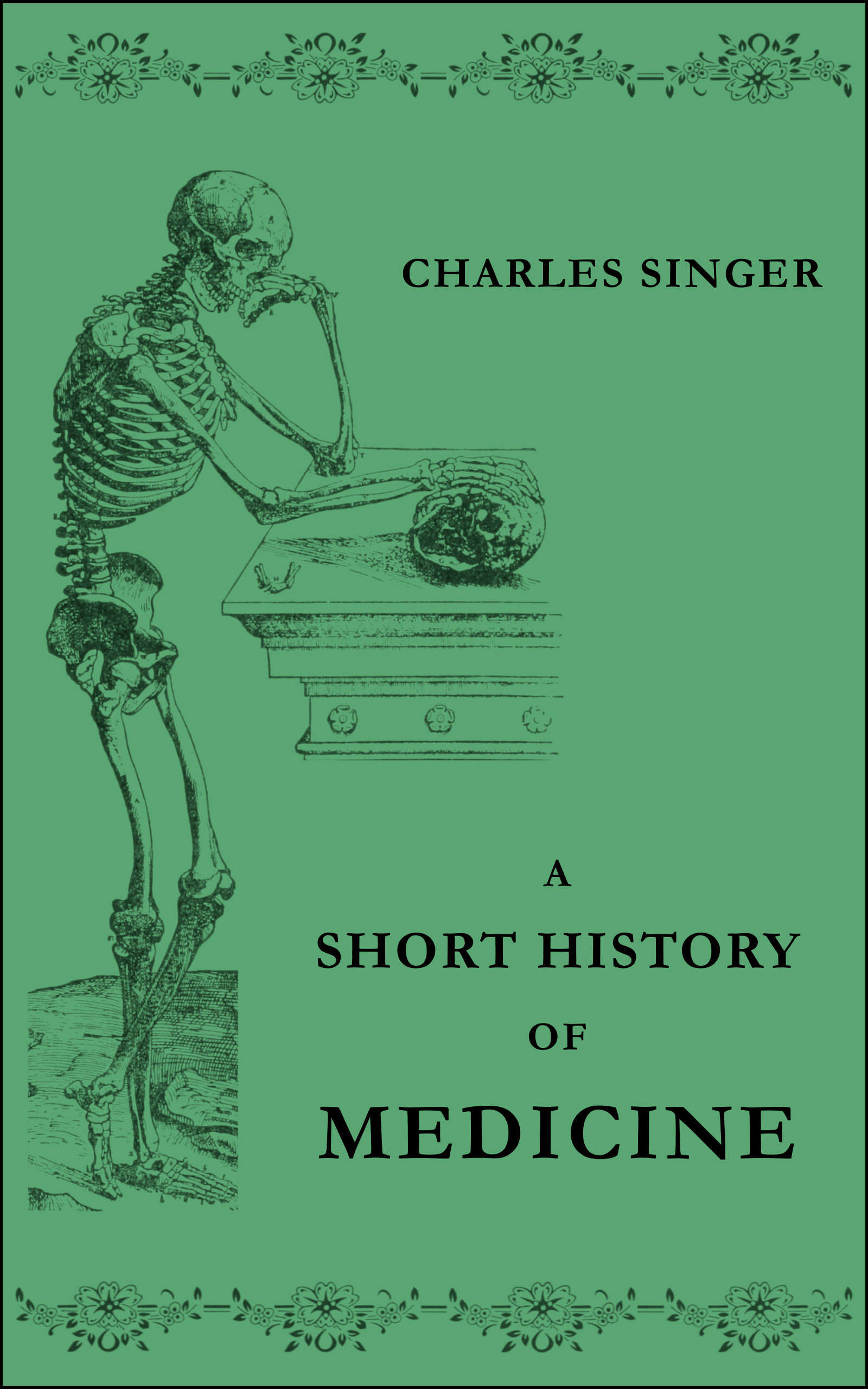
A short history of medicine
by Charles Singer
★★★★★No ratings yet
Language: English
Sign in to rate this book.
Sign in to shelve this book.
About this eBook
- Author
- Singer, Charles, 1876-1960
- Title
- A short history of medicine : introducing medical principles to students and non-medical readers
- Original Publication
- New York: Oxford University Press, 1928.
- Credits
- deaurider and the Online Distributed Proofreading Team at www.pgdp.net (This file was produced from images generously made available by The Internet Archive)
- Language
- English
- LoC Class
- R: Medicine
- Subject
- Medicine -- History
- Category
- Text
- Project Gutenberg
- eBook-No. 78966
- Release Date
- June 27, 2026
- Copyright
- Public domain in the USA.
Contents
- 1.A SHORT HISTORY OF MEDICINE
- 2.PREFACE
- 3.CONTENTS
- 4.LIST OF ILLUSTRATIONS
- 5.I ANCIENT GREECE (TO ABOUT 300 B.C.) — § 1. Origins of Greek Medicine. — § 2. The Hippocratic Physician. — § 3. Hippocratic Practice. — § 4. Aristotle.
- 6.II THE HEIRS OF GREECE (300 B.C. TO A.D. 200.) — § 1. The Alexandrian School. — § 2. Medical Teaching in the Roman Empire. — § 3. Medical Services of the Roman Empire. — § 4. Roman Hospitals. — § 5. Galen. — § 6. The Final Medical Synthesis of Antiquity.
- 7.III THE MIDDLE AGES (FROM ABOUT A.D. 200 TO ABOUT A.D. 1500.) — § 1. The Period of Depression in Europe. — § 2. Arabic Medicine. — § 3. The Medieval Awakening. — § 4. The Universities. — § 5. Medieval Anatomy, Surgery and Internal Medicine. — § 6. Medieval Hospitals and Hygiene.
- 8.IV THE REBIRTH OF SCIENCE (FROM ABOUT 1500 TO ABOUT 1700) — § 1. The Anatomical Awakening. — § 2. The Anatomical Reaction on Surgery. — § 3. The Renaissance of Internal Medicine. — § 4. The First Physical Synthesis. — § 5. The Revival of Physiology. — § 6. Microscopic Analysis of the Animal Body. — § 7. From Alchemy to Chemistry. — § 8. The Medical Theorists. — ( a ) Iatrophysics. — ( b ) Iatrochemistry. — ( c ) Vitalism.
- 9.V THE PERIOD OF CONSOLIDATION (FROM ABOUT 1700 TO ABOUT 1825) — § 1. The Reign of Law. — § 2. The Rise of Clinical Teaching. — § 3. Physiology passes to the Modern Stage. — § 4. Some Physiological Advances. — § 5. Discovery of the Nature of the Air. — § 6. Morbid Anatomy becomes a Science. — § 7. Clinical Methods and Instruments. — § 8. Surgery and Obstetrics. — § 9. The Beginnings of the Science of Vital Statistics. — § 10. Military, Naval, and Prison Medicine. — § 11. The Industrial Revolution. — § 12. Control and Recognition of Epidemic Diseases.
- 10.VI PERIOD OF SCIENTIFIC SUBDIVISION (FROM ABOUT 1825 ONWARDS) — § 1. Origins and Implications of Scientific Specialization. — § 2. The Revolution in Preventive Medicine. — (a) Preventive Medicine in Britain. — (b) Preventive Medicine in the United States. — § 3. The Transition to a Physiological Synthesis. — (a) Anatomy and Embryology in the Earlier Nineteenth Century. — (b) Chemical Physiology in the Earlier Nineteenth Century. — (c) Nervous Physiology in the Earlier Nineteenth Century. — § 4. The Experimental Foundations of Modern Medicine. — (a) The Work of Johannes Müller. — (b) The Work of Claude Bernard. — (c) The Work of Karl Ludwig. — § 5. The Cell Theory and Cellular Pathology. — § 6. Establishment of the Doctrine of the Germ Origin of Disease. — § 7. Anaesthesia. — § 8. The Revolution in Surgery. — § 9. Some Modern Surgical Advances. — § 10. Bacteriology becomes a special Science. — § 11. Some Important Bacteriological Results. — § 12. The Study of Immunity. — § 13. Some Practical Applications of Immunity. — § 14. The Conquest of the Tropics. — (a) Yellow Fever. — (b) Malaria. — § 15. The Changed View of Insanity. — § 16. The New Movement in Psychology. — § 17. The Revolution in Nursing. — § 18. Some Modern Physiological Concepts of Clinical Import. — (a) Ductless Glands and Internal Secretions. — (b) Nervous Integration. — (c) Vitamins. — § 19. Knowledge of the Eye and its Disorders. — § 20. Investigation of the Nature and Action of Drugs. — (a) Entry of Vegetable Drugs into the Pharmacopoeia. — (b) Active Principles. — (c) The Alkaloids. — (d) The Glucosides. — (e) The Study of Pharmacology. — (f) Chemotherapy. — § 21. Interpretation of Collective Medical Data.
- 11.EPILOGUE
- 12.INDEX
Community reviews
Sign in to write a review.
No reviews yet.